window.__IS_SSR__=true
window.__INITIAL_STATE__={
"attachmentsReducer": {
"audio_0": {
"type": "attachments",
"id": "audio_0",
"imgSizes": {
"kqedFullSize": {
"file": "https://ww2.kqed.org/news/wp-content/themes/KQED-unified/img/audio_bgs/background0.jpg"
}
}
},
"audio_1": {
"type": "attachments",
"id": "audio_1",
"imgSizes": {
"kqedFullSize": {
"file": "https://ww2.kqed.org/news/wp-content/themes/KQED-unified/img/audio_bgs/background1.jpg"
}
}
},
"audio_2": {
"type": "attachments",
"id": "audio_2",
"imgSizes": {
"kqedFullSize": {
"file": "https://ww2.kqed.org/news/wp-content/themes/KQED-unified/img/audio_bgs/background2.jpg"
}
}
},
"audio_3": {
"type": "attachments",
"id": "audio_3",
"imgSizes": {
"kqedFullSize": {
"file": "https://ww2.kqed.org/news/wp-content/themes/KQED-unified/img/audio_bgs/background3.jpg"
}
}
},
"audio_4": {
"type": "attachments",
"id": "audio_4",
"imgSizes": {
"kqedFullSize": {
"file": "https://ww2.kqed.org/news/wp-content/themes/KQED-unified/img/audio_bgs/background4.jpg"
}
}
},
"placeholder": {
"type": "attachments",
"id": "placeholder",
"imgSizes": {
"thumbnail": {
"file": "https://cdn.kqed.org/wp-content/uploads/2024/12/KQED-Default-Image-816638274-2000x1333-1-160x107.jpg",
"width": 160,
"height": 107,
"mimeType": "image/jpeg"
},
"medium": {
"file": "https://cdn.kqed.org/wp-content/uploads/2024/12/KQED-Default-Image-816638274-2000x1333-1-800x533.jpg",
"width": 800,
"height": 533,
"mimeType": "image/jpeg"
},
"medium_large": {
"file": "https://cdn.kqed.org/wp-content/uploads/2024/12/KQED-Default-Image-816638274-2000x1333-1-768x512.jpg",
"width": 768,
"height": 512,
"mimeType": "image/jpeg"
},
"large": {
"file": "https://cdn.kqed.org/wp-content/uploads/2024/12/KQED-Default-Image-816638274-2000x1333-1-1020x680.jpg",
"width": 1020,
"height": 680,
"mimeType": "image/jpeg"
},
"1536x1536": {
"file": "https://cdn.kqed.org/wp-content/uploads/2024/12/KQED-Default-Image-816638274-2000x1333-1-1536x1024.jpg",
"width": 1536,
"height": 1024,
"mimeType": "image/jpeg"
},
"fd-lrg": {
"file": "https://cdn.kqed.org/wp-content/uploads/2024/12/KQED-Default-Image-816638274-2000x1333-1-1536x1024.jpg",
"width": 1536,
"height": 1024,
"mimeType": "image/jpeg"
},
"fd-med": {
"file": "https://cdn.kqed.org/wp-content/uploads/2024/12/KQED-Default-Image-816638274-2000x1333-1-1020x680.jpg",
"width": 1020,
"height": 680,
"mimeType": "image/jpeg"
},
"fd-sm": {
"file": "https://cdn.kqed.org/wp-content/uploads/2024/12/KQED-Default-Image-816638274-2000x1333-1-800x533.jpg",
"width": 800,
"height": 533,
"mimeType": "image/jpeg"
},
"post-thumbnail": {
"file": "https://cdn.kqed.org/wp-content/uploads/2024/12/KQED-Default-Image-816638274-2000x1333-1-672x372.jpg",
"width": 672,
"height": 372,
"mimeType": "image/jpeg"
},
"twentyfourteen-full-width": {
"file": "https://cdn.kqed.org/wp-content/uploads/2024/12/KQED-Default-Image-816638274-2000x1333-1-1038x576.jpg",
"width": 1038,
"height": 576,
"mimeType": "image/jpeg"
},
"xxsmall": {
"file": "https://cdn.kqed.org/wp-content/uploads/2024/12/KQED-Default-Image-816638274-2000x1333-1-160x107.jpg",
"width": 160,
"height": 107,
"mimeType": "image/jpeg"
},
"xsmall": {
"file": "https://cdn.kqed.org/wp-content/uploads/2024/12/KQED-Default-Image-816638274-2000x1333-1-672x372.jpg",
"width": 672,
"height": 372,
"mimeType": "image/jpeg"
},
"small": {
"file": "https://cdn.kqed.org/wp-content/uploads/2024/12/KQED-Default-Image-816638274-2000x1333-1-672x372.jpg",
"width": 672,
"height": 372,
"mimeType": "image/jpeg"
},
"xlarge": {
"file": "https://cdn.kqed.org/wp-content/uploads/2024/12/KQED-Default-Image-816638274-2000x1333-1-1020x680.jpg",
"width": 1020,
"height": 680,
"mimeType": "image/jpeg"
},
"full-width": {
"file": "https://cdn.kqed.org/wp-content/uploads/2024/12/KQED-Default-Image-816638274-2000x1333-1-1920x1280.jpg",
"width": 1920,
"height": 1280,
"mimeType": "image/jpeg"
},
"guest-author-32": {
"file": "https://cdn.kqed.org/wp-content/uploads/2025/01/KQED-Default-Image-816638274-1333x1333-1-160x160.jpg",
"width": 32,
"height": 32,
"mimeType": "image/jpeg"
},
"guest-author-50": {
"file": "https://cdn.kqed.org/wp-content/uploads/2025/01/KQED-Default-Image-816638274-1333x1333-1-160x160.jpg",
"width": 50,
"height": 50,
"mimeType": "image/jpeg"
},
"guest-author-64": {
"file": "https://cdn.kqed.org/wp-content/uploads/2025/01/KQED-Default-Image-816638274-1333x1333-1-160x160.jpg",
"width": 64,
"height": 64,
"mimeType": "image/jpeg"
},
"guest-author-96": {
"file": "https://cdn.kqed.org/wp-content/uploads/2025/01/KQED-Default-Image-816638274-1333x1333-1-160x160.jpg",
"width": 96,
"height": 96,
"mimeType": "image/jpeg"
},
"guest-author-128": {
"file": "https://cdn.kqed.org/wp-content/uploads/2025/01/KQED-Default-Image-816638274-1333x1333-1-160x160.jpg",
"width": 128,
"height": 128,
"mimeType": "image/jpeg"
},
"detail": {
"file": "https://cdn.kqed.org/wp-content/uploads/2025/01/KQED-Default-Image-816638274-1333x1333-1-160x160.jpg",
"width": 160,
"height": 160,
"mimeType": "image/jpeg"
},
"kqedFullSize": {
"file": "https://cdn.kqed.org/wp-content/uploads/2024/12/KQED-Default-Image-816638274-2000x1333-1.jpg",
"width": 2000,
"height": 1333
}
}
},
"science_1974913": {
"type": "attachments",
"id": "science_1974913",
"meta": {
"index": "attachments_1716263798",
"site": "science",
"id": "1974913",
"found": true
},
"parent": 1974912,
"imgSizes": {
"twentyfourteen-full-width": {
"file": "https://ww2.kqed.org/app/uploads/sites/35/2021/05/offshore-wind_eric-thayer-bloomberg-getty-2048x1365-1-1038x576.jpg",
"width": 1038,
"mimeType": "image/jpeg",
"height": 576
},
"thumbnail": {
"file": "https://ww2.kqed.org/app/uploads/sites/35/2021/05/offshore-wind_eric-thayer-bloomberg-getty-2048x1365-1-160x107.jpg",
"width": 160,
"mimeType": "image/jpeg",
"height": 107
},
"post-thumbnail": {
"file": "https://ww2.kqed.org/app/uploads/sites/35/2021/05/offshore-wind_eric-thayer-bloomberg-getty-2048x1365-1-672x372.jpg",
"width": 672,
"mimeType": "image/jpeg",
"height": 372
},
"kqedFullSize": {
"file": "https://ww2.kqed.org/app/uploads/sites/35/2021/05/offshore-wind_eric-thayer-bloomberg-getty-2048x1365-1.jpg",
"width": 2048,
"height": 1365
},
"large": {
"file": "https://ww2.kqed.org/app/uploads/sites/35/2021/05/offshore-wind_eric-thayer-bloomberg-getty-2048x1365-1-1020x680.jpg",
"width": 1020,
"mimeType": "image/jpeg",
"height": 680
},
"1536x1536": {
"file": "https://ww2.kqed.org/app/uploads/sites/35/2021/05/offshore-wind_eric-thayer-bloomberg-getty-2048x1365-1-1536x1024.jpg",
"width": 1536,
"mimeType": "image/jpeg",
"height": 1024
},
"full-width": {
"file": "https://ww2.kqed.org/app/uploads/sites/35/2021/05/offshore-wind_eric-thayer-bloomberg-getty-2048x1365-1-1920x1280.jpg",
"width": 1920,
"mimeType": "image/jpeg",
"height": 1280
},
"medium": {
"file": "https://ww2.kqed.org/app/uploads/sites/35/2021/05/offshore-wind_eric-thayer-bloomberg-getty-2048x1365-1-800x533.jpg",
"width": 800,
"mimeType": "image/jpeg",
"height": 533
},
"medium_large": {
"file": "https://ww2.kqed.org/app/uploads/sites/35/2021/05/offshore-wind_eric-thayer-bloomberg-getty-2048x1365-1-768x512.jpg",
"width": 768,
"mimeType": "image/jpeg",
"height": 512
}
},
"publishDate": 1622049006,
"modified": 1622178631,
"caption": "The GE-Alstom Block Island Wind Farm stands in the water off Block Island, Rhode Island, on Sept, 14, 2016. ",
"description": null,
"title": "Views Of General Electric Co.'s First U.S. Offshore Wind Farm",
"credit": "Eric Thayer/Bloomberg via Getty Images",
"status": "inherit",
"altTag": null,
"isLoading": false,
"fetchFailed": false
},
"science_1974859": {
"type": "attachments",
"id": "science_1974859",
"meta": {
"index": "attachments_1716263798",
"site": "science",
"id": "1974859",
"found": true
},
"parent": 1974858,
"imgSizes": {
"twentyfourteen-full-width": {
"file": "https://ww2.kqed.org/app/uploads/sites/35/2021/05/ap_21140077457924-448a767e4135c7a06ebfb11b859e5082bc179428-1038x576.jpg",
"width": 1038,
"mimeType": "image/jpeg",
"height": 576
},
"thumbnail": {
"file": "https://ww2.kqed.org/app/uploads/sites/35/2021/05/ap_21140077457924-448a767e4135c7a06ebfb11b859e5082bc179428-160x120.jpg",
"width": 160,
"mimeType": "image/jpeg",
"height": 120
},
"post-thumbnail": {
"file": "https://ww2.kqed.org/app/uploads/sites/35/2021/05/ap_21140077457924-448a767e4135c7a06ebfb11b859e5082bc179428-672x372.jpg",
"width": 672,
"mimeType": "image/jpeg",
"height": 372
},
"kqedFullSize": {
"file": "https://ww2.kqed.org/app/uploads/sites/35/2021/05/ap_21140077457924-448a767e4135c7a06ebfb11b859e5082bc179428-scaled.jpg",
"width": 2560,
"height": 1917
},
"2048x2048": {
"file": "https://ww2.kqed.org/app/uploads/sites/35/2021/05/ap_21140077457924-448a767e4135c7a06ebfb11b859e5082bc179428-2048x1533.jpg",
"width": 2048,
"mimeType": "image/jpeg",
"height": 1533
},
"large": {
"file": "https://ww2.kqed.org/app/uploads/sites/35/2021/05/ap_21140077457924-448a767e4135c7a06ebfb11b859e5082bc179428-1020x764.jpg",
"width": 1020,
"mimeType": "image/jpeg",
"height": 764
},
"1536x1536": {
"file": "https://ww2.kqed.org/app/uploads/sites/35/2021/05/ap_21140077457924-448a767e4135c7a06ebfb11b859e5082bc179428-1536x1150.jpg",
"width": 1536,
"mimeType": "image/jpeg",
"height": 1150
},
"full-width": {
"file": "https://ww2.kqed.org/app/uploads/sites/35/2021/05/ap_21140077457924-448a767e4135c7a06ebfb11b859e5082bc179428-1920x1438.jpg",
"width": 1920,
"mimeType": "image/jpeg",
"height": 1438
},
"medium": {
"file": "https://ww2.kqed.org/app/uploads/sites/35/2021/05/ap_21140077457924-448a767e4135c7a06ebfb11b859e5082bc179428-800x599.jpg",
"width": 800,
"mimeType": "image/jpeg",
"height": 599
},
"medium_large": {
"file": "https://ww2.kqed.org/app/uploads/sites/35/2021/05/ap_21140077457924-448a767e4135c7a06ebfb11b859e5082bc179428-768x575.jpg",
"width": 768,
"mimeType": "image/jpeg",
"height": 575
}
},
"publishDate": 1621534296,
"modified": 1621534487,
"caption": "Pictured is the front grill of the new Ford F-150 Lightning unveiled on Wednesday in Dearborn, Mich. The electric version of Ford's bestselling pickup truck marks a major push to get buyers to switch to electric vehicles.",
"description": null,
"title": "ap_21140077457924-448a767e4135c7a06ebfb11b859e5082bc179428",
"credit": "Photo by Bill Pugliano/Getty Images",
"status": "inherit",
"altTag": null,
"isLoading": false,
"fetchFailed": false
},
"science_1974779": {
"type": "attachments",
"id": "science_1974779",
"meta": {
"index": "attachments_1716263798",
"site": "science",
"id": "1974779",
"found": true
},
"parent": 1974648,
"imgSizes": {
"twentyfourteen-full-width": {
"file": "https://ww2.kqed.org/app/uploads/sites/35/2021/05/KQED_BigBasin_Fire_09102020-qut-1038x576.jpg",
"width": 1038,
"mimeType": "image/jpeg",
"height": 576
},
"thumbnail": {
"file": "https://ww2.kqed.org/app/uploads/sites/35/2021/05/KQED_BigBasin_Fire_09102020-qut-160x107.jpg",
"width": 160,
"mimeType": "image/jpeg",
"height": 107
},
"post-thumbnail": {
"file": "https://ww2.kqed.org/app/uploads/sites/35/2021/05/KQED_BigBasin_Fire_09102020-qut-672x372.jpg",
"width": 672,
"mimeType": "image/jpeg",
"height": 372
},
"kqedFullSize": {
"file": "https://ww2.kqed.org/app/uploads/sites/35/2021/05/KQED_BigBasin_Fire_09102020-qut.jpg",
"width": 1920,
"height": 1278
},
"large": {
"file": "https://ww2.kqed.org/app/uploads/sites/35/2021/05/KQED_BigBasin_Fire_09102020-qut-1020x679.jpg",
"width": 1020,
"mimeType": "image/jpeg",
"height": 679
},
"1536x1536": {
"file": "https://ww2.kqed.org/app/uploads/sites/35/2021/05/KQED_BigBasin_Fire_09102020-qut-1536x1022.jpg",
"width": 1536,
"mimeType": "image/jpeg",
"height": 1022
},
"medium": {
"file": "https://ww2.kqed.org/app/uploads/sites/35/2021/05/KQED_BigBasin_Fire_09102020-qut-800x533.jpg",
"width": 800,
"mimeType": "image/jpeg",
"height": 533
},
"medium_large": {
"file": "https://ww2.kqed.org/app/uploads/sites/35/2021/05/KQED_BigBasin_Fire_09102020-qut-768x511.jpg",
"width": 768,
"mimeType": "image/jpeg",
"height": 511
}
},
"publishDate": 1620944350,
"modified": 1620946848,
"caption": "Redwood trees after the CZU Lightning Complex wildfires burned much of the area at Big Basin Redwoods State Park on Sept. 10, 2020.",
"description": null,
"title": "KQED_BigBasin_Fire_09102020-qut",
"credit": "Beth LaBerge/KQED",
"status": "inherit",
"altTag": null,
"isLoading": false,
"fetchFailed": false
},
"science_1973151": {
"type": "attachments",
"id": "science_1973151",
"meta": {
"index": "attachments_1716263798",
"site": "science",
"id": "1973151",
"found": true
},
"parent": 1973149,
"imgSizes": {
"twentyfourteen-full-width": {
"file": "https://ww2.kqed.org/app/uploads/sites/35/2021/03/IMG_1606-1038x576.jpg",
"width": 1038,
"mimeType": "image/jpeg",
"height": 576
},
"thumbnail": {
"file": "https://ww2.kqed.org/app/uploads/sites/35/2021/03/IMG_1606-160x107.jpg",
"width": 160,
"mimeType": "image/jpeg",
"height": 107
},
"post-thumbnail": {
"file": "https://ww2.kqed.org/app/uploads/sites/35/2021/03/IMG_1606-672x372.jpg",
"width": 672,
"mimeType": "image/jpeg",
"height": 372
},
"kqedFullSize": {
"file": "https://ww2.kqed.org/app/uploads/sites/35/2021/03/IMG_1606-scaled.jpg",
"width": 2560,
"height": 1707
},
"2048x2048": {
"file": "https://ww2.kqed.org/app/uploads/sites/35/2021/03/IMG_1606-2048x1365.jpg",
"width": 2048,
"mimeType": "image/jpeg",
"height": 1365
},
"large": {
"file": "https://ww2.kqed.org/app/uploads/sites/35/2021/03/IMG_1606-1020x680.jpg",
"width": 1020,
"mimeType": "image/jpeg",
"height": 680
},
"1536x1536": {
"file": "https://ww2.kqed.org/app/uploads/sites/35/2021/03/IMG_1606-1536x1024.jpg",
"width": 1536,
"mimeType": "image/jpeg",
"height": 1024
},
"full-width": {
"file": "https://ww2.kqed.org/app/uploads/sites/35/2021/03/IMG_1606-1920x1280.jpg",
"width": 1920,
"mimeType": "image/jpeg",
"height": 1280
},
"medium": {
"file": "https://ww2.kqed.org/app/uploads/sites/35/2021/03/IMG_1606-800x533.jpg",
"width": 800,
"mimeType": "image/jpeg",
"height": 533
},
"medium_large": {
"file": "https://ww2.kqed.org/app/uploads/sites/35/2021/03/IMG_1606-768x512.jpg",
"width": 768,
"mimeType": "image/jpeg",
"height": 512
}
},
"publishDate": 1615335948,
"modified": 1615335987,
"caption": "A sign thanking firefighters outside Bob's Market in Shaver Lake.",
"description": null,
"title": "IMG_1606",
"credit": "Danielle Venton/KQED",
"status": "inherit",
"altTag": null,
"isLoading": false,
"fetchFailed": false
},
"science_1973140": {
"type": "attachments",
"id": "science_1973140",
"meta": {
"index": "attachments_1716263798",
"site": "science",
"id": "1973140",
"found": true
},
"parent": 1973138,
"imgSizes": {
"twentyfourteen-full-width": {
"file": "https://ww2.kqed.org/app/uploads/sites/35/2029/03/IMG_1557-1038x576.jpg",
"width": 1038,
"mimeType": "image/jpeg",
"height": 576
},
"thumbnail": {
"file": "https://ww2.kqed.org/app/uploads/sites/35/2029/03/IMG_1557-160x107.jpg",
"width": 160,
"mimeType": "image/jpeg",
"height": 107
},
"post-thumbnail": {
"file": "https://ww2.kqed.org/app/uploads/sites/35/2029/03/IMG_1557-672x372.jpg",
"width": 672,
"mimeType": "image/jpeg",
"height": 372
},
"kqedFullSize": {
"file": "https://ww2.kqed.org/app/uploads/sites/35/2029/03/IMG_1557-scaled-e1620777613325.jpg",
"width": 1920,
"height": 1280
},
"2048x2048": {
"file": "https://ww2.kqed.org/app/uploads/sites/35/2029/03/IMG_1557-2048x1365.jpg",
"width": 2048,
"mimeType": "image/jpeg",
"height": 1365
},
"large": {
"file": "https://ww2.kqed.org/app/uploads/sites/35/2029/03/IMG_1557-1020x680.jpg",
"width": 1020,
"mimeType": "image/jpeg",
"height": 680
},
"1536x1536": {
"file": "https://ww2.kqed.org/app/uploads/sites/35/2029/03/IMG_1557-1536x1024.jpg",
"width": 1536,
"mimeType": "image/jpeg",
"height": 1024
},
"full-width": {
"file": "https://ww2.kqed.org/app/uploads/sites/35/2029/03/IMG_1557-1920x1280.jpg",
"width": 1920,
"mimeType": "image/jpeg",
"height": 1280
},
"medium": {
"file": "https://ww2.kqed.org/app/uploads/sites/35/2029/03/IMG_1557-800x533.jpg",
"width": 800,
"mimeType": "image/jpeg",
"height": 533
},
"medium_large": {
"file": "https://ww2.kqed.org/app/uploads/sites/35/2029/03/IMG_1557-768x512.jpg",
"width": 768,
"mimeType": "image/jpeg",
"height": 512
}
},
"publishDate": 1615333634,
"modified": 1620777629,
"caption": "Meghan Breniman, left, and Julianne Stewart stand to either side of a fir tree that survived the Creek Fire. ",
"description": "Two women stand on either side of a tree that is green on top, but the lower branches are brown",
"title": "IMG_1557",
"credit": "Danielle Venton/KQED",
"status": "inherit",
"altTag": null,
"isLoading": false,
"fetchFailed": false
},
"science_1974692": {
"type": "attachments",
"id": "science_1974692",
"meta": {
"index": "attachments_1716263798",
"site": "science",
"id": "1974692",
"found": true
},
"parent": 1974669,
"imgSizes": {
"twentyfourteen-full-width": {
"file": "https://ww2.kqed.org/app/uploads/sites/35/2021/05/April-20-vs-may-4-1038x576.jpg",
"width": 1038,
"mimeType": "image/jpeg",
"height": 576
},
"thumbnail": {
"file": "https://ww2.kqed.org/app/uploads/sites/35/2021/05/April-20-vs-may-4-160x81.jpg",
"width": 160,
"mimeType": "image/jpeg",
"height": 81
},
"post-thumbnail": {
"file": "https://ww2.kqed.org/app/uploads/sites/35/2021/05/April-20-vs-may-4-672x372.jpg",
"width": 672,
"mimeType": "image/jpeg",
"height": 372
},
"kqedFullSize": {
"file": "https://ww2.kqed.org/app/uploads/sites/35/2021/05/April-20-vs-may-4.jpg",
"width": 1290,
"height": 650
},
"large": {
"file": "https://ww2.kqed.org/app/uploads/sites/35/2021/05/April-20-vs-may-4-1020x514.jpg",
"width": 1020,
"mimeType": "image/jpeg",
"height": 514
},
"medium": {
"file": "https://ww2.kqed.org/app/uploads/sites/35/2021/05/April-20-vs-may-4-800x403.jpg",
"width": 800,
"mimeType": "image/jpeg",
"height": 403
},
"medium_large": {
"file": "https://ww2.kqed.org/app/uploads/sites/35/2021/05/April-20-vs-may-4-768x387.jpg",
"width": 768,
"mimeType": "image/jpeg",
"height": 387
}
},
"publishDate": 1620757884,
"modified": 1620787140,
"caption": "The state of California's drought conditions on April 20 versus May 4, from the U.S. Drought Monitor.",
"description": null,
"title": "April 20 vs may 4",
"credit": "U.S. Drought Monitor",
"status": "inherit",
"altTag": null,
"isLoading": false,
"fetchFailed": false
},
"science_1974592": {
"type": "attachments",
"id": "science_1974592",
"meta": {
"index": "attachments_1716263798",
"site": "science",
"id": "1974592",
"found": true
},
"parent": 1974590,
"imgSizes": {
"twentyfourteen-full-width": {
"file": "https://ww2.kqed.org/app/uploads/sites/35/2021/05/jeff-smith_wide-77cb699f7d31c4109adc74c2151c9479b5c73b0c-1-1038x576.jpg",
"width": 1038,
"mimeType": "image/jpeg",
"height": 576
},
"thumbnail": {
"file": "https://ww2.kqed.org/app/uploads/sites/35/2021/05/jeff-smith_wide-77cb699f7d31c4109adc74c2151c9479b5c73b0c-1-160x90.jpg",
"width": 160,
"mimeType": "image/jpeg",
"height": 90
},
"post-thumbnail": {
"file": "https://ww2.kqed.org/app/uploads/sites/35/2021/05/jeff-smith_wide-77cb699f7d31c4109adc74c2151c9479b5c73b0c-1-672x372.jpg",
"width": 672,
"mimeType": "image/jpeg",
"height": 372
},
"kqedFullSize": {
"file": "https://ww2.kqed.org/app/uploads/sites/35/2021/05/jeff-smith_wide-77cb699f7d31c4109adc74c2151c9479b5c73b0c-1.jpg",
"width": 2385,
"height": 1342
},
"2048x2048": {
"file": "https://ww2.kqed.org/app/uploads/sites/35/2021/05/jeff-smith_wide-77cb699f7d31c4109adc74c2151c9479b5c73b0c-1-2048x1152.jpg",
"width": 2048,
"mimeType": "image/jpeg",
"height": 1152
},
"large": {
"file": "https://ww2.kqed.org/app/uploads/sites/35/2021/05/jeff-smith_wide-77cb699f7d31c4109adc74c2151c9479b5c73b0c-1-1020x574.jpg",
"width": 1020,
"mimeType": "image/jpeg",
"height": 574
},
"1536x1536": {
"file": "https://ww2.kqed.org/app/uploads/sites/35/2021/05/jeff-smith_wide-77cb699f7d31c4109adc74c2151c9479b5c73b0c-1-1536x864.jpg",
"width": 1536,
"mimeType": "image/jpeg",
"height": 864
},
"full-width": {
"file": "https://ww2.kqed.org/app/uploads/sites/35/2021/05/jeff-smith_wide-77cb699f7d31c4109adc74c2151c9479b5c73b0c-1-1920x1080.jpg",
"width": 1920,
"mimeType": "image/jpeg",
"height": 1080
},
"medium": {
"file": "https://ww2.kqed.org/app/uploads/sites/35/2021/05/jeff-smith_wide-77cb699f7d31c4109adc74c2151c9479b5c73b0c-1-800x450.jpg",
"width": 800,
"mimeType": "image/jpeg",
"height": 450
},
"medium_large": {
"file": "https://ww2.kqed.org/app/uploads/sites/35/2021/05/jeff-smith_wide-77cb699f7d31c4109adc74c2151c9479b5c73b0c-1-768x432.jpg",
"width": 768,
"mimeType": "image/jpeg",
"height": 432
}
},
"publishDate": 1620318565,
"modified": 1620344454,
"caption": "Owner and founder Jeff Smith in front of what remains of the Hourglass' winery and processing facility in Napa. He's rebuilding, but wildfires have him rethinking everything about his land and business.\n",
"description": null,
"title": "Owner and founder Jeff Smith in front of what remains of Hourglass' winery and processing facility in Napa. He's rebuilding, but wildfires have him re-thinking everything about his land and business.",
"credit": "Eric Westervelt/NPR",
"status": "inherit",
"altTag": null,
"isLoading": false,
"fetchFailed": false
},
"science_1974465": {
"type": "attachments",
"id": "science_1974465",
"meta": {
"index": "attachments_1716263798",
"site": "science",
"id": "1974465",
"found": true
},
"parent": 1974464,
"imgSizes": {
"twentyfourteen-full-width": {
"file": "https://ww2.kqed.org/app/uploads/sites/35/2021/05/a21-credit-cris-benton-102_wide-49c0e93e02cb83a8ca99dc7793b01bd5f51d255e-1038x576.jpg",
"width": 1038,
"mimeType": "image/jpeg",
"height": 576
},
"thumbnail": {
"file": "https://ww2.kqed.org/app/uploads/sites/35/2021/05/a21-credit-cris-benton-102_wide-49c0e93e02cb83a8ca99dc7793b01bd5f51d255e-160x90.jpg",
"width": 160,
"mimeType": "image/jpeg",
"height": 90
},
"post-thumbnail": {
"file": "https://ww2.kqed.org/app/uploads/sites/35/2021/05/a21-credit-cris-benton-102_wide-49c0e93e02cb83a8ca99dc7793b01bd5f51d255e-672x372.jpg",
"width": 672,
"mimeType": "image/jpeg",
"height": 372
},
"kqedFullSize": {
"file": "https://ww2.kqed.org/app/uploads/sites/35/2021/05/a21-credit-cris-benton-102_wide-49c0e93e02cb83a8ca99dc7793b01bd5f51d255e-scaled.jpg",
"width": 2560,
"height": 1440
},
"2048x2048": {
"file": "https://ww2.kqed.org/app/uploads/sites/35/2021/05/a21-credit-cris-benton-102_wide-49c0e93e02cb83a8ca99dc7793b01bd5f51d255e-2048x1152.jpg",
"width": 2048,
"mimeType": "image/jpeg",
"height": 1152
},
"large": {
"file": "https://ww2.kqed.org/app/uploads/sites/35/2021/05/a21-credit-cris-benton-102_wide-49c0e93e02cb83a8ca99dc7793b01bd5f51d255e-1020x574.jpg",
"width": 1020,
"mimeType": "image/jpeg",
"height": 574
},
"1536x1536": {
"file": "https://ww2.kqed.org/app/uploads/sites/35/2021/05/a21-credit-cris-benton-102_wide-49c0e93e02cb83a8ca99dc7793b01bd5f51d255e-1536x864.jpg",
"width": 1536,
"mimeType": "image/jpeg",
"height": 864
},
"full-width": {
"file": "https://ww2.kqed.org/app/uploads/sites/35/2021/05/a21-credit-cris-benton-102_wide-49c0e93e02cb83a8ca99dc7793b01bd5f51d255e-1920x1080.jpg",
"width": 1920,
"mimeType": "image/jpeg",
"height": 1080
},
"medium": {
"file": "https://ww2.kqed.org/app/uploads/sites/35/2021/05/a21-credit-cris-benton-102_wide-49c0e93e02cb83a8ca99dc7793b01bd5f51d255e-800x450.jpg",
"width": 800,
"mimeType": "image/jpeg",
"height": 450
},
"medium_large": {
"file": "https://ww2.kqed.org/app/uploads/sites/35/2021/05/a21-credit-cris-benton-102_wide-49c0e93e02cb83a8ca99dc7793b01bd5f51d255e-768x432.jpg",
"width": 768,
"mimeType": "image/jpeg",
"height": 432
}
},
"publishDate": 1620064141,
"modified": 1620064328,
"caption": "Coastal communities are racing to restore marshes, like these in San Francisco Bay, to create a barrier against storm surges and sea level rise.\n",
"description": null,
"title": "Coastal communities are racing to restore marshes, like these in San Francisco Bay, to provide a barrier against storm surges and rising seas.",
"credit": "Cris Benton/NPR",
"status": "inherit",
"altTag": null,
"isLoading": false,
"fetchFailed": false
},
"science_1974537": {
"type": "attachments",
"id": "science_1974537",
"meta": {
"index": "attachments_1716263798",
"site": "science",
"id": "1974537",
"found": true
},
"parent": 1974535,
"imgSizes": {
"twentyfourteen-full-width": {
"file": "https://ww2.kqed.org/app/uploads/sites/35/2021/05/RS48866_004_SanCarlos_KatinkaLennemann_04302021-qut-1038x576.jpg",
"width": 1038,
"mimeType": "image/jpeg",
"height": 576
},
"thumbnail": {
"file": "https://ww2.kqed.org/app/uploads/sites/35/2021/05/RS48866_004_SanCarlos_KatinkaLennemann_04302021-qut-160x107.jpg",
"width": 160,
"mimeType": "image/jpeg",
"height": 107
},
"post-thumbnail": {
"file": "https://ww2.kqed.org/app/uploads/sites/35/2021/05/RS48866_004_SanCarlos_KatinkaLennemann_04302021-qut-672x372.jpg",
"width": 672,
"mimeType": "image/jpeg",
"height": 372
},
"kqedFullSize": {
"file": "https://ww2.kqed.org/app/uploads/sites/35/2021/05/RS48866_004_SanCarlos_KatinkaLennemann_04302021-qut.jpg",
"width": 1920,
"height": 1280
},
"large": {
"file": "https://ww2.kqed.org/app/uploads/sites/35/2021/05/RS48866_004_SanCarlos_KatinkaLennemann_04302021-qut-1020x680.jpg",
"width": 1020,
"mimeType": "image/jpeg",
"height": 680
},
"1536x1536": {
"file": "https://ww2.kqed.org/app/uploads/sites/35/2021/05/RS48866_004_SanCarlos_KatinkaLennemann_04302021-qut-1536x1024.jpg",
"width": 1536,
"mimeType": "image/jpeg",
"height": 1024
},
"medium": {
"file": "https://ww2.kqed.org/app/uploads/sites/35/2021/05/RS48866_004_SanCarlos_KatinkaLennemann_04302021-qut-800x533.jpg",
"width": 800,
"mimeType": "image/jpeg",
"height": 533
},
"medium_large": {
"file": "https://ww2.kqed.org/app/uploads/sites/35/2021/05/RS48866_004_SanCarlos_KatinkaLennemann_04302021-qut-768x512.jpg",
"width": 768,
"mimeType": "image/jpeg",
"height": 512
}
},
"publishDate": 1620160837,
"modified": 1620160879,
"caption": "Sequoia Union High School junior Katinka Lennemann at Highlands Park in San Carlos on April 30, 2021.",
"description": null,
"title": "RS48866_004_SanCarlos_KatinkaLennemann_04302021-qut",
"credit": "Beth LaBerge/KQED",
"status": "inherit",
"altTag": null,
"isLoading": false,
"fetchFailed": false
},
"science_1974549": {
"type": "attachments",
"id": "science_1974549",
"meta": {
"index": "attachments_1716263798",
"site": "science",
"id": "1974549",
"found": true
},
"parent": 1974544,
"imgSizes": {
"twentyfourteen-full-width": {
"file": "https://ww2.kqed.org/app/uploads/sites/35/2021/05/RS48888_GettyImages-1232098529-qut-1038x576.jpg",
"width": 1038,
"mimeType": "image/jpeg",
"height": 576
},
"thumbnail": {
"file": "https://ww2.kqed.org/app/uploads/sites/35/2021/05/RS48888_GettyImages-1232098529-qut-160x94.jpg",
"width": 160,
"mimeType": "image/jpeg",
"height": 94
},
"post-thumbnail": {
"file": "https://ww2.kqed.org/app/uploads/sites/35/2021/05/RS48888_GettyImages-1232098529-qut-672x372.jpg",
"width": 672,
"mimeType": "image/jpeg",
"height": 372
},
"kqedFullSize": {
"file": "https://ww2.kqed.org/app/uploads/sites/35/2021/05/RS48888_GettyImages-1232098529-qut.jpg",
"width": 1920,
"height": 1131
},
"large": {
"file": "https://ww2.kqed.org/app/uploads/sites/35/2021/05/RS48888_GettyImages-1232098529-qut-1020x601.jpg",
"width": 1020,
"mimeType": "image/jpeg",
"height": 601
},
"1536x1536": {
"file": "https://ww2.kqed.org/app/uploads/sites/35/2021/05/RS48888_GettyImages-1232098529-qut-1536x905.jpg",
"width": 1536,
"mimeType": "image/jpeg",
"height": 905
},
"medium": {
"file": "https://ww2.kqed.org/app/uploads/sites/35/2021/05/RS48888_GettyImages-1232098529-qut-800x471.jpg",
"width": 800,
"mimeType": "image/jpeg",
"height": 471
},
"medium_large": {
"file": "https://ww2.kqed.org/app/uploads/sites/35/2021/05/RS48888_GettyImages-1232098529-qut-768x452.jpg",
"width": 768,
"mimeType": "image/jpeg",
"height": 452
}
},
"publishDate": 1620165896,
"modified": 1620170377,
"caption": "An orchard is seen on the outskirts of Kettleman City in California's San Joaquin Valley on April 2, 2021, one of the top agriculture producing counties in the San Joaquin Valley where dairy, grapes, almonds, strawberries, and pistachios contribute billions to the economy each year. ",
"description": null,
"title": "US-ENVIRONMENT-DROUGHT-AGRICULTURE",
"credit": "Frederic J. Brown/AFP via Getty Images",
"status": "inherit",
"altTag": null,
"isLoading": false,
"fetchFailed": false
},
"science_1974391": {
"type": "attachments",
"id": "science_1974391",
"meta": {
"index": "attachments_1716263798",
"site": "science",
"id": "1974391",
"found": true
},
"parent": 1974389,
"imgSizes": {
"twentyfourteen-full-width": {
"file": "https://ww2.kqed.org/app/uploads/sites/35/2021/04/RS48861_GettyImages-177068760-1-qut-1038x576.jpg",
"width": 1038,
"mimeType": "image/jpeg",
"height": 576
},
"thumbnail": {
"file": "https://ww2.kqed.org/app/uploads/sites/35/2021/04/RS48861_GettyImages-177068760-1-qut-160x107.jpg",
"width": 160,
"mimeType": "image/jpeg",
"height": 107
},
"post-thumbnail": {
"file": "https://ww2.kqed.org/app/uploads/sites/35/2021/04/RS48861_GettyImages-177068760-1-qut-672x372.jpg",
"width": 672,
"mimeType": "image/jpeg",
"height": 372
},
"kqedFullSize": {
"file": "https://ww2.kqed.org/app/uploads/sites/35/2021/04/RS48861_GettyImages-177068760-1-qut.jpg",
"width": 1920,
"height": 1281
},
"large": {
"file": "https://ww2.kqed.org/app/uploads/sites/35/2021/04/RS48861_GettyImages-177068760-1-qut-1020x681.jpg",
"width": 1020,
"mimeType": "image/jpeg",
"height": 681
},
"1536x1536": {
"file": "https://ww2.kqed.org/app/uploads/sites/35/2021/04/RS48861_GettyImages-177068760-1-qut-1536x1025.jpg",
"width": 1536,
"mimeType": "image/jpeg",
"height": 1025
},
"medium": {
"file": "https://ww2.kqed.org/app/uploads/sites/35/2021/04/RS48861_GettyImages-177068760-1-qut-800x534.jpg",
"width": 800,
"mimeType": "image/jpeg",
"height": 534
},
"medium_large": {
"file": "https://ww2.kqed.org/app/uploads/sites/35/2021/04/RS48861_GettyImages-177068760-1-qut-768x512.jpg",
"width": 768,
"mimeType": "image/jpeg",
"height": 512
}
},
"publishDate": 1619736287,
"modified": 1620063758,
"caption": "Thick coastal forests with redwood trees can store double the amount of carbon per acre compared to shrubbier, smaller forests in inland areas of California. ",
"description": null,
"title": "Sequoias And Coastal Redwoods Appear To Flourish Despite Climate Change",
"credit": "Justin Sullivan/Getty Images",
"status": "inherit",
"altTag": null,
"isLoading": false,
"fetchFailed": false
},
"science_1974371": {
"type": "attachments",
"id": "science_1974371",
"meta": {
"index": "attachments_1716263798",
"site": "science",
"id": "1974371",
"found": true
},
"parent": 1974354,
"imgSizes": {
"twentyfourteen-full-width": {
"file": "https://ww2.kqed.org/app/uploads/sites/35/2021/04/Arizona-Conservation-Corps-1-1038x576.jpeg",
"width": 1038,
"mimeType": "image/jpeg",
"height": 576
},
"thumbnail": {
"file": "https://ww2.kqed.org/app/uploads/sites/35/2021/04/Arizona-Conservation-Corps-1-160x107.jpeg",
"width": 160,
"mimeType": "image/jpeg",
"height": 107
},
"post-thumbnail": {
"file": "https://ww2.kqed.org/app/uploads/sites/35/2021/04/Arizona-Conservation-Corps-1-672x372.jpeg",
"width": 672,
"mimeType": "image/jpeg",
"height": 372
},
"kqedFullSize": {
"file": "https://ww2.kqed.org/app/uploads/sites/35/2021/04/Arizona-Conservation-Corps-1.jpeg",
"width": 2048,
"height": 1365
},
"large": {
"file": "https://ww2.kqed.org/app/uploads/sites/35/2021/04/Arizona-Conservation-Corps-1-1020x680.jpeg",
"width": 1020,
"mimeType": "image/jpeg",
"height": 680
},
"1536x1536": {
"file": "https://ww2.kqed.org/app/uploads/sites/35/2021/04/Arizona-Conservation-Corps-1-1536x1024.jpeg",
"width": 1536,
"mimeType": "image/jpeg",
"height": 1024
},
"full-width": {
"file": "https://ww2.kqed.org/app/uploads/sites/35/2021/04/Arizona-Conservation-Corps-1-1920x1280.jpeg",
"width": 1920,
"mimeType": "image/jpeg",
"height": 1280
},
"medium": {
"file": "https://ww2.kqed.org/app/uploads/sites/35/2021/04/Arizona-Conservation-Corps-1-800x533.jpeg",
"width": 800,
"mimeType": "image/jpeg",
"height": 533
},
"medium_large": {
"file": "https://ww2.kqed.org/app/uploads/sites/35/2021/04/Arizona-Conservation-Corps-1-768x512.jpeg",
"width": 768,
"mimeType": "image/jpeg",
"height": 512
}
},
"publishDate": 1619722099,
"modified": 1619722130,
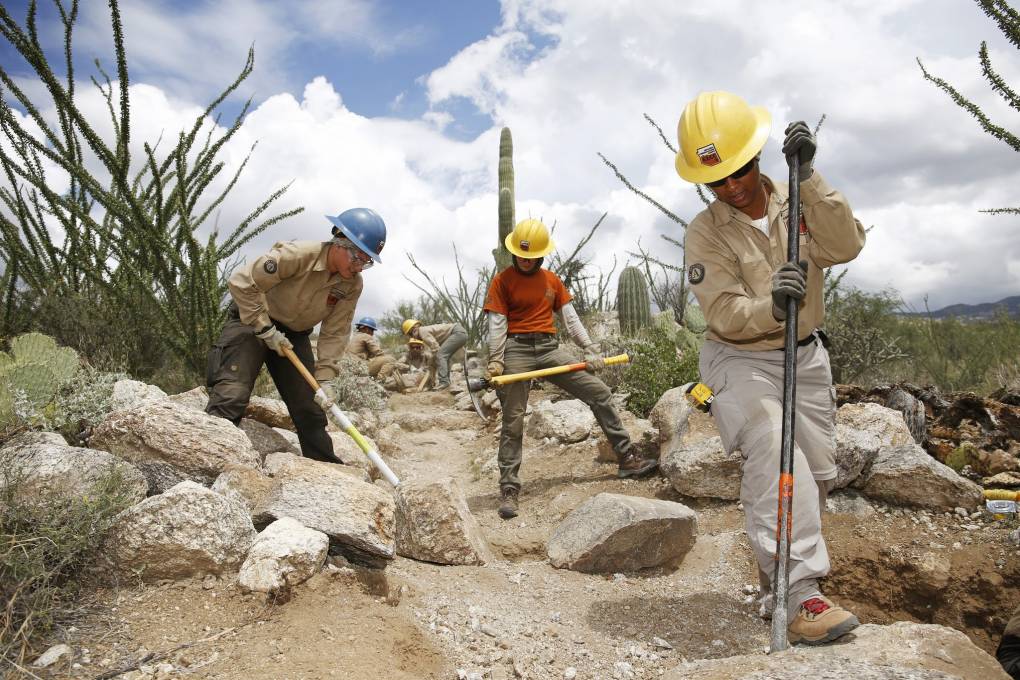
"caption": "AmeriCorps members with Arizona Conservation Corps, a program of Conservation Legacy, make improvements on the Manning Camp Trail at Saguaro National Park. ",
"description": null,
"title": "Arizona-Conservation-Corps-1",
"credit": "Photo courtesy of the Corps Network/InsideClimate News",
"status": "inherit",
"altTag": null,
"isLoading": false,
"fetchFailed": false
}
},
"audioPlayerReducer": {
"postId": "stream_live",
"isPaused": true,
"isPlaying": false,
"pfsActive": false,
"pledgeModalIsOpen": true,
"playerDrawerIsOpen": false,
"liveAudioPlayStartedAt": 0,
"liveAudioPlayContext": ""
},
"authorsReducer": {
"byline_science_1974912": {
"type": "authors",
"id": "byline_science_1974912",
"meta": {
"override": true
},
"slug": "byline_science_1974912",
"name": "Emma Foehringer Merchant \u003cbr />InsideClimate News\u003cbr>",
"isLoading": false
},
"byline_science_1974858": {
"type": "authors",
"id": "byline_science_1974858",
"meta": {
"override": true
},
"slug": "byline_science_1974858",
"name": "Camila Domonoske \u003cbr />NPR\u003cbr>",
"isLoading": false
},
"byline_science_1974590": {
"type": "authors",
"id": "byline_science_1974590",
"meta": {
"override": true
},
"slug": "byline_science_1974590",
"name": "Eric Westervelt \u003cbr />NPR\u003cbr>",
"isLoading": false
},
"byline_science_1974464": {
"type": "authors",
"id": "byline_science_1974464",
"meta": {
"override": true
},
"slug": "byline_science_1974464",
"name": "Lauren Sommer \u003cbr />NPR\u003cbr>",
"isLoading": false
},
"byline_science_1974544": {
"type": "authors",
"id": "byline_science_1974544",
"meta": {
"override": true
},
"slug": "byline_science_1974544",
"name": "Seth Borenstein \u003cbr />AP\u003cbr>",
"isLoading": false
},
"byline_science_1974389": {
"type": "authors",
"id": "byline_science_1974389",
"meta": {
"override": true
},
"slug": "byline_science_1974389",
"name": "Lisa Song, ProPublica, and James Temple, MIT Technology Review",
"isLoading": false
},
"byline_science_1974354": {
"type": "authors",
"id": "byline_science_1974354",
"meta": {
"override": true
},
"slug": "byline_science_1974354",
"name": "Judy Fahys \u003cbr />InsideClimate News\u003cbr>",
"isLoading": false
},
"dventon": {
"type": "authors",
"id": "11088",
"meta": {
"index": "authors_1716337520",
"id": "11088",
"found": true
},
"name": "Danielle Venton",
"firstName": "Danielle",
"lastName": "Venton",
"slug": "dventon",
"email": "dventon@kqed.org",
"display_author_email": true,
"staff_mastheads": [
"science"
],
"title": "Science reporter",
"bio": "Danielle Venton is a reporter for KQED Science. She covers wildfires, space and oceans (though she is prone to sea sickness).\r\n\r\nBefore joining KQED in 2015, Danielle was a staff reporter at KRCB in Sonoma County and a freelancer. She studied science communication at UC Santa Cruz and formerly worked at CERN in Geneva, Switzerland where she wrote about computing. She lives in Sonoma County and enjoys backpacking.",
"avatar": "https://secure.gravatar.com/avatar/37b292b5c40c8d93959c4f48d73b5286f41b7abd8588277e941905a3ed4c801c?s=600&d=blank&r=g",
"twitter": "DanielleVenton",
"bluesky": null,
"facebook": null,
"instagram": null,
"linkedin": null,
"sites": [
{
"site": "arts",
"roles": [
"contributor"
]
},
{
"site": "news",
"roles": [
"editor"
]
},
{
"site": "futureofyou",
"roles": [
"editor"
]
},
{
"site": "science",
"roles": [
"editor"
]
},
{
"site": "liveblog",
"roles": [
"contributor"
]
}
],
"headData": {
"title": "Danielle Venton | KQED",
"description": "Science reporter",
"ogImgSrc": "https://secure.gravatar.com/avatar/37b292b5c40c8d93959c4f48d73b5286f41b7abd8588277e941905a3ed4c801c?s=600&d=blank&r=g",
"twImgSrc": "https://secure.gravatar.com/avatar/37b292b5c40c8d93959c4f48d73b5286f41b7abd8588277e941905a3ed4c801c?s=600&d=blank&r=g"
},
"isLoading": false,
"link": "/author/dventon"
},
"kevinstark": {
"type": "authors",
"id": "11608",
"meta": {
"index": "authors_1716337520",
"id": "11608",
"found": true
},
"name": "Kevin Stark",
"firstName": "Kevin",
"lastName": "Stark",
"slug": "kevinstark",
"email": "kstark@kqed.org",
"display_author_email": true,
"staff_mastheads": [
"science"
],
"title": "Senior Editor",
"bio": "Kevin is a senior editor for KQED Science, managing the station's health and climate desks. His journalism career began in the Pacific Northwest, and he later became a lead reporter for the San Francisco Public Press. His work has appeared in Pacific Standard magazine, the Energy News Network, the Center for Investigative Reporting's Reveal and WBEZ in Chicago. Kevin joined KQED in 2019, and has covered issues related to energy, wildfire, climate change and the environment.",
"avatar": "https://secure.gravatar.com/avatar/365aaa4b597d3a8374f67504ff0facd323d7906e8eb4be0a7efd2427408e802c?s=600&d=blank&r=g",
"twitter": "starkkev",
"bluesky": null,
"facebook": null,
"instagram": null,
"linkedin": null,
"sites": [
{
"site": "",
"roles": [
"editor"
]
},
{
"site": "news",
"roles": [
"editor"
]
},
{
"site": "science",
"roles": [
"administrator"
]
}
],
"headData": {
"title": "Kevin Stark | KQED",
"description": "Senior Editor",
"ogImgSrc": "https://secure.gravatar.com/avatar/365aaa4b597d3a8374f67504ff0facd323d7906e8eb4be0a7efd2427408e802c?s=600&d=blank&r=g",
"twImgSrc": "https://secure.gravatar.com/avatar/365aaa4b597d3a8374f67504ff0facd323d7906e8eb4be0a7efd2427408e802c?s=600&d=blank&r=g"
},
"isLoading": false,
"link": "/author/kevinstark"
},
"eromero": {
"type": "authors",
"id": "11746",
"meta": {
"index": "authors_1716337520",
"id": "11746",
"found": true
},
"name": "Ezra David Romero",
"firstName": "Ezra David",
"lastName": "Romero",
"slug": "eromero",
"email": "eromero@kqed.org",
"display_author_email": true,
"staff_mastheads": [
"news",
"science"
],
"title": "Climate Reporter",
"bio": "Ezra David Romero is a climate reporter for KQED News. He covers the absence and excess of water in the Bay Area — think sea level rise, flooding and drought. For nearly a decade he’s covered how warming temperatures are altering the lives of Californians. He’s reported on farmers worried their pistachio trees aren’t getting enough sleep, families desperate for water, scientists studying dying giant sequoias, and alongside firefighters containing wildfires. His work has appeared on local stations across California and nationally on public radio shows like Morning Edition, Here and Now, All Things Considered and Science Friday. ",
"avatar": "https://secure.gravatar.com/avatar/c76404d287c10ed40224227551ac36e24352c7306f106632caf6fead76f8801f?s=600&d=blank&r=g",
"twitter": "ezraromero",
"bluesky": null,
"facebook": null,
"instagram": null,
"linkedin": null,
"sites": [
{
"site": "arts",
"roles": [
"editor"
]
},
{
"site": "news",
"roles": [
"editor"
]
},
{
"site": "science",
"roles": [
"editor"
]
},
{
"site": "liveblog",
"roles": [
"author"
]
}
],
"headData": {
"title": "Ezra David Romero | KQED",
"description": "Climate Reporter",
"ogImgSrc": "https://secure.gravatar.com/avatar/c76404d287c10ed40224227551ac36e24352c7306f106632caf6fead76f8801f?s=600&d=blank&r=g",
"twImgSrc": "https://secure.gravatar.com/avatar/c76404d287c10ed40224227551ac36e24352c7306f106632caf6fead76f8801f?s=600&d=blank&r=g"
},
"isLoading": false,
"link": "/author/eromero"
}
},
"pagesReducer": {
"science_category_climate": {
"type": "terms",
"id": "science_31",
"meta": {
"index": "terms_1716263798",
"site": "science",
"id": "31",
"score": 11.061988
},
"featImg": null,
"name": "Climate",
"description": null,
"taxonomy": "category",
"headData": {
"twImgId": null,
"twTitle": null,
"ogTitle": null,
"ogImgId": null,
"twDescription": null,
"description": null,
"title": "Climate Archives | KQED Science",
"ogDescription": null
},
"ttid": 33,
"slug": "climate",
"isLoading": false,
"title": "Climate",
"pageMeta": {
"site": "science",
"WpPageTemplate": "page-topic-editorial",
"currentPage": 40
},
"blocks": [
{
"blockName": "kqed/post-list",
"attrs": {
"layout": "cardArticle2",
"query": "posts/science?category=climate",
"seeMore": false,
"paginated": true,
"page": 40
}
},
{
"blockName": "kqed/ad"
}
]
}
},
"pfsSessionReducer": {},
"postsReducer": {
"stream_live": {
"type": "live",
"id": "stream_live",
"audioUrl": "https://streams.kqed.org/kqedradio",
"title": "Live Stream",
"excerpt": "Live Stream information currently unavailable.",
"link": "/radio",
"featImg": "",
"label": {
"name": "KQED Live",
"link": "/"
}
},
"stream_kqedNewscast": {
"type": "posts",
"id": "stream_kqedNewscast",
"audioUrl": "https://www.kqed.org/.stream/anon/radio/RDnews/newscast.mp3?_=1",
"title": "KQED Newscast",
"featImg": "",
"label": {
"name": "88.5 FM",
"link": "/"
}
},
"science_1974912": {
"type": "posts",
"id": "science_1974912",
"meta": {
"index": "posts_1716263798",
"site": "science",
"id": "1974912",
"score": null,
"sort": [
1622120444000
]
},
"parent": 0,
"labelTerm": {},
"blocks": [],
"publishDate": 1622120444,
"format": "standard",
"title": "Calif. Offshore Wind Will Require a Feat of Engineering. And That's Not Even the Hard Part",
"headTitle": "Calif. Offshore Wind Will Require a Feat of Engineering. And That’s Not Even the Hard Part | KQED",
"content": "\u003cp>In January 2016, Trident Winds, a small, Seattle-based wind company, submitted an unsolicited application to the U.S. Department of the Interior, laying out its aspirations to build a 1-gigawatt wind farm off California’s central coast.\u003c/p>\n\u003cp>The scale was ambitious, especially for the United States. But Trident Winds’ chief executive officer, Alla Weinstein, sensed an opportunity.\u003c/p>\n\u003cp>“Effectively, that’s what kick-started the whole discussion on offshore wind in California,” Weinstein said of the application.\u003c/p>\n\u003cp>Years later, California’s waters still have no finalized leases for the development of any offshore wind farms. Instead, the state’s market has been bogged down by politics and technological hurdles.\u003c/p>\n\u003cp>But on Tuesday, the Biden administration and the state announced a target to hold an auction in mid-2022 to award leases for wind development off California’s coast, a significant step toward encouraging the state’s stalled market. The effort would contribute to the administration’s recently announced goal of reaching 30 gigawatts of offshore wind nationally by 2030, a target that seemed to favor the Northeast, which has already cultivated the foundations of a thriving offshore wind market. The United States currently has only about 42 megawatts of offshore wind capacity in operation.\u003c/p>\n\u003cp>[ad fullwidth]\u003c/p>\n\u003cp>Given California’s leadership in clean energy and combating climate change, “it’s only fitting that California is totally unwilling to let the expansion we’re witnessing on the East Coast leave California behind,” said White House National Climate Advisor Gina McCarthy, on a Tuesday call with reporters highlighting the Biden administration’s announcement.\u003c/p>\n\u003cp>California has many qualities that would seem to make it an enticing location to build offshore wind: high power prices, cities along the coast ready to use the electricity and a\u003ca href=\"https://www.latimes.com/business/la-fi-solar-batteries-renewable-energy-california-20190605-story.html\" target=\"_blank\" rel=\"noopener noreferrer\"> solar-saturated grid\u003c/a>, which makes wind a complementary resource when the sun isn’t shining. The state has more than 200 gigawatts of technical offshore wind potential, according to the National Renewable Energy Laboratory, but current projections for offshore wind cast doubt on whether it can complete any projects in the next decade.\u003c/p>\n\u003cp>The state is now grappling with how to fit offshore wind into legislatively mandated efforts to achieve 100% clean energy by 2045.\u003ca href=\"https://e360.yale.edu/features/on-u-s-east-coast-has-offshore-winds-moment-finally-arrived\" target=\"_blank\" rel=\"noopener noreferrer\"> Climate goals in numerous Eastern states\u003c/a> have hinged on significant offshore wind deployment, with plans to add more than 30 gigawatts of offshore wind by 2035.\u003c/p>\n\u003cp>A \u003ca href=\"https://leginfo.legislature.ca.gov/faces/billNavClient.xhtml?bill_id=202120220AB525\" target=\"_blank\" rel=\"noopener noreferrer\">recently-introduced California bill\u003c/a> would also help invigorate the state’s offshore wind market, directing energy regulators to establish offshore wind targets for 2030 and 2045.\u003cstrong> \u003c/strong>A similar bill is under consideration in Oregon, calling for up to 3 gigawatts of offshore wind by 2030. The legislation, along with the federal administration’s efforts to coax California’s market forward, underscore the opportunity in Western waters, if politicians can seize it.\u003c/p>\n\u003cp>California has consistently been a front-runner in clean energy deployments. Last month, a large swath of the state ran on 95% renewables for a brief four seconds — a milestone that reportedly\u003ca href=\"https://www.latimes.com/environment/newsletter/2021-04-29/solar-power-water-canals-california-climate-change-boiling-point\" target=\"_blank\" rel=\"noopener noreferrer\"> sent chills of excitement down the spine\u003c/a> of the state grid operator’s chief executive officer.\u003c/p>\n\u003cp>Solar accounts for a majority of California’s renewable resources, leaving an opening for a budding offshore wind market. Wind and solar work well together in an energy portfolio because wind generally continues to blow at night, while solar produces the most at the sunniest times of day. A 2021 report from the California Energy Commission suggested offshore wind should play a significant role in the state’s clean energy targets, accounting for as much as 10 gigawatts of capacity additions in coming decades.\u003c/p>\n\u003cp>As California gets closer to carbon-free electricity, it’s increasingly seeing the need for a wider array of technologies to balance solar production. “That’s where offshore wind fits in,” said Mohit Chhabra, a senior scientist with the Natural Resources Defense Council’s climate and clean energy program.\u003c/p>\n\u003cp>California realized the potential for offshore wind years ago. Along with the U.S. Bureau of Ocean Energy Management (BOEM), which manages offshore leasing, the state launched an Offshore Renewable Energy Task Force back in 2016, several months after Trident Winds filed its application with the Interior Department.\u003c/p>\n\u003cp>The federal agency went on to select three possible lease zones, known as “call areas,” off the California coast, and in 2018 asked companies to submit proposals for building in those areas. More than a dozen did, including some wind industry heavyweights like Avangrid Renewables and Norwegian oil major\u003cstrong> \u003c/strong>Equinor.\u003c/p>\n\u003cp>But since then, BOEM hasn’t leased any of California’s waters. The state’s lucrative fishing industry worried that turbines would disrupt business, while the Defense Department raised concerns about the impact on training exercises off the coast — opposition that held up lease sales.\u003c/p>\n\u003cp>On Tuesday, the Biden administration said it had brokered a compromise on some of those issues. The Defense Department said it was committed to finding “creative solutions” to advance offshore wind in California. Overall, the initial development areas could support up to 4.6 gigawatts of floating offshore wind, according to the administration.\u003c/p>\n\u003cp>“We at the Defense Department are satisfied that there’s not a trade-off between the clean energy goals of this endeavor and our military readiness,” said Dr. Colin Kahl, the under secretary of defense for policy, on the Tuesday call with press.\u003c/p>\n\u003cp>Holding lease sales is just one step in the extended process to begin building offshore wind farms, however. Project developers must also secure dozens of permits and survive government review to move forward.\u003c/p>\n\u003cp>Vineyard Wind, a project off the coast of Massachusetts, just won final federal approval in May. Its developers submitted plans to the government in 2017. A project \u003ca href=\"https://insideclimatenews.org/news/26102020/icebreaker-project-lake-erie-cleveland-wind-energy/\" target=\"_blank\" rel=\"noopener noreferrer\">planned for Lake Erie\u003c/a> was proposed over a decade ago. The country’s first offshore wind project, Rhode Island’s Block Island, came online in 2016. Many more projects are now under federal review.\u003c/p>\n\u003cp>That pace makes both the administration’s 2030 target and aspirations to build offshore wind off California’s coast in the next decade “a stretch,” said Oliver Metcalf, head of U.S. wind research at Bloomberg New Energy Finance. The research firm expects the United States to add just 23 gigawatts of offshore wind by 2030, with no projects off the coast of California by that year.\u003c/p>\n\u003cp>\u003cstrong>‘California Open For Business’\u003c/strong>\u003c/p>\n\u003cp>The West’s challenges go beyond politics; the region’s deep waters require the use of floating offshore wind\u003ca href=\"https://www.greentechmedia.com/articles/read/so-what-exactly-floating-offshore-wind\" target=\"_blank\" rel=\"noopener noreferrer\"> technology\u003c/a>, where a buoyant platform is moored to the seafloor. Floating wind is currently more expensive and less common than fixed-bottom offshore wind, which is affixed to the ocean floor and could be used in much of the East Coast’s shallower waters.\u003c/p>\n\u003cp>Floating projects installed worldwide represented less than 100 megawatts combined at the end of 2019, according to the National Renewable Energy Laboratory, and most were pilot projects. Equinor, one of the companies that submitted a proposal to build off the coast of California, has one floating commercial project in operation off the coast of Scotland and another in the works in the Norwegian North Sea.\u003c/p>\n\u003cp>Bloomberg forecasts the build-out of just 6.3 gigawatts of floating offshore wind worldwide by 2030, compared to about 200 gigawatts of fixed offshore wind projects.\u003c/p>\n\u003cp>But the Biden administration’s Tuesday announcement bodes well for future development. NREL analysis suggests commercial floating projects could technically land in California waters as early as the mid-2020s, with costs dropping an estimated 44% between 2019 and 2032. Technology advancements and commercial growth driven by planned projects in Europe and Asia will also help the West Coast market.\u003c/p>\n\u003cp>California Gov. Gavin Newsom included $20 million for offshore wind development in his 2021-2022 budget request.\u003c/p>\n\u003cp>And Castle Wind, a joint venture Trident Winds entered into in 2018 with\u003ca href=\"https://www.greentechmedia.com/articles/read/enbw-wants-to-be-the-next-big-us-offshore-wind-developer\" target=\"_blank\" rel=\"noopener noreferrer\"> German power provider EnBW\u003c/a>, has negotiated a “mutual benefits agreement” with the local fishing community near one of the California call areas, possibly curtailing the type of controversy that has dogged other offshore projects.\u003c/p>\n\u003cp>Assemblyman David Chiu, who introduced the California bill, hopes to seize on the momentum. The legislation, he said, “will let the country and the rest of the world know that California is open for business in this space.”\u003c/p>\n\u003cp>Some utilities and renewables developers are equally bullish. Castle Wind has already inked a tentative supply agreement with power provider Central Coast Community Energy. Weinstein, of Trident, hoped for a lease sale in 2021, but believes the state can execute on development by 2030.\u003c/p>\n\u003cp>“I have no doubt that it can be done,” said Weinstein. “If there is a will, which I think the will is there, then yeah, we can find a way to do it.”\u003c/p>\n\u003cp>Metcalf, of Bloomberg New Energy Finance, agrees that offshore wind in the West “does seem to be a question of when, rather than if.” But it remains unclear if the timeline will align with the administration’s splashy target.\u003c/p>\n\u003cp>That 2030 target “is truly a national goal,” said Jocelyn Brown-Saracino, the offshore wind lead at the Department of Energy’s (DOE) Wind Energy Technologies Office. To nudge along progress on the West Coast, the department has invested more than $100 million in research on and development of floating offshore wind. It’s working with BOEM to gather data in California waters and funding floating offshore wind demonstrations off the East Coast, with the expectation that what it learns will translate to the West. In 2019, the DOE launched a program to design “radically new” floating wind turbines.\u003c/p>\n\u003cp>As soon as auctions happen, Trident’s Weinstein said, “then we can move.”\u003c/p>\n\u003cp>“I think at this point, we’re on the verge of seeing significant movement in California,” she said. “This is the beginning of a much longer path to the expansion of offshore wind.”\u003c/p>\n\u003cp>[ad floatright]\u003c/p>\n\u003cp>\u003cem>\u003ca href=\"https://insideclimatenews.org/\" target=\"_blank\" rel=\"noopener noreferrer\">InsideClimate News\u003c/a> is a nonprofit, independent news organization that covers climate, energy and the environment. Sign up for the ICN newsletter \u003ca href=\"https://insideclimatenews.org/newsletter\" target=\"_blank\" rel=\"noopener noreferrer\">here\u003c/a>.\u003c/em>\u003c/p>\n\n",
"stats": {
"hasVideo": false,
"hasChartOrMap": false,
"hasAudio": false,
"hasPolis": false,
"wordCount": 1745,
"hasGoogleForm": false,
"hasGallery": false,
"hasHearkenModule": false,
"iframeSrcs": [],
"paragraphCount": 37
},
"modified": 1704846589,
"excerpt": "Offshore wind development in California has been stalled by politics and technological challenges. But on Tuesday, the administration announced plans to advance offshore wind in the state.",
"headData": {
"twImgId": "",
"twTitle": "",
"ogTitle": "",
"ogImgId": "",
"twDescription": "",
"description": "Offshore wind development in California has been stalled by politics and technological challenges. But on Tuesday, the administration announced plans to advance offshore wind in the state.",
"title": "Calif. Offshore Wind Will Require a Feat of Engineering. And That's Not Even the Hard Part | KQED",
"ogDescription": "",
"schema": {
"@context": "https://schema.org",
"@type": "Article",
"headline": "Calif. Offshore Wind Will Require a Feat of Engineering. And That's Not Even the Hard Part",
"datePublished": "2021-05-27T06:00:44-07:00",
"dateModified": "2024-01-09T16:29:49-08:00",
"image": "https://cdn.kqed.org/wp-content/uploads/2020/02/KQED-OG-Image@1x.png"
}
},
"guestAuthors": [],
"slug": "calif-offshore-wind-will-require-a-feat-of-engineering-and-thats-not-even-the-hard-part",
"status": "publish",
"nprByline": "Emma Foehringer Merchant \u003cbr />InsideClimate News\u003cbr>",
"sticky": false,
"source": "InsideClimate News",
"path": "/science/1974912/calif-offshore-wind-will-require-a-feat-of-engineering-and-thats-not-even-the-hard-part",
"audioTrackLength": null,
"parsedContent": [
{
"type": "contentString",
"content": "\u003cdiv class=\"post-body\">\u003cp>\u003cp>In January 2016, Trident Winds, a small, Seattle-based wind company, submitted an unsolicited application to the U.S. Department of the Interior, laying out its aspirations to build a 1-gigawatt wind farm off California’s central coast.\u003c/p>\n\u003cp>The scale was ambitious, especially for the United States. But Trident Winds’ chief executive officer, Alla Weinstein, sensed an opportunity.\u003c/p>\n\u003cp>“Effectively, that’s what kick-started the whole discussion on offshore wind in California,” Weinstein said of the application.\u003c/p>\n\u003cp>Years later, California’s waters still have no finalized leases for the development of any offshore wind farms. Instead, the state’s market has been bogged down by politics and technological hurdles.\u003c/p>\n\u003cp>But on Tuesday, the Biden administration and the state announced a target to hold an auction in mid-2022 to award leases for wind development off California’s coast, a significant step toward encouraging the state’s stalled market. The effort would contribute to the administration’s recently announced goal of reaching 30 gigawatts of offshore wind nationally by 2030, a target that seemed to favor the Northeast, which has already cultivated the foundations of a thriving offshore wind market. The United States currently has only about 42 megawatts of offshore wind capacity in operation.\u003c/p>\n\u003cp>\u003c/p>\u003c/div>",
"attributes": {
"named": {},
"numeric": []
}
},
{
"type": "component",
"content": "",
"name": "ad",
"attributes": {
"named": {
"label": "fullwidth"
},
"numeric": [
"fullwidth"
]
}
},
{
"type": "contentString",
"content": "\u003cdiv class=\"post-body\">\u003cp>\u003c/p>\n\u003cp>Given California’s leadership in clean energy and combating climate change, “it’s only fitting that California is totally unwilling to let the expansion we’re witnessing on the East Coast leave California behind,” said White House National Climate Advisor Gina McCarthy, on a Tuesday call with reporters highlighting the Biden administration’s announcement.\u003c/p>\n\u003cp>California has many qualities that would seem to make it an enticing location to build offshore wind: high power prices, cities along the coast ready to use the electricity and a\u003ca href=\"https://www.latimes.com/business/la-fi-solar-batteries-renewable-energy-california-20190605-story.html\" target=\"_blank\" rel=\"noopener noreferrer\"> solar-saturated grid\u003c/a>, which makes wind a complementary resource when the sun isn’t shining. The state has more than 200 gigawatts of technical offshore wind potential, according to the National Renewable Energy Laboratory, but current projections for offshore wind cast doubt on whether it can complete any projects in the next decade.\u003c/p>\n\u003cp>The state is now grappling with how to fit offshore wind into legislatively mandated efforts to achieve 100% clean energy by 2045.\u003ca href=\"https://e360.yale.edu/features/on-u-s-east-coast-has-offshore-winds-moment-finally-arrived\" target=\"_blank\" rel=\"noopener noreferrer\"> Climate goals in numerous Eastern states\u003c/a> have hinged on significant offshore wind deployment, with plans to add more than 30 gigawatts of offshore wind by 2035.\u003c/p>\n\u003cp>A \u003ca href=\"https://leginfo.legislature.ca.gov/faces/billNavClient.xhtml?bill_id=202120220AB525\" target=\"_blank\" rel=\"noopener noreferrer\">recently-introduced California bill\u003c/a> would also help invigorate the state’s offshore wind market, directing energy regulators to establish offshore wind targets for 2030 and 2045.\u003cstrong> \u003c/strong>A similar bill is under consideration in Oregon, calling for up to 3 gigawatts of offshore wind by 2030. The legislation, along with the federal administration’s efforts to coax California’s market forward, underscore the opportunity in Western waters, if politicians can seize it.\u003c/p>\n\u003cp>California has consistently been a front-runner in clean energy deployments. Last month, a large swath of the state ran on 95% renewables for a brief four seconds — a milestone that reportedly\u003ca href=\"https://www.latimes.com/environment/newsletter/2021-04-29/solar-power-water-canals-california-climate-change-boiling-point\" target=\"_blank\" rel=\"noopener noreferrer\"> sent chills of excitement down the spine\u003c/a> of the state grid operator’s chief executive officer.\u003c/p>\n\u003cp>Solar accounts for a majority of California’s renewable resources, leaving an opening for a budding offshore wind market. Wind and solar work well together in an energy portfolio because wind generally continues to blow at night, while solar produces the most at the sunniest times of day. A 2021 report from the California Energy Commission suggested offshore wind should play a significant role in the state’s clean energy targets, accounting for as much as 10 gigawatts of capacity additions in coming decades.\u003c/p>\n\u003cp>As California gets closer to carbon-free electricity, it’s increasingly seeing the need for a wider array of technologies to balance solar production. “That’s where offshore wind fits in,” said Mohit Chhabra, a senior scientist with the Natural Resources Defense Council’s climate and clean energy program.\u003c/p>\n\u003cp>California realized the potential for offshore wind years ago. Along with the U.S. Bureau of Ocean Energy Management (BOEM), which manages offshore leasing, the state launched an Offshore Renewable Energy Task Force back in 2016, several months after Trident Winds filed its application with the Interior Department.\u003c/p>\n\u003cp>The federal agency went on to select three possible lease zones, known as “call areas,” off the California coast, and in 2018 asked companies to submit proposals for building in those areas. More than a dozen did, including some wind industry heavyweights like Avangrid Renewables and Norwegian oil major\u003cstrong> \u003c/strong>Equinor.\u003c/p>\n\u003cp>But since then, BOEM hasn’t leased any of California’s waters. The state’s lucrative fishing industry worried that turbines would disrupt business, while the Defense Department raised concerns about the impact on training exercises off the coast — opposition that held up lease sales.\u003c/p>\n\u003cp>On Tuesday, the Biden administration said it had brokered a compromise on some of those issues. The Defense Department said it was committed to finding “creative solutions” to advance offshore wind in California. Overall, the initial development areas could support up to 4.6 gigawatts of floating offshore wind, according to the administration.\u003c/p>\n\u003cp>“We at the Defense Department are satisfied that there’s not a trade-off between the clean energy goals of this endeavor and our military readiness,” said Dr. Colin Kahl, the under secretary of defense for policy, on the Tuesday call with press.\u003c/p>\n\u003cp>Holding lease sales is just one step in the extended process to begin building offshore wind farms, however. Project developers must also secure dozens of permits and survive government review to move forward.\u003c/p>\n\u003cp>Vineyard Wind, a project off the coast of Massachusetts, just won final federal approval in May. Its developers submitted plans to the government in 2017. A project \u003ca href=\"https://insideclimatenews.org/news/26102020/icebreaker-project-lake-erie-cleveland-wind-energy/\" target=\"_blank\" rel=\"noopener noreferrer\">planned for Lake Erie\u003c/a> was proposed over a decade ago. The country’s first offshore wind project, Rhode Island’s Block Island, came online in 2016. Many more projects are now under federal review.\u003c/p>\n\u003cp>That pace makes both the administration’s 2030 target and aspirations to build offshore wind off California’s coast in the next decade “a stretch,” said Oliver Metcalf, head of U.S. wind research at Bloomberg New Energy Finance. The research firm expects the United States to add just 23 gigawatts of offshore wind by 2030, with no projects off the coast of California by that year.\u003c/p>\n\u003cp>\u003cstrong>‘California Open For Business’\u003c/strong>\u003c/p>\n\u003cp>The West’s challenges go beyond politics; the region’s deep waters require the use of floating offshore wind\u003ca href=\"https://www.greentechmedia.com/articles/read/so-what-exactly-floating-offshore-wind\" target=\"_blank\" rel=\"noopener noreferrer\"> technology\u003c/a>, where a buoyant platform is moored to the seafloor. Floating wind is currently more expensive and less common than fixed-bottom offshore wind, which is affixed to the ocean floor and could be used in much of the East Coast’s shallower waters.\u003c/p>\n\u003cp>Floating projects installed worldwide represented less than 100 megawatts combined at the end of 2019, according to the National Renewable Energy Laboratory, and most were pilot projects. Equinor, one of the companies that submitted a proposal to build off the coast of California, has one floating commercial project in operation off the coast of Scotland and another in the works in the Norwegian North Sea.\u003c/p>\n\u003cp>Bloomberg forecasts the build-out of just 6.3 gigawatts of floating offshore wind worldwide by 2030, compared to about 200 gigawatts of fixed offshore wind projects.\u003c/p>\n\u003cp>But the Biden administration’s Tuesday announcement bodes well for future development. NREL analysis suggests commercial floating projects could technically land in California waters as early as the mid-2020s, with costs dropping an estimated 44% between 2019 and 2032. Technology advancements and commercial growth driven by planned projects in Europe and Asia will also help the West Coast market.\u003c/p>\n\u003cp>California Gov. Gavin Newsom included $20 million for offshore wind development in his 2021-2022 budget request.\u003c/p>\n\u003cp>And Castle Wind, a joint venture Trident Winds entered into in 2018 with\u003ca href=\"https://www.greentechmedia.com/articles/read/enbw-wants-to-be-the-next-big-us-offshore-wind-developer\" target=\"_blank\" rel=\"noopener noreferrer\"> German power provider EnBW\u003c/a>, has negotiated a “mutual benefits agreement” with the local fishing community near one of the California call areas, possibly curtailing the type of controversy that has dogged other offshore projects.\u003c/p>\n\u003cp>Assemblyman David Chiu, who introduced the California bill, hopes to seize on the momentum. The legislation, he said, “will let the country and the rest of the world know that California is open for business in this space.”\u003c/p>\n\u003cp>Some utilities and renewables developers are equally bullish. Castle Wind has already inked a tentative supply agreement with power provider Central Coast Community Energy. Weinstein, of Trident, hoped for a lease sale in 2021, but believes the state can execute on development by 2030.\u003c/p>\n\u003cp>“I have no doubt that it can be done,” said Weinstein. “If there is a will, which I think the will is there, then yeah, we can find a way to do it.”\u003c/p>\n\u003cp>Metcalf, of Bloomberg New Energy Finance, agrees that offshore wind in the West “does seem to be a question of when, rather than if.” But it remains unclear if the timeline will align with the administration’s splashy target.\u003c/p>\n\u003cp>That 2030 target “is truly a national goal,” said Jocelyn Brown-Saracino, the offshore wind lead at the Department of Energy’s (DOE) Wind Energy Technologies Office. To nudge along progress on the West Coast, the department has invested more than $100 million in research on and development of floating offshore wind. It’s working with BOEM to gather data in California waters and funding floating offshore wind demonstrations off the East Coast, with the expectation that what it learns will translate to the West. In 2019, the DOE launched a program to design “radically new” floating wind turbines.\u003c/p>\n\u003cp>As soon as auctions happen, Trident’s Weinstein said, “then we can move.”\u003c/p>\n\u003cp>“I think at this point, we’re on the verge of seeing significant movement in California,” she said. “This is the beginning of a much longer path to the expansion of offshore wind.”\u003c/p>\n\u003cp>\u003c/p>\u003c/div>",
"attributes": {
"named": {},
"numeric": []
}
},
{
"type": "component",
"content": "",
"name": "ad",
"attributes": {
"named": {
"label": "floatright"
},
"numeric": [
"floatright"
]
}
},
{
"type": "contentString",
"content": "\u003cdiv class=\"post-body\">\u003cp>\u003c/p>\n\u003cp>\u003cem>\u003ca href=\"https://insideclimatenews.org/\" target=\"_blank\" rel=\"noopener noreferrer\">InsideClimate News\u003c/a> is a nonprofit, independent news organization that covers climate, energy and the environment. Sign up for the ICN newsletter \u003ca href=\"https://insideclimatenews.org/newsletter\" target=\"_blank\" rel=\"noopener noreferrer\">here\u003c/a>.\u003c/em>\u003c/p>\n\n\u003c/div>\u003c/p>",
"attributes": {
"named": {},
"numeric": []
}
}
],
"link": "/science/1974912/calif-offshore-wind-will-require-a-feat-of-engineering-and-thats-not-even-the-hard-part",
"authors": [
"byline_science_1974912"
],
"categories": [
"science_31",
"science_33",
"science_35",
"science_40",
"science_2873",
"science_4450"
],
"tags": [
"science_194",
"science_4414",
"science_4122"
],
"featImg": "science_1974913",
"label": "source_science_1974912"
},
"science_1974858": {
"type": "posts",
"id": "science_1974858",
"meta": {
"index": "posts_1716263798",
"site": "science",
"id": "1974858",
"score": null,
"sort": [
1621540440000
]
},
"parent": 0,
"labelTerm": {},
"blocks": [],
"publishDate": 1621540440,
"format": "standard",
"title": "The Ford F-150 is America's Top-Selling Car. Now There's an Electric Version",
"headTitle": "The Ford F-150 is America’s Top-Selling Car. Now There’s an Electric Version | KQED",
"content": "\u003cp>There’s a lot riding on the F-150 Lightning, the all-electric pickup that Ford unveiled Wednesday.\u003c/p>\n\u003cp>For the company, it represents a big strategic bet on the rise of electric vehicles — one that nearly every rival automaker is also making. And it’s also a symbol for the vision of America that President Biden has been promoting: made in America, pairing blue-collar roots and high-tech ambitions, fighting climate change without making compromises.\u003c/p>\n\u003cp>The subtext was made explicit when the president visited Ford’s Rouge complex on Tuesday to tout electric vehicles in general and praise this one in particular — even taking it for a spin on the test track.\u003c/p>\n\u003cp>Behind all this buzz and boosterism is an incredibly daunting challenge for the auto industry. According to \u003ca href=\"https://www.iea.org/reports/net-zero-by-2050\">a report\u003c/a> out this week from the International Energy Agency, for the energy sector to reduce its greenhouse gas emissions to net zero by 2050, electric vehicles would need to go from 5% of global sales to 60% in less than a decade. Five years later, in 2035, \u003cem>all \u003c/em>new cars would need to be electric.\u003c/p>\n\u003cp>Automakers such as General Motors and Volvo have openly embraced that timeline, as have governments such as the United Kingdom. But a transformation of that scale raises \u003ca href=\"https://www.npr.org/2020/06/23/880941975/an-electric-pickup-truck-brings-new-energy-to-lordstown-ohio\">myriad challenges\u003c/a> — chargers that need to be built, supply chains that need to expand, factories that need to be retooled.\u003c/p>\n\u003cp>[ad fullwidth]\u003c/p>\n\u003cp>And for many in the auto industry, it raises a fundamental question: Can companies make electric cars that will bring \u003cem>drivers \u003c/em>on board, and fast?\u003c/p>\n\u003cp>Ford hopes that’s where the \u003ca href=\"https://www.npr.org/2021/05/19/998268622/ford-says-electric-f-150-will-start-under-40-000-it-can-also-power-your-home\">F-150 Lightning\u003c/a> comes in.\u003c/p>\n\u003cp>“There’s a lot at stake here, not just for Ford, but really for the country,” says Darren Palmer, Ford’s head of battery electric vehicles. “This could be the point when people really notice electric [vehicles].”\u003c/p>\n\u003cp>Ford’s not the only one hoping there’s a big pool of would-be buyers who aren’t interested in a Tesla or a Nissan Leaf but would happily spring for an electric version of their favorite pickup.\u003c/p>\n\u003cp>“That vehicle is going to come in and fill a void. And if it’s affordable, I mean, it’s going to be a game changer,” says Shelley Francis, co-founder of EVHybridNoire, a network of diverse electric vehicle enthusiasts.\u003c/p>\n\u003cp>“It’s the No. 1-selling vehicle in the country just across the board; it’s also the No. 1-selling vehicle among African American communities,” she says. “Then when you think about rural communities … there’s an opportunity for this community to be part of this conversation.”\u003c/p>\n\u003cp>Ford’s F-150 Lightning, unveiled at a ceremony on Wednesday evening, is part of \u003ca href=\"https://www.npr.org/2020/12/16/945626639/all-the-oomph-minus-the-vroom-electric-pickups-take-aim-at-american-market\">a spate of electric pickups\u003c/a> arriving on the market.\u003c/p>\n\u003cp>There are the startups: Rivian is targeting outdoor enthusiasts with its $75,000 truck, which is poised to start deliveries next month and win the race to be the first electric pickup to market. The futuristic Tesla Cybertruck is on the way at a much lower price point, while Lordstown Motors is focusing on business customers with its upcoming vehicle.\u003c/p>\n\u003cp>Meanwhile, General Motors is bringing the Hummer brand back as a top-of-the-line premium electric pickup, initially starting at more than $100,000. An electric Silverado is also in the works. And Stellantis, Chrysler’s parent company, has promised a battery-powered Ram eventually.\u003c/p>\n\u003cp>The F-150 carries extra symbolic and economic weight. It’s America’s best-selling vehicle and has been for 40 years. Ford sells more than 1 million F-series trucks per year, raking in more than $40 billion annually, more than McDonald’s or Nike bring in as entire companies.\u003c/p>\n\u003cp>But that doesn’t mean that Ford enthusiasts will automatically leap at this new vehicle.\u003c/p>\n\u003cp>\u003ca href=\"https://www.npr.org/2020/12/16/945626639/all-the-oomph-minus-the-vroom-electric-pickups-take-aim-at-american-market\">Surveys show\u003c/a> that more than half of truck drivers are not interested in going electric, full stop.\u003c/p>\n\u003cp>Palmer laid out Ford’s argument to skeptical V-8-loving pickup drivers using a cordless drill metaphor. It wasn’t hard to convince people to switch from old battery technology to lighter, longer-running lithium-ion drills: quite the opposite.\u003c/p>\n\u003cp>“The functionality difference — [it] was better,” Palmer says. “Everybody wanted the best tool. It’s the same thing.”\u003c/p>\n\u003cp>Ford argues that the perks of electrification will speak for themselves, such as the effortless torque that’s characteristic of all electric motors and the potential for new, practical features. (The hybrid F-150 has an option that allows you to run power tools off the car’s battery at a work site, for instance.)\u003c/p>\n\u003cp>But can the electric F-150 win over regular drivers, map a path to new profits for an entire industry and prove effective in the fight against climate change?\u003c/p>\n\u003cp>\u003c/p>\n\u003cp>It’s a lot of economic, political and environmental baggage for one vehicle, no matter how powerful its towing capacity.\u003c/p>\n\u003cdiv class=\"fullattribution\">Copyright 2021 NPR. To see more, visit https://www.npr.org.\u003cimg decoding=\"async\" src=\"https://www.google-analytics.com/__utm.gif?utmac=UA-5828686-4&utmdt=Why+Ford+Unveiling+An+Electric+F-150+Is+A+Big+Deal&utme=8(APIKey)9(MDAxOTAwOTE4MDEyMTkxMDAzNjczZDljZA004)\">\u003c/div>\n\n",
"stats": {
"hasVideo": false,
"hasChartOrMap": false,
"hasAudio": false,
"hasPolis": false,
"wordCount": 867,
"hasGoogleForm": false,
"hasGallery": false,
"hasHearkenModule": false,
"iframeSrcs": [],
"paragraphCount": 24
},
"modified": 1704846595,
"excerpt": "Ford is introducing an electric F-150 pickup, called Lightning, at a pivotal moment as the industry moves towards electric vehicles. \r\n",
"headData": {
"twImgId": "",
"twTitle": "",
"ogTitle": "",
"ogImgId": "",
"twDescription": "",
"description": "Ford is introducing an electric F-150 pickup, called Lightning, at a pivotal moment as the industry moves towards electric vehicles. \r\n",
"title": "The Ford F-150 is America's Top-Selling Car. Now There's an Electric Version | KQED",
"ogDescription": "",
"schema": {
"@context": "https://schema.org",
"@type": "Article",
"headline": "The Ford F-150 is America's Top-Selling Car. Now There's an Electric Version",
"datePublished": "2021-05-20T12:54:00-07:00",
"dateModified": "2024-01-09T16:29:55-08:00",
"image": "https://cdn.kqed.org/wp-content/uploads/2020/02/KQED-OG-Image@1x.png"
}
},
"guestAuthors": [],
"slug": "the-ford-f-150-is-americas-top-selling-car-now-theres-an-electric-version",
"status": "publish",
"nprApiLink": "http://api.npr.org/query?id=998205598&apiKey=MDAxOTAwOTE4MDEyMTkxMDAzNjczZDljZA004",
"nprStoryDate": "Wed, 19 May 2021 16:10:17 -0400",
"nprLastModifiedDate": "Thu, 20 May 2021 07:27:58 -0400",
"nprHtmlLink": "https://www.npr.org/2021/05/19/998205598/can-a-battery-powered-f-150-truck-persuade-americans-to-embrace-electric-vehicle?ft=nprml&f=998205598",
"nprAudio": "https://ondemand.npr.org/anon.npr-mp3/npr/me/2021/05/20210519_me_electric_f-150_preview.mp3?orgId=1&topicId=1006&d=235&story=998205598&ft=nprml&f=998205598",
"nprImageAgency": "AP",
"source": "NPR",
"nprAudioM3u": "http://api.npr.org/m3u/1998342869-1038b9.m3u?orgId=1&topicId=1006&d=235&story=998205598&ft=nprml&f=998205598",
"nprStoryId": "998205598",
"nprByline": "Camila Domonoske \u003cbr />NPR\u003cbr>",
"sticky": false,
"nprImageCredit": "Carlos Osorio",
"nprRetrievedStory": "1",
"nprPubDate": "Thu, 20 May 2021 07:27:00 -0400",
"path": "/science/1974858/the-ford-f-150-is-americas-top-selling-car-now-theres-an-electric-version",
"audioUrl": "https://ondemand.npr.org/anon.npr-mp3/npr/me/2021/05/20210519_me_electric_f-150_preview.mp3?orgId=1&topicId=1006&d=235&story=998205598&ft=nprml&f=998205598",
"audioTrackLength": null,
"parsedContent": [
{
"type": "contentString",
"content": "\u003cdiv class=\"post-body\">\u003cp>\u003cp>There’s a lot riding on the F-150 Lightning, the all-electric pickup that Ford unveiled Wednesday.\u003c/p>\n\u003cp>For the company, it represents a big strategic bet on the rise of electric vehicles — one that nearly every rival automaker is also making. And it’s also a symbol for the vision of America that President Biden has been promoting: made in America, pairing blue-collar roots and high-tech ambitions, fighting climate change without making compromises.\u003c/p>\n\u003cp>The subtext was made explicit when the president visited Ford’s Rouge complex on Tuesday to tout electric vehicles in general and praise this one in particular — even taking it for a spin on the test track.\u003c/p>\n\u003cp>Behind all this buzz and boosterism is an incredibly daunting challenge for the auto industry. According to \u003ca href=\"https://www.iea.org/reports/net-zero-by-2050\">a report\u003c/a> out this week from the International Energy Agency, for the energy sector to reduce its greenhouse gas emissions to net zero by 2050, electric vehicles would need to go from 5% of global sales to 60% in less than a decade. Five years later, in 2035, \u003cem>all \u003c/em>new cars would need to be electric.\u003c/p>\n\u003cp>Automakers such as General Motors and Volvo have openly embraced that timeline, as have governments such as the United Kingdom. But a transformation of that scale raises \u003ca href=\"https://www.npr.org/2020/06/23/880941975/an-electric-pickup-truck-brings-new-energy-to-lordstown-ohio\">myriad challenges\u003c/a> — chargers that need to be built, supply chains that need to expand, factories that need to be retooled.\u003c/p>\n\u003cp>\u003c/p>\u003c/div>",
"attributes": {
"named": {},
"numeric": []
}
},
{
"type": "component",
"content": "",
"name": "ad",
"attributes": {
"named": {
"label": "fullwidth"
},
"numeric": [
"fullwidth"
]
}
},
{
"type": "contentString",
"content": "\u003cdiv class=\"post-body\">\u003cp>\u003c/p>\n\u003cp>And for many in the auto industry, it raises a fundamental question: Can companies make electric cars that will bring \u003cem>drivers \u003c/em>on board, and fast?\u003c/p>\n\u003cp>Ford hopes that’s where the \u003ca href=\"https://www.npr.org/2021/05/19/998268622/ford-says-electric-f-150-will-start-under-40-000-it-can-also-power-your-home\">F-150 Lightning\u003c/a> comes in.\u003c/p>\n\u003cp>“There’s a lot at stake here, not just for Ford, but really for the country,” says Darren Palmer, Ford’s head of battery electric vehicles. “This could be the point when people really notice electric [vehicles].”\u003c/p>\n\u003cp>Ford’s not the only one hoping there’s a big pool of would-be buyers who aren’t interested in a Tesla or a Nissan Leaf but would happily spring for an electric version of their favorite pickup.\u003c/p>\n\u003cp>“That vehicle is going to come in and fill a void. And if it’s affordable, I mean, it’s going to be a game changer,” says Shelley Francis, co-founder of EVHybridNoire, a network of diverse electric vehicle enthusiasts.\u003c/p>\n\u003cp>“It’s the No. 1-selling vehicle in the country just across the board; it’s also the No. 1-selling vehicle among African American communities,” she says. “Then when you think about rural communities … there’s an opportunity for this community to be part of this conversation.”\u003c/p>\n\u003cp>Ford’s F-150 Lightning, unveiled at a ceremony on Wednesday evening, is part of \u003ca href=\"https://www.npr.org/2020/12/16/945626639/all-the-oomph-minus-the-vroom-electric-pickups-take-aim-at-american-market\">a spate of electric pickups\u003c/a> arriving on the market.\u003c/p>\n\u003cp>There are the startups: Rivian is targeting outdoor enthusiasts with its $75,000 truck, which is poised to start deliveries next month and win the race to be the first electric pickup to market. The futuristic Tesla Cybertruck is on the way at a much lower price point, while Lordstown Motors is focusing on business customers with its upcoming vehicle.\u003c/p>\n\u003cp>Meanwhile, General Motors is bringing the Hummer brand back as a top-of-the-line premium electric pickup, initially starting at more than $100,000. An electric Silverado is also in the works. And Stellantis, Chrysler’s parent company, has promised a battery-powered Ram eventually.\u003c/p>\n\u003cp>The F-150 carries extra symbolic and economic weight. It’s America’s best-selling vehicle and has been for 40 years. Ford sells more than 1 million F-series trucks per year, raking in more than $40 billion annually, more than McDonald’s or Nike bring in as entire companies.\u003c/p>\n\u003cp>But that doesn’t mean that Ford enthusiasts will automatically leap at this new vehicle.\u003c/p>\n\u003cp>\u003ca href=\"https://www.npr.org/2020/12/16/945626639/all-the-oomph-minus-the-vroom-electric-pickups-take-aim-at-american-market\">Surveys show\u003c/a> that more than half of truck drivers are not interested in going electric, full stop.\u003c/p>\n\u003cp>Palmer laid out Ford’s argument to skeptical V-8-loving pickup drivers using a cordless drill metaphor. It wasn’t hard to convince people to switch from old battery technology to lighter, longer-running lithium-ion drills: quite the opposite.\u003c/p>\n\u003cp>“The functionality difference — [it] was better,” Palmer says. “Everybody wanted the best tool. It’s the same thing.”\u003c/p>\n\u003cp>Ford argues that the perks of electrification will speak for themselves, such as the effortless torque that’s characteristic of all electric motors and the potential for new, practical features. (The hybrid F-150 has an option that allows you to run power tools off the car’s battery at a work site, for instance.)\u003c/p>\n\u003cp>But can the electric F-150 win over regular drivers, map a path to new profits for an entire industry and prove effective in the fight against climate change?\u003c/p>\n\u003cp>\u003c/p>\n\u003cp>It’s a lot of economic, political and environmental baggage for one vehicle, no matter how powerful its towing capacity.\u003c/p>\n\u003cdiv class=\"fullattribution\">Copyright 2021 NPR. To see more, visit https://www.npr.org.\u003cimg decoding=\"async\" src=\"https://www.google-analytics.com/__utm.gif?utmac=UA-5828686-4&utmdt=Why+Ford+Unveiling+An+Electric+F-150+Is+A+Big+Deal&utme=8(APIKey)9(MDAxOTAwOTE4MDEyMTkxMDAzNjczZDljZA004)\">\u003c/div>\n\n\u003c/div>\u003c/p>",
"attributes": {
"named": {},
"numeric": []
}
}
],
"link": "/science/1974858/the-ford-f-150-is-americas-top-selling-car-now-theres-an-electric-version",
"authors": [
"byline_science_1974858"
],
"categories": [
"science_31",
"science_33",
"science_35",
"science_40",
"science_4450"
],
"tags": [
"science_194",
"science_1133",
"science_2936"
],
"featImg": "science_1974859",
"label": "source_science_1974858"
},
"science_1974648": {
"type": "posts",
"id": "science_1974648",
"meta": {
"index": "posts_1716263798",
"site": "science",
"id": "1974648",
"score": null,
"sort": [
1620944467000
]
},
"guestAuthors": [],
"slug": "last-years-santa-cruz-lightning-fires-still-causing-trouble",
"title": "Last Year's Santa Cruz Lightning Fires Still Causing Trouble",
"publishDate": 1620944467,
"format": "standard",
"headTitle": "Last Year’s Santa Cruz Lightning Fires Still Causing Trouble | KQED",
"labelTerm": {},
"content": "\u003cp>A small fire in the Santa Cruz Mountains started on May 2 because of a flare-up inside a tree that had burned in last year’s CZU Lightning Complex fires. Those fires raged for more than 40 days, consumed over 85,000 acres and destroyed about 7,000 buildings.\u003c/p>\n\u003cp>Sunday’s Basin Fire ignited from embers that had smoldered for roughly eight months inside a 30-foot tree with a 6-foot diameter. The fire burned through about 7 acres and was quickly contained by Cal Fire.\u003c/p>\n\u003cp>On Monday, the fire agency conducted an infrared-mapping flight that identified several similar hot spots within the CZU burn scar.\u003c/p>\n\u003cp>“Our crews have been hiking into each identified location,” said Jonathan Cox, deputy chief of the agency’s San Mateo division, in an email.\u003c/p>\n\u003cp>Coastal California around the Bay Area received less than half its average rainfall this past winter. “When you have that type of setup, these fuels can smolder,” said Scott Stephens, a fire scientist at UC Berkeley. “And they could smolder for many months.”\u003c/p>\n\u003cp>[ad fullwidth]\u003c/p>\n\u003cp>The incident is not the only flare-up this year. Last week, scientists with Sequoia National Park \u003ca href=\"https://www.usatoday.com/story/news/nation/2021/05/06/sequoia-national-park-tree-still-burning-after-2020-castle-fire/4973223001/\">\u003cspan class=\"s1\">found\u003c/span>\u003c/a> a giant tree still beset by flameless burning in the remote Board Camp Grove, nine months after it was scorched during last summer’s Castle Fire.\u003c/p>\n\u003cp>Flare-ups are not uncommon in thickly forested places after wildfires have ripped through areas with heavy fuels. Coals remain warm and deep within big logs, root balls, and rotten material buried underground.\u003c/p>\n\u003cp>When the weather warms up and trees, brush and grasses dry out, these embers can flare up and ignite new fires. At times, they spread and burn dangerously out of control. That’s how the 1991 \u003ca href=\"https://www.ebparks.org/about/history/the_oakland_hills_firestorm___forward.htm\">\u003cspan class=\"s1\">Oakland Hills Firestorm \u003c/span>\u003c/a>began, Stephens says, which eventually spread to consume 2.5 square miles of neighborhoods off Grizzly Peak Boulevard and Claremont Canyon, killing 25 people.\u003c/p>\n\u003cp>“Generally, agencies will go around the edges of big fires and do a mop-up operation, trying to get rid of all of those smoldering areas,” Stephens said. “Maybe 200 feet, 300 feet from the fire line. But the interior of those big giant fires are not going to be mopped up. They’re just too large.”\u003c/p>\n\u003cp>A lack of substantial winter rain has left much of the state parched in drought conditions, especially in the Bay Area.\u003c/p>\n\u003cp>Last weekend the National Weather Service issued a rare spring red flag warning across the inland hills of the Bay Area.\u003c/p>\n\u003cp>UCLA climate scientist Daniel Swain says California is drier than it was at “any point during the last drought, which is kind of shocking, because things got pretty bad then.”\u003c/p>\n\u003cp>He says the dry conditions are a “very alarming signal” in terms of the health of forests and wildfire risk.\u003c/p>\n\u003cp>“You’re going to see increased forest mortality, and we’re going to reap the wildfire impacts, unfortunately, later in the season,” he said.\u003cspan class=\"Apple-converted-space\"> \u003c/span>\u003c/p>\n\u003cp>More fires have ignited earlier this year than last year in the state, but spring fires tend to be smaller and less dangerous. Swain says conditions are primed for a particularly severe fire season, once again, in most of the state.\u003c/p>\n\u003cp>https://twitter.com/CALFIRE_PIO/status/1390000487018209280?s=20\u003c/p>\n\u003cp>Last year’s season was so bad due to extreme heat and dryness, but it was August’s dry lightning storms that sparked hundreds of fires, including the summer’s largest and most catastrophic wildfires.\u003c/p>\n\u003cp>\u003c/p>\n\u003cp>“I’m hopeful that we won’t have that simultaneous ignition of hundreds of fires in August coupled with one of the hottest heat waves on record,” Swain said. “My fingers are crossed. Statistically, we should be able to avoid it. The odds aren’t high. But that doesn’t mean we won’t see something similar.”\u003c/p>\n\n",
"blocks": [],
"excerpt": "The Basin Fire began when embers from the CZU fire that had smoldered for roughly eight months inside a tree ignited.",
"status": "publish",
"parent": 0,
"modified": 1725577052,
"stats": {
"hasAudio": false,
"hasVideo": false,
"hasChartOrMap": false,
"iframeSrcs": [],
"hasGoogleForm": false,
"hasGallery": false,
"hasHearkenModule": false,
"hasPolis": false,
"paragraphCount": 19,
"wordCount": 670
},
"headData": {
"title": "Last Year's Santa Cruz Lightning Fires Still Causing Trouble | KQED",
"description": "The Basin Fire began when embers from the CZU fire that had smoldered for roughly eight months inside a tree ignited.",
"ogTitle": "",
"ogDescription": "",
"ogImgId": "",
"twTitle": "",
"twDescription": "",
"twImgId": "",
"schema": {
"@context": "https://schema.org",
"@type": "Article",
"headline": "Last Year's Santa Cruz Lightning Fires Still Causing Trouble",
"datePublished": "2021-05-13T15:21:07-07:00",
"dateModified": "2024-09-05T15:57:32-07:00",
"image": "https://cdn.kqed.org/wp-content/uploads/2020/02/KQED-OG-Image@1x.png"
}
},
"source": "Wildfire",
"sticky": false,
"path": "/science/1974648/last-years-santa-cruz-lightning-fires-still-causing-trouble",
"audioTrackLength": null,
"parsedContent": [
{
"type": "contentString",
"content": "\u003cdiv class=\"post-body\">\u003cp>\u003cp>A small fire in the Santa Cruz Mountains started on May 2 because of a flare-up inside a tree that had burned in last year’s CZU Lightning Complex fires. Those fires raged for more than 40 days, consumed over 85,000 acres and destroyed about 7,000 buildings.\u003c/p>\n\u003cp>Sunday’s Basin Fire ignited from embers that had smoldered for roughly eight months inside a 30-foot tree with a 6-foot diameter. The fire burned through about 7 acres and was quickly contained by Cal Fire.\u003c/p>\n\u003cp>On Monday, the fire agency conducted an infrared-mapping flight that identified several similar hot spots within the CZU burn scar.\u003c/p>\n\u003cp>“Our crews have been hiking into each identified location,” said Jonathan Cox, deputy chief of the agency’s San Mateo division, in an email.\u003c/p>\n\u003cp>Coastal California around the Bay Area received less than half its average rainfall this past winter. “When you have that type of setup, these fuels can smolder,” said Scott Stephens, a fire scientist at UC Berkeley. “And they could smolder for many months.”\u003c/p>\n\u003cp>\u003c/p>\u003c/div>",
"attributes": {
"named": {},
"numeric": []
}
},
{
"type": "component",
"content": "",
"name": "ad",
"attributes": {
"named": {
"label": "fullwidth"
},
"numeric": [
"fullwidth"
]
}
},
{
"type": "contentString",
"content": "\u003cdiv class=\"post-body\">\u003cp>\u003c/p>\n\u003cp>The incident is not the only flare-up this year. Last week, scientists with Sequoia National Park \u003ca href=\"https://www.usatoday.com/story/news/nation/2021/05/06/sequoia-national-park-tree-still-burning-after-2020-castle-fire/4973223001/\">\u003cspan class=\"s1\">found\u003c/span>\u003c/a> a giant tree still beset by flameless burning in the remote Board Camp Grove, nine months after it was scorched during last summer’s Castle Fire.\u003c/p>\n\u003cp>Flare-ups are not uncommon in thickly forested places after wildfires have ripped through areas with heavy fuels. Coals remain warm and deep within big logs, root balls, and rotten material buried underground.\u003c/p>\n\u003cp>When the weather warms up and trees, brush and grasses dry out, these embers can flare up and ignite new fires. At times, they spread and burn dangerously out of control. That’s how the 1991 \u003ca href=\"https://www.ebparks.org/about/history/the_oakland_hills_firestorm___forward.htm\">\u003cspan class=\"s1\">Oakland Hills Firestorm \u003c/span>\u003c/a>began, Stephens says, which eventually spread to consume 2.5 square miles of neighborhoods off Grizzly Peak Boulevard and Claremont Canyon, killing 25 people.\u003c/p>\n\u003cp>“Generally, agencies will go around the edges of big fires and do a mop-up operation, trying to get rid of all of those smoldering areas,” Stephens said. “Maybe 200 feet, 300 feet from the fire line. But the interior of those big giant fires are not going to be mopped up. They’re just too large.”\u003c/p>\n\u003cp>A lack of substantial winter rain has left much of the state parched in drought conditions, especially in the Bay Area.\u003c/p>\n\u003cp>Last weekend the National Weather Service issued a rare spring red flag warning across the inland hills of the Bay Area.\u003c/p>\n\u003cp>UCLA climate scientist Daniel Swain says California is drier than it was at “any point during the last drought, which is kind of shocking, because things got pretty bad then.”\u003c/p>\n\u003cp>He says the dry conditions are a “very alarming signal” in terms of the health of forests and wildfire risk.\u003c/p>\n\u003cp>“You’re going to see increased forest mortality, and we’re going to reap the wildfire impacts, unfortunately, later in the season,” he said.\u003cspan class=\"Apple-converted-space\"> \u003c/span>\u003c/p>\n\u003cp>More fires have ignited earlier this year than last year in the state, but spring fires tend to be smaller and less dangerous. Swain says conditions are primed for a particularly severe fire season, once again, in most of the state.\u003c/p>\u003c/p>\u003c/div>",
"attributes": {
"named": {},
"numeric": []
}
},
{
"type": "component",
"content": "",
"name": "singleTwitterStatus",
"attributes": {
"named": {
"id": "1390000487018209280"
},
"numeric": []
}
},
{
"type": "contentString",
"content": "\u003cdiv class=\"post-body\">\u003cp>\n\u003cp>Last year’s season was so bad due to extreme heat and dryness, but it was August’s dry lightning storms that sparked hundreds of fires, including the summer’s largest and most catastrophic wildfires.\u003c/p>\n\u003cp>\u003c/p>\n\u003cp>“I’m hopeful that we won’t have that simultaneous ignition of hundreds of fires in August coupled with one of the hottest heat waves on record,” Swain said. “My fingers are crossed. Statistically, we should be able to avoid it. The odds aren’t high. But that doesn’t mean we won’t see something similar.”\u003c/p>\n\n\u003c/div>\u003c/p>",
"attributes": {
"named": {},
"numeric": []
}
}
],
"link": "/science/1974648/last-years-santa-cruz-lightning-fires-still-causing-trouble",
"authors": [
"11608"
],
"categories": [
"science_31",
"science_40",
"science_4450",
"science_98",
"science_3730"
],
"tags": [
"science_194",
"science_572",
"science_113"
],
"featImg": "science_1974779",
"label": "source_science_1974648"
},
"science_1973159": {
"type": "posts",
"id": "science_1973159",
"meta": {
"index": "posts_1716263798",
"site": "science",
"id": "1973159",
"score": null,
"sort": [
1620889267000
]
},
"guestAuthors": [],
"slug": "how-to-save-a-california-town-from-wildfire-plentyy-of-advance-work-and-agency-cooperation",
"title": "The Very Unsexy Solution to California's Wildfire Woes: Interagency Cooperation and Controlled Burns",
"publishDate": 1620889267,
"format": "standard",
"headTitle": "The Very Unsexy Solution to California’s Wildfire Woes: Interagency Cooperation and Controlled Burns | KQED",
"labelTerm": {},
"content": "\u003cp>Signs of gratitude, literally, adorn the Fresno County mountain town of Shaver Lake, population 500 plus a collection of cabins, restaurants and real estate offices.\u003c/p>\n\u003cp>Outside of Bob’s Market, the message is: “Thank you, Creek Fire Heroes,” adjacent to a photo of firefighters.\u003c/p>\n\u003cp>The town today is an island of green pines, surrounded by charred hills and the burnt remains of trees. Yet the signs of gratitude, while well-deserved, could also rightly extend to a mostly unheralded group of workers who labored in advance of flames bearing down on the area from the raging Creek Fire.\u003c/p>\n\u003cp>[aside label=\"Saved by Fire\" postID=\"science_1973138,science_1973196\"]That fire started on Sept. 4, 2020, the Friday before Labor Day. After a hot, dry summer, all it took was a spark in a steep, overgrown canyon to ignite what turned into an explosive blaze.\u003c/p>\n\u003cp>“Having a fire in this canyon was kind of a nightmare,” said Ryan Stewart, a forester for the utility Southern California Edison, looking down a steep hillside, which as of September was overgrown with thick brush. “You look at it and you go: ‘I don’t know how they’re going to stop that fire.’”\u003c/p>\n\u003cp>SoCal Edison owns a lot of property to the south of the canyon, around Shaver Lake.\u003c/p>\n\u003cp>When the Creek Fire started, Stewart “was kind of just thinking in the back of my mind, ‘I wonder what they’re doing over there, because I got it over here. But over there it’s a different story.'”\u003c/p>\n\u003cp>\u003cimg loading=\"lazy\" decoding=\"async\" class=\"alignright size-full wp-image-1971660\" src=\"https://ww2.kqed.org/app/uploads/sites/35/2021/05/KQEDSCIENCE_CRKFR-1.gif\" alt=\"Groundwater Rise\" width=\"400\" height=\"720\">Over “there” are the forests around Big Creek, where half the homes burned. The “here” Stewart referred to is the forest where he and his colleagues have treated the landscape for years, cutting crowded and dead trees, clearing brush and lighting prescribed fires. All that work, performed in preparation for the next big wildfire.\u003c/p>\n\u003cp>When the fire struck, Cal Fire Assistant Chief Jim McDougald, who’d just returned home from fighting fires in Sonoma County, had been forced to head out in the middle of the night to do yet more battle with a conflagration. While driving he spotted the glow from miles away.\u003c/p>\n\u003cp>“And that was a clue to me it had the potential to become a major fire,” he said.\u003c/p>\n\u003cp>Stewart says he got the call from McDougald around 2 a.m., telling him the fire was headed up the hill toward SoCal Edison property. “I knew that, OK, well, we’ve got a good chance of stopping it once it gets on Edison lands,” he said.\u003c/p>\n\u003cp>McDougald also thought the fire could be stopped there. “The best tool at that time was to try to get dozers in there and open up some of the fuel breaks.”\u003c/p>\n\u003cp>Stewart arrived at the property in the dead of night and began tying pink flags to trees, marking spots where fire breaks should be widened. Many of the pink flags are still in place.\u003c/p>\n\u003cp>And that line is where crews held it during the first hours of the Creek Fire incident. Once the flames crossed over into the treated lands, the fire’s behavior rapidly changed.\u003c/p>\n\u003cp>“The intensity of the fire was reduced to a ground fire, and we didn’t get into the crowns, didn’t kill any of the trees,” said Stewart, surveying the land last winter. “Looks pretty good. It’s actually pretty much a controlled burn.”\u003c/p>\n\u003cp>The diminution rapidly halted one flank of the fire. And, McDougald says, it bought time to complete evacuations and prepare to defend Shaver Lake.\u003c/p>\n\u003cp>“No question about it … that work bought the direct impact of the fire hitting Shaver at least 24 to 48 hours,” he said.\u003c/p>\n\u003cp>Meanwhile, the fire continued to spread in other directions, drawing McDougald’s attention elsewhere. He knew he needed help.\u003c/p>\n\u003cp>As the Creek Fire surged, Clint Wade, a fuels specialist for the High Sierra Ranger District of the Sierra National Forest, was working a different fire in the Los Padres National Forest. He and McDougald had worked closely together on getting a system of fuel breaks installed in the Sierra.\u003c/p>\n\u003cp>“Jim made a special request, like, ‘Hey, we need Clint back. He understands this fuel break system,’” recalls Wade.\u003c/p>\n\u003cfigure id=\"attachment_1973154\" class=\"wp-caption alignright\" style=\"max-width: 800px\">\u003cimg loading=\"lazy\" decoding=\"async\" class=\"wp-image-1973154 size-medium\" src=\"https://ww2.kqed.org/app/uploads/sites/35/2021/03/119A5277-800x533.jpg\" alt=\"\" width=\"800\" height=\"533\" srcset=\"https://cdn.kqed.org/wp-content/uploads/sites/35/2021/03/119A5277-800x533.jpg 800w, https://cdn.kqed.org/wp-content/uploads/sites/35/2021/03/119A5277-1020x680.jpg 1020w, https://cdn.kqed.org/wp-content/uploads/sites/35/2021/03/119A5277-160x107.jpg 160w, https://cdn.kqed.org/wp-content/uploads/sites/35/2021/03/119A5277-768x512.jpg 768w, https://cdn.kqed.org/wp-content/uploads/sites/35/2021/03/119A5277-1536x1024.jpg 1536w, https://cdn.kqed.org/wp-content/uploads/sites/35/2021/03/119A5277-2048x1365.jpg 2048w, https://cdn.kqed.org/wp-content/uploads/sites/35/2021/03/119A5277-1920x1280.jpg 1920w\" sizes=\"(max-width: 800px) 100vw, 800px\">\u003cfigcaption class=\"wp-caption-text\">Ryan Stewart stands on the edge of a parcel of land he helped prepare for fire. To his left is untreated Forest Service land, to his right Southern California Edison land. \u003ccite>(Ryan Tamborski)\u003c/cite>\u003c/figcaption>\u003c/figure>\n\u003cp>That system helped provide protection in part because Wade, McDougald and others made a conscious effort to put breaks in place where they were needed most, regardless of whether the land was federal, state or the private parcels dotting the land within the national forest.\u003c/p>\n\u003cp>“You know, the Forest Service doesn’t treat private land, typically,” Wade said. “So Cal Fire came to us, said, ‘Hey, we have some money. Where do you have holes?’ And we got out the maps [and saw], ‘Hey, Twin Brooks has got some patches. Can we glue that together? You know, there’s stuff over here off the back side of Cressman’s, there’s patches. Let’s glue that together.’ And we started designing projects.”\u003c/p>\n\u003cp>Some of these fuel breaks and controlled burns were funded because of Gov. Gavin Newsom’s 2019 executive order fast-tracking 35 high-priority projects to protect vulnerable communities. Five of these were on lands in and around Shaver Lake.\u003c/p>\n\u003cp>At a California Assembly hearing last fall, Cal Fire director Thom Porter told lawmakers, “The centerpiece of Shaver Lake would have been completely consumed like Paradise, had we not done those projects and had we not had those prescribed fires that occurred in that area.”\u003c/p>\n\u003cp>\u003cstrong>Breaking Down Jurisdictional Barriers\u003c/strong>\u003c/p>\n\u003cp>Although the Creek Fire, the fourth largest on record in the state, destroyed 900 structures and injured 26 people, the preventive treatments around Shaver Lake are a success story, albeit one that’s not common. Even though vegetation treatments and planned fires can make wildfires less catastrophic and smoke less toxic, they are not easy to get done in California.\u003c/p>\n\u003cp>Questions of jurisdiction, for instance, can get in the way.\u003c/p>\n\u003cp>“It shouldn’t matter whose ground it is if that’s where the fuel break needs to go and both agencies agree,” Cal Fire’s McDougald said.\u003c/p>\n\u003cp>Yet, it often does. Agencies like the Forest Service or Cal Fire have individual mandates to care for land and protect communities, but not necessarily to work together smoothly. So success can depend on the goodwill efforts of individuals with the power to make decisions.\u003c/p>\n\u003cp>“We’ve spent a lot of time fostering the professional and personal relationship that needs to be in place so that you can implement work,” Wade said.\u003c/p>\n\u003cp>A host of other barriers exist, such as questions of who has liability if the controlled burn escapes or what animals can’t be disturbed because they’re in mating season. There’s also a firefighting culture at work: People who extinguish flames are called heroes. People who trim brush and light prescribed fires aren’t thought of that way.\u003c/p>\n\u003cfigure id=\"attachment_1973155\" class=\"wp-caption aligncenter\" style=\"max-width: 800px\">\u003cimg loading=\"lazy\" decoding=\"async\" class=\"wp-image-1973155 size-medium\" src=\"https://ww2.kqed.org/app/uploads/sites/35/2021/03/IMG_1585-800x533.jpg\" alt=\"\" width=\"800\" height=\"533\" srcset=\"https://cdn.kqed.org/wp-content/uploads/sites/35/2021/03/IMG_1585-800x533.jpg 800w, https://cdn.kqed.org/wp-content/uploads/sites/35/2021/03/IMG_1585-1020x680.jpg 1020w, https://cdn.kqed.org/wp-content/uploads/sites/35/2021/03/IMG_1585-160x107.jpg 160w, https://cdn.kqed.org/wp-content/uploads/sites/35/2021/03/IMG_1585-768x512.jpg 768w, https://cdn.kqed.org/wp-content/uploads/sites/35/2021/03/IMG_1585-1536x1024.jpg 1536w, https://cdn.kqed.org/wp-content/uploads/sites/35/2021/03/IMG_1585-2048x1365.jpg 2048w, https://cdn.kqed.org/wp-content/uploads/sites/35/2021/03/IMG_1585-1920x1280.jpg 1920w\" sizes=\"(max-width: 800px) 100vw, 800px\">\u003cfigcaption class=\"wp-caption-text\">Looking toward Musick Mountain through a fire-destroyed forest. \u003ccite>(Danielle Venton/KQED)\u003c/cite>\u003c/figcaption>\u003c/figure>\n\u003cp>One approved project wasn’t completed before fire season because of limited staff, time and money. So when wildfire tore over Musick Mountain, it ruined habitat and blazed a path to where people lived.\u003c/p>\n\u003cp>“(T)he regret is, you know, could we have gotten that done a year sooner?” said Wade. “We probably would’ve had fuel-breaks in [which] would have surrounded that ignition, and there could have been opportunity to slow this down.”\u003c/p>\n\u003cp>The sheer magnitude of all the treatments that need to be done is intense in a forest where fires have been suppressed for more than a century.\u003c/p>\n\u003cfigure id=\"attachment_1973156\" class=\"wp-caption alignright\" style=\"max-width: 800px\">\u003cimg loading=\"lazy\" decoding=\"async\" class=\"size-medium wp-image-1973156\" src=\"https://ww2.kqed.org/app/uploads/sites/35/2021/03/IMG_1610-800x533.jpg\" alt=\"\" width=\"800\" height=\"533\" srcset=\"https://cdn.kqed.org/wp-content/uploads/sites/35/2021/03/IMG_1610-800x533.jpg 800w, https://cdn.kqed.org/wp-content/uploads/sites/35/2021/03/IMG_1610-1020x680.jpg 1020w, https://cdn.kqed.org/wp-content/uploads/sites/35/2021/03/IMG_1610-160x107.jpg 160w, https://cdn.kqed.org/wp-content/uploads/sites/35/2021/03/IMG_1610-768x512.jpg 768w, https://cdn.kqed.org/wp-content/uploads/sites/35/2021/03/IMG_1610-1536x1024.jpg 1536w, https://cdn.kqed.org/wp-content/uploads/sites/35/2021/03/IMG_1610-2048x1365.jpg 2048w, https://cdn.kqed.org/wp-content/uploads/sites/35/2021/03/IMG_1610-1920x1280.jpg 1920w\" sizes=\"(max-width: 800px) 100vw, 800px\">\u003cfigcaption class=\"wp-caption-text\">Cal Fire’s Jim McDougald says what he and others do in the next few decades will determine if Shaver Lake will survive future fires. \u003ccite>(Danielle Venton/KQED)\u003c/cite>\u003c/figcaption>\u003c/figure>\n\u003cp>“You’re always behind, you’re working hard, you’re building fuel breaks, you’re doing the right thing,” McDougald said. “You’re getting some prescribed fire done. But there’s no light at the end of the tunnel for a while.”\u003c/p>\n\u003cp>McDougald says what he and others do in the next years to decades will determine whether Shaver Lake has healthy forests — and healthy fires.\u003c/p>\n\u003cp>“Hopefully the story you’re talking about next time is: ‘This is now a resilient landscape. And how did you do it?’ It’s work we haven’t done yet.”\u003c/p>\n\u003cp>[ad fullwidth]\u003c/p>\n\u003cp>[ad floatright]\u003c/p>\n",
"blocks": [],
"excerpt": "A small group of workers who labored in the forests surrounding Shaver Lake ahead of last year's Creek Fire aren't typically talked about as wildfire heroes. But their work made it possible to save the town.",
"status": "publish",
"parent": 0,
"modified": 1727135412,
"stats": {
"hasAudio": false,
"hasVideo": false,
"hasChartOrMap": false,
"iframeSrcs": [],
"hasGoogleForm": false,
"hasGallery": false,
"hasHearkenModule": false,
"hasPolis": false,
"paragraphCount": 39,
"wordCount": 1510
},
"headData": {
"title": "The Very Unsexy Solution to California's Wildfire Woes: Interagency Cooperation and Controlled Burns | KQED",
"description": "A small group of workers who labored in the forests surrounding Shaver Lake ahead of last year's Creek Fire aren't typically talked about as wildfire heroes. But their work made it possible to save the town.",
"ogTitle": "",
"ogDescription": "",
"ogImgId": "",
"twTitle": "",
"twDescription": "",
"twImgId": "",
"schema": {
"@context": "https://schema.org",
"@type": "Article",
"headline": "The Very Unsexy Solution to California's Wildfire Woes: Interagency Cooperation and Controlled Burns",
"datePublished": "2021-05-13T00:01:07-07:00",
"dateModified": "2024-09-23T16:50:12-07:00",
"image": "https://cdn.kqed.org/wp-content/uploads/2020/02/KQED-OG-Image@1x.png"
}
},
"source": "Wildfire",
"audioUrl": "https://www.kqed.org/.stream/anon/radio/science/2021/05/ShaverLakewithLede.mp3",
"sticky": false,
"path": "/science/1973159/how-to-save-a-california-town-from-wildfire-plentyy-of-advance-work-and-agency-cooperation",
"audioTrackLength": null,
"parsedContent": [
{
"type": "contentString",
"content": "\u003cdiv class=\"post-body\">\u003cp>\u003cp>Signs of gratitude, literally, adorn the Fresno County mountain town of Shaver Lake, population 500 plus a collection of cabins, restaurants and real estate offices.\u003c/p>\n\u003cp>Outside of Bob’s Market, the message is: “Thank you, Creek Fire Heroes,” adjacent to a photo of firefighters.\u003c/p>\n\u003cp>The town today is an island of green pines, surrounded by charred hills and the burnt remains of trees. Yet the signs of gratitude, while well-deserved, could also rightly extend to a mostly unheralded group of workers who labored in advance of flames bearing down on the area from the raging Creek Fire.\u003c/p>\n\u003cp>\u003c/p>\u003c/div>",
"attributes": {
"named": {},
"numeric": []
}
},
{
"type": "component",
"content": "",
"name": "aside",
"attributes": {
"named": {
"label": "Saved by Fire ",
"postid": "science_1973138,science_1973196"
},
"numeric": []
}
},
{
"type": "contentString",
"content": "\u003cdiv class=\"post-body\">\u003cp>That fire started on Sept. 4, 2020, the Friday before Labor Day. After a hot, dry summer, all it took was a spark in a steep, overgrown canyon to ignite what turned into an explosive blaze.\u003c/p>\n\u003cp>“Having a fire in this canyon was kind of a nightmare,” said Ryan Stewart, a forester for the utility Southern California Edison, looking down a steep hillside, which as of September was overgrown with thick brush. “You look at it and you go: ‘I don’t know how they’re going to stop that fire.’”\u003c/p>\n\u003cp>SoCal Edison owns a lot of property to the south of the canyon, around Shaver Lake.\u003c/p>\n\u003cp>When the Creek Fire started, Stewart “was kind of just thinking in the back of my mind, ‘I wonder what they’re doing over there, because I got it over here. But over there it’s a different story.'”\u003c/p>\n\u003cp>\u003cimg loading=\"lazy\" decoding=\"async\" class=\"alignright size-full wp-image-1971660\" src=\"https://ww2.kqed.org/app/uploads/sites/35/2021/05/KQEDSCIENCE_CRKFR-1.gif\" alt=\"Groundwater Rise\" width=\"400\" height=\"720\">Over “there” are the forests around Big Creek, where half the homes burned. The “here” Stewart referred to is the forest where he and his colleagues have treated the landscape for years, cutting crowded and dead trees, clearing brush and lighting prescribed fires. All that work, performed in preparation for the next big wildfire.\u003c/p>\n\u003cp>When the fire struck, Cal Fire Assistant Chief Jim McDougald, who’d just returned home from fighting fires in Sonoma County, had been forced to head out in the middle of the night to do yet more battle with a conflagration. While driving he spotted the glow from miles away.\u003c/p>\n\u003cp>“And that was a clue to me it had the potential to become a major fire,” he said.\u003c/p>\n\u003cp>Stewart says he got the call from McDougald around 2 a.m., telling him the fire was headed up the hill toward SoCal Edison property. “I knew that, OK, well, we’ve got a good chance of stopping it once it gets on Edison lands,” he said.\u003c/p>\n\u003cp>McDougald also thought the fire could be stopped there. “The best tool at that time was to try to get dozers in there and open up some of the fuel breaks.”\u003c/p>\n\u003cp>Stewart arrived at the property in the dead of night and began tying pink flags to trees, marking spots where fire breaks should be widened. Many of the pink flags are still in place.\u003c/p>\n\u003cp>And that line is where crews held it during the first hours of the Creek Fire incident. Once the flames crossed over into the treated lands, the fire’s behavior rapidly changed.\u003c/p>\n\u003cp>“The intensity of the fire was reduced to a ground fire, and we didn’t get into the crowns, didn’t kill any of the trees,” said Stewart, surveying the land last winter. “Looks pretty good. It’s actually pretty much a controlled burn.”\u003c/p>\n\u003cp>The diminution rapidly halted one flank of the fire. And, McDougald says, it bought time to complete evacuations and prepare to defend Shaver Lake.\u003c/p>\n\u003cp>“No question about it … that work bought the direct impact of the fire hitting Shaver at least 24 to 48 hours,” he said.\u003c/p>\n\u003cp>Meanwhile, the fire continued to spread in other directions, drawing McDougald’s attention elsewhere. He knew he needed help.\u003c/p>\n\u003cp>As the Creek Fire surged, Clint Wade, a fuels specialist for the High Sierra Ranger District of the Sierra National Forest, was working a different fire in the Los Padres National Forest. He and McDougald had worked closely together on getting a system of fuel breaks installed in the Sierra.\u003c/p>\n\u003cp>“Jim made a special request, like, ‘Hey, we need Clint back. He understands this fuel break system,’” recalls Wade.\u003c/p>\n\u003cfigure id=\"attachment_1973154\" class=\"wp-caption alignright\" style=\"max-width: 800px\">\u003cimg loading=\"lazy\" decoding=\"async\" class=\"wp-image-1973154 size-medium\" src=\"https://ww2.kqed.org/app/uploads/sites/35/2021/03/119A5277-800x533.jpg\" alt=\"\" width=\"800\" height=\"533\" srcset=\"https://cdn.kqed.org/wp-content/uploads/sites/35/2021/03/119A5277-800x533.jpg 800w, https://cdn.kqed.org/wp-content/uploads/sites/35/2021/03/119A5277-1020x680.jpg 1020w, https://cdn.kqed.org/wp-content/uploads/sites/35/2021/03/119A5277-160x107.jpg 160w, https://cdn.kqed.org/wp-content/uploads/sites/35/2021/03/119A5277-768x512.jpg 768w, https://cdn.kqed.org/wp-content/uploads/sites/35/2021/03/119A5277-1536x1024.jpg 1536w, https://cdn.kqed.org/wp-content/uploads/sites/35/2021/03/119A5277-2048x1365.jpg 2048w, https://cdn.kqed.org/wp-content/uploads/sites/35/2021/03/119A5277-1920x1280.jpg 1920w\" sizes=\"(max-width: 800px) 100vw, 800px\">\u003cfigcaption class=\"wp-caption-text\">Ryan Stewart stands on the edge of a parcel of land he helped prepare for fire. To his left is untreated Forest Service land, to his right Southern California Edison land. \u003ccite>(Ryan Tamborski)\u003c/cite>\u003c/figcaption>\u003c/figure>\n\u003cp>That system helped provide protection in part because Wade, McDougald and others made a conscious effort to put breaks in place where they were needed most, regardless of whether the land was federal, state or the private parcels dotting the land within the national forest.\u003c/p>\n\u003cp>“You know, the Forest Service doesn’t treat private land, typically,” Wade said. “So Cal Fire came to us, said, ‘Hey, we have some money. Where do you have holes?’ And we got out the maps [and saw], ‘Hey, Twin Brooks has got some patches. Can we glue that together? You know, there’s stuff over here off the back side of Cressman’s, there’s patches. Let’s glue that together.’ And we started designing projects.”\u003c/p>\n\u003cp>Some of these fuel breaks and controlled burns were funded because of Gov. Gavin Newsom’s 2019 executive order fast-tracking 35 high-priority projects to protect vulnerable communities. Five of these were on lands in and around Shaver Lake.\u003c/p>\n\u003cp>At a California Assembly hearing last fall, Cal Fire director Thom Porter told lawmakers, “The centerpiece of Shaver Lake would have been completely consumed like Paradise, had we not done those projects and had we not had those prescribed fires that occurred in that area.”\u003c/p>\n\u003cp>\u003cstrong>Breaking Down Jurisdictional Barriers\u003c/strong>\u003c/p>\n\u003cp>Although the Creek Fire, the fourth largest on record in the state, destroyed 900 structures and injured 26 people, the preventive treatments around Shaver Lake are a success story, albeit one that’s not common. Even though vegetation treatments and planned fires can make wildfires less catastrophic and smoke less toxic, they are not easy to get done in California.\u003c/p>\n\u003cp>Questions of jurisdiction, for instance, can get in the way.\u003c/p>\n\u003cp>“It shouldn’t matter whose ground it is if that’s where the fuel break needs to go and both agencies agree,” Cal Fire’s McDougald said.\u003c/p>\n\u003cp>Yet, it often does. Agencies like the Forest Service or Cal Fire have individual mandates to care for land and protect communities, but not necessarily to work together smoothly. So success can depend on the goodwill efforts of individuals with the power to make decisions.\u003c/p>\n\u003cp>“We’ve spent a lot of time fostering the professional and personal relationship that needs to be in place so that you can implement work,” Wade said.\u003c/p>\n\u003cp>A host of other barriers exist, such as questions of who has liability if the controlled burn escapes or what animals can’t be disturbed because they’re in mating season. There’s also a firefighting culture at work: People who extinguish flames are called heroes. People who trim brush and light prescribed fires aren’t thought of that way.\u003c/p>\n\u003cfigure id=\"attachment_1973155\" class=\"wp-caption aligncenter\" style=\"max-width: 800px\">\u003cimg loading=\"lazy\" decoding=\"async\" class=\"wp-image-1973155 size-medium\" src=\"https://ww2.kqed.org/app/uploads/sites/35/2021/03/IMG_1585-800x533.jpg\" alt=\"\" width=\"800\" height=\"533\" srcset=\"https://cdn.kqed.org/wp-content/uploads/sites/35/2021/03/IMG_1585-800x533.jpg 800w, https://cdn.kqed.org/wp-content/uploads/sites/35/2021/03/IMG_1585-1020x680.jpg 1020w, https://cdn.kqed.org/wp-content/uploads/sites/35/2021/03/IMG_1585-160x107.jpg 160w, https://cdn.kqed.org/wp-content/uploads/sites/35/2021/03/IMG_1585-768x512.jpg 768w, https://cdn.kqed.org/wp-content/uploads/sites/35/2021/03/IMG_1585-1536x1024.jpg 1536w, https://cdn.kqed.org/wp-content/uploads/sites/35/2021/03/IMG_1585-2048x1365.jpg 2048w, https://cdn.kqed.org/wp-content/uploads/sites/35/2021/03/IMG_1585-1920x1280.jpg 1920w\" sizes=\"(max-width: 800px) 100vw, 800px\">\u003cfigcaption class=\"wp-caption-text\">Looking toward Musick Mountain through a fire-destroyed forest. \u003ccite>(Danielle Venton/KQED)\u003c/cite>\u003c/figcaption>\u003c/figure>\n\u003cp>One approved project wasn’t completed before fire season because of limited staff, time and money. So when wildfire tore over Musick Mountain, it ruined habitat and blazed a path to where people lived.\u003c/p>\n\u003cp>“(T)he regret is, you know, could we have gotten that done a year sooner?” said Wade. “We probably would’ve had fuel-breaks in [which] would have surrounded that ignition, and there could have been opportunity to slow this down.”\u003c/p>\n\u003cp>The sheer magnitude of all the treatments that need to be done is intense in a forest where fires have been suppressed for more than a century.\u003c/p>\n\u003cfigure id=\"attachment_1973156\" class=\"wp-caption alignright\" style=\"max-width: 800px\">\u003cimg loading=\"lazy\" decoding=\"async\" class=\"size-medium wp-image-1973156\" src=\"https://ww2.kqed.org/app/uploads/sites/35/2021/03/IMG_1610-800x533.jpg\" alt=\"\" width=\"800\" height=\"533\" srcset=\"https://cdn.kqed.org/wp-content/uploads/sites/35/2021/03/IMG_1610-800x533.jpg 800w, https://cdn.kqed.org/wp-content/uploads/sites/35/2021/03/IMG_1610-1020x680.jpg 1020w, https://cdn.kqed.org/wp-content/uploads/sites/35/2021/03/IMG_1610-160x107.jpg 160w, https://cdn.kqed.org/wp-content/uploads/sites/35/2021/03/IMG_1610-768x512.jpg 768w, https://cdn.kqed.org/wp-content/uploads/sites/35/2021/03/IMG_1610-1536x1024.jpg 1536w, https://cdn.kqed.org/wp-content/uploads/sites/35/2021/03/IMG_1610-2048x1365.jpg 2048w, https://cdn.kqed.org/wp-content/uploads/sites/35/2021/03/IMG_1610-1920x1280.jpg 1920w\" sizes=\"(max-width: 800px) 100vw, 800px\">\u003cfigcaption class=\"wp-caption-text\">Cal Fire’s Jim McDougald says what he and others do in the next few decades will determine if Shaver Lake will survive future fires. \u003ccite>(Danielle Venton/KQED)\u003c/cite>\u003c/figcaption>\u003c/figure>\n\u003cp>“You’re always behind, you’re working hard, you’re building fuel breaks, you’re doing the right thing,” McDougald said. “You’re getting some prescribed fire done. But there’s no light at the end of the tunnel for a while.”\u003c/p>\n\u003cp>McDougald says what he and others do in the next years to decades will determine whether Shaver Lake has healthy forests — and healthy fires.\u003c/p>\n\u003cp>“Hopefully the story you’re talking about next time is: ‘This is now a resilient landscape. And how did you do it?’ It’s work we haven’t done yet.”\u003c/p>\n\u003cp>\u003c/p>\u003c/div>",
"attributes": {
"named": {},
"numeric": []
}
},
{
"type": "component",
"content": "",
"name": "ad",
"attributes": {
"named": {
"label": "fullwidth"
},
"numeric": [
"fullwidth"
]
}
},
{
"type": "contentString",
"content": "\u003cdiv class=\"post-body\">\u003cp>\u003c/p>\n\u003cp>\u003c/p>\u003c/div>",
"attributes": {
"named": {},
"numeric": []
}
},
{
"type": "component",
"content": "",
"name": "ad",
"attributes": {
"named": {
"label": "floatright"
},
"numeric": [
"floatright"
]
}
},
{
"type": "contentString",
"content": "\u003cdiv class=\"post-body\">\u003cp>\u003c/p>\n\u003c/div>\u003c/p>",
"attributes": {
"named": {},
"numeric": []
}
}
],
"link": "/science/1973159/how-to-save-a-california-town-from-wildfire-plentyy-of-advance-work-and-agency-cooperation",
"authors": [
"11088"
],
"programs": [
"science_5376"
],
"categories": [
"science_31",
"science_35",
"science_40",
"science_5141",
"science_4450",
"science_3423",
"science_3730"
],
"tags": [
"science_182",
"science_4417",
"science_4414",
"science_113"
],
"featImg": "science_1973151",
"label": "source_science_1973159"
},
"science_1973138": {
"type": "posts",
"id": "science_1973138",
"meta": {
"index": "posts_1716263798",
"site": "science",
"id": "1973138",
"score": null,
"sort": [
1620802904000
]
},
"guestAuthors": [],
"slug": "how-a-small-forest-community-saved-itself-from-fire",
"title": "Amid Devastating California Fire Season, One Small Community Saved Itself. Here's How",
"publishDate": 1620802904,
"format": "image",
"headTitle": "Amid Devastating California Fire Season, One Small Community Saved Itself. Here’s How | KQED",
"labelTerm": {},
"content": "\u003cp>Foresters Julianne Stewart and Meghan Breniman are inspecting a white fir tree. The top branches are green and the bottom singed, probably dead.\u003c/p>\n\u003cp>That’s a good thing.\u003c/p>\n\u003cp>“I mean, really, that’s ideal,” said Stewart. “That tree, as it grows, it’s eventually going to drop those lower branches because they were killed during the fire.”\u003c/p>\n\u003cp>By virtue of this self-pruning, she says, the tree is making itself more resilient when the next fire comes looking for fuel.\u003c/p>\n\u003cp>California is preparing for another fire season, with last year’s record 4 million acres burned still fresh in the state’s memory. But anyone looking for silver linings amid that devastation might consider one community that had appeared primed to burn but prepared for the worst and survived, offering a lesson in withstanding even a ferocious conflagration if residents have committed to adapting.\u003c/p>\n\u003cp>[aside label=\"Saved by Fire\" postID=\"science_1973159,science_1973196\"]Last September, the Creek Fire, the state’s fourth largest on record, roared toward that white fir and its neighboring trees, located near a community called Rock Haven, a community of 16 cabins surrounded by the Sierra National Forest, about an hour east of Fresno and close to the shores of Shaver Lake. But instead of consuming everything in its path, the fire suddenly dropped and calmly burned along the forest floor. Now the fir sits smack in the middle of a transition zone, where just a few feet away the landscape is very different, and “there’s literally nothing alive,” Stewart said.\u003c/p>\n\u003cp>Before the fire, the slope was dense with pines, firs and cedars. The understory of manzanita and white thorn was so thick you could barely walk through. Now it looks like a sand dune punctured by spent matchsticks.\u003c/p>\n\u003cp>“When we were here right after the fire, this really burnt-up guy, he was smoking like a chimney,” Breniman said, pointing to one charred tree. “He essentially looked like a cigar. It was burning up through the inside of him and just, like, smoking out the top.”\u003c/p>\n\u003cfigure id=\"attachment_1973142\" class=\"wp-caption alignleft\" style=\"max-width: 800px\">\u003cimg loading=\"lazy\" decoding=\"async\" class=\"wp-image-1973142 size-medium\" src=\"https://ww2.kqed.org/app/uploads/sites/35/2029/03/IMG_1567-scaled-e1615334165235-800x1200.jpg\" alt=\"\" width=\"800\" height=\"1200\" srcset=\"https://cdn.kqed.org/wp-content/uploads/sites/35/2029/03/IMG_1567-scaled-e1615334165235-800x1200.jpg 800w, https://cdn.kqed.org/wp-content/uploads/sites/35/2029/03/IMG_1567-scaled-e1615334165235-1020x1530.jpg 1020w, https://cdn.kqed.org/wp-content/uploads/sites/35/2029/03/IMG_1567-scaled-e1615334165235-160x240.jpg 160w, https://cdn.kqed.org/wp-content/uploads/sites/35/2029/03/IMG_1567-scaled-e1615334165235-768x1152.jpg 768w, https://cdn.kqed.org/wp-content/uploads/sites/35/2029/03/IMG_1567-scaled-e1615334165235-1024x1536.jpg 1024w, https://cdn.kqed.org/wp-content/uploads/sites/35/2029/03/IMG_1567-scaled-e1615334165235-1366x2048.jpg 1366w, https://cdn.kqed.org/wp-content/uploads/sites/35/2029/03/IMG_1567-scaled-e1615334165235.jpg 1707w\" sizes=\"(max-width: 800px) 100vw, 800px\">\u003cfigcaption class=\"wp-caption-text\">Dead and burned trees in the area of Rock Haven that was not treated prior to the Creek Fire of September 2020. \u003ccite>(Danielle Venton/KQED)\u003c/cite>\u003c/figcaption>\u003c/figure>\n\u003cp>Breniman and Stewart own a forestry consulting company, and they managed the project that cleared brush and removed dead and crowded trees at Rock Haven.\u003c/p>\n\u003cp>The private, 160-acre parcel is collectively owned by more than a dozen families. Stewart has worked with the community since 2014, when bark beetles, induced by a long, punishing drought, were killing entire stands, turning the dead trees into ticking time bombs before the next wildfire struck.\u003c/p>\n\u003cp>“What’s kind of neat about Rock Haven is it’s almost like a small miniature model of California,” said Stewart, “with a pretty diverse set of people with generally the same goals,” all revolving around maintaining a healthy forest. “But everyone might have a slightly different view of what they want done right around their cabin or what they want done here or there.”\u003c/p>\n\u003cp>East Bay resident Jennifer Meux-White is the fourth generation of her family to use a cabin at Rock Haven. She and her husband had to work to convince their neighbors they had to do something about the fire risk.\u003c/p>\n\u003cp>That took a long time. “We’ve been talking to our members for maybe almost 20 years,” she said.\u003c/p>\n\u003cp>Part of the community’s reluctance was connected to the area’s history. In the late 1800s, a lumber company built a small millpond in the area that’s now Shaver Lake, harvesting an enormous number of trees in the basin.\u003c/p>\n\u003cp>Demand for lumber was high. Wood from the area was used in crates to hold California produce, as well as the frames and walls of San Joaquin Valley houses. By the 1920s, most of the trees were gone.\u003c/p>\n\u003cp>“It looked like a sparse haircut with a few trees here and there,” Stewart said.\u003c/p>\n\u003cp>As lumber jobs dried up, many left the aream but some, including Mrs. Shaver, wife of the lumber mill’s owner, remained. After he died she sold the mill and her land to Southern California Edison\u003cstrong>;\u003c/strong> the utility company was looking for a place to build a hydroelectric dam. But she kept 160 acres with a view of the lake.\u003c/p>\n\u003cp>“She basically invited 15 of her friends from Fresno to build cabins there,” said Meux-White. “My great-grandparents were friends of the Shavers, and they were among the first to build a cabin up there with her.”\u003c/p>\n\u003cfigure id=\"attachment_1973141\" class=\"wp-caption aligncenter\" style=\"max-width: 800px\">\u003cimg loading=\"lazy\" decoding=\"async\" class=\"size-medium wp-image-1973141\" src=\"https://ww2.kqed.org/app/uploads/sites/35/2029/03/IMG_1562-800x533.jpg\" alt=\"\" width=\"800\" height=\"533\" srcset=\"https://cdn.kqed.org/wp-content/uploads/sites/35/2029/03/IMG_1562-800x533.jpg 800w, https://cdn.kqed.org/wp-content/uploads/sites/35/2029/03/IMG_1562-1020x680.jpg 1020w, https://cdn.kqed.org/wp-content/uploads/sites/35/2029/03/IMG_1562-160x107.jpg 160w, https://cdn.kqed.org/wp-content/uploads/sites/35/2029/03/IMG_1562-768x512.jpg 768w, https://cdn.kqed.org/wp-content/uploads/sites/35/2029/03/IMG_1562-1536x1024.jpg 1536w, https://cdn.kqed.org/wp-content/uploads/sites/35/2029/03/IMG_1562-2048x1365.jpg 2048w, https://cdn.kqed.org/wp-content/uploads/sites/35/2029/03/IMG_1562-1920x1280.jpg 1920w\" sizes=\"(max-width: 800px) 100vw, 800px\">\u003cfigcaption class=\"wp-caption-text\">View from a cabin at Rock Haven looking toward Shaver Lake. \u003ccite>(Danielle Venton/KQED )\u003c/cite>\u003c/figcaption>\u003c/figure>\n\u003cp>\u003cb>Finding Consensus\u003c/b>\u003c/p>\n\u003cp>Meux-White says that when the cabins were built, the families had a great desire to see the forest come back.\u003c/p>\n\u003cp>“We had rules in our association: You will not cut a tree, and you know, trees are sacred and blah, blah, blah. Well, after 100 years, you have a lot of scraggly trees.”\u003c/p>\n\u003cp>A study of the property showed the situation was dire in terms of fire risk.\u003c/p>\n\u003cp>“We had at Rock Haven six times as much fire fuel on the ground as the average for California,” Meux-White said. “Well, you could imagine that’s a hell of a lot of stuff that can burn.”\u003c/p>\n\u003cp>She and her husband held meeting after meeting at her cabin, inviting expert speakers and passing out reading material. The education was continual.\u003c/p>\n\u003cp>“You’ve got all the generations,” she said, “You may have the grandparents or the parents who say, ‘Yeah, we’ve got to do something.’ But about then the kids come along, the 20-year-olds are pretty soon 30-year-olds, and you have to educate them, too.”\u003c/p>\n\u003cp>But Stewart said the process was effective, and residents realized that, “We’re on the precipice. We have an emergency, our trees are dying.\u003c/p>\n\u003cp>“And so everyone kind of grouped together and said, ‘OK, we’re going to figure out something,” she said. “And it might not be exactly what everyone wants, but we’re going to move forward because we’d rather have our forest than lose it.'”\u003c/p>\n\u003cp>But there was also the question of money.\u003c/p>\n\u003cp>The price of cleaning up, recovering and maintaining a forest can run up to $5,000 an acre, which at Rock Haven prices out to almost $1 million. Less intensive treatments would have still cost in the hundreds of thousands, and while the cabins are beautiful, that doesn’t necessarily mean the families who’ve inherited them have a lot of money.\u003c/p>\n\u003cp>“We never would have been able to pay for all of that in a timely manner,” said Meux-White.\u003c/p>\n\u003cp>But help came from the state.\u003c/p>\n\u003cp>“The one shining beacon of light was the California Forest Improvement Program,” Stewart said.\u003c/p>\n\u003cp>The program, run by Cal Fire, the state’s fire agency, picked up 90% of the costs.\u003c/p>\n\u003cp>Breniman and Stewart say that by funding the program, California acknowledged that a well-managed forest is in the public’s best interest.\u003c/p>\n\u003cp>“It reduces wildfire risk. It provides wildlife habitat,” Stewart said. “It’s kind of a win all across the board.”\u003c/p>\n\u003cp>(The program was not funded for the current fiscal year, ending June 30.)\u003c/p>\n\u003cp>Still, even paying a fraction of the cost can be a big investment for landowners, so foresters Stewart and Breniman first focused on the half of the property where the cabins are, near the lake.\u003c/p>\n\u003cp>\u003cb>Trial by Fire\u003c/b>\u003c/p>\n\u003cp>The treatments — removing crowded trees and thick brush — were finished just months before the Creek Fire. The other half of the property was supposed to be done this year, but the fire killed almost all of the trees there, so new ones will have to be planted.\u003c/p>\n\u003cfigure id=\"attachment_1973145\" class=\"wp-caption alignright\" style=\"max-width: 800px\">\u003cimg loading=\"lazy\" decoding=\"async\" class=\"wp-image-1973145 size-medium\" src=\"https://ww2.kqed.org/app/uploads/sites/35/2029/03/IMG_1575-800x533.jpg\" alt=\"\" width=\"800\" height=\"533\" srcset=\"https://cdn.kqed.org/wp-content/uploads/sites/35/2029/03/IMG_1575-800x533.jpg 800w, https://cdn.kqed.org/wp-content/uploads/sites/35/2029/03/IMG_1575-1020x680.jpg 1020w, https://cdn.kqed.org/wp-content/uploads/sites/35/2029/03/IMG_1575-160x107.jpg 160w, https://cdn.kqed.org/wp-content/uploads/sites/35/2029/03/IMG_1575-768x512.jpg 768w, https://cdn.kqed.org/wp-content/uploads/sites/35/2029/03/IMG_1575-1536x1024.jpg 1536w, https://cdn.kqed.org/wp-content/uploads/sites/35/2029/03/IMG_1575-2048x1365.jpg 2048w, https://cdn.kqed.org/wp-content/uploads/sites/35/2029/03/IMG_1575-1920x1280.jpg 1920w\" sizes=\"(max-width: 800px) 100vw, 800px\">\u003cfigcaption class=\"wp-caption-text\">The entrance to Rock Haven, near the shores of Shaver Lake. Firefighters used treated land at Rock Haven to bulldoze the fire line and fight the Creek Fire. \u003ccite>(Danielle Venton/KQED)\u003c/cite>\u003c/figcaption>\u003c/figure>\n\u003cp>Still, without the preventive work they managed to complete, “I think all these cabins would have burned to the ground,” Stewart said.\u003c/p>\n\u003cp>In the end, the cabins escaped without even getting singed. That’s in part because of another benefit of forest treatment: Cal Fire’s Jim McDougald, an assistant chief in Fresno County, says the advance labor at Rock Haven made the work of firefighters safer, quicker and more effective during the fire.\u003c/p>\n\u003cp>“If that work hadn’t been done,” he said, “we may not have been as successful protecting homes and people’s property in those areas.”\u003c/p>\n\u003cp>The stand firefighters mounted at Rock Haven also halted the fire’s progress toward the rest of Shaver Lake.\u003c/p>\n\u003cp>For foresters Breniman and Stewart, the loss of the trees in the untreated portion of the Rock Haven property is regrettable. Just another year and maybe they could have been saved, too.\u003c/p>\n\u003cp>But the preserved green half gives them hope. It’s now ecologically healthier than before the fire, residents have noticed more wildlife, and it shows what can be done, in a state with millions of overgrown acres, to reduce wildfire risk.\u003c/p>\n\u003cp>[ad fullwidth]\u003c/p>\n\u003cp>[ad floatright]\u003c/p>\n",
"blocks": [],
"excerpt": "Amid the devastation of last year's fire season, Rock Haven appeared primed to burn but prepared for the worst and survived, showing it's possible to withstand even a ferocious conflagration if residents have committed to adapting.",
"status": "publish",
"parent": 0,
"modified": 1727135419,
"stats": {
"hasAudio": false,
"hasVideo": false,
"hasChartOrMap": false,
"iframeSrcs": [],
"hasGoogleForm": false,
"hasGallery": false,
"hasHearkenModule": false,
"hasPolis": false,
"paragraphCount": 47,
"wordCount": 1606
},
"headData": {
"title": "Amid Devastating California Fire Season, One Small Community Saved Itself. Here's How | KQED",
"description": "Amid the devastation of last year's fire season, Rock Haven appeared primed to burn but prepared for the worst and survived, showing it's possible to withstand even a ferocious conflagration if residents have committed to adapting.",
"ogTitle": "",
"ogDescription": "",
"ogImgId": "",
"twTitle": "",
"twDescription": "",
"twImgId": "",
"schema": {
"@context": "https://schema.org",
"@type": "Article",
"headline": "Amid Devastating California Fire Season, One Small Community Saved Itself. Here's How",
"datePublished": "2021-05-12T00:01:44-07:00",
"dateModified": "2024-09-23T16:50:19-07:00",
"image": "https://cdn.kqed.org/wp-content/uploads/2020/02/KQED-OG-Image@1x.png"
}
},
"source": "Wildfire",
"audioUrl": "https://www.kqed.org/.stream/anon/radio/science/2021/05/RockHavenwithLede.mp3",
"sticky": false,
"path": "/science/1973138/how-a-small-forest-community-saved-itself-from-fire",
"audioTrackLength": null,
"parsedContent": [
{
"type": "contentString",
"content": "\u003cdiv class=\"post-body\">\u003cp>\u003cp>Foresters Julianne Stewart and Meghan Breniman are inspecting a white fir tree. The top branches are green and the bottom singed, probably dead.\u003c/p>\n\u003cp>That’s a good thing.\u003c/p>\n\u003cp>“I mean, really, that’s ideal,” said Stewart. “That tree, as it grows, it’s eventually going to drop those lower branches because they were killed during the fire.”\u003c/p>\n\u003cp>By virtue of this self-pruning, she says, the tree is making itself more resilient when the next fire comes looking for fuel.\u003c/p>\n\u003cp>California is preparing for another fire season, with last year’s record 4 million acres burned still fresh in the state’s memory. But anyone looking for silver linings amid that devastation might consider one community that had appeared primed to burn but prepared for the worst and survived, offering a lesson in withstanding even a ferocious conflagration if residents have committed to adapting.\u003c/p>\n\u003cp>\u003c/p>\u003c/div>",
"attributes": {
"named": {},
"numeric": []
}
},
{
"type": "component",
"content": "",
"name": "aside",
"attributes": {
"named": {
"label": "Saved by Fire ",
"postid": "science_1973159,science_1973196"
},
"numeric": []
}
},
{
"type": "contentString",
"content": "\u003cdiv class=\"post-body\">\u003cp>Last September, the Creek Fire, the state’s fourth largest on record, roared toward that white fir and its neighboring trees, located near a community called Rock Haven, a community of 16 cabins surrounded by the Sierra National Forest, about an hour east of Fresno and close to the shores of Shaver Lake. But instead of consuming everything in its path, the fire suddenly dropped and calmly burned along the forest floor. Now the fir sits smack in the middle of a transition zone, where just a few feet away the landscape is very different, and “there’s literally nothing alive,” Stewart said.\u003c/p>\n\u003cp>Before the fire, the slope was dense with pines, firs and cedars. The understory of manzanita and white thorn was so thick you could barely walk through. Now it looks like a sand dune punctured by spent matchsticks.\u003c/p>\n\u003cp>“When we were here right after the fire, this really burnt-up guy, he was smoking like a chimney,” Breniman said, pointing to one charred tree. “He essentially looked like a cigar. It was burning up through the inside of him and just, like, smoking out the top.”\u003c/p>\n\u003cfigure id=\"attachment_1973142\" class=\"wp-caption alignleft\" style=\"max-width: 800px\">\u003cimg loading=\"lazy\" decoding=\"async\" class=\"wp-image-1973142 size-medium\" src=\"https://ww2.kqed.org/app/uploads/sites/35/2029/03/IMG_1567-scaled-e1615334165235-800x1200.jpg\" alt=\"\" width=\"800\" height=\"1200\" srcset=\"https://cdn.kqed.org/wp-content/uploads/sites/35/2029/03/IMG_1567-scaled-e1615334165235-800x1200.jpg 800w, https://cdn.kqed.org/wp-content/uploads/sites/35/2029/03/IMG_1567-scaled-e1615334165235-1020x1530.jpg 1020w, https://cdn.kqed.org/wp-content/uploads/sites/35/2029/03/IMG_1567-scaled-e1615334165235-160x240.jpg 160w, https://cdn.kqed.org/wp-content/uploads/sites/35/2029/03/IMG_1567-scaled-e1615334165235-768x1152.jpg 768w, https://cdn.kqed.org/wp-content/uploads/sites/35/2029/03/IMG_1567-scaled-e1615334165235-1024x1536.jpg 1024w, https://cdn.kqed.org/wp-content/uploads/sites/35/2029/03/IMG_1567-scaled-e1615334165235-1366x2048.jpg 1366w, https://cdn.kqed.org/wp-content/uploads/sites/35/2029/03/IMG_1567-scaled-e1615334165235.jpg 1707w\" sizes=\"(max-width: 800px) 100vw, 800px\">\u003cfigcaption class=\"wp-caption-text\">Dead and burned trees in the area of Rock Haven that was not treated prior to the Creek Fire of September 2020. \u003ccite>(Danielle Venton/KQED)\u003c/cite>\u003c/figcaption>\u003c/figure>\n\u003cp>Breniman and Stewart own a forestry consulting company, and they managed the project that cleared brush and removed dead and crowded trees at Rock Haven.\u003c/p>\n\u003cp>The private, 160-acre parcel is collectively owned by more than a dozen families. Stewart has worked with the community since 2014, when bark beetles, induced by a long, punishing drought, were killing entire stands, turning the dead trees into ticking time bombs before the next wildfire struck.\u003c/p>\n\u003cp>“What’s kind of neat about Rock Haven is it’s almost like a small miniature model of California,” said Stewart, “with a pretty diverse set of people with generally the same goals,” all revolving around maintaining a healthy forest. “But everyone might have a slightly different view of what they want done right around their cabin or what they want done here or there.”\u003c/p>\n\u003cp>East Bay resident Jennifer Meux-White is the fourth generation of her family to use a cabin at Rock Haven. She and her husband had to work to convince their neighbors they had to do something about the fire risk.\u003c/p>\n\u003cp>That took a long time. “We’ve been talking to our members for maybe almost 20 years,” she said.\u003c/p>\n\u003cp>Part of the community’s reluctance was connected to the area’s history. In the late 1800s, a lumber company built a small millpond in the area that’s now Shaver Lake, harvesting an enormous number of trees in the basin.\u003c/p>\n\u003cp>Demand for lumber was high. Wood from the area was used in crates to hold California produce, as well as the frames and walls of San Joaquin Valley houses. By the 1920s, most of the trees were gone.\u003c/p>\n\u003cp>“It looked like a sparse haircut with a few trees here and there,” Stewart said.\u003c/p>\n\u003cp>As lumber jobs dried up, many left the aream but some, including Mrs. Shaver, wife of the lumber mill’s owner, remained. After he died she sold the mill and her land to Southern California Edison\u003cstrong>;\u003c/strong> the utility company was looking for a place to build a hydroelectric dam. But she kept 160 acres with a view of the lake.\u003c/p>\n\u003cp>“She basically invited 15 of her friends from Fresno to build cabins there,” said Meux-White. “My great-grandparents were friends of the Shavers, and they were among the first to build a cabin up there with her.”\u003c/p>\n\u003cfigure id=\"attachment_1973141\" class=\"wp-caption aligncenter\" style=\"max-width: 800px\">\u003cimg loading=\"lazy\" decoding=\"async\" class=\"size-medium wp-image-1973141\" src=\"https://ww2.kqed.org/app/uploads/sites/35/2029/03/IMG_1562-800x533.jpg\" alt=\"\" width=\"800\" height=\"533\" srcset=\"https://cdn.kqed.org/wp-content/uploads/sites/35/2029/03/IMG_1562-800x533.jpg 800w, https://cdn.kqed.org/wp-content/uploads/sites/35/2029/03/IMG_1562-1020x680.jpg 1020w, https://cdn.kqed.org/wp-content/uploads/sites/35/2029/03/IMG_1562-160x107.jpg 160w, https://cdn.kqed.org/wp-content/uploads/sites/35/2029/03/IMG_1562-768x512.jpg 768w, https://cdn.kqed.org/wp-content/uploads/sites/35/2029/03/IMG_1562-1536x1024.jpg 1536w, https://cdn.kqed.org/wp-content/uploads/sites/35/2029/03/IMG_1562-2048x1365.jpg 2048w, https://cdn.kqed.org/wp-content/uploads/sites/35/2029/03/IMG_1562-1920x1280.jpg 1920w\" sizes=\"(max-width: 800px) 100vw, 800px\">\u003cfigcaption class=\"wp-caption-text\">View from a cabin at Rock Haven looking toward Shaver Lake. \u003ccite>(Danielle Venton/KQED )\u003c/cite>\u003c/figcaption>\u003c/figure>\n\u003cp>\u003cb>Finding Consensus\u003c/b>\u003c/p>\n\u003cp>Meux-White says that when the cabins were built, the families had a great desire to see the forest come back.\u003c/p>\n\u003cp>“We had rules in our association: You will not cut a tree, and you know, trees are sacred and blah, blah, blah. Well, after 100 years, you have a lot of scraggly trees.”\u003c/p>\n\u003cp>A study of the property showed the situation was dire in terms of fire risk.\u003c/p>\n\u003cp>“We had at Rock Haven six times as much fire fuel on the ground as the average for California,” Meux-White said. “Well, you could imagine that’s a hell of a lot of stuff that can burn.”\u003c/p>\n\u003cp>She and her husband held meeting after meeting at her cabin, inviting expert speakers and passing out reading material. The education was continual.\u003c/p>\n\u003cp>“You’ve got all the generations,” she said, “You may have the grandparents or the parents who say, ‘Yeah, we’ve got to do something.’ But about then the kids come along, the 20-year-olds are pretty soon 30-year-olds, and you have to educate them, too.”\u003c/p>\n\u003cp>But Stewart said the process was effective, and residents realized that, “We’re on the precipice. We have an emergency, our trees are dying.\u003c/p>\n\u003cp>“And so everyone kind of grouped together and said, ‘OK, we’re going to figure out something,” she said. “And it might not be exactly what everyone wants, but we’re going to move forward because we’d rather have our forest than lose it.'”\u003c/p>\n\u003cp>But there was also the question of money.\u003c/p>\n\u003cp>The price of cleaning up, recovering and maintaining a forest can run up to $5,000 an acre, which at Rock Haven prices out to almost $1 million. Less intensive treatments would have still cost in the hundreds of thousands, and while the cabins are beautiful, that doesn’t necessarily mean the families who’ve inherited them have a lot of money.\u003c/p>\n\u003cp>“We never would have been able to pay for all of that in a timely manner,” said Meux-White.\u003c/p>\n\u003cp>But help came from the state.\u003c/p>\n\u003cp>“The one shining beacon of light was the California Forest Improvement Program,” Stewart said.\u003c/p>\n\u003cp>The program, run by Cal Fire, the state’s fire agency, picked up 90% of the costs.\u003c/p>\n\u003cp>Breniman and Stewart say that by funding the program, California acknowledged that a well-managed forest is in the public’s best interest.\u003c/p>\n\u003cp>“It reduces wildfire risk. It provides wildlife habitat,” Stewart said. “It’s kind of a win all across the board.”\u003c/p>\n\u003cp>(The program was not funded for the current fiscal year, ending June 30.)\u003c/p>\n\u003cp>Still, even paying a fraction of the cost can be a big investment for landowners, so foresters Stewart and Breniman first focused on the half of the property where the cabins are, near the lake.\u003c/p>\n\u003cp>\u003cb>Trial by Fire\u003c/b>\u003c/p>\n\u003cp>The treatments — removing crowded trees and thick brush — were finished just months before the Creek Fire. The other half of the property was supposed to be done this year, but the fire killed almost all of the trees there, so new ones will have to be planted.\u003c/p>\n\u003cfigure id=\"attachment_1973145\" class=\"wp-caption alignright\" style=\"max-width: 800px\">\u003cimg loading=\"lazy\" decoding=\"async\" class=\"wp-image-1973145 size-medium\" src=\"https://ww2.kqed.org/app/uploads/sites/35/2029/03/IMG_1575-800x533.jpg\" alt=\"\" width=\"800\" height=\"533\" srcset=\"https://cdn.kqed.org/wp-content/uploads/sites/35/2029/03/IMG_1575-800x533.jpg 800w, https://cdn.kqed.org/wp-content/uploads/sites/35/2029/03/IMG_1575-1020x680.jpg 1020w, https://cdn.kqed.org/wp-content/uploads/sites/35/2029/03/IMG_1575-160x107.jpg 160w, https://cdn.kqed.org/wp-content/uploads/sites/35/2029/03/IMG_1575-768x512.jpg 768w, https://cdn.kqed.org/wp-content/uploads/sites/35/2029/03/IMG_1575-1536x1024.jpg 1536w, https://cdn.kqed.org/wp-content/uploads/sites/35/2029/03/IMG_1575-2048x1365.jpg 2048w, https://cdn.kqed.org/wp-content/uploads/sites/35/2029/03/IMG_1575-1920x1280.jpg 1920w\" sizes=\"(max-width: 800px) 100vw, 800px\">\u003cfigcaption class=\"wp-caption-text\">The entrance to Rock Haven, near the shores of Shaver Lake. Firefighters used treated land at Rock Haven to bulldoze the fire line and fight the Creek Fire. \u003ccite>(Danielle Venton/KQED)\u003c/cite>\u003c/figcaption>\u003c/figure>\n\u003cp>Still, without the preventive work they managed to complete, “I think all these cabins would have burned to the ground,” Stewart said.\u003c/p>\n\u003cp>In the end, the cabins escaped without even getting singed. That’s in part because of another benefit of forest treatment: Cal Fire’s Jim McDougald, an assistant chief in Fresno County, says the advance labor at Rock Haven made the work of firefighters safer, quicker and more effective during the fire.\u003c/p>\n\u003cp>“If that work hadn’t been done,” he said, “we may not have been as successful protecting homes and people’s property in those areas.”\u003c/p>\n\u003cp>The stand firefighters mounted at Rock Haven also halted the fire’s progress toward the rest of Shaver Lake.\u003c/p>\n\u003cp>For foresters Breniman and Stewart, the loss of the trees in the untreated portion of the Rock Haven property is regrettable. Just another year and maybe they could have been saved, too.\u003c/p>\n\u003cp>But the preserved green half gives them hope. It’s now ecologically healthier than before the fire, residents have noticed more wildlife, and it shows what can be done, in a state with millions of overgrown acres, to reduce wildfire risk.\u003c/p>\n\u003cp>\u003c/p>\u003c/div>",
"attributes": {
"named": {},
"numeric": []
}
},
{
"type": "component",
"content": "",
"name": "ad",
"attributes": {
"named": {
"label": "fullwidth"
},
"numeric": [
"fullwidth"
]
}
},
{
"type": "contentString",
"content": "\u003cdiv class=\"post-body\">\u003cp>\u003c/p>\n\u003cp>\u003c/p>\u003c/div>",
"attributes": {
"named": {},
"numeric": []
}
},
{
"type": "component",
"content": "",
"name": "ad",
"attributes": {
"named": {
"label": "floatright"
},
"numeric": [
"floatright"
]
}
},
{
"type": "contentString",
"content": "\u003cdiv class=\"post-body\">\u003cp>\u003c/p>\n\u003c/div>\u003c/p>",
"attributes": {
"named": {},
"numeric": []
}
}
],
"link": "/science/1973138/how-a-small-forest-community-saved-itself-from-fire",
"authors": [
"11088"
],
"programs": [
"science_5376"
],
"categories": [
"science_31",
"science_5141",
"science_4450",
"science_3423",
"science_3730"
],
"tags": [
"science_182",
"science_4414",
"science_113"
],
"featImg": "science_1973140",
"label": "source_science_1973138"
},
"science_1974669": {
"type": "posts",
"id": "science_1974669",
"meta": {
"index": "posts_1716263798",
"site": "science",
"id": "1974669",
"score": null,
"sort": [
1620767578000
]
},
"parent": 0,
"labelTerm": {},
"blocks": [],
"publishDate": 1620767578,
"format": "standard",
"title": "The Entire Bay Area Is in Extreme Drought. Here's What Your Local Water Supplier Is Doing",
"headTitle": "The Entire Bay Area Is in Extreme Drought. Here’s What Your Local Water Supplier Is Doing | KQED",
"content": "\u003cp>\u003cspan style=\"font-weight: 400\"> On Monday, Gov. Gavin Newsom expanded the drought emergency he declared on April 21 to an additional 39 counties, widening the official order to 41 counties representing 30% of the state’s population. In the Bay Area, Contra Costa, Napa, Solano and Sonoma counties are now covered by the declaration. \u003c/span>\u003c/p>\n\u003cp>[pullquote citation=\"Jeanne Belding, Marin Water\"]‘Our rainfall levels over the past 16 months have been the lowest that we’ve seen in more than 140 years.’[/pullquote]\u003cspan style=\"font-weight: 400\">Over the last couple of weeks, the entire Bay Area, has jumped from moderate to extreme drought conditions, according to the \u003c/span>\u003ca href=\"https://droughtmonitor.unl.edu/CurrentMap/StateDroughtMonitor.aspx?CA\">\u003cspan style=\"font-weight: 400\">U.S. Drought Monitor\u003c/span>\u003c/a>\u003cspan style=\"font-weight: 400\">. But what that means for residents across the region depends on where you live.\u003c/span>\u003c/p>\n\u003cp>\u003cspan style=\"font-weight: 400\">Back-to-back dry years, above normal temperatures, and a below normal snowpack are reminiscent of the last multiyear drought, ending in 2017, says Napa Deputy Utilities Director \u003c/span>\u003cspan style=\"font-weight: 400\">Joy Eldredge. \u003c/span>\u003cspan style=\"font-weight: 400\">But she thinks this time might be worse. \u003c/span>\u003c/p>\n\u003cp>\u003cspan style=\"font-weight: 400\">“I’m less comfortable than I’ve been for the past 15 years in this position, I’ll put it that way,” she said of her assessment of what lies ahead.\u003c/span>\u003c/p>\n\u003cp>[pullquote]\u003c/p>\n\u003ch5>Bay Area Drought Measures\u003c/h5>\n\u003cp> \u003c/p>\n\u003cp>\u003ca href=\"https://www.acwd.org/\">\u003cb>Alameda County Water District\u003c/b>\u003c/a> – Calling for voluntary conservation\u003c/p>\n\u003cp>\u003ca href=\"https://bawsca.org/\">\u003cb>Bay Area Water Supply & Conservation Agency\u003c/b>\u003c/a> – Member agencies receiving water from SFPUC are being asked to limit water usage levels during peak summer months to no greater than those recorded for calendar year 2019. Agencies that receive water from Valley Water are being asked to voluntarily conserve.\u003c/p>\n\u003cp>\u003cstrong>\u003ca class=\"c-link\" href=\"https://www.calwater.com/\" target=\"_blank\" rel=\"noopener noreferrer\" data-stringify-link=\"https://www.calwater.com/\" data-sk=\"tooltip_parent\">California Water Service\u003c/a> \u003c/strong>– Within the Bayshore, San Carlos, San Mateo, Bear Gulch, Los Altos and South San Francisco districts, the agency is encouraging residents to use water wisely. In the agency’s Livermore district, there’s a call for a 10% voluntary reduction.\u003c/p>\n\u003cp>\u003ca href=\"https://www.ccwater.com/\">\u003cb>Contra Costa Water District\u003c/b>\u003c/a> – Customers are encouraged to use water efficiently with no waste. No restrictions in place.\u003c/p>\n\u003cp>\u003ca href=\"https://www.ebmud.com/\">\u003cb>East Bay Municipal Utility District\u003c/b>\u003c/a> – Declared a stage 1 drought. The district will buy extra water when needed and asks customers to voluntarily reduce usage by 10%.\u003c/p>\n\u003cp>\u003ca href=\"https://www.marinwater.org/\">\u003cb>Marin Municipal Water District\u003c/b>\u003c/a> – 40% mandatory water restrictions. Full list of rules \u003ca href=\"https://www.marinwater.org/waterrules\">here\u003c/a>.\u003c/p>\n\u003cp>\u003ca href=\"https://www.sfwater.org/\">\u003cb>San Francisco Public Utilities Commission\u003c/b>\u003c/a> – Calling for 10% voluntary reduction for irrigation\u003c/p>\n\u003cp>\u003ca href=\"https://www.valleywater.org/\">\u003cb>Santa Clara Valley Water\u003c/b>\u003c/a> – Calling for a voluntary 20%-25% reduction in water usage compared to 2013. However, the 20% voluntary call was put into place in 2017, and residents and businesses have already reduced water use by an average of 20%.\u003c/p>\n\u003cp>\u003ca href=\"https://www.zone7water.com/\">\u003cb>Zone 7 Water Agency\u003c/b>\u003c/a> (Livermore) – Calling for voluntary conservation. Has launched “\u003ca href=\"https://www.zone7water.com/conservation-rebates/water-wise-wendy\">Water Wise Wendy”\u003c/a>portal for conservation tips.\u003c/p>\n\u003cp>\u003ca href=\"https://www.cityofnapa.org/1018/Drought-Update\">\u003cb>City of Napa\u003c/b>\u003c/a> – Calling for voluntary conservation with a target reduction of 15%\u003c/p>\n\u003cp>\u003ca href=\"https://www.scwa2.com/\">\u003cb>Solano County Water Agency\u003c/b>\u003c/a> – Does not expect water shortages, but conservation is recommended\u003c/p>\n\u003cp>\u003ca href=\"https://www.sonomawater.org/current-water-supply-levels\">\u003cb>Sonoma Water\u003c/b>\u003c/a> – 20% voluntary conservation goal\u003c/p>\n\u003cp>[/pullquote]The city of Napa has asked residents to voluntarily cut 15% of their water use. Sonoma County is asking for 20%, and \u003ca href=\"https://www.sonomawater.org/management\">Grant Davis\u003c/a>, general manager for Sonoma Water, says he’ll be asking the state to reduce flows along the Russian River by 20% to conserve water in Lake Sonoma and Lake Mendocino.\u003c/p>\n\u003cp>“The Russian River watershed [has] the lowest water levels we’ve seen in our two reservoirs at this time of year, ever,” Davis said.\u003c/p>\n\u003cp>\u003cspan style=\"font-weight: 400\">The continuing dry conditions could lead to a 75% decrease in water deliveries to Sonoma County communities in the upper watershed this summer. Sonoma and Mendocino counties were the two areas covered by Newsom’s original drought declaration.\u003c/span>\u003c/p>\n\u003cp>Water officials say they are waiting for statewide water restrictions to be issued,\u003c/p>\n\u003cp>\u003cspan style=\"font-weight: 400\"> “(I)f we do not see a 20% reduction, then we will likely move into a mandatory conservation situation, probably on July 1,” Davis said.\u003c/span>\u003c/p>\n\u003cp>\u003cb>Mandatory in Marin\u003c/b>\u003c/p>\n\u003cp>\u003ca href=\"https://www.marinwater.org/\">\u003cspan style=\"font-weight: 400\">Marin Water\u003c/span>\u003c/a>\u003cspan style=\"font-weight: 400\"> is the only agency in the Bay Area mandating that residents cut water use. Officials are aiming for a 40% reduction.\u003c/span>\u003c/p>\n\u003cp>\u003cspan style=\"font-weight: 400\">“This drought is tracking really to become a drought of record,” said Marin Water spokesperson Jeanne Belding. “Our rainfall levels over the past 16 months have been the lowest that we’ve seen in more than 140 years.”\u003c/span>\u003c/p>\n\u003cp>\u003cspan style=\"font-weight: 400\">The new \u003c/span>\u003ca href=\"https://www.marinwater.org/waterrules\">\u003cspan style=\"font-weight: 400\">water rules\u003c/span>\u003c/a>\u003cspan style=\"font-weight: 400\"> in Marin include limiting spray irrigation to two days per week; a restriction on outdoor water use like watering gardens or grass from 9 a.m. to 7 p.m.; and shutting down decorative fountains.\u003c/span>\u003c/p>\n\u003cp>\u003cspan style=\"font-weight: 400\">“Water is so ubiquitous, you turn on the tap, and it’s there,” Belding said. “We have to realize that it’s a limited resource. So, doing everything that you can to conserve is going to be critical.”\u003c/span>\u003c/p>\n\u003cp>\u003cspan style=\"font-weight: 400\">For the rest of the Bay Area, the situation is a little more complicated. Water districts don’t follow county lines, and they have very different water sources, including groundwater, rainfall, reservoirs, and snowmelt from the Sierra Nevada. Most districts are asking people to play their part voluntarily. \u003c/span>\u003c/p>\n\u003cp>\u003cspan style=\"font-weight: 400\">The \u003c/span>\u003ca href=\"https://www.sfwater.org/\">\u003cspan style=\"font-weight: 400\">San Francisco Public Utilities Commission \u003c/span>\u003c/a>\u003cspan style=\"font-weight: 400\">isn’t\u003c/span>\u003cspan style=\"font-weight: 400\"> asking residents to conserve a defined percentage of water, but it wants people to do what they can. \u003c/span>\u003c/p>\n\u003cp>\u003cspan style=\"font-weight: 400\">“At the moment, we’re in pretty decent shape,” said Will Reisman, spokesperson for the SFPUC, who said the city’s water supply was not drastically lagging historical levels. “We are a little under 77% of our maximum storage capacity at our reservoirs. Typically at this time of year we’re a little under 82%.” \u003c/span>\u003c/p>\n\u003cp>\u003cspan style=\"font-weight: 400\">But Reisman says the agency is asking its 1,600 irrigation customers — think parks and golf courses — to cut 10%. San Francisco also sells a lot of water to its neighbors, and the SFPUC has asked them to use less than they did before the pandemic began in 2019. He says water usage has begun to increase after it dropped during the various stay-at-home orders imposed during the pandemic.\u003c/span>\u003c/p>\n\u003cp>\u003cspan style=\"font-weight: 400\">“We recognize that this creates some confusion,” said \u003c/span>\u003ca href=\"https://bawsca.org/about/staff/ceo\">\u003cspan style=\"font-weight: 400\">Nicole Sandkulla\u003c/span>\u003c/a>\u003cspan style=\"font-weight: 400\">, CEO of the Bay Area Water Supply & Conservation Agency. “This is all developing kind of as we speak. So we don’t have the best answer yet.”\u003c/span>\u003c/p>\n\u003cp>\u003cspan style=\"font-weight: 400\">Sandkulla’s agency helps supply water, primarily from San Francisco via the Hetch Hetchy Reservoir in Yosemite National Park, to 26 agencies within San Mateo, Santa Clara and Alameda counties. \u003c/span>\u003c/p>\n\u003cp>\u003cspan style=\"font-weight: 400\">Considering the scale of this drought, she says that even if residents live in an area with no water restrictions, it’s time to start cutting back on daily activities like watering lawns and doing laundry. Sandkulla herself had planned to plant roses this spring. \u003c/span>\u003c/p>\n\u003cp>\u003cspan style=\"font-weight: 400\">“But nope, I’m not going to do that,” she said. “Maybe now is not the time to be replanting with something that’s going to require more water.”\u003c/span>\u003c/p>\n\u003cp>\u003cspan style=\"font-weight: 400\">She says if everyone cuts back in little ways, the Bay Area could avoid the worst consequences of the drought.\u003c/span>\u003c/p>\n\u003cp>\u003cspan style=\"font-weight: 400\">But is there any hope for significant rain this summer? The short answer is no, says Brian Garcia, a warning coordination meteorologist with the \u003ca href=\"https://twitter.com/NWSBayArea\">National Weather Service San Francisco Bay Area\u003c/a>. \u003c/span>\u003c/p>\n\u003cp>\u003cspan style=\"font-weight: 400\">When looking at precipitation prospects for the city of San Francisco, “the likelihood of recovery between now and the end of the water year: 0%,” Garcia said.\u003c/span>\u003c/p>\n\u003cp>\u003cspan style=\"font-weight: 400\">He says climate models show a much better shot of \u003ca href=\"https://www.kqed.org/science/1935067/rivers-in-the-sky-what-you-need-to-know-about-atmospheric-river-storms\" target=\"_blank\" rel=\"noopener noreferrer\">atmospheric rivers\u003c/a> forming next winter, hopefully pelting the state with snow and rain. These massive, fast-moving storm systems normally account for about half of the state’s annual precipitation, but this winter the Bay Area got soaked by only one. \u003c/span>\u003c/p>\n\u003cp>“Just a crystal ball look, but it looks like a better winter precipitation-wise,” he said.\u003c/p>\n\u003cp>[ad fullwidth]\u003c/p>\n\u003cp>[ad floatright]\u003c/p>\n",
"stats": {
"hasVideo": false,
"hasChartOrMap": false,
"hasAudio": false,
"hasPolis": false,
"wordCount": 1325,
"hasGoogleForm": false,
"hasGallery": false,
"hasHearkenModule": false,
"iframeSrcs": [],
"paragraphCount": 41
},
"modified": 1704846616,
"excerpt": "Over the last couple of weeks, the entire Bay Area has jumped from moderate to extreme drought conditions, according to the U.S. Drought Monitor. But what that means for residents across the region depends on where you live.",
"headData": {
"twImgId": "",
"twTitle": "",
"ogTitle": "",
"ogImgId": "",
"twDescription": "",
"description": "Over the last couple of weeks, the entire Bay Area has jumped from moderate to extreme drought conditions, according to the U.S. Drought Monitor. But what that means for residents across the region depends on where you live.",
"title": "The Entire Bay Area Is in Extreme Drought. Here's What Your Local Water Supplier Is Doing | KQED",
"ogDescription": "",
"schema": {
"@context": "https://schema.org",
"@type": "Article",
"headline": "The Entire Bay Area Is in Extreme Drought. Here's What Your Local Water Supplier Is Doing",
"datePublished": "2021-05-11T14:12:58-07:00",
"dateModified": "2024-01-09T16:30:16-08:00",
"image": "https://cdn.kqed.org/wp-content/uploads/2020/02/KQED-OG-Image@1x.png"
}
},
"guestAuthors": [],
"slug": "the-entire-bay-area-is-in-extreme-drought-heres-what-your-local-water-supplier-is-doing",
"status": "publish",
"audioUrl": "https://ww2.kqed.org/app/uploads/sites/35/2021/05/Drought-Conditions-Jump-From-Moderate-to-Extreme-Across-Bay-Area.mp3",
"sticky": false,
"source": "Drought",
"path": "/science/1974669/the-entire-bay-area-is-in-extreme-drought-heres-what-your-local-water-supplier-is-doing",
"audioDuration": 157000,
"audioTrackLength": null,
"parsedContent": [
{
"type": "contentString",
"content": "\u003cdiv class=\"post-body\">\u003cp>\u003cp>\u003cspan style=\"font-weight: 400\"> On Monday, Gov. Gavin Newsom expanded the drought emergency he declared on April 21 to an additional 39 counties, widening the official order to 41 counties representing 30% of the state’s population. In the Bay Area, Contra Costa, Napa, Solano and Sonoma counties are now covered by the declaration. \u003c/span>\u003c/p>\n\u003cp>\u003c/p>\u003c/div>",
"attributes": {
"named": {},
"numeric": []
}
},
{
"type": "component",
"content": "‘Our rainfall levels over the past 16 months have been the lowest that we’ve seen in more than 140 years.’",
"name": "pullquote",
"attributes": {
"named": {
"citation": "Jeanne Belding, Marin Water",
"label": ""
},
"numeric": []
}
},
{
"type": "contentString",
"content": "\u003cdiv class=\"post-body\">\u003cp>\u003cspan style=\"font-weight: 400\">Over the last couple of weeks, the entire Bay Area, has jumped from moderate to extreme drought conditions, according to the \u003c/span>\u003ca href=\"https://droughtmonitor.unl.edu/CurrentMap/StateDroughtMonitor.aspx?CA\">\u003cspan style=\"font-weight: 400\">U.S. Drought Monitor\u003c/span>\u003c/a>\u003cspan style=\"font-weight: 400\">. But what that means for residents across the region depends on where you live.\u003c/span>\u003c/p>\n\u003cp>\u003cspan style=\"font-weight: 400\">Back-to-back dry years, above normal temperatures, and a below normal snowpack are reminiscent of the last multiyear drought, ending in 2017, says Napa Deputy Utilities Director \u003c/span>\u003cspan style=\"font-weight: 400\">Joy Eldredge. \u003c/span>\u003cspan style=\"font-weight: 400\">But she thinks this time might be worse. \u003c/span>\u003c/p>\n\u003cp>\u003cspan style=\"font-weight: 400\">“I’m less comfortable than I’ve been for the past 15 years in this position, I’ll put it that way,” she said of her assessment of what lies ahead.\u003c/span>\u003c/p>\n\u003cp>\u003c/p>\u003c/div>",
"attributes": {
"named": {},
"numeric": []
}
},
{
"type": "component",
"content": "\u003c/p>\n\u003ch5>Bay Area Drought Measures\u003c/h5>\n\u003cp> \u003c/p>\n\u003cp>\u003ca href=\"https://www.acwd.org/\">\u003cb>Alameda County Water District\u003c/b>\u003c/a> – Calling for voluntary conservation\u003c/p>\n\u003cp>\u003ca href=\"https://bawsca.org/\">\u003cb>Bay Area Water Supply & Conservation Agency\u003c/b>\u003c/a> – Member agencies receiving water from SFPUC are being asked to limit water usage levels during peak summer months to no greater than those recorded for calendar year 2019. Agencies that receive water from Valley Water are being asked to voluntarily conserve.\u003c/p>\n\u003cp>\u003cstrong>\u003ca class=\"c-link\" href=\"https://www.calwater.com/\" target=\"_blank\" rel=\"noopener noreferrer\" data-stringify-link=\"https://www.calwater.com/\" data-sk=\"tooltip_parent\">California Water Service\u003c/a> \u003c/strong>– Within the Bayshore, San Carlos, San Mateo, Bear Gulch, Los Altos and South San Francisco districts, the agency is encouraging residents to use water wisely. In the agency’s Livermore district, there’s a call for a 10% voluntary reduction.\u003c/p>\n\u003cp>\u003ca href=\"https://www.ccwater.com/\">\u003cb>Contra Costa Water District\u003c/b>\u003c/a> – Customers are encouraged to use water efficiently with no waste. No restrictions in place.\u003c/p>\n\u003cp>\u003ca href=\"https://www.ebmud.com/\">\u003cb>East Bay Municipal Utility District\u003c/b>\u003c/a> – Declared a stage 1 drought. The district will buy extra water when needed and asks customers to voluntarily reduce usage by 10%.\u003c/p>\n\u003cp>\u003ca href=\"https://www.marinwater.org/\">\u003cb>Marin Municipal Water District\u003c/b>\u003c/a> – 40% mandatory water restrictions. Full list of rules \u003ca href=\"https://www.marinwater.org/waterrules\">here\u003c/a>.\u003c/p>\n\u003cp>\u003ca href=\"https://www.sfwater.org/\">\u003cb>San Francisco Public Utilities Commission\u003c/b>\u003c/a> – Calling for 10% voluntary reduction for irrigation\u003c/p>\n\u003cp>\u003ca href=\"https://www.valleywater.org/\">\u003cb>Santa Clara Valley Water\u003c/b>\u003c/a> – Calling for a voluntary 20%-25% reduction in water usage compared to 2013. However, the 20% voluntary call was put into place in 2017, and residents and businesses have already reduced water use by an average of 20%.\u003c/p>\n\u003cp>\u003ca href=\"https://www.zone7water.com/\">\u003cb>Zone 7 Water Agency\u003c/b>\u003c/a> (Livermore) – Calling for voluntary conservation. Has launched “\u003ca href=\"https://www.zone7water.com/conservation-rebates/water-wise-wendy\">Water Wise Wendy”\u003c/a>portal for conservation tips.\u003c/p>\n\u003cp>\u003ca href=\"https://www.cityofnapa.org/1018/Drought-Update\">\u003cb>City of Napa\u003c/b>\u003c/a> – Calling for voluntary conservation with a target reduction of 15%\u003c/p>\n\u003cp>\u003ca href=\"https://www.scwa2.com/\">\u003cb>Solano County Water Agency\u003c/b>\u003c/a> – Does not expect water shortages, but conservation is recommended\u003c/p>\n\u003cp>\u003ca href=\"https://www.sonomawater.org/current-water-supply-levels\">\u003cb>Sonoma Water\u003c/b>\u003c/a> – 20% voluntary conservation goal\u003c/p>\n\u003cp>",
"name": "pullquote",
"attributes": {
"named": {
"label": ""
},
"numeric": []
}
},
{
"type": "contentString",
"content": "\u003cdiv class=\"post-body\">\u003cp>The city of Napa has asked residents to voluntarily cut 15% of their water use. Sonoma County is asking for 20%, and \u003ca href=\"https://www.sonomawater.org/management\">Grant Davis\u003c/a>, general manager for Sonoma Water, says he’ll be asking the state to reduce flows along the Russian River by 20% to conserve water in Lake Sonoma and Lake Mendocino.\u003c/p>\n\u003cp>“The Russian River watershed [has] the lowest water levels we’ve seen in our two reservoirs at this time of year, ever,” Davis said.\u003c/p>\n\u003cp>\u003cspan style=\"font-weight: 400\">The continuing dry conditions could lead to a 75% decrease in water deliveries to Sonoma County communities in the upper watershed this summer. Sonoma and Mendocino counties were the two areas covered by Newsom’s original drought declaration.\u003c/span>\u003c/p>\n\u003cp>Water officials say they are waiting for statewide water restrictions to be issued,\u003c/p>\n\u003cp>\u003cspan style=\"font-weight: 400\"> “(I)f we do not see a 20% reduction, then we will likely move into a mandatory conservation situation, probably on July 1,” Davis said.\u003c/span>\u003c/p>\n\u003cp>\u003cb>Mandatory in Marin\u003c/b>\u003c/p>\n\u003cp>\u003ca href=\"https://www.marinwater.org/\">\u003cspan style=\"font-weight: 400\">Marin Water\u003c/span>\u003c/a>\u003cspan style=\"font-weight: 400\"> is the only agency in the Bay Area mandating that residents cut water use. Officials are aiming for a 40% reduction.\u003c/span>\u003c/p>\n\u003cp>\u003cspan style=\"font-weight: 400\">“This drought is tracking really to become a drought of record,” said Marin Water spokesperson Jeanne Belding. “Our rainfall levels over the past 16 months have been the lowest that we’ve seen in more than 140 years.”\u003c/span>\u003c/p>\n\u003cp>\u003cspan style=\"font-weight: 400\">The new \u003c/span>\u003ca href=\"https://www.marinwater.org/waterrules\">\u003cspan style=\"font-weight: 400\">water rules\u003c/span>\u003c/a>\u003cspan style=\"font-weight: 400\"> in Marin include limiting spray irrigation to two days per week; a restriction on outdoor water use like watering gardens or grass from 9 a.m. to 7 p.m.; and shutting down decorative fountains.\u003c/span>\u003c/p>\n\u003cp>\u003cspan style=\"font-weight: 400\">“Water is so ubiquitous, you turn on the tap, and it’s there,” Belding said. “We have to realize that it’s a limited resource. So, doing everything that you can to conserve is going to be critical.”\u003c/span>\u003c/p>\n\u003cp>\u003cspan style=\"font-weight: 400\">For the rest of the Bay Area, the situation is a little more complicated. Water districts don’t follow county lines, and they have very different water sources, including groundwater, rainfall, reservoirs, and snowmelt from the Sierra Nevada. Most districts are asking people to play their part voluntarily. \u003c/span>\u003c/p>\n\u003cp>\u003cspan style=\"font-weight: 400\">The \u003c/span>\u003ca href=\"https://www.sfwater.org/\">\u003cspan style=\"font-weight: 400\">San Francisco Public Utilities Commission \u003c/span>\u003c/a>\u003cspan style=\"font-weight: 400\">isn’t\u003c/span>\u003cspan style=\"font-weight: 400\"> asking residents to conserve a defined percentage of water, but it wants people to do what they can. \u003c/span>\u003c/p>\n\u003cp>\u003cspan style=\"font-weight: 400\">“At the moment, we’re in pretty decent shape,” said Will Reisman, spokesperson for the SFPUC, who said the city’s water supply was not drastically lagging historical levels. “We are a little under 77% of our maximum storage capacity at our reservoirs. Typically at this time of year we’re a little under 82%.” \u003c/span>\u003c/p>\n\u003cp>\u003cspan style=\"font-weight: 400\">But Reisman says the agency is asking its 1,600 irrigation customers — think parks and golf courses — to cut 10%. San Francisco also sells a lot of water to its neighbors, and the SFPUC has asked them to use less than they did before the pandemic began in 2019. He says water usage has begun to increase after it dropped during the various stay-at-home orders imposed during the pandemic.\u003c/span>\u003c/p>\n\u003cp>\u003cspan style=\"font-weight: 400\">“We recognize that this creates some confusion,” said \u003c/span>\u003ca href=\"https://bawsca.org/about/staff/ceo\">\u003cspan style=\"font-weight: 400\">Nicole Sandkulla\u003c/span>\u003c/a>\u003cspan style=\"font-weight: 400\">, CEO of the Bay Area Water Supply & Conservation Agency. “This is all developing kind of as we speak. So we don’t have the best answer yet.”\u003c/span>\u003c/p>\n\u003cp>\u003cspan style=\"font-weight: 400\">Sandkulla’s agency helps supply water, primarily from San Francisco via the Hetch Hetchy Reservoir in Yosemite National Park, to 26 agencies within San Mateo, Santa Clara and Alameda counties. \u003c/span>\u003c/p>\n\u003cp>\u003cspan style=\"font-weight: 400\">Considering the scale of this drought, she says that even if residents live in an area with no water restrictions, it’s time to start cutting back on daily activities like watering lawns and doing laundry. Sandkulla herself had planned to plant roses this spring. \u003c/span>\u003c/p>\n\u003cp>\u003cspan style=\"font-weight: 400\">“But nope, I’m not going to do that,” she said. “Maybe now is not the time to be replanting with something that’s going to require more water.”\u003c/span>\u003c/p>\n\u003cp>\u003cspan style=\"font-weight: 400\">She says if everyone cuts back in little ways, the Bay Area could avoid the worst consequences of the drought.\u003c/span>\u003c/p>\n\u003cp>\u003cspan style=\"font-weight: 400\">But is there any hope for significant rain this summer? The short answer is no, says Brian Garcia, a warning coordination meteorologist with the \u003ca href=\"https://twitter.com/NWSBayArea\">National Weather Service San Francisco Bay Area\u003c/a>. \u003c/span>\u003c/p>\n\u003cp>\u003cspan style=\"font-weight: 400\">When looking at precipitation prospects for the city of San Francisco, “the likelihood of recovery between now and the end of the water year: 0%,” Garcia said.\u003c/span>\u003c/p>\n\u003cp>\u003cspan style=\"font-weight: 400\">He says climate models show a much better shot of \u003ca href=\"https://www.kqed.org/science/1935067/rivers-in-the-sky-what-you-need-to-know-about-atmospheric-river-storms\" target=\"_blank\" rel=\"noopener noreferrer\">atmospheric rivers\u003c/a> forming next winter, hopefully pelting the state with snow and rain. These massive, fast-moving storm systems normally account for about half of the state’s annual precipitation, but this winter the Bay Area got soaked by only one. \u003c/span>\u003c/p>\n\u003cp>“Just a crystal ball look, but it looks like a better winter precipitation-wise,” he said.\u003c/p>\n\u003cp>\u003c/p>\u003c/div>",
"attributes": {
"named": {},
"numeric": []
}
},
{
"type": "component",
"content": "",
"name": "ad",
"attributes": {
"named": {
"label": "fullwidth"
},
"numeric": [
"fullwidth"
]
}
},
{
"type": "contentString",
"content": "\u003cdiv class=\"post-body\">\u003cp>\u003c/p>\n\u003cp>\u003c/p>\u003c/div>",
"attributes": {
"named": {},
"numeric": []
}
},
{
"type": "component",
"content": "",
"name": "ad",
"attributes": {
"named": {
"label": "floatright"
},
"numeric": [
"floatright"
]
}
},
{
"type": "contentString",
"content": "\u003cdiv class=\"post-body\">\u003cp>\u003c/p>\n\u003c/div>\u003c/p>",
"attributes": {
"named": {},
"numeric": []
}
}
],
"link": "/science/1974669/the-entire-bay-area-is-in-extreme-drought-heres-what-your-local-water-supplier-is-doing",
"authors": [
"11746"
],
"categories": [
"science_31",
"science_40",
"science_4450",
"science_98"
],
"tags": [
"science_182",
"science_572",
"science_4414"
],
"featImg": "science_1974692",
"label": "source_science_1974669"
},
"science_1974590": {
"type": "posts",
"id": "science_1974590",
"meta": {
"index": "posts_1716263798",
"site": "science",
"id": "1974590",
"score": null,
"sort": [
1620320338000
]
},
"parent": 0,
"labelTerm": {},
"blocks": [],
"publishDate": 1620320338,
"format": "standard",
"title": "After Last Year's Catastrophic Wildfire Season, California Braces for One Possibly Worse",
"headTitle": "After Last Year’s Catastrophic Wildfire Season, California Braces for One Possibly Worse | KQED",
"content": "\u003cp>After one of the most \u003ca href=\"https://www.npr.org/2020/09/04/909668879/whats-driving-california-s-biggest-ever-wildfire-season\" target=\"_blank\" rel=\"noopener noreferrer\">destructive and extreme wildfire seasons in modern history\u003c/a> last year, a widening drought across California and much of the West has many residents bracing for the possibility this season could be worse.\u003c/p>\n\u003cp>Anemic winter rain and snowfall has left reservoirs and river flows down significantly, even as the state experiences \u003ca href=\"https://twitter.com/US_Stormwatch/status/1387929070944456709\" target=\"_blank\" rel=\"noopener noreferrer\">its driest water year\u003c/a> in more than four decades. Today, wildfire fuels in some parts of California are at or near record levels of dryness.\u003c/p>\n\u003cp>Fuel moisture — the amount of water inside a living plant — “is the lowest that we’ve recorded at these sites since 2013,” says Craig Clements, director of the \u003ca href=\"https://www.sjsu.edu/wildfire/%20\" target=\"_blank\" rel=\"noopener noreferrer\">Wildfire Interdisciplinary Research Center at San Jose State University\u003c/a>. “It’s indicative of very dangerous conditions coming into this summer.”\u003c/p>\n\u003cp>Those hazardous conditions are the result of drier, hotter weather and accelerated vegetation drying due to a warming climate, combined with more than a century of fire suppression, that has left many forests with treacherous amounts of built-up fuel. Those two factors are now amplifying each other, says \u003ca href=\"https://www.ioes.ucla.edu/person/daniel-swain/\" target=\"_blank\" rel=\"noopener noreferrer\">Daniel Swain,\u003c/a> a leading climate scientist at UCLA and the Nature Conservancy.\u003c/p>\n\u003cp>“I think, unfortunately, as bad as things have been recently, this year looks like another year that has some really ugly potential,” he says.\u003c/p>\n\u003cp>[ad fullwidth]\u003c/p>\n\u003cp>Climate scientists point out that a menacing wildfire potential this year doesn’t necessarily mean that’ll happen. “Really, that’s just going to be a matter of luck,” Swain says. But “of all the aspects that are predictable, \u003ca href=\"https://agupubs.onlinelibrary.wiley.com/doi/full/10.1029/2021GL092843\" target=\"_blank\" rel=\"noopener noreferrer\">they all look pretty ominous\u003c/a>.”\u003c/p>\n\u003cp>\u003ca href=\"https://droughtmonitor.unl.edu/CurrentMap/StateDroughtMonitor.aspx?CA\" target=\"_blank\" rel=\"noopener noreferrer\">As dire drought conditions spread\u003c/a>, all of this could get exacerbated again by warmer-than-normal temperature.\u003c/p>\n\u003cp>“Summer temperatures are forecasted by the National Weather Service to be above normal again all across the West including California,” says Amanda Sheffield, a regional drought information coordinator with the National Oceanic and Atmospheric Administration (NOAA) \u003ca href=\"https://www.drought.gov/%20\" target=\"_blank\" rel=\"noopener noreferrer\">National Integrated Drought Information System.\u003c/a>\u003c/p>\n\u003cp>California has already had a pretty rapid snow melt off for this time of year, she notes, so upper elevations “could be particularly vulnerable earlier than usual as we move into midsummer.”\u003c/p>\n\u003cp>But it’s a forecast some in wildfire and pandemic-battered California may not want to hear.\u003c/p>\n\u003cfigure id=\"attachment_1974593\" class=\"wp-caption alignnone\" style=\"max-width: 800px\">\u003cimg loading=\"lazy\" decoding=\"async\" class=\"wp-image-1974593 size-medium\" src=\"https://ww2.kqed.org/app/uploads/sites/35/2021/05/napa-photo_wide-b078aa8ad1cbba4fa9cd94cc18438e9821a263c3-1-800x450.jpg\" alt=\"\" width=\"800\" height=\"450\" srcset=\"https://cdn.kqed.org/wp-content/uploads/sites/35/2021/05/napa-photo_wide-b078aa8ad1cbba4fa9cd94cc18438e9821a263c3-1-800x450.jpg 800w, https://cdn.kqed.org/wp-content/uploads/sites/35/2021/05/napa-photo_wide-b078aa8ad1cbba4fa9cd94cc18438e9821a263c3-1-1020x574.jpg 1020w, https://cdn.kqed.org/wp-content/uploads/sites/35/2021/05/napa-photo_wide-b078aa8ad1cbba4fa9cd94cc18438e9821a263c3-1-160x90.jpg 160w, https://cdn.kqed.org/wp-content/uploads/sites/35/2021/05/napa-photo_wide-b078aa8ad1cbba4fa9cd94cc18438e9821a263c3-1-768x432.jpg 768w, https://cdn.kqed.org/wp-content/uploads/sites/35/2021/05/napa-photo_wide-b078aa8ad1cbba4fa9cd94cc18438e9821a263c3-1-1536x864.jpg 1536w, https://cdn.kqed.org/wp-content/uploads/sites/35/2021/05/napa-photo_wide-b078aa8ad1cbba4fa9cd94cc18438e9821a263c3-1-2048x1152.jpg 2048w, https://cdn.kqed.org/wp-content/uploads/sites/35/2021/05/napa-photo_wide-b078aa8ad1cbba4fa9cd94cc18438e9821a263c3-1-1920x1080.jpg 1920w\" sizes=\"(max-width: 800px) 100vw, 800px\">\u003cfigcaption class=\"wp-caption-text\">Wildfire-scarred hills behind the famous Welcome to Napa sign. \u003ccite>(Eric Westervelt/NPR)\u003c/cite>\u003c/figcaption>\u003c/figure>\n\u003cp>On a recent day in Napa County’s picturesque Calistoga, tourists are returning in droves more than ready for a post-lockdown generous pour, and to take in the beautiful, if fire-scarred, landscape.\u003c/p>\n\u003cp>But Calistoga — \u003ca href=\"https://www.sfchronicle.com/local/article/Most-of-the-Bay-Area-is-now-in-an-extreme-16139365.php%20\" target=\"_blank\" rel=\"noopener noreferrer\">like a handful of other cities\u003c/a> — has already \u003ca href=\"https://napavalleyregister.com/community/calistogan/news/city-of-calistoga-issues-mandate-for-water-customers-to-conserve/article_2a0d78fc-e7e2-5996-a474-c3e17e7c0405.html%20\" target=\"_blank\" rel=\"noopener noreferrer\">imposed emergency water restrictions\u003c/a> because of the drought. So the city’s energetic mayor, Chris Canning, has to balance boosterism with realism.\u003c/p>\n\u003cp>Canning notes that since the city’s founding in 1862, residents have only been evacuated twice, both times in the last four years because of wildfire. “Not a good resume for a mayor,” he says with a smile. “But absolutely necessary for the safety and protection of our residents. And we’ll do it again if we have to.”\u003c/p>\n\u003cp>To get a jump on any fires this season, Canning is pleased the state agency Cal Fire has dedicated \u003ca href=\"https://napavalleyregister.com/news/local/napa-county-announces-state-will-provide-additional-helicopter-firefighters-for-next-wildfire-season/article_40512359-baac-5940-81dd-4c44aa7af62f.html%20\" target=\"_blank\" rel=\"noopener noreferrer\">a new firefighting\u003c/a> helicopter and a 24-7 firefighting crew of nearly 50 men and women for Napa County. Cal Fire has beefed up its wildfire fighting capacity statewide, adding several specially-modified S-70i Firehawk helicopters to its fleet. These are more agile and versatile than their old UH-1H, or Huey, helicopters.\u003c/p>\n\u003cp>And the mayor says most of the region’s residents get it: climate-fueled wildfires are an ongoing threat. So people are building bigger fire breaks, making an evacuation plan, and clearing brush — creating what firefighters call defensible space on their properties.\u003c/p>\n\u003cp>But Mayor Canning admits that’s not everyone.\u003c/p>\n\u003cp>“The other school of thought is, let’s pretend, you know, what happened in the past is the past, it’ll never happen again,” the mayor says. “The amnesia response is problematic, especially if you’re not taking the precautions you need to as a business or a resident to be prepared. That’s where it’s dangerous.”\u003c/p>\n\u003cfigure id=\"attachment_1974594\" class=\"wp-caption alignnone\" style=\"max-width: 800px\">\u003cimg loading=\"lazy\" decoding=\"async\" class=\"wp-image-1974594 size-medium\" src=\"https://ww2.kqed.org/app/uploads/sites/35/2021/05/hourglass_wide-b9c0563fb582494f99f104b43253a39d04e9d6d8-800x450.jpg\" alt=\"\" width=\"800\" height=\"450\" srcset=\"https://cdn.kqed.org/wp-content/uploads/sites/35/2021/05/hourglass_wide-b9c0563fb582494f99f104b43253a39d04e9d6d8-800x450.jpg 800w, https://cdn.kqed.org/wp-content/uploads/sites/35/2021/05/hourglass_wide-b9c0563fb582494f99f104b43253a39d04e9d6d8-1020x574.jpg 1020w, https://cdn.kqed.org/wp-content/uploads/sites/35/2021/05/hourglass_wide-b9c0563fb582494f99f104b43253a39d04e9d6d8-160x90.jpg 160w, https://cdn.kqed.org/wp-content/uploads/sites/35/2021/05/hourglass_wide-b9c0563fb582494f99f104b43253a39d04e9d6d8-768x432.jpg 768w, https://cdn.kqed.org/wp-content/uploads/sites/35/2021/05/hourglass_wide-b9c0563fb582494f99f104b43253a39d04e9d6d8-1536x864.jpg 1536w, https://cdn.kqed.org/wp-content/uploads/sites/35/2021/05/hourglass_wide-b9c0563fb582494f99f104b43253a39d04e9d6d8-2048x1152.jpg 2048w, https://cdn.kqed.org/wp-content/uploads/sites/35/2021/05/hourglass_wide-b9c0563fb582494f99f104b43253a39d04e9d6d8-1920x1080.jpg 1920w\" sizes=\"(max-width: 800px) 100vw, 800px\">\u003cfigcaption class=\"wp-caption-text\">The entrance to the Hourglass Winery, with the Napa Sheriff’s Office evacuated tag from last year’s Glass Fire blowing in the wind. \u003ccite>(Eric Westervelt/NPR)\u003c/cite>\u003c/figcaption>\u003c/figure>\n\u003cp>In late September last year, the fast-moving Glass Fire badly damaged nearly 30 Napa wineries, including family-owned \u003ca href=\"https://www.hourglasswines.com/%20\" target=\"_blank\" rel=\"noopener noreferrer\">Hourglass wines\u003c/a>. It swept through as the region was still recovering from 2017’s record-setting fires.\u003c/p>\n\u003cp>“That was all remnants of the old farmhouse,” says Hourglass’ founder and president Jeff Smith, as he walks near a pile of charred stones that are all that remain of the winery’s guesthouse, built in 1852.\u003c/p>\n\u003cp>But Smith says the hardest loss was the grove of old growth redwood, Douglas fir, oak and olive trees, even older than the house, most which now lie burnt and stacked for salvage.\u003c/p>\n\u003cp>“To me that was the soul of the property, those trees,” he says. “The buildings can be rebuilt, but the couple hundred-year-old trees, you know, you can’t just magically bring those right back.”\u003c/p>\n\u003cp>Hourglass’ wine-making building is a total loss. Steel fermentation and storage tanks sit like sad, damaged sculptures: most of the 2020 vintage is still inside, cooked and useless.\u003c/p>\n\u003cp>The devastating Glass Fire was just one of nearly 10,000 California wildfires last year that \u003ca href=\"https://www.fire.ca.gov/incidents/2020/%20\" target=\"_blank\" rel=\"noopener noreferrer\">burned more than four million acres\u003c/a> — a modern record. Across the West, more than 14,000 structures were destroyed, causing billions in damages. At least 46 people were killed as California, \u003ca href=\"https://www.npr.org/2020/09/10/911389505/at-least-7-people-killed-in-west-coast-wildfires-dangerous-winds-forecast-to-eas\" target=\"_blank\" rel=\"noopener noreferrer\">Oregon\u003c/a> and Colorado all saw record-breaking “megafires.”\u003c/p>\n\u003cp>Smith, who was born and raised in Napa, is rebuilding. But he says the more frequent, more destructive wildfires have him rethinking everything about how he manages his land, business and life.\u003c/p>\n\u003cp>“You know, I grew up here, all of my roots are here and it’s my intention to stay and rebuild. But I think that there’s a lot of game-changing thought processes that we need to be going through,” he says.\u003c/p>\n\u003cp>Past vintages, stored in wooden barrels in stone and cement caves built into the hillside, survived the fire. Smith is looking to rebuild stronger, and smarter.\u003c/p>\n\u003cp>“We’re taking a much harder look at materials, defensible space, at fire suppression systems, access. You know, \u003cem>all \u003c/em>of these kinds of things to try to mitigate this into the future.”\u003c/p>\n\u003cp>And Smith is hopeful. He aims to rebuild enough this summer to crush and process this year’s grape harvest in a new facility here, along Napa’s famed Silverado Trail in September.\u003c/p>\n\u003cp>At least, that’s the plan.\u003c/p>\n\u003cp>[ad floatright]\u003c/p>\n\u003cp>“I tell my wine-making team: have a backup plan!” Smith says with a laugh. In a world-class wine region turned wine and wildfire zone, he concedes, “it’s always good to have a plan B.”\u003c/p>\n\u003cdiv class=\"fullattribution\">Copyright 2021 NPR. To see more, visit https://www.npr.org.\u003cimg decoding=\"async\" src=\"https://www.google-analytics.com/__utm.gif?utmac=UA-5828686-4&utmdt=Deepening+Drought+Holds+%27Ominous%27+Signs+For+Wildfire+Threat+In+The+West&utme=8(APIKey)9(MDAxOTAwOTE4MDEyMTkxMDAzNjczZDljZA004)\">\u003c/div>\n\n",
"stats": {
"hasVideo": false,
"hasChartOrMap": false,
"hasAudio": false,
"hasPolis": false,
"wordCount": 1235,
"hasGoogleForm": false,
"hasGallery": false,
"hasHearkenModule": false,
"iframeSrcs": [],
"paragraphCount": 32
},
"modified": 1704846621,
"excerpt": "After one of the most destructive and extreme wildfire seasons in modern history, widening drought is creating conditions even worse than last year. ",
"headData": {
"twImgId": "",
"twTitle": "",
"ogTitle": "",
"ogImgId": "",
"twDescription": "",
"description": "After one of the most destructive and extreme wildfire seasons in modern history, widening drought is creating conditions even worse than last year. ",
"title": "After Last Year's Catastrophic Wildfire Season, California Braces for One Possibly Worse | KQED",
"ogDescription": "",
"schema": {
"@context": "https://schema.org",
"@type": "Article",
"headline": "After Last Year's Catastrophic Wildfire Season, California Braces for One Possibly Worse",
"datePublished": "2021-05-06T09:58:58-07:00",
"dateModified": "2024-01-09T16:30:21-08:00",
"image": "https://cdn.kqed.org/wp-content/uploads/2020/02/KQED-OG-Image@1x.png"
}
},
"guestAuthors": [],
"slug": "after-last-years-catastrophic-wildfire-season-california-braces-for-one-possibly-worse",
"status": "publish",
"nprApiLink": "http://api.npr.org/query?id=993172298&apiKey=MDAxOTAwOTE4MDEyMTkxMDAzNjczZDljZA004",
"nprStoryDate": "Thu, 06 May 2021 05:00:00 -0400",
"nprLastModifiedDate": "Thu, 06 May 2021 06:43:20 -0400",
"nprHtmlLink": "https://www.npr.org/2021/05/06/993172298/deepening-drought-holds-ominous-signs-for-wildfire-threat-in-the-west?ft=nprml&f=993172298",
"nprAudio": "https://ondemand.npr.org/anon.npr-mp3/npr/me/2021/05/20210506_me_deepening_drought_holds_ominous_signs_for_wildfire_threat_in_the_west.mp3?orgId=1&topicId=1025&d=313&p=3&story=993172298&ft=nprml&f=993172298",
"nprImageAgency": "NPR",
"source": "NPR",
"nprAudioM3u": "http://api.npr.org/m3u/1994145553-e2c905.m3u?orgId=1&topicId=1025&d=313&p=3&story=993172298&ft=nprml&f=993172298",
"nprStoryId": "993172298",
"nprByline": "Eric Westervelt \u003cbr />NPR\u003cbr>",
"sticky": false,
"nprImageCredit": "Eric Westervelt",
"nprRetrievedStory": "1",
"nprPubDate": "Thu, 06 May 2021 08:12:00 -0400",
"path": "/science/1974590/after-last-years-catastrophic-wildfire-season-california-braces-for-one-possibly-worse",
"audioUrl": "https://ondemand.npr.org/anon.npr-mp3/npr/me/2021/05/20210506_me_deepening_drought_holds_ominous_signs_for_wildfire_threat_in_the_west.mp3?orgId=1&topicId=1025&d=313&p=3&story=993172298&ft=nprml&f=993172298",
"audioTrackLength": null,
"parsedContent": [
{
"type": "contentString",
"content": "\u003cdiv class=\"post-body\">\u003cp>\u003cp>After one of the most \u003ca href=\"https://www.npr.org/2020/09/04/909668879/whats-driving-california-s-biggest-ever-wildfire-season\" target=\"_blank\" rel=\"noopener noreferrer\">destructive and extreme wildfire seasons in modern history\u003c/a> last year, a widening drought across California and much of the West has many residents bracing for the possibility this season could be worse.\u003c/p>\n\u003cp>Anemic winter rain and snowfall has left reservoirs and river flows down significantly, even as the state experiences \u003ca href=\"https://twitter.com/US_Stormwatch/status/1387929070944456709\" target=\"_blank\" rel=\"noopener noreferrer\">its driest water year\u003c/a> in more than four decades. Today, wildfire fuels in some parts of California are at or near record levels of dryness.\u003c/p>\n\u003cp>Fuel moisture — the amount of water inside a living plant — “is the lowest that we’ve recorded at these sites since 2013,” says Craig Clements, director of the \u003ca href=\"https://www.sjsu.edu/wildfire/%20\" target=\"_blank\" rel=\"noopener noreferrer\">Wildfire Interdisciplinary Research Center at San Jose State University\u003c/a>. “It’s indicative of very dangerous conditions coming into this summer.”\u003c/p>\n\u003cp>Those hazardous conditions are the result of drier, hotter weather and accelerated vegetation drying due to a warming climate, combined with more than a century of fire suppression, that has left many forests with treacherous amounts of built-up fuel. Those two factors are now amplifying each other, says \u003ca href=\"https://www.ioes.ucla.edu/person/daniel-swain/\" target=\"_blank\" rel=\"noopener noreferrer\">Daniel Swain,\u003c/a> a leading climate scientist at UCLA and the Nature Conservancy.\u003c/p>\n\u003cp>“I think, unfortunately, as bad as things have been recently, this year looks like another year that has some really ugly potential,” he says.\u003c/p>\n\u003cp>\u003c/p>\u003c/div>",
"attributes": {
"named": {},
"numeric": []
}
},
{
"type": "component",
"content": "",
"name": "ad",
"attributes": {
"named": {
"label": "fullwidth"
},
"numeric": [
"fullwidth"
]
}
},
{
"type": "contentString",
"content": "\u003cdiv class=\"post-body\">\u003cp>\u003c/p>\n\u003cp>Climate scientists point out that a menacing wildfire potential this year doesn’t necessarily mean that’ll happen. “Really, that’s just going to be a matter of luck,” Swain says. But “of all the aspects that are predictable, \u003ca href=\"https://agupubs.onlinelibrary.wiley.com/doi/full/10.1029/2021GL092843\" target=\"_blank\" rel=\"noopener noreferrer\">they all look pretty ominous\u003c/a>.”\u003c/p>\n\u003cp>\u003ca href=\"https://droughtmonitor.unl.edu/CurrentMap/StateDroughtMonitor.aspx?CA\" target=\"_blank\" rel=\"noopener noreferrer\">As dire drought conditions spread\u003c/a>, all of this could get exacerbated again by warmer-than-normal temperature.\u003c/p>\n\u003cp>“Summer temperatures are forecasted by the National Weather Service to be above normal again all across the West including California,” says Amanda Sheffield, a regional drought information coordinator with the National Oceanic and Atmospheric Administration (NOAA) \u003ca href=\"https://www.drought.gov/%20\" target=\"_blank\" rel=\"noopener noreferrer\">National Integrated Drought Information System.\u003c/a>\u003c/p>\n\u003cp>California has already had a pretty rapid snow melt off for this time of year, she notes, so upper elevations “could be particularly vulnerable earlier than usual as we move into midsummer.”\u003c/p>\n\u003cp>But it’s a forecast some in wildfire and pandemic-battered California may not want to hear.\u003c/p>\n\u003cfigure id=\"attachment_1974593\" class=\"wp-caption alignnone\" style=\"max-width: 800px\">\u003cimg loading=\"lazy\" decoding=\"async\" class=\"wp-image-1974593 size-medium\" src=\"https://ww2.kqed.org/app/uploads/sites/35/2021/05/napa-photo_wide-b078aa8ad1cbba4fa9cd94cc18438e9821a263c3-1-800x450.jpg\" alt=\"\" width=\"800\" height=\"450\" srcset=\"https://cdn.kqed.org/wp-content/uploads/sites/35/2021/05/napa-photo_wide-b078aa8ad1cbba4fa9cd94cc18438e9821a263c3-1-800x450.jpg 800w, https://cdn.kqed.org/wp-content/uploads/sites/35/2021/05/napa-photo_wide-b078aa8ad1cbba4fa9cd94cc18438e9821a263c3-1-1020x574.jpg 1020w, https://cdn.kqed.org/wp-content/uploads/sites/35/2021/05/napa-photo_wide-b078aa8ad1cbba4fa9cd94cc18438e9821a263c3-1-160x90.jpg 160w, https://cdn.kqed.org/wp-content/uploads/sites/35/2021/05/napa-photo_wide-b078aa8ad1cbba4fa9cd94cc18438e9821a263c3-1-768x432.jpg 768w, https://cdn.kqed.org/wp-content/uploads/sites/35/2021/05/napa-photo_wide-b078aa8ad1cbba4fa9cd94cc18438e9821a263c3-1-1536x864.jpg 1536w, https://cdn.kqed.org/wp-content/uploads/sites/35/2021/05/napa-photo_wide-b078aa8ad1cbba4fa9cd94cc18438e9821a263c3-1-2048x1152.jpg 2048w, https://cdn.kqed.org/wp-content/uploads/sites/35/2021/05/napa-photo_wide-b078aa8ad1cbba4fa9cd94cc18438e9821a263c3-1-1920x1080.jpg 1920w\" sizes=\"(max-width: 800px) 100vw, 800px\">\u003cfigcaption class=\"wp-caption-text\">Wildfire-scarred hills behind the famous Welcome to Napa sign. \u003ccite>(Eric Westervelt/NPR)\u003c/cite>\u003c/figcaption>\u003c/figure>\n\u003cp>On a recent day in Napa County’s picturesque Calistoga, tourists are returning in droves more than ready for a post-lockdown generous pour, and to take in the beautiful, if fire-scarred, landscape.\u003c/p>\n\u003cp>But Calistoga — \u003ca href=\"https://www.sfchronicle.com/local/article/Most-of-the-Bay-Area-is-now-in-an-extreme-16139365.php%20\" target=\"_blank\" rel=\"noopener noreferrer\">like a handful of other cities\u003c/a> — has already \u003ca href=\"https://napavalleyregister.com/community/calistogan/news/city-of-calistoga-issues-mandate-for-water-customers-to-conserve/article_2a0d78fc-e7e2-5996-a474-c3e17e7c0405.html%20\" target=\"_blank\" rel=\"noopener noreferrer\">imposed emergency water restrictions\u003c/a> because of the drought. So the city’s energetic mayor, Chris Canning, has to balance boosterism with realism.\u003c/p>\n\u003cp>Canning notes that since the city’s founding in 1862, residents have only been evacuated twice, both times in the last four years because of wildfire. “Not a good resume for a mayor,” he says with a smile. “But absolutely necessary for the safety and protection of our residents. And we’ll do it again if we have to.”\u003c/p>\n\u003cp>To get a jump on any fires this season, Canning is pleased the state agency Cal Fire has dedicated \u003ca href=\"https://napavalleyregister.com/news/local/napa-county-announces-state-will-provide-additional-helicopter-firefighters-for-next-wildfire-season/article_40512359-baac-5940-81dd-4c44aa7af62f.html%20\" target=\"_blank\" rel=\"noopener noreferrer\">a new firefighting\u003c/a> helicopter and a 24-7 firefighting crew of nearly 50 men and women for Napa County. Cal Fire has beefed up its wildfire fighting capacity statewide, adding several specially-modified S-70i Firehawk helicopters to its fleet. These are more agile and versatile than their old UH-1H, or Huey, helicopters.\u003c/p>\n\u003cp>And the mayor says most of the region’s residents get it: climate-fueled wildfires are an ongoing threat. So people are building bigger fire breaks, making an evacuation plan, and clearing brush — creating what firefighters call defensible space on their properties.\u003c/p>\n\u003cp>But Mayor Canning admits that’s not everyone.\u003c/p>\n\u003cp>“The other school of thought is, let’s pretend, you know, what happened in the past is the past, it’ll never happen again,” the mayor says. “The amnesia response is problematic, especially if you’re not taking the precautions you need to as a business or a resident to be prepared. That’s where it’s dangerous.”\u003c/p>\n\u003cfigure id=\"attachment_1974594\" class=\"wp-caption alignnone\" style=\"max-width: 800px\">\u003cimg loading=\"lazy\" decoding=\"async\" class=\"wp-image-1974594 size-medium\" src=\"https://ww2.kqed.org/app/uploads/sites/35/2021/05/hourglass_wide-b9c0563fb582494f99f104b43253a39d04e9d6d8-800x450.jpg\" alt=\"\" width=\"800\" height=\"450\" srcset=\"https://cdn.kqed.org/wp-content/uploads/sites/35/2021/05/hourglass_wide-b9c0563fb582494f99f104b43253a39d04e9d6d8-800x450.jpg 800w, https://cdn.kqed.org/wp-content/uploads/sites/35/2021/05/hourglass_wide-b9c0563fb582494f99f104b43253a39d04e9d6d8-1020x574.jpg 1020w, https://cdn.kqed.org/wp-content/uploads/sites/35/2021/05/hourglass_wide-b9c0563fb582494f99f104b43253a39d04e9d6d8-160x90.jpg 160w, https://cdn.kqed.org/wp-content/uploads/sites/35/2021/05/hourglass_wide-b9c0563fb582494f99f104b43253a39d04e9d6d8-768x432.jpg 768w, https://cdn.kqed.org/wp-content/uploads/sites/35/2021/05/hourglass_wide-b9c0563fb582494f99f104b43253a39d04e9d6d8-1536x864.jpg 1536w, https://cdn.kqed.org/wp-content/uploads/sites/35/2021/05/hourglass_wide-b9c0563fb582494f99f104b43253a39d04e9d6d8-2048x1152.jpg 2048w, https://cdn.kqed.org/wp-content/uploads/sites/35/2021/05/hourglass_wide-b9c0563fb582494f99f104b43253a39d04e9d6d8-1920x1080.jpg 1920w\" sizes=\"(max-width: 800px) 100vw, 800px\">\u003cfigcaption class=\"wp-caption-text\">The entrance to the Hourglass Winery, with the Napa Sheriff’s Office evacuated tag from last year’s Glass Fire blowing in the wind. \u003ccite>(Eric Westervelt/NPR)\u003c/cite>\u003c/figcaption>\u003c/figure>\n\u003cp>In late September last year, the fast-moving Glass Fire badly damaged nearly 30 Napa wineries, including family-owned \u003ca href=\"https://www.hourglasswines.com/%20\" target=\"_blank\" rel=\"noopener noreferrer\">Hourglass wines\u003c/a>. It swept through as the region was still recovering from 2017’s record-setting fires.\u003c/p>\n\u003cp>“That was all remnants of the old farmhouse,” says Hourglass’ founder and president Jeff Smith, as he walks near a pile of charred stones that are all that remain of the winery’s guesthouse, built in 1852.\u003c/p>\n\u003cp>But Smith says the hardest loss was the grove of old growth redwood, Douglas fir, oak and olive trees, even older than the house, most which now lie burnt and stacked for salvage.\u003c/p>\n\u003cp>“To me that was the soul of the property, those trees,” he says. “The buildings can be rebuilt, but the couple hundred-year-old trees, you know, you can’t just magically bring those right back.”\u003c/p>\n\u003cp>Hourglass’ wine-making building is a total loss. Steel fermentation and storage tanks sit like sad, damaged sculptures: most of the 2020 vintage is still inside, cooked and useless.\u003c/p>\n\u003cp>The devastating Glass Fire was just one of nearly 10,000 California wildfires last year that \u003ca href=\"https://www.fire.ca.gov/incidents/2020/%20\" target=\"_blank\" rel=\"noopener noreferrer\">burned more than four million acres\u003c/a> — a modern record. Across the West, more than 14,000 structures were destroyed, causing billions in damages. At least 46 people were killed as California, \u003ca href=\"https://www.npr.org/2020/09/10/911389505/at-least-7-people-killed-in-west-coast-wildfires-dangerous-winds-forecast-to-eas\" target=\"_blank\" rel=\"noopener noreferrer\">Oregon\u003c/a> and Colorado all saw record-breaking “megafires.”\u003c/p>\n\u003cp>Smith, who was born and raised in Napa, is rebuilding. But he says the more frequent, more destructive wildfires have him rethinking everything about how he manages his land, business and life.\u003c/p>\n\u003cp>“You know, I grew up here, all of my roots are here and it’s my intention to stay and rebuild. But I think that there’s a lot of game-changing thought processes that we need to be going through,” he says.\u003c/p>\n\u003cp>Past vintages, stored in wooden barrels in stone and cement caves built into the hillside, survived the fire. Smith is looking to rebuild stronger, and smarter.\u003c/p>\n\u003cp>“We’re taking a much harder look at materials, defensible space, at fire suppression systems, access. You know, \u003cem>all \u003c/em>of these kinds of things to try to mitigate this into the future.”\u003c/p>\n\u003cp>And Smith is hopeful. He aims to rebuild enough this summer to crush and process this year’s grape harvest in a new facility here, along Napa’s famed Silverado Trail in September.\u003c/p>\n\u003cp>At least, that’s the plan.\u003c/p>\n\u003cp>\u003c/p>\u003c/div>",
"attributes": {
"named": {},
"numeric": []
}
},
{
"type": "component",
"content": "",
"name": "ad",
"attributes": {
"named": {
"label": "floatright"
},
"numeric": [
"floatright"
]
}
},
{
"type": "contentString",
"content": "\u003cdiv class=\"post-body\">\u003cp>\u003c/p>\n\u003cp>“I tell my wine-making team: have a backup plan!” Smith says with a laugh. In a world-class wine region turned wine and wildfire zone, he concedes, “it’s always good to have a plan B.”\u003c/p>\n\u003cdiv class=\"fullattribution\">Copyright 2021 NPR. To see more, visit https://www.npr.org.\u003cimg decoding=\"async\" src=\"https://www.google-analytics.com/__utm.gif?utmac=UA-5828686-4&utmdt=Deepening+Drought+Holds+%27Ominous%27+Signs+For+Wildfire+Threat+In+The+West&utme=8(APIKey)9(MDAxOTAwOTE4MDEyMTkxMDAzNjczZDljZA004)\">\u003c/div>\n\n\u003c/div>\u003c/p>",
"attributes": {
"named": {},
"numeric": []
}
}
],
"link": "/science/1974590/after-last-years-catastrophic-wildfire-season-california-braces-for-one-possibly-worse",
"authors": [
"byline_science_1974590"
],
"categories": [
"science_31",
"science_35",
"science_40",
"science_4450",
"science_98"
],
"tags": [
"science_194",
"science_572",
"science_2936"
],
"featImg": "science_1974592",
"label": "source_science_1974590"
},
"science_1974464": {
"type": "posts",
"id": "science_1974464",
"meta": {
"index": "posts_1716263798",
"site": "science",
"id": "1974464",
"score": null,
"sort": [
1620237827000
]
},
"parent": 0,
"labelTerm": {},
"blocks": [],
"publishDate": 1620237827,
"format": "standard",
"title": "The Next Big Business in a Warming World? Mud",
"headTitle": "The Next Big Business in a Warming World? Mud | KQED",
"content": "\u003cp>In a hotter climate, dirt is a hot commodity.\u003c/p>\n\u003cp>With sea levels expected to rise 3 to 6 feet by the end of the century, coastal communities are moving fast to construct major shoreline projects to protect themselves. As the size of these projects expands, the primary building materials — dirt and mud — are getting scarce.\u003c/p>\n\u003cp>Dirt (what you dig up on land) and mud or sediment (the wetter variety already in rivers and bays) are the raw materials of climate change adaptation. They’re used to build levees, the massive earthen barriers that hold back waves, and to raise elevation so buildings can sit higher than the flood plain.\u003c/p>\n\u003cp>Mud is also a crucial component of restoring wetlands and marshes, which act as natural barriers against storm surges while providing valuable habitat for sensitive species. In the right conditions, marshes can gain elevation over time from sediment, potentially keeping pace with sea level rise in a way that human-built infrastructure can’t.\u003c/p>\n\u003cp>Until now, mud and dirt have mostly been treated as waste products. Dirt leftover from construction projects is often just trucked to landfills. Sediment is trapped behind large dams, no longer spreading naturally throughout watersheds.\u003c/p>\n\u003cp>[ad fullwidth]\u003c/p>\n\u003cp>Sediment is also dredged from shipping channels every year, but little is reused to adapt to climate change. The U.S. Army Corps of Engineers runs dredging operations, but its disposal policies mean that around 140 million cubic yards of sediment are dumped annually, even as restoration projects clamor for material.\u003c/p>\n\u003cp>Environmental experts warn that unless coastal regions from San Francisco Bay to the Mississippi River Delta begin managing their dirt and mud supply more comprehensively, the shortfall will be severe, leading to more expensive sea level rise protection and drowned wetlands.\u003c/p>\n\u003cp>“We’re on the precipice of a huge crisis,” says Letitia Grenier, senior scientist at the \u003ca href=\"https://www.sfei.org/\" target=\"_blank\" rel=\"noopener noreferrer\">San Francisco Estuary Institute\u003c/a>, a water and ecology think tank. “If we act now, we actually have enough sediment from other sources to keep our wetlands and to keep protecting our shorelines. But if we keep doing business-as-usual approaches, we’re going to be in really big trouble.”\u003c/p>\n\u003cp>\u003cstrong>Call the Dirt Broker\u003c/strong>\u003c/p>\n\u003cp>In a warming climate, there’s a job in high demand that comes with an unglamorous name: “dirt broker.”\u003c/p>\n\u003cp>“I hate that name,” says Pat Mapelli, land use manager and bay restoration lead at Graniterock, a construction materials company. “I’ll be honest with you. Dirt just has that negative connotation.”\u003c/p>\n\u003cp>Mapelli is a highly sought-after terrestrial matchmaker. He brokers deals between those who need dirt and those who want to get rid of it. These days, his phone is ringing more often with requests he can’t fulfill.\u003c/p>\n\u003cp>“The demand is way beyond what the supply is,” he says, walking on an earthen levee on the eastern side of San Francisco Bay, a project he’s putting together.\u003c/p>\n\u003cp>This part of the bay was once used for industrial salt making, and giant evaporation ponds were built here more than a century ago. Now, its marsh habitat is being restored as part of the \u003ca href=\"https://www.southbayrestoration.org/pond-complexes/eden-landing\" target=\"_blank\" rel=\"noopener noreferrer\">Eden Landing Ecological Reserve\u003c/a>. The old salt pond levees still stand between the bay and hundreds of thousands of people on the shoreline. But waves and weather have eaten away at them.\u003c/p>\n\u003cp>“It’s very much lower than it should be right now and very much narrower than it should be right now,” Mapelli says, looking at a stretch of levee bordering the blue, flat water of the bay.\u003c/p>\n\u003cp>Over the next several years, one million cubic yards of dirt will be brought to this site to build up the levees — the equivalent of 100,000 dump truck loads. Most comes from local construction projects doing excavation for foundations or underground parking garages.\u003c/p>\n\u003cp>Still, not all dirt is good dirt. Some of it contains pollutants or naturally occurring metals. Other loads are too far away, making the cost of trucking prohibitive. And often, construction companies want the fastest and cheapest solution, which means taking dirt to a landfill.\u003c/p>\n\u003cp>Mapelli knows the market for his services will only get stronger as more cities grapple with the fact that their shoreline infrastructure is being quickly overwhelmed by climate change. But the supply crunch has already hit.\u003c/p>\n\u003cp>“You’re starting to look at all the edges around the bay and there’s a lot of these projects,” he says. “But it takes material. It takes dirt.”\u003c/p>\n\u003cp>\u003cstrong>Sediment Deficit \u003c/strong>\u003c/p>\n\u003cp>By some estimates, the shores of San Francisco Bay were once ringed by 200,000 acres of tidal marsh, a zone of low-lying plants inundated twice a day. The vast majority were filled in and developed as the population grew. Today, more than 90% of marshes in San Francisco Bay are gone.\u003c/p>\n\u003cp>The small pockets that remain, nestled between freeways and Costcos, are a magnet for wildlife, like scores of birds that make their annual migrations on the Pacific flyway.\u003c/p>\n\u003cp>“They’re going to go off to the Arctic and make their babies, but right now this is where they need to feed and get fat so they can make that trip,” Grenier says, looking out at flocks of dunlin and western sandpiper scouring an exposed mudflat in Richmond, California.\u003c/p>\n\u003cp>Marshes also have a hidden talent, beyond providing habitat. They’re a buffer against the bay itself.\u003c/p>\n\u003cp>“These marshes are knocking down the waves,” Grenier says. “They’re absorbing the water and they’re really helping create flood risk management along the shore which is really critical for many billions of dollars of infrastructure as well as neighborhoods and other communities along the shoreline.”\u003c/p>\n\u003cp>The San Francisco Bay region is gradually working towards restoring 100,000 acres of the historic marshes, through initiatives like the \u003ca href=\"https://www.southbayrestoration.org/\" target=\"_blank\" rel=\"noopener noreferrer\">South Bay Salt Pond Restoration Project\u003c/a>. But restoration isn’t simple. Many former marshes have sunk over the years, their mud scoured away with no plants to protect it.\u003c/p>\n\u003cp>Often, the areas are too deep for tidal plants to grow again. So to restore them, huge amounts of mud is needed to raise the elevation. After that, the marshes are able to sustain themselves. With every tide that comes in, the water carries new sediment that is trapped by plants, replenishing the marsh up over time.\u003c/p>\n\u003cp>That’s how, millimeter by millimeter, marshes and wetlands survive being worn away by waves. But soon, those waves will get a lot higher.\u003c/p>\n\u003cp>Rising sea levels threaten to drown wetlands by inundating and overtaking them. To keep up, marshes will require more sediment naturally floating in the water so they can build elevation to match.\u003c/p>\n\u003cp>Centuries of human intervention have starved almost every major watershed in the country of sediment. Enormous dams, built to store water in rivers upstream, are essentially sediment entrapment devices. Most have a growing pile of mud sitting behind their concrete wall, the collective evidence of what used to flow downstream to bays and estuaries. Nowhere is the problem more acute than on the Mississippi River, where dams reaching all the way to South Dakota are \u003ca href=\"https://www.nola.com/news/environment/article_497596b2-8d69-11eb-85a0-5f157115365e.html\" target=\"_blank\" rel=\"noopener noreferrer\">trapping sediment that once fed the wetlands of Louisiana\u003c/a>.\u003c/p>\n\u003cp>All together, it adds up to a massive “sediment deficit.”\u003c/p>\n\u003cp>“The demand for mud has increased astronomically because of sea level rise,” Grenier says. “Because of this change that people have created, suddenly the natural world can’t supply that much mud.”\u003c/p>\n\u003cp>Grenier and her colleagues \u003ca href=\"https://www.sfei.org/news/sediment-survival-report-released#sthash.f8dndEEA.dpbs\" target=\"_blank\" rel=\"noopener noreferrer\">estimate that by 2100, 548 million metric tons of sediment will be needed\u003c/a> to both restore wetlands and keep pace with sea level rise in San Francisco Bay. The natural supply will fall far short of that, bringing in about one-third to one-half of what’s needed.\u003c/p>\n\u003cp>But there are options for filling that gap.\u003c/p>\n\u003cp>“It is not hopeless,” says Scott Dusterhoff, senior scientist and lead geomorphologist at the San Francisco Estuary Institute. “We have a big problem on the horizon, but if we look at all the sources of dirt and sediment that we have in the region that we can bring into play, we think we can meet it. We just have to change the way we manage sediment to get there.”\u003c/p>\n\u003cp>\u003cstrong>Stuck on the Least Cost\u003c/strong>\u003c/p>\n\u003cp>Every year, hundreds of container ships sail under the Golden Gate Bridge, heading for the Port of Oakland via a shipping channel that’s 50 feet deep. The depth of this channel and 10 others in the bay is maintained through regular dredging, by the Army Corps of Engineers.\u003c/p>\n\u003cp>Large dredging ships remove more than 2 million cubic yards of sediment per year in San Francisco Bay. Around two-thirds of it is disposed of, taken to approved sites to be released underwater. One is far outside the bay in the Pacific Ocean, 50 nautical miles from the Golden Gate.\u003c/p>\n\u003cp>For decades, the Army Corps has fielded requests to use this material for wetland and habitat restoration. But the agency says it’s held to its “\u003ca href=\"https://www.epa.gov/sites/production/files/2015-08/documents/role_of_the_federal_standard_in_the_beneficial_use_of_dredged_material.pdf\" target=\"_blank\" rel=\"noopener noreferrer\">federal standard\u003c/a>,” a rule that stipulates the most affordable option for disposal be chosen.\u003c/p>\n\u003cp>Taking the mud to a restoration project sometimes means transporting it farther, adding cost to the trip, as well as requiring careful offloading to place it in the right spot. Releasing it at a disposal site underwater is generally cheaper.\u003c/p>\n\u003cp>The rule has limited the amount of sediment that’s been reused, frustrating local and state officials.\u003c/p>\n\u003cp>“We’re just going to be seeing erosion of our shorelines and mudflats and marshes unless we start doing things differently with sediment,” says Amy Hutzel, deputy executive officer at California’s State Coastal Conservancy, a state agency that works on restoration projects.\u003c/p>\n\u003cp>To complete several major marsh restoration projects around the bay, California has had to find ways to work around the cost standard. \u003ca href=\"http://www.poplarislandrestoration.com/\" target=\"_blank\" rel=\"noopener noreferrer\">Many other states have, too\u003c/a>. In a few instances, the Army Corps paid the extra cost of moving the sediment farther, but only after a specific act of Congress authorized the project, a time-consuming process. In other cases, California has \u003ca href=\"https://scc.ca.gov/2019/06/24/news-release-dredged-sediment-from-san-francisco-bay-to-be-used-for-wetland-restoration/\" target=\"_blank\" rel=\"noopener noreferrer\">paid the full additional cost itself\u003c/a>.\u003c/p>\n\u003cp>“It’s expensive,” Hutzel says. “We can’t sustain that cost. It’s in the federal interest, and the feds should be cost sharing part of it.”\u003c/p>\n\u003cp>The long term savings of avoiding flood damage from rising seas could dramatically outweigh the immediate cost of moving mud. Local and state officials say they’ve argued this point for years, but have seen little progress.\u003c/p>\n\u003cp>“The urgency is huge,” says Hutzel. “It is frustrating that this has been decades of trying to solve this problem. And while there have been successes, we haven’t fundamentally changed what’s happening with dredged sediment in San Francisco Bay.”\u003c/p>\n\u003cp>\u003cstrong>A New Standard\u003c/strong>\u003c/p>\n\u003cp>The Army Corps of Engineers policy might change soon.\u003c/p>\n\u003cp>Last year, Congress passed the \u003ca href=\"https://www.congress.gov/bill/116th-congress/house-bill/7575/text#toc-H21D55EC8857749A4975A0403B0B382C8\" target=\"_blank\" rel=\"noopener noreferrer\">Water Resources Development Act of 2020\u003c/a>, which included language directing the Army Corps of Engineers to “maximize” reuse and consider “economic and environmental benefits” in its cost analysis.\u003c/p>\n\u003cp>That language hasn’t changed things on the ground yet, and the agency is writing specific guidance on implementation.\u003c/p>\n\u003cp>“I think dredge material should be viewed as a really valuable commodity in that regard,” says Tessa Beach, chief of the environmental branch of the Army Corps of Engineers San Francisco District. “We currently don’t have implementation guidance on how the agency is going to carry out this direction, but this may lead to a different way of calculating the overall cost-benefit of different placement locations in the future.”\u003c/p>\n\u003cp>The agency is \u003ca href=\"https://www.usace.army.mil/Media/News-Releases/News-Release-Article-View/Article/2528635/office-of-the-assistant-secretary-of-the-army-for-civil-works-and-us-army-corps/\" target=\"_blank\" rel=\"noopener noreferrer\">currently gathering public feedback\u003c/a> on the issue and says it can’t comment on what the guidance will say. They expect to release it by August.\u003c/p>\n\u003cp>Depending on the result, the effects could be felt across the country, where billions of dollars are already being spent on restoring marshes and barrier islands from \u003ca href=\"https://www.chesapeakebay.net/news/blog/poplar_island_restoration_gives_chesapeake_new_life\" target=\"_blank\" rel=\"noopener noreferrer\">Poplar Island\u003c/a> in Chesapeake Bay to \u003ca href=\"https://www.nola.com/news/environment/article_df61c669-14cc-5ba7-821d-2ee7c57becd9.html\" target=\"_blank\" rel=\"noopener noreferrer\">Whiskey Island\u003c/a> in Louisiana.\u003c/p>\n\u003cp>[ad floatright]\u003c/p>\n\u003cp>Still, environmental experts warn, it will take more than a select number of restoration projects to prepare for rising seas. The Army Corps of Engineers may need to fundamentally change its approach to sediment, releasing it in locations where it can mix into the water and naturally feed surrounding wetlands and marshes. That may be their only chance to keep pace with rising seas.\u003c/p>\n\u003cdiv class=\"fullattribution\">Copyright 2021 NPR. To see more, visit https://www.npr.org.\u003cimg decoding=\"async\" src=\"https://www.google-analytics.com/__utm.gif?utmac=UA-5828686-4&utmdt=Got+Mud%3F+For+Coastal+Cities%2C+Humble+Dirt+Has+Become+A+Hot+Commodity&utme=8(APIKey)9(MDAxOTAwOTE4MDEyMTkxMDAzNjczZDljZA004)\">\u003c/div>\n\n",
"stats": {
"hasVideo": false,
"hasChartOrMap": false,
"hasAudio": false,
"hasPolis": false,
"wordCount": 2143,
"hasGoogleForm": false,
"hasGallery": false,
"hasHearkenModule": false,
"iframeSrcs": [],
"paragraphCount": 56
},
"modified": 1704846623,
"excerpt": "Coastal communities will need massive amounts of mud and dirt to protect their shorelines from rising seas. ",
"headData": {
"twImgId": "",
"twTitle": "",
"ogTitle": "",
"ogImgId": "",
"twDescription": "",
"description": "Coastal communities will need massive amounts of mud and dirt to protect their shorelines from rising seas. ",
"title": "The Next Big Business in a Warming World? Mud | KQED",
"ogDescription": "",
"schema": {
"@context": "https://schema.org",
"@type": "Article",
"headline": "The Next Big Business in a Warming World? Mud",
"datePublished": "2021-05-05T11:03:47-07:00",
"dateModified": "2024-01-09T16:30:23-08:00",
"image": "https://cdn.kqed.org/wp-content/uploads/2020/02/KQED-OG-Image@1x.png"
}
},
"guestAuthors": [],
"slug": "the-next-big-business-in-a-warming-world-mud",
"status": "publish",
"nprApiLink": "http://api.npr.org/query?id=986539732&apiKey=MDAxOTAwOTE4MDEyMTkxMDAzNjczZDljZA004",
"nprStoryDate": "Sat, 01 May 2021 07:28:00 -0400",
"nprLastModifiedDate": "Sat, 01 May 2021 09:49:22 -0400",
"nprHtmlLink": "https://www.npr.org/2021/05/01/986539732/got-mud-for-coastal-cities-humble-dirt-has-become-a-hot-commodity?ft=nprml&f=986539732",
"nprAudio": "https://ondemand.npr.org/anon.npr-mp3/npr/wesat/2021/05/20210501_wesat_got_mud_for_coastal_cities_humble_dirt_has_become_a_hot_commodity.mp3?orgId=1&topicId=1007&d=262&p=7&story=986539732&ft=nprml&f=986539732",
"nprImageAgency": "Cris Benton",
"source": "NPR",
"nprAudioM3u": "http://api.npr.org/m3u/1992670216-5fa93f.m3u?orgId=1&topicId=1007&d=262&p=7&story=986539732&ft=nprml&f=986539732",
"nprStoryId": "986539732",
"nprByline": "Lauren Sommer \u003cbr />NPR\u003cbr>",
"sticky": false,
"nprRetrievedStory": "1",
"nprPubDate": "Sat, 01 May 2021 08:00:00 -0400",
"path": "/science/1974464/the-next-big-business-in-a-warming-world-mud",
"audioUrl": "https://ondemand.npr.org/anon.npr-mp3/npr/wesat/2021/05/20210501_wesat_got_mud_for_coastal_cities_humble_dirt_has_become_a_hot_commodity.mp3?orgId=1&topicId=1007&d=262&p=7&story=986539732&ft=nprml&f=986539732",
"audioTrackLength": null,
"parsedContent": [
{
"type": "contentString",
"content": "\u003cdiv class=\"post-body\">\u003cp>\u003cp>In a hotter climate, dirt is a hot commodity.\u003c/p>\n\u003cp>With sea levels expected to rise 3 to 6 feet by the end of the century, coastal communities are moving fast to construct major shoreline projects to protect themselves. As the size of these projects expands, the primary building materials — dirt and mud — are getting scarce.\u003c/p>\n\u003cp>Dirt (what you dig up on land) and mud or sediment (the wetter variety already in rivers and bays) are the raw materials of climate change adaptation. They’re used to build levees, the massive earthen barriers that hold back waves, and to raise elevation so buildings can sit higher than the flood plain.\u003c/p>\n\u003cp>Mud is also a crucial component of restoring wetlands and marshes, which act as natural barriers against storm surges while providing valuable habitat for sensitive species. In the right conditions, marshes can gain elevation over time from sediment, potentially keeping pace with sea level rise in a way that human-built infrastructure can’t.\u003c/p>\n\u003cp>Until now, mud and dirt have mostly been treated as waste products. Dirt leftover from construction projects is often just trucked to landfills. Sediment is trapped behind large dams, no longer spreading naturally throughout watersheds.\u003c/p>\n\u003cp>\u003c/p>\u003c/div>",
"attributes": {
"named": {},
"numeric": []
}
},
{
"type": "component",
"content": "",
"name": "ad",
"attributes": {
"named": {
"label": "fullwidth"
},
"numeric": [
"fullwidth"
]
}
},
{
"type": "contentString",
"content": "\u003cdiv class=\"post-body\">\u003cp>\u003c/p>\n\u003cp>Sediment is also dredged from shipping channels every year, but little is reused to adapt to climate change. The U.S. Army Corps of Engineers runs dredging operations, but its disposal policies mean that around 140 million cubic yards of sediment are dumped annually, even as restoration projects clamor for material.\u003c/p>\n\u003cp>Environmental experts warn that unless coastal regions from San Francisco Bay to the Mississippi River Delta begin managing their dirt and mud supply more comprehensively, the shortfall will be severe, leading to more expensive sea level rise protection and drowned wetlands.\u003c/p>\n\u003cp>“We’re on the precipice of a huge crisis,” says Letitia Grenier, senior scientist at the \u003ca href=\"https://www.sfei.org/\" target=\"_blank\" rel=\"noopener noreferrer\">San Francisco Estuary Institute\u003c/a>, a water and ecology think tank. “If we act now, we actually have enough sediment from other sources to keep our wetlands and to keep protecting our shorelines. But if we keep doing business-as-usual approaches, we’re going to be in really big trouble.”\u003c/p>\n\u003cp>\u003cstrong>Call the Dirt Broker\u003c/strong>\u003c/p>\n\u003cp>In a warming climate, there’s a job in high demand that comes with an unglamorous name: “dirt broker.”\u003c/p>\n\u003cp>“I hate that name,” says Pat Mapelli, land use manager and bay restoration lead at Graniterock, a construction materials company. “I’ll be honest with you. Dirt just has that negative connotation.”\u003c/p>\n\u003cp>Mapelli is a highly sought-after terrestrial matchmaker. He brokers deals between those who need dirt and those who want to get rid of it. These days, his phone is ringing more often with requests he can’t fulfill.\u003c/p>\n\u003cp>“The demand is way beyond what the supply is,” he says, walking on an earthen levee on the eastern side of San Francisco Bay, a project he’s putting together.\u003c/p>\n\u003cp>This part of the bay was once used for industrial salt making, and giant evaporation ponds were built here more than a century ago. Now, its marsh habitat is being restored as part of the \u003ca href=\"https://www.southbayrestoration.org/pond-complexes/eden-landing\" target=\"_blank\" rel=\"noopener noreferrer\">Eden Landing Ecological Reserve\u003c/a>. The old salt pond levees still stand between the bay and hundreds of thousands of people on the shoreline. But waves and weather have eaten away at them.\u003c/p>\n\u003cp>“It’s very much lower than it should be right now and very much narrower than it should be right now,” Mapelli says, looking at a stretch of levee bordering the blue, flat water of the bay.\u003c/p>\n\u003cp>Over the next several years, one million cubic yards of dirt will be brought to this site to build up the levees — the equivalent of 100,000 dump truck loads. Most comes from local construction projects doing excavation for foundations or underground parking garages.\u003c/p>\n\u003cp>Still, not all dirt is good dirt. Some of it contains pollutants or naturally occurring metals. Other loads are too far away, making the cost of trucking prohibitive. And often, construction companies want the fastest and cheapest solution, which means taking dirt to a landfill.\u003c/p>\n\u003cp>Mapelli knows the market for his services will only get stronger as more cities grapple with the fact that their shoreline infrastructure is being quickly overwhelmed by climate change. But the supply crunch has already hit.\u003c/p>\n\u003cp>“You’re starting to look at all the edges around the bay and there’s a lot of these projects,” he says. “But it takes material. It takes dirt.”\u003c/p>\n\u003cp>\u003cstrong>Sediment Deficit \u003c/strong>\u003c/p>\n\u003cp>By some estimates, the shores of San Francisco Bay were once ringed by 200,000 acres of tidal marsh, a zone of low-lying plants inundated twice a day. The vast majority were filled in and developed as the population grew. Today, more than 90% of marshes in San Francisco Bay are gone.\u003c/p>\n\u003cp>The small pockets that remain, nestled between freeways and Costcos, are a magnet for wildlife, like scores of birds that make their annual migrations on the Pacific flyway.\u003c/p>\n\u003cp>“They’re going to go off to the Arctic and make their babies, but right now this is where they need to feed and get fat so they can make that trip,” Grenier says, looking out at flocks of dunlin and western sandpiper scouring an exposed mudflat in Richmond, California.\u003c/p>\n\u003cp>Marshes also have a hidden talent, beyond providing habitat. They’re a buffer against the bay itself.\u003c/p>\n\u003cp>“These marshes are knocking down the waves,” Grenier says. “They’re absorbing the water and they’re really helping create flood risk management along the shore which is really critical for many billions of dollars of infrastructure as well as neighborhoods and other communities along the shoreline.”\u003c/p>\n\u003cp>The San Francisco Bay region is gradually working towards restoring 100,000 acres of the historic marshes, through initiatives like the \u003ca href=\"https://www.southbayrestoration.org/\" target=\"_blank\" rel=\"noopener noreferrer\">South Bay Salt Pond Restoration Project\u003c/a>. But restoration isn’t simple. Many former marshes have sunk over the years, their mud scoured away with no plants to protect it.\u003c/p>\n\u003cp>Often, the areas are too deep for tidal plants to grow again. So to restore them, huge amounts of mud is needed to raise the elevation. After that, the marshes are able to sustain themselves. With every tide that comes in, the water carries new sediment that is trapped by plants, replenishing the marsh up over time.\u003c/p>\n\u003cp>That’s how, millimeter by millimeter, marshes and wetlands survive being worn away by waves. But soon, those waves will get a lot higher.\u003c/p>\n\u003cp>Rising sea levels threaten to drown wetlands by inundating and overtaking them. To keep up, marshes will require more sediment naturally floating in the water so they can build elevation to match.\u003c/p>\n\u003cp>Centuries of human intervention have starved almost every major watershed in the country of sediment. Enormous dams, built to store water in rivers upstream, are essentially sediment entrapment devices. Most have a growing pile of mud sitting behind their concrete wall, the collective evidence of what used to flow downstream to bays and estuaries. Nowhere is the problem more acute than on the Mississippi River, where dams reaching all the way to South Dakota are \u003ca href=\"https://www.nola.com/news/environment/article_497596b2-8d69-11eb-85a0-5f157115365e.html\" target=\"_blank\" rel=\"noopener noreferrer\">trapping sediment that once fed the wetlands of Louisiana\u003c/a>.\u003c/p>\n\u003cp>All together, it adds up to a massive “sediment deficit.”\u003c/p>\n\u003cp>“The demand for mud has increased astronomically because of sea level rise,” Grenier says. “Because of this change that people have created, suddenly the natural world can’t supply that much mud.”\u003c/p>\n\u003cp>Grenier and her colleagues \u003ca href=\"https://www.sfei.org/news/sediment-survival-report-released#sthash.f8dndEEA.dpbs\" target=\"_blank\" rel=\"noopener noreferrer\">estimate that by 2100, 548 million metric tons of sediment will be needed\u003c/a> to both restore wetlands and keep pace with sea level rise in San Francisco Bay. The natural supply will fall far short of that, bringing in about one-third to one-half of what’s needed.\u003c/p>\n\u003cp>But there are options for filling that gap.\u003c/p>\n\u003cp>“It is not hopeless,” says Scott Dusterhoff, senior scientist and lead geomorphologist at the San Francisco Estuary Institute. “We have a big problem on the horizon, but if we look at all the sources of dirt and sediment that we have in the region that we can bring into play, we think we can meet it. We just have to change the way we manage sediment to get there.”\u003c/p>\n\u003cp>\u003cstrong>Stuck on the Least Cost\u003c/strong>\u003c/p>\n\u003cp>Every year, hundreds of container ships sail under the Golden Gate Bridge, heading for the Port of Oakland via a shipping channel that’s 50 feet deep. The depth of this channel and 10 others in the bay is maintained through regular dredging, by the Army Corps of Engineers.\u003c/p>\n\u003cp>Large dredging ships remove more than 2 million cubic yards of sediment per year in San Francisco Bay. Around two-thirds of it is disposed of, taken to approved sites to be released underwater. One is far outside the bay in the Pacific Ocean, 50 nautical miles from the Golden Gate.\u003c/p>\n\u003cp>For decades, the Army Corps has fielded requests to use this material for wetland and habitat restoration. But the agency says it’s held to its “\u003ca href=\"https://www.epa.gov/sites/production/files/2015-08/documents/role_of_the_federal_standard_in_the_beneficial_use_of_dredged_material.pdf\" target=\"_blank\" rel=\"noopener noreferrer\">federal standard\u003c/a>,” a rule that stipulates the most affordable option for disposal be chosen.\u003c/p>\n\u003cp>Taking the mud to a restoration project sometimes means transporting it farther, adding cost to the trip, as well as requiring careful offloading to place it in the right spot. Releasing it at a disposal site underwater is generally cheaper.\u003c/p>\n\u003cp>The rule has limited the amount of sediment that’s been reused, frustrating local and state officials.\u003c/p>\n\u003cp>“We’re just going to be seeing erosion of our shorelines and mudflats and marshes unless we start doing things differently with sediment,” says Amy Hutzel, deputy executive officer at California’s State Coastal Conservancy, a state agency that works on restoration projects.\u003c/p>\n\u003cp>To complete several major marsh restoration projects around the bay, California has had to find ways to work around the cost standard. \u003ca href=\"http://www.poplarislandrestoration.com/\" target=\"_blank\" rel=\"noopener noreferrer\">Many other states have, too\u003c/a>. In a few instances, the Army Corps paid the extra cost of moving the sediment farther, but only after a specific act of Congress authorized the project, a time-consuming process. In other cases, California has \u003ca href=\"https://scc.ca.gov/2019/06/24/news-release-dredged-sediment-from-san-francisco-bay-to-be-used-for-wetland-restoration/\" target=\"_blank\" rel=\"noopener noreferrer\">paid the full additional cost itself\u003c/a>.\u003c/p>\n\u003cp>“It’s expensive,” Hutzel says. “We can’t sustain that cost. It’s in the federal interest, and the feds should be cost sharing part of it.”\u003c/p>\n\u003cp>The long term savings of avoiding flood damage from rising seas could dramatically outweigh the immediate cost of moving mud. Local and state officials say they’ve argued this point for years, but have seen little progress.\u003c/p>\n\u003cp>“The urgency is huge,” says Hutzel. “It is frustrating that this has been decades of trying to solve this problem. And while there have been successes, we haven’t fundamentally changed what’s happening with dredged sediment in San Francisco Bay.”\u003c/p>\n\u003cp>\u003cstrong>A New Standard\u003c/strong>\u003c/p>\n\u003cp>The Army Corps of Engineers policy might change soon.\u003c/p>\n\u003cp>Last year, Congress passed the \u003ca href=\"https://www.congress.gov/bill/116th-congress/house-bill/7575/text#toc-H21D55EC8857749A4975A0403B0B382C8\" target=\"_blank\" rel=\"noopener noreferrer\">Water Resources Development Act of 2020\u003c/a>, which included language directing the Army Corps of Engineers to “maximize” reuse and consider “economic and environmental benefits” in its cost analysis.\u003c/p>\n\u003cp>That language hasn’t changed things on the ground yet, and the agency is writing specific guidance on implementation.\u003c/p>\n\u003cp>“I think dredge material should be viewed as a really valuable commodity in that regard,” says Tessa Beach, chief of the environmental branch of the Army Corps of Engineers San Francisco District. “We currently don’t have implementation guidance on how the agency is going to carry out this direction, but this may lead to a different way of calculating the overall cost-benefit of different placement locations in the future.”\u003c/p>\n\u003cp>The agency is \u003ca href=\"https://www.usace.army.mil/Media/News-Releases/News-Release-Article-View/Article/2528635/office-of-the-assistant-secretary-of-the-army-for-civil-works-and-us-army-corps/\" target=\"_blank\" rel=\"noopener noreferrer\">currently gathering public feedback\u003c/a> on the issue and says it can’t comment on what the guidance will say. They expect to release it by August.\u003c/p>\n\u003cp>Depending on the result, the effects could be felt across the country, where billions of dollars are already being spent on restoring marshes and barrier islands from \u003ca href=\"https://www.chesapeakebay.net/news/blog/poplar_island_restoration_gives_chesapeake_new_life\" target=\"_blank\" rel=\"noopener noreferrer\">Poplar Island\u003c/a> in Chesapeake Bay to \u003ca href=\"https://www.nola.com/news/environment/article_df61c669-14cc-5ba7-821d-2ee7c57becd9.html\" target=\"_blank\" rel=\"noopener noreferrer\">Whiskey Island\u003c/a> in Louisiana.\u003c/p>\n\u003cp>\u003c/p>\u003c/div>",
"attributes": {
"named": {},
"numeric": []
}
},
{
"type": "component",
"content": "",
"name": "ad",
"attributes": {
"named": {
"label": "floatright"
},
"numeric": [
"floatright"
]
}
},
{
"type": "contentString",
"content": "\u003cdiv class=\"post-body\">\u003cp>\u003c/p>\n\u003cp>Still, environmental experts warn, it will take more than a select number of restoration projects to prepare for rising seas. The Army Corps of Engineers may need to fundamentally change its approach to sediment, releasing it in locations where it can mix into the water and naturally feed surrounding wetlands and marshes. That may be their only chance to keep pace with rising seas.\u003c/p>\n\u003cdiv class=\"fullattribution\">Copyright 2021 NPR. To see more, visit https://www.npr.org.\u003cimg decoding=\"async\" src=\"https://www.google-analytics.com/__utm.gif?utmac=UA-5828686-4&utmdt=Got+Mud%3F+For+Coastal+Cities%2C+Humble+Dirt+Has+Become+A+Hot+Commodity&utme=8(APIKey)9(MDAxOTAwOTE4MDEyMTkxMDAzNjczZDljZA004)\">\u003c/div>\n\n\u003c/div>\u003c/p>",
"attributes": {
"named": {},
"numeric": []
}
}
],
"link": "/science/1974464/the-next-big-business-in-a-warming-world-mud",
"authors": [
"byline_science_1974464"
],
"categories": [
"science_31",
"science_35",
"science_40",
"science_2873",
"science_4450",
"science_98"
],
"tags": [
"science_194",
"science_2936"
],
"featImg": "science_1974465",
"label": "source_science_1974464"
},
"science_1974535": {
"type": "posts",
"id": "science_1974535",
"meta": {
"index": "posts_1716263798",
"site": "science",
"id": "1974535",
"score": null,
"sort": [
1620169236000
]
},
"parent": 0,
"labelTerm": {},
"blocks": [],
"publishDate": 1620169236,
"format": "aside",
"title": "Meet the Students Who Got San Mateo County High Schools to Declare a Climate Emergency",
"headTitle": "Meet the Students Who Got San Mateo County High Schools to Declare a Climate Emergency | KQED",
"content": "\u003cp>Frightened by a warming world, frustrated by inaction and armed with science, teenagers in San Mateo County have successfully convinced two of the county’s three high school districts to declare a climate emergency.\u003c/p>\n\u003cp>The students got district leadership to adopt language from their \u003ca href=\"https://docs.google.com/document/d/1giAwTCo3h1h3qN0V63zWgCm23-SzRRozJ7ebbCg8z8w/edit\" target=\"_blank\" rel=\"noopener noreferrer\">\u003cspan class=\"s1\">template\u003c/span>\u003c/a>, which calls for firm commitments to implement climate action plans.\u003c/p>\n\u003cp>Energized by \u003ca href=\"https://www.kqed.org/science/1947584/live-blog-bay-area-climate-strike\" target=\"_blank\" rel=\"noopener noreferrer\">\u003cspan class=\"s1\">youth-led climate movements around the Bay Area\u003c/span>\u003c/a>, the students, many of whom are part of the \u003ca href=\"https://cmo.smcgov.org/smcyc\" target=\"_blank\" rel=\"noopener noreferrer\">San Mateo County Youth Commission\u003c/a>’s Environmental Justice Committee, spoke at school board sessions, met with superintendents, petitioned hundreds of students, and sat on districtwide sustainability committees.\u003c/p>\n\u003cfigure id=\"attachment_1974537\" class=\"wp-caption alignright\" style=\"max-width: 800px\">\u003cimg loading=\"lazy\" decoding=\"async\" class=\"wp-image-1974537 size-medium\" src=\"https://ww2.kqed.org/app/uploads/sites/35/2021/05/RS48866_004_SanCarlos_KatinkaLennemann_04302021-qut-800x533.jpg\" alt=\"\" width=\"800\" height=\"533\" srcset=\"https://cdn.kqed.org/wp-content/uploads/sites/35/2021/05/RS48866_004_SanCarlos_KatinkaLennemann_04302021-qut-800x533.jpg 800w, https://cdn.kqed.org/wp-content/uploads/sites/35/2021/05/RS48866_004_SanCarlos_KatinkaLennemann_04302021-qut-1020x680.jpg 1020w, https://cdn.kqed.org/wp-content/uploads/sites/35/2021/05/RS48866_004_SanCarlos_KatinkaLennemann_04302021-qut-160x107.jpg 160w, https://cdn.kqed.org/wp-content/uploads/sites/35/2021/05/RS48866_004_SanCarlos_KatinkaLennemann_04302021-qut-768x512.jpg 768w, https://cdn.kqed.org/wp-content/uploads/sites/35/2021/05/RS48866_004_SanCarlos_KatinkaLennemann_04302021-qut-1536x1024.jpg 1536w, https://cdn.kqed.org/wp-content/uploads/sites/35/2021/05/RS48866_004_SanCarlos_KatinkaLennemann_04302021-qut.jpg 1920w\" sizes=\"(max-width: 800px) 100vw, 800px\">\u003cfigcaption class=\"wp-caption-text\">Sequoia Union High School junior Katinka Lennemann at Highlands Park in San Carlos on April 30, 2021. \u003ccite>(Beth LaBerge/KQED)\u003c/cite>\u003c/figcaption>\u003c/figure>\n\u003cp>“Time is of the essence; the actions we do or do not take now and in the next few years will determine the intensity of climate change and its consequences for generations to come,” one of the declarations begins.\u003c/p>\n\u003cp>The document goes on to call for an evaluation of all district operations; a commitment to create best practices for powering buildings with clean energy; the identification of areas within the curriculum to discuss climate change; and providing students with workforce training in green jobs.\u003cspan class=\"Apple-converted-space\"> \u003c/span>\u003c/p>\n\u003cp>Last week, the governing board of the Sequoia Union High School District voted 5-0 to adopt a version of the declaration and call on other school boards “to adopt strong efforts to reduce greenhouse emissions.”\u003c/p>\n\u003cp>“My group and I are thrilled and thankful that the SUHSD board passed this resolution unanimously,” said Katinka Lennemann, 16, who led the campaign. “It’s important that schools follow this trend of increasing climate action, because every single aspect of our society needs to turn toward more sustainable practices as an overall way to combat climate change.”\u003c/p>\n\u003cp>Atiya Shah, a senior at San Mateo High School and chair of the youth commission’s Environmental Justice Committee, lives in Foster City, where residents in 2018 \u003ca href=\"https://www.kqed.org/science/1924576/measure-p-foster-citys-90-million-tax-to-defend-against-rising-seas\" target=\"_blank\" rel=\"noopener noreferrer\">\u003cspan class=\"s1\">voted\u003c/span>\u003c/a> to tax themselves in order to reengineer an eight-mile earthen wall, the only thing standing between them and San Francisco Bay.\u003c/p>\n\u003cp>Shah says she was motivated by the threat. “This is how climate change is showing up in my life. Time is of the essence,” she said. “If we don’t take action now, things are moving at such a fast rate that it’s really going to affect our future. And people don’t recognize that.”\u003c/p>\n\u003cp>Shah and her group workshopped their emergency declaration with officials in the San Mateo Union High School District, and the district’s Board of Trustees \u003ca href=\"https://www.youtube.com/watch?v=5qY-SNlD8tE\" target=\"_blank\" rel=\"noopener noreferrer\">\u003cspan class=\"s1\">approved it\u003c/span>\u003c/a> April 1.\u003c/p>\n\u003cfigure id=\"attachment_1974539\" class=\"wp-caption alignright\" style=\"max-width: 800px\">\u003cimg loading=\"lazy\" decoding=\"async\" class=\"wp-image-1974539 size-medium\" src=\"https://ww2.kqed.org/app/uploads/sites/35/2021/05/RS48879_008_SanMateo_AtiyaAngleenShah_04302021-qut-800x533.jpg\" alt=\"\" width=\"800\" height=\"533\" srcset=\"https://cdn.kqed.org/wp-content/uploads/sites/35/2021/05/RS48879_008_SanMateo_AtiyaAngleenShah_04302021-qut-800x533.jpg 800w, https://cdn.kqed.org/wp-content/uploads/sites/35/2021/05/RS48879_008_SanMateo_AtiyaAngleenShah_04302021-qut-1020x680.jpg 1020w, https://cdn.kqed.org/wp-content/uploads/sites/35/2021/05/RS48879_008_SanMateo_AtiyaAngleenShah_04302021-qut-160x107.jpg 160w, https://cdn.kqed.org/wp-content/uploads/sites/35/2021/05/RS48879_008_SanMateo_AtiyaAngleenShah_04302021-qut-768x512.jpg 768w, https://cdn.kqed.org/wp-content/uploads/sites/35/2021/05/RS48879_008_SanMateo_AtiyaAngleenShah_04302021-qut-1536x1024.jpg 1536w, https://cdn.kqed.org/wp-content/uploads/sites/35/2021/05/RS48879_008_SanMateo_AtiyaAngleenShah_04302021-qut.jpg 1920w\" sizes=\"(max-width: 800px) 100vw, 800px\">\u003cfigcaption class=\"wp-caption-text\">High school senior Atiya Shah at Laurelwood Park in San Mateo on April 30, 2021. \u003ccite>(Beth LaBerge/KQED)\u003c/cite>\u003c/figcaption>\u003c/figure>\n\u003cp>The \u003ca href=\"https://www.smuhsd.org/cms/lib/CA02206192/Centricity/Domain/55/4-1-21%20Board%20Mtg%20Presentation%20J_2_DeclarationOfClimateEmergencyPresentation_0.pdf\" target=\"_blank\" rel=\"noopener noreferrer\">\u003cspan class=\"s1\">declaration\u003c/span>\u003c/a> states that the district will require “immediate and effective action from all district operations,” and it commits to passing an action plan addressing 10 areas impacting the climate, including green buildings and grounds, operations and transportation, air quality and direct greenhouse gas measurements, and clean energy.\u003c/p>\n\u003cp>The effort has received “a lot of support,” Shah said.\u003cbr>\nIn a message sent to families announcing the declaration, district Superintendent Kevin Skelly wrote: “More needs to be done — the science is clear — we are heating up our world to unsustainable levels.\u003c/p>\n\u003cp>“Our teaching and family responsibilities are immense,” he continued. “We may not live to see climate change reversed, but we must surely add to our list of endless duties an effort to transmit the knowledge, skills, and values that will give those young people we serve the chance to do so. On we go, dedicating ourselves to environmental stewardship.”\u003c/p>\n\u003cp>The third high school district, Jefferson Union, has yet to sign on. Shah says the committee reached out to the district but has yet to hear back.\u003c/p>\n\u003cp>Superintendent Toni Presta said administrative officials have yet to receive a draft of the declaration and do not yet have an official position on the issue but “\u003cspan style=\"font-weight: 400\">are definitely open to considering passing the resolution.” \u003c/span>\u003c/p>\n\u003cp class=\"p1\">\u003cb>‘Most Exposed Throughout Their Lives’\u003c/b>\u003c/p>\n\u003cp>The students crafted the declaration in partnership with an environmental literacy \u003ca href=\"https://www.smcoe.org/for-communities/initiatives/environmental-literacy.html\" target=\"_blank\" rel=\"noopener noreferrer\">\u003cspan class=\"s1\">initiative\u003c/span>\u003c/a> at San Mateo County’s Office of Education. This is not the first time the youth commission has engaged in climate politics. Several years ago, it wrote letters encouraging the county’s board of supervisors to support sea level rise legislation.\u003c/p>\n\u003cp>The commission “takes a unique interest in the effects that sea level rise will have on San Mateo County’s youngest residents,” the group wrote in a letter.\u003c/p>\n\u003cp>The students, which included Vikram Seshadri, a junior at Menlo School in Atherton and Eeshan Bhat, now in engineering classes at UC Berkeley, noted that a county vulnerability assessment identified several dozen schools that could be impacted by flooding, most of which are located disproportionately in poorer communities of color.\u003c/p>\n\u003cp>“Youth represent the demographic, which will be most exposed throughout their lives to the mounting issues created by sea level rise,” the group wrote. “Tackling these problems in the present and creating opportunities for youth to be involved in that process are important steps towards preparing for the future.”\u003c/p>\n\u003cp>Maram Ahmed, a junior at Mills High School and a co-vice chair of the Environmental Justice Committee, says she has asthma that’s been exacerbated by recent wildfires. “It keeps getting worse and worse,” she said. “There are so many things that I used to be able to do that I can’t anymore.”\u003c/p>\n\u003cp>Lilian Chang, a high school senior and current co-vice chair of the Youth Commission, has also been motivated by “the very visible wildfires and their effects.”\u003c/p>\n\u003cp>She hopes the commission can start a conversation and create accountability for schools, ensuring they achieve their climate goals.\u003c/p>\n\u003cp>“We’ve worked with the county, we worked with school districts,” she said. “It is important that we just have a united front in fighting climate change. We’re starting to get prepared for those consequences, and this is how we’re going to get through it.\u003c/p>\n\u003cp>“All of us are really proud of this work,” she said.\u003c/p>\n\u003cp>[ad fullwidth]\u003c/p>\n\u003cp>\u003c/p>\n",
"stats": {
"hasVideo": false,
"hasChartOrMap": false,
"hasAudio": false,
"hasPolis": false,
"wordCount": 1071,
"hasGoogleForm": false,
"hasGallery": false,
"hasHearkenModule": false,
"iframeSrcs": [],
"paragraphCount": 26
},
"modified": 1704846625,
"excerpt": "Teenagers in San Mateo County have successfully convinced two of the county’s three high school districts to declare a climate emergency.",
"headData": {
"twImgId": "",
"twTitle": "",
"ogTitle": "",
"ogImgId": "",
"twDescription": "",
"description": "Teenagers in San Mateo County have successfully convinced two of the county’s three high school districts to declare a climate emergency.",
"title": "Meet the Students Who Got San Mateo County High Schools to Declare a Climate Emergency | KQED",
"ogDescription": "",
"schema": {
"@context": "https://schema.org",
"@type": "Article",
"headline": "Meet the Students Who Got San Mateo County High Schools to Declare a Climate Emergency",
"datePublished": "2021-05-04T16:00:36-07:00",
"dateModified": "2024-01-09T16:30:25-08:00",
"image": "https://cdn.kqed.org/wp-content/uploads/2020/02/KQED-OG-Image@1x.png"
}
},
"guestAuthors": [],
"slug": "meet-the-students-who-got-san-mateo-county-high-schools-to-declare-a-climate-emergency",
"status": "publish",
"sticky": false,
"source": "Climate",
"path": "/science/1974535/meet-the-students-who-got-san-mateo-county-high-schools-to-declare-a-climate-emergency",
"audioTrackLength": null,
"parsedContent": [
{
"type": "contentString",
"content": "\u003cdiv class=\"post-body\">\u003cp>\u003cp>Frightened by a warming world, frustrated by inaction and armed with science, teenagers in San Mateo County have successfully convinced two of the county’s three high school districts to declare a climate emergency.\u003c/p>\n\u003cp>The students got district leadership to adopt language from their \u003ca href=\"https://docs.google.com/document/d/1giAwTCo3h1h3qN0V63zWgCm23-SzRRozJ7ebbCg8z8w/edit\" target=\"_blank\" rel=\"noopener noreferrer\">\u003cspan class=\"s1\">template\u003c/span>\u003c/a>, which calls for firm commitments to implement climate action plans.\u003c/p>\n\u003cp>Energized by \u003ca href=\"https://www.kqed.org/science/1947584/live-blog-bay-area-climate-strike\" target=\"_blank\" rel=\"noopener noreferrer\">\u003cspan class=\"s1\">youth-led climate movements around the Bay Area\u003c/span>\u003c/a>, the students, many of whom are part of the \u003ca href=\"https://cmo.smcgov.org/smcyc\" target=\"_blank\" rel=\"noopener noreferrer\">San Mateo County Youth Commission\u003c/a>’s Environmental Justice Committee, spoke at school board sessions, met with superintendents, petitioned hundreds of students, and sat on districtwide sustainability committees.\u003c/p>\n\u003cfigure id=\"attachment_1974537\" class=\"wp-caption alignright\" style=\"max-width: 800px\">\u003cimg loading=\"lazy\" decoding=\"async\" class=\"wp-image-1974537 size-medium\" src=\"https://ww2.kqed.org/app/uploads/sites/35/2021/05/RS48866_004_SanCarlos_KatinkaLennemann_04302021-qut-800x533.jpg\" alt=\"\" width=\"800\" height=\"533\" srcset=\"https://cdn.kqed.org/wp-content/uploads/sites/35/2021/05/RS48866_004_SanCarlos_KatinkaLennemann_04302021-qut-800x533.jpg 800w, https://cdn.kqed.org/wp-content/uploads/sites/35/2021/05/RS48866_004_SanCarlos_KatinkaLennemann_04302021-qut-1020x680.jpg 1020w, https://cdn.kqed.org/wp-content/uploads/sites/35/2021/05/RS48866_004_SanCarlos_KatinkaLennemann_04302021-qut-160x107.jpg 160w, https://cdn.kqed.org/wp-content/uploads/sites/35/2021/05/RS48866_004_SanCarlos_KatinkaLennemann_04302021-qut-768x512.jpg 768w, https://cdn.kqed.org/wp-content/uploads/sites/35/2021/05/RS48866_004_SanCarlos_KatinkaLennemann_04302021-qut-1536x1024.jpg 1536w, https://cdn.kqed.org/wp-content/uploads/sites/35/2021/05/RS48866_004_SanCarlos_KatinkaLennemann_04302021-qut.jpg 1920w\" sizes=\"(max-width: 800px) 100vw, 800px\">\u003cfigcaption class=\"wp-caption-text\">Sequoia Union High School junior Katinka Lennemann at Highlands Park in San Carlos on April 30, 2021. \u003ccite>(Beth LaBerge/KQED)\u003c/cite>\u003c/figcaption>\u003c/figure>\n\u003cp>“Time is of the essence; the actions we do or do not take now and in the next few years will determine the intensity of climate change and its consequences for generations to come,” one of the declarations begins.\u003c/p>\n\u003cp>The document goes on to call for an evaluation of all district operations; a commitment to create best practices for powering buildings with clean energy; the identification of areas within the curriculum to discuss climate change; and providing students with workforce training in green jobs.\u003cspan class=\"Apple-converted-space\"> \u003c/span>\u003c/p>\n\u003cp>Last week, the governing board of the Sequoia Union High School District voted 5-0 to adopt a version of the declaration and call on other school boards “to adopt strong efforts to reduce greenhouse emissions.”\u003c/p>\n\u003cp>“My group and I are thrilled and thankful that the SUHSD board passed this resolution unanimously,” said Katinka Lennemann, 16, who led the campaign. “It’s important that schools follow this trend of increasing climate action, because every single aspect of our society needs to turn toward more sustainable practices as an overall way to combat climate change.”\u003c/p>\n\u003cp>Atiya Shah, a senior at San Mateo High School and chair of the youth commission’s Environmental Justice Committee, lives in Foster City, where residents in 2018 \u003ca href=\"https://www.kqed.org/science/1924576/measure-p-foster-citys-90-million-tax-to-defend-against-rising-seas\" target=\"_blank\" rel=\"noopener noreferrer\">\u003cspan class=\"s1\">voted\u003c/span>\u003c/a> to tax themselves in order to reengineer an eight-mile earthen wall, the only thing standing between them and San Francisco Bay.\u003c/p>\n\u003cp>Shah says she was motivated by the threat. “This is how climate change is showing up in my life. Time is of the essence,” she said. “If we don’t take action now, things are moving at such a fast rate that it’s really going to affect our future. And people don’t recognize that.”\u003c/p>\n\u003cp>Shah and her group workshopped their emergency declaration with officials in the San Mateo Union High School District, and the district’s Board of Trustees \u003ca href=\"https://www.youtube.com/watch?v=5qY-SNlD8tE\" target=\"_blank\" rel=\"noopener noreferrer\">\u003cspan class=\"s1\">approved it\u003c/span>\u003c/a> April 1.\u003c/p>\n\u003cfigure id=\"attachment_1974539\" class=\"wp-caption alignright\" style=\"max-width: 800px\">\u003cimg loading=\"lazy\" decoding=\"async\" class=\"wp-image-1974539 size-medium\" src=\"https://ww2.kqed.org/app/uploads/sites/35/2021/05/RS48879_008_SanMateo_AtiyaAngleenShah_04302021-qut-800x533.jpg\" alt=\"\" width=\"800\" height=\"533\" srcset=\"https://cdn.kqed.org/wp-content/uploads/sites/35/2021/05/RS48879_008_SanMateo_AtiyaAngleenShah_04302021-qut-800x533.jpg 800w, https://cdn.kqed.org/wp-content/uploads/sites/35/2021/05/RS48879_008_SanMateo_AtiyaAngleenShah_04302021-qut-1020x680.jpg 1020w, https://cdn.kqed.org/wp-content/uploads/sites/35/2021/05/RS48879_008_SanMateo_AtiyaAngleenShah_04302021-qut-160x107.jpg 160w, https://cdn.kqed.org/wp-content/uploads/sites/35/2021/05/RS48879_008_SanMateo_AtiyaAngleenShah_04302021-qut-768x512.jpg 768w, https://cdn.kqed.org/wp-content/uploads/sites/35/2021/05/RS48879_008_SanMateo_AtiyaAngleenShah_04302021-qut-1536x1024.jpg 1536w, https://cdn.kqed.org/wp-content/uploads/sites/35/2021/05/RS48879_008_SanMateo_AtiyaAngleenShah_04302021-qut.jpg 1920w\" sizes=\"(max-width: 800px) 100vw, 800px\">\u003cfigcaption class=\"wp-caption-text\">High school senior Atiya Shah at Laurelwood Park in San Mateo on April 30, 2021. \u003ccite>(Beth LaBerge/KQED)\u003c/cite>\u003c/figcaption>\u003c/figure>\n\u003cp>The \u003ca href=\"https://www.smuhsd.org/cms/lib/CA02206192/Centricity/Domain/55/4-1-21%20Board%20Mtg%20Presentation%20J_2_DeclarationOfClimateEmergencyPresentation_0.pdf\" target=\"_blank\" rel=\"noopener noreferrer\">\u003cspan class=\"s1\">declaration\u003c/span>\u003c/a> states that the district will require “immediate and effective action from all district operations,” and it commits to passing an action plan addressing 10 areas impacting the climate, including green buildings and grounds, operations and transportation, air quality and direct greenhouse gas measurements, and clean energy.\u003c/p>\n\u003cp>The effort has received “a lot of support,” Shah said.\u003cbr>\nIn a message sent to families announcing the declaration, district Superintendent Kevin Skelly wrote: “More needs to be done — the science is clear — we are heating up our world to unsustainable levels.\u003c/p>\n\u003cp>“Our teaching and family responsibilities are immense,” he continued. “We may not live to see climate change reversed, but we must surely add to our list of endless duties an effort to transmit the knowledge, skills, and values that will give those young people we serve the chance to do so. On we go, dedicating ourselves to environmental stewardship.”\u003c/p>\n\u003cp>The third high school district, Jefferson Union, has yet to sign on. Shah says the committee reached out to the district but has yet to hear back.\u003c/p>\n\u003cp>Superintendent Toni Presta said administrative officials have yet to receive a draft of the declaration and do not yet have an official position on the issue but “\u003cspan style=\"font-weight: 400\">are definitely open to considering passing the resolution.” \u003c/span>\u003c/p>\n\u003cp class=\"p1\">\u003cb>‘Most Exposed Throughout Their Lives’\u003c/b>\u003c/p>\n\u003cp>The students crafted the declaration in partnership with an environmental literacy \u003ca href=\"https://www.smcoe.org/for-communities/initiatives/environmental-literacy.html\" target=\"_blank\" rel=\"noopener noreferrer\">\u003cspan class=\"s1\">initiative\u003c/span>\u003c/a> at San Mateo County’s Office of Education. This is not the first time the youth commission has engaged in climate politics. Several years ago, it wrote letters encouraging the county’s board of supervisors to support sea level rise legislation.\u003c/p>\n\u003cp>The commission “takes a unique interest in the effects that sea level rise will have on San Mateo County’s youngest residents,” the group wrote in a letter.\u003c/p>\n\u003cp>The students, which included Vikram Seshadri, a junior at Menlo School in Atherton and Eeshan Bhat, now in engineering classes at UC Berkeley, noted that a county vulnerability assessment identified several dozen schools that could be impacted by flooding, most of which are located disproportionately in poorer communities of color.\u003c/p>\n\u003cp>“Youth represent the demographic, which will be most exposed throughout their lives to the mounting issues created by sea level rise,” the group wrote. “Tackling these problems in the present and creating opportunities for youth to be involved in that process are important steps towards preparing for the future.”\u003c/p>\n\u003cp>Maram Ahmed, a junior at Mills High School and a co-vice chair of the Environmental Justice Committee, says she has asthma that’s been exacerbated by recent wildfires. “It keeps getting worse and worse,” she said. “There are so many things that I used to be able to do that I can’t anymore.”\u003c/p>\n\u003cp>Lilian Chang, a high school senior and current co-vice chair of the Youth Commission, has also been motivated by “the very visible wildfires and their effects.”\u003c/p>\n\u003cp>She hopes the commission can start a conversation and create accountability for schools, ensuring they achieve their climate goals.\u003c/p>\n\u003cp>“We’ve worked with the county, we worked with school districts,” she said. “It is important that we just have a united front in fighting climate change. We’re starting to get prepared for those consequences, and this is how we’re going to get through it.\u003c/p>\n\u003cp>“All of us are really proud of this work,” she said.\u003c/p>\n\u003cp>\u003c/p>\u003c/div>",
"attributes": {
"named": {},
"numeric": []
}
},
{
"type": "component",
"content": "",
"name": "ad",
"attributes": {
"named": {
"label": "fullwidth"
},
"numeric": [
"fullwidth"
]
}
},
{
"type": "contentString",
"content": "\u003cdiv class=\"post-body\">\u003cp>\u003c/p>\n\u003cp>\u003c/p>\n\u003c/div>\u003c/p>",
"attributes": {
"named": {},
"numeric": []
}
}
],
"link": "/science/1974535/meet-the-students-who-got-san-mateo-county-high-schools-to-declare-a-climate-emergency",
"authors": [
"11608"
],
"categories": [
"science_31",
"science_33",
"science_40",
"science_4450",
"science_98",
"science_3730"
],
"tags": [
"science_194",
"science_206"
],
"featImg": "science_1974537",
"label": "source_science_1974535"
},
"science_1974544": {
"type": "posts",
"id": "science_1974544",
"meta": {
"index": "posts_1716263798",
"site": "science",
"id": "1974544",
"score": null,
"sort": [
1620167074000
]
},
"parent": 0,
"labelTerm": {},
"blocks": [],
"publishDate": 1620167074,
"format": "standard",
"title": "Where Has It Gotten Warmer in the US? Just About Everywhere",
"headTitle": "Where Has It Gotten Warmer in the US? Just About Everywhere | KQED",
"content": "\u003cp>America’s new normal temperature is a degree hotter than it was just two decades ago.\u003c/p>\n\u003cp>Scientists have long talked about climate change — hotter temperatures, changes in rain and snowfall and more extreme weather — being the “new normal.” Data released Tuesday by the National Oceanic and Atmospheric Administration put hard figures on the cliche.\u003c/p>\n\u003cp>The new United States normal is not just hotter, but wetter in the eastern and central parts of the nation and considerably drier in the West than just a decade earlier.\u003c/p>\n\u003cp>Meteorologists calculate \u003ca class=\"\" href=\"https://www.ncei.noaa.gov/products/us-climate-normals\" target=\"_blank\" rel=\"noopener noreferrer\">climate normals\u003c/a> based on 30 years of data to limit the random swings of daily weather. It’s a standard set by the World Meteorological Organization. Every 10 years, NOAA \u003ca class=\"\" href=\"https://www.ncdc.noaa.gov/sotc/briefings/20210420.pdf\" target=\"_blank\" rel=\"noopener noreferrer\">updates normal \u003c/a>for the country as a whole, states and cities — by year, month and season.\u003c/p>\n\u003cp>For the entire nation, the yearly normal temperature is now 53.3 degrees (11.8 degrees Celsius) based on weather station data from 1991 to 2020, nearly half a degree warmer than a decade ago. Twenty years ago, normal was 52.3 degrees (11.3 degrees Celsius) based on data from 1971 to 2000. The average U.S. temperature for the 20th century was 52 degrees (11.1 degrees Celsius).\u003c/p>\n\u003cp>https://twitter.com/borenbears/status/1389624718655991812?s=20\u003c/p>\n\u003cp>The new normal annual U.S. temperature is 1.7 degrees (0.9 Celsius) hotter than the first normal calculated for 1901 to 1930.\u003c/p>\n\u003cp>“Almost every place in the U.S. has warmed from the 1981 to 2010 normal to the 1991 to 2020 normal,” said Michael Palecki, NOAA’s normals project manager.\u003c/p>\n\u003cp>Fargo, North Dakota, where the new normal is a tenth of a degree cooler than the old one, is an exception, but more than 90% of the U.S. has warmer normal temperatures now than 10 years ago, Palecki said.\u003c/p>\n\u003cp>In Chicago and Asheville, North Carolina, the new yearly normal temperature jumped 1.5 degrees in a decade. Seattle, Atlanta, Boston and Phoenix had their normal annual temperature rise by at least half a degree in the last decade.\u003c/p>\n\u003cp>Charlottesville, Virginia, saw the biggest jump in normal temperatures among 739 major weather stations. Other large changes were in California, Texas, Virginia, Indiana, Arizona, Oregon, Arkansas, Maryland, Florida, North Carolina and Alaska.\u003c/p>\n\u003cp>[ad fullwidth]\u003c/p>\n\u003cp>New normals are warmer because the burning of fossil fuels is making \u003ca class=\"\" href=\"https://apnews.com/article/2020-global-temperature-record-b4f5556cbdb2b0b4de6c86d52642db4e\" target=\"_blank\" rel=\"noopener noreferrer\">the last decade\u003c/a> “a much hotter time period for much of the globe than the decades” before, said Cornell University climate scientist Natalie Mahowald.\u003c/p>\n\u003cp>For Phoenix, the biggest change in normal came in precipitation. The normal annual rainfall for Phoenix dropped 10% down to 7.2 inches (18.2 centimeters). Rainfall in Los Angeles dropped 4.6%.\u003c/p>\n\u003cp>At the same time, Asheville saw a nearly 9% increase in rainfall, while New York City’s rainfall rose 6%. Seattle’s normal is 5% wetter than it used to be.\u003c/p>\n\u003cp>Climate scientists are split about how useful or misleading newly calculated normals are.\u003c/p>\n\u003cp>Mahowald and University of Oklahoma meteorology professor Jason Furtado said updating normal calculations helps city and regional planners to prepare for flooding and drought, farmers to decide what and when to plant, energy companies to meet changing demands and doctors to tackle public health issues arising from climate change.\u003c/p>\n\u003cp>But Pennsylvania State University climate scientist Michael Mann said he prefers a constant baseline such as 1951 to 1980, which is what NASA uses. Adjusting normal every 10 years “perverts the meaning of ‘normal’ and ‘normalizes’ away climate change,” he said in an email.\u003c/p>\n\u003cp>North Carolina’s state climatologist Kathie Dello said, “It seems odd to still call them normals because 1991-2020 was anything but normal climate-wise.”\u003c/p>\n\u003cp>\u003c/p>\n",
"stats": {
"hasVideo": false,
"hasChartOrMap": false,
"hasAudio": false,
"hasPolis": false,
"wordCount": 635,
"hasGoogleForm": false,
"hasGallery": false,
"hasHearkenModule": false,
"iframeSrcs": [],
"paragraphCount": 19
},
"modified": 1704846627,
"excerpt": "The new United States normal is not just hotter, but wetter in the eastern and central parts of the nation and considerably drier in the West than just a decade earlier.",
"headData": {
"twImgId": "",
"twTitle": "",
"ogTitle": "",
"ogImgId": "",
"twDescription": "",
"description": "The new United States normal is not just hotter, but wetter in the eastern and central parts of the nation and considerably drier in the West than just a decade earlier.",
"title": "Where Has It Gotten Warmer in the US? Just About Everywhere | KQED",
"ogDescription": "",
"schema": {
"@context": "https://schema.org",
"@type": "Article",
"headline": "Where Has It Gotten Warmer in the US? Just About Everywhere",
"datePublished": "2021-05-04T15:24:34-07:00",
"dateModified": "2024-01-09T16:30:27-08:00",
"image": "https://cdn.kqed.org/wp-content/uploads/2020/02/KQED-OG-Image@1x.png"
}
},
"guestAuthors": [],
"slug": "where-has-it-gotten-warmer-in-the-us-just-about-everywhere",
"status": "publish",
"nprByline": "Seth Borenstein \u003cbr />AP\u003cbr>",
"sticky": false,
"source": "AP",
"path": "/science/1974544/where-has-it-gotten-warmer-in-the-us-just-about-everywhere",
"audioTrackLength": null,
"parsedContent": [
{
"type": "contentString",
"content": "\u003cdiv class=\"post-body\">\u003cp>\u003cp>America’s new normal temperature is a degree hotter than it was just two decades ago.\u003c/p>\n\u003cp>Scientists have long talked about climate change — hotter temperatures, changes in rain and snowfall and more extreme weather — being the “new normal.” Data released Tuesday by the National Oceanic and Atmospheric Administration put hard figures on the cliche.\u003c/p>\n\u003cp>The new United States normal is not just hotter, but wetter in the eastern and central parts of the nation and considerably drier in the West than just a decade earlier.\u003c/p>\n\u003cp>Meteorologists calculate \u003ca class=\"\" href=\"https://www.ncei.noaa.gov/products/us-climate-normals\" target=\"_blank\" rel=\"noopener noreferrer\">climate normals\u003c/a> based on 30 years of data to limit the random swings of daily weather. It’s a standard set by the World Meteorological Organization. Every 10 years, NOAA \u003ca class=\"\" href=\"https://www.ncdc.noaa.gov/sotc/briefings/20210420.pdf\" target=\"_blank\" rel=\"noopener noreferrer\">updates normal \u003c/a>for the country as a whole, states and cities — by year, month and season.\u003c/p>\n\u003cp>For the entire nation, the yearly normal temperature is now 53.3 degrees (11.8 degrees Celsius) based on weather station data from 1991 to 2020, nearly half a degree warmer than a decade ago. Twenty years ago, normal was 52.3 degrees (11.3 degrees Celsius) based on data from 1971 to 2000. The average U.S. temperature for the 20th century was 52 degrees (11.1 degrees Celsius).\u003c/p>\u003c/p>\u003c/div>",
"attributes": {
"named": {},
"numeric": []
}
},
{
"type": "component",
"content": "",
"name": "singleTwitterStatus",
"attributes": {
"named": {
"id": "1389624718655991812"
},
"numeric": []
}
},
{
"type": "contentString",
"content": "\u003cdiv class=\"post-body\">\u003cp>\n\u003cp>The new normal annual U.S. temperature is 1.7 degrees (0.9 Celsius) hotter than the first normal calculated for 1901 to 1930.\u003c/p>\n\u003cp>“Almost every place in the U.S. has warmed from the 1981 to 2010 normal to the 1991 to 2020 normal,” said Michael Palecki, NOAA’s normals project manager.\u003c/p>\n\u003cp>Fargo, North Dakota, where the new normal is a tenth of a degree cooler than the old one, is an exception, but more than 90% of the U.S. has warmer normal temperatures now than 10 years ago, Palecki said.\u003c/p>\n\u003cp>In Chicago and Asheville, North Carolina, the new yearly normal temperature jumped 1.5 degrees in a decade. Seattle, Atlanta, Boston and Phoenix had their normal annual temperature rise by at least half a degree in the last decade.\u003c/p>\n\u003cp>Charlottesville, Virginia, saw the biggest jump in normal temperatures among 739 major weather stations. Other large changes were in California, Texas, Virginia, Indiana, Arizona, Oregon, Arkansas, Maryland, Florida, North Carolina and Alaska.\u003c/p>\n\u003cp>\u003c/p>\u003c/div>",
"attributes": {
"named": {},
"numeric": []
}
},
{
"type": "component",
"content": "",
"name": "ad",
"attributes": {
"named": {
"label": "fullwidth"
},
"numeric": [
"fullwidth"
]
}
},
{
"type": "contentString",
"content": "\u003cdiv class=\"post-body\">\u003cp>\u003c/p>\n\u003cp>New normals are warmer because the burning of fossil fuels is making \u003ca class=\"\" href=\"https://apnews.com/article/2020-global-temperature-record-b4f5556cbdb2b0b4de6c86d52642db4e\" target=\"_blank\" rel=\"noopener noreferrer\">the last decade\u003c/a> “a much hotter time period for much of the globe than the decades” before, said Cornell University climate scientist Natalie Mahowald.\u003c/p>\n\u003cp>For Phoenix, the biggest change in normal came in precipitation. The normal annual rainfall for Phoenix dropped 10% down to 7.2 inches (18.2 centimeters). Rainfall in Los Angeles dropped 4.6%.\u003c/p>\n\u003cp>At the same time, Asheville saw a nearly 9% increase in rainfall, while New York City’s rainfall rose 6%. Seattle’s normal is 5% wetter than it used to be.\u003c/p>\n\u003cp>Climate scientists are split about how useful or misleading newly calculated normals are.\u003c/p>\n\u003cp>Mahowald and University of Oklahoma meteorology professor Jason Furtado said updating normal calculations helps city and regional planners to prepare for flooding and drought, farmers to decide what and when to plant, energy companies to meet changing demands and doctors to tackle public health issues arising from climate change.\u003c/p>\n\u003cp>But Pennsylvania State University climate scientist Michael Mann said he prefers a constant baseline such as 1951 to 1980, which is what NASA uses. Adjusting normal every 10 years “perverts the meaning of ‘normal’ and ‘normalizes’ away climate change,” he said in an email.\u003c/p>\n\u003cp>North Carolina’s state climatologist Kathie Dello said, “It seems odd to still call them normals because 1991-2020 was anything but normal climate-wise.”\u003c/p>\n\u003cp>\u003c/p>\n\u003c/div>\u003c/p>",
"attributes": {
"named": {},
"numeric": []
}
}
],
"link": "/science/1974544/where-has-it-gotten-warmer-in-the-us-just-about-everywhere",
"authors": [
"byline_science_1974544"
],
"categories": [
"science_31",
"science_33",
"science_35",
"science_40",
"science_4450",
"science_3730"
],
"tags": [
"science_4209",
"science_194"
],
"featImg": "science_1974549",
"label": "source_science_1974544"
},
"science_1974389": {
"type": "posts",
"id": "science_1974389",
"meta": {
"index": "posts_1716263798",
"site": "science",
"id": "1974389",
"score": null,
"sort": [
1620063016000
]
},
"parent": 0,
"labelTerm": {},
"blocks": [],
"publishDate": 1620063016,
"format": "standard",
"title": "California's Forest Climate Program Could Actually Be Increasing CO2",
"headTitle": "California’s Forest Climate Program Could Actually Be Increasing CO2 | KQED",
"content": "\u003cp>\u003cem>ProPublica is a Pulitzer Prize-winning investigative newsroom. Sign up for \u003ca href=\"https://www.propublica.org/newsletters/the-big-story?source=reprint&placement=top-note\">The Big Story newsletter\u003c/a> to receive stories like this one in your inbox\u003c/em>.\u003c/p>\n\u003cdiv>\n\u003cp>Along the coast of Northern California near the Oregon border, the cool, moist air off the Pacific sustains a strip of temperate rainforests. Soaring redwoods and Douglas firs dominate these thick, wet woodlands, creating a canopy hundreds of feet high.\u003c/p>\n\u003cp>But if you travel inland the mix of trees gradually shifts.\u003c/p>\n\u003cp>[pullquote]New research shows that California’s climate policy created up to 39 million carbon credits that aren’t achieving real carbon savings.[/pullquote]Beyond the crest of the Klamath Mountains, you descend into an evergreen medley of sugar pines, incense cedars and still more Douglas firs. As you continue into the Cascade Range, you pass through sparser forests dominated by Ponderosa pines. These tall, slender trees with prickly cones thrive in the hotter, drier conditions on the eastern side of the state.\u003c/p>\n\u003cp>All trees consume carbon dioxide, releasing the oxygen and storing the carbon in their trunks, branches and roots. Every ton of carbon sequestered in a living tree is a ton that isn’t contributing to climate change. And that thick coastal forest can easily store twice as much carbon per acre as the trees deeper inland.\u003c/p>\n\u003cp>This math is crucial to determining the success of California’s forest offset program, which seeks to reduce carbon emissions by preserving trees. The state established the program a decade ago as part of its efforts to combat climate change.\u003c/p>\n\u003cp>But ecology is messy. The boundaries between forest types are nebulous, and the actual amount of carbon on any given acre depends on local climate conditions, conservation efforts, logging history and more.\u003c/p>\n\u003cp>California’s top climate regulator, the Air Resources Board, glossed over much of this complexity in implementing the state’s program. The agency established fixed boundaries around giant regions, boiling down the carbon stored in a wide mix of tree species into simplified, regional averages.\u003c/p>\n\u003cp>That decision has generated tens of millions of carbon credits with dubious climate value, according to \u003ca href=\"https://carbonplan.org/research/forest-offsets-explainer\" target=\"_blank\" rel=\"noopener noreferrer\">a new analysis\u003c/a> by CarbonPlan, a San Francisco nonprofit that analyzes the scientific integrity of carbon removal efforts.\u003c/p>\n\u003cp>The offset program allows forest owners across the country to earn credits for taking care of their land in ways that store or absorb more carbon, such as reducing logging or thinning out smaller trees and brush to allow for increased overall growth. Each credit represents one metric ton of CO2. Landowners can sell the credits to major polluters in California, typically oil companies and other businesses that want to emit more carbon than otherwise allowed under state law. Each extra ton of carbon emitted by industry is balanced out by an extra ton stored in the forest, allowing net emissions to stay within a cap set by the state.\u003c/p>\n\u003cp>As of last fall, the program had produced some six dozen projects that had generated more than 130 million credits, worth $1.8 billion at recent prices.\u003c/p>\n\u003cp>While calculating the exact amount of carbon saved by preserving forests is complicated, California’s logic for awarding credits is relatively straightforward.\u003c/p>\n\u003cp>The Air Resources Board establishes the average amount of carbon per acre stored in a few forest types spanning large regions of the United States. If you own land that contains more carbon than the regional average, based on a survey of trees on your site, you can get credits for the difference. For example, if your land holds the equivalent of 100 tons of CO2 per acre, and the regional average is 40 tons, you can earn credits for saving 60 tons per acre. (This story will refer to each ton of CO2-equivalent as a ton of “carbon.”) You must also commit to maintaining your forest’s high carbon storage for the next 100 years.\u003c/p>\n\u003cp>These regional averages are meant to represent carbon levels in typical private forests. But the averages are determined from such large areas and such diverse forest types that they can differ dramatically from the carbon stored on lands selected for projects.\u003c/p>\n\u003cp>Project forests that significantly exceed these averages are frequently earning far more credits than the actual carbon benefits they deliver, CarbonPlan found.\u003c/p>\n\u003cp>This design also incentivizes the developers who initiate and lead these projects to specifically look for forest tracts where carbon levels stand out above these averages — either due to the site’s location within a region, its combination of tree species, or both.\u003c/p>\n\u003cp>CarbonPlan estimates the state’s program has generated between 20 million and 39 million credits that don’t achieve real climate benefits. They are, in effect, ghost credits that didn’t preserve additional carbon in forests but did allow polluters to emit far more CO2, equal to the annual emissions of 8.5 million cars at the high end.\u003c/p>\n\u003cp>Those ghost credits represent nearly 1 in 3 credits issued through California’s primary forest offset program, highlighting systemic flaws in the rules and suggesting widespread gaming of the market.\u003c/p>\n\u003cp>“Our work shows that California’s forest offsets program increases greenhouse gas emissions, despite being a large part of the state’s strategy for reducing climate pollution,” said Danny Cullenward, the policy director at CarbonPlan. “The program creates the false appearance of progress when in fact it makes the climate problem worse.”\u003c/p>\n\u003cp>The Air Resources Board defended the program and disputed the central thesis of the study.\u003c/p>\n\u003cp>“We disagree with your statement that landowners or project developers are gaming the system or that there are inflated estimates” of greenhouse gas reductions, Dave Clegern, a spokesperson for the Air Resources Board, said in an email. Each version of the offset rules “went through our robust public regulatory review process,” with input from the forestry industry, academia, government agencies and nonprofits, he added.\u003c/p>\n\u003cp>California’s forest offset program is the largest in the country that is government regulated. Other forest offset programs are voluntary, allowing businesses or individuals to purchase credits to shrink their environmental footprint.\u003c/p>\n\u003cp>CarbonPlan’s study comes days after the \u003ca href=\"https://grist.org/economics/after-a-decade-of-failures-washington-state-passes-a-cap-on-carbon-emissions/\" target=\"_blank\" rel=\"noopener noreferrer\">Washington\u003c/a> state legislature moved a cap-and-trade bill with an offset program to the governor’s desk for approval. \u003ca href=\"https://www.oregon.gov/gov/Pages/carbonpolicy_climatechange.aspx\" target=\"_blank\" rel=\"noopener noreferrer\">Oregon\u003c/a> has also debated in recent months establishing a carbon market program that would emulate California’s policy. In Washington, D.C., the Biden administration has \u003ca href=\"https://joebiden.com/clean-energy/\" target=\"_blank\" rel=\"noopener noreferrer\">signaled growing interest\u003c/a> in harnessing forests and soil to draw down CO2. Businesses, too, increasingly plan to rely heavily on trees to offset their emissions in lieu of the harder task of cutting corporate pollution.\u003c/p>\n\u003cp>Forest offsets have been criticized for a variety of problems, including the risks that the \u003ca href=\"https://grist.org/climate/this-oregon-forest-was-supposed-to-store-carbon-for-100-years-now-its-on-fire/\" target=\"_blank\" rel=\"noopener noreferrer\">carbon reductions will be short-lived\u003c/a>, that carbon savings will be wiped out \u003ca href=\"https://www.technologyreview.com/2019/04/18/65883/californias-cap-and-trade-program-may-vastly-overestimate-emissions-cuts/\" target=\"_blank\" rel=\"noopener noreferrer\">by increased logging elsewhere\u003c/a>, and that the projects are preserving forests \u003ca href=\"https://www.bloomberg.com/features/2020-nature-conservancy-carbon-offsets-trees/\" target=\"_blank\" rel=\"noopener noreferrer\">never in jeopardy of being chopped down\u003c/a>, producing credits that don’t reflect real-world changes in carbon levels.\u003c/p>\n\u003cp>But CarbonPlan’s analysis highlights a different issue, one interlinked with these other problems. Even if everything else about a project were perfect, developers would still be able to undermine the program by exploiting regional averages.\u003c/p>\n\u003cp>Every time a polluter uses a credit that didn’t actually save a ton of carbon, the total amount of emissions goes up.\u003c/p>\n\u003cp>Far from addressing climate change, California’s forest offsets appear to be adding tens of millions of tons of CO2 into the atmosphere on balance, undermining progress on the state’s long-term emissions goals.\u003c/p>\n\u003cp>“When you strip away all the jargon, you’re left with a faulty set of assumptions that leave the door wide open to issuing meaningless offset credits,” said Grayson Badgley, a postdoctoral fellow at Black Rock Forest and Columbia University, and the lead researcher on the study.\u003c/p>\n\u003cp>\u003cstrong>Cherry-Picking\u003c/strong>\u003c/p>\n\u003cp>CarbonPlan provided ProPublica and MIT Technology Review full and exclusive access to their analysis as it was being finalized. As part of that process, the news organizations sent the report to independent experts for review. The organizations also interviewed landowners, industry players and scientists and reviewed hundreds of pages of documents, including the project plans submitted by developers. CarbonPlan collaborated on the study with academic experts from the UC Berkeley, Columbia University and other institutions.\u003c/p>\n\u003cp>The study itself wasn’t designed to assess whether developers or landowners are intentionally cherry-picking sites that stand out from regional averages, stating only that the system “allows for” developers to select such land. But the researchers themselves say that the level of excess crediting and the clustering of projects in certain areas suggest that industry players have gamed the system.\u003c/p>\n\u003cp>One form of cherry-picking identified by the researchers involves geographic boundaries. In the case of Northern California, the state’s offset program established a dividing line that separates that coastal strip of redwoods and Douglas firs from an inland region that spans more than 28,000 square miles.\u003c/p>\n\u003cp>The board’s rules state that tall mixed-conifer forests in the coastal region store an average of 205 tons of carbon per acre. For the neighboring inland region, the agency set the corresponding regional average at 122 tons per acre. The figure is lower because it includes more trees with less carbon, such as Ponderosa pines, which dominate the eastern end of the inland region and are all but absent on the coast.\u003c/p>\n\u003cp>But where the two regions meet, the forest on either side is virtually identical in many places, storing similar amounts of carbon. That means a project developer can earn far more money by choosing a site just east of the border, simply because they can compare the carbon in their forest against a lower regional average. For instance, maintaining a 10,000-acre forest of coastal redwoods and Douglas firs with carbon levels of 200 tons per acre could earn zero credits west of the line, or 624,000 credits east of it. The choice is between no money and more than $8 million.\u003c/p>\n\u003cp>To claim the most credits possible, for the full difference between the carbon on their land and the regional averages, developers or landowners must show that it’s legally and financially feasible to log down to those regional averages. The averages are effectively a stand-in for the way that similar forests are typically managed in an area.\u003c/p>\n\u003cp>A dozen projects are located in Northern California, almost entirely lined up along the western edge of the inland zone where the carbon-rich trees are juxtaposed against the lower regional average.\u003c/p>\n\u003cp>“What we’re seeing is developers are taking advantage of the fact that the big stuff and the scrubby stuff have been averaged together,” Badgley said.\u003c/p>\n\u003cp>Once an offset project developer and landowner decide to work together, the developer will generally shepherd them through the process in exchange for a fee or share of the sales of the credits generated — an arrangement that can be worth millions of dollars.\u003c/p>\n\u003cp>One of the most prolific project developers in the California system is an Australia-based timberlands investment company called New Forests. The company and its affiliates have worked on eight projects located almost entirely along the advantageous side of the border, as well as six elsewhere. CarbonPlan, in a separate analysis done for the news organizations that wasn’t included in the study, found that nearly all earned dubious credits, adding up to as much as $176 million worth.\u003c/p>\n\u003cp>A large share of those credits came from a single project outside California that profited from a glaring mistake in the rules. New Forests’ affiliate, Forest Carbon Partners, helped the Mescalero Apache Tribe develop a forest offset project in New Mexico. The project earned 3.7 million credits worth more than $50 million, largely because it was located in an area where the Air Resources Board had set an erroneously low regional average.\u003c/p>\n\u003cp>Another form of cherry-picking involves tree species: Developers can seek out tracts with particular trees that store far more carbon than the surrounding region.\u003c/p>\n\u003cp>According to the study, one project in Alaska consists almost entirely of giant Sitka spruces, yet the local regional average was calculated from a wide mix of trees, including species like cottonwoods that store far less carbon. The project earned significantly more credits than it should have due to the flaws in the system, the study said. The project owner didn’t return requests for comment.\u003c/p>\n\u003cp>Preserving especially carbon-rich forests is good for the climate, in and of itself. But when the trees in the project area bear little resemblance to the types of trees that went into calculating the regional average, it exaggerates the number of credits at stake, CarbonPlan’s study found.\u003c/p>\n\u003cp>Mark Trexler, a former offsets developer who worked in earlier U.S. and European carbon markets, said the board should have anticipated the perverse incentives created by its program.\u003c/p>\n\u003cp>“When people write offset rules, they always ignore the fact that there are 1,000 smart people next door that will try to game them,” he said. Since the board set up a system that “incentivizes people to find the areas that are high-density, or high-carbon, that’s what they’re going to do.”\u003c/p>\n\u003cp>To estimate the extent of overcrediting in California’s program, CarbonPlan calculated its own version of regional averages for each project. The researchers drew on the same raw data used by the Air Resources Board, but only used data from tree species that more closely resemble the particular mix of trees in each project area.\u003c/p>\n\u003cp>In total, 74 such projects had been established as of September 2020, when CarbonPlan began its research. CarbonPlan was able to study 65 projects that had enough documentation to make analysis possible. All received credits for holding more carbon than the regional average.\u003c/p>\n\u003cp>The researchers found that the vast majority of projects were over-credited, but about a dozen would have received more credits under CarbonPlan’s formula. Those included two New Forests projects, which would have earned as much as an additional 165,000 credits.\u003c/p>\n\u003cp>The news organizations sent officials at the Air Resources Board a copy of the study and its detailed methodology weeks before publication. Clegern declined multiple requests to interview board staff and responded only in writing.\u003c/p>\n\u003cp>He did not address CarbonPlan’s calculations. “We were not given sufficient time to fully analyze an unpublished study and are not commenting further on the authors’ alternative methodology,” he wrote.\u003c/p>\n\u003cp>The outside scientists who reviewed the research on behalf of ProPublica and MIT Technology Review praised the study.\u003c/p>\n\u003cp>“It’s a really analytically robust paper and it answers a really important policy question,” said Daniel Sanchez, who runs the Carbon Removal Laboratory at UC Berkeley. While close observers are well aware of numerous problems with California’s forest offset rules, “they’re revealing a deeper set of serious methodological flaws,” he said.\u003c/p>\n\u003cp>None of the reviewers pointed out any major technical or conceptual flaws with the paper, which has been submitted to a journal for peer review.\u003c/p>\n\u003cp>\u003cstrong>‘A Significant New Commodity Market’\u003c/strong>\u003c/p>\n\u003cp>In early 2015, an offsets nonprofit \u003ca href=\"https://vimeo.com/118731835\" target=\"_blank\" rel=\"noopener noreferrer\">hosted a webinar\u003c/a> highlighting how Native American tribes could participate in California’s program.\u003c/p>\n\u003cp>One speaker was Brian Shillinglaw, a Stanford-trained lawyer and managing director at New Forests who \u003ca href=\"https://newforests.com.au/member/brian-shillinglaw/\" target=\"_blank\" rel=\"noopener noreferrer\">oversees\u003c/a> the company’s U.S. forestry programs. The company manages the sale of carbon credits, \u003ca href=\"https://newforests.com.au/timber-products/\" target=\"_blank\" rel=\"noopener noreferrer\">sells timber\u003c/a> and on behalf of investors manages \u003ca href=\"https://newforests.com.au/new-forests-announces-conversion-of-1-3-billion-australian-forestry-fund-to-long-term-mandate/\" target=\"_blank\" rel=\"noopener noreferrer\">more than 2 million\u003c/a> acres of forests globally, a portfolio it values at more than $4 billion.\u003c/p>\n\u003cp>New Forests also manages its affiliate, \u003ca href=\"https://newforests.com.au/forests-carbon-partners/\" target=\"_blank\" rel=\"noopener noreferrer\">Forest Carbon Partners\u003c/a>, on behalf of an institutional investment client it declined to name. Forest Carbon Partners finances offset projects and \u003ca href=\"https://newforests.com.au/forests-carbon-partners/\" target=\"_blank\" rel=\"noopener noreferrer\">shepherds landowners\u003c/a> through the process of applying for California’s offset program.\u003c/p>\n\u003cp>“The bottom line is the California carbon market has really created a significant new commodity market,” Shillinglaw said during his presentation. He said the program is something “many Native American tribes are very well situated to benefit from, in part due to past conservative stewardship of their forests, which can lead to significant credit yield in the near term.”\u003c/p>\n\u003cp>Translation: Because many tribes have logged less aggressively than their neighbors, their carbon-rich forests were primed for big payouts of credits. Under Shillinglaw, New Forests or Forest Carbon Partners have helped to secure tens of millions of dollars’ worth of credits for native tribes.\u003c/p>\n\u003cp>Among the 13 New Forests projects that CarbonPlan researchers were able to analyze, between 33% and 71% of the credits don’t represent real carbon reductions. That’s nearly 13 million credits at the high end.\u003c/p>\n\u003cp>“Although we cannot prove that New Forests acted deliberately on the basis of our statistical analysis, in our judgment there is no reasonable explanation for these outcomes other than that New Forests knowingly engaged in cherry-picking behavior to take advantage of ecological shortcomings in the forest offset protocol,” said Badgley, the lead researcher.\u003c/p>\n\u003cp>New Forests managed the first official project in California’s program, registering 7,660 acres of forest land on or near the Yurok Reservation, which runs more than 40 miles along the Klamath River near the top of that West Coast cluster of projects. The state issued more than 700,000 credits to the project for its first year, worth $9.6 million at recent rates.\u003c/p>\n\u003cp>State officials have pointed to the tribe’s participation as a triumph of the program. In 2014, the board released \u003ca href=\"https://www.youtube.com/watch?v=xbjmbqTdXN0&feature=youtu.be\" target=\"_blank\" rel=\"noopener noreferrer\">a promotional video\u003c/a> that showed the meticulous work of measuring trees in the Yurok project. James Erler, the tribe’s then-forestry director, explained how offsets enabled the tribe to reduce logging. Near the end of the video, Shillinglaw appears in a sunlit forest, wearing a collared shirt and a New Forests-branded jacket.\u003c/p>\n\u003cp>“It’s a beautiful watershed,” Shillinglaw said over footage of a running stream and an elk standing before a thicket of trees. “This is the Yurok Tribe’s ancestral homeland, and in part due to the carbon market will be managed through a conservation approach.”\u003c/p>\n\u003cp>CarbonPlan estimates the project earned more than half a million ghost credits worth nearly $6.5 million.\u003c/p>\n\u003cp>Here’s why the researchers say it was over credited:\u003c/p>\n\u003cp>The boundary dividing California’s coastal and inland regions runs through the middle of the reservation. The carbon-rich forests on either side of that line are similar, filled with large Douglas firs like most of the coastal region. But more than 99% of the forest designated for preservation falls within the inland zone, where average carbon levels are much lower. The fact that the project was located in the most carbon-rich area of that zone enabled the landowners to earn an exaggerated number of credits.\u003c/p>\n\u003cp>At least one person involved in the Yurok Tribe’s forest offset efforts was aware of how geographical choices swing the credits that can be earned.\u003c/p>\n\u003cp>Erler said during a 2015 presentation at a National Indian Timber Symposium that the tribe had the “distinct pleasure” of having the boundary run through its territory.\u003c/p>\n\u003cp>“You can take the same inventory data and apply it to the California Coast” — the region to the west — “and it doesn’t come out with the same numbers as you do if you cross the street,” Erler said at the conference, captured in \u003ca href=\"https://www.youtube.com/watch?t=924&v=SlDrNcW_g3Q&feature=youtu.be\" target=\"_blank\" rel=\"noopener noreferrer\">a YouTube video\u003c/a> posted to the Intertribal Timber Council’s channel. “Vegetation may be the same, but it changes.”\u003c/p>\n\u003cp>Badgley said that while the researchers can’t speak to the intentions of any actors involved, it’s clear that this project “benefited from over-crediting and that the Yurok Tribe’s forester was aware how the specific aspects of the protocol rules our study criticizes led to beneficial outcomes.”\u003c/p>\n\u003cp>Erler didn’t respond to a list of emailed questions.\u003c/p>\n\u003cp>In an emailed statement, Yurok spokesperson Matt Mais said that the property was the only land the tribe had available to enroll at the time and strongly denied the tribe engaged in any sort of gaming of the system. He didn’t respond before press time to a subsequent inquiry asking why the rest of the tribe’s land wasn’t available for the offset program.\u003c/p>\n\u003cp>Over the last decade or so, the tribe has slowly reacquired tens of thousands of acres of its ancestral territory, in and around the watershed of Blue Creek and other streams that sustain migrating salmon, from the Green Diamond Resource Co., a major Seattle-based timber business. The complex multistep land deals were done in partnership with the nonprofit Western Rivers Conservancy and financed through government grants, philanthropic donations and the sale of the tribe’s offset credits.\u003c/p>\n\u003cp>“As we have recovered additional forestlands, we have enrolled additional acreage in California’s climate programs in support of our Tribe’s strategic goals including protecting salmon habitat, sustaining the revitalization of our cultural lifeways, and facilitating economic self-sufficiency,” Mais wrote.\u003c/p>\n\u003cp>“It’s insulting to claim that the Yurok Tribe has ‘gamed’ or ‘exploited’ California’s climate regulations,” he added. “Equally important, it’s concerning that elite institutions now criticize us for legally and ethically using a program that was created to protect mature forests and then using those funds to purchase and restore more forest land that was, at one point, ours.”\u003c/p>\n\u003cp>New Forests defended its practices in emailed responses to questions, arguing its projects have preserved existing carbon stocks and removed CO2 from the atmosphere through subsequent tree growth “as confirmed via third-party verification.”\u003c/p>\n\u003cp>In a statement, the company said it has worked on projects in numerous areas, not just along the program’s regional boundaries. The company said its projects “have protected and will enhance carbon storage on hundreds of thousands of acres of forests,” adding that one project with the Chugach Alaska Corp. \u003ca href=\"https://www.thecordovatimes.com/2017/01/25/bering-river-coal-field-rights-retired/\" target=\"_blank\" rel=\"noopener noreferrer\">enabled the permanent retirement\u003c/a> of a significant portion of the coal reserves in the Bering River Coal Field in southeastern Alaska.\u003c/p>\n\u003cp>New Forests follows the board’s “scientifically-accepted regulations to both the spirit and letter of the program,” the company said in a subsequent statement. “New Forests is proud of the forest carbon projects we have developed under California’s climate programs — they have generated positive environmental impact and furthered the economic and cultural objectives of the family forest landowners and Native American tribes with whom we have worked.”\u003c/p>\n\u003cp>New Forests didn’t respond to numerous additional inquiries, including direct questions about whether it was gaming the rules of the program.\u003c/p>\n\u003cp>In an emailed response, CarbonPlan stressed that its paper criticizes the design of the program — not the Yurok Tribe or other landowners. Nor does it allege anyone has broken the rules. Its analysis doesn’t consider or depend on the intent of any forest owners, who can benefit from flaws in the rules whether they intended to or even know about them.\u003c/p>\n\u003cp>“We recognize the injustices experienced by the Yurok Tribe, including the seizure of their historical lands by the United States government and its citizens,” the nonprofit stated. “We also recognize the Yurok Tribe’s legitimate interest in securing resources to repurchase lands that previously belonged to the Tribe and its people.”\u003c/p>\n\u003cp>\u003cstrong>An Open Secret\u003c/strong>\u003c/p>\n\u003cp>Chris Field, an environmental studies professor at Stanford University, was co-author of a 2017 study that found California’s program was helping to prevent emissions on balance by reducing logging. About 64% of the 39 projects studied were “being actively logged at or prior to project inception.”\u003c/p>\n\u003cp>Field said the state program is “relatively well-designed to address key issues,” but said it can and should be improved.\u003c/p>\n\u003cp>He added that there are firm limits on the role that offsets can play in California. From now through 2025, state polluters can only buy offsets to cover as much as 4% of their carbon emissions; from 2026 to 2030, that ceiling rises to 6%.\u003c/p>\n\u003cp>But those numbers understate the critical role of offsets in California’s cap-and-trade program, viewed by some as a model for market-based climate policy.\u003c/p>\n\u003cp>Under that program, California sells permits that allow certain industries to emit greenhouse gases, with each permit worth one metric ton of CO2. The state also regularly gives away a certain number of permits to various regulated companies. The total number of permits, called a “cap,” declines over time.\u003c/p>\n\u003cp>Polluters can also purchase permits from other companies with extras to spare, which constitutes the “trade.” Or they can buy carbon offset credits, which cost slightly less than permits.\u003c/p>\n\u003cp>To participate in the offset program, landowners must hire technicians to survey the trees on their land, then take data such as tree type, height and diameter and plug it into equations to estimate the carbon stored per acre.\u003c/p>\n\u003cp>Most of the credits are distributed during the initial stages of a project, which can help to repay setup costs. Projects can also earn additional credits over time as the trees grow and absorb CO2, but those credits accrue slowly, and are dwarfed by the initial credits given to forests with more carbon than the regional average.\u003c/p>\n\u003cp>The type of forest projects that CarbonPlan analyzed account for 68% of all credits issued by the Air Resources Board since the program’s launch, far eclipsing other types of offsets like capturing methane from dairy farms \u003ca href=\"https://www.technologyreview.com/2019/08/26/133261/whoops-californias-carbon-offsets-program-could-extend-the-life-of-coal-mines/\" target=\"_blank\" rel=\"noopener noreferrer\">or coal mines\u003c/a>, CarbonPlan found.\u003c/p>\n\u003cp>Cap and trade is designed to slash the state’s carbon footprint by 236 million tons of CO2 over the next decade, about a third of the cumulative reductions needed to meet the state’s emissions targets over that time.\u003c/p>\n\u003cp>Barbara Haya, who leads the Berkeley Carbon Trading Project at UC-Berkeley and is a co-author of the CarbonPlan study, calculated that up to half of those cap-and-trade emissions cuts could come via offsets.\u003c/p>\n\u003cp>Haya said these cherry-picking practices have been an open secret. The study is “revealing to everyone what a lot of people in the industry understand,” she said.\u003c/p>\n\u003cp>\u003cstrong>Conservation vs. the Climate\u003c/strong>\u003c/p>\n\u003cp>Supporters of forest offsets say no system is perfect, and that focusing solely on the carbon math overlooks the incentives offsets create for protecting forests.\u003c/p>\n\u003cp>Field said offset systems should balance two goals: ensuring real emissions cuts, and creating ways to fund forest conservation. If CarbonPlan’s study shows projects are gravitating toward high-carbon forests, then those are exactly the types of trees you’d want to save “if you have a conservation agenda,” he said.\u003c/p>\n\u003cp>Cody Desautel, president of the Intertribal Timber Council, a Portland-based nonprofit consortium of native tribes, said that offset programs have provided critical financial flexibility for tribes. They’ve allowed them to buy back historic land, build needed infrastructure, create jobs for members or simply save up money for financial security. But above all, they’ve created incentives to manage forests in sustainable ways, he said.\u003c/p>\n\u003cp>“Tribes are very conservation-minded,” said Desautel, who is also the natural resources director for Washington’s Confederated Tribes of the Colville Reservation, which \u003ca href=\"https://www.finitecarbon.com/project/confederated-tribes-colville-reservation/\" target=\"_blank\" rel=\"noopener noreferrer\">operate an offset project\u003c/a> under California’s system. “Their practices are largely based on what’s best for the ecosystem, not what makes the most sense economically. And there’s never been any value to that management approach in the past. These carbon projects provide an opportunity to value that.”\u003c/p>\n\u003cp>He added, “If there’s no value to owning forest land, it probably won’t be forest land long into the future.”\u003c/p>\n\u003cp>The Yurok Tribe’s offset projects have clearly helped in these sorts of ways, even if they didn’t provide the full promised carbon benefit.\u003c/p>\n\u003cp>The tribe \u003ca href=\"https://lostcoastoutpost.com/2019/aug/14/yurok-tribe-acquires-50000-acres-green-diamond-lan/\" target=\"_blank\" rel=\"noopener noreferrer\">has said\u003c/a> it is using the acquired land and funds to restore its old-growth forests, produce traditional foods and basket-weaving materials, create a salmon sanctuary and improve habitat for endangered or culturally important species like the coho salmon, northern spotted owl, blacktailed deer and Roosevelt elk.\u003c/p>\n\u003cp>“Our partnership with New Forests will provide the Tribe with the means to boost biodiversity, accelerate watershed restoration, and increase the abundance of important cultural resources like acorns, huckleberry and hundreds of medicinal plants that thrive in a fully functioning forest ecosystem,” Thomas P. O’Rourke Sr., then-chairman of the Yurok Tribal Council, said \u003ca href=\"https://www.businesswire.com/news/home/20140211005853/en/New-Forests-and-Yurok-Tribe-Register-First-Compliance-Forest-Carbon-Offset-Project-for-California-Carbon-Market\" target=\"_blank\" rel=\"noopener noreferrer\">in a statement\u003c/a> at the time.\u003c/p>\n\u003cp>But if the societal goal is preserving forests, it would be simpler and more effective to describe it accurately and fund it directly, said Haya, the UC Berkeley expert. As soon as these forests get tied up in an offset program, the carbon math does matter, because every additional ton purportedly preserved in trees enables polluters to purchase the right to generate an additional ton of CO2.\u003c/p>\n\u003cp>Forest offsets appeal to the public partly because of what academics call “\u003ca href=\"https://link.springer.com/article/10.1007/s10584-020-02653-1?ArticleAuthorAssignedToIssue_20200806&utm_content=AA_en_06082018&utm_medium=email&utm_source=ArticleAuthorAssignedToIssue&wt_mc=Internal.Event.1.SEM.ArticleAuthorAssignedToIssue\" target=\"_blank\" rel=\"noopener noreferrer\">charismatic carbon\u003c/a>” — they offer a feel-good story of environmental and social good.\u003c/p>\n\u003cp>“Any good conservation advocate would tell you there’s a desperate need for more funding, and we agree entirely,” CarbonPlan’s Cullenward said in an email. The “problem isn’t that conservation is bad, it’s that the system of carbon offsets channels these real needs and sincere hopes into a system that grinds it all up and spits out garbage on the other side.”\u003c/p>\n\u003cp>\u003cstrong>‘The Best Bang for the Buck’\u003c/strong>\u003c/p>\n\u003cp>California’s Air Resources Board approved the forest offset program’s official rules in 2011, after years of discussions with dozens of experts, including government scientists and staff from conservation groups.\u003c/p>\n\u003cp>In adopting it, the agency relied heavily on Climate Action Reserve, a nonprofit that created programs with voluntary offset credits. The nonprofit, which continues to advise the agency, led an effort to calculate regional carbon averages as part of an initiative to update its voluntary offset rules.\u003c/p>\n\u003cp>To do so, the nonprofit used data from the U.S. Forest Service, which surveys tens of thousands of forest plots nationwide. The nonprofit grouped data from different tree species and combined data from various geographic zones into larger regional areas called supersections. This simplification allowed the Climate Action Reserve to create a set of common baselines that estimated the amount of carbon stored in typical privately owned forests. The baselines take into account such forest uses as logging.\u003c/p>\n\u003cp>But the use of these broad averages obscured real differences on the ground. Some industry insiders and researchers began to notice that landowners and developers routinely located their projects in areas where the specific tract of forest differed greatly from the regional averages.\u003c/p>\n\u003cp>Zack Parisa, chief executive of the carbon offsets company SilviaTerra, previously consulted for project developers and landowners enrolling forests in California’s system. But he said he stopped out of frustration, after seeing the ways it was regularly being gamed, including the cherry-picking techniques CarbonPlan highlighted.\u003c/p>\n\u003cp>Parisa said he doesn’t blame landowners or project developers, who are acting out of rational self-interest.\u003c/p>\n\u003cp>“If someone shows up and is offering a contract to buy carbon and it doesn’t require them to change anything about how they manage the forests, that’s free money and they’d be stupid not to take it,” he said.\u003c/p>\n\u003cp>“I’m not hunting for a villain here,” Parisa added. “Of course they look for the best bang for the buck.”\u003c/p>\n\u003cp>In addition to New Forests, other developers also worked on projects where favorable boundaries and forest types boosted the credits that could be earned, according to CarbonPlan. Those include Bluesource and Finite Carbon, which \u003ca href=\"https://www.finitecarbon.com/2020/12/16/bp-acquires-majority-stake-in-largest-us-forest-carbon-offset-developer-finite-carbon/?utm_source=rss&utm_medium=rss&utm_campaign=bp-acquires-majority-stake-in-largest-us-forest-carbon-offset-developer-finite-carbon\" target=\"_blank\" rel=\"noopener noreferrer\">BP purchased a majority stake in\u003c/a> late last year. The researchers found that those two developers’ projects, taken together, generated up to 24 million credits that don’t represent actual carbon reductions.\u003c/p>\n\u003cp>\u003ca href=\"https://www.fia.fs.fed.us/\" target=\"_blank\" rel=\"noopener noreferrer\">New Forests,\u003c/a> Finite Carbon, Bluesource and other subjects of this article were provided the full study and an accompanying paper describing its methods.\u003c/p>\n\u003cp>Finite Carbon declined to address detailed questions, but stressed that the Air Resources Board and an independent auditor found that their projects were in compliance with the rules.\u003c/p>\n\u003cp>In a statement, the company said there were “unanswered questions” about the CarbonPlan study’s methodology, adding, “however we cannot comment further on it as the underlying raw data is not currently available for public review.”\u003c/p>\n\u003cp>Emily Six, the marketing and communications manager for Bluesource, denied the company had gamed the rules in any way.\u003c/p>\n\u003cp>In an email, Six said California’s program actually undercounts the carbon preserved through projects by not crediting the amount stored in other parts of the forest like soil, shrubs and foliage. She also stressed that without offsets, some landowners could have chopped down their forests to carbon levels well below the regional average.\u003c/p>\n\u003cp>“Deliberately overstating climate benefits would run counter to our very purpose for existence,” she wrote. “Bluesource exists to improve the world by improving the environment.”\u003c/p>\n\u003cp>The experts who wrote the original offset rules relied on the only national forest dataset available, from the U.S. Forest Service’s \u003ca href=\"https://www.fia.fs.fed.us/\" target=\"_blank\" rel=\"noopener noreferrer\">Forest Inventory and Analysis Program, said\u003c/a> Constance Best, co-founder of the Pacific Forest Trust. The conservation nonprofit was \u003ca href=\"https://www.pacificforest.org/pacific-forest-trust-honored-by-climate-action-reserve-for-advancing-forests-in-climate-policy/\" target=\"_blank\" rel=\"noopener noreferrer\">closely involved\u003c/a> in the creation of the early program and \u003ca href=\"https://www.pacificforest.org/selling-carbon-offsets/\" target=\"_blank\" rel=\"noopener noreferrer\">participated in it\u003c/a>.\u003c/p>\n\u003cp>Best said it was necessary to create carbon averages for larger regions and forest types because there wasn’t enough fine-grained data to ensure accuracy at highly local levels. She disputed CarbonPlan’s claim that its researchers had created a better way of calculating regional averages, since their method required relying on a smaller number of forest plots.\u003c/p>\n\u003cp>“The reason some super sections are large is to assure the data is more accurate,” Best said in an email. “So their solution creates more problems.”\u003c/p>\n\u003cp>In a separate note, she said: “The paper you shared has a strong editorial bias that undermines its findings and makes me question their data and analysis. It deliberately exaggerates what they present as smoking gun over-credited projects.”\u003c/p>\n\u003cp>In an emailed statement, CarbonPlan acknowledges that using fewer forest plots entails some uncertainty. But the researchers stressed they clearly accounted for it by providing a range of results, and maintained their findings are more accurate because they considered the specific mix of tree species in each project. CarbonPlan also shot back at the allegation of bias: “Having done our work on the basis of extensive public program records, and with fully reproducible methods, data, and code, we are confident that other researchers are capable of judging our paper on its merits.”\u003c/p>\n\u003cp>While the board has updated regional averages based on more recent forest data, \u003ca href=\"https://ww2.arb.ca.gov/sites/default/files/2021-02/tangri_neil_offsets_task_force_letter_020821.pdf\" target=\"_blank\" rel=\"noopener noreferrer\">critics say\u003c/a> efforts to address more fundamental problems \u003ca href=\"https://ww2.arb.ca.gov/sites/default/files/2021-02/nowicki_brian_offsets_task_force_letter_020821.pdf\" target=\"_blank\" rel=\"noopener noreferrer\">have been thwarted\u003c/a>.\u003c/p>\n\u003cp>Researchers and activists also worry about the close ties between the Air Resources Board and the groups that now profit from the program.\u003c/p>\n\u003cp>For example, whenever a landowner wants to enroll a forest tract in California’s program, they open an account at Climate Action Reserve or two other nonprofits that have received the board’s blessing to review the documents.\u003c/p>\n\u003cp>If the project clears the Climate Action Reserve’s review and a subsequent audit by the state board, the nonprofit charges 19 cents for every credit issued. For one of the largest projects in the program, for instance, that would have added up to more than $1 million.\u003c/p>\n\u003cp>It “strikes me as a massive conflict of interest for an organization — whether nonprofit or not — that designed the system to have a financial stake in its operation,” David Victor, a professor at the UC San Diego, who has \u003ca href=\"https://www.nap.edu/read/13023/chapter/21\" target=\"_blank\" rel=\"noopener noreferrer\">closely studied international offset systems\u003c/a>, said in an email. (Victor recently co-authored the book “Making Climate Policy Work” with Cullenward.)\u003c/p>\n\u003cp>“In any other market, putting the market players in charge of key elements of its design would lead to ‘hollers’” over the conflicts of interest, Victor said. With the forest offset program, “everyone seems fine or even happy about the arrangement.”\u003c/p>\n\u003cp>Climate Action Reserve didn’t respond to multiple requests for comment.\u003c/p>\n\u003cp>\u003cstrong>‘Too Good to Be True’\u003c/strong>\u003c/p>\n\u003cp>Hardy, drought-tolerant softwoods like junipers and pinyon pines dominate in the hot, dry landscape of central New Mexico, with smatterings of taller Douglas firs and spruces in the cooler, higher reaches of the mountains.\u003c/p>\n\u003cp>But under the initial rules of California’s program, those forests were considered to contain no carbon whatsoever.\u003c/p>\n\u003cp>The error stemmed from the fact that there was no available Forest Service data in that part of New Mexico when the Climate Action Reserve calculated regional averages, said Olaf Kuegler, a Forest Service statistician who provided technical assistance to the nonprofit on the federal database.\u003c/p>\n\u003cp>Consequently, the Climate Action Reserve set the regional average for an area stretching nearly 34,000 square miles at zero, which meant anyone who owned a few dozen trees could earn carbon credits.\u003c/p>\n\u003cp>Kuegler said he wasn’t aware of the mistake until early or mid-2014, when Air Resources Board employee Barbara Bamberger asked him about it. Bamberger, who leads the board’s work on forest offsets, later highlighted the error during an October 2014 \u003ca href=\"https://americancarbonregistry.org/news-events/events/review-of-us-forestry-compliance-offset-protocol-updates\" target=\"_blank\" rel=\"noopener noreferrer\">webinar\u003c/a> on offsets.\u003c/p>\n\u003cp>During her presentation, Bamberger said the board was updating the regional averages in ways that could lead to major changes in certain areas.\u003c/p>\n\u003cp>“This may be due to the fact that no data existed for some years in the original span from years 2002 to 2006,” \u003ca href=\"https://www.youtube.com/watch?t=2400&v=n92ZsQNKPk4&feature=youtu.be\" target=\"_blank\" rel=\"noopener noreferrer\">she explained\u003c/a>. “For example, in New Mexico data wasn’t collected until the end of that period.”\u003c/p>\n\u003cp>Almost exactly one year after Bamberger’s presentation, New Forests’ affiliate filed the paperwork for a nearly 222,000-acre project in New Mexico, stretching across the Mescalero Apache Tribe’s nearly half-million-acre reservation about ninety minutes west of Roswell. More than a third of the project’s trees were carbon-rich Douglas firs, according to the project’s paperwork. Shillinglaw signed the forms.\u003c/p>\n\u003cp>The erroneously low carbon calculation allowed the developer to claim they could have heavily logged the forest, boosting the amount of credits they could earn.\u003c/p>\n\u003cp>The project earned 3.7 million credits for its first year, worth more than $50 million.\u003c/p>\n\u003cp>When the California board’s updated rules went into effect two weeks later, it set a far higher regional average for most of the project area. If that standard had been in place earlier, it would have eliminated nearly every credit the project earned, CarbonPlan found. The project generated more ghost credits than any other in the nonprofit’s study, based on its more conservative calculations of regional carbon averages.\u003c/p>\n\u003cp>The Mescalero Apache Tribe’s president at the time, Danny Breuninger Sr., said the tribe welcomed the project.\u003c/p>\n\u003cp>“None of us had heard about the carbon credit program, and in a way it sounded too good to be true,” he said. “But it was a great deal. It worked out great for us.”\u003c/p>\n\u003cp>Breuninger referred further questions to the tribe’s current president, Gabe Aguilar. Neither Aguilar nor the tribe’s attorney, Nelva Cervantes, responded to repeated inquiries.\u003c/p>\n\u003cp>In a statement, the Air Resources Board said the project met all the requirements of the program at that time. The fact that the board was in the process of developing new regional averages using data that didn’t previously exist didn’t make the earlier figures “invalid or erroneous,” it added.\u003c/p>\n\u003cp>\u003cstrong>‘A Second Wave of Colonization’\u003c/strong>\u003c/p>\n\u003cp>Ghost credits matter because they allow other companies to purchase the right to continue emitting real greenhouse gases.\u003c/p>\n\u003cp>Credits from the Mescalero Apache Tribe’s project were sold to PG&E, Chevron and a company that drills for oil in Kern County, California, according to the latest figures available.\u003c/p>\n\u003cp>The Yurok Tribe’s 7,660-acre project generated credits that were obtained by a variety of energy companies like Calpine, PG&E and Shell.\u003c/p>\n\u003cp>Some tribal members are \u003ca href=\"https://www.newyorker.com/news/dispatch/how-carbon-trading-became-a-way-of-life-for-californias-yurok-tribe\" target=\"_blank\" rel=\"noopener noreferrer\">deeply uncomfortable\u003c/a> with the idea of selling offsets to companies like this even if they are legitimate, fearing they’re effectively profiting from pollution.\u003c/p>\n\u003cp>The offsets, by definition, allow California companies to continue producing more CO2 than otherwise allowed — as well as the toxic pollutants like soot and heavy metals that frequently accompany such emissions — often near poor neighborhoods. Communities near refineries, cement kilns and power plants have frequently opposed offset programs.\u003c/p>\n\u003cp>Thomas Joseph, an activist and a member of the Hoopa Valley Tribe in California, said offset developers target tribal projects because tribes are in “dire need of revenue” and own vast tracts of mostly intact forest. He said his tribe has resisted multiple pitches from developers. “For us to use this as a means to allow corporations to continue to pollute,” he said, goes “against our cultural values.” He added, “I see it as a second wave of colonization.”\u003c/p>\n\u003cp>Desautel, the Intertribal Timber Council president, sees it differently. When the issue comes up among tribal members, he explains that polluters under cap and trade need to pay either the state for permission to pollute, or landowners through carbon offsets.\u003c/p>\n\u003cp>“The check is getting written one way or the other,” he said. “It’s just a question of where it goes and what’s being accomplished with that funding.”\u003c/p>\n\u003cp>SilviaTerra’s Parisa said that landowners and project developers will continue to respond to the incentives created in the program, in ways that overstate climate progress, until the program itself changes.\u003c/p>\n\u003cp>“We need better rules,” he said. “Let’s make sure the dollars we spend actually change things.\u003c/p>\n\u003cp>“Forests really can be a part of the solution for the climate, but we haven’t gotten it right yet.”\u003c/p>\n\u003c/div>\n\u003cp>\u003ca href=\"http://pixel.propublica.org/pixel.js\">http://pixel.propublica.org/pixel.js\u003c/a>\u003c/p>\n\u003cp>[ad fullwidth]\u003c/p>\u003cp>[ad floatright]\u003c/p>\n",
"stats": {
"hasVideo": false,
"hasChartOrMap": false,
"hasAudio": false,
"hasPolis": false,
"wordCount": 7195,
"hasGoogleForm": false,
"hasGallery": false,
"hasHearkenModule": false,
"iframeSrcs": [],
"paragraphCount": 165
},
"modified": 1704846632,
"excerpt": "New research shows that California’s climate policy created up to 39 million carbon credits that aren’t achieving real carbon savings. But companies can buy these forest offsets to justify polluting more anyway.",
"headData": {
"twImgId": "",
"twTitle": "",
"ogTitle": "",
"ogImgId": "",
"twDescription": "",
"description": "New research shows that California’s climate policy created up to 39 million carbon credits that aren’t achieving real carbon savings. But companies can buy these forest offsets to justify polluting more anyway.",
"title": "California's Forest Climate Program Could Actually Be Increasing CO2 | KQED",
"ogDescription": "",
"schema": {
"@context": "https://schema.org",
"@type": "Article",
"headline": "California's Forest Climate Program Could Actually Be Increasing CO2",
"datePublished": "2021-05-03T10:30:16-07:00",
"dateModified": "2024-01-09T16:30:32-08:00",
"image": "https://cdn.kqed.org/wp-content/uploads/2020/02/KQED-OG-Image@1x.png"
}
},
"guestAuthors": [],
"slug": "californias-forest-climate-program-could-actually-be-increasing-co2",
"status": "publish",
"nprByline": "Lisa Song, ProPublica, and James Temple, MIT Technology Review",
"sticky": false,
"source": "ProPublica",
"path": "/science/1974389/californias-forest-climate-program-could-actually-be-increasing-co2",
"audioTrackLength": null,
"parsedContent": [
{
"type": "contentString",
"content": "\u003cdiv class=\"post-body\">\u003cp>\u003cp>\u003cem>ProPublica is a Pulitzer Prize-winning investigative newsroom. Sign up for \u003ca href=\"https://www.propublica.org/newsletters/the-big-story?source=reprint&placement=top-note\">The Big Story newsletter\u003c/a> to receive stories like this one in your inbox\u003c/em>.\u003c/p>\n\u003cdiv>\n\u003cp>Along the coast of Northern California near the Oregon border, the cool, moist air off the Pacific sustains a strip of temperate rainforests. Soaring redwoods and Douglas firs dominate these thick, wet woodlands, creating a canopy hundreds of feet high.\u003c/p>\n\u003cp>But if you travel inland the mix of trees gradually shifts.\u003c/p>\n\u003cp>\u003c/p>\u003c/div>",
"attributes": {
"named": {},
"numeric": []
}
},
{
"type": "component",
"content": "New research shows that California’s climate policy created up to 39 million carbon credits that aren’t achieving real carbon savings.",
"name": "pullquote",
"attributes": {
"named": {
"label": ""
},
"numeric": []
}
},
{
"type": "contentString",
"content": "\u003cdiv class=\"post-body\">\u003cp>Beyond the crest of the Klamath Mountains, you descend into an evergreen medley of sugar pines, incense cedars and still more Douglas firs. As you continue into the Cascade Range, you pass through sparser forests dominated by Ponderosa pines. These tall, slender trees with prickly cones thrive in the hotter, drier conditions on the eastern side of the state.\u003c/p>\n\u003cp>All trees consume carbon dioxide, releasing the oxygen and storing the carbon in their trunks, branches and roots. Every ton of carbon sequestered in a living tree is a ton that isn’t contributing to climate change. And that thick coastal forest can easily store twice as much carbon per acre as the trees deeper inland.\u003c/p>\n\u003cp>This math is crucial to determining the success of California’s forest offset program, which seeks to reduce carbon emissions by preserving trees. The state established the program a decade ago as part of its efforts to combat climate change.\u003c/p>\n\u003cp>But ecology is messy. The boundaries between forest types are nebulous, and the actual amount of carbon on any given acre depends on local climate conditions, conservation efforts, logging history and more.\u003c/p>\n\u003cp>California’s top climate regulator, the Air Resources Board, glossed over much of this complexity in implementing the state’s program. The agency established fixed boundaries around giant regions, boiling down the carbon stored in a wide mix of tree species into simplified, regional averages.\u003c/p>\n\u003cp>That decision has generated tens of millions of carbon credits with dubious climate value, according to \u003ca href=\"https://carbonplan.org/research/forest-offsets-explainer\" target=\"_blank\" rel=\"noopener noreferrer\">a new analysis\u003c/a> by CarbonPlan, a San Francisco nonprofit that analyzes the scientific integrity of carbon removal efforts.\u003c/p>\n\u003cp>The offset program allows forest owners across the country to earn credits for taking care of their land in ways that store or absorb more carbon, such as reducing logging or thinning out smaller trees and brush to allow for increased overall growth. Each credit represents one metric ton of CO2. Landowners can sell the credits to major polluters in California, typically oil companies and other businesses that want to emit more carbon than otherwise allowed under state law. Each extra ton of carbon emitted by industry is balanced out by an extra ton stored in the forest, allowing net emissions to stay within a cap set by the state.\u003c/p>\n\u003cp>As of last fall, the program had produced some six dozen projects that had generated more than 130 million credits, worth $1.8 billion at recent prices.\u003c/p>\n\u003cp>While calculating the exact amount of carbon saved by preserving forests is complicated, California’s logic for awarding credits is relatively straightforward.\u003c/p>\n\u003cp>The Air Resources Board establishes the average amount of carbon per acre stored in a few forest types spanning large regions of the United States. If you own land that contains more carbon than the regional average, based on a survey of trees on your site, you can get credits for the difference. For example, if your land holds the equivalent of 100 tons of CO2 per acre, and the regional average is 40 tons, you can earn credits for saving 60 tons per acre. (This story will refer to each ton of CO2-equivalent as a ton of “carbon.”) You must also commit to maintaining your forest’s high carbon storage for the next 100 years.\u003c/p>\n\u003cp>These regional averages are meant to represent carbon levels in typical private forests. But the averages are determined from such large areas and such diverse forest types that they can differ dramatically from the carbon stored on lands selected for projects.\u003c/p>\n\u003cp>Project forests that significantly exceed these averages are frequently earning far more credits than the actual carbon benefits they deliver, CarbonPlan found.\u003c/p>\n\u003cp>This design also incentivizes the developers who initiate and lead these projects to specifically look for forest tracts where carbon levels stand out above these averages — either due to the site’s location within a region, its combination of tree species, or both.\u003c/p>\n\u003cp>CarbonPlan estimates the state’s program has generated between 20 million and 39 million credits that don’t achieve real climate benefits. They are, in effect, ghost credits that didn’t preserve additional carbon in forests but did allow polluters to emit far more CO2, equal to the annual emissions of 8.5 million cars at the high end.\u003c/p>\n\u003cp>Those ghost credits represent nearly 1 in 3 credits issued through California’s primary forest offset program, highlighting systemic flaws in the rules and suggesting widespread gaming of the market.\u003c/p>\n\u003cp>“Our work shows that California’s forest offsets program increases greenhouse gas emissions, despite being a large part of the state’s strategy for reducing climate pollution,” said Danny Cullenward, the policy director at CarbonPlan. “The program creates the false appearance of progress when in fact it makes the climate problem worse.”\u003c/p>\n\u003cp>The Air Resources Board defended the program and disputed the central thesis of the study.\u003c/p>\n\u003cp>“We disagree with your statement that landowners or project developers are gaming the system or that there are inflated estimates” of greenhouse gas reductions, Dave Clegern, a spokesperson for the Air Resources Board, said in an email. Each version of the offset rules “went through our robust public regulatory review process,” with input from the forestry industry, academia, government agencies and nonprofits, he added.\u003c/p>\n\u003cp>California’s forest offset program is the largest in the country that is government regulated. Other forest offset programs are voluntary, allowing businesses or individuals to purchase credits to shrink their environmental footprint.\u003c/p>\n\u003cp>CarbonPlan’s study comes days after the \u003ca href=\"https://grist.org/economics/after-a-decade-of-failures-washington-state-passes-a-cap-on-carbon-emissions/\" target=\"_blank\" rel=\"noopener noreferrer\">Washington\u003c/a> state legislature moved a cap-and-trade bill with an offset program to the governor’s desk for approval. \u003ca href=\"https://www.oregon.gov/gov/Pages/carbonpolicy_climatechange.aspx\" target=\"_blank\" rel=\"noopener noreferrer\">Oregon\u003c/a> has also debated in recent months establishing a carbon market program that would emulate California’s policy. In Washington, D.C., the Biden administration has \u003ca href=\"https://joebiden.com/clean-energy/\" target=\"_blank\" rel=\"noopener noreferrer\">signaled growing interest\u003c/a> in harnessing forests and soil to draw down CO2. Businesses, too, increasingly plan to rely heavily on trees to offset their emissions in lieu of the harder task of cutting corporate pollution.\u003c/p>\n\u003cp>Forest offsets have been criticized for a variety of problems, including the risks that the \u003ca href=\"https://grist.org/climate/this-oregon-forest-was-supposed-to-store-carbon-for-100-years-now-its-on-fire/\" target=\"_blank\" rel=\"noopener noreferrer\">carbon reductions will be short-lived\u003c/a>, that carbon savings will be wiped out \u003ca href=\"https://www.technologyreview.com/2019/04/18/65883/californias-cap-and-trade-program-may-vastly-overestimate-emissions-cuts/\" target=\"_blank\" rel=\"noopener noreferrer\">by increased logging elsewhere\u003c/a>, and that the projects are preserving forests \u003ca href=\"https://www.bloomberg.com/features/2020-nature-conservancy-carbon-offsets-trees/\" target=\"_blank\" rel=\"noopener noreferrer\">never in jeopardy of being chopped down\u003c/a>, producing credits that don’t reflect real-world changes in carbon levels.\u003c/p>\n\u003cp>But CarbonPlan’s analysis highlights a different issue, one interlinked with these other problems. Even if everything else about a project were perfect, developers would still be able to undermine the program by exploiting regional averages.\u003c/p>\n\u003cp>Every time a polluter uses a credit that didn’t actually save a ton of carbon, the total amount of emissions goes up.\u003c/p>\n\u003cp>Far from addressing climate change, California’s forest offsets appear to be adding tens of millions of tons of CO2 into the atmosphere on balance, undermining progress on the state’s long-term emissions goals.\u003c/p>\n\u003cp>“When you strip away all the jargon, you’re left with a faulty set of assumptions that leave the door wide open to issuing meaningless offset credits,” said Grayson Badgley, a postdoctoral fellow at Black Rock Forest and Columbia University, and the lead researcher on the study.\u003c/p>\n\u003cp>\u003cstrong>Cherry-Picking\u003c/strong>\u003c/p>\n\u003cp>CarbonPlan provided ProPublica and MIT Technology Review full and exclusive access to their analysis as it was being finalized. As part of that process, the news organizations sent the report to independent experts for review. The organizations also interviewed landowners, industry players and scientists and reviewed hundreds of pages of documents, including the project plans submitted by developers. CarbonPlan collaborated on the study with academic experts from the UC Berkeley, Columbia University and other institutions.\u003c/p>\n\u003cp>The study itself wasn’t designed to assess whether developers or landowners are intentionally cherry-picking sites that stand out from regional averages, stating only that the system “allows for” developers to select such land. But the researchers themselves say that the level of excess crediting and the clustering of projects in certain areas suggest that industry players have gamed the system.\u003c/p>\n\u003cp>One form of cherry-picking identified by the researchers involves geographic boundaries. In the case of Northern California, the state’s offset program established a dividing line that separates that coastal strip of redwoods and Douglas firs from an inland region that spans more than 28,000 square miles.\u003c/p>\n\u003cp>The board’s rules state that tall mixed-conifer forests in the coastal region store an average of 205 tons of carbon per acre. For the neighboring inland region, the agency set the corresponding regional average at 122 tons per acre. The figure is lower because it includes more trees with less carbon, such as Ponderosa pines, which dominate the eastern end of the inland region and are all but absent on the coast.\u003c/p>\n\u003cp>But where the two regions meet, the forest on either side is virtually identical in many places, storing similar amounts of carbon. That means a project developer can earn far more money by choosing a site just east of the border, simply because they can compare the carbon in their forest against a lower regional average. For instance, maintaining a 10,000-acre forest of coastal redwoods and Douglas firs with carbon levels of 200 tons per acre could earn zero credits west of the line, or 624,000 credits east of it. The choice is between no money and more than $8 million.\u003c/p>\n\u003cp>To claim the most credits possible, for the full difference between the carbon on their land and the regional averages, developers or landowners must show that it’s legally and financially feasible to log down to those regional averages. The averages are effectively a stand-in for the way that similar forests are typically managed in an area.\u003c/p>\n\u003cp>A dozen projects are located in Northern California, almost entirely lined up along the western edge of the inland zone where the carbon-rich trees are juxtaposed against the lower regional average.\u003c/p>\n\u003cp>“What we’re seeing is developers are taking advantage of the fact that the big stuff and the scrubby stuff have been averaged together,” Badgley said.\u003c/p>\n\u003cp>Once an offset project developer and landowner decide to work together, the developer will generally shepherd them through the process in exchange for a fee or share of the sales of the credits generated — an arrangement that can be worth millions of dollars.\u003c/p>\n\u003cp>One of the most prolific project developers in the California system is an Australia-based timberlands investment company called New Forests. The company and its affiliates have worked on eight projects located almost entirely along the advantageous side of the border, as well as six elsewhere. CarbonPlan, in a separate analysis done for the news organizations that wasn’t included in the study, found that nearly all earned dubious credits, adding up to as much as $176 million worth.\u003c/p>\n\u003cp>A large share of those credits came from a single project outside California that profited from a glaring mistake in the rules. New Forests’ affiliate, Forest Carbon Partners, helped the Mescalero Apache Tribe develop a forest offset project in New Mexico. The project earned 3.7 million credits worth more than $50 million, largely because it was located in an area where the Air Resources Board had set an erroneously low regional average.\u003c/p>\n\u003cp>Another form of cherry-picking involves tree species: Developers can seek out tracts with particular trees that store far more carbon than the surrounding region.\u003c/p>\n\u003cp>According to the study, one project in Alaska consists almost entirely of giant Sitka spruces, yet the local regional average was calculated from a wide mix of trees, including species like cottonwoods that store far less carbon. The project earned significantly more credits than it should have due to the flaws in the system, the study said. The project owner didn’t return requests for comment.\u003c/p>\n\u003cp>Preserving especially carbon-rich forests is good for the climate, in and of itself. But when the trees in the project area bear little resemblance to the types of trees that went into calculating the regional average, it exaggerates the number of credits at stake, CarbonPlan’s study found.\u003c/p>\n\u003cp>Mark Trexler, a former offsets developer who worked in earlier U.S. and European carbon markets, said the board should have anticipated the perverse incentives created by its program.\u003c/p>\n\u003cp>“When people write offset rules, they always ignore the fact that there are 1,000 smart people next door that will try to game them,” he said. Since the board set up a system that “incentivizes people to find the areas that are high-density, or high-carbon, that’s what they’re going to do.”\u003c/p>\n\u003cp>To estimate the extent of overcrediting in California’s program, CarbonPlan calculated its own version of regional averages for each project. The researchers drew on the same raw data used by the Air Resources Board, but only used data from tree species that more closely resemble the particular mix of trees in each project area.\u003c/p>\n\u003cp>In total, 74 such projects had been established as of September 2020, when CarbonPlan began its research. CarbonPlan was able to study 65 projects that had enough documentation to make analysis possible. All received credits for holding more carbon than the regional average.\u003c/p>\n\u003cp>The researchers found that the vast majority of projects were over-credited, but about a dozen would have received more credits under CarbonPlan’s formula. Those included two New Forests projects, which would have earned as much as an additional 165,000 credits.\u003c/p>\n\u003cp>The news organizations sent officials at the Air Resources Board a copy of the study and its detailed methodology weeks before publication. Clegern declined multiple requests to interview board staff and responded only in writing.\u003c/p>\n\u003cp>He did not address CarbonPlan’s calculations. “We were not given sufficient time to fully analyze an unpublished study and are not commenting further on the authors’ alternative methodology,” he wrote.\u003c/p>\n\u003cp>The outside scientists who reviewed the research on behalf of ProPublica and MIT Technology Review praised the study.\u003c/p>\n\u003cp>“It’s a really analytically robust paper and it answers a really important policy question,” said Daniel Sanchez, who runs the Carbon Removal Laboratory at UC Berkeley. While close observers are well aware of numerous problems with California’s forest offset rules, “they’re revealing a deeper set of serious methodological flaws,” he said.\u003c/p>\n\u003cp>None of the reviewers pointed out any major technical or conceptual flaws with the paper, which has been submitted to a journal for peer review.\u003c/p>\n\u003cp>\u003cstrong>‘A Significant New Commodity Market’\u003c/strong>\u003c/p>\n\u003cp>In early 2015, an offsets nonprofit \u003ca href=\"https://vimeo.com/118731835\" target=\"_blank\" rel=\"noopener noreferrer\">hosted a webinar\u003c/a> highlighting how Native American tribes could participate in California’s program.\u003c/p>\n\u003cp>One speaker was Brian Shillinglaw, a Stanford-trained lawyer and managing director at New Forests who \u003ca href=\"https://newforests.com.au/member/brian-shillinglaw/\" target=\"_blank\" rel=\"noopener noreferrer\">oversees\u003c/a> the company’s U.S. forestry programs. The company manages the sale of carbon credits, \u003ca href=\"https://newforests.com.au/timber-products/\" target=\"_blank\" rel=\"noopener noreferrer\">sells timber\u003c/a> and on behalf of investors manages \u003ca href=\"https://newforests.com.au/new-forests-announces-conversion-of-1-3-billion-australian-forestry-fund-to-long-term-mandate/\" target=\"_blank\" rel=\"noopener noreferrer\">more than 2 million\u003c/a> acres of forests globally, a portfolio it values at more than $4 billion.\u003c/p>\n\u003cp>New Forests also manages its affiliate, \u003ca href=\"https://newforests.com.au/forests-carbon-partners/\" target=\"_blank\" rel=\"noopener noreferrer\">Forest Carbon Partners\u003c/a>, on behalf of an institutional investment client it declined to name. Forest Carbon Partners finances offset projects and \u003ca href=\"https://newforests.com.au/forests-carbon-partners/\" target=\"_blank\" rel=\"noopener noreferrer\">shepherds landowners\u003c/a> through the process of applying for California’s offset program.\u003c/p>\n\u003cp>“The bottom line is the California carbon market has really created a significant new commodity market,” Shillinglaw said during his presentation. He said the program is something “many Native American tribes are very well situated to benefit from, in part due to past conservative stewardship of their forests, which can lead to significant credit yield in the near term.”\u003c/p>\n\u003cp>Translation: Because many tribes have logged less aggressively than their neighbors, their carbon-rich forests were primed for big payouts of credits. Under Shillinglaw, New Forests or Forest Carbon Partners have helped to secure tens of millions of dollars’ worth of credits for native tribes.\u003c/p>\n\u003cp>Among the 13 New Forests projects that CarbonPlan researchers were able to analyze, between 33% and 71% of the credits don’t represent real carbon reductions. That’s nearly 13 million credits at the high end.\u003c/p>\n\u003cp>“Although we cannot prove that New Forests acted deliberately on the basis of our statistical analysis, in our judgment there is no reasonable explanation for these outcomes other than that New Forests knowingly engaged in cherry-picking behavior to take advantage of ecological shortcomings in the forest offset protocol,” said Badgley, the lead researcher.\u003c/p>\n\u003cp>New Forests managed the first official project in California’s program, registering 7,660 acres of forest land on or near the Yurok Reservation, which runs more than 40 miles along the Klamath River near the top of that West Coast cluster of projects. The state issued more than 700,000 credits to the project for its first year, worth $9.6 million at recent rates.\u003c/p>\n\u003cp>State officials have pointed to the tribe’s participation as a triumph of the program. In 2014, the board released \u003ca href=\"https://www.youtube.com/watch?v=xbjmbqTdXN0&feature=youtu.be\" target=\"_blank\" rel=\"noopener noreferrer\">a promotional video\u003c/a> that showed the meticulous work of measuring trees in the Yurok project. James Erler, the tribe’s then-forestry director, explained how offsets enabled the tribe to reduce logging. Near the end of the video, Shillinglaw appears in a sunlit forest, wearing a collared shirt and a New Forests-branded jacket.\u003c/p>\n\u003cp>“It’s a beautiful watershed,” Shillinglaw said over footage of a running stream and an elk standing before a thicket of trees. “This is the Yurok Tribe’s ancestral homeland, and in part due to the carbon market will be managed through a conservation approach.”\u003c/p>\n\u003cp>CarbonPlan estimates the project earned more than half a million ghost credits worth nearly $6.5 million.\u003c/p>\n\u003cp>Here’s why the researchers say it was over credited:\u003c/p>\n\u003cp>The boundary dividing California’s coastal and inland regions runs through the middle of the reservation. The carbon-rich forests on either side of that line are similar, filled with large Douglas firs like most of the coastal region. But more than 99% of the forest designated for preservation falls within the inland zone, where average carbon levels are much lower. The fact that the project was located in the most carbon-rich area of that zone enabled the landowners to earn an exaggerated number of credits.\u003c/p>\n\u003cp>At least one person involved in the Yurok Tribe’s forest offset efforts was aware of how geographical choices swing the credits that can be earned.\u003c/p>\n\u003cp>Erler said during a 2015 presentation at a National Indian Timber Symposium that the tribe had the “distinct pleasure” of having the boundary run through its territory.\u003c/p>\n\u003cp>“You can take the same inventory data and apply it to the California Coast” — the region to the west — “and it doesn’t come out with the same numbers as you do if you cross the street,” Erler said at the conference, captured in \u003ca href=\"https://www.youtube.com/watch?t=924&v=SlDrNcW_g3Q&feature=youtu.be\" target=\"_blank\" rel=\"noopener noreferrer\">a YouTube video\u003c/a> posted to the Intertribal Timber Council’s channel. “Vegetation may be the same, but it changes.”\u003c/p>\n\u003cp>Badgley said that while the researchers can’t speak to the intentions of any actors involved, it’s clear that this project “benefited from over-crediting and that the Yurok Tribe’s forester was aware how the specific aspects of the protocol rules our study criticizes led to beneficial outcomes.”\u003c/p>\n\u003cp>Erler didn’t respond to a list of emailed questions.\u003c/p>\n\u003cp>In an emailed statement, Yurok spokesperson Matt Mais said that the property was the only land the tribe had available to enroll at the time and strongly denied the tribe engaged in any sort of gaming of the system. He didn’t respond before press time to a subsequent inquiry asking why the rest of the tribe’s land wasn’t available for the offset program.\u003c/p>\n\u003cp>Over the last decade or so, the tribe has slowly reacquired tens of thousands of acres of its ancestral territory, in and around the watershed of Blue Creek and other streams that sustain migrating salmon, from the Green Diamond Resource Co., a major Seattle-based timber business. The complex multistep land deals were done in partnership with the nonprofit Western Rivers Conservancy and financed through government grants, philanthropic donations and the sale of the tribe’s offset credits.\u003c/p>\n\u003cp>“As we have recovered additional forestlands, we have enrolled additional acreage in California’s climate programs in support of our Tribe’s strategic goals including protecting salmon habitat, sustaining the revitalization of our cultural lifeways, and facilitating economic self-sufficiency,” Mais wrote.\u003c/p>\n\u003cp>“It’s insulting to claim that the Yurok Tribe has ‘gamed’ or ‘exploited’ California’s climate regulations,” he added. “Equally important, it’s concerning that elite institutions now criticize us for legally and ethically using a program that was created to protect mature forests and then using those funds to purchase and restore more forest land that was, at one point, ours.”\u003c/p>\n\u003cp>New Forests defended its practices in emailed responses to questions, arguing its projects have preserved existing carbon stocks and removed CO2 from the atmosphere through subsequent tree growth “as confirmed via third-party verification.”\u003c/p>\n\u003cp>In a statement, the company said it has worked on projects in numerous areas, not just along the program’s regional boundaries. The company said its projects “have protected and will enhance carbon storage on hundreds of thousands of acres of forests,” adding that one project with the Chugach Alaska Corp. \u003ca href=\"https://www.thecordovatimes.com/2017/01/25/bering-river-coal-field-rights-retired/\" target=\"_blank\" rel=\"noopener noreferrer\">enabled the permanent retirement\u003c/a> of a significant portion of the coal reserves in the Bering River Coal Field in southeastern Alaska.\u003c/p>\n\u003cp>New Forests follows the board’s “scientifically-accepted regulations to both the spirit and letter of the program,” the company said in a subsequent statement. “New Forests is proud of the forest carbon projects we have developed under California’s climate programs — they have generated positive environmental impact and furthered the economic and cultural objectives of the family forest landowners and Native American tribes with whom we have worked.”\u003c/p>\n\u003cp>New Forests didn’t respond to numerous additional inquiries, including direct questions about whether it was gaming the rules of the program.\u003c/p>\n\u003cp>In an emailed response, CarbonPlan stressed that its paper criticizes the design of the program — not the Yurok Tribe or other landowners. Nor does it allege anyone has broken the rules. Its analysis doesn’t consider or depend on the intent of any forest owners, who can benefit from flaws in the rules whether they intended to or even know about them.\u003c/p>\n\u003cp>“We recognize the injustices experienced by the Yurok Tribe, including the seizure of their historical lands by the United States government and its citizens,” the nonprofit stated. “We also recognize the Yurok Tribe’s legitimate interest in securing resources to repurchase lands that previously belonged to the Tribe and its people.”\u003c/p>\n\u003cp>\u003cstrong>An Open Secret\u003c/strong>\u003c/p>\n\u003cp>Chris Field, an environmental studies professor at Stanford University, was co-author of a 2017 study that found California’s program was helping to prevent emissions on balance by reducing logging. About 64% of the 39 projects studied were “being actively logged at or prior to project inception.”\u003c/p>\n\u003cp>Field said the state program is “relatively well-designed to address key issues,” but said it can and should be improved.\u003c/p>\n\u003cp>He added that there are firm limits on the role that offsets can play in California. From now through 2025, state polluters can only buy offsets to cover as much as 4% of their carbon emissions; from 2026 to 2030, that ceiling rises to 6%.\u003c/p>\n\u003cp>But those numbers understate the critical role of offsets in California’s cap-and-trade program, viewed by some as a model for market-based climate policy.\u003c/p>\n\u003cp>Under that program, California sells permits that allow certain industries to emit greenhouse gases, with each permit worth one metric ton of CO2. The state also regularly gives away a certain number of permits to various regulated companies. The total number of permits, called a “cap,” declines over time.\u003c/p>\n\u003cp>Polluters can also purchase permits from other companies with extras to spare, which constitutes the “trade.” Or they can buy carbon offset credits, which cost slightly less than permits.\u003c/p>\n\u003cp>To participate in the offset program, landowners must hire technicians to survey the trees on their land, then take data such as tree type, height and diameter and plug it into equations to estimate the carbon stored per acre.\u003c/p>\n\u003cp>Most of the credits are distributed during the initial stages of a project, which can help to repay setup costs. Projects can also earn additional credits over time as the trees grow and absorb CO2, but those credits accrue slowly, and are dwarfed by the initial credits given to forests with more carbon than the regional average.\u003c/p>\n\u003cp>The type of forest projects that CarbonPlan analyzed account for 68% of all credits issued by the Air Resources Board since the program’s launch, far eclipsing other types of offsets like capturing methane from dairy farms \u003ca href=\"https://www.technologyreview.com/2019/08/26/133261/whoops-californias-carbon-offsets-program-could-extend-the-life-of-coal-mines/\" target=\"_blank\" rel=\"noopener noreferrer\">or coal mines\u003c/a>, CarbonPlan found.\u003c/p>\n\u003cp>Cap and trade is designed to slash the state’s carbon footprint by 236 million tons of CO2 over the next decade, about a third of the cumulative reductions needed to meet the state’s emissions targets over that time.\u003c/p>\n\u003cp>Barbara Haya, who leads the Berkeley Carbon Trading Project at UC-Berkeley and is a co-author of the CarbonPlan study, calculated that up to half of those cap-and-trade emissions cuts could come via offsets.\u003c/p>\n\u003cp>Haya said these cherry-picking practices have been an open secret. The study is “revealing to everyone what a lot of people in the industry understand,” she said.\u003c/p>\n\u003cp>\u003cstrong>Conservation vs. the Climate\u003c/strong>\u003c/p>\n\u003cp>Supporters of forest offsets say no system is perfect, and that focusing solely on the carbon math overlooks the incentives offsets create for protecting forests.\u003c/p>\n\u003cp>Field said offset systems should balance two goals: ensuring real emissions cuts, and creating ways to fund forest conservation. If CarbonPlan’s study shows projects are gravitating toward high-carbon forests, then those are exactly the types of trees you’d want to save “if you have a conservation agenda,” he said.\u003c/p>\n\u003cp>Cody Desautel, president of the Intertribal Timber Council, a Portland-based nonprofit consortium of native tribes, said that offset programs have provided critical financial flexibility for tribes. They’ve allowed them to buy back historic land, build needed infrastructure, create jobs for members or simply save up money for financial security. But above all, they’ve created incentives to manage forests in sustainable ways, he said.\u003c/p>\n\u003cp>“Tribes are very conservation-minded,” said Desautel, who is also the natural resources director for Washington’s Confederated Tribes of the Colville Reservation, which \u003ca href=\"https://www.finitecarbon.com/project/confederated-tribes-colville-reservation/\" target=\"_blank\" rel=\"noopener noreferrer\">operate an offset project\u003c/a> under California’s system. “Their practices are largely based on what’s best for the ecosystem, not what makes the most sense economically. And there’s never been any value to that management approach in the past. These carbon projects provide an opportunity to value that.”\u003c/p>\n\u003cp>He added, “If there’s no value to owning forest land, it probably won’t be forest land long into the future.”\u003c/p>\n\u003cp>The Yurok Tribe’s offset projects have clearly helped in these sorts of ways, even if they didn’t provide the full promised carbon benefit.\u003c/p>\n\u003cp>The tribe \u003ca href=\"https://lostcoastoutpost.com/2019/aug/14/yurok-tribe-acquires-50000-acres-green-diamond-lan/\" target=\"_blank\" rel=\"noopener noreferrer\">has said\u003c/a> it is using the acquired land and funds to restore its old-growth forests, produce traditional foods and basket-weaving materials, create a salmon sanctuary and improve habitat for endangered or culturally important species like the coho salmon, northern spotted owl, blacktailed deer and Roosevelt elk.\u003c/p>\n\u003cp>“Our partnership with New Forests will provide the Tribe with the means to boost biodiversity, accelerate watershed restoration, and increase the abundance of important cultural resources like acorns, huckleberry and hundreds of medicinal plants that thrive in a fully functioning forest ecosystem,” Thomas P. O’Rourke Sr., then-chairman of the Yurok Tribal Council, said \u003ca href=\"https://www.businesswire.com/news/home/20140211005853/en/New-Forests-and-Yurok-Tribe-Register-First-Compliance-Forest-Carbon-Offset-Project-for-California-Carbon-Market\" target=\"_blank\" rel=\"noopener noreferrer\">in a statement\u003c/a> at the time.\u003c/p>\n\u003cp>But if the societal goal is preserving forests, it would be simpler and more effective to describe it accurately and fund it directly, said Haya, the UC Berkeley expert. As soon as these forests get tied up in an offset program, the carbon math does matter, because every additional ton purportedly preserved in trees enables polluters to purchase the right to generate an additional ton of CO2.\u003c/p>\n\u003cp>Forest offsets appeal to the public partly because of what academics call “\u003ca href=\"https://link.springer.com/article/10.1007/s10584-020-02653-1?ArticleAuthorAssignedToIssue_20200806&utm_content=AA_en_06082018&utm_medium=email&utm_source=ArticleAuthorAssignedToIssue&wt_mc=Internal.Event.1.SEM.ArticleAuthorAssignedToIssue\" target=\"_blank\" rel=\"noopener noreferrer\">charismatic carbon\u003c/a>” — they offer a feel-good story of environmental and social good.\u003c/p>\n\u003cp>“Any good conservation advocate would tell you there’s a desperate need for more funding, and we agree entirely,” CarbonPlan’s Cullenward said in an email. The “problem isn’t that conservation is bad, it’s that the system of carbon offsets channels these real needs and sincere hopes into a system that grinds it all up and spits out garbage on the other side.”\u003c/p>\n\u003cp>\u003cstrong>‘The Best Bang for the Buck’\u003c/strong>\u003c/p>\n\u003cp>California’s Air Resources Board approved the forest offset program’s official rules in 2011, after years of discussions with dozens of experts, including government scientists and staff from conservation groups.\u003c/p>\n\u003cp>In adopting it, the agency relied heavily on Climate Action Reserve, a nonprofit that created programs with voluntary offset credits. The nonprofit, which continues to advise the agency, led an effort to calculate regional carbon averages as part of an initiative to update its voluntary offset rules.\u003c/p>\n\u003cp>To do so, the nonprofit used data from the U.S. Forest Service, which surveys tens of thousands of forest plots nationwide. The nonprofit grouped data from different tree species and combined data from various geographic zones into larger regional areas called supersections. This simplification allowed the Climate Action Reserve to create a set of common baselines that estimated the amount of carbon stored in typical privately owned forests. The baselines take into account such forest uses as logging.\u003c/p>\n\u003cp>But the use of these broad averages obscured real differences on the ground. Some industry insiders and researchers began to notice that landowners and developers routinely located their projects in areas where the specific tract of forest differed greatly from the regional averages.\u003c/p>\n\u003cp>Zack Parisa, chief executive of the carbon offsets company SilviaTerra, previously consulted for project developers and landowners enrolling forests in California’s system. But he said he stopped out of frustration, after seeing the ways it was regularly being gamed, including the cherry-picking techniques CarbonPlan highlighted.\u003c/p>\n\u003cp>Parisa said he doesn’t blame landowners or project developers, who are acting out of rational self-interest.\u003c/p>\n\u003cp>“If someone shows up and is offering a contract to buy carbon and it doesn’t require them to change anything about how they manage the forests, that’s free money and they’d be stupid not to take it,” he said.\u003c/p>\n\u003cp>“I’m not hunting for a villain here,” Parisa added. “Of course they look for the best bang for the buck.”\u003c/p>\n\u003cp>In addition to New Forests, other developers also worked on projects where favorable boundaries and forest types boosted the credits that could be earned, according to CarbonPlan. Those include Bluesource and Finite Carbon, which \u003ca href=\"https://www.finitecarbon.com/2020/12/16/bp-acquires-majority-stake-in-largest-us-forest-carbon-offset-developer-finite-carbon/?utm_source=rss&utm_medium=rss&utm_campaign=bp-acquires-majority-stake-in-largest-us-forest-carbon-offset-developer-finite-carbon\" target=\"_blank\" rel=\"noopener noreferrer\">BP purchased a majority stake in\u003c/a> late last year. The researchers found that those two developers’ projects, taken together, generated up to 24 million credits that don’t represent actual carbon reductions.\u003c/p>\n\u003cp>\u003ca href=\"https://www.fia.fs.fed.us/\" target=\"_blank\" rel=\"noopener noreferrer\">New Forests,\u003c/a> Finite Carbon, Bluesource and other subjects of this article were provided the full study and an accompanying paper describing its methods.\u003c/p>\n\u003cp>Finite Carbon declined to address detailed questions, but stressed that the Air Resources Board and an independent auditor found that their projects were in compliance with the rules.\u003c/p>\n\u003cp>In a statement, the company said there were “unanswered questions” about the CarbonPlan study’s methodology, adding, “however we cannot comment further on it as the underlying raw data is not currently available for public review.”\u003c/p>\n\u003cp>Emily Six, the marketing and communications manager for Bluesource, denied the company had gamed the rules in any way.\u003c/p>\n\u003cp>In an email, Six said California’s program actually undercounts the carbon preserved through projects by not crediting the amount stored in other parts of the forest like soil, shrubs and foliage. She also stressed that without offsets, some landowners could have chopped down their forests to carbon levels well below the regional average.\u003c/p>\n\u003cp>“Deliberately overstating climate benefits would run counter to our very purpose for existence,” she wrote. “Bluesource exists to improve the world by improving the environment.”\u003c/p>\n\u003cp>The experts who wrote the original offset rules relied on the only national forest dataset available, from the U.S. Forest Service’s \u003ca href=\"https://www.fia.fs.fed.us/\" target=\"_blank\" rel=\"noopener noreferrer\">Forest Inventory and Analysis Program, said\u003c/a> Constance Best, co-founder of the Pacific Forest Trust. The conservation nonprofit was \u003ca href=\"https://www.pacificforest.org/pacific-forest-trust-honored-by-climate-action-reserve-for-advancing-forests-in-climate-policy/\" target=\"_blank\" rel=\"noopener noreferrer\">closely involved\u003c/a> in the creation of the early program and \u003ca href=\"https://www.pacificforest.org/selling-carbon-offsets/\" target=\"_blank\" rel=\"noopener noreferrer\">participated in it\u003c/a>.\u003c/p>\n\u003cp>Best said it was necessary to create carbon averages for larger regions and forest types because there wasn’t enough fine-grained data to ensure accuracy at highly local levels. She disputed CarbonPlan’s claim that its researchers had created a better way of calculating regional averages, since their method required relying on a smaller number of forest plots.\u003c/p>\n\u003cp>“The reason some super sections are large is to assure the data is more accurate,” Best said in an email. “So their solution creates more problems.”\u003c/p>\n\u003cp>In a separate note, she said: “The paper you shared has a strong editorial bias that undermines its findings and makes me question their data and analysis. It deliberately exaggerates what they present as smoking gun over-credited projects.”\u003c/p>\n\u003cp>In an emailed statement, CarbonPlan acknowledges that using fewer forest plots entails some uncertainty. But the researchers stressed they clearly accounted for it by providing a range of results, and maintained their findings are more accurate because they considered the specific mix of tree species in each project. CarbonPlan also shot back at the allegation of bias: “Having done our work on the basis of extensive public program records, and with fully reproducible methods, data, and code, we are confident that other researchers are capable of judging our paper on its merits.”\u003c/p>\n\u003cp>While the board has updated regional averages based on more recent forest data, \u003ca href=\"https://ww2.arb.ca.gov/sites/default/files/2021-02/tangri_neil_offsets_task_force_letter_020821.pdf\" target=\"_blank\" rel=\"noopener noreferrer\">critics say\u003c/a> efforts to address more fundamental problems \u003ca href=\"https://ww2.arb.ca.gov/sites/default/files/2021-02/nowicki_brian_offsets_task_force_letter_020821.pdf\" target=\"_blank\" rel=\"noopener noreferrer\">have been thwarted\u003c/a>.\u003c/p>\n\u003cp>Researchers and activists also worry about the close ties between the Air Resources Board and the groups that now profit from the program.\u003c/p>\n\u003cp>For example, whenever a landowner wants to enroll a forest tract in California’s program, they open an account at Climate Action Reserve or two other nonprofits that have received the board’s blessing to review the documents.\u003c/p>\n\u003cp>If the project clears the Climate Action Reserve’s review and a subsequent audit by the state board, the nonprofit charges 19 cents for every credit issued. For one of the largest projects in the program, for instance, that would have added up to more than $1 million.\u003c/p>\n\u003cp>It “strikes me as a massive conflict of interest for an organization — whether nonprofit or not — that designed the system to have a financial stake in its operation,” David Victor, a professor at the UC San Diego, who has \u003ca href=\"https://www.nap.edu/read/13023/chapter/21\" target=\"_blank\" rel=\"noopener noreferrer\">closely studied international offset systems\u003c/a>, said in an email. (Victor recently co-authored the book “Making Climate Policy Work” with Cullenward.)\u003c/p>\n\u003cp>“In any other market, putting the market players in charge of key elements of its design would lead to ‘hollers’” over the conflicts of interest, Victor said. With the forest offset program, “everyone seems fine or even happy about the arrangement.”\u003c/p>\n\u003cp>Climate Action Reserve didn’t respond to multiple requests for comment.\u003c/p>\n\u003cp>\u003cstrong>‘Too Good to Be True’\u003c/strong>\u003c/p>\n\u003cp>Hardy, drought-tolerant softwoods like junipers and pinyon pines dominate in the hot, dry landscape of central New Mexico, with smatterings of taller Douglas firs and spruces in the cooler, higher reaches of the mountains.\u003c/p>\n\u003cp>But under the initial rules of California’s program, those forests were considered to contain no carbon whatsoever.\u003c/p>\n\u003cp>The error stemmed from the fact that there was no available Forest Service data in that part of New Mexico when the Climate Action Reserve calculated regional averages, said Olaf Kuegler, a Forest Service statistician who provided technical assistance to the nonprofit on the federal database.\u003c/p>\n\u003cp>Consequently, the Climate Action Reserve set the regional average for an area stretching nearly 34,000 square miles at zero, which meant anyone who owned a few dozen trees could earn carbon credits.\u003c/p>\n\u003cp>Kuegler said he wasn’t aware of the mistake until early or mid-2014, when Air Resources Board employee Barbara Bamberger asked him about it. Bamberger, who leads the board’s work on forest offsets, later highlighted the error during an October 2014 \u003ca href=\"https://americancarbonregistry.org/news-events/events/review-of-us-forestry-compliance-offset-protocol-updates\" target=\"_blank\" rel=\"noopener noreferrer\">webinar\u003c/a> on offsets.\u003c/p>\n\u003cp>During her presentation, Bamberger said the board was updating the regional averages in ways that could lead to major changes in certain areas.\u003c/p>\n\u003cp>“This may be due to the fact that no data existed for some years in the original span from years 2002 to 2006,” \u003ca href=\"https://www.youtube.com/watch?t=2400&v=n92ZsQNKPk4&feature=youtu.be\" target=\"_blank\" rel=\"noopener noreferrer\">she explained\u003c/a>. “For example, in New Mexico data wasn’t collected until the end of that period.”\u003c/p>\n\u003cp>Almost exactly one year after Bamberger’s presentation, New Forests’ affiliate filed the paperwork for a nearly 222,000-acre project in New Mexico, stretching across the Mescalero Apache Tribe’s nearly half-million-acre reservation about ninety minutes west of Roswell. More than a third of the project’s trees were carbon-rich Douglas firs, according to the project’s paperwork. Shillinglaw signed the forms.\u003c/p>\n\u003cp>The erroneously low carbon calculation allowed the developer to claim they could have heavily logged the forest, boosting the amount of credits they could earn.\u003c/p>\n\u003cp>The project earned 3.7 million credits for its first year, worth more than $50 million.\u003c/p>\n\u003cp>When the California board’s updated rules went into effect two weeks later, it set a far higher regional average for most of the project area. If that standard had been in place earlier, it would have eliminated nearly every credit the project earned, CarbonPlan found. The project generated more ghost credits than any other in the nonprofit’s study, based on its more conservative calculations of regional carbon averages.\u003c/p>\n\u003cp>The Mescalero Apache Tribe’s president at the time, Danny Breuninger Sr., said the tribe welcomed the project.\u003c/p>\n\u003cp>“None of us had heard about the carbon credit program, and in a way it sounded too good to be true,” he said. “But it was a great deal. It worked out great for us.”\u003c/p>\n\u003cp>Breuninger referred further questions to the tribe’s current president, Gabe Aguilar. Neither Aguilar nor the tribe’s attorney, Nelva Cervantes, responded to repeated inquiries.\u003c/p>\n\u003cp>In a statement, the Air Resources Board said the project met all the requirements of the program at that time. The fact that the board was in the process of developing new regional averages using data that didn’t previously exist didn’t make the earlier figures “invalid or erroneous,” it added.\u003c/p>\n\u003cp>\u003cstrong>‘A Second Wave of Colonization’\u003c/strong>\u003c/p>\n\u003cp>Ghost credits matter because they allow other companies to purchase the right to continue emitting real greenhouse gases.\u003c/p>\n\u003cp>Credits from the Mescalero Apache Tribe’s project were sold to PG&E, Chevron and a company that drills for oil in Kern County, California, according to the latest figures available.\u003c/p>\n\u003cp>The Yurok Tribe’s 7,660-acre project generated credits that were obtained by a variety of energy companies like Calpine, PG&E and Shell.\u003c/p>\n\u003cp>Some tribal members are \u003ca href=\"https://www.newyorker.com/news/dispatch/how-carbon-trading-became-a-way-of-life-for-californias-yurok-tribe\" target=\"_blank\" rel=\"noopener noreferrer\">deeply uncomfortable\u003c/a> with the idea of selling offsets to companies like this even if they are legitimate, fearing they’re effectively profiting from pollution.\u003c/p>\n\u003cp>The offsets, by definition, allow California companies to continue producing more CO2 than otherwise allowed — as well as the toxic pollutants like soot and heavy metals that frequently accompany such emissions — often near poor neighborhoods. Communities near refineries, cement kilns and power plants have frequently opposed offset programs.\u003c/p>\n\u003cp>Thomas Joseph, an activist and a member of the Hoopa Valley Tribe in California, said offset developers target tribal projects because tribes are in “dire need of revenue” and own vast tracts of mostly intact forest. He said his tribe has resisted multiple pitches from developers. “For us to use this as a means to allow corporations to continue to pollute,” he said, goes “against our cultural values.” He added, “I see it as a second wave of colonization.”\u003c/p>\n\u003cp>Desautel, the Intertribal Timber Council president, sees it differently. When the issue comes up among tribal members, he explains that polluters under cap and trade need to pay either the state for permission to pollute, or landowners through carbon offsets.\u003c/p>\n\u003cp>“The check is getting written one way or the other,” he said. “It’s just a question of where it goes and what’s being accomplished with that funding.”\u003c/p>\n\u003cp>SilviaTerra’s Parisa said that landowners and project developers will continue to respond to the incentives created in the program, in ways that overstate climate progress, until the program itself changes.\u003c/p>\n\u003cp>“We need better rules,” he said. “Let’s make sure the dollars we spend actually change things.\u003c/p>\n\u003cp>“Forests really can be a part of the solution for the climate, but we haven’t gotten it right yet.”\u003c/p>\n\u003c/div>\n\u003cp>\u003ca href=\"http://pixel.propublica.org/pixel.js\">http://pixel.propublica.org/pixel.js\u003c/a>\u003c/p>\n\u003cp>\u003c/p>\u003c/div>",
"attributes": {
"named": {},
"numeric": []
}
},
{
"type": "component",
"content": "",
"name": "ad",
"attributes": {
"named": {
"label": "fullwidth"
},
"numeric": [
"fullwidth"
]
}
},
{
"type": "contentString",
"content": "\u003cdiv class=\"post-body\">\u003cp>\u003c/p>\u003cp>\u003c/p>\u003c/div>",
"attributes": {
"named": {},
"numeric": []
}
},
{
"type": "component",
"content": "",
"name": "ad",
"attributes": {
"named": {
"label": "floatright"
},
"numeric": [
"floatright"
]
}
},
{
"type": "contentString",
"content": "\u003cdiv class=\"post-body\">\u003cp>\u003c/p>\n\u003c/div>\u003c/p>",
"attributes": {
"named": {},
"numeric": []
}
}
],
"link": "/science/1974389/californias-forest-climate-program-could-actually-be-increasing-co2",
"authors": [
"byline_science_1974389"
],
"categories": [
"science_31",
"science_33",
"science_35",
"science_40",
"science_4450"
],
"tags": [
"science_121",
"science_194",
"science_4414"
],
"featImg": "science_1974391",
"label": "source_science_1974389"
},
"science_1974354": {
"type": "posts",
"id": "science_1974354",
"meta": {
"index": "posts_1716263798",
"site": "science",
"id": "1974354",
"score": null,
"sort": [
1619723138000
]
},
"parent": 0,
"labelTerm": {},
"blocks": [],
"publishDate": 1619723138,
"format": "standard",
"title": "Biden Reimagines FDR's Civilian Conservation Corps to Fight Climate Change",
"headTitle": "Biden Reimagines FDR’s Civilian Conservation Corps to Fight Climate Change | KQED",
"content": "\u003cp>Amy Kuo saw firsthand how powerful it can be to tackle the big problems of our times in small ways when she was on a California Conservation Corps work crew a few years ago in the sweltering summer heat deep in a forest outside of Los Angeles. Kuo, now a legislative analyst for the corps, recalls slogging upstream, sometimes waist deep in water or poison oak, hauling gasoline, chain saws and other heavy gear to clear fallen trees and debris blocking the riverbed.\u003c/p>\n\u003cp>The grueling work and discomfort could be overwhelming. But then the sound of the river running and the trees swaying in the wind pierced her consciousness. She recognized that she and her crew were engaged in something bigger than themselves, working in concert with the land like generations before them had done. They were making a difference in the world in a small but meaningful way.\u003c/p>\n\u003cp>“It’s absolutely important to think of the larger picture, be that from your own community or globally,” Kuo said.\u003c/p>\n\u003cp>Solving big problems with a huge workforce making lots of small contributions is the crux of an idea kicking around Washington to take on some of the most challenging issues of our times: reimagining the Depression-era Civilian Conservation Corps. The Biden White House and members of Congress want to tweak that concept to help rebuild the nation’s workforce in a stumbling economy while also reducing greenhouse gas emissions and facilitating the transition to clean energy.\u003c/p>\n\u003cp>But, no matter the final shape, there’s growing support for dusting off the New Deal strategy to solve contemporary challenges, such as how to train the number of workers needed for clean-energy jobs, update the nation’s water infrastructure, reduce wildland fire hazards and foster racial justice.\u003c/p>\n\u003cp>[ad fullwidth]\u003c/p>\n\u003cp>The idea of addressing these challenges with a revived CCC isn’t exactly new, but there are some fresh twists.\u003c/p>\n\u003cp>President Biden has been talking about the idea since before he took office. A week into his presidency, he \u003ca href=\"https://www.whitehouse.gov/briefing-room/presidential-actions/2021/01/27/executive-order-on-tackling-the-climate-crisis-at-home-and-abroad/\" target=\"_blank\" rel=\"noopener noreferrer\">directed\u003c/a> the secretary of the interior to lead development of a strategy to mobilize a Civilian Climate Corps — “the next generation of conservation and resilience workers” — to help address the climate crisis. Then he called for spending $10 billion on the updated CCC in the $2 trillion \u003ca href=\"https://www.whitehouse.gov/briefing-room/statements-releases/2021/03/31/fact-sheet-the-american-jobs-plan/\" target=\"_blank\" rel=\"noopener noreferrer\">jobs and infrastructure\u003c/a> plan he proposed earlier this month.\u003c/p>\n\u003cp>“It’s reached a level of seriousness and intention that I have never seen before,” said Mary Ellen Sprenkel, president and CEO of the Corps Network, a national association representing the nation’s 135 existing conservation corps, mostly private-public partnerships that have adopted the corps model for job training and community service.\u003c/p>\n\u003cp>\u003cstrong>Update for an Old Jobs Model \u003c/strong>\u003c/p>\n\u003cp>In testimony last month before the House National Parks, Forests and Public Lands Subcommittee, Sprenkel told how then-President Franklin Delano Roosevelt used the Civilian Conservation Corps to put 3 million jobless Americans back to work over nine years during the Great Depression.\u003c/p>\n\u003cp>“CCC Boys,” as they were called, constructed more than 125,000 miles of roads and trails, 318,000 dams, 47,000 bridges and 3,500 fire towers, according to Sprenkel’s testimony. They installed 90,000 miles of telephone lines, dug irrigation channels long enough to cross from New York to Los Angeles and back, planted billions of trees, developed 800 state and local parks and restored more than 20 million acres of habitat and rangeland. In addition, they responded to hundreds of hurricanes, floods and fires.\u003c/p>\n\u003cfigure id=\"attachment_1974365\" class=\"wp-caption alignnone\" style=\"max-width: 800px\">\u003cimg loading=\"lazy\" decoding=\"async\" class=\"size-medium wp-image-1974365\" src=\"https://ww2.kqed.org/app/uploads/sites/35/2021/04/Conservation-Corps-Minnesota-Iowa-800x600.jpeg\" alt=\"\" width=\"800\" height=\"600\" srcset=\"https://cdn.kqed.org/wp-content/uploads/sites/35/2021/04/Conservation-Corps-Minnesota-Iowa-800x600.jpeg 800w, https://cdn.kqed.org/wp-content/uploads/sites/35/2021/04/Conservation-Corps-Minnesota-Iowa-1020x765.jpeg 1020w, https://cdn.kqed.org/wp-content/uploads/sites/35/2021/04/Conservation-Corps-Minnesota-Iowa-160x120.jpeg 160w, https://cdn.kqed.org/wp-content/uploads/sites/35/2021/04/Conservation-Corps-Minnesota-Iowa-768x576.jpeg 768w, https://cdn.kqed.org/wp-content/uploads/sites/35/2021/04/Conservation-Corps-Minnesota-Iowa-1536x1152.jpeg 1536w, https://cdn.kqed.org/wp-content/uploads/sites/35/2021/04/Conservation-Corps-Minnesota-Iowa-1920x1440.jpeg 1920w, https://cdn.kqed.org/wp-content/uploads/sites/35/2021/04/Conservation-Corps-Minnesota-Iowa.jpeg 2048w\" sizes=\"(max-width: 800px) 100vw, 800px\">\u003cfigcaption class=\"wp-caption-text\">A member of Conservation Corps Minnesota & Iowa assists with a prescribed burn at Murphy-Hanrehan Park Reserve in Minnesota in May 2019. \u003ccite>(Photo Courtesy of the Corps Network/InsideClimate News)\u003c/cite>\u003c/figcaption>\u003c/figure>\n\u003cp>Even as Washington is discussing updating the concept, today’s corps scattered across the country employ about 25,000 young people a year in urban and rural areas, Sprenkel testified. In 2019, they restored 1.4 million acres of habitat, planted more than 1 million trees, built 13,000 miles of trails, constructed or improved nearly 8,000 community gardens and green spaces, recycled 31,000 pounds of waste, audited the energy use and/or weatherized more than 31,000 homes and responded to 223 natural disasters.\u003c/p>\n\u003cp>Ramping up the new CCC could generate 1.5 million jobs, according to a recent \u003ca href=\"https://collaborative.evergreenaction.com/policy-hub/building-civilian-climate-corps\" target=\"_blank\" rel=\"noopener noreferrer\">report\u003c/a> from the climate advocacy group, Evergreen Action. The Civilian Climate Corps for Jobs and Justice Act\u003cem>, \u003c/em>a bill introduced last week by\u003cem> \u003c/em>Sen. Edward J. Markey, D-Mass., and Rep. Alexandria Ocasio-Cortez, D-NY, embraces key parts of the proposals in Evergreen’s report.\u003c/p>\n\u003cp>“Ambitious climate action can create millions of good-paying jobs across the country,” the report concluded. “The Biden administration will have the opportunity to drive that growth by training and deploying the next generation of climate workers.”\u003c/p>\n\u003cp>The need would be great, even if the nation didn’t increase its commitment to fight climate change and transition to clean energy. The number of infrastructure and transportation workers nearing retirement will leave nearly 3 million jobs open by 2024, Sprenkel told lawmakers, so today’s corps could be doubled or even tripled in size just to meet the need that’s already coming.\u003c/p>\n\u003cp>\u003cstrong>Diversifying a Once White and Male Jobs Program\u003c/strong>\u003c/p>\n\u003cp>The original CCC largely employed white men, 16 to 25, and veterans up to the age of 35. In its report, Evergreen described the target group as fundamentally flawed because it “perpetuated white supremacy and almost entirely excluded women, and many of the national parks in which its corps members worked were formed through violent displacement of Indigenous people.”\u003c/p>\n\u003cp>Key provisions of the proposals now in play include enhancing diversity, equity and inclusion. Existing conservation work programs have made big strides in that direction — the Corps Network reports that the current makeup of groups in the network is about 45% women and 44% people of color.\u003c/p>\n\u003cp>This focus on diversity, equity and inclusion in the new proposals has brought supporters like the NAACP, the nation’s oldest civil rights organization, and Hispanics Enjoying Camping, Hunting, and the Outdoors (HECHO) into the fold.\u003c/p>\n\u003cp>Nayyirah Shariff, director of Flint Rising, a coalition of advocacy groups, praised the conservation corps concept as “a chance to create climate resilient, self-sufficient urban centers by creating new green spaces using native plants and grasses, wetland reclamation, and training Black, Brown, and Indigenous people in careers that will reframe our relationship with the land.”\u003c/p>\n\u003cp>Others see the events of the last year highlighting the need for a federal corps that employs populations and serves communities that were underserved by the original CCC.\u003c/p>\n\u003cp>“Because the health and economic consequences of the pandemic have fallen disproportionately on communities of color, our approach to healing and recovery must explicitly target those communities,” said Marc H. Morial, National Urban League president, in a statement. “This effort to transform and revive the Civilian Conservation Corps is exactly the kind of initiative that will help us build a more inclusive and equitable economy for the future.”\u003c/p>\n\u003cp>There are several bills pending in the current Congress that include the conservation corps concept.\u003c/p>\n\u003cp>\u003ca href=\"https://www.coons.senate.gov/imo/media/doc/SUMMARY%20Civilian%20Climate%20Corps%20Act.pdf\" target=\"_blank\" rel=\"noopener noreferrer\">Bills\u003c/a> creating a new Civilian Climate Corps, one carried in the House by Rep. Joe Neguse, D-Colo., and in the Senate by Chris Coons, D-Del., directs the departments of Interior and Agriculture to focus on conservation and restoration on public lands. But the legislation also would assist front-line communities adapting to climate change by finding natural climate solutions and replacing vulnerable infrastructure. And it would prioritize sending its resources to “disadvantaged communities that are often disproportionately harmed by climate change and environmental degradation, and may have fewer resources build community resilience.”\u003c/p>\n\u003cp>Another bill being sponsored by Neguse, this time in concert with Sen. Ron Wyden, D-Ore., focuses on federal forests and rural lands. Wyden has been pointing out since last year that there is a backlog of 2.5 million acres of \u003ca href=\"https://www.wyden.senate.gov/news/press-releases/wyden-presses-forest-service-on-backlog-of-hazardous-fuels-and-wildfire-prevention-projects-in-oregon-\" target=\"_blank\" rel=\"noopener noreferrer\">hazardous fuel reduction projects\u003c/a> that are ready to go in the nation’s forests, but lack funding.\u003c/p>\n\u003cp>A kind of rural stimulus, it focuses on farms and forests after Colorado experienced the three largest wildfires in state history last year and hundreds of homes and businesses in Oregon burned in climate-driven wildfires that scorched over 1.2 million acres.\u003c/p>\n\u003cp>“The answer is putting people to work in the woods to manage our forests, supporting science-based hazardous fuels treatments, investing in the health of our watersheds and, ultimately, prioritizing keeping our communities safe,” Wyden and Neguse said in a recent letter to Biden about their bill.\u003c/p>\n\u003cp>“If Congress passes our bill tomorrow, forests would be more resilient and federal land managers would have the resources to reduce wildfire risk,” they wrote. “Neighborhoods would have safer homes and businesses, and cleaner air and water. Rural communities would have more jobs.”\u003c/p>\n\u003cp>The Wyden-Neguse legislation, according to information from Neguse’s office, has endorsements from environmental and trade groups, including, the Sierra Club, the Access Fund, the Outdoor Recreation Roundtable, the Family Farm Action Alliance, Backcountry Hunters & Anglers and even the Ochoco Lumber Co. in Oregon.\u003c/p>\n\u003cp>\u003cstrong>Bipartisan Interest, but Reluctance to Spend More\u003c/strong>\u003c/p>\n\u003cp>In many respects, the conservation corps idea seems like it ought to be embraced by urban blue-state progressives and rural red-state conservatives alike. And polling by Data for Progress cited by Evergreen last fall suggests the idea has strong bipartisan appeal, with 77% of likely voters supporting the concept, including 65% of Republicans and 87% of Democrats.\u003c/p>\n\u003cp>It helps that the conservation corps idea has thrived during both Republicans and Democratic White House administrations and in Congress. The late Sen. John McCain and onetime Rep. Martha McSally, both Republicans of Arizona, sponsored bipartisan conservation corps legislation in 2015 and 2017 — the 21st Century Conservation Corps Act — before Democrats picked up the legislation in subsequent congressional sessions.\u003c/p>\n\u003cp>Sprenkel, the Corps Network CEO, pointed out that Republicans have supported the programs in the past because of the aid corps members have provided in response to natural disasters. But not all Republicans are on board with the idea.\u003c/p>\n\u003cp>“I do think that some, maybe more conservative Republicans, particularly those that represent extraction states, will view this as a potential either land grab or an effort to take jobs away,” she said “But, if it is designed and implemented correctly, it could be sort of a-rising-tide-lifts-all-boats [approach] and I think that’s how the administration is thinking they would like to implement the program, so every community and every person who wants to be a part of that has an opportunity.”\u003c/p>\n\u003cp>But it’s not clear now how much appetite Congress has for another Biden initiative that calls for so much spending after the COVID-19 recovery stimulus bill passed earlier this year. And, so far, just a few Democrats have agreed to be co-sponsors of the main climate and conservation corps bills that are on the table.\u003c/p>\n\u003cp>Kuo’s boss is Bruce Saito, who’s been with the California Conservation Corps for more than four decades. He’s hopeful that both Republicans and Democrats will recognize the value of expanding a program that does everything from improving energy efficiency in Harlem, to more traditional projects like trail building in Yosemite National Park.\u003c/p>\n\u003cp>Saito said that, since the COVID-19 pandemic and the high unemployment it has brought, along with of civil unrest and Black Lives Matter protests that followed, there’s been a lot of discussion about the value of helping to ease lingering economic and environmental justice problems with an infrastructure package like those being proposed by Biden and congressional Democrats.\u003c/p>\n\u003cp>“We’ve heard it before,” he said, recalling how infrastructure proposals have languished in Washington in the past. “But, you know, I’m just so hopeful that now is the time, that it’s not just talk.”\u003c/p>\n\u003cp>[ad floatright]\u003c/p>\n\u003cp>\u003cem>\u003ca href=\"https://insideclimatenews.org/\" target=\"_blank\" rel=\"noopener noreferrer\">InsideClimate News\u003c/a> is a nonprofit, independent news organization that covers climate, energy and the environment. Sign up for the ICN newsletter \u003ca href=\"https://insideclimatenews.org/newsletter\" target=\"_blank\" rel=\"noopener noreferrer\">here\u003c/a>.\u003c/em>\u003c/p>\n\n",
"stats": {
"hasVideo": false,
"hasChartOrMap": false,
"hasAudio": false,
"hasPolis": false,
"wordCount": 2079,
"hasGoogleForm": false,
"hasGallery": false,
"hasHearkenModule": false,
"iframeSrcs": [],
"paragraphCount": 41
},
"modified": 1704846638,
"excerpt": "Current proposals differ from the New Deal program because of a focus on employing women and people of color and tackling projects in underserved communities.",
"headData": {
"twImgId": "",
"twTitle": "",
"ogTitle": "",
"ogImgId": "",
"twDescription": "",
"description": "Current proposals differ from the New Deal program because of a focus on employing women and people of color and tackling projects in underserved communities.",
"title": "Biden Reimagines FDR's Civilian Conservation Corps to Fight Climate Change | KQED",
"ogDescription": "",
"schema": {
"@context": "https://schema.org",
"@type": "Article",
"headline": "Biden Reimagines FDR's Civilian Conservation Corps to Fight Climate Change",
"datePublished": "2021-04-29T12:05:38-07:00",
"dateModified": "2024-01-09T16:30:38-08:00",
"image": "https://cdn.kqed.org/wp-content/uploads/2020/02/KQED-OG-Image@1x.png"
}
},
"guestAuthors": [],
"slug": "biden-reimagines-fdrs-civilian-conservation-corps-to-fight-climate-change",
"status": "publish",
"nprByline": "Judy Fahys \u003cbr />InsideClimate News\u003cbr>",
"sticky": false,
"source": "InsideClimate News",
"path": "/science/1974354/biden-reimagines-fdrs-civilian-conservation-corps-to-fight-climate-change",
"audioTrackLength": null,
"parsedContent": [
{
"type": "contentString",
"content": "\u003cdiv class=\"post-body\">\u003cp>\u003cp>Amy Kuo saw firsthand how powerful it can be to tackle the big problems of our times in small ways when she was on a California Conservation Corps work crew a few years ago in the sweltering summer heat deep in a forest outside of Los Angeles. Kuo, now a legislative analyst for the corps, recalls slogging upstream, sometimes waist deep in water or poison oak, hauling gasoline, chain saws and other heavy gear to clear fallen trees and debris blocking the riverbed.\u003c/p>\n\u003cp>The grueling work and discomfort could be overwhelming. But then the sound of the river running and the trees swaying in the wind pierced her consciousness. She recognized that she and her crew were engaged in something bigger than themselves, working in concert with the land like generations before them had done. They were making a difference in the world in a small but meaningful way.\u003c/p>\n\u003cp>“It’s absolutely important to think of the larger picture, be that from your own community or globally,” Kuo said.\u003c/p>\n\u003cp>Solving big problems with a huge workforce making lots of small contributions is the crux of an idea kicking around Washington to take on some of the most challenging issues of our times: reimagining the Depression-era Civilian Conservation Corps. The Biden White House and members of Congress want to tweak that concept to help rebuild the nation’s workforce in a stumbling economy while also reducing greenhouse gas emissions and facilitating the transition to clean energy.\u003c/p>\n\u003cp>But, no matter the final shape, there’s growing support for dusting off the New Deal strategy to solve contemporary challenges, such as how to train the number of workers needed for clean-energy jobs, update the nation’s water infrastructure, reduce wildland fire hazards and foster racial justice.\u003c/p>\n\u003cp>\u003c/p>\u003c/div>",
"attributes": {
"named": {},
"numeric": []
}
},
{
"type": "component",
"content": "",
"name": "ad",
"attributes": {
"named": {
"label": "fullwidth"
},
"numeric": [
"fullwidth"
]
}
},
{
"type": "contentString",
"content": "\u003cdiv class=\"post-body\">\u003cp>\u003c/p>\n\u003cp>The idea of addressing these challenges with a revived CCC isn’t exactly new, but there are some fresh twists.\u003c/p>\n\u003cp>President Biden has been talking about the idea since before he took office. A week into his presidency, he \u003ca href=\"https://www.whitehouse.gov/briefing-room/presidential-actions/2021/01/27/executive-order-on-tackling-the-climate-crisis-at-home-and-abroad/\" target=\"_blank\" rel=\"noopener noreferrer\">directed\u003c/a> the secretary of the interior to lead development of a strategy to mobilize a Civilian Climate Corps — “the next generation of conservation and resilience workers” — to help address the climate crisis. Then he called for spending $10 billion on the updated CCC in the $2 trillion \u003ca href=\"https://www.whitehouse.gov/briefing-room/statements-releases/2021/03/31/fact-sheet-the-american-jobs-plan/\" target=\"_blank\" rel=\"noopener noreferrer\">jobs and infrastructure\u003c/a> plan he proposed earlier this month.\u003c/p>\n\u003cp>“It’s reached a level of seriousness and intention that I have never seen before,” said Mary Ellen Sprenkel, president and CEO of the Corps Network, a national association representing the nation’s 135 existing conservation corps, mostly private-public partnerships that have adopted the corps model for job training and community service.\u003c/p>\n\u003cp>\u003cstrong>Update for an Old Jobs Model \u003c/strong>\u003c/p>\n\u003cp>In testimony last month before the House National Parks, Forests and Public Lands Subcommittee, Sprenkel told how then-President Franklin Delano Roosevelt used the Civilian Conservation Corps to put 3 million jobless Americans back to work over nine years during the Great Depression.\u003c/p>\n\u003cp>“CCC Boys,” as they were called, constructed more than 125,000 miles of roads and trails, 318,000 dams, 47,000 bridges and 3,500 fire towers, according to Sprenkel’s testimony. They installed 90,000 miles of telephone lines, dug irrigation channels long enough to cross from New York to Los Angeles and back, planted billions of trees, developed 800 state and local parks and restored more than 20 million acres of habitat and rangeland. In addition, they responded to hundreds of hurricanes, floods and fires.\u003c/p>\n\u003cfigure id=\"attachment_1974365\" class=\"wp-caption alignnone\" style=\"max-width: 800px\">\u003cimg loading=\"lazy\" decoding=\"async\" class=\"size-medium wp-image-1974365\" src=\"https://ww2.kqed.org/app/uploads/sites/35/2021/04/Conservation-Corps-Minnesota-Iowa-800x600.jpeg\" alt=\"\" width=\"800\" height=\"600\" srcset=\"https://cdn.kqed.org/wp-content/uploads/sites/35/2021/04/Conservation-Corps-Minnesota-Iowa-800x600.jpeg 800w, https://cdn.kqed.org/wp-content/uploads/sites/35/2021/04/Conservation-Corps-Minnesota-Iowa-1020x765.jpeg 1020w, https://cdn.kqed.org/wp-content/uploads/sites/35/2021/04/Conservation-Corps-Minnesota-Iowa-160x120.jpeg 160w, https://cdn.kqed.org/wp-content/uploads/sites/35/2021/04/Conservation-Corps-Minnesota-Iowa-768x576.jpeg 768w, https://cdn.kqed.org/wp-content/uploads/sites/35/2021/04/Conservation-Corps-Minnesota-Iowa-1536x1152.jpeg 1536w, https://cdn.kqed.org/wp-content/uploads/sites/35/2021/04/Conservation-Corps-Minnesota-Iowa-1920x1440.jpeg 1920w, https://cdn.kqed.org/wp-content/uploads/sites/35/2021/04/Conservation-Corps-Minnesota-Iowa.jpeg 2048w\" sizes=\"(max-width: 800px) 100vw, 800px\">\u003cfigcaption class=\"wp-caption-text\">A member of Conservation Corps Minnesota & Iowa assists with a prescribed burn at Murphy-Hanrehan Park Reserve in Minnesota in May 2019. \u003ccite>(Photo Courtesy of the Corps Network/InsideClimate News)\u003c/cite>\u003c/figcaption>\u003c/figure>\n\u003cp>Even as Washington is discussing updating the concept, today’s corps scattered across the country employ about 25,000 young people a year in urban and rural areas, Sprenkel testified. In 2019, they restored 1.4 million acres of habitat, planted more than 1 million trees, built 13,000 miles of trails, constructed or improved nearly 8,000 community gardens and green spaces, recycled 31,000 pounds of waste, audited the energy use and/or weatherized more than 31,000 homes and responded to 223 natural disasters.\u003c/p>\n\u003cp>Ramping up the new CCC could generate 1.5 million jobs, according to a recent \u003ca href=\"https://collaborative.evergreenaction.com/policy-hub/building-civilian-climate-corps\" target=\"_blank\" rel=\"noopener noreferrer\">report\u003c/a> from the climate advocacy group, Evergreen Action. The Civilian Climate Corps for Jobs and Justice Act\u003cem>, \u003c/em>a bill introduced last week by\u003cem> \u003c/em>Sen. Edward J. Markey, D-Mass., and Rep. Alexandria Ocasio-Cortez, D-NY, embraces key parts of the proposals in Evergreen’s report.\u003c/p>\n\u003cp>“Ambitious climate action can create millions of good-paying jobs across the country,” the report concluded. “The Biden administration will have the opportunity to drive that growth by training and deploying the next generation of climate workers.”\u003c/p>\n\u003cp>The need would be great, even if the nation didn’t increase its commitment to fight climate change and transition to clean energy. The number of infrastructure and transportation workers nearing retirement will leave nearly 3 million jobs open by 2024, Sprenkel told lawmakers, so today’s corps could be doubled or even tripled in size just to meet the need that’s already coming.\u003c/p>\n\u003cp>\u003cstrong>Diversifying a Once White and Male Jobs Program\u003c/strong>\u003c/p>\n\u003cp>The original CCC largely employed white men, 16 to 25, and veterans up to the age of 35. In its report, Evergreen described the target group as fundamentally flawed because it “perpetuated white supremacy and almost entirely excluded women, and many of the national parks in which its corps members worked were formed through violent displacement of Indigenous people.”\u003c/p>\n\u003cp>Key provisions of the proposals now in play include enhancing diversity, equity and inclusion. Existing conservation work programs have made big strides in that direction — the Corps Network reports that the current makeup of groups in the network is about 45% women and 44% people of color.\u003c/p>\n\u003cp>This focus on diversity, equity and inclusion in the new proposals has brought supporters like the NAACP, the nation’s oldest civil rights organization, and Hispanics Enjoying Camping, Hunting, and the Outdoors (HECHO) into the fold.\u003c/p>\n\u003cp>Nayyirah Shariff, director of Flint Rising, a coalition of advocacy groups, praised the conservation corps concept as “a chance to create climate resilient, self-sufficient urban centers by creating new green spaces using native plants and grasses, wetland reclamation, and training Black, Brown, and Indigenous people in careers that will reframe our relationship with the land.”\u003c/p>\n\u003cp>Others see the events of the last year highlighting the need for a federal corps that employs populations and serves communities that were underserved by the original CCC.\u003c/p>\n\u003cp>“Because the health and economic consequences of the pandemic have fallen disproportionately on communities of color, our approach to healing and recovery must explicitly target those communities,” said Marc H. Morial, National Urban League president, in a statement. “This effort to transform and revive the Civilian Conservation Corps is exactly the kind of initiative that will help us build a more inclusive and equitable economy for the future.”\u003c/p>\n\u003cp>There are several bills pending in the current Congress that include the conservation corps concept.\u003c/p>\n\u003cp>\u003ca href=\"https://www.coons.senate.gov/imo/media/doc/SUMMARY%20Civilian%20Climate%20Corps%20Act.pdf\" target=\"_blank\" rel=\"noopener noreferrer\">Bills\u003c/a> creating a new Civilian Climate Corps, one carried in the House by Rep. Joe Neguse, D-Colo., and in the Senate by Chris Coons, D-Del., directs the departments of Interior and Agriculture to focus on conservation and restoration on public lands. But the legislation also would assist front-line communities adapting to climate change by finding natural climate solutions and replacing vulnerable infrastructure. And it would prioritize sending its resources to “disadvantaged communities that are often disproportionately harmed by climate change and environmental degradation, and may have fewer resources build community resilience.”\u003c/p>\n\u003cp>Another bill being sponsored by Neguse, this time in concert with Sen. Ron Wyden, D-Ore., focuses on federal forests and rural lands. Wyden has been pointing out since last year that there is a backlog of 2.5 million acres of \u003ca href=\"https://www.wyden.senate.gov/news/press-releases/wyden-presses-forest-service-on-backlog-of-hazardous-fuels-and-wildfire-prevention-projects-in-oregon-\" target=\"_blank\" rel=\"noopener noreferrer\">hazardous fuel reduction projects\u003c/a> that are ready to go in the nation’s forests, but lack funding.\u003c/p>\n\u003cp>A kind of rural stimulus, it focuses on farms and forests after Colorado experienced the three largest wildfires in state history last year and hundreds of homes and businesses in Oregon burned in climate-driven wildfires that scorched over 1.2 million acres.\u003c/p>\n\u003cp>“The answer is putting people to work in the woods to manage our forests, supporting science-based hazardous fuels treatments, investing in the health of our watersheds and, ultimately, prioritizing keeping our communities safe,” Wyden and Neguse said in a recent letter to Biden about their bill.\u003c/p>\n\u003cp>“If Congress passes our bill tomorrow, forests would be more resilient and federal land managers would have the resources to reduce wildfire risk,” they wrote. “Neighborhoods would have safer homes and businesses, and cleaner air and water. Rural communities would have more jobs.”\u003c/p>\n\u003cp>The Wyden-Neguse legislation, according to information from Neguse’s office, has endorsements from environmental and trade groups, including, the Sierra Club, the Access Fund, the Outdoor Recreation Roundtable, the Family Farm Action Alliance, Backcountry Hunters & Anglers and even the Ochoco Lumber Co. in Oregon.\u003c/p>\n\u003cp>\u003cstrong>Bipartisan Interest, but Reluctance to Spend More\u003c/strong>\u003c/p>\n\u003cp>In many respects, the conservation corps idea seems like it ought to be embraced by urban blue-state progressives and rural red-state conservatives alike. And polling by Data for Progress cited by Evergreen last fall suggests the idea has strong bipartisan appeal, with 77% of likely voters supporting the concept, including 65% of Republicans and 87% of Democrats.\u003c/p>\n\u003cp>It helps that the conservation corps idea has thrived during both Republicans and Democratic White House administrations and in Congress. The late Sen. John McCain and onetime Rep. Martha McSally, both Republicans of Arizona, sponsored bipartisan conservation corps legislation in 2015 and 2017 — the 21st Century Conservation Corps Act — before Democrats picked up the legislation in subsequent congressional sessions.\u003c/p>\n\u003cp>Sprenkel, the Corps Network CEO, pointed out that Republicans have supported the programs in the past because of the aid corps members have provided in response to natural disasters. But not all Republicans are on board with the idea.\u003c/p>\n\u003cp>“I do think that some, maybe more conservative Republicans, particularly those that represent extraction states, will view this as a potential either land grab or an effort to take jobs away,” she said “But, if it is designed and implemented correctly, it could be sort of a-rising-tide-lifts-all-boats [approach] and I think that’s how the administration is thinking they would like to implement the program, so every community and every person who wants to be a part of that has an opportunity.”\u003c/p>\n\u003cp>But it’s not clear now how much appetite Congress has for another Biden initiative that calls for so much spending after the COVID-19 recovery stimulus bill passed earlier this year. And, so far, just a few Democrats have agreed to be co-sponsors of the main climate and conservation corps bills that are on the table.\u003c/p>\n\u003cp>Kuo’s boss is Bruce Saito, who’s been with the California Conservation Corps for more than four decades. He’s hopeful that both Republicans and Democrats will recognize the value of expanding a program that does everything from improving energy efficiency in Harlem, to more traditional projects like trail building in Yosemite National Park.\u003c/p>\n\u003cp>Saito said that, since the COVID-19 pandemic and the high unemployment it has brought, along with of civil unrest and Black Lives Matter protests that followed, there’s been a lot of discussion about the value of helping to ease lingering economic and environmental justice problems with an infrastructure package like those being proposed by Biden and congressional Democrats.\u003c/p>\n\u003cp>“We’ve heard it before,” he said, recalling how infrastructure proposals have languished in Washington in the past. “But, you know, I’m just so hopeful that now is the time, that it’s not just talk.”\u003c/p>\n\u003cp>\u003c/p>\u003c/div>",
"attributes": {
"named": {},
"numeric": []
}
},
{
"type": "component",
"content": "",
"name": "ad",
"attributes": {
"named": {
"label": "floatright"
},
"numeric": [
"floatright"
]
}
},
{
"type": "contentString",
"content": "\u003cdiv class=\"post-body\">\u003cp>\u003c/p>\n\u003cp>\u003cem>\u003ca href=\"https://insideclimatenews.org/\" target=\"_blank\" rel=\"noopener noreferrer\">InsideClimate News\u003c/a> is a nonprofit, independent news organization that covers climate, energy and the environment. Sign up for the ICN newsletter \u003ca href=\"https://insideclimatenews.org/newsletter\" target=\"_blank\" rel=\"noopener noreferrer\">here\u003c/a>.\u003c/em>\u003c/p>\n\n\u003c/div>\u003c/p>",
"attributes": {
"named": {},
"numeric": []
}
}
],
"link": "/science/1974354/biden-reimagines-fdrs-civilian-conservation-corps-to-fight-climate-change",
"authors": [
"byline_science_1974354"
],
"categories": [
"science_31",
"science_35",
"science_40",
"science_4450",
"science_98",
"science_3730"
],
"tags": [
"science_194",
"science_205",
"science_4122"
],
"featImg": "science_1974371",
"label": "source_science_1974354"
}
},
"podcastsReducer": {
"isFetching": false,
"fetchFailed": false,
"hasFetched": false,
"podcasts": {}
},
"radioProgramsReducer": {
"isFetching": false,
"fetchFailed": false,
"hasFetched": false,
"radioPrograms": {}
},
"radioSearchSegmentsReducer": {},
"programsReducer": {
"all-things-considered": {
"id": "all-things-considered",
"title": "All Things Considered",
"info": "Every weekday, \u003cem>All Things Considered\u003c/em> hosts Robert Siegel, Audie Cornish, Ari Shapiro, and Kelly McEvers present the program's trademark mix of news, interviews, commentaries, reviews, and offbeat features. Michel Martin hosts on the weekends.",
"airtime": "MON-FRI 1pm-2pm, 4:30pm-6:30pm\u003cbr />SAT-SUN 5pm-6pm",
"imageSrc": "https://cdn.kqed.org/wp-content/uploads/2024/04/All-Things-Considered-Podcast-Tile-360x360-1.jpg",
"officialWebsiteLink": "https://www.npr.org/programs/all-things-considered/",
"meta": {
"site": "news",
"source": "npr"
},
"link": "/radio/program/all-things-considered"
},
"american-suburb-podcast": {
"id": "american-suburb-podcast",
"title": "American Suburb: The Podcast",
"tagline": "The flip side of gentrification, told through one town",
"info": "Gentrification is changing cities across America, forcing people from neighborhoods they have long called home. Call them the displaced. Now those priced out of the Bay Area are looking for a better life in an unlikely place. American Suburb follows this migration to one California town along the Delta, 45 miles from San Francisco. But is this once sleepy suburb ready for them?",
"imageSrc": "https://cdn.kqed.org/wp-content/uploads/2024/04/American-Suburb-Podcast-Tile-703x703-1.jpg",
"officialWebsiteLink": "/news/series/american-suburb-podcast",
"meta": {
"site": "news",
"source": "kqed",
"order": 19
},
"link": "/news/series/american-suburb-podcast/",
"subscribe": {
"npr": "https://rpb3r.app.goo.gl/RBrW",
"apple": "https://itunes.apple.com/WebObjects/MZStore.woa/wa/viewPodcast?mt=2&id=1287748328",
"tuneIn": "https://tunein.com/radio/American-Suburb-p1086805/",
"rss": "https://ww2.kqed.org/news/series/american-suburb-podcast/feed/podcast",
"google": "https://podcasts.google.com/feed/aHR0cHM6Ly9mZWVkcy5tZWdhcGhvbmUuZm0vS1FJTkMzMDExODgxNjA5"
}
},
"baycurious": {
"id": "baycurious",
"title": "Bay Curious",
"tagline": "Exploring the Bay Area, one question at a time",
"info": "KQED’s new podcast, Bay Curious, gets to the bottom of the mysteries — both profound and peculiar — that give the Bay Area its unique identity. And we’ll do it with your help! You ask the questions. You decide what Bay Curious investigates. And you join us on the journey to find the answers.",
"imageSrc": "https://cdn.kqed.org/wp-content/uploads/2024/04/Bay-Curious-Podcast-Tile-703x703-1.jpg",
"imageAlt": "KQED Bay Curious",
"officialWebsiteLink": "/news/series/baycurious",
"meta": {
"site": "news",
"source": "kqed",
"order": 3
},
"link": "/podcasts/baycurious",
"subscribe": {
"apple": "https://podcasts.apple.com/us/podcast/bay-curious/id1172473406",
"npr": "https://www.npr.org/podcasts/500557090/bay-curious",
"rss": "https://ww2.kqed.org/news/category/bay-curious-podcast/feed/podcast",
"amazon": "https://music.amazon.com/podcasts/9a90d476-aa04-455d-9a4c-0871ed6216d4/bay-curious",
"stitcher": "https://www.stitcher.com/podcast/kqed/bay-curious",
"spotify": "https://open.spotify.com/show/6O76IdmhixfijmhTZLIJ8k"
}
},
"bbc-world-service": {
"id": "bbc-world-service",
"title": "BBC World Service",
"info": "The day's top stories from BBC News compiled twice daily in the week, once at weekends.",
"airtime": "MON-FRI 9pm-10pm, TUE-FRI 1am-2am",
"imageSrc": "https://cdn.kqed.org/wp-content/uploads/2024/04/BBC-World-Service-Podcast-Tile-360x360-1.jpg",
"officialWebsiteLink": "https://www.bbc.co.uk/sounds/play/live:bbc_world_service",
"meta": {
"site": "news",
"source": "BBC World Service"
},
"link": "/radio/program/bbc-world-service",
"subscribe": {
"apple": "https://itunes.apple.com/us/podcast/global-news-podcast/id135067274?mt=2",
"tuneIn": "https://tunein.com/radio/BBC-World-Service-p455581/",
"rss": "https://podcasts.files.bbci.co.uk/p02nq0gn.rss"
}
},
"californiareport": {
"id": "californiareport",
"title": "The California Report",
"tagline": "California, day by day",
"info": "KQED’s statewide radio news program providing daily coverage of issues, trends and public policy decisions.",
"imageSrc": "https://cdn.kqed.org/wp-content/uploads/2024/04/The-California-Report-Podcast-Tile-703x703-1.jpg",
"imageAlt": "KQED The California Report",
"officialWebsiteLink": "/californiareport",
"meta": {
"site": "news",
"source": "kqed",
"order": 8
},
"link": "/californiareport",
"subscribe": {
"apple": "https://podcasts.apple.com/us/podcast/kqeds-the-california-report/id79681292",
"amazon": "https://music.amazon.com/podcasts/26099305-72af-4542-9dde-ac1807fe36d5/kqed-s-the-california-report",
"npr": "https://www.npr.org/podcasts/432285393/the-california-report",
"stitcher": "https://www.stitcher.com/podcast/kqedfm-kqeds-the-california-report-podcast-8838",
"rss": "https://ww2.kqed.org/news/tag/tcram/feed/podcast"
}
},
"californiareportmagazine": {
"id": "californiareportmagazine",
"title": "The California Report Magazine",
"tagline": "Your state, your stories",
"info": "Every week, The California Report Magazine takes you on a road trip for the ears: to visit the places and meet the people who make California unique. The in-depth storytelling podcast from the California Report.",
"airtime": "FRI 4:30pm-5pm, 6:30pm-7pm, 11pm-11:30pm",
"imageSrc": "https://cdn.kqed.org/wp-content/uploads/2024/04/The-California-Report-Magazine-Podcast-Tile-703x703-1.jpg",
"imageAlt": "KQED The California Report Magazine",
"officialWebsiteLink": "/californiareportmagazine",
"meta": {
"site": "news",
"source": "kqed",
"order": 10
},
"link": "/californiareportmagazine",
"subscribe": {
"apple": "https://podcasts.apple.com/us/podcast/the-california-report-magazine/id1314750545",
"google": "https://podcasts.google.com/feed/aHR0cHM6Ly9mZWVkcy5tZWdhcGhvbmUuZm0vS1FJTkM3NjkwNjk1OTAz",
"npr": "https://www.npr.org/podcasts/564733126/the-california-report-magazine",
"stitcher": "https://www.stitcher.com/podcast/kqed/the-california-report-magazine",
"rss": "https://ww2.kqed.org/news/tag/tcrmag/feed/podcast"
}
},
"city-arts": {
"id": "city-arts",
"title": "City Arts & Lectures",
"info": "A one-hour radio program to hear celebrated writers, artists and thinkers address contemporary ideas and values, often discussing the creative process. Please note: tapes or transcripts are not available",
"imageSrc": "https://ww2.kqed.org/radio/wp-content/uploads/sites/50/2018/05/cityartsandlecture-300x300.jpg",
"officialWebsiteLink": "https://www.cityarts.net/",
"airtime": "SUN 1pm-2pm, TUE 10pm, WED 1am",
"meta": {
"site": "news",
"source": "City Arts & Lectures"
},
"link": "https://www.cityarts.net",
"subscribe": {
"tuneIn": "https://tunein.com/radio/City-Arts-and-Lectures-p692/",
"rss": "https://www.cityarts.net/feed/"
}
},
"closealltabs": {
"id": "closealltabs",
"title": "Close All Tabs",
"tagline": "Your irreverent guide to the trends redefining our world",
"info": "Close All Tabs breaks down how digital culture shapes our world through thoughtful insights and irreverent humor.",
"imageSrc": "https://cdn.kqed.org/wp-content/uploads/2025/02/CAT_2_Tile-scaled.jpg",
"imageAlt": "KQED Close All Tabs",
"officialWebsiteLink": "/podcasts/closealltabs",
"meta": {
"site": "news",
"source": "kqed",
"order": 1
},
"link": "/podcasts/closealltabs",
"subscribe": {
"apple": "https://podcasts.apple.com/us/podcast/close-all-tabs/id214663465",
"rss": "https://feeds.megaphone.fm/KQINC6993880386",
"amazon": "https://music.amazon.com/podcasts/92d9d4ac-67a3-4eed-b10a-fb45d45b1ef2/close-all-tabs",
"spotify": "https://open.spotify.com/show/6LAJFHnGK1pYXYzv6SIol6?si=deb0cae19813417c"
}
},
"code-switch-life-kit": {
"id": "code-switch-life-kit",
"title": "Code Switch / Life Kit",
"info": "\u003cem>Code Switch\u003c/em>, which listeners will hear in the first part of the hour, has fearless and much-needed conversations about race. Hosted by journalists of color, the show tackles the subject of race head-on, exploring how it impacts every part of society — from politics and pop culture to history, sports and more.\u003cbr />\u003cbr />\u003cem>Life Kit\u003c/em>, which will be in the second part of the hour, guides you through spaces and feelings no one prepares you for — from finances to mental health, from workplace microaggressions to imposter syndrome, from relationships to parenting. The show features experts with real world experience and shares their knowledge. Because everyone needs a little help being human.\u003cbr />\u003cbr />\u003ca href=\"https://www.npr.org/podcasts/510312/codeswitch\">\u003cem>Code Switch\u003c/em> offical site and podcast\u003c/a>\u003cbr />\u003ca href=\"https://www.npr.org/lifekit\">\u003cem>Life Kit\u003c/em> offical site and podcast\u003c/a>\u003cbr />",
"airtime": "SUN 9pm-10pm",
"imageSrc": "https://cdn.kqed.org/wp-content/uploads/2024/04/Code-Switch-Life-Kit-Podcast-Tile-360x360-1.jpg",
"meta": {
"site": "radio",
"source": "npr"
},
"link": "/radio/program/code-switch-life-kit",
"subscribe": {
"apple": "https://podcasts.apple.com/podcast/1112190608?mt=2&at=11l79Y&ct=nprdirectory",
"google": "https://podcasts.google.com/feed/aHR0cHM6Ly93d3cubnByLm9yZy9yc3MvcG9kY2FzdC5waHA_aWQ9NTEwMzEy",
"spotify": "https://open.spotify.com/show/3bExJ9JQpkwNhoHvaIIuyV",
"rss": "https://feeds.npr.org/510312/podcast.xml"
}
},
"commonwealth-club": {
"id": "commonwealth-club",
"title": "Commonwealth Club of California Podcast",
"info": "The Commonwealth Club of California is the nation's oldest and largest public affairs forum. As a non-partisan forum, The Club brings to the public airwaves diverse viewpoints on important topics. The Club's weekly radio broadcast - the oldest in the U.S., dating back to 1924 - is carried across the nation on public radio stations and is now podcasting. Our website archive features audio of our recent programs, as well as selected speeches from our long and distinguished history. This podcast feed is usually updated twice a week and is always un-edited.",
"airtime": "THU 10pm, FRI 1am",
"imageSrc": "https://cdn.kqed.org/wp-content/uploads/2024/04/Commonwealth-Club-Podcast-Tile-360x360-1.jpg",
"officialWebsiteLink": "https://www.commonwealthclub.org/podcasts",
"meta": {
"site": "news",
"source": "Commonwealth Club of California"
},
"link": "/radio/program/commonwealth-club",
"subscribe": {
"apple": "https://itunes.apple.com/us/podcast/commonwealth-club-of-california-podcast/id976334034?mt=2",
"google": "https://podcasts.google.com/feed/aHR0cDovL3d3dy5jb21tb253ZWFsdGhjbHViLm9yZy9hdWRpby9wb2RjYXN0L3dlZWtseS54bWw",
"tuneIn": "https://tunein.com/radio/Commonwealth-Club-of-California-p1060/"
}
},
"forum": {
"id": "forum",
"title": "Forum",
"tagline": "The conversation starts here",
"info": "KQED’s live call-in program discussing local, state, national and international issues, as well as in-depth interviews.",
"airtime": "MON-FRI 9am-11am, 10pm-11pm",
"imageSrc": "https://cdn.kqed.org/wp-content/uploads/2024/04/Forum-Podcast-Tile-703x703-1.jpg",
"imageAlt": "KQED Forum with Mina Kim and Alexis Madrigal",
"officialWebsiteLink": "/forum",
"meta": {
"site": "news",
"source": "kqed",
"order": 9
},
"link": "/forum",
"subscribe": {
"apple": "https://podcasts.apple.com/us/podcast/kqeds-forum/id73329719",
"google": "https://podcasts.google.com/feed/aHR0cHM6Ly9mZWVkcy5tZWdhcGhvbmUuZm0vS1FJTkM5NTU3MzgxNjMz",
"npr": "https://www.npr.org/podcasts/432307980/forum",
"stitcher": "https://www.stitcher.com/podcast/kqedfm-kqeds-forum-podcast",
"rss": "https://feeds.megaphone.fm/KQINC9557381633"
}
},
"freakonomics-radio": {
"id": "freakonomics-radio",
"title": "Freakonomics Radio",
"info": "Freakonomics Radio is a one-hour award-winning podcast and public-radio project hosted by Stephen Dubner, with co-author Steve Levitt as a regular guest. It is produced in partnership with WNYC.",
"imageSrc": "https://ww2.kqed.org/news/wp-content/uploads/sites/10/2018/05/freakonomicsRadio.png",
"officialWebsiteLink": "http://freakonomics.com/",
"airtime": "SUN 1am-2am, SAT 3pm-4pm",
"meta": {
"site": "radio",
"source": "WNYC"
},
"link": "/radio/program/freakonomics-radio",
"subscribe": {
"npr": "https://rpb3r.app.goo.gl/4s8b",
"apple": "https://itunes.apple.com/us/podcast/freakonomics-radio/id354668519",
"tuneIn": "https://tunein.com/podcasts/WNYC-Podcasts/Freakonomics-Radio-p272293/",
"rss": "https://feeds.feedburner.com/freakonomicsradio"
}
},
"fresh-air": {
"id": "fresh-air",
"title": "Fresh Air",
"info": "Hosted by Terry Gross, \u003cem>Fresh Air from WHYY\u003c/em> is the Peabody Award-winning weekday magazine of contemporary arts and issues. One of public radio's most popular programs, Fresh Air features intimate conversations with today's biggest luminaries.",
"airtime": "MON-FRI 7pm-8pm",
"imageSrc": "https://cdn.kqed.org/wp-content/uploads/2024/04/Fresh-Air-Podcast-Tile-360x360-1.jpg",
"officialWebsiteLink": "https://www.npr.org/programs/fresh-air/",
"meta": {
"site": "radio",
"source": "npr"
},
"link": "/radio/program/fresh-air",
"subscribe": {
"npr": "https://rpb3r.app.goo.gl/4s8b",
"apple": "https://itunes.apple.com/WebObjects/MZStore.woa/wa/viewPodcast?s=143441&mt=2&id=214089682&at=11l79Y&ct=nprdirectory",
"tuneIn": "https://tunein.com/radio/Fresh-Air-p17/",
"rss": "https://feeds.npr.org/381444908/podcast.xml"
}
},
"here-and-now": {
"id": "here-and-now",
"title": "Here & Now",
"info": "A live production of NPR and WBUR Boston, in collaboration with stations across the country, Here & Now reflects the fluid world of news as it's happening in the middle of the day, with timely, in-depth news, interviews and conversation. Hosted by Robin Young, Jeremy Hobson and Tonya Mosley.",
"airtime": "MON-THU 11am-12pm",
"imageSrc": "https://cdn.kqed.org/wp-content/uploads/2024/04/Here-And-Now-Podcast-Tile-360x360-1.jpg",
"officialWebsiteLink": "http://www.wbur.org/hereandnow",
"meta": {
"site": "news",
"source": "npr"
},
"link": "/radio/program/here-and-now",
"subsdcribe": {
"apple": "https://itunes.apple.com/WebObjects/MZStore.woa/wa/viewPodcast?mt=2&id=426698661",
"tuneIn": "https://tunein.com/radio/Here--Now-p211/",
"rss": "https://feeds.npr.org/510051/podcast.xml"
}
},
"hidden-brain": {
"id": "hidden-brain",
"title": "Hidden Brain",
"info": "Shankar Vedantam uses science and storytelling to reveal the unconscious patterns that drive human behavior, shape our choices and direct our relationships.",
"imageSrc": "https://ww2.kqed.org/radio/wp-content/uploads/sites/50/2018/05/hiddenbrain.jpg",
"officialWebsiteLink": "https://www.npr.org/series/423302056/hidden-brain",
"airtime": "SUN 7pm-8pm",
"meta": {
"site": "news",
"source": "NPR"
},
"link": "/radio/program/hidden-brain",
"subscribe": {
"apple": "https://itunes.apple.com/us/podcast/hidden-brain/id1028908750?mt=2",
"tuneIn": "https://tunein.com/podcasts/Science-Podcasts/Hidden-Brain-p787503/",
"rss": "https://feeds.npr.org/510308/podcast.xml"
}
},
"how-i-built-this": {
"id": "how-i-built-this",
"title": "How I Built This with Guy Raz",
"info": "Guy Raz dives into the stories behind some of the world's best known companies. How I Built This weaves a narrative journey about innovators, entrepreneurs and idealists—and the movements they built.",
"imageSrc": "https://ww2.kqed.org/news/wp-content/uploads/sites/10/2018/05/howIBuiltThis.png",
"officialWebsiteLink": "https://www.npr.org/podcasts/510313/how-i-built-this",
"airtime": "SUN 7:30pm-8pm",
"meta": {
"site": "news",
"source": "npr"
},
"link": "/radio/program/how-i-built-this",
"subscribe": {
"npr": "https://rpb3r.app.goo.gl/3zxy",
"apple": "https://itunes.apple.com/us/podcast/how-i-built-this-with-guy-raz/id1150510297?mt=2",
"tuneIn": "https://tunein.com/podcasts/Arts--Culture-Podcasts/How-I-Built-This-p910896/",
"rss": "https://feeds.npr.org/510313/podcast.xml"
}
},
"hyphenacion": {
"id": "hyphenacion",
"title": "Hyphenación",
"tagline": "Where conversation and cultura meet",
"info": "What kind of no sabo word is Hyphenación? For us, it’s about living within a hyphenation. Like being a third-gen Mexican-American from the Texas border now living that Bay Area Chicano life. Like Xorje! Each week we bring together a couple of hyphenated Latinos to talk all about personal life choices: family, careers, relationships, belonging … everything is on the table. ",
"imageSrc": "https://cdn.kqed.org/wp-content/uploads/2025/03/Hyphenacion_FinalAssets_PodcastTile.png",
"imageAlt": "KQED Hyphenación",
"officialWebsiteLink": "/podcasts/hyphenacion",
"meta": {
"site": "news",
"source": "kqed",
"order": 15
},
"link": "/podcasts/hyphenacion",
"subscribe": {
"apple": "https://podcasts.apple.com/us/podcast/hyphenaci%C3%B3n/id1191591838",
"spotify": "https://open.spotify.com/show/2p3Fifq96nw9BPcmFdIq0o?si=39209f7b25774f38",
"youtube": "https://www.youtube.com/c/kqedarts",
"amazon": "https://music.amazon.com/podcasts/6c3dd23c-93fb-4aab-97ba-1725fa6315f1/hyphenaci%C3%B3n",
"rss": "https://feeds.megaphone.fm/KQINC2275451163"
}
},
"jerrybrown": {
"id": "jerrybrown",
"title": "The Political Mind of Jerry Brown",
"tagline": "Lessons from a lifetime in politics",
"info": "The Political Mind of Jerry Brown brings listeners the wisdom of the former Governor, Mayor, and presidential candidate. Scott Shafer interviewed Brown for more than 40 hours, covering the former governor's life and half-century in the political game – and Brown has some lessons he'd like to share. ",
"imageSrc": "https://cdn.kqed.org/wp-content/uploads/2024/04/The-Political-Mind-of-Jerry-Brown-Podcast-Tile-703x703-1.jpg",
"imageAlt": "KQED The Political Mind of Jerry Brown",
"officialWebsiteLink": "/podcasts/jerrybrown",
"meta": {
"site": "news",
"source": "kqed",
"order": 18
},
"link": "/podcasts/jerrybrown",
"subscribe": {
"npr": "https://www.npr.org/podcasts/790253322/the-political-mind-of-jerry-brown",
"apple": "https://itunes.apple.com/us/podcast/id1492194549",
"rss": "https://ww2.kqed.org/news/series/jerrybrown/feed/podcast/",
"tuneIn": "http://tun.in/pjGcK",
"stitcher": "https://www.stitcher.com/podcast/kqed/the-political-mind-of-jerry-brown",
"spotify": "https://open.spotify.com/show/54C1dmuyFyKMFttY6X2j6r?si=K8SgRCoISNK6ZbjpXrX5-w",
"amazon": "https://music.amazon.com/podcasts/44420f75-3b0e-4301-ab3b-16da6b09e543/the-political-mind-of-jerry-brown"
}
},
"latino-usa": {
"id": "latino-usa",
"title": "Latino USA",
"airtime": "MON 1am-2am, SUN 6pm-7pm",
"info": "Latino USA, the radio journal of news and culture, is the only national, English-language radio program produced from a Latino perspective.",
"imageSrc": "https://ww2.kqed.org/radio/wp-content/uploads/sites/50/2018/04/latinoUsa.jpg",
"officialWebsiteLink": "http://latinousa.org/",
"meta": {
"site": "news",
"source": "npr"
},
"link": "/radio/program/latino-usa",
"subscribe": {
"npr": "https://rpb3r.app.goo.gl/xtTd",
"apple": "https://itunes.apple.com/WebObjects/MZStore.woa/wa/viewPodcast?s=143441&mt=2&id=79681317&at=11l79Y&ct=nprdirectory",
"tuneIn": "https://tunein.com/radio/Latino-USA-p621/",
"rss": "https://feeds.npr.org/510016/podcast.xml"
}
},
"marketplace": {
"id": "marketplace",
"title": "Marketplace",
"info": "Our flagship program, helmed by Kai Ryssdal, examines what the day in money delivered, through stories, conversations, newsworthy numbers and more. Updated Monday through Friday at about 3:30 p.m. PT.",
"airtime": "MON-FRI 4pm-4:30pm, MON-WED 6:30pm-7pm",
"imageSrc": "https://cdn.kqed.org/wp-content/uploads/2024/04/Marketplace-Podcast-Tile-360x360-1.jpg",
"officialWebsiteLink": "https://www.marketplace.org/",
"meta": {
"site": "news",
"source": "American Public Media"
},
"link": "/radio/program/marketplace",
"subscribe": {
"apple": "https://itunes.apple.com/WebObjects/MZStore.woa/wa/viewPodcast?s=143441&mt=2&id=201853034&at=11l79Y&ct=nprdirectory",
"tuneIn": "https://tunein.com/radio/APM-Marketplace-p88/",
"rss": "https://feeds.publicradio.org/public_feeds/marketplace-pm/rss/rss"
}
},
"masters-of-scale": {
"id": "masters-of-scale",
"title": "Masters of Scale",
"info": "Masters of Scale is an original podcast in which LinkedIn co-founder and Greylock Partner Reid Hoffman sets out to describe and prove theories that explain how great entrepreneurs take their companies from zero to a gazillion in ingenious fashion.",
"airtime": "Every other Wednesday June 12 through October 16 at 8pm (repeats Thursdays at 2am)",
"imageSrc": "https://cdn.kqed.org/wp-content/uploads/2024/04/Masters-of-Scale-Podcast-Tile-360x360-1.jpg",
"officialWebsiteLink": "https://mastersofscale.com/",
"meta": {
"site": "radio",
"source": "WaitWhat"
},
"link": "/radio/program/masters-of-scale",
"subscribe": {
"apple": "http://mastersofscale.app.link/",
"rss": "https://rss.art19.com/masters-of-scale"
}
},
"mindshift": {
"id": "mindshift",
"title": "MindShift",
"tagline": "A podcast about the future of learning and how we raise our kids",
"info": "The MindShift podcast explores the innovations in education that are shaping how kids learn. Hosts Ki Sung and Katrina Schwartz introduce listeners to educators, researchers, parents and students who are developing effective ways to improve how kids learn. We cover topics like how fed-up administrators are developing surprising tactics to deal with classroom disruptions; how listening to podcasts are helping kids develop reading skills; the consequences of overparenting; and why interdisciplinary learning can engage students on all ends of the traditional achievement spectrum. This podcast is part of the MindShift education site, a division of KQED News. KQED is an NPR/PBS member station based in San Francisco. You can also visit the MindShift website for episodes and supplemental blog posts or tweet us \u003ca href=\"https://twitter.com/MindShiftKQED\">@MindShiftKQED\u003c/a> or visit us at \u003ca href=\"/mindshift\">MindShift.KQED.org\u003c/a>",
"imageSrc": "https://cdn.kqed.org/wp-content/uploads/2024/04/Mindshift-Podcast-Tile-703x703-1.jpg",
"imageAlt": "KQED MindShift: How We Will Learn",
"officialWebsiteLink": "/mindshift/",
"meta": {
"site": "news",
"source": "kqed",
"order": 12
},
"link": "/podcasts/mindshift",
"subscribe": {
"apple": "https://podcasts.apple.com/us/podcast/mindshift-podcast/id1078765985",
"google": "https://podcasts.google.com/feed/aHR0cHM6Ly9mZWVkcy5tZWdhcGhvbmUuZm0vS1FJTkM1NzY0NjAwNDI5",
"npr": "https://www.npr.org/podcasts/464615685/mind-shift-podcast",
"stitcher": "https://www.stitcher.com/podcast/kqed/stories-teachers-share",
"spotify": "https://open.spotify.com/show/0MxSpNYZKNprFLCl7eEtyx"
}
},
"morning-edition": {
"id": "morning-edition",
"title": "Morning Edition",
"info": "\u003cem>Morning Edition\u003c/em> takes listeners around the country and the world with multi-faceted stories and commentaries every weekday. Hosts Steve Inskeep, David Greene and Rachel Martin bring you the latest breaking news and features to prepare you for the day.",
"airtime": "MON-FRI 3am-9am",
"imageSrc": "https://cdn.kqed.org/wp-content/uploads/2024/04/Morning-Edition-Podcast-Tile-360x360-1.jpg",
"officialWebsiteLink": "https://www.npr.org/programs/morning-edition/",
"meta": {
"site": "news",
"source": "npr"
},
"link": "/radio/program/morning-edition"
},
"onourwatch": {
"id": "onourwatch",
"title": "On Our Watch",
"tagline": "Deeply-reported investigative journalism",
"info": "For decades, the process for how police police themselves has been inconsistent – if not opaque. In some states, like California, these proceedings were completely hidden. After a new police transparency law unsealed scores of internal affairs files, our reporters set out to examine these cases and the shadow world of police discipline. On Our Watch brings listeners into the rooms where officers are questioned and witnesses are interrogated to find out who this system is really protecting. Is it the officers, or the public they've sworn to serve?",
"imageSrc": "https://cdn.kqed.org/wp-content/uploads/2024/04/On-Our-Watch-Podcast-Tile-703x703-1.jpg",
"imageAlt": "On Our Watch from NPR and KQED",
"officialWebsiteLink": "/podcasts/onourwatch",
"meta": {
"site": "news",
"source": "kqed",
"order": 11
},
"link": "/podcasts/onourwatch",
"subscribe": {
"apple": "https://podcasts.apple.com/podcast/id1567098962",
"google": "https://podcasts.google.com/feed/aHR0cHM6Ly9mZWVkcy5ucHIub3JnLzUxMDM2MC9wb2RjYXN0LnhtbD9zYz1nb29nbGVwb2RjYXN0cw",
"npr": "https://rpb3r.app.goo.gl/onourwatch",
"spotify": "https://open.spotify.com/show/0OLWoyizopu6tY1XiuX70x",
"tuneIn": "https://tunein.com/radio/On-Our-Watch-p1436229/",
"stitcher": "https://www.stitcher.com/show/on-our-watch",
"rss": "https://feeds.npr.org/510360/podcast.xml"
}
},
"on-the-media": {
"id": "on-the-media",
"title": "On The Media",
"info": "Our weekly podcast explores how the media 'sausage' is made, casts an incisive eye on fluctuations in the marketplace of ideas, and examines threats to the freedom of information and expression in America and abroad. For one hour a week, the show tries to lift the veil from the process of \"making media,\" especially news media, because it's through that lens that we see the world and the world sees us",
"airtime": "SUN 2pm-3pm, MON 12am-1am",
"imageSrc": "https://ww2.kqed.org/radio/wp-content/uploads/sites/50/2018/04/onTheMedia.png",
"officialWebsiteLink": "https://www.wnycstudios.org/shows/otm",
"meta": {
"site": "news",
"source": "wnyc"
},
"link": "/radio/program/on-the-media",
"subscribe": {
"apple": "https://itunes.apple.com/us/podcast/on-the-media/id73330715?mt=2",
"tuneIn": "https://tunein.com/radio/On-the-Media-p69/",
"rss": "http://feeds.wnyc.org/onthemedia"
}
},
"pbs-newshour": {
"id": "pbs-newshour",
"title": "PBS NewsHour",
"info": "Analysis, background reports and updates from the PBS NewsHour putting today's news in context.",
"airtime": "MON-FRI 3pm-4pm",
"imageSrc": "https://cdn.kqed.org/wp-content/uploads/2024/04/PBS-News-Hour-Podcast-Tile-360x360-1.jpg",
"officialWebsiteLink": "https://www.pbs.org/newshour/",
"meta": {
"site": "news",
"source": "pbs"
},
"link": "/radio/program/pbs-newshour",
"subscribe": {
"apple": "https://itunes.apple.com/us/podcast/pbs-newshour-full-show/id394432287?mt=2",
"tuneIn": "https://tunein.com/radio/PBS-NewsHour---Full-Show-p425698/",
"rss": "https://www.pbs.org/newshour/feeds/rss/podcasts/show"
}
},
"perspectives": {
"id": "perspectives",
"title": "Perspectives",
"tagline": "KQED's series of daily listener commentaries since 1991",
"info": "KQED's series of daily listener commentaries since 1991.",
"imageSrc": "https://cdn.kqed.org/wp-content/uploads/2025/01/Perspectives_Tile_Final.jpg",
"imageAlt": "KQED Perspectives",
"officialWebsiteLink": "/perspectives/",
"meta": {
"site": "radio",
"source": "kqed",
"order": 14
},
"link": "/perspectives",
"subscribe": {
"apple": "https://podcasts.apple.com/us/podcast/id73801135",
"npr": "https://www.npr.org/podcasts/432309616/perspectives",
"rss": "https://ww2.kqed.org/perspectives/category/perspectives/feed/",
"google": "https://podcasts.google.com/feed/aHR0cHM6Ly93dzIua3FlZC5vcmcvcGVyc3BlY3RpdmVzL2NhdGVnb3J5L3BlcnNwZWN0aXZlcy9mZWVkLw"
}
},
"planet-money": {
"id": "planet-money",
"title": "Planet Money",
"info": "The economy explained. Imagine you could call up a friend and say, Meet me at the bar and tell me what's going on with the economy. Now imagine that's actually a fun evening.",
"airtime": "SUN 3pm-4pm",
"imageSrc": "https://ww2.kqed.org/radio/wp-content/uploads/sites/50/2018/04/planetmoney.jpg",
"officialWebsiteLink": "https://www.npr.org/sections/money/",
"meta": {
"site": "news",
"source": "npr"
},
"link": "/radio/program/planet-money",
"subscribe": {
"npr": "https://rpb3r.app.goo.gl/M4f5",
"apple": "https://itunes.apple.com/us/podcast/planet-money/id290783428?mt=2",
"tuneIn": "https://tunein.com/podcasts/Business--Economics-Podcasts/Planet-Money-p164680/",
"rss": "https://feeds.npr.org/510289/podcast.xml"
}
},
"politicalbreakdown": {
"id": "politicalbreakdown",
"title": "Political Breakdown",
"tagline": "Politics from a personal perspective",
"info": "Political Breakdown is a new series that explores the political intersection of California and the nation. Each week hosts Scott Shafer and Marisa Lagos are joined with a new special guest to unpack politics -- with personality — and offer an insider’s glimpse at how politics happens.",
"airtime": "THU 6:30pm-7pm",
"imageSrc": "https://cdn.kqed.org/wp-content/uploads/2024/04/Political-Breakdown-2024-Podcast-Tile-703x703-1.jpg",
"imageAlt": "KQED Political Breakdown",
"officialWebsiteLink": "/podcasts/politicalbreakdown",
"meta": {
"site": "radio",
"source": "kqed",
"order": 5
},
"link": "/podcasts/politicalbreakdown",
"subscribe": {
"apple": "https://podcasts.apple.com/us/podcast/political-breakdown/id1327641087",
"amazon": "https://music.amazon.com/podcasts/e0c2d153-ad36-4c8d-901d-f1da6a724824/political-breakdown",
"npr": "https://www.npr.org/podcasts/572155894/political-breakdown",
"stitcher": "https://www.stitcher.com/podcast/kqed/political-breakdown",
"spotify": "https://open.spotify.com/show/07RVyIjIdk2WDuVehvBMoN",
"rss": "https://ww2.kqed.org/news/tag/political-breakdown/feed/podcast"
}
},
"possible": {
"id": "possible",
"title": "Possible",
"info": "Possible is hosted by entrepreneur Reid Hoffman and writer Aria Finger. Together in Possible, Hoffman and Finger lead enlightening discussions about building a brighter collective future. The show features interviews with visionary guests like Trevor Noah, Sam Altman and Janette Sadik-Khan. Possible paints an optimistic portrait of the world we can create through science, policy, business, art and our shared humanity. It asks: What if everything goes right for once? How can we get there? Each episode also includes a short fiction story generated by advanced AI GPT-4, serving as a thought-provoking springboard to speculate how humanity could leverage technology for good.",
"airtime": "SUN 2pm",
"imageSrc": "https://cdn.kqed.org/wp-content/uploads/2024/04/Possible-Podcast-Tile-360x360-1.jpg",
"officialWebsiteLink": "https://www.possible.fm/",
"meta": {
"site": "news",
"source": "Possible"
},
"link": "/radio/program/possible",
"subscribe": {
"apple": "https://podcasts.apple.com/us/podcast/possible/id1677184070",
"spotify": "https://open.spotify.com/show/730YpdUSNlMyPQwNnyjp4k"
}
},
"pri-the-world": {
"id": "pri-the-world",
"title": "PRI's The World: Latest Edition",
"info": "Each weekday, host Marco Werman and his team of producers bring you the world's most interesting stories in an hour of radio that reminds us just how small our planet really is.",
"airtime": "MON-FRI 2pm-3pm",
"imageSrc": "https://cdn.kqed.org/wp-content/uploads/2024/04/The-World-Podcast-Tile-360x360-1.jpg",
"officialWebsiteLink": "https://www.pri.org/programs/the-world",
"meta": {
"site": "news",
"source": "PRI"
},
"link": "/radio/program/pri-the-world",
"subscribe": {
"apple": "https://itunes.apple.com/us/podcast/pris-the-world-latest-edition/id278196007?mt=2",
"tuneIn": "https://tunein.com/podcasts/News--Politics-Podcasts/PRIs-The-World-p24/",
"rss": "http://feeds.feedburner.com/pri/theworld"
}
},
"radiolab": {
"id": "radiolab",
"title": "Radiolab",
"info": "A two-time Peabody Award-winner, Radiolab is an investigation told through sounds and stories, and centered around one big idea. In the Radiolab world, information sounds like music and science and culture collide. Hosted by Jad Abumrad and Robert Krulwich, the show is designed for listeners who demand skepticism, but appreciate wonder. WNYC Studios is the producer of other leading podcasts including Freakonomics Radio, Death, Sex & Money, On the Media and many more.",
"airtime": "SUN 12am-1am, SAT 2pm-3pm",
"imageSrc": "https://ww2.kqed.org/radio/wp-content/uploads/sites/50/2018/04/radiolab1400.png",
"officialWebsiteLink": "https://www.wnycstudios.org/shows/radiolab/",
"meta": {
"site": "science",
"source": "WNYC"
},
"link": "/radio/program/radiolab",
"subscribe": {
"apple": "https://itunes.apple.com/us/podcast/radiolab/id152249110?mt=2",
"tuneIn": "https://tunein.com/radio/RadioLab-p68032/",
"rss": "https://feeds.wnyc.org/radiolab"
}
},
"reveal": {
"id": "reveal",
"title": "Reveal",
"info": "Created by The Center for Investigative Reporting and PRX, Reveal is public radios first one-hour weekly radio show and podcast dedicated to investigative reporting. Credible, fact based and without a partisan agenda, Reveal combines the power and artistry of driveway moment storytelling with data-rich reporting on critically important issues. The result is stories that inform and inspire, arming our listeners with information to right injustices, hold the powerful accountable and improve lives.Reveal is hosted by Al Letson and showcases the award-winning work of CIR and newsrooms large and small across the nation. In a radio and podcast market crowded with choices, Reveal focuses on important and often surprising stories that illuminate the world for our listeners.",
"airtime": "SAT 4pm-5pm",
"imageSrc": "https://ww2.kqed.org/radio/wp-content/uploads/sites/50/2018/04/reveal300px.png",
"officialWebsiteLink": "https://www.revealnews.org/episodes/",
"meta": {
"site": "news",
"source": "npr"
},
"link": "/radio/program/reveal",
"subscribe": {
"apple": "https://itunes.apple.com/us/podcast/reveal/id886009669",
"tuneIn": "https://tunein.com/radio/Reveal-p679597/",
"rss": "http://feeds.revealradio.org/revealpodcast"
}
},
"rightnowish": {
"id": "rightnowish",
"title": "Rightnowish",
"tagline": "Art is where you find it",
"info": "Rightnowish digs into life in the Bay Area right now… ish. Journalist Pendarvis Harshaw takes us to galleries painted on the sides of liquor stores in West Oakland. We'll dance in warehouses in the Bayview, make smoothies with kids in South Berkeley, and listen to classical music in a 1984 Cutlass Supreme in Richmond. Every week, Pen talks to movers and shakers about how the Bay Area shapes what they create, and how they shape the place we call home.",
"imageSrc": "https://cdn.kqed.org/wp-content/uploads/2024/04/Rightnowish-Podcast-Tile-500x500-1.jpg",
"imageAlt": "KQED Rightnowish with Pendarvis Harshaw",
"officialWebsiteLink": "/podcasts/rightnowish",
"meta": {
"site": "arts",
"source": "kqed",
"order": 16
},
"link": "/podcasts/rightnowish",
"subscribe": {
"npr": "https://www.npr.org/podcasts/721590300/rightnowish",
"rss": "https://ww2.kqed.org/arts/programs/rightnowish/feed/podcast",
"apple": "https://podcasts.apple.com/us/podcast/rightnowish/id1482187648",
"stitcher": "https://www.stitcher.com/podcast/kqed/rightnowish",
"google": "https://podcasts.google.com/feed/aHR0cHM6Ly9mZWVkcy5tZWdhcGhvbmUuZm0vS1FJTkMxMjU5MTY3NDc4",
"spotify": "https://open.spotify.com/show/7kEJuafTzTVan7B78ttz1I"
}
},
"science-friday": {
"id": "science-friday",
"title": "Science Friday",
"info": "Science Friday is a weekly science talk show, broadcast live over public radio stations nationwide. Each week, the show focuses on science topics that are in the news and tries to bring an educated, balanced discussion to bear on the scientific issues at hand. Panels of expert guests join host Ira Flatow, a veteran science journalist, to discuss science and to take questions from listeners during the call-in portion of the program.",
"airtime": "FRI 11am-1pm",
"imageSrc": "https://cdn.kqed.org/wp-content/uploads/2024/04/Science-Friday-Podcast-Tile-360x360-1.jpg",
"officialWebsiteLink": "https://www.wnycstudios.org/shows/science-friday",
"meta": {
"site": "news",
"source": "npr"
},
"link": "/radio/program/science-friday",
"subscribe": {
"apple": "https://itunes.apple.com/WebObjects/MZStore.woa/wa/viewPodcast?s=143441&mt=2&id=73329284&at=11l79Y&ct=nprdirectory",
"tuneIn": "https://tunein.com/radio/Science-Friday-p394/",
"rss": "http://feeds.wnyc.org/science-friday"
}
},
"snap-judgment": {
"id": "snap-judgment",
"title": "Snap Judgment",
"tagline": "Real stories with killer beats",
"info": "The Snap Judgment radio show and podcast mixes real stories with killer beats to produce cinematic, dramatic radio. Snap's musical brand of storytelling dares listeners to see the world through the eyes of another. This is storytelling... with a BEAT!! Snap first aired on public radio stations nationwide in July 2010. Today, Snap Judgment airs on over 450 public radio stations and is brought to the airwaves by KQED & PRX.",
"airtime": "SAT 1pm-2pm, 9pm-10pm",
"imageSrc": "https://cdn.kqed.org/wp-content/uploads/2024/05/Snap-Judgment-Podcast-Tile-703x703-1.jpg",
"imageAlt": "KQED Snap Judgment",
"officialWebsiteLink": "https://snapjudgment.org",
"meta": {
"site": "arts",
"source": "kqed",
"order": 4
},
"link": "https://snapjudgment.org",
"subscribe": {
"apple": "https://podcasts.apple.com/us/podcast/snap-judgment/id283657561",
"npr": "https://www.npr.org/podcasts/449018144/snap-judgment",
"stitcher": "https://www.pandora.com/podcast/snap-judgment/PC:241?source=stitcher-sunset",
"spotify": "https://open.spotify.com/show/3Cct7ZWmxHNAtLgBTqjC5v",
"rss": "https://snap.feed.snapjudgment.org/"
}
},
"soldout": {
"id": "soldout",
"title": "SOLD OUT: Rethinking Housing in America",
"tagline": "A new future for housing",
"info": "Sold Out: Rethinking Housing in America",
"imageSrc": "https://cdn.kqed.org/wp-content/uploads/2024/04/Sold-Out-Podcast-Tile-703x703-1.jpg",
"imageAlt": "KQED Sold Out: Rethinking Housing in America",
"officialWebsiteLink": "/podcasts/soldout",
"meta": {
"site": "news",
"source": "kqed",
"order": 13
},
"link": "/podcasts/soldout",
"subscribe": {
"npr": "https://www.npr.org/podcasts/911586047/s-o-l-d-o-u-t-a-new-future-for-housing",
"apple": "https://podcasts.apple.com/us/podcast/introducing-sold-out-rethinking-housing-in-america/id1531354937",
"rss": "https://feeds.megaphone.fm/soldout",
"spotify": "https://open.spotify.com/show/38dTBSk2ISFoPiyYNoKn1X",
"stitcher": "https://www.stitcher.com/podcast/kqed/sold-out-rethinking-housing-in-america",
"tunein": "https://tunein.com/radio/SOLD-OUT-Rethinking-Housing-in-America-p1365871/"
}
},
"spooked": {
"id": "spooked",
"title": "Spooked",
"tagline": "True-life supernatural stories",
"info": "",
"imageSrc": "https://cdn.kqed.org/wp-content/uploads/2024/10/Spooked-Podcast-Tile-703x703-1.jpg",
"imageAlt": "KQED Spooked",
"officialWebsiteLink": "https://spookedpodcast.org/",
"meta": {
"site": "news",
"source": "kqed",
"order": 7
},
"link": "https://spookedpodcast.org/",
"subscribe": {
"apple": "https://podcasts.apple.com/us/podcast/spooked/id1279361017",
"npr": "https://www.npr.org/podcasts/549547848/snap-judgment-presents-spooked",
"spotify": "https://open.spotify.com/show/76571Rfl3m7PLJQZKQIGCT",
"rss": "https://feeds.simplecast.com/TBotaapn"
}
},
"tech-nation": {
"id": "tech-nation",
"title": "Tech Nation Radio Podcast",
"info": "Tech Nation is a weekly public radio program, hosted by Dr. Moira Gunn. Founded in 1993, it has grown from a simple interview show to a multi-faceted production, featuring conversations with noted technology and science leaders, and a weekly science and technology-related commentary.",
"airtime": "FRI 10pm",
"imageSrc": "https://cdn.kqed.org/wp-content/uploads/2024/04/Tech-Nation-Radio-Podcast-Tile-360x360-1.jpg",
"officialWebsiteLink": "http://technation.podomatic.com/",
"meta": {
"site": "science",
"source": "Tech Nation Media"
},
"link": "/radio/program/tech-nation",
"subscribe": {
"rss": "https://technation.podomatic.com/rss2.xml"
}
},
"ted-radio-hour": {
"id": "ted-radio-hour",
"title": "TED Radio Hour",
"info": "The TED Radio Hour is a journey through fascinating ideas, astonishing inventions, fresh approaches to old problems, and new ways to think and create.",
"airtime": "SUN 3pm-4pm, SAT 10pm-11pm",
"imageSrc": "https://ww2.kqed.org/radio/wp-content/uploads/sites/50/2018/04/tedRadioHour.jpg",
"officialWebsiteLink": "https://www.npr.org/programs/ted-radio-hour/?showDate=2018-06-22",
"meta": {
"site": "news",
"source": "npr"
},
"link": "/radio/program/ted-radio-hour",
"subscribe": {
"npr": "https://rpb3r.app.goo.gl/8vsS",
"apple": "https://itunes.apple.com/WebObjects/MZStore.woa/wa/viewPodcast?s=143441&mt=2&id=523121474&at=11l79Y&ct=nprdirectory",
"tuneIn": "https://tunein.com/radio/TED-Radio-Hour-p418021/",
"rss": "https://feeds.npr.org/510298/podcast.xml"
}
},
"thebay": {
"id": "thebay",
"title": "The Bay",
"tagline": "Local news to keep you rooted",
"info": "Host Devin Katayama walks you through the biggest story of the day with reporters and newsmakers.",
"imageSrc": "https://cdn.kqed.org/wp-content/uploads/2024/04/The-Bay-Podcast-Tile-703x703-1.jpg",
"imageAlt": "KQED The Bay",
"officialWebsiteLink": "/podcasts/thebay",
"meta": {
"site": "radio",
"source": "kqed",
"order": 2
},
"link": "/podcasts/thebay",
"subscribe": {
"apple": "https://podcasts.apple.com/us/podcast/the-bay/id1350043452",
"amazon": "https://music.amazon.com/podcasts/d800ea4c-7a2c-42f2-b861-edaf78a5db0b/the-bay",
"npr": "https://www.npr.org/podcasts/586725995/the-bay",
"stitcher": "https://www.stitcher.com/podcast/kqed/the-bay",
"spotify": "https://open.spotify.com/show/4BIKBKIujizLHlIlBNaAqQ",
"rss": "https://feeds.megaphone.fm/KQINC8259786327"
}
},
"thelatest": {
"id": "thelatest",
"title": "The Latest",
"tagline": "Trusted local news in real time",
"info": "",
"imageSrc": "https://cdn.kqed.org/wp-content/uploads/2025/05/The-Latest-2025-Podcast-Tile-703x703-1.jpg",
"imageAlt": "KQED The Latest",
"officialWebsiteLink": "/thelatest",
"meta": {
"site": "news",
"source": "kqed",
"order": 6
},
"link": "/thelatest",
"subscribe": {
"apple": "https://podcasts.apple.com/us/podcast/the-latest-from-kqed/id1197721799",
"npr": "https://www.npr.org/podcasts/1257949365/the-latest-from-k-q-e-d",
"spotify": "https://open.spotify.com/show/5KIIXMgM9GTi5AepwOYvIZ?si=bd3053fec7244dba",
"rss": "https://feeds.megaphone.fm/KQINC9137121918"
}
},
"theleap": {
"id": "theleap",
"title": "The Leap",
"tagline": "What if you closed your eyes, and jumped?",
"info": "Stories about people making dramatic, risky changes, told by award-winning public radio reporter Judy Campbell.",
"imageSrc": "https://cdn.kqed.org/wp-content/uploads/2024/04/The-Leap-Podcast-Tile-703x703-1.jpg",
"imageAlt": "KQED The Leap",
"officialWebsiteLink": "/podcasts/theleap",
"meta": {
"site": "news",
"source": "kqed",
"order": 17
},
"link": "/podcasts/theleap",
"subscribe": {
"apple": "https://podcasts.apple.com/us/podcast/the-leap/id1046668171",
"npr": "https://www.npr.org/podcasts/447248267/the-leap",
"stitcher": "https://www.stitcher.com/podcast/kqed/the-leap",
"spotify": "https://open.spotify.com/show/3sSlVHHzU0ytLwuGs1SD1U",
"rss": "https://ww2.kqed.org/news/programs/the-leap/feed/podcast"
}
},
"the-moth-radio-hour": {
"id": "the-moth-radio-hour",
"title": "The Moth Radio Hour",
"info": "Since its launch in 1997, The Moth has presented thousands of true stories, told live and without notes, to standing-room-only crowds worldwide. Moth storytellers stand alone, under a spotlight, with only a microphone and a roomful of strangers. The storyteller and the audience embark on a high-wire act of shared experience which is both terrifying and exhilarating. Since 2008, The Moth podcast has featured many of our favorite stories told live on Moth stages around the country. For information on all of our programs and live events, visit themoth.org.",
"airtime": "SAT 8pm-9pm and SUN 11am-12pm",
"imageSrc": "https://ww2.kqed.org/radio/wp-content/uploads/sites/50/2018/04/theMoth.jpg",
"officialWebsiteLink": "https://themoth.org/",
"meta": {
"site": "arts",
"source": "prx"
},
"link": "/radio/program/the-moth-radio-hour",
"subscribe": {
"apple": "https://itunes.apple.com/us/podcast/the-moth-podcast/id275699983?mt=2",
"tuneIn": "https://tunein.com/radio/The-Moth-p273888/",
"rss": "http://feeds.themoth.org/themothpodcast"
}
},
"the-new-yorker-radio-hour": {
"id": "the-new-yorker-radio-hour",
"title": "The New Yorker Radio Hour",
"info": "The New Yorker Radio Hour is a weekly program presented by the magazine's editor, David Remnick, and produced by WNYC Studios and The New Yorker. Each episode features a diverse mix of interviews, profiles, storytelling, and an occasional burst of humor inspired by the magazine, and shaped by its writers, artists, and editors. This isn't a radio version of a magazine, but something all its own, reflecting the rich possibilities of audio storytelling and conversation. Theme music for the show was composed and performed by Merrill Garbus of tUnE-YArDs.",
"airtime": "SAT 10am-11am",
"imageSrc": "https://cdn.kqed.org/wp-content/uploads/2024/04/The-New-Yorker-Podcast-Tile-360x360-1.jpg",
"officialWebsiteLink": "https://www.wnycstudios.org/shows/tnyradiohour",
"meta": {
"site": "arts",
"source": "WNYC"
},
"link": "/radio/program/the-new-yorker-radio-hour",
"subscribe": {
"apple": "https://itunes.apple.com/us/podcast/id1050430296",
"tuneIn": "https://tunein.com/podcasts/WNYC-Podcasts/New-Yorker-Radio-Hour-p803804/",
"rss": "https://feeds.feedburner.com/newyorkerradiohour"
}
},
"the-sam-sanders-show": {
"id": "the-sam-sanders-show",
"title": "The Sam Sanders Show",
"info": "One of public radio's most dynamic voices, Sam Sanders helped launch The NPR Politics Podcast and hosted NPR's hit show It's Been A Minute. Now, the award-winning host returns with something brand new, The Sam Sanders Show. Every week, Sam Sanders and friends dig into the culture that shapes our lives: what's driving the biggest trends, how artists really think, and even the memes you can't stop scrolling past. Sam is beloved for his way of unpacking the world and bringing you up close to fresh currents and engaging conversations. The Sam Sanders Show is smart, funny and always a good time.",
"airtime": "FRI 12-1pm AND SAT 11am-12pm",
"imageSrc": "https://cdn.kqed.org/wp-content/uploads/2025/11/The-Sam-Sanders-Show-Podcast-Tile-400x400-1.jpg",
"officialWebsiteLink": "https://www.kcrw.com/shows/the-sam-sanders-show/latest",
"meta": {
"site": "arts",
"source": "KCRW"
},
"link": "https://www.kcrw.com/shows/the-sam-sanders-show/latest",
"subscribe": {
"rss": "https://feed.cdnstream1.com/zjb/feed/download/ac/28/59/ac28594c-e1d0-4231-8728-61865cdc80e8.xml"
}
},
"the-splendid-table": {
"id": "the-splendid-table",
"title": "The Splendid Table",
"info": "\u003cem>The Splendid Table\u003c/em> hosts our nation's conversations about cooking, sustainability and food culture.",
"imageSrc": "https://cdn.kqed.org/wp-content/uploads/2024/04/The-Splendid-Table-Podcast-Tile-360x360-1.jpg",
"officialWebsiteLink": "https://www.splendidtable.org/",
"airtime": "SUN 10-11 pm",
"meta": {
"site": "radio",
"source": "npr"
},
"link": "/radio/program/the-splendid-table"
},
"this-american-life": {
"id": "this-american-life",
"title": "This American Life",
"info": "This American Life is a weekly public radio show, heard by 2.2 million people on more than 500 stations. Another 2.5 million people download the weekly podcast. It is hosted by Ira Glass, produced in collaboration with Chicago Public Media, delivered to stations by PRX The Public Radio Exchange, and has won all of the major broadcasting awards.",
"airtime": "SAT 12pm-1pm, 7pm-8pm",
"imageSrc": "https://ww2.kqed.org/radio/wp-content/uploads/sites/50/2018/04/thisAmericanLife.png",
"officialWebsiteLink": "https://www.thisamericanlife.org/",
"meta": {
"site": "news",
"source": "wbez"
},
"link": "/radio/program/this-american-life",
"subscribe": {
"apple": "https://itunes.apple.com/WebObjects/MZStore.woa/wa/viewPodcast?s=143441&mt=2&id=201671138&at=11l79Y&ct=nprdirectory",
"rss": "https://www.thisamericanlife.org/podcast/rss.xml"
}
},
"tinydeskradio": {
"id": "tinydeskradio",
"title": "Tiny Desk Radio",
"info": "We're bringing the best of Tiny Desk to the airwaves, only on public radio.",
"airtime": "SUN 8pm and SAT 9pm",
"imageSrc": "https://cdn.kqed.org/wp-content/uploads/2025/04/300x300-For-Member-Station-Logo-Tiny-Desk-Radio-@2x.png",
"officialWebsiteLink": "https://www.npr.org/series/g-s1-52030/tiny-desk-radio",
"meta": {
"site": "news",
"source": "npr"
},
"link": "/radio/program/tinydeskradio",
"subscribe": {
"rss": "https://feeds.npr.org/g-s1-52030/rss.xml"
}
},
"wait-wait-dont-tell-me": {
"id": "wait-wait-dont-tell-me",
"title": "Wait Wait... Don't Tell Me!",
"info": "Peter Sagal and Bill Kurtis host the weekly NPR News quiz show alongside some of the best and brightest news and entertainment personalities.",
"airtime": "SUN 10am-11am, SAT 11am-12pm, SAT 6pm-7pm",
"imageSrc": "https://cdn.kqed.org/wp-content/uploads/2024/04/Wait-Wait-Podcast-Tile-300x300-1.jpg",
"officialWebsiteLink": "https://www.npr.org/programs/wait-wait-dont-tell-me/",
"meta": {
"site": "news",
"source": "npr"
},
"link": "/radio/program/wait-wait-dont-tell-me",
"subscribe": {
"npr": "https://rpb3r.app.goo.gl/Xogv",
"apple": "https://itunes.apple.com/WebObjects/MZStore.woa/wa/viewPodcast?s=143441&mt=2&id=121493804&at=11l79Y&ct=nprdirectory",
"tuneIn": "https://tunein.com/radio/Wait-Wait-Dont-Tell-Me-p46/",
"rss": "https://feeds.npr.org/344098539/podcast.xml"
}
},
"weekend-edition-saturday": {
"id": "weekend-edition-saturday",
"title": "Weekend Edition Saturday",
"info": "Weekend Edition Saturday wraps up the week's news and offers a mix of analysis and features on a wide range of topics, including arts, sports, entertainment, and human interest stories. The two-hour program is hosted by NPR's Peabody Award-winning Scott Simon.",
"airtime": "SAT 5am-10am",
"imageSrc": "https://cdn.kqed.org/wp-content/uploads/2024/04/Weekend-Edition-Podcast-Tile-360x360-1.jpg",
"officialWebsiteLink": "https://www.npr.org/programs/weekend-edition-saturday/",
"meta": {
"site": "news",
"source": "npr"
},
"link": "/radio/program/weekend-edition-saturday"
},
"weekend-edition-sunday": {
"id": "weekend-edition-sunday",
"title": "Weekend Edition Sunday",
"info": "Weekend Edition Sunday features interviews with newsmakers, artists, scientists, politicians, musicians, writers, theologians and historians. The program has covered news events from Nelson Mandela's 1990 release from a South African prison to the capture of Saddam Hussein.",
"airtime": "SUN 5am-10am",
"imageSrc": "https://cdn.kqed.org/wp-content/uploads/2024/04/Weekend-Edition-Podcast-Tile-360x360-1.jpg",
"officialWebsiteLink": "https://www.npr.org/programs/weekend-edition-sunday/",
"meta": {
"site": "news",
"source": "npr"
},
"link": "/radio/program/weekend-edition-sunday"
}
},
"racesReducer": {},
"racesGenElectionReducer": {},
"racesGenElection2026Reducer": {},
"radioSchedulesReducer": {},
"listsReducer": {
"posts/science?category=climate": {
"isFetching": false,
"latestQuery": {
"from": 468,
"size": 12
},
"vitalsOnly": false,
"totalRequested": 12,
"isLoading": false,
"isLoadingMore": true,
"total": {
"value": 1586,
"relation": "eq"
},
"items": [
"science_1974912",
"science_1974858",
"science_1974648",
"science_1973159",
"science_1973138",
"science_1974669",
"science_1974590",
"science_1974464",
"science_1974535",
"science_1974544",
"science_1974389",
"science_1974354"
],
"complete": true
}
},
"recallGuideReducer": {
"intros": {},
"policy": {},
"candidates": {}
},
"savedArticleReducer": {
"articles": [],
"status": {}
},
"newslettersReducer": {
"isFetching": false,
"fetchFailed": false,
"hasFetched": false,
"newsletters": {},
"isSubscribing": false,
"isUnsubscribing": false,
"subscribedNewsletters": {}
},
"termsReducer": {
"about": {
"name": "About",
"type": "terms",
"id": "about",
"slug": "about",
"link": "/about",
"taxonomy": "site"
},
"arts": {
"name": "Arts & Culture",
"grouping": [
"arts",
"pop",
"trulyca"
],
"description": "KQED Arts provides daily in-depth coverage of the Bay Area's music, art, film, performing arts, literature and arts news, as well as cultural commentary and criticism.",
"type": "terms",
"id": "arts",
"slug": "arts",
"link": "/arts",
"taxonomy": "site"
},
"artschool": {
"name": "Art School",
"parent": "arts",
"type": "terms",
"id": "artschool",
"slug": "artschool",
"link": "/artschool",
"taxonomy": "site"
},
"bayareabites": {
"name": "KQED food",
"grouping": [
"food",
"bayareabites",
"checkplease"
],
"parent": "food",
"type": "terms",
"id": "bayareabites",
"slug": "bayareabites",
"link": "/food",
"taxonomy": "site"
},
"bayareahiphop": {
"name": "Bay Area Hiphop",
"type": "terms",
"id": "bayareahiphop",
"slug": "bayareahiphop",
"link": "/bayareahiphop",
"taxonomy": "site"
},
"campaign21": {
"name": "Campaign 21",
"type": "terms",
"id": "campaign21",
"slug": "campaign21",
"link": "/campaign21",
"taxonomy": "site"
},
"careers": {
"name": "Careers",
"type": "terms",
"id": "careers",
"slug": "careers",
"link": "/careers",
"taxonomy": "site"
},
"checkplease": {
"name": "KQED food",
"grouping": [
"food",
"bayareabites",
"checkplease"
],
"parent": "food",
"type": "terms",
"id": "checkplease",
"slug": "checkplease",
"link": "/food",
"taxonomy": "site"
},
"education": {
"name": "Education",
"grouping": [
"education"
],
"type": "terms",
"id": "education",
"slug": "education",
"link": "/education",
"taxonomy": "site"
},
"elections": {
"name": "Elections",
"type": "terms",
"id": "elections",
"slug": "elections",
"link": "/elections",
"taxonomy": "site"
},
"events": {
"name": "Events",
"type": "terms",
"id": "events",
"slug": "events",
"link": "/events",
"taxonomy": "site"
},
"event": {
"name": "Event",
"alias": "events",
"type": "terms",
"id": "event",
"slug": "event",
"link": "/event",
"taxonomy": "site"
},
"filmschoolshorts": {
"name": "Film School Shorts",
"type": "terms",
"id": "filmschoolshorts",
"slug": "filmschoolshorts",
"link": "/filmschoolshorts",
"taxonomy": "site"
},
"food": {
"name": "KQED food",
"grouping": [
"food",
"bayareabites",
"checkplease"
],
"type": "terms",
"id": "food",
"slug": "food",
"link": "/food",
"taxonomy": "site"
},
"forum": {
"name": "Forum",
"relatedContentQuery": "posts/forum?",
"parent": "news",
"type": "terms",
"id": "forum",
"slug": "forum",
"link": "/forum",
"taxonomy": "site"
},
"futureofyou": {
"name": "Future of You",
"grouping": [
"science",
"futureofyou"
],
"parent": "science",
"type": "terms",
"id": "futureofyou",
"slug": "futureofyou",
"link": "/futureofyou",
"taxonomy": "site"
},
"jpepinheart": {
"name": "KQED food",
"relatedContentQuery": "posts/food,bayareabites,checkplease",
"parent": "food",
"type": "terms",
"id": "jpepinheart",
"slug": "jpepinheart",
"link": "/food",
"taxonomy": "site"
},
"liveblog": {
"name": "Live Blog",
"type": "terms",
"id": "liveblog",
"slug": "liveblog",
"link": "/liveblog",
"taxonomy": "site"
},
"livetv": {
"name": "Live TV",
"parent": "tv",
"type": "terms",
"id": "livetv",
"slug": "livetv",
"link": "/livetv",
"taxonomy": "site"
},
"lowdown": {
"name": "The Lowdown",
"relatedContentQuery": "posts/lowdown?",
"parent": "news",
"type": "terms",
"id": "lowdown",
"slug": "lowdown",
"link": "/lowdown",
"taxonomy": "site"
},
"mindshift": {
"name": "Mindshift",
"parent": "news",
"description": "MindShift explores the future of education by highlighting the innovative – and sometimes counterintuitive – ways educators and parents are helping all children succeed.",
"type": "terms",
"id": "mindshift",
"slug": "mindshift",
"link": "/mindshift",
"taxonomy": "site"
},
"news": {
"name": "News",
"grouping": [
"news",
"forum"
],
"type": "terms",
"id": "news",
"slug": "news",
"link": "/news",
"taxonomy": "site"
},
"newsletters": {
"name": "newsletters",
"type": "terms",
"id": "newsletters",
"slug": "newsletters",
"link": "/newsletters",
"taxonomy": "site"
},
"perspectives": {
"name": "Perspectives",
"parent": "radio",
"type": "terms",
"id": "perspectives",
"slug": "perspectives",
"link": "/perspectives",
"taxonomy": "site"
},
"podcasts": {
"name": "Podcasts",
"type": "terms",
"id": "podcasts",
"slug": "podcasts",
"link": "/podcasts",
"taxonomy": "site"
},
"pop": {
"name": "Pop",
"parent": "arts",
"type": "terms",
"id": "pop",
"slug": "pop",
"link": "/pop",
"taxonomy": "site"
},
"pressroom": {
"name": "Pressroom",
"type": "terms",
"id": "pressroom",
"slug": "pressroom",
"link": "/pressroom",
"taxonomy": "site"
},
"quest": {
"name": "Quest",
"parent": "science",
"type": "terms",
"id": "quest",
"slug": "quest",
"link": "/quest",
"taxonomy": "site"
},
"radio": {
"name": "Radio",
"grouping": [
"forum",
"perspectives"
],
"description": "Listen to KQED Public Radio – home of Forum and The California Report – on 88.5 FM in San Francisco, 89.3 FM in Sacramento, 88.3 FM in Santa Rosa and 88.1 FM in Martinez.",
"type": "terms",
"id": "radio",
"slug": "radio",
"link": "/radio",
"taxonomy": "site"
},
"root": {
"name": "KQED",
"image": "https://ww2.kqed.org/app/uploads/2020/02/KQED-OG-Image@1x.png",
"imageWidth": 1200,
"imageHeight": 630,
"headData": {
"title": "KQED | News, Radio, Podcasts, TV | Public Media for Northern California",
"description": "KQED provides public radio, television, and independent reporting on issues that matter to the Bay Area. We’re the NPR and PBS member station for Northern California."
},
"type": "terms",
"id": "root",
"slug": "root",
"link": "/root",
"taxonomy": "site"
},
"science": {
"name": "Science",
"grouping": [
"science",
"futureofyou"
],
"description": "KQED Science brings you award-winning science and environment coverage from the Bay Area and beyond.",
"type": "terms",
"id": "science",
"slug": "science",
"link": "/science",
"taxonomy": "site"
},
"stateofhealth": {
"name": "State of Health",
"parent": "science",
"type": "terms",
"id": "stateofhealth",
"slug": "stateofhealth",
"link": "/stateofhealth",
"taxonomy": "site"
},
"support": {
"name": "Support",
"type": "terms",
"id": "support",
"slug": "support",
"link": "/support",
"taxonomy": "site"
},
"thedolist": {
"name": "The Do List",
"parent": "arts",
"type": "terms",
"id": "thedolist",
"slug": "thedolist",
"link": "/thedolist",
"taxonomy": "site"
},
"trulyca": {
"name": "Truly CA",
"grouping": [
"arts",
"pop",
"trulyca"
],
"parent": "arts",
"type": "terms",
"id": "trulyca",
"slug": "trulyca",
"link": "/trulyca",
"taxonomy": "site"
},
"tv": {
"name": "TV",
"type": "terms",
"id": "tv",
"slug": "tv",
"link": "/tv",
"taxonomy": "site"
},
"voterguide": {
"name": "Voter Guide",
"parent": "elections",
"alias": "elections",
"type": "terms",
"id": "voterguide",
"slug": "voterguide",
"link": "/voterguide",
"taxonomy": "site"
},
"guiaelectoral": {
"name": "Guia Electoral",
"parent": "elections",
"alias": "elections",
"type": "terms",
"id": "guiaelectoral",
"slug": "guiaelectoral",
"link": "/guiaelectoral",
"taxonomy": "site"
},
"science_category_climate": {
"isLoading": true
},
"science_31": {
"type": "terms",
"id": "science_31",
"meta": {
"index": "terms_1716263798",
"site": "science",
"id": "31",
"found": true
},
"relationships": {},
"featImg": null,
"name": "Climate",
"description": null,
"taxonomy": "category",
"headData": {
"twImgId": null,
"twTitle": null,
"ogTitle": null,
"ogImgId": null,
"twDescription": null,
"description": null,
"title": "Climate Archives | KQED Science",
"ogDescription": null
},
"ttid": 33,
"slug": "climate",
"isLoading": false,
"link": "/science/category/climate"
},
"source_science_1974912": {
"type": "terms",
"id": "source_science_1974912",
"meta": {
"override": true
},
"name": "InsideClimate News",
"isLoading": false
},
"source_science_1974858": {
"type": "terms",
"id": "source_science_1974858",
"meta": {
"override": true
},
"name": "NPR",
"isLoading": false
},
"source_science_1974648": {
"type": "terms",
"id": "source_science_1974648",
"meta": {
"override": true
},
"name": "Wildfire",
"isLoading": false
},
"source_science_1973159": {
"type": "terms",
"id": "source_science_1973159",
"meta": {
"override": true
},
"name": "Wildfire",
"isLoading": false
},
"source_science_1973138": {
"type": "terms",
"id": "source_science_1973138",
"meta": {
"override": true
},
"name": "Wildfire",
"isLoading": false
},
"source_science_1974669": {
"type": "terms",
"id": "source_science_1974669",
"meta": {
"override": true
},
"name": "Drought",
"isLoading": false
},
"source_science_1974590": {
"type": "terms",
"id": "source_science_1974590",
"meta": {
"override": true
},
"name": "NPR",
"isLoading": false
},
"source_science_1974464": {
"type": "terms",
"id": "source_science_1974464",
"meta": {
"override": true
},
"name": "NPR",
"isLoading": false
},
"source_science_1974535": {
"type": "terms",
"id": "source_science_1974535",
"meta": {
"override": true
},
"name": "Climate",
"isLoading": false
},
"source_science_1974544": {
"type": "terms",
"id": "source_science_1974544",
"meta": {
"override": true
},
"name": "AP",
"isLoading": false
},
"source_science_1974389": {
"type": "terms",
"id": "source_science_1974389",
"meta": {
"override": true
},
"name": "ProPublica",
"isLoading": false
},
"source_science_1974354": {
"type": "terms",
"id": "source_science_1974354",
"meta": {
"override": true
},
"name": "InsideClimate News",
"isLoading": false
},
"science_33": {
"type": "terms",
"id": "science_33",
"meta": {
"index": "terms_1716263798",
"site": "science",
"id": "33",
"found": true
},
"relationships": {},
"featImg": null,
"name": "Energy",
"description": null,
"taxonomy": "category",
"headData": {
"twImgId": null,
"twTitle": null,
"ogTitle": null,
"ogImgId": null,
"twDescription": null,
"description": null,
"title": "Energy Archives | KQED Science",
"ogDescription": null
},
"ttid": 35,
"slug": "energy",
"isLoading": false,
"link": "/science/category/energy"
},
"science_35": {
"type": "terms",
"id": "science_35",
"meta": {
"index": "terms_1716263798",
"site": "science",
"id": "35",
"found": true
},
"relationships": {},
"featImg": null,
"name": "Environment",
"description": null,
"taxonomy": "category",
"headData": {
"twImgId": null,
"twTitle": null,
"ogTitle": null,
"ogImgId": null,
"twDescription": null,
"description": null,
"title": "Environment Archives | KQED Science",
"ogDescription": null
},
"ttid": 37,
"slug": "environment",
"isLoading": false,
"link": "/science/category/environment"
},
"science_40": {
"type": "terms",
"id": "science_40",
"meta": {
"index": "terms_1716263798",
"site": "science",
"id": "40",
"found": true
},
"relationships": {},
"featImg": null,
"name": "News",
"description": null,
"taxonomy": "category",
"headData": {
"twImgId": null,
"twTitle": null,
"ogTitle": null,
"ogImgId": null,
"twDescription": null,
"description": null,
"title": "News Archives | KQED Science",
"ogDescription": null
},
"ttid": 42,
"slug": "news",
"isLoading": false,
"link": "/science/category/news"
},
"science_2873": {
"type": "terms",
"id": "science_2873",
"meta": {
"index": "terms_1716263798",
"site": "science",
"id": "2873",
"found": true
},
"relationships": {},
"featImg": null,
"name": "Oceans",
"description": null,
"taxonomy": "category",
"headData": {
"twImgId": null,
"twTitle": null,
"ogTitle": null,
"ogImgId": null,
"twDescription": null,
"description": null,
"title": "Oceans Archives | KQED Science",
"ogDescription": null
},
"ttid": 2873,
"slug": "oceans",
"isLoading": false,
"link": "/science/category/oceans"
},
"science_4450": {
"type": "terms",
"id": "science_4450",
"meta": {
"index": "terms_1716263798",
"site": "science",
"id": "4450",
"found": true
},
"relationships": {},
"featImg": null,
"name": "Science",
"description": null,
"taxonomy": "category",
"headData": {
"twImgId": null,
"twTitle": null,
"ogTitle": null,
"ogImgId": null,
"twDescription": null,
"description": null,
"title": "Science Archives | KQED Science",
"ogDescription": null
},
"ttid": 4450,
"slug": "science",
"isLoading": false,
"link": "/science/category/science"
},
"science_194": {
"type": "terms",
"id": "science_194",
"meta": {
"index": "terms_1716263798",
"site": "science",
"id": "194",
"found": true
},
"relationships": {},
"featImg": null,
"name": "climate change",
"description": null,
"taxonomy": "tag",
"headData": {
"twImgId": null,
"twTitle": null,
"ogTitle": null,
"ogImgId": null,
"twDescription": null,
"description": null,
"title": "climate change Archives | KQED Science",
"ogDescription": null
},
"ttid": 198,
"slug": "climate-change",
"isLoading": false,
"link": "/science/tag/climate-change"
},
"science_4414": {
"type": "terms",
"id": "science_4414",
"meta": {
"index": "terms_1716263798",
"site": "science",
"id": "4414",
"found": true
},
"relationships": {},
"featImg": null,
"name": "featured-science",
"description": null,
"taxonomy": "tag",
"headData": {
"twImgId": null,
"twTitle": null,
"ogTitle": null,
"ogImgId": null,
"twDescription": null,
"description": null,
"title": "featured-science Archives | KQED Science",
"ogDescription": null
},
"ttid": 4414,
"slug": "featured-science",
"isLoading": false,
"link": "/science/tag/featured-science"
},
"science_4122": {
"type": "terms",
"id": "science_4122",
"meta": {
"index": "terms_1716263798",
"site": "science",
"id": "4122",
"found": true
},
"relationships": {},
"featImg": null,
"name": "InsideClimate News",
"description": null,
"taxonomy": "tag",
"headData": {
"twImgId": null,
"twTitle": null,
"ogTitle": null,
"ogImgId": null,
"twDescription": null,
"description": null,
"title": "InsideClimate News Archives | KQED Science",
"ogDescription": null
},
"ttid": 4122,
"slug": "insideclimate-news",
"isLoading": false,
"link": "/science/tag/insideclimate-news"
},
"science_1133": {
"type": "terms",
"id": "science_1133",
"meta": {
"index": "terms_1716263798",
"site": "science",
"id": "1133",
"found": true
},
"relationships": {},
"featImg": null,
"name": "electric vehicles",
"description": null,
"taxonomy": "tag",
"headData": {
"twImgId": null,
"twTitle": null,
"ogTitle": null,
"ogImgId": null,
"twDescription": null,
"description": null,
"title": "electric vehicles Archives | KQED Science",
"ogDescription": null
},
"ttid": 1141,
"slug": "electric-vehicles",
"isLoading": false,
"link": "/science/tag/electric-vehicles"
},
"science_2936": {
"type": "terms",
"id": "science_2936",
"meta": {
"index": "terms_1716263798",
"site": "science",
"id": "2936",
"found": true
},
"relationships": {},
"featImg": null,
"name": "NPR",
"description": null,
"taxonomy": "tag",
"headData": {
"twImgId": null,
"twTitle": null,
"ogTitle": null,
"ogImgId": null,
"twDescription": null,
"description": null,
"title": "NPR Archives | KQED Science",
"ogDescription": null
},
"ttid": 2936,
"slug": "npr",
"isLoading": false,
"link": "/science/tag/npr"
},
"science_98": {
"type": "terms",
"id": "science_98",
"meta": {
"index": "terms_1716263798",
"site": "science",
"id": "98",
"found": true
},
"relationships": {},
"featImg": null,
"name": "Water",
"description": null,
"taxonomy": "category",
"headData": {
"twImgId": null,
"twTitle": null,
"ogTitle": null,
"ogImgId": null,
"twDescription": null,
"description": null,
"title": "Water Archives | KQED Science",
"ogDescription": null
},
"ttid": 102,
"slug": "water",
"isLoading": false,
"link": "/science/category/water"
},
"science_3730": {
"type": "terms",
"id": "science_3730",
"meta": {
"index": "terms_1716263798",
"site": "science",
"id": "3730",
"found": true
},
"relationships": {},
"featImg": null,
"name": "Wildfires",
"description": null,
"taxonomy": "category",
"headData": {
"twImgId": null,
"twTitle": null,
"ogTitle": null,
"ogImgId": null,
"twDescription": null,
"description": null,
"title": "Wildfires Archives | KQED Science",
"ogDescription": null
},
"ttid": 3730,
"slug": "wildfires",
"isLoading": false,
"link": "/science/category/wildfires"
},
"science_572": {
"type": "terms",
"id": "science_572",
"meta": {
"index": "terms_1716263798",
"site": "science",
"id": "572",
"found": true
},
"relationships": {},
"featImg": null,
"name": "drought",
"description": null,
"taxonomy": "tag",
"headData": {
"twImgId": null,
"twTitle": null,
"ogTitle": null,
"ogImgId": null,
"twDescription": null,
"description": null,
"title": "drought Archives | KQED Science",
"ogDescription": null
},
"ttid": 578,
"slug": "drought",
"isLoading": false,
"link": "/science/tag/drought"
},
"science_113": {
"type": "terms",
"id": "science_113",
"meta": {
"index": "terms_1716263798",
"site": "science",
"id": "113",
"found": true
},
"relationships": {},
"featImg": null,
"name": "wildfire",
"description": null,
"taxonomy": "tag",
"headData": {
"twImgId": null,
"twTitle": null,
"ogTitle": null,
"ogImgId": null,
"twDescription": null,
"description": null,
"title": "wildfire Archives | KQED Science",
"ogDescription": null
},
"ttid": 117,
"slug": "wildfire",
"isLoading": false,
"link": "/science/tag/wildfire"
},
"science_5376": {
"type": "terms",
"id": "science_5376",
"meta": {
"index": "terms_1716263798",
"site": "science",
"id": "5376",
"found": true
},
"relationships": {},
"name": "Science Podcast",
"slug": "science-podcast",
"taxonomy": "program",
"description": null,
"featImg": null,
"headData": {
"title": "Science Podcast | KQED Science",
"description": null,
"ogTitle": null,
"ogDescription": null,
"ogImgId": null,
"twTitle": null,
"twDescription": null,
"twImgId": null
},
"ttid": 5376,
"isLoading": false,
"link": "/science/program/science-podcast"
},
"science_5141": {
"type": "terms",
"id": "science_5141",
"meta": {
"index": "terms_1716263798",
"site": "science",
"id": "5141",
"found": true
},
"relationships": {},
"featImg": null,
"name": "Podcast",
"description": null,
"taxonomy": "category",
"headData": {
"twImgId": null,
"twTitle": null,
"ogTitle": null,
"ogImgId": null,
"twDescription": null,
"description": null,
"title": "Podcast Archives | KQED Science",
"ogDescription": null
},
"ttid": 5141,
"slug": "podcast",
"isLoading": false,
"link": "/science/category/podcast"
},
"science_3423": {
"type": "terms",
"id": "science_3423",
"meta": {
"index": "terms_1716263798",
"site": "science",
"id": "3423",
"found": true
},
"relationships": {},
"featImg": null,
"name": "Science Podcast",
"description": null,
"taxonomy": "category",
"headData": {
"twImgId": null,
"twTitle": null,
"socialTitle": "Bay Area Science: Stories & Insights with KQED's Science Podcasts",
"ogTitle": null,
"ogImgId": null,
"twDescription": null,
"description": "Our captivating podcasts take you on a journey through the Bay Area's vibrant scientific landscape. Discover groundbreaking research & hear expert insights.",
"title": "Bay Area Science: Stories & Insights with KQED's Science Podcasts",
"ogDescription": null
},
"ttid": 3423,
"slug": "science-podcast",
"isLoading": false,
"link": "/science/category/science-podcast"
},
"science_182": {
"type": "terms",
"id": "science_182",
"meta": {
"index": "terms_1716263798",
"site": "science",
"id": "182",
"found": true
},
"relationships": {},
"featImg": null,
"name": "climate",
"description": null,
"taxonomy": "tag",
"headData": {
"twImgId": null,
"twTitle": null,
"ogTitle": null,
"ogImgId": null,
"twDescription": null,
"description": null,
"title": "climate Archives | KQED Science",
"ogDescription": null
},
"ttid": 186,
"slug": "climate-2",
"isLoading": false,
"link": "/science/tag/climate-2"
},
"science_4417": {
"type": "terms",
"id": "science_4417",
"meta": {
"index": "terms_1716263798",
"site": "science",
"id": "4417",
"found": true
},
"relationships": {},
"featImg": null,
"name": "featured-news",
"description": null,
"taxonomy": "tag",
"headData": {
"twImgId": null,
"twTitle": null,
"ogTitle": null,
"ogImgId": null,
"twDescription": null,
"description": null,
"title": "featured-news Archives | KQED Science",
"ogDescription": null
},
"ttid": 4417,
"slug": "featured-news",
"isLoading": false,
"link": "/science/tag/featured-news"
},
"science_206": {
"type": "terms",
"id": "science_206",
"meta": {
"index": "terms_1716263798",
"site": "science",
"id": "206",
"found": true
},
"relationships": {},
"featImg": null,
"name": "sea level rise",
"description": null,
"taxonomy": "tag",
"headData": {
"twImgId": null,
"twTitle": null,
"ogTitle": null,
"ogImgId": null,
"twDescription": null,
"description": null,
"title": "sea level rise Archives | KQED Science",
"ogDescription": null
},
"ttid": 210,
"slug": "sea-level-rise",
"isLoading": false,
"link": "/science/tag/sea-level-rise"
},
"science_4209": {
"type": "terms",
"id": "science_4209",
"meta": {
"index": "terms_1716263798",
"site": "science",
"id": "4209",
"found": true
},
"relationships": {},
"featImg": null,
"name": "AP",
"description": null,
"taxonomy": "tag",
"headData": {
"twImgId": null,
"twTitle": null,
"ogTitle": null,
"ogImgId": null,
"twDescription": null,
"description": null,
"title": "AP Archives | KQED Science",
"ogDescription": null
},
"ttid": 4209,
"slug": "ap",
"isLoading": false,
"link": "/science/tag/ap"
},
"science_121": {
"type": "terms",
"id": "science_121",
"meta": {
"index": "terms_1716263798",
"site": "science",
"id": "121",
"found": true
},
"relationships": {},
"featImg": null,
"name": "cap and trade",
"description": null,
"taxonomy": "tag",
"headData": {
"twImgId": null,
"twTitle": null,
"ogTitle": null,
"ogImgId": null,
"twDescription": null,
"description": null,
"title": "cap and trade Archives | KQED Science",
"ogDescription": null
},
"ttid": 125,
"slug": "cap-and-trade",
"isLoading": false,
"link": "/science/tag/cap-and-trade"
},
"science_205": {
"type": "terms",
"id": "science_205",
"meta": {
"index": "terms_1716263798",
"site": "science",
"id": "205",
"found": true
},
"relationships": {},
"featImg": null,
"name": "conservation",
"description": null,
"taxonomy": "tag",
"headData": {
"twImgId": null,
"twTitle": null,
"ogTitle": null,
"ogImgId": null,
"twDescription": null,
"description": null,
"title": "conservation Archives | KQED Science",
"ogDescription": null
},
"ttid": 209,
"slug": "conservation",
"isLoading": false,
"link": "/science/tag/conservation"
}
},
"userPermissionsReducer": {
"wpLoggedIn": false
},
"eventsReducer": {},
"fssReducer": {},
"tvDailyScheduleReducer": {},
"tvWeeklyScheduleReducer": {},
"tvPrimetimeScheduleReducer": {},
"tvMonthlyScheduleReducer": {},
"userAccountReducer": {
"user": {
"email": null,
"emailStatus": "EMAIL_UNVALIDATED",
"loggedStatus": "LOGGED_OUT",
"loggingChecked": false,
"articles": [],
"firstName": null,
"lastName": null,
"phoneNumber": null,
"fetchingMembership": false,
"membershipError": false,
"memberships": [
{
"id": null,
"startDate": null,
"firstName": null,
"lastName": null,
"familyNumber": null,
"memberNumber": null,
"memberSince": null,
"expirationDate": null,
"pfsEligible": false,
"isSustaining": false,
"membershipLevel": "Prospect",
"membershipStatus": "Non Member",
"lastGiftDate": null,
"renewalDate": null,
"lastDonationAmount": null
}
]
},
"authModal": {
"isOpen": false,
"view": "LANDING_VIEW"
},
"error": null
},
"youthMediaReducer": {},
"checkPleaseReducer": {
"filterData": {
"region": {
"key": "Restaurant Region",
"filters": [
"Any Region"
]
},
"cuisine": {
"key": "Restaurant Cuisine",
"filters": [
"Any Cuisine"
]
}
},
"restaurantDataById": {},
"restaurantIdsSorted": [],
"error": null
},
"userAgentReducer": {
"userAgent": "Mozilla/5.0 AppleWebKit/537.36 (KHTML, like Gecko; compatible; ClaudeBot/1.0; +claudebot@anthropic.com)",
"isBot": true
},
"requestOutcomesReducer": {
"notFound": []
}
}