Here’s What California Is Learning From Solar Panels Built Over Irrigation Canals
This story is part of Flipping the Switch, KQED’s series about California’s transition to clean energy and what it means for you. What works? What doesn’t? And how much does it cost?
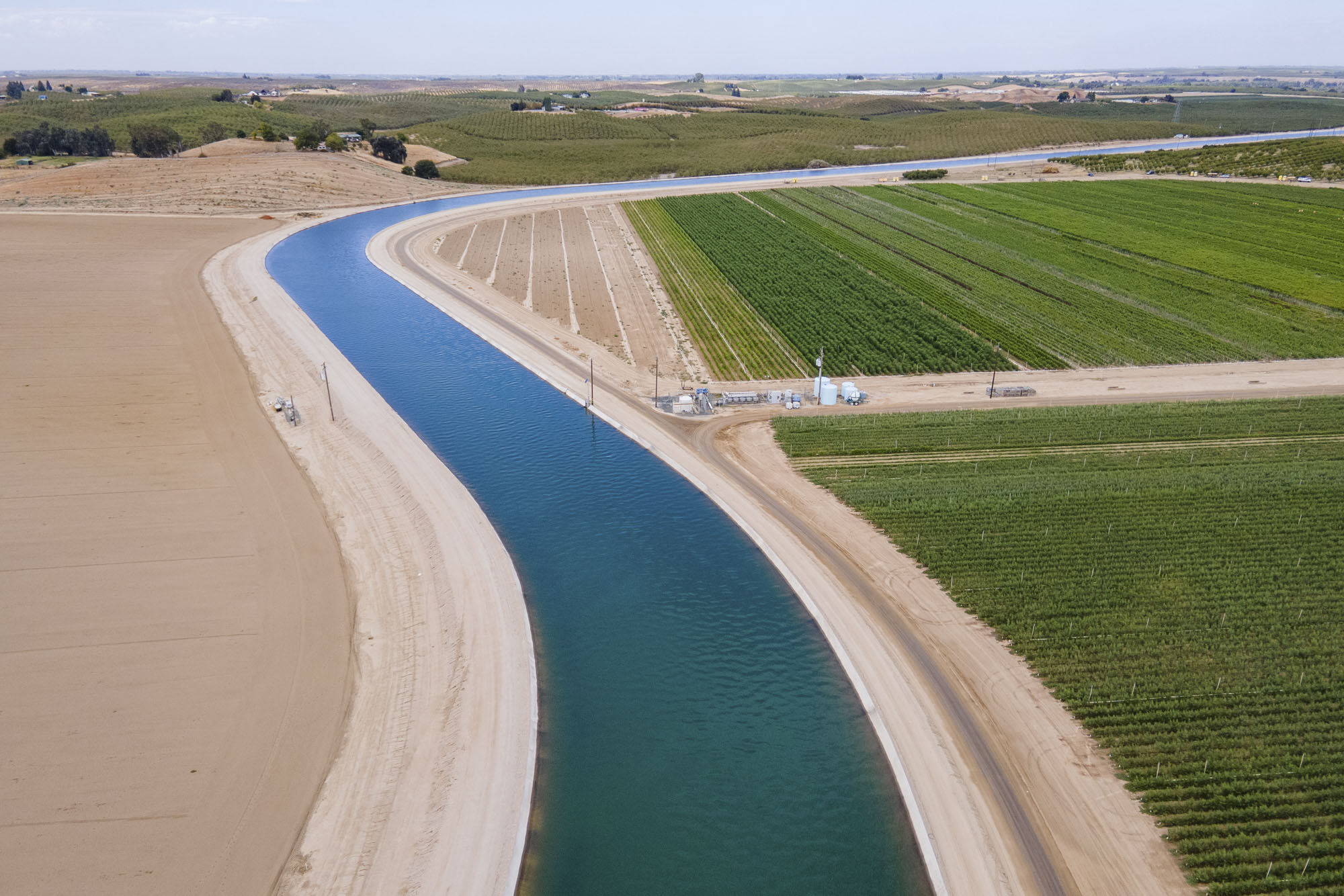
Driving from Los Angeles to San Francisco, Jordan Harris saw the concrete canals that transport water across the state slowly evaporating under the scorching West Coast sun.
Harris said he spent a lot of his life in France, where he noticed how trees lined the canals and protected their precious water from the wind and sun. “And so I started thinking, could we do something similar in California?”
California’s extensive network of canals and aqueducts is the lifeblood of the state, providing clean water to populous cities and expansive farms that wouldn’t otherwise have it. While the state has long struggled with evaporation, researchers at UC Davis estimate that California’s total water supply could shrink by up to 25% by 2050, the equivalent of two Lake Shastas. They attribute the decline, in part, to hotter temperatures caused by climate change.
In an effort to limit warming poised to dry out the state, California pledged to shift to 100% clean electricity by 2045.
The state currently generates 62% of its electricity from renewable and zero-carbon sources, with the largest percentage of that coming from solar. But meeting California’s energy demand will require an unprecedented expansion of solar and storage capacity.
Thinking back to the baking concrete canals, Harris pitched an “obvious” solution to his friend Robin Raj: Why not build solar panels on top of California’s 4,000 miles of open canals that transport water across the state? The panels would produce clean energy while limiting evaporation by shading the canal — a win-win.
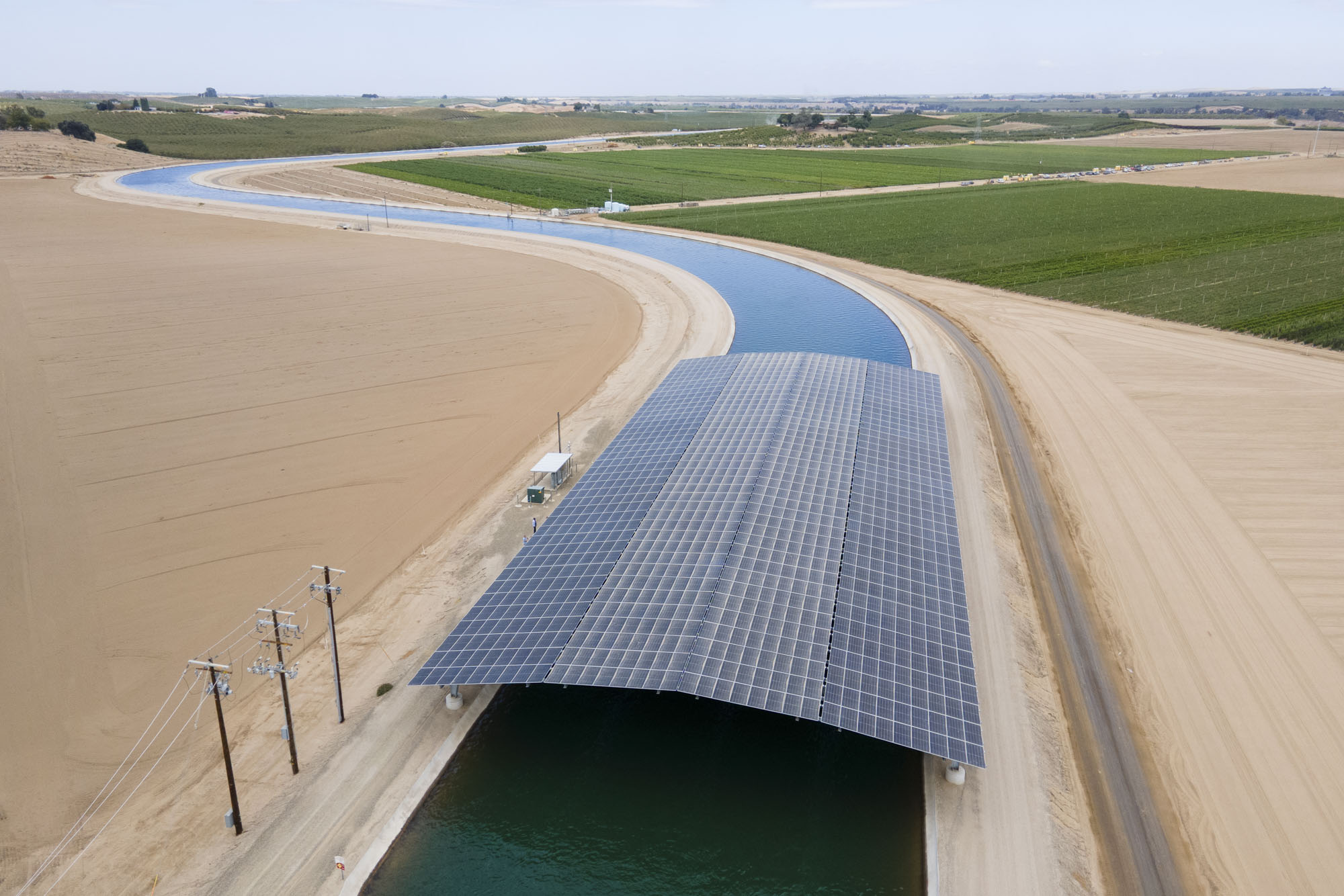
The duo went on to start Solar Aquagrid, an advocacy firm dedicated to reimagining aging canals, and partnered with the Turlock Irrigation District, UC Merced and the California Department of Water Resources to cover small sections of Turlock’s canals with solar panels. The new “solar canal” provides shade to limit evaporation and generates power all in one neat package. They call it Project Nexus, and it operates at the intersection of the state’s need for clean water and energy.
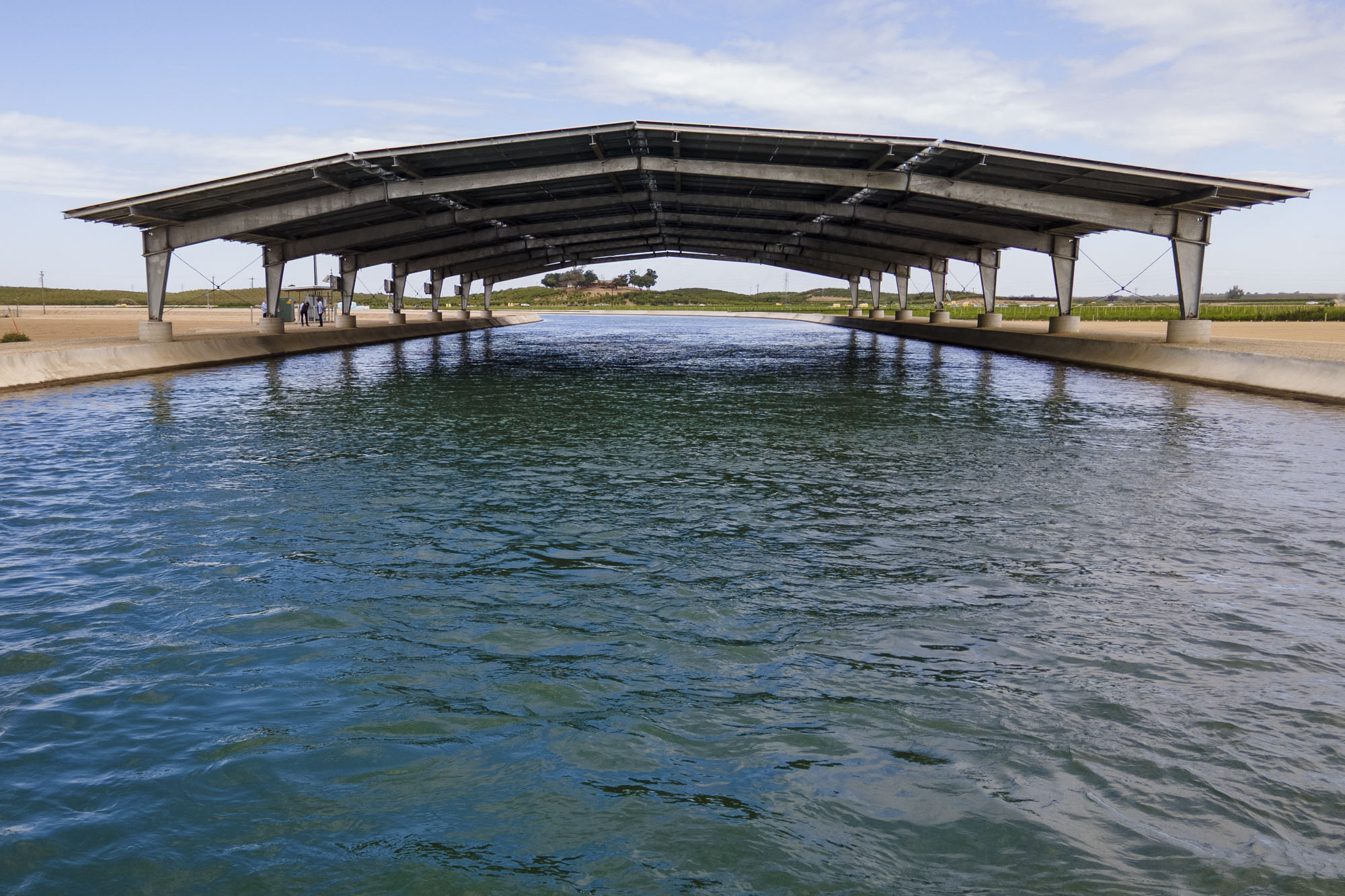
Project Nexus tests not one, but three different solar canal models. A wide-span canopy rises over one of Turlock’s 115-foot canals, resembling the top of a barn. A more classic set of slanting solar panels sits atop a 20-foot canal. And accordion-like retractable panels are positioned low across the narrow canal, ready to roll up at a moment’s notice.
Raj affectionately called the wide-span canopy his “singular field of dream.”
Roger Bales, a professor at UC Merced who co-authored a 2021 study that helped convince the state to invest in this pilot, said his initial calculations indicate that putting panels over 100 miles of Turlock’s narrow canals could save enough water for 2,700 households annually.
If the state put panels over 100 miles of the wide canals, it could save 11,000 households’ worth.
He also estimates that the narrow and the wide canal could generate 330 to 1,400 megawatts per hundred miles respectively — enough to power 77,000 to 304,000 households.
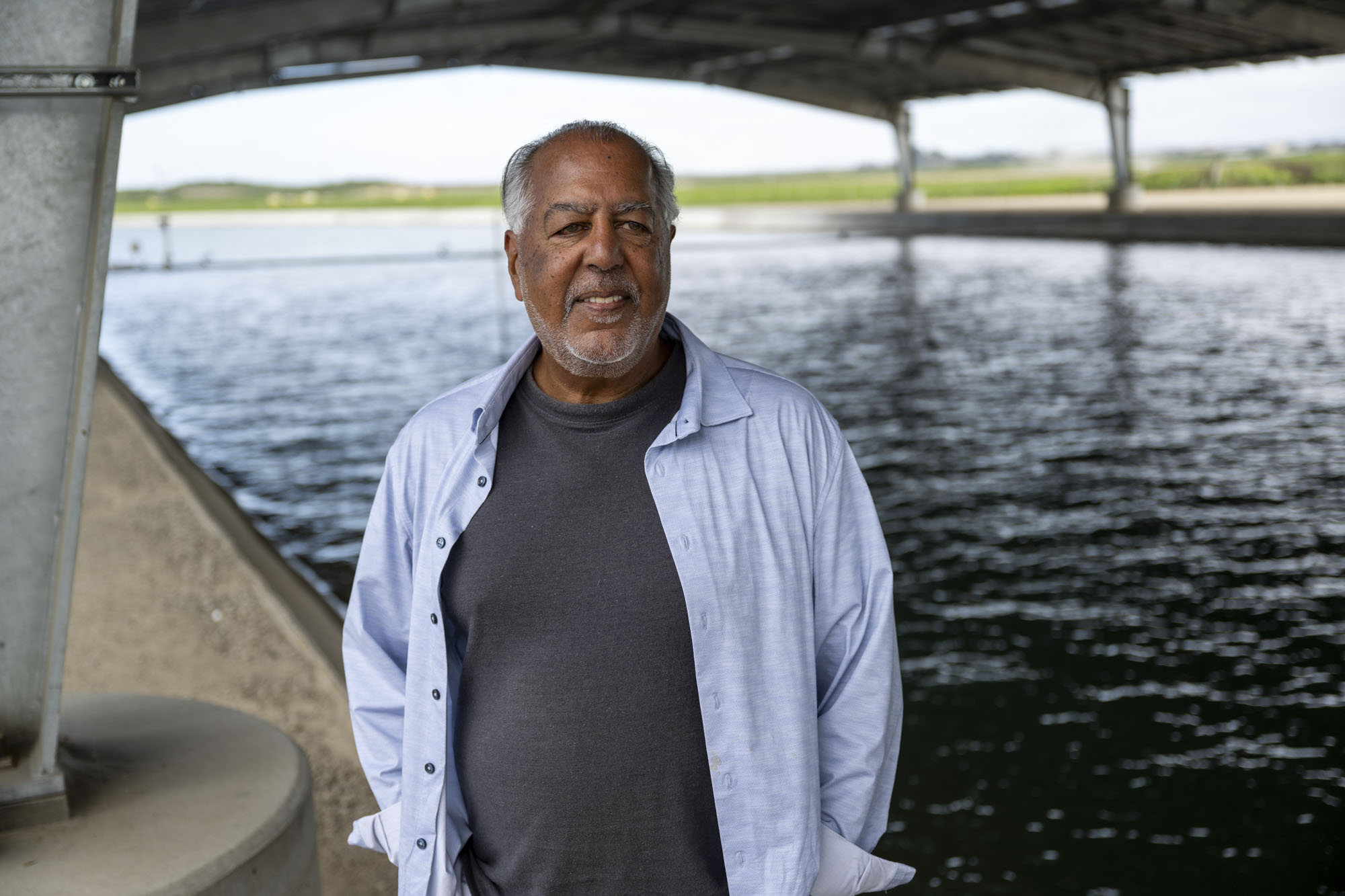
The pilot was fully completed and energized last year. Earlier this month, Harris walked alongside the solar panels that arched over a 115-foot canal.
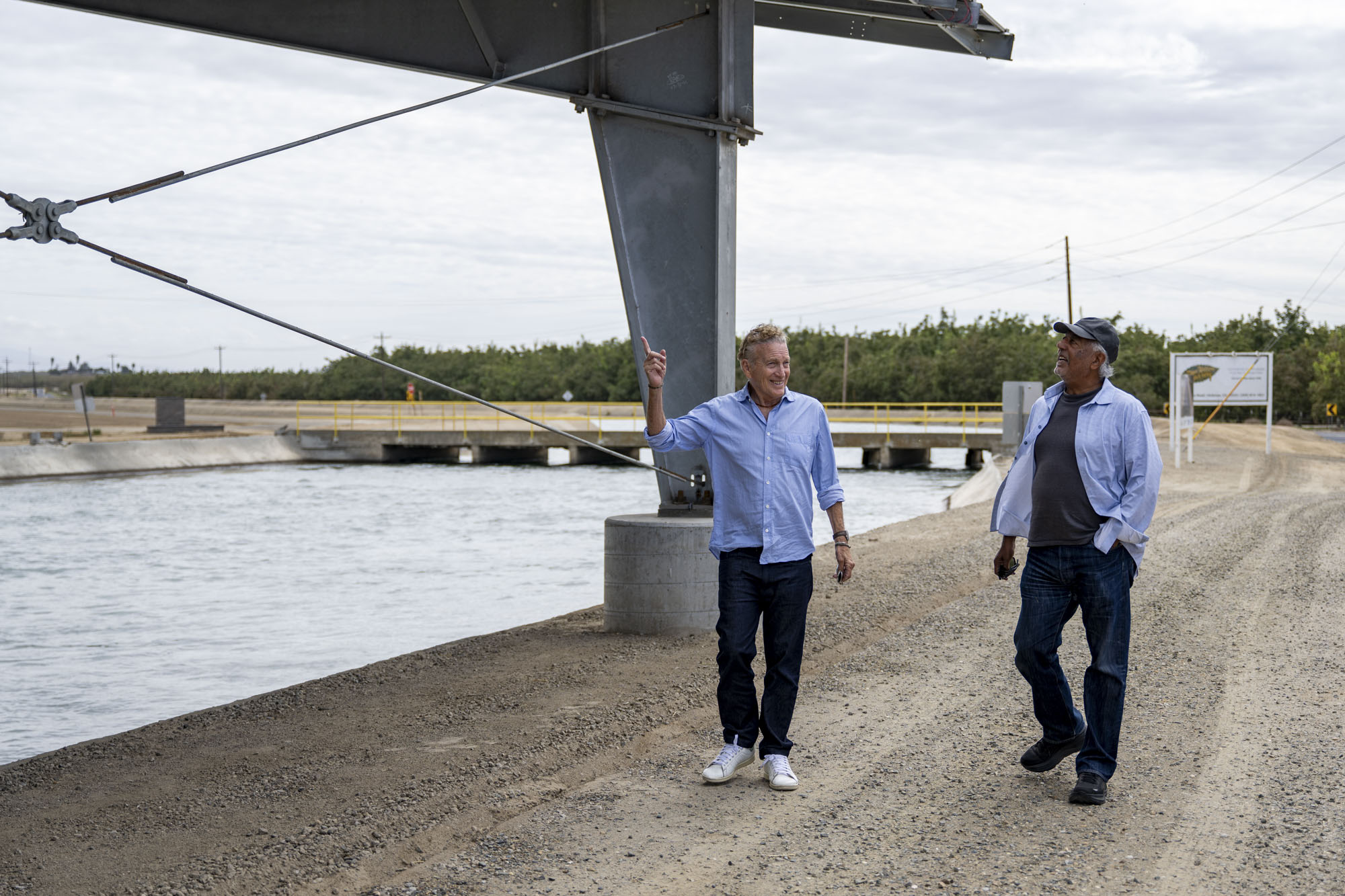
“These are disturbed spaces,” Harris said, pointing to the concrete ditch filled with murky water. “So why not take advantage of the fact that we’ve already done that and help them work harder, be more efficient, produce more and protect what’s around us?”
The research team also found numerous “co-benefits,” or silver linings that make the project more valuable than the sum of its water and power.
Bales said shading the canals led to less algal growth and less fixed aquatic weed growth — reducing maintenance and improving water quality.
Preventing new solar development on natural land benefits both people and planet, Bale added, emphasizing how preserving these lands is essential for maintaining life “as we know it on the Earth.”
Acquiring permits to build on undeveloped land can be a major bottleneck for developers, too. Building on open space takes 621 days on average, compared with 110 days for projects on developed land, according to a study from The Nature Conservancy.
Given the numerous benefits, Bales said the project “just makes sense.”
But just because something makes sense does not mean it’s easy to implement. “We often talk about the challenges of getting to the obvious,” Harris said.
Projects touching land, water and power often involve coordinating many stakeholders. California’s canals can be managed by state or federal water agencies, as well as municipal governments and local irrigation districts. These operators often do not own the land around the canal, let alone the infrastructure to transmit the power to utilities — one of the most expensive parts of renewable energy projects, according to Harris.
Harris and Raj found their “ideal” partner in Turlock Irrigation District, a 139-year-old irrigation district operating 250 miles of canals that provides both water and power to nearly 5,000 farmers in the Central Valley growing everything from beans to peaches.

It is one of four irrigation districts in California providing both water and retail power, noted Josh Weimer, a spokesperson for Turlock.
Weimer said that the project received little pushback from locals, in part because, while the Irrigation District used some staff time for the project, a $20 million state grant paid for both the research and the infrastructure.
Weimer described the project as a “proof of concept” that generates just 1.7 megawatts of energy, a tiny fraction of the 56 megawatts that they generate with a solar farm in the desert.
But the canal site hosts more than just panels. Bales said they “have instruments out there to measure temperature, relative humidity, wind speed, incoming radiation, outgoing radiation, and a prototype instrument to measure evaporation directly.”
When it comes to algae, the panels helped. “Last year when we drained the canal at the end of the irrigation season, there was a physical line on the sun side of the canal that had algae growth and then not algae growth from where the shade was,” Weimer said.
Turlock’s solar panels tower above the water because the irrigation district cleans the canals on a regular basis with equipment.
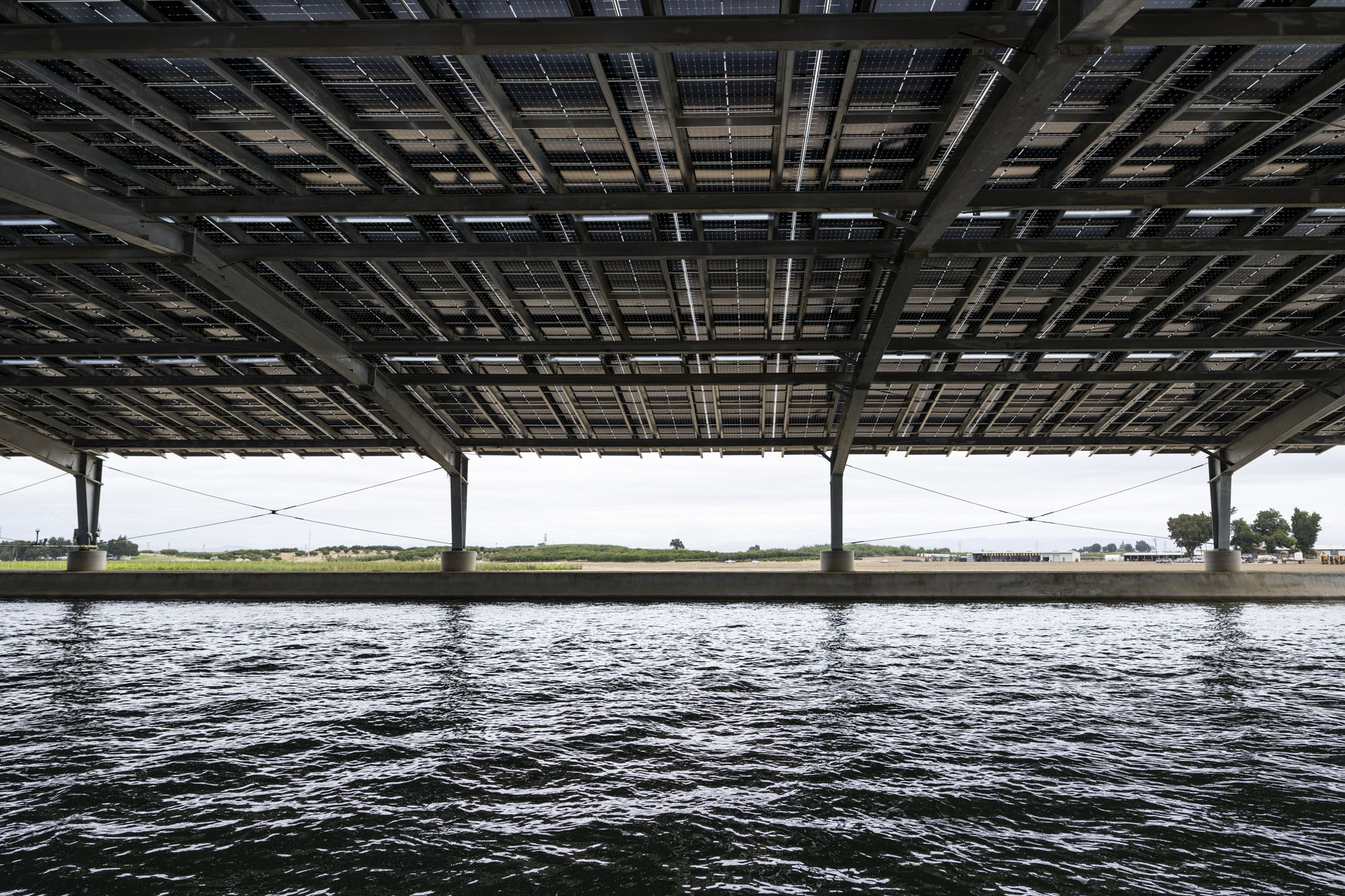
“This isn’t gonna be the only way to do it,” Weimer said — describing how they drag a massive anchor chain through the water to rip out weeds. Similar panels in India and Arizona sit low over the canals, leaving little room for the kind of cleaning that Turlock needs to do.
Over in Contra Costa County, the urban landscape makes any kind of solar canal project unrealistic, said Jennifer Allen, a spokesperson for the county’s water district.
The Contra Costa Water District manages 48 miles of canals winding from Knightsen to Martinez. The Bureau of Reclamation built the system back in the 1930s when the region was predominantly farmland — much like Turlock.
Today, the canal system runs through backyards and public parks.
Something like Project Nexus wouldn’t work because maintenance workers need to access the canals and have limited space to work alongside them, Allen said.
Even though the canal is fenced in, “we have instances where we have cars go into the canal — we’ll have people go into the canal, and animals go into the canal,” Allen said, describing some of the challenges they faced as an urban water district.
“What Turlock is doing with their projects is very impressive, but we have a different-looking canal system going through our service area,” Allen said. They are looking to put their canals into pipes to avoid evaporation, instead.
Andrew Schwarz, a spokesperson for the state’s Department of Water Resources, said that they are waiting to see the final report before deciding to invest in more projects. “These canals vary widely — from narrow, unlined dirt channels that deliver irrigation water to individual fields, to concrete-lined channels over a hundred feet wide that transport water across California,” Schwarz said.
The state remains focused on “evaluation, continued study, potential scaling and lessons learned.”
“Critical infrastructure change is really hard, and if you don’t have science behind it to justify the expense and be able to quantify the benefits, then you’re not gonna scale,” Harris said.
“We are fortunate to live in California where this is a priority and where our state agencies are open to this level of examination and exploration,” Raj said. “That can’t be taken for granted.”
The final report comes out later this year.
 From KQED’s Climate desk, “Flipping the Switch” documents California’s transition to clean energy and what it means for you. What works? What doesn’t? How much does it cost? Help us find these answers and more by donating today.