window.__IS_SSR__=true
window.__INITIAL_STATE__={
"attachmentsReducer": {
"audio_0": {
"type": "attachments",
"id": "audio_0",
"imgSizes": {
"kqedFullSize": {
"file": "https://ww2.kqed.org/news/wp-content/themes/KQED-unified/img/audio_bgs/background0.jpg"
}
}
},
"audio_1": {
"type": "attachments",
"id": "audio_1",
"imgSizes": {
"kqedFullSize": {
"file": "https://ww2.kqed.org/news/wp-content/themes/KQED-unified/img/audio_bgs/background1.jpg"
}
}
},
"audio_2": {
"type": "attachments",
"id": "audio_2",
"imgSizes": {
"kqedFullSize": {
"file": "https://ww2.kqed.org/news/wp-content/themes/KQED-unified/img/audio_bgs/background2.jpg"
}
}
},
"audio_3": {
"type": "attachments",
"id": "audio_3",
"imgSizes": {
"kqedFullSize": {
"file": "https://ww2.kqed.org/news/wp-content/themes/KQED-unified/img/audio_bgs/background3.jpg"
}
}
},
"audio_4": {
"type": "attachments",
"id": "audio_4",
"imgSizes": {
"kqedFullSize": {
"file": "https://ww2.kqed.org/news/wp-content/themes/KQED-unified/img/audio_bgs/background4.jpg"
}
}
},
"placeholder": {
"type": "attachments",
"id": "placeholder",
"imgSizes": {
"thumbnail": {
"file": "https://cdn.kqed.org/wp-content/uploads/2024/12/KQED-Default-Image-816638274-2000x1333-1-160x107.jpg",
"width": 160,
"height": 107,
"mimeType": "image/jpeg"
},
"medium": {
"file": "https://cdn.kqed.org/wp-content/uploads/2024/12/KQED-Default-Image-816638274-2000x1333-1-800x533.jpg",
"width": 800,
"height": 533,
"mimeType": "image/jpeg"
},
"medium_large": {
"file": "https://cdn.kqed.org/wp-content/uploads/2024/12/KQED-Default-Image-816638274-2000x1333-1-768x512.jpg",
"width": 768,
"height": 512,
"mimeType": "image/jpeg"
},
"large": {
"file": "https://cdn.kqed.org/wp-content/uploads/2024/12/KQED-Default-Image-816638274-2000x1333-1-1020x680.jpg",
"width": 1020,
"height": 680,
"mimeType": "image/jpeg"
},
"1536x1536": {
"file": "https://cdn.kqed.org/wp-content/uploads/2024/12/KQED-Default-Image-816638274-2000x1333-1-1536x1024.jpg",
"width": 1536,
"height": 1024,
"mimeType": "image/jpeg"
},
"fd-lrg": {
"file": "https://cdn.kqed.org/wp-content/uploads/2024/12/KQED-Default-Image-816638274-2000x1333-1-1536x1024.jpg",
"width": 1536,
"height": 1024,
"mimeType": "image/jpeg"
},
"fd-med": {
"file": "https://cdn.kqed.org/wp-content/uploads/2024/12/KQED-Default-Image-816638274-2000x1333-1-1020x680.jpg",
"width": 1020,
"height": 680,
"mimeType": "image/jpeg"
},
"fd-sm": {
"file": "https://cdn.kqed.org/wp-content/uploads/2024/12/KQED-Default-Image-816638274-2000x1333-1-800x533.jpg",
"width": 800,
"height": 533,
"mimeType": "image/jpeg"
},
"post-thumbnail": {
"file": "https://cdn.kqed.org/wp-content/uploads/2024/12/KQED-Default-Image-816638274-2000x1333-1-672x372.jpg",
"width": 672,
"height": 372,
"mimeType": "image/jpeg"
},
"twentyfourteen-full-width": {
"file": "https://cdn.kqed.org/wp-content/uploads/2024/12/KQED-Default-Image-816638274-2000x1333-1-1038x576.jpg",
"width": 1038,
"height": 576,
"mimeType": "image/jpeg"
},
"xxsmall": {
"file": "https://cdn.kqed.org/wp-content/uploads/2024/12/KQED-Default-Image-816638274-2000x1333-1-160x107.jpg",
"width": 160,
"height": 107,
"mimeType": "image/jpeg"
},
"xsmall": {
"file": "https://cdn.kqed.org/wp-content/uploads/2024/12/KQED-Default-Image-816638274-2000x1333-1-672x372.jpg",
"width": 672,
"height": 372,
"mimeType": "image/jpeg"
},
"small": {
"file": "https://cdn.kqed.org/wp-content/uploads/2024/12/KQED-Default-Image-816638274-2000x1333-1-672x372.jpg",
"width": 672,
"height": 372,
"mimeType": "image/jpeg"
},
"xlarge": {
"file": "https://cdn.kqed.org/wp-content/uploads/2024/12/KQED-Default-Image-816638274-2000x1333-1-1020x680.jpg",
"width": 1020,
"height": 680,
"mimeType": "image/jpeg"
},
"full-width": {
"file": "https://cdn.kqed.org/wp-content/uploads/2024/12/KQED-Default-Image-816638274-2000x1333-1-1920x1280.jpg",
"width": 1920,
"height": 1280,
"mimeType": "image/jpeg"
},
"guest-author-32": {
"file": "https://cdn.kqed.org/wp-content/uploads/2025/01/KQED-Default-Image-816638274-1333x1333-1-160x160.jpg",
"width": 32,
"height": 32,
"mimeType": "image/jpeg"
},
"guest-author-50": {
"file": "https://cdn.kqed.org/wp-content/uploads/2025/01/KQED-Default-Image-816638274-1333x1333-1-160x160.jpg",
"width": 50,
"height": 50,
"mimeType": "image/jpeg"
},
"guest-author-64": {
"file": "https://cdn.kqed.org/wp-content/uploads/2025/01/KQED-Default-Image-816638274-1333x1333-1-160x160.jpg",
"width": 64,
"height": 64,
"mimeType": "image/jpeg"
},
"guest-author-96": {
"file": "https://cdn.kqed.org/wp-content/uploads/2025/01/KQED-Default-Image-816638274-1333x1333-1-160x160.jpg",
"width": 96,
"height": 96,
"mimeType": "image/jpeg"
},
"guest-author-128": {
"file": "https://cdn.kqed.org/wp-content/uploads/2025/01/KQED-Default-Image-816638274-1333x1333-1-160x160.jpg",
"width": 128,
"height": 128,
"mimeType": "image/jpeg"
},
"detail": {
"file": "https://cdn.kqed.org/wp-content/uploads/2025/01/KQED-Default-Image-816638274-1333x1333-1-160x160.jpg",
"width": 160,
"height": 160,
"mimeType": "image/jpeg"
},
"kqedFullSize": {
"file": "https://cdn.kqed.org/wp-content/uploads/2024/12/KQED-Default-Image-816638274-2000x1333-1.jpg",
"width": 2000,
"height": 1333
}
}
},
"news_12109113": {
"type": "attachments",
"id": "news_12109113",
"meta": {
"index": "attachments_1716263798",
"site": "news",
"id": "12109113",
"found": true
},
"title": "GettyImages-2304294758",
"publishDate": 1794348311,
"status": "inherit",
"parent": 12109096,
"modified": 1794348345,
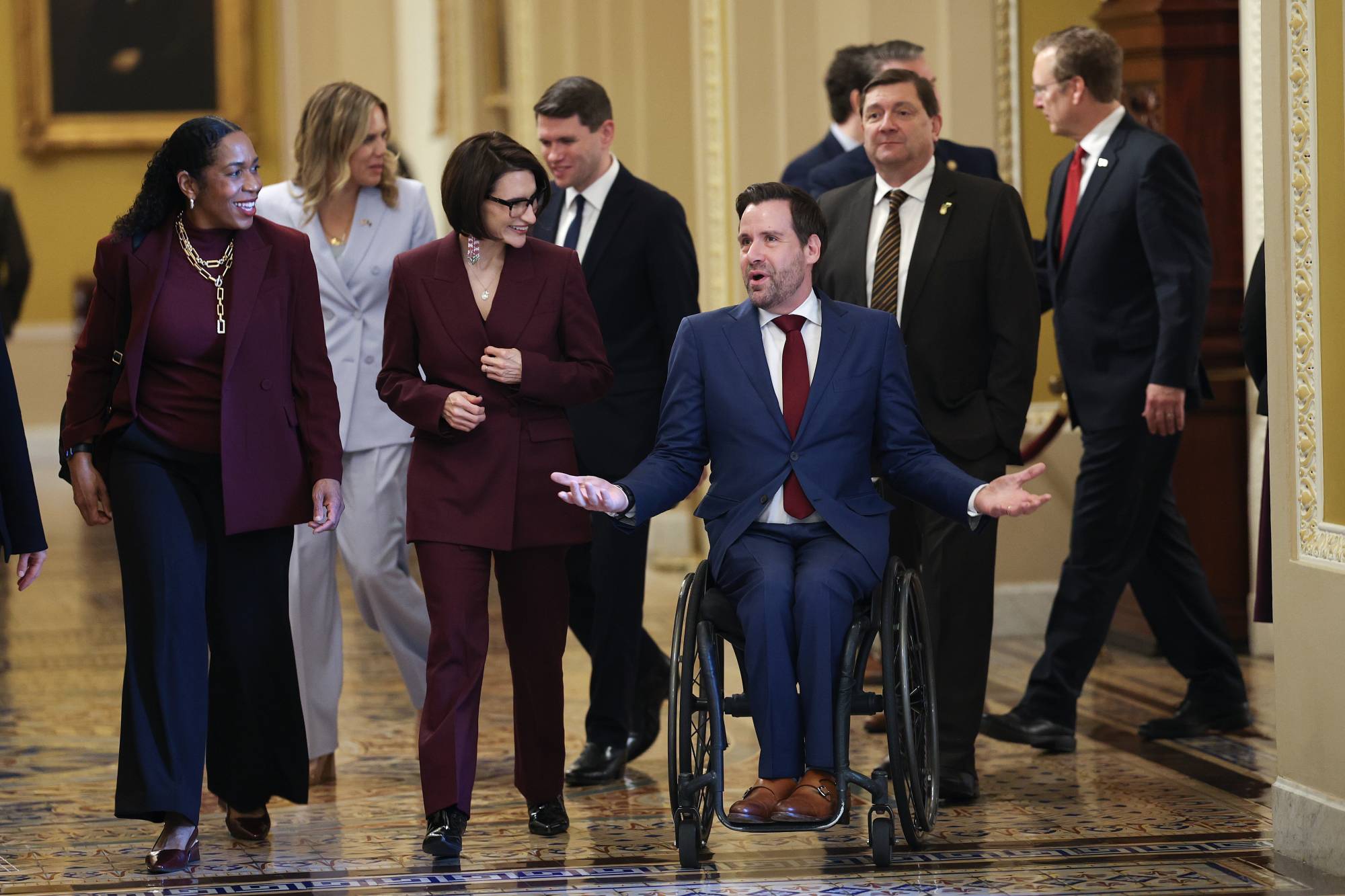
"caption": "Newly elected U.S. Senators walk toward an orientation meeting inside the U.S. Capitol on November 09, 2026 in Washington, DC. Recently elected members of Congress are attending orientation events on Capitol Hill after Democrats took control of the House and Senate in the recent midterm elections. From left to right are Sen.-elect Juliana Stratton (D-IL), Sen.-elect Annie Andrews (D-SC), Sen.-elect Peggy Flanagan (D-MN), Sen.-elect James Talarico (D-TX), Sen.-elect Josh Turek (D-IA), and Sen.-elect Troy Jackson (D-ME). ",
"credit": "Win McNamee/Getty Images",
"altTag": null,
"description": null,
"imgSizes": {
"medium": {
"file": "https://cdn.kqed.org/wp-content/uploads/sites/10/2026/11/GettyImages-2304294758-f2acef54-2000x1333.jpg",
"width": 2000,
"height": 1333,
"mimeType": "image/jpeg"
},
"large": {
"file": "https://cdn.kqed.org/wp-content/uploads/sites/10/2026/11/GettyImages-2304294758-f2acef54-2000x1333.jpg",
"width": 2000,
"height": 1333,
"mimeType": "image/jpeg"
},
"thumbnail": {
"file": "https://cdn.kqed.org/wp-content/uploads/sites/10/2026/11/GettyImages-2304294758-f2acef54-160x107.jpg",
"width": 160,
"height": 107,
"mimeType": "image/jpeg"
},
"1536x1536": {
"file": "https://cdn.kqed.org/wp-content/uploads/sites/10/2026/11/GettyImages-2304294758-f2acef54-1536x1024.jpg",
"width": 1536,
"height": 1024,
"mimeType": "image/jpeg"
},
"2048x2048": {
"file": "https://cdn.kqed.org/wp-content/uploads/sites/10/2026/11/GettyImages-2304294758-f2acef54-2048x1365.jpg",
"width": 2048,
"height": 1365,
"mimeType": "image/jpeg"
},
"post-thumbnail": {
"file": "https://cdn.kqed.org/wp-content/uploads/sites/10/2026/11/GettyImages-2304294758-f2acef54-672x372.jpg",
"width": 672,
"height": 372,
"mimeType": "image/jpeg"
},
"twentyfourteen-full-width": {
"file": "https://cdn.kqed.org/wp-content/uploads/sites/10/2026/11/GettyImages-2304294758-f2acef54-1038x576.jpg",
"width": 1038,
"height": 576,
"mimeType": "image/jpeg"
},
"full-width": {
"file": "https://cdn.kqed.org/wp-content/uploads/sites/10/2026/11/GettyImages-2304294758-f2acef54-2000x1333.jpg",
"width": 2000,
"height": 1333,
"mimeType": "image/jpeg"
},
"npr-cds-wide": {
"file": "https://cdn.kqed.org/wp-content/uploads/sites/10/2026/11/GettyImages-2304294758-f2acef54-1200x675.jpg",
"width": 1200,
"height": 675,
"mimeType": "image/jpeg"
},
"npr-cds-square": {
"file": "https://cdn.kqed.org/wp-content/uploads/sites/10/2026/11/GettyImages-2304294758-f2acef54-600x600.jpg",
"width": 600,
"height": 600,
"mimeType": "image/jpeg"
},
"kqedFullSize": {
"file": "https://cdn.kqed.org/wp-content/uploads/sites/10/2026/11/GettyImages-2304294758-f2acef54-scaled-e1794348386430.jpg",
"width": 2000,
"height": 1334
}
},
"isLoading": false,
"fetchFailed": false
},
"news_12038484": {
"type": "attachments",
"id": "news_12038484",
"meta": {
"index": "attachments_1716263798",
"site": "news",
"id": "12038484",
"found": true
},
"title": "npr.brightspotcdn copy",
"publishDate": 1746144469,
"status": "inherit",
"parent": 12038483,
"modified": 1746144490,
"caption": "In his first 100 days in office President Trump has signed just five bills into law while issuing over 100 executive actions, a pattern that fits with his vision of a more powerful executive.",
"credit": "Kayla Bartkowski/Getty Images",
"altTag": null,
"description": null,
"imgSizes": {
"medium": {
"file": "https://cdn.kqed.org/wp-content/uploads/sites/10/2025/05/npr.brightspotcdn-copy-800x534.jpg",
"width": 800,
"height": 534,
"mimeType": "image/jpeg"
},
"large": {
"file": "https://cdn.kqed.org/wp-content/uploads/sites/10/2025/05/npr.brightspotcdn-copy-1020x680.jpg",
"width": 1020,
"height": 680,
"mimeType": "image/jpeg"
},
"thumbnail": {
"file": "https://cdn.kqed.org/wp-content/uploads/sites/10/2025/05/npr.brightspotcdn-copy-160x107.jpg",
"width": 160,
"height": 107,
"mimeType": "image/jpeg"
},
"1536x1536": {
"file": "https://cdn.kqed.org/wp-content/uploads/sites/10/2025/05/npr.brightspotcdn-copy-1536x1024.jpg",
"width": 1536,
"height": 1024,
"mimeType": "image/jpeg"
},
"post-thumbnail": {
"file": "https://cdn.kqed.org/wp-content/uploads/sites/10/2025/05/npr.brightspotcdn-copy-672x372.jpg",
"width": 672,
"height": 372,
"mimeType": "image/jpeg"
},
"twentyfourteen-full-width": {
"file": "https://cdn.kqed.org/wp-content/uploads/sites/10/2025/05/npr.brightspotcdn-copy-1038x576.jpg",
"width": 1038,
"height": 576,
"mimeType": "image/jpeg"
},
"kqedFullSize": {
"file": "https://cdn.kqed.org/wp-content/uploads/sites/10/2025/05/npr.brightspotcdn-copy.jpg",
"width": 1600,
"height": 1067
}
},
"isLoading": false,
"fetchFailed": false
},
"news_12034052": {
"type": "attachments",
"id": "news_12034052",
"meta": {
"index": "attachments_1716263798",
"site": "news",
"id": "12034052",
"found": true
},
"title": "npr.brightspotcdn copy",
"publishDate": 1743535362,
"status": "inherit",
"parent": 12034051,
"modified": 1743535422,
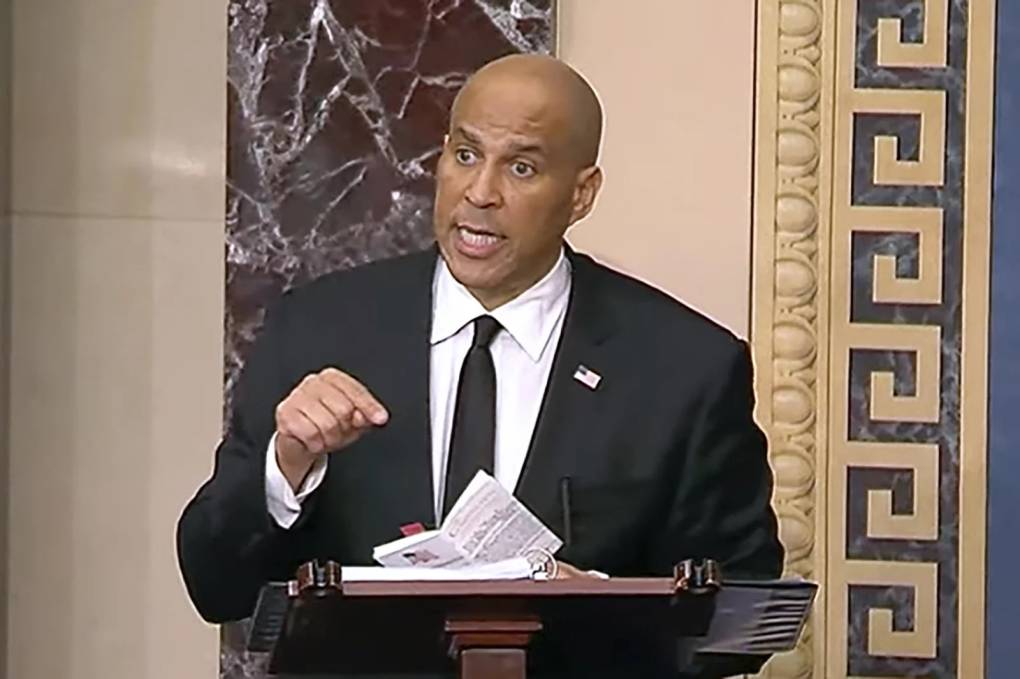
"caption": "In this image provided by Senate Television, Sen, Cory Booker (D-N.J.) speaks on the Senate floor, Tuesday morning, April 1, 2025. ",
"credit": "Senate Television via AP",
"altTag": null,
"description": null,
"imgSizes": {
"medium": {
"file": "https://cdn.kqed.org/wp-content/uploads/sites/10/2025/04/npr.brightspotcdn-copy-2-800x533.jpg",
"width": 800,
"height": 533,
"mimeType": "image/jpeg"
},
"large": {
"file": "https://cdn.kqed.org/wp-content/uploads/sites/10/2025/04/npr.brightspotcdn-copy-2-1020x679.jpg",
"width": 1020,
"height": 679,
"mimeType": "image/jpeg"
},
"thumbnail": {
"file": "https://cdn.kqed.org/wp-content/uploads/sites/10/2025/04/npr.brightspotcdn-copy-2-160x107.jpg",
"width": 160,
"height": 107,
"mimeType": "image/jpeg"
},
"1536x1536": {
"file": "https://cdn.kqed.org/wp-content/uploads/sites/10/2025/04/npr.brightspotcdn-copy-2-1536x1022.jpg",
"width": 1536,
"height": 1022,
"mimeType": "image/jpeg"
},
"post-thumbnail": {
"file": "https://cdn.kqed.org/wp-content/uploads/sites/10/2025/04/npr.brightspotcdn-copy-2-672x372.jpg",
"width": 672,
"height": 372,
"mimeType": "image/jpeg"
},
"twentyfourteen-full-width": {
"file": "https://cdn.kqed.org/wp-content/uploads/sites/10/2025/04/npr.brightspotcdn-copy-2-1038x576.jpg",
"width": 1038,
"height": 576,
"mimeType": "image/jpeg"
},
"kqedFullSize": {
"file": "https://cdn.kqed.org/wp-content/uploads/sites/10/2025/04/npr.brightspotcdn-copy-2.jpg",
"width": 1600,
"height": 1065
}
},
"isLoading": false,
"fetchFailed": false
},
"news_12031321": {
"type": "attachments",
"id": "news_12031321",
"meta": {
"index": "attachments_1716263798",
"site": "news",
"id": "12031321",
"found": true
},
"title": "Senate Takes Up Budget Bill Passed By House As Funding Deadline Looms",
"publishDate": 1741909916,
"status": "inherit",
"parent": 12031318,
"modified": 1741909955,
"caption": "Senate Minority Leader Chuck Schumer (D-NY) leaves the Democratic caucus lunch at the US Capitol on March 13, 2025 in Washington, DC. On Wednesday Senate Democrats, not in line with the continuing resolution passed by House Republicans providing a 6-month funding extension to avert a government shutdown, proposed an alternate plan that would fund the government in the short term through April 11. ",
"credit": "Kayla Bartkowski/Getty Images",
"altTag": null,
"description": null,
"imgSizes": {
"medium": {
"file": "https://cdn.kqed.org/wp-content/uploads/sites/10/2025/03/GettyImages-2204943883-800x534.jpg",
"width": 800,
"height": 534,
"mimeType": "image/jpeg"
},
"large": {
"file": "https://cdn.kqed.org/wp-content/uploads/sites/10/2025/03/GettyImages-2204943883-1020x680.jpg",
"width": 1020,
"height": 680,
"mimeType": "image/jpeg"
},
"thumbnail": {
"file": "https://cdn.kqed.org/wp-content/uploads/sites/10/2025/03/GettyImages-2204943883-160x107.jpg",
"width": 160,
"height": 107,
"mimeType": "image/jpeg"
},
"post-thumbnail": {
"file": "https://cdn.kqed.org/wp-content/uploads/sites/10/2025/03/GettyImages-2204943883-672x372.jpg",
"width": 672,
"height": 372,
"mimeType": "image/jpeg"
},
"twentyfourteen-full-width": {
"file": "https://cdn.kqed.org/wp-content/uploads/sites/10/2025/03/GettyImages-2204943883-1024x576.jpg",
"width": 1024,
"height": 576,
"mimeType": "image/jpeg"
},
"kqedFullSize": {
"file": "https://cdn.kqed.org/wp-content/uploads/sites/10/2025/03/GettyImages-2204943883.jpg",
"width": 1024,
"height": 683
}
},
"isLoading": false,
"fetchFailed": false
},
"news_11930872": {
"type": "attachments",
"id": "news_11930872",
"meta": {
"index": "attachments_1716263798",
"site": "news",
"id": "11930872",
"found": true
},
"title": "IMMIGRATION",
"publishDate": 1667347175,
"status": "inherit",
"parent": 11930830,
"modified": 1731614666,
"caption": "Rep. David Valadao (R-Calif) speaks during a news conference with other House Republican members on immigration in Washington in 2021. Both he and Democratic Assemblyman Rudy Salas, his opponent for the 22nd Congressional District seat, have moved to the center to appeal to voters.",
"credit": "Caroline Brehman/CQ-Roll Call, Inc via Getty Images",
"altTag": "A white man in a blue suit.",
"description": null,
"imgSizes": {
"medium": {
"file": "https://cdn.kqed.org/wp-content/uploads/sites/10/2022/11/GettyImages-1231769719-800x534.jpg",
"width": 800,
"height": 534,
"mimeType": "image/jpeg"
},
"large": {
"file": "https://cdn.kqed.org/wp-content/uploads/sites/10/2022/11/GettyImages-1231769719-1020x680.jpg",
"width": 1020,
"height": 680,
"mimeType": "image/jpeg"
},
"thumbnail": {
"file": "https://cdn.kqed.org/wp-content/uploads/sites/10/2022/11/GettyImages-1231769719-160x107.jpg",
"width": 160,
"height": 107,
"mimeType": "image/jpeg"
},
"post-thumbnail": {
"file": "https://cdn.kqed.org/wp-content/uploads/sites/10/2022/11/GettyImages-1231769719-672x372.jpg",
"width": 672,
"height": 372,
"mimeType": "image/jpeg"
},
"twentyfourteen-full-width": {
"file": "https://cdn.kqed.org/wp-content/uploads/sites/10/2022/11/GettyImages-1231769719-1024x576.jpg",
"width": 1024,
"height": 576,
"mimeType": "image/jpeg"
},
"kqedFullSize": {
"file": "https://cdn.kqed.org/wp-content/uploads/sites/10/2022/11/GettyImages-1231769719.jpg",
"width": 1024,
"height": 683
}
},
"isLoading": false,
"fetchFailed": false
},
"news_12012949": {
"type": "attachments",
"id": "news_12012949",
"meta": {
"index": "attachments_1716263798",
"site": "news",
"id": "12012949",
"found": true
},
"title": "republicans-control-senate",
"publishDate": 1730873110,
"status": "inherit",
"parent": 12012941,
"modified": 1730873142,
"caption": "HOUSTON, TEXAS - NOVEMBER 5: After winning reelection, U.S. Sen. Ted Cruz (R-TX) greets supporters at his election watch party at the Marriott Marquis on November 5, 2024 in Houston, Texas. Americans are casting their ballots today in the presidential race between Republican nominee former President Donald Trump and Democratic nominee Vice President Kamala Harris, as well as multiple state elections that will determine the balance of power in Congress. ",
"credit": "Danielle Villasana/Getty Images",
"altTag": null,
"description": null,
"imgSizes": {
"medium": {
"file": "https://cdn.kqed.org/wp-content/uploads/sites/10/2024/11/GettyImages-2182514139_resized-800x533.png",
"width": 800,
"height": 533,
"mimeType": "image/png"
},
"large": {
"file": "https://cdn.kqed.org/wp-content/uploads/sites/10/2024/11/GettyImages-2182514139_resized-1020x680.png",
"width": 1020,
"height": 680,
"mimeType": "image/png"
},
"thumbnail": {
"file": "https://cdn.kqed.org/wp-content/uploads/sites/10/2024/11/GettyImages-2182514139_resized-160x107.png",
"width": 160,
"height": 107,
"mimeType": "image/png"
},
"1536x1536": {
"file": "https://cdn.kqed.org/wp-content/uploads/sites/10/2024/11/GettyImages-2182514139_resized-1536x1024.png",
"width": 1536,
"height": 1024,
"mimeType": "image/png"
},
"post-thumbnail": {
"file": "https://cdn.kqed.org/wp-content/uploads/sites/10/2024/11/GettyImages-2182514139_resized-672x372.png",
"width": 672,
"height": 372,
"mimeType": "image/png"
},
"twentyfourteen-full-width": {
"file": "https://cdn.kqed.org/wp-content/uploads/sites/10/2024/11/GettyImages-2182514139_resized-1038x576.png",
"width": 1038,
"height": 576,
"mimeType": "image/png"
},
"kqedFullSize": {
"file": "https://cdn.kqed.org/wp-content/uploads/sites/10/2024/11/GettyImages-2182514139_resized.png",
"width": 1920,
"height": 1280
}
},
"isLoading": false,
"fetchFailed": false
},
"news_11973134": {
"type": "attachments",
"id": "news_11973134",
"meta": {
"index": "attachments_1716263798",
"site": "news",
"id": "11973134",
"found": true
},
"parent": 11973129,
"imgSizes": {
"twentyfourteen-full-width": {
"file": "https://cdn.kqed.org/wp-content/uploads/sites/10/2024/01/011624-SCHIFF-LEE-PORTER-AP-RV-CM-copy-1038x576.jpg",
"width": 1038,
"mimeType": "image/jpeg",
"height": 576
},
"thumbnail": {
"file": "https://cdn.kqed.org/wp-content/uploads/sites/10/2024/01/011624-SCHIFF-LEE-PORTER-AP-RV-CM-copy-160x107.jpg",
"width": 160,
"mimeType": "image/jpeg",
"height": 107
},
"post-thumbnail": {
"file": "https://cdn.kqed.org/wp-content/uploads/sites/10/2024/01/011624-SCHIFF-LEE-PORTER-AP-RV-CM-copy-672x372.jpg",
"width": 672,
"mimeType": "image/jpeg",
"height": 372
},
"kqedFullSize": {
"file": "https://cdn.kqed.org/wp-content/uploads/sites/10/2024/01/011624-SCHIFF-LEE-PORTER-AP-RV-CM-copy.jpg",
"width": 2000,
"height": 1333
},
"large": {
"file": "https://cdn.kqed.org/wp-content/uploads/sites/10/2024/01/011624-SCHIFF-LEE-PORTER-AP-RV-CM-copy-1020x680.jpg",
"width": 1020,
"mimeType": "image/jpeg",
"height": 680
},
"1536x1536": {
"file": "https://cdn.kqed.org/wp-content/uploads/sites/10/2024/01/011624-SCHIFF-LEE-PORTER-AP-RV-CM-copy-1536x1024.jpg",
"width": 1536,
"mimeType": "image/jpeg",
"height": 1024
},
"full-width": {
"file": "https://cdn.kqed.org/wp-content/uploads/sites/10/2024/01/011624-SCHIFF-LEE-PORTER-AP-RV-CM-copy-1920x1280.jpg",
"width": 1920,
"mimeType": "image/jpeg",
"height": 1280
},
"medium": {
"file": "https://cdn.kqed.org/wp-content/uploads/sites/10/2024/01/011624-SCHIFF-LEE-PORTER-AP-RV-CM-copy-800x533.jpg",
"width": 800,
"mimeType": "image/jpeg",
"height": 533
}
},
"publishDate": 1705700241,
"modified": 1705711973,
"caption": "Reps. Katie Porter, Adam Schiff and Barbara Lee (from left) during a U.S. Senate candidate forum hosted by the National Union of Health Care Workers in Los Angeles on Oct. 8, 2023.",
"description": null,
"title": "011624-SCHIFF-LEE-PORTER-AP-RV-CM copy",
"credit": "Richard Vogel/AP Photo",
"status": "inherit",
"altTag": "A woman, a man, and another woman stand side by side, each behind a lectern with microphones; behind them, it partially reads \"Senate Candidates.\"",
"isLoading": false,
"fetchFailed": false
},
"news_11962881": {
"type": "attachments",
"id": "news_11962881",
"meta": {
"index": "attachments_1716263798",
"site": "news",
"id": "11962881",
"found": true
},
"parent": 11962877,
"imgSizes": {
"twentyfourteen-full-width": {
"file": "https://ww2.kqed.org/app/uploads/sites/10/2023/09/AP23272503321402-1024x576.jpg",
"width": 1024,
"mimeType": "image/jpeg",
"height": 576
},
"thumbnail": {
"file": "https://ww2.kqed.org/app/uploads/sites/10/2023/09/AP23272503321402-160x110.jpg",
"width": 160,
"mimeType": "image/jpeg",
"height": 110
},
"post-thumbnail": {
"file": "https://ww2.kqed.org/app/uploads/sites/10/2023/09/AP23272503321402-672x372.jpg",
"width": 672,
"mimeType": "image/jpeg",
"height": 372
},
"kqedFullSize": {
"file": "https://ww2.kqed.org/app/uploads/sites/10/2023/09/AP23272503321402.jpg",
"width": 1024,
"height": 707
},
"large": {
"file": "https://ww2.kqed.org/app/uploads/sites/10/2023/09/AP23272503321402-1020x704.jpg",
"width": 1020,
"mimeType": "image/jpeg",
"height": 704
},
"medium": {
"file": "https://ww2.kqed.org/app/uploads/sites/10/2023/09/AP23272503321402-800x552.jpg",
"width": 800,
"mimeType": "image/jpeg",
"height": 552
}
},
"publishDate": 1696013016,
"modified": 1696013914,
"caption": "California Democratic Sen. Dianne Feinstein, and a group of women senators gather at a news conference on Capitol Hill on June 4, 2014. From left are, Sen. Patty Murray (D-Wash.) Sen. Elizabeth Warren (D-Mass.) Feinstein, Sen. Tammy Baldwin (D-Wis.), Sen. Barbara A. Mikulski, (D-Md.), Sen. Mazie K. Hirono (D-Hawaii). Feinstein died Thursday night, at the age of 90.",
"description": null,
"title": "Obit Feinstein",
"credit": "J. Scott Applewhite/AP",
"status": "inherit",
"altTag": "Sen. Dianne Feinstein stands at a podium, surrounded by other female senators.",
"isLoading": false,
"fetchFailed": false
},
"news_11947244": {
"type": "attachments",
"id": "news_11947244",
"meta": {
"index": "attachments_1716263798",
"site": "news",
"id": "11947244",
"found": true
},
"parent": 0,
"imgSizes": {
"twentyfourteen-full-width": {
"file": "https://ww2.kqed.org/app/uploads/sites/10/2023/04/RS33369_102318_AW_DianeFeinstein_04-qut-1038x576.jpg",
"width": 1038,
"mimeType": "image/jpeg",
"height": 576
},
"thumbnail": {
"file": "https://ww2.kqed.org/app/uploads/sites/10/2023/04/RS33369_102318_AW_DianeFeinstein_04-qut-160x107.jpg",
"width": 160,
"mimeType": "image/jpeg",
"height": 107
},
"post-thumbnail": {
"file": "https://ww2.kqed.org/app/uploads/sites/10/2023/04/RS33369_102318_AW_DianeFeinstein_04-qut-672x372.jpg",
"width": 672,
"mimeType": "image/jpeg",
"height": 372
},
"kqedFullSize": {
"file": "https://ww2.kqed.org/app/uploads/sites/10/2023/04/RS33369_102318_AW_DianeFeinstein_04-qut.jpg",
"width": 1920,
"height": 1280
},
"large": {
"file": "https://ww2.kqed.org/app/uploads/sites/10/2023/04/RS33369_102318_AW_DianeFeinstein_04-qut-1020x680.jpg",
"width": 1020,
"mimeType": "image/jpeg",
"height": 680
},
"1536x1536": {
"file": "https://ww2.kqed.org/app/uploads/sites/10/2023/04/RS33369_102318_AW_DianeFeinstein_04-qut-1536x1024.jpg",
"width": 1536,
"mimeType": "image/jpeg",
"height": 1024
},
"medium": {
"file": "https://ww2.kqed.org/app/uploads/sites/10/2023/04/RS33369_102318_AW_DianeFeinstein_04-qut-800x533.jpg",
"width": 800,
"mimeType": "image/jpeg",
"height": 533
}
},
"publishDate": 1682029492,
"modified": 1696029077,
"caption": "Sen. Dianne Feinstein (D-Calif.) at the KQED studios for tapings of KQED Newsroom and Political Breakdown on Oct. 23, 2018.",
"description": null,
"title": "RS33369_102318_AW_DianeFeinstein_04-qut",
"credit": "Anne Wernikoff/KQED",
"status": "inherit",
"altTag": "An older white lade with brown short hair and a pink top and scarf speaks while looking away from the camera, seen from the shoulder up.",
"isLoading": false,
"fetchFailed": false
},
"news_11946988": {
"type": "attachments",
"id": "news_11946988",
"meta": {
"index": "attachments_1716263798",
"site": "news",
"id": "11946988",
"found": true
},
"parent": 11946976,
"imgSizes": {
"twentyfourteen-full-width": {
"file": "https://ww2.kqed.org/app/uploads/sites/10/2023/04/GettyImages-1247142891-1024x576.jpg",
"width": 1024,
"mimeType": "image/jpeg",
"height": 576
},
"thumbnail": {
"file": "https://ww2.kqed.org/app/uploads/sites/10/2023/04/GettyImages-1247142891-160x107.jpg",
"width": 160,
"mimeType": "image/jpeg",
"height": 107
},
"post-thumbnail": {
"file": "https://ww2.kqed.org/app/uploads/sites/10/2023/04/GettyImages-1247142891-672x372.jpg",
"width": 672,
"mimeType": "image/jpeg",
"height": 372
},
"kqedFullSize": {
"file": "https://ww2.kqed.org/app/uploads/sites/10/2023/04/GettyImages-1247142891.jpg",
"width": 1024,
"height": 683
},
"large": {
"file": "https://ww2.kqed.org/app/uploads/sites/10/2023/04/GettyImages-1247142891-1020x680.jpg",
"width": 1020,
"mimeType": "image/jpeg",
"height": 680
},
"medium": {
"file": "https://ww2.kqed.org/app/uploads/sites/10/2023/04/GettyImages-1247142891-800x534.jpg",
"width": 800,
"mimeType": "image/jpeg",
"height": 534
}
},
"publishDate": 1681769281,
"modified": 1681771162,
"caption": "Sen. Dianne Feinstein (D-Calif.) leaves the Senate chamber following a vote at the US Capitol on Tuesday, Feb. 14, 2023. Shortly thereafter, Feinstein was hospitalized with a case of shingles. California's longest-serving senator, Feinstein had previously announced she would not run for reelection next year, marking the end of one of the state's most storied political careers. She plans to remain in office through the end of her term.",
"description": null,
"title": "Senator Dianne Feinstein Announces She Will Not Seek Re-election",
"credit": "Kent Nishimura/Los Angeles Times via Getty Images",
"status": "inherit",
"altTag": "Sen. Dianne Feinstein is seen behind a slightly open large wooden door.",
"isLoading": false,
"fetchFailed": false
},
"news_11946789": {
"type": "attachments",
"id": "news_11946789",
"meta": {
"index": "attachments_1716263798",
"site": "news",
"id": "11946789",
"found": true
},
"parent": 11946788,
"imgSizes": {
"twentyfourteen-full-width": {
"file": "https://ww2.kqed.org/app/uploads/sites/10/2023/04/GettyImages-1246575044-1024x576.jpg",
"width": 1024,
"mimeType": "image/jpeg",
"height": 576
},
"thumbnail": {
"file": "https://ww2.kqed.org/app/uploads/sites/10/2023/04/GettyImages-1246575044-160x107.jpg",
"width": 160,
"mimeType": "image/jpeg",
"height": 107
},
"post-thumbnail": {
"file": "https://ww2.kqed.org/app/uploads/sites/10/2023/04/GettyImages-1246575044-672x372.jpg",
"width": 672,
"mimeType": "image/jpeg",
"height": 372
},
"kqedFullSize": {
"file": "https://ww2.kqed.org/app/uploads/sites/10/2023/04/GettyImages-1246575044.jpg",
"width": 1024,
"height": 683
},
"large": {
"file": "https://ww2.kqed.org/app/uploads/sites/10/2023/04/GettyImages-1246575044-1020x680.jpg",
"width": 1020,
"mimeType": "image/jpeg",
"height": 680
},
"medium": {
"file": "https://ww2.kqed.org/app/uploads/sites/10/2023/04/GettyImages-1246575044-800x534.jpg",
"width": 800,
"mimeType": "image/jpeg",
"height": 534
}
},
"publishDate": 1681519879,
"modified": 1681751440,
"caption": "Rep. Barbara Lee (D-Calif.) seen at a news conference with the Pro-Choice Caucus outside the US Capitol, on Jan. 26, 2023.",
"description": null,
"title": "Equal Access to Abortion Coverage in Health Insurance (EACH) Act",
"credit": "Tom Williams/CQ-Roll Call, Inc via Getty Images",
"status": "inherit",
"altTag": "An African American woman smiles toward the camera.",
"isLoading": false,
"fetchFailed": false
},
"news_11889415": {
"type": "attachments",
"id": "news_11889415",
"meta": {
"index": "attachments_1716263798",
"site": "news",
"id": "11889415",
"found": true
},
"parent": 11889414,
"imgSizes": {
"twentyfourteen-full-width": {
"file": "https://ww2.kqed.org/app/uploads/sites/10/2021/09/RS49465_031_Oakland_NAACPGeorgeFloyd_05252021-1038x576.jpg",
"width": 1038,
"mimeType": "image/jpeg",
"height": 576
},
"thumbnail": {
"file": "https://ww2.kqed.org/app/uploads/sites/10/2021/09/RS49465_031_Oakland_NAACPGeorgeFloyd_05252021-160x106.jpg",
"width": 160,
"mimeType": "image/jpeg",
"height": 106
},
"post-thumbnail": {
"file": "https://ww2.kqed.org/app/uploads/sites/10/2021/09/RS49465_031_Oakland_NAACPGeorgeFloyd_05252021-672x372.jpg",
"width": 672,
"mimeType": "image/jpeg",
"height": 372
},
"kqedFullSize": {
"file": "https://ww2.kqed.org/app/uploads/sites/10/2021/09/RS49465_031_Oakland_NAACPGeorgeFloyd_05252021-scaled.jpg",
"width": 2560,
"height": 1704
},
"2048x2048": {
"file": "https://ww2.kqed.org/app/uploads/sites/10/2021/09/RS49465_031_Oakland_NAACPGeorgeFloyd_05252021-2048x1363.jpg",
"width": 2048,
"mimeType": "image/jpeg",
"height": 1363
},
"large": {
"file": "https://ww2.kqed.org/app/uploads/sites/10/2021/09/RS49465_031_Oakland_NAACPGeorgeFloyd_05252021-1020x679.jpg",
"width": 1020,
"mimeType": "image/jpeg",
"height": 679
},
"1536x1536": {
"file": "https://ww2.kqed.org/app/uploads/sites/10/2021/09/RS49465_031_Oakland_NAACPGeorgeFloyd_05252021-1536x1022.jpg",
"width": 1536,
"mimeType": "image/jpeg",
"height": 1022
},
"full-width": {
"file": "https://ww2.kqed.org/app/uploads/sites/10/2021/09/RS49465_031_Oakland_NAACPGeorgeFloyd_05252021-1920x1278.jpg",
"width": 1920,
"mimeType": "image/jpeg",
"height": 1278
},
"medium": {
"file": "https://ww2.kqed.org/app/uploads/sites/10/2021/09/RS49465_031_Oakland_NAACPGeorgeFloyd_05252021-800x532.jpg",
"width": 800,
"mimeType": "image/jpeg",
"height": 532
}
},
"publishDate": 1632325050,
"modified": 1677008186,
"caption": "US Rep. Barbara Lee speaks during a remembrance event to pay tribute to George Floyd held by the Oakland NAACP at Youth UpRising in Oakland on May 25, 2021.",
"description": null,
"title": "RS49465_031_Oakland_NAACPGeorgeFloyd_05252021",
"credit": "Beth LaBerge/KQED",
"status": "inherit",
"altTag": "Barbara Lee speaks in front of news microphones, wearing a light pink shirt with a mask under her chin.",
"isLoading": false,
"fetchFailed": false
}
},
"audioPlayerReducer": {
"postId": "stream_live",
"isPaused": true,
"isPlaying": false,
"pfsActive": false,
"pledgeModalIsOpen": true,
"playerDrawerIsOpen": false,
"liveAudioPlayStartedAt": 0,
"liveAudioPlayContext": ""
},
"authorsReducer": {
"byline_news_12109096": {
"type": "authors",
"id": "byline_news_12109096",
"meta": {
"override": true
},
"slug": "byline_news_12109096",
"name": "Stephen Fowler, NPR",
"isLoading": false
},
"byline_news_12038483": {
"type": "authors",
"id": "byline_news_12038483",
"meta": {
"override": true
},
"slug": "byline_news_12038483",
"name": "\u003ca href=\"https://www.npr.org/people/467975902/susan-davis\">Susan Davis\u003c/a>, NPR",
"isLoading": false
},
"byline_news_12034051": {
"type": "authors",
"id": "byline_news_12034051",
"meta": {
"override": true
},
"slug": "byline_news_12034051",
"name": "\u003ca href=\"https://www.npr.org/people/776048102/rachel-treisman\">Rachel Treisman\u003c/a>, NPR",
"isLoading": false
},
"byline_news_12031318": {
"type": "authors",
"id": "byline_news_12031318",
"meta": {
"override": true
},
"slug": "byline_news_12031318",
"name": "Lisa Mascaro and Mary Clare Jalonick, Associated Press",
"isLoading": false
},
"byline_news_12012941": {
"type": "authors",
"id": "byline_news_12012941",
"meta": {
"override": true
},
"slug": "byline_news_12012941",
"name": "Lisa Mascaro and Mary Clare Jalonick, Associated Press",
"isLoading": false
},
"byline_news_11973129": {
"type": "authors",
"id": "byline_news_11973129",
"meta": {
"override": true
},
"slug": "byline_news_11973129",
"name": "\u003ca href=\"https://calmatters.org/author/yue-yu/\">Yue Stella Yu\u003c/a>",
"isLoading": false
},
"byline_news_11962877": {
"type": "authors",
"id": "byline_news_11962877",
"meta": {
"override": true
},
"slug": "byline_news_11962877",
"name": "Michelle L. Price\u003cbr>The Associated Press",
"isLoading": false
},
"gmarzorati": {
"type": "authors",
"id": "227",
"meta": {
"index": "authors_1716337520",
"id": "227",
"found": true
},
"name": "Guy Marzorati",
"firstName": "Guy",
"lastName": "Marzorati",
"slug": "gmarzorati",
"email": "gmarzorati@KQED.org",
"display_author_email": true,
"staff_mastheads": [
"news"
],
"title": "Correspondent",
"bio": "Guy Marzorati is a correspondent on KQED's California Politics and Government Desk, based in San Jose. A graduate of Santa Clara University, Guy joined KQED in 2013. He reports on state and local politics and produces KQED's digital voter guide.",
"avatar": "https://secure.gravatar.com/avatar/771cddf45ce3a8ed533d82dcc214e9ef925d76d2af5794a33da1ce439eb54a32?s=600&d=blank&r=g",
"twitter": "guymarzorati",
"bluesky": null,
"facebook": null,
"instagram": null,
"linkedin": null,
"sites": [
{
"site": "",
"roles": [
"editor"
]
},
{
"site": "news",
"roles": [
"editor"
]
},
{
"site": "science",
"roles": [
"editor"
]
},
{
"site": "forum",
"roles": [
"editor"
]
},
{
"site": "elections",
"roles": [
"editor"
]
},
{
"site": "liveblog",
"roles": [
"editor"
]
}
],
"headData": {
"title": "Guy Marzorati | KQED",
"description": "Correspondent",
"ogImgSrc": "https://secure.gravatar.com/avatar/771cddf45ce3a8ed533d82dcc214e9ef925d76d2af5794a33da1ce439eb54a32?s=600&d=blank&r=g",
"twImgSrc": "https://secure.gravatar.com/avatar/771cddf45ce3a8ed533d82dcc214e9ef925d76d2af5794a33da1ce439eb54a32?s=600&d=blank&r=g"
},
"isLoading": false,
"link": "/author/gmarzorati"
},
"scottshafer": {
"type": "authors",
"id": "255",
"meta": {
"index": "authors_1716337520",
"id": "255",
"found": true
},
"name": "Scott Shafer",
"firstName": "Scott",
"lastName": "Shafer",
"slug": "scottshafer",
"email": "sshafer@kqed.org",
"display_author_email": false,
"staff_mastheads": [
"news"
],
"title": "KQED Contributor",
"bio": "Scott Shafer is the senior politics correspondent with the KQED Politics and Government desk. He is co-host of \u003cem>Political Breakdown\u003c/em>, the award-winning radio show and podcast with a personal take on the world of politics. Scott came to KQED in 1998 to host the statewide \u003cem>California Report\u003c/em>. Prior to that he had extended stints in politics and government. He uses that inside experience at KQED in his, reporting, hosting and analysis for the politics desk. Scott recently completed a 5-part podcast titled \u003cem>The Speaker\u003c/em>, examining Rep. Nancy Pelosi's life and legacy. Previously he collaborated on \u003cem>Political Breakdown\u003c/em> and on \u003cem>The Political Mind of Jerry Brown\u003c/em>, an eight-part series about the life and extraordinary political career of the former governor. For fun, he plays water polo and swims with the San Francisco Tsunami.",
"avatar": "https://secure.gravatar.com/avatar/a269f2db8e99b39bacd3dfb517e1aea56c8d9706cde1d375abfd9fba57eede2c?s=600&d=blank&r=g",
"twitter": "scottshafer",
"bluesky": null,
"facebook": null,
"instagram": null,
"linkedin": null,
"sites": [
{
"site": "news",
"roles": [
"editor"
]
},
{
"site": "stateofhealth",
"roles": [
"author"
]
},
{
"site": "science",
"roles": [
"author"
]
},
{
"site": "forum",
"roles": [
"subscriber"
]
},
{
"site": "liveblog",
"roles": [
"author"
]
}
],
"headData": {
"title": "Scott Shafer | KQED",
"description": "KQED Contributor",
"ogImgSrc": "https://secure.gravatar.com/avatar/a269f2db8e99b39bacd3dfb517e1aea56c8d9706cde1d375abfd9fba57eede2c?s=600&d=blank&r=g",
"twImgSrc": "https://secure.gravatar.com/avatar/a269f2db8e99b39bacd3dfb517e1aea56c8d9706cde1d375abfd9fba57eede2c?s=600&d=blank&r=g"
},
"isLoading": false,
"link": "/author/scottshafer"
}
},
"pagesReducer": {
"news_tag_u-s-senate": {
"type": "terms",
"id": "news_17628",
"meta": {
"index": "terms_1716263798",
"site": "news",
"id": "17628",
"score": 9.89667
},
"featImg": null,
"name": "U.S. Senate",
"description": null,
"taxonomy": "tag",
"headData": {
"twImgId": null,
"twTitle": null,
"ogTitle": null,
"ogImgId": null,
"twDescription": null,
"description": null,
"title": "U.S. Senate Archives | KQED News",
"ogDescription": null
},
"ttid": 17662,
"slug": "u-s-senate",
"isLoading": false,
"title": "U.S. Senate",
"pageMeta": {
"site": "news",
"WpPageTemplate": "page-topic-editorial",
"currentPage": 1
},
"blocks": [
{
"blockName": "kqed/post-list",
"attrs": {
"layout": "cardArticle2",
"query": "posts/news?tag=u-s-senate",
"seeMore": false,
"paginated": true,
"page": 1
}
},
{
"blockName": "kqed/ad"
}
]
}
},
"pfsSessionReducer": {},
"postsReducer": {
"stream_live": {
"type": "live",
"id": "stream_live",
"audioUrl": "https://hls.kqed.org/hls/kqed_app/playlist.m3u8",
"title": "Live Stream",
"excerpt": "Live Stream information currently unavailable.",
"link": "/radio",
"featImg": "",
"label": {
"name": "KQED Live",
"link": "/"
}
},
"stream_kqedNewscast": {
"type": "posts",
"id": "stream_kqedNewscast",
"audioUrl": "https://www.kqed.org/.stream/anon/radio/RDnews/newscast.mp3?_=1",
"title": "KQED Newscast",
"featImg": "",
"label": {
"name": "88.5 FM",
"link": "/"
}
},
"news_12109096": {
"type": "posts",
"id": "news_12109096",
"meta": {
"index": "posts_1716263798",
"site": "news",
"id": "12109096",
"score": null,
"sort": [
1794427234000
]
},
"guestAuthors": [],
"slug": "the-democratic-party-gained-power-across-the-country-in-the-midterms-now-what",
"title": "The Democratic Party Gained Power Across the Country in the Midterms. Now What?",
"publishDate": 1794427234,
"format": "standard",
"headTitle": "The Democratic Party Gained Power Across the Country in the Midterms. Now What? | KQED",
"labelTerm": {},
"content": "\u003cp>Two years ago, voters sent \u003ca href=\"https://www.kqed.org/news/tag/democrats\">Democrats\u003c/a> a message when they ousted them from power in Washington. At first glance, last week’s midterm results sent a new one.\u003c/p>\n\u003cp>Democrats will enter the next Congress with one of the largest majorities in a generation, flipping dozens of House districts and at least seven Senate seats in mainly Trump-won communities. The party now controls a majority of governorships, and gained control of several additional state legislative chambers.\u003c/p>\n\u003cp>“I think one of the big surprises for me on Tuesday night was just how deep and wide our election results were,” Democratic National Committee Chairman Ken Martin said in an interview with NPR. “This was the biggest election cycle for Democrats in the history of our party.”\u003c/p>\n\u003cfigure id=\"attachment_12109119\" class=\"wp-caption aligncenter\" style=\"max-width: 2560px\">\u003cimg loading=\"lazy\" decoding=\"async\" class=\"size-full wp-image-12109119\" src=\"https://cdn.kqed.org/wp-content/uploads/sites/10/2026/11/GettyImages-2244200987-5596b59f-scaled.jpg\" alt=\"\" width=\"2560\" height=\"1707\" srcset=\"https://cdn.kqed.org/wp-content/uploads/sites/10/2026/11/GettyImages-2244200987-5596b59f-scaled.jpg 2560w, https://cdn.kqed.org/wp-content/uploads/sites/10/2026/11/GettyImages-2244200987-5596b59f-2000x1333.jpg 2000w, https://cdn.kqed.org/wp-content/uploads/sites/10/2026/11/GettyImages-2244200987-5596b59f-160x107.jpg 160w, https://cdn.kqed.org/wp-content/uploads/sites/10/2026/11/GettyImages-2244200987-5596b59f-1536x1024.jpg 1536w, https://cdn.kqed.org/wp-content/uploads/sites/10/2026/11/GettyImages-2244200987-5596b59f-2048x1365.jpg 2048w\" sizes=\"auto, (max-width: 2560px) 100vw, 2560px\" />\u003cfigcaption class=\"wp-caption-text\">Ken Martin, chair of the Democratic National Committee, speaks during an interview at DNC headquarters in Washington on Sunday, November 2, 2025. \u003ccite>(Bill Clark/CQ-Roll Call, Inc via Getty Images)\u003c/cite>\u003c/figcaption>\u003c/figure>\n\u003cp>Martin, who has \u003ca href=\"https://www.npr.org/2026/05/21/nx-s1-5830008/democrats-autopsy-2024-election-dnc-ken-martin-biden-harris\" target=\"_blank\" rel=\"noopener\">faced criticism\u003c/a> from some inside the party throughout his term as chairman, said that the stunning Democratic victories across the country were the result of his party’s focus on issues like affordability and ending the war in Iran.\u003c/p>\n\u003cp>He said the midterms were bigger than politics and bigger than party, and acknowledged the results were just as much about serving as a “massive repudiation of Donald Trump and the MAGA Trumpers and the Republican Party.”\u003c/p>\n\u003cp>“I think it’s an admonition for Democrats, for sure: Now that we’re in power, we have to deliver,” he said. “But it was a complete message to Republicans. You had the ability to help us and you did nothing.”\u003c/p>\n\u003ch2 class=\"edTag\">Blue tsunami in the South\u003c/h2>\n\u003cp>With an expanded congressional majority and a lame duck president, one of the frontlines for figuring out if the Democratic Party’s power will hold will be in the South, Martin said.\u003c/p>\n\u003cp>“Six of the 10 fastest-growing parts of the country right now are below the Mason-Dixon line, and 40% of the U.S. population is going to live in the South after the next census,” he said.\u003c/p>\n\u003cp>“As we go into 2032 and there’s a realignment with the reapportionment, states like Minnesota, Michigan, Wisconsin, Pennsylvania, New York, Rhode Island, Illinois and California are all going to lose electoral votes and congressional votes to the South.”\u003c/p>\n\u003cfigure id=\"attachment_12109124\" class=\"wp-caption aligncenter\" style=\"max-width: 2560px\">\u003cimg loading=\"lazy\" decoding=\"async\" class=\"size-full wp-image-12109124\" src=\"https://cdn.kqed.org/wp-content/uploads/sites/10/2026/11/GettyImages-2303490218-0af83048-scaled.jpg\" alt=\"\" width=\"2560\" height=\"1707\" srcset=\"https://cdn.kqed.org/wp-content/uploads/sites/10/2026/11/GettyImages-2303490218-0af83048-scaled.jpg 2560w, https://cdn.kqed.org/wp-content/uploads/sites/10/2026/11/GettyImages-2303490218-0af83048-2000x1333.jpg 2000w, https://cdn.kqed.org/wp-content/uploads/sites/10/2026/11/GettyImages-2303490218-0af83048-160x107.jpg 160w, https://cdn.kqed.org/wp-content/uploads/sites/10/2026/11/GettyImages-2303490218-0af83048-1536x1024.jpg 1536w, https://cdn.kqed.org/wp-content/uploads/sites/10/2026/11/GettyImages-2303490218-0af83048-2048x1365.jpg 2048w\" sizes=\"auto, (max-width: 2560px) 100vw, 2560px\" />\u003cfigcaption class=\"wp-caption-text\">Georgia Democratic gubernatorial candidate and former Atlanta Mayor Keisha Lance Bottoms speaks onstage during an election night watch party at Atlanta Marriott Marquis on November 3, 2026 in Atlanta, Georgia. \u003ccite>(Prince Williams/WireImage)\u003c/cite>\u003c/figcaption>\u003c/figure>\n\u003cp>Last week’s midterms brought the region’s power — especially with Black voters — more squarely into focus. Turbocharged Black voter turnout helped elect the country’s first Black female governor in Georgia and may elect the first Black U.S. senator from Mississippi since Reconstruction.\u003c/p>\n\u003cp>A slew of Republican-led states seeking to redraw House maps for partisan advantage backfired, as Democrats gained several seats across the region.\u003c/p>\n\u003cp>Georgia Democratic Sen. Raphael Warnock said in an interview with NPR that Democratic victories in 2026 were a “proof of concept” that the South is central to the future of American politics.\u003c/p>\n\u003cp>\u003cspan style=\"font-weight: 400;\">[aside postID=news_12107038 hero='https://cdn.kqed.org/wp-content/uploads/sites/10/2026/09/GettyImages-2261837536.png']\u003c/span>\u003c/p>\n\u003cp>“You saw a multiracial coalition of voters stand up on Tuesday night beyond anything I had even hoped for, and they offered a silent rebuke of where we are now,” he told NPR.\u003c/p>\n\u003cp>“It’s now up to us to provide the leadership, even as we listen to people, and point the way forward into how we build an economy that works for everyday working families.”\u003c/p>\n\u003cp>Warnock said Democrats’ direction in the next two years should aim to serve as a cure for the last decade of Trump-dominated politics that has been defined more as top versus bottom rather than left versus right.\u003c/p>\n\u003cp>“Ordinary people have had their hopes dashed time and time again, cycle after cycle, across Republican and Democratic administrations,” he said. “They’ve seen the widening chasm between the haves and the have nots.”\u003c/p>\n\u003cp>He called the midterms a “moral moment” that will help determine what kind of nation America wants to be.\u003c/p>\n\u003ch2 class=\"edTag\">Looking ahead to 2028\u003c/h2>\n\u003cp>In the early days after the 2026 elections, a look ahead to the 2028 presidential race finds both parties with the potential to see crowded fields of candidates in several new lanes reacting to signals sent by the electorate.\u003c/p>\n\u003cp>That includes Warnock, who will be up for reelection in 2028 and is among names floated as a presidential contender, along with former Transportation Secretary Pete Buttigieg, California Rep. Ro Khanna, Illinois Gov. JB Pritzker, Kentucky Gov. Andy Beshear, former Vice President Kamala Harris and others who have spent significant time in the South campaigning for other Democrats.\u003c/p>\n\u003cp>As new members of Congress descend on Washington for their orientations, competing visions for Democratic governance are on display with postmortem event panels called “What Worked” and “What Just Happened?” and event names like “What’s Next” as party strategists argue online about which wing of the party was the most successful.\u003c/p>\n\u003cp>2026 victories also scramble the traditional map of swing states, Martin said, suggesting that Democrats would start off competitive in places like Florida and Texas and as favorites to win the White House.\u003c/p>\n\u003cp>“Texas is no longer a red state. It is a blue state. They didn’t even go from red to purple to blue, which is a normal sort of progression,” he said. “If Texas is now a blue state, and you look at Georgia and you look at other parts of the South, how do the Republicans get to 270 votes?”\u003c/p>\n",
"blocks": [],
"excerpt": "Democrats will enter the next Congress with one of the largest majorities in a generation, flipping dozens of House districts and at least seven Senate seats in mainly Trump-won communities. ",
"status": "publish",
"parent": 0,
"modified": 1794352697,
"stats": {
"hasAudio": false,
"hasVideo": false,
"hasChartOrMap": false,
"iframeSrcs": [],
"hasGoogleForm": false,
"hasGallery": false,
"hasHearkenModule": false,
"hasPolis": false,
"paragraphCount": 23,
"wordCount": 994
},
"headData": {
"title": "The Democratic Party Gained Power Across the Country in the Midterms. Now What? | KQED",
"description": "Democrats will enter the next Congress with one of the largest majorities in a generation, flipping dozens of House districts and at least seven Senate seats in mainly Trump-won communities. ",
"ogTitle": "",
"ogDescription": "",
"ogImgId": "",
"twTitle": "",
"twDescription": "",
"twImgId": "",
"schema": {
"@context": "https://schema.org",
"@type": "NewsArticle",
"headline": "The Democratic Party Gained Power Across the Country in the Midterms. Now What?",
"datePublished": "2026-11-11T12:00:34-08:00",
"dateModified": "2026-11-10T15:18:17-08:00",
"image": "https://cdn.kqed.org/wp-content/uploads/2020/02/KQED-OG-Image@1x.png",
"isAccessibleForFree": "True",
"publisher": {
"@type": "NewsMediaOrganization",
"@id": "https://www.kqed.org/#organization",
"name": "KQED",
"logo": "https://cdn.kqed.org/wp-content/uploads/2020/02/KQED-OG-Image@1x.png",
"url": "https://www.kqed.org",
"sameAs": [
"https://www.facebook.com/KQED",
"https://twitter.com/KQED",
"https://www.instagram.com/kqed/",
"https://www.tiktok.com/@kqedofficial",
"https://www.linkedin.com/company/kqed",
"https://www.youtube.com/channel/UCeC0IOo7i1P_61zVUWbJ4nw"
]
}
}
},
"primaryCategory": {
"termId": 13,
"slug": "politics",
"name": "Politics"
},
"source": "NPR",
"sourceUrl": "https://npr.org/",
"sticky": false,
"nprByline": "Stephen Fowler, NPR",
"templateType": "standard",
"featuredImageType": "standard",
"excludeFromSiteSearch": "Include",
"showOnAuthorArchivePages": "No",
"articleAge": "0",
"path": "/news/12109096/the-democratic-party-gained-power-across-the-country-in-the-midterms-now-what",
"audioTrackLength": null,
"parsedContent": [
{
"type": "contentString",
"content": "\u003cdiv class=\"post-body\">\u003cp>\u003cp>Two years ago, voters sent \u003ca href=\"https://www.kqed.org/news/tag/democrats\">Democrats\u003c/a> a message when they ousted them from power in Washington. At first glance, last week’s midterm results sent a new one.\u003c/p>\n\u003cp>Democrats will enter the next Congress with one of the largest majorities in a generation, flipping dozens of House districts and at least seven Senate seats in mainly Trump-won communities. The party now controls a majority of governorships, and gained control of several additional state legislative chambers.\u003c/p>\n\u003cp>“I think one of the big surprises for me on Tuesday night was just how deep and wide our election results were,” Democratic National Committee Chairman Ken Martin said in an interview with NPR. “This was the biggest election cycle for Democrats in the history of our party.”\u003c/p>\n\u003cfigure id=\"attachment_12109119\" class=\"wp-caption aligncenter\" style=\"max-width: 2560px\">\u003cimg loading=\"lazy\" decoding=\"async\" class=\"size-full wp-image-12109119\" src=\"https://cdn.kqed.org/wp-content/uploads/sites/10/2026/11/GettyImages-2244200987-5596b59f-scaled.jpg\" alt=\"\" width=\"2560\" height=\"1707\" srcset=\"https://cdn.kqed.org/wp-content/uploads/sites/10/2026/11/GettyImages-2244200987-5596b59f-scaled.jpg 2560w, https://cdn.kqed.org/wp-content/uploads/sites/10/2026/11/GettyImages-2244200987-5596b59f-2000x1333.jpg 2000w, https://cdn.kqed.org/wp-content/uploads/sites/10/2026/11/GettyImages-2244200987-5596b59f-160x107.jpg 160w, https://cdn.kqed.org/wp-content/uploads/sites/10/2026/11/GettyImages-2244200987-5596b59f-1536x1024.jpg 1536w, https://cdn.kqed.org/wp-content/uploads/sites/10/2026/11/GettyImages-2244200987-5596b59f-2048x1365.jpg 2048w\" sizes=\"auto, (max-width: 2560px) 100vw, 2560px\" />\u003cfigcaption class=\"wp-caption-text\">Ken Martin, chair of the Democratic National Committee, speaks during an interview at DNC headquarters in Washington on Sunday, November 2, 2025. \u003ccite>(Bill Clark/CQ-Roll Call, Inc via Getty Images)\u003c/cite>\u003c/figcaption>\u003c/figure>\n\u003cp>Martin, who has \u003ca href=\"https://www.npr.org/2026/05/21/nx-s1-5830008/democrats-autopsy-2024-election-dnc-ken-martin-biden-harris\" target=\"_blank\" rel=\"noopener\">faced criticism\u003c/a> from some inside the party throughout his term as chairman, said that the stunning Democratic victories across the country were the result of his party’s focus on issues like affordability and ending the war in Iran.\u003c/p>\n\u003cp>He said the midterms were bigger than politics and bigger than party, and acknowledged the results were just as much about serving as a “massive repudiation of Donald Trump and the MAGA Trumpers and the Republican Party.”\u003c/p>\n\u003cp>“I think it’s an admonition for Democrats, for sure: Now that we’re in power, we have to deliver,” he said. “But it was a complete message to Republicans. You had the ability to help us and you did nothing.”\u003c/p>\n\u003ch2 class=\"edTag\">Blue tsunami in the South\u003c/h2>\n\u003cp>With an expanded congressional majority and a lame duck president, one of the frontlines for figuring out if the Democratic Party’s power will hold will be in the South, Martin said.\u003c/p>\n\u003cp>“Six of the 10 fastest-growing parts of the country right now are below the Mason-Dixon line, and 40% of the U.S. population is going to live in the South after the next census,” he said.\u003c/p>\n\u003cp>“As we go into 2032 and there’s a realignment with the reapportionment, states like Minnesota, Michigan, Wisconsin, Pennsylvania, New York, Rhode Island, Illinois and California are all going to lose electoral votes and congressional votes to the South.”\u003c/p>\n\u003cfigure id=\"attachment_12109124\" class=\"wp-caption aligncenter\" style=\"max-width: 2560px\">\u003cimg loading=\"lazy\" decoding=\"async\" class=\"size-full wp-image-12109124\" src=\"https://cdn.kqed.org/wp-content/uploads/sites/10/2026/11/GettyImages-2303490218-0af83048-scaled.jpg\" alt=\"\" width=\"2560\" height=\"1707\" srcset=\"https://cdn.kqed.org/wp-content/uploads/sites/10/2026/11/GettyImages-2303490218-0af83048-scaled.jpg 2560w, https://cdn.kqed.org/wp-content/uploads/sites/10/2026/11/GettyImages-2303490218-0af83048-2000x1333.jpg 2000w, https://cdn.kqed.org/wp-content/uploads/sites/10/2026/11/GettyImages-2303490218-0af83048-160x107.jpg 160w, https://cdn.kqed.org/wp-content/uploads/sites/10/2026/11/GettyImages-2303490218-0af83048-1536x1024.jpg 1536w, https://cdn.kqed.org/wp-content/uploads/sites/10/2026/11/GettyImages-2303490218-0af83048-2048x1365.jpg 2048w\" sizes=\"auto, (max-width: 2560px) 100vw, 2560px\" />\u003cfigcaption class=\"wp-caption-text\">Georgia Democratic gubernatorial candidate and former Atlanta Mayor Keisha Lance Bottoms speaks onstage during an election night watch party at Atlanta Marriott Marquis on November 3, 2026 in Atlanta, Georgia. \u003ccite>(Prince Williams/WireImage)\u003c/cite>\u003c/figcaption>\u003c/figure>\n\u003cp>Last week’s midterms brought the region’s power — especially with Black voters — more squarely into focus. Turbocharged Black voter turnout helped elect the country’s first Black female governor in Georgia and may elect the first Black U.S. senator from Mississippi since Reconstruction.\u003c/p>\n\u003cp>A slew of Republican-led states seeking to redraw House maps for partisan advantage backfired, as Democrats gained several seats across the region.\u003c/p>\n\u003cp>Georgia Democratic Sen. Raphael Warnock said in an interview with NPR that Democratic victories in 2026 were a “proof of concept” that the South is central to the future of American politics.\u003c/p>\n\u003cp>\u003cspan style=\"font-weight: 400;\">\u003c/p>\u003c/div>",
"attributes": {
"named": {},
"numeric": []
}
},
{
"type": "component",
"content": "",
"name": "aside",
"attributes": {
"named": {
"postid": "news_12107038",
"hero": "https://cdn.kqed.org/wp-content/uploads/sites/10/2026/09/GettyImages-2261837536.png",
"label": ""
},
"numeric": []
}
},
{
"type": "contentString",
"content": "\u003cdiv class=\"post-body\">\u003cp>\u003c/span>\u003c/p>\n\u003cp>“You saw a multiracial coalition of voters stand up on Tuesday night beyond anything I had even hoped for, and they offered a silent rebuke of where we are now,” he told NPR.\u003c/p>\n\u003cp>“It’s now up to us to provide the leadership, even as we listen to people, and point the way forward into how we build an economy that works for everyday working families.”\u003c/p>\n\u003cp>Warnock said Democrats’ direction in the next two years should aim to serve as a cure for the last decade of Trump-dominated politics that has been defined more as top versus bottom rather than left versus right.\u003c/p>\n\u003cp>“Ordinary people have had their hopes dashed time and time again, cycle after cycle, across Republican and Democratic administrations,” he said. “They’ve seen the widening chasm between the haves and the have nots.”\u003c/p>\n\u003cp>He called the midterms a “moral moment” that will help determine what kind of nation America wants to be.\u003c/p>\n\u003ch2 class=\"edTag\">Looking ahead to 2028\u003c/h2>\n\u003cp>In the early days after the 2026 elections, a look ahead to the 2028 presidential race finds both parties with the potential to see crowded fields of candidates in several new lanes reacting to signals sent by the electorate.\u003c/p>\n\u003cp>That includes Warnock, who will be up for reelection in 2028 and is among names floated as a presidential contender, along with former Transportation Secretary Pete Buttigieg, California Rep. Ro Khanna, Illinois Gov. JB Pritzker, Kentucky Gov. Andy Beshear, former Vice President Kamala Harris and others who have spent significant time in the South campaigning for other Democrats.\u003c/p>\n\u003cp>As new members of Congress descend on Washington for their orientations, competing visions for Democratic governance are on display with postmortem event panels called “What Worked” and “What Just Happened?” and event names like “What’s Next” as party strategists argue online about which wing of the party was the most successful.\u003c/p>\n\u003cp>2026 victories also scramble the traditional map of swing states, Martin said, suggesting that Democrats would start off competitive in places like Florida and Texas and as favorites to win the White House.\u003c/p>\n\u003cp>“Texas is no longer a red state. It is a blue state. They didn’t even go from red to purple to blue, which is a normal sort of progression,” he said. “If Texas is now a blue state, and you look at Georgia and you look at other parts of the South, how do the Republicans get to 270 votes?”\u003c/p>\n\u003c/div>\u003c/p>",
"attributes": {
"named": {},
"numeric": []
}
}
],
"link": "/news/12109096/the-democratic-party-gained-power-across-the-country-in-the-midterms-now-what",
"authors": [
"byline_news_12109096"
],
"categories": [
"news_8",
"news_13"
],
"tags": [
"news_35796",
"news_20149",
"news_176",
"news_36067",
"news_61",
"news_24474",
"news_23969",
"news_25126",
"news_17968",
"news_386",
"news_6238",
"news_34234",
"news_21540",
"news_17628"
],
"affiliates": [
"news_253"
],
"featImg": "news_12109113",
"label": "source_news_12109096"
},
"news_12038483": {
"type": "posts",
"id": "news_12038483",
"meta": {
"index": "posts_1716263798",
"site": "news",
"id": "12038483",
"score": null,
"sort": [
1746205257000
]
},
"guestAuthors": [],
"slug": "so-far-congress-has-stayed-out-of-trumps-way-but-pressure-tests-lie-ahead",
"title": "So Far Congress Has Stayed Out of Trump's Way, but Pressure Tests Lie Ahead",
"publishDate": 1746205257,
"format": "standard",
"headTitle": "So Far Congress Has Stayed Out of Trump’s Way, but Pressure Tests Lie Ahead | KQED",
"labelTerm": {
"term": 253,
"site": "news"
},
"content": "\u003cp>If President Trump has adopted the Silicon Valley ethos of “move fast and break things” for his second term, then “move slow and get out of the way” could be the corresponding marching orders on Capitol Hill.\u003c/p>\n\u003cp>Trump has taken about 140 executive actions in his first 100 days in office — a rapid pace that rivals the 162 actions President Biden took in his entire time in office.\u003c/p>\n\u003cp>Consider in the same period of time, Congress has enacted just \u003ca href=\"https://legiscan.com/US/legislation?status=passed\">five laws\u003c/a>, a low watermark in modern congressional history for this time period.\u003c/p>\n\u003cp>To a large extent, Trump is enjoying the spoils of unilateral party control of Washington, where there has been no significant pushback as he legislates through executive actions on everything from immigration to election law, ignores statutes that require the White House to inform the Senate on certain actions before taking them, upends the economy with tariffs that Congress could technically block and, most notably, allowed billionaire Elon Musk to lead a government “department” — without confirmation hearings before the Senate — that has unilaterally slashed and cut agencies and programs funded by Congress through its constitutional authority to determine how taxpayer dollars get spent.\u003c/p>\n\u003cp>[ad fullwidth]\u003c/p>\n\u003cp>In a testament to the strength of Trump’s party loyalty, GOP leaders have taken little issue with it.\u003c/p>\n\u003cp>“I think there’s a gross overreaction in the media to what is happening,” Speaker Mike Johnson, R-La., told reporters earlier this year when asked whether Musk’s government slashing efforts were trampling on congressional turf.\u003c/p>\n\u003cp>Johnson has said the president has the authority to make sure dollars in the executive agencies are well spent. “It looks radical, it’s not. I call it stewardship.”\u003c/p>\n\u003cp>But there are signals that all is not well with some in Congress.\u003c/p>\n\u003cp>Sen. Lisa Murkowski, R-Alaska, made a stunning admission at an event in Anchorage during the last congressional recess.\u003c/p>\n\u003cp>“We are all afraid,” she told constituents. “It’s quite a statement, but we are in a time and a place where I certainly have not been before, and I’ll tell ya, I’m oftentimes very anxious myself about using my voice, because retaliation is real. And that’s not right.”\u003c/p>\n\u003ch2>Meet the new Congress, same as the old Congress\u003c/h2>\n\u003cp>Trump didn’t start this, said Joseph Postell, an associate professor of politics at Hillsdale College, but he is benefiting from it.\u003c/p>\n\u003cp>“Congress has for decades kind of ceded its authority, including authority over fiscal matters, appropriations, budgets, things like that,” he told NPR. “I think it’s a huge concern in this Congress, the extent to which Trump has been able to lead the Congress on fiscal questions, but I also don’t think that’s out of keeping with the way Congress has performed or conducted itself over the last few decades.”\u003c/p>\n\u003cp>[aside postID=forum_2010101909333 hero='https://cdn.kqed.org/wp-content/uploads/sites/43/2025/03/Luke-Broadwater-Annie-Karni-1020x574.png']\u003c/p>\n\u003cp>Congress is designed to be a co-equal branch of government and a check on executive power, but in practice when the same party controls the White House, lawmakers in the modern era have proven willing to go along with the usurpation of their legislative power.\u003c/p>\n\u003cp>The dynamic applies to both parties — like when Democrats cheered Biden’s executive actions to create a student loan forgiveness program, which the Supreme Court later ruled unconstitutional.\u003c/p>\n\u003cp>It was this fertile ground that has allowed Musk’s team to institute cuts across departments, agencies and programs with little pushback from the GOP-led Congress.\u003c/p>\n\u003cp>Congressional scholars like Postell say a government that functions like this is a cause for concern. “I see the decline of a Congress that legislates as a serious constitutional crisis that anybody who believes in republican government should be concerned about. So I tend not to see this as just a neutral change. I see it as a serious constitutional concern.”\u003c/p>\n\u003ch2>Show them the money\u003c/h2>\n\u003cp>Lawmakers also need to decide how they are going to approve the spending bills for fiscal year 2026 — which starts Oct. 1 — after punting on this year’s bills.\u003c/p>\n\u003cp>Kevin Kosar, a congressional scholar with the right-leaning American Enterprise Institute, said it was understandable for Congress to want to clear the decks at the start of this Congress, but the real test of congressional muscle under Trump will be how they handle next year’s spending bills.\u003c/p>\n\u003cp>“The patient we know as Congress, I do not think is wholly dead,” Kosar said, adding that House and Senate lawmakers will want some assurances that the money is actually going to be spent, because otherwise it’s a futile process. “I would think, ultimately, the appropriators’ desire for power would kick in. I mean, it’s going to have to kick in at some point. Otherwise, what’s the point of being an appropriator?” Kosar said.\u003c/p>\n\u003cp>Sarah Binder, a congressional scholar with the centrist Brookings Institution, agrees. “You don’t want to overuse the word, but it is kind of existential for Congress,” she said. “It’s really hard to get around the single most important power that Congress has as the power of the purse, and if the parties can’t be sure that the administration is going to abide by those pots of money that they set into statute, that they put into law, then the jig is up, right?”\u003c/p>\n\u003cp>Kosar also nodded to the political reality of the moment, where the House GOP majority is on the line in 2026. Historically, the party in power in the White House tends to lose seats in the midterms. Republicans hold a slim two-seat majority.\u003c/p>\n\u003cp>“I do feel like the administration and congressional Republicans, to a degree, really are operating within a two-year window, and so the amount of deference that legislators are showing is to some degree, like, ‘we just have to do this to see if we can rack up as many wins as possible, because those midterms are probably not going to go our way.'”\u003c/p>\n\u003cp>To that end, Speaker Johnson has gone so far as to use parliamentary rules to effectively block the House’s ability to vote to repeal Trump’s tariffs, as well as any effort to vote on a resolution calling for an investigation into Defense Secretary Pete Hegseth’s use of the Signal messaging app to discuss sensitive military operations. “I think it’s an overreach here,” said Rep. Mary Scanlon, D-Pa., on Monday, “I think it’s simply for the purpose of having to avoid tough votes.”\u003c/p>\n\u003cp>For his part, newly minted Senate Majority Leader John Thune, R-S.D., told reporters on Tuesday that Republicans want to be “good partners” to a president who Thune reiterated has a mandate — “It was clear, it was decisive” — to enact his policy goals.\u003c/p>\n\u003ch2>A near-term policy fight that could upend the Senate indefinitely\u003c/h2>\n\u003cp>Thune has been working judiciously with Senate Republicans to make those policy goals a reality in the one “big, beautiful bill” Trump has demanded.\u003c/p>\n\u003cp>That massive undertaking is intended to make Trump’s 2017 tax cuts permanent, as well as include border security and energy provision using a budget process called reconciliation that allows the majority party to skirt the filibuster, the chamber’s 60-vote threshold to pass most legislation, and advance the package without Democratic votes.\u003c/p>\n\u003cp>Thune has already described it as an “arduous” process that typically involves relying on the Senate parliamentarian to referee what can and what fits the strict rules for a reconciliation bill.\u003c/p>\n\u003cp>The parliamentarian is a nonpartisan Senate staffer tasked with safeguarding Senate rules. In the past, reconciliation has been guided by that person’s judgment. For instance, Democrats wanted to include a $15 federal minimum wage hike in a 2021 pandemic relief package that advanced under reconciliation rules. But the parliamentarian nixed the policy because it did not comply with the complicated rules for what is allowed in such a bill.\u003c/p>\n\u003cp>For instance, in order for a bill to qualify for reconciliation and the lower, 50-vote threshold for passage, it generally cannot increase the federal deficit over the next decade.\u003c/p>\n\u003cp>But Republicans, backed by Majority Leader Thune, are already looking to bypass that rule — and the parliamentarian — to use a favorable analysis for the deficit impact of the tax cuts. In reality, trillions will be added to the U.S. national debt over the next decade if Trump’s tax cuts are extended without ways to pay for them.\u003c/p>\n\u003cp>Binder says ignoring the parliamentarian can be consequential. “If you just ignore parliamentary history, it’s really, for a lack of a better term, it’s really “\u003ca href=\"https://tvtropes.org/pmwiki/pmwiki.php/Main/Calvinball\">\u003cu>Calvin ball\u003c/u>\u003c/a>\u003cu>,\u003c/u>” where you choose your rules solely for the purpose of getting the outcome that you want, and that’s quite destabilizing to the U.S. Congress.”\u003c/p>\n\u003cp>Thune will also likely face pressure to overrule the parliamentarian if the official rules that provisions on immigration or energy policy do not comply with budget rules. Thune has said publicly he does not wish to overrule the parliamentarian, but he could face a pressure campaign from Trump to get what the president wants in that bill.\u003c/p>\n\u003cp>Democrats warn that doing so would amount to going “nuclear” and threaten the foundational pillar of minority rule in the Senate: the filibuster. “They are tramping all over the rules that have governed the Senate for decades in order to give massive tax cuts for their billionaire friends,” said Minority Leader Chuck Schumer on the Senate floor earlier this month.\u003c/p>\n\u003cp>[ad floatright]\u003c/p>\n",
"blocks": [],
"excerpt": "Trump is enjoying the spoils of unilateral party control of Washington, where there has been no significant pushback as he legislates through executive actions on everything from immigration to election law.",
"status": "publish",
"parent": 0,
"modified": 1746145322,
"stats": {
"hasAudio": false,
"hasVideo": false,
"hasChartOrMap": false,
"iframeSrcs": [],
"hasGoogleForm": false,
"hasGallery": false,
"hasHearkenModule": false,
"hasPolis": false,
"paragraphCount": 36,
"wordCount": 1687
},
"headData": {
"title": "So Far Congress Has Stayed Out of Trump's Way, but Pressure Tests Lie Ahead | KQED",
"description": "Trump is enjoying the spoils of unilateral party control of Washington, where there has been no significant pushback as he legislates through executive actions on everything from immigration to election law.",
"ogTitle": "",
"ogDescription": "",
"ogImgId": "",
"twTitle": "",
"twDescription": "",
"twImgId": "",
"schema": {
"@context": "https://schema.org",
"@type": "NewsArticle",
"headline": "So Far Congress Has Stayed Out of Trump's Way, but Pressure Tests Lie Ahead",
"datePublished": "2025-05-02T10:00:57-07:00",
"dateModified": "2025-05-01T17:22:02-07:00",
"image": "https://cdn.kqed.org/wp-content/uploads/2020/02/KQED-OG-Image@1x.png",
"isAccessibleForFree": "True",
"publisher": {
"@type": "NewsMediaOrganization",
"@id": "https://www.kqed.org/#organization",
"name": "KQED",
"logo": "https://cdn.kqed.org/wp-content/uploads/2020/02/KQED-OG-Image@1x.png",
"url": "https://www.kqed.org",
"sameAs": [
"https://www.facebook.com/KQED",
"https://twitter.com/KQED",
"https://www.instagram.com/kqed/",
"https://www.tiktok.com/@kqedofficial",
"https://www.linkedin.com/company/kqed",
"https://www.youtube.com/channel/UCeC0IOo7i1P_61zVUWbJ4nw"
]
}
}
},
"sticky": false,
"nprByline": "\u003ca href=\"https://www.npr.org/people/467975902/susan-davis\">Susan Davis\u003c/a>, NPR",
"templateType": "standard",
"featuredImageType": "standard",
"excludeFromSiteSearch": "Include",
"showOnAuthorArchivePages": "No",
"articleAge": "0",
"path": "/news/12038483/so-far-congress-has-stayed-out-of-trumps-way-but-pressure-tests-lie-ahead",
"audioTrackLength": null,
"parsedContent": [
{
"type": "contentString",
"content": "\u003cdiv class=\"post-body\">\u003cp>\u003cp>If President Trump has adopted the Silicon Valley ethos of “move fast and break things” for his second term, then “move slow and get out of the way” could be the corresponding marching orders on Capitol Hill.\u003c/p>\n\u003cp>Trump has taken about 140 executive actions in his first 100 days in office — a rapid pace that rivals the 162 actions President Biden took in his entire time in office.\u003c/p>\n\u003cp>Consider in the same period of time, Congress has enacted just \u003ca href=\"https://legiscan.com/US/legislation?status=passed\">five laws\u003c/a>, a low watermark in modern congressional history for this time period.\u003c/p>\n\u003cp>To a large extent, Trump is enjoying the spoils of unilateral party control of Washington, where there has been no significant pushback as he legislates through executive actions on everything from immigration to election law, ignores statutes that require the White House to inform the Senate on certain actions before taking them, upends the economy with tariffs that Congress could technically block and, most notably, allowed billionaire Elon Musk to lead a government “department” — without confirmation hearings before the Senate — that has unilaterally slashed and cut agencies and programs funded by Congress through its constitutional authority to determine how taxpayer dollars get spent.\u003c/p>\n\u003cp>\u003c/p>\u003c/div>",
"attributes": {
"named": {},
"numeric": []
}
},
{
"type": "component",
"content": "",
"name": "ad",
"attributes": {
"named": {
"label": "fullwidth"
},
"numeric": [
"fullwidth"
]
}
},
{
"type": "contentString",
"content": "\u003cdiv class=\"post-body\">\u003cp>\u003c/p>\n\u003cp>In a testament to the strength of Trump’s party loyalty, GOP leaders have taken little issue with it.\u003c/p>\n\u003cp>“I think there’s a gross overreaction in the media to what is happening,” Speaker Mike Johnson, R-La., told reporters earlier this year when asked whether Musk’s government slashing efforts were trampling on congressional turf.\u003c/p>\n\u003cp>Johnson has said the president has the authority to make sure dollars in the executive agencies are well spent. “It looks radical, it’s not. I call it stewardship.”\u003c/p>\n\u003cp>But there are signals that all is not well with some in Congress.\u003c/p>\n\u003cp>Sen. Lisa Murkowski, R-Alaska, made a stunning admission at an event in Anchorage during the last congressional recess.\u003c/p>\n\u003cp>“We are all afraid,” she told constituents. “It’s quite a statement, but we are in a time and a place where I certainly have not been before, and I’ll tell ya, I’m oftentimes very anxious myself about using my voice, because retaliation is real. And that’s not right.”\u003c/p>\n\u003ch2>Meet the new Congress, same as the old Congress\u003c/h2>\n\u003cp>Trump didn’t start this, said Joseph Postell, an associate professor of politics at Hillsdale College, but he is benefiting from it.\u003c/p>\n\u003cp>“Congress has for decades kind of ceded its authority, including authority over fiscal matters, appropriations, budgets, things like that,” he told NPR. “I think it’s a huge concern in this Congress, the extent to which Trump has been able to lead the Congress on fiscal questions, but I also don’t think that’s out of keeping with the way Congress has performed or conducted itself over the last few decades.”\u003c/p>\n\u003cp>\u003c/p>\u003c/div>",
"attributes": {
"named": {},
"numeric": []
}
},
{
"type": "component",
"content": "",
"name": "aside",
"attributes": {
"named": {
"postid": "forum_2010101909333",
"hero": "https://cdn.kqed.org/wp-content/uploads/sites/43/2025/03/Luke-Broadwater-Annie-Karni-1020x574.png",
"label": ""
},
"numeric": []
}
},
{
"type": "contentString",
"content": "\u003cdiv class=\"post-body\">\u003cp>\u003c/p>\n\u003cp>Congress is designed to be a co-equal branch of government and a check on executive power, but in practice when the same party controls the White House, lawmakers in the modern era have proven willing to go along with the usurpation of their legislative power.\u003c/p>\n\u003cp>The dynamic applies to both parties — like when Democrats cheered Biden’s executive actions to create a student loan forgiveness program, which the Supreme Court later ruled unconstitutional.\u003c/p>\n\u003cp>It was this fertile ground that has allowed Musk’s team to institute cuts across departments, agencies and programs with little pushback from the GOP-led Congress.\u003c/p>\n\u003cp>Congressional scholars like Postell say a government that functions like this is a cause for concern. “I see the decline of a Congress that legislates as a serious constitutional crisis that anybody who believes in republican government should be concerned about. So I tend not to see this as just a neutral change. I see it as a serious constitutional concern.”\u003c/p>\n\u003ch2>Show them the money\u003c/h2>\n\u003cp>Lawmakers also need to decide how they are going to approve the spending bills for fiscal year 2026 — which starts Oct. 1 — after punting on this year’s bills.\u003c/p>\n\u003cp>Kevin Kosar, a congressional scholar with the right-leaning American Enterprise Institute, said it was understandable for Congress to want to clear the decks at the start of this Congress, but the real test of congressional muscle under Trump will be how they handle next year’s spending bills.\u003c/p>\n\u003cp>“The patient we know as Congress, I do not think is wholly dead,” Kosar said, adding that House and Senate lawmakers will want some assurances that the money is actually going to be spent, because otherwise it’s a futile process. “I would think, ultimately, the appropriators’ desire for power would kick in. I mean, it’s going to have to kick in at some point. Otherwise, what’s the point of being an appropriator?” Kosar said.\u003c/p>\n\u003cp>Sarah Binder, a congressional scholar with the centrist Brookings Institution, agrees. “You don’t want to overuse the word, but it is kind of existential for Congress,” she said. “It’s really hard to get around the single most important power that Congress has as the power of the purse, and if the parties can’t be sure that the administration is going to abide by those pots of money that they set into statute, that they put into law, then the jig is up, right?”\u003c/p>\n\u003cp>Kosar also nodded to the political reality of the moment, where the House GOP majority is on the line in 2026. Historically, the party in power in the White House tends to lose seats in the midterms. Republicans hold a slim two-seat majority.\u003c/p>\n\u003cp>“I do feel like the administration and congressional Republicans, to a degree, really are operating within a two-year window, and so the amount of deference that legislators are showing is to some degree, like, ‘we just have to do this to see if we can rack up as many wins as possible, because those midterms are probably not going to go our way.'”\u003c/p>\n\u003cp>To that end, Speaker Johnson has gone so far as to use parliamentary rules to effectively block the House’s ability to vote to repeal Trump’s tariffs, as well as any effort to vote on a resolution calling for an investigation into Defense Secretary Pete Hegseth’s use of the Signal messaging app to discuss sensitive military operations. “I think it’s an overreach here,” said Rep. Mary Scanlon, D-Pa., on Monday, “I think it’s simply for the purpose of having to avoid tough votes.”\u003c/p>\n\u003cp>For his part, newly minted Senate Majority Leader John Thune, R-S.D., told reporters on Tuesday that Republicans want to be “good partners” to a president who Thune reiterated has a mandate — “It was clear, it was decisive” — to enact his policy goals.\u003c/p>\n\u003ch2>A near-term policy fight that could upend the Senate indefinitely\u003c/h2>\n\u003cp>Thune has been working judiciously with Senate Republicans to make those policy goals a reality in the one “big, beautiful bill” Trump has demanded.\u003c/p>\n\u003cp>That massive undertaking is intended to make Trump’s 2017 tax cuts permanent, as well as include border security and energy provision using a budget process called reconciliation that allows the majority party to skirt the filibuster, the chamber’s 60-vote threshold to pass most legislation, and advance the package without Democratic votes.\u003c/p>\n\u003cp>Thune has already described it as an “arduous” process that typically involves relying on the Senate parliamentarian to referee what can and what fits the strict rules for a reconciliation bill.\u003c/p>\n\u003cp>The parliamentarian is a nonpartisan Senate staffer tasked with safeguarding Senate rules. In the past, reconciliation has been guided by that person’s judgment. For instance, Democrats wanted to include a $15 federal minimum wage hike in a 2021 pandemic relief package that advanced under reconciliation rules. But the parliamentarian nixed the policy because it did not comply with the complicated rules for what is allowed in such a bill.\u003c/p>\n\u003cp>For instance, in order for a bill to qualify for reconciliation and the lower, 50-vote threshold for passage, it generally cannot increase the federal deficit over the next decade.\u003c/p>\n\u003cp>But Republicans, backed by Majority Leader Thune, are already looking to bypass that rule — and the parliamentarian — to use a favorable analysis for the deficit impact of the tax cuts. In reality, trillions will be added to the U.S. national debt over the next decade if Trump’s tax cuts are extended without ways to pay for them.\u003c/p>\n\u003cp>Binder says ignoring the parliamentarian can be consequential. “If you just ignore parliamentary history, it’s really, for a lack of a better term, it’s really “\u003ca href=\"https://tvtropes.org/pmwiki/pmwiki.php/Main/Calvinball\">\u003cu>Calvin ball\u003c/u>\u003c/a>\u003cu>,\u003c/u>” where you choose your rules solely for the purpose of getting the outcome that you want, and that’s quite destabilizing to the U.S. Congress.”\u003c/p>\n\u003cp>Thune will also likely face pressure to overrule the parliamentarian if the official rules that provisions on immigration or energy policy do not comply with budget rules. Thune has said publicly he does not wish to overrule the parliamentarian, but he could face a pressure campaign from Trump to get what the president wants in that bill.\u003c/p>\n\u003cp>Democrats warn that doing so would amount to going “nuclear” and threaten the foundational pillar of minority rule in the Senate: the filibuster. “They are tramping all over the rules that have governed the Senate for decades in order to give massive tax cuts for their billionaire friends,” said Minority Leader Chuck Schumer on the Senate floor earlier this month.\u003c/p>\n\u003cp>\u003c/p>\u003c/div>",
"attributes": {
"named": {},
"numeric": []
}
},
{
"type": "component",
"content": "",
"name": "ad",
"attributes": {
"named": {
"label": "floatright"
},
"numeric": [
"floatright"
]
}
},
{
"type": "contentString",
"content": "\u003cdiv class=\"post-body\">\u003cp>\u003c/p>\n\u003c/div>\u003c/p>",
"attributes": {
"named": {},
"numeric": []
}
}
],
"link": "/news/12038483/so-far-congress-has-stayed-out-of-trumps-way-but-pressure-tests-lie-ahead",
"authors": [
"byline_news_12038483"
],
"categories": [
"news_8",
"news_13"
],
"tags": [
"news_20149",
"news_1323",
"news_387",
"news_17628"
],
"affiliates": [
"news_253"
],
"featImg": "news_12038484",
"label": "news_253"
},
"news_12034051": {
"type": "posts",
"id": "news_12034051",
"meta": {
"index": "posts_1716263798",
"site": "news",
"id": "12034051",
"score": null,
"sort": [
1743555632000
]
},
"guestAuthors": [],
"slug": "sen-cory-bookers-anti-trump-speech-on-the-senate-floor-has-lasted-20-hours-and-counting",
"title": "Cory Booker's Senate Floor Speech Warning Against Trump Passes Record 24-Hour Mark",
"publishDate": 1743555632,
"format": "standard",
"headTitle": "Cory Booker’s Senate Floor Speech Warning Against Trump Passes Record 24-Hour Mark | KQED",
"labelTerm": {
"term": 253,
"site": "news"
},
"content": "\u003cp>\u003cem>Updated 5:30 p.m. Tuesday\u003c/em>\u003c/p>\n\u003cp>Sen. Cory Booker devoted all of Monday night and into Tuesday evening\u003cstrong> \u003c/strong>on the Senate floor, delivering an impassioned speech in protest of the Trump administration’s policies. This effort, which also involves numerous other\u003cstrong> \u003c/strong>Democrats, has set a record for the longest speech on record given in the chamber.\u003c/p>\n\u003cp>Booker wiped away tears and placed his hand over his heart as fellow Democrats, including House Democratic Leader Hakeem Jeffries, cheered. Some, like Sen. Tammy Baldwin, were seen crying, while Rep. Lucy McBath was seen comforting a woman beside her during the applause\u003c/p>\n\u003cp>“I wanted to not quite wrap this up yet,” he said, praising his staff for their support in preparing for the endurance speech.\u003c/p>\n\u003cp>[ad fullwidth]\u003c/p>\n\u003cp>The New Jersey Democrat took the podium at 7 p.m. ET on Monday, vowing to speak “for as long as I am physically able.” More than 24-hours later, Booker, who appeared visibly emotional and affected by the exhaustive speech, had broken the record for lengthiest remarks delivered.\u003c/p>\n\u003cp>Booker’s speech officially surpasses the previous record set\u003cstrong> i\u003c/strong>n 1957 by noted segregationist Strom Thurmond. Thurmond filibustered for 24 hours and 18 minutes to\u003cstrong> \u003c/strong>oppose the Civil Rights Act.\u003c/p>\n\u003cp>Booker’s achievement stands in stark contrast to Thurmond’s efforts to deny Black Americans equal protections under federal law.\u003c/p>\n\u003cp>Sen. Chris Murphy, D-Conn., an ally and friend of the New Jersey Democrat Booker, took the floor briefly during the marathon speech to commend Booker for his perseverance and to highlight the difference between Booker’s advocacy for social justice and Thurmond’s attempts to uphold a status quo of racial inequity.\u003c/p>\n\u003cp>“What you have done here today, Sen. Booker, couldn’t be more different than what occurred on this floor in 1957. Strom Thurmond was standing in the way of inevitable progress towards equal political and economic rights for Black Americans,” Murphy said.\u003c/p>\n\u003cp>“Today, you are standing in the way, not of progress, but of retreat. You are standing in the way of retreat from the rule of law.”\u003c/p>\n\u003cp>By the evening,\u003cstrong> \u003c/strong>more than 115,000\u003cstrong> \u003c/strong>people were watching Booker’s livestream on\u003ca href=\"https://www.youtube.com/watch?v=v2utlMxAwtE\" target=\"_blank\" rel=\"noopener\"> YouTube \u003c/a>alone.\u003c/p>\n\u003cp>“I’ve been hearing from people all over my state and indeed all over the nation calling upon folks in Congress to do more, to do things that recognize the urgency, the crisis of the moment,” Booker \u003ca href=\"https://x.com/SenBooker/status/1906847509395493318\" target=\"_blank\" rel=\"noopener\">said in a video\u003c/a> posted to social media beforehand. “And so we all have a responsibility, I believe, to do something different, to cause — as [late Rep.] \u003ca href=\"https://www.npr.org/2020/01/17/796954200/rep-john-lewis-fight-for-civil-rights-began-with-a-letter-to-martin-luther-king-\" target=\"_blank\" rel=\"noopener\">John Lewis said\u003c/a> — ‘good trouble,’ and that includes me.”\u003c/p>\n\u003cp>Booker’s speech has taken aim at President Trump, White House senior adviser Elon Musk and policies that he says show a “complete disregard for the rule of law, the Constitution and the needs of the American people.”[aside postID=news_12032718 hero='https://cdn.kqed.org/wp-content/uploads/sites/10/2025/03/250323-DEM-TOWN-HALLS-MD-21-KQED-5-1020x680.jpg']The speech has covered a \u003ca href=\"https://www.booker.senate.gov/news/press\" target=\"_blank\" rel=\"noopener\">wide range of topics\u003c/a> from health care and Social Security to immigration, the economy, public education, free speech and foreign policy. And it included portions of letters that Booker said he had received from affected constituents, as well as public comments from world leaders, in recent weeks.\u003c/p>\n\u003cp>“In just 71 days, the president has inflicted harm after harm on Americans’ safety, financial stability, the foundations of our democracy and any sense of common decency,” Booker said in his \u003ca href=\"https://www.booker.senate.gov/news/press/video-booker-launches-floor-speech-by-saying-i-am-going-to-stand-here-until-i-no-longer-can-i-am-going-to-speak-up\" target=\"_blank\" rel=\"noopener\">introductory remarks\u003c/a>. “These are not normal times in our nation. And they should not be treated as such in the United States Senate.”\u003c/p>\n\u003cp>Trump and Musk have not commented publicly on Booker’s speech. It comes at a \u003ca href=\"https://www.npr.org/2025/03/13/nx-s1-5327600/house-democrats-outrage-spending\" target=\"_blank\" rel=\"noopener\">tense time for Booker’s party\u003c/a>: Nine Democrats joined with Republicans to advance a Trump-backed spending bill last month, preventing a government shutdown but alienating constituents who \u003ca href=\"https://www.npr.org/2025/03/20/nx-s1-5333880/colorado-constituents-press-democrats-on-the-partys-plan-to-oppose-trump\" target=\"_blank\" rel=\"noopener\">want lawmakers to push back\u003c/a> against the president’s agenda.\u003c/p>\n\u003cp>Booker did not pull out the \u003ca href=\"https://abcnews.go.com/Politics/memorable-filibusters-senate/story?id=46593736\" target=\"_blank\" rel=\"noopener\">phone book or children’s literature\u003c/a> to read from, as some of his predecessors have done on the Senate floor. He has stayed focused on the topic of Trump’s agenda and how he says it is hurting everyday Americans — weaving together domestic and foreign policy concerns.\u003c/p>\n\u003cdiv class=\"ad-header \">\n\u003cp>In the 15th hour, he said he still had “fuel in the tank.” About 16 hours and 24 minutes in, Booker looked at the time and said, “We are way behind the schedule of where we wanted to be at this point.” But he didn’t immediately move to wrap things up.\u003c/p>\n\u003cp>“And so to obey my staff, as senators are told to do, I want to move quickly to housing issues,” he said.\u003c/p>\n\u003cp>Booker paused for a brief prayer by the Senate chaplain at noon, following a long-standing \u003ca href=\"https://x.com/SenatePress/status/1907103250735632467\" target=\"_blank\" rel=\"noopener\">Senate rule\u003c/a>. Chaplain Barry Black specifically thanked “floor staff, Capitol police, stenographers, the pages and all those who have worked throughout the night.”\u003c/p>\n\u003ch2 class=\"edTag\">What are the rules?\u003c/h2>\n\u003cp>The use of long speeches to delay legislation, known as a filibuster, is a time-honored tradition in the Senate. But that’s not technically what Booker’s speech is, since he is not trying to block a specific bill or nominee.\u003c/p>\n\u003cp>Under Senate rules, unless special limits on debate are in effect, a senator who has been recognized by the presiding officer can speak for as long as they wish, according to the \u003ca href=\"https://www.congress.gov/crs-product/RL30360\" target=\"_blank\" rel=\"noopener\">Congressional Research Service\u003c/a>.\u003c/p>\n\u003cp>“They usually cannot be forced to cede the floor, or even be interrupted, without their consent,” it says.[aside postID=forum_2010101909183 hero='https://cdn.kqed.org/wp-content/uploads/sites/43/2025/03/GettyImages-1166902886-1-1020x574.jpg']They must meet a few requirements, however. For one, the senator must “remain standing and must speak more or less continuously,” the Congressional Research Service states, which becomes more difficult as the hours pass.\u003c/p>\n\u003cp>Sen. Murphy \u003ca href=\"https://x.com/ChrisMurphyCT/status/1906885826279325835\" target=\"_blank\" rel=\"noopener\">posted on X on Monday night\u003c/a> that Booker had employed an “interesting tactic” to that effect.\u003c/p>\n\u003cp>“Cory had a Senate page take his chair away to eliminate any temptation to sit down,” he wrote, just under three hours into the speech.\u003c/p>\n\u003cp>Booker employed another strategy at various points: permitting his fellow Democrats to ask questions, which is the only way a senator can yield without losing the floor. But it’s only partial relief: The senator must remain standing while others are talking.\u003c/p>\n\u003cp>“I will yield for a question while retaining the floor,” Booker responded each time a senator asked for his permission.\u003c/p>\n\u003cp>More than a \u003ca href=\"https://www.dailypress.senate.gov/\" target=\"_blank\" rel=\"noopener\">dozen Democrats\u003c/a> participated in the proceedings throughout Tuesday morning, including Murphy, Sen. Andy Kim of New Jersey, Sen. Peter Welch of Vermont, Sens. Dick Durbin and Tammy Duckworth of Illinois, Sen. Kirsten Gillibrand of New York, Sens. Tina Smith and Amy Klobuchar of Minnesota, Sen. Ron Wyden of Oregon, Sen. Raphael Warnock of Georgia, Sen. Chris Coons of Delaware, Sen. Mark Warner of Virginia, Sens. Elizabeth Warren and Ed Markey of Massachusetts, Sens. Chris Van Hollen and Angela Alsobrooks of Maryland, Sen. Maggie Hassan of New Hampshire and Sen. Ben Ray Luján of New Mexico.\u003c/p>\n\u003ch2 class=\"edTag\">What did other Democrats say?\u003c/h2>\n\u003cp>The senators each spoke for several minutes about various issues Booker had mentioned, from Medicaid to tariffs to national security, veterans affairs, agriculture and housing. They asked Booker questions — giving him time to elaborate on their topics of choice — and applauded his persistence.\u003c/p>\n\u003cp>“I thank the gentlemen for his fortitude, his strength and the crystalline brilliance with which he has shown the American people the huge dangers that face them with this Trump-DOGE-Musk administration,” Senate Minority Leader Chuck Schumer said at the end of his second round of questioning on Tuesday morning, referring to the Department of Government Efficiency that Musk oversees.\u003c/p>\n\u003cp>Booker also heaped praise on his colleagues, talking up their accomplishments and shared work experience. While the tone of his speech was somber, there were some moments of levity between lawmakers.\u003c/p>\n\u003cp>At one point, Klobuchar — who had quoted Minnesota native Bob Dylan — asked Booker to name his favorite New Jersey musician, and he gracefully deflected.\u003c/p>\n\u003cp>Later, while responding to Schumer’s praise, Booker joked that “never before in history in America has a man from Brooklyn said so many complimentary things about a man from Newark.” When Schumer responded by saying they were both New York Giants fans, Booker reminded him that the team \u003ca href=\"https://www.metlifestadium.com/stadium/about-us\" target=\"_blank\" rel=\"noopener\">plays in New Jersey\u003c/a> and would discuss it no further.\u003c/p>\n\u003cp>“This is not a colloquy,” he said with mock seriousness as those in the room laughed. “I hold the floor — I do not yield.”\u003c/p>\n\u003ch2 class=\"edTag\">How long can these speeches go?\u003c/h2>\n\u003cp>Booker’s speech has been a marathon effort.\u003c/p>\n\u003cp>His efforts surpass those of Murphy, who led Democrats in a \u003ca href=\"https://www.npr.org/sections/thetwo-way/2016/06/15/482182468/live-video-democrats-to-hold-floor-indefinitely-in-push-for-gun-control\" target=\"_blank\" rel=\"noopener\">push for gun control legislation\u003c/a> that lasted 15 hours, after the Pulse nightclub shooting in 2016 in Orlando, Florida. Booker was by his side for that entire speech and said Tuesday that Murphy had returned the favor.\u003c/p>\n\u003cp>Republican Sen. Ted Cruz of Texas held the floor for \u003ca href=\"https://www.npr.org/sections/itsallpolitics/2013/09/25/226190945/a-tale-of-two-talks-ted-cruz-outlasts-rand-paul-by-8-hours\" target=\"_blank\" rel=\"noopener\">21 hours and 19 minutes\u003c/a> as he advocated unsuccessfully for defunding the Affordable Care Act in 2013 — more than eight hours longer than Republican Sen. Rand Paul of Kentucky did \u003ca href=\"https://www.npr.org/sections/thetwo-way/2013/03/07/173693133/nearly-13-hours-later-sen-paul-ends-his-filibuster-heres-the-video\" target=\"_blank\" rel=\"noopener\">when he filibustered\u003c/a> John Brennan’s CIA nomination months earlier.\u003c/p>\n\u003cp>The longest filibuster on record had been Thurmond’s 1957 speech that lasted for 24 hours and 18 minutes.\u003c/p>\n\u003cp>Media \u003ca href=\"https://www.npr.org/sections/thetwo-way/2013/03/07/173736882/how-did-strom-thurmond-last-through-his-24-hour-filibuster\" target=\"_blank\" rel=\"noopener\">reported at the time\u003c/a> that Thurmond sustained himself with “diced pumpernickel and bits of cooked hamburger” and sips of orange juice. His aides set up a bucket in the cloakroom so he could keep a foot on the Senate floor if he needed to relieve himself.\u003c/p>\n\u003c/div>\n\u003cp>[ad floatright]\u003c/p>\n",
"blocks": [],
"excerpt": "Booker spent all of Monday night and Tuesday morning on the Senate floor, delivering an impassioned speech in protest of the Trump administration's policies. He has set a record for the longest speech on record given in the chamber.",
"status": "publish",
"parent": 0,
"modified": 1743555651,
"stats": {
"hasAudio": false,
"hasVideo": false,
"hasChartOrMap": false,
"iframeSrcs": [],
"hasGoogleForm": false,
"hasGallery": false,
"hasHearkenModule": false,
"hasPolis": false,
"paragraphCount": 40,
"wordCount": 1723
},
"headData": {
"title": "Cory Booker's Senate Floor Speech Warning Against Trump Passes Record 24-Hour Mark | KQED",
"description": "Booker spent all of Monday night and Tuesday morning on the Senate floor, delivering an impassioned speech in protest of the Trump administration's policies. He has set a record for the longest speech on record given in the chamber.",
"ogTitle": "",
"ogDescription": "",
"ogImgId": "",
"twTitle": "",
"twDescription": "",
"twImgId": "",
"schema": {
"@context": "https://schema.org",
"@type": "NewsArticle",
"headline": "Cory Booker's Senate Floor Speech Warning Against Trump Passes Record 24-Hour Mark",
"datePublished": "2025-04-01T18:00:32-07:00",
"dateModified": "2025-04-01T18:00:51-07:00",
"image": "https://cdn.kqed.org/wp-content/uploads/2020/02/KQED-OG-Image@1x.png",
"isAccessibleForFree": "True",
"publisher": {
"@type": "NewsMediaOrganization",
"@id": "https://www.kqed.org/#organization",
"name": "KQED",
"logo": "https://cdn.kqed.org/wp-content/uploads/2020/02/KQED-OG-Image@1x.png",
"url": "https://www.kqed.org",
"sameAs": [
"https://www.facebook.com/KQED",
"https://twitter.com/KQED",
"https://www.instagram.com/kqed/",
"https://www.tiktok.com/@kqedofficial",
"https://www.linkedin.com/company/kqed",
"https://www.youtube.com/channel/UCeC0IOo7i1P_61zVUWbJ4nw"
]
}
}
},
"sticky": false,
"nprByline": "\u003ca href=\"https://www.npr.org/people/776048102/rachel-treisman\">Rachel Treisman\u003c/a>, NPR",
"nprStoryId": "kqed-12034051",
"templateType": "standard",
"featuredImageType": "standard",
"excludeFromSiteSearch": "Include",
"showOnAuthorArchivePages": "No",
"articleAge": "0",
"path": "/news/12034051/sen-cory-bookers-anti-trump-speech-on-the-senate-floor-has-lasted-20-hours-and-counting",
"audioTrackLength": null,
"parsedContent": [
{
"type": "contentString",
"content": "\u003cdiv class=\"post-body\">\u003cp>\u003cp>\u003cem>Updated 5:30 p.m. Tuesday\u003c/em>\u003c/p>\n\u003cp>Sen. Cory Booker devoted all of Monday night and into Tuesday evening\u003cstrong> \u003c/strong>on the Senate floor, delivering an impassioned speech in protest of the Trump administration’s policies. This effort, which also involves numerous other\u003cstrong> \u003c/strong>Democrats, has set a record for the longest speech on record given in the chamber.\u003c/p>\n\u003cp>Booker wiped away tears and placed his hand over his heart as fellow Democrats, including House Democratic Leader Hakeem Jeffries, cheered. Some, like Sen. Tammy Baldwin, were seen crying, while Rep. Lucy McBath was seen comforting a woman beside her during the applause\u003c/p>\n\u003cp>“I wanted to not quite wrap this up yet,” he said, praising his staff for their support in preparing for the endurance speech.\u003c/p>\n\u003cp>\u003c/p>\u003c/div>",
"attributes": {
"named": {},
"numeric": []
}
},
{
"type": "component",
"content": "",
"name": "ad",
"attributes": {
"named": {
"label": "fullwidth"
},
"numeric": [
"fullwidth"
]
}
},
{
"type": "contentString",
"content": "\u003cdiv class=\"post-body\">\u003cp>\u003c/p>\n\u003cp>The New Jersey Democrat took the podium at 7 p.m. ET on Monday, vowing to speak “for as long as I am physically able.” More than 24-hours later, Booker, who appeared visibly emotional and affected by the exhaustive speech, had broken the record for lengthiest remarks delivered.\u003c/p>\n\u003cp>Booker’s speech officially surpasses the previous record set\u003cstrong> i\u003c/strong>n 1957 by noted segregationist Strom Thurmond. Thurmond filibustered for 24 hours and 18 minutes to\u003cstrong> \u003c/strong>oppose the Civil Rights Act.\u003c/p>\n\u003cp>Booker’s achievement stands in stark contrast to Thurmond’s efforts to deny Black Americans equal protections under federal law.\u003c/p>\n\u003cp>Sen. Chris Murphy, D-Conn., an ally and friend of the New Jersey Democrat Booker, took the floor briefly during the marathon speech to commend Booker for his perseverance and to highlight the difference between Booker’s advocacy for social justice and Thurmond’s attempts to uphold a status quo of racial inequity.\u003c/p>\n\u003cp>“What you have done here today, Sen. Booker, couldn’t be more different than what occurred on this floor in 1957. Strom Thurmond was standing in the way of inevitable progress towards equal political and economic rights for Black Americans,” Murphy said.\u003c/p>\n\u003cp>“Today, you are standing in the way, not of progress, but of retreat. You are standing in the way of retreat from the rule of law.”\u003c/p>\n\u003cp>By the evening,\u003cstrong> \u003c/strong>more than 115,000\u003cstrong> \u003c/strong>people were watching Booker’s livestream on\u003ca href=\"https://www.youtube.com/watch?v=v2utlMxAwtE\" target=\"_blank\" rel=\"noopener\"> YouTube \u003c/a>alone.\u003c/p>\n\u003cp>“I’ve been hearing from people all over my state and indeed all over the nation calling upon folks in Congress to do more, to do things that recognize the urgency, the crisis of the moment,” Booker \u003ca href=\"https://x.com/SenBooker/status/1906847509395493318\" target=\"_blank\" rel=\"noopener\">said in a video\u003c/a> posted to social media beforehand. “And so we all have a responsibility, I believe, to do something different, to cause — as [late Rep.] \u003ca href=\"https://www.npr.org/2020/01/17/796954200/rep-john-lewis-fight-for-civil-rights-began-with-a-letter-to-martin-luther-king-\" target=\"_blank\" rel=\"noopener\">John Lewis said\u003c/a> — ‘good trouble,’ and that includes me.”\u003c/p>\n\u003cp>Booker’s speech has taken aim at President Trump, White House senior adviser Elon Musk and policies that he says show a “complete disregard for the rule of law, the Constitution and the needs of the American people.”\u003c/p>\u003c/div>",
"attributes": {
"named": {},
"numeric": []
}
},
{
"type": "component",
"content": "",
"name": "aside",
"attributes": {
"named": {
"postid": "news_12032718",
"hero": "https://cdn.kqed.org/wp-content/uploads/sites/10/2025/03/250323-DEM-TOWN-HALLS-MD-21-KQED-5-1020x680.jpg",
"label": ""
},
"numeric": []
}
},
{
"type": "contentString",
"content": "\u003cdiv class=\"post-body\">\u003cp>The speech has covered a \u003ca href=\"https://www.booker.senate.gov/news/press\" target=\"_blank\" rel=\"noopener\">wide range of topics\u003c/a> from health care and Social Security to immigration, the economy, public education, free speech and foreign policy. And it included portions of letters that Booker said he had received from affected constituents, as well as public comments from world leaders, in recent weeks.\u003c/p>\n\u003cp>“In just 71 days, the president has inflicted harm after harm on Americans’ safety, financial stability, the foundations of our democracy and any sense of common decency,” Booker said in his \u003ca href=\"https://www.booker.senate.gov/news/press/video-booker-launches-floor-speech-by-saying-i-am-going-to-stand-here-until-i-no-longer-can-i-am-going-to-speak-up\" target=\"_blank\" rel=\"noopener\">introductory remarks\u003c/a>. “These are not normal times in our nation. And they should not be treated as such in the United States Senate.”\u003c/p>\n\u003cp>Trump and Musk have not commented publicly on Booker’s speech. It comes at a \u003ca href=\"https://www.npr.org/2025/03/13/nx-s1-5327600/house-democrats-outrage-spending\" target=\"_blank\" rel=\"noopener\">tense time for Booker’s party\u003c/a>: Nine Democrats joined with Republicans to advance a Trump-backed spending bill last month, preventing a government shutdown but alienating constituents who \u003ca href=\"https://www.npr.org/2025/03/20/nx-s1-5333880/colorado-constituents-press-democrats-on-the-partys-plan-to-oppose-trump\" target=\"_blank\" rel=\"noopener\">want lawmakers to push back\u003c/a> against the president’s agenda.\u003c/p>\n\u003cp>Booker did not pull out the \u003ca href=\"https://abcnews.go.com/Politics/memorable-filibusters-senate/story?id=46593736\" target=\"_blank\" rel=\"noopener\">phone book or children’s literature\u003c/a> to read from, as some of his predecessors have done on the Senate floor. He has stayed focused on the topic of Trump’s agenda and how he says it is hurting everyday Americans — weaving together domestic and foreign policy concerns.\u003c/p>\n\u003cdiv class=\"ad-header \">\n\u003cp>In the 15th hour, he said he still had “fuel in the tank.” About 16 hours and 24 minutes in, Booker looked at the time and said, “We are way behind the schedule of where we wanted to be at this point.” But he didn’t immediately move to wrap things up.\u003c/p>\n\u003cp>“And so to obey my staff, as senators are told to do, I want to move quickly to housing issues,” he said.\u003c/p>\n\u003cp>Booker paused for a brief prayer by the Senate chaplain at noon, following a long-standing \u003ca href=\"https://x.com/SenatePress/status/1907103250735632467\" target=\"_blank\" rel=\"noopener\">Senate rule\u003c/a>. Chaplain Barry Black specifically thanked “floor staff, Capitol police, stenographers, the pages and all those who have worked throughout the night.”\u003c/p>\n\u003ch2 class=\"edTag\">What are the rules?\u003c/h2>\n\u003cp>The use of long speeches to delay legislation, known as a filibuster, is a time-honored tradition in the Senate. But that’s not technically what Booker’s speech is, since he is not trying to block a specific bill or nominee.\u003c/p>\n\u003cp>Under Senate rules, unless special limits on debate are in effect, a senator who has been recognized by the presiding officer can speak for as long as they wish, according to the \u003ca href=\"https://www.congress.gov/crs-product/RL30360\" target=\"_blank\" rel=\"noopener\">Congressional Research Service\u003c/a>.\u003c/p>\n\u003cp>“They usually cannot be forced to cede the floor, or even be interrupted, without their consent,” it says.\u003c/p>\u003c/div>",
"attributes": {
"named": {},
"numeric": []
}
},
{
"type": "component",
"content": "",
"name": "aside",
"attributes": {
"named": {
"postid": "forum_2010101909183",
"hero": "https://cdn.kqed.org/wp-content/uploads/sites/43/2025/03/GettyImages-1166902886-1-1020x574.jpg",
"label": ""
},
"numeric": []
}
},
{
"type": "contentString",
"content": "\u003cdiv class=\"post-body\">\u003cp>They must meet a few requirements, however. For one, the senator must “remain standing and must speak more or less continuously,” the Congressional Research Service states, which becomes more difficult as the hours pass.\u003c/p>\n\u003cp>Sen. Murphy \u003ca href=\"https://x.com/ChrisMurphyCT/status/1906885826279325835\" target=\"_blank\" rel=\"noopener\">posted on X on Monday night\u003c/a> that Booker had employed an “interesting tactic” to that effect.\u003c/p>\n\u003cp>“Cory had a Senate page take his chair away to eliminate any temptation to sit down,” he wrote, just under three hours into the speech.\u003c/p>\n\u003cp>Booker employed another strategy at various points: permitting his fellow Democrats to ask questions, which is the only way a senator can yield without losing the floor. But it’s only partial relief: The senator must remain standing while others are talking.\u003c/p>\n\u003cp>“I will yield for a question while retaining the floor,” Booker responded each time a senator asked for his permission.\u003c/p>\n\u003cp>More than a \u003ca href=\"https://www.dailypress.senate.gov/\" target=\"_blank\" rel=\"noopener\">dozen Democrats\u003c/a> participated in the proceedings throughout Tuesday morning, including Murphy, Sen. Andy Kim of New Jersey, Sen. Peter Welch of Vermont, Sens. Dick Durbin and Tammy Duckworth of Illinois, Sen. Kirsten Gillibrand of New York, Sens. Tina Smith and Amy Klobuchar of Minnesota, Sen. Ron Wyden of Oregon, Sen. Raphael Warnock of Georgia, Sen. Chris Coons of Delaware, Sen. Mark Warner of Virginia, Sens. Elizabeth Warren and Ed Markey of Massachusetts, Sens. Chris Van Hollen and Angela Alsobrooks of Maryland, Sen. Maggie Hassan of New Hampshire and Sen. Ben Ray Luján of New Mexico.\u003c/p>\n\u003ch2 class=\"edTag\">What did other Democrats say?\u003c/h2>\n\u003cp>The senators each spoke for several minutes about various issues Booker had mentioned, from Medicaid to tariffs to national security, veterans affairs, agriculture and housing. They asked Booker questions — giving him time to elaborate on their topics of choice — and applauded his persistence.\u003c/p>\n\u003cp>“I thank the gentlemen for his fortitude, his strength and the crystalline brilliance with which he has shown the American people the huge dangers that face them with this Trump-DOGE-Musk administration,” Senate Minority Leader Chuck Schumer said at the end of his second round of questioning on Tuesday morning, referring to the Department of Government Efficiency that Musk oversees.\u003c/p>\n\u003cp>Booker also heaped praise on his colleagues, talking up their accomplishments and shared work experience. While the tone of his speech was somber, there were some moments of levity between lawmakers.\u003c/p>\n\u003cp>At one point, Klobuchar — who had quoted Minnesota native Bob Dylan — asked Booker to name his favorite New Jersey musician, and he gracefully deflected.\u003c/p>\n\u003cp>Later, while responding to Schumer’s praise, Booker joked that “never before in history in America has a man from Brooklyn said so many complimentary things about a man from Newark.” When Schumer responded by saying they were both New York Giants fans, Booker reminded him that the team \u003ca href=\"https://www.metlifestadium.com/stadium/about-us\" target=\"_blank\" rel=\"noopener\">plays in New Jersey\u003c/a> and would discuss it no further.\u003c/p>\n\u003cp>“This is not a colloquy,” he said with mock seriousness as those in the room laughed. “I hold the floor — I do not yield.”\u003c/p>\n\u003ch2 class=\"edTag\">How long can these speeches go?\u003c/h2>\n\u003cp>Booker’s speech has been a marathon effort.\u003c/p>\n\u003cp>His efforts surpass those of Murphy, who led Democrats in a \u003ca href=\"https://www.npr.org/sections/thetwo-way/2016/06/15/482182468/live-video-democrats-to-hold-floor-indefinitely-in-push-for-gun-control\" target=\"_blank\" rel=\"noopener\">push for gun control legislation\u003c/a> that lasted 15 hours, after the Pulse nightclub shooting in 2016 in Orlando, Florida. Booker was by his side for that entire speech and said Tuesday that Murphy had returned the favor.\u003c/p>\n\u003cp>Republican Sen. Ted Cruz of Texas held the floor for \u003ca href=\"https://www.npr.org/sections/itsallpolitics/2013/09/25/226190945/a-tale-of-two-talks-ted-cruz-outlasts-rand-paul-by-8-hours\" target=\"_blank\" rel=\"noopener\">21 hours and 19 minutes\u003c/a> as he advocated unsuccessfully for defunding the Affordable Care Act in 2013 — more than eight hours longer than Republican Sen. Rand Paul of Kentucky did \u003ca href=\"https://www.npr.org/sections/thetwo-way/2013/03/07/173693133/nearly-13-hours-later-sen-paul-ends-his-filibuster-heres-the-video\" target=\"_blank\" rel=\"noopener\">when he filibustered\u003c/a> John Brennan’s CIA nomination months earlier.\u003c/p>\n\u003cp>The longest filibuster on record had been Thurmond’s 1957 speech that lasted for 24 hours and 18 minutes.\u003c/p>\n\u003cp>Media \u003ca href=\"https://www.npr.org/sections/thetwo-way/2013/03/07/173736882/how-did-strom-thurmond-last-through-his-24-hour-filibuster\" target=\"_blank\" rel=\"noopener\">reported at the time\u003c/a> that Thurmond sustained himself with “diced pumpernickel and bits of cooked hamburger” and sips of orange juice. His aides set up a bucket in the cloakroom so he could keep a foot on the Senate floor if he needed to relieve himself.\u003c/p>\n\u003c/div>\n\u003cp>\u003c/p>\u003c/div>",
"attributes": {
"named": {},
"numeric": []
}
},
{
"type": "component",
"content": "",
"name": "ad",
"attributes": {
"named": {
"label": "floatright"
},
"numeric": [
"floatright"
]
}
},
{
"type": "contentString",
"content": "\u003cdiv class=\"post-body\">\u003cp>\u003c/p>\n\u003c/div>\u003c/p>",
"attributes": {
"named": {},
"numeric": []
}
}
],
"link": "/news/12034051/sen-cory-bookers-anti-trump-speech-on-the-senate-floor-has-lasted-20-hours-and-counting",
"authors": [
"byline_news_12034051"
],
"categories": [
"news_8"
],
"tags": [
"news_24081",
"news_176",
"news_1323",
"news_17628"
],
"affiliates": [
"news_253"
],
"featImg": "news_12034052",
"label": "news_253"
},
"news_12031318": {
"type": "posts",
"id": "news_12031318",
"meta": {
"index": "posts_1716263798",
"site": "news",
"id": "12031318",
"score": null,
"sort": [
1741910058000
]
},
"guestAuthors": [],
"slug": "schumer-to-support-gop-funding-bill-unwilling-to-risk-government-shutdown",
"title": "Schumer to Support GOP Funding Bill, Unwilling to Risk Government Shutdown",
"publishDate": 1741910058,
"format": "standard",
"headTitle": "Schumer to Support GOP Funding Bill, Unwilling to Risk Government Shutdown | KQED",
"labelTerm": {
"site": "news"
},
"content": "\u003cp>Senate Democratic leader Chuck Schumer relented Thursday rather than risk a government shutdown, announcing he’s ready to start the process of considering a \u003ca href=\"https://apnews.com/article/congress-budget-funding-government-shutdown-e027a644af4152377b8cf99f6a91102f\">Republican-led government funding bill\u003c/a> that has fiercely divided Democrats under pressure to impose limits on the Trump administration.\u003c/p>\n\u003cp>Schumer told Democrats privately during a spirited closed-door lunch and then made public remarks ahead of voting Friday, which will be hours before the midnight deadline to keep government running. The New York senator said as bad as the GOP bill is, a shutdown would be worse, giving President Donald Trump and billionaire Elon Musk “carte blanche” as they tear through the government.\u003c/p>\n\u003cp>“Trump has taken a blowtorch to our country and wielded chaos like a weapon,” Schumer said. “For Donald Trump, a shutdown would be a gift. It would be the best distraction he could ask for from his awful agenda.”\u003c/p>\n\u003cp>[ad fullwidth]\u003c/p>\n\u003cp>The move by Schumer brings a potential resolution to what has been a dayslong standoff. Senate Democrats have mounted a last-ditch protest over the package, which already passed the House but without slapping any limits they were demanding on \u003ca href=\"https://apnews.com/live/trump-presidency-updates-3-13-2025\">Trump\u003c/a> and billionaire \u003ca href=\"https://apnews.com/article/trump-musk-tesla-9a43c57a0591a4c7ed8d3f1b2c7ef8d9\">Musk’s\u003c/a> efforts to gut federal operations.\u003c/p>\n\u003cp>The Democrats are under intense pressure to do whatever they can to stop the Trump administration’s \u003ca href=\"https://apnews.com/article/donald-trump-elon-musk-doge-c4c8e4f4766dee7dfff4d24161e0cf3f\">Department of Government Efficiency\u003c/a>, which is taking a wrecking ball to long-established government agencies and \u003ca href=\"https://apnews.com/article/trump-musk-doge-federal-layoffs-c41ae32800a7f170484de79572543da2\">purging thousands of federal workers\u003c/a> from jobs.\u003c/p>\n\u003cp>Trump himself offered to wade in Thursday to negotiate: “If they need me, I’m there 100%.”\u003c/p>\n\u003cp>But the president also began casting blame on Democrats for any potential disruptions, saying during an Oval Office meeting, “If it shuts down, it’s not the Republicans’ fault.”\u003c/p>\n\u003cp>Democrats are pushing a stopgap 30-day funding bill as an alternative. But Schumer said Republicans rejected that offer. And while Democrats were split over strategy, they worried about the further chaos they say Trump and Musk could cause if government was shutdown.\u003c/p>\n\u003cp>Schumer told Democrats at a spirited closed-door lunch that he would be voting to proceed to the bill. His comments first reported by \u003cem>The New York Times\u003c/em>, were confirmed by two people familiar with the matter and granted anonymity to discuss it.\u003c/p>\n\u003cp>”People have strong views on both sides,” said Sen. Richard Blumenthal (D-Conn.), who is opposed to the package.\u003c/p>\n\u003cp>As the Senate opened Thursday, with one day to go before Friday’s midnight deadline, Republican Senate Majority Leader \u003ca href=\"https://apnews.com/article/senate-thune-republicans-filibuster-trump-a520b71c6f071d5aa74d38105d6b7088\">John Thune\u003c/a> said, “It’s time for Democrats to fish or cut bait.”[aside postID=news_12031213 hero='https://cdn.kqed.org/wp-content/uploads/sites/10/2025/03/npr.brightspotcdn-copy-1-1020x680.jpg']Debates over funding the federal government routinely erupt in deadline moments, but this year it’s showing the political leverage of Republicans, newly in majority control of the White House and Congress, and the shortcomings of Democrats, who are finding themselves unable to stop the Trump administration’s march across federal operations.\u003c/p>\n\u003cp>In a rare turn of events, House Republicans stuck together to pass their bill, with many \u003ca href=\"https://apnews.com/article/trump-doge-musk-speaker-johnson-budget-funding-ccc539ae6298ab205f36babbaf71a232\">conservatives cheering the DOGE cuts\u003c/a> leaving Democrats sidelined as they stood opposed. The House then left town, sending it to the Senate for final action.\u003c/p>\n\u003cp>Options for Schumer have been limited, and final passage before the deadline is not guaranteed.\u003c/p>\n\u003cp>Republicans hold a 53–47 majority and would need Democrats to support the package to reach the 60-vote threshold, which is required to overcome a filibuster.\u003c/p>\n\u003cp>“I’m in the camp of like, don’t ever, ever shut the government down,” said Sen. John Fetterman (D-Pa.).\u003c/p>\n\u003cp>Over the next 24 hours, Democrats face this choice: Provide the votes needed to advance the package, which funds government operations through the end of September, or risk a shutdown when money expires midnight Friday.\u003c/p>\n\u003cp>“They’ll cave,” predicted Texas GOP Sen. John Cornyn.\u003c/p>\n\u003cp>Cornyn said the Democrats “have been railing against Elon Musk and the Trump administration over reductions in force of the federal employees, and now they basically want to put all of them out of work by shutting down the government.” He added, “I don’t know how you reconcile those two positions.”\u003c/p>\n\u003cp>But progressive Democrats, including allies in the House, are pushing Democrats to draw the line against Trump — even if it courts a federal shutdown.\u003c/p>\n\u003cp>Rep. Greg Casar (D-Texas), the chair of the Congressional Progressive Caucus, said on social media that the House GOP bill will “supercharge Musk’s theft from working people to pay for billionaire tax cuts. Senate Democrats must stop it.”\u003c/p>\n\u003cp>In an highly unusual turn, the House package also required the \u003ca href=\"https://apnews.com/article/trump-congress-dc-budget-cuts-muriel-bowser-fb33057ab9ef4ef50f5234607f2bda9c\">District of Columbia\u003c/a>, which already approved its own balanced budget, to revert back to 2024 levels, drawing outcry from the mayor and city leaders. They warn of steep reductions to city services.\u003c/p>\n\u003cp>Schumer said he would “work with them to fix it.”\u003c/p>\n\u003cp>Democratic senators are assessing next steps as they prepare for voting.\u003c/p>\n\u003cp>“Both choices that we are being offered are full of despair,” said Sen. John Hickenlooper (D-Colo.).\u003c/p>\n\u003cp>\u003cem>Associated Press writer Darlene Superville, Aamer Madhani, Leah Askarinam and Stephen Groves contributed to this report.\u003c/em>\u003c/p>\n\u003cp>\u003c/p>\n",
"blocks": [],
"excerpt": "Senate Democratic leader Chuck Schumer has announced he's ready to start the process of considering a Republican-led spending bill to prevent a midnight Friday government shutdown.",
"status": "publish",
"parent": 0,
"modified": 1741910058,
"stats": {
"hasAudio": false,
"hasVideo": false,
"hasChartOrMap": false,
"iframeSrcs": [],
"hasGoogleForm": false,
"hasGallery": false,
"hasHearkenModule": false,
"hasPolis": false,
"paragraphCount": 27,
"wordCount": 914
},
"headData": {
"title": "Schumer to Support GOP Funding Bill, Unwilling to Risk Government Shutdown | KQED",
"description": "Senate Democratic leader Chuck Schumer has announced he's ready to start the process of considering a Republican-led spending bill to prevent a midnight Friday government shutdown.",
"ogTitle": "",
"ogDescription": "",
"ogImgId": "",
"twTitle": "",
"twDescription": "",
"twImgId": "",
"schema": {
"@context": "https://schema.org",
"@type": "NewsArticle",
"headline": "Schumer to Support GOP Funding Bill, Unwilling to Risk Government Shutdown",
"datePublished": "2025-03-13T16:54:18-07:00",
"dateModified": "2025-03-13T16:54:18-07:00",
"image": "https://cdn.kqed.org/wp-content/uploads/2020/02/KQED-OG-Image@1x.png",
"isAccessibleForFree": "True",
"publisher": {
"@type": "NewsMediaOrganization",
"@id": "https://www.kqed.org/#organization",
"name": "KQED",
"logo": "https://cdn.kqed.org/wp-content/uploads/2020/02/KQED-OG-Image@1x.png",
"url": "https://www.kqed.org",
"sameAs": [
"https://www.facebook.com/KQED",
"https://twitter.com/KQED",
"https://www.instagram.com/kqed/",
"https://www.tiktok.com/@kqedofficial",
"https://www.linkedin.com/company/kqed",
"https://www.youtube.com/channel/UCeC0IOo7i1P_61zVUWbJ4nw"
]
}
}
},
"sticky": false,
"nprByline": "Lisa Mascaro and Mary Clare Jalonick, Associated Press",
"nprStoryId": "kqed-12031318",
"templateType": "standard",
"featuredImageType": "standard",
"excludeFromSiteSearch": "Include",
"showOnAuthorArchivePages": "No",
"articleAge": "0",
"path": "/news/12031318/schumer-to-support-gop-funding-bill-unwilling-to-risk-government-shutdown",
"audioTrackLength": null,
"parsedContent": [
{
"type": "contentString",
"content": "\u003cdiv class=\"post-body\">\u003cp>\u003cp>Senate Democratic leader Chuck Schumer relented Thursday rather than risk a government shutdown, announcing he’s ready to start the process of considering a \u003ca href=\"https://apnews.com/article/congress-budget-funding-government-shutdown-e027a644af4152377b8cf99f6a91102f\">Republican-led government funding bill\u003c/a> that has fiercely divided Democrats under pressure to impose limits on the Trump administration.\u003c/p>\n\u003cp>Schumer told Democrats privately during a spirited closed-door lunch and then made public remarks ahead of voting Friday, which will be hours before the midnight deadline to keep government running. The New York senator said as bad as the GOP bill is, a shutdown would be worse, giving President Donald Trump and billionaire Elon Musk “carte blanche” as they tear through the government.\u003c/p>\n\u003cp>“Trump has taken a blowtorch to our country and wielded chaos like a weapon,” Schumer said. “For Donald Trump, a shutdown would be a gift. It would be the best distraction he could ask for from his awful agenda.”\u003c/p>\n\u003cp>\u003c/p>\u003c/div>",
"attributes": {
"named": {},
"numeric": []
}
},
{
"type": "component",
"content": "",
"name": "ad",
"attributes": {
"named": {
"label": "fullwidth"
},
"numeric": [
"fullwidth"
]
}
},
{
"type": "contentString",
"content": "\u003cdiv class=\"post-body\">\u003cp>\u003c/p>\n\u003cp>The move by Schumer brings a potential resolution to what has been a dayslong standoff. Senate Democrats have mounted a last-ditch protest over the package, which already passed the House but without slapping any limits they were demanding on \u003ca href=\"https://apnews.com/live/trump-presidency-updates-3-13-2025\">Trump\u003c/a> and billionaire \u003ca href=\"https://apnews.com/article/trump-musk-tesla-9a43c57a0591a4c7ed8d3f1b2c7ef8d9\">Musk’s\u003c/a> efforts to gut federal operations.\u003c/p>\n\u003cp>The Democrats are under intense pressure to do whatever they can to stop the Trump administration’s \u003ca href=\"https://apnews.com/article/donald-trump-elon-musk-doge-c4c8e4f4766dee7dfff4d24161e0cf3f\">Department of Government Efficiency\u003c/a>, which is taking a wrecking ball to long-established government agencies and \u003ca href=\"https://apnews.com/article/trump-musk-doge-federal-layoffs-c41ae32800a7f170484de79572543da2\">purging thousands of federal workers\u003c/a> from jobs.\u003c/p>\n\u003cp>Trump himself offered to wade in Thursday to negotiate: “If they need me, I’m there 100%.”\u003c/p>\n\u003cp>But the president also began casting blame on Democrats for any potential disruptions, saying during an Oval Office meeting, “If it shuts down, it’s not the Republicans’ fault.”\u003c/p>\n\u003cp>Democrats are pushing a stopgap 30-day funding bill as an alternative. But Schumer said Republicans rejected that offer. And while Democrats were split over strategy, they worried about the further chaos they say Trump and Musk could cause if government was shutdown.\u003c/p>\n\u003cp>Schumer told Democrats at a spirited closed-door lunch that he would be voting to proceed to the bill. His comments first reported by \u003cem>The New York Times\u003c/em>, were confirmed by two people familiar with the matter and granted anonymity to discuss it.\u003c/p>\n\u003cp>”People have strong views on both sides,” said Sen. Richard Blumenthal (D-Conn.), who is opposed to the package.\u003c/p>\n\u003cp>As the Senate opened Thursday, with one day to go before Friday’s midnight deadline, Republican Senate Majority Leader \u003ca href=\"https://apnews.com/article/senate-thune-republicans-filibuster-trump-a520b71c6f071d5aa74d38105d6b7088\">John Thune\u003c/a> said, “It’s time for Democrats to fish or cut bait.”\u003c/p>\u003c/div>",
"attributes": {
"named": {},
"numeric": []
}
},
{
"type": "component",
"content": "",
"name": "aside",
"attributes": {
"named": {
"postid": "news_12031213",
"hero": "https://cdn.kqed.org/wp-content/uploads/sites/10/2025/03/npr.brightspotcdn-copy-1-1020x680.jpg",
"label": ""
},
"numeric": []
}
},
{
"type": "contentString",
"content": "\u003cdiv class=\"post-body\">\u003cp>Debates over funding the federal government routinely erupt in deadline moments, but this year it’s showing the political leverage of Republicans, newly in majority control of the White House and Congress, and the shortcomings of Democrats, who are finding themselves unable to stop the Trump administration’s march across federal operations.\u003c/p>\n\u003cp>In a rare turn of events, House Republicans stuck together to pass their bill, with many \u003ca href=\"https://apnews.com/article/trump-doge-musk-speaker-johnson-budget-funding-ccc539ae6298ab205f36babbaf71a232\">conservatives cheering the DOGE cuts\u003c/a> leaving Democrats sidelined as they stood opposed. The House then left town, sending it to the Senate for final action.\u003c/p>\n\u003cp>Options for Schumer have been limited, and final passage before the deadline is not guaranteed.\u003c/p>\n\u003cp>Republicans hold a 53–47 majority and would need Democrats to support the package to reach the 60-vote threshold, which is required to overcome a filibuster.\u003c/p>\n\u003cp>“I’m in the camp of like, don’t ever, ever shut the government down,” said Sen. John Fetterman (D-Pa.).\u003c/p>\n\u003cp>Over the next 24 hours, Democrats face this choice: Provide the votes needed to advance the package, which funds government operations through the end of September, or risk a shutdown when money expires midnight Friday.\u003c/p>\n\u003cp>“They’ll cave,” predicted Texas GOP Sen. John Cornyn.\u003c/p>\n\u003cp>Cornyn said the Democrats “have been railing against Elon Musk and the Trump administration over reductions in force of the federal employees, and now they basically want to put all of them out of work by shutting down the government.” He added, “I don’t know how you reconcile those two positions.”\u003c/p>\n\u003cp>But progressive Democrats, including allies in the House, are pushing Democrats to draw the line against Trump — even if it courts a federal shutdown.\u003c/p>\n\u003cp>Rep. Greg Casar (D-Texas), the chair of the Congressional Progressive Caucus, said on social media that the House GOP bill will “supercharge Musk’s theft from working people to pay for billionaire tax cuts. Senate Democrats must stop it.”\u003c/p>\n\u003cp>In an highly unusual turn, the House package also required the \u003ca href=\"https://apnews.com/article/trump-congress-dc-budget-cuts-muriel-bowser-fb33057ab9ef4ef50f5234607f2bda9c\">District of Columbia\u003c/a>, which already approved its own balanced budget, to revert back to 2024 levels, drawing outcry from the mayor and city leaders. They warn of steep reductions to city services.\u003c/p>\n\u003cp>Schumer said he would “work with them to fix it.”\u003c/p>\n\u003cp>Democratic senators are assessing next steps as they prepare for voting.\u003c/p>\n\u003cp>“Both choices that we are being offered are full of despair,” said Sen. John Hickenlooper (D-Colo.).\u003c/p>\n\u003cp>\u003cem>Associated Press writer Darlene Superville, Aamer Madhani, Leah Askarinam and Stephen Groves contributed to this report.\u003c/em>\u003c/p>\n\u003cp>\u003c/p>\n\u003c/div>\u003c/p>",
"attributes": {
"named": {},
"numeric": []
}
}
],
"link": "/news/12031318/schumer-to-support-gop-funding-bill-unwilling-to-risk-government-shutdown",
"authors": [
"byline_news_12031318"
],
"categories": [
"news_8",
"news_13"
],
"tags": [
"news_21983",
"news_3037",
"news_1204",
"news_21447",
"news_4937",
"news_17628"
],
"featImg": "news_12031321",
"label": "news"
},
"news_12014251": {
"type": "posts",
"id": "news_12014251",
"meta": {
"index": "posts_1716263798",
"site": "news",
"id": "12014251",
"score": null,
"sort": [
1731558454000
]
},
"guestAuthors": [],
"slug": "republicans-win-control-of-the-house-lifted-by-key-california-victories",
"title": "Republicans Win Control of the House, Lifted by Key California Victories",
"publishDate": 1731558454,
"format": "standard",
"headTitle": "Republicans Win Control of the House, Lifted by Key California Victories | KQED",
"labelTerm": {
"site": "news"
},
"content": "\u003cp>\u003cspan style=\"margin: 0px;padding: 0px\">Republicans won control of the U.S. House of Representatives on Wednesday after victories in \u003ca href=\"https://www.kqed.org/news/12012387/california-will-help-decide-control-of-congress-but-multiple-seats-too-close-to-call\" target=\"_blank\" rel=\"noopener\">closely contested California congressional districts\u003c/a> helped give the party the 218 seats needed for a majority and, with it, full control of government.\u003c/span>\u003c/p>\n\u003cp>GOP incumbent Rep. Ken Calvert won reelection in the Inland Empire a day after Republican Rep. David Valadao won another tight contest in his district around Bakersfield. The \u003cem>Associated Press\u003c/em> called the races as California election officials continue to count tens of thousands of ballots across the state’s competitive districts. Late Wednesday, a victory by Arizona Rep. Juan Ciscomani clinched the Republican House majority.\u003c/p>\n\u003cp>Democrats had viewed California — and those competitive districts — as a key piece of their plan to retake the House majority. Although the party has gained ground within the state delegation, Democratic hopes for wider gains were dashed, leaving Republicans to control both chambers of Congress as President-elect Donald Trump takes office in January.\u003c/p>\n\u003cp>[ad fullwidth]\u003c/p>\n\u003cp style=\"text-align: left\">In the 41st District, which includes the Riverside County cities of Corona, Menifee and Palm Springs, Calvert defeated Democrat Will Rollins in a \u003ca href=\"https://www.kqed.org/news/12009362/riverside-rematch-will-help-decide-which-party-controls-the-house\">rematch of the 2022 election\u003c/a>.\u003c/p>\n\u003cp>“This is a hard-fought victory that shows voters want someone who will put results over partisan politics,” Calvert said in a statement. “Together, we’ll continue working to secure our border, bring down prices for working families and ensure law enforcement has all the tools they need to keep our communities safe.”\u003c/p>\n\u003cp>Republican gains across the Inland Empire may have boosted the 16-term incumbent. Trump visited the Coachella Valley in the closing weeks of the campaign and currently holds a narrow lead over Vice President Kamala Harris in Riverside County, which President Joe Biden won by 8 percentage points in 2020.\u003c/p>\n\u003cp>In the Central Valley, \u003ca href=\"https://www.kqed.org/news/12007594/democrats-are-hoping-to-flip-this-central-valley-house-seat-it-wont-be-easy\">Valadao defeated Rudy Salas\u003c/a> in a rematch from 2022 when Valadao narrowly bested the former Assemblymember. Valadao, a dairy farmer first elected to the House in 2012, appeared to expand his support from 2022.\u003c/p>\n\u003cp>The latest returns from the 22nd District show Valadao leading Salas 53% to 47%.\u003c/p>\n\u003cp>Valadao will return to Washington as one of the two remaining House Republicans who voted to impeach Trump after the Jan. 6, 2021, attack on the U.S. Capitol.\u003c/p>\n\u003cp>“I will continue reaching across the aisle to find solutions to increase the Valley’s water supply, make energy more affordable, ensure our law enforcement are well-funded to keep communities safe, create good-paying jobs, and improve our healthcare system,” he said in a statement.\u003c/p>\n\u003cp>Further north in the 13th District, near Merced, Rep. John Duarte leads former Assemblymember Adam Gray 51% to 49%, in another rematch from last cycle.\u003c/p>\n\u003cp>California Democrats’ biggest coup of the cycle undoubtedly came in Southern California, where \u003ca href=\"https://www.kqed.org/news/12010811/balance-of-power-democrats-are-hoping-an-aerospace-executive-can-beat-a-republican-navy-combat-pilot\">George Whitesides\u003c/a> knocked off incumbent Republican Rep. Mike Garcia on Tuesday in the 27th District, north of Los Angeles.\u003c/p>\n\u003cp>Garcia was first elected in 2020 in a suburban district that has trended left. Democrats were exasperated when Garcia won reelection in 2022 despite the removal of the conservative enclave of Simi Valley during the redistricting process.\u003c/p>\n\u003cp>[aside postID=news_12014032 hero='https://cdn.kqed.org/wp-content/uploads/sites/10/2024/11/20161109_203307_qed-1020x765.jpg']\u003c/p>\n\u003cp>Whitesides, the former CEO of Virgin Galactic, gave more than $1 million to his campaign and ran on a moderate platform supporting tax cuts and more funding for police.\u003c/p>\n\u003cp>“It’s the honor of a lifetime to be elected to serve our district in Congress and deliver for Santa Clarita, the Antelope Valley, and the San Fernando Valley,” Whitesides said in a statement. “In Congress, you can count on me to fight to create more good local jobs, lower everyday costs, build safe communities, protect Social Security and Medicare.”\u003c/p>\n\u003cp>Elsewhere in Southern California, incumbent Republican \u003ca href=\"https://www.kqed.org/news/12008573/asian-american-voters-are-key-in-this-orange-county-congressional-race\">Michelle Steel\u003c/a> is narrowly leading Democrat Derek Tran in the 45th District — although recently counted ballots from Orange and Los Angeles counties have significantly narrowed Steel’s advantage.\u003c/p>\n\u003cp>In another Orange County election, Democrat Dave Min defeated Republican Scott Baugh in the 47th District. The incumbent Democrat, Katie Porter, made an unsuccessful run for the U.S. Senate, \u003ca href=\"https://www.kqed.org/news/12009870/dave-min-scott-baugh-vie-for-competitive-orange-county-house-seat\">leaving an open seat covering Irvine and Huntington Beach\u003c/a>.\u003c/p>\n\u003cp>“As the child of immigrants who survived the Korean War, I owe everything I have to this country,” Min said in a statement. “In Congress, I will carry on the fight to protect our democracy, safeguard our freedoms, and expand the economic opportunity at the heart of the American Dream.”\u003c/p>\n\u003cp>In the final competitive O.C. seat, Democratic Rep. Mike Levin won reelection against Republican Matt Gunderson in the 49th District, which also covers part of San Diego County.\u003c/p>\n\u003cp>\u003c/p>\n",
"blocks": [],
"excerpt": "Democrats flipped a Southern California seat, but their hopes for wider gains were dashed elsewhere as the GOP celebrates victory.",
"status": "publish",
"parent": 0,
"modified": 1731615768,
"stats": {
"hasAudio": false,
"hasVideo": false,
"hasChartOrMap": false,
"iframeSrcs": [],
"hasGoogleForm": false,
"hasGallery": false,
"hasHearkenModule": false,
"hasPolis": false,
"paragraphCount": 21,
"wordCount": 794
},
"headData": {
"title": "Republicans Win Control of the House, Lifted by Key California Victories | KQED",
"description": "Democrats flipped a Southern California seat, but their hopes for wider gains were dashed elsewhere as the GOP celebrates victory.",
"ogTitle": "",
"ogDescription": "",
"ogImgId": "",
"twTitle": "",
"twDescription": "",
"twImgId": "",
"schema": {
"@context": "https://schema.org",
"@type": "NewsArticle",
"headline": "Republicans Win Control of the House, Lifted by Key California Victories",
"datePublished": "2024-11-13T20:27:34-08:00",
"dateModified": "2024-11-14T12:22:48-08:00",
"image": "https://cdn.kqed.org/wp-content/uploads/2020/02/KQED-OG-Image@1x.png",
"isAccessibleForFree": "True",
"publisher": {
"@type": "NewsMediaOrganization",
"@id": "https://www.kqed.org/#organization",
"name": "KQED",
"logo": "https://cdn.kqed.org/wp-content/uploads/2020/02/KQED-OG-Image@1x.png",
"url": "https://www.kqed.org",
"sameAs": [
"https://www.facebook.com/KQED",
"https://twitter.com/KQED",
"https://www.instagram.com/kqed/",
"https://www.tiktok.com/@kqedofficial",
"https://www.linkedin.com/company/kqed",
"https://www.youtube.com/channel/UCeC0IOo7i1P_61zVUWbJ4nw"
]
}
}
},
"sticky": false,
"nprStoryId": "kqed-12014251",
"excludeFromSiteSearch": "Include",
"articleAge": "0",
"path": "/news/12014251/republicans-win-control-of-the-house-lifted-by-key-california-victories",
"audioTrackLength": null,
"parsedContent": [
{
"type": "contentString",
"content": "\u003cdiv class=\"post-body\">\u003cp>\u003cp>\u003cspan style=\"margin: 0px;padding: 0px\">Republicans won control of the U.S. House of Representatives on Wednesday after victories in \u003ca href=\"https://www.kqed.org/news/12012387/california-will-help-decide-control-of-congress-but-multiple-seats-too-close-to-call\" target=\"_blank\" rel=\"noopener\">closely contested California congressional districts\u003c/a> helped give the party the 218 seats needed for a majority and, with it, full control of government.\u003c/span>\u003c/p>\n\u003cp>GOP incumbent Rep. Ken Calvert won reelection in the Inland Empire a day after Republican Rep. David Valadao won another tight contest in his district around Bakersfield. The \u003cem>Associated Press\u003c/em> called the races as California election officials continue to count tens of thousands of ballots across the state’s competitive districts. Late Wednesday, a victory by Arizona Rep. Juan Ciscomani clinched the Republican House majority.\u003c/p>\n\u003cp>Democrats had viewed California — and those competitive districts — as a key piece of their plan to retake the House majority. Although the party has gained ground within the state delegation, Democratic hopes for wider gains were dashed, leaving Republicans to control both chambers of Congress as President-elect Donald Trump takes office in January.\u003c/p>\n\u003cp>\u003c/p>\u003c/div>",
"attributes": {
"named": {},
"numeric": []
}
},
{
"type": "component",
"content": "",
"name": "ad",
"attributes": {
"named": {
"label": "fullwidth"
},
"numeric": [
"fullwidth"
]
}
},
{
"type": "contentString",
"content": "\u003cdiv class=\"post-body\">\u003cp>\u003c/p>\n\u003cp style=\"text-align: left\">In the 41st District, which includes the Riverside County cities of Corona, Menifee and Palm Springs, Calvert defeated Democrat Will Rollins in a \u003ca href=\"https://www.kqed.org/news/12009362/riverside-rematch-will-help-decide-which-party-controls-the-house\">rematch of the 2022 election\u003c/a>.\u003c/p>\n\u003cp>“This is a hard-fought victory that shows voters want someone who will put results over partisan politics,” Calvert said in a statement. “Together, we’ll continue working to secure our border, bring down prices for working families and ensure law enforcement has all the tools they need to keep our communities safe.”\u003c/p>\n\u003cp>Republican gains across the Inland Empire may have boosted the 16-term incumbent. Trump visited the Coachella Valley in the closing weeks of the campaign and currently holds a narrow lead over Vice President Kamala Harris in Riverside County, which President Joe Biden won by 8 percentage points in 2020.\u003c/p>\n\u003cp>In the Central Valley, \u003ca href=\"https://www.kqed.org/news/12007594/democrats-are-hoping-to-flip-this-central-valley-house-seat-it-wont-be-easy\">Valadao defeated Rudy Salas\u003c/a> in a rematch from 2022 when Valadao narrowly bested the former Assemblymember. Valadao, a dairy farmer first elected to the House in 2012, appeared to expand his support from 2022.\u003c/p>\n\u003cp>The latest returns from the 22nd District show Valadao leading Salas 53% to 47%.\u003c/p>\n\u003cp>Valadao will return to Washington as one of the two remaining House Republicans who voted to impeach Trump after the Jan. 6, 2021, attack on the U.S. Capitol.\u003c/p>\n\u003cp>“I will continue reaching across the aisle to find solutions to increase the Valley’s water supply, make energy more affordable, ensure our law enforcement are well-funded to keep communities safe, create good-paying jobs, and improve our healthcare system,” he said in a statement.\u003c/p>\n\u003cp>Further north in the 13th District, near Merced, Rep. John Duarte leads former Assemblymember Adam Gray 51% to 49%, in another rematch from last cycle.\u003c/p>\n\u003cp>California Democrats’ biggest coup of the cycle undoubtedly came in Southern California, where \u003ca href=\"https://www.kqed.org/news/12010811/balance-of-power-democrats-are-hoping-an-aerospace-executive-can-beat-a-republican-navy-combat-pilot\">George Whitesides\u003c/a> knocked off incumbent Republican Rep. Mike Garcia on Tuesday in the 27th District, north of Los Angeles.\u003c/p>\n\u003cp>Garcia was first elected in 2020 in a suburban district that has trended left. Democrats were exasperated when Garcia won reelection in 2022 despite the removal of the conservative enclave of Simi Valley during the redistricting process.\u003c/p>\n\u003cp>\u003c/p>\u003c/div>",
"attributes": {
"named": {},
"numeric": []
}
},
{
"type": "component",
"content": "",
"name": "aside",
"attributes": {
"named": {
"postid": "news_12014032",
"hero": "https://cdn.kqed.org/wp-content/uploads/sites/10/2024/11/20161109_203307_qed-1020x765.jpg",
"label": ""
},
"numeric": []
}
},
{
"type": "contentString",
"content": "\u003cdiv class=\"post-body\">\u003cp>\u003c/p>\n\u003cp>Whitesides, the former CEO of Virgin Galactic, gave more than $1 million to his campaign and ran on a moderate platform supporting tax cuts and more funding for police.\u003c/p>\n\u003cp>“It’s the honor of a lifetime to be elected to serve our district in Congress and deliver for Santa Clarita, the Antelope Valley, and the San Fernando Valley,” Whitesides said in a statement. “In Congress, you can count on me to fight to create more good local jobs, lower everyday costs, build safe communities, protect Social Security and Medicare.”\u003c/p>\n\u003cp>Elsewhere in Southern California, incumbent Republican \u003ca href=\"https://www.kqed.org/news/12008573/asian-american-voters-are-key-in-this-orange-county-congressional-race\">Michelle Steel\u003c/a> is narrowly leading Democrat Derek Tran in the 45th District — although recently counted ballots from Orange and Los Angeles counties have significantly narrowed Steel’s advantage.\u003c/p>\n\u003cp>In another Orange County election, Democrat Dave Min defeated Republican Scott Baugh in the 47th District. The incumbent Democrat, Katie Porter, made an unsuccessful run for the U.S. Senate, \u003ca href=\"https://www.kqed.org/news/12009870/dave-min-scott-baugh-vie-for-competitive-orange-county-house-seat\">leaving an open seat covering Irvine and Huntington Beach\u003c/a>.\u003c/p>\n\u003cp>“As the child of immigrants who survived the Korean War, I owe everything I have to this country,” Min said in a statement. “In Congress, I will carry on the fight to protect our democracy, safeguard our freedoms, and expand the economic opportunity at the heart of the American Dream.”\u003c/p>\n\u003cp>In the final competitive O.C. seat, Democratic Rep. Mike Levin won reelection against Republican Matt Gunderson in the 49th District, which also covers part of San Diego County.\u003c/p>\n\u003cp>\u003c/p>\n\u003c/div>\u003c/p>",
"attributes": {
"named": {},
"numeric": []
}
}
],
"link": "/news/12014251/republicans-win-control-of-the-house-lifted-by-key-california-victories",
"authors": [
"227"
],
"categories": [
"news_31795",
"news_8",
"news_13"
],
"tags": [
"news_20716",
"news_18538",
"news_311",
"news_33959",
"news_34630",
"news_20717",
"news_32839",
"news_27626",
"news_34377",
"news_24206",
"news_18371",
"news_17968",
"news_6413",
"news_387",
"news_17628",
"news_19379"
],
"featImg": "news_11930872",
"label": "news"
},
"news_12012941": {
"type": "posts",
"id": "news_12012941",
"meta": {
"index": "posts_1716263798",
"site": "news",
"id": "12012941",
"score": null,
"sort": [
1730873490000
]
},
"guestAuthors": [],
"slug": "republicans-won-senate-election-2024",
"title": "Republicans Take Senate Majority for First Time in 4 Years",
"publishDate": 1730873490,
"format": "standard",
"headTitle": "Republicans Take Senate Majority for First Time in 4 Years | KQED",
"labelTerm": {
"site": "news"
},
"content": "\u003cp>\u003ca href=\"https://apnews.com/live/senate-house-election-updates-11-5-2024#00000192-feae-dd3b-abfa-feeef4820000\">Republicans seized control of the U.S. Senate\u003c/a> late Tuesday after flipping Democratic held seats, holding onto GOP incumbents and wresting away the majority for the first time in four years.\u003c/p>\n\u003cp>The unexpected battleground of Nebraska pushed Republicans over the top. Incumbent GOP Sen. Deb Fischer brushed back a surprisingly strong challenge from \u003ca href=\"https://apnews.com/article/nebraska-senate-fischer-osborn-independent-ab39436a44e7d14b3c7bb320d15c7d29\">independent newcomer Dan Osborn.\u003c/a>\u003c/p>\n\u003cp>Democrats watched their \u003ca href=\"https://apnews.com/hub/election-2024\">efforts to salvage their slim majority slip out of reach.\u003c/a>\u003c/p>\n\u003cp>Early in the night, Republicans flipped one seat in West Virginia, with \u003ca href=\"https://apnews.com/article/west-virginia-senate-justice-elliott-7376ed0ceb9bebd0766190fb14cc0e69\">the election of Jim Justice\u003c/a>, the state’s governor, who replaced retiring Sen. Joe Manchin, and then another in Ohio when Democratic Sen. Sherrod Brown lost to \u003ca href=\"https://apnews.com/article/election-2024-senate-ohio-brown-moreno-74c4b91e5866215d4201377fefcadad0\">wealthy newcomer Bernie Moreno\u003c/a>.\u003c/p>\n\u003cp>Democratic efforts to oust firebrand Republicans \u003ca href=\"https://apnews.com/article/senate-texas-ted-cruz-colin-allred-e791c362621efac9fac78a3a146f77d1\">Ted Cruz of Texas\u003c/a> and Rick Scott of Florida collapsed.\u003c/p>\n\u003cp>[ad fullwidth]\u003c/p>\n\u003cp>And there are more Senate races still to come. The focus now turns to the Democratic “blue-wall” states of Pennsylvania, Michigan and Wisconsin, where Democrats are fighting to protect seats and avoid a Republican sweep of the Senate.\u003c/p>\n\u003cp>It’s a political coda for outgoing \u003ca href=\"https://apnews.com/hub/mitch-mcconnell\">Senate GOP Leader Mitch McConnell\u003c/a>, who has made a career charting the path to power and recruiting wealthy Republicans in races that topped $2 billion with outside spending.\u003c/p>\n\u003cp>With \u003ca href=\"https://apnews.com/hub/election-2024\">control of Congress at stake\u003c/a>, the \u003ca href=\"https://apnews.com/article/elections-congress-house-senate-trump-harris-ae84dca1bfe82a270912ae0788d3b437\">contests for the House and Senate\u003c/a> will determine which party holds the majority and the power to boost or block a president’s agenda, or \u003ca href=\"https://apnews.com/article/congress-house-chaos-elections-democrats-republicans-divide-50e562326d5c1d8a43cc86381d5705f5\">if the White House confronts a divided Capitol Hill.\u003c/a>\u003c/p>\n\u003cp>The House races are in a state-by-state slog. For Republicans, it’s a chance to gain full control of Congress as they try to sweep into power. For Democrats, a House majority will give them an important check on the GOP’s power and force compromise in Washington.\u003c/p>\n\u003cp>In the end, just a handful of seats, or as little as one, could tip the balance in that chamber.[aside label=\"Live 2024 Election Results\" link1='https://www.kqed.org/elections/results/california/senator,Learn about the results of the U.S. Senate Election' hero=https://cdn.kqed.org/wp-content/uploads/sites/80/2024/09/Aside-US-Senate-California-2024-General-Election-1200x1200-1.png]The key contests are playing out alongside the first presidential election since \u003ca href=\"https://apnews.com/projects/january-6-cases/\">the Jan. 6, 2021, attack on the Capitol\u003c/a>, but also in unexpected corners of the country after what has been \u003ca href=\"https://apnews.com/article/congress-campaign-house-republicans-majority-elections-ef7ef9a498e1c7a04971bf28b59c81f7\">one of the most chaotic congressional sessions in modern times.\u003c/a>\u003c/p>\n\u003cp>Top House races are focused in New York and California, where Democrats are trying to claw back some of the 10 or so seats where Republicans have made surprising gains in recent years with star lawmakers who helped deliver the party to power.\u003c/p>\n\u003cp>Other House races are scattered around the country in a sign of how narrow the field has become. Only a couple of dozen seats are being seriously challenged, with some of the most contentious in Maine, the “blue dot” around Omaha, Nebraska, and in Alaska. Vote counting in some races could extend well past Tuesday.\u003c/p>\n\u003cp>\u003ca href=\"https://apnews.com/article/election-senate-harris-black-women-maryland-54c411e0a0f4d3d84de95246b09be304\">Several states will send history-makers to the new Congress.\u003c/a> \u003ca href=\"https://apnews.com/article/election-senate-harris-black-women-maryland-54c411e0a0f4d3d84de95246b09be304\">Voters elected two Black women to the Senate\u003c/a>, Democrat Lisa Blunt Rochester of Delaware and Democrat Angela Alsobrooks of Maryland, in a historic first.\u003c/p>\n\u003cp>Blunt Rochester won the open seat in her state while Alsobrooks defeated Maryland’s popular former governor, Larry Hogan. Just three Black women have served in the Senate, and never before have two served at the same time.\u003c/p>\n\u003cp>And in New Jersey, Andy Kim became the first Korean American elected to the Senate, defeating Republican businessman Curtis Bashaw. The seat opened when Bob Menendez resigned this year after his federal conviction on bribery charges.\u003c/p>\n\u003cp>In the House, candidate \u003ca href=\"https://www.kqed.org/news/12012862/sarah-mcbride-becomes-the-first-openly-transgender-person-elected-to-congress\">Sarah McBride, a Democratic state lawmaker from Delaware\u003c/a> who is close to the Biden family, won her race, becoming the first openly transgender person elected to Congress.\u003c/p>\n\u003cp>What’s still unclear is who will lead the new Republican Senate, as longtime leader McConnell prepares to step down from the post.\u003c/p>\n\u003cp>South Dakota Sen. John Thune, the No. 2 Republican, and Texas Sen. John Cornyn, who previously held that post, are the front-runners to replace McConnell in a secret-ballot election scheduled for when senators arrive in Washington next week.\u003c/p>\n\u003cp>Voters said the economy and immigration were the top issues facing the country, but the future of democracy was also a leading motivator for many Americans casting ballots in the presidential election.\u003c/p>\n\u003cp>\u003ca href=\"https://apnews.com/ap-votecast-faq\">AP VoteCast, an expansive survey of more than 110,000 voters nationwide\u003c/a>, found a country mired in negativity and desperate for change as Americans faced a stark choice between former President Donald Trump and Vice President Kamala Harris.\u003c/p>\n\u003cp>Congress plays a role in upholding the American tradition of peacefully transferring presidential power. Four years ago, Trump sent his mob of supporters to “fight like hell” at the Capitol, and many Republicans in Congress voted to block President Joe Biden’s election. Congress will again be called upon to certify the results of the presidential election in 2025.\u003c/p>\n\u003cp>“We’re in striking distance in terms of taking back the House,” House Democratic leader \u003ca href=\"https://apnews.com/article/congress-elections-house-hakeem-jeffries-democrats-speaker-f503bef15e57604206e88c53edb3ad57\">Hakeem Jeffries, who is in line to make history as the first Black speaker\u003c/a> if his party wins control, told The Associated Press during a recent campaign swing through Southern California.\u003c/p>\n\u003cp>But \u003ca href=\"https://apnews.com/article/house-speaker-mike-johnson-majority-trump-election-65d7217e4541cd314849c9a0da2b0081\">House Speaker Mike Johnson, drawing closer to Trump\u003c/a>, predicts Republicans will keep “and grow” the majority. He took over after Kevin McCarthy was booted from the speaker’s office.\u003c/p>\n\u003cp>One of the most-watched Senate races, in Montana, may be among the last to be decided. Democrat Jon Tester, a popular three-term senator and “dirt farmer” is in the fight of his political career against Trump-backed Tim Sheehy, a wealthy former Navy SEAL, who made derogatory comments about Native Americans, a key constituency in the Western state.\u003c/p>\n\u003cp>In the Southwestern states, Arizona firebrand Republican Kari Lake has struggled against Democrat Ruben Gallego in the seat opened by Sen. Krysten Sinema’s retirement. In Nevada, Democratic Sen. Jacky Rosen has been holding out against newcomer Sam Brown.\u003c/p>\n\u003cp>Democrats had intensified their challenges to Cruz and Scott in states where reproductive rights have been a focus in the aftermath of the Supreme Court decision rolling back abortion access. Scott defeated Democrat Debbie Mucarsel-Powell, a former member of Congress.\u003c/p>\n\u003cp>While Texas hasn’t elected a Democrat statewide in almost 30 years, \u003ca href=\"https://apnews.com/article/ted-cruz-texas-senate-colin-allred-abortion-immigration-91d4b5877fb9d6467fecfe6ff4f1ddcd\">Colin Allred, a Dallas-area congressman and former NFL linebacker\u003c/a>, positioned himself as a moderate and leaned into his support for reproductive rights amid Texas’ abortion ban, which is one of the strictest in the nation.\u003c/p>\n\u003cp>Brown’s loss in Ohio to Moreno, an immigrant from Bogota, Colombia, who built a fortune as a luxury car dealer and blockchain entrepreneur, puts the Democrats on the edge of losing Senate control. A three-term senator, he is the first incumbent to lose reelection.[aside label='More Election Coverage' tag='election-2024']The Ohio race between Brown and Moreno, who was backed by Donald Trump, is the most expensive of the cycle, at some $400 million.\u003c/p>\n\u003cp>What started as a lackluster race for control of Congress was instantly transformed once Harris stepped in for Biden at the top of the ticket, energizing Democrats with massive fundraising and volunteers that lawmakers said reminded them of the Obama-era enthusiasm of 2008.\u003c/p>\n\u003cp>Billions of dollars have been spent by the parties, and outside groups, on the narrow battleground for both the 435-member House and 100-member Senate.\u003c/p>\n\u003cp>Fallout from redistricting, when states redraw their maps for congressional districts, is also shifting the balance of power within the House, with Republicans gaining three seats from Democrats in North Carolina and Democrats picking up a second Black-majority seat in Republican-heavy Alabama.\u003c/p>\n\u003cp>Lawmakers in the House face voters every two years, while senators serve longer six-year terms.\u003c/p>\n\u003cp>If the two chambers do in fact flip party control, as is possible, it would be rare.\u003c/p>\n\u003cp>Records show that if Democrats take the House and Republicans take the Senate, it would be the first time that the chambers of Congress have both flipped to opposing political parties.\u003c/p>\n\u003cp>\u003cem>Associated Press writers Stephen Groves, Kevin Freking and Farnoush Amiri contributed to this report.\u003c/em>\u003c/p>\n\u003cp>[ad floatright]\u003c/p>\n",
"blocks": [],
"excerpt": "Republicans have seized control of the U.S. Senate for the first time in four years.",
"status": "publish",
"parent": 0,
"modified": 1730877081,
"stats": {
"hasAudio": false,
"hasVideo": false,
"hasChartOrMap": false,
"iframeSrcs": [],
"hasGoogleForm": false,
"hasGallery": false,
"hasHearkenModule": false,
"hasPolis": false,
"paragraphCount": 37,
"wordCount": 1396
},
"headData": {
"title": "Republicans Take Senate Majority for First Time in 4 Years | KQED",
"description": "Republicans have seized control of the U.S. Senate for the first time in four years.",
"ogTitle": "",
"ogDescription": "",
"ogImgId": "",
"twTitle": "",
"twDescription": "",
"twImgId": "",
"schema": {
"@context": "https://schema.org",
"@type": "NewsArticle",
"headline": "Republicans Take Senate Majority for First Time in 4 Years",
"datePublished": "2024-11-05T22:11:30-08:00",
"dateModified": "2024-11-05T23:11:21-08:00",
"image": "https://cdn.kqed.org/wp-content/uploads/2020/02/KQED-OG-Image@1x.png",
"isAccessibleForFree": "True",
"publisher": {
"@type": "NewsMediaOrganization",
"@id": "https://www.kqed.org/#organization",
"name": "KQED",
"logo": "https://cdn.kqed.org/wp-content/uploads/2020/02/KQED-OG-Image@1x.png",
"url": "https://www.kqed.org",
"sameAs": [
"https://www.facebook.com/KQED",
"https://twitter.com/KQED",
"https://www.instagram.com/kqed/",
"https://www.tiktok.com/@kqedofficial",
"https://www.linkedin.com/company/kqed",
"https://www.youtube.com/channel/UCeC0IOo7i1P_61zVUWbJ4nw"
]
}
}
},
"sticky": false,
"nprByline": "Lisa Mascaro and Mary Clare Jalonick, Associated Press",
"nprStoryId": "kqed-12012941",
"excludeFromSiteSearch": "Include",
"showOnAuthorArchivePages": "No",
"articleAge": "0",
"path": "/news/12012941/republicans-won-senate-election-2024",
"audioTrackLength": null,
"parsedContent": [
{
"type": "contentString",
"content": "\u003cdiv class=\"post-body\">\u003cp>\u003cp>\u003ca href=\"https://apnews.com/live/senate-house-election-updates-11-5-2024#00000192-feae-dd3b-abfa-feeef4820000\">Republicans seized control of the U.S. Senate\u003c/a> late Tuesday after flipping Democratic held seats, holding onto GOP incumbents and wresting away the majority for the first time in four years.\u003c/p>\n\u003cp>The unexpected battleground of Nebraska pushed Republicans over the top. Incumbent GOP Sen. Deb Fischer brushed back a surprisingly strong challenge from \u003ca href=\"https://apnews.com/article/nebraska-senate-fischer-osborn-independent-ab39436a44e7d14b3c7bb320d15c7d29\">independent newcomer Dan Osborn.\u003c/a>\u003c/p>\n\u003cp>Democrats watched their \u003ca href=\"https://apnews.com/hub/election-2024\">efforts to salvage their slim majority slip out of reach.\u003c/a>\u003c/p>\n\u003cp>Early in the night, Republicans flipped one seat in West Virginia, with \u003ca href=\"https://apnews.com/article/west-virginia-senate-justice-elliott-7376ed0ceb9bebd0766190fb14cc0e69\">the election of Jim Justice\u003c/a>, the state’s governor, who replaced retiring Sen. Joe Manchin, and then another in Ohio when Democratic Sen. Sherrod Brown lost to \u003ca href=\"https://apnews.com/article/election-2024-senate-ohio-brown-moreno-74c4b91e5866215d4201377fefcadad0\">wealthy newcomer Bernie Moreno\u003c/a>.\u003c/p>\n\u003cp>Democratic efforts to oust firebrand Republicans \u003ca href=\"https://apnews.com/article/senate-texas-ted-cruz-colin-allred-e791c362621efac9fac78a3a146f77d1\">Ted Cruz of Texas\u003c/a> and Rick Scott of Florida collapsed.\u003c/p>\n\u003cp>\u003c/p>\u003c/div>",
"attributes": {
"named": {},
"numeric": []
}
},
{
"type": "component",
"content": "",
"name": "ad",
"attributes": {
"named": {
"label": "fullwidth"
},
"numeric": [
"fullwidth"
]
}
},
{
"type": "contentString",
"content": "\u003cdiv class=\"post-body\">\u003cp>\u003c/p>\n\u003cp>And there are more Senate races still to come. The focus now turns to the Democratic “blue-wall” states of Pennsylvania, Michigan and Wisconsin, where Democrats are fighting to protect seats and avoid a Republican sweep of the Senate.\u003c/p>\n\u003cp>It’s a political coda for outgoing \u003ca href=\"https://apnews.com/hub/mitch-mcconnell\">Senate GOP Leader Mitch McConnell\u003c/a>, who has made a career charting the path to power and recruiting wealthy Republicans in races that topped $2 billion with outside spending.\u003c/p>\n\u003cp>With \u003ca href=\"https://apnews.com/hub/election-2024\">control of Congress at stake\u003c/a>, the \u003ca href=\"https://apnews.com/article/elections-congress-house-senate-trump-harris-ae84dca1bfe82a270912ae0788d3b437\">contests for the House and Senate\u003c/a> will determine which party holds the majority and the power to boost or block a president’s agenda, or \u003ca href=\"https://apnews.com/article/congress-house-chaos-elections-democrats-republicans-divide-50e562326d5c1d8a43cc86381d5705f5\">if the White House confronts a divided Capitol Hill.\u003c/a>\u003c/p>\n\u003cp>The House races are in a state-by-state slog. For Republicans, it’s a chance to gain full control of Congress as they try to sweep into power. For Democrats, a House majority will give them an important check on the GOP’s power and force compromise in Washington.\u003c/p>\n\u003cp>In the end, just a handful of seats, or as little as one, could tip the balance in that chamber.\u003c/p>\u003c/div>",
"attributes": {
"named": {},
"numeric": []
}
},
{
"type": "component",
"content": "",
"name": "aside",
"attributes": {
"named": {
"label": "Live 2024 Election Results ",
"link1": "https://www.kqed.org/elections/results/california/senator,Learn about the results of the U.S. Senate Election",
"hero": "https://cdn.kqed.org/wp-content/uploads/sites/80/2024/09/Aside-US-Senate-California-2024-General-Election-1200x1200-1.png"
},
"numeric": []
}
},
{
"type": "contentString",
"content": "\u003cdiv class=\"post-body\">\u003cp>The key contests are playing out alongside the first presidential election since \u003ca href=\"https://apnews.com/projects/january-6-cases/\">the Jan. 6, 2021, attack on the Capitol\u003c/a>, but also in unexpected corners of the country after what has been \u003ca href=\"https://apnews.com/article/congress-campaign-house-republicans-majority-elections-ef7ef9a498e1c7a04971bf28b59c81f7\">one of the most chaotic congressional sessions in modern times.\u003c/a>\u003c/p>\n\u003cp>Top House races are focused in New York and California, where Democrats are trying to claw back some of the 10 or so seats where Republicans have made surprising gains in recent years with star lawmakers who helped deliver the party to power.\u003c/p>\n\u003cp>Other House races are scattered around the country in a sign of how narrow the field has become. Only a couple of dozen seats are being seriously challenged, with some of the most contentious in Maine, the “blue dot” around Omaha, Nebraska, and in Alaska. Vote counting in some races could extend well past Tuesday.\u003c/p>\n\u003cp>\u003ca href=\"https://apnews.com/article/election-senate-harris-black-women-maryland-54c411e0a0f4d3d84de95246b09be304\">Several states will send history-makers to the new Congress.\u003c/a> \u003ca href=\"https://apnews.com/article/election-senate-harris-black-women-maryland-54c411e0a0f4d3d84de95246b09be304\">Voters elected two Black women to the Senate\u003c/a>, Democrat Lisa Blunt Rochester of Delaware and Democrat Angela Alsobrooks of Maryland, in a historic first.\u003c/p>\n\u003cp>Blunt Rochester won the open seat in her state while Alsobrooks defeated Maryland’s popular former governor, Larry Hogan. Just three Black women have served in the Senate, and never before have two served at the same time.\u003c/p>\n\u003cp>And in New Jersey, Andy Kim became the first Korean American elected to the Senate, defeating Republican businessman Curtis Bashaw. The seat opened when Bob Menendez resigned this year after his federal conviction on bribery charges.\u003c/p>\n\u003cp>In the House, candidate \u003ca href=\"https://www.kqed.org/news/12012862/sarah-mcbride-becomes-the-first-openly-transgender-person-elected-to-congress\">Sarah McBride, a Democratic state lawmaker from Delaware\u003c/a> who is close to the Biden family, won her race, becoming the first openly transgender person elected to Congress.\u003c/p>\n\u003cp>What’s still unclear is who will lead the new Republican Senate, as longtime leader McConnell prepares to step down from the post.\u003c/p>\n\u003cp>South Dakota Sen. John Thune, the No. 2 Republican, and Texas Sen. John Cornyn, who previously held that post, are the front-runners to replace McConnell in a secret-ballot election scheduled for when senators arrive in Washington next week.\u003c/p>\n\u003cp>Voters said the economy and immigration were the top issues facing the country, but the future of democracy was also a leading motivator for many Americans casting ballots in the presidential election.\u003c/p>\n\u003cp>\u003ca href=\"https://apnews.com/ap-votecast-faq\">AP VoteCast, an expansive survey of more than 110,000 voters nationwide\u003c/a>, found a country mired in negativity and desperate for change as Americans faced a stark choice between former President Donald Trump and Vice President Kamala Harris.\u003c/p>\n\u003cp>Congress plays a role in upholding the American tradition of peacefully transferring presidential power. Four years ago, Trump sent his mob of supporters to “fight like hell” at the Capitol, and many Republicans in Congress voted to block President Joe Biden’s election. Congress will again be called upon to certify the results of the presidential election in 2025.\u003c/p>\n\u003cp>“We’re in striking distance in terms of taking back the House,” House Democratic leader \u003ca href=\"https://apnews.com/article/congress-elections-house-hakeem-jeffries-democrats-speaker-f503bef15e57604206e88c53edb3ad57\">Hakeem Jeffries, who is in line to make history as the first Black speaker\u003c/a> if his party wins control, told The Associated Press during a recent campaign swing through Southern California.\u003c/p>\n\u003cp>But \u003ca href=\"https://apnews.com/article/house-speaker-mike-johnson-majority-trump-election-65d7217e4541cd314849c9a0da2b0081\">House Speaker Mike Johnson, drawing closer to Trump\u003c/a>, predicts Republicans will keep “and grow” the majority. He took over after Kevin McCarthy was booted from the speaker’s office.\u003c/p>\n\u003cp>One of the most-watched Senate races, in Montana, may be among the last to be decided. Democrat Jon Tester, a popular three-term senator and “dirt farmer” is in the fight of his political career against Trump-backed Tim Sheehy, a wealthy former Navy SEAL, who made derogatory comments about Native Americans, a key constituency in the Western state.\u003c/p>\n\u003cp>In the Southwestern states, Arizona firebrand Republican Kari Lake has struggled against Democrat Ruben Gallego in the seat opened by Sen. Krysten Sinema’s retirement. In Nevada, Democratic Sen. Jacky Rosen has been holding out against newcomer Sam Brown.\u003c/p>\n\u003cp>Democrats had intensified their challenges to Cruz and Scott in states where reproductive rights have been a focus in the aftermath of the Supreme Court decision rolling back abortion access. Scott defeated Democrat Debbie Mucarsel-Powell, a former member of Congress.\u003c/p>\n\u003cp>While Texas hasn’t elected a Democrat statewide in almost 30 years, \u003ca href=\"https://apnews.com/article/ted-cruz-texas-senate-colin-allred-abortion-immigration-91d4b5877fb9d6467fecfe6ff4f1ddcd\">Colin Allred, a Dallas-area congressman and former NFL linebacker\u003c/a>, positioned himself as a moderate and leaned into his support for reproductive rights amid Texas’ abortion ban, which is one of the strictest in the nation.\u003c/p>\n\u003cp>Brown’s loss in Ohio to Moreno, an immigrant from Bogota, Colombia, who built a fortune as a luxury car dealer and blockchain entrepreneur, puts the Democrats on the edge of losing Senate control. A three-term senator, he is the first incumbent to lose reelection.\u003c/p>\u003c/div>",
"attributes": {
"named": {},
"numeric": []
}
},
{
"type": "component",
"content": "",
"name": "aside",
"attributes": {
"named": {
"label": "More Election Coverage ",
"tag": "election-2024"
},
"numeric": []
}
},
{
"type": "contentString",
"content": "\u003cdiv class=\"post-body\">\u003cp>The Ohio race between Brown and Moreno, who was backed by Donald Trump, is the most expensive of the cycle, at some $400 million.\u003c/p>\n\u003cp>What started as a lackluster race for control of Congress was instantly transformed once Harris stepped in for Biden at the top of the ticket, energizing Democrats with massive fundraising and volunteers that lawmakers said reminded them of the Obama-era enthusiasm of 2008.\u003c/p>\n\u003cp>Billions of dollars have been spent by the parties, and outside groups, on the narrow battleground for both the 435-member House and 100-member Senate.\u003c/p>\n\u003cp>Fallout from redistricting, when states redraw their maps for congressional districts, is also shifting the balance of power within the House, with Republicans gaining three seats from Democrats in North Carolina and Democrats picking up a second Black-majority seat in Republican-heavy Alabama.\u003c/p>\n\u003cp>Lawmakers in the House face voters every two years, while senators serve longer six-year terms.\u003c/p>\n\u003cp>If the two chambers do in fact flip party control, as is possible, it would be rare.\u003c/p>\n\u003cp>Records show that if Democrats take the House and Republicans take the Senate, it would be the first time that the chambers of Congress have both flipped to opposing political parties.\u003c/p>\n\u003cp>\u003cem>Associated Press writers Stephen Groves, Kevin Freking and Farnoush Amiri contributed to this report.\u003c/em>\u003c/p>\n\u003cp>\u003c/p>\u003c/div>",
"attributes": {
"named": {},
"numeric": []
}
},
{
"type": "component",
"content": "",
"name": "ad",
"attributes": {
"named": {
"label": "floatright"
},
"numeric": [
"floatright"
]
}
},
{
"type": "contentString",
"content": "\u003cdiv class=\"post-body\">\u003cp>\u003c/p>\n\u003c/div>\u003c/p>",
"attributes": {
"named": {},
"numeric": []
}
}
],
"link": "/news/12012941/republicans-won-senate-election-2024",
"authors": [
"byline_news_12012941"
],
"categories": [
"news_8"
],
"tags": [
"news_32839",
"news_17628"
],
"featImg": "news_12012949",
"label": "news"
},
"news_11973129": {
"type": "posts",
"id": "news_11973129",
"meta": {
"index": "posts_1716263798",
"site": "news",
"id": "11973129",
"score": null,
"sort": [
1705791648000
]
},
"guestAuthors": [],
"slug": "where-californias-5-major-senate-candidates-stand-on-the-economy-crime-and-the-border",
"title": "Where California's 5 Major Senate Candidates Stand on the Economy, Crime and the Border",
"publishDate": 1705791648,
"format": "standard",
"headTitle": "Where California’s 5 Major Senate Candidates Stand on the Economy, Crime and the Border | KQED",
"labelTerm": {
"term": 18481,
"site": "news"
},
"content": "\u003cp>The main contenders to become California’s new U.S. senator want voters to see them in a certain light:\u003c/p>\n\u003cp>Rep. Adam Schiff as a \u003ca href=\"https://www.youtube.com/watch?v=UG32ejSiOvA\">defender\u003c/a> of \u003ca href=\"https://www.adamschiff.com/issue/defending-democracy/\">democracy\u003c/a>; Rep. Katie Porter as an \u003ca href=\"https://www.youtube.com/watch?v=H4FQUQ7K2ac\">anti-corruption\u003c/a> \u003ca href=\"https://katieporter.com/katie-porter-releases-plan-to-shake-up-the-senate-and-fight-corruption-in-washington/\">crusader\u003c/a>; Rep. Barbara Lee as a \u003ca href=\"https://twitter.com/BarbaraLeeForCA/status/1722320229836136599\">courageous progressive\u003c/a>; Eric Early as a champion for the “\u003ca href=\"https://ericearly.com/\">forgotten Americans\u003c/a>”; and Steve Garvey as a commonsense \u003ca href=\"https://stevegarvey.com/steves-story/\">consensus builder\u003c/a>.\u003c/p>\n\u003cp>But their ads, slogans and speeches offer only a glimpse into who they are or what they have done — or plan to do — to tackle some of Californians’ most pressing concerns. All three Democrats have years of voting records while serving in Congress.\u003c/p>\n\u003cp>[ad fullwidth]\u003c/p>\n\u003cp>All but Early are set to \u003ca href=\"https://www.politico.com/news/2024/01/04/politico-to-host-first-california-u-s-senate-debate-00133755\">debate for the first time in this race\u003c/a> on Monday evening. Ahead of the event, CalMatters sent each campaign a questionnaire and analyzed their records and stances on issues such as border, immigration, criminal justice, foreign policy, economy, labor and housing.\u003c/p>\n\u003cp>Here’s a detailed look at where they stand on those issues — and how they differ from each other:\u003c/p>\n\u003ch2>Border and immigration\u003c/h2>\n\u003cp>The three Democrats share a similar track record on immigration and border security issues.\u003c/p>\n\u003cp>They all voted against Republican proposals to \u003ca href=\"https://www.congress.gov/bill/118th-congress/house-bill/5283\">bar federally-funded housing to migrants\u003c/a>, \u003ca href=\"https://www.congress.gov/bill/118th-congress/house-bill/2?q=%7B%22search%22%3A%22HR2%22%7D&s=1&r=1\">limit asylum eligibility\u003c/a> and condemn the use of \u003ca href=\"https://www.congress.gov/bill/118th-congress/house-bill/5283\">public school facilities\u003c/a> to shelter migrants. They have all supported — or even co-sponsored — bills to provide a \u003ca href=\"https://www.congress.gov/bill/117th-congress/house-bill/1603\">pathway to citizenship\u003c/a> for undocumented immigrants and \u003ca href=\"https://www.congress.gov/bill/117th-congress/house-bill/6?s=4&r=2&q=%7B%22search%22%3A%22HR6%22%7D\">their children\u003c/a>, establish \u003ca href=\"https://www.congress.gov/bill/116th-congress/house-bill/2203?q=%7B%22search%22%3A%22HR2203%22%7D&s=5&r=3\">independent oversight\u003c/a> on border security activities and \u003ca href=\"https://www.congress.gov/bill/117th-congress/house-bill/1333?s=6&r=2&q=%7B%22search%22%3A%22HR1333%22%7D\">limit the president’s ability\u003c/a> to restrict undocumented immigrant entries.\u003c/p>\n\u003cp>[aside postID=news_11965014 hero='https://ww2.kqed.org/app/uploads/sites/10/2023/10/231019-LAPHONZA-BUTLER-Getty-CS-KQED-1020x680.jpg']All support expanding unemployment insurance benefits to undocumented immigrants seeking work.\u003c/p>\n\u003cp>At a \u003ca href=\"https://www.youtube.com/watch?v=PtmpqWpPfvI\">November immigration forum\u003c/a>, all three Democrats criticized President Joe Biden’s policy that \u003ca href=\"https://www.reuters.com/world/us/biden-administration-urges-us-court-uphold-asylum-restrictions-2023-11-08/\">banned most migrants\u003c/a> from seeking asylum if they crossed the border illegally. Porter said the policy was “dishonoring this nation’s history and our future.” Schiff and Lee both called it “wrong.”\u003c/p>\n\u003cp>Biden — noting that previous congressional actions \u003ca href=\"https://www.factcheck.org/2023/10/bidens-border-wall-explained/\">tied his hands\u003c/a> — decided to \u003ca href=\"https://www.nytimes.com/2023/10/05/us/biden-border-wall-waiver.html\">continue building former President Donald Trump’s Mexican border wall\u003c/a> in October, shocking some Democrats. The decision drew instant criticism from Lee, who urged the White House to reverse course in a \u003ca href=\"https://twitter.com/RepBarbaraLee/status/1710414901540249693\">tweet\u003c/a>.\u003c/p>\n\u003cp>Lee, Schiff and Porter all agreed a generic border wall is ineffective in response to CalMatters’ questionnaire this month. Schiff and Porter both advocated for increased use of \u003ca href=\"https://www.ohchr.org/en/stories/2023/10/digital-technologies-borders-threat-people-move\">detection technologies\u003c/a> at the border.\u003c/p>\n\u003cp>Porter, however, said some “site-specific” barriers do work, “for example, in dangerous areas where the lives of migrants and U.S. Customs and Border Protection personnel are at risk when there are unauthorized crossings and search and rescue missions.”\u003c/p>\n\u003cp>Of the three Democrats, Lee appears to be the most staunch critic of allocating more funds to federal border patrol agencies.\u003c/p>\n\u003cfigure id=\"attachment_11973139\" class=\"wp-caption alignnone\" style=\"max-width: 1568px\">\u003cimg loading=\"lazy\" decoding=\"async\" class=\"size-full wp-image-11973139\" src=\"https://cdn.kqed.org/wp-content/uploads/sites/10/2024/01/111823_Migrants-Jacumba_AH_CM_10-copy.jpg\" alt=\"Migrant tents beside a border wall with some people standing and seated between the tents.\" width=\"1568\" height=\"1045\" srcset=\"https://cdn.kqed.org/wp-content/uploads/sites/10/2024/01/111823_Migrants-Jacumba_AH_CM_10-copy.jpg 1568w, https://cdn.kqed.org/wp-content/uploads/sites/10/2024/01/111823_Migrants-Jacumba_AH_CM_10-copy-800x533.jpg 800w, https://cdn.kqed.org/wp-content/uploads/sites/10/2024/01/111823_Migrants-Jacumba_AH_CM_10-copy-1020x680.jpg 1020w, https://cdn.kqed.org/wp-content/uploads/sites/10/2024/01/111823_Migrants-Jacumba_AH_CM_10-copy-160x107.jpg 160w, https://cdn.kqed.org/wp-content/uploads/sites/10/2024/01/111823_Migrants-Jacumba_AH_CM_10-copy-1536x1024.jpg 1536w\" sizes=\"(max-width: 1568px) 100vw, 1568px\">\u003cfigcaption class=\"wp-caption-text\">Migrants stay in a makeshift camp in Jacumba Hot Springs in San Diego on Nov. 18, 2023. \u003ccite>(Adriana Heldiz/CalMatters)\u003c/cite>\u003c/figcaption>\u003c/figure>\n\u003cp>In 2019, Lee voted against \u003ca href=\"https://www.congress.gov/bill/116th-congress/house-bill/3401/actions\">authorizing a $4.6 billion humanitarian aid and security funding package\u003c/a> at the southern border, while Schiff and Porter voted in favor. The package — backed by \u003ca href=\"https://www.nytimes.com/2019/06/27/us/politics/border-funding-immigration.html\">Republicans and moderate Democrats\u003c/a> — passed the House without the stronger protections in migrant facilities that \u003ca href=\"https://progressives.house.gov/press-releases?ID=3D035C49-48BA-4150-801C-9B341B375B28\">House progressives\u003c/a> had supported.\u003c/p>\n\u003cp>Lee called for a 50% budget cut for the U.S. Customs and Border Patrol in statements to CalMatters. Funding for the Department of Homeland Security, she said, would be better spent on “meaningful immigration reform.”\u003c/p>\n\u003cp>“ICE is rotten to the core,” Lee said in response to the CalMatters questionnaire. She is the only Senate candidate to have voted against creating the agency in 2002 when Schiff — then in his first term — supported it.\u003c/p>\n\u003cp>Porter told CalMatters she generally does not support additional funding for the agency but said she wants border patrol employees to “receive pay commensurate with their work” to help “recruit a workforce that can meet the needs of our border communities.”\u003c/p>\n\u003cp>Schiff said Congress should provide aid to border communities and increase resources and personnel at ports of entry to help handle an influx of asylum seekers.\u003c/p>\n\u003cp>[aside postID=news_11968089 hero='https://ww2.kqed.org/app/uploads/sites/10/2023/11/110123nVoters-Registration-Tulare-ZS-CM-103-1020x680.jpg']The top two Republicans — Garvey and Early — both support the border wall, additional funding for border patrol agents and tightened restrictions on border entries. Both said the nation should prioritize immigration applications from people legally present in the United States, and both oppose offering undocumented immigrants unemployment benefits.\u003c/p>\n\u003cp>Early argued he supports a path to citizenship for “illegal immigrants who have enlisted in and participated honorably in our military.” Currently, non-citizens can only join the military if they are legal permanent residents, but a Democrats-backed bill in Congress would \u003ca href=\"https://rollcall.com/2022/09/29/bill-would-allow-dreamers-to-join-the-military-become-citizens/\">allow undocumented DREAMers\u003c/a> to serve in the military.\u003c/p>\n\u003cp>Garvey \u003ca href=\"https://calmatters.org/newsletter/steve-garvey-us-senate-campaign/\">visited the Mexico border as one of his first campaign events\u003c/a> last month and said he wants to complete the wall.\u003c/p>\n\u003ch2>Crime and guns\u003c/h2>\n\u003cp>On this topic, the Republican and Democratic candidates seem to share some common ground.\u003c/p>\n\u003cp>They have all stressed the need to invest in mental health services as well as policing to address crime, but the devil’s in the details.\u003c/p>\n\u003cp>The three Democrats want more funding to reform policing methods. They all voted for \u003ca href=\"https://clerk.house.gov/Votes/2022486\">de-escalation training\u003c/a> for police, more federal dollars for \u003ca href=\"https://clerk.house.gov/Votes/2022453\">violence intervention\u003c/a> initiatives and \u003ca href=\"https://www.congress.gov/bill/117th-congress/house-bill/1280/cosponsors\">restricting police use of chokeholds\u003c/a> after George Floyd’s death at the hands of a Minneapolis police officer in 2020.\u003c/p>\n\u003cp>Garvey and Early’s campaigns called for more funding for police departments and law enforcement officers, as well as the need to secure the southern border.\u003c/p>\n\u003cp>[aside postID=news_11966619 hero='https://ww2.kqed.org/app/uploads/sites/10/2023/11/GettyImages-1554001709-1020x660.jpg']All three Democrats support boosting funding for mental health treatment programs. Lee — arguing poverty is the root cause of crime — believes raising the minimum wage, expanding access to health care and legalizing marijuana will address the “structural problems” that lead to criminal acts, her campaign said.\u003c/p>\n\u003cp>Porter’s campaign championed her \u003ca href=\"https://www.congress.gov/bill/117th-congress/house-bill/8542\">Mental Health Justice Act\u003c/a> — a 2022 bill to give grants to governments to recruit and train mental health professionals to respond to emergency calls. Schiff and Lee both voted for the measure.\u003c/p>\n\u003cp>Garvey’s campaign said he also supports funding to treat mental health problems and drug addiction, arguing they often contribute to gun violence and homelessness. Early, via a campaign spokesperson, advocated for a “rebuild” of the nation’s mental health system “that allows for the severely mentally ill to be permanently housed and cared for,” arguing that services were “decimated” in the 1960s — when \u003ca href=\"https://www.npr.org/sections/health-shots/2017/07/06/535608442/architecture-of-an-asylum-tracks-history-of-u-s-treatment-of-mental-illness\">people were discharged from institutions\u003c/a> and placed in community-based care centers amid the civil rights movement.\u003c/p>\n\u003cfigure id=\"attachment_11973141\" class=\"wp-caption alignnone\" style=\"max-width: 1568px\">\u003cimg loading=\"lazy\" decoding=\"async\" class=\"size-full wp-image-11973141\" src=\"https://cdn.kqed.org/wp-content/uploads/sites/10/2024/01/011624-OC-Gun-Manufacturers-AJ-CM-28-copy.jpg\" alt=\"A man seen from behind handling a gun among others mounted on a wall with a US flag partially visible to the right.\" width=\"1568\" height=\"1045\" srcset=\"https://cdn.kqed.org/wp-content/uploads/sites/10/2024/01/011624-OC-Gun-Manufacturers-AJ-CM-28-copy.jpg 1568w, https://cdn.kqed.org/wp-content/uploads/sites/10/2024/01/011624-OC-Gun-Manufacturers-AJ-CM-28-copy-800x533.jpg 800w, https://cdn.kqed.org/wp-content/uploads/sites/10/2024/01/011624-OC-Gun-Manufacturers-AJ-CM-28-copy-1020x680.jpg 1020w, https://cdn.kqed.org/wp-content/uploads/sites/10/2024/01/011624-OC-Gun-Manufacturers-AJ-CM-28-copy-160x107.jpg 160w, https://cdn.kqed.org/wp-content/uploads/sites/10/2024/01/011624-OC-Gun-Manufacturers-AJ-CM-28-copy-1536x1024.jpg 1536w\" sizes=\"(max-width: 1568px) 100vw, 1568px\">\u003cfigcaption class=\"wp-caption-text\">Gunsmith Don Gregory shows off two new single-action firearms recently released by Juggernaut Tactical in Orange on Thursday, Sept. 21, 2023. \u003ccite>(Alisha Jucevic/CalMatters)\u003c/cite>\u003c/figcaption>\u003c/figure>\n\u003cp>On gun policies, Garvey supports “common-sense measures” such as pre-sale background checks and an assault weapon ban — something mainly supported by Democrats, according to his campaign. “We can keep guns out of the hands of criminals while also protecting Second Amendment rights,” his campaign said in response to CalMatters’ questions.\u003c/p>\n\u003cp>The candidates are otherwise split along party lines. For example, all three Democrats oppose the federal death penalty, while Republicans argue the opposite.\u003c/p>\n\u003cp>But there are nuanced differences, especially among Democrats. They all voted against legislation to permanently raise fentanyl-related drugs to the highest class of illegal substances — a GOP-led bill \u003ca href=\"https://www.axios.com/2023/05/23/biden-fentanyl-bill-call-congress-gop\">Biden urged Congress\u003c/a> to pass. Lee, however, was the only candidate to \u003ca href=\"https://projects.propublica.org/represent/votes/116/house/2/32\">vote against\u003c/a> even temporarily doing so.\u003c/p>\n\u003cp>Schiff — a former prosecutor in Los Angeles — has the most controversial track record on criminal justice issues due to his \u003ca href=\"https://theintercept.com/2021/02/11/adam-schiff-california-attorney-general/\">past support for tough-on-crime policies\u003c/a>.\u003c/p>\n\u003cp>Schiff was among 48 Democrats to support the \u003ca href=\"https://www.congress.gov/bill/115th-congress/house-bill/115/actions?q=%7B%22search%22%3A%22thin+blue+line+act+of+2017%22%7D\">Thin Blue Line Act\u003c/a> in 2017 to apply the federal death penalty to cop killers — something Early supports. Schiff has since \u003ca href=\"https://twitter.com/RepAdamSchiff/status/1490369700601212928?ref_src=twsrc%5Etfw%7Ctwcamp%5Etweetembed%7Ctwterm%5E1490369700601212928%7Ctwgr%5Ea73eb825c0723239ad58811751698dd9a6af64d5%7Ctwcon%5Es1_&ref_url=https%3A%2F%2Fschiff.house.gov%2Fissues%2Fcriminal-justice-reform-and-public-safety\">publicly spoken against\u003c/a> the sentence. In his campaign response to CalMatters, Schiff credited his change of heart to “technological advancements” that revealed “deep flaws” with the death penalty and a “disproportionate application” of the sentence on people of color.\u003c/p>\n\u003cp>[aside postID=forum_2010101892849 hero='https://ww2.kqed.org/app/uploads/sites/43/2023/04/Cond_Katie-Porter-photo-credit-David-Roth-1020x680.jpg']As a state senator, Schiff authored legislation to crack down on juveniles, including a bill to create year-long “boot camps” for teenagers \u003ca href=\"http://www.leginfo.ca.gov/pub/99-00/bill/sen/sb_1901-1950/sb_1937_bill_20000224_introduced.pdf\">found in possession of marijuana (PDF)\u003c/a> at school and another to \u003ca href=\"http://www.leginfo.ca.gov/pub/97-98/bill/sen/sb_1251-1300/sb_1293_bill_19970228_introduced.html\">try kids 14 years and older\u003c/a> as adults if they commit murder or rape.\u003c/p>\n\u003cp>In Congress, he introduced legislation in \u003ca href=\"https://schiff.house.gov/news/press-releases/schiff-introduces-bill-to-equalize-funding-for-prevention-and-suppression-of-crime\">2009\u003c/a> to \u003ca href=\"https://www.congress.gov/bill/111th-congress/house-bill/1568\">increase funding\u003c/a> to a \u003ca href=\"https://theappeal.org/community-policing-is-not-the-answer/\">controversial\u003c/a> program to place more cops in communities, supported language to exclude asylum seekers and immigrants from \u003ca href=\"https://www.vice.com/en/article/bv8z7q/surveillance-hawks-sabotaged-a-vote-to-stop-the-fbi-from-collecting-your-internet-history\">privacy protections\u003c/a> and voted for the Protect and Serve Act in 2018 to impose stricter penalties on assaulting law enforcement officers, which most Democrats voted for. Lee voted against both measures.\u003c/p>\n\u003cp>Schiff’s record irked criminal justice activists, who, in a 2021 letter, urged Gov. Gavin Newsom not to appoint Schiff as the next state attorney general. He has since softened some of his positions on criminal justice. In February 2023, he said his viewpoint had changed since the 1990s. “I’ve learned that some of the policies of the ’90s didn’t work,” he told \u003ca href=\"https://abc7news.com/rep-adam-schiif-dianne-feinstein-replacement-2024-senate-race-california-senator/12822152/\">\u003cem>ABC7\u003c/em> last year\u003c/a>.\u003c/p>\n\u003ch2>Foreign policy and defense\u003c/h2>\n\u003cp>The issue of a cease-fire in the Gaza war highlights a key split among the three Democratic hopefuls.\u003c/p>\n\u003cp>A day after the Oct. 7 Hamas attack on Israel, Lee \u003ca href=\"https://www.politico.com/news/2023/10/08/israel-california-senate-election-00120545\">called for a permanent cease-fire\u003c/a> from the stage of a Senate candidate debate — one of the first members of Congress to do so. Schiff called for “unequivocal support” for Israel, while Porter cautioned against Islamophobia and mourned the lives lost on both sides.\u003c/p>\n\u003cp>For months afterward, as the casualty numbers rose in Gaza, Schiff and Porter both called for a “humanitarian pause” — aligning with the Biden administration’s policy. But as \u003ca href=\"https://calmatters.org/politics/2023/11/california-senate-democrats/\">calls for a permanent cease-fire\u003c/a> grew, Porter shifted her stance in a Dec. 18 statement, calling for a “\u003ca href=\"https://porter.house.gov/news/documentsingle.aspx?DocumentID=585\">lasting bilateral cease-fire\u003c/a>” that “brings remaining hostages home, secures Israel’s safety, removes Hamas from operational control of Gaza, and invests in creating a better economic and political architecture for Palestinians in Gaza.”\u003c/p>\n\u003cp>[aside postID=forum_2010101893937 hero='https://ww2.kqed.org/app/uploads/sites/43/2023/08/Barbara-Lee-Tom-Williams-via-Getty-Images-1020x612.jpg']When asked to explain why she shifted her stance, Porter’s campaign pointed to her Dec. 18 statement, in which she seemed to suggest Israel Prime Minister Benjamin Netanyahu’s rejection of Palestinian governance of Gaza was the reason.\u003c/p>\n\u003cp>“His remarks and actions necessitate tough conversations with our ally Israel about its long-term strategy and among U.S. policymakers about our approach in the Middle East,” she said in the statement.\u003c/p>\n\u003cp>Schiff, however, has stood by his initial position, arguing that a permanent cease-fire would “perpetuate Hamas terrorist control of Gaza,” according to his campaign.\u003c/p>\n\u003cp>All three Democrats signed on as co-sponsors of a largely symbolic \u003ca href=\"https://www.congress.gov/bill/118th-congress/house-resolution/771/cosponsors\">bipartisan House resolution\u003c/a> affirming Israel’s right to defend itself. But Lee was the only candidate to vote against the \u003ca href=\"https://www.congress.gov/bill/118th-congress/house-bill/340?s=3&r=1&q=%7B%22search%22%3A%22HR340%22%7D\">Hamas International Financing Prevention Act\u003c/a> — a bipartisan bill that would sanction Hamas, its affiliates and governments providing aid to the group.\u003c/p>\n\u003cp>“The bill was opposed by major humanitarian organizations because it is overly broad and will hurt a lot of innocent Palestinians by making it harder, if not impossible, to receive humanitarian assistance,” Lee spokesperson Sean Ryan told CalMatters in an email.\u003c/p>\n\u003cfigure id=\"attachment_11973144\" class=\"wp-caption alignnone\" style=\"max-width: 1024px\">\u003cimg loading=\"lazy\" decoding=\"async\" class=\"size-full wp-image-11973144\" src=\"https://cdn.kqed.org/wp-content/uploads/sites/10/2024/01/GettyImages-1936875062.jpg\" alt=\"A tank in the foreground with a hill and buildings in the background.\" width=\"1024\" height=\"683\" srcset=\"https://cdn.kqed.org/wp-content/uploads/sites/10/2024/01/GettyImages-1936875062.jpg 1024w, https://cdn.kqed.org/wp-content/uploads/sites/10/2024/01/GettyImages-1936875062-800x534.jpg 800w, https://cdn.kqed.org/wp-content/uploads/sites/10/2024/01/GettyImages-1936875062-1020x680.jpg 1020w, https://cdn.kqed.org/wp-content/uploads/sites/10/2024/01/GettyImages-1936875062-160x107.jpg 160w\" sizes=\"(max-width: 1024px) 100vw, 1024px\">\u003cfigcaption class=\"wp-caption-text\">An Israeli tank rolling along the fence as damaged buildings are seen in the Gaza Strip on Jan. 19, 2024. \u003ccite>(Jack Guez/AFP via Getty Images)\u003c/cite>\u003c/figcaption>\u003c/figure>\n\u003cp>Decades before Gaza, Lee shocked the world by being the lone vote against the Afghanistan war after the Sept. 11, 2001, terrorist attacks, a decision that got her death threats then but now hailed as a \u003ca href=\"https://x.com/BarbaraLeeForCA/status/1745489301570527613?s=20\">show of courage\u003c/a> by her supporters.\u003cstrong> \u003c/strong>\u003c/p>\n\u003cp>Lee is still somewhat of a unicorn on foreign policy compared to her opponents.\u003c/p>\n\u003cp>In 2002, Lee voted against authorizing the \u003ca href=\"https://clerk.house.gov/Votes/2002455\">use of military force in Iraq\u003c/a>, while Schiff voted in favor. Lee has since sponsored a resolution to repeal the authorization most years; it wasn’t until 2021 that the \u003ca href=\"https://clerk.house.gov/Votes/2021172\">House passed it\u003c/a>, with Schiff and Porter both voting in favor.\u003c/p>\n\u003cp>Lee was also the \u003ca href=\"https://www.the-independent.com/news/world/americas/us-politics/house-vote-withdraw-soldiers-syria-b2297596.html\">only candidate\u003c/a> to support a \u003ca href=\"https://apnews.com/article/congress-syria-troop-withdrawal-matt-gaetz-609353065981287eac3060c7eb6d9f09\">U.S. troop removal from Syria\u003c/a> in March 2023 — a measure most Democrats, including Rep. Nancy Pelosi, voted against. Critics of the bill said a removal could give Islamic State terrorists time to reorganize, the \u003ca href=\"https://apnews.com/article/congress-syria-troop-withdrawal-matt-gaetz-609353065981287eac3060c7eb6d9f09\">Associated Press\u003c/a> reported.\u003c/p>\n\u003cp>[aside postID=news_11966928 hero='https://ww2.kqed.org/app/uploads/sites/10/2023/11/F9A3259-1-scaled-1-1020x680.jpg']Additionally, Lee \u003ca href=\"https://x.com/BarbaraLeeForCA/status/1733590439088029798?s=20\">touts herself\u003c/a> as the most consistent in calling for cutting the nation’s “bloated” defense budget. She had voted against authorizing defense and \u003ca href=\"https://www.congress.gov/bill/116th-congress/house-bill/6395?s=2&r=3&q=%7B%22search%22%3A%22HR6395%22%7D\">military spending\u003c/a> when \u003ca href=\"https://projects.propublica.org/represent/votes/117/house/2/350\">Schiff\u003c/a> and \u003ca href=\"https://www.congress.gov/bill/116th-congress/house-bill/2500/actions\">Porter\u003c/a> voted in favor, voting records show.\u003c/p>\n\u003cp>Schiff’s campaign said he wants to reduce the Pentagon’s budget by 10% and supports eliminating weapons systems the administration does not need or want. “There is far too much waste in the defense budget that must be eliminated,” his campaign said.\u003c/p>\n\u003cp>Porter’s campaign said the funding level needs to be indexed to national security threats, and there needs to be more oversight. “I’ll never rubber stamp spending, but I believe investing in our service members and their well-being is paramount,” the campaign said.\u003c/p>\n\u003cp>Both Republicans support increasing the defense budget. Neither Garvey nor Early supported a call for a cease-fire. They both argued Israel must have the ability to fight Hamas until it is destroyed, their campaigns said.\u003c/p>\n\u003ch2>Economy and labor\u003c/h2>\n\u003cp>Although far lower than during the COVID-19 pandemic, inflation remains high, jumping from 3.1% to 3.4% in December. Experts attribute it to the rising cost of housing and project it’s unlikely to last given a housing market cool-down, \u003ca href=\"https://www.nbcnews.com/business/economy/inflation-rate-december-2023-falling-prices-impacting-consumers-rcna133050\">\u003cem>NBC\u003c/em> reported\u003c/a>.\u003c/p>\n\u003cp>Republican candidates blame the Biden administration. Garvey attributed it to “excessive government spending,” while Early criticized the reduction of domestic energy production — a \u003ca href=\"https://apnews.com/article/oil-fossil-fuels-climate-change-biden-df27160fc81f28d21fbf1fc5575b77bc\">GOP talking point\u003c/a> that conflicts with \u003ca href=\"https://apnews.com/article/oil-fossil-fuels-climate-change-biden-df27160fc81f28d21fbf1fc5575b77bc\">record-high\u003c/a> U.S. oil production in October.\u003c/p>\n\u003cp>[aside postID=forum_2010101894153 hero='https://ww2.kqed.org/app/uploads/sites/43/2023/08/GettyImages-1077007728-1-1020x574.jpg']Democrats slam corporations instead. Porter — a self-proclaimed warrior taking on Wall Street interests — argued inflation worsened because businesses are overcharging customers, pointing to \u003ca href=\"https://www.npr.org/2022/11/15/1136935160/corporations-are-booking-record-profits-is-it-thanks-to-price-gouging\">record-high profits\u003c/a> for big corporations. Similarly, Lee blamed corporate greed. Apart from corporate profit, Schiff pointed to the supply chain interruption during the pandemic and a lack of housing as contributing factors.\u003c/p>\n\u003cp>Among the three Democrats, Schiff — a past member of the centrist Blue Dog Coalition — has historically been the most skeptical of federal spending. In 2005, he demanded a \u003ca href=\"https://schiff.house.gov/news/press-releases/saving-for-a-rainy-day\">“rainy-day” reserve\u003c/a> in the budget.\u003c/p>\n\u003cp>Schiff was the only Senate candidate to vote \u003ca href=\"https://rollcall.com/2023/06/01/meet-the-house-members-who-voted-against-the-debt-limit-deal/\">to raise the debt ceiling\u003c/a> last year to avoid a default. Lee and Porter — along with 38 other members of the Congressional Progressive Caucus — voted against it. Lee said she voted to stand up against “extreme MAGA Republicans holding our economy hostage,” and Porter — who has argued the \u003ca href=\"https://twitter.com/RepKatiePorter/status/1662242502630416384\">debt ceiling should be abolished\u003c/a> — criticized the measure for including \u003ca href=\"https://www.latimes.com/politics/story/2023-06-01/debt-ceiling-vote-schiff-porter-lee-feinstein-senate\">“giveaways”\u003c/a> to the oil and gas industry, the \u003cem>Los Angeles Times\u003c/em> reported.\u003c/p>\n\u003cp>Schiff, who \u003ca href=\"https://www.latimes.com/politics/story/2023-03-08/schiffs-bid-to-bolster-his-progressive-credentials-for-senate-race-hits-some-resistance\">applied to join\u003c/a> the Congressional Progressive Caucus last year but withdrew, voted multiple times against the “\u003ca href=\"https://clerk.house.gov/evs/2017/roll553.xml\">People’s Budget\u003c/a>,” which contains all the caucus’ priorities and has served as a purity test. Lee — the only other candidate in Congress at the time — voted in favor.\u003c/p>\n\u003cp>Lee is also the only candidate to sponsor the \u003ca href=\"https://www.congress.gov/bill/118th-congress/house-bill/6191?s=4&r=1&q=%7B%22search%22%3A%22Curtailing+Executive+Overcompensation%22%7D\">Curtail Executive Overcompensation Act\u003c/a>, a measure increasing taxes on corporate CEOs. Lee and Porter are both sponsoring the Oligarch Act, another measure aimed at taxing the rich, \u003ca href=\"https://www.congress.gov/bill/118th-congress/house-bill/4919?s=1&r=74\">while Schiff is not\u003c/a>. Schiff has, however, expressed support for \u003ca href=\"https://schiff.house.gov/issues/workers-and-economic-inequality#:~:text=He%20supports%20every%20effort%20to,relying%20on%20tax%20havens%20abroad.\">repealing tax cuts for the wealthy\u003c/a> made under the Trump administration.\u003c/p>\n\u003cfigure id=\"attachment_11973146\" class=\"wp-caption alignnone\" style=\"max-width: 1568px\">\u003cimg loading=\"lazy\" decoding=\"async\" class=\"size-full wp-image-11973146\" src=\"https://cdn.kqed.org/wp-content/uploads/sites/10/2024/01/060223-Homeless-Village-Goshen-LV_17-copy.jpg\" alt=\"Two construction workers on a construction site, one of them looking toward the camera.\" width=\"1568\" height=\"1045\" srcset=\"https://cdn.kqed.org/wp-content/uploads/sites/10/2024/01/060223-Homeless-Village-Goshen-LV_17-copy.jpg 1568w, https://cdn.kqed.org/wp-content/uploads/sites/10/2024/01/060223-Homeless-Village-Goshen-LV_17-copy-800x533.jpg 800w, https://cdn.kqed.org/wp-content/uploads/sites/10/2024/01/060223-Homeless-Village-Goshen-LV_17-copy-1020x680.jpg 1020w, https://cdn.kqed.org/wp-content/uploads/sites/10/2024/01/060223-Homeless-Village-Goshen-LV_17-copy-160x107.jpg 160w, https://cdn.kqed.org/wp-content/uploads/sites/10/2024/01/060223-Homeless-Village-Goshen-LV_17-copy-1536x1024.jpg 1536w\" sizes=\"(max-width: 1568px) 100vw, 1568px\">\u003cfigcaption class=\"wp-caption-text\">Construction workers on site of a tiny homes village in Goshen on June 2, 2023. \u003ccite>(Larry Valenzuela/CalMatters/CatchLight Local)\u003c/cite>\u003c/figcaption>\u003c/figure>\n\u003cp>All three Democrats have gained union endorsements, although Schiff has won the most from statewide unions. All the Democrats support the \u003ca href=\"https://www.congress.gov/bill/117th-congress/house-bill/842\">Protecting the Right to Organize Act\u003c/a> to override all state right-to-work laws and strengthen union protections. Garvey and Early both said that the decision belongs to states, not the federal government, according to their campaigns.\u003c/p>\n\u003cp>The five candidates also split along party lines on whether striking workers should be eligible for unemployment benefits — a controversial bill \u003ca href=\"https://calmatters.org/california-divide/2023/10/california-unemployment-benefits-strikers/\">vetoed by Gov. Newsom\u003c/a> last year. All three Democrats said those workers deserve the benefits. Early outright said no, while Garvey’s campaign told CalMatters that governments should stay out of disputes between unions and businesses.\u003c/p>\n\u003cp>All three Democrats believe the federal minimum wage — $7.25 per hour — should increase.\u003c/p>\n\u003cp>[aside postID=news_11967845 hero='https://ww2.kqed.org/app/uploads/sites/10/2023/11/IMG_5455-1020x765.jpg']Lee called for a \u003ca href=\"https://calmatters.org/politics/2023/10/california-labor-butler/\">$50 hourly minimum wage\u003c/a> during a forum last year, noting that’s the living wage one working adult with two children would have to make, according to a \u003ca href=\"https://livingwage.mit.edu/states/06\">Massachusetts Institute of Technology\u003c/a> estimate.\u003c/p>\n\u003cp>Porter’s campaign said she supports a $20 federal minimum wage and $25 for California, indexed to inflation. Schiff’s campaign said he supports a $20 federal minimum wage indexed to inflation, with a boost to $25 for health care workers.\u003c/p>\n\u003cp>Early believes the federal rate does not need to change and that an increase would worsen inflation, according to his campaign.\u003c/p>\n\u003cp>Garvey, on the other hand, did not give a specific number. “Each state and its voters have the ability to raise their minimum wage, as California has multiple times, beyond the federal minimum wage,” his campaign said.\u003c/p>\n\u003ch2>Homelessness and housing\u003c/h2>\n\u003cp>On California’s \u003ca href=\"https://calmatters.org/housing/2023/12/california-homelessness-housing/\">worsening homelessness crisis\u003c/a>, Republican candidates said mental health problems are the main culprit — not the lack of affordable housing.\u003c/p>\n\u003cp>Early, in his campaign’s response to CalMatters’ questions, said the cause of the state’s homelessness is “severe mental illness” and “soft-on-crime” policies, referring to Proposition 47 — \u003ca href=\"https://calmatters.org/newsletters/whatmatters/2022/01/california-crime-prop47/\">a ballot measure passed in 2014\u003c/a> that reduced penalties for certain thefts and drug offenses.\u003c/p>\n\u003cp>“The biggest factor is \u003cem>manifestly not\u003c/em> insufficient low-income housing,” the campaign’s statement read.\u003c/p>\n\u003cp>Garvey’s campaign said the biggest driving factors of the problem are “drug and alcohol addiction” and “mental health issues.” During a Wednesday visit to a Sacramento homeless encampment, \u003ca href=\"https://calmatters.org/newsletter/steve-garvey-homelessness-us-senate\">he said he wants a “deep dive”\u003c/a> into how taxpayer dollars are spent to battle the homelessness crisis.\u003c/p>\n\u003cfigure id=\"attachment_11973147\" class=\"wp-caption alignnone\" style=\"max-width: 1568px\">\u003cimg loading=\"lazy\" decoding=\"async\" class=\"size-full wp-image-11973147\" src=\"https://cdn.kqed.org/wp-content/uploads/sites/10/2024/01/021122-Fresno-Homeless-LV-CM-24-copy.jpg\" alt=\"An unhoused person sitting beside a fence with a hoodie pulled over the head and belongings around.\" width=\"1568\" height=\"1045\" srcset=\"https://cdn.kqed.org/wp-content/uploads/sites/10/2024/01/021122-Fresno-Homeless-LV-CM-24-copy.jpg 1568w, https://cdn.kqed.org/wp-content/uploads/sites/10/2024/01/021122-Fresno-Homeless-LV-CM-24-copy-800x533.jpg 800w, https://cdn.kqed.org/wp-content/uploads/sites/10/2024/01/021122-Fresno-Homeless-LV-CM-24-copy-1020x680.jpg 1020w, https://cdn.kqed.org/wp-content/uploads/sites/10/2024/01/021122-Fresno-Homeless-LV-CM-24-copy-160x107.jpg 160w, https://cdn.kqed.org/wp-content/uploads/sites/10/2024/01/021122-Fresno-Homeless-LV-CM-24-copy-1536x1024.jpg 1536w\" sizes=\"(max-width: 1568px) 100vw, 1568px\">\u003cfigcaption class=\"wp-caption-text\">A person sits in a makeshift tent along a barbed wire fence near Highway 99 in southwest Fresno on Feb. 11, 2022. \u003ccite>(Larry Valenzuela/CalMatters/CatchLight Local)\u003c/cite>\u003c/figcaption>\u003c/figure>\n\u003cp>But the Democratic candidates all argued that a lack of affordable housing drives the crisis.\u003c/p>\n\u003cp>The homelessness problem is a “direct result” of \u003ca href=\"https://katieporter.com/issues/washington-created-our-housing-homelessness-crisis-they-should-fix-it/\">failed federal housing policies\u003c/a> over the past decades, Porter argues on her website. Her campaign said she supports a “major investment” in housing, including a fully-funded federal \u003ca href=\"https://www.hud.gov/topics/housing_choice_voucher_program_section_8\">Section 8\u003c/a> program and an expansion of the national Low Income Housing Tax Credit.\u003c/p>\n\u003cp>Lee’s campaign said homelessness is a housing issue “at its core.” Like Porter, she also called for a fully-funded Section 8 program and a \u003ca href=\"https://www.usatoday.com/story/money/personalfinance/2023/09/05/federal-rent-control-laws-debate/70666376007/\">national rent control standard\u003c/a> — one that the Biden administration has pushed for. She believes expanding health care access, offering free college and raising the minimum wage would help ease homelessness in the state, her campaign said. She also touted legislation she introduced to help renters, such as the \u003ca href=\"https://www.padilla.senate.gov/newsroom/press-releases/padilla-introduces-bill-to-improve-low-income-renters-access-to-housing/#:~:text=introduced%20the%20Delivering%20Essential%20Protection,Barbara%20Lee%20(D%2DCalif.\">DEPOSIT Act\u003c/a>, which would allow federal programs to cover security deposit and moving expenses for those using the \u003ca href=\"https://nlihc.org/resource/deposit-act-introduced-cover-renters-security-deposit-and-moving-costs\">Housing Choice vouchers\u003c/a>.\u003c/p>\n\u003cp>[aside postID=news_11946670 hero='https://ww2.kqed.org/app/uploads/sites/10/2023/04/RS33369_102318_AW_DianeFeinstein_04-qut-1020x680.jpg']Similarly, Schiff’s campaign said he also supports expanding Section 8 vouchers and providing wraparound services. Additionally, his campaign stressed the importance of easing regulations and offering tax incentives to encourage the build-out of affordable housing — something Garvey and Early also support.\u003c/p>\n\u003cp>On Schiff’s campaign website, he touted legislation he introduced and supported to fight homelessness, including the \u003ca href=\"https://www.congress.gov/bill/118th-congress/house-bill/5176?s=1&r=3\">Affordable and Homeless Housing Incentive Act\u003c/a>, which would offer tax incentives for homeless shelters.\u003c/p>\n\u003cp>Asked if they support more federal funding to combat the crisis, only Early’s campaign said no. Garvey’s campaign said funding for housing should prioritize projects in “low-income areas, and near job and transit centers.”\u003c/p>\n\u003cp>\u003ca href=\"https://www.politico.com/news/2023/09/25/adam-schiff-earmarks-00117716\">Schiff\u003c/a> and\u003ca href=\"https://lee.house.gov/news/press-releases/congresswoman-barbara-lee-secures-more-than-10m-to-support-health-affordable-housing-coastal-resiliency-and-more-in-east-bay-communities\"> Lee\u003c/a> have both touted their success in securing earmarked funds for housing and homelessness. Porter, however, is a \u003ca href=\"https://www.ocregister.com/2023/06/23/what-u-s-senate-candidate-katie-porters-opposition-to-earmarks-would-mean-if-elected/\">staunch opponent of earmark requests\u003c/a>, arguing that the funding goes to lawmakers’ “pet projects” and requests should be rejected. She has \u003ca href=\"https://endhomelessness.org/wp-content/uploads/2021/03/last-years-letter.pdf\">signed onto letters (PDF)\u003c/a> instead, urging her colleagues to approve grants to homelessness assistance programs.\u003c/p>\n\u003cp>[ad floatright]\u003c/p>\n",
"blocks": [],
"excerpt": "The 5 major contenders have different track records and proposals on some of the biggest issues facing California as they try to appeal to sizable voting blocs before the March 5 primary.",
"status": "publish",
"parent": 0,
"modified": 1721116693,
"stats": {
"hasAudio": false,
"hasVideo": false,
"hasChartOrMap": false,
"iframeSrcs": [],
"hasGoogleForm": false,
"hasGallery": false,
"hasHearkenModule": false,
"hasPolis": false,
"paragraphCount": 79,
"wordCount": 3809
},
"headData": {
"title": "Where California's 5 Major Senate Candidates Stand on the Economy, Crime and the Border | KQED",
"description": "The 5 major contenders have different track records and proposals on some of the biggest issues facing California as they try to appeal to sizable voting blocs before the March 5 primary.",
"ogTitle": "",
"ogDescription": "",
"ogImgId": "",
"twTitle": "",
"twDescription": "",
"twImgId": "",
"schema": {
"@context": "https://schema.org",
"@type": "NewsArticle",
"headline": "Where California's 5 Major Senate Candidates Stand on the Economy, Crime and the Border",
"datePublished": "2024-01-20T15:00:48-08:00",
"dateModified": "2024-07-16T00:58:13-07:00",
"image": "https://cdn.kqed.org/wp-content/uploads/2020/02/KQED-OG-Image@1x.png",
"isAccessibleForFree": "True",
"publisher": {
"@type": "NewsMediaOrganization",
"@id": "https://www.kqed.org/#organization",
"name": "KQED",
"logo": "https://cdn.kqed.org/wp-content/uploads/2020/02/KQED-OG-Image@1x.png",
"url": "https://www.kqed.org",
"sameAs": [
"https://www.facebook.com/KQED",
"https://twitter.com/KQED",
"https://www.instagram.com/kqed/",
"https://www.tiktok.com/@kqedofficial",
"https://www.linkedin.com/company/kqed",
"https://www.youtube.com/channel/UCeC0IOo7i1P_61zVUWbJ4nw"
]
}
}
},
"sticky": false,
"nprByline": "\u003ca href=\"https://calmatters.org/author/yue-yu/\">Yue Stella Yu\u003c/a>",
"excludeFromSiteSearch": "Include",
"showOnAuthorArchivePages": "No",
"articleAge": "0",
"path": "/news/11973129/where-californias-5-major-senate-candidates-stand-on-the-economy-crime-and-the-border",
"audioTrackLength": null,
"parsedContent": [
{
"type": "contentString",
"content": "\u003cdiv class=\"post-body\">\u003cp>\u003cp>The main contenders to become California’s new U.S. senator want voters to see them in a certain light:\u003c/p>\n\u003cp>Rep. Adam Schiff as a \u003ca href=\"https://www.youtube.com/watch?v=UG32ejSiOvA\">defender\u003c/a> of \u003ca href=\"https://www.adamschiff.com/issue/defending-democracy/\">democracy\u003c/a>; Rep. Katie Porter as an \u003ca href=\"https://www.youtube.com/watch?v=H4FQUQ7K2ac\">anti-corruption\u003c/a> \u003ca href=\"https://katieporter.com/katie-porter-releases-plan-to-shake-up-the-senate-and-fight-corruption-in-washington/\">crusader\u003c/a>; Rep. Barbara Lee as a \u003ca href=\"https://twitter.com/BarbaraLeeForCA/status/1722320229836136599\">courageous progressive\u003c/a>; Eric Early as a champion for the “\u003ca href=\"https://ericearly.com/\">forgotten Americans\u003c/a>”; and Steve Garvey as a commonsense \u003ca href=\"https://stevegarvey.com/steves-story/\">consensus builder\u003c/a>.\u003c/p>\n\u003cp>But their ads, slogans and speeches offer only a glimpse into who they are or what they have done — or plan to do — to tackle some of Californians’ most pressing concerns. All three Democrats have years of voting records while serving in Congress.\u003c/p>\n\u003cp>\u003c/p>\u003c/div>",
"attributes": {
"named": {},
"numeric": []
}
},
{
"type": "component",
"content": "",
"name": "ad",
"attributes": {
"named": {
"label": "fullwidth"
},
"numeric": [
"fullwidth"
]
}
},
{
"type": "contentString",
"content": "\u003cdiv class=\"post-body\">\u003cp>\u003c/p>\n\u003cp>All but Early are set to \u003ca href=\"https://www.politico.com/news/2024/01/04/politico-to-host-first-california-u-s-senate-debate-00133755\">debate for the first time in this race\u003c/a> on Monday evening. Ahead of the event, CalMatters sent each campaign a questionnaire and analyzed their records and stances on issues such as border, immigration, criminal justice, foreign policy, economy, labor and housing.\u003c/p>\n\u003cp>Here’s a detailed look at where they stand on those issues — and how they differ from each other:\u003c/p>\n\u003ch2>Border and immigration\u003c/h2>\n\u003cp>The three Democrats share a similar track record on immigration and border security issues.\u003c/p>\n\u003cp>They all voted against Republican proposals to \u003ca href=\"https://www.congress.gov/bill/118th-congress/house-bill/5283\">bar federally-funded housing to migrants\u003c/a>, \u003ca href=\"https://www.congress.gov/bill/118th-congress/house-bill/2?q=%7B%22search%22%3A%22HR2%22%7D&s=1&r=1\">limit asylum eligibility\u003c/a> and condemn the use of \u003ca href=\"https://www.congress.gov/bill/118th-congress/house-bill/5283\">public school facilities\u003c/a> to shelter migrants. They have all supported — or even co-sponsored — bills to provide a \u003ca href=\"https://www.congress.gov/bill/117th-congress/house-bill/1603\">pathway to citizenship\u003c/a> for undocumented immigrants and \u003ca href=\"https://www.congress.gov/bill/117th-congress/house-bill/6?s=4&r=2&q=%7B%22search%22%3A%22HR6%22%7D\">their children\u003c/a>, establish \u003ca href=\"https://www.congress.gov/bill/116th-congress/house-bill/2203?q=%7B%22search%22%3A%22HR2203%22%7D&s=5&r=3\">independent oversight\u003c/a> on border security activities and \u003ca href=\"https://www.congress.gov/bill/117th-congress/house-bill/1333?s=6&r=2&q=%7B%22search%22%3A%22HR1333%22%7D\">limit the president’s ability\u003c/a> to restrict undocumented immigrant entries.\u003c/p>\n\u003cp>\u003c/p>\u003c/div>",
"attributes": {
"named": {},
"numeric": []
}
},
{
"type": "component",
"content": "",
"name": "aside",
"attributes": {
"named": {
"postid": "news_11965014",
"hero": "https://ww2.kqed.org/app/uploads/sites/10/2023/10/231019-LAPHONZA-BUTLER-Getty-CS-KQED-1020x680.jpg",
"label": ""
},
"numeric": []
}
},
{
"type": "contentString",
"content": "\u003cdiv class=\"post-body\">\u003cp>All support expanding unemployment insurance benefits to undocumented immigrants seeking work.\u003c/p>\n\u003cp>At a \u003ca href=\"https://www.youtube.com/watch?v=PtmpqWpPfvI\">November immigration forum\u003c/a>, all three Democrats criticized President Joe Biden’s policy that \u003ca href=\"https://www.reuters.com/world/us/biden-administration-urges-us-court-uphold-asylum-restrictions-2023-11-08/\">banned most migrants\u003c/a> from seeking asylum if they crossed the border illegally. Porter said the policy was “dishonoring this nation’s history and our future.” Schiff and Lee both called it “wrong.”\u003c/p>\n\u003cp>Biden — noting that previous congressional actions \u003ca href=\"https://www.factcheck.org/2023/10/bidens-border-wall-explained/\">tied his hands\u003c/a> — decided to \u003ca href=\"https://www.nytimes.com/2023/10/05/us/biden-border-wall-waiver.html\">continue building former President Donald Trump’s Mexican border wall\u003c/a> in October, shocking some Democrats. The decision drew instant criticism from Lee, who urged the White House to reverse course in a \u003ca href=\"https://twitter.com/RepBarbaraLee/status/1710414901540249693\">tweet\u003c/a>.\u003c/p>\n\u003cp>Lee, Schiff and Porter all agreed a generic border wall is ineffective in response to CalMatters’ questionnaire this month. Schiff and Porter both advocated for increased use of \u003ca href=\"https://www.ohchr.org/en/stories/2023/10/digital-technologies-borders-threat-people-move\">detection technologies\u003c/a> at the border.\u003c/p>\n\u003cp>Porter, however, said some “site-specific” barriers do work, “for example, in dangerous areas where the lives of migrants and U.S. Customs and Border Protection personnel are at risk when there are unauthorized crossings and search and rescue missions.”\u003c/p>\n\u003cp>Of the three Democrats, Lee appears to be the most staunch critic of allocating more funds to federal border patrol agencies.\u003c/p>\n\u003cfigure id=\"attachment_11973139\" class=\"wp-caption alignnone\" style=\"max-width: 1568px\">\u003cimg loading=\"lazy\" decoding=\"async\" class=\"size-full wp-image-11973139\" src=\"https://cdn.kqed.org/wp-content/uploads/sites/10/2024/01/111823_Migrants-Jacumba_AH_CM_10-copy.jpg\" alt=\"Migrant tents beside a border wall with some people standing and seated between the tents.\" width=\"1568\" height=\"1045\" srcset=\"https://cdn.kqed.org/wp-content/uploads/sites/10/2024/01/111823_Migrants-Jacumba_AH_CM_10-copy.jpg 1568w, https://cdn.kqed.org/wp-content/uploads/sites/10/2024/01/111823_Migrants-Jacumba_AH_CM_10-copy-800x533.jpg 800w, https://cdn.kqed.org/wp-content/uploads/sites/10/2024/01/111823_Migrants-Jacumba_AH_CM_10-copy-1020x680.jpg 1020w, https://cdn.kqed.org/wp-content/uploads/sites/10/2024/01/111823_Migrants-Jacumba_AH_CM_10-copy-160x107.jpg 160w, https://cdn.kqed.org/wp-content/uploads/sites/10/2024/01/111823_Migrants-Jacumba_AH_CM_10-copy-1536x1024.jpg 1536w\" sizes=\"(max-width: 1568px) 100vw, 1568px\">\u003cfigcaption class=\"wp-caption-text\">Migrants stay in a makeshift camp in Jacumba Hot Springs in San Diego on Nov. 18, 2023. \u003ccite>(Adriana Heldiz/CalMatters)\u003c/cite>\u003c/figcaption>\u003c/figure>\n\u003cp>In 2019, Lee voted against \u003ca href=\"https://www.congress.gov/bill/116th-congress/house-bill/3401/actions\">authorizing a $4.6 billion humanitarian aid and security funding package\u003c/a> at the southern border, while Schiff and Porter voted in favor. The package — backed by \u003ca href=\"https://www.nytimes.com/2019/06/27/us/politics/border-funding-immigration.html\">Republicans and moderate Democrats\u003c/a> — passed the House without the stronger protections in migrant facilities that \u003ca href=\"https://progressives.house.gov/press-releases?ID=3D035C49-48BA-4150-801C-9B341B375B28\">House progressives\u003c/a> had supported.\u003c/p>\n\u003cp>Lee called for a 50% budget cut for the U.S. Customs and Border Patrol in statements to CalMatters. Funding for the Department of Homeland Security, she said, would be better spent on “meaningful immigration reform.”\u003c/p>\n\u003cp>“ICE is rotten to the core,” Lee said in response to the CalMatters questionnaire. She is the only Senate candidate to have voted against creating the agency in 2002 when Schiff — then in his first term — supported it.\u003c/p>\n\u003cp>Porter told CalMatters she generally does not support additional funding for the agency but said she wants border patrol employees to “receive pay commensurate with their work” to help “recruit a workforce that can meet the needs of our border communities.”\u003c/p>\n\u003cp>Schiff said Congress should provide aid to border communities and increase resources and personnel at ports of entry to help handle an influx of asylum seekers.\u003c/p>\n\u003cp>\u003c/p>\u003c/div>",
"attributes": {
"named": {},
"numeric": []
}
},
{
"type": "component",
"content": "",
"name": "aside",
"attributes": {
"named": {
"postid": "news_11968089",
"hero": "https://ww2.kqed.org/app/uploads/sites/10/2023/11/110123nVoters-Registration-Tulare-ZS-CM-103-1020x680.jpg",
"label": ""
},
"numeric": []
}
},
{
"type": "contentString",
"content": "\u003cdiv class=\"post-body\">\u003cp>The top two Republicans — Garvey and Early — both support the border wall, additional funding for border patrol agents and tightened restrictions on border entries. Both said the nation should prioritize immigration applications from people legally present in the United States, and both oppose offering undocumented immigrants unemployment benefits.\u003c/p>\n\u003cp>Early argued he supports a path to citizenship for “illegal immigrants who have enlisted in and participated honorably in our military.” Currently, non-citizens can only join the military if they are legal permanent residents, but a Democrats-backed bill in Congress would \u003ca href=\"https://rollcall.com/2022/09/29/bill-would-allow-dreamers-to-join-the-military-become-citizens/\">allow undocumented DREAMers\u003c/a> to serve in the military.\u003c/p>\n\u003cp>Garvey \u003ca href=\"https://calmatters.org/newsletter/steve-garvey-us-senate-campaign/\">visited the Mexico border as one of his first campaign events\u003c/a> last month and said he wants to complete the wall.\u003c/p>\n\u003ch2>Crime and guns\u003c/h2>\n\u003cp>On this topic, the Republican and Democratic candidates seem to share some common ground.\u003c/p>\n\u003cp>They have all stressed the need to invest in mental health services as well as policing to address crime, but the devil’s in the details.\u003c/p>\n\u003cp>The three Democrats want more funding to reform policing methods. They all voted for \u003ca href=\"https://clerk.house.gov/Votes/2022486\">de-escalation training\u003c/a> for police, more federal dollars for \u003ca href=\"https://clerk.house.gov/Votes/2022453\">violence intervention\u003c/a> initiatives and \u003ca href=\"https://www.congress.gov/bill/117th-congress/house-bill/1280/cosponsors\">restricting police use of chokeholds\u003c/a> after George Floyd’s death at the hands of a Minneapolis police officer in 2020.\u003c/p>\n\u003cp>Garvey and Early’s campaigns called for more funding for police departments and law enforcement officers, as well as the need to secure the southern border.\u003c/p>\n\u003cp>\u003c/p>\u003c/div>",
"attributes": {
"named": {},
"numeric": []
}
},
{
"type": "component",
"content": "",
"name": "aside",
"attributes": {
"named": {
"postid": "news_11966619",
"hero": "https://ww2.kqed.org/app/uploads/sites/10/2023/11/GettyImages-1554001709-1020x660.jpg",
"label": ""
},
"numeric": []
}
},
{
"type": "contentString",
"content": "\u003cdiv class=\"post-body\">\u003cp>All three Democrats support boosting funding for mental health treatment programs. Lee — arguing poverty is the root cause of crime — believes raising the minimum wage, expanding access to health care and legalizing marijuana will address the “structural problems” that lead to criminal acts, her campaign said.\u003c/p>\n\u003cp>Porter’s campaign championed her \u003ca href=\"https://www.congress.gov/bill/117th-congress/house-bill/8542\">Mental Health Justice Act\u003c/a> — a 2022 bill to give grants to governments to recruit and train mental health professionals to respond to emergency calls. Schiff and Lee both voted for the measure.\u003c/p>\n\u003cp>Garvey’s campaign said he also supports funding to treat mental health problems and drug addiction, arguing they often contribute to gun violence and homelessness. Early, via a campaign spokesperson, advocated for a “rebuild” of the nation’s mental health system “that allows for the severely mentally ill to be permanently housed and cared for,” arguing that services were “decimated” in the 1960s — when \u003ca href=\"https://www.npr.org/sections/health-shots/2017/07/06/535608442/architecture-of-an-asylum-tracks-history-of-u-s-treatment-of-mental-illness\">people were discharged from institutions\u003c/a> and placed in community-based care centers amid the civil rights movement.\u003c/p>\n\u003cfigure id=\"attachment_11973141\" class=\"wp-caption alignnone\" style=\"max-width: 1568px\">\u003cimg loading=\"lazy\" decoding=\"async\" class=\"size-full wp-image-11973141\" src=\"https://cdn.kqed.org/wp-content/uploads/sites/10/2024/01/011624-OC-Gun-Manufacturers-AJ-CM-28-copy.jpg\" alt=\"A man seen from behind handling a gun among others mounted on a wall with a US flag partially visible to the right.\" width=\"1568\" height=\"1045\" srcset=\"https://cdn.kqed.org/wp-content/uploads/sites/10/2024/01/011624-OC-Gun-Manufacturers-AJ-CM-28-copy.jpg 1568w, https://cdn.kqed.org/wp-content/uploads/sites/10/2024/01/011624-OC-Gun-Manufacturers-AJ-CM-28-copy-800x533.jpg 800w, https://cdn.kqed.org/wp-content/uploads/sites/10/2024/01/011624-OC-Gun-Manufacturers-AJ-CM-28-copy-1020x680.jpg 1020w, https://cdn.kqed.org/wp-content/uploads/sites/10/2024/01/011624-OC-Gun-Manufacturers-AJ-CM-28-copy-160x107.jpg 160w, https://cdn.kqed.org/wp-content/uploads/sites/10/2024/01/011624-OC-Gun-Manufacturers-AJ-CM-28-copy-1536x1024.jpg 1536w\" sizes=\"(max-width: 1568px) 100vw, 1568px\">\u003cfigcaption class=\"wp-caption-text\">Gunsmith Don Gregory shows off two new single-action firearms recently released by Juggernaut Tactical in Orange on Thursday, Sept. 21, 2023. \u003ccite>(Alisha Jucevic/CalMatters)\u003c/cite>\u003c/figcaption>\u003c/figure>\n\u003cp>On gun policies, Garvey supports “common-sense measures” such as pre-sale background checks and an assault weapon ban — something mainly supported by Democrats, according to his campaign. “We can keep guns out of the hands of criminals while also protecting Second Amendment rights,” his campaign said in response to CalMatters’ questions.\u003c/p>\n\u003cp>The candidates are otherwise split along party lines. For example, all three Democrats oppose the federal death penalty, while Republicans argue the opposite.\u003c/p>\n\u003cp>But there are nuanced differences, especially among Democrats. They all voted against legislation to permanently raise fentanyl-related drugs to the highest class of illegal substances — a GOP-led bill \u003ca href=\"https://www.axios.com/2023/05/23/biden-fentanyl-bill-call-congress-gop\">Biden urged Congress\u003c/a> to pass. Lee, however, was the only candidate to \u003ca href=\"https://projects.propublica.org/represent/votes/116/house/2/32\">vote against\u003c/a> even temporarily doing so.\u003c/p>\n\u003cp>Schiff — a former prosecutor in Los Angeles — has the most controversial track record on criminal justice issues due to his \u003ca href=\"https://theintercept.com/2021/02/11/adam-schiff-california-attorney-general/\">past support for tough-on-crime policies\u003c/a>.\u003c/p>\n\u003cp>Schiff was among 48 Democrats to support the \u003ca href=\"https://www.congress.gov/bill/115th-congress/house-bill/115/actions?q=%7B%22search%22%3A%22thin+blue+line+act+of+2017%22%7D\">Thin Blue Line Act\u003c/a> in 2017 to apply the federal death penalty to cop killers — something Early supports. Schiff has since \u003ca href=\"https://twitter.com/RepAdamSchiff/status/1490369700601212928?ref_src=twsrc%5Etfw%7Ctwcamp%5Etweetembed%7Ctwterm%5E1490369700601212928%7Ctwgr%5Ea73eb825c0723239ad58811751698dd9a6af64d5%7Ctwcon%5Es1_&ref_url=https%3A%2F%2Fschiff.house.gov%2Fissues%2Fcriminal-justice-reform-and-public-safety\">publicly spoken against\u003c/a> the sentence. In his campaign response to CalMatters, Schiff credited his change of heart to “technological advancements” that revealed “deep flaws” with the death penalty and a “disproportionate application” of the sentence on people of color.\u003c/p>\n\u003cp>\u003c/p>\u003c/div>",
"attributes": {
"named": {},
"numeric": []
}
},
{
"type": "component",
"content": "",
"name": "aside",
"attributes": {
"named": {
"postid": "forum_2010101892849",
"hero": "https://ww2.kqed.org/app/uploads/sites/43/2023/04/Cond_Katie-Porter-photo-credit-David-Roth-1020x680.jpg",
"label": ""
},
"numeric": []
}
},
{
"type": "contentString",
"content": "\u003cdiv class=\"post-body\">\u003cp>As a state senator, Schiff authored legislation to crack down on juveniles, including a bill to create year-long “boot camps” for teenagers \u003ca href=\"http://www.leginfo.ca.gov/pub/99-00/bill/sen/sb_1901-1950/sb_1937_bill_20000224_introduced.pdf\">found in possession of marijuana (PDF)\u003c/a> at school and another to \u003ca href=\"http://www.leginfo.ca.gov/pub/97-98/bill/sen/sb_1251-1300/sb_1293_bill_19970228_introduced.html\">try kids 14 years and older\u003c/a> as adults if they commit murder or rape.\u003c/p>\n\u003cp>In Congress, he introduced legislation in \u003ca href=\"https://schiff.house.gov/news/press-releases/schiff-introduces-bill-to-equalize-funding-for-prevention-and-suppression-of-crime\">2009\u003c/a> to \u003ca href=\"https://www.congress.gov/bill/111th-congress/house-bill/1568\">increase funding\u003c/a> to a \u003ca href=\"https://theappeal.org/community-policing-is-not-the-answer/\">controversial\u003c/a> program to place more cops in communities, supported language to exclude asylum seekers and immigrants from \u003ca href=\"https://www.vice.com/en/article/bv8z7q/surveillance-hawks-sabotaged-a-vote-to-stop-the-fbi-from-collecting-your-internet-history\">privacy protections\u003c/a> and voted for the Protect and Serve Act in 2018 to impose stricter penalties on assaulting law enforcement officers, which most Democrats voted for. Lee voted against both measures.\u003c/p>\n\u003cp>Schiff’s record irked criminal justice activists, who, in a 2021 letter, urged Gov. Gavin Newsom not to appoint Schiff as the next state attorney general. He has since softened some of his positions on criminal justice. In February 2023, he said his viewpoint had changed since the 1990s. “I’ve learned that some of the policies of the ’90s didn’t work,” he told \u003ca href=\"https://abc7news.com/rep-adam-schiif-dianne-feinstein-replacement-2024-senate-race-california-senator/12822152/\">\u003cem>ABC7\u003c/em> last year\u003c/a>.\u003c/p>\n\u003ch2>Foreign policy and defense\u003c/h2>\n\u003cp>The issue of a cease-fire in the Gaza war highlights a key split among the three Democratic hopefuls.\u003c/p>\n\u003cp>A day after the Oct. 7 Hamas attack on Israel, Lee \u003ca href=\"https://www.politico.com/news/2023/10/08/israel-california-senate-election-00120545\">called for a permanent cease-fire\u003c/a> from the stage of a Senate candidate debate — one of the first members of Congress to do so. Schiff called for “unequivocal support” for Israel, while Porter cautioned against Islamophobia and mourned the lives lost on both sides.\u003c/p>\n\u003cp>For months afterward, as the casualty numbers rose in Gaza, Schiff and Porter both called for a “humanitarian pause” — aligning with the Biden administration’s policy. But as \u003ca href=\"https://calmatters.org/politics/2023/11/california-senate-democrats/\">calls for a permanent cease-fire\u003c/a> grew, Porter shifted her stance in a Dec. 18 statement, calling for a “\u003ca href=\"https://porter.house.gov/news/documentsingle.aspx?DocumentID=585\">lasting bilateral cease-fire\u003c/a>” that “brings remaining hostages home, secures Israel’s safety, removes Hamas from operational control of Gaza, and invests in creating a better economic and political architecture for Palestinians in Gaza.”\u003c/p>\n\u003cp>\u003c/p>\u003c/div>",
"attributes": {
"named": {},
"numeric": []
}
},
{
"type": "component",
"content": "",
"name": "aside",
"attributes": {
"named": {
"postid": "forum_2010101893937",
"hero": "https://ww2.kqed.org/app/uploads/sites/43/2023/08/Barbara-Lee-Tom-Williams-via-Getty-Images-1020x612.jpg",
"label": ""
},
"numeric": []
}
},
{
"type": "contentString",
"content": "\u003cdiv class=\"post-body\">\u003cp>When asked to explain why she shifted her stance, Porter’s campaign pointed to her Dec. 18 statement, in which she seemed to suggest Israel Prime Minister Benjamin Netanyahu’s rejection of Palestinian governance of Gaza was the reason.\u003c/p>\n\u003cp>“His remarks and actions necessitate tough conversations with our ally Israel about its long-term strategy and among U.S. policymakers about our approach in the Middle East,” she said in the statement.\u003c/p>\n\u003cp>Schiff, however, has stood by his initial position, arguing that a permanent cease-fire would “perpetuate Hamas terrorist control of Gaza,” according to his campaign.\u003c/p>\n\u003cp>All three Democrats signed on as co-sponsors of a largely symbolic \u003ca href=\"https://www.congress.gov/bill/118th-congress/house-resolution/771/cosponsors\">bipartisan House resolution\u003c/a> affirming Israel’s right to defend itself. But Lee was the only candidate to vote against the \u003ca href=\"https://www.congress.gov/bill/118th-congress/house-bill/340?s=3&r=1&q=%7B%22search%22%3A%22HR340%22%7D\">Hamas International Financing Prevention Act\u003c/a> — a bipartisan bill that would sanction Hamas, its affiliates and governments providing aid to the group.\u003c/p>\n\u003cp>“The bill was opposed by major humanitarian organizations because it is overly broad and will hurt a lot of innocent Palestinians by making it harder, if not impossible, to receive humanitarian assistance,” Lee spokesperson Sean Ryan told CalMatters in an email.\u003c/p>\n\u003cfigure id=\"attachment_11973144\" class=\"wp-caption alignnone\" style=\"max-width: 1024px\">\u003cimg loading=\"lazy\" decoding=\"async\" class=\"size-full wp-image-11973144\" src=\"https://cdn.kqed.org/wp-content/uploads/sites/10/2024/01/GettyImages-1936875062.jpg\" alt=\"A tank in the foreground with a hill and buildings in the background.\" width=\"1024\" height=\"683\" srcset=\"https://cdn.kqed.org/wp-content/uploads/sites/10/2024/01/GettyImages-1936875062.jpg 1024w, https://cdn.kqed.org/wp-content/uploads/sites/10/2024/01/GettyImages-1936875062-800x534.jpg 800w, https://cdn.kqed.org/wp-content/uploads/sites/10/2024/01/GettyImages-1936875062-1020x680.jpg 1020w, https://cdn.kqed.org/wp-content/uploads/sites/10/2024/01/GettyImages-1936875062-160x107.jpg 160w\" sizes=\"(max-width: 1024px) 100vw, 1024px\">\u003cfigcaption class=\"wp-caption-text\">An Israeli tank rolling along the fence as damaged buildings are seen in the Gaza Strip on Jan. 19, 2024. \u003ccite>(Jack Guez/AFP via Getty Images)\u003c/cite>\u003c/figcaption>\u003c/figure>\n\u003cp>Decades before Gaza, Lee shocked the world by being the lone vote against the Afghanistan war after the Sept. 11, 2001, terrorist attacks, a decision that got her death threats then but now hailed as a \u003ca href=\"https://x.com/BarbaraLeeForCA/status/1745489301570527613?s=20\">show of courage\u003c/a> by her supporters.\u003cstrong> \u003c/strong>\u003c/p>\n\u003cp>Lee is still somewhat of a unicorn on foreign policy compared to her opponents.\u003c/p>\n\u003cp>In 2002, Lee voted against authorizing the \u003ca href=\"https://clerk.house.gov/Votes/2002455\">use of military force in Iraq\u003c/a>, while Schiff voted in favor. Lee has since sponsored a resolution to repeal the authorization most years; it wasn’t until 2021 that the \u003ca href=\"https://clerk.house.gov/Votes/2021172\">House passed it\u003c/a>, with Schiff and Porter both voting in favor.\u003c/p>\n\u003cp>Lee was also the \u003ca href=\"https://www.the-independent.com/news/world/americas/us-politics/house-vote-withdraw-soldiers-syria-b2297596.html\">only candidate\u003c/a> to support a \u003ca href=\"https://apnews.com/article/congress-syria-troop-withdrawal-matt-gaetz-609353065981287eac3060c7eb6d9f09\">U.S. troop removal from Syria\u003c/a> in March 2023 — a measure most Democrats, including Rep. Nancy Pelosi, voted against. Critics of the bill said a removal could give Islamic State terrorists time to reorganize, the \u003ca href=\"https://apnews.com/article/congress-syria-troop-withdrawal-matt-gaetz-609353065981287eac3060c7eb6d9f09\">Associated Press\u003c/a> reported.\u003c/p>\n\u003cp>\u003c/p>\u003c/div>",
"attributes": {
"named": {},
"numeric": []
}
},
{
"type": "component",
"content": "",
"name": "aside",
"attributes": {
"named": {
"postid": "news_11966928",
"hero": "https://ww2.kqed.org/app/uploads/sites/10/2023/11/F9A3259-1-scaled-1-1020x680.jpg",
"label": ""
},
"numeric": []
}
},
{
"type": "contentString",
"content": "\u003cdiv class=\"post-body\">\u003cp>Additionally, Lee \u003ca href=\"https://x.com/BarbaraLeeForCA/status/1733590439088029798?s=20\">touts herself\u003c/a> as the most consistent in calling for cutting the nation’s “bloated” defense budget. She had voted against authorizing defense and \u003ca href=\"https://www.congress.gov/bill/116th-congress/house-bill/6395?s=2&r=3&q=%7B%22search%22%3A%22HR6395%22%7D\">military spending\u003c/a> when \u003ca href=\"https://projects.propublica.org/represent/votes/117/house/2/350\">Schiff\u003c/a> and \u003ca href=\"https://www.congress.gov/bill/116th-congress/house-bill/2500/actions\">Porter\u003c/a> voted in favor, voting records show.\u003c/p>\n\u003cp>Schiff’s campaign said he wants to reduce the Pentagon’s budget by 10% and supports eliminating weapons systems the administration does not need or want. “There is far too much waste in the defense budget that must be eliminated,” his campaign said.\u003c/p>\n\u003cp>Porter’s campaign said the funding level needs to be indexed to national security threats, and there needs to be more oversight. “I’ll never rubber stamp spending, but I believe investing in our service members and their well-being is paramount,” the campaign said.\u003c/p>\n\u003cp>Both Republicans support increasing the defense budget. Neither Garvey nor Early supported a call for a cease-fire. They both argued Israel must have the ability to fight Hamas until it is destroyed, their campaigns said.\u003c/p>\n\u003ch2>Economy and labor\u003c/h2>\n\u003cp>Although far lower than during the COVID-19 pandemic, inflation remains high, jumping from 3.1% to 3.4% in December. Experts attribute it to the rising cost of housing and project it’s unlikely to last given a housing market cool-down, \u003ca href=\"https://www.nbcnews.com/business/economy/inflation-rate-december-2023-falling-prices-impacting-consumers-rcna133050\">\u003cem>NBC\u003c/em> reported\u003c/a>.\u003c/p>\n\u003cp>Republican candidates blame the Biden administration. Garvey attributed it to “excessive government spending,” while Early criticized the reduction of domestic energy production — a \u003ca href=\"https://apnews.com/article/oil-fossil-fuels-climate-change-biden-df27160fc81f28d21fbf1fc5575b77bc\">GOP talking point\u003c/a> that conflicts with \u003ca href=\"https://apnews.com/article/oil-fossil-fuels-climate-change-biden-df27160fc81f28d21fbf1fc5575b77bc\">record-high\u003c/a> U.S. oil production in October.\u003c/p>\n\u003cp>\u003c/p>\u003c/div>",
"attributes": {
"named": {},
"numeric": []
}
},
{
"type": "component",
"content": "",
"name": "aside",
"attributes": {
"named": {
"postid": "forum_2010101894153",
"hero": "https://ww2.kqed.org/app/uploads/sites/43/2023/08/GettyImages-1077007728-1-1020x574.jpg",
"label": ""
},
"numeric": []
}
},
{
"type": "contentString",
"content": "\u003cdiv class=\"post-body\">\u003cp>Democrats slam corporations instead. Porter — a self-proclaimed warrior taking on Wall Street interests — argued inflation worsened because businesses are overcharging customers, pointing to \u003ca href=\"https://www.npr.org/2022/11/15/1136935160/corporations-are-booking-record-profits-is-it-thanks-to-price-gouging\">record-high profits\u003c/a> for big corporations. Similarly, Lee blamed corporate greed. Apart from corporate profit, Schiff pointed to the supply chain interruption during the pandemic and a lack of housing as contributing factors.\u003c/p>\n\u003cp>Among the three Democrats, Schiff — a past member of the centrist Blue Dog Coalition — has historically been the most skeptical of federal spending. In 2005, he demanded a \u003ca href=\"https://schiff.house.gov/news/press-releases/saving-for-a-rainy-day\">“rainy-day” reserve\u003c/a> in the budget.\u003c/p>\n\u003cp>Schiff was the only Senate candidate to vote \u003ca href=\"https://rollcall.com/2023/06/01/meet-the-house-members-who-voted-against-the-debt-limit-deal/\">to raise the debt ceiling\u003c/a> last year to avoid a default. Lee and Porter — along with 38 other members of the Congressional Progressive Caucus — voted against it. Lee said she voted to stand up against “extreme MAGA Republicans holding our economy hostage,” and Porter — who has argued the \u003ca href=\"https://twitter.com/RepKatiePorter/status/1662242502630416384\">debt ceiling should be abolished\u003c/a> — criticized the measure for including \u003ca href=\"https://www.latimes.com/politics/story/2023-06-01/debt-ceiling-vote-schiff-porter-lee-feinstein-senate\">“giveaways”\u003c/a> to the oil and gas industry, the \u003cem>Los Angeles Times\u003c/em> reported.\u003c/p>\n\u003cp>Schiff, who \u003ca href=\"https://www.latimes.com/politics/story/2023-03-08/schiffs-bid-to-bolster-his-progressive-credentials-for-senate-race-hits-some-resistance\">applied to join\u003c/a> the Congressional Progressive Caucus last year but withdrew, voted multiple times against the “\u003ca href=\"https://clerk.house.gov/evs/2017/roll553.xml\">People’s Budget\u003c/a>,” which contains all the caucus’ priorities and has served as a purity test. Lee — the only other candidate in Congress at the time — voted in favor.\u003c/p>\n\u003cp>Lee is also the only candidate to sponsor the \u003ca href=\"https://www.congress.gov/bill/118th-congress/house-bill/6191?s=4&r=1&q=%7B%22search%22%3A%22Curtailing+Executive+Overcompensation%22%7D\">Curtail Executive Overcompensation Act\u003c/a>, a measure increasing taxes on corporate CEOs. Lee and Porter are both sponsoring the Oligarch Act, another measure aimed at taxing the rich, \u003ca href=\"https://www.congress.gov/bill/118th-congress/house-bill/4919?s=1&r=74\">while Schiff is not\u003c/a>. Schiff has, however, expressed support for \u003ca href=\"https://schiff.house.gov/issues/workers-and-economic-inequality#:~:text=He%20supports%20every%20effort%20to,relying%20on%20tax%20havens%20abroad.\">repealing tax cuts for the wealthy\u003c/a> made under the Trump administration.\u003c/p>\n\u003cfigure id=\"attachment_11973146\" class=\"wp-caption alignnone\" style=\"max-width: 1568px\">\u003cimg loading=\"lazy\" decoding=\"async\" class=\"size-full wp-image-11973146\" src=\"https://cdn.kqed.org/wp-content/uploads/sites/10/2024/01/060223-Homeless-Village-Goshen-LV_17-copy.jpg\" alt=\"Two construction workers on a construction site, one of them looking toward the camera.\" width=\"1568\" height=\"1045\" srcset=\"https://cdn.kqed.org/wp-content/uploads/sites/10/2024/01/060223-Homeless-Village-Goshen-LV_17-copy.jpg 1568w, https://cdn.kqed.org/wp-content/uploads/sites/10/2024/01/060223-Homeless-Village-Goshen-LV_17-copy-800x533.jpg 800w, https://cdn.kqed.org/wp-content/uploads/sites/10/2024/01/060223-Homeless-Village-Goshen-LV_17-copy-1020x680.jpg 1020w, https://cdn.kqed.org/wp-content/uploads/sites/10/2024/01/060223-Homeless-Village-Goshen-LV_17-copy-160x107.jpg 160w, https://cdn.kqed.org/wp-content/uploads/sites/10/2024/01/060223-Homeless-Village-Goshen-LV_17-copy-1536x1024.jpg 1536w\" sizes=\"(max-width: 1568px) 100vw, 1568px\">\u003cfigcaption class=\"wp-caption-text\">Construction workers on site of a tiny homes village in Goshen on June 2, 2023. \u003ccite>(Larry Valenzuela/CalMatters/CatchLight Local)\u003c/cite>\u003c/figcaption>\u003c/figure>\n\u003cp>All three Democrats have gained union endorsements, although Schiff has won the most from statewide unions. All the Democrats support the \u003ca href=\"https://www.congress.gov/bill/117th-congress/house-bill/842\">Protecting the Right to Organize Act\u003c/a> to override all state right-to-work laws and strengthen union protections. Garvey and Early both said that the decision belongs to states, not the federal government, according to their campaigns.\u003c/p>\n\u003cp>The five candidates also split along party lines on whether striking workers should be eligible for unemployment benefits — a controversial bill \u003ca href=\"https://calmatters.org/california-divide/2023/10/california-unemployment-benefits-strikers/\">vetoed by Gov. Newsom\u003c/a> last year. All three Democrats said those workers deserve the benefits. Early outright said no, while Garvey’s campaign told CalMatters that governments should stay out of disputes between unions and businesses.\u003c/p>\n\u003cp>All three Democrats believe the federal minimum wage — $7.25 per hour — should increase.\u003c/p>\n\u003cp>\u003c/p>\u003c/div>",
"attributes": {
"named": {},
"numeric": []
}
},
{
"type": "component",
"content": "",
"name": "aside",
"attributes": {
"named": {
"postid": "news_11967845",
"hero": "https://ww2.kqed.org/app/uploads/sites/10/2023/11/IMG_5455-1020x765.jpg",
"label": ""
},
"numeric": []
}
},
{
"type": "contentString",
"content": "\u003cdiv class=\"post-body\">\u003cp>Lee called for a \u003ca href=\"https://calmatters.org/politics/2023/10/california-labor-butler/\">$50 hourly minimum wage\u003c/a> during a forum last year, noting that’s the living wage one working adult with two children would have to make, according to a \u003ca href=\"https://livingwage.mit.edu/states/06\">Massachusetts Institute of Technology\u003c/a> estimate.\u003c/p>\n\u003cp>Porter’s campaign said she supports a $20 federal minimum wage and $25 for California, indexed to inflation. Schiff’s campaign said he supports a $20 federal minimum wage indexed to inflation, with a boost to $25 for health care workers.\u003c/p>\n\u003cp>Early believes the federal rate does not need to change and that an increase would worsen inflation, according to his campaign.\u003c/p>\n\u003cp>Garvey, on the other hand, did not give a specific number. “Each state and its voters have the ability to raise their minimum wage, as California has multiple times, beyond the federal minimum wage,” his campaign said.\u003c/p>\n\u003ch2>Homelessness and housing\u003c/h2>\n\u003cp>On California’s \u003ca href=\"https://calmatters.org/housing/2023/12/california-homelessness-housing/\">worsening homelessness crisis\u003c/a>, Republican candidates said mental health problems are the main culprit — not the lack of affordable housing.\u003c/p>\n\u003cp>Early, in his campaign’s response to CalMatters’ questions, said the cause of the state’s homelessness is “severe mental illness” and “soft-on-crime” policies, referring to Proposition 47 — \u003ca href=\"https://calmatters.org/newsletters/whatmatters/2022/01/california-crime-prop47/\">a ballot measure passed in 2014\u003c/a> that reduced penalties for certain thefts and drug offenses.\u003c/p>\n\u003cp>“The biggest factor is \u003cem>manifestly not\u003c/em> insufficient low-income housing,” the campaign’s statement read.\u003c/p>\n\u003cp>Garvey’s campaign said the biggest driving factors of the problem are “drug and alcohol addiction” and “mental health issues.” During a Wednesday visit to a Sacramento homeless encampment, \u003ca href=\"https://calmatters.org/newsletter/steve-garvey-homelessness-us-senate\">he said he wants a “deep dive”\u003c/a> into how taxpayer dollars are spent to battle the homelessness crisis.\u003c/p>\n\u003cfigure id=\"attachment_11973147\" class=\"wp-caption alignnone\" style=\"max-width: 1568px\">\u003cimg loading=\"lazy\" decoding=\"async\" class=\"size-full wp-image-11973147\" src=\"https://cdn.kqed.org/wp-content/uploads/sites/10/2024/01/021122-Fresno-Homeless-LV-CM-24-copy.jpg\" alt=\"An unhoused person sitting beside a fence with a hoodie pulled over the head and belongings around.\" width=\"1568\" height=\"1045\" srcset=\"https://cdn.kqed.org/wp-content/uploads/sites/10/2024/01/021122-Fresno-Homeless-LV-CM-24-copy.jpg 1568w, https://cdn.kqed.org/wp-content/uploads/sites/10/2024/01/021122-Fresno-Homeless-LV-CM-24-copy-800x533.jpg 800w, https://cdn.kqed.org/wp-content/uploads/sites/10/2024/01/021122-Fresno-Homeless-LV-CM-24-copy-1020x680.jpg 1020w, https://cdn.kqed.org/wp-content/uploads/sites/10/2024/01/021122-Fresno-Homeless-LV-CM-24-copy-160x107.jpg 160w, https://cdn.kqed.org/wp-content/uploads/sites/10/2024/01/021122-Fresno-Homeless-LV-CM-24-copy-1536x1024.jpg 1536w\" sizes=\"(max-width: 1568px) 100vw, 1568px\">\u003cfigcaption class=\"wp-caption-text\">A person sits in a makeshift tent along a barbed wire fence near Highway 99 in southwest Fresno on Feb. 11, 2022. \u003ccite>(Larry Valenzuela/CalMatters/CatchLight Local)\u003c/cite>\u003c/figcaption>\u003c/figure>\n\u003cp>But the Democratic candidates all argued that a lack of affordable housing drives the crisis.\u003c/p>\n\u003cp>The homelessness problem is a “direct result” of \u003ca href=\"https://katieporter.com/issues/washington-created-our-housing-homelessness-crisis-they-should-fix-it/\">failed federal housing policies\u003c/a> over the past decades, Porter argues on her website. Her campaign said she supports a “major investment” in housing, including a fully-funded federal \u003ca href=\"https://www.hud.gov/topics/housing_choice_voucher_program_section_8\">Section 8\u003c/a> program and an expansion of the national Low Income Housing Tax Credit.\u003c/p>\n\u003cp>Lee’s campaign said homelessness is a housing issue “at its core.” Like Porter, she also called for a fully-funded Section 8 program and a \u003ca href=\"https://www.usatoday.com/story/money/personalfinance/2023/09/05/federal-rent-control-laws-debate/70666376007/\">national rent control standard\u003c/a> — one that the Biden administration has pushed for. She believes expanding health care access, offering free college and raising the minimum wage would help ease homelessness in the state, her campaign said. She also touted legislation she introduced to help renters, such as the \u003ca href=\"https://www.padilla.senate.gov/newsroom/press-releases/padilla-introduces-bill-to-improve-low-income-renters-access-to-housing/#:~:text=introduced%20the%20Delivering%20Essential%20Protection,Barbara%20Lee%20(D%2DCalif.\">DEPOSIT Act\u003c/a>, which would allow federal programs to cover security deposit and moving expenses for those using the \u003ca href=\"https://nlihc.org/resource/deposit-act-introduced-cover-renters-security-deposit-and-moving-costs\">Housing Choice vouchers\u003c/a>.\u003c/p>\n\u003cp>\u003c/p>\u003c/div>",
"attributes": {
"named": {},
"numeric": []
}
},
{
"type": "component",
"content": "",
"name": "aside",
"attributes": {
"named": {
"postid": "news_11946670",
"hero": "https://ww2.kqed.org/app/uploads/sites/10/2023/04/RS33369_102318_AW_DianeFeinstein_04-qut-1020x680.jpg",
"label": ""
},
"numeric": []
}
},
{
"type": "contentString",
"content": "\u003cdiv class=\"post-body\">\u003cp>Similarly, Schiff’s campaign said he also supports expanding Section 8 vouchers and providing wraparound services. Additionally, his campaign stressed the importance of easing regulations and offering tax incentives to encourage the build-out of affordable housing — something Garvey and Early also support.\u003c/p>\n\u003cp>On Schiff’s campaign website, he touted legislation he introduced and supported to fight homelessness, including the \u003ca href=\"https://www.congress.gov/bill/118th-congress/house-bill/5176?s=1&r=3\">Affordable and Homeless Housing Incentive Act\u003c/a>, which would offer tax incentives for homeless shelters.\u003c/p>\n\u003cp>Asked if they support more federal funding to combat the crisis, only Early’s campaign said no. Garvey’s campaign said funding for housing should prioritize projects in “low-income areas, and near job and transit centers.”\u003c/p>\n\u003cp>\u003ca href=\"https://www.politico.com/news/2023/09/25/adam-schiff-earmarks-00117716\">Schiff\u003c/a> and\u003ca href=\"https://lee.house.gov/news/press-releases/congresswoman-barbara-lee-secures-more-than-10m-to-support-health-affordable-housing-coastal-resiliency-and-more-in-east-bay-communities\"> Lee\u003c/a> have both touted their success in securing earmarked funds for housing and homelessness. Porter, however, is a \u003ca href=\"https://www.ocregister.com/2023/06/23/what-u-s-senate-candidate-katie-porters-opposition-to-earmarks-would-mean-if-elected/\">staunch opponent of earmark requests\u003c/a>, arguing that the funding goes to lawmakers’ “pet projects” and requests should be rejected. She has \u003ca href=\"https://endhomelessness.org/wp-content/uploads/2021/03/last-years-letter.pdf\">signed onto letters (PDF)\u003c/a> instead, urging her colleagues to approve grants to homelessness assistance programs.\u003c/p>\n\u003cp>\u003c/p>\u003c/div>",
"attributes": {
"named": {},
"numeric": []
}
},
{
"type": "component",
"content": "",
"name": "ad",
"attributes": {
"named": {
"label": "floatright"
},
"numeric": [
"floatright"
]
}
},
{
"type": "contentString",
"content": "\u003cdiv class=\"post-body\">\u003cp>\u003c/p>\n\u003c/div>\u003c/p>",
"attributes": {
"named": {},
"numeric": []
}
}
],
"link": "/news/11973129/where-californias-5-major-senate-candidates-stand-on-the-economy-crime-and-the-border",
"authors": [
"byline_news_11973129"
],
"categories": [
"news_8",
"news_13"
],
"tags": [
"news_27626",
"news_17968",
"news_17628"
],
"affiliates": [
"news_18481"
],
"featImg": "news_11973134",
"label": "news_18481"
},
"news_11962877": {
"type": "posts",
"id": "news_11962877",
"meta": {
"index": "posts_1716263798",
"site": "news",
"id": "11962877",
"score": null,
"sort": [
1696014628000
]
},
"parent": 0,
"labelTerm": {
"site": "news"
},
"blocks": [],
"publishDate": 1696014628,
"format": "standard",
"title": "What Does Feinstein's Death Mean for Senate Control — and the Looming Government Shutdown?",
"headTitle": "What Does Feinstein’s Death Mean for Senate Control — and the Looming Government Shutdown? | KQED",
"content": "\u003cp>U.S. Sen. \u003ca href=\"https://www.kqed.org/news/11946670/dianne-feinstein-californias-longest-serving-us-senator-dies-at-age-90\">Dianne Feinstein’s death\u003c/a> creates a vacancy in the Senate at a time when her Democrats hold the slightest majority in the chamber.\u003c/p>\n\u003cp>Feinstein, a centrist Democrat who had represented California since 1992, \u003ca href=\"https://apnews.com/article/dianne-feinstein-medical-bills-senate-health-trust-42cdcaa61134f2597458d54a62e2437c\">had medical struggles in recent months\u003c/a> that already prompted questions about whether she’d resign and \u003ca href=\"https://www.kqed.org/news/11957755/sen-dianne-feinstein-back-home-from-hospital-after-falling\">who might replace her\u003c/a>.\u003c/p>\n\u003cp>Gov. Gavin Newsom \u003ca href=\"https://apnews.com/article/feinstein-replacement-newsom-democrat-death-528b55aa50d06aa3901b16c129aa3fe0\">is expected to pick a replacement soon\u003c/a>. An election to pick the state’s next senator serving a full six-year term is scheduled for next year.\u003c/p>\n\u003cp>Here’s a look at what Feinstein’s death means for the Senate at a critical time on Capitol Hill:\u003c/p>\n\u003ch2>How does it impact control of the Senate?\u003c/h2>\n\u003cp>Before Feinstein’s death, Democrats held a 51–49 majority. They had control of 48 seats, plus three independent members who generally vote with Democrats. Until her seat is filled, Democrats will be at least one vote short of a majority as they try to advance their priorities. There are no major votes currently looming in the Senate that are expected to fall totally along party lines.\u003c/p>\n\u003ch2>How will Feinstein’s seat be filled?\u003c/h2>\n\u003cp>Newsom, a Democrat, has the power to appoint a replacement for the rest of Feinstein’s term, which ends in January 2025.\u003c/p>\n\u003cp>[ad fullwidth]\u003c/p>\n\u003cp>The race to replace her in the fall 2024 election is already underway, with a primary scheduled for March. Reps. Katie Porter (Irvine) , Adam Schiff (Burbank), and Barbara Lee (Oakland) are among the top Democrats vying for the seat.\u003c/p>\n\u003cp>In the meantime, Newsom is expected to select a Democrat to fill the seat.\u003c/p>\n\u003ch2>How long will her seat be vacant?\u003c/h2>\n\u003cp>It’s not immediately clear how quickly Newsom will move to pick a replacement. No timeline is set forth in state law.\u003c/p>\n\u003cp>When then-Sen. Kamala Harris left her seat after being elected vice president in 2020, it went vacant for about two weeks until Newsom appointed then-Secretary of State Alex Padilla.\u003c/p>\n\u003ch2>Who will replace Feinstein?\u003c/h2>\n\u003cp>Harris’ departure from the Senate left Black women without any representation in the chamber. Newsom was under dual pressures to name either a Black woman or a Latino person to replace her, and he chose Padilla, who became California’s first Latino U.S. senator. After that, Newsom said that if Feinstein’s seat became vacant, he’d appoint a Black woman.\u003c/p>\n\u003cp>Newsom, who is seen as a potential 2028 Democratic presidential candidate, will face pressure to make good on his promise. He has already said he does not plan to select one of the Democratic candidates currently running for Feinstein’s seat, including Lee, who is a Black woman.\u003c/p>\n\u003cp>Newsom may choose merely a caretaker to hold the seat as a short-term replacement until someone is elected in November 2024.\u003c/p>\n\u003cp>San Francisco Mayor London Breed, who is Black, shied away from directly answering a question Friday about whether she would consider serving as a replacement if Newsom chose her.\u003c/p>\n\u003cp>Newsom could also appoint himself, though that is seen as unlikely.\u003c/p>\n\u003ch2>Is there any impact on the looming government shutdown?\u003c/h2>\n\u003cp>The biggest issue Congress is currently facing is the near-certain shutdown. Unlike in the bitterly divided House of Representatives, there has so far been overwhelming bipartisan support for Senate spending bills so far.\u003c/p>\n\u003cp>Still, if Newsom doesn’t appoint a replacement quickly, Senate Democrats could have a more difficult time winning enough votes as they try to keep the government open over the weekend.\u003c/p>\n\u003cp>It’s unlikely that Senate Minority Leader Mitch McConnell and his Republican caucus in the Senate will suddenly side with House Republicans pushing for a shutdown, but if that were to happen, it could make it tougher for Democrats, with their razor-thin majority, to bring in the votes they need to stave off a shutdown.\u003c/p>\n\u003cp>\u003c/p>\n\u003cp>\u003cem>Associated Press writer Mary Clare Jalonick in Washington contributed to this report.\u003c/em>\u003c/p>\n\n",
"stats": {
"hasVideo": false,
"hasChartOrMap": false,
"hasAudio": false,
"hasPolis": false,
"wordCount": 664,
"hasGoogleForm": false,
"hasGallery": false,
"hasHearkenModule": false,
"iframeSrcs": [],
"paragraphCount": 21
},
"modified": 1696014628,
"excerpt": "Sen. Dianne Feinstein's death creates a vacancy in the Senate at a time when her Democrats hold the slightest majority in the chamber, and as Congress braces for a likely government shutdown. ",
"headData": {
"twImgId": "",
"twTitle": "",
"ogTitle": "",
"ogImgId": "",
"twDescription": "",
"description": "Sen. Dianne Feinstein's death creates a vacancy in the Senate at a time when her Democrats hold the slightest majority in the chamber, and as Congress braces for a likely government shutdown. ",
"title": "What Does Feinstein's Death Mean for Senate Control — and the Looming Government Shutdown? | KQED",
"ogDescription": "",
"schema": {
"@context": "https://schema.org",
"@type": "NewsArticle",
"headline": "What Does Feinstein's Death Mean for Senate Control — and the Looming Government Shutdown?",
"datePublished": "2023-09-29T12:10:28-07:00",
"dateModified": "2023-09-29T12:10:28-07:00",
"image": "https://cdn.kqed.org/wp-content/uploads/2020/02/KQED-OG-Image@1x.png",
"isAccessibleForFree": "True",
"publisher": {
"@type": "NewsMediaOrganization",
"@id": "https://www.kqed.org/#organization",
"name": "KQED",
"logo": "https://cdn.kqed.org/wp-content/uploads/2020/02/KQED-OG-Image@1x.png",
"url": "https://www.kqed.org",
"sameAs": [
"https://www.facebook.com/KQED",
"https://twitter.com/KQED",
"https://www.instagram.com/kqed/",
"https://www.tiktok.com/@kqedofficial",
"https://www.linkedin.com/company/kqed",
"https://www.youtube.com/channel/UCeC0IOo7i1P_61zVUWbJ4nw"
]
}
}
},
"guestAuthors": [],
"slug": "what-does-feinsteins-death-mean-for-senate-control-and-the-looming-government-shutdown",
"status": "publish",
"nprByline": "Michelle L. Price\u003cbr>The Associated Press",
"excludeFromSiteSearch": "Include",
"showOnAuthorArchivePages": "No",
"articleAge": "0",
"path": "/news/11962877/what-does-feinsteins-death-mean-for-senate-control-and-the-looming-government-shutdown",
"audioTrackLength": null,
"parsedContent": [
{
"type": "contentString",
"content": "\u003cdiv class=\"post-body\">\u003cp>\u003cp>U.S. Sen. \u003ca href=\"https://www.kqed.org/news/11946670/dianne-feinstein-californias-longest-serving-us-senator-dies-at-age-90\">Dianne Feinstein’s death\u003c/a> creates a vacancy in the Senate at a time when her Democrats hold the slightest majority in the chamber.\u003c/p>\n\u003cp>Feinstein, a centrist Democrat who had represented California since 1992, \u003ca href=\"https://apnews.com/article/dianne-feinstein-medical-bills-senate-health-trust-42cdcaa61134f2597458d54a62e2437c\">had medical struggles in recent months\u003c/a> that already prompted questions about whether she’d resign and \u003ca href=\"https://www.kqed.org/news/11957755/sen-dianne-feinstein-back-home-from-hospital-after-falling\">who might replace her\u003c/a>.\u003c/p>\n\u003cp>Gov. Gavin Newsom \u003ca href=\"https://apnews.com/article/feinstein-replacement-newsom-democrat-death-528b55aa50d06aa3901b16c129aa3fe0\">is expected to pick a replacement soon\u003c/a>. An election to pick the state’s next senator serving a full six-year term is scheduled for next year.\u003c/p>\n\u003cp>Here’s a look at what Feinstein’s death means for the Senate at a critical time on Capitol Hill:\u003c/p>\n\u003ch2>How does it impact control of the Senate?\u003c/h2>\n\u003cp>Before Feinstein’s death, Democrats held a 51–49 majority. They had control of 48 seats, plus three independent members who generally vote with Democrats. Until her seat is filled, Democrats will be at least one vote short of a majority as they try to advance their priorities. There are no major votes currently looming in the Senate that are expected to fall totally along party lines.\u003c/p>\n\u003ch2>How will Feinstein’s seat be filled?\u003c/h2>\n\u003cp>Newsom, a Democrat, has the power to appoint a replacement for the rest of Feinstein’s term, which ends in January 2025.\u003c/p>\n\u003cp>\u003c/p>\u003c/div>",
"attributes": {
"named": {},
"numeric": []
}
},
{
"type": "component",
"content": "",
"name": "ad",
"attributes": {
"named": {
"label": "fullwidth"
},
"numeric": [
"fullwidth"
]
}
},
{
"type": "contentString",
"content": "\u003cdiv class=\"post-body\">\u003cp>\u003c/p>\n\u003cp>The race to replace her in the fall 2024 election is already underway, with a primary scheduled for March. Reps. Katie Porter (Irvine) , Adam Schiff (Burbank), and Barbara Lee (Oakland) are among the top Democrats vying for the seat.\u003c/p>\n\u003cp>In the meantime, Newsom is expected to select a Democrat to fill the seat.\u003c/p>\n\u003ch2>How long will her seat be vacant?\u003c/h2>\n\u003cp>It’s not immediately clear how quickly Newsom will move to pick a replacement. No timeline is set forth in state law.\u003c/p>\n\u003cp>When then-Sen. Kamala Harris left her seat after being elected vice president in 2020, it went vacant for about two weeks until Newsom appointed then-Secretary of State Alex Padilla.\u003c/p>\n\u003ch2>Who will replace Feinstein?\u003c/h2>\n\u003cp>Harris’ departure from the Senate left Black women without any representation in the chamber. Newsom was under dual pressures to name either a Black woman or a Latino person to replace her, and he chose Padilla, who became California’s first Latino U.S. senator. After that, Newsom said that if Feinstein’s seat became vacant, he’d appoint a Black woman.\u003c/p>\n\u003cp>Newsom, who is seen as a potential 2028 Democratic presidential candidate, will face pressure to make good on his promise. He has already said he does not plan to select one of the Democratic candidates currently running for Feinstein’s seat, including Lee, who is a Black woman.\u003c/p>\n\u003cp>Newsom may choose merely a caretaker to hold the seat as a short-term replacement until someone is elected in November 2024.\u003c/p>\n\u003cp>San Francisco Mayor London Breed, who is Black, shied away from directly answering a question Friday about whether she would consider serving as a replacement if Newsom chose her.\u003c/p>\n\u003cp>Newsom could also appoint himself, though that is seen as unlikely.\u003c/p>\n\u003ch2>Is there any impact on the looming government shutdown?\u003c/h2>\n\u003cp>The biggest issue Congress is currently facing is the near-certain shutdown. Unlike in the bitterly divided House of Representatives, there has so far been overwhelming bipartisan support for Senate spending bills so far.\u003c/p>\n\u003cp>Still, if Newsom doesn’t appoint a replacement quickly, Senate Democrats could have a more difficult time winning enough votes as they try to keep the government open over the weekend.\u003c/p>\n\u003cp>It’s unlikely that Senate Minority Leader Mitch McConnell and his Republican caucus in the Senate will suddenly side with House Republicans pushing for a shutdown, but if that were to happen, it could make it tougher for Democrats, with their razor-thin majority, to bring in the votes they need to stave off a shutdown.\u003c/p>\n\u003cp>\u003c/p>\n\u003cp>\u003cem>Associated Press writer Mary Clare Jalonick in Washington contributed to this report.\u003c/em>\u003c/p>\n\n\u003c/div>\u003c/p>",
"attributes": {
"named": {},
"numeric": []
}
}
],
"link": "/news/11962877/what-does-feinsteins-death-mean-for-senate-control-and-the-looming-government-shutdown",
"authors": [
"byline_news_11962877"
],
"categories": [
"news_8"
],
"tags": [
"news_18538",
"news_274",
"news_16",
"news_17628"
],
"featImg": "news_11962881",
"label": "news"
},
"news_11946670": {
"type": "posts",
"id": "news_11946670",
"meta": {
"index": "posts_1716263798",
"site": "news",
"id": "11946670",
"score": null,
"sort": [
1695993890000
]
},
"guestAuthors": [],
"slug": "dianne-feinstein-californias-longest-serving-us-senator-dies-at-age-90",
"title": "Senator Dianne Feinstein Dies at Age 90",
"publishDate": 1695993890,
"format": "standard",
"headTitle": "Senator Dianne Feinstein Dies at Age 90 | KQED",
"labelTerm": {
"site": "news"
},
"content": "\u003cp>\u003cstrong>\u003cem>Follow live ongoing coverage: \u003ca href=\"https://www.kqed.org/liveblog/dianne-feinstein-dies\">Senator Dianne Feinstein dies at 90: Live Updates\u003c/a>\u003c/em>\u003c/strong>\u003c/p>\n\u003cp>Dianne Feinstein, a champion of gun control who broke glass ceilings for women in local, state and national politics, died Thursday night, KQED has confirmed. She was 90 years old.\u003c/p>\n\u003cp>“Sadly, Senator Feinstein passed away last night at her home in Washington, D.C.,” Feinstein’s chief of staff James Sauls wrote in a statement Friday. “Her passing is a great loss for so many, from those who loved and cared for her to the people of California that she dedicated her life to serving.”\u003c/p>\n\u003cp>Feinstein was elected to the U.S. Senate from California in 1992 on a wave of support for female candidates nationwide known as the “Year of the Woman” and went on to become the longest serving U.S. Senator in California history. But her rise in politics began in 1978 when the city was jolted by two assassinations at City Hall. As president of the San Francisco Board of Supervisors, it was left to Feinstein to announce the stunning news.\u003c/p>\n\u003cp>Standing before a crowd of reporters outside the mayor’s office in San Francisco City Hall on November 27, 1978 — long before news traveled around the world instantaneously — Feinstein’s announcement was delivered with both anguish and self-control, an image that would define her political reputation as a strong leader.\u003c/p>\n\u003cfigure id=\"attachment_11946694\" class=\"wp-caption alignright\" style=\"max-width: 683px\">\u003cimg loading=\"lazy\" decoding=\"async\" class=\"size-full wp-image-11946694\" src=\"https://ww2.kqed.org/app/uploads/sites/10/2023/04/GettyImages-1298948404.jpg\" alt=\"\" width=\"683\" height=\"1024\" srcset=\"https://cdn.kqed.org/wp-content/uploads/sites/10/2023/04/GettyImages-1298948404.jpg 683w, https://cdn.kqed.org/wp-content/uploads/sites/10/2023/04/GettyImages-1298948404-160x240.jpg 160w\" sizes=\"(max-width: 683px) 100vw, 683px\">\u003cfigcaption class=\"wp-caption-text\">Dianne Feinstein bows her head for a moment of silence in memory of slain Mayor George Moscone and Supervisor Harvey Milk, just before the supervisors meeting on the day of the killings, Nov. 27, 1978. \u003ccite>(Jerry Telfer/San Francisco Chronicle via Getty Images)\u003c/cite>\u003c/figcaption>\u003c/figure>\n\u003cp>“Both Mayor Moscone and Supervisor Milk have been shot and killed,” she said as cries of shock and dismay rang out. “The suspect is Supervisor Dan White.”\u003c/p>\n\u003cp>Minutes earlier, Feinstein found Milk’s body down the hall from her office. It was a day seared into her memory. “I remember leaning over his body. … this is San Francisco, how can this be? How can this be? But it was,” Feinstein \u003ca href=\"https://www.kqed.org/news/11701374/i-get-things-done-dianne-feinstein-on-her-history-political-style-and-the-future-of-compromise-in-the-senate\">recounted to KQED in 2018.\u003c/a>\u003c/p>\n\u003cp>Upon Mayor George Moscone’s death, Feinstein became mayor — a job she held for nearly a decade, first as acting mayor before being elected twice to full four-year terms. Former San Francisco Mayor Willie Brown — a longtime political ally of hers — said Feinstein’s handling of the assassinations crisis cemented her reputation.\u003c/p>\n\u003cp>“It was a dramatic demonstration of how, in the face of total and complete disaster, somebody could stand up to settle the ship,” Brown said.\u003c/p>\n\u003cp>“She’s really a healer,” said Bay Area Council CEO Jim Wunderman in 2023 after Feinstein announced her retirement from the Senate.\u003c/p>\n\u003cp>Wunderman, who worked for Feinstein at City Hall when she was mayor, said “she first and foremost sees the opportunities to be able to bring people together in very difficult situations to solve extremely challenging problems. And she doesn’t shy away from it. You know, she kind of runs at the problem rather than running away from it.”\u003c/p>\n\u003cfigure id=\"attachment_11946782\" class=\"wp-caption alignnone\" style=\"max-width: 1024px\">\u003cimg loading=\"lazy\" decoding=\"async\" class=\"size-full wp-image-11946782\" src=\"https://ww2.kqed.org/app/uploads/sites/10/2050/12/GettyImages-541891634.jpg\" alt=\"A white woman in a red suit dress speaks at a press conference.\" width=\"1024\" height=\"725\" srcset=\"https://cdn.kqed.org/wp-content/uploads/sites/10/2050/12/GettyImages-541891634.jpg 1024w, https://cdn.kqed.org/wp-content/uploads/sites/10/2050/12/GettyImages-541891634-800x566.jpg 800w, https://cdn.kqed.org/wp-content/uploads/sites/10/2050/12/GettyImages-541891634-1020x722.jpg 1020w, https://cdn.kqed.org/wp-content/uploads/sites/10/2050/12/GettyImages-541891634-160x113.jpg 160w\" sizes=\"(max-width: 1024px) 100vw, 1024px\">\u003cfigcaption class=\"wp-caption-text\">Sen. Dianne Feinstein (D-Calif.) speaks as Sen. Richard Blumenthal (D-Conn.) looks on at a news conference on gun control at the US Capitol June 20, 2016 in Washington, DC. \u003ccite>(Alex Wong/Getty Images)\u003c/cite>\u003c/figcaption>\u003c/figure>\n\u003cp>As mayor, Feinstein governed from the center — winning support from business groups, law enforcement unions and the city’s more moderate-to-conservative voters. In a 2001 interview with C-SPAN, Feinstein attributed her political philosophy to her upbringing.\u003c/p>\n\u003cp>“My mother was a Democrat. My father was a Goldwater Republican. So we had a split family. It made for some very interesting dinner conversations,” she said.\u003c/p>\n\u003cp>Dianne Goldman was born in San Francisco in 1933, the oldest of three girls. Her father Leon Goldman was a surgeon and her mother, Betty, was a Russian immigrant who worked as a model. She did not have a particularly happy childhood. Years later Feinstein recounted how her mother would fly into fits of alcohol-fueled rage.[pullquote align=\"right\" size=\"medium\" citation=\"Dianne Feinstein\"]‘You have to rise from your own ashes. You have to learn in the process. And you have to really care. Really care that the government serves the people. That the government is honest. And I really believe that to my depth.’[/pullquote]Feinstein graduated from Stanford University in 1955 after studying political science. She eloped with her first husband, attorney Jack Berman, but they soon divorced. The two had a daughter, Katherine, who took the name of Feinstein’s second husband Bert Feinstein, who died of cancer in 1978.\u003c/p>\n\u003cp>Feinstein’s first foray into elected office came in 1969 when she ran a successful campaign for the San Francisco Board of Supervisors. By then she had established policy credentials as a member of state and local boards focused on criminal justice issues. In a crowded field of candidates, Feinstein finished first and became the first woman to be president of the board.\u003c/p>\n\u003cp>Feinstein tried to parlay that early success into higher office, running for mayor of San Francisco in 1971. She came in third. In 1973 she once again became president of the board of supervisors after topping the field. Two years later she waged a second campaign for mayor, but once again finished a disappointing third in an election that was eventually won by State Senator George Moscone.\u003c/p>\n\u003cp>In 1978, just hours before the City Hall assassinations, Feinstein mentioned that she was thinking of leaving politics altogether. The murders changed everything.\u003c/p>\n\u003cp>As mayor, Feinstein focused largely on the nuts and bolts of running a city. She took a hands-on interest in the workings of local government, regularly showing up at major fires and monitoring police radio calls. When the city’s renowned but aging cable cars were faced with extinction, Feinstein successfully rallied the business community to raise funds to refurbish them.\u003c/p>\n\u003cp>[ad fullwidth]\u003c/p>\n\u003cp>By then the AIDS epidemic was ravaging her city. The federal government under President Ronald Reagan mostly ignored it. As a young physician at San Francisco General Hospital, Dr. Paul Volberding often briefed Mayor Feinstein on what was needed to fight the disease.\u003c/p>\n\u003cp>“I don’t recall any moment in the early epidemic when I was told, ‘No, we can’t do that because we don’t have the resources.’ And that really goes to her leadership and a great credit to her,” said Volberding, who has since retired.\u003c/p>\n\u003cp>In 1984, San Francisco hosted the Democratic National Convention. Feinstein landed on the cover of \u003cem>Time Magazine\u003c/em>, making the short list to become presidential nominee Walter Mondale’s running mate, a position that ultimately went to Geraldine Ferraro.\u003c/p>\n\u003cfigure id=\"attachment_11946698\" class=\"wp-caption alignnone\" style=\"max-width: 1024px\">\u003cimg loading=\"lazy\" decoding=\"async\" class=\"size-full wp-image-11946698\" src=\"https://ww2.kqed.org/app/uploads/sites/10/2023/04/GettyImages-526599204.jpg\" alt='A white woman speaks to supporters at a convention with signs around her that read \"Dianne\"' width=\"1024\" height=\"699\" srcset=\"https://cdn.kqed.org/wp-content/uploads/sites/10/2023/04/GettyImages-526599204.jpg 1024w, https://cdn.kqed.org/wp-content/uploads/sites/10/2023/04/GettyImages-526599204-800x546.jpg 800w, https://cdn.kqed.org/wp-content/uploads/sites/10/2023/04/GettyImages-526599204-1020x696.jpg 1020w, https://cdn.kqed.org/wp-content/uploads/sites/10/2023/04/GettyImages-526599204-160x109.jpg 160w\" sizes=\"(max-width: 1024px) 100vw, 1024px\">\u003cfigcaption class=\"wp-caption-text\">Dianne Feinstein, then mayor of San Francisco, addresses the Democratic National Convention. She would be elected to the Senate in November of 1992. \u003ccite>(Mark Reinstein/Corbis via Getty Images)\u003c/cite>\u003c/figcaption>\u003c/figure>\n\u003cp>In 1990, after leaving the mayor’s office, Feinstein ran for governor. She won the Democratic primary but lost narrowly in November to Republican U.S. Senator Pete Wilson. But a year later, the political climate changed with the Senate confirmation hearings of Supreme Court nominee Clarence Thomas.\u003c/p>\n\u003cp>When law professor Anita Hill accused Thomas of sexual misconduct when they worked together, the Judiciary Committee questioned Hill’s integrity and motivation, as did Democratic Senator Howell Heflin of Alabama.\u003c/p>\n\u003cp>“Are you a scorned woman? Do you have a militant attitude relative to the area of civil rights?” Heflin said in one of many out-of-touch comments by senators that infuriated women.\u003c/p>\n\u003cp>Feinstein used those widely criticized hearings as a springboard to the U.S. Senate.\u003c/p>\n\u003cp>“Many people took a look at that all-male Judiciary Committee and frankly felt they badly botched the job,” Feinstein said.\u003c/p>\n\u003cp>Campaigning for the Senate in San Diego in 1992, Feinstein championed legislation to codify a woman’s right to an abortion into federal law.[aside label=\"Related Stories\" postID=\"news_11941047,news_11941247,news_11942511\"]“The Congress must pass it and the president must sign it. And if he vetoes it, we must override that veto,” she said.\u003c/p>\n\u003cp>Feinstein rode the moment to victory, part of a wave that tripled the number of women in the U.S. Senate from two to six.\u003c/p>\n\u003cp>In Washington, she championed gun control, overcoming stiff odds to pass a federal ban on assault weapons in 1994. Later that year she almost lost reelection to a self-funded millionaire, Michael Huffington, a Republican member of Congress from Santa Barbara.\u003c/p>\n\u003cp>In Washington, D.C., Feinstein developed a reputation as a workhorse, someone who did her homework and wasn’t afraid to rock the boat. She sponsored the Desert Protection Act, which successfully protected 9.6 million acres of open space in California, creating among other things the Death Valley and Joshua Tree National Parks.\u003c/p>\n\u003cp>Throughout her career Feinstein had to deal with men who underestimated and talked down to her. In a Senate Judiciary Committee hearing on gun violence in 2013, Feinstein chastised Texas Senator Ted Cruz who belittled her understanding of guns.\u003c/p>\n\u003cp>“I’m not a sixth grader. Senator, I’ve been on this committee for 20 years. I was a mayor for nine years. I walked in. I saw people shot. I’ve looked at bodies that have been shot with these weapons,” she said.\u003c/p>\n\u003cp>In 2014, over objections from the Obama administration, she took to the Senate floor to release a comprehensive report on torture by the CIA following the 9/11 attacks.\u003c/p>\n\u003cfigure id=\"attachment_11946700\" class=\"wp-caption alignnone\" style=\"max-width: 1024px\">\u003cimg loading=\"lazy\" decoding=\"async\" class=\"size-full wp-image-11946700\" src=\"https://ww2.kqed.org/app/uploads/sites/10/2023/04/GettyImages-451932837.jpg\" alt=\"A white woman in a red suit opens her arms to embrace an African American man in a blue suit on a runway.\" width=\"1024\" height=\"690\" srcset=\"https://cdn.kqed.org/wp-content/uploads/sites/10/2023/04/GettyImages-451932837.jpg 1024w, https://cdn.kqed.org/wp-content/uploads/sites/10/2023/04/GettyImages-451932837-800x539.jpg 800w, https://cdn.kqed.org/wp-content/uploads/sites/10/2023/04/GettyImages-451932837-1020x687.jpg 1020w, https://cdn.kqed.org/wp-content/uploads/sites/10/2023/04/GettyImages-451932837-160x108.jpg 160w\" sizes=\"(max-width: 1024px) 100vw, 1024px\">\u003cfigcaption class=\"wp-caption-text\">Former US President Barack Obama is greeted by Sen. Diane Feinstein (D-Calif.) upon arriving at San Francisco International Airport in San Francisco, on Nov. 25, 2013. \u003ccite>(JEWEL SAMAD/AFP via Getty Images)\u003c/cite>\u003c/figcaption>\u003c/figure>\n\u003cp>“Releasing this report is an important step to restore our values and show the world that we are, in fact, a just and lawful society,” Feinstein said on the Senate floor.\u003c/p>\n\u003cp>The 500-page summary report by the Senate Intelligence Committee Feinstein chaired revealed in stark detail CIA mistreatment of prisoners, things like waterboarding and sleep deprivation.\u003c/p>\n\u003cp>Tom Blanton, who heads the National Security Archive at George Washington University, says the investigation Feinstein directed made the intelligence community accountable.\u003c/p>\n\u003cp>“I think the Senate torture report was probably the high point of Senator Feinstein’s entire Senate career,” Blanton said.\u003c/p>\n\u003cfigure id=\"attachment_11946701\" class=\"wp-caption alignnone\" style=\"max-width: 1024px\">\u003cimg loading=\"lazy\" decoding=\"async\" class=\"size-full wp-image-11946701\" src=\"https://ww2.kqed.org/app/uploads/sites/10/2023/04/GettyImages-460203282.jpg\" alt=\"A white woman smiles while surrounded by journalists holding microphones to her.\" width=\"1024\" height=\"681\" srcset=\"https://cdn.kqed.org/wp-content/uploads/sites/10/2023/04/GettyImages-460203282.jpg 1024w, https://cdn.kqed.org/wp-content/uploads/sites/10/2023/04/GettyImages-460203282-800x532.jpg 800w, https://cdn.kqed.org/wp-content/uploads/sites/10/2023/04/GettyImages-460203282-1020x678.jpg 1020w, https://cdn.kqed.org/wp-content/uploads/sites/10/2023/04/GettyImages-460203282-160x106.jpg 160w\" sizes=\"(max-width: 1024px) 100vw, 1024px\">\u003cfigcaption class=\"wp-caption-text\">Sen. Dianne Feinstein (D-Calif.), chairwoman of the Senate Intelligence Committee, talks with reporters after sharing a report on the CIA and its torture methods, Dec. 9, 2014. \u003ccite>(Tom Williams/CQ Roll Call via Getty Images)\u003c/cite>\u003c/figcaption>\u003c/figure>\n\u003cp>Despite that leadership, Feinstein was often regarded as too conservative, especially for the Democratic Party, especially in California. And the election of Donald Trump in 2016 put Feinstein’s brand of bipartisanship even further out of step within her own party.\u003c/p>\n\u003cp>By the summer of 2017 Trump’s pattern of lies and racist comments was well established. During an onstage interview at the Commonwealth Club in San Francisco, when Feinstein was asked about how Democrats should deal with Trump, her response triggered audible gasps in the audience.\u003c/p>\n\u003cp>“Look, this man is going to be president most likely for the rest of this term. I just hope he has the ability to learn. And if he does, he can be a good president. And that’s my hope,” she said.\u003c/p>\n\u003cp>Her comments prompted critics to say that Feinstein was hopelessly out of touch with her state, which voted overwhelmingly for Hillary Clinton.\u003c/p>\n\u003cfigure id=\"attachment_11947243\" class=\"wp-caption alignnone\" style=\"max-width: 1920px\">\u003cimg loading=\"lazy\" decoding=\"async\" class=\"size-full wp-image-11947243\" src=\"https://ww2.kqed.org/app/uploads/sites/10/2023/04/RS33382_102318_AW_DianeFeinstein_17-qut.jpg\" alt=\"A white woman with a pink blazer jacket and red scarf seated in front of a microphone with a middle aged in a shirt and tie standing but bent over beside her saying something into a microphone.\" width=\"1920\" height=\"1280\" srcset=\"https://cdn.kqed.org/wp-content/uploads/sites/10/2023/04/RS33382_102318_AW_DianeFeinstein_17-qut.jpg 1920w, https://cdn.kqed.org/wp-content/uploads/sites/10/2023/04/RS33382_102318_AW_DianeFeinstein_17-qut-800x533.jpg 800w, https://cdn.kqed.org/wp-content/uploads/sites/10/2023/04/RS33382_102318_AW_DianeFeinstein_17-qut-1020x680.jpg 1020w, https://cdn.kqed.org/wp-content/uploads/sites/10/2023/04/RS33382_102318_AW_DianeFeinstein_17-qut-160x107.jpg 160w, https://cdn.kqed.org/wp-content/uploads/sites/10/2023/04/RS33382_102318_AW_DianeFeinstein_17-qut-1536x1024.jpg 1536w\" sizes=\"(max-width: 1920px) 100vw, 1920px\">\u003cfigcaption class=\"wp-caption-text\">Sen. Diane Feinstein (D-Calif.) during recordings at the KQED studios for tapings of KQED Newsroom and Political Breakdown on Oct. 23, 2018. \u003ccite>(Anne Wernikoff/KQED)\u003c/cite>\u003c/figcaption>\u003c/figure>\n\u003cp>Democrats who hoped Feinstein would step aside for a new generation of candidates were disappointed — even angry — when she sought and won another six-year term in 2018 at the age of 85. During her final term in office it was clear to many that Feinstein was not fully up to the task of representing 40 million Californians in the U.S. Media reports detailed concern among her colleagues that Feinstein, who was once a formidable presence in Washington, was losing her short-term memory and her effectiveness as a Senator.\u003c/p>\n\u003cp>\u003cspan style=\"font-weight: 400\">Earlier this year, a serious bout of shingles forced Feinstein to miss nearly a hundred votes while she recovered at home in San Francisco. When she returned to Washington three months later, she appeared even more frail with lingering side effects from shingles that limited her ability to work. Feinstein might have hoped her return to work would silence calls for her to resign, but her obviously diminished state only fueled concerns that she was unable to do the job. \u003c/span>\u003c/p>\n\u003cp>Former aide Jim Lazarus believes her reasons for staying in office, rather than enjoying retirement, were intensely personal.\u003c/p>\n\u003cp>“I just don’t think she could see what else to do on a daily, weekly, monthly basis. She felt well enough and alert enough and strong enough to serve,” Lazarus said.\u003c/p>\n\u003cp>In the 2001 interview with CSPAN, Feinstein compared herself to the city’s symbol of resilience — the phoenix.\u003c/p>\n\u003cp>“You have to rise from your own ashes. You have to learn in the process. And you have to really care. Really care that the government serves the people. That the government is honest. And I really believe that to my depth,” she said.\u003c/p>\n\u003cfigure id=\"attachment_11947240\" class=\"wp-caption alignnone\" style=\"max-width: 720px\">\u003cimg loading=\"lazy\" decoding=\"async\" class=\"size-full wp-image-11947240\" src=\"https://ww2.kqed.org/app/uploads/sites/10/2050/12/gettyimages-1466074311_720.jpg\" alt=\"An older white woman with a blue dress suit seen from the right profile, waist up.\" width=\"720\" height=\"480\" srcset=\"https://cdn.kqed.org/wp-content/uploads/sites/10/2050/12/gettyimages-1466074311_720.jpg 720w, https://cdn.kqed.org/wp-content/uploads/sites/10/2050/12/gettyimages-1466074311_720-160x107.jpg 160w\" sizes=\"(max-width: 720px) 100vw, 720px\">\u003cfigcaption class=\"wp-caption-text\">Sen. Dianne Feinstein (D-Calif.) leaves the Senate Chamber following a vote in the US Capitol on Feb. 14, 2023 in Washington, DC, the day Feinstein announced that she will not seek reelection in 2024. \u003ccite>(Chip Somodevilla/Getty Images)\u003c/cite>\u003c/figcaption>\u003c/figure>\n\u003cp>Feinstein’s most enduring legacy may be that she opened more doors for women in politics.\u003c/p>\n\u003cp>Malia Cohen, who served on the San Francisco Board of Supervisors before becoming State Controller in 2022, remembers meeting Feinstein at City Hall on a third grade field trip, where Feinstein told her class one of \u003cem>them\u003c/em> could be mayor one day.\u003c/p>\n\u003cp>“I believe that I’m standing on her shoulders. And I wouldn’t be here without her leadership,” Cohen said.\u003c/p>\n\u003cp>While some Democrats felt Feinstein was too moderate and stayed in office too long, she’ll also be remembered as a woman who led her city through moments of extraordinary grief and crises, and became an effective champion for important national issues in the U.S. Senate.\u003c/p>\n\u003cp>[ad floatright]\u003c/p>\n",
"blocks": [],
"excerpt": "A champion of gun control and a trailblazer for women in federal politics, Dianne Feinstein served as senator representing California since 1992. Her death comes after a series of health crises that called Feinstein's ability to carry out her duties into question, with some members of the Democratic Party having called for her to step down.",
"status": "publish",
"parent": 0,
"modified": 1727200383,
"stats": {
"hasAudio": false,
"hasVideo": false,
"hasChartOrMap": false,
"iframeSrcs": [],
"hasGoogleForm": false,
"hasGallery": false,
"hasHearkenModule": false,
"hasPolis": false,
"paragraphCount": 53,
"wordCount": 2454
},
"headData": {
"title": "Senator Dianne Feinstein Dies at Age 90 | KQED",
"description": "A champion of gun control and a trailblazer for women in federal politics, Dianne Feinstein served as senator representing California since 1992. Her death comes after a series of health crises that called Feinstein's ability to carry out her duties into question, with some members of the Democratic Party having called for her to step down.",
"ogTitle": "",
"ogDescription": "",
"ogImgId": "",
"twTitle": "",
"twDescription": "",
"twImgId": "",
"schema": {
"@context": "https://schema.org",
"@type": "NewsArticle",
"headline": "Senator Dianne Feinstein Dies at Age 90",
"datePublished": "2023-09-29T06:24:50-07:00",
"dateModified": "2024-09-24T10:53:03-07:00",
"image": "https://cdn.kqed.org/wp-content/uploads/2020/02/KQED-OG-Image@1x.png",
"isAccessibleForFree": "True",
"publisher": {
"@type": "NewsMediaOrganization",
"@id": "https://www.kqed.org/#organization",
"name": "KQED",
"logo": "https://cdn.kqed.org/wp-content/uploads/2020/02/KQED-OG-Image@1x.png",
"url": "https://www.kqed.org",
"sameAs": [
"https://www.facebook.com/KQED",
"https://twitter.com/KQED",
"https://www.instagram.com/kqed/",
"https://www.tiktok.com/@kqedofficial",
"https://www.linkedin.com/company/kqed",
"https://www.youtube.com/channel/UCeC0IOo7i1P_61zVUWbJ4nw"
]
}
}
},
"audioUrl": "https://www.podtrac.com/pts/redirect.mp3/chrt.fm/track/G6C7C3/traffic.megaphone.fm/KQINC7091285963.mp3?updated=1696035366",
"sticky": false,
"excludeFromSiteSearch": "Include",
"articleAge": "0",
"path": "/news/11946670/dianne-feinstein-californias-longest-serving-us-senator-dies-at-age-90",
"audioTrackLength": null,
"parsedContent": [
{
"type": "contentString",
"content": "\u003cdiv class=\"post-body\">\u003cp>\u003cp>\u003cstrong>\u003cem>Follow live ongoing coverage: \u003ca href=\"https://www.kqed.org/liveblog/dianne-feinstein-dies\">Senator Dianne Feinstein dies at 90: Live Updates\u003c/a>\u003c/em>\u003c/strong>\u003c/p>\n\u003cp>Dianne Feinstein, a champion of gun control who broke glass ceilings for women in local, state and national politics, died Thursday night, KQED has confirmed. She was 90 years old.\u003c/p>\n\u003cp>“Sadly, Senator Feinstein passed away last night at her home in Washington, D.C.,” Feinstein’s chief of staff James Sauls wrote in a statement Friday. “Her passing is a great loss for so many, from those who loved and cared for her to the people of California that she dedicated her life to serving.”\u003c/p>\n\u003cp>Feinstein was elected to the U.S. Senate from California in 1992 on a wave of support for female candidates nationwide known as the “Year of the Woman” and went on to become the longest serving U.S. Senator in California history. But her rise in politics began in 1978 when the city was jolted by two assassinations at City Hall. As president of the San Francisco Board of Supervisors, it was left to Feinstein to announce the stunning news.\u003c/p>\n\u003cp>Standing before a crowd of reporters outside the mayor’s office in San Francisco City Hall on November 27, 1978 — long before news traveled around the world instantaneously — Feinstein’s announcement was delivered with both anguish and self-control, an image that would define her political reputation as a strong leader.\u003c/p>\n\u003cfigure id=\"attachment_11946694\" class=\"wp-caption alignright\" style=\"max-width: 683px\">\u003cimg loading=\"lazy\" decoding=\"async\" class=\"size-full wp-image-11946694\" src=\"https://ww2.kqed.org/app/uploads/sites/10/2023/04/GettyImages-1298948404.jpg\" alt=\"\" width=\"683\" height=\"1024\" srcset=\"https://cdn.kqed.org/wp-content/uploads/sites/10/2023/04/GettyImages-1298948404.jpg 683w, https://cdn.kqed.org/wp-content/uploads/sites/10/2023/04/GettyImages-1298948404-160x240.jpg 160w\" sizes=\"(max-width: 683px) 100vw, 683px\">\u003cfigcaption class=\"wp-caption-text\">Dianne Feinstein bows her head for a moment of silence in memory of slain Mayor George Moscone and Supervisor Harvey Milk, just before the supervisors meeting on the day of the killings, Nov. 27, 1978. \u003ccite>(Jerry Telfer/San Francisco Chronicle via Getty Images)\u003c/cite>\u003c/figcaption>\u003c/figure>\n\u003cp>“Both Mayor Moscone and Supervisor Milk have been shot and killed,” she said as cries of shock and dismay rang out. “The suspect is Supervisor Dan White.”\u003c/p>\n\u003cp>Minutes earlier, Feinstein found Milk’s body down the hall from her office. It was a day seared into her memory. “I remember leaning over his body. … this is San Francisco, how can this be? How can this be? But it was,” Feinstein \u003ca href=\"https://www.kqed.org/news/11701374/i-get-things-done-dianne-feinstein-on-her-history-political-style-and-the-future-of-compromise-in-the-senate\">recounted to KQED in 2018.\u003c/a>\u003c/p>\n\u003cp>Upon Mayor George Moscone’s death, Feinstein became mayor — a job she held for nearly a decade, first as acting mayor before being elected twice to full four-year terms. Former San Francisco Mayor Willie Brown — a longtime political ally of hers — said Feinstein’s handling of the assassinations crisis cemented her reputation.\u003c/p>\n\u003cp>“It was a dramatic demonstration of how, in the face of total and complete disaster, somebody could stand up to settle the ship,” Brown said.\u003c/p>\n\u003cp>“She’s really a healer,” said Bay Area Council CEO Jim Wunderman in 2023 after Feinstein announced her retirement from the Senate.\u003c/p>\n\u003cp>Wunderman, who worked for Feinstein at City Hall when she was mayor, said “she first and foremost sees the opportunities to be able to bring people together in very difficult situations to solve extremely challenging problems. And she doesn’t shy away from it. You know, she kind of runs at the problem rather than running away from it.”\u003c/p>\n\u003cfigure id=\"attachment_11946782\" class=\"wp-caption alignnone\" style=\"max-width: 1024px\">\u003cimg loading=\"lazy\" decoding=\"async\" class=\"size-full wp-image-11946782\" src=\"https://ww2.kqed.org/app/uploads/sites/10/2050/12/GettyImages-541891634.jpg\" alt=\"A white woman in a red suit dress speaks at a press conference.\" width=\"1024\" height=\"725\" srcset=\"https://cdn.kqed.org/wp-content/uploads/sites/10/2050/12/GettyImages-541891634.jpg 1024w, https://cdn.kqed.org/wp-content/uploads/sites/10/2050/12/GettyImages-541891634-800x566.jpg 800w, https://cdn.kqed.org/wp-content/uploads/sites/10/2050/12/GettyImages-541891634-1020x722.jpg 1020w, https://cdn.kqed.org/wp-content/uploads/sites/10/2050/12/GettyImages-541891634-160x113.jpg 160w\" sizes=\"(max-width: 1024px) 100vw, 1024px\">\u003cfigcaption class=\"wp-caption-text\">Sen. Dianne Feinstein (D-Calif.) speaks as Sen. Richard Blumenthal (D-Conn.) looks on at a news conference on gun control at the US Capitol June 20, 2016 in Washington, DC. \u003ccite>(Alex Wong/Getty Images)\u003c/cite>\u003c/figcaption>\u003c/figure>\n\u003cp>As mayor, Feinstein governed from the center — winning support from business groups, law enforcement unions and the city’s more moderate-to-conservative voters. In a 2001 interview with C-SPAN, Feinstein attributed her political philosophy to her upbringing.\u003c/p>\n\u003cp>“My mother was a Democrat. My father was a Goldwater Republican. So we had a split family. It made for some very interesting dinner conversations,” she said.\u003c/p>\n\u003cp>Dianne Goldman was born in San Francisco in 1933, the oldest of three girls. Her father Leon Goldman was a surgeon and her mother, Betty, was a Russian immigrant who worked as a model. She did not have a particularly happy childhood. Years later Feinstein recounted how her mother would fly into fits of alcohol-fueled rage.\u003c/p>\u003c/div>",
"attributes": {
"named": {},
"numeric": []
}
},
{
"type": "component",
"content": "‘You have to rise from your own ashes. You have to learn in the process. And you have to really care. Really care that the government serves the people. That the government is honest. And I really believe that to my depth.’",
"name": "pullquote",
"attributes": {
"named": {
"align": "right",
"size": "medium",
"citation": "Dianne Feinstein",
"label": ""
},
"numeric": []
}
},
{
"type": "contentString",
"content": "\u003cdiv class=\"post-body\">\u003cp>Feinstein graduated from Stanford University in 1955 after studying political science. She eloped with her first husband, attorney Jack Berman, but they soon divorced. The two had a daughter, Katherine, who took the name of Feinstein’s second husband Bert Feinstein, who died of cancer in 1978.\u003c/p>\n\u003cp>Feinstein’s first foray into elected office came in 1969 when she ran a successful campaign for the San Francisco Board of Supervisors. By then she had established policy credentials as a member of state and local boards focused on criminal justice issues. In a crowded field of candidates, Feinstein finished first and became the first woman to be president of the board.\u003c/p>\n\u003cp>Feinstein tried to parlay that early success into higher office, running for mayor of San Francisco in 1971. She came in third. In 1973 she once again became president of the board of supervisors after topping the field. Two years later she waged a second campaign for mayor, but once again finished a disappointing third in an election that was eventually won by State Senator George Moscone.\u003c/p>\n\u003cp>In 1978, just hours before the City Hall assassinations, Feinstein mentioned that she was thinking of leaving politics altogether. The murders changed everything.\u003c/p>\n\u003cp>As mayor, Feinstein focused largely on the nuts and bolts of running a city. She took a hands-on interest in the workings of local government, regularly showing up at major fires and monitoring police radio calls. When the city’s renowned but aging cable cars were faced with extinction, Feinstein successfully rallied the business community to raise funds to refurbish them.\u003c/p>\n\u003cp>\u003c/p>\u003c/div>",
"attributes": {
"named": {},
"numeric": []
}
},
{
"type": "component",
"content": "",
"name": "ad",
"attributes": {
"named": {
"label": "fullwidth"
},
"numeric": [
"fullwidth"
]
}
},
{
"type": "contentString",
"content": "\u003cdiv class=\"post-body\">\u003cp>\u003c/p>\n\u003cp>By then the AIDS epidemic was ravaging her city. The federal government under President Ronald Reagan mostly ignored it. As a young physician at San Francisco General Hospital, Dr. Paul Volberding often briefed Mayor Feinstein on what was needed to fight the disease.\u003c/p>\n\u003cp>“I don’t recall any moment in the early epidemic when I was told, ‘No, we can’t do that because we don’t have the resources.’ And that really goes to her leadership and a great credit to her,” said Volberding, who has since retired.\u003c/p>\n\u003cp>In 1984, San Francisco hosted the Democratic National Convention. Feinstein landed on the cover of \u003cem>Time Magazine\u003c/em>, making the short list to become presidential nominee Walter Mondale’s running mate, a position that ultimately went to Geraldine Ferraro.\u003c/p>\n\u003cfigure id=\"attachment_11946698\" class=\"wp-caption alignnone\" style=\"max-width: 1024px\">\u003cimg loading=\"lazy\" decoding=\"async\" class=\"size-full wp-image-11946698\" src=\"https://ww2.kqed.org/app/uploads/sites/10/2023/04/GettyImages-526599204.jpg\" alt='A white woman speaks to supporters at a convention with signs around her that read \"Dianne\"' width=\"1024\" height=\"699\" srcset=\"https://cdn.kqed.org/wp-content/uploads/sites/10/2023/04/GettyImages-526599204.jpg 1024w, https://cdn.kqed.org/wp-content/uploads/sites/10/2023/04/GettyImages-526599204-800x546.jpg 800w, https://cdn.kqed.org/wp-content/uploads/sites/10/2023/04/GettyImages-526599204-1020x696.jpg 1020w, https://cdn.kqed.org/wp-content/uploads/sites/10/2023/04/GettyImages-526599204-160x109.jpg 160w\" sizes=\"(max-width: 1024px) 100vw, 1024px\">\u003cfigcaption class=\"wp-caption-text\">Dianne Feinstein, then mayor of San Francisco, addresses the Democratic National Convention. She would be elected to the Senate in November of 1992. \u003ccite>(Mark Reinstein/Corbis via Getty Images)\u003c/cite>\u003c/figcaption>\u003c/figure>\n\u003cp>In 1990, after leaving the mayor’s office, Feinstein ran for governor. She won the Democratic primary but lost narrowly in November to Republican U.S. Senator Pete Wilson. But a year later, the political climate changed with the Senate confirmation hearings of Supreme Court nominee Clarence Thomas.\u003c/p>\n\u003cp>When law professor Anita Hill accused Thomas of sexual misconduct when they worked together, the Judiciary Committee questioned Hill’s integrity and motivation, as did Democratic Senator Howell Heflin of Alabama.\u003c/p>\n\u003cp>“Are you a scorned woman? Do you have a militant attitude relative to the area of civil rights?” Heflin said in one of many out-of-touch comments by senators that infuriated women.\u003c/p>\n\u003cp>Feinstein used those widely criticized hearings as a springboard to the U.S. Senate.\u003c/p>\n\u003cp>“Many people took a look at that all-male Judiciary Committee and frankly felt they badly botched the job,” Feinstein said.\u003c/p>\n\u003cp>Campaigning for the Senate in San Diego in 1992, Feinstein championed legislation to codify a woman’s right to an abortion into federal law.\u003c/p>\u003c/div>",
"attributes": {
"named": {},
"numeric": []
}
},
{
"type": "component",
"content": "",
"name": "aside",
"attributes": {
"named": {
"label": "Related Stories ",
"postid": "news_11941047,news_11941247,news_11942511"
},
"numeric": []
}
},
{
"type": "contentString",
"content": "\u003cdiv class=\"post-body\">\u003cp>“The Congress must pass it and the president must sign it. And if he vetoes it, we must override that veto,” she said.\u003c/p>\n\u003cp>Feinstein rode the moment to victory, part of a wave that tripled the number of women in the U.S. Senate from two to six.\u003c/p>\n\u003cp>In Washington, she championed gun control, overcoming stiff odds to pass a federal ban on assault weapons in 1994. Later that year she almost lost reelection to a self-funded millionaire, Michael Huffington, a Republican member of Congress from Santa Barbara.\u003c/p>\n\u003cp>In Washington, D.C., Feinstein developed a reputation as a workhorse, someone who did her homework and wasn’t afraid to rock the boat. She sponsored the Desert Protection Act, which successfully protected 9.6 million acres of open space in California, creating among other things the Death Valley and Joshua Tree National Parks.\u003c/p>\n\u003cp>Throughout her career Feinstein had to deal with men who underestimated and talked down to her. In a Senate Judiciary Committee hearing on gun violence in 2013, Feinstein chastised Texas Senator Ted Cruz who belittled her understanding of guns.\u003c/p>\n\u003cp>“I’m not a sixth grader. Senator, I’ve been on this committee for 20 years. I was a mayor for nine years. I walked in. I saw people shot. I’ve looked at bodies that have been shot with these weapons,” she said.\u003c/p>\n\u003cp>In 2014, over objections from the Obama administration, she took to the Senate floor to release a comprehensive report on torture by the CIA following the 9/11 attacks.\u003c/p>\n\u003cfigure id=\"attachment_11946700\" class=\"wp-caption alignnone\" style=\"max-width: 1024px\">\u003cimg loading=\"lazy\" decoding=\"async\" class=\"size-full wp-image-11946700\" src=\"https://ww2.kqed.org/app/uploads/sites/10/2023/04/GettyImages-451932837.jpg\" alt=\"A white woman in a red suit opens her arms to embrace an African American man in a blue suit on a runway.\" width=\"1024\" height=\"690\" srcset=\"https://cdn.kqed.org/wp-content/uploads/sites/10/2023/04/GettyImages-451932837.jpg 1024w, https://cdn.kqed.org/wp-content/uploads/sites/10/2023/04/GettyImages-451932837-800x539.jpg 800w, https://cdn.kqed.org/wp-content/uploads/sites/10/2023/04/GettyImages-451932837-1020x687.jpg 1020w, https://cdn.kqed.org/wp-content/uploads/sites/10/2023/04/GettyImages-451932837-160x108.jpg 160w\" sizes=\"(max-width: 1024px) 100vw, 1024px\">\u003cfigcaption class=\"wp-caption-text\">Former US President Barack Obama is greeted by Sen. Diane Feinstein (D-Calif.) upon arriving at San Francisco International Airport in San Francisco, on Nov. 25, 2013. \u003ccite>(JEWEL SAMAD/AFP via Getty Images)\u003c/cite>\u003c/figcaption>\u003c/figure>\n\u003cp>“Releasing this report is an important step to restore our values and show the world that we are, in fact, a just and lawful society,” Feinstein said on the Senate floor.\u003c/p>\n\u003cp>The 500-page summary report by the Senate Intelligence Committee Feinstein chaired revealed in stark detail CIA mistreatment of prisoners, things like waterboarding and sleep deprivation.\u003c/p>\n\u003cp>Tom Blanton, who heads the National Security Archive at George Washington University, says the investigation Feinstein directed made the intelligence community accountable.\u003c/p>\n\u003cp>“I think the Senate torture report was probably the high point of Senator Feinstein’s entire Senate career,” Blanton said.\u003c/p>\n\u003cfigure id=\"attachment_11946701\" class=\"wp-caption alignnone\" style=\"max-width: 1024px\">\u003cimg loading=\"lazy\" decoding=\"async\" class=\"size-full wp-image-11946701\" src=\"https://ww2.kqed.org/app/uploads/sites/10/2023/04/GettyImages-460203282.jpg\" alt=\"A white woman smiles while surrounded by journalists holding microphones to her.\" width=\"1024\" height=\"681\" srcset=\"https://cdn.kqed.org/wp-content/uploads/sites/10/2023/04/GettyImages-460203282.jpg 1024w, https://cdn.kqed.org/wp-content/uploads/sites/10/2023/04/GettyImages-460203282-800x532.jpg 800w, https://cdn.kqed.org/wp-content/uploads/sites/10/2023/04/GettyImages-460203282-1020x678.jpg 1020w, https://cdn.kqed.org/wp-content/uploads/sites/10/2023/04/GettyImages-460203282-160x106.jpg 160w\" sizes=\"(max-width: 1024px) 100vw, 1024px\">\u003cfigcaption class=\"wp-caption-text\">Sen. Dianne Feinstein (D-Calif.), chairwoman of the Senate Intelligence Committee, talks with reporters after sharing a report on the CIA and its torture methods, Dec. 9, 2014. \u003ccite>(Tom Williams/CQ Roll Call via Getty Images)\u003c/cite>\u003c/figcaption>\u003c/figure>\n\u003cp>Despite that leadership, Feinstein was often regarded as too conservative, especially for the Democratic Party, especially in California. And the election of Donald Trump in 2016 put Feinstein’s brand of bipartisanship even further out of step within her own party.\u003c/p>\n\u003cp>By the summer of 2017 Trump’s pattern of lies and racist comments was well established. During an onstage interview at the Commonwealth Club in San Francisco, when Feinstein was asked about how Democrats should deal with Trump, her response triggered audible gasps in the audience.\u003c/p>\n\u003cp>“Look, this man is going to be president most likely for the rest of this term. I just hope he has the ability to learn. And if he does, he can be a good president. And that’s my hope,” she said.\u003c/p>\n\u003cp>Her comments prompted critics to say that Feinstein was hopelessly out of touch with her state, which voted overwhelmingly for Hillary Clinton.\u003c/p>\n\u003cfigure id=\"attachment_11947243\" class=\"wp-caption alignnone\" style=\"max-width: 1920px\">\u003cimg loading=\"lazy\" decoding=\"async\" class=\"size-full wp-image-11947243\" src=\"https://ww2.kqed.org/app/uploads/sites/10/2023/04/RS33382_102318_AW_DianeFeinstein_17-qut.jpg\" alt=\"A white woman with a pink blazer jacket and red scarf seated in front of a microphone with a middle aged in a shirt and tie standing but bent over beside her saying something into a microphone.\" width=\"1920\" height=\"1280\" srcset=\"https://cdn.kqed.org/wp-content/uploads/sites/10/2023/04/RS33382_102318_AW_DianeFeinstein_17-qut.jpg 1920w, https://cdn.kqed.org/wp-content/uploads/sites/10/2023/04/RS33382_102318_AW_DianeFeinstein_17-qut-800x533.jpg 800w, https://cdn.kqed.org/wp-content/uploads/sites/10/2023/04/RS33382_102318_AW_DianeFeinstein_17-qut-1020x680.jpg 1020w, https://cdn.kqed.org/wp-content/uploads/sites/10/2023/04/RS33382_102318_AW_DianeFeinstein_17-qut-160x107.jpg 160w, https://cdn.kqed.org/wp-content/uploads/sites/10/2023/04/RS33382_102318_AW_DianeFeinstein_17-qut-1536x1024.jpg 1536w\" sizes=\"(max-width: 1920px) 100vw, 1920px\">\u003cfigcaption class=\"wp-caption-text\">Sen. Diane Feinstein (D-Calif.) during recordings at the KQED studios for tapings of KQED Newsroom and Political Breakdown on Oct. 23, 2018. \u003ccite>(Anne Wernikoff/KQED)\u003c/cite>\u003c/figcaption>\u003c/figure>\n\u003cp>Democrats who hoped Feinstein would step aside for a new generation of candidates were disappointed — even angry — when she sought and won another six-year term in 2018 at the age of 85. During her final term in office it was clear to many that Feinstein was not fully up to the task of representing 40 million Californians in the U.S. Media reports detailed concern among her colleagues that Feinstein, who was once a formidable presence in Washington, was losing her short-term memory and her effectiveness as a Senator.\u003c/p>\n\u003cp>\u003cspan style=\"font-weight: 400\">Earlier this year, a serious bout of shingles forced Feinstein to miss nearly a hundred votes while she recovered at home in San Francisco. When she returned to Washington three months later, she appeared even more frail with lingering side effects from shingles that limited her ability to work. Feinstein might have hoped her return to work would silence calls for her to resign, but her obviously diminished state only fueled concerns that she was unable to do the job. \u003c/span>\u003c/p>\n\u003cp>Former aide Jim Lazarus believes her reasons for staying in office, rather than enjoying retirement, were intensely personal.\u003c/p>\n\u003cp>“I just don’t think she could see what else to do on a daily, weekly, monthly basis. She felt well enough and alert enough and strong enough to serve,” Lazarus said.\u003c/p>\n\u003cp>In the 2001 interview with CSPAN, Feinstein compared herself to the city’s symbol of resilience — the phoenix.\u003c/p>\n\u003cp>“You have to rise from your own ashes. You have to learn in the process. And you have to really care. Really care that the government serves the people. That the government is honest. And I really believe that to my depth,” she said.\u003c/p>\n\u003cfigure id=\"attachment_11947240\" class=\"wp-caption alignnone\" style=\"max-width: 720px\">\u003cimg loading=\"lazy\" decoding=\"async\" class=\"size-full wp-image-11947240\" src=\"https://ww2.kqed.org/app/uploads/sites/10/2050/12/gettyimages-1466074311_720.jpg\" alt=\"An older white woman with a blue dress suit seen from the right profile, waist up.\" width=\"720\" height=\"480\" srcset=\"https://cdn.kqed.org/wp-content/uploads/sites/10/2050/12/gettyimages-1466074311_720.jpg 720w, https://cdn.kqed.org/wp-content/uploads/sites/10/2050/12/gettyimages-1466074311_720-160x107.jpg 160w\" sizes=\"(max-width: 720px) 100vw, 720px\">\u003cfigcaption class=\"wp-caption-text\">Sen. Dianne Feinstein (D-Calif.) leaves the Senate Chamber following a vote in the US Capitol on Feb. 14, 2023 in Washington, DC, the day Feinstein announced that she will not seek reelection in 2024. \u003ccite>(Chip Somodevilla/Getty Images)\u003c/cite>\u003c/figcaption>\u003c/figure>\n\u003cp>Feinstein’s most enduring legacy may be that she opened more doors for women in politics.\u003c/p>\n\u003cp>Malia Cohen, who served on the San Francisco Board of Supervisors before becoming State Controller in 2022, remembers meeting Feinstein at City Hall on a third grade field trip, where Feinstein told her class one of \u003cem>them\u003c/em> could be mayor one day.\u003c/p>\n\u003cp>“I believe that I’m standing on her shoulders. And I wouldn’t be here without her leadership,” Cohen said.\u003c/p>\n\u003cp>While some Democrats felt Feinstein was too moderate and stayed in office too long, she’ll also be remembered as a woman who led her city through moments of extraordinary grief and crises, and became an effective champion for important national issues in the U.S. Senate.\u003c/p>\n\u003cp>\u003c/p>\u003c/div>",
"attributes": {
"named": {},
"numeric": []
}
},
{
"type": "component",
"content": "",
"name": "ad",
"attributes": {
"named": {
"label": "floatright"
},
"numeric": [
"floatright"
]
}
},
{
"type": "contentString",
"content": "\u003cdiv class=\"post-body\">\u003cp>\u003c/p>\n\u003c/div>\u003c/p>",
"attributes": {
"named": {},
"numeric": []
}
}
],
"link": "/news/11946670/dianne-feinstein-californias-longest-serving-us-senator-dies-at-age-90",
"authors": [
"255"
],
"categories": [
"news_31795",
"news_8",
"news_13"
],
"tags": [
"news_18538",
"news_274",
"news_27626",
"news_38",
"news_17628"
],
"featImg": "news_11947244",
"label": "news"
},
"news_11946976": {
"type": "posts",
"id": "news_11946976",
"meta": {
"index": "posts_1716263798",
"site": "news",
"id": "11946976",
"score": null,
"sort": [
1681771537000
]
},
"parent": 0,
"labelTerm": {
"site": "news"
},
"blocks": [],
"publishDate": 1681771537,
"format": "standard",
"title": "Pressure Mounts on Feinstein to Return to DC, as Democrats Scramble to Confirm Federal Judges",
"headTitle": "Pressure Mounts on Feinstein to Return to DC, as Democrats Scramble to Confirm Federal Judges | KQED",
"content": "\u003cp>In 1993, shortly after becoming California’s first female senator, Dianne Feinstein joined the embattled Senate Judiciary Committee, breaking its all-male stronghold. She went on to become the top-ranking Democrat on the panel — the first woman to assume that role.\u003c/p>\n\u003cp>But now, three decades later, it’s her \u003cem>absence\u003c/em> from that key committee that is making headlines and causing headaches for her fellow Democrats.\u003c/p>\n\u003cp>The 89-year-old senator from San Francisco has been out of work since she was \u003ca href=\"https://www.cbsnews.com/news/dianne-feinstein-shingles-hospitalized/\">diagnosed with a case of shingles\u003c/a> in late February. Her prolonged recovery has prevented her from returning to the Senate, where her vote is essential to advancing President Biden’s judicial nominees.\u003c/p>\n\u003cp>There are \u003ca href=\"https://www.acslaw.org/judicial-nominations/\">currently 36 pending judicial nominees\u003c/a>, according to the American Constitution Society. Of those, 12 — including four from California — must first be voted on in the Judiciary Committee before receiving a final confirmation vote in the Senate. Feinstein’s absence makes that more difficult, if not impossible.\u003c/p>\n\u003cp>[ad fullwidth]\u003c/p>\n\u003cp>Feinstein reportedly spoke to Senate Majority Leader Chuck Schumer on Sunday and assured him she’d return to work soon, but her office hasn’t indicated exactly when she’ll be strong enough to fly back to Washington, D.C.\u003c/p>\n\u003cp>In recent weeks, Feinstein’s D.C. office has also lost several key members, including her chief of staff, David Grannis, who left to become executive director of the Commission on the National Defense Strategy.\u003c/p>\n\u003cp>Shortly before her departure in February, Feinstein, who is California’s longest-serving senator, announced \u003ca href=\"https://www.kqed.org/news/11941047/sen-dianne-feinstein-wont-seek-reelection-ending-groundbreaking-political-career\">she would not run for reelection\u003c/a> next year, but plans to remain in office through the end of her term.\u003c/p>\n\u003cp>Last week, amid mounting pressure for her to return, Feinstein asked Schumer to appoint another Democrat to temporarily replace her on the committee. Ordinarily that would be fairly routine, but apparently it’s not in this case, where a key Democratic goal of confirming more judges hangs in the balance.\u003c/p>\n\u003cp>“The Senate is very arcane in terms of its procedures,” said Carl Tobias, professor at the University of Richmond School of Law. “And it turns out that one senator can block that type of request unless you have 60 votes for cloture (a process for ending debate) to pass a resolution that allows something like that replacement to happen.”\u003c/p>\n\u003cp>Tobias says the issue could also be resolved if a Republican member of the committee were to vote in favor of the judicial nominees, which would break any deadlock in Feinstein’s absence.\u003c/p>\n\u003cp>“And they’re not controversial,” Tobias said of the dozen nominees now awaiting a committee vote. “There weren’t any problems with them from the Republican side I think even in committee, when they had the hearings.”\u003c/p>\n\u003cp>One possible yes vote, Tobias notes, could come from South Carolina Sen. Lindsey Graham, the ranking Republican on the committee, whom Tobias calls “an institutionalist.”\u003c/p>\n\u003cp>“I think he was saying nice things about Sen. Feinstein and has a good relationship with her,” Tobias said. “And so it could all work out well without dragging on for a long time yet.”\u003c/p>\n\u003cp>[aside label=\"related coverage\" tag=\"dianne-feinstein\"]But at least two Republican senators on the committee — Tom Cotton of Arkansas and Marsha Blackburn of Tennessee — have said they would not join a unanimous consent vote, which would be the fastest way to replace Feinstein on the committee. And Senate Minority Leader Mitch McConnell, who also was recently in the hospital — for a concussion — and just returned to the Senate Monday after more than a month’s absence, has not yet indicated whether he will cooperate with Schumer’s request to replace Feinstein.\u003c/p>\n\u003cp>Among California’s Democratic congressional delegation, only Ro Khanna, from Fremont, has \u003ca href=\"https://www.kqed.org/news/11946577/feinsteins-prolonged-absence-frustrates-senate-democrats\">publicly called on Feinstein to retire\u003c/a>. “Because Sen. Feinstein has been absent since February, I said enough is enough,” Khanna said last week. “We’ve got to tell the truth that Sen. Feinstein simply hasn’t been doing her job. And that’s why I called on her to resign.”\u003c/p>\n\u003cp>But other high-profile Democrats, including House Speaker Emerita Nancy Pelosi, have stood by her.\u003c/p>\n\u003cp>“It’s interesting to me. I don’t know what political agendas are at work that are going after Sen. Feinstein in that way,” Pelosi said last week, suggesting some degree of sexism was at play. “I’ve never seen them go after a man who was sick in the Senate in that way.”\u003c/p>\n\u003cp>New York Democratic Sen. Kirsten Gillibrand also pushed back on those calling for Feinstein’s resignation.\u003c/p>\n\u003cp>“She’s a team player, and she’s an extraordinary member of the Senate. It’s her right,” \u003ca href=\"https://www.cnn.com/videos/politics/2023/04/16/kirsten-gillibrand-dianne-feinstein-resignation-calls-sotu-tapper-vpx.cnn\">Gillibrand told CNN on Sunday\u003c/a>. “She’s been voted by her state to be senator for six years. She has the right, in my opinion, to decide when she steps down.”\u003c/p>\n\u003cp>\u003c/p>\n",
"stats": {
"hasVideo": false,
"hasChartOrMap": false,
"hasAudio": false,
"hasPolis": false,
"wordCount": 864,
"hasGoogleForm": false,
"hasGallery": false,
"hasHearkenModule": false,
"iframeSrcs": [],
"paragraphCount": 21
},
"modified": 1681772032,
"excerpt": "The 89-year-old senator's prolonged recovery from shingles has prevented her from returning to the Senate, where her vote is essential for advancing President Biden’s judicial nominees.",
"headData": {
"twImgId": "",
"twTitle": "",
"ogTitle": "",
"ogImgId": "",
"twDescription": "",
"description": "The 89-year-old senator's prolonged recovery from shingles has prevented her from returning to the Senate, where her vote is essential for advancing President Biden’s judicial nominees.",
"title": "Pressure Mounts on Feinstein to Return to DC, as Democrats Scramble to Confirm Federal Judges | KQED",
"ogDescription": "",
"schema": {
"@context": "https://schema.org",
"@type": "NewsArticle",
"headline": "Pressure Mounts on Feinstein to Return to DC, as Democrats Scramble to Confirm Federal Judges",
"datePublished": "2023-04-17T15:45:37-07:00",
"dateModified": "2023-04-17T15:53:52-07:00",
"image": "https://cdn.kqed.org/wp-content/uploads/2020/02/KQED-OG-Image@1x.png",
"isAccessibleForFree": "True",
"publisher": {
"@type": "NewsMediaOrganization",
"@id": "https://www.kqed.org/#organization",
"name": "KQED",
"logo": "https://cdn.kqed.org/wp-content/uploads/2020/02/KQED-OG-Image@1x.png",
"url": "https://www.kqed.org",
"sameAs": [
"https://www.facebook.com/KQED",
"https://twitter.com/KQED",
"https://www.instagram.com/kqed/",
"https://www.tiktok.com/@kqedofficial",
"https://www.linkedin.com/company/kqed",
"https://www.youtube.com/channel/UCeC0IOo7i1P_61zVUWbJ4nw"
]
}
}
},
"guestAuthors": [],
"slug": "pressure-mounts-on-feinstein-to-return-to-dc-as-democrats-scramble-to-confirm-federal-judges",
"status": "publish",
"excludeFromSiteSearch": "Include",
"articleAge": "0",
"path": "/news/11946976/pressure-mounts-on-feinstein-to-return-to-dc-as-democrats-scramble-to-confirm-federal-judges",
"audioTrackLength": null,
"parsedContent": [
{
"type": "contentString",
"content": "\u003cdiv class=\"post-body\">\u003cp>\u003cp>In 1993, shortly after becoming California’s first female senator, Dianne Feinstein joined the embattled Senate Judiciary Committee, breaking its all-male stronghold. She went on to become the top-ranking Democrat on the panel — the first woman to assume that role.\u003c/p>\n\u003cp>But now, three decades later, it’s her \u003cem>absence\u003c/em> from that key committee that is making headlines and causing headaches for her fellow Democrats.\u003c/p>\n\u003cp>The 89-year-old senator from San Francisco has been out of work since she was \u003ca href=\"https://www.cbsnews.com/news/dianne-feinstein-shingles-hospitalized/\">diagnosed with a case of shingles\u003c/a> in late February. Her prolonged recovery has prevented her from returning to the Senate, where her vote is essential to advancing President Biden’s judicial nominees.\u003c/p>\n\u003cp>There are \u003ca href=\"https://www.acslaw.org/judicial-nominations/\">currently 36 pending judicial nominees\u003c/a>, according to the American Constitution Society. Of those, 12 — including four from California — must first be voted on in the Judiciary Committee before receiving a final confirmation vote in the Senate. Feinstein’s absence makes that more difficult, if not impossible.\u003c/p>\n\u003cp>\u003c/p>\u003c/div>",
"attributes": {
"named": {},
"numeric": []
}
},
{
"type": "component",
"content": "",
"name": "ad",
"attributes": {
"named": {
"label": "fullwidth"
},
"numeric": [
"fullwidth"
]
}
},
{
"type": "contentString",
"content": "\u003cdiv class=\"post-body\">\u003cp>\u003c/p>\n\u003cp>Feinstein reportedly spoke to Senate Majority Leader Chuck Schumer on Sunday and assured him she’d return to work soon, but her office hasn’t indicated exactly when she’ll be strong enough to fly back to Washington, D.C.\u003c/p>\n\u003cp>In recent weeks, Feinstein’s D.C. office has also lost several key members, including her chief of staff, David Grannis, who left to become executive director of the Commission on the National Defense Strategy.\u003c/p>\n\u003cp>Shortly before her departure in February, Feinstein, who is California’s longest-serving senator, announced \u003ca href=\"https://www.kqed.org/news/11941047/sen-dianne-feinstein-wont-seek-reelection-ending-groundbreaking-political-career\">she would not run for reelection\u003c/a> next year, but plans to remain in office through the end of her term.\u003c/p>\n\u003cp>Last week, amid mounting pressure for her to return, Feinstein asked Schumer to appoint another Democrat to temporarily replace her on the committee. Ordinarily that would be fairly routine, but apparently it’s not in this case, where a key Democratic goal of confirming more judges hangs in the balance.\u003c/p>\n\u003cp>“The Senate is very arcane in terms of its procedures,” said Carl Tobias, professor at the University of Richmond School of Law. “And it turns out that one senator can block that type of request unless you have 60 votes for cloture (a process for ending debate) to pass a resolution that allows something like that replacement to happen.”\u003c/p>\n\u003cp>Tobias says the issue could also be resolved if a Republican member of the committee were to vote in favor of the judicial nominees, which would break any deadlock in Feinstein’s absence.\u003c/p>\n\u003cp>“And they’re not controversial,” Tobias said of the dozen nominees now awaiting a committee vote. “There weren’t any problems with them from the Republican side I think even in committee, when they had the hearings.”\u003c/p>\n\u003cp>One possible yes vote, Tobias notes, could come from South Carolina Sen. Lindsey Graham, the ranking Republican on the committee, whom Tobias calls “an institutionalist.”\u003c/p>\n\u003cp>“I think he was saying nice things about Sen. Feinstein and has a good relationship with her,” Tobias said. “And so it could all work out well without dragging on for a long time yet.”\u003c/p>\n\u003cp>\u003c/p>\u003c/div>",
"attributes": {
"named": {},
"numeric": []
}
},
{
"type": "component",
"content": "",
"name": "aside",
"attributes": {
"named": {
"label": "related coverage ",
"tag": "dianne-feinstein"
},
"numeric": []
}
},
{
"type": "contentString",
"content": "\u003cdiv class=\"post-body\">\u003cp>But at least two Republican senators on the committee — Tom Cotton of Arkansas and Marsha Blackburn of Tennessee — have said they would not join a unanimous consent vote, which would be the fastest way to replace Feinstein on the committee. And Senate Minority Leader Mitch McConnell, who also was recently in the hospital — for a concussion — and just returned to the Senate Monday after more than a month’s absence, has not yet indicated whether he will cooperate with Schumer’s request to replace Feinstein.\u003c/p>\n\u003cp>Among California’s Democratic congressional delegation, only Ro Khanna, from Fremont, has \u003ca href=\"https://www.kqed.org/news/11946577/feinsteins-prolonged-absence-frustrates-senate-democrats\">publicly called on Feinstein to retire\u003c/a>. “Because Sen. Feinstein has been absent since February, I said enough is enough,” Khanna said last week. “We’ve got to tell the truth that Sen. Feinstein simply hasn’t been doing her job. And that’s why I called on her to resign.”\u003c/p>\n\u003cp>But other high-profile Democrats, including House Speaker Emerita Nancy Pelosi, have stood by her.\u003c/p>\n\u003cp>“It’s interesting to me. I don’t know what political agendas are at work that are going after Sen. Feinstein in that way,” Pelosi said last week, suggesting some degree of sexism was at play. “I’ve never seen them go after a man who was sick in the Senate in that way.”\u003c/p>\n\u003cp>New York Democratic Sen. Kirsten Gillibrand also pushed back on those calling for Feinstein’s resignation.\u003c/p>\n\u003cp>“She’s a team player, and she’s an extraordinary member of the Senate. It’s her right,” \u003ca href=\"https://www.cnn.com/videos/politics/2023/04/16/kirsten-gillibrand-dianne-feinstein-resignation-calls-sotu-tapper-vpx.cnn\">Gillibrand told CNN on Sunday\u003c/a>. “She’s been voted by her state to be senator for six years. She has the right, in my opinion, to decide when she steps down.”\u003c/p>\n\u003cp>\u003c/p>\n\u003c/div>\u003c/p>",
"attributes": {
"named": {},
"numeric": []
}
}
],
"link": "/news/11946976/pressure-mounts-on-feinstein-to-return-to-dc-as-democrats-scramble-to-confirm-federal-judges",
"authors": [
"255"
],
"categories": [
"news_8",
"news_13"
],
"tags": [
"news_18538",
"news_274",
"news_27626",
"news_17968",
"news_6238",
"news_21246",
"news_17628"
],
"featImg": "news_11946988",
"label": "news"
},
"news_11946788": {
"type": "posts",
"id": "news_11946788",
"meta": {
"index": "posts_1716263798",
"site": "news",
"id": "11946788",
"score": null,
"sort": [
1681524715000
]
},
"parent": 0,
"labelTerm": {
"site": "news"
},
"blocks": [],
"publishDate": 1681524715,
"format": "standard",
"title": "Rep. Barbara Lee Says She'd Accept Senate Seat Appointment, if Newsom Chose Her",
"headTitle": "Rep. Barbara Lee Says She’d Accept Senate Seat Appointment, if Newsom Chose Her | KQED",
"content": "\u003cp>With \u003ca href=\"https://www.kqed.org/news/11946577/feinsteins-prolonged-absence-frustrates-senate-democrats\">calls for Sen. Dianne Feinstein to resign her Senate seat growing\u003c/a>, East Bay U.S. Rep. Barbara Lee (D-Oakland) told KQED today that she would accept an appointment to the job, if Gov. Gavin Newsom offered it to her.\u003c/p>\n\u003cp>Feinstein is at home in San Francisco recovering from shingles, but her absence from the Judiciary Committee, which is evenly divided between Republicans and Democrats, means her party is unable to vote on dozens of President Biden’s judicial nominees and send them to the full Senate for a confirmation vote.\u003c/p>\n\u003cp>“I am really hoping and praying that Senator Feinstein has a speedy and full recovery,” Lee said. “And the concern right now for me personally is about her health.”[aside label=\"Related Stories\" postID=\"news_11941420,news_11946577\"]In 2021, Newsom said that if Feinstein’s seat opened up before the end of her term in 2024, \u003ca href=\"https://www.latimes.com/california/story/2023-04-13/gov-gavin-newson-sen-dianne-feinstein-promise-to-appoint-a-black-woman\">he would appoint a Black woman\u003c/a> to fill the position.\u003c/p>\n\u003cp>Pressed on whether she would accept such an appointment if it were offered, Lee said, “I’m running for it and I certainly want to win in a race, so certainly. But what I’m saying to you is that’s premature. We’re hoping for a speedy recovery for Senator Feinstein. And I’m continuing to run in this election to win.”\u003c/p>\n\u003cp>Some have suggested that with the Senate race underway, it would be unfair to the other candidates — and possibly voters who support them — for Newsom to pick Lee over Adam Schiff (D-Burbank) and Katie Porter (D-Irvine), and that selecting a Black woman as a caretaker who would not herself run for the job makes more sense.\u003c/p>\n\u003cp>When asked about that, Lee simply reiterated that “I’m focusing on getting endorsements. I’m focusing on raising money and I’m focusing on winning this race.”[pullquote align=\"right\" size=\"medium\" citation=\"Rep. Barbara Lee (D-Oakland)\"]‘I’m focusing on getting endorsements. I’m focusing on raising money and I’m focusing on winning this race.’[/pullquote] In her campaign for Feinstein’s seat, Lee is making the absence of any Black women in the U.S. Senate a cornerstone of her message to voters.\u003c/p>\n\u003cp>Lee’s campaign against better-known and better-financed Democrats, Schiff and Porter, is something of an uphill battle. According to campaign finance filings, Schiff raised $6.5 million in the first quarter of the year, while Porter raised $4.5 million, to just $1.5 million for Lee.\u003c/p>\n\u003cp>But if Lee were to accept an appointment from the governor, it would allow her to run for election as a sitting U.S. senator, giving her chances a considerable boost.\u003c/p>\n\u003cp>Earlier this week Feinstein said she is asking Senate Majority Leader Chuck Schumer to temporarily name another Democrat to the Judiciary Committee until she is able to return to work. However, that might be easier said than done, as it would require cooperation from at least some Senate Republicans, who would be under pressure not to help Democrats confirm judges whom the vast majority of Republicans oppose.\u003c/p>\n\u003cp> \u003c/p>\n\u003cp>[ad fullwidth]\u003c/p>\n\u003cp>\u003c/p>\n",
"stats": {
"hasVideo": false,
"hasChartOrMap": false,
"hasAudio": false,
"hasPolis": false,
"wordCount": 544,
"hasGoogleForm": false,
"hasGallery": false,
"hasHearkenModule": false,
"iframeSrcs": [],
"paragraphCount": 11
},
"modified": 1681751753,
"excerpt": "Oakland Rep. Barbara Lee, who had announced her run for Senate on Feb. 21, told KQED she would 'certainly' accept it, but added that it was premature and that Sen. Feinstein's health was foremost on her mind.",
"headData": {
"twImgId": "",
"twTitle": "",
"ogTitle": "",
"ogImgId": "",
"twDescription": "",
"description": "Oakland Rep. Barbara Lee, who had announced her run for Senate on Feb. 21, told KQED she would 'certainly' accept it, but added that it was premature and that Sen. Feinstein's health was foremost on her mind.",
"title": "Rep. Barbara Lee Says She'd Accept Senate Seat Appointment, if Newsom Chose Her | KQED",
"ogDescription": "",
"schema": {
"@context": "https://schema.org",
"@type": "NewsArticle",
"headline": "Rep. Barbara Lee Says She'd Accept Senate Seat Appointment, if Newsom Chose Her",
"datePublished": "2023-04-14T19:11:55-07:00",
"dateModified": "2023-04-17T10:15:53-07:00",
"image": "https://cdn.kqed.org/wp-content/uploads/2020/02/KQED-OG-Image@1x.png",
"isAccessibleForFree": "True",
"publisher": {
"@type": "NewsMediaOrganization",
"@id": "https://www.kqed.org/#organization",
"name": "KQED",
"logo": "https://cdn.kqed.org/wp-content/uploads/2020/02/KQED-OG-Image@1x.png",
"url": "https://www.kqed.org",
"sameAs": [
"https://www.facebook.com/KQED",
"https://twitter.com/KQED",
"https://www.instagram.com/kqed/",
"https://www.tiktok.com/@kqedofficial",
"https://www.linkedin.com/company/kqed",
"https://www.youtube.com/channel/UCeC0IOo7i1P_61zVUWbJ4nw"
]
}
}
},
"guestAuthors": [],
"slug": "rep-barbara-lee-says-shed-accept-senate-seat-appointment-if-newsom-chooses-her",
"status": "publish",
"excludeFromSiteSearch": "Include",
"articleAge": "0",
"path": "/news/11946788/rep-barbara-lee-says-shed-accept-senate-seat-appointment-if-newsom-chooses-her",
"audioTrackLength": null,
"parsedContent": [
{
"type": "contentString",
"content": "\u003cdiv class=\"post-body\">\u003cp>\u003cp>With \u003ca href=\"https://www.kqed.org/news/11946577/feinsteins-prolonged-absence-frustrates-senate-democrats\">calls for Sen. Dianne Feinstein to resign her Senate seat growing\u003c/a>, East Bay U.S. Rep. Barbara Lee (D-Oakland) told KQED today that she would accept an appointment to the job, if Gov. Gavin Newsom offered it to her.\u003c/p>\n\u003cp>Feinstein is at home in San Francisco recovering from shingles, but her absence from the Judiciary Committee, which is evenly divided between Republicans and Democrats, means her party is unable to vote on dozens of President Biden’s judicial nominees and send them to the full Senate for a confirmation vote.\u003c/p>\n\u003cp>“I am really hoping and praying that Senator Feinstein has a speedy and full recovery,” Lee said. “And the concern right now for me personally is about her health.”\u003c/p>\u003c/div>",
"attributes": {
"named": {},
"numeric": []
}
},
{
"type": "component",
"content": "",
"name": "aside",
"attributes": {
"named": {
"label": "Related Stories ",
"postid": "news_11941420,news_11946577"
},
"numeric": []
}
},
{
"type": "contentString",
"content": "\u003cdiv class=\"post-body\">\u003cp>In 2021, Newsom said that if Feinstein’s seat opened up before the end of her term in 2024, \u003ca href=\"https://www.latimes.com/california/story/2023-04-13/gov-gavin-newson-sen-dianne-feinstein-promise-to-appoint-a-black-woman\">he would appoint a Black woman\u003c/a> to fill the position.\u003c/p>\n\u003cp>Pressed on whether she would accept such an appointment if it were offered, Lee said, “I’m running for it and I certainly want to win in a race, so certainly. But what I’m saying to you is that’s premature. We’re hoping for a speedy recovery for Senator Feinstein. And I’m continuing to run in this election to win.”\u003c/p>\n\u003cp>Some have suggested that with the Senate race underway, it would be unfair to the other candidates — and possibly voters who support them — for Newsom to pick Lee over Adam Schiff (D-Burbank) and Katie Porter (D-Irvine), and that selecting a Black woman as a caretaker who would not herself run for the job makes more sense.\u003c/p>\n\u003cp>When asked about that, Lee simply reiterated that “I’m focusing on getting endorsements. I’m focusing on raising money and I’m focusing on winning this race.”\u003c/p>\u003c/div>",
"attributes": {
"named": {},
"numeric": []
}
},
{
"type": "component",
"content": "‘I’m focusing on getting endorsements. I’m focusing on raising money and I’m focusing on winning this race.’",
"name": "pullquote",
"attributes": {
"named": {
"align": "right",
"size": "medium",
"citation": "Rep. Barbara Lee (D-Oakland)",
"label": ""
},
"numeric": []
}
},
{
"type": "contentString",
"content": "\u003cdiv class=\"post-body\">\u003cp> In her campaign for Feinstein’s seat, Lee is making the absence of any Black women in the U.S. Senate a cornerstone of her message to voters.\u003c/p>\n\u003cp>Lee’s campaign against better-known and better-financed Democrats, Schiff and Porter, is something of an uphill battle. According to campaign finance filings, Schiff raised $6.5 million in the first quarter of the year, while Porter raised $4.5 million, to just $1.5 million for Lee.\u003c/p>\n\u003cp>But if Lee were to accept an appointment from the governor, it would allow her to run for election as a sitting U.S. senator, giving her chances a considerable boost.\u003c/p>\n\u003cp>Earlier this week Feinstein said she is asking Senate Majority Leader Chuck Schumer to temporarily name another Democrat to the Judiciary Committee until she is able to return to work. However, that might be easier said than done, as it would require cooperation from at least some Senate Republicans, who would be under pressure not to help Democrats confirm judges whom the vast majority of Republicans oppose.\u003c/p>\n\u003cp> \u003c/p>\n\u003cp>\u003c/p>\u003c/div>",
"attributes": {
"named": {},
"numeric": []
}
},
{
"type": "component",
"content": "",
"name": "ad",
"attributes": {
"named": {
"label": "fullwidth"
},
"numeric": [
"fullwidth"
]
}
},
{
"type": "contentString",
"content": "\u003cdiv class=\"post-body\">\u003cp>\u003c/p>\n\u003cp>\u003c/p>\n\u003c/div>\u003c/p>",
"attributes": {
"named": {},
"numeric": []
}
}
],
"link": "/news/11946788/rep-barbara-lee-says-shed-accept-senate-seat-appointment-if-newsom-chooses-her",
"authors": [
"255"
],
"categories": [
"news_31795",
"news_8",
"news_13"
],
"tags": [
"news_22185",
"news_18538",
"news_274",
"news_27626",
"news_17628"
],
"featImg": "news_11946789",
"label": "news"
},
"news_11941420": {
"type": "posts",
"id": "news_11941420",
"meta": {
"index": "posts_1716263798",
"site": "news",
"id": "11941420",
"score": null,
"sort": [
1676990453000
]
},
"parent": 0,
"labelTerm": {
"site": "news"
},
"blocks": [],
"publishDate": 1676990453,
"format": "standard",
"title": "Oakland Rep. Barbara Lee Announces Bid for Dianne Feinstein's US Senate Seat",
"headTitle": "KQED News",
"content": "\u003cp>Oakland Rep. Barbara Lee, a longtime advocate for progressive issues and a leader in social justice and anti-war causes, on Tuesday formally announced her run for Dianne Feinstein’s highly coveted U.S. Senate seat.\u003c/p>\n\u003cp>In a \u003ca href=\"https://www.youtube.com/watch?v=-TX25hZ42FY\">video\u003c/a> released by her Senate campaign, Lee leans on her biography: growing up in the segregated South, her successful fight to integrate her high school cheerleading squad, escaping a violent marriage, her time as an unhoused mother and her determination to attend college as a single mom.\u003c/p>\n\u003cp>\"To do nothing has never been an option for me,\" Lee says in the nearly three-minute video produced by the political consulting firm Left Hook. The veteran Democrat, who is 76, also addresses those who say her age might be a liability.\u003c/p>\n\u003cp>\"For those who say my time has passed, well, when does making change go out of style?\" she asks in the video.\u003c/p>\n\u003cp>Lee has represented Oakland and neighboring East Bay cities in the U.S. Congress since 1998, when she won a special election to replace Ron Dellums — for whom she once worked as a staff member — after he resigned the seat. She has been easily reelected every two years since then.\u003c/p>\n\u003cp>[ad fullwidth]\u003c/p>\n\u003cp>Even before heading to Washington, Lee had a long history in public office, including stints in California’s state Assembly and Senate.\u003c/p>\n\u003cp>Lee is the third prominent Democratic member of Congress from California to join the increasingly crowded field of candidates seeking to replace Feinstein, who last week announced her plans to retire at the end of the current term after serving for more than 30 years. Even before Feinstein’s decision was made public, nationally recognized Reps. Katie Porter, of Orange County, and Adam Schiff, of Los Angeles, had already jumped into the race.\u003c/p>\n\u003cp>An aide to Lee says her campaign — launched during Black History Month — will emphasize the importance of representation in national government and remind voters that there are currently no Black women in the U.S. Senate. Kamala Harris, the last Black woman to serve in that chamber, resigned her seat in 2021 to become U.S. vice president. [aside label=\"More Stories on Sen. Dianne Feinstein\" tag=\"dianne-feinstein\"] \"[Lee] has been a lifelong champion and fighter for racial justice and equality,\" said Steve Phillips, founder of Democracy in Color, a San Francisco-based political organization, and author of the book \u003cem>How We Win the Civil War\u003c/em>. \"And there are very few people in politics in this country, period, who can put their resumes up against Barbara Lee’s on that front.\"\u003c/p>\n\u003cp>Lee was born in 1946 in El Paso, where her mother worked with the NAACP to integrate the University of Texas. After she and her family moved to Southern California in 1960, Lee picked up the mantle of civil rights warrior. As she told KQED’s Political Breakdown in 2018, she fought to integrate her high school cheerleading squad in the San Fernando Valley.\u003c/p>\n\u003cp>\"I was literally 15 years old, and I said, 'I really want to be a cheerleader and I can't because I don't look right,'\" Lee said. She teamed up with the NAACP, which approached the school and urged them to change the process for selecting cheerleaders to make it more fair.\u003c/p>\n\u003cp>\"And guess what? I won. So I was the first African American cheerleader at San Fernando High,\" Lee recalled.\u003c/p>\n\u003cp>Years later, as a single mother on public assistance, Lee went on to attend Mills College in Oakland, where she headed up its Black Student Union. In 1972, she invited Shirley Chisholm, the first Black woman elected to Congress, who was running for president that year, to speak to students on campus. The experience helped fuel her interest in politics.\u003c/p>\n\u003cp>\"She said, 'You have got to register to vote and get involved because you can't stay on the outside, you know, looking in and fighting from the outside,'\" Lee told KQED.\u003c/p>\n\u003cp>Around that time, Lee also coordinated fundraising efforts for the Oakland mayoral campaign of Black Panthers’ leader Bobby Seale, and later went on to work for Rep. Dellums, whose seat she would eventually take over.\u003c/p>\n\u003cp>In Congress in 2001, Lee gained national recognition when she famously cast the lone vote against giving President George W. Bush the authority to go to war with Afghanistan just days after the 9/11 attacks.\u003c/p>\n\u003cp>\"Our country is in a state of mourning,\" she said before casting her vote. \"Some of us must say, 'Let's step back for a moment. Let's just pause just for a minute and think through the implications of our actions today so that this does not spiral out of control.'\"\u003c/p>\n\u003cp>Just after casting the lone dissenting vote, Lee told KQED that some friends and colleagues had urged her to change her mind and support the war authorization. \"They said, ‘Barbara, you cannot let this one red light (signifying a no vote) stay up on that where you've got to change it. This is going to kill you literally, and your political life,\" she said.\u003c/p>\n\u003cp>But she stood her ground, and her vote against the war has stood the test of time, as the U.S. did in fact get mired in Afghanistan for nearly 20 years, costing thousands of lives, with little to show for it. In a blatant indication of defeat, Pres. Joe Biden in 2021 withdrew U.S. troops under violent, chaotic conditions, after the U.S.-backed president fled the country, leaving it under the control of the Taliban, much as it had been when the U.S. entered the conflict two decades earlier.\u003c/p>\n\u003cp>In her bid to replace Feinstein, who is 89 and has faced questions about her mental fitness, Lee, who will be 78 in November 2024, will also have to overcome the issue of age.\u003c/p>\n\u003cp>\"I don't think it's a question just of chronological age as much as attitude in relationship to the status quo,\" said Phillips of Democracy in Color. \"For young people, I think it's who's the biggest challenger to the status quo.\" [pullquote size='medium' align='right' citation=\"Steve Phillips, founder, Democracy in Color\"]'For young people, I think it's who's the biggest challenger to the status quo.'[/pullquote] At times Lee has used her credibility with the Democratic Party’s most liberal members to build bridges with moderates. After the bitter Democratic presidential primary in 2016 left supporters of Sen. Bernie Sanders angry toward the Democratic establishment and nominee Hillary Clinton, Lee helped mend the intraparty fissures that erupted at the Democratic National Convention that year, by hosting a unity event with Rev. Jesse Jackson.\u003c/p>\n\u003cp>Perhaps Lee’s biggest struggle of all will be raising enough money to compete with the likes of Schiff and Porter, who are both \u003ca href=\"https://www.kqed.org/news/11936335/california-politicians-stash-35-million-in-unused-campaign-funds-some-of-them-years-after-leaving-office\">prolific fundraisers\u003c/a>. According to campaign finance reports filed with the Federal Election Commission, \u003ca href=\"https://www.fec.gov/data/committee/C00331769/\">Lee ended 2022 with just $52,353\u003c/a> in her account. By comparison, Schiff ended the year with nearly $21 million while Porter had $7.4 million left after an expensive reelection campaign.\u003c/p>\n\u003cp>Before Lee formally announced her candidacy, former San Francisco Mayor Willie Brown, who served with Lee in the state Assembly decades ago, noted that fundraising was not her greatest strength.\u003c/p>\n\u003cp>\"She has all kinds of problems raising money,\" he said. \"She never will ask people for money. She doesn’t even ask me for money!\"\u003c/p>\n\u003cp>But Ludovic Blain, director of the California Donor Table, a statewide fundraising organization that invests in communities of color, said he believes a variety of progressive donors will step forward to support her.\u003c/p>\n\u003cp>\"Some of the same folks who supported folks like Stacey Abrams (in Georgia) on the other side of the country,\" he said. \"So I think that there is money for her to raise both from larger donors and from regular folk around the state and around the country.\"\u003c/p>\n\u003cp>Phillips noted that while Schiff and Porter have larger national profiles than Lee does, she’ll stand out to many voters as the only well-known candidate of color currently in the race.\u003c/p>\n\u003cp>\"So the majority of voters in California are people of color,\" Phillips said. \"Whoever California elects needs to represent, in particular, the communities of color that are under attack in our state and nationally from some of their would-be Senate colleagues.\"\u003c/p>\n\u003cp>But at the end of the day, Lee said in her 2018 KQED interview, \"You have to be authentic.\"\u003c/p>\n\u003cp>[ad floatright]\u003c/p>\n\u003cp>\"You have to really be able to let people know that you're there on their side and bring them in. And listen,\" she said.\u003c/p>\n\n",
"stats": {
"hasVideo": false,
"hasChartOrMap": false,
"hasAudio": false,
"hasPolis": false,
"wordCount": 1453,
"hasGoogleForm": false,
"hasGallery": false,
"hasHearkenModule": false,
"iframeSrcs": [],
"paragraphCount": 31
},
"modified": 1677008929,
"excerpt": "Barbara Lee, a longtime advocate for progressive issues and a leader in social justice and anti-war causes, has represented Oakland and neighboring East Bay cities in the US Congress since 1998.",
"headData": {
"twImgId": "",
"twTitle": "",
"ogTitle": "",
"ogImgId": "",
"twDescription": "",
"description": "Barbara Lee, a longtime advocate for progressive issues and a leader in social justice and anti-war causes, has represented Oakland and neighboring East Bay cities in the US Congress since 1998.",
"title": "Oakland Rep. Barbara Lee Announces Bid for Dianne Feinstein's US Senate Seat | KQED",
"ogDescription": "",
"schema": {
"@context": "https://schema.org",
"@type": "NewsArticle",
"headline": "Oakland Rep. Barbara Lee Announces Bid for Dianne Feinstein's US Senate Seat",
"datePublished": "2023-02-21T06:40:53-08:00",
"dateModified": "2023-02-21T11:48:49-08:00",
"image": "https://cdn.kqed.org/wp-content/uploads/2020/02/KQED-OG-Image@1x.png",
"isAccessibleForFree": "True",
"publisher": {
"@type": "NewsMediaOrganization",
"@id": "https://www.kqed.org/#organization",
"name": "KQED",
"logo": "https://cdn.kqed.org/wp-content/uploads/2020/02/KQED-OG-Image@1x.png",
"url": "https://www.kqed.org",
"sameAs": [
"https://www.facebook.com/KQED",
"https://twitter.com/KQED",
"https://www.instagram.com/kqed/",
"https://www.tiktok.com/@kqedofficial",
"https://www.linkedin.com/company/kqed",
"https://www.youtube.com/channel/UCeC0IOo7i1P_61zVUWbJ4nw"
]
}
}
},
"guestAuthors": [],
"slug": "oakland-congresswoman-barbara-lee-announces-bid-for-dianne-feinsteins-u-s-senate-seat",
"status": "publish",
"excludeFromSiteSearch": "Include",
"articleAge": "0",
"path": "/news/11941420/oakland-congresswoman-barbara-lee-announces-bid-for-dianne-feinsteins-u-s-senate-seat",
"audioTrackLength": null,
"parsedContent": [
{
"type": "contentString",
"content": "\u003cdiv class=\"post-body\">\u003cp>\u003cp>Oakland Rep. Barbara Lee, a longtime advocate for progressive issues and a leader in social justice and anti-war causes, on Tuesday formally announced her run for Dianne Feinstein’s highly coveted U.S. Senate seat.\u003c/p>\n\u003cp>In a \u003ca href=\"https://www.youtube.com/watch?v=-TX25hZ42FY\">video\u003c/a> released by her Senate campaign, Lee leans on her biography: growing up in the segregated South, her successful fight to integrate her high school cheerleading squad, escaping a violent marriage, her time as an unhoused mother and her determination to attend college as a single mom.\u003c/p>\n\u003cp>\"To do nothing has never been an option for me,\" Lee says in the nearly three-minute video produced by the political consulting firm Left Hook. The veteran Democrat, who is 76, also addresses those who say her age might be a liability.\u003c/p>\n\u003cp>\"For those who say my time has passed, well, when does making change go out of style?\" she asks in the video.\u003c/p>\n\u003cp>Lee has represented Oakland and neighboring East Bay cities in the U.S. Congress since 1998, when she won a special election to replace Ron Dellums — for whom she once worked as a staff member — after he resigned the seat. She has been easily reelected every two years since then.\u003c/p>\n\u003cp>\u003c/p>\u003c/div>",
"attributes": {
"named": {},
"numeric": []
}
},
{
"type": "component",
"content": "",
"name": "ad",
"attributes": {
"named": {
"label": "fullwidth"
},
"numeric": [
"fullwidth"
]
}
},
{
"type": "contentString",
"content": "\u003cdiv class=\"post-body\">\u003cp>\u003c/p>\n\u003cp>Even before heading to Washington, Lee had a long history in public office, including stints in California’s state Assembly and Senate.\u003c/p>\n\u003cp>Lee is the third prominent Democratic member of Congress from California to join the increasingly crowded field of candidates seeking to replace Feinstein, who last week announced her plans to retire at the end of the current term after serving for more than 30 years. Even before Feinstein’s decision was made public, nationally recognized Reps. Katie Porter, of Orange County, and Adam Schiff, of Los Angeles, had already jumped into the race.\u003c/p>\n\u003cp>An aide to Lee says her campaign — launched during Black History Month — will emphasize the importance of representation in national government and remind voters that there are currently no Black women in the U.S. Senate. Kamala Harris, the last Black woman to serve in that chamber, resigned her seat in 2021 to become U.S. vice president. \u003c/p>\u003c/div>",
"attributes": {
"named": {},
"numeric": []
}
},
{
"type": "component",
"content": "",
"name": "aside",
"attributes": {
"named": {
"label": "More Stories on Sen. Dianne Feinstein ",
"tag": "dianne-feinstein"
},
"numeric": []
}
},
{
"type": "contentString",
"content": "\u003cdiv class=\"post-body\">\u003cp> \"[Lee] has been a lifelong champion and fighter for racial justice and equality,\" said Steve Phillips, founder of Democracy in Color, a San Francisco-based political organization, and author of the book \u003cem>How We Win the Civil War\u003c/em>. \"And there are very few people in politics in this country, period, who can put their resumes up against Barbara Lee’s on that front.\"\u003c/p>\n\u003cp>Lee was born in 1946 in El Paso, where her mother worked with the NAACP to integrate the University of Texas. After she and her family moved to Southern California in 1960, Lee picked up the mantle of civil rights warrior. As she told KQED’s Political Breakdown in 2018, she fought to integrate her high school cheerleading squad in the San Fernando Valley.\u003c/p>\n\u003cp>\"I was literally 15 years old, and I said, 'I really want to be a cheerleader and I can't because I don't look right,'\" Lee said. She teamed up with the NAACP, which approached the school and urged them to change the process for selecting cheerleaders to make it more fair.\u003c/p>\n\u003cp>\"And guess what? I won. So I was the first African American cheerleader at San Fernando High,\" Lee recalled.\u003c/p>\n\u003cp>Years later, as a single mother on public assistance, Lee went on to attend Mills College in Oakland, where she headed up its Black Student Union. In 1972, she invited Shirley Chisholm, the first Black woman elected to Congress, who was running for president that year, to speak to students on campus. The experience helped fuel her interest in politics.\u003c/p>\n\u003cp>\"She said, 'You have got to register to vote and get involved because you can't stay on the outside, you know, looking in and fighting from the outside,'\" Lee told KQED.\u003c/p>\n\u003cp>Around that time, Lee also coordinated fundraising efforts for the Oakland mayoral campaign of Black Panthers’ leader Bobby Seale, and later went on to work for Rep. Dellums, whose seat she would eventually take over.\u003c/p>\n\u003cp>In Congress in 2001, Lee gained national recognition when she famously cast the lone vote against giving President George W. Bush the authority to go to war with Afghanistan just days after the 9/11 attacks.\u003c/p>\n\u003cp>\"Our country is in a state of mourning,\" she said before casting her vote. \"Some of us must say, 'Let's step back for a moment. Let's just pause just for a minute and think through the implications of our actions today so that this does not spiral out of control.'\"\u003c/p>\n\u003cp>Just after casting the lone dissenting vote, Lee told KQED that some friends and colleagues had urged her to change her mind and support the war authorization. \"They said, ‘Barbara, you cannot let this one red light (signifying a no vote) stay up on that where you've got to change it. This is going to kill you literally, and your political life,\" she said.\u003c/p>\n\u003cp>But she stood her ground, and her vote against the war has stood the test of time, as the U.S. did in fact get mired in Afghanistan for nearly 20 years, costing thousands of lives, with little to show for it. In a blatant indication of defeat, Pres. Joe Biden in 2021 withdrew U.S. troops under violent, chaotic conditions, after the U.S.-backed president fled the country, leaving it under the control of the Taliban, much as it had been when the U.S. entered the conflict two decades earlier.\u003c/p>\n\u003cp>In her bid to replace Feinstein, who is 89 and has faced questions about her mental fitness, Lee, who will be 78 in November 2024, will also have to overcome the issue of age.\u003c/p>\n\u003cp>\"I don't think it's a question just of chronological age as much as attitude in relationship to the status quo,\" said Phillips of Democracy in Color. \"For young people, I think it's who's the biggest challenger to the status quo.\" \u003c/p>\u003c/div>",
"attributes": {
"named": {},
"numeric": []
}
},
{
"type": "component",
"content": "'For young people, I think it's who's the biggest challenger to the status quo.'",
"name": "pullquote",
"attributes": {
"named": {
"size": "medium",
"align": "right",
"citation": "Steve Phillips, founder, Democracy in Color",
"label": ""
},
"numeric": []
}
},
{
"type": "contentString",
"content": "\u003cdiv class=\"post-body\">\u003cp> At times Lee has used her credibility with the Democratic Party’s most liberal members to build bridges with moderates. After the bitter Democratic presidential primary in 2016 left supporters of Sen. Bernie Sanders angry toward the Democratic establishment and nominee Hillary Clinton, Lee helped mend the intraparty fissures that erupted at the Democratic National Convention that year, by hosting a unity event with Rev. Jesse Jackson.\u003c/p>\n\u003cp>Perhaps Lee’s biggest struggle of all will be raising enough money to compete with the likes of Schiff and Porter, who are both \u003ca href=\"https://www.kqed.org/news/11936335/california-politicians-stash-35-million-in-unused-campaign-funds-some-of-them-years-after-leaving-office\">prolific fundraisers\u003c/a>. According to campaign finance reports filed with the Federal Election Commission, \u003ca href=\"https://www.fec.gov/data/committee/C00331769/\">Lee ended 2022 with just $52,353\u003c/a> in her account. By comparison, Schiff ended the year with nearly $21 million while Porter had $7.4 million left after an expensive reelection campaign.\u003c/p>\n\u003cp>Before Lee formally announced her candidacy, former San Francisco Mayor Willie Brown, who served with Lee in the state Assembly decades ago, noted that fundraising was not her greatest strength.\u003c/p>\n\u003cp>\"She has all kinds of problems raising money,\" he said. \"She never will ask people for money. She doesn’t even ask me for money!\"\u003c/p>\n\u003cp>But Ludovic Blain, director of the California Donor Table, a statewide fundraising organization that invests in communities of color, said he believes a variety of progressive donors will step forward to support her.\u003c/p>\n\u003cp>\"Some of the same folks who supported folks like Stacey Abrams (in Georgia) on the other side of the country,\" he said. \"So I think that there is money for her to raise both from larger donors and from regular folk around the state and around the country.\"\u003c/p>\n\u003cp>Phillips noted that while Schiff and Porter have larger national profiles than Lee does, she’ll stand out to many voters as the only well-known candidate of color currently in the race.\u003c/p>\n\u003cp>\"So the majority of voters in California are people of color,\" Phillips said. \"Whoever California elects needs to represent, in particular, the communities of color that are under attack in our state and nationally from some of their would-be Senate colleagues.\"\u003c/p>\n\u003cp>But at the end of the day, Lee said in her 2018 KQED interview, \"You have to be authentic.\"\u003c/p>\n\u003cp>\u003c/p>\u003c/div>",
"attributes": {
"named": {},
"numeric": []
}
},
{
"type": "component",
"content": "",
"name": "ad",
"attributes": {
"named": {
"label": "floatright"
},
"numeric": [
"floatright"
]
}
},
{
"type": "contentString",
"content": "\u003cdiv class=\"post-body\">\u003cp>\u003c/p>\n\u003cp>\"You have to really be able to let people know that you're there on their side and bring them in. And listen,\" she said.\u003c/p>\n\n\u003c/div>\u003c/p>",
"attributes": {
"named": {},
"numeric": []
}
}
],
"link": "/news/11941420/oakland-congresswoman-barbara-lee-announces-bid-for-dianne-feinsteins-u-s-senate-seat",
"authors": [
"255"
],
"categories": [
"news_8",
"news_13"
],
"tags": [
"news_22185",
"news_18538",
"news_274",
"news_27626",
"news_18",
"news_17968",
"news_24023",
"news_17628"
],
"featImg": "news_11889415",
"label": "news"
}
},
"podcastsReducer": {
"isFetching": false,
"fetchFailed": false,
"hasFetched": false,
"podcasts": {}
},
"radioProgramsReducer": {
"isFetching": false,
"fetchFailed": false,
"hasFetched": false,
"radioPrograms": {}
},
"radioSearchSegmentsReducer": {},
"programsReducer": {
"all-things-considered": {
"id": "all-things-considered",
"title": "All Things Considered",
"info": "Every weekday, \u003cem>All Things Considered\u003c/em> hosts Robert Siegel, Audie Cornish, Ari Shapiro, and Kelly McEvers present the program's trademark mix of news, interviews, commentaries, reviews, and offbeat features. Michel Martin hosts on the weekends.",
"airtime": "MON-FRI 1pm-2pm, 4:30pm-6:30pm\u003cbr />SAT-SUN 5pm-6pm",
"imageSrc": "https://cdn.kqed.org/wp-content/uploads/2024/04/All-Things-Considered-Podcast-Tile-360x360-1.jpg",
"officialWebsiteLink": "https://www.npr.org/programs/all-things-considered/",
"meta": {
"site": "news",
"source": "npr"
},
"link": "/radio/program/all-things-considered"
},
"american-suburb-podcast": {
"id": "american-suburb-podcast",
"title": "American Suburb: The Podcast",
"tagline": "The flip side of gentrification, told through one town",
"info": "Gentrification is changing cities across America, forcing people from neighborhoods they have long called home. Call them the displaced. Now those priced out of the Bay Area are looking for a better life in an unlikely place. American Suburb follows this migration to one California town along the Delta, 45 miles from San Francisco. But is this once sleepy suburb ready for them?",
"imageSrc": "https://cdn.kqed.org/wp-content/uploads/2024/04/American-Suburb-Podcast-Tile-703x703-1.jpg",
"officialWebsiteLink": "/news/series/american-suburb-podcast",
"meta": {
"site": "news",
"source": "kqed",
"order": 19
},
"link": "/news/series/american-suburb-podcast/",
"subscribe": {
"npr": "https://rpb3r.app.goo.gl/RBrW",
"apple": "https://itunes.apple.com/WebObjects/MZStore.woa/wa/viewPodcast?mt=2&id=1287748328",
"tuneIn": "https://tunein.com/radio/American-Suburb-p1086805/",
"rss": "https://ww2.kqed.org/news/series/american-suburb-podcast/feed/podcast",
"google": "https://podcasts.google.com/feed/aHR0cHM6Ly9mZWVkcy5tZWdhcGhvbmUuZm0vS1FJTkMzMDExODgxNjA5"
}
},
"baycurious": {
"id": "baycurious",
"title": "Bay Curious",
"tagline": "Exploring the Bay Area, one question at a time",
"info": "KQED’s new podcast, Bay Curious, gets to the bottom of the mysteries — both profound and peculiar — that give the Bay Area its unique identity. And we’ll do it with your help! You ask the questions. You decide what Bay Curious investigates. And you join us on the journey to find the answers.",
"imageSrc": "https://cdn.kqed.org/wp-content/uploads/2024/04/Bay-Curious-Podcast-Tile-703x703-1.jpg",
"imageAlt": "KQED Bay Curious",
"officialWebsiteLink": "/news/series/baycurious",
"meta": {
"site": "news",
"source": "kqed",
"order": 3
},
"link": "/podcasts/baycurious",
"subscribe": {
"apple": "https://podcasts.apple.com/us/podcast/bay-curious/id1172473406",
"npr": "https://www.npr.org/podcasts/500557090/bay-curious",
"rss": "https://ww2.kqed.org/news/category/bay-curious-podcast/feed/podcast",
"amazon": "https://music.amazon.com/podcasts/9a90d476-aa04-455d-9a4c-0871ed6216d4/bay-curious",
"stitcher": "https://www.stitcher.com/podcast/kqed/bay-curious",
"spotify": "https://open.spotify.com/show/6O76IdmhixfijmhTZLIJ8k"
}
},
"bbc-world-service": {
"id": "bbc-world-service",
"title": "BBC World Service",
"info": "The day's top stories from BBC News compiled twice daily in the week, once at weekends.",
"airtime": "MON-FRI 9pm-10pm, TUE-FRI 1am-2am",
"imageSrc": "https://cdn.kqed.org/wp-content/uploads/2024/04/BBC-World-Service-Podcast-Tile-360x360-1.jpg",
"officialWebsiteLink": "https://www.bbc.co.uk/sounds/play/live:bbc_world_service",
"meta": {
"site": "news",
"source": "BBC World Service"
},
"link": "/radio/program/bbc-world-service",
"subscribe": {
"apple": "https://itunes.apple.com/us/podcast/global-news-podcast/id135067274?mt=2",
"tuneIn": "https://tunein.com/radio/BBC-World-Service-p455581/",
"rss": "https://podcasts.files.bbci.co.uk/p02nq0gn.rss"
}
},
"californiareport": {
"id": "californiareport",
"title": "The California Report",
"tagline": "California, day by day",
"info": "KQED’s statewide radio news program providing daily coverage of issues, trends and public policy decisions.",
"imageSrc": "https://cdn.kqed.org/wp-content/uploads/2024/04/The-California-Report-Podcast-Tile-703x703-1.jpg",
"imageAlt": "KQED The California Report",
"officialWebsiteLink": "/californiareport",
"meta": {
"site": "news",
"source": "kqed",
"order": 8
},
"link": "/californiareport",
"subscribe": {
"apple": "https://podcasts.apple.com/us/podcast/kqeds-the-california-report/id79681292",
"amazon": "https://music.amazon.com/podcasts/26099305-72af-4542-9dde-ac1807fe36d5/kqed-s-the-california-report",
"npr": "https://www.npr.org/podcasts/432285393/the-california-report",
"stitcher": "https://www.stitcher.com/podcast/kqedfm-kqeds-the-california-report-podcast-8838",
"rss": "https://ww2.kqed.org/news/tag/tcram/feed/podcast"
}
},
"californiareportmagazine": {
"id": "californiareportmagazine",
"title": "The California Report Magazine",
"tagline": "Your state, your stories",
"info": "Every week, The California Report Magazine takes you on a road trip for the ears: to visit the places and meet the people who make California unique. The in-depth storytelling podcast from the California Report.",
"airtime": "FRI 4:30pm-5pm, 6:30pm-7pm, 11pm-11:30pm",
"imageSrc": "https://cdn.kqed.org/wp-content/uploads/2024/04/The-California-Report-Magazine-Podcast-Tile-703x703-1.jpg",
"imageAlt": "KQED The California Report Magazine",
"officialWebsiteLink": "/californiareportmagazine",
"meta": {
"site": "news",
"source": "kqed",
"order": 10
},
"link": "/californiareportmagazine",
"subscribe": {
"apple": "https://podcasts.apple.com/us/podcast/the-california-report-magazine/id1314750545",
"google": "https://podcasts.google.com/feed/aHR0cHM6Ly9mZWVkcy5tZWdhcGhvbmUuZm0vS1FJTkM3NjkwNjk1OTAz",
"npr": "https://www.npr.org/podcasts/564733126/the-california-report-magazine",
"stitcher": "https://www.stitcher.com/podcast/kqed/the-california-report-magazine",
"rss": "https://ww2.kqed.org/news/tag/tcrmag/feed/podcast"
}
},
"city-arts": {
"id": "city-arts",
"title": "City Arts & Lectures",
"info": "A one-hour radio program to hear celebrated writers, artists and thinkers address contemporary ideas and values, often discussing the creative process. Please note: tapes or transcripts are not available",
"imageSrc": "https://ww2.kqed.org/radio/wp-content/uploads/sites/50/2018/05/cityartsandlecture-300x300.jpg",
"officialWebsiteLink": "https://www.cityarts.net/",
"airtime": "SUN 1pm-2pm, TUE 10pm, WED 1am",
"meta": {
"site": "news",
"source": "City Arts & Lectures"
},
"link": "https://www.cityarts.net",
"subscribe": {
"tuneIn": "https://tunein.com/radio/City-Arts-and-Lectures-p692/",
"rss": "https://www.cityarts.net/feed/"
}
},
"closealltabs": {
"id": "closealltabs",
"title": "Close All Tabs",
"tagline": "Your irreverent guide to the trends redefining our world",
"info": "Close All Tabs breaks down how digital culture shapes our world through thoughtful insights and irreverent humor.",
"imageSrc": "https://cdn.kqed.org/wp-content/uploads/2025/02/CAT_2_Tile-scaled.jpg",
"imageAlt": "KQED Close All Tabs",
"officialWebsiteLink": "/podcasts/closealltabs",
"meta": {
"site": "news",
"source": "kqed",
"order": 1
},
"link": "/podcasts/closealltabs",
"subscribe": {
"apple": "https://podcasts.apple.com/us/podcast/close-all-tabs/id214663465",
"rss": "https://feeds.megaphone.fm/KQINC6993880386",
"amazon": "https://music.amazon.com/podcasts/92d9d4ac-67a3-4eed-b10a-fb45d45b1ef2/close-all-tabs",
"spotify": "https://open.spotify.com/show/6LAJFHnGK1pYXYzv6SIol6?si=deb0cae19813417c"
}
},
"code-switch-life-kit": {
"id": "code-switch-life-kit",
"title": "Code Switch / Life Kit",
"info": "\u003cem>Code Switch\u003c/em>, which listeners will hear in the first part of the hour, has fearless and much-needed conversations about race. Hosted by journalists of color, the show tackles the subject of race head-on, exploring how it impacts every part of society — from politics and pop culture to history, sports and more.\u003cbr />\u003cbr />\u003cem>Life Kit\u003c/em>, which will be in the second part of the hour, guides you through spaces and feelings no one prepares you for — from finances to mental health, from workplace microaggressions to imposter syndrome, from relationships to parenting. The show features experts with real world experience and shares their knowledge. Because everyone needs a little help being human.\u003cbr />\u003cbr />\u003ca href=\"https://www.npr.org/podcasts/510312/codeswitch\">\u003cem>Code Switch\u003c/em> offical site and podcast\u003c/a>\u003cbr />\u003ca href=\"https://www.npr.org/lifekit\">\u003cem>Life Kit\u003c/em> offical site and podcast\u003c/a>\u003cbr />",
"airtime": "SUN 9pm-10pm",
"imageSrc": "https://cdn.kqed.org/wp-content/uploads/2024/04/Code-Switch-Life-Kit-Podcast-Tile-360x360-1.jpg",
"meta": {
"site": "radio",
"source": "npr"
},
"link": "/radio/program/code-switch-life-kit",
"subscribe": {
"apple": "https://podcasts.apple.com/podcast/1112190608?mt=2&at=11l79Y&ct=nprdirectory",
"google": "https://podcasts.google.com/feed/aHR0cHM6Ly93d3cubnByLm9yZy9yc3MvcG9kY2FzdC5waHA_aWQ9NTEwMzEy",
"spotify": "https://open.spotify.com/show/3bExJ9JQpkwNhoHvaIIuyV",
"rss": "https://feeds.npr.org/510312/podcast.xml"
}
},
"commonwealth-club": {
"id": "commonwealth-club",
"title": "Commonwealth Club of California Podcast",
"info": "The Commonwealth Club of California is the nation's oldest and largest public affairs forum. As a non-partisan forum, The Club brings to the public airwaves diverse viewpoints on important topics. The Club's weekly radio broadcast - the oldest in the U.S., dating back to 1924 - is carried across the nation on public radio stations and is now podcasting. Our website archive features audio of our recent programs, as well as selected speeches from our long and distinguished history. This podcast feed is usually updated twice a week and is always un-edited.",
"airtime": "THU 10pm, FRI 1am",
"imageSrc": "https://cdn.kqed.org/wp-content/uploads/2024/04/Commonwealth-Club-Podcast-Tile-360x360-1.jpg",
"officialWebsiteLink": "https://www.commonwealthclub.org/podcasts",
"meta": {
"site": "news",
"source": "Commonwealth Club of California"
},
"link": "/radio/program/commonwealth-club",
"subscribe": {
"apple": "https://itunes.apple.com/us/podcast/commonwealth-club-of-california-podcast/id976334034?mt=2",
"google": "https://podcasts.google.com/feed/aHR0cDovL3d3dy5jb21tb253ZWFsdGhjbHViLm9yZy9hdWRpby9wb2RjYXN0L3dlZWtseS54bWw",
"tuneIn": "https://tunein.com/radio/Commonwealth-Club-of-California-p1060/"
}
},
"forum": {
"id": "forum",
"title": "Forum",
"tagline": "The conversation starts here",
"info": "KQED’s live call-in program discussing local, state, national and international issues, as well as in-depth interviews.",
"airtime": "MON-FRI 9am-11am, 10pm-11pm",
"imageSrc": "https://cdn.kqed.org/wp-content/uploads/2024/04/Forum-Podcast-Tile-703x703-1.jpg",
"imageAlt": "KQED Forum with Mina Kim and Alexis Madrigal",
"officialWebsiteLink": "/forum",
"meta": {
"site": "news",
"source": "kqed",
"order": 9
},
"link": "/forum",
"subscribe": {
"apple": "https://podcasts.apple.com/us/podcast/kqeds-forum/id73329719",
"google": "https://podcasts.google.com/feed/aHR0cHM6Ly9mZWVkcy5tZWdhcGhvbmUuZm0vS1FJTkM5NTU3MzgxNjMz",
"npr": "https://www.npr.org/podcasts/432307980/forum",
"stitcher": "https://www.stitcher.com/podcast/kqedfm-kqeds-forum-podcast",
"rss": "https://feeds.megaphone.fm/KQINC9557381633"
}
},
"freakonomics-radio": {
"id": "freakonomics-radio",
"title": "Freakonomics Radio",
"info": "Freakonomics Radio is a one-hour award-winning podcast and public-radio project hosted by Stephen Dubner, with co-author Steve Levitt as a regular guest. It is produced in partnership with WNYC.",
"imageSrc": "https://ww2.kqed.org/news/wp-content/uploads/sites/10/2018/05/freakonomicsRadio.png",
"officialWebsiteLink": "http://freakonomics.com/",
"airtime": "SUN 1am-2am, SAT 3pm-4pm",
"meta": {
"site": "radio",
"source": "WNYC"
},
"link": "/radio/program/freakonomics-radio",
"subscribe": {
"npr": "https://rpb3r.app.goo.gl/4s8b",
"apple": "https://itunes.apple.com/us/podcast/freakonomics-radio/id354668519",
"tuneIn": "https://tunein.com/podcasts/WNYC-Podcasts/Freakonomics-Radio-p272293/",
"rss": "https://feeds.feedburner.com/freakonomicsradio"
}
},
"fresh-air": {
"id": "fresh-air",
"title": "Fresh Air",
"info": "Hosted by Terry Gross, \u003cem>Fresh Air from WHYY\u003c/em> is the Peabody Award-winning weekday magazine of contemporary arts and issues. One of public radio's most popular programs, Fresh Air features intimate conversations with today's biggest luminaries.",
"airtime": "MON-FRI 7pm-8pm",
"imageSrc": "https://cdn.kqed.org/wp-content/uploads/2024/04/Fresh-Air-Podcast-Tile-360x360-1.jpg",
"officialWebsiteLink": "https://www.npr.org/programs/fresh-air/",
"meta": {
"site": "radio",
"source": "npr"
},
"link": "/radio/program/fresh-air",
"subscribe": {
"npr": "https://rpb3r.app.goo.gl/4s8b",
"apple": "https://itunes.apple.com/WebObjects/MZStore.woa/wa/viewPodcast?s=143441&mt=2&id=214089682&at=11l79Y&ct=nprdirectory",
"tuneIn": "https://tunein.com/radio/Fresh-Air-p17/",
"rss": "https://feeds.npr.org/381444908/podcast.xml"
}
},
"here-and-now": {
"id": "here-and-now",
"title": "Here & Now",
"info": "A live production of NPR and WBUR Boston, in collaboration with stations across the country, Here & Now reflects the fluid world of news as it's happening in the middle of the day, with timely, in-depth news, interviews and conversation. Hosted by Robin Young, Jeremy Hobson and Tonya Mosley.",
"airtime": "MON-THU 11am-12pm",
"imageSrc": "https://cdn.kqed.org/wp-content/uploads/2024/04/Here-And-Now-Podcast-Tile-360x360-1.jpg",
"officialWebsiteLink": "http://www.wbur.org/hereandnow",
"meta": {
"site": "news",
"source": "npr"
},
"link": "/radio/program/here-and-now",
"subsdcribe": {
"apple": "https://itunes.apple.com/WebObjects/MZStore.woa/wa/viewPodcast?mt=2&id=426698661",
"tuneIn": "https://tunein.com/radio/Here--Now-p211/",
"rss": "https://feeds.npr.org/510051/podcast.xml"
}
},
"hidden-brain": {
"id": "hidden-brain",
"title": "Hidden Brain",
"info": "Shankar Vedantam uses science and storytelling to reveal the unconscious patterns that drive human behavior, shape our choices and direct our relationships.",
"imageSrc": "https://ww2.kqed.org/radio/wp-content/uploads/sites/50/2018/05/hiddenbrain.jpg",
"officialWebsiteLink": "https://www.npr.org/series/423302056/hidden-brain",
"airtime": "SUN 7pm-8pm",
"meta": {
"site": "news",
"source": "NPR"
},
"link": "/radio/program/hidden-brain",
"subscribe": {
"apple": "https://itunes.apple.com/us/podcast/hidden-brain/id1028908750?mt=2",
"tuneIn": "https://tunein.com/podcasts/Science-Podcasts/Hidden-Brain-p787503/",
"rss": "https://feeds.npr.org/510308/podcast.xml"
}
},
"how-i-built-this": {
"id": "how-i-built-this",
"title": "How I Built This with Guy Raz",
"info": "Guy Raz dives into the stories behind some of the world's best known companies. How I Built This weaves a narrative journey about innovators, entrepreneurs and idealists—and the movements they built.",
"imageSrc": "https://ww2.kqed.org/news/wp-content/uploads/sites/10/2018/05/howIBuiltThis.png",
"officialWebsiteLink": "https://www.npr.org/podcasts/510313/how-i-built-this",
"airtime": "SUN 7:30pm-8pm",
"meta": {
"site": "news",
"source": "npr"
},
"link": "/radio/program/how-i-built-this",
"subscribe": {
"npr": "https://rpb3r.app.goo.gl/3zxy",
"apple": "https://itunes.apple.com/us/podcast/how-i-built-this-with-guy-raz/id1150510297?mt=2",
"tuneIn": "https://tunein.com/podcasts/Arts--Culture-Podcasts/How-I-Built-This-p910896/",
"rss": "https://feeds.npr.org/510313/podcast.xml"
}
},
"hyphenacion": {
"id": "hyphenacion",
"title": "Hyphenación",
"tagline": "Where conversation and cultura meet",
"info": "What kind of no sabo word is Hyphenación? For us, it’s about living within a hyphenation. Like being a third-gen Mexican-American from the Texas border now living that Bay Area Chicano life. Like Xorje! Each week we bring together a couple of hyphenated Latinos to talk all about personal life choices: family, careers, relationships, belonging … everything is on the table. ",
"imageSrc": "https://cdn.kqed.org/wp-content/uploads/2025/03/Hyphenacion_FinalAssets_PodcastTile.png",
"imageAlt": "KQED Hyphenación",
"officialWebsiteLink": "/podcasts/hyphenacion",
"meta": {
"site": "news",
"source": "kqed",
"order": 15
},
"link": "/podcasts/hyphenacion",
"subscribe": {
"apple": "https://podcasts.apple.com/us/podcast/hyphenaci%C3%B3n/id1191591838",
"spotify": "https://open.spotify.com/show/2p3Fifq96nw9BPcmFdIq0o?si=39209f7b25774f38",
"youtube": "https://www.youtube.com/c/kqedarts",
"amazon": "https://music.amazon.com/podcasts/6c3dd23c-93fb-4aab-97ba-1725fa6315f1/hyphenaci%C3%B3n",
"rss": "https://feeds.megaphone.fm/KQINC2275451163"
}
},
"jerrybrown": {
"id": "jerrybrown",
"title": "The Political Mind of Jerry Brown",
"tagline": "Lessons from a lifetime in politics",
"info": "The Political Mind of Jerry Brown brings listeners the wisdom of the former Governor, Mayor, and presidential candidate. Scott Shafer interviewed Brown for more than 40 hours, covering the former governor's life and half-century in the political game – and Brown has some lessons he'd like to share. ",
"imageSrc": "https://cdn.kqed.org/wp-content/uploads/2024/04/The-Political-Mind-of-Jerry-Brown-Podcast-Tile-703x703-1.jpg",
"imageAlt": "KQED The Political Mind of Jerry Brown",
"officialWebsiteLink": "/podcasts/jerrybrown",
"meta": {
"site": "news",
"source": "kqed",
"order": 18
},
"link": "/podcasts/jerrybrown",
"subscribe": {
"npr": "https://www.npr.org/podcasts/790253322/the-political-mind-of-jerry-brown",
"apple": "https://itunes.apple.com/us/podcast/id1492194549",
"rss": "https://ww2.kqed.org/news/series/jerrybrown/feed/podcast/",
"tuneIn": "http://tun.in/pjGcK",
"stitcher": "https://www.stitcher.com/podcast/kqed/the-political-mind-of-jerry-brown",
"spotify": "https://open.spotify.com/show/54C1dmuyFyKMFttY6X2j6r?si=K8SgRCoISNK6ZbjpXrX5-w",
"amazon": "https://music.amazon.com/podcasts/44420f75-3b0e-4301-ab3b-16da6b09e543/the-political-mind-of-jerry-brown"
}
},
"latino-usa": {
"id": "latino-usa",
"title": "Latino USA",
"airtime": "MON 1am-2am, SUN 6pm-7pm",
"info": "Latino USA, the radio journal of news and culture, is the only national, English-language radio program produced from a Latino perspective.",
"imageSrc": "https://ww2.kqed.org/radio/wp-content/uploads/sites/50/2018/04/latinoUsa.jpg",
"officialWebsiteLink": "http://latinousa.org/",
"meta": {
"site": "news",
"source": "npr"
},
"link": "/radio/program/latino-usa",
"subscribe": {
"npr": "https://rpb3r.app.goo.gl/xtTd",
"apple": "https://itunes.apple.com/WebObjects/MZStore.woa/wa/viewPodcast?s=143441&mt=2&id=79681317&at=11l79Y&ct=nprdirectory",
"tuneIn": "https://tunein.com/radio/Latino-USA-p621/",
"rss": "https://feeds.npr.org/510016/podcast.xml"
}
},
"marketplace": {
"id": "marketplace",
"title": "Marketplace",
"info": "Our flagship program, helmed by Kai Ryssdal, examines what the day in money delivered, through stories, conversations, newsworthy numbers and more. Updated Monday through Friday at about 3:30 p.m. PT.",
"airtime": "MON-FRI 4pm-4:30pm, MON-WED 6:30pm-7pm",
"imageSrc": "https://cdn.kqed.org/wp-content/uploads/2024/04/Marketplace-Podcast-Tile-360x360-1.jpg",
"officialWebsiteLink": "https://www.marketplace.org/",
"meta": {
"site": "news",
"source": "American Public Media"
},
"link": "/radio/program/marketplace",
"subscribe": {
"apple": "https://itunes.apple.com/WebObjects/MZStore.woa/wa/viewPodcast?s=143441&mt=2&id=201853034&at=11l79Y&ct=nprdirectory",
"tuneIn": "https://tunein.com/radio/APM-Marketplace-p88/",
"rss": "https://feeds.publicradio.org/public_feeds/marketplace-pm/rss/rss"
}
},
"masters-of-scale": {
"id": "masters-of-scale",
"title": "Masters of Scale",
"info": "Masters of Scale is an original podcast in which LinkedIn co-founder and Greylock Partner Reid Hoffman sets out to describe and prove theories that explain how great entrepreneurs take their companies from zero to a gazillion in ingenious fashion.",
"airtime": "Every other Wednesday June 12 through October 16 at 8pm (repeats Thursdays at 2am)",
"imageSrc": "https://cdn.kqed.org/wp-content/uploads/2024/04/Masters-of-Scale-Podcast-Tile-360x360-1.jpg",
"officialWebsiteLink": "https://mastersofscale.com/",
"meta": {
"site": "radio",
"source": "WaitWhat"
},
"link": "/radio/program/masters-of-scale",
"subscribe": {
"apple": "http://mastersofscale.app.link/",
"rss": "https://rss.art19.com/masters-of-scale"
}
},
"mindshift": {
"id": "mindshift",
"title": "MindShift",
"tagline": "A podcast about the future of learning and how we raise our kids",
"info": "The MindShift podcast explores the innovations in education that are shaping how kids learn. Hosts Ki Sung and Katrina Schwartz introduce listeners to educators, researchers, parents and students who are developing effective ways to improve how kids learn. We cover topics like how fed-up administrators are developing surprising tactics to deal with classroom disruptions; how listening to podcasts are helping kids develop reading skills; the consequences of overparenting; and why interdisciplinary learning can engage students on all ends of the traditional achievement spectrum. This podcast is part of the MindShift education site, a division of KQED News. KQED is an NPR/PBS member station based in San Francisco. You can also visit the MindShift website for episodes and supplemental blog posts or tweet us \u003ca href=\"https://twitter.com/MindShiftKQED\">@MindShiftKQED\u003c/a> or visit us at \u003ca href=\"/mindshift\">MindShift.KQED.org\u003c/a>",
"imageSrc": "https://cdn.kqed.org/wp-content/uploads/2024/04/Mindshift-Podcast-Tile-703x703-1.jpg",
"imageAlt": "KQED MindShift: How We Will Learn",
"officialWebsiteLink": "/mindshift/",
"meta": {
"site": "news",
"source": "kqed",
"order": 12
},
"link": "/podcasts/mindshift",
"subscribe": {
"apple": "https://podcasts.apple.com/us/podcast/mindshift-podcast/id1078765985",
"google": "https://podcasts.google.com/feed/aHR0cHM6Ly9mZWVkcy5tZWdhcGhvbmUuZm0vS1FJTkM1NzY0NjAwNDI5",
"npr": "https://www.npr.org/podcasts/464615685/mind-shift-podcast",
"stitcher": "https://www.stitcher.com/podcast/kqed/stories-teachers-share",
"spotify": "https://open.spotify.com/show/0MxSpNYZKNprFLCl7eEtyx"
}
},
"morning-edition": {
"id": "morning-edition",
"title": "Morning Edition",
"info": "\u003cem>Morning Edition\u003c/em> takes listeners around the country and the world with multi-faceted stories and commentaries every weekday. Hosts Steve Inskeep, David Greene and Rachel Martin bring you the latest breaking news and features to prepare you for the day.",
"airtime": "MON-FRI 3am-9am",
"imageSrc": "https://cdn.kqed.org/wp-content/uploads/2024/04/Morning-Edition-Podcast-Tile-360x360-1.jpg",
"officialWebsiteLink": "https://www.npr.org/programs/morning-edition/",
"meta": {
"site": "news",
"source": "npr"
},
"link": "/radio/program/morning-edition"
},
"onourwatch": {
"id": "onourwatch",
"title": "On Our Watch",
"tagline": "Deeply-reported investigative journalism",
"info": "For decades, the process for how police police themselves has been inconsistent – if not opaque. In some states, like California, these proceedings were completely hidden. After a new police transparency law unsealed scores of internal affairs files, our reporters set out to examine these cases and the shadow world of police discipline. On Our Watch brings listeners into the rooms where officers are questioned and witnesses are interrogated to find out who this system is really protecting. Is it the officers, or the public they've sworn to serve?",
"imageSrc": "https://cdn.kqed.org/wp-content/uploads/2024/04/On-Our-Watch-Podcast-Tile-703x703-1.jpg",
"imageAlt": "On Our Watch from NPR and KQED",
"officialWebsiteLink": "/podcasts/onourwatch",
"meta": {
"site": "news",
"source": "kqed",
"order": 11
},
"link": "/podcasts/onourwatch",
"subscribe": {
"apple": "https://podcasts.apple.com/podcast/id1567098962",
"google": "https://podcasts.google.com/feed/aHR0cHM6Ly9mZWVkcy5ucHIub3JnLzUxMDM2MC9wb2RjYXN0LnhtbD9zYz1nb29nbGVwb2RjYXN0cw",
"npr": "https://rpb3r.app.goo.gl/onourwatch",
"spotify": "https://open.spotify.com/show/0OLWoyizopu6tY1XiuX70x",
"tuneIn": "https://tunein.com/radio/On-Our-Watch-p1436229/",
"stitcher": "https://www.stitcher.com/show/on-our-watch",
"rss": "https://feeds.npr.org/510360/podcast.xml"
}
},
"on-the-media": {
"id": "on-the-media",
"title": "On The Media",
"info": "Our weekly podcast explores how the media 'sausage' is made, casts an incisive eye on fluctuations in the marketplace of ideas, and examines threats to the freedom of information and expression in America and abroad. For one hour a week, the show tries to lift the veil from the process of \"making media,\" especially news media, because it's through that lens that we see the world and the world sees us",
"airtime": "SUN 2pm-3pm, MON 12am-1am",
"imageSrc": "https://ww2.kqed.org/radio/wp-content/uploads/sites/50/2018/04/onTheMedia.png",
"officialWebsiteLink": "https://www.wnycstudios.org/shows/otm",
"meta": {
"site": "news",
"source": "wnyc"
},
"link": "/radio/program/on-the-media",
"subscribe": {
"apple": "https://itunes.apple.com/us/podcast/on-the-media/id73330715?mt=2",
"tuneIn": "https://tunein.com/radio/On-the-Media-p69/",
"rss": "http://feeds.wnyc.org/onthemedia"
}
},
"pbs-newshour": {
"id": "pbs-newshour",
"title": "PBS NewsHour",
"info": "Analysis, background reports and updates from the PBS NewsHour putting today's news in context.",
"airtime": "MON-FRI 3pm-4pm",
"imageSrc": "https://cdn.kqed.org/wp-content/uploads/2024/04/PBS-News-Hour-Podcast-Tile-360x360-1.jpg",
"officialWebsiteLink": "https://www.pbs.org/newshour/",
"meta": {
"site": "news",
"source": "pbs"
},
"link": "/radio/program/pbs-newshour",
"subscribe": {
"apple": "https://itunes.apple.com/us/podcast/pbs-newshour-full-show/id394432287?mt=2",
"tuneIn": "https://tunein.com/radio/PBS-NewsHour---Full-Show-p425698/",
"rss": "https://www.pbs.org/newshour/feeds/rss/podcasts/show"
}
},
"perspectives": {
"id": "perspectives",
"title": "Perspectives",
"tagline": "KQED's series of daily listener commentaries since 1991",
"info": "KQED's series of daily listener commentaries since 1991.",
"imageSrc": "https://cdn.kqed.org/wp-content/uploads/2025/01/Perspectives_Tile_Final.jpg",
"imageAlt": "KQED Perspectives",
"officialWebsiteLink": "/perspectives/",
"meta": {
"site": "radio",
"source": "kqed",
"order": 14
},
"link": "/perspectives",
"subscribe": {
"apple": "https://podcasts.apple.com/us/podcast/id73801135",
"npr": "https://www.npr.org/podcasts/432309616/perspectives",
"rss": "https://ww2.kqed.org/perspectives/category/perspectives/feed/",
"google": "https://podcasts.google.com/feed/aHR0cHM6Ly93dzIua3FlZC5vcmcvcGVyc3BlY3RpdmVzL2NhdGVnb3J5L3BlcnNwZWN0aXZlcy9mZWVkLw"
}
},
"planet-money": {
"id": "planet-money",
"title": "Planet Money",
"info": "The economy explained. Imagine you could call up a friend and say, Meet me at the bar and tell me what's going on with the economy. Now imagine that's actually a fun evening.",
"airtime": "SUN 3pm-4pm",
"imageSrc": "https://ww2.kqed.org/radio/wp-content/uploads/sites/50/2018/04/planetmoney.jpg",
"officialWebsiteLink": "https://www.npr.org/sections/money/",
"meta": {
"site": "news",
"source": "npr"
},
"link": "/radio/program/planet-money",
"subscribe": {
"npr": "https://rpb3r.app.goo.gl/M4f5",
"apple": "https://itunes.apple.com/us/podcast/planet-money/id290783428?mt=2",
"tuneIn": "https://tunein.com/podcasts/Business--Economics-Podcasts/Planet-Money-p164680/",
"rss": "https://feeds.npr.org/510289/podcast.xml"
}
},
"politicalbreakdown": {
"id": "politicalbreakdown",
"title": "Political Breakdown",
"tagline": "Politics from a personal perspective",
"info": "Political Breakdown is a new series that explores the political intersection of California and the nation. Each week hosts Scott Shafer and Marisa Lagos are joined with a new special guest to unpack politics -- with personality — and offer an insider’s glimpse at how politics happens.",
"airtime": "THU 6:30pm-7pm",
"imageSrc": "https://cdn.kqed.org/wp-content/uploads/2024/04/Political-Breakdown-2024-Podcast-Tile-703x703-1.jpg",
"imageAlt": "KQED Political Breakdown",
"officialWebsiteLink": "/podcasts/politicalbreakdown",
"meta": {
"site": "radio",
"source": "kqed",
"order": 5
},
"link": "/podcasts/politicalbreakdown",
"subscribe": {
"apple": "https://podcasts.apple.com/us/podcast/political-breakdown/id1327641087",
"amazon": "https://music.amazon.com/podcasts/e0c2d153-ad36-4c8d-901d-f1da6a724824/political-breakdown",
"npr": "https://www.npr.org/podcasts/572155894/political-breakdown",
"stitcher": "https://www.stitcher.com/podcast/kqed/political-breakdown",
"spotify": "https://open.spotify.com/show/07RVyIjIdk2WDuVehvBMoN",
"rss": "https://ww2.kqed.org/news/tag/political-breakdown/feed/podcast"
}
},
"possible": {
"id": "possible",
"title": "Possible",
"info": "Possible is hosted by entrepreneur Reid Hoffman and writer Aria Finger. Together in Possible, Hoffman and Finger lead enlightening discussions about building a brighter collective future. The show features interviews with visionary guests like Trevor Noah, Sam Altman and Janette Sadik-Khan. Possible paints an optimistic portrait of the world we can create through science, policy, business, art and our shared humanity. It asks: What if everything goes right for once? How can we get there? Each episode also includes a short fiction story generated by advanced AI GPT-4, serving as a thought-provoking springboard to speculate how humanity could leverage technology for good.",
"airtime": "SUN 2pm",
"imageSrc": "https://cdn.kqed.org/wp-content/uploads/2024/04/Possible-Podcast-Tile-360x360-1.jpg",
"officialWebsiteLink": "https://www.possible.fm/",
"meta": {
"site": "news",
"source": "Possible"
},
"link": "/radio/program/possible",
"subscribe": {
"apple": "https://podcasts.apple.com/us/podcast/possible/id1677184070",
"spotify": "https://open.spotify.com/show/730YpdUSNlMyPQwNnyjp4k"
}
},
"pri-the-world": {
"id": "pri-the-world",
"title": "PRI's The World: Latest Edition",
"info": "Each weekday, host Marco Werman and his team of producers bring you the world's most interesting stories in an hour of radio that reminds us just how small our planet really is.",
"airtime": "MON-FRI 2pm-3pm",
"imageSrc": "https://cdn.kqed.org/wp-content/uploads/2024/04/The-World-Podcast-Tile-360x360-1.jpg",
"officialWebsiteLink": "https://www.pri.org/programs/the-world",
"meta": {
"site": "news",
"source": "PRI"
},
"link": "/radio/program/pri-the-world",
"subscribe": {
"apple": "https://itunes.apple.com/us/podcast/pris-the-world-latest-edition/id278196007?mt=2",
"tuneIn": "https://tunein.com/podcasts/News--Politics-Podcasts/PRIs-The-World-p24/",
"rss": "http://feeds.feedburner.com/pri/theworld"
}
},
"radiolab": {
"id": "radiolab",
"title": "Radiolab",
"info": "A two-time Peabody Award-winner, Radiolab is an investigation told through sounds and stories, and centered around one big idea. In the Radiolab world, information sounds like music and science and culture collide. Hosted by Jad Abumrad and Robert Krulwich, the show is designed for listeners who demand skepticism, but appreciate wonder. WNYC Studios is the producer of other leading podcasts including Freakonomics Radio, Death, Sex & Money, On the Media and many more.",
"airtime": "SUN 12am-1am, SAT 2pm-3pm",
"imageSrc": "https://ww2.kqed.org/radio/wp-content/uploads/sites/50/2018/04/radiolab1400.png",
"officialWebsiteLink": "https://www.wnycstudios.org/shows/radiolab/",
"meta": {
"site": "science",
"source": "WNYC"
},
"link": "/radio/program/radiolab",
"subscribe": {
"apple": "https://itunes.apple.com/us/podcast/radiolab/id152249110?mt=2",
"tuneIn": "https://tunein.com/radio/RadioLab-p68032/",
"rss": "https://feeds.wnyc.org/radiolab"
}
},
"reveal": {
"id": "reveal",
"title": "Reveal",
"info": "Created by The Center for Investigative Reporting and PRX, Reveal is public radios first one-hour weekly radio show and podcast dedicated to investigative reporting. Credible, fact based and without a partisan agenda, Reveal combines the power and artistry of driveway moment storytelling with data-rich reporting on critically important issues. The result is stories that inform and inspire, arming our listeners with information to right injustices, hold the powerful accountable and improve lives.Reveal is hosted by Al Letson and showcases the award-winning work of CIR and newsrooms large and small across the nation. In a radio and podcast market crowded with choices, Reveal focuses on important and often surprising stories that illuminate the world for our listeners.",
"airtime": "SAT 4pm-5pm",
"imageSrc": "https://ww2.kqed.org/radio/wp-content/uploads/sites/50/2018/04/reveal300px.png",
"officialWebsiteLink": "https://www.revealnews.org/episodes/",
"meta": {
"site": "news",
"source": "npr"
},
"link": "/radio/program/reveal",
"subscribe": {
"apple": "https://itunes.apple.com/us/podcast/reveal/id886009669",
"tuneIn": "https://tunein.com/radio/Reveal-p679597/",
"rss": "http://feeds.revealradio.org/revealpodcast"
}
},
"rightnowish": {
"id": "rightnowish",
"title": "Rightnowish",
"tagline": "Art is where you find it",
"info": "Rightnowish digs into life in the Bay Area right now… ish. Journalist Pendarvis Harshaw takes us to galleries painted on the sides of liquor stores in West Oakland. We'll dance in warehouses in the Bayview, make smoothies with kids in South Berkeley, and listen to classical music in a 1984 Cutlass Supreme in Richmond. Every week, Pen talks to movers and shakers about how the Bay Area shapes what they create, and how they shape the place we call home.",
"imageSrc": "https://cdn.kqed.org/wp-content/uploads/2024/04/Rightnowish-Podcast-Tile-500x500-1.jpg",
"imageAlt": "KQED Rightnowish with Pendarvis Harshaw",
"officialWebsiteLink": "/podcasts/rightnowish",
"meta": {
"site": "arts",
"source": "kqed",
"order": 16
},
"link": "/podcasts/rightnowish",
"subscribe": {
"npr": "https://www.npr.org/podcasts/721590300/rightnowish",
"rss": "https://ww2.kqed.org/arts/programs/rightnowish/feed/podcast",
"apple": "https://podcasts.apple.com/us/podcast/rightnowish/id1482187648",
"stitcher": "https://www.stitcher.com/podcast/kqed/rightnowish",
"google": "https://podcasts.google.com/feed/aHR0cHM6Ly9mZWVkcy5tZWdhcGhvbmUuZm0vS1FJTkMxMjU5MTY3NDc4",
"spotify": "https://open.spotify.com/show/7kEJuafTzTVan7B78ttz1I"
}
},
"science-friday": {
"id": "science-friday",
"title": "Science Friday",
"info": "Science Friday is a weekly science talk show, broadcast live over public radio stations nationwide. Each week, the show focuses on science topics that are in the news and tries to bring an educated, balanced discussion to bear on the scientific issues at hand. Panels of expert guests join host Ira Flatow, a veteran science journalist, to discuss science and to take questions from listeners during the call-in portion of the program.",
"airtime": "FRI 11am-1pm",
"imageSrc": "https://cdn.kqed.org/wp-content/uploads/2024/04/Science-Friday-Podcast-Tile-360x360-1.jpg",
"officialWebsiteLink": "https://www.wnycstudios.org/shows/science-friday",
"meta": {
"site": "news",
"source": "npr"
},
"link": "/radio/program/science-friday",
"subscribe": {
"apple": "https://itunes.apple.com/WebObjects/MZStore.woa/wa/viewPodcast?s=143441&mt=2&id=73329284&at=11l79Y&ct=nprdirectory",
"tuneIn": "https://tunein.com/radio/Science-Friday-p394/",
"rss": "http://feeds.wnyc.org/science-friday"
}
},
"snap-judgment": {
"id": "snap-judgment",
"title": "Snap Judgment",
"tagline": "Real stories with killer beats",
"info": "The Snap Judgment radio show and podcast mixes real stories with killer beats to produce cinematic, dramatic radio. Snap's musical brand of storytelling dares listeners to see the world through the eyes of another. This is storytelling... with a BEAT!! Snap first aired on public radio stations nationwide in July 2010. Today, Snap Judgment airs on over 450 public radio stations and is brought to the airwaves by KQED & PRX.",
"airtime": "SAT 1pm-2pm, 9pm-10pm",
"imageSrc": "https://cdn.kqed.org/wp-content/uploads/2024/05/Snap-Judgment-Podcast-Tile-703x703-1.jpg",
"imageAlt": "KQED Snap Judgment",
"officialWebsiteLink": "https://snapjudgment.org",
"meta": {
"site": "arts",
"source": "kqed",
"order": 4
},
"link": "https://snapjudgment.org",
"subscribe": {
"apple": "https://podcasts.apple.com/us/podcast/snap-judgment/id283657561",
"npr": "https://www.npr.org/podcasts/449018144/snap-judgment",
"stitcher": "https://www.pandora.com/podcast/snap-judgment/PC:241?source=stitcher-sunset",
"spotify": "https://open.spotify.com/show/3Cct7ZWmxHNAtLgBTqjC5v",
"rss": "https://snap.feed.snapjudgment.org/"
}
},
"soldout": {
"id": "soldout",
"title": "SOLD OUT: Rethinking Housing in America",
"tagline": "A new future for housing",
"info": "Sold Out: Rethinking Housing in America",
"imageSrc": "https://cdn.kqed.org/wp-content/uploads/2024/04/Sold-Out-Podcast-Tile-703x703-1.jpg",
"imageAlt": "KQED Sold Out: Rethinking Housing in America",
"officialWebsiteLink": "/podcasts/soldout",
"meta": {
"site": "news",
"source": "kqed",
"order": 13
},
"link": "/podcasts/soldout",
"subscribe": {
"npr": "https://www.npr.org/podcasts/911586047/s-o-l-d-o-u-t-a-new-future-for-housing",
"apple": "https://podcasts.apple.com/us/podcast/introducing-sold-out-rethinking-housing-in-america/id1531354937",
"rss": "https://feeds.megaphone.fm/soldout",
"spotify": "https://open.spotify.com/show/38dTBSk2ISFoPiyYNoKn1X",
"stitcher": "https://www.stitcher.com/podcast/kqed/sold-out-rethinking-housing-in-america",
"tunein": "https://tunein.com/radio/SOLD-OUT-Rethinking-Housing-in-America-p1365871/"
}
},
"spooked": {
"id": "spooked",
"title": "Spooked",
"tagline": "True-life supernatural stories",
"info": "",
"imageSrc": "https://cdn.kqed.org/wp-content/uploads/2024/10/Spooked-Podcast-Tile-703x703-1.jpg",
"imageAlt": "KQED Spooked",
"officialWebsiteLink": "https://spookedpodcast.org/",
"meta": {
"site": "news",
"source": "kqed",
"order": 7
},
"link": "https://spookedpodcast.org/",
"subscribe": {
"apple": "https://podcasts.apple.com/us/podcast/spooked/id1279361017",
"npr": "https://www.npr.org/podcasts/549547848/snap-judgment-presents-spooked",
"spotify": "https://open.spotify.com/show/76571Rfl3m7PLJQZKQIGCT",
"rss": "https://feeds.simplecast.com/TBotaapn"
}
},
"tech-nation": {
"id": "tech-nation",
"title": "Tech Nation Radio Podcast",
"info": "Tech Nation is a weekly public radio program, hosted by Dr. Moira Gunn. Founded in 1993, it has grown from a simple interview show to a multi-faceted production, featuring conversations with noted technology and science leaders, and a weekly science and technology-related commentary.",
"airtime": "FRI 10pm",
"imageSrc": "https://cdn.kqed.org/wp-content/uploads/2024/04/Tech-Nation-Radio-Podcast-Tile-360x360-1.jpg",
"officialWebsiteLink": "http://technation.podomatic.com/",
"meta": {
"site": "science",
"source": "Tech Nation Media"
},
"link": "/radio/program/tech-nation",
"subscribe": {
"rss": "https://technation.podomatic.com/rss2.xml"
}
},
"ted-radio-hour": {
"id": "ted-radio-hour",
"title": "TED Radio Hour",
"info": "The TED Radio Hour is a journey through fascinating ideas, astonishing inventions, fresh approaches to old problems, and new ways to think and create.",
"airtime": "SUN 3pm-4pm, SAT 10pm-11pm",
"imageSrc": "https://ww2.kqed.org/radio/wp-content/uploads/sites/50/2018/04/tedRadioHour.jpg",
"officialWebsiteLink": "https://www.npr.org/programs/ted-radio-hour/?showDate=2018-06-22",
"meta": {
"site": "news",
"source": "npr"
},
"link": "/radio/program/ted-radio-hour",
"subscribe": {
"npr": "https://rpb3r.app.goo.gl/8vsS",
"apple": "https://itunes.apple.com/WebObjects/MZStore.woa/wa/viewPodcast?s=143441&mt=2&id=523121474&at=11l79Y&ct=nprdirectory",
"tuneIn": "https://tunein.com/radio/TED-Radio-Hour-p418021/",
"rss": "https://feeds.npr.org/510298/podcast.xml"
}
},
"thebay": {
"id": "thebay",
"title": "The Bay",
"tagline": "Local news to keep you rooted",
"info": "Host Devin Katayama walks you through the biggest story of the day with reporters and newsmakers.",
"imageSrc": "https://cdn.kqed.org/wp-content/uploads/2024/04/The-Bay-Podcast-Tile-703x703-1.jpg",
"imageAlt": "KQED The Bay",
"officialWebsiteLink": "/podcasts/thebay",
"meta": {
"site": "radio",
"source": "kqed",
"order": 2
},
"link": "/podcasts/thebay",
"subscribe": {
"apple": "https://podcasts.apple.com/us/podcast/the-bay/id1350043452",
"amazon": "https://music.amazon.com/podcasts/d800ea4c-7a2c-42f2-b861-edaf78a5db0b/the-bay",
"npr": "https://www.npr.org/podcasts/586725995/the-bay",
"stitcher": "https://www.stitcher.com/podcast/kqed/the-bay",
"spotify": "https://open.spotify.com/show/4BIKBKIujizLHlIlBNaAqQ",
"rss": "https://feeds.megaphone.fm/KQINC8259786327"
}
},
"thelatest": {
"id": "thelatest",
"title": "The Latest",
"tagline": "Trusted local news in real time",
"info": "",
"imageSrc": "https://cdn.kqed.org/wp-content/uploads/2025/05/The-Latest-2025-Podcast-Tile-703x703-1.jpg",
"imageAlt": "KQED The Latest",
"officialWebsiteLink": "/thelatest",
"meta": {
"site": "news",
"source": "kqed",
"order": 6
},
"link": "/thelatest",
"subscribe": {
"apple": "https://podcasts.apple.com/us/podcast/the-latest-from-kqed/id1197721799",
"npr": "https://www.npr.org/podcasts/1257949365/the-latest-from-k-q-e-d",
"spotify": "https://open.spotify.com/show/5KIIXMgM9GTi5AepwOYvIZ?si=bd3053fec7244dba",
"rss": "https://feeds.megaphone.fm/KQINC9137121918"
}
},
"theleap": {
"id": "theleap",
"title": "The Leap",
"tagline": "What if you closed your eyes, and jumped?",
"info": "Stories about people making dramatic, risky changes, told by award-winning public radio reporter Judy Campbell.",
"imageSrc": "https://cdn.kqed.org/wp-content/uploads/2024/04/The-Leap-Podcast-Tile-703x703-1.jpg",
"imageAlt": "KQED The Leap",
"officialWebsiteLink": "/podcasts/theleap",
"meta": {
"site": "news",
"source": "kqed",
"order": 17
},
"link": "/podcasts/theleap",
"subscribe": {
"apple": "https://podcasts.apple.com/us/podcast/the-leap/id1046668171",
"npr": "https://www.npr.org/podcasts/447248267/the-leap",
"stitcher": "https://www.stitcher.com/podcast/kqed/the-leap",
"spotify": "https://open.spotify.com/show/3sSlVHHzU0ytLwuGs1SD1U",
"rss": "https://ww2.kqed.org/news/programs/the-leap/feed/podcast"
}
},
"the-moth-radio-hour": {
"id": "the-moth-radio-hour",
"title": "The Moth Radio Hour",
"info": "Since its launch in 1997, The Moth has presented thousands of true stories, told live and without notes, to standing-room-only crowds worldwide. Moth storytellers stand alone, under a spotlight, with only a microphone and a roomful of strangers. The storyteller and the audience embark on a high-wire act of shared experience which is both terrifying and exhilarating. Since 2008, The Moth podcast has featured many of our favorite stories told live on Moth stages around the country. For information on all of our programs and live events, visit themoth.org.",
"airtime": "SAT 8pm-9pm and SUN 11am-12pm",
"imageSrc": "https://ww2.kqed.org/radio/wp-content/uploads/sites/50/2018/04/theMoth.jpg",
"officialWebsiteLink": "https://themoth.org/",
"meta": {
"site": "arts",
"source": "prx"
},
"link": "/radio/program/the-moth-radio-hour",
"subscribe": {
"apple": "https://itunes.apple.com/us/podcast/the-moth-podcast/id275699983?mt=2",
"tuneIn": "https://tunein.com/radio/The-Moth-p273888/",
"rss": "http://feeds.themoth.org/themothpodcast"
}
},
"the-new-yorker-radio-hour": {
"id": "the-new-yorker-radio-hour",
"title": "The New Yorker Radio Hour",
"info": "The New Yorker Radio Hour is a weekly program presented by the magazine's editor, David Remnick, and produced by WNYC Studios and The New Yorker. Each episode features a diverse mix of interviews, profiles, storytelling, and an occasional burst of humor inspired by the magazine, and shaped by its writers, artists, and editors. This isn't a radio version of a magazine, but something all its own, reflecting the rich possibilities of audio storytelling and conversation. Theme music for the show was composed and performed by Merrill Garbus of tUnE-YArDs.",
"airtime": "SAT 10am-11am",
"imageSrc": "https://cdn.kqed.org/wp-content/uploads/2024/04/The-New-Yorker-Podcast-Tile-360x360-1.jpg",
"officialWebsiteLink": "https://www.wnycstudios.org/shows/tnyradiohour",
"meta": {
"site": "arts",
"source": "WNYC"
},
"link": "/radio/program/the-new-yorker-radio-hour",
"subscribe": {
"apple": "https://itunes.apple.com/us/podcast/id1050430296",
"tuneIn": "https://tunein.com/podcasts/WNYC-Podcasts/New-Yorker-Radio-Hour-p803804/",
"rss": "https://feeds.feedburner.com/newyorkerradiohour"
}
},
"the-sam-sanders-show": {
"id": "the-sam-sanders-show",
"title": "The Sam Sanders Show",
"info": "One of public radio's most dynamic voices, Sam Sanders helped launch The NPR Politics Podcast and hosted NPR's hit show It's Been A Minute. Now, the award-winning host returns with something brand new, The Sam Sanders Show. Every week, Sam Sanders and friends dig into the culture that shapes our lives: what's driving the biggest trends, how artists really think, and even the memes you can't stop scrolling past. Sam is beloved for his way of unpacking the world and bringing you up close to fresh currents and engaging conversations. The Sam Sanders Show is smart, funny and always a good time.",
"airtime": "FRI 12-1pm AND SAT 11am-12pm",
"imageSrc": "https://cdn.kqed.org/wp-content/uploads/2025/11/The-Sam-Sanders-Show-Podcast-Tile-400x400-1.jpg",
"officialWebsiteLink": "https://www.kcrw.com/shows/the-sam-sanders-show/latest",
"meta": {
"site": "arts",
"source": "KCRW"
},
"link": "https://www.kcrw.com/shows/the-sam-sanders-show/latest",
"subscribe": {
"rss": "https://feed.cdnstream1.com/zjb/feed/download/ac/28/59/ac28594c-e1d0-4231-8728-61865cdc80e8.xml"
}
},
"the-splendid-table": {
"id": "the-splendid-table",
"title": "The Splendid Table",
"info": "\u003cem>The Splendid Table\u003c/em> hosts our nation's conversations about cooking, sustainability and food culture.",
"imageSrc": "https://cdn.kqed.org/wp-content/uploads/2024/04/The-Splendid-Table-Podcast-Tile-360x360-1.jpg",
"officialWebsiteLink": "https://www.splendidtable.org/",
"airtime": "SUN 10-11 pm",
"meta": {
"site": "radio",
"source": "npr"
},
"link": "/radio/program/the-splendid-table"
},
"this-american-life": {
"id": "this-american-life",
"title": "This American Life",
"info": "This American Life is a weekly public radio show, heard by 2.2 million people on more than 500 stations. Another 2.5 million people download the weekly podcast. It is hosted by Ira Glass, produced in collaboration with Chicago Public Media, delivered to stations by PRX The Public Radio Exchange, and has won all of the major broadcasting awards.",
"airtime": "SAT 12pm-1pm, 7pm-8pm",
"imageSrc": "https://ww2.kqed.org/radio/wp-content/uploads/sites/50/2018/04/thisAmericanLife.png",
"officialWebsiteLink": "https://www.thisamericanlife.org/",
"meta": {
"site": "news",
"source": "wbez"
},
"link": "/radio/program/this-american-life",
"subscribe": {
"apple": "https://itunes.apple.com/WebObjects/MZStore.woa/wa/viewPodcast?s=143441&mt=2&id=201671138&at=11l79Y&ct=nprdirectory",
"rss": "https://www.thisamericanlife.org/podcast/rss.xml"
}
},
"tinydeskradio": {
"id": "tinydeskradio",
"title": "Tiny Desk Radio",
"info": "We're bringing the best of Tiny Desk to the airwaves, only on public radio.",
"airtime": "SUN 8pm and SAT 9pm",
"imageSrc": "https://cdn.kqed.org/wp-content/uploads/2025/04/300x300-For-Member-Station-Logo-Tiny-Desk-Radio-@2x.png",
"officialWebsiteLink": "https://www.npr.org/series/g-s1-52030/tiny-desk-radio",
"meta": {
"site": "news",
"source": "npr"
},
"link": "/radio/program/tinydeskradio",
"subscribe": {
"rss": "https://feeds.npr.org/g-s1-52030/rss.xml"
}
},
"wait-wait-dont-tell-me": {
"id": "wait-wait-dont-tell-me",
"title": "Wait Wait... Don't Tell Me!",
"info": "Peter Sagal and Bill Kurtis host the weekly NPR News quiz show alongside some of the best and brightest news and entertainment personalities.",
"airtime": "SUN 10am-11am, SAT 11am-12pm, SAT 6pm-7pm",
"imageSrc": "https://cdn.kqed.org/wp-content/uploads/2024/04/Wait-Wait-Podcast-Tile-300x300-1.jpg",
"officialWebsiteLink": "https://www.npr.org/programs/wait-wait-dont-tell-me/",
"meta": {
"site": "news",
"source": "npr"
},
"link": "/radio/program/wait-wait-dont-tell-me",
"subscribe": {
"npr": "https://rpb3r.app.goo.gl/Xogv",
"apple": "https://itunes.apple.com/WebObjects/MZStore.woa/wa/viewPodcast?s=143441&mt=2&id=121493804&at=11l79Y&ct=nprdirectory",
"tuneIn": "https://tunein.com/radio/Wait-Wait-Dont-Tell-Me-p46/",
"rss": "https://feeds.npr.org/344098539/podcast.xml"
}
},
"weekend-edition-saturday": {
"id": "weekend-edition-saturday",
"title": "Weekend Edition Saturday",
"info": "Weekend Edition Saturday wraps up the week's news and offers a mix of analysis and features on a wide range of topics, including arts, sports, entertainment, and human interest stories. The two-hour program is hosted by NPR's Peabody Award-winning Scott Simon.",
"airtime": "SAT 5am-10am",
"imageSrc": "https://cdn.kqed.org/wp-content/uploads/2024/04/Weekend-Edition-Podcast-Tile-360x360-1.jpg",
"officialWebsiteLink": "https://www.npr.org/programs/weekend-edition-saturday/",
"meta": {
"site": "news",
"source": "npr"
},
"link": "/radio/program/weekend-edition-saturday"
},
"weekend-edition-sunday": {
"id": "weekend-edition-sunday",
"title": "Weekend Edition Sunday",
"info": "Weekend Edition Sunday features interviews with newsmakers, artists, scientists, politicians, musicians, writers, theologians and historians. The program has covered news events from Nelson Mandela's 1990 release from a South African prison to the capture of Saddam Hussein.",
"airtime": "SUN 5am-10am",
"imageSrc": "https://cdn.kqed.org/wp-content/uploads/2024/04/Weekend-Edition-Podcast-Tile-360x360-1.jpg",
"officialWebsiteLink": "https://www.npr.org/programs/weekend-edition-sunday/",
"meta": {
"site": "news",
"source": "npr"
},
"link": "/radio/program/weekend-edition-sunday"
}
},
"racesReducer": {},
"racesGenElectionReducer": {},
"racesGenElection2026Reducer": {},
"racesGeneralEl2026Reducer": {},
"radioSchedulesReducer": {},
"listsReducer": {
"posts/news?tag=u-s-senate": {
"isFetching": false,
"latestQuery": {
"from": 0,
"size": 12
},
"vitalsOnly": false,
"totalRequested": 12,
"isLoading": false,
"isLoadingMore": true,
"total": {
"value": 71,
"relation": "eq"
},
"items": [
"news_12109096",
"news_12038483",
"news_12034051",
"news_12031318",
"news_12014251",
"news_12012941",
"news_11973129",
"news_11962877",
"news_11946670",
"news_11946976",
"news_11946788",
"news_11941420"
],
"complete": true
}
},
"recallGuideReducer": {
"intros": {},
"policy": {},
"candidates": {}
},
"savedArticleReducer": {
"articles": [],
"status": {}
},
"newslettersReducer": {
"isFetching": false,
"fetchFailed": false,
"hasFetched": false,
"newsletters": {},
"isSubscribing": false,
"isUnsubscribing": false,
"subscribedNewsletters": {}
},
"termsReducer": {
"about": {
"name": "About",
"type": "terms",
"id": "about",
"slug": "about",
"link": "/about",
"taxonomy": "site"
},
"arts": {
"name": "Arts & Culture",
"grouping": [
"arts",
"pop",
"trulyca"
],
"description": "KQED Arts provides daily in-depth coverage of the Bay Area's music, art, film, performing arts, literature and arts news, as well as cultural commentary and criticism.",
"type": "terms",
"id": "arts",
"slug": "arts",
"link": "/arts",
"taxonomy": "site"
},
"artschool": {
"name": "Art School",
"parent": "arts",
"type": "terms",
"id": "artschool",
"slug": "artschool",
"link": "/artschool",
"taxonomy": "site"
},
"bayareabites": {
"name": "KQED food",
"grouping": [
"food",
"bayareabites",
"checkplease"
],
"parent": "food",
"type": "terms",
"id": "bayareabites",
"slug": "bayareabites",
"link": "/food",
"taxonomy": "site"
},
"bayareahiphop": {
"name": "Bay Area Hiphop",
"type": "terms",
"id": "bayareahiphop",
"slug": "bayareahiphop",
"link": "/bayareahiphop",
"taxonomy": "site"
},
"campaign21": {
"name": "Campaign 21",
"type": "terms",
"id": "campaign21",
"slug": "campaign21",
"link": "/campaign21",
"taxonomy": "site"
},
"careers": {
"name": "Careers",
"type": "terms",
"id": "careers",
"slug": "careers",
"link": "/careers",
"taxonomy": "site"
},
"checkplease": {
"name": "KQED food",
"grouping": [
"food",
"bayareabites",
"checkplease"
],
"parent": "food",
"type": "terms",
"id": "checkplease",
"slug": "checkplease",
"link": "/food",
"taxonomy": "site"
},
"education": {
"name": "Education",
"grouping": [
"education"
],
"type": "terms",
"id": "education",
"slug": "education",
"link": "/education",
"taxonomy": "site"
},
"elections": {
"name": "Elections",
"type": "terms",
"id": "elections",
"slug": "elections",
"link": "/elections",
"taxonomy": "site"
},
"events": {
"name": "Events",
"type": "terms",
"id": "events",
"slug": "events",
"link": "/events",
"taxonomy": "site"
},
"event": {
"name": "Event",
"alias": "events",
"type": "terms",
"id": "event",
"slug": "event",
"link": "/event",
"taxonomy": "site"
},
"filmschoolshorts": {
"name": "Film School Shorts",
"type": "terms",
"id": "filmschoolshorts",
"slug": "filmschoolshorts",
"link": "/filmschoolshorts",
"taxonomy": "site"
},
"food": {
"name": "KQED food",
"grouping": [
"food",
"bayareabites",
"checkplease"
],
"type": "terms",
"id": "food",
"slug": "food",
"link": "/food",
"taxonomy": "site"
},
"forum": {
"name": "Forum",
"relatedContentQuery": "posts/forum?",
"parent": "news",
"type": "terms",
"id": "forum",
"slug": "forum",
"link": "/forum",
"taxonomy": "site"
},
"futureofyou": {
"name": "Future of You",
"grouping": [
"science",
"futureofyou"
],
"parent": "science",
"type": "terms",
"id": "futureofyou",
"slug": "futureofyou",
"link": "/futureofyou",
"taxonomy": "site"
},
"jpepinheart": {
"name": "KQED food",
"relatedContentQuery": "posts/food,bayareabites,checkplease",
"parent": "food",
"type": "terms",
"id": "jpepinheart",
"slug": "jpepinheart",
"link": "/food",
"taxonomy": "site"
},
"liveblog": {
"name": "Live Blog",
"type": "terms",
"id": "liveblog",
"slug": "liveblog",
"link": "/liveblog",
"taxonomy": "site"
},
"livetv": {
"name": "Live TV",
"parent": "tv",
"type": "terms",
"id": "livetv",
"slug": "livetv",
"link": "/livetv",
"taxonomy": "site"
},
"lowdown": {
"name": "The Lowdown",
"relatedContentQuery": "posts/lowdown?",
"parent": "news",
"type": "terms",
"id": "lowdown",
"slug": "lowdown",
"link": "/lowdown",
"taxonomy": "site"
},
"mindshift": {
"name": "Mindshift",
"parent": "news",
"description": "MindShift explores the future of education by highlighting the innovative – and sometimes counterintuitive – ways educators and parents are helping all children succeed.",
"type": "terms",
"id": "mindshift",
"slug": "mindshift",
"link": "/mindshift",
"taxonomy": "site"
},
"news": {
"name": "News",
"grouping": [
"news",
"forum"
],
"type": "terms",
"id": "news",
"slug": "news",
"link": "/news",
"taxonomy": "site"
},
"newsletters": {
"name": "newsletters",
"type": "terms",
"id": "newsletters",
"slug": "newsletters",
"link": "/newsletters",
"taxonomy": "site"
},
"perspectives": {
"name": "Perspectives",
"parent": "radio",
"type": "terms",
"id": "perspectives",
"slug": "perspectives",
"link": "/perspectives",
"taxonomy": "site"
},
"podcasts": {
"name": "Podcasts",
"type": "terms",
"id": "podcasts",
"slug": "podcasts",
"link": "/podcasts",
"taxonomy": "site"
},
"pop": {
"name": "Pop",
"parent": "arts",
"type": "terms",
"id": "pop",
"slug": "pop",
"link": "/pop",
"taxonomy": "site"
},
"pressroom": {
"name": "Pressroom",
"type": "terms",
"id": "pressroom",
"slug": "pressroom",
"link": "/pressroom",
"taxonomy": "site"
},
"quest": {
"name": "Quest",
"parent": "science",
"type": "terms",
"id": "quest",
"slug": "quest",
"link": "/quest",
"taxonomy": "site"
},
"radio": {
"name": "Radio",
"grouping": [
"forum",
"perspectives"
],
"description": "Listen to KQED Public Radio – home of Forum and The California Report – on 88.5 FM in San Francisco, 89.3 FM in Sacramento, 88.3 FM in Santa Rosa and 88.1 FM in Martinez.",
"type": "terms",
"id": "radio",
"slug": "radio",
"link": "/radio",
"taxonomy": "site"
},
"root": {
"name": "KQED",
"image": "https://ww2.kqed.org/app/uploads/2020/02/KQED-OG-Image@1x.png",
"imageWidth": 1200,
"imageHeight": 630,
"headData": {
"title": "KQED | News, Radio, Podcasts, TV | Public Media for Northern California",
"description": "KQED provides public radio, television, and independent reporting on issues that matter to the Bay Area. We’re the NPR and PBS member station for Northern California."
},
"type": "terms",
"id": "root",
"slug": "root",
"link": "/root",
"taxonomy": "site"
},
"science": {
"name": "Science",
"grouping": [
"science",
"futureofyou"
],
"description": "KQED Science brings you award-winning science and environment coverage from the Bay Area and beyond.",
"type": "terms",
"id": "science",
"slug": "science",
"link": "/science",
"taxonomy": "site"
},
"stateofhealth": {
"name": "State of Health",
"parent": "science",
"type": "terms",
"id": "stateofhealth",
"slug": "stateofhealth",
"link": "/stateofhealth",
"taxonomy": "site"
},
"support": {
"name": "Support",
"type": "terms",
"id": "support",
"slug": "support",
"link": "/support",
"taxonomy": "site"
},
"thedolist": {
"name": "The Do List",
"parent": "arts",
"type": "terms",
"id": "thedolist",
"slug": "thedolist",
"link": "/thedolist",
"taxonomy": "site"
},
"trulyca": {
"name": "Truly CA",
"grouping": [
"arts",
"pop",
"trulyca"
],
"parent": "arts",
"type": "terms",
"id": "trulyca",
"slug": "trulyca",
"link": "/trulyca",
"taxonomy": "site"
},
"tv": {
"name": "TV",
"type": "terms",
"id": "tv",
"slug": "tv",
"link": "/tv",
"taxonomy": "site"
},
"voterguide": {
"name": "Voter Guide",
"parent": "elections",
"alias": "elections",
"type": "terms",
"id": "voterguide",
"slug": "voterguide",
"link": "/voterguide",
"taxonomy": "site"
},
"guiaelectoral": {
"name": "Guia Electoral",
"parent": "elections",
"alias": "elections",
"type": "terms",
"id": "guiaelectoral",
"slug": "guiaelectoral",
"link": "/guiaelectoral",
"taxonomy": "site"
},
"news_tag_u-s-senate": {
"isLoading": true
},
"news_17628": {
"type": "terms",
"id": "news_17628",
"meta": {
"index": "terms_1716263798",
"site": "news",
"id": "17628",
"found": true
},
"relationships": {},
"featImg": null,
"name": "U.S. Senate",
"description": null,
"taxonomy": "tag",
"headData": {
"twImgId": null,
"twTitle": null,
"ogTitle": null,
"ogImgId": null,
"twDescription": null,
"description": null,
"title": "U.S. Senate Archives | KQED News",
"ogDescription": null
},
"ttid": 17662,
"slug": "u-s-senate",
"isLoading": false,
"link": "/news/tag/u-s-senate"
},
"source_news_12109096": {
"type": "terms",
"id": "source_news_12109096",
"meta": {
"override": true
},
"name": "NPR",
"link": "https://npr.org/",
"isLoading": false
},
"news_8": {
"type": "terms",
"id": "news_8",
"meta": {
"index": "terms_1716263798",
"site": "news",
"id": "8",
"found": true
},
"relationships": {},
"featImg": null,
"name": "News",
"description": null,
"taxonomy": "category",
"headData": {
"twImgId": null,
"twTitle": null,
"ogTitle": null,
"ogImgId": null,
"twDescription": null,
"description": null,
"title": "News Archives | KQED News",
"ogDescription": null
},
"ttid": 8,
"slug": "news",
"isLoading": false,
"link": "/news/category/news"
},
"news_13": {
"type": "terms",
"id": "news_13",
"meta": {
"index": "terms_1716263798",
"site": "news",
"id": "13",
"found": true
},
"relationships": {},
"name": "Politics",
"slug": "politics",
"taxonomy": "category",
"description": null,
"featImg": null,
"headData": {
"title": "Politics | KQED News",
"description": null,
"ogTitle": null,
"ogDescription": null,
"ogImgId": null,
"twTitle": null,
"twDescription": null,
"twImgId": null
},
"ttid": 13,
"isLoading": false,
"link": "/news/category/politics"
},
"news_35796": {
"type": "terms",
"id": "news_35796",
"meta": {
"index": "terms_1716263798",
"site": "news",
"id": "35796",
"found": true
},
"relationships": {},
"name": "2026 midterms",
"slug": "2026-midterms",
"taxonomy": "tag",
"description": null,
"featImg": null,
"headData": {
"title": "2026 midterms | KQED News",
"description": null,
"ogTitle": null,
"ogDescription": null,
"ogImgId": null,
"twTitle": null,
"twDescription": null,
"twImgId": null
},
"ttid": 35813,
"isLoading": false,
"link": "/news/tag/2026-midterms"
},
"news_20149": {
"type": "terms",
"id": "news_20149",
"meta": {
"index": "terms_1716263798",
"site": "news",
"id": "20149",
"found": true
},
"relationships": {},
"featImg": null,
"name": "Congress",
"description": null,
"taxonomy": "tag",
"headData": {
"twImgId": null,
"twTitle": null,
"ogTitle": null,
"ogImgId": null,
"twDescription": null,
"description": null,
"title": "Congress Archives | KQED News",
"ogDescription": null
},
"ttid": 20166,
"slug": "congress",
"isLoading": false,
"link": "/news/tag/congress"
},
"news_176": {
"type": "terms",
"id": "news_176",
"meta": {
"index": "terms_1716263798",
"site": "news",
"id": "176",
"found": true
},
"relationships": {},
"featImg": null,
"name": "Democrats",
"description": null,
"taxonomy": "tag",
"headData": {
"twImgId": null,
"twTitle": null,
"ogTitle": null,
"ogImgId": null,
"twDescription": null,
"description": null,
"title": "Democrats Archives | KQED News",
"ogDescription": null
},
"ttid": 183,
"slug": "democrats",
"isLoading": false,
"link": "/news/tag/democrats"
},
"news_36067": {
"type": "terms",
"id": "news_36067",
"meta": {
"index": "terms_1716263798",
"site": "news",
"id": "36067",
"found": true
},
"relationships": {},
"name": "House of Representatives",
"slug": "house-of-representatives",
"taxonomy": "tag",
"description": null,
"featImg": null,
"headData": {
"title": "House of Representatives | KQED News",
"description": null,
"ogTitle": null,
"ogDescription": null,
"ogImgId": null,
"twTitle": null,
"twDescription": null,
"twImgId": null
},
"ttid": 36084,
"isLoading": false,
"link": "/news/tag/house-of-representatives"
},
"news_61": {
"type": "terms",
"id": "news_61",
"meta": {
"index": "terms_1716263798",
"site": "news",
"id": "61",
"found": true
},
"relationships": {},
"name": "Kamala Harris",
"slug": "kamala-harris",
"taxonomy": "tag",
"description": "Browse all our stories on Vice President Kamala Harris, including archive coverage of her accomplishments — and controversies — during her time in Bay Area and California politics before 2020.\r\n\r\nThe Oakland-born, Berkeley-raised Harris was San Francisco district attorney from 2004–10, California attorney general from 2011–17 and United States senator for California from 2017–21. In 2020, she became the first woman, the first Black woman and the first South Asian woman to be elected to vice president.",
"featImg": null,
"headData": {
"title": "Kamala Harris Archives | KQED News",
"description": "Browse all our stories on Vice President Kamala Harris, including archive coverage of her accomplishments — and controversies — during her time in Bay Area and California politics before 2020. The Oakland-born, Berkeley-raised Harris was San Francisco district attorney from 2004–10, California attorney general from 2011–17 and United States senator for California from 2017–21. In 2020, she became the first woman, the first Black woman and the first South Asian woman to be elected to vice president.",
"ogTitle": null,
"ogDescription": null,
"ogImgId": null,
"twTitle": null,
"twDescription": null,
"twImgId": null
},
"ttid": 62,
"isLoading": false,
"link": "/news/tag/kamala-harris"
},
"news_24474": {
"type": "terms",
"id": "news_24474",
"meta": {
"index": "terms_1716263798",
"site": "news",
"id": "24474",
"found": true
},
"relationships": {},
"featImg": null,
"name": "midterm election",
"description": null,
"taxonomy": "tag",
"headData": {
"twImgId": null,
"twTitle": null,
"ogTitle": null,
"ogImgId": null,
"twDescription": null,
"description": null,
"title": "midterm election Archives | KQED News",
"ogDescription": null
},
"ttid": 24491,
"slug": "midterm-election",
"isLoading": false,
"link": "/news/tag/midterm-election"
},
"news_23969": {
"type": "terms",
"id": "news_23969",
"meta": {
"index": "terms_1716263798",
"site": "news",
"id": "23969",
"found": true
},
"relationships": {},
"featImg": null,
"name": "midterms",
"description": null,
"taxonomy": "tag",
"headData": {
"twImgId": null,
"twTitle": null,
"ogTitle": null,
"ogImgId": null,
"twDescription": null,
"description": null,
"title": "midterms Archives | KQED News",
"ogDescription": null
},
"ttid": 23986,
"slug": "midterms",
"isLoading": false,
"link": "/news/tag/midterms"
},
"news_25126": {
"type": "terms",
"id": "news_25126",
"meta": {
"index": "terms_1716263798",
"site": "news",
"id": "25126",
"found": true
},
"relationships": {},
"featImg": null,
"name": "Pete Buttigieg",
"description": null,
"taxonomy": "tag",
"headData": {
"twImgId": null,
"twTitle": null,
"ogTitle": null,
"ogImgId": null,
"twDescription": null,
"description": null,
"title": "Pete Buttigieg Archives | KQED News",
"ogDescription": null
},
"ttid": 25143,
"slug": "pete-buttigieg",
"isLoading": false,
"link": "/news/tag/pete-buttigieg"
},
"news_17968": {
"type": "terms",
"id": "news_17968",
"meta": {
"index": "terms_1716263798",
"site": "news",
"id": "17968",
"found": true
},
"relationships": {},
"name": "Politics",
"slug": "politics",
"taxonomy": "tag",
"description": null,
"featImg": null,
"headData": {
"title": "Politics | KQED News",
"description": null,
"ogTitle": null,
"ogDescription": null,
"ogImgId": null,
"twTitle": null,
"twDescription": null,
"twImgId": null
},
"ttid": 18002,
"isLoading": false,
"link": "/news/tag/politics"
},
"news_386": {
"type": "terms",
"id": "news_386",
"meta": {
"index": "terms_1716263798",
"site": "news",
"id": "386",
"found": true
},
"relationships": {},
"featImg": null,
"name": "Republicans",
"description": null,
"taxonomy": "tag",
"headData": {
"twImgId": null,
"twTitle": null,
"ogTitle": null,
"ogImgId": null,
"twDescription": null,
"description": null,
"title": "Republicans Archives | KQED News",
"ogDescription": null
},
"ttid": 394,
"slug": "republicans",
"isLoading": false,
"link": "/news/tag/republicans"
},
"news_6238": {
"type": "terms",
"id": "news_6238",
"meta": {
"index": "terms_1716263798",
"site": "news",
"id": "6238",
"found": true
},
"relationships": {},
"featImg": null,
"name": "Ro Khanna",
"description": null,
"taxonomy": "tag",
"headData": {
"twImgId": null,
"twTitle": null,
"ogTitle": null,
"ogImgId": null,
"twDescription": null,
"description": null,
"title": "Ro Khanna Archives | KQED News",
"ogDescription": null
},
"ttid": 6262,
"slug": "ro-khanna",
"isLoading": false,
"link": "/news/tag/ro-khanna"
},
"news_34234": {
"type": "terms",
"id": "news_34234",
"meta": {
"index": "terms_1716263798",
"site": "news",
"id": "34234",
"found": true
},
"relationships": {},
"name": "swing states",
"slug": "swing-states",
"taxonomy": "tag",
"description": null,
"featImg": null,
"headData": {
"title": "swing states | KQED News",
"description": null,
"ogTitle": null,
"ogDescription": null,
"ogImgId": null,
"twTitle": null,
"twDescription": null,
"twImgId": null,
"metaRobotsNoIndex": "noindex"
},
"ttid": 34251,
"isLoading": false,
"link": "/news/tag/swing-states"
},
"news_21540": {
"type": "terms",
"id": "news_21540",
"meta": {
"index": "terms_1716263798",
"site": "news",
"id": "21540",
"found": true
},
"relationships": {},
"featImg": null,
"name": "Texas",
"description": null,
"taxonomy": "tag",
"headData": {
"twImgId": null,
"twTitle": null,
"ogTitle": null,
"ogImgId": null,
"twDescription": null,
"description": null,
"title": "Texas Archives | KQED News",
"ogDescription": null
},
"ttid": 21557,
"slug": "texas",
"isLoading": false,
"link": "/news/tag/texas"
},
"news_253": {
"type": "terms",
"id": "news_253",
"meta": {
"index": "terms_1716263798",
"site": "news",
"id": "253",
"found": true
},
"relationships": {},
"featImg": null,
"name": "NPR",
"description": null,
"taxonomy": "affiliate",
"headData": {
"twImgId": null,
"twTitle": null,
"ogTitle": null,
"ogImgId": null,
"twDescription": null,
"description": "KQED is the NPR station for the Bay Area, providing award-winning news, programming, and community engagement.",
"title": "NPR Archives - Get the Latest News and Reports from California | KQED",
"ogDescription": null
},
"ttid": 7083,
"slug": "npr",
"isLoading": false,
"link": "/news/affiliate/npr"
},
"news_33733": {
"type": "terms",
"id": "news_33733",
"meta": {
"index": "terms_1716263798",
"site": "news",
"id": "33733",
"found": true
},
"relationships": {},
"featImg": null,
"name": "News",
"description": null,
"taxonomy": "interest",
"headData": {
"twImgId": null,
"twTitle": null,
"ogTitle": null,
"ogImgId": null,
"twDescription": null,
"description": null,
"title": "News Archives | KQED News",
"ogDescription": null
},
"ttid": 33750,
"slug": "news",
"isLoading": false,
"link": "/news/interest/news"
},
"news_1323": {
"type": "terms",
"id": "news_1323",
"meta": {
"index": "terms_1716263798",
"site": "news",
"id": "1323",
"found": true
},
"relationships": {},
"featImg": null,
"name": "Donald Trump",
"description": null,
"taxonomy": "tag",
"headData": {
"twImgId": null,
"twTitle": null,
"ogTitle": null,
"ogImgId": null,
"twDescription": null,
"description": null,
"title": "Donald Trump Archives | KQED News",
"ogDescription": null
},
"ttid": 1335,
"slug": "donald-trump",
"isLoading": false,
"link": "/news/tag/donald-trump"
},
"news_387": {
"type": "terms",
"id": "news_387",
"meta": {
"index": "terms_1716263798",
"site": "news",
"id": "387",
"found": true
},
"relationships": {},
"featImg": null,
"name": "U.S. House of Representatives",
"description": null,
"taxonomy": "tag",
"headData": {
"twImgId": null,
"twTitle": null,
"ogTitle": null,
"ogImgId": null,
"twDescription": null,
"description": null,
"title": "U.S. House of Representatives Archives | KQED News",
"ogDescription": null
},
"ttid": 395,
"slug": "u-s-house-of-representatives",
"isLoading": false,
"link": "/news/tag/u-s-house-of-representatives"
},
"news_24081": {
"type": "terms",
"id": "news_24081",
"meta": {
"index": "terms_1716263798",
"site": "news",
"id": "24081",
"found": true
},
"relationships": {},
"featImg": null,
"name": "cory booker",
"description": null,
"taxonomy": "tag",
"headData": {
"twImgId": null,
"twTitle": null,
"ogTitle": null,
"ogImgId": null,
"twDescription": null,
"description": null,
"title": "cory booker Archives | KQED News",
"ogDescription": null
},
"ttid": 24098,
"slug": "cory-booker",
"isLoading": false,
"link": "/news/tag/cory-booker"
},
"news_21983": {
"type": "terms",
"id": "news_21983",
"meta": {
"index": "terms_1716263798",
"site": "news",
"id": "21983",
"found": true
},
"relationships": {},
"featImg": null,
"name": "democratic party",
"description": null,
"taxonomy": "tag",
"headData": {
"twImgId": null,
"twTitle": null,
"ogTitle": null,
"ogImgId": null,
"twDescription": null,
"description": null,
"title": "democratic party Archives | KQED News",
"ogDescription": null
},
"ttid": 22000,
"slug": "democratic-party",
"isLoading": false,
"link": "/news/tag/democratic-party"
},
"news_3037": {
"type": "terms",
"id": "news_3037",
"meta": {
"index": "terms_1716263798",
"site": "news",
"id": "3037",
"found": true
},
"relationships": {},
"featImg": null,
"name": "GOP",
"description": null,
"taxonomy": "tag",
"headData": {
"twImgId": null,
"twTitle": null,
"ogTitle": null,
"ogImgId": null,
"twDescription": null,
"description": null,
"title": "GOP Archives | KQED News",
"ogDescription": null
},
"ttid": 3055,
"slug": "gop",
"isLoading": false,
"link": "/news/tag/gop"
},
"news_1204": {
"type": "terms",
"id": "news_1204",
"meta": {
"index": "terms_1716263798",
"site": "news",
"id": "1204",
"found": true
},
"relationships": {},
"featImg": null,
"name": "government shutdown",
"description": null,
"taxonomy": "tag",
"headData": {
"twImgId": null,
"twTitle": null,
"ogTitle": null,
"ogImgId": null,
"twDescription": null,
"description": null,
"title": "government shutdown Archives | KQED News",
"ogDescription": null
},
"ttid": 1216,
"slug": "government-shutdown",
"isLoading": false,
"link": "/news/tag/government-shutdown"
},
"news_21447": {
"type": "terms",
"id": "news_21447",
"meta": {
"index": "terms_1716263798",
"site": "news",
"id": "21447",
"found": true
},
"relationships": {},
"featImg": null,
"name": "Republican Party",
"description": null,
"taxonomy": "tag",
"headData": {
"twImgId": null,
"twTitle": null,
"ogTitle": null,
"ogImgId": null,
"twDescription": null,
"description": null,
"title": "Republican Party Archives | KQED News",
"ogDescription": null
},
"ttid": 21464,
"slug": "republican-party",
"isLoading": false,
"link": "/news/tag/republican-party"
},
"news_4937": {
"type": "terms",
"id": "news_4937",
"meta": {
"index": "terms_1716263798",
"site": "news",
"id": "4937",
"found": true
},
"relationships": {},
"featImg": null,
"name": "shutdown",
"description": null,
"taxonomy": "tag",
"headData": {
"twImgId": null,
"twTitle": null,
"ogTitle": null,
"ogImgId": null,
"twDescription": null,
"description": null,
"title": "shutdown Archives | KQED News",
"ogDescription": null
},
"ttid": 4956,
"slug": "shutdown",
"isLoading": false,
"link": "/news/tag/shutdown"
},
"news_31795": {
"type": "terms",
"id": "news_31795",
"meta": {
"index": "terms_1716263798",
"site": "news",
"id": "31795",
"found": true
},
"relationships": {},
"featImg": null,
"name": "California",
"description": null,
"taxonomy": "category",
"headData": {
"twImgId": null,
"twTitle": null,
"ogTitle": null,
"ogImgId": null,
"twDescription": null,
"description": null,
"title": "California Archives | KQED News",
"ogDescription": null
},
"ttid": 31812,
"slug": "california",
"isLoading": false,
"link": "/news/category/california"
},
"news_20716": {
"type": "terms",
"id": "news_20716",
"meta": {
"index": "terms_1716263798",
"site": "news",
"id": "20716",
"found": true
},
"relationships": {},
"featImg": null,
"name": "Adam Schiff",
"description": null,
"taxonomy": "tag",
"headData": {
"twImgId": null,
"twTitle": null,
"ogTitle": null,
"ogImgId": null,
"twDescription": null,
"description": null,
"title": "Adam Schiff Archives | KQED News",
"ogDescription": null
},
"ttid": 20733,
"slug": "adam-schiff",
"isLoading": false,
"link": "/news/tag/adam-schiff"
},
"news_18538": {
"type": "terms",
"id": "news_18538",
"meta": {
"index": "terms_1716263798",
"site": "news",
"id": "18538",
"found": true
},
"relationships": {},
"featImg": null,
"name": "California",
"description": null,
"taxonomy": "tag",
"headData": {
"twImgId": null,
"twTitle": null,
"ogTitle": null,
"ogImgId": null,
"twDescription": null,
"description": null,
"title": "California Archives | KQED News",
"ogDescription": null
},
"ttid": 31,
"slug": "california",
"isLoading": false,
"link": "/news/tag/california"
},
"news_311": {
"type": "terms",
"id": "news_311",
"meta": {
"index": "terms_1716263798",
"site": "news",
"id": "311",
"found": true
},
"relationships": {},
"featImg": null,
"name": "Central Valley",
"description": null,
"taxonomy": "tag",
"headData": {
"twImgId": null,
"twTitle": null,
"ogTitle": null,
"ogImgId": null,
"twDescription": null,
"description": null,
"title": "Central Valley Archives | KQED News",
"ogDescription": null
},
"ttid": 319,
"slug": "central-valley",
"isLoading": false,
"link": "/news/tag/central-valley"
},
"news_33959": {
"type": "terms",
"id": "news_33959",
"meta": {
"index": "terms_1716263798",
"site": "news",
"id": "33959",
"found": true
},
"relationships": {},
"name": "Congressional District 16",
"slug": "congressional-district-16",
"taxonomy": "tag",
"description": null,
"featImg": null,
"headData": {
"title": "Congressional District 16 | KQED News",
"description": null,
"ogTitle": null,
"ogDescription": null,
"ogImgId": null,
"twTitle": null,
"twDescription": null,
"twImgId": null
},
"ttid": 33976,
"isLoading": false,
"link": "/news/tag/congressional-district-16"
},
"news_34630": {
"type": "terms",
"id": "news_34630",
"meta": {
"index": "terms_1716263798",
"site": "news",
"id": "34630",
"found": true
},
"relationships": {},
"name": "Dave Min",
"slug": "dave-min",
"taxonomy": "tag",
"description": null,
"featImg": null,
"headData": {
"title": "Dave Min | KQED News",
"description": null,
"ogTitle": null,
"ogDescription": null,
"ogImgId": null,
"twTitle": null,
"twDescription": null,
"twImgId": null,
"metaRobotsNoIndex": "noindex"
},
"ttid": 34647,
"isLoading": false,
"link": "/news/tag/dave-min"
},
"news_20717": {
"type": "terms",
"id": "news_20717",
"meta": {
"index": "terms_1716263798",
"site": "news",
"id": "20717",
"found": true
},
"relationships": {},
"featImg": null,
"name": "David Valadao",
"description": null,
"taxonomy": "tag",
"headData": {
"twImgId": null,
"twTitle": null,
"ogTitle": null,
"ogImgId": null,
"twDescription": null,
"description": null,
"title": "David Valadao Archives | KQED News",
"ogDescription": null
},
"ttid": 20734,
"slug": "david-valadao",
"isLoading": false,
"link": "/news/tag/david-valadao"
},
"news_32839": {
"type": "terms",
"id": "news_32839",
"meta": {
"index": "terms_1716263798",
"site": "news",
"id": "32839",
"found": true
},
"relationships": {},
"featImg": null,
"name": "Election 2024",
"description": null,
"taxonomy": "tag",
"headData": {
"twImgId": null,
"twTitle": null,
"ogTitle": null,
"ogImgId": null,
"twDescription": null,
"description": null,
"title": "Election 2024 Archives | KQED News",
"ogDescription": null
},
"ttid": 32856,
"slug": "election-2024",
"isLoading": false,
"link": "/news/tag/election-2024"
},
"news_27626": {
"type": "terms",
"id": "news_27626",
"meta": {
"index": "terms_1716263798",
"site": "news",
"id": "27626",
"found": true
},
"relationships": {},
"featImg": null,
"name": "featured-news",
"description": null,
"taxonomy": "tag",
"headData": {
"twImgId": null,
"twTitle": null,
"ogTitle": null,
"ogImgId": null,
"twDescription": null,
"description": null,
"title": "featured-news Archives | KQED News",
"ogDescription": null
},
"ttid": 27643,
"slug": "featured-news",
"isLoading": false,
"link": "/news/tag/featured-news"
},
"news_34377": {
"type": "terms",
"id": "news_34377",
"meta": {
"index": "terms_1716263798",
"site": "news",
"id": "34377",
"found": true
},
"relationships": {},
"name": "featured-politics",
"slug": "featured-politics",
"taxonomy": "tag",
"description": null,
"featImg": null,
"headData": {
"title": "featured-politics Archives | KQED News",
"description": null,
"ogTitle": null,
"ogDescription": null,
"ogImgId": null,
"twTitle": null,
"twDescription": null,
"twImgId": null
},
"ttid": 34394,
"isLoading": false,
"link": "/news/tag/featured-politics"
},
"news_24206": {
"type": "terms",
"id": "news_24206",
"meta": {
"index": "terms_1716263798",
"site": "news",
"id": "24206",
"found": true
},
"relationships": {},
"featImg": null,
"name": "Katie Porter",
"description": null,
"taxonomy": "tag",
"headData": {
"twImgId": null,
"twTitle": null,
"ogTitle": null,
"ogImgId": null,
"twDescription": null,
"description": null,
"title": "Katie Porter Archives | KQED News",
"ogDescription": null
},
"ttid": 24223,
"slug": "katie-porter",
"isLoading": false,
"link": "/news/tag/katie-porter"
},
"news_18371": {
"type": "terms",
"id": "news_18371",
"meta": {
"index": "terms_1716263798",
"site": "news",
"id": "18371",
"found": true
},
"relationships": {},
"featImg": null,
"name": "orange county",
"description": null,
"taxonomy": "tag",
"headData": {
"twImgId": null,
"twTitle": null,
"ogTitle": null,
"ogImgId": null,
"twDescription": null,
"description": null,
"title": "orange county Archives | KQED News",
"ogDescription": null
},
"ttid": 18405,
"slug": "orange-county",
"isLoading": false,
"link": "/news/tag/orange-county"
},
"news_6413": {
"type": "terms",
"id": "news_6413",
"meta": {
"index": "terms_1716263798",
"site": "news",
"id": "6413",
"found": true
},
"relationships": {},
"featImg": null,
"name": "Sam Liccardo",
"description": null,
"taxonomy": "tag",
"headData": {
"twImgId": null,
"twTitle": null,
"ogTitle": null,
"ogImgId": null,
"twDescription": null,
"description": null,
"title": "Sam Liccardo Archives | KQED News",
"ogDescription": null
},
"ttid": 6437,
"slug": "sam-liccardo",
"isLoading": false,
"link": "/news/tag/sam-liccardo"
},
"news_19379": {
"type": "terms",
"id": "news_19379",
"meta": {
"index": "terms_1716263798",
"site": "news",
"id": "19379",
"found": true
},
"relationships": {},
"featImg": null,
"name": "U.S. Senate race",
"description": null,
"taxonomy": "tag",
"headData": {
"twImgId": null,
"twTitle": null,
"ogTitle": null,
"ogImgId": null,
"twDescription": null,
"description": null,
"title": "U.S. Senate race Archives | KQED News",
"ogDescription": null
},
"ttid": 19396,
"slug": "u-s-senate-race",
"isLoading": false,
"link": "/news/tag/u-s-senate-race"
},
"news_33738": {
"type": "terms",
"id": "news_33738",
"meta": {
"index": "terms_1716263798",
"site": "news",
"id": "33738",
"found": true
},
"relationships": {},
"featImg": null,
"name": "California",
"description": null,
"taxonomy": "interest",
"headData": {
"twImgId": null,
"twTitle": null,
"ogTitle": null,
"ogImgId": null,
"twDescription": null,
"description": null,
"title": "California Archives | KQED News",
"ogDescription": null
},
"ttid": 33755,
"slug": "california",
"isLoading": false,
"link": "/news/interest/california"
},
"news_33734": {
"type": "terms",
"id": "news_33734",
"meta": {
"index": "terms_1716263798",
"site": "news",
"id": "33734",
"found": true
},
"relationships": {},
"featImg": null,
"name": "Local Politics",
"description": null,
"taxonomy": "interest",
"headData": {
"twImgId": null,
"twTitle": null,
"ogTitle": null,
"ogImgId": null,
"twDescription": null,
"description": null,
"title": "Local Politics Archives | KQED News",
"ogDescription": null
},
"ttid": 33751,
"slug": "local-politics",
"isLoading": false,
"link": "/news/interest/local-politics"
},
"news_18481": {
"type": "terms",
"id": "news_18481",
"meta": {
"index": "terms_1716263798",
"site": "news",
"id": "18481",
"found": true
},
"relationships": {},
"featImg": null,
"name": "CALmatters",
"description": null,
"taxonomy": "affiliate",
"headData": {
"twImgId": null,
"twTitle": null,
"ogTitle": null,
"ogImgId": null,
"twDescription": null,
"description": null,
"title": "CALmatters Archives | KQED Arts",
"ogDescription": null
},
"ttid": 18515,
"slug": "calmatters",
"isLoading": false,
"link": "/news/affiliate/calmatters"
},
"news_274": {
"type": "terms",
"id": "news_274",
"meta": {
"index": "terms_1716263798",
"site": "news",
"id": "274",
"found": true
},
"relationships": {},
"featImg": null,
"name": "Dianne Feinstein",
"description": null,
"taxonomy": "tag",
"headData": {
"twImgId": null,
"twTitle": null,
"ogTitle": null,
"ogImgId": null,
"twDescription": null,
"description": null,
"title": "Dianne Feinstein Archives | KQED News",
"ogDescription": null
},
"ttid": 282,
"slug": "dianne-feinstein",
"isLoading": false,
"link": "/news/tag/dianne-feinstein"
},
"news_16": {
"type": "terms",
"id": "news_16",
"meta": {
"index": "terms_1716263798",
"site": "news",
"id": "16",
"found": true
},
"relationships": {},
"featImg": null,
"name": "Gavin Newsom",
"description": null,
"taxonomy": "tag",
"headData": {
"twImgId": null,
"twTitle": null,
"ogTitle": null,
"ogImgId": null,
"twDescription": null,
"description": null,
"title": "Gavin Newsom Archives | KQED News",
"ogDescription": null
},
"ttid": 16,
"slug": "gavin-newsom",
"isLoading": false,
"link": "/news/tag/gavin-newsom"
},
"news_38": {
"type": "terms",
"id": "news_38",
"meta": {
"index": "terms_1716263798",
"site": "news",
"id": "38",
"found": true
},
"relationships": {},
"featImg": null,
"name": "San Francisco",
"description": null,
"taxonomy": "tag",
"headData": {
"twImgId": null,
"twTitle": null,
"ogTitle": null,
"ogImgId": null,
"twDescription": null,
"description": null,
"title": "San Francisco Archives | KQED News",
"ogDescription": null
},
"ttid": 58,
"slug": "san-francisco",
"isLoading": false,
"link": "/news/tag/san-francisco"
},
"news_21246": {
"type": "terms",
"id": "news_21246",
"meta": {
"index": "terms_1716263798",
"site": "news",
"id": "21246",
"found": true
},
"relationships": {},
"featImg": null,
"name": "Senate Judiciary Committee",
"description": null,
"taxonomy": "tag",
"headData": {
"twImgId": null,
"twTitle": null,
"ogTitle": null,
"ogImgId": null,
"twDescription": null,
"description": null,
"title": "Senate Judiciary Committee Archives | KQED News",
"ogDescription": null
},
"ttid": 21263,
"slug": "senate-judiciary-committee",
"isLoading": false,
"link": "/news/tag/senate-judiciary-committee"
},
"news_22185": {
"type": "terms",
"id": "news_22185",
"meta": {
"index": "terms_1716263798",
"site": "news",
"id": "22185",
"found": true
},
"relationships": {},
"featImg": null,
"name": "Barbara Lee",
"description": null,
"taxonomy": "tag",
"headData": {
"twImgId": null,
"twTitle": null,
"ogTitle": null,
"ogImgId": null,
"twDescription": null,
"description": null,
"title": "Barbara Lee Archives | KQED News",
"ogDescription": null
},
"ttid": 22202,
"slug": "barbara-lee",
"isLoading": false,
"link": "/news/tag/barbara-lee"
},
"news_24023": {
"type": "terms",
"id": "news_24023",
"meta": {
"index": "terms_1716263798",
"site": "news",
"id": "24023",
"found": true
},
"relationships": {},
"featImg": null,
"name": "Senate",
"description": null,
"taxonomy": "tag",
"headData": {
"twImgId": null,
"twTitle": null,
"ogTitle": null,
"ogImgId": null,
"twDescription": null,
"description": null,
"title": "Senate Archives | KQED News",
"ogDescription": null
},
"ttid": 24040,
"slug": "senate",
"isLoading": false,
"link": "/news/tag/senate"
}
},
"userPermissionsReducer": {
"wpLoggedIn": false
},
"eventsReducer": {},
"fssReducer": {},
"tvDailyScheduleReducer": {},
"tvWeeklyScheduleReducer": {},
"tvPrimetimeScheduleReducer": {},
"tvMonthlyScheduleReducer": {},
"userAccountReducer": {
"user": {
"email": null,
"emailStatus": "EMAIL_UNVALIDATED",
"loggedStatus": "LOGGED_OUT",
"loggingChecked": false,
"articles": [],
"firstName": null,
"lastName": null,
"phoneNumber": null,
"fetchingMembership": false,
"membershipError": false,
"memberships": [
{
"id": null,
"startDate": null,
"firstName": null,
"lastName": null,
"familyNumber": null,
"memberNumber": null,
"memberSince": null,
"expirationDate": null,
"pfsEligible": false,
"isSustaining": false,
"membershipLevel": "Prospect",
"membershipStatus": "Non Member",
"lastGiftDate": null,
"renewalDate": null,
"lastDonationAmount": null
}
]
},
"authModal": {
"isOpen": false,
"view": "LANDING_VIEW"
},
"error": null
},
"youthMediaReducer": {},
"checkPleaseReducer": {
"filterData": {
"region": {
"key": "Restaurant Region",
"filters": [
"Any Region"
]
},
"cuisine": {
"key": "Restaurant Cuisine",
"filters": [
"Any Cuisine"
]
}
},
"restaurantDataById": {},
"restaurantIdsSorted": [],
"error": null
},
"userAgentReducer": {
"userAgent": "Mozilla/5.0 AppleWebKit/537.36 (KHTML, like Gecko; compatible; ClaudeBot/1.0; +claudebot@anthropic.com)",
"isBot": true
},
"requestOutcomesReducer": {
"notFound": []
},
"navPromosReducer": {
"isFetching": false,
"fetchFailed": false,
"hasFetched": true,
"promos": {
"news": {},
"podcasts-radio": {},
"video-tv": {},
"events": {},
"support": {}
}
}
}