window.__IS_SSR__=true
window.__INITIAL_STATE__={
"attachmentsReducer": {
"audio_0": {
"type": "attachments",
"id": "audio_0",
"imgSizes": {
"kqedFullSize": {
"file": "https://ww2.kqed.org/news/wp-content/themes/KQED-unified/img/audio_bgs/background0.jpg"
}
}
},
"audio_1": {
"type": "attachments",
"id": "audio_1",
"imgSizes": {
"kqedFullSize": {
"file": "https://ww2.kqed.org/news/wp-content/themes/KQED-unified/img/audio_bgs/background1.jpg"
}
}
},
"audio_2": {
"type": "attachments",
"id": "audio_2",
"imgSizes": {
"kqedFullSize": {
"file": "https://ww2.kqed.org/news/wp-content/themes/KQED-unified/img/audio_bgs/background2.jpg"
}
}
},
"audio_3": {
"type": "attachments",
"id": "audio_3",
"imgSizes": {
"kqedFullSize": {
"file": "https://ww2.kqed.org/news/wp-content/themes/KQED-unified/img/audio_bgs/background3.jpg"
}
}
},
"audio_4": {
"type": "attachments",
"id": "audio_4",
"imgSizes": {
"kqedFullSize": {
"file": "https://ww2.kqed.org/news/wp-content/themes/KQED-unified/img/audio_bgs/background4.jpg"
}
}
},
"placeholder": {
"type": "attachments",
"id": "placeholder",
"imgSizes": {
"thumbnail": {
"file": "https://cdn.kqed.org/wp-content/uploads/2024/12/KQED-Default-Image-816638274-2000x1333-1-160x107.jpg",
"width": 160,
"height": 107,
"mimeType": "image/jpeg"
},
"medium": {
"file": "https://cdn.kqed.org/wp-content/uploads/2024/12/KQED-Default-Image-816638274-2000x1333-1-800x533.jpg",
"width": 800,
"height": 533,
"mimeType": "image/jpeg"
},
"medium_large": {
"file": "https://cdn.kqed.org/wp-content/uploads/2024/12/KQED-Default-Image-816638274-2000x1333-1-768x512.jpg",
"width": 768,
"height": 512,
"mimeType": "image/jpeg"
},
"large": {
"file": "https://cdn.kqed.org/wp-content/uploads/2024/12/KQED-Default-Image-816638274-2000x1333-1-1020x680.jpg",
"width": 1020,
"height": 680,
"mimeType": "image/jpeg"
},
"1536x1536": {
"file": "https://cdn.kqed.org/wp-content/uploads/2024/12/KQED-Default-Image-816638274-2000x1333-1-1536x1024.jpg",
"width": 1536,
"height": 1024,
"mimeType": "image/jpeg"
},
"fd-lrg": {
"file": "https://cdn.kqed.org/wp-content/uploads/2024/12/KQED-Default-Image-816638274-2000x1333-1-1536x1024.jpg",
"width": 1536,
"height": 1024,
"mimeType": "image/jpeg"
},
"fd-med": {
"file": "https://cdn.kqed.org/wp-content/uploads/2024/12/KQED-Default-Image-816638274-2000x1333-1-1020x680.jpg",
"width": 1020,
"height": 680,
"mimeType": "image/jpeg"
},
"fd-sm": {
"file": "https://cdn.kqed.org/wp-content/uploads/2024/12/KQED-Default-Image-816638274-2000x1333-1-800x533.jpg",
"width": 800,
"height": 533,
"mimeType": "image/jpeg"
},
"post-thumbnail": {
"file": "https://cdn.kqed.org/wp-content/uploads/2024/12/KQED-Default-Image-816638274-2000x1333-1-672x372.jpg",
"width": 672,
"height": 372,
"mimeType": "image/jpeg"
},
"twentyfourteen-full-width": {
"file": "https://cdn.kqed.org/wp-content/uploads/2024/12/KQED-Default-Image-816638274-2000x1333-1-1038x576.jpg",
"width": 1038,
"height": 576,
"mimeType": "image/jpeg"
},
"xxsmall": {
"file": "https://cdn.kqed.org/wp-content/uploads/2024/12/KQED-Default-Image-816638274-2000x1333-1-160x107.jpg",
"width": 160,
"height": 107,
"mimeType": "image/jpeg"
},
"xsmall": {
"file": "https://cdn.kqed.org/wp-content/uploads/2024/12/KQED-Default-Image-816638274-2000x1333-1-672x372.jpg",
"width": 672,
"height": 372,
"mimeType": "image/jpeg"
},
"small": {
"file": "https://cdn.kqed.org/wp-content/uploads/2024/12/KQED-Default-Image-816638274-2000x1333-1-672x372.jpg",
"width": 672,
"height": 372,
"mimeType": "image/jpeg"
},
"xlarge": {
"file": "https://cdn.kqed.org/wp-content/uploads/2024/12/KQED-Default-Image-816638274-2000x1333-1-1020x680.jpg",
"width": 1020,
"height": 680,
"mimeType": "image/jpeg"
},
"full-width": {
"file": "https://cdn.kqed.org/wp-content/uploads/2024/12/KQED-Default-Image-816638274-2000x1333-1-1920x1280.jpg",
"width": 1920,
"height": 1280,
"mimeType": "image/jpeg"
},
"guest-author-32": {
"file": "https://cdn.kqed.org/wp-content/uploads/2025/01/KQED-Default-Image-816638274-1333x1333-1-160x160.jpg",
"width": 32,
"height": 32,
"mimeType": "image/jpeg"
},
"guest-author-50": {
"file": "https://cdn.kqed.org/wp-content/uploads/2025/01/KQED-Default-Image-816638274-1333x1333-1-160x160.jpg",
"width": 50,
"height": 50,
"mimeType": "image/jpeg"
},
"guest-author-64": {
"file": "https://cdn.kqed.org/wp-content/uploads/2025/01/KQED-Default-Image-816638274-1333x1333-1-160x160.jpg",
"width": 64,
"height": 64,
"mimeType": "image/jpeg"
},
"guest-author-96": {
"file": "https://cdn.kqed.org/wp-content/uploads/2025/01/KQED-Default-Image-816638274-1333x1333-1-160x160.jpg",
"width": 96,
"height": 96,
"mimeType": "image/jpeg"
},
"guest-author-128": {
"file": "https://cdn.kqed.org/wp-content/uploads/2025/01/KQED-Default-Image-816638274-1333x1333-1-160x160.jpg",
"width": 128,
"height": 128,
"mimeType": "image/jpeg"
},
"detail": {
"file": "https://cdn.kqed.org/wp-content/uploads/2025/01/KQED-Default-Image-816638274-1333x1333-1-160x160.jpg",
"width": 160,
"height": 160,
"mimeType": "image/jpeg"
},
"kqedFullSize": {
"file": "https://cdn.kqed.org/wp-content/uploads/2024/12/KQED-Default-Image-816638274-2000x1333-1.jpg",
"width": 2000,
"height": 1333
}
}
},
"news_11712245": {
"type": "attachments",
"id": "news_11712245",
"meta": {
"index": "attachments_1716263798",
"site": "news",
"id": "11712245",
"found": true
},
"title": "The Association of Legal Aid Attorneys along with dozens of unions, immigrant rights organizations, and community groups held a rally on December 7, 2017 at Brooklyn Borough Hall to call on the Office of Court Administration and Chief Judge Janet DiFiore to prohibit Immigration & Customs Enforcement agents from entering state courthouses, and to end coordination with ICE.",
"publishDate": 1544730613,
"status": "inherit",
"parent": 11712244,
"modified": 1748046862,
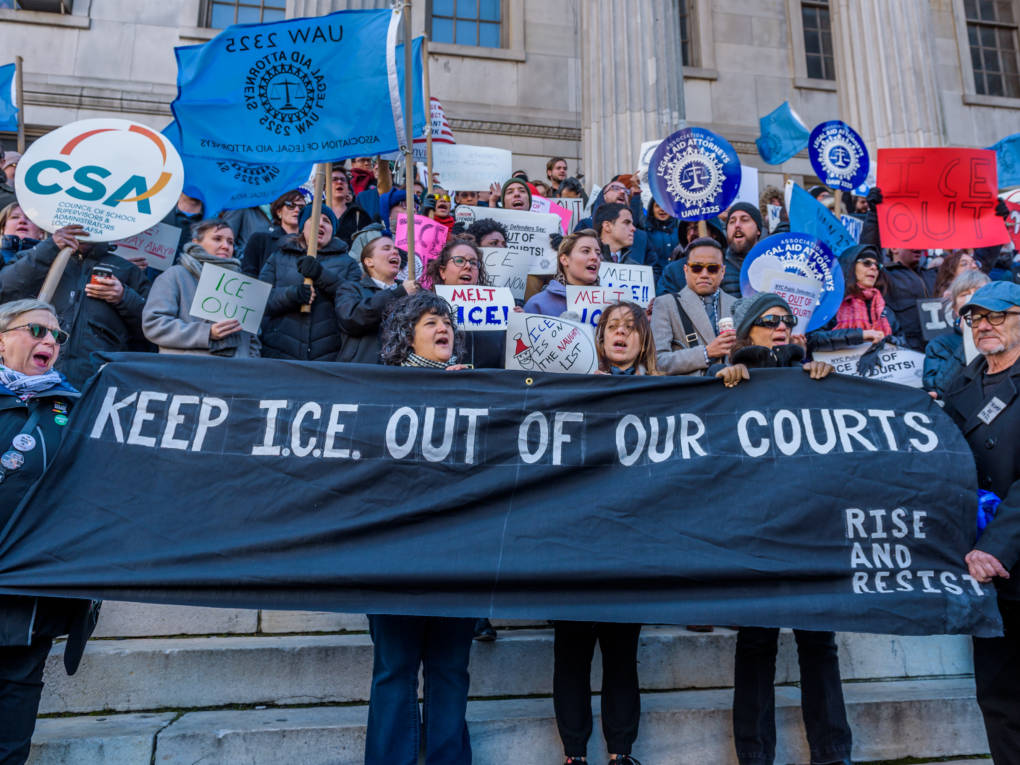
"caption": "The Association of Legal Aid Attorneys along with dozens of unions, immigrant rights organizations, and community groups held a rally on Dec. 7, 2017 at Brooklyn Borough Hall. Attorneys have seen US Immigration and Customs Enforcement officers in the halls and waiting rooms of several California courthouses. Advocates reported the arrest of one man at a Concord court. ",
"credit": "Pacific Press/LightRocket via Getty Images",
"altTag": null,
"description": null,
"imgSizes": {
"thumbnail": {
"file": "https://cdn.kqed.org/wp-content/uploads/sites/10/2018/12/gettyimages-888870656-e9acdd0cdcb80ec5cd16b8a05023e4e5664f30fb-160x120.jpg",
"width": 160,
"height": 120,
"mimeType": "image/jpeg"
},
"medium": {
"file": "https://cdn.kqed.org/wp-content/uploads/sites/10/2018/12/gettyimages-888870656-e9acdd0cdcb80ec5cd16b8a05023e4e5664f30fb-800x600.jpg",
"width": 800,
"height": 600,
"mimeType": "image/jpeg"
},
"large": {
"file": "https://cdn.kqed.org/wp-content/uploads/sites/10/2018/12/gettyimages-888870656-e9acdd0cdcb80ec5cd16b8a05023e4e5664f30fb-1020x765.jpg",
"width": 1020,
"height": 765,
"mimeType": "image/jpeg"
},
"complete_open_graph": {
"file": "https://cdn.kqed.org/wp-content/uploads/sites/10/2018/12/gettyimages-888870656-e9acdd0cdcb80ec5cd16b8a05023e4e5664f30fb-1200x900.jpg",
"width": 1200,
"height": 900,
"mimeType": "image/jpeg"
},
"post-thumbnail": {
"file": "https://cdn.kqed.org/wp-content/uploads/sites/10/2018/12/gettyimages-888870656-e9acdd0cdcb80ec5cd16b8a05023e4e5664f30fb-672x372.jpg",
"width": 672,
"height": 372,
"mimeType": "image/jpeg"
},
"twentyfourteen-full-width": {
"file": "https://cdn.kqed.org/wp-content/uploads/sites/10/2018/12/gettyimages-888870656-e9acdd0cdcb80ec5cd16b8a05023e4e5664f30fb-1038x576.jpg",
"width": 1038,
"height": 576,
"mimeType": "image/jpeg"
},
"full-width": {
"file": "https://cdn.kqed.org/wp-content/uploads/sites/10/2018/12/gettyimages-888870656-e9acdd0cdcb80ec5cd16b8a05023e4e5664f30fb-1920x1440.jpg",
"width": 1920,
"height": 1440,
"mimeType": "image/jpeg"
},
"guest-author-32": {
"file": "https://cdn.kqed.org/wp-content/uploads/sites/10/2018/12/gettyimages-888870656-e9acdd0cdcb80ec5cd16b8a05023e4e5664f30fb-32x32.jpg",
"width": 32,
"height": 32,
"mimeType": "image/jpeg"
},
"guest-author-50": {
"file": "https://cdn.kqed.org/wp-content/uploads/sites/10/2018/12/gettyimages-888870656-e9acdd0cdcb80ec5cd16b8a05023e4e5664f30fb-50x50.jpg",
"width": 50,
"height": 50,
"mimeType": "image/jpeg"
},
"guest-author-64": {
"file": "https://cdn.kqed.org/wp-content/uploads/sites/10/2018/12/gettyimages-888870656-e9acdd0cdcb80ec5cd16b8a05023e4e5664f30fb-64x64.jpg",
"width": 64,
"height": 64,
"mimeType": "image/jpeg"
},
"guest-author-96": {
"file": "https://cdn.kqed.org/wp-content/uploads/sites/10/2018/12/gettyimages-888870656-e9acdd0cdcb80ec5cd16b8a05023e4e5664f30fb-96x96.jpg",
"width": 96,
"height": 96,
"mimeType": "image/jpeg"
},
"guest-author-128": {
"file": "https://cdn.kqed.org/wp-content/uploads/sites/10/2018/12/gettyimages-888870656-e9acdd0cdcb80ec5cd16b8a05023e4e5664f30fb-128x128.jpg",
"width": 128,
"height": 128,
"mimeType": "image/jpeg"
},
"detail": {
"file": "https://cdn.kqed.org/wp-content/uploads/sites/10/2018/12/gettyimages-888870656-e9acdd0cdcb80ec5cd16b8a05023e4e5664f30fb-150x150.jpg",
"width": 150,
"height": 150,
"mimeType": "image/jpeg"
},
"kqedFullSize": {
"file": "https://cdn.kqed.org/wp-content/uploads/sites/10/2018/12/gettyimages-888870656-e9acdd0cdcb80ec5cd16b8a05023e4e5664f30fb-e1748037342663.jpg",
"width": 2000,
"height": 1500
}
},
"isLoading": false,
"fetchFailed": false
},
"news_12040548": {
"type": "attachments",
"id": "news_12040548",
"meta": {
"index": "attachments_1716263798",
"site": "news",
"id": "12040548",
"found": true
},
"title": "WestJet aircraft taxis at Denver International Airport",
"publishDate": 1747424548,
"status": "inherit",
"parent": 12040535,
"modified": 1747426321,
"caption": "A Canadian WestJet Airlines Boeing 737 passenger aircraft taxis at Denver International Airport in Denver, Colorado, on June 20, 2019. WestJet recently announced it was suspending nine routes to U.S. cities due to low demand as Canadians avoid traveling to the U.S.",
"credit": "Robert Alexander/Getty Images",
"altTag": null,
"description": null,
"imgSizes": {
"medium": {
"file": "https://cdn.kqed.org/wp-content/uploads/sites/10/2025/05/GettyImages-1159429805-800x529.jpg",
"width": 800,
"height": 529,
"mimeType": "image/jpeg"
},
"large": {
"file": "https://cdn.kqed.org/wp-content/uploads/sites/10/2025/05/GettyImages-1159429805-1020x674.jpg",
"width": 1020,
"height": 674,
"mimeType": "image/jpeg"
},
"thumbnail": {
"file": "https://cdn.kqed.org/wp-content/uploads/sites/10/2025/05/GettyImages-1159429805-160x106.jpg",
"width": 160,
"height": 106,
"mimeType": "image/jpeg"
},
"post-thumbnail": {
"file": "https://cdn.kqed.org/wp-content/uploads/sites/10/2025/05/GettyImages-1159429805-672x372.jpg",
"width": 672,
"height": 372,
"mimeType": "image/jpeg"
},
"twentyfourteen-full-width": {
"file": "https://cdn.kqed.org/wp-content/uploads/sites/10/2025/05/GettyImages-1159429805-1024x576.jpg",
"width": 1024,
"height": 576,
"mimeType": "image/jpeg"
},
"kqedFullSize": {
"file": "https://cdn.kqed.org/wp-content/uploads/sites/10/2025/05/GettyImages-1159429805.jpg",
"width": 1024,
"height": 677
}
},
"isLoading": false,
"fetchFailed": false
},
"news_12037936": {
"type": "attachments",
"id": "news_12037936",
"meta": {
"index": "attachments_1716263798",
"site": "news",
"id": "12037936",
"found": true
},
"title": "A KC-10 Extender is parked on the ramp as a C-5M Super Galaxy takes off at Travis Air Force Base, Calif., March 16, 2017.",
"publishDate": 1745868668,
"status": "inherit",
"parent": 12037889,
"modified": 1765567012,
"caption": "A KC-10 Extender is parked on the ramp as a C-5M Super Galaxy takes off at Travis Air Force Base, California, on March 16, 2017.",
"credit": "Hum Images/Universal Images Group via Getty Images",
"altTag": null,
"description": null,
"imgSizes": {
"medium": {
"file": "https://cdn.kqed.org/wp-content/uploads/sites/10/2025/04/TravisAirForceBaseGetty2-800x534.jpg",
"width": 800,
"height": 534,
"mimeType": "image/jpeg"
},
"large": {
"file": "https://cdn.kqed.org/wp-content/uploads/sites/10/2025/04/TravisAirForceBaseGetty2-1020x680.jpg",
"width": 1020,
"height": 680,
"mimeType": "image/jpeg"
},
"thumbnail": {
"file": "https://cdn.kqed.org/wp-content/uploads/sites/10/2025/04/TravisAirForceBaseGetty2-160x107.jpg",
"width": 160,
"height": 107,
"mimeType": "image/jpeg"
},
"1536x1536": {
"file": "https://cdn.kqed.org/wp-content/uploads/sites/10/2025/04/TravisAirForceBaseGetty2-1536x1025.jpg",
"width": 1536,
"height": 1025,
"mimeType": "image/jpeg"
},
"post-thumbnail": {
"file": "https://cdn.kqed.org/wp-content/uploads/sites/10/2025/04/TravisAirForceBaseGetty2-672x372.jpg",
"width": 672,
"height": 372,
"mimeType": "image/jpeg"
},
"twentyfourteen-full-width": {
"file": "https://cdn.kqed.org/wp-content/uploads/sites/10/2025/04/TravisAirForceBaseGetty2-1038x576.jpg",
"width": 1038,
"height": 576,
"mimeType": "image/jpeg"
},
"full-width": {
"file": "https://cdn.kqed.org/wp-content/uploads/sites/10/2025/04/TravisAirForceBaseGetty2-1920x1281.jpg",
"width": 1920,
"height": 1281,
"mimeType": "image/jpeg"
},
"kqedFullSize": {
"file": "https://cdn.kqed.org/wp-content/uploads/sites/10/2025/04/TravisAirForceBaseGetty2.jpg",
"width": 2000,
"height": 1334
}
},
"isLoading": false,
"fetchFailed": false
},
"news_12038090": {
"type": "attachments",
"id": "news_12038090",
"meta": {
"index": "attachments_1716263798",
"site": "news",
"id": "12038090",
"found": true
},
"title": "CMDetentionICE1",
"publishDate": 1745956729,
"status": "inherit",
"parent": 12038087,
"modified": 1745956768,
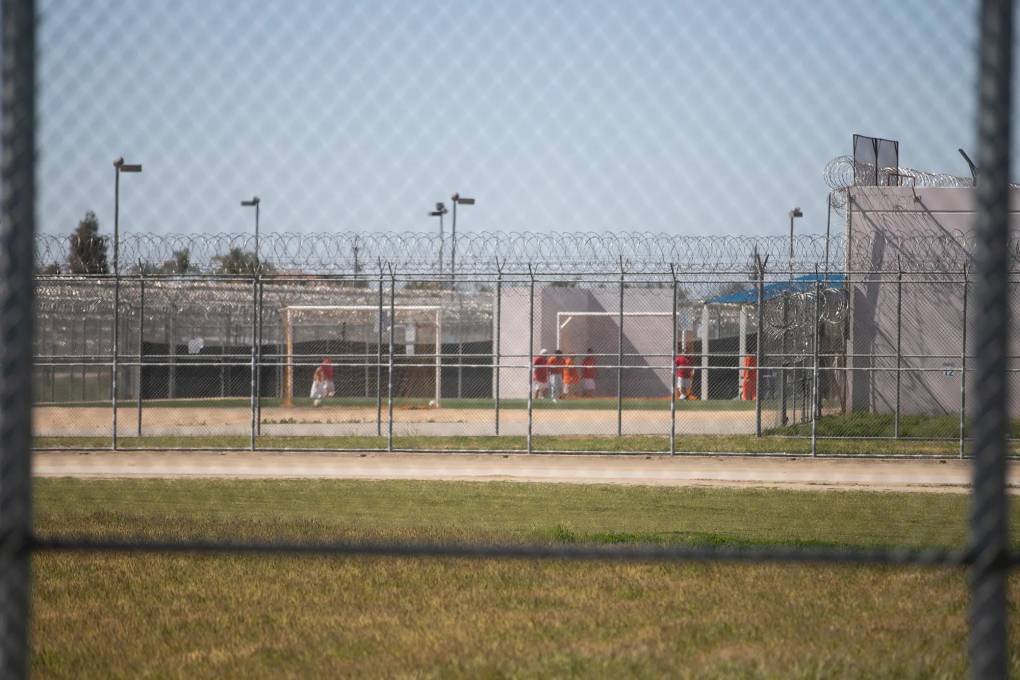
"caption": "People detained inside the Golden State Annex, a U.S. Immigration and Customs Enforcement detention facility run by The GEO Group, in McFarland on March 9, 2025.",
"credit": "Larry Valenzuela/CalMatters/CatchLight Local",
"altTag": null,
"description": null,
"imgSizes": {
"medium": {
"file": "https://cdn.kqed.org/wp-content/uploads/sites/10/2025/04/CMDetentionICE1-800x533.jpg",
"width": 800,
"height": 533,
"mimeType": "image/jpeg"
},
"large": {
"file": "https://cdn.kqed.org/wp-content/uploads/sites/10/2025/04/CMDetentionICE1-1020x680.jpg",
"width": 1020,
"height": 680,
"mimeType": "image/jpeg"
},
"thumbnail": {
"file": "https://cdn.kqed.org/wp-content/uploads/sites/10/2025/04/CMDetentionICE1-160x107.jpg",
"width": 160,
"height": 107,
"mimeType": "image/jpeg"
},
"1536x1536": {
"file": "https://cdn.kqed.org/wp-content/uploads/sites/10/2025/04/CMDetentionICE1-1536x1024.jpg",
"width": 1536,
"height": 1024,
"mimeType": "image/jpeg"
},
"post-thumbnail": {
"file": "https://cdn.kqed.org/wp-content/uploads/sites/10/2025/04/CMDetentionICE1-672x372.jpg",
"width": 672,
"height": 372,
"mimeType": "image/jpeg"
},
"twentyfourteen-full-width": {
"file": "https://cdn.kqed.org/wp-content/uploads/sites/10/2025/04/CMDetentionICE1-1038x576.jpg",
"width": 1038,
"height": 576,
"mimeType": "image/jpeg"
},
"full-width": {
"file": "https://cdn.kqed.org/wp-content/uploads/sites/10/2025/04/CMDetentionICE1-1920x1280.jpg",
"width": 1920,
"height": 1280,
"mimeType": "image/jpeg"
},
"kqedFullSize": {
"file": "https://cdn.kqed.org/wp-content/uploads/sites/10/2025/04/CMDetentionICE1.jpg",
"width": 2000,
"height": 1333
}
},
"isLoading": false,
"fetchFailed": false
},
"news_12024728": {
"type": "attachments",
"id": "news_12024728",
"meta": {
"index": "attachments_1716263798",
"site": "news",
"id": "12024728",
"found": true
},
"title": "20250129_UcBerkeleyRally_GC-1",
"publishDate": 1738196347,
"status": "inherit",
"parent": 0,
"modified": 1738198234,
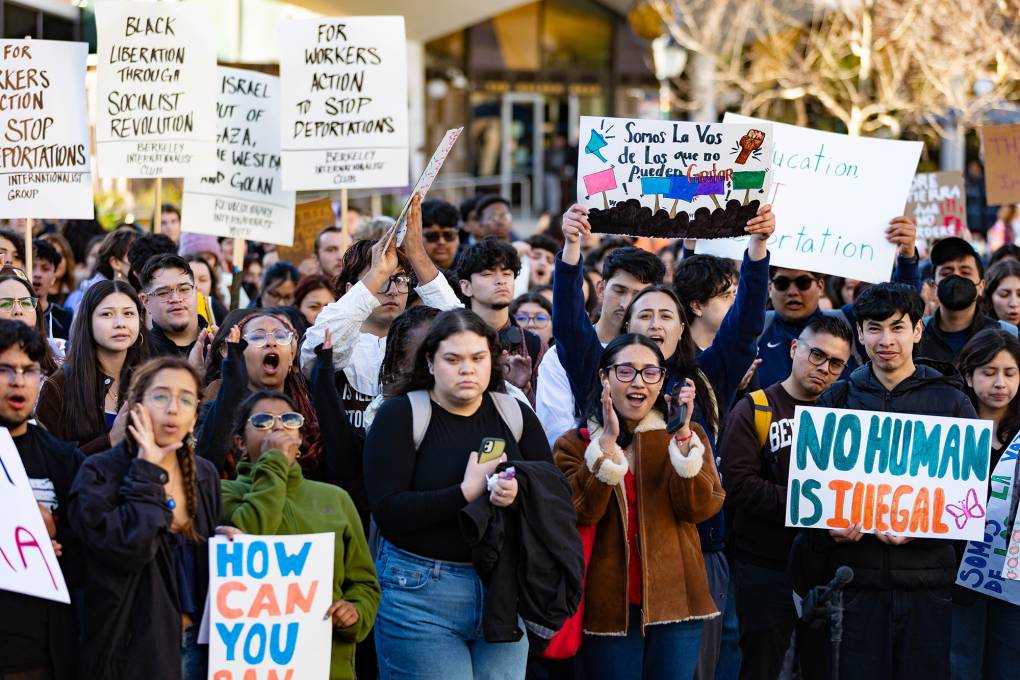
"caption": "Hundreds of students and supporters rally, in solidarity with their undocumented classmates in response to the mass deportations ordered by the Trump administration at Sproul Plaza on the UC Berkeley campus on Wednesday, Jan. 29, 2025.",
"credit": "Gina Castro/KQED",
"altTag": null,
"description": null,
"imgSizes": {
"medium": {
"file": "https://cdn.kqed.org/wp-content/uploads/sites/10/2025/01/20250129_UcBerkeleyRally_GC-1-800x533.jpg",
"width": 800,
"height": 533,
"mimeType": "image/jpeg"
},
"large": {
"file": "https://cdn.kqed.org/wp-content/uploads/sites/10/2025/01/20250129_UcBerkeleyRally_GC-1-1020x680.jpg",
"width": 1020,
"height": 680,
"mimeType": "image/jpeg"
},
"thumbnail": {
"file": "https://cdn.kqed.org/wp-content/uploads/sites/10/2025/01/20250129_UcBerkeleyRally_GC-1-160x107.jpg",
"width": 160,
"height": 107,
"mimeType": "image/jpeg"
},
"1536x1536": {
"file": "https://cdn.kqed.org/wp-content/uploads/sites/10/2025/01/20250129_UcBerkeleyRally_GC-1-1536x1024.jpg",
"width": 1536,
"height": 1024,
"mimeType": "image/jpeg"
},
"post-thumbnail": {
"file": "https://cdn.kqed.org/wp-content/uploads/sites/10/2025/01/20250129_UcBerkeleyRally_GC-1-672x372.jpg",
"width": 672,
"height": 372,
"mimeType": "image/jpeg"
},
"twentyfourteen-full-width": {
"file": "https://cdn.kqed.org/wp-content/uploads/sites/10/2025/01/20250129_UcBerkeleyRally_GC-1-1038x576.jpg",
"width": 1038,
"height": 576,
"mimeType": "image/jpeg"
},
"full-width": {
"file": "https://cdn.kqed.org/wp-content/uploads/sites/10/2025/01/20250129_UcBerkeleyRally_GC-1-1920x1280.jpg",
"width": 1920,
"height": 1280,
"mimeType": "image/jpeg"
},
"kqedFullSize": {
"file": "https://cdn.kqed.org/wp-content/uploads/sites/10/2025/01/20250129_UcBerkeleyRally_GC-1.jpg",
"width": 2000,
"height": 1333
}
},
"isLoading": false,
"fetchFailed": false
},
"news_12035739": {
"type": "attachments",
"id": "news_12035739",
"meta": {
"index": "attachments_1716263798",
"site": "news",
"id": "12035739",
"found": true
},
"title": "Americans File Their Returns On Tax Day 2019",
"publishDate": 1744407995,
"status": "inherit",
"parent": 12035735,
"modified": 1771020890,
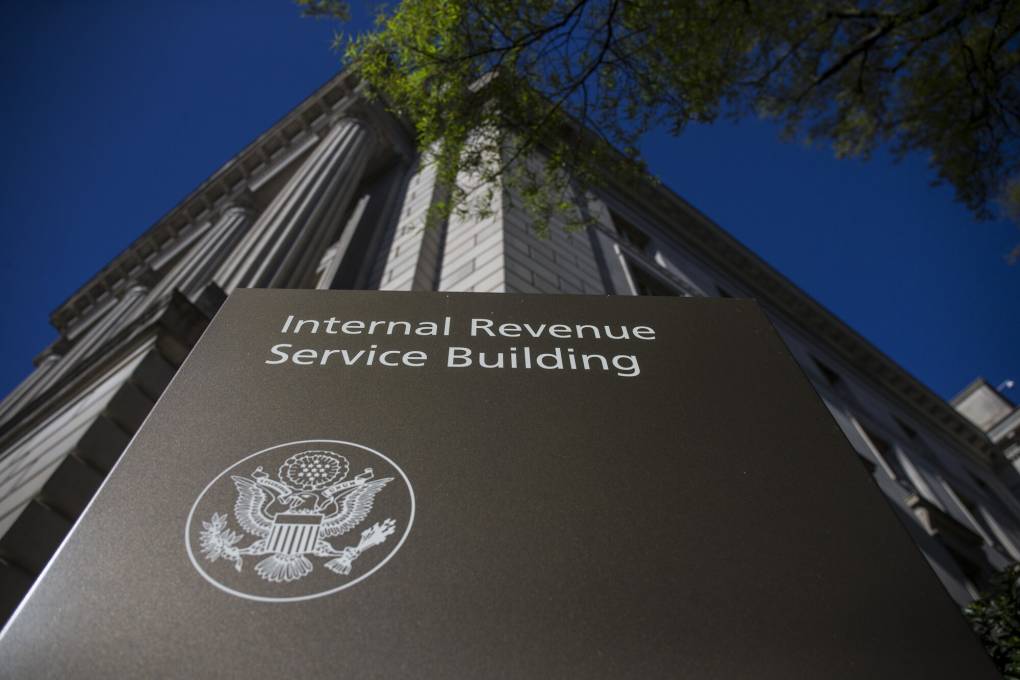
"caption": "The Internal Revenue Service (IRS) building in Washington, D.C. ",
"credit": "Zach Gibson/Getty Images",
"altTag": null,
"description": null,
"imgSizes": {
"medium": {
"file": "https://cdn.kqed.org/wp-content/uploads/sites/10/2025/04/internal-revenue-service_qed-800x533.jpg",
"width": 800,
"height": 533,
"mimeType": "image/jpeg"
},
"large": {
"file": "https://cdn.kqed.org/wp-content/uploads/sites/10/2025/04/internal-revenue-service_qed-1020x680.jpg",
"width": 1020,
"height": 680,
"mimeType": "image/jpeg"
},
"thumbnail": {
"file": "https://cdn.kqed.org/wp-content/uploads/sites/10/2025/04/internal-revenue-service_qed-160x107.jpg",
"width": 160,
"height": 107,
"mimeType": "image/jpeg"
},
"1536x1536": {
"file": "https://cdn.kqed.org/wp-content/uploads/sites/10/2025/04/internal-revenue-service_qed-1536x1024.jpg",
"width": 1536,
"height": 1024,
"mimeType": "image/jpeg"
},
"post-thumbnail": {
"file": "https://cdn.kqed.org/wp-content/uploads/sites/10/2025/04/internal-revenue-service_qed-672x372.jpg",
"width": 672,
"height": 372,
"mimeType": "image/jpeg"
},
"twentyfourteen-full-width": {
"file": "https://cdn.kqed.org/wp-content/uploads/sites/10/2025/04/internal-revenue-service_qed-1038x576.jpg",
"width": 1038,
"height": 576,
"mimeType": "image/jpeg"
},
"full-width": {
"file": "https://cdn.kqed.org/wp-content/uploads/sites/10/2025/04/internal-revenue-service_qed-1920x1280.jpg",
"width": 1920,
"height": 1280,
"mimeType": "image/jpeg"
},
"kqedFullSize": {
"file": "https://cdn.kqed.org/wp-content/uploads/sites/10/2025/04/internal-revenue-service_qed.jpg",
"width": 2000,
"height": 1333
}
},
"isLoading": false,
"fetchFailed": false
},
"news_12034753": {
"type": "attachments",
"id": "news_12034753",
"meta": {
"index": "attachments_1716263798",
"site": "news",
"id": "12034753",
"found": true
},
"title": "20250129_UCBerkeleyRally_GC-72_qed",
"publishDate": 1744048834,
"status": "inherit",
"parent": 12034742,
"modified": 1744048856,
"caption": "Hundreds of students and supporters rally, in solidarity with their undocumented classmates as the Trump administration begins to carry out mass deportations, at Sproul Plaza at UC Berkeley on Jan. 29, 2025.",
"credit": "Gina Castro/KQED",
"altTag": null,
"description": null,
"imgSizes": {
"medium": {
"file": "https://cdn.kqed.org/wp-content/uploads/sites/10/2025/04/20250129_UCBerkeleyRally_GC-72_qed-800x533.jpg",
"width": 800,
"height": 533,
"mimeType": "image/jpeg"
},
"large": {
"file": "https://cdn.kqed.org/wp-content/uploads/sites/10/2025/04/20250129_UCBerkeleyRally_GC-72_qed-1020x680.jpg",
"width": 1020,
"height": 680,
"mimeType": "image/jpeg"
},
"thumbnail": {
"file": "https://cdn.kqed.org/wp-content/uploads/sites/10/2025/04/20250129_UCBerkeleyRally_GC-72_qed-160x107.jpg",
"width": 160,
"height": 107,
"mimeType": "image/jpeg"
},
"1536x1536": {
"file": "https://cdn.kqed.org/wp-content/uploads/sites/10/2025/04/20250129_UCBerkeleyRally_GC-72_qed-1536x1024.jpg",
"width": 1536,
"height": 1024,
"mimeType": "image/jpeg"
},
"post-thumbnail": {
"file": "https://cdn.kqed.org/wp-content/uploads/sites/10/2025/04/20250129_UCBerkeleyRally_GC-72_qed-672x372.jpg",
"width": 672,
"height": 372,
"mimeType": "image/jpeg"
},
"twentyfourteen-full-width": {
"file": "https://cdn.kqed.org/wp-content/uploads/sites/10/2025/04/20250129_UCBerkeleyRally_GC-72_qed-1038x576.jpg",
"width": 1038,
"height": 576,
"mimeType": "image/jpeg"
},
"full-width": {
"file": "https://cdn.kqed.org/wp-content/uploads/sites/10/2025/04/20250129_UCBerkeleyRally_GC-72_qed-1920x1280.jpg",
"width": 1920,
"height": 1280,
"mimeType": "image/jpeg"
},
"kqedFullSize": {
"file": "https://cdn.kqed.org/wp-content/uploads/sites/10/2025/04/20250129_UCBerkeleyRally_GC-72_qed.jpg",
"width": 2000,
"height": 1333
}
},
"isLoading": false,
"fetchFailed": false
},
"news_12035484": {
"type": "attachments",
"id": "news_12035484",
"meta": {
"index": "attachments_1716263798",
"site": "news",
"id": "12035484",
"found": true
},
"title": "npr.brightspotcdn copy",
"publishDate": 1744317258,
"status": "inherit",
"parent": 12035483,
"modified": 1744317279,
"caption": "Mahmoud Khalil is seen at a pro-Palestinian protest encampment on the Columbia University campus in New York on April 29, 2024.",
"credit": "Ted Shaffrey/AP",
"altTag": null,
"description": null,
"imgSizes": {
"medium": {
"file": "https://cdn.kqed.org/wp-content/uploads/sites/10/2025/04/npr.brightspotcdn-copy-11-800x534.jpg",
"width": 800,
"height": 534,
"mimeType": "image/jpeg"
},
"large": {
"file": "https://cdn.kqed.org/wp-content/uploads/sites/10/2025/04/npr.brightspotcdn-copy-11-1020x680.jpg",
"width": 1020,
"height": 680,
"mimeType": "image/jpeg"
},
"thumbnail": {
"file": "https://cdn.kqed.org/wp-content/uploads/sites/10/2025/04/npr.brightspotcdn-copy-11-160x107.jpg",
"width": 160,
"height": 107,
"mimeType": "image/jpeg"
},
"1536x1536": {
"file": "https://cdn.kqed.org/wp-content/uploads/sites/10/2025/04/npr.brightspotcdn-copy-11-1536x1024.jpg",
"width": 1536,
"height": 1024,
"mimeType": "image/jpeg"
},
"post-thumbnail": {
"file": "https://cdn.kqed.org/wp-content/uploads/sites/10/2025/04/npr.brightspotcdn-copy-11-672x372.jpg",
"width": 672,
"height": 372,
"mimeType": "image/jpeg"
},
"twentyfourteen-full-width": {
"file": "https://cdn.kqed.org/wp-content/uploads/sites/10/2025/04/npr.brightspotcdn-copy-11-1038x576.jpg",
"width": 1038,
"height": 576,
"mimeType": "image/jpeg"
},
"kqedFullSize": {
"file": "https://cdn.kqed.org/wp-content/uploads/sites/10/2025/04/npr.brightspotcdn-copy-11.jpg",
"width": 1600,
"height": 1067
}
},
"isLoading": false,
"fetchFailed": false
},
"news_12034929": {
"type": "attachments",
"id": "news_12034929",
"meta": {
"index": "attachments_1716263798",
"site": "news",
"id": "12034929",
"found": true
},
"title": "022525-Evident-Border-Trip-EM-CM-01 copy",
"publishDate": 1744144102,
"status": "inherit",
"parent": 12034926,
"modified": 1744144127,
"caption": "Sergeant Gregory Bovino during an interview at El Centro Border Patrol headquarters on Feb. 25, 2025. ",
"credit": "Kevin Clancy/CalMatters and Evident Media",
"altTag": null,
"description": null,
"imgSizes": {
"medium": {
"file": "https://cdn.kqed.org/wp-content/uploads/sites/10/2025/04/022525-Evident-Border-Trip-EM-CM-01-copy-800x533.jpg",
"width": 800,
"height": 533,
"mimeType": "image/jpeg"
},
"large": {
"file": "https://cdn.kqed.org/wp-content/uploads/sites/10/2025/04/022525-Evident-Border-Trip-EM-CM-01-copy-1020x680.jpg",
"width": 1020,
"height": 680,
"mimeType": "image/jpeg"
},
"thumbnail": {
"file": "https://cdn.kqed.org/wp-content/uploads/sites/10/2025/04/022525-Evident-Border-Trip-EM-CM-01-copy-160x107.jpg",
"width": 160,
"height": 107,
"mimeType": "image/jpeg"
},
"1536x1536": {
"file": "https://cdn.kqed.org/wp-content/uploads/sites/10/2025/04/022525-Evident-Border-Trip-EM-CM-01-copy-1536x1024.jpg",
"width": 1536,
"height": 1024,
"mimeType": "image/jpeg"
},
"post-thumbnail": {
"file": "https://cdn.kqed.org/wp-content/uploads/sites/10/2025/04/022525-Evident-Border-Trip-EM-CM-01-copy-672x372.jpg",
"width": 672,
"height": 372,
"mimeType": "image/jpeg"
},
"twentyfourteen-full-width": {
"file": "https://cdn.kqed.org/wp-content/uploads/sites/10/2025/04/022525-Evident-Border-Trip-EM-CM-01-copy-1038x576.jpg",
"width": 1038,
"height": 576,
"mimeType": "image/jpeg"
},
"full-width": {
"file": "https://cdn.kqed.org/wp-content/uploads/sites/10/2025/04/022525-Evident-Border-Trip-EM-CM-01-copy-1920x1280.jpg",
"width": 1920,
"height": 1280,
"mimeType": "image/jpeg"
},
"kqedFullSize": {
"file": "https://cdn.kqed.org/wp-content/uploads/sites/10/2025/04/022525-Evident-Border-Trip-EM-CM-01-copy.jpg",
"width": 2000,
"height": 1333
}
},
"isLoading": false,
"fetchFailed": false
},
"news_12034002": {
"type": "attachments",
"id": "news_12034002",
"meta": {
"index": "attachments_1716263798",
"site": "news",
"id": "12034002",
"found": true
},
"title": "034_SanFrancisco_AlexPadillaMissionKids_06012021_qed (1)",
"publishDate": 1743529094,
"status": "inherit",
"parent": 12033989,
"modified": 1743529142,
"caption": "Sen. Alex Padilla speaks at a press briefing in San Francisco on June 1, 2021.",
"credit": "Beth LaBerge/KQED",
"altTag": null,
"description": null,
"imgSizes": {
"medium": {
"file": "https://cdn.kqed.org/wp-content/uploads/sites/10/2025/04/034_SanFrancisco_AlexPadillaMissionKids_06012021_qed-1-800x533.jpg",
"width": 800,
"height": 533,
"mimeType": "image/jpeg"
},
"large": {
"file": "https://cdn.kqed.org/wp-content/uploads/sites/10/2025/04/034_SanFrancisco_AlexPadillaMissionKids_06012021_qed-1-1020x680.jpg",
"width": 1020,
"height": 680,
"mimeType": "image/jpeg"
},
"thumbnail": {
"file": "https://cdn.kqed.org/wp-content/uploads/sites/10/2025/04/034_SanFrancisco_AlexPadillaMissionKids_06012021_qed-1-160x107.jpg",
"width": 160,
"height": 107,
"mimeType": "image/jpeg"
},
"1536x1536": {
"file": "https://cdn.kqed.org/wp-content/uploads/sites/10/2025/04/034_SanFrancisco_AlexPadillaMissionKids_06012021_qed-1-1536x1024.jpg",
"width": 1536,
"height": 1024,
"mimeType": "image/jpeg"
},
"post-thumbnail": {
"file": "https://cdn.kqed.org/wp-content/uploads/sites/10/2025/04/034_SanFrancisco_AlexPadillaMissionKids_06012021_qed-1-672x372.jpg",
"width": 672,
"height": 372,
"mimeType": "image/jpeg"
},
"twentyfourteen-full-width": {
"file": "https://cdn.kqed.org/wp-content/uploads/sites/10/2025/04/034_SanFrancisco_AlexPadillaMissionKids_06012021_qed-1-1038x576.jpg",
"width": 1038,
"height": 576,
"mimeType": "image/jpeg"
},
"full-width": {
"file": "https://cdn.kqed.org/wp-content/uploads/sites/10/2025/04/034_SanFrancisco_AlexPadillaMissionKids_06012021_qed-1-1920x1280.jpg",
"width": 1920,
"height": 1280,
"mimeType": "image/jpeg"
},
"kqedFullSize": {
"file": "https://cdn.kqed.org/wp-content/uploads/sites/10/2025/04/034_SanFrancisco_AlexPadillaMissionKids_06012021_qed-1.jpg",
"width": 2000,
"height": 1333
}
},
"isLoading": false,
"fetchFailed": false
},
"news_12033529": {
"type": "attachments",
"id": "news_12033529",
"meta": {
"index": "attachments_1716263798",
"site": "news",
"id": "12033529",
"found": true
},
"title": "npr.brightspotcdn copy",
"publishDate": 1743186464,
"status": "inherit",
"parent": 12033527,
"modified": 1743186488,
"caption": "The US Supreme Court is shown March 17, 2025 in Washington, DC.",
"credit": "Win McNamee/Getty Images",
"altTag": null,
"description": null,
"imgSizes": {
"medium": {
"file": "https://cdn.kqed.org/wp-content/uploads/sites/10/2025/03/npr.brightspotcdn-copy-13-800x534.jpg",
"width": 800,
"height": 534,
"mimeType": "image/jpeg"
},
"large": {
"file": "https://cdn.kqed.org/wp-content/uploads/sites/10/2025/03/npr.brightspotcdn-copy-13-1020x680.jpg",
"width": 1020,
"height": 680,
"mimeType": "image/jpeg"
},
"thumbnail": {
"file": "https://cdn.kqed.org/wp-content/uploads/sites/10/2025/03/npr.brightspotcdn-copy-13-160x107.jpg",
"width": 160,
"height": 107,
"mimeType": "image/jpeg"
},
"1536x1536": {
"file": "https://cdn.kqed.org/wp-content/uploads/sites/10/2025/03/npr.brightspotcdn-copy-13-1536x1024.jpg",
"width": 1536,
"height": 1024,
"mimeType": "image/jpeg"
},
"post-thumbnail": {
"file": "https://cdn.kqed.org/wp-content/uploads/sites/10/2025/03/npr.brightspotcdn-copy-13-672x372.jpg",
"width": 672,
"height": 372,
"mimeType": "image/jpeg"
},
"twentyfourteen-full-width": {
"file": "https://cdn.kqed.org/wp-content/uploads/sites/10/2025/03/npr.brightspotcdn-copy-13-1038x576.jpg",
"width": 1038,
"height": 576,
"mimeType": "image/jpeg"
},
"kqedFullSize": {
"file": "https://cdn.kqed.org/wp-content/uploads/sites/10/2025/03/npr.brightspotcdn-copy-13.jpg",
"width": 1600,
"height": 1067
}
},
"isLoading": false,
"fetchFailed": false
},
"news_12032511": {
"type": "attachments",
"id": "news_12032511",
"meta": {
"index": "attachments_1716263798",
"site": "news",
"id": "12032511",
"found": true
},
"title": "250320-JAPANESEAMERICANSDENOUNCE-03-BL-KQED",
"publishDate": 1742590682,
"status": "inherit",
"parent": 0,
"modified": 1742590695,
"caption": "Joyce Nakamura, from the Japanese American Citizens League, speaks at the Japanese Cultural and Community Center in San Francisco on March 20, 2025, during a press conference condemning the use of the Alien Enemies Act to target immigrants.",
"credit": "Beth LaBerge/KQED",
"altTag": null,
"description": null,
"imgSizes": {
"medium": {
"file": "https://cdn.kqed.org/wp-content/uploads/sites/10/2025/03/250320-JAPANESEAMERICANSDENOUNCE-03-BL-KQED-800x533.jpg",
"width": 800,
"height": 533,
"mimeType": "image/jpeg"
},
"large": {
"file": "https://cdn.kqed.org/wp-content/uploads/sites/10/2025/03/250320-JAPANESEAMERICANSDENOUNCE-03-BL-KQED-1020x680.jpg",
"width": 1020,
"height": 680,
"mimeType": "image/jpeg"
},
"thumbnail": {
"file": "https://cdn.kqed.org/wp-content/uploads/sites/10/2025/03/250320-JAPANESEAMERICANSDENOUNCE-03-BL-KQED-160x107.jpg",
"width": 160,
"height": 107,
"mimeType": "image/jpeg"
},
"1536x1536": {
"file": "https://cdn.kqed.org/wp-content/uploads/sites/10/2025/03/250320-JAPANESEAMERICANSDENOUNCE-03-BL-KQED-1536x1024.jpg",
"width": 1536,
"height": 1024,
"mimeType": "image/jpeg"
},
"post-thumbnail": {
"file": "https://cdn.kqed.org/wp-content/uploads/sites/10/2025/03/250320-JAPANESEAMERICANSDENOUNCE-03-BL-KQED-672x372.jpg",
"width": 672,
"height": 372,
"mimeType": "image/jpeg"
},
"twentyfourteen-full-width": {
"file": "https://cdn.kqed.org/wp-content/uploads/sites/10/2025/03/250320-JAPANESEAMERICANSDENOUNCE-03-BL-KQED-1038x576.jpg",
"width": 1038,
"height": 576,
"mimeType": "image/jpeg"
},
"full-width": {
"file": "https://cdn.kqed.org/wp-content/uploads/sites/10/2025/03/250320-JAPANESEAMERICANSDENOUNCE-03-BL-KQED-1920x1280.jpg",
"width": 1920,
"height": 1280,
"mimeType": "image/jpeg"
},
"kqedFullSize": {
"file": "https://cdn.kqed.org/wp-content/uploads/sites/10/2025/03/250320-JAPANESEAMERICANSDENOUNCE-03-BL-KQED.jpg",
"width": 2000,
"height": 1333
}
},
"isLoading": false,
"fetchFailed": false
}
},
"audioPlayerReducer": {
"postId": "stream_live",
"isPaused": true,
"isPlaying": false,
"pfsActive": false,
"pledgeModalIsOpen": true,
"playerDrawerIsOpen": false,
"liveAudioPlayStartedAt": 0,
"liveAudioPlayContext": ""
},
"authorsReducer": {
"byline_news_12038087": {
"type": "authors",
"id": "byline_news_12038087",
"meta": {
"override": true
},
"slug": "byline_news_12038087",
"name": "\u003ca href=\"https://calmatters.org/author/wendy-fry/\" target=\"_blank\" rel=\"noopener\">Wendy Fry\u003c/a>, CalMatters",
"isLoading": false
},
"byline_news_12037662": {
"type": "authors",
"id": "byline_news_12037662",
"meta": {
"override": true
},
"slug": "byline_news_12037662",
"name": "Janie Har and Kate Brumback, Associated Press",
"isLoading": false
},
"byline_news_12035483": {
"type": "authors",
"id": "byline_news_12035483",
"meta": {
"override": true
},
"slug": "byline_news_12035483",
"name": "\u003ca href=\"https://www.npr.org/people/159989569/joel-rose\">Joel Rose\u003c/a> and \u003ca href=\"https://www.npr.org/people/427718118/adrian-florido\">Adrian Florido\u003c/a>, NPR",
"isLoading": false
},
"byline_news_12034926": {
"type": "authors",
"id": "byline_news_12034926",
"meta": {
"override": true
},
"slug": "byline_news_12034926",
"name": "\u003ca href=\"https://calmatters.org/author/sergio-olmos/\">Sergio Olmos\u003c/a> and \u003ca href=\"https://calmatters.org/author/wendy-fry/\">Wendy Fry\u003c/a>, CalMatters",
"isLoading": false
},
"byline_news_12033527": {
"type": "authors",
"id": "byline_news_12033527",
"meta": {
"override": true
},
"slug": "byline_news_12033527",
"name": "\u003ca href=\"https://www.npr.org/people/1241652386/sergio-martinez-beltran\">Sergio Martínez-Beltrán\u003c/a>, NPR",
"isLoading": false
},
"minakim": {
"type": "authors",
"id": "243",
"meta": {
"index": "authors_1716337520",
"id": "243",
"found": true
},
"name": "Mina Kim",
"firstName": "Mina",
"lastName": "Kim",
"slug": "minakim",
"email": "mkim@kqed.org",
"display_author_email": false,
"staff_mastheads": [
"news"
],
"title": "Host, Forum",
"bio": "Mina Kim is host of the 10 a.m. statewide hour of Forum; a live daily talk show for curious Californians on issues that matter to the state and nation, with a particular emphasis on race and equity.\r\n\r\nBefore joining the Forum team, Mina was KQED’s evening news anchor, and health reporter for The California Report. Her award-winning work has included natural disasters in Napa and gun violence in Oakland. Mina grew up in St. John’s, Newfoundland.",
"avatar": "https://secure.gravatar.com/avatar/145ce657a2d08cb86d93686beb958982?s=600&d=blank&r=g",
"twitter": "mkimreporter",
"facebook": null,
"instagram": null,
"linkedin": null,
"sites": [
{
"site": "news",
"roles": [
"contributor"
]
},
{
"site": "stateofhealth",
"roles": [
"author"
]
},
{
"site": "forum",
"roles": [
"editor"
]
}
],
"headData": {
"title": "Mina Kim | KQED",
"description": "Host, Forum",
"ogImgSrc": "https://secure.gravatar.com/avatar/145ce657a2d08cb86d93686beb958982?s=600&d=blank&r=g",
"twImgSrc": "https://secure.gravatar.com/avatar/145ce657a2d08cb86d93686beb958982?s=600&d=blank&r=g"
},
"isLoading": false,
"link": "/author/minakim"
},
"tychehendricks": {
"type": "authors",
"id": "259",
"meta": {
"index": "authors_1716337520",
"id": "259",
"found": true
},
"name": "Tyche Hendricks",
"firstName": "Tyche",
"lastName": "Hendricks",
"slug": "tychehendricks",
"email": "thendricks@kqed.org",
"display_author_email": true,
"staff_mastheads": [
"news"
],
"title": "KQED Senior Editor, Immigration",
"bio": "\u003cspan style=\"font-weight: 400;\">Tyche Hendricks is KQED’s senior editor for immigration, leading coverage of the policy and politics that affect California’s immigrant communities. Her work for KQED’s radio and online audiences is also carried on NPR and other national outlets. She has been recognized with awards from the Radio and Television News Directors Association, the Society for Professional Journalists; the Education Writers Association; the Best of the West and the National Federation of Community Broadcasters. Before joining KQED in 2010, Tyche spent more than a dozen years as a newspaper reporter, notably at the \u003c/span>\u003ci>\u003cspan style=\"font-weight: 400;\">San Francisco Chronicle\u003c/span>\u003c/i>\u003cspan style=\"font-weight: 400;\">. At different times she has covered criminal justice, government and politics and urban planning. Tyche has taught in the MFA Creative Writing program at the University of San Francisco and at UC Berkeley’s Graduate School of Journalism, where she was co-director of a national immigration symposium for professional journalists. She is the author of \u003c/span>\u003ci>\u003cspan style=\"font-weight: 400;\">The Wind Doesn't Need a Passport: Stories from the U.S.-Mexico Borderlands\u003c/span>\u003c/i>\u003cspan style=\"font-weight: 400;\"> (University of California Press). \u003c/span>",
"avatar": "https://secure.gravatar.com/avatar/b8ee458e2731c2d43df86882ce17267e?s=600&d=blank&r=g",
"twitter": "tychehendricks",
"facebook": null,
"instagram": null,
"linkedin": null,
"sites": [
{
"site": "news",
"roles": [
"editor"
]
},
{
"site": "stateofhealth",
"roles": [
"editor"
]
}
],
"headData": {
"title": "Tyche Hendricks | KQED",
"description": "KQED Senior Editor, Immigration",
"ogImgSrc": "https://secure.gravatar.com/avatar/b8ee458e2731c2d43df86882ce17267e?s=600&d=blank&r=g",
"twImgSrc": "https://secure.gravatar.com/avatar/b8ee458e2731c2d43df86882ce17267e?s=600&d=blank&r=g"
},
"isLoading": false,
"link": "/author/tychehendricks"
},
"clei": {
"type": "authors",
"id": "8617",
"meta": {
"index": "authors_1716337520",
"id": "8617",
"found": true
},
"name": "Cecilia Lei",
"firstName": "Cecilia",
"lastName": "Lei",
"slug": "clei",
"email": "clei@KQED.org",
"display_author_email": false,
"staff_mastheads": [],
"title": "KQED Contributor",
"bio": "Cecilia Lei is an on-call host and producer for KQED News and Podcasts. Previously, she was the executive producer and host of the San Francisco Chronicle's daily news podcast, 'Fifth and Mission'. Cecilia is a graduate of UC Berkeley’s Graduate School of Journalism and the former president of the Asian American Journalists Association San Francisco Bay Area chapter.",
"avatar": "https://secure.gravatar.com/avatar/40975f1f88fccf628ee537bf6ffc2af8?s=600&d=blank&r=g",
"twitter": null,
"facebook": null,
"instagram": null,
"linkedin": null,
"sites": [
{
"site": "arts",
"roles": [
"contributor"
]
},
{
"site": "news",
"roles": [
"author",
"read_private_posts"
]
},
{
"site": "about",
"roles": [
"editor"
]
}
],
"headData": {
"title": "Cecilia Lei | KQED",
"description": "KQED Contributor",
"ogImgSrc": "https://secure.gravatar.com/avatar/40975f1f88fccf628ee537bf6ffc2af8?s=600&d=blank&r=g",
"twImgSrc": "https://secure.gravatar.com/avatar/40975f1f88fccf628ee537bf6ffc2af8?s=600&d=blank&r=g"
},
"isLoading": false,
"link": "/author/clei"
},
"ccabreralomeli": {
"type": "authors",
"id": "11708",
"meta": {
"index": "authors_1716337520",
"id": "11708",
"found": true
},
"name": "Carlos Cabrera-Lomelí",
"firstName": "Carlos",
"lastName": "Cabrera-Lomelí",
"slug": "ccabreralomeli",
"email": "ccabreralomeli@KQED.org",
"display_author_email": true,
"staff_mastheads": [
"news"
],
"title": "Community Reporter",
"bio": "Carlos Cabrera-Lomelí is a community reporter with KQED's digital engagement team. He also reports and co-produces for KQED's bilingual news hub KQED en Español. He grew up in San Francisco's Mission District and has previously worked with Univision, 48 Hills and REFORMA in Mexico City.",
"avatar": "https://secure.gravatar.com/avatar/c309be9665e484f887b818c89e273ecc673004f426f36b24d00a4d813a2e0518?s=600&d=blank&r=g",
"twitter": "@LomeliCabrera",
"bluesky": null,
"facebook": null,
"instagram": null,
"linkedin": null,
"sites": [
{
"site": "arts",
"roles": [
"editor"
]
},
{
"site": "news",
"roles": [
"editor"
]
},
{
"site": "about",
"roles": [
"editor"
]
},
{
"site": "science",
"roles": [
"editor"
]
},
{
"site": "perspectives",
"roles": [
"editor"
]
},
{
"site": "elections",
"roles": [
"editor"
]
},
{
"site": "liveblog",
"roles": [
"contributor"
]
}
],
"headData": {
"title": "Carlos Cabrera-Lomelí | KQED",
"description": "Community Reporter",
"ogImgSrc": "https://secure.gravatar.com/avatar/c309be9665e484f887b818c89e273ecc673004f426f36b24d00a4d813a2e0518?s=600&d=blank&r=g",
"twImgSrc": "https://secure.gravatar.com/avatar/c309be9665e484f887b818c89e273ecc673004f426f36b24d00a4d813a2e0518?s=600&d=blank&r=g"
},
"isLoading": false,
"link": "/author/ccabreralomeli"
},
"nkhan": {
"type": "authors",
"id": "11867",
"meta": {
"index": "authors_1716337520",
"id": "11867",
"found": true
},
"name": "Nisa Khan",
"firstName": "Nisa",
"lastName": "Khan",
"slug": "nkhan",
"email": "nkhan@kqed.org",
"display_author_email": false,
"staff_mastheads": [],
"title": "KQED Contributor",
"bio": "Nisa Khan is a reporter for KQED's Audience News Desk. She was formerly a data reporter at Michigan Radio. She earned a Bachelor of Science in Information from the University of Michigan and a Master of Arts in Communication from Stanford University.",
"avatar": "https://secure.gravatar.com/avatar/8720459eef081ff64582b3506b124d58523e80e120704a0cbd9892533c914991?s=600&d=blank&r=g",
"twitter": "mnisakhan",
"bluesky": null,
"facebook": null,
"instagram": null,
"linkedin": null,
"sites": [
{
"site": "arts",
"roles": [
"editor"
]
},
{
"site": "news",
"roles": [
"editor"
]
},
{
"site": "science",
"roles": [
"editor",
"author"
]
},
{
"site": "forum",
"roles": [
"editor"
]
},
{
"site": "liveblog",
"roles": [
"contributor"
]
}
],
"headData": {
"title": "Nisa Khan | KQED",
"description": "KQED Contributor",
"ogImgSrc": "https://secure.gravatar.com/avatar/8720459eef081ff64582b3506b124d58523e80e120704a0cbd9892533c914991?s=600&d=blank&r=g",
"twImgSrc": "https://secure.gravatar.com/avatar/8720459eef081ff64582b3506b124d58523e80e120704a0cbd9892533c914991?s=600&d=blank&r=g"
},
"isLoading": false,
"link": "/author/nkhan"
},
"bsiavoshy": {
"type": "authors",
"id": "11890",
"meta": {
"index": "authors_1716337520",
"id": "11890",
"found": true
},
"name": "Bejan Siavoshy",
"firstName": "Bejan",
"lastName": "Siavoshy",
"slug": "bsiavoshy",
"email": "bsiavoshy@kqed.org",
"display_author_email": false,
"staff_mastheads": [],
"title": "KQED Contributor",
"bio": null,
"avatar": "https://secure.gravatar.com/avatar/ead3e7c509634b37a73b1f57677e49f9?s=600&d=blank&r=g",
"twitter": null,
"facebook": null,
"instagram": null,
"linkedin": null,
"sites": [
{
"site": "news",
"roles": [
"editor"
]
}
],
"headData": {
"title": "Bejan Siavoshy | KQED",
"description": "KQED Contributor",
"ogImgSrc": "https://secure.gravatar.com/avatar/ead3e7c509634b37a73b1f57677e49f9?s=600&d=blank&r=g",
"twImgSrc": "https://secure.gravatar.com/avatar/ead3e7c509634b37a73b1f57677e49f9?s=600&d=blank&r=g"
},
"isLoading": false,
"link": "/author/bsiavoshy"
}
},
"pagesReducer": {
"news_tag_u-s-immigration-and-customs-enforcement": {
"type": "terms",
"id": "news_20529",
"meta": {
"index": "terms_1716263798",
"site": "news",
"id": "20529",
"score": 10.404648
},
"featImg": null,
"name": "U.S. Immigration and Customs Enforcement",
"description": null,
"taxonomy": "tag",
"headData": {
"twImgId": null,
"twTitle": null,
"ogTitle": null,
"ogImgId": null,
"twDescription": null,
"description": null,
"title": "U.S. Immigration and Customs Enforcement Archives | KQED News",
"ogDescription": null
},
"ttid": 20546,
"slug": "u-s-immigration-and-customs-enforcement",
"isLoading": false,
"title": "U.S. Immigration and Customs Enforcement",
"pageMeta": {
"site": "news",
"WpPageTemplate": "page-topic-editorial",
"currentPage": 15
},
"blocks": [
{
"blockName": "kqed/post-list",
"attrs": {
"layout": "cardArticle2",
"query": "posts/news?tag=u-s-immigration-and-customs-enforcement",
"seeMore": false,
"paginated": true,
"page": 15
}
},
{
"blockName": "kqed/ad"
}
]
}
},
"pfsSessionReducer": {},
"postsReducer": {
"stream_live": {
"type": "live",
"id": "stream_live",
"audioUrl": "https://streams.kqed.org/kqedradio",
"title": "Live Stream",
"excerpt": "Live Stream information currently unavailable.",
"link": "/radio",
"featImg": "",
"label": {
"name": "KQED Live",
"link": "/"
}
},
"stream_kqedNewscast": {
"type": "posts",
"id": "stream_kqedNewscast",
"audioUrl": "https://www.kqed.org/.stream/anon/radio/RDnews/newscast.mp3?_=1",
"title": "KQED Newscast",
"featImg": "",
"label": {
"name": "88.5 FM",
"link": "/"
}
},
"news_12041473": {
"type": "posts",
"id": "news_12041473",
"meta": {
"index": "posts_1716263798",
"site": "news",
"id": "12041473",
"score": null,
"sort": [
1748091621000
]
},
"guestAuthors": [],
"slug": "unprecedented-ice-officers-operating-inside-bay-area-immigration-courts-lawyers-say",
"title": "‘Unprecedented’: ICE Officers Operating Inside Bay Area Immigration Courts, Lawyers Say",
"publishDate": 1748091621,
"format": "standard",
"headTitle": "‘Unprecedented’: ICE Officers Operating Inside Bay Area Immigration Courts, Lawyers Say | KQED",
"labelTerm": {
"site": "news"
},
"content": "\u003cp>In a move Bay Area immigrant advocates say is a first, federal immigration agents are conducting enforcement operations inside \u003ca href=\"https://www.kqed.org/news/11975904/new-bay-area-immigration-court-opens-aims-to-tackle-deportation-backlog\">immigration courthouses\u003c/a>.\u003c/p>\n\u003cp>U.S. Immigration and Customs Enforcement officers showed up in the halls and waiting rooms of immigration courts in San Francisco, Concord and Sacramento this week, according to attorneys and others at the courts.\u003c/p>\n\u003cp>Advocates reported just one local arrest — of a man at the Concord court. But multiple \u003ca href=\"https://www.kpbs.org/news/border-immigration/2025/05/22/ice-agents-swarm-san-diego-immigration-court-arresting-people-after-their-hearings\">arrests have occurred in San Diego\u003c/a>, Phoenix and elsewhere.\u003c/p>\n\u003cp>“It’s outrageous and unprecedented,” said Sean McMahon, a senior attorney with the California Collaborative for Immigrant Justice. “People have the right to apply for asylum. They have the right to be heard if the government’s asserting that they’re deportable. And ICE is scaring people away from doing that.”\u003c/p>\n\u003cp>[ad fullwidth]\u003c/p>\n\u003cp>If an immigrant fails to appear for a hearing, they automatically lose their case and are ordered deported in absentia.\u003c/p>\n\u003cp>McMahon said ICE officers were at the San Francisco courthouse every day this week, questioning people entering or leaving courtrooms, and appeared at the Sacramento and Concord courts on at least one day.\u003c/p>\n\u003cp>Attorneys say they’ve observed ICE prosecutors moving to dismiss charges against immigrants who could be subject to a fast-track removal process. McMahon said they believe the prosecutors are coordinating with ICE officers in the corridors to conduct arrests as people leave the courtrooms.\u003c/p>\n\u003cp>ICE officials acknowledged the courthouse operations in a statement that read, in part: “Secretary Noem is reversing Biden’s catch and release policy that allowed millions of unvetted illegal aliens to be let loose on American streets. This Administration is once again implementing the rule of law.”\u003c/p>\n\u003cp>ICE went on to say that it considers immigrants who entered the U.S. illegally within the past two years to be subject to the fast-track deportation process — called \u003ca href=\"https://www.congress.gov/crs-product/IF11357\">expedited removal\u003c/a> — that does not require an immigration court hearing. Since expedited removal was enacted by Congress in 1996, it has been primarily applied to people at the border or who recently entered the country and are encountered within 100 miles of the border. The Trump administration has \u003ca href=\"https://www.federalregister.gov/documents/2025/01/24/2025-01720/designating-aliens-for-expedited-removal\">expanded its interpretation of the law\u003c/a> to cover people anywhere in the U.S. who can’t prove they’ve been here for at least two years.[aside postID=news_12039137 hero='https://cdn.kqed.org/wp-content/uploads/sites/10/2025/04/TravisAirForceBaseGetty2-1020x680.jpg']ICE said it will screen people it arrests under the statute for a “credible fear” of persecution in their home country, which would allow them to apply for asylum here.\u003c/p>\n\u003cp>“If no valid claim is found, aliens will be subject to a swift deportation,” the statement said.\u003c/p>\n\u003cp>President Donald Trump pledged “mass deportations” of at least a million people in the first year of his term. In an effort to carry that out, the administration has stripped away a variety of due process protections, and the Republican-controlled House of\u003c/p>\n\u003cp>Representatives just approved a \u003ca href=\"https://www.wola.org/analysis/160-billion-to-detain-and-deport-congresss-reconciliation-bill-is-a-betrayal-of-priorities-and-will-harm-the-most-vulnerable/\">massive budget increase\u003c/a> for immigration enforcement.\u003c/p>\n\u003cp>In January, the Department of Homeland Security \u003ca href=\"https://www.ice.gov/about-ice/ero/protected-areas\">revoked\u003c/a> a \u003ca href=\"https://www.dhs.gov/archive/news/2021/04/27/dhs-announces-new-guidance-limit-ice-and-cbp-civil-enforcement-actions-or-near\">Biden-era policy\u003c/a> limiting ICE enforcement in or near courthouses, as well as other “sensitive areas,” such as schools, hospitals and places of worship.\u003c/p>\n\u003cp>For ICE officers to be in the courthouses, advocates say they must receive permission from the Executive Office of Immigration Review, as the immigration court system is formally known.\u003c/p>\n\u003cp>“They’re certainly allowing it,” McMahon said. “There’s not just an awareness, but basically a tolerance of ICE’s presence at the court currently.”\u003c/p>\n\u003cp>He said that when volunteers who witnessed the arrest at the Concord immigration court on Wednesday began informing people of their legal rights, the court’s private security guards asked them to leave the facility.\u003c/p>\n\u003cp>When asked about ICE enforcement inside courthouses, EOIR spokeswoman Kathryn Mattingly declined to comment.\u003c/p>\n\u003cp>Sergio Lopez, a volunteer coordinator with the Contra Costa Immigrant Rights Alliance, was at the Concord court on Wednesday and observed the arrest. He said ICE agents in plain clothes approached him and asked for identification.\u003c/p>\n\u003cp>“They were kind of aggressive,” he said. “It is a tactic to terrify people. I’ve been receiving texts and calls from a lot of people asking questions about if it’s safe to go to the court. ‘Is it OK, or I could be arrested?’”\u003c/p>\n\u003cp>Lopez said his organization plans to deploy legal observers to monitor ICE’s actions at the Concord courthouse.\u003c/p>\n\u003cp>Advocates also called on elected officials to speak up for immigrants’ due process rights and to increase funding for legal services.\u003c/p>\n\u003cp>\u003c/p>\n",
"blocks": [],
"excerpt": "Attorneys have seen US Immigration and Customs Enforcement officers in the halls and waiting rooms of several California courthouses. Advocates reported the arrest of one man at a Concord court. ",
"status": "publish",
"parent": 0,
"modified": 1748370648,
"stats": {
"hasAudio": false,
"hasVideo": false,
"hasChartOrMap": false,
"iframeSrcs": [],
"hasGoogleForm": false,
"hasGallery": false,
"hasHearkenModule": false,
"hasPolis": false,
"paragraphCount": 23,
"wordCount": 799
},
"headData": {
"title": "‘Unprecedented’: ICE Officers Operating Inside Bay Area Immigration Courts, Lawyers Say | KQED",
"description": "Attorneys have seen US Immigration and Customs Enforcement officers in the halls and waiting rooms of several California courthouses. Advocates reported the arrest of one man at a Concord court. ",
"ogTitle": "",
"ogDescription": "",
"ogImgId": "",
"twTitle": "",
"twDescription": "",
"twImgId": "",
"schema": {
"@context": "https://schema.org",
"@type": "NewsArticle",
"headline": "‘Unprecedented’: ICE Officers Operating Inside Bay Area Immigration Courts, Lawyers Say",
"datePublished": "2025-05-24T06:00:21-07:00",
"dateModified": "2025-05-27T11:30:48-07:00",
"image": "https://cdn.kqed.org/wp-content/uploads/2020/02/KQED-OG-Image@1x.png",
"isAccessibleForFree": "True",
"publisher": {
"@type": "NewsMediaOrganization",
"@id": "https://www.kqed.org/#organization",
"name": "KQED",
"logo": "https://cdn.kqed.org/wp-content/uploads/2020/02/KQED-OG-Image@1x.png",
"url": "https://www.kqed.org",
"sameAs": [
"https://www.facebook.com/KQED",
"https://twitter.com/KQED",
"https://www.instagram.com/kqed/",
"https://www.tiktok.com/@kqedofficial",
"https://www.linkedin.com/company/kqed",
"https://www.youtube.com/channel/UCeC0IOo7i1P_61zVUWbJ4nw"
]
}
}
},
"audioUrl": "https://traffic.omny.fm/d/clips/0af137ef-751e-4b19-a055-aaef00d2d578/ffca7e9f-6831-4[…]f-aaef00f5a073/9f0e7b97-3462-4af8-ab09-b2ea0127bc5a/audio.mp3",
"sticky": false,
"nprStoryId": "kqed-12041473",
"templateType": "standard",
"featuredImageType": "standard",
"excludeFromSiteSearch": "Include",
"articleAge": "0",
"path": "/news/12041473/unprecedented-ice-officers-operating-inside-bay-area-immigration-courts-lawyers-say",
"audioTrackLength": null,
"parsedContent": [
{
"type": "contentString",
"content": "\u003cdiv class=\"post-body\">\u003cp>\u003cp>In a move Bay Area immigrant advocates say is a first, federal immigration agents are conducting enforcement operations inside \u003ca href=\"https://www.kqed.org/news/11975904/new-bay-area-immigration-court-opens-aims-to-tackle-deportation-backlog\">immigration courthouses\u003c/a>.\u003c/p>\n\u003cp>U.S. Immigration and Customs Enforcement officers showed up in the halls and waiting rooms of immigration courts in San Francisco, Concord and Sacramento this week, according to attorneys and others at the courts.\u003c/p>\n\u003cp>Advocates reported just one local arrest — of a man at the Concord court. But multiple \u003ca href=\"https://www.kpbs.org/news/border-immigration/2025/05/22/ice-agents-swarm-san-diego-immigration-court-arresting-people-after-their-hearings\">arrests have occurred in San Diego\u003c/a>, Phoenix and elsewhere.\u003c/p>\n\u003cp>“It’s outrageous and unprecedented,” said Sean McMahon, a senior attorney with the California Collaborative for Immigrant Justice. “People have the right to apply for asylum. They have the right to be heard if the government’s asserting that they’re deportable. And ICE is scaring people away from doing that.”\u003c/p>\n\u003cp>\u003c/p>\u003c/div>",
"attributes": {
"named": {},
"numeric": []
}
},
{
"type": "component",
"content": "",
"name": "ad",
"attributes": {
"named": {
"label": "fullwidth"
},
"numeric": [
"fullwidth"
]
}
},
{
"type": "contentString",
"content": "\u003cdiv class=\"post-body\">\u003cp>\u003c/p>\n\u003cp>If an immigrant fails to appear for a hearing, they automatically lose their case and are ordered deported in absentia.\u003c/p>\n\u003cp>McMahon said ICE officers were at the San Francisco courthouse every day this week, questioning people entering or leaving courtrooms, and appeared at the Sacramento and Concord courts on at least one day.\u003c/p>\n\u003cp>Attorneys say they’ve observed ICE prosecutors moving to dismiss charges against immigrants who could be subject to a fast-track removal process. McMahon said they believe the prosecutors are coordinating with ICE officers in the corridors to conduct arrests as people leave the courtrooms.\u003c/p>\n\u003cp>ICE officials acknowledged the courthouse operations in a statement that read, in part: “Secretary Noem is reversing Biden’s catch and release policy that allowed millions of unvetted illegal aliens to be let loose on American streets. This Administration is once again implementing the rule of law.”\u003c/p>\n\u003cp>ICE went on to say that it considers immigrants who entered the U.S. illegally within the past two years to be subject to the fast-track deportation process — called \u003ca href=\"https://www.congress.gov/crs-product/IF11357\">expedited removal\u003c/a> — that does not require an immigration court hearing. Since expedited removal was enacted by Congress in 1996, it has been primarily applied to people at the border or who recently entered the country and are encountered within 100 miles of the border. The Trump administration has \u003ca href=\"https://www.federalregister.gov/documents/2025/01/24/2025-01720/designating-aliens-for-expedited-removal\">expanded its interpretation of the law\u003c/a> to cover people anywhere in the U.S. who can’t prove they’ve been here for at least two years.\u003c/p>\u003c/div>",
"attributes": {
"named": {},
"numeric": []
}
},
{
"type": "component",
"content": "",
"name": "aside",
"attributes": {
"named": {
"postid": "news_12039137",
"hero": "https://cdn.kqed.org/wp-content/uploads/sites/10/2025/04/TravisAirForceBaseGetty2-1020x680.jpg",
"label": ""
},
"numeric": []
}
},
{
"type": "contentString",
"content": "\u003cdiv class=\"post-body\">\u003cp>ICE said it will screen people it arrests under the statute for a “credible fear” of persecution in their home country, which would allow them to apply for asylum here.\u003c/p>\n\u003cp>“If no valid claim is found, aliens will be subject to a swift deportation,” the statement said.\u003c/p>\n\u003cp>President Donald Trump pledged “mass deportations” of at least a million people in the first year of his term. In an effort to carry that out, the administration has stripped away a variety of due process protections, and the Republican-controlled House of\u003c/p>\n\u003cp>Representatives just approved a \u003ca href=\"https://www.wola.org/analysis/160-billion-to-detain-and-deport-congresss-reconciliation-bill-is-a-betrayal-of-priorities-and-will-harm-the-most-vulnerable/\">massive budget increase\u003c/a> for immigration enforcement.\u003c/p>\n\u003cp>In January, the Department of Homeland Security \u003ca href=\"https://www.ice.gov/about-ice/ero/protected-areas\">revoked\u003c/a> a \u003ca href=\"https://www.dhs.gov/archive/news/2021/04/27/dhs-announces-new-guidance-limit-ice-and-cbp-civil-enforcement-actions-or-near\">Biden-era policy\u003c/a> limiting ICE enforcement in or near courthouses, as well as other “sensitive areas,” such as schools, hospitals and places of worship.\u003c/p>\n\u003cp>For ICE officers to be in the courthouses, advocates say they must receive permission from the Executive Office of Immigration Review, as the immigration court system is formally known.\u003c/p>\n\u003cp>“They’re certainly allowing it,” McMahon said. “There’s not just an awareness, but basically a tolerance of ICE’s presence at the court currently.”\u003c/p>\n\u003cp>He said that when volunteers who witnessed the arrest at the Concord immigration court on Wednesday began informing people of their legal rights, the court’s private security guards asked them to leave the facility.\u003c/p>\n\u003cp>When asked about ICE enforcement inside courthouses, EOIR spokeswoman Kathryn Mattingly declined to comment.\u003c/p>\n\u003cp>Sergio Lopez, a volunteer coordinator with the Contra Costa Immigrant Rights Alliance, was at the Concord court on Wednesday and observed the arrest. He said ICE agents in plain clothes approached him and asked for identification.\u003c/p>\n\u003cp>“They were kind of aggressive,” he said. “It is a tactic to terrify people. I’ve been receiving texts and calls from a lot of people asking questions about if it’s safe to go to the court. ‘Is it OK, or I could be arrested?’”\u003c/p>\n\u003cp>Lopez said his organization plans to deploy legal observers to monitor ICE’s actions at the Concord courthouse.\u003c/p>\n\u003cp>Advocates also called on elected officials to speak up for immigrants’ due process rights and to increase funding for legal services.\u003c/p>\n\u003cp>\u003c/p>\n\u003c/div>\u003c/p>",
"attributes": {
"named": {},
"numeric": []
}
}
],
"link": "/news/12041473/unprecedented-ice-officers-operating-inside-bay-area-immigration-courts-lawyers-say",
"authors": [
"259"
],
"categories": [
"news_1169",
"news_8",
"news_13"
],
"tags": [
"news_34903",
"news_1323",
"news_20466",
"news_34377",
"news_22215",
"news_20579",
"news_17708",
"news_20202",
"news_6883",
"news_17968",
"news_20529"
],
"featImg": "news_11712245",
"label": "news"
},
"news_12040535": {
"type": "posts",
"id": "news_12040535",
"meta": {
"index": "posts_1716263798",
"site": "news",
"id": "12040535",
"score": null,
"sort": [
1747479605000
]
},
"guestAuthors": [],
"slug": "canadians-tourists-say-they-are-avoiding-the-united-states-due-to-fear",
"title": "Why Tourism Experts Fear International Visitors Will Avoid the US — Especially Canadians",
"publishDate": 1747479605,
"format": "standard",
"headTitle": "Why Tourism Experts Fear International Visitors Will Avoid the US — Especially Canadians | KQED",
"labelTerm": {
"site": "news"
},
"content": "\u003cp>In April, \u003ca href=\"https://www.kqed.org/news/tag/gavin-newsom\">Gov. Gavin Newsom\u003c/a> released \u003ca href=\"https://www.youtube.com/shorts/6b_p6TMduT8\">a cheery California tourism campaign\u003c/a> aimed at “our neighbors up north”: Canadians.\u003c/p>\n\u003cp>“\u003ca href=\"https://www.kqed.org/forum/2010101909820/california-braces-for-decline-in-international-tourists\">Sure, you-know-who’s trying to stir things up back in D.C.\u003c/a>, but don’t let that ruin your beach plans,” Newsom proclaimed in the video, calling California “the ultimate playground — 2,000 miles from Washington and a world away in mindset.”\u003c/p>\n\u003cp>https://twitter.com/CAgovernor/status/1911936383784296813\u003c/p>\n\u003cp>But Canadians \u003ca href=\"https://www.youtube.com/watch?v=CTTCDL2i_Rc\">were not convinced\u003c/a>.\u003c/p>\n\u003cp>Online, a flood of comments pushed back against the commercial, fueled by headlines focusing on \u003ca href=\"https://www.kqed.org/news/12034742/california-students-visa-cancellations-sue-trump-administration\">denials of visas to international students\u003c/a>, \u003ca href=\"https://www.the-independent.com/travel/news-and-advice/usa-travel-advice-visa-ice-b2737431.html\">detention of tourists to the U.S.\u003c/a> and \u003ca href=\"https://www.cbsnews.com/news/what-records-show-about-migrants-sent-to-salvadoran-prison-60-minutes-transcript/\">deportations of immigrants\u003c/a> — and even \u003ca href=\"https://www.bbc.com/news/articles/c4g8yj2n33yo\">some U.S. citizens\u003c/a> — which have\u003ca href=\"https://www.kqed.org/news/12034703/what-should-international-students-on-visas-and-green-cards-know-right-now\"> more people feeling anxious\u003c/a> about \u003ca href=\"https://www.kqed.org/news/12038914/what-can-you-do-if-cbp-asks-to-see-your-phone\">entering the United States under President Donald Trump’s second administration\u003c/a>.\u003c/p>\n\u003cp>Of particular national relevance to Canadians was the two-week detention of a Vancouver resident by the U.S. Immigration and Customs Enforcement, which \u003ca href=\"https://www.npr.org/2025/04/02/nx-s1-5341465/jasmine-mooney-canadian-actress-ice-detention\">made international news\u003c/a>. In her essay in \u003cem>The\u003c/em> \u003cem>Guardian, \u003c/em>Jasmine Mooney, who had been attempting to renew a U.S. work visa at the San Diego border, said she’d \u003ca href=\"https://www.theguardian.com/us-news/2025/mar/19/canadian-detained-us-immigration-jasmine-mooney\">“felt like I had been kidnapped.”\u003c/a>\u003c/p>\n\u003cp>[ad fullwidth]\u003c/p>\n\u003cp>“Can you guarantee ICE won’t detain or jail a Canadian for their posts & comments on their phones or tablets?” \u003ca href=\"https://x.com/definingf8/status/1912026226107039845?s=46&t=7BBzFwo6eYLzJIVfAlumEQ\">one user posted in reply to Newsom’s video\u003c/a> on social media platform X. “Bro sorry but it’s not worth risking getting ‘accidentally’ deported to an off country gulag just to be told ‘Too bad’ when ordered brought back by a judge,” \u003ca href=\"https://x.com/darkcobrabws/status/1911977181598593485?s=46&t=7BBzFwo6eYLzJIVfAlumEQ\">another wrote\u003c/a>, in reference to the case of \u003ca href=\"https://www.npr.org/2025/04/18/1245530806/alien-enemies-act-kilmar-abrego-garcia-deportation-constitutional-crisis\">Maryland resident\u003c/a> \u003ca href=\"https://www.npr.org/2025/04/18/1245530806/alien-enemies-act-kilmar-abrego-garcia-deportation-constitutional-crisis\">Kilmar Ábrego García,\u003c/a> an immigrant who was \u003ca href=\"https://www.npr.org/2025/04/15/nx-s1-5364887/kilmar-abrego-garcia-trump-court-order\">deported to an El Salvador megaprison\u003c/a> without due process in what the White House called an “administrative error.”\u003c/p>\n\u003cp>[aside postID=arts_13976000 hero='https://cdn.kqed.org/wp-content/uploads/sites/2/2025/05/3-images-1-1020x574.jpeg']\u003c/p>\n\u003cp>“I love your state so much (and the fact it’s blue),” \u003ca href=\"https://x.com/hellostephano/status/1911989652212597097?s=46&t=7BBzFwo6eYLzJIVfAlumEQ\">another social media post\u003c/a> read. “[B]ut there’s no chance I’m stepping foot in any part of America due to your president.”\u003c/p>\n\u003ch2>\u003cstrong>‘Please still come down’\u003c/strong>\u003c/h2>\n\u003cp>Visit California, a nonprofit organization that works closely with the state’s Office of Tourism, projects that there may be \u003ca href=\"https://www.kqed.org/news/12038735/california-tourism-expected-to-fall-for-the-1st-time-since-the-pandemic\">a 9% decrease in international visitors\u003c/a> in 2025. The biggest expected declines come from Canadian and Mexican tourists, \u003ca href=\"https://assets.visitcalifornia.com/media/?mediaId=87E7742F-52F7-4B5C-B9096B03163245D7&viewType=grid\">who visit California \u003c/a>\u003ca href=\"https://assets.visitcalifornia.com/media/?mediaId=6D8CEA36-1DEB-4D0D-A52DCEDCC0A3747C&viewType=grid\">more — and spend more here\u003c/a> — than other international visitors.\u003c/p>\n\u003cp>“On a personal level, I thought [Newsom’s] ad was quite refreshing,” said McKenzie McMillan, a travel adviser with The Travel Group, a Vancouver-based agency.\u003c/p>\n\u003cp>“We have obviously seen a significant amount of outreach from suppliers in the United States saying, ‘We love Canada and we love Canadians, please still come down,” McMillan said. “Unfortunately, I don’t think it’s going to move the needle that much.”\u003c/p>\n\u003cp>\u003c!-- iframe plugin v.4.3 wordpress.org/plugins/iframe/ -->\u003cbr>\n\u003ciframe loading=\"lazy\" title=\"Percent change of international visitors to California\" aria-label=\"Interactive line chart\" id=\"datawrapper-chart-blJUf\" src=\"https://datawrapper.dwcdn.net/blJUf/2/\" scrolling=\"no\" frameborder=\"0\" style=\"border: none;\" width=\"800\" height=\"500\" data-external=\"1\" class=\"iframe-class\">\u003c/iframe>\u003c/p>\n\u003cp>\u003ca href=\"https://www.kqed.org/forum/2010101909820/california-braces-for-decline-in-international-tourists\">KQED \u003cem>Forum\u003c/em>\u003c/a> spoke with McMillan and other figures in the world of tourism about what they’re seeing on the ground — and the scale of the potential impact on California, especially.\u003c/p>\n\u003cp>\u003cem>This interview has been edited for brevity and clarity.\u003c/em>\u003c/p>\n\u003ch2>\u003cstrong>Canadians in California: How it started…\u003c/strong>\u003c/h2>\n\u003cp>\u003cstrong>McMillan: \u003c/strong>We generally see a huge influx of travel to the U.S., especially between British Columbia and California, going into the summer.\u003c/p>\n\u003cp>From Vancouver alone in the summer, we have around 30 \u003cem>daily \u003c/em>flights between five to six California destinations. San Francisco, Los Angeles, Palm Springs, San Diego, Sacramento, Orange County. Those are all places where we’re having multiple daily flights and those flights would be sold out … So this is a seismic shift in consumer patterns for California.[aside postID=news_12039912 hero='https://cdn.kqed.org/wp-content/uploads/sites/10/2023/08/230828-ROB-BONTA-AP-MJS-KQED-1020x680.jpg']Also, for people in places like Vancouver, there is a feeling of sort of a shared cultural connection, and that extends to other coastal states — Oregon and Washington — as well. It’s a comfortable place, it’s a safe place for people to travel.\u003c/p>\n\u003ch2>\u003cstrong>… and how it’s going\u003c/strong>\u003c/h2>\n\u003cp>\u003cstrong>McMillan: \u003c/strong>[The worry] really began in about February. We had started to kind of hear from travelers who were a little bit apprehensive about visiting the United States. And then … we saw a pretty much near-complete collapse of all future bookings to California and throughout the entire United States. We saw about 30% of our business cancel that had already been booked. And then about a 90% drop in all future bookings.\u003c/p>\n\u003cp>We’re now starting to see both [AirCanada and WestJet, the country’s two largest airlines] either reducing service or dropping routes into the United States … The news just came out that \u003ca href=\"https://www.cbc.ca/news/business/westjet-suspends-nine-routes-1.7529746\">WestJet dropped nine of the routes they were anticipating for the summer. \u003c/a>\u003c/p>\n\u003cp>There’s two main reasons that we’re hearing: The first reason is a general anger towards the U.S. government, towards \u003ca href=\"https://www.npr.org/2025/05/06/nx-s1-5387465/trump-carney-canada-tariffs\">the comments about a 51st state\u003c/a>, about annexing Canada, as well as the tariff threat.\u003c/p>\n\u003cp>What we’re seeing now is a lot more fear-based and a lot of clients are very concerned about just the act of crossing the border due to \u003ca href=\"https://www.kqed.org/news/12038914/what-can-you-do-if-cbp-asks-to-see-your-phone\">increased scrutiny at the border at both airports and at the land crossings\u003c/a> for Canadians: either based on their immigration status … but also about their personal views towards the U.S. government and [if] that that could deem them inadmissible to the country.\u003c/p>\n\u003cp>That second reason is also causing a bit of a reduction in our corporate travel … being here in Vancouver, we have a huge amount of business between British Columbia and California, whether it’s the tech sector into the Bay Area or the entertainment sector into Los Angeles. And we’re starting to see now that many companies are choosing not to allow their employees to travel, due to the fear of issues that they could have at the border.\u003c/p>\n\u003cp>\u003cstrong>Hailey Branson-Potts, staff writer for the \u003cem>Los Angeles Times\u003c/em>:\u003c/strong> There’s just kind of an international distaste right now for President Trump’s economic policies. Canada — they \u003ca href=\"https://www.cntraveler.com/story/which-countries-have-issued-travel-advisories-for-the-us-1\">actually updated their travel warnings\u003c/a> to visitors a couple [of] weeks ago. They warned that border agents have the ability to \u003ca href=\"https://www.kqed.org/news/12038914/what-can-you-do-if-cbp-asks-to-see-your-phone\">search people’s personal devices, to request passwords. \u003c/a>[aside postID=news_12038914 hero='https://cdn.kqed.org/wp-content/uploads/sites/10/2025/02/ICE-three-agents.jpg']There’s \u003ca href=\"https://www.npr.org/2025/03/22/nx-s1-5336792/european-countries-canada-travel-warnings-us\">been a lot of this concern in Germany as well\u003c/a>. Reports of people who’ve not been allowed to enter [the U.S.] despite having valid visas.\u003c/p>\n\u003ch2>\u003cstrong>The blow to California’s tourism industry\u003c/strong>\u003c/h2>\n\u003cp>\u003cstrong>Branson-Potts: \u003c/strong>[Visit California and the governor’s office] are predicting in 2025, \u003ca href=\"https://www.kqed.org/news/12038735/california-tourism-expected-to-fall-for-the-1st-time-since-the-pandemic\">a 9% decline in international visits compared with last year\u003c/a>. So that brings us down to about 15 million people.\u003c/p>\n\u003cp>We are still recovering from a big drop in international visitation and visitation overall since the pandemic. So this is a big blow.\u003c/p>\n\u003cp>\u003cstrong>Pete Hillan, spokesperson for the California Hotel and Lodging Association: \u003c/strong>It’s huge. There’s no doubt that it’s one of the key economic sectors for the state, and to some degree for the nation. We’re \u003ca href=\"https://www.gov.ca.gov/2025/04/23/california-is-now-the-4th-largest-economy-in-the-world/\">the fourth [largest] economic engine in the globe\u003c/a>. You look at that proportionally in what travel, tourism, hospitality really mean as a foundation for the state. It’s hugely significant.\u003c/p>\n\u003cp>\u003cstrong>Kenny Cassady, director of business development, Acme House Company in Palm Springs: \u003c/strong>We are experiencing [Canadian] guests who may have been coming to us … who may be coming to Palm Springs for years, decades even — we’re experiencing those folks not booking their return travel for next season.\u003c/p>\n\u003cp>\u003cstrong>Hillan\u003c/strong>: International travelers are far more desirable because they tend to stay longer and they tend to spend more. They’re traveling a longer distance.\u003c/p>\n\u003cp>[Domestic tourism] is likely not going to make up for that difference.[aside postID=news_12038735 hero='https://cdn.kqed.org/wp-content/uploads/sites/10/2024/12/039_KQED_SanFrancisco_Coronavirus_03132020_7340_qed-1020x680.jpg']During the pandemic, we were shut down for about 18 months. When you have that kind of impact, it doesn’t rebound overnight, and so we were just getting back to the level of tourism it was pre-pandemic … And now to have this sort of unforced error, if you will … It’s a significant hit.\u003c/p>\n\u003ch2>\u003cstrong>The local impact on the ground\u003c/strong>\u003c/h2>\n\u003cp>\u003cstrong>Hillan: \u003c/strong>Hotels have what’s called a TOT tax, which stands for \u003ca href=\"https://sftreasurer.org/business/taxes-fees/transient-occupancy-tax-tot\">transient occupancy tax\u003c/a>. That goes only to the municipality — it is not shared like other taxes. So when a city’s budget has a deficit, which many of our cities do, unfortunately, right now, they are very dependent on that tax. When we don’t have as many visitors, it impacts the services — and to some degree, the tax status of our municipalities.\u003c/p>\n\u003cp>\u003cstrong>Cassady: \u003c/strong>When any travelers are here, whether they’re snowbirds or domestic or from Los Angeles or San Diego travelers, they’re dining in the restaurants, attending shows and events, going to fundraisers and donating to nonprofit organizations. They’re participating just like a local would because they’re here for such a long period of time.\u003c/p>\n\u003cp>And I think without those folks being here, it’s going to ripple out into sales tax and support for local organizations. And there are definitely jobs that are probably on the line. If a restaurant is not going to be as busy, they’re not gonna need as much staff.\u003c/p>\n\u003cp>\u003cstrong>Branson-Potts: \u003c/strong>There are small towns there that are also relying upon this tourism, and they are very, very scared.\u003c/p>\n\u003cp>Palm Springs Mayor Ron deHarte, just like Newsom, posted \u003ca href=\"https://www.youtube.com/watch?v=1756jfdRIC8\">his own social video a couple of days ago, addressing Canadians\u003c/a>. And he said, “Please know that you’re welcome and appreciated here.” So this is being taken very, very seriously.\u003c/p>\n\u003cp>https://www.youtube.com/watch?v=1756jfdRIC8\u003c/p>\n\u003cp>\u003cstrong>Hillan: \u003c/strong>In 2026, we have \u003ca href=\"https://www.fifa.com/en/tournaments/mens/worldcup/canadamexicousa2026/host-cities\">the World Cup coming\u003c/a>, and then in 2028, \u003ca href=\"https://www.olympics.com/en/olympic-games/los-angeles-2028\">we have the Olympics\u003c/a>.\u003c/p>\n\u003cp>And so I think the reason we remain optimistic, even though it’s a difficult period right now, is because those are huge international events, and are going to attract visitors from across the globe — visitors that will be staying for a long time.\u003c/p>\n\u003cp>[ad floatright]\u003c/p>\n",
"blocks": [],
"excerpt": "A California nonprofit that works closely with the state’s Office of Tourism projects there may be a 9% decrease in international visitors in 2025, despite California's efforts to distance itself from Washington, D.C.",
"status": "publish",
"parent": 0,
"modified": 1747681114,
"stats": {
"hasAudio": false,
"hasVideo": true,
"hasChartOrMap": true,
"iframeSrcs": [
"https://datawrapper.dwcdn.net/blJUf/2/"
],
"hasGoogleForm": false,
"hasGallery": false,
"hasHearkenModule": false,
"hasPolis": false,
"paragraphCount": 37,
"wordCount": 1802
},
"headData": {
"title": "Why Tourism Experts Fear International Visitors Will Avoid the US — Especially Canadians | KQED",
"description": "A California nonprofit that works closely with the state’s Office of Tourism projects there may be a 9% decrease in international visitors in 2025, despite California's efforts to distance itself from Washington, D.C.",
"ogTitle": "",
"ogDescription": "",
"ogImgId": "",
"twTitle": "",
"twDescription": "",
"twImgId": "",
"schema": {
"@context": "https://schema.org",
"@type": "NewsArticle",
"headline": "Why Tourism Experts Fear International Visitors Will Avoid the US — Especially Canadians",
"datePublished": "2025-05-17T04:00:05-07:00",
"dateModified": "2025-05-19T11:58:34-07:00",
"image": "https://cdn.kqed.org/wp-content/uploads/2020/02/KQED-OG-Image@1x.png",
"isAccessibleForFree": "True",
"publisher": {
"@type": "NewsMediaOrganization",
"@id": "https://www.kqed.org/#organization",
"name": "KQED",
"logo": "https://cdn.kqed.org/wp-content/uploads/2020/02/KQED-OG-Image@1x.png",
"url": "https://www.kqed.org",
"sameAs": [
"https://www.facebook.com/KQED",
"https://twitter.com/KQED",
"https://www.instagram.com/kqed/",
"https://www.tiktok.com/@kqedofficial",
"https://www.linkedin.com/company/kqed",
"https://www.youtube.com/channel/UCeC0IOo7i1P_61zVUWbJ4nw"
]
}
}
},
"sticky": false,
"nprStoryId": "kqed-12040535",
"templateType": "standard",
"featuredImageType": "standard",
"excludeFromSiteSearch": "Include",
"articleAge": "0",
"path": "/news/12040535/canadians-tourists-say-they-are-avoiding-the-united-states-due-to-fear",
"audioTrackLength": null,
"parsedContent": [
{
"type": "contentString",
"content": "\u003cdiv class=\"post-body\">\u003cp>\u003cp>In April, \u003ca href=\"https://www.kqed.org/news/tag/gavin-newsom\">Gov. Gavin Newsom\u003c/a> released \u003ca href=\"https://www.youtube.com/shorts/6b_p6TMduT8\">a cheery California tourism campaign\u003c/a> aimed at “our neighbors up north”: Canadians.\u003c/p>\n\u003cp>“\u003ca href=\"https://www.kqed.org/forum/2010101909820/california-braces-for-decline-in-international-tourists\">Sure, you-know-who’s trying to stir things up back in D.C.\u003c/a>, but don’t let that ruin your beach plans,” Newsom proclaimed in the video, calling California “the ultimate playground — 2,000 miles from Washington and a world away in mindset.”\u003c/p>\u003c/p>\u003c/div>",
"attributes": {
"named": {},
"numeric": []
}
},
{
"type": "component",
"content": "",
"name": "singleTwitterStatus",
"attributes": {
"named": {
"id": "1911936383784296813"
},
"numeric": []
}
},
{
"type": "contentString",
"content": "\u003cdiv class=\"post-body\">\u003cp>\n\u003cp>But Canadians \u003ca href=\"https://www.youtube.com/watch?v=CTTCDL2i_Rc\">were not convinced\u003c/a>.\u003c/p>\n\u003cp>Online, a flood of comments pushed back against the commercial, fueled by headlines focusing on \u003ca href=\"https://www.kqed.org/news/12034742/california-students-visa-cancellations-sue-trump-administration\">denials of visas to international students\u003c/a>, \u003ca href=\"https://www.the-independent.com/travel/news-and-advice/usa-travel-advice-visa-ice-b2737431.html\">detention of tourists to the U.S.\u003c/a> and \u003ca href=\"https://www.cbsnews.com/news/what-records-show-about-migrants-sent-to-salvadoran-prison-60-minutes-transcript/\">deportations of immigrants\u003c/a> — and even \u003ca href=\"https://www.bbc.com/news/articles/c4g8yj2n33yo\">some U.S. citizens\u003c/a> — which have\u003ca href=\"https://www.kqed.org/news/12034703/what-should-international-students-on-visas-and-green-cards-know-right-now\"> more people feeling anxious\u003c/a> about \u003ca href=\"https://www.kqed.org/news/12038914/what-can-you-do-if-cbp-asks-to-see-your-phone\">entering the United States under President Donald Trump’s second administration\u003c/a>.\u003c/p>\n\u003cp>Of particular national relevance to Canadians was the two-week detention of a Vancouver resident by the U.S. Immigration and Customs Enforcement, which \u003ca href=\"https://www.npr.org/2025/04/02/nx-s1-5341465/jasmine-mooney-canadian-actress-ice-detention\">made international news\u003c/a>. In her essay in \u003cem>The\u003c/em> \u003cem>Guardian, \u003c/em>Jasmine Mooney, who had been attempting to renew a U.S. work visa at the San Diego border, said she’d \u003ca href=\"https://www.theguardian.com/us-news/2025/mar/19/canadian-detained-us-immigration-jasmine-mooney\">“felt like I had been kidnapped.”\u003c/a>\u003c/p>\n\u003cp>\u003c/p>\u003c/div>",
"attributes": {
"named": {},
"numeric": []
}
},
{
"type": "component",
"content": "",
"name": "ad",
"attributes": {
"named": {
"label": "fullwidth"
},
"numeric": [
"fullwidth"
]
}
},
{
"type": "contentString",
"content": "\u003cdiv class=\"post-body\">\u003cp>\u003c/p>\n\u003cp>“Can you guarantee ICE won’t detain or jail a Canadian for their posts & comments on their phones or tablets?” \u003ca href=\"https://x.com/definingf8/status/1912026226107039845?s=46&t=7BBzFwo6eYLzJIVfAlumEQ\">one user posted in reply to Newsom’s video\u003c/a> on social media platform X. “Bro sorry but it’s not worth risking getting ‘accidentally’ deported to an off country gulag just to be told ‘Too bad’ when ordered brought back by a judge,” \u003ca href=\"https://x.com/darkcobrabws/status/1911977181598593485?s=46&t=7BBzFwo6eYLzJIVfAlumEQ\">another wrote\u003c/a>, in reference to the case of \u003ca href=\"https://www.npr.org/2025/04/18/1245530806/alien-enemies-act-kilmar-abrego-garcia-deportation-constitutional-crisis\">Maryland resident\u003c/a> \u003ca href=\"https://www.npr.org/2025/04/18/1245530806/alien-enemies-act-kilmar-abrego-garcia-deportation-constitutional-crisis\">Kilmar Ábrego García,\u003c/a> an immigrant who was \u003ca href=\"https://www.npr.org/2025/04/15/nx-s1-5364887/kilmar-abrego-garcia-trump-court-order\">deported to an El Salvador megaprison\u003c/a> without due process in what the White House called an “administrative error.”\u003c/p>\n\u003cp>\u003c/p>\u003c/div>",
"attributes": {
"named": {},
"numeric": []
}
},
{
"type": "component",
"content": "",
"name": "aside",
"attributes": {
"named": {
"postid": "arts_13976000",
"hero": "https://cdn.kqed.org/wp-content/uploads/sites/2/2025/05/3-images-1-1020x574.jpeg",
"label": ""
},
"numeric": []
}
},
{
"type": "contentString",
"content": "\u003cdiv class=\"post-body\">\u003cp>\u003c/p>\n\u003cp>“I love your state so much (and the fact it’s blue),” \u003ca href=\"https://x.com/hellostephano/status/1911989652212597097?s=46&t=7BBzFwo6eYLzJIVfAlumEQ\">another social media post\u003c/a> read. “[B]ut there’s no chance I’m stepping foot in any part of America due to your president.”\u003c/p>\n\u003ch2>\u003cstrong>‘Please still come down’\u003c/strong>\u003c/h2>\n\u003cp>Visit California, a nonprofit organization that works closely with the state’s Office of Tourism, projects that there may be \u003ca href=\"https://www.kqed.org/news/12038735/california-tourism-expected-to-fall-for-the-1st-time-since-the-pandemic\">a 9% decrease in international visitors\u003c/a> in 2025. The biggest expected declines come from Canadian and Mexican tourists, \u003ca href=\"https://assets.visitcalifornia.com/media/?mediaId=87E7742F-52F7-4B5C-B9096B03163245D7&viewType=grid\">who visit California \u003c/a>\u003ca href=\"https://assets.visitcalifornia.com/media/?mediaId=6D8CEA36-1DEB-4D0D-A52DCEDCC0A3747C&viewType=grid\">more — and spend more here\u003c/a> — than other international visitors.\u003c/p>\n\u003cp>“On a personal level, I thought [Newsom’s] ad was quite refreshing,” said McKenzie McMillan, a travel adviser with The Travel Group, a Vancouver-based agency.\u003c/p>\n\u003cp>“We have obviously seen a significant amount of outreach from suppliers in the United States saying, ‘We love Canada and we love Canadians, please still come down,” McMillan said. “Unfortunately, I don’t think it’s going to move the needle that much.”\u003c/p>\n\u003cp>\u003c!-- iframe plugin v.4.3 wordpress.org/plugins/iframe/ -->\u003cbr>\n\u003ciframe loading=\"lazy\" title=\"Percent change of international visitors to California\" aria-label=\"Interactive line chart\" id=\"datawrapper-chart-blJUf\" src=\"https://datawrapper.dwcdn.net/blJUf/2/\" scrolling=\"no\" frameborder=\"0\" style=\"border: none;\" width=\"800\" height=\"500\" data-external=\"1\" class=\"iframe-class\">\u003c/iframe>\u003c/p>\n\u003cp>\u003ca href=\"https://www.kqed.org/forum/2010101909820/california-braces-for-decline-in-international-tourists\">KQED \u003cem>Forum\u003c/em>\u003c/a> spoke with McMillan and other figures in the world of tourism about what they’re seeing on the ground — and the scale of the potential impact on California, especially.\u003c/p>\n\u003cp>\u003cem>This interview has been edited for brevity and clarity.\u003c/em>\u003c/p>\n\u003ch2>\u003cstrong>Canadians in California: How it started…\u003c/strong>\u003c/h2>\n\u003cp>\u003cstrong>McMillan: \u003c/strong>We generally see a huge influx of travel to the U.S., especially between British Columbia and California, going into the summer.\u003c/p>\n\u003cp>From Vancouver alone in the summer, we have around 30 \u003cem>daily \u003c/em>flights between five to six California destinations. San Francisco, Los Angeles, Palm Springs, San Diego, Sacramento, Orange County. Those are all places where we’re having multiple daily flights and those flights would be sold out … So this is a seismic shift in consumer patterns for California.\u003c/p>\u003c/div>",
"attributes": {
"named": {},
"numeric": []
}
},
{
"type": "component",
"content": "",
"name": "aside",
"attributes": {
"named": {
"postid": "news_12039912",
"hero": "https://cdn.kqed.org/wp-content/uploads/sites/10/2023/08/230828-ROB-BONTA-AP-MJS-KQED-1020x680.jpg",
"label": ""
},
"numeric": []
}
},
{
"type": "contentString",
"content": "\u003cdiv class=\"post-body\">\u003cp>Also, for people in places like Vancouver, there is a feeling of sort of a shared cultural connection, and that extends to other coastal states — Oregon and Washington — as well. It’s a comfortable place, it’s a safe place for people to travel.\u003c/p>\n\u003ch2>\u003cstrong>… and how it’s going\u003c/strong>\u003c/h2>\n\u003cp>\u003cstrong>McMillan: \u003c/strong>[The worry] really began in about February. We had started to kind of hear from travelers who were a little bit apprehensive about visiting the United States. And then … we saw a pretty much near-complete collapse of all future bookings to California and throughout the entire United States. We saw about 30% of our business cancel that had already been booked. And then about a 90% drop in all future bookings.\u003c/p>\n\u003cp>We’re now starting to see both [AirCanada and WestJet, the country’s two largest airlines] either reducing service or dropping routes into the United States … The news just came out that \u003ca href=\"https://www.cbc.ca/news/business/westjet-suspends-nine-routes-1.7529746\">WestJet dropped nine of the routes they were anticipating for the summer. \u003c/a>\u003c/p>\n\u003cp>There’s two main reasons that we’re hearing: The first reason is a general anger towards the U.S. government, towards \u003ca href=\"https://www.npr.org/2025/05/06/nx-s1-5387465/trump-carney-canada-tariffs\">the comments about a 51st state\u003c/a>, about annexing Canada, as well as the tariff threat.\u003c/p>\n\u003cp>What we’re seeing now is a lot more fear-based and a lot of clients are very concerned about just the act of crossing the border due to \u003ca href=\"https://www.kqed.org/news/12038914/what-can-you-do-if-cbp-asks-to-see-your-phone\">increased scrutiny at the border at both airports and at the land crossings\u003c/a> for Canadians: either based on their immigration status … but also about their personal views towards the U.S. government and [if] that that could deem them inadmissible to the country.\u003c/p>\n\u003cp>That second reason is also causing a bit of a reduction in our corporate travel … being here in Vancouver, we have a huge amount of business between British Columbia and California, whether it’s the tech sector into the Bay Area or the entertainment sector into Los Angeles. And we’re starting to see now that many companies are choosing not to allow their employees to travel, due to the fear of issues that they could have at the border.\u003c/p>\n\u003cp>\u003cstrong>Hailey Branson-Potts, staff writer for the \u003cem>Los Angeles Times\u003c/em>:\u003c/strong> There’s just kind of an international distaste right now for President Trump’s economic policies. Canada — they \u003ca href=\"https://www.cntraveler.com/story/which-countries-have-issued-travel-advisories-for-the-us-1\">actually updated their travel warnings\u003c/a> to visitors a couple [of] weeks ago. They warned that border agents have the ability to \u003ca href=\"https://www.kqed.org/news/12038914/what-can-you-do-if-cbp-asks-to-see-your-phone\">search people’s personal devices, to request passwords. \u003c/a>\u003c/p>\u003c/div>",
"attributes": {
"named": {},
"numeric": []
}
},
{
"type": "component",
"content": "",
"name": "aside",
"attributes": {
"named": {
"postid": "news_12038914",
"hero": "https://cdn.kqed.org/wp-content/uploads/sites/10/2025/02/ICE-three-agents.jpg",
"label": ""
},
"numeric": []
}
},
{
"type": "contentString",
"content": "\u003cdiv class=\"post-body\">\u003cp>There’s \u003ca href=\"https://www.npr.org/2025/03/22/nx-s1-5336792/european-countries-canada-travel-warnings-us\">been a lot of this concern in Germany as well\u003c/a>. Reports of people who’ve not been allowed to enter [the U.S.] despite having valid visas.\u003c/p>\n\u003ch2>\u003cstrong>The blow to California’s tourism industry\u003c/strong>\u003c/h2>\n\u003cp>\u003cstrong>Branson-Potts: \u003c/strong>[Visit California and the governor’s office] are predicting in 2025, \u003ca href=\"https://www.kqed.org/news/12038735/california-tourism-expected-to-fall-for-the-1st-time-since-the-pandemic\">a 9% decline in international visits compared with last year\u003c/a>. So that brings us down to about 15 million people.\u003c/p>\n\u003cp>We are still recovering from a big drop in international visitation and visitation overall since the pandemic. So this is a big blow.\u003c/p>\n\u003cp>\u003cstrong>Pete Hillan, spokesperson for the California Hotel and Lodging Association: \u003c/strong>It’s huge. There’s no doubt that it’s one of the key economic sectors for the state, and to some degree for the nation. We’re \u003ca href=\"https://www.gov.ca.gov/2025/04/23/california-is-now-the-4th-largest-economy-in-the-world/\">the fourth [largest] economic engine in the globe\u003c/a>. You look at that proportionally in what travel, tourism, hospitality really mean as a foundation for the state. It’s hugely significant.\u003c/p>\n\u003cp>\u003cstrong>Kenny Cassady, director of business development, Acme House Company in Palm Springs: \u003c/strong>We are experiencing [Canadian] guests who may have been coming to us … who may be coming to Palm Springs for years, decades even — we’re experiencing those folks not booking their return travel for next season.\u003c/p>\n\u003cp>\u003cstrong>Hillan\u003c/strong>: International travelers are far more desirable because they tend to stay longer and they tend to spend more. They’re traveling a longer distance.\u003c/p>\n\u003cp>[Domestic tourism] is likely not going to make up for that difference.\u003c/p>\u003c/div>",
"attributes": {
"named": {},
"numeric": []
}
},
{
"type": "component",
"content": "",
"name": "aside",
"attributes": {
"named": {
"postid": "news_12038735",
"hero": "https://cdn.kqed.org/wp-content/uploads/sites/10/2024/12/039_KQED_SanFrancisco_Coronavirus_03132020_7340_qed-1020x680.jpg",
"label": ""
},
"numeric": []
}
},
{
"type": "contentString",
"content": "\u003cdiv class=\"post-body\">\u003cp>During the pandemic, we were shut down for about 18 months. When you have that kind of impact, it doesn’t rebound overnight, and so we were just getting back to the level of tourism it was pre-pandemic … And now to have this sort of unforced error, if you will … It’s a significant hit.\u003c/p>\n\u003ch2>\u003cstrong>The local impact on the ground\u003c/strong>\u003c/h2>\n\u003cp>\u003cstrong>Hillan: \u003c/strong>Hotels have what’s called a TOT tax, which stands for \u003ca href=\"https://sftreasurer.org/business/taxes-fees/transient-occupancy-tax-tot\">transient occupancy tax\u003c/a>. That goes only to the municipality — it is not shared like other taxes. So when a city’s budget has a deficit, which many of our cities do, unfortunately, right now, they are very dependent on that tax. When we don’t have as many visitors, it impacts the services — and to some degree, the tax status of our municipalities.\u003c/p>\n\u003cp>\u003cstrong>Cassady: \u003c/strong>When any travelers are here, whether they’re snowbirds or domestic or from Los Angeles or San Diego travelers, they’re dining in the restaurants, attending shows and events, going to fundraisers and donating to nonprofit organizations. They’re participating just like a local would because they’re here for such a long period of time.\u003c/p>\n\u003cp>And I think without those folks being here, it’s going to ripple out into sales tax and support for local organizations. And there are definitely jobs that are probably on the line. If a restaurant is not going to be as busy, they’re not gonna need as much staff.\u003c/p>\n\u003cp>\u003cstrong>Branson-Potts: \u003c/strong>There are small towns there that are also relying upon this tourism, and they are very, very scared.\u003c/p>\n\u003cp>Palm Springs Mayor Ron deHarte, just like Newsom, posted \u003ca href=\"https://www.youtube.com/watch?v=1756jfdRIC8\">his own social video a couple of days ago, addressing Canadians\u003c/a>. And he said, “Please know that you’re welcome and appreciated here.” So this is being taken very, very seriously.\u003c/p>\u003c/p>\u003cp>\u003cspan class='utils-parseShortcode-shortcodes-__youtubeShortcode__embedYoutube'>\n \u003cspan class='utils-parseShortcode-shortcodes-__youtubeShortcode__embedYoutubeInside'>\n \u003ciframe\n loading='lazy'\n class='utils-parseShortcode-shortcodes-__youtubeShortcode__youtubePlayer'\n type='text/html'\n src='//www.youtube.com/embed/1756jfdRIC8'\n title='//www.youtube.com/embed/1756jfdRIC8'\n allowfullscreen='true'\n style='border:0;'>\u003c/iframe>\n \u003c/span>\n \u003c/span>\u003c/p>\u003cp>\u003cp>\u003cstrong>Hillan: \u003c/strong>In 2026, we have \u003ca href=\"https://www.fifa.com/en/tournaments/mens/worldcup/canadamexicousa2026/host-cities\">the World Cup coming\u003c/a>, and then in 2028, \u003ca href=\"https://www.olympics.com/en/olympic-games/los-angeles-2028\">we have the Olympics\u003c/a>.\u003c/p>\n\u003cp>And so I think the reason we remain optimistic, even though it’s a difficult period right now, is because those are huge international events, and are going to attract visitors from across the globe — visitors that will be staying for a long time.\u003c/p>\n\u003cp>\u003c/p>\u003c/div>",
"attributes": {
"named": {},
"numeric": []
}
},
{
"type": "component",
"content": "",
"name": "ad",
"attributes": {
"named": {
"label": "floatright"
},
"numeric": [
"floatright"
]
}
},
{
"type": "contentString",
"content": "\u003cdiv class=\"post-body\">\u003cp>\u003c/p>\n\u003c/div>\u003c/p>",
"attributes": {
"named": {},
"numeric": []
}
}
],
"link": "/news/12040535/canadians-tourists-say-they-are-avoiding-the-united-states-due-to-fear",
"authors": [
"11867",
"243"
],
"categories": [
"news_34168",
"news_1169",
"news_8",
"news_13"
],
"tags": [
"news_32707",
"news_20189",
"news_24736",
"news_1323",
"news_26702",
"news_1855",
"news_23744",
"news_20529"
],
"featImg": "news_12040548",
"label": "news"
},
"news_12039137": {
"type": "posts",
"id": "news_12039137",
"meta": {
"index": "posts_1716263798",
"site": "news",
"id": "12039137",
"score": null,
"sort": [
1746703857000
]
},
"guestAuthors": [],
"slug": "bay-area-democrats-decry-trump-administrations-outrageous-plan-to-use-military-base-for-immigration-detention",
"title": "Bay Area Democrats Decry Trump Administration’s ‘Outrageous’ Plan to Use Military Base for Immigration Detention",
"publishDate": 1746703857,
"format": "standard",
"headTitle": "Bay Area Democrats Decry Trump Administration’s ‘Outrageous’ Plan to Use Military Base for Immigration Detention | KQED",
"labelTerm": {
"site": "news"
},
"content": "\u003cp>Two Bay Area Democratic members of Congress are demanding answers from U.S. Secretary of Defense Pete Hegseth about a proposal, \u003ca href=\"https://www.kqed.org/news/12037889/trump-administration-considers-immigration-detention-bay-area-military-base-records-show\">first reported by KQED\u003c/a>, to place an immigration detention facility on Travis Air Force Base in Fairfield.\u003c/p>\n\u003cp>Rep. John Garamendi, whose district includes the base, said Travis is a key staging site from which U.S. military aid is flown to Ukraine and other parts of the world, a mission he said would be harmed if part of the base is turned over to the Department of Homeland Security.\u003c/p>\n\u003cp>“It is outrageous and it is inappropriate for the administration to use Travis Air Force Base as an immigration detention facility,” he told KQED. “There are dozens of flights that leave Travis every day, moving equipment, personnel and munitions around the world. It is an absolutely critical base.”\u003c/p>\n\u003cp>[ad fullwidth]\u003c/p>\n\u003cp>Garamendi was joined by Rep. Mike Thompson, whose district flanks the base on three sides, in sending a letter to Hegseth on Monday saying they are “deeply frustrated and gravely concerned” by reports of the proposed use.\u003c/p>\n\u003cp>Among the questions they posed in the letter, Garamendi and Thompson asked:\u003c/p>\n\u003cul>\n\u003cli>How diverting space and resources for a detention center would impact Travis’s operations;\u003c/li>\n\u003cli>Whether military funds and personnel would be deployed for detention operations;\u003c/li>\n\u003cli>How the Department of Defense would ensure military personnel would not perform law enforcement activities.\u003c/li>\n\u003c/ul>\n\u003cp>Garamendi has expressed particular alarm in recent months that the Trump administration could be violating the Posse Comitatus Act, a 19th-century law that restricts federal troops from participating in civilian law enforcement.\u003c/p>\n\u003cfigure id=\"attachment_12037935\" class=\"wp-caption aligncenter\" style=\"max-width: 2000px\">\u003ca href=\"https://cdn.kqed.org/wp-content/uploads/sites/10/2025/04/TravisAirForceBaseGetty.jpg\">\u003cimg loading=\"lazy\" decoding=\"async\" class=\"size-full wp-image-12037935\" src=\"https://cdn.kqed.org/wp-content/uploads/sites/10/2025/04/TravisAirForceBaseGetty.jpg\" alt=\"\" width=\"2000\" height=\"1181\" srcset=\"https://cdn.kqed.org/wp-content/uploads/sites/10/2025/04/TravisAirForceBaseGetty.jpg 2000w, https://cdn.kqed.org/wp-content/uploads/sites/10/2025/04/TravisAirForceBaseGetty-800x472.jpg 800w, https://cdn.kqed.org/wp-content/uploads/sites/10/2025/04/TravisAirForceBaseGetty-1020x602.jpg 1020w, https://cdn.kqed.org/wp-content/uploads/sites/10/2025/04/TravisAirForceBaseGetty-160x94.jpg 160w, https://cdn.kqed.org/wp-content/uploads/sites/10/2025/04/TravisAirForceBaseGetty-1536x907.jpg 1536w, https://cdn.kqed.org/wp-content/uploads/sites/10/2025/04/TravisAirForceBaseGetty-1920x1134.jpg 1920w\" sizes=\"auto, (max-width: 2000px) 100vw, 2000px\">\u003c/a>\u003cfigcaption class=\"wp-caption-text\">Travis Air Force Base in Fairfield on Sept. 15, 2023. Rep. John Garamendi said he has “serious opposition” to using Travis Air Force base to lock up immigrants for deportation, a move he says would compromise military readiness and national security. \u003ccite>(Josh Edelson/AFP via Getty Images)\u003c/cite>\u003c/figcaption>\u003c/figure>\n\u003cp>“Assigning resources toward immigration enforcement risks blurring this crucial distinction and setting a concerning precedent for the use of military installations for purposes beyond their intended scope,” Garamendi and Thompson wrote in the letter.\u003c/p>\n\u003cp>The Department of Defense declined to respond to KQED’s request for comment on the letter, saying it would only reply to the authors.\u003c/p>\n\u003cp>The Congressmembers’ letter follows reporting based on a series of internal government emails obtained by KQED that show Defense and Homeland Security officials coordinating to evaluate several military installations, including Travis Air Force Base, for immigration detention and removal operations.\u003c/p>\n\u003cp>In February, \u003ca href=\"https://www.npr.org/2025/02/24/nx-s1-5307156/immigration-dhs-memo-trump-migrant-detention-military-bases\">NPR reported\u003c/a> on an internal Homeland Security memo that described a plan to set up an immigration detention facility at Fort Bliss, near El Paso, Texas, and use it as a model for future sites on as many as 10 other military bases.\u003c/p>\n\u003cp>In March, Garamendi and eight other Democratic members of Congress wrote to Hegseth and President Donald Trump with “staunch objection to plans to use our nation’s military installations as migrant detention centers.” A Defense official replied that Hegseth had already approved the Fort Bliss plan and said the department was actively coordinating with Homeland Security on other immigration enforcement efforts.\u003c/p>\n\u003cp>[aside postID=news_12038872 hero='https://cdn.kqed.org/wp-content/uploads/sites/10/2025/04/gettyimages-2210243092-1020x680.jpeg']\u003c/p>\n\u003cp>“In support of DHS activities, DoD maintains strict oversight to ensure that such support does not degrade overall military readiness, operational availability, or the military’s ability to respond to global contingencies,” wrote Mark Roosevelt Ditlevson, Acting Assistant Secretary of Defense for Homeland Defense and Hemispheric Affairs.\u003c/p>\n\u003cp>The budget reconciliation bill, \u003ca href=\"https://breakingdefense.com/2025/04/hasc-approves-150b-defense-increase-as-gop-shuts-down-amendments-to-curb-hegseth-doge/\">recently passed\u003c/a> out of the House Armed Services Committee with unanimous Republican support, includes language explicitly authorizing the use of military resources for immigration purposes, according to Garamendi, who is a senior member of the committee.\u003c/p>\n\u003cp>Since the start of the year, Garamendi has repeatedly criticized other moves by the Trump administration to divert military resources from Travis and elsewhere to immigration enforcement.\u003c/p>\n\u003cp>In January, Garamendi \u003ca href=\"https://garamendi.house.gov/sites/evo-subsites/garamendi.house.gov/files/evo-media-document/Letter-20250124-Military_and_EO_Deportation-1545.pdf\">wrote\u003c/a> to the Department of Defense challenging the use of military aircraft from Travis Air Force Base for deportation flights. And in February, Garamendi sent \u003ca href=\"https://garamendi.house.gov/sites/evo-subsites/garamendi.house.gov/files/evo-media-document/Letter-20250219-Travis-Medical-Deployment-GTMO.pdf\">a letter\u003c/a> raising concerns over a plan to deploy medical personnel from Travis Air Force Base’s David Grant Medical Center to the naval base at Guantanamo Bay for an immigration detention center there.\u003c/p>\n\u003cp>The flights appear to have been \u003ca href=\"https://www.wsj.com/politics/national-security/trump-deportation-flights-paused-cost-c37c577a\">halted\u003c/a>, \u003ca href=\"https://www.stripes.com/theaters/us/2025-03-05/military-deportation-flights%C2%A0migrants-17048119.html\">at least temporarily\u003c/a>. As to Guantanamo, the military has \u003ca href=\"https://www.nytimes.com/2025/05/05/us/politics/guantanamo-migrants-trump.html\">drastically scaled back\u003c/a> the planned detention operation there. And in a reply to Garamendi last month, Defense officials denied that medical personnel would be sent there from Travis.\u003c/p>\n\u003cp>Meanwhile, the Congress members were not letting up on their scrutiny or their criticism.\u003c/p>\n\u003cp>“We are deeply alarmed by Trump’s blatant abuse of presidential power and his indifference to the rule of law,” Garamendi and Thompson said in a statement on Wednesday. “We will continue Congress’s oversight role and work to ensure the American people understand the unlawful, wasteful, and dangerous path Trump is pursuing.”\u003c/p>\n\u003cp>\u003c/p>\n",
"blocks": [],
"excerpt": "In a letter this week to U.S. Secretary of Defense Pete Hegseth, two Bay Area Democrats — who represent the area that includes Travis Air Force Base — said they were “gravely concerned” over reports of the proposed use.",
"status": "publish",
"parent": 0,
"modified": 1746739562,
"stats": {
"hasAudio": false,
"hasVideo": false,
"hasChartOrMap": false,
"iframeSrcs": [],
"hasGoogleForm": false,
"hasGallery": false,
"hasHearkenModule": false,
"hasPolis": false,
"paragraphCount": 21,
"wordCount": 845
},
"headData": {
"title": "Bay Area Democrats Decry Trump Administration’s ‘Outrageous’ Plan to Use Military Base for Immigration Detention | KQED",
"description": "In a letter this week to U.S. Secretary of Defense Pete Hegseth, two Bay Area Democrats — who represent the area that includes Travis Air Force Base — said they were “gravely concerned” over reports of the proposed use.",
"ogTitle": "",
"ogDescription": "",
"ogImgId": "",
"twTitle": "",
"twDescription": "",
"twImgId": "",
"schema": {
"@context": "https://schema.org",
"@type": "NewsArticle",
"headline": "Bay Area Democrats Decry Trump Administration’s ‘Outrageous’ Plan to Use Military Base for Immigration Detention",
"datePublished": "2025-05-08T04:30:57-07:00",
"dateModified": "2025-05-08T14:26:02-07:00",
"image": "https://cdn.kqed.org/wp-content/uploads/2020/02/KQED-OG-Image@1x.png",
"isAccessibleForFree": "True",
"publisher": {
"@type": "NewsMediaOrganization",
"@id": "https://www.kqed.org/#organization",
"name": "KQED",
"logo": "https://cdn.kqed.org/wp-content/uploads/2020/02/KQED-OG-Image@1x.png",
"url": "https://www.kqed.org",
"sameAs": [
"https://www.facebook.com/KQED",
"https://twitter.com/KQED",
"https://www.instagram.com/kqed/",
"https://www.tiktok.com/@kqedofficial",
"https://www.linkedin.com/company/kqed",
"https://www.youtube.com/channel/UCeC0IOo7i1P_61zVUWbJ4nw"
]
}
}
},
"audioUrl": "https://traffic.omny.fm/d/clips/0af137ef-751e-4b19-a055-aaef00d2d578/ffca7e9f-6831-41c5-bcaf-aaef00f5a073/15602f9d-ada7-42df-8bb1-b2d70116e0e4/audio.mp3",
"sticky": false,
"nprStoryId": "kqed-12039137",
"templateType": "standard",
"featuredImageType": "standard",
"excludeFromSiteSearch": "Include",
"articleAge": "0",
"path": "/news/12039137/bay-area-democrats-decry-trump-administrations-outrageous-plan-to-use-military-base-for-immigration-detention",
"audioTrackLength": null,
"parsedContent": [
{
"type": "contentString",
"content": "\u003cdiv class=\"post-body\">\u003cp>\u003cp>Two Bay Area Democratic members of Congress are demanding answers from U.S. Secretary of Defense Pete Hegseth about a proposal, \u003ca href=\"https://www.kqed.org/news/12037889/trump-administration-considers-immigration-detention-bay-area-military-base-records-show\">first reported by KQED\u003c/a>, to place an immigration detention facility on Travis Air Force Base in Fairfield.\u003c/p>\n\u003cp>Rep. John Garamendi, whose district includes the base, said Travis is a key staging site from which U.S. military aid is flown to Ukraine and other parts of the world, a mission he said would be harmed if part of the base is turned over to the Department of Homeland Security.\u003c/p>\n\u003cp>“It is outrageous and it is inappropriate for the administration to use Travis Air Force Base as an immigration detention facility,” he told KQED. “There are dozens of flights that leave Travis every day, moving equipment, personnel and munitions around the world. It is an absolutely critical base.”\u003c/p>\n\u003cp>\u003c/p>\u003c/div>",
"attributes": {
"named": {},
"numeric": []
}
},
{
"type": "component",
"content": "",
"name": "ad",
"attributes": {
"named": {
"label": "fullwidth"
},
"numeric": [
"fullwidth"
]
}
},
{
"type": "contentString",
"content": "\u003cdiv class=\"post-body\">\u003cp>\u003c/p>\n\u003cp>Garamendi was joined by Rep. Mike Thompson, whose district flanks the base on three sides, in sending a letter to Hegseth on Monday saying they are “deeply frustrated and gravely concerned” by reports of the proposed use.\u003c/p>\n\u003cp>Among the questions they posed in the letter, Garamendi and Thompson asked:\u003c/p>\n\u003cul>\n\u003cli>How diverting space and resources for a detention center would impact Travis’s operations;\u003c/li>\n\u003cli>Whether military funds and personnel would be deployed for detention operations;\u003c/li>\n\u003cli>How the Department of Defense would ensure military personnel would not perform law enforcement activities.\u003c/li>\n\u003c/ul>\n\u003cp>Garamendi has expressed particular alarm in recent months that the Trump administration could be violating the Posse Comitatus Act, a 19th-century law that restricts federal troops from participating in civilian law enforcement.\u003c/p>\n\u003cfigure id=\"attachment_12037935\" class=\"wp-caption aligncenter\" style=\"max-width: 2000px\">\u003ca href=\"https://cdn.kqed.org/wp-content/uploads/sites/10/2025/04/TravisAirForceBaseGetty.jpg\">\u003cimg loading=\"lazy\" decoding=\"async\" class=\"size-full wp-image-12037935\" src=\"https://cdn.kqed.org/wp-content/uploads/sites/10/2025/04/TravisAirForceBaseGetty.jpg\" alt=\"\" width=\"2000\" height=\"1181\" srcset=\"https://cdn.kqed.org/wp-content/uploads/sites/10/2025/04/TravisAirForceBaseGetty.jpg 2000w, https://cdn.kqed.org/wp-content/uploads/sites/10/2025/04/TravisAirForceBaseGetty-800x472.jpg 800w, https://cdn.kqed.org/wp-content/uploads/sites/10/2025/04/TravisAirForceBaseGetty-1020x602.jpg 1020w, https://cdn.kqed.org/wp-content/uploads/sites/10/2025/04/TravisAirForceBaseGetty-160x94.jpg 160w, https://cdn.kqed.org/wp-content/uploads/sites/10/2025/04/TravisAirForceBaseGetty-1536x907.jpg 1536w, https://cdn.kqed.org/wp-content/uploads/sites/10/2025/04/TravisAirForceBaseGetty-1920x1134.jpg 1920w\" sizes=\"auto, (max-width: 2000px) 100vw, 2000px\">\u003c/a>\u003cfigcaption class=\"wp-caption-text\">Travis Air Force Base in Fairfield on Sept. 15, 2023. Rep. John Garamendi said he has “serious opposition” to using Travis Air Force base to lock up immigrants for deportation, a move he says would compromise military readiness and national security. \u003ccite>(Josh Edelson/AFP via Getty Images)\u003c/cite>\u003c/figcaption>\u003c/figure>\n\u003cp>“Assigning resources toward immigration enforcement risks blurring this crucial distinction and setting a concerning precedent for the use of military installations for purposes beyond their intended scope,” Garamendi and Thompson wrote in the letter.\u003c/p>\n\u003cp>The Department of Defense declined to respond to KQED’s request for comment on the letter, saying it would only reply to the authors.\u003c/p>\n\u003cp>The Congressmembers’ letter follows reporting based on a series of internal government emails obtained by KQED that show Defense and Homeland Security officials coordinating to evaluate several military installations, including Travis Air Force Base, for immigration detention and removal operations.\u003c/p>\n\u003cp>In February, \u003ca href=\"https://www.npr.org/2025/02/24/nx-s1-5307156/immigration-dhs-memo-trump-migrant-detention-military-bases\">NPR reported\u003c/a> on an internal Homeland Security memo that described a plan to set up an immigration detention facility at Fort Bliss, near El Paso, Texas, and use it as a model for future sites on as many as 10 other military bases.\u003c/p>\n\u003cp>In March, Garamendi and eight other Democratic members of Congress wrote to Hegseth and President Donald Trump with “staunch objection to plans to use our nation’s military installations as migrant detention centers.” A Defense official replied that Hegseth had already approved the Fort Bliss plan and said the department was actively coordinating with Homeland Security on other immigration enforcement efforts.\u003c/p>\n\u003cp>\u003c/p>\u003c/div>",
"attributes": {
"named": {},
"numeric": []
}
},
{
"type": "component",
"content": "",
"name": "aside",
"attributes": {
"named": {
"postid": "news_12038872",
"hero": "https://cdn.kqed.org/wp-content/uploads/sites/10/2025/04/gettyimages-2210243092-1020x680.jpeg",
"label": ""
},
"numeric": []
}
},
{
"type": "contentString",
"content": "\u003cdiv class=\"post-body\">\u003cp>\u003c/p>\n\u003cp>“In support of DHS activities, DoD maintains strict oversight to ensure that such support does not degrade overall military readiness, operational availability, or the military’s ability to respond to global contingencies,” wrote Mark Roosevelt Ditlevson, Acting Assistant Secretary of Defense for Homeland Defense and Hemispheric Affairs.\u003c/p>\n\u003cp>The budget reconciliation bill, \u003ca href=\"https://breakingdefense.com/2025/04/hasc-approves-150b-defense-increase-as-gop-shuts-down-amendments-to-curb-hegseth-doge/\">recently passed\u003c/a> out of the House Armed Services Committee with unanimous Republican support, includes language explicitly authorizing the use of military resources for immigration purposes, according to Garamendi, who is a senior member of the committee.\u003c/p>\n\u003cp>Since the start of the year, Garamendi has repeatedly criticized other moves by the Trump administration to divert military resources from Travis and elsewhere to immigration enforcement.\u003c/p>\n\u003cp>In January, Garamendi \u003ca href=\"https://garamendi.house.gov/sites/evo-subsites/garamendi.house.gov/files/evo-media-document/Letter-20250124-Military_and_EO_Deportation-1545.pdf\">wrote\u003c/a> to the Department of Defense challenging the use of military aircraft from Travis Air Force Base for deportation flights. And in February, Garamendi sent \u003ca href=\"https://garamendi.house.gov/sites/evo-subsites/garamendi.house.gov/files/evo-media-document/Letter-20250219-Travis-Medical-Deployment-GTMO.pdf\">a letter\u003c/a> raising concerns over a plan to deploy medical personnel from Travis Air Force Base’s David Grant Medical Center to the naval base at Guantanamo Bay for an immigration detention center there.\u003c/p>\n\u003cp>The flights appear to have been \u003ca href=\"https://www.wsj.com/politics/national-security/trump-deportation-flights-paused-cost-c37c577a\">halted\u003c/a>, \u003ca href=\"https://www.stripes.com/theaters/us/2025-03-05/military-deportation-flights%C2%A0migrants-17048119.html\">at least temporarily\u003c/a>. As to Guantanamo, the military has \u003ca href=\"https://www.nytimes.com/2025/05/05/us/politics/guantanamo-migrants-trump.html\">drastically scaled back\u003c/a> the planned detention operation there. And in a reply to Garamendi last month, Defense officials denied that medical personnel would be sent there from Travis.\u003c/p>\n\u003cp>Meanwhile, the Congress members were not letting up on their scrutiny or their criticism.\u003c/p>\n\u003cp>“We are deeply alarmed by Trump’s blatant abuse of presidential power and his indifference to the rule of law,” Garamendi and Thompson said in a statement on Wednesday. “We will continue Congress’s oversight role and work to ensure the American people understand the unlawful, wasteful, and dangerous path Trump is pursuing.”\u003c/p>\n\u003cp>\u003c/p>\n\u003c/div>\u003c/p>",
"attributes": {
"named": {},
"numeric": []
}
}
],
"link": "/news/12039137/bay-area-democrats-decry-trump-administrations-outrageous-plan-to-use-military-base-for-immigration-detention",
"authors": [
"259"
],
"categories": [
"news_31795",
"news_1169",
"news_8",
"news_13"
],
"tags": [
"news_18538",
"news_27240",
"news_1323",
"news_20466",
"news_27626",
"news_34377",
"news_22215",
"news_20202",
"news_17968",
"news_21140",
"news_20529"
],
"featImg": "news_12037936",
"label": "news"
},
"news_12038087": {
"type": "posts",
"id": "news_12038087",
"meta": {
"index": "posts_1716263798",
"site": "news",
"id": "12038087",
"score": null,
"sort": [
1745958636000
]
},
"guestAuthors": [],
"slug": "california-sent-investigators-ice-facilities-found-more-detainees-health-care-gaps",
"title": "California Sent Investigators to ICE Facilities. They Found More Detainees, and Health Care Gaps",
"publishDate": 1745958636,
"format": "standard",
"headTitle": "California Sent Investigators to ICE Facilities. They Found More Detainees, and Health Care Gaps | KQED",
"labelTerm": {},
"content": "\u003cp>\u003cem>This story was originally published by \u003ca href=\"https://calmatters.org/\">CalMatters\u003c/a>. \u003ca href=\"https://calmatters.org/subscribe-to-calmatters/\">Sign up\u003c/a> for their newsletters.\u003c/em>\u003c/p>\n\u003cp>A new report from the California Department of Justice finds that \u003ca href=\"https://www.kqed.org/news/tag/immigration\">immigration\u003c/a> detention facilities across the state continue to fall short in providing basic mental health care, with gaps in suicide prevention and treatment, recordkeeping, and use of force incidents against mentally ill detainees.\u003c/p>\n\u003cp>The report’s release today comes alongside an aggressive expansion of immigration enforcement and broader changes to immigration policy under President Donald Trump’s second administration. The timing of the report’s release signals California officials plan to continue oversight as federal officials move to expand immigration detention capacity in the state.\u003c/p>\n\u003cp>It flagged that California’s detainee population has grown since the state’s last review: more than 3,100 people were held in immigration detention statewide as of April 16, up from the daily average of about 1,750 in 2021, the report found. About 75% of those detained had no documented criminal history.\u003c/p>\n\u003cp>[ad fullwidth]\u003c/p>\n\u003cp>Investigators with the state’s Department of Justice inspected all six active immigration facilities in California. The inspections were conducted \u003ca href=\"https://legiscan.com/CA/text/AB103/id/1637414\">under a 2017 state law\u003c/a> that mandated the Attorney General’s office review and report on immigration detention facilities operating in California. It’s the fourth report to be released on conditions in facilities where noncitizens are detained in California by federal Immigration and Customs Enforcement authorities.\u003c/p>\n\u003cp>The findings come amid broader concerns about federal oversight: the report notes that the federal Department of Homeland Security recently moved to shutter internal offices tasked with investigating\u003ca href=\"https://news.bgov.com/bloomberg-government-news/civil-rights-advocates-brace-for-cuts-in-homeland-security-unit\"> civil rights complaints\u003c/a> and detention conditions. Last week, the homeland security department quietly removed more than 100 civil rights and civil liberties records from its website, sparking concerns about transparency and accountability in immigration enforcement.\u003c/p>\n\u003cfigure id=\"attachment_11959336\" class=\"wp-caption aligncenter\" style=\"max-width: 2000px\">\u003cimg loading=\"lazy\" decoding=\"async\" class=\"size-full wp-image-11959336\" src=\"https://cdn.kqed.org/wp-content/uploads/sites/10/2023/08/230828-ROB-BONTA-AP-MJS-KQED.jpg\" alt=\"California's Attorney General Rob Bonta speaks into a microphone.\" width=\"2000\" height=\"1333\" srcset=\"https://cdn.kqed.org/wp-content/uploads/sites/10/2023/08/230828-ROB-BONTA-AP-MJS-KQED.jpg 2000w, https://cdn.kqed.org/wp-content/uploads/sites/10/2023/08/230828-ROB-BONTA-AP-MJS-KQED-800x533.jpg 800w, https://cdn.kqed.org/wp-content/uploads/sites/10/2023/08/230828-ROB-BONTA-AP-MJS-KQED-1020x680.jpg 1020w, https://cdn.kqed.org/wp-content/uploads/sites/10/2023/08/230828-ROB-BONTA-AP-MJS-KQED-160x107.jpg 160w, https://cdn.kqed.org/wp-content/uploads/sites/10/2023/08/230828-ROB-BONTA-AP-MJS-KQED-1536x1024.jpg 1536w, https://cdn.kqed.org/wp-content/uploads/sites/10/2023/08/230828-ROB-BONTA-AP-MJS-KQED-1920x1280.jpg 1920w\" sizes=\"auto, (max-width: 2000px) 100vw, 2000px\">\u003cfigcaption class=\"wp-caption-text\">California Attorney General Rob Bonta fields questions during a press conference on Monday, Aug. 28, 2023, in Los Angeles. \u003ccite>(Marcio Jose Sanchez/AP Photo)\u003c/cite>\u003c/figcaption>\u003c/figure>\n\u003cp>“California’s facility reviews remain especially critical in light of efforts by the Trump Administration to both eliminate oversight of conditions at immigration detention facilities and increase its inhumane campaign of mass immigration enforcement, potentially exacerbating critical issues already present in these facilities by packing them with more people,” said Attorney General Rob Bonta.\u003c/p>\n\u003cp>The 165-page report details conditions at privately operated facilities where federal immigration officials detain people facing deportation. State investigators found “deficiencies in suicide prevention and intervention strategies” at every site, including missed mental health screenings and improper clinical decisions about when to release detainees from suicide watch.\u003c/p>\n\u003cp>Staffing shortages, poor coordination between medical and mental health care providers, and widespread problems with record-keeping contributed to the risks for detainees, many of whom suffer from depression, anxiety, and post-traumatic stress disorder, according to the report.[aside postID=news_12037889 hero='https://cdn.kqed.org/wp-content/uploads/sites/10/2025/04/TravisAirForceBaseGetty-1020x602.jpg']Conditions that can worsen mental health, such as solitary confinement, remain common, the report found. At facilities known as Desert View Annex, Imperial, and Otay Mesa, investigators found that force was disproportionately used against individuals with mental health conditions, including cases where chemical agents were deployed. At the Mesa Verde facility in Bakersfield, officials failed to properly document or report the forced transfer of detainees who had participated in a peaceful hunger strike, the report said.\u003c/p>\n\u003cp>Despite federal guidelines discouraging the isolation of detainees with mental illness, the California review found people with serious mental health conditions were routinely placed in segregation, sometimes for months at a time. Investigators found some facilities failed to properly inform detainees about protections under a federal court settlement that requires legal representation for people with severe mental health disorders.\u003c/p>\n\u003cp>Pat-down policies at the Mesa Verde center discouraged detainees from seeking health care, the review found. Detainees reported feeling that invasive searches deterred them from attending medical appointments or accessing other services.\u003c/p>\n\u003cp>A spokesman for Geo Group, the private company that operates several of the facilities, did not immediately respond to a request for comment on the just-released report, but previously told CalMatters that the company provides high-quality medical services including “around-the-clock access to medical care, which is governed by the \u003ca href=\"https://protect-us.mimecast.com/s/83yMC5y4qOUYRgA3SzbK9z?domain=ice.gov\">Performance-Based National Detention Standards\u003c/a> set by the U.S. Department of Homeland Security and independently accredited by the National Commission on Correctional Health Care.”\u003c/p>\n\u003cp>“In all instances, our contracted services are monitored by the federal government to ensure strict compliance with \u003ca href=\"https://protect-us.mimecast.com/s/UwYVCXDljNhjWwgkc6Xw7d?domain=urldefense.us\">Performance-Based National Detention Standards\u003c/a>, which apply to all ICE Processing Centers,” Geo spokesman Christopher Ferreira said in December.\u003c/p>\n\u003cp>ICE did not immediately respond to a request for comment.\u003c/p>\n\u003cp>\u003c/p>\n",
"blocks": [],
"excerpt": "A California law empowers state investigators to check on conditions at ICE detention centers. A new report raises concerns about health care inside them.",
"status": "publish",
"parent": 0,
"modified": 1745958654,
"stats": {
"hasAudio": false,
"hasVideo": false,
"hasChartOrMap": false,
"iframeSrcs": [],
"hasGoogleForm": false,
"hasGallery": false,
"hasHearkenModule": false,
"hasPolis": false,
"paragraphCount": 16,
"wordCount": 786
},
"headData": {
"title": "California Sent Investigators to ICE Facilities. They Found More Detainees, and Health Care Gaps | KQED",
"description": "A California law empowers state investigators to check on conditions at ICE detention centers. A new report raises concerns about health care inside them.",
"ogTitle": "",
"ogDescription": "",
"ogImgId": "",
"twTitle": "",
"twDescription": "",
"twImgId": "",
"schema": {
"@context": "https://schema.org",
"@type": "NewsArticle",
"headline": "California Sent Investigators to ICE Facilities. They Found More Detainees, and Health Care Gaps",
"datePublished": "2025-04-29T13:30:36-07:00",
"dateModified": "2025-04-29T13:30:54-07:00",
"image": "https://cdn.kqed.org/wp-content/uploads/2020/02/KQED-OG-Image@1x.png",
"isAccessibleForFree": "True",
"publisher": {
"@type": "NewsMediaOrganization",
"@id": "https://www.kqed.org/#organization",
"name": "KQED",
"logo": "https://cdn.kqed.org/wp-content/uploads/2020/02/KQED-OG-Image@1x.png",
"url": "https://www.kqed.org",
"sameAs": [
"https://www.facebook.com/KQED",
"https://twitter.com/KQED",
"https://www.instagram.com/kqed/",
"https://www.tiktok.com/@kqedofficial",
"https://www.linkedin.com/company/kqed",
"https://www.youtube.com/channel/UCeC0IOo7i1P_61zVUWbJ4nw"
]
}
}
},
"source": "CalMatters",
"sourceUrl": "https://calmatters.org/",
"sticky": false,
"nprByline": "\u003ca href=\"https://calmatters.org/author/wendy-fry/\" target=\"_blank\" rel=\"noopener\">Wendy Fry\u003c/a>, CalMatters",
"nprStoryId": "kqed-12038087",
"templateType": "standard",
"featuredImageType": "standard",
"excludeFromSiteSearch": "Include",
"showOnAuthorArchivePages": "No",
"articleAge": "0",
"path": "/news/12038087/california-sent-investigators-ice-facilities-found-more-detainees-health-care-gaps",
"audioTrackLength": null,
"parsedContent": [
{
"type": "contentString",
"content": "\u003cdiv class=\"post-body\">\u003cp>\u003cp>\u003cem>This story was originally published by \u003ca href=\"https://calmatters.org/\">CalMatters\u003c/a>. \u003ca href=\"https://calmatters.org/subscribe-to-calmatters/\">Sign up\u003c/a> for their newsletters.\u003c/em>\u003c/p>\n\u003cp>A new report from the California Department of Justice finds that \u003ca href=\"https://www.kqed.org/news/tag/immigration\">immigration\u003c/a> detention facilities across the state continue to fall short in providing basic mental health care, with gaps in suicide prevention and treatment, recordkeeping, and use of force incidents against mentally ill detainees.\u003c/p>\n\u003cp>The report’s release today comes alongside an aggressive expansion of immigration enforcement and broader changes to immigration policy under President Donald Trump’s second administration. The timing of the report’s release signals California officials plan to continue oversight as federal officials move to expand immigration detention capacity in the state.\u003c/p>\n\u003cp>It flagged that California’s detainee population has grown since the state’s last review: more than 3,100 people were held in immigration detention statewide as of April 16, up from the daily average of about 1,750 in 2021, the report found. About 75% of those detained had no documented criminal history.\u003c/p>\n\u003cp>\u003c/p>\u003c/div>",
"attributes": {
"named": {},
"numeric": []
}
},
{
"type": "component",
"content": "",
"name": "ad",
"attributes": {
"named": {
"label": "fullwidth"
},
"numeric": [
"fullwidth"
]
}
},
{
"type": "contentString",
"content": "\u003cdiv class=\"post-body\">\u003cp>\u003c/p>\n\u003cp>Investigators with the state’s Department of Justice inspected all six active immigration facilities in California. The inspections were conducted \u003ca href=\"https://legiscan.com/CA/text/AB103/id/1637414\">under a 2017 state law\u003c/a> that mandated the Attorney General’s office review and report on immigration detention facilities operating in California. It’s the fourth report to be released on conditions in facilities where noncitizens are detained in California by federal Immigration and Customs Enforcement authorities.\u003c/p>\n\u003cp>The findings come amid broader concerns about federal oversight: the report notes that the federal Department of Homeland Security recently moved to shutter internal offices tasked with investigating\u003ca href=\"https://news.bgov.com/bloomberg-government-news/civil-rights-advocates-brace-for-cuts-in-homeland-security-unit\"> civil rights complaints\u003c/a> and detention conditions. Last week, the homeland security department quietly removed more than 100 civil rights and civil liberties records from its website, sparking concerns about transparency and accountability in immigration enforcement.\u003c/p>\n\u003cfigure id=\"attachment_11959336\" class=\"wp-caption aligncenter\" style=\"max-width: 2000px\">\u003cimg loading=\"lazy\" decoding=\"async\" class=\"size-full wp-image-11959336\" src=\"https://cdn.kqed.org/wp-content/uploads/sites/10/2023/08/230828-ROB-BONTA-AP-MJS-KQED.jpg\" alt=\"California's Attorney General Rob Bonta speaks into a microphone.\" width=\"2000\" height=\"1333\" srcset=\"https://cdn.kqed.org/wp-content/uploads/sites/10/2023/08/230828-ROB-BONTA-AP-MJS-KQED.jpg 2000w, https://cdn.kqed.org/wp-content/uploads/sites/10/2023/08/230828-ROB-BONTA-AP-MJS-KQED-800x533.jpg 800w, https://cdn.kqed.org/wp-content/uploads/sites/10/2023/08/230828-ROB-BONTA-AP-MJS-KQED-1020x680.jpg 1020w, https://cdn.kqed.org/wp-content/uploads/sites/10/2023/08/230828-ROB-BONTA-AP-MJS-KQED-160x107.jpg 160w, https://cdn.kqed.org/wp-content/uploads/sites/10/2023/08/230828-ROB-BONTA-AP-MJS-KQED-1536x1024.jpg 1536w, https://cdn.kqed.org/wp-content/uploads/sites/10/2023/08/230828-ROB-BONTA-AP-MJS-KQED-1920x1280.jpg 1920w\" sizes=\"auto, (max-width: 2000px) 100vw, 2000px\">\u003cfigcaption class=\"wp-caption-text\">California Attorney General Rob Bonta fields questions during a press conference on Monday, Aug. 28, 2023, in Los Angeles. \u003ccite>(Marcio Jose Sanchez/AP Photo)\u003c/cite>\u003c/figcaption>\u003c/figure>\n\u003cp>“California’s facility reviews remain especially critical in light of efforts by the Trump Administration to both eliminate oversight of conditions at immigration detention facilities and increase its inhumane campaign of mass immigration enforcement, potentially exacerbating critical issues already present in these facilities by packing them with more people,” said Attorney General Rob Bonta.\u003c/p>\n\u003cp>The 165-page report details conditions at privately operated facilities where federal immigration officials detain people facing deportation. State investigators found “deficiencies in suicide prevention and intervention strategies” at every site, including missed mental health screenings and improper clinical decisions about when to release detainees from suicide watch.\u003c/p>\n\u003cp>Staffing shortages, poor coordination between medical and mental health care providers, and widespread problems with record-keeping contributed to the risks for detainees, many of whom suffer from depression, anxiety, and post-traumatic stress disorder, according to the report.\u003c/p>\u003c/div>",
"attributes": {
"named": {},
"numeric": []
}
},
{
"type": "component",
"content": "",
"name": "aside",
"attributes": {
"named": {
"postid": "news_12037889",
"hero": "https://cdn.kqed.org/wp-content/uploads/sites/10/2025/04/TravisAirForceBaseGetty-1020x602.jpg",
"label": ""
},
"numeric": []
}
},
{
"type": "contentString",
"content": "\u003cdiv class=\"post-body\">\u003cp>Conditions that can worsen mental health, such as solitary confinement, remain common, the report found. At facilities known as Desert View Annex, Imperial, and Otay Mesa, investigators found that force was disproportionately used against individuals with mental health conditions, including cases where chemical agents were deployed. At the Mesa Verde facility in Bakersfield, officials failed to properly document or report the forced transfer of detainees who had participated in a peaceful hunger strike, the report said.\u003c/p>\n\u003cp>Despite federal guidelines discouraging the isolation of detainees with mental illness, the California review found people with serious mental health conditions were routinely placed in segregation, sometimes for months at a time. Investigators found some facilities failed to properly inform detainees about protections under a federal court settlement that requires legal representation for people with severe mental health disorders.\u003c/p>\n\u003cp>Pat-down policies at the Mesa Verde center discouraged detainees from seeking health care, the review found. Detainees reported feeling that invasive searches deterred them from attending medical appointments or accessing other services.\u003c/p>\n\u003cp>A spokesman for Geo Group, the private company that operates several of the facilities, did not immediately respond to a request for comment on the just-released report, but previously told CalMatters that the company provides high-quality medical services including “around-the-clock access to medical care, which is governed by the \u003ca href=\"https://protect-us.mimecast.com/s/83yMC5y4qOUYRgA3SzbK9z?domain=ice.gov\">Performance-Based National Detention Standards\u003c/a> set by the U.S. Department of Homeland Security and independently accredited by the National Commission on Correctional Health Care.”\u003c/p>\n\u003cp>“In all instances, our contracted services are monitored by the federal government to ensure strict compliance with \u003ca href=\"https://protect-us.mimecast.com/s/UwYVCXDljNhjWwgkc6Xw7d?domain=urldefense.us\">Performance-Based National Detention Standards\u003c/a>, which apply to all ICE Processing Centers,” Geo spokesman Christopher Ferreira said in December.\u003c/p>\n\u003cp>ICE did not immediately respond to a request for comment.\u003c/p>\n\u003cp>\u003c/p>\n\u003c/div>\u003c/p>",
"attributes": {
"named": {},
"numeric": []
}
}
],
"link": "/news/12038087/california-sent-investigators-ice-facilities-found-more-detainees-health-care-gaps",
"authors": [
"byline_news_12038087"
],
"categories": [
"news_31795",
"news_1169",
"news_8",
"news_13"
],
"tags": [
"news_18538",
"news_4750",
"news_27240",
"news_1323",
"news_34377",
"news_6884",
"news_20202",
"news_20857",
"news_17968",
"news_20529"
],
"affiliates": [
"news_18481"
],
"featImg": "news_12038090",
"label": "source_news_12038087"
},
"news_12037662": {
"type": "posts",
"id": "news_12037662",
"meta": {
"index": "posts_1716263798",
"site": "news",
"id": "12037662",
"score": null,
"sort": [
1745604150000
]
},
"guestAuthors": [],
"slug": "ice-is-reversing-termination-of-legal-status-for-international-students-around-us-lawyer-says",
"title": "ICE Is Reversing Termination of Legal Status for International Students Around US, Lawyer Says",
"publishDate": 1745604150,
"format": "standard",
"headTitle": "ICE Is Reversing Termination of Legal Status for International Students Around US, Lawyer Says | KQED",
"labelTerm": {
"site": "news"
},
"content": "\u003cp>The federal government is reversing the \u003ca href=\"https://apnews.com/article/international-student-f1-visa-revoked-college-f12320b435b6bf9cf723f1e8eb8c67ae\">termination of legal status\u003c/a> for international students around the U.S. after many filed court challenges against the Trump administration crackdown, a government lawyer said Friday.\u003c/p>\n\u003cp>The records in a federal student database maintained by U.S. Immigration and Customs Enforcement had been terminated in recent weeks, often without the students or their schools being notified. Judges around the country had already issued orders temporarily restoring the students’ records in dozens of lawsuits challenging the terminations.\u003c/p>\n\u003cp>More than 1,200 students nationwide suddenly lost their legal status or had visas revoked, leaving them at risk for deportation. Some left the country while others have \u003ca href=\"https://apnews.com/article/international-student-visa-status-restraining-order-64a97b4fabc5264ed20b179952cdabff\">gone into hiding\u003c/a> or stopped going to class.\u003c/p>\n\u003cp>[ad fullwidth]\u003c/p>\n\u003cp>In one of the lawsuits, a lawyer for the government read a statement in federal court in Oakland, California, that said ICE was restoring the student status for people whose records were terminated in recent weeks. Also Friday, the statement was read by a government attorney in a separate case in Washington, said lawyer Brian Green, who represents the plaintiff in that case. Green provided The Associated Press with a copy of the statement that the government lawyer emailed to him.\u003c/p>\n\u003cp>It says: “ICE is developing a policy that will provide a framework for SEVIS record terminations. Until such a policy is issued, the SEVIS records for plaintiff(s) in this case (and other similarly situated plaintiffs) will remain Active or shall be re-activated if not currently active and ICE will not modify the record solely based on the NCIC finding that resulted in the recent SEVIS record termination.”\u003c/p>\n\u003cp>Green said that the government lawyer said it would apply to all students in the same situation, not just those who had filed lawsuits.\u003c/p>\n\u003cp>[aside postID=news_12034742 hero='https://cdn.kqed.org/wp-content/uploads/sites/10/2025/04/20250129_UCBerkeleyRally_GC-72_qed-1020x680.jpg']\u003c/p>\n\u003cp>SEVIS is the Student and Exchange Visitor Information Systems database that tracks international students’ compliance with their visa status. NCIC is the National Crime Information Center, which is maintained by the FBI.\u003c/p>\n\u003cp>Last month, Secretary of State Marco Rubio said his department was revoking visas held by visitors who were acting counter to national interests, including some who protested Israel’s war in Gaza and those who face criminal charges. But many students whose status was terminated said they did not fall under those categories or had only minor infractions on their record.\u003c/p>\n\u003cp>In lawsuits in several states, students argued they were denied due process. Many were told that their status was terminated as a result of a criminal records check or that their visa had been revoked.\u003c/p>\n\u003cp>International students and their schools were \u003ca href=\"https://apnews.com/article/college-international-student-f1-visa-ice-trump-7a1d186c06a5fdb2f64506dcf208105a\">caught off guard\u003c/a> by the terminations of the students’ records. Many of the terminations were discovered when school officials were doing routine checks of the international student database or when they checked specifically after hearing about other terminations.\u003c/p>\n\u003cp>At least 1,220 students at 187 colleges, universities and university systems have had their visas revoked or their legal status terminated since late March, according to an Associated Press review of university statements, correspondence with school officials and court records. The AP has been working to confirm reports of hundreds more students who are caught up in the crackdown.\u003c/p>\n\u003cp>\u003cem>Brumback reported from Atlanta. AP reporter Christopher L. Keller contributed from Albuquerque, New Mexico.\u003c/em>\u003c/p>\n\u003cp>\u003c/p>\n",
"blocks": [],
"excerpt": "A government lawyer said the federal government is reversing the termination of legal status for international students after many filed court challenges around the US.",
"status": "publish",
"parent": 0,
"modified": 1745604347,
"stats": {
"hasAudio": false,
"hasVideo": false,
"hasChartOrMap": false,
"iframeSrcs": [],
"hasGoogleForm": false,
"hasGallery": false,
"hasHearkenModule": false,
"hasPolis": false,
"paragraphCount": 15,
"wordCount": 571
},
"headData": {
"title": "ICE Is Reversing Termination of Legal Status for International Students Around US, Lawyer Says | KQED",
"description": "A government lawyer said the federal government is reversing the termination of legal status for international students after many filed court challenges around the US.",
"ogTitle": "",
"ogDescription": "",
"ogImgId": "",
"twTitle": "",
"twDescription": "",
"twImgId": "",
"schema": {
"@context": "https://schema.org",
"@type": "NewsArticle",
"headline": "ICE Is Reversing Termination of Legal Status for International Students Around US, Lawyer Says",
"datePublished": "2025-04-25T11:02:30-07:00",
"dateModified": "2025-04-25T11:05:47-07:00",
"image": "https://cdn.kqed.org/wp-content/uploads/2020/02/KQED-OG-Image@1x.png",
"isAccessibleForFree": "True",
"publisher": {
"@type": "NewsMediaOrganization",
"@id": "https://www.kqed.org/#organization",
"name": "KQED",
"logo": "https://cdn.kqed.org/wp-content/uploads/2020/02/KQED-OG-Image@1x.png",
"url": "https://www.kqed.org",
"sameAs": [
"https://www.facebook.com/KQED",
"https://twitter.com/KQED",
"https://www.instagram.com/kqed/",
"https://www.tiktok.com/@kqedofficial",
"https://www.linkedin.com/company/kqed",
"https://www.youtube.com/channel/UCeC0IOo7i1P_61zVUWbJ4nw"
]
}
}
},
"sticky": false,
"nprByline": "Janie Har and Kate Brumback, Associated Press",
"nprStoryId": "kqed-12037662",
"templateType": "standard",
"featuredImageType": "standard",
"excludeFromSiteSearch": "Include",
"showOnAuthorArchivePages": "No",
"articleAge": "0",
"path": "/news/12037662/ice-is-reversing-termination-of-legal-status-for-international-students-around-us-lawyer-says",
"audioTrackLength": null,
"parsedContent": [
{
"type": "contentString",
"content": "\u003cdiv class=\"post-body\">\u003cp>\u003cp>The federal government is reversing the \u003ca href=\"https://apnews.com/article/international-student-f1-visa-revoked-college-f12320b435b6bf9cf723f1e8eb8c67ae\">termination of legal status\u003c/a> for international students around the U.S. after many filed court challenges against the Trump administration crackdown, a government lawyer said Friday.\u003c/p>\n\u003cp>The records in a federal student database maintained by U.S. Immigration and Customs Enforcement had been terminated in recent weeks, often without the students or their schools being notified. Judges around the country had already issued orders temporarily restoring the students’ records in dozens of lawsuits challenging the terminations.\u003c/p>\n\u003cp>More than 1,200 students nationwide suddenly lost their legal status or had visas revoked, leaving them at risk for deportation. Some left the country while others have \u003ca href=\"https://apnews.com/article/international-student-visa-status-restraining-order-64a97b4fabc5264ed20b179952cdabff\">gone into hiding\u003c/a> or stopped going to class.\u003c/p>\n\u003cp>\u003c/p>\u003c/div>",
"attributes": {
"named": {},
"numeric": []
}
},
{
"type": "component",
"content": "",
"name": "ad",
"attributes": {
"named": {
"label": "fullwidth"
},
"numeric": [
"fullwidth"
]
}
},
{
"type": "contentString",
"content": "\u003cdiv class=\"post-body\">\u003cp>\u003c/p>\n\u003cp>In one of the lawsuits, a lawyer for the government read a statement in federal court in Oakland, California, that said ICE was restoring the student status for people whose records were terminated in recent weeks. Also Friday, the statement was read by a government attorney in a separate case in Washington, said lawyer Brian Green, who represents the plaintiff in that case. Green provided The Associated Press with a copy of the statement that the government lawyer emailed to him.\u003c/p>\n\u003cp>It says: “ICE is developing a policy that will provide a framework for SEVIS record terminations. Until such a policy is issued, the SEVIS records for plaintiff(s) in this case (and other similarly situated plaintiffs) will remain Active or shall be re-activated if not currently active and ICE will not modify the record solely based on the NCIC finding that resulted in the recent SEVIS record termination.”\u003c/p>\n\u003cp>Green said that the government lawyer said it would apply to all students in the same situation, not just those who had filed lawsuits.\u003c/p>\n\u003cp>\u003c/p>\u003c/div>",
"attributes": {
"named": {},
"numeric": []
}
},
{
"type": "component",
"content": "",
"name": "aside",
"attributes": {
"named": {
"postid": "news_12034742",
"hero": "https://cdn.kqed.org/wp-content/uploads/sites/10/2025/04/20250129_UCBerkeleyRally_GC-72_qed-1020x680.jpg",
"label": ""
},
"numeric": []
}
},
{
"type": "contentString",
"content": "\u003cdiv class=\"post-body\">\u003cp>\u003c/p>\n\u003cp>SEVIS is the Student and Exchange Visitor Information Systems database that tracks international students’ compliance with their visa status. NCIC is the National Crime Information Center, which is maintained by the FBI.\u003c/p>\n\u003cp>Last month, Secretary of State Marco Rubio said his department was revoking visas held by visitors who were acting counter to national interests, including some who protested Israel’s war in Gaza and those who face criminal charges. But many students whose status was terminated said they did not fall under those categories or had only minor infractions on their record.\u003c/p>\n\u003cp>In lawsuits in several states, students argued they were denied due process. Many were told that their status was terminated as a result of a criminal records check or that their visa had been revoked.\u003c/p>\n\u003cp>International students and their schools were \u003ca href=\"https://apnews.com/article/college-international-student-f1-visa-ice-trump-7a1d186c06a5fdb2f64506dcf208105a\">caught off guard\u003c/a> by the terminations of the students’ records. Many of the terminations were discovered when school officials were doing routine checks of the international student database or when they checked specifically after hearing about other terminations.\u003c/p>\n\u003cp>At least 1,220 students at 187 colleges, universities and university systems have had their visas revoked or their legal status terminated since late March, according to an Associated Press review of university statements, correspondence with school officials and court records. The AP has been working to confirm reports of hundreds more students who are caught up in the crackdown.\u003c/p>\n\u003cp>\u003cem>Brumback reported from Atlanta. AP reporter Christopher L. Keller contributed from Albuquerque, New Mexico.\u003c/em>\u003c/p>\n\u003cp>\u003c/p>\n\u003c/div>\u003c/p>",
"attributes": {
"named": {},
"numeric": []
}
}
],
"link": "/news/12037662/ice-is-reversing-termination-of-legal-status-for-international-students-around-us-lawyer-says",
"authors": [
"byline_news_12037662"
],
"categories": [
"news_18540",
"news_1169",
"news_8",
"news_13"
],
"tags": [
"news_35247",
"news_28145",
"news_27924",
"news_20202",
"news_35257",
"news_20529"
],
"featImg": "news_12024728",
"label": "news"
},
"news_12035735": {
"type": "posts",
"id": "news_12035735",
"meta": {
"index": "posts_1716263798",
"site": "news",
"id": "12035735",
"score": null,
"sort": [
1744470059000
]
},
"guestAuthors": [],
"slug": "what-we-now-know-about-the-irs-ice-tax-data-deal",
"title": "What We Now Know About the IRS-ICE Tax Data Deal",
"publishDate": 1744470059,
"format": "standard",
"headTitle": "What We Now Know About the IRS-ICE Tax Data Deal | KQED",
"labelTerm": {
"site": "news"
},
"content": "\u003cp>With only a few days left before \u003ca href=\"https://www.kqed.org/news/11909786/how-to-find-free-tax-help-near-you-and-prepare-everything-you-need-for-your-appointment\">Tuesday’s filing deadline\u003c/a>, the Internal Revenue Service made a major change in how President Donald Trump’s administration can use the tax records of certain undocumented immigrants.\u003c/p>\n\u003cp>On April 7, Secretary of the Treasury Scott Bessent signed \u003ca href=\"https://embed.documentcloud.org/documents/25889274-mou-0408/\">a memorandum of understanding\u003c/a> with the Department of Homeland Security, on behalf of the IRS, allowing for the agency to share personal tax information of undocumented immigrants who are “under criminal investigation.” This is the first time the IRS has entered into this kind of agreement as part of an immigration enforcement mandate.\u003c/p>\n\u003cul>\n\u003cli>\u003cstrong>\u003ca href=\"#A\">Jump straight to: What are lawyers and advocates advising people who haven’t filed their taxes yet to do?\u003c/a>\u003c/strong>\u003c/li>\n\u003c/ul>\n\u003cp>The \u003ca href=\"https://embed.documentcloud.org/documents/25889274-mou-0408/\">15-page document\u003c/a> — still partially redacted — lays out the details of this agreement between the IRS and U.S. Immigration and Customs Enforcement, the primary federal agency tasked with carrying out deportations. According to the document, ICE can now request the information of noncitizens that the immigration agency is \u003ca href=\"https://uscode.house.gov/view.xhtml?req=granuleid:USC-prelim-title8-section1253&num=0&edition=prelim\">investigating for specific federal crimes\u003c/a>, including staying in the country after receiving a final order of removal.\u003c/p>\n\u003cp>[ad fullwidth]\u003c/p>\n\u003cp>For months, different media outlets \u003ca href=\"https://www.washingtonpost.com/immigration/2025/02/10/irs-immigration-ice-raids/\">had reported that Trump administration officials were in talks with the IRS\u003c/a> to access the tax data of undocumented immigrants, but it was unclear what exactly was on the table. Now that the agreement is widely available, immigrant advocacy groups \u003ca href=\"https://www.ilrc.org/immigrant-legal-resource-center-denounces-irs-agreement-cooperate-ice-sharing-sensitive-data\">are criticizing the IRS for accepting these terms\u003c/a>.\u003c/p>\n\u003cp>“This represents a broken promise to immigrants across the country who have relied on \u003ca href=\"https://www.kqed.org/news/12030564/who-can-see-my-tax-information-when-i-file\">the representation of the IRS that their information will not be shared with immigration enforcement\u003c/a>,” said Josh Rosenthal, who leads the workers’ rights program at the Asian Law Caucus in San Francisco.\u003c/p>\n\u003cp>KQED \u003ca href=\"https://www.kqed.org/news/12030564/who-can-see-my-tax-information-when-i-file\">previously reported\u003c/a> that Bay Area community tax clinics have consistently heard concerns this year from families worried that the IRS would share their tax information with other government agencies.\u003c/p>\n\u003cp>“Attempting to transform the tax system into an immigration enforcement tool is not just illegal and immoral, it’s also destructive economic policy,” said Kelly Batson, chief community impact officer for \u003ca href=\"https://uwba.org/what-we-do/free-tax-help/\">United Way Bay Area\u003c/a>, which works with free tax sites all over the region.\u003c/p>\n\u003cp>“Attacks on immigrant communities push vulnerable families further into the shadows and deeper into poverty,” she said, adding that she is “beyond dismayed.”\u003c/p>\n\u003cp>KQED spoke to legal experts familiar with the IRS document to better understand who it impacts — and what this could mean for the tax data privacy of undocumented immigrants and the overall U.S. population.\u003c/p>\n\u003cfigure id=\"attachment_12035741\" class=\"wp-caption aligncenter\" style=\"max-width: 1024px\">\u003cimg loading=\"lazy\" decoding=\"async\" class=\"size-full wp-image-12035741\" src=\"https://cdn.kqed.org/wp-content/uploads/sites/10/2025/04/GettyImages-2209419978.jpg\" alt=\"\" width=\"1024\" height=\"683\" srcset=\"https://cdn.kqed.org/wp-content/uploads/sites/10/2025/04/GettyImages-2209419978.jpg 1024w, https://cdn.kqed.org/wp-content/uploads/sites/10/2025/04/GettyImages-2209419978-800x534.jpg 800w, https://cdn.kqed.org/wp-content/uploads/sites/10/2025/04/GettyImages-2209419978-1020x680.jpg 1020w, https://cdn.kqed.org/wp-content/uploads/sites/10/2025/04/GettyImages-2209419978-160x107.jpg 160w\" sizes=\"auto, (max-width: 1024px) 100vw, 1024px\">\u003cfigcaption class=\"wp-caption-text\">U.S. Treasury Secretary Scott Bessent looks on as U.S. President Donald Trump signs executive orders in the Oval Office of the White House on April 9, 2025, in Washington, D.C. \u003ccite>(Anna Moneymaker/Getty Images)\u003c/cite>\u003c/figcaption>\u003c/figure>\n\u003ch2>\u003cstrong>What is the objective of the IRS-ICE agreement?\u003c/strong>\u003c/h2>\n\u003cp>The \u003ca href=\"https://embed.documentcloud.org/documents/25889274-mou-0408/\">agreement\u003c/a> states that the Department of Homeland Security “has identified numerous aliens illegally present in the United States” who have received a final order of removal.” These individuals, DHS claims, are “under criminal investigation” for violating federal law.\u003c/p>\n\u003cp>The law in question is \u003ca href=\"https://uscode.house.gov/view.xhtml?req=granuleid:USC-prelim-title8-section1253&num=0&edition=prelim\">a section in the U.S. Code\u003c/a> that establishes that noncitizens could be in violation of the law if they do not leave the U.S. within 90 days of receiving a final order of removal. The IRS-ICE memorandum of understanding also agrees that the federal government can request data if a person is in violation of “another specifically designated Federal criminal statute.”\u003c/p>\n\u003cp>[aside postID=news_11909786 hero='https://cdn.kqed.org/wp-content/uploads/sites/10/2022/04/pexels-sora-shimazaki-5668869.jpg']\u003c/p>\n\u003cp>Does the agreement include every undocumented immigrant in the country? At the moment, according to Rosenthal, the document only allows the IRS and ICE to share data “in the limited circumstance of investigating a federal crime.”\u003c/p>\n\u003cp>“It is not a crime in itself to be undocumented,” Rosenthal said. “That’s a civil violation, and that is not a valid reason for the IRS to share information.” Instead, he explained that the federal crime the Trump administration identified is “staying in the country past a final order of removal.”\u003c/p>\n\u003cp>According to data from the \u003ca href=\"https://tracreports.org/phptools/immigration/closure/\">Transactional Records Access Clearinghouse\u003c/a>, a research organization that makes government data available, federal immigration judges \u003ca href=\"https://tracreports.org/phptools/immigration/closure/\">issued 162,514 removal orders in the first two months of this year\u003c/a>. By contrast, around \u003ca href=\"https://www.pewresearch.org/short-reads/2024/07/22/what-we-know-about-unauthorized-immigrants-living-in-the-us/\">11 million undocumented people live in the U.S.\u003c/a>, according to 2022 data from the Pew Research Center.\u003c/p>\n\u003cp>Immigration law experts \u003ca href=\"https://www.kqed.org/news/12014436/undocumented-what-to-know-before-a-second-trump-term\">have previously told KQED\u003c/a> that just because someone is in the U.S. without proper documentation, this does not necessarily mean they have a removal order against them. If you are currently in an active removal proceeding, you should have previously received a letter from the Executive Office of Immigration Review, which manages federal immigration courts.\u003c/p>\n\u003ch2>\u003cstrong>Why does the IRS have the personal information of undocumented immigrants in the first place?\u003c/strong>\u003c/h2>\n\u003cp>Individuals without a legal immigration status can pay taxes thanks to an \u003ca href=\"https://www.irs.gov/tin/itin/individual-taxpayer-identification-number-itin\">individual taxpayer identification number\u003c/a> (ITIN) granted by the IRS.\u003c/p>\n\u003cp>According to a 2024 report by the Institute on Taxation and Economic Policy, undocumented immigrants \u003ca href=\"https://itep.org/undocumented-immigrants-taxes-2024/\">paid $96.7 billion in federal, state and local taxes in 2022\u003c/a>.[aside postID=news_12030564 hero='https://cdn.kqed.org/wp-content/uploads/sites/10/2025/03/taxes041511_qed-1020x682.jpg']The IRS started issuing ITINs in 1996 in order to improve tax collection among people without a Social Security number. Many people who use an ITIN to file are undocumented, although other groups — including the spouses of workers legally authorized to work in the U.S. and international students — use an ITIN as well.\u003c/p>\n\u003cp>Federal law blocks undocumented immigrants from receiving Medicare or Social Security retirement benefits — despite this group contributing massively to these programs — but many still do so in order to potentially \u003ca href=\"https://www.npr.org/2017/04/17/523634144/tax-filings-seen-dipping-amid-trump-crackdown-on-illegal-immigration\">improve their chances of obtaining legal immigration status\u003c/a>.\u003c/p>\n\u003cp>Requesting an ITIN from the IRS \u003ca href=\"https://www.irs.gov/tin/itin/how-to-apply-for-an-itin\">can be a complicated process\u003c/a> that requires applicants to send their foreign passports, along with other personal information, to the tax agency. And for decades, millions of undocumented immigrants \u003ca href=\"https://itep.org/undocumented-immigrants-taxes-2024/\">shared their personal information with the IRS\u003c/a> under the assumption that only the agency would have access to this data.\u003c/p>\n\u003ch2>\u003cstrong>Is the IRS-ICE agreement legal?\u003c/strong>\u003c/h2>\n\u003cp>In a statement to NPR, the Treasury Department, which oversees the IRS, \u003ca href=\"https://www.npr.org/2025/04/08/g-s1-59056/irs-dhs-information-sharing-deal-immigrants-tax-records\">insisted that the agreement with ICE\u003c/a> is based on “longstanding authorities granted by Congress, which serve to protect the privacy of law-abiding Americans while streamlining the ability to pursue criminals.”\u003c/p>\n\u003cp>But legal experts KQED spoke to were critical of the government’s argument.\u003c/p>\n\u003cp>The agreement “doesn’t seem to truly meet the requirements of the law,” said Rosenthal from Asian Law Caucus. He points to the \u003ca href=\"https://www.law.cornell.edu/uscode/text/26/6103\">Internal Revenue Code (IRC)\u003c/a>, a set of laws established by Congress that the IRS must follow, including a section on how the agency must handle personal taxpayer data.[aside postID=news_12014436 hero='https://cdn.kqed.org/wp-content/uploads/sites/10/2024/11/GettyImages-1217922027_edited-1020x678.png']The IRC “imposed pretty stark requirements for information to be shared and even how that information can be used once it is shared,” Rosenthal said. Both \u003ca href=\"https://www.cbsnews.com/news/internal-revenue-service-immigrant-tax-data-ice/\">the IRS commissioner and the agency’s chief privacy officer have resigned\u003c/a> since news of the ICE deal emerged, which Rosenthal sees as “indications of just how radical this move is.”\u003c/p>\n\u003cp>Weeks before the IRS and ICE reached an agreement, immigrant advocacy groups in the Chicago area \u003ca href=\"https://www.citizen.org/wp-content/uploads/1-Complaint-10.pdf\">sued the Trump administration in order to prevent this type of data-sharing\u003c/a>. “We think that this is illegal and unlawful,” said Michael Kirkpatrick, an attorney with Public Citizen Litigation Group, the legal aid organization that represents the plaintiffs in the lawsuit.\u003c/p>\n\u003cp>“If the IRS was just going to do what they’ve always done, which is share information on a very individualized case-by-case basis, they wouldn’t need this new memorandum of understanding,” he said, adding that his team has already heard from tax clinics that fewer people are filing taxes with an ITIN this year.\u003c/p>\n\u003cp>“The government is not going to get the benefit of that revenue, including the revenue that goes to Social Security and Medicare,” Rosenthal said. “The repercussions are going to be felt not just in the immigrant community, but by all of us.”\u003c/p>\n\u003ch2>\u003cstrong>\u003ca id=\"A\">\u003c/a>What are lawyers and advocates advising people who haven’t filed their taxes yet to do?\u003c/strong>\u003c/h2>\n\u003cp>Since several sections of the memorandum of understanding are redacted, there are still parts of the IRS-ICE agreement that remain unclear. For example, advocates remain unsure of how far back ICE would be able to request existing tax records for undocumented immigrants since the part of the agreement that relates to this “taxable period or periods” contains a redaction.\u003c/p>\n\u003cp>United Way Bay Area, for its part, has issued a stark message of caution: “Given the current and evolving circumstances, including the potential risks involved, consider your own situation before proceeding with an ITIN application or tax filing,” Batson said.\u003c/p>\n\u003cp>Dozens of senators, including Alex Padilla of California, \u003ca href=\"https://www.taxnotes.com/research/federal/legislative-documents/congressional-tax-correspondence/senators-seek-investigation-ice-access-taxpayer-info/7rys7\">have requested a federal investigation into the IRS-ICE agreement\u003c/a>. “Voluntary tax compliance depends on taxpayers having faith that their confidential information will not be used for anything other than tax administration,” reads \u003ca href=\"https://www.taxnotes.com/research/federal/legislative-documents/congressional-tax-correspondence/senators-seek-investigation-ice-access-taxpayer-info/7rys7\">the letter from lawmakers to the Inspector General’s Office\u003c/a>, which conducts independent investigations of government operations.\u003c/p>\n\u003cp>Rosenthal said that anyone concerned about how the agreement could affect them should continue to monitor how this action from Congress progresses, \u003ca href=\"https://www.citizen.org/news/groups-sue-to-stop-irs-from-disclosing-personal-tax-data-in-service-of-trumps-mass-deportation-plan/\">along with the multiple lawsuits against the IRS over the deal\u003c/a>.\u003c/p>\n\u003cp>In the short term, one option that is available to individuals who haven’t filed yet is to file an extension by Tuesday, if “they’re trying to decide what to do,” he said.\u003c/p>\n\u003cp>Bear in mind that if you owe money this year to the IRS, you will still have to pay a certain amount \u003ca href=\"https://www.irs.gov/filing/get-an-extension-to-file-your-tax-return\">when requesting an extension\u003c/a>, which usually gives filers an additional six months. Nonetheless, “that’s an option that’s available to folks who just want to see how this concerning situation plays out,” Rosenthal said.\u003c/p>\n\u003cp>Amid this uncertainty, if you are still anxious that filing taxes may complicate your immigration situation, the tax experts KQED spoke to recommend that you reach out to a legal services organization or a lawyer with whom you can discuss your situation and make a decision that is best for you and your family.\u003c/p>\n\u003cp>Read \u003ca href=\"https://cdn.craft.cloud/5cd1c590-65ba-4ad2-a52c-b55e67f8f04b/assets/media/Programs/Workers-Rights/Filing-Taxes-with-an-ITIN.pdf\">\u003cstrong>more information from the Asian Law Caucus for individuals filing their taxes with an ITIN.\u003c/strong>\u003c/a>\u003c/p>\n\u003cp>\u003cem>This story includes reporting from NPR.\u003c/em>\u003c/p>\n\u003cp>[ad floatright]\u003c/p>\n",
"blocks": [],
"excerpt": null,
"status": "publish",
"parent": 0,
"modified": 1744413264,
"stats": {
"hasAudio": false,
"hasVideo": false,
"hasChartOrMap": false,
"iframeSrcs": [],
"hasGoogleForm": false,
"hasGallery": false,
"hasHearkenModule": false,
"hasPolis": false,
"paragraphCount": 37,
"wordCount": 1818
},
"headData": {
"title": "What We Now Know About the IRS-ICE Tax Data Deal | KQED",
"description": "With only a few days left before Tuesday’s filing deadline, the Internal Revenue Service made a major change in how President Donald Trump’s administration can use the tax records of certain undocumented immigrants. On April 7, Secretary of the Treasury Scott Bessent signed a memorandum of understanding with the Department of Homeland Security, on behalf of the IRS, allowing for the agency to share personal tax information of undocumented immigrants who are “under criminal investigation.” This is the first time the IRS has entered into this kind of agreement as part of an immigration enforcement mandate. Jump straight to: What",
"ogTitle": "",
"ogDescription": "",
"ogImgId": "",
"twTitle": "",
"twDescription": "",
"twImgId": "",
"schema": {
"@context": "https://schema.org",
"@type": "NewsArticle",
"headline": "What We Now Know About the IRS-ICE Tax Data Deal",
"datePublished": "2025-04-12T08:00:59-07:00",
"dateModified": "2025-04-11T16:14:24-07:00",
"image": "https://cdn.kqed.org/wp-content/uploads/2020/02/KQED-OG-Image@1x.png",
"isAccessibleForFree": "True",
"publisher": {
"@type": "NewsMediaOrganization",
"@id": "https://www.kqed.org/#organization",
"name": "KQED",
"logo": "https://cdn.kqed.org/wp-content/uploads/2020/02/KQED-OG-Image@1x.png",
"url": "https://www.kqed.org",
"sameAs": [
"https://www.facebook.com/KQED",
"https://twitter.com/KQED",
"https://www.instagram.com/kqed/",
"https://www.tiktok.com/@kqedofficial",
"https://www.linkedin.com/company/kqed",
"https://www.youtube.com/channel/UCeC0IOo7i1P_61zVUWbJ4nw"
]
}
}
},
"sticky": false,
"templateType": "standard",
"featuredImageType": "standard",
"excludeFromSiteSearch": "Include",
"articleAge": "0",
"path": "/news/12035735/what-we-now-know-about-the-irs-ice-tax-data-deal",
"audioTrackLength": null,
"parsedContent": [
{
"type": "contentString",
"content": "\u003cdiv class=\"post-body\">\u003cp>\u003cp>With only a few days left before \u003ca href=\"https://www.kqed.org/news/11909786/how-to-find-free-tax-help-near-you-and-prepare-everything-you-need-for-your-appointment\">Tuesday’s filing deadline\u003c/a>, the Internal Revenue Service made a major change in how President Donald Trump’s administration can use the tax records of certain undocumented immigrants.\u003c/p>\n\u003cp>On April 7, Secretary of the Treasury Scott Bessent signed \u003ca href=\"https://embed.documentcloud.org/documents/25889274-mou-0408/\">a memorandum of understanding\u003c/a> with the Department of Homeland Security, on behalf of the IRS, allowing for the agency to share personal tax information of undocumented immigrants who are “under criminal investigation.” This is the first time the IRS has entered into this kind of agreement as part of an immigration enforcement mandate.\u003c/p>\n\u003cul>\n\u003cli>\u003cstrong>\u003ca href=\"#A\">Jump straight to: What are lawyers and advocates advising people who haven’t filed their taxes yet to do?\u003c/a>\u003c/strong>\u003c/li>\n\u003c/ul>\n\u003cp>The \u003ca href=\"https://embed.documentcloud.org/documents/25889274-mou-0408/\">15-page document\u003c/a> — still partially redacted — lays out the details of this agreement between the IRS and U.S. Immigration and Customs Enforcement, the primary federal agency tasked with carrying out deportations. According to the document, ICE can now request the information of noncitizens that the immigration agency is \u003ca href=\"https://uscode.house.gov/view.xhtml?req=granuleid:USC-prelim-title8-section1253&num=0&edition=prelim\">investigating for specific federal crimes\u003c/a>, including staying in the country after receiving a final order of removal.\u003c/p>\n\u003cp>\u003c/p>\u003c/div>",
"attributes": {
"named": {},
"numeric": []
}
},
{
"type": "component",
"content": "",
"name": "ad",
"attributes": {
"named": {
"label": "fullwidth"
},
"numeric": [
"fullwidth"
]
}
},
{
"type": "contentString",
"content": "\u003cdiv class=\"post-body\">\u003cp>\u003c/p>\n\u003cp>For months, different media outlets \u003ca href=\"https://www.washingtonpost.com/immigration/2025/02/10/irs-immigration-ice-raids/\">had reported that Trump administration officials were in talks with the IRS\u003c/a> to access the tax data of undocumented immigrants, but it was unclear what exactly was on the table. Now that the agreement is widely available, immigrant advocacy groups \u003ca href=\"https://www.ilrc.org/immigrant-legal-resource-center-denounces-irs-agreement-cooperate-ice-sharing-sensitive-data\">are criticizing the IRS for accepting these terms\u003c/a>.\u003c/p>\n\u003cp>“This represents a broken promise to immigrants across the country who have relied on \u003ca href=\"https://www.kqed.org/news/12030564/who-can-see-my-tax-information-when-i-file\">the representation of the IRS that their information will not be shared with immigration enforcement\u003c/a>,” said Josh Rosenthal, who leads the workers’ rights program at the Asian Law Caucus in San Francisco.\u003c/p>\n\u003cp>KQED \u003ca href=\"https://www.kqed.org/news/12030564/who-can-see-my-tax-information-when-i-file\">previously reported\u003c/a> that Bay Area community tax clinics have consistently heard concerns this year from families worried that the IRS would share their tax information with other government agencies.\u003c/p>\n\u003cp>“Attempting to transform the tax system into an immigration enforcement tool is not just illegal and immoral, it’s also destructive economic policy,” said Kelly Batson, chief community impact officer for \u003ca href=\"https://uwba.org/what-we-do/free-tax-help/\">United Way Bay Area\u003c/a>, which works with free tax sites all over the region.\u003c/p>\n\u003cp>“Attacks on immigrant communities push vulnerable families further into the shadows and deeper into poverty,” she said, adding that she is “beyond dismayed.”\u003c/p>\n\u003cp>KQED spoke to legal experts familiar with the IRS document to better understand who it impacts — and what this could mean for the tax data privacy of undocumented immigrants and the overall U.S. population.\u003c/p>\n\u003cfigure id=\"attachment_12035741\" class=\"wp-caption aligncenter\" style=\"max-width: 1024px\">\u003cimg loading=\"lazy\" decoding=\"async\" class=\"size-full wp-image-12035741\" src=\"https://cdn.kqed.org/wp-content/uploads/sites/10/2025/04/GettyImages-2209419978.jpg\" alt=\"\" width=\"1024\" height=\"683\" srcset=\"https://cdn.kqed.org/wp-content/uploads/sites/10/2025/04/GettyImages-2209419978.jpg 1024w, https://cdn.kqed.org/wp-content/uploads/sites/10/2025/04/GettyImages-2209419978-800x534.jpg 800w, https://cdn.kqed.org/wp-content/uploads/sites/10/2025/04/GettyImages-2209419978-1020x680.jpg 1020w, https://cdn.kqed.org/wp-content/uploads/sites/10/2025/04/GettyImages-2209419978-160x107.jpg 160w\" sizes=\"auto, (max-width: 1024px) 100vw, 1024px\">\u003cfigcaption class=\"wp-caption-text\">U.S. Treasury Secretary Scott Bessent looks on as U.S. President Donald Trump signs executive orders in the Oval Office of the White House on April 9, 2025, in Washington, D.C. \u003ccite>(Anna Moneymaker/Getty Images)\u003c/cite>\u003c/figcaption>\u003c/figure>\n\u003ch2>\u003cstrong>What is the objective of the IRS-ICE agreement?\u003c/strong>\u003c/h2>\n\u003cp>The \u003ca href=\"https://embed.documentcloud.org/documents/25889274-mou-0408/\">agreement\u003c/a> states that the Department of Homeland Security “has identified numerous aliens illegally present in the United States” who have received a final order of removal.” These individuals, DHS claims, are “under criminal investigation” for violating federal law.\u003c/p>\n\u003cp>The law in question is \u003ca href=\"https://uscode.house.gov/view.xhtml?req=granuleid:USC-prelim-title8-section1253&num=0&edition=prelim\">a section in the U.S. Code\u003c/a> that establishes that noncitizens could be in violation of the law if they do not leave the U.S. within 90 days of receiving a final order of removal. The IRS-ICE memorandum of understanding also agrees that the federal government can request data if a person is in violation of “another specifically designated Federal criminal statute.”\u003c/p>\n\u003cp>\u003c/p>\u003c/div>",
"attributes": {
"named": {},
"numeric": []
}
},
{
"type": "component",
"content": "",
"name": "aside",
"attributes": {
"named": {
"postid": "news_11909786",
"hero": "https://cdn.kqed.org/wp-content/uploads/sites/10/2022/04/pexels-sora-shimazaki-5668869.jpg",
"label": ""
},
"numeric": []
}
},
{
"type": "contentString",
"content": "\u003cdiv class=\"post-body\">\u003cp>\u003c/p>\n\u003cp>Does the agreement include every undocumented immigrant in the country? At the moment, according to Rosenthal, the document only allows the IRS and ICE to share data “in the limited circumstance of investigating a federal crime.”\u003c/p>\n\u003cp>“It is not a crime in itself to be undocumented,” Rosenthal said. “That’s a civil violation, and that is not a valid reason for the IRS to share information.” Instead, he explained that the federal crime the Trump administration identified is “staying in the country past a final order of removal.”\u003c/p>\n\u003cp>According to data from the \u003ca href=\"https://tracreports.org/phptools/immigration/closure/\">Transactional Records Access Clearinghouse\u003c/a>, a research organization that makes government data available, federal immigration judges \u003ca href=\"https://tracreports.org/phptools/immigration/closure/\">issued 162,514 removal orders in the first two months of this year\u003c/a>. By contrast, around \u003ca href=\"https://www.pewresearch.org/short-reads/2024/07/22/what-we-know-about-unauthorized-immigrants-living-in-the-us/\">11 million undocumented people live in the U.S.\u003c/a>, according to 2022 data from the Pew Research Center.\u003c/p>\n\u003cp>Immigration law experts \u003ca href=\"https://www.kqed.org/news/12014436/undocumented-what-to-know-before-a-second-trump-term\">have previously told KQED\u003c/a> that just because someone is in the U.S. without proper documentation, this does not necessarily mean they have a removal order against them. If you are currently in an active removal proceeding, you should have previously received a letter from the Executive Office of Immigration Review, which manages federal immigration courts.\u003c/p>\n\u003ch2>\u003cstrong>Why does the IRS have the personal information of undocumented immigrants in the first place?\u003c/strong>\u003c/h2>\n\u003cp>Individuals without a legal immigration status can pay taxes thanks to an \u003ca href=\"https://www.irs.gov/tin/itin/individual-taxpayer-identification-number-itin\">individual taxpayer identification number\u003c/a> (ITIN) granted by the IRS.\u003c/p>\n\u003cp>According to a 2024 report by the Institute on Taxation and Economic Policy, undocumented immigrants \u003ca href=\"https://itep.org/undocumented-immigrants-taxes-2024/\">paid $96.7 billion in federal, state and local taxes in 2022\u003c/a>.\u003c/p>\u003c/div>",
"attributes": {
"named": {},
"numeric": []
}
},
{
"type": "component",
"content": "",
"name": "aside",
"attributes": {
"named": {
"postid": "news_12030564",
"hero": "https://cdn.kqed.org/wp-content/uploads/sites/10/2025/03/taxes041511_qed-1020x682.jpg",
"label": ""
},
"numeric": []
}
},
{
"type": "contentString",
"content": "\u003cdiv class=\"post-body\">\u003cp>The IRS started issuing ITINs in 1996 in order to improve tax collection among people without a Social Security number. Many people who use an ITIN to file are undocumented, although other groups — including the spouses of workers legally authorized to work in the U.S. and international students — use an ITIN as well.\u003c/p>\n\u003cp>Federal law blocks undocumented immigrants from receiving Medicare or Social Security retirement benefits — despite this group contributing massively to these programs — but many still do so in order to potentially \u003ca href=\"https://www.npr.org/2017/04/17/523634144/tax-filings-seen-dipping-amid-trump-crackdown-on-illegal-immigration\">improve their chances of obtaining legal immigration status\u003c/a>.\u003c/p>\n\u003cp>Requesting an ITIN from the IRS \u003ca href=\"https://www.irs.gov/tin/itin/how-to-apply-for-an-itin\">can be a complicated process\u003c/a> that requires applicants to send their foreign passports, along with other personal information, to the tax agency. And for decades, millions of undocumented immigrants \u003ca href=\"https://itep.org/undocumented-immigrants-taxes-2024/\">shared their personal information with the IRS\u003c/a> under the assumption that only the agency would have access to this data.\u003c/p>\n\u003ch2>\u003cstrong>Is the IRS-ICE agreement legal?\u003c/strong>\u003c/h2>\n\u003cp>In a statement to NPR, the Treasury Department, which oversees the IRS, \u003ca href=\"https://www.npr.org/2025/04/08/g-s1-59056/irs-dhs-information-sharing-deal-immigrants-tax-records\">insisted that the agreement with ICE\u003c/a> is based on “longstanding authorities granted by Congress, which serve to protect the privacy of law-abiding Americans while streamlining the ability to pursue criminals.”\u003c/p>\n\u003cp>But legal experts KQED spoke to were critical of the government’s argument.\u003c/p>\n\u003cp>The agreement “doesn’t seem to truly meet the requirements of the law,” said Rosenthal from Asian Law Caucus. He points to the \u003ca href=\"https://www.law.cornell.edu/uscode/text/26/6103\">Internal Revenue Code (IRC)\u003c/a>, a set of laws established by Congress that the IRS must follow, including a section on how the agency must handle personal taxpayer data.\u003c/p>\u003c/div>",
"attributes": {
"named": {},
"numeric": []
}
},
{
"type": "component",
"content": "",
"name": "aside",
"attributes": {
"named": {
"postid": "news_12014436",
"hero": "https://cdn.kqed.org/wp-content/uploads/sites/10/2024/11/GettyImages-1217922027_edited-1020x678.png",
"label": ""
},
"numeric": []
}
},
{
"type": "contentString",
"content": "\u003cdiv class=\"post-body\">\u003cp>The IRC “imposed pretty stark requirements for information to be shared and even how that information can be used once it is shared,” Rosenthal said. Both \u003ca href=\"https://www.cbsnews.com/news/internal-revenue-service-immigrant-tax-data-ice/\">the IRS commissioner and the agency’s chief privacy officer have resigned\u003c/a> since news of the ICE deal emerged, which Rosenthal sees as “indications of just how radical this move is.”\u003c/p>\n\u003cp>Weeks before the IRS and ICE reached an agreement, immigrant advocacy groups in the Chicago area \u003ca href=\"https://www.citizen.org/wp-content/uploads/1-Complaint-10.pdf\">sued the Trump administration in order to prevent this type of data-sharing\u003c/a>. “We think that this is illegal and unlawful,” said Michael Kirkpatrick, an attorney with Public Citizen Litigation Group, the legal aid organization that represents the plaintiffs in the lawsuit.\u003c/p>\n\u003cp>“If the IRS was just going to do what they’ve always done, which is share information on a very individualized case-by-case basis, they wouldn’t need this new memorandum of understanding,” he said, adding that his team has already heard from tax clinics that fewer people are filing taxes with an ITIN this year.\u003c/p>\n\u003cp>“The government is not going to get the benefit of that revenue, including the revenue that goes to Social Security and Medicare,” Rosenthal said. “The repercussions are going to be felt not just in the immigrant community, but by all of us.”\u003c/p>\n\u003ch2>\u003cstrong>\u003ca id=\"A\">\u003c/a>What are lawyers and advocates advising people who haven’t filed their taxes yet to do?\u003c/strong>\u003c/h2>\n\u003cp>Since several sections of the memorandum of understanding are redacted, there are still parts of the IRS-ICE agreement that remain unclear. For example, advocates remain unsure of how far back ICE would be able to request existing tax records for undocumented immigrants since the part of the agreement that relates to this “taxable period or periods” contains a redaction.\u003c/p>\n\u003cp>United Way Bay Area, for its part, has issued a stark message of caution: “Given the current and evolving circumstances, including the potential risks involved, consider your own situation before proceeding with an ITIN application or tax filing,” Batson said.\u003c/p>\n\u003cp>Dozens of senators, including Alex Padilla of California, \u003ca href=\"https://www.taxnotes.com/research/federal/legislative-documents/congressional-tax-correspondence/senators-seek-investigation-ice-access-taxpayer-info/7rys7\">have requested a federal investigation into the IRS-ICE agreement\u003c/a>. “Voluntary tax compliance depends on taxpayers having faith that their confidential information will not be used for anything other than tax administration,” reads \u003ca href=\"https://www.taxnotes.com/research/federal/legislative-documents/congressional-tax-correspondence/senators-seek-investigation-ice-access-taxpayer-info/7rys7\">the letter from lawmakers to the Inspector General’s Office\u003c/a>, which conducts independent investigations of government operations.\u003c/p>\n\u003cp>Rosenthal said that anyone concerned about how the agreement could affect them should continue to monitor how this action from Congress progresses, \u003ca href=\"https://www.citizen.org/news/groups-sue-to-stop-irs-from-disclosing-personal-tax-data-in-service-of-trumps-mass-deportation-plan/\">along with the multiple lawsuits against the IRS over the deal\u003c/a>.\u003c/p>\n\u003cp>In the short term, one option that is available to individuals who haven’t filed yet is to file an extension by Tuesday, if “they’re trying to decide what to do,” he said.\u003c/p>\n\u003cp>Bear in mind that if you owe money this year to the IRS, you will still have to pay a certain amount \u003ca href=\"https://www.irs.gov/filing/get-an-extension-to-file-your-tax-return\">when requesting an extension\u003c/a>, which usually gives filers an additional six months. Nonetheless, “that’s an option that’s available to folks who just want to see how this concerning situation plays out,” Rosenthal said.\u003c/p>\n\u003cp>Amid this uncertainty, if you are still anxious that filing taxes may complicate your immigration situation, the tax experts KQED spoke to recommend that you reach out to a legal services organization or a lawyer with whom you can discuss your situation and make a decision that is best for you and your family.\u003c/p>\n\u003cp>Read \u003ca href=\"https://cdn.craft.cloud/5cd1c590-65ba-4ad2-a52c-b55e67f8f04b/assets/media/Programs/Workers-Rights/Filing-Taxes-with-an-ITIN.pdf\">\u003cstrong>more information from the Asian Law Caucus for individuals filing their taxes with an ITIN.\u003c/strong>\u003c/a>\u003c/p>\n\u003cp>\u003cem>This story includes reporting from NPR.\u003c/em>\u003c/p>\n\u003cp>\u003c/p>\u003c/div>",
"attributes": {
"named": {},
"numeric": []
}
},
{
"type": "component",
"content": "",
"name": "ad",
"attributes": {
"named": {
"label": "floatright"
},
"numeric": [
"floatright"
]
}
},
{
"type": "contentString",
"content": "\u003cdiv class=\"post-body\">\u003cp>\u003c/p>\n\u003c/div>\u003c/p>",
"attributes": {
"named": {},
"numeric": []
}
}
],
"link": "/news/12035735/what-we-now-know-about-the-irs-ice-tax-data-deal",
"authors": [
"11708"
],
"categories": [
"news_34168",
"news_1169",
"news_8",
"news_13"
],
"tags": [
"news_32707",
"news_25464",
"news_423",
"news_20529"
],
"featImg": "news_12035739",
"label": "news"
},
"news_12035610": {
"type": "posts",
"id": "news_12035610",
"meta": {
"index": "posts_1716263798",
"site": "news",
"id": "12035610",
"score": null,
"sort": [
1744393431000
]
},
"guestAuthors": [],
"slug": "as-trump-targets-schools-for-deportation-sweeps-undocumented-uc-berkeley-students-call-for-more-support",
"title": "As Trump Targets Schools for Deportation Sweeps, Undocumented UC Berkeley Students Call For More Support",
"publishDate": 1744393431,
"format": "audio",
"headTitle": "As Trump Targets Schools for Deportation Sweeps, Undocumented UC Berkeley Students Call For More Support | KQED",
"labelTerm": {},
"content": "\u003cp>\u003cstrong>Here are the top stories this morning for Friday, April 11th, 2025:\u003c/strong>\u003c/p>\n\u003cul>\n\u003cli>President Trump says he will not limit the scope of his deportation efforts, going so far as to say \u003ca href=\"https://apnews.com/article/trump-immigration-ice-raids-school-2d899678264f44fe1021847ee385fd15\">schools across the country will also be targeted\u003c/a> in sweeps and raids by Immigrations and Customs Enforcement agents. That looming threat has undocumented students attending UC Berkeley calling on the university to issue a strong statement of support for them.\u003c/li>\n\u003cli>Santa Clara County’s District Attorney is moving forward with pressing charges against a dozen students that took part in \u003ca href=\"https://www.kqed.org/news/11984203/pro-palestinian-protests-sweep-california-college-campuses-amid-israel-hamas-war\">last year’s on-campus pro-Palestinian protests,\u003c/a> where demonstrators occupied the office of the campus resident. The Santa Clara DA alleges that the students are responsible for thousands of dollars in damages, and are facing felony vandalism and trespassing related charges.\u003c/li>\n\u003cli>The Trump Administration’s trade war with China is heating up, and that may not bode well for California’s \u003ca href=\"https://www.theguardian.com/environment/2025/apr/11/trump-china-tariffs-california-farms\">agriculture businesses\u003c/a> in the Central Valley.\u003c/li>\n\u003c/ul>\n\u003cp>\u003cstrong>Undocumented UC Berkeley Students Want Same Support The School Showed in First Trump Term \u003c/strong>\u003c/p>\n\u003cp>When President Trump was expressing his aspirations to deport undocumented immigrants from the US en masse \u003ca href=\"https://www.kqed.org/news/11341338/how-trump-could-detain-more-immigrants-in-california\">during his first term\u003c/a>, UC Berkeley did not mince words about \u003ca href=\"https://news.berkeley.edu/2016/11/23/chancellors-message-support-for-undocumented-students/\">supporting its undocumented student\u003c/a>.\u003c/p>\n\u003cp>But the university has taken a \u003ca href=\"https://www.universityofcalifornia.edu/frequently-asked-questions-university-employees-about-possible-federal-immigration-enforcement\">less conspicuous approach\u003c/a> to voicing its concern for potential raids on its campus. This comes as the Trump Administration has threatened to pull funding from UC Berkeley and other California universities over any policies it deems promotes DEI, as well as claims that school officials allowed antisemitism to run rampant because of last year’s pro-Palestinian protests. The threats sparked \u003ca href=\"https://www.kqed.org/news/12032030/uc-berkeley-faculty-rally-to-defend-free-speech-and-protest-cuts\">faculty and student protests\u003c/a> against in February against the funding cuts.\u003c/p>\n\u003cp>Since the new administration aims to ramp up immigration sweeps and target spaces that were once deemed sanctuaries for the undocumented, those students at UC Berkeley are asking university officials to \u003ca href=\"https://www.kqed.org/news/12024593/uc-berkeley-students-march-for-undocumented-classmates-say-school-isnt-doing-enough\">match the same energy it had in 2017\u003c/a> and take a stronger stance against the Trump Administration’s deportation policies.\u003c/p>\n\u003cp>[ad fullwidth]\u003c/p>\n\u003cp>\u003cstrong>California’s Central Valley Could Become Collateral Damage in China-US Trade War Escalation\u003c/strong>\u003c/p>\n\u003cp>China has placed a \u003ca href=\"https://www.npr.org/2025/04/11/nx-s1-5361056/china-us-trade-war-tariffs-escalation\">125 percent tariff\u003c/a> on all US imports. It was a direct response to the Trump Administration calling for a 145 percent tariff to be placed on all Chinese imports.\u003c/p>\n\u003cp>\u003c/p>\n\u003cp>The tit-for-tat has already shaken up some of California’s biggest industries, like \u003ca href=\"https://www.kqed.org/news/12034730/trump-tariffs-shake-world-economy-rattling-silicon-valley\">Silicon Valley\u003c/a> and \u003ca href=\"https://www.reuters.com/business/media-telecom/beijing-bites-back-us-tariffs-by-curbing-hollywood-imports-2025-04-10/\">Hollywood\u003c/a>, but the state’s agriculture sector is in flux over the tariff battle. \u003ca href=\"https://ww2.kqed.org/news/wp-admin/post.php?post=12035610&action=edit&classic-editor\">Ag businesses in the Central Valley\u003c/a> are already lamenting how these tariffs will impact revenues.\u003c/p>\n\n",
"blocks": [],
"excerpt": null,
"status": "publish",
"parent": 0,
"modified": 1744393431,
"stats": {
"hasAudio": false,
"hasVideo": false,
"hasChartOrMap": false,
"iframeSrcs": [],
"hasGoogleForm": false,
"hasGallery": false,
"hasHearkenModule": false,
"hasPolis": false,
"paragraphCount": 10,
"wordCount": 440
},
"headData": {
"title": "As Trump Targets Schools for Deportation Sweeps, Undocumented UC Berkeley Students Call For More Support | KQED",
"description": "Here are the top stories this morning for Friday, April 11th, 2025: President Trump says he will not limit the scope of his deportation efforts, going so far as to say schools across the country will also be targeted in sweeps and raids by Immigrations and Customs Enforcement agents. That looming threat has undocumented students attending UC Berkeley calling on the university to issue a strong statement of support for them. Santa Clara County's District Attorney is moving forward with pressing charges against a dozen students that took part in last year's on-campus pro-Palestinian protests, where demonstrators occupied the office",
"ogTitle": "",
"ogDescription": "",
"ogImgId": "",
"twTitle": "",
"twDescription": "",
"twImgId": "",
"schema": {
"@context": "https://schema.org",
"@type": "NewsArticle",
"headline": "As Trump Targets Schools for Deportation Sweeps, Undocumented UC Berkeley Students Call For More Support",
"datePublished": "2025-04-11T10:43:51-07:00",
"dateModified": "2025-04-11T10:43:51-07:00",
"image": "https://cdn.kqed.org/wp-content/uploads/2020/02/KQED-OG-Image@1x.png",
"isAccessibleForFree": "True",
"publisher": {
"@type": "NewsMediaOrganization",
"@id": "https://www.kqed.org/#organization",
"name": "KQED",
"logo": "https://cdn.kqed.org/wp-content/uploads/2020/02/KQED-OG-Image@1x.png",
"url": "https://www.kqed.org",
"sameAs": [
"https://www.facebook.com/KQED",
"https://twitter.com/KQED",
"https://www.instagram.com/kqed/",
"https://www.tiktok.com/@kqedofficial",
"https://www.linkedin.com/company/kqed",
"https://www.youtube.com/channel/UCeC0IOo7i1P_61zVUWbJ4nw"
]
}
}
},
"source": "The California Report",
"sourceUrl": "https://www.kqed.org/news/tag/tcrarchive/",
"audioUrl": "https://www.podtrac.com/pts/redirect.mp3/chrt.fm/track/G6C7C3/traffic.megaphone.fm/KQINC7986858985.mp3?updated=1744393576",
"sticky": false,
"nprStoryId": "kqed-12035610",
"templateType": "standard",
"featuredImageType": "standard",
"excludeFromSiteSearch": "Include",
"episodeImage": "12034753",
"articleAge": "0",
"path": "/news/12035610/as-trump-targets-schools-for-deportation-sweeps-undocumented-uc-berkeley-students-call-for-more-support",
"audioTrackLength": null,
"parsedContent": [
{
"type": "contentString",
"content": "\u003cdiv class=\"post-body\">\u003cp>\u003cp>\u003cstrong>Here are the top stories this morning for Friday, April 11th, 2025:\u003c/strong>\u003c/p>\n\u003cul>\n\u003cli>President Trump says he will not limit the scope of his deportation efforts, going so far as to say \u003ca href=\"https://apnews.com/article/trump-immigration-ice-raids-school-2d899678264f44fe1021847ee385fd15\">schools across the country will also be targeted\u003c/a> in sweeps and raids by Immigrations and Customs Enforcement agents. That looming threat has undocumented students attending UC Berkeley calling on the university to issue a strong statement of support for them.\u003c/li>\n\u003cli>Santa Clara County’s District Attorney is moving forward with pressing charges against a dozen students that took part in \u003ca href=\"https://www.kqed.org/news/11984203/pro-palestinian-protests-sweep-california-college-campuses-amid-israel-hamas-war\">last year’s on-campus pro-Palestinian protests,\u003c/a> where demonstrators occupied the office of the campus resident. The Santa Clara DA alleges that the students are responsible for thousands of dollars in damages, and are facing felony vandalism and trespassing related charges.\u003c/li>\n\u003cli>The Trump Administration’s trade war with China is heating up, and that may not bode well for California’s \u003ca href=\"https://www.theguardian.com/environment/2025/apr/11/trump-china-tariffs-california-farms\">agriculture businesses\u003c/a> in the Central Valley.\u003c/li>\n\u003c/ul>\n\u003cp>\u003cstrong>Undocumented UC Berkeley Students Want Same Support The School Showed in First Trump Term \u003c/strong>\u003c/p>\n\u003cp>When President Trump was expressing his aspirations to deport undocumented immigrants from the US en masse \u003ca href=\"https://www.kqed.org/news/11341338/how-trump-could-detain-more-immigrants-in-california\">during his first term\u003c/a>, UC Berkeley did not mince words about \u003ca href=\"https://news.berkeley.edu/2016/11/23/chancellors-message-support-for-undocumented-students/\">supporting its undocumented student\u003c/a>.\u003c/p>\n\u003cp>But the university has taken a \u003ca href=\"https://www.universityofcalifornia.edu/frequently-asked-questions-university-employees-about-possible-federal-immigration-enforcement\">less conspicuous approach\u003c/a> to voicing its concern for potential raids on its campus. This comes as the Trump Administration has threatened to pull funding from UC Berkeley and other California universities over any policies it deems promotes DEI, as well as claims that school officials allowed antisemitism to run rampant because of last year’s pro-Palestinian protests. The threats sparked \u003ca href=\"https://www.kqed.org/news/12032030/uc-berkeley-faculty-rally-to-defend-free-speech-and-protest-cuts\">faculty and student protests\u003c/a> against in February against the funding cuts.\u003c/p>\n\u003cp>Since the new administration aims to ramp up immigration sweeps and target spaces that were once deemed sanctuaries for the undocumented, those students at UC Berkeley are asking university officials to \u003ca href=\"https://www.kqed.org/news/12024593/uc-berkeley-students-march-for-undocumented-classmates-say-school-isnt-doing-enough\">match the same energy it had in 2017\u003c/a> and take a stronger stance against the Trump Administration’s deportation policies.\u003c/p>\n\u003cp>\u003c/p>\u003c/div>",
"attributes": {
"named": {},
"numeric": []
}
},
{
"type": "component",
"content": "",
"name": "ad",
"attributes": {
"named": {
"label": "fullwidth"
},
"numeric": [
"fullwidth"
]
}
},
{
"type": "contentString",
"content": "\u003cdiv class=\"post-body\">\u003cp>\u003c/p>\n\u003cp>\u003cstrong>California’s Central Valley Could Become Collateral Damage in China-US Trade War Escalation\u003c/strong>\u003c/p>\n\u003cp>China has placed a \u003ca href=\"https://www.npr.org/2025/04/11/nx-s1-5361056/china-us-trade-war-tariffs-escalation\">125 percent tariff\u003c/a> on all US imports. It was a direct response to the Trump Administration calling for a 145 percent tariff to be placed on all Chinese imports.\u003c/p>\n\u003cp>\u003c/p>\n\u003cp>The tit-for-tat has already shaken up some of California’s biggest industries, like \u003ca href=\"https://www.kqed.org/news/12034730/trump-tariffs-shake-world-economy-rattling-silicon-valley\">Silicon Valley\u003c/a> and \u003ca href=\"https://www.reuters.com/business/media-telecom/beijing-bites-back-us-tariffs-by-curbing-hollywood-imports-2025-04-10/\">Hollywood\u003c/a>, but the state’s agriculture sector is in flux over the tariff battle. \u003ca href=\"https://ww2.kqed.org/news/wp-admin/post.php?post=12035610&action=edit&classic-editor\">Ag businesses in the Central Valley\u003c/a> are already lamenting how these tariffs will impact revenues.\u003c/p>\n\n\u003c/div>\u003c/p>",
"attributes": {
"named": {},
"numeric": []
}
}
],
"link": "/news/12035610/as-trump-targets-schools-for-deportation-sweeps-undocumented-uc-berkeley-students-call-for-more-support",
"authors": [
"11890"
],
"programs": [
"news_72"
],
"categories": [
"news_33520",
"news_34018"
],
"tags": [
"news_129",
"news_316",
"news_35287",
"news_35288",
"news_35289",
"news_35291",
"news_18123",
"news_1323",
"news_21027",
"news_20202",
"news_35292",
"news_35293",
"news_745",
"news_35108",
"news_3457",
"news_21998",
"news_21268",
"news_20851",
"news_20529",
"news_17597",
"news_35290",
"news_35286",
"news_25305",
"news_35285",
"news_33765",
"news_206"
],
"featImg": "news_12034753",
"label": "source_news_12035610"
},
"news_12035483": {
"type": "posts",
"id": "news_12035483",
"meta": {
"index": "posts_1716263798",
"site": "news",
"id": "12035483",
"score": null,
"sort": [
1744326056000
]
},
"guestAuthors": [],
"slug": "trump-administration-lays-out-its-evidence-for-deporting-activist-mahmoud-khalil",
"title": "Trump Administration Lays Out Its Evidence for Deporting Activist Mahmoud Khalil",
"publishDate": 1744326056,
"format": "standard",
"headTitle": "Trump Administration Lays Out Its Evidence for Deporting Activist Mahmoud Khalil | KQED",
"labelTerm": {
"term": 253,
"site": "news"
},
"content": "\u003cp>When pressed for evidence about why activist Mahmoud Khalil was arrested by immigration authorities last month, the Department of Homeland Security shared a two-page letter from Secretary of State Marco Rubio that accuses the Columbia University graduate student of participating in “antisemitic protests and disruptive activities.”\u003c/p>\n\u003cp>That letter is at the heart of the \u003ca href=\"https://s3.documentcloud.org/documents/25894225/dhs-documents-mahmoud-khalil.pdf\" target=\"_blank\" rel=\"noopener\">Trump administration’s case (PDF)\u003c/a> against Khalil, according to his attorneys.\u003c/p>\n\u003cp>The letter, which was undated, was released by Khalil’s legal team on Thursday, the day after the Trump administration submitted it in an immigration court filing. Rubio writes that Khalil’s continued presence in the U.S. would have “potentially serious adverse foreign consequences, and would compromise a compelling U.S. foreign policy interest.”\u003c/p>\n\u003cp>[ad fullwidth]\u003c/p>\n\u003cp>But Khalil’s lawyers say the government has provided no additional evidence to explain the basis for Rubio’s conclusion.\u003c/p>\n\u003cp>“Two pages. That’s it,” said Marc Van Der Hout, one of Khalil’s lawyers. “There is no there there at all.”\u003c/p>\n\u003cp>Lawyers for the Department of Homeland Security released their evidence against Khalil, who is a lawful permanent resident, after \u003ca href=\"https://www.npr.org/2025/04/08/nx-s1-5356477/mahmoud-khalil-immigration-judge-ruling-ice-louisiana\">an immigration judge in Louisiana ordered them to do so\u003c/a> at a hearing on Tuesday.\u003c/p>\n\u003cp>The Trump administration is trying to deport the 30-year-old, who played a prominent role in campus protests last year. Judge Jamee Comans said she will rule on Friday whether Khalil can be deported, or whether he must be freed. Whichever side loses is likely to appeal to the Board of Immigration Appeals.\u003c/p>\n\u003cp>Khalil’s case has become a crucial test for how far the Trump administration can go to deport noncitizen protesters. Khalil insists he was expressing support for Palestinians in Gaza, while administration officials accuse him of providing support to Hamas terrorism.\u003c/p>\n\u003cp>[aside postID=forum_2010101909250 hero='https://cdn.kqed.org/wp-content/uploads/sites/43/2025/03/GettyImages-2205115524-1-1020x574.jpg']\u003c/p>\n\u003cp>Khalil’s legal case is proceeding on multiple tracks. While an immigration judge considers the evidence against him, Khalid’s lawyers are also challenging his March 8 detention in federal court in New Jersey.\u003c/p>\n\u003cp>After ICE agents arrested Khalil on March 8 and shipped him to Louisiana, Rubio said he had revoked Khalil’s green card.\u003c/p>\n\u003cp>Rubio relied on a rarely used statute from the Immigration and Nationality Act of 1952 that authorizes the secretary of state to personally order the deportation of people whose presence in the U.S. the secretary believes “would have potentially serious adverse foreign policy consequences for the United States.”\u003c/p>\n\u003cp>But in 1990, after the Cold War ended, lawmakers modified the law to protect “beliefs, statements, or associations” that are “lawful within the United States,” and raised the standard for deportation to cases in which the foreigner’s presence in the U.S. would “compromise a compelling United States foreign policy interest.”\u003c/p>\n\u003cp>Khalil’s lawyers say that Rubio’s letter alone does not meet that high standard.\u003c/p>\n\u003cp>“His determination, quote unquote, has absolutely nothing to do with foreign policy,” Van Der Hout said during a Zoom meeting with reporters on Thursday. “What does he talk about? He talks about First Amendment activity in the United States, and the effect on people in the United States.”\u003c/p>\n\u003cp>Days after Khalil was arrested and detained, Homeland Security officials charged him with several additional civil violations. They allege he withheld information on his 2024 green card application, including his work history with a United Nations relief agency and his involvement with a pro-Palestinian activist group at Columbia University.\u003c/p>\n\u003cp>Khalil’s lawyers deny those charges. The government filed additional documents on Wednesday in support of those charges, Van Der Hout said, “but it is zero to do with the foreign policy charge. And there is zero support for the government’s allegations about any misrepresentation.”\u003c/p>\n\u003cp>Free speech advocates argue the administration is violating the U.S. Constitution by targeting immigrants for their activism and their political beliefs. Khalil and several other students and scholars who have been detained have challenged their arrests on constitutional grounds.\u003c/p>\n\u003cp>\u003c/p>\n",
"blocks": [],
"excerpt": "At the heart of the Trump administration's case against Khalil is a letter from Secretary of State Marco Rubio in which he writes that Khalil's continued presence in the US would have 'potentially serious adverse foreign consequences, and would compromise a compelling U.S. foreign policy interest.'",
"status": "publish",
"parent": 0,
"modified": 1744325017,
"stats": {
"hasAudio": false,
"hasVideo": false,
"hasChartOrMap": false,
"iframeSrcs": [],
"hasGoogleForm": false,
"hasGallery": false,
"hasHearkenModule": false,
"hasPolis": false,
"paragraphCount": 20,
"wordCount": 712
},
"headData": {
"title": "Trump Administration Lays Out Its Evidence for Deporting Activist Mahmoud Khalil | KQED",
"description": "At the heart of the Trump administration's case against Khalil is a letter from Secretary of State Marco Rubio in which he writes that Khalil's continued presence in the US would have 'potentially serious adverse foreign consequences, and would compromise a compelling U.S. foreign policy interest.'",
"ogTitle": "",
"ogDescription": "",
"ogImgId": "",
"twTitle": "",
"twDescription": "",
"twImgId": "",
"schema": {
"@context": "https://schema.org",
"@type": "NewsArticle",
"headline": "Trump Administration Lays Out Its Evidence for Deporting Activist Mahmoud Khalil",
"datePublished": "2025-04-10T16:00:56-07:00",
"dateModified": "2025-04-10T15:43:37-07:00",
"image": "https://cdn.kqed.org/wp-content/uploads/2020/02/KQED-OG-Image@1x.png",
"isAccessibleForFree": "True",
"publisher": {
"@type": "NewsMediaOrganization",
"@id": "https://www.kqed.org/#organization",
"name": "KQED",
"logo": "https://cdn.kqed.org/wp-content/uploads/2020/02/KQED-OG-Image@1x.png",
"url": "https://www.kqed.org",
"sameAs": [
"https://www.facebook.com/KQED",
"https://twitter.com/KQED",
"https://www.instagram.com/kqed/",
"https://www.tiktok.com/@kqedofficial",
"https://www.linkedin.com/company/kqed",
"https://www.youtube.com/channel/UCeC0IOo7i1P_61zVUWbJ4nw"
]
}
}
},
"sticky": false,
"nprByline": "\u003ca href=\"https://www.npr.org/people/159989569/joel-rose\">Joel Rose\u003c/a> and \u003ca href=\"https://www.npr.org/people/427718118/adrian-florido\">Adrian Florido\u003c/a>, NPR",
"templateType": "standard",
"featuredImageType": "standard",
"excludeFromSiteSearch": "Include",
"showOnAuthorArchivePages": "No",
"articleAge": "0",
"path": "/news/12035483/trump-administration-lays-out-its-evidence-for-deporting-activist-mahmoud-khalil",
"audioTrackLength": null,
"parsedContent": [
{
"type": "contentString",
"content": "\u003cdiv class=\"post-body\">\u003cp>\u003cp>When pressed for evidence about why activist Mahmoud Khalil was arrested by immigration authorities last month, the Department of Homeland Security shared a two-page letter from Secretary of State Marco Rubio that accuses the Columbia University graduate student of participating in “antisemitic protests and disruptive activities.”\u003c/p>\n\u003cp>That letter is at the heart of the \u003ca href=\"https://s3.documentcloud.org/documents/25894225/dhs-documents-mahmoud-khalil.pdf\" target=\"_blank\" rel=\"noopener\">Trump administration’s case (PDF)\u003c/a> against Khalil, according to his attorneys.\u003c/p>\n\u003cp>The letter, which was undated, was released by Khalil’s legal team on Thursday, the day after the Trump administration submitted it in an immigration court filing. Rubio writes that Khalil’s continued presence in the U.S. would have “potentially serious adverse foreign consequences, and would compromise a compelling U.S. foreign policy interest.”\u003c/p>\n\u003cp>\u003c/p>\u003c/div>",
"attributes": {
"named": {},
"numeric": []
}
},
{
"type": "component",
"content": "",
"name": "ad",
"attributes": {
"named": {
"label": "fullwidth"
},
"numeric": [
"fullwidth"
]
}
},
{
"type": "contentString",
"content": "\u003cdiv class=\"post-body\">\u003cp>\u003c/p>\n\u003cp>But Khalil’s lawyers say the government has provided no additional evidence to explain the basis for Rubio’s conclusion.\u003c/p>\n\u003cp>“Two pages. That’s it,” said Marc Van Der Hout, one of Khalil’s lawyers. “There is no there there at all.”\u003c/p>\n\u003cp>Lawyers for the Department of Homeland Security released their evidence against Khalil, who is a lawful permanent resident, after \u003ca href=\"https://www.npr.org/2025/04/08/nx-s1-5356477/mahmoud-khalil-immigration-judge-ruling-ice-louisiana\">an immigration judge in Louisiana ordered them to do so\u003c/a> at a hearing on Tuesday.\u003c/p>\n\u003cp>The Trump administration is trying to deport the 30-year-old, who played a prominent role in campus protests last year. Judge Jamee Comans said she will rule on Friday whether Khalil can be deported, or whether he must be freed. Whichever side loses is likely to appeal to the Board of Immigration Appeals.\u003c/p>\n\u003cp>Khalil’s case has become a crucial test for how far the Trump administration can go to deport noncitizen protesters. Khalil insists he was expressing support for Palestinians in Gaza, while administration officials accuse him of providing support to Hamas terrorism.\u003c/p>\n\u003cp>\u003c/p>\u003c/div>",
"attributes": {
"named": {},
"numeric": []
}
},
{
"type": "component",
"content": "",
"name": "aside",
"attributes": {
"named": {
"postid": "forum_2010101909250",
"hero": "https://cdn.kqed.org/wp-content/uploads/sites/43/2025/03/GettyImages-2205115524-1-1020x574.jpg",
"label": ""
},
"numeric": []
}
},
{
"type": "contentString",
"content": "\u003cdiv class=\"post-body\">\u003cp>\u003c/p>\n\u003cp>Khalil’s legal case is proceeding on multiple tracks. While an immigration judge considers the evidence against him, Khalid’s lawyers are also challenging his March 8 detention in federal court in New Jersey.\u003c/p>\n\u003cp>After ICE agents arrested Khalil on March 8 and shipped him to Louisiana, Rubio said he had revoked Khalil’s green card.\u003c/p>\n\u003cp>Rubio relied on a rarely used statute from the Immigration and Nationality Act of 1952 that authorizes the secretary of state to personally order the deportation of people whose presence in the U.S. the secretary believes “would have potentially serious adverse foreign policy consequences for the United States.”\u003c/p>\n\u003cp>But in 1990, after the Cold War ended, lawmakers modified the law to protect “beliefs, statements, or associations” that are “lawful within the United States,” and raised the standard for deportation to cases in which the foreigner’s presence in the U.S. would “compromise a compelling United States foreign policy interest.”\u003c/p>\n\u003cp>Khalil’s lawyers say that Rubio’s letter alone does not meet that high standard.\u003c/p>\n\u003cp>“His determination, quote unquote, has absolutely nothing to do with foreign policy,” Van Der Hout said during a Zoom meeting with reporters on Thursday. “What does he talk about? He talks about First Amendment activity in the United States, and the effect on people in the United States.”\u003c/p>\n\u003cp>Days after Khalil was arrested and detained, Homeland Security officials charged him with several additional civil violations. They allege he withheld information on his 2024 green card application, including his work history with a United Nations relief agency and his involvement with a pro-Palestinian activist group at Columbia University.\u003c/p>\n\u003cp>Khalil’s lawyers deny those charges. The government filed additional documents on Wednesday in support of those charges, Van Der Hout said, “but it is zero to do with the foreign policy charge. And there is zero support for the government’s allegations about any misrepresentation.”\u003c/p>\n\u003cp>Free speech advocates argue the administration is violating the U.S. Constitution by targeting immigrants for their activism and their political beliefs. Khalil and several other students and scholars who have been detained have challenged their arrests on constitutional grounds.\u003c/p>\n\u003cp>\u003c/p>\n\u003c/div>\u003c/p>",
"attributes": {
"named": {},
"numeric": []
}
}
],
"link": "/news/12035483/trump-administration-lays-out-its-evidence-for-deporting-activist-mahmoud-khalil",
"authors": [
"byline_news_12035483"
],
"categories": [
"news_1169",
"news_6188",
"news_8",
"news_13"
],
"tags": [
"news_1323",
"news_35247",
"news_20829",
"news_23687",
"news_20202",
"news_32906",
"news_22646",
"news_22226",
"news_20529",
"news_35248"
],
"affiliates": [
"news_253"
],
"featImg": "news_12035484",
"label": "news_253"
},
"news_12034926": {
"type": "posts",
"id": "news_12034926",
"meta": {
"index": "posts_1716263798",
"site": "news",
"id": "12034926",
"score": null,
"sort": [
1744144906000
]
},
"guestAuthors": [],
"slug": "border-patrol-said-it-targeted-known-criminals-in-kern-county-but-it-had-no-record-on-77-of-78-arrestees",
"title": "Border Patrol Said It Targeted Known Criminals in Kern County. But It Had No Record on 77 of 78 Arrestees",
"publishDate": 1744144906,
"format": "standard",
"headTitle": "Border Patrol Said It Targeted Known Criminals in Kern County. But It Had No Record on 77 of 78 Arrestees | KQED",
"labelTerm": {
"term": 18481,
"site": "news"
},
"content": "\u003cp>\u003cem>This story was originally published by \u003ca href=\"https://calmatters.org/\">CalMatters\u003c/a>. \u003ca href=\"https://calmatters.org/subscribe-to-calmatters/\">Sign up\u003c/a> for their newsletters.\u003c/em>\u003c/p>\n\u003cp>It was quiet on the border. A Border Patrol agent named James Lee was parked in the shade next to a 30-foot fence in Calexico. The windows of his SUV were rolled up, the engine making that noise when it’s idle for a long time while the air conditioning is running. “We haven’t had any crossing in the last few days,” Lee said.\u003c/p>\n\u003cp>At the height of illegal border crossings in 2023, Border Patrol encountered 3.2 million people. But now the southern border is desolate. Lee is one of around 1,000 agents in the El Centro sector, which has seen a 91% decrease in encounters compared to the same month last year. The decline in crossings that began during the Biden administration has accelerated in the first few months of the Trump administration. When we visited in late February, not a single person had been recorded trying to cross for more than half the week.\u003c/p>\n\u003cp>The man in charge of the El Centro sector, Gregory Bovino, once told congressional investigators, “I’ve always found that idle hands do the devil’s work.” On Jan. 7, the day after Congress certified Trump’s election victory, Bovino sent 65 of his agents into Kern County, six hours north of the border, to conduct a raid that has shaken immigrant communities and agricultural businesses across the state, and has set the stage for a legal battle over how the government carries out mass deportations.\u003c/p>\n\u003cp>https://www.youtube.com/watch?v=m93xbICwsSM&t=7s\u003c/p>\n\u003cp>Border Patrol said it arrested 78 people in what it called “Operation Return to Sender,” but provided few details. Most of the official information about the raid came from Bovino’s Facebook \u003ca href=\"https://www.facebook.com/USBorderPatrolElCentroSector/posts/pfbid02WDPRvfPFmX7kqLWSCwrS8ovzQqzgWb1gaDX21vR75EUfkRaenFea6FTJwUWwoW6Wl\">comments\u003c/a>. He posted \u003ca href=\"https://www.facebook.com/USBorderPatrolElCentroSector/posts/pfbid02WDPRvfPFmX7kqLWSCwrS8ovzQqzgWb1gaDX21vR75EUfkRaenFea6FTJwUWwoW6Wl\">blurred photos\u003c/a> of three Latino men alongside a photo of 33 lbs of marijuana in the trunk of a car. He wrote, “Here in the #PremierSector we go the extra mile — or 500 of them — to protect our nation and communities from bad people and bad things.”\u003c/p>\n\u003cp>On the day of the raids, Casey Creamer, CEO of California Citrus Mutual, an association of citrus growers around Bakersfield, heard that the Border Patrol was targeting criminal activity. He thought that might explain why the agents had come so far north. But the next day, he began to doubt the official narrative.\u003c/p>\n\u003cp>“It does not seem to be a targeted criminal activity just based on what growers are seeing and observing,” he said.\u003c/p>\n\u003cp>[ad fullwidth]\u003c/p>\n\u003cp>Creamer learned that agents detained people outside of a Home Depot and a convenience store frequented by farm workers in the morning on their way to the fields. They pulled over drivers on roads running between farms.\u003c/p>\n\u003cp>“I know for a fact they were stationed on growers’ property. Not public property, but actual growers’ property,” Creamer said.\u003c/p>\n\u003cp>Bovino said that his agents had a “predetermined list of targets,” many of whom had criminal records, before they set off for Kern County. “We did our homework,” he said.\u003c/p>\n\u003cp>But a CalMatters investigation, in partnership with \u003ca href=\"https://www.evidentmedia.org/\">Evident\u003c/a> and \u003ca href=\"https://www.bellingcat.com/\">Bellingcat\u003c/a>, found that Border Patrol officials misrepresented the very basics of their high-profile, large-scale immigration raid. Data obtained from U.S. Customs and Border Protection reveal that Border Patrol had no prior knowledge of criminal or immigration history for 77 of the 78 people arrested.\u003c/p>\n\u003cp>In a spreadsheet provided by the agency, under “Criminal History,” all but one entry contains the following passage: “Criminal and/or immigration history was not known prior to the encounter.”\u003c/p>\n\u003cp>***\u003c/p>\n\u003cp>Bovino sat down with CalMatters in February to talk about the Kern County operation.\u003c/p>\n\u003cp>A handful of armed agents stood as audience for the entire hour. They stayed quiet, listening to their boss tell a reporter what’s what.\u003c/p>\n\u003cp>Bovino stands out among the Border Patrol chiefs. The El Centro sector’s \u003ca href=\"https://www.facebook.com/USBorderPatrolElCentroSector/\">Facebook page\u003c/a> features staged photos of him in uniform, including including a closeup with an AR-15, and one on a white horse in the desert, cradling a shotgun. He has given his sector a brand: “the premier sector.” It’s similar to the way states have mottos on license plates that aren’t necessarily used by anybody else to describe that state.\u003c/p>\n\u003cp>“Twenty sectors in the U.S. Border Patrol, and we do call ourselves the premiere sector,” he said with a smile. “So please let those other chiefs know we said that.”\u003c/p>\n\u003cp>This area of the border is remote. But Bovino’s powers stretch far beyond the border. “Our area goes up through Central California, all the way to the Oregon border,” he said.\u003c/p>\n\u003cfigure id=\"attachment_12034932\" class=\"wp-caption aligncenter\" style=\"max-width: 2000px\">\u003cimg loading=\"lazy\" decoding=\"async\" class=\"size-full wp-image-12034932\" src=\"https://cdn.kqed.org/wp-content/uploads/sites/10/2025/04/022525-Evident-Border-Trip-EM-CM-16-1-copy.jpg\" alt=\"\" width=\"2000\" height=\"1333\" srcset=\"https://cdn.kqed.org/wp-content/uploads/sites/10/2025/04/022525-Evident-Border-Trip-EM-CM-16-1-copy.jpg 2000w, https://cdn.kqed.org/wp-content/uploads/sites/10/2025/04/022525-Evident-Border-Trip-EM-CM-16-1-copy-800x533.jpg 800w, https://cdn.kqed.org/wp-content/uploads/sites/10/2025/04/022525-Evident-Border-Trip-EM-CM-16-1-copy-1020x680.jpg 1020w, https://cdn.kqed.org/wp-content/uploads/sites/10/2025/04/022525-Evident-Border-Trip-EM-CM-16-1-copy-160x107.jpg 160w, https://cdn.kqed.org/wp-content/uploads/sites/10/2025/04/022525-Evident-Border-Trip-EM-CM-16-1-copy-1536x1024.jpg 1536w, https://cdn.kqed.org/wp-content/uploads/sites/10/2025/04/022525-Evident-Border-Trip-EM-CM-16-1-copy-1920x1280.jpg 1920w\" sizes=\"auto, (max-width: 2000px) 100vw, 2000px\">\u003cfigcaption class=\"wp-caption-text\">A view of the U.S. and Mexico border wall near Jacumba Wilderness Area on Feb. 25, 2025. \u003ccite>(Kevin Clancy/CalMatters and Evident Media)\u003c/cite>\u003c/figcaption>\u003c/figure>\n\u003cp>U.S. Customs and Border Protection has the authority to search vehicles and vessels without a warrant “within a reasonable distance from any external boundary” of the U.S., including the entire coastline. The federal government defines this distance as 100 miles.\u003c/p>\n\u003cp>Roughly two-thirds of the U.S. population, about 200 million people, live within this zone.\u003c/p>\n\u003cp>“Federal authority does not just reside at that line in the sand, as some people like to look at it on the border,” Bovino said. “A lot of bad things and bad people that come across that border. And it doesn’t just stay at the border. What comes across that border goes into Anytown, USA and into Ma’ and Pa’ America.”[aside postID=news_12029195 hero='https://cdn.kqed.org/wp-content/uploads/sites/10/2025/02/BakersfieldFarmworkersGetty-1020x680.jpg']Nationwide there are roughly four times more Border Patrol than ICE agents. In El Centro, there are five Border Patrol agents whose job it is to produce videos.\u003c/p>\n\u003cp>Their latest project is a series of fictionalized videos portraying migrants crossing the border as menaces with a bloodlust to commit crimes. Bovino shared the \u003ca href=\"https://x.com/USBPChiefELC/status/1894412561912672762\">first video\u003c/a> on social media with the caption: “Any town. Any neighborhood. Any family. When heartless criminals, sex offenders, and human traffickers illegally enter the United States and get away, they prey on our children, the most vulnerable members of our communities.”\u003c/p>\n\u003cp>In the video, two agents sit in their vehicle at night, listening to a news broadcast about an undocumented migrant charged with the rape and murder of a 64-year-old woman in Santa Maria. The news clip is from a real CBS report from 10 years ago. An agent shakes his head in disgust and turns off the radio, saying “Man, that’s the second one in less than a week. Things are getting out of hand.”\u003c/p>\n\u003cp>At that moment dispatch comes over the radio and tells the agents of a nearby vehicle that’s loaded with migrants. The agents are able to catch three of the men, but one gets away and sneaks into “Anytown, USA,” where he savagely murders an American citizen, taking the man’s cell phone and fleeing. The screen goes dark with the message: “Every apprehension matters. Do you know who got away?”\u003c/p>\n\u003cp>Bovino is proud of the videos, and rejected the idea that the fictional portrayals are, in fact, fictional. “Those fictionalized accounts that you’re talking about are really not fictionalized accounts. Let’s get that straight. Because thousands of American citizens every year die and/or are maimed, killed or raped,” he said. Less than 1% of the people Border Patrol agents encounter have a criminal conviction of any kind, according to agency data. By comparison around 8% of Americans have a felony conviction, according to one \u003ca href=\"https://link.springer.com/article/10.1007/s13524-017-0611-1\">study\u003c/a>.\u003c/p>\n\u003cp>Bovino likes to praise President Dwight Eisenhower, who led the largest deportation in American history, rounding up 1.3 million Mexicans and Mexican Americans in 1954. The first buses deporting migrants — in what was called “Operation Wetback” — rolled out of El Centro \u003ca href=\"https://www.jstor.org/stable/10.3138/j.ctt2ttpgc\">over 70 years ago\u003c/a>. In January, Bovino launched his own operation as “a \u003ca href=\"https://inewsource.org/2025/03/14/lawsuit-border-patrol-el-centro-chief-kern-county-operation/\">proof of concept\u003c/a>,” he has said, to show how Border Patrol could be used for mass deportations in the interior.\u003c/p>\n\u003cp>***\u003c/p>\n\u003cp>The El Centro sector denied requests for details on the 78 people arrested during “Operation Return to Sender.” CalMatters made the same request to Customs and Border Protection headquarters in Washington, D.C., which provided the data. It showed the Border Patrol had a record of criminal or immigration history on only one person. That person’s record showed that they had been ordered to be deported a year earlier.\u003c/p>\n\u003cp>The records directly contradict what Bovino told us in the interview. He maintained his agents went after specific targets, “many of which … were prior deports, already had immigration history, criminal history.”\u003c/p>\n\u003cp>We received the data after our interview with Bovino. We attempted to ask the Border Patrol follow-up questions, but the agency declined, citing “ongoing litigation.” Last month the ACLU \u003ca href=\"https://calmatters.org/justice/2025/02/border-patrol-sued-over-kern-county-raids/\">sued Border Patrol on behalf\u003c/a> of United Farm Workers, arguing that the agency detained people who looked Latino or like farm workers without reasonable suspicion they were doing anything unlawful, and then deprived them of due process by forcing them to sign self-deportation paperwork.\u003c/p>\n\u003cp>In our interview, Bovino also offered an expansive definition of who he considers “criminals.”\u003c/p>\n\u003cp>“Every single one of the 78 that we arrested were criminals. Eight U.S.C. 1325 — illegal entry into the United States,” he said, citing federal code for what is a misdemeanor offense.\u003c/p>\n\u003cp>If the Border Patrol did have a targeted list of people with criminal records, they didn’t arrest them. Regardless, Bovino didn’t see a difference between going after undocumented field workers or drug dealers: “If you’re an illegal alien, you’re getting it. A fentanyl dealer, you get it.”\u003c/p>\n\u003cp>Creamer, who represents the citrus growers, said he has a different definition of criminal activity.\u003c/p>\n\u003cp>He said the people who work in their operations have been there as long as 30 years — “ hard-working people that don’t deserve to be harassed.”\u003c/p>\n\u003cp>“If they’re targeting a rural operation like this, people that are getting up early in the morning to work, those aren’t drug dealers,” he said.\u003c/p>\n\u003cfigure id=\"attachment_12034935\" class=\"wp-caption aligncenter\" style=\"max-width: 2000px\">\u003cimg loading=\"lazy\" decoding=\"async\" class=\"size-full wp-image-12034935\" src=\"https://cdn.kqed.org/wp-content/uploads/sites/10/2025/04/032725-Evident-Bakersfield-EM-CM-12-copy.jpg\" alt=\"\" width=\"2000\" height=\"1333\" srcset=\"https://cdn.kqed.org/wp-content/uploads/sites/10/2025/04/032725-Evident-Bakersfield-EM-CM-12-copy.jpg 2000w, https://cdn.kqed.org/wp-content/uploads/sites/10/2025/04/032725-Evident-Bakersfield-EM-CM-12-copy-800x533.jpg 800w, https://cdn.kqed.org/wp-content/uploads/sites/10/2025/04/032725-Evident-Bakersfield-EM-CM-12-copy-1020x680.jpg 1020w, https://cdn.kqed.org/wp-content/uploads/sites/10/2025/04/032725-Evident-Bakersfield-EM-CM-12-copy-160x107.jpg 160w, https://cdn.kqed.org/wp-content/uploads/sites/10/2025/04/032725-Evident-Bakersfield-EM-CM-12-copy-1536x1024.jpg 1536w, https://cdn.kqed.org/wp-content/uploads/sites/10/2025/04/032725-Evident-Bakersfield-EM-CM-12-copy-1920x1280.jpg 1920w\" sizes=\"auto, (max-width: 2000px) 100vw, 2000px\">\u003cfigcaption class=\"wp-caption-text\">A worker picks oranges on a farm outside of Bakersfield, Feb. 25, 2025. \u003ccite>(Kevin Clancy/CalMatters and Evident Media)\u003c/cite>\u003c/figcaption>\u003c/figure>\n\u003cfigure id=\"attachment_12034936\" class=\"wp-caption aligncenter\" style=\"max-width: 2500px\">\u003cimg loading=\"lazy\" decoding=\"async\" class=\"size-full wp-image-12034936\" src=\"https://cdn.kqed.org/wp-content/uploads/sites/10/2025/04/Copy-of-KQED-side-by-side-downpage-image-2.jpg\" alt=\"\" width=\"2500\" height=\"833\" srcset=\"https://cdn.kqed.org/wp-content/uploads/sites/10/2025/04/Copy-of-KQED-side-by-side-downpage-image-2.jpg 2500w, https://cdn.kqed.org/wp-content/uploads/sites/10/2025/04/Copy-of-KQED-side-by-side-downpage-image-2-800x267.jpg 800w, https://cdn.kqed.org/wp-content/uploads/sites/10/2025/04/Copy-of-KQED-side-by-side-downpage-image-2-1020x340.jpg 1020w, https://cdn.kqed.org/wp-content/uploads/sites/10/2025/04/Copy-of-KQED-side-by-side-downpage-image-2-160x53.jpg 160w, https://cdn.kqed.org/wp-content/uploads/sites/10/2025/04/Copy-of-KQED-side-by-side-downpage-image-2-1536x512.jpg 1536w, https://cdn.kqed.org/wp-content/uploads/sites/10/2025/04/Copy-of-KQED-side-by-side-downpage-image-2-2048x682.jpg 2048w, https://cdn.kqed.org/wp-content/uploads/sites/10/2025/04/Copy-of-KQED-side-by-side-downpage-image-2-1920x640.jpg 1920w\" sizes=\"auto, (max-width: 2500px) 100vw, 2500px\">\u003cfigcaption class=\"wp-caption-text\">Left: Oranges at a packaging facility outside of Bakersfield, on Feb. 27, 2025. Right: A worker at an orange packaging facility outside of Bakersfield, on Feb. 27, 2025. \u003ccite>(Kevin Clancy/CalMatters and Evident Media)\u003c/cite>\u003c/figcaption>\u003c/figure>\n\u003cp>Creamer warned that the United States won’t have a food supply if agriculture doesn’t have a workforce in California and beyond. The USDA Economic Research services says that 42% of agricultural workers are undocumented. Lawmakers in Florida, which is the other major citrus provider, recently introduced legislation to loosen child labor laws to replace field workers following an immigration crackdown.\u003c/p>\n\u003cp>Ninety percent of the nation’s fresh citrus comes from California, according to Citrus Mutual. Zac Green, a citrus farmer in Kern County, said that, in the days after the raid, 85% of his workers stayed home out of fear. “We have to have that reliable workforce,” he said. “We’re feeding people.”\u003c/p>\n\u003cp>“Our people can go back to their communities and put their kids in school. They can buy homes, they can buy vehicles,” he said. “We’re here to work and provide for our families, and that’s what we’re trying to do.”\u003c/p>\n\u003cp>Bree Bernwanger, a senior staff attorney with the ACLU, said she’s not surprised that Border Patrol had prior records on only one of the people arrested.\u003c/p>\n\u003cp>“Border Patrol went on a fishing expedition in the Central Valley. They swarmed the highways and stopped people in agricultural areas,” she said. “People who are just driving down the road because they were brown or because they looked like farm workers. ”\u003c/p>\n\u003cp>The ACLU has asked for a restraining order to stop the agency from conducting similar raids within California while the lawsuit is being heard. The organization argues that Border Patrol must have reasonable suspicion a person is doing something unlawful.\u003c/p>\n\u003cp>“We’re asking a court to order them not to stop people — whether they’re driving down the road or whether they’re in a parking lot — not to stop them unless they have a reason,” Bernwanger said. “And someone looking Latino, looking like a farm worker, looking like a day laborer — those are not legal reasons.”\u003c/p>\n\u003cfigure id=\"attachment_12034937\" class=\"wp-caption aligncenter\" style=\"max-width: 2000px\">\u003cimg loading=\"lazy\" decoding=\"async\" class=\"size-full wp-image-12034937\" src=\"https://cdn.kqed.org/wp-content/uploads/sites/10/2025/04/032725-Evident-Bakersfield-EM-CM-14-copy.jpg\" alt=\"\" width=\"2000\" height=\"1333\" srcset=\"https://cdn.kqed.org/wp-content/uploads/sites/10/2025/04/032725-Evident-Bakersfield-EM-CM-14-copy.jpg 2000w, https://cdn.kqed.org/wp-content/uploads/sites/10/2025/04/032725-Evident-Bakersfield-EM-CM-14-copy-800x533.jpg 800w, https://cdn.kqed.org/wp-content/uploads/sites/10/2025/04/032725-Evident-Bakersfield-EM-CM-14-copy-1020x680.jpg 1020w, https://cdn.kqed.org/wp-content/uploads/sites/10/2025/04/032725-Evident-Bakersfield-EM-CM-14-copy-160x107.jpg 160w, https://cdn.kqed.org/wp-content/uploads/sites/10/2025/04/032725-Evident-Bakersfield-EM-CM-14-copy-1536x1024.jpg 1536w, https://cdn.kqed.org/wp-content/uploads/sites/10/2025/04/032725-Evident-Bakersfield-EM-CM-14-copy-1920x1280.jpg 1920w\" sizes=\"auto, (max-width: 2000px) 100vw, 2000px\">\u003cfigcaption class=\"wp-caption-text\">Workers pick oranges on a farm outside of Bakersfield, Feb. 25, 2025. \u003ccite>(Kevin Clancy/CalMatters and Evident Media)\u003c/cite>\u003c/figcaption>\u003c/figure>\n\u003cp>For his part, Bovino wants to use the Kern operation as a model for immigration enforcement across California.\u003c/p>\n\u003cp>“It’s game on — anywhere,” he said.\u003c/p>\n\u003cp>“It could be Fresno, could be Sacramento, could be Stockton. You never know. We’re going to go where that threat is, and where we can do the most damage to bad people and bad things that we possibly can. That’s what we’re in the business of doing.”\u003c/p>\n\u003cp>\u003cem>This article was \u003ca href=\"https://calmatters.org/economy/2025/04/border-patrol-records-kern-county/\">originally published on CalMatters\u003c/a> and was republished under the \u003ca href=\"https://creativecommons.org/licenses/by-nc-nd/4.0/\">Creative Commons Attribution-NonCommercial-NoDerivatives\u003c/a> license.\u003c/em>\u003c/p>\n\u003cp>[ad floatright]\u003c/p>\n",
"blocks": [],
"excerpt": "Contrary to its public narrative, the agency cast a wide net in its California immigration raid, setting the stage for a legal battle over how the government carries out mass deportations.",
"status": "publish",
"parent": 0,
"modified": 1744145152,
"stats": {
"hasAudio": false,
"hasVideo": true,
"hasChartOrMap": false,
"iframeSrcs": [],
"hasGoogleForm": false,
"hasGallery": false,
"hasHearkenModule": false,
"hasPolis": false,
"paragraphCount": 49,
"wordCount": 2322
},
"headData": {
"title": "Border Patrol Said It Targeted Known Criminals in Kern County. But It Had No Record on 77 of 78 Arrestees | KQED",
"description": "Contrary to its public narrative, the agency cast a wide net in its California immigration raid, setting the stage for a legal battle over how the government carries out mass deportations.",
"ogTitle": "",
"ogDescription": "",
"ogImgId": "",
"twTitle": "",
"twDescription": "",
"twImgId": "",
"schema": {
"@context": "https://schema.org",
"@type": "NewsArticle",
"headline": "Border Patrol Said It Targeted Known Criminals in Kern County. But It Had No Record on 77 of 78 Arrestees",
"datePublished": "2025-04-08T13:41:46-07:00",
"dateModified": "2025-04-08T13:45:52-07:00",
"image": "https://cdn.kqed.org/wp-content/uploads/2020/02/KQED-OG-Image@1x.png",
"isAccessibleForFree": "True",
"publisher": {
"@type": "NewsMediaOrganization",
"@id": "https://www.kqed.org/#organization",
"name": "KQED",
"logo": "https://cdn.kqed.org/wp-content/uploads/2020/02/KQED-OG-Image@1x.png",
"url": "https://www.kqed.org",
"sameAs": [
"https://www.facebook.com/KQED",
"https://twitter.com/KQED",
"https://www.instagram.com/kqed/",
"https://www.tiktok.com/@kqedofficial",
"https://www.linkedin.com/company/kqed",
"https://www.youtube.com/channel/UCeC0IOo7i1P_61zVUWbJ4nw"
]
}
}
},
"sticky": false,
"nprByline": "\u003ca href=\"https://calmatters.org/author/sergio-olmos/\">Sergio Olmos\u003c/a> and \u003ca href=\"https://calmatters.org/author/wendy-fry/\">Wendy Fry\u003c/a>, CalMatters",
"nprStoryId": "kqed-12034926",
"templateType": "standard",
"featuredImageType": "standard",
"excludeFromSiteSearch": "Include",
"showOnAuthorArchivePages": "No",
"articleAge": "0",
"path": "/news/12034926/border-patrol-said-it-targeted-known-criminals-in-kern-county-but-it-had-no-record-on-77-of-78-arrestees",
"audioTrackLength": null,
"parsedContent": [
{
"type": "contentString",
"content": "\u003cdiv class=\"post-body\">\u003cp>\u003cp>\u003cem>This story was originally published by \u003ca href=\"https://calmatters.org/\">CalMatters\u003c/a>. \u003ca href=\"https://calmatters.org/subscribe-to-calmatters/\">Sign up\u003c/a> for their newsletters.\u003c/em>\u003c/p>\n\u003cp>It was quiet on the border. A Border Patrol agent named James Lee was parked in the shade next to a 30-foot fence in Calexico. The windows of his SUV were rolled up, the engine making that noise when it’s idle for a long time while the air conditioning is running. “We haven’t had any crossing in the last few days,” Lee said.\u003c/p>\n\u003cp>At the height of illegal border crossings in 2023, Border Patrol encountered 3.2 million people. But now the southern border is desolate. Lee is one of around 1,000 agents in the El Centro sector, which has seen a 91% decrease in encounters compared to the same month last year. The decline in crossings that began during the Biden administration has accelerated in the first few months of the Trump administration. When we visited in late February, not a single person had been recorded trying to cross for more than half the week.\u003c/p>\n\u003cp>The man in charge of the El Centro sector, Gregory Bovino, once told congressional investigators, “I’ve always found that idle hands do the devil’s work.” On Jan. 7, the day after Congress certified Trump’s election victory, Bovino sent 65 of his agents into Kern County, six hours north of the border, to conduct a raid that has shaken immigrant communities and agricultural businesses across the state, and has set the stage for a legal battle over how the government carries out mass deportations.\u003c/p>\u003c/p>\u003cp>\u003cspan class='utils-parseShortcode-shortcodes-__youtubeShortcode__embedYoutube'>\n \u003cspan class='utils-parseShortcode-shortcodes-__youtubeShortcode__embedYoutubeInside'>\n \u003ciframe\n loading='lazy'\n class='utils-parseShortcode-shortcodes-__youtubeShortcode__youtubePlayer'\n type='text/html'\n src='//www.youtube.com/embed/m93xbICwsSM'\n title='//www.youtube.com/embed/m93xbICwsSM'\n allowfullscreen='true'\n style='border:0;'>\u003c/iframe>\n \u003c/span>\n \u003c/span>\u003c/p>\u003cp>\u003cp>Border Patrol said it arrested 78 people in what it called “Operation Return to Sender,” but provided few details. Most of the official information about the raid came from Bovino’s Facebook \u003ca href=\"https://www.facebook.com/USBorderPatrolElCentroSector/posts/pfbid02WDPRvfPFmX7kqLWSCwrS8ovzQqzgWb1gaDX21vR75EUfkRaenFea6FTJwUWwoW6Wl\">comments\u003c/a>. He posted \u003ca href=\"https://www.facebook.com/USBorderPatrolElCentroSector/posts/pfbid02WDPRvfPFmX7kqLWSCwrS8ovzQqzgWb1gaDX21vR75EUfkRaenFea6FTJwUWwoW6Wl\">blurred photos\u003c/a> of three Latino men alongside a photo of 33 lbs of marijuana in the trunk of a car. He wrote, “Here in the #PremierSector we go the extra mile — or 500 of them — to protect our nation and communities from bad people and bad things.”\u003c/p>\n\u003cp>On the day of the raids, Casey Creamer, CEO of California Citrus Mutual, an association of citrus growers around Bakersfield, heard that the Border Patrol was targeting criminal activity. He thought that might explain why the agents had come so far north. But the next day, he began to doubt the official narrative.\u003c/p>\n\u003cp>“It does not seem to be a targeted criminal activity just based on what growers are seeing and observing,” he said.\u003c/p>\n\u003cp>\u003c/p>\u003c/div>",
"attributes": {
"named": {},
"numeric": []
}
},
{
"type": "component",
"content": "",
"name": "ad",
"attributes": {
"named": {
"label": "fullwidth"
},
"numeric": [
"fullwidth"
]
}
},
{
"type": "contentString",
"content": "\u003cdiv class=\"post-body\">\u003cp>\u003c/p>\n\u003cp>Creamer learned that agents detained people outside of a Home Depot and a convenience store frequented by farm workers in the morning on their way to the fields. They pulled over drivers on roads running between farms.\u003c/p>\n\u003cp>“I know for a fact they were stationed on growers’ property. Not public property, but actual growers’ property,” Creamer said.\u003c/p>\n\u003cp>Bovino said that his agents had a “predetermined list of targets,” many of whom had criminal records, before they set off for Kern County. “We did our homework,” he said.\u003c/p>\n\u003cp>But a CalMatters investigation, in partnership with \u003ca href=\"https://www.evidentmedia.org/\">Evident\u003c/a> and \u003ca href=\"https://www.bellingcat.com/\">Bellingcat\u003c/a>, found that Border Patrol officials misrepresented the very basics of their high-profile, large-scale immigration raid. Data obtained from U.S. Customs and Border Protection reveal that Border Patrol had no prior knowledge of criminal or immigration history for 77 of the 78 people arrested.\u003c/p>\n\u003cp>In a spreadsheet provided by the agency, under “Criminal History,” all but one entry contains the following passage: “Criminal and/or immigration history was not known prior to the encounter.”\u003c/p>\n\u003cp>***\u003c/p>\n\u003cp>Bovino sat down with CalMatters in February to talk about the Kern County operation.\u003c/p>\n\u003cp>A handful of armed agents stood as audience for the entire hour. They stayed quiet, listening to their boss tell a reporter what’s what.\u003c/p>\n\u003cp>Bovino stands out among the Border Patrol chiefs. The El Centro sector’s \u003ca href=\"https://www.facebook.com/USBorderPatrolElCentroSector/\">Facebook page\u003c/a> features staged photos of him in uniform, including including a closeup with an AR-15, and one on a white horse in the desert, cradling a shotgun. He has given his sector a brand: “the premier sector.” It’s similar to the way states have mottos on license plates that aren’t necessarily used by anybody else to describe that state.\u003c/p>\n\u003cp>“Twenty sectors in the U.S. Border Patrol, and we do call ourselves the premiere sector,” he said with a smile. “So please let those other chiefs know we said that.”\u003c/p>\n\u003cp>This area of the border is remote. But Bovino’s powers stretch far beyond the border. “Our area goes up through Central California, all the way to the Oregon border,” he said.\u003c/p>\n\u003cfigure id=\"attachment_12034932\" class=\"wp-caption aligncenter\" style=\"max-width: 2000px\">\u003cimg loading=\"lazy\" decoding=\"async\" class=\"size-full wp-image-12034932\" src=\"https://cdn.kqed.org/wp-content/uploads/sites/10/2025/04/022525-Evident-Border-Trip-EM-CM-16-1-copy.jpg\" alt=\"\" width=\"2000\" height=\"1333\" srcset=\"https://cdn.kqed.org/wp-content/uploads/sites/10/2025/04/022525-Evident-Border-Trip-EM-CM-16-1-copy.jpg 2000w, https://cdn.kqed.org/wp-content/uploads/sites/10/2025/04/022525-Evident-Border-Trip-EM-CM-16-1-copy-800x533.jpg 800w, https://cdn.kqed.org/wp-content/uploads/sites/10/2025/04/022525-Evident-Border-Trip-EM-CM-16-1-copy-1020x680.jpg 1020w, https://cdn.kqed.org/wp-content/uploads/sites/10/2025/04/022525-Evident-Border-Trip-EM-CM-16-1-copy-160x107.jpg 160w, https://cdn.kqed.org/wp-content/uploads/sites/10/2025/04/022525-Evident-Border-Trip-EM-CM-16-1-copy-1536x1024.jpg 1536w, https://cdn.kqed.org/wp-content/uploads/sites/10/2025/04/022525-Evident-Border-Trip-EM-CM-16-1-copy-1920x1280.jpg 1920w\" sizes=\"auto, (max-width: 2000px) 100vw, 2000px\">\u003cfigcaption class=\"wp-caption-text\">A view of the U.S. and Mexico border wall near Jacumba Wilderness Area on Feb. 25, 2025. \u003ccite>(Kevin Clancy/CalMatters and Evident Media)\u003c/cite>\u003c/figcaption>\u003c/figure>\n\u003cp>U.S. Customs and Border Protection has the authority to search vehicles and vessels without a warrant “within a reasonable distance from any external boundary” of the U.S., including the entire coastline. The federal government defines this distance as 100 miles.\u003c/p>\n\u003cp>Roughly two-thirds of the U.S. population, about 200 million people, live within this zone.\u003c/p>\n\u003cp>“Federal authority does not just reside at that line in the sand, as some people like to look at it on the border,” Bovino said. “A lot of bad things and bad people that come across that border. And it doesn’t just stay at the border. What comes across that border goes into Anytown, USA and into Ma’ and Pa’ America.”\u003c/p>\u003c/div>",
"attributes": {
"named": {},
"numeric": []
}
},
{
"type": "component",
"content": "",
"name": "aside",
"attributes": {
"named": {
"postid": "news_12029195",
"hero": "https://cdn.kqed.org/wp-content/uploads/sites/10/2025/02/BakersfieldFarmworkersGetty-1020x680.jpg",
"label": ""
},
"numeric": []
}
},
{
"type": "contentString",
"content": "\u003cdiv class=\"post-body\">\u003cp>Nationwide there are roughly four times more Border Patrol than ICE agents. In El Centro, there are five Border Patrol agents whose job it is to produce videos.\u003c/p>\n\u003cp>Their latest project is a series of fictionalized videos portraying migrants crossing the border as menaces with a bloodlust to commit crimes. Bovino shared the \u003ca href=\"https://x.com/USBPChiefELC/status/1894412561912672762\">first video\u003c/a> on social media with the caption: “Any town. Any neighborhood. Any family. When heartless criminals, sex offenders, and human traffickers illegally enter the United States and get away, they prey on our children, the most vulnerable members of our communities.”\u003c/p>\n\u003cp>In the video, two agents sit in their vehicle at night, listening to a news broadcast about an undocumented migrant charged with the rape and murder of a 64-year-old woman in Santa Maria. The news clip is from a real CBS report from 10 years ago. An agent shakes his head in disgust and turns off the radio, saying “Man, that’s the second one in less than a week. Things are getting out of hand.”\u003c/p>\n\u003cp>At that moment dispatch comes over the radio and tells the agents of a nearby vehicle that’s loaded with migrants. The agents are able to catch three of the men, but one gets away and sneaks into “Anytown, USA,” where he savagely murders an American citizen, taking the man’s cell phone and fleeing. The screen goes dark with the message: “Every apprehension matters. Do you know who got away?”\u003c/p>\n\u003cp>Bovino is proud of the videos, and rejected the idea that the fictional portrayals are, in fact, fictional. “Those fictionalized accounts that you’re talking about are really not fictionalized accounts. Let’s get that straight. Because thousands of American citizens every year die and/or are maimed, killed or raped,” he said. Less than 1% of the people Border Patrol agents encounter have a criminal conviction of any kind, according to agency data. By comparison around 8% of Americans have a felony conviction, according to one \u003ca href=\"https://link.springer.com/article/10.1007/s13524-017-0611-1\">study\u003c/a>.\u003c/p>\n\u003cp>Bovino likes to praise President Dwight Eisenhower, who led the largest deportation in American history, rounding up 1.3 million Mexicans and Mexican Americans in 1954. The first buses deporting migrants — in what was called “Operation Wetback” — rolled out of El Centro \u003ca href=\"https://www.jstor.org/stable/10.3138/j.ctt2ttpgc\">over 70 years ago\u003c/a>. In January, Bovino launched his own operation as “a \u003ca href=\"https://inewsource.org/2025/03/14/lawsuit-border-patrol-el-centro-chief-kern-county-operation/\">proof of concept\u003c/a>,” he has said, to show how Border Patrol could be used for mass deportations in the interior.\u003c/p>\n\u003cp>***\u003c/p>\n\u003cp>The El Centro sector denied requests for details on the 78 people arrested during “Operation Return to Sender.” CalMatters made the same request to Customs and Border Protection headquarters in Washington, D.C., which provided the data. It showed the Border Patrol had a record of criminal or immigration history on only one person. That person’s record showed that they had been ordered to be deported a year earlier.\u003c/p>\n\u003cp>The records directly contradict what Bovino told us in the interview. He maintained his agents went after specific targets, “many of which … were prior deports, already had immigration history, criminal history.”\u003c/p>\n\u003cp>We received the data after our interview with Bovino. We attempted to ask the Border Patrol follow-up questions, but the agency declined, citing “ongoing litigation.” Last month the ACLU \u003ca href=\"https://calmatters.org/justice/2025/02/border-patrol-sued-over-kern-county-raids/\">sued Border Patrol on behalf\u003c/a> of United Farm Workers, arguing that the agency detained people who looked Latino or like farm workers without reasonable suspicion they were doing anything unlawful, and then deprived them of due process by forcing them to sign self-deportation paperwork.\u003c/p>\n\u003cp>In our interview, Bovino also offered an expansive definition of who he considers “criminals.”\u003c/p>\n\u003cp>“Every single one of the 78 that we arrested were criminals. Eight U.S.C. 1325 — illegal entry into the United States,” he said, citing federal code for what is a misdemeanor offense.\u003c/p>\n\u003cp>If the Border Patrol did have a targeted list of people with criminal records, they didn’t arrest them. Regardless, Bovino didn’t see a difference between going after undocumented field workers or drug dealers: “If you’re an illegal alien, you’re getting it. A fentanyl dealer, you get it.”\u003c/p>\n\u003cp>Creamer, who represents the citrus growers, said he has a different definition of criminal activity.\u003c/p>\n\u003cp>He said the people who work in their operations have been there as long as 30 years — “ hard-working people that don’t deserve to be harassed.”\u003c/p>\n\u003cp>“If they’re targeting a rural operation like this, people that are getting up early in the morning to work, those aren’t drug dealers,” he said.\u003c/p>\n\u003cfigure id=\"attachment_12034935\" class=\"wp-caption aligncenter\" style=\"max-width: 2000px\">\u003cimg loading=\"lazy\" decoding=\"async\" class=\"size-full wp-image-12034935\" src=\"https://cdn.kqed.org/wp-content/uploads/sites/10/2025/04/032725-Evident-Bakersfield-EM-CM-12-copy.jpg\" alt=\"\" width=\"2000\" height=\"1333\" srcset=\"https://cdn.kqed.org/wp-content/uploads/sites/10/2025/04/032725-Evident-Bakersfield-EM-CM-12-copy.jpg 2000w, https://cdn.kqed.org/wp-content/uploads/sites/10/2025/04/032725-Evident-Bakersfield-EM-CM-12-copy-800x533.jpg 800w, https://cdn.kqed.org/wp-content/uploads/sites/10/2025/04/032725-Evident-Bakersfield-EM-CM-12-copy-1020x680.jpg 1020w, https://cdn.kqed.org/wp-content/uploads/sites/10/2025/04/032725-Evident-Bakersfield-EM-CM-12-copy-160x107.jpg 160w, https://cdn.kqed.org/wp-content/uploads/sites/10/2025/04/032725-Evident-Bakersfield-EM-CM-12-copy-1536x1024.jpg 1536w, https://cdn.kqed.org/wp-content/uploads/sites/10/2025/04/032725-Evident-Bakersfield-EM-CM-12-copy-1920x1280.jpg 1920w\" sizes=\"auto, (max-width: 2000px) 100vw, 2000px\">\u003cfigcaption class=\"wp-caption-text\">A worker picks oranges on a farm outside of Bakersfield, Feb. 25, 2025. \u003ccite>(Kevin Clancy/CalMatters and Evident Media)\u003c/cite>\u003c/figcaption>\u003c/figure>\n\u003cfigure id=\"attachment_12034936\" class=\"wp-caption aligncenter\" style=\"max-width: 2500px\">\u003cimg loading=\"lazy\" decoding=\"async\" class=\"size-full wp-image-12034936\" src=\"https://cdn.kqed.org/wp-content/uploads/sites/10/2025/04/Copy-of-KQED-side-by-side-downpage-image-2.jpg\" alt=\"\" width=\"2500\" height=\"833\" srcset=\"https://cdn.kqed.org/wp-content/uploads/sites/10/2025/04/Copy-of-KQED-side-by-side-downpage-image-2.jpg 2500w, https://cdn.kqed.org/wp-content/uploads/sites/10/2025/04/Copy-of-KQED-side-by-side-downpage-image-2-800x267.jpg 800w, https://cdn.kqed.org/wp-content/uploads/sites/10/2025/04/Copy-of-KQED-side-by-side-downpage-image-2-1020x340.jpg 1020w, https://cdn.kqed.org/wp-content/uploads/sites/10/2025/04/Copy-of-KQED-side-by-side-downpage-image-2-160x53.jpg 160w, https://cdn.kqed.org/wp-content/uploads/sites/10/2025/04/Copy-of-KQED-side-by-side-downpage-image-2-1536x512.jpg 1536w, https://cdn.kqed.org/wp-content/uploads/sites/10/2025/04/Copy-of-KQED-side-by-side-downpage-image-2-2048x682.jpg 2048w, https://cdn.kqed.org/wp-content/uploads/sites/10/2025/04/Copy-of-KQED-side-by-side-downpage-image-2-1920x640.jpg 1920w\" sizes=\"auto, (max-width: 2500px) 100vw, 2500px\">\u003cfigcaption class=\"wp-caption-text\">Left: Oranges at a packaging facility outside of Bakersfield, on Feb. 27, 2025. Right: A worker at an orange packaging facility outside of Bakersfield, on Feb. 27, 2025. \u003ccite>(Kevin Clancy/CalMatters and Evident Media)\u003c/cite>\u003c/figcaption>\u003c/figure>\n\u003cp>Creamer warned that the United States won’t have a food supply if agriculture doesn’t have a workforce in California and beyond. The USDA Economic Research services says that 42% of agricultural workers are undocumented. Lawmakers in Florida, which is the other major citrus provider, recently introduced legislation to loosen child labor laws to replace field workers following an immigration crackdown.\u003c/p>\n\u003cp>Ninety percent of the nation’s fresh citrus comes from California, according to Citrus Mutual. Zac Green, a citrus farmer in Kern County, said that, in the days after the raid, 85% of his workers stayed home out of fear. “We have to have that reliable workforce,” he said. “We’re feeding people.”\u003c/p>\n\u003cp>“Our people can go back to their communities and put their kids in school. They can buy homes, they can buy vehicles,” he said. “We’re here to work and provide for our families, and that’s what we’re trying to do.”\u003c/p>\n\u003cp>Bree Bernwanger, a senior staff attorney with the ACLU, said she’s not surprised that Border Patrol had prior records on only one of the people arrested.\u003c/p>\n\u003cp>“Border Patrol went on a fishing expedition in the Central Valley. They swarmed the highways and stopped people in agricultural areas,” she said. “People who are just driving down the road because they were brown or because they looked like farm workers. ”\u003c/p>\n\u003cp>The ACLU has asked for a restraining order to stop the agency from conducting similar raids within California while the lawsuit is being heard. The organization argues that Border Patrol must have reasonable suspicion a person is doing something unlawful.\u003c/p>\n\u003cp>“We’re asking a court to order them not to stop people — whether they’re driving down the road or whether they’re in a parking lot — not to stop them unless they have a reason,” Bernwanger said. “And someone looking Latino, looking like a farm worker, looking like a day laborer — those are not legal reasons.”\u003c/p>\n\u003cfigure id=\"attachment_12034937\" class=\"wp-caption aligncenter\" style=\"max-width: 2000px\">\u003cimg loading=\"lazy\" decoding=\"async\" class=\"size-full wp-image-12034937\" src=\"https://cdn.kqed.org/wp-content/uploads/sites/10/2025/04/032725-Evident-Bakersfield-EM-CM-14-copy.jpg\" alt=\"\" width=\"2000\" height=\"1333\" srcset=\"https://cdn.kqed.org/wp-content/uploads/sites/10/2025/04/032725-Evident-Bakersfield-EM-CM-14-copy.jpg 2000w, https://cdn.kqed.org/wp-content/uploads/sites/10/2025/04/032725-Evident-Bakersfield-EM-CM-14-copy-800x533.jpg 800w, https://cdn.kqed.org/wp-content/uploads/sites/10/2025/04/032725-Evident-Bakersfield-EM-CM-14-copy-1020x680.jpg 1020w, https://cdn.kqed.org/wp-content/uploads/sites/10/2025/04/032725-Evident-Bakersfield-EM-CM-14-copy-160x107.jpg 160w, https://cdn.kqed.org/wp-content/uploads/sites/10/2025/04/032725-Evident-Bakersfield-EM-CM-14-copy-1536x1024.jpg 1536w, https://cdn.kqed.org/wp-content/uploads/sites/10/2025/04/032725-Evident-Bakersfield-EM-CM-14-copy-1920x1280.jpg 1920w\" sizes=\"auto, (max-width: 2000px) 100vw, 2000px\">\u003cfigcaption class=\"wp-caption-text\">Workers pick oranges on a farm outside of Bakersfield, Feb. 25, 2025. \u003ccite>(Kevin Clancy/CalMatters and Evident Media)\u003c/cite>\u003c/figcaption>\u003c/figure>\n\u003cp>For his part, Bovino wants to use the Kern operation as a model for immigration enforcement across California.\u003c/p>\n\u003cp>“It’s game on — anywhere,” he said.\u003c/p>\n\u003cp>“It could be Fresno, could be Sacramento, could be Stockton. You never know. We’re going to go where that threat is, and where we can do the most damage to bad people and bad things that we possibly can. That’s what we’re in the business of doing.”\u003c/p>\n\u003cp>\u003cem>This article was \u003ca href=\"https://calmatters.org/economy/2025/04/border-patrol-records-kern-county/\">originally published on CalMatters\u003c/a> and was republished under the \u003ca href=\"https://creativecommons.org/licenses/by-nc-nd/4.0/\">Creative Commons Attribution-NonCommercial-NoDerivatives\u003c/a> license.\u003c/em>\u003c/p>\n\u003cp>\u003c/p>\u003c/div>",
"attributes": {
"named": {},
"numeric": []
}
},
{
"type": "component",
"content": "",
"name": "ad",
"attributes": {
"named": {
"label": "floatright"
},
"numeric": [
"floatright"
]
}
},
{
"type": "contentString",
"content": "\u003cdiv class=\"post-body\">\u003cp>\u003c/p>\n\u003c/div>\u003c/p>",
"attributes": {
"named": {},
"numeric": []
}
}
],
"link": "/news/12034926/border-patrol-said-it-targeted-known-criminals-in-kern-county-but-it-had-no-record-on-77-of-78-arrestees",
"authors": [
"byline_news_12034926"
],
"categories": [
"news_1169",
"news_6188",
"news_8"
],
"tags": [
"news_18538",
"news_24736",
"news_18123",
"news_20202",
"news_21791",
"news_20529"
],
"affiliates": [
"news_18481"
],
"featImg": "news_12034929",
"label": "news_18481"
},
"news_12033989": {
"type": "posts",
"id": "news_12033989",
"meta": {
"index": "posts_1716263798",
"site": "news",
"id": "12033989",
"score": null,
"sort": [
1743591611000
]
},
"guestAuthors": [],
"slug": "guantanamo-ice-detention-costs-40-million-in-1st-month-padilla-calls-spending-exorbitant",
"title": "Guantanamo ICE Detention Costs $40 Million in 1st Month, Padilla Calls Spending ‘Exorbitant’",
"publishDate": 1743591611,
"format": "standard",
"headTitle": "Guantanamo ICE Detention Costs $40 Million in 1st Month, Padilla Calls Spending ‘Exorbitant’ | KQED",
"labelTerm": {
"site": "news"
},
"content": "\u003cp>The \u003ca href=\"https://www.kqed.org/news/tag/donald-trump\">Trump administration’s\u003c/a> move to detain people for Immigration and Customs Enforcement at the U.S. naval base in Guantanamo Bay, Cuba, has cost taxpayers $40 million in its first month, according to U.S. Sen. Alex Padilla, D-Calif., who called the price tag “exorbitant.”\u003c/p>\n\u003cp>Padilla said the administration only disclosed the cost information after he and several other senators \u003ca href=\"https://www.padilla.senate.gov/newsroom/press-releases/after-visiting-guantanamo-bay-senators-blast-trump-admin-for-wasting-taxpayer-dollars-misusing-military-resources/\">traveled to Guantanamo last Friday\u003c/a>. As the ranking Democrat on the Senate Judiciary Subcommittee on Border Security and Immigration, Padilla joined top-ranking members of the Armed Services, Foreign Relations and Homeland Security committees on the oversight trip.\u003c/p>\n\u003cp>On the day of the senators’ visit, 87 people were detained at the facility, according to Padilla’s office. The Department of Homeland Security estimates that each detention bed at standard ICE facilities costs about $165 per day. At that rate, holding 87 people for a month in the U.S. would total about $430,000 — a fraction of the $40 million spent at Guantanamo.\u003c/p>\n\u003cp>[ad fullwidth]\u003c/p>\n\u003cp>“It’s a huge waste of taxpayer dollars,” Padilla said of the Guantanamo operation. “It was done without any significant planning or preparation, simply to give Donald Trump the talking point or the soundbite that he wants. It’s irresponsible, it’s reckless and it undermines due process.”\u003c/p>\n\u003cp>Homeland Security and U.S. Immigration and Customs Enforcement officials did not respond to KQED’s request for comment.\u003c/p>\n\u003cp>Sen. John Cornyn, the chair of the Senate Judiciary’s immigration subcommittee, also did not respond to a request for comment on the senators’ trip to Guantanamo.\u003c/p>\n\u003cp>[aside postID=news_12024663 hero='https://cdn.kqed.org/wp-content/uploads/sites/10/2025/01/GettyImages-2189040714-1020x680.jpg']\u003c/p>\n\u003cp>A significant portion of the cost stems from the use of military personnel for detention operations rather than ICE officials or their contractors. Padilla said that if Trump and his senior adviser Elon Musk are serious about rooting out waste and abuse in government spending, this is a “prime candidate for their attention.”\u003c/p>\n\u003cp>He added that many of the service members there were redeployed on very short notice, taking them away from other “critical missions.”\u003c/p>\n\u003cp>Before the trip, Padilla and other Democratic senators wrote in \u003ca href=\"https://www.judiciary.senate.gov/imo/media/doc/2025-02-24%20-%20Letter%20to%20WH%20re%20Guantanamo.pdf\">a letter to Trump (PDF)\u003c/a> that immigrant detention on foreign soil is “unprecedented, unlawful, and harmful to American national security, values, and interests.”\u003c/p>\n\u003cp>During the visit, Padilla discovered that nearly half of the 87 people in detention were held in a low-security facility, undermining the administration’s claim that only the “\u003ca href=\"https://x.com/Sec_Noem/status/1886875324928938185\">worst of the worst\u003c/a>” violent criminals were being sent to Guantanamo.\u003c/p>\n\u003cp>“Every question we asked led to more and more questions. It became clearer and clearer throughout the day that this was very much a ‘ready, fire, aim’ sequence of events,” Padilla told KQED. “They’ve been doing this for more than a month-and-a-half now, and there’s still some very basic infrastructure that hasn’t been put in place … whether it’s housing, whether it’s affording migrants access to counsel or basic communications.”\u003c/p>\n\u003cp>Immigrant rights and civil liberties groups have filed at least two lawsuits against the Trump administration, calling the transfers to Guantanamo \u003ca href=\"https://static01.nyt.com/newsgraphics/documenttools/fe1ce228b35687ea/d4406899-full.pdf\">illegal and unconstitutional (PDF)\u003c/a> and charging that \u003ca href=\"https://static01.nyt.com/newsgraphics/documenttools/fe1ce228b35687ea/d4406899-full.pdf\">detainees have been held incommunicado (PDF)\u003c/a> without the ability to contact their lawyers or family members.\u003c/p>\n\u003cp>\u003c/p>\n",
"blocks": [],
"excerpt": "Nearly half of the 87 detainees at Guantanamo Bay last week were in low-security housing, contradicting claims that only violent criminals are held there, Sen. Alex Padilla says.",
"status": "publish",
"parent": 0,
"modified": 1743615851,
"stats": {
"hasAudio": false,
"hasVideo": false,
"hasChartOrMap": false,
"iframeSrcs": [],
"hasGoogleForm": false,
"hasGallery": false,
"hasHearkenModule": false,
"hasPolis": false,
"paragraphCount": 15,
"wordCount": 588
},
"headData": {
"title": "Guantanamo ICE Detention Costs $40 Million in 1st Month, Padilla Calls Spending ‘Exorbitant’ | KQED",
"description": "Nearly half of the 87 detainees at Guantanamo Bay last week were in low-security housing, contradicting claims that only violent criminals are held there, Sen. Alex Padilla says.",
"ogTitle": "",
"ogDescription": "",
"ogImgId": "",
"twTitle": "",
"twDescription": "",
"twImgId": "",
"schema": {
"@context": "https://schema.org",
"@type": "NewsArticle",
"headline": "Guantanamo ICE Detention Costs $40 Million in 1st Month, Padilla Calls Spending ‘Exorbitant’",
"datePublished": "2025-04-02T04:00:11-07:00",
"dateModified": "2025-04-02T10:44:11-07:00",
"image": "https://cdn.kqed.org/wp-content/uploads/2020/02/KQED-OG-Image@1x.png",
"isAccessibleForFree": "True",
"publisher": {
"@type": "NewsMediaOrganization",
"@id": "https://www.kqed.org/#organization",
"name": "KQED",
"logo": "https://cdn.kqed.org/wp-content/uploads/2020/02/KQED-OG-Image@1x.png",
"url": "https://www.kqed.org",
"sameAs": [
"https://www.facebook.com/KQED",
"https://twitter.com/KQED",
"https://www.instagram.com/kqed/",
"https://www.tiktok.com/@kqedofficial",
"https://www.linkedin.com/company/kqed",
"https://www.youtube.com/channel/UCeC0IOo7i1P_61zVUWbJ4nw"
]
}
}
},
"audioUrl": "https://traffic.omny.fm/d/clips/0af137ef-751e-4b19-a055-aaef00d2d578/ffca7e9f-6831-4[…]f-aaef00f5a073/e0ba0d6c-775c-42ea-aeac-b2b3010cd6c3/audio.mp3",
"sticky": false,
"nprStoryId": "kqed-12033989",
"templateType": "standard",
"featuredImageType": "standard",
"excludeFromSiteSearch": "Include",
"articleAge": "0",
"path": "/news/12033989/guantanamo-ice-detention-costs-40-million-in-1st-month-padilla-calls-spending-exorbitant",
"audioTrackLength": null,
"parsedContent": [
{
"type": "contentString",
"content": "\u003cdiv class=\"post-body\">\u003cp>\u003cp>The \u003ca href=\"https://www.kqed.org/news/tag/donald-trump\">Trump administration’s\u003c/a> move to detain people for Immigration and Customs Enforcement at the U.S. naval base in Guantanamo Bay, Cuba, has cost taxpayers $40 million in its first month, according to U.S. Sen. Alex Padilla, D-Calif., who called the price tag “exorbitant.”\u003c/p>\n\u003cp>Padilla said the administration only disclosed the cost information after he and several other senators \u003ca href=\"https://www.padilla.senate.gov/newsroom/press-releases/after-visiting-guantanamo-bay-senators-blast-trump-admin-for-wasting-taxpayer-dollars-misusing-military-resources/\">traveled to Guantanamo last Friday\u003c/a>. As the ranking Democrat on the Senate Judiciary Subcommittee on Border Security and Immigration, Padilla joined top-ranking members of the Armed Services, Foreign Relations and Homeland Security committees on the oversight trip.\u003c/p>\n\u003cp>On the day of the senators’ visit, 87 people were detained at the facility, according to Padilla’s office. The Department of Homeland Security estimates that each detention bed at standard ICE facilities costs about $165 per day. At that rate, holding 87 people for a month in the U.S. would total about $430,000 — a fraction of the $40 million spent at Guantanamo.\u003c/p>\n\u003cp>\u003c/p>\u003c/div>",
"attributes": {
"named": {},
"numeric": []
}
},
{
"type": "component",
"content": "",
"name": "ad",
"attributes": {
"named": {
"label": "fullwidth"
},
"numeric": [
"fullwidth"
]
}
},
{
"type": "contentString",
"content": "\u003cdiv class=\"post-body\">\u003cp>\u003c/p>\n\u003cp>“It’s a huge waste of taxpayer dollars,” Padilla said of the Guantanamo operation. “It was done without any significant planning or preparation, simply to give Donald Trump the talking point or the soundbite that he wants. It’s irresponsible, it’s reckless and it undermines due process.”\u003c/p>\n\u003cp>Homeland Security and U.S. Immigration and Customs Enforcement officials did not respond to KQED’s request for comment.\u003c/p>\n\u003cp>Sen. John Cornyn, the chair of the Senate Judiciary’s immigration subcommittee, also did not respond to a request for comment on the senators’ trip to Guantanamo.\u003c/p>\n\u003cp>\u003c/p>\u003c/div>",
"attributes": {
"named": {},
"numeric": []
}
},
{
"type": "component",
"content": "",
"name": "aside",
"attributes": {
"named": {
"postid": "news_12024663",
"hero": "https://cdn.kqed.org/wp-content/uploads/sites/10/2025/01/GettyImages-2189040714-1020x680.jpg",
"label": ""
},
"numeric": []
}
},
{
"type": "contentString",
"content": "\u003cdiv class=\"post-body\">\u003cp>\u003c/p>\n\u003cp>A significant portion of the cost stems from the use of military personnel for detention operations rather than ICE officials or their contractors. Padilla said that if Trump and his senior adviser Elon Musk are serious about rooting out waste and abuse in government spending, this is a “prime candidate for their attention.”\u003c/p>\n\u003cp>He added that many of the service members there were redeployed on very short notice, taking them away from other “critical missions.”\u003c/p>\n\u003cp>Before the trip, Padilla and other Democratic senators wrote in \u003ca href=\"https://www.judiciary.senate.gov/imo/media/doc/2025-02-24%20-%20Letter%20to%20WH%20re%20Guantanamo.pdf\">a letter to Trump (PDF)\u003c/a> that immigrant detention on foreign soil is “unprecedented, unlawful, and harmful to American national security, values, and interests.”\u003c/p>\n\u003cp>During the visit, Padilla discovered that nearly half of the 87 people in detention were held in a low-security facility, undermining the administration’s claim that only the “\u003ca href=\"https://x.com/Sec_Noem/status/1886875324928938185\">worst of the worst\u003c/a>” violent criminals were being sent to Guantanamo.\u003c/p>\n\u003cp>“Every question we asked led to more and more questions. It became clearer and clearer throughout the day that this was very much a ‘ready, fire, aim’ sequence of events,” Padilla told KQED. “They’ve been doing this for more than a month-and-a-half now, and there’s still some very basic infrastructure that hasn’t been put in place … whether it’s housing, whether it’s affording migrants access to counsel or basic communications.”\u003c/p>\n\u003cp>Immigrant rights and civil liberties groups have filed at least two lawsuits against the Trump administration, calling the transfers to Guantanamo \u003ca href=\"https://static01.nyt.com/newsgraphics/documenttools/fe1ce228b35687ea/d4406899-full.pdf\">illegal and unconstitutional (PDF)\u003c/a> and charging that \u003ca href=\"https://static01.nyt.com/newsgraphics/documenttools/fe1ce228b35687ea/d4406899-full.pdf\">detainees have been held incommunicado (PDF)\u003c/a> without the ability to contact their lawyers or family members.\u003c/p>\n\u003cp>\u003c/p>\n\u003c/div>\u003c/p>",
"attributes": {
"named": {},
"numeric": []
}
}
],
"link": "/news/12033989/guantanamo-ice-detention-costs-40-million-in-1st-month-padilla-calls-spending-exorbitant",
"authors": [
"259"
],
"categories": [
"news_1169",
"news_8",
"news_13"
],
"tags": [
"news_19112",
"news_1323",
"news_20466",
"news_35120",
"news_848",
"news_20202",
"news_20529"
],
"featImg": "news_12034002",
"label": "news"
},
"news_12033527": {
"type": "posts",
"id": "news_12033527",
"meta": {
"index": "posts_1716263798",
"site": "news",
"id": "12033527",
"score": null,
"sort": [
1743188420000
]
},
"guestAuthors": [],
"slug": "trump-asks-supreme-court-to-allow-deportations-under-alien-enemies-act",
"title": "Trump Asks Supreme Court to Allow Deportations Under Alien Enemies Act",
"publishDate": 1743188420,
"format": "standard",
"headTitle": "Trump Asks Supreme Court to Allow Deportations Under Alien Enemies Act | KQED",
"labelTerm": {
"term": 253,
"site": "news"
},
"content": "\u003cp>President Trump’s administration asked the U.S. Supreme Court on Friday to lift a lower court’s order and allow it to use the Alien Enemies Act to swiftly remove alleged members of a Venezuelan gang.\u003c/p>\n\u003cp>Trump invoked \u003ca href=\"https://www.npr.org/2025/03/16/g-s1-54154/alien-enemies-el-salvador-trump\">the rarely used wartime power earlier this month\u003c/a> when it sent more than 200 Venezuelan men to a maximum security prison in El Salvador. But U.S. District \u003ca href=\"https://www.npr.org/2025/03/18/g-s1-54493/judge-boasberg-trump-deportation-flights\">Judge James Boasberg\u003c/a> temporarily blocked the use of the Alien Enemies Act. And a three-judge panel from the D.C. Circuit Court of Appeals earlier this week in a 2–1 ruling agreed to \u003ca href=\"https://www.npr.org/2025/03/26/g-s1-56392/appeals-circuit-alien-enemies-act\">keep Boasberg’s order in place\u003c/a>.\u003c/p>\n\u003cp>[ad fullwidth]\u003c/p>\n\u003cp>“This case presents fundamental questions about who decides how to conduct sensitive national-security-related operations in this country — the President, through Article II, or the Judiciary,” Acting Solicitor General Sarah Harris \u003ca href=\"https://s3.documentcloud.org/documents/25872801/trump-aea-appeal.pdf\">wrote in the appeal (PDF)\u003c/a> to the Supreme Court. “The Constitution supplies a clear answer: the President. The republic cannot afford a different choice.”\u003c/p>\n\u003cp>She added that Boasberg’s orders “have rebuffed the President’s judgments as to how to protect the Nation against foreign terrorist organizations and risk debilitating effects for delicate foreign negotiations.”\u003c/p>\n\u003cp>[aside postID=news_12032263 hero='https://cdn.kqed.org/wp-content/uploads/sites/10/2025/03/250320-JAPANESEAMERICANSDENOUNCE-03-BL-KQED-1020x680.jpg']\u003c/p>\n\u003cp>The American Civil Liberties Union and Democracy Forward sued the Trump administration over its use of the \u003ca href=\"https://www.npr.org/2025/03/18/nx-s1-5331857/alien-enemies-act-trump-deportations\">Alien Enemies Act\u003c/a>. They said the administration removed people without due process.\u003c/p>\n\u003cp>\u003ca href=\"https://www.npr.org/2025/03/24/nx-s1-5338794/appeals-alien-enemies-act-trump\">Judge Patricia Millett said\u003c/a> seemed to concur during oral arguments at the D.C. Circuit this week. “Nazis got better treatment under the Alien Enemies Act than what has happened here,” she said. “They had hearing boards before they were removed.”\u003c/p>\n\u003cp>The White House has said the Venezuelans removed to El Salvador belonged to Tren de Aragua, a criminal organization designated by the Trump administration as a \u003ca href=\"https://www.state.gov/designation-of-international-cartels/\">foreign terrorist group\u003c/a>. But the administration has provided little evidence to back those claims.\u003c/p>\n\u003cp>In fact, the administration has conceded in court documents that many of the people on these flights to El Salvador didn’t have criminal records in the U.S. But it says that “the lack of specific information about each individual actually highlights the risk they pose.”\u003c/p>\n\u003cp>\u003c/p>\n",
"blocks": [],
"excerpt": "The Trump administration asked the Supreme Court on Friday to lift a lower court's order and allow it to use the Alien Enemies Act to swiftly remove alleged members of a Venezuelan gang.",
"status": "publish",
"parent": 0,
"modified": 1743188907,
"stats": {
"hasAudio": false,
"hasVideo": false,
"hasChartOrMap": false,
"iframeSrcs": [],
"hasGoogleForm": false,
"hasGallery": false,
"hasHearkenModule": false,
"hasPolis": false,
"paragraphCount": 11,
"wordCount": 404
},
"headData": {
"title": "Trump Asks Supreme Court to Allow Deportations Under Alien Enemies Act | KQED",
"description": "The Trump administration asked the Supreme Court on Friday to lift a lower court's order and allow it to use the Alien Enemies Act to swiftly remove alleged members of a Venezuelan gang.",
"ogTitle": "",
"ogDescription": "",
"ogImgId": "",
"twTitle": "",
"twDescription": "",
"twImgId": "",
"schema": {
"@context": "https://schema.org",
"@type": "NewsArticle",
"headline": "Trump Asks Supreme Court to Allow Deportations Under Alien Enemies Act",
"datePublished": "2025-03-28T12:00:20-07:00",
"dateModified": "2025-03-28T12:08:27-07:00",
"image": "https://cdn.kqed.org/wp-content/uploads/2020/02/KQED-OG-Image@1x.png",
"isAccessibleForFree": "True",
"publisher": {
"@type": "NewsMediaOrganization",
"@id": "https://www.kqed.org/#organization",
"name": "KQED",
"logo": "https://cdn.kqed.org/wp-content/uploads/2020/02/KQED-OG-Image@1x.png",
"url": "https://www.kqed.org",
"sameAs": [
"https://www.facebook.com/KQED",
"https://twitter.com/KQED",
"https://www.instagram.com/kqed/",
"https://www.tiktok.com/@kqedofficial",
"https://www.linkedin.com/company/kqed",
"https://www.youtube.com/channel/UCeC0IOo7i1P_61zVUWbJ4nw"
]
}
}
},
"sticky": false,
"nprByline": "\u003ca href=\"https://www.npr.org/people/1241652386/sergio-martinez-beltran\">Sergio Martínez-Beltrán\u003c/a>, NPR",
"nprStoryId": "kqed-12033527",
"templateType": "standard",
"featuredImageType": "standard",
"excludeFromSiteSearch": "Include",
"showOnAuthorArchivePages": "No",
"articleAge": "0",
"path": "/news/12033527/trump-asks-supreme-court-to-allow-deportations-under-alien-enemies-act",
"audioTrackLength": null,
"parsedContent": [
{
"type": "contentString",
"content": "\u003cdiv class=\"post-body\">\u003cp>\u003cp>President Trump’s administration asked the U.S. Supreme Court on Friday to lift a lower court’s order and allow it to use the Alien Enemies Act to swiftly remove alleged members of a Venezuelan gang.\u003c/p>\n\u003cp>Trump invoked \u003ca href=\"https://www.npr.org/2025/03/16/g-s1-54154/alien-enemies-el-salvador-trump\">the rarely used wartime power earlier this month\u003c/a> when it sent more than 200 Venezuelan men to a maximum security prison in El Salvador. But U.S. District \u003ca href=\"https://www.npr.org/2025/03/18/g-s1-54493/judge-boasberg-trump-deportation-flights\">Judge James Boasberg\u003c/a> temporarily blocked the use of the Alien Enemies Act. And a three-judge panel from the D.C. Circuit Court of Appeals earlier this week in a 2–1 ruling agreed to \u003ca href=\"https://www.npr.org/2025/03/26/g-s1-56392/appeals-circuit-alien-enemies-act\">keep Boasberg’s order in place\u003c/a>.\u003c/p>\n\u003cp>\u003c/p>\u003c/div>",
"attributes": {
"named": {},
"numeric": []
}
},
{
"type": "component",
"content": "",
"name": "ad",
"attributes": {
"named": {
"label": "fullwidth"
},
"numeric": [
"fullwidth"
]
}
},
{
"type": "contentString",
"content": "\u003cdiv class=\"post-body\">\u003cp>\u003c/p>\n\u003cp>“This case presents fundamental questions about who decides how to conduct sensitive national-security-related operations in this country — the President, through Article II, or the Judiciary,” Acting Solicitor General Sarah Harris \u003ca href=\"https://s3.documentcloud.org/documents/25872801/trump-aea-appeal.pdf\">wrote in the appeal (PDF)\u003c/a> to the Supreme Court. “The Constitution supplies a clear answer: the President. The republic cannot afford a different choice.”\u003c/p>\n\u003cp>She added that Boasberg’s orders “have rebuffed the President’s judgments as to how to protect the Nation against foreign terrorist organizations and risk debilitating effects for delicate foreign negotiations.”\u003c/p>\n\u003cp>\u003c/p>\u003c/div>",
"attributes": {
"named": {},
"numeric": []
}
},
{
"type": "component",
"content": "",
"name": "aside",
"attributes": {
"named": {
"postid": "news_12032263",
"hero": "https://cdn.kqed.org/wp-content/uploads/sites/10/2025/03/250320-JAPANESEAMERICANSDENOUNCE-03-BL-KQED-1020x680.jpg",
"label": ""
},
"numeric": []
}
},
{
"type": "contentString",
"content": "\u003cdiv class=\"post-body\">\u003cp>\u003c/p>\n\u003cp>The American Civil Liberties Union and Democracy Forward sued the Trump administration over its use of the \u003ca href=\"https://www.npr.org/2025/03/18/nx-s1-5331857/alien-enemies-act-trump-deportations\">Alien Enemies Act\u003c/a>. They said the administration removed people without due process.\u003c/p>\n\u003cp>\u003ca href=\"https://www.npr.org/2025/03/24/nx-s1-5338794/appeals-alien-enemies-act-trump\">Judge Patricia Millett said\u003c/a> seemed to concur during oral arguments at the D.C. Circuit this week. “Nazis got better treatment under the Alien Enemies Act than what has happened here,” she said. “They had hearing boards before they were removed.”\u003c/p>\n\u003cp>The White House has said the Venezuelans removed to El Salvador belonged to Tren de Aragua, a criminal organization designated by the Trump administration as a \u003ca href=\"https://www.state.gov/designation-of-international-cartels/\">foreign terrorist group\u003c/a>. But the administration has provided little evidence to back those claims.\u003c/p>\n\u003cp>In fact, the administration has conceded in court documents that many of the people on these flights to El Salvador didn’t have criminal records in the U.S. But it says that “the lack of specific information about each individual actually highlights the risk they pose.”\u003c/p>\n\u003cp>\u003c/p>\n\u003c/div>\u003c/p>",
"attributes": {
"named": {},
"numeric": []
}
}
],
"link": "/news/12033527/trump-asks-supreme-court-to-allow-deportations-under-alien-enemies-act",
"authors": [
"byline_news_12033527"
],
"categories": [
"news_1169",
"news_8",
"news_13"
],
"tags": [
"news_18123",
"news_1323",
"news_20202",
"news_34468",
"news_20529",
"news_1172"
],
"affiliates": [
"news_253"
],
"featImg": "news_12033529",
"label": "news_253"
},
"news_12032263": {
"type": "posts",
"id": "news_12032263",
"meta": {
"index": "posts_1716263798",
"site": "news",
"id": "12032263",
"score": null,
"sort": [
1742670034000
]
},
"guestAuthors": [],
"slug": "bay-area-japanese-americans-condemn-trumps-use-of-alien-enemies-act",
"title": "Bay Area Japanese Americans Condemn Trump’s Use of Alien Enemies Act",
"publishDate": 1742670034,
"format": "standard",
"headTitle": "Bay Area Japanese Americans Condemn Trump’s Use of Alien Enemies Act | KQED",
"labelTerm": {
"site": "news"
},
"content": "\u003cp>More than 70 passionate community members, activists and organizational leaders gathered at the Japanese Cultural Community Center of Northern California in San Francisco’s Japantown to rebuke the use of the Alien Enemies Act of 1798 by \u003ca href=\"https://www.kqed.org/news/tag/donald-trump\">President Donald Trump\u003c/a>.\u003c/p>\n\u003cp>The room buzzed with a sense of urgency after Trump invoked the centuries-old law to \u003ca href=\"https://www.npr.org/2025/03/16/g-s1-54154/alien-enemies-el-salvador-trump\">deport more than 200 people\u003c/a> with alleged ties to a notorious Venezuelan gang last week.\u003c/p>\n\u003cp>For many at the cultural center on Thursday, the Trump administration’s immigration crackdown carried troubling echoes of history. The last time the Alien Enemies Act was invoked was 84 years ago, after the bombing of Pearl Harbor. The act, which led to the detention of Japanese, German and Italian nationals, was the precursor to the incarceration of over 120,000 people with Japanese ancestry during World War II.\u003c/p>\n\u003cp>[ad fullwidth]\u003c/p>\n\u003cp>It authorized then-President Franklin D. Roosevelt to detain any Japanese national who was suspected of sabotage or espionage and allowed the FBI to raid Japanese homes and businesses.\u003c/p>\n\u003cp>“In 1941, our religious leaders, our community leaders, our school teachers were branded criminals,” Jon Osaki, executive director of the Japanese Community Youth Council, said at the event. “We need to make sure that those who are targeted in this country right now know that there are people who support them and are looking out for them.”\u003c/p>\n\u003cp>In the weeks leading up to Trump’s inauguration, many \u003ca href=\"https://www.kqed.org/news/12021919/bay-area-japanese-americans-draw-on-wwii-trauma-resist-deportation-threats\">Bay Area Japanese American community members had been on edge\u003c/a>, fearing he would follow through on his campaign promise to resurrect the dormant law — which has been used only three times during wartime — as a tool for mass deportation.\u003c/p>\n\u003cfigure id=\"attachment_12032501\" class=\"wp-caption aligncenter\" style=\"max-width: 2000px\">\u003cimg loading=\"lazy\" decoding=\"async\" class=\"size-full wp-image-12032501\" src=\"https://cdn.kqed.org/wp-content/uploads/sites/10/2025/03/250320-JAPANESEAMERICANSDENOUNCE-09-BL-KQED.jpg\" alt=\"\" width=\"2000\" height=\"1333\" srcset=\"https://cdn.kqed.org/wp-content/uploads/sites/10/2025/03/250320-JAPANESEAMERICANSDENOUNCE-09-BL-KQED.jpg 2000w, https://cdn.kqed.org/wp-content/uploads/sites/10/2025/03/250320-JAPANESEAMERICANSDENOUNCE-09-BL-KQED-800x533.jpg 800w, https://cdn.kqed.org/wp-content/uploads/sites/10/2025/03/250320-JAPANESEAMERICANSDENOUNCE-09-BL-KQED-1020x680.jpg 1020w, https://cdn.kqed.org/wp-content/uploads/sites/10/2025/03/250320-JAPANESEAMERICANSDENOUNCE-09-BL-KQED-160x107.jpg 160w, https://cdn.kqed.org/wp-content/uploads/sites/10/2025/03/250320-JAPANESEAMERICANSDENOUNCE-09-BL-KQED-1536x1024.jpg 1536w, https://cdn.kqed.org/wp-content/uploads/sites/10/2025/03/250320-JAPANESEAMERICANSDENOUNCE-09-BL-KQED-1920x1280.jpg 1920w\" sizes=\"auto, (max-width: 2000px) 100vw, 2000px\">\u003cfigcaption class=\"wp-caption-text\">Annie Lee (center), from Chinese for Affirmative Action, speaks at the Japanese Cultural and Community Center. \u003ccite>(Beth LaBerge/KQED)\u003c/cite>\u003c/figcaption>\u003c/figure>\n\u003cp>A week ago, those fears became reality. Trump invoked the Alien Enemies Act to justify removing alleged Venezuelan gang members, likening them to a foreign invasion despite \u003ca href=\"https://www.npr.org/2025/03/15/nx-s1-5246028/trump-alien-enemies-act-tren-de-aragua-deportation\">a federal court order\u003c/a> to halt the deportations and the use of wartime powers.\u003c/p>\n\u003cp>Now, Japanese American community members say the stakes couldn’t be any clearer.\u003c/p>\n\u003cp>“We’re no longer in the place where we’re bracing,” Carl Takei of the Asian Law Caucus, told KQED. “This is the point where fundamental aspects of our freedoms are very clearly at risk.”[aside postID=news_12021919 hero='https://cdn.kqed.org/wp-content/uploads/sites/10/2025/01/20250115_JapaneseAmericanActivism_GC-47-1020x680.jpg']A panel that included representatives from social justice organizations such as Tsuru for Solidarity, Chinese for Affirmative Action and the San Francisco Labor Council drew parallels between Trump’s anti-immigration policies and the injustices Japanese Americans endured years ago.\u003c/p>\n\u003cp>Some audience members were moved to tears. Others cheered as speakers urged people to take action.\u003c/p>\n\u003cp>Mano Raju, one of the panelists and San Francisco’s Public Defender, underscored the troubling scope of Trump’s power grab. By invoking the Alien Enemies Act, he asserted, Trump had effectively stripped immigrants of their right to due process — critical protections for anyone accused of criminal activity.\u003c/p>\n\u003cp>“Some of the people — who were essentially kidnapped by the U.S. government and shipped off to El Salvador in violation of a federal court order — have pending civil court dates in order to obtain their immigration status,” Raju said.\u003c/p>\n\u003cp>Having represented individuals accused of gang affiliation, Raju called the mass deportations without a day in court “terrifying and outrageous.”\u003c/p>\n\u003cp>“If I were representing any of those individuals, I would actually be digging deep to understand the dynamics of who they are, and I bet you a lot of times we’re going to find that these allegations against them are actually not true,” Raju told KQED.\u003c/p>\n\u003cfigure id=\"attachment_12032493\" class=\"wp-caption aligncenter\" style=\"max-width: 2000px\">\u003cimg loading=\"lazy\" decoding=\"async\" class=\"size-full wp-image-12032493\" src=\"https://cdn.kqed.org/wp-content/uploads/sites/10/2025/03/250320-JAPANESEAMERICANSDENOUNCE-01-BL-KQED.jpg\" alt=\"\" width=\"2000\" height=\"1333\" srcset=\"https://cdn.kqed.org/wp-content/uploads/sites/10/2025/03/250320-JAPANESEAMERICANSDENOUNCE-01-BL-KQED.jpg 2000w, https://cdn.kqed.org/wp-content/uploads/sites/10/2025/03/250320-JAPANESEAMERICANSDENOUNCE-01-BL-KQED-800x533.jpg 800w, https://cdn.kqed.org/wp-content/uploads/sites/10/2025/03/250320-JAPANESEAMERICANSDENOUNCE-01-BL-KQED-1020x680.jpg 1020w, https://cdn.kqed.org/wp-content/uploads/sites/10/2025/03/250320-JAPANESEAMERICANSDENOUNCE-01-BL-KQED-160x107.jpg 160w, https://cdn.kqed.org/wp-content/uploads/sites/10/2025/03/250320-JAPANESEAMERICANSDENOUNCE-01-BL-KQED-1536x1024.jpg 1536w, https://cdn.kqed.org/wp-content/uploads/sites/10/2025/03/250320-JAPANESEAMERICANSDENOUNCE-01-BL-KQED-1920x1280.jpg 1920w\" sizes=\"auto, (max-width: 2000px) 100vw, 2000px\">\u003cfigcaption class=\"wp-caption-text\">San Francisco Public Defender Mano Raju speaking at the Japanese Cultural and Community Center. \u003ccite>(Beth LaBerge/KQED)\u003c/cite>\u003c/figcaption>\u003c/figure>\n\u003cp>Takei noted the chilling similarities between the deportations and the targeting of Japanese immigrants during World War II.\u003c/p>\n\u003cp>“These initial roundups of Japanese immigrants who were not U.S. citizens were based on very thin evidence,” said Takei, who shared how the FBI targeted his great-grandfather for speaking to civilian ship captains who were mistaken for Japanese naval officials.\u003c/p>\n\u003cp>Takei said last weekend’s deportations could be the first step in a dangerous progression that mirrors the blueprint of the gradual expansion of arrests and detentions during World War II.\u003c/p>\n\u003cp>“The first stage is the one that looks very much like what is happening right now — that is the roundups of the Issei (immigrant) generation on the basis of the Alien Enemies invocation, and the phase that came after that was a much bigger roundup of everybody, citizens and noncitizens alike,” he said.\u003c/p>\n\u003cfigure id=\"attachment_12032498\" class=\"wp-caption aligncenter\" style=\"max-width: 2000px\">\u003cimg loading=\"lazy\" decoding=\"async\" class=\"size-full wp-image-12032498\" src=\"https://cdn.kqed.org/wp-content/uploads/sites/10/2025/03/250320-JAPANESEAMERICANSDENOUNCE-22-BL-KQED.jpg\" alt=\"\" width=\"2000\" height=\"1333\" srcset=\"https://cdn.kqed.org/wp-content/uploads/sites/10/2025/03/250320-JAPANESEAMERICANSDENOUNCE-22-BL-KQED.jpg 2000w, https://cdn.kqed.org/wp-content/uploads/sites/10/2025/03/250320-JAPANESEAMERICANSDENOUNCE-22-BL-KQED-800x533.jpg 800w, https://cdn.kqed.org/wp-content/uploads/sites/10/2025/03/250320-JAPANESEAMERICANSDENOUNCE-22-BL-KQED-1020x680.jpg 1020w, https://cdn.kqed.org/wp-content/uploads/sites/10/2025/03/250320-JAPANESEAMERICANSDENOUNCE-22-BL-KQED-160x107.jpg 160w, https://cdn.kqed.org/wp-content/uploads/sites/10/2025/03/250320-JAPANESEAMERICANSDENOUNCE-22-BL-KQED-1536x1024.jpg 1536w, https://cdn.kqed.org/wp-content/uploads/sites/10/2025/03/250320-JAPANESEAMERICANSDENOUNCE-22-BL-KQED-1920x1280.jpg 1920w\" sizes=\"auto, (max-width: 2000px) 100vw, 2000px\">\u003cfigcaption class=\"wp-caption-text\">The Japanese Cultural and Community Center. \u003ccite>(Beth LaBerge/KQED)\u003c/cite>\u003c/figcaption>\u003c/figure>\n\u003cp>That second phase came when Roosevelt issued Executive Order 9066. A majority of the Japanese people sent to prison camps were American citizens.\u003c/p>\n\u003cp>“Knowing that progression took place during World War II is one of the reasons why Japanese Americans are so angered and afraid by what is going on right now,” said Takei, who warned that if the invocation of the Alien Enemies Act stands in the courts, the implications could be serious for other immigrant groups since it blurs the line between state and non-state actors who can be deemed an invasive enemy of the U.S.\u003c/p>\n\u003cp>Derrlyn Tom, a resident of San Francisco’s Mission District, said she attended the meeting because she wants to be an ally to vulnerable immigrant groups. She said that sense of responsibility came from her time as a science teacher at Mission High School, where she taught for over 25 years, and the majority of the student population was Latino. Many students were refugees and had minimal connections or access to resources.\u003c/p>\n\u003cfigure id=\"attachment_12032495\" class=\"wp-caption aligncenter\" style=\"max-width: 2000px\">\u003cimg loading=\"lazy\" decoding=\"async\" class=\"size-full wp-image-12032495\" src=\"https://cdn.kqed.org/wp-content/uploads/sites/10/2025/03/250320-JAPANESEAMERICANSDENOUNCE-05-BL-KQED.jpg\" alt=\"\" width=\"2000\" height=\"1333\" srcset=\"https://cdn.kqed.org/wp-content/uploads/sites/10/2025/03/250320-JAPANESEAMERICANSDENOUNCE-05-BL-KQED.jpg 2000w, https://cdn.kqed.org/wp-content/uploads/sites/10/2025/03/250320-JAPANESEAMERICANSDENOUNCE-05-BL-KQED-800x533.jpg 800w, https://cdn.kqed.org/wp-content/uploads/sites/10/2025/03/250320-JAPANESEAMERICANSDENOUNCE-05-BL-KQED-1020x680.jpg 1020w, https://cdn.kqed.org/wp-content/uploads/sites/10/2025/03/250320-JAPANESEAMERICANSDENOUNCE-05-BL-KQED-160x107.jpg 160w, https://cdn.kqed.org/wp-content/uploads/sites/10/2025/03/250320-JAPANESEAMERICANSDENOUNCE-05-BL-KQED-1536x1024.jpg 1536w, https://cdn.kqed.org/wp-content/uploads/sites/10/2025/03/250320-JAPANESEAMERICANSDENOUNCE-05-BL-KQED-1920x1280.jpg 1920w\" sizes=\"auto, (max-width: 2000px) 100vw, 2000px\">\u003cfigcaption class=\"wp-caption-text\">Attendees clap for speaker Joyce Nakamura. \u003ccite>(Beth LaBerge/KQED)\u003c/cite>\u003c/figcaption>\u003c/figure>\n\u003cp>Tom told KQED that she also attended to connect more deeply with her Japanese heritage by witnessing how the Japanese American community was mobilizing on behalf of others.\u003c/p>\n\u003cp>“I feel it’s an honor to just be here, to see that this is happening,” Tom, 67, said. “I feel like I can and should be proud of this.”\u003c/p>\n\u003cp>Rev. Deborah Lee of the Interfaith Movement for Human Integrity emphasized that Japanese Americans speaking up now will be crucial to resisting the Trump administration’s efforts to upend the nation’s immigration system.\u003c/p>\n\u003cp>“Their history is a marker on the U.S. It’s one of the few times the United States has ever \u003ca href=\"https://www.kqed.org/news/11906015/how-japanese-americans-in-the-bay-area-are-carrying-forward-the-legacy-of-reparations\">admitted doing wrong and apologized\u003c/a>,” Lee said. “It’s so powerful to see the way they’re using their experience. Each community in the United States has some piece of the story.”\u003c/p>\n\u003cfigure id=\"attachment_12032497\" class=\"wp-caption aligncenter\" style=\"max-width: 2000px\">\u003cimg loading=\"lazy\" decoding=\"async\" class=\"size-full wp-image-12032497\" src=\"https://cdn.kqed.org/wp-content/uploads/sites/10/2025/03/250320-JAPANESEAMERICANSDENOUNCE-18-BL-KQED.jpg\" alt=\"\" width=\"2000\" height=\"1333\" srcset=\"https://cdn.kqed.org/wp-content/uploads/sites/10/2025/03/250320-JAPANESEAMERICANSDENOUNCE-18-BL-KQED.jpg 2000w, https://cdn.kqed.org/wp-content/uploads/sites/10/2025/03/250320-JAPANESEAMERICANSDENOUNCE-18-BL-KQED-800x533.jpg 800w, https://cdn.kqed.org/wp-content/uploads/sites/10/2025/03/250320-JAPANESEAMERICANSDENOUNCE-18-BL-KQED-1020x680.jpg 1020w, https://cdn.kqed.org/wp-content/uploads/sites/10/2025/03/250320-JAPANESEAMERICANSDENOUNCE-18-BL-KQED-160x107.jpg 160w, https://cdn.kqed.org/wp-content/uploads/sites/10/2025/03/250320-JAPANESEAMERICANSDENOUNCE-18-BL-KQED-1536x1024.jpg 1536w, https://cdn.kqed.org/wp-content/uploads/sites/10/2025/03/250320-JAPANESEAMERICANSDENOUNCE-18-BL-KQED-1920x1280.jpg 1920w\" sizes=\"auto, (max-width: 2000px) 100vw, 2000px\">\u003cfigcaption class=\"wp-caption-text\">Derrlyn Tom (right) speaks with friends at the Japanese Cultural and Community Center. \u003ccite>(Beth LaBerge/KQED)\u003c/cite>\u003c/figcaption>\u003c/figure>\n\u003cp>Satsuki Ina, co-founder of Tsuru for Solidarity, a group that seeks to eliminate detention centers, said Trump’s use of the Alien Enemies Act should be a last-straw moment for Japanese Americans, a wake-up call to speak out on behalf of others facing the same fate their families once did — and to be the kind of allies that the Japanese community needed and did not have during World War II.\u003c/p>\n\u003cp>In recent weeks, she said, Japanese American community members, including elderly survivors of World War II incarceration, have increasingly stepped forward to resist Trump’s immigration policies. Some have joined her group and are participating in know-your-rights training to take action, such as serving as witnesses to Immigration and Customs Enforcement raids.\u003c/p>\n\u003cp>Her co-founder, Mike Ishii, echoed that call to resistance, emphasizing that standing up against injustice is a long-standing tradition in the Japanese American community.\u003c/p>\n\u003cp>“This moment may feel especially fraught with anxiety, but our community has risen to the occasion many times,” he said. “We are strong, powerful, loving and resilient people. And you should not make us angry. Because when our righteous indignation is activated, we become a force to be reckoned with.”\u003c/p>\n\u003cp>[ad floatright]\u003c/p>\n",
"blocks": [],
"excerpt": "Japanese Americans, including elderly survivors of World War II incarceration, are stepping forward to resist Trump’s immigration policies.",
"status": "publish",
"parent": 0,
"modified": 1742775535,
"stats": {
"hasAudio": false,
"hasVideo": false,
"hasChartOrMap": false,
"iframeSrcs": [],
"hasGoogleForm": false,
"hasGallery": false,
"hasHearkenModule": false,
"hasPolis": false,
"paragraphCount": 31,
"wordCount": 1391
},
"headData": {
"title": "Bay Area Japanese Americans Condemn Trump’s Use of Alien Enemies Act | KQED",
"description": "Japanese Americans, including elderly survivors of World War II incarceration, are stepping forward to resist Trump’s immigration policies.",
"ogTitle": "",
"ogDescription": "",
"ogImgId": "",
"twTitle": "",
"twDescription": "",
"twImgId": "",
"schema": {
"@context": "https://schema.org",
"@type": "NewsArticle",
"headline": "Bay Area Japanese Americans Condemn Trump’s Use of Alien Enemies Act",
"datePublished": "2025-03-22T12:00:34-07:00",
"dateModified": "2025-03-23T17:18:55-07:00",
"image": "https://cdn.kqed.org/wp-content/uploads/2020/02/KQED-OG-Image@1x.png",
"isAccessibleForFree": "True",
"publisher": {
"@type": "NewsMediaOrganization",
"@id": "https://www.kqed.org/#organization",
"name": "KQED",
"logo": "https://cdn.kqed.org/wp-content/uploads/2020/02/KQED-OG-Image@1x.png",
"url": "https://www.kqed.org",
"sameAs": [
"https://www.facebook.com/KQED",
"https://twitter.com/KQED",
"https://www.instagram.com/kqed/",
"https://www.tiktok.com/@kqedofficial",
"https://www.linkedin.com/company/kqed",
"https://www.youtube.com/channel/UCeC0IOo7i1P_61zVUWbJ4nw"
]
}
}
},
"sticky": false,
"nprStoryId": "kqed-12032263",
"templateType": "standard",
"featuredImageType": "standard",
"excludeFromSiteSearch": "Include",
"articleAge": "0",
"path": "/news/12032263/bay-area-japanese-americans-condemn-trumps-use-of-alien-enemies-act",
"audioTrackLength": null,
"parsedContent": [
{
"type": "contentString",
"content": "\u003cdiv class=\"post-body\">\u003cp>\u003cp>More than 70 passionate community members, activists and organizational leaders gathered at the Japanese Cultural Community Center of Northern California in San Francisco’s Japantown to rebuke the use of the Alien Enemies Act of 1798 by \u003ca href=\"https://www.kqed.org/news/tag/donald-trump\">President Donald Trump\u003c/a>.\u003c/p>\n\u003cp>The room buzzed with a sense of urgency after Trump invoked the centuries-old law to \u003ca href=\"https://www.npr.org/2025/03/16/g-s1-54154/alien-enemies-el-salvador-trump\">deport more than 200 people\u003c/a> with alleged ties to a notorious Venezuelan gang last week.\u003c/p>\n\u003cp>For many at the cultural center on Thursday, the Trump administration’s immigration crackdown carried troubling echoes of history. The last time the Alien Enemies Act was invoked was 84 years ago, after the bombing of Pearl Harbor. The act, which led to the detention of Japanese, German and Italian nationals, was the precursor to the incarceration of over 120,000 people with Japanese ancestry during World War II.\u003c/p>\n\u003cp>\u003c/p>\u003c/div>",
"attributes": {
"named": {},
"numeric": []
}
},
{
"type": "component",
"content": "",
"name": "ad",
"attributes": {
"named": {
"label": "fullwidth"
},
"numeric": [
"fullwidth"
]
}
},
{
"type": "contentString",
"content": "\u003cdiv class=\"post-body\">\u003cp>\u003c/p>\n\u003cp>It authorized then-President Franklin D. Roosevelt to detain any Japanese national who was suspected of sabotage or espionage and allowed the FBI to raid Japanese homes and businesses.\u003c/p>\n\u003cp>“In 1941, our religious leaders, our community leaders, our school teachers were branded criminals,” Jon Osaki, executive director of the Japanese Community Youth Council, said at the event. “We need to make sure that those who are targeted in this country right now know that there are people who support them and are looking out for them.”\u003c/p>\n\u003cp>In the weeks leading up to Trump’s inauguration, many \u003ca href=\"https://www.kqed.org/news/12021919/bay-area-japanese-americans-draw-on-wwii-trauma-resist-deportation-threats\">Bay Area Japanese American community members had been on edge\u003c/a>, fearing he would follow through on his campaign promise to resurrect the dormant law — which has been used only three times during wartime — as a tool for mass deportation.\u003c/p>\n\u003cfigure id=\"attachment_12032501\" class=\"wp-caption aligncenter\" style=\"max-width: 2000px\">\u003cimg loading=\"lazy\" decoding=\"async\" class=\"size-full wp-image-12032501\" src=\"https://cdn.kqed.org/wp-content/uploads/sites/10/2025/03/250320-JAPANESEAMERICANSDENOUNCE-09-BL-KQED.jpg\" alt=\"\" width=\"2000\" height=\"1333\" srcset=\"https://cdn.kqed.org/wp-content/uploads/sites/10/2025/03/250320-JAPANESEAMERICANSDENOUNCE-09-BL-KQED.jpg 2000w, https://cdn.kqed.org/wp-content/uploads/sites/10/2025/03/250320-JAPANESEAMERICANSDENOUNCE-09-BL-KQED-800x533.jpg 800w, https://cdn.kqed.org/wp-content/uploads/sites/10/2025/03/250320-JAPANESEAMERICANSDENOUNCE-09-BL-KQED-1020x680.jpg 1020w, https://cdn.kqed.org/wp-content/uploads/sites/10/2025/03/250320-JAPANESEAMERICANSDENOUNCE-09-BL-KQED-160x107.jpg 160w, https://cdn.kqed.org/wp-content/uploads/sites/10/2025/03/250320-JAPANESEAMERICANSDENOUNCE-09-BL-KQED-1536x1024.jpg 1536w, https://cdn.kqed.org/wp-content/uploads/sites/10/2025/03/250320-JAPANESEAMERICANSDENOUNCE-09-BL-KQED-1920x1280.jpg 1920w\" sizes=\"auto, (max-width: 2000px) 100vw, 2000px\">\u003cfigcaption class=\"wp-caption-text\">Annie Lee (center), from Chinese for Affirmative Action, speaks at the Japanese Cultural and Community Center. \u003ccite>(Beth LaBerge/KQED)\u003c/cite>\u003c/figcaption>\u003c/figure>\n\u003cp>A week ago, those fears became reality. Trump invoked the Alien Enemies Act to justify removing alleged Venezuelan gang members, likening them to a foreign invasion despite \u003ca href=\"https://www.npr.org/2025/03/15/nx-s1-5246028/trump-alien-enemies-act-tren-de-aragua-deportation\">a federal court order\u003c/a> to halt the deportations and the use of wartime powers.\u003c/p>\n\u003cp>Now, Japanese American community members say the stakes couldn’t be any clearer.\u003c/p>\n\u003cp>“We’re no longer in the place where we’re bracing,” Carl Takei of the Asian Law Caucus, told KQED. “This is the point where fundamental aspects of our freedoms are very clearly at risk.”\u003c/p>\u003c/div>",
"attributes": {
"named": {},
"numeric": []
}
},
{
"type": "component",
"content": "",
"name": "aside",
"attributes": {
"named": {
"postid": "news_12021919",
"hero": "https://cdn.kqed.org/wp-content/uploads/sites/10/2025/01/20250115_JapaneseAmericanActivism_GC-47-1020x680.jpg",
"label": ""
},
"numeric": []
}
},
{
"type": "contentString",
"content": "\u003cdiv class=\"post-body\">\u003cp>A panel that included representatives from social justice organizations such as Tsuru for Solidarity, Chinese for Affirmative Action and the San Francisco Labor Council drew parallels between Trump’s anti-immigration policies and the injustices Japanese Americans endured years ago.\u003c/p>\n\u003cp>Some audience members were moved to tears. Others cheered as speakers urged people to take action.\u003c/p>\n\u003cp>Mano Raju, one of the panelists and San Francisco’s Public Defender, underscored the troubling scope of Trump’s power grab. By invoking the Alien Enemies Act, he asserted, Trump had effectively stripped immigrants of their right to due process — critical protections for anyone accused of criminal activity.\u003c/p>\n\u003cp>“Some of the people — who were essentially kidnapped by the U.S. government and shipped off to El Salvador in violation of a federal court order — have pending civil court dates in order to obtain their immigration status,” Raju said.\u003c/p>\n\u003cp>Having represented individuals accused of gang affiliation, Raju called the mass deportations without a day in court “terrifying and outrageous.”\u003c/p>\n\u003cp>“If I were representing any of those individuals, I would actually be digging deep to understand the dynamics of who they are, and I bet you a lot of times we’re going to find that these allegations against them are actually not true,” Raju told KQED.\u003c/p>\n\u003cfigure id=\"attachment_12032493\" class=\"wp-caption aligncenter\" style=\"max-width: 2000px\">\u003cimg loading=\"lazy\" decoding=\"async\" class=\"size-full wp-image-12032493\" src=\"https://cdn.kqed.org/wp-content/uploads/sites/10/2025/03/250320-JAPANESEAMERICANSDENOUNCE-01-BL-KQED.jpg\" alt=\"\" width=\"2000\" height=\"1333\" srcset=\"https://cdn.kqed.org/wp-content/uploads/sites/10/2025/03/250320-JAPANESEAMERICANSDENOUNCE-01-BL-KQED.jpg 2000w, https://cdn.kqed.org/wp-content/uploads/sites/10/2025/03/250320-JAPANESEAMERICANSDENOUNCE-01-BL-KQED-800x533.jpg 800w, https://cdn.kqed.org/wp-content/uploads/sites/10/2025/03/250320-JAPANESEAMERICANSDENOUNCE-01-BL-KQED-1020x680.jpg 1020w, https://cdn.kqed.org/wp-content/uploads/sites/10/2025/03/250320-JAPANESEAMERICANSDENOUNCE-01-BL-KQED-160x107.jpg 160w, https://cdn.kqed.org/wp-content/uploads/sites/10/2025/03/250320-JAPANESEAMERICANSDENOUNCE-01-BL-KQED-1536x1024.jpg 1536w, https://cdn.kqed.org/wp-content/uploads/sites/10/2025/03/250320-JAPANESEAMERICANSDENOUNCE-01-BL-KQED-1920x1280.jpg 1920w\" sizes=\"auto, (max-width: 2000px) 100vw, 2000px\">\u003cfigcaption class=\"wp-caption-text\">San Francisco Public Defender Mano Raju speaking at the Japanese Cultural and Community Center. \u003ccite>(Beth LaBerge/KQED)\u003c/cite>\u003c/figcaption>\u003c/figure>\n\u003cp>Takei noted the chilling similarities between the deportations and the targeting of Japanese immigrants during World War II.\u003c/p>\n\u003cp>“These initial roundups of Japanese immigrants who were not U.S. citizens were based on very thin evidence,” said Takei, who shared how the FBI targeted his great-grandfather for speaking to civilian ship captains who were mistaken for Japanese naval officials.\u003c/p>\n\u003cp>Takei said last weekend’s deportations could be the first step in a dangerous progression that mirrors the blueprint of the gradual expansion of arrests and detentions during World War II.\u003c/p>\n\u003cp>“The first stage is the one that looks very much like what is happening right now — that is the roundups of the Issei (immigrant) generation on the basis of the Alien Enemies invocation, and the phase that came after that was a much bigger roundup of everybody, citizens and noncitizens alike,” he said.\u003c/p>\n\u003cfigure id=\"attachment_12032498\" class=\"wp-caption aligncenter\" style=\"max-width: 2000px\">\u003cimg loading=\"lazy\" decoding=\"async\" class=\"size-full wp-image-12032498\" src=\"https://cdn.kqed.org/wp-content/uploads/sites/10/2025/03/250320-JAPANESEAMERICANSDENOUNCE-22-BL-KQED.jpg\" alt=\"\" width=\"2000\" height=\"1333\" srcset=\"https://cdn.kqed.org/wp-content/uploads/sites/10/2025/03/250320-JAPANESEAMERICANSDENOUNCE-22-BL-KQED.jpg 2000w, https://cdn.kqed.org/wp-content/uploads/sites/10/2025/03/250320-JAPANESEAMERICANSDENOUNCE-22-BL-KQED-800x533.jpg 800w, https://cdn.kqed.org/wp-content/uploads/sites/10/2025/03/250320-JAPANESEAMERICANSDENOUNCE-22-BL-KQED-1020x680.jpg 1020w, https://cdn.kqed.org/wp-content/uploads/sites/10/2025/03/250320-JAPANESEAMERICANSDENOUNCE-22-BL-KQED-160x107.jpg 160w, https://cdn.kqed.org/wp-content/uploads/sites/10/2025/03/250320-JAPANESEAMERICANSDENOUNCE-22-BL-KQED-1536x1024.jpg 1536w, https://cdn.kqed.org/wp-content/uploads/sites/10/2025/03/250320-JAPANESEAMERICANSDENOUNCE-22-BL-KQED-1920x1280.jpg 1920w\" sizes=\"auto, (max-width: 2000px) 100vw, 2000px\">\u003cfigcaption class=\"wp-caption-text\">The Japanese Cultural and Community Center. \u003ccite>(Beth LaBerge/KQED)\u003c/cite>\u003c/figcaption>\u003c/figure>\n\u003cp>That second phase came when Roosevelt issued Executive Order 9066. A majority of the Japanese people sent to prison camps were American citizens.\u003c/p>\n\u003cp>“Knowing that progression took place during World War II is one of the reasons why Japanese Americans are so angered and afraid by what is going on right now,” said Takei, who warned that if the invocation of the Alien Enemies Act stands in the courts, the implications could be serious for other immigrant groups since it blurs the line between state and non-state actors who can be deemed an invasive enemy of the U.S.\u003c/p>\n\u003cp>Derrlyn Tom, a resident of San Francisco’s Mission District, said she attended the meeting because she wants to be an ally to vulnerable immigrant groups. She said that sense of responsibility came from her time as a science teacher at Mission High School, where she taught for over 25 years, and the majority of the student population was Latino. Many students were refugees and had minimal connections or access to resources.\u003c/p>\n\u003cfigure id=\"attachment_12032495\" class=\"wp-caption aligncenter\" style=\"max-width: 2000px\">\u003cimg loading=\"lazy\" decoding=\"async\" class=\"size-full wp-image-12032495\" src=\"https://cdn.kqed.org/wp-content/uploads/sites/10/2025/03/250320-JAPANESEAMERICANSDENOUNCE-05-BL-KQED.jpg\" alt=\"\" width=\"2000\" height=\"1333\" srcset=\"https://cdn.kqed.org/wp-content/uploads/sites/10/2025/03/250320-JAPANESEAMERICANSDENOUNCE-05-BL-KQED.jpg 2000w, https://cdn.kqed.org/wp-content/uploads/sites/10/2025/03/250320-JAPANESEAMERICANSDENOUNCE-05-BL-KQED-800x533.jpg 800w, https://cdn.kqed.org/wp-content/uploads/sites/10/2025/03/250320-JAPANESEAMERICANSDENOUNCE-05-BL-KQED-1020x680.jpg 1020w, https://cdn.kqed.org/wp-content/uploads/sites/10/2025/03/250320-JAPANESEAMERICANSDENOUNCE-05-BL-KQED-160x107.jpg 160w, https://cdn.kqed.org/wp-content/uploads/sites/10/2025/03/250320-JAPANESEAMERICANSDENOUNCE-05-BL-KQED-1536x1024.jpg 1536w, https://cdn.kqed.org/wp-content/uploads/sites/10/2025/03/250320-JAPANESEAMERICANSDENOUNCE-05-BL-KQED-1920x1280.jpg 1920w\" sizes=\"auto, (max-width: 2000px) 100vw, 2000px\">\u003cfigcaption class=\"wp-caption-text\">Attendees clap for speaker Joyce Nakamura. \u003ccite>(Beth LaBerge/KQED)\u003c/cite>\u003c/figcaption>\u003c/figure>\n\u003cp>Tom told KQED that she also attended to connect more deeply with her Japanese heritage by witnessing how the Japanese American community was mobilizing on behalf of others.\u003c/p>\n\u003cp>“I feel it’s an honor to just be here, to see that this is happening,” Tom, 67, said. “I feel like I can and should be proud of this.”\u003c/p>\n\u003cp>Rev. Deborah Lee of the Interfaith Movement for Human Integrity emphasized that Japanese Americans speaking up now will be crucial to resisting the Trump administration’s efforts to upend the nation’s immigration system.\u003c/p>\n\u003cp>“Their history is a marker on the U.S. It’s one of the few times the United States has ever \u003ca href=\"https://www.kqed.org/news/11906015/how-japanese-americans-in-the-bay-area-are-carrying-forward-the-legacy-of-reparations\">admitted doing wrong and apologized\u003c/a>,” Lee said. “It’s so powerful to see the way they’re using their experience. Each community in the United States has some piece of the story.”\u003c/p>\n\u003cfigure id=\"attachment_12032497\" class=\"wp-caption aligncenter\" style=\"max-width: 2000px\">\u003cimg loading=\"lazy\" decoding=\"async\" class=\"size-full wp-image-12032497\" src=\"https://cdn.kqed.org/wp-content/uploads/sites/10/2025/03/250320-JAPANESEAMERICANSDENOUNCE-18-BL-KQED.jpg\" alt=\"\" width=\"2000\" height=\"1333\" srcset=\"https://cdn.kqed.org/wp-content/uploads/sites/10/2025/03/250320-JAPANESEAMERICANSDENOUNCE-18-BL-KQED.jpg 2000w, https://cdn.kqed.org/wp-content/uploads/sites/10/2025/03/250320-JAPANESEAMERICANSDENOUNCE-18-BL-KQED-800x533.jpg 800w, https://cdn.kqed.org/wp-content/uploads/sites/10/2025/03/250320-JAPANESEAMERICANSDENOUNCE-18-BL-KQED-1020x680.jpg 1020w, https://cdn.kqed.org/wp-content/uploads/sites/10/2025/03/250320-JAPANESEAMERICANSDENOUNCE-18-BL-KQED-160x107.jpg 160w, https://cdn.kqed.org/wp-content/uploads/sites/10/2025/03/250320-JAPANESEAMERICANSDENOUNCE-18-BL-KQED-1536x1024.jpg 1536w, https://cdn.kqed.org/wp-content/uploads/sites/10/2025/03/250320-JAPANESEAMERICANSDENOUNCE-18-BL-KQED-1920x1280.jpg 1920w\" sizes=\"auto, (max-width: 2000px) 100vw, 2000px\">\u003cfigcaption class=\"wp-caption-text\">Derrlyn Tom (right) speaks with friends at the Japanese Cultural and Community Center. \u003ccite>(Beth LaBerge/KQED)\u003c/cite>\u003c/figcaption>\u003c/figure>\n\u003cp>Satsuki Ina, co-founder of Tsuru for Solidarity, a group that seeks to eliminate detention centers, said Trump’s use of the Alien Enemies Act should be a last-straw moment for Japanese Americans, a wake-up call to speak out on behalf of others facing the same fate their families once did — and to be the kind of allies that the Japanese community needed and did not have during World War II.\u003c/p>\n\u003cp>In recent weeks, she said, Japanese American community members, including elderly survivors of World War II incarceration, have increasingly stepped forward to resist Trump’s immigration policies. Some have joined her group and are participating in know-your-rights training to take action, such as serving as witnesses to Immigration and Customs Enforcement raids.\u003c/p>\n\u003cp>Her co-founder, Mike Ishii, echoed that call to resistance, emphasizing that standing up against injustice is a long-standing tradition in the Japanese American community.\u003c/p>\n\u003cp>“This moment may feel especially fraught with anxiety, but our community has risen to the occasion many times,” he said. “We are strong, powerful, loving and resilient people. And you should not make us angry. Because when our righteous indignation is activated, we become a force to be reckoned with.”\u003c/p>\n\u003cp>\u003c/p>\u003c/div>",
"attributes": {
"named": {},
"numeric": []
}
},
{
"type": "component",
"content": "",
"name": "ad",
"attributes": {
"named": {
"label": "floatright"
},
"numeric": [
"floatright"
]
}
},
{
"type": "contentString",
"content": "\u003cdiv class=\"post-body\">\u003cp>\u003c/p>\n\u003c/div>\u003c/p>",
"attributes": {
"named": {},
"numeric": []
}
}
],
"link": "/news/12032263/bay-area-japanese-americans-condemn-trumps-use-of-alien-enemies-act",
"authors": [
"8617"
],
"categories": [
"news_31795",
"news_1169",
"news_8",
"news_13"
],
"tags": [
"news_18538",
"news_1323",
"news_20466",
"news_33935",
"news_27626",
"news_34377",
"news_20202",
"news_6431",
"news_17856",
"news_2267",
"news_23056",
"news_17968",
"news_38",
"news_20529"
],
"featImg": "news_12032511",
"label": "news"
}
},
"podcastsReducer": {
"isFetching": false,
"fetchFailed": false,
"hasFetched": false,
"podcasts": {}
},
"radioProgramsReducer": {
"isFetching": false,
"fetchFailed": false,
"hasFetched": false,
"radioPrograms": {}
},
"radioSearchSegmentsReducer": {},
"programsReducer": {
"all-things-considered": {
"id": "all-things-considered",
"title": "All Things Considered",
"info": "Every weekday, \u003cem>All Things Considered\u003c/em> hosts Robert Siegel, Audie Cornish, Ari Shapiro, and Kelly McEvers present the program's trademark mix of news, interviews, commentaries, reviews, and offbeat features. Michel Martin hosts on the weekends.",
"airtime": "MON-FRI 1pm-2pm, 4:30pm-6:30pm\u003cbr />SAT-SUN 5pm-6pm",
"imageSrc": "https://cdn.kqed.org/wp-content/uploads/2024/04/All-Things-Considered-Podcast-Tile-360x360-1.jpg",
"officialWebsiteLink": "https://www.npr.org/programs/all-things-considered/",
"meta": {
"site": "news",
"source": "npr"
},
"link": "/radio/program/all-things-considered"
},
"american-suburb-podcast": {
"id": "american-suburb-podcast",
"title": "American Suburb: The Podcast",
"tagline": "The flip side of gentrification, told through one town",
"info": "Gentrification is changing cities across America, forcing people from neighborhoods they have long called home. Call them the displaced. Now those priced out of the Bay Area are looking for a better life in an unlikely place. American Suburb follows this migration to one California town along the Delta, 45 miles from San Francisco. But is this once sleepy suburb ready for them?",
"imageSrc": "https://cdn.kqed.org/wp-content/uploads/2024/04/American-Suburb-Podcast-Tile-703x703-1.jpg",
"officialWebsiteLink": "/news/series/american-suburb-podcast",
"meta": {
"site": "news",
"source": "kqed",
"order": 19
},
"link": "/news/series/american-suburb-podcast/",
"subscribe": {
"npr": "https://rpb3r.app.goo.gl/RBrW",
"apple": "https://itunes.apple.com/WebObjects/MZStore.woa/wa/viewPodcast?mt=2&id=1287748328",
"tuneIn": "https://tunein.com/radio/American-Suburb-p1086805/",
"rss": "https://ww2.kqed.org/news/series/american-suburb-podcast/feed/podcast",
"google": "https://podcasts.google.com/feed/aHR0cHM6Ly9mZWVkcy5tZWdhcGhvbmUuZm0vS1FJTkMzMDExODgxNjA5"
}
},
"baycurious": {
"id": "baycurious",
"title": "Bay Curious",
"tagline": "Exploring the Bay Area, one question at a time",
"info": "KQED’s new podcast, Bay Curious, gets to the bottom of the mysteries — both profound and peculiar — that give the Bay Area its unique identity. And we’ll do it with your help! You ask the questions. You decide what Bay Curious investigates. And you join us on the journey to find the answers.",
"imageSrc": "https://cdn.kqed.org/wp-content/uploads/2024/04/Bay-Curious-Podcast-Tile-703x703-1.jpg",
"imageAlt": "KQED Bay Curious",
"officialWebsiteLink": "/news/series/baycurious",
"meta": {
"site": "news",
"source": "kqed",
"order": 3
},
"link": "/podcasts/baycurious",
"subscribe": {
"apple": "https://podcasts.apple.com/us/podcast/bay-curious/id1172473406",
"npr": "https://www.npr.org/podcasts/500557090/bay-curious",
"rss": "https://ww2.kqed.org/news/category/bay-curious-podcast/feed/podcast",
"amazon": "https://music.amazon.com/podcasts/9a90d476-aa04-455d-9a4c-0871ed6216d4/bay-curious",
"stitcher": "https://www.stitcher.com/podcast/kqed/bay-curious",
"spotify": "https://open.spotify.com/show/6O76IdmhixfijmhTZLIJ8k"
}
},
"bbc-world-service": {
"id": "bbc-world-service",
"title": "BBC World Service",
"info": "The day's top stories from BBC News compiled twice daily in the week, once at weekends.",
"airtime": "MON-FRI 9pm-10pm, TUE-FRI 1am-2am",
"imageSrc": "https://cdn.kqed.org/wp-content/uploads/2024/04/BBC-World-Service-Podcast-Tile-360x360-1.jpg",
"officialWebsiteLink": "https://www.bbc.co.uk/sounds/play/live:bbc_world_service",
"meta": {
"site": "news",
"source": "BBC World Service"
},
"link": "/radio/program/bbc-world-service",
"subscribe": {
"apple": "https://itunes.apple.com/us/podcast/global-news-podcast/id135067274?mt=2",
"tuneIn": "https://tunein.com/radio/BBC-World-Service-p455581/",
"rss": "https://podcasts.files.bbci.co.uk/p02nq0gn.rss"
}
},
"californiareport": {
"id": "californiareport",
"title": "The California Report",
"tagline": "California, day by day",
"info": "KQED’s statewide radio news program providing daily coverage of issues, trends and public policy decisions.",
"imageSrc": "https://cdn.kqed.org/wp-content/uploads/2024/04/The-California-Report-Podcast-Tile-703x703-1.jpg",
"imageAlt": "KQED The California Report",
"officialWebsiteLink": "/californiareport",
"meta": {
"site": "news",
"source": "kqed",
"order": 8
},
"link": "/californiareport",
"subscribe": {
"apple": "https://podcasts.apple.com/us/podcast/kqeds-the-california-report/id79681292",
"amazon": "https://music.amazon.com/podcasts/26099305-72af-4542-9dde-ac1807fe36d5/kqed-s-the-california-report",
"npr": "https://www.npr.org/podcasts/432285393/the-california-report",
"stitcher": "https://www.stitcher.com/podcast/kqedfm-kqeds-the-california-report-podcast-8838",
"rss": "https://ww2.kqed.org/news/tag/tcram/feed/podcast"
}
},
"californiareportmagazine": {
"id": "californiareportmagazine",
"title": "The California Report Magazine",
"tagline": "Your state, your stories",
"info": "Every week, The California Report Magazine takes you on a road trip for the ears: to visit the places and meet the people who make California unique. The in-depth storytelling podcast from the California Report.",
"airtime": "FRI 4:30pm-5pm, 6:30pm-7pm, 11pm-11:30pm",
"imageSrc": "https://cdn.kqed.org/wp-content/uploads/2024/04/The-California-Report-Magazine-Podcast-Tile-703x703-1.jpg",
"imageAlt": "KQED The California Report Magazine",
"officialWebsiteLink": "/californiareportmagazine",
"meta": {
"site": "news",
"source": "kqed",
"order": 10
},
"link": "/californiareportmagazine",
"subscribe": {
"apple": "https://podcasts.apple.com/us/podcast/the-california-report-magazine/id1314750545",
"google": "https://podcasts.google.com/feed/aHR0cHM6Ly9mZWVkcy5tZWdhcGhvbmUuZm0vS1FJTkM3NjkwNjk1OTAz",
"npr": "https://www.npr.org/podcasts/564733126/the-california-report-magazine",
"stitcher": "https://www.stitcher.com/podcast/kqed/the-california-report-magazine",
"rss": "https://ww2.kqed.org/news/tag/tcrmag/feed/podcast"
}
},
"city-arts": {
"id": "city-arts",
"title": "City Arts & Lectures",
"info": "A one-hour radio program to hear celebrated writers, artists and thinkers address contemporary ideas and values, often discussing the creative process. Please note: tapes or transcripts are not available",
"imageSrc": "https://ww2.kqed.org/radio/wp-content/uploads/sites/50/2018/05/cityartsandlecture-300x300.jpg",
"officialWebsiteLink": "https://www.cityarts.net/",
"airtime": "SUN 1pm-2pm, TUE 10pm, WED 1am",
"meta": {
"site": "news",
"source": "City Arts & Lectures"
},
"link": "https://www.cityarts.net",
"subscribe": {
"tuneIn": "https://tunein.com/radio/City-Arts-and-Lectures-p692/",
"rss": "https://www.cityarts.net/feed/"
}
},
"closealltabs": {
"id": "closealltabs",
"title": "Close All Tabs",
"tagline": "Your irreverent guide to the trends redefining our world",
"info": "Close All Tabs breaks down how digital culture shapes our world through thoughtful insights and irreverent humor.",
"imageSrc": "https://cdn.kqed.org/wp-content/uploads/2025/02/CAT_2_Tile-scaled.jpg",
"imageAlt": "KQED Close All Tabs",
"officialWebsiteLink": "/podcasts/closealltabs",
"meta": {
"site": "news",
"source": "kqed",
"order": 1
},
"link": "/podcasts/closealltabs",
"subscribe": {
"apple": "https://podcasts.apple.com/us/podcast/close-all-tabs/id214663465",
"rss": "https://feeds.megaphone.fm/KQINC6993880386",
"amazon": "https://music.amazon.com/podcasts/92d9d4ac-67a3-4eed-b10a-fb45d45b1ef2/close-all-tabs",
"spotify": "https://open.spotify.com/show/6LAJFHnGK1pYXYzv6SIol6?si=deb0cae19813417c"
}
},
"code-switch-life-kit": {
"id": "code-switch-life-kit",
"title": "Code Switch / Life Kit",
"info": "\u003cem>Code Switch\u003c/em>, which listeners will hear in the first part of the hour, has fearless and much-needed conversations about race. Hosted by journalists of color, the show tackles the subject of race head-on, exploring how it impacts every part of society — from politics and pop culture to history, sports and more.\u003cbr />\u003cbr />\u003cem>Life Kit\u003c/em>, which will be in the second part of the hour, guides you through spaces and feelings no one prepares you for — from finances to mental health, from workplace microaggressions to imposter syndrome, from relationships to parenting. The show features experts with real world experience and shares their knowledge. Because everyone needs a little help being human.\u003cbr />\u003cbr />\u003ca href=\"https://www.npr.org/podcasts/510312/codeswitch\">\u003cem>Code Switch\u003c/em> offical site and podcast\u003c/a>\u003cbr />\u003ca href=\"https://www.npr.org/lifekit\">\u003cem>Life Kit\u003c/em> offical site and podcast\u003c/a>\u003cbr />",
"airtime": "SUN 9pm-10pm",
"imageSrc": "https://cdn.kqed.org/wp-content/uploads/2024/04/Code-Switch-Life-Kit-Podcast-Tile-360x360-1.jpg",
"meta": {
"site": "radio",
"source": "npr"
},
"link": "/radio/program/code-switch-life-kit",
"subscribe": {
"apple": "https://podcasts.apple.com/podcast/1112190608?mt=2&at=11l79Y&ct=nprdirectory",
"google": "https://podcasts.google.com/feed/aHR0cHM6Ly93d3cubnByLm9yZy9yc3MvcG9kY2FzdC5waHA_aWQ9NTEwMzEy",
"spotify": "https://open.spotify.com/show/3bExJ9JQpkwNhoHvaIIuyV",
"rss": "https://feeds.npr.org/510312/podcast.xml"
}
},
"commonwealth-club": {
"id": "commonwealth-club",
"title": "Commonwealth Club of California Podcast",
"info": "The Commonwealth Club of California is the nation's oldest and largest public affairs forum. As a non-partisan forum, The Club brings to the public airwaves diverse viewpoints on important topics. The Club's weekly radio broadcast - the oldest in the U.S., dating back to 1924 - is carried across the nation on public radio stations and is now podcasting. Our website archive features audio of our recent programs, as well as selected speeches from our long and distinguished history. This podcast feed is usually updated twice a week and is always un-edited.",
"airtime": "THU 10pm, FRI 1am",
"imageSrc": "https://cdn.kqed.org/wp-content/uploads/2024/04/Commonwealth-Club-Podcast-Tile-360x360-1.jpg",
"officialWebsiteLink": "https://www.commonwealthclub.org/podcasts",
"meta": {
"site": "news",
"source": "Commonwealth Club of California"
},
"link": "/radio/program/commonwealth-club",
"subscribe": {
"apple": "https://itunes.apple.com/us/podcast/commonwealth-club-of-california-podcast/id976334034?mt=2",
"google": "https://podcasts.google.com/feed/aHR0cDovL3d3dy5jb21tb253ZWFsdGhjbHViLm9yZy9hdWRpby9wb2RjYXN0L3dlZWtseS54bWw",
"tuneIn": "https://tunein.com/radio/Commonwealth-Club-of-California-p1060/"
}
},
"forum": {
"id": "forum",
"title": "Forum",
"tagline": "The conversation starts here",
"info": "KQED’s live call-in program discussing local, state, national and international issues, as well as in-depth interviews.",
"airtime": "MON-FRI 9am-11am, 10pm-11pm",
"imageSrc": "https://cdn.kqed.org/wp-content/uploads/2024/04/Forum-Podcast-Tile-703x703-1.jpg",
"imageAlt": "KQED Forum with Mina Kim and Alexis Madrigal",
"officialWebsiteLink": "/forum",
"meta": {
"site": "news",
"source": "kqed",
"order": 9
},
"link": "/forum",
"subscribe": {
"apple": "https://podcasts.apple.com/us/podcast/kqeds-forum/id73329719",
"google": "https://podcasts.google.com/feed/aHR0cHM6Ly9mZWVkcy5tZWdhcGhvbmUuZm0vS1FJTkM5NTU3MzgxNjMz",
"npr": "https://www.npr.org/podcasts/432307980/forum",
"stitcher": "https://www.stitcher.com/podcast/kqedfm-kqeds-forum-podcast",
"rss": "https://feeds.megaphone.fm/KQINC9557381633"
}
},
"freakonomics-radio": {
"id": "freakonomics-radio",
"title": "Freakonomics Radio",
"info": "Freakonomics Radio is a one-hour award-winning podcast and public-radio project hosted by Stephen Dubner, with co-author Steve Levitt as a regular guest. It is produced in partnership with WNYC.",
"imageSrc": "https://ww2.kqed.org/news/wp-content/uploads/sites/10/2018/05/freakonomicsRadio.png",
"officialWebsiteLink": "http://freakonomics.com/",
"airtime": "SUN 1am-2am, SAT 3pm-4pm",
"meta": {
"site": "radio",
"source": "WNYC"
},
"link": "/radio/program/freakonomics-radio",
"subscribe": {
"npr": "https://rpb3r.app.goo.gl/4s8b",
"apple": "https://itunes.apple.com/us/podcast/freakonomics-radio/id354668519",
"tuneIn": "https://tunein.com/podcasts/WNYC-Podcasts/Freakonomics-Radio-p272293/",
"rss": "https://feeds.feedburner.com/freakonomicsradio"
}
},
"fresh-air": {
"id": "fresh-air",
"title": "Fresh Air",
"info": "Hosted by Terry Gross, \u003cem>Fresh Air from WHYY\u003c/em> is the Peabody Award-winning weekday magazine of contemporary arts and issues. One of public radio's most popular programs, Fresh Air features intimate conversations with today's biggest luminaries.",
"airtime": "MON-FRI 7pm-8pm",
"imageSrc": "https://cdn.kqed.org/wp-content/uploads/2024/04/Fresh-Air-Podcast-Tile-360x360-1.jpg",
"officialWebsiteLink": "https://www.npr.org/programs/fresh-air/",
"meta": {
"site": "radio",
"source": "npr"
},
"link": "/radio/program/fresh-air",
"subscribe": {
"npr": "https://rpb3r.app.goo.gl/4s8b",
"apple": "https://itunes.apple.com/WebObjects/MZStore.woa/wa/viewPodcast?s=143441&mt=2&id=214089682&at=11l79Y&ct=nprdirectory",
"tuneIn": "https://tunein.com/radio/Fresh-Air-p17/",
"rss": "https://feeds.npr.org/381444908/podcast.xml"
}
},
"here-and-now": {
"id": "here-and-now",
"title": "Here & Now",
"info": "A live production of NPR and WBUR Boston, in collaboration with stations across the country, Here & Now reflects the fluid world of news as it's happening in the middle of the day, with timely, in-depth news, interviews and conversation. Hosted by Robin Young, Jeremy Hobson and Tonya Mosley.",
"airtime": "MON-THU 11am-12pm",
"imageSrc": "https://cdn.kqed.org/wp-content/uploads/2024/04/Here-And-Now-Podcast-Tile-360x360-1.jpg",
"officialWebsiteLink": "http://www.wbur.org/hereandnow",
"meta": {
"site": "news",
"source": "npr"
},
"link": "/radio/program/here-and-now",
"subsdcribe": {
"apple": "https://itunes.apple.com/WebObjects/MZStore.woa/wa/viewPodcast?mt=2&id=426698661",
"tuneIn": "https://tunein.com/radio/Here--Now-p211/",
"rss": "https://feeds.npr.org/510051/podcast.xml"
}
},
"hidden-brain": {
"id": "hidden-brain",
"title": "Hidden Brain",
"info": "Shankar Vedantam uses science and storytelling to reveal the unconscious patterns that drive human behavior, shape our choices and direct our relationships.",
"imageSrc": "https://ww2.kqed.org/radio/wp-content/uploads/sites/50/2018/05/hiddenbrain.jpg",
"officialWebsiteLink": "https://www.npr.org/series/423302056/hidden-brain",
"airtime": "SUN 7pm-8pm",
"meta": {
"site": "news",
"source": "NPR"
},
"link": "/radio/program/hidden-brain",
"subscribe": {
"apple": "https://itunes.apple.com/us/podcast/hidden-brain/id1028908750?mt=2",
"tuneIn": "https://tunein.com/podcasts/Science-Podcasts/Hidden-Brain-p787503/",
"rss": "https://feeds.npr.org/510308/podcast.xml"
}
},
"how-i-built-this": {
"id": "how-i-built-this",
"title": "How I Built This with Guy Raz",
"info": "Guy Raz dives into the stories behind some of the world's best known companies. How I Built This weaves a narrative journey about innovators, entrepreneurs and idealists—and the movements they built.",
"imageSrc": "https://ww2.kqed.org/news/wp-content/uploads/sites/10/2018/05/howIBuiltThis.png",
"officialWebsiteLink": "https://www.npr.org/podcasts/510313/how-i-built-this",
"airtime": "SUN 7:30pm-8pm",
"meta": {
"site": "news",
"source": "npr"
},
"link": "/radio/program/how-i-built-this",
"subscribe": {
"npr": "https://rpb3r.app.goo.gl/3zxy",
"apple": "https://itunes.apple.com/us/podcast/how-i-built-this-with-guy-raz/id1150510297?mt=2",
"tuneIn": "https://tunein.com/podcasts/Arts--Culture-Podcasts/How-I-Built-This-p910896/",
"rss": "https://feeds.npr.org/510313/podcast.xml"
}
},
"hyphenacion": {
"id": "hyphenacion",
"title": "Hyphenación",
"tagline": "Where conversation and cultura meet",
"info": "What kind of no sabo word is Hyphenación? For us, it’s about living within a hyphenation. Like being a third-gen Mexican-American from the Texas border now living that Bay Area Chicano life. Like Xorje! Each week we bring together a couple of hyphenated Latinos to talk all about personal life choices: family, careers, relationships, belonging … everything is on the table. ",
"imageSrc": "https://cdn.kqed.org/wp-content/uploads/2025/03/Hyphenacion_FinalAssets_PodcastTile.png",
"imageAlt": "KQED Hyphenación",
"officialWebsiteLink": "/podcasts/hyphenacion",
"meta": {
"site": "news",
"source": "kqed",
"order": 15
},
"link": "/podcasts/hyphenacion",
"subscribe": {
"apple": "https://podcasts.apple.com/us/podcast/hyphenaci%C3%B3n/id1191591838",
"spotify": "https://open.spotify.com/show/2p3Fifq96nw9BPcmFdIq0o?si=39209f7b25774f38",
"youtube": "https://www.youtube.com/c/kqedarts",
"amazon": "https://music.amazon.com/podcasts/6c3dd23c-93fb-4aab-97ba-1725fa6315f1/hyphenaci%C3%B3n",
"rss": "https://feeds.megaphone.fm/KQINC2275451163"
}
},
"jerrybrown": {
"id": "jerrybrown",
"title": "The Political Mind of Jerry Brown",
"tagline": "Lessons from a lifetime in politics",
"info": "The Political Mind of Jerry Brown brings listeners the wisdom of the former Governor, Mayor, and presidential candidate. Scott Shafer interviewed Brown for more than 40 hours, covering the former governor's life and half-century in the political game – and Brown has some lessons he'd like to share. ",
"imageSrc": "https://cdn.kqed.org/wp-content/uploads/2024/04/The-Political-Mind-of-Jerry-Brown-Podcast-Tile-703x703-1.jpg",
"imageAlt": "KQED The Political Mind of Jerry Brown",
"officialWebsiteLink": "/podcasts/jerrybrown",
"meta": {
"site": "news",
"source": "kqed",
"order": 18
},
"link": "/podcasts/jerrybrown",
"subscribe": {
"npr": "https://www.npr.org/podcasts/790253322/the-political-mind-of-jerry-brown",
"apple": "https://itunes.apple.com/us/podcast/id1492194549",
"rss": "https://ww2.kqed.org/news/series/jerrybrown/feed/podcast/",
"tuneIn": "http://tun.in/pjGcK",
"stitcher": "https://www.stitcher.com/podcast/kqed/the-political-mind-of-jerry-brown",
"spotify": "https://open.spotify.com/show/54C1dmuyFyKMFttY6X2j6r?si=K8SgRCoISNK6ZbjpXrX5-w",
"amazon": "https://music.amazon.com/podcasts/44420f75-3b0e-4301-ab3b-16da6b09e543/the-political-mind-of-jerry-brown"
}
},
"latino-usa": {
"id": "latino-usa",
"title": "Latino USA",
"airtime": "MON 1am-2am, SUN 6pm-7pm",
"info": "Latino USA, the radio journal of news and culture, is the only national, English-language radio program produced from a Latino perspective.",
"imageSrc": "https://ww2.kqed.org/radio/wp-content/uploads/sites/50/2018/04/latinoUsa.jpg",
"officialWebsiteLink": "http://latinousa.org/",
"meta": {
"site": "news",
"source": "npr"
},
"link": "/radio/program/latino-usa",
"subscribe": {
"npr": "https://rpb3r.app.goo.gl/xtTd",
"apple": "https://itunes.apple.com/WebObjects/MZStore.woa/wa/viewPodcast?s=143441&mt=2&id=79681317&at=11l79Y&ct=nprdirectory",
"tuneIn": "https://tunein.com/radio/Latino-USA-p621/",
"rss": "https://feeds.npr.org/510016/podcast.xml"
}
},
"marketplace": {
"id": "marketplace",
"title": "Marketplace",
"info": "Our flagship program, helmed by Kai Ryssdal, examines what the day in money delivered, through stories, conversations, newsworthy numbers and more. Updated Monday through Friday at about 3:30 p.m. PT.",
"airtime": "MON-FRI 4pm-4:30pm, MON-WED 6:30pm-7pm",
"imageSrc": "https://cdn.kqed.org/wp-content/uploads/2024/04/Marketplace-Podcast-Tile-360x360-1.jpg",
"officialWebsiteLink": "https://www.marketplace.org/",
"meta": {
"site": "news",
"source": "American Public Media"
},
"link": "/radio/program/marketplace",
"subscribe": {
"apple": "https://itunes.apple.com/WebObjects/MZStore.woa/wa/viewPodcast?s=143441&mt=2&id=201853034&at=11l79Y&ct=nprdirectory",
"tuneIn": "https://tunein.com/radio/APM-Marketplace-p88/",
"rss": "https://feeds.publicradio.org/public_feeds/marketplace-pm/rss/rss"
}
},
"masters-of-scale": {
"id": "masters-of-scale",
"title": "Masters of Scale",
"info": "Masters of Scale is an original podcast in which LinkedIn co-founder and Greylock Partner Reid Hoffman sets out to describe and prove theories that explain how great entrepreneurs take their companies from zero to a gazillion in ingenious fashion.",
"airtime": "Every other Wednesday June 12 through October 16 at 8pm (repeats Thursdays at 2am)",
"imageSrc": "https://cdn.kqed.org/wp-content/uploads/2024/04/Masters-of-Scale-Podcast-Tile-360x360-1.jpg",
"officialWebsiteLink": "https://mastersofscale.com/",
"meta": {
"site": "radio",
"source": "WaitWhat"
},
"link": "/radio/program/masters-of-scale",
"subscribe": {
"apple": "http://mastersofscale.app.link/",
"rss": "https://rss.art19.com/masters-of-scale"
}
},
"mindshift": {
"id": "mindshift",
"title": "MindShift",
"tagline": "A podcast about the future of learning and how we raise our kids",
"info": "The MindShift podcast explores the innovations in education that are shaping how kids learn. Hosts Ki Sung and Katrina Schwartz introduce listeners to educators, researchers, parents and students who are developing effective ways to improve how kids learn. We cover topics like how fed-up administrators are developing surprising tactics to deal with classroom disruptions; how listening to podcasts are helping kids develop reading skills; the consequences of overparenting; and why interdisciplinary learning can engage students on all ends of the traditional achievement spectrum. This podcast is part of the MindShift education site, a division of KQED News. KQED is an NPR/PBS member station based in San Francisco. You can also visit the MindShift website for episodes and supplemental blog posts or tweet us \u003ca href=\"https://twitter.com/MindShiftKQED\">@MindShiftKQED\u003c/a> or visit us at \u003ca href=\"/mindshift\">MindShift.KQED.org\u003c/a>",
"imageSrc": "https://cdn.kqed.org/wp-content/uploads/2024/04/Mindshift-Podcast-Tile-703x703-1.jpg",
"imageAlt": "KQED MindShift: How We Will Learn",
"officialWebsiteLink": "/mindshift/",
"meta": {
"site": "news",
"source": "kqed",
"order": 12
},
"link": "/podcasts/mindshift",
"subscribe": {
"apple": "https://podcasts.apple.com/us/podcast/mindshift-podcast/id1078765985",
"google": "https://podcasts.google.com/feed/aHR0cHM6Ly9mZWVkcy5tZWdhcGhvbmUuZm0vS1FJTkM1NzY0NjAwNDI5",
"npr": "https://www.npr.org/podcasts/464615685/mind-shift-podcast",
"stitcher": "https://www.stitcher.com/podcast/kqed/stories-teachers-share",
"spotify": "https://open.spotify.com/show/0MxSpNYZKNprFLCl7eEtyx"
}
},
"morning-edition": {
"id": "morning-edition",
"title": "Morning Edition",
"info": "\u003cem>Morning Edition\u003c/em> takes listeners around the country and the world with multi-faceted stories and commentaries every weekday. Hosts Steve Inskeep, David Greene and Rachel Martin bring you the latest breaking news and features to prepare you for the day.",
"airtime": "MON-FRI 3am-9am",
"imageSrc": "https://cdn.kqed.org/wp-content/uploads/2024/04/Morning-Edition-Podcast-Tile-360x360-1.jpg",
"officialWebsiteLink": "https://www.npr.org/programs/morning-edition/",
"meta": {
"site": "news",
"source": "npr"
},
"link": "/radio/program/morning-edition"
},
"onourwatch": {
"id": "onourwatch",
"title": "On Our Watch",
"tagline": "Deeply-reported investigative journalism",
"info": "For decades, the process for how police police themselves has been inconsistent – if not opaque. In some states, like California, these proceedings were completely hidden. After a new police transparency law unsealed scores of internal affairs files, our reporters set out to examine these cases and the shadow world of police discipline. On Our Watch brings listeners into the rooms where officers are questioned and witnesses are interrogated to find out who this system is really protecting. Is it the officers, or the public they've sworn to serve?",
"imageSrc": "https://cdn.kqed.org/wp-content/uploads/2024/04/On-Our-Watch-Podcast-Tile-703x703-1.jpg",
"imageAlt": "On Our Watch from NPR and KQED",
"officialWebsiteLink": "/podcasts/onourwatch",
"meta": {
"site": "news",
"source": "kqed",
"order": 11
},
"link": "/podcasts/onourwatch",
"subscribe": {
"apple": "https://podcasts.apple.com/podcast/id1567098962",
"google": "https://podcasts.google.com/feed/aHR0cHM6Ly9mZWVkcy5ucHIub3JnLzUxMDM2MC9wb2RjYXN0LnhtbD9zYz1nb29nbGVwb2RjYXN0cw",
"npr": "https://rpb3r.app.goo.gl/onourwatch",
"spotify": "https://open.spotify.com/show/0OLWoyizopu6tY1XiuX70x",
"tuneIn": "https://tunein.com/radio/On-Our-Watch-p1436229/",
"stitcher": "https://www.stitcher.com/show/on-our-watch",
"rss": "https://feeds.npr.org/510360/podcast.xml"
}
},
"on-the-media": {
"id": "on-the-media",
"title": "On The Media",
"info": "Our weekly podcast explores how the media 'sausage' is made, casts an incisive eye on fluctuations in the marketplace of ideas, and examines threats to the freedom of information and expression in America and abroad. For one hour a week, the show tries to lift the veil from the process of \"making media,\" especially news media, because it's through that lens that we see the world and the world sees us",
"airtime": "SUN 2pm-3pm, MON 12am-1am",
"imageSrc": "https://ww2.kqed.org/radio/wp-content/uploads/sites/50/2018/04/onTheMedia.png",
"officialWebsiteLink": "https://www.wnycstudios.org/shows/otm",
"meta": {
"site": "news",
"source": "wnyc"
},
"link": "/radio/program/on-the-media",
"subscribe": {
"apple": "https://itunes.apple.com/us/podcast/on-the-media/id73330715?mt=2",
"tuneIn": "https://tunein.com/radio/On-the-Media-p69/",
"rss": "http://feeds.wnyc.org/onthemedia"
}
},
"pbs-newshour": {
"id": "pbs-newshour",
"title": "PBS NewsHour",
"info": "Analysis, background reports and updates from the PBS NewsHour putting today's news in context.",
"airtime": "MON-FRI 3pm-4pm",
"imageSrc": "https://cdn.kqed.org/wp-content/uploads/2024/04/PBS-News-Hour-Podcast-Tile-360x360-1.jpg",
"officialWebsiteLink": "https://www.pbs.org/newshour/",
"meta": {
"site": "news",
"source": "pbs"
},
"link": "/radio/program/pbs-newshour",
"subscribe": {
"apple": "https://itunes.apple.com/us/podcast/pbs-newshour-full-show/id394432287?mt=2",
"tuneIn": "https://tunein.com/radio/PBS-NewsHour---Full-Show-p425698/",
"rss": "https://www.pbs.org/newshour/feeds/rss/podcasts/show"
}
},
"perspectives": {
"id": "perspectives",
"title": "Perspectives",
"tagline": "KQED's series of daily listener commentaries since 1991",
"info": "KQED's series of daily listener commentaries since 1991.",
"imageSrc": "https://cdn.kqed.org/wp-content/uploads/2025/01/Perspectives_Tile_Final.jpg",
"imageAlt": "KQED Perspectives",
"officialWebsiteLink": "/perspectives/",
"meta": {
"site": "radio",
"source": "kqed",
"order": 14
},
"link": "/perspectives",
"subscribe": {
"apple": "https://podcasts.apple.com/us/podcast/id73801135",
"npr": "https://www.npr.org/podcasts/432309616/perspectives",
"rss": "https://ww2.kqed.org/perspectives/category/perspectives/feed/",
"google": "https://podcasts.google.com/feed/aHR0cHM6Ly93dzIua3FlZC5vcmcvcGVyc3BlY3RpdmVzL2NhdGVnb3J5L3BlcnNwZWN0aXZlcy9mZWVkLw"
}
},
"planet-money": {
"id": "planet-money",
"title": "Planet Money",
"info": "The economy explained. Imagine you could call up a friend and say, Meet me at the bar and tell me what's going on with the economy. Now imagine that's actually a fun evening.",
"airtime": "SUN 3pm-4pm",
"imageSrc": "https://ww2.kqed.org/radio/wp-content/uploads/sites/50/2018/04/planetmoney.jpg",
"officialWebsiteLink": "https://www.npr.org/sections/money/",
"meta": {
"site": "news",
"source": "npr"
},
"link": "/radio/program/planet-money",
"subscribe": {
"npr": "https://rpb3r.app.goo.gl/M4f5",
"apple": "https://itunes.apple.com/us/podcast/planet-money/id290783428?mt=2",
"tuneIn": "https://tunein.com/podcasts/Business--Economics-Podcasts/Planet-Money-p164680/",
"rss": "https://feeds.npr.org/510289/podcast.xml"
}
},
"politicalbreakdown": {
"id": "politicalbreakdown",
"title": "Political Breakdown",
"tagline": "Politics from a personal perspective",
"info": "Political Breakdown is a new series that explores the political intersection of California and the nation. Each week hosts Scott Shafer and Marisa Lagos are joined with a new special guest to unpack politics -- with personality — and offer an insider’s glimpse at how politics happens.",
"airtime": "THU 6:30pm-7pm",
"imageSrc": "https://cdn.kqed.org/wp-content/uploads/2024/04/Political-Breakdown-2024-Podcast-Tile-703x703-1.jpg",
"imageAlt": "KQED Political Breakdown",
"officialWebsiteLink": "/podcasts/politicalbreakdown",
"meta": {
"site": "radio",
"source": "kqed",
"order": 5
},
"link": "/podcasts/politicalbreakdown",
"subscribe": {
"apple": "https://podcasts.apple.com/us/podcast/political-breakdown/id1327641087",
"amazon": "https://music.amazon.com/podcasts/e0c2d153-ad36-4c8d-901d-f1da6a724824/political-breakdown",
"npr": "https://www.npr.org/podcasts/572155894/political-breakdown",
"stitcher": "https://www.stitcher.com/podcast/kqed/political-breakdown",
"spotify": "https://open.spotify.com/show/07RVyIjIdk2WDuVehvBMoN",
"rss": "https://ww2.kqed.org/news/tag/political-breakdown/feed/podcast"
}
},
"possible": {
"id": "possible",
"title": "Possible",
"info": "Possible is hosted by entrepreneur Reid Hoffman and writer Aria Finger. Together in Possible, Hoffman and Finger lead enlightening discussions about building a brighter collective future. The show features interviews with visionary guests like Trevor Noah, Sam Altman and Janette Sadik-Khan. Possible paints an optimistic portrait of the world we can create through science, policy, business, art and our shared humanity. It asks: What if everything goes right for once? How can we get there? Each episode also includes a short fiction story generated by advanced AI GPT-4, serving as a thought-provoking springboard to speculate how humanity could leverage technology for good.",
"airtime": "SUN 2pm",
"imageSrc": "https://cdn.kqed.org/wp-content/uploads/2024/04/Possible-Podcast-Tile-360x360-1.jpg",
"officialWebsiteLink": "https://www.possible.fm/",
"meta": {
"site": "news",
"source": "Possible"
},
"link": "/radio/program/possible",
"subscribe": {
"apple": "https://podcasts.apple.com/us/podcast/possible/id1677184070",
"spotify": "https://open.spotify.com/show/730YpdUSNlMyPQwNnyjp4k"
}
},
"pri-the-world": {
"id": "pri-the-world",
"title": "PRI's The World: Latest Edition",
"info": "Each weekday, host Marco Werman and his team of producers bring you the world's most interesting stories in an hour of radio that reminds us just how small our planet really is.",
"airtime": "MON-FRI 2pm-3pm",
"imageSrc": "https://cdn.kqed.org/wp-content/uploads/2024/04/The-World-Podcast-Tile-360x360-1.jpg",
"officialWebsiteLink": "https://www.pri.org/programs/the-world",
"meta": {
"site": "news",
"source": "PRI"
},
"link": "/radio/program/pri-the-world",
"subscribe": {
"apple": "https://itunes.apple.com/us/podcast/pris-the-world-latest-edition/id278196007?mt=2",
"tuneIn": "https://tunein.com/podcasts/News--Politics-Podcasts/PRIs-The-World-p24/",
"rss": "http://feeds.feedburner.com/pri/theworld"
}
},
"radiolab": {
"id": "radiolab",
"title": "Radiolab",
"info": "A two-time Peabody Award-winner, Radiolab is an investigation told through sounds and stories, and centered around one big idea. In the Radiolab world, information sounds like music and science and culture collide. Hosted by Jad Abumrad and Robert Krulwich, the show is designed for listeners who demand skepticism, but appreciate wonder. WNYC Studios is the producer of other leading podcasts including Freakonomics Radio, Death, Sex & Money, On the Media and many more.",
"airtime": "SUN 12am-1am, SAT 2pm-3pm",
"imageSrc": "https://ww2.kqed.org/radio/wp-content/uploads/sites/50/2018/04/radiolab1400.png",
"officialWebsiteLink": "https://www.wnycstudios.org/shows/radiolab/",
"meta": {
"site": "science",
"source": "WNYC"
},
"link": "/radio/program/radiolab",
"subscribe": {
"apple": "https://itunes.apple.com/us/podcast/radiolab/id152249110?mt=2",
"tuneIn": "https://tunein.com/radio/RadioLab-p68032/",
"rss": "https://feeds.wnyc.org/radiolab"
}
},
"reveal": {
"id": "reveal",
"title": "Reveal",
"info": "Created by The Center for Investigative Reporting and PRX, Reveal is public radios first one-hour weekly radio show and podcast dedicated to investigative reporting. Credible, fact based and without a partisan agenda, Reveal combines the power and artistry of driveway moment storytelling with data-rich reporting on critically important issues. The result is stories that inform and inspire, arming our listeners with information to right injustices, hold the powerful accountable and improve lives.Reveal is hosted by Al Letson and showcases the award-winning work of CIR and newsrooms large and small across the nation. In a radio and podcast market crowded with choices, Reveal focuses on important and often surprising stories that illuminate the world for our listeners.",
"airtime": "SAT 4pm-5pm",
"imageSrc": "https://ww2.kqed.org/radio/wp-content/uploads/sites/50/2018/04/reveal300px.png",
"officialWebsiteLink": "https://www.revealnews.org/episodes/",
"meta": {
"site": "news",
"source": "npr"
},
"link": "/radio/program/reveal",
"subscribe": {
"apple": "https://itunes.apple.com/us/podcast/reveal/id886009669",
"tuneIn": "https://tunein.com/radio/Reveal-p679597/",
"rss": "http://feeds.revealradio.org/revealpodcast"
}
},
"rightnowish": {
"id": "rightnowish",
"title": "Rightnowish",
"tagline": "Art is where you find it",
"info": "Rightnowish digs into life in the Bay Area right now… ish. Journalist Pendarvis Harshaw takes us to galleries painted on the sides of liquor stores in West Oakland. We'll dance in warehouses in the Bayview, make smoothies with kids in South Berkeley, and listen to classical music in a 1984 Cutlass Supreme in Richmond. Every week, Pen talks to movers and shakers about how the Bay Area shapes what they create, and how they shape the place we call home.",
"imageSrc": "https://cdn.kqed.org/wp-content/uploads/2024/04/Rightnowish-Podcast-Tile-500x500-1.jpg",
"imageAlt": "KQED Rightnowish with Pendarvis Harshaw",
"officialWebsiteLink": "/podcasts/rightnowish",
"meta": {
"site": "arts",
"source": "kqed",
"order": 16
},
"link": "/podcasts/rightnowish",
"subscribe": {
"npr": "https://www.npr.org/podcasts/721590300/rightnowish",
"rss": "https://ww2.kqed.org/arts/programs/rightnowish/feed/podcast",
"apple": "https://podcasts.apple.com/us/podcast/rightnowish/id1482187648",
"stitcher": "https://www.stitcher.com/podcast/kqed/rightnowish",
"google": "https://podcasts.google.com/feed/aHR0cHM6Ly9mZWVkcy5tZWdhcGhvbmUuZm0vS1FJTkMxMjU5MTY3NDc4",
"spotify": "https://open.spotify.com/show/7kEJuafTzTVan7B78ttz1I"
}
},
"science-friday": {
"id": "science-friday",
"title": "Science Friday",
"info": "Science Friday is a weekly science talk show, broadcast live over public radio stations nationwide. Each week, the show focuses on science topics that are in the news and tries to bring an educated, balanced discussion to bear on the scientific issues at hand. Panels of expert guests join host Ira Flatow, a veteran science journalist, to discuss science and to take questions from listeners during the call-in portion of the program.",
"airtime": "FRI 11am-1pm",
"imageSrc": "https://cdn.kqed.org/wp-content/uploads/2024/04/Science-Friday-Podcast-Tile-360x360-1.jpg",
"officialWebsiteLink": "https://www.wnycstudios.org/shows/science-friday",
"meta": {
"site": "news",
"source": "npr"
},
"link": "/radio/program/science-friday",
"subscribe": {
"apple": "https://itunes.apple.com/WebObjects/MZStore.woa/wa/viewPodcast?s=143441&mt=2&id=73329284&at=11l79Y&ct=nprdirectory",
"tuneIn": "https://tunein.com/radio/Science-Friday-p394/",
"rss": "http://feeds.wnyc.org/science-friday"
}
},
"snap-judgment": {
"id": "snap-judgment",
"title": "Snap Judgment",
"tagline": "Real stories with killer beats",
"info": "The Snap Judgment radio show and podcast mixes real stories with killer beats to produce cinematic, dramatic radio. Snap's musical brand of storytelling dares listeners to see the world through the eyes of another. This is storytelling... with a BEAT!! Snap first aired on public radio stations nationwide in July 2010. Today, Snap Judgment airs on over 450 public radio stations and is brought to the airwaves by KQED & PRX.",
"airtime": "SAT 1pm-2pm, 9pm-10pm",
"imageSrc": "https://cdn.kqed.org/wp-content/uploads/2024/05/Snap-Judgment-Podcast-Tile-703x703-1.jpg",
"imageAlt": "KQED Snap Judgment",
"officialWebsiteLink": "https://snapjudgment.org",
"meta": {
"site": "arts",
"source": "kqed",
"order": 4
},
"link": "https://snapjudgment.org",
"subscribe": {
"apple": "https://podcasts.apple.com/us/podcast/snap-judgment/id283657561",
"npr": "https://www.npr.org/podcasts/449018144/snap-judgment",
"stitcher": "https://www.pandora.com/podcast/snap-judgment/PC:241?source=stitcher-sunset",
"spotify": "https://open.spotify.com/show/3Cct7ZWmxHNAtLgBTqjC5v",
"rss": "https://snap.feed.snapjudgment.org/"
}
},
"soldout": {
"id": "soldout",
"title": "SOLD OUT: Rethinking Housing in America",
"tagline": "A new future for housing",
"info": "Sold Out: Rethinking Housing in America",
"imageSrc": "https://cdn.kqed.org/wp-content/uploads/2024/04/Sold-Out-Podcast-Tile-703x703-1.jpg",
"imageAlt": "KQED Sold Out: Rethinking Housing in America",
"officialWebsiteLink": "/podcasts/soldout",
"meta": {
"site": "news",
"source": "kqed",
"order": 13
},
"link": "/podcasts/soldout",
"subscribe": {
"npr": "https://www.npr.org/podcasts/911586047/s-o-l-d-o-u-t-a-new-future-for-housing",
"apple": "https://podcasts.apple.com/us/podcast/introducing-sold-out-rethinking-housing-in-america/id1531354937",
"rss": "https://feeds.megaphone.fm/soldout",
"spotify": "https://open.spotify.com/show/38dTBSk2ISFoPiyYNoKn1X",
"stitcher": "https://www.stitcher.com/podcast/kqed/sold-out-rethinking-housing-in-america",
"tunein": "https://tunein.com/radio/SOLD-OUT-Rethinking-Housing-in-America-p1365871/"
}
},
"spooked": {
"id": "spooked",
"title": "Spooked",
"tagline": "True-life supernatural stories",
"info": "",
"imageSrc": "https://cdn.kqed.org/wp-content/uploads/2024/10/Spooked-Podcast-Tile-703x703-1.jpg",
"imageAlt": "KQED Spooked",
"officialWebsiteLink": "https://spookedpodcast.org/",
"meta": {
"site": "news",
"source": "kqed",
"order": 7
},
"link": "https://spookedpodcast.org/",
"subscribe": {
"apple": "https://podcasts.apple.com/us/podcast/spooked/id1279361017",
"npr": "https://www.npr.org/podcasts/549547848/snap-judgment-presents-spooked",
"spotify": "https://open.spotify.com/show/76571Rfl3m7PLJQZKQIGCT",
"rss": "https://feeds.simplecast.com/TBotaapn"
}
},
"tech-nation": {
"id": "tech-nation",
"title": "Tech Nation Radio Podcast",
"info": "Tech Nation is a weekly public radio program, hosted by Dr. Moira Gunn. Founded in 1993, it has grown from a simple interview show to a multi-faceted production, featuring conversations with noted technology and science leaders, and a weekly science and technology-related commentary.",
"airtime": "FRI 10pm",
"imageSrc": "https://cdn.kqed.org/wp-content/uploads/2024/04/Tech-Nation-Radio-Podcast-Tile-360x360-1.jpg",
"officialWebsiteLink": "http://technation.podomatic.com/",
"meta": {
"site": "science",
"source": "Tech Nation Media"
},
"link": "/radio/program/tech-nation",
"subscribe": {
"rss": "https://technation.podomatic.com/rss2.xml"
}
},
"ted-radio-hour": {
"id": "ted-radio-hour",
"title": "TED Radio Hour",
"info": "The TED Radio Hour is a journey through fascinating ideas, astonishing inventions, fresh approaches to old problems, and new ways to think and create.",
"airtime": "SUN 3pm-4pm, SAT 10pm-11pm",
"imageSrc": "https://ww2.kqed.org/radio/wp-content/uploads/sites/50/2018/04/tedRadioHour.jpg",
"officialWebsiteLink": "https://www.npr.org/programs/ted-radio-hour/?showDate=2018-06-22",
"meta": {
"site": "news",
"source": "npr"
},
"link": "/radio/program/ted-radio-hour",
"subscribe": {
"npr": "https://rpb3r.app.goo.gl/8vsS",
"apple": "https://itunes.apple.com/WebObjects/MZStore.woa/wa/viewPodcast?s=143441&mt=2&id=523121474&at=11l79Y&ct=nprdirectory",
"tuneIn": "https://tunein.com/radio/TED-Radio-Hour-p418021/",
"rss": "https://feeds.npr.org/510298/podcast.xml"
}
},
"thebay": {
"id": "thebay",
"title": "The Bay",
"tagline": "Local news to keep you rooted",
"info": "Host Devin Katayama walks you through the biggest story of the day with reporters and newsmakers.",
"imageSrc": "https://cdn.kqed.org/wp-content/uploads/2024/04/The-Bay-Podcast-Tile-703x703-1.jpg",
"imageAlt": "KQED The Bay",
"officialWebsiteLink": "/podcasts/thebay",
"meta": {
"site": "radio",
"source": "kqed",
"order": 2
},
"link": "/podcasts/thebay",
"subscribe": {
"apple": "https://podcasts.apple.com/us/podcast/the-bay/id1350043452",
"amazon": "https://music.amazon.com/podcasts/d800ea4c-7a2c-42f2-b861-edaf78a5db0b/the-bay",
"npr": "https://www.npr.org/podcasts/586725995/the-bay",
"stitcher": "https://www.stitcher.com/podcast/kqed/the-bay",
"spotify": "https://open.spotify.com/show/4BIKBKIujizLHlIlBNaAqQ",
"rss": "https://feeds.megaphone.fm/KQINC8259786327"
}
},
"thelatest": {
"id": "thelatest",
"title": "The Latest",
"tagline": "Trusted local news in real time",
"info": "",
"imageSrc": "https://cdn.kqed.org/wp-content/uploads/2025/05/The-Latest-2025-Podcast-Tile-703x703-1.jpg",
"imageAlt": "KQED The Latest",
"officialWebsiteLink": "/thelatest",
"meta": {
"site": "news",
"source": "kqed",
"order": 6
},
"link": "/thelatest",
"subscribe": {
"apple": "https://podcasts.apple.com/us/podcast/the-latest-from-kqed/id1197721799",
"npr": "https://www.npr.org/podcasts/1257949365/the-latest-from-k-q-e-d",
"spotify": "https://open.spotify.com/show/5KIIXMgM9GTi5AepwOYvIZ?si=bd3053fec7244dba",
"rss": "https://feeds.megaphone.fm/KQINC9137121918"
}
},
"theleap": {
"id": "theleap",
"title": "The Leap",
"tagline": "What if you closed your eyes, and jumped?",
"info": "Stories about people making dramatic, risky changes, told by award-winning public radio reporter Judy Campbell.",
"imageSrc": "https://cdn.kqed.org/wp-content/uploads/2024/04/The-Leap-Podcast-Tile-703x703-1.jpg",
"imageAlt": "KQED The Leap",
"officialWebsiteLink": "/podcasts/theleap",
"meta": {
"site": "news",
"source": "kqed",
"order": 17
},
"link": "/podcasts/theleap",
"subscribe": {
"apple": "https://podcasts.apple.com/us/podcast/the-leap/id1046668171",
"npr": "https://www.npr.org/podcasts/447248267/the-leap",
"stitcher": "https://www.stitcher.com/podcast/kqed/the-leap",
"spotify": "https://open.spotify.com/show/3sSlVHHzU0ytLwuGs1SD1U",
"rss": "https://ww2.kqed.org/news/programs/the-leap/feed/podcast"
}
},
"the-moth-radio-hour": {
"id": "the-moth-radio-hour",
"title": "The Moth Radio Hour",
"info": "Since its launch in 1997, The Moth has presented thousands of true stories, told live and without notes, to standing-room-only crowds worldwide. Moth storytellers stand alone, under a spotlight, with only a microphone and a roomful of strangers. The storyteller and the audience embark on a high-wire act of shared experience which is both terrifying and exhilarating. Since 2008, The Moth podcast has featured many of our favorite stories told live on Moth stages around the country. For information on all of our programs and live events, visit themoth.org.",
"airtime": "SAT 8pm-9pm and SUN 11am-12pm",
"imageSrc": "https://ww2.kqed.org/radio/wp-content/uploads/sites/50/2018/04/theMoth.jpg",
"officialWebsiteLink": "https://themoth.org/",
"meta": {
"site": "arts",
"source": "prx"
},
"link": "/radio/program/the-moth-radio-hour",
"subscribe": {
"apple": "https://itunes.apple.com/us/podcast/the-moth-podcast/id275699983?mt=2",
"tuneIn": "https://tunein.com/radio/The-Moth-p273888/",
"rss": "http://feeds.themoth.org/themothpodcast"
}
},
"the-new-yorker-radio-hour": {
"id": "the-new-yorker-radio-hour",
"title": "The New Yorker Radio Hour",
"info": "The New Yorker Radio Hour is a weekly program presented by the magazine's editor, David Remnick, and produced by WNYC Studios and The New Yorker. Each episode features a diverse mix of interviews, profiles, storytelling, and an occasional burst of humor inspired by the magazine, and shaped by its writers, artists, and editors. This isn't a radio version of a magazine, but something all its own, reflecting the rich possibilities of audio storytelling and conversation. Theme music for the show was composed and performed by Merrill Garbus of tUnE-YArDs.",
"airtime": "SAT 10am-11am",
"imageSrc": "https://cdn.kqed.org/wp-content/uploads/2024/04/The-New-Yorker-Podcast-Tile-360x360-1.jpg",
"officialWebsiteLink": "https://www.wnycstudios.org/shows/tnyradiohour",
"meta": {
"site": "arts",
"source": "WNYC"
},
"link": "/radio/program/the-new-yorker-radio-hour",
"subscribe": {
"apple": "https://itunes.apple.com/us/podcast/id1050430296",
"tuneIn": "https://tunein.com/podcasts/WNYC-Podcasts/New-Yorker-Radio-Hour-p803804/",
"rss": "https://feeds.feedburner.com/newyorkerradiohour"
}
},
"the-sam-sanders-show": {
"id": "the-sam-sanders-show",
"title": "The Sam Sanders Show",
"info": "One of public radio's most dynamic voices, Sam Sanders helped launch The NPR Politics Podcast and hosted NPR's hit show It's Been A Minute. Now, the award-winning host returns with something brand new, The Sam Sanders Show. Every week, Sam Sanders and friends dig into the culture that shapes our lives: what's driving the biggest trends, how artists really think, and even the memes you can't stop scrolling past. Sam is beloved for his way of unpacking the world and bringing you up close to fresh currents and engaging conversations. The Sam Sanders Show is smart, funny and always a good time.",
"airtime": "FRI 12-1pm AND SAT 11am-12pm",
"imageSrc": "https://cdn.kqed.org/wp-content/uploads/2025/11/The-Sam-Sanders-Show-Podcast-Tile-400x400-1.jpg",
"officialWebsiteLink": "https://www.kcrw.com/shows/the-sam-sanders-show/latest",
"meta": {
"site": "arts",
"source": "KCRW"
},
"link": "https://www.kcrw.com/shows/the-sam-sanders-show/latest",
"subscribe": {
"rss": "https://feed.cdnstream1.com/zjb/feed/download/ac/28/59/ac28594c-e1d0-4231-8728-61865cdc80e8.xml"
}
},
"the-splendid-table": {
"id": "the-splendid-table",
"title": "The Splendid Table",
"info": "\u003cem>The Splendid Table\u003c/em> hosts our nation's conversations about cooking, sustainability and food culture.",
"imageSrc": "https://cdn.kqed.org/wp-content/uploads/2024/04/The-Splendid-Table-Podcast-Tile-360x360-1.jpg",
"officialWebsiteLink": "https://www.splendidtable.org/",
"airtime": "SUN 10-11 pm",
"meta": {
"site": "radio",
"source": "npr"
},
"link": "/radio/program/the-splendid-table"
},
"this-american-life": {
"id": "this-american-life",
"title": "This American Life",
"info": "This American Life is a weekly public radio show, heard by 2.2 million people on more than 500 stations. Another 2.5 million people download the weekly podcast. It is hosted by Ira Glass, produced in collaboration with Chicago Public Media, delivered to stations by PRX The Public Radio Exchange, and has won all of the major broadcasting awards.",
"airtime": "SAT 12pm-1pm, 7pm-8pm",
"imageSrc": "https://ww2.kqed.org/radio/wp-content/uploads/sites/50/2018/04/thisAmericanLife.png",
"officialWebsiteLink": "https://www.thisamericanlife.org/",
"meta": {
"site": "news",
"source": "wbez"
},
"link": "/radio/program/this-american-life",
"subscribe": {
"apple": "https://itunes.apple.com/WebObjects/MZStore.woa/wa/viewPodcast?s=143441&mt=2&id=201671138&at=11l79Y&ct=nprdirectory",
"rss": "https://www.thisamericanlife.org/podcast/rss.xml"
}
},
"tinydeskradio": {
"id": "tinydeskradio",
"title": "Tiny Desk Radio",
"info": "We're bringing the best of Tiny Desk to the airwaves, only on public radio.",
"airtime": "SUN 8pm and SAT 9pm",
"imageSrc": "https://cdn.kqed.org/wp-content/uploads/2025/04/300x300-For-Member-Station-Logo-Tiny-Desk-Radio-@2x.png",
"officialWebsiteLink": "https://www.npr.org/series/g-s1-52030/tiny-desk-radio",
"meta": {
"site": "news",
"source": "npr"
},
"link": "/radio/program/tinydeskradio",
"subscribe": {
"rss": "https://feeds.npr.org/g-s1-52030/rss.xml"
}
},
"wait-wait-dont-tell-me": {
"id": "wait-wait-dont-tell-me",
"title": "Wait Wait... Don't Tell Me!",
"info": "Peter Sagal and Bill Kurtis host the weekly NPR News quiz show alongside some of the best and brightest news and entertainment personalities.",
"airtime": "SUN 10am-11am, SAT 11am-12pm, SAT 6pm-7pm",
"imageSrc": "https://cdn.kqed.org/wp-content/uploads/2024/04/Wait-Wait-Podcast-Tile-300x300-1.jpg",
"officialWebsiteLink": "https://www.npr.org/programs/wait-wait-dont-tell-me/",
"meta": {
"site": "news",
"source": "npr"
},
"link": "/radio/program/wait-wait-dont-tell-me",
"subscribe": {
"npr": "https://rpb3r.app.goo.gl/Xogv",
"apple": "https://itunes.apple.com/WebObjects/MZStore.woa/wa/viewPodcast?s=143441&mt=2&id=121493804&at=11l79Y&ct=nprdirectory",
"tuneIn": "https://tunein.com/radio/Wait-Wait-Dont-Tell-Me-p46/",
"rss": "https://feeds.npr.org/344098539/podcast.xml"
}
},
"weekend-edition-saturday": {
"id": "weekend-edition-saturday",
"title": "Weekend Edition Saturday",
"info": "Weekend Edition Saturday wraps up the week's news and offers a mix of analysis and features on a wide range of topics, including arts, sports, entertainment, and human interest stories. The two-hour program is hosted by NPR's Peabody Award-winning Scott Simon.",
"airtime": "SAT 5am-10am",
"imageSrc": "https://cdn.kqed.org/wp-content/uploads/2024/04/Weekend-Edition-Podcast-Tile-360x360-1.jpg",
"officialWebsiteLink": "https://www.npr.org/programs/weekend-edition-saturday/",
"meta": {
"site": "news",
"source": "npr"
},
"link": "/radio/program/weekend-edition-saturday"
},
"weekend-edition-sunday": {
"id": "weekend-edition-sunday",
"title": "Weekend Edition Sunday",
"info": "Weekend Edition Sunday features interviews with newsmakers, artists, scientists, politicians, musicians, writers, theologians and historians. The program has covered news events from Nelson Mandela's 1990 release from a South African prison to the capture of Saddam Hussein.",
"airtime": "SUN 5am-10am",
"imageSrc": "https://cdn.kqed.org/wp-content/uploads/2024/04/Weekend-Edition-Podcast-Tile-360x360-1.jpg",
"officialWebsiteLink": "https://www.npr.org/programs/weekend-edition-sunday/",
"meta": {
"site": "news",
"source": "npr"
},
"link": "/radio/program/weekend-edition-sunday"
}
},
"racesReducer": {},
"racesGenElectionReducer": {},
"racesGenElection2026Reducer": {},
"racesGenElection2026PresidentialReducer": {},
"radioSchedulesReducer": {},
"listsReducer": {
"posts/news?tag=u-s-immigration-and-customs-enforcement": {
"isFetching": false,
"latestQuery": {
"from": 168,
"size": 12
},
"vitalsOnly": false,
"totalRequested": 12,
"isLoading": false,
"isLoadingMore": true,
"total": {
"value": 370,
"relation": "eq"
},
"items": [
"news_12041473",
"news_12040535",
"news_12039137",
"news_12038087",
"news_12037662",
"news_12035735",
"news_12035610",
"news_12035483",
"news_12034926",
"news_12033989",
"news_12033527",
"news_12032263"
],
"complete": true
}
},
"recallGuideReducer": {
"intros": {},
"policy": {},
"candidates": {}
},
"savedArticleReducer": {
"articles": [],
"status": {}
},
"newslettersReducer": {
"isFetching": false,
"fetchFailed": false,
"hasFetched": false,
"newsletters": {},
"isSubscribing": false,
"isUnsubscribing": false,
"subscribedNewsletters": {}
},
"termsReducer": {
"about": {
"name": "About",
"type": "terms",
"id": "about",
"slug": "about",
"link": "/about",
"taxonomy": "site"
},
"arts": {
"name": "Arts & Culture",
"grouping": [
"arts",
"pop",
"trulyca"
],
"description": "KQED Arts provides daily in-depth coverage of the Bay Area's music, art, film, performing arts, literature and arts news, as well as cultural commentary and criticism.",
"type": "terms",
"id": "arts",
"slug": "arts",
"link": "/arts",
"taxonomy": "site"
},
"artschool": {
"name": "Art School",
"parent": "arts",
"type": "terms",
"id": "artschool",
"slug": "artschool",
"link": "/artschool",
"taxonomy": "site"
},
"bayareabites": {
"name": "KQED food",
"grouping": [
"food",
"bayareabites",
"checkplease"
],
"parent": "food",
"type": "terms",
"id": "bayareabites",
"slug": "bayareabites",
"link": "/food",
"taxonomy": "site"
},
"bayareahiphop": {
"name": "Bay Area Hiphop",
"type": "terms",
"id": "bayareahiphop",
"slug": "bayareahiphop",
"link": "/bayareahiphop",
"taxonomy": "site"
},
"campaign21": {
"name": "Campaign 21",
"type": "terms",
"id": "campaign21",
"slug": "campaign21",
"link": "/campaign21",
"taxonomy": "site"
},
"careers": {
"name": "Careers",
"type": "terms",
"id": "careers",
"slug": "careers",
"link": "/careers",
"taxonomy": "site"
},
"checkplease": {
"name": "KQED food",
"grouping": [
"food",
"bayareabites",
"checkplease"
],
"parent": "food",
"type": "terms",
"id": "checkplease",
"slug": "checkplease",
"link": "/food",
"taxonomy": "site"
},
"education": {
"name": "Education",
"grouping": [
"education"
],
"type": "terms",
"id": "education",
"slug": "education",
"link": "/education",
"taxonomy": "site"
},
"elections": {
"name": "Elections",
"type": "terms",
"id": "elections",
"slug": "elections",
"link": "/elections",
"taxonomy": "site"
},
"events": {
"name": "Events",
"type": "terms",
"id": "events",
"slug": "events",
"link": "/events",
"taxonomy": "site"
},
"event": {
"name": "Event",
"alias": "events",
"type": "terms",
"id": "event",
"slug": "event",
"link": "/event",
"taxonomy": "site"
},
"filmschoolshorts": {
"name": "Film School Shorts",
"type": "terms",
"id": "filmschoolshorts",
"slug": "filmschoolshorts",
"link": "/filmschoolshorts",
"taxonomy": "site"
},
"food": {
"name": "KQED food",
"grouping": [
"food",
"bayareabites",
"checkplease"
],
"type": "terms",
"id": "food",
"slug": "food",
"link": "/food",
"taxonomy": "site"
},
"forum": {
"name": "Forum",
"relatedContentQuery": "posts/forum?",
"parent": "news",
"type": "terms",
"id": "forum",
"slug": "forum",
"link": "/forum",
"taxonomy": "site"
},
"futureofyou": {
"name": "Future of You",
"grouping": [
"science",
"futureofyou"
],
"parent": "science",
"type": "terms",
"id": "futureofyou",
"slug": "futureofyou",
"link": "/futureofyou",
"taxonomy": "site"
},
"jpepinheart": {
"name": "KQED food",
"relatedContentQuery": "posts/food,bayareabites,checkplease",
"parent": "food",
"type": "terms",
"id": "jpepinheart",
"slug": "jpepinheart",
"link": "/food",
"taxonomy": "site"
},
"liveblog": {
"name": "Live Blog",
"type": "terms",
"id": "liveblog",
"slug": "liveblog",
"link": "/liveblog",
"taxonomy": "site"
},
"livetv": {
"name": "Live TV",
"parent": "tv",
"type": "terms",
"id": "livetv",
"slug": "livetv",
"link": "/livetv",
"taxonomy": "site"
},
"lowdown": {
"name": "The Lowdown",
"relatedContentQuery": "posts/lowdown?",
"parent": "news",
"type": "terms",
"id": "lowdown",
"slug": "lowdown",
"link": "/lowdown",
"taxonomy": "site"
},
"mindshift": {
"name": "Mindshift",
"parent": "news",
"description": "MindShift explores the future of education by highlighting the innovative – and sometimes counterintuitive – ways educators and parents are helping all children succeed.",
"type": "terms",
"id": "mindshift",
"slug": "mindshift",
"link": "/mindshift",
"taxonomy": "site"
},
"news": {
"name": "News",
"grouping": [
"news",
"forum"
],
"type": "terms",
"id": "news",
"slug": "news",
"link": "/news",
"taxonomy": "site"
},
"newsletters": {
"name": "newsletters",
"type": "terms",
"id": "newsletters",
"slug": "newsletters",
"link": "/newsletters",
"taxonomy": "site"
},
"perspectives": {
"name": "Perspectives",
"parent": "radio",
"type": "terms",
"id": "perspectives",
"slug": "perspectives",
"link": "/perspectives",
"taxonomy": "site"
},
"podcasts": {
"name": "Podcasts",
"type": "terms",
"id": "podcasts",
"slug": "podcasts",
"link": "/podcasts",
"taxonomy": "site"
},
"pop": {
"name": "Pop",
"parent": "arts",
"type": "terms",
"id": "pop",
"slug": "pop",
"link": "/pop",
"taxonomy": "site"
},
"pressroom": {
"name": "Pressroom",
"type": "terms",
"id": "pressroom",
"slug": "pressroom",
"link": "/pressroom",
"taxonomy": "site"
},
"quest": {
"name": "Quest",
"parent": "science",
"type": "terms",
"id": "quest",
"slug": "quest",
"link": "/quest",
"taxonomy": "site"
},
"radio": {
"name": "Radio",
"grouping": [
"forum",
"perspectives"
],
"description": "Listen to KQED Public Radio – home of Forum and The California Report – on 88.5 FM in San Francisco, 89.3 FM in Sacramento, 88.3 FM in Santa Rosa and 88.1 FM in Martinez.",
"type": "terms",
"id": "radio",
"slug": "radio",
"link": "/radio",
"taxonomy": "site"
},
"root": {
"name": "KQED",
"image": "https://ww2.kqed.org/app/uploads/2020/02/KQED-OG-Image@1x.png",
"imageWidth": 1200,
"imageHeight": 630,
"headData": {
"title": "KQED | News, Radio, Podcasts, TV | Public Media for Northern California",
"description": "KQED provides public radio, television, and independent reporting on issues that matter to the Bay Area. We’re the NPR and PBS member station for Northern California."
},
"type": "terms",
"id": "root",
"slug": "root",
"link": "/root",
"taxonomy": "site"
},
"science": {
"name": "Science",
"grouping": [
"science",
"futureofyou"
],
"description": "KQED Science brings you award-winning science and environment coverage from the Bay Area and beyond.",
"type": "terms",
"id": "science",
"slug": "science",
"link": "/science",
"taxonomy": "site"
},
"stateofhealth": {
"name": "State of Health",
"parent": "science",
"type": "terms",
"id": "stateofhealth",
"slug": "stateofhealth",
"link": "/stateofhealth",
"taxonomy": "site"
},
"support": {
"name": "Support",
"type": "terms",
"id": "support",
"slug": "support",
"link": "/support",
"taxonomy": "site"
},
"thedolist": {
"name": "The Do List",
"parent": "arts",
"type": "terms",
"id": "thedolist",
"slug": "thedolist",
"link": "/thedolist",
"taxonomy": "site"
},
"trulyca": {
"name": "Truly CA",
"grouping": [
"arts",
"pop",
"trulyca"
],
"parent": "arts",
"type": "terms",
"id": "trulyca",
"slug": "trulyca",
"link": "/trulyca",
"taxonomy": "site"
},
"tv": {
"name": "TV",
"type": "terms",
"id": "tv",
"slug": "tv",
"link": "/tv",
"taxonomy": "site"
},
"voterguide": {
"name": "Voter Guide",
"parent": "elections",
"alias": "elections",
"type": "terms",
"id": "voterguide",
"slug": "voterguide",
"link": "/voterguide",
"taxonomy": "site"
},
"guiaelectoral": {
"name": "Guia Electoral",
"parent": "elections",
"alias": "elections",
"type": "terms",
"id": "guiaelectoral",
"slug": "guiaelectoral",
"link": "/guiaelectoral",
"taxonomy": "site"
},
"news_tag_u-s-immigration-and-customs-enforcement": {
"isLoading": true
},
"news_20529": {
"type": "terms",
"id": "news_20529",
"meta": {
"index": "terms_1716263798",
"site": "news",
"id": "20529",
"found": true
},
"relationships": {},
"featImg": null,
"name": "U.S. Immigration and Customs Enforcement",
"description": null,
"taxonomy": "tag",
"headData": {
"twImgId": null,
"twTitle": null,
"ogTitle": null,
"ogImgId": null,
"twDescription": null,
"description": null,
"title": "U.S. Immigration and Customs Enforcement Archives | KQED News",
"ogDescription": null
},
"ttid": 20546,
"slug": "u-s-immigration-and-customs-enforcement",
"isLoading": false,
"link": "/news/tag/u-s-immigration-and-customs-enforcement"
},
"source_news_12038087": {
"type": "terms",
"id": "source_news_12038087",
"meta": {
"override": true
},
"name": "CalMatters",
"link": "https://calmatters.org/",
"isLoading": false
},
"source_news_12035610": {
"type": "terms",
"id": "source_news_12035610",
"meta": {
"override": true
},
"name": "The California Report",
"link": "https://www.kqed.org/news/tag/tcrarchive/",
"isLoading": false
},
"news_1169": {
"type": "terms",
"id": "news_1169",
"meta": {
"index": "terms_1716263798",
"site": "news",
"id": "1169",
"found": true
},
"relationships": {},
"featImg": null,
"name": "Immigration",
"description": null,
"taxonomy": "category",
"headData": {
"twImgId": null,
"twTitle": null,
"ogTitle": null,
"ogImgId": null,
"twDescription": null,
"description": null,
"title": "Immigration Archives | KQED News",
"ogDescription": null
},
"ttid": 1180,
"slug": "immigration",
"isLoading": false,
"link": "/news/category/immigration"
},
"news_8": {
"type": "terms",
"id": "news_8",
"meta": {
"index": "terms_1716263798",
"site": "news",
"id": "8",
"found": true
},
"relationships": {},
"featImg": null,
"name": "News",
"description": null,
"taxonomy": "category",
"headData": {
"twImgId": null,
"twTitle": null,
"ogTitle": null,
"ogImgId": null,
"twDescription": null,
"description": null,
"title": "News Archives | KQED News",
"ogDescription": null
},
"ttid": 8,
"slug": "news",
"isLoading": false,
"link": "/news/category/news"
},
"news_13": {
"type": "terms",
"id": "news_13",
"meta": {
"index": "terms_1716263798",
"site": "news",
"id": "13",
"found": true
},
"relationships": {},
"name": "Politics",
"slug": "politics",
"taxonomy": "category",
"description": null,
"featImg": null,
"headData": {
"title": "Politics | KQED News",
"description": null,
"ogTitle": null,
"ogDescription": null,
"ogImgId": null,
"twTitle": null,
"twDescription": null,
"twImgId": null
},
"ttid": 13,
"isLoading": false,
"link": "/news/category/politics"
},
"news_34903": {
"type": "terms",
"id": "news_34903",
"meta": {
"index": "terms_1716263798",
"site": "news",
"id": "34903",
"found": true
},
"relationships": {},
"name": "birthright citizenship",
"slug": "birthright-citizenship",
"taxonomy": "tag",
"description": null,
"featImg": null,
"headData": {
"title": "birthright citizenship | KQED News",
"description": null,
"ogTitle": null,
"ogDescription": null,
"ogImgId": null,
"twTitle": null,
"twDescription": null,
"twImgId": null
},
"ttid": 34920,
"isLoading": false,
"link": "/news/tag/birthright-citizenship"
},
"news_1323": {
"type": "terms",
"id": "news_1323",
"meta": {
"index": "terms_1716263798",
"site": "news",
"id": "1323",
"found": true
},
"relationships": {},
"featImg": null,
"name": "Donald Trump",
"description": null,
"taxonomy": "tag",
"headData": {
"twImgId": null,
"twTitle": null,
"ogTitle": null,
"ogImgId": null,
"twDescription": null,
"description": null,
"title": "Donald Trump Archives | KQED News",
"ogDescription": null
},
"ttid": 1335,
"slug": "donald-trump",
"isLoading": false,
"link": "/news/tag/donald-trump"
},
"news_20466": {
"type": "terms",
"id": "news_20466",
"meta": {
"index": "terms_1716263798",
"site": "news",
"id": "20466",
"found": true
},
"relationships": {},
"featImg": null,
"name": "Executive Order",
"description": null,
"taxonomy": "tag",
"headData": {
"twImgId": null,
"twTitle": null,
"ogTitle": null,
"ogImgId": null,
"twDescription": null,
"description": null,
"title": "Executive Order Archives | KQED News",
"ogDescription": null
},
"ttid": 20483,
"slug": "executive-order",
"isLoading": false,
"link": "/news/tag/executive-order"
},
"news_34377": {
"type": "terms",
"id": "news_34377",
"meta": {
"index": "terms_1716263798",
"site": "news",
"id": "34377",
"found": true
},
"relationships": {},
"name": "featured-politics",
"slug": "featured-politics",
"taxonomy": "tag",
"description": null,
"featImg": null,
"headData": {
"title": "featured-politics Archives | KQED News",
"description": null,
"ogTitle": null,
"ogDescription": null,
"ogImgId": null,
"twTitle": null,
"twDescription": null,
"twImgId": null
},
"ttid": 34394,
"isLoading": false,
"link": "/news/tag/featured-politics"
},
"news_22215": {
"type": "terms",
"id": "news_22215",
"meta": {
"index": "terms_1716263798",
"site": "news",
"id": "22215",
"found": true
},
"relationships": {},
"featImg": null,
"name": "immigrant detention centers",
"description": null,
"taxonomy": "tag",
"headData": {
"twImgId": null,
"twTitle": null,
"ogTitle": null,
"ogImgId": null,
"twDescription": null,
"description": null,
"title": "immigrant detention centers Archives | KQED News",
"ogDescription": null
},
"ttid": 22232,
"slug": "immigrant-detention-centers",
"isLoading": false,
"link": "/news/tag/immigrant-detention-centers"
},
"news_20579": {
"type": "terms",
"id": "news_20579",
"meta": {
"index": "terms_1716263798",
"site": "news",
"id": "20579",
"found": true
},
"relationships": {},
"featImg": null,
"name": "immigrant rights",
"description": null,
"taxonomy": "tag",
"headData": {
"twImgId": null,
"twTitle": null,
"ogTitle": null,
"ogImgId": null,
"twDescription": null,
"description": null,
"title": "immigrant rights Archives | KQED News",
"ogDescription": null
},
"ttid": 20596,
"slug": "immigrant-rights",
"isLoading": false,
"link": "/news/tag/immigrant-rights"
},
"news_17708": {
"type": "terms",
"id": "news_17708",
"meta": {
"index": "terms_1716263798",
"site": "news",
"id": "17708",
"found": true
},
"relationships": {},
"featImg": null,
"name": "immigrants",
"description": null,
"taxonomy": "tag",
"headData": {
"twImgId": null,
"twTitle": null,
"ogTitle": null,
"ogImgId": null,
"twDescription": null,
"description": null,
"title": "immigrants Archives | KQED News",
"ogDescription": null
},
"ttid": 17742,
"slug": "immigrants",
"isLoading": false,
"link": "/news/tag/immigrants"
},
"news_20202": {
"type": "terms",
"id": "news_20202",
"meta": {
"index": "terms_1716263798",
"site": "news",
"id": "20202",
"found": true
},
"relationships": {},
"featImg": null,
"name": "immigration",
"description": null,
"taxonomy": "tag",
"headData": {
"twImgId": null,
"twTitle": null,
"ogTitle": null,
"ogImgId": null,
"twDescription": null,
"description": null,
"title": "immigration Archives | KQED News",
"ogDescription": null
},
"ttid": 20219,
"slug": "immigration",
"isLoading": false,
"link": "/news/tag/immigration"
},
"news_6883": {
"type": "terms",
"id": "news_6883",
"meta": {
"index": "terms_1716263798",
"site": "news",
"id": "6883",
"found": true
},
"relationships": {},
"featImg": null,
"name": "immigration courts",
"description": null,
"taxonomy": "tag",
"headData": {
"twImgId": null,
"twTitle": null,
"ogTitle": null,
"ogImgId": null,
"twDescription": null,
"description": null,
"title": "immigration courts Archives | KQED News",
"ogDescription": null
},
"ttid": 6907,
"slug": "immigration-courts",
"isLoading": false,
"link": "/news/tag/immigration-courts"
},
"news_17968": {
"type": "terms",
"id": "news_17968",
"meta": {
"index": "terms_1716263798",
"site": "news",
"id": "17968",
"found": true
},
"relationships": {},
"name": "Politics",
"slug": "politics",
"taxonomy": "tag",
"description": null,
"featImg": null,
"headData": {
"title": "Politics | KQED News",
"description": null,
"ogTitle": null,
"ogDescription": null,
"ogImgId": null,
"twTitle": null,
"twDescription": null,
"twImgId": null
},
"ttid": 18002,
"isLoading": false,
"link": "/news/tag/politics"
},
"news_33748": {
"type": "terms",
"id": "news_33748",
"meta": {
"index": "terms_1716263798",
"site": "news",
"id": "33748",
"found": true
},
"relationships": {},
"featImg": null,
"name": "Immigration",
"description": null,
"taxonomy": "interest",
"headData": {
"twImgId": null,
"twTitle": null,
"ogTitle": null,
"ogImgId": null,
"twDescription": null,
"description": null,
"title": "Immigration Archives | KQED News",
"ogDescription": null
},
"ttid": 33765,
"slug": "immigration",
"isLoading": false,
"link": "/news/interest/immigration"
},
"news_33734": {
"type": "terms",
"id": "news_33734",
"meta": {
"index": "terms_1716263798",
"site": "news",
"id": "33734",
"found": true
},
"relationships": {},
"featImg": null,
"name": "Local Politics",
"description": null,
"taxonomy": "interest",
"headData": {
"twImgId": null,
"twTitle": null,
"ogTitle": null,
"ogImgId": null,
"twDescription": null,
"description": null,
"title": "Local Politics Archives | KQED News",
"ogDescription": null
},
"ttid": 33751,
"slug": "local-politics",
"isLoading": false,
"link": "/news/interest/local-politics"
},
"news_33733": {
"type": "terms",
"id": "news_33733",
"meta": {
"index": "terms_1716263798",
"site": "news",
"id": "33733",
"found": true
},
"relationships": {},
"featImg": null,
"name": "News",
"description": null,
"taxonomy": "interest",
"headData": {
"twImgId": null,
"twTitle": null,
"ogTitle": null,
"ogImgId": null,
"twDescription": null,
"description": null,
"title": "News Archives | KQED News",
"ogDescription": null
},
"ttid": 33750,
"slug": "news",
"isLoading": false,
"link": "/news/interest/news"
},
"news_34168": {
"type": "terms",
"id": "news_34168",
"meta": {
"index": "terms_1716263798",
"site": "news",
"id": "34168",
"found": true
},
"relationships": {},
"name": "Guides and Explainers",
"slug": "guides-and-explainers",
"taxonomy": "category",
"description": null,
"featImg": null,
"headData": {
"title": "Guides and Explainers Archives | KQED News",
"description": null,
"ogTitle": null,
"ogDescription": null,
"ogImgId": null,
"twTitle": null,
"twDescription": null,
"twImgId": null
},
"ttid": 34185,
"isLoading": false,
"link": "/news/category/guides-and-explainers"
},
"news_32707": {
"type": "terms",
"id": "news_32707",
"meta": {
"index": "terms_1716263798",
"site": "news",
"id": "32707",
"found": true
},
"relationships": {},
"featImg": null,
"name": "audience-news",
"description": null,
"taxonomy": "tag",
"headData": {
"twImgId": null,
"twTitle": null,
"ogTitle": null,
"ogImgId": null,
"twDescription": null,
"description": null,
"title": "audience-news Archives | KQED News",
"ogDescription": null
},
"ttid": 32724,
"slug": "audience-news",
"isLoading": false,
"link": "/news/tag/audience-news"
},
"news_20189": {
"type": "terms",
"id": "news_20189",
"meta": {
"index": "terms_1716263798",
"site": "news",
"id": "20189",
"found": true
},
"relationships": {},
"featImg": null,
"name": "canada",
"description": null,
"taxonomy": "tag",
"headData": {
"twImgId": null,
"twTitle": null,
"ogTitle": null,
"ogImgId": null,
"twDescription": null,
"description": null,
"title": "canada Archives | KQED News",
"ogDescription": null
},
"ttid": 20206,
"slug": "canada",
"isLoading": false,
"link": "/news/tag/canada"
},
"news_24736": {
"type": "terms",
"id": "news_24736",
"meta": {
"index": "terms_1716263798",
"site": "news",
"id": "24736",
"found": true
},
"relationships": {},
"featImg": null,
"name": "CBP",
"description": null,
"taxonomy": "tag",
"headData": {
"twImgId": null,
"twTitle": null,
"ogTitle": null,
"ogImgId": null,
"twDescription": null,
"description": null,
"title": "CBP Archives | KQED News",
"ogDescription": null
},
"ttid": 24753,
"slug": "cbp",
"isLoading": false,
"link": "/news/tag/cbp"
},
"news_26702": {
"type": "terms",
"id": "news_26702",
"meta": {
"index": "terms_1716263798",
"site": "news",
"id": "26702",
"found": true
},
"relationships": {},
"featImg": null,
"name": "KQED guides",
"description": null,
"taxonomy": "tag",
"headData": {
"twImgId": null,
"twTitle": null,
"ogTitle": null,
"ogImgId": null,
"twDescription": null,
"description": null,
"title": "KQED guides Archives | KQED News",
"ogDescription": null
},
"ttid": 26719,
"slug": "kqed-guides",
"isLoading": false,
"link": "/news/tag/kqed-guides"
},
"news_1855": {
"type": "terms",
"id": "news_1855",
"meta": {
"index": "terms_1716263798",
"site": "news",
"id": "1855",
"found": true
},
"relationships": {},
"featImg": null,
"name": "travel",
"description": null,
"taxonomy": "tag",
"headData": {
"twImgId": null,
"twTitle": null,
"ogTitle": null,
"ogImgId": null,
"twDescription": null,
"description": null,
"title": "travel Archives | KQED News",
"ogDescription": null
},
"ttid": 1870,
"slug": "travel",
"isLoading": false,
"link": "/news/tag/travel"
},
"news_23744": {
"type": "terms",
"id": "news_23744",
"meta": {
"index": "terms_1716263798",
"site": "news",
"id": "23744",
"found": true
},
"relationships": {},
"featImg": null,
"name": "U.S. Customs and Border Enforcement",
"description": null,
"taxonomy": "tag",
"headData": {
"twImgId": null,
"twTitle": null,
"ogTitle": null,
"ogImgId": null,
"twDescription": null,
"description": null,
"title": "U.S. Customs and Border Enforcement Archives | KQED News",
"ogDescription": null
},
"ttid": 23761,
"slug": "u-s-customs-and-border-enforcement",
"isLoading": false,
"link": "/news/tag/u-s-customs-and-border-enforcement"
},
"news_31795": {
"type": "terms",
"id": "news_31795",
"meta": {
"index": "terms_1716263798",
"site": "news",
"id": "31795",
"found": true
},
"relationships": {},
"featImg": null,
"name": "California",
"description": null,
"taxonomy": "category",
"headData": {
"twImgId": null,
"twTitle": null,
"ogTitle": null,
"ogImgId": null,
"twDescription": null,
"description": null,
"title": "California Archives | KQED News",
"ogDescription": null
},
"ttid": 31812,
"slug": "california",
"isLoading": false,
"link": "/news/category/california"
},
"news_18538": {
"type": "terms",
"id": "news_18538",
"meta": {
"index": "terms_1716263798",
"site": "news",
"id": "18538",
"found": true
},
"relationships": {},
"featImg": null,
"name": "California",
"description": null,
"taxonomy": "tag",
"headData": {
"twImgId": null,
"twTitle": null,
"ogTitle": null,
"ogImgId": null,
"twDescription": null,
"description": null,
"title": "California Archives | KQED News",
"ogDescription": null
},
"ttid": 31,
"slug": "california",
"isLoading": false,
"link": "/news/tag/california"
},
"news_27240": {
"type": "terms",
"id": "news_27240",
"meta": {
"index": "terms_1716263798",
"site": "news",
"id": "27240",
"found": true
},
"relationships": {},
"featImg": null,
"name": "detention centers",
"description": null,
"taxonomy": "tag",
"headData": {
"twImgId": null,
"twTitle": null,
"ogTitle": null,
"ogImgId": null,
"twDescription": null,
"description": null,
"title": "detention centers Archives | KQED News",
"ogDescription": null
},
"ttid": 27257,
"slug": "detention-centers",
"isLoading": false,
"link": "/news/tag/detention-centers"
},
"news_27626": {
"type": "terms",
"id": "news_27626",
"meta": {
"index": "terms_1716263798",
"site": "news",
"id": "27626",
"found": true
},
"relationships": {},
"featImg": null,
"name": "featured-news",
"description": null,
"taxonomy": "tag",
"headData": {
"twImgId": null,
"twTitle": null,
"ogTitle": null,
"ogImgId": null,
"twDescription": null,
"description": null,
"title": "featured-news Archives | KQED News",
"ogDescription": null
},
"ttid": 27643,
"slug": "featured-news",
"isLoading": false,
"link": "/news/tag/featured-news"
},
"news_21140": {
"type": "terms",
"id": "news_21140",
"meta": {
"index": "terms_1716263798",
"site": "news",
"id": "21140",
"found": true
},
"relationships": {},
"featImg": null,
"name": "Travis Air Force Base",
"description": null,
"taxonomy": "tag",
"headData": {
"twImgId": null,
"twTitle": null,
"ogTitle": null,
"ogImgId": null,
"twDescription": null,
"description": null,
"title": "Travis Air Force Base Archives | KQED News",
"ogDescription": null
},
"ttid": 21157,
"slug": "travis-air-force-base",
"isLoading": false,
"link": "/news/tag/travis-air-force-base"
},
"news_4750": {
"type": "terms",
"id": "news_4750",
"meta": {
"index": "terms_1716263798",
"site": "news",
"id": "4750",
"found": true
},
"relationships": {},
"featImg": null,
"name": "civil rights",
"description": null,
"taxonomy": "tag",
"headData": {
"twImgId": null,
"twTitle": null,
"ogTitle": null,
"ogImgId": null,
"twDescription": null,
"description": null,
"title": "civil rights Archives | KQED News",
"ogDescription": null
},
"ttid": 4769,
"slug": "civil-rights",
"isLoading": false,
"link": "/news/tag/civil-rights"
},
"news_6884": {
"type": "terms",
"id": "news_6884",
"meta": {
"index": "terms_1716263798",
"site": "news",
"id": "6884",
"found": true
},
"relationships": {},
"featImg": null,
"name": "ICE detention",
"description": null,
"taxonomy": "tag",
"headData": {
"twImgId": null,
"twTitle": null,
"ogTitle": null,
"ogImgId": null,
"twDescription": null,
"description": null,
"title": "ICE detention Archives | KQED News",
"ogDescription": null
},
"ttid": 6908,
"slug": "ice-detention",
"isLoading": false,
"link": "/news/tag/ice-detention"
},
"news_20857": {
"type": "terms",
"id": "news_20857",
"meta": {
"index": "terms_1716263798",
"site": "news",
"id": "20857",
"found": true
},
"relationships": {},
"featImg": null,
"name": "Immigration Customs and Enforcement",
"description": null,
"taxonomy": "tag",
"headData": {
"twImgId": null,
"twTitle": null,
"ogTitle": null,
"ogImgId": null,
"twDescription": null,
"description": null,
"title": "Immigration Customs and Enforcement Archives | KQED News",
"ogDescription": null
},
"ttid": 20874,
"slug": "immigration-customs-and-enforcement",
"isLoading": false,
"link": "/news/tag/immigration-customs-and-enforcement"
},
"news_18481": {
"type": "terms",
"id": "news_18481",
"meta": {
"index": "terms_1716263798",
"site": "news",
"id": "18481",
"found": true
},
"relationships": {},
"featImg": null,
"name": "CALmatters",
"description": null,
"taxonomy": "affiliate",
"headData": {
"twImgId": null,
"twTitle": null,
"ogTitle": null,
"ogImgId": null,
"twDescription": null,
"description": null,
"title": "CALmatters Archives | KQED Arts",
"ogDescription": null
},
"ttid": 18515,
"slug": "calmatters",
"isLoading": false,
"link": "/news/affiliate/calmatters"
},
"news_18540": {
"type": "terms",
"id": "news_18540",
"meta": {
"index": "terms_1716263798",
"site": "news",
"id": "18540",
"found": true
},
"relationships": {},
"featImg": null,
"name": "Education",
"description": null,
"taxonomy": "category",
"headData": {
"twImgId": null,
"twTitle": null,
"ogTitle": null,
"ogImgId": null,
"twDescription": null,
"description": null,
"title": "Education Archives | KQED News",
"ogDescription": null
},
"ttid": 2595,
"slug": "education",
"isLoading": false,
"link": "/news/category/education"
},
"news_35247": {
"type": "terms",
"id": "news_35247",
"meta": {
"index": "terms_1716263798",
"site": "news",
"id": "35247",
"found": true
},
"relationships": {},
"name": "foreign students",
"slug": "foreign-students",
"taxonomy": "tag",
"description": null,
"featImg": null,
"headData": {
"title": "foreign students | KQED News",
"description": null,
"ogTitle": null,
"ogDescription": null,
"ogImgId": null,
"twTitle": null,
"twDescription": null,
"twImgId": null
},
"ttid": 35264,
"isLoading": false,
"link": "/news/tag/foreign-students"
},
"news_28145": {
"type": "terms",
"id": "news_28145",
"meta": {
"index": "terms_1716263798",
"site": "news",
"id": "28145",
"found": true
},
"relationships": {},
"featImg": null,
"name": "H1B visas",
"description": null,
"taxonomy": "tag",
"headData": {
"twImgId": null,
"twTitle": null,
"ogTitle": null,
"ogImgId": null,
"twDescription": null,
"description": null,
"title": "H1B visas Archives | KQED News",
"ogDescription": null
},
"ttid": 28162,
"slug": "h1b-visas",
"isLoading": false,
"link": "/news/tag/h1b-visas"
},
"news_27924": {
"type": "terms",
"id": "news_27924",
"meta": {
"index": "terms_1716263798",
"site": "news",
"id": "27924",
"found": true
},
"relationships": {},
"featImg": null,
"name": "immigrant students",
"description": null,
"taxonomy": "tag",
"headData": {
"twImgId": null,
"twTitle": null,
"ogTitle": null,
"ogImgId": null,
"twDescription": null,
"description": null,
"title": "immigrant students Archives | KQED News",
"ogDescription": null
},
"ttid": 27941,
"slug": "immigrant-students",
"isLoading": false,
"link": "/news/tag/immigrant-students"
},
"news_35257": {
"type": "terms",
"id": "news_35257",
"meta": {
"index": "terms_1716263798",
"site": "news",
"id": "35257",
"found": true
},
"relationships": {},
"name": "student visas",
"slug": "student-visas",
"taxonomy": "tag",
"description": null,
"featImg": null,
"headData": {
"title": "student visas | KQED News",
"description": null,
"ogTitle": null,
"ogDescription": null,
"ogImgId": null,
"twTitle": null,
"twDescription": null,
"twImgId": null
},
"ttid": 35274,
"isLoading": false,
"link": "/news/tag/student-visas"
},
"news_33746": {
"type": "terms",
"id": "news_33746",
"meta": {
"index": "terms_1716263798",
"site": "news",
"id": "33746",
"found": true
},
"relationships": {},
"featImg": null,
"name": "Education",
"description": null,
"taxonomy": "interest",
"headData": {
"twImgId": null,
"twTitle": null,
"ogTitle": null,
"ogImgId": null,
"twDescription": null,
"description": null,
"title": "Education Archives | KQED News",
"ogDescription": null
},
"ttid": 33763,
"slug": "education",
"isLoading": false,
"link": "/news/interest/education"
},
"news_25464": {
"type": "terms",
"id": "news_25464",
"meta": {
"index": "terms_1716263798",
"site": "news",
"id": "25464",
"found": true
},
"relationships": {},
"featImg": null,
"name": "IRS",
"description": null,
"taxonomy": "tag",
"headData": {
"twImgId": null,
"twTitle": null,
"ogTitle": null,
"ogImgId": null,
"twDescription": null,
"description": null,
"title": "IRS Archives | KQED News",
"ogDescription": null
},
"ttid": 25481,
"slug": "irs",
"isLoading": false,
"link": "/news/tag/irs"
},
"news_423": {
"type": "terms",
"id": "news_423",
"meta": {
"index": "terms_1716263798",
"site": "news",
"id": "423",
"found": true
},
"relationships": {},
"featImg": null,
"name": "taxes",
"description": null,
"taxonomy": "tag",
"headData": {
"twImgId": null,
"twTitle": null,
"ogTitle": null,
"ogImgId": null,
"twDescription": null,
"description": null,
"title": "taxes Archives | KQED News",
"ogDescription": null
},
"ttid": 432,
"slug": "taxes",
"isLoading": false,
"link": "/news/tag/taxes"
},
"news_72": {
"type": "terms",
"id": "news_72",
"meta": {
"index": "terms_1716263798",
"site": "news",
"id": "72",
"found": true
},
"relationships": {},
"featImg": "https://ww2.kqed.org/app/uploads/sites/10/2014/10/TCR-2-Logo-Web-Banners-03.png",
"name": "The California Report",
"description": null,
"taxonomy": "program",
"headData": {
"twImgId": null,
"twTitle": null,
"ogTitle": null,
"ogImgId": null,
"twDescription": null,
"description": null,
"title": "The California Report Archives | KQED News",
"ogDescription": null
},
"ttid": 6969,
"slug": "the-california-report",
"isLoading": false,
"link": "/news/program/the-california-report"
},
"news_33520": {
"type": "terms",
"id": "news_33520",
"meta": {
"index": "terms_1716263798",
"site": "news",
"id": "33520",
"found": true
},
"relationships": {},
"featImg": null,
"name": "Podcast",
"description": null,
"taxonomy": "category",
"headData": {
"twImgId": null,
"twTitle": null,
"ogTitle": null,
"ogImgId": null,
"twDescription": null,
"description": null,
"title": "Podcast Archives | KQED News",
"ogDescription": null
},
"ttid": 33537,
"slug": "podcast",
"isLoading": false,
"link": "/news/category/podcast"
},
"news_34018": {
"type": "terms",
"id": "news_34018",
"meta": {
"index": "terms_1716263798",
"site": "news",
"id": "34018",
"found": true
},
"relationships": {},
"featImg": null,
"name": "tcr",
"description": null,
"taxonomy": "category",
"headData": {
"twImgId": null,
"twTitle": null,
"ogTitle": null,
"ogImgId": null,
"twDescription": null,
"description": null,
"title": "tcr Archives | KQED News",
"ogDescription": null
},
"ttid": 34035,
"slug": "tcr",
"isLoading": false,
"link": "/news/category/tcr"
},
"news_129": {
"type": "terms",
"id": "news_129",
"meta": {
"index": "terms_1716263798",
"site": "news",
"id": "129",
"found": true
},
"relationships": {},
"featImg": null,
"name": "Berkeley",
"description": null,
"taxonomy": "tag",
"headData": {
"twImgId": null,
"twTitle": null,
"ogTitle": null,
"ogImgId": null,
"twDescription": null,
"description": null,
"title": "Berkeley Archives | KQED News",
"ogDescription": null
},
"ttid": 133,
"slug": "berkeley",
"isLoading": false,
"link": "/news/tag/berkeley"
},
"news_316": {
"type": "terms",
"id": "news_316",
"meta": {
"index": "terms_1716263798",
"site": "news",
"id": "316",
"found": true
},
"relationships": {},
"featImg": null,
"name": "Cal",
"description": null,
"taxonomy": "tag",
"headData": {
"twImgId": null,
"twTitle": null,
"ogTitle": null,
"ogImgId": null,
"twDescription": null,
"description": null,
"title": "Cal Archives | KQED News",
"ogDescription": null
},
"ttid": 324,
"slug": "cal",
"isLoading": false,
"link": "/news/tag/cal"
},
"news_35287": {
"type": "terms",
"id": "news_35287",
"meta": {
"index": "terms_1716263798",
"site": "news",
"id": "35287",
"found": true
},
"relationships": {},
"name": "Cal Berkeley",
"slug": "cal-berkeley",
"taxonomy": "tag",
"description": null,
"featImg": null,
"headData": {
"title": "Cal Berkeley | KQED News",
"description": null,
"ogTitle": null,
"ogDescription": null,
"ogImgId": null,
"twTitle": null,
"twDescription": null,
"twImgId": null
},
"ttid": 35304,
"isLoading": false,
"link": "/news/tag/cal-berkeley"
},
"news_35288": {
"type": "terms",
"id": "news_35288",
"meta": {
"index": "terms_1716263798",
"site": "news",
"id": "35288",
"found": true
},
"relationships": {},
"name": "Cal students",
"slug": "cal-students",
"taxonomy": "tag",
"description": null,
"featImg": null,
"headData": {
"title": "Cal students | KQED News",
"description": null,
"ogTitle": null,
"ogDescription": null,
"ogImgId": null,
"twTitle": null,
"twDescription": null,
"twImgId": null
},
"ttid": 35305,
"isLoading": false,
"link": "/news/tag/cal-students"
},
"news_35289": {
"type": "terms",
"id": "news_35289",
"meta": {
"index": "terms_1716263798",
"site": "news",
"id": "35289",
"found": true
},
"relationships": {},
"name": "Cal undocumented students",
"slug": "cal-undocumented-students",
"taxonomy": "tag",
"description": null,
"featImg": null,
"headData": {
"title": "Cal undocumented students | KQED News",
"description": null,
"ogTitle": null,
"ogDescription": null,
"ogImgId": null,
"twTitle": null,
"twDescription": null,
"twImgId": null
},
"ttid": 35306,
"isLoading": false,
"link": "/news/tag/cal-undocumented-students"
},
"news_35291": {
"type": "terms",
"id": "news_35291",
"meta": {
"index": "terms_1716263798",
"site": "news",
"id": "35291",
"found": true
},
"relationships": {},
"name": "deport",
"slug": "deport",
"taxonomy": "tag",
"description": null,
"featImg": null,
"headData": {
"title": "deport | KQED News",
"description": null,
"ogTitle": null,
"ogDescription": null,
"ogImgId": null,
"twTitle": null,
"twDescription": null,
"twImgId": null
},
"ttid": 35308,
"isLoading": false,
"link": "/news/tag/deport"
},
"news_18123": {
"type": "terms",
"id": "news_18123",
"meta": {
"index": "terms_1716263798",
"site": "news",
"id": "18123",
"found": true
},
"relationships": {},
"featImg": null,
"name": "deportation",
"description": null,
"taxonomy": "tag",
"headData": {
"twImgId": null,
"twTitle": null,
"ogTitle": null,
"ogImgId": null,
"twDescription": null,
"description": null,
"title": "deportation Archives | KQED News",
"ogDescription": null
},
"ttid": 18157,
"slug": "deportation",
"isLoading": false,
"link": "/news/tag/deportation"
},
"news_21027": {
"type": "terms",
"id": "news_21027",
"meta": {
"index": "terms_1716263798",
"site": "news",
"id": "21027",
"found": true
},
"relationships": {},
"featImg": null,
"name": "ICE",
"description": null,
"taxonomy": "tag",
"headData": {
"twImgId": null,
"twTitle": null,
"ogTitle": null,
"ogImgId": null,
"twDescription": null,
"description": null,
"title": "ICE Archives | KQED News",
"ogDescription": null
},
"ttid": 21044,
"slug": "ice",
"isLoading": false,
"link": "/news/tag/ice"
},
"news_35292": {
"type": "terms",
"id": "news_35292",
"meta": {
"index": "terms_1716263798",
"site": "news",
"id": "35292",
"found": true
},
"relationships": {},
"name": "immigration sweeps",
"slug": "immigration-sweeps",
"taxonomy": "tag",
"description": null,
"featImg": null,
"headData": {
"title": "immigration sweeps | KQED News",
"description": null,
"ogTitle": null,
"ogDescription": null,
"ogImgId": null,
"twTitle": null,
"twDescription": null,
"twImgId": null
},
"ttid": 35309,
"isLoading": false,
"link": "/news/tag/immigration-sweeps"
},
"news_35293": {
"type": "terms",
"id": "news_35293",
"meta": {
"index": "terms_1716263798",
"site": "news",
"id": "35293",
"found": true
},
"relationships": {},
"name": "immigrations raids",
"slug": "immigrations-raids",
"taxonomy": "tag",
"description": null,
"featImg": null,
"headData": {
"title": "immigrations raids | KQED News",
"description": null,
"ogTitle": null,
"ogDescription": null,
"ogImgId": null,
"twTitle": null,
"twDescription": null,
"twImgId": null
},
"ttid": 35310,
"isLoading": false,
"link": "/news/tag/immigrations-raids"
},
"news_745": {
"type": "terms",
"id": "news_745",
"meta": {
"index": "terms_1716263798",
"site": "news",
"id": "745",
"found": true
},
"relationships": {},
"featImg": null,
"name": "protests",
"description": null,
"taxonomy": "tag",
"headData": {
"twImgId": null,
"twTitle": null,
"ogTitle": null,
"ogImgId": null,
"twDescription": null,
"description": null,
"title": "protests Archives | KQED News",
"ogDescription": null
},
"ttid": 754,
"slug": "protests",
"isLoading": false,
"link": "/news/tag/protests"
},
"news_35108": {
"type": "terms",
"id": "news_35108",
"meta": {
"index": "terms_1716263798",
"site": "news",
"id": "35108",
"found": true
},
"relationships": {},
"name": "raids",
"slug": "raids",
"taxonomy": "tag",
"description": null,
"featImg": null,
"headData": {
"title": "raids | KQED News",
"description": null,
"ogTitle": null,
"ogDescription": null,
"ogImgId": null,
"twTitle": null,
"twDescription": null,
"twImgId": null
},
"ttid": 35125,
"isLoading": false,
"link": "/news/tag/raids"
},
"news_3457": {
"type": "terms",
"id": "news_3457",
"meta": {
"index": "terms_1716263798",
"site": "news",
"id": "3457",
"found": true
},
"relationships": {},
"name": "Students",
"slug": "students",
"taxonomy": "tag",
"description": null,
"featImg": null,
"headData": {
"title": "Students | KQED News",
"description": null,
"ogTitle": null,
"ogDescription": null,
"ogImgId": null,
"twTitle": null,
"twDescription": null,
"twImgId": null
},
"ttid": 3475,
"isLoading": false,
"link": "/news/tag/students"
},
"news_21998": {
"type": "terms",
"id": "news_21998",
"meta": {
"index": "terms_1716263798",
"site": "news",
"id": "21998",
"found": true
},
"relationships": {},
"featImg": null,
"name": "TCRAM",
"description": null,
"taxonomy": "tag",
"headData": {
"twImgId": null,
"twTitle": null,
"ogTitle": null,
"ogImgId": null,
"twDescription": null,
"description": null,
"title": "TCRAM Archives | KQED News",
"ogDescription": null
},
"ttid": 22015,
"slug": "tcram",
"isLoading": false,
"link": "/news/tag/tcram"
},
"news_21268": {
"type": "terms",
"id": "news_21268",
"meta": {
"index": "terms_1716263798",
"site": "news",
"id": "21268",
"found": true
},
"relationships": {},
"featImg": null,
"name": "tcrarchive",
"description": null,
"taxonomy": "tag",
"headData": {
"twImgId": null,
"twTitle": null,
"ogTitle": null,
"ogImgId": null,
"twDescription": null,
"description": null,
"title": "tcrarchive Archives | KQED News",
"ogDescription": null
},
"ttid": 21285,
"slug": "tcrarchive",
"isLoading": false,
"link": "/news/tag/tcrarchive"
},
"news_20851": {
"type": "terms",
"id": "news_20851",
"meta": {
"index": "terms_1716263798",
"site": "news",
"id": "20851",
"found": true
},
"relationships": {},
"featImg": null,
"name": "The California Report",
"description": null,
"taxonomy": "tag",
"headData": {
"twImgId": null,
"twTitle": null,
"ogTitle": null,
"ogImgId": null,
"twDescription": null,
"description": null,
"title": "The California Report Archives | KQED News",
"ogDescription": null
},
"ttid": 20868,
"slug": "the-california-report",
"isLoading": false,
"link": "/news/tag/the-california-report"
},
"news_17597": {
"type": "terms",
"id": "news_17597",
"meta": {
"index": "terms_1716263798",
"site": "news",
"id": "17597",
"found": true
},
"relationships": {},
"featImg": null,
"name": "UC Berkeley",
"description": null,
"taxonomy": "tag",
"headData": {
"twImgId": null,
"twTitle": null,
"ogTitle": null,
"ogImgId": null,
"twDescription": null,
"description": null,
"title": "UC Berkeley Archives | KQED News",
"ogDescription": null
},
"ttid": 17631,
"slug": "uc-berkeley",
"isLoading": false,
"link": "/news/tag/uc-berkeley"
},
"news_35290": {
"type": "terms",
"id": "news_35290",
"meta": {
"index": "terms_1716263798",
"site": "news",
"id": "35290",
"found": true
},
"relationships": {},
"name": "UC Berkeley undocumented students",
"slug": "uc-berkeley-undocumented-students",
"taxonomy": "tag",
"description": null,
"featImg": null,
"headData": {
"title": "UC Berkeley undocumented students | KQED News",
"description": null,
"ogTitle": null,
"ogDescription": null,
"ogImgId": null,
"twTitle": null,
"twDescription": null,
"twImgId": null
},
"ttid": 35307,
"isLoading": false,
"link": "/news/tag/uc-berkeley-undocumented-students"
},
"news_35286": {
"type": "terms",
"id": "news_35286",
"meta": {
"index": "terms_1716263798",
"site": "news",
"id": "35286",
"found": true
},
"relationships": {},
"name": "UCs",
"slug": "ucs",
"taxonomy": "tag",
"description": null,
"featImg": null,
"headData": {
"title": "UCs | KQED News",
"description": null,
"ogTitle": null,
"ogDescription": null,
"ogImgId": null,
"twTitle": null,
"twDescription": null,
"twImgId": null
},
"ttid": 35303,
"isLoading": false,
"link": "/news/tag/ucs"
},
"news_25305": {
"type": "terms",
"id": "news_25305",
"meta": {
"index": "terms_1716263798",
"site": "news",
"id": "25305",
"found": true
},
"relationships": {},
"featImg": null,
"name": "undocumented immigrant",
"description": null,
"taxonomy": "tag",
"headData": {
"twImgId": null,
"twTitle": null,
"ogTitle": null,
"ogImgId": null,
"twDescription": null,
"description": null,
"title": "undocumented immigrant Archives | KQED News",
"ogDescription": null
},
"ttid": 25322,
"slug": "undocumented-immigrant",
"isLoading": false,
"link": "/news/tag/undocumented-immigrant"
},
"news_35285": {
"type": "terms",
"id": "news_35285",
"meta": {
"index": "terms_1716263798",
"site": "news",
"id": "35285",
"found": true
},
"relationships": {},
"name": "undocumented students",
"slug": "undocumented-students",
"taxonomy": "tag",
"description": null,
"featImg": null,
"headData": {
"title": "undocumented students | KQED News",
"description": null,
"ogTitle": null,
"ogDescription": null,
"ogImgId": null,
"twTitle": null,
"twDescription": null,
"twImgId": null
},
"ttid": 35302,
"isLoading": false,
"link": "/news/tag/undocumented-students"
},
"news_33765": {
"type": "terms",
"id": "news_33765",
"meta": {
"index": "terms_1716263798",
"site": "news",
"id": "33765",
"found": true
},
"relationships": {},
"featImg": null,
"name": "universities",
"description": null,
"taxonomy": "tag",
"headData": {
"twImgId": null,
"twTitle": null,
"ogTitle": null,
"ogImgId": null,
"twDescription": null,
"description": null,
"title": "universities Archives | KQED News",
"ogDescription": null
},
"ttid": 33782,
"slug": "universities",
"isLoading": false,
"link": "/news/tag/universities"
},
"news_206": {
"type": "terms",
"id": "news_206",
"meta": {
"index": "terms_1716263798",
"site": "news",
"id": "206",
"found": true
},
"relationships": {},
"featImg": null,
"name": "University of California",
"description": null,
"taxonomy": "tag",
"headData": {
"twImgId": null,
"twTitle": null,
"ogTitle": null,
"ogImgId": null,
"twDescription": null,
"description": null,
"title": "University of California Archives | KQED News",
"ogDescription": null
},
"ttid": 214,
"slug": "university-of-california",
"isLoading": false,
"link": "/news/tag/university-of-california"
},
"news_6188": {
"type": "terms",
"id": "news_6188",
"meta": {
"index": "terms_1716263798",
"site": "news",
"id": "6188",
"found": true
},
"relationships": {},
"featImg": null,
"name": "Law and Justice",
"description": null,
"taxonomy": "category",
"headData": {
"twImgId": null,
"twTitle": null,
"ogTitle": null,
"ogImgId": null,
"twDescription": null,
"description": null,
"title": "Law and Justice Archives | KQED News",
"ogDescription": null
},
"ttid": 6212,
"slug": "law-and-justice",
"isLoading": false,
"link": "/news/category/law-and-justice"
},
"news_20829": {
"type": "terms",
"id": "news_20829",
"meta": {
"index": "terms_1716263798",
"site": "news",
"id": "20829",
"found": true
},
"relationships": {},
"featImg": null,
"name": "green card",
"description": null,
"taxonomy": "tag",
"headData": {
"twImgId": null,
"twTitle": null,
"ogTitle": null,
"ogImgId": null,
"twDescription": null,
"description": null,
"title": "green card Archives | KQED News",
"ogDescription": null
},
"ttid": 20846,
"slug": "green-card",
"isLoading": false,
"link": "/news/tag/green-card"
},
"news_23687": {
"type": "terms",
"id": "news_23687",
"meta": {
"index": "terms_1716263798",
"site": "news",
"id": "23687",
"found": true
},
"relationships": {},
"featImg": null,
"name": "immigrant detention",
"description": null,
"taxonomy": "tag",
"headData": {
"twImgId": null,
"twTitle": null,
"ogTitle": null,
"ogImgId": null,
"twDescription": null,
"description": null,
"title": "immigrant detention Archives | KQED News",
"ogDescription": null
},
"ttid": 23704,
"slug": "immigrant-detention",
"isLoading": false,
"link": "/news/tag/immigrant-detention"
},
"news_32906": {
"type": "terms",
"id": "news_32906",
"meta": {
"index": "terms_1716263798",
"site": "news",
"id": "32906",
"found": true
},
"relationships": {},
"featImg": null,
"name": "mass arrests",
"description": null,
"taxonomy": "tag",
"headData": {
"twImgId": null,
"twTitle": null,
"ogTitle": null,
"ogImgId": null,
"twDescription": null,
"description": null,
"title": "mass arrests Archives | KQED News",
"ogDescription": null
},
"ttid": 32923,
"slug": "mass-arrests",
"isLoading": false,
"link": "/news/tag/mass-arrests"
},
"news_22646": {
"type": "terms",
"id": "news_22646",
"meta": {
"index": "terms_1716263798",
"site": "news",
"id": "22646",
"found": true
},
"relationships": {},
"featImg": null,
"name": "student activism",
"description": null,
"taxonomy": "tag",
"headData": {
"twImgId": null,
"twTitle": null,
"ogTitle": null,
"ogImgId": null,
"twDescription": null,
"description": null,
"title": "student activism Archives | KQED News",
"ogDescription": null
},
"ttid": 22663,
"slug": "student-activism",
"isLoading": false,
"link": "/news/tag/student-activism"
},
"news_22226": {
"type": "terms",
"id": "news_22226",
"meta": {
"index": "terms_1716263798",
"site": "news",
"id": "22226",
"found": true
},
"relationships": {},
"featImg": null,
"name": "U.S. Department of Homeland Security",
"description": null,
"taxonomy": "tag",
"headData": {
"twImgId": null,
"twTitle": null,
"ogTitle": null,
"ogImgId": null,
"twDescription": null,
"description": null,
"title": "U.S. Department of Homeland Security Archives | KQED News",
"ogDescription": null
},
"ttid": 22243,
"slug": "u-s-department-of-homeland-security",
"isLoading": false,
"link": "/news/tag/u-s-department-of-homeland-security"
},
"news_35248": {
"type": "terms",
"id": "news_35248",
"meta": {
"index": "terms_1716263798",
"site": "news",
"id": "35248",
"found": true
},
"relationships": {},
"name": "visa",
"slug": "visa",
"taxonomy": "tag",
"description": null,
"featImg": null,
"headData": {
"title": "visa | KQED News",
"description": null,
"ogTitle": null,
"ogDescription": null,
"ogImgId": null,
"twTitle": null,
"twDescription": null,
"twImgId": null
},
"ttid": 35265,
"isLoading": false,
"link": "/news/tag/visa"
},
"news_253": {
"type": "terms",
"id": "news_253",
"meta": {
"index": "terms_1716263798",
"site": "news",
"id": "253",
"found": true
},
"relationships": {},
"featImg": null,
"name": "NPR",
"description": null,
"taxonomy": "affiliate",
"headData": {
"twImgId": null,
"twTitle": null,
"ogTitle": null,
"ogImgId": null,
"twDescription": null,
"description": "KQED is the NPR station for the Bay Area, providing award-winning news, programming, and community engagement.",
"title": "NPR Archives - Get the Latest News and Reports from California | KQED",
"ogDescription": null
},
"ttid": 7083,
"slug": "npr",
"isLoading": false,
"link": "/news/affiliate/npr"
},
"news_21791": {
"type": "terms",
"id": "news_21791",
"meta": {
"index": "terms_1716263798",
"site": "news",
"id": "21791",
"found": true
},
"relationships": {},
"featImg": null,
"name": "immigration enforcement",
"description": null,
"taxonomy": "tag",
"headData": {
"twImgId": null,
"twTitle": null,
"ogTitle": null,
"ogImgId": null,
"twDescription": null,
"description": null,
"title": "immigration enforcement Archives | KQED News",
"ogDescription": null
},
"ttid": 21808,
"slug": "immigration-enforcement",
"isLoading": false,
"link": "/news/tag/immigration-enforcement"
},
"news_19112": {
"type": "terms",
"id": "news_19112",
"meta": {
"index": "terms_1716263798",
"site": "news",
"id": "19112",
"found": true
},
"relationships": {},
"featImg": null,
"name": "Alex Padilla",
"description": null,
"taxonomy": "tag",
"headData": {
"twImgId": null,
"twTitle": null,
"ogTitle": null,
"ogImgId": null,
"twDescription": null,
"description": null,
"title": "Alex Padilla Archives | KQED News",
"ogDescription": null
},
"ttid": 19129,
"slug": "alex-padilla",
"isLoading": false,
"link": "/news/tag/alex-padilla"
},
"news_35120": {
"type": "terms",
"id": "news_35120",
"meta": {
"index": "terms_1716263798",
"site": "news",
"id": "35120",
"found": true
},
"relationships": {},
"name": "Guantanamo Bay",
"slug": "guantanamo-bay",
"taxonomy": "tag",
"description": null,
"featImg": null,
"headData": {
"title": "Guantanamo Bay | KQED News",
"description": null,
"ogTitle": null,
"ogDescription": null,
"ogImgId": null,
"twTitle": null,
"twDescription": null,
"twImgId": null
},
"ttid": 35137,
"isLoading": false,
"link": "/news/tag/guantanamo-bay"
},
"news_848": {
"type": "terms",
"id": "news_848",
"meta": {
"index": "terms_1716263798",
"site": "news",
"id": "848",
"found": true
},
"relationships": {},
"featImg": null,
"name": "Guantanamo detainees",
"description": null,
"taxonomy": "tag",
"headData": {
"twImgId": null,
"twTitle": null,
"ogTitle": null,
"ogImgId": null,
"twDescription": null,
"description": null,
"title": "Guantanamo detainees Archives | KQED News",
"ogDescription": null
},
"ttid": 858,
"slug": "guantanamo-detainees",
"isLoading": false,
"link": "/news/tag/guantanamo-detainees"
},
"news_34468": {
"type": "terms",
"id": "news_34468",
"meta": {
"index": "terms_1716263798",
"site": "news",
"id": "34468",
"found": true
},
"relationships": {},
"name": "mass deportations",
"slug": "mass-deportations",
"taxonomy": "tag",
"description": null,
"featImg": null,
"headData": {
"title": "mass deportations | KQED News",
"description": null,
"ogTitle": null,
"ogDescription": null,
"ogImgId": null,
"twTitle": null,
"twDescription": null,
"twImgId": null
},
"ttid": 34485,
"isLoading": false,
"link": "/news/tag/mass-deportations"
},
"news_1172": {
"type": "terms",
"id": "news_1172",
"meta": {
"index": "terms_1716263798",
"site": "news",
"id": "1172",
"found": true
},
"relationships": {},
"featImg": null,
"name": "U.S. Supreme Court",
"description": null,
"taxonomy": "tag",
"headData": {
"twImgId": null,
"twTitle": null,
"ogTitle": null,
"ogImgId": null,
"twDescription": null,
"description": null,
"title": "U.S. Supreme Court Archives | KQED News",
"ogDescription": null
},
"ttid": 1183,
"slug": "u-s-supreme-court",
"isLoading": false,
"link": "/news/tag/u-s-supreme-court"
},
"news_33935": {
"type": "terms",
"id": "news_33935",
"meta": {
"index": "terms_1716263798",
"site": "news",
"id": "33935",
"found": true
},
"relationships": {},
"featImg": null,
"name": "featured-california-reparations",
"description": null,
"taxonomy": "tag",
"headData": {
"twImgId": null,
"twTitle": null,
"ogTitle": null,
"ogImgId": null,
"twDescription": null,
"description": null,
"title": "featured-california-reparations Archives | KQED News",
"ogDescription": null
},
"ttid": 33952,
"slug": "featured-california-reparations",
"isLoading": false,
"link": "/news/tag/featured-california-reparations"
},
"news_6431": {
"type": "terms",
"id": "news_6431",
"meta": {
"index": "terms_1716263798",
"site": "news",
"id": "6431",
"found": true
},
"relationships": {},
"featImg": null,
"name": "Japanese American internment",
"description": null,
"taxonomy": "tag",
"headData": {
"twImgId": null,
"twTitle": null,
"ogTitle": null,
"ogImgId": null,
"twDescription": null,
"description": null,
"title": "Japanese American internment Archives | KQED News",
"ogDescription": null
},
"ttid": 6455,
"slug": "japanese-american-internment",
"isLoading": false,
"link": "/news/tag/japanese-american-internment"
},
"news_17856": {
"type": "terms",
"id": "news_17856",
"meta": {
"index": "terms_1716263798",
"site": "news",
"id": "17856",
"found": true
},
"relationships": {},
"featImg": null,
"name": "Japanese Americans",
"description": null,
"taxonomy": "tag",
"headData": {
"twImgId": null,
"twTitle": null,
"ogTitle": null,
"ogImgId": null,
"twDescription": null,
"description": null,
"title": "Japanese Americans Archives | KQED News",
"ogDescription": null
},
"ttid": 17890,
"slug": "japanese-americans",
"isLoading": false,
"link": "/news/tag/japanese-americans"
},
"news_2267": {
"type": "terms",
"id": "news_2267",
"meta": {
"index": "terms_1716263798",
"site": "news",
"id": "2267",
"found": true
},
"relationships": {},
"featImg": null,
"name": "Japanese internment",
"description": null,
"taxonomy": "tag",
"headData": {
"twImgId": null,
"twTitle": null,
"ogTitle": null,
"ogImgId": null,
"twDescription": null,
"description": null,
"title": "Japanese internment Archives | KQED News",
"ogDescription": null
},
"ttid": 2282,
"slug": "japanese-internment",
"isLoading": false,
"link": "/news/tag/japanese-internment"
},
"news_23056": {
"type": "terms",
"id": "news_23056",
"meta": {
"index": "terms_1716263798",
"site": "news",
"id": "23056",
"found": true
},
"relationships": {},
"featImg": null,
"name": "japantown",
"description": null,
"taxonomy": "tag",
"headData": {
"twImgId": null,
"twTitle": null,
"ogTitle": null,
"ogImgId": null,
"twDescription": null,
"description": null,
"title": "japantown Archives | KQED News",
"ogDescription": null
},
"ttid": 23073,
"slug": "japantown",
"isLoading": false,
"link": "/news/tag/japantown"
},
"news_38": {
"type": "terms",
"id": "news_38",
"meta": {
"index": "terms_1716263798",
"site": "news",
"id": "38",
"found": true
},
"relationships": {},
"featImg": null,
"name": "San Francisco",
"description": null,
"taxonomy": "tag",
"headData": {
"twImgId": null,
"twTitle": null,
"ogTitle": null,
"ogImgId": null,
"twDescription": null,
"description": null,
"title": "San Francisco Archives | KQED News",
"ogDescription": null
},
"ttid": 58,
"slug": "san-francisco",
"isLoading": false,
"link": "/news/tag/san-francisco"
}
},
"userPermissionsReducer": {
"wpLoggedIn": false
},
"eventsReducer": {},
"fssReducer": {},
"tvDailyScheduleReducer": {},
"tvWeeklyScheduleReducer": {},
"tvPrimetimeScheduleReducer": {},
"tvMonthlyScheduleReducer": {},
"userAccountReducer": {
"user": {
"email": null,
"emailStatus": "EMAIL_UNVALIDATED",
"loggedStatus": "LOGGED_OUT",
"loggingChecked": false,
"articles": [],
"firstName": null,
"lastName": null,
"phoneNumber": null,
"fetchingMembership": false,
"membershipError": false,
"memberships": [
{
"id": null,
"startDate": null,
"firstName": null,
"lastName": null,
"familyNumber": null,
"memberNumber": null,
"memberSince": null,
"expirationDate": null,
"pfsEligible": false,
"isSustaining": false,
"membershipLevel": "Prospect",
"membershipStatus": "Non Member",
"lastGiftDate": null,
"renewalDate": null,
"lastDonationAmount": null
}
]
},
"authModal": {
"isOpen": false,
"view": "LANDING_VIEW"
},
"error": null
},
"youthMediaReducer": {},
"checkPleaseReducer": {
"filterData": {
"region": {
"key": "Restaurant Region",
"filters": [
"Any Region"
]
},
"cuisine": {
"key": "Restaurant Cuisine",
"filters": [
"Any Cuisine"
]
}
},
"restaurantDataById": {},
"restaurantIdsSorted": [],
"error": null
},
"userAgentReducer": {
"userAgent": "Mozilla/5.0 AppleWebKit/537.36 (KHTML, like Gecko; compatible; ClaudeBot/1.0; +claudebot@anthropic.com)",
"isBot": true
},
"requestOutcomesReducer": {
"notFound": []
}
}