window.__IS_SSR__=true
window.__INITIAL_STATE__={
"attachmentsReducer": {
"audio_0": {
"type": "attachments",
"id": "audio_0",
"imgSizes": {
"kqedFullSize": {
"file": "https://ww2.kqed.org/news/wp-content/themes/KQED-unified/img/audio_bgs/background0.jpg"
}
}
},
"audio_1": {
"type": "attachments",
"id": "audio_1",
"imgSizes": {
"kqedFullSize": {
"file": "https://ww2.kqed.org/news/wp-content/themes/KQED-unified/img/audio_bgs/background1.jpg"
}
}
},
"audio_2": {
"type": "attachments",
"id": "audio_2",
"imgSizes": {
"kqedFullSize": {
"file": "https://ww2.kqed.org/news/wp-content/themes/KQED-unified/img/audio_bgs/background2.jpg"
}
}
},
"audio_3": {
"type": "attachments",
"id": "audio_3",
"imgSizes": {
"kqedFullSize": {
"file": "https://ww2.kqed.org/news/wp-content/themes/KQED-unified/img/audio_bgs/background3.jpg"
}
}
},
"audio_4": {
"type": "attachments",
"id": "audio_4",
"imgSizes": {
"kqedFullSize": {
"file": "https://ww2.kqed.org/news/wp-content/themes/KQED-unified/img/audio_bgs/background4.jpg"
}
}
},
"placeholder": {
"type": "attachments",
"id": "placeholder",
"imgSizes": {
"thumbnail": {
"file": "https://cdn.kqed.org/wp-content/uploads/2024/12/KQED-Default-Image-816638274-2000x1333-1-160x107.jpg",
"width": 160,
"height": 107,
"mimeType": "image/jpeg"
},
"medium": {
"file": "https://cdn.kqed.org/wp-content/uploads/2024/12/KQED-Default-Image-816638274-2000x1333-1-800x533.jpg",
"width": 800,
"height": 533,
"mimeType": "image/jpeg"
},
"medium_large": {
"file": "https://cdn.kqed.org/wp-content/uploads/2024/12/KQED-Default-Image-816638274-2000x1333-1-768x512.jpg",
"width": 768,
"height": 512,
"mimeType": "image/jpeg"
},
"large": {
"file": "https://cdn.kqed.org/wp-content/uploads/2024/12/KQED-Default-Image-816638274-2000x1333-1-1020x680.jpg",
"width": 1020,
"height": 680,
"mimeType": "image/jpeg"
},
"1536x1536": {
"file": "https://cdn.kqed.org/wp-content/uploads/2024/12/KQED-Default-Image-816638274-2000x1333-1-1536x1024.jpg",
"width": 1536,
"height": 1024,
"mimeType": "image/jpeg"
},
"fd-lrg": {
"file": "https://cdn.kqed.org/wp-content/uploads/2024/12/KQED-Default-Image-816638274-2000x1333-1-1536x1024.jpg",
"width": 1536,
"height": 1024,
"mimeType": "image/jpeg"
},
"fd-med": {
"file": "https://cdn.kqed.org/wp-content/uploads/2024/12/KQED-Default-Image-816638274-2000x1333-1-1020x680.jpg",
"width": 1020,
"height": 680,
"mimeType": "image/jpeg"
},
"fd-sm": {
"file": "https://cdn.kqed.org/wp-content/uploads/2024/12/KQED-Default-Image-816638274-2000x1333-1-800x533.jpg",
"width": 800,
"height": 533,
"mimeType": "image/jpeg"
},
"post-thumbnail": {
"file": "https://cdn.kqed.org/wp-content/uploads/2024/12/KQED-Default-Image-816638274-2000x1333-1-672x372.jpg",
"width": 672,
"height": 372,
"mimeType": "image/jpeg"
},
"twentyfourteen-full-width": {
"file": "https://cdn.kqed.org/wp-content/uploads/2024/12/KQED-Default-Image-816638274-2000x1333-1-1038x576.jpg",
"width": 1038,
"height": 576,
"mimeType": "image/jpeg"
},
"xxsmall": {
"file": "https://cdn.kqed.org/wp-content/uploads/2024/12/KQED-Default-Image-816638274-2000x1333-1-160x107.jpg",
"width": 160,
"height": 107,
"mimeType": "image/jpeg"
},
"xsmall": {
"file": "https://cdn.kqed.org/wp-content/uploads/2024/12/KQED-Default-Image-816638274-2000x1333-1-672x372.jpg",
"width": 672,
"height": 372,
"mimeType": "image/jpeg"
},
"small": {
"file": "https://cdn.kqed.org/wp-content/uploads/2024/12/KQED-Default-Image-816638274-2000x1333-1-672x372.jpg",
"width": 672,
"height": 372,
"mimeType": "image/jpeg"
},
"xlarge": {
"file": "https://cdn.kqed.org/wp-content/uploads/2024/12/KQED-Default-Image-816638274-2000x1333-1-1020x680.jpg",
"width": 1020,
"height": 680,
"mimeType": "image/jpeg"
},
"full-width": {
"file": "https://cdn.kqed.org/wp-content/uploads/2024/12/KQED-Default-Image-816638274-2000x1333-1-1920x1280.jpg",
"width": 1920,
"height": 1280,
"mimeType": "image/jpeg"
},
"guest-author-32": {
"file": "https://cdn.kqed.org/wp-content/uploads/2025/01/KQED-Default-Image-816638274-1333x1333-1-160x160.jpg",
"width": 32,
"height": 32,
"mimeType": "image/jpeg"
},
"guest-author-50": {
"file": "https://cdn.kqed.org/wp-content/uploads/2025/01/KQED-Default-Image-816638274-1333x1333-1-160x160.jpg",
"width": 50,
"height": 50,
"mimeType": "image/jpeg"
},
"guest-author-64": {
"file": "https://cdn.kqed.org/wp-content/uploads/2025/01/KQED-Default-Image-816638274-1333x1333-1-160x160.jpg",
"width": 64,
"height": 64,
"mimeType": "image/jpeg"
},
"guest-author-96": {
"file": "https://cdn.kqed.org/wp-content/uploads/2025/01/KQED-Default-Image-816638274-1333x1333-1-160x160.jpg",
"width": 96,
"height": 96,
"mimeType": "image/jpeg"
},
"guest-author-128": {
"file": "https://cdn.kqed.org/wp-content/uploads/2025/01/KQED-Default-Image-816638274-1333x1333-1-160x160.jpg",
"width": 128,
"height": 128,
"mimeType": "image/jpeg"
},
"detail": {
"file": "https://cdn.kqed.org/wp-content/uploads/2025/01/KQED-Default-Image-816638274-1333x1333-1-160x160.jpg",
"width": 160,
"height": 160,
"mimeType": "image/jpeg"
},
"kqedFullSize": {
"file": "https://cdn.kqed.org/wp-content/uploads/2024/12/KQED-Default-Image-816638274-2000x1333-1.jpg",
"width": 2000,
"height": 1333
}
}
},
"news_11990163": {
"type": "attachments",
"id": "news_11990163",
"meta": {
"index": "attachments_1716263798",
"site": "news",
"id": "11990163",
"found": true
},
"title": "240612-SFMayoralDebate-90-BL",
"publishDate": 1718261508,
"status": "inherit",
"parent": 0,
"modified": 1718304699,
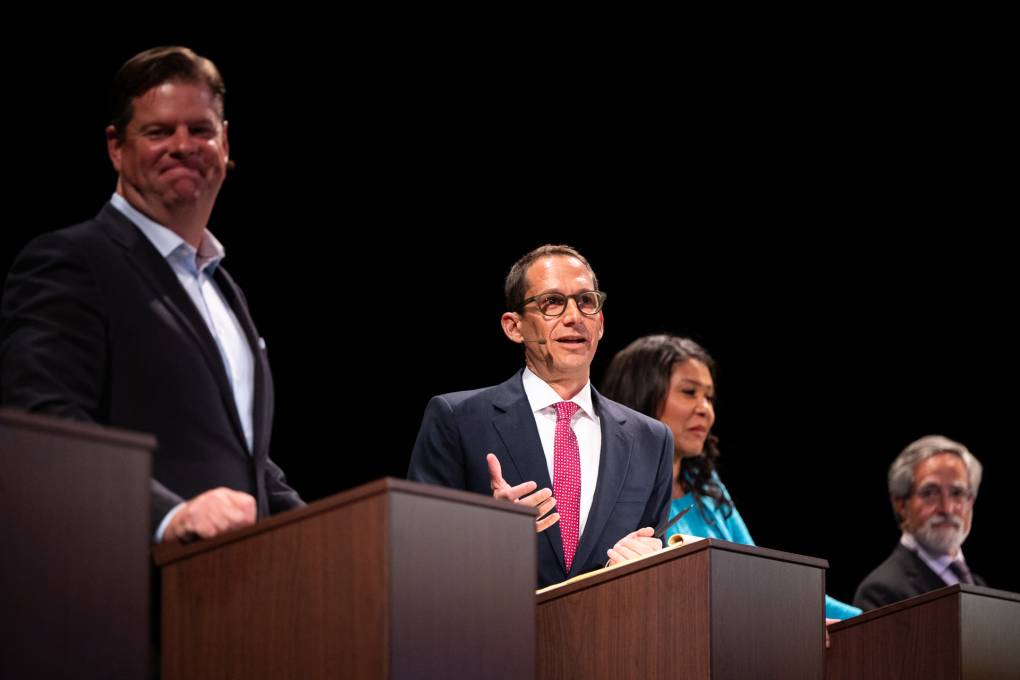
"caption": "Daniel Lurie speaks during a San Francisco mayoral debate with candidates Ahsha Safaí, former Mayor Mark Farrell, Mayor London Breed and Supervisor Aaron Peskin at the Sydney Goldstein Theater on June 12, 2024.",
"credit": "Beth LaBerge/KQED",
"altTag": null,
"description": null,
"imgSizes": {
"medium": {
"file": "https://cdn.kqed.org/wp-content/uploads/sites/10/2024/06/240612-SFMayoralDebate-90-BL-800x533.jpg",
"width": 800,
"height": 533,
"mimeType": "image/jpeg"
},
"large": {
"file": "https://cdn.kqed.org/wp-content/uploads/sites/10/2024/06/240612-SFMayoralDebate-90-BL-1020x680.jpg",
"width": 1020,
"height": 680,
"mimeType": "image/jpeg"
},
"thumbnail": {
"file": "https://cdn.kqed.org/wp-content/uploads/sites/10/2024/06/240612-SFMayoralDebate-90-BL-160x107.jpg",
"width": 160,
"height": 107,
"mimeType": "image/jpeg"
},
"1536x1536": {
"file": "https://cdn.kqed.org/wp-content/uploads/sites/10/2024/06/240612-SFMayoralDebate-90-BL-1536x1024.jpg",
"width": 1536,
"height": 1024,
"mimeType": "image/jpeg"
},
"post-thumbnail": {
"file": "https://cdn.kqed.org/wp-content/uploads/sites/10/2024/06/240612-SFMayoralDebate-90-BL-672x372.jpg",
"width": 672,
"height": 372,
"mimeType": "image/jpeg"
},
"twentyfourteen-full-width": {
"file": "https://cdn.kqed.org/wp-content/uploads/sites/10/2024/06/240612-SFMayoralDebate-90-BL-1038x576.jpg",
"width": 1038,
"height": 576,
"mimeType": "image/jpeg"
},
"kqedFullSize": {
"file": "https://cdn.kqed.org/wp-content/uploads/sites/10/2024/06/240612-SFMayoralDebate-90-BL.jpg",
"width": 1920,
"height": 1280
}
},
"isLoading": false,
"fetchFailed": false
},
"news_11990060": {
"type": "attachments",
"id": "news_11990060",
"meta": {
"index": "attachments_1716263798",
"site": "news",
"id": "11990060",
"found": true
},
"title": "GettyImages-1212814457_qut",
"publishDate": 1718232780,
"status": "inherit",
"parent": 11989977,
"modified": 1718235036,
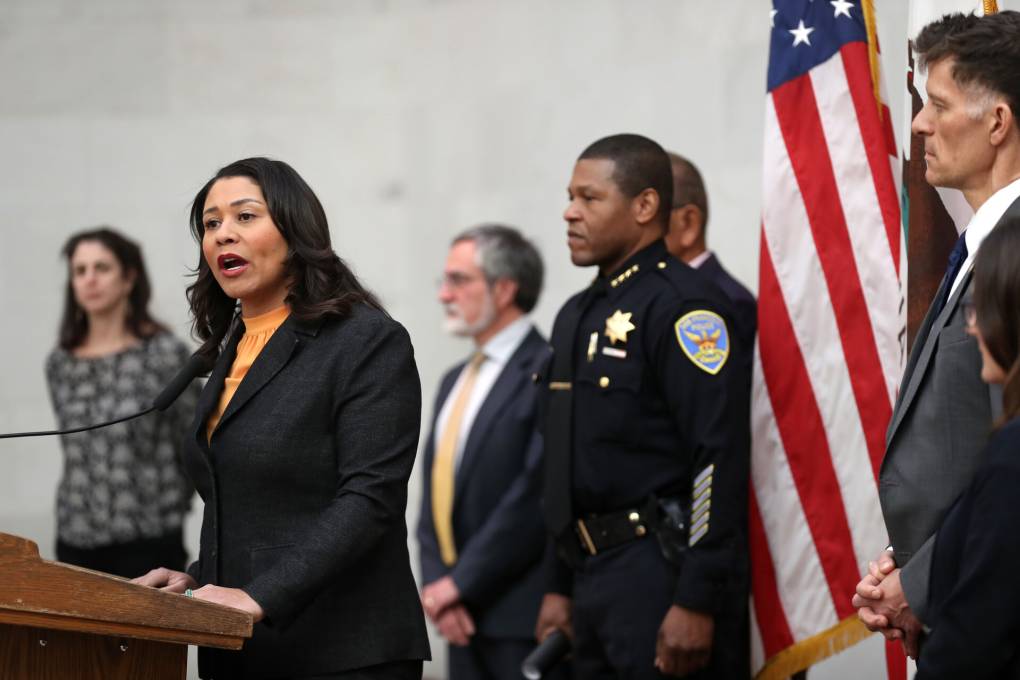
"caption": "San Francisco Mayor London Breed speaks as San Francisco Police Chief William Scott looks on during a press conference in San Francisco City Hall on March 16, 2020.",
"credit": "Justin Sullivan/Getty Images",
"altTag": null,
"description": null,
"imgSizes": {
"medium": {
"file": "https://cdn.kqed.org/wp-content/uploads/sites/10/2024/06/GettyImages-1212814457_qut-800x533.jpg",
"width": 800,
"height": 533,
"mimeType": "image/jpeg"
},
"large": {
"file": "https://cdn.kqed.org/wp-content/uploads/sites/10/2024/06/GettyImages-1212814457_qut-1020x680.jpg",
"width": 1020,
"height": 680,
"mimeType": "image/jpeg"
},
"thumbnail": {
"file": "https://cdn.kqed.org/wp-content/uploads/sites/10/2024/06/GettyImages-1212814457_qut-160x107.jpg",
"width": 160,
"height": 107,
"mimeType": "image/jpeg"
},
"1536x1536": {
"file": "https://cdn.kqed.org/wp-content/uploads/sites/10/2024/06/GettyImages-1212814457_qut-1536x1024.jpg",
"width": 1536,
"height": 1024,
"mimeType": "image/jpeg"
},
"post-thumbnail": {
"file": "https://cdn.kqed.org/wp-content/uploads/sites/10/2024/06/GettyImages-1212814457_qut-672x372.jpg",
"width": 672,
"height": 372,
"mimeType": "image/jpeg"
},
"twentyfourteen-full-width": {
"file": "https://cdn.kqed.org/wp-content/uploads/sites/10/2024/06/GettyImages-1212814457_qut-1038x576.jpg",
"width": 1038,
"height": 576,
"mimeType": "image/jpeg"
},
"kqedFullSize": {
"file": "https://cdn.kqed.org/wp-content/uploads/sites/10/2024/06/GettyImages-1212814457_qut.jpg",
"width": 1920,
"height": 1280
}
},
"isLoading": false,
"fetchFailed": false
},
"news_11989918": {
"type": "attachments",
"id": "news_11989918",
"meta": {
"index": "attachments_1716263798",
"site": "news",
"id": "11989918",
"found": true
},
"title": "0M6A0928_qut",
"publishDate": 1718213325,
"status": "inherit",
"parent": 11989910,
"modified": 1718213491,
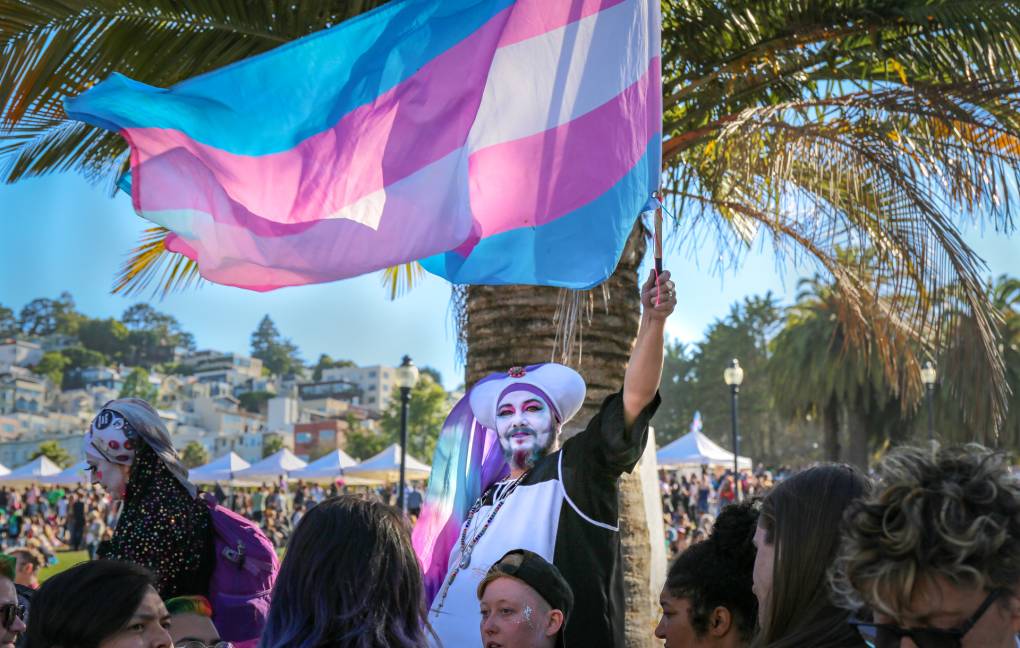
"caption": "A person waves the Transgender Pride flag at Dolores Park during San Francisco Pride's Trans March on June 28, 2019. ",
"credit": "Sruti Mamidanna/KQED",
"altTag": "A person waves a pink, blue and white transgender flag among a crowd of people in San Francisco.",
"description": null,
"imgSizes": {
"medium": {
"file": "https://cdn.kqed.org/wp-content/uploads/sites/10/2024/06/0M6A0928_qut-800x508.jpg",
"width": 800,
"height": 508,
"mimeType": "image/jpeg"
},
"large": {
"file": "https://cdn.kqed.org/wp-content/uploads/sites/10/2024/06/0M6A0928_qut-1020x648.jpg",
"width": 1020,
"height": 648,
"mimeType": "image/jpeg"
},
"thumbnail": {
"file": "https://cdn.kqed.org/wp-content/uploads/sites/10/2024/06/0M6A0928_qut-160x102.jpg",
"width": 160,
"height": 102,
"mimeType": "image/jpeg"
},
"1536x1536": {
"file": "https://cdn.kqed.org/wp-content/uploads/sites/10/2024/06/0M6A0928_qut-1536x976.jpg",
"width": 1536,
"height": 976,
"mimeType": "image/jpeg"
},
"post-thumbnail": {
"file": "https://cdn.kqed.org/wp-content/uploads/sites/10/2024/06/0M6A0928_qut-672x372.jpg",
"width": 672,
"height": 372,
"mimeType": "image/jpeg"
},
"twentyfourteen-full-width": {
"file": "https://cdn.kqed.org/wp-content/uploads/sites/10/2024/06/0M6A0928_qut-1038x576.jpg",
"width": 1038,
"height": 576,
"mimeType": "image/jpeg"
},
"kqedFullSize": {
"file": "https://cdn.kqed.org/wp-content/uploads/sites/10/2024/06/0M6A0928_qut.jpg",
"width": 1920,
"height": 1220
}
},
"isLoading": false,
"fetchFailed": false
},
"news_11989874": {
"type": "attachments",
"id": "news_11989874",
"meta": {
"index": "attachments_1716263798",
"site": "news",
"id": "11989874",
"found": true
},
"title": "240305-ElectionFileSF-129-BL_qut",
"publishDate": 1718148533,
"status": "inherit",
"parent": 11989776,
"modified": 1718153208,
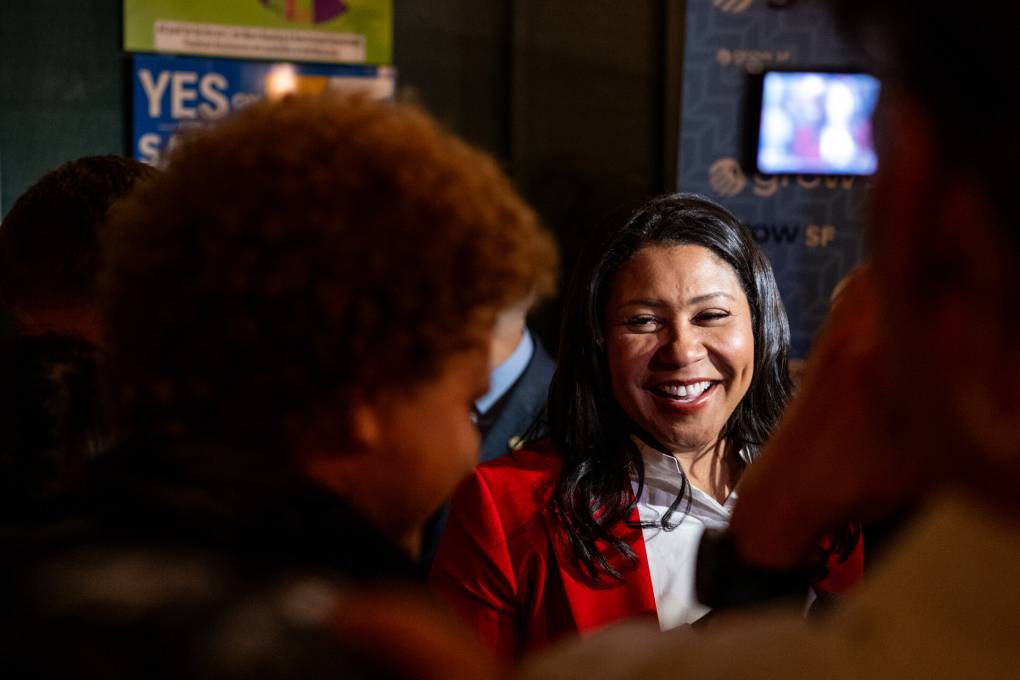
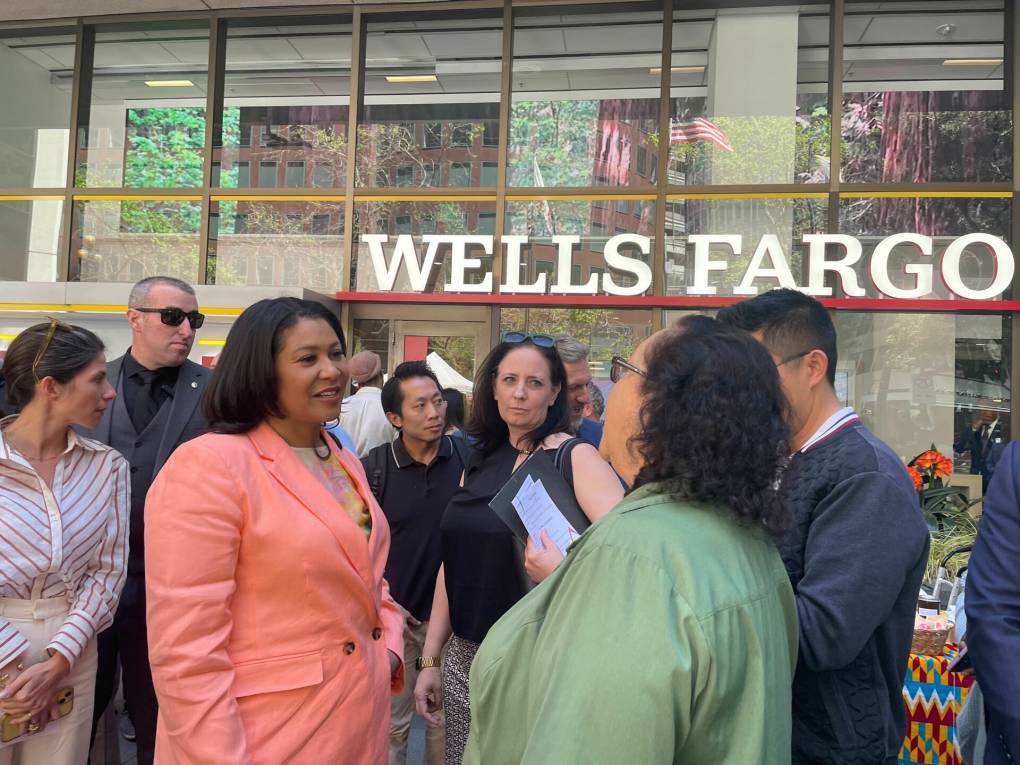
"caption": "San Francisco Mayor London Breed speaks with guests during an SF Dems for Change Super Tuesday election night party at Anina in San Francisco on March 5, 2024.",
"credit": "Beth LaBerge/KQED",
"altTag": null,
"description": null,
"imgSizes": {
"medium": {
"file": "https://cdn.kqed.org/wp-content/uploads/sites/10/2024/06/240305-ElectionFileSF-129-BL_qut-800x533.jpg",
"width": 800,
"height": 533,
"mimeType": "image/jpeg"
},
"large": {
"file": "https://cdn.kqed.org/wp-content/uploads/sites/10/2024/06/240305-ElectionFileSF-129-BL_qut-1020x680.jpg",
"width": 1020,
"height": 680,
"mimeType": "image/jpeg"
},
"thumbnail": {
"file": "https://cdn.kqed.org/wp-content/uploads/sites/10/2024/06/240305-ElectionFileSF-129-BL_qut-160x107.jpg",
"width": 160,
"height": 107,
"mimeType": "image/jpeg"
},
"1536x1536": {
"file": "https://cdn.kqed.org/wp-content/uploads/sites/10/2024/06/240305-ElectionFileSF-129-BL_qut-1536x1024.jpg",
"width": 1536,
"height": 1024,
"mimeType": "image/jpeg"
},
"post-thumbnail": {
"file": "https://cdn.kqed.org/wp-content/uploads/sites/10/2024/06/240305-ElectionFileSF-129-BL_qut-672x372.jpg",
"width": 672,
"height": 372,
"mimeType": "image/jpeg"
},
"twentyfourteen-full-width": {
"file": "https://cdn.kqed.org/wp-content/uploads/sites/10/2024/06/240305-ElectionFileSF-129-BL_qut-1038x576.jpg",
"width": 1038,
"height": 576,
"mimeType": "image/jpeg"
},
"kqedFullSize": {
"file": "https://cdn.kqed.org/wp-content/uploads/sites/10/2024/06/240305-ElectionFileSF-129-BL_qut.jpg",
"width": 1920,
"height": 1280
}
},
"isLoading": false,
"fetchFailed": false
},
"news_11989761": {
"type": "attachments",
"id": "news_11989761",
"meta": {
"index": "attachments_1716263798",
"site": "news",
"id": "11989761",
"found": true
},
"title": "05252023_bankobrownfuneral 538_qut",
"publishDate": 1718124072,
"status": "inherit",
"parent": 11989756,
"modified": 1718124213,
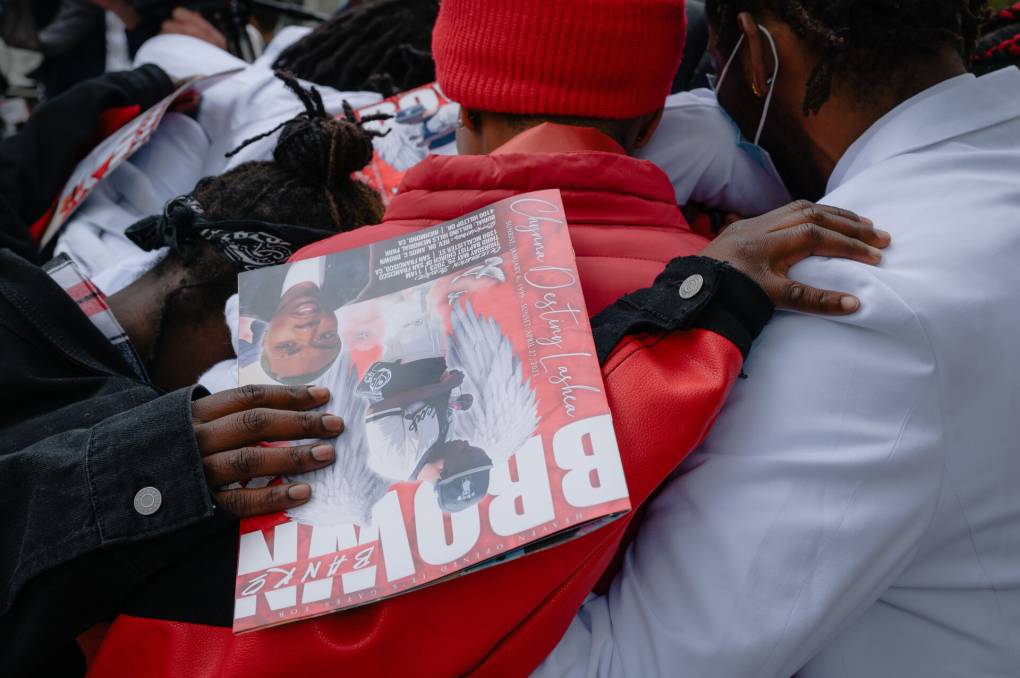
"caption": "Attendees of Banko Brown's funeral embrace outside the historic Third Baptist Church in San Francisco, California on May 25, 2023. In April 2023, a Walgreens security guard shot and killed Brown after Brown allegedly attempted to shoplift from the store’s Market Street location.",
"credit": "Kori Suzuki/KQED",
"altTag": "A group of people embrace each other at a funeral. One holds a pamphlet that says, \"Brown\" in big white letters.",
"description": null,
"imgSizes": {
"medium": {
"file": "https://cdn.kqed.org/wp-content/uploads/sites/10/2024/06/05252023_bankobrownfuneral-538_qut-800x532.jpg",
"width": 800,
"height": 532,
"mimeType": "image/jpeg"
},
"large": {
"file": "https://cdn.kqed.org/wp-content/uploads/sites/10/2024/06/05252023_bankobrownfuneral-538_qut-1020x678.jpg",
"width": 1020,
"height": 678,
"mimeType": "image/jpeg"
},
"thumbnail": {
"file": "https://cdn.kqed.org/wp-content/uploads/sites/10/2024/06/05252023_bankobrownfuneral-538_qut-160x106.jpg",
"width": 160,
"height": 106,
"mimeType": "image/jpeg"
},
"1536x1536": {
"file": "https://cdn.kqed.org/wp-content/uploads/sites/10/2024/06/05252023_bankobrownfuneral-538_qut-1536x1022.jpg",
"width": 1536,
"height": 1022,
"mimeType": "image/jpeg"
},
"post-thumbnail": {
"file": "https://cdn.kqed.org/wp-content/uploads/sites/10/2024/06/05252023_bankobrownfuneral-538_qut-672x372.jpg",
"width": 672,
"height": 372,
"mimeType": "image/jpeg"
},
"twentyfourteen-full-width": {
"file": "https://cdn.kqed.org/wp-content/uploads/sites/10/2024/06/05252023_bankobrownfuneral-538_qut-1038x576.jpg",
"width": 1038,
"height": 576,
"mimeType": "image/jpeg"
},
"kqedFullSize": {
"file": "https://cdn.kqed.org/wp-content/uploads/sites/10/2024/06/05252023_bankobrownfuneral-538_qut.jpg",
"width": 1920,
"height": 1277
}
},
"isLoading": false,
"fetchFailed": false
},
"news_11985361": {
"type": "attachments",
"id": "news_11985361",
"meta": {
"index": "attachments_1716263798",
"site": "news",
"id": "11985361",
"found": true
},
"parent": 11985359,
"imgSizes": {
"twentyfourteen-full-width": {
"file": "https://cdn.kqed.org/wp-content/uploads/sites/10/2024/05/Baths-1_qut-1038x576.jpg",
"width": 1038,
"mimeType": "image/jpeg",
"height": 576
},
"thumbnail": {
"file": "https://cdn.kqed.org/wp-content/uploads/sites/10/2024/05/Baths-1_qut-160x107.jpg",
"width": 160,
"mimeType": "image/jpeg",
"height": 107
},
"post-thumbnail": {
"file": "https://cdn.kqed.org/wp-content/uploads/sites/10/2024/05/Baths-1_qut-672x372.jpg",
"width": 672,
"mimeType": "image/jpeg",
"height": 372
},
"kqedFullSize": {
"file": "https://cdn.kqed.org/wp-content/uploads/sites/10/2024/05/Baths-1_qut.jpg",
"width": 1920,
"height": 1280
},
"large": {
"file": "https://cdn.kqed.org/wp-content/uploads/sites/10/2024/05/Baths-1_qut-1020x680.jpg",
"width": 1020,
"mimeType": "image/jpeg",
"height": 680
},
"1536x1536": {
"file": "https://cdn.kqed.org/wp-content/uploads/sites/10/2024/05/Baths-1_qut-1536x1024.jpg",
"width": 1536,
"mimeType": "image/jpeg",
"height": 1024
},
"medium": {
"file": "https://cdn.kqed.org/wp-content/uploads/sites/10/2024/05/Baths-1_qut-800x533.jpg",
"width": 800,
"mimeType": "image/jpeg",
"height": 533
}
},
"publishDate": 1715194985,
"modified": 1715204998,
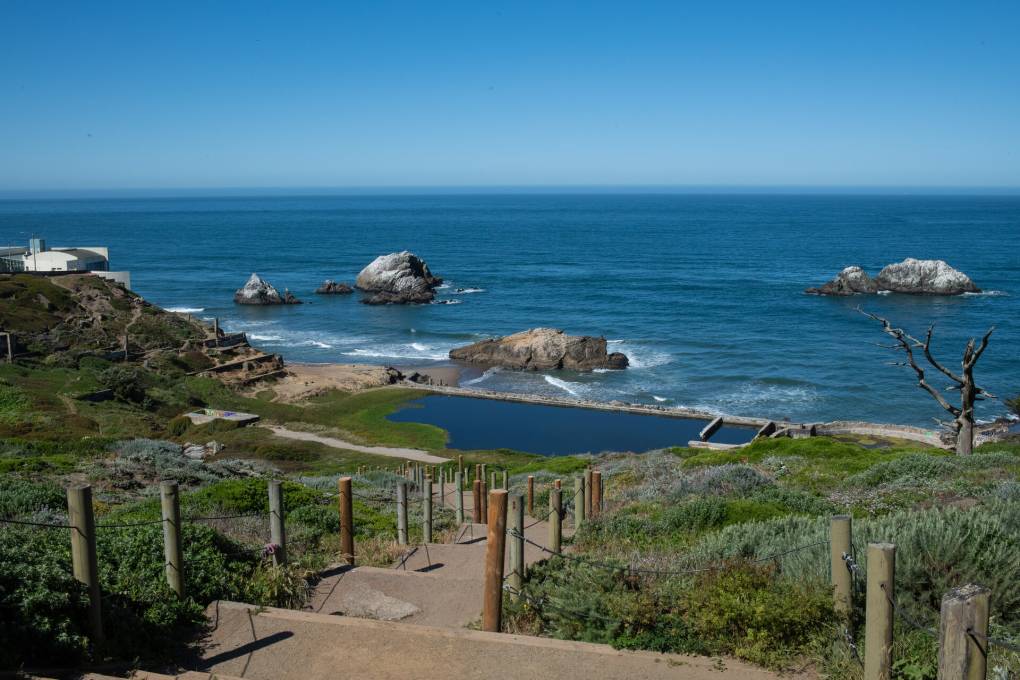
"caption": "Nature is reclaiming the ruins of the once grand Sutro Baths, although the site is still a popular tourist attraction and hiking spot.",
"description": null,
"title": "Baths-1_qut",
"credit": "Tamuna Chkareuli/KQED",
"status": "inherit",
"altTag": "Looking out to the ocean, a set of stairs descend the cliff leading to a wide rectangular pool at the bottom, next to the ocean.",
"isLoading": false,
"fetchFailed": false
},
"news_11989455": {
"type": "attachments",
"id": "news_11989455",
"meta": {
"index": "attachments_1716263798",
"site": "news",
"id": "11989455",
"found": true
},
"title": "DOG WALKER THREAT-KQED",
"publishDate": 1717789412,
"status": "inherit",
"parent": 0,
"modified": 1717798357,
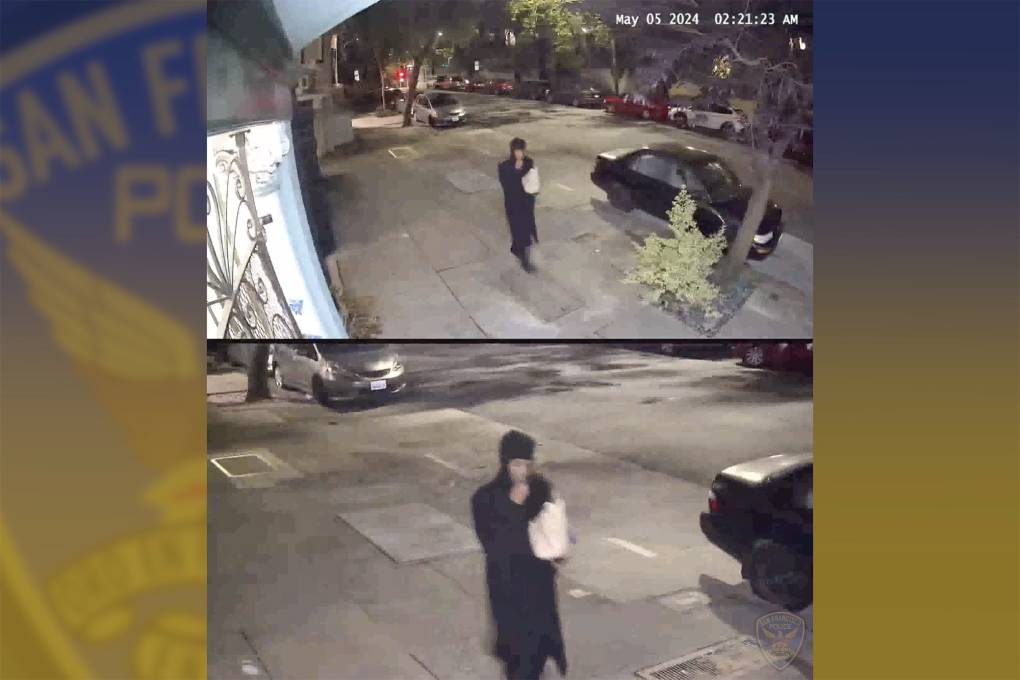
"caption": "A video from May 5, 2024, shows a person wearing a black hood, black coat and black pants walking down a sidewalk and carrying a paper bag. ",
"credit": "Courtesy San Francisco Police Department",
"altTag": "A screencap of a surveillance video.",
"description": null,
"imgSizes": {
"medium": {
"file": "https://cdn.kqed.org/wp-content/uploads/sites/10/2024/06/DOG-WALKER-THREAT-KQED-800x533.jpg",
"width": 800,
"height": 533,
"mimeType": "image/jpeg"
},
"large": {
"file": "https://cdn.kqed.org/wp-content/uploads/sites/10/2024/06/DOG-WALKER-THREAT-KQED-1020x680.jpg",
"width": 1020,
"height": 680,
"mimeType": "image/jpeg"
},
"thumbnail": {
"file": "https://cdn.kqed.org/wp-content/uploads/sites/10/2024/06/DOG-WALKER-THREAT-KQED-160x107.jpg",
"width": 160,
"height": 107,
"mimeType": "image/jpeg"
},
"1536x1536": {
"file": "https://cdn.kqed.org/wp-content/uploads/sites/10/2024/06/DOG-WALKER-THREAT-KQED-1536x1024.jpg",
"width": 1536,
"height": 1024,
"mimeType": "image/jpeg"
},
"post-thumbnail": {
"file": "https://cdn.kqed.org/wp-content/uploads/sites/10/2024/06/DOG-WALKER-THREAT-KQED-672x372.jpg",
"width": 672,
"height": 372,
"mimeType": "image/jpeg"
},
"twentyfourteen-full-width": {
"file": "https://cdn.kqed.org/wp-content/uploads/sites/10/2024/06/DOG-WALKER-THREAT-KQED-1038x576.jpg",
"width": 1038,
"height": 576,
"mimeType": "image/jpeg"
},
"full-width": {
"file": "https://cdn.kqed.org/wp-content/uploads/sites/10/2024/06/DOG-WALKER-THREAT-KQED-1920x1280.jpg",
"width": 1920,
"height": 1280,
"mimeType": "image/jpeg"
},
"kqedFullSize": {
"file": "https://cdn.kqed.org/wp-content/uploads/sites/10/2024/06/DOG-WALKER-THREAT-KQED.jpg",
"width": 2000,
"height": 1333
}
},
"isLoading": false,
"fetchFailed": false
},
"news_11989287": {
"type": "attachments",
"id": "news_11989287",
"meta": {
"index": "attachments_1716263798",
"site": "news",
"id": "11989287",
"found": true
},
"title": "IMG_9258_qut",
"publishDate": 1717703903,
"status": "inherit",
"parent": 0,
"modified": 1717704333,
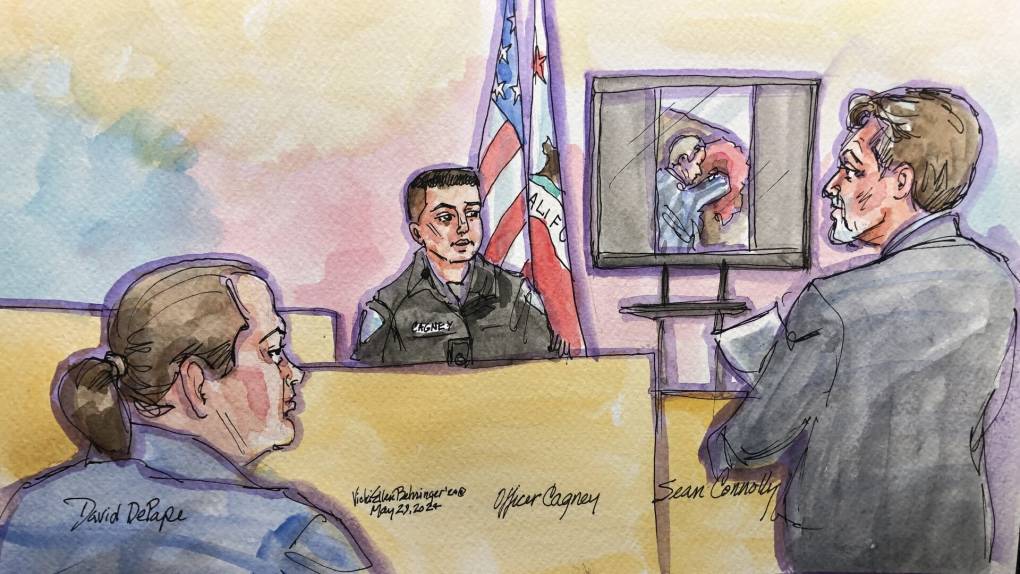
"caption": "David DePape (left) listens as Officer Cagney of the San Francisco Police Department testifies under questioning from Assistant District Attorney Sean Connolly during DePape's state trial in San Francisco Superior Court on May 29.",
"credit": "Vicki Behringer for KQED",
"altTag": "A watercolor courtroom sketch",
"description": null,
"imgSizes": {
"medium": {
"file": "https://cdn.kqed.org/wp-content/uploads/sites/10/2024/06/IMG_9258_qut-800x450.jpg",
"width": 800,
"height": 450,
"mimeType": "image/jpeg"
},
"large": {
"file": "https://cdn.kqed.org/wp-content/uploads/sites/10/2024/06/IMG_9258_qut-1020x574.jpg",
"width": 1020,
"height": 574,
"mimeType": "image/jpeg"
},
"thumbnail": {
"file": "https://cdn.kqed.org/wp-content/uploads/sites/10/2024/06/IMG_9258_qut-160x90.jpg",
"width": 160,
"height": 90,
"mimeType": "image/jpeg"
},
"1536x1536": {
"file": "https://cdn.kqed.org/wp-content/uploads/sites/10/2024/06/IMG_9258_qut-1536x864.jpg",
"width": 1536,
"height": 864,
"mimeType": "image/jpeg"
},
"post-thumbnail": {
"file": "https://cdn.kqed.org/wp-content/uploads/sites/10/2024/06/IMG_9258_qut-672x372.jpg",
"width": 672,
"height": 372,
"mimeType": "image/jpeg"
},
"twentyfourteen-full-width": {
"file": "https://cdn.kqed.org/wp-content/uploads/sites/10/2024/06/IMG_9258_qut-1038x576.jpg",
"width": 1038,
"height": 576,
"mimeType": "image/jpeg"
},
"kqedFullSize": {
"file": "https://cdn.kqed.org/wp-content/uploads/sites/10/2024/06/IMG_9258_qut.jpg",
"width": 1920,
"height": 1080
}
},
"isLoading": false,
"fetchFailed": false
},
"news_11988896": {
"type": "attachments",
"id": "news_11988896",
"meta": {
"index": "attachments_1716263798",
"site": "news",
"id": "11988896",
"found": true
},
"title": "20240601_SALVADORANVOTERS2-2_DUPE2-KQED",
"publishDate": 1717525205,
"status": "inherit",
"parent": 0,
"modified": 1717622817,
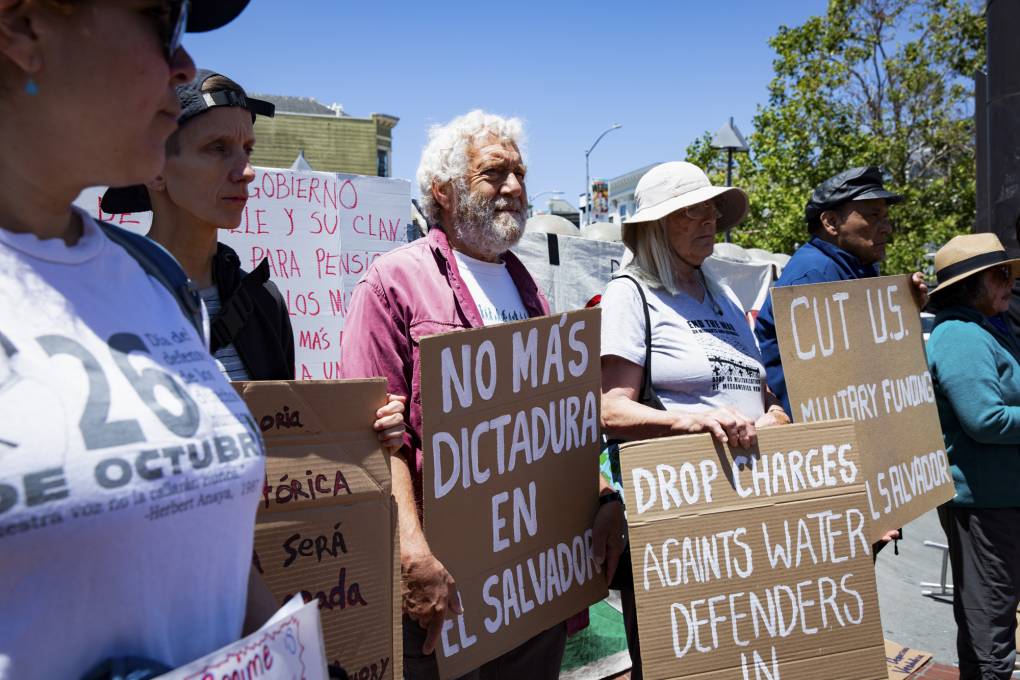
"caption": "Demonstrators rally against the reelection of Salvadoran President Nayib Bukele in San Francisco on his Inauguration Day on June 1, 2024.",
"credit": "Gina Castro/KQED",
"altTag": null,
"description": null,
"imgSizes": {
"medium": {
"file": "https://cdn.kqed.org/wp-content/uploads/sites/10/2024/06/20240601_SALVADORANVOTERS2-2_DUPE2-KQED-800x533.jpg",
"width": 800,
"height": 533,
"mimeType": "image/jpeg"
},
"large": {
"file": "https://cdn.kqed.org/wp-content/uploads/sites/10/2024/06/20240601_SALVADORANVOTERS2-2_DUPE2-KQED-1020x680.jpg",
"width": 1020,
"height": 680,
"mimeType": "image/jpeg"
},
"thumbnail": {
"file": "https://cdn.kqed.org/wp-content/uploads/sites/10/2024/06/20240601_SALVADORANVOTERS2-2_DUPE2-KQED-160x107.jpg",
"width": 160,
"height": 107,
"mimeType": "image/jpeg"
},
"1536x1536": {
"file": "https://cdn.kqed.org/wp-content/uploads/sites/10/2024/06/20240601_SALVADORANVOTERS2-2_DUPE2-KQED-1536x1024.jpg",
"width": 1536,
"height": 1024,
"mimeType": "image/jpeg"
},
"post-thumbnail": {
"file": "https://cdn.kqed.org/wp-content/uploads/sites/10/2024/06/20240601_SALVADORANVOTERS2-2_DUPE2-KQED-672x372.jpg",
"width": 672,
"height": 372,
"mimeType": "image/jpeg"
},
"twentyfourteen-full-width": {
"file": "https://cdn.kqed.org/wp-content/uploads/sites/10/2024/06/20240601_SALVADORANVOTERS2-2_DUPE2-KQED-1038x576.jpg",
"width": 1038,
"height": 576,
"mimeType": "image/jpeg"
},
"full-width": {
"file": "https://cdn.kqed.org/wp-content/uploads/sites/10/2024/06/20240601_SALVADORANVOTERS2-2_DUPE2-KQED-1920x1280.jpg",
"width": 1920,
"height": 1280,
"mimeType": "image/jpeg"
},
"kqedFullSize": {
"file": "https://cdn.kqed.org/wp-content/uploads/sites/10/2024/06/20240601_SALVADORANVOTERS2-2_DUPE2-KQED.jpg",
"width": 2000,
"height": 1333
}
},
"isLoading": false,
"fetchFailed": false
},
"news_11989186": {
"type": "attachments",
"id": "news_11989186",
"meta": {
"index": "attachments_1716263798",
"site": "news",
"id": "11989186",
"found": true
},
"title": "city hall racist graffiti",
"publishDate": 1717626856,
"status": "inherit",
"parent": 11989185,
"modified": 1717626980,
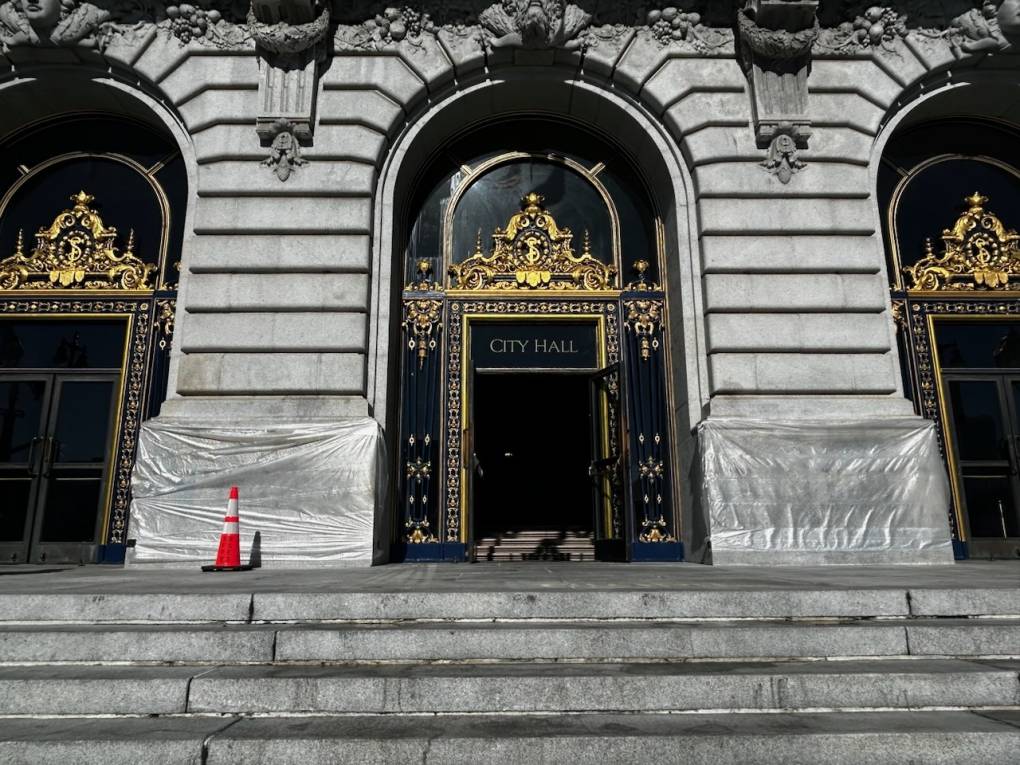
"caption": "Racist, sexist slurs that were spray-painted at the base of the arches at San Francisco City Hall's front doors are covered with tarps on June 5, 2024.",
"credit": "Courtesy of San Francisco mayor's office",
"altTag": null,
"description": null,
"imgSizes": {
"medium": {
"file": "https://cdn.kqed.org/wp-content/uploads/sites/10/2024/06/city-hall-racist-graffiti-800x600.jpg",
"width": 800,
"height": 600,
"mimeType": "image/jpeg"
},
"large": {
"file": "https://cdn.kqed.org/wp-content/uploads/sites/10/2024/06/city-hall-racist-graffiti-1020x765.jpg",
"width": 1020,
"height": 765,
"mimeType": "image/jpeg"
},
"thumbnail": {
"file": "https://cdn.kqed.org/wp-content/uploads/sites/10/2024/06/city-hall-racist-graffiti-160x120.jpg",
"width": 160,
"height": 120,
"mimeType": "image/jpeg"
},
"post-thumbnail": {
"file": "https://cdn.kqed.org/wp-content/uploads/sites/10/2024/06/city-hall-racist-graffiti-672x372.jpg",
"width": 672,
"height": 372,
"mimeType": "image/jpeg"
},
"twentyfourteen-full-width": {
"file": "https://cdn.kqed.org/wp-content/uploads/sites/10/2024/06/city-hall-racist-graffiti-1038x576.jpg",
"width": 1038,
"height": 576,
"mimeType": "image/jpeg"
},
"kqedFullSize": {
"file": "https://cdn.kqed.org/wp-content/uploads/sites/10/2024/06/city-hall-racist-graffiti.jpg",
"width": 1280,
"height": 960
}
},
"isLoading": false,
"fetchFailed": false
},
"news_11952545": {
"type": "attachments",
"id": "news_11952545",
"meta": {
"index": "attachments_1716263798",
"site": "news",
"id": "11952545",
"found": true
},
"title": "RS66141_016_KQED_SheriffPressConference_06082023-KQED",
"publishDate": 1686251655,
"status": "inherit",
"parent": 0,
"modified": 1717610445,
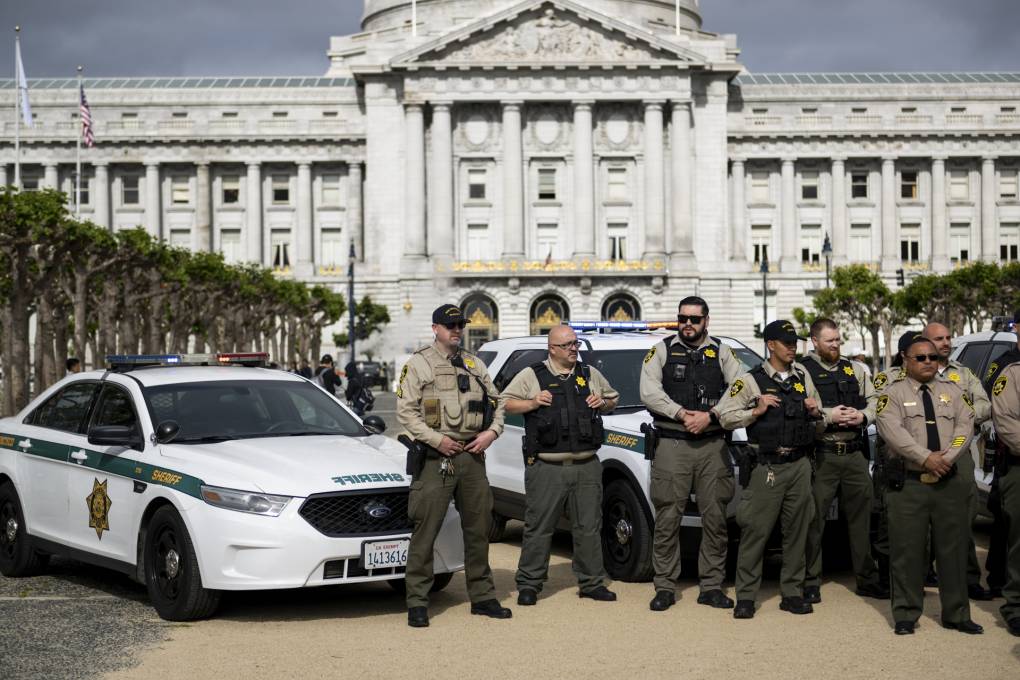
"caption": "San Francisco sheriff's deputies listen to a news conference in San Francisco's Civic Center on June 8, 2023, where Sheriff Paul Miyamoto (not pictured) announced the activation of a six-month plan focused on areas of the Tenderloin and SoMa neighborhoods to reduce open-air drug dealing and drug use.",
"credit": "Beth LaBerge/KQED",
"altTag": "A group of half a dozen law enforcement officers stand in front of squad cars parked in an open area in front of an ornate columned building.",
"description": null,
"imgSizes": {
"medium": {
"file": "https://cdn.kqed.org/wp-content/uploads/sites/10/2023/06/RS66141_016_KQED_SheriffPressConference_06082023-KQED-800x533.jpg",
"width": 800,
"height": 533,
"mimeType": "image/jpeg"
},
"large": {
"file": "https://cdn.kqed.org/wp-content/uploads/sites/10/2023/06/RS66141_016_KQED_SheriffPressConference_06082023-KQED-1020x680.jpg",
"width": 1020,
"height": 680,
"mimeType": "image/jpeg"
},
"thumbnail": {
"file": "https://cdn.kqed.org/wp-content/uploads/sites/10/2023/06/RS66141_016_KQED_SheriffPressConference_06082023-KQED-160x107.jpg",
"width": 160,
"height": 107,
"mimeType": "image/jpeg"
},
"1536x1536": {
"file": "https://cdn.kqed.org/wp-content/uploads/sites/10/2023/06/RS66141_016_KQED_SheriffPressConference_06082023-KQED-1536x1024.jpg",
"width": 1536,
"height": 1024,
"mimeType": "image/jpeg"
},
"post-thumbnail": {
"file": "https://cdn.kqed.org/wp-content/uploads/sites/10/2023/06/RS66141_016_KQED_SheriffPressConference_06082023-KQED-672x372.jpg",
"width": 672,
"height": 372,
"mimeType": "image/jpeg"
},
"twentyfourteen-full-width": {
"file": "https://cdn.kqed.org/wp-content/uploads/sites/10/2023/06/RS66141_016_KQED_SheriffPressConference_06082023-KQED-1038x576.jpg",
"width": 1038,
"height": 576,
"mimeType": "image/jpeg"
},
"kqedFullSize": {
"file": "https://cdn.kqed.org/wp-content/uploads/sites/10/2023/06/RS66141_016_KQED_SheriffPressConference_06082023-KQED.jpg",
"width": 1920,
"height": 1280
}
},
"isLoading": false,
"fetchFailed": false
},
"news_11985696": {
"type": "attachments",
"id": "news_11985696",
"meta": {
"index": "attachments_1716263798",
"site": "news",
"id": "11985696",
"found": true
},
"parent": 11985684,
"imgSizes": {
"twentyfourteen-full-width": {
"file": "https://cdn.kqed.org/wp-content/uploads/sites/10/2024/05/IMG_6257_qut-1038x576.jpg",
"width": 1038,
"mimeType": "image/jpeg",
"height": 576
},
"thumbnail": {
"file": "https://cdn.kqed.org/wp-content/uploads/sites/10/2024/05/IMG_6257_qut-160x120.jpg",
"width": 160,
"mimeType": "image/jpeg",
"height": 120
},
"post-thumbnail": {
"file": "https://cdn.kqed.org/wp-content/uploads/sites/10/2024/05/IMG_6257_qut-672x372.jpg",
"width": 672,
"mimeType": "image/jpeg",
"height": 372
},
"kqedFullSize": {
"file": "https://cdn.kqed.org/wp-content/uploads/sites/10/2024/05/IMG_6257_qut.jpg",
"width": 1920,
"height": 1440
},
"large": {
"file": "https://cdn.kqed.org/wp-content/uploads/sites/10/2024/05/IMG_6257_qut-1020x765.jpg",
"width": 1020,
"mimeType": "image/jpeg",
"height": 765
},
"1536x1536": {
"file": "https://cdn.kqed.org/wp-content/uploads/sites/10/2024/05/IMG_6257_qut-1536x1152.jpg",
"width": 1536,
"mimeType": "image/jpeg",
"height": 1152
},
"medium": {
"file": "https://cdn.kqed.org/wp-content/uploads/sites/10/2024/05/IMG_6257_qut-800x600.jpg",
"width": 800,
"mimeType": "image/jpeg",
"height": 600
}
},
"publishDate": 1715364778,
"modified": 1715364818,
"caption": "San Francisco Mayor London Breed announced Thursday, May 9, 2024, that she plans to include more money for the Vacant to Vibrant economic revitalization program in the upcoming city budget.",
"description": null,
"title": "IMG_6257_qut",
"credit": "Nik Altenberg/KQED",
"status": "inherit",
"altTag": null,
"isLoading": false,
"fetchFailed": false
}
},
"audioPlayerReducer": {
"postId": "stream_live",
"isPaused": true,
"isPlaying": false,
"pfsActive": false,
"pledgeModalIsOpen": true,
"playerDrawerIsOpen": false,
"liveAudioPlayStartedAt": 0,
"liveAudioPlayContext": ""
},
"authorsReducer": {
"byline_news_11989118": {
"type": "authors",
"id": "byline_news_11989118",
"meta": {
"override": true
},
"slug": "byline_news_11989118",
"name": "\u003ca href=\"https://twitter.com/latinidan\">Daniel Eduardo Hernández\u003c/a>",
"isLoading": false
},
"kqed": {
"type": "authors",
"id": "236",
"meta": {
"index": "authors_1716337520",
"id": "236",
"found": true
},
"name": "KQED News Staff",
"firstName": "KQED News Staff",
"lastName": null,
"slug": "kqed",
"email": "faq@kqed.org",
"display_author_email": false,
"staff_mastheads": [],
"title": null,
"bio": null,
"avatar": "https://secure.gravatar.com/avatar/ef0e801a68c4c54afa9180db14084167?s=600&d=blank&r=g",
"twitter": null,
"facebook": null,
"instagram": null,
"linkedin": null,
"sites": [
{
"site": "arts",
"roles": [
"contributor"
]
},
{
"site": "news",
"roles": [
"editor"
]
},
{
"site": "futureofyou",
"roles": [
"author"
]
}
],
"headData": {
"title": "KQED News Staff | KQED",
"description": null,
"ogImgSrc": "https://secure.gravatar.com/avatar/ef0e801a68c4c54afa9180db14084167?s=600&d=blank&r=g",
"twImgSrc": "https://secure.gravatar.com/avatar/ef0e801a68c4c54afa9180db14084167?s=600&d=blank&r=g"
},
"isLoading": false,
"link": "/author/kqed"
},
"ecruzguevarra": {
"type": "authors",
"id": "8654",
"meta": {
"index": "authors_1716337520",
"id": "8654",
"found": true
},
"name": "Ericka Cruz Guevarra",
"firstName": "Ericka",
"lastName": "Cruz Guevarra",
"slug": "ecruzguevarra",
"email": "ecruzguevarra@kqed.org",
"display_author_email": true,
"staff_mastheads": [
"news"
],
"title": "Producer, The Bay Podcast",
"bio": "Ericka Cruz Guevarra is host of \u003ca href=\"https://www.kqed.org/podcasts/thebay\">\u003cem>The Bay\u003c/em>\u003c/a> podcast at KQED. Before host, she was the show’s producer. Her work in that capacity includes a three-part reported series on policing in Vallejo, which won a 2020 excellence in journalism award from the Society of Professional Journalists. Ericka has worked as a breaking news reporter at Oregon Public Broadcasting, helped produce the Code Switch podcast, and was KQED’s inaugural Raul Ramirez Diversity Fund intern. She’s also an alumna of NPR’s Next Generation Radio program. Send her an email if you have strong feelings about whether Fairfield and Suisun City are the Bay. Ericka is represented by SAG-AFTRA.",
"avatar": "https://secure.gravatar.com/avatar/accefc1de4bafc7e234b69bcb9b6f6536c130fd84709bc3069ef11a78787e1bb?s=600&d=blank&r=g",
"twitter": "NotoriousECG",
"bluesky": null,
"facebook": null,
"instagram": null,
"linkedin": null,
"sites": [
{
"site": "arts",
"roles": [
"subscriber"
]
},
{
"site": "news",
"roles": [
"editor",
"manage_categories"
]
},
{
"site": "futureofyou",
"roles": [
"subscriber"
]
},
{
"site": "stateofhealth",
"roles": [
"subscriber"
]
},
{
"site": "science",
"roles": [
"editor"
]
},
{
"site": "forum",
"roles": [
"subscriber"
]
}
],
"headData": {
"title": "Ericka Cruz Guevarra | KQED",
"description": "Producer, The Bay Podcast",
"ogImgSrc": "https://secure.gravatar.com/avatar/accefc1de4bafc7e234b69bcb9b6f6536c130fd84709bc3069ef11a78787e1bb?s=600&d=blank&r=g",
"twImgSrc": "https://secure.gravatar.com/avatar/accefc1de4bafc7e234b69bcb9b6f6536c130fd84709bc3069ef11a78787e1bb?s=600&d=blank&r=g"
},
"isLoading": false,
"link": "/author/ecruzguevarra"
},
"ahall": {
"type": "authors",
"id": "11490",
"meta": {
"index": "authors_1716337520",
"id": "11490",
"found": true
},
"name": "Alex Hall",
"firstName": "Alex",
"lastName": "Hall",
"slug": "ahall",
"email": "ahall@kqed.org",
"display_author_email": false,
"staff_mastheads": [
"news"
],
"title": "KQED Enterprise & Accountability Reporter",
"bio": "Alex Hall is KQED's Enterprise and Accountability Reporter. She previously covered the Central Valley for five years from KQED's bureau in Fresno. Before joining KQED, Alex was an investigative reporting fellow at Wisconsin Public Radio and the Wisconsin Center for Investigative Journalism. She has also worked as a bilingual producer for NPR's investigative unit and freelance video producer for Reuters TV on the Latin America desk. She got her start in journalism in South America, where she worked as a radio producer and Spanish-English translator for CNN Chile. Her documentary and investigation into the series of deadly COVID-19 outbreaks at Foster Farms won a national Edward R. Murrow award and was named an Investigative Reporters & Editors award finalist. Alex's reporting for Reveal on the Wisconsin dairy industry's reliance on undocumented immigrant labor was made into a film, Los Lecheros, which won a regional Edward R. Murrow award for best news documentary.",
"avatar": "https://secure.gravatar.com/avatar/defcbeb88b0bf591ff9af41f22644051?s=600&d=blank&r=g",
"twitter": "@chalexhall",
"facebook": null,
"instagram": null,
"linkedin": null,
"sites": [
{
"site": "news",
"roles": [
"editor"
]
},
{
"site": "liveblog",
"roles": [
"author"
]
}
],
"headData": {
"title": "Alex Hall | KQED",
"description": "KQED Enterprise & Accountability Reporter",
"ogImgSrc": "https://secure.gravatar.com/avatar/defcbeb88b0bf591ff9af41f22644051?s=600&d=blank&r=g",
"twImgSrc": "https://secure.gravatar.com/avatar/defcbeb88b0bf591ff9af41f22644051?s=600&d=blank&r=g"
},
"isLoading": false,
"link": "/author/ahall"
},
"jrodriguez": {
"type": "authors",
"id": "11690",
"meta": {
"index": "authors_1716337520",
"id": "11690",
"found": true
},
"name": "Joe Fitzgerald Rodriguez",
"firstName": "Joe",
"lastName": "Fitzgerald Rodriguez",
"slug": "jrodriguez",
"email": "jrodriguez@kqed.org",
"display_author_email": true,
"staff_mastheads": [
"news"
],
"title": "Reporter and Producer",
"bio": "Joe Fitzgerald Rodriguez is a reporter and digital producer for KQED covering politics. Joe most recently wrote for the \u003cem>San Francisco Examiner\u003c/em> as a political columnist covering The City. He was raised in San Francisco and has spent his reporting career in his beloved, foggy, city by the bay. Joe was 12-years-old when he conducted his first interview in journalism, grilling former San Francisco Mayor Willie Brown for the Marina Middle School newspaper, \u003cem>The Penguin Press, \u003c/em>and he continues to report on the San Francisco Bay Area to this day.",
"avatar": "https://secure.gravatar.com/avatar/2247beb0564c1e9c62228d5649d2edac?s=600&d=blank&r=g",
"twitter": "FitztheReporter",
"facebook": null,
"instagram": "https://www.instagram.com/fitzthereporter/",
"linkedin": null,
"sites": [
{
"site": "",
"roles": [
"editor"
]
},
{
"site": "arts",
"roles": [
"editor"
]
},
{
"site": "news",
"roles": [
"editor"
]
},
{
"site": "science",
"roles": [
"editor"
]
},
{
"site": "elections",
"roles": [
"editor"
]
},
{
"site": "liveblog",
"roles": [
"editor"
]
}
],
"headData": {
"title": "Joe Fitzgerald Rodriguez | KQED",
"description": "Reporter and Producer",
"ogImgSrc": "https://secure.gravatar.com/avatar/2247beb0564c1e9c62228d5649d2edac?s=600&d=blank&r=g",
"twImgSrc": "https://secure.gravatar.com/avatar/2247beb0564c1e9c62228d5649d2edac?s=600&d=blank&r=g"
},
"isLoading": false,
"link": "/author/jrodriguez"
},
"naltenberg": {
"type": "authors",
"id": "11896",
"meta": {
"index": "authors_1716337520",
"id": "11896",
"found": true
},
"name": "Nik Altenberg",
"firstName": "Nik",
"lastName": "Altenberg",
"slug": "naltenberg",
"email": "naltenberg@kqed.org",
"display_author_email": false,
"staff_mastheads": [],
"title": "KQED Contributor",
"bio": "Nik Altenberg is an on-call reporter for KQED and a copy editor and fact checker for Santa Cruz Local. Nik’s reporting interests include policing, public health, environment, immigration, housing and the places where these issues intersect.",
"avatar": "https://secure.gravatar.com/avatar/e391b3a18ce4a53a7ca3f3065c74418b?s=600&d=blank&r=g",
"twitter": null,
"facebook": null,
"instagram": "https://www.instagram.com/nikaltenberg/",
"linkedin": null,
"sites": [
{
"site": "news",
"roles": []
}
],
"headData": {
"title": "Nik Altenberg | KQED",
"description": "KQED Contributor",
"ogImgSrc": "https://secure.gravatar.com/avatar/e391b3a18ce4a53a7ca3f3065c74418b?s=600&d=blank&r=g",
"twImgSrc": "https://secure.gravatar.com/avatar/e391b3a18ce4a53a7ca3f3065c74418b?s=600&d=blank&r=g"
},
"isLoading": false,
"link": "/author/naltenberg"
},
"jservantez": {
"type": "authors",
"id": "11909",
"meta": {
"index": "authors_1716337520",
"id": "11909",
"found": true
},
"name": "Jared Servantez",
"firstName": "Jared",
"lastName": "Servantez",
"slug": "jservantez",
"email": "jservantez@kqed.org",
"display_author_email": true,
"staff_mastheads": [
"news"
],
"title": "KQED Contributor",
"bio": "Jared Servantez is the editor of KQED's Express Desk, leading the newsroom's online breaking news operation. He most recently worked for the Los Angeles Times, where he served as a breaking news editor, the Metro Desk's night editor, and a copy editor. Jared is a graduate of the USC Annenberg School for Communication and Journalism.",
"avatar": "https://secure.gravatar.com/avatar/f0e317c67bb498c3f077f033d1cc79e62f3bc1303fa20a14e8880d31fbe7e01e?s=600&d=blank&r=g",
"twitter": "jservantez",
"bluesky": null,
"facebook": null,
"instagram": null,
"linkedin": null,
"sites": [
{
"site": "news",
"roles": [
"editor"
]
},
{
"site": "science",
"roles": [
"editor",
"author"
]
},
{
"site": "liveblog",
"roles": [
"editor"
]
}
],
"headData": {
"title": "Jared Servantez | KQED",
"description": "KQED Contributor",
"ogImgSrc": "https://secure.gravatar.com/avatar/f0e317c67bb498c3f077f033d1cc79e62f3bc1303fa20a14e8880d31fbe7e01e?s=600&d=blank&r=g",
"twImgSrc": "https://secure.gravatar.com/avatar/f0e317c67bb498c3f077f033d1cc79e62f3bc1303fa20a14e8880d31fbe7e01e?s=600&d=blank&r=g"
},
"isLoading": false,
"link": "/author/jservantez"
},
"kdebenedetti": {
"type": "authors",
"id": "11913",
"meta": {
"index": "authors_1716337520",
"id": "11913",
"found": true
},
"name": "Katie DeBenedetti",
"firstName": "Katie",
"lastName": "DeBenedetti",
"slug": "kdebenedetti",
"email": "kdebenedetti@kqed.org",
"display_author_email": false,
"staff_mastheads": [
"news",
"science"
],
"title": "KQED Contributor",
"bio": "Katie DeBenedetti is a digital reporter covering daily news for the Express Desk. Prior to joining KQED as a culture reporting intern in January 2024, she covered education and city government for the Napa Valley Register.",
"avatar": "https://secure.gravatar.com/avatar/6e31073cb8f7e4214ab03f42771d0f45?s=600&d=blank&r=g",
"twitter": null,
"facebook": null,
"instagram": null,
"linkedin": null,
"sites": [
{
"site": "news",
"roles": [
"author"
]
},
{
"site": "science",
"roles": [
"author"
]
},
{
"site": "liveblog",
"roles": [
"author"
]
}
],
"headData": {
"title": "Katie DeBenedetti | KQED",
"description": "KQED Contributor",
"ogImgSrc": "https://secure.gravatar.com/avatar/6e31073cb8f7e4214ab03f42771d0f45?s=600&d=blank&r=g",
"twImgSrc": "https://secure.gravatar.com/avatar/6e31073cb8f7e4214ab03f42771d0f45?s=600&d=blank&r=g"
},
"isLoading": false,
"link": "/author/kdebenedetti"
}
},
"pagesReducer": {
"news_tag_san-francisco": {
"type": "terms",
"id": "news_38",
"meta": {
"index": "terms_1716263798",
"site": "news",
"id": "38",
"score": 6.7230244
},
"featImg": null,
"name": "San Francisco",
"description": null,
"taxonomy": "tag",
"headData": {
"twImgId": null,
"twTitle": null,
"ogTitle": null,
"ogImgId": null,
"twDescription": null,
"description": null,
"title": "San Francisco Archives | KQED News",
"ogDescription": null
},
"ttid": 58,
"slug": "san-francisco",
"isLoading": false,
"title": "San Francisco",
"pageMeta": {
"site": "news",
"WpPageTemplate": "page-topic-editorial",
"currentPage": 102
},
"blocks": [
{
"blockName": "kqed/post-list",
"attrs": {
"layout": "cardArticle2",
"query": "posts/news?tag=san-francisco",
"seeMore": false,
"paginated": true,
"page": 102
}
},
{
"blockName": "kqed/ad"
}
]
}
},
"pfsSessionReducer": {},
"postsReducer": {
"stream_live": {
"type": "live",
"id": "stream_live",
"audioUrl": "https://streams.kqed.org/kqedradio",
"title": "Live Stream",
"excerpt": "Live Stream information currently unavailable.",
"link": "/radio",
"featImg": "",
"label": {
"name": "KQED Live",
"link": "/"
}
},
"stream_kqedNewscast": {
"type": "posts",
"id": "stream_kqedNewscast",
"audioUrl": "https://www.kqed.org/.stream/anon/radio/RDnews/newscast.mp3?_=1",
"title": "KQED Newscast",
"featImg": "",
"label": {
"name": "88.5 FM",
"link": "/"
}
},
"news_11990177": {
"type": "posts",
"id": "news_11990177",
"meta": {
"index": "posts_1716263798",
"site": "news",
"id": "11990177",
"score": null,
"sort": [
1718300669000
]
},
"guestAuthors": [],
"slug": "5-takeaways-from-the-1st-san-francisco-mayoral-candidate-debate",
"title": "5 Takeaways from the 1st San Francisco Mayoral Candidate Debate",
"publishDate": 1718300669,
"format": "standard",
"headTitle": "5 Takeaways from the 1st San Francisco Mayoral Candidate Debate | KQED",
"labelTerm": {
"site": "news"
},
"content": "\u003cp>San Francisco’s first mayoral debate was — well, \u003ca href=\"https://www.kqed.org/news/11990106/sf-mayor-candidates-speak-to-their-bases-and-no-one-else-at-1st-debate\">it certainly happened\u003c/a>.\u003c/p>\n\u003cp>I took in Wednesday night’s political scuffle alongside a pack of journalists sitting in the nosebleed section of the Sydney Goldstein Theater. By the end, I had the distinct impression of not being distinctly impressed.\u003c/p>\n\u003cp>Mayor London Breed, former Mayor Mark Farrell, Levi Strauss heir Daniel Lurie and Supervisors Aaron Peskin and Ahsha Safaí all argued their visions for San Francisco’s future. \u003ca href=\"https://www.kqed.org/news/11989776/san-franciscos-first-mayoral-debate-is-here-the-stakes-are-high\">They sang the songs we’d heard before\u003c/a>.\u003c/p>\n\u003cp>Still, some new twists emerged. Here are a few from this reporter’s notebook.\u003c/p>\n\u003cp>[ad fullwidth]\u003c/p>\n\u003ch2>Farrell continues to push Breed’s messaging rightward\u003c/h2>\n\u003cp>Farrell is a Democrat who isn’t afraid to push San Francisco in a conservative direction, like bringing armed National Guard troops to patrol the Tenderloin to stem the fentanyl crisis.\u003c/p>\n\u003cfigure id=\"attachment_11990166\" class=\"wp-caption aligncenter\" style=\"max-width: 1920px\">\u003cimg loading=\"lazy\" decoding=\"async\" class=\"wp-image-11990166 size-full\" src=\"https://cdn.kqed.org/wp-content/uploads/sites/10/2024/06/240612-SFMayoralDebate-73-BL.jpg\" alt=\"\" width=\"1920\" height=\"1280\" srcset=\"https://cdn.kqed.org/wp-content/uploads/sites/10/2024/06/240612-SFMayoralDebate-73-BL.jpg 1920w, https://cdn.kqed.org/wp-content/uploads/sites/10/2024/06/240612-SFMayoralDebate-73-BL-800x533.jpg 800w, https://cdn.kqed.org/wp-content/uploads/sites/10/2024/06/240612-SFMayoralDebate-73-BL-1020x680.jpg 1020w, https://cdn.kqed.org/wp-content/uploads/sites/10/2024/06/240612-SFMayoralDebate-73-BL-160x107.jpg 160w, https://cdn.kqed.org/wp-content/uploads/sites/10/2024/06/240612-SFMayoralDebate-73-BL-1536x1024.jpg 1536w\" sizes=\"(max-width: 1920px) 100vw, 1920px\">\u003cfigcaption class=\"wp-caption-text\">Former Mayor Mark Farrell speaks during a San Francisco mayoral debate at the Sydney Goldstein Theater. Farrell, a Democrat, isn’t afraid to push San Francisco in a conservative direction and called harm reduction a failure on stage. \u003ccite>(Beth LaBerge/KQED)\u003c/cite>\u003c/figcaption>\u003c/figure>\n\u003cp>Farrell called harm reduction a failure on stage. Harm reduction is an approach offering services to drug users even when they continue their habit. Farrell favors abstinence-only treatment. Harm reduction is considered a health-centric approach and is \u003ca href=\"https://www.whitehouse.gov/ondcp/the-administrations-strategy/the-biden-harris-administrations-first-year-drug-policy-priorities/?utm_medium=Email&utm_source=ExactTarget&utm_campaign=20240327_Political%20Breakdown&mc_key=11576065\">part of President Joe Biden’s drug policy\u003c/a>.\u003c/p>\n\u003cp>Breed took the bait.\u003c/p>\n\u003cp>“We are not just using harm reduction to help people with treatment,” she said. “We are using abstinence-based treatment, which was never a part of our public health response.”\u003c/p>\n\u003ch2>Peskin took a risk, leaning into progressive messaging\u003c/h2>\n\u003cp>Peskin wobbly walked a tightrope, offering solutions for the fentanyl and housing crises that may appeal to centrist Democrats while still keeping his core progressive base happy.\u003c/p>\n\u003cfigure id=\"attachment_11990162\" class=\"wp-caption aligncenter\" style=\"max-width: 1920px\">\u003cimg loading=\"lazy\" decoding=\"async\" class=\"wp-image-11990162 size-full\" src=\"https://cdn.kqed.org/wp-content/uploads/sites/10/2024/06/240612-SFMayoralDebate-77-BL.jpg\" alt=\"\" width=\"1920\" height=\"1280\" srcset=\"https://cdn.kqed.org/wp-content/uploads/sites/10/2024/06/240612-SFMayoralDebate-77-BL.jpg 1920w, https://cdn.kqed.org/wp-content/uploads/sites/10/2024/06/240612-SFMayoralDebate-77-BL-800x533.jpg 800w, https://cdn.kqed.org/wp-content/uploads/sites/10/2024/06/240612-SFMayoralDebate-77-BL-1020x680.jpg 1020w, https://cdn.kqed.org/wp-content/uploads/sites/10/2024/06/240612-SFMayoralDebate-77-BL-160x107.jpg 160w, https://cdn.kqed.org/wp-content/uploads/sites/10/2024/06/240612-SFMayoralDebate-77-BL-1536x1024.jpg 1536w\" sizes=\"(max-width: 1920px) 100vw, 1920px\">\u003cfigcaption class=\"wp-caption-text\">Supervisor Aaron Peskin speaks during the first San Francisco mayoral debate at the Sydney Goldstein Theater. Peskin aims to steer San Francisco back toward progressive values many believe it has abandoned. \u003ccite>(Beth LaBerge/KQED)\u003c/cite>\u003c/figcaption>\u003c/figure>\n\u003cp>But his scorched-earth message at the end of the night was aimed squarely at the left, lighting up Farrell for benefiting from contributions from hard-right Republican William Oberndorf, \u003ca href=\"https://www.sfgate.com/politics/article/William-Oberndorf-in-Boudin-recall-17059555.php\">who has donated millions to Republicans nationally\u003c/a> who favor abortion bans. Breed drew support for her ballot measures from “crypto kings and venture capitalists,” he said.\u003c/p>\n\u003cp>“There’s an old saying in politics, ‘Follow the money,’” Peskin said.\u003c/p>\n\u003ch2>Farrell needs more gay friends\u003c/h2>\n\u003cp>Co-moderator Manny Yekutiel tossed a softball to the candidates: Name your favorite drag queen.\u003c/p>\n\u003cp>Safaí, who answered first, said Honey Mahogany, who drew fame for her appearance on \u003cem>Ru Paul’s Drag Race \u003c/em>and her stint as San Francisco Democratic Party chair.\u003c/p>\n\u003cfigure id=\"attachment_11990157\" class=\"wp-caption aligncenter\" style=\"max-width: 1920px\">\u003cimg loading=\"lazy\" decoding=\"async\" class=\"size-full wp-image-11990157\" src=\"https://cdn.kqed.org/wp-content/uploads/sites/10/2024/06/240612-SFMayoralDebate-10-BL.jpg\" alt=\"\" width=\"1920\" height=\"1280\" srcset=\"https://cdn.kqed.org/wp-content/uploads/sites/10/2024/06/240612-SFMayoralDebate-10-BL.jpg 1920w, https://cdn.kqed.org/wp-content/uploads/sites/10/2024/06/240612-SFMayoralDebate-10-BL-800x533.jpg 800w, https://cdn.kqed.org/wp-content/uploads/sites/10/2024/06/240612-SFMayoralDebate-10-BL-1020x680.jpg 1020w, https://cdn.kqed.org/wp-content/uploads/sites/10/2024/06/240612-SFMayoralDebate-10-BL-160x107.jpg 160w, https://cdn.kqed.org/wp-content/uploads/sites/10/2024/06/240612-SFMayoralDebate-10-BL-1536x1024.jpg 1536w\" sizes=\"(max-width: 1920px) 100vw, 1920px\">\u003cfigcaption class=\"wp-caption-text\">Gaybraham Lincoln (left) and Randy Green stand in the lobby as people stream into the Sydney Goldstein Theater for the San Francisco mayoral debate on June 12, 2024. \u003ccite>(Beth LaBerge/KQED)\u003c/cite>\u003c/figcaption>\u003c/figure>\n\u003cp>“I’m going to give the same answer, Honey Mahogany,” said Farrell, who spoke next.\u003c/p>\n\u003cp>The crowd howled. It certainly sounded like Farrell couldn’t think of another drag queen.\u003c/p>\n\u003cp>Last month, at the first mayoral forum, Farrell declined to specifically name his top friends and advisors from the LGBTQ community. Seriously, someone take that man to \u003ca href=\"https://www.studsf.com/\">The Stud\u003c/a>.\u003c/p>\n\u003ch2>Lurie’s performance was OK, but he needed a grand slam\u003c/h2>\n\u003cp>Lurie, the former CEO of Tipping Point, an anti-poverty nonprofit, is a relative unknown in city politics. He needed an explosive night to propel his campaign into the more heated months of the mayor’s race. He didn’t get that.\u003c/p>\n\u003cfigure id=\"attachment_11990158\" class=\"wp-caption aligncenter\" style=\"max-width: 1920px\">\u003cimg loading=\"lazy\" decoding=\"async\" class=\"wp-image-11990158 size-full\" src=\"https://cdn.kqed.org/wp-content/uploads/sites/10/2024/06/240612-SFMayoralDebate-43-BL.jpg\" alt=\"\" width=\"1920\" height=\"1280\" srcset=\"https://cdn.kqed.org/wp-content/uploads/sites/10/2024/06/240612-SFMayoralDebate-43-BL.jpg 1920w, https://cdn.kqed.org/wp-content/uploads/sites/10/2024/06/240612-SFMayoralDebate-43-BL-800x533.jpg 800w, https://cdn.kqed.org/wp-content/uploads/sites/10/2024/06/240612-SFMayoralDebate-43-BL-1020x680.jpg 1020w, https://cdn.kqed.org/wp-content/uploads/sites/10/2024/06/240612-SFMayoralDebate-43-BL-160x107.jpg 160w, https://cdn.kqed.org/wp-content/uploads/sites/10/2024/06/240612-SFMayoralDebate-43-BL-1536x1024.jpg 1536w\" sizes=\"(max-width: 1920px) 100vw, 1920px\">\u003cfigcaption class=\"wp-caption-text\">Daniel Lurie speaks during the San Francisco mayoral debate at the Sydney Goldstein Theater. The Levi Strauss heir and former CEO of Tipping Point, an anti-poverty nonprofit, is a relative unknown in city politics. \u003ccite>(Beth LaBerge/KQED)\u003c/cite>\u003c/figcaption>\u003c/figure>\n\u003cp>Candidates spent the night dunking on Lurie’s lack of government experience. Lurie also struggled to shed his rich guy persona.\u003c/p>\n\u003cp>When asked to name his favorite bar, Lurie answered \u003ca href=\"https://www.yelp.com/biz/the-blue-light-san-francisco-2\">The Blue Light\u003c/a>, a Cow Hollow watering hole. No offense to The Blue Light, and no hate to Cow Hollow, where I grew up in a rent-controlled apartment. It’s one of the city’s wealthiest enclaves and doesn’t exactly radiate everyman vibes.\u003c/p>\n\u003ch2>Safaí struggled for recognition and to pick a lane\u003c/h2>\n\u003cp>The most successful candidates craft identities you can describe in a sentence.\u003c/p>\n\u003cfigure id=\"attachment_11990165\" class=\"wp-caption aligncenter\" style=\"max-width: 1920px\">\u003cimg loading=\"lazy\" decoding=\"async\" class=\"wp-image-11990165 size-full\" src=\"https://cdn.kqed.org/wp-content/uploads/sites/10/2024/06/240612-SFMayoralDebate-82-BL.jpg\" alt=\"\" width=\"1920\" height=\"1280\" srcset=\"https://cdn.kqed.org/wp-content/uploads/sites/10/2024/06/240612-SFMayoralDebate-82-BL.jpg 1920w, https://cdn.kqed.org/wp-content/uploads/sites/10/2024/06/240612-SFMayoralDebate-82-BL-800x533.jpg 800w, https://cdn.kqed.org/wp-content/uploads/sites/10/2024/06/240612-SFMayoralDebate-82-BL-1020x680.jpg 1020w, https://cdn.kqed.org/wp-content/uploads/sites/10/2024/06/240612-SFMayoralDebate-82-BL-160x107.jpg 160w, https://cdn.kqed.org/wp-content/uploads/sites/10/2024/06/240612-SFMayoralDebate-82-BL-1536x1024.jpg 1536w\" sizes=\"(max-width: 1920px) 100vw, 1920px\">\u003cfigcaption class=\"wp-caption-text\">Ahsha Safaí speaks during the San Francisco mayoral debate at the Sydney Goldstein Theater. Along with the other candidates, Safaí shared his vision for the city’s future. \u003ccite>(Beth LaBerge/KQED)\u003c/cite>\u003c/figcaption>\u003c/figure>\n\u003cp>Breed portrays herself as a comeback kid celebrating a rejuvenated San Francisco. Farrell wants to be seen as a pragmatist who will save the city from wayward progressives. Lurie projects as a sensible outsider with CEO know-how. Peskin hopes to be the city’s personal Jiminy Cricket, steering San Francisco back toward progressive values many believe it has abandoned.\u003c/p>\n\u003cp>I don’t know Safaí’s elevator pitch. And after his debate performance, I’m not sure he knows it himself.\u003c/p>\n\u003cp>At one point, during a heated back and forth between Heather Knight, a debate moderator and San Francisco bureau chief of \u003cem>The New York Times\u003c/em> and Breed, Knight completely skipped over Safaí’s turn to answer a question — almost as if she forgot he was on stage.\u003c/p>\n\u003cp>\u003c/p>\n",
"blocks": [],
"excerpt": "Mark Farrell struggles to name a drag queen, Mayor London Breed leans to the right and Supervisor Aaron Peskin appeals to his progressive base.",
"status": "publish",
"parent": 0,
"modified": 1725490853,
"stats": {
"hasAudio": false,
"hasVideo": false,
"hasChartOrMap": false,
"iframeSrcs": [],
"hasGoogleForm": false,
"hasGallery": false,
"hasHearkenModule": false,
"hasPolis": false,
"paragraphCount": 25,
"wordCount": 929
},
"headData": {
"title": "5 Takeaways from the 1st San Francisco Mayoral Candidate Debate | KQED",
"description": "Mark Farrell struggles to name a drag queen, Mayor London Breed leans to the right and Supervisor Aaron Peskin appeals to his progressive base.",
"ogTitle": "",
"ogDescription": "",
"ogImgId": "",
"twTitle": "",
"twDescription": "",
"twImgId": "",
"schema": {
"@context": "https://schema.org",
"@type": "NewsArticle",
"headline": "5 Takeaways from the 1st San Francisco Mayoral Candidate Debate",
"datePublished": "2024-06-13T10:44:29-07:00",
"dateModified": "2024-09-04T16:00:53-07:00",
"image": "https://cdn.kqed.org/wp-content/uploads/2020/02/KQED-OG-Image@1x.png",
"isAccessibleForFree": "True",
"publisher": {
"@type": "NewsMediaOrganization",
"@id": "https://www.kqed.org/#organization",
"name": "KQED",
"logo": "https://cdn.kqed.org/wp-content/uploads/2020/02/KQED-OG-Image@1x.png",
"url": "https://www.kqed.org",
"sameAs": [
"https://www.facebook.com/KQED",
"https://twitter.com/KQED",
"https://www.instagram.com/kqed/",
"https://www.tiktok.com/@kqedofficial",
"https://www.linkedin.com/company/kqed",
"https://www.youtube.com/channel/UCeC0IOo7i1P_61zVUWbJ4nw"
]
}
}
},
"sticky": false,
"nprStoryId": "kqed-11990177",
"excludeFromSiteSearch": "Include",
"articleAge": "0",
"path": "/news/11990177/5-takeaways-from-the-1st-san-francisco-mayoral-candidate-debate",
"audioTrackLength": null,
"parsedContent": [
{
"type": "contentString",
"content": "\u003cdiv class=\"post-body\">\u003cp>\u003cp>San Francisco’s first mayoral debate was — well, \u003ca href=\"https://www.kqed.org/news/11990106/sf-mayor-candidates-speak-to-their-bases-and-no-one-else-at-1st-debate\">it certainly happened\u003c/a>.\u003c/p>\n\u003cp>I took in Wednesday night’s political scuffle alongside a pack of journalists sitting in the nosebleed section of the Sydney Goldstein Theater. By the end, I had the distinct impression of not being distinctly impressed.\u003c/p>\n\u003cp>Mayor London Breed, former Mayor Mark Farrell, Levi Strauss heir Daniel Lurie and Supervisors Aaron Peskin and Ahsha Safaí all argued their visions for San Francisco’s future. \u003ca href=\"https://www.kqed.org/news/11989776/san-franciscos-first-mayoral-debate-is-here-the-stakes-are-high\">They sang the songs we’d heard before\u003c/a>.\u003c/p>\n\u003cp>Still, some new twists emerged. Here are a few from this reporter’s notebook.\u003c/p>\n\u003cp>\u003c/p>\u003c/div>",
"attributes": {
"named": {},
"numeric": []
}
},
{
"type": "component",
"content": "",
"name": "ad",
"attributes": {
"named": {
"label": "fullwidth"
},
"numeric": [
"fullwidth"
]
}
},
{
"type": "contentString",
"content": "\u003cdiv class=\"post-body\">\u003cp>\u003c/p>\n\u003ch2>Farrell continues to push Breed’s messaging rightward\u003c/h2>\n\u003cp>Farrell is a Democrat who isn’t afraid to push San Francisco in a conservative direction, like bringing armed National Guard troops to patrol the Tenderloin to stem the fentanyl crisis.\u003c/p>\n\u003cfigure id=\"attachment_11990166\" class=\"wp-caption aligncenter\" style=\"max-width: 1920px\">\u003cimg loading=\"lazy\" decoding=\"async\" class=\"wp-image-11990166 size-full\" src=\"https://cdn.kqed.org/wp-content/uploads/sites/10/2024/06/240612-SFMayoralDebate-73-BL.jpg\" alt=\"\" width=\"1920\" height=\"1280\" srcset=\"https://cdn.kqed.org/wp-content/uploads/sites/10/2024/06/240612-SFMayoralDebate-73-BL.jpg 1920w, https://cdn.kqed.org/wp-content/uploads/sites/10/2024/06/240612-SFMayoralDebate-73-BL-800x533.jpg 800w, https://cdn.kqed.org/wp-content/uploads/sites/10/2024/06/240612-SFMayoralDebate-73-BL-1020x680.jpg 1020w, https://cdn.kqed.org/wp-content/uploads/sites/10/2024/06/240612-SFMayoralDebate-73-BL-160x107.jpg 160w, https://cdn.kqed.org/wp-content/uploads/sites/10/2024/06/240612-SFMayoralDebate-73-BL-1536x1024.jpg 1536w\" sizes=\"(max-width: 1920px) 100vw, 1920px\">\u003cfigcaption class=\"wp-caption-text\">Former Mayor Mark Farrell speaks during a San Francisco mayoral debate at the Sydney Goldstein Theater. Farrell, a Democrat, isn’t afraid to push San Francisco in a conservative direction and called harm reduction a failure on stage. \u003ccite>(Beth LaBerge/KQED)\u003c/cite>\u003c/figcaption>\u003c/figure>\n\u003cp>Farrell called harm reduction a failure on stage. Harm reduction is an approach offering services to drug users even when they continue their habit. Farrell favors abstinence-only treatment. Harm reduction is considered a health-centric approach and is \u003ca href=\"https://www.whitehouse.gov/ondcp/the-administrations-strategy/the-biden-harris-administrations-first-year-drug-policy-priorities/?utm_medium=Email&utm_source=ExactTarget&utm_campaign=20240327_Political%20Breakdown&mc_key=11576065\">part of President Joe Biden’s drug policy\u003c/a>.\u003c/p>\n\u003cp>Breed took the bait.\u003c/p>\n\u003cp>“We are not just using harm reduction to help people with treatment,” she said. “We are using abstinence-based treatment, which was never a part of our public health response.”\u003c/p>\n\u003ch2>Peskin took a risk, leaning into progressive messaging\u003c/h2>\n\u003cp>Peskin wobbly walked a tightrope, offering solutions for the fentanyl and housing crises that may appeal to centrist Democrats while still keeping his core progressive base happy.\u003c/p>\n\u003cfigure id=\"attachment_11990162\" class=\"wp-caption aligncenter\" style=\"max-width: 1920px\">\u003cimg loading=\"lazy\" decoding=\"async\" class=\"wp-image-11990162 size-full\" src=\"https://cdn.kqed.org/wp-content/uploads/sites/10/2024/06/240612-SFMayoralDebate-77-BL.jpg\" alt=\"\" width=\"1920\" height=\"1280\" srcset=\"https://cdn.kqed.org/wp-content/uploads/sites/10/2024/06/240612-SFMayoralDebate-77-BL.jpg 1920w, https://cdn.kqed.org/wp-content/uploads/sites/10/2024/06/240612-SFMayoralDebate-77-BL-800x533.jpg 800w, https://cdn.kqed.org/wp-content/uploads/sites/10/2024/06/240612-SFMayoralDebate-77-BL-1020x680.jpg 1020w, https://cdn.kqed.org/wp-content/uploads/sites/10/2024/06/240612-SFMayoralDebate-77-BL-160x107.jpg 160w, https://cdn.kqed.org/wp-content/uploads/sites/10/2024/06/240612-SFMayoralDebate-77-BL-1536x1024.jpg 1536w\" sizes=\"(max-width: 1920px) 100vw, 1920px\">\u003cfigcaption class=\"wp-caption-text\">Supervisor Aaron Peskin speaks during the first San Francisco mayoral debate at the Sydney Goldstein Theater. Peskin aims to steer San Francisco back toward progressive values many believe it has abandoned. \u003ccite>(Beth LaBerge/KQED)\u003c/cite>\u003c/figcaption>\u003c/figure>\n\u003cp>But his scorched-earth message at the end of the night was aimed squarely at the left, lighting up Farrell for benefiting from contributions from hard-right Republican William Oberndorf, \u003ca href=\"https://www.sfgate.com/politics/article/William-Oberndorf-in-Boudin-recall-17059555.php\">who has donated millions to Republicans nationally\u003c/a> who favor abortion bans. Breed drew support for her ballot measures from “crypto kings and venture capitalists,” he said.\u003c/p>\n\u003cp>“There’s an old saying in politics, ‘Follow the money,’” Peskin said.\u003c/p>\n\u003ch2>Farrell needs more gay friends\u003c/h2>\n\u003cp>Co-moderator Manny Yekutiel tossed a softball to the candidates: Name your favorite drag queen.\u003c/p>\n\u003cp>Safaí, who answered first, said Honey Mahogany, who drew fame for her appearance on \u003cem>Ru Paul’s Drag Race \u003c/em>and her stint as San Francisco Democratic Party chair.\u003c/p>\n\u003cfigure id=\"attachment_11990157\" class=\"wp-caption aligncenter\" style=\"max-width: 1920px\">\u003cimg loading=\"lazy\" decoding=\"async\" class=\"size-full wp-image-11990157\" src=\"https://cdn.kqed.org/wp-content/uploads/sites/10/2024/06/240612-SFMayoralDebate-10-BL.jpg\" alt=\"\" width=\"1920\" height=\"1280\" srcset=\"https://cdn.kqed.org/wp-content/uploads/sites/10/2024/06/240612-SFMayoralDebate-10-BL.jpg 1920w, https://cdn.kqed.org/wp-content/uploads/sites/10/2024/06/240612-SFMayoralDebate-10-BL-800x533.jpg 800w, https://cdn.kqed.org/wp-content/uploads/sites/10/2024/06/240612-SFMayoralDebate-10-BL-1020x680.jpg 1020w, https://cdn.kqed.org/wp-content/uploads/sites/10/2024/06/240612-SFMayoralDebate-10-BL-160x107.jpg 160w, https://cdn.kqed.org/wp-content/uploads/sites/10/2024/06/240612-SFMayoralDebate-10-BL-1536x1024.jpg 1536w\" sizes=\"(max-width: 1920px) 100vw, 1920px\">\u003cfigcaption class=\"wp-caption-text\">Gaybraham Lincoln (left) and Randy Green stand in the lobby as people stream into the Sydney Goldstein Theater for the San Francisco mayoral debate on June 12, 2024. \u003ccite>(Beth LaBerge/KQED)\u003c/cite>\u003c/figcaption>\u003c/figure>\n\u003cp>“I’m going to give the same answer, Honey Mahogany,” said Farrell, who spoke next.\u003c/p>\n\u003cp>The crowd howled. It certainly sounded like Farrell couldn’t think of another drag queen.\u003c/p>\n\u003cp>Last month, at the first mayoral forum, Farrell declined to specifically name his top friends and advisors from the LGBTQ community. Seriously, someone take that man to \u003ca href=\"https://www.studsf.com/\">The Stud\u003c/a>.\u003c/p>\n\u003ch2>Lurie’s performance was OK, but he needed a grand slam\u003c/h2>\n\u003cp>Lurie, the former CEO of Tipping Point, an anti-poverty nonprofit, is a relative unknown in city politics. He needed an explosive night to propel his campaign into the more heated months of the mayor’s race. He didn’t get that.\u003c/p>\n\u003cfigure id=\"attachment_11990158\" class=\"wp-caption aligncenter\" style=\"max-width: 1920px\">\u003cimg loading=\"lazy\" decoding=\"async\" class=\"wp-image-11990158 size-full\" src=\"https://cdn.kqed.org/wp-content/uploads/sites/10/2024/06/240612-SFMayoralDebate-43-BL.jpg\" alt=\"\" width=\"1920\" height=\"1280\" srcset=\"https://cdn.kqed.org/wp-content/uploads/sites/10/2024/06/240612-SFMayoralDebate-43-BL.jpg 1920w, https://cdn.kqed.org/wp-content/uploads/sites/10/2024/06/240612-SFMayoralDebate-43-BL-800x533.jpg 800w, https://cdn.kqed.org/wp-content/uploads/sites/10/2024/06/240612-SFMayoralDebate-43-BL-1020x680.jpg 1020w, https://cdn.kqed.org/wp-content/uploads/sites/10/2024/06/240612-SFMayoralDebate-43-BL-160x107.jpg 160w, https://cdn.kqed.org/wp-content/uploads/sites/10/2024/06/240612-SFMayoralDebate-43-BL-1536x1024.jpg 1536w\" sizes=\"(max-width: 1920px) 100vw, 1920px\">\u003cfigcaption class=\"wp-caption-text\">Daniel Lurie speaks during the San Francisco mayoral debate at the Sydney Goldstein Theater. The Levi Strauss heir and former CEO of Tipping Point, an anti-poverty nonprofit, is a relative unknown in city politics. \u003ccite>(Beth LaBerge/KQED)\u003c/cite>\u003c/figcaption>\u003c/figure>\n\u003cp>Candidates spent the night dunking on Lurie’s lack of government experience. Lurie also struggled to shed his rich guy persona.\u003c/p>\n\u003cp>When asked to name his favorite bar, Lurie answered \u003ca href=\"https://www.yelp.com/biz/the-blue-light-san-francisco-2\">The Blue Light\u003c/a>, a Cow Hollow watering hole. No offense to The Blue Light, and no hate to Cow Hollow, where I grew up in a rent-controlled apartment. It’s one of the city’s wealthiest enclaves and doesn’t exactly radiate everyman vibes.\u003c/p>\n\u003ch2>Safaí struggled for recognition and to pick a lane\u003c/h2>\n\u003cp>The most successful candidates craft identities you can describe in a sentence.\u003c/p>\n\u003cfigure id=\"attachment_11990165\" class=\"wp-caption aligncenter\" style=\"max-width: 1920px\">\u003cimg loading=\"lazy\" decoding=\"async\" class=\"wp-image-11990165 size-full\" src=\"https://cdn.kqed.org/wp-content/uploads/sites/10/2024/06/240612-SFMayoralDebate-82-BL.jpg\" alt=\"\" width=\"1920\" height=\"1280\" srcset=\"https://cdn.kqed.org/wp-content/uploads/sites/10/2024/06/240612-SFMayoralDebate-82-BL.jpg 1920w, https://cdn.kqed.org/wp-content/uploads/sites/10/2024/06/240612-SFMayoralDebate-82-BL-800x533.jpg 800w, https://cdn.kqed.org/wp-content/uploads/sites/10/2024/06/240612-SFMayoralDebate-82-BL-1020x680.jpg 1020w, https://cdn.kqed.org/wp-content/uploads/sites/10/2024/06/240612-SFMayoralDebate-82-BL-160x107.jpg 160w, https://cdn.kqed.org/wp-content/uploads/sites/10/2024/06/240612-SFMayoralDebate-82-BL-1536x1024.jpg 1536w\" sizes=\"(max-width: 1920px) 100vw, 1920px\">\u003cfigcaption class=\"wp-caption-text\">Ahsha Safaí speaks during the San Francisco mayoral debate at the Sydney Goldstein Theater. Along with the other candidates, Safaí shared his vision for the city’s future. \u003ccite>(Beth LaBerge/KQED)\u003c/cite>\u003c/figcaption>\u003c/figure>\n\u003cp>Breed portrays herself as a comeback kid celebrating a rejuvenated San Francisco. Farrell wants to be seen as a pragmatist who will save the city from wayward progressives. Lurie projects as a sensible outsider with CEO know-how. Peskin hopes to be the city’s personal Jiminy Cricket, steering San Francisco back toward progressive values many believe it has abandoned.\u003c/p>\n\u003cp>I don’t know Safaí’s elevator pitch. And after his debate performance, I’m not sure he knows it himself.\u003c/p>\n\u003cp>At one point, during a heated back and forth between Heather Knight, a debate moderator and San Francisco bureau chief of \u003cem>The New York Times\u003c/em> and Breed, Knight completely skipped over Safaí’s turn to answer a question — almost as if she forgot he was on stage.\u003c/p>\n\u003cp>\u003c/p>\n\u003c/div>\u003c/p>",
"attributes": {
"named": {},
"numeric": []
}
}
],
"link": "/news/11990177/5-takeaways-from-the-1st-san-francisco-mayoral-candidate-debate",
"authors": [
"11690"
],
"categories": [
"news_8"
],
"tags": [
"news_195",
"news_28255",
"news_34055",
"news_27626",
"news_6931",
"news_22439",
"news_17968",
"news_38",
"news_34371"
],
"featImg": "news_11990163",
"label": "news"
},
"news_11989977": {
"type": "posts",
"id": "news_11989977",
"meta": {
"index": "posts_1716263798",
"site": "news",
"id": "11989977",
"score": null,
"sort": [
1718235161000
]
},
"guestAuthors": [],
"slug": "san-franciscos-new-license-plate-readers-are-leading-to-arrests-and-concerns-about-privacy",
"title": "San Francisco's New License Plate Readers Are Leading to Arrests — and Concerns About Privacy",
"publishDate": 1718235161,
"format": "standard",
"headTitle": "San Francisco’s New License Plate Readers Are Leading to Arrests — and Concerns About Privacy | KQED",
"labelTerm": {
"site": "news"
},
"content": "\u003cp>San Francisco police announced Monday that they’ve installed 100 automated license plate readers and have made several arrests since beginning to install them in March. The cameras sit near intersections and photograph every car, checking license plate numbers against a database of vehicles reported stolen or linked to a suspected crime.\u003c/p>\n\u003cp>Mayor London Breed touted the early results as a success, but advocates warn the technology, and others that San Francisco police are planning to implement, are a concerning shift toward mass surveillance without sufficient transparency.\u003c/p>\n\u003cp>“The early results we’re seeing are extraordinary because we are using 21st-century technology to help us combat some of our challenges related to crime, and it’s making a big difference,” Breed said in an interview with KQED on Wednesday.\u003c/p>\n\u003cp>[ad fullwidth]\u003c/p>\n\u003cp>Police have used the cameras to make several arrests, including a sexual assault suspect by San José police whose car was identified by ALPR cameras in San Francisco last week. They also arrested a woman who had a warrant after a camera identified her car.\u003c/p>\n\u003cp>“These 100 cameras have been a massive help to our police department,” Police Chief William Scott said \u003ca href=\"https://twitter.com/SFPD/status/1800936845825671280\">in a statement on Monday\u003c/a>. “In just a few weeks, we’ve received thousands of hits on stolen or wanted vehicles.”\u003c/p>\n\u003cp>Crime is down in San Francisco this year. There were 13% fewer violent crimes and 33% fewer property crimes from January through May compared with the same period last year, according to a Wednesday \u003ca href=\"https://www.sf.gov/news/san-franciscos-new-public-safety-camera-technology-delivering-early-results\">statement\u003c/a> from the mayor’s office. Violent and property crimes are also down in all regions of the U.S. in the first three months of the year, \u003ca href=\"https://www.fbi.gov/news/press-releases/fbi-releases-2024-quarterly-crime-report-and-use-of-force-data-update\">according to data released\u003c/a> by the FBI on Monday.\u003c/p>\n\u003cp>When asked about this, Breed maintained that the increased police response in the city is having an effect.\u003c/p>\n\u003cp>“The numbers — in terms of an over 85% arrest rate for homicides — that’s not happening in other cities around the country,” Breed said. “That is directly attributed to a lot of the work that we’re doing to increase our capacity to make arrests.”\u003c/p>\n\u003ch2>Privacy concerns about mass surveillance\u003c/h2>\n\u003cp>The technology is “eroding our civil liberties and our privacy,” Saira Hussain, senior staff attorney for the San Francisco-based Electronic Frontier Foundation, told KQED.\u003c/p>\n\u003cp>“When you have a network of hundreds of cameras around a densely populated city, you’re going to inevitably start to understand patterns of how somebody’s moving about and being able to track their movements at a very granular level,” Hussain said. “It starts to look like a mass surveillance technology that is basically a dragnet, and it is identifying everybody who is driving around — not the very, very small percentage of people who may be engaged in criminal activity.”\u003c/p>\n\u003cp>In response to a question about privacy, Breed said, “We are using what we have at our disposal to help us combat issues around crime. And sometimes there are trade-offs if we want to make sure that we are using this technology in a way that’s going to help make our streets safer.”\u003c/p>\n\u003cp>Hussain said she wants San Francisco police to share the data on how the technology has been used and what the outcomes have been.\u003c/p>\n\u003cp>“We should not just merely say, ‘Well, the technology exists, so we should just use it.’ I’d also again posit back on the police department. I want to see what the stats are,” Hussain said. “The studies that are out there have shown that actually automated license plate readers do not have a discernible effect on solving crime.”\u003c/p>\n\u003cp>A city ordinance requires San Francisco police to disclose an annual report on using ALPRs. Hussain and her colleagues submitted requests for public records for these reports, which the police could not produce. The city’s Sunshine Ordinance Task Force ruled last year that \u003ca href=\"https://www.sfgov.org/sunshine/sites/default/files/SOTF_ORDER_22080.pdf\">police were in violation of that ordinance (PDF)\u003c/a>.\u003c/p>\n\u003cp>The automated license plate readers, or ALPRs, are just one part of a broader shift toward using new surveillance technologies for policing in San Francisco.\u003c/p>\n\u003cp>[aside label=\"Related Stories\" postID=\"news_11977185,news_11983813,news_11956244\"]“Our goal is to maximize our use of technology to fight crime more effectively and with more precision,” Scott said in the Monday statement. “We will be integrating our ALPR network with our other technologies, including technologies voters approved in March under Proposition E, like drones and public safety cameras.”\u003c/p>\n\u003cp>\u003ca href=\"https://www.kqed.org/news/11977185/police-want-drones-in-car-chases-how-sfs-prop-e-could-affect-that\">Proposition E\u003c/a> loosened restrictions on police chases and authorized police to use drones and other technologies to combat crime. Breed said one target for the use of drones is sideshows.\u003c/p>\n\u003cp>“Drones are going to be really useful in terms of sideshows because not only will we be able to send drones into those locations, but they’ll be able to follow the various suspects once the sideshows have departed from the areas,” Breed said. “It’s so important that we continue to be as aggressive as we can, use all the tools that we have at our disposal in order to continue to reduce crime in San Francisco.”\u003c/p>\n\u003cp>Hussain said the increased use of these technologies serves to normalize mass surveillance.\u003c/p>\n\u003cp>“When you combine things like drones, and automated license plate readers, other types of technology, it really does begin to identify people as they’re moving about the city,” Hussain said. “And that really starts to look like, rather than an identifiable crime prevention tool, just trying to put everybody under a cloud of suspicion in order to pick out the very small number of incidents in which there is wrongdoing.”\u003c/p>\n\u003cp>Police plan to install 300 more readers throughout the city in the coming weeks.\u003c/p>\n\u003cp>\u003c/p>\n",
"blocks": [],
"excerpt": "Police have installed 100 automated license plate readers in the city, and plan to install 300 more. ",
"status": "publish",
"parent": 0,
"modified": 1722986740,
"stats": {
"hasAudio": false,
"hasVideo": false,
"hasChartOrMap": false,
"iframeSrcs": [],
"hasGoogleForm": false,
"hasGallery": false,
"hasHearkenModule": false,
"hasPolis": false,
"paragraphCount": 23,
"wordCount": 993
},
"headData": {
"title": "San Francisco's New License Plate Readers Are Leading to Arrests — and Concerns About Privacy | KQED",
"description": "Police have installed 100 automated license plate readers in the city, and plan to install 300 more. ",
"ogTitle": "",
"ogDescription": "",
"ogImgId": "",
"twTitle": "",
"twDescription": "",
"twImgId": "",
"schema": {
"@context": "https://schema.org",
"@type": "NewsArticle",
"headline": "San Francisco's New License Plate Readers Are Leading to Arrests — and Concerns About Privacy",
"datePublished": "2024-06-12T16:32:41-07:00",
"dateModified": "2024-08-06T16:25:40-07:00",
"image": "https://cdn.kqed.org/wp-content/uploads/2020/02/KQED-OG-Image@1x.png",
"isAccessibleForFree": "True",
"publisher": {
"@type": "NewsMediaOrganization",
"@id": "https://www.kqed.org/#organization",
"name": "KQED",
"logo": "https://cdn.kqed.org/wp-content/uploads/2020/02/KQED-OG-Image@1x.png",
"url": "https://www.kqed.org",
"sameAs": [
"https://www.facebook.com/KQED",
"https://twitter.com/KQED",
"https://www.instagram.com/kqed/",
"https://www.tiktok.com/@kqedofficial",
"https://www.linkedin.com/company/kqed",
"https://www.youtube.com/channel/UCeC0IOo7i1P_61zVUWbJ4nw"
]
}
}
},
"sticky": false,
"nprStoryId": "kqed-11989977",
"excludeFromSiteSearch": "Include",
"articleAge": "0",
"path": "/news/11989977/san-franciscos-new-license-plate-readers-are-leading-to-arrests-and-concerns-about-privacy",
"audioTrackLength": null,
"parsedContent": [
{
"type": "contentString",
"content": "\u003cdiv class=\"post-body\">\u003cp>\u003cp>San Francisco police announced Monday that they’ve installed 100 automated license plate readers and have made several arrests since beginning to install them in March. The cameras sit near intersections and photograph every car, checking license plate numbers against a database of vehicles reported stolen or linked to a suspected crime.\u003c/p>\n\u003cp>Mayor London Breed touted the early results as a success, but advocates warn the technology, and others that San Francisco police are planning to implement, are a concerning shift toward mass surveillance without sufficient transparency.\u003c/p>\n\u003cp>“The early results we’re seeing are extraordinary because we are using 21st-century technology to help us combat some of our challenges related to crime, and it’s making a big difference,” Breed said in an interview with KQED on Wednesday.\u003c/p>\n\u003cp>\u003c/p>\u003c/div>",
"attributes": {
"named": {},
"numeric": []
}
},
{
"type": "component",
"content": "",
"name": "ad",
"attributes": {
"named": {
"label": "fullwidth"
},
"numeric": [
"fullwidth"
]
}
},
{
"type": "contentString",
"content": "\u003cdiv class=\"post-body\">\u003cp>\u003c/p>\n\u003cp>Police have used the cameras to make several arrests, including a sexual assault suspect by San José police whose car was identified by ALPR cameras in San Francisco last week. They also arrested a woman who had a warrant after a camera identified her car.\u003c/p>\n\u003cp>“These 100 cameras have been a massive help to our police department,” Police Chief William Scott said \u003ca href=\"https://twitter.com/SFPD/status/1800936845825671280\">in a statement on Monday\u003c/a>. “In just a few weeks, we’ve received thousands of hits on stolen or wanted vehicles.”\u003c/p>\n\u003cp>Crime is down in San Francisco this year. There were 13% fewer violent crimes and 33% fewer property crimes from January through May compared with the same period last year, according to a Wednesday \u003ca href=\"https://www.sf.gov/news/san-franciscos-new-public-safety-camera-technology-delivering-early-results\">statement\u003c/a> from the mayor’s office. Violent and property crimes are also down in all regions of the U.S. in the first three months of the year, \u003ca href=\"https://www.fbi.gov/news/press-releases/fbi-releases-2024-quarterly-crime-report-and-use-of-force-data-update\">according to data released\u003c/a> by the FBI on Monday.\u003c/p>\n\u003cp>When asked about this, Breed maintained that the increased police response in the city is having an effect.\u003c/p>\n\u003cp>“The numbers — in terms of an over 85% arrest rate for homicides — that’s not happening in other cities around the country,” Breed said. “That is directly attributed to a lot of the work that we’re doing to increase our capacity to make arrests.”\u003c/p>\n\u003ch2>Privacy concerns about mass surveillance\u003c/h2>\n\u003cp>The technology is “eroding our civil liberties and our privacy,” Saira Hussain, senior staff attorney for the San Francisco-based Electronic Frontier Foundation, told KQED.\u003c/p>\n\u003cp>“When you have a network of hundreds of cameras around a densely populated city, you’re going to inevitably start to understand patterns of how somebody’s moving about and being able to track their movements at a very granular level,” Hussain said. “It starts to look like a mass surveillance technology that is basically a dragnet, and it is identifying everybody who is driving around — not the very, very small percentage of people who may be engaged in criminal activity.”\u003c/p>\n\u003cp>In response to a question about privacy, Breed said, “We are using what we have at our disposal to help us combat issues around crime. And sometimes there are trade-offs if we want to make sure that we are using this technology in a way that’s going to help make our streets safer.”\u003c/p>\n\u003cp>Hussain said she wants San Francisco police to share the data on how the technology has been used and what the outcomes have been.\u003c/p>\n\u003cp>“We should not just merely say, ‘Well, the technology exists, so we should just use it.’ I’d also again posit back on the police department. I want to see what the stats are,” Hussain said. “The studies that are out there have shown that actually automated license plate readers do not have a discernible effect on solving crime.”\u003c/p>\n\u003cp>A city ordinance requires San Francisco police to disclose an annual report on using ALPRs. Hussain and her colleagues submitted requests for public records for these reports, which the police could not produce. The city’s Sunshine Ordinance Task Force ruled last year that \u003ca href=\"https://www.sfgov.org/sunshine/sites/default/files/SOTF_ORDER_22080.pdf\">police were in violation of that ordinance (PDF)\u003c/a>.\u003c/p>\n\u003cp>The automated license plate readers, or ALPRs, are just one part of a broader shift toward using new surveillance technologies for policing in San Francisco.\u003c/p>\n\u003cp>\u003c/p>\u003c/div>",
"attributes": {
"named": {},
"numeric": []
}
},
{
"type": "component",
"content": "",
"name": "aside",
"attributes": {
"named": {
"label": "Related Stories ",
"postid": "news_11977185,news_11983813,news_11956244"
},
"numeric": []
}
},
{
"type": "contentString",
"content": "\u003cdiv class=\"post-body\">\u003cp>“Our goal is to maximize our use of technology to fight crime more effectively and with more precision,” Scott said in the Monday statement. “We will be integrating our ALPR network with our other technologies, including technologies voters approved in March under Proposition E, like drones and public safety cameras.”\u003c/p>\n\u003cp>\u003ca href=\"https://www.kqed.org/news/11977185/police-want-drones-in-car-chases-how-sfs-prop-e-could-affect-that\">Proposition E\u003c/a> loosened restrictions on police chases and authorized police to use drones and other technologies to combat crime. Breed said one target for the use of drones is sideshows.\u003c/p>\n\u003cp>“Drones are going to be really useful in terms of sideshows because not only will we be able to send drones into those locations, but they’ll be able to follow the various suspects once the sideshows have departed from the areas,” Breed said. “It’s so important that we continue to be as aggressive as we can, use all the tools that we have at our disposal in order to continue to reduce crime in San Francisco.”\u003c/p>\n\u003cp>Hussain said the increased use of these technologies serves to normalize mass surveillance.\u003c/p>\n\u003cp>“When you combine things like drones, and automated license plate readers, other types of technology, it really does begin to identify people as they’re moving about the city,” Hussain said. “And that really starts to look like, rather than an identifiable crime prevention tool, just trying to put everybody under a cloud of suspicion in order to pick out the very small number of incidents in which there is wrongdoing.”\u003c/p>\n\u003cp>Police plan to install 300 more readers throughout the city in the coming weeks.\u003c/p>\n\u003cp>\u003c/p>\n\u003c/div>\u003c/p>",
"attributes": {
"named": {},
"numeric": []
}
}
],
"link": "/news/11989977/san-franciscos-new-license-plate-readers-are-leading-to-arrests-and-concerns-about-privacy",
"authors": [
"11896"
],
"categories": [
"news_8"
],
"tags": [
"news_32939",
"news_18538",
"news_30069",
"news_6931",
"news_1859",
"news_38",
"news_545"
],
"featImg": "news_11990060",
"label": "news"
},
"news_11989910": {
"type": "posts",
"id": "news_11989910",
"meta": {
"index": "posts_1716263798",
"site": "news",
"id": "11989910",
"score": null,
"sort": [
1718219081000
]
},
"guestAuthors": [],
"slug": "san-francisco-declares-itself-a-transgender-sanctuary-city",
"title": "San Francisco Declares Itself a Transgender Sanctuary City",
"publishDate": 1718219081,
"format": "standard",
"headTitle": "San Francisco Declares Itself a Transgender Sanctuary City | KQED",
"labelTerm": {
"site": "news"
},
"content": "\u003cp>San Francisco supervisors on Tuesday declared the city a sanctuary for \u003ca href=\"https://www.kqed.org/news/tag/transgender\">transgender people\u003c/a>, joining Sacramento and West Hollywood as the first cities in the U.S. to do so.\u003c/p>\n\u003cp>Long home to a prominent LGBTQ community, the city is now officially a place of safety for transgender, nonbinary, gender nonconforming and Two-Spirit people — an umbrella term used to describe Indigenous and Native individuals who possess both a masculine and feminine spirit — according to the declaration.\u003c/p>\n\u003cp>“We are reaffirming that our city has been and will continue to be a sanctuary and a beacon for our transgender and gender nonconforming siblings,” Supervisor Rafael Mandelman, who introduced the resolution, said in a statement.\u003c/p>\n\u003cp>[ad fullwidth]\u003c/p>\n\u003cp>The pronouncement comes as 40 states across the country are considering anti-LGBTQ legislation, nearly half of which targets transgender youth, according to the resolution.\u003c/p>\n\u003cp>The Human Rights Campaign \u003ca href=\"https://www.hrc.org/resources/attacks-on-gender-affirming-care-by-state-map\">reports\u003c/a> that as of May, gender-affirming care bans affect youth in half of the United States. In Tennessee, Missouri, Indiana, and Texas, state attorneys general have demanded access to patients’ medical records to investigate their care, according to the resolution.\u003c/p>\n\u003cp>California is one of 13 states, plus the District of Columbia, that have \u003ca href=\"https://www.lgbtmap.org/equality-maps/healthcare/trans_shield_laws\">shield laws\u003c/a> protecting access to transgender health care. California’s Insurance Gender Nondiscrimination Act also prevents health insurance plans from discriminating against transgender patients by denying access and \u003ca href=\"https://www.plannedparenthood.org/planned-parenthood-los-angeles/gender-affirming-hormone-therapy/hormone-therapy-first-visit/insurance-and-payment#:~:text=Coverage%3A%20Gender%20affirming%20care%20must,affirming%20care%20services%20and%20prescriptions.\">coverage\u003c/a> for certain treatments.[aside postID=news_11964027 hero='https://ww2.kqed.org/app/uploads/sites/10/2023/10/IMG_0434-1020x659.jpg']San Francisco’s largely symbolic sanctuary resolution reiterates the city’s commitment to protecting access to gender-affirming care and protection for its providers, in line with the state.\u003c/p>\n\u003cp>“With the unprecedented level of attacks we are experiencing on trans rights and bodily autonomy, more and more people will be flocking to places like San Francisco,” Honey Mahogany, the \u003ca href=\"https://www.kqed.org/arts/13957070/honey-mahogany-chosen-to-lead-sfs-office-of-transgender-initiatives\">director of San Francisco’s Office of Transgender Initiatives\u003c/a>, said. “We are already seeing the impact of these policies lead to an increase in demands for services.”\u003c/p>\n\u003cp>San Francisco is the largest city in the U.S. to make such a declaration. It is also home to the first legally recognized transgender district in the world, which Mahogany helped create. Along with Janetta Johnson and Aria Sa’id, Mahogany founded \u003ca href=\"https://www.transgenderdistrict.org/about\">Compton’s Transgender Cultural District\u003c/a>, an eight-block zone in the southeastern part of San Francisco’s Tenderloin and South of Market neighborhoods, in 2017.\u003c/p>\n\u003cp>The district is located around Compton’s Cafeteria, the location of the first documented uprising of queer people in the U.S. in 1966, three years before the Stonewall Riots.\u003c/p>\n\u003cp>Breonna McCree, the current co-executive director of the Transgender District, said that the city has been a place for the transgender community to “live, play and thrive” since the 1940s and ’50s.\u003c/p>\n\u003cp>“This decision kind of just brings everything home for me because San Francisco is home for us,” McCree said. “San Francisco has been thought of as a safe space for the trans community for a while, and I think this [resolution] sends a message to the rest of the country that we will take care of our trans and nonbinary people here.”\u003c/p>\n\u003cp>\u003c/p>\n",
"blocks": [],
"excerpt": "San Francisco is one of the first cities in the US to pass a resolution declaring it a place of safety for transgender, nonbinary, gender nonconforming and Two-Spirit people.",
"status": "publish",
"parent": 0,
"modified": 1738777448,
"stats": {
"hasAudio": false,
"hasVideo": false,
"hasChartOrMap": false,
"iframeSrcs": [],
"hasGoogleForm": false,
"hasGallery": false,
"hasHearkenModule": false,
"hasPolis": false,
"paragraphCount": 13,
"wordCount": 549
},
"headData": {
"title": "San Francisco Declares Itself a Transgender Sanctuary City | KQED",
"description": "San Francisco is one of the first cities in the US to pass a resolution declaring it a place of safety for transgender, nonbinary, gender nonconforming and Two-Spirit people.",
"ogTitle": "",
"ogDescription": "",
"ogImgId": "",
"twTitle": "",
"twDescription": "",
"twImgId": "",
"schema": {
"@context": "https://schema.org",
"@type": "NewsArticle",
"headline": "San Francisco Declares Itself a Transgender Sanctuary City",
"datePublished": "2024-06-12T12:04:41-07:00",
"dateModified": "2025-02-05T09:44:08-08:00",
"image": "https://cdn.kqed.org/wp-content/uploads/2020/02/KQED-OG-Image@1x.png",
"isAccessibleForFree": "True",
"publisher": {
"@type": "NewsMediaOrganization",
"@id": "https://www.kqed.org/#organization",
"name": "KQED",
"logo": "https://cdn.kqed.org/wp-content/uploads/2020/02/KQED-OG-Image@1x.png",
"url": "https://www.kqed.org",
"sameAs": [
"https://www.facebook.com/KQED",
"https://twitter.com/KQED",
"https://www.instagram.com/kqed/",
"https://www.tiktok.com/@kqedofficial",
"https://www.linkedin.com/company/kqed",
"https://www.youtube.com/channel/UCeC0IOo7i1P_61zVUWbJ4nw"
]
}
}
},
"sticky": false,
"nprStoryId": "kqed-11989910",
"excludeFromSiteSearch": "Include",
"showOnAuthorArchivePages": "No",
"articleAge": "0",
"path": "/news/11989910/san-francisco-declares-itself-a-transgender-sanctuary-city",
"audioTrackLength": null,
"parsedContent": [
{
"type": "contentString",
"content": "\u003cdiv class=\"post-body\">\u003cp>\u003cp>San Francisco supervisors on Tuesday declared the city a sanctuary for \u003ca href=\"https://www.kqed.org/news/tag/transgender\">transgender people\u003c/a>, joining Sacramento and West Hollywood as the first cities in the U.S. to do so.\u003c/p>\n\u003cp>Long home to a prominent LGBTQ community, the city is now officially a place of safety for transgender, nonbinary, gender nonconforming and Two-Spirit people — an umbrella term used to describe Indigenous and Native individuals who possess both a masculine and feminine spirit — according to the declaration.\u003c/p>\n\u003cp>“We are reaffirming that our city has been and will continue to be a sanctuary and a beacon for our transgender and gender nonconforming siblings,” Supervisor Rafael Mandelman, who introduced the resolution, said in a statement.\u003c/p>\n\u003cp>\u003c/p>\u003c/div>",
"attributes": {
"named": {},
"numeric": []
}
},
{
"type": "component",
"content": "",
"name": "ad",
"attributes": {
"named": {
"label": "fullwidth"
},
"numeric": [
"fullwidth"
]
}
},
{
"type": "contentString",
"content": "\u003cdiv class=\"post-body\">\u003cp>\u003c/p>\n\u003cp>The pronouncement comes as 40 states across the country are considering anti-LGBTQ legislation, nearly half of which targets transgender youth, according to the resolution.\u003c/p>\n\u003cp>The Human Rights Campaign \u003ca href=\"https://www.hrc.org/resources/attacks-on-gender-affirming-care-by-state-map\">reports\u003c/a> that as of May, gender-affirming care bans affect youth in half of the United States. In Tennessee, Missouri, Indiana, and Texas, state attorneys general have demanded access to patients’ medical records to investigate their care, according to the resolution.\u003c/p>\n\u003cp>California is one of 13 states, plus the District of Columbia, that have \u003ca href=\"https://www.lgbtmap.org/equality-maps/healthcare/trans_shield_laws\">shield laws\u003c/a> protecting access to transgender health care. California’s Insurance Gender Nondiscrimination Act also prevents health insurance plans from discriminating against transgender patients by denying access and \u003ca href=\"https://www.plannedparenthood.org/planned-parenthood-los-angeles/gender-affirming-hormone-therapy/hormone-therapy-first-visit/insurance-and-payment#:~:text=Coverage%3A%20Gender%20affirming%20care%20must,affirming%20care%20services%20and%20prescriptions.\">coverage\u003c/a> for certain treatments.\u003c/p>\u003c/div>",
"attributes": {
"named": {},
"numeric": []
}
},
{
"type": "component",
"content": "",
"name": "aside",
"attributes": {
"named": {
"postid": "news_11964027",
"hero": "https://ww2.kqed.org/app/uploads/sites/10/2023/10/IMG_0434-1020x659.jpg",
"label": ""
},
"numeric": []
}
},
{
"type": "contentString",
"content": "\u003cdiv class=\"post-body\">\u003cp>San Francisco’s largely symbolic sanctuary resolution reiterates the city’s commitment to protecting access to gender-affirming care and protection for its providers, in line with the state.\u003c/p>\n\u003cp>“With the unprecedented level of attacks we are experiencing on trans rights and bodily autonomy, more and more people will be flocking to places like San Francisco,” Honey Mahogany, the \u003ca href=\"https://www.kqed.org/arts/13957070/honey-mahogany-chosen-to-lead-sfs-office-of-transgender-initiatives\">director of San Francisco’s Office of Transgender Initiatives\u003c/a>, said. “We are already seeing the impact of these policies lead to an increase in demands for services.”\u003c/p>\n\u003cp>San Francisco is the largest city in the U.S. to make such a declaration. It is also home to the first legally recognized transgender district in the world, which Mahogany helped create. Along with Janetta Johnson and Aria Sa’id, Mahogany founded \u003ca href=\"https://www.transgenderdistrict.org/about\">Compton’s Transgender Cultural District\u003c/a>, an eight-block zone in the southeastern part of San Francisco’s Tenderloin and South of Market neighborhoods, in 2017.\u003c/p>\n\u003cp>The district is located around Compton’s Cafeteria, the location of the first documented uprising of queer people in the U.S. in 1966, three years before the Stonewall Riots.\u003c/p>\n\u003cp>Breonna McCree, the current co-executive director of the Transgender District, said that the city has been a place for the transgender community to “live, play and thrive” since the 1940s and ’50s.\u003c/p>\n\u003cp>“This decision kind of just brings everything home for me because San Francisco is home for us,” McCree said. “San Francisco has been thought of as a safe space for the trans community for a while, and I think this [resolution] sends a message to the rest of the country that we will take care of our trans and nonbinary people here.”\u003c/p>\n\u003cp>\u003c/p>\n\u003c/div>\u003c/p>",
"attributes": {
"named": {},
"numeric": []
}
}
],
"link": "/news/11989910/san-francisco-declares-itself-a-transgender-sanctuary-city",
"authors": [
"11913"
],
"categories": [
"news_8"
],
"tags": [
"news_20003",
"news_19345",
"news_38",
"news_18775",
"news_2486"
],
"featImg": "news_11989918",
"label": "news"
},
"news_11989776": {
"type": "posts",
"id": "news_11989776",
"meta": {
"index": "posts_1716263798",
"site": "news",
"id": "11989776",
"score": null,
"sort": [
1718215242000
]
},
"guestAuthors": [],
"slug": "san-franciscos-first-mayoral-debate-is-here-the-stakes-are-high",
"title": "San Francisco's 1st Mayoral Debate Is Here. The Stakes Are High",
"publishDate": 1718215242,
"format": "standard",
"headTitle": "San Francisco’s 1st Mayoral Debate Is Here. The Stakes Are High | KQED",
"labelTerm": {
"site": "news"
},
"content": "\u003cp>After the collapse of an early debate amid a contentious start to the San Francisco mayoral race, the first debate is finally here — and it’s shaping up to be the local political event of the summer.\u003c/p>\n\u003cp>Hosted by City Arts & Lectures at the Sydney Goldstein Theater in Civic Center, the Wednesday night event is already sold out to watch in person with 1,600 people set to attend. Hundreds more have signed up to watch virtually.\u003c/p>\n\u003cp>Between now and the November election, debates aplenty will pop up in neighborhoods across the city, giving voters the chance to see Mayor London Breed, former Mayor Mark Farrell, Levi Strauss heir Daniel Lurie and Supervisors Aaron Peskin and Ahsha Safaí argue their visions for San Francisco. However, the first holds a particular power: a candidate’s debut performance can sway people to donate in large numbers or volunteer. It can also lead to vital endorsements, said Jim Ross, a political consultant who led Gov. Gavin Newsom’s successful 2003 mayoral campaign.\u003c/p>\n\u003cp>[ad fullwidth]\u003c/p>\n\u003cp>As the first opportunity for the public to get a sense of how the candidates perform in a tense situation, the opening debate can shape the idea of a candidate in people’s minds.\u003c/p>\n\u003cp>“The key thing about a debate like this one coming up is not the debate itself, but the story that comes out of it,” Ross said.\u003c/p>\n\u003cfigure id=\"attachment_11989876\" class=\"wp-caption aligncenter\" style=\"max-width: 1920px\">\u003cimg loading=\"lazy\" decoding=\"async\" class=\"size-full wp-image-11989876\" src=\"https://cdn.kqed.org/wp-content/uploads/sites/10/2024/06/240213-MarkFarrell-32-BL_qut.jpg\" alt=\"\" width=\"1920\" height=\"1280\" srcset=\"https://cdn.kqed.org/wp-content/uploads/sites/10/2024/06/240213-MarkFarrell-32-BL_qut.jpg 1920w, https://cdn.kqed.org/wp-content/uploads/sites/10/2024/06/240213-MarkFarrell-32-BL_qut-800x533.jpg 800w, https://cdn.kqed.org/wp-content/uploads/sites/10/2024/06/240213-MarkFarrell-32-BL_qut-1020x680.jpg 1020w, https://cdn.kqed.org/wp-content/uploads/sites/10/2024/06/240213-MarkFarrell-32-BL_qut-160x107.jpg 160w, https://cdn.kqed.org/wp-content/uploads/sites/10/2024/06/240213-MarkFarrell-32-BL_qut-1536x1024.jpg 1536w\" sizes=\"(max-width: 1920px) 100vw, 1920px\">\u003cfigcaption class=\"wp-caption-text\">Mark Farrell announces his run for San Francisco mayor during a press conference at the San Francisco Baseball Academy in San Francisco on Feb. 13, 2024. \u003ccite>(Beth LaBerge/KQED)\u003c/cite>\u003c/figcaption>\u003c/figure>\n\u003cp>The high stakes explain the acrimony over the first proposed debate organized by TogetherSF, \u003ca href=\"https://www.kqed.org/news/11986393/first-sf-mayoral-debate-continues-to-crumble-as-third-candidate-may-drop-out\">which imploded over allegations that the political group’s CEO was working for Farrell in secret\u003c/a>. Breed and Peskin both backed out of the May 20 event, citing concerns over the group’s impartiality.\u003c/p>\n\u003cp>“These first debates can be so defining,” Ross said. “If it were the fifth debate or sixth debate, I don’t think anybody would have cared.”\u003c/p>\n\u003cp>While it’s still early in the mayor’s race — the deadline to declare candidacy was just Tuesday — it’s clear Farrell’s campaign has emerged as a threat to Breed. A May poll from moderate-leaning Democratic group GrowSF shows the mayor and Farrell \u003ca href=\"https://www.kqed.org/news/11986162/anybody-could-win-san-francisco-mayoral-race-poll-suggests-with-many-voters-undecided\">in a statistical dead heat\u003c/a>.\u003c/p>\n\u003cfigure id=\"attachment_11989877\" class=\"wp-caption aligncenter\" style=\"max-width: 1920px\">\u003cimg loading=\"lazy\" decoding=\"async\" class=\"size-full wp-image-11989877\" src=\"https://cdn.kqed.org/wp-content/uploads/sites/10/2024/06/240406-PeskinCampaignKickoff-056-BL_qut.jpg\" alt=\"\" width=\"1920\" height=\"1280\" srcset=\"https://cdn.kqed.org/wp-content/uploads/sites/10/2024/06/240406-PeskinCampaignKickoff-056-BL_qut.jpg 1920w, https://cdn.kqed.org/wp-content/uploads/sites/10/2024/06/240406-PeskinCampaignKickoff-056-BL_qut-800x533.jpg 800w, https://cdn.kqed.org/wp-content/uploads/sites/10/2024/06/240406-PeskinCampaignKickoff-056-BL_qut-1020x680.jpg 1020w, https://cdn.kqed.org/wp-content/uploads/sites/10/2024/06/240406-PeskinCampaignKickoff-056-BL_qut-160x107.jpg 160w, https://cdn.kqed.org/wp-content/uploads/sites/10/2024/06/240406-PeskinCampaignKickoff-056-BL_qut-1536x1024.jpg 1536w\" sizes=\"(max-width: 1920px) 100vw, 1920px\">\u003cfigcaption class=\"wp-caption-text\">Board of Supervisors President Aaron Peskin poses for photos after a rally to announce his campaign for mayor of San Francisco in Chinatown’s Portsmouth Square in San Francisco on April 6, 2024. \u003ccite>(Beth LaBerge/KQED)\u003c/cite>\u003c/figcaption>\u003c/figure>\n\u003cp>Usually, the power of incumbency gives politicians holding office a comfortable lead. These are not ordinary times, as San Franciscans’ concerns over crime, drug use and homelessness have tarnished Breed’s image. A \u003cem>San Francisco Chronicle\u003c/em> poll from February showed 71% of San Franciscans did not approve of Breed’s job performance as mayor.\u003c/p>\n\u003cp>There’s still time for Breed to catch up, and winning significant endorsements will be key.[aside postID=news_11983671 hero='https://cdn.kqed.org/wp-content/uploads/sites/10/2024/04/DCCC01-1020x680.jpg']Jane Natoli, organizing director of the pro-development group San Francisco YIMBY, is buying popcorn, gluten-free snacks and non-alcoholic drinks for a virtual watch party at the group’s regular meeting space in South of Market (though she won’t begrudge her members for bringing libations). Her members are watching with an eye toward making their endorsements, which carry weight among younger voters and people with urbanist values.\u003c/p>\n\u003cp>Every candidate except for Peskin — whose stance on new housing has irked the pro-development crowd — has met with SF YIMBY members to discuss their housing plans, but Natoli thinks there’s added value in the debate format. She’s particularly interested to hear if the candidates will commit to building more developments, more densely, on the city’s suburban west side to solve the housing crisis.\u003c/p>\n\u003cp>“So far, everyone’s tiptoed around that a little bit. Where are they going to stand? How are they going to differentiate themselves?” she said.\u003c/p>\n\u003cp>Peskin recently \u003ca href=\"https://missionlocal.org/2024/06/confederacy-of-nimbys-cheer-peskin-criticize-melgar-on-housing/\">drew accolades from neighbors opposed to dense housing on the west side\u003c/a>, according to Mission Local, which may emerge as an attack from other candidates on stage.\u003c/p>\n\u003cfigure id=\"attachment_11989879\" class=\"wp-caption aligncenter\" style=\"max-width: 1920px\">\u003cimg loading=\"lazy\" decoding=\"async\" class=\"size-full wp-image-11989879\" src=\"https://cdn.kqed.org/wp-content/uploads/sites/10/2024/06/240516-PoliticalBreakdownAhshaSafai-16-BL_qut.jpg\" alt=\"\" width=\"1920\" height=\"1280\" srcset=\"https://cdn.kqed.org/wp-content/uploads/sites/10/2024/06/240516-PoliticalBreakdownAhshaSafai-16-BL_qut.jpg 1920w, https://cdn.kqed.org/wp-content/uploads/sites/10/2024/06/240516-PoliticalBreakdownAhshaSafai-16-BL_qut-800x533.jpg 800w, https://cdn.kqed.org/wp-content/uploads/sites/10/2024/06/240516-PoliticalBreakdownAhshaSafai-16-BL_qut-1020x680.jpg 1020w, https://cdn.kqed.org/wp-content/uploads/sites/10/2024/06/240516-PoliticalBreakdownAhshaSafai-16-BL_qut-160x107.jpg 160w, https://cdn.kqed.org/wp-content/uploads/sites/10/2024/06/240516-PoliticalBreakdownAhshaSafai-16-BL_qut-1536x1024.jpg 1536w\" sizes=\"(max-width: 1920px) 100vw, 1920px\">\u003cfigcaption class=\"wp-caption-text\">Supervisor Ahsha Safaí speaks with Marisa Lagos and Scott Shafer for Political Breakdown at KQED headquarters in San Francisco on May 16, 2024. \u003ccite>(Beth LaBerge/KQED)\u003c/cite>\u003c/figcaption>\u003c/figure>\n\u003cp>Nancy Tung, chair of the San Francisco Democratic Party, warned voters to ask themselves a few key questions when candidates profess grand ideas to move the city forward.\u003c/p>\n\u003cp>“How reasonable are the plans that they’ve laid out? Is that type of plan workable within the city bureaucracy? Is there funding for that?” she said. “It’s easier said than done, I think.”\u003c/p>\n\u003cp>Multiple campaigns told KQED they’re deep in debate prep. Four of the candidates are regular public speakers in political life — at this point, they’re more focused on compressing their answers down to the one-minute allotment than they are on learning to speak more eloquently about their records. The night will be moderated by Manny Yekutiel, proprietor of the event space Manny’s and Heather Knight, \u003cem>The New York Times\u003c/em>’ San Francisco bureau chief.\u003c/p>\n\u003cp>The candidates’ messaging on the campaign trail so far offers several clues to what could play out onstage on Wednesday night.\u003c/p>\n\u003cp>They have shown they’re fond of critiquing each other’s resumes: Lurie may lump all the elected officials together and call them “insiders” who have ruined the city. Farrell, Peskin and Lurie may argue that Breed has had years to enact her vision and failed. Peskin might be attacked for his penchant for yelling at staffers in overnight phone calls. Farrell may draw fire \u003ca href=\"https://48hills.org/2024/06/farrell-complains-about-cuts-in-child-care-measure-that-he-tried-to-kill/\">for flipping to support a 2018 childcare tax measure that he previously opposed\u003c/a>. And the rest of the candidates may hammer on Lurie’s lack of government experience.\u003c/p>\n\u003cfigure id=\"attachment_11989878\" class=\"wp-caption aligncenter\" style=\"max-width: 1920px\">\u003cimg loading=\"lazy\" decoding=\"async\" class=\"size-full wp-image-11989878\" src=\"https://cdn.kqed.org/wp-content/uploads/sites/10/2024/06/240604-DANIEL-LURIE-ON-PB-MD-05_qut.jpg\" alt=\"\" width=\"1920\" height=\"1280\" srcset=\"https://cdn.kqed.org/wp-content/uploads/sites/10/2024/06/240604-DANIEL-LURIE-ON-PB-MD-05_qut.jpg 1920w, https://cdn.kqed.org/wp-content/uploads/sites/10/2024/06/240604-DANIEL-LURIE-ON-PB-MD-05_qut-800x533.jpg 800w, https://cdn.kqed.org/wp-content/uploads/sites/10/2024/06/240604-DANIEL-LURIE-ON-PB-MD-05_qut-1020x680.jpg 1020w, https://cdn.kqed.org/wp-content/uploads/sites/10/2024/06/240604-DANIEL-LURIE-ON-PB-MD-05_qut-160x107.jpg 160w, https://cdn.kqed.org/wp-content/uploads/sites/10/2024/06/240604-DANIEL-LURIE-ON-PB-MD-05_qut-1536x1024.jpg 1536w\" sizes=\"(max-width: 1920px) 100vw, 1920px\">\u003cfigcaption class=\"wp-caption-text\">San Francisco mayoral candidate Daniel Lurie at KQED on June 4, 2024. \u003ccite>(Martin do Nascimento/KQED)\u003c/cite>\u003c/figcaption>\u003c/figure>\n\u003cp>Ross said the candidates will try to create a contrast between themselves and their opponents. In that respect, he said, Breed’s history of growing up impoverished in San Francisco’s Fillmore district may still stand out when people hear from her live, despite San Franciscans’ wavering fondness for the mayor.\u003c/p>\n\u003cp>“London Breed is a living, breathing contrast to everybody else in this race,” he said. “You have one woman of color, an African American woman. And I think her ability to stand out, to talk from her experience growing up in San Francisco. Her story is so powerful.”\u003c/p>\n\u003cp>Even if Breed has no standout moments, Ross said, that’s not necessarily a bad thing — especially if her opponents are equally as lackluster.\u003c/p>\n\u003cp>“Basically, incumbents are usually playing not to lose in debates,” he said.\u003c/p>\n\u003cp>\u003cem>The debate is set to kick off Wednesday at 6:30 p.m. To watch virtually, \u003ca href=\"https://www.cityarts.net/event/san-franciscos-next-mayor/\">get your tickets here\u003c/a>.\u003c/em>\u003c/p>\n\u003cp>[ad floatright]\u003c/p>\n",
"blocks": [],
"excerpt": "Wednesday's sold-out evening is the very first mayoral debate ahead of the 2024 election. The five candidates: Mayor London Breed, Mark Farrell, Daniel Lurie, Aaron Peskin and Ahsha Safai, will present their policies, priorities and solutions for SF's biggest issues.",
"status": "publish",
"parent": 0,
"modified": 1728425385,
"stats": {
"hasAudio": false,
"hasVideo": false,
"hasChartOrMap": false,
"iframeSrcs": [],
"hasGoogleForm": false,
"hasGallery": false,
"hasHearkenModule": false,
"hasPolis": false,
"paragraphCount": 25,
"wordCount": 1217
},
"headData": {
"title": "San Francisco's 1st Mayoral Debate Is Here. The Stakes Are High | KQED",
"description": "Wednesday's sold-out evening is the very first mayoral debate ahead of the 2024 election. The five candidates: Mayor London Breed, Mark Farrell, Daniel Lurie, Aaron Peskin and Ahsha Safai, will present their policies, priorities and solutions for SF's biggest issues.",
"ogTitle": "",
"ogDescription": "",
"ogImgId": "",
"twTitle": "",
"twDescription": "",
"twImgId": "",
"schema": {
"@context": "https://schema.org",
"@type": "NewsArticle",
"headline": "San Francisco's 1st Mayoral Debate Is Here. The Stakes Are High",
"datePublished": "2024-06-12T11:00:42-07:00",
"dateModified": "2024-10-08T15:09:45-07:00",
"image": "https://cdn.kqed.org/wp-content/uploads/2020/02/KQED-OG-Image@1x.png",
"isAccessibleForFree": "True",
"publisher": {
"@type": "NewsMediaOrganization",
"@id": "https://www.kqed.org/#organization",
"name": "KQED",
"logo": "https://cdn.kqed.org/wp-content/uploads/2020/02/KQED-OG-Image@1x.png",
"url": "https://www.kqed.org",
"sameAs": [
"https://www.facebook.com/KQED",
"https://twitter.com/KQED",
"https://www.instagram.com/kqed/",
"https://www.tiktok.com/@kqedofficial",
"https://www.linkedin.com/company/kqed",
"https://www.youtube.com/channel/UCeC0IOo7i1P_61zVUWbJ4nw"
]
}
}
},
"audioUrl": "https://traffic.omny.fm/d/clips/0af137ef-751e-4b19-a055-aaef00d2d578/ffca7e9f-6831-41c5-bcaf-aaef00f5a073/cc7dc525-0880-43ca-b67d-b18c01086deb/audio.mp3",
"sticky": false,
"nprStoryId": "kqed-11989776",
"excludeFromSiteSearch": "Include",
"articleAge": "0",
"path": "/news/11989776/san-franciscos-first-mayoral-debate-is-here-the-stakes-are-high",
"audioTrackLength": null,
"parsedContent": [
{
"type": "contentString",
"content": "\u003cdiv class=\"post-body\">\u003cp>\u003cp>After the collapse of an early debate amid a contentious start to the San Francisco mayoral race, the first debate is finally here — and it’s shaping up to be the local political event of the summer.\u003c/p>\n\u003cp>Hosted by City Arts & Lectures at the Sydney Goldstein Theater in Civic Center, the Wednesday night event is already sold out to watch in person with 1,600 people set to attend. Hundreds more have signed up to watch virtually.\u003c/p>\n\u003cp>Between now and the November election, debates aplenty will pop up in neighborhoods across the city, giving voters the chance to see Mayor London Breed, former Mayor Mark Farrell, Levi Strauss heir Daniel Lurie and Supervisors Aaron Peskin and Ahsha Safaí argue their visions for San Francisco. However, the first holds a particular power: a candidate’s debut performance can sway people to donate in large numbers or volunteer. It can also lead to vital endorsements, said Jim Ross, a political consultant who led Gov. Gavin Newsom’s successful 2003 mayoral campaign.\u003c/p>\n\u003cp>\u003c/p>\u003c/div>",
"attributes": {
"named": {},
"numeric": []
}
},
{
"type": "component",
"content": "",
"name": "ad",
"attributes": {
"named": {
"label": "fullwidth"
},
"numeric": [
"fullwidth"
]
}
},
{
"type": "contentString",
"content": "\u003cdiv class=\"post-body\">\u003cp>\u003c/p>\n\u003cp>As the first opportunity for the public to get a sense of how the candidates perform in a tense situation, the opening debate can shape the idea of a candidate in people’s minds.\u003c/p>\n\u003cp>“The key thing about a debate like this one coming up is not the debate itself, but the story that comes out of it,” Ross said.\u003c/p>\n\u003cfigure id=\"attachment_11989876\" class=\"wp-caption aligncenter\" style=\"max-width: 1920px\">\u003cimg loading=\"lazy\" decoding=\"async\" class=\"size-full wp-image-11989876\" src=\"https://cdn.kqed.org/wp-content/uploads/sites/10/2024/06/240213-MarkFarrell-32-BL_qut.jpg\" alt=\"\" width=\"1920\" height=\"1280\" srcset=\"https://cdn.kqed.org/wp-content/uploads/sites/10/2024/06/240213-MarkFarrell-32-BL_qut.jpg 1920w, https://cdn.kqed.org/wp-content/uploads/sites/10/2024/06/240213-MarkFarrell-32-BL_qut-800x533.jpg 800w, https://cdn.kqed.org/wp-content/uploads/sites/10/2024/06/240213-MarkFarrell-32-BL_qut-1020x680.jpg 1020w, https://cdn.kqed.org/wp-content/uploads/sites/10/2024/06/240213-MarkFarrell-32-BL_qut-160x107.jpg 160w, https://cdn.kqed.org/wp-content/uploads/sites/10/2024/06/240213-MarkFarrell-32-BL_qut-1536x1024.jpg 1536w\" sizes=\"(max-width: 1920px) 100vw, 1920px\">\u003cfigcaption class=\"wp-caption-text\">Mark Farrell announces his run for San Francisco mayor during a press conference at the San Francisco Baseball Academy in San Francisco on Feb. 13, 2024. \u003ccite>(Beth LaBerge/KQED)\u003c/cite>\u003c/figcaption>\u003c/figure>\n\u003cp>The high stakes explain the acrimony over the first proposed debate organized by TogetherSF, \u003ca href=\"https://www.kqed.org/news/11986393/first-sf-mayoral-debate-continues-to-crumble-as-third-candidate-may-drop-out\">which imploded over allegations that the political group’s CEO was working for Farrell in secret\u003c/a>. Breed and Peskin both backed out of the May 20 event, citing concerns over the group’s impartiality.\u003c/p>\n\u003cp>“These first debates can be so defining,” Ross said. “If it were the fifth debate or sixth debate, I don’t think anybody would have cared.”\u003c/p>\n\u003cp>While it’s still early in the mayor’s race — the deadline to declare candidacy was just Tuesday — it’s clear Farrell’s campaign has emerged as a threat to Breed. A May poll from moderate-leaning Democratic group GrowSF shows the mayor and Farrell \u003ca href=\"https://www.kqed.org/news/11986162/anybody-could-win-san-francisco-mayoral-race-poll-suggests-with-many-voters-undecided\">in a statistical dead heat\u003c/a>.\u003c/p>\n\u003cfigure id=\"attachment_11989877\" class=\"wp-caption aligncenter\" style=\"max-width: 1920px\">\u003cimg loading=\"lazy\" decoding=\"async\" class=\"size-full wp-image-11989877\" src=\"https://cdn.kqed.org/wp-content/uploads/sites/10/2024/06/240406-PeskinCampaignKickoff-056-BL_qut.jpg\" alt=\"\" width=\"1920\" height=\"1280\" srcset=\"https://cdn.kqed.org/wp-content/uploads/sites/10/2024/06/240406-PeskinCampaignKickoff-056-BL_qut.jpg 1920w, https://cdn.kqed.org/wp-content/uploads/sites/10/2024/06/240406-PeskinCampaignKickoff-056-BL_qut-800x533.jpg 800w, https://cdn.kqed.org/wp-content/uploads/sites/10/2024/06/240406-PeskinCampaignKickoff-056-BL_qut-1020x680.jpg 1020w, https://cdn.kqed.org/wp-content/uploads/sites/10/2024/06/240406-PeskinCampaignKickoff-056-BL_qut-160x107.jpg 160w, https://cdn.kqed.org/wp-content/uploads/sites/10/2024/06/240406-PeskinCampaignKickoff-056-BL_qut-1536x1024.jpg 1536w\" sizes=\"(max-width: 1920px) 100vw, 1920px\">\u003cfigcaption class=\"wp-caption-text\">Board of Supervisors President Aaron Peskin poses for photos after a rally to announce his campaign for mayor of San Francisco in Chinatown’s Portsmouth Square in San Francisco on April 6, 2024. \u003ccite>(Beth LaBerge/KQED)\u003c/cite>\u003c/figcaption>\u003c/figure>\n\u003cp>Usually, the power of incumbency gives politicians holding office a comfortable lead. These are not ordinary times, as San Franciscans’ concerns over crime, drug use and homelessness have tarnished Breed’s image. A \u003cem>San Francisco Chronicle\u003c/em> poll from February showed 71% of San Franciscans did not approve of Breed’s job performance as mayor.\u003c/p>\n\u003cp>There’s still time for Breed to catch up, and winning significant endorsements will be key.\u003c/p>\u003c/div>",
"attributes": {
"named": {},
"numeric": []
}
},
{
"type": "component",
"content": "",
"name": "aside",
"attributes": {
"named": {
"postid": "news_11983671",
"hero": "https://cdn.kqed.org/wp-content/uploads/sites/10/2024/04/DCCC01-1020x680.jpg",
"label": ""
},
"numeric": []
}
},
{
"type": "contentString",
"content": "\u003cdiv class=\"post-body\">\u003cp>Jane Natoli, organizing director of the pro-development group San Francisco YIMBY, is buying popcorn, gluten-free snacks and non-alcoholic drinks for a virtual watch party at the group’s regular meeting space in South of Market (though she won’t begrudge her members for bringing libations). Her members are watching with an eye toward making their endorsements, which carry weight among younger voters and people with urbanist values.\u003c/p>\n\u003cp>Every candidate except for Peskin — whose stance on new housing has irked the pro-development crowd — has met with SF YIMBY members to discuss their housing plans, but Natoli thinks there’s added value in the debate format. She’s particularly interested to hear if the candidates will commit to building more developments, more densely, on the city’s suburban west side to solve the housing crisis.\u003c/p>\n\u003cp>“So far, everyone’s tiptoed around that a little bit. Where are they going to stand? How are they going to differentiate themselves?” she said.\u003c/p>\n\u003cp>Peskin recently \u003ca href=\"https://missionlocal.org/2024/06/confederacy-of-nimbys-cheer-peskin-criticize-melgar-on-housing/\">drew accolades from neighbors opposed to dense housing on the west side\u003c/a>, according to Mission Local, which may emerge as an attack from other candidates on stage.\u003c/p>\n\u003cfigure id=\"attachment_11989879\" class=\"wp-caption aligncenter\" style=\"max-width: 1920px\">\u003cimg loading=\"lazy\" decoding=\"async\" class=\"size-full wp-image-11989879\" src=\"https://cdn.kqed.org/wp-content/uploads/sites/10/2024/06/240516-PoliticalBreakdownAhshaSafai-16-BL_qut.jpg\" alt=\"\" width=\"1920\" height=\"1280\" srcset=\"https://cdn.kqed.org/wp-content/uploads/sites/10/2024/06/240516-PoliticalBreakdownAhshaSafai-16-BL_qut.jpg 1920w, https://cdn.kqed.org/wp-content/uploads/sites/10/2024/06/240516-PoliticalBreakdownAhshaSafai-16-BL_qut-800x533.jpg 800w, https://cdn.kqed.org/wp-content/uploads/sites/10/2024/06/240516-PoliticalBreakdownAhshaSafai-16-BL_qut-1020x680.jpg 1020w, https://cdn.kqed.org/wp-content/uploads/sites/10/2024/06/240516-PoliticalBreakdownAhshaSafai-16-BL_qut-160x107.jpg 160w, https://cdn.kqed.org/wp-content/uploads/sites/10/2024/06/240516-PoliticalBreakdownAhshaSafai-16-BL_qut-1536x1024.jpg 1536w\" sizes=\"(max-width: 1920px) 100vw, 1920px\">\u003cfigcaption class=\"wp-caption-text\">Supervisor Ahsha Safaí speaks with Marisa Lagos and Scott Shafer for Political Breakdown at KQED headquarters in San Francisco on May 16, 2024. \u003ccite>(Beth LaBerge/KQED)\u003c/cite>\u003c/figcaption>\u003c/figure>\n\u003cp>Nancy Tung, chair of the San Francisco Democratic Party, warned voters to ask themselves a few key questions when candidates profess grand ideas to move the city forward.\u003c/p>\n\u003cp>“How reasonable are the plans that they’ve laid out? Is that type of plan workable within the city bureaucracy? Is there funding for that?” she said. “It’s easier said than done, I think.”\u003c/p>\n\u003cp>Multiple campaigns told KQED they’re deep in debate prep. Four of the candidates are regular public speakers in political life — at this point, they’re more focused on compressing their answers down to the one-minute allotment than they are on learning to speak more eloquently about their records. The night will be moderated by Manny Yekutiel, proprietor of the event space Manny’s and Heather Knight, \u003cem>The New York Times\u003c/em>’ San Francisco bureau chief.\u003c/p>\n\u003cp>The candidates’ messaging on the campaign trail so far offers several clues to what could play out onstage on Wednesday night.\u003c/p>\n\u003cp>They have shown they’re fond of critiquing each other’s resumes: Lurie may lump all the elected officials together and call them “insiders” who have ruined the city. Farrell, Peskin and Lurie may argue that Breed has had years to enact her vision and failed. Peskin might be attacked for his penchant for yelling at staffers in overnight phone calls. Farrell may draw fire \u003ca href=\"https://48hills.org/2024/06/farrell-complains-about-cuts-in-child-care-measure-that-he-tried-to-kill/\">for flipping to support a 2018 childcare tax measure that he previously opposed\u003c/a>. And the rest of the candidates may hammer on Lurie’s lack of government experience.\u003c/p>\n\u003cfigure id=\"attachment_11989878\" class=\"wp-caption aligncenter\" style=\"max-width: 1920px\">\u003cimg loading=\"lazy\" decoding=\"async\" class=\"size-full wp-image-11989878\" src=\"https://cdn.kqed.org/wp-content/uploads/sites/10/2024/06/240604-DANIEL-LURIE-ON-PB-MD-05_qut.jpg\" alt=\"\" width=\"1920\" height=\"1280\" srcset=\"https://cdn.kqed.org/wp-content/uploads/sites/10/2024/06/240604-DANIEL-LURIE-ON-PB-MD-05_qut.jpg 1920w, https://cdn.kqed.org/wp-content/uploads/sites/10/2024/06/240604-DANIEL-LURIE-ON-PB-MD-05_qut-800x533.jpg 800w, https://cdn.kqed.org/wp-content/uploads/sites/10/2024/06/240604-DANIEL-LURIE-ON-PB-MD-05_qut-1020x680.jpg 1020w, https://cdn.kqed.org/wp-content/uploads/sites/10/2024/06/240604-DANIEL-LURIE-ON-PB-MD-05_qut-160x107.jpg 160w, https://cdn.kqed.org/wp-content/uploads/sites/10/2024/06/240604-DANIEL-LURIE-ON-PB-MD-05_qut-1536x1024.jpg 1536w\" sizes=\"(max-width: 1920px) 100vw, 1920px\">\u003cfigcaption class=\"wp-caption-text\">San Francisco mayoral candidate Daniel Lurie at KQED on June 4, 2024. \u003ccite>(Martin do Nascimento/KQED)\u003c/cite>\u003c/figcaption>\u003c/figure>\n\u003cp>Ross said the candidates will try to create a contrast between themselves and their opponents. In that respect, he said, Breed’s history of growing up impoverished in San Francisco’s Fillmore district may still stand out when people hear from her live, despite San Franciscans’ wavering fondness for the mayor.\u003c/p>\n\u003cp>“London Breed is a living, breathing contrast to everybody else in this race,” he said. “You have one woman of color, an African American woman. And I think her ability to stand out, to talk from her experience growing up in San Francisco. Her story is so powerful.”\u003c/p>\n\u003cp>Even if Breed has no standout moments, Ross said, that’s not necessarily a bad thing — especially if her opponents are equally as lackluster.\u003c/p>\n\u003cp>“Basically, incumbents are usually playing not to lose in debates,” he said.\u003c/p>\n\u003cp>\u003cem>The debate is set to kick off Wednesday at 6:30 p.m. To watch virtually, \u003ca href=\"https://www.cityarts.net/event/san-franciscos-next-mayor/\">get your tickets here\u003c/a>.\u003c/em>\u003c/p>\n\u003cp>\u003c/p>\u003c/div>",
"attributes": {
"named": {},
"numeric": []
}
},
{
"type": "component",
"content": "",
"name": "ad",
"attributes": {
"named": {
"label": "floatright"
},
"numeric": [
"floatright"
]
}
},
{
"type": "contentString",
"content": "\u003cdiv class=\"post-body\">\u003cp>\u003c/p>\n\u003c/div>\u003c/p>",
"attributes": {
"named": {},
"numeric": []
}
}
],
"link": "/news/11989776/san-franciscos-first-mayoral-debate-is-here-the-stakes-are-high",
"authors": [
"11690"
],
"categories": [
"news_8",
"news_13"
],
"tags": [
"news_195",
"news_28255",
"news_34055",
"news_23095",
"news_32839",
"news_27626",
"news_6931",
"news_22439",
"news_17968",
"news_38",
"news_34371"
],
"featImg": "news_11989874",
"label": "news"
},
"news_11989756": {
"type": "posts",
"id": "news_11989756",
"meta": {
"index": "posts_1716263798",
"site": "news",
"id": "11989756",
"score": null,
"sort": [
1718124921000
]
},
"guestAuthors": [],
"slug": "california-ag-backs-decision-not-to-charge-guard-in-banko-brown-killing",
"title": "California AG Backs Decision Not to Charge Guard in Banko Brown Killing",
"publishDate": 1718124921,
"format": "standard",
"headTitle": "California AG Backs Decision Not to Charge Guard in Banko Brown Killing | KQED",
"labelTerm": {
"site": "news"
},
"content": "\u003cp>The California attorney general’s office has found that San Francisco District Attorney Brooke Jenkins did not abuse her discretion when she declined to file criminal charges against the security guard who shot and killed \u003ca href=\"https://www.kqed.org/news/11953821/what-banko-browns-queer-trans-community-says-they-need-for-safety-joy-in-sf\">Banko Brown\u003c/a> last year.\u003c/p>\n\u003cp>In a letter sent to the San Francisco Board of Supervisors on Friday, Deputy Attorney General Peter Flores Jr. said the office had focused on whether the decision not to file charges was reasonable, based on a review of the investigative materials, additional submissions by supervisors and all of the circumstances of the case.\u003c/p>\n\u003cp>[ad fullwidth]\u003c/p>\n\u003cp>Attorney General Rob Bonta \u003ca href=\"https://www.kqed.org/news/11950595/banko-browns-supporters-applaud-attorney-generals-decision-to-review-killing-after-sf-da-passes-on-prosecution\">announced his office would reexamine the case\u003c/a> a month after the April 2023 shooting. The decision had been urged by San Francisco supervisors and celebrated by family and supporters of Brown, a 24-year-old Black transgender man who was suspected of shoplifting snacks from a Walgreens store. [aside postID=news_11950796 hero='https://ww2.kqed.org/app/uploads/sites/10/2023/05/05262023_bankobrownpresser-194-1020x679.jpg']Brown was unarmed at the time of his killing by Michael Earl-Wayne Anthony.\u003c/p>\n\u003cp>Shortly after the fatal shooting, Jenkins announced she would not file charges against Anthony, saying he acted in self-defense. Protests erupted over the decision, and city leaders called for Jenkins to \u003ca href=\"https://www.kqed.org/news/11949558/district-attorney-releases-video-of-banko-brown-shooting-at-walgreens-wont-files-charges-against-security-gaurd\">release the store’s surveillance footage\u003c/a>, which Jenkins agreed to.\u003c/p>\n\u003cp>The video shows Anthony confronting Brown, blocking him from exiting the store. During a quick struggle, Anthony punches Brown and takes him to the ground. As Brown gets up and walks outside, Anthony draws his weapon and shoots Brown, who falls to the ground.\u003c/p>\n\u003cp>Anthony later told investigators that Brown had threatened to stab him. Witnesses could not corroborate the claim. Police did not recover a knife from Brown’s bag or the scene.\u003c/p>\n\u003cp>\u003cem>KQED’s Sara Gaiser contributed to this report.\u003c/em>\u003c/p>\n\u003cp>\u003c/p>\n",
"blocks": [],
"excerpt": "San Francisco prosecutors did not abuse their discretion in declining to charge the Walgreens security guard who fatally shot Banko Brown last year, the attorney general’s office said.",
"status": "publish",
"parent": 0,
"modified": 1727136716,
"stats": {
"hasAudio": false,
"hasVideo": false,
"hasChartOrMap": false,
"iframeSrcs": [],
"hasGoogleForm": false,
"hasGallery": false,
"hasHearkenModule": false,
"hasPolis": false,
"paragraphCount": 9,
"wordCount": 307
},
"headData": {
"title": "California AG Backs Decision Not to Charge Guard in Banko Brown Killing | KQED",
"description": "San Francisco prosecutors did not abuse their discretion in declining to charge the Walgreens security guard who fatally shot Banko Brown last year, the attorney general’s office said.",
"ogTitle": "",
"ogDescription": "",
"ogImgId": "",
"twTitle": "",
"twDescription": "",
"twImgId": "",
"schema": {
"@context": "https://schema.org",
"@type": "NewsArticle",
"headline": "California AG Backs Decision Not to Charge Guard in Banko Brown Killing",
"datePublished": "2024-06-11T09:55:21-07:00",
"dateModified": "2024-09-23T17:11:56-07:00",
"image": "https://cdn.kqed.org/wp-content/uploads/2020/02/KQED-OG-Image@1x.png",
"isAccessibleForFree": "True",
"publisher": {
"@type": "NewsMediaOrganization",
"@id": "https://www.kqed.org/#organization",
"name": "KQED",
"logo": "https://cdn.kqed.org/wp-content/uploads/2020/02/KQED-OG-Image@1x.png",
"url": "https://www.kqed.org",
"sameAs": [
"https://www.facebook.com/KQED",
"https://twitter.com/KQED",
"https://www.instagram.com/kqed/",
"https://www.tiktok.com/@kqedofficial",
"https://www.linkedin.com/company/kqed",
"https://www.youtube.com/channel/UCeC0IOo7i1P_61zVUWbJ4nw"
]
}
}
},
"sticky": false,
"nprStoryId": "kqed-11989756",
"excludeFromSiteSearch": "Include",
"articleAge": "0",
"path": "/news/11989756/california-ag-backs-decision-not-to-charge-guard-in-banko-brown-killing",
"audioTrackLength": null,
"parsedContent": [
{
"type": "contentString",
"content": "\u003cdiv class=\"post-body\">\u003cp>\u003cp>The California attorney general’s office has found that San Francisco District Attorney Brooke Jenkins did not abuse her discretion when she declined to file criminal charges against the security guard who shot and killed \u003ca href=\"https://www.kqed.org/news/11953821/what-banko-browns-queer-trans-community-says-they-need-for-safety-joy-in-sf\">Banko Brown\u003c/a> last year.\u003c/p>\n\u003cp>In a letter sent to the San Francisco Board of Supervisors on Friday, Deputy Attorney General Peter Flores Jr. said the office had focused on whether the decision not to file charges was reasonable, based on a review of the investigative materials, additional submissions by supervisors and all of the circumstances of the case.\u003c/p>\n\u003cp>\u003c/p>\u003c/div>",
"attributes": {
"named": {},
"numeric": []
}
},
{
"type": "component",
"content": "",
"name": "ad",
"attributes": {
"named": {
"label": "fullwidth"
},
"numeric": [
"fullwidth"
]
}
},
{
"type": "contentString",
"content": "\u003cdiv class=\"post-body\">\u003cp>\u003c/p>\n\u003cp>Attorney General Rob Bonta \u003ca href=\"https://www.kqed.org/news/11950595/banko-browns-supporters-applaud-attorney-generals-decision-to-review-killing-after-sf-da-passes-on-prosecution\">announced his office would reexamine the case\u003c/a> a month after the April 2023 shooting. The decision had been urged by San Francisco supervisors and celebrated by family and supporters of Brown, a 24-year-old Black transgender man who was suspected of shoplifting snacks from a Walgreens store. \u003c/p>\u003c/div>",
"attributes": {
"named": {},
"numeric": []
}
},
{
"type": "component",
"content": "",
"name": "aside",
"attributes": {
"named": {
"postid": "news_11950796",
"hero": "https://ww2.kqed.org/app/uploads/sites/10/2023/05/05262023_bankobrownpresser-194-1020x679.jpg",
"label": ""
},
"numeric": []
}
},
{
"type": "contentString",
"content": "\u003cdiv class=\"post-body\">\u003cp>Brown was unarmed at the time of his killing by Michael Earl-Wayne Anthony.\u003c/p>\n\u003cp>Shortly after the fatal shooting, Jenkins announced she would not file charges against Anthony, saying he acted in self-defense. Protests erupted over the decision, and city leaders called for Jenkins to \u003ca href=\"https://www.kqed.org/news/11949558/district-attorney-releases-video-of-banko-brown-shooting-at-walgreens-wont-files-charges-against-security-gaurd\">release the store’s surveillance footage\u003c/a>, which Jenkins agreed to.\u003c/p>\n\u003cp>The video shows Anthony confronting Brown, blocking him from exiting the store. During a quick struggle, Anthony punches Brown and takes him to the ground. As Brown gets up and walks outside, Anthony draws his weapon and shoots Brown, who falls to the ground.\u003c/p>\n\u003cp>Anthony later told investigators that Brown had threatened to stab him. Witnesses could not corroborate the claim. Police did not recover a knife from Brown’s bag or the scene.\u003c/p>\n\u003cp>\u003cem>KQED’s Sara Gaiser contributed to this report.\u003c/em>\u003c/p>\n\u003cp>\u003c/p>\n\u003c/div>\u003c/p>",
"attributes": {
"named": {},
"numeric": []
}
}
],
"link": "/news/11989756/california-ag-backs-decision-not-to-charge-guard-in-banko-brown-killing",
"authors": [
"236"
],
"categories": [
"news_8"
],
"tags": [
"news_32718",
"news_27626",
"news_20003",
"news_19345",
"news_17968",
"news_3674",
"news_38"
],
"featImg": "news_11989761",
"label": "news"
},
"news_11989444": {
"type": "posts",
"id": "news_11989444",
"meta": {
"index": "posts_1716263798",
"site": "news",
"id": "11989444",
"score": null,
"sort": [
1718013657000
]
},
"guestAuthors": [],
"slug": "inside-sutro-baths-at-its-prime",
"title": "Inside Sutro Baths In Its Prime",
"publishDate": 1718013657,
"format": "audio",
"headTitle": "Inside Sutro Baths In Its Prime | KQED",
"labelTerm": {},
"content": "\u003cp>The ruins of Sutro Baths, at the far western edge of San Francisco, are mysterious. Clearly something big used to stand here. Today, the folks from the \u003ca href=\"https://www.kqed.org/podcasts/baycurious/\">Bay Curious podcast\u003c/a> take you back in time to what visiting this grand swimming facility would have been like.\u003c/p>\n\u003cp>\u003c!-- iframe plugin v.4.3 wordpress.org/plugins/iframe/ -->\u003cbr>\n\u003ciframe loading=\"lazy\" frameborder=\"0\" height=\"200\" scrolling=\"no\" src=\"https://playlist.megaphone.fm/?e=KQINC9786792187\" width=\"100%\" class=\"iframe-class\">\u003c/iframe>\u003c/p>\n\u003cp>\u003ca href=\"https://www.kqed.org/news/11985359/inside-sutro-baths-san-franciscos-once-grand-bathing-palace\" target=\"_blank\" rel=\"noopener noreferrer\">\u003cem>Episode Transcript\u003c/em>\u003c/a>\u003c/p>\n\u003cp>[ad fullwidth]\u003c/p>\u003cp>\u003c/p>\n",
"blocks": [],
"excerpt": "The ruins of Sutro Baths, at the far western edge of San Francisco, are mysterious.",
"status": "publish",
"parent": 0,
"modified": 1718035404,
"stats": {
"hasAudio": true,
"hasVideo": false,
"hasChartOrMap": false,
"iframeSrcs": [],
"hasGoogleForm": false,
"hasGallery": false,
"hasHearkenModule": false,
"hasPolis": false,
"paragraphCount": 5,
"wordCount": 50
},
"headData": {
"title": "Inside Sutro Baths In Its Prime | KQED",
"description": "The ruins of Sutro Baths, at the far western edge of San Francisco, are mysterious.",
"ogTitle": "",
"ogDescription": "",
"ogImgId": "",
"twTitle": "",
"twDescription": "",
"twImgId": "",
"schema": {
"@context": "https://schema.org",
"@type": "NewsArticle",
"headline": "Inside Sutro Baths In Its Prime",
"datePublished": "2024-06-10T03:00:57-07:00",
"dateModified": "2024-06-10T09:03:24-07:00",
"image": "https://cdn.kqed.org/wp-content/uploads/2020/02/KQED-OG-Image@1x.png",
"isAccessibleForFree": "True",
"publisher": {
"@type": "NewsMediaOrganization",
"@id": "https://www.kqed.org/#organization",
"name": "KQED",
"logo": "https://cdn.kqed.org/wp-content/uploads/2020/02/KQED-OG-Image@1x.png",
"url": "https://www.kqed.org",
"sameAs": [
"https://www.facebook.com/KQED",
"https://twitter.com/KQED",
"https://www.instagram.com/kqed/",
"https://www.tiktok.com/@kqedofficial",
"https://www.linkedin.com/company/kqed",
"https://www.youtube.com/channel/UCeC0IOo7i1P_61zVUWbJ4nw"
]
}
}
},
"source": "The Bay",
"sourceUrl": "https://www.kqed.org/podcasts/thebay",
"audioUrl": "https://www.podtrac.com/pts/redirect.mp3/chrt.fm/track/G6C7C3/traffic.megaphone.fm/KQINC9786792187.mp3?updated=1717788236",
"sticky": false,
"nprStoryId": "kqed-11989444",
"excludeFromSiteSearch": "Include",
"articleAge": "0",
"path": "/news/11989444/inside-sutro-baths-at-its-prime",
"audioTrackLength": null,
"parsedContent": [
{
"type": "contentString",
"content": "\u003cdiv class=\"post-body\">\u003cp>\u003cp>The ruins of Sutro Baths, at the far western edge of San Francisco, are mysterious. Clearly something big used to stand here. Today, the folks from the \u003ca href=\"https://www.kqed.org/podcasts/baycurious/\">Bay Curious podcast\u003c/a> take you back in time to what visiting this grand swimming facility would have been like.\u003c/p>\n\u003cp>\u003c!-- iframe plugin v.4.3 wordpress.org/plugins/iframe/ -->\u003cbr>\n\u003ciframe loading=\"lazy\" frameborder=\"0\" height=\"200\" scrolling=\"no\" src=\"https://playlist.megaphone.fm/?e=KQINC9786792187\" width=\"100%\" class=\"iframe-class\">\u003c/iframe>\u003c/p>\n\u003cp>\u003ca href=\"https://www.kqed.org/news/11985359/inside-sutro-baths-san-franciscos-once-grand-bathing-palace\" target=\"_blank\" rel=\"noopener noreferrer\">\u003cem>Episode Transcript\u003c/em>\u003c/a>\u003c/p>\n\u003cp>\u003c/p>\u003c/div>",
"attributes": {
"named": {},
"numeric": []
}
},
{
"type": "component",
"content": "",
"name": "ad",
"attributes": {
"named": {
"label": "fullwidth"
},
"numeric": [
"fullwidth"
]
}
},
{
"type": "contentString",
"content": "\u003cdiv class=\"post-body\">\u003cp>\u003c/p>\u003cp>\u003c/p>\n\u003c/div>\u003c/p>",
"attributes": {
"named": {},
"numeric": []
}
}
],
"link": "/news/11989444/inside-sutro-baths-at-its-prime",
"authors": [
"8654"
],
"categories": [
"news_8"
],
"tags": [
"news_29600",
"news_33812",
"news_38",
"news_34028",
"news_22598"
],
"featImg": "news_11985361",
"label": "source_news_11989444"
},
"news_11989467": {
"type": "posts",
"id": "news_11989467",
"meta": {
"index": "posts_1716263798",
"site": "news",
"id": "11989467",
"score": null,
"sort": [
1717797526000
]
},
"guestAuthors": [],
"slug": "sfpd-seeks-person-of-interest-in-racist-threats-against-alamo-square-man",
"title": "SFPD Seeks Person of Interest in Racist Threats Against Alamo Square Man",
"publishDate": 1717797526,
"format": "standard",
"headTitle": "SFPD Seeks Person of Interest in Racist Threats Against Alamo Square Man | KQED",
"labelTerm": {
"site": "news"
},
"content": "\u003cp>San Francisco police on Friday released surveillance images of a person of interest in connection with \u003ca href=\"https://www.kqed.org/news/11985347/san-francisco-police-urged-to-take-alarming-racist-threats-seriously\">racist threats against Terry Williams\u003c/a>, an Alamo Square resident whose home was destroyed in a fire after he had received two menacing packages.\u003c/p>\n\u003cp>Police are asking for the public’s assistance in identifying the person, who “may have information about the case,” officials said in a news release.\u003c/p>\n\u003cp>Video \u003ca href=\"https://vimeo.com/954505029?share=copy\">released by the San Francisco Police Department\u003c/a> shows a person wearing a black hood, black coat and black pants walking down a sidewalk and carrying what appears to be a brown paper bag. It is timestamped at 2:21 a.m. on May 5, the date that Williams found the second package.\u003c/p>\n\u003cfigure id=\"attachment_11989479\" class=\"wp-caption aligncenter\" style=\"max-width: 160px\">\u003cimg loading=\"lazy\" decoding=\"async\" class=\"size-thumbnail wp-image-11989479\" src=\"https://cdn.kqed.org/wp-content/uploads/sites/10/2024/06/capture-1-1-160x202.png\" alt=\"\" width=\"160\" height=\"202\" srcset=\"https://cdn.kqed.org/wp-content/uploads/sites/10/2024/06/capture-1-1-160x202.png 160w, https://cdn.kqed.org/wp-content/uploads/sites/10/2024/06/capture-1-1.png 373w\" sizes=\"(max-width: 160px) 100vw, 160px\">\u003cfigcaption class=\"wp-caption-text\">Police are asking for the public’s help identifying the person shown in the May 5 video. \u003ccite>(Courtesy of San Francisco Police Department)\u003c/cite>\u003c/figcaption>\u003c/figure>\n\u003cp>The SFPD did not immediately respond to a request for further information about the person and their potential connection to the case.\u003c/p>\n\u003cp>The package that Williams, 49, found outside his Grove Street home on May 5 contained a doll painted in blackface with the words “Get out of the Alamo Square district” on the front, as well as a small plastic grenade and Ku Klux Klan imagery. It came after he found a similar package on April 26 containing another doll with a noose around its neck, racist slurs written on the doll and printouts of racist imagery.[aside postID=\"news_11985347,news_11987465\" label=\"Related Stories\"]“They said they’re going to exterminate me, eradicate me, that I don’t belong in this neighborhood,” Williams told KQED after the second incident. The essence of the message, he said, was, “It’s not a Black neighborhood no more — get out of here, you don’t belong here.”\u003c/p>\n\u003cp>Weeks later, the home where Williams lived with his parents was \u003ca href=\"https://www.kqed.org/news/11987465/neighbors-rally-again-to-support-san-francisco-dog-walker-following-house-fire\">destroyed in a fire\u003c/a>. The cause of the May 21 blaze has not been determined, and it remains under investigation by the San Francisco police and fire departments.\u003c/p>\n\u003cp>Lt. Mariano Elias, an SFFD spokesperson, said fire officials expect the investigative report to be completed within three weeks.\u003c/p>\n\u003cp>The SFPD, meanwhile, is investigating the racist packages as a hate crime. Anyone with information should call 415-575-4444 or text TIP411 and begin the message with “SFPD.”\u003c/p>\n\u003cp>[ad fullwidth]\u003c/p>\n\u003cp>\u003c/p>\n",
"blocks": [],
"excerpt": "Police released images of a person who “may have information about the case” on threatening packages left at Terry Williams’ home, which was destroyed in a fire weeks later.\r\n",
"status": "publish",
"parent": 0,
"modified": 1730493317,
"stats": {
"hasAudio": false,
"hasVideo": false,
"hasChartOrMap": false,
"iframeSrcs": [],
"hasGoogleForm": false,
"hasGallery": false,
"hasHearkenModule": false,
"hasPolis": false,
"paragraphCount": 10,
"wordCount": 401
},
"headData": {
"title": "SFPD Seeks Person of Interest in Racist Threats Against Alamo Square Man | KQED",
"description": "Police released images of a person who “may have information about the case” on threatening packages left at Terry Williams’ home, which was destroyed in a fire weeks later.\r\n",
"ogTitle": "",
"ogDescription": "",
"ogImgId": "",
"twTitle": "",
"twDescription": "",
"twImgId": "",
"schema": {
"@context": "https://schema.org",
"@type": "NewsArticle",
"headline": "SFPD Seeks Person of Interest in Racist Threats Against Alamo Square Man",
"datePublished": "2024-06-07T14:58:46-07:00",
"dateModified": "2024-11-01T13:35:17-07:00",
"image": "https://cdn.kqed.org/wp-content/uploads/2020/02/KQED-OG-Image@1x.png",
"isAccessibleForFree": "True",
"publisher": {
"@type": "NewsMediaOrganization",
"@id": "https://www.kqed.org/#organization",
"name": "KQED",
"logo": "https://cdn.kqed.org/wp-content/uploads/2020/02/KQED-OG-Image@1x.png",
"url": "https://www.kqed.org",
"sameAs": [
"https://www.facebook.com/KQED",
"https://twitter.com/KQED",
"https://www.instagram.com/kqed/",
"https://www.tiktok.com/@kqedofficial",
"https://www.linkedin.com/company/kqed",
"https://www.youtube.com/channel/UCeC0IOo7i1P_61zVUWbJ4nw"
]
}
}
},
"sticky": false,
"nprStoryId": "kqed-11989467",
"excludeFromSiteSearch": "Include",
"articleAge": "0",
"path": "/news/11989467/sfpd-seeks-person-of-interest-in-racist-threats-against-alamo-square-man",
"audioTrackLength": null,
"parsedContent": [
{
"type": "contentString",
"content": "\u003cdiv class=\"post-body\">\u003cp>\u003cp>San Francisco police on Friday released surveillance images of a person of interest in connection with \u003ca href=\"https://www.kqed.org/news/11985347/san-francisco-police-urged-to-take-alarming-racist-threats-seriously\">racist threats against Terry Williams\u003c/a>, an Alamo Square resident whose home was destroyed in a fire after he had received two menacing packages.\u003c/p>\n\u003cp>Police are asking for the public’s assistance in identifying the person, who “may have information about the case,” officials said in a news release.\u003c/p>\n\u003cp>Video \u003ca href=\"https://vimeo.com/954505029?share=copy\">released by the San Francisco Police Department\u003c/a> shows a person wearing a black hood, black coat and black pants walking down a sidewalk and carrying what appears to be a brown paper bag. It is timestamped at 2:21 a.m. on May 5, the date that Williams found the second package.\u003c/p>\n\u003cfigure id=\"attachment_11989479\" class=\"wp-caption aligncenter\" style=\"max-width: 160px\">\u003cimg loading=\"lazy\" decoding=\"async\" class=\"size-thumbnail wp-image-11989479\" src=\"https://cdn.kqed.org/wp-content/uploads/sites/10/2024/06/capture-1-1-160x202.png\" alt=\"\" width=\"160\" height=\"202\" srcset=\"https://cdn.kqed.org/wp-content/uploads/sites/10/2024/06/capture-1-1-160x202.png 160w, https://cdn.kqed.org/wp-content/uploads/sites/10/2024/06/capture-1-1.png 373w\" sizes=\"(max-width: 160px) 100vw, 160px\">\u003cfigcaption class=\"wp-caption-text\">Police are asking for the public’s help identifying the person shown in the May 5 video. \u003ccite>(Courtesy of San Francisco Police Department)\u003c/cite>\u003c/figcaption>\u003c/figure>\n\u003cp>The SFPD did not immediately respond to a request for further information about the person and their potential connection to the case.\u003c/p>\n\u003cp>The package that Williams, 49, found outside his Grove Street home on May 5 contained a doll painted in blackface with the words “Get out of the Alamo Square district” on the front, as well as a small plastic grenade and Ku Klux Klan imagery. It came after he found a similar package on April 26 containing another doll with a noose around its neck, racist slurs written on the doll and printouts of racist imagery.\u003c/p>\u003c/div>",
"attributes": {
"named": {},
"numeric": []
}
},
{
"type": "component",
"content": "",
"name": "aside",
"attributes": {
"named": {
"postid": "news_11985347,news_11987465",
"label": "Related Stories "
},
"numeric": []
}
},
{
"type": "contentString",
"content": "\u003cdiv class=\"post-body\">\u003cp>“They said they’re going to exterminate me, eradicate me, that I don’t belong in this neighborhood,” Williams told KQED after the second incident. The essence of the message, he said, was, “It’s not a Black neighborhood no more — get out of here, you don’t belong here.”\u003c/p>\n\u003cp>Weeks later, the home where Williams lived with his parents was \u003ca href=\"https://www.kqed.org/news/11987465/neighbors-rally-again-to-support-san-francisco-dog-walker-following-house-fire\">destroyed in a fire\u003c/a>. The cause of the May 21 blaze has not been determined, and it remains under investigation by the San Francisco police and fire departments.\u003c/p>\n\u003cp>Lt. Mariano Elias, an SFFD spokesperson, said fire officials expect the investigative report to be completed within three weeks.\u003c/p>\n\u003cp>The SFPD, meanwhile, is investigating the racist packages as a hate crime. Anyone with information should call 415-575-4444 or text TIP411 and begin the message with “SFPD.”\u003c/p>\n\u003cp>\u003c/p>\u003c/div>",
"attributes": {
"named": {},
"numeric": []
}
},
{
"type": "component",
"content": "",
"name": "ad",
"attributes": {
"named": {
"label": "fullwidth"
},
"numeric": [
"fullwidth"
]
}
},
{
"type": "contentString",
"content": "\u003cdiv class=\"post-body\">\u003cp>\u003c/p>\n\u003cp>\u003c/p>\n\u003c/div>\u003c/p>",
"attributes": {
"named": {},
"numeric": []
}
}
],
"link": "/news/11989467/sfpd-seeks-person-of-interest-in-racist-threats-against-alamo-square-man",
"authors": [
"11909"
],
"categories": [
"news_34167",
"news_8"
],
"tags": [
"news_33461",
"news_17725",
"news_4273",
"news_19216",
"news_38"
],
"featImg": "news_11989455",
"label": "news"
},
"news_11989279": {
"type": "posts",
"id": "news_11989279",
"meta": {
"index": "posts_1716263798",
"site": "news",
"id": "11989279",
"score": null,
"sort": [
1717716646000
]
},
"guestAuthors": [],
"slug": "sf-judge-tosses-3-state-charges-against-man-who-attacked-nancy-pelosis-husband",
"title": "SF Judge Tosses 3 State Charges Against Man Who Attacked Nancy Pelosi's Husband",
"publishDate": 1717716646,
"format": "standard",
"headTitle": "SF Judge Tosses 3 State Charges Against Man Who Attacked Nancy Pelosi’s Husband | KQED",
"labelTerm": {
"site": "news"
},
"content": "\u003cp>\u003cem>Updated 4:30 p.m. Thursday \u003c/em>\u003c/p>\n\u003cp>The judge presiding over the state trial of David DePape, the man who violently attacked former House speaker Nancy Pelosi’s husband in 2022, dismissed multiple charges Thursday, dramatically upending the trial schedule and altering the course of a case that was expected to be a routine repeat of DePape’s federal prosecution.\u003c/p>\n\u003cp>Shortly after 11 a.m., Judge Harry Dorfman granted some of the \u003ca href=\"https://www.kqed.org/news/11987752/depape-faces-new-state-charges-defense-argues-double-jeopardy\">defense’s double-jeopardy arguments\u003c/a> and tossed out charges of attempted murder, assault with a deadly weapon and elder abuse on the grounds that DePape has already been convicted for those acts in federal court. \u003c/p>\n\u003cp>“This is all one event,” Dorfman said at a San Francisco hearing Thursday. “A sober look at the evidence is – same place, same time, same act.”\u003c/p>\n\u003cp>The trial is now on hold for at least a week while attorneys await a response from the California Court of Appeal on each party’s request to challenge the ruling. \u003c/p>\n\u003cp>[ad fullwidth]\u003c/p>\n\u003cp>DePape’s defense attorneys were expected to begin presenting their case Friday after the prosecution rested Tuesday. But as soon as Dorfman announced his ruling Thursday, assistant district attorney Sean Connolly requested a stay of the proceedings while attorneys requested relief from the higher court. \u003c/p>\n\u003cp>DePape’s attorneys now say they no longer plan to call at least one witness, Dr. Laeeq Evered, a mental health expert. Attorneys have not yet decided whether DePape will testify, assistant public defender Adam Lipson told the judge. \u003c/p>\n\u003cp>Jurors are expected back in court June 14. Depending on how the state appellate court responds, the trial could be delayed even further. \u003c/p>\n\u003cp>Dorfman denied the defense’s request to dismiss two additional counts – first degree burglary and aggravated kidnapping – along with the rest of the charges. The defense plans to appeal the judge’s decision on the aggravated kidnapping charge, which carries a life sentence without the possibility of parole. \u003c/p>\n\u003cp>DePape, 44, still faces other state charges, including false imprisonment of an elder, threatening the family member of a public official and preventing or dissuading a witness by force or threat. \u003c/p>\n\u003cp>DePape was convicted in federal court in November of attempting to kidnap former House speaker Nancy Pelosi and assaulting her husband during a late-night home-invasion at the couple’s San Francisco home on Oct. 28, 2022. \u003c/p>\n\u003cp>[aside label='Related Coverage' tag='david-depape']Police body cam footage captured the graphic scene of DePape swinging a hammer at Paul Pelosi’s head right in front of San Francisco police officers who were responding to a 911 call Pelosi had managed to make from his bathroom. \u003c/p>\n\u003cp>DePape was \u003ca href=\"https://www.kqed.org/news/11987892/paul-pelosis-attacker-apologizes-at-resentencing-but-prison-term-is-unchanged\">sentenced to 30 years in federal prison\u003c/a> at a U.S. District Court hearing on May 28. The next day, his \u003ca href=\"https://www.kqed.org/news/11988131/prosecutors-defense-deliver-opening-statements-in-state-trial-of-man-who-attacked-paul-pelosi\">state trial in San Francisco Superior Court\u003c/a> began. \u003c/p>\n\u003cp>DePape’s attorneys moved to dismiss multiple charges last month, arguing that his \u003ca href=\"https://www.kqed.org/news/11967595/david-depape-found-guilty-in-paul-pelosi-hammer-attack\">conviction in federal court\u003c/a> precludes prosecution for certain acts in state court because of California protections against double jeopardy. \u003c/p>\n\u003cp>In their May 21 motion, defense attorneys cite two sections of the California penal code, one that makes a prior conviction a defense to a new charge stemming from the same acts and another that bars prosecution after a conviction in another court system. \u003c/p>\n\u003cp>Because DePape was already convicted of assault and attempted kidnapping in federal court, California law bars his prosecution in state court for the same acts, they argued. \u003c/p>\n\u003cp>“DePape’s federal convictions were based on precisely the same conduct that is charged in Counts I to IV: breaking into the Speaker’s home and striking Mr. Pelosi on the head with a hammer,” attorneys wrote. “Because DePape has now been convicted for those acts,” those sections of the law, “bar a retrial.” \u003c/p>\n\u003cp>\u003c/p>\n\u003cp>They went on: “DePape’s assault on Mr Pelosi with a hammer was an act of violence that shocked our country. So was his forced entry into the Pelosis’ home. The United States has tried, convicted and severely punished DePape for those crimes. California law does not permit a second trial for the same conduct.”\u003c/p>\n\n",
"blocks": [],
"excerpt": "The judge dismissed charges of attempted murder, assault with a deadly weapon and elder abuse on the grounds that David DePape was convicted for those acts in federal court.",
"status": "publish",
"parent": 0,
"modified": 1718123352,
"stats": {
"hasAudio": false,
"hasVideo": false,
"hasChartOrMap": false,
"iframeSrcs": [],
"hasGoogleForm": false,
"hasGallery": false,
"hasHearkenModule": false,
"hasPolis": false,
"paragraphCount": 20,
"wordCount": 710
},
"headData": {
"title": "SF Judge Tosses 3 State Charges Against Man Who Attacked Nancy Pelosi's Husband | KQED",
"description": "The judge dismissed charges of attempted murder, assault with a deadly weapon and elder abuse on the grounds that David DePape was convicted for those acts in federal court.",
"ogTitle": "",
"ogDescription": "",
"ogImgId": "",
"twTitle": "",
"twDescription": "",
"twImgId": "",
"schema": {
"@context": "https://schema.org",
"@type": "NewsArticle",
"headline": "SF Judge Tosses 3 State Charges Against Man Who Attacked Nancy Pelosi's Husband",
"datePublished": "2024-06-06T16:30:46-07:00",
"dateModified": "2024-06-11T09:29:12-07:00",
"image": "https://cdn.kqed.org/wp-content/uploads/2020/02/KQED-OG-Image@1x.png",
"isAccessibleForFree": "True",
"publisher": {
"@type": "NewsMediaOrganization",
"@id": "https://www.kqed.org/#organization",
"name": "KQED",
"logo": "https://cdn.kqed.org/wp-content/uploads/2020/02/KQED-OG-Image@1x.png",
"url": "https://www.kqed.org",
"sameAs": [
"https://www.facebook.com/KQED",
"https://twitter.com/KQED",
"https://www.instagram.com/kqed/",
"https://www.tiktok.com/@kqedofficial",
"https://www.linkedin.com/company/kqed",
"https://www.youtube.com/channel/UCeC0IOo7i1P_61zVUWbJ4nw"
]
}
}
},
"sticky": false,
"nprStoryId": "kqed-11989279",
"excludeFromSiteSearch": "Include",
"articleAge": "0",
"path": "/news/11989279/sf-judge-tosses-3-state-charges-against-man-who-attacked-nancy-pelosis-husband",
"audioTrackLength": null,
"parsedContent": [
{
"type": "contentString",
"content": "\u003cdiv class=\"post-body\">\u003cp>\u003cp>\u003cem>Updated 4:30 p.m. Thursday \u003c/em>\u003c/p>\n\u003cp>The judge presiding over the state trial of David DePape, the man who violently attacked former House speaker Nancy Pelosi’s husband in 2022, dismissed multiple charges Thursday, dramatically upending the trial schedule and altering the course of a case that was expected to be a routine repeat of DePape’s federal prosecution.\u003c/p>\n\u003cp>Shortly after 11 a.m., Judge Harry Dorfman granted some of the \u003ca href=\"https://www.kqed.org/news/11987752/depape-faces-new-state-charges-defense-argues-double-jeopardy\">defense’s double-jeopardy arguments\u003c/a> and tossed out charges of attempted murder, assault with a deadly weapon and elder abuse on the grounds that DePape has already been convicted for those acts in federal court. \u003c/p>\n\u003cp>“This is all one event,” Dorfman said at a San Francisco hearing Thursday. “A sober look at the evidence is – same place, same time, same act.”\u003c/p>\n\u003cp>The trial is now on hold for at least a week while attorneys await a response from the California Court of Appeal on each party’s request to challenge the ruling. \u003c/p>\n\u003cp>\u003c/p>\u003c/div>",
"attributes": {
"named": {},
"numeric": []
}
},
{
"type": "component",
"content": "",
"name": "ad",
"attributes": {
"named": {
"label": "fullwidth"
},
"numeric": [
"fullwidth"
]
}
},
{
"type": "contentString",
"content": "\u003cdiv class=\"post-body\">\u003cp>\u003c/p>\n\u003cp>DePape’s defense attorneys were expected to begin presenting their case Friday after the prosecution rested Tuesday. But as soon as Dorfman announced his ruling Thursday, assistant district attorney Sean Connolly requested a stay of the proceedings while attorneys requested relief from the higher court. \u003c/p>\n\u003cp>DePape’s attorneys now say they no longer plan to call at least one witness, Dr. Laeeq Evered, a mental health expert. Attorneys have not yet decided whether DePape will testify, assistant public defender Adam Lipson told the judge. \u003c/p>\n\u003cp>Jurors are expected back in court June 14. Depending on how the state appellate court responds, the trial could be delayed even further. \u003c/p>\n\u003cp>Dorfman denied the defense’s request to dismiss two additional counts – first degree burglary and aggravated kidnapping – along with the rest of the charges. The defense plans to appeal the judge’s decision on the aggravated kidnapping charge, which carries a life sentence without the possibility of parole. \u003c/p>\n\u003cp>DePape, 44, still faces other state charges, including false imprisonment of an elder, threatening the family member of a public official and preventing or dissuading a witness by force or threat. \u003c/p>\n\u003cp>DePape was convicted in federal court in November of attempting to kidnap former House speaker Nancy Pelosi and assaulting her husband during a late-night home-invasion at the couple’s San Francisco home on Oct. 28, 2022. \u003c/p>\n\u003cp>\u003c/p>\u003c/div>",
"attributes": {
"named": {},
"numeric": []
}
},
{
"type": "component",
"content": "",
"name": "aside",
"attributes": {
"named": {
"label": "Related Coverage ",
"tag": "david-depape"
},
"numeric": []
}
},
{
"type": "contentString",
"content": "\u003cdiv class=\"post-body\">\u003cp>Police body cam footage captured the graphic scene of DePape swinging a hammer at Paul Pelosi’s head right in front of San Francisco police officers who were responding to a 911 call Pelosi had managed to make from his bathroom. \u003c/p>\n\u003cp>DePape was \u003ca href=\"https://www.kqed.org/news/11987892/paul-pelosis-attacker-apologizes-at-resentencing-but-prison-term-is-unchanged\">sentenced to 30 years in federal prison\u003c/a> at a U.S. District Court hearing on May 28. The next day, his \u003ca href=\"https://www.kqed.org/news/11988131/prosecutors-defense-deliver-opening-statements-in-state-trial-of-man-who-attacked-paul-pelosi\">state trial in San Francisco Superior Court\u003c/a> began. \u003c/p>\n\u003cp>DePape’s attorneys moved to dismiss multiple charges last month, arguing that his \u003ca href=\"https://www.kqed.org/news/11967595/david-depape-found-guilty-in-paul-pelosi-hammer-attack\">conviction in federal court\u003c/a> precludes prosecution for certain acts in state court because of California protections against double jeopardy. \u003c/p>\n\u003cp>In their May 21 motion, defense attorneys cite two sections of the California penal code, one that makes a prior conviction a defense to a new charge stemming from the same acts and another that bars prosecution after a conviction in another court system. \u003c/p>\n\u003cp>Because DePape was already convicted of assault and attempted kidnapping in federal court, California law bars his prosecution in state court for the same acts, they argued. \u003c/p>\n\u003cp>“DePape’s federal convictions were based on precisely the same conduct that is charged in Counts I to IV: breaking into the Speaker’s home and striking Mr. Pelosi on the head with a hammer,” attorneys wrote. “Because DePape has now been convicted for those acts,” those sections of the law, “bar a retrial.” \u003c/p>\n\u003cp>\u003c/p>\n\u003cp>They went on: “DePape’s assault on Mr Pelosi with a hammer was an act of violence that shocked our country. So was his forced entry into the Pelosis’ home. The United States has tried, convicted and severely punished DePape for those crimes. California law does not permit a second trial for the same conduct.”\u003c/p>\n\n\u003c/div>\u003c/p>",
"attributes": {
"named": {},
"numeric": []
}
}
],
"link": "/news/11989279/sf-judge-tosses-3-state-charges-against-man-who-attacked-nancy-pelosis-husband",
"authors": [
"11490"
],
"categories": [
"news_6188",
"news_8"
],
"tags": [
"news_17725",
"news_31923",
"news_27626",
"news_177",
"news_31916",
"news_38"
],
"featImg": "news_11989287",
"label": "news"
},
"news_11989118": {
"type": "posts",
"id": "news_11989118",
"meta": {
"index": "posts_1716263798",
"site": "news",
"id": "11989118",
"score": null,
"sort": [
1717684210000
]
},
"guestAuthors": [],
"slug": "salvadoran-american-voters-in-san-francisco-divided-over-tough-on-crime-approach",
"title": "Salvadoran American Voters in San Francisco Divided Over Tough-on-Crime Approach",
"publishDate": 1717684210,
"format": "standard",
"headTitle": "Salvadoran American Voters in San Francisco Divided Over Tough-on-Crime Approach | KQED",
"labelTerm": {
"site": "news"
},
"content": "\u003cp>\u003ca href=\"https://www.kqed.org/news/11990370/diaspora-salvadorena-san-francisco-bukele\">\u003cem>Leer en español\u003c/em>\u003c/a>\u003c/p>\n\u003cp>Sitting at a table in the center of her family’s pupusería in the Mission District, Aminta Calderón recalled her experience voting online for Salvadoran President Nayib Bukele in the country’s Feb. 4 election.\u003c/p>\n\u003cp>“My daughter helped me to vote on my cellphone,” Calderón said in Spanish. She added that she took out her identification card issued by the Salvadoran government, and “she logged into the website and there, easy.”\u003c/p>\n\u003cp>Calderón was excited to vote for the incumbent.\u003c/p>\n\u003cp>She is one of 322,000 Salvadorans living abroad who overwhelmingly voted for Bukele earlier this year. The incumbent’s controversial yet popular, tough-on-crime policies earned him an average of 96.5% of expatriate online and in-person votes.\u003c/p>\n\u003cp>[ad fullwidth]\u003c/p>\n\u003cp>Salvadorans are the second-largest Latino population in San Francisco, and with concerns about rising crime throughout the city, the idea of voting for a more law-and-order-leaning candidate is a political force in the community. Bukele’s popularity, however, has also moved progressives in the area to mobilize against the Salvadoran president’s influence abroad and in San Francisco.\u003c/p>\n\u003cfigure id=\"attachment_11988899\" class=\"wp-caption aligncenter\" style=\"max-width: 2000px\">\u003cimg loading=\"lazy\" decoding=\"async\" class=\"size-full wp-image-11988899\" src=\"https://cdn.kqed.org/wp-content/uploads/sites/10/2024/06/20240603_SALVADORANVOTERS-2-KQED.jpg\" alt=\"\" width=\"2000\" height=\"1333\" srcset=\"https://cdn.kqed.org/wp-content/uploads/sites/10/2024/06/20240603_SALVADORANVOTERS-2-KQED.jpg 2000w, https://cdn.kqed.org/wp-content/uploads/sites/10/2024/06/20240603_SALVADORANVOTERS-2-KQED-800x533.jpg 800w, https://cdn.kqed.org/wp-content/uploads/sites/10/2024/06/20240603_SALVADORANVOTERS-2-KQED-1020x680.jpg 1020w, https://cdn.kqed.org/wp-content/uploads/sites/10/2024/06/20240603_SALVADORANVOTERS-2-KQED-160x107.jpg 160w, https://cdn.kqed.org/wp-content/uploads/sites/10/2024/06/20240603_SALVADORANVOTERS-2-KQED-1536x1024.jpg 1536w, https://cdn.kqed.org/wp-content/uploads/sites/10/2024/06/20240603_SALVADORANVOTERS-2-KQED-1920x1280.jpg 1920w\" sizes=\"(max-width: 2000px) 100vw, 2000px\">\u003cfigcaption class=\"wp-caption-text\">Aminta Calderón poses for a photo inside of her family’s pupusería in the Mission District in San Francisco on June 3, 2024. Calderón voted online for Salvadoran President Nayib Bukele in the country’s Feb. 4 election. \u003ccite>(Gina Castro/KQED)\u003c/cite>\u003c/figcaption>\u003c/figure>\n\u003cp>Calderón, 73, is firmly in the law-and-order camp. She recounted the danger she faced in El Salvador from both its civil war and growing gang violence. She decided to flee her country in 1995 after being shot at by men attempting to steal goods from her trucking business. She sold off what little she had and immigrated to San Francisco, where she’s operated various food businesses over her time in the Bay Area.\u003c/p>\n\u003cp>Her work allowed her to send remittances to her family in El Salvador so they could afford basic necessities.\u003c/p>\n\u003cp>She also stayed informed about violence in her home country and believed it would never change — until Bukele took office in 2019.\u003c/p>\n\u003cp>“He eliminated all those massacres by putting many gang members in jail,” Calderón said.\u003c/p>\n\u003ch2>Bukele’s influence on U.S. Latino voters\u003c/h2>\n\u003cp>Two weeks after Bukele was reelected, he visited the United States. He was a featured guest speaker at the annual Conservative Political Action Conference in Maryland on Feb. 22. As he walked on stage, \u003ca href=\"https://www.youtube.com/watch?v=hOFErQLbd8k\">the crowd erupted with cheers\u003c/a>. Some waved small Salvadoran flags while others chanted his name.\u003c/p>\n\u003cp>In the speech, he urged those in attendance to “put up a fight” against those who are not aligned with the values of Bukele and his supporters. He also criticized the officials in major cities in the U.S. for accepting crime and promoting illegal drug use.\u003c/p>\n\u003cfigure id=\"attachment_11989092\" class=\"wp-caption aligncenter\" style=\"max-width: 2000px\">\u003cimg loading=\"lazy\" decoding=\"async\" class=\"size-full wp-image-11989092\" src=\"https://cdn.kqed.org/wp-content/uploads/sites/10/2024/06/20240603_SALVADORANVOTERS-DH-02-KQED.jpg\" alt=\"\" width=\"2000\" height=\"1334\" srcset=\"https://cdn.kqed.org/wp-content/uploads/sites/10/2024/06/20240603_SALVADORANVOTERS-DH-02-KQED.jpg 2000w, https://cdn.kqed.org/wp-content/uploads/sites/10/2024/06/20240603_SALVADORANVOTERS-DH-02-KQED-800x534.jpg 800w, https://cdn.kqed.org/wp-content/uploads/sites/10/2024/06/20240603_SALVADORANVOTERS-DH-02-KQED-1020x680.jpg 1020w, https://cdn.kqed.org/wp-content/uploads/sites/10/2024/06/20240603_SALVADORANVOTERS-DH-02-KQED-160x107.jpg 160w, https://cdn.kqed.org/wp-content/uploads/sites/10/2024/06/20240603_SALVADORANVOTERS-DH-02-KQED-1536x1025.jpg 1536w, https://cdn.kqed.org/wp-content/uploads/sites/10/2024/06/20240603_SALVADORANVOTERS-DH-02-KQED-1920x1281.jpg 1920w\" sizes=\"(max-width: 2000px) 100vw, 2000px\">\u003cfigcaption class=\"wp-caption-text\">Morena Ramirez (right) and her husband and watch the 45th annual Carnaval San Francisco parade in San Francisco on May 26, 2024. Ramirez’s hat bears the logo of Salvadoran president Nayib Bukele’s newly formed party, Nuevas Ideas, and a T-shirt with the president’s face. She voted for Bukele in the Feb. 4 election and plans to move back to El Salvador next year. \u003ccite>(Daniel Eduardo Hernandez/KQED)\u003c/cite>\u003c/figcaption>\u003c/figure>\n\u003cp>“How many young people have you lost to the streets of Philadelphia or San Francisco to fentanyl,” Bukele asked. “The same thing was happening in El Salvador. In the span of less than a decade, gangs took control of the country and our society.”\u003c/p>\n\u003cp>Bukele said his administration arrested the gang members, ousted corrupt judges and removed corrupt prosecutors to cleanse El Salvador.\u003c/p>\n\u003cp>El Salvador’s homicide rate hit its peak in 2015, reaching 102 deaths per 100,000 people, according to the \u003ca href=\"https://www.pnc.gob.sv/logros-y-memorias/\">Salvadoran government\u003c/a>. The homicide rate slowly declined, and in 2019, the year Bukele took office, the rate stood at 36 per 100,000. In his five-year tenure, the rate \u003ca href=\"https://www.fiscalia.gob.sv/estadisticas/\">dropped to 2.4\u003c/a> per 100,000, making the small country one of the safest in Latin America.\u003c/p>\n\u003cp>Many Salvadoran Americans watched Bukele’s first term from afar, cheering on the president for his accomplishment. Calderón is among them.\u003c/p>\n\u003cp>“Hopefully, this peace we have now endures,” Calderón said. “Because if [Bukele] stops governing, and another corrupt person like before arrives, they will release the criminals from jail, and it’s going to get worse.”\u003c/p>\n\u003cp>But Bukele’s crackdown on violence has concerned human rights organizations. The Salvadoran president ordered a “\u003ca href=\"https://travel.state.gov/content/travel/en/traveladvisories/traveladvisories/el-salvador-travel-advisory.html#:~:text=The%20State%20of%20Exception%20grants,Prison%20conditions%20are%20harsh\">state of exception\u003c/a>” in March 2022 — a move that suspended four basic rights in El Salvador’s constitution, including the right to a defense upon detention, freedom of assembly, privacy in digital communications without police interception and a time limit to being detained before a trial.\u003c/p>\n\u003cp>Bukele said it was a necessary move to fight violent crime. In those two years, as the homicide rate plummeted, the incarceration rate rose and is now one of the \u003ca href=\"https://www.state.gov/reports/2023-country-reports-on-human-rights-practices/el-salvador/\">highest in the world\u003c/a>.\u003c/p>\n\u003cp>“If the police were created to bring law and order, let them bring law and order,” Bukele said in his CPAC speech. “If the judicial system was created to bring justice, let them bring justice.”\u003c/p>\n\u003ch2>San Francisco’s criminal justice shift\u003c/h2>\n\u003cp>San Francisco has been criticized as slowly shifting away from what’s been considered progressive criminal justice policies since voters ousted former District Attorney Chesa Boudin almost two years ago.\u003c/p>\n\u003cp>Mayor London Breed appointed Brooke Jenkins to be San Francisco’s new district attorney in 2022. Jenkins vowed to prioritize safety in the city. She was reelected later that year.\u003c/p>\n\u003cfigure id=\"attachment_11988897\" class=\"wp-caption aligncenter\" style=\"max-width: 2000px\">\u003cimg loading=\"lazy\" decoding=\"async\" class=\"size-full wp-image-11988897\" src=\"https://cdn.kqed.org/wp-content/uploads/sites/10/2024/06/20240601_SALVADORANVOTERS2-4_DUPE1-KQED.jpg\" alt=\"\" width=\"2000\" height=\"1333\" srcset=\"https://cdn.kqed.org/wp-content/uploads/sites/10/2024/06/20240601_SALVADORANVOTERS2-4_DUPE1-KQED.jpg 2000w, https://cdn.kqed.org/wp-content/uploads/sites/10/2024/06/20240601_SALVADORANVOTERS2-4_DUPE1-KQED-800x533.jpg 800w, https://cdn.kqed.org/wp-content/uploads/sites/10/2024/06/20240601_SALVADORANVOTERS2-4_DUPE1-KQED-1020x680.jpg 1020w, https://cdn.kqed.org/wp-content/uploads/sites/10/2024/06/20240601_SALVADORANVOTERS2-4_DUPE1-KQED-160x107.jpg 160w, https://cdn.kqed.org/wp-content/uploads/sites/10/2024/06/20240601_SALVADORANVOTERS2-4_DUPE1-KQED-1536x1024.jpg 1536w, https://cdn.kqed.org/wp-content/uploads/sites/10/2024/06/20240601_SALVADORANVOTERS2-4_DUPE1-KQED-1920x1280.jpg 1920w\" sizes=\"(max-width: 2000px) 100vw, 2000px\">\u003cfigcaption class=\"wp-caption-text\">Demonstrators rally against the reelection of Salvadoran President Nayib Bukele in San Francisco on his Inauguration Day on June 1, 2024. \u003ccite>(Gina Castro/KQED)\u003c/cite>\u003c/figcaption>\u003c/figure>\n\u003cp>“It would be easy to couch some of my expressions that you hear in sound bites as a return to tough-on-crime or a lock-em-up approach,” Jenkins said in her swearing-in speech. “For some, accountability may have to be prison.”\u003c/p>\n\u003cp>Prosecutors achieved convictions in 42% of cases during Jenkins’ first full year in office, an increase from a 36% conviction rate the year before.\u003c/p>\n\u003cp>Jenkins also announced a joint opioid task force in late 2023 alongside Breed and Gov. Gavin Newsom. That’s part of an overall crackdown on drug sales in San Francisco. Bukele has waged his own campaign against drug trafficking in El Salvador.\u003c/p>\n\u003cp>Calderón said the sale of fentanyl is destroying communities in the U.S., including San Francisco.\u003c/p>\n\u003cp>“There is a lot of crime here, and if there isn’t a strong hand,” she said, “the crime, rather than decreasing, goes up.”\u003c/p>\n\u003cp>The opioid task force, which aims to be fully operational by the end of this year, would treat San Francisco overdose deaths that can be traced back to a specific drug dealer as homicide cases. It’s a move being replicated by district attorneys in other California counties, such as \u003ca href=\"https://www.pressenterprise.com/2023/11/03/murder-sentencing-for-fentanyl-dealer-is-first-in-riverside-county/\">Riverside\u003c/a>, to crack down on suspected fentanyl dealers and the increase in overdose deaths.\u003c/p>\n\u003cp>San Francisco’s move toward more conservative policies to address crime and drug use gained voters’ endorsement in March when two initiatives Breed supported passed.\u003c/p>\n\u003cp>Proposition E will allow the city’s police department to deploy more public surveillance tools and reduce officer reporting requirements when there is a use of force. Proposition F will require welfare recipients suspected of using drugs to undergo testing and enter treatment.\u003c/p>\n\u003cp>Breed also supports a November ballot measure to \u003ca href=\"https://www.kqed.org/news/11982070/campaign-to-roll-back-prop-47-criminal-justice-reforms-could-head-to-voters\">reform Proposition 47\u003c/a> by removing provisions to ensure non-violent crimes were prosecuted as misdemeanors rather than felonies.\u003c/p>\n\u003cp>“I think there’s a fundamental shift in San Francisco’s political economy,” Roberto Lovato said.\u003c/p>\n\u003cp>Lovato compared Bay Area politics to El Salvador’s current political strategy — creating short-term solutions to showcase on social media to gain support. It’s a strategy Lovato believes has worked on the Salvadoran-American population when voting for Bukele.\u003c/p>\n\u003cp>“In the case of Salvadorans, you have the fascist culture that influenced our families,” Lovato said. “There are fewer and fewer alternatives for people to think outside of a fascist framework. So Bukele’s appeal should not surprise us.”\u003c/p>\n\u003ch2>Salvadoran Americans in San Francisco\u003c/h2>\n\u003cp>Lovato, 61, is the author of \u003cem>Unforgetting\u003c/em>, a book about intergenerational trauma between the United States and El Salvador. He’s documented the long-term effects that El Salvador’s violent history has had on immigrants.\u003c/p>\n\u003cp>El Salvador was once considered one of the most violent in Latin America. In the 20th century, the country saw a rise of militarization within its government around the same time as its coffee exportation grew. Uprisings grew due to discontent with the government and were quickly squashed, most notably an event in 1932 named “La Matanza,” which means the massacre.\u003c/p>\n\u003cfigure id=\"attachment_11989091\" class=\"wp-caption aligncenter\" style=\"max-width: 2000px\">\u003cimg loading=\"lazy\" decoding=\"async\" class=\"size-full wp-image-11989091\" src=\"https://cdn.kqed.org/wp-content/uploads/sites/10/2024/06/20240603_SALVADORANVOTERS-DH-01-KQED.jpg\" alt=\"\" width=\"2000\" height=\"1333\" srcset=\"https://cdn.kqed.org/wp-content/uploads/sites/10/2024/06/20240603_SALVADORANVOTERS-DH-01-KQED.jpg 2000w, https://cdn.kqed.org/wp-content/uploads/sites/10/2024/06/20240603_SALVADORANVOTERS-DH-01-KQED-800x533.jpg 800w, https://cdn.kqed.org/wp-content/uploads/sites/10/2024/06/20240603_SALVADORANVOTERS-DH-01-KQED-1020x680.jpg 1020w, https://cdn.kqed.org/wp-content/uploads/sites/10/2024/06/20240603_SALVADORANVOTERS-DH-01-KQED-160x107.jpg 160w, https://cdn.kqed.org/wp-content/uploads/sites/10/2024/06/20240603_SALVADORANVOTERS-DH-01-KQED-1536x1024.jpg 1536w, https://cdn.kqed.org/wp-content/uploads/sites/10/2024/06/20240603_SALVADORANVOTERS-DH-01-KQED-1920x1280.jpg 1920w\" sizes=\"(max-width: 2000px) 100vw, 2000px\">\u003cfigcaption class=\"wp-caption-text\">A Salvadoran flag flies during the 45th annual Carnaval San Francisco held in the Mission district in San Francisco on May 26, 2024. \u003ccite>(Daniel Eduardo Hernandez/KQED)\u003c/cite>\u003c/figcaption>\u003c/figure>\n\u003cp>To leave that violence, Lovato’s parents immigrated to the Mission District in the ’40s.\u003c/p>\n\u003cp>“I know that it is one of, if not the most, consistently dictated societies,” Lovato said. “So if you want to understand our families, they’re families that have fled or been shaped by historic, deeply rooted fascism in the heart of El Salvador through the long-standing military dictatorship.”\u003c/p>\n\u003cp>Salvadorans continued to live in a state of militarization for decades. Then, a leftist guerilla movement named the Farabundo Martí National Liberation Front grew as it promised to topple the government, a move that led to a 12-year civil war beginning in 1980.\u003c/p>\n\u003cp>The war killed tens of thousands of people, including multiple massacres of women, children and civilians, with death tolls in the several hundreds. It pushed another wave of migration out of El Salvador, Lovato said.\u003c/p>\n\u003cp>While living in San Francisco, Lovato was surrounded by Central American activists who opposed El Salvador’s long-standing right-wing government. Many of them resided in the Mission District and held meetings to plan how to provide aid for revolutionaries throughout Latin America.\u003c/p>\n\u003cp>Lovato said he was among Salvadoran activists living in San Francisco who went to El Salvador to join the guerilla movement and fight in the war.\u003c/p>\n\u003cp>“There is a long history of revolutionary culture in the Mission,” Lovato said.\u003c/p>\n\u003cfigure id=\"attachment_11988898\" class=\"wp-caption aligncenter\" style=\"max-width: 2000px\">\u003cimg loading=\"lazy\" decoding=\"async\" class=\"size-full wp-image-11988898\" src=\"https://cdn.kqed.org/wp-content/uploads/sites/10/2024/06/20240601_SALVADORANVOTERS2-9-KQED.jpg\" alt=\"\" width=\"2000\" height=\"1333\" srcset=\"https://cdn.kqed.org/wp-content/uploads/sites/10/2024/06/20240601_SALVADORANVOTERS2-9-KQED.jpg 2000w, https://cdn.kqed.org/wp-content/uploads/sites/10/2024/06/20240601_SALVADORANVOTERS2-9-KQED-800x533.jpg 800w, https://cdn.kqed.org/wp-content/uploads/sites/10/2024/06/20240601_SALVADORANVOTERS2-9-KQED-1020x680.jpg 1020w, https://cdn.kqed.org/wp-content/uploads/sites/10/2024/06/20240601_SALVADORANVOTERS2-9-KQED-160x107.jpg 160w, https://cdn.kqed.org/wp-content/uploads/sites/10/2024/06/20240601_SALVADORANVOTERS2-9-KQED-1536x1024.jpg 1536w, https://cdn.kqed.org/wp-content/uploads/sites/10/2024/06/20240601_SALVADORANVOTERS2-9-KQED-1920x1280.jpg 1920w\" sizes=\"(max-width: 2000px) 100vw, 2000px\">\u003cfigcaption class=\"wp-caption-text\">Phil Josselyn, a long-time member of the Committee in Solidarity with the People of El Salvador (CISPES), attends a rally against the reelection of Salvadoran President Nayib Bukele in San Francisco on his Inauguration Day on June 1, 2024. \u003ccite>(Gina Castro/KQED)\u003c/cite>\u003c/figcaption>\u003c/figure>\n\u003cp>Phil Josselyn, 76, is a member of the Committee in Solidarity with the People of El Salvador (CISPES). The organization actively participated in activism in San Francisco during the Salvadoran civil war.\u003c/p>\n\u003cp>Josselyn recalled how he helped to send vehicles with donated supplies to El Salvador and marched through the streets in San Francisco, calling for the mayor to condemn U.S. involvement in the war.\u003c/p>\n\u003cp>“We did a big march at the Oakland Naval Supply Center over in Oakland,” Josselyn said. “We had 200 people blockading the gate, and the police came in and arrested everybody.”\u003c/p>\n\u003cp>After the Salvadoran civil war ended in 1992, the leftist guerilla movement, Farabundo Martí National Liberation Front, became a political party. The conservative party in power throughout the civil war, named the Nationalist Republican Alliance, remained an opposing force in Salvadoran politics throughout the years following the war. A populist movement grew from the idea that both parties had been corrupted, leading to the election of a newly formed third party led by Bukele.\u003c/p>\n\u003cp>The Bay Area chapter of CISPES has continued its activism throughout the war and post-war period. The group now focuses on protesting Bukele’s presidential actions. Their members have spoken to Salvadoran organizers, many of whom recounted stories of retaliation for speaking about concerns with Bukele’s administration. Some of their members have also observed Salvadoran elections for years to ensure a smooth democratic process.\u003c/p>\n\u003cp>Leti Morales, a member of CISPES, observed the election process in San Francisco at two polling stations in hotel conference rooms.\u003c/p>\n\u003cp>“The first location I was in was the larger hotel. I think the final count was like 2,500,” Morales said. “At the second location, it was about like 1,300 people.”\u003c/p>\n\u003ch2>How Bay Area Salvadorans could vote\u003c/h2>\n\u003cp>Latinos in the Bay Area have been navigating politics much differently than in other parts of California, according to Marcela García-Castañon, an associate professor of political science at San Francisco State University. She has surveyed different communities’ political sentiments for almost a decade.\u003c/p>\n\u003cfigure id=\"attachment_11988900\" class=\"wp-caption aligncenter\" style=\"max-width: 2000px\">\u003cimg loading=\"lazy\" decoding=\"async\" class=\"size-full wp-image-11988900\" src=\"https://cdn.kqed.org/wp-content/uploads/sites/10/2024/06/20240603_SALVADORANVOTERS-3-KQED.jpg\" alt=\"\" width=\"2000\" height=\"1333\" srcset=\"https://cdn.kqed.org/wp-content/uploads/sites/10/2024/06/20240603_SALVADORANVOTERS-3-KQED.jpg 2000w, https://cdn.kqed.org/wp-content/uploads/sites/10/2024/06/20240603_SALVADORANVOTERS-3-KQED-800x533.jpg 800w, https://cdn.kqed.org/wp-content/uploads/sites/10/2024/06/20240603_SALVADORANVOTERS-3-KQED-1020x680.jpg 1020w, https://cdn.kqed.org/wp-content/uploads/sites/10/2024/06/20240603_SALVADORANVOTERS-3-KQED-160x107.jpg 160w, https://cdn.kqed.org/wp-content/uploads/sites/10/2024/06/20240603_SALVADORANVOTERS-3-KQED-1536x1024.jpg 1536w, https://cdn.kqed.org/wp-content/uploads/sites/10/2024/06/20240603_SALVADORANVOTERS-3-KQED-1920x1280.jpg 1920w\" sizes=\"(max-width: 2000px) 100vw, 2000px\">\u003cfigcaption class=\"wp-caption-text\">Aminta Calderón, 73, left, hands a large pot to her coworker at her family’s pupusería in the Mission District in San Francisco on June 3, 2024. \u003ccite>(Gina Castro/KQED)\u003c/cite>\u003c/figcaption>\u003c/figure>\n\u003cp>“One of the questions we ask, for example, is ‘What are the most important topics facing your community?’ And in the Bay Area, you see a much higher propensity of people being really specific,” García-Castañon said. “Things like police brutality and or Black Lives Matter. They name the movements, they use the language.”\u003c/p>\n\u003cp>Her most recent survey was held in 2022. It showed that those who had been a victim of crime or gun violence were looking for the criminal justice system to be more responsive.[aside postID=news_11888162 hero='https://ww2.kqed.org/app/uploads/sites/10/2021/09/RS51414_005_Oakland_ItzelDiazandFamily_09092021-qut-1020x680.jpg']“Responsiveness did not not necessarily mean ‘lock-them-all-up,” she said.\u003c/p>\n\u003cp>García-Castañon said the recent survey had an oversample of youth, many of whom came from immigrant families. Her survey also showed those respondents did not feel represented by the government.\u003c/p>\n\u003cp>Recent polls have shown that Latinos, who have been long-standing left voters, \u003ca href=\"https://www.kqed.org/news/11982586/whats-behind-the-rightward-shift-of-voters-of-color\">have been shifting to the right\u003c/a>. Lovato believes there is a silent majority of those with left-wing ideology, especially younger Salvadorans.\u003c/p>\n\u003cp>“I think factors like peer pressure, the absolute domination of the media sphere and its effects in its society has a silencing effect,” Lovato said. “Do you really want to speak out when it feels like everybody online and offline is pro-Bukele?”\u003c/p>\n\u003cp>Mission District pupusería owner Aminta Calderón, on the other hand, said she could see herself voting for someone in San Francisco whose politics reflected Bukele’s administration.\u003c/p>\n\u003cp>“This country is very tolerant, and many are taking advantage of that,” Calderón said. “If there wasn’t as much tolerance here, then these criminals would stop coming out.”\u003c/p>\n\u003cp>[ad floatright]\u003c/p>\n",
"blocks": [],
"excerpt": "El Salvador’s president takes a tough-on-crime approach, which is gaining huge support among Salvadorans, including remote voters from San Francisco. Yet this stance clashes with some Bay Area Salvadorans rooted in a revolutionary past.",
"status": "publish",
"parent": 0,
"modified": 1722979247,
"stats": {
"hasAudio": false,
"hasVideo": false,
"hasChartOrMap": false,
"iframeSrcs": [],
"hasGoogleForm": false,
"hasGallery": false,
"hasHearkenModule": false,
"hasPolis": false,
"paragraphCount": 60,
"wordCount": 2565
},
"headData": {
"title": "Salvadoran American Voters in San Francisco Divided Over Tough-on-Crime Approach | KQED",
"description": "El Salvador’s president takes a tough-on-crime approach, which is gaining huge support among Salvadorans, including remote voters from San Francisco. Yet this stance clashes with some Bay Area Salvadorans rooted in a revolutionary past.",
"ogTitle": "",
"ogDescription": "",
"ogImgId": "",
"twTitle": "",
"twDescription": "",
"twImgId": "",
"schema": {
"@context": "https://schema.org",
"@type": "NewsArticle",
"headline": "Salvadoran American Voters in San Francisco Divided Over Tough-on-Crime Approach",
"datePublished": "2024-06-06T07:30:10-07:00",
"dateModified": "2024-08-06T14:20:47-07:00",
"image": "https://cdn.kqed.org/wp-content/uploads/2020/02/KQED-OG-Image@1x.png",
"isAccessibleForFree": "True",
"publisher": {
"@type": "NewsMediaOrganization",
"@id": "https://www.kqed.org/#organization",
"name": "KQED",
"logo": "https://cdn.kqed.org/wp-content/uploads/2020/02/KQED-OG-Image@1x.png",
"url": "https://www.kqed.org",
"sameAs": [
"https://www.facebook.com/KQED",
"https://twitter.com/KQED",
"https://www.instagram.com/kqed/",
"https://www.tiktok.com/@kqedofficial",
"https://www.linkedin.com/company/kqed",
"https://www.youtube.com/channel/UCeC0IOo7i1P_61zVUWbJ4nw"
]
}
}
},
"audioUrl": "https://traffic.omny.fm/d/clips/0af137ef-751e-4b19-a055-aaef00d2d578/ffca7e9f-6831-41c5-bcaf-aaef00f5a073/7c50bea1-57cd-4db0-b26c-b18f01046e52/audio.mp3",
"sticky": false,
"nprByline": "\u003ca href=\"https://twitter.com/latinidan\">Daniel Eduardo Hernández\u003c/a>",
"nprStoryId": "kqed-11989118",
"excludeFromSiteSearch": "Include",
"showOnAuthorArchivePages": "No",
"articleAge": "0",
"path": "/news/11989118/salvadoran-american-voters-in-san-francisco-divided-over-tough-on-crime-approach",
"audioTrackLength": null,
"parsedContent": [
{
"type": "contentString",
"content": "\u003cdiv class=\"post-body\">\u003cp>\u003cp>\u003ca href=\"https://www.kqed.org/news/11990370/diaspora-salvadorena-san-francisco-bukele\">\u003cem>Leer en español\u003c/em>\u003c/a>\u003c/p>\n\u003cp>Sitting at a table in the center of her family’s pupusería in the Mission District, Aminta Calderón recalled her experience voting online for Salvadoran President Nayib Bukele in the country’s Feb. 4 election.\u003c/p>\n\u003cp>“My daughter helped me to vote on my cellphone,” Calderón said in Spanish. She added that she took out her identification card issued by the Salvadoran government, and “she logged into the website and there, easy.”\u003c/p>\n\u003cp>Calderón was excited to vote for the incumbent.\u003c/p>\n\u003cp>She is one of 322,000 Salvadorans living abroad who overwhelmingly voted for Bukele earlier this year. The incumbent’s controversial yet popular, tough-on-crime policies earned him an average of 96.5% of expatriate online and in-person votes.\u003c/p>\n\u003cp>\u003c/p>\u003c/div>",
"attributes": {
"named": {},
"numeric": []
}
},
{
"type": "component",
"content": "",
"name": "ad",
"attributes": {
"named": {
"label": "fullwidth"
},
"numeric": [
"fullwidth"
]
}
},
{
"type": "contentString",
"content": "\u003cdiv class=\"post-body\">\u003cp>\u003c/p>\n\u003cp>Salvadorans are the second-largest Latino population in San Francisco, and with concerns about rising crime throughout the city, the idea of voting for a more law-and-order-leaning candidate is a political force in the community. Bukele’s popularity, however, has also moved progressives in the area to mobilize against the Salvadoran president’s influence abroad and in San Francisco.\u003c/p>\n\u003cfigure id=\"attachment_11988899\" class=\"wp-caption aligncenter\" style=\"max-width: 2000px\">\u003cimg loading=\"lazy\" decoding=\"async\" class=\"size-full wp-image-11988899\" src=\"https://cdn.kqed.org/wp-content/uploads/sites/10/2024/06/20240603_SALVADORANVOTERS-2-KQED.jpg\" alt=\"\" width=\"2000\" height=\"1333\" srcset=\"https://cdn.kqed.org/wp-content/uploads/sites/10/2024/06/20240603_SALVADORANVOTERS-2-KQED.jpg 2000w, https://cdn.kqed.org/wp-content/uploads/sites/10/2024/06/20240603_SALVADORANVOTERS-2-KQED-800x533.jpg 800w, https://cdn.kqed.org/wp-content/uploads/sites/10/2024/06/20240603_SALVADORANVOTERS-2-KQED-1020x680.jpg 1020w, https://cdn.kqed.org/wp-content/uploads/sites/10/2024/06/20240603_SALVADORANVOTERS-2-KQED-160x107.jpg 160w, https://cdn.kqed.org/wp-content/uploads/sites/10/2024/06/20240603_SALVADORANVOTERS-2-KQED-1536x1024.jpg 1536w, https://cdn.kqed.org/wp-content/uploads/sites/10/2024/06/20240603_SALVADORANVOTERS-2-KQED-1920x1280.jpg 1920w\" sizes=\"(max-width: 2000px) 100vw, 2000px\">\u003cfigcaption class=\"wp-caption-text\">Aminta Calderón poses for a photo inside of her family’s pupusería in the Mission District in San Francisco on June 3, 2024. Calderón voted online for Salvadoran President Nayib Bukele in the country’s Feb. 4 election. \u003ccite>(Gina Castro/KQED)\u003c/cite>\u003c/figcaption>\u003c/figure>\n\u003cp>Calderón, 73, is firmly in the law-and-order camp. She recounted the danger she faced in El Salvador from both its civil war and growing gang violence. She decided to flee her country in 1995 after being shot at by men attempting to steal goods from her trucking business. She sold off what little she had and immigrated to San Francisco, where she’s operated various food businesses over her time in the Bay Area.\u003c/p>\n\u003cp>Her work allowed her to send remittances to her family in El Salvador so they could afford basic necessities.\u003c/p>\n\u003cp>She also stayed informed about violence in her home country and believed it would never change — until Bukele took office in 2019.\u003c/p>\n\u003cp>“He eliminated all those massacres by putting many gang members in jail,” Calderón said.\u003c/p>\n\u003ch2>Bukele’s influence on U.S. Latino voters\u003c/h2>\n\u003cp>Two weeks after Bukele was reelected, he visited the United States. He was a featured guest speaker at the annual Conservative Political Action Conference in Maryland on Feb. 22. As he walked on stage, \u003ca href=\"https://www.youtube.com/watch?v=hOFErQLbd8k\">the crowd erupted with cheers\u003c/a>. Some waved small Salvadoran flags while others chanted his name.\u003c/p>\n\u003cp>In the speech, he urged those in attendance to “put up a fight” against those who are not aligned with the values of Bukele and his supporters. He also criticized the officials in major cities in the U.S. for accepting crime and promoting illegal drug use.\u003c/p>\n\u003cfigure id=\"attachment_11989092\" class=\"wp-caption aligncenter\" style=\"max-width: 2000px\">\u003cimg loading=\"lazy\" decoding=\"async\" class=\"size-full wp-image-11989092\" src=\"https://cdn.kqed.org/wp-content/uploads/sites/10/2024/06/20240603_SALVADORANVOTERS-DH-02-KQED.jpg\" alt=\"\" width=\"2000\" height=\"1334\" srcset=\"https://cdn.kqed.org/wp-content/uploads/sites/10/2024/06/20240603_SALVADORANVOTERS-DH-02-KQED.jpg 2000w, https://cdn.kqed.org/wp-content/uploads/sites/10/2024/06/20240603_SALVADORANVOTERS-DH-02-KQED-800x534.jpg 800w, https://cdn.kqed.org/wp-content/uploads/sites/10/2024/06/20240603_SALVADORANVOTERS-DH-02-KQED-1020x680.jpg 1020w, https://cdn.kqed.org/wp-content/uploads/sites/10/2024/06/20240603_SALVADORANVOTERS-DH-02-KQED-160x107.jpg 160w, https://cdn.kqed.org/wp-content/uploads/sites/10/2024/06/20240603_SALVADORANVOTERS-DH-02-KQED-1536x1025.jpg 1536w, https://cdn.kqed.org/wp-content/uploads/sites/10/2024/06/20240603_SALVADORANVOTERS-DH-02-KQED-1920x1281.jpg 1920w\" sizes=\"(max-width: 2000px) 100vw, 2000px\">\u003cfigcaption class=\"wp-caption-text\">Morena Ramirez (right) and her husband and watch the 45th annual Carnaval San Francisco parade in San Francisco on May 26, 2024. Ramirez’s hat bears the logo of Salvadoran president Nayib Bukele’s newly formed party, Nuevas Ideas, and a T-shirt with the president’s face. She voted for Bukele in the Feb. 4 election and plans to move back to El Salvador next year. \u003ccite>(Daniel Eduardo Hernandez/KQED)\u003c/cite>\u003c/figcaption>\u003c/figure>\n\u003cp>“How many young people have you lost to the streets of Philadelphia or San Francisco to fentanyl,” Bukele asked. “The same thing was happening in El Salvador. In the span of less than a decade, gangs took control of the country and our society.”\u003c/p>\n\u003cp>Bukele said his administration arrested the gang members, ousted corrupt judges and removed corrupt prosecutors to cleanse El Salvador.\u003c/p>\n\u003cp>El Salvador’s homicide rate hit its peak in 2015, reaching 102 deaths per 100,000 people, according to the \u003ca href=\"https://www.pnc.gob.sv/logros-y-memorias/\">Salvadoran government\u003c/a>. The homicide rate slowly declined, and in 2019, the year Bukele took office, the rate stood at 36 per 100,000. In his five-year tenure, the rate \u003ca href=\"https://www.fiscalia.gob.sv/estadisticas/\">dropped to 2.4\u003c/a> per 100,000, making the small country one of the safest in Latin America.\u003c/p>\n\u003cp>Many Salvadoran Americans watched Bukele’s first term from afar, cheering on the president for his accomplishment. Calderón is among them.\u003c/p>\n\u003cp>“Hopefully, this peace we have now endures,” Calderón said. “Because if [Bukele] stops governing, and another corrupt person like before arrives, they will release the criminals from jail, and it’s going to get worse.”\u003c/p>\n\u003cp>But Bukele’s crackdown on violence has concerned human rights organizations. The Salvadoran president ordered a “\u003ca href=\"https://travel.state.gov/content/travel/en/traveladvisories/traveladvisories/el-salvador-travel-advisory.html#:~:text=The%20State%20of%20Exception%20grants,Prison%20conditions%20are%20harsh\">state of exception\u003c/a>” in March 2022 — a move that suspended four basic rights in El Salvador’s constitution, including the right to a defense upon detention, freedom of assembly, privacy in digital communications without police interception and a time limit to being detained before a trial.\u003c/p>\n\u003cp>Bukele said it was a necessary move to fight violent crime. In those two years, as the homicide rate plummeted, the incarceration rate rose and is now one of the \u003ca href=\"https://www.state.gov/reports/2023-country-reports-on-human-rights-practices/el-salvador/\">highest in the world\u003c/a>.\u003c/p>\n\u003cp>“If the police were created to bring law and order, let them bring law and order,” Bukele said in his CPAC speech. “If the judicial system was created to bring justice, let them bring justice.”\u003c/p>\n\u003ch2>San Francisco’s criminal justice shift\u003c/h2>\n\u003cp>San Francisco has been criticized as slowly shifting away from what’s been considered progressive criminal justice policies since voters ousted former District Attorney Chesa Boudin almost two years ago.\u003c/p>\n\u003cp>Mayor London Breed appointed Brooke Jenkins to be San Francisco’s new district attorney in 2022. Jenkins vowed to prioritize safety in the city. She was reelected later that year.\u003c/p>\n\u003cfigure id=\"attachment_11988897\" class=\"wp-caption aligncenter\" style=\"max-width: 2000px\">\u003cimg loading=\"lazy\" decoding=\"async\" class=\"size-full wp-image-11988897\" src=\"https://cdn.kqed.org/wp-content/uploads/sites/10/2024/06/20240601_SALVADORANVOTERS2-4_DUPE1-KQED.jpg\" alt=\"\" width=\"2000\" height=\"1333\" srcset=\"https://cdn.kqed.org/wp-content/uploads/sites/10/2024/06/20240601_SALVADORANVOTERS2-4_DUPE1-KQED.jpg 2000w, https://cdn.kqed.org/wp-content/uploads/sites/10/2024/06/20240601_SALVADORANVOTERS2-4_DUPE1-KQED-800x533.jpg 800w, https://cdn.kqed.org/wp-content/uploads/sites/10/2024/06/20240601_SALVADORANVOTERS2-4_DUPE1-KQED-1020x680.jpg 1020w, https://cdn.kqed.org/wp-content/uploads/sites/10/2024/06/20240601_SALVADORANVOTERS2-4_DUPE1-KQED-160x107.jpg 160w, https://cdn.kqed.org/wp-content/uploads/sites/10/2024/06/20240601_SALVADORANVOTERS2-4_DUPE1-KQED-1536x1024.jpg 1536w, https://cdn.kqed.org/wp-content/uploads/sites/10/2024/06/20240601_SALVADORANVOTERS2-4_DUPE1-KQED-1920x1280.jpg 1920w\" sizes=\"(max-width: 2000px) 100vw, 2000px\">\u003cfigcaption class=\"wp-caption-text\">Demonstrators rally against the reelection of Salvadoran President Nayib Bukele in San Francisco on his Inauguration Day on June 1, 2024. \u003ccite>(Gina Castro/KQED)\u003c/cite>\u003c/figcaption>\u003c/figure>\n\u003cp>“It would be easy to couch some of my expressions that you hear in sound bites as a return to tough-on-crime or a lock-em-up approach,” Jenkins said in her swearing-in speech. “For some, accountability may have to be prison.”\u003c/p>\n\u003cp>Prosecutors achieved convictions in 42% of cases during Jenkins’ first full year in office, an increase from a 36% conviction rate the year before.\u003c/p>\n\u003cp>Jenkins also announced a joint opioid task force in late 2023 alongside Breed and Gov. Gavin Newsom. That’s part of an overall crackdown on drug sales in San Francisco. Bukele has waged his own campaign against drug trafficking in El Salvador.\u003c/p>\n\u003cp>Calderón said the sale of fentanyl is destroying communities in the U.S., including San Francisco.\u003c/p>\n\u003cp>“There is a lot of crime here, and if there isn’t a strong hand,” she said, “the crime, rather than decreasing, goes up.”\u003c/p>\n\u003cp>The opioid task force, which aims to be fully operational by the end of this year, would treat San Francisco overdose deaths that can be traced back to a specific drug dealer as homicide cases. It’s a move being replicated by district attorneys in other California counties, such as \u003ca href=\"https://www.pressenterprise.com/2023/11/03/murder-sentencing-for-fentanyl-dealer-is-first-in-riverside-county/\">Riverside\u003c/a>, to crack down on suspected fentanyl dealers and the increase in overdose deaths.\u003c/p>\n\u003cp>San Francisco’s move toward more conservative policies to address crime and drug use gained voters’ endorsement in March when two initiatives Breed supported passed.\u003c/p>\n\u003cp>Proposition E will allow the city’s police department to deploy more public surveillance tools and reduce officer reporting requirements when there is a use of force. Proposition F will require welfare recipients suspected of using drugs to undergo testing and enter treatment.\u003c/p>\n\u003cp>Breed also supports a November ballot measure to \u003ca href=\"https://www.kqed.org/news/11982070/campaign-to-roll-back-prop-47-criminal-justice-reforms-could-head-to-voters\">reform Proposition 47\u003c/a> by removing provisions to ensure non-violent crimes were prosecuted as misdemeanors rather than felonies.\u003c/p>\n\u003cp>“I think there’s a fundamental shift in San Francisco’s political economy,” Roberto Lovato said.\u003c/p>\n\u003cp>Lovato compared Bay Area politics to El Salvador’s current political strategy — creating short-term solutions to showcase on social media to gain support. It’s a strategy Lovato believes has worked on the Salvadoran-American population when voting for Bukele.\u003c/p>\n\u003cp>“In the case of Salvadorans, you have the fascist culture that influenced our families,” Lovato said. “There are fewer and fewer alternatives for people to think outside of a fascist framework. So Bukele’s appeal should not surprise us.”\u003c/p>\n\u003ch2>Salvadoran Americans in San Francisco\u003c/h2>\n\u003cp>Lovato, 61, is the author of \u003cem>Unforgetting\u003c/em>, a book about intergenerational trauma between the United States and El Salvador. He’s documented the long-term effects that El Salvador’s violent history has had on immigrants.\u003c/p>\n\u003cp>El Salvador was once considered one of the most violent in Latin America. In the 20th century, the country saw a rise of militarization within its government around the same time as its coffee exportation grew. Uprisings grew due to discontent with the government and were quickly squashed, most notably an event in 1932 named “La Matanza,” which means the massacre.\u003c/p>\n\u003cfigure id=\"attachment_11989091\" class=\"wp-caption aligncenter\" style=\"max-width: 2000px\">\u003cimg loading=\"lazy\" decoding=\"async\" class=\"size-full wp-image-11989091\" src=\"https://cdn.kqed.org/wp-content/uploads/sites/10/2024/06/20240603_SALVADORANVOTERS-DH-01-KQED.jpg\" alt=\"\" width=\"2000\" height=\"1333\" srcset=\"https://cdn.kqed.org/wp-content/uploads/sites/10/2024/06/20240603_SALVADORANVOTERS-DH-01-KQED.jpg 2000w, https://cdn.kqed.org/wp-content/uploads/sites/10/2024/06/20240603_SALVADORANVOTERS-DH-01-KQED-800x533.jpg 800w, https://cdn.kqed.org/wp-content/uploads/sites/10/2024/06/20240603_SALVADORANVOTERS-DH-01-KQED-1020x680.jpg 1020w, https://cdn.kqed.org/wp-content/uploads/sites/10/2024/06/20240603_SALVADORANVOTERS-DH-01-KQED-160x107.jpg 160w, https://cdn.kqed.org/wp-content/uploads/sites/10/2024/06/20240603_SALVADORANVOTERS-DH-01-KQED-1536x1024.jpg 1536w, https://cdn.kqed.org/wp-content/uploads/sites/10/2024/06/20240603_SALVADORANVOTERS-DH-01-KQED-1920x1280.jpg 1920w\" sizes=\"(max-width: 2000px) 100vw, 2000px\">\u003cfigcaption class=\"wp-caption-text\">A Salvadoran flag flies during the 45th annual Carnaval San Francisco held in the Mission district in San Francisco on May 26, 2024. \u003ccite>(Daniel Eduardo Hernandez/KQED)\u003c/cite>\u003c/figcaption>\u003c/figure>\n\u003cp>To leave that violence, Lovato’s parents immigrated to the Mission District in the ’40s.\u003c/p>\n\u003cp>“I know that it is one of, if not the most, consistently dictated societies,” Lovato said. “So if you want to understand our families, they’re families that have fled or been shaped by historic, deeply rooted fascism in the heart of El Salvador through the long-standing military dictatorship.”\u003c/p>\n\u003cp>Salvadorans continued to live in a state of militarization for decades. Then, a leftist guerilla movement named the Farabundo Martí National Liberation Front grew as it promised to topple the government, a move that led to a 12-year civil war beginning in 1980.\u003c/p>\n\u003cp>The war killed tens of thousands of people, including multiple massacres of women, children and civilians, with death tolls in the several hundreds. It pushed another wave of migration out of El Salvador, Lovato said.\u003c/p>\n\u003cp>While living in San Francisco, Lovato was surrounded by Central American activists who opposed El Salvador’s long-standing right-wing government. Many of them resided in the Mission District and held meetings to plan how to provide aid for revolutionaries throughout Latin America.\u003c/p>\n\u003cp>Lovato said he was among Salvadoran activists living in San Francisco who went to El Salvador to join the guerilla movement and fight in the war.\u003c/p>\n\u003cp>“There is a long history of revolutionary culture in the Mission,” Lovato said.\u003c/p>\n\u003cfigure id=\"attachment_11988898\" class=\"wp-caption aligncenter\" style=\"max-width: 2000px\">\u003cimg loading=\"lazy\" decoding=\"async\" class=\"size-full wp-image-11988898\" src=\"https://cdn.kqed.org/wp-content/uploads/sites/10/2024/06/20240601_SALVADORANVOTERS2-9-KQED.jpg\" alt=\"\" width=\"2000\" height=\"1333\" srcset=\"https://cdn.kqed.org/wp-content/uploads/sites/10/2024/06/20240601_SALVADORANVOTERS2-9-KQED.jpg 2000w, https://cdn.kqed.org/wp-content/uploads/sites/10/2024/06/20240601_SALVADORANVOTERS2-9-KQED-800x533.jpg 800w, https://cdn.kqed.org/wp-content/uploads/sites/10/2024/06/20240601_SALVADORANVOTERS2-9-KQED-1020x680.jpg 1020w, https://cdn.kqed.org/wp-content/uploads/sites/10/2024/06/20240601_SALVADORANVOTERS2-9-KQED-160x107.jpg 160w, https://cdn.kqed.org/wp-content/uploads/sites/10/2024/06/20240601_SALVADORANVOTERS2-9-KQED-1536x1024.jpg 1536w, https://cdn.kqed.org/wp-content/uploads/sites/10/2024/06/20240601_SALVADORANVOTERS2-9-KQED-1920x1280.jpg 1920w\" sizes=\"(max-width: 2000px) 100vw, 2000px\">\u003cfigcaption class=\"wp-caption-text\">Phil Josselyn, a long-time member of the Committee in Solidarity with the People of El Salvador (CISPES), attends a rally against the reelection of Salvadoran President Nayib Bukele in San Francisco on his Inauguration Day on June 1, 2024. \u003ccite>(Gina Castro/KQED)\u003c/cite>\u003c/figcaption>\u003c/figure>\n\u003cp>Phil Josselyn, 76, is a member of the Committee in Solidarity with the People of El Salvador (CISPES). The organization actively participated in activism in San Francisco during the Salvadoran civil war.\u003c/p>\n\u003cp>Josselyn recalled how he helped to send vehicles with donated supplies to El Salvador and marched through the streets in San Francisco, calling for the mayor to condemn U.S. involvement in the war.\u003c/p>\n\u003cp>“We did a big march at the Oakland Naval Supply Center over in Oakland,” Josselyn said. “We had 200 people blockading the gate, and the police came in and arrested everybody.”\u003c/p>\n\u003cp>After the Salvadoran civil war ended in 1992, the leftist guerilla movement, Farabundo Martí National Liberation Front, became a political party. The conservative party in power throughout the civil war, named the Nationalist Republican Alliance, remained an opposing force in Salvadoran politics throughout the years following the war. A populist movement grew from the idea that both parties had been corrupted, leading to the election of a newly formed third party led by Bukele.\u003c/p>\n\u003cp>The Bay Area chapter of CISPES has continued its activism throughout the war and post-war period. The group now focuses on protesting Bukele’s presidential actions. Their members have spoken to Salvadoran organizers, many of whom recounted stories of retaliation for speaking about concerns with Bukele’s administration. Some of their members have also observed Salvadoran elections for years to ensure a smooth democratic process.\u003c/p>\n\u003cp>Leti Morales, a member of CISPES, observed the election process in San Francisco at two polling stations in hotel conference rooms.\u003c/p>\n\u003cp>“The first location I was in was the larger hotel. I think the final count was like 2,500,” Morales said. “At the second location, it was about like 1,300 people.”\u003c/p>\n\u003ch2>How Bay Area Salvadorans could vote\u003c/h2>\n\u003cp>Latinos in the Bay Area have been navigating politics much differently than in other parts of California, according to Marcela García-Castañon, an associate professor of political science at San Francisco State University. She has surveyed different communities’ political sentiments for almost a decade.\u003c/p>\n\u003cfigure id=\"attachment_11988900\" class=\"wp-caption aligncenter\" style=\"max-width: 2000px\">\u003cimg loading=\"lazy\" decoding=\"async\" class=\"size-full wp-image-11988900\" src=\"https://cdn.kqed.org/wp-content/uploads/sites/10/2024/06/20240603_SALVADORANVOTERS-3-KQED.jpg\" alt=\"\" width=\"2000\" height=\"1333\" srcset=\"https://cdn.kqed.org/wp-content/uploads/sites/10/2024/06/20240603_SALVADORANVOTERS-3-KQED.jpg 2000w, https://cdn.kqed.org/wp-content/uploads/sites/10/2024/06/20240603_SALVADORANVOTERS-3-KQED-800x533.jpg 800w, https://cdn.kqed.org/wp-content/uploads/sites/10/2024/06/20240603_SALVADORANVOTERS-3-KQED-1020x680.jpg 1020w, https://cdn.kqed.org/wp-content/uploads/sites/10/2024/06/20240603_SALVADORANVOTERS-3-KQED-160x107.jpg 160w, https://cdn.kqed.org/wp-content/uploads/sites/10/2024/06/20240603_SALVADORANVOTERS-3-KQED-1536x1024.jpg 1536w, https://cdn.kqed.org/wp-content/uploads/sites/10/2024/06/20240603_SALVADORANVOTERS-3-KQED-1920x1280.jpg 1920w\" sizes=\"(max-width: 2000px) 100vw, 2000px\">\u003cfigcaption class=\"wp-caption-text\">Aminta Calderón, 73, left, hands a large pot to her coworker at her family’s pupusería in the Mission District in San Francisco on June 3, 2024. \u003ccite>(Gina Castro/KQED)\u003c/cite>\u003c/figcaption>\u003c/figure>\n\u003cp>“One of the questions we ask, for example, is ‘What are the most important topics facing your community?’ And in the Bay Area, you see a much higher propensity of people being really specific,” García-Castañon said. “Things like police brutality and or Black Lives Matter. They name the movements, they use the language.”\u003c/p>\n\u003cp>Her most recent survey was held in 2022. It showed that those who had been a victim of crime or gun violence were looking for the criminal justice system to be more responsive.\u003c/p>\u003c/div>",
"attributes": {
"named": {},
"numeric": []
}
},
{
"type": "component",
"content": "",
"name": "aside",
"attributes": {
"named": {
"postid": "news_11888162",
"hero": "https://ww2.kqed.org/app/uploads/sites/10/2021/09/RS51414_005_Oakland_ItzelDiazandFamily_09092021-qut-1020x680.jpg",
"label": ""
},
"numeric": []
}
},
{
"type": "contentString",
"content": "\u003cdiv class=\"post-body\">\u003cp>“Responsiveness did not not necessarily mean ‘lock-them-all-up,” she said.\u003c/p>\n\u003cp>García-Castañon said the recent survey had an oversample of youth, many of whom came from immigrant families. Her survey also showed those respondents did not feel represented by the government.\u003c/p>\n\u003cp>Recent polls have shown that Latinos, who have been long-standing left voters, \u003ca href=\"https://www.kqed.org/news/11982586/whats-behind-the-rightward-shift-of-voters-of-color\">have been shifting to the right\u003c/a>. Lovato believes there is a silent majority of those with left-wing ideology, especially younger Salvadorans.\u003c/p>\n\u003cp>“I think factors like peer pressure, the absolute domination of the media sphere and its effects in its society has a silencing effect,” Lovato said. “Do you really want to speak out when it feels like everybody online and offline is pro-Bukele?”\u003c/p>\n\u003cp>Mission District pupusería owner Aminta Calderón, on the other hand, said she could see herself voting for someone in San Francisco whose politics reflected Bukele’s administration.\u003c/p>\n\u003cp>“This country is very tolerant, and many are taking advantage of that,” Calderón said. “If there wasn’t as much tolerance here, then these criminals would stop coming out.”\u003c/p>\n\u003cp>\u003c/p>\u003c/div>",
"attributes": {
"named": {},
"numeric": []
}
},
{
"type": "component",
"content": "",
"name": "ad",
"attributes": {
"named": {
"label": "floatright"
},
"numeric": [
"floatright"
]
}
},
{
"type": "contentString",
"content": "\u003cdiv class=\"post-body\">\u003cp>\u003c/p>\n\u003c/div>\u003c/p>",
"attributes": {
"named": {},
"numeric": []
}
}
],
"link": "/news/11989118/salvadoran-american-voters-in-san-francisco-divided-over-tough-on-crime-approach",
"authors": [
"byline_news_11989118"
],
"categories": [
"news_8"
],
"tags": [
"news_22334",
"news_27626",
"news_27600",
"news_25409",
"news_6931",
"news_17968",
"news_38",
"news_34371",
"news_20147"
],
"featImg": "news_11988896",
"label": "news"
},
"news_11989185": {
"type": "posts",
"id": "news_11989185",
"meta": {
"index": "posts_1716263798",
"site": "news",
"id": "11989185",
"score": null,
"sort": [
1717627234000
]
},
"guestAuthors": [],
"slug": "racist-misogynistic-slurs-spray-painted-on-sf-city-hall",
"title": "Racist, Misogynistic Slurs Spray-Painted on SF City Hall",
"publishDate": 1717627234,
"format": "standard",
"headTitle": "Racist, Misogynistic Slurs Spray-Painted on SF City Hall | KQED",
"labelTerm": {
"site": "news"
},
"content": "\u003cp>An unknown vandal scrawled racist, sexist hate words in spray paint on the front of San Francisco City Hall on Tuesday night, according to the mayor’s office.\u003c/p>\n\u003cp>An anti-Black slur and a misogynistic slur were each painted about 5 feet wide at the base of the arches above City Hall’s front doors.\u003c/p>\n\u003cp>Surveillance video of the incident has not yet been released, Mayor London Breed said at a press conference on Wednesday afternoon. The San Francisco Sheriff’s Office is investigating the incident.\u003c/p>\n\u003cp>At the press conference, reporters asked whether Breed thought the graffiti referred to her.\u003c/p>\n\u003cp>“I’m pretty sure I was the target. This is not unfamiliar to me. I deal with this every day,” Breed said. “Whether it’s things on social media as well as emails that I received that describe me as exactly what was on this wall, or even in front of my own home where there have been spray paint of such words, sadly, consistently.”\u003c/p>\n\u003cp>[ad fullwidth]\u003c/p>\n\u003cp>Breed added, “I keep pressing on by knowing I’m not alone. This happens to me. I’m the leader of this city, but it happens to other people here in San Francisco.”\u003c/p>\n\u003cp>She said she took heart from the San Franciscans who rallied to support \u003ca href=\"https://www.kqed.org/news/11985347/san-francisco-police-urged-to-take-alarming-racist-threats-seriously\">Alamo Square resident Terry Williams\u003c/a>, who received packages at his door with racist slurs, death threats, and a doll painted in blackface before \u003ca href=\"https://www.kqed.org/news/11987465/neighbors-rally-again-to-support-san-francisco-dog-walker-following-house-fire\">his home burned down in a blaze\u003c/a>.\u003c/p>\n\u003cp>\u003c/p>\n\u003cp>“Oftentimes, this may be meant for harm and meant to tear people down. But from a situation like this what I see oftentimes is the very best of San Franciscans. People stepping up, providing their support, and making it clear that they can oppose hate in any form,” Breed said. “That’s why San Francisco is such a special and amazing place.”\u003c/p>\n\n",
"blocks": [],
"excerpt": "The San Francisco Sheriff’s Office is investigating after an anti-Black slur and a sexist slur were painted at the base of the arches at City Hall’s front doors.",
"status": "publish",
"parent": 0,
"modified": 1717628817,
"stats": {
"hasAudio": false,
"hasVideo": false,
"hasChartOrMap": false,
"iframeSrcs": [],
"hasGoogleForm": false,
"hasGallery": false,
"hasHearkenModule": false,
"hasPolis": false,
"paragraphCount": 10,
"wordCount": 323
},
"headData": {
"title": "Racist, Misogynistic Slurs Spray-Painted on SF City Hall | KQED",
"description": "The San Francisco Sheriff’s Office is investigating after an anti-Black slur and a sexist slur were painted at the base of the arches at City Hall’s front doors.",
"ogTitle": "",
"ogDescription": "",
"ogImgId": "",
"twTitle": "",
"twDescription": "",
"twImgId": "",
"schema": {
"@context": "https://schema.org",
"@type": "NewsArticle",
"headline": "Racist, Misogynistic Slurs Spray-Painted on SF City Hall",
"datePublished": "2024-06-05T15:40:34-07:00",
"dateModified": "2024-06-05T16:06:57-07:00",
"image": "https://cdn.kqed.org/wp-content/uploads/2020/02/KQED-OG-Image@1x.png",
"isAccessibleForFree": "True",
"publisher": {
"@type": "NewsMediaOrganization",
"@id": "https://www.kqed.org/#organization",
"name": "KQED",
"logo": "https://cdn.kqed.org/wp-content/uploads/2020/02/KQED-OG-Image@1x.png",
"url": "https://www.kqed.org",
"sameAs": [
"https://www.facebook.com/KQED",
"https://twitter.com/KQED",
"https://www.instagram.com/kqed/",
"https://www.tiktok.com/@kqedofficial",
"https://www.linkedin.com/company/kqed",
"https://www.youtube.com/channel/UCeC0IOo7i1P_61zVUWbJ4nw"
]
}
}
},
"sticky": false,
"nprStoryId": "kqed-11989185",
"excludeFromSiteSearch": "Include",
"articleAge": "0",
"path": "/news/11989185/racist-misogynistic-slurs-spray-painted-on-sf-city-hall",
"audioTrackLength": null,
"parsedContent": [
{
"type": "contentString",
"content": "\u003cdiv class=\"post-body\">\u003cp>\u003cp>An unknown vandal scrawled racist, sexist hate words in spray paint on the front of San Francisco City Hall on Tuesday night, according to the mayor’s office.\u003c/p>\n\u003cp>An anti-Black slur and a misogynistic slur were each painted about 5 feet wide at the base of the arches above City Hall’s front doors.\u003c/p>\n\u003cp>Surveillance video of the incident has not yet been released, Mayor London Breed said at a press conference on Wednesday afternoon. The San Francisco Sheriff’s Office is investigating the incident.\u003c/p>\n\u003cp>At the press conference, reporters asked whether Breed thought the graffiti referred to her.\u003c/p>\n\u003cp>“I’m pretty sure I was the target. This is not unfamiliar to me. I deal with this every day,” Breed said. “Whether it’s things on social media as well as emails that I received that describe me as exactly what was on this wall, or even in front of my own home where there have been spray paint of such words, sadly, consistently.”\u003c/p>\n\u003cp>\u003c/p>\u003c/div>",
"attributes": {
"named": {},
"numeric": []
}
},
{
"type": "component",
"content": "",
"name": "ad",
"attributes": {
"named": {
"label": "fullwidth"
},
"numeric": [
"fullwidth"
]
}
},
{
"type": "contentString",
"content": "\u003cdiv class=\"post-body\">\u003cp>\u003c/p>\n\u003cp>Breed added, “I keep pressing on by knowing I’m not alone. This happens to me. I’m the leader of this city, but it happens to other people here in San Francisco.”\u003c/p>\n\u003cp>She said she took heart from the San Franciscans who rallied to support \u003ca href=\"https://www.kqed.org/news/11985347/san-francisco-police-urged-to-take-alarming-racist-threats-seriously\">Alamo Square resident Terry Williams\u003c/a>, who received packages at his door with racist slurs, death threats, and a doll painted in blackface before \u003ca href=\"https://www.kqed.org/news/11987465/neighbors-rally-again-to-support-san-francisco-dog-walker-following-house-fire\">his home burned down in a blaze\u003c/a>.\u003c/p>\n\u003cp>\u003c/p>\n\u003cp>“Oftentimes, this may be meant for harm and meant to tear people down. But from a situation like this what I see oftentimes is the very best of San Franciscans. People stepping up, providing their support, and making it clear that they can oppose hate in any form,” Breed said. “That’s why San Francisco is such a special and amazing place.”\u003c/p>\n\n\u003c/div>\u003c/p>",
"attributes": {
"named": {},
"numeric": []
}
}
],
"link": "/news/11989185/racist-misogynistic-slurs-spray-painted-on-sf-city-hall",
"authors": [
"11690"
],
"categories": [
"news_8",
"news_13"
],
"tags": [
"news_33461",
"news_32006",
"news_4273",
"news_6931",
"news_19216",
"news_38"
],
"featImg": "news_11989186",
"label": "news"
},
"news_11989112": {
"type": "posts",
"id": "news_11989112",
"meta": {
"index": "posts_1716263798",
"site": "news",
"id": "11989112",
"score": null,
"sort": [
1717611726000
]
},
"guestAuthors": [],
"slug": "can-san-francisco-arrest-its-way-out-of-tenderloins-drug-crisis",
"title": "Can San Francisco Arrest Its Way Out of Tenderloin’s Drug Crisis?",
"publishDate": 1717611726,
"format": "standard",
"headTitle": "Can San Francisco Arrest Its Way Out of Tenderloin’s Drug Crisis? | KQED",
"labelTerm": {
"site": "news"
},
"content": "\u003cp>One year into San Francisco’s push to dismantle open-air drug markets, authorities are touting thousands of arrests by the law enforcement campaign; last week alone, police announced they had arrested 10 people in a single-day operation in the Tenderloin, as well as the arrests days earlier of two brothers suspected of trafficking drugs in the area and carrying 6 kilograms of fentanyl, among other substances.\u003c/p>\n\u003cp>Still, with people dying of overdoses near a record pace and neighbors’ complaints of a pervasive drug trade, some policy experts have questioned whether San Francisco is taking the right approach to the crisis.\u003c/p>\n\u003cp>Mayor London Breed launched the Drug Market Agency Coordination Center, a centralized hub for local, state and federal law enforcement agencies to disrupt drug dealing and public drug use in the Tenderloin and South of Market neighborhoods, in May 2023. Last week, on its first anniversary, Breed’s office released a \u003ca href=\"https://www.sanfranciscopolice.org/drug-market-agency-coordination-center\">public data dashboard\u003c/a> showing that in the first year of the crackdown, law enforcement officials made more than 3,000 arrests and seized nearly 200 kilos of narcotics.\u003c/p>\n\u003cp>Of those arrests, 1,008 people were suspected of dealing drugs, 1,284 were suspected of using drugs, and 858 people had outstanding warrants. The top two drugs seized by weight were fentanyl, at more than 89 kilos, and methamphetamine, at 48 kilos. In a \u003ca href=\"https://www.sf.gov/news/san-francisco-dmacc-marks-one-year-milestone-200-kilos-narcotics-seized-and-3000-arrests\">statement announcing the first-year data\u003c/a>, city officials called those “significant results.”\u003c/p>\n\u003cp>“The partnerships we put in place are getting fentanyl out of our neighborhoods, and with new technology being deployed and more officers joining our ranks, our efforts will only grow stronger over the coming year,” Breed said in a statement.\u003c/p>\n\u003cp>[ad fullwidth]\u003c/p>\n\u003cp>Some residents and policy experts, however, said the coordination center has had little effect on the neighborhoods’ struggle to curtail drug dealing.\u003c/p>\n\u003cp>Randy Shaw, co-founder of the Tenderloin Housing Clinic, said that while arrests and seizures have been centralized around United Nations Plaza, the area’s drug market is still pervasive.\u003c/p>\n\u003cp>“At a place like 7th and Market, which I’ve written about a lot and which has gotten a lot of attention on social media, there’s still 50 drug dealers and drug users out there every night,” Shaw said. “Why is that still happening?”\u003c/p>\n\u003cp>In the two and a half years since Breed declared a state of emergency in the Tenderloin related to the fentanyl crisis, San Francisco has recorded its highest number of overdose deaths in one year, \u003ca href=\"https://www.kqed.org/news/11972898/2023-was-san-franciscos-deadliest-year-for-drug-overdoses-new-data-confirms\">totaling 810 in 2023\u003c/a>. This year, the city is on track to \u003ca href=\"https://www.sf.gov/sites/default/files/2024-05/2024%2005_OCME%20Overdose%20Report.pdf\">surpass 770 overdose deaths\u003c/a>.\u003c/p>\n\u003cp>Despite the city’s efforts, the crisis on the streets of the Tenderloin remains, Shaw said.\u003c/p>\n\u003cp>“We created an emergency coordination center, and a year later, the activities that exist there remain higher than any other neighborhood would tolerate and would be allowed to continue,” he said.\u003c/p>\n\u003cfigure id=\"attachment_11982333\" class=\"wp-caption alignnone\" style=\"max-width: 1920px\">\u003cimg loading=\"lazy\" decoding=\"async\" class=\"size-full wp-image-11982333\" src=\"https://cdn.kqed.org/wp-content/uploads/sites/10/2024/04/240405-District5BOSRedistricting-006-BL_qut.jpg\" alt=\"Two men sitting on the sidewalk while another man on the left wearing a neon yellow and orange jacket stands near parked cars on the street.\" width=\"1920\" height=\"1280\" srcset=\"https://cdn.kqed.org/wp-content/uploads/sites/10/2024/04/240405-District5BOSRedistricting-006-BL_qut.jpg 1920w, https://cdn.kqed.org/wp-content/uploads/sites/10/2024/04/240405-District5BOSRedistricting-006-BL_qut-800x533.jpg 800w, https://cdn.kqed.org/wp-content/uploads/sites/10/2024/04/240405-District5BOSRedistricting-006-BL_qut-1020x680.jpg 1020w, https://cdn.kqed.org/wp-content/uploads/sites/10/2024/04/240405-District5BOSRedistricting-006-BL_qut-160x107.jpg 160w, https://cdn.kqed.org/wp-content/uploads/sites/10/2024/04/240405-District5BOSRedistricting-006-BL_qut-1536x1024.jpg 1536w\" sizes=\"(max-width: 1920px) 100vw, 1920px\">\u003cfigcaption class=\"wp-caption-text\">People sit on the sidewalk in the Tenderloin neighborhood, a part of the 5th Supervisorial District, in San Francisco on April 5, 2024. \u003ccite>(Beth LaBerge/KQED)\u003c/cite>\u003c/figcaption>\u003c/figure>\n\u003cp>Keith Humphreys, a drug policy expert and professor of psychology at Stanford University, said he believes this is because San Francisco’s efforts are too focused on arresting drug dealers and users, which isn’t necessarily aligned with residents’ goals.\u003c/p>\n\u003cp>“You can arrest individual dealers forever, but your goal, I think, is to suppress the open-air market, and that is not done by individual arrests,” Humphreys told KQED.\u003c/p>\n\u003cp>According to Humphreys, data shows that closing drug markets takes collaboration not only among law enforcement agencies but with social service providers and prosecutors as well.\u003c/p>\n\u003cp>The coordination center works with city agencies, including the Department of Public Health and the Department of Homelessness and Supportive Housing, to connect people with treatment and shelter options, city officials said in a statement. However, in contrast to the arrests dashboard, no data was available on the number of people who used those resources, and the mayor’s office did not respond to a request for the information at the time of publication.\u003c/p>\n\u003cp>[aside postID=science_1993048,news_11987962,news_11982329,news_11972898 label='related coverage']Another point that could work against the city’s efforts is the discrepancy between the numbers of arrests and convictions in the data, Humphreys said.\u003c/p>\n\u003cp>“If you don’t have [convictions], the arrests are counterproductive because if they don’t result in convictions, it teaches people being arrested is no big deal,” he said.\u003c/p>\n\u003cp>As of May 25, the San Francisco District Attorney’s Office said it had been presented with 394 felony narcotics cases this year and filed 344 of them. Officers with the Drug Market Agency Coordination Center have made 1,159 narcotics arrests since January, \u003ca href=\"https://www.sanfranciscopolice.org/drug-market-agency-coordination-center\">according to SFPD data\u003c/a>.\u003c/p>\n\u003cp>As officials tout the number of arrests and the amount of drugs confiscated, Humphreys said the city should track other metrics instead.\u003c/p>\n\u003cp>\u003c/p>\n\u003cp>“What I would like to see on their dashboard is, ‘How many sidewalks can you walk down without seeing a dealer or users?’ You can assess that very easily,” Humphreys said. “I think if they looked at that, my suspicion would be that while the arrests went up, that number stayed the same. When you gather that data, you think, ‘We need to think of a different strategy.’”\u003c/p>\n\n",
"blocks": [],
"excerpt": "Authorities are touting over 3,000 arrests in the first year of a law enforcement campaign against open-air drug markets, but some policy experts have questioned whether that’s the right approach.",
"status": "publish",
"parent": 0,
"modified": 1726004366,
"stats": {
"hasAudio": false,
"hasVideo": false,
"hasChartOrMap": false,
"iframeSrcs": [],
"hasGoogleForm": false,
"hasGallery": false,
"hasHearkenModule": false,
"hasPolis": false,
"paragraphCount": 22,
"wordCount": 909
},
"headData": {
"title": "Can San Francisco Arrest Its Way Out of Tenderloin’s Drug Crisis? | KQED",
"description": "Authorities are touting over 3,000 arrests in the first year of a law enforcement campaign against open-air drug markets, but some policy experts have questioned whether that’s the right approach.",
"ogTitle": "",
"ogDescription": "",
"ogImgId": "",
"twTitle": "",
"twDescription": "",
"twImgId": "",
"schema": {
"@context": "https://schema.org",
"@type": "NewsArticle",
"headline": "Can San Francisco Arrest Its Way Out of Tenderloin’s Drug Crisis?",
"datePublished": "2024-06-05T11:22:06-07:00",
"dateModified": "2024-09-10T14:39:26-07:00",
"image": "https://cdn.kqed.org/wp-content/uploads/2020/02/KQED-OG-Image@1x.png",
"isAccessibleForFree": "True",
"publisher": {
"@type": "NewsMediaOrganization",
"@id": "https://www.kqed.org/#organization",
"name": "KQED",
"logo": "https://cdn.kqed.org/wp-content/uploads/2020/02/KQED-OG-Image@1x.png",
"url": "https://www.kqed.org",
"sameAs": [
"https://www.facebook.com/KQED",
"https://twitter.com/KQED",
"https://www.instagram.com/kqed/",
"https://www.tiktok.com/@kqedofficial",
"https://www.linkedin.com/company/kqed",
"https://www.youtube.com/channel/UCeC0IOo7i1P_61zVUWbJ4nw"
]
}
}
},
"sticky": false,
"nprStoryId": "kqed-11989112",
"excludeFromSiteSearch": "Include",
"showOnAuthorArchivePages": "No",
"articleAge": "0",
"path": "/news/11989112/can-san-francisco-arrest-its-way-out-of-tenderloins-drug-crisis",
"audioTrackLength": null,
"parsedContent": [
{
"type": "contentString",
"content": "\u003cdiv class=\"post-body\">\u003cp>\u003cp>One year into San Francisco’s push to dismantle open-air drug markets, authorities are touting thousands of arrests by the law enforcement campaign; last week alone, police announced they had arrested 10 people in a single-day operation in the Tenderloin, as well as the arrests days earlier of two brothers suspected of trafficking drugs in the area and carrying 6 kilograms of fentanyl, among other substances.\u003c/p>\n\u003cp>Still, with people dying of overdoses near a record pace and neighbors’ complaints of a pervasive drug trade, some policy experts have questioned whether San Francisco is taking the right approach to the crisis.\u003c/p>\n\u003cp>Mayor London Breed launched the Drug Market Agency Coordination Center, a centralized hub for local, state and federal law enforcement agencies to disrupt drug dealing and public drug use in the Tenderloin and South of Market neighborhoods, in May 2023. Last week, on its first anniversary, Breed’s office released a \u003ca href=\"https://www.sanfranciscopolice.org/drug-market-agency-coordination-center\">public data dashboard\u003c/a> showing that in the first year of the crackdown, law enforcement officials made more than 3,000 arrests and seized nearly 200 kilos of narcotics.\u003c/p>\n\u003cp>Of those arrests, 1,008 people were suspected of dealing drugs, 1,284 were suspected of using drugs, and 858 people had outstanding warrants. The top two drugs seized by weight were fentanyl, at more than 89 kilos, and methamphetamine, at 48 kilos. In a \u003ca href=\"https://www.sf.gov/news/san-francisco-dmacc-marks-one-year-milestone-200-kilos-narcotics-seized-and-3000-arrests\">statement announcing the first-year data\u003c/a>, city officials called those “significant results.”\u003c/p>\n\u003cp>“The partnerships we put in place are getting fentanyl out of our neighborhoods, and with new technology being deployed and more officers joining our ranks, our efforts will only grow stronger over the coming year,” Breed said in a statement.\u003c/p>\n\u003cp>\u003c/p>\u003c/div>",
"attributes": {
"named": {},
"numeric": []
}
},
{
"type": "component",
"content": "",
"name": "ad",
"attributes": {
"named": {
"label": "fullwidth"
},
"numeric": [
"fullwidth"
]
}
},
{
"type": "contentString",
"content": "\u003cdiv class=\"post-body\">\u003cp>\u003c/p>\n\u003cp>Some residents and policy experts, however, said the coordination center has had little effect on the neighborhoods’ struggle to curtail drug dealing.\u003c/p>\n\u003cp>Randy Shaw, co-founder of the Tenderloin Housing Clinic, said that while arrests and seizures have been centralized around United Nations Plaza, the area’s drug market is still pervasive.\u003c/p>\n\u003cp>“At a place like 7th and Market, which I’ve written about a lot and which has gotten a lot of attention on social media, there’s still 50 drug dealers and drug users out there every night,” Shaw said. “Why is that still happening?”\u003c/p>\n\u003cp>In the two and a half years since Breed declared a state of emergency in the Tenderloin related to the fentanyl crisis, San Francisco has recorded its highest number of overdose deaths in one year, \u003ca href=\"https://www.kqed.org/news/11972898/2023-was-san-franciscos-deadliest-year-for-drug-overdoses-new-data-confirms\">totaling 810 in 2023\u003c/a>. This year, the city is on track to \u003ca href=\"https://www.sf.gov/sites/default/files/2024-05/2024%2005_OCME%20Overdose%20Report.pdf\">surpass 770 overdose deaths\u003c/a>.\u003c/p>\n\u003cp>Despite the city’s efforts, the crisis on the streets of the Tenderloin remains, Shaw said.\u003c/p>\n\u003cp>“We created an emergency coordination center, and a year later, the activities that exist there remain higher than any other neighborhood would tolerate and would be allowed to continue,” he said.\u003c/p>\n\u003cfigure id=\"attachment_11982333\" class=\"wp-caption alignnone\" style=\"max-width: 1920px\">\u003cimg loading=\"lazy\" decoding=\"async\" class=\"size-full wp-image-11982333\" src=\"https://cdn.kqed.org/wp-content/uploads/sites/10/2024/04/240405-District5BOSRedistricting-006-BL_qut.jpg\" alt=\"Two men sitting on the sidewalk while another man on the left wearing a neon yellow and orange jacket stands near parked cars on the street.\" width=\"1920\" height=\"1280\" srcset=\"https://cdn.kqed.org/wp-content/uploads/sites/10/2024/04/240405-District5BOSRedistricting-006-BL_qut.jpg 1920w, https://cdn.kqed.org/wp-content/uploads/sites/10/2024/04/240405-District5BOSRedistricting-006-BL_qut-800x533.jpg 800w, https://cdn.kqed.org/wp-content/uploads/sites/10/2024/04/240405-District5BOSRedistricting-006-BL_qut-1020x680.jpg 1020w, https://cdn.kqed.org/wp-content/uploads/sites/10/2024/04/240405-District5BOSRedistricting-006-BL_qut-160x107.jpg 160w, https://cdn.kqed.org/wp-content/uploads/sites/10/2024/04/240405-District5BOSRedistricting-006-BL_qut-1536x1024.jpg 1536w\" sizes=\"(max-width: 1920px) 100vw, 1920px\">\u003cfigcaption class=\"wp-caption-text\">People sit on the sidewalk in the Tenderloin neighborhood, a part of the 5th Supervisorial District, in San Francisco on April 5, 2024. \u003ccite>(Beth LaBerge/KQED)\u003c/cite>\u003c/figcaption>\u003c/figure>\n\u003cp>Keith Humphreys, a drug policy expert and professor of psychology at Stanford University, said he believes this is because San Francisco’s efforts are too focused on arresting drug dealers and users, which isn’t necessarily aligned with residents’ goals.\u003c/p>\n\u003cp>“You can arrest individual dealers forever, but your goal, I think, is to suppress the open-air market, and that is not done by individual arrests,” Humphreys told KQED.\u003c/p>\n\u003cp>According to Humphreys, data shows that closing drug markets takes collaboration not only among law enforcement agencies but with social service providers and prosecutors as well.\u003c/p>\n\u003cp>The coordination center works with city agencies, including the Department of Public Health and the Department of Homelessness and Supportive Housing, to connect people with treatment and shelter options, city officials said in a statement. However, in contrast to the arrests dashboard, no data was available on the number of people who used those resources, and the mayor’s office did not respond to a request for the information at the time of publication.\u003c/p>\n\u003cp>\u003c/p>\u003c/div>",
"attributes": {
"named": {},
"numeric": []
}
},
{
"type": "component",
"content": "",
"name": "aside",
"attributes": {
"named": {
"postid": "science_1993048,news_11987962,news_11982329,news_11972898",
"label": "related coverage "
},
"numeric": []
}
},
{
"type": "contentString",
"content": "\u003cdiv class=\"post-body\">\u003cp>Another point that could work against the city’s efforts is the discrepancy between the numbers of arrests and convictions in the data, Humphreys said.\u003c/p>\n\u003cp>“If you don’t have [convictions], the arrests are counterproductive because if they don’t result in convictions, it teaches people being arrested is no big deal,” he said.\u003c/p>\n\u003cp>As of May 25, the San Francisco District Attorney’s Office said it had been presented with 394 felony narcotics cases this year and filed 344 of them. Officers with the Drug Market Agency Coordination Center have made 1,159 narcotics arrests since January, \u003ca href=\"https://www.sanfranciscopolice.org/drug-market-agency-coordination-center\">according to SFPD data\u003c/a>.\u003c/p>\n\u003cp>As officials tout the number of arrests and the amount of drugs confiscated, Humphreys said the city should track other metrics instead.\u003c/p>\n\u003cp>\u003c/p>\n\u003cp>“What I would like to see on their dashboard is, ‘How many sidewalks can you walk down without seeing a dealer or users?’ You can assess that very easily,” Humphreys said. “I think if they looked at that, my suspicion would be that while the arrests went up, that number stayed the same. When you gather that data, you think, ‘We need to think of a different strategy.’”\u003c/p>\n\n\u003c/div>\u003c/p>",
"attributes": {
"named": {},
"numeric": []
}
}
],
"link": "/news/11989112/can-san-francisco-arrest-its-way-out-of-tenderloins-drug-crisis",
"authors": [
"11913"
],
"categories": [
"news_457",
"news_6188",
"news_8"
],
"tags": [
"news_30249",
"news_2587",
"news_27626",
"news_23051",
"news_33045",
"news_18543",
"news_6931",
"news_24982",
"news_33046",
"news_29747",
"news_38",
"news_6544",
"news_3181"
],
"featImg": "news_11952545",
"label": "news"
},
"news_11988875": {
"type": "posts",
"id": "news_11988875",
"meta": {
"index": "posts_1716263798",
"site": "news",
"id": "11988875",
"score": null,
"sort": [
1717513582000
]
},
"guestAuthors": [],
"slug": "breeds-15-9-billion-sf-budget-plan-adds-money-for-police-other-city-workers",
"title": "Breed’s $15.9 Billion SF Budget Plan Adds Money for Police, Other City Workers",
"publishDate": 1717513582,
"format": "standard",
"headTitle": "Breed’s $15.9 Billion SF Budget Plan Adds Money for Police, Other City Workers | KQED",
"labelTerm": {
"site": "news"
},
"content": "\u003cp>San Francisco Mayor London Breed’s proposed $15.9 billion budget includes new funding for police and other city workers, alternative revenue sources, and cuts to close what was projected to be a $789 million two-year deficit.\u003c/p>\n\u003cp>The proposal released Friday comes at a precarious political time for Breed as she fends off challengers in the November election. The election gave city unions leverage to ask for better wages even as revenues continue declining. In December, Breed had asked city departments \u003ca href=\"https://www.sfchronicle.com/sf/article/sf-budget-deficit-breed-cuts-next-year-18551808.php\">to make 10% cuts\u003c/a> to stave off the budget shortfall.\u003c/p>\n\u003cp>“In this budget, we made the tough decisions to close our deficit and those are never easy, but we also made the right decision to invest in critical city services our residents expect and deserve,” Breed said in a statement.\u003c/p>\n\u003cp>The proposed budget spans two years: $15.9 billion for fiscal year 2024–25 and $15.5 billion for fiscal year 2025–26, pending approval by the Board of Supervisors. The board’s Budget and Appropriations Committee will hold hearings to review Breed’s proposal and to hear from community members. The budget deadline is Aug. 1.\u003c/p>\n\u003cp>For the San Francisco Police Department, Breed proposed an increase of 7.75% for entry-level and existing salaries, new incentive packages to entice entry-level and mid-career officers to join amid a staffing shortage, and retention increases for existing officers to stem retirements and transfers. The proposal also includes new funding for SFPD surveillance cameras and related data collection, enacted partly due to the \u003ca href=\"https://www.kqed.org/news/11978236/propositions-e-and-f-in-san-francisco-appear-headed-for-victory\">expansion of police surveillance powers\u003c/a> with the passage of Proposition E on the March ballot.\u003c/p>\n\u003cp>[ad fullwidth]\u003c/p>\n\u003cp>Breed has reached amicable outcomes with most of the city’s 30-plus unions, dodging the potential for messy strikes that would’ve become the focal point of her reelection campaign. The new labor agreements provide wage increases of at least 13% over the next three years, increasing wage funding by $100 million past what the mayor had budgeted for last year.\u003c/p>\n\u003cp>Paying for those increases was managed through budget maneuvers that may push off steeper cuts to later years. Supervisor Connie Chan, chair of the supervisors’ budget committee, said Breed isn’t spending tax dollars wisely.\u003c/p>\n\u003cp>“I am extremely concerned by the wasteful spending and inefficiencies we have seen, particularly in the past few months, in our city contract and departmental spending,” Chan wrote in a statement. “My task is clear. We must comb through the Mayor’s proposed budget and advance a budget that prioritizes all San Franciscans — not just the demands of the wealthy few.”\u003c/p>\n\u003cp>[aside label='Related Coverage' tag='london-breed']\u003c/p>\n\u003cp>Nearly half of the funding gap has been closed by various funding source shifts and leveraging “significant one-time revenue sources,” including $51 million from the city’s reserve and $68 million in funds from ballot measures — like the Families First Fund, or Hotel Tax for the Arts Fund — to prevent cutting programs in some departments, according to the mayor’s budget proposal.\u003c/p>\n\u003cp>The mayor’s critics have already seized on her use of short-term funding sources to stave off future budget deficits, including mayoral candidate Daniel Lurie, the Levi Strauss heir and nonprofit CEO.\u003c/p>\n\u003cp>“Public safety and public health must be a priority every day, and not just when a conference is in town or during an election year,” Lurie said in a statement. “City hall insiders used one-time funding sources and wasted a decade of boom years. That’s what happens when budgets are designed around political allegiances rather than achieving outcomes for San Franciscans.”\u003c/p>\n\u003cp>San Francisco has seen its tax revenue plummet as businesses bail from the downtown core driven, in part, by a shift to remote work. The tech sector has abandoned offices quicker than other industries, prompting officials to bemoan the city’s overreliance on tech businesses for its tax base. Inflation-related cost increases and rising health insurance costs also contributed to the shortfall, according to the mayor’s budget proposal. City projections show the deficit growing to more than $1.3 billion in the next five years.\u003c/p>\n\u003cp>“Underlying trends of slow revenue growth were unchanged” since the deficit was first identified in 2023, the proposal reads.\u003c/p>\n\u003cp>For months, nonprofits across San Francisco have rallied at City Hall’s steps \u003ca href=\"https://www.kqed.org/news/11985465/youth-and-nonprofits-rally-against-cuts-to-sf-family-support-programs\">to demand no cuts to the services they provide\u003c/a> to the LGBTQ community, families, young adults and children.\u003c/p>\n\u003cp>Joyce Lam, acting co-director of the Chinese Progressive Association, said a preliminary review of the budget shows cuts to some nonprofits providing services to monolingual communities.\u003c/p>\n\u003cp>“We are disappointed in how the mayor is framing outreach and education as non-essential; we believe those are actually the lifelines for many of our most vulnerable working families and non-English speaking immigrants to understand their rights and tools to defend themselves,” Lam said.\u003c/p>\n\u003cp>Some members of the Board of Supervisors said they hadn’t had enough time to review the mayor’s proposal to ensure that those cuts would indeed take place.\u003c/p>\n\u003cp>Supervisor Ahsha Safai, a candidate for mayor, said the mayor’s budget will face a rocky time at the Board of Supervisors.\u003c/p>\n\u003cp>\u003c/p>\n\u003cp>“Much of the mayor’s proposed budget is just empty words and numbers—crafted without real collaboration or input from the Board or impacted communities,” he said. “It fails to fully restore crucial cuts to children and family services and harms communities still struggling the most post-COVID by slashing workforce training initiatives. Her budget is out of touch with working families, and there’s no way it will pass as is.”\u003c/p>\n\n",
"blocks": [],
"excerpt": "Mayor London Breed’s budget proposal comes as she faces a tough reelection campaign, giving city unions leverage to seek better wages even as the city’s revenues continue to decline. ",
"status": "publish",
"parent": 0,
"modified": 1727130413,
"stats": {
"hasAudio": false,
"hasVideo": false,
"hasChartOrMap": false,
"iframeSrcs": [],
"hasGoogleForm": false,
"hasGallery": false,
"hasHearkenModule": false,
"hasPolis": false,
"paragraphCount": 22,
"wordCount": 975
},
"headData": {
"title": "Breed’s $15.9 Billion SF Budget Plan Adds Money for Police, Other City Workers | KQED",
"description": "Mayor London Breed’s budget proposal comes as she faces a tough reelection campaign, giving city unions leverage to seek better wages even as the city’s revenues continue to decline. ",
"ogTitle": "",
"ogDescription": "",
"ogImgId": "",
"twTitle": "",
"twDescription": "",
"twImgId": "",
"schema": {
"@context": "https://schema.org",
"@type": "NewsArticle",
"headline": "Breed’s $15.9 Billion SF Budget Plan Adds Money for Police, Other City Workers",
"datePublished": "2024-06-04T08:06:22-07:00",
"dateModified": "2024-09-23T15:26:53-07:00",
"image": "https://cdn.kqed.org/wp-content/uploads/2020/02/KQED-OG-Image@1x.png",
"isAccessibleForFree": "True",
"publisher": {
"@type": "NewsMediaOrganization",
"@id": "https://www.kqed.org/#organization",
"name": "KQED",
"logo": "https://cdn.kqed.org/wp-content/uploads/2020/02/KQED-OG-Image@1x.png",
"url": "https://www.kqed.org",
"sameAs": [
"https://www.facebook.com/KQED",
"https://twitter.com/KQED",
"https://www.instagram.com/kqed/",
"https://www.tiktok.com/@kqedofficial",
"https://www.linkedin.com/company/kqed",
"https://www.youtube.com/channel/UCeC0IOo7i1P_61zVUWbJ4nw"
]
}
}
},
"sticky": false,
"nprStoryId": "kqed-11988875",
"excludeFromSiteSearch": "Include",
"articleAge": "0",
"path": "/news/11988875/breeds-15-9-billion-sf-budget-plan-adds-money-for-police-other-city-workers",
"audioTrackLength": null,
"parsedContent": [
{
"type": "contentString",
"content": "\u003cdiv class=\"post-body\">\u003cp>\u003cp>San Francisco Mayor London Breed’s proposed $15.9 billion budget includes new funding for police and other city workers, alternative revenue sources, and cuts to close what was projected to be a $789 million two-year deficit.\u003c/p>\n\u003cp>The proposal released Friday comes at a precarious political time for Breed as she fends off challengers in the November election. The election gave city unions leverage to ask for better wages even as revenues continue declining. In December, Breed had asked city departments \u003ca href=\"https://www.sfchronicle.com/sf/article/sf-budget-deficit-breed-cuts-next-year-18551808.php\">to make 10% cuts\u003c/a> to stave off the budget shortfall.\u003c/p>\n\u003cp>“In this budget, we made the tough decisions to close our deficit and those are never easy, but we also made the right decision to invest in critical city services our residents expect and deserve,” Breed said in a statement.\u003c/p>\n\u003cp>The proposed budget spans two years: $15.9 billion for fiscal year 2024–25 and $15.5 billion for fiscal year 2025–26, pending approval by the Board of Supervisors. The board’s Budget and Appropriations Committee will hold hearings to review Breed’s proposal and to hear from community members. The budget deadline is Aug. 1.\u003c/p>\n\u003cp>For the San Francisco Police Department, Breed proposed an increase of 7.75% for entry-level and existing salaries, new incentive packages to entice entry-level and mid-career officers to join amid a staffing shortage, and retention increases for existing officers to stem retirements and transfers. The proposal also includes new funding for SFPD surveillance cameras and related data collection, enacted partly due to the \u003ca href=\"https://www.kqed.org/news/11978236/propositions-e-and-f-in-san-francisco-appear-headed-for-victory\">expansion of police surveillance powers\u003c/a> with the passage of Proposition E on the March ballot.\u003c/p>\n\u003cp>\u003c/p>\u003c/div>",
"attributes": {
"named": {},
"numeric": []
}
},
{
"type": "component",
"content": "",
"name": "ad",
"attributes": {
"named": {
"label": "fullwidth"
},
"numeric": [
"fullwidth"
]
}
},
{
"type": "contentString",
"content": "\u003cdiv class=\"post-body\">\u003cp>\u003c/p>\n\u003cp>Breed has reached amicable outcomes with most of the city’s 30-plus unions, dodging the potential for messy strikes that would’ve become the focal point of her reelection campaign. The new labor agreements provide wage increases of at least 13% over the next three years, increasing wage funding by $100 million past what the mayor had budgeted for last year.\u003c/p>\n\u003cp>Paying for those increases was managed through budget maneuvers that may push off steeper cuts to later years. Supervisor Connie Chan, chair of the supervisors’ budget committee, said Breed isn’t spending tax dollars wisely.\u003c/p>\n\u003cp>“I am extremely concerned by the wasteful spending and inefficiencies we have seen, particularly in the past few months, in our city contract and departmental spending,” Chan wrote in a statement. “My task is clear. We must comb through the Mayor’s proposed budget and advance a budget that prioritizes all San Franciscans — not just the demands of the wealthy few.”\u003c/p>\n\u003cp>\u003c/p>\u003c/div>",
"attributes": {
"named": {},
"numeric": []
}
},
{
"type": "component",
"content": "",
"name": "aside",
"attributes": {
"named": {
"label": "Related Coverage ",
"tag": "london-breed"
},
"numeric": []
}
},
{
"type": "contentString",
"content": "\u003cdiv class=\"post-body\">\u003cp>\u003c/p>\n\u003cp>Nearly half of the funding gap has been closed by various funding source shifts and leveraging “significant one-time revenue sources,” including $51 million from the city’s reserve and $68 million in funds from ballot measures — like the Families First Fund, or Hotel Tax for the Arts Fund — to prevent cutting programs in some departments, according to the mayor’s budget proposal.\u003c/p>\n\u003cp>The mayor’s critics have already seized on her use of short-term funding sources to stave off future budget deficits, including mayoral candidate Daniel Lurie, the Levi Strauss heir and nonprofit CEO.\u003c/p>\n\u003cp>“Public safety and public health must be a priority every day, and not just when a conference is in town or during an election year,” Lurie said in a statement. “City hall insiders used one-time funding sources and wasted a decade of boom years. That’s what happens when budgets are designed around political allegiances rather than achieving outcomes for San Franciscans.”\u003c/p>\n\u003cp>San Francisco has seen its tax revenue plummet as businesses bail from the downtown core driven, in part, by a shift to remote work. The tech sector has abandoned offices quicker than other industries, prompting officials to bemoan the city’s overreliance on tech businesses for its tax base. Inflation-related cost increases and rising health insurance costs also contributed to the shortfall, according to the mayor’s budget proposal. City projections show the deficit growing to more than $1.3 billion in the next five years.\u003c/p>\n\u003cp>“Underlying trends of slow revenue growth were unchanged” since the deficit was first identified in 2023, the proposal reads.\u003c/p>\n\u003cp>For months, nonprofits across San Francisco have rallied at City Hall’s steps \u003ca href=\"https://www.kqed.org/news/11985465/youth-and-nonprofits-rally-against-cuts-to-sf-family-support-programs\">to demand no cuts to the services they provide\u003c/a> to the LGBTQ community, families, young adults and children.\u003c/p>\n\u003cp>Joyce Lam, acting co-director of the Chinese Progressive Association, said a preliminary review of the budget shows cuts to some nonprofits providing services to monolingual communities.\u003c/p>\n\u003cp>“We are disappointed in how the mayor is framing outreach and education as non-essential; we believe those are actually the lifelines for many of our most vulnerable working families and non-English speaking immigrants to understand their rights and tools to defend themselves,” Lam said.\u003c/p>\n\u003cp>Some members of the Board of Supervisors said they hadn’t had enough time to review the mayor’s proposal to ensure that those cuts would indeed take place.\u003c/p>\n\u003cp>Supervisor Ahsha Safai, a candidate for mayor, said the mayor’s budget will face a rocky time at the Board of Supervisors.\u003c/p>\n\u003cp>\u003c/p>\n\u003cp>“Much of the mayor’s proposed budget is just empty words and numbers—crafted without real collaboration or input from the Board or impacted communities,” he said. “It fails to fully restore crucial cuts to children and family services and harms communities still struggling the most post-COVID by slashing workforce training initiatives. Her budget is out of touch with working families, and there’s no way it will pass as is.”\u003c/p>\n\n\u003c/div>\u003c/p>",
"attributes": {
"named": {},
"numeric": []
}
}
],
"link": "/news/11988875/breeds-15-9-billion-sf-budget-plan-adds-money-for-police-other-city-workers",
"authors": [
"11690"
],
"categories": [
"news_28250",
"news_8",
"news_13"
],
"tags": [
"news_6931",
"news_38"
],
"featImg": "news_11985696",
"label": "news"
}
},
"podcastsReducer": {
"isFetching": false,
"fetchFailed": false,
"hasFetched": false,
"podcasts": {}
},
"radioProgramsReducer": {
"isFetching": false,
"fetchFailed": false,
"hasFetched": false,
"radioPrograms": {}
},
"radioSearchSegmentsReducer": {},
"programsReducer": {
"all-things-considered": {
"id": "all-things-considered",
"title": "All Things Considered",
"info": "Every weekday, \u003cem>All Things Considered\u003c/em> hosts Robert Siegel, Audie Cornish, Ari Shapiro, and Kelly McEvers present the program's trademark mix of news, interviews, commentaries, reviews, and offbeat features. Michel Martin hosts on the weekends.",
"airtime": "MON-FRI 1pm-2pm, 4:30pm-6:30pm\u003cbr />SAT-SUN 5pm-6pm",
"imageSrc": "https://cdn.kqed.org/wp-content/uploads/2024/04/All-Things-Considered-Podcast-Tile-360x360-1.jpg",
"officialWebsiteLink": "https://www.npr.org/programs/all-things-considered/",
"meta": {
"site": "news",
"source": "npr"
},
"link": "/radio/program/all-things-considered"
},
"american-suburb-podcast": {
"id": "american-suburb-podcast",
"title": "American Suburb: The Podcast",
"tagline": "The flip side of gentrification, told through one town",
"info": "Gentrification is changing cities across America, forcing people from neighborhoods they have long called home. Call them the displaced. Now those priced out of the Bay Area are looking for a better life in an unlikely place. American Suburb follows this migration to one California town along the Delta, 45 miles from San Francisco. But is this once sleepy suburb ready for them?",
"imageSrc": "https://cdn.kqed.org/wp-content/uploads/2024/04/American-Suburb-Podcast-Tile-703x703-1.jpg",
"officialWebsiteLink": "/news/series/american-suburb-podcast",
"meta": {
"site": "news",
"source": "kqed",
"order": 19
},
"link": "/news/series/american-suburb-podcast/",
"subscribe": {
"npr": "https://rpb3r.app.goo.gl/RBrW",
"apple": "https://itunes.apple.com/WebObjects/MZStore.woa/wa/viewPodcast?mt=2&id=1287748328",
"tuneIn": "https://tunein.com/radio/American-Suburb-p1086805/",
"rss": "https://ww2.kqed.org/news/series/american-suburb-podcast/feed/podcast",
"google": "https://podcasts.google.com/feed/aHR0cHM6Ly9mZWVkcy5tZWdhcGhvbmUuZm0vS1FJTkMzMDExODgxNjA5"
}
},
"baycurious": {
"id": "baycurious",
"title": "Bay Curious",
"tagline": "Exploring the Bay Area, one question at a time",
"info": "KQED’s new podcast, Bay Curious, gets to the bottom of the mysteries — both profound and peculiar — that give the Bay Area its unique identity. And we’ll do it with your help! You ask the questions. You decide what Bay Curious investigates. And you join us on the journey to find the answers.",
"imageSrc": "https://cdn.kqed.org/wp-content/uploads/2024/04/Bay-Curious-Podcast-Tile-703x703-1.jpg",
"imageAlt": "KQED Bay Curious",
"officialWebsiteLink": "/news/series/baycurious",
"meta": {
"site": "news",
"source": "kqed",
"order": 3
},
"link": "/podcasts/baycurious",
"subscribe": {
"apple": "https://podcasts.apple.com/us/podcast/bay-curious/id1172473406",
"npr": "https://www.npr.org/podcasts/500557090/bay-curious",
"rss": "https://ww2.kqed.org/news/category/bay-curious-podcast/feed/podcast",
"amazon": "https://music.amazon.com/podcasts/9a90d476-aa04-455d-9a4c-0871ed6216d4/bay-curious",
"stitcher": "https://www.stitcher.com/podcast/kqed/bay-curious",
"spotify": "https://open.spotify.com/show/6O76IdmhixfijmhTZLIJ8k"
}
},
"bbc-world-service": {
"id": "bbc-world-service",
"title": "BBC World Service",
"info": "The day's top stories from BBC News compiled twice daily in the week, once at weekends.",
"airtime": "MON-FRI 9pm-10pm, TUE-FRI 1am-2am",
"imageSrc": "https://cdn.kqed.org/wp-content/uploads/2024/04/BBC-World-Service-Podcast-Tile-360x360-1.jpg",
"officialWebsiteLink": "https://www.bbc.co.uk/sounds/play/live:bbc_world_service",
"meta": {
"site": "news",
"source": "BBC World Service"
},
"link": "/radio/program/bbc-world-service",
"subscribe": {
"apple": "https://itunes.apple.com/us/podcast/global-news-podcast/id135067274?mt=2",
"tuneIn": "https://tunein.com/radio/BBC-World-Service-p455581/",
"rss": "https://podcasts.files.bbci.co.uk/p02nq0gn.rss"
}
},
"californiareport": {
"id": "californiareport",
"title": "The California Report",
"tagline": "California, day by day",
"info": "KQED’s statewide radio news program providing daily coverage of issues, trends and public policy decisions.",
"imageSrc": "https://cdn.kqed.org/wp-content/uploads/2024/04/The-California-Report-Podcast-Tile-703x703-1.jpg",
"imageAlt": "KQED The California Report",
"officialWebsiteLink": "/californiareport",
"meta": {
"site": "news",
"source": "kqed",
"order": 8
},
"link": "/californiareport",
"subscribe": {
"apple": "https://podcasts.apple.com/us/podcast/kqeds-the-california-report/id79681292",
"amazon": "https://music.amazon.com/podcasts/26099305-72af-4542-9dde-ac1807fe36d5/kqed-s-the-california-report",
"npr": "https://www.npr.org/podcasts/432285393/the-california-report",
"stitcher": "https://www.stitcher.com/podcast/kqedfm-kqeds-the-california-report-podcast-8838",
"rss": "https://ww2.kqed.org/news/tag/tcram/feed/podcast"
}
},
"californiareportmagazine": {
"id": "californiareportmagazine",
"title": "The California Report Magazine",
"tagline": "Your state, your stories",
"info": "Every week, The California Report Magazine takes you on a road trip for the ears: to visit the places and meet the people who make California unique. The in-depth storytelling podcast from the California Report.",
"airtime": "FRI 4:30pm-5pm, 6:30pm-7pm, 11pm-11:30pm",
"imageSrc": "https://cdn.kqed.org/wp-content/uploads/2024/04/The-California-Report-Magazine-Podcast-Tile-703x703-1.jpg",
"imageAlt": "KQED The California Report Magazine",
"officialWebsiteLink": "/californiareportmagazine",
"meta": {
"site": "news",
"source": "kqed",
"order": 10
},
"link": "/californiareportmagazine",
"subscribe": {
"apple": "https://podcasts.apple.com/us/podcast/the-california-report-magazine/id1314750545",
"google": "https://podcasts.google.com/feed/aHR0cHM6Ly9mZWVkcy5tZWdhcGhvbmUuZm0vS1FJTkM3NjkwNjk1OTAz",
"npr": "https://www.npr.org/podcasts/564733126/the-california-report-magazine",
"stitcher": "https://www.stitcher.com/podcast/kqed/the-california-report-magazine",
"rss": "https://ww2.kqed.org/news/tag/tcrmag/feed/podcast"
}
},
"city-arts": {
"id": "city-arts",
"title": "City Arts & Lectures",
"info": "A one-hour radio program to hear celebrated writers, artists and thinkers address contemporary ideas and values, often discussing the creative process. Please note: tapes or transcripts are not available",
"imageSrc": "https://ww2.kqed.org/radio/wp-content/uploads/sites/50/2018/05/cityartsandlecture-300x300.jpg",
"officialWebsiteLink": "https://www.cityarts.net/",
"airtime": "SUN 1pm-2pm, TUE 10pm, WED 1am",
"meta": {
"site": "news",
"source": "City Arts & Lectures"
},
"link": "https://www.cityarts.net",
"subscribe": {
"tuneIn": "https://tunein.com/radio/City-Arts-and-Lectures-p692/",
"rss": "https://www.cityarts.net/feed/"
}
},
"closealltabs": {
"id": "closealltabs",
"title": "Close All Tabs",
"tagline": "Your irreverent guide to the trends redefining our world",
"info": "Close All Tabs breaks down how digital culture shapes our world through thoughtful insights and irreverent humor.",
"imageSrc": "https://cdn.kqed.org/wp-content/uploads/2025/02/CAT_2_Tile-scaled.jpg",
"imageAlt": "KQED Close All Tabs",
"officialWebsiteLink": "/podcasts/closealltabs",
"meta": {
"site": "news",
"source": "kqed",
"order": 1
},
"link": "/podcasts/closealltabs",
"subscribe": {
"apple": "https://podcasts.apple.com/us/podcast/close-all-tabs/id214663465",
"rss": "https://feeds.megaphone.fm/KQINC6993880386",
"amazon": "https://music.amazon.com/podcasts/92d9d4ac-67a3-4eed-b10a-fb45d45b1ef2/close-all-tabs",
"spotify": "https://open.spotify.com/show/6LAJFHnGK1pYXYzv6SIol6?si=deb0cae19813417c"
}
},
"code-switch-life-kit": {
"id": "code-switch-life-kit",
"title": "Code Switch / Life Kit",
"info": "\u003cem>Code Switch\u003c/em>, which listeners will hear in the first part of the hour, has fearless and much-needed conversations about race. Hosted by journalists of color, the show tackles the subject of race head-on, exploring how it impacts every part of society — from politics and pop culture to history, sports and more.\u003cbr />\u003cbr />\u003cem>Life Kit\u003c/em>, which will be in the second part of the hour, guides you through spaces and feelings no one prepares you for — from finances to mental health, from workplace microaggressions to imposter syndrome, from relationships to parenting. The show features experts with real world experience and shares their knowledge. Because everyone needs a little help being human.\u003cbr />\u003cbr />\u003ca href=\"https://www.npr.org/podcasts/510312/codeswitch\">\u003cem>Code Switch\u003c/em> offical site and podcast\u003c/a>\u003cbr />\u003ca href=\"https://www.npr.org/lifekit\">\u003cem>Life Kit\u003c/em> offical site and podcast\u003c/a>\u003cbr />",
"airtime": "SUN 9pm-10pm",
"imageSrc": "https://cdn.kqed.org/wp-content/uploads/2024/04/Code-Switch-Life-Kit-Podcast-Tile-360x360-1.jpg",
"meta": {
"site": "radio",
"source": "npr"
},
"link": "/radio/program/code-switch-life-kit",
"subscribe": {
"apple": "https://podcasts.apple.com/podcast/1112190608?mt=2&at=11l79Y&ct=nprdirectory",
"google": "https://podcasts.google.com/feed/aHR0cHM6Ly93d3cubnByLm9yZy9yc3MvcG9kY2FzdC5waHA_aWQ9NTEwMzEy",
"spotify": "https://open.spotify.com/show/3bExJ9JQpkwNhoHvaIIuyV",
"rss": "https://feeds.npr.org/510312/podcast.xml"
}
},
"commonwealth-club": {
"id": "commonwealth-club",
"title": "Commonwealth Club of California Podcast",
"info": "The Commonwealth Club of California is the nation's oldest and largest public affairs forum. As a non-partisan forum, The Club brings to the public airwaves diverse viewpoints on important topics. The Club's weekly radio broadcast - the oldest in the U.S., dating back to 1924 - is carried across the nation on public radio stations and is now podcasting. Our website archive features audio of our recent programs, as well as selected speeches from our long and distinguished history. This podcast feed is usually updated twice a week and is always un-edited.",
"airtime": "THU 10pm, FRI 1am",
"imageSrc": "https://cdn.kqed.org/wp-content/uploads/2024/04/Commonwealth-Club-Podcast-Tile-360x360-1.jpg",
"officialWebsiteLink": "https://www.commonwealthclub.org/podcasts",
"meta": {
"site": "news",
"source": "Commonwealth Club of California"
},
"link": "/radio/program/commonwealth-club",
"subscribe": {
"apple": "https://itunes.apple.com/us/podcast/commonwealth-club-of-california-podcast/id976334034?mt=2",
"google": "https://podcasts.google.com/feed/aHR0cDovL3d3dy5jb21tb253ZWFsdGhjbHViLm9yZy9hdWRpby9wb2RjYXN0L3dlZWtseS54bWw",
"tuneIn": "https://tunein.com/radio/Commonwealth-Club-of-California-p1060/"
}
},
"forum": {
"id": "forum",
"title": "Forum",
"tagline": "The conversation starts here",
"info": "KQED’s live call-in program discussing local, state, national and international issues, as well as in-depth interviews.",
"airtime": "MON-FRI 9am-11am, 10pm-11pm",
"imageSrc": "https://cdn.kqed.org/wp-content/uploads/2024/04/Forum-Podcast-Tile-703x703-1.jpg",
"imageAlt": "KQED Forum with Mina Kim and Alexis Madrigal",
"officialWebsiteLink": "/forum",
"meta": {
"site": "news",
"source": "kqed",
"order": 9
},
"link": "/forum",
"subscribe": {
"apple": "https://podcasts.apple.com/us/podcast/kqeds-forum/id73329719",
"google": "https://podcasts.google.com/feed/aHR0cHM6Ly9mZWVkcy5tZWdhcGhvbmUuZm0vS1FJTkM5NTU3MzgxNjMz",
"npr": "https://www.npr.org/podcasts/432307980/forum",
"stitcher": "https://www.stitcher.com/podcast/kqedfm-kqeds-forum-podcast",
"rss": "https://feeds.megaphone.fm/KQINC9557381633"
}
},
"freakonomics-radio": {
"id": "freakonomics-radio",
"title": "Freakonomics Radio",
"info": "Freakonomics Radio is a one-hour award-winning podcast and public-radio project hosted by Stephen Dubner, with co-author Steve Levitt as a regular guest. It is produced in partnership with WNYC.",
"imageSrc": "https://ww2.kqed.org/news/wp-content/uploads/sites/10/2018/05/freakonomicsRadio.png",
"officialWebsiteLink": "http://freakonomics.com/",
"airtime": "SUN 1am-2am, SAT 3pm-4pm",
"meta": {
"site": "radio",
"source": "WNYC"
},
"link": "/radio/program/freakonomics-radio",
"subscribe": {
"npr": "https://rpb3r.app.goo.gl/4s8b",
"apple": "https://itunes.apple.com/us/podcast/freakonomics-radio/id354668519",
"tuneIn": "https://tunein.com/podcasts/WNYC-Podcasts/Freakonomics-Radio-p272293/",
"rss": "https://feeds.feedburner.com/freakonomicsradio"
}
},
"fresh-air": {
"id": "fresh-air",
"title": "Fresh Air",
"info": "Hosted by Terry Gross, \u003cem>Fresh Air from WHYY\u003c/em> is the Peabody Award-winning weekday magazine of contemporary arts and issues. One of public radio's most popular programs, Fresh Air features intimate conversations with today's biggest luminaries.",
"airtime": "MON-FRI 7pm-8pm",
"imageSrc": "https://cdn.kqed.org/wp-content/uploads/2024/04/Fresh-Air-Podcast-Tile-360x360-1.jpg",
"officialWebsiteLink": "https://www.npr.org/programs/fresh-air/",
"meta": {
"site": "radio",
"source": "npr"
},
"link": "/radio/program/fresh-air",
"subscribe": {
"npr": "https://rpb3r.app.goo.gl/4s8b",
"apple": "https://itunes.apple.com/WebObjects/MZStore.woa/wa/viewPodcast?s=143441&mt=2&id=214089682&at=11l79Y&ct=nprdirectory",
"tuneIn": "https://tunein.com/radio/Fresh-Air-p17/",
"rss": "https://feeds.npr.org/381444908/podcast.xml"
}
},
"here-and-now": {
"id": "here-and-now",
"title": "Here & Now",
"info": "A live production of NPR and WBUR Boston, in collaboration with stations across the country, Here & Now reflects the fluid world of news as it's happening in the middle of the day, with timely, in-depth news, interviews and conversation. Hosted by Robin Young, Jeremy Hobson and Tonya Mosley.",
"airtime": "MON-THU 11am-12pm",
"imageSrc": "https://cdn.kqed.org/wp-content/uploads/2024/04/Here-And-Now-Podcast-Tile-360x360-1.jpg",
"officialWebsiteLink": "http://www.wbur.org/hereandnow",
"meta": {
"site": "news",
"source": "npr"
},
"link": "/radio/program/here-and-now",
"subsdcribe": {
"apple": "https://itunes.apple.com/WebObjects/MZStore.woa/wa/viewPodcast?mt=2&id=426698661",
"tuneIn": "https://tunein.com/radio/Here--Now-p211/",
"rss": "https://feeds.npr.org/510051/podcast.xml"
}
},
"hidden-brain": {
"id": "hidden-brain",
"title": "Hidden Brain",
"info": "Shankar Vedantam uses science and storytelling to reveal the unconscious patterns that drive human behavior, shape our choices and direct our relationships.",
"imageSrc": "https://ww2.kqed.org/radio/wp-content/uploads/sites/50/2018/05/hiddenbrain.jpg",
"officialWebsiteLink": "https://www.npr.org/series/423302056/hidden-brain",
"airtime": "SUN 7pm-8pm",
"meta": {
"site": "news",
"source": "NPR"
},
"link": "/radio/program/hidden-brain",
"subscribe": {
"apple": "https://itunes.apple.com/us/podcast/hidden-brain/id1028908750?mt=2",
"tuneIn": "https://tunein.com/podcasts/Science-Podcasts/Hidden-Brain-p787503/",
"rss": "https://feeds.npr.org/510308/podcast.xml"
}
},
"how-i-built-this": {
"id": "how-i-built-this",
"title": "How I Built This with Guy Raz",
"info": "Guy Raz dives into the stories behind some of the world's best known companies. How I Built This weaves a narrative journey about innovators, entrepreneurs and idealists—and the movements they built.",
"imageSrc": "https://ww2.kqed.org/news/wp-content/uploads/sites/10/2018/05/howIBuiltThis.png",
"officialWebsiteLink": "https://www.npr.org/podcasts/510313/how-i-built-this",
"airtime": "SUN 7:30pm-8pm",
"meta": {
"site": "news",
"source": "npr"
},
"link": "/radio/program/how-i-built-this",
"subscribe": {
"npr": "https://rpb3r.app.goo.gl/3zxy",
"apple": "https://itunes.apple.com/us/podcast/how-i-built-this-with-guy-raz/id1150510297?mt=2",
"tuneIn": "https://tunein.com/podcasts/Arts--Culture-Podcasts/How-I-Built-This-p910896/",
"rss": "https://feeds.npr.org/510313/podcast.xml"
}
},
"hyphenacion": {
"id": "hyphenacion",
"title": "Hyphenación",
"tagline": "Where conversation and cultura meet",
"info": "What kind of no sabo word is Hyphenación? For us, it’s about living within a hyphenation. Like being a third-gen Mexican-American from the Texas border now living that Bay Area Chicano life. Like Xorje! Each week we bring together a couple of hyphenated Latinos to talk all about personal life choices: family, careers, relationships, belonging … everything is on the table. ",
"imageSrc": "https://cdn.kqed.org/wp-content/uploads/2025/03/Hyphenacion_FinalAssets_PodcastTile.png",
"imageAlt": "KQED Hyphenación",
"officialWebsiteLink": "/podcasts/hyphenacion",
"meta": {
"site": "news",
"source": "kqed",
"order": 15
},
"link": "/podcasts/hyphenacion",
"subscribe": {
"apple": "https://podcasts.apple.com/us/podcast/hyphenaci%C3%B3n/id1191591838",
"spotify": "https://open.spotify.com/show/2p3Fifq96nw9BPcmFdIq0o?si=39209f7b25774f38",
"youtube": "https://www.youtube.com/c/kqedarts",
"amazon": "https://music.amazon.com/podcasts/6c3dd23c-93fb-4aab-97ba-1725fa6315f1/hyphenaci%C3%B3n",
"rss": "https://feeds.megaphone.fm/KQINC2275451163"
}
},
"jerrybrown": {
"id": "jerrybrown",
"title": "The Political Mind of Jerry Brown",
"tagline": "Lessons from a lifetime in politics",
"info": "The Political Mind of Jerry Brown brings listeners the wisdom of the former Governor, Mayor, and presidential candidate. Scott Shafer interviewed Brown for more than 40 hours, covering the former governor's life and half-century in the political game – and Brown has some lessons he'd like to share. ",
"imageSrc": "https://cdn.kqed.org/wp-content/uploads/2024/04/The-Political-Mind-of-Jerry-Brown-Podcast-Tile-703x703-1.jpg",
"imageAlt": "KQED The Political Mind of Jerry Brown",
"officialWebsiteLink": "/podcasts/jerrybrown",
"meta": {
"site": "news",
"source": "kqed",
"order": 18
},
"link": "/podcasts/jerrybrown",
"subscribe": {
"npr": "https://www.npr.org/podcasts/790253322/the-political-mind-of-jerry-brown",
"apple": "https://itunes.apple.com/us/podcast/id1492194549",
"rss": "https://ww2.kqed.org/news/series/jerrybrown/feed/podcast/",
"tuneIn": "http://tun.in/pjGcK",
"stitcher": "https://www.stitcher.com/podcast/kqed/the-political-mind-of-jerry-brown",
"spotify": "https://open.spotify.com/show/54C1dmuyFyKMFttY6X2j6r?si=K8SgRCoISNK6ZbjpXrX5-w",
"amazon": "https://music.amazon.com/podcasts/44420f75-3b0e-4301-ab3b-16da6b09e543/the-political-mind-of-jerry-brown"
}
},
"latino-usa": {
"id": "latino-usa",
"title": "Latino USA",
"airtime": "MON 1am-2am, SUN 6pm-7pm",
"info": "Latino USA, the radio journal of news and culture, is the only national, English-language radio program produced from a Latino perspective.",
"imageSrc": "https://ww2.kqed.org/radio/wp-content/uploads/sites/50/2018/04/latinoUsa.jpg",
"officialWebsiteLink": "http://latinousa.org/",
"meta": {
"site": "news",
"source": "npr"
},
"link": "/radio/program/latino-usa",
"subscribe": {
"npr": "https://rpb3r.app.goo.gl/xtTd",
"apple": "https://itunes.apple.com/WebObjects/MZStore.woa/wa/viewPodcast?s=143441&mt=2&id=79681317&at=11l79Y&ct=nprdirectory",
"tuneIn": "https://tunein.com/radio/Latino-USA-p621/",
"rss": "https://feeds.npr.org/510016/podcast.xml"
}
},
"marketplace": {
"id": "marketplace",
"title": "Marketplace",
"info": "Our flagship program, helmed by Kai Ryssdal, examines what the day in money delivered, through stories, conversations, newsworthy numbers and more. Updated Monday through Friday at about 3:30 p.m. PT.",
"airtime": "MON-FRI 4pm-4:30pm, MON-WED 6:30pm-7pm",
"imageSrc": "https://cdn.kqed.org/wp-content/uploads/2024/04/Marketplace-Podcast-Tile-360x360-1.jpg",
"officialWebsiteLink": "https://www.marketplace.org/",
"meta": {
"site": "news",
"source": "American Public Media"
},
"link": "/radio/program/marketplace",
"subscribe": {
"apple": "https://itunes.apple.com/WebObjects/MZStore.woa/wa/viewPodcast?s=143441&mt=2&id=201853034&at=11l79Y&ct=nprdirectory",
"tuneIn": "https://tunein.com/radio/APM-Marketplace-p88/",
"rss": "https://feeds.publicradio.org/public_feeds/marketplace-pm/rss/rss"
}
},
"masters-of-scale": {
"id": "masters-of-scale",
"title": "Masters of Scale",
"info": "Masters of Scale is an original podcast in which LinkedIn co-founder and Greylock Partner Reid Hoffman sets out to describe and prove theories that explain how great entrepreneurs take their companies from zero to a gazillion in ingenious fashion.",
"airtime": "Every other Wednesday June 12 through October 16 at 8pm (repeats Thursdays at 2am)",
"imageSrc": "https://cdn.kqed.org/wp-content/uploads/2024/04/Masters-of-Scale-Podcast-Tile-360x360-1.jpg",
"officialWebsiteLink": "https://mastersofscale.com/",
"meta": {
"site": "radio",
"source": "WaitWhat"
},
"link": "/radio/program/masters-of-scale",
"subscribe": {
"apple": "http://mastersofscale.app.link/",
"rss": "https://rss.art19.com/masters-of-scale"
}
},
"mindshift": {
"id": "mindshift",
"title": "MindShift",
"tagline": "A podcast about the future of learning and how we raise our kids",
"info": "The MindShift podcast explores the innovations in education that are shaping how kids learn. Hosts Ki Sung and Katrina Schwartz introduce listeners to educators, researchers, parents and students who are developing effective ways to improve how kids learn. We cover topics like how fed-up administrators are developing surprising tactics to deal with classroom disruptions; how listening to podcasts are helping kids develop reading skills; the consequences of overparenting; and why interdisciplinary learning can engage students on all ends of the traditional achievement spectrum. This podcast is part of the MindShift education site, a division of KQED News. KQED is an NPR/PBS member station based in San Francisco. You can also visit the MindShift website for episodes and supplemental blog posts or tweet us \u003ca href=\"https://twitter.com/MindShiftKQED\">@MindShiftKQED\u003c/a> or visit us at \u003ca href=\"/mindshift\">MindShift.KQED.org\u003c/a>",
"imageSrc": "https://cdn.kqed.org/wp-content/uploads/2024/04/Mindshift-Podcast-Tile-703x703-1.jpg",
"imageAlt": "KQED MindShift: How We Will Learn",
"officialWebsiteLink": "/mindshift/",
"meta": {
"site": "news",
"source": "kqed",
"order": 12
},
"link": "/podcasts/mindshift",
"subscribe": {
"apple": "https://podcasts.apple.com/us/podcast/mindshift-podcast/id1078765985",
"google": "https://podcasts.google.com/feed/aHR0cHM6Ly9mZWVkcy5tZWdhcGhvbmUuZm0vS1FJTkM1NzY0NjAwNDI5",
"npr": "https://www.npr.org/podcasts/464615685/mind-shift-podcast",
"stitcher": "https://www.stitcher.com/podcast/kqed/stories-teachers-share",
"spotify": "https://open.spotify.com/show/0MxSpNYZKNprFLCl7eEtyx"
}
},
"morning-edition": {
"id": "morning-edition",
"title": "Morning Edition",
"info": "\u003cem>Morning Edition\u003c/em> takes listeners around the country and the world with multi-faceted stories and commentaries every weekday. Hosts Steve Inskeep, David Greene and Rachel Martin bring you the latest breaking news and features to prepare you for the day.",
"airtime": "MON-FRI 3am-9am",
"imageSrc": "https://cdn.kqed.org/wp-content/uploads/2024/04/Morning-Edition-Podcast-Tile-360x360-1.jpg",
"officialWebsiteLink": "https://www.npr.org/programs/morning-edition/",
"meta": {
"site": "news",
"source": "npr"
},
"link": "/radio/program/morning-edition"
},
"onourwatch": {
"id": "onourwatch",
"title": "On Our Watch",
"tagline": "Deeply-reported investigative journalism",
"info": "For decades, the process for how police police themselves has been inconsistent – if not opaque. In some states, like California, these proceedings were completely hidden. After a new police transparency law unsealed scores of internal affairs files, our reporters set out to examine these cases and the shadow world of police discipline. On Our Watch brings listeners into the rooms where officers are questioned and witnesses are interrogated to find out who this system is really protecting. Is it the officers, or the public they've sworn to serve?",
"imageSrc": "https://cdn.kqed.org/wp-content/uploads/2024/04/On-Our-Watch-Podcast-Tile-703x703-1.jpg",
"imageAlt": "On Our Watch from NPR and KQED",
"officialWebsiteLink": "/podcasts/onourwatch",
"meta": {
"site": "news",
"source": "kqed",
"order": 11
},
"link": "/podcasts/onourwatch",
"subscribe": {
"apple": "https://podcasts.apple.com/podcast/id1567098962",
"google": "https://podcasts.google.com/feed/aHR0cHM6Ly9mZWVkcy5ucHIub3JnLzUxMDM2MC9wb2RjYXN0LnhtbD9zYz1nb29nbGVwb2RjYXN0cw",
"npr": "https://rpb3r.app.goo.gl/onourwatch",
"spotify": "https://open.spotify.com/show/0OLWoyizopu6tY1XiuX70x",
"tuneIn": "https://tunein.com/radio/On-Our-Watch-p1436229/",
"stitcher": "https://www.stitcher.com/show/on-our-watch",
"rss": "https://feeds.npr.org/510360/podcast.xml"
}
},
"on-the-media": {
"id": "on-the-media",
"title": "On The Media",
"info": "Our weekly podcast explores how the media 'sausage' is made, casts an incisive eye on fluctuations in the marketplace of ideas, and examines threats to the freedom of information and expression in America and abroad. For one hour a week, the show tries to lift the veil from the process of \"making media,\" especially news media, because it's through that lens that we see the world and the world sees us",
"airtime": "SUN 2pm-3pm, MON 12am-1am",
"imageSrc": "https://ww2.kqed.org/radio/wp-content/uploads/sites/50/2018/04/onTheMedia.png",
"officialWebsiteLink": "https://www.wnycstudios.org/shows/otm",
"meta": {
"site": "news",
"source": "wnyc"
},
"link": "/radio/program/on-the-media",
"subscribe": {
"apple": "https://itunes.apple.com/us/podcast/on-the-media/id73330715?mt=2",
"tuneIn": "https://tunein.com/radio/On-the-Media-p69/",
"rss": "http://feeds.wnyc.org/onthemedia"
}
},
"pbs-newshour": {
"id": "pbs-newshour",
"title": "PBS NewsHour",
"info": "Analysis, background reports and updates from the PBS NewsHour putting today's news in context.",
"airtime": "MON-FRI 3pm-4pm",
"imageSrc": "https://cdn.kqed.org/wp-content/uploads/2024/04/PBS-News-Hour-Podcast-Tile-360x360-1.jpg",
"officialWebsiteLink": "https://www.pbs.org/newshour/",
"meta": {
"site": "news",
"source": "pbs"
},
"link": "/radio/program/pbs-newshour",
"subscribe": {
"apple": "https://itunes.apple.com/us/podcast/pbs-newshour-full-show/id394432287?mt=2",
"tuneIn": "https://tunein.com/radio/PBS-NewsHour---Full-Show-p425698/",
"rss": "https://www.pbs.org/newshour/feeds/rss/podcasts/show"
}
},
"perspectives": {
"id": "perspectives",
"title": "Perspectives",
"tagline": "KQED's series of daily listener commentaries since 1991",
"info": "KQED's series of daily listener commentaries since 1991.",
"imageSrc": "https://cdn.kqed.org/wp-content/uploads/2025/01/Perspectives_Tile_Final.jpg",
"imageAlt": "KQED Perspectives",
"officialWebsiteLink": "/perspectives/",
"meta": {
"site": "radio",
"source": "kqed",
"order": 14
},
"link": "/perspectives",
"subscribe": {
"apple": "https://podcasts.apple.com/us/podcast/id73801135",
"npr": "https://www.npr.org/podcasts/432309616/perspectives",
"rss": "https://ww2.kqed.org/perspectives/category/perspectives/feed/",
"google": "https://podcasts.google.com/feed/aHR0cHM6Ly93dzIua3FlZC5vcmcvcGVyc3BlY3RpdmVzL2NhdGVnb3J5L3BlcnNwZWN0aXZlcy9mZWVkLw"
}
},
"planet-money": {
"id": "planet-money",
"title": "Planet Money",
"info": "The economy explained. Imagine you could call up a friend and say, Meet me at the bar and tell me what's going on with the economy. Now imagine that's actually a fun evening.",
"airtime": "SUN 3pm-4pm",
"imageSrc": "https://ww2.kqed.org/radio/wp-content/uploads/sites/50/2018/04/planetmoney.jpg",
"officialWebsiteLink": "https://www.npr.org/sections/money/",
"meta": {
"site": "news",
"source": "npr"
},
"link": "/radio/program/planet-money",
"subscribe": {
"npr": "https://rpb3r.app.goo.gl/M4f5",
"apple": "https://itunes.apple.com/us/podcast/planet-money/id290783428?mt=2",
"tuneIn": "https://tunein.com/podcasts/Business--Economics-Podcasts/Planet-Money-p164680/",
"rss": "https://feeds.npr.org/510289/podcast.xml"
}
},
"politicalbreakdown": {
"id": "politicalbreakdown",
"title": "Political Breakdown",
"tagline": "Politics from a personal perspective",
"info": "Political Breakdown is a new series that explores the political intersection of California and the nation. Each week hosts Scott Shafer and Marisa Lagos are joined with a new special guest to unpack politics -- with personality — and offer an insider’s glimpse at how politics happens.",
"airtime": "THU 6:30pm-7pm",
"imageSrc": "https://cdn.kqed.org/wp-content/uploads/2024/04/Political-Breakdown-2024-Podcast-Tile-703x703-1.jpg",
"imageAlt": "KQED Political Breakdown",
"officialWebsiteLink": "/podcasts/politicalbreakdown",
"meta": {
"site": "radio",
"source": "kqed",
"order": 5
},
"link": "/podcasts/politicalbreakdown",
"subscribe": {
"apple": "https://podcasts.apple.com/us/podcast/political-breakdown/id1327641087",
"amazon": "https://music.amazon.com/podcasts/e0c2d153-ad36-4c8d-901d-f1da6a724824/political-breakdown",
"npr": "https://www.npr.org/podcasts/572155894/political-breakdown",
"stitcher": "https://www.stitcher.com/podcast/kqed/political-breakdown",
"spotify": "https://open.spotify.com/show/07RVyIjIdk2WDuVehvBMoN",
"rss": "https://ww2.kqed.org/news/tag/political-breakdown/feed/podcast"
}
},
"possible": {
"id": "possible",
"title": "Possible",
"info": "Possible is hosted by entrepreneur Reid Hoffman and writer Aria Finger. Together in Possible, Hoffman and Finger lead enlightening discussions about building a brighter collective future. The show features interviews with visionary guests like Trevor Noah, Sam Altman and Janette Sadik-Khan. Possible paints an optimistic portrait of the world we can create through science, policy, business, art and our shared humanity. It asks: What if everything goes right for once? How can we get there? Each episode also includes a short fiction story generated by advanced AI GPT-4, serving as a thought-provoking springboard to speculate how humanity could leverage technology for good.",
"airtime": "SUN 2pm",
"imageSrc": "https://cdn.kqed.org/wp-content/uploads/2024/04/Possible-Podcast-Tile-360x360-1.jpg",
"officialWebsiteLink": "https://www.possible.fm/",
"meta": {
"site": "news",
"source": "Possible"
},
"link": "/radio/program/possible",
"subscribe": {
"apple": "https://podcasts.apple.com/us/podcast/possible/id1677184070",
"spotify": "https://open.spotify.com/show/730YpdUSNlMyPQwNnyjp4k"
}
},
"pri-the-world": {
"id": "pri-the-world",
"title": "PRI's The World: Latest Edition",
"info": "Each weekday, host Marco Werman and his team of producers bring you the world's most interesting stories in an hour of radio that reminds us just how small our planet really is.",
"airtime": "MON-FRI 2pm-3pm",
"imageSrc": "https://cdn.kqed.org/wp-content/uploads/2024/04/The-World-Podcast-Tile-360x360-1.jpg",
"officialWebsiteLink": "https://www.pri.org/programs/the-world",
"meta": {
"site": "news",
"source": "PRI"
},
"link": "/radio/program/pri-the-world",
"subscribe": {
"apple": "https://itunes.apple.com/us/podcast/pris-the-world-latest-edition/id278196007?mt=2",
"tuneIn": "https://tunein.com/podcasts/News--Politics-Podcasts/PRIs-The-World-p24/",
"rss": "http://feeds.feedburner.com/pri/theworld"
}
},
"radiolab": {
"id": "radiolab",
"title": "Radiolab",
"info": "A two-time Peabody Award-winner, Radiolab is an investigation told through sounds and stories, and centered around one big idea. In the Radiolab world, information sounds like music and science and culture collide. Hosted by Jad Abumrad and Robert Krulwich, the show is designed for listeners who demand skepticism, but appreciate wonder. WNYC Studios is the producer of other leading podcasts including Freakonomics Radio, Death, Sex & Money, On the Media and many more.",
"airtime": "SUN 12am-1am, SAT 2pm-3pm",
"imageSrc": "https://ww2.kqed.org/radio/wp-content/uploads/sites/50/2018/04/radiolab1400.png",
"officialWebsiteLink": "https://www.wnycstudios.org/shows/radiolab/",
"meta": {
"site": "science",
"source": "WNYC"
},
"link": "/radio/program/radiolab",
"subscribe": {
"apple": "https://itunes.apple.com/us/podcast/radiolab/id152249110?mt=2",
"tuneIn": "https://tunein.com/radio/RadioLab-p68032/",
"rss": "https://feeds.wnyc.org/radiolab"
}
},
"reveal": {
"id": "reveal",
"title": "Reveal",
"info": "Created by The Center for Investigative Reporting and PRX, Reveal is public radios first one-hour weekly radio show and podcast dedicated to investigative reporting. Credible, fact based and without a partisan agenda, Reveal combines the power and artistry of driveway moment storytelling with data-rich reporting on critically important issues. The result is stories that inform and inspire, arming our listeners with information to right injustices, hold the powerful accountable and improve lives.Reveal is hosted by Al Letson and showcases the award-winning work of CIR and newsrooms large and small across the nation. In a radio and podcast market crowded with choices, Reveal focuses on important and often surprising stories that illuminate the world for our listeners.",
"airtime": "SAT 4pm-5pm",
"imageSrc": "https://ww2.kqed.org/radio/wp-content/uploads/sites/50/2018/04/reveal300px.png",
"officialWebsiteLink": "https://www.revealnews.org/episodes/",
"meta": {
"site": "news",
"source": "npr"
},
"link": "/radio/program/reveal",
"subscribe": {
"apple": "https://itunes.apple.com/us/podcast/reveal/id886009669",
"tuneIn": "https://tunein.com/radio/Reveal-p679597/",
"rss": "http://feeds.revealradio.org/revealpodcast"
}
},
"rightnowish": {
"id": "rightnowish",
"title": "Rightnowish",
"tagline": "Art is where you find it",
"info": "Rightnowish digs into life in the Bay Area right now… ish. Journalist Pendarvis Harshaw takes us to galleries painted on the sides of liquor stores in West Oakland. We'll dance in warehouses in the Bayview, make smoothies with kids in South Berkeley, and listen to classical music in a 1984 Cutlass Supreme in Richmond. Every week, Pen talks to movers and shakers about how the Bay Area shapes what they create, and how they shape the place we call home.",
"imageSrc": "https://cdn.kqed.org/wp-content/uploads/2024/04/Rightnowish-Podcast-Tile-500x500-1.jpg",
"imageAlt": "KQED Rightnowish with Pendarvis Harshaw",
"officialWebsiteLink": "/podcasts/rightnowish",
"meta": {
"site": "arts",
"source": "kqed",
"order": 16
},
"link": "/podcasts/rightnowish",
"subscribe": {
"npr": "https://www.npr.org/podcasts/721590300/rightnowish",
"rss": "https://ww2.kqed.org/arts/programs/rightnowish/feed/podcast",
"apple": "https://podcasts.apple.com/us/podcast/rightnowish/id1482187648",
"stitcher": "https://www.stitcher.com/podcast/kqed/rightnowish",
"google": "https://podcasts.google.com/feed/aHR0cHM6Ly9mZWVkcy5tZWdhcGhvbmUuZm0vS1FJTkMxMjU5MTY3NDc4",
"spotify": "https://open.spotify.com/show/7kEJuafTzTVan7B78ttz1I"
}
},
"science-friday": {
"id": "science-friday",
"title": "Science Friday",
"info": "Science Friday is a weekly science talk show, broadcast live over public radio stations nationwide. Each week, the show focuses on science topics that are in the news and tries to bring an educated, balanced discussion to bear on the scientific issues at hand. Panels of expert guests join host Ira Flatow, a veteran science journalist, to discuss science and to take questions from listeners during the call-in portion of the program.",
"airtime": "FRI 11am-1pm",
"imageSrc": "https://cdn.kqed.org/wp-content/uploads/2024/04/Science-Friday-Podcast-Tile-360x360-1.jpg",
"officialWebsiteLink": "https://www.wnycstudios.org/shows/science-friday",
"meta": {
"site": "news",
"source": "npr"
},
"link": "/radio/program/science-friday",
"subscribe": {
"apple": "https://itunes.apple.com/WebObjects/MZStore.woa/wa/viewPodcast?s=143441&mt=2&id=73329284&at=11l79Y&ct=nprdirectory",
"tuneIn": "https://tunein.com/radio/Science-Friday-p394/",
"rss": "http://feeds.wnyc.org/science-friday"
}
},
"snap-judgment": {
"id": "snap-judgment",
"title": "Snap Judgment",
"tagline": "Real stories with killer beats",
"info": "The Snap Judgment radio show and podcast mixes real stories with killer beats to produce cinematic, dramatic radio. Snap's musical brand of storytelling dares listeners to see the world through the eyes of another. This is storytelling... with a BEAT!! Snap first aired on public radio stations nationwide in July 2010. Today, Snap Judgment airs on over 450 public radio stations and is brought to the airwaves by KQED & PRX.",
"airtime": "SAT 1pm-2pm, 9pm-10pm",
"imageSrc": "https://cdn.kqed.org/wp-content/uploads/2024/05/Snap-Judgment-Podcast-Tile-703x703-1.jpg",
"imageAlt": "KQED Snap Judgment",
"officialWebsiteLink": "https://snapjudgment.org",
"meta": {
"site": "arts",
"source": "kqed",
"order": 4
},
"link": "https://snapjudgment.org",
"subscribe": {
"apple": "https://podcasts.apple.com/us/podcast/snap-judgment/id283657561",
"npr": "https://www.npr.org/podcasts/449018144/snap-judgment",
"stitcher": "https://www.pandora.com/podcast/snap-judgment/PC:241?source=stitcher-sunset",
"spotify": "https://open.spotify.com/show/3Cct7ZWmxHNAtLgBTqjC5v",
"rss": "https://snap.feed.snapjudgment.org/"
}
},
"soldout": {
"id": "soldout",
"title": "SOLD OUT: Rethinking Housing in America",
"tagline": "A new future for housing",
"info": "Sold Out: Rethinking Housing in America",
"imageSrc": "https://cdn.kqed.org/wp-content/uploads/2024/04/Sold-Out-Podcast-Tile-703x703-1.jpg",
"imageAlt": "KQED Sold Out: Rethinking Housing in America",
"officialWebsiteLink": "/podcasts/soldout",
"meta": {
"site": "news",
"source": "kqed",
"order": 13
},
"link": "/podcasts/soldout",
"subscribe": {
"npr": "https://www.npr.org/podcasts/911586047/s-o-l-d-o-u-t-a-new-future-for-housing",
"apple": "https://podcasts.apple.com/us/podcast/introducing-sold-out-rethinking-housing-in-america/id1531354937",
"rss": "https://feeds.megaphone.fm/soldout",
"spotify": "https://open.spotify.com/show/38dTBSk2ISFoPiyYNoKn1X",
"stitcher": "https://www.stitcher.com/podcast/kqed/sold-out-rethinking-housing-in-america",
"tunein": "https://tunein.com/radio/SOLD-OUT-Rethinking-Housing-in-America-p1365871/"
}
},
"spooked": {
"id": "spooked",
"title": "Spooked",
"tagline": "True-life supernatural stories",
"info": "",
"imageSrc": "https://cdn.kqed.org/wp-content/uploads/2024/10/Spooked-Podcast-Tile-703x703-1.jpg",
"imageAlt": "KQED Spooked",
"officialWebsiteLink": "https://spookedpodcast.org/",
"meta": {
"site": "news",
"source": "kqed",
"order": 7
},
"link": "https://spookedpodcast.org/",
"subscribe": {
"apple": "https://podcasts.apple.com/us/podcast/spooked/id1279361017",
"npr": "https://www.npr.org/podcasts/549547848/snap-judgment-presents-spooked",
"spotify": "https://open.spotify.com/show/76571Rfl3m7PLJQZKQIGCT",
"rss": "https://feeds.simplecast.com/TBotaapn"
}
},
"tech-nation": {
"id": "tech-nation",
"title": "Tech Nation Radio Podcast",
"info": "Tech Nation is a weekly public radio program, hosted by Dr. Moira Gunn. Founded in 1993, it has grown from a simple interview show to a multi-faceted production, featuring conversations with noted technology and science leaders, and a weekly science and technology-related commentary.",
"airtime": "FRI 10pm",
"imageSrc": "https://cdn.kqed.org/wp-content/uploads/2024/04/Tech-Nation-Radio-Podcast-Tile-360x360-1.jpg",
"officialWebsiteLink": "http://technation.podomatic.com/",
"meta": {
"site": "science",
"source": "Tech Nation Media"
},
"link": "/radio/program/tech-nation",
"subscribe": {
"rss": "https://technation.podomatic.com/rss2.xml"
}
},
"ted-radio-hour": {
"id": "ted-radio-hour",
"title": "TED Radio Hour",
"info": "The TED Radio Hour is a journey through fascinating ideas, astonishing inventions, fresh approaches to old problems, and new ways to think and create.",
"airtime": "SUN 3pm-4pm, SAT 10pm-11pm",
"imageSrc": "https://ww2.kqed.org/radio/wp-content/uploads/sites/50/2018/04/tedRadioHour.jpg",
"officialWebsiteLink": "https://www.npr.org/programs/ted-radio-hour/?showDate=2018-06-22",
"meta": {
"site": "news",
"source": "npr"
},
"link": "/radio/program/ted-radio-hour",
"subscribe": {
"npr": "https://rpb3r.app.goo.gl/8vsS",
"apple": "https://itunes.apple.com/WebObjects/MZStore.woa/wa/viewPodcast?s=143441&mt=2&id=523121474&at=11l79Y&ct=nprdirectory",
"tuneIn": "https://tunein.com/radio/TED-Radio-Hour-p418021/",
"rss": "https://feeds.npr.org/510298/podcast.xml"
}
},
"thebay": {
"id": "thebay",
"title": "The Bay",
"tagline": "Local news to keep you rooted",
"info": "Host Devin Katayama walks you through the biggest story of the day with reporters and newsmakers.",
"imageSrc": "https://cdn.kqed.org/wp-content/uploads/2024/04/The-Bay-Podcast-Tile-703x703-1.jpg",
"imageAlt": "KQED The Bay",
"officialWebsiteLink": "/podcasts/thebay",
"meta": {
"site": "radio",
"source": "kqed",
"order": 2
},
"link": "/podcasts/thebay",
"subscribe": {
"apple": "https://podcasts.apple.com/us/podcast/the-bay/id1350043452",
"amazon": "https://music.amazon.com/podcasts/d800ea4c-7a2c-42f2-b861-edaf78a5db0b/the-bay",
"npr": "https://www.npr.org/podcasts/586725995/the-bay",
"stitcher": "https://www.stitcher.com/podcast/kqed/the-bay",
"spotify": "https://open.spotify.com/show/4BIKBKIujizLHlIlBNaAqQ",
"rss": "https://feeds.megaphone.fm/KQINC8259786327"
}
},
"thelatest": {
"id": "thelatest",
"title": "The Latest",
"tagline": "Trusted local news in real time",
"info": "",
"imageSrc": "https://cdn.kqed.org/wp-content/uploads/2025/05/The-Latest-2025-Podcast-Tile-703x703-1.jpg",
"imageAlt": "KQED The Latest",
"officialWebsiteLink": "/thelatest",
"meta": {
"site": "news",
"source": "kqed",
"order": 6
},
"link": "/thelatest",
"subscribe": {
"apple": "https://podcasts.apple.com/us/podcast/the-latest-from-kqed/id1197721799",
"npr": "https://www.npr.org/podcasts/1257949365/the-latest-from-k-q-e-d",
"spotify": "https://open.spotify.com/show/5KIIXMgM9GTi5AepwOYvIZ?si=bd3053fec7244dba",
"rss": "https://feeds.megaphone.fm/KQINC9137121918"
}
},
"theleap": {
"id": "theleap",
"title": "The Leap",
"tagline": "What if you closed your eyes, and jumped?",
"info": "Stories about people making dramatic, risky changes, told by award-winning public radio reporter Judy Campbell.",
"imageSrc": "https://cdn.kqed.org/wp-content/uploads/2024/04/The-Leap-Podcast-Tile-703x703-1.jpg",
"imageAlt": "KQED The Leap",
"officialWebsiteLink": "/podcasts/theleap",
"meta": {
"site": "news",
"source": "kqed",
"order": 17
},
"link": "/podcasts/theleap",
"subscribe": {
"apple": "https://podcasts.apple.com/us/podcast/the-leap/id1046668171",
"npr": "https://www.npr.org/podcasts/447248267/the-leap",
"stitcher": "https://www.stitcher.com/podcast/kqed/the-leap",
"spotify": "https://open.spotify.com/show/3sSlVHHzU0ytLwuGs1SD1U",
"rss": "https://ww2.kqed.org/news/programs/the-leap/feed/podcast"
}
},
"the-moth-radio-hour": {
"id": "the-moth-radio-hour",
"title": "The Moth Radio Hour",
"info": "Since its launch in 1997, The Moth has presented thousands of true stories, told live and without notes, to standing-room-only crowds worldwide. Moth storytellers stand alone, under a spotlight, with only a microphone and a roomful of strangers. The storyteller and the audience embark on a high-wire act of shared experience which is both terrifying and exhilarating. Since 2008, The Moth podcast has featured many of our favorite stories told live on Moth stages around the country. For information on all of our programs and live events, visit themoth.org.",
"airtime": "SAT 8pm-9pm and SUN 11am-12pm",
"imageSrc": "https://ww2.kqed.org/radio/wp-content/uploads/sites/50/2018/04/theMoth.jpg",
"officialWebsiteLink": "https://themoth.org/",
"meta": {
"site": "arts",
"source": "prx"
},
"link": "/radio/program/the-moth-radio-hour",
"subscribe": {
"apple": "https://itunes.apple.com/us/podcast/the-moth-podcast/id275699983?mt=2",
"tuneIn": "https://tunein.com/radio/The-Moth-p273888/",
"rss": "http://feeds.themoth.org/themothpodcast"
}
},
"the-new-yorker-radio-hour": {
"id": "the-new-yorker-radio-hour",
"title": "The New Yorker Radio Hour",
"info": "The New Yorker Radio Hour is a weekly program presented by the magazine's editor, David Remnick, and produced by WNYC Studios and The New Yorker. Each episode features a diverse mix of interviews, profiles, storytelling, and an occasional burst of humor inspired by the magazine, and shaped by its writers, artists, and editors. This isn't a radio version of a magazine, but something all its own, reflecting the rich possibilities of audio storytelling and conversation. Theme music for the show was composed and performed by Merrill Garbus of tUnE-YArDs.",
"airtime": "SAT 10am-11am",
"imageSrc": "https://cdn.kqed.org/wp-content/uploads/2024/04/The-New-Yorker-Podcast-Tile-360x360-1.jpg",
"officialWebsiteLink": "https://www.wnycstudios.org/shows/tnyradiohour",
"meta": {
"site": "arts",
"source": "WNYC"
},
"link": "/radio/program/the-new-yorker-radio-hour",
"subscribe": {
"apple": "https://itunes.apple.com/us/podcast/id1050430296",
"tuneIn": "https://tunein.com/podcasts/WNYC-Podcasts/New-Yorker-Radio-Hour-p803804/",
"rss": "https://feeds.feedburner.com/newyorkerradiohour"
}
},
"the-sam-sanders-show": {
"id": "the-sam-sanders-show",
"title": "The Sam Sanders Show",
"info": "One of public radio's most dynamic voices, Sam Sanders helped launch The NPR Politics Podcast and hosted NPR's hit show It's Been A Minute. Now, the award-winning host returns with something brand new, The Sam Sanders Show. Every week, Sam Sanders and friends dig into the culture that shapes our lives: what's driving the biggest trends, how artists really think, and even the memes you can't stop scrolling past. Sam is beloved for his way of unpacking the world and bringing you up close to fresh currents and engaging conversations. The Sam Sanders Show is smart, funny and always a good time.",
"airtime": "FRI 12-1pm AND SAT 11am-12pm",
"imageSrc": "https://cdn.kqed.org/wp-content/uploads/2025/11/The-Sam-Sanders-Show-Podcast-Tile-400x400-1.jpg",
"officialWebsiteLink": "https://www.kcrw.com/shows/the-sam-sanders-show/latest",
"meta": {
"site": "arts",
"source": "KCRW"
},
"link": "https://www.kcrw.com/shows/the-sam-sanders-show/latest",
"subscribe": {
"rss": "https://feed.cdnstream1.com/zjb/feed/download/ac/28/59/ac28594c-e1d0-4231-8728-61865cdc80e8.xml"
}
},
"the-splendid-table": {
"id": "the-splendid-table",
"title": "The Splendid Table",
"info": "\u003cem>The Splendid Table\u003c/em> hosts our nation's conversations about cooking, sustainability and food culture.",
"imageSrc": "https://cdn.kqed.org/wp-content/uploads/2024/04/The-Splendid-Table-Podcast-Tile-360x360-1.jpg",
"officialWebsiteLink": "https://www.splendidtable.org/",
"airtime": "SUN 10-11 pm",
"meta": {
"site": "radio",
"source": "npr"
},
"link": "/radio/program/the-splendid-table"
},
"this-american-life": {
"id": "this-american-life",
"title": "This American Life",
"info": "This American Life is a weekly public radio show, heard by 2.2 million people on more than 500 stations. Another 2.5 million people download the weekly podcast. It is hosted by Ira Glass, produced in collaboration with Chicago Public Media, delivered to stations by PRX The Public Radio Exchange, and has won all of the major broadcasting awards.",
"airtime": "SAT 12pm-1pm, 7pm-8pm",
"imageSrc": "https://ww2.kqed.org/radio/wp-content/uploads/sites/50/2018/04/thisAmericanLife.png",
"officialWebsiteLink": "https://www.thisamericanlife.org/",
"meta": {
"site": "news",
"source": "wbez"
},
"link": "/radio/program/this-american-life",
"subscribe": {
"apple": "https://itunes.apple.com/WebObjects/MZStore.woa/wa/viewPodcast?s=143441&mt=2&id=201671138&at=11l79Y&ct=nprdirectory",
"rss": "https://www.thisamericanlife.org/podcast/rss.xml"
}
},
"tinydeskradio": {
"id": "tinydeskradio",
"title": "Tiny Desk Radio",
"info": "We're bringing the best of Tiny Desk to the airwaves, only on public radio.",
"airtime": "SUN 8pm and SAT 9pm",
"imageSrc": "https://cdn.kqed.org/wp-content/uploads/2025/04/300x300-For-Member-Station-Logo-Tiny-Desk-Radio-@2x.png",
"officialWebsiteLink": "https://www.npr.org/series/g-s1-52030/tiny-desk-radio",
"meta": {
"site": "news",
"source": "npr"
},
"link": "/radio/program/tinydeskradio",
"subscribe": {
"rss": "https://feeds.npr.org/g-s1-52030/rss.xml"
}
},
"wait-wait-dont-tell-me": {
"id": "wait-wait-dont-tell-me",
"title": "Wait Wait... Don't Tell Me!",
"info": "Peter Sagal and Bill Kurtis host the weekly NPR News quiz show alongside some of the best and brightest news and entertainment personalities.",
"airtime": "SUN 10am-11am, SAT 11am-12pm, SAT 6pm-7pm",
"imageSrc": "https://cdn.kqed.org/wp-content/uploads/2024/04/Wait-Wait-Podcast-Tile-300x300-1.jpg",
"officialWebsiteLink": "https://www.npr.org/programs/wait-wait-dont-tell-me/",
"meta": {
"site": "news",
"source": "npr"
},
"link": "/radio/program/wait-wait-dont-tell-me",
"subscribe": {
"npr": "https://rpb3r.app.goo.gl/Xogv",
"apple": "https://itunes.apple.com/WebObjects/MZStore.woa/wa/viewPodcast?s=143441&mt=2&id=121493804&at=11l79Y&ct=nprdirectory",
"tuneIn": "https://tunein.com/radio/Wait-Wait-Dont-Tell-Me-p46/",
"rss": "https://feeds.npr.org/344098539/podcast.xml"
}
},
"weekend-edition-saturday": {
"id": "weekend-edition-saturday",
"title": "Weekend Edition Saturday",
"info": "Weekend Edition Saturday wraps up the week's news and offers a mix of analysis and features on a wide range of topics, including arts, sports, entertainment, and human interest stories. The two-hour program is hosted by NPR's Peabody Award-winning Scott Simon.",
"airtime": "SAT 5am-10am",
"imageSrc": "https://cdn.kqed.org/wp-content/uploads/2024/04/Weekend-Edition-Podcast-Tile-360x360-1.jpg",
"officialWebsiteLink": "https://www.npr.org/programs/weekend-edition-saturday/",
"meta": {
"site": "news",
"source": "npr"
},
"link": "/radio/program/weekend-edition-saturday"
},
"weekend-edition-sunday": {
"id": "weekend-edition-sunday",
"title": "Weekend Edition Sunday",
"info": "Weekend Edition Sunday features interviews with newsmakers, artists, scientists, politicians, musicians, writers, theologians and historians. The program has covered news events from Nelson Mandela's 1990 release from a South African prison to the capture of Saddam Hussein.",
"airtime": "SUN 5am-10am",
"imageSrc": "https://cdn.kqed.org/wp-content/uploads/2024/04/Weekend-Edition-Podcast-Tile-360x360-1.jpg",
"officialWebsiteLink": "https://www.npr.org/programs/weekend-edition-sunday/",
"meta": {
"site": "news",
"source": "npr"
},
"link": "/radio/program/weekend-edition-sunday"
}
},
"racesReducer": {},
"racesGenElectionReducer": {},
"racesGenElection2026Reducer": {},
"radioSchedulesReducer": {},
"listsReducer": {
"posts/news?tag=san-francisco": {
"isFetching": false,
"latestQuery": {
"from": 1212,
"size": 12
},
"vitalsOnly": false,
"totalRequested": 12,
"isLoading": false,
"isLoadingMore": true,
"total": {
"value": 3222,
"relation": "eq"
},
"items": [
"news_11990177",
"news_11989977",
"news_11989910",
"news_11989776",
"news_11989756",
"news_11989444",
"news_11989467",
"news_11989279",
"news_11989118",
"news_11989185",
"news_11989112",
"news_11988875"
],
"complete": true
}
},
"recallGuideReducer": {
"intros": {},
"policy": {},
"candidates": {}
},
"savedArticleReducer": {
"articles": [],
"status": {}
},
"newslettersReducer": {
"isFetching": false,
"fetchFailed": false,
"hasFetched": false,
"newsletters": {},
"isSubscribing": false,
"isUnsubscribing": false,
"subscribedNewsletters": {}
},
"termsReducer": {
"about": {
"name": "About",
"type": "terms",
"id": "about",
"slug": "about",
"link": "/about",
"taxonomy": "site"
},
"arts": {
"name": "Arts & Culture",
"grouping": [
"arts",
"pop",
"trulyca"
],
"description": "KQED Arts provides daily in-depth coverage of the Bay Area's music, art, film, performing arts, literature and arts news, as well as cultural commentary and criticism.",
"type": "terms",
"id": "arts",
"slug": "arts",
"link": "/arts",
"taxonomy": "site"
},
"artschool": {
"name": "Art School",
"parent": "arts",
"type": "terms",
"id": "artschool",
"slug": "artschool",
"link": "/artschool",
"taxonomy": "site"
},
"bayareabites": {
"name": "KQED food",
"grouping": [
"food",
"bayareabites",
"checkplease"
],
"parent": "food",
"type": "terms",
"id": "bayareabites",
"slug": "bayareabites",
"link": "/food",
"taxonomy": "site"
},
"bayareahiphop": {
"name": "Bay Area Hiphop",
"type": "terms",
"id": "bayareahiphop",
"slug": "bayareahiphop",
"link": "/bayareahiphop",
"taxonomy": "site"
},
"campaign21": {
"name": "Campaign 21",
"type": "terms",
"id": "campaign21",
"slug": "campaign21",
"link": "/campaign21",
"taxonomy": "site"
},
"careers": {
"name": "Careers",
"type": "terms",
"id": "careers",
"slug": "careers",
"link": "/careers",
"taxonomy": "site"
},
"checkplease": {
"name": "KQED food",
"grouping": [
"food",
"bayareabites",
"checkplease"
],
"parent": "food",
"type": "terms",
"id": "checkplease",
"slug": "checkplease",
"link": "/food",
"taxonomy": "site"
},
"education": {
"name": "Education",
"grouping": [
"education"
],
"type": "terms",
"id": "education",
"slug": "education",
"link": "/education",
"taxonomy": "site"
},
"elections": {
"name": "Elections",
"type": "terms",
"id": "elections",
"slug": "elections",
"link": "/elections",
"taxonomy": "site"
},
"events": {
"name": "Events",
"type": "terms",
"id": "events",
"slug": "events",
"link": "/events",
"taxonomy": "site"
},
"event": {
"name": "Event",
"alias": "events",
"type": "terms",
"id": "event",
"slug": "event",
"link": "/event",
"taxonomy": "site"
},
"filmschoolshorts": {
"name": "Film School Shorts",
"type": "terms",
"id": "filmschoolshorts",
"slug": "filmschoolshorts",
"link": "/filmschoolshorts",
"taxonomy": "site"
},
"food": {
"name": "KQED food",
"grouping": [
"food",
"bayareabites",
"checkplease"
],
"type": "terms",
"id": "food",
"slug": "food",
"link": "/food",
"taxonomy": "site"
},
"forum": {
"name": "Forum",
"relatedContentQuery": "posts/forum?",
"parent": "news",
"type": "terms",
"id": "forum",
"slug": "forum",
"link": "/forum",
"taxonomy": "site"
},
"futureofyou": {
"name": "Future of You",
"grouping": [
"science",
"futureofyou"
],
"parent": "science",
"type": "terms",
"id": "futureofyou",
"slug": "futureofyou",
"link": "/futureofyou",
"taxonomy": "site"
},
"jpepinheart": {
"name": "KQED food",
"relatedContentQuery": "posts/food,bayareabites,checkplease",
"parent": "food",
"type": "terms",
"id": "jpepinheart",
"slug": "jpepinheart",
"link": "/food",
"taxonomy": "site"
},
"liveblog": {
"name": "Live Blog",
"type": "terms",
"id": "liveblog",
"slug": "liveblog",
"link": "/liveblog",
"taxonomy": "site"
},
"livetv": {
"name": "Live TV",
"parent": "tv",
"type": "terms",
"id": "livetv",
"slug": "livetv",
"link": "/livetv",
"taxonomy": "site"
},
"lowdown": {
"name": "The Lowdown",
"relatedContentQuery": "posts/lowdown?",
"parent": "news",
"type": "terms",
"id": "lowdown",
"slug": "lowdown",
"link": "/lowdown",
"taxonomy": "site"
},
"mindshift": {
"name": "Mindshift",
"parent": "news",
"description": "MindShift explores the future of education by highlighting the innovative – and sometimes counterintuitive – ways educators and parents are helping all children succeed.",
"type": "terms",
"id": "mindshift",
"slug": "mindshift",
"link": "/mindshift",
"taxonomy": "site"
},
"news": {
"name": "News",
"grouping": [
"news",
"forum"
],
"type": "terms",
"id": "news",
"slug": "news",
"link": "/news",
"taxonomy": "site"
},
"newsletters": {
"name": "newsletters",
"type": "terms",
"id": "newsletters",
"slug": "newsletters",
"link": "/newsletters",
"taxonomy": "site"
},
"perspectives": {
"name": "Perspectives",
"parent": "radio",
"type": "terms",
"id": "perspectives",
"slug": "perspectives",
"link": "/perspectives",
"taxonomy": "site"
},
"podcasts": {
"name": "Podcasts",
"type": "terms",
"id": "podcasts",
"slug": "podcasts",
"link": "/podcasts",
"taxonomy": "site"
},
"pop": {
"name": "Pop",
"parent": "arts",
"type": "terms",
"id": "pop",
"slug": "pop",
"link": "/pop",
"taxonomy": "site"
},
"pressroom": {
"name": "Pressroom",
"type": "terms",
"id": "pressroom",
"slug": "pressroom",
"link": "/pressroom",
"taxonomy": "site"
},
"quest": {
"name": "Quest",
"parent": "science",
"type": "terms",
"id": "quest",
"slug": "quest",
"link": "/quest",
"taxonomy": "site"
},
"radio": {
"name": "Radio",
"grouping": [
"forum",
"perspectives"
],
"description": "Listen to KQED Public Radio – home of Forum and The California Report – on 88.5 FM in San Francisco, 89.3 FM in Sacramento, 88.3 FM in Santa Rosa and 88.1 FM in Martinez.",
"type": "terms",
"id": "radio",
"slug": "radio",
"link": "/radio",
"taxonomy": "site"
},
"root": {
"name": "KQED",
"image": "https://ww2.kqed.org/app/uploads/2020/02/KQED-OG-Image@1x.png",
"imageWidth": 1200,
"imageHeight": 630,
"headData": {
"title": "KQED | News, Radio, Podcasts, TV | Public Media for Northern California",
"description": "KQED provides public radio, television, and independent reporting on issues that matter to the Bay Area. We’re the NPR and PBS member station for Northern California."
},
"type": "terms",
"id": "root",
"slug": "root",
"link": "/root",
"taxonomy": "site"
},
"science": {
"name": "Science",
"grouping": [
"science",
"futureofyou"
],
"description": "KQED Science brings you award-winning science and environment coverage from the Bay Area and beyond.",
"type": "terms",
"id": "science",
"slug": "science",
"link": "/science",
"taxonomy": "site"
},
"stateofhealth": {
"name": "State of Health",
"parent": "science",
"type": "terms",
"id": "stateofhealth",
"slug": "stateofhealth",
"link": "/stateofhealth",
"taxonomy": "site"
},
"support": {
"name": "Support",
"type": "terms",
"id": "support",
"slug": "support",
"link": "/support",
"taxonomy": "site"
},
"thedolist": {
"name": "The Do List",
"parent": "arts",
"type": "terms",
"id": "thedolist",
"slug": "thedolist",
"link": "/thedolist",
"taxonomy": "site"
},
"trulyca": {
"name": "Truly CA",
"grouping": [
"arts",
"pop",
"trulyca"
],
"parent": "arts",
"type": "terms",
"id": "trulyca",
"slug": "trulyca",
"link": "/trulyca",
"taxonomy": "site"
},
"tv": {
"name": "TV",
"type": "terms",
"id": "tv",
"slug": "tv",
"link": "/tv",
"taxonomy": "site"
},
"voterguide": {
"name": "Voter Guide",
"parent": "elections",
"alias": "elections",
"type": "terms",
"id": "voterguide",
"slug": "voterguide",
"link": "/voterguide",
"taxonomy": "site"
},
"guiaelectoral": {
"name": "Guia Electoral",
"parent": "elections",
"alias": "elections",
"type": "terms",
"id": "guiaelectoral",
"slug": "guiaelectoral",
"link": "/guiaelectoral",
"taxonomy": "site"
},
"news_tag_san-francisco": {
"isLoading": true
},
"news_38": {
"type": "terms",
"id": "news_38",
"meta": {
"index": "terms_1716263798",
"site": "news",
"id": "38",
"found": true
},
"relationships": {},
"featImg": null,
"name": "San Francisco",
"description": null,
"taxonomy": "tag",
"headData": {
"twImgId": null,
"twTitle": null,
"ogTitle": null,
"ogImgId": null,
"twDescription": null,
"description": null,
"title": "San Francisco Archives | KQED News",
"ogDescription": null
},
"ttid": 58,
"slug": "san-francisco",
"isLoading": false,
"link": "/news/tag/san-francisco"
},
"source_news_11989444": {
"type": "terms",
"id": "source_news_11989444",
"meta": {
"override": true
},
"name": "The Bay",
"link": "https://www.kqed.org/podcasts/thebay",
"isLoading": false
},
"news_8": {
"type": "terms",
"id": "news_8",
"meta": {
"index": "terms_1716263798",
"site": "news",
"id": "8",
"found": true
},
"relationships": {},
"featImg": null,
"name": "News",
"description": null,
"taxonomy": "category",
"headData": {
"twImgId": null,
"twTitle": null,
"ogTitle": null,
"ogImgId": null,
"twDescription": null,
"description": null,
"title": "News Archives | KQED News",
"ogDescription": null
},
"ttid": 8,
"slug": "news",
"isLoading": false,
"link": "/news/category/news"
},
"news_195": {
"type": "terms",
"id": "news_195",
"meta": {
"index": "terms_1716263798",
"site": "news",
"id": "195",
"found": true
},
"relationships": {},
"featImg": null,
"name": "Aaron Peskin",
"description": null,
"taxonomy": "tag",
"headData": {
"twImgId": null,
"twTitle": null,
"ogTitle": null,
"ogImgId": null,
"twDescription": null,
"description": null,
"title": "Aaron Peskin Archives | KQED News",
"ogDescription": null
},
"ttid": 203,
"slug": "aaron-peskin",
"isLoading": false,
"link": "/news/tag/aaron-peskin"
},
"news_28255": {
"type": "terms",
"id": "news_28255",
"meta": {
"index": "terms_1716263798",
"site": "news",
"id": "28255",
"found": true
},
"relationships": {},
"featImg": null,
"name": "Ahsha Safai",
"description": null,
"taxonomy": "tag",
"headData": {
"twImgId": null,
"twTitle": null,
"ogTitle": null,
"ogImgId": null,
"twDescription": null,
"description": null,
"title": "Ahsha Safai Archives | KQED News",
"ogDescription": null
},
"ttid": 28272,
"slug": "ahsha-safai",
"isLoading": false,
"link": "/news/tag/ahsha-safai"
},
"news_34055": {
"type": "terms",
"id": "news_34055",
"meta": {
"index": "terms_1716263798",
"site": "news",
"id": "34055",
"found": true
},
"relationships": {},
"name": "Daniel Lurie",
"slug": "daniel-lurie",
"taxonomy": "tag",
"description": null,
"featImg": null,
"headData": {
"title": "Daniel Lurie | KQED News",
"description": null,
"ogTitle": null,
"ogDescription": null,
"ogImgId": null,
"twTitle": null,
"twDescription": null,
"twImgId": null
},
"ttid": 34072,
"isLoading": false,
"link": "/news/tag/daniel-lurie"
},
"news_27626": {
"type": "terms",
"id": "news_27626",
"meta": {
"index": "terms_1716263798",
"site": "news",
"id": "27626",
"found": true
},
"relationships": {},
"featImg": null,
"name": "featured-news",
"description": null,
"taxonomy": "tag",
"headData": {
"twImgId": null,
"twTitle": null,
"ogTitle": null,
"ogImgId": null,
"twDescription": null,
"description": null,
"title": "featured-news Archives | KQED News",
"ogDescription": null
},
"ttid": 27643,
"slug": "featured-news",
"isLoading": false,
"link": "/news/tag/featured-news"
},
"news_6931": {
"type": "terms",
"id": "news_6931",
"meta": {
"index": "terms_1716263798",
"site": "news",
"id": "6931",
"found": true
},
"relationships": {},
"featImg": null,
"name": "London Breed",
"description": null,
"taxonomy": "tag",
"headData": {
"twImgId": null,
"twTitle": null,
"ogTitle": null,
"ogImgId": null,
"twDescription": null,
"description": null,
"title": "London Breed Archives | KQED News",
"ogDescription": null
},
"ttid": 6955,
"slug": "london-breed",
"isLoading": false,
"link": "/news/tag/london-breed"
},
"news_22439": {
"type": "terms",
"id": "news_22439",
"meta": {
"index": "terms_1716263798",
"site": "news",
"id": "22439",
"found": true
},
"relationships": {},
"featImg": null,
"name": "Mark Farrell",
"description": null,
"taxonomy": "tag",
"headData": {
"twImgId": null,
"twTitle": null,
"ogTitle": null,
"ogImgId": null,
"twDescription": null,
"description": null,
"title": "Mark Farrell Archives | KQED News",
"ogDescription": null
},
"ttid": 22456,
"slug": "mark-farrell",
"isLoading": false,
"link": "/news/tag/mark-farrell"
},
"news_17968": {
"type": "terms",
"id": "news_17968",
"meta": {
"index": "terms_1716263798",
"site": "news",
"id": "17968",
"found": true
},
"relationships": {},
"name": "Politics",
"slug": "politics",
"taxonomy": "tag",
"description": null,
"featImg": null,
"headData": {
"title": "Politics | KQED News",
"description": null,
"ogTitle": null,
"ogDescription": null,
"ogImgId": null,
"twTitle": null,
"twDescription": null,
"twImgId": null
},
"ttid": 18002,
"isLoading": false,
"link": "/news/tag/politics"
},
"news_34371": {
"type": "terms",
"id": "news_34371",
"meta": {
"index": "terms_1716263798",
"site": "news",
"id": "34371",
"found": true
},
"relationships": {},
"name": "San Francisco Mayor Election",
"slug": "san-francisco-mayor-election",
"taxonomy": "tag",
"description": null,
"featImg": null,
"headData": {
"title": "San Francisco Mayor Election Archives | KQED News",
"description": null,
"ogTitle": null,
"ogDescription": null,
"ogImgId": null,
"twTitle": null,
"twDescription": null,
"twImgId": null
},
"ttid": 34388,
"isLoading": false,
"link": "/news/tag/san-francisco-mayor-election"
},
"news_33734": {
"type": "terms",
"id": "news_33734",
"meta": {
"index": "terms_1716263798",
"site": "news",
"id": "33734",
"found": true
},
"relationships": {},
"featImg": null,
"name": "Local Politics",
"description": null,
"taxonomy": "interest",
"headData": {
"twImgId": null,
"twTitle": null,
"ogTitle": null,
"ogImgId": null,
"twDescription": null,
"description": null,
"title": "Local Politics Archives | KQED News",
"ogDescription": null
},
"ttid": 33751,
"slug": "local-politics",
"isLoading": false,
"link": "/news/interest/local-politics"
},
"news_33733": {
"type": "terms",
"id": "news_33733",
"meta": {
"index": "terms_1716263798",
"site": "news",
"id": "33733",
"found": true
},
"relationships": {},
"featImg": null,
"name": "News",
"description": null,
"taxonomy": "interest",
"headData": {
"twImgId": null,
"twTitle": null,
"ogTitle": null,
"ogImgId": null,
"twDescription": null,
"description": null,
"title": "News Archives | KQED News",
"ogDescription": null
},
"ttid": 33750,
"slug": "news",
"isLoading": false,
"link": "/news/interest/news"
},
"news_33729": {
"type": "terms",
"id": "news_33729",
"meta": {
"index": "terms_1716263798",
"site": "news",
"id": "33729",
"found": true
},
"relationships": {},
"featImg": null,
"name": "San Francisco",
"description": null,
"taxonomy": "interest",
"headData": {
"twImgId": null,
"twTitle": null,
"ogTitle": null,
"ogImgId": null,
"twDescription": null,
"description": null,
"title": "San Francisco Archives | KQED News",
"ogDescription": null
},
"ttid": 33746,
"slug": "san-francisco",
"isLoading": false,
"link": "/news/interest/san-francisco"
},
"news_32939": {
"type": "terms",
"id": "news_32939",
"meta": {
"index": "terms_1716263798",
"site": "news",
"id": "32939",
"found": true
},
"relationships": {},
"featImg": null,
"name": "automated speeding tickets",
"description": null,
"taxonomy": "tag",
"headData": {
"twImgId": null,
"twTitle": null,
"ogTitle": null,
"ogImgId": null,
"twDescription": null,
"description": null,
"title": "automated speeding tickets Archives | KQED News",
"ogDescription": null
},
"ttid": 32956,
"slug": "automated-speeding-tickets",
"isLoading": false,
"link": "/news/tag/automated-speeding-tickets"
},
"news_18538": {
"type": "terms",
"id": "news_18538",
"meta": {
"index": "terms_1716263798",
"site": "news",
"id": "18538",
"found": true
},
"relationships": {},
"featImg": null,
"name": "California",
"description": null,
"taxonomy": "tag",
"headData": {
"twImgId": null,
"twTitle": null,
"ogTitle": null,
"ogImgId": null,
"twDescription": null,
"description": null,
"title": "California Archives | KQED News",
"ogDescription": null
},
"ttid": 31,
"slug": "california",
"isLoading": false,
"link": "/news/tag/california"
},
"news_30069": {
"type": "terms",
"id": "news_30069",
"meta": {
"index": "terms_1716263798",
"site": "news",
"id": "30069",
"found": true
},
"relationships": {},
"featImg": null,
"name": "california law",
"description": null,
"taxonomy": "tag",
"headData": {
"twImgId": null,
"twTitle": null,
"ogTitle": null,
"ogImgId": null,
"twDescription": null,
"description": null,
"title": "california law Archives | KQED News",
"ogDescription": null
},
"ttid": 30086,
"slug": "california-law",
"isLoading": false,
"link": "/news/tag/california-law"
},
"news_1859": {
"type": "terms",
"id": "news_1859",
"meta": {
"index": "terms_1716263798",
"site": "news",
"id": "1859",
"found": true
},
"relationships": {},
"featImg": null,
"name": "privacy",
"description": null,
"taxonomy": "tag",
"headData": {
"twImgId": null,
"twTitle": null,
"ogTitle": null,
"ogImgId": null,
"twDescription": null,
"description": null,
"title": "privacy Archives | KQED News",
"ogDescription": null
},
"ttid": 1874,
"slug": "privacy",
"isLoading": false,
"link": "/news/tag/privacy"
},
"news_545": {
"type": "terms",
"id": "news_545",
"meta": {
"index": "terms_1716263798",
"site": "news",
"id": "545",
"found": true
},
"relationships": {},
"featImg": null,
"name": "San Francisco Police Department",
"description": null,
"taxonomy": "tag",
"headData": {
"twImgId": null,
"twTitle": null,
"ogTitle": null,
"ogImgId": null,
"twDescription": null,
"description": null,
"title": "San Francisco Police Department Archives | KQED News",
"ogDescription": null
},
"ttid": 554,
"slug": "san-francisco-police-department",
"isLoading": false,
"link": "/news/tag/san-francisco-police-department"
},
"news_33738": {
"type": "terms",
"id": "news_33738",
"meta": {
"index": "terms_1716263798",
"site": "news",
"id": "33738",
"found": true
},
"relationships": {},
"featImg": null,
"name": "California",
"description": null,
"taxonomy": "interest",
"headData": {
"twImgId": null,
"twTitle": null,
"ogTitle": null,
"ogImgId": null,
"twDescription": null,
"description": null,
"title": "California Archives | KQED News",
"ogDescription": null
},
"ttid": 33755,
"slug": "california",
"isLoading": false,
"link": "/news/interest/california"
},
"news_20003": {
"type": "terms",
"id": "news_20003",
"meta": {
"index": "terms_1716263798",
"site": "news",
"id": "20003",
"found": true
},
"relationships": {},
"featImg": null,
"name": "LGBTQ community",
"description": null,
"taxonomy": "tag",
"headData": {
"twImgId": null,
"twTitle": null,
"ogTitle": null,
"ogImgId": null,
"twDescription": null,
"description": null,
"title": "LGBTQ community Archives | KQED News",
"ogDescription": null
},
"ttid": 20020,
"slug": "lgbtq-community",
"isLoading": false,
"link": "/news/tag/lgbtq-community"
},
"news_19345": {
"type": "terms",
"id": "news_19345",
"meta": {
"index": "terms_1716263798",
"site": "news",
"id": "19345",
"found": true
},
"relationships": {},
"featImg": null,
"name": "LGBTQ rights",
"description": null,
"taxonomy": "tag",
"headData": {
"twImgId": null,
"twTitle": null,
"ogTitle": null,
"ogImgId": null,
"twDescription": null,
"description": null,
"title": "LGBTQ rights Archives | KQED News",
"ogDescription": null
},
"ttid": 19362,
"slug": "lgbtq-rights",
"isLoading": false,
"link": "/news/tag/lgbtq-rights"
},
"news_18775": {
"type": "terms",
"id": "news_18775",
"meta": {
"index": "terms_1716263798",
"site": "news",
"id": "18775",
"found": true
},
"relationships": {},
"featImg": null,
"name": "sanctuary city",
"description": null,
"taxonomy": "tag",
"headData": {
"twImgId": null,
"twTitle": null,
"ogTitle": null,
"ogImgId": null,
"twDescription": null,
"description": null,
"title": "sanctuary city Archives | KQED News",
"ogDescription": null
},
"ttid": 18792,
"slug": "sanctuary-city",
"isLoading": false,
"link": "/news/tag/sanctuary-city"
},
"news_2486": {
"type": "terms",
"id": "news_2486",
"meta": {
"index": "terms_1716263798",
"site": "news",
"id": "2486",
"found": true
},
"relationships": {},
"featImg": null,
"name": "transgender",
"description": null,
"taxonomy": "tag",
"headData": {
"twImgId": null,
"twTitle": null,
"ogTitle": null,
"ogImgId": null,
"twDescription": null,
"description": null,
"title": "transgender Archives | KQED News",
"ogDescription": null
},
"ttid": 2501,
"slug": "transgender",
"isLoading": false,
"link": "/news/tag/transgender"
},
"news_13": {
"type": "terms",
"id": "news_13",
"meta": {
"index": "terms_1716263798",
"site": "news",
"id": "13",
"found": true
},
"relationships": {},
"name": "Politics",
"slug": "politics",
"taxonomy": "category",
"description": null,
"featImg": null,
"headData": {
"title": "Politics | KQED News",
"description": null,
"ogTitle": null,
"ogDescription": null,
"ogImgId": null,
"twTitle": null,
"twDescription": null,
"twImgId": null
},
"ttid": 13,
"isLoading": false,
"link": "/news/category/politics"
},
"news_23095": {
"type": "terms",
"id": "news_23095",
"meta": {
"index": "terms_1716263798",
"site": "news",
"id": "23095",
"found": true
},
"relationships": {},
"featImg": null,
"name": "debate",
"description": null,
"taxonomy": "tag",
"headData": {
"twImgId": null,
"twTitle": null,
"ogTitle": null,
"ogImgId": null,
"twDescription": null,
"description": null,
"title": "debate Archives | KQED News",
"ogDescription": null
},
"ttid": 23112,
"slug": "debate",
"isLoading": false,
"link": "/news/tag/debate"
},
"news_32839": {
"type": "terms",
"id": "news_32839",
"meta": {
"index": "terms_1716263798",
"site": "news",
"id": "32839",
"found": true
},
"relationships": {},
"featImg": null,
"name": "Election 2024",
"description": null,
"taxonomy": "tag",
"headData": {
"twImgId": null,
"twTitle": null,
"ogTitle": null,
"ogImgId": null,
"twDescription": null,
"description": null,
"title": "Election 2024 Archives | KQED News",
"ogDescription": null
},
"ttid": 32856,
"slug": "election-2024",
"isLoading": false,
"link": "/news/tag/election-2024"
},
"news_32718": {
"type": "terms",
"id": "news_32718",
"meta": {
"index": "terms_1716263798",
"site": "news",
"id": "32718",
"found": true
},
"relationships": {},
"featImg": null,
"name": "banko brown",
"description": null,
"taxonomy": "tag",
"headData": {
"twImgId": null,
"twTitle": null,
"ogTitle": null,
"ogImgId": null,
"twDescription": null,
"description": null,
"title": "banko brown Archives | KQED News",
"ogDescription": null
},
"ttid": 32735,
"slug": "banko-brown",
"isLoading": false,
"link": "/news/tag/banko-brown"
},
"news_3674": {
"type": "terms",
"id": "news_3674",
"meta": {
"index": "terms_1716263798",
"site": "news",
"id": "3674",
"found": true
},
"relationships": {},
"featImg": null,
"name": "Rob Bonta",
"description": null,
"taxonomy": "tag",
"headData": {
"twImgId": null,
"twTitle": null,
"ogTitle": null,
"ogImgId": null,
"twDescription": null,
"description": null,
"title": "Rob Bonta Archives | KQED News",
"ogDescription": null
},
"ttid": 3692,
"slug": "rob-bonta",
"isLoading": false,
"link": "/news/tag/rob-bonta"
},
"news_33745": {
"type": "terms",
"id": "news_33745",
"meta": {
"index": "terms_1716263798",
"site": "news",
"id": "33745",
"found": true
},
"relationships": {},
"featImg": null,
"name": "Criminal Justice",
"description": null,
"taxonomy": "interest",
"headData": {
"twImgId": null,
"twTitle": null,
"ogTitle": null,
"ogImgId": null,
"twDescription": null,
"description": null,
"title": "Criminal Justice Archives | KQED News",
"ogDescription": null
},
"ttid": 33762,
"slug": "criminal-justice",
"isLoading": false,
"link": "/news/interest/criminal-justice"
},
"news_29600": {
"type": "terms",
"id": "news_29600",
"meta": {
"index": "terms_1716263798",
"site": "news",
"id": "29600",
"found": true
},
"relationships": {},
"featImg": null,
"name": "black history",
"description": null,
"taxonomy": "tag",
"headData": {
"twImgId": null,
"twTitle": null,
"ogTitle": null,
"ogImgId": null,
"twDescription": null,
"description": null,
"title": "black history Archives | KQED News",
"ogDescription": null
},
"ttid": 29617,
"slug": "black-history",
"isLoading": false,
"link": "/news/tag/black-history"
},
"news_33812": {
"type": "terms",
"id": "news_33812",
"meta": {
"index": "terms_1716263798",
"site": "news",
"id": "33812",
"found": true
},
"relationships": {},
"featImg": null,
"name": "Interests",
"description": null,
"taxonomy": "tag",
"headData": {
"twImgId": null,
"twTitle": null,
"ogTitle": null,
"ogImgId": null,
"twDescription": null,
"description": null,
"title": "Interests Archives | KQED News",
"ogDescription": null
},
"ttid": 33829,
"slug": "interests",
"isLoading": false,
"link": "/news/tag/interests"
},
"news_34028": {
"type": "terms",
"id": "news_34028",
"meta": {
"index": "terms_1716263798",
"site": "news",
"id": "34028",
"found": true
},
"relationships": {},
"name": "Sutro Baths",
"slug": "sutro-baths",
"taxonomy": "tag",
"description": null,
"featImg": null,
"headData": {
"title": "Sutro Baths | KQED News",
"description": null,
"ogTitle": null,
"ogDescription": null,
"ogImgId": null,
"twTitle": null,
"twDescription": null,
"twImgId": null,
"metaRobotsNoIndex": "noindex"
},
"ttid": 34045,
"isLoading": false,
"link": "/news/tag/sutro-baths"
},
"news_22598": {
"type": "terms",
"id": "news_22598",
"meta": {
"index": "terms_1716263798",
"site": "news",
"id": "22598",
"found": true
},
"relationships": {},
"featImg": null,
"name": "The Bay",
"description": "\u003cimg class=\"alignnone size-medium wp-image-11638190\" src=\"https://ww2.kqed.org/news/wp-content/uploads/sites/10/2018/02/TheBay_1200x6301.png\" alt=\"\" />\r\n\u003cbr/>\r\n\r\nEvery good story starts local. So that’s where we start. \u003ci>The Bay\u003c/i> is storytelling for daily news. KQED host Devin Katayama talks with reporters to help us make sense of what’s happening in the Bay Area. One story. One conversation. One idea.\r\n\r\n\u003cstrong>Subscribe to The Bay:\u003c/strong>\r\n\r\n\u003ca href=\"https://itunes.apple.com/us/podcast/the-bay/id1350043452?mt=2\">\u003cimg src=\"https://ww2.kqed.org/news/wp-content/uploads/sites/10/2018/01/Listen_on_Apple_Podcasts_sRGB_US-e1515635079510.png\" />\u003c/a>",
"taxonomy": "tag",
"headData": {
"twImgId": null,
"twTitle": null,
"ogTitle": null,
"ogImgId": null,
"twDescription": null,
"description": "Every good story starts local. So that’s where we start. The Bay is storytelling for daily news. KQED host Devin Katayama talks with reporters to help us make sense of what’s happening in the Bay Area. One story. One conversation. One idea. Subscribe to The Bay:",
"title": "The Bay Archives | KQED News",
"ogDescription": null
},
"ttid": 22615,
"slug": "the-bay",
"isLoading": false,
"link": "/news/tag/the-bay"
},
"news_34167": {
"type": "terms",
"id": "news_34167",
"meta": {
"index": "terms_1716263798",
"site": "news",
"id": "34167",
"found": true
},
"relationships": {},
"name": "Criminal Justice",
"slug": "criminal-justice",
"taxonomy": "category",
"description": null,
"featImg": null,
"headData": {
"title": "Criminal Justice Archives | KQED News",
"description": null,
"ogTitle": null,
"ogDescription": null,
"ogImgId": null,
"twTitle": null,
"twDescription": null,
"twImgId": null
},
"ttid": 34184,
"isLoading": false,
"link": "/news/category/criminal-justice"
},
"news_33461": {
"type": "terms",
"id": "news_33461",
"meta": {
"index": "terms_1716263798",
"site": "news",
"id": "33461",
"found": true
},
"relationships": {},
"featImg": null,
"name": "anti-black racism",
"description": null,
"taxonomy": "tag",
"headData": {
"twImgId": null,
"twTitle": null,
"ogTitle": null,
"ogImgId": null,
"twDescription": null,
"description": null,
"title": "anti-black racism Archives | KQED News",
"ogDescription": null
},
"ttid": 33478,
"slug": "anti-black-racism",
"isLoading": false,
"link": "/news/tag/anti-black-racism"
},
"news_17725": {
"type": "terms",
"id": "news_17725",
"meta": {
"index": "terms_1716263798",
"site": "news",
"id": "17725",
"found": true
},
"relationships": {},
"featImg": null,
"name": "criminal justice",
"description": null,
"taxonomy": "tag",
"headData": {
"twImgId": null,
"twTitle": null,
"ogTitle": null,
"ogImgId": null,
"twDescription": null,
"description": null,
"title": "criminal justice Archives | KQED News",
"ogDescription": null
},
"ttid": 17759,
"slug": "criminal-justice",
"isLoading": false,
"link": "/news/tag/criminal-justice"
},
"news_4273": {
"type": "terms",
"id": "news_4273",
"meta": {
"index": "terms_1716263798",
"site": "news",
"id": "4273",
"found": true
},
"relationships": {},
"featImg": null,
"name": "hate crimes",
"description": null,
"taxonomy": "tag",
"headData": {
"twImgId": null,
"twTitle": null,
"ogTitle": null,
"ogImgId": null,
"twDescription": null,
"description": null,
"title": "hate crimes Archives | KQED News",
"ogDescription": null
},
"ttid": 4292,
"slug": "hate-crimes",
"isLoading": false,
"link": "/news/tag/hate-crimes"
},
"news_19216": {
"type": "terms",
"id": "news_19216",
"meta": {
"index": "terms_1716263798",
"site": "news",
"id": "19216",
"found": true
},
"relationships": {},
"featImg": null,
"name": "racism",
"description": null,
"taxonomy": "tag",
"headData": {
"twImgId": null,
"twTitle": null,
"ogTitle": null,
"ogImgId": null,
"twDescription": null,
"description": null,
"title": "racism Archives | KQED News",
"ogDescription": null
},
"ttid": 19233,
"slug": "racism",
"isLoading": false,
"link": "/news/tag/racism"
},
"news_6188": {
"type": "terms",
"id": "news_6188",
"meta": {
"index": "terms_1716263798",
"site": "news",
"id": "6188",
"found": true
},
"relationships": {},
"featImg": null,
"name": "Law and Justice",
"description": null,
"taxonomy": "category",
"headData": {
"twImgId": null,
"twTitle": null,
"ogTitle": null,
"ogImgId": null,
"twDescription": null,
"description": null,
"title": "Law and Justice Archives | KQED News",
"ogDescription": null
},
"ttid": 6212,
"slug": "law-and-justice",
"isLoading": false,
"link": "/news/category/law-and-justice"
},
"news_31923": {
"type": "terms",
"id": "news_31923",
"meta": {
"index": "terms_1716263798",
"site": "news",
"id": "31923",
"found": true
},
"relationships": {},
"featImg": null,
"name": "David DePape",
"description": null,
"taxonomy": "tag",
"headData": {
"twImgId": null,
"twTitle": null,
"ogTitle": null,
"ogImgId": null,
"twDescription": null,
"description": null,
"title": "David DePape Archives | KQED News",
"ogDescription": null
},
"ttid": 31940,
"slug": "david-depape",
"isLoading": false,
"link": "/news/tag/david-depape"
},
"news_177": {
"type": "terms",
"id": "news_177",
"meta": {
"index": "terms_1716263798",
"site": "news",
"id": "177",
"found": true
},
"relationships": {},
"featImg": null,
"name": "Nancy Pelosi",
"description": null,
"taxonomy": "tag",
"headData": {
"twImgId": null,
"twTitle": null,
"ogTitle": null,
"ogImgId": null,
"twDescription": null,
"description": null,
"title": "Nancy Pelosi Archives | KQED News",
"ogDescription": null
},
"ttid": 184,
"slug": "nancy-pelosi",
"isLoading": false,
"link": "/news/tag/nancy-pelosi"
},
"news_31916": {
"type": "terms",
"id": "news_31916",
"meta": {
"index": "terms_1716263798",
"site": "news",
"id": "31916",
"found": true
},
"relationships": {},
"featImg": null,
"name": "paul pelosi",
"description": null,
"taxonomy": "tag",
"headData": {
"twImgId": null,
"twTitle": null,
"ogTitle": null,
"ogImgId": null,
"twDescription": null,
"description": null,
"title": "paul pelosi Archives | KQED News",
"ogDescription": null
},
"ttid": 31933,
"slug": "paul-pelosi",
"isLoading": false,
"link": "/news/tag/paul-pelosi"
},
"news_22334": {
"type": "terms",
"id": "news_22334",
"meta": {
"index": "terms_1716263798",
"site": "news",
"id": "22334",
"found": true
},
"relationships": {},
"featImg": null,
"name": "El Salvador",
"description": null,
"taxonomy": "tag",
"headData": {
"twImgId": null,
"twTitle": null,
"ogTitle": null,
"ogImgId": null,
"twDescription": null,
"description": null,
"title": "El Salvador Archives | KQED News",
"ogDescription": null
},
"ttid": 22351,
"slug": "el-salvador",
"isLoading": false,
"link": "/news/tag/el-salvador"
},
"news_27600": {
"type": "terms",
"id": "news_27600",
"meta": {
"index": "terms_1716263798",
"site": "news",
"id": "27600",
"found": true
},
"relationships": {},
"featImg": null,
"name": "Latino voters",
"description": null,
"taxonomy": "tag",
"headData": {
"twImgId": null,
"twTitle": null,
"ogTitle": null,
"ogImgId": null,
"twDescription": null,
"description": null,
"title": "Latino voters Archives | KQED News",
"ogDescription": null
},
"ttid": 27617,
"slug": "latino-voters",
"isLoading": false,
"link": "/news/tag/latino-voters"
},
"news_25409": {
"type": "terms",
"id": "news_25409",
"meta": {
"index": "terms_1716263798",
"site": "news",
"id": "25409",
"found": true
},
"relationships": {},
"featImg": null,
"name": "Latinx",
"description": null,
"taxonomy": "tag",
"headData": {
"twImgId": null,
"twTitle": null,
"ogTitle": null,
"ogImgId": null,
"twDescription": null,
"description": null,
"title": "Latinx Archives | KQED News",
"ogDescription": null
},
"ttid": 25426,
"slug": "latinx",
"isLoading": false,
"link": "/news/tag/latinx"
},
"news_20147": {
"type": "terms",
"id": "news_20147",
"meta": {
"index": "terms_1716263798",
"site": "news",
"id": "20147",
"found": true
},
"relationships": {},
"featImg": null,
"name": "voters",
"description": null,
"taxonomy": "tag",
"headData": {
"twImgId": null,
"twTitle": null,
"ogTitle": null,
"ogImgId": null,
"twDescription": null,
"description": null,
"title": "voters Archives | KQED News",
"ogDescription": null
},
"ttid": 20164,
"slug": "voters",
"isLoading": false,
"link": "/news/tag/voters"
},
"news_32006": {
"type": "terms",
"id": "news_32006",
"meta": {
"index": "terms_1716263798",
"site": "news",
"id": "32006",
"found": true
},
"relationships": {},
"featImg": null,
"name": "City Hall",
"description": null,
"taxonomy": "tag",
"headData": {
"twImgId": null,
"twTitle": null,
"ogTitle": null,
"ogImgId": null,
"twDescription": null,
"description": null,
"title": "City Hall Archives | KQED News",
"ogDescription": null
},
"ttid": 32023,
"slug": "city-hall",
"isLoading": false,
"link": "/news/tag/city-hall"
},
"news_457": {
"type": "terms",
"id": "news_457",
"meta": {
"index": "terms_1716263798",
"site": "news",
"id": "457",
"found": true
},
"relationships": {},
"featImg": null,
"name": "Health",
"description": null,
"taxonomy": "category",
"headData": {
"twImgId": null,
"twTitle": null,
"ogTitle": null,
"ogImgId": null,
"twDescription": null,
"description": null,
"title": "Health Archives | KQED News",
"ogDescription": null
},
"ttid": 16998,
"slug": "health",
"isLoading": false,
"link": "/news/category/health"
},
"news_30249": {
"type": "terms",
"id": "news_30249",
"meta": {
"index": "terms_1716263798",
"site": "news",
"id": "30249",
"found": true
},
"relationships": {},
"featImg": null,
"name": "drug overdoses",
"description": null,
"taxonomy": "tag",
"headData": {
"twImgId": null,
"twTitle": null,
"ogTitle": null,
"ogImgId": null,
"twDescription": null,
"description": null,
"title": "drug overdoses Archives | KQED News",
"ogDescription": null
},
"ttid": 30266,
"slug": "drug-overdoses",
"isLoading": false,
"link": "/news/tag/drug-overdoses"
},
"news_2587": {
"type": "terms",
"id": "news_2587",
"meta": {
"index": "terms_1716263798",
"site": "news",
"id": "2587",
"found": true
},
"relationships": {},
"featImg": null,
"name": "drugs",
"description": null,
"taxonomy": "tag",
"headData": {
"twImgId": null,
"twTitle": null,
"ogTitle": null,
"ogImgId": null,
"twDescription": null,
"description": null,
"title": "drugs Archives | KQED News",
"ogDescription": null
},
"ttid": 2603,
"slug": "drugs",
"isLoading": false,
"link": "/news/tag/drugs"
},
"news_23051": {
"type": "terms",
"id": "news_23051",
"meta": {
"index": "terms_1716263798",
"site": "news",
"id": "23051",
"found": true
},
"relationships": {},
"featImg": null,
"name": "fentanyl",
"description": null,
"taxonomy": "tag",
"headData": {
"twImgId": null,
"twTitle": null,
"ogTitle": null,
"ogImgId": null,
"twDescription": null,
"description": null,
"title": "fentanyl Archives | KQED News",
"ogDescription": null
},
"ttid": 23068,
"slug": "fentanyl",
"isLoading": false,
"link": "/news/tag/fentanyl"
},
"news_33045": {
"type": "terms",
"id": "news_33045",
"meta": {
"index": "terms_1716263798",
"site": "news",
"id": "33045",
"found": true
},
"relationships": {},
"featImg": null,
"name": "fentanyl crisis",
"description": null,
"taxonomy": "tag",
"headData": {
"twImgId": null,
"twTitle": null,
"ogTitle": null,
"ogImgId": null,
"twDescription": null,
"description": null,
"title": "fentanyl crisis Archives | KQED News",
"ogDescription": null
},
"ttid": 33062,
"slug": "fentanyl-crisis",
"isLoading": false,
"link": "/news/tag/fentanyl-crisis"
},
"news_18543": {
"type": "terms",
"id": "news_18543",
"meta": {
"index": "terms_1716263798",
"site": "news",
"id": "18543",
"found": true
},
"relationships": {},
"featImg": null,
"name": "Health",
"description": null,
"taxonomy": "tag",
"headData": {
"twImgId": null,
"twTitle": null,
"ogTitle": null,
"ogImgId": null,
"twDescription": null,
"description": null,
"title": "Health Archives | KQED News",
"ogDescription": null
},
"ttid": 466,
"slug": "health",
"isLoading": false,
"link": "/news/tag/health"
},
"news_24982": {
"type": "terms",
"id": "news_24982",
"meta": {
"index": "terms_1716263798",
"site": "news",
"id": "24982",
"found": true
},
"relationships": {},
"featImg": null,
"name": "methamphetamine",
"description": null,
"taxonomy": "tag",
"headData": {
"twImgId": null,
"twTitle": null,
"ogTitle": null,
"ogImgId": null,
"twDescription": null,
"description": null,
"title": "methamphetamine Archives | KQED News",
"ogDescription": null
},
"ttid": 24999,
"slug": "methamphetamine",
"isLoading": false,
"link": "/news/tag/methamphetamine"
},
"news_33046": {
"type": "terms",
"id": "news_33046",
"meta": {
"index": "terms_1716263798",
"site": "news",
"id": "33046",
"found": true
},
"relationships": {},
"featImg": null,
"name": "overdose crisis",
"description": null,
"taxonomy": "tag",
"headData": {
"twImgId": null,
"twTitle": null,
"ogTitle": null,
"ogImgId": null,
"twDescription": null,
"description": null,
"title": "overdose crisis Archives | KQED News",
"ogDescription": null
},
"ttid": 33063,
"slug": "overdose-crisis",
"isLoading": false,
"link": "/news/tag/overdose-crisis"
},
"news_29747": {
"type": "terms",
"id": "news_29747",
"meta": {
"index": "terms_1716263798",
"site": "news",
"id": "29747",
"found": true
},
"relationships": {},
"featImg": null,
"name": "overdose deaths",
"description": null,
"taxonomy": "tag",
"headData": {
"twImgId": null,
"twTitle": null,
"ogTitle": null,
"ogImgId": null,
"twDescription": null,
"description": null,
"title": "overdose deaths Archives | KQED News",
"ogDescription": null
},
"ttid": 29764,
"slug": "overdose-deaths",
"isLoading": false,
"link": "/news/tag/overdose-deaths"
},
"news_6544": {
"type": "terms",
"id": "news_6544",
"meta": {
"index": "terms_1716263798",
"site": "news",
"id": "6544",
"found": true
},
"relationships": {},
"featImg": null,
"name": "SOMA",
"description": null,
"taxonomy": "tag",
"headData": {
"twImgId": null,
"twTitle": null,
"ogTitle": null,
"ogImgId": null,
"twDescription": null,
"description": null,
"title": "SOMA Archives | KQED News",
"ogDescription": null
},
"ttid": 6568,
"slug": "soma",
"isLoading": false,
"link": "/news/tag/soma"
},
"news_3181": {
"type": "terms",
"id": "news_3181",
"meta": {
"index": "terms_1716263798",
"site": "news",
"id": "3181",
"found": true
},
"relationships": {},
"featImg": null,
"name": "Tenderloin",
"description": null,
"taxonomy": "tag",
"headData": {
"twImgId": null,
"twTitle": null,
"ogTitle": null,
"ogImgId": null,
"twDescription": null,
"description": null,
"title": "Tenderloin Archives | KQED News",
"ogDescription": null
},
"ttid": 3199,
"slug": "tenderloin",
"isLoading": false,
"link": "/news/tag/tenderloin"
},
"news_28250": {
"type": "terms",
"id": "news_28250",
"meta": {
"index": "terms_1716263798",
"site": "news",
"id": "28250",
"found": true
},
"relationships": {},
"featImg": null,
"name": "Local",
"description": null,
"taxonomy": "category",
"headData": {
"twImgId": null,
"twTitle": null,
"ogTitle": null,
"ogImgId": null,
"twDescription": null,
"description": null,
"title": "Local Archives | KQED News",
"ogDescription": null
},
"ttid": 28267,
"slug": "local",
"isLoading": false,
"link": "/news/category/local"
}
},
"userPermissionsReducer": {
"wpLoggedIn": false
},
"eventsReducer": {},
"fssReducer": {},
"tvDailyScheduleReducer": {},
"tvWeeklyScheduleReducer": {},
"tvPrimetimeScheduleReducer": {},
"tvMonthlyScheduleReducer": {},
"userAccountReducer": {
"user": {
"email": null,
"emailStatus": "EMAIL_UNVALIDATED",
"loggedStatus": "LOGGED_OUT",
"loggingChecked": false,
"articles": [],
"firstName": null,
"lastName": null,
"phoneNumber": null,
"fetchingMembership": false,
"membershipError": false,
"memberships": [
{
"id": null,
"startDate": null,
"firstName": null,
"lastName": null,
"familyNumber": null,
"memberNumber": null,
"memberSince": null,
"expirationDate": null,
"pfsEligible": false,
"isSustaining": false,
"membershipLevel": "Prospect",
"membershipStatus": "Non Member",
"lastGiftDate": null,
"renewalDate": null,
"lastDonationAmount": null
}
]
},
"authModal": {
"isOpen": false,
"view": "LANDING_VIEW"
},
"error": null
},
"youthMediaReducer": {},
"checkPleaseReducer": {
"filterData": {
"region": {
"key": "Restaurant Region",
"filters": [
"Any Region"
]
},
"cuisine": {
"key": "Restaurant Cuisine",
"filters": [
"Any Cuisine"
]
}
},
"restaurantDataById": {},
"restaurantIdsSorted": [],
"error": null
},
"userAgentReducer": {
"userAgent": "Mozilla/5.0 AppleWebKit/537.36 (KHTML, like Gecko; compatible; ClaudeBot/1.0; +claudebot@anthropic.com)",
"isBot": true
},
"requestOutcomesReducer": {
"notFound": []
}
}