window.__IS_SSR__=true
window.__INITIAL_STATE__={
"attachmentsReducer": {
"audio_0": {
"type": "attachments",
"id": "audio_0",
"imgSizes": {
"kqedFullSize": {
"file": "https://ww2.kqed.org/news/wp-content/themes/KQED-unified/img/audio_bgs/background0.jpg"
}
}
},
"audio_1": {
"type": "attachments",
"id": "audio_1",
"imgSizes": {
"kqedFullSize": {
"file": "https://ww2.kqed.org/news/wp-content/themes/KQED-unified/img/audio_bgs/background1.jpg"
}
}
},
"audio_2": {
"type": "attachments",
"id": "audio_2",
"imgSizes": {
"kqedFullSize": {
"file": "https://ww2.kqed.org/news/wp-content/themes/KQED-unified/img/audio_bgs/background2.jpg"
}
}
},
"audio_3": {
"type": "attachments",
"id": "audio_3",
"imgSizes": {
"kqedFullSize": {
"file": "https://ww2.kqed.org/news/wp-content/themes/KQED-unified/img/audio_bgs/background3.jpg"
}
}
},
"audio_4": {
"type": "attachments",
"id": "audio_4",
"imgSizes": {
"kqedFullSize": {
"file": "https://ww2.kqed.org/news/wp-content/themes/KQED-unified/img/audio_bgs/background4.jpg"
}
}
},
"placeholder": {
"type": "attachments",
"id": "placeholder",
"imgSizes": {
"thumbnail": {
"file": "https://cdn.kqed.org/wp-content/uploads/2024/12/KQED-Default-Image-816638274-2000x1333-1-160x107.jpg",
"width": 160,
"height": 107,
"mimeType": "image/jpeg"
},
"medium": {
"file": "https://cdn.kqed.org/wp-content/uploads/2024/12/KQED-Default-Image-816638274-2000x1333-1-800x533.jpg",
"width": 800,
"height": 533,
"mimeType": "image/jpeg"
},
"medium_large": {
"file": "https://cdn.kqed.org/wp-content/uploads/2024/12/KQED-Default-Image-816638274-2000x1333-1-768x512.jpg",
"width": 768,
"height": 512,
"mimeType": "image/jpeg"
},
"large": {
"file": "https://cdn.kqed.org/wp-content/uploads/2024/12/KQED-Default-Image-816638274-2000x1333-1-1020x680.jpg",
"width": 1020,
"height": 680,
"mimeType": "image/jpeg"
},
"1536x1536": {
"file": "https://cdn.kqed.org/wp-content/uploads/2024/12/KQED-Default-Image-816638274-2000x1333-1-1536x1024.jpg",
"width": 1536,
"height": 1024,
"mimeType": "image/jpeg"
},
"fd-lrg": {
"file": "https://cdn.kqed.org/wp-content/uploads/2024/12/KQED-Default-Image-816638274-2000x1333-1-1536x1024.jpg",
"width": 1536,
"height": 1024,
"mimeType": "image/jpeg"
},
"fd-med": {
"file": "https://cdn.kqed.org/wp-content/uploads/2024/12/KQED-Default-Image-816638274-2000x1333-1-1020x680.jpg",
"width": 1020,
"height": 680,
"mimeType": "image/jpeg"
},
"fd-sm": {
"file": "https://cdn.kqed.org/wp-content/uploads/2024/12/KQED-Default-Image-816638274-2000x1333-1-800x533.jpg",
"width": 800,
"height": 533,
"mimeType": "image/jpeg"
},
"post-thumbnail": {
"file": "https://cdn.kqed.org/wp-content/uploads/2024/12/KQED-Default-Image-816638274-2000x1333-1-672x372.jpg",
"width": 672,
"height": 372,
"mimeType": "image/jpeg"
},
"twentyfourteen-full-width": {
"file": "https://cdn.kqed.org/wp-content/uploads/2024/12/KQED-Default-Image-816638274-2000x1333-1-1038x576.jpg",
"width": 1038,
"height": 576,
"mimeType": "image/jpeg"
},
"xxsmall": {
"file": "https://cdn.kqed.org/wp-content/uploads/2024/12/KQED-Default-Image-816638274-2000x1333-1-160x107.jpg",
"width": 160,
"height": 107,
"mimeType": "image/jpeg"
},
"xsmall": {
"file": "https://cdn.kqed.org/wp-content/uploads/2024/12/KQED-Default-Image-816638274-2000x1333-1-672x372.jpg",
"width": 672,
"height": 372,
"mimeType": "image/jpeg"
},
"small": {
"file": "https://cdn.kqed.org/wp-content/uploads/2024/12/KQED-Default-Image-816638274-2000x1333-1-672x372.jpg",
"width": 672,
"height": 372,
"mimeType": "image/jpeg"
},
"xlarge": {
"file": "https://cdn.kqed.org/wp-content/uploads/2024/12/KQED-Default-Image-816638274-2000x1333-1-1020x680.jpg",
"width": 1020,
"height": 680,
"mimeType": "image/jpeg"
},
"full-width": {
"file": "https://cdn.kqed.org/wp-content/uploads/2024/12/KQED-Default-Image-816638274-2000x1333-1-1920x1280.jpg",
"width": 1920,
"height": 1280,
"mimeType": "image/jpeg"
},
"guest-author-32": {
"file": "https://cdn.kqed.org/wp-content/uploads/2025/01/KQED-Default-Image-816638274-1333x1333-1-160x160.jpg",
"width": 32,
"height": 32,
"mimeType": "image/jpeg"
},
"guest-author-50": {
"file": "https://cdn.kqed.org/wp-content/uploads/2025/01/KQED-Default-Image-816638274-1333x1333-1-160x160.jpg",
"width": 50,
"height": 50,
"mimeType": "image/jpeg"
},
"guest-author-64": {
"file": "https://cdn.kqed.org/wp-content/uploads/2025/01/KQED-Default-Image-816638274-1333x1333-1-160x160.jpg",
"width": 64,
"height": 64,
"mimeType": "image/jpeg"
},
"guest-author-96": {
"file": "https://cdn.kqed.org/wp-content/uploads/2025/01/KQED-Default-Image-816638274-1333x1333-1-160x160.jpg",
"width": 96,
"height": 96,
"mimeType": "image/jpeg"
},
"guest-author-128": {
"file": "https://cdn.kqed.org/wp-content/uploads/2025/01/KQED-Default-Image-816638274-1333x1333-1-160x160.jpg",
"width": 128,
"height": 128,
"mimeType": "image/jpeg"
},
"detail": {
"file": "https://cdn.kqed.org/wp-content/uploads/2025/01/KQED-Default-Image-816638274-1333x1333-1-160x160.jpg",
"width": 160,
"height": 160,
"mimeType": "image/jpeg"
},
"kqedFullSize": {
"file": "https://cdn.kqed.org/wp-content/uploads/2024/12/KQED-Default-Image-816638274-2000x1333-1.jpg",
"width": 2000,
"height": 1333
}
}
},
"news_11608663": {
"type": "attachments",
"id": "news_11608663",
"meta": {
"index": "attachments_1716263798",
"site": "news",
"id": "11608663",
"found": true
},
"parent": 11608662,
"imgSizes": {
"small": {
"file": "https://ww2.kqed.org/app/uploads/sites/10/2017/08/aircanadablobid0_1501696596232_sq-254e3adcbf6d60ed66a8bad90fe36e84cdf7918b-520x520.jpg",
"width": 520,
"mimeType": "image/jpeg",
"height": 520
},
"twentyfourteen-full-width": {
"file": "https://ww2.kqed.org/app/uploads/sites/10/2017/08/aircanadablobid0_1501696596232_sq-254e3adcbf6d60ed66a8bad90fe36e84cdf7918b-1011x576.jpg",
"width": 1011,
"mimeType": "image/jpeg",
"height": 576
},
"thumbnail": {
"file": "https://ww2.kqed.org/app/uploads/sites/10/2017/08/aircanadablobid0_1501696596232_sq-254e3adcbf6d60ed66a8bad90fe36e84cdf7918b-160x160.jpg",
"width": 160,
"mimeType": "image/jpeg",
"height": 160
},
"fd-sm": {
"file": "https://ww2.kqed.org/app/uploads/sites/10/2017/08/aircanadablobid0_1501696596232_sq-254e3adcbf6d60ed66a8bad90fe36e84cdf7918b-960x960.jpg",
"width": 960,
"mimeType": "image/jpeg",
"height": 960
},
"post-thumbnail": {
"file": "https://ww2.kqed.org/app/uploads/sites/10/2017/08/aircanadablobid0_1501696596232_sq-254e3adcbf6d60ed66a8bad90fe36e84cdf7918b-672x372.jpg",
"width": 672,
"mimeType": "image/jpeg",
"height": 372
},
"xsmall": {
"file": "https://ww2.kqed.org/app/uploads/sites/10/2017/08/aircanadablobid0_1501696596232_sq-254e3adcbf6d60ed66a8bad90fe36e84cdf7918b-375x375.jpg",
"width": 375,
"mimeType": "image/jpeg",
"height": 375
},
"kqedFullSize": {
"file": "https://ww2.kqed.org/app/uploads/sites/10/2017/08/aircanadablobid0_1501696596232_sq-254e3adcbf6d60ed66a8bad90fe36e84cdf7918b.jpg",
"width": 1011,
"height": 1011
},
"guest-author-50": {
"file": "https://ww2.kqed.org/app/uploads/sites/10/2017/08/aircanadablobid0_1501696596232_sq-254e3adcbf6d60ed66a8bad90fe36e84cdf7918b-50x50.jpg",
"width": 50,
"mimeType": "image/jpeg",
"height": 50
},
"guest-author-96": {
"file": "https://ww2.kqed.org/app/uploads/sites/10/2017/08/aircanadablobid0_1501696596232_sq-254e3adcbf6d60ed66a8bad90fe36e84cdf7918b-96x96.jpg",
"width": 96,
"mimeType": "image/jpeg",
"height": 96
},
"medium": {
"file": "https://ww2.kqed.org/app/uploads/sites/10/2017/08/aircanadablobid0_1501696596232_sq-254e3adcbf6d60ed66a8bad90fe36e84cdf7918b-800x800.jpg",
"width": 800,
"mimeType": "image/jpeg",
"height": 800
},
"guest-author-64": {
"file": "https://ww2.kqed.org/app/uploads/sites/10/2017/08/aircanadablobid0_1501696596232_sq-254e3adcbf6d60ed66a8bad90fe36e84cdf7918b-64x64.jpg",
"width": 64,
"mimeType": "image/jpeg",
"height": 64
},
"guest-author-32": {
"file": "https://ww2.kqed.org/app/uploads/sites/10/2017/08/aircanadablobid0_1501696596232_sq-254e3adcbf6d60ed66a8bad90fe36e84cdf7918b-32x32.jpg",
"width": 32,
"mimeType": "image/jpeg",
"height": 32
},
"detail": {
"file": "https://ww2.kqed.org/app/uploads/sites/10/2017/08/aircanadablobid0_1501696596232_sq-254e3adcbf6d60ed66a8bad90fe36e84cdf7918b-150x150.jpg",
"width": 150,
"mimeType": "image/jpeg",
"height": 150
},
"guest-author-128": {
"file": "https://ww2.kqed.org/app/uploads/sites/10/2017/08/aircanadablobid0_1501696596232_sq-254e3adcbf6d60ed66a8bad90fe36e84cdf7918b-128x128.jpg",
"width": 128,
"mimeType": "image/jpeg",
"height": 128
},
"xxsmall": {
"file": "https://ww2.kqed.org/app/uploads/sites/10/2017/08/aircanadablobid0_1501696596232_sq-254e3adcbf6d60ed66a8bad90fe36e84cdf7918b-240x240.jpg",
"width": 240,
"mimeType": "image/jpeg",
"height": 240
}
},
"publishDate": 1501728849,
"modified": 1501800431,
"caption": "The top image is a map of SFO created from Harris Symphony OpsVue radar track data analysis of an Air Canada flight trying to land on July 7. The bottom image was taken from SFO video.",
"description": "The top image is a map of the San Francisco airport created from Harris Symphony OpsVue radar track data analysis of an an Air Canada flight trying to land on July 7. The bottom image was taken from San Francisco International Airport video.",
"title": "The top image is a map of the San Francisco airport created from Harris Symphony OpsVue radar track data analysis of an an Air Canada flight trying to land on July 7. The bottom image was taken from San Francisco International Airport video.",
"credit": "National Transportation Safety Board",
"status": "inherit",
"isLoading": false,
"fetchFailed": false
},
"news_11572987": {
"type": "attachments",
"id": "news_11572987",
"meta": {
"index": "attachments_1716263798",
"site": "news",
"id": "11572987",
"found": true
},
"parent": 11572913,
"imgSizes": {
"small": {
"file": "https://ww2.kqed.org/app/uploads/sites/10/2017/07/GettyImages-466114444-520x347.jpg",
"width": 520,
"mimeType": "image/jpeg",
"height": 347
},
"twentyfourteen-full-width": {
"file": "https://ww2.kqed.org/app/uploads/sites/10/2017/07/GettyImages-466114444-1038x576.jpg",
"width": 1038,
"mimeType": "image/jpeg",
"height": 576
},
"thumbnail": {
"file": "https://ww2.kqed.org/app/uploads/sites/10/2017/07/GettyImages-466114444-160x107.jpg",
"width": 160,
"mimeType": "image/jpeg",
"height": 107
},
"fd-sm": {
"file": "https://ww2.kqed.org/app/uploads/sites/10/2017/07/GettyImages-466114444-960x640.jpg",
"width": 960,
"mimeType": "image/jpeg",
"height": 640
},
"post-thumbnail": {
"file": "https://ww2.kqed.org/app/uploads/sites/10/2017/07/GettyImages-466114444-672x372.jpg",
"width": 672,
"mimeType": "image/jpeg",
"height": 372
},
"xsmall": {
"file": "https://ww2.kqed.org/app/uploads/sites/10/2017/07/GettyImages-466114444-375x250.jpg",
"width": 375,
"mimeType": "image/jpeg",
"height": 250
},
"kqedFullSize": {
"file": "https://ww2.kqed.org/app/uploads/sites/10/2017/07/GettyImages-466114444-e1500325777766.jpg",
"width": 1920,
"height": 1281
},
"large": {
"file": "https://ww2.kqed.org/app/uploads/sites/10/2017/07/GettyImages-466114444-1020x680.jpg",
"width": 1020,
"mimeType": "image/jpeg",
"height": 680
},
"xlarge": {
"file": "https://ww2.kqed.org/app/uploads/sites/10/2017/07/GettyImages-466114444-1180x787.jpg",
"width": 1180,
"mimeType": "image/jpeg",
"height": 787
},
"guest-author-50": {
"file": "https://ww2.kqed.org/app/uploads/sites/10/2017/07/GettyImages-466114444-50x50.jpg",
"width": 50,
"mimeType": "image/jpeg",
"height": 50
},
"guest-author-96": {
"file": "https://ww2.kqed.org/app/uploads/sites/10/2017/07/GettyImages-466114444-96x96.jpg",
"width": 96,
"mimeType": "image/jpeg",
"height": 96
},
"medium": {
"file": "https://ww2.kqed.org/app/uploads/sites/10/2017/07/GettyImages-466114444-800x534.jpg",
"width": 800,
"mimeType": "image/jpeg",
"height": 534
},
"guest-author-64": {
"file": "https://ww2.kqed.org/app/uploads/sites/10/2017/07/GettyImages-466114444-64x64.jpg",
"width": 64,
"mimeType": "image/jpeg",
"height": 64
},
"guest-author-32": {
"file": "https://ww2.kqed.org/app/uploads/sites/10/2017/07/GettyImages-466114444-32x32.jpg",
"width": 32,
"mimeType": "image/jpeg",
"height": 32
},
"fd-lrg": {
"file": "https://ww2.kqed.org/app/uploads/sites/10/2017/07/GettyImages-466114444-1920x1281.jpg",
"width": 1920,
"mimeType": "image/jpeg",
"height": 1281
},
"fd-med": {
"file": "https://ww2.kqed.org/app/uploads/sites/10/2017/07/GettyImages-466114444-1180x787.jpg",
"width": 1180,
"mimeType": "image/jpeg",
"height": 787
},
"full-width": {
"file": "https://ww2.kqed.org/app/uploads/sites/10/2017/07/GettyImages-466114444-1920x1281.jpg",
"width": 1920,
"mimeType": "image/jpeg",
"height": 1281
},
"detail": {
"file": "https://ww2.kqed.org/app/uploads/sites/10/2017/07/GettyImages-466114444-150x150.jpg",
"width": 150,
"mimeType": "image/jpeg",
"height": 150
},
"guest-author-128": {
"file": "https://ww2.kqed.org/app/uploads/sites/10/2017/07/GettyImages-466114444-128x128.jpg",
"width": 128,
"mimeType": "image/jpeg",
"height": 128
},
"xxsmall": {
"file": "https://ww2.kqed.org/app/uploads/sites/10/2017/07/GettyImages-466114444-240x160.jpg",
"width": 240,
"mimeType": "image/jpeg",
"height": 160
}
},
"publishDate": 1500325716,
"modified": 1560214338,
"caption": "A view of the International Terminal at San Francisco International Airport.",
"description": null,
"title": "San Francisco International Airport Named Best In Customer Service",
"credit": "Justin Sullivan/Getty Images",
"status": "inherit",
"isLoading": false,
"fetchFailed": false
},
"news_11397270": {
"type": "attachments",
"id": "news_11397270",
"meta": {
"index": "attachments_1716263798",
"site": "news",
"id": "11397270",
"found": true
},
"parent": 11393344,
"imgSizes": {
"small": {
"file": "https://ww2.kqed.org/app/uploads/sites/10/2017/04/sfo-1920-520x347.jpg",
"width": 520,
"mimeType": "image/jpeg",
"height": 347
},
"twentyfourteen-full-width": {
"file": "https://ww2.kqed.org/app/uploads/sites/10/2017/04/sfo-1920-1038x576.jpg",
"width": 1038,
"mimeType": "image/jpeg",
"height": 576
},
"thumbnail": {
"file": "https://ww2.kqed.org/app/uploads/sites/10/2017/04/sfo-1920-160x107.jpg",
"width": 160,
"mimeType": "image/jpeg",
"height": 107
},
"fd-sm": {
"file": "https://ww2.kqed.org/app/uploads/sites/10/2017/04/sfo-1920-960x641.jpg",
"width": 960,
"mimeType": "image/jpeg",
"height": 641
},
"post-thumbnail": {
"file": "https://ww2.kqed.org/app/uploads/sites/10/2017/04/sfo-1920-672x372.jpg",
"width": 672,
"mimeType": "image/jpeg",
"height": 372
},
"xsmall": {
"file": "https://ww2.kqed.org/app/uploads/sites/10/2017/04/sfo-1920-375x250.jpg",
"width": 375,
"mimeType": "image/jpeg",
"height": 250
},
"kqedFullSize": {
"file": "https://ww2.kqed.org/app/uploads/sites/10/2017/04/sfo-1920.jpg",
"width": 1920,
"height": 1281
},
"large": {
"file": "https://ww2.kqed.org/app/uploads/sites/10/2017/04/sfo-1920-1020x681.jpg",
"width": 1020,
"mimeType": "image/jpeg",
"height": 681
},
"xlarge": {
"file": "https://ww2.kqed.org/app/uploads/sites/10/2017/04/sfo-1920-1180x787.jpg",
"width": 1180,
"mimeType": "image/jpeg",
"height": 787
},
"guest-author-50": {
"file": "https://ww2.kqed.org/app/uploads/sites/10/2017/04/sfo-1920-50x50.jpg",
"width": 50,
"mimeType": "image/jpeg",
"height": 50
},
"guest-author-96": {
"file": "https://ww2.kqed.org/app/uploads/sites/10/2017/04/sfo-1920-96x96.jpg",
"width": 96,
"mimeType": "image/jpeg",
"height": 96
},
"medium": {
"file": "https://ww2.kqed.org/app/uploads/sites/10/2017/04/sfo-1920-800x534.jpg",
"width": 800,
"mimeType": "image/jpeg",
"height": 534
},
"guest-author-64": {
"file": "https://ww2.kqed.org/app/uploads/sites/10/2017/04/sfo-1920-64x64.jpg",
"width": 64,
"mimeType": "image/jpeg",
"height": 64
},
"guest-author-32": {
"file": "https://ww2.kqed.org/app/uploads/sites/10/2017/04/sfo-1920-32x32.jpg",
"width": 32,
"mimeType": "image/jpeg",
"height": 32
},
"fd-lrg": {
"file": "https://ww2.kqed.org/app/uploads/sites/10/2017/04/sfo-1920-1920x1281.jpg",
"width": 1920,
"mimeType": "image/jpeg",
"height": 1281
},
"fd-med": {
"file": "https://ww2.kqed.org/app/uploads/sites/10/2017/04/sfo-1920-1180x787.jpg",
"width": 1180,
"mimeType": "image/jpeg",
"height": 787
},
"full-width": {
"file": "https://ww2.kqed.org/app/uploads/sites/10/2017/04/sfo-1920-1920x1281.jpg",
"width": 1920,
"mimeType": "image/jpeg",
"height": 1281
},
"detail": {
"file": "https://ww2.kqed.org/app/uploads/sites/10/2017/04/sfo-1920-150x150.jpg",
"width": 150,
"mimeType": "image/jpeg",
"height": 150
},
"guest-author-128": {
"file": "https://ww2.kqed.org/app/uploads/sites/10/2017/04/sfo-1920-128x128.jpg",
"width": 128,
"mimeType": "image/jpeg",
"height": 128
},
"xxsmall": {
"file": "https://ww2.kqed.org/app/uploads/sites/10/2017/04/sfo-1920-240x160.jpg",
"width": 240,
"mimeType": "image/jpeg",
"height": 160
}
},
"publishDate": 1491600172,
"modified": 1491607957,
"caption": "A view of the International Terminal at San Francisco International Airport on March 13, 2015, in San Francisco. ",
"description": null,
"title": "sfo-1920",
"credit": "Justin Sullivan/Getty Images",
"status": "inherit",
"isLoading": false,
"fetchFailed": false
},
"news_10343877": {
"type": "attachments",
"id": "news_10343877",
"meta": {
"index": "attachments_1716263798",
"site": "news",
"id": "10343877",
"found": true
},
"parent": 10343864,
"imgSizes": {
"twentyfourteen-full-width": {
"file": "https://ww2.kqed.org/app/uploads/sites/10/2014/10/sfo-1038x576.jpg",
"width": 1038,
"mimeType": "image/jpeg",
"height": 576
},
"thumbnail": {
"file": "https://ww2.kqed.org/app/uploads/sites/10/2014/10/sfo-400x300.jpg",
"width": 400,
"mimeType": "image/jpeg",
"height": 300
},
"post-thumbnail": {
"file": "https://ww2.kqed.org/app/uploads/sites/10/2014/10/sfo-672x372.jpg",
"width": 672,
"mimeType": "image/jpeg",
"height": 372
},
"kqedFullSize": {
"file": "https://ww2.kqed.org/app/uploads/sites/10/2014/10/sfo.jpg",
"width": 1440,
"height": 1080
},
"guest-author-96": {
"file": "https://ww2.kqed.org/app/uploads/sites/10/2014/10/sfo-96x96.jpg",
"width": 96,
"mimeType": "image/jpeg",
"height": 96
},
"medium": {
"file": "https://ww2.kqed.org/app/uploads/sites/10/2014/10/sfo-800x600.jpg",
"width": 800,
"mimeType": "image/jpeg",
"height": 600
},
"guest-author-64": {
"file": "https://ww2.kqed.org/app/uploads/sites/10/2014/10/sfo-64x64.jpg",
"width": 64,
"mimeType": "image/jpeg",
"height": 64
},
"detail": {
"file": "https://ww2.kqed.org/app/uploads/sites/10/2014/10/sfo-75x75.jpg",
"width": 75,
"mimeType": "image/jpeg",
"height": 75
},
"guest-author-32": {
"file": "https://ww2.kqed.org/app/uploads/sites/10/2014/10/sfo-32x32.jpg",
"width": 32,
"mimeType": "image/jpeg",
"height": 32
},
"guest-author-128": {
"file": "https://ww2.kqed.org/app/uploads/sites/10/2014/10/sfo-128x128.jpg",
"width": 128,
"mimeType": "image/jpeg",
"height": 128
}
},
"publishDate": 1413388387,
"modified": 1480533797,
"caption": "San Francisco International Airport. ",
"description": "San Francisco International Airport.",
"title": "sfo",
"credit": "Molly Samuel/KQED, with aerial support from LightHawk",
"status": "inherit",
"isLoading": false,
"fetchFailed": false
},
"news_102863": {
"type": "attachments",
"id": "news_102863",
"meta": {
"index": "attachments_1716263798",
"site": "news",
"id": "102863",
"found": true
},
"parent": 102859,
"imgSizes": {
"kqedFullSize": {
"file": "https://ww2.kqed.org/app/uploads/sites/10/2013/07/AsianaAirlines.jpg-e1379870341279.jpg",
"width": 640,
"height": 457
}
},
"publishDate": 1373296723,
"modified": 1373296723,
"caption": "Asiana Airlines Flight 214 lies burned on the runway after it crashed at San Francisco International Airport in July. (Ezra Shaw/Getty Images)",
"description": null,
"title": "AsianaAirlines.jpg",
"credit": null,
"status": "inherit",
"isLoading": false,
"fetchFailed": false
},
"news_124522": {
"type": "attachments",
"id": "news_124522",
"meta": {
"index": "attachments_1716263798",
"site": "news",
"id": "124522",
"found": true
},
"parent": 124517,
"imgSizes": {
"kqedFullSize": {
"file": "https://ww2.kqed.org/app/uploads/sites/10/2014/01/lufthansa2.png",
"width": 639,
"height": 353
}
},
"publishDate": 1390859490,
"modified": 1390859490,
"caption": "(PilotsEYE.tv/YouTube screen capture)",
"description": "(YouTube screen capture)",
"title": "SFO Landing",
"credit": null,
"status": "inherit",
"isLoading": false,
"fetchFailed": false
},
"news_102787": {
"type": "attachments",
"id": "news_102787",
"meta": {
"index": "attachments_1716263798",
"site": "news",
"id": "102787",
"found": true
},
"parent": 102717,
"imgSizes": {
"kqedFullSize": {
"file": "https://ww2.kqed.org/app/uploads/sites/10/2013/07/asianasfocrash20130706c-640.jpg",
"width": 640,
"height": 360
}
},
"publishDate": 1373157457,
"modified": 1373157457,
"caption": "The Asiana Airlines jet that crashed at San Francisco International Airport in July. (Photo by Ezra Shaw/Getty Images)",
"description": null,
"title": "Asiana Crash",
"credit": null,
"status": "inherit",
"isLoading": false,
"fetchFailed": false
},
"news_120448": {
"type": "attachments",
"id": "news_120448",
"meta": {
"index": "attachments_1716263798",
"site": "news",
"id": "120448",
"found": true
},
"parent": 120446,
"imgSizes": {
"kqedFullSize": {
"file": "https://ww2.kqed.org/app/uploads/sites/10/2013/12/asianawreckage-e1386772177638.jpg",
"width": 640,
"height": 387
}
},
"publishDate": 1386772107,
"modified": 1386772107,
"caption": "Wreckage of Asiana Flight 214 at San Francisco International Airport after crash on July 6, 2013. (NTSB)",
"description": null,
"title": "Asiana Wreckage",
"credit": null,
"status": "inherit",
"isLoading": false,
"fetchFailed": false
},
"news_112635": {
"type": "attachments",
"id": "news_112635",
"meta": {
"index": "attachments_1716263798",
"site": "news",
"id": "112635",
"found": true
},
"parent": 112536,
"imgSizes": {
"kqedFullSize": {
"file": "https://ww2.kqed.org/app/uploads/sites/10/2013/09/sfo1.jpg1-e1380062680697.jpg",
"width": 640,
"height": 480
}
},
"publishDate": 1380062660,
"modified": 1380062660,
"caption": null,
"description": null,
"title": "sfo.jpg",
"credit": null,
"status": "inherit",
"isLoading": false,
"fetchFailed": false
}
},
"audioPlayerReducer": {
"postId": "stream_live",
"isPaused": true,
"isPlaying": false,
"pfsActive": false,
"pledgeModalIsOpen": true,
"playerDrawerIsOpen": false,
"liveAudioPlayStartedAt": 0,
"liveAudioPlayContext": ""
},
"authorsReducer": {
"byline_news_11608662": {
"type": "authors",
"id": "byline_news_11608662",
"meta": {
"override": true
},
"slug": "byline_news_11608662",
"name": "\u003cstrong>David Schaper\u003c/strong>",
"isLoading": false
},
"byline_news_11572913": {
"type": "authors",
"id": "byline_news_11572913",
"meta": {
"override": true
},
"slug": "byline_news_11572913",
"name": "Associated Press",
"isLoading": false
},
"jbrooks": {
"type": "authors",
"id": "80",
"meta": {
"index": "authors_1716337520",
"id": "80",
"found": true
},
"name": "Jon Brooks",
"firstName": "Jon",
"lastName": "Brooks",
"slug": "jbrooks",
"email": "jbrooks@kqed.org",
"display_author_email": true,
"staff_mastheads": [
"science"
],
"title": "Digital Editor",
"bio": "Jon Brooks is a former Digital Editor for KQED Science. He is the former editor of KQED’s daily news blog, News Fix. In 2014, he won a California Journalism Award for his coverage of ride services like Uber and Lyft and the taxi industry. A veteran blogger, he previously worked for Yahoo! in various news writing and editing roles. Jon is also a playwright whose work has been produced in San Francisco, New York, Italy, and around the U.S. He has written about film for his own blog and studied film at Boston University.",
"avatar": "https://secure.gravatar.com/avatar/98887f7ed1c876ed414d4c915e969584?s=600&d=blank&r=g",
"twitter": "jbrooksfoy",
"facebook": null,
"instagram": null,
"linkedin": null,
"sites": [
{
"site": "arts",
"roles": [
"Contributor",
"editor"
]
},
{
"site": "news",
"roles": [
"author"
]
},
{
"site": "futureofyou",
"roles": [
"administrator"
]
},
{
"site": "mindshift",
"roles": [
"editor"
]
},
{
"site": "stateofhealth",
"roles": [
"editor"
]
},
{
"site": "science",
"roles": [
"administrator"
]
},
{
"site": "quest",
"roles": [
"editor"
]
}
],
"headData": {
"title": "Jon Brooks | KQED",
"description": "Digital Editor",
"ogImgSrc": "https://secure.gravatar.com/avatar/98887f7ed1c876ed414d4c915e969584?s=600&d=blank&r=g",
"twImgSrc": "https://secure.gravatar.com/avatar/98887f7ed1c876ed414d4c915e969584?s=600&d=blank&r=g"
},
"isLoading": false,
"link": "/author/jbrooks"
},
"ohubertallen": {
"type": "authors",
"id": "102",
"meta": {
"index": "authors_1716337520",
"id": "102",
"found": true
},
"name": "Olivia Allen-Price",
"firstName": "Olivia",
"lastName": "Allen-Price",
"slug": "ohubertallen",
"email": "oallenprice@kqed.org",
"display_author_email": false,
"staff_mastheads": [
"news"
],
"title": "Senior Editor",
"bio": "Olivia Allen-Price is senior editor and host of the award-winning Bay Curious podcast. Prior to joining KQED in 2013, Olivia worked at The Baltimore Sun and The Virginian-Pilot in Norfolk, Va. She holds degrees in journalism and political science from Elon University. Her work has earned awards from the Society of Professional Journalists, the Hearst Foundation and Hearken. She loves to talk about running and curly hair.\r\n\r\nFollow: \u003ca href=\"https://twitter.com/oallenprice\">@oallenprice\u003c/a>\r\nEmail: \u003ca href=\"mailto:oallenprice@kqed.org\">oallenprice@kqed.org\u003c/a>",
"avatar": "https://secure.gravatar.com/avatar/07f7803c1f6be56f3be58ef276dfa64dce898502e0554408ef4858451a8294f7?s=600&d=blank&r=g",
"twitter": "oallenprice",
"bluesky": null,
"facebook": null,
"instagram": null,
"linkedin": null,
"sites": [
{
"site": "",
"roles": [
"editor"
]
},
{
"site": "arts",
"roles": [
"subscriber"
]
},
{
"site": "news",
"roles": [
"administrator"
]
},
{
"site": "pop",
"roles": [
"administrator"
]
},
{
"site": "bayareabites",
"roles": [
"contributor"
]
},
{
"site": "stateofhealth",
"roles": [
"administrator"
]
},
{
"site": "science",
"roles": [
"editor"
]
}
],
"headData": {
"title": "Olivia Allen-Price | KQED",
"description": "Senior Editor",
"ogImgSrc": "https://secure.gravatar.com/avatar/07f7803c1f6be56f3be58ef276dfa64dce898502e0554408ef4858451a8294f7?s=600&d=blank&r=g",
"twImgSrc": "https://secure.gravatar.com/avatar/07f7803c1f6be56f3be58ef276dfa64dce898502e0554408ef4858451a8294f7?s=600&d=blank&r=g"
},
"isLoading": false,
"link": "/author/ohubertallen"
},
"danbrekke": {
"type": "authors",
"id": "222",
"meta": {
"index": "authors_1716337520",
"id": "222",
"found": true
},
"name": "Dan Brekke",
"firstName": "Dan",
"lastName": "Brekke",
"slug": "danbrekke",
"email": "dbrekke@kqed.org",
"display_author_email": true,
"staff_mastheads": [
"news",
"science"
],
"title": "KQED Editor and Reporter",
"bio": "Dan Brekke is a reporter and editor for KQED News, responsible for coverage of topics ranging from California water issues to the Bay Area's transportation challenges. In a newsroom career that began in Chicago in 1972, Dan has worked for \u003cem>The San Francisco Examiner,\u003c/em> Wired and TechTV and has been published in The New York Times, The New York Times Magazine, Business 2.0, Salon and elsewhere.\r\n\r\nSince joining KQED in 2007, Dan has reported, edited and produced both radio and online features and breaking news pieces. He has shared as both editor and reporter in four Society of Professional Journalists Norcal Excellence in Journalism awards and one Edward R. Murrow regional award. He was chosen for a spring 2017 residency at the Mesa Refuge to advance his research on California salmon.\r\n\r\nEmail Dan at: \u003ca href=\"mailto:dbrekke@kqed.org\">dbrekke@kqed.org\u003c/a>\r\n\r\n\u003cstrong>Twitter:\u003c/strong> \u003ca href=\"https://twitter.com/danbrekke\" rel=\"noopener noreferrer\">twitter.com/danbrekke\u003c/a>\r\n\u003cstrong>Facebook:\u003c/strong> \u003ca href=\"https://www.facebook.com/danbrekke\" rel=\"noopener noreferrer\">www.facebook.com/danbrekke\u003c/a>\r\n\u003cstrong>LinkedIn:\u003c/strong> \u003ca href=\"https://www.linkedin.com/in/danbrekke\" rel=\"noopener noreferrer\">www.linkedin.com/in/danbrekke\u003c/a>",
"avatar": "https://secure.gravatar.com/avatar/c8126230345efca3f7aa89b1a402be45?s=600&d=mm&r=g",
"twitter": "danbrekke",
"facebook": null,
"instagram": "https://www.instagram.com/dan.brekke/",
"linkedin": "https://www.linkedin.com/in/danbrekke/",
"sites": [
{
"site": "news",
"roles": [
"administrator",
"create_posts"
]
},
{
"site": "stateofhealth",
"roles": [
"editor"
]
},
{
"site": "science",
"roles": [
"editor"
]
},
{
"site": "quest",
"roles": [
"contributor"
]
},
{
"site": "food",
"roles": [
"contributor"
]
},
{
"site": "forum",
"roles": [
"contributor"
]
},
{
"site": "liveblog",
"roles": [
"editor"
]
}
],
"headData": {
"title": "Dan Brekke | KQED",
"description": "KQED Editor and Reporter",
"ogImgSrc": "https://secure.gravatar.com/avatar/c8126230345efca3f7aa89b1a402be45?s=600&d=mm&r=g",
"twImgSrc": "https://secure.gravatar.com/avatar/c8126230345efca3f7aa89b1a402be45?s=600&d=mm&r=g"
},
"isLoading": false,
"link": "/author/danbrekke"
},
"kqednewsstaffandwires": {
"type": "authors",
"id": "237",
"meta": {
"index": "authors_1716337520",
"id": "237",
"found": true
},
"name": "KQED News Staff and Wires",
"firstName": "KQED News Staff and Wires",
"lastName": null,
"slug": "kqednewsstaffandwires",
"email": "onlinenewsstaff@kqed.org",
"display_author_email": false,
"staff_mastheads": [],
"title": null,
"bio": null,
"avatar": "https://secure.gravatar.com/avatar/72295af8ebbfbd19a4948f5271285664?s=600&d=blank&r=g",
"twitter": null,
"facebook": null,
"instagram": null,
"linkedin": null,
"sites": [
{
"site": "arts",
"roles": [
"contributor"
]
},
{
"site": "news",
"roles": [
"contributor"
]
},
{
"site": "lowdown",
"roles": [
"author"
]
},
{
"site": "stateofhealth",
"roles": [
"contributor"
]
},
{
"site": "food",
"roles": [
"author"
]
}
],
"headData": {
"title": "KQED News Staff and Wires | KQED",
"description": null,
"ogImgSrc": "https://secure.gravatar.com/avatar/72295af8ebbfbd19a4948f5271285664?s=600&d=blank&r=g",
"twImgSrc": "https://secure.gravatar.com/avatar/72295af8ebbfbd19a4948f5271285664?s=600&d=blank&r=g"
},
"isLoading": false,
"link": "/author/kqednewsstaffandwires"
},
"tgoldberg": {
"type": "authors",
"id": "258",
"meta": {
"index": "authors_1716337520",
"id": "258",
"found": true
},
"name": "Ted Goldberg",
"firstName": "Ted",
"lastName": "Goldberg",
"slug": "tgoldberg",
"email": "tgoldberg@kqed.org",
"display_author_email": true,
"staff_mastheads": [
"news"
],
"title": "KQED Managing Editor, News and Newscasts",
"bio": "Ted Goldberg is Managing Editor of News and Newscasts at KQED. His main reporting beat is the Bay Area's oil refining industry.\r\n\r\nPrior to joining KQED in 2014, Ted worked at CBS News and WCBS AM in New York and Bay City News and KCBS Radio in San Francisco. He graduated from Oberlin College in Ohio in 1998.",
"avatar": "https://secure.gravatar.com/avatar/30ce2e4fe89135e104f89be2394d16225b9d36c121b5b3cb7651ce642978b96f?s=600&d=blank&r=g",
"twitter": "TedrickG",
"bluesky": null,
"facebook": null,
"instagram": null,
"linkedin": null,
"sites": [
{
"site": "news",
"roles": [
"editor"
]
},
{
"site": "science",
"roles": [
"editor"
]
}
],
"headData": {
"title": "Ted Goldberg | KQED",
"description": "KQED Managing Editor, News and Newscasts",
"ogImgSrc": "https://secure.gravatar.com/avatar/30ce2e4fe89135e104f89be2394d16225b9d36c121b5b3cb7651ce642978b96f?s=600&d=blank&r=g",
"twImgSrc": "https://secure.gravatar.com/avatar/30ce2e4fe89135e104f89be2394d16225b9d36c121b5b3cb7651ce642978b96f?s=600&d=blank&r=g"
},
"isLoading": false,
"link": "/author/tgoldberg"
}
},
"pagesReducer": {
"news_tag_san-francisco-international-airport": {
"type": "terms",
"id": "news_2767",
"meta": {
"index": "terms_1716263798",
"site": "news",
"id": "2767",
"score": 9.892568
},
"featImg": null,
"name": "San Francisco international Airport",
"description": null,
"taxonomy": "tag",
"headData": {
"twImgId": null,
"twTitle": null,
"ogTitle": null,
"ogImgId": null,
"twDescription": null,
"description": null,
"title": "San Francisco international Airport Archives | KQED News",
"ogDescription": null
},
"ttid": 2785,
"slug": "san-francisco-international-airport",
"isLoading": false,
"title": "San Francisco international Airport",
"pageMeta": {
"site": "news",
"WpPageTemplate": "page-topic-editorial",
"currentPage": 5
},
"blocks": [
{
"blockName": "kqed/post-list",
"attrs": {
"layout": "cardArticle2",
"query": "posts/news?tag=san-francisco-international-airport",
"seeMore": false,
"paginated": true,
"page": 5
}
},
{
"blockName": "kqed/ad"
}
]
}
},
"pfsSessionReducer": {},
"postsReducer": {
"stream_live": {
"type": "live",
"id": "stream_live",
"audioUrl": "https://streams.kqed.org/kqedradio",
"title": "Live Stream",
"excerpt": "Live Stream information currently unavailable.",
"link": "/radio",
"featImg": "",
"label": {
"name": "KQED Live",
"link": "/"
}
},
"stream_kqedNewscast": {
"type": "posts",
"id": "stream_kqedNewscast",
"audioUrl": "https://www.kqed.org/.stream/anon/radio/RDnews/newscast.mp3?_=1",
"title": "KQED Newscast",
"featImg": "",
"label": {
"name": "88.5 FM",
"link": "/"
}
},
"news_11608662": {
"type": "posts",
"id": "news_11608662",
"meta": {
"index": "posts_1716263798",
"site": "news",
"id": "11608662",
"score": null,
"sort": [
1501729323000
]
},
"guestAuthors": [],
"slug": "ntsb-air-canada-jet-came-much-closer-to-landing-on-other-planes-at-sfo-than-thought",
"title": "NTSB: Air Canada Jet Came Much Closer to Landing on Other Planes at SFO Than Thought",
"publishDate": 1501729323,
"format": "standard",
"headTitle": "NTSB: Air Canada Jet Came Much Closer to Landing on Other Planes at SFO Than Thought | KQED",
"labelTerm": {},
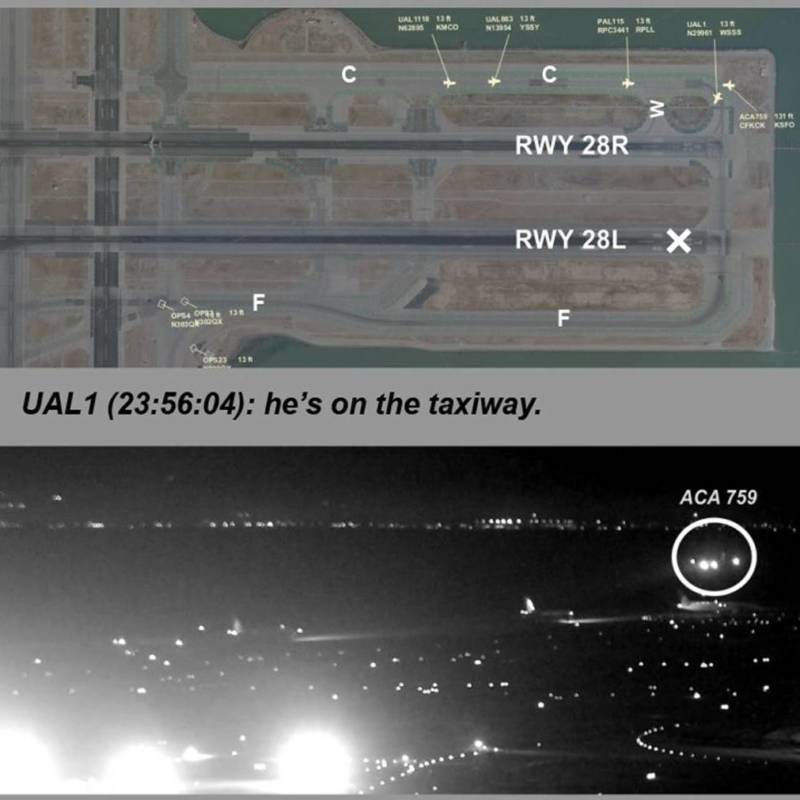
"content": "\u003cp>Federal investigators say an Air Canada jet coming in for a landing in San Francisco in July came a lot closer than previously thought to hitting four other planes on a taxiway, in what aviation safety experts say could have been a horrible disaster.\u003c/p>\n\u003cp>The National Transportation Safety Board says Air Canada flight No. 759 was just 59 feet above the ground at its lowest point, flying over a United Airlines jetliner waiting to take off, before the Air Canada plane pulled up, circled around and then landed safely.\u003c/p>\n\u003cp>Investigators say both pilots on the Air Canada plane thought they were lined up to land on runway 28-Right at San Francisco International Airport on the night of July 7, and runway lights they saw to the left were from runway 28-Left. But 28L was closed and dark, its approach and runway lights turned off, except for a large, 20-foot wide, lighted flashing “X” placed at the threshold; and the normal runway lights they said they saw to their left were actually from runway 28R.\u003c/p>\n\u003cp>So even though they were cleared to land on 28R, the plane wasn’t lined up to land on it at all.\u003c/p>\n\u003cp>“Where’s this guy going?” exclaims another pilot on the ground in a radio call to the air traffic control tower. “He’s on the taxiway!”\u003c/p>\n\u003cp>[ad fullwidth]\u003c/p>\n\u003cp>An air traffic controller tells the pilot of Air Canada 759 to go around and the pilot agrees to do so, when a United Airlines pilot chimes in, “United 1. Air Canada flew directly over us.”\u003c/p>\n\u003cp>The controller responds, “Yeah, I saw that, guys.”\u003c/p>\n\u003cp>The United Airlines plane, a Boeing 787, was the first plane waiting to take off after Air Canada’s landing, and the new NTSB report indicates the Air Canada plane, an Airbus A320, may have come within just a few dozen feet of colliding with the United jet.\u003c/p>\n\u003cp>The Boeing 787 is 55 feet tall at its highest point, the top of its vertical stabilizer. At its lowest point, Air Canada was 59 feet above the ground, though it gained some altitude before flying directly over the United 787.\u003c/p>\n\u003cp>According to Wednesday’s NTSB investigative update, “Both pilots said, in post-incident interviews, they believed the lighted runway on their left was 28L and that they were lined up for 28R. They also stated that they did not recall seeing aircraft on taxiway C but that something did not look right to them.”\u003c/p>\n\u003cp>\u003c/p>\n\u003cp>Investigators have not yet determined why the pilots mistook the taxiway for the runway, but the report indicates the taxiway was lighted normally, with blue lights to distinguish it from white runway lights.\u003c/p>\n\n",
"blocks": [],
"excerpt": "Investigators say the airliner trying to land in San Francisco could have caused a horrible disaster. ",
"status": "publish",
"parent": 0,
"modified": 1721111342,
"stats": {
"hasAudio": false,
"hasVideo": false,
"hasChartOrMap": false,
"iframeSrcs": [],
"hasGoogleForm": false,
"hasGallery": false,
"hasHearkenModule": false,
"hasPolis": false,
"paragraphCount": 13,
"wordCount": 465
},
"headData": {
"title": "NTSB: Air Canada Jet Came Much Closer to Landing on Other Planes at SFO Than Thought | KQED",
"description": "Investigators say the airliner trying to land in San Francisco could have caused a horrible disaster. ",
"ogTitle": "",
"ogDescription": "",
"ogImgId": "",
"twTitle": "",
"twDescription": "",
"twImgId": "",
"schema": {
"@context": "https://schema.org",
"@type": "NewsArticle",
"headline": "NTSB: Air Canada Jet Came Much Closer to Landing on Other Planes at SFO Than Thought",
"datePublished": "2017-08-02T20:02:03-07:00",
"dateModified": "2024-07-15T23:29:02-07:00",
"image": "https://cdn.kqed.org/wp-content/uploads/2020/02/KQED-OG-Image@1x.png",
"isAccessibleForFree": "True",
"publisher": {
"@type": "NewsMediaOrganization",
"@id": "https://www.kqed.org/#organization",
"name": "KQED",
"logo": "https://cdn.kqed.org/wp-content/uploads/2020/02/KQED-OG-Image@1x.png",
"url": "https://www.kqed.org",
"sameAs": [
"https://www.facebook.com/KQED",
"https://twitter.com/KQED",
"https://www.instagram.com/kqed/",
"https://www.tiktok.com/@kqedofficial",
"https://www.linkedin.com/company/kqed",
"https://www.youtube.com/channel/UCeC0IOo7i1P_61zVUWbJ4nw"
]
}
}
},
"source": "NPR",
"sourceUrl": "http://www.npr.org/",
"sticky": false,
"nprByline": "\u003cstrong>David Schaper\u003c/strong>",
"nprImageAgency": "National Transportation Safety Board",
"nprStoryId": "541237557",
"nprApiLink": "http://api.npr.org/query?id=541237557&apiKey=MDAxOTAwOTE4MDEyMTkxMDAzNjczZDljZA004",
"nprHtmlLink": "http://www.npr.org/sections/thetwo-way/2017/08/02/541237557/ntsb-air-canada-jet-came-much-closer-to-landing-on-other-planes-than-thought?ft=nprml&f=541237557",
"nprRetrievedStory": "1",
"nprPubDate": "Wed, 02 Aug 2017 20:34:00 -0400",
"nprStoryDate": "Wed, 02 Aug 2017 20:34:00 -0400",
"nprLastModifiedDate": "Wed, 02 Aug 2017 20:34:33 -0400",
"path": "/news/11608662/ntsb-air-canada-jet-came-much-closer-to-landing-on-other-planes-at-sfo-than-thought",
"audioTrackLength": null,
"parsedContent": [
{
"type": "contentString",
"content": "\u003cdiv class=\"post-body\">\u003cp>\u003cp>Federal investigators say an Air Canada jet coming in for a landing in San Francisco in July came a lot closer than previously thought to hitting four other planes on a taxiway, in what aviation safety experts say could have been a horrible disaster.\u003c/p>\n\u003cp>The National Transportation Safety Board says Air Canada flight No. 759 was just 59 feet above the ground at its lowest point, flying over a United Airlines jetliner waiting to take off, before the Air Canada plane pulled up, circled around and then landed safely.\u003c/p>\n\u003cp>Investigators say both pilots on the Air Canada plane thought they were lined up to land on runway 28-Right at San Francisco International Airport on the night of July 7, and runway lights they saw to the left were from runway 28-Left. But 28L was closed and dark, its approach and runway lights turned off, except for a large, 20-foot wide, lighted flashing “X” placed at the threshold; and the normal runway lights they said they saw to their left were actually from runway 28R.\u003c/p>\n\u003cp>So even though they were cleared to land on 28R, the plane wasn’t lined up to land on it at all.\u003c/p>\n\u003cp>“Where’s this guy going?” exclaims another pilot on the ground in a radio call to the air traffic control tower. “He’s on the taxiway!”\u003c/p>\n\u003cp>\u003c/p>\u003c/div>",
"attributes": {
"named": {},
"numeric": []
}
},
{
"type": "component",
"content": "",
"name": "ad",
"attributes": {
"named": {
"label": "fullwidth"
},
"numeric": [
"fullwidth"
]
}
},
{
"type": "contentString",
"content": "\u003cdiv class=\"post-body\">\u003cp>\u003c/p>\n\u003cp>An air traffic controller tells the pilot of Air Canada 759 to go around and the pilot agrees to do so, when a United Airlines pilot chimes in, “United 1. Air Canada flew directly over us.”\u003c/p>\n\u003cp>The controller responds, “Yeah, I saw that, guys.”\u003c/p>\n\u003cp>The United Airlines plane, a Boeing 787, was the first plane waiting to take off after Air Canada’s landing, and the new NTSB report indicates the Air Canada plane, an Airbus A320, may have come within just a few dozen feet of colliding with the United jet.\u003c/p>\n\u003cp>The Boeing 787 is 55 feet tall at its highest point, the top of its vertical stabilizer. At its lowest point, Air Canada was 59 feet above the ground, though it gained some altitude before flying directly over the United 787.\u003c/p>\n\u003cp>According to Wednesday’s NTSB investigative update, “Both pilots said, in post-incident interviews, they believed the lighted runway on their left was 28L and that they were lined up for 28R. They also stated that they did not recall seeing aircraft on taxiway C but that something did not look right to them.”\u003c/p>\n\u003cp>\u003c/p>\n\u003cp>Investigators have not yet determined why the pilots mistook the taxiway for the runway, but the report indicates the taxiway was lighted normally, with blue lights to distinguish it from white runway lights.\u003c/p>\n\n\u003c/div>\u003c/p>",
"attributes": {
"named": {},
"numeric": []
}
}
],
"link": "/news/11608662/ntsb-air-canada-jet-came-much-closer-to-landing-on-other-planes-at-sfo-than-thought",
"authors": [
"byline_news_11608662"
],
"programs": [
"news_6944",
"news_72"
],
"categories": [
"news_8",
"news_1397"
],
"tags": [
"news_21043",
"news_2767",
"news_451",
"news_1561"
],
"featImg": "news_11608663",
"label": "source_news_11608662"
},
"news_11572913": {
"type": "posts",
"id": "news_11572913",
"meta": {
"index": "posts_1716263798",
"site": "news",
"id": "11572913",
"score": null,
"sort": [
1500326738000
]
},
"guestAuthors": [],
"slug": "investigators-talk-to-planes-captain-in-sfo-taxiway-close-call",
"title": "Investigators Talk to Plane's Captain in SFO Taxiway Close Call",
"publishDate": 1500326738,
"format": "standard",
"headTitle": "Investigators Talk to Plane’s Captain in SFO Taxiway Close Call | KQED",
"labelTerm": {},
"content": "\u003cp>Federal investigators confirmed Monday that an Air Canada jet was descending toward a taxiway holding four other planes rather than the assigned runway and narrowly avoided disaster at San Francisco International Airport on the evening of July 7.\u003c/p>\n\u003cp>The National Transportation Safety Board said it interviewed the captain of the Air Canada plane, and will talk to the co-pilot Tuesday and finish talking to air traffic controllers by Wednesday.\u003c/p>\n\u003cp>The NTSB said the Air Canada Airbus A320 was cleared to land on runway 28R but instead lined up its approach for a parallel taxiway, which four other airliners were using to get in position to take off.\u003c/p>\n\u003cp>[contextly_sidebar id=”BRi3QmC1oD6w8FgWuGdJ6OcbgfLbNuEV”]\u003c/p>\n\u003cp>The NTSB said the Air Canada jet descended to less than 100 feet above the ground and flew over another plane before aborting the landing.\u003c/p>\n\u003cp>[ad fullwidth]\u003c/p>\n\u003cp>Air Canada declined to comment, citing the investigation.\u003c/p>\n\u003cp>The Air Canada jet, with 140 people on board, was arriving from Toronto. The NTSB statement adds details to the first official description of the close call, a summary released last week by Canadian safety authorities.\u003c/p>\n\u003cp>Also Monday, California Insurance Commissioner Dave Jones, who was a passenger aboard the flight, released a letter to Air Canada in which he requested that the airline keep passengers informed of the results of any investigation. He said passengers were not told what was happening, and instead, the pilot “made a nonchalant announcement that he had to go around due to traffic at the airport.”\u003c/p>\n\u003cp>Canada’s Transportation Safety Board has given the flight data recorder, one of the so-called black boxes from the Air Canada plane, to the NTSB, which is leading the investigation.\u003c/p>\n\u003cp>\u003c/p>\n\u003cp>The NTSB said it has security-camera video of the late-night incident and will release it in the coming months.\u003c/p>\n\n",
"blocks": [],
"excerpt": "The NTSB said the Air Canada jet descended to less than 100 feet above the ground and flew over another plane before aborting the landing on July 7.",
"status": "publish",
"parent": 0,
"modified": 1721111347,
"stats": {
"hasAudio": false,
"hasVideo": false,
"hasChartOrMap": false,
"iframeSrcs": [],
"hasGoogleForm": false,
"hasGallery": false,
"hasHearkenModule": false,
"hasPolis": false,
"paragraphCount": 12,
"wordCount": 304
},
"headData": {
"title": "Investigators Talk to Plane's Captain in SFO Taxiway Close Call | KQED",
"description": "The NTSB said the Air Canada jet descended to less than 100 feet above the ground and flew over another plane before aborting the landing on July 7.",
"ogTitle": "",
"ogDescription": "",
"ogImgId": "",
"twTitle": "",
"twDescription": "",
"twImgId": "",
"schema": {
"@context": "https://schema.org",
"@type": "NewsArticle",
"headline": "Investigators Talk to Plane's Captain in SFO Taxiway Close Call",
"datePublished": "2017-07-17T14:25:38-07:00",
"dateModified": "2024-07-15T23:29:07-07:00",
"image": "https://cdn.kqed.org/wp-content/uploads/2020/02/KQED-OG-Image@1x.png",
"isAccessibleForFree": "True",
"publisher": {
"@type": "NewsMediaOrganization",
"@id": "https://www.kqed.org/#organization",
"name": "KQED",
"logo": "https://cdn.kqed.org/wp-content/uploads/2020/02/KQED-OG-Image@1x.png",
"url": "https://www.kqed.org",
"sameAs": [
"https://www.facebook.com/KQED",
"https://twitter.com/KQED",
"https://www.instagram.com/kqed/",
"https://www.tiktok.com/@kqedofficial",
"https://www.linkedin.com/company/kqed",
"https://www.youtube.com/channel/UCeC0IOo7i1P_61zVUWbJ4nw"
]
}
}
},
"source": "Associated Press",
"sticky": false,
"nprByline": "Associated Press",
"path": "/news/11572913/investigators-talk-to-planes-captain-in-sfo-taxiway-close-call",
"audioTrackLength": null,
"parsedContent": [
{
"type": "contentString",
"content": "\u003cdiv class=\"post-body\">\u003cp>\u003cp>Federal investigators confirmed Monday that an Air Canada jet was descending toward a taxiway holding four other planes rather than the assigned runway and narrowly avoided disaster at San Francisco International Airport on the evening of July 7.\u003c/p>\n\u003cp>The National Transportation Safety Board said it interviewed the captain of the Air Canada plane, and will talk to the co-pilot Tuesday and finish talking to air traffic controllers by Wednesday.\u003c/p>\n\u003cp>The NTSB said the Air Canada Airbus A320 was cleared to land on runway 28R but instead lined up its approach for a parallel taxiway, which four other airliners were using to get in position to take off.\u003c/p>\n\u003cp>\u003c/p>\u003cp>\u003c/p>\u003cp>\u003c/p>\n\u003cp>The NTSB said the Air Canada jet descended to less than 100 feet above the ground and flew over another plane before aborting the landing.\u003c/p>\n\u003cp>\u003c/p>\u003c/div>",
"attributes": {
"named": {},
"numeric": []
}
},
{
"type": "component",
"content": "",
"name": "ad",
"attributes": {
"named": {
"label": "fullwidth"
},
"numeric": [
"fullwidth"
]
}
},
{
"type": "contentString",
"content": "\u003cdiv class=\"post-body\">\u003cp>\u003c/p>\n\u003cp>Air Canada declined to comment, citing the investigation.\u003c/p>\n\u003cp>The Air Canada jet, with 140 people on board, was arriving from Toronto. The NTSB statement adds details to the first official description of the close call, a summary released last week by Canadian safety authorities.\u003c/p>\n\u003cp>Also Monday, California Insurance Commissioner Dave Jones, who was a passenger aboard the flight, released a letter to Air Canada in which he requested that the airline keep passengers informed of the results of any investigation. He said passengers were not told what was happening, and instead, the pilot “made a nonchalant announcement that he had to go around due to traffic at the airport.”\u003c/p>\n\u003cp>Canada’s Transportation Safety Board has given the flight data recorder, one of the so-called black boxes from the Air Canada plane, to the NTSB, which is leading the investigation.\u003c/p>\n\u003cp>\u003c/p>\n\u003cp>The NTSB said it has security-camera video of the late-night incident and will release it in the coming months.\u003c/p>\n\n\u003c/div>\u003c/p>",
"attributes": {
"named": {},
"numeric": []
}
}
],
"link": "/news/11572913/investigators-talk-to-planes-captain-in-sfo-taxiway-close-call",
"authors": [
"byline_news_11572913"
],
"programs": [
"news_6944",
"news_72"
],
"categories": [
"news_8",
"news_1397"
],
"tags": [
"news_21043",
"news_2767",
"news_451"
],
"featImg": "news_11572987",
"label": "source_news_11572913"
},
"news_11393344": {
"type": "posts",
"id": "news_11393344",
"meta": {
"index": "posts_1716263798",
"site": "news",
"id": "11393344",
"score": null,
"sort": [
1491808282000
]
},
"guestAuthors": [],
"slug": "privacy-advocates-slam-sfos-new-license-plate-reader-policy",
"title": "ACLU Slams SFO's New License Plate Reader Policy",
"publishDate": 1491808282,
"format": "standard",
"headTitle": "ACLU Slams SFO’s New License Plate Reader Policy | KQED",
"labelTerm": {
"term": 6944,
"site": "news"
},
"content": "\u003cp>The San Francisco International Airport can record the license plate information of everyone who uses its roads and parking garages and it can keep the data on file for more than four years.\u003c/p>\n\u003cp>The Airport Commission voted last month on a new policy that gives more than 70 SFO employees access to a license plate information database and allows the airport to release the data to the San Francisco Police Department, the San Mateo County Sheriff’s Department and the FBI.\u003c/p>\n\u003cp>The technology can grab license plate information from millions of people a year. In 2016, the airport served more than 53 million passengers — many of them drove to and from SFO.\u003c/p>\n\u003cp>The access that the airport’s new rules provide could become a “honeypot” for authorities, according to Matt Cagle, a technology and civil liberties policy attorney at the ACLU of Northern California.\u003c/p>\n\u003cp>“Why does law enforcement need to know who’s visiting SFO?” Cagle asked.\u003c/p>\n\u003cp>[ad fullwidth]\u003c/p>\n\u003cp>“It’s one thing if a crime has been committed or if there’s a legitimate demand from law enforcement with a warrant,” he said. “But it’s another thing if the airport has decided to simply share this information with law enforcement for their own purposes.”\u003c/p>\n\u003cp>The data collection not only affects travelers but also people who pick up their relatives and friends at the airport. And it comes at a heightened time for free speech protests at the airport: In recent months hundreds of people flocked to SFO to protest President Trump’s travel ban affecting people from Muslim-majority nations and refugees worldwide.\u003c/p>\n\u003cp>Cagle says the new policy allows the airport to hold onto the information for too long.\u003c/p>\n\u003cp>“If data is kept at all, it should only be kept for days or weeks, at most, not placed in a multiyear database,” he said.\u003c/p>\n\u003cp>The airport’s license plate policy was prompted by legislation authored by state Sen. Jerry Hill (D-San Mateo) and signed by Gov. Jerry Brown in 2015. It went into effect last year.\u003c/p>\n\u003cp>Senate Bill 34 requires security protections for data collected by the plate readers and “public disclosure” about the use of the technology by public agencies, which have to post their policies online.\u003c/p>\n\u003cp>SFO emphasizes that the main role of its license plate readers is to help administer FasTrak accounts at its garages and to track “commercial operators,” like taxis and limos, on its roads.\u003c/p>\n\u003cp>“It’s important to remember that the primary purpose for the system that we’ve established here is for revenue collection,” airport spokesman Doug Yakel said.\u003c/p>\n\u003cp>\u003c/p>\n\u003cp>“Is there a correlation to law enforcement efforts? Of course,” Yakel said. “It’s a benefit to thwarting vehicle theft and other types of crimes. But that’s really not primarily how it’s used.”\u003c/p>\n\n",
"blocks": [],
"excerpt": "'Why does law enforcement need to know who's visiting SFO?' the ACLU's Matt Cagle asked.",
"status": "publish",
"parent": 0,
"modified": 1721104812,
"stats": {
"hasAudio": false,
"hasVideo": false,
"hasChartOrMap": false,
"iframeSrcs": [],
"hasGoogleForm": false,
"hasGallery": false,
"hasHearkenModule": false,
"hasPolis": false,
"paragraphCount": 16,
"wordCount": 507
},
"headData": {
"title": "ACLU Slams SFO's New License Plate Reader Policy | KQED",
"description": "'Why does law enforcement need to know who's visiting SFO?' the ACLU's Matt Cagle asked.",
"ogTitle": "",
"ogDescription": "",
"ogImgId": "",
"twTitle": "",
"twDescription": "",
"twImgId": "",
"schema": {
"@context": "https://schema.org",
"@type": "NewsArticle",
"headline": "ACLU Slams SFO's New License Plate Reader Policy",
"datePublished": "2017-04-10T00:11:22-07:00",
"dateModified": "2024-07-15T21:40:12-07:00",
"image": "https://cdn.kqed.org/wp-content/uploads/2020/02/KQED-OG-Image@1x.png",
"isAccessibleForFree": "True",
"publisher": {
"@type": "NewsMediaOrganization",
"@id": "https://www.kqed.org/#organization",
"name": "KQED",
"logo": "https://cdn.kqed.org/wp-content/uploads/2020/02/KQED-OG-Image@1x.png",
"url": "https://www.kqed.org",
"sameAs": [
"https://www.facebook.com/KQED",
"https://twitter.com/KQED",
"https://www.instagram.com/kqed/",
"https://www.tiktok.com/@kqedofficial",
"https://www.linkedin.com/company/kqed",
"https://www.youtube.com/channel/UCeC0IOo7i1P_61zVUWbJ4nw"
]
}
}
},
"sticky": false,
"path": "/news/11393344/privacy-advocates-slam-sfos-new-license-plate-reader-policy",
"audioTrackLength": null,
"parsedContent": [
{
"type": "contentString",
"content": "\u003cdiv class=\"post-body\">\u003cp>\u003cp>The San Francisco International Airport can record the license plate information of everyone who uses its roads and parking garages and it can keep the data on file for more than four years.\u003c/p>\n\u003cp>The Airport Commission voted last month on a new policy that gives more than 70 SFO employees access to a license plate information database and allows the airport to release the data to the San Francisco Police Department, the San Mateo County Sheriff’s Department and the FBI.\u003c/p>\n\u003cp>The technology can grab license plate information from millions of people a year. In 2016, the airport served more than 53 million passengers — many of them drove to and from SFO.\u003c/p>\n\u003cp>The access that the airport’s new rules provide could become a “honeypot” for authorities, according to Matt Cagle, a technology and civil liberties policy attorney at the ACLU of Northern California.\u003c/p>\n\u003cp>“Why does law enforcement need to know who’s visiting SFO?” Cagle asked.\u003c/p>\n\u003cp>\u003c/p>\u003c/div>",
"attributes": {
"named": {},
"numeric": []
}
},
{
"type": "component",
"content": "",
"name": "ad",
"attributes": {
"named": {
"label": "fullwidth"
},
"numeric": [
"fullwidth"
]
}
},
{
"type": "contentString",
"content": "\u003cdiv class=\"post-body\">\u003cp>\u003c/p>\n\u003cp>“It’s one thing if a crime has been committed or if there’s a legitimate demand from law enforcement with a warrant,” he said. “But it’s another thing if the airport has decided to simply share this information with law enforcement for their own purposes.”\u003c/p>\n\u003cp>The data collection not only affects travelers but also people who pick up their relatives and friends at the airport. And it comes at a heightened time for free speech protests at the airport: In recent months hundreds of people flocked to SFO to protest President Trump’s travel ban affecting people from Muslim-majority nations and refugees worldwide.\u003c/p>\n\u003cp>Cagle says the new policy allows the airport to hold onto the information for too long.\u003c/p>\n\u003cp>“If data is kept at all, it should only be kept for days or weeks, at most, not placed in a multiyear database,” he said.\u003c/p>\n\u003cp>The airport’s license plate policy was prompted by legislation authored by state Sen. Jerry Hill (D-San Mateo) and signed by Gov. Jerry Brown in 2015. It went into effect last year.\u003c/p>\n\u003cp>Senate Bill 34 requires security protections for data collected by the plate readers and “public disclosure” about the use of the technology by public agencies, which have to post their policies online.\u003c/p>\n\u003cp>SFO emphasizes that the main role of its license plate readers is to help administer FasTrak accounts at its garages and to track “commercial operators,” like taxis and limos, on its roads.\u003c/p>\n\u003cp>“It’s important to remember that the primary purpose for the system that we’ve established here is for revenue collection,” airport spokesman Doug Yakel said.\u003c/p>\n\u003cp>\u003c/p>\n\u003cp>“Is there a correlation to law enforcement efforts? Of course,” Yakel said. “It’s a benefit to thwarting vehicle theft and other types of crimes. But that’s really not primarily how it’s used.”\u003c/p>\n\n\u003c/div>\u003c/p>",
"attributes": {
"named": {},
"numeric": []
}
}
],
"link": "/news/11393344/privacy-advocates-slam-sfos-new-license-plate-reader-policy",
"authors": [
"258"
],
"programs": [
"news_6944"
],
"categories": [
"news_8",
"news_248",
"news_1397"
],
"tags": [
"news_2767",
"news_20517"
],
"featImg": "news_11397270",
"label": "news_6944"
},
"news_11196455": {
"type": "posts",
"id": "news_11196455",
"meta": {
"index": "posts_1716263798",
"site": "news",
"id": "11196455",
"score": null,
"sort": [
1480547381000
]
},
"parent": 0,
"labelTerm": {
"site": "news",
"term": 72
},
"blocks": [],
"publishDate": 1480547381,
"format": "standard",
"disqusTitle": "SFO Grappling With Emergency Repairs to Eroded Seawall",
"title": "SFO Grappling With Emergency Repairs to Eroded Seawall",
"headTitle": "The California Report | KQED News",
"content": "\u003cp>Amid heightened concerns about rising sea levels around the Bay Area, San Francisco International Airport officials are scrambling to make emergency repairs to a seriously damaged concrete wall that protects SFO's airfield from the bay.\u003c/p>\n\u003cp>The airport's top official called the damage to the seawall along SFO's perimeter \"an imminent threat to airport property\" \u003ca href=\"https://sfgov.legistar.com/View.ashx?M=F&ID=4732576&GUID=1041EB59-2564-44DE-8144-2B1CC10D691A\" target=\"_blank\">in a letter\u003c/a> to the Airport Commission in September.\u003c/p>\n\u003cp>\"I am declaring an emergency due to unforeseeable and unexpected erosion damages to the seawall,\" wrote SFO Airport Director Ivar Satero.\u003c/p>\n\u003cp>On Wednesday, the San Francisco Board of Supervisors Budget and Finance Committee approved $1.5 million in airport capital improvement funds to pay for emergency construction work to shore up the wall. The full board is expected to vote on the work next Tuesday.\u003c/p>\n\u003cp>The section of seawall in need of repair is located at the end of runways 19L and 19R, which are primarily used for departing flights. The erosion problems are located at the base of the wall, according to SFO spokesman Doug Yakel.\u003c/p>\n\u003cp>[ad fullwidth]\u003c/p>\n\u003cp>\"Water is starting to kind of seep into this area, and that's causing some erosion,\" Yakel said. \"We don't want to wait for the wall to fail. We want to make the repairs before it becomes an issue.\"\u003c/p>\n\u003cp>It's unclear if sea level rise is to blame. SFO officials have yet to determine a definitive cause for the erosion, according to Yakel.\u003c/p>\n\u003cfigure id=\"attachment_11198195\" class=\"wp-caption aligncenter\" style=\"max-width: 800px\">\u003cimg class=\"size-medium wp-image-11198195\" src=\"http://ww2.kqed.org/news/wp-content/uploads/sites/10/2016/11/sfo-seawall-1920-800x582.jpg\" alt=\"A segment of the damaged seawall at San Francisco International Airport.\" width=\"800\" height=\"582\" srcset=\"https://ww2.kqed.org/app/uploads/sites/10/2016/11/sfo-seawall-1920-800x582.jpg 800w, https://ww2.kqed.org/app/uploads/sites/10/2016/11/sfo-seawall-1920-160x116.jpg 160w, https://ww2.kqed.org/app/uploads/sites/10/2016/11/sfo-seawall-1920-1020x742.jpg 1020w, https://ww2.kqed.org/app/uploads/sites/10/2016/11/sfo-seawall-1920.jpg 1920w, https://ww2.kqed.org/app/uploads/sites/10/2016/11/sfo-seawall-1920-1180x858.jpg 1180w, https://ww2.kqed.org/app/uploads/sites/10/2016/11/sfo-seawall-1920-960x698.jpg 960w, https://ww2.kqed.org/app/uploads/sites/10/2016/11/sfo-seawall-1920-240x175.jpg 240w, https://ww2.kqed.org/app/uploads/sites/10/2016/11/sfo-seawall-1920-375x273.jpg 375w, https://ww2.kqed.org/app/uploads/sites/10/2016/11/sfo-seawall-1920-520x378.jpg 520w\" sizes=\"(max-width: 800px) 100vw, 800px\">\u003cfigcaption class=\"wp-caption-text\">A segment of the damaged seawall at San Francisco International Airport. \u003ccite>(Courtesy of SFO)\u003c/cite>\u003c/figcaption>\u003c/figure>\n\u003cp>The Airport Commission earlier this fall approved the job, which will take place on the northeast section of SFO's property that protects it from flooding, king tides, high waves and storm surges.\u003c/p>\n\u003cp>The emergency declaration allows the airport to fast-track repair work. SFO officials are in the process of getting permit approvals from the U.S. Army Corps of Engineers and the San Francisco Bay Conservation and Development Commission.\u003c/p>\n\u003cp>In July, airport staff observed the damage. Several weeks later a geotechnical consultant found \"seepage problems\" and a potential sinkhole, Satero's letter states. \"If this repair is not completed before the rain season, the seawall may fail and flooding is likely to occur,\" Satero said. The letter also said the repair work should have been completed by Nov. 30.\u003c/p>\n\u003cp>According to AGS, a San Francisco-based engineering firm hired by SFO, the section of seawall was in \"critical condition\" and repairs were needed before the rainy season when \"the seawall was likely to fail and allow flooding,\" according to a \u003ca href=\"https://sfgov.legistar.com/View.ashx?M=F&ID=4805188&GUID=73F0A245-56F7-4C8F-B142-EA3729FE4180\" target=\"_blank\">memo \u003c/a>written by the Board of Supervisors' budget and legislative analyst.\u003c/p>\n\u003cp>That flooding could occur on all eight of the airport's runways and taxiways, according to Geri Rayca, the manager of SFO's Planning, Design and Construction Division.\u003c/p>\n\u003cp>Airport officials say putting the contract for the work up for competitive bidding would take too long. They selected the Dutra Group, a marine construction and dredging firm, to make the repairs.\u003c/p>\n\u003cp>The short-term emergency work involves placing 2,000 feet of riprap, a layer of stones and concrete chunks, at the site, as well as repairs to the seawall's asphalt pavement.\u003c/p>\n\u003cp>Airport officials expect the repairs to take a month to be completed. A crane on the bay side of the seawall will do the work, and SFO operations are \u003cem>not\u003c/em> expected to be affected, Cathy Widener, SFO's manager of government affairs, said during Wednesday's hearing.\u003c/p>\n\u003cp>Long-term work to prevent flooding at the airport from sea level rise, a decade-long project called the Shoreline Protection Project, will cost $60 million, according to SFO.\u003c/p>\n\u003cp>In the meantime, airport officials are working on increasing inspections of the entirety of SFO's 8-mile perimeter seawall.\u003c/p>\n\u003cp>Right now those inspections are done intermittently, Widener said. \"Airport staff ... are currently working developing a more rigorous program.\"\u003c/p>\n\u003cp>\u003c/p>\n\u003cp>\u003cem>KQED's Peter Jon Shuler contributed reporting to this post.\u003c/em>\u003c/p>\n\n",
"disqusIdentifier": "11196455 http://ww2.kqed.org/news/?p=11196455",
"disqusUrl": "https://ww2.kqed.org/news/2016/11/30/sfo-grappling-with-emergency-repairs-to-eroded-seawall/",
"stats": {
"hasVideo": false,
"hasChartOrMap": false,
"hasAudio": false,
"hasPolis": false,
"wordCount": 664,
"hasGoogleForm": false,
"hasGallery": false,
"hasHearkenModule": false,
"iframeSrcs": [],
"paragraphCount": 21
},
"modified": 1480556870,
"excerpt": "Flooding could occur on all eight of the airport's runways and taxiways, according to an airport official.",
"headData": {
"twImgId": "",
"twTitle": "",
"ogTitle": "",
"ogImgId": "",
"twDescription": "",
"description": "Flooding could occur on all eight of the airport's runways and taxiways, according to an airport official.",
"title": "SFO Grappling With Emergency Repairs to Eroded Seawall | KQED",
"ogDescription": "",
"schema": {
"@context": "https://schema.org",
"@type": "NewsArticle",
"headline": "SFO Grappling With Emergency Repairs to Eroded Seawall",
"datePublished": "2016-11-30T15:09:41-08:00",
"dateModified": "2016-11-30T17:47:50-08:00",
"image": "https://cdn.kqed.org/wp-content/uploads/2020/02/KQED-OG-Image@1x.png",
"isAccessibleForFree": "True",
"publisher": {
"@type": "NewsMediaOrganization",
"@id": "https://www.kqed.org/#organization",
"name": "KQED",
"logo": "https://cdn.kqed.org/wp-content/uploads/2020/02/KQED-OG-Image@1x.png",
"url": "https://www.kqed.org",
"sameAs": [
"https://www.facebook.com/KQED",
"https://twitter.com/KQED",
"https://www.instagram.com/kqed/",
"https://www.tiktok.com/@kqedofficial",
"https://www.linkedin.com/company/kqed",
"https://www.youtube.com/channel/UCeC0IOo7i1P_61zVUWbJ4nw"
]
}
}
},
"guestAuthors": [],
"slug": "sfo-grappling-with-emergency-repairs-to-eroded-seawall",
"status": "publish",
"path": "/news/11196455/sfo-grappling-with-emergency-repairs-to-eroded-seawall",
"audioTrackLength": null,
"parsedContent": [
{
"type": "contentString",
"content": "\u003cdiv class=\"post-body\">\u003cp>\u003cp>Amid heightened concerns about rising sea levels around the Bay Area, San Francisco International Airport officials are scrambling to make emergency repairs to a seriously damaged concrete wall that protects SFO's airfield from the bay.\u003c/p>\n\u003cp>The airport's top official called the damage to the seawall along SFO's perimeter \"an imminent threat to airport property\" \u003ca href=\"https://sfgov.legistar.com/View.ashx?M=F&ID=4732576&GUID=1041EB59-2564-44DE-8144-2B1CC10D691A\" target=\"_blank\">in a letter\u003c/a> to the Airport Commission in September.\u003c/p>\n\u003cp>\"I am declaring an emergency due to unforeseeable and unexpected erosion damages to the seawall,\" wrote SFO Airport Director Ivar Satero.\u003c/p>\n\u003cp>On Wednesday, the San Francisco Board of Supervisors Budget and Finance Committee approved $1.5 million in airport capital improvement funds to pay for emergency construction work to shore up the wall. The full board is expected to vote on the work next Tuesday.\u003c/p>\n\u003cp>The section of seawall in need of repair is located at the end of runways 19L and 19R, which are primarily used for departing flights. The erosion problems are located at the base of the wall, according to SFO spokesman Doug Yakel.\u003c/p>\n\u003cp>\u003c/p>\u003c/div>",
"attributes": {
"named": {},
"numeric": []
}
},
{
"type": "component",
"content": "",
"name": "ad",
"attributes": {
"named": {
"label": "fullwidth"
},
"numeric": [
"fullwidth"
]
}
},
{
"type": "contentString",
"content": "\u003cdiv class=\"post-body\">\u003cp>\u003c/p>\n\u003cp>\"Water is starting to kind of seep into this area, and that's causing some erosion,\" Yakel said. \"We don't want to wait for the wall to fail. We want to make the repairs before it becomes an issue.\"\u003c/p>\n\u003cp>It's unclear if sea level rise is to blame. SFO officials have yet to determine a definitive cause for the erosion, according to Yakel.\u003c/p>\n\u003cfigure id=\"attachment_11198195\" class=\"wp-caption aligncenter\" style=\"max-width: 800px\">\u003cimg class=\"size-medium wp-image-11198195\" src=\"http://ww2.kqed.org/news/wp-content/uploads/sites/10/2016/11/sfo-seawall-1920-800x582.jpg\" alt=\"A segment of the damaged seawall at San Francisco International Airport.\" width=\"800\" height=\"582\" srcset=\"https://ww2.kqed.org/app/uploads/sites/10/2016/11/sfo-seawall-1920-800x582.jpg 800w, https://ww2.kqed.org/app/uploads/sites/10/2016/11/sfo-seawall-1920-160x116.jpg 160w, https://ww2.kqed.org/app/uploads/sites/10/2016/11/sfo-seawall-1920-1020x742.jpg 1020w, https://ww2.kqed.org/app/uploads/sites/10/2016/11/sfo-seawall-1920.jpg 1920w, https://ww2.kqed.org/app/uploads/sites/10/2016/11/sfo-seawall-1920-1180x858.jpg 1180w, https://ww2.kqed.org/app/uploads/sites/10/2016/11/sfo-seawall-1920-960x698.jpg 960w, https://ww2.kqed.org/app/uploads/sites/10/2016/11/sfo-seawall-1920-240x175.jpg 240w, https://ww2.kqed.org/app/uploads/sites/10/2016/11/sfo-seawall-1920-375x273.jpg 375w, https://ww2.kqed.org/app/uploads/sites/10/2016/11/sfo-seawall-1920-520x378.jpg 520w\" sizes=\"(max-width: 800px) 100vw, 800px\">\u003cfigcaption class=\"wp-caption-text\">A segment of the damaged seawall at San Francisco International Airport. \u003ccite>(Courtesy of SFO)\u003c/cite>\u003c/figcaption>\u003c/figure>\n\u003cp>The Airport Commission earlier this fall approved the job, which will take place on the northeast section of SFO's property that protects it from flooding, king tides, high waves and storm surges.\u003c/p>\n\u003cp>The emergency declaration allows the airport to fast-track repair work. SFO officials are in the process of getting permit approvals from the U.S. Army Corps of Engineers and the San Francisco Bay Conservation and Development Commission.\u003c/p>\n\u003cp>In July, airport staff observed the damage. Several weeks later a geotechnical consultant found \"seepage problems\" and a potential sinkhole, Satero's letter states. \"If this repair is not completed before the rain season, the seawall may fail and flooding is likely to occur,\" Satero said. The letter also said the repair work should have been completed by Nov. 30.\u003c/p>\n\u003cp>According to AGS, a San Francisco-based engineering firm hired by SFO, the section of seawall was in \"critical condition\" and repairs were needed before the rainy season when \"the seawall was likely to fail and allow flooding,\" according to a \u003ca href=\"https://sfgov.legistar.com/View.ashx?M=F&ID=4805188&GUID=73F0A245-56F7-4C8F-B142-EA3729FE4180\" target=\"_blank\">memo \u003c/a>written by the Board of Supervisors' budget and legislative analyst.\u003c/p>\n\u003cp>That flooding could occur on all eight of the airport's runways and taxiways, according to Geri Rayca, the manager of SFO's Planning, Design and Construction Division.\u003c/p>\n\u003cp>Airport officials say putting the contract for the work up for competitive bidding would take too long. They selected the Dutra Group, a marine construction and dredging firm, to make the repairs.\u003c/p>\n\u003cp>The short-term emergency work involves placing 2,000 feet of riprap, a layer of stones and concrete chunks, at the site, as well as repairs to the seawall's asphalt pavement.\u003c/p>\n\u003cp>Airport officials expect the repairs to take a month to be completed. A crane on the bay side of the seawall will do the work, and SFO operations are \u003cem>not\u003c/em> expected to be affected, Cathy Widener, SFO's manager of government affairs, said during Wednesday's hearing.\u003c/p>\n\u003cp>Long-term work to prevent flooding at the airport from sea level rise, a decade-long project called the Shoreline Protection Project, will cost $60 million, according to SFO.\u003c/p>\n\u003cp>In the meantime, airport officials are working on increasing inspections of the entirety of SFO's 8-mile perimeter seawall.\u003c/p>\n\u003cp>Right now those inspections are done intermittently, Widener said. \"Airport staff ... are currently working developing a more rigorous program.\"\u003c/p>\n\u003cp>\u003c/p>\n\u003cp>\u003cem>KQED's Peter Jon Shuler contributed reporting to this post.\u003c/em>\u003c/p>\n\n\u003c/div>\u003c/p>",
"attributes": {
"named": {},
"numeric": []
}
}
],
"link": "/news/11196455/sfo-grappling-with-emergency-repairs-to-eroded-seawall",
"authors": [
"258"
],
"programs": [
"news_6944",
"news_72"
],
"categories": [
"news_19906",
"news_8",
"news_356",
"news_1397"
],
"tags": [
"news_2767"
],
"featImg": "news_10343877",
"label": "news_72"
},
"news_142621": {
"type": "posts",
"id": "news_142621",
"meta": {
"index": "posts_1716263798",
"site": "news",
"id": "142621",
"score": null,
"sort": [
1406131406000
]
},
"parent": 0,
"labelTerm": {
"site": "news",
"term": 6944
},
"blocks": [],
"publishDate": 1406131406,
"format": "aside",
"disqusTitle": "Enrollment For Faster Security Screening Opens at SFO",
"title": "Enrollment For Faster Security Screening Opens at SFO",
"headTitle": "News Fix | KQED News",
"content": "\u003cp>\u003cstrong>By Bay City News\u003c/strong>\u003c/p>\n\u003cp>SAN FRANCISCO INTERNATIONAL AIRPORT — Travelers who want to move more quickly through airport security can now enroll in TSA Precheck at San Francisco International Airport, according to the Transportation Security Administration.\u003c/p>\n\u003cfigure id=\"attachment_142624\" class=\"wp-caption alignleft\" style=\"max-width: 320px\">\u003cimg class=\"wp-image-142624 size-medium\" src=\"http://ww2.kqed.org/news/wp-content/uploads/sites/10/2014/07/travelers-640x417.jpg\" alt=\"travelers\" width=\"320\" height=\"209\">\u003cfigcaption class=\"wp-caption-text\">(Photo by Scott Olson/Getty Images)\u003c/figcaption>\u003c/figure>\n\u003cp>TSA Precheck allows travelers who voluntarily undergo a special prescreening process to go through expedited security screening when they travel.\u003c/p>\n\u003cp>The faster security screening lets travelers keep on their shoes and light outerwear, keep their laptop in its case, keep their liquids and gels in their carry-on and pass through dedicated TSA Precheck lanes at more than 115 airports nationwide.\u003c/p>\n\u003cp>More than 400,000 travelers have enrolled in TSA Precheck across the country, according to TSA.\u003c/p>\n\u003cp>[ad fullwidth]\u003c/p>\n\u003cp>Travelers who want to enroll in TSA Precheck must be U.S. citizens or lawful permanent residents, TSA said. The application begins online at \u003ca href=\"https://universalenroll.dhs.gov/\" target=\"_blank\">universalenroll.dhs.gov\u003c/a>.\u003c/p>\n\u003cp>Applicants must then visit an enrollment center in person to verify citizenship or immigration status and provide fingerprints, TSA said.\u003c/p>\n\u003caside class=\"pullquote alignleft\">When enrolled, travelers can:\n\u003cul>\n\u003cli>Keep on their shoes\u003c/li>\n\u003cli>Keep laptop in case\u003c/li>\n\u003cli>Keep liquids and gels in carry-on luggage\u003c/li>\n\u003cli>Use security express lanes at more than 115 airports in U.S.\u003c/li>\n\u003c/ul>\n\u003c/aside>\n\u003cp>The SFO TSA Precheck enrollment center is in the International Terminal near the BART station entrance and checkpoint G, the TSA said. There are also enrollment centers in Oakland, South San Francisco and Martinez, TSA said.\u003c/p>\n\u003cp>\"During the application process, travelers will provide basic biographical information about themselves,\" Fred Lau, TSA Federal Security Director at SFO, said in a statement. \"TSA uses that information to pre-screen applicants and, if approved, they become eligible for expedited screening on a consistent basis.\"\u003c/p>\n\u003cp>The TSA maintains a list of TSA Precheck eligibility requirements, as well as disqualifying criminal offenses and other actions that would make an applicant ineligible, on its website at \u003ca href=\"http://www.tsa.gov/tsa-precheck/eligibility-requirements\" target=\"_blank\">www.tsa.gov/tsa-precheck/eligibility-requirements\u003c/a>.\u003c/p>\n\u003cp>Once enrolled, TSA Precheck travelers will receive a Known Traveler Number, which is valid for five years. The process includes a nonrefundable $85 application processing fee.\u003c/p>\n\u003cp>\u003c/p>\n\u003cp>The TSA still conducts random security measures, and no individual is guaranteed an expedited screening, according to TSA.\u003c/p>\n\n",
"disqusIdentifier": "142621 http://ww2.kqed.org/news/?p=142621",
"disqusUrl": "https://ww2.kqed.org/news/2014/07/23/enrollment-for-expedited-security-screening-opens-at-san-francisco-airport/",
"stats": {
"hasVideo": false,
"hasChartOrMap": false,
"hasAudio": false,
"hasPolis": false,
"wordCount": 361,
"hasGoogleForm": false,
"hasGallery": false,
"hasHearkenModule": false,
"iframeSrcs": [],
"paragraphCount": 14
},
"modified": 1406152470,
"excerpt": "Travelers who want to move more quickly through airport security can now enroll in TSA Precheck.",
"headData": {
"twImgId": "",
"twTitle": "",
"ogTitle": "",
"ogImgId": "",
"twDescription": "",
"description": "Travelers who want to move more quickly through airport security can now enroll in TSA Precheck.",
"title": "Enrollment For Faster Security Screening Opens at SFO | KQED",
"ogDescription": "",
"schema": {
"@context": "https://schema.org",
"@type": "NewsArticle",
"headline": "Enrollment For Faster Security Screening Opens at SFO",
"datePublished": "2014-07-23T09:03:26-07:00",
"dateModified": "2014-07-23T14:54:30-07:00",
"image": "https://cdn.kqed.org/wp-content/uploads/2020/02/KQED-OG-Image@1x.png",
"isAccessibleForFree": "True",
"publisher": {
"@type": "NewsMediaOrganization",
"@id": "https://www.kqed.org/#organization",
"name": "KQED",
"logo": "https://cdn.kqed.org/wp-content/uploads/2020/02/KQED-OG-Image@1x.png",
"url": "https://www.kqed.org",
"sameAs": [
"https://www.facebook.com/KQED",
"https://twitter.com/KQED",
"https://www.instagram.com/kqed/",
"https://www.tiktok.com/@kqedofficial",
"https://www.linkedin.com/company/kqed",
"https://www.youtube.com/channel/UCeC0IOo7i1P_61zVUWbJ4nw"
]
}
}
},
"guestAuthors": [],
"slug": "enrollment-for-expedited-security-screening-opens-at-san-francisco-airport",
"status": "publish",
"path": "/news/142621/enrollment-for-expedited-security-screening-opens-at-san-francisco-airport",
"audioTrackLength": null,
"parsedContent": [
{
"type": "contentString",
"content": "\u003cdiv class=\"post-body\">\u003cp>\u003cp>\u003cstrong>By Bay City News\u003c/strong>\u003c/p>\n\u003cp>SAN FRANCISCO INTERNATIONAL AIRPORT — Travelers who want to move more quickly through airport security can now enroll in TSA Precheck at San Francisco International Airport, according to the Transportation Security Administration.\u003c/p>\n\u003cfigure id=\"attachment_142624\" class=\"wp-caption alignleft\" style=\"max-width: 320px\">\u003cimg class=\"wp-image-142624 size-medium\" src=\"http://ww2.kqed.org/news/wp-content/uploads/sites/10/2014/07/travelers-640x417.jpg\" alt=\"travelers\" width=\"320\" height=\"209\">\u003cfigcaption class=\"wp-caption-text\">(Photo by Scott Olson/Getty Images)\u003c/figcaption>\u003c/figure>\n\u003cp>TSA Precheck allows travelers who voluntarily undergo a special prescreening process to go through expedited security screening when they travel.\u003c/p>\n\u003cp>The faster security screening lets travelers keep on their shoes and light outerwear, keep their laptop in its case, keep their liquids and gels in their carry-on and pass through dedicated TSA Precheck lanes at more than 115 airports nationwide.\u003c/p>\n\u003cp>More than 400,000 travelers have enrolled in TSA Precheck across the country, according to TSA.\u003c/p>\n\u003cp>\u003c/p>\u003c/div>",
"attributes": {
"named": {},
"numeric": []
}
},
{
"type": "component",
"content": "",
"name": "ad",
"attributes": {
"named": {
"label": "fullwidth"
},
"numeric": [
"fullwidth"
]
}
},
{
"type": "contentString",
"content": "\u003cdiv class=\"post-body\">\u003cp>\u003c/p>\n\u003cp>Travelers who want to enroll in TSA Precheck must be U.S. citizens or lawful permanent residents, TSA said. The application begins online at \u003ca href=\"https://universalenroll.dhs.gov/\" target=\"_blank\">universalenroll.dhs.gov\u003c/a>.\u003c/p>\n\u003cp>Applicants must then visit an enrollment center in person to verify citizenship or immigration status and provide fingerprints, TSA said.\u003c/p>\n\u003caside class=\"pullquote alignleft\">When enrolled, travelers can:\n\u003cul>\n\u003cli>Keep on their shoes\u003c/li>\n\u003cli>Keep laptop in case\u003c/li>\n\u003cli>Keep liquids and gels in carry-on luggage\u003c/li>\n\u003cli>Use security express lanes at more than 115 airports in U.S.\u003c/li>\n\u003c/ul>\n\u003c/aside>\n\u003cp>The SFO TSA Precheck enrollment center is in the International Terminal near the BART station entrance and checkpoint G, the TSA said. There are also enrollment centers in Oakland, South San Francisco and Martinez, TSA said.\u003c/p>\n\u003cp>\"During the application process, travelers will provide basic biographical information about themselves,\" Fred Lau, TSA Federal Security Director at SFO, said in a statement. \"TSA uses that information to pre-screen applicants and, if approved, they become eligible for expedited screening on a consistent basis.\"\u003c/p>\n\u003cp>The TSA maintains a list of TSA Precheck eligibility requirements, as well as disqualifying criminal offenses and other actions that would make an applicant ineligible, on its website at \u003ca href=\"http://www.tsa.gov/tsa-precheck/eligibility-requirements\" target=\"_blank\">www.tsa.gov/tsa-precheck/eligibility-requirements\u003c/a>.\u003c/p>\n\u003cp>Once enrolled, TSA Precheck travelers will receive a Known Traveler Number, which is valid for five years. The process includes a nonrefundable $85 application processing fee.\u003c/p>\n\u003cp>\u003c/p>\n\u003cp>The TSA still conducts random security measures, and no individual is guaranteed an expedited screening, according to TSA.\u003c/p>\n\n\u003c/div>\u003c/p>",
"attributes": {
"named": {},
"numeric": []
}
}
],
"link": "/news/142621/enrollment-for-expedited-security-screening-opens-at-san-francisco-airport",
"authors": [
"237"
],
"programs": [
"news_6944"
],
"categories": [
"news_8",
"news_1397"
],
"tags": [
"news_2767",
"news_451",
"news_264"
],
"label": "news_6944"
},
"news_140110": {
"type": "posts",
"id": "news_140110",
"meta": {
"index": "posts_1716263798",
"site": "news",
"id": "140110",
"score": null,
"sort": [
1403634023000
]
},
"parent": 0,
"labelTerm": {
"site": "news",
"term": 6944
},
"blocks": [],
"publishDate": 1403634023,
"format": "aside",
"disqusTitle": "Asiana Crash Investigators Point to Pilot Mismanagement, Confusion in SFO Incident ",
"title": "Asiana Crash Investigators Point to Pilot Mismanagement, Confusion in SFO Incident ",
"headTitle": "News Fix | KQED News",
"content": "\u003cp>\u003cstrong>Joan Lowy and Martha Mendoza\u003cbr>\nAssociated Press\u003c/strong>\u003c/p>\n\u003cfigure id=\"attachment_127607\" class=\"wp-caption aligncenter\" style=\"max-width: 640px\">\u003ca href=\"http://ww2.kqed.org/news/wp-content/uploads/sites/10/2014/02/RS5446_asianasfocrash20130706-lpr.jpg\">\u003cimg class=\"size-medium wp-image-127607\" src=\"http://ww2.kqed.org/news/wp-content/uploads/sites/10/2014/02/RS5446_asianasfocrash20130706-lpr-640x409.jpg\" alt=\"(Josh Edelson/AFP/Getty Images)\" width=\"640\" height=\"409\">\u003c/a>\u003cfigcaption class=\"wp-caption-text\">An Asiana Airlines Boeing 777 is seen on the runway at San Francisco International Airport after crash landing on July 6, 2013. (Josh Edelson/AFP/Getty Images)\u003c/figcaption>\u003c/figure>\n\u003cp>\u003cstrong>Update, 11:20 a.m.: \u003c/strong>The latest AP writethrough on the National Transportation Safety Board's findings in last year's Asiana Airlines crash at SFO:\u003c/p>\n\u003cp>WASHINGTON — Pilot mismanagement and confusion caused Asiana Flight 214 to crash at San Francisco International Airport last July, federal accident investigators concluded Tuesday.\u003c/p>\n\u003cp>The National Transportation Safety Board said there was confusion over whether one of the airliner's key controls was maintaining speed.\u003c/p>\n\u003cp>The agency also cited the complexity of the Boeing 777's autothrottle and pilot training by the South Korea-based airline as contributing to the crash, which killed three passengers and injured more than 200.\u003c/p>\n\u003cp>[ad fullwidth]\u003c/p>\n\u003cp>The plane, with 307 people on board, was too low and too slow during the landing attempt. Its tail struck a seawall and was ripped off. The rest of the plane went spinning and sliding down the runway. The crash was the only fatal passenger airline accident in the U.S. in the last five years.\u003c/p>\n\u003cp>Before the vote, Chris Hart, the NTSB's acting chairman, said that increasingly complex automated aircraft controls designed to improve safety are instead creating new opportunities for error.\u003c/p>\n\u003cp>The Asiana flight crew \"over-relied on automated systems that they did not fully understand,\" he said.\u003c/p>\n\u003cp>Among the other issues raised by the investigation are some that long have concerned aviation officials, including hesitancy by some pilots to abort a landing when things go awry or to challenge a captain's actions.\u003c/p>\n\u003cp>The irony of the accident is that it occurred at all. Three experienced pilots were in the cockpit on July 6, 2013. The plane, a Boeing 777, had one of the industry's best safety records. And weather conditions that day were near-perfect.\u003c/p>\n\u003cp>But the wide-bodied jetliner with 307 people on board was too low and too slow during the landing. It struck a seawall just short of the runway, ripping off the tail and sending the rest of the plane spinning and skidding down the runway. When the shattered plane came to rest, a fire erupted.\u003c/p>\n\u003caside class=\"pullquote alignleft\"> The irony of the accident is that it occurred at all, as three experienced pilots were in the cockpit. \u003c/aside>\n\u003cp>Despite the violence of the crash, only three people were killed — Chinese teens seated in the back who may not have been wearing their seat belts and were thrown from the plane. One of the teenage girls survived the crash but was run over by two rescue vehicles in the chaos afterward. Nearly 200 people were injured.\u003c/p>\n\u003cp>In documents made public by the safety board, Asiana acknowledged the likely cause of the accident was the crew's failure to monitor and maintain the plane's airspeed, and its failure to abort the landing when in trouble. The South Korea-based airline said the pilot and co-pilot reasonably believed the automatic throttle would keep the plane flying fast enough to land safely, when in fact the auto throttle was effectively shut off after the pilot idled it to correct an unexplained climb earlier in the landing.\u003c/p>\n\u003cp>Asiana said the plane should have been designed so that the autothrottle would maintain the proper speed after the pilot put it in \"hold mode.\"\u003c/p>\n\u003cp>Boeing had been warned about the problem by U.S. and European aviation regulators. Asiana urged the safety board to recommend that the aircraft maker be required to include an audible warning to alert pilots when the throttle changes to a setting in which it no longer is maintaining speed.\u003c/p>\n\u003cp>\"Asiana has a point,\" said John Cox, a former airline pilot and aviation safety consultant, \"but this is not the first time it has happened. Any of these highly automated airplanes have these conditions that require special training and pilot awareness. ... This is something that has been known for many years and trained for many years.\"\u003c/p>\n\u003cp>\u003ciframe width=\"100%\" height=\"166\" scrolling=\"no\" frameborder=\"no\" src=\"https://w.soundcloud.com/player/?url=https%3A//api.soundcloud.com/tracks/155890838&color=ff5500&auto_play=false&hide_related=false&show_artwork=true&show_comments=true&show_user=true&show_reposts=false\">\u003c/iframe>\u003c/p>\n\u003cp>Boeing told the board there was nothing wrong with the plane, and the crash was caused by the failure of the pilots to maintain speed and to abort the landing when the approach had become unstable, as required by their company's policies. An unstable approach occurs when a plane's speed or rate of descent is too fast or to slow, or the plane isn't properly aligned for landing.\u003c/p>\n\u003cp>Captain Lee Kang Kuk, 45, a veteran pilot who was new to the 777, was flying the plane. Because an airport navigational aid that helps planes land wasn't working that day, Kuk was flying a visual approach that involves lining up the jet for landing by looking through the windshield and using numerous other cues, rather than relying on a radio-based system called a glide-slope that guides aircraft to the runway. A training captain was sitting next to him in the right seat watching his performance.\u003c/p>\n\u003cp>\u003c/p>\n\u003cp>Kuk told transportation accident investigators that he did not immediately move to abort the landing after it became unstable because he felt only the instructor pilot had that authority. Cockpit culture, in which the senior captain is viewed as supreme, was identified as a factor in several South Korean airliner crashes in the 1980s and '90s. Afterward, procedures and hierarchies were overhauled in Korea and elsewhere, including the U.S.\u003c/p>\n\n",
"disqusIdentifier": "140110 http://ww2.kqed.org/news/?p=140110",
"disqusUrl": "https://ww2.kqed.org/news/2014/06/24/asiana-crash-investigators-point-to-technologys-role-in-sfo-incident/",
"stats": {
"hasVideo": false,
"hasChartOrMap": false,
"hasAudio": true,
"hasPolis": false,
"wordCount": 905,
"hasGoogleForm": false,
"hasGallery": false,
"hasHearkenModule": false,
"iframeSrcs": [],
"paragraphCount": 22
},
"modified": 1403657252,
"excerpt": "Safety board also says airliner's pilots relied too much on automated systems they didn't understand.",
"headData": {
"twImgId": "",
"twTitle": "",
"ogTitle": "",
"ogImgId": "",
"twDescription": "",
"description": "Safety board also says airliner's pilots relied too much on automated systems they didn't understand.",
"title": "Asiana Crash Investigators Point to Pilot Mismanagement, Confusion in SFO Incident | KQED",
"ogDescription": "",
"schema": {
"@context": "https://schema.org",
"@type": "NewsArticle",
"headline": "Asiana Crash Investigators Point to Pilot Mismanagement, Confusion in SFO Incident ",
"datePublished": "2014-06-24T11:20:23-07:00",
"dateModified": "2014-06-24T17:47:32-07:00",
"image": "https://cdn.kqed.org/wp-content/uploads/2020/02/KQED-OG-Image@1x.png",
"isAccessibleForFree": "True",
"publisher": {
"@type": "NewsMediaOrganization",
"@id": "https://www.kqed.org/#organization",
"name": "KQED",
"logo": "https://cdn.kqed.org/wp-content/uploads/2020/02/KQED-OG-Image@1x.png",
"url": "https://www.kqed.org",
"sameAs": [
"https://www.facebook.com/KQED",
"https://twitter.com/KQED",
"https://www.instagram.com/kqed/",
"https://www.tiktok.com/@kqedofficial",
"https://www.linkedin.com/company/kqed",
"https://www.youtube.com/channel/UCeC0IOo7i1P_61zVUWbJ4nw"
]
}
}
},
"guestAuthors": [],
"slug": "asiana-crash-investigators-point-to-technologys-role-in-sfo-incident",
"status": "publish",
"customPermalink": "2014/06/24/asiana-airlines-crash-sfo-ntsb-investigation/",
"path": "/news/140110/asiana-crash-investigators-point-to-technologys-role-in-sfo-incident",
"audioTrackLength": null,
"parsedContent": [
{
"type": "contentString",
"content": "\u003cdiv class=\"post-body\">\u003cp>\u003cp>\u003cstrong>Joan Lowy and Martha Mendoza\u003cbr>\nAssociated Press\u003c/strong>\u003c/p>\n\u003cfigure id=\"attachment_127607\" class=\"wp-caption aligncenter\" style=\"max-width: 640px\">\u003ca href=\"http://ww2.kqed.org/news/wp-content/uploads/sites/10/2014/02/RS5446_asianasfocrash20130706-lpr.jpg\">\u003cimg class=\"size-medium wp-image-127607\" src=\"http://ww2.kqed.org/news/wp-content/uploads/sites/10/2014/02/RS5446_asianasfocrash20130706-lpr-640x409.jpg\" alt=\"(Josh Edelson/AFP/Getty Images)\" width=\"640\" height=\"409\">\u003c/a>\u003cfigcaption class=\"wp-caption-text\">An Asiana Airlines Boeing 777 is seen on the runway at San Francisco International Airport after crash landing on July 6, 2013. (Josh Edelson/AFP/Getty Images)\u003c/figcaption>\u003c/figure>\n\u003cp>\u003cstrong>Update, 11:20 a.m.: \u003c/strong>The latest AP writethrough on the National Transportation Safety Board's findings in last year's Asiana Airlines crash at SFO:\u003c/p>\n\u003cp>WASHINGTON — Pilot mismanagement and confusion caused Asiana Flight 214 to crash at San Francisco International Airport last July, federal accident investigators concluded Tuesday.\u003c/p>\n\u003cp>The National Transportation Safety Board said there was confusion over whether one of the airliner's key controls was maintaining speed.\u003c/p>\n\u003cp>The agency also cited the complexity of the Boeing 777's autothrottle and pilot training by the South Korea-based airline as contributing to the crash, which killed three passengers and injured more than 200.\u003c/p>\n\u003cp>\u003c/p>\u003c/div>",
"attributes": {
"named": {},
"numeric": []
}
},
{
"type": "component",
"content": "",
"name": "ad",
"attributes": {
"named": {
"label": "fullwidth"
},
"numeric": [
"fullwidth"
]
}
},
{
"type": "contentString",
"content": "\u003cdiv class=\"post-body\">\u003cp>\u003c/p>\n\u003cp>The plane, with 307 people on board, was too low and too slow during the landing attempt. Its tail struck a seawall and was ripped off. The rest of the plane went spinning and sliding down the runway. The crash was the only fatal passenger airline accident in the U.S. in the last five years.\u003c/p>\n\u003cp>Before the vote, Chris Hart, the NTSB's acting chairman, said that increasingly complex automated aircraft controls designed to improve safety are instead creating new opportunities for error.\u003c/p>\n\u003cp>The Asiana flight crew \"over-relied on automated systems that they did not fully understand,\" he said.\u003c/p>\n\u003cp>Among the other issues raised by the investigation are some that long have concerned aviation officials, including hesitancy by some pilots to abort a landing when things go awry or to challenge a captain's actions.\u003c/p>\n\u003cp>The irony of the accident is that it occurred at all. Three experienced pilots were in the cockpit on July 6, 2013. The plane, a Boeing 777, had one of the industry's best safety records. And weather conditions that day were near-perfect.\u003c/p>\n\u003cp>But the wide-bodied jetliner with 307 people on board was too low and too slow during the landing. It struck a seawall just short of the runway, ripping off the tail and sending the rest of the plane spinning and skidding down the runway. When the shattered plane came to rest, a fire erupted.\u003c/p>\n\u003caside class=\"pullquote alignleft\"> The irony of the accident is that it occurred at all, as three experienced pilots were in the cockpit. \u003c/aside>\n\u003cp>Despite the violence of the crash, only three people were killed — Chinese teens seated in the back who may not have been wearing their seat belts and were thrown from the plane. One of the teenage girls survived the crash but was run over by two rescue vehicles in the chaos afterward. Nearly 200 people were injured.\u003c/p>\n\u003cp>In documents made public by the safety board, Asiana acknowledged the likely cause of the accident was the crew's failure to monitor and maintain the plane's airspeed, and its failure to abort the landing when in trouble. The South Korea-based airline said the pilot and co-pilot reasonably believed the automatic throttle would keep the plane flying fast enough to land safely, when in fact the auto throttle was effectively shut off after the pilot idled it to correct an unexplained climb earlier in the landing.\u003c/p>\n\u003cp>Asiana said the plane should have been designed so that the autothrottle would maintain the proper speed after the pilot put it in \"hold mode.\"\u003c/p>\n\u003cp>Boeing had been warned about the problem by U.S. and European aviation regulators. Asiana urged the safety board to recommend that the aircraft maker be required to include an audible warning to alert pilots when the throttle changes to a setting in which it no longer is maintaining speed.\u003c/p>\n\u003cp>\"Asiana has a point,\" said John Cox, a former airline pilot and aviation safety consultant, \"but this is not the first time it has happened. Any of these highly automated airplanes have these conditions that require special training and pilot awareness. ... This is something that has been known for many years and trained for many years.\"\u003c/p>\n\u003cp>\u003ciframe width=\"100%\" height=\"166\" scrolling=\"no\" frameborder=\"no\" src=\"https://w.soundcloud.com/player/?url=https%3A//api.soundcloud.com/tracks/155890838&color=ff5500&auto_play=false&hide_related=false&show_artwork=true&show_comments=true&show_user=true&show_reposts=false\">\u003c/iframe>\u003c/p>\n\u003cp>Boeing told the board there was nothing wrong with the plane, and the crash was caused by the failure of the pilots to maintain speed and to abort the landing when the approach had become unstable, as required by their company's policies. An unstable approach occurs when a plane's speed or rate of descent is too fast or to slow, or the plane isn't properly aligned for landing.\u003c/p>\n\u003cp>Captain Lee Kang Kuk, 45, a veteran pilot who was new to the 777, was flying the plane. Because an airport navigational aid that helps planes land wasn't working that day, Kuk was flying a visual approach that involves lining up the jet for landing by looking through the windshield and using numerous other cues, rather than relying on a radio-based system called a glide-slope that guides aircraft to the runway. A training captain was sitting next to him in the right seat watching his performance.\u003c/p>\n\u003cp>\u003c/p>\n\u003cp>Kuk told transportation accident investigators that he did not immediately move to abort the landing after it became unstable because he felt only the instructor pilot had that authority. Cockpit culture, in which the senior captain is viewed as supreme, was identified as a factor in several South Korean airliner crashes in the 1980s and '90s. Afterward, procedures and hierarchies were overhauled in Korea and elsewhere, including the U.S.\u003c/p>\n\n\u003c/div>\u003c/p>",
"attributes": {
"named": {},
"numeric": []
}
}
],
"link": "/news/140110/asiana-crash-investigators-point-to-technologys-role-in-sfo-incident",
"authors": [
"237"
],
"programs": [
"news_6944"
],
"categories": [
"news_248",
"news_1397"
],
"tags": [
"news_17600",
"news_2767",
"news_451"
],
"featImg": "news_102863",
"label": "news_6944"
},
"news_124989": {
"type": "posts",
"id": "news_124989",
"meta": {
"index": "posts_1716263798",
"site": "news",
"id": "124989",
"score": null,
"sort": [
1391439634000
]
},
"guestAuthors": [],
"slug": "runway-safety-work-to-cause-delays-at-sfo",
"title": "Runway Safety Work Could Cause Delays at SFO",
"publishDate": 1391439634,
"format": "aside",
"headTitle": "Runway Safety Work Could Cause Delays at SFO | KQED",
"labelTerm": {
"term": 6944,
"site": "news"
},
"content": "\u003cfigure id=\"attachment_124522\" class=\"wp-caption aligncenter\" style=\"max-width: 639px\">\u003ca href=\"http://ww2.kqed.org/news/wp-content/uploads/sites/10/2014/01/lufthansa2.png\">\u003cimg loading=\"lazy\" decoding=\"async\" class=\"size-full wp-image-124522\" src=\"http://ww2.kqed.org/news/wp-content/uploads/sites/10/2014/01/lufthansa2.png\" alt=\"(PilotsEYE.tv/YouTube screen capture)\" width=\"639\" height=\"353\">\u003c/a>\u003cfigcaption class=\"wp-caption-text\">(PilotsEYE.tv/YouTube screen capture)\u003c/figcaption>\u003c/figure>\n\u003cp>Officials at San Francisco International Airport are alerting the public that their flights might be delayed — for about four months later this year.\u003c/p>\n\u003cp>A pair of the airport’s shorter runways will be shut down from May to September to allow installation of new pavement designed to, in the airport’s words, “safely capture an aircraft’s landing gear should it overshoot the airstrip.”\u003c/p>\n\u003cp>\u003ca href=\"http://www.flysfo.com/about-sfo/airport-development/runway/fact-sheet\" target=\"_blank\" rel=\"noopener\">In an advisory\u003c/a>, the airport says that all arriving and departing traffic will use Runways 10R-28L and 10L-28R. During good weather, minor delays might occur during peak periods of traffic demand, such as 9 a.m. to noon. More significant delays will occur during bad weather — say, during very foggy or windy conditions.\u003c/p>\n\u003cp>The work on Runways 1R and 1L is being done under a Federal Aviation Administration program to improve what the agency calls runway safety areas at the nation’s commercial airports. The safety areas are essentially emergency-stop zones for planes that approach the end of runways on landings or aborted takeoffs.\u003c/p>\n\u003cp>Since SFO doesn’t have enough room for the full 1,000-foot runway safety area extension mandated in the FAA rules, the airport is installing an “\u003ca href=\"http://www.faa.gov/news/fact_sheets/news_story.cfm?newsId=12497\" target=\"_blank\" rel=\"noopener\">engineered material arresting system\u003c/a>” designed to slow down and stop planes that overrun the end of a runway.\u003c/p>\n\u003cp>[ad fullwidth]\u003c/p>\n\u003cp>The material’s manufacturer, \u003ca href=\"http://www.esco.zodiacaerospace.com/\" target=\"_blank\" rel=\"noopener\">Engineered Arresting Systems Corp.\u003c/a>, describes what it is and how it’s supposed to work: “EMAS is consisted of a bed of cellular cement material manufactured in the form of engineered block components that are strategically placed at the overrun end of a runway. The EMAS predictably and reliably crushes under the weight of an aircraft, providing deceleration and a safe stop.”\u003c/p>\n\u003cp>The company also says the material can be installed around “high-value public and private buildings” to stop “threat vehicles.” A truck carrying explosives, say.\u003c/p>\n\u003cp>The arresting systems already have saved some planes, including a couple of commercial flights full of passengers: a \u003ca href=\"http://aircrewbuzz.blogspot.com/2008/07/mexicana-airbus-a320-runway-overrun-at.html\" target=\"_blank\" rel=\"noopener\">Mexicana Airlines Airbus A320\u003c/a> at Chicago’s O’Hare International Airport in 2008; a \u003ca href=\"http://www.flightglobal.com/news/articles/ntsb-documents-multiple-crew-errors-in-charleston-crj200-340446/\" target=\"_blank\" rel=\"noopener\">PSA Airlines Bombardier CJR200 \u003c/a>in West Virginia in 2010; and, perhaps most spectacularly, a \u003ca href=\"http://blog.aaae.org/2012/02/03/photo-archives-emas-save-aftermath/\" target=\"_blank\" rel=\"noopener\">747 cargo jet\u003c/a> at JFK in New York City in 2005.\u003c/p>\n\u003cp>\u003c/p>\n\u003cp>Aspiring EMAS nerds need to watch the video below from the manufacturer. It actually does a great job explaining how the system works, complete with video from a live test with a real airliner.\u003c/p>\n\u003cdiv class=\"_single-video\">\u003ciframe loading=\"lazy\" src=\"//www.youtube.com/embed/45IcXrqRjEY\" frameborder=\"0\" width=\"630\" height=\"473\">\u003c/iframe>\u003c/div>\n\n",
"blocks": [],
"excerpt": "Big SFO runway project will add runway features for planes that accidentally overshoot tarmac. ",
"status": "publish",
"parent": 0,
"modified": 1721106227,
"stats": {
"hasAudio": false,
"hasVideo": true,
"hasChartOrMap": false,
"iframeSrcs": [],
"hasGoogleForm": false,
"hasGallery": false,
"hasHearkenModule": false,
"hasPolis": false,
"paragraphCount": 11,
"wordCount": 426
},
"headData": {
"title": "Runway Safety Work Could Cause Delays at SFO | KQED",
"description": "Big SFO runway project will add runway features for planes that accidentally overshoot tarmac. ",
"ogTitle": "",
"ogDescription": "",
"ogImgId": "",
"twTitle": "",
"twDescription": "",
"twImgId": "",
"schema": {
"@context": "https://schema.org",
"@type": "NewsArticle",
"headline": "Runway Safety Work Could Cause Delays at SFO",
"datePublished": "2014-02-03T07:00:34-08:00",
"dateModified": "2024-07-15T22:03:47-07:00",
"image": "https://cdn.kqed.org/wp-content/uploads/2020/02/KQED-OG-Image@1x.png",
"isAccessibleForFree": "True",
"publisher": {
"@type": "NewsMediaOrganization",
"@id": "https://www.kqed.org/#organization",
"name": "KQED",
"logo": "https://cdn.kqed.org/wp-content/uploads/2020/02/KQED-OG-Image@1x.png",
"url": "https://www.kqed.org",
"sameAs": [
"https://www.facebook.com/KQED",
"https://twitter.com/KQED",
"https://www.instagram.com/kqed/",
"https://www.tiktok.com/@kqedofficial",
"https://www.linkedin.com/company/kqed",
"https://www.youtube.com/channel/UCeC0IOo7i1P_61zVUWbJ4nw"
]
}
}
},
"sticky": false,
"customPermalink": "2014/01/31/two-sfo-runways-will-be-closed-later-this-year/",
"path": "/news/124989/runway-safety-work-to-cause-delays-at-sfo",
"audioTrackLength": null,
"parsedContent": [
{
"type": "contentString",
"content": "\u003cdiv class=\"post-body\">\u003cp>\u003cfigure id=\"attachment_124522\" class=\"wp-caption aligncenter\" style=\"max-width: 639px\">\u003ca href=\"http://ww2.kqed.org/news/wp-content/uploads/sites/10/2014/01/lufthansa2.png\">\u003cimg loading=\"lazy\" decoding=\"async\" class=\"size-full wp-image-124522\" src=\"http://ww2.kqed.org/news/wp-content/uploads/sites/10/2014/01/lufthansa2.png\" alt=\"(PilotsEYE.tv/YouTube screen capture)\" width=\"639\" height=\"353\">\u003c/a>\u003cfigcaption class=\"wp-caption-text\">(PilotsEYE.tv/YouTube screen capture)\u003c/figcaption>\u003c/figure>\n\u003cp>Officials at San Francisco International Airport are alerting the public that their flights might be delayed — for about four months later this year.\u003c/p>\n\u003cp>A pair of the airport’s shorter runways will be shut down from May to September to allow installation of new pavement designed to, in the airport’s words, “safely capture an aircraft’s landing gear should it overshoot the airstrip.”\u003c/p>\n\u003cp>\u003ca href=\"http://www.flysfo.com/about-sfo/airport-development/runway/fact-sheet\" target=\"_blank\" rel=\"noopener\">In an advisory\u003c/a>, the airport says that all arriving and departing traffic will use Runways 10R-28L and 10L-28R. During good weather, minor delays might occur during peak periods of traffic demand, such as 9 a.m. to noon. More significant delays will occur during bad weather — say, during very foggy or windy conditions.\u003c/p>\n\u003cp>The work on Runways 1R and 1L is being done under a Federal Aviation Administration program to improve what the agency calls runway safety areas at the nation’s commercial airports. The safety areas are essentially emergency-stop zones for planes that approach the end of runways on landings or aborted takeoffs.\u003c/p>\n\u003cp>Since SFO doesn’t have enough room for the full 1,000-foot runway safety area extension mandated in the FAA rules, the airport is installing an “\u003ca href=\"http://www.faa.gov/news/fact_sheets/news_story.cfm?newsId=12497\" target=\"_blank\" rel=\"noopener\">engineered material arresting system\u003c/a>” designed to slow down and stop planes that overrun the end of a runway.\u003c/p>\n\u003cp>\u003c/p>\u003c/div>",
"attributes": {
"named": {},
"numeric": []
}
},
{
"type": "component",
"content": "",
"name": "ad",
"attributes": {
"named": {
"label": "fullwidth"
},
"numeric": [
"fullwidth"
]
}
},
{
"type": "contentString",
"content": "\u003cdiv class=\"post-body\">\u003cp>\u003c/p>\n\u003cp>The material’s manufacturer, \u003ca href=\"http://www.esco.zodiacaerospace.com/\" target=\"_blank\" rel=\"noopener\">Engineered Arresting Systems Corp.\u003c/a>, describes what it is and how it’s supposed to work: “EMAS is consisted of a bed of cellular cement material manufactured in the form of engineered block components that are strategically placed at the overrun end of a runway. The EMAS predictably and reliably crushes under the weight of an aircraft, providing deceleration and a safe stop.”\u003c/p>\n\u003cp>The company also says the material can be installed around “high-value public and private buildings” to stop “threat vehicles.” A truck carrying explosives, say.\u003c/p>\n\u003cp>The arresting systems already have saved some planes, including a couple of commercial flights full of passengers: a \u003ca href=\"http://aircrewbuzz.blogspot.com/2008/07/mexicana-airbus-a320-runway-overrun-at.html\" target=\"_blank\" rel=\"noopener\">Mexicana Airlines Airbus A320\u003c/a> at Chicago’s O’Hare International Airport in 2008; a \u003ca href=\"http://www.flightglobal.com/news/articles/ntsb-documents-multiple-crew-errors-in-charleston-crj200-340446/\" target=\"_blank\" rel=\"noopener\">PSA Airlines Bombardier CJR200 \u003c/a>in West Virginia in 2010; and, perhaps most spectacularly, a \u003ca href=\"http://blog.aaae.org/2012/02/03/photo-archives-emas-save-aftermath/\" target=\"_blank\" rel=\"noopener\">747 cargo jet\u003c/a> at JFK in New York City in 2005.\u003c/p>\n\u003cp>\u003c/p>\n\u003cp>Aspiring EMAS nerds need to watch the video below from the manufacturer. It actually does a great job explaining how the system works, complete with video from a live test with a real airliner.\u003c/p>\n\u003cdiv class=\"_single-video\">\u003ciframe loading=\"lazy\" src=\"//www.youtube.com/embed/45IcXrqRjEY\" frameborder=\"0\" width=\"630\" height=\"473\">\u003c/iframe>\u003c/div>\n\n\u003c/div>\u003c/p>",
"attributes": {
"named": {},
"numeric": []
}
}
],
"link": "/news/124989/runway-safety-work-to-cause-delays-at-sfo",
"authors": [
"222"
],
"programs": [
"news_6944"
],
"categories": [
"news_8",
"news_1397"
],
"tags": [
"news_5647",
"news_2767",
"news_451",
"news_20517"
],
"featImg": "news_124522",
"label": "news_6944"
},
"news_124580": {
"type": "posts",
"id": "news_124580",
"meta": {
"index": "posts_1716263798",
"site": "news",
"id": "124580",
"score": null,
"sort": [
1390927023000
]
},
"parent": 0,
"labelTerm": {
"site": "news",
"term": 6944
},
"blocks": [],
"publishDate": 1390927023,
"format": "aside",
"disqusTitle": "San Francisco Firefighter Files Claim Against City Over Asiana Incident ",
"title": "San Francisco Firefighter Files Claim Against City Over Asiana Incident ",
"headTitle": "News Fix | KQED News",
"content": "\u003cfigure id=\"attachment_102787\" class=\"wp-caption aligncenter\" style=\"max-width: 640px\">\u003ca href=\"http://ww2.kqed.org/news/wp-content/uploads/sites/10/2013/07/asianasfocrash20130706c-640.jpg\">\u003cimg class=\"size-full wp-image-102787\" src=\"http://ww2.kqed.org/news/wp-content/uploads/sites/10/2013/07/asianasfocrash20130706c-640.jpg\" alt=\"The Asiana Airlines jet that crashed at San Francisco International Airport in July. (Photo by Ezra Shaw/Getty Images)\" width=\"640\" height=\"360\">\u003c/a>\u003cfigcaption class=\"wp-caption-text\">The Asiana Airlines jet that crashed at San Francisco International Airport in July. (Photo by Ezra Shaw/Getty Images)\u003c/figcaption>\u003c/figure>\n\u003cp>The \u003ca href=\"http://www.sfgate.com/bayarea/matier-ross/article/S-F-firefighter-sues-for-defamation-in-Asiana-5180443.php\">San Francisco Chronicle's Phil Matier and Andy Ross are reporting\u003c/a> the latest twist in the tragic aftermath of last July's plane crash at SFO: The firefighter originally identified as the driver responsible for running over a survivor of the crash has filed a defamation claim with the city.\u003c/p>\n\u003cp>According to Matier & Ross, the claim filed by firefighter Elyse Duckett accused the department of discriminating against her because she is African American and a lesbian. The goal of department supervisors, she said, was \"to protect the firefighter who was actually responsible for the death of Ye Meng Yuan.\"\u003c/p>\n\u003cp>Ye was one of three teenage girls who died after Asiana Airlines Flight 214 crashed while attempting to land at SFO last July 6. She was injured in the crash and was lying close to the plane when firefighters arrived to fight a fire that had erupted in the damaged aircraft. In a story earlier this month, Chronicle \u003ca href=\"http://ww2.kqed.org/news/2014/01/10/123178/fire-rig-driver-alerted-to-SFO-Asiana-crash-victim\" target=\"_blank\">reporter Jaxon Van Derbeken recounted\u003c/a> video evidence that shows how \u003ca href=\"http://www.sfgate.com/default/article/SFO-crash-survivor-was-run-over-by-two-fire-rigs-5055771.php\" target=\"_blank\">two San Francisco Fire Department vehicles ran over Ye\u003c/a>.\u003c/p>\n\u003cp>The first vehicle was reportedly driven by a firefighter named Jimmy Yee. Duckett was driving the second vehicle. The \u003ca href=\"http://ww2.kqed.org/news/2013/07/19/104116/-asiana-victim-run-over-by-emergency-vehicle\" target=\"_blank\">San Mateo County coroner later reported\u003c/a> that Ye, 16, died of multiple blunt force injuries consistent with being run over by a vehicle.\u003c/p>\n\u003cp>The Matier & Ross account Duckett's claim says:\u003c/p>\n\u003cblockquote>\u003cp>... When Duckett showed up for a meeting with Fire Chief Joanne Hayes-White and other brass on July 22, the claim says, she was told \"that she needed to admit to the incident and take responsibility\" for the girl's death.\u003c/p>\n\u003cp>Duckett told her bosses that \"there was a video showing that Rescue 10 (reportedly driven by Yee) was the vehicle that had hit and killed\" the girl. \"Notwithstanding, they continued to insist that Elyse Duckett was responsible for her death.\"\u003c/p>\n\u003cp>Later that day, according to her attorney, Eduardo Roy, Duckett received repeated phone calls from KGO TV reporter Dan Noyes wanting to talk to her about the crash.\u003c/p>\n\u003cp>Roy said Duckett \"believes that her identity, contact information and involvement were disclosed to Dan Noyes by one or more individuals\" in the Fire Department.\u003c/p>\n\u003cp>Three days later, the station ran a story \"falsely identifying\" Duckett as the driver responsible for killing Ye, according to the claim. Her name promptly was picked up by other media around the world, the claim says.\u003c/p>\u003c/blockquote>\n\u003cp>Such claims often lead to lawsuits. Duckett is seeking $300,000 in damages.\u003c/p>\n\u003cp>[ad fullwidth]\u003c/p>\u003cp>\u003c/p>\n",
"disqusIdentifier": "124580 http://ww2.kqed.org/news/?p=124580",
"disqusUrl": "https://ww2.kqed.org/news/2014/01/28/san-francisco-firefighter-files-claim-against-city-over-asiana-incident/",
"stats": {
"hasVideo": false,
"hasChartOrMap": false,
"hasAudio": false,
"hasPolis": false,
"wordCount": 435,
"hasGoogleForm": false,
"hasGallery": false,
"hasHearkenModule": false,
"iframeSrcs": [],
"paragraphCount": 13
},
"modified": 1390951655,
"excerpt": " She accuses Fire Department supervisors of discrimination because she is African American and a lesbian.",
"headData": {
"twImgId": "",
"twTitle": "",
"ogTitle": "",
"ogImgId": "",
"twDescription": "",
"description": " She accuses Fire Department supervisors of discrimination because she is African American and a lesbian.",
"title": "San Francisco Firefighter Files Claim Against City Over Asiana Incident | KQED",
"ogDescription": "",
"schema": {
"@context": "https://schema.org",
"@type": "NewsArticle",
"headline": "San Francisco Firefighter Files Claim Against City Over Asiana Incident ",
"datePublished": "2014-01-28T08:37:03-08:00",
"dateModified": "2014-01-28T15:27:35-08:00",
"image": "https://cdn.kqed.org/wp-content/uploads/2020/02/KQED-OG-Image@1x.png",
"isAccessibleForFree": "True",
"publisher": {
"@type": "NewsMediaOrganization",
"@id": "https://www.kqed.org/#organization",
"name": "KQED",
"logo": "https://cdn.kqed.org/wp-content/uploads/2020/02/KQED-OG-Image@1x.png",
"url": "https://www.kqed.org",
"sameAs": [
"https://www.facebook.com/KQED",
"https://twitter.com/KQED",
"https://www.instagram.com/kqed/",
"https://www.tiktok.com/@kqedofficial",
"https://www.linkedin.com/company/kqed",
"https://www.youtube.com/channel/UCeC0IOo7i1P_61zVUWbJ4nw"
]
}
}
},
"guestAuthors": [],
"slug": "san-francisco-firefighter-files-claim-against-city-over-asiana-incident",
"status": "publish",
"customPermalink": "2014/01/28/san-francisco-firefighter-files-claim-against-city-in-asiana-incident/",
"path": "/news/124580/san-francisco-firefighter-files-claim-against-city-over-asiana-incident",
"audioTrackLength": null,
"parsedContent": [
{
"type": "contentString",
"content": "\u003cdiv class=\"post-body\">\u003cp>\u003cfigure id=\"attachment_102787\" class=\"wp-caption aligncenter\" style=\"max-width: 640px\">\u003ca href=\"http://ww2.kqed.org/news/wp-content/uploads/sites/10/2013/07/asianasfocrash20130706c-640.jpg\">\u003cimg class=\"size-full wp-image-102787\" src=\"http://ww2.kqed.org/news/wp-content/uploads/sites/10/2013/07/asianasfocrash20130706c-640.jpg\" alt=\"The Asiana Airlines jet that crashed at San Francisco International Airport in July. (Photo by Ezra Shaw/Getty Images)\" width=\"640\" height=\"360\">\u003c/a>\u003cfigcaption class=\"wp-caption-text\">The Asiana Airlines jet that crashed at San Francisco International Airport in July. (Photo by Ezra Shaw/Getty Images)\u003c/figcaption>\u003c/figure>\n\u003cp>The \u003ca href=\"http://www.sfgate.com/bayarea/matier-ross/article/S-F-firefighter-sues-for-defamation-in-Asiana-5180443.php\">San Francisco Chronicle's Phil Matier and Andy Ross are reporting\u003c/a> the latest twist in the tragic aftermath of last July's plane crash at SFO: The firefighter originally identified as the driver responsible for running over a survivor of the crash has filed a defamation claim with the city.\u003c/p>\n\u003cp>According to Matier & Ross, the claim filed by firefighter Elyse Duckett accused the department of discriminating against her because she is African American and a lesbian. The goal of department supervisors, she said, was \"to protect the firefighter who was actually responsible for the death of Ye Meng Yuan.\"\u003c/p>\n\u003cp>Ye was one of three teenage girls who died after Asiana Airlines Flight 214 crashed while attempting to land at SFO last July 6. She was injured in the crash and was lying close to the plane when firefighters arrived to fight a fire that had erupted in the damaged aircraft. In a story earlier this month, Chronicle \u003ca href=\"http://ww2.kqed.org/news/2014/01/10/123178/fire-rig-driver-alerted-to-SFO-Asiana-crash-victim\" target=\"_blank\">reporter Jaxon Van Derbeken recounted\u003c/a> video evidence that shows how \u003ca href=\"http://www.sfgate.com/default/article/SFO-crash-survivor-was-run-over-by-two-fire-rigs-5055771.php\" target=\"_blank\">two San Francisco Fire Department vehicles ran over Ye\u003c/a>.\u003c/p>\n\u003cp>The first vehicle was reportedly driven by a firefighter named Jimmy Yee. Duckett was driving the second vehicle. The \u003ca href=\"http://ww2.kqed.org/news/2013/07/19/104116/-asiana-victim-run-over-by-emergency-vehicle\" target=\"_blank\">San Mateo County coroner later reported\u003c/a> that Ye, 16, died of multiple blunt force injuries consistent with being run over by a vehicle.\u003c/p>\n\u003cp>The Matier & Ross account Duckett's claim says:\u003c/p>\n\u003cblockquote>\u003cp>... When Duckett showed up for a meeting with Fire Chief Joanne Hayes-White and other brass on July 22, the claim says, she was told \"that she needed to admit to the incident and take responsibility\" for the girl's death.\u003c/p>\n\u003cp>Duckett told her bosses that \"there was a video showing that Rescue 10 (reportedly driven by Yee) was the vehicle that had hit and killed\" the girl. \"Notwithstanding, they continued to insist that Elyse Duckett was responsible for her death.\"\u003c/p>\n\u003cp>Later that day, according to her attorney, Eduardo Roy, Duckett received repeated phone calls from KGO TV reporter Dan Noyes wanting to talk to her about the crash.\u003c/p>\n\u003cp>Roy said Duckett \"believes that her identity, contact information and involvement were disclosed to Dan Noyes by one or more individuals\" in the Fire Department.\u003c/p>\n\u003cp>Three days later, the station ran a story \"falsely identifying\" Duckett as the driver responsible for killing Ye, according to the claim. Her name promptly was picked up by other media around the world, the claim says.\u003c/p>\u003c/blockquote>\n\u003cp>Such claims often lead to lawsuits. Duckett is seeking $300,000 in damages.\u003c/p>\n\u003cp>\u003c/p>\u003c/div>",
"attributes": {
"named": {},
"numeric": []
}
},
{
"type": "component",
"content": "",
"name": "ad",
"attributes": {
"named": {
"label": "fullwidth"
},
"numeric": [
"fullwidth"
]
}
},
{
"type": "contentString",
"content": "\u003cdiv class=\"post-body\">\u003cp>\u003c/p>\u003cp>\u003c/p>\n\u003c/div>\u003c/p>",
"attributes": {
"named": {},
"numeric": []
}
}
],
"link": "/news/124580/san-francisco-firefighter-files-claim-against-city-over-asiana-incident",
"authors": [
"222"
],
"programs": [
"news_6944"
],
"categories": [
"news_6188",
"news_1397"
],
"tags": [
"news_17600",
"news_5602",
"news_1513",
"news_2767",
"news_451",
"news_5487"
],
"featImg": "news_102787",
"label": "news_6944"
},
"news_120446": {
"type": "posts",
"id": "news_120446",
"meta": {
"index": "posts_1716263798",
"site": "news",
"id": "120446",
"score": null,
"sort": [
1386797453000
]
},
"parent": 0,
"labelTerm": {
"site": "news",
"term": 6944
},
"blocks": [],
"publishDate": 1386797453,
"format": "aside",
"disqusTitle": "Asiana Pilot Was 'Very Concerned' About Landing at SFO Before Crash",
"title": "Asiana Pilot Was 'Very Concerned' About Landing at SFO Before Crash",
"headTitle": "News Fix | KQED News",
"content": "\u003cfigure id=\"attachment_120448\" class=\"wp-caption aligncenter\" style=\"max-width: 640px\">\u003ca href=\"http://ww2.kqed.org/news/2013/12/11/ntsb-hearing-on-asiana-airlines-flight-214-crash-at-sfo/asianawreckage/\" rel=\"attachment wp-att-120448\">\u003cimg src=\"http://ww2.kqed.org/news/wp-content/uploads/sites/10/2013/12/asianawreckage-640x386.jpg\" alt=\"Wreckage of Asiana Flight 214 at San Francisco International Airport after crash on July 6, 2013. (NTSB)\" width=\"640\" height=\"386\" class=\"size-medium wp-image-120448\">\u003c/a>\u003cfigcaption class=\"wp-caption-text\">Wreckage of Asiana Flight 214 at San Francisco International Airport after crash on July 6, 2013. (NTSB)\u003c/figcaption>\u003c/figure>\n\u003cp>The National Transportation Safety Board is holding a daylong hearing into last July's Asiana Airlines crash at San Francisco International Airport. Here's the link to live video streaming page for the hearing: \u003ca href=\"http://ntsb.capitolconnection.org/#\" target=\"_blank\">Investigative Hearing: Crash of Asiana Flight 214\u003c/a>.\u003c/p>\n\u003cp>The day began with a brief review of the SFO incident on July 6, 2013, and the rest of the day has been devoted mostly to a painstaking examination of the design and performance of the autopilot technology used on Boeing 777s like the one involved in the crash. Those systems are of concern because Flight 214's speed had fallen far below the speed the crew reportedly believed it had set for the approach — to 103 knots from the commanded 137 knots. The crew didn't detect the loss of speed until the crash was imminent.\u003c/p>\n\u003cp>[contextly_sidebar id=\"8c745e1abf83a0e66885ecae4dac3e07\"]\u003c/p>\n\u003cp>Among a large number of documents released in connection with today's hearing is \u003ca href=\"http://dms.ntsb.gov/public%2F55000-55499%2F55433%2F543238.pdf\" target=\"_blank\">a 139-page summary\u003c/a> of crew interviews following the crash. The pilot at the controls of the flight, Captain Lee Kang Kuk, told investigators he was \"very concerned\" about having to land the airliner using a visual approach to the airport. The visual approach was necessary because an airport glide-slope indicator, a system that helps pilots monitor their descent to the runway, was not operating because of construction work at SFO. Lee, a 19-year veteran with Asiana, was training to fly the 777 and making his first landing attempt at SFO at the controls of one of the Boeing jumbo jets. He's quoted as telling investigators he found everything about landing at the airport difficult, \"even landing and taxiing to the gate was stressful, because it was very busy and the controllers were very busy and spoke quickly.\"\u003c/p>\n\u003cp>As to his concern for the approach, the interview summary says:\u003c/p>\n\u003cblockquote>\u003cp>[Lee] was asked whether he found the accident approach easy or difficult or in the middle. He said it was very stressful, very difficult to perform a visual approach with a heavy airplane, always. From the planning phase it was very stressful because the glideslope was very, very helpful to making an approach. He knew the NOTAMs [\u003ca href=\"http://www.faa.gov/air_traffic/publications/notices/\" target=\"_blank\">Notices to Airmen\u003c/a>] said it was out of service, but everyone else had been doing the visual approach, so he could not say he could not do the visual approach. That had been “a very stressful factor”. Asked whether he was concerned about his ability to perform the visual approach, he said “very concerned, yea”. Asked what aspect he was most concerned about, he said, “the unstable approach”. He added, “exactly controlling the descent profile and the lateral profile, that is very stressful.”\u003c/p>\u003c/blockquote>\n\u003cp>Asiana's chief 777 pilot, Lee Sung-kil, was asked at today's NTSB hearing if he could explain why Lee Kang Kuk would have felt stressed at the prospect of a visual landing at SFO without the glideslope system. Through a translator, the chief pilot said he was at a loss to explain those statements and emphasized Lee Kang Kuk's nearly 10,000 hours of flying experience with Asiana. \u003c/p>\n\u003cp>[ad fullwidth]\u003c/p>\n\u003cp>In his post-crash interview with the safety board investigators, Lee Kang Kuk suggested he was reluctant to initiate an emergency \"go around\" in deference to the instructor pilot monitoring his handling of the flight, Capt. Lee Jungmin. The instructor pilot, also referred to as the \"pilot monitoring,\" or PM, was senior to the trainee pilot. In an exchange that illustrates a possible language barrier between the Korean pilot and the accident investigators, he tried to explain why it was \"a hard thing\" for him to take control of the plane for the \"go around\" even as the crash was near:\u003c/p>\n\u003cblockquote>\u003cp>... Normally only in our Korean culture, the one step higher level, the final decision people, he did, he decide the going-around thing. It’s very important thing. As a first officer or the low level people, they dare to think about the go around thing. It’s very hard.\u003c/p>\n\u003cp>\u003cstrong>Q. (Investigator): \u003c/strong>In your mind, then, and I don’t want to put words in your mouth, you tell me, did you feel that as the pilot in the left seat flying the airplane that you had the authority to do, commence a go around yourself?\u003c/p>\n\u003cp>\u003cstrong>A. (Lee Kang Kuk):\u003c/strong> Go around thing. That is very important thing. But the instructor pilot got the authority. Even I am on the left seat [in the command pilot's position], that is very hard to explain, that is our culture. ...\u003c/p>\u003c/blockquote>\n\u003cp>Lee Kang Kuk told investigators he was briefly blinded by an unidentified bright light in front of the plane as it neared the runway. That prompted investigators to ask in a follow-up interview whether he wore sunglasses in the cockpit. Lee told the investigators no, \"because it would have been considered impolite for him to wear them when he was flying with his PM. He said it was very important in their culture.\"\u003c/p>\n\u003cp>Flight 214 was Lee Kang Kuk's fifth training trip aboard a 777, but he told investigators he was not sure he was prepared to fly the jet:\u003c/p>\n\u003cblockquote>\u003cp>Asked how confident he felt about his knowledge of the B777 autoflight system just prior to the accident, he said he was not so confident because he felt he should study more. Asked whether he had been studying and did not feel confident or he had not had enough time to study sufficiently, he said he did not know if he had studied a proper amount, he had just followed the company program. Asked if he felt he was still learning how the system worked, he said every pilot should study every day.\u003c/p>\u003c/blockquote>\n\u003cp>Here's the Associated Press story on the pilot interviews and what they reveal about the events leading to the Asiana Flight 214 crash:\u003c/p>\n\u003cp>\u003cstrong>By Martha Mendoza and Stephen Braun\u003c/strong>\u003cbr>\n\u003cstrong>Associated Press\u003c/strong>\u003c/p>\n\u003cp>WASHINGTON — The pilot whose Boeing 777 crashed last summer at the San Francisco airport told investigators he was \"very concerned\" about attempting a visual approach without the runway's instrument landing aids, which were out of service because of construction, according to an investigative report released Wednesday.\u003c/p>\n\u003cp>Lee Kang Kuk, a 46-year-old pilot who was landing the big jet for his first time at San Francisco, \"stated it was very difficult to perform a visual approach with a heavy airplane.\" The jet came in too low and slow and crash-landed, killing three people and injuring more than 200, according to the National Transportation Safety Board.\u003c/p>\n\u003cp>A visual approach involves lining the jet up for landing by looking through the windshield and using numerous other cues, rather than relying on a radio-based system that guides aircraft to the runway.\u003c/p>\n\u003cp>The investigative report was released at the start of a daylong NTSB hearing that was called to answer lingering questions about the crash, not to conclude exactly what went wrong.\u003c/p>\n\u003cp>Though Lee was an experienced pilot with the Korea-based airline, he was a trainee captain in the 777, with less than 45 hours in the jet. He had not piloted an airliner into San Francisco since 2004, according to NTSB investigator Bill English.\u003c/p>\n\u003cp>So far, the investigation has not found any mechanical problems with the 777 prior to impact, although testing is ongoing, English said.\u003c/p>\n\u003cp>Lee told investigators that he realized others had been safely landing at San Francisco without the glide-slope indicator, an array of antennas that transmits a signal into the cockpit to help with the descent. That system was out of service while the runway was expanded. It has since been restored.\u003c/p>\n\u003cp>In his interview, the trainee said that while privately he was \"very concerned\" about his ability to do a visual approach, \"everyone else had been doing (it), so he could not say he could not do the visual approach.\"\u003c/p>\n\u003cp>There were other indications that a culture of not acknowledging weakness — and of deferring to a higher-ranking colleague — contributed to the crash.\u003c/p>\n\u003cp>Lee told NTSB investigators that he did not immediately move to abort the landing and perform a \"go around\" as the plane descended because he felt that only the instructor pilot had the authority to initiate that emergency move.\u003c/p>\n\u003cp>A reluctance of junior officers to speak up had been an issue in past accidents, though industry training has tried to emphasize that safety should come first.\u003c/p>\n\u003cp>Lee also conceded that he was worried about his unfamiliarity with the 777's autoflight systems. He admitted he had not studied the systems well enough and thought that the plane's autothrottle was supposed to prevent the jet from flying below minimum speed as it drew near the runway.\u003c/p>\n\u003cp>But two other Asiana pilots who took an instruction class with Lee said that they were told that the throttle hold did not automatically re-engage under certain autopilot modes.\u003c/p>\n\u003cp>\"This pilot should never have taken off,\" said attorney Ilyas Akbari, whose firm represents 14 of the passengers. \"The fact that the pilot was stressed and nervous is a testament to the inadequate training he received, and those responsible for his training and for certifying his competency bear some of the culpability for the tragedy of this crash.\"\u003c/p>\n\u003cp>Lee told investigators that as he realized his approach was off, he was worried he might \"fail his flight and would be embarrassed.\"\u003c/p>\n\u003cp>Another Asiana pilot who recently flew with Lee told investigators that he was not sure if the trainee captain was making normal progress and that he did not perform well during a trip two days before the accident. That captain described Lee as \"not well organized or prepared,\" according to the investigative report.\u003c/p>\n\u003cp>Asiana's chief pilot told investigators that the airline recommended pilots use as much automation \"as possible.\"\u003c/p>\n\u003cp>He also said that the airline told its pilots to turn off the 777's autopilots below 1,000 feet when making visual approaches to airports. But a former Asiana pilot told the board that Asiana pilots were rarely allowed to practice visual approaches on landing and that many trainee pilots \"did not feel confident and did not want to make any mistakes.\"\u003c/p>\n\u003cp>The agency did not say whether Asiana's reliance on automatic landings was greater than the industry norm.\u003c/p>\n\u003cp>Recordings from the cockpit show Lee took the controls as the autopilot disconnected when the plane was about 1,500 feet above San Francisco Bay.\u003c/p>\n\u003cp>Lee insisted in interviews that he had been blinded during a critical instant before the botched landing by a piercing light from outside the aircraft. NTSB investigators repeatedly probed him about the light, but he was unable to pinpoint its origin or how it precisely affected him.\u003c/p>\n\u003cp>The instructor pilot said he never saw a bright light outside the aircraft.\u003c/p>\n\u003cp>According to a transcript of the Asiana plane's cockpit voice recorder, the crew did not comment on the jet's low approach until it reached 200 feet above the ground.\u003c/p>\n\u003cp>\"It's low,\" an unnamed crewman said at 11:27 a.m.\u003c/p>\n\u003cp>In an instant, the plane began to shake.\u003c/p>\n\u003cp>At 20 feet, another crewman broke in: \"Go around,\" he said. But It was too late.\u003c/p>\n\u003cp>NTSB investigators also raised concerns about a safety certification issue involving the design of Boeing 777's controls, warning that the plane's protection against stalling does not always automatically engage.\u003c/p>\n\u003cp>When the plane's autothrottle is placed in a \"hold\" mode, as it was during the Asiana flight, it is supposed to re-engage or \"wake up\" when the plane slows to its minimum airspeed.\u003c/p>\n\u003cp>But a pilot who oversaw the Boeing 787 flight tests for the Federal Aviation Administration told the NTSB that both the 787 and the 777 have the same anti-stall protection systems — and that the wake-up system did not always work when tested at minimum speeds.\u003c/p>\n\u003cp>Boeing's retired 777 chief pilot, John Cashman, underscored that auto controls are not designed to replace pilots.\u003c/p>\n\u003cp>[ad floatright]\u003c/p>\n\u003cp>\"The pilot is the final authority for the operation of the airplane,\" he said.\u003c/p>\n\n",
"disqusIdentifier": "120446 http://ww2.kqed.org/news/?p=120446",
"disqusUrl": "https://ww2.kqed.org/news/2013/12/11/ntsb-opens-hearing-on-asiana-flight-214-crash/",
"stats": {
"hasVideo": false,
"hasChartOrMap": false,
"hasAudio": false,
"hasPolis": false,
"wordCount": 2047,
"hasGoogleForm": false,
"hasGallery": false,
"hasHearkenModule": false,
"iframeSrcs": [],
"paragraphCount": 49
},
"modified": 1386866878,
"excerpt": "Safety board holds hearing as report says pilot was nervous about landing without a key guidance system. ",
"headData": {
"twImgId": "",
"twTitle": "",
"ogTitle": "",
"ogImgId": "",
"twDescription": "",
"description": "Safety board holds hearing as report says pilot was nervous about landing without a key guidance system. ",
"title": "Asiana Pilot Was 'Very Concerned' About Landing at SFO Before Crash | KQED",
"ogDescription": "",
"schema": {
"@context": "https://schema.org",
"@type": "NewsArticle",
"headline": "Asiana Pilot Was 'Very Concerned' About Landing at SFO Before Crash",
"datePublished": "2013-12-11T13:30:53-08:00",
"dateModified": "2013-12-12T08:47:58-08:00",
"image": "https://cdn.kqed.org/wp-content/uploads/2020/02/KQED-OG-Image@1x.png",
"isAccessibleForFree": "True",
"publisher": {
"@type": "NewsMediaOrganization",
"@id": "https://www.kqed.org/#organization",
"name": "KQED",
"logo": "https://cdn.kqed.org/wp-content/uploads/2020/02/KQED-OG-Image@1x.png",
"url": "https://www.kqed.org",
"sameAs": [
"https://www.facebook.com/KQED",
"https://twitter.com/KQED",
"https://www.instagram.com/kqed/",
"https://www.tiktok.com/@kqedofficial",
"https://www.linkedin.com/company/kqed",
"https://www.youtube.com/channel/UCeC0IOo7i1P_61zVUWbJ4nw"
]
}
}
},
"guestAuthors": [],
"slug": "ntsb-opens-hearing-on-asiana-flight-214-crash",
"status": "publish",
"customPermalink": "2013/12/11/ntsb-hearing-on-asiana-airlines-flight-214-crash-at-sfo/",
"path": "/news/120446/ntsb-opens-hearing-on-asiana-flight-214-crash",
"audioTrackLength": null,
"parsedContent": [
{
"type": "contentString",
"content": "\u003cdiv class=\"post-body\">\u003cp>\u003cfigure id=\"attachment_120448\" class=\"wp-caption aligncenter\" style=\"max-width: 640px\">\u003ca href=\"http://ww2.kqed.org/news/2013/12/11/ntsb-hearing-on-asiana-airlines-flight-214-crash-at-sfo/asianawreckage/\" rel=\"attachment wp-att-120448\">\u003cimg src=\"http://ww2.kqed.org/news/wp-content/uploads/sites/10/2013/12/asianawreckage-640x386.jpg\" alt=\"Wreckage of Asiana Flight 214 at San Francisco International Airport after crash on July 6, 2013. (NTSB)\" width=\"640\" height=\"386\" class=\"size-medium wp-image-120448\">\u003c/a>\u003cfigcaption class=\"wp-caption-text\">Wreckage of Asiana Flight 214 at San Francisco International Airport after crash on July 6, 2013. (NTSB)\u003c/figcaption>\u003c/figure>\n\u003cp>The National Transportation Safety Board is holding a daylong hearing into last July's Asiana Airlines crash at San Francisco International Airport. Here's the link to live video streaming page for the hearing: \u003ca href=\"http://ntsb.capitolconnection.org/#\" target=\"_blank\">Investigative Hearing: Crash of Asiana Flight 214\u003c/a>.\u003c/p>\n\u003cp>The day began with a brief review of the SFO incident on July 6, 2013, and the rest of the day has been devoted mostly to a painstaking examination of the design and performance of the autopilot technology used on Boeing 777s like the one involved in the crash. Those systems are of concern because Flight 214's speed had fallen far below the speed the crew reportedly believed it had set for the approach — to 103 knots from the commanded 137 knots. The crew didn't detect the loss of speed until the crash was imminent.\u003c/p>\n\u003cp>\u003c/p>\u003cp>\u003c/p>\u003cp>\u003c/p>\n\u003cp>Among a large number of documents released in connection with today's hearing is \u003ca href=\"http://dms.ntsb.gov/public%2F55000-55499%2F55433%2F543238.pdf\" target=\"_blank\">a 139-page summary\u003c/a> of crew interviews following the crash. The pilot at the controls of the flight, Captain Lee Kang Kuk, told investigators he was \"very concerned\" about having to land the airliner using a visual approach to the airport. The visual approach was necessary because an airport glide-slope indicator, a system that helps pilots monitor their descent to the runway, was not operating because of construction work at SFO. Lee, a 19-year veteran with Asiana, was training to fly the 777 and making his first landing attempt at SFO at the controls of one of the Boeing jumbo jets. He's quoted as telling investigators he found everything about landing at the airport difficult, \"even landing and taxiing to the gate was stressful, because it was very busy and the controllers were very busy and spoke quickly.\"\u003c/p>\n\u003cp>As to his concern for the approach, the interview summary says:\u003c/p>\n\u003cblockquote>\u003cp>[Lee] was asked whether he found the accident approach easy or difficult or in the middle. He said it was very stressful, very difficult to perform a visual approach with a heavy airplane, always. From the planning phase it was very stressful because the glideslope was very, very helpful to making an approach. He knew the NOTAMs [\u003ca href=\"http://www.faa.gov/air_traffic/publications/notices/\" target=\"_blank\">Notices to Airmen\u003c/a>] said it was out of service, but everyone else had been doing the visual approach, so he could not say he could not do the visual approach. That had been “a very stressful factor”. Asked whether he was concerned about his ability to perform the visual approach, he said “very concerned, yea”. Asked what aspect he was most concerned about, he said, “the unstable approach”. He added, “exactly controlling the descent profile and the lateral profile, that is very stressful.”\u003c/p>\u003c/blockquote>\n\u003cp>Asiana's chief 777 pilot, Lee Sung-kil, was asked at today's NTSB hearing if he could explain why Lee Kang Kuk would have felt stressed at the prospect of a visual landing at SFO without the glideslope system. Through a translator, the chief pilot said he was at a loss to explain those statements and emphasized Lee Kang Kuk's nearly 10,000 hours of flying experience with Asiana. \u003c/p>\n\u003cp>\u003c/p>\u003c/div>",
"attributes": {
"named": {},
"numeric": []
}
},
{
"type": "component",
"content": "",
"name": "ad",
"attributes": {
"named": {
"label": "fullwidth"
},
"numeric": [
"fullwidth"
]
}
},
{
"type": "contentString",
"content": "\u003cdiv class=\"post-body\">\u003cp>\u003c/p>\n\u003cp>In his post-crash interview with the safety board investigators, Lee Kang Kuk suggested he was reluctant to initiate an emergency \"go around\" in deference to the instructor pilot monitoring his handling of the flight, Capt. Lee Jungmin. The instructor pilot, also referred to as the \"pilot monitoring,\" or PM, was senior to the trainee pilot. In an exchange that illustrates a possible language barrier between the Korean pilot and the accident investigators, he tried to explain why it was \"a hard thing\" for him to take control of the plane for the \"go around\" even as the crash was near:\u003c/p>\n\u003cblockquote>\u003cp>... Normally only in our Korean culture, the one step higher level, the final decision people, he did, he decide the going-around thing. It’s very important thing. As a first officer or the low level people, they dare to think about the go around thing. It’s very hard.\u003c/p>\n\u003cp>\u003cstrong>Q. (Investigator): \u003c/strong>In your mind, then, and I don’t want to put words in your mouth, you tell me, did you feel that as the pilot in the left seat flying the airplane that you had the authority to do, commence a go around yourself?\u003c/p>\n\u003cp>\u003cstrong>A. (Lee Kang Kuk):\u003c/strong> Go around thing. That is very important thing. But the instructor pilot got the authority. Even I am on the left seat [in the command pilot's position], that is very hard to explain, that is our culture. ...\u003c/p>\u003c/blockquote>\n\u003cp>Lee Kang Kuk told investigators he was briefly blinded by an unidentified bright light in front of the plane as it neared the runway. That prompted investigators to ask in a follow-up interview whether he wore sunglasses in the cockpit. Lee told the investigators no, \"because it would have been considered impolite for him to wear them when he was flying with his PM. He said it was very important in their culture.\"\u003c/p>\n\u003cp>Flight 214 was Lee Kang Kuk's fifth training trip aboard a 777, but he told investigators he was not sure he was prepared to fly the jet:\u003c/p>\n\u003cblockquote>\u003cp>Asked how confident he felt about his knowledge of the B777 autoflight system just prior to the accident, he said he was not so confident because he felt he should study more. Asked whether he had been studying and did not feel confident or he had not had enough time to study sufficiently, he said he did not know if he had studied a proper amount, he had just followed the company program. Asked if he felt he was still learning how the system worked, he said every pilot should study every day.\u003c/p>\u003c/blockquote>\n\u003cp>Here's the Associated Press story on the pilot interviews and what they reveal about the events leading to the Asiana Flight 214 crash:\u003c/p>\n\u003cp>\u003cstrong>By Martha Mendoza and Stephen Braun\u003c/strong>\u003cbr>\n\u003cstrong>Associated Press\u003c/strong>\u003c/p>\n\u003cp>WASHINGTON — The pilot whose Boeing 777 crashed last summer at the San Francisco airport told investigators he was \"very concerned\" about attempting a visual approach without the runway's instrument landing aids, which were out of service because of construction, according to an investigative report released Wednesday.\u003c/p>\n\u003cp>Lee Kang Kuk, a 46-year-old pilot who was landing the big jet for his first time at San Francisco, \"stated it was very difficult to perform a visual approach with a heavy airplane.\" The jet came in too low and slow and crash-landed, killing three people and injuring more than 200, according to the National Transportation Safety Board.\u003c/p>\n\u003cp>A visual approach involves lining the jet up for landing by looking through the windshield and using numerous other cues, rather than relying on a radio-based system that guides aircraft to the runway.\u003c/p>\n\u003cp>The investigative report was released at the start of a daylong NTSB hearing that was called to answer lingering questions about the crash, not to conclude exactly what went wrong.\u003c/p>\n\u003cp>Though Lee was an experienced pilot with the Korea-based airline, he was a trainee captain in the 777, with less than 45 hours in the jet. He had not piloted an airliner into San Francisco since 2004, according to NTSB investigator Bill English.\u003c/p>\n\u003cp>So far, the investigation has not found any mechanical problems with the 777 prior to impact, although testing is ongoing, English said.\u003c/p>\n\u003cp>Lee told investigators that he realized others had been safely landing at San Francisco without the glide-slope indicator, an array of antennas that transmits a signal into the cockpit to help with the descent. That system was out of service while the runway was expanded. It has since been restored.\u003c/p>\n\u003cp>In his interview, the trainee said that while privately he was \"very concerned\" about his ability to do a visual approach, \"everyone else had been doing (it), so he could not say he could not do the visual approach.\"\u003c/p>\n\u003cp>There were other indications that a culture of not acknowledging weakness — and of deferring to a higher-ranking colleague — contributed to the crash.\u003c/p>\n\u003cp>Lee told NTSB investigators that he did not immediately move to abort the landing and perform a \"go around\" as the plane descended because he felt that only the instructor pilot had the authority to initiate that emergency move.\u003c/p>\n\u003cp>A reluctance of junior officers to speak up had been an issue in past accidents, though industry training has tried to emphasize that safety should come first.\u003c/p>\n\u003cp>Lee also conceded that he was worried about his unfamiliarity with the 777's autoflight systems. He admitted he had not studied the systems well enough and thought that the plane's autothrottle was supposed to prevent the jet from flying below minimum speed as it drew near the runway.\u003c/p>\n\u003cp>But two other Asiana pilots who took an instruction class with Lee said that they were told that the throttle hold did not automatically re-engage under certain autopilot modes.\u003c/p>\n\u003cp>\"This pilot should never have taken off,\" said attorney Ilyas Akbari, whose firm represents 14 of the passengers. \"The fact that the pilot was stressed and nervous is a testament to the inadequate training he received, and those responsible for his training and for certifying his competency bear some of the culpability for the tragedy of this crash.\"\u003c/p>\n\u003cp>Lee told investigators that as he realized his approach was off, he was worried he might \"fail his flight and would be embarrassed.\"\u003c/p>\n\u003cp>Another Asiana pilot who recently flew with Lee told investigators that he was not sure if the trainee captain was making normal progress and that he did not perform well during a trip two days before the accident. That captain described Lee as \"not well organized or prepared,\" according to the investigative report.\u003c/p>\n\u003cp>Asiana's chief pilot told investigators that the airline recommended pilots use as much automation \"as possible.\"\u003c/p>\n\u003cp>He also said that the airline told its pilots to turn off the 777's autopilots below 1,000 feet when making visual approaches to airports. But a former Asiana pilot told the board that Asiana pilots were rarely allowed to practice visual approaches on landing and that many trainee pilots \"did not feel confident and did not want to make any mistakes.\"\u003c/p>\n\u003cp>The agency did not say whether Asiana's reliance on automatic landings was greater than the industry norm.\u003c/p>\n\u003cp>Recordings from the cockpit show Lee took the controls as the autopilot disconnected when the plane was about 1,500 feet above San Francisco Bay.\u003c/p>\n\u003cp>Lee insisted in interviews that he had been blinded during a critical instant before the botched landing by a piercing light from outside the aircraft. NTSB investigators repeatedly probed him about the light, but he was unable to pinpoint its origin or how it precisely affected him.\u003c/p>\n\u003cp>The instructor pilot said he never saw a bright light outside the aircraft.\u003c/p>\n\u003cp>According to a transcript of the Asiana plane's cockpit voice recorder, the crew did not comment on the jet's low approach until it reached 200 feet above the ground.\u003c/p>\n\u003cp>\"It's low,\" an unnamed crewman said at 11:27 a.m.\u003c/p>\n\u003cp>In an instant, the plane began to shake.\u003c/p>\n\u003cp>At 20 feet, another crewman broke in: \"Go around,\" he said. But It was too late.\u003c/p>\n\u003cp>NTSB investigators also raised concerns about a safety certification issue involving the design of Boeing 777's controls, warning that the plane's protection against stalling does not always automatically engage.\u003c/p>\n\u003cp>When the plane's autothrottle is placed in a \"hold\" mode, as it was during the Asiana flight, it is supposed to re-engage or \"wake up\" when the plane slows to its minimum airspeed.\u003c/p>\n\u003cp>But a pilot who oversaw the Boeing 787 flight tests for the Federal Aviation Administration told the NTSB that both the 787 and the 777 have the same anti-stall protection systems — and that the wake-up system did not always work when tested at minimum speeds.\u003c/p>\n\u003cp>Boeing's retired 777 chief pilot, John Cashman, underscored that auto controls are not designed to replace pilots.\u003c/p>\n\u003cp>\u003c/p>\u003c/div>",
"attributes": {
"named": {},
"numeric": []
}
},
{
"type": "component",
"content": "",
"name": "ad",
"attributes": {
"named": {
"label": "floatright"
},
"numeric": [
"floatright"
]
}
},
{
"type": "contentString",
"content": "\u003cdiv class=\"post-body\">\u003cp>\u003c/p>\n\u003cp>\"The pilot is the final authority for the operation of the airplane,\" he said.\u003c/p>\n\n\u003c/div>\u003c/p>",
"attributes": {
"named": {},
"numeric": []
}
}
],
"link": "/news/120446/ntsb-opens-hearing-on-asiana-flight-214-crash",
"authors": [
"222"
],
"programs": [
"news_6944"
],
"categories": [
"news_8"
],
"tags": [
"news_17600",
"news_2767",
"news_451"
],
"featImg": "news_120448",
"label": "news_6944"
},
"news_118875": {
"type": "posts",
"id": "news_118875",
"meta": {
"index": "posts_1716263798",
"site": "news",
"id": "118875",
"score": null,
"sort": [
1384981763000
]
},
"parent": 0,
"labelTerm": {
"site": "news",
"term": 6944
},
"blocks": [],
"publishDate": 1384981763,
"format": "aside",
"disqusTitle": "San Francisco Airport Officials Issue 'Lessons Learned' in Asiana Crash",
"title": "San Francisco Airport Officials Issue 'Lessons Learned' in Asiana Crash",
"headTitle": "News Fix | KQED News",
"content": "\u003cfigure id=\"attachment_102787\" class=\"wp-caption aligncenter\" style=\"max-width: 640px\">\u003ca href=\"http://ww2.kqed.org/news/2013/07/06/airliner-crash-lands-at-san-francisco-international-airport/asianasfocrash20130706c-640/\" rel=\"attachment wp-att-102787\">\u003cimg class=\"size-full wp-image-102787\" src=\"http://ww2.kqed.org/news/wp-content/uploads/sites/10/2013/07/asianasfocrash20130706c-640.jpg\" alt=\"The Asiana Airlines jet that crashed at San Francisco International Airport in July. (Photo by Ezra Shaw/Getty Images)\" width=\"640\" height=\"360\">\u003c/a>\u003cfigcaption class=\"wp-caption-text\">The Asiana Airlines jet that crashed at San Francisco International Airport in July. (Photo by Ezra Shaw/Getty Images)\u003c/figcaption>\u003c/figure>\n\u003cp>San Francisco International Airport officials have released preliminary results from a study of how the facility responded to last July's Asiana Airlines crash in which three people died and more than 180 were injured.\u003c/p>\n\u003cp>In a press release on its \"self-evaluation,\" being carried by an outside consultant, the airport gives itself high marks in several areas, including a strong sense of commitment among first responders, \"a strong sense of shared goals\" among all those involved in responding to the incident, efficient communication among agencies and to the public, and quick action to reopen the affected runways.\u003c/p>\n\u003cp>[contextly_sidebar id=\"430afa34c7fc66774e0dfdc09a5be286\"]\u003c/p>\n\u003cp>The airport says it needs to do more to integrate and coordinate medical resources and procedures, including use of the airport's medical clinic, medevac helicopters, and adopting standardized triage procedures since emergency medical personnel respond from both San Francisco and San Mateo County.\u003c/p>\n\u003cp>Recommendations also include improvements in communications systems and even mention the need to keep airport restaurants open 24 hours during an emergency so passengers have a place to get something to eat.\u003c/p>\n\u003cp>[ad fullwidth]\u003c/p>\n\u003cp>The airport's statement doesn't mention the most publicized emergency response failure the day of the accident: the \u003ca href=\"http://ww2.kqed.org/news/2013/10/18/no-charges-in-sfo-asiana-airlines-crash\" target=\"_blank\">death of a passenger\u003c/a> who survived the crash but was struck and killed by a San Francisco fire truck. The injured teenage girl had been placed alongside the plane, then covered in foam as firefighters tried to contain a blaze on board the Asiana 777 jetliner. A firefighter responding to the crash accidentally ran over the victim.\u003c/p>\n\u003cp>The text of the airport release is below:\u003c/p>\n\u003cp>SAN FRANCISCO - November 20, 2013 - San Francisco International Airport (SFO) today issued preliminary recommendations from a self-evaluation of the response and recovery following the crash of Asiana Flight 214 incident on July 6, 2013. Three weeks after the accident, SFO initiated a self-review process, separate and unrelated to the NTSB investigation, to identify best practices and make recommendations for future response efforts. The debriefing process, facilitated at SFO’s request by the independent consulting firm of ICF SH&E, involved more than 120 individuals from 20 local, state, federal, and airline agencies. The full report of ICF’s analysis has yet to be completed, but SFO shared preliminary findings, as it continues to improve its emergency response preparedness.\u003c/p>\n\u003cp>“While our thoughts continue to be with the victims and their families, I am proud of the emergency response to the Asiana crash that saved many lives,” said Airport Director John L. Martin. \"Reflecting the Airport culture of continuous improvement, we engaged the entire SFO community, and mutual aid agencies to examine our response and recovery to ensure we are even better prepared for the future. Safety and security remain our top priority.”\u003c/p>\n\u003cp>Preliminary recommendations from the report note the successful coordination of multiple parties involved in response and recovery. These included SFO staff, first responders, area hospitals, relief organizations, federal agencies and airlines. The Airport began re-opening runways within hours of the accident, and coordinated a multi-agency effort to remove the aircraft wreckage, clean, pave, paint, and re-certify the damaged runway for use within 42 hours of the NTSB’s conclusion of on-site investigations.\u003c/p>\n\u003cp>Areas for improvement included the adoption of common Emergency Medical Response Procedures (EMS) between San Francisco and San Mateo counties, an effort already under way, and the integration of additional medevac resources. Customer service initiatives, such as keeping airport restaurants open 24 hours and assisting customers with hotel rates, were also cited as items for inclusion in ongoing emergency procedures.\u003c/p>\n\u003cp>SFO shared the recommendations and the Airport’s experience at Airports Council International (ACI) Operational Briefing at SFO. More than 144 airport staff from 44 airports around the country attended. “We felt it was our responsibility to share what we had learned with other airports,” Director Martin said.\u003c/p>\n\u003cp>Three weeks after the accident, SFO commissioned a self-review process, consisting of 3½ days of de-briefing facilitated by the consulting firm ICF. In addition to Airport personnel, other agencies attending the de-briefings included the Red Cross, Customs and Border Protection (CBP), and local police and fire departments. A standard evaluating program was used to evaluate effectiveness, the Homeland Security Exercise and Evaluation Program (HSEEP). Some of the highlights are:\u003c/p>\n\u003cp>\u003cstrong>Areas of Strength\u003c/strong>\u003c/p>\n\u003cul>\n\u003cli>Strong sense of commitment exhibited among first responders; Airfield Safety Officers were first on the scene, along with fire and police staff\u003c/li>\n\u003cli>Strong sense of shared goals evident among all parties\u003c/li>\n\u003cli>Public Information was disseminated in a timely manner via multiple channels, with joint participation by the San Francisco Mayor, SFFD, SFPD, as well as federal agencies, including the FBI and NTSB\u003c/li>\n\u003cli>Full airport operations were returned quickly and efficiently: Runways 1L/1R reopened within hours; Runway 28R opened Sunday, July 7th. Runway 28L opened, Friday, July 12th\u003c/li>\n\u003c/ul>\n\u003cp>\u003cstrong>Best Practices, Areas for Improvement:\u003c/strong>\u003c/p>\n\u003cp>While many of the recommendations listed below emerged organically during the response and recovery, SFO will formally include many of them in its operations manuals:\u003c/p>\n\u003cp>\u003cem>Medical resources – Improve Integration of Medical Resources\u003c/em>\u003c/p>\n\u003cul>\n\u003cli>Evaluate role of SFO’s full-service Medical Clinic as a future resource\u003c/li>\n\u003cli>Coordinate medevac helicopter operations – incident commander to assign for coordination where required\u003c/li>\n\u003cli>Adopt standardized triage procedures – EMT3 methodology to be used as common EMS protocol between San Francisco and San Mateo counties\u003c/li>\n\u003c/ul>\n\u003cp>\u003c/p>\n\u003cp>\u003cem>Customer Service – incorporate response actions into procedures for emergency response\u003c/em>\u003c/p>\n\u003cul>\n\u003cli>Keep SFO restaurants open 24 hours to assist passengers stranded in terminals\u003c/li>\n\u003cli>Work with the San Francisco Travel Association (SFTA) to establish distressed passenger hotel rates to reduce risk of price-gauging\u003c/li>\n\u003cli>Use social media to communicate airline flight change and cancellation policies to travelers\u003c/li>\n\u003c/ul>\n\n",
"disqusIdentifier": "118875 http://ww2.kqed.org/news/?p=118875",
"disqusUrl": "https://ww2.kqed.org/news/2013/11/20/san-francisco-airport-officials-issue-lessons-learned-in-asiana-crash/",
"stats": {
"hasVideo": false,
"hasChartOrMap": false,
"hasAudio": false,
"hasPolis": false,
"wordCount": 975,
"hasGoogleForm": false,
"hasGallery": false,
"hasHearkenModule": false,
"iframeSrcs": [],
"paragraphCount": 20
},
"modified": 1384983010,
"excerpt": "SFO says it can improve its medical response. Findings don't address death of girl who survived crash. ",
"headData": {
"twImgId": "",
"twTitle": "",
"ogTitle": "",
"ogImgId": "",
"twDescription": "",
"description": "SFO says it can improve its medical response. Findings don't address death of girl who survived crash. ",
"title": "San Francisco Airport Officials Issue 'Lessons Learned' in Asiana Crash | KQED",
"ogDescription": "",
"schema": {
"@context": "https://schema.org",
"@type": "NewsArticle",
"headline": "San Francisco Airport Officials Issue 'Lessons Learned' in Asiana Crash",
"datePublished": "2013-11-20T13:09:23-08:00",
"dateModified": "2013-11-20T13:30:10-08:00",
"image": "https://cdn.kqed.org/wp-content/uploads/2020/02/KQED-OG-Image@1x.png",
"isAccessibleForFree": "True",
"publisher": {
"@type": "NewsMediaOrganization",
"@id": "https://www.kqed.org/#organization",
"name": "KQED",
"logo": "https://cdn.kqed.org/wp-content/uploads/2020/02/KQED-OG-Image@1x.png",
"url": "https://www.kqed.org",
"sameAs": [
"https://www.facebook.com/KQED",
"https://twitter.com/KQED",
"https://www.instagram.com/kqed/",
"https://www.tiktok.com/@kqedofficial",
"https://www.linkedin.com/company/kqed",
"https://www.youtube.com/channel/UCeC0IOo7i1P_61zVUWbJ4nw"
]
}
}
},
"guestAuthors": [],
"slug": "san-francisco-airport-officials-issue-lessons-learned-in-asiana-crash",
"status": "publish",
"customPermalink": "2013/11/20/sfo-asiana-crash-lessons-learned/",
"path": "/news/118875/san-francisco-airport-officials-issue-lessons-learned-in-asiana-crash",
"audioTrackLength": null,
"parsedContent": [
{
"type": "contentString",
"content": "\u003cdiv class=\"post-body\">\u003cp>\u003cfigure id=\"attachment_102787\" class=\"wp-caption aligncenter\" style=\"max-width: 640px\">\u003ca href=\"http://ww2.kqed.org/news/2013/07/06/airliner-crash-lands-at-san-francisco-international-airport/asianasfocrash20130706c-640/\" rel=\"attachment wp-att-102787\">\u003cimg class=\"size-full wp-image-102787\" src=\"http://ww2.kqed.org/news/wp-content/uploads/sites/10/2013/07/asianasfocrash20130706c-640.jpg\" alt=\"The Asiana Airlines jet that crashed at San Francisco International Airport in July. (Photo by Ezra Shaw/Getty Images)\" width=\"640\" height=\"360\">\u003c/a>\u003cfigcaption class=\"wp-caption-text\">The Asiana Airlines jet that crashed at San Francisco International Airport in July. (Photo by Ezra Shaw/Getty Images)\u003c/figcaption>\u003c/figure>\n\u003cp>San Francisco International Airport officials have released preliminary results from a study of how the facility responded to last July's Asiana Airlines crash in which three people died and more than 180 were injured.\u003c/p>\n\u003cp>In a press release on its \"self-evaluation,\" being carried by an outside consultant, the airport gives itself high marks in several areas, including a strong sense of commitment among first responders, \"a strong sense of shared goals\" among all those involved in responding to the incident, efficient communication among agencies and to the public, and quick action to reopen the affected runways.\u003c/p>\n\u003cp>\u003c/p>\u003cp>\u003c/p>\u003cp>\u003c/p>\n\u003cp>The airport says it needs to do more to integrate and coordinate medical resources and procedures, including use of the airport's medical clinic, medevac helicopters, and adopting standardized triage procedures since emergency medical personnel respond from both San Francisco and San Mateo County.\u003c/p>\n\u003cp>Recommendations also include improvements in communications systems and even mention the need to keep airport restaurants open 24 hours during an emergency so passengers have a place to get something to eat.\u003c/p>\n\u003cp>\u003c/p>\u003c/div>",
"attributes": {
"named": {},
"numeric": []
}
},
{
"type": "component",
"content": "",
"name": "ad",
"attributes": {
"named": {
"label": "fullwidth"
},
"numeric": [
"fullwidth"
]
}
},
{
"type": "contentString",
"content": "\u003cdiv class=\"post-body\">\u003cp>\u003c/p>\n\u003cp>The airport's statement doesn't mention the most publicized emergency response failure the day of the accident: the \u003ca href=\"http://ww2.kqed.org/news/2013/10/18/no-charges-in-sfo-asiana-airlines-crash\" target=\"_blank\">death of a passenger\u003c/a> who survived the crash but was struck and killed by a San Francisco fire truck. The injured teenage girl had been placed alongside the plane, then covered in foam as firefighters tried to contain a blaze on board the Asiana 777 jetliner. A firefighter responding to the crash accidentally ran over the victim.\u003c/p>\n\u003cp>The text of the airport release is below:\u003c/p>\n\u003cp>SAN FRANCISCO - November 20, 2013 - San Francisco International Airport (SFO) today issued preliminary recommendations from a self-evaluation of the response and recovery following the crash of Asiana Flight 214 incident on July 6, 2013. Three weeks after the accident, SFO initiated a self-review process, separate and unrelated to the NTSB investigation, to identify best practices and make recommendations for future response efforts. The debriefing process, facilitated at SFO’s request by the independent consulting firm of ICF SH&E, involved more than 120 individuals from 20 local, state, federal, and airline agencies. The full report of ICF’s analysis has yet to be completed, but SFO shared preliminary findings, as it continues to improve its emergency response preparedness.\u003c/p>\n\u003cp>“While our thoughts continue to be with the victims and their families, I am proud of the emergency response to the Asiana crash that saved many lives,” said Airport Director John L. Martin. \"Reflecting the Airport culture of continuous improvement, we engaged the entire SFO community, and mutual aid agencies to examine our response and recovery to ensure we are even better prepared for the future. Safety and security remain our top priority.”\u003c/p>\n\u003cp>Preliminary recommendations from the report note the successful coordination of multiple parties involved in response and recovery. These included SFO staff, first responders, area hospitals, relief organizations, federal agencies and airlines. The Airport began re-opening runways within hours of the accident, and coordinated a multi-agency effort to remove the aircraft wreckage, clean, pave, paint, and re-certify the damaged runway for use within 42 hours of the NTSB’s conclusion of on-site investigations.\u003c/p>\n\u003cp>Areas for improvement included the adoption of common Emergency Medical Response Procedures (EMS) between San Francisco and San Mateo counties, an effort already under way, and the integration of additional medevac resources. Customer service initiatives, such as keeping airport restaurants open 24 hours and assisting customers with hotel rates, were also cited as items for inclusion in ongoing emergency procedures.\u003c/p>\n\u003cp>SFO shared the recommendations and the Airport’s experience at Airports Council International (ACI) Operational Briefing at SFO. More than 144 airport staff from 44 airports around the country attended. “We felt it was our responsibility to share what we had learned with other airports,” Director Martin said.\u003c/p>\n\u003cp>Three weeks after the accident, SFO commissioned a self-review process, consisting of 3½ days of de-briefing facilitated by the consulting firm ICF. In addition to Airport personnel, other agencies attending the de-briefings included the Red Cross, Customs and Border Protection (CBP), and local police and fire departments. A standard evaluating program was used to evaluate effectiveness, the Homeland Security Exercise and Evaluation Program (HSEEP). Some of the highlights are:\u003c/p>\n\u003cp>\u003cstrong>Areas of Strength\u003c/strong>\u003c/p>\n\u003cul>\n\u003cli>Strong sense of commitment exhibited among first responders; Airfield Safety Officers were first on the scene, along with fire and police staff\u003c/li>\n\u003cli>Strong sense of shared goals evident among all parties\u003c/li>\n\u003cli>Public Information was disseminated in a timely manner via multiple channels, with joint participation by the San Francisco Mayor, SFFD, SFPD, as well as federal agencies, including the FBI and NTSB\u003c/li>\n\u003cli>Full airport operations were returned quickly and efficiently: Runways 1L/1R reopened within hours; Runway 28R opened Sunday, July 7th. Runway 28L opened, Friday, July 12th\u003c/li>\n\u003c/ul>\n\u003cp>\u003cstrong>Best Practices, Areas for Improvement:\u003c/strong>\u003c/p>\n\u003cp>While many of the recommendations listed below emerged organically during the response and recovery, SFO will formally include many of them in its operations manuals:\u003c/p>\n\u003cp>\u003cem>Medical resources – Improve Integration of Medical Resources\u003c/em>\u003c/p>\n\u003cul>\n\u003cli>Evaluate role of SFO’s full-service Medical Clinic as a future resource\u003c/li>\n\u003cli>Coordinate medevac helicopter operations – incident commander to assign for coordination where required\u003c/li>\n\u003cli>Adopt standardized triage procedures – EMT3 methodology to be used as common EMS protocol between San Francisco and San Mateo counties\u003c/li>\n\u003c/ul>\n\u003cp>\u003c/p>\n\u003cp>\u003cem>Customer Service – incorporate response actions into procedures for emergency response\u003c/em>\u003c/p>\n\u003cul>\n\u003cli>Keep SFO restaurants open 24 hours to assist passengers stranded in terminals\u003c/li>\n\u003cli>Work with the San Francisco Travel Association (SFTA) to establish distressed passenger hotel rates to reduce risk of price-gauging\u003c/li>\n\u003cli>Use social media to communicate airline flight change and cancellation policies to travelers\u003c/li>\n\u003c/ul>\n\n\u003c/div>\u003c/p>",
"attributes": {
"named": {},
"numeric": []
}
}
],
"link": "/news/118875/san-francisco-airport-officials-issue-lessons-learned-in-asiana-crash",
"authors": [
"222"
],
"programs": [
"news_6944"
],
"categories": [
"news_8"
],
"tags": [
"news_17600",
"news_2767",
"news_451"
],
"featImg": "news_102787",
"label": "news_6944"
},
"news_112536": {
"type": "posts",
"id": "news_112536",
"meta": {
"index": "posts_1716263798",
"site": "news",
"id": "112536",
"score": null,
"sort": [
1380112235000
]
},
"parent": 0,
"labelTerm": {
"site": "news",
"term": 6944
},
"blocks": [],
"publishDate": 1380112235,
"format": "aside",
"disqusTitle": "Video Makes Time Spent at San Francisco Airport Actually Look Appealing",
"title": "Video Makes Time Spent at San Francisco Airport Actually Look Appealing",
"headTitle": "News Fix | KQED News",
"content": "\u003cp>The hustle and bustle of the airport just got a lot more beautiful.\u003c/p>\n\u003cp>A new short film by \u003ca href=\"http://therebeccaproject.com/\">Rebecca J. Richardson\u003c/a> and \u003ca href=\"http://communistcomics.com/\">James O’Malley\u003c/a> recasts footage of SFO in a new light -- neon, to be exact. In the video, there's something majestic about watching planes cycle through the airport like blood cells through a vein. It almost feels like you could be viewing a cell underneath a microscope.\u003c/p>\n\u003cp>The film is part of their \"Neon San Francisco\" series, which has also taken on the \u003ca href=\"http://therebeccaproject.com/2013/06/18/introducing-our-new-short-film-neon-san-francisco-the-n-judah/\">N-Judah\u003c/a>.\u003c/p>\n\u003cp>In a \u003ca href=\"http://therebeccaproject.com/2013/09/23/introducing-our-new-short-film-neon-san-francisco-sfo/\">blog post, Richardson writes\u003c/a>:\u003c/p>\n\u003cblockquote>\u003cp>In this short film, we showcase the flurry of activity that occurs daily at San Francisco International Airport. Our aim was to shift the audience’s perspective from seeing SFO as just somewhere to depart and arrive and to see it the way we do: as beautiful and endlessly fascinating. We want to reconnect the audience with the romance of air travel.\u003c/p>\u003c/blockquote>\n\u003cp>By happenstance, they were filming at SFO on the day Asiana Airlines Flight 214 crashed while landing. Richardson notes you can see the burnt-out fuselage at 2:15 in the video.\u003c/p>\n\u003cp>[ad fullwidth]\u003c/p>\n\u003cp>We should mention that Richardson and O'Malley weren't asked to create this video by SFO.\u003c/p>\n\u003cp>\u003c/p>\n\u003cp>Check it out; it's set to \"Dancing in the Dark,\" performed by Charlie Parker.\u003c/p>\n\u003cdiv style=\"text-align: center\">\u003ciframe src=\"//www.youtube.com/embed/vcfFLEr4X1A\" frameborder=\"0\" width=\"420\" height=\"315\">\u003c/iframe>\u003c/div>\n\n",
"disqusIdentifier": "112536 http://ww2.kqed.org/news/?p=112536",
"disqusUrl": "https://ww2.kqed.org/news/2013/09/25/video-san-francisco-airport-in-neon-time-lapse-and-set-to-charlie-parker/",
"stats": {
"hasVideo": true,
"hasChartOrMap": false,
"hasAudio": false,
"hasPolis": false,
"wordCount": 232,
"hasGoogleForm": false,
"hasGallery": false,
"hasHearkenModule": false,
"iframeSrcs": [],
"paragraphCount": 10
},
"modified": 1380127340,
"excerpt": "Time-lapse, neon-tinged video of SFO, set to Charlie Parker",
"headData": {
"twImgId": "",
"twTitle": "",
"ogTitle": "",
"ogImgId": "",
"twDescription": "",
"description": "Time-lapse, neon-tinged video of SFO, set to Charlie Parker",
"title": "Video Makes Time Spent at San Francisco Airport Actually Look Appealing | KQED",
"ogDescription": "",
"schema": {
"@context": "https://schema.org",
"@type": "NewsArticle",
"headline": "Video Makes Time Spent at San Francisco Airport Actually Look Appealing",
"datePublished": "2013-09-25T05:30:35-07:00",
"dateModified": "2013-09-25T09:42:20-07:00",
"image": "https://cdn.kqed.org/wp-content/uploads/2020/02/KQED-OG-Image@1x.png",
"isAccessibleForFree": "True",
"publisher": {
"@type": "NewsMediaOrganization",
"@id": "https://www.kqed.org/#organization",
"name": "KQED",
"logo": "https://cdn.kqed.org/wp-content/uploads/2020/02/KQED-OG-Image@1x.png",
"url": "https://www.kqed.org",
"sameAs": [
"https://www.facebook.com/KQED",
"https://twitter.com/KQED",
"https://www.instagram.com/kqed/",
"https://www.tiktok.com/@kqedofficial",
"https://www.linkedin.com/company/kqed",
"https://www.youtube.com/channel/UCeC0IOo7i1P_61zVUWbJ4nw"
]
}
}
},
"guestAuthors": [],
"slug": "video-san-francisco-airport-in-neon-time-lapse-and-set-to-charlie-parker",
"status": "publish",
"customPermalink": "2013/09/24/san-francisco-airport-time-lapse-video/",
"path": "/news/112536/video-san-francisco-airport-in-neon-time-lapse-and-set-to-charlie-parker",
"audioTrackLength": null,
"parsedContent": [
{
"type": "contentString",
"content": "\u003cdiv class=\"post-body\">\u003cp>\u003cp>The hustle and bustle of the airport just got a lot more beautiful.\u003c/p>\n\u003cp>A new short film by \u003ca href=\"http://therebeccaproject.com/\">Rebecca J. Richardson\u003c/a> and \u003ca href=\"http://communistcomics.com/\">James O’Malley\u003c/a> recasts footage of SFO in a new light -- neon, to be exact. In the video, there's something majestic about watching planes cycle through the airport like blood cells through a vein. It almost feels like you could be viewing a cell underneath a microscope.\u003c/p>\n\u003cp>The film is part of their \"Neon San Francisco\" series, which has also taken on the \u003ca href=\"http://therebeccaproject.com/2013/06/18/introducing-our-new-short-film-neon-san-francisco-the-n-judah/\">N-Judah\u003c/a>.\u003c/p>\n\u003cp>In a \u003ca href=\"http://therebeccaproject.com/2013/09/23/introducing-our-new-short-film-neon-san-francisco-sfo/\">blog post, Richardson writes\u003c/a>:\u003c/p>\n\u003cblockquote>\u003cp>In this short film, we showcase the flurry of activity that occurs daily at San Francisco International Airport. Our aim was to shift the audience’s perspective from seeing SFO as just somewhere to depart and arrive and to see it the way we do: as beautiful and endlessly fascinating. We want to reconnect the audience with the romance of air travel.\u003c/p>\u003c/blockquote>\n\u003cp>By happenstance, they were filming at SFO on the day Asiana Airlines Flight 214 crashed while landing. Richardson notes you can see the burnt-out fuselage at 2:15 in the video.\u003c/p>\n\u003cp>\u003c/p>\u003c/div>",
"attributes": {
"named": {},
"numeric": []
}
},
{
"type": "component",
"content": "",
"name": "ad",
"attributes": {
"named": {
"label": "fullwidth"
},
"numeric": [
"fullwidth"
]
}
},
{
"type": "contentString",
"content": "\u003cdiv class=\"post-body\">\u003cp>\u003c/p>\n\u003cp>We should mention that Richardson and O'Malley weren't asked to create this video by SFO.\u003c/p>\n\u003cp>\u003c/p>\n\u003cp>Check it out; it's set to \"Dancing in the Dark,\" performed by Charlie Parker.\u003c/p>\n\u003cdiv style=\"text-align: center\">\u003ciframe src=\"//www.youtube.com/embed/vcfFLEr4X1A\" frameborder=\"0\" width=\"420\" height=\"315\">\u003c/iframe>\u003c/div>\n\n\u003c/div>\u003c/p>",
"attributes": {
"named": {},
"numeric": []
}
}
],
"link": "/news/112536/video-san-francisco-airport-in-neon-time-lapse-and-set-to-charlie-parker",
"authors": [
"102"
],
"programs": [
"news_6944"
],
"categories": [
"news_223",
"news_1397"
],
"tags": [
"news_38",
"news_2767"
],
"featImg": "news_112635",
"label": "news_6944"
},
"news_103020": {
"type": "posts",
"id": "news_103020",
"meta": {
"index": "posts_1716263798",
"site": "news",
"id": "103020",
"score": null,
"sort": [
1373394305000
]
},
"parent": 0,
"labelTerm": {
"site": "news",
"term": 6944
},
"blocks": [],
"publishDate": 1373394305,
"format": "aside",
"disqusTitle": "San Francisco Airport Delays to Continue",
"title": "San Francisco Airport Delays to Continue",
"headTitle": "News Fix | KQED News",
"content": "\u003cp>\u003cstrong>Update Wednesday:\u003c/strong> The \u003ca href=\"http://www.fly.faa.gov/flyfaa/flyfaaindex.jsp?ARPT=SFO&p=0\" target=\"_blank\">latest from the FAA\u003c/a>:\u003c/p>\n\u003cblockquote>\u003cp>Due to CLOSED RUNWAY, there is a Traffic Management Program in effect for traffic arriving San Francisco International Airport, San Francisco, CA (SFO). This is causing some arriving flights to be delayed an average of 2 hours and 28 minutes.\u003c/p>\u003c/blockquote>\n\u003cp>\u003cstrong>\u003ca href=\"http://ww2.kqed.org/news/2013/07/10/airport-delays-continue-as/\" target=\"_blank\">More on the airport's current status here\u003c/a>\u003c/strong>.\u003c/p>\n\u003cp>\u003cstrong>Update 11:30 a.m.\u003c/strong> SFO spokesman Doug Yakel says that average delays on arrivals are running about 60-90 minutes. Seventy flights have been canceled today, split evenly between arrivals and departure. The closure of Runway 28L is restricting arrival capacity, he said.\u003c/p>\n\u003cp>So how long is this going to last? Yakel said that during periods of peak demand, travelers can continue to expect delays. As to the closed runway, \"We really don't know when we're going to reopen (it).\"\u003c/p>\n\u003cp>Yakel said the problem is that the NTSB is still conducting its investigation at the crash site, so the debris removal process has yet to begin.\u003c/p>\n\u003cp>[ad fullwidth]\u003c/p>\n\u003cp>\u003cem>Original post\u003c/em>\u003c/p>\n\u003cp>San Francisco International Airport is still reporting delays in the wake of the Asiana Airlines crash.\u003c/p>\n\u003cfigure id=\"attachment_103032\" class=\"wp-caption alignleft\" style=\"max-width: 300px\">\u003ca href=\"http://ww2.kqed.org/news/wp-content/uploads/sites/10/2013/07/airlines.jpg.jpg\">\u003cimg class=\"size-medium wp-image-103032\" src=\"http://ww2.kqed.org/news/wp-content/uploads/sites/10/2013/07/airlines.jpg-300x213.jpg\" alt=\"Travelers wait in line to speak with an airline ticket agent at SFO, July 7, 2013. (Justin Sullivan/Getty Images)\" width=\"300\" height=\"213\">\u003c/a>\u003cfigcaption class=\"wp-caption-text\">Travelers wait in line to speak with an airline ticket agent at SFO, July 7, 2013. (Justin Sullivan/Getty Images)\u003c/figcaption>\u003c/figure>\n\u003cp>\"Although flights are arriving and departing, SFO is currently experiencing numerous delays and cancellations,\" \u003ca href=\"http://www.flysfo.com/index.html\" target=\"_blank\">SFO's website\u003c/a> says.\u003c/p>\n\u003cp>The airport says Runway 28L, where the plane crashed, \"will remain closed for the immediate future.\"\u003c/p>\n\u003cp>The FAA's \u003ca href=\"http://www.fly.faa.gov/flyfaa/swmap.jsp\" target=\"_blank\">flight delay website\u003c/a> says SFO \"departures are experiencing taxi delays greater than 45 minutes and/or arrivals are experiencing airborne holding delays greater than 45 minutes.\" \u003ca href=\"http://www.fly.faa.gov/flyfaa/AirportLookup.jsp?q=sfo&go=1\" target=\"_blank\">Weather is contributing to the problem\u003c/a>, according to the FAA, \"causing some arriving flights to be delayed an average of 2 hours and 35 minutes.\"\u003c/p>\n\u003cp>Oakland and San Jose airports have \u003ca href=\"http://www.mercurynews.com/business/ci_23621525/san-jose-oakland-airports-expect-normal-operations-tuesday\" target=\"_blank\">returned to normal operations\u003c/a>. Both have had to accomodate rerouted planes from SFO.\u003c/p>\n\u003cp>Check with your airline or at \u003ca href=\"http://www.flysfo.com/web/page/airline/its/\" target=\"_blank\">SFO's arrival and departure website\u003c/a> before you leave for the airport. You can also call the airport at (800) 435-9736. \u003c!--more-->\u003c/p>\n\u003cp>And if you're currently traveling, you may also be interested in yesterday's \u003ca href=\"http://www.kqed.org/news/story/2013/07/08/123088/in_the_world_of_air_travel_not_all_passengers_created_equal?source=npr&category=u.s.\" target=\"_blank\">NPR piece\u003c/a> examining which passengers the airlines service first in a big flight-delay situation like the one that resulted from the Asiana crash. From the report:\u003c/p>\n\u003cblockquote>\u003cp>Each passenger's rights on each flight are determined by a complicated calculus. It includes how frequently they fly and how much they paid for the ticket in their hand.\u003c/p>\n\u003cp>Frequent business travelers ... deserve special attention. These travelers generate tens of thousands of dollars a year in profits for an airline. But customers who buy a cheap ticket once or twice a year on vacation are almost worthless.\u003c/p>\n\u003cp>So when there's a disaster or bad weather closes an airport, available seats are doled out based on a customer's carefully calculated status, not how long they have been struggling to get home. \u003ca href=\"http://www.kqed.org/news/story/2013/07/08/123088/in_the_world_of_air_travel_not_all_passengers_created_equal?source=npr&category=u.s.\" target=\"_blank\">Full article\u003c/a>\u003c/p>\u003c/blockquote>\n\u003cp>\u003c/p>\n\u003cp>Listen here ...\u003c/p>\n\u003cdiv style=\"text-align: center\">\u003cobject width=\"400\" height=\"386\" classid=\"d27cdb6e-ae6d-11cf-96b8-444553540000\" codebase=\"http://download.macromedia.com/pub/shockwave/cabs/flash/swflash.cab#version=6,0,40,0\">\u003cparam name=\"src\" value=\"http://www.npr.org/v2/?i=200086955&m=200104724&t=audio\">\u003cparam name=\"wmode\" value=\"opaque\">\u003cparam name=\"allowfullscreen\" value=\"true\">\u003cparam name=\"base\" value=\"http://www.npr.org\">\u003cembed width=\"400\" height=\"386\" type=\"application/x-shockwave-flash\" src=\"http://www.npr.org/v2/?i=200086955&m=200104724&t=audio\" wmode=\"opaque\" allowfullscreen=\"true\" base=\"http://www.npr.org\">\u003c/embed>\u003c/object>\u003c/div>\n\n",
"disqusIdentifier": "103020 http://ww2.kqed.org/news/?p=103020",
"disqusUrl": "https://ww2.kqed.org/news/2013/07/09/san-francisco-airport-delays-continue/",
"stats": {
"hasVideo": false,
"hasChartOrMap": false,
"hasAudio": false,
"hasPolis": false,
"wordCount": 487,
"hasGoogleForm": false,
"hasGallery": false,
"hasHearkenModule": false,
"iframeSrcs": [],
"paragraphCount": 20
},
"modified": 1373492295,
"excerpt": null,
"headData": {
"twImgId": "",
"twTitle": "",
"ogTitle": "",
"ogImgId": "",
"twDescription": "",
"description": "Update Wednesday: The latest from the FAA: Due to CLOSED RUNWAY, there is a Traffic Management Program in effect for traffic arriving San Francisco International Airport, San Francisco, CA (SFO). This is causing some arriving flights to be delayed an average of 2 hours and 28 minutes. More on the airport's current status here. Update",
"title": "San Francisco Airport Delays to Continue | KQED",
"ogDescription": "",
"schema": {
"@context": "https://schema.org",
"@type": "NewsArticle",
"headline": "San Francisco Airport Delays to Continue",
"datePublished": "2013-07-09T11:25:05-07:00",
"dateModified": "2013-07-10T14:38:15-07:00",
"image": "https://cdn.kqed.org/wp-content/uploads/2020/02/KQED-OG-Image@1x.png",
"isAccessibleForFree": "True",
"publisher": {
"@type": "NewsMediaOrganization",
"@id": "https://www.kqed.org/#organization",
"name": "KQED",
"logo": "https://cdn.kqed.org/wp-content/uploads/2020/02/KQED-OG-Image@1x.png",
"url": "https://www.kqed.org",
"sameAs": [
"https://www.facebook.com/KQED",
"https://twitter.com/KQED",
"https://www.instagram.com/kqed/",
"https://www.tiktok.com/@kqedofficial",
"https://www.linkedin.com/company/kqed",
"https://www.youtube.com/channel/UCeC0IOo7i1P_61zVUWbJ4nw"
]
}
}
},
"guestAuthors": [],
"slug": "san-francisco-airport-delays-continue",
"status": "publish",
"customPermalink": "2013/07/09/sfo-delays/",
"path": "/news/103020/san-francisco-airport-delays-continue",
"audioTrackLength": null,
"parsedContent": [
{
"type": "contentString",
"content": "\u003cdiv class=\"post-body\">\u003cp>\u003cp>\u003cstrong>Update Wednesday:\u003c/strong> The \u003ca href=\"http://www.fly.faa.gov/flyfaa/flyfaaindex.jsp?ARPT=SFO&p=0\" target=\"_blank\">latest from the FAA\u003c/a>:\u003c/p>\n\u003cblockquote>\u003cp>Due to CLOSED RUNWAY, there is a Traffic Management Program in effect for traffic arriving San Francisco International Airport, San Francisco, CA (SFO). This is causing some arriving flights to be delayed an average of 2 hours and 28 minutes.\u003c/p>\u003c/blockquote>\n\u003cp>\u003cstrong>\u003ca href=\"http://ww2.kqed.org/news/2013/07/10/airport-delays-continue-as/\" target=\"_blank\">More on the airport's current status here\u003c/a>\u003c/strong>.\u003c/p>\n\u003cp>\u003cstrong>Update 11:30 a.m.\u003c/strong> SFO spokesman Doug Yakel says that average delays on arrivals are running about 60-90 minutes. Seventy flights have been canceled today, split evenly between arrivals and departure. The closure of Runway 28L is restricting arrival capacity, he said.\u003c/p>\n\u003cp>So how long is this going to last? Yakel said that during periods of peak demand, travelers can continue to expect delays. As to the closed runway, \"We really don't know when we're going to reopen (it).\"\u003c/p>\n\u003cp>Yakel said the problem is that the NTSB is still conducting its investigation at the crash site, so the debris removal process has yet to begin.\u003c/p>\n\u003cp>\u003c/p>\u003c/div>",
"attributes": {
"named": {},
"numeric": []
}
},
{
"type": "component",
"content": "",
"name": "ad",
"attributes": {
"named": {
"label": "fullwidth"
},
"numeric": [
"fullwidth"
]
}
},
{
"type": "contentString",
"content": "\u003cdiv class=\"post-body\">\u003cp>\u003c/p>\n\u003cp>\u003cem>Original post\u003c/em>\u003c/p>\n\u003cp>San Francisco International Airport is still reporting delays in the wake of the Asiana Airlines crash.\u003c/p>\n\u003cfigure id=\"attachment_103032\" class=\"wp-caption alignleft\" style=\"max-width: 300px\">\u003ca href=\"http://ww2.kqed.org/news/wp-content/uploads/sites/10/2013/07/airlines.jpg.jpg\">\u003cimg class=\"size-medium wp-image-103032\" src=\"http://ww2.kqed.org/news/wp-content/uploads/sites/10/2013/07/airlines.jpg-300x213.jpg\" alt=\"Travelers wait in line to speak with an airline ticket agent at SFO, July 7, 2013. (Justin Sullivan/Getty Images)\" width=\"300\" height=\"213\">\u003c/a>\u003cfigcaption class=\"wp-caption-text\">Travelers wait in line to speak with an airline ticket agent at SFO, July 7, 2013. (Justin Sullivan/Getty Images)\u003c/figcaption>\u003c/figure>\n\u003cp>\"Although flights are arriving and departing, SFO is currently experiencing numerous delays and cancellations,\" \u003ca href=\"http://www.flysfo.com/index.html\" target=\"_blank\">SFO's website\u003c/a> says.\u003c/p>\n\u003cp>The airport says Runway 28L, where the plane crashed, \"will remain closed for the immediate future.\"\u003c/p>\n\u003cp>The FAA's \u003ca href=\"http://www.fly.faa.gov/flyfaa/swmap.jsp\" target=\"_blank\">flight delay website\u003c/a> says SFO \"departures are experiencing taxi delays greater than 45 minutes and/or arrivals are experiencing airborne holding delays greater than 45 minutes.\" \u003ca href=\"http://www.fly.faa.gov/flyfaa/AirportLookup.jsp?q=sfo&go=1\" target=\"_blank\">Weather is contributing to the problem\u003c/a>, according to the FAA, \"causing some arriving flights to be delayed an average of 2 hours and 35 minutes.\"\u003c/p>\n\u003cp>Oakland and San Jose airports have \u003ca href=\"http://www.mercurynews.com/business/ci_23621525/san-jose-oakland-airports-expect-normal-operations-tuesday\" target=\"_blank\">returned to normal operations\u003c/a>. Both have had to accomodate rerouted planes from SFO.\u003c/p>\n\u003cp>Check with your airline or at \u003ca href=\"http://www.flysfo.com/web/page/airline/its/\" target=\"_blank\">SFO's arrival and departure website\u003c/a> before you leave for the airport. You can also call the airport at (800) 435-9736. \u003c!--more-->\u003c/p>\n\u003cp>And if you're currently traveling, you may also be interested in yesterday's \u003ca href=\"http://www.kqed.org/news/story/2013/07/08/123088/in_the_world_of_air_travel_not_all_passengers_created_equal?source=npr&category=u.s.\" target=\"_blank\">NPR piece\u003c/a> examining which passengers the airlines service first in a big flight-delay situation like the one that resulted from the Asiana crash. From the report:\u003c/p>\n\u003cblockquote>\u003cp>Each passenger's rights on each flight are determined by a complicated calculus. It includes how frequently they fly and how much they paid for the ticket in their hand.\u003c/p>\n\u003cp>Frequent business travelers ... deserve special attention. These travelers generate tens of thousands of dollars a year in profits for an airline. But customers who buy a cheap ticket once or twice a year on vacation are almost worthless.\u003c/p>\n\u003cp>So when there's a disaster or bad weather closes an airport, available seats are doled out based on a customer's carefully calculated status, not how long they have been struggling to get home. \u003ca href=\"http://www.kqed.org/news/story/2013/07/08/123088/in_the_world_of_air_travel_not_all_passengers_created_equal?source=npr&category=u.s.\" target=\"_blank\">Full article\u003c/a>\u003c/p>\u003c/blockquote>\n\u003cp>\u003c/p>\n\u003cp>Listen here ...\u003c/p>\n\u003cdiv style=\"text-align: center\">\u003cobject width=\"400\" height=\"386\" classid=\"d27cdb6e-ae6d-11cf-96b8-444553540000\" codebase=\"http://download.macromedia.com/pub/shockwave/cabs/flash/swflash.cab#version=6,0,40,0\">\u003cparam name=\"src\" value=\"http://www.npr.org/v2/?i=200086955&m=200104724&t=audio\">\u003cparam name=\"wmode\" value=\"opaque\">\u003cparam name=\"allowfullscreen\" value=\"true\">\u003cparam name=\"base\" value=\"http://www.npr.org\">\u003cembed width=\"400\" height=\"386\" type=\"application/x-shockwave-flash\" src=\"http://www.npr.org/v2/?i=200086955&m=200104724&t=audio\" wmode=\"opaque\" allowfullscreen=\"true\" base=\"http://www.npr.org\">\u003c/embed>\u003c/object>\u003c/div>\n\n\u003c/div>\u003c/p>",
"attributes": {
"named": {},
"numeric": []
}
}
],
"link": "/news/103020/san-francisco-airport-delays-continue",
"authors": [
"80"
],
"programs": [
"news_6944"
],
"categories": [
"news_8",
"news_1397"
],
"tags": [
"news_17600",
"news_2767",
"news_451"
],
"label": "news_6944"
}
},
"podcastsReducer": {
"isFetching": false,
"fetchFailed": false,
"hasFetched": false,
"podcasts": {}
},
"radioProgramsReducer": {
"isFetching": false,
"fetchFailed": false,
"hasFetched": false,
"radioPrograms": {}
},
"radioSearchSegmentsReducer": {},
"programsReducer": {
"all-things-considered": {
"id": "all-things-considered",
"title": "All Things Considered",
"info": "Every weekday, \u003cem>All Things Considered\u003c/em> hosts Robert Siegel, Audie Cornish, Ari Shapiro, and Kelly McEvers present the program's trademark mix of news, interviews, commentaries, reviews, and offbeat features. Michel Martin hosts on the weekends.",
"airtime": "MON-FRI 1pm-2pm, 4:30pm-6:30pm\u003cbr />SAT-SUN 5pm-6pm",
"imageSrc": "https://cdn.kqed.org/wp-content/uploads/2024/04/All-Things-Considered-Podcast-Tile-360x360-1.jpg",
"officialWebsiteLink": "https://www.npr.org/programs/all-things-considered/",
"meta": {
"site": "news",
"source": "npr"
},
"link": "/radio/program/all-things-considered"
},
"american-suburb-podcast": {
"id": "american-suburb-podcast",
"title": "American Suburb: The Podcast",
"tagline": "The flip side of gentrification, told through one town",
"info": "Gentrification is changing cities across America, forcing people from neighborhoods they have long called home. Call them the displaced. Now those priced out of the Bay Area are looking for a better life in an unlikely place. American Suburb follows this migration to one California town along the Delta, 45 miles from San Francisco. But is this once sleepy suburb ready for them?",
"imageSrc": "https://cdn.kqed.org/wp-content/uploads/2024/04/American-Suburb-Podcast-Tile-703x703-1.jpg",
"officialWebsiteLink": "/news/series/american-suburb-podcast",
"meta": {
"site": "news",
"source": "kqed",
"order": 19
},
"link": "/news/series/american-suburb-podcast/",
"subscribe": {
"npr": "https://rpb3r.app.goo.gl/RBrW",
"apple": "https://itunes.apple.com/WebObjects/MZStore.woa/wa/viewPodcast?mt=2&id=1287748328",
"tuneIn": "https://tunein.com/radio/American-Suburb-p1086805/",
"rss": "https://ww2.kqed.org/news/series/american-suburb-podcast/feed/podcast",
"google": "https://podcasts.google.com/feed/aHR0cHM6Ly9mZWVkcy5tZWdhcGhvbmUuZm0vS1FJTkMzMDExODgxNjA5"
}
},
"baycurious": {
"id": "baycurious",
"title": "Bay Curious",
"tagline": "Exploring the Bay Area, one question at a time",
"info": "KQED’s new podcast, Bay Curious, gets to the bottom of the mysteries — both profound and peculiar — that give the Bay Area its unique identity. And we’ll do it with your help! You ask the questions. You decide what Bay Curious investigates. And you join us on the journey to find the answers.",
"imageSrc": "https://cdn.kqed.org/wp-content/uploads/2024/04/Bay-Curious-Podcast-Tile-703x703-1.jpg",
"imageAlt": "KQED Bay Curious",
"officialWebsiteLink": "/news/series/baycurious",
"meta": {
"site": "news",
"source": "kqed",
"order": 3
},
"link": "/podcasts/baycurious",
"subscribe": {
"apple": "https://podcasts.apple.com/us/podcast/bay-curious/id1172473406",
"npr": "https://www.npr.org/podcasts/500557090/bay-curious",
"rss": "https://ww2.kqed.org/news/category/bay-curious-podcast/feed/podcast",
"amazon": "https://music.amazon.com/podcasts/9a90d476-aa04-455d-9a4c-0871ed6216d4/bay-curious",
"stitcher": "https://www.stitcher.com/podcast/kqed/bay-curious",
"spotify": "https://open.spotify.com/show/6O76IdmhixfijmhTZLIJ8k"
}
},
"bbc-world-service": {
"id": "bbc-world-service",
"title": "BBC World Service",
"info": "The day's top stories from BBC News compiled twice daily in the week, once at weekends.",
"airtime": "MON-FRI 9pm-10pm, TUE-FRI 1am-2am",
"imageSrc": "https://cdn.kqed.org/wp-content/uploads/2024/04/BBC-World-Service-Podcast-Tile-360x360-1.jpg",
"officialWebsiteLink": "https://www.bbc.co.uk/sounds/play/live:bbc_world_service",
"meta": {
"site": "news",
"source": "BBC World Service"
},
"link": "/radio/program/bbc-world-service",
"subscribe": {
"apple": "https://itunes.apple.com/us/podcast/global-news-podcast/id135067274?mt=2",
"tuneIn": "https://tunein.com/radio/BBC-World-Service-p455581/",
"rss": "https://podcasts.files.bbci.co.uk/p02nq0gn.rss"
}
},
"californiareport": {
"id": "californiareport",
"title": "The California Report",
"tagline": "California, day by day",
"info": "KQED’s statewide radio news program providing daily coverage of issues, trends and public policy decisions.",
"imageSrc": "https://cdn.kqed.org/wp-content/uploads/2024/04/The-California-Report-Podcast-Tile-703x703-1.jpg",
"imageAlt": "KQED The California Report",
"officialWebsiteLink": "/californiareport",
"meta": {
"site": "news",
"source": "kqed",
"order": 8
},
"link": "/californiareport",
"subscribe": {
"apple": "https://podcasts.apple.com/us/podcast/kqeds-the-california-report/id79681292",
"amazon": "https://music.amazon.com/podcasts/26099305-72af-4542-9dde-ac1807fe36d5/kqed-s-the-california-report",
"npr": "https://www.npr.org/podcasts/432285393/the-california-report",
"stitcher": "https://www.stitcher.com/podcast/kqedfm-kqeds-the-california-report-podcast-8838",
"rss": "https://ww2.kqed.org/news/tag/tcram/feed/podcast"
}
},
"californiareportmagazine": {
"id": "californiareportmagazine",
"title": "The California Report Magazine",
"tagline": "Your state, your stories",
"info": "Every week, The California Report Magazine takes you on a road trip for the ears: to visit the places and meet the people who make California unique. The in-depth storytelling podcast from the California Report.",
"airtime": "FRI 4:30pm-5pm, 6:30pm-7pm, 11pm-11:30pm",
"imageSrc": "https://cdn.kqed.org/wp-content/uploads/2024/04/The-California-Report-Magazine-Podcast-Tile-703x703-1.jpg",
"imageAlt": "KQED The California Report Magazine",
"officialWebsiteLink": "/californiareportmagazine",
"meta": {
"site": "news",
"source": "kqed",
"order": 10
},
"link": "/californiareportmagazine",
"subscribe": {
"apple": "https://podcasts.apple.com/us/podcast/the-california-report-magazine/id1314750545",
"google": "https://podcasts.google.com/feed/aHR0cHM6Ly9mZWVkcy5tZWdhcGhvbmUuZm0vS1FJTkM3NjkwNjk1OTAz",
"npr": "https://www.npr.org/podcasts/564733126/the-california-report-magazine",
"stitcher": "https://www.stitcher.com/podcast/kqed/the-california-report-magazine",
"rss": "https://ww2.kqed.org/news/tag/tcrmag/feed/podcast"
}
},
"city-arts": {
"id": "city-arts",
"title": "City Arts & Lectures",
"info": "A one-hour radio program to hear celebrated writers, artists and thinkers address contemporary ideas and values, often discussing the creative process. Please note: tapes or transcripts are not available",
"imageSrc": "https://ww2.kqed.org/radio/wp-content/uploads/sites/50/2018/05/cityartsandlecture-300x300.jpg",
"officialWebsiteLink": "https://www.cityarts.net/",
"airtime": "SUN 1pm-2pm, TUE 10pm, WED 1am",
"meta": {
"site": "news",
"source": "City Arts & Lectures"
},
"link": "https://www.cityarts.net",
"subscribe": {
"tuneIn": "https://tunein.com/radio/City-Arts-and-Lectures-p692/",
"rss": "https://www.cityarts.net/feed/"
}
},
"closealltabs": {
"id": "closealltabs",
"title": "Close All Tabs",
"tagline": "Your irreverent guide to the trends redefining our world",
"info": "Close All Tabs breaks down how digital culture shapes our world through thoughtful insights and irreverent humor.",
"imageSrc": "https://cdn.kqed.org/wp-content/uploads/2025/02/CAT_2_Tile-scaled.jpg",
"imageAlt": "KQED Close All Tabs",
"officialWebsiteLink": "/podcasts/closealltabs",
"meta": {
"site": "news",
"source": "kqed",
"order": 1
},
"link": "/podcasts/closealltabs",
"subscribe": {
"apple": "https://podcasts.apple.com/us/podcast/close-all-tabs/id214663465",
"rss": "https://feeds.megaphone.fm/KQINC6993880386",
"amazon": "https://music.amazon.com/podcasts/92d9d4ac-67a3-4eed-b10a-fb45d45b1ef2/close-all-tabs",
"spotify": "https://open.spotify.com/show/6LAJFHnGK1pYXYzv6SIol6?si=deb0cae19813417c"
}
},
"code-switch-life-kit": {
"id": "code-switch-life-kit",
"title": "Code Switch / Life Kit",
"info": "\u003cem>Code Switch\u003c/em>, which listeners will hear in the first part of the hour, has fearless and much-needed conversations about race. Hosted by journalists of color, the show tackles the subject of race head-on, exploring how it impacts every part of society — from politics and pop culture to history, sports and more.\u003cbr />\u003cbr />\u003cem>Life Kit\u003c/em>, which will be in the second part of the hour, guides you through spaces and feelings no one prepares you for — from finances to mental health, from workplace microaggressions to imposter syndrome, from relationships to parenting. The show features experts with real world experience and shares their knowledge. Because everyone needs a little help being human.\u003cbr />\u003cbr />\u003ca href=\"https://www.npr.org/podcasts/510312/codeswitch\">\u003cem>Code Switch\u003c/em> offical site and podcast\u003c/a>\u003cbr />\u003ca href=\"https://www.npr.org/lifekit\">\u003cem>Life Kit\u003c/em> offical site and podcast\u003c/a>\u003cbr />",
"airtime": "SUN 9pm-10pm",
"imageSrc": "https://cdn.kqed.org/wp-content/uploads/2024/04/Code-Switch-Life-Kit-Podcast-Tile-360x360-1.jpg",
"meta": {
"site": "radio",
"source": "npr"
},
"link": "/radio/program/code-switch-life-kit",
"subscribe": {
"apple": "https://podcasts.apple.com/podcast/1112190608?mt=2&at=11l79Y&ct=nprdirectory",
"google": "https://podcasts.google.com/feed/aHR0cHM6Ly93d3cubnByLm9yZy9yc3MvcG9kY2FzdC5waHA_aWQ9NTEwMzEy",
"spotify": "https://open.spotify.com/show/3bExJ9JQpkwNhoHvaIIuyV",
"rss": "https://feeds.npr.org/510312/podcast.xml"
}
},
"commonwealth-club": {
"id": "commonwealth-club",
"title": "Commonwealth Club of California Podcast",
"info": "The Commonwealth Club of California is the nation's oldest and largest public affairs forum. As a non-partisan forum, The Club brings to the public airwaves diverse viewpoints on important topics. The Club's weekly radio broadcast - the oldest in the U.S., dating back to 1924 - is carried across the nation on public radio stations and is now podcasting. Our website archive features audio of our recent programs, as well as selected speeches from our long and distinguished history. This podcast feed is usually updated twice a week and is always un-edited.",
"airtime": "THU 10pm, FRI 1am",
"imageSrc": "https://cdn.kqed.org/wp-content/uploads/2024/04/Commonwealth-Club-Podcast-Tile-360x360-1.jpg",
"officialWebsiteLink": "https://www.commonwealthclub.org/podcasts",
"meta": {
"site": "news",
"source": "Commonwealth Club of California"
},
"link": "/radio/program/commonwealth-club",
"subscribe": {
"apple": "https://itunes.apple.com/us/podcast/commonwealth-club-of-california-podcast/id976334034?mt=2",
"google": "https://podcasts.google.com/feed/aHR0cDovL3d3dy5jb21tb253ZWFsdGhjbHViLm9yZy9hdWRpby9wb2RjYXN0L3dlZWtseS54bWw",
"tuneIn": "https://tunein.com/radio/Commonwealth-Club-of-California-p1060/"
}
},
"forum": {
"id": "forum",
"title": "Forum",
"tagline": "The conversation starts here",
"info": "KQED’s live call-in program discussing local, state, national and international issues, as well as in-depth interviews.",
"airtime": "MON-FRI 9am-11am, 10pm-11pm",
"imageSrc": "https://cdn.kqed.org/wp-content/uploads/2024/04/Forum-Podcast-Tile-703x703-1.jpg",
"imageAlt": "KQED Forum with Mina Kim and Alexis Madrigal",
"officialWebsiteLink": "/forum",
"meta": {
"site": "news",
"source": "kqed",
"order": 9
},
"link": "/forum",
"subscribe": {
"apple": "https://podcasts.apple.com/us/podcast/kqeds-forum/id73329719",
"google": "https://podcasts.google.com/feed/aHR0cHM6Ly9mZWVkcy5tZWdhcGhvbmUuZm0vS1FJTkM5NTU3MzgxNjMz",
"npr": "https://www.npr.org/podcasts/432307980/forum",
"stitcher": "https://www.stitcher.com/podcast/kqedfm-kqeds-forum-podcast",
"rss": "https://feeds.megaphone.fm/KQINC9557381633"
}
},
"freakonomics-radio": {
"id": "freakonomics-radio",
"title": "Freakonomics Radio",
"info": "Freakonomics Radio is a one-hour award-winning podcast and public-radio project hosted by Stephen Dubner, with co-author Steve Levitt as a regular guest. It is produced in partnership with WNYC.",
"imageSrc": "https://ww2.kqed.org/news/wp-content/uploads/sites/10/2018/05/freakonomicsRadio.png",
"officialWebsiteLink": "http://freakonomics.com/",
"airtime": "SUN 1am-2am, SAT 3pm-4pm",
"meta": {
"site": "radio",
"source": "WNYC"
},
"link": "/radio/program/freakonomics-radio",
"subscribe": {
"npr": "https://rpb3r.app.goo.gl/4s8b",
"apple": "https://itunes.apple.com/us/podcast/freakonomics-radio/id354668519",
"tuneIn": "https://tunein.com/podcasts/WNYC-Podcasts/Freakonomics-Radio-p272293/",
"rss": "https://feeds.feedburner.com/freakonomicsradio"
}
},
"fresh-air": {
"id": "fresh-air",
"title": "Fresh Air",
"info": "Hosted by Terry Gross, \u003cem>Fresh Air from WHYY\u003c/em> is the Peabody Award-winning weekday magazine of contemporary arts and issues. One of public radio's most popular programs, Fresh Air features intimate conversations with today's biggest luminaries.",
"airtime": "MON-FRI 7pm-8pm",
"imageSrc": "https://cdn.kqed.org/wp-content/uploads/2024/04/Fresh-Air-Podcast-Tile-360x360-1.jpg",
"officialWebsiteLink": "https://www.npr.org/programs/fresh-air/",
"meta": {
"site": "radio",
"source": "npr"
},
"link": "/radio/program/fresh-air",
"subscribe": {
"npr": "https://rpb3r.app.goo.gl/4s8b",
"apple": "https://itunes.apple.com/WebObjects/MZStore.woa/wa/viewPodcast?s=143441&mt=2&id=214089682&at=11l79Y&ct=nprdirectory",
"tuneIn": "https://tunein.com/radio/Fresh-Air-p17/",
"rss": "https://feeds.npr.org/381444908/podcast.xml"
}
},
"here-and-now": {
"id": "here-and-now",
"title": "Here & Now",
"info": "A live production of NPR and WBUR Boston, in collaboration with stations across the country, Here & Now reflects the fluid world of news as it's happening in the middle of the day, with timely, in-depth news, interviews and conversation. Hosted by Robin Young, Jeremy Hobson and Tonya Mosley.",
"airtime": "MON-THU 11am-12pm",
"imageSrc": "https://cdn.kqed.org/wp-content/uploads/2024/04/Here-And-Now-Podcast-Tile-360x360-1.jpg",
"officialWebsiteLink": "http://www.wbur.org/hereandnow",
"meta": {
"site": "news",
"source": "npr"
},
"link": "/radio/program/here-and-now",
"subsdcribe": {
"apple": "https://itunes.apple.com/WebObjects/MZStore.woa/wa/viewPodcast?mt=2&id=426698661",
"tuneIn": "https://tunein.com/radio/Here--Now-p211/",
"rss": "https://feeds.npr.org/510051/podcast.xml"
}
},
"hidden-brain": {
"id": "hidden-brain",
"title": "Hidden Brain",
"info": "Shankar Vedantam uses science and storytelling to reveal the unconscious patterns that drive human behavior, shape our choices and direct our relationships.",
"imageSrc": "https://ww2.kqed.org/radio/wp-content/uploads/sites/50/2018/05/hiddenbrain.jpg",
"officialWebsiteLink": "https://www.npr.org/series/423302056/hidden-brain",
"airtime": "SUN 7pm-8pm",
"meta": {
"site": "news",
"source": "NPR"
},
"link": "/radio/program/hidden-brain",
"subscribe": {
"apple": "https://itunes.apple.com/us/podcast/hidden-brain/id1028908750?mt=2",
"tuneIn": "https://tunein.com/podcasts/Science-Podcasts/Hidden-Brain-p787503/",
"rss": "https://feeds.npr.org/510308/podcast.xml"
}
},
"how-i-built-this": {
"id": "how-i-built-this",
"title": "How I Built This with Guy Raz",
"info": "Guy Raz dives into the stories behind some of the world's best known companies. How I Built This weaves a narrative journey about innovators, entrepreneurs and idealists—and the movements they built.",
"imageSrc": "https://ww2.kqed.org/news/wp-content/uploads/sites/10/2018/05/howIBuiltThis.png",
"officialWebsiteLink": "https://www.npr.org/podcasts/510313/how-i-built-this",
"airtime": "SUN 7:30pm-8pm",
"meta": {
"site": "news",
"source": "npr"
},
"link": "/radio/program/how-i-built-this",
"subscribe": {
"npr": "https://rpb3r.app.goo.gl/3zxy",
"apple": "https://itunes.apple.com/us/podcast/how-i-built-this-with-guy-raz/id1150510297?mt=2",
"tuneIn": "https://tunein.com/podcasts/Arts--Culture-Podcasts/How-I-Built-This-p910896/",
"rss": "https://feeds.npr.org/510313/podcast.xml"
}
},
"hyphenacion": {
"id": "hyphenacion",
"title": "Hyphenación",
"tagline": "Where conversation and cultura meet",
"info": "What kind of no sabo word is Hyphenación? For us, it’s about living within a hyphenation. Like being a third-gen Mexican-American from the Texas border now living that Bay Area Chicano life. Like Xorje! Each week we bring together a couple of hyphenated Latinos to talk all about personal life choices: family, careers, relationships, belonging … everything is on the table. ",
"imageSrc": "https://cdn.kqed.org/wp-content/uploads/2025/03/Hyphenacion_FinalAssets_PodcastTile.png",
"imageAlt": "KQED Hyphenación",
"officialWebsiteLink": "/podcasts/hyphenacion",
"meta": {
"site": "news",
"source": "kqed",
"order": 15
},
"link": "/podcasts/hyphenacion",
"subscribe": {
"apple": "https://podcasts.apple.com/us/podcast/hyphenaci%C3%B3n/id1191591838",
"spotify": "https://open.spotify.com/show/2p3Fifq96nw9BPcmFdIq0o?si=39209f7b25774f38",
"youtube": "https://www.youtube.com/c/kqedarts",
"amazon": "https://music.amazon.com/podcasts/6c3dd23c-93fb-4aab-97ba-1725fa6315f1/hyphenaci%C3%B3n",
"rss": "https://feeds.megaphone.fm/KQINC2275451163"
}
},
"jerrybrown": {
"id": "jerrybrown",
"title": "The Political Mind of Jerry Brown",
"tagline": "Lessons from a lifetime in politics",
"info": "The Political Mind of Jerry Brown brings listeners the wisdom of the former Governor, Mayor, and presidential candidate. Scott Shafer interviewed Brown for more than 40 hours, covering the former governor's life and half-century in the political game – and Brown has some lessons he'd like to share. ",
"imageSrc": "https://cdn.kqed.org/wp-content/uploads/2024/04/The-Political-Mind-of-Jerry-Brown-Podcast-Tile-703x703-1.jpg",
"imageAlt": "KQED The Political Mind of Jerry Brown",
"officialWebsiteLink": "/podcasts/jerrybrown",
"meta": {
"site": "news",
"source": "kqed",
"order": 18
},
"link": "/podcasts/jerrybrown",
"subscribe": {
"npr": "https://www.npr.org/podcasts/790253322/the-political-mind-of-jerry-brown",
"apple": "https://itunes.apple.com/us/podcast/id1492194549",
"rss": "https://ww2.kqed.org/news/series/jerrybrown/feed/podcast/",
"tuneIn": "http://tun.in/pjGcK",
"stitcher": "https://www.stitcher.com/podcast/kqed/the-political-mind-of-jerry-brown",
"spotify": "https://open.spotify.com/show/54C1dmuyFyKMFttY6X2j6r?si=K8SgRCoISNK6ZbjpXrX5-w",
"amazon": "https://music.amazon.com/podcasts/44420f75-3b0e-4301-ab3b-16da6b09e543/the-political-mind-of-jerry-brown"
}
},
"latino-usa": {
"id": "latino-usa",
"title": "Latino USA",
"airtime": "MON 1am-2am, SUN 6pm-7pm",
"info": "Latino USA, the radio journal of news and culture, is the only national, English-language radio program produced from a Latino perspective.",
"imageSrc": "https://ww2.kqed.org/radio/wp-content/uploads/sites/50/2018/04/latinoUsa.jpg",
"officialWebsiteLink": "http://latinousa.org/",
"meta": {
"site": "news",
"source": "npr"
},
"link": "/radio/program/latino-usa",
"subscribe": {
"npr": "https://rpb3r.app.goo.gl/xtTd",
"apple": "https://itunes.apple.com/WebObjects/MZStore.woa/wa/viewPodcast?s=143441&mt=2&id=79681317&at=11l79Y&ct=nprdirectory",
"tuneIn": "https://tunein.com/radio/Latino-USA-p621/",
"rss": "https://feeds.npr.org/510016/podcast.xml"
}
},
"marketplace": {
"id": "marketplace",
"title": "Marketplace",
"info": "Our flagship program, helmed by Kai Ryssdal, examines what the day in money delivered, through stories, conversations, newsworthy numbers and more. Updated Monday through Friday at about 3:30 p.m. PT.",
"airtime": "MON-FRI 4pm-4:30pm, MON-WED 6:30pm-7pm",
"imageSrc": "https://cdn.kqed.org/wp-content/uploads/2024/04/Marketplace-Podcast-Tile-360x360-1.jpg",
"officialWebsiteLink": "https://www.marketplace.org/",
"meta": {
"site": "news",
"source": "American Public Media"
},
"link": "/radio/program/marketplace",
"subscribe": {
"apple": "https://itunes.apple.com/WebObjects/MZStore.woa/wa/viewPodcast?s=143441&mt=2&id=201853034&at=11l79Y&ct=nprdirectory",
"tuneIn": "https://tunein.com/radio/APM-Marketplace-p88/",
"rss": "https://feeds.publicradio.org/public_feeds/marketplace-pm/rss/rss"
}
},
"masters-of-scale": {
"id": "masters-of-scale",
"title": "Masters of Scale",
"info": "Masters of Scale is an original podcast in which LinkedIn co-founder and Greylock Partner Reid Hoffman sets out to describe and prove theories that explain how great entrepreneurs take their companies from zero to a gazillion in ingenious fashion.",
"airtime": "Every other Wednesday June 12 through October 16 at 8pm (repeats Thursdays at 2am)",
"imageSrc": "https://cdn.kqed.org/wp-content/uploads/2024/04/Masters-of-Scale-Podcast-Tile-360x360-1.jpg",
"officialWebsiteLink": "https://mastersofscale.com/",
"meta": {
"site": "radio",
"source": "WaitWhat"
},
"link": "/radio/program/masters-of-scale",
"subscribe": {
"apple": "http://mastersofscale.app.link/",
"rss": "https://rss.art19.com/masters-of-scale"
}
},
"mindshift": {
"id": "mindshift",
"title": "MindShift",
"tagline": "A podcast about the future of learning and how we raise our kids",
"info": "The MindShift podcast explores the innovations in education that are shaping how kids learn. Hosts Ki Sung and Katrina Schwartz introduce listeners to educators, researchers, parents and students who are developing effective ways to improve how kids learn. We cover topics like how fed-up administrators are developing surprising tactics to deal with classroom disruptions; how listening to podcasts are helping kids develop reading skills; the consequences of overparenting; and why interdisciplinary learning can engage students on all ends of the traditional achievement spectrum. This podcast is part of the MindShift education site, a division of KQED News. KQED is an NPR/PBS member station based in San Francisco. You can also visit the MindShift website for episodes and supplemental blog posts or tweet us \u003ca href=\"https://twitter.com/MindShiftKQED\">@MindShiftKQED\u003c/a> or visit us at \u003ca href=\"/mindshift\">MindShift.KQED.org\u003c/a>",
"imageSrc": "https://cdn.kqed.org/wp-content/uploads/2024/04/Mindshift-Podcast-Tile-703x703-1.jpg",
"imageAlt": "KQED MindShift: How We Will Learn",
"officialWebsiteLink": "/mindshift/",
"meta": {
"site": "news",
"source": "kqed",
"order": 12
},
"link": "/podcasts/mindshift",
"subscribe": {
"apple": "https://podcasts.apple.com/us/podcast/mindshift-podcast/id1078765985",
"google": "https://podcasts.google.com/feed/aHR0cHM6Ly9mZWVkcy5tZWdhcGhvbmUuZm0vS1FJTkM1NzY0NjAwNDI5",
"npr": "https://www.npr.org/podcasts/464615685/mind-shift-podcast",
"stitcher": "https://www.stitcher.com/podcast/kqed/stories-teachers-share",
"spotify": "https://open.spotify.com/show/0MxSpNYZKNprFLCl7eEtyx"
}
},
"morning-edition": {
"id": "morning-edition",
"title": "Morning Edition",
"info": "\u003cem>Morning Edition\u003c/em> takes listeners around the country and the world with multi-faceted stories and commentaries every weekday. Hosts Steve Inskeep, David Greene and Rachel Martin bring you the latest breaking news and features to prepare you for the day.",
"airtime": "MON-FRI 3am-9am",
"imageSrc": "https://cdn.kqed.org/wp-content/uploads/2024/04/Morning-Edition-Podcast-Tile-360x360-1.jpg",
"officialWebsiteLink": "https://www.npr.org/programs/morning-edition/",
"meta": {
"site": "news",
"source": "npr"
},
"link": "/radio/program/morning-edition"
},
"onourwatch": {
"id": "onourwatch",
"title": "On Our Watch",
"tagline": "Deeply-reported investigative journalism",
"info": "For decades, the process for how police police themselves has been inconsistent – if not opaque. In some states, like California, these proceedings were completely hidden. After a new police transparency law unsealed scores of internal affairs files, our reporters set out to examine these cases and the shadow world of police discipline. On Our Watch brings listeners into the rooms where officers are questioned and witnesses are interrogated to find out who this system is really protecting. Is it the officers, or the public they've sworn to serve?",
"imageSrc": "https://cdn.kqed.org/wp-content/uploads/2024/04/On-Our-Watch-Podcast-Tile-703x703-1.jpg",
"imageAlt": "On Our Watch from NPR and KQED",
"officialWebsiteLink": "/podcasts/onourwatch",
"meta": {
"site": "news",
"source": "kqed",
"order": 11
},
"link": "/podcasts/onourwatch",
"subscribe": {
"apple": "https://podcasts.apple.com/podcast/id1567098962",
"google": "https://podcasts.google.com/feed/aHR0cHM6Ly9mZWVkcy5ucHIub3JnLzUxMDM2MC9wb2RjYXN0LnhtbD9zYz1nb29nbGVwb2RjYXN0cw",
"npr": "https://rpb3r.app.goo.gl/onourwatch",
"spotify": "https://open.spotify.com/show/0OLWoyizopu6tY1XiuX70x",
"tuneIn": "https://tunein.com/radio/On-Our-Watch-p1436229/",
"stitcher": "https://www.stitcher.com/show/on-our-watch",
"rss": "https://feeds.npr.org/510360/podcast.xml"
}
},
"on-the-media": {
"id": "on-the-media",
"title": "On The Media",
"info": "Our weekly podcast explores how the media 'sausage' is made, casts an incisive eye on fluctuations in the marketplace of ideas, and examines threats to the freedom of information and expression in America and abroad. For one hour a week, the show tries to lift the veil from the process of \"making media,\" especially news media, because it's through that lens that we see the world and the world sees us",
"airtime": "SUN 2pm-3pm, MON 12am-1am",
"imageSrc": "https://ww2.kqed.org/radio/wp-content/uploads/sites/50/2018/04/onTheMedia.png",
"officialWebsiteLink": "https://www.wnycstudios.org/shows/otm",
"meta": {
"site": "news",
"source": "wnyc"
},
"link": "/radio/program/on-the-media",
"subscribe": {
"apple": "https://itunes.apple.com/us/podcast/on-the-media/id73330715?mt=2",
"tuneIn": "https://tunein.com/radio/On-the-Media-p69/",
"rss": "http://feeds.wnyc.org/onthemedia"
}
},
"pbs-newshour": {
"id": "pbs-newshour",
"title": "PBS NewsHour",
"info": "Analysis, background reports and updates from the PBS NewsHour putting today's news in context.",
"airtime": "MON-FRI 3pm-4pm",
"imageSrc": "https://cdn.kqed.org/wp-content/uploads/2024/04/PBS-News-Hour-Podcast-Tile-360x360-1.jpg",
"officialWebsiteLink": "https://www.pbs.org/newshour/",
"meta": {
"site": "news",
"source": "pbs"
},
"link": "/radio/program/pbs-newshour",
"subscribe": {
"apple": "https://itunes.apple.com/us/podcast/pbs-newshour-full-show/id394432287?mt=2",
"tuneIn": "https://tunein.com/radio/PBS-NewsHour---Full-Show-p425698/",
"rss": "https://www.pbs.org/newshour/feeds/rss/podcasts/show"
}
},
"perspectives": {
"id": "perspectives",
"title": "Perspectives",
"tagline": "KQED's series of daily listener commentaries since 1991",
"info": "KQED's series of daily listener commentaries since 1991.",
"imageSrc": "https://cdn.kqed.org/wp-content/uploads/2025/01/Perspectives_Tile_Final.jpg",
"imageAlt": "KQED Perspectives",
"officialWebsiteLink": "/perspectives/",
"meta": {
"site": "radio",
"source": "kqed",
"order": 14
},
"link": "/perspectives",
"subscribe": {
"apple": "https://podcasts.apple.com/us/podcast/id73801135",
"npr": "https://www.npr.org/podcasts/432309616/perspectives",
"rss": "https://ww2.kqed.org/perspectives/category/perspectives/feed/",
"google": "https://podcasts.google.com/feed/aHR0cHM6Ly93dzIua3FlZC5vcmcvcGVyc3BlY3RpdmVzL2NhdGVnb3J5L3BlcnNwZWN0aXZlcy9mZWVkLw"
}
},
"planet-money": {
"id": "planet-money",
"title": "Planet Money",
"info": "The economy explained. Imagine you could call up a friend and say, Meet me at the bar and tell me what's going on with the economy. Now imagine that's actually a fun evening.",
"airtime": "SUN 3pm-4pm",
"imageSrc": "https://ww2.kqed.org/radio/wp-content/uploads/sites/50/2018/04/planetmoney.jpg",
"officialWebsiteLink": "https://www.npr.org/sections/money/",
"meta": {
"site": "news",
"source": "npr"
},
"link": "/radio/program/planet-money",
"subscribe": {
"npr": "https://rpb3r.app.goo.gl/M4f5",
"apple": "https://itunes.apple.com/us/podcast/planet-money/id290783428?mt=2",
"tuneIn": "https://tunein.com/podcasts/Business--Economics-Podcasts/Planet-Money-p164680/",
"rss": "https://feeds.npr.org/510289/podcast.xml"
}
},
"politicalbreakdown": {
"id": "politicalbreakdown",
"title": "Political Breakdown",
"tagline": "Politics from a personal perspective",
"info": "Political Breakdown is a new series that explores the political intersection of California and the nation. Each week hosts Scott Shafer and Marisa Lagos are joined with a new special guest to unpack politics -- with personality — and offer an insider’s glimpse at how politics happens.",
"airtime": "THU 6:30pm-7pm",
"imageSrc": "https://cdn.kqed.org/wp-content/uploads/2024/04/Political-Breakdown-2024-Podcast-Tile-703x703-1.jpg",
"imageAlt": "KQED Political Breakdown",
"officialWebsiteLink": "/podcasts/politicalbreakdown",
"meta": {
"site": "radio",
"source": "kqed",
"order": 5
},
"link": "/podcasts/politicalbreakdown",
"subscribe": {
"apple": "https://podcasts.apple.com/us/podcast/political-breakdown/id1327641087",
"amazon": "https://music.amazon.com/podcasts/e0c2d153-ad36-4c8d-901d-f1da6a724824/political-breakdown",
"npr": "https://www.npr.org/podcasts/572155894/political-breakdown",
"stitcher": "https://www.stitcher.com/podcast/kqed/political-breakdown",
"spotify": "https://open.spotify.com/show/07RVyIjIdk2WDuVehvBMoN",
"rss": "https://ww2.kqed.org/news/tag/political-breakdown/feed/podcast"
}
},
"possible": {
"id": "possible",
"title": "Possible",
"info": "Possible is hosted by entrepreneur Reid Hoffman and writer Aria Finger. Together in Possible, Hoffman and Finger lead enlightening discussions about building a brighter collective future. The show features interviews with visionary guests like Trevor Noah, Sam Altman and Janette Sadik-Khan. Possible paints an optimistic portrait of the world we can create through science, policy, business, art and our shared humanity. It asks: What if everything goes right for once? How can we get there? Each episode also includes a short fiction story generated by advanced AI GPT-4, serving as a thought-provoking springboard to speculate how humanity could leverage technology for good.",
"airtime": "SUN 2pm",
"imageSrc": "https://cdn.kqed.org/wp-content/uploads/2024/04/Possible-Podcast-Tile-360x360-1.jpg",
"officialWebsiteLink": "https://www.possible.fm/",
"meta": {
"site": "news",
"source": "Possible"
},
"link": "/radio/program/possible",
"subscribe": {
"apple": "https://podcasts.apple.com/us/podcast/possible/id1677184070",
"spotify": "https://open.spotify.com/show/730YpdUSNlMyPQwNnyjp4k"
}
},
"pri-the-world": {
"id": "pri-the-world",
"title": "PRI's The World: Latest Edition",
"info": "Each weekday, host Marco Werman and his team of producers bring you the world's most interesting stories in an hour of radio that reminds us just how small our planet really is.",
"airtime": "MON-FRI 2pm-3pm",
"imageSrc": "https://cdn.kqed.org/wp-content/uploads/2024/04/The-World-Podcast-Tile-360x360-1.jpg",
"officialWebsiteLink": "https://www.pri.org/programs/the-world",
"meta": {
"site": "news",
"source": "PRI"
},
"link": "/radio/program/pri-the-world",
"subscribe": {
"apple": "https://itunes.apple.com/us/podcast/pris-the-world-latest-edition/id278196007?mt=2",
"tuneIn": "https://tunein.com/podcasts/News--Politics-Podcasts/PRIs-The-World-p24/",
"rss": "http://feeds.feedburner.com/pri/theworld"
}
},
"radiolab": {
"id": "radiolab",
"title": "Radiolab",
"info": "A two-time Peabody Award-winner, Radiolab is an investigation told through sounds and stories, and centered around one big idea. In the Radiolab world, information sounds like music and science and culture collide. Hosted by Jad Abumrad and Robert Krulwich, the show is designed for listeners who demand skepticism, but appreciate wonder. WNYC Studios is the producer of other leading podcasts including Freakonomics Radio, Death, Sex & Money, On the Media and many more.",
"airtime": "SUN 12am-1am, SAT 2pm-3pm",
"imageSrc": "https://ww2.kqed.org/radio/wp-content/uploads/sites/50/2018/04/radiolab1400.png",
"officialWebsiteLink": "https://www.wnycstudios.org/shows/radiolab/",
"meta": {
"site": "science",
"source": "WNYC"
},
"link": "/radio/program/radiolab",
"subscribe": {
"apple": "https://itunes.apple.com/us/podcast/radiolab/id152249110?mt=2",
"tuneIn": "https://tunein.com/radio/RadioLab-p68032/",
"rss": "https://feeds.wnyc.org/radiolab"
}
},
"reveal": {
"id": "reveal",
"title": "Reveal",
"info": "Created by The Center for Investigative Reporting and PRX, Reveal is public radios first one-hour weekly radio show and podcast dedicated to investigative reporting. Credible, fact based and without a partisan agenda, Reveal combines the power and artistry of driveway moment storytelling with data-rich reporting on critically important issues. The result is stories that inform and inspire, arming our listeners with information to right injustices, hold the powerful accountable and improve lives.Reveal is hosted by Al Letson and showcases the award-winning work of CIR and newsrooms large and small across the nation. In a radio and podcast market crowded with choices, Reveal focuses on important and often surprising stories that illuminate the world for our listeners.",
"airtime": "SAT 4pm-5pm",
"imageSrc": "https://ww2.kqed.org/radio/wp-content/uploads/sites/50/2018/04/reveal300px.png",
"officialWebsiteLink": "https://www.revealnews.org/episodes/",
"meta": {
"site": "news",
"source": "npr"
},
"link": "/radio/program/reveal",
"subscribe": {
"apple": "https://itunes.apple.com/us/podcast/reveal/id886009669",
"tuneIn": "https://tunein.com/radio/Reveal-p679597/",
"rss": "http://feeds.revealradio.org/revealpodcast"
}
},
"rightnowish": {
"id": "rightnowish",
"title": "Rightnowish",
"tagline": "Art is where you find it",
"info": "Rightnowish digs into life in the Bay Area right now… ish. Journalist Pendarvis Harshaw takes us to galleries painted on the sides of liquor stores in West Oakland. We'll dance in warehouses in the Bayview, make smoothies with kids in South Berkeley, and listen to classical music in a 1984 Cutlass Supreme in Richmond. Every week, Pen talks to movers and shakers about how the Bay Area shapes what they create, and how they shape the place we call home.",
"imageSrc": "https://cdn.kqed.org/wp-content/uploads/2024/04/Rightnowish-Podcast-Tile-500x500-1.jpg",
"imageAlt": "KQED Rightnowish with Pendarvis Harshaw",
"officialWebsiteLink": "/podcasts/rightnowish",
"meta": {
"site": "arts",
"source": "kqed",
"order": 16
},
"link": "/podcasts/rightnowish",
"subscribe": {
"npr": "https://www.npr.org/podcasts/721590300/rightnowish",
"rss": "https://ww2.kqed.org/arts/programs/rightnowish/feed/podcast",
"apple": "https://podcasts.apple.com/us/podcast/rightnowish/id1482187648",
"stitcher": "https://www.stitcher.com/podcast/kqed/rightnowish",
"google": "https://podcasts.google.com/feed/aHR0cHM6Ly9mZWVkcy5tZWdhcGhvbmUuZm0vS1FJTkMxMjU5MTY3NDc4",
"spotify": "https://open.spotify.com/show/7kEJuafTzTVan7B78ttz1I"
}
},
"science-friday": {
"id": "science-friday",
"title": "Science Friday",
"info": "Science Friday is a weekly science talk show, broadcast live over public radio stations nationwide. Each week, the show focuses on science topics that are in the news and tries to bring an educated, balanced discussion to bear on the scientific issues at hand. Panels of expert guests join host Ira Flatow, a veteran science journalist, to discuss science and to take questions from listeners during the call-in portion of the program.",
"airtime": "FRI 11am-1pm",
"imageSrc": "https://cdn.kqed.org/wp-content/uploads/2024/04/Science-Friday-Podcast-Tile-360x360-1.jpg",
"officialWebsiteLink": "https://www.wnycstudios.org/shows/science-friday",
"meta": {
"site": "news",
"source": "npr"
},
"link": "/radio/program/science-friday",
"subscribe": {
"apple": "https://itunes.apple.com/WebObjects/MZStore.woa/wa/viewPodcast?s=143441&mt=2&id=73329284&at=11l79Y&ct=nprdirectory",
"tuneIn": "https://tunein.com/radio/Science-Friday-p394/",
"rss": "http://feeds.wnyc.org/science-friday"
}
},
"snap-judgment": {
"id": "snap-judgment",
"title": "Snap Judgment",
"tagline": "Real stories with killer beats",
"info": "The Snap Judgment radio show and podcast mixes real stories with killer beats to produce cinematic, dramatic radio. Snap's musical brand of storytelling dares listeners to see the world through the eyes of another. This is storytelling... with a BEAT!! Snap first aired on public radio stations nationwide in July 2010. Today, Snap Judgment airs on over 450 public radio stations and is brought to the airwaves by KQED & PRX.",
"airtime": "SAT 1pm-2pm, 9pm-10pm",
"imageSrc": "https://cdn.kqed.org/wp-content/uploads/2024/05/Snap-Judgment-Podcast-Tile-703x703-1.jpg",
"imageAlt": "KQED Snap Judgment",
"officialWebsiteLink": "https://snapjudgment.org",
"meta": {
"site": "arts",
"source": "kqed",
"order": 4
},
"link": "https://snapjudgment.org",
"subscribe": {
"apple": "https://podcasts.apple.com/us/podcast/snap-judgment/id283657561",
"npr": "https://www.npr.org/podcasts/449018144/snap-judgment",
"stitcher": "https://www.pandora.com/podcast/snap-judgment/PC:241?source=stitcher-sunset",
"spotify": "https://open.spotify.com/show/3Cct7ZWmxHNAtLgBTqjC5v",
"rss": "https://snap.feed.snapjudgment.org/"
}
},
"soldout": {
"id": "soldout",
"title": "SOLD OUT: Rethinking Housing in America",
"tagline": "A new future for housing",
"info": "Sold Out: Rethinking Housing in America",
"imageSrc": "https://cdn.kqed.org/wp-content/uploads/2024/04/Sold-Out-Podcast-Tile-703x703-1.jpg",
"imageAlt": "KQED Sold Out: Rethinking Housing in America",
"officialWebsiteLink": "/podcasts/soldout",
"meta": {
"site": "news",
"source": "kqed",
"order": 13
},
"link": "/podcasts/soldout",
"subscribe": {
"npr": "https://www.npr.org/podcasts/911586047/s-o-l-d-o-u-t-a-new-future-for-housing",
"apple": "https://podcasts.apple.com/us/podcast/introducing-sold-out-rethinking-housing-in-america/id1531354937",
"rss": "https://feeds.megaphone.fm/soldout",
"spotify": "https://open.spotify.com/show/38dTBSk2ISFoPiyYNoKn1X",
"stitcher": "https://www.stitcher.com/podcast/kqed/sold-out-rethinking-housing-in-america",
"tunein": "https://tunein.com/radio/SOLD-OUT-Rethinking-Housing-in-America-p1365871/"
}
},
"spooked": {
"id": "spooked",
"title": "Spooked",
"tagline": "True-life supernatural stories",
"info": "",
"imageSrc": "https://cdn.kqed.org/wp-content/uploads/2024/10/Spooked-Podcast-Tile-703x703-1.jpg",
"imageAlt": "KQED Spooked",
"officialWebsiteLink": "https://spookedpodcast.org/",
"meta": {
"site": "news",
"source": "kqed",
"order": 7
},
"link": "https://spookedpodcast.org/",
"subscribe": {
"apple": "https://podcasts.apple.com/us/podcast/spooked/id1279361017",
"npr": "https://www.npr.org/podcasts/549547848/snap-judgment-presents-spooked",
"spotify": "https://open.spotify.com/show/76571Rfl3m7PLJQZKQIGCT",
"rss": "https://feeds.simplecast.com/TBotaapn"
}
},
"tech-nation": {
"id": "tech-nation",
"title": "Tech Nation Radio Podcast",
"info": "Tech Nation is a weekly public radio program, hosted by Dr. Moira Gunn. Founded in 1993, it has grown from a simple interview show to a multi-faceted production, featuring conversations with noted technology and science leaders, and a weekly science and technology-related commentary.",
"airtime": "FRI 10pm",
"imageSrc": "https://cdn.kqed.org/wp-content/uploads/2024/04/Tech-Nation-Radio-Podcast-Tile-360x360-1.jpg",
"officialWebsiteLink": "http://technation.podomatic.com/",
"meta": {
"site": "science",
"source": "Tech Nation Media"
},
"link": "/radio/program/tech-nation",
"subscribe": {
"rss": "https://technation.podomatic.com/rss2.xml"
}
},
"ted-radio-hour": {
"id": "ted-radio-hour",
"title": "TED Radio Hour",
"info": "The TED Radio Hour is a journey through fascinating ideas, astonishing inventions, fresh approaches to old problems, and new ways to think and create.",
"airtime": "SUN 3pm-4pm, SAT 10pm-11pm",
"imageSrc": "https://ww2.kqed.org/radio/wp-content/uploads/sites/50/2018/04/tedRadioHour.jpg",
"officialWebsiteLink": "https://www.npr.org/programs/ted-radio-hour/?showDate=2018-06-22",
"meta": {
"site": "news",
"source": "npr"
},
"link": "/radio/program/ted-radio-hour",
"subscribe": {
"npr": "https://rpb3r.app.goo.gl/8vsS",
"apple": "https://itunes.apple.com/WebObjects/MZStore.woa/wa/viewPodcast?s=143441&mt=2&id=523121474&at=11l79Y&ct=nprdirectory",
"tuneIn": "https://tunein.com/radio/TED-Radio-Hour-p418021/",
"rss": "https://feeds.npr.org/510298/podcast.xml"
}
},
"thebay": {
"id": "thebay",
"title": "The Bay",
"tagline": "Local news to keep you rooted",
"info": "Host Devin Katayama walks you through the biggest story of the day with reporters and newsmakers.",
"imageSrc": "https://cdn.kqed.org/wp-content/uploads/2024/04/The-Bay-Podcast-Tile-703x703-1.jpg",
"imageAlt": "KQED The Bay",
"officialWebsiteLink": "/podcasts/thebay",
"meta": {
"site": "radio",
"source": "kqed",
"order": 2
},
"link": "/podcasts/thebay",
"subscribe": {
"apple": "https://podcasts.apple.com/us/podcast/the-bay/id1350043452",
"amazon": "https://music.amazon.com/podcasts/d800ea4c-7a2c-42f2-b861-edaf78a5db0b/the-bay",
"npr": "https://www.npr.org/podcasts/586725995/the-bay",
"stitcher": "https://www.stitcher.com/podcast/kqed/the-bay",
"spotify": "https://open.spotify.com/show/4BIKBKIujizLHlIlBNaAqQ",
"rss": "https://feeds.megaphone.fm/KQINC8259786327"
}
},
"thelatest": {
"id": "thelatest",
"title": "The Latest",
"tagline": "Trusted local news in real time",
"info": "",
"imageSrc": "https://cdn.kqed.org/wp-content/uploads/2025/05/The-Latest-2025-Podcast-Tile-703x703-1.jpg",
"imageAlt": "KQED The Latest",
"officialWebsiteLink": "/thelatest",
"meta": {
"site": "news",
"source": "kqed",
"order": 6
},
"link": "/thelatest",
"subscribe": {
"apple": "https://podcasts.apple.com/us/podcast/the-latest-from-kqed/id1197721799",
"npr": "https://www.npr.org/podcasts/1257949365/the-latest-from-k-q-e-d",
"spotify": "https://open.spotify.com/show/5KIIXMgM9GTi5AepwOYvIZ?si=bd3053fec7244dba",
"rss": "https://feeds.megaphone.fm/KQINC9137121918"
}
},
"theleap": {
"id": "theleap",
"title": "The Leap",
"tagline": "What if you closed your eyes, and jumped?",
"info": "Stories about people making dramatic, risky changes, told by award-winning public radio reporter Judy Campbell.",
"imageSrc": "https://cdn.kqed.org/wp-content/uploads/2024/04/The-Leap-Podcast-Tile-703x703-1.jpg",
"imageAlt": "KQED The Leap",
"officialWebsiteLink": "/podcasts/theleap",
"meta": {
"site": "news",
"source": "kqed",
"order": 17
},
"link": "/podcasts/theleap",
"subscribe": {
"apple": "https://podcasts.apple.com/us/podcast/the-leap/id1046668171",
"npr": "https://www.npr.org/podcasts/447248267/the-leap",
"stitcher": "https://www.stitcher.com/podcast/kqed/the-leap",
"spotify": "https://open.spotify.com/show/3sSlVHHzU0ytLwuGs1SD1U",
"rss": "https://ww2.kqed.org/news/programs/the-leap/feed/podcast"
}
},
"the-moth-radio-hour": {
"id": "the-moth-radio-hour",
"title": "The Moth Radio Hour",
"info": "Since its launch in 1997, The Moth has presented thousands of true stories, told live and without notes, to standing-room-only crowds worldwide. Moth storytellers stand alone, under a spotlight, with only a microphone and a roomful of strangers. The storyteller and the audience embark on a high-wire act of shared experience which is both terrifying and exhilarating. Since 2008, The Moth podcast has featured many of our favorite stories told live on Moth stages around the country. For information on all of our programs and live events, visit themoth.org.",
"airtime": "SAT 8pm-9pm and SUN 11am-12pm",
"imageSrc": "https://ww2.kqed.org/radio/wp-content/uploads/sites/50/2018/04/theMoth.jpg",
"officialWebsiteLink": "https://themoth.org/",
"meta": {
"site": "arts",
"source": "prx"
},
"link": "/radio/program/the-moth-radio-hour",
"subscribe": {
"apple": "https://itunes.apple.com/us/podcast/the-moth-podcast/id275699983?mt=2",
"tuneIn": "https://tunein.com/radio/The-Moth-p273888/",
"rss": "http://feeds.themoth.org/themothpodcast"
}
},
"the-new-yorker-radio-hour": {
"id": "the-new-yorker-radio-hour",
"title": "The New Yorker Radio Hour",
"info": "The New Yorker Radio Hour is a weekly program presented by the magazine's editor, David Remnick, and produced by WNYC Studios and The New Yorker. Each episode features a diverse mix of interviews, profiles, storytelling, and an occasional burst of humor inspired by the magazine, and shaped by its writers, artists, and editors. This isn't a radio version of a magazine, but something all its own, reflecting the rich possibilities of audio storytelling and conversation. Theme music for the show was composed and performed by Merrill Garbus of tUnE-YArDs.",
"airtime": "SAT 10am-11am",
"imageSrc": "https://cdn.kqed.org/wp-content/uploads/2024/04/The-New-Yorker-Podcast-Tile-360x360-1.jpg",
"officialWebsiteLink": "https://www.wnycstudios.org/shows/tnyradiohour",
"meta": {
"site": "arts",
"source": "WNYC"
},
"link": "/radio/program/the-new-yorker-radio-hour",
"subscribe": {
"apple": "https://itunes.apple.com/us/podcast/id1050430296",
"tuneIn": "https://tunein.com/podcasts/WNYC-Podcasts/New-Yorker-Radio-Hour-p803804/",
"rss": "https://feeds.feedburner.com/newyorkerradiohour"
}
},
"the-sam-sanders-show": {
"id": "the-sam-sanders-show",
"title": "The Sam Sanders Show",
"info": "One of public radio's most dynamic voices, Sam Sanders helped launch The NPR Politics Podcast and hosted NPR's hit show It's Been A Minute. Now, the award-winning host returns with something brand new, The Sam Sanders Show. Every week, Sam Sanders and friends dig into the culture that shapes our lives: what's driving the biggest trends, how artists really think, and even the memes you can't stop scrolling past. Sam is beloved for his way of unpacking the world and bringing you up close to fresh currents and engaging conversations. The Sam Sanders Show is smart, funny and always a good time.",
"airtime": "FRI 12-1pm AND SAT 11am-12pm",
"imageSrc": "https://cdn.kqed.org/wp-content/uploads/2025/11/The-Sam-Sanders-Show-Podcast-Tile-400x400-1.jpg",
"officialWebsiteLink": "https://www.kcrw.com/shows/the-sam-sanders-show/latest",
"meta": {
"site": "arts",
"source": "KCRW"
},
"link": "https://www.kcrw.com/shows/the-sam-sanders-show/latest",
"subscribe": {
"rss": "https://feed.cdnstream1.com/zjb/feed/download/ac/28/59/ac28594c-e1d0-4231-8728-61865cdc80e8.xml"
}
},
"the-splendid-table": {
"id": "the-splendid-table",
"title": "The Splendid Table",
"info": "\u003cem>The Splendid Table\u003c/em> hosts our nation's conversations about cooking, sustainability and food culture.",
"imageSrc": "https://cdn.kqed.org/wp-content/uploads/2024/04/The-Splendid-Table-Podcast-Tile-360x360-1.jpg",
"officialWebsiteLink": "https://www.splendidtable.org/",
"airtime": "SUN 10-11 pm",
"meta": {
"site": "radio",
"source": "npr"
},
"link": "/radio/program/the-splendid-table"
},
"this-american-life": {
"id": "this-american-life",
"title": "This American Life",
"info": "This American Life is a weekly public radio show, heard by 2.2 million people on more than 500 stations. Another 2.5 million people download the weekly podcast. It is hosted by Ira Glass, produced in collaboration with Chicago Public Media, delivered to stations by PRX The Public Radio Exchange, and has won all of the major broadcasting awards.",
"airtime": "SAT 12pm-1pm, 7pm-8pm",
"imageSrc": "https://ww2.kqed.org/radio/wp-content/uploads/sites/50/2018/04/thisAmericanLife.png",
"officialWebsiteLink": "https://www.thisamericanlife.org/",
"meta": {
"site": "news",
"source": "wbez"
},
"link": "/radio/program/this-american-life",
"subscribe": {
"apple": "https://itunes.apple.com/WebObjects/MZStore.woa/wa/viewPodcast?s=143441&mt=2&id=201671138&at=11l79Y&ct=nprdirectory",
"rss": "https://www.thisamericanlife.org/podcast/rss.xml"
}
},
"tinydeskradio": {
"id": "tinydeskradio",
"title": "Tiny Desk Radio",
"info": "We're bringing the best of Tiny Desk to the airwaves, only on public radio.",
"airtime": "SUN 8pm and SAT 9pm",
"imageSrc": "https://cdn.kqed.org/wp-content/uploads/2025/04/300x300-For-Member-Station-Logo-Tiny-Desk-Radio-@2x.png",
"officialWebsiteLink": "https://www.npr.org/series/g-s1-52030/tiny-desk-radio",
"meta": {
"site": "news",
"source": "npr"
},
"link": "/radio/program/tinydeskradio",
"subscribe": {
"rss": "https://feeds.npr.org/g-s1-52030/rss.xml"
}
},
"wait-wait-dont-tell-me": {
"id": "wait-wait-dont-tell-me",
"title": "Wait Wait... Don't Tell Me!",
"info": "Peter Sagal and Bill Kurtis host the weekly NPR News quiz show alongside some of the best and brightest news and entertainment personalities.",
"airtime": "SUN 10am-11am, SAT 11am-12pm, SAT 6pm-7pm",
"imageSrc": "https://cdn.kqed.org/wp-content/uploads/2024/04/Wait-Wait-Podcast-Tile-300x300-1.jpg",
"officialWebsiteLink": "https://www.npr.org/programs/wait-wait-dont-tell-me/",
"meta": {
"site": "news",
"source": "npr"
},
"link": "/radio/program/wait-wait-dont-tell-me",
"subscribe": {
"npr": "https://rpb3r.app.goo.gl/Xogv",
"apple": "https://itunes.apple.com/WebObjects/MZStore.woa/wa/viewPodcast?s=143441&mt=2&id=121493804&at=11l79Y&ct=nprdirectory",
"tuneIn": "https://tunein.com/radio/Wait-Wait-Dont-Tell-Me-p46/",
"rss": "https://feeds.npr.org/344098539/podcast.xml"
}
},
"weekend-edition-saturday": {
"id": "weekend-edition-saturday",
"title": "Weekend Edition Saturday",
"info": "Weekend Edition Saturday wraps up the week's news and offers a mix of analysis and features on a wide range of topics, including arts, sports, entertainment, and human interest stories. The two-hour program is hosted by NPR's Peabody Award-winning Scott Simon.",
"airtime": "SAT 5am-10am",
"imageSrc": "https://cdn.kqed.org/wp-content/uploads/2024/04/Weekend-Edition-Podcast-Tile-360x360-1.jpg",
"officialWebsiteLink": "https://www.npr.org/programs/weekend-edition-saturday/",
"meta": {
"site": "news",
"source": "npr"
},
"link": "/radio/program/weekend-edition-saturday"
},
"weekend-edition-sunday": {
"id": "weekend-edition-sunday",
"title": "Weekend Edition Sunday",
"info": "Weekend Edition Sunday features interviews with newsmakers, artists, scientists, politicians, musicians, writers, theologians and historians. The program has covered news events from Nelson Mandela's 1990 release from a South African prison to the capture of Saddam Hussein.",
"airtime": "SUN 5am-10am",
"imageSrc": "https://cdn.kqed.org/wp-content/uploads/2024/04/Weekend-Edition-Podcast-Tile-360x360-1.jpg",
"officialWebsiteLink": "https://www.npr.org/programs/weekend-edition-sunday/",
"meta": {
"site": "news",
"source": "npr"
},
"link": "/radio/program/weekend-edition-sunday"
}
},
"racesReducer": {},
"racesGenElectionReducer": {},
"racesGenElection2026Reducer": {},
"radioSchedulesReducer": {},
"listsReducer": {
"posts/news?tag=san-francisco-international-airport": {
"isFetching": false,
"latestQuery": {
"from": 48,
"size": 12
},
"vitalsOnly": false,
"totalRequested": 12,
"isLoading": false,
"isLoadingMore": true,
"total": {
"value": 64,
"relation": "eq"
},
"items": [
"news_11608662",
"news_11572913",
"news_11393344",
"news_11196455",
"news_142621",
"news_140110",
"news_124989",
"news_124580",
"news_120446",
"news_118875",
"news_112536",
"news_103020"
],
"complete": true
}
},
"recallGuideReducer": {
"intros": {},
"policy": {},
"candidates": {}
},
"savedArticleReducer": {
"articles": [],
"status": {}
},
"newslettersReducer": {
"isFetching": false,
"fetchFailed": false,
"hasFetched": false,
"newsletters": {},
"isSubscribing": false,
"isUnsubscribing": false,
"subscribedNewsletters": {}
},
"termsReducer": {
"about": {
"name": "About",
"type": "terms",
"id": "about",
"slug": "about",
"link": "/about",
"taxonomy": "site"
},
"arts": {
"name": "Arts & Culture",
"grouping": [
"arts",
"pop",
"trulyca"
],
"description": "KQED Arts provides daily in-depth coverage of the Bay Area's music, art, film, performing arts, literature and arts news, as well as cultural commentary and criticism.",
"type": "terms",
"id": "arts",
"slug": "arts",
"link": "/arts",
"taxonomy": "site"
},
"artschool": {
"name": "Art School",
"parent": "arts",
"type": "terms",
"id": "artschool",
"slug": "artschool",
"link": "/artschool",
"taxonomy": "site"
},
"bayareabites": {
"name": "KQED food",
"grouping": [
"food",
"bayareabites",
"checkplease"
],
"parent": "food",
"type": "terms",
"id": "bayareabites",
"slug": "bayareabites",
"link": "/food",
"taxonomy": "site"
},
"bayareahiphop": {
"name": "Bay Area Hiphop",
"type": "terms",
"id": "bayareahiphop",
"slug": "bayareahiphop",
"link": "/bayareahiphop",
"taxonomy": "site"
},
"campaign21": {
"name": "Campaign 21",
"type": "terms",
"id": "campaign21",
"slug": "campaign21",
"link": "/campaign21",
"taxonomy": "site"
},
"careers": {
"name": "Careers",
"type": "terms",
"id": "careers",
"slug": "careers",
"link": "/careers",
"taxonomy": "site"
},
"checkplease": {
"name": "KQED food",
"grouping": [
"food",
"bayareabites",
"checkplease"
],
"parent": "food",
"type": "terms",
"id": "checkplease",
"slug": "checkplease",
"link": "/food",
"taxonomy": "site"
},
"education": {
"name": "Education",
"grouping": [
"education"
],
"type": "terms",
"id": "education",
"slug": "education",
"link": "/education",
"taxonomy": "site"
},
"elections": {
"name": "Elections",
"type": "terms",
"id": "elections",
"slug": "elections",
"link": "/elections",
"taxonomy": "site"
},
"events": {
"name": "Events",
"type": "terms",
"id": "events",
"slug": "events",
"link": "/events",
"taxonomy": "site"
},
"event": {
"name": "Event",
"alias": "events",
"type": "terms",
"id": "event",
"slug": "event",
"link": "/event",
"taxonomy": "site"
},
"filmschoolshorts": {
"name": "Film School Shorts",
"type": "terms",
"id": "filmschoolshorts",
"slug": "filmschoolshorts",
"link": "/filmschoolshorts",
"taxonomy": "site"
},
"food": {
"name": "KQED food",
"grouping": [
"food",
"bayareabites",
"checkplease"
],
"type": "terms",
"id": "food",
"slug": "food",
"link": "/food",
"taxonomy": "site"
},
"forum": {
"name": "Forum",
"relatedContentQuery": "posts/forum?",
"parent": "news",
"type": "terms",
"id": "forum",
"slug": "forum",
"link": "/forum",
"taxonomy": "site"
},
"futureofyou": {
"name": "Future of You",
"grouping": [
"science",
"futureofyou"
],
"parent": "science",
"type": "terms",
"id": "futureofyou",
"slug": "futureofyou",
"link": "/futureofyou",
"taxonomy": "site"
},
"jpepinheart": {
"name": "KQED food",
"relatedContentQuery": "posts/food,bayareabites,checkplease",
"parent": "food",
"type": "terms",
"id": "jpepinheart",
"slug": "jpepinheart",
"link": "/food",
"taxonomy": "site"
},
"liveblog": {
"name": "Live Blog",
"type": "terms",
"id": "liveblog",
"slug": "liveblog",
"link": "/liveblog",
"taxonomy": "site"
},
"livetv": {
"name": "Live TV",
"parent": "tv",
"type": "terms",
"id": "livetv",
"slug": "livetv",
"link": "/livetv",
"taxonomy": "site"
},
"lowdown": {
"name": "The Lowdown",
"relatedContentQuery": "posts/lowdown?",
"parent": "news",
"type": "terms",
"id": "lowdown",
"slug": "lowdown",
"link": "/lowdown",
"taxonomy": "site"
},
"mindshift": {
"name": "Mindshift",
"parent": "news",
"description": "MindShift explores the future of education by highlighting the innovative – and sometimes counterintuitive – ways educators and parents are helping all children succeed.",
"type": "terms",
"id": "mindshift",
"slug": "mindshift",
"link": "/mindshift",
"taxonomy": "site"
},
"news": {
"name": "News",
"grouping": [
"news",
"forum"
],
"type": "terms",
"id": "news",
"slug": "news",
"link": "/news",
"taxonomy": "site"
},
"newsletters": {
"name": "newsletters",
"type": "terms",
"id": "newsletters",
"slug": "newsletters",
"link": "/newsletters",
"taxonomy": "site"
},
"perspectives": {
"name": "Perspectives",
"parent": "radio",
"type": "terms",
"id": "perspectives",
"slug": "perspectives",
"link": "/perspectives",
"taxonomy": "site"
},
"podcasts": {
"name": "Podcasts",
"type": "terms",
"id": "podcasts",
"slug": "podcasts",
"link": "/podcasts",
"taxonomy": "site"
},
"pop": {
"name": "Pop",
"parent": "arts",
"type": "terms",
"id": "pop",
"slug": "pop",
"link": "/pop",
"taxonomy": "site"
},
"pressroom": {
"name": "Pressroom",
"type": "terms",
"id": "pressroom",
"slug": "pressroom",
"link": "/pressroom",
"taxonomy": "site"
},
"quest": {
"name": "Quest",
"parent": "science",
"type": "terms",
"id": "quest",
"slug": "quest",
"link": "/quest",
"taxonomy": "site"
},
"radio": {
"name": "Radio",
"grouping": [
"forum",
"perspectives"
],
"description": "Listen to KQED Public Radio – home of Forum and The California Report – on 88.5 FM in San Francisco, 89.3 FM in Sacramento, 88.3 FM in Santa Rosa and 88.1 FM in Martinez.",
"type": "terms",
"id": "radio",
"slug": "radio",
"link": "/radio",
"taxonomy": "site"
},
"root": {
"name": "KQED",
"image": "https://ww2.kqed.org/app/uploads/2020/02/KQED-OG-Image@1x.png",
"imageWidth": 1200,
"imageHeight": 630,
"headData": {
"title": "KQED | News, Radio, Podcasts, TV | Public Media for Northern California",
"description": "KQED provides public radio, television, and independent reporting on issues that matter to the Bay Area. We’re the NPR and PBS member station for Northern California."
},
"type": "terms",
"id": "root",
"slug": "root",
"link": "/root",
"taxonomy": "site"
},
"science": {
"name": "Science",
"grouping": [
"science",
"futureofyou"
],
"description": "KQED Science brings you award-winning science and environment coverage from the Bay Area and beyond.",
"type": "terms",
"id": "science",
"slug": "science",
"link": "/science",
"taxonomy": "site"
},
"stateofhealth": {
"name": "State of Health",
"parent": "science",
"type": "terms",
"id": "stateofhealth",
"slug": "stateofhealth",
"link": "/stateofhealth",
"taxonomy": "site"
},
"support": {
"name": "Support",
"type": "terms",
"id": "support",
"slug": "support",
"link": "/support",
"taxonomy": "site"
},
"thedolist": {
"name": "The Do List",
"parent": "arts",
"type": "terms",
"id": "thedolist",
"slug": "thedolist",
"link": "/thedolist",
"taxonomy": "site"
},
"trulyca": {
"name": "Truly CA",
"grouping": [
"arts",
"pop",
"trulyca"
],
"parent": "arts",
"type": "terms",
"id": "trulyca",
"slug": "trulyca",
"link": "/trulyca",
"taxonomy": "site"
},
"tv": {
"name": "TV",
"type": "terms",
"id": "tv",
"slug": "tv",
"link": "/tv",
"taxonomy": "site"
},
"voterguide": {
"name": "Voter Guide",
"parent": "elections",
"alias": "elections",
"type": "terms",
"id": "voterguide",
"slug": "voterguide",
"link": "/voterguide",
"taxonomy": "site"
},
"guiaelectoral": {
"name": "Guia Electoral",
"parent": "elections",
"alias": "elections",
"type": "terms",
"id": "guiaelectoral",
"slug": "guiaelectoral",
"link": "/guiaelectoral",
"taxonomy": "site"
},
"news_tag_san-francisco-international-airport": {
"isLoading": true
},
"news_2767": {
"type": "terms",
"id": "news_2767",
"meta": {
"index": "terms_1716263798",
"site": "news",
"id": "2767",
"found": true
},
"relationships": {},
"featImg": null,
"name": "San Francisco international Airport",
"description": null,
"taxonomy": "tag",
"headData": {
"twImgId": null,
"twTitle": null,
"ogTitle": null,
"ogImgId": null,
"twDescription": null,
"description": null,
"title": "San Francisco international Airport Archives | KQED News",
"ogDescription": null
},
"ttid": 2785,
"slug": "san-francisco-international-airport",
"isLoading": false,
"link": "/news/tag/san-francisco-international-airport"
},
"source_news_11608662": {
"type": "terms",
"id": "source_news_11608662",
"meta": {
"override": true
},
"name": "NPR",
"link": "http://www.npr.org/",
"isLoading": false
},
"source_news_11572913": {
"type": "terms",
"id": "source_news_11572913",
"meta": {
"override": true
},
"name": "Associated Press",
"isLoading": false
},
"news_6944": {
"type": "terms",
"id": "news_6944",
"meta": {
"index": "terms_1716263798",
"site": "news",
"id": "6944",
"found": true
},
"relationships": {},
"featImg": "https://ww2.kqed.org/app/uploads/sites/10/2014/10/News-Fix-Logo-Web-Banners-04.png",
"name": "News Fix",
"description": null,
"taxonomy": "program",
"headData": {
"twImgId": null,
"twTitle": null,
"ogTitle": null,
"ogImgId": null,
"twDescription": null,
"description": "The News Fix is a daily news podcast from KQED that breaks down the latest headlines and provides in-depth analysis of the stories that matter to the Bay Area.",
"title": "News Fix - Daily Dose of Bay Area News | KQED",
"ogDescription": null
},
"ttid": 6968,
"slug": "news-fix",
"isLoading": false,
"link": "/news/program/news-fix"
},
"news_72": {
"type": "terms",
"id": "news_72",
"meta": {
"index": "terms_1716263798",
"site": "news",
"id": "72",
"found": true
},
"relationships": {},
"featImg": "https://ww2.kqed.org/app/uploads/sites/10/2014/10/TCR-2-Logo-Web-Banners-03.png",
"name": "The California Report",
"description": null,
"taxonomy": "program",
"headData": {
"twImgId": null,
"twTitle": null,
"ogTitle": null,
"ogImgId": null,
"twDescription": null,
"description": null,
"title": "The California Report Archives | KQED News",
"ogDescription": null
},
"ttid": 6969,
"slug": "the-california-report",
"isLoading": false,
"link": "/news/program/the-california-report"
},
"news_8": {
"type": "terms",
"id": "news_8",
"meta": {
"index": "terms_1716263798",
"site": "news",
"id": "8",
"found": true
},
"relationships": {},
"featImg": null,
"name": "News",
"description": null,
"taxonomy": "category",
"headData": {
"twImgId": null,
"twTitle": null,
"ogTitle": null,
"ogImgId": null,
"twDescription": null,
"description": null,
"title": "News Archives | KQED News",
"ogDescription": null
},
"ttid": 8,
"slug": "news",
"isLoading": false,
"link": "/news/category/news"
},
"news_1397": {
"type": "terms",
"id": "news_1397",
"meta": {
"index": "terms_1716263798",
"site": "news",
"id": "1397",
"found": true
},
"relationships": {},
"featImg": null,
"name": "Transportation",
"description": null,
"taxonomy": "category",
"headData": {
"twImgId": null,
"twTitle": null,
"ogTitle": null,
"ogImgId": null,
"twDescription": null,
"description": null,
"title": "Transportation Archives | KQED News",
"ogDescription": null
},
"ttid": 1409,
"slug": "transportation",
"isLoading": false,
"link": "/news/category/transportation"
},
"news_21043": {
"type": "terms",
"id": "news_21043",
"meta": {
"index": "terms_1716263798",
"site": "news",
"id": "21043",
"found": true
},
"relationships": {},
"featImg": null,
"name": "aviation",
"description": null,
"taxonomy": "tag",
"headData": {
"twImgId": null,
"twTitle": null,
"ogTitle": null,
"ogImgId": null,
"twDescription": null,
"description": null,
"title": "aviation Archives | KQED News",
"ogDescription": null
},
"ttid": 21060,
"slug": "aviation",
"isLoading": false,
"link": "/news/tag/aviation"
},
"news_451": {
"type": "terms",
"id": "news_451",
"meta": {
"index": "terms_1716263798",
"site": "news",
"id": "451",
"found": true
},
"relationships": {},
"featImg": null,
"name": "SFO",
"description": null,
"taxonomy": "tag",
"headData": {
"twImgId": null,
"twTitle": null,
"ogTitle": null,
"ogImgId": null,
"twDescription": null,
"description": null,
"title": "SFO Archives | KQED News",
"ogDescription": null
},
"ttid": 460,
"slug": "sfo",
"isLoading": false,
"link": "/news/tag/sfo"
},
"news_1561": {
"type": "terms",
"id": "news_1561",
"meta": {
"index": "terms_1716263798",
"site": "news",
"id": "1561",
"found": true
},
"relationships": {},
"featImg": null,
"name": "United Airlines",
"description": null,
"taxonomy": "tag",
"headData": {
"twImgId": null,
"twTitle": null,
"ogTitle": null,
"ogImgId": null,
"twDescription": null,
"description": null,
"title": "United Airlines Archives | KQED News",
"ogDescription": null
},
"ttid": 1573,
"slug": "united-airlines",
"isLoading": false,
"link": "/news/tag/united-airlines"
},
"news_248": {
"type": "terms",
"id": "news_248",
"meta": {
"index": "terms_1716263798",
"site": "news",
"id": "248",
"found": true
},
"relationships": {},
"featImg": null,
"name": "Technology",
"description": null,
"taxonomy": "category",
"headData": {
"twImgId": null,
"twTitle": null,
"ogTitle": null,
"ogImgId": null,
"twDescription": null,
"description": null,
"title": "Technology Archives | KQED News",
"ogDescription": null
},
"ttid": 256,
"slug": "technology",
"isLoading": false,
"link": "/news/category/technology"
},
"news_20517": {
"type": "terms",
"id": "news_20517",
"meta": {
"index": "terms_1716263798",
"site": "news",
"id": "20517",
"found": true
},
"relationships": {},
"featImg": null,
"name": "transportation",
"description": null,
"taxonomy": "tag",
"headData": {
"twImgId": null,
"twTitle": null,
"ogTitle": null,
"ogImgId": null,
"twDescription": null,
"description": null,
"title": "transportation Archives | KQED News",
"ogDescription": null
},
"ttid": 20534,
"slug": "transportation",
"isLoading": false,
"link": "/news/tag/transportation"
},
"news_19906": {
"type": "terms",
"id": "news_19906",
"meta": {
"index": "terms_1716263798",
"site": "news",
"id": "19906",
"found": true
},
"relationships": {},
"featImg": null,
"name": "Environment",
"description": null,
"taxonomy": "category",
"headData": {
"twImgId": null,
"twTitle": null,
"ogTitle": null,
"ogImgId": null,
"twDescription": null,
"description": null,
"title": "Environment Archives | KQED News",
"ogDescription": null
},
"ttid": 19923,
"slug": "environment",
"isLoading": false,
"link": "/news/category/environment"
},
"news_356": {
"type": "terms",
"id": "news_356",
"meta": {
"index": "terms_1716263798",
"site": "news",
"id": "356",
"found": true
},
"relationships": {},
"featImg": null,
"name": "Science",
"description": null,
"taxonomy": "category",
"headData": {
"twImgId": null,
"twTitle": null,
"ogTitle": null,
"ogImgId": null,
"twDescription": null,
"description": null,
"title": "Science Archives | KQED News",
"ogDescription": null
},
"ttid": 364,
"slug": "science",
"isLoading": false,
"link": "/news/category/science"
},
"news_264": {
"type": "terms",
"id": "news_264",
"meta": {
"index": "terms_1716263798",
"site": "news",
"id": "264",
"found": true
},
"relationships": {},
"featImg": null,
"name": "TSA",
"description": null,
"taxonomy": "tag",
"headData": {
"twImgId": null,
"twTitle": null,
"ogTitle": null,
"ogImgId": null,
"twDescription": null,
"description": null,
"title": "TSA Archives | KQED News",
"ogDescription": null
},
"ttid": 272,
"slug": "tsa",
"isLoading": false,
"link": "/news/tag/tsa"
},
"news_17600": {
"type": "terms",
"id": "news_17600",
"meta": {
"index": "terms_1716263798",
"site": "news",
"id": "17600",
"found": true
},
"relationships": {},
"featImg": null,
"name": "Asiana Airlines Flight 214 Crash",
"description": null,
"taxonomy": "tag",
"headData": {
"twImgId": null,
"twTitle": null,
"ogTitle": null,
"ogImgId": null,
"twDescription": null,
"description": null,
"title": "Asiana Airlines Flight 214 Crash Archives | KQED News",
"ogDescription": null
},
"ttid": 17634,
"slug": "asiana-airlines-flight-214-crash",
"isLoading": false,
"link": "/news/tag/asiana-airlines-flight-214-crash"
},
"news_5647": {
"type": "terms",
"id": "news_5647",
"meta": {
"index": "terms_1716263798",
"site": "news",
"id": "5647",
"found": true
},
"relationships": {},
"featImg": null,
"name": "FAA",
"description": null,
"taxonomy": "tag",
"headData": {
"twImgId": null,
"twTitle": null,
"ogTitle": null,
"ogImgId": null,
"twDescription": null,
"description": null,
"title": "FAA Archives | KQED News",
"ogDescription": null
},
"ttid": 5671,
"slug": "faa",
"isLoading": false,
"link": "/news/tag/faa"
},
"news_6188": {
"type": "terms",
"id": "news_6188",
"meta": {
"index": "terms_1716263798",
"site": "news",
"id": "6188",
"found": true
},
"relationships": {},
"featImg": null,
"name": "Law and Justice",
"description": null,
"taxonomy": "category",
"headData": {
"twImgId": null,
"twTitle": null,
"ogTitle": null,
"ogImgId": null,
"twDescription": null,
"description": null,
"title": "Law and Justice Archives | KQED News",
"ogDescription": null
},
"ttid": 6212,
"slug": "law-and-justice",
"isLoading": false,
"link": "/news/category/law-and-justice"
},
"news_5602": {
"type": "terms",
"id": "news_5602",
"meta": {
"index": "terms_1716263798",
"site": "news",
"id": "5602",
"found": true
},
"relationships": {},
"featImg": null,
"name": "Elyse Duckett",
"description": null,
"taxonomy": "tag",
"headData": {
"twImgId": null,
"twTitle": null,
"ogTitle": null,
"ogImgId": null,
"twDescription": null,
"description": null,
"title": "Elyse Duckett Archives | KQED News",
"ogDescription": null
},
"ttid": 5626,
"slug": "elyse-duckett",
"isLoading": false,
"link": "/news/tag/elyse-duckett"
},
"news_1513": {
"type": "terms",
"id": "news_1513",
"meta": {
"index": "terms_1716263798",
"site": "news",
"id": "1513",
"found": true
},
"relationships": {},
"featImg": null,
"name": "San Francisco Fire Department",
"description": null,
"taxonomy": "tag",
"headData": {
"twImgId": null,
"twTitle": null,
"ogTitle": null,
"ogImgId": null,
"twDescription": null,
"description": null,
"title": "San Francisco Fire Department Archives | KQED News",
"ogDescription": null
},
"ttid": 1525,
"slug": "san-francisco-fire-department",
"isLoading": false,
"link": "/news/tag/san-francisco-fire-department"
},
"news_5487": {
"type": "terms",
"id": "news_5487",
"meta": {
"index": "terms_1716263798",
"site": "news",
"id": "5487",
"found": true
},
"relationships": {},
"featImg": null,
"name": "Ye Meng Yuan",
"description": null,
"taxonomy": "tag",
"headData": {
"twImgId": null,
"twTitle": null,
"ogTitle": null,
"ogImgId": null,
"twDescription": null,
"description": null,
"title": "Ye Meng Yuan Archives | KQED News",
"ogDescription": null
},
"ttid": 5510,
"slug": "ye-meng-yuan",
"isLoading": false,
"link": "/news/tag/ye-meng-yuan"
},
"news_223": {
"type": "terms",
"id": "news_223",
"meta": {
"index": "terms_1716263798",
"site": "news",
"id": "223",
"found": true
},
"relationships": {},
"featImg": null,
"name": "Arts and Culture",
"description": null,
"taxonomy": "category",
"headData": {
"twImgId": null,
"twTitle": null,
"ogTitle": null,
"ogImgId": null,
"twDescription": null,
"description": null,
"title": "Arts and Culture Archives | KQED News",
"ogDescription": null
},
"ttid": 231,
"slug": "arts-and-culture",
"isLoading": false,
"link": "/news/category/arts-and-culture"
},
"news_38": {
"type": "terms",
"id": "news_38",
"meta": {
"index": "terms_1716263798",
"site": "news",
"id": "38",
"found": true
},
"relationships": {},
"featImg": null,
"name": "San Francisco",
"description": null,
"taxonomy": "tag",
"headData": {
"twImgId": null,
"twTitle": null,
"ogTitle": null,
"ogImgId": null,
"twDescription": null,
"description": null,
"title": "San Francisco Archives | KQED News",
"ogDescription": null
},
"ttid": 58,
"slug": "san-francisco",
"isLoading": false,
"link": "/news/tag/san-francisco"
}
},
"userPermissionsReducer": {
"wpLoggedIn": false
},
"eventsReducer": {},
"fssReducer": {},
"tvDailyScheduleReducer": {},
"tvWeeklyScheduleReducer": {},
"tvPrimetimeScheduleReducer": {},
"tvMonthlyScheduleReducer": {},
"userAccountReducer": {
"user": {
"email": null,
"emailStatus": "EMAIL_UNVALIDATED",
"loggedStatus": "LOGGED_OUT",
"loggingChecked": false,
"articles": [],
"firstName": null,
"lastName": null,
"phoneNumber": null,
"fetchingMembership": false,
"membershipError": false,
"memberships": [
{
"id": null,
"startDate": null,
"firstName": null,
"lastName": null,
"familyNumber": null,
"memberNumber": null,
"memberSince": null,
"expirationDate": null,
"pfsEligible": false,
"isSustaining": false,
"membershipLevel": "Prospect",
"membershipStatus": "Non Member",
"lastGiftDate": null,
"renewalDate": null,
"lastDonationAmount": null
}
]
},
"authModal": {
"isOpen": false,
"view": "LANDING_VIEW"
},
"error": null
},
"youthMediaReducer": {},
"checkPleaseReducer": {
"filterData": {
"region": {
"key": "Restaurant Region",
"filters": [
"Any Region"
]
},
"cuisine": {
"key": "Restaurant Cuisine",
"filters": [
"Any Cuisine"
]
}
},
"restaurantDataById": {},
"restaurantIdsSorted": [],
"error": null
},
"userAgentReducer": {
"userAgent": "Mozilla/5.0 AppleWebKit/537.36 (KHTML, like Gecko; compatible; ClaudeBot/1.0; +claudebot@anthropic.com)",
"isBot": true
},
"requestOutcomesReducer": {
"notFound": []
}
}