window.__IS_SSR__=true
window.__INITIAL_STATE__={
"attachmentsReducer": {
"audio_0": {
"type": "attachments",
"id": "audio_0",
"imgSizes": {
"kqedFullSize": {
"file": "https://ww2.kqed.org/news/wp-content/themes/KQED-unified/img/audio_bgs/background0.jpg"
}
}
},
"audio_1": {
"type": "attachments",
"id": "audio_1",
"imgSizes": {
"kqedFullSize": {
"file": "https://ww2.kqed.org/news/wp-content/themes/KQED-unified/img/audio_bgs/background1.jpg"
}
}
},
"audio_2": {
"type": "attachments",
"id": "audio_2",
"imgSizes": {
"kqedFullSize": {
"file": "https://ww2.kqed.org/news/wp-content/themes/KQED-unified/img/audio_bgs/background2.jpg"
}
}
},
"audio_3": {
"type": "attachments",
"id": "audio_3",
"imgSizes": {
"kqedFullSize": {
"file": "https://ww2.kqed.org/news/wp-content/themes/KQED-unified/img/audio_bgs/background3.jpg"
}
}
},
"audio_4": {
"type": "attachments",
"id": "audio_4",
"imgSizes": {
"kqedFullSize": {
"file": "https://ww2.kqed.org/news/wp-content/themes/KQED-unified/img/audio_bgs/background4.jpg"
}
}
},
"placeholder": {
"type": "attachments",
"id": "placeholder",
"imgSizes": {
"thumbnail": {
"file": "https://cdn.kqed.org/wp-content/uploads/2024/12/KQED-Default-Image-816638274-2000x1333-1-160x107.jpg",
"width": 160,
"height": 107,
"mimeType": "image/jpeg"
},
"medium": {
"file": "https://cdn.kqed.org/wp-content/uploads/2024/12/KQED-Default-Image-816638274-2000x1333-1-800x533.jpg",
"width": 800,
"height": 533,
"mimeType": "image/jpeg"
},
"medium_large": {
"file": "https://cdn.kqed.org/wp-content/uploads/2024/12/KQED-Default-Image-816638274-2000x1333-1-768x512.jpg",
"width": 768,
"height": 512,
"mimeType": "image/jpeg"
},
"large": {
"file": "https://cdn.kqed.org/wp-content/uploads/2024/12/KQED-Default-Image-816638274-2000x1333-1-1020x680.jpg",
"width": 1020,
"height": 680,
"mimeType": "image/jpeg"
},
"1536x1536": {
"file": "https://cdn.kqed.org/wp-content/uploads/2024/12/KQED-Default-Image-816638274-2000x1333-1-1536x1024.jpg",
"width": 1536,
"height": 1024,
"mimeType": "image/jpeg"
},
"fd-lrg": {
"file": "https://cdn.kqed.org/wp-content/uploads/2024/12/KQED-Default-Image-816638274-2000x1333-1-1536x1024.jpg",
"width": 1536,
"height": 1024,
"mimeType": "image/jpeg"
},
"fd-med": {
"file": "https://cdn.kqed.org/wp-content/uploads/2024/12/KQED-Default-Image-816638274-2000x1333-1-1020x680.jpg",
"width": 1020,
"height": 680,
"mimeType": "image/jpeg"
},
"fd-sm": {
"file": "https://cdn.kqed.org/wp-content/uploads/2024/12/KQED-Default-Image-816638274-2000x1333-1-800x533.jpg",
"width": 800,
"height": 533,
"mimeType": "image/jpeg"
},
"post-thumbnail": {
"file": "https://cdn.kqed.org/wp-content/uploads/2024/12/KQED-Default-Image-816638274-2000x1333-1-672x372.jpg",
"width": 672,
"height": 372,
"mimeType": "image/jpeg"
},
"twentyfourteen-full-width": {
"file": "https://cdn.kqed.org/wp-content/uploads/2024/12/KQED-Default-Image-816638274-2000x1333-1-1038x576.jpg",
"width": 1038,
"height": 576,
"mimeType": "image/jpeg"
},
"xxsmall": {
"file": "https://cdn.kqed.org/wp-content/uploads/2024/12/KQED-Default-Image-816638274-2000x1333-1-160x107.jpg",
"width": 160,
"height": 107,
"mimeType": "image/jpeg"
},
"xsmall": {
"file": "https://cdn.kqed.org/wp-content/uploads/2024/12/KQED-Default-Image-816638274-2000x1333-1-672x372.jpg",
"width": 672,
"height": 372,
"mimeType": "image/jpeg"
},
"small": {
"file": "https://cdn.kqed.org/wp-content/uploads/2024/12/KQED-Default-Image-816638274-2000x1333-1-672x372.jpg",
"width": 672,
"height": 372,
"mimeType": "image/jpeg"
},
"xlarge": {
"file": "https://cdn.kqed.org/wp-content/uploads/2024/12/KQED-Default-Image-816638274-2000x1333-1-1020x680.jpg",
"width": 1020,
"height": 680,
"mimeType": "image/jpeg"
},
"full-width": {
"file": "https://cdn.kqed.org/wp-content/uploads/2024/12/KQED-Default-Image-816638274-2000x1333-1-1920x1280.jpg",
"width": 1920,
"height": 1280,
"mimeType": "image/jpeg"
},
"guest-author-32": {
"file": "https://cdn.kqed.org/wp-content/uploads/2025/01/KQED-Default-Image-816638274-1333x1333-1-160x160.jpg",
"width": 32,
"height": 32,
"mimeType": "image/jpeg"
},
"guest-author-50": {
"file": "https://cdn.kqed.org/wp-content/uploads/2025/01/KQED-Default-Image-816638274-1333x1333-1-160x160.jpg",
"width": 50,
"height": 50,
"mimeType": "image/jpeg"
},
"guest-author-64": {
"file": "https://cdn.kqed.org/wp-content/uploads/2025/01/KQED-Default-Image-816638274-1333x1333-1-160x160.jpg",
"width": 64,
"height": 64,
"mimeType": "image/jpeg"
},
"guest-author-96": {
"file": "https://cdn.kqed.org/wp-content/uploads/2025/01/KQED-Default-Image-816638274-1333x1333-1-160x160.jpg",
"width": 96,
"height": 96,
"mimeType": "image/jpeg"
},
"guest-author-128": {
"file": "https://cdn.kqed.org/wp-content/uploads/2025/01/KQED-Default-Image-816638274-1333x1333-1-160x160.jpg",
"width": 128,
"height": 128,
"mimeType": "image/jpeg"
},
"detail": {
"file": "https://cdn.kqed.org/wp-content/uploads/2025/01/KQED-Default-Image-816638274-1333x1333-1-160x160.jpg",
"width": 160,
"height": 160,
"mimeType": "image/jpeg"
},
"kqedFullSize": {
"file": "https://cdn.kqed.org/wp-content/uploads/2024/12/KQED-Default-Image-816638274-2000x1333-1.jpg",
"width": 2000,
"height": 1333
}
}
},
"news_12051700": {
"type": "attachments",
"id": "news_12051700",
"meta": {
"index": "attachments_1716263798",
"site": "news",
"id": "12051700",
"found": true
},
"title": "Election 2026 Redistricting",
"publishDate": 1754931212,
"status": "inherit",
"parent": 12051699,
"modified": 1760555699,
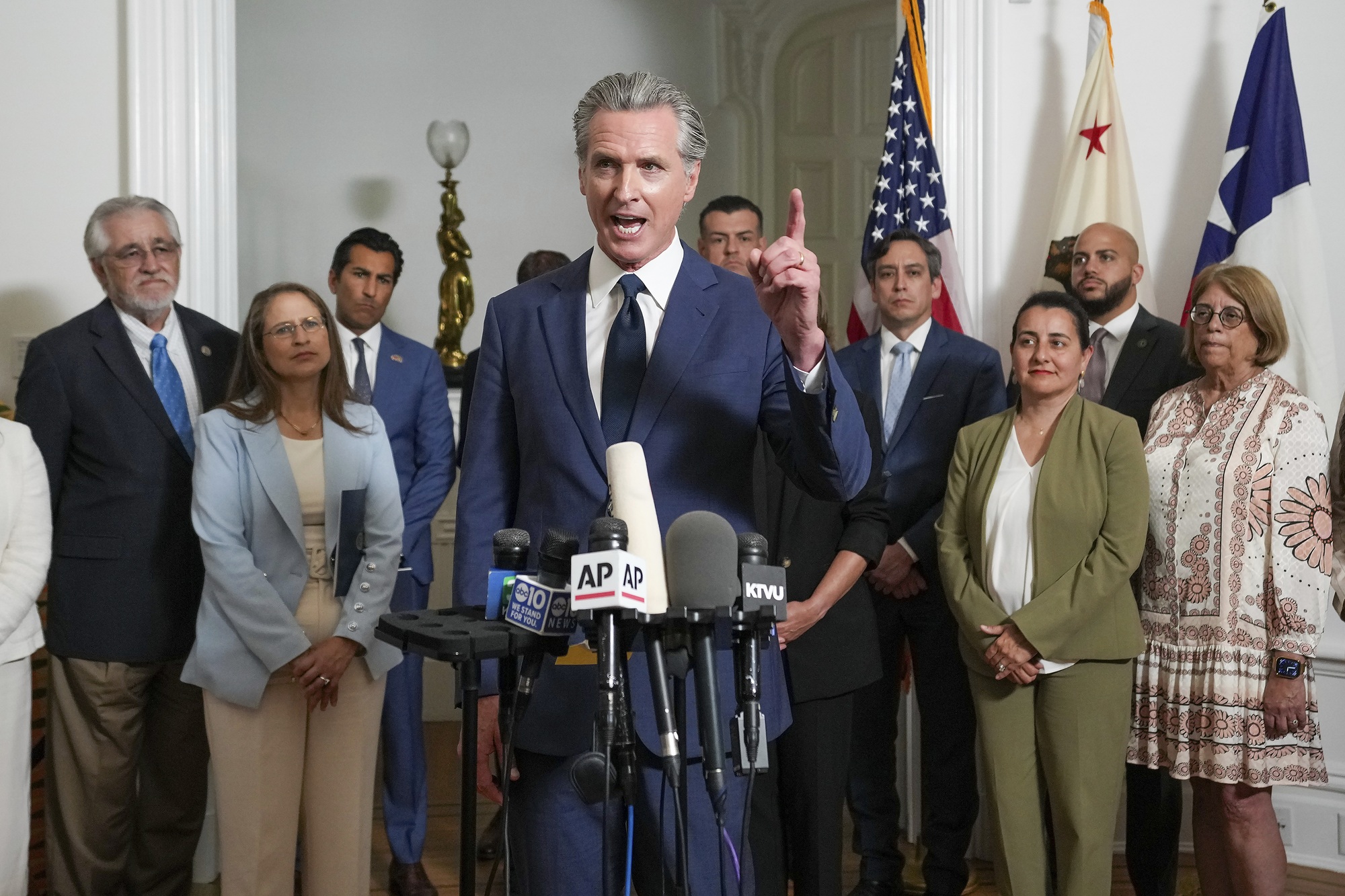
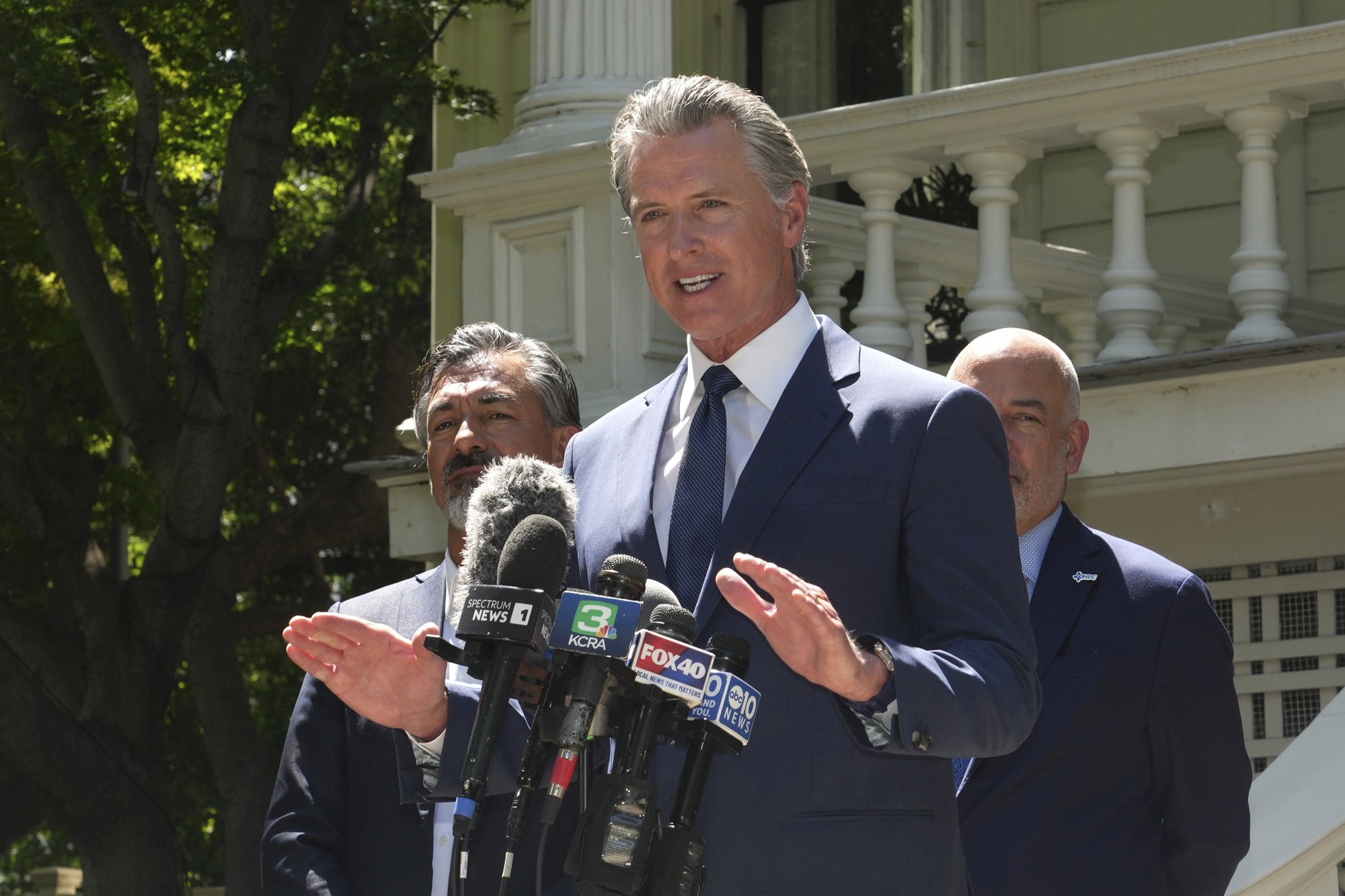
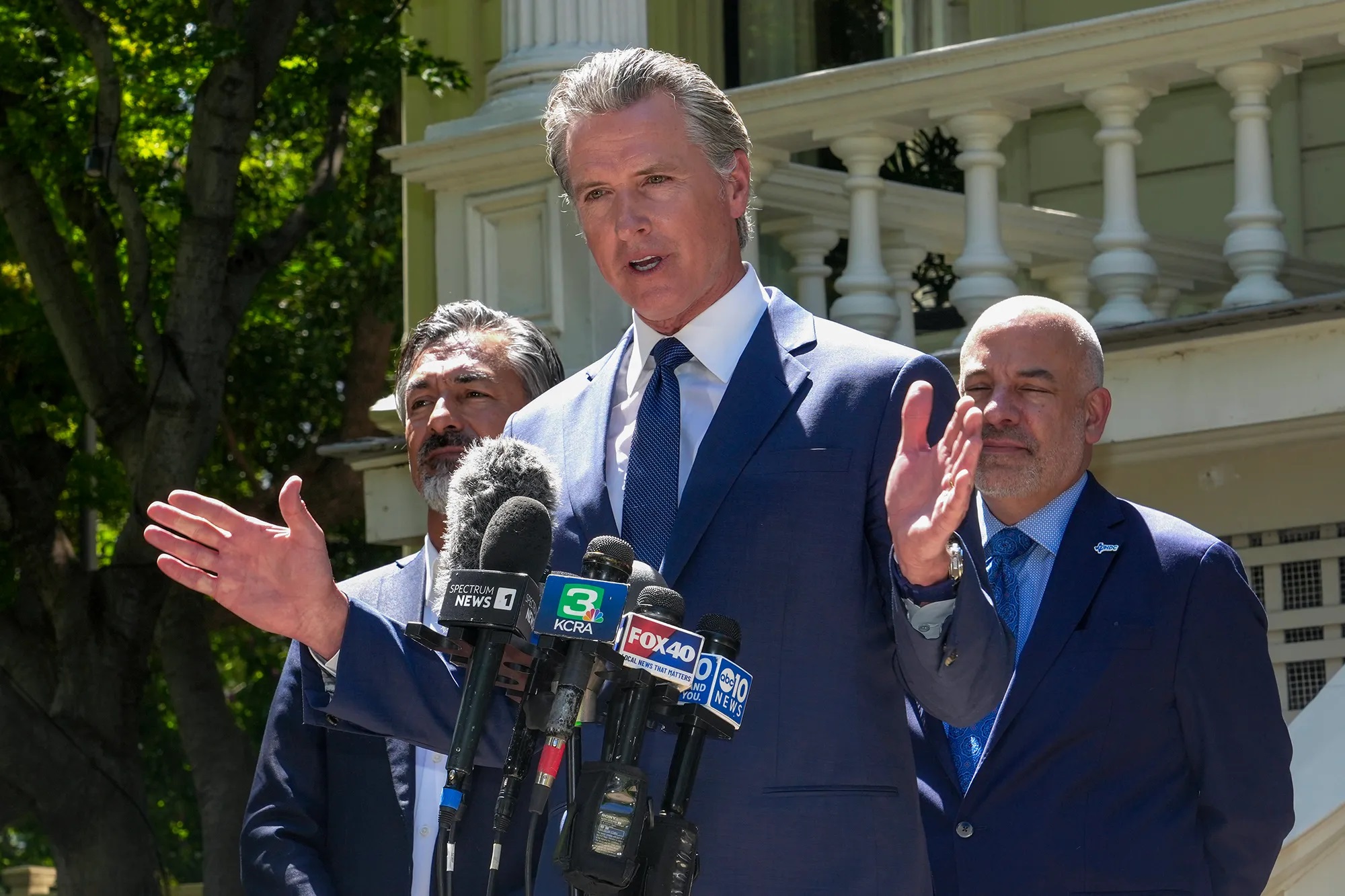
"caption": "Accompanied by California and Texas lawmakers, California Gov. Gavin Newsom speaks in support of the Texas Democratic lawmakers for their nearly weeklong walkout to block a vote on a congressional redistricting plan sought by President Donald Trump, during a news conference in Sacramento, California, on Friday, Aug. 8, 2025.",
"credit": "AP Photo/Rich Pedroncelli",
"altTag": null,
"description": null,
"imgSizes": {
"medium": {
"file": "https://cdn.kqed.org/wp-content/uploads/sites/10/2025/08/AP25221029877312-2000x1333.jpg",
"width": 2000,
"height": 1333,
"mimeType": "image/jpeg"
},
"large": {
"file": "https://cdn.kqed.org/wp-content/uploads/sites/10/2025/08/AP25221029877312-2000x1333.jpg",
"width": 2000,
"height": 1333,
"mimeType": "image/jpeg"
},
"thumbnail": {
"file": "https://cdn.kqed.org/wp-content/uploads/sites/10/2025/08/AP25221029877312-160x107.jpg",
"width": 160,
"height": 107,
"mimeType": "image/jpeg"
},
"1536x1536": {
"file": "https://cdn.kqed.org/wp-content/uploads/sites/10/2025/08/AP25221029877312-1536x1024.jpg",
"width": 1536,
"height": 1024,
"mimeType": "image/jpeg"
},
"2048x2048": {
"file": "https://cdn.kqed.org/wp-content/uploads/sites/10/2025/08/AP25221029877312-2048x1365.jpg",
"width": 2048,
"height": 1365,
"mimeType": "image/jpeg"
},
"post-thumbnail": {
"file": "https://cdn.kqed.org/wp-content/uploads/sites/10/2025/08/AP25221029877312-672x372.jpg",
"width": 672,
"height": 372,
"mimeType": "image/jpeg"
},
"twentyfourteen-full-width": {
"file": "https://cdn.kqed.org/wp-content/uploads/sites/10/2025/08/AP25221029877312-1038x576.jpg",
"width": 1038,
"height": 576,
"mimeType": "image/jpeg"
},
"full-width": {
"file": "https://cdn.kqed.org/wp-content/uploads/sites/10/2025/08/AP25221029877312-2000x1333.jpg",
"width": 2000,
"height": 1333,
"mimeType": "image/jpeg"
},
"kqedFullSize": {
"file": "https://cdn.kqed.org/wp-content/uploads/sites/10/2025/08/AP25221029877312-scaled-e1760554140189.jpg",
"width": 2000,
"height": 1333
}
},
"isLoading": false,
"fetchFailed": false
},
"news_12051595": {
"type": "attachments",
"id": "news_12051595",
"meta": {
"index": "attachments_1716263798",
"site": "news",
"id": "12051595",
"found": true
},
"title": "Election 2026 Redistricting",
"publishDate": 1754694945,
"status": "inherit",
"parent": 12051494,
"modified": 1754697094,
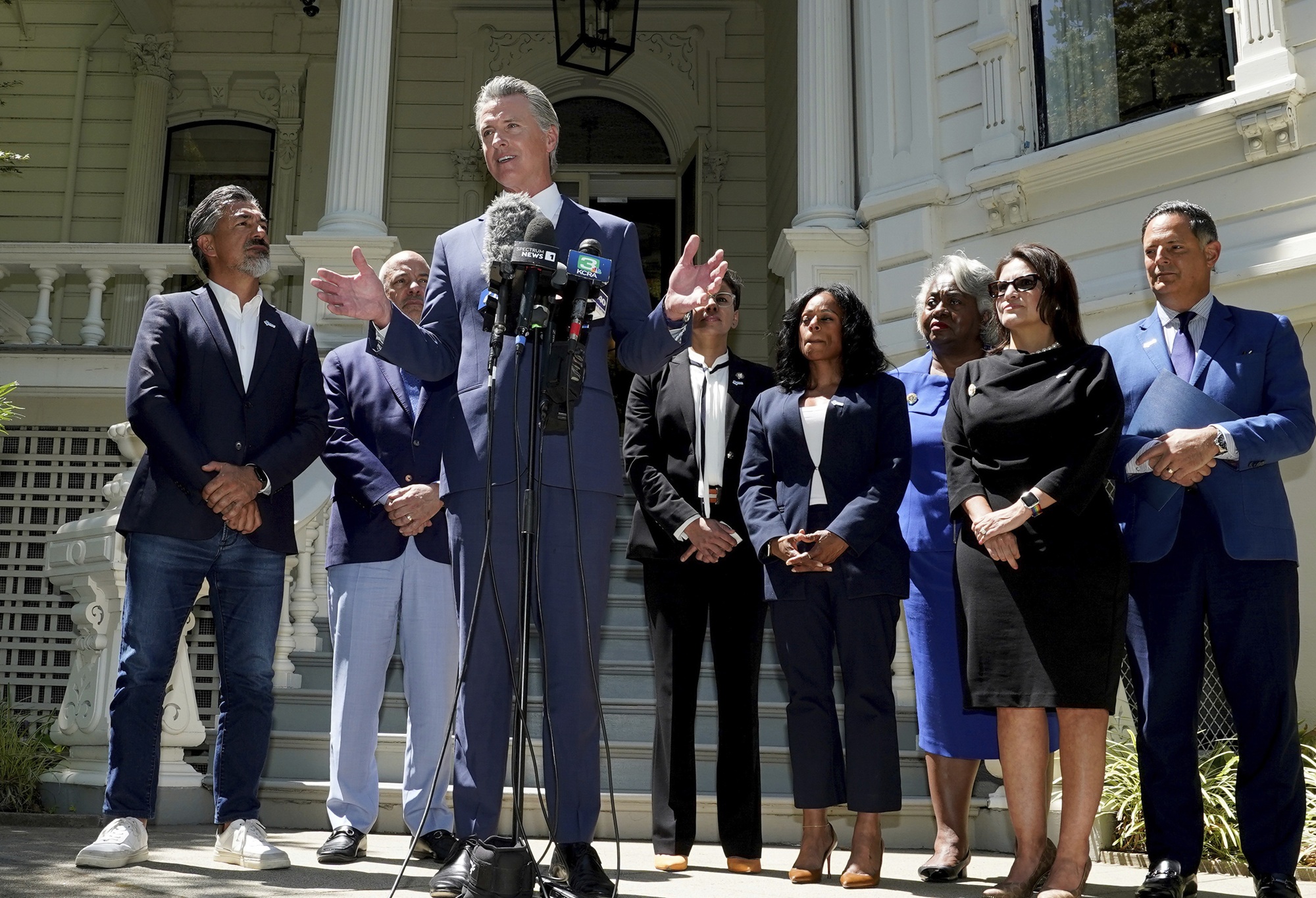
"caption": "Accompanied by California and Texas lawmakers, California Gov. Gavin Newsom, center, discusses the push to schedule a special election to redraw California's Congressional voting districts, during a news conference in Sacramento, California, on Friday, Aug. 8, 2025. ",
"credit": "Rich Pedroncelli/AP Photo",
"altTag": null,
"description": null,
"imgSizes": {
"thumbnail": {
"file": "https://cdn.kqed.org/wp-content/uploads/sites/10/2025/08/GavinNewsomTexasDemsAP-160x107.jpg",
"width": 160,
"height": 107,
"mimeType": "image/jpeg"
},
"1536x1536": {
"file": "https://cdn.kqed.org/wp-content/uploads/sites/10/2025/08/GavinNewsomTexasDemsAP-1536x1024.jpg",
"width": 1536,
"height": 1024,
"mimeType": "image/jpeg"
},
"post-thumbnail": {
"file": "https://cdn.kqed.org/wp-content/uploads/sites/10/2025/08/GavinNewsomTexasDemsAP-672x372.jpg",
"width": 672,
"height": 372,
"mimeType": "image/jpeg"
},
"twentyfourteen-full-width": {
"file": "https://cdn.kqed.org/wp-content/uploads/sites/10/2025/08/GavinNewsomTexasDemsAP-1038x576.jpg",
"width": 1038,
"height": 576,
"mimeType": "image/jpeg"
},
"kqedFullSize": {
"file": "https://cdn.kqed.org/wp-content/uploads/sites/10/2025/08/GavinNewsomTexasDemsAP.jpg",
"width": 2000,
"height": 1333
}
},
"isLoading": false,
"fetchFailed": false
},
"news_12051467": {
"type": "attachments",
"id": "news_12051467",
"meta": {
"index": "attachments_1716263798",
"site": "news",
"id": "12051467",
"found": true
},
"title": "Texas Democratic Lawmakers Flee State In Effort To Halt Redistricting Legislation",
"publishDate": 1754676121,
"status": "inherit",
"parent": 12051462,
"modified": 1754941243,
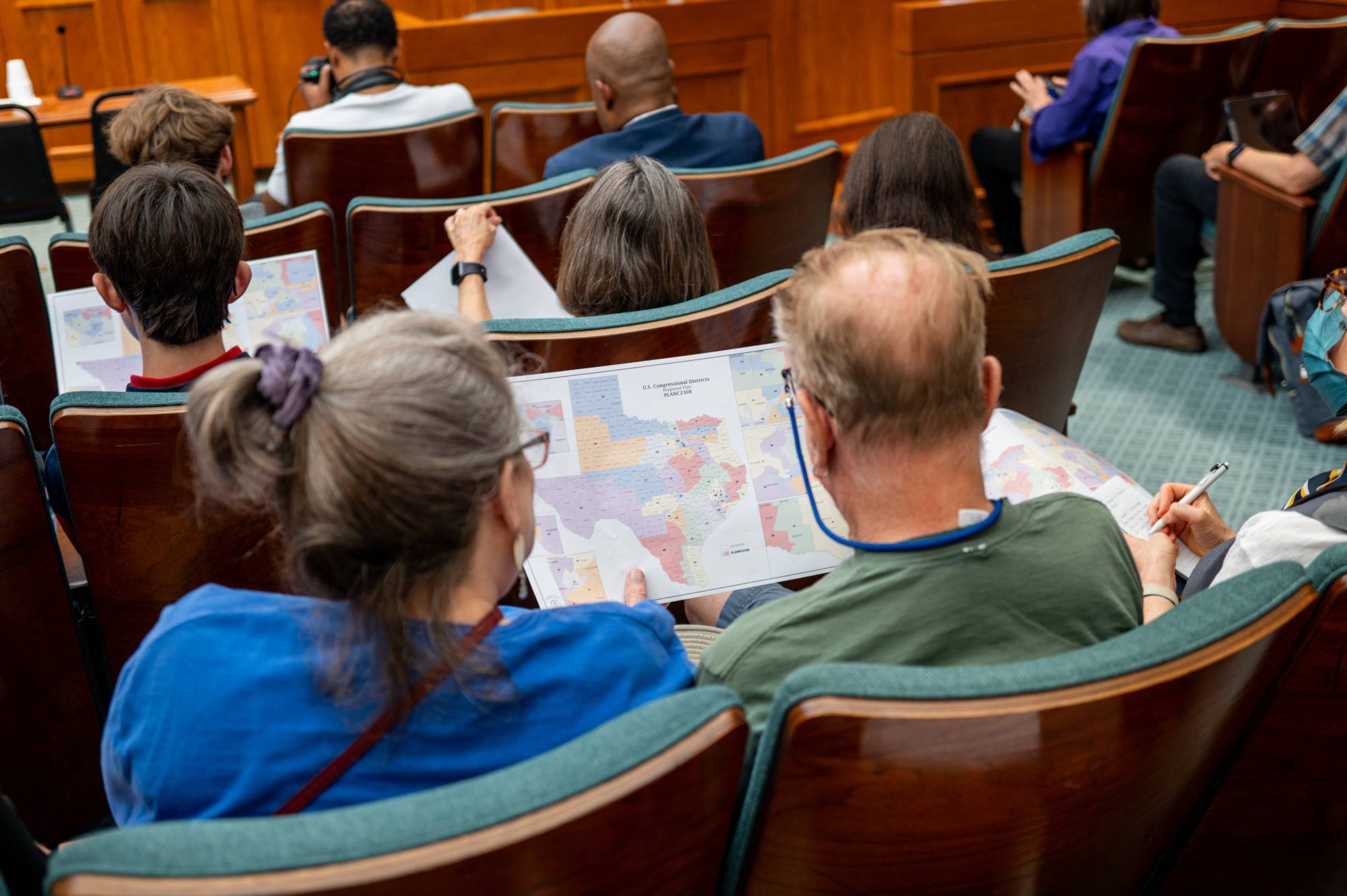
"caption": "AUSTIN, TEXAS - AUGUST 07: Attendees view a map during a Senate Special Committee on Congressional Redistricting public testimony hearing on August 07, 2025 in Austin, Texas. The Senate Special Committee on Congressional Redistricting met to hear public testimony on Congressional plan C2308. Earlier this week, Texas Democratic lawmakers fled the state in an attempt to protest and deny quorum for votes on the proposed Republican redistricting plan, which would secure five additional GOP seats in the U.S. House. Gov. Greg Abbott has threatened to remove lawmakers who do not return and has asked the Texas Supreme Court to expel House Democratic leaders who fled the state. ",
"credit": "Photo by Brandon Bell/Getty Images",
"altTag": null,
"description": null,
"imgSizes": {
"medium": {
"file": "https://cdn.kqed.org/wp-content/uploads/sites/10/2025/08/GettyImages-2228948736-2000x1331.jpg",
"width": 2000,
"height": 1331,
"mimeType": "image/jpeg"
},
"large": {
"file": "https://cdn.kqed.org/wp-content/uploads/sites/10/2025/08/GettyImages-2228948736-2000x1331.jpg",
"width": 2000,
"height": 1331,
"mimeType": "image/jpeg"
},
"thumbnail": {
"file": "https://cdn.kqed.org/wp-content/uploads/sites/10/2025/08/GettyImages-2228948736-160x106.jpg",
"width": 160,
"height": 106,
"mimeType": "image/jpeg"
},
"1536x1536": {
"file": "https://cdn.kqed.org/wp-content/uploads/sites/10/2025/08/GettyImages-2228948736-1536x1022.jpg",
"width": 1536,
"height": 1022,
"mimeType": "image/jpeg"
},
"2048x2048": {
"file": "https://cdn.kqed.org/wp-content/uploads/sites/10/2025/08/GettyImages-2228948736-2048x1363.jpg",
"width": 2048,
"height": 1363,
"mimeType": "image/jpeg"
},
"post-thumbnail": {
"file": "https://cdn.kqed.org/wp-content/uploads/sites/10/2025/08/GettyImages-2228948736-672x372.jpg",
"width": 672,
"height": 372,
"mimeType": "image/jpeg"
},
"twentyfourteen-full-width": {
"file": "https://cdn.kqed.org/wp-content/uploads/sites/10/2025/08/GettyImages-2228948736-1038x576.jpg",
"width": 1038,
"height": 576,
"mimeType": "image/jpeg"
},
"full-width": {
"file": "https://cdn.kqed.org/wp-content/uploads/sites/10/2025/08/GettyImages-2228948736-2000x1331.jpg",
"width": 2000,
"height": 1331,
"mimeType": "image/jpeg"
},
"kqedFullSize": {
"file": "https://cdn.kqed.org/wp-content/uploads/sites/10/2025/08/GettyImages-2228948736-scaled.jpg",
"width": 2560,
"height": 1704
}
},
"isLoading": false,
"fetchFailed": false
},
"news_12051294": {
"type": "attachments",
"id": "news_12051294",
"meta": {
"index": "attachments_1716263798",
"site": "news",
"id": "12051294",
"found": true
},
"title": "250807-PELOSIVISIT-06-KQED",
"publishDate": 1754594479,
"status": "inherit",
"parent": 0,
"modified": 1754594509,
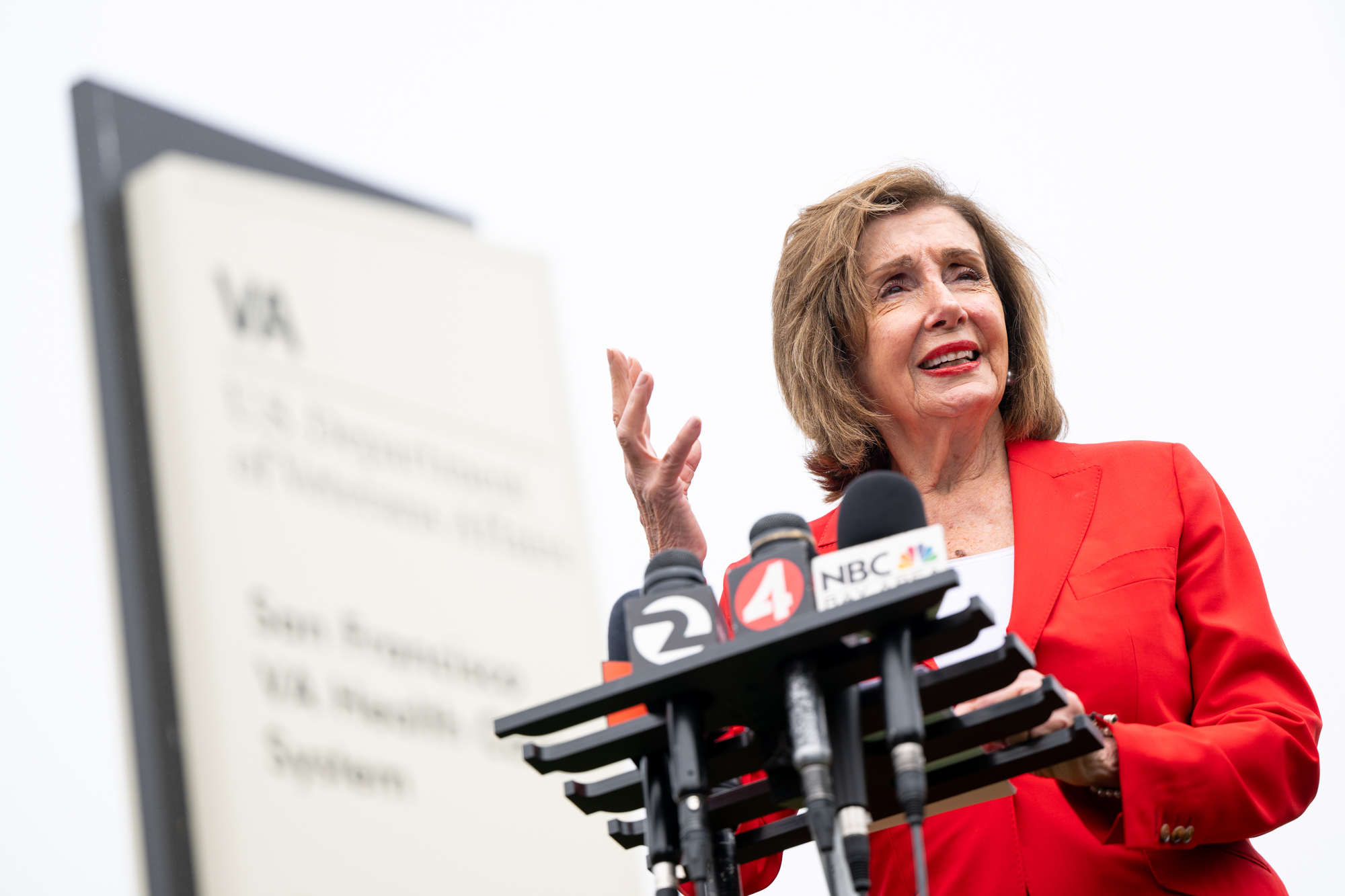
"caption": "Speaker Emerita Nancy Pelosi speaks at a press conference outside the San Francisco VA Medical Center in San Francisco on Aug. 7, 2025, after she toured the medical facility.",
"credit": "Beth LaBerge/KQED",
"altTag": null,
"description": null,
"imgSizes": {
"thumbnail": {
"file": "https://cdn.kqed.org/wp-content/uploads/sites/10/2025/08/250807-PELOSIVISIT-06-KQED-160x107.jpg",
"width": 160,
"height": 107,
"mimeType": "image/jpeg"
},
"1536x1536": {
"file": "https://cdn.kqed.org/wp-content/uploads/sites/10/2025/08/250807-PELOSIVISIT-06-KQED-1536x1024.jpg",
"width": 1536,
"height": 1024,
"mimeType": "image/jpeg"
},
"post-thumbnail": {
"file": "https://cdn.kqed.org/wp-content/uploads/sites/10/2025/08/250807-PELOSIVISIT-06-KQED-672x372.jpg",
"width": 672,
"height": 372,
"mimeType": "image/jpeg"
},
"twentyfourteen-full-width": {
"file": "https://cdn.kqed.org/wp-content/uploads/sites/10/2025/08/250807-PELOSIVISIT-06-KQED-1038x576.jpg",
"width": 1038,
"height": 576,
"mimeType": "image/jpeg"
},
"kqedFullSize": {
"file": "https://cdn.kqed.org/wp-content/uploads/sites/10/2025/08/250807-PELOSIVISIT-06-KQED.jpg",
"width": 2000,
"height": 1333
}
},
"isLoading": false,
"fetchFailed": false
},
"news_12050987": {
"type": "attachments",
"id": "news_12050987",
"meta": {
"index": "attachments_1716263798",
"site": "news",
"id": "12050987",
"found": true
},
"title": "Election 2026 California Redistricting",
"publishDate": 1754422424,
"status": "inherit",
"parent": 12050983,
"modified": 1754432188,
"caption": "California Gov. Gavin Newsom, accompanied by several members of the Texas state Legislature, calls for a new way for California to redraw its voting districts during a news conference in Sacramento, California, on Friday, July 25, 2025. ",
"credit": "Rich Pedroncelli/AP Photo",
"altTag": null,
"description": null,
"imgSizes": {
"thumbnail": {
"file": "https://cdn.kqed.org/wp-content/uploads/sites/10/2025/08/GavinNewsomSacramentoAug2025AP-160x109.jpg",
"width": 160,
"height": 109,
"mimeType": "image/jpeg"
},
"1536x1536": {
"file": "https://cdn.kqed.org/wp-content/uploads/sites/10/2025/08/GavinNewsomSacramentoAug2025AP-1536x1048.jpg",
"width": 1536,
"height": 1048,
"mimeType": "image/jpeg"
},
"post-thumbnail": {
"file": "https://cdn.kqed.org/wp-content/uploads/sites/10/2025/08/GavinNewsomSacramentoAug2025AP-672x372.jpg",
"width": 672,
"height": 372,
"mimeType": "image/jpeg"
},
"twentyfourteen-full-width": {
"file": "https://cdn.kqed.org/wp-content/uploads/sites/10/2025/08/GavinNewsomSacramentoAug2025AP-1038x576.jpg",
"width": 1038,
"height": 576,
"mimeType": "image/jpeg"
},
"kqedFullSize": {
"file": "https://cdn.kqed.org/wp-content/uploads/sites/10/2025/08/GavinNewsomSacramentoAug2025AP.jpg",
"width": 2000,
"height": 1364
}
},
"isLoading": false,
"fetchFailed": false
},
"news_12050924": {
"type": "attachments",
"id": "news_12050924",
"meta": {
"index": "attachments_1716263798",
"site": "news",
"id": "12050924",
"found": true
},
"title": "Azul_1",
"publishDate": 1754402505,
"status": "inherit",
"parent": 12050923,
"modified": 1754402812,
"caption": "The grassroots organization Azul, which focuses on ocean justice, is working to ensure that community-driven solutions are part of a worldwide Plastics Treaty.",
"credit": "Photo courtesy of Azul",
"altTag": null,
"description": null,
"imgSizes": {
"medium": {
"file": "https://cdn.kqed.org/wp-content/uploads/sites/10/2025/08/Azul_1-2000x1333.jpg",
"width": 2000,
"height": 1333,
"mimeType": "image/jpeg"
},
"large": {
"file": "https://cdn.kqed.org/wp-content/uploads/sites/10/2025/08/Azul_1-2000x1333.jpg",
"width": 2000,
"height": 1333,
"mimeType": "image/jpeg"
},
"thumbnail": {
"file": "https://cdn.kqed.org/wp-content/uploads/sites/10/2025/08/Azul_1-160x107.jpg",
"width": 160,
"height": 107,
"mimeType": "image/jpeg"
},
"1536x1536": {
"file": "https://cdn.kqed.org/wp-content/uploads/sites/10/2025/08/Azul_1-1536x1024.jpg",
"width": 1536,
"height": 1024,
"mimeType": "image/jpeg"
},
"2048x2048": {
"file": "https://cdn.kqed.org/wp-content/uploads/sites/10/2025/08/Azul_1-2048x1365.jpg",
"width": 2048,
"height": 1365,
"mimeType": "image/jpeg"
},
"post-thumbnail": {
"file": "https://cdn.kqed.org/wp-content/uploads/sites/10/2025/08/Azul_1-672x372.jpg",
"width": 672,
"height": 372,
"mimeType": "image/jpeg"
},
"twentyfourteen-full-width": {
"file": "https://cdn.kqed.org/wp-content/uploads/sites/10/2025/08/Azul_1-1038x576.jpg",
"width": 1038,
"height": 576,
"mimeType": "image/jpeg"
},
"full-width": {
"file": "https://cdn.kqed.org/wp-content/uploads/sites/10/2025/08/Azul_1-2000x1333.jpg",
"width": 2000,
"height": 1333,
"mimeType": "image/jpeg"
},
"kqedFullSize": {
"file": "https://cdn.kqed.org/wp-content/uploads/sites/10/2025/08/Azul_1-scaled.jpg",
"width": 2560,
"height": 1707
}
},
"isLoading": false,
"fetchFailed": false
},
"news_12043426": {
"type": "attachments",
"id": "news_12043426",
"meta": {
"index": "attachments_1716263798",
"site": "news",
"id": "12043426",
"found": true
},
"title": "California Governor Newsom Announces Lawsuit Challenging Trump Tariff Authority",
"publishDate": 1749506167,
"status": "inherit",
"parent": 12043314,
"modified": 1753920496,
"caption": "Gov. Gavin Newsom (right) speaks as Attorney General Rob Bonta looks on during a news conference on April 16, 2025, in Ceres, California. ",
"credit": "Justin Sullivan/Getty Images",
"altTag": null,
"description": null,
"imgSizes": {
"thumbnail": {
"file": "https://cdn.kqed.org/wp-content/uploads/sites/10/2025/06/GavinNewsomRobBontaGetty-160x119.jpg",
"width": 160,
"height": 119,
"mimeType": "image/jpeg"
},
"1536x1536": {
"file": "https://cdn.kqed.org/wp-content/uploads/sites/10/2025/06/GavinNewsomRobBontaGetty-1536x1145.jpg",
"width": 1536,
"height": 1145,
"mimeType": "image/jpeg"
},
"post-thumbnail": {
"file": "https://cdn.kqed.org/wp-content/uploads/sites/10/2025/06/GavinNewsomRobBontaGetty-672x372.jpg",
"width": 672,
"height": 372,
"mimeType": "image/jpeg"
},
"twentyfourteen-full-width": {
"file": "https://cdn.kqed.org/wp-content/uploads/sites/10/2025/06/GavinNewsomRobBontaGetty-1038x576.jpg",
"width": 1038,
"height": 576,
"mimeType": "image/jpeg"
},
"kqedFullSize": {
"file": "https://cdn.kqed.org/wp-content/uploads/sites/10/2025/06/GavinNewsomRobBontaGetty.jpg",
"width": 2000,
"height": 1491
}
},
"isLoading": false,
"fetchFailed": false
},
"news_12049976": {
"type": "attachments",
"id": "news_12049976",
"meta": {
"index": "attachments_1716263798",
"site": "news",
"id": "12049976",
"found": true
},
"title": "Election 2026-Redistricting Newsom",
"publishDate": 1753719302,
"status": "inherit",
"parent": 12049973,
"modified": 1753724187,
"caption": "Gov. Gavin Newsom calls for a new way for California to redraw its voting districts during a news conference in Sacramento, California, on Friday, July 25, 2025. ",
"credit": "Rich Pedroncelli/AP Photo",
"altTag": null,
"description": null,
"imgSizes": {
"thumbnail": {
"file": "https://cdn.kqed.org/wp-content/uploads/sites/10/2025/07/GavinNewsomAPJuly2025-160x107.jpg",
"width": 160,
"height": 107,
"mimeType": "image/jpeg"
},
"1536x1536": {
"file": "https://cdn.kqed.org/wp-content/uploads/sites/10/2025/07/GavinNewsomAPJuly2025-1536x1024.jpg",
"width": 1536,
"height": 1024,
"mimeType": "image/jpeg"
},
"post-thumbnail": {
"file": "https://cdn.kqed.org/wp-content/uploads/sites/10/2025/07/GavinNewsomAPJuly2025-672x372.jpg",
"width": 672,
"height": 372,
"mimeType": "image/jpeg"
},
"twentyfourteen-full-width": {
"file": "https://cdn.kqed.org/wp-content/uploads/sites/10/2025/07/GavinNewsomAPJuly2025-1038x576.jpg",
"width": 1038,
"height": 576,
"mimeType": "image/jpeg"
},
"kqedFullSize": {
"file": "https://cdn.kqed.org/wp-content/uploads/sites/10/2025/07/GavinNewsomAPJuly2025.jpg",
"width": 2000,
"height": 1333
}
},
"isLoading": false,
"fetchFailed": false
},
"news_12049970": {
"type": "attachments",
"id": "news_12049970",
"meta": {
"index": "attachments_1716263798",
"site": "news",
"id": "12049970",
"found": true
},
"title": "immigrnt adoptee",
"publishDate": 1753708832,
"status": "inherit",
"parent": 12049969,
"modified": 1753709003,
"caption": "A childhood photo of Shirley Chung. She was just 16 months old when an American family adopted her from South Korea in 1966. But the paperwork required to establish citizenship was never competed.",
"credit": "Photo Courtesy of Shirley Chung",
"altTag": null,
"description": null,
"imgSizes": {
"thumbnail": {
"file": "https://cdn.kqed.org/wp-content/uploads/sites/10/2025/07/immigrnt-adoptee-160x181.jpg",
"width": 160,
"height": 181,
"mimeType": "image/jpeg"
},
"post-thumbnail": {
"file": "https://cdn.kqed.org/wp-content/uploads/sites/10/2025/07/immigrnt-adoptee-672x372.jpg",
"width": 672,
"height": 372,
"mimeType": "image/jpeg"
},
"twentyfourteen-full-width": {
"file": "https://cdn.kqed.org/wp-content/uploads/sites/10/2025/07/immigrnt-adoptee-679x576.jpg",
"width": 679,
"height": 576,
"mimeType": "image/jpeg"
},
"kqedFullSize": {
"file": "https://cdn.kqed.org/wp-content/uploads/sites/10/2025/07/immigrnt-adoptee.jpg",
"width": 679,
"height": 767
}
},
"isLoading": false,
"fetchFailed": false
},
"news_12049917": {
"type": "attachments",
"id": "news_12049917",
"meta": {
"index": "attachments_1716263798",
"site": "news",
"id": "12049917",
"found": true
},
"title": "072525-Gavin-Newsom-Presser-AP-CM-01",
"publishDate": 1753491904,
"status": "inherit",
"parent": 12049912,
"modified": 1757024501,
"caption": "Gov. Gavin Newsom calls for a new way for California to redraw its congressional district maps during a news conference in Sacramento on July 25, 2025. \n",
"credit": "Rich Pedroncelli/AP Photo",
"altTag": null,
"description": null,
"imgSizes": {
"thumbnail": {
"file": "https://cdn.kqed.org/wp-content/uploads/sites/10/2025/07/072525-Gavin-Newsom-Presser-AP-CM-01-160x107.jpg",
"width": 160,
"height": 107,
"mimeType": "image/jpeg"
},
"1536x1536": {
"file": "https://cdn.kqed.org/wp-content/uploads/sites/10/2025/07/072525-Gavin-Newsom-Presser-AP-CM-01-1536x1024.jpg",
"width": 1536,
"height": 1024,
"mimeType": "image/jpeg"
},
"post-thumbnail": {
"file": "https://cdn.kqed.org/wp-content/uploads/sites/10/2025/07/072525-Gavin-Newsom-Presser-AP-CM-01-672x372.jpg",
"width": 672,
"height": 372,
"mimeType": "image/jpeg"
},
"twentyfourteen-full-width": {
"file": "https://cdn.kqed.org/wp-content/uploads/sites/10/2025/07/072525-Gavin-Newsom-Presser-AP-CM-01-1038x576.jpg",
"width": 1038,
"height": 576,
"mimeType": "image/jpeg"
},
"kqedFullSize": {
"file": "https://cdn.kqed.org/wp-content/uploads/sites/10/2025/07/072525-Gavin-Newsom-Presser-AP-CM-01.jpg",
"width": 2000,
"height": 1333
}
},
"isLoading": false,
"fetchFailed": false
},
"news_11932651": {
"type": "attachments",
"id": "news_11932651",
"meta": {
"index": "attachments_1716263798",
"site": "news",
"id": "11932651",
"found": true
},
"parent": 11932634,
"imgSizes": {
"twentyfourteen-full-width": {
"file": "https://ww2.kqed.org/app/uploads/sites/10/2022/11/Screen-Shot-2022-11-17-at-3.53.48-PM-1038x576.png",
"width": 1038,
"mimeType": "image/png",
"height": 576
},
"thumbnail": {
"file": "https://ww2.kqed.org/app/uploads/sites/10/2022/11/Screen-Shot-2022-11-17-at-3.53.48-PM-160x94.png",
"width": 160,
"mimeType": "image/png",
"height": 94
},
"post-thumbnail": {
"file": "https://ww2.kqed.org/app/uploads/sites/10/2022/11/Screen-Shot-2022-11-17-at-3.53.48-PM-672x372.png",
"width": 672,
"mimeType": "image/png",
"height": 372
},
"kqedFullSize": {
"file": "https://ww2.kqed.org/app/uploads/sites/10/2022/11/Screen-Shot-2022-11-17-at-3.53.48-PM.png",
"width": 2384,
"height": 1406
},
"2048x2048": {
"file": "https://ww2.kqed.org/app/uploads/sites/10/2022/11/Screen-Shot-2022-11-17-at-3.53.48-PM-2048x1208.png",
"width": 2048,
"mimeType": "image/png",
"height": 1208
},
"large": {
"file": "https://ww2.kqed.org/app/uploads/sites/10/2022/11/Screen-Shot-2022-11-17-at-3.53.48-PM-1020x602.png",
"width": 1020,
"mimeType": "image/png",
"height": 602
},
"1536x1536": {
"file": "https://ww2.kqed.org/app/uploads/sites/10/2022/11/Screen-Shot-2022-11-17-at-3.53.48-PM-1536x906.png",
"width": 1536,
"mimeType": "image/png",
"height": 906
},
"full-width": {
"file": "https://ww2.kqed.org/app/uploads/sites/10/2022/11/Screen-Shot-2022-11-17-at-3.53.48-PM-1920x1132.png",
"width": 1920,
"mimeType": "image/png",
"height": 1132
},
"medium": {
"file": "https://ww2.kqed.org/app/uploads/sites/10/2022/11/Screen-Shot-2022-11-17-at-3.53.48-PM-800x472.png",
"width": 800,
"mimeType": "image/png",
"height": 472
}
},
"publishDate": 1668732045,
"modified": 1668733384,
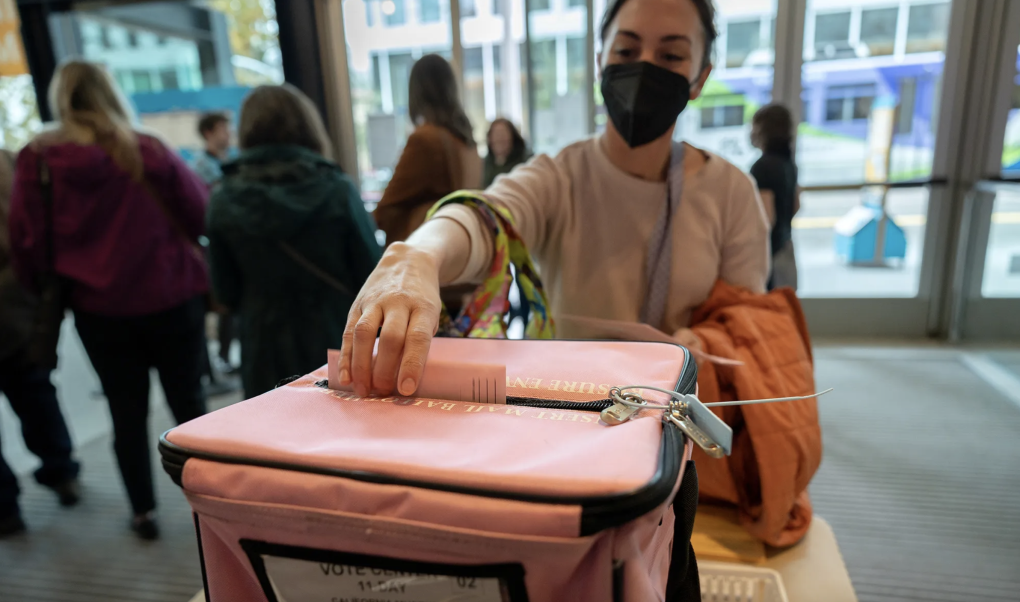
"caption": "Felicia Gold casts her ballot at the California Museum on Nov. 8, 2022.",
"description": null,
"title": "Screen Shot 2022-11-17 at 3.53.48 PM",
"credit": "Miguel Gutierrez Jr./CalMatters",
"status": "inherit",
"altTag": "A woman wearing a black face mask places a piece of paper into a ballot box.",
"isLoading": false,
"fetchFailed": false
}
},
"audioPlayerReducer": {
"postId": "stream_live",
"isPaused": true,
"isPlaying": false,
"pfsActive": false,
"pledgeModalIsOpen": true,
"playerDrawerIsOpen": false,
"liveAudioPlayStartedAt": 0,
"liveAudioPlayContext": ""
},
"authorsReducer": {
"byline_news_12049912": {
"type": "authors",
"id": "byline_news_12049912",
"meta": {
"override": true
},
"slug": "byline_news_12049912",
"name": "Alexei Koseff, CalMatters",
"isLoading": false
},
"byline_news_11932634": {
"type": "authors",
"id": "byline_news_11932634",
"meta": {
"override": true
},
"slug": "byline_news_11932634",
"name": "\u003ca href=\"https://calmatters.org/author/alexei-koseff/\">Alexei Koseff\u003c/a> and \u003ca href=\"https://calmatters.org/author/sameea-kamal/\">Sameea Kamal\u003c/a>",
"isLoading": false
},
"gmarzorati": {
"type": "authors",
"id": "227",
"meta": {
"index": "authors_1716337520",
"id": "227",
"found": true
},
"name": "Guy Marzorati",
"firstName": "Guy",
"lastName": "Marzorati",
"slug": "gmarzorati",
"email": "gmarzorati@KQED.org",
"display_author_email": true,
"staff_mastheads": [
"news"
],
"title": "Correspondent",
"bio": "Guy Marzorati is a correspondent on KQED's California Politics and Government Desk, based in San Jose. A graduate of Santa Clara University, Guy joined KQED in 2013. He reports on state and local politics and produces KQED's digital voter guide.",
"avatar": "https://secure.gravatar.com/avatar/e7038b8dbfd55b104369b76b1cd0b9de?s=600&d=blank&r=g",
"twitter": "guymarzorati",
"facebook": null,
"instagram": null,
"linkedin": null,
"sites": [
{
"site": "",
"roles": [
"editor"
]
},
{
"site": "news",
"roles": [
"editor"
]
},
{
"site": "science",
"roles": [
"editor"
]
},
{
"site": "forum",
"roles": [
"editor"
]
},
{
"site": "elections",
"roles": [
"editor"
]
},
{
"site": "liveblog",
"roles": [
"editor"
]
}
],
"headData": {
"title": "Guy Marzorati | KQED",
"description": "Correspondent",
"ogImgSrc": "https://secure.gravatar.com/avatar/e7038b8dbfd55b104369b76b1cd0b9de?s=600&d=blank&r=g",
"twImgSrc": "https://secure.gravatar.com/avatar/e7038b8dbfd55b104369b76b1cd0b9de?s=600&d=blank&r=g"
},
"isLoading": false,
"link": "/author/gmarzorati"
},
"scottshafer": {
"type": "authors",
"id": "255",
"meta": {
"index": "authors_1716337520",
"id": "255",
"found": true
},
"name": "Scott Shafer",
"firstName": "Scott",
"lastName": "Shafer",
"slug": "scottshafer",
"email": "sshafer@kqed.org",
"display_author_email": false,
"staff_mastheads": [
"news"
],
"title": "KQED Contributor",
"bio": "Scott Shafer is a senior editor with the KQED Politics and Government desk. He is co-host of Political Breakdown, the award-winning radio show and podcast with a personal take on the world of politics. Scott came to KQED in 1998 to host the statewide\u003cem> California Report\u003c/em>. Prior to that he had extended stints in politics and government\u003cem>.\u003c/em> He uses that inside experience at KQED in his, reporting, hosting and analysis for the politics desk. Scott collaborated \u003cem>Political Breakdown a\u003c/em>nd on \u003cem>The Political Mind of Jerry Brown, \u003c/em>an eight-part series about the life and extraordinary political career of the former governor. For fun, he plays water polo with the San Francisco Tsunami.",
"avatar": "https://secure.gravatar.com/avatar/a62ebae45b79d7aed1a39a0e3bf68104?s=600&d=blank&r=g",
"twitter": "scottshafer",
"bluesky": null,
"facebook": null,
"instagram": null,
"linkedin": null,
"sites": [
{
"site": "news",
"roles": [
"editor"
]
},
{
"site": "stateofhealth",
"roles": [
"author"
]
},
{
"site": "science",
"roles": [
"author"
]
},
{
"site": "forum",
"roles": [
"subscriber"
]
},
{
"site": "liveblog",
"roles": [
"author"
]
}
],
"headData": {
"title": "Scott Shafer | KQED",
"description": "KQED Contributor",
"ogImgSrc": "https://secure.gravatar.com/avatar/a62ebae45b79d7aed1a39a0e3bf68104?s=600&d=blank&r=g",
"twImgSrc": "https://secure.gravatar.com/avatar/a62ebae45b79d7aed1a39a0e3bf68104?s=600&d=blank&r=g"
},
"isLoading": false,
"link": "/author/scottshafer"
},
"agonzalez": {
"type": "authors",
"id": "11724",
"meta": {
"index": "authors_1716337520",
"id": "11724",
"found": true
},
"name": "Alexander Gonzalez",
"firstName": "Alexander",
"lastName": "Gonzalez",
"slug": "agonzalez",
"email": "AlexanderGonzalez@KQED.org",
"display_author_email": false,
"staff_mastheads": [
"news"
],
"title": "KQED Contributor",
"bio": null,
"avatar": "https://secure.gravatar.com/avatar/9e291ed34e154df4c662edf858b641d70b4859939bfe40be478408f9dfd057d2?s=600&d=blank&r=g",
"twitter": null,
"bluesky": null,
"facebook": null,
"instagram": null,
"linkedin": null,
"sites": [
{
"site": "arts",
"roles": [
"editor"
]
},
{
"site": "news",
"roles": [
"editor"
]
},
{
"site": "science",
"roles": [
"editor"
]
}
],
"headData": {
"title": "Alexander Gonzalez | KQED",
"description": "KQED Contributor",
"ogImgSrc": "https://secure.gravatar.com/avatar/9e291ed34e154df4c662edf858b641d70b4859939bfe40be478408f9dfd057d2?s=600&d=blank&r=g",
"twImgSrc": "https://secure.gravatar.com/avatar/9e291ed34e154df4c662edf858b641d70b4859939bfe40be478408f9dfd057d2?s=600&d=blank&r=g"
},
"isLoading": false,
"link": "/author/agonzalez"
},
"kmizuguchi": {
"type": "authors",
"id": "11739",
"meta": {
"index": "authors_1716337520",
"id": "11739",
"found": true
},
"name": "Keith Mizuguchi",
"firstName": "Keith",
"lastName": "Mizuguchi",
"slug": "kmizuguchi",
"email": "kmizuguchi@kqed.org",
"display_author_email": false,
"staff_mastheads": [],
"title": "KQED Contributor",
"bio": null,
"avatar": "https://secure.gravatar.com/avatar/64d8a7de0723d4099b9fe4e915136103febcc20809abce228ee4415bcb237023?s=600&d=blank&r=g",
"twitter": null,
"bluesky": null,
"facebook": null,
"instagram": null,
"linkedin": null,
"sites": [
{
"site": "news",
"roles": [
"editor"
]
},
{
"site": "science",
"roles": [
"editor"
]
}
],
"headData": {
"title": "Keith Mizuguchi | KQED",
"description": "KQED Contributor",
"ogImgSrc": "https://secure.gravatar.com/avatar/64d8a7de0723d4099b9fe4e915136103febcc20809abce228ee4415bcb237023?s=600&d=blank&r=g",
"twImgSrc": "https://secure.gravatar.com/avatar/64d8a7de0723d4099b9fe4e915136103febcc20809abce228ee4415bcb237023?s=600&d=blank&r=g"
},
"isLoading": false,
"link": "/author/kmizuguchi"
},
"jlara": {
"type": "authors",
"id": "11761",
"meta": {
"index": "authors_1716337520",
"id": "11761",
"found": true
},
"name": "Juan Carlos Lara",
"firstName": "Juan Carlos",
"lastName": "Lara",
"slug": "jlara",
"email": "jlara@kqed.org",
"display_author_email": false,
"staff_mastheads": [],
"title": "KQED Contributor",
"bio": null,
"avatar": "https://secure.gravatar.com/avatar/19e2052b9b05657c5ff2af2121846e9c?s=600&d=blank&r=g",
"twitter": null,
"facebook": null,
"instagram": null,
"linkedin": null,
"sites": [
{
"site": "arts",
"roles": [
"editor"
]
},
{
"site": "news",
"roles": [
"editor"
]
},
{
"site": "forum",
"roles": [
"editor"
]
},
{
"site": "liveblog",
"roles": [
"contributor"
]
}
],
"headData": {
"title": "Juan Carlos Lara | KQED",
"description": "KQED Contributor",
"ogImgSrc": "https://secure.gravatar.com/avatar/19e2052b9b05657c5ff2af2121846e9c?s=600&d=blank&r=g",
"twImgSrc": "https://secure.gravatar.com/avatar/19e2052b9b05657c5ff2af2121846e9c?s=600&d=blank&r=g"
},
"isLoading": false,
"link": "/author/jlara"
},
"kdebenedetti": {
"type": "authors",
"id": "11913",
"meta": {
"index": "authors_1716337520",
"id": "11913",
"found": true
},
"name": "Katie DeBenedetti",
"firstName": "Katie",
"lastName": "DeBenedetti",
"slug": "kdebenedetti",
"email": "kdebenedetti@kqed.org",
"display_author_email": false,
"staff_mastheads": [
"news",
"science"
],
"title": "KQED Contributor",
"bio": "Katie DeBenedetti is a digital reporter covering daily news for the Express Desk. Prior to joining KQED as a culture reporting intern in January 2024, she covered education and city government for the Napa Valley Register.",
"avatar": "https://secure.gravatar.com/avatar/6e31073cb8f7e4214ab03f42771d0f45?s=600&d=blank&r=g",
"twitter": null,
"facebook": null,
"instagram": null,
"linkedin": null,
"sites": [
{
"site": "news",
"roles": [
"author"
]
},
{
"site": "science",
"roles": [
"author"
]
},
{
"site": "liveblog",
"roles": [
"author"
]
}
],
"headData": {
"title": "Katie DeBenedetti | KQED",
"description": "KQED Contributor",
"ogImgSrc": "https://secure.gravatar.com/avatar/6e31073cb8f7e4214ab03f42771d0f45?s=600&d=blank&r=g",
"twImgSrc": "https://secure.gravatar.com/avatar/6e31073cb8f7e4214ab03f42771d0f45?s=600&d=blank&r=g"
},
"isLoading": false,
"link": "/author/kdebenedetti"
}
},
"pagesReducer": {
"news_tag_redistricting": {
"type": "terms",
"id": "news_282",
"meta": {
"index": "terms_1716263798",
"site": "news",
"id": "282",
"score": 9.304576
},
"featImg": null,
"name": "redistricting",
"description": null,
"taxonomy": "tag",
"headData": {
"twImgId": null,
"twTitle": null,
"ogTitle": null,
"ogImgId": null,
"twDescription": null,
"description": null,
"title": "redistricting Archives | KQED News",
"ogDescription": null
},
"ttid": 290,
"slug": "redistricting",
"isLoading": false,
"title": "redistricting",
"pageMeta": {
"site": "news",
"WpPageTemplate": "page-topic-editorial",
"currentPage": 5
},
"blocks": [
{
"blockName": "kqed/post-list",
"attrs": {
"layout": "cardArticle2",
"query": "posts/news?tag=redistricting",
"seeMore": false,
"paginated": true,
"page": 5
}
},
{
"blockName": "kqed/ad"
}
]
}
},
"pfsSessionReducer": {},
"postsReducer": {
"stream_live": {
"type": "live",
"id": "stream_live",
"audioUrl": "https://streams.kqed.org/kqedradio",
"title": "Live Stream",
"excerpt": "Live Stream information currently unavailable.",
"link": "/radio",
"featImg": "",
"label": {
"name": "KQED Live",
"link": "/"
}
},
"stream_kqedNewscast": {
"type": "posts",
"id": "stream_kqedNewscast",
"audioUrl": "https://www.kqed.org/.stream/anon/radio/RDnews/newscast.mp3?_=1",
"title": "KQED Newscast",
"featImg": "",
"label": {
"name": "88.5 FM",
"link": "/"
}
},
"news_12051699": {
"type": "posts",
"id": "news_12051699",
"meta": {
"index": "posts_1716263798",
"site": "news",
"id": "12051699",
"score": null,
"sort": [
1754941519000
]
},
"guestAuthors": [],
"slug": "newsom-tells-trump-theres-a-way-out-of-this-redistricting-battle",
"title": "Newsom Tells Trump: There’s a Way Out of This Redistricting Battle",
"publishDate": 1754941519,
"format": "standard",
"headTitle": "Newsom Tells Trump: There’s a Way Out of This Redistricting Battle | KQED",
"labelTerm": {
"site": "news"
},
"content": "\u003cp>Gov. Gavin Newsom is offering President Donald Trump an out of his \u003ca href=\"https://www.kqed.org/news/12049973/newsoms-break-the-glass-plan-sets-up-california-midterm-redistricting-fight\">expedited redistricting plan\u003c/a>, promising to back off a Democratic gerrymander if red states aiming to pick up Republican seats ahead of the 2026 midterm election do the same.\u003c/p>\n\u003cp>In a letter sent to Trump on Monday, Newsom said he would call off his effort to enact special California congressional maps favoring Democrats if Trump directs Texas to abandon its new “hyperpartisan” maps that could flip five seats for Republicans.\u003c/p>\n\u003cp>“You are playing with fire, risking the destabilization of our democracy, while knowing that California can neutralize any gains you hope to make,” Newsom wrote in the letter. “Attempting to rig congressional maps to hold onto power before a single vote is cast in the 2026 election is an affront to American democracy.”\u003c/p>\n\u003cp>[ad fullwidth]\u003c/p>\n\u003cp>Newsom has been \u003ca href=\"https://www.kqed.org/news/12051462\">threatening to move forward\u003c/a> with a mid-decade redistricting plan since July, when Texas Gov. Greg Abbott called the state’s legislature into a special session to redraw congressional maps for 2026. The move breaks from states’ regular redistricting schedule, which calls for revising congressional lines at the start of each decade based on the U.S. Census.\u003c/p>\n\u003cp>While voting maps in Texas — and many states — are determined by their legislatures, California’s are drawn by an independent, citizen-led commission made up of an equal number of Democrats and Republicans. For Newsom’s plan to become reality, Californians would have to vote to approve temporarily ditching the commission-drafted districts in favor of new ones drawn up by the Legislature for the next three election cycles.\u003c/p>\n\u003cfigure id=\"attachment_12051467\" class=\"wp-caption aligncenter\" style=\"max-width: 2560px\">\u003ca href=\"https://cdn.kqed.org/wp-content/uploads/sites/10/2025/08/GettyImages-2228948736-scaled.jpg\">\u003cimg loading=\"lazy\" decoding=\"async\" class=\"size-full wp-image-12051467\" src=\"https://cdn.kqed.org/wp-content/uploads/sites/10/2025/08/GettyImages-2228948736-scaled.jpg\" alt=\"\" width=\"2560\" height=\"1704\" srcset=\"https://cdn.kqed.org/wp-content/uploads/sites/10/2025/08/GettyImages-2228948736-scaled.jpg 2560w, https://cdn.kqed.org/wp-content/uploads/sites/10/2025/08/GettyImages-2228948736-2000x1331.jpg 2000w, https://cdn.kqed.org/wp-content/uploads/sites/10/2025/08/GettyImages-2228948736-160x106.jpg 160w, https://cdn.kqed.org/wp-content/uploads/sites/10/2025/08/GettyImages-2228948736-1536x1022.jpg 1536w, https://cdn.kqed.org/wp-content/uploads/sites/10/2025/08/GettyImages-2228948736-2048x1363.jpg 2048w\" sizes=\"auto, (max-width: 2560px) 100vw, 2560px\">\u003c/a>\u003cfigcaption class=\"wp-caption-text\">Attendees view a map during a Senate Special Committee on Congressional Redistricting public testimony hearing on Aug.7, 2025, in Austin, Texas. Last week, Texas Democratic lawmakers fled the state in an attempt to protest and deny quorum for votes on the proposed Republican redistricting plan, leading Gov. Greg Abbott to threaten to remove lawmakers who do not return and ask the Texas Supreme Court to expel House Democratic leaders who fled the state. \u003ccite>(Photo by Brandon Bell/Getty Images)\u003c/cite>\u003c/figcaption>\u003c/figure>\n\u003cp>Newsom has a short runway, since the secretary of state’s office has given representatives a deadline of Aug. 22 to approve a November special election measure to temporarily enact maps redrawn by the Legislature for the 2026, 2028 and 2030 elections.\u003c/p>\n\u003cp>Garnering enough voter support in just a few months could be difficult, and even if the measure passes, lawmakers would likely have to pass additional legislation to ensure new maps would only be drawn if red states’ gerrymandered maps move forward. The Legislature would also have to approve the redrawn congressional lines.\u003c/p>\n\u003cp>At the same time, Rep. Kevin Kiley, a Republican who represents areas northeast of Sacramento and a large stretch of the Eastern Sierra and would likely be vulnerable to losing his seat under gerrymandered maps, is \u003ca href=\"https://www.kqed.org/news/12050983/californias-political-maps-are-drawn-independently-will-newsom-change-that\">mounting a fight against mid-decade redistricting\u003c/a> nationwide.\u003c/p>\n\u003cp>Some of California’s Democratic state representatives were also initially skeptical of the plan.[aside postID=news_12050983 hero='https://cdn.kqed.org/wp-content/uploads/sites/10/2025/08/GavinNewsomSacramentoAug2025AP.jpg']Voters overwhelmingly favored California’s independent redistricting commission when a 2010 ballot measure created it, and many believe the nonpartisan model is the best way to ensure fair elections.\u003c/p>\n\u003cp>But Newsom picked up momentum on Friday, when Rep. Zoe Lofgren, who represents the South Bay and heads California’s Democratic congressional caucus, announced that he had the \u003ca href=\"https://www.kqed.org/news/12051494/california-democrats-back-newsom-plan-to-redraw-congressional-maps-for-2026\">unanimous support of the state’s Democratic lawmakers\u003c/a>.\u003c/p>\n\u003cp>“We cannot stand here and just shrug as Trump and the Republicans try to rig the rules so they can avoid responsibility for the damage that they have done to this country,” she said at a press conference, standing alongside Texas’s Democratic state representatives, who fled last week to try to stall a vote on their state’s redrawn maps.\u003c/p>\n\u003cp>Newsom said in Monday’s letter that he believes in independent redistricting but would not back down from a fight to neutralize Republicans’ gains in red states if they move forward. The Trump administration has yet to respond publicly.\u003c/p>\n\u003cp>“If you will not stand down, I will be forced to lead an effort to redraw the maps in California to offset the rigging of maps in red states,” Newsom wrote. “But if the other states call off their redistricting efforts, we will happily do the same. And American democracy will be better for it.”\u003c/p>\n\u003cp>\u003c/p>\n",
"blocks": [],
"excerpt": "Gov. Gavin Newsom said he would back off efforts for a Democratic gerrymander if red states do the same, warning President Donald Trump that he is “risking the destabilization of our democracy.”",
"status": "publish",
"parent": 0,
"modified": 1754943519,
"stats": {
"hasAudio": false,
"hasVideo": false,
"hasChartOrMap": false,
"iframeSrcs": [],
"hasGoogleForm": false,
"hasGallery": false,
"hasHearkenModule": false,
"hasPolis": false,
"paragraphCount": 15,
"wordCount": 763
},
"headData": {
"title": "Newsom Tells Trump: There’s a Way Out of This Redistricting Battle | KQED",
"description": "Gov. Gavin Newsom said he would back off efforts for a Democratic gerrymander if red states do the same, warning President Donald Trump that he is “risking the destabilization of our democracy.”",
"ogTitle": "",
"ogDescription": "",
"ogImgId": "",
"twTitle": "",
"twDescription": "",
"twImgId": "",
"schema": {
"@context": "https://schema.org",
"@type": "NewsArticle",
"headline": "Newsom Tells Trump: There’s a Way Out of This Redistricting Battle",
"datePublished": "2025-08-11T12:45:19-07:00",
"dateModified": "2025-08-11T13:18:39-07:00",
"image": "https://cdn.kqed.org/wp-content/uploads/2020/02/KQED-OG-Image@1x.png",
"isAccessibleForFree": "True",
"publisher": {
"@type": "NewsMediaOrganization",
"@id": "https://www.kqed.org/#organization",
"name": "KQED",
"logo": "https://cdn.kqed.org/wp-content/uploads/2020/02/KQED-OG-Image@1x.png",
"url": "https://www.kqed.org",
"sameAs": [
"https://www.facebook.com/KQED",
"https://twitter.com/KQED",
"https://www.instagram.com/kqed/",
"https://www.tiktok.com/@kqedofficial",
"https://www.linkedin.com/company/kqed",
"https://www.youtube.com/channel/UCeC0IOo7i1P_61zVUWbJ4nw"
]
}
}
},
"primaryCategory": {
"termId": 8,
"slug": "news",
"name": "News"
},
"sticky": false,
"nprStoryId": "kqed-12051699",
"templateType": "standard",
"featuredImageType": "standard",
"excludeFromSiteSearch": "Include",
"articleAge": "0",
"path": "/news/12051699/newsom-tells-trump-theres-a-way-out-of-this-redistricting-battle",
"audioTrackLength": null,
"parsedContent": [
{
"type": "contentString",
"content": "\u003cdiv class=\"post-body\">\u003cp>\u003cp>Gov. Gavin Newsom is offering President Donald Trump an out of his \u003ca href=\"https://www.kqed.org/news/12049973/newsoms-break-the-glass-plan-sets-up-california-midterm-redistricting-fight\">expedited redistricting plan\u003c/a>, promising to back off a Democratic gerrymander if red states aiming to pick up Republican seats ahead of the 2026 midterm election do the same.\u003c/p>\n\u003cp>In a letter sent to Trump on Monday, Newsom said he would call off his effort to enact special California congressional maps favoring Democrats if Trump directs Texas to abandon its new “hyperpartisan” maps that could flip five seats for Republicans.\u003c/p>\n\u003cp>“You are playing with fire, risking the destabilization of our democracy, while knowing that California can neutralize any gains you hope to make,” Newsom wrote in the letter. “Attempting to rig congressional maps to hold onto power before a single vote is cast in the 2026 election is an affront to American democracy.”\u003c/p>\n\u003cp>\u003c/p>\u003c/div>",
"attributes": {
"named": {},
"numeric": []
}
},
{
"type": "component",
"content": "",
"name": "ad",
"attributes": {
"named": {
"label": "fullwidth"
},
"numeric": [
"fullwidth"
]
}
},
{
"type": "contentString",
"content": "\u003cdiv class=\"post-body\">\u003cp>\u003c/p>\n\u003cp>Newsom has been \u003ca href=\"https://www.kqed.org/news/12051462\">threatening to move forward\u003c/a> with a mid-decade redistricting plan since July, when Texas Gov. Greg Abbott called the state’s legislature into a special session to redraw congressional maps for 2026. The move breaks from states’ regular redistricting schedule, which calls for revising congressional lines at the start of each decade based on the U.S. Census.\u003c/p>\n\u003cp>While voting maps in Texas — and many states — are determined by their legislatures, California’s are drawn by an independent, citizen-led commission made up of an equal number of Democrats and Republicans. For Newsom’s plan to become reality, Californians would have to vote to approve temporarily ditching the commission-drafted districts in favor of new ones drawn up by the Legislature for the next three election cycles.\u003c/p>\n\u003cfigure id=\"attachment_12051467\" class=\"wp-caption aligncenter\" style=\"max-width: 2560px\">\u003ca href=\"https://cdn.kqed.org/wp-content/uploads/sites/10/2025/08/GettyImages-2228948736-scaled.jpg\">\u003cimg loading=\"lazy\" decoding=\"async\" class=\"size-full wp-image-12051467\" src=\"https://cdn.kqed.org/wp-content/uploads/sites/10/2025/08/GettyImages-2228948736-scaled.jpg\" alt=\"\" width=\"2560\" height=\"1704\" srcset=\"https://cdn.kqed.org/wp-content/uploads/sites/10/2025/08/GettyImages-2228948736-scaled.jpg 2560w, https://cdn.kqed.org/wp-content/uploads/sites/10/2025/08/GettyImages-2228948736-2000x1331.jpg 2000w, https://cdn.kqed.org/wp-content/uploads/sites/10/2025/08/GettyImages-2228948736-160x106.jpg 160w, https://cdn.kqed.org/wp-content/uploads/sites/10/2025/08/GettyImages-2228948736-1536x1022.jpg 1536w, https://cdn.kqed.org/wp-content/uploads/sites/10/2025/08/GettyImages-2228948736-2048x1363.jpg 2048w\" sizes=\"auto, (max-width: 2560px) 100vw, 2560px\">\u003c/a>\u003cfigcaption class=\"wp-caption-text\">Attendees view a map during a Senate Special Committee on Congressional Redistricting public testimony hearing on Aug.7, 2025, in Austin, Texas. Last week, Texas Democratic lawmakers fled the state in an attempt to protest and deny quorum for votes on the proposed Republican redistricting plan, leading Gov. Greg Abbott to threaten to remove lawmakers who do not return and ask the Texas Supreme Court to expel House Democratic leaders who fled the state. \u003ccite>(Photo by Brandon Bell/Getty Images)\u003c/cite>\u003c/figcaption>\u003c/figure>\n\u003cp>Newsom has a short runway, since the secretary of state’s office has given representatives a deadline of Aug. 22 to approve a November special election measure to temporarily enact maps redrawn by the Legislature for the 2026, 2028 and 2030 elections.\u003c/p>\n\u003cp>Garnering enough voter support in just a few months could be difficult, and even if the measure passes, lawmakers would likely have to pass additional legislation to ensure new maps would only be drawn if red states’ gerrymandered maps move forward. The Legislature would also have to approve the redrawn congressional lines.\u003c/p>\n\u003cp>At the same time, Rep. Kevin Kiley, a Republican who represents areas northeast of Sacramento and a large stretch of the Eastern Sierra and would likely be vulnerable to losing his seat under gerrymandered maps, is \u003ca href=\"https://www.kqed.org/news/12050983/californias-political-maps-are-drawn-independently-will-newsom-change-that\">mounting a fight against mid-decade redistricting\u003c/a> nationwide.\u003c/p>\n\u003cp>Some of California’s Democratic state representatives were also initially skeptical of the plan.\u003c/p>\u003c/div>",
"attributes": {
"named": {},
"numeric": []
}
},
{
"type": "component",
"content": "",
"name": "aside",
"attributes": {
"named": {
"postid": "news_12050983",
"hero": "https://cdn.kqed.org/wp-content/uploads/sites/10/2025/08/GavinNewsomSacramentoAug2025AP.jpg",
"label": ""
},
"numeric": []
}
},
{
"type": "contentString",
"content": "\u003cdiv class=\"post-body\">\u003cp>Voters overwhelmingly favored California’s independent redistricting commission when a 2010 ballot measure created it, and many believe the nonpartisan model is the best way to ensure fair elections.\u003c/p>\n\u003cp>But Newsom picked up momentum on Friday, when Rep. Zoe Lofgren, who represents the South Bay and heads California’s Democratic congressional caucus, announced that he had the \u003ca href=\"https://www.kqed.org/news/12051494/california-democrats-back-newsom-plan-to-redraw-congressional-maps-for-2026\">unanimous support of the state’s Democratic lawmakers\u003c/a>.\u003c/p>\n\u003cp>“We cannot stand here and just shrug as Trump and the Republicans try to rig the rules so they can avoid responsibility for the damage that they have done to this country,” she said at a press conference, standing alongside Texas’s Democratic state representatives, who fled last week to try to stall a vote on their state’s redrawn maps.\u003c/p>\n\u003cp>Newsom said in Monday’s letter that he believes in independent redistricting but would not back down from a fight to neutralize Republicans’ gains in red states if they move forward. The Trump administration has yet to respond publicly.\u003c/p>\n\u003cp>“If you will not stand down, I will be forced to lead an effort to redraw the maps in California to offset the rigging of maps in red states,” Newsom wrote. “But if the other states call off their redistricting efforts, we will happily do the same. And American democracy will be better for it.”\u003c/p>\n\u003cp>\u003c/p>\n\u003c/div>\u003c/p>",
"attributes": {
"named": {},
"numeric": []
}
}
],
"link": "/news/12051699/newsom-tells-trump-theres-a-way-out-of-this-redistricting-battle",
"authors": [
"11913"
],
"categories": [
"news_31795",
"news_8",
"news_13"
],
"tags": [
"news_18538",
"news_1323",
"news_27626",
"news_16",
"news_17996",
"news_17968",
"news_282",
"news_35732"
],
"featImg": "news_12051700",
"label": "news"
},
"news_12051494": {
"type": "posts",
"id": "news_12051494",
"meta": {
"index": "posts_1716263798",
"site": "news",
"id": "12051494",
"score": null,
"sort": [
1754695710000
]
},
"guestAuthors": [],
"slug": "california-democrats-back-newsom-plan-to-redraw-congressional-maps-for-2026",
"title": "California Democrats Back Newsom Plan to Redraw Congressional Maps for 2026",
"publishDate": 1754695710,
"format": "standard",
"headTitle": "California Democrats Back Newsom Plan to Redraw Congressional Maps for 2026 | KQED",
"labelTerm": {
"site": "news"
},
"content": "\u003cp>Democratic leaders in the California Legislature on Friday threw their support behind Gov. Gavin Newsom’s plan to bring a potential \u003ca href=\"https://www.kqed.org/news/12049973/newsoms-break-the-glass-plan-sets-up-california-midterm-redistricting-fight\">redraw of the state’s congressional districts\u003c/a> to voters in November.\u003c/p>\n\u003cp>Newsom has \u003ca href=\"https://www.kqed.org/news/12050346/will-newsoms-maps-bring-the-fight-democrats-desire\">urged lawmakers\u003c/a> to join a national fight over congressional district lines that could help determine control of the U.S. House of Representatives in the 2026 midterm elections. The governor’s call for maps favoring Democrats appears to have won over legislators after some expressed early concerns about an accelerated push to set aside California’s current \u003ca href=\"https://www.kqed.org/news/11894003/booming-asian-population-could-gain-bigger-influence-in-new-bay-area-voter-maps\">nonpartisan \u003c/a>district boundaries.\u003c/p>\n\u003cp>At a press conference in Sacramento, California Democratic leaders appeared alongside legislators from Texas, who fled their home state to delay a Republican-led redistricting effort aimed at boosting the GOP.\u003c/p>\n\u003cp>[ad fullwidth]\u003c/p>\n\u003cp>Assembly Speaker Robert Rivas said he anticipates a new map favoring Democrats will be released next week.\u003c/p>\n\u003cp>“We will not allow Trump’s Republican Party to rig this system and take permanent control of the U.S. House of Representatives,” he said. “We are prepared and we will fight fire with fire.”\u003c/p>\n\u003cp>Democrats are racing to approve the redistricting measure. The Legislature returns from its summer recess on Aug. 18, and the secretary of state’s office has given lawmakers an Aug. 22 deadline to place the redistricting proposal on the Nov. 4 ballot.\u003c/p>\n\u003cfigure id=\"attachment_12040806\" class=\"wp-caption aligncenter\" style=\"max-width: 2000px\">\u003cimg loading=\"lazy\" decoding=\"async\" class=\"size-full wp-image-12040806\" src=\"https://cdn.kqed.org/wp-content/uploads/sites/10/2025/05/250506-SACRAMENTOFILE-04-BL-KQED.jpg\" alt=\"\" width=\"2000\" height=\"1333\" srcset=\"https://cdn.kqed.org/wp-content/uploads/sites/10/2025/05/250506-SACRAMENTOFILE-04-BL-KQED.jpg 2000w, https://cdn.kqed.org/wp-content/uploads/sites/10/2025/05/250506-SACRAMENTOFILE-04-BL-KQED-800x533.jpg 800w, https://cdn.kqed.org/wp-content/uploads/sites/10/2025/05/250506-SACRAMENTOFILE-04-BL-KQED-1020x680.jpg 1020w, https://cdn.kqed.org/wp-content/uploads/sites/10/2025/05/250506-SACRAMENTOFILE-04-BL-KQED-160x107.jpg 160w, https://cdn.kqed.org/wp-content/uploads/sites/10/2025/05/250506-SACRAMENTOFILE-04-BL-KQED-1536x1024.jpg 1536w, https://cdn.kqed.org/wp-content/uploads/sites/10/2025/05/250506-SACRAMENTOFILE-04-BL-KQED-1920x1280.jpg 1920w\" sizes=\"auto, (max-width: 2000px) 100vw, 2000px\">\u003cfigcaption class=\"wp-caption-text\">The California State Capitol in Sacramento on May 6, 2025. \u003ccite>(Beth LaBerge/KQED)\u003c/cite>\u003c/figcaption>\u003c/figure>\n\u003cp>Additional legislation is likely needed to set up a trigger mechanism that would only call the election if Texas or other Republican-led states proceed with gerrymandered maps. Lawmakers will also take a separate vote on the new congressional lines, which Newsom said will allow voters to see the finished map they are being asked to approve.\u003c/p>\n\u003cp>Rep. Zoe Lofgren, a San José Democrat who chairs the state’s Democratic caucus in Congress, said all of California’s Democratic congressmembers back the push for new district lines. She said a redraw could net Democrats five additional seats, which would match the gains that Republicans in Texas are targeting.\u003c/p>\n\u003cp>Newsom first floated the idea of a Democratic gerrymander in July, after President Donald Trump encouraged Texas Gov. Greg Abbott to call a special session to redraw Texas maps.[aside postID=news_12050346 hero='https://cdn.kqed.org/wp-content/uploads/sites/10/2025/06/GavinNewsomRobBontaGetty.jpg']Some Democrats in California initially were skeptical of scrapping the district lines drawn by the state’s independent redistricting commission. Voters approved a ballot measure in 2008 creating the commission to draw state legislative district lines, and expanded its power to congressional maps with a separate measure in 2010.\u003c/p>\n\u003cp>Others worried about the tight timeline to \u003ca href=\"https://www.kqed.org/news/12049973/newsoms-break-the-glass-plan-sets-up-california-midterm-redistricting-fight\">place a measure before voters\u003c/a> and the added burden on local election officials to prepare for a special election.\u003c/p>\n\u003cp>But in recent weeks, Democrats in the Legislature have rallied to the cause of partisan redistricting, as Trump and Republican leaders push to redraw maps across the country.\u003c/p>\n\u003cp>“This is not a turn-the-other-cheek moment while they continue to send blow after blow to the foundations of democracy,” Assemblymember Isaac Bryan said. “Where I’m from in Los Angeles, when they go low, we squabble up.”\u003c/p>\n\u003cp>California Republicans have criticized the push for new congressional lines. Rep. Kevin Kiley, a Sacramento Republican seen by many as vulnerable in a redraw, \u003ca href=\"https://www.kqed.org/news/12050983/californias-political-maps-are-drawn-independently-will-newsom-change-that\">introduced\u003c/a> a bill in Congress to block mid-decade redistricting nationwide. In a statement, Central Valley Assemblymember Alexandra Macedo said Newsom is “thumbing his nose at the voters.”\u003c/p>\n\u003cfigure id=\"attachment_12035496\" class=\"wp-caption aligncenter\" style=\"max-width: 1600px\">\u003cimg loading=\"lazy\" decoding=\"async\" class=\"size-full wp-image-12035496\" src=\"https://cdn.kqed.org/wp-content/uploads/sites/10/2025/04/npr.brightspotcdn-copy-12.jpg\" alt=\"\" width=\"1600\" height=\"1020\" srcset=\"https://cdn.kqed.org/wp-content/uploads/sites/10/2025/04/npr.brightspotcdn-copy-12.jpg 1600w, https://cdn.kqed.org/wp-content/uploads/sites/10/2025/04/npr.brightspotcdn-copy-12-800x510.jpg 800w, https://cdn.kqed.org/wp-content/uploads/sites/10/2025/04/npr.brightspotcdn-copy-12-1020x650.jpg 1020w, https://cdn.kqed.org/wp-content/uploads/sites/10/2025/04/npr.brightspotcdn-copy-12-160x102.jpg 160w, https://cdn.kqed.org/wp-content/uploads/sites/10/2025/04/npr.brightspotcdn-copy-12-1536x979.jpg 1536w\" sizes=\"auto, (max-width: 1600px) 100vw, 1600px\">\u003cfigcaption class=\"wp-caption-text\">Potential young voters get information at a voter registration desk at California State University, Los Angeles, on Oct. 22, 2024. \u003ccite>(Frederic J. Brown/AFP via Getty Images)\u003c/cite>\u003c/figcaption>\u003c/figure>\n\u003cp>“Governor Newsom’s redistricting scheme sets a dangerous precedent that will collapse the foundational principles of democracy into a zero-sum game of power politics,” she said.\u003c/p>\n\u003cp>Matt Barreto, faculty director of the UCLA Voting Rights Project, said even if voters approve California’s new lines, the districts will need to pass legal muster and not dilute the voting power of Black, Latino or Asian voters.\u003c/p>\n\u003cp>“They’re going to need to keep an eye on the Voting Rights Act in ensuring that those new districts enable minority voters, if their population is large enough, to elect their candidates of choice,” Barreto said.\u003c/p>\n\u003cp>But Barreto acknowledged the necessary political forces were coalescing to bring the issue before California voters in the fall.\u003c/p>\n\u003cp>“I think you are seeing this effort pick up a lot of momentum and a lot of willpower here in California,” he said. “So it looks like it could happen.”\u003c/p>\n\u003cp>\u003c/p>\n",
"blocks": [],
"excerpt": "Texas lawmakers who fled their state to block a GOP-led map joined California Democrats in Sacramento as Gov. Gavin Newsom promoted a plan to redraw the state’s congressional districts ahead of the midterm elections.",
"status": "publish",
"parent": 0,
"modified": 1759425987,
"stats": {
"hasAudio": false,
"hasVideo": false,
"hasChartOrMap": false,
"iframeSrcs": [],
"hasGoogleForm": false,
"hasGallery": false,
"hasHearkenModule": false,
"hasPolis": false,
"paragraphCount": 20,
"wordCount": 794
},
"headData": {
"title": "California Democrats Back Newsom Plan to Redraw Congressional Maps for 2026 | KQED",
"description": "Texas lawmakers who fled their state to block a GOP-led map joined California Democrats in Sacramento as Gov. Gavin Newsom promoted a plan to redraw the state’s congressional districts ahead of the midterm elections.",
"ogTitle": "",
"ogDescription": "",
"ogImgId": "",
"twTitle": "",
"twDescription": "",
"twImgId": "",
"schema": {
"@context": "https://schema.org",
"@type": "NewsArticle",
"headline": "California Democrats Back Newsom Plan to Redraw Congressional Maps for 2026",
"datePublished": "2025-08-08T16:28:30-07:00",
"dateModified": "2025-10-02T10:26:27-07:00",
"image": "https://cdn.kqed.org/wp-content/uploads/2020/02/KQED-OG-Image@1x.png",
"isAccessibleForFree": "True",
"publisher": {
"@type": "NewsMediaOrganization",
"@id": "https://www.kqed.org/#organization",
"name": "KQED",
"logo": "https://cdn.kqed.org/wp-content/uploads/2020/02/KQED-OG-Image@1x.png",
"url": "https://www.kqed.org",
"sameAs": [
"https://www.facebook.com/KQED",
"https://twitter.com/KQED",
"https://www.instagram.com/kqed/",
"https://www.tiktok.com/@kqedofficial",
"https://www.linkedin.com/company/kqed",
"https://www.youtube.com/channel/UCeC0IOo7i1P_61zVUWbJ4nw"
]
}
}
},
"primaryCategory": {
"termId": 8,
"slug": "news",
"name": "News"
},
"sticky": false,
"nprStoryId": "kqed-12051494",
"templateType": "standard",
"featuredImageType": "standard",
"excludeFromSiteSearch": "Include",
"articleAge": "0",
"path": "/news/12051494/california-democrats-back-newsom-plan-to-redraw-congressional-maps-for-2026",
"audioTrackLength": null,
"parsedContent": [
{
"type": "contentString",
"content": "\u003cdiv class=\"post-body\">\u003cp>\u003cp>Democratic leaders in the California Legislature on Friday threw their support behind Gov. Gavin Newsom’s plan to bring a potential \u003ca href=\"https://www.kqed.org/news/12049973/newsoms-break-the-glass-plan-sets-up-california-midterm-redistricting-fight\">redraw of the state’s congressional districts\u003c/a> to voters in November.\u003c/p>\n\u003cp>Newsom has \u003ca href=\"https://www.kqed.org/news/12050346/will-newsoms-maps-bring-the-fight-democrats-desire\">urged lawmakers\u003c/a> to join a national fight over congressional district lines that could help determine control of the U.S. House of Representatives in the 2026 midterm elections. The governor’s call for maps favoring Democrats appears to have won over legislators after some expressed early concerns about an accelerated push to set aside California’s current \u003ca href=\"https://www.kqed.org/news/11894003/booming-asian-population-could-gain-bigger-influence-in-new-bay-area-voter-maps\">nonpartisan \u003c/a>district boundaries.\u003c/p>\n\u003cp>At a press conference in Sacramento, California Democratic leaders appeared alongside legislators from Texas, who fled their home state to delay a Republican-led redistricting effort aimed at boosting the GOP.\u003c/p>\n\u003cp>\u003c/p>\u003c/div>",
"attributes": {
"named": {},
"numeric": []
}
},
{
"type": "component",
"content": "",
"name": "ad",
"attributes": {
"named": {
"label": "fullwidth"
},
"numeric": [
"fullwidth"
]
}
},
{
"type": "contentString",
"content": "\u003cdiv class=\"post-body\">\u003cp>\u003c/p>\n\u003cp>Assembly Speaker Robert Rivas said he anticipates a new map favoring Democrats will be released next week.\u003c/p>\n\u003cp>“We will not allow Trump’s Republican Party to rig this system and take permanent control of the U.S. House of Representatives,” he said. “We are prepared and we will fight fire with fire.”\u003c/p>\n\u003cp>Democrats are racing to approve the redistricting measure. The Legislature returns from its summer recess on Aug. 18, and the secretary of state’s office has given lawmakers an Aug. 22 deadline to place the redistricting proposal on the Nov. 4 ballot.\u003c/p>\n\u003cfigure id=\"attachment_12040806\" class=\"wp-caption aligncenter\" style=\"max-width: 2000px\">\u003cimg loading=\"lazy\" decoding=\"async\" class=\"size-full wp-image-12040806\" src=\"https://cdn.kqed.org/wp-content/uploads/sites/10/2025/05/250506-SACRAMENTOFILE-04-BL-KQED.jpg\" alt=\"\" width=\"2000\" height=\"1333\" srcset=\"https://cdn.kqed.org/wp-content/uploads/sites/10/2025/05/250506-SACRAMENTOFILE-04-BL-KQED.jpg 2000w, https://cdn.kqed.org/wp-content/uploads/sites/10/2025/05/250506-SACRAMENTOFILE-04-BL-KQED-800x533.jpg 800w, https://cdn.kqed.org/wp-content/uploads/sites/10/2025/05/250506-SACRAMENTOFILE-04-BL-KQED-1020x680.jpg 1020w, https://cdn.kqed.org/wp-content/uploads/sites/10/2025/05/250506-SACRAMENTOFILE-04-BL-KQED-160x107.jpg 160w, https://cdn.kqed.org/wp-content/uploads/sites/10/2025/05/250506-SACRAMENTOFILE-04-BL-KQED-1536x1024.jpg 1536w, https://cdn.kqed.org/wp-content/uploads/sites/10/2025/05/250506-SACRAMENTOFILE-04-BL-KQED-1920x1280.jpg 1920w\" sizes=\"auto, (max-width: 2000px) 100vw, 2000px\">\u003cfigcaption class=\"wp-caption-text\">The California State Capitol in Sacramento on May 6, 2025. \u003ccite>(Beth LaBerge/KQED)\u003c/cite>\u003c/figcaption>\u003c/figure>\n\u003cp>Additional legislation is likely needed to set up a trigger mechanism that would only call the election if Texas or other Republican-led states proceed with gerrymandered maps. Lawmakers will also take a separate vote on the new congressional lines, which Newsom said will allow voters to see the finished map they are being asked to approve.\u003c/p>\n\u003cp>Rep. Zoe Lofgren, a San José Democrat who chairs the state’s Democratic caucus in Congress, said all of California’s Democratic congressmembers back the push for new district lines. She said a redraw could net Democrats five additional seats, which would match the gains that Republicans in Texas are targeting.\u003c/p>\n\u003cp>Newsom first floated the idea of a Democratic gerrymander in July, after President Donald Trump encouraged Texas Gov. Greg Abbott to call a special session to redraw Texas maps.\u003c/p>\u003c/div>",
"attributes": {
"named": {},
"numeric": []
}
},
{
"type": "component",
"content": "",
"name": "aside",
"attributes": {
"named": {
"postid": "news_12050346",
"hero": "https://cdn.kqed.org/wp-content/uploads/sites/10/2025/06/GavinNewsomRobBontaGetty.jpg",
"label": ""
},
"numeric": []
}
},
{
"type": "contentString",
"content": "\u003cdiv class=\"post-body\">\u003cp>Some Democrats in California initially were skeptical of scrapping the district lines drawn by the state’s independent redistricting commission. Voters approved a ballot measure in 2008 creating the commission to draw state legislative district lines, and expanded its power to congressional maps with a separate measure in 2010.\u003c/p>\n\u003cp>Others worried about the tight timeline to \u003ca href=\"https://www.kqed.org/news/12049973/newsoms-break-the-glass-plan-sets-up-california-midterm-redistricting-fight\">place a measure before voters\u003c/a> and the added burden on local election officials to prepare for a special election.\u003c/p>\n\u003cp>But in recent weeks, Democrats in the Legislature have rallied to the cause of partisan redistricting, as Trump and Republican leaders push to redraw maps across the country.\u003c/p>\n\u003cp>“This is not a turn-the-other-cheek moment while they continue to send blow after blow to the foundations of democracy,” Assemblymember Isaac Bryan said. “Where I’m from in Los Angeles, when they go low, we squabble up.”\u003c/p>\n\u003cp>California Republicans have criticized the push for new congressional lines. Rep. Kevin Kiley, a Sacramento Republican seen by many as vulnerable in a redraw, \u003ca href=\"https://www.kqed.org/news/12050983/californias-political-maps-are-drawn-independently-will-newsom-change-that\">introduced\u003c/a> a bill in Congress to block mid-decade redistricting nationwide. In a statement, Central Valley Assemblymember Alexandra Macedo said Newsom is “thumbing his nose at the voters.”\u003c/p>\n\u003cfigure id=\"attachment_12035496\" class=\"wp-caption aligncenter\" style=\"max-width: 1600px\">\u003cimg loading=\"lazy\" decoding=\"async\" class=\"size-full wp-image-12035496\" src=\"https://cdn.kqed.org/wp-content/uploads/sites/10/2025/04/npr.brightspotcdn-copy-12.jpg\" alt=\"\" width=\"1600\" height=\"1020\" srcset=\"https://cdn.kqed.org/wp-content/uploads/sites/10/2025/04/npr.brightspotcdn-copy-12.jpg 1600w, https://cdn.kqed.org/wp-content/uploads/sites/10/2025/04/npr.brightspotcdn-copy-12-800x510.jpg 800w, https://cdn.kqed.org/wp-content/uploads/sites/10/2025/04/npr.brightspotcdn-copy-12-1020x650.jpg 1020w, https://cdn.kqed.org/wp-content/uploads/sites/10/2025/04/npr.brightspotcdn-copy-12-160x102.jpg 160w, https://cdn.kqed.org/wp-content/uploads/sites/10/2025/04/npr.brightspotcdn-copy-12-1536x979.jpg 1536w\" sizes=\"auto, (max-width: 1600px) 100vw, 1600px\">\u003cfigcaption class=\"wp-caption-text\">Potential young voters get information at a voter registration desk at California State University, Los Angeles, on Oct. 22, 2024. \u003ccite>(Frederic J. Brown/AFP via Getty Images)\u003c/cite>\u003c/figcaption>\u003c/figure>\n\u003cp>“Governor Newsom’s redistricting scheme sets a dangerous precedent that will collapse the foundational principles of democracy into a zero-sum game of power politics,” she said.\u003c/p>\n\u003cp>Matt Barreto, faculty director of the UCLA Voting Rights Project, said even if voters approve California’s new lines, the districts will need to pass legal muster and not dilute the voting power of Black, Latino or Asian voters.\u003c/p>\n\u003cp>“They’re going to need to keep an eye on the Voting Rights Act in ensuring that those new districts enable minority voters, if their population is large enough, to elect their candidates of choice,” Barreto said.\u003c/p>\n\u003cp>But Barreto acknowledged the necessary political forces were coalescing to bring the issue before California voters in the fall.\u003c/p>\n\u003cp>“I think you are seeing this effort pick up a lot of momentum and a lot of willpower here in California,” he said. “So it looks like it could happen.”\u003c/p>\n\u003cp>\u003c/p>\n\u003c/div>\u003c/p>",
"attributes": {
"named": {},
"numeric": []
}
}
],
"link": "/news/12051494/california-democrats-back-newsom-plan-to-redraw-congressional-maps-for-2026",
"authors": [
"227"
],
"categories": [
"news_31795",
"news_8",
"news_13"
],
"tags": [
"news_176",
"news_35929",
"news_16",
"news_17968",
"news_35928",
"news_282",
"news_21540",
"news_35732"
],
"featImg": "news_12051595",
"label": "news"
},
"news_12051462": {
"type": "posts",
"id": "news_12051462",
"meta": {
"index": "posts_1716263798",
"site": "news",
"id": "12051462",
"score": null,
"sort": [
1754691328000
]
},
"guestAuthors": [],
"slug": "redistricting-battle-heats-up-between-texas-and-california",
"title": "Redistricting Battle Heats Up Between Texas and California",
"publishDate": 1754691328,
"format": "audio",
"headTitle": "Redistricting Battle Heats Up Between Texas and California | KQED",
"labelTerm": {},
"content": "\u003cp>\u003cspan style=\"font-weight: 400\">President Trump’s push for Texas to redraw congressional districts to help Republicans in next year’s midterm elections has mobilized Democratic governors, including Gavin Newsom, to do the same. But will California voters agree to let politicians draw their own lines when they put a stop to that practice years ago? \u003c/span>\u003c/p>\n\u003cp>Check out \u003ca class=\"c-link\" href=\"https://www.kqed.org/newsletters/political-breakdown\" target=\"_blank\" rel=\"noopener noreferrer\" data-stringify-link=\"https://www.kqed.org/newsletters/political-breakdown\" data-sk=\"tooltip_parent\">Political Breakdown’s weekly newsletter\u003c/a>, delivered straight to your inbox.\u003c/p>\n\u003cp>[ad fullwidth]\u003c/p>\u003cp>\u003c/p>\n",
"blocks": [],
"excerpt": null,
"status": "publish",
"parent": 0,
"modified": 1759425921,
"stats": {
"hasAudio": false,
"hasVideo": false,
"hasChartOrMap": false,
"iframeSrcs": [],
"hasGoogleForm": false,
"hasGallery": false,
"hasHearkenModule": false,
"hasPolis": false,
"paragraphCount": 4,
"wordCount": 71
},
"headData": {
"title": "Redistricting Battle Heats Up Between Texas and California | KQED",
"description": "President Trump’s push for Texas to redraw congressional districts to help Republicans in next year's midterm elections has mobilized Democratic governors, including Gavin Newsom, to do the same. But will California voters agree to let politicians draw their own lines when they put a stop to that practice years ago? Check out Political Breakdown’s weekly newsletter, delivered straight to your inbox.",
"ogTitle": "",
"ogDescription": "",
"ogImgId": "",
"twTitle": "",
"twDescription": "",
"twImgId": "",
"schema": {
"@context": "https://schema.org",
"@type": "NewsArticle",
"headline": "Redistricting Battle Heats Up Between Texas and California",
"datePublished": "2025-08-08T15:15:28-07:00",
"dateModified": "2025-10-02T10:25:21-07:00",
"image": "https://cdn.kqed.org/wp-content/uploads/2020/02/KQED-OG-Image@1x.png",
"isAccessibleForFree": "True",
"publisher": {
"@type": "NewsMediaOrganization",
"@id": "https://www.kqed.org/#organization",
"name": "KQED",
"logo": "https://cdn.kqed.org/wp-content/uploads/2020/02/KQED-OG-Image@1x.png",
"url": "https://www.kqed.org",
"sameAs": [
"https://www.facebook.com/KQED",
"https://twitter.com/KQED",
"https://www.instagram.com/kqed/",
"https://www.tiktok.com/@kqedofficial",
"https://www.linkedin.com/company/kqed",
"https://www.youtube.com/channel/UCeC0IOo7i1P_61zVUWbJ4nw"
]
}
}
},
"primaryCategory": {
"termId": 8,
"slug": "news",
"name": "News"
},
"source": "Political Breakdown",
"audioUrl": "https://www.podtrac.com/pts/redirect.mp3/chrt.fm/track/G6C7C3/traffic.megaphone.fm/KQINC5070690074.mp3?updated=1754689144",
"sticky": false,
"nprStoryId": "kqed-12051462",
"templateType": "standard",
"featuredImageType": "standard",
"excludeFromSiteSearch": "Include",
"articleAge": "0",
"path": "/news/12051462/redistricting-battle-heats-up-between-texas-and-california",
"audioTrackLength": null,
"parsedContent": [
{
"type": "contentString",
"content": "\u003cdiv class=\"post-body\">\u003cp>\u003cp>\u003cspan style=\"font-weight: 400\">President Trump’s push for Texas to redraw congressional districts to help Republicans in next year’s midterm elections has mobilized Democratic governors, including Gavin Newsom, to do the same. But will California voters agree to let politicians draw their own lines when they put a stop to that practice years ago? \u003c/span>\u003c/p>\n\u003cp>Check out \u003ca class=\"c-link\" href=\"https://www.kqed.org/newsletters/political-breakdown\" target=\"_blank\" rel=\"noopener noreferrer\" data-stringify-link=\"https://www.kqed.org/newsletters/political-breakdown\" data-sk=\"tooltip_parent\">Political Breakdown’s weekly newsletter\u003c/a>, delivered straight to your inbox.\u003c/p>\n\u003cp>\u003c/p>\u003c/div>",
"attributes": {
"named": {},
"numeric": []
}
},
{
"type": "component",
"content": "",
"name": "ad",
"attributes": {
"named": {
"label": "fullwidth"
},
"numeric": [
"fullwidth"
]
}
},
{
"type": "contentString",
"content": "\u003cdiv class=\"post-body\">\u003cp>\u003c/p>\u003cp>\u003c/p>\n\u003c/div>\u003c/p>",
"attributes": {
"named": {},
"numeric": []
}
}
],
"link": "/news/12051462/redistricting-battle-heats-up-between-texas-and-california",
"authors": [
"255",
"227"
],
"programs": [
"news_33544"
],
"categories": [
"news_8"
],
"tags": [
"news_35929",
"news_35733",
"news_35734",
"news_22235",
"news_17968",
"news_35928",
"news_282",
"news_35732"
],
"featImg": "news_12051467",
"label": "source_news_12051462"
},
"news_12051290": {
"type": "posts",
"id": "news_12051290",
"meta": {
"index": "posts_1716263798",
"site": "news",
"id": "12051290",
"score": null,
"sort": [
1754682020000
]
},
"guestAuthors": [],
"slug": "pelosi-says-california-democrats-will-not-unilaterally-disarm-in-redistricting-war",
"title": "Pelosi Says California Democrats ‘Will Not Unilaterally Disarm’ in Redistricting War",
"publishDate": 1754682020,
"format": "standard",
"headTitle": "Pelosi Says California Democrats ‘Will Not Unilaterally Disarm’ in Redistricting War | KQED",
"labelTerm": {
"site": "news"
},
"content": "\u003cp>Ahead of a gathering of \u003ca href=\"https://www.kqed.org/news/tag/california-democrats\">California Democrats\u003c/a> in favor of redistricting on Friday, U.S. House Speaker Emerita \u003ca href=\"https://www.kqed.org/news/12024816/pelosi-warns-more-budget-cuts-despite-temporary-stay-trumps-funding-order\">Nancy Pelosi, \u003c/a>D-San Francisco, said she supports California Gov. Gavin Newsom’s plan to redraw state congressional maps in response to similar efforts in Texas.\u003c/p>\n\u003cp>“The Republicans in the White House know that they’re going to lose, they know that. And so they have drawn the lines for Texas,” Pelosi said during a visit to San Francisco’s Veterans Affairs Medical Center on Thursday. “We cannot unilaterally disarm. If that’s what they want to do, then we have to counter.”\u003c/p>\n\u003cp>States usually redraw their maps once per decade to reflect updated data from the U.S. census, but Texas legislators are working to pass redrawn maps this year. Democrats have said this plan is meant to help Republicans keep their slim majority in the House after the 2026 midterm elections.\u003c/p>\n\u003cp>[ad fullwidth]\u003c/p>\n\u003cp>As then-Speaker, Pelosi \u003ca href=\"https://pelosi.house.gov/news/press-releases/floor-speech-on-the-for-the-people-act\">pushed \u003c/a>for good government reforms, including ending partisan gerrymandering. While Pelosi said that she is still not a big fan of mid-decade redistricting, she told reporters on Thursday that her party currently has too much at stake.\u003c/p>\n\u003cp>“This redistricting is about Medicaid, it’s about Medicare, it’s about SNAP, it’s about housing,” Pelosi said. “It’s so many things that the Republicans are not about that they voted against time and time and again. So this is not politics, it’s about meeting the needs of the people.”\u003c/p>\n\u003cfigure id=\"attachment_12051293\" class=\"wp-caption aligncenter\" style=\"max-width: 2000px\">\u003cimg loading=\"lazy\" decoding=\"async\" class=\"size-full wp-image-12051293\" src=\"https://cdn.kqed.org/wp-content/uploads/sites/10/2025/08/250807-PELOSIVISIT-02-KQED.jpg\" alt=\"\" width=\"2000\" height=\"1333\" srcset=\"https://cdn.kqed.org/wp-content/uploads/sites/10/2025/08/250807-PELOSIVISIT-02-KQED.jpg 2000w, https://cdn.kqed.org/wp-content/uploads/sites/10/2025/08/250807-PELOSIVISIT-02-KQED-160x107.jpg 160w, https://cdn.kqed.org/wp-content/uploads/sites/10/2025/08/250807-PELOSIVISIT-02-KQED-1536x1024.jpg 1536w\" sizes=\"auto, (max-width: 2000px) 100vw, 2000px\">\u003cfigcaption class=\"wp-caption-text\">The San Francisco VA Medical Center in San Francisco on Aug. 7, 2025. \u003ccite>(Beth LaBerge/KQED)\u003c/cite>\u003c/figcaption>\u003c/figure>\n\u003cp>President Donald Trump has supported the plan by Texas Republicans, telling CNBC on Tuesday, “We have an opportunity in Texas to pick up five seats.”\u003c/p>\n\u003cp>“I won Texas,” Trump said, referring to the 2024 election. “I got the highest vote in the history of Texas, as you probably know, and we are entitled to five more seats.”\u003c/p>\n\u003cp>Texas Democrats fled the state last weekend to deny state Republicans the number of legislators required to pass the redrawn map.\u003c/p>\n\u003cp>In response, Republicans in Texas have issued civil arrest warrants against the absent legislators. Gov. Greg Abbott has also asked the Texas Supreme Court to declare vacant the seat of state Rep. Gene Wu, the chair of the Texas House Democratic Caucus.[aside postID=news_12050983 hero='https://cdn.kqed.org/wp-content/uploads/sites/10/2025/08/GavinNewsomSacramentoAug2025AP.jpg']Pelosi said Thursday that the House Democratic Caucus had selected Bay Area Rep. Zoe Lofgren, D-San José, and Pete Aguilar, D-San Bernardino, to lead the planning for California’s map redrawing.\u003c/p>\n\u003cp>“I’m proud of Congresswoman Lofgren, I’m also very proud of Chairman Pete Aguilar for the planning that they have done to take us forward,” Pelosi said.\u003c/p>\n\u003cp>\u003ca href=\"https://www.kqed.org/news/12050983/californias-political-maps-are-drawn-independently-will-newsom-change-that\">An independent redistricting commission draws \u003c/a>California’s maps, but Newsom told reporters last week that he’s working with fellow Democrats on a plan to circumvent the commission and present voters with alternate maps during a special election later this year.\u003c/p>\n\u003cp>“It’s going to be given to the voters for their consideration in a very transparent way so they know exactly what they’re doing and they can go back in 2030 to original form with our independent redistricting intact,” Newsom said Sunday.\u003c/p>\n\u003cp>Newsom, Pelosi, Lofgren and other California Democrats plan to meet with the Texas Democrats who broke quorum in Sacramento on Friday afternoon.\u003c/p>\n\u003cp>In a statement ahead of the meeting, Newsom’s office accused Trump and Texas Republicans of pushing “rigged congressional maps to seize power before a single vote is cast in the 2026 election.”\u003c/p>\n\u003cp>\u003c/p>\n",
"blocks": [],
"excerpt": "In a visit to San Francisco’s Veterans Affairs Medical Center on Thursday, Speaker Emerita Nancy Pelosi said she supports California Gov. Gavin Newsom’s push to remap the state.",
"status": "publish",
"parent": 0,
"modified": 1754683969,
"stats": {
"hasAudio": false,
"hasVideo": false,
"hasChartOrMap": false,
"iframeSrcs": [],
"hasGoogleForm": false,
"hasGallery": false,
"hasHearkenModule": false,
"hasPolis": false,
"paragraphCount": 16,
"wordCount": 639
},
"headData": {
"title": "Pelosi Says California Democrats ‘Will Not Unilaterally Disarm’ in Redistricting War | KQED",
"description": "In a visit to San Francisco’s Veterans Affairs Medical Center on Thursday, Speaker Emerita Nancy Pelosi said she supports California Gov. Gavin Newsom’s push to remap the state.",
"ogTitle": "",
"ogDescription": "",
"ogImgId": "",
"twTitle": "",
"twDescription": "",
"twImgId": "",
"schema": {
"@context": "https://schema.org",
"@type": "NewsArticle",
"headline": "Pelosi Says California Democrats ‘Will Not Unilaterally Disarm’ in Redistricting War",
"datePublished": "2025-08-08T12:40:20-07:00",
"dateModified": "2025-08-08T13:12:49-07:00",
"image": "https://cdn.kqed.org/wp-content/uploads/2020/02/KQED-OG-Image@1x.png",
"isAccessibleForFree": "True",
"publisher": {
"@type": "NewsMediaOrganization",
"@id": "https://www.kqed.org/#organization",
"name": "KQED",
"logo": "https://cdn.kqed.org/wp-content/uploads/2020/02/KQED-OG-Image@1x.png",
"url": "https://www.kqed.org",
"sameAs": [
"https://www.facebook.com/KQED",
"https://twitter.com/KQED",
"https://www.instagram.com/kqed/",
"https://www.tiktok.com/@kqedofficial",
"https://www.linkedin.com/company/kqed",
"https://www.youtube.com/channel/UCeC0IOo7i1P_61zVUWbJ4nw"
]
}
}
},
"primaryCategory": {
"termId": 8,
"slug": "news",
"name": "News"
},
"sticky": false,
"nprStoryId": "kqed-12051290",
"templateType": "standard",
"featuredImageType": "standard",
"excludeFromSiteSearch": "Include",
"articleAge": "0",
"path": "/news/12051290/pelosi-says-california-democrats-will-not-unilaterally-disarm-in-redistricting-war",
"audioTrackLength": null,
"parsedContent": [
{
"type": "contentString",
"content": "\u003cdiv class=\"post-body\">\u003cp>\u003cp>Ahead of a gathering of \u003ca href=\"https://www.kqed.org/news/tag/california-democrats\">California Democrats\u003c/a> in favor of redistricting on Friday, U.S. House Speaker Emerita \u003ca href=\"https://www.kqed.org/news/12024816/pelosi-warns-more-budget-cuts-despite-temporary-stay-trumps-funding-order\">Nancy Pelosi, \u003c/a>D-San Francisco, said she supports California Gov. Gavin Newsom’s plan to redraw state congressional maps in response to similar efforts in Texas.\u003c/p>\n\u003cp>“The Republicans in the White House know that they’re going to lose, they know that. And so they have drawn the lines for Texas,” Pelosi said during a visit to San Francisco’s Veterans Affairs Medical Center on Thursday. “We cannot unilaterally disarm. If that’s what they want to do, then we have to counter.”\u003c/p>\n\u003cp>States usually redraw their maps once per decade to reflect updated data from the U.S. census, but Texas legislators are working to pass redrawn maps this year. Democrats have said this plan is meant to help Republicans keep their slim majority in the House after the 2026 midterm elections.\u003c/p>\n\u003cp>\u003c/p>\u003c/div>",
"attributes": {
"named": {},
"numeric": []
}
},
{
"type": "component",
"content": "",
"name": "ad",
"attributes": {
"named": {
"label": "fullwidth"
},
"numeric": [
"fullwidth"
]
}
},
{
"type": "contentString",
"content": "\u003cdiv class=\"post-body\">\u003cp>\u003c/p>\n\u003cp>As then-Speaker, Pelosi \u003ca href=\"https://pelosi.house.gov/news/press-releases/floor-speech-on-the-for-the-people-act\">pushed \u003c/a>for good government reforms, including ending partisan gerrymandering. While Pelosi said that she is still not a big fan of mid-decade redistricting, she told reporters on Thursday that her party currently has too much at stake.\u003c/p>\n\u003cp>“This redistricting is about Medicaid, it’s about Medicare, it’s about SNAP, it’s about housing,” Pelosi said. “It’s so many things that the Republicans are not about that they voted against time and time and again. So this is not politics, it’s about meeting the needs of the people.”\u003c/p>\n\u003cfigure id=\"attachment_12051293\" class=\"wp-caption aligncenter\" style=\"max-width: 2000px\">\u003cimg loading=\"lazy\" decoding=\"async\" class=\"size-full wp-image-12051293\" src=\"https://cdn.kqed.org/wp-content/uploads/sites/10/2025/08/250807-PELOSIVISIT-02-KQED.jpg\" alt=\"\" width=\"2000\" height=\"1333\" srcset=\"https://cdn.kqed.org/wp-content/uploads/sites/10/2025/08/250807-PELOSIVISIT-02-KQED.jpg 2000w, https://cdn.kqed.org/wp-content/uploads/sites/10/2025/08/250807-PELOSIVISIT-02-KQED-160x107.jpg 160w, https://cdn.kqed.org/wp-content/uploads/sites/10/2025/08/250807-PELOSIVISIT-02-KQED-1536x1024.jpg 1536w\" sizes=\"auto, (max-width: 2000px) 100vw, 2000px\">\u003cfigcaption class=\"wp-caption-text\">The San Francisco VA Medical Center in San Francisco on Aug. 7, 2025. \u003ccite>(Beth LaBerge/KQED)\u003c/cite>\u003c/figcaption>\u003c/figure>\n\u003cp>President Donald Trump has supported the plan by Texas Republicans, telling CNBC on Tuesday, “We have an opportunity in Texas to pick up five seats.”\u003c/p>\n\u003cp>“I won Texas,” Trump said, referring to the 2024 election. “I got the highest vote in the history of Texas, as you probably know, and we are entitled to five more seats.”\u003c/p>\n\u003cp>Texas Democrats fled the state last weekend to deny state Republicans the number of legislators required to pass the redrawn map.\u003c/p>\n\u003cp>In response, Republicans in Texas have issued civil arrest warrants against the absent legislators. Gov. Greg Abbott has also asked the Texas Supreme Court to declare vacant the seat of state Rep. Gene Wu, the chair of the Texas House Democratic Caucus.\u003c/p>\u003c/div>",
"attributes": {
"named": {},
"numeric": []
}
},
{
"type": "component",
"content": "",
"name": "aside",
"attributes": {
"named": {
"postid": "news_12050983",
"hero": "https://cdn.kqed.org/wp-content/uploads/sites/10/2025/08/GavinNewsomSacramentoAug2025AP.jpg",
"label": ""
},
"numeric": []
}
},
{
"type": "contentString",
"content": "\u003cdiv class=\"post-body\">\u003cp>Pelosi said Thursday that the House Democratic Caucus had selected Bay Area Rep. Zoe Lofgren, D-San José, and Pete Aguilar, D-San Bernardino, to lead the planning for California’s map redrawing.\u003c/p>\n\u003cp>“I’m proud of Congresswoman Lofgren, I’m also very proud of Chairman Pete Aguilar for the planning that they have done to take us forward,” Pelosi said.\u003c/p>\n\u003cp>\u003ca href=\"https://www.kqed.org/news/12050983/californias-political-maps-are-drawn-independently-will-newsom-change-that\">An independent redistricting commission draws \u003c/a>California’s maps, but Newsom told reporters last week that he’s working with fellow Democrats on a plan to circumvent the commission and present voters with alternate maps during a special election later this year.\u003c/p>\n\u003cp>“It’s going to be given to the voters for their consideration in a very transparent way so they know exactly what they’re doing and they can go back in 2030 to original form with our independent redistricting intact,” Newsom said Sunday.\u003c/p>\n\u003cp>Newsom, Pelosi, Lofgren and other California Democrats plan to meet with the Texas Democrats who broke quorum in Sacramento on Friday afternoon.\u003c/p>\n\u003cp>In a statement ahead of the meeting, Newsom’s office accused Trump and Texas Republicans of pushing “rigged congressional maps to seize power before a single vote is cast in the 2026 election.”\u003c/p>\n\u003cp>\u003c/p>\n\u003c/div>\u003c/p>",
"attributes": {
"named": {},
"numeric": []
}
}
],
"link": "/news/12051290/pelosi-says-california-democrats-will-not-unilaterally-disarm-in-redistricting-war",
"authors": [
"11761"
],
"categories": [
"news_31795",
"news_457",
"news_28250",
"news_8",
"news_13"
],
"tags": [
"news_18538",
"news_1416",
"news_1323",
"news_27626",
"news_34377",
"news_35063",
"news_16",
"news_35118",
"news_177",
"news_17968",
"news_282",
"news_38",
"news_237",
"news_827"
],
"featImg": "news_12051294",
"label": "news"
},
"news_12050983": {
"type": "posts",
"id": "news_12050983",
"meta": {
"index": "posts_1716263798",
"site": "news",
"id": "12050983",
"score": null,
"sort": [
1754478046000
]
},
"guestAuthors": [],
"slug": "californias-political-maps-are-drawn-independently-will-newsom-change-that",
"title": "California’s Political Maps Are Drawn Independently. Will Newsom Change That?",
"publishDate": 1754478046,
"format": "standard",
"headTitle": "California’s Political Maps Are Drawn Independently. Will Newsom Change That? | KQED",
"labelTerm": {
"site": "news"
},
"content": "\u003cp>When Jeanne Raya joined California’s first independent redistricting commission in 2010, she felt emboldened — this was the opportunity for a \u003ca href=\"https://www.kqed.org/news/11895368/drawing-new-political-maps-for-the-bay\">citizen-led group\u003c/a> to do what she viewed as important work, free of partisan politics.\u003c/p>\n\u003cp>“It’s important because the process listens to the people, gives people the opportunity to participate actively, to have access to the maps and to have a voice in how they are drawn,” she said.\u003c/p>\n\u003cp>Raya, a Democrat, is now among the critics speaking out against the escalating political chess game between California and Texas, which races to redistrict ahead of the 2026 midterms.\u003c/p>\n\u003cp>[ad fullwidth]\u003c/p>\n\u003cp>Gov. Gavin Newsom has responded \u003ca href=\"https://www.kqed.org/news/12049973/newsoms-break-the-glass-plan-sets-up-california-midterm-redistricting-fight\">with his own plan to redraw\u003c/a> the state’s political maps if the Republican-led effort in Texas is successful.\u003c/p>\n\u003cp>“It’s triggered on the basis of what occurs or doesn’t occur in Texas,” said Newsom, addressing reporters during an unrelated news conference in Sacramento on Monday. “If they move forward, California will not sit by idly and watch this democracy waste away. We’ll fight fire with fire.”\u003c/p>\n\u003cp>These kinds of bold declarations from Newsom in recent weeks have set the stage for a high-stakes political drama. The state’s voter-approved independent redistricting commission, which advocates against political gerrymandering, is now caught in the middle.\u003c/p>\n\u003cfigure id=\"attachment_12051012\" class=\"wp-caption alignleft\" style=\"max-width: 320px\">\u003cimg loading=\"lazy\" decoding=\"async\" class=\"wp-image-12051012 size-full\" src=\"https://cdn.kqed.org/wp-content/uploads/sites/10/2025/08/320Jeanne-Headshot-320x320-1.jpg\" alt=\"\" width=\"320\" height=\"320\" srcset=\"https://cdn.kqed.org/wp-content/uploads/sites/10/2025/08/320Jeanne-Headshot-320x320-1.jpg 320w, https://cdn.kqed.org/wp-content/uploads/sites/10/2025/08/320Jeanne-Headshot-320x320-1-160x160.jpg 160w\" sizes=\"auto, (max-width: 320px) 100vw, 320px\">\u003cfigcaption class=\"wp-caption-text\">Jeanne Raya, former chair of California’s first independent redistricting commission. \u003ccite>(Courtesy of Jeanne Raya)\u003c/cite>\u003c/figcaption>\u003c/figure>\n\u003cp>In 2008, California voters first approved a ballot measure that removed the power of state legislators to draw their own seats. (In Texas, state lawmakers are currently responsible for redrawing congressional districts.) Two years later, California voters decided to expand the commission’s authority to include congressional maps. This measure garnered over 66% support statewide, according to political data analyst Paul Mitchell.\u003c/p>\n\u003cp>Raya said the maps drawn up during her tenure survived multiple challenges until the next commission began its work in 2020. She said the group’s non-partisan approach, based on population changes and in compliance with the federal Voting Rights Act, helped represent more communities of color that the political system had historically overlooked.\u003c/p>\n\u003cp>“We did draw districts that reflected communities of interest that had not previously had the attention they should have because legislators were drawing districts to choose voters that would assure incumbents staying in office,” Raya said.\u003c/p>\n\u003cp>The commission’s past work resulted, for example, in three more \u003ca href=\"https://calmatters.org/politics/2021/12/california-redistricting-final-maps/\">Latino-majority districts\u003c/a> in the Central Valley. And notably in the Bay Area, the \u003ca href=\"https://www.kqed.org/news/11912468/activists-helped-create-the-bay-areas-most-diverse-congressional-district-now-theyre-probably-getting-john-garamendi\">8th Congressional District\u003c/a> became the most racially and ethnically diverse district in the region and statewide.\u003c/p>\n\u003cp>In the face of the current political moment, Newsom has said he is exploring several different pathways to enact new maps, including asking the state Legislature to place a measure on the ballot in a special election, which would ask voters to approve new maps for congressional districts or to create a new process for drawing them.[aside postID=news_12050648 hero='https://cdn.kqed.org/wp-content/uploads/sites/10/2025/08/20250428_WarrantlessSearches_GC-19_qed.jpg']“The problem is that the commission remains highly popular with voters in polling,” Mitchell told KQED’s Political Breakdown podcast. “To get around that, Newsom may need to make concessions, like a temporary pause that resumes the independent redistricting process, after the next census.”\u003c/p>\n\u003cp>Raya, who spent 10 months working on the commission to draw up the maps at the time, said the special election route would be logistically challenging and costly.\u003c/p>\n\u003cp>“There is absolutely no way you can have that same level of transparency, which is the central component of independent redistricting, in two months,” she said. “Not to mention, of course, the cost of doing this. We’re in a deficit, and we’re going to think about spending a lot of money to put up an initiative that is the governor’s initiative or the legislature’s initiative. So [that’s] partisan right there, as opposed to an initiative from the people.”\u003c/p>\n\u003cp>The redistricting moves have also drawn criticism from Republicans. \u003ca href=\"https://www.kqed.org/news/tag/kevin-kiley\">California Rep. Kevin Kiley, R-Rocklin\u003c/a>, whose seat would be in jeopardy, said he plans to introduce a bill that would invalidate any new political maps drawn up before the 2030 Census. He’s also opposed to throwing out the independent commission to return power to politicians.\u003c/p>\n\u003cp>“I don’t think it was a good thing, regardless of which state is doing it, whether it’s a red state or a blue state,” Kiley told KQED. “Constantly shifting around district lines based upon when you think it’s politically convenient, it’s a really unhealthy thing for democracy.”\u003c/p>\n\u003cp>Raya supports a proposal like Kiley’s and believes the redistricting drama goes against most Californians’ values.\u003c/p>\n\u003cp>“The idea of doing this sort of as retribution for what’s happening in Texas — we’ve seen what retribution politics looks like on the federal level. And I don’t think Californians want that,” she said.\u003c/p>\n\u003cp>\u003cem>KQED’s \u003c/em>\u003ca href=\"https://www.kqed.org/author/kmizuguchi\">\u003cem>Keith Mizuguchi\u003c/em>\u003c/a>\u003cem> and \u003c/em>\u003ca href=\"https://www.kqed.org/author/bwatt\">\u003cem>Brian Watt\u003c/em>\u003c/a>\u003cem> contributed to this report.\u003c/em>\u003c/p>\n\u003cp>\u003c/p>\n",
"blocks": [],
"excerpt": "Gov. Gavin Newsom’s plan to redraw the state’s congressional maps in response to a related effort in Texas is drawing bipartisan criticism.",
"status": "publish",
"parent": 0,
"modified": 1754510318,
"stats": {
"hasAudio": false,
"hasVideo": false,
"hasChartOrMap": false,
"iframeSrcs": [],
"hasGoogleForm": false,
"hasGallery": false,
"hasHearkenModule": false,
"hasPolis": false,
"paragraphCount": 20,
"wordCount": 879
},
"headData": {
"title": "California’s Political Maps Are Drawn Independently. Will Newsom Change That? | KQED",
"description": "Gov. Gavin Newsom’s plan to redraw the state’s congressional maps in response to a related effort in Texas is drawing bipartisan criticism.",
"ogTitle": "",
"ogDescription": "",
"ogImgId": "",
"twTitle": "",
"twDescription": "",
"twImgId": "",
"schema": {
"@context": "https://schema.org",
"@type": "NewsArticle",
"headline": "California’s Political Maps Are Drawn Independently. Will Newsom Change That?",
"datePublished": "2025-08-06T04:00:46-07:00",
"dateModified": "2025-08-06T12:58:38-07:00",
"image": "https://cdn.kqed.org/wp-content/uploads/2020/02/KQED-OG-Image@1x.png",
"isAccessibleForFree": "True",
"publisher": {
"@type": "NewsMediaOrganization",
"@id": "https://www.kqed.org/#organization",
"name": "KQED",
"logo": "https://cdn.kqed.org/wp-content/uploads/2020/02/KQED-OG-Image@1x.png",
"url": "https://www.kqed.org",
"sameAs": [
"https://www.facebook.com/KQED",
"https://twitter.com/KQED",
"https://www.instagram.com/kqed/",
"https://www.tiktok.com/@kqedofficial",
"https://www.linkedin.com/company/kqed",
"https://www.youtube.com/channel/UCeC0IOo7i1P_61zVUWbJ4nw"
]
}
}
},
"primaryCategory": {
"termId": 8,
"slug": "news",
"name": "News"
},
"audioUrl": "https://traffic.omny.fm/d/clips/0af137ef-751e-4b19-a055-aaef00d2d578/ffca7e9f-6831-41c5-bcaf-aaef00f5a073/c890fa87-bb98-4aed-af83-b331010aaa26/audio.mp3",
"sticky": false,
"nprStoryId": "kqed-12050983",
"templateType": "standard",
"featuredImageType": "standard",
"excludeFromSiteSearch": "Include",
"articleAge": "0",
"path": "/news/12050983/californias-political-maps-are-drawn-independently-will-newsom-change-that",
"audioTrackLength": null,
"parsedContent": [
{
"type": "contentString",
"content": "\u003cdiv class=\"post-body\">\u003cp>\u003cp>When Jeanne Raya joined California’s first independent redistricting commission in 2010, she felt emboldened — this was the opportunity for a \u003ca href=\"https://www.kqed.org/news/11895368/drawing-new-political-maps-for-the-bay\">citizen-led group\u003c/a> to do what she viewed as important work, free of partisan politics.\u003c/p>\n\u003cp>“It’s important because the process listens to the people, gives people the opportunity to participate actively, to have access to the maps and to have a voice in how they are drawn,” she said.\u003c/p>\n\u003cp>Raya, a Democrat, is now among the critics speaking out against the escalating political chess game between California and Texas, which races to redistrict ahead of the 2026 midterms.\u003c/p>\n\u003cp>\u003c/p>\u003c/div>",
"attributes": {
"named": {},
"numeric": []
}
},
{
"type": "component",
"content": "",
"name": "ad",
"attributes": {
"named": {
"label": "fullwidth"
},
"numeric": [
"fullwidth"
]
}
},
{
"type": "contentString",
"content": "\u003cdiv class=\"post-body\">\u003cp>\u003c/p>\n\u003cp>Gov. Gavin Newsom has responded \u003ca href=\"https://www.kqed.org/news/12049973/newsoms-break-the-glass-plan-sets-up-california-midterm-redistricting-fight\">with his own plan to redraw\u003c/a> the state’s political maps if the Republican-led effort in Texas is successful.\u003c/p>\n\u003cp>“It’s triggered on the basis of what occurs or doesn’t occur in Texas,” said Newsom, addressing reporters during an unrelated news conference in Sacramento on Monday. “If they move forward, California will not sit by idly and watch this democracy waste away. We’ll fight fire with fire.”\u003c/p>\n\u003cp>These kinds of bold declarations from Newsom in recent weeks have set the stage for a high-stakes political drama. The state’s voter-approved independent redistricting commission, which advocates against political gerrymandering, is now caught in the middle.\u003c/p>\n\u003cfigure id=\"attachment_12051012\" class=\"wp-caption alignleft\" style=\"max-width: 320px\">\u003cimg loading=\"lazy\" decoding=\"async\" class=\"wp-image-12051012 size-full\" src=\"https://cdn.kqed.org/wp-content/uploads/sites/10/2025/08/320Jeanne-Headshot-320x320-1.jpg\" alt=\"\" width=\"320\" height=\"320\" srcset=\"https://cdn.kqed.org/wp-content/uploads/sites/10/2025/08/320Jeanne-Headshot-320x320-1.jpg 320w, https://cdn.kqed.org/wp-content/uploads/sites/10/2025/08/320Jeanne-Headshot-320x320-1-160x160.jpg 160w\" sizes=\"auto, (max-width: 320px) 100vw, 320px\">\u003cfigcaption class=\"wp-caption-text\">Jeanne Raya, former chair of California’s first independent redistricting commission. \u003ccite>(Courtesy of Jeanne Raya)\u003c/cite>\u003c/figcaption>\u003c/figure>\n\u003cp>In 2008, California voters first approved a ballot measure that removed the power of state legislators to draw their own seats. (In Texas, state lawmakers are currently responsible for redrawing congressional districts.) Two years later, California voters decided to expand the commission’s authority to include congressional maps. This measure garnered over 66% support statewide, according to political data analyst Paul Mitchell.\u003c/p>\n\u003cp>Raya said the maps drawn up during her tenure survived multiple challenges until the next commission began its work in 2020. She said the group’s non-partisan approach, based on population changes and in compliance with the federal Voting Rights Act, helped represent more communities of color that the political system had historically overlooked.\u003c/p>\n\u003cp>“We did draw districts that reflected communities of interest that had not previously had the attention they should have because legislators were drawing districts to choose voters that would assure incumbents staying in office,” Raya said.\u003c/p>\n\u003cp>The commission’s past work resulted, for example, in three more \u003ca href=\"https://calmatters.org/politics/2021/12/california-redistricting-final-maps/\">Latino-majority districts\u003c/a> in the Central Valley. And notably in the Bay Area, the \u003ca href=\"https://www.kqed.org/news/11912468/activists-helped-create-the-bay-areas-most-diverse-congressional-district-now-theyre-probably-getting-john-garamendi\">8th Congressional District\u003c/a> became the most racially and ethnically diverse district in the region and statewide.\u003c/p>\n\u003cp>In the face of the current political moment, Newsom has said he is exploring several different pathways to enact new maps, including asking the state Legislature to place a measure on the ballot in a special election, which would ask voters to approve new maps for congressional districts or to create a new process for drawing them.\u003c/p>\u003c/div>",
"attributes": {
"named": {},
"numeric": []
}
},
{
"type": "component",
"content": "",
"name": "aside",
"attributes": {
"named": {
"postid": "news_12050648",
"hero": "https://cdn.kqed.org/wp-content/uploads/sites/10/2025/08/20250428_WarrantlessSearches_GC-19_qed.jpg",
"label": ""
},
"numeric": []
}
},
{
"type": "contentString",
"content": "\u003cdiv class=\"post-body\">\u003cp>“The problem is that the commission remains highly popular with voters in polling,” Mitchell told KQED’s Political Breakdown podcast. “To get around that, Newsom may need to make concessions, like a temporary pause that resumes the independent redistricting process, after the next census.”\u003c/p>\n\u003cp>Raya, who spent 10 months working on the commission to draw up the maps at the time, said the special election route would be logistically challenging and costly.\u003c/p>\n\u003cp>“There is absolutely no way you can have that same level of transparency, which is the central component of independent redistricting, in two months,” she said. “Not to mention, of course, the cost of doing this. We’re in a deficit, and we’re going to think about spending a lot of money to put up an initiative that is the governor’s initiative or the legislature’s initiative. So [that’s] partisan right there, as opposed to an initiative from the people.”\u003c/p>\n\u003cp>The redistricting moves have also drawn criticism from Republicans. \u003ca href=\"https://www.kqed.org/news/tag/kevin-kiley\">California Rep. Kevin Kiley, R-Rocklin\u003c/a>, whose seat would be in jeopardy, said he plans to introduce a bill that would invalidate any new political maps drawn up before the 2030 Census. He’s also opposed to throwing out the independent commission to return power to politicians.\u003c/p>\n\u003cp>“I don’t think it was a good thing, regardless of which state is doing it, whether it’s a red state or a blue state,” Kiley told KQED. “Constantly shifting around district lines based upon when you think it’s politically convenient, it’s a really unhealthy thing for democracy.”\u003c/p>\n\u003cp>Raya supports a proposal like Kiley’s and believes the redistricting drama goes against most Californians’ values.\u003c/p>\n\u003cp>“The idea of doing this sort of as retribution for what’s happening in Texas — we’ve seen what retribution politics looks like on the federal level. And I don’t think Californians want that,” she said.\u003c/p>\n\u003cp>\u003cem>KQED’s \u003c/em>\u003ca href=\"https://www.kqed.org/author/kmizuguchi\">\u003cem>Keith Mizuguchi\u003c/em>\u003c/a>\u003cem> and \u003c/em>\u003ca href=\"https://www.kqed.org/author/bwatt\">\u003cem>Brian Watt\u003c/em>\u003c/a>\u003cem> contributed to this report.\u003c/em>\u003c/p>\n\u003cp>\u003c/p>\n\u003c/div>\u003c/p>",
"attributes": {
"named": {},
"numeric": []
}
}
],
"link": "/news/12050983/californias-political-maps-are-drawn-independently-will-newsom-change-that",
"authors": [
"11724"
],
"categories": [
"news_31795",
"news_28250",
"news_8",
"news_13"
],
"tags": [
"news_18538",
"news_29954",
"news_20149",
"news_1323",
"news_23394",
"news_27626",
"news_34377",
"news_16",
"news_17968",
"news_282",
"news_21540",
"news_2027"
],
"featImg": "news_12050987",
"label": "news"
},
"news_12050923": {
"type": "posts",
"id": "news_12050923",
"meta": {
"index": "posts_1716263798",
"site": "news",
"id": "12050923",
"score": null,
"sort": [
1754425040000
]
},
"guestAuthors": [],
"slug": "california-organization-fights-for-community-based-solutions-to-tackle-plastic-pollution",
"title": "California Organization Fights For Community-Based Solutions To Tackle Plastic Pollution",
"publishDate": 1754425040,
"format": "audio",
"headTitle": "California Organization Fights For Community-Based Solutions To Tackle Plastic Pollution | KQED",
"labelTerm": {},
"content": "\u003cp>\u003cb>Here are the morning’s top stories on Tuesday, August 5, 2025…\u003c/b>\u003c/p>\n\u003cul>\n\u003cli style=\"font-weight: 400\">\u003cspan style=\"font-weight: 400\">In Geneva, world leaders are back at the table for the latest round of UN negotiations aimed at drafting a first-of-its-kind treaty to tackle plastic pollution. The goal? A legally binding agreement that addresses the entire plastic life cycle, from how it’s produced to how it’s disposed of. But one California group is \u003c/span>\u003ca href=\"https://azul.org/en/blog/azul-participates-in-global-plastic-treaty-negotiations-at-inc-5-2-in-geneva/\">\u003cspan style=\"font-weight: 400\">calling on negotiators\u003c/span>\u003c/a>\u003cspan style=\"font-weight: 400\"> not to leave front line communities behind.\u003c/span>\u003c/li>\n\u003cli style=\"font-weight: 400\">\u003cspan style=\"font-weight: 400\">State lawmakers \u003c/span>\u003ca href=\"https://www.kqed.org/news/12050772/california-bill-would-require-police-to-disclose-use-of-ai-in-writing-reports\">\u003cspan style=\"font-weight: 400\">have proposed a bill\u003c/span>\u003c/a>\u003cspan style=\"font-weight: 400\"> that would require police officers to disclose when they use generative AI for report writing. Departments across California have started testing or using these tools.\u003c/span>\u003c/li>\n\u003cli>California Democrats are considering \u003ca href=\"https://www.kqed.org/news/12049973/newsoms-break-the-glass-plan-sets-up-california-midterm-redistricting-fight\">new political maps\u003c/a> that could help them pick up as many as five additional House seats in the 2026 mid-term elections. It’s their answer to redistricting moves in Texas that are expected to favor Republicans. But \u003ca href=\"https://kiley.house.gov/posts/rep-kiley-to-introduce-redistricting-legislation\">a California Republican congressman\u003c/a> wants to put a stop to it all, by banning states from redrawing their maps mid-decade entirely.\u003c/li>\n\u003c/ul>\n\u003ch2>\u003cstrong>California Group Participates In Global Plastic Treaty Negotiations\u003c/strong>\u003c/h2>\n\u003cp>Azul is an ocean justice organization based in San Diego. The organization works with Latino communities to protect coastal and marine ecosystems.\u003c/p>\n\u003cp>In Geneva, world leaders this week are back at the table for the latest round of UN negotiations aimed at drafting a first-of-its-kind treaty to tackle plastic pollution. And Azul \u003ca href=\"https://azul.org/en/blog/azul-participates-in-global-plastic-treaty-negotiations-at-inc-5-2-in-geneva/\">released its own proposal,\u003c/a> advocating for solutions that don’t leave frontline communities behind.\u003c/p>\n\u003cp>“I think the biggest recommendation is to make sure that we stop talking about this treaty as a waste management situation, as only a marine pollution problem, and that we take a look at the whole cycle of plastics – from its extraction of base materials to its disposal. And that we actually center those communities that are impacted the most,” said Marce Gutiérrez-Graudiņš, Azul’s founder and executive director.\u003c/p>\n\u003ch2 class=\"routes-Site-routes-Post-Title-__Title__title\">\u003ca href=\"https://www.kqed.org/news/12050772/california-bill-would-require-police-to-disclose-use-of-ai-in-writing-reports\">\u003cstrong>California Bill Would Require Police To Disclose Use Of AI In Writing Reports\u003c/strong>\u003c/a>\u003c/h2>\n\u003cp>California lawmakers are \u003ca href=\"https://leginfo.legislature.ca.gov/faces/billHistoryClient.xhtml?bill_id=202520260SB524\">advancing a new bill\u003c/a> that would require police officers to disclose when they use generative AI to write reports. The measure, which has passed the Senate and is awaiting a vote in the Assembly, is among the first in the country to address law enforcement’s use of AI to produce incident reports. KQED \u003ca href=\"https://www.kqed.org/news/12007520/how-artificial-intelligence-is-changing-the-reports-police-write\">first reported\u003c/a> on local departments adopting these tools last October.\u003c/p>\n\u003cp>[ad fullwidth]\u003c/p>\n\u003cp>Proponents of the bill say it’s critical to understand how police reports are created, given their key role in the criminal justice system.\u003c/p>\n\u003cp>“From the get, this police report is used to determine whether a criminal case will be started,” said Kate Chatfield, executive director of the California Public Defenders Association, which sponsored the bill. “Then a judge would be reviewing this police report, for example, to determine the circumstances of offense and to determine whether or not to hold somebody in jail.”\u003c/p>\n\u003cp>The law, introduced by state Sen. Jesse Arreguín, D-7, covers all uses of generative AI for report writing. It would require a disclosure at the bottom of each page of an AI-generated police report, along with preservation of the original draft and an “audit trail” that identifies the bodycam footage or audio from which the report was generated.\u003c/p>\n\u003ch2 class=\"Page-headline\">\u003ca href=\"https://apnews.com/article/california-texas-house-redistricting-newsom-democrats-republicans-f78fdc01386ba69423d814cffac15aa2\">\u003cstrong>California Could Slash 5 GOP House Seats To Counter Texas’ Redistricting Move\u003c/strong>\u003c/a>\u003c/h2>\n\u003cp>California Democrats are considering new political maps that could slash five Republican-held House seats in the state while bolstering Democratic incumbents in other battleground districts. The move comes in direct response to \u003cspan class=\"LinkEnhancement\">\u003ca class=\"Link AnClick-LinkEnhancement\" href=\"https://apnews.com/article/us-election-2026-texas-redistricting-136cfeddc717f9fc69337bd3d39b1819\" data-gtm-enhancement-style=\"LinkEnhancementA\">efforts by Texas Republicans\u003c/a>\u003c/span> to redraw House districts in order to strengthen the GOP hold on the chamber in 2026.\u003c/p>\n\u003cp>A draft plan that’s circulating aims to boost the Democratic margin to 48 of California’s 52 congressional seats, according to a source familiar with the plan who was not authorized to discuss it publicly. That’s up from the 43 seats the party now holds. It would need approval from lawmakers and voters, who may be skeptical to give it after handing redistricting power to an independent commission years ago.\u003c/p>\n\u003cp>\u003c/p>\n\u003cp>Meanwhile, California Republican Congressman Kevin Kiley \u003ca href=\"https://kiley.house.gov/posts/rep-kiley-to-introduce-redistricting-legislation\">introduced a bill\u003c/a> Tuesday that would nullify new political maps adopted by states before the 2030 census.\u003c/p>\n\n",
"blocks": [],
"excerpt": "Azul is advocating for solutions that don't leave frontline communities behind.",
"status": "publish",
"parent": 0,
"modified": 1754425040,
"stats": {
"hasAudio": false,
"hasVideo": false,
"hasChartOrMap": false,
"iframeSrcs": [],
"hasGoogleForm": false,
"hasGallery": false,
"hasHearkenModule": false,
"hasPolis": false,
"paragraphCount": 13,
"wordCount": 743
},
"headData": {
"title": "California Organization Fights For Community-Based Solutions To Tackle Plastic Pollution | KQED",
"description": "Azul is advocating for solutions that don't leave frontline communities behind.",
"ogTitle": "",
"ogDescription": "",
"ogImgId": "",
"twTitle": "",
"twDescription": "",
"twImgId": "",
"schema": {
"@context": "https://schema.org",
"@type": "NewsArticle",
"headline": "California Organization Fights For Community-Based Solutions To Tackle Plastic Pollution",
"datePublished": "2025-08-05T13:17:20-07:00",
"dateModified": "2025-08-05T13:17:20-07:00",
"image": "https://cdn.kqed.org/wp-content/uploads/2020/02/KQED-OG-Image@1x.png",
"isAccessibleForFree": "True",
"publisher": {
"@type": "NewsMediaOrganization",
"@id": "https://www.kqed.org/#organization",
"name": "KQED",
"logo": "https://cdn.kqed.org/wp-content/uploads/2020/02/KQED-OG-Image@1x.png",
"url": "https://www.kqed.org",
"sameAs": [
"https://www.facebook.com/KQED",
"https://twitter.com/KQED",
"https://www.instagram.com/kqed/",
"https://www.tiktok.com/@kqedofficial",
"https://www.linkedin.com/company/kqed",
"https://www.youtube.com/channel/UCeC0IOo7i1P_61zVUWbJ4nw"
]
}
}
},
"primaryCategory": {
"termId": 33520,
"slug": "podcast",
"name": "Podcast"
},
"source": "The California Report",
"sourceUrl": "https://www.kqed.org/news/tag/tcrarchive/",
"audioUrl": "https://www.podtrac.com/pts/redirect.mp3/chrt.fm/track/G6C7C3/traffic.megaphone.fm/KQINC5773186532.mp3?updated=1754403751",
"sticky": false,
"nprStoryId": "kqed-12050923",
"templateType": "standard",
"featuredImageType": "standard",
"excludeFromSiteSearch": "Include",
"articleAge": "0",
"path": "/news/12050923/california-organization-fights-for-community-based-solutions-to-tackle-plastic-pollution",
"audioTrackLength": null,
"parsedContent": [
{
"type": "contentString",
"content": "\u003cdiv class=\"post-body\">\u003cp>\u003cp>\u003cb>Here are the morning’s top stories on Tuesday, August 5, 2025…\u003c/b>\u003c/p>\n\u003cul>\n\u003cli style=\"font-weight: 400\">\u003cspan style=\"font-weight: 400\">In Geneva, world leaders are back at the table for the latest round of UN negotiations aimed at drafting a first-of-its-kind treaty to tackle plastic pollution. The goal? A legally binding agreement that addresses the entire plastic life cycle, from how it’s produced to how it’s disposed of. But one California group is \u003c/span>\u003ca href=\"https://azul.org/en/blog/azul-participates-in-global-plastic-treaty-negotiations-at-inc-5-2-in-geneva/\">\u003cspan style=\"font-weight: 400\">calling on negotiators\u003c/span>\u003c/a>\u003cspan style=\"font-weight: 400\"> not to leave front line communities behind.\u003c/span>\u003c/li>\n\u003cli style=\"font-weight: 400\">\u003cspan style=\"font-weight: 400\">State lawmakers \u003c/span>\u003ca href=\"https://www.kqed.org/news/12050772/california-bill-would-require-police-to-disclose-use-of-ai-in-writing-reports\">\u003cspan style=\"font-weight: 400\">have proposed a bill\u003c/span>\u003c/a>\u003cspan style=\"font-weight: 400\"> that would require police officers to disclose when they use generative AI for report writing. Departments across California have started testing or using these tools.\u003c/span>\u003c/li>\n\u003cli>California Democrats are considering \u003ca href=\"https://www.kqed.org/news/12049973/newsoms-break-the-glass-plan-sets-up-california-midterm-redistricting-fight\">new political maps\u003c/a> that could help them pick up as many as five additional House seats in the 2026 mid-term elections. It’s their answer to redistricting moves in Texas that are expected to favor Republicans. But \u003ca href=\"https://kiley.house.gov/posts/rep-kiley-to-introduce-redistricting-legislation\">a California Republican congressman\u003c/a> wants to put a stop to it all, by banning states from redrawing their maps mid-decade entirely.\u003c/li>\n\u003c/ul>\n\u003ch2>\u003cstrong>California Group Participates In Global Plastic Treaty Negotiations\u003c/strong>\u003c/h2>\n\u003cp>Azul is an ocean justice organization based in San Diego. The organization works with Latino communities to protect coastal and marine ecosystems.\u003c/p>\n\u003cp>In Geneva, world leaders this week are back at the table for the latest round of UN negotiations aimed at drafting a first-of-its-kind treaty to tackle plastic pollution. And Azul \u003ca href=\"https://azul.org/en/blog/azul-participates-in-global-plastic-treaty-negotiations-at-inc-5-2-in-geneva/\">released its own proposal,\u003c/a> advocating for solutions that don’t leave frontline communities behind.\u003c/p>\n\u003cp>“I think the biggest recommendation is to make sure that we stop talking about this treaty as a waste management situation, as only a marine pollution problem, and that we take a look at the whole cycle of plastics – from its extraction of base materials to its disposal. And that we actually center those communities that are impacted the most,” said Marce Gutiérrez-Graudiņš, Azul’s founder and executive director.\u003c/p>\n\u003ch2 class=\"routes-Site-routes-Post-Title-__Title__title\">\u003ca href=\"https://www.kqed.org/news/12050772/california-bill-would-require-police-to-disclose-use-of-ai-in-writing-reports\">\u003cstrong>California Bill Would Require Police To Disclose Use Of AI In Writing Reports\u003c/strong>\u003c/a>\u003c/h2>\n\u003cp>California lawmakers are \u003ca href=\"https://leginfo.legislature.ca.gov/faces/billHistoryClient.xhtml?bill_id=202520260SB524\">advancing a new bill\u003c/a> that would require police officers to disclose when they use generative AI to write reports. The measure, which has passed the Senate and is awaiting a vote in the Assembly, is among the first in the country to address law enforcement’s use of AI to produce incident reports. KQED \u003ca href=\"https://www.kqed.org/news/12007520/how-artificial-intelligence-is-changing-the-reports-police-write\">first reported\u003c/a> on local departments adopting these tools last October.\u003c/p>\n\u003cp>\u003c/p>\u003c/div>",
"attributes": {
"named": {},
"numeric": []
}
},
{
"type": "component",
"content": "",
"name": "ad",
"attributes": {
"named": {
"label": "fullwidth"
},
"numeric": [
"fullwidth"
]
}
},
{
"type": "contentString",
"content": "\u003cdiv class=\"post-body\">\u003cp>\u003c/p>\n\u003cp>Proponents of the bill say it’s critical to understand how police reports are created, given their key role in the criminal justice system.\u003c/p>\n\u003cp>“From the get, this police report is used to determine whether a criminal case will be started,” said Kate Chatfield, executive director of the California Public Defenders Association, which sponsored the bill. “Then a judge would be reviewing this police report, for example, to determine the circumstances of offense and to determine whether or not to hold somebody in jail.”\u003c/p>\n\u003cp>The law, introduced by state Sen. Jesse Arreguín, D-7, covers all uses of generative AI for report writing. It would require a disclosure at the bottom of each page of an AI-generated police report, along with preservation of the original draft and an “audit trail” that identifies the bodycam footage or audio from which the report was generated.\u003c/p>\n\u003ch2 class=\"Page-headline\">\u003ca href=\"https://apnews.com/article/california-texas-house-redistricting-newsom-democrats-republicans-f78fdc01386ba69423d814cffac15aa2\">\u003cstrong>California Could Slash 5 GOP House Seats To Counter Texas’ Redistricting Move\u003c/strong>\u003c/a>\u003c/h2>\n\u003cp>California Democrats are considering new political maps that could slash five Republican-held House seats in the state while bolstering Democratic incumbents in other battleground districts. The move comes in direct response to \u003cspan class=\"LinkEnhancement\">\u003ca class=\"Link AnClick-LinkEnhancement\" href=\"https://apnews.com/article/us-election-2026-texas-redistricting-136cfeddc717f9fc69337bd3d39b1819\" data-gtm-enhancement-style=\"LinkEnhancementA\">efforts by Texas Republicans\u003c/a>\u003c/span> to redraw House districts in order to strengthen the GOP hold on the chamber in 2026.\u003c/p>\n\u003cp>A draft plan that’s circulating aims to boost the Democratic margin to 48 of California’s 52 congressional seats, according to a source familiar with the plan who was not authorized to discuss it publicly. That’s up from the 43 seats the party now holds. It would need approval from lawmakers and voters, who may be skeptical to give it after handing redistricting power to an independent commission years ago.\u003c/p>\n\u003cp>\u003c/p>\n\u003cp>Meanwhile, California Republican Congressman Kevin Kiley \u003ca href=\"https://kiley.house.gov/posts/rep-kiley-to-introduce-redistricting-legislation\">introduced a bill\u003c/a> Tuesday that would nullify new political maps adopted by states before the 2030 census.\u003c/p>\n\n\u003c/div>\u003c/p>",
"attributes": {
"named": {},
"numeric": []
}
}
],
"link": "/news/12050923/california-organization-fights-for-community-based-solutions-to-tackle-plastic-pollution",
"authors": [
"11739"
],
"programs": [
"news_72"
],
"categories": [
"news_33520",
"news_34018"
],
"tags": [
"news_25184",
"news_35715",
"news_20625",
"news_282",
"news_21998",
"news_21268"
],
"featImg": "news_12050924",
"label": "source_news_12050923"
},
"news_12050346": {
"type": "posts",
"id": "news_12050346",
"meta": {
"index": "posts_1716263798",
"site": "news",
"id": "12050346",
"score": null,
"sort": [
1753974057000
]
},
"guestAuthors": [],
"slug": "will-newsoms-maps-bring-the-fight-democrats-desire",
"title": "Will Newsom’s Maps Bring the Fight Democrats Desire?",
"publishDate": 1753974057,
"format": "standard",
"headTitle": "Will Newsom’s Maps Bring the Fight Democrats Desire? | KQED",
"labelTerm": {},
"content": "\u003cp>\u003cstrong>\u003cem>[This column was reported for Political Breakdown, a bimonthly newsletter offering analysis and context on Bay Area and California political news. \u003ca href=\"https://www.kqed.org/newsletters/political-breakdown\">Click here to subscribe\u003c/a>.]\u003c/em>\u003c/strong>\u003c/p>\n\u003cp>Gov. Gavin Newsom’s \u003ca href=\"https://www.kqed.org/news/12049973/newsoms-break-the-glass-plan-sets-up-california-midterm-redistricting-fight\">push to redraw\u003c/a> California’s congressional district lines may provide more than just a boost to Democrats’ chances at winning the House — it could also satisfy liberal voters itching to adopt a more bare-knuckles approach to politics.\u003c/p>\n\u003cp>In his soft rollout of a plan to combat potential \u003ca href=\"https://www.npr.org/2025/07/30/nx-s1-5485293/texas-redistricting-proposed-congressional-map\">pro-Republican\u003c/a> maps in Texas, Newsom has made clear that he wishes it didn’t have to come to this — that he supports California’s nonpartisan redistricting system. But he argues Republicans have left him no choice but to match their map machinations with a gerrymander of his own.\u003c/p>\n\u003cp>It may be the message that fits the moment for Democrats.\u003c/p>\n\u003cp>[ad fullwidth]\u003c/p>\n\u003cp>Back in March, \u003ca href=\"https://www.kqed.org/news/12033156/tea-party-echoes-democrats-grapple-with-internal-dissent-at-town-halls\">I told you\u003c/a> about an NBC News poll that asked Democratic voters whether they preferred members of Congress to compromise with President Donald Trump or stick to their positions, even if it led to gridlock.\u003c/p>\n\u003cp>In April 2017, months into Trump’s first term, 59% of Democratic voters favored compromise, while 33% wanted Democrats in Washington to make a stand. This year, the numbers flipped. Sixty-five percent of Democrats said they wanted leaders to hold their ground, compared with 32% who preferred consensus-building.\u003c/p>\n\u003cfigure id=\"attachment_12048657\" class=\"wp-caption aligncenter\" style=\"max-width: 2000px\">\u003cimg loading=\"lazy\" decoding=\"async\" class=\"size-full wp-image-12048657\" src=\"https://cdn.kqed.org/wp-content/uploads/sites/10/2025/07/250323-DEM-TOWN-HALLS-MD-07_qed-1.jpg\" alt=\"\" width=\"2000\" height=\"1333\" srcset=\"https://cdn.kqed.org/wp-content/uploads/sites/10/2025/07/250323-DEM-TOWN-HALLS-MD-07_qed-1.jpg 2000w, https://cdn.kqed.org/wp-content/uploads/sites/10/2025/07/250323-DEM-TOWN-HALLS-MD-07_qed-1-160x107.jpg 160w, https://cdn.kqed.org/wp-content/uploads/sites/10/2025/07/250323-DEM-TOWN-HALLS-MD-07_qed-1-1536x1024.jpg 1536w\" sizes=\"auto, (max-width: 2000px) 100vw, 2000px\">\u003cfigcaption class=\"wp-caption-text\">Rep. Ro Khanna holds a town hall meeting at the MLK Community Center in Bakersfield on March 23, 2025. \u003ccite>(Martin do Nascimento/KQED)\u003c/cite>\u003c/figcaption>\u003c/figure>\n\u003cp>Yes, it’s just one poll. But consider the boisterous protests and \u003ca href=\"https://www.kqed.org/news/12032718/frustrated-democrats-push-wartime-leaders-bakersfield-town-hall\">rallies\u003c/a> this spring and summer and the growing displeasure with party leadership. It’s clear Democrats are spoiling for a fight.\u003c/p>\n\u003cp>That sentiment is shaping the pro-gerrymandering argument we’re starting to hear from Newsom’s allies in Sacramento. The goal: frame the map fight about Democrats vs. Republicans, California vs. Texas — not fair mapmaking vs. partisan redraws.[aside postID=news_12030198 hero='https://cdn.kqed.org/wp-content/uploads/sites/10/2024/08/KamalaHarrisAP4.jpg']“California cannot stand by with one hand tied behind its back, playing by a different set of rules,” Attorney General Rob Bonta said Tuesday. “While Texas runs roughshod over the political redistricting process to clearly try to get political advantage to prevail in the next set of elections.”\u003c/p>\n\u003cp>The challenge for the potential “no” campaign will be convincing California Democrats that the benefits of nonpartisan mapmaking outweigh the urge to win back the House at all costs.\u003c/p>\n\u003cp>In 2021, \u003ca href=\"https://www.kqed.org/news/11894003/booming-asian-population-could-gain-bigger-influence-in-new-bay-area-voter-maps\">I covered the Citizens Redistricting Commission\u003c/a> as it drew California’s current political lines. The group heard months of testimony — largely on Zoom — about the local ties that Californians felt should inform their political maps: the geographic borders, business corridors and places of worship that defined what the commission called “communities of interest.”\u003c/p>\n\u003cp>It was not an Emmy-worthy viewing experience. But there are success stories to tell.\u003c/p>\n\u003cp>Take the Berryessa neighborhood of San José, a predominantly Asian community with sizable Chinese, Vietnamese and Filipino populations.\u003c/p>\n\u003cp>Before 2010, when our political lines were drawn to benefit incumbents, Berryessa was split among four state Assembly and two state Senate districts. That fragmentation left Berryessa residents with too little clout in any one district to command the attention of their representatives in Sacramento.\u003c/p>\n\u003cp>When the independent redistricting panel took over after the 2010 census, commissioners responded to appeals from Berryessa residents and consolidated the community into a single House, Senate and Assembly district.\u003c/p>\n\u003cfigure id=\"attachment_11975838\" class=\"wp-caption aligncenter\" style=\"max-width: 1920px\">\u003cimg loading=\"lazy\" decoding=\"async\" class=\"size-full wp-image-11975838\" src=\"https://cdn.kqed.org/wp-content/uploads/sites/10/2024/02/230906-BERRYESSA-BART-URBAN-VILLAGE-MD-06_qut.jpg\" alt=\"\" width=\"1920\" height=\"1280\" srcset=\"https://cdn.kqed.org/wp-content/uploads/sites/10/2024/02/230906-BERRYESSA-BART-URBAN-VILLAGE-MD-06_qut.jpg 1920w, https://cdn.kqed.org/wp-content/uploads/sites/10/2024/02/230906-BERRYESSA-BART-URBAN-VILLAGE-MD-06_qut-800x533.jpg 800w, https://cdn.kqed.org/wp-content/uploads/sites/10/2024/02/230906-BERRYESSA-BART-URBAN-VILLAGE-MD-06_qut-1020x680.jpg 1020w, https://cdn.kqed.org/wp-content/uploads/sites/10/2024/02/230906-BERRYESSA-BART-URBAN-VILLAGE-MD-06_qut-160x107.jpg 160w, https://cdn.kqed.org/wp-content/uploads/sites/10/2024/02/230906-BERRYESSA-BART-URBAN-VILLAGE-MD-06_qut-1536x1024.jpg 1536w\" sizes=\"auto, (max-width: 1920px) 100vw, 1920px\">\u003cfigcaption class=\"wp-caption-text\">Recently built housing developments along Berryessa Road near the Berryessa BART station are pictured in San José on Sept. 6, 2023. \u003ccite>(Martin do Nascimento/KQED)\u003c/cite>\u003c/figcaption>\u003c/figure>\n\u003cp>Handing redistricting back to politicians, said former redistricting commissioner Patricia Sinay, “will make it harder for communities to advocate for resources they need to thrive.”\u003c/p>\n\u003cp>Assemblymember Alex Lee, who now represents Berryessa, was one of the first Democrats to \u003ca href=\"https://www.politico.com/news/2025/07/16/newsom-jolts-california-house-maps-texas-00458927\">oppose\u003c/a> Newsom’s move.\u003c/p>\n\u003cp>The loudest opposition so far has been from California Republicans, who stand to be wiped off the political map in a potential redraw.[aside postID=news_12049973 hero='https://cdn.kqed.org/wp-content/uploads/sites/10/2025/07/GavinNewsomAPJuly2025.jpg']On \u003cem>\u003ca href=\"https://www.kqed.org/news/12050110/can-newsom-really-redraw-californias-congressional-districts\">Political Breakdown\u003c/a>\u003c/em>, political data analyst Paul Mitchell said he believes California Democrats could flip five seats into their column through a partisan gerrymander, a crucial margin in a closely divided House.\u003c/p>\n\u003cp>One of the lowest-hanging targets is the 3rd Congressional District, currently held by Republican Rep. Kevin Kiley. The seat stretches from the suburbs east of Sacramento down the spine of the state. But to the west lie reliably blue districts filled with Democratic voters that mapmakers could add to Kiley’s district.\u003c/p>\n\u003cp>“His district could come…towards the more Democratic area and he could go from a district that is marginally Republican-advantage to being one that is a pretty safe Democratic seat,” Mitchell said.\u003c/p>\n\u003cp>Democratic strategists see potential redistricting-fueled gains across the state. Consultant Vance Ulrich \u003ca href=\"https://x.com/VanceUlrich/status/1947031951430554025\">posted\u003c/a> a hypothetical map on X that would give Democrats a registration advantage in 49 of the state’s 52 congressional districts.\u003c/p>\n\u003cp>But it’s important to keep in mind that registration on a map doesn’t tell us who will actually cast a ballot next year — or how they’ll vote.\u003c/p>\n\u003cp>“All this work in Texas or in California to create seats that are going to be potentially pickups for the parties, those need also elections and candidates,” Mitchell said. “So they aren’t just magically a Democrat or Republican seat until after you have an election.”\u003c/p>\n\u003cp>\u003c/p>\n",
"blocks": [],
"excerpt": "Gov. Gavin Newsom’s proposed redistricting plan in California could reshape congressional maps, energize Democratic voters and counter Republican gerrymandering efforts in Texas.",
"status": "publish",
"parent": 0,
"modified": 1759426531,
"stats": {
"hasAudio": false,
"hasVideo": false,
"hasChartOrMap": false,
"iframeSrcs": [],
"hasGoogleForm": false,
"hasGallery": false,
"hasHearkenModule": false,
"hasPolis": false,
"paragraphCount": 24,
"wordCount": 958
},
"headData": {
"title": "Will Newsom’s Maps Bring the Fight Democrats Desire? | KQED",
"description": "Gov. Gavin Newsom’s proposed redistricting plan in California could reshape congressional maps, energize Democratic voters and counter Republican gerrymandering efforts in Texas.",
"ogTitle": "",
"ogDescription": "",
"ogImgId": "",
"twTitle": "",
"twDescription": "",
"twImgId": "",
"schema": {
"@context": "https://schema.org",
"@type": "NewsArticle",
"headline": "Will Newsom’s Maps Bring the Fight Democrats Desire?",
"datePublished": "2025-07-31T08:00:57-07:00",
"dateModified": "2025-10-02T10:35:31-07:00",
"image": "https://cdn.kqed.org/wp-content/uploads/2020/02/KQED-OG-Image@1x.png",
"isAccessibleForFree": "True",
"publisher": {
"@type": "NewsMediaOrganization",
"@id": "https://www.kqed.org/#organization",
"name": "KQED",
"logo": "https://cdn.kqed.org/wp-content/uploads/2020/02/KQED-OG-Image@1x.png",
"url": "https://www.kqed.org",
"sameAs": [
"https://www.facebook.com/KQED",
"https://twitter.com/KQED",
"https://www.instagram.com/kqed/",
"https://www.tiktok.com/@kqedofficial",
"https://www.linkedin.com/company/kqed",
"https://www.youtube.com/channel/UCeC0IOo7i1P_61zVUWbJ4nw"
]
}
}
},
"primaryCategory": {
"termId": 8,
"slug": "news",
"name": "News"
},
"source": "COMMENTARY",
"sticky": false,
"nprStoryId": "kqed-12050346",
"templateType": "standard",
"featuredImageType": "standard",
"excludeFromSiteSearch": "Include",
"articleAge": "0",
"path": "/news/12050346/will-newsoms-maps-bring-the-fight-democrats-desire",
"audioTrackLength": null,
"parsedContent": [
{
"type": "contentString",
"content": "\u003cdiv class=\"post-body\">\u003cp>\u003cp>\u003cstrong>\u003cem>[This column was reported for Political Breakdown, a bimonthly newsletter offering analysis and context on Bay Area and California political news. \u003ca href=\"https://www.kqed.org/newsletters/political-breakdown\">Click here to subscribe\u003c/a>.]\u003c/em>\u003c/strong>\u003c/p>\n\u003cp>Gov. Gavin Newsom’s \u003ca href=\"https://www.kqed.org/news/12049973/newsoms-break-the-glass-plan-sets-up-california-midterm-redistricting-fight\">push to redraw\u003c/a> California’s congressional district lines may provide more than just a boost to Democrats’ chances at winning the House — it could also satisfy liberal voters itching to adopt a more bare-knuckles approach to politics.\u003c/p>\n\u003cp>In his soft rollout of a plan to combat potential \u003ca href=\"https://www.npr.org/2025/07/30/nx-s1-5485293/texas-redistricting-proposed-congressional-map\">pro-Republican\u003c/a> maps in Texas, Newsom has made clear that he wishes it didn’t have to come to this — that he supports California’s nonpartisan redistricting system. But he argues Republicans have left him no choice but to match their map machinations with a gerrymander of his own.\u003c/p>\n\u003cp>It may be the message that fits the moment for Democrats.\u003c/p>\n\u003cp>\u003c/p>\u003c/div>",
"attributes": {
"named": {},
"numeric": []
}
},
{
"type": "component",
"content": "",
"name": "ad",
"attributes": {
"named": {
"label": "fullwidth"
},
"numeric": [
"fullwidth"
]
}
},
{
"type": "contentString",
"content": "\u003cdiv class=\"post-body\">\u003cp>\u003c/p>\n\u003cp>Back in March, \u003ca href=\"https://www.kqed.org/news/12033156/tea-party-echoes-democrats-grapple-with-internal-dissent-at-town-halls\">I told you\u003c/a> about an NBC News poll that asked Democratic voters whether they preferred members of Congress to compromise with President Donald Trump or stick to their positions, even if it led to gridlock.\u003c/p>\n\u003cp>In April 2017, months into Trump’s first term, 59% of Democratic voters favored compromise, while 33% wanted Democrats in Washington to make a stand. This year, the numbers flipped. Sixty-five percent of Democrats said they wanted leaders to hold their ground, compared with 32% who preferred consensus-building.\u003c/p>\n\u003cfigure id=\"attachment_12048657\" class=\"wp-caption aligncenter\" style=\"max-width: 2000px\">\u003cimg loading=\"lazy\" decoding=\"async\" class=\"size-full wp-image-12048657\" src=\"https://cdn.kqed.org/wp-content/uploads/sites/10/2025/07/250323-DEM-TOWN-HALLS-MD-07_qed-1.jpg\" alt=\"\" width=\"2000\" height=\"1333\" srcset=\"https://cdn.kqed.org/wp-content/uploads/sites/10/2025/07/250323-DEM-TOWN-HALLS-MD-07_qed-1.jpg 2000w, https://cdn.kqed.org/wp-content/uploads/sites/10/2025/07/250323-DEM-TOWN-HALLS-MD-07_qed-1-160x107.jpg 160w, https://cdn.kqed.org/wp-content/uploads/sites/10/2025/07/250323-DEM-TOWN-HALLS-MD-07_qed-1-1536x1024.jpg 1536w\" sizes=\"auto, (max-width: 2000px) 100vw, 2000px\">\u003cfigcaption class=\"wp-caption-text\">Rep. Ro Khanna holds a town hall meeting at the MLK Community Center in Bakersfield on March 23, 2025. \u003ccite>(Martin do Nascimento/KQED)\u003c/cite>\u003c/figcaption>\u003c/figure>\n\u003cp>Yes, it’s just one poll. But consider the boisterous protests and \u003ca href=\"https://www.kqed.org/news/12032718/frustrated-democrats-push-wartime-leaders-bakersfield-town-hall\">rallies\u003c/a> this spring and summer and the growing displeasure with party leadership. It’s clear Democrats are spoiling for a fight.\u003c/p>\n\u003cp>That sentiment is shaping the pro-gerrymandering argument we’re starting to hear from Newsom’s allies in Sacramento. The goal: frame the map fight about Democrats vs. Republicans, California vs. Texas — not fair mapmaking vs. partisan redraws.\u003c/p>\u003c/div>",
"attributes": {
"named": {},
"numeric": []
}
},
{
"type": "component",
"content": "",
"name": "aside",
"attributes": {
"named": {
"postid": "news_12030198",
"hero": "https://cdn.kqed.org/wp-content/uploads/sites/10/2024/08/KamalaHarrisAP4.jpg",
"label": ""
},
"numeric": []
}
},
{
"type": "contentString",
"content": "\u003cdiv class=\"post-body\">\u003cp>“California cannot stand by with one hand tied behind its back, playing by a different set of rules,” Attorney General Rob Bonta said Tuesday. “While Texas runs roughshod over the political redistricting process to clearly try to get political advantage to prevail in the next set of elections.”\u003c/p>\n\u003cp>The challenge for the potential “no” campaign will be convincing California Democrats that the benefits of nonpartisan mapmaking outweigh the urge to win back the House at all costs.\u003c/p>\n\u003cp>In 2021, \u003ca href=\"https://www.kqed.org/news/11894003/booming-asian-population-could-gain-bigger-influence-in-new-bay-area-voter-maps\">I covered the Citizens Redistricting Commission\u003c/a> as it drew California’s current political lines. The group heard months of testimony — largely on Zoom — about the local ties that Californians felt should inform their political maps: the geographic borders, business corridors and places of worship that defined what the commission called “communities of interest.”\u003c/p>\n\u003cp>It was not an Emmy-worthy viewing experience. But there are success stories to tell.\u003c/p>\n\u003cp>Take the Berryessa neighborhood of San José, a predominantly Asian community with sizable Chinese, Vietnamese and Filipino populations.\u003c/p>\n\u003cp>Before 2010, when our political lines were drawn to benefit incumbents, Berryessa was split among four state Assembly and two state Senate districts. That fragmentation left Berryessa residents with too little clout in any one district to command the attention of their representatives in Sacramento.\u003c/p>\n\u003cp>When the independent redistricting panel took over after the 2010 census, commissioners responded to appeals from Berryessa residents and consolidated the community into a single House, Senate and Assembly district.\u003c/p>\n\u003cfigure id=\"attachment_11975838\" class=\"wp-caption aligncenter\" style=\"max-width: 1920px\">\u003cimg loading=\"lazy\" decoding=\"async\" class=\"size-full wp-image-11975838\" src=\"https://cdn.kqed.org/wp-content/uploads/sites/10/2024/02/230906-BERRYESSA-BART-URBAN-VILLAGE-MD-06_qut.jpg\" alt=\"\" width=\"1920\" height=\"1280\" srcset=\"https://cdn.kqed.org/wp-content/uploads/sites/10/2024/02/230906-BERRYESSA-BART-URBAN-VILLAGE-MD-06_qut.jpg 1920w, https://cdn.kqed.org/wp-content/uploads/sites/10/2024/02/230906-BERRYESSA-BART-URBAN-VILLAGE-MD-06_qut-800x533.jpg 800w, https://cdn.kqed.org/wp-content/uploads/sites/10/2024/02/230906-BERRYESSA-BART-URBAN-VILLAGE-MD-06_qut-1020x680.jpg 1020w, https://cdn.kqed.org/wp-content/uploads/sites/10/2024/02/230906-BERRYESSA-BART-URBAN-VILLAGE-MD-06_qut-160x107.jpg 160w, https://cdn.kqed.org/wp-content/uploads/sites/10/2024/02/230906-BERRYESSA-BART-URBAN-VILLAGE-MD-06_qut-1536x1024.jpg 1536w\" sizes=\"auto, (max-width: 1920px) 100vw, 1920px\">\u003cfigcaption class=\"wp-caption-text\">Recently built housing developments along Berryessa Road near the Berryessa BART station are pictured in San José on Sept. 6, 2023. \u003ccite>(Martin do Nascimento/KQED)\u003c/cite>\u003c/figcaption>\u003c/figure>\n\u003cp>Handing redistricting back to politicians, said former redistricting commissioner Patricia Sinay, “will make it harder for communities to advocate for resources they need to thrive.”\u003c/p>\n\u003cp>Assemblymember Alex Lee, who now represents Berryessa, was one of the first Democrats to \u003ca href=\"https://www.politico.com/news/2025/07/16/newsom-jolts-california-house-maps-texas-00458927\">oppose\u003c/a> Newsom’s move.\u003c/p>\n\u003cp>The loudest opposition so far has been from California Republicans, who stand to be wiped off the political map in a potential redraw.\u003c/p>\u003c/div>",
"attributes": {
"named": {},
"numeric": []
}
},
{
"type": "component",
"content": "",
"name": "aside",
"attributes": {
"named": {
"postid": "news_12049973",
"hero": "https://cdn.kqed.org/wp-content/uploads/sites/10/2025/07/GavinNewsomAPJuly2025.jpg",
"label": ""
},
"numeric": []
}
},
{
"type": "contentString",
"content": "\u003cdiv class=\"post-body\">\u003cp>On \u003cem>\u003ca href=\"https://www.kqed.org/news/12050110/can-newsom-really-redraw-californias-congressional-districts\">Political Breakdown\u003c/a>\u003c/em>, political data analyst Paul Mitchell said he believes California Democrats could flip five seats into their column through a partisan gerrymander, a crucial margin in a closely divided House.\u003c/p>\n\u003cp>One of the lowest-hanging targets is the 3rd Congressional District, currently held by Republican Rep. Kevin Kiley. The seat stretches from the suburbs east of Sacramento down the spine of the state. But to the west lie reliably blue districts filled with Democratic voters that mapmakers could add to Kiley’s district.\u003c/p>\n\u003cp>“His district could come…towards the more Democratic area and he could go from a district that is marginally Republican-advantage to being one that is a pretty safe Democratic seat,” Mitchell said.\u003c/p>\n\u003cp>Democratic strategists see potential redistricting-fueled gains across the state. Consultant Vance Ulrich \u003ca href=\"https://x.com/VanceUlrich/status/1947031951430554025\">posted\u003c/a> a hypothetical map on X that would give Democrats a registration advantage in 49 of the state’s 52 congressional districts.\u003c/p>\n\u003cp>But it’s important to keep in mind that registration on a map doesn’t tell us who will actually cast a ballot next year — or how they’ll vote.\u003c/p>\n\u003cp>“All this work in Texas or in California to create seats that are going to be potentially pickups for the parties, those need also elections and candidates,” Mitchell said. “So they aren’t just magically a Democrat or Republican seat until after you have an election.”\u003c/p>\n\u003cp>\u003c/p>\n\u003c/div>\u003c/p>",
"attributes": {
"named": {},
"numeric": []
}
}
],
"link": "/news/12050346/will-newsoms-maps-bring-the-fight-democrats-desire",
"authors": [
"227"
],
"categories": [
"news_8"
],
"tags": [
"news_332",
"news_1323",
"news_35929",
"news_16",
"news_34474",
"news_35337",
"news_35928",
"news_282"
],
"featImg": "news_12043426",
"label": "source_news_12050346"
},
"news_12050110": {
"type": "posts",
"id": "news_12050110",
"meta": {
"index": "posts_1716263798",
"site": "news",
"id": "12050110",
"score": null,
"sort": [
1753832121000
]
},
"guestAuthors": [],
"slug": "can-newsom-really-redraw-californias-congressional-districts",
"title": "Can Newsom Really Redraw California’s Congressional Districts?",
"publishDate": 1753832121,
"format": "audio",
"headTitle": "Can Newsom Really Redraw California’s Congressional Districts? | KQED",
"labelTerm": {},
"content": "\u003cp>\u003cspan data-slate-fragment=\"JTVCJTdCJTIydHlwZSUyMiUzQSUyMnBhcmFncmFwaCUyMiUyQyUyMmNoaWxkcmVuJTIyJTNBJTVCJTdCJTIydGV4dCUyMiUzQSUyMkFzJTIwVGV4YXMlMjBSZXB1YmxpY2FucyUyMG1vdmUlMjBhaGVhZCUyMG9uJTIwcGxhbnMlMjB0byUyMHJlZHJhdyUyMHRoZWlyJTIwY29uZ3Jlc3Npb25hbCUyMGRpc3RyaWN0cyUyMHRvJTIwYm9vc3QlMjBHT1AlMjBjYW5kaWRhdGVzJTIwZm9yJTIwdGhlJTIwSG91c2UlMjBvZiUyMFJlcHJlc2VudGF0aXZlcyUyQyUyMEdvdmVybm9yJTIwR2F2aW4lMjBOZXdzb20lMjBpcyUyMGZpZ2h0aW5nJTIwYmFjayUyQyUyMHNheWluZyUyMENhbGlmb3JuaWElMjB3aWxsJTIwZm9sbG93JTIwc3VpdC4lMjBCdXQlMjBjYW4lMjBOZXdzb20lMjByZWFsbHklMjBvdmVyY29tZSUyMHRoZSUyMGxlZ2FsJTIwb2JzdGFjbGVzJTIwdG8lMjBwdXR0aW5nJTIwcG9saXRpY2FsJTIwZ2VycnltYW5kZXJpbmclMjBiYWNrJTIwaW50byUyMHByYWN0aWNlJTNGJTIwU2NvdHQlMjBpcyUyMGpvaW5lZCUyMGJ5JTIwUGF1bCUyME1pdGNoZWxsJTJDJTIwdGhlJTIwdmljZSUyMHByZXNpZGVudCUyMGF0JTIwUG9saXRpY2FsJTIwRGF0YSUyMEluYyUyQyUyMHdoaWNoJTIwdXNlcyUyMHBvbGxpbmclMjBhbmQlMjBvdGhlciUyMGRhdGElMjB0byUyMGhlbHAlMjBEZW1vY3JhdGljJTIwY2FtcGFpZ25zLiUyMiU3RCU1RCU3RCU1RA==\">As Texas Republicans move ahead on plans to redraw their congressional districts to boost GOP candidates for the House of Representatives, Governor Gavin Newsom is fighting back, saying California will follow suit. But can Newsom really overcome the legal obstacles to putting political gerrymandering back into practice? Scott is joined by Paul Mitchell, the vice president at Political Data Inc, which uses polling and other data to help Democratic campaigns.\u003c/span>\u003c/p>\n\u003cp>Check out \u003ca class=\"c-link\" href=\"https://www.kqed.org/newsletters/political-breakdown\" target=\"_blank\" rel=\"noopener noreferrer\" data-stringify-link=\"https://www.kqed.org/newsletters/political-breakdown\" data-sk=\"tooltip_parent\">Political Breakdown’s weekly newsletter\u003c/a>, delivered straight to your inbox.\u003c/p>\n\u003cp>[ad fullwidth]\u003c/p>\u003cp>\u003c/p>\n",
"blocks": [],
"excerpt": null,
"status": "publish",
"parent": 0,
"modified": 1753989447,
"stats": {
"hasAudio": false,
"hasVideo": false,
"hasChartOrMap": false,
"iframeSrcs": [],
"hasGoogleForm": false,
"hasGallery": false,
"hasHearkenModule": false,
"hasPolis": false,
"paragraphCount": 4,
"wordCount": 86
},
"headData": {
"title": "Can Newsom Really Redraw California’s Congressional Districts? | KQED",
"description": "As Texas Republicans move ahead on plans to redraw their congressional districts to boost GOP candidates for the House of Representatives, Governor Gavin Newsom is fighting back, saying California will follow suit. But can Newsom really overcome the legal obstacles to putting political gerrymandering back into practice? Scott is joined by Paul Mitchell, the vice president at Political Data Inc, which uses polling and other data to help Democratic campaigns. Check out Political Breakdown’s weekly newsletter, delivered straight to your inbox.",
"ogTitle": "",
"ogDescription": "",
"ogImgId": "",
"twTitle": "",
"twDescription": "",
"twImgId": "",
"schema": {
"@context": "https://schema.org",
"@type": "NewsArticle",
"headline": "Can Newsom Really Redraw California’s Congressional Districts?",
"datePublished": "2025-07-29T16:35:21-07:00",
"dateModified": "2025-07-31T12:17:27-07:00",
"image": "https://cdn.kqed.org/wp-content/uploads/2020/02/KQED-OG-Image@1x.png",
"isAccessibleForFree": "True",
"publisher": {
"@type": "NewsMediaOrganization",
"@id": "https://www.kqed.org/#organization",
"name": "KQED",
"logo": "https://cdn.kqed.org/wp-content/uploads/2020/02/KQED-OG-Image@1x.png",
"url": "https://www.kqed.org",
"sameAs": [
"https://www.facebook.com/KQED",
"https://twitter.com/KQED",
"https://www.instagram.com/kqed/",
"https://www.tiktok.com/@kqedofficial",
"https://www.linkedin.com/company/kqed",
"https://www.youtube.com/channel/UCeC0IOo7i1P_61zVUWbJ4nw"
]
}
}
},
"primaryCategory": {
"termId": 8,
"slug": "news",
"name": "News"
},
"source": "Political Breakdown",
"audioUrl": "https://www.podtrac.com/pts/redirect.mp3/chrt.fm/track/G6C7C3/traffic.megaphone.fm/KQINC5816417181.mp3?updated=1753828748",
"sticky": false,
"nprStoryId": "kqed-12050110",
"templateType": "standard",
"featuredImageType": "standard",
"excludeFromSiteSearch": "Include",
"articleAge": "0",
"path": "/news/12050110/can-newsom-really-redraw-californias-congressional-districts",
"audioTrackLength": null,
"parsedContent": [
{
"type": "contentString",
"content": "\u003cdiv class=\"post-body\">\u003cp>\u003cp>\u003cspan data-slate-fragment=\"JTVCJTdCJTIydHlwZSUyMiUzQSUyMnBhcmFncmFwaCUyMiUyQyUyMmNoaWxkcmVuJTIyJTNBJTVCJTdCJTIydGV4dCUyMiUzQSUyMkFzJTIwVGV4YXMlMjBSZXB1YmxpY2FucyUyMG1vdmUlMjBhaGVhZCUyMG9uJTIwcGxhbnMlMjB0byUyMHJlZHJhdyUyMHRoZWlyJTIwY29uZ3Jlc3Npb25hbCUyMGRpc3RyaWN0cyUyMHRvJTIwYm9vc3QlMjBHT1AlMjBjYW5kaWRhdGVzJTIwZm9yJTIwdGhlJTIwSG91c2UlMjBvZiUyMFJlcHJlc2VudGF0aXZlcyUyQyUyMEdvdmVybm9yJTIwR2F2aW4lMjBOZXdzb20lMjBpcyUyMGZpZ2h0aW5nJTIwYmFjayUyQyUyMHNheWluZyUyMENhbGlmb3JuaWElMjB3aWxsJTIwZm9sbG93JTIwc3VpdC4lMjBCdXQlMjBjYW4lMjBOZXdzb20lMjByZWFsbHklMjBvdmVyY29tZSUyMHRoZSUyMGxlZ2FsJTIwb2JzdGFjbGVzJTIwdG8lMjBwdXR0aW5nJTIwcG9saXRpY2FsJTIwZ2VycnltYW5kZXJpbmclMjBiYWNrJTIwaW50byUyMHByYWN0aWNlJTNGJTIwU2NvdHQlMjBpcyUyMGpvaW5lZCUyMGJ5JTIwUGF1bCUyME1pdGNoZWxsJTJDJTIwdGhlJTIwdmljZSUyMHByZXNpZGVudCUyMGF0JTIwUG9saXRpY2FsJTIwRGF0YSUyMEluYyUyQyUyMHdoaWNoJTIwdXNlcyUyMHBvbGxpbmclMjBhbmQlMjBvdGhlciUyMGRhdGElMjB0byUyMGhlbHAlMjBEZW1vY3JhdGljJTIwY2FtcGFpZ25zLiUyMiU3RCU1RCU3RCU1RA==\">As Texas Republicans move ahead on plans to redraw their congressional districts to boost GOP candidates for the House of Representatives, Governor Gavin Newsom is fighting back, saying California will follow suit. But can Newsom really overcome the legal obstacles to putting political gerrymandering back into practice? Scott is joined by Paul Mitchell, the vice president at Political Data Inc, which uses polling and other data to help Democratic campaigns.\u003c/span>\u003c/p>\n\u003cp>Check out \u003ca class=\"c-link\" href=\"https://www.kqed.org/newsletters/political-breakdown\" target=\"_blank\" rel=\"noopener noreferrer\" data-stringify-link=\"https://www.kqed.org/newsletters/political-breakdown\" data-sk=\"tooltip_parent\">Political Breakdown’s weekly newsletter\u003c/a>, delivered straight to your inbox.\u003c/p>\n\u003cp>\u003c/p>\u003c/div>",
"attributes": {
"named": {},
"numeric": []
}
},
{
"type": "component",
"content": "",
"name": "ad",
"attributes": {
"named": {
"label": "fullwidth"
},
"numeric": [
"fullwidth"
]
}
},
{
"type": "contentString",
"content": "\u003cdiv class=\"post-body\">\u003cp>\u003c/p>\u003cp>\u003c/p>\n\u003c/div>\u003c/p>",
"attributes": {
"named": {},
"numeric": []
}
}
],
"link": "/news/12050110/can-newsom-really-redraw-californias-congressional-districts",
"authors": [
"255"
],
"programs": [
"news_33544"
],
"categories": [
"news_8"
],
"tags": [
"news_29954",
"news_34377",
"news_22235",
"news_17968",
"news_34624",
"news_282"
],
"featImg": "news_12049976",
"label": "source_news_12050110"
},
"news_12049973": {
"type": "posts",
"id": "news_12049973",
"meta": {
"index": "posts_1716263798",
"site": "news",
"id": "12049973",
"score": null,
"sort": [
1753723833000
]
},
"guestAuthors": [],
"slug": "newsoms-break-the-glass-plan-sets-up-california-midterm-redistricting-fight",
"title": "Newsom’s ‘Break-the-Glass’ Plan Sets Up California Midterm Redistricting Fight",
"publishDate": 1753723833,
"format": "standard",
"headTitle": "Newsom’s ‘Break-the-Glass’ Plan Sets Up California Midterm Redistricting Fight | KQED",
"labelTerm": {
"site": "news"
},
"content": "\u003cp>Gov. Gavin Newsom is continuing his \u003ca href=\"https://www.kqed.org/news/12048676/democrats-plotting-a-path-out-of-the-political-wilderness\">high-stakes staredown\u003c/a> with Republican leaders in Texas over political lines that could help decide control of Congress in the 2026 midterm elections.\u003c/p>\n\u003cp>After meeting with a group of Texas Democrats in Sacramento on Friday, Newsom said he was still considering ways to redraw California’s 52 congressional districts to favor Democrats — if Texas leaders proceed with plans to \u003ca href=\"https://www.npr.org/2025/07/21/nx-s1-5468648/texas-congressional-redistricting-special-session\">rearrange\u003c/a> their own lines to help Republicans. A partisan redistricting in California would require setting aside the current lines drawn by a citizen commission, and represent a clear shift for Newsom and fellow Democrats in prioritizing political gains over community-focused representation.\u003c/p>\n\u003cp>“Everything is at stake if we’re not successful next year in taking back the House of Representatives,” Newsom said.\u003c/p>\n\u003cp>[ad fullwidth]\u003c/p>\n\u003cp>While Newsom said he supports California’s independent redistricting process, he argued the nation faces a “break-the-glass” moment after Texas Gov. Greg Abbott — with encouragement from President Donald Trump — called a special session of the state Legislature to redraw the Lone Star state’s political maps.\u003c/p>\n\u003cp>“Of course, we want a fair playing field, we want to play the game on the terms where everyone is playing by the same set of rules,” Newsom said. “That is no longer the case.”\u003c/p>\n\u003cp>Redistricting usually takes place every 10 years to reapportion voters based on U.S. Census results.\u003c/p>\n\u003cfigure id=\"attachment_12011982\" class=\"wp-caption aligncenter\" style=\"max-width: 1999px\">\u003cimg loading=\"lazy\" decoding=\"async\" class=\"size-full wp-image-12011982\" src=\"https://cdn.kqed.org/wp-content/uploads/sites/10/2024/10/005_KQED_CityHallSFVoting_11082022_qed.jpg\" alt=\"\" width=\"1999\" height=\"1333\" srcset=\"https://cdn.kqed.org/wp-content/uploads/sites/10/2024/10/005_KQED_CityHallSFVoting_11082022_qed.jpg 1999w, https://cdn.kqed.org/wp-content/uploads/sites/10/2024/10/005_KQED_CityHallSFVoting_11082022_qed-800x533.jpg 800w, https://cdn.kqed.org/wp-content/uploads/sites/10/2024/10/005_KQED_CityHallSFVoting_11082022_qed-1020x680.jpg 1020w, https://cdn.kqed.org/wp-content/uploads/sites/10/2024/10/005_KQED_CityHallSFVoting_11082022_qed-160x107.jpg 160w, https://cdn.kqed.org/wp-content/uploads/sites/10/2024/10/005_KQED_CityHallSFVoting_11082022_qed-1536x1024.jpg 1536w, https://cdn.kqed.org/wp-content/uploads/sites/10/2024/10/005_KQED_CityHallSFVoting_11082022_qed-1920x1280.jpg 1920w\" sizes=\"auto, (max-width: 1999px) 100vw, 1999px\">\u003cfigcaption class=\"wp-caption-text\">Voters fill the City Hall Voting Center in San Francisco on Election Day, Nov. 8, 2022. \u003ccite>(Beth LaBerge/KQED)\u003c/cite>\u003c/figcaption>\u003c/figure>\n\u003cp>In California, voters approved a ballot measure in 2010, handing control of the redistricting process to an independent citizens’ commission. That panel spends months \u003ca href=\"https://www.kqed.org/news/11895983/the-redistricting-draft-maps-are-here-this-is-how-they-could-change-politics-in-the-bay-area\">gathering testimony\u003c/a> from Californians about the communities they call home, a departure from the previous map-drawing process, which focused largely on helping incumbents keep their seats.\u003c/p>\n\u003cp>“We never looked at voter registration data at all,” said Sara Sadhwani, a politics professor at Pomona College who served on the redistricting commission in 2021. “Communities would define themselves: in some cases, it would be because of some geographic point — whether that was a freeway corridor or a mountain range or oceans — sometimes it was historic racialized communities, in some instances it was business communities.”\u003c/p>\n\u003cp>In the Bay Area, the process led to the \u003ca href=\"https://www.kqed.org/news/11912468/activists-helped-create-the-bay-areas-most-diverse-congressional-district-now-theyre-probably-getting-john-garamendi\">creation\u003c/a> of a new congressional district that included the cities of Vallejo, Fairfield, Richmond and Pittsburg — racially and ethnically diverse industrial suburbs whose residents shared concerns about affordable housing and clean air.[aside postID=news_12048676 hero='https://cdn.kqed.org/wp-content/uploads/sites/10/2025/01/102425-Newsom-Trump-LA-Fires-AP-CM-03-copy-1020x681.jpg']By not considering how the lines would impact incumbent lawmakers, the citizens’ \u003ca href=\"https://www.kqed.org/news/11902255/sara-sadhwani-on-california-redistricting-and-social-lobbying\">redistricting\u003c/a> process unintentionally created a map that was more politically competitive than those in states such as Texas and Florida, where legislatures draw the lines.\u003c/p>\n\u003cp>Across the 2022 and 2024 elections, Florida and Texas had a combined total of 11 House races decided by 10 points or fewer, while California had 21.\u003c/p>\n\u003cp>“[California’s districts] are across the board seen as fair — we haven’t had a single lawsuit brought against our maps, we have some of the most competitive districts in the nation — on balance, those should be good things,” Sadhwani said. “But when not all states are playing by the same set of rules, California is essentially bringing a rubber band to a gun fight and certainly it leaves Democrats nationally at a disadvantage.”\u003c/p>\n\u003cp>With Republicans clinging to a narrow seven-seat majority in the House, map-drawing gamemanship could play a key role in deciding control of Congress next year.\u003c/p>\n\u003cp>A partisan redraw of California’s maps would look to consolidate large numbers of Republican voters into a handful of districts, while diluting their voting power in others — strategies known as “packing” and “cracking.”\u003c/p>\n\u003cp>https://x.com/VanceUlrich/status/1947031951430554025\u003c/p>\n\u003cp>Democratic consultant Vance Ulrich published a hypothetical \u003ca href=\"https://x.com/VanceUlrich/status/1947031951430554025\">map on social media website X\u003c/a> that would give Democrats a voter registration advantage in 49 of the state’s 52 districts. Nine Republicans currently hold House seats in California.\u003c/p>\n\u003cp>“Completely adheres to the Voting Rights Act and probably defeats 6 Republican incumbents,” Ulrich said. “Really up to incumbent House Dems about how aggressive they want to be.”\u003c/p>\n\u003cp>Newsom said on Friday that he was weighing “three or four different pathways” to redraw California’s lines if Texas Republicans move forward with new maps.\u003c/p>\n\u003cp>The governor could ask the Legislature to place a measure on the ballot asking voters to approve new maps — or a new map-drawing process — in a special election in the fall. Alternatively, Newsom and Democrats in the Legislature could attempt to draw new lines without voter approval, a move likely to face legal challenges.\u003c/p>\n\u003cp>Assemblymember Gail Pellerin, a Santa Cruz Democrat who chairs the Assembly’s Elections Committee, said she understood Newsom’s desire to level the national playing field through redistricting. But she worried whether new lines could be in place before the window for candidates to file for office opens on Dec. 11.\u003c/p>\n\u003cfigure id=\"attachment_11887047\" class=\"wp-caption aligncenter\" style=\"max-width: 1536px\">\u003cimg loading=\"lazy\" decoding=\"async\" class=\"size-full wp-image-11887047\" src=\"https://cdn.kqed.org/wp-content/uploads/sites/10/2021/08/ballot-being-placed-in-red-ballot-box.jpg\" alt=\"A ballot is placed in a red ballot box.\" width=\"1536\" height=\"1024\" srcset=\"https://cdn.kqed.org/wp-content/uploads/sites/10/2021/08/ballot-being-placed-in-red-ballot-box.jpg 1536w, https://cdn.kqed.org/wp-content/uploads/sites/10/2021/08/ballot-being-placed-in-red-ballot-box-800x533.jpg 800w, https://cdn.kqed.org/wp-content/uploads/sites/10/2021/08/ballot-being-placed-in-red-ballot-box-1020x680.jpg 1020w, https://cdn.kqed.org/wp-content/uploads/sites/10/2021/08/ballot-being-placed-in-red-ballot-box-160x107.jpg 160w\" sizes=\"auto, (max-width: 1536px) 100vw, 1536px\">\u003cfigcaption class=\"wp-caption-text\">Redistricting could lead to a tilt in the party affiliations of elected officials in districts across California. \u003ccite>(Beth LaBerge/KQED)\u003c/cite>\u003c/figcaption>\u003c/figure>\n\u003cp>“How can our elections officials conduct a special election, certify results, receive redrawn lines, update their maps and voter files, all in time?” Pellerin said. “I’m seeing a lot of time constraints, a lack of resources, no funding, which is really going to impact any accuracy or confidence in our electoral systems.”\u003c/p>\n\u003cp>Republicans in the Legislature predictably denounced the idea of Newsom’s redistricting, as have many pro-democracy groups.\u003c/p>\n\u003cp>“Gavin Newsom is wrong on redistricting. It is not the leadership California needs right now. It is not the leadership the nation needs now or in the future,” said Darius Kemp, California executive director of Common Cause, in a statement. “California is the gold standard when it comes to people-first districts. Governor Newsom can still choose to lead with our state as a gold standard, rather than pick a fight that honestly, his political party cannot and will not win.”\u003c/p>\n\u003cp>The governor’s redistricting push could hinge on his ability to convince Democratic voters in California that breaking the GOP hold on power in Washington is more important than maintaining good-government norms at home.\u003c/p>\n\u003cp>“I believe that the people of California understand what’s at stake,” Newsom said. “If we don’t put a stake into the heart of this administration, there may not be another election in 2028.”\u003c/p>\n\u003cp>\u003cem>KQED’s \u003c/em>\u003ca href=\"https://www.kqed.org/author/bkrans\">\u003cem>Brian Krans\u003c/em>\u003c/a>\u003cem> contributed to this story.\u003c/em>\u003c/p>\n\u003cp>[ad floatright]\u003c/p>\n",
"blocks": [],
"excerpt": "Gov. Gavin Newsom is weighing a controversial redistricting strategy in California — a potential response to Texas’ GOP-led map changes — that could reshape congressional districts and shift the balance of power in the 2026 midterm elections.",
"status": "publish",
"parent": 0,
"modified": 1759426472,
"stats": {
"hasAudio": false,
"hasVideo": false,
"hasChartOrMap": false,
"iframeSrcs": [],
"hasGoogleForm": false,
"hasGallery": false,
"hasHearkenModule": false,
"hasPolis": false,
"paragraphCount": 26,
"wordCount": 1153
},
"headData": {
"title": "Newsom’s ‘Break-the-Glass’ Plan Sets Up California Midterm Redistricting Fight | KQED",
"description": "Gov. Gavin Newsom is weighing a controversial redistricting strategy in California — a potential response to Texas’ GOP-led map changes — that could reshape congressional districts and shift the balance of power in the 2026 midterm elections.",
"ogTitle": "",
"ogDescription": "",
"ogImgId": "",
"twTitle": "",
"twDescription": "",
"twImgId": "",
"schema": {
"@context": "https://schema.org",
"@type": "NewsArticle",
"headline": "Newsom’s ‘Break-the-Glass’ Plan Sets Up California Midterm Redistricting Fight",
"datePublished": "2025-07-28T10:30:33-07:00",
"dateModified": "2025-10-02T10:34:32-07:00",
"image": "https://cdn.kqed.org/wp-content/uploads/2020/02/KQED-OG-Image@1x.png",
"isAccessibleForFree": "True",
"publisher": {
"@type": "NewsMediaOrganization",
"@id": "https://www.kqed.org/#organization",
"name": "KQED",
"logo": "https://cdn.kqed.org/wp-content/uploads/2020/02/KQED-OG-Image@1x.png",
"url": "https://www.kqed.org",
"sameAs": [
"https://www.facebook.com/KQED",
"https://twitter.com/KQED",
"https://www.instagram.com/kqed/",
"https://www.tiktok.com/@kqedofficial",
"https://www.linkedin.com/company/kqed",
"https://www.youtube.com/channel/UCeC0IOo7i1P_61zVUWbJ4nw"
]
}
}
},
"primaryCategory": {
"termId": 8,
"slug": "news",
"name": "News"
},
"audioUrl": "https://traffic.omny.fm/d/clips/0af137ef-751e-4b19-a055-aaef00d2d578/ffca7e9f-6831-41c5-bcaf-aaef00f5a073/9049a611-ff52-4287-a1b8-b3290118ec8a/audio.mp3",
"sticky": false,
"nprStoryId": "kqed-12049973",
"templateType": "standard",
"featuredImageType": "standard",
"excludeFromSiteSearch": "Include",
"articleAge": "0",
"path": "/news/12049973/newsoms-break-the-glass-plan-sets-up-california-midterm-redistricting-fight",
"audioTrackLength": null,
"parsedContent": [
{
"type": "contentString",
"content": "\u003cdiv class=\"post-body\">\u003cp>\u003cp>Gov. Gavin Newsom is continuing his \u003ca href=\"https://www.kqed.org/news/12048676/democrats-plotting-a-path-out-of-the-political-wilderness\">high-stakes staredown\u003c/a> with Republican leaders in Texas over political lines that could help decide control of Congress in the 2026 midterm elections.\u003c/p>\n\u003cp>After meeting with a group of Texas Democrats in Sacramento on Friday, Newsom said he was still considering ways to redraw California’s 52 congressional districts to favor Democrats — if Texas leaders proceed with plans to \u003ca href=\"https://www.npr.org/2025/07/21/nx-s1-5468648/texas-congressional-redistricting-special-session\">rearrange\u003c/a> their own lines to help Republicans. A partisan redistricting in California would require setting aside the current lines drawn by a citizen commission, and represent a clear shift for Newsom and fellow Democrats in prioritizing political gains over community-focused representation.\u003c/p>\n\u003cp>“Everything is at stake if we’re not successful next year in taking back the House of Representatives,” Newsom said.\u003c/p>\n\u003cp>\u003c/p>\u003c/div>",
"attributes": {
"named": {},
"numeric": []
}
},
{
"type": "component",
"content": "",
"name": "ad",
"attributes": {
"named": {
"label": "fullwidth"
},
"numeric": [
"fullwidth"
]
}
},
{
"type": "contentString",
"content": "\u003cdiv class=\"post-body\">\u003cp>\u003c/p>\n\u003cp>While Newsom said he supports California’s independent redistricting process, he argued the nation faces a “break-the-glass” moment after Texas Gov. Greg Abbott — with encouragement from President Donald Trump — called a special session of the state Legislature to redraw the Lone Star state’s political maps.\u003c/p>\n\u003cp>“Of course, we want a fair playing field, we want to play the game on the terms where everyone is playing by the same set of rules,” Newsom said. “That is no longer the case.”\u003c/p>\n\u003cp>Redistricting usually takes place every 10 years to reapportion voters based on U.S. Census results.\u003c/p>\n\u003cfigure id=\"attachment_12011982\" class=\"wp-caption aligncenter\" style=\"max-width: 1999px\">\u003cimg loading=\"lazy\" decoding=\"async\" class=\"size-full wp-image-12011982\" src=\"https://cdn.kqed.org/wp-content/uploads/sites/10/2024/10/005_KQED_CityHallSFVoting_11082022_qed.jpg\" alt=\"\" width=\"1999\" height=\"1333\" srcset=\"https://cdn.kqed.org/wp-content/uploads/sites/10/2024/10/005_KQED_CityHallSFVoting_11082022_qed.jpg 1999w, https://cdn.kqed.org/wp-content/uploads/sites/10/2024/10/005_KQED_CityHallSFVoting_11082022_qed-800x533.jpg 800w, https://cdn.kqed.org/wp-content/uploads/sites/10/2024/10/005_KQED_CityHallSFVoting_11082022_qed-1020x680.jpg 1020w, https://cdn.kqed.org/wp-content/uploads/sites/10/2024/10/005_KQED_CityHallSFVoting_11082022_qed-160x107.jpg 160w, https://cdn.kqed.org/wp-content/uploads/sites/10/2024/10/005_KQED_CityHallSFVoting_11082022_qed-1536x1024.jpg 1536w, https://cdn.kqed.org/wp-content/uploads/sites/10/2024/10/005_KQED_CityHallSFVoting_11082022_qed-1920x1280.jpg 1920w\" sizes=\"auto, (max-width: 1999px) 100vw, 1999px\">\u003cfigcaption class=\"wp-caption-text\">Voters fill the City Hall Voting Center in San Francisco on Election Day, Nov. 8, 2022. \u003ccite>(Beth LaBerge/KQED)\u003c/cite>\u003c/figcaption>\u003c/figure>\n\u003cp>In California, voters approved a ballot measure in 2010, handing control of the redistricting process to an independent citizens’ commission. That panel spends months \u003ca href=\"https://www.kqed.org/news/11895983/the-redistricting-draft-maps-are-here-this-is-how-they-could-change-politics-in-the-bay-area\">gathering testimony\u003c/a> from Californians about the communities they call home, a departure from the previous map-drawing process, which focused largely on helping incumbents keep their seats.\u003c/p>\n\u003cp>“We never looked at voter registration data at all,” said Sara Sadhwani, a politics professor at Pomona College who served on the redistricting commission in 2021. “Communities would define themselves: in some cases, it would be because of some geographic point — whether that was a freeway corridor or a mountain range or oceans — sometimes it was historic racialized communities, in some instances it was business communities.”\u003c/p>\n\u003cp>In the Bay Area, the process led to the \u003ca href=\"https://www.kqed.org/news/11912468/activists-helped-create-the-bay-areas-most-diverse-congressional-district-now-theyre-probably-getting-john-garamendi\">creation\u003c/a> of a new congressional district that included the cities of Vallejo, Fairfield, Richmond and Pittsburg — racially and ethnically diverse industrial suburbs whose residents shared concerns about affordable housing and clean air.\u003c/p>\u003c/div>",
"attributes": {
"named": {},
"numeric": []
}
},
{
"type": "component",
"content": "",
"name": "aside",
"attributes": {
"named": {
"postid": "news_12048676",
"hero": "https://cdn.kqed.org/wp-content/uploads/sites/10/2025/01/102425-Newsom-Trump-LA-Fires-AP-CM-03-copy-1020x681.jpg",
"label": ""
},
"numeric": []
}
},
{
"type": "contentString",
"content": "\u003cdiv class=\"post-body\">\u003cp>By not considering how the lines would impact incumbent lawmakers, the citizens’ \u003ca href=\"https://www.kqed.org/news/11902255/sara-sadhwani-on-california-redistricting-and-social-lobbying\">redistricting\u003c/a> process unintentionally created a map that was more politically competitive than those in states such as Texas and Florida, where legislatures draw the lines.\u003c/p>\n\u003cp>Across the 2022 and 2024 elections, Florida and Texas had a combined total of 11 House races decided by 10 points or fewer, while California had 21.\u003c/p>\n\u003cp>“[California’s districts] are across the board seen as fair — we haven’t had a single lawsuit brought against our maps, we have some of the most competitive districts in the nation — on balance, those should be good things,” Sadhwani said. “But when not all states are playing by the same set of rules, California is essentially bringing a rubber band to a gun fight and certainly it leaves Democrats nationally at a disadvantage.”\u003c/p>\n\u003cp>With Republicans clinging to a narrow seven-seat majority in the House, map-drawing gamemanship could play a key role in deciding control of Congress next year.\u003c/p>\n\u003cp>A partisan redraw of California’s maps would look to consolidate large numbers of Republican voters into a handful of districts, while diluting their voting power in others — strategies known as “packing” and “cracking.”\u003c/p>\u003c/p>\u003c/div>",
"attributes": {
"named": {},
"numeric": []
}
},
{
"type": "component",
"content": "",
"name": "singleTwitterStatus",
"attributes": {
"named": {
"id": "1947031951430554025"
},
"numeric": []
}
},
{
"type": "contentString",
"content": "\u003cdiv class=\"post-body\">\u003cp>\n\u003cp>Democratic consultant Vance Ulrich published a hypothetical \u003ca href=\"https://x.com/VanceUlrich/status/1947031951430554025\">map on social media website X\u003c/a> that would give Democrats a voter registration advantage in 49 of the state’s 52 districts. Nine Republicans currently hold House seats in California.\u003c/p>\n\u003cp>“Completely adheres to the Voting Rights Act and probably defeats 6 Republican incumbents,” Ulrich said. “Really up to incumbent House Dems about how aggressive they want to be.”\u003c/p>\n\u003cp>Newsom said on Friday that he was weighing “three or four different pathways” to redraw California’s lines if Texas Republicans move forward with new maps.\u003c/p>\n\u003cp>The governor could ask the Legislature to place a measure on the ballot asking voters to approve new maps — or a new map-drawing process — in a special election in the fall. Alternatively, Newsom and Democrats in the Legislature could attempt to draw new lines without voter approval, a move likely to face legal challenges.\u003c/p>\n\u003cp>Assemblymember Gail Pellerin, a Santa Cruz Democrat who chairs the Assembly’s Elections Committee, said she understood Newsom’s desire to level the national playing field through redistricting. But she worried whether new lines could be in place before the window for candidates to file for office opens on Dec. 11.\u003c/p>\n\u003cfigure id=\"attachment_11887047\" class=\"wp-caption aligncenter\" style=\"max-width: 1536px\">\u003cimg loading=\"lazy\" decoding=\"async\" class=\"size-full wp-image-11887047\" src=\"https://cdn.kqed.org/wp-content/uploads/sites/10/2021/08/ballot-being-placed-in-red-ballot-box.jpg\" alt=\"A ballot is placed in a red ballot box.\" width=\"1536\" height=\"1024\" srcset=\"https://cdn.kqed.org/wp-content/uploads/sites/10/2021/08/ballot-being-placed-in-red-ballot-box.jpg 1536w, https://cdn.kqed.org/wp-content/uploads/sites/10/2021/08/ballot-being-placed-in-red-ballot-box-800x533.jpg 800w, https://cdn.kqed.org/wp-content/uploads/sites/10/2021/08/ballot-being-placed-in-red-ballot-box-1020x680.jpg 1020w, https://cdn.kqed.org/wp-content/uploads/sites/10/2021/08/ballot-being-placed-in-red-ballot-box-160x107.jpg 160w\" sizes=\"auto, (max-width: 1536px) 100vw, 1536px\">\u003cfigcaption class=\"wp-caption-text\">Redistricting could lead to a tilt in the party affiliations of elected officials in districts across California. \u003ccite>(Beth LaBerge/KQED)\u003c/cite>\u003c/figcaption>\u003c/figure>\n\u003cp>“How can our elections officials conduct a special election, certify results, receive redrawn lines, update their maps and voter files, all in time?” Pellerin said. “I’m seeing a lot of time constraints, a lack of resources, no funding, which is really going to impact any accuracy or confidence in our electoral systems.”\u003c/p>\n\u003cp>Republicans in the Legislature predictably denounced the idea of Newsom’s redistricting, as have many pro-democracy groups.\u003c/p>\n\u003cp>“Gavin Newsom is wrong on redistricting. It is not the leadership California needs right now. It is not the leadership the nation needs now or in the future,” said Darius Kemp, California executive director of Common Cause, in a statement. “California is the gold standard when it comes to people-first districts. Governor Newsom can still choose to lead with our state as a gold standard, rather than pick a fight that honestly, his political party cannot and will not win.”\u003c/p>\n\u003cp>The governor’s redistricting push could hinge on his ability to convince Democratic voters in California that breaking the GOP hold on power in Washington is more important than maintaining good-government norms at home.\u003c/p>\n\u003cp>“I believe that the people of California understand what’s at stake,” Newsom said. “If we don’t put a stake into the heart of this administration, there may not be another election in 2028.”\u003c/p>\n\u003cp>\u003cem>KQED’s \u003c/em>\u003ca href=\"https://www.kqed.org/author/bkrans\">\u003cem>Brian Krans\u003c/em>\u003c/a>\u003cem> contributed to this story.\u003c/em>\u003c/p>\n\u003cp>\u003c/p>\u003c/div>",
"attributes": {
"named": {},
"numeric": []
}
},
{
"type": "component",
"content": "",
"name": "ad",
"attributes": {
"named": {
"label": "floatright"
},
"numeric": [
"floatright"
]
}
},
{
"type": "contentString",
"content": "\u003cdiv class=\"post-body\">\u003cp>\u003c/p>\n\u003c/div>\u003c/p>",
"attributes": {
"named": {},
"numeric": []
}
}
],
"link": "/news/12049973/newsoms-break-the-glass-plan-sets-up-california-midterm-redistricting-fight",
"authors": [
"227"
],
"categories": [
"news_31795",
"news_8",
"news_13"
],
"tags": [
"news_18538",
"news_27166",
"news_1323",
"news_35929",
"news_16",
"news_17968",
"news_35928",
"news_282",
"news_21540",
"news_20147"
],
"featImg": "news_12049976",
"label": "news"
},
"news_12049969": {
"type": "posts",
"id": "news_12049969",
"meta": {
"index": "posts_1716263798",
"site": "news",
"id": "12049969",
"score": null,
"sort": [
1753720359000
]
},
"guestAuthors": [],
"slug": "immigrant-adoptees-who-never-became-citizens-fear-possible-deportation",
"title": "Immigrant Adoptees Who Never Became Citizens Fear Possible Deportation",
"publishDate": 1753720359,
"format": "audio",
"headTitle": "Immigrant Adoptees Who Never Became Citizens Fear Possible Deportation | KQED",
"labelTerm": {},
"content": "\u003cp>\u003cb>Here are the morning’s top stories on Monday, July 28, 2025…\u003c/b>\u003c/p>\n\u003cul>\n\u003cli style=\"font-weight: 400\">\u003cspan style=\"font-weight: 400\">Imagine growing up in the U.S., going to high school, starting a career, having a family – only to learn that \u003c/span>\u003ca href=\"https://www.kpbs.org/news/border-immigration/2025/07/18/thousands-of-adoptees-were-never-given-us-citizenship-now-they-risk-deportation\">\u003cspan style=\"font-weight: 400\">you’re not an American citizen\u003c/span>\u003c/a>\u003cspan style=\"font-weight: 400\">. That’s exactly what happened to thousands of children born in other countries and adopted by American parents in the 60s, 70s, and 80s. And now, with the increased immigration enforcement from the Trump administration, there’s concerns about possible deportation.\u003c/span>\u003c/li>\n\u003cli style=\"font-weight: 400\">\u003cspan style=\"font-weight: 400\">The battle over immigration raids across much of Southern California will have another day in court Monday afternoon. The Trump administration is looking to end a temporary restraining order that’s in place, \u003c/span>\u003ca href=\"https://calmatters.org/justice/2025/07/la-immigration-restraining-order/\">\u003cspan style=\"font-weight: 400\">barring indiscriminate immigration stops and arrests.\u003c/span>\u003c/a>\u003c/li>\n\u003cli>Governor Gavin Newsom says he believes California voters will support a plan \u003ca href=\"https://calmatters.org/newsletter/newsom-emergency-declaration-bird-flu/\">to redraw the state’s congressional districts\u003c/a> to help Democrats in the 2026 election.\u003c/li>\n\u003c/ul>\n\u003ch2 class=\"LongFormPage-headline\">\u003ca href=\"https://www.kpbs.org/news/border-immigration/2025/07/18/thousands-of-adoptees-were-never-given-us-citizenship-now-they-risk-deportation\">Thousands Of Adoptees Were Never Given US Citizenship. Now They Risk Deportation\u003c/a>\u003c/h2>\n\u003cp>Shirley Chung was just 16 months old when an American family adopted her from South Korea in 1966. She was raised by a Black family in Texas, went to a mostly white school and attended a mostly Black church. Growing up in a mixed-race family, she became accustomed to questions about her identity. “’What are you? What are you?’ I’ve heard that my whole life,” she said. “From when I was a little girl, and my mother would have to answer the question.”\u003c/p>\n\u003cp>But one thing she never questioned was her identity as an American. That is, until she misplaced her Social Security card and tried to get a new one. She was 57 at the time. “When I get to the Social Security office, that’s when they told me, ‘We can’t give you your card, you need to prove your status in this country,’” she recalled. “I didn’t know what that meant.” It meant that Chung wasn’t actually an American citizen. Someone — either her adoptive parents or the adoption agency — never completed the paperwork required to establish citizenship, she said.\u003c/p>\n\u003cp>Advocates believe there are between 30,000 and 70,000 adoptees who never became U.S. citizens. Some have been deported to countries they have no memory of ever living in — sometimes to tragic consequences. Emily Howe is a San Diego-based lawyer trying to help Chung and others like her adjust their immigration status. “The concept of an undocumented adoptee is so egregious and appalling,” she said. These are people who were “shipped overseas through no fault of their own” when they were babies, Howe added. Now that they are in their 40s, 50s and 60s, they’re discovering that they don’t have U.S. citizenship. Howe has consulted with adoption attorneys, immigration lawyers, family law specialists and even international law attorneys to find a solution. But she said there is no easy fix.\u003c/p>\n\u003cp>America’s outdated immigration laws don’t offer an easy solution — there is no form adoptees can retroactively fill out and no appeals process. Instead, immigration lawyers have to find complicated work-arounds to establish citizenship — either through marriage, children, or some kind of humanitarian or employment visa program. In 2000, Congress recognized that adoptee naturalization was an issue. They passed a law called\u003ca class=\"Link\" href=\"https://travel.state.gov/content/dam/aa/pdfs/FAQs_Child_Citizenship_Act_of_2000.pdf\" target=\"_blank\" rel=\"noopener\" data-cms-ai=\"0\">\u003cu> the Child Citizenship Act\u003c/u>\u003c/a>, which streamlined the naturalization process for new adoptees. While the law helps children adopted after the year 2000, it did not provide retroactive relief to tens of thousands of people who were adopted decades earlier.\u003c/p>\n\u003ch2>\u003cstrong>Appeals Court To Hear Arguments On Federal Government’s Immigration Raids \u003c/strong>\u003c/h2>\n\u003cp>An appellate hearing is scheduled Monday in the Trump administration’s bid for a stay of a temporary restraining order halting the federal government’s aggressive, month-long immigration sweeps across Southern California.\u003c/p>\n\u003cp>[ad fullwidth]\u003c/p>\n\u003cp>\u003ca href=\"https://calmatters.org/justice/2025/07/la-immigration-restraining-order/\">The order earlier this month\u003c/a> from U.S. District Judge Maame Ewusi-Mensah Frimpong bars federal agents from conducting detention stops across much of Southern California unless the agent has “reasonable suspicion” the person stopped is in “violation of U.S. immigration law.” The order prohibits agents from relying solely on four factors, either alone or in combination, that include “apparent race or ethnicity, speaking Spanish or English with an accent, presence at a particular location (e.g. bus stop, car wash, tow yard, day laborer pick up site, agricultural site, etc.), and the type of work one does.”\u003c/p>\n\u003cp>Attorneys for the Trump administration have argued the immigration sweeps are carefully targeted, not random, and conducted with probable cause to make arrests. But a coalition of civil rights, immigrant rights and local government agencies who sought the TRO, say the raids have violated constitutional protections against unreasonable searches and seizures by conducting warrantless stops on people who simply appear to be Latino.\u003c/p>\n\u003ch2 class=\"routes-Site-routes-Post-Title-__Title__title\">\u003ca href=\"https://calmatters.org/politics/2025/07/gavin-newsom-redistricting/\">\u003cstrong>Newsom Ramps Up California Redistricting Threat As Texas Weighs New Republican Maps\u003c/strong>\u003c/a>\u003c/h2>\n\u003cp>What seemed a few weeks ago like a far-fetched political fantasy ahead of the 2026 midterms has quickly evolved into a high-stakes showdown enveloping states across the country.\u003c/p>\n\u003cp>As Texas \u003ca href=\"https://www.washingtonpost.com/politics/2025/07/25/texas-redistricting-midterm-elections-trump/\">began an off-cycle redistricting process\u003c/a> meant to shore up Republicans’ slim House majority, Gov. Gavin Newsom appeared Friday with a group of Democratic legislators from that state, reaffirming his intention for California to respond with new maps of its own that would benefit Democrats. Following a meeting with the Texas lawmakers at the historic governor’s mansion in downtown Sacramento, Newsom told reporters that “everything is at stake if we’re not successful next year in taking back the House of Representatives” — not only blunting President \u003ca href=\"https://calmatters.org/tag/donald-trump/\">Donald Trump\u003c/a>’s agenda, but protecting American democracy. “If we don’t put a stake into the heart of this administration, there may not be an election in 2028,” he said. “They’re not screwing around. We can’t afford to screw around either. We have got to fight fire with fire.”\u003c/p>\n\u003cp>There’s one major obstacle to the governor’s ambitions, however: While the Legislature draws district lines in Texas, California relies on a bipartisan citizen redistricting commission protected by the state Constitution. In 2008, voters narrowly approved an amendment removing California legislators’ power to draw their own seats. Two years later, voters overwhelmingly passed another amendment expanding the commission’s authority to congressional maps.\u003c/p>\n\u003cp>[ad floatright]\u003c/p>\n\u003cp>The independent commission in California became a national model for advocates who hoped to end the partisan gerrymandering that has contributed to a \u003ca href=\"https://www.brennancenter.org/our-work/analysis-opinion/gerrymandering-competitive-districts-near-extinction\">decline in competitive House seats\u003c/a> and the country’s fractious, sectarian politics. Now Newsom, who said he otherwise supports independent redistricting, is exploring multiple options for working around the commission to squeeze more Democratic districts out of California, if Texas follows through on its plan.\u003c/p>\n\n",
"blocks": [],
"excerpt": "Advocates believe there are between 30,000 and 70,000 international adoptees who never became U.S. citizens.",
"status": "publish",
"parent": 0,
"modified": 1753720359,
"stats": {
"hasAudio": false,
"hasVideo": false,
"hasChartOrMap": false,
"iframeSrcs": [],
"hasGoogleForm": false,
"hasGallery": false,
"hasHearkenModule": false,
"hasPolis": false,
"paragraphCount": 14,
"wordCount": 1190
},
"headData": {
"title": "Immigrant Adoptees Who Never Became Citizens Fear Possible Deportation | KQED",
"description": "Advocates believe there are between 30,000 and 70,000 international adoptees who never became U.S. citizens.",
"ogTitle": "",
"ogDescription": "",
"ogImgId": "",
"twTitle": "",
"twDescription": "",
"twImgId": "",
"schema": {
"@context": "https://schema.org",
"@type": "NewsArticle",
"headline": "Immigrant Adoptees Who Never Became Citizens Fear Possible Deportation",
"datePublished": "2025-07-28T09:32:39-07:00",
"dateModified": "2025-07-28T09:32:39-07:00",
"image": "https://cdn.kqed.org/wp-content/uploads/2020/02/KQED-OG-Image@1x.png",
"isAccessibleForFree": "True",
"publisher": {
"@type": "NewsMediaOrganization",
"@id": "https://www.kqed.org/#organization",
"name": "KQED",
"logo": "https://cdn.kqed.org/wp-content/uploads/2020/02/KQED-OG-Image@1x.png",
"url": "https://www.kqed.org",
"sameAs": [
"https://www.facebook.com/KQED",
"https://twitter.com/KQED",
"https://www.instagram.com/kqed/",
"https://www.tiktok.com/@kqedofficial",
"https://www.linkedin.com/company/kqed",
"https://www.youtube.com/channel/UCeC0IOo7i1P_61zVUWbJ4nw"
]
}
}
},
"primaryCategory": {
"termId": 33520,
"slug": "podcast",
"name": "Podcast"
},
"source": "The California Report",
"sourceUrl": "https://www.kqed.org/news/tag/tcrarchive/",
"audioUrl": "https://www.podtrac.com/pts/redirect.mp3/chrt.fm/track/G6C7C3/traffic.megaphone.fm/KQINC6235326258.mp3?updated=1753710646",
"sticky": false,
"nprStoryId": "kqed-12049969",
"templateType": "standard",
"featuredImageType": "standard",
"excludeFromSiteSearch": "Include",
"articleAge": "0",
"path": "/news/12049969/immigrant-adoptees-who-never-became-citizens-fear-possible-deportation",
"audioTrackLength": null,
"parsedContent": [
{
"type": "contentString",
"content": "\u003cdiv class=\"post-body\">\u003cp>\u003cp>\u003cb>Here are the morning’s top stories on Monday, July 28, 2025…\u003c/b>\u003c/p>\n\u003cul>\n\u003cli style=\"font-weight: 400\">\u003cspan style=\"font-weight: 400\">Imagine growing up in the U.S., going to high school, starting a career, having a family – only to learn that \u003c/span>\u003ca href=\"https://www.kpbs.org/news/border-immigration/2025/07/18/thousands-of-adoptees-were-never-given-us-citizenship-now-they-risk-deportation\">\u003cspan style=\"font-weight: 400\">you’re not an American citizen\u003c/span>\u003c/a>\u003cspan style=\"font-weight: 400\">. That’s exactly what happened to thousands of children born in other countries and adopted by American parents in the 60s, 70s, and 80s. And now, with the increased immigration enforcement from the Trump administration, there’s concerns about possible deportation.\u003c/span>\u003c/li>\n\u003cli style=\"font-weight: 400\">\u003cspan style=\"font-weight: 400\">The battle over immigration raids across much of Southern California will have another day in court Monday afternoon. The Trump administration is looking to end a temporary restraining order that’s in place, \u003c/span>\u003ca href=\"https://calmatters.org/justice/2025/07/la-immigration-restraining-order/\">\u003cspan style=\"font-weight: 400\">barring indiscriminate immigration stops and arrests.\u003c/span>\u003c/a>\u003c/li>\n\u003cli>Governor Gavin Newsom says he believes California voters will support a plan \u003ca href=\"https://calmatters.org/newsletter/newsom-emergency-declaration-bird-flu/\">to redraw the state’s congressional districts\u003c/a> to help Democrats in the 2026 election.\u003c/li>\n\u003c/ul>\n\u003ch2 class=\"LongFormPage-headline\">\u003ca href=\"https://www.kpbs.org/news/border-immigration/2025/07/18/thousands-of-adoptees-were-never-given-us-citizenship-now-they-risk-deportation\">Thousands Of Adoptees Were Never Given US Citizenship. Now They Risk Deportation\u003c/a>\u003c/h2>\n\u003cp>Shirley Chung was just 16 months old when an American family adopted her from South Korea in 1966. She was raised by a Black family in Texas, went to a mostly white school and attended a mostly Black church. Growing up in a mixed-race family, she became accustomed to questions about her identity. “’What are you? What are you?’ I’ve heard that my whole life,” she said. “From when I was a little girl, and my mother would have to answer the question.”\u003c/p>\n\u003cp>But one thing she never questioned was her identity as an American. That is, until she misplaced her Social Security card and tried to get a new one. She was 57 at the time. “When I get to the Social Security office, that’s when they told me, ‘We can’t give you your card, you need to prove your status in this country,’” she recalled. “I didn’t know what that meant.” It meant that Chung wasn’t actually an American citizen. Someone — either her adoptive parents or the adoption agency — never completed the paperwork required to establish citizenship, she said.\u003c/p>\n\u003cp>Advocates believe there are between 30,000 and 70,000 adoptees who never became U.S. citizens. Some have been deported to countries they have no memory of ever living in — sometimes to tragic consequences. Emily Howe is a San Diego-based lawyer trying to help Chung and others like her adjust their immigration status. “The concept of an undocumented adoptee is so egregious and appalling,” she said. These are people who were “shipped overseas through no fault of their own” when they were babies, Howe added. Now that they are in their 40s, 50s and 60s, they’re discovering that they don’t have U.S. citizenship. Howe has consulted with adoption attorneys, immigration lawyers, family law specialists and even international law attorneys to find a solution. But she said there is no easy fix.\u003c/p>\n\u003cp>America’s outdated immigration laws don’t offer an easy solution — there is no form adoptees can retroactively fill out and no appeals process. Instead, immigration lawyers have to find complicated work-arounds to establish citizenship — either through marriage, children, or some kind of humanitarian or employment visa program. In 2000, Congress recognized that adoptee naturalization was an issue. They passed a law called\u003ca class=\"Link\" href=\"https://travel.state.gov/content/dam/aa/pdfs/FAQs_Child_Citizenship_Act_of_2000.pdf\" target=\"_blank\" rel=\"noopener\" data-cms-ai=\"0\">\u003cu> the Child Citizenship Act\u003c/u>\u003c/a>, which streamlined the naturalization process for new adoptees. While the law helps children adopted after the year 2000, it did not provide retroactive relief to tens of thousands of people who were adopted decades earlier.\u003c/p>\n\u003ch2>\u003cstrong>Appeals Court To Hear Arguments On Federal Government’s Immigration Raids \u003c/strong>\u003c/h2>\n\u003cp>An appellate hearing is scheduled Monday in the Trump administration’s bid for a stay of a temporary restraining order halting the federal government’s aggressive, month-long immigration sweeps across Southern California.\u003c/p>\n\u003cp>\u003c/p>\u003c/div>",
"attributes": {
"named": {},
"numeric": []
}
},
{
"type": "component",
"content": "",
"name": "ad",
"attributes": {
"named": {
"label": "fullwidth"
},
"numeric": [
"fullwidth"
]
}
},
{
"type": "contentString",
"content": "\u003cdiv class=\"post-body\">\u003cp>\u003c/p>\n\u003cp>\u003ca href=\"https://calmatters.org/justice/2025/07/la-immigration-restraining-order/\">The order earlier this month\u003c/a> from U.S. District Judge Maame Ewusi-Mensah Frimpong bars federal agents from conducting detention stops across much of Southern California unless the agent has “reasonable suspicion” the person stopped is in “violation of U.S. immigration law.” The order prohibits agents from relying solely on four factors, either alone or in combination, that include “apparent race or ethnicity, speaking Spanish or English with an accent, presence at a particular location (e.g. bus stop, car wash, tow yard, day laborer pick up site, agricultural site, etc.), and the type of work one does.”\u003c/p>\n\u003cp>Attorneys for the Trump administration have argued the immigration sweeps are carefully targeted, not random, and conducted with probable cause to make arrests. But a coalition of civil rights, immigrant rights and local government agencies who sought the TRO, say the raids have violated constitutional protections against unreasonable searches and seizures by conducting warrantless stops on people who simply appear to be Latino.\u003c/p>\n\u003ch2 class=\"routes-Site-routes-Post-Title-__Title__title\">\u003ca href=\"https://calmatters.org/politics/2025/07/gavin-newsom-redistricting/\">\u003cstrong>Newsom Ramps Up California Redistricting Threat As Texas Weighs New Republican Maps\u003c/strong>\u003c/a>\u003c/h2>\n\u003cp>What seemed a few weeks ago like a far-fetched political fantasy ahead of the 2026 midterms has quickly evolved into a high-stakes showdown enveloping states across the country.\u003c/p>\n\u003cp>As Texas \u003ca href=\"https://www.washingtonpost.com/politics/2025/07/25/texas-redistricting-midterm-elections-trump/\">began an off-cycle redistricting process\u003c/a> meant to shore up Republicans’ slim House majority, Gov. Gavin Newsom appeared Friday with a group of Democratic legislators from that state, reaffirming his intention for California to respond with new maps of its own that would benefit Democrats. Following a meeting with the Texas lawmakers at the historic governor’s mansion in downtown Sacramento, Newsom told reporters that “everything is at stake if we’re not successful next year in taking back the House of Representatives” — not only blunting President \u003ca href=\"https://calmatters.org/tag/donald-trump/\">Donald Trump\u003c/a>’s agenda, but protecting American democracy. “If we don’t put a stake into the heart of this administration, there may not be an election in 2028,” he said. “They’re not screwing around. We can’t afford to screw around either. We have got to fight fire with fire.”\u003c/p>\n\u003cp>There’s one major obstacle to the governor’s ambitions, however: While the Legislature draws district lines in Texas, California relies on a bipartisan citizen redistricting commission protected by the state Constitution. In 2008, voters narrowly approved an amendment removing California legislators’ power to draw their own seats. Two years later, voters overwhelmingly passed another amendment expanding the commission’s authority to congressional maps.\u003c/p>\n\u003cp>\u003c/p>\u003c/div>",
"attributes": {
"named": {},
"numeric": []
}
},
{
"type": "component",
"content": "",
"name": "ad",
"attributes": {
"named": {
"label": "floatright"
},
"numeric": [
"floatright"
]
}
},
{
"type": "contentString",
"content": "\u003cdiv class=\"post-body\">\u003cp>\u003c/p>\n\u003cp>The independent commission in California became a national model for advocates who hoped to end the partisan gerrymandering that has contributed to a \u003ca href=\"https://www.brennancenter.org/our-work/analysis-opinion/gerrymandering-competitive-districts-near-extinction\">decline in competitive House seats\u003c/a> and the country’s fractious, sectarian politics. Now Newsom, who said he otherwise supports independent redistricting, is exploring multiple options for working around the commission to squeeze more Democratic districts out of California, if Texas follows through on its plan.\u003c/p>\n\n\u003c/div>\u003c/p>",
"attributes": {
"named": {},
"numeric": []
}
}
],
"link": "/news/12049969/immigrant-adoptees-who-never-became-citizens-fear-possible-deportation",
"authors": [
"11739"
],
"programs": [
"news_72"
],
"categories": [
"news_33520",
"news_34018"
],
"tags": [
"news_35683",
"news_22883",
"news_34474",
"news_21791",
"news_282",
"news_21998",
"news_21268"
],
"featImg": "news_12049970",
"label": "source_news_12049969"
},
"news_12049912": {
"type": "posts",
"id": "news_12049912",
"meta": {
"index": "posts_1716263798",
"site": "news",
"id": "12049912",
"score": null,
"sort": [
1753628404000
]
},
"guestAuthors": [],
"slug": "newsom-ramps-up-california-redistricting-threat-as-texas-weighs-new-republican-maps",
"title": "Newsom Ramps Up California Redistricting Threat as Texas Weighs New Republican Maps",
"publishDate": 1753628404,
"format": "standard",
"headTitle": "Newsom Ramps Up California Redistricting Threat as Texas Weighs New Republican Maps | KQED",
"labelTerm": {
"term": 18481,
"site": "news"
},
"content": "\u003cp>\u003cem>This story was originally published by \u003ca href=\"https://calmatters.org/\">CalMatters\u003c/a>. \u003ca href=\"https://calmatters.org/subscribe-to-calmatters/\">Sign up\u003c/a> for their newsletters.\u003c/em>\u003c/p>\n\u003cp>What seemed a few weeks ago like a far-fetched political fantasy ahead of the 2026 midterms has quickly evolved into a \u003ca href=\"https://www.kqed.org/news/12043766/newsom-tries-to-find-political-footing-in-clash-with-trump\">high-stakes showdown\u003c/a> enveloping states across the country.\u003c/p>\n\u003cp>As Texas this week \u003ca href=\"https://www.washingtonpost.com/politics/2025/07/25/texas-redistricting-midterm-elections-trump/\">began an off-cycle redistricting process\u003c/a> meant to shore up Republicans’ slim House majority, \u003ca href=\"https://www.kqed.org/news/tag/gavin-newsom\">Gov. Gavin Newsom\u003c/a> appeared Friday with a group of Democratic legislators from that state, reaffirming his intention for California to respond with new maps of its own that would benefit Democrats.\u003c/p>\n\u003cp>Following a meeting with the Texas lawmakers at the historic governor’s mansion in downtown Sacramento, Newsom told reporters that “everything is at stake if we’re not successful next year in taking back the House of Representatives” — not only blunting President \u003ca href=\"https://calmatters.org/tag/donald-trump/\">Donald Trump\u003c/a>’s agenda, but protecting American democracy.\u003c/p>\n\u003cp>[ad fullwidth]\u003c/p>\n\u003cp>“If we don’t put a stake into the heart of this administration, there may not be an election in 2028,” he said. “They’re not screwing around. We can’t afford to screw around either. We have got to fight fire with fire.”\u003c/p>\n\u003cp>There’s one major obstacle to the governor’s ambitions, however: While the Legislature draws district lines in Texas, California relies on a bipartisan citizen redistricting commission protected by the state Constitution.\u003c/p>\n\u003cfigure id=\"attachment_11961353\" class=\"wp-caption aligncenter\" style=\"max-width: 2560px\">\u003ca href=\"https://cdn.kqed.org/wp-content/uploads/sites/10/2023/09/GettyImages-524576215-scaled.jpg\">\u003cimg loading=\"lazy\" decoding=\"async\" class=\"size-full wp-image-11961353\" src=\"https://cdn.kqed.org/wp-content/uploads/sites/10/2023/09/GettyImages-524576215-scaled.jpg\" alt=\"The Sacramento Capitol building lit up at night\" width=\"2560\" height=\"1696\" srcset=\"https://cdn.kqed.org/wp-content/uploads/sites/10/2023/09/GettyImages-524576215-scaled.jpg 2560w, https://cdn.kqed.org/wp-content/uploads/sites/10/2023/09/GettyImages-524576215-800x530.jpg 800w, https://cdn.kqed.org/wp-content/uploads/sites/10/2023/09/GettyImages-524576215-1020x676.jpg 1020w, https://cdn.kqed.org/wp-content/uploads/sites/10/2023/09/GettyImages-524576215-160x106.jpg 160w, https://cdn.kqed.org/wp-content/uploads/sites/10/2023/09/GettyImages-524576215-1536x1017.jpg 1536w, https://cdn.kqed.org/wp-content/uploads/sites/10/2023/09/GettyImages-524576215-2048x1356.jpg 2048w, https://cdn.kqed.org/wp-content/uploads/sites/10/2023/09/GettyImages-524576215-1920x1272.jpg 1920w\" sizes=\"auto, (max-width: 2560px) 100vw, 2560px\">\u003c/a>\u003cfigcaption class=\"wp-caption-text\">The Capitol building in Sacramento. As Texas moves forward with an off-cycle redistricting to shore up Republicans’ narrow House majority, Gov. Gavin Newsom is plotting a Democratic response in California. But the state’s independent redistricting commission is a major obstacle. \u003ccite>(Getty Images)\u003c/cite>\u003c/figcaption>\u003c/figure>\n\u003cp>In 2008, voters narrowly approved an amendment removing California legislators’ power to draw their own seats. Two years later, voters overwhelmingly passed another amendment expanding the commission’s authority to congressional maps.\u003c/p>\n\u003cp>The independent commission in California became a national model for advocates who hoped to end the partisan gerrymandering that has contributed to a \u003ca href=\"https://www.brennancenter.org/our-work/analysis-opinion/gerrymandering-competitive-districts-near-extinction\">decline in competitive House seats\u003c/a> and the country’s fractious, sectarian politics.\u003c/p>\n\u003cp>Now Newsom, who said he otherwise supports independent redistricting, is exploring multiple options for working around the commission to squeeze more Democratic districts out of California, if Texas follows through on its plan.\u003c/p>\n\u003cp>That would probably involve calling a special election, Newsom said, though he is still discussing with the Legislature what sort of proposal they might present to voters. Would it include a new map to approve or create another process to draw on? Would the commission be temporarily or permanently repealed?\u003c/p>\n\u003cp>“This is a fluid conversation,” he said. “We’re gaming all those things out.”\u003c/p>\n\u003ch2>Trump turns up the heat in Texas\u003c/h2>\n\u003cp>States typically redraw their congressional seats once per decade, after the census, to ensure the districts are all roughly equal in population. The most recent maps were drawn after the 2020 election and took effect in 2022.\u003c/p>\n\u003cp>But last month, Trump’s political team began \u003ca href=\"https://www.nytimes.com/2025/06/09/us/politics/trump-texas-redistricting.html\">pressuring Republican leaders in Texas\u003c/a> to revisit the state’s district lines and create additional GOP seats. The party won a five-seat majority in the House last November, the narrowest in nearly a century, leaving little room for error as Trump tries to enact his legislative agenda, putting control of the chamber at risk if next year’s midterm is a wave election \u003ca href=\"https://news.gallup.com/poll/692879/independents-drive-trump-approval-second-term-low.aspx\">against the unpopular president\u003c/a>.[aside postID=news_12049817 hero='https://cdn.kqed.org/wp-content/uploads/sites/10/2023/08/230817-PETALUMA-VINEYARD-FARMWORKERS-AP-ER-KQED-1020x680.jpg']Despite opposition from Republicans in the Texas congressional delegation — who worried that diluting their conservative voter bases in redistricting could inadvertently make their seats vulnerable — Gov. Greg Abbott earlier this month \u003ca href=\"https://www.houstonchronicle.com/politics/texas/article/greg-abbott-redistricting-floods-thc-20762733.php\">called a special session\u003c/a> of the Legislature to redraw the maps. He is targeting four Democratic seats in the Dallas and Houston areas that the Trump administration has deemed “unconstitutional racial gerrymanders” because they have high numbers of Black and Latino voters. The \u003ca href=\"https://www.texastribune.org/2025/07/24/texas-redistricting-hearing-house-legislature-congress/\">first public hearing took place on Thursday\u003c/a>, with Texas Democratic lawmakers slamming the move as a “power grab.”\u003c/p>\n\u003cp>The boldly political maneuver \u003ca href=\"https://punchbowl.news/article/campaigns/gop-redistricting-next/\">juiced similar efforts\u003c/a> in other Republican states, including Ohio and Missouri, that could further pad a GOP majority, while setting off alarm bells among Democrats nationally.\u003c/p>\n\u003cp>But even as party leaders voice their outrage, they have \u003ca href=\"https://www.nytimes.com/2025/07/24/us/politics/texas-redistricting-republicans-democrats.html\">fewer options to fight back\u003c/a>, because congressional districts in many of the largest Democratic states, such as California, New York and New Jersey, are drawn by independent commissions.\u003c/p>\n\u003cp>No one has been more outspoken than Newsom, who weeks ago began publicly floating the idea of sidestepping California’s commission to redraw more congressional districts in Democrats’ favor if Texas moves forward with its plan.\u003c/p>\n\u003ch2>But it’s no sure thing in California\u003c/h2>\n\u003cp>It’s a legally dubious and politically fraught endeavor. Even some of Newsom’s fellow Democrats have expressed skepticism because of the precedent it would set, \u003ca href=\"https://x.com/alex_lee/status/1945273178680328487\">including \u003c/a>\u003ca href=\"https://www.politico.com/news/2025/07/16/newsom-jolts-california-house-maps-texas-00458927\">Assemblymember Alex Lee of Milpitas\u003c/a>, whose vote may be needed to place a measure on the ballot. Common Cause California, a nonprofit that advocates for government in the public interest and backed the formation of the independent commission, \u003ca href=\"https://www.commoncause.org/california/press/dangerous-wrong-experts-warn-against-mid-decade-redistricting/\">blasted it as a “dangerous move”\u003c/a> that would “put our state’s democracy on the line during a time of national instability.”\u003c/p>\n\u003cp>Meanwhile, Republican gubernatorial candidate Steve Hilton is already \u003ca href=\"https://x.com/SteveHiltonx/status/1948791520330743964\">threatening to sue to stop a new map\u003c/a> and has added to his platform a plan to require the redistricting commission to include more GOP seats.[aside postID=news_12049734 hero='https://cdn.kqed.org/wp-content/uploads/sites/10/2025/07/241203-FresnoCampingBan-25-BL_qed.jpg']Because of the legal risks in having the Legislature simply draw new congressional districts, the most likely route is a special election asking voters to overturn the independent commission, said Paul Mitchell, a Democratic redistricting consultant.\u003c/p>\n\u003cp>The problem is that the commission remains highly popular with voters in polling, Mitchell said. To get around that, Newsom may need to make concessions, like a temporary pause that resumes the independent redistricting process in 2031, after the next census.\u003c/p>\n\u003cp>“It’s ‘in emergency, break glass,’ not ‘let’s burn down the whole building,’” Mitchell said.\u003c/p>\n\u003cp>Even then, he said, Democrats would need to maintain the drumbeat of frustration over how the party is being harmed in Texas for months to turn out a motivated electorate in an unusual special election.\u003c/p>\n\u003cp>“It’s like lightning in a bottle right now,” Mitchell said. “Are they going to be able to keep this a front-burner issue for people?”\u003c/p>\n\u003cp>\u003cem>This article was \u003ca href=\"https://calmatters.org/politics/2025/07/gavin-newsom-redistricting/\">originally published on CalMatters\u003c/a> and was republished under the \u003ca href=\"https://creativecommons.org/licenses/by-nc-nd/4.0/\">Creative Commons Attribution-NonCommercial-NoDerivatives\u003c/a> license.\u003c/em>\u003c/p>\n\u003cp>[ad floatright]\u003c/p>\n",
"blocks": [],
"excerpt": "As Texas moves forward with an off-cycle redistricting to shore up Republicans’ narrow House majority, Gov. Gavin Newsom is plotting a Democratic response in California. But the state’s independent redistricting commission is a major obstacle.",
"status": "publish",
"parent": 0,
"modified": 1753493559,
"stats": {
"hasAudio": false,
"hasVideo": false,
"hasChartOrMap": false,
"iframeSrcs": [],
"hasGoogleForm": false,
"hasGallery": false,
"hasHearkenModule": false,
"hasPolis": false,
"paragraphCount": 25,
"wordCount": 1148
},
"headData": {
"title": "Newsom Ramps Up California Redistricting Threat as Texas Weighs New Republican Maps | KQED",
"description": "As Texas moves forward with an off-cycle redistricting to shore up Republicans’ narrow House majority, Gov. Gavin Newsom is plotting a Democratic response in California. But the state’s independent redistricting commission is a major obstacle.",
"ogTitle": "",
"ogDescription": "",
"ogImgId": "",
"twTitle": "",
"twDescription": "",
"twImgId": "",
"schema": {
"@context": "https://schema.org",
"@type": "NewsArticle",
"headline": "Newsom Ramps Up California Redistricting Threat as Texas Weighs New Republican Maps",
"datePublished": "2025-07-27T08:00:04-07:00",
"dateModified": "2025-07-25T18:32:39-07:00",
"image": "https://cdn.kqed.org/wp-content/uploads/2020/02/KQED-OG-Image@1x.png",
"isAccessibleForFree": "True",
"publisher": {
"@type": "NewsMediaOrganization",
"@id": "https://www.kqed.org/#organization",
"name": "KQED",
"logo": "https://cdn.kqed.org/wp-content/uploads/2020/02/KQED-OG-Image@1x.png",
"url": "https://www.kqed.org",
"sameAs": [
"https://www.facebook.com/KQED",
"https://twitter.com/KQED",
"https://www.instagram.com/kqed/",
"https://www.tiktok.com/@kqedofficial",
"https://www.linkedin.com/company/kqed",
"https://www.youtube.com/channel/UCeC0IOo7i1P_61zVUWbJ4nw"
]
}
}
},
"primaryCategory": {
"termId": 8,
"slug": "news",
"name": "News"
},
"sticky": false,
"nprByline": "Alexei Koseff, CalMatters",
"templateType": "standard",
"featuredImageType": "standard",
"excludeFromSiteSearch": "Include",
"showOnAuthorArchivePages": "No",
"articleAge": "0",
"path": "/news/12049912/newsom-ramps-up-california-redistricting-threat-as-texas-weighs-new-republican-maps",
"audioTrackLength": null,
"parsedContent": [
{
"type": "contentString",
"content": "\u003cdiv class=\"post-body\">\u003cp>\u003cp>\u003cem>This story was originally published by \u003ca href=\"https://calmatters.org/\">CalMatters\u003c/a>. \u003ca href=\"https://calmatters.org/subscribe-to-calmatters/\">Sign up\u003c/a> for their newsletters.\u003c/em>\u003c/p>\n\u003cp>What seemed a few weeks ago like a far-fetched political fantasy ahead of the 2026 midterms has quickly evolved into a \u003ca href=\"https://www.kqed.org/news/12043766/newsom-tries-to-find-political-footing-in-clash-with-trump\">high-stakes showdown\u003c/a> enveloping states across the country.\u003c/p>\n\u003cp>As Texas this week \u003ca href=\"https://www.washingtonpost.com/politics/2025/07/25/texas-redistricting-midterm-elections-trump/\">began an off-cycle redistricting process\u003c/a> meant to shore up Republicans’ slim House majority, \u003ca href=\"https://www.kqed.org/news/tag/gavin-newsom\">Gov. Gavin Newsom\u003c/a> appeared Friday with a group of Democratic legislators from that state, reaffirming his intention for California to respond with new maps of its own that would benefit Democrats.\u003c/p>\n\u003cp>Following a meeting with the Texas lawmakers at the historic governor’s mansion in downtown Sacramento, Newsom told reporters that “everything is at stake if we’re not successful next year in taking back the House of Representatives” — not only blunting President \u003ca href=\"https://calmatters.org/tag/donald-trump/\">Donald Trump\u003c/a>’s agenda, but protecting American democracy.\u003c/p>\n\u003cp>\u003c/p>\u003c/div>",
"attributes": {
"named": {},
"numeric": []
}
},
{
"type": "component",
"content": "",
"name": "ad",
"attributes": {
"named": {
"label": "fullwidth"
},
"numeric": [
"fullwidth"
]
}
},
{
"type": "contentString",
"content": "\u003cdiv class=\"post-body\">\u003cp>\u003c/p>\n\u003cp>“If we don’t put a stake into the heart of this administration, there may not be an election in 2028,” he said. “They’re not screwing around. We can’t afford to screw around either. We have got to fight fire with fire.”\u003c/p>\n\u003cp>There’s one major obstacle to the governor’s ambitions, however: While the Legislature draws district lines in Texas, California relies on a bipartisan citizen redistricting commission protected by the state Constitution.\u003c/p>\n\u003cfigure id=\"attachment_11961353\" class=\"wp-caption aligncenter\" style=\"max-width: 2560px\">\u003ca href=\"https://cdn.kqed.org/wp-content/uploads/sites/10/2023/09/GettyImages-524576215-scaled.jpg\">\u003cimg loading=\"lazy\" decoding=\"async\" class=\"size-full wp-image-11961353\" src=\"https://cdn.kqed.org/wp-content/uploads/sites/10/2023/09/GettyImages-524576215-scaled.jpg\" alt=\"The Sacramento Capitol building lit up at night\" width=\"2560\" height=\"1696\" srcset=\"https://cdn.kqed.org/wp-content/uploads/sites/10/2023/09/GettyImages-524576215-scaled.jpg 2560w, https://cdn.kqed.org/wp-content/uploads/sites/10/2023/09/GettyImages-524576215-800x530.jpg 800w, https://cdn.kqed.org/wp-content/uploads/sites/10/2023/09/GettyImages-524576215-1020x676.jpg 1020w, https://cdn.kqed.org/wp-content/uploads/sites/10/2023/09/GettyImages-524576215-160x106.jpg 160w, https://cdn.kqed.org/wp-content/uploads/sites/10/2023/09/GettyImages-524576215-1536x1017.jpg 1536w, https://cdn.kqed.org/wp-content/uploads/sites/10/2023/09/GettyImages-524576215-2048x1356.jpg 2048w, https://cdn.kqed.org/wp-content/uploads/sites/10/2023/09/GettyImages-524576215-1920x1272.jpg 1920w\" sizes=\"auto, (max-width: 2560px) 100vw, 2560px\">\u003c/a>\u003cfigcaption class=\"wp-caption-text\">The Capitol building in Sacramento. As Texas moves forward with an off-cycle redistricting to shore up Republicans’ narrow House majority, Gov. Gavin Newsom is plotting a Democratic response in California. But the state’s independent redistricting commission is a major obstacle. \u003ccite>(Getty Images)\u003c/cite>\u003c/figcaption>\u003c/figure>\n\u003cp>In 2008, voters narrowly approved an amendment removing California legislators’ power to draw their own seats. Two years later, voters overwhelmingly passed another amendment expanding the commission’s authority to congressional maps.\u003c/p>\n\u003cp>The independent commission in California became a national model for advocates who hoped to end the partisan gerrymandering that has contributed to a \u003ca href=\"https://www.brennancenter.org/our-work/analysis-opinion/gerrymandering-competitive-districts-near-extinction\">decline in competitive House seats\u003c/a> and the country’s fractious, sectarian politics.\u003c/p>\n\u003cp>Now Newsom, who said he otherwise supports independent redistricting, is exploring multiple options for working around the commission to squeeze more Democratic districts out of California, if Texas follows through on its plan.\u003c/p>\n\u003cp>That would probably involve calling a special election, Newsom said, though he is still discussing with the Legislature what sort of proposal they might present to voters. Would it include a new map to approve or create another process to draw on? Would the commission be temporarily or permanently repealed?\u003c/p>\n\u003cp>“This is a fluid conversation,” he said. “We’re gaming all those things out.”\u003c/p>\n\u003ch2>Trump turns up the heat in Texas\u003c/h2>\n\u003cp>States typically redraw their congressional seats once per decade, after the census, to ensure the districts are all roughly equal in population. The most recent maps were drawn after the 2020 election and took effect in 2022.\u003c/p>\n\u003cp>But last month, Trump’s political team began \u003ca href=\"https://www.nytimes.com/2025/06/09/us/politics/trump-texas-redistricting.html\">pressuring Republican leaders in Texas\u003c/a> to revisit the state’s district lines and create additional GOP seats. The party won a five-seat majority in the House last November, the narrowest in nearly a century, leaving little room for error as Trump tries to enact his legislative agenda, putting control of the chamber at risk if next year’s midterm is a wave election \u003ca href=\"https://news.gallup.com/poll/692879/independents-drive-trump-approval-second-term-low.aspx\">against the unpopular president\u003c/a>.\u003c/p>\u003c/div>",
"attributes": {
"named": {},
"numeric": []
}
},
{
"type": "component",
"content": "",
"name": "aside",
"attributes": {
"named": {
"postid": "news_12049817",
"hero": "https://cdn.kqed.org/wp-content/uploads/sites/10/2023/08/230817-PETALUMA-VINEYARD-FARMWORKERS-AP-ER-KQED-1020x680.jpg",
"label": ""
},
"numeric": []
}
},
{
"type": "contentString",
"content": "\u003cdiv class=\"post-body\">\u003cp>Despite opposition from Republicans in the Texas congressional delegation — who worried that diluting their conservative voter bases in redistricting could inadvertently make their seats vulnerable — Gov. Greg Abbott earlier this month \u003ca href=\"https://www.houstonchronicle.com/politics/texas/article/greg-abbott-redistricting-floods-thc-20762733.php\">called a special session\u003c/a> of the Legislature to redraw the maps. He is targeting four Democratic seats in the Dallas and Houston areas that the Trump administration has deemed “unconstitutional racial gerrymanders” because they have high numbers of Black and Latino voters. The \u003ca href=\"https://www.texastribune.org/2025/07/24/texas-redistricting-hearing-house-legislature-congress/\">first public hearing took place on Thursday\u003c/a>, with Texas Democratic lawmakers slamming the move as a “power grab.”\u003c/p>\n\u003cp>The boldly political maneuver \u003ca href=\"https://punchbowl.news/article/campaigns/gop-redistricting-next/\">juiced similar efforts\u003c/a> in other Republican states, including Ohio and Missouri, that could further pad a GOP majority, while setting off alarm bells among Democrats nationally.\u003c/p>\n\u003cp>But even as party leaders voice their outrage, they have \u003ca href=\"https://www.nytimes.com/2025/07/24/us/politics/texas-redistricting-republicans-democrats.html\">fewer options to fight back\u003c/a>, because congressional districts in many of the largest Democratic states, such as California, New York and New Jersey, are drawn by independent commissions.\u003c/p>\n\u003cp>No one has been more outspoken than Newsom, who weeks ago began publicly floating the idea of sidestepping California’s commission to redraw more congressional districts in Democrats’ favor if Texas moves forward with its plan.\u003c/p>\n\u003ch2>But it’s no sure thing in California\u003c/h2>\n\u003cp>It’s a legally dubious and politically fraught endeavor. Even some of Newsom’s fellow Democrats have expressed skepticism because of the precedent it would set, \u003ca href=\"https://x.com/alex_lee/status/1945273178680328487\">including \u003c/a>\u003ca href=\"https://www.politico.com/news/2025/07/16/newsom-jolts-california-house-maps-texas-00458927\">Assemblymember Alex Lee of Milpitas\u003c/a>, whose vote may be needed to place a measure on the ballot. Common Cause California, a nonprofit that advocates for government in the public interest and backed the formation of the independent commission, \u003ca href=\"https://www.commoncause.org/california/press/dangerous-wrong-experts-warn-against-mid-decade-redistricting/\">blasted it as a “dangerous move”\u003c/a> that would “put our state’s democracy on the line during a time of national instability.”\u003c/p>\n\u003cp>Meanwhile, Republican gubernatorial candidate Steve Hilton is already \u003ca href=\"https://x.com/SteveHiltonx/status/1948791520330743964\">threatening to sue to stop a new map\u003c/a> and has added to his platform a plan to require the redistricting commission to include more GOP seats.\u003c/p>\u003c/div>",
"attributes": {
"named": {},
"numeric": []
}
},
{
"type": "component",
"content": "",
"name": "aside",
"attributes": {
"named": {
"postid": "news_12049734",
"hero": "https://cdn.kqed.org/wp-content/uploads/sites/10/2025/07/241203-FresnoCampingBan-25-BL_qed.jpg",
"label": ""
},
"numeric": []
}
},
{
"type": "contentString",
"content": "\u003cdiv class=\"post-body\">\u003cp>Because of the legal risks in having the Legislature simply draw new congressional districts, the most likely route is a special election asking voters to overturn the independent commission, said Paul Mitchell, a Democratic redistricting consultant.\u003c/p>\n\u003cp>The problem is that the commission remains highly popular with voters in polling, Mitchell said. To get around that, Newsom may need to make concessions, like a temporary pause that resumes the independent redistricting process in 2031, after the next census.\u003c/p>\n\u003cp>“It’s ‘in emergency, break glass,’ not ‘let’s burn down the whole building,’” Mitchell said.\u003c/p>\n\u003cp>Even then, he said, Democrats would need to maintain the drumbeat of frustration over how the party is being harmed in Texas for months to turn out a motivated electorate in an unusual special election.\u003c/p>\n\u003cp>“It’s like lightning in a bottle right now,” Mitchell said. “Are they going to be able to keep this a front-burner issue for people?”\u003c/p>\n\u003cp>\u003cem>This article was \u003ca href=\"https://calmatters.org/politics/2025/07/gavin-newsom-redistricting/\">originally published on CalMatters\u003c/a> and was republished under the \u003ca href=\"https://creativecommons.org/licenses/by-nc-nd/4.0/\">Creative Commons Attribution-NonCommercial-NoDerivatives\u003c/a> license.\u003c/em>\u003c/p>\n\u003cp>\u003c/p>\u003c/div>",
"attributes": {
"named": {},
"numeric": []
}
},
{
"type": "component",
"content": "",
"name": "ad",
"attributes": {
"named": {
"label": "floatright"
},
"numeric": [
"floatright"
]
}
},
{
"type": "contentString",
"content": "\u003cdiv class=\"post-body\">\u003cp>\u003c/p>\n\u003c/div>\u003c/p>",
"attributes": {
"named": {},
"numeric": []
}
}
],
"link": "/news/12049912/newsom-ramps-up-california-redistricting-threat-as-texas-weighs-new-republican-maps",
"authors": [
"byline_news_12049912"
],
"categories": [
"news_31795",
"news_8",
"news_13"
],
"tags": [
"news_29954",
"news_20251",
"news_1871",
"news_20149",
"news_23728",
"news_16",
"news_282",
"news_21540",
"news_35256",
"news_387"
],
"affiliates": [
"news_18481"
],
"featImg": "news_12049917",
"label": "news_18481"
},
"news_11932634": {
"type": "posts",
"id": "news_11932634",
"meta": {
"index": "posts_1716263798",
"site": "news",
"id": "11932634",
"score": null,
"sort": [
1668735273000
]
},
"guestAuthors": [],
"slug": "how-california-could-count-every-vote-faster",
"title": "How California Could Count Every Vote Faster",
"publishDate": 1668735273,
"format": "standard",
"headTitle": "How California Could Count Every Vote Faster | KQED",
"labelTerm": {},
"content": "\u003cp>For more than a week after the November 8 election, control of the U.S. House of Representatives remained undetermined. All eyes had turned to more than half a dozen uncalled races in California when, on Wednesday, The Associated Press projected victory for Rep. Mike Garcia in his Los Angeles-area district, finally handing Republicans a \u003ca href=\"https://calmatters.org/explainers/california-election-results/#bb309280-b755-4f9a-8e25-836216d3ce2b\">slim majority in the new Congress\u003c/a>.\u003c/p>\n\u003cp>As tense days ticked by without resolution, political pundits across the country once again lamented why the vote count takes so long in California, while conservatives resurfaced unsubstantiated claims that late-arriving ballots and slow results exposed Democratic efforts to steal close races.[pullquote size=\"medium\" align=\"right\" citation=\"State Sen. Steve Glazer\"]‘Democracies are not meant to be efficient. They’re built on a foundation that every person’s vote matters.’[/pullquote]In reality, the extended count, which will \u003ca href=\"https://www.sos.ca.gov/elections/upcoming-elections/general-election-nov-8-2022/key-dates-deadlines\">take a month to finish\u003c/a>, is a consequence of California’s shift to overwhelmingly voting by mail, a convenience that requires several additional steps of verification by local officials once ballots arrive.\u003c/p>\n\u003cp>Though election experts in California say there are several ways the state could potentially speed up the tally, there is little urgency to prioritize them. With policymakers focused instead on improving accessibility, participation and security, the waiting game seems here to stay.\u003c/p>\n\u003cp>“Democracies are not meant to be efficient. They’re built on a foundation that every person’s vote matters,” said \u003ca href=\"https://calmatters.org/legislator-tracker/steven-glazer-1957/\">state Sen. Steve Glazer\u003c/a>, an Orinda Democrat who leads the Senate committee on elections. Instant answers, he said, are not more important than ensuring the accuracy and integrity of the results.\u003c/p>\n\u003cp>Glazer added that no one has ever raised serious concerns with him about the speed of vote counting.\u003c/p>\n\u003cp>“The current hysteria generated by some is a lot of bunk that feeds their ideological agenda to the detriment of trust in our democracy,” Glazer said. “Is there a way to make it faster? Yes, there is. It is worth the price, the cost?”\u003c/p>\n\u003ch2>Mail ballots slow the tally\u003c/h2>\n\u003cp>The crawling pace of election results in California — with updates dribbling out day by day — stems from changes in how people vote over the past two decades. The state implemented no-excuse absentee voting in 2002, which during the coronavirus pandemic became a system where every active registered voter is mailed a ballot. Gov. Gavin Newsom signed a law last year making that permanent.\u003c/p>\n\u003cp>Some experts point to additional factors, including the sheer size of California and its independent redistricting process, which creates more competitive races where the outcome cannot be determined as quickly.\u003c/p>\n\u003cp>But the timeline is fundamentally driven by mail ballots, which simply take longer to count than those cast at a polling place on election day.\u003c/p>\n\u003cfigure id=\"attachment_11932652\" class=\"wp-caption aligncenter\" style=\"max-width: 800px\">\u003ca href=\"https://ww2.kqed.org/app/uploads/sites/10/2022/11/Screen-Shot-2022-11-17-at-4.23.14-PM.png\">\u003cimg loading=\"lazy\" decoding=\"async\" class=\"size-medium wp-image-11932652\" src=\"https://ww2.kqed.org/app/uploads/sites/10/2022/11/Screen-Shot-2022-11-17-at-4.23.14-PM-800x530.png\" alt=\"Two women sitting across from each other at tables wearing blue gloves holding pieces of paper with other paper stacked next to them.\" width=\"800\" height=\"530\" srcset=\"https://cdn.kqed.org/wp-content/uploads/sites/10/2022/11/Screen-Shot-2022-11-17-at-4.23.14-PM-800x530.png 800w, https://cdn.kqed.org/wp-content/uploads/sites/10/2022/11/Screen-Shot-2022-11-17-at-4.23.14-PM-1020x676.png 1020w, https://cdn.kqed.org/wp-content/uploads/sites/10/2022/11/Screen-Shot-2022-11-17-at-4.23.14-PM-160x106.png 160w, https://cdn.kqed.org/wp-content/uploads/sites/10/2022/11/Screen-Shot-2022-11-17-at-4.23.14-PM-1536x1018.png 1536w, https://cdn.kqed.org/wp-content/uploads/sites/10/2022/11/Screen-Shot-2022-11-17-at-4.23.14-PM.png 1542w\" sizes=\"(max-width: 800px) 100vw, 800px\">\u003c/a>\u003cfigcaption class=\"wp-caption-text\">Election workers sort ballots at the Sacramento County Voter Registration and Elections office in Sacramento on Nov. 8, 2022. \u003ccite>(Rahul Lal/CalMatters)\u003c/cite>\u003c/figcaption>\u003c/figure>\n\u003cp>A recent analysis by the nonprofit \u003ca href=\"https://www.calvoter.org/content/news-roundup-long-vote-counts-drop-box-access-117-election-hero-day\">California Voter Foundation\u003c/a> found that, in November 2004, when fewer than a third of voters cast mail ballots, nearly 81% of voters were counted within two days of election day. By comparison, in the June primary this year, more than 91% of voters cast mail ballots and slightly less than half were counted within two days of election day.\u003c/p>\n\u003cp>As of 10 a.m. today, county election offices had counted about 9.2 million votes, but still had nearly 1.7 million \u003ca href=\"https://elections.cdn.sos.ca.gov/statewide-elections/2022-general/unprocessed-ballots-report.pdf?_ga=2.173632931.1645641427.1667518793-363741129.1614728895\">ballots left to process (PDF)\u003c/a>.\u003c/p>\n\u003cp>The reasons are not nefarious. Local election officials verify the signature on every mail ballot and check that the voter has not already cast a ballot in another jurisdiction before counting it. To minimize the number of legitimate votes that are disqualified for procedural reasons, California accepts ballots postmarked by election day that arrive as much as a week later and gives voters an opportunity to fix missing or mismatched signatures on their ballots. Before certification, election offices also recount 1% of ballots by hand as an internal audit.\u003c/p>\n\u003cp>“We have a huge population of registered voters and California stresses enfranchisement, so we have a process that by law ensures both voting rights and the integrity of elections,” Secretary of State Shirley Weber, the state’s chief elections officer, said in a statement Tuesday. “I would call on everyone to be patient.”\u003c/p>\n\u003cp>Her office did not make Weber available for an interview, but spokesperson Joe Kocurek said that, with the count still ongoing, “It’s a little early for us to assess whether any changes are needed.”[aside postID=\"news_11932517,news_11931421\" label=\"Related Posts\"]But the lengthy timeline has contributed to a growing partisan split in trust in elections, fueled by conspiracy theories spread by former President Donald Trump that the 2020 presidential election was stolen from him.\u003c/p>\n\u003cp>An \u003ca href=\"https://escholarship.org/uc/item/2t69t02q?\">October survey\u003c/a> by the UC Berkeley Institute of Governmental Studies found that 74% of Republicans in California believe election security in the United States is under threat, while Democrats were evenly divided. Large numbers of Republican respondents considered people voting illegally or trying to change results to be major threats, with more than half expressing no confidence in machine counting of ballots.\u003c/p>\n\u003cp>“The ironic thing is that the people who are making claims questioning the veracity of our election results because of the long vote counts are overlooking that the reason it takes a long time to count mail ballots is because we are ensuring the security of the vote,” said Kim Alexander, president of the California Voter Foundation, which advocates to improve election administration and access to voting.\u003c/p>\n\u003cp>Nevertheless, she said, California should work to speed up the process to deal with the perception of malfeasance — and the torrent of abuse that it has unleashed on election officials, who are \u003ca href=\"https://www.npr.org/2022/03/10/1085425464/1-in-5-local-election-officials-say-theyre-likely-to-quit-before-2024\">burning out of the job\u003c/a> at extraordinary rates.\u003c/p>\n\u003cp>“With elections, confidence is about people having confidence based on what’s actually happening and also confidence based on what they perceive is happening,” Alexander said. “Perception matters a lot.”\u003c/p>\n\u003ch2>Changing voter habits\u003c/h2>\n\u003cp>Some solutions could be as simple as messaging.\u003c/p>\n\u003cp>Several county election officials said that people turned their ballots in earlier during the 2020 presidential election, allowing their offices to process a greater share of votes in the weeks leading up to election day and announce those results as soon as the polls closed. This year, more were dropped off at polling places on election day, or were still arriving this week because they were mailed later.\u003c/p>\n\u003cp>Olivia Hale, registrar of voters for San Joaquin County, said she wants to run an educational campaign before the next election encouraging people to return their ballots earlier.\u003c/p>\n\u003cp>That could also be accomplished by creating more opportunities for early, in-person voting, such as the weekend before the election.\u003c/p>\n\u003cp>Only 27 of 58 counties in California use the new Voter’s Choice Act model, which replaces neighborhood polling places with regional vote centers that open 10 days before Election Day and offer registration, voting and other services. Counties are responsible for the cost and administration of the vote centers, including finding locations and election workers to staff them.\u003c/p>\n\u003cp>Hale said she still plans to advocate for San Joaquin County to adopt the system, because “our current model fits a model of election that was in the past.” But she would also like to see the state offer grants to help counties upgrade their equipment and hire more staff.\u003c/p>\n\u003cp>“I just want to do what gives the voters what they want,” Hale said.\u003c/p>\n\u003cp>Shasta County does not use the Voter’s Choice Act model either, but many residents have taken advantage of the option to come to the elections office in person to have their mail ballot processed immediately, said Cathy Darling Allen, the county registrar of voters.\u003c/p>\n\u003cp>About 2,000 people voted this way in the primary and that increased to more than 3,000 in the November election, which Allen attributed to skepticism around mail-in voting. She said the timeline for counting ballots is “a push and pull,” not just with voters but also with candidates and the media.\u003c/p>\n\u003cp>“We have tens of thousands of ballots. Of course that’s going to take us time,” she said. “Someone I worked with once told me, ‘Elections can be cheap and fast, and they can be accurate — but you have to pick two.’”\u003c/p>\n\u003ch2>‘You just have to grind it out’\u003c/h2>\n\u003cp>When election offices are dealing with mail ballots, however, there’s not much they can do to go faster. Processing each one takes significantly more manual labor, including verifying the signature, opening the envelope and extracting the ballot, and aligning stacks of ballots for the counting machines. Damaged ballots that cannot be read by the machines are duplicated by workers and run through again.\u003c/p>\n\u003cp>“Once you receive 100,000, 200,000 ballots like that, it’s just a chore. You just have to grind it out,” said Tommy Gong, deputy county clerk-recorder for Contra Costa County. “I don’t think there’s anything that could speed it up, other than maybe more equipment.”\u003c/p>\n\u003cp>Because each mail ballot envelope is scanned twice after it arrives — once to check the signatures and again to remove the challenged ballots for further verification or fixing — Gong said having a second sorting machine could speed up their tally by allowing them to undertake both steps simultaneously.\u003c/p>\n\u003cp>But that might also require more vote counters (Contra Costa County has six) and more employees (the county has 32 permanent and 65 temporary workers for the election) to maintain the pace, plus a larger space to house the massive machines.\u003c/p>\n\u003cp>“If that was a desire to be able to certify quicker, it would need to really be looked at holistically,” Gong said. “By doing things quicker, you certainly could be looking for ways to cut corners that could start chipping away at the integrity of the elections.”\u003c/p>\n\u003cfigure id=\"attachment_11932653\" class=\"wp-caption aligncenter\" style=\"max-width: 800px\">\u003ca href=\"https://ww2.kqed.org/app/uploads/sites/10/2022/11/Screen-Shot-2022-11-17-at-4.25.47-PM.png\">\u003cimg loading=\"lazy\" decoding=\"async\" class=\"size-medium wp-image-11932653\" src=\"https://ww2.kqed.org/app/uploads/sites/10/2022/11/Screen-Shot-2022-11-17-at-4.25.47-PM-800x526.png\" alt=\"A woman wearing a mask and black shirt touches a monitor screen on a table while holding one headphone to her ear.\" width=\"800\" height=\"526\" srcset=\"https://cdn.kqed.org/wp-content/uploads/sites/10/2022/11/Screen-Shot-2022-11-17-at-4.25.47-PM-800x526.png 800w, https://cdn.kqed.org/wp-content/uploads/sites/10/2022/11/Screen-Shot-2022-11-17-at-4.25.47-PM-1020x671.png 1020w, https://cdn.kqed.org/wp-content/uploads/sites/10/2022/11/Screen-Shot-2022-11-17-at-4.25.47-PM-160x105.png 160w, https://cdn.kqed.org/wp-content/uploads/sites/10/2022/11/Screen-Shot-2022-11-17-at-4.25.47-PM-1536x1011.png 1536w, https://cdn.kqed.org/wp-content/uploads/sites/10/2022/11/Screen-Shot-2022-11-17-at-4.25.47-PM.png 1544w\" sizes=\"(max-width: 800px) 100vw, 800px\">\u003c/a>\u003cfigcaption class=\"wp-caption-text\">Alicia Little, an election services specialist, tests the logic and accuracy of an accessible voting machine called ICX at the Contra Costa County Elections Department on Sept. 30, 2022. \u003ccite>(Michaela Vatcheva/CalMatters)\u003c/cite>\u003c/figcaption>\u003c/figure>\n\u003cp>Technological developments may ultimately help speed the vote count for mail ballots, though that is further down the line.\u003c/p>\n\u003cp>Gong said his office installed a new component on its scanner this year that opens the envelopes, so workers no longer have to put them through a separate machine. He’s less certain about automated signature verification, technology the bank industry is already using, because he believes that both workers and voters are more confident in human review.\u003c/p>\n\u003ch2>Not a priority for policymakers\u003c/h2>\n\u003cp>While California has radically overhauled its voting system over the past decade, adding automatic registration, universal mail ballots and free postage to expand access and participation, the speed of the count has not received much attention at the state Capitol.\u003c/p>\n\u003cp>A \u003ca href=\"https://lao.ca.gov/reports/2017/3634/state-role-elections-033017.pdf\">2017 report (PDF)\u003c/a> by the nonpartisan Legislative Analyst’s Office suggested that, to improve confidence in the election process, “the Legislature could make receipt of funding conditional on counties demonstrating efforts to improve the swiftness of their tallies.” That’s as far as the idea went.\u003c/p>\n\u003cp>Other programs have taken precedence in the budget. A \u003ca href=\"https://my.lwv.org/sites/default/files/legislative_budget_request_for_2022-2023_-_funding_for_voter_education_and_outreach.pdf\">request this year\u003c/a> by 17 legislators and several voting rights advocates for $85 million to conduct voter education and outreach did not even get a committee hearing.\u003c/p>\n\u003cp>Legislators who focus on voting rights and election policy said they were open to ideas from local officials and other states that could speed up ballot processing, but they expressed doubts that there would be easy solutions that could work across the entire state. Policies such as simplifying candidate filing requirements and updating recall rules seemed to be a higher priority.\u003c/p>\n\u003cp>“It’s the kind of thing we get very focused on and passionate about now, as the count is going slowly,” said \u003ca href=\"https://calmatters.org/legislator-tracker/marc-berman-1980/\">Assemblymember Marc Berman\u003c/a>, a Palo Alto Democrat.\u003c/p>\n\u003cp>Berman, who carried the legislation to mail a ballot to every active registered voter in California, said creating new standards for how counties publicly report results and what information they share could be a simple, inexpensive fix.\u003c/p>\n\u003cp>“At a time when a lot of people are lying to the public to try to sow doubt in our democracy, that makes it that much more important for us to be as transparent as possible,” Berman said. “That transparency creates trust.”\u003c/p>\n\u003cp>Gail Pellerin, the former chief elections official for Santa Cruz County, was just elected to the Assembly. The Democrat said she hates the question of why counting votes takes so long, comparing the tally to wine-making — processes that can’t be rushed.\u003c/p>\n\u003cp>“I certainly would not want to compromise the intensive audits and verification and participation and security just to get it faster,” Pellerin said. “I think it takes the right amount of time to deliver democracy that is accurate and fair and transparent and accessible.”\u003c/p>\n\u003cp>[ad fullwidth]\u003c/p>\n\u003cp>[ad floatright]\u003c/p>\n",
"blocks": [],
"excerpt": "California has expanded voting access and participation, but that can delay election results. Are there ways to count votes faster without undermining election security?",
"status": "publish",
"parent": 0,
"modified": 1721135647,
"stats": {
"hasAudio": false,
"hasVideo": false,
"hasChartOrMap": false,
"iframeSrcs": [],
"hasGoogleForm": false,
"hasGallery": false,
"hasHearkenModule": false,
"hasPolis": false,
"paragraphCount": 46,
"wordCount": 2213
},
"headData": {
"title": "How California Could Count Every Vote Faster | KQED",
"description": "California has expanded voting access and participation, but that can delay election results. Are there ways to count votes faster without undermining election security?",
"ogTitle": "",
"ogDescription": "",
"ogImgId": "",
"twTitle": "",
"twDescription": "",
"twImgId": "",
"schema": {
"@context": "https://schema.org",
"@type": "NewsArticle",
"headline": "How California Could Count Every Vote Faster",
"datePublished": "2022-11-17T17:34:33-08:00",
"dateModified": "2024-07-16T06:14:07-07:00",
"image": "https://cdn.kqed.org/wp-content/uploads/2020/02/KQED-OG-Image@1x.png",
"isAccessibleForFree": "True",
"publisher": {
"@type": "NewsMediaOrganization",
"@id": "https://www.kqed.org/#organization",
"name": "KQED",
"logo": "https://cdn.kqed.org/wp-content/uploads/2020/02/KQED-OG-Image@1x.png",
"url": "https://www.kqed.org",
"sameAs": [
"https://www.facebook.com/KQED",
"https://twitter.com/KQED",
"https://www.instagram.com/kqed/",
"https://www.tiktok.com/@kqedofficial",
"https://www.linkedin.com/company/kqed",
"https://www.youtube.com/channel/UCeC0IOo7i1P_61zVUWbJ4nw"
]
}
}
},
"source": "CalMatters",
"sourceUrl": "https://calmatters.org/",
"sticky": false,
"nprByline": "\u003ca href=\"https://calmatters.org/author/alexei-koseff/\">Alexei Koseff\u003c/a> and \u003ca href=\"https://calmatters.org/author/sameea-kamal/\">Sameea Kamal\u003c/a>",
"excludeFromSiteSearch": "Include",
"showOnAuthorArchivePages": "No",
"path": "/news/11932634/how-california-could-count-every-vote-faster",
"audioTrackLength": null,
"parsedContent": [
{
"type": "contentString",
"content": "\u003cdiv class=\"post-body\">\u003cp>\u003cp>For more than a week after the November 8 election, control of the U.S. House of Representatives remained undetermined. All eyes had turned to more than half a dozen uncalled races in California when, on Wednesday, The Associated Press projected victory for Rep. Mike Garcia in his Los Angeles-area district, finally handing Republicans a \u003ca href=\"https://calmatters.org/explainers/california-election-results/#bb309280-b755-4f9a-8e25-836216d3ce2b\">slim majority in the new Congress\u003c/a>.\u003c/p>\n\u003cp>As tense days ticked by without resolution, political pundits across the country once again lamented why the vote count takes so long in California, while conservatives resurfaced unsubstantiated claims that late-arriving ballots and slow results exposed Democratic efforts to steal close races.\u003c/p>\u003c/div>",
"attributes": {
"named": {},
"numeric": []
}
},
{
"type": "component",
"content": "‘Democracies are not meant to be efficient. They’re built on a foundation that every person’s vote matters.’",
"name": "pullquote",
"attributes": {
"named": {
"size": "medium",
"align": "right",
"citation": "State Sen. Steve Glazer",
"label": ""
},
"numeric": []
}
},
{
"type": "contentString",
"content": "\u003cdiv class=\"post-body\">\u003cp>In reality, the extended count, which will \u003ca href=\"https://www.sos.ca.gov/elections/upcoming-elections/general-election-nov-8-2022/key-dates-deadlines\">take a month to finish\u003c/a>, is a consequence of California’s shift to overwhelmingly voting by mail, a convenience that requires several additional steps of verification by local officials once ballots arrive.\u003c/p>\n\u003cp>Though election experts in California say there are several ways the state could potentially speed up the tally, there is little urgency to prioritize them. With policymakers focused instead on improving accessibility, participation and security, the waiting game seems here to stay.\u003c/p>\n\u003cp>“Democracies are not meant to be efficient. They’re built on a foundation that every person’s vote matters,” said \u003ca href=\"https://calmatters.org/legislator-tracker/steven-glazer-1957/\">state Sen. Steve Glazer\u003c/a>, an Orinda Democrat who leads the Senate committee on elections. Instant answers, he said, are not more important than ensuring the accuracy and integrity of the results.\u003c/p>\n\u003cp>Glazer added that no one has ever raised serious concerns with him about the speed of vote counting.\u003c/p>\n\u003cp>“The current hysteria generated by some is a lot of bunk that feeds their ideological agenda to the detriment of trust in our democracy,” Glazer said. “Is there a way to make it faster? Yes, there is. It is worth the price, the cost?”\u003c/p>\n\u003ch2>Mail ballots slow the tally\u003c/h2>\n\u003cp>The crawling pace of election results in California — with updates dribbling out day by day — stems from changes in how people vote over the past two decades. The state implemented no-excuse absentee voting in 2002, which during the coronavirus pandemic became a system where every active registered voter is mailed a ballot. Gov. Gavin Newsom signed a law last year making that permanent.\u003c/p>\n\u003cp>Some experts point to additional factors, including the sheer size of California and its independent redistricting process, which creates more competitive races where the outcome cannot be determined as quickly.\u003c/p>\n\u003cp>But the timeline is fundamentally driven by mail ballots, which simply take longer to count than those cast at a polling place on election day.\u003c/p>\n\u003cfigure id=\"attachment_11932652\" class=\"wp-caption aligncenter\" style=\"max-width: 800px\">\u003ca href=\"https://ww2.kqed.org/app/uploads/sites/10/2022/11/Screen-Shot-2022-11-17-at-4.23.14-PM.png\">\u003cimg loading=\"lazy\" decoding=\"async\" class=\"size-medium wp-image-11932652\" src=\"https://ww2.kqed.org/app/uploads/sites/10/2022/11/Screen-Shot-2022-11-17-at-4.23.14-PM-800x530.png\" alt=\"Two women sitting across from each other at tables wearing blue gloves holding pieces of paper with other paper stacked next to them.\" width=\"800\" height=\"530\" srcset=\"https://cdn.kqed.org/wp-content/uploads/sites/10/2022/11/Screen-Shot-2022-11-17-at-4.23.14-PM-800x530.png 800w, https://cdn.kqed.org/wp-content/uploads/sites/10/2022/11/Screen-Shot-2022-11-17-at-4.23.14-PM-1020x676.png 1020w, https://cdn.kqed.org/wp-content/uploads/sites/10/2022/11/Screen-Shot-2022-11-17-at-4.23.14-PM-160x106.png 160w, https://cdn.kqed.org/wp-content/uploads/sites/10/2022/11/Screen-Shot-2022-11-17-at-4.23.14-PM-1536x1018.png 1536w, https://cdn.kqed.org/wp-content/uploads/sites/10/2022/11/Screen-Shot-2022-11-17-at-4.23.14-PM.png 1542w\" sizes=\"(max-width: 800px) 100vw, 800px\">\u003c/a>\u003cfigcaption class=\"wp-caption-text\">Election workers sort ballots at the Sacramento County Voter Registration and Elections office in Sacramento on Nov. 8, 2022. \u003ccite>(Rahul Lal/CalMatters)\u003c/cite>\u003c/figcaption>\u003c/figure>\n\u003cp>A recent analysis by the nonprofit \u003ca href=\"https://www.calvoter.org/content/news-roundup-long-vote-counts-drop-box-access-117-election-hero-day\">California Voter Foundation\u003c/a> found that, in November 2004, when fewer than a third of voters cast mail ballots, nearly 81% of voters were counted within two days of election day. By comparison, in the June primary this year, more than 91% of voters cast mail ballots and slightly less than half were counted within two days of election day.\u003c/p>\n\u003cp>As of 10 a.m. today, county election offices had counted about 9.2 million votes, but still had nearly 1.7 million \u003ca href=\"https://elections.cdn.sos.ca.gov/statewide-elections/2022-general/unprocessed-ballots-report.pdf?_ga=2.173632931.1645641427.1667518793-363741129.1614728895\">ballots left to process (PDF)\u003c/a>.\u003c/p>\n\u003cp>The reasons are not nefarious. Local election officials verify the signature on every mail ballot and check that the voter has not already cast a ballot in another jurisdiction before counting it. To minimize the number of legitimate votes that are disqualified for procedural reasons, California accepts ballots postmarked by election day that arrive as much as a week later and gives voters an opportunity to fix missing or mismatched signatures on their ballots. Before certification, election offices also recount 1% of ballots by hand as an internal audit.\u003c/p>\n\u003cp>“We have a huge population of registered voters and California stresses enfranchisement, so we have a process that by law ensures both voting rights and the integrity of elections,” Secretary of State Shirley Weber, the state’s chief elections officer, said in a statement Tuesday. “I would call on everyone to be patient.”\u003c/p>\n\u003cp>Her office did not make Weber available for an interview, but spokesperson Joe Kocurek said that, with the count still ongoing, “It’s a little early for us to assess whether any changes are needed.”\u003c/p>\u003c/div>",
"attributes": {
"named": {},
"numeric": []
}
},
{
"type": "component",
"content": "",
"name": "aside",
"attributes": {
"named": {
"postid": "news_11932517,news_11931421",
"label": "Related Posts "
},
"numeric": []
}
},
{
"type": "contentString",
"content": "\u003cdiv class=\"post-body\">\u003cp>But the lengthy timeline has contributed to a growing partisan split in trust in elections, fueled by conspiracy theories spread by former President Donald Trump that the 2020 presidential election was stolen from him.\u003c/p>\n\u003cp>An \u003ca href=\"https://escholarship.org/uc/item/2t69t02q?\">October survey\u003c/a> by the UC Berkeley Institute of Governmental Studies found that 74% of Republicans in California believe election security in the United States is under threat, while Democrats were evenly divided. Large numbers of Republican respondents considered people voting illegally or trying to change results to be major threats, with more than half expressing no confidence in machine counting of ballots.\u003c/p>\n\u003cp>“The ironic thing is that the people who are making claims questioning the veracity of our election results because of the long vote counts are overlooking that the reason it takes a long time to count mail ballots is because we are ensuring the security of the vote,” said Kim Alexander, president of the California Voter Foundation, which advocates to improve election administration and access to voting.\u003c/p>\n\u003cp>Nevertheless, she said, California should work to speed up the process to deal with the perception of malfeasance — and the torrent of abuse that it has unleashed on election officials, who are \u003ca href=\"https://www.npr.org/2022/03/10/1085425464/1-in-5-local-election-officials-say-theyre-likely-to-quit-before-2024\">burning out of the job\u003c/a> at extraordinary rates.\u003c/p>\n\u003cp>“With elections, confidence is about people having confidence based on what’s actually happening and also confidence based on what they perceive is happening,” Alexander said. “Perception matters a lot.”\u003c/p>\n\u003ch2>Changing voter habits\u003c/h2>\n\u003cp>Some solutions could be as simple as messaging.\u003c/p>\n\u003cp>Several county election officials said that people turned their ballots in earlier during the 2020 presidential election, allowing their offices to process a greater share of votes in the weeks leading up to election day and announce those results as soon as the polls closed. This year, more were dropped off at polling places on election day, or were still arriving this week because they were mailed later.\u003c/p>\n\u003cp>Olivia Hale, registrar of voters for San Joaquin County, said she wants to run an educational campaign before the next election encouraging people to return their ballots earlier.\u003c/p>\n\u003cp>That could also be accomplished by creating more opportunities for early, in-person voting, such as the weekend before the election.\u003c/p>\n\u003cp>Only 27 of 58 counties in California use the new Voter’s Choice Act model, which replaces neighborhood polling places with regional vote centers that open 10 days before Election Day and offer registration, voting and other services. Counties are responsible for the cost and administration of the vote centers, including finding locations and election workers to staff them.\u003c/p>\n\u003cp>Hale said she still plans to advocate for San Joaquin County to adopt the system, because “our current model fits a model of election that was in the past.” But she would also like to see the state offer grants to help counties upgrade their equipment and hire more staff.\u003c/p>\n\u003cp>“I just want to do what gives the voters what they want,” Hale said.\u003c/p>\n\u003cp>Shasta County does not use the Voter’s Choice Act model either, but many residents have taken advantage of the option to come to the elections office in person to have their mail ballot processed immediately, said Cathy Darling Allen, the county registrar of voters.\u003c/p>\n\u003cp>About 2,000 people voted this way in the primary and that increased to more than 3,000 in the November election, which Allen attributed to skepticism around mail-in voting. She said the timeline for counting ballots is “a push and pull,” not just with voters but also with candidates and the media.\u003c/p>\n\u003cp>“We have tens of thousands of ballots. Of course that’s going to take us time,” she said. “Someone I worked with once told me, ‘Elections can be cheap and fast, and they can be accurate — but you have to pick two.’”\u003c/p>\n\u003ch2>‘You just have to grind it out’\u003c/h2>\n\u003cp>When election offices are dealing with mail ballots, however, there’s not much they can do to go faster. Processing each one takes significantly more manual labor, including verifying the signature, opening the envelope and extracting the ballot, and aligning stacks of ballots for the counting machines. Damaged ballots that cannot be read by the machines are duplicated by workers and run through again.\u003c/p>\n\u003cp>“Once you receive 100,000, 200,000 ballots like that, it’s just a chore. You just have to grind it out,” said Tommy Gong, deputy county clerk-recorder for Contra Costa County. “I don’t think there’s anything that could speed it up, other than maybe more equipment.”\u003c/p>\n\u003cp>Because each mail ballot envelope is scanned twice after it arrives — once to check the signatures and again to remove the challenged ballots for further verification or fixing — Gong said having a second sorting machine could speed up their tally by allowing them to undertake both steps simultaneously.\u003c/p>\n\u003cp>But that might also require more vote counters (Contra Costa County has six) and more employees (the county has 32 permanent and 65 temporary workers for the election) to maintain the pace, plus a larger space to house the massive machines.\u003c/p>\n\u003cp>“If that was a desire to be able to certify quicker, it would need to really be looked at holistically,” Gong said. “By doing things quicker, you certainly could be looking for ways to cut corners that could start chipping away at the integrity of the elections.”\u003c/p>\n\u003cfigure id=\"attachment_11932653\" class=\"wp-caption aligncenter\" style=\"max-width: 800px\">\u003ca href=\"https://ww2.kqed.org/app/uploads/sites/10/2022/11/Screen-Shot-2022-11-17-at-4.25.47-PM.png\">\u003cimg loading=\"lazy\" decoding=\"async\" class=\"size-medium wp-image-11932653\" src=\"https://ww2.kqed.org/app/uploads/sites/10/2022/11/Screen-Shot-2022-11-17-at-4.25.47-PM-800x526.png\" alt=\"A woman wearing a mask and black shirt touches a monitor screen on a table while holding one headphone to her ear.\" width=\"800\" height=\"526\" srcset=\"https://cdn.kqed.org/wp-content/uploads/sites/10/2022/11/Screen-Shot-2022-11-17-at-4.25.47-PM-800x526.png 800w, https://cdn.kqed.org/wp-content/uploads/sites/10/2022/11/Screen-Shot-2022-11-17-at-4.25.47-PM-1020x671.png 1020w, https://cdn.kqed.org/wp-content/uploads/sites/10/2022/11/Screen-Shot-2022-11-17-at-4.25.47-PM-160x105.png 160w, https://cdn.kqed.org/wp-content/uploads/sites/10/2022/11/Screen-Shot-2022-11-17-at-4.25.47-PM-1536x1011.png 1536w, https://cdn.kqed.org/wp-content/uploads/sites/10/2022/11/Screen-Shot-2022-11-17-at-4.25.47-PM.png 1544w\" sizes=\"(max-width: 800px) 100vw, 800px\">\u003c/a>\u003cfigcaption class=\"wp-caption-text\">Alicia Little, an election services specialist, tests the logic and accuracy of an accessible voting machine called ICX at the Contra Costa County Elections Department on Sept. 30, 2022. \u003ccite>(Michaela Vatcheva/CalMatters)\u003c/cite>\u003c/figcaption>\u003c/figure>\n\u003cp>Technological developments may ultimately help speed the vote count for mail ballots, though that is further down the line.\u003c/p>\n\u003cp>Gong said his office installed a new component on its scanner this year that opens the envelopes, so workers no longer have to put them through a separate machine. He’s less certain about automated signature verification, technology the bank industry is already using, because he believes that both workers and voters are more confident in human review.\u003c/p>\n\u003ch2>Not a priority for policymakers\u003c/h2>\n\u003cp>While California has radically overhauled its voting system over the past decade, adding automatic registration, universal mail ballots and free postage to expand access and participation, the speed of the count has not received much attention at the state Capitol.\u003c/p>\n\u003cp>A \u003ca href=\"https://lao.ca.gov/reports/2017/3634/state-role-elections-033017.pdf\">2017 report (PDF)\u003c/a> by the nonpartisan Legislative Analyst’s Office suggested that, to improve confidence in the election process, “the Legislature could make receipt of funding conditional on counties demonstrating efforts to improve the swiftness of their tallies.” That’s as far as the idea went.\u003c/p>\n\u003cp>Other programs have taken precedence in the budget. A \u003ca href=\"https://my.lwv.org/sites/default/files/legislative_budget_request_for_2022-2023_-_funding_for_voter_education_and_outreach.pdf\">request this year\u003c/a> by 17 legislators and several voting rights advocates for $85 million to conduct voter education and outreach did not even get a committee hearing.\u003c/p>\n\u003cp>Legislators who focus on voting rights and election policy said they were open to ideas from local officials and other states that could speed up ballot processing, but they expressed doubts that there would be easy solutions that could work across the entire state. Policies such as simplifying candidate filing requirements and updating recall rules seemed to be a higher priority.\u003c/p>\n\u003cp>“It’s the kind of thing we get very focused on and passionate about now, as the count is going slowly,” said \u003ca href=\"https://calmatters.org/legislator-tracker/marc-berman-1980/\">Assemblymember Marc Berman\u003c/a>, a Palo Alto Democrat.\u003c/p>\n\u003cp>Berman, who carried the legislation to mail a ballot to every active registered voter in California, said creating new standards for how counties publicly report results and what information they share could be a simple, inexpensive fix.\u003c/p>\n\u003cp>“At a time when a lot of people are lying to the public to try to sow doubt in our democracy, that makes it that much more important for us to be as transparent as possible,” Berman said. “That transparency creates trust.”\u003c/p>\n\u003cp>Gail Pellerin, the former chief elections official for Santa Cruz County, was just elected to the Assembly. The Democrat said she hates the question of why counting votes takes so long, comparing the tally to wine-making — processes that can’t be rushed.\u003c/p>\n\u003cp>“I certainly would not want to compromise the intensive audits and verification and participation and security just to get it faster,” Pellerin said. “I think it takes the right amount of time to deliver democracy that is accurate and fair and transparent and accessible.”\u003c/p>\n\u003cp>\u003c/p>\u003c/div>",
"attributes": {
"named": {},
"numeric": []
}
},
{
"type": "component",
"content": "",
"name": "ad",
"attributes": {
"named": {
"label": "fullwidth"
},
"numeric": [
"fullwidth"
]
}
},
{
"type": "contentString",
"content": "\u003cdiv class=\"post-body\">\u003cp>\u003c/p>\n\u003cp>\u003c/p>\u003c/div>",
"attributes": {
"named": {},
"numeric": []
}
},
{
"type": "component",
"content": "",
"name": "ad",
"attributes": {
"named": {
"label": "floatright"
},
"numeric": [
"floatright"
]
}
},
{
"type": "contentString",
"content": "\u003cdiv class=\"post-body\">\u003cp>\u003c/p>\n\u003c/div>\u003c/p>",
"attributes": {
"named": {},
"numeric": []
}
}
],
"link": "/news/11932634/how-california-could-count-every-vote-faster",
"authors": [
"byline_news_11932634"
],
"categories": [
"news_8",
"news_13"
],
"tags": [
"news_17968",
"news_282",
"news_2027"
],
"affiliates": [
"news_18481"
],
"featImg": "news_11932651",
"label": "source_news_11932634"
}
},
"podcastsReducer": {
"isFetching": false,
"fetchFailed": false,
"hasFetched": false,
"podcasts": {}
},
"radioProgramsReducer": {
"isFetching": false,
"fetchFailed": false,
"hasFetched": false,
"radioPrograms": {}
},
"radioSearchSegmentsReducer": {},
"programsReducer": {
"all-things-considered": {
"id": "all-things-considered",
"title": "All Things Considered",
"info": "Every weekday, \u003cem>All Things Considered\u003c/em> hosts Robert Siegel, Audie Cornish, Ari Shapiro, and Kelly McEvers present the program's trademark mix of news, interviews, commentaries, reviews, and offbeat features. Michel Martin hosts on the weekends.",
"airtime": "MON-FRI 1pm-2pm, 4:30pm-6:30pm\u003cbr />SAT-SUN 5pm-6pm",
"imageSrc": "https://cdn.kqed.org/wp-content/uploads/2024/04/All-Things-Considered-Podcast-Tile-360x360-1.jpg",
"officialWebsiteLink": "https://www.npr.org/programs/all-things-considered/",
"meta": {
"site": "news",
"source": "npr"
},
"link": "/radio/program/all-things-considered"
},
"american-suburb-podcast": {
"id": "american-suburb-podcast",
"title": "American Suburb: The Podcast",
"tagline": "The flip side of gentrification, told through one town",
"info": "Gentrification is changing cities across America, forcing people from neighborhoods they have long called home. Call them the displaced. Now those priced out of the Bay Area are looking for a better life in an unlikely place. American Suburb follows this migration to one California town along the Delta, 45 miles from San Francisco. But is this once sleepy suburb ready for them?",
"imageSrc": "https://cdn.kqed.org/wp-content/uploads/2024/04/American-Suburb-Podcast-Tile-703x703-1.jpg",
"officialWebsiteLink": "/news/series/american-suburb-podcast",
"meta": {
"site": "news",
"source": "kqed",
"order": 19
},
"link": "/news/series/american-suburb-podcast/",
"subscribe": {
"npr": "https://rpb3r.app.goo.gl/RBrW",
"apple": "https://itunes.apple.com/WebObjects/MZStore.woa/wa/viewPodcast?mt=2&id=1287748328",
"tuneIn": "https://tunein.com/radio/American-Suburb-p1086805/",
"rss": "https://ww2.kqed.org/news/series/american-suburb-podcast/feed/podcast",
"google": "https://podcasts.google.com/feed/aHR0cHM6Ly9mZWVkcy5tZWdhcGhvbmUuZm0vS1FJTkMzMDExODgxNjA5"
}
},
"baycurious": {
"id": "baycurious",
"title": "Bay Curious",
"tagline": "Exploring the Bay Area, one question at a time",
"info": "KQED’s new podcast, Bay Curious, gets to the bottom of the mysteries — both profound and peculiar — that give the Bay Area its unique identity. And we’ll do it with your help! You ask the questions. You decide what Bay Curious investigates. And you join us on the journey to find the answers.",
"imageSrc": "https://cdn.kqed.org/wp-content/uploads/2024/04/Bay-Curious-Podcast-Tile-703x703-1.jpg",
"imageAlt": "KQED Bay Curious",
"officialWebsiteLink": "/news/series/baycurious",
"meta": {
"site": "news",
"source": "kqed",
"order": 3
},
"link": "/podcasts/baycurious",
"subscribe": {
"apple": "https://podcasts.apple.com/us/podcast/bay-curious/id1172473406",
"npr": "https://www.npr.org/podcasts/500557090/bay-curious",
"rss": "https://ww2.kqed.org/news/category/bay-curious-podcast/feed/podcast",
"amazon": "https://music.amazon.com/podcasts/9a90d476-aa04-455d-9a4c-0871ed6216d4/bay-curious",
"stitcher": "https://www.stitcher.com/podcast/kqed/bay-curious",
"spotify": "https://open.spotify.com/show/6O76IdmhixfijmhTZLIJ8k"
}
},
"bbc-world-service": {
"id": "bbc-world-service",
"title": "BBC World Service",
"info": "The day's top stories from BBC News compiled twice daily in the week, once at weekends.",
"airtime": "MON-FRI 9pm-10pm, TUE-FRI 1am-2am",
"imageSrc": "https://cdn.kqed.org/wp-content/uploads/2024/04/BBC-World-Service-Podcast-Tile-360x360-1.jpg",
"officialWebsiteLink": "https://www.bbc.co.uk/sounds/play/live:bbc_world_service",
"meta": {
"site": "news",
"source": "BBC World Service"
},
"link": "/radio/program/bbc-world-service",
"subscribe": {
"apple": "https://itunes.apple.com/us/podcast/global-news-podcast/id135067274?mt=2",
"tuneIn": "https://tunein.com/radio/BBC-World-Service-p455581/",
"rss": "https://podcasts.files.bbci.co.uk/p02nq0gn.rss"
}
},
"californiareport": {
"id": "californiareport",
"title": "The California Report",
"tagline": "California, day by day",
"info": "KQED’s statewide radio news program providing daily coverage of issues, trends and public policy decisions.",
"imageSrc": "https://cdn.kqed.org/wp-content/uploads/2024/04/The-California-Report-Podcast-Tile-703x703-1.jpg",
"imageAlt": "KQED The California Report",
"officialWebsiteLink": "/californiareport",
"meta": {
"site": "news",
"source": "kqed",
"order": 8
},
"link": "/californiareport",
"subscribe": {
"apple": "https://podcasts.apple.com/us/podcast/kqeds-the-california-report/id79681292",
"amazon": "https://music.amazon.com/podcasts/26099305-72af-4542-9dde-ac1807fe36d5/kqed-s-the-california-report",
"npr": "https://www.npr.org/podcasts/432285393/the-california-report",
"stitcher": "https://www.stitcher.com/podcast/kqedfm-kqeds-the-california-report-podcast-8838",
"rss": "https://ww2.kqed.org/news/tag/tcram/feed/podcast"
}
},
"californiareportmagazine": {
"id": "californiareportmagazine",
"title": "The California Report Magazine",
"tagline": "Your state, your stories",
"info": "Every week, The California Report Magazine takes you on a road trip for the ears: to visit the places and meet the people who make California unique. The in-depth storytelling podcast from the California Report.",
"airtime": "FRI 4:30pm-5pm, 6:30pm-7pm, 11pm-11:30pm",
"imageSrc": "https://cdn.kqed.org/wp-content/uploads/2024/04/The-California-Report-Magazine-Podcast-Tile-703x703-1.jpg",
"imageAlt": "KQED The California Report Magazine",
"officialWebsiteLink": "/californiareportmagazine",
"meta": {
"site": "news",
"source": "kqed",
"order": 10
},
"link": "/californiareportmagazine",
"subscribe": {
"apple": "https://podcasts.apple.com/us/podcast/the-california-report-magazine/id1314750545",
"google": "https://podcasts.google.com/feed/aHR0cHM6Ly9mZWVkcy5tZWdhcGhvbmUuZm0vS1FJTkM3NjkwNjk1OTAz",
"npr": "https://www.npr.org/podcasts/564733126/the-california-report-magazine",
"stitcher": "https://www.stitcher.com/podcast/kqed/the-california-report-magazine",
"rss": "https://ww2.kqed.org/news/tag/tcrmag/feed/podcast"
}
},
"city-arts": {
"id": "city-arts",
"title": "City Arts & Lectures",
"info": "A one-hour radio program to hear celebrated writers, artists and thinkers address contemporary ideas and values, often discussing the creative process. Please note: tapes or transcripts are not available",
"imageSrc": "https://ww2.kqed.org/radio/wp-content/uploads/sites/50/2018/05/cityartsandlecture-300x300.jpg",
"officialWebsiteLink": "https://www.cityarts.net/",
"airtime": "SUN 1pm-2pm, TUE 10pm, WED 1am",
"meta": {
"site": "news",
"source": "City Arts & Lectures"
},
"link": "https://www.cityarts.net",
"subscribe": {
"tuneIn": "https://tunein.com/radio/City-Arts-and-Lectures-p692/",
"rss": "https://www.cityarts.net/feed/"
}
},
"closealltabs": {
"id": "closealltabs",
"title": "Close All Tabs",
"tagline": "Your irreverent guide to the trends redefining our world",
"info": "Close All Tabs breaks down how digital culture shapes our world through thoughtful insights and irreverent humor.",
"imageSrc": "https://cdn.kqed.org/wp-content/uploads/2025/02/CAT_2_Tile-scaled.jpg",
"imageAlt": "KQED Close All Tabs",
"officialWebsiteLink": "/podcasts/closealltabs",
"meta": {
"site": "news",
"source": "kqed",
"order": 1
},
"link": "/podcasts/closealltabs",
"subscribe": {
"apple": "https://podcasts.apple.com/us/podcast/close-all-tabs/id214663465",
"rss": "https://feeds.megaphone.fm/KQINC6993880386",
"amazon": "https://music.amazon.com/podcasts/92d9d4ac-67a3-4eed-b10a-fb45d45b1ef2/close-all-tabs",
"spotify": "https://open.spotify.com/show/6LAJFHnGK1pYXYzv6SIol6?si=deb0cae19813417c"
}
},
"code-switch-life-kit": {
"id": "code-switch-life-kit",
"title": "Code Switch / Life Kit",
"info": "\u003cem>Code Switch\u003c/em>, which listeners will hear in the first part of the hour, has fearless and much-needed conversations about race. Hosted by journalists of color, the show tackles the subject of race head-on, exploring how it impacts every part of society — from politics and pop culture to history, sports and more.\u003cbr />\u003cbr />\u003cem>Life Kit\u003c/em>, which will be in the second part of the hour, guides you through spaces and feelings no one prepares you for — from finances to mental health, from workplace microaggressions to imposter syndrome, from relationships to parenting. The show features experts with real world experience and shares their knowledge. Because everyone needs a little help being human.\u003cbr />\u003cbr />\u003ca href=\"https://www.npr.org/podcasts/510312/codeswitch\">\u003cem>Code Switch\u003c/em> offical site and podcast\u003c/a>\u003cbr />\u003ca href=\"https://www.npr.org/lifekit\">\u003cem>Life Kit\u003c/em> offical site and podcast\u003c/a>\u003cbr />",
"airtime": "SUN 9pm-10pm",
"imageSrc": "https://cdn.kqed.org/wp-content/uploads/2024/04/Code-Switch-Life-Kit-Podcast-Tile-360x360-1.jpg",
"meta": {
"site": "radio",
"source": "npr"
},
"link": "/radio/program/code-switch-life-kit",
"subscribe": {
"apple": "https://podcasts.apple.com/podcast/1112190608?mt=2&at=11l79Y&ct=nprdirectory",
"google": "https://podcasts.google.com/feed/aHR0cHM6Ly93d3cubnByLm9yZy9yc3MvcG9kY2FzdC5waHA_aWQ9NTEwMzEy",
"spotify": "https://open.spotify.com/show/3bExJ9JQpkwNhoHvaIIuyV",
"rss": "https://feeds.npr.org/510312/podcast.xml"
}
},
"commonwealth-club": {
"id": "commonwealth-club",
"title": "Commonwealth Club of California Podcast",
"info": "The Commonwealth Club of California is the nation's oldest and largest public affairs forum. As a non-partisan forum, The Club brings to the public airwaves diverse viewpoints on important topics. The Club's weekly radio broadcast - the oldest in the U.S., dating back to 1924 - is carried across the nation on public radio stations and is now podcasting. Our website archive features audio of our recent programs, as well as selected speeches from our long and distinguished history. This podcast feed is usually updated twice a week and is always un-edited.",
"airtime": "THU 10pm, FRI 1am",
"imageSrc": "https://cdn.kqed.org/wp-content/uploads/2024/04/Commonwealth-Club-Podcast-Tile-360x360-1.jpg",
"officialWebsiteLink": "https://www.commonwealthclub.org/podcasts",
"meta": {
"site": "news",
"source": "Commonwealth Club of California"
},
"link": "/radio/program/commonwealth-club",
"subscribe": {
"apple": "https://itunes.apple.com/us/podcast/commonwealth-club-of-california-podcast/id976334034?mt=2",
"google": "https://podcasts.google.com/feed/aHR0cDovL3d3dy5jb21tb253ZWFsdGhjbHViLm9yZy9hdWRpby9wb2RjYXN0L3dlZWtseS54bWw",
"tuneIn": "https://tunein.com/radio/Commonwealth-Club-of-California-p1060/"
}
},
"forum": {
"id": "forum",
"title": "Forum",
"tagline": "The conversation starts here",
"info": "KQED’s live call-in program discussing local, state, national and international issues, as well as in-depth interviews.",
"airtime": "MON-FRI 9am-11am, 10pm-11pm",
"imageSrc": "https://cdn.kqed.org/wp-content/uploads/2024/04/Forum-Podcast-Tile-703x703-1.jpg",
"imageAlt": "KQED Forum with Mina Kim and Alexis Madrigal",
"officialWebsiteLink": "/forum",
"meta": {
"site": "news",
"source": "kqed",
"order": 9
},
"link": "/forum",
"subscribe": {
"apple": "https://podcasts.apple.com/us/podcast/kqeds-forum/id73329719",
"google": "https://podcasts.google.com/feed/aHR0cHM6Ly9mZWVkcy5tZWdhcGhvbmUuZm0vS1FJTkM5NTU3MzgxNjMz",
"npr": "https://www.npr.org/podcasts/432307980/forum",
"stitcher": "https://www.stitcher.com/podcast/kqedfm-kqeds-forum-podcast",
"rss": "https://feeds.megaphone.fm/KQINC9557381633"
}
},
"freakonomics-radio": {
"id": "freakonomics-radio",
"title": "Freakonomics Radio",
"info": "Freakonomics Radio is a one-hour award-winning podcast and public-radio project hosted by Stephen Dubner, with co-author Steve Levitt as a regular guest. It is produced in partnership with WNYC.",
"imageSrc": "https://ww2.kqed.org/news/wp-content/uploads/sites/10/2018/05/freakonomicsRadio.png",
"officialWebsiteLink": "http://freakonomics.com/",
"airtime": "SUN 1am-2am, SAT 3pm-4pm",
"meta": {
"site": "radio",
"source": "WNYC"
},
"link": "/radio/program/freakonomics-radio",
"subscribe": {
"npr": "https://rpb3r.app.goo.gl/4s8b",
"apple": "https://itunes.apple.com/us/podcast/freakonomics-radio/id354668519",
"tuneIn": "https://tunein.com/podcasts/WNYC-Podcasts/Freakonomics-Radio-p272293/",
"rss": "https://feeds.feedburner.com/freakonomicsradio"
}
},
"fresh-air": {
"id": "fresh-air",
"title": "Fresh Air",
"info": "Hosted by Terry Gross, \u003cem>Fresh Air from WHYY\u003c/em> is the Peabody Award-winning weekday magazine of contemporary arts and issues. One of public radio's most popular programs, Fresh Air features intimate conversations with today's biggest luminaries.",
"airtime": "MON-FRI 7pm-8pm",
"imageSrc": "https://cdn.kqed.org/wp-content/uploads/2024/04/Fresh-Air-Podcast-Tile-360x360-1.jpg",
"officialWebsiteLink": "https://www.npr.org/programs/fresh-air/",
"meta": {
"site": "radio",
"source": "npr"
},
"link": "/radio/program/fresh-air",
"subscribe": {
"npr": "https://rpb3r.app.goo.gl/4s8b",
"apple": "https://itunes.apple.com/WebObjects/MZStore.woa/wa/viewPodcast?s=143441&mt=2&id=214089682&at=11l79Y&ct=nprdirectory",
"tuneIn": "https://tunein.com/radio/Fresh-Air-p17/",
"rss": "https://feeds.npr.org/381444908/podcast.xml"
}
},
"here-and-now": {
"id": "here-and-now",
"title": "Here & Now",
"info": "A live production of NPR and WBUR Boston, in collaboration with stations across the country, Here & Now reflects the fluid world of news as it's happening in the middle of the day, with timely, in-depth news, interviews and conversation. Hosted by Robin Young, Jeremy Hobson and Tonya Mosley.",
"airtime": "MON-THU 11am-12pm",
"imageSrc": "https://cdn.kqed.org/wp-content/uploads/2024/04/Here-And-Now-Podcast-Tile-360x360-1.jpg",
"officialWebsiteLink": "http://www.wbur.org/hereandnow",
"meta": {
"site": "news",
"source": "npr"
},
"link": "/radio/program/here-and-now",
"subsdcribe": {
"apple": "https://itunes.apple.com/WebObjects/MZStore.woa/wa/viewPodcast?mt=2&id=426698661",
"tuneIn": "https://tunein.com/radio/Here--Now-p211/",
"rss": "https://feeds.npr.org/510051/podcast.xml"
}
},
"hidden-brain": {
"id": "hidden-brain",
"title": "Hidden Brain",
"info": "Shankar Vedantam uses science and storytelling to reveal the unconscious patterns that drive human behavior, shape our choices and direct our relationships.",
"imageSrc": "https://ww2.kqed.org/radio/wp-content/uploads/sites/50/2018/05/hiddenbrain.jpg",
"officialWebsiteLink": "https://www.npr.org/series/423302056/hidden-brain",
"airtime": "SUN 7pm-8pm",
"meta": {
"site": "news",
"source": "NPR"
},
"link": "/radio/program/hidden-brain",
"subscribe": {
"apple": "https://itunes.apple.com/us/podcast/hidden-brain/id1028908750?mt=2",
"tuneIn": "https://tunein.com/podcasts/Science-Podcasts/Hidden-Brain-p787503/",
"rss": "https://feeds.npr.org/510308/podcast.xml"
}
},
"how-i-built-this": {
"id": "how-i-built-this",
"title": "How I Built This with Guy Raz",
"info": "Guy Raz dives into the stories behind some of the world's best known companies. How I Built This weaves a narrative journey about innovators, entrepreneurs and idealists—and the movements they built.",
"imageSrc": "https://ww2.kqed.org/news/wp-content/uploads/sites/10/2018/05/howIBuiltThis.png",
"officialWebsiteLink": "https://www.npr.org/podcasts/510313/how-i-built-this",
"airtime": "SUN 7:30pm-8pm",
"meta": {
"site": "news",
"source": "npr"
},
"link": "/radio/program/how-i-built-this",
"subscribe": {
"npr": "https://rpb3r.app.goo.gl/3zxy",
"apple": "https://itunes.apple.com/us/podcast/how-i-built-this-with-guy-raz/id1150510297?mt=2",
"tuneIn": "https://tunein.com/podcasts/Arts--Culture-Podcasts/How-I-Built-This-p910896/",
"rss": "https://feeds.npr.org/510313/podcast.xml"
}
},
"hyphenacion": {
"id": "hyphenacion",
"title": "Hyphenación",
"tagline": "Where conversation and cultura meet",
"info": "What kind of no sabo word is Hyphenación? For us, it’s about living within a hyphenation. Like being a third-gen Mexican-American from the Texas border now living that Bay Area Chicano life. Like Xorje! Each week we bring together a couple of hyphenated Latinos to talk all about personal life choices: family, careers, relationships, belonging … everything is on the table. ",
"imageSrc": "https://cdn.kqed.org/wp-content/uploads/2025/03/Hyphenacion_FinalAssets_PodcastTile.png",
"imageAlt": "KQED Hyphenación",
"officialWebsiteLink": "/podcasts/hyphenacion",
"meta": {
"site": "news",
"source": "kqed",
"order": 15
},
"link": "/podcasts/hyphenacion",
"subscribe": {
"apple": "https://podcasts.apple.com/us/podcast/hyphenaci%C3%B3n/id1191591838",
"spotify": "https://open.spotify.com/show/2p3Fifq96nw9BPcmFdIq0o?si=39209f7b25774f38",
"youtube": "https://www.youtube.com/c/kqedarts",
"amazon": "https://music.amazon.com/podcasts/6c3dd23c-93fb-4aab-97ba-1725fa6315f1/hyphenaci%C3%B3n",
"rss": "https://feeds.megaphone.fm/KQINC2275451163"
}
},
"jerrybrown": {
"id": "jerrybrown",
"title": "The Political Mind of Jerry Brown",
"tagline": "Lessons from a lifetime in politics",
"info": "The Political Mind of Jerry Brown brings listeners the wisdom of the former Governor, Mayor, and presidential candidate. Scott Shafer interviewed Brown for more than 40 hours, covering the former governor's life and half-century in the political game – and Brown has some lessons he'd like to share. ",
"imageSrc": "https://cdn.kqed.org/wp-content/uploads/2024/04/The-Political-Mind-of-Jerry-Brown-Podcast-Tile-703x703-1.jpg",
"imageAlt": "KQED The Political Mind of Jerry Brown",
"officialWebsiteLink": "/podcasts/jerrybrown",
"meta": {
"site": "news",
"source": "kqed",
"order": 18
},
"link": "/podcasts/jerrybrown",
"subscribe": {
"npr": "https://www.npr.org/podcasts/790253322/the-political-mind-of-jerry-brown",
"apple": "https://itunes.apple.com/us/podcast/id1492194549",
"rss": "https://ww2.kqed.org/news/series/jerrybrown/feed/podcast/",
"tuneIn": "http://tun.in/pjGcK",
"stitcher": "https://www.stitcher.com/podcast/kqed/the-political-mind-of-jerry-brown",
"spotify": "https://open.spotify.com/show/54C1dmuyFyKMFttY6X2j6r?si=K8SgRCoISNK6ZbjpXrX5-w",
"amazon": "https://music.amazon.com/podcasts/44420f75-3b0e-4301-ab3b-16da6b09e543/the-political-mind-of-jerry-brown"
}
},
"latino-usa": {
"id": "latino-usa",
"title": "Latino USA",
"airtime": "MON 1am-2am, SUN 6pm-7pm",
"info": "Latino USA, the radio journal of news and culture, is the only national, English-language radio program produced from a Latino perspective.",
"imageSrc": "https://ww2.kqed.org/radio/wp-content/uploads/sites/50/2018/04/latinoUsa.jpg",
"officialWebsiteLink": "http://latinousa.org/",
"meta": {
"site": "news",
"source": "npr"
},
"link": "/radio/program/latino-usa",
"subscribe": {
"npr": "https://rpb3r.app.goo.gl/xtTd",
"apple": "https://itunes.apple.com/WebObjects/MZStore.woa/wa/viewPodcast?s=143441&mt=2&id=79681317&at=11l79Y&ct=nprdirectory",
"tuneIn": "https://tunein.com/radio/Latino-USA-p621/",
"rss": "https://feeds.npr.org/510016/podcast.xml"
}
},
"marketplace": {
"id": "marketplace",
"title": "Marketplace",
"info": "Our flagship program, helmed by Kai Ryssdal, examines what the day in money delivered, through stories, conversations, newsworthy numbers and more. Updated Monday through Friday at about 3:30 p.m. PT.",
"airtime": "MON-FRI 4pm-4:30pm, MON-WED 6:30pm-7pm",
"imageSrc": "https://cdn.kqed.org/wp-content/uploads/2024/04/Marketplace-Podcast-Tile-360x360-1.jpg",
"officialWebsiteLink": "https://www.marketplace.org/",
"meta": {
"site": "news",
"source": "American Public Media"
},
"link": "/radio/program/marketplace",
"subscribe": {
"apple": "https://itunes.apple.com/WebObjects/MZStore.woa/wa/viewPodcast?s=143441&mt=2&id=201853034&at=11l79Y&ct=nprdirectory",
"tuneIn": "https://tunein.com/radio/APM-Marketplace-p88/",
"rss": "https://feeds.publicradio.org/public_feeds/marketplace-pm/rss/rss"
}
},
"masters-of-scale": {
"id": "masters-of-scale",
"title": "Masters of Scale",
"info": "Masters of Scale is an original podcast in which LinkedIn co-founder and Greylock Partner Reid Hoffman sets out to describe and prove theories that explain how great entrepreneurs take their companies from zero to a gazillion in ingenious fashion.",
"airtime": "Every other Wednesday June 12 through October 16 at 8pm (repeats Thursdays at 2am)",
"imageSrc": "https://cdn.kqed.org/wp-content/uploads/2024/04/Masters-of-Scale-Podcast-Tile-360x360-1.jpg",
"officialWebsiteLink": "https://mastersofscale.com/",
"meta": {
"site": "radio",
"source": "WaitWhat"
},
"link": "/radio/program/masters-of-scale",
"subscribe": {
"apple": "http://mastersofscale.app.link/",
"rss": "https://rss.art19.com/masters-of-scale"
}
},
"mindshift": {
"id": "mindshift",
"title": "MindShift",
"tagline": "A podcast about the future of learning and how we raise our kids",
"info": "The MindShift podcast explores the innovations in education that are shaping how kids learn. Hosts Ki Sung and Katrina Schwartz introduce listeners to educators, researchers, parents and students who are developing effective ways to improve how kids learn. We cover topics like how fed-up administrators are developing surprising tactics to deal with classroom disruptions; how listening to podcasts are helping kids develop reading skills; the consequences of overparenting; and why interdisciplinary learning can engage students on all ends of the traditional achievement spectrum. This podcast is part of the MindShift education site, a division of KQED News. KQED is an NPR/PBS member station based in San Francisco. You can also visit the MindShift website for episodes and supplemental blog posts or tweet us \u003ca href=\"https://twitter.com/MindShiftKQED\">@MindShiftKQED\u003c/a> or visit us at \u003ca href=\"/mindshift\">MindShift.KQED.org\u003c/a>",
"imageSrc": "https://cdn.kqed.org/wp-content/uploads/2024/04/Mindshift-Podcast-Tile-703x703-1.jpg",
"imageAlt": "KQED MindShift: How We Will Learn",
"officialWebsiteLink": "/mindshift/",
"meta": {
"site": "news",
"source": "kqed",
"order": 12
},
"link": "/podcasts/mindshift",
"subscribe": {
"apple": "https://podcasts.apple.com/us/podcast/mindshift-podcast/id1078765985",
"google": "https://podcasts.google.com/feed/aHR0cHM6Ly9mZWVkcy5tZWdhcGhvbmUuZm0vS1FJTkM1NzY0NjAwNDI5",
"npr": "https://www.npr.org/podcasts/464615685/mind-shift-podcast",
"stitcher": "https://www.stitcher.com/podcast/kqed/stories-teachers-share",
"spotify": "https://open.spotify.com/show/0MxSpNYZKNprFLCl7eEtyx"
}
},
"morning-edition": {
"id": "morning-edition",
"title": "Morning Edition",
"info": "\u003cem>Morning Edition\u003c/em> takes listeners around the country and the world with multi-faceted stories and commentaries every weekday. Hosts Steve Inskeep, David Greene and Rachel Martin bring you the latest breaking news and features to prepare you for the day.",
"airtime": "MON-FRI 3am-9am",
"imageSrc": "https://cdn.kqed.org/wp-content/uploads/2024/04/Morning-Edition-Podcast-Tile-360x360-1.jpg",
"officialWebsiteLink": "https://www.npr.org/programs/morning-edition/",
"meta": {
"site": "news",
"source": "npr"
},
"link": "/radio/program/morning-edition"
},
"onourwatch": {
"id": "onourwatch",
"title": "On Our Watch",
"tagline": "Deeply-reported investigative journalism",
"info": "For decades, the process for how police police themselves has been inconsistent – if not opaque. In some states, like California, these proceedings were completely hidden. After a new police transparency law unsealed scores of internal affairs files, our reporters set out to examine these cases and the shadow world of police discipline. On Our Watch brings listeners into the rooms where officers are questioned and witnesses are interrogated to find out who this system is really protecting. Is it the officers, or the public they've sworn to serve?",
"imageSrc": "https://cdn.kqed.org/wp-content/uploads/2024/04/On-Our-Watch-Podcast-Tile-703x703-1.jpg",
"imageAlt": "On Our Watch from NPR and KQED",
"officialWebsiteLink": "/podcasts/onourwatch",
"meta": {
"site": "news",
"source": "kqed",
"order": 11
},
"link": "/podcasts/onourwatch",
"subscribe": {
"apple": "https://podcasts.apple.com/podcast/id1567098962",
"google": "https://podcasts.google.com/feed/aHR0cHM6Ly9mZWVkcy5ucHIub3JnLzUxMDM2MC9wb2RjYXN0LnhtbD9zYz1nb29nbGVwb2RjYXN0cw",
"npr": "https://rpb3r.app.goo.gl/onourwatch",
"spotify": "https://open.spotify.com/show/0OLWoyizopu6tY1XiuX70x",
"tuneIn": "https://tunein.com/radio/On-Our-Watch-p1436229/",
"stitcher": "https://www.stitcher.com/show/on-our-watch",
"rss": "https://feeds.npr.org/510360/podcast.xml"
}
},
"on-the-media": {
"id": "on-the-media",
"title": "On The Media",
"info": "Our weekly podcast explores how the media 'sausage' is made, casts an incisive eye on fluctuations in the marketplace of ideas, and examines threats to the freedom of information and expression in America and abroad. For one hour a week, the show tries to lift the veil from the process of \"making media,\" especially news media, because it's through that lens that we see the world and the world sees us",
"airtime": "SUN 2pm-3pm, MON 12am-1am",
"imageSrc": "https://ww2.kqed.org/radio/wp-content/uploads/sites/50/2018/04/onTheMedia.png",
"officialWebsiteLink": "https://www.wnycstudios.org/shows/otm",
"meta": {
"site": "news",
"source": "wnyc"
},
"link": "/radio/program/on-the-media",
"subscribe": {
"apple": "https://itunes.apple.com/us/podcast/on-the-media/id73330715?mt=2",
"tuneIn": "https://tunein.com/radio/On-the-Media-p69/",
"rss": "http://feeds.wnyc.org/onthemedia"
}
},
"pbs-newshour": {
"id": "pbs-newshour",
"title": "PBS NewsHour",
"info": "Analysis, background reports and updates from the PBS NewsHour putting today's news in context.",
"airtime": "MON-FRI 3pm-4pm",
"imageSrc": "https://cdn.kqed.org/wp-content/uploads/2024/04/PBS-News-Hour-Podcast-Tile-360x360-1.jpg",
"officialWebsiteLink": "https://www.pbs.org/newshour/",
"meta": {
"site": "news",
"source": "pbs"
},
"link": "/radio/program/pbs-newshour",
"subscribe": {
"apple": "https://itunes.apple.com/us/podcast/pbs-newshour-full-show/id394432287?mt=2",
"tuneIn": "https://tunein.com/radio/PBS-NewsHour---Full-Show-p425698/",
"rss": "https://www.pbs.org/newshour/feeds/rss/podcasts/show"
}
},
"perspectives": {
"id": "perspectives",
"title": "Perspectives",
"tagline": "KQED's series of daily listener commentaries since 1991",
"info": "KQED's series of daily listener commentaries since 1991.",
"imageSrc": "https://cdn.kqed.org/wp-content/uploads/2025/01/Perspectives_Tile_Final.jpg",
"imageAlt": "KQED Perspectives",
"officialWebsiteLink": "/perspectives/",
"meta": {
"site": "radio",
"source": "kqed",
"order": 14
},
"link": "/perspectives",
"subscribe": {
"apple": "https://podcasts.apple.com/us/podcast/id73801135",
"npr": "https://www.npr.org/podcasts/432309616/perspectives",
"rss": "https://ww2.kqed.org/perspectives/category/perspectives/feed/",
"google": "https://podcasts.google.com/feed/aHR0cHM6Ly93dzIua3FlZC5vcmcvcGVyc3BlY3RpdmVzL2NhdGVnb3J5L3BlcnNwZWN0aXZlcy9mZWVkLw"
}
},
"planet-money": {
"id": "planet-money",
"title": "Planet Money",
"info": "The economy explained. Imagine you could call up a friend and say, Meet me at the bar and tell me what's going on with the economy. Now imagine that's actually a fun evening.",
"airtime": "SUN 3pm-4pm",
"imageSrc": "https://ww2.kqed.org/radio/wp-content/uploads/sites/50/2018/04/planetmoney.jpg",
"officialWebsiteLink": "https://www.npr.org/sections/money/",
"meta": {
"site": "news",
"source": "npr"
},
"link": "/radio/program/planet-money",
"subscribe": {
"npr": "https://rpb3r.app.goo.gl/M4f5",
"apple": "https://itunes.apple.com/us/podcast/planet-money/id290783428?mt=2",
"tuneIn": "https://tunein.com/podcasts/Business--Economics-Podcasts/Planet-Money-p164680/",
"rss": "https://feeds.npr.org/510289/podcast.xml"
}
},
"politicalbreakdown": {
"id": "politicalbreakdown",
"title": "Political Breakdown",
"tagline": "Politics from a personal perspective",
"info": "Political Breakdown is a new series that explores the political intersection of California and the nation. Each week hosts Scott Shafer and Marisa Lagos are joined with a new special guest to unpack politics -- with personality — and offer an insider’s glimpse at how politics happens.",
"airtime": "THU 6:30pm-7pm",
"imageSrc": "https://cdn.kqed.org/wp-content/uploads/2024/04/Political-Breakdown-2024-Podcast-Tile-703x703-1.jpg",
"imageAlt": "KQED Political Breakdown",
"officialWebsiteLink": "/podcasts/politicalbreakdown",
"meta": {
"site": "radio",
"source": "kqed",
"order": 5
},
"link": "/podcasts/politicalbreakdown",
"subscribe": {
"apple": "https://podcasts.apple.com/us/podcast/political-breakdown/id1327641087",
"amazon": "https://music.amazon.com/podcasts/e0c2d153-ad36-4c8d-901d-f1da6a724824/political-breakdown",
"npr": "https://www.npr.org/podcasts/572155894/political-breakdown",
"stitcher": "https://www.stitcher.com/podcast/kqed/political-breakdown",
"spotify": "https://open.spotify.com/show/07RVyIjIdk2WDuVehvBMoN",
"rss": "https://ww2.kqed.org/news/tag/political-breakdown/feed/podcast"
}
},
"possible": {
"id": "possible",
"title": "Possible",
"info": "Possible is hosted by entrepreneur Reid Hoffman and writer Aria Finger. Together in Possible, Hoffman and Finger lead enlightening discussions about building a brighter collective future. The show features interviews with visionary guests like Trevor Noah, Sam Altman and Janette Sadik-Khan. Possible paints an optimistic portrait of the world we can create through science, policy, business, art and our shared humanity. It asks: What if everything goes right for once? How can we get there? Each episode also includes a short fiction story generated by advanced AI GPT-4, serving as a thought-provoking springboard to speculate how humanity could leverage technology for good.",
"airtime": "SUN 2pm",
"imageSrc": "https://cdn.kqed.org/wp-content/uploads/2024/04/Possible-Podcast-Tile-360x360-1.jpg",
"officialWebsiteLink": "https://www.possible.fm/",
"meta": {
"site": "news",
"source": "Possible"
},
"link": "/radio/program/possible",
"subscribe": {
"apple": "https://podcasts.apple.com/us/podcast/possible/id1677184070",
"spotify": "https://open.spotify.com/show/730YpdUSNlMyPQwNnyjp4k"
}
},
"pri-the-world": {
"id": "pri-the-world",
"title": "PRI's The World: Latest Edition",
"info": "Each weekday, host Marco Werman and his team of producers bring you the world's most interesting stories in an hour of radio that reminds us just how small our planet really is.",
"airtime": "MON-FRI 2pm-3pm",
"imageSrc": "https://cdn.kqed.org/wp-content/uploads/2024/04/The-World-Podcast-Tile-360x360-1.jpg",
"officialWebsiteLink": "https://www.pri.org/programs/the-world",
"meta": {
"site": "news",
"source": "PRI"
},
"link": "/radio/program/pri-the-world",
"subscribe": {
"apple": "https://itunes.apple.com/us/podcast/pris-the-world-latest-edition/id278196007?mt=2",
"tuneIn": "https://tunein.com/podcasts/News--Politics-Podcasts/PRIs-The-World-p24/",
"rss": "http://feeds.feedburner.com/pri/theworld"
}
},
"radiolab": {
"id": "radiolab",
"title": "Radiolab",
"info": "A two-time Peabody Award-winner, Radiolab is an investigation told through sounds and stories, and centered around one big idea. In the Radiolab world, information sounds like music and science and culture collide. Hosted by Jad Abumrad and Robert Krulwich, the show is designed for listeners who demand skepticism, but appreciate wonder. WNYC Studios is the producer of other leading podcasts including Freakonomics Radio, Death, Sex & Money, On the Media and many more.",
"airtime": "SUN 12am-1am, SAT 2pm-3pm",
"imageSrc": "https://ww2.kqed.org/radio/wp-content/uploads/sites/50/2018/04/radiolab1400.png",
"officialWebsiteLink": "https://www.wnycstudios.org/shows/radiolab/",
"meta": {
"site": "science",
"source": "WNYC"
},
"link": "/radio/program/radiolab",
"subscribe": {
"apple": "https://itunes.apple.com/us/podcast/radiolab/id152249110?mt=2",
"tuneIn": "https://tunein.com/radio/RadioLab-p68032/",
"rss": "https://feeds.wnyc.org/radiolab"
}
},
"reveal": {
"id": "reveal",
"title": "Reveal",
"info": "Created by The Center for Investigative Reporting and PRX, Reveal is public radios first one-hour weekly radio show and podcast dedicated to investigative reporting. Credible, fact based and without a partisan agenda, Reveal combines the power and artistry of driveway moment storytelling with data-rich reporting on critically important issues. The result is stories that inform and inspire, arming our listeners with information to right injustices, hold the powerful accountable and improve lives.Reveal is hosted by Al Letson and showcases the award-winning work of CIR and newsrooms large and small across the nation. In a radio and podcast market crowded with choices, Reveal focuses on important and often surprising stories that illuminate the world for our listeners.",
"airtime": "SAT 4pm-5pm",
"imageSrc": "https://ww2.kqed.org/radio/wp-content/uploads/sites/50/2018/04/reveal300px.png",
"officialWebsiteLink": "https://www.revealnews.org/episodes/",
"meta": {
"site": "news",
"source": "npr"
},
"link": "/radio/program/reveal",
"subscribe": {
"apple": "https://itunes.apple.com/us/podcast/reveal/id886009669",
"tuneIn": "https://tunein.com/radio/Reveal-p679597/",
"rss": "http://feeds.revealradio.org/revealpodcast"
}
},
"rightnowish": {
"id": "rightnowish",
"title": "Rightnowish",
"tagline": "Art is where you find it",
"info": "Rightnowish digs into life in the Bay Area right now… ish. Journalist Pendarvis Harshaw takes us to galleries painted on the sides of liquor stores in West Oakland. We'll dance in warehouses in the Bayview, make smoothies with kids in South Berkeley, and listen to classical music in a 1984 Cutlass Supreme in Richmond. Every week, Pen talks to movers and shakers about how the Bay Area shapes what they create, and how they shape the place we call home.",
"imageSrc": "https://cdn.kqed.org/wp-content/uploads/2024/04/Rightnowish-Podcast-Tile-500x500-1.jpg",
"imageAlt": "KQED Rightnowish with Pendarvis Harshaw",
"officialWebsiteLink": "/podcasts/rightnowish",
"meta": {
"site": "arts",
"source": "kqed",
"order": 16
},
"link": "/podcasts/rightnowish",
"subscribe": {
"npr": "https://www.npr.org/podcasts/721590300/rightnowish",
"rss": "https://ww2.kqed.org/arts/programs/rightnowish/feed/podcast",
"apple": "https://podcasts.apple.com/us/podcast/rightnowish/id1482187648",
"stitcher": "https://www.stitcher.com/podcast/kqed/rightnowish",
"google": "https://podcasts.google.com/feed/aHR0cHM6Ly9mZWVkcy5tZWdhcGhvbmUuZm0vS1FJTkMxMjU5MTY3NDc4",
"spotify": "https://open.spotify.com/show/7kEJuafTzTVan7B78ttz1I"
}
},
"science-friday": {
"id": "science-friday",
"title": "Science Friday",
"info": "Science Friday is a weekly science talk show, broadcast live over public radio stations nationwide. Each week, the show focuses on science topics that are in the news and tries to bring an educated, balanced discussion to bear on the scientific issues at hand. Panels of expert guests join host Ira Flatow, a veteran science journalist, to discuss science and to take questions from listeners during the call-in portion of the program.",
"airtime": "FRI 11am-1pm",
"imageSrc": "https://cdn.kqed.org/wp-content/uploads/2024/04/Science-Friday-Podcast-Tile-360x360-1.jpg",
"officialWebsiteLink": "https://www.wnycstudios.org/shows/science-friday",
"meta": {
"site": "news",
"source": "npr"
},
"link": "/radio/program/science-friday",
"subscribe": {
"apple": "https://itunes.apple.com/WebObjects/MZStore.woa/wa/viewPodcast?s=143441&mt=2&id=73329284&at=11l79Y&ct=nprdirectory",
"tuneIn": "https://tunein.com/radio/Science-Friday-p394/",
"rss": "http://feeds.wnyc.org/science-friday"
}
},
"snap-judgment": {
"id": "snap-judgment",
"title": "Snap Judgment",
"tagline": "Real stories with killer beats",
"info": "The Snap Judgment radio show and podcast mixes real stories with killer beats to produce cinematic, dramatic radio. Snap's musical brand of storytelling dares listeners to see the world through the eyes of another. This is storytelling... with a BEAT!! Snap first aired on public radio stations nationwide in July 2010. Today, Snap Judgment airs on over 450 public radio stations and is brought to the airwaves by KQED & PRX.",
"airtime": "SAT 1pm-2pm, 9pm-10pm",
"imageSrc": "https://cdn.kqed.org/wp-content/uploads/2024/05/Snap-Judgment-Podcast-Tile-703x703-1.jpg",
"imageAlt": "KQED Snap Judgment",
"officialWebsiteLink": "https://snapjudgment.org",
"meta": {
"site": "arts",
"source": "kqed",
"order": 4
},
"link": "https://snapjudgment.org",
"subscribe": {
"apple": "https://podcasts.apple.com/us/podcast/snap-judgment/id283657561",
"npr": "https://www.npr.org/podcasts/449018144/snap-judgment",
"stitcher": "https://www.pandora.com/podcast/snap-judgment/PC:241?source=stitcher-sunset",
"spotify": "https://open.spotify.com/show/3Cct7ZWmxHNAtLgBTqjC5v",
"rss": "https://snap.feed.snapjudgment.org/"
}
},
"soldout": {
"id": "soldout",
"title": "SOLD OUT: Rethinking Housing in America",
"tagline": "A new future for housing",
"info": "Sold Out: Rethinking Housing in America",
"imageSrc": "https://cdn.kqed.org/wp-content/uploads/2024/04/Sold-Out-Podcast-Tile-703x703-1.jpg",
"imageAlt": "KQED Sold Out: Rethinking Housing in America",
"officialWebsiteLink": "/podcasts/soldout",
"meta": {
"site": "news",
"source": "kqed",
"order": 13
},
"link": "/podcasts/soldout",
"subscribe": {
"npr": "https://www.npr.org/podcasts/911586047/s-o-l-d-o-u-t-a-new-future-for-housing",
"apple": "https://podcasts.apple.com/us/podcast/introducing-sold-out-rethinking-housing-in-america/id1531354937",
"rss": "https://feeds.megaphone.fm/soldout",
"spotify": "https://open.spotify.com/show/38dTBSk2ISFoPiyYNoKn1X",
"stitcher": "https://www.stitcher.com/podcast/kqed/sold-out-rethinking-housing-in-america",
"tunein": "https://tunein.com/radio/SOLD-OUT-Rethinking-Housing-in-America-p1365871/"
}
},
"spooked": {
"id": "spooked",
"title": "Spooked",
"tagline": "True-life supernatural stories",
"info": "",
"imageSrc": "https://cdn.kqed.org/wp-content/uploads/2024/10/Spooked-Podcast-Tile-703x703-1.jpg",
"imageAlt": "KQED Spooked",
"officialWebsiteLink": "https://spookedpodcast.org/",
"meta": {
"site": "news",
"source": "kqed",
"order": 7
},
"link": "https://spookedpodcast.org/",
"subscribe": {
"apple": "https://podcasts.apple.com/us/podcast/spooked/id1279361017",
"npr": "https://www.npr.org/podcasts/549547848/snap-judgment-presents-spooked",
"spotify": "https://open.spotify.com/show/76571Rfl3m7PLJQZKQIGCT",
"rss": "https://feeds.simplecast.com/TBotaapn"
}
},
"tech-nation": {
"id": "tech-nation",
"title": "Tech Nation Radio Podcast",
"info": "Tech Nation is a weekly public radio program, hosted by Dr. Moira Gunn. Founded in 1993, it has grown from a simple interview show to a multi-faceted production, featuring conversations with noted technology and science leaders, and a weekly science and technology-related commentary.",
"airtime": "FRI 10pm",
"imageSrc": "https://cdn.kqed.org/wp-content/uploads/2024/04/Tech-Nation-Radio-Podcast-Tile-360x360-1.jpg",
"officialWebsiteLink": "http://technation.podomatic.com/",
"meta": {
"site": "science",
"source": "Tech Nation Media"
},
"link": "/radio/program/tech-nation",
"subscribe": {
"rss": "https://technation.podomatic.com/rss2.xml"
}
},
"ted-radio-hour": {
"id": "ted-radio-hour",
"title": "TED Radio Hour",
"info": "The TED Radio Hour is a journey through fascinating ideas, astonishing inventions, fresh approaches to old problems, and new ways to think and create.",
"airtime": "SUN 3pm-4pm, SAT 10pm-11pm",
"imageSrc": "https://ww2.kqed.org/radio/wp-content/uploads/sites/50/2018/04/tedRadioHour.jpg",
"officialWebsiteLink": "https://www.npr.org/programs/ted-radio-hour/?showDate=2018-06-22",
"meta": {
"site": "news",
"source": "npr"
},
"link": "/radio/program/ted-radio-hour",
"subscribe": {
"npr": "https://rpb3r.app.goo.gl/8vsS",
"apple": "https://itunes.apple.com/WebObjects/MZStore.woa/wa/viewPodcast?s=143441&mt=2&id=523121474&at=11l79Y&ct=nprdirectory",
"tuneIn": "https://tunein.com/radio/TED-Radio-Hour-p418021/",
"rss": "https://feeds.npr.org/510298/podcast.xml"
}
},
"thebay": {
"id": "thebay",
"title": "The Bay",
"tagline": "Local news to keep you rooted",
"info": "Host Devin Katayama walks you through the biggest story of the day with reporters and newsmakers.",
"imageSrc": "https://cdn.kqed.org/wp-content/uploads/2024/04/The-Bay-Podcast-Tile-703x703-1.jpg",
"imageAlt": "KQED The Bay",
"officialWebsiteLink": "/podcasts/thebay",
"meta": {
"site": "radio",
"source": "kqed",
"order": 2
},
"link": "/podcasts/thebay",
"subscribe": {
"apple": "https://podcasts.apple.com/us/podcast/the-bay/id1350043452",
"amazon": "https://music.amazon.com/podcasts/d800ea4c-7a2c-42f2-b861-edaf78a5db0b/the-bay",
"npr": "https://www.npr.org/podcasts/586725995/the-bay",
"stitcher": "https://www.stitcher.com/podcast/kqed/the-bay",
"spotify": "https://open.spotify.com/show/4BIKBKIujizLHlIlBNaAqQ",
"rss": "https://feeds.megaphone.fm/KQINC8259786327"
}
},
"thelatest": {
"id": "thelatest",
"title": "The Latest",
"tagline": "Trusted local news in real time",
"info": "",
"imageSrc": "https://cdn.kqed.org/wp-content/uploads/2025/05/The-Latest-2025-Podcast-Tile-703x703-1.jpg",
"imageAlt": "KQED The Latest",
"officialWebsiteLink": "/thelatest",
"meta": {
"site": "news",
"source": "kqed",
"order": 6
},
"link": "/thelatest",
"subscribe": {
"apple": "https://podcasts.apple.com/us/podcast/the-latest-from-kqed/id1197721799",
"npr": "https://www.npr.org/podcasts/1257949365/the-latest-from-k-q-e-d",
"spotify": "https://open.spotify.com/show/5KIIXMgM9GTi5AepwOYvIZ?si=bd3053fec7244dba",
"rss": "https://feeds.megaphone.fm/KQINC9137121918"
}
},
"theleap": {
"id": "theleap",
"title": "The Leap",
"tagline": "What if you closed your eyes, and jumped?",
"info": "Stories about people making dramatic, risky changes, told by award-winning public radio reporter Judy Campbell.",
"imageSrc": "https://cdn.kqed.org/wp-content/uploads/2024/04/The-Leap-Podcast-Tile-703x703-1.jpg",
"imageAlt": "KQED The Leap",
"officialWebsiteLink": "/podcasts/theleap",
"meta": {
"site": "news",
"source": "kqed",
"order": 17
},
"link": "/podcasts/theleap",
"subscribe": {
"apple": "https://podcasts.apple.com/us/podcast/the-leap/id1046668171",
"npr": "https://www.npr.org/podcasts/447248267/the-leap",
"stitcher": "https://www.stitcher.com/podcast/kqed/the-leap",
"spotify": "https://open.spotify.com/show/3sSlVHHzU0ytLwuGs1SD1U",
"rss": "https://ww2.kqed.org/news/programs/the-leap/feed/podcast"
}
},
"the-moth-radio-hour": {
"id": "the-moth-radio-hour",
"title": "The Moth Radio Hour",
"info": "Since its launch in 1997, The Moth has presented thousands of true stories, told live and without notes, to standing-room-only crowds worldwide. Moth storytellers stand alone, under a spotlight, with only a microphone and a roomful of strangers. The storyteller and the audience embark on a high-wire act of shared experience which is both terrifying and exhilarating. Since 2008, The Moth podcast has featured many of our favorite stories told live on Moth stages around the country. For information on all of our programs and live events, visit themoth.org.",
"airtime": "SAT 8pm-9pm and SUN 11am-12pm",
"imageSrc": "https://ww2.kqed.org/radio/wp-content/uploads/sites/50/2018/04/theMoth.jpg",
"officialWebsiteLink": "https://themoth.org/",
"meta": {
"site": "arts",
"source": "prx"
},
"link": "/radio/program/the-moth-radio-hour",
"subscribe": {
"apple": "https://itunes.apple.com/us/podcast/the-moth-podcast/id275699983?mt=2",
"tuneIn": "https://tunein.com/radio/The-Moth-p273888/",
"rss": "http://feeds.themoth.org/themothpodcast"
}
},
"the-new-yorker-radio-hour": {
"id": "the-new-yorker-radio-hour",
"title": "The New Yorker Radio Hour",
"info": "The New Yorker Radio Hour is a weekly program presented by the magazine's editor, David Remnick, and produced by WNYC Studios and The New Yorker. Each episode features a diverse mix of interviews, profiles, storytelling, and an occasional burst of humor inspired by the magazine, and shaped by its writers, artists, and editors. This isn't a radio version of a magazine, but something all its own, reflecting the rich possibilities of audio storytelling and conversation. Theme music for the show was composed and performed by Merrill Garbus of tUnE-YArDs.",
"airtime": "SAT 10am-11am",
"imageSrc": "https://cdn.kqed.org/wp-content/uploads/2024/04/The-New-Yorker-Podcast-Tile-360x360-1.jpg",
"officialWebsiteLink": "https://www.wnycstudios.org/shows/tnyradiohour",
"meta": {
"site": "arts",
"source": "WNYC"
},
"link": "/radio/program/the-new-yorker-radio-hour",
"subscribe": {
"apple": "https://itunes.apple.com/us/podcast/id1050430296",
"tuneIn": "https://tunein.com/podcasts/WNYC-Podcasts/New-Yorker-Radio-Hour-p803804/",
"rss": "https://feeds.feedburner.com/newyorkerradiohour"
}
},
"the-sam-sanders-show": {
"id": "the-sam-sanders-show",
"title": "The Sam Sanders Show",
"info": "One of public radio's most dynamic voices, Sam Sanders helped launch The NPR Politics Podcast and hosted NPR's hit show It's Been A Minute. Now, the award-winning host returns with something brand new, The Sam Sanders Show. Every week, Sam Sanders and friends dig into the culture that shapes our lives: what's driving the biggest trends, how artists really think, and even the memes you can't stop scrolling past. Sam is beloved for his way of unpacking the world and bringing you up close to fresh currents and engaging conversations. The Sam Sanders Show is smart, funny and always a good time.",
"airtime": "FRI 12-1pm AND SAT 11am-12pm",
"imageSrc": "https://cdn.kqed.org/wp-content/uploads/2025/11/The-Sam-Sanders-Show-Podcast-Tile-400x400-1.jpg",
"officialWebsiteLink": "https://www.kcrw.com/shows/the-sam-sanders-show/latest",
"meta": {
"site": "arts",
"source": "KCRW"
},
"link": "https://www.kcrw.com/shows/the-sam-sanders-show/latest",
"subscribe": {
"rss": "https://feed.cdnstream1.com/zjb/feed/download/ac/28/59/ac28594c-e1d0-4231-8728-61865cdc80e8.xml"
}
},
"the-splendid-table": {
"id": "the-splendid-table",
"title": "The Splendid Table",
"info": "\u003cem>The Splendid Table\u003c/em> hosts our nation's conversations about cooking, sustainability and food culture.",
"imageSrc": "https://cdn.kqed.org/wp-content/uploads/2024/04/The-Splendid-Table-Podcast-Tile-360x360-1.jpg",
"officialWebsiteLink": "https://www.splendidtable.org/",
"airtime": "SUN 10-11 pm",
"meta": {
"site": "radio",
"source": "npr"
},
"link": "/radio/program/the-splendid-table"
},
"this-american-life": {
"id": "this-american-life",
"title": "This American Life",
"info": "This American Life is a weekly public radio show, heard by 2.2 million people on more than 500 stations. Another 2.5 million people download the weekly podcast. It is hosted by Ira Glass, produced in collaboration with Chicago Public Media, delivered to stations by PRX The Public Radio Exchange, and has won all of the major broadcasting awards.",
"airtime": "SAT 12pm-1pm, 7pm-8pm",
"imageSrc": "https://ww2.kqed.org/radio/wp-content/uploads/sites/50/2018/04/thisAmericanLife.png",
"officialWebsiteLink": "https://www.thisamericanlife.org/",
"meta": {
"site": "news",
"source": "wbez"
},
"link": "/radio/program/this-american-life",
"subscribe": {
"apple": "https://itunes.apple.com/WebObjects/MZStore.woa/wa/viewPodcast?s=143441&mt=2&id=201671138&at=11l79Y&ct=nprdirectory",
"rss": "https://www.thisamericanlife.org/podcast/rss.xml"
}
},
"tinydeskradio": {
"id": "tinydeskradio",
"title": "Tiny Desk Radio",
"info": "We're bringing the best of Tiny Desk to the airwaves, only on public radio.",
"airtime": "SUN 8pm and SAT 9pm",
"imageSrc": "https://cdn.kqed.org/wp-content/uploads/2025/04/300x300-For-Member-Station-Logo-Tiny-Desk-Radio-@2x.png",
"officialWebsiteLink": "https://www.npr.org/series/g-s1-52030/tiny-desk-radio",
"meta": {
"site": "news",
"source": "npr"
},
"link": "/radio/program/tinydeskradio",
"subscribe": {
"rss": "https://feeds.npr.org/g-s1-52030/rss.xml"
}
},
"wait-wait-dont-tell-me": {
"id": "wait-wait-dont-tell-me",
"title": "Wait Wait... Don't Tell Me!",
"info": "Peter Sagal and Bill Kurtis host the weekly NPR News quiz show alongside some of the best and brightest news and entertainment personalities.",
"airtime": "SUN 10am-11am, SAT 11am-12pm, SAT 6pm-7pm",
"imageSrc": "https://cdn.kqed.org/wp-content/uploads/2024/04/Wait-Wait-Podcast-Tile-300x300-1.jpg",
"officialWebsiteLink": "https://www.npr.org/programs/wait-wait-dont-tell-me/",
"meta": {
"site": "news",
"source": "npr"
},
"link": "/radio/program/wait-wait-dont-tell-me",
"subscribe": {
"npr": "https://rpb3r.app.goo.gl/Xogv",
"apple": "https://itunes.apple.com/WebObjects/MZStore.woa/wa/viewPodcast?s=143441&mt=2&id=121493804&at=11l79Y&ct=nprdirectory",
"tuneIn": "https://tunein.com/radio/Wait-Wait-Dont-Tell-Me-p46/",
"rss": "https://feeds.npr.org/344098539/podcast.xml"
}
},
"weekend-edition-saturday": {
"id": "weekend-edition-saturday",
"title": "Weekend Edition Saturday",
"info": "Weekend Edition Saturday wraps up the week's news and offers a mix of analysis and features on a wide range of topics, including arts, sports, entertainment, and human interest stories. The two-hour program is hosted by NPR's Peabody Award-winning Scott Simon.",
"airtime": "SAT 5am-10am",
"imageSrc": "https://cdn.kqed.org/wp-content/uploads/2024/04/Weekend-Edition-Podcast-Tile-360x360-1.jpg",
"officialWebsiteLink": "https://www.npr.org/programs/weekend-edition-saturday/",
"meta": {
"site": "news",
"source": "npr"
},
"link": "/radio/program/weekend-edition-saturday"
},
"weekend-edition-sunday": {
"id": "weekend-edition-sunday",
"title": "Weekend Edition Sunday",
"info": "Weekend Edition Sunday features interviews with newsmakers, artists, scientists, politicians, musicians, writers, theologians and historians. The program has covered news events from Nelson Mandela's 1990 release from a South African prison to the capture of Saddam Hussein.",
"airtime": "SUN 5am-10am",
"imageSrc": "https://cdn.kqed.org/wp-content/uploads/2024/04/Weekend-Edition-Podcast-Tile-360x360-1.jpg",
"officialWebsiteLink": "https://www.npr.org/programs/weekend-edition-sunday/",
"meta": {
"site": "news",
"source": "npr"
},
"link": "/radio/program/weekend-edition-sunday"
}
},
"racesReducer": {},
"racesGenElectionReducer": {},
"racesGenElection2026Reducer": {},
"radioSchedulesReducer": {},
"listsReducer": {
"posts/news?tag=redistricting": {
"isFetching": false,
"latestQuery": {
"from": 48,
"size": 12
},
"vitalsOnly": false,
"totalRequested": 12,
"isLoading": false,
"isLoadingMore": true,
"total": {
"value": 88,
"relation": "eq"
},
"items": [
"news_12051699",
"news_12051494",
"news_12051462",
"news_12051290",
"news_12050983",
"news_12050923",
"news_12050346",
"news_12050110",
"news_12049973",
"news_12049969",
"news_12049912",
"news_11932634"
],
"complete": true
}
},
"recallGuideReducer": {
"intros": {},
"policy": {},
"candidates": {}
},
"savedArticleReducer": {
"articles": [],
"status": {}
},
"newslettersReducer": {
"isFetching": false,
"fetchFailed": false,
"hasFetched": false,
"newsletters": {},
"isSubscribing": false,
"isUnsubscribing": false,
"subscribedNewsletters": {}
},
"termsReducer": {
"about": {
"name": "About",
"type": "terms",
"id": "about",
"slug": "about",
"link": "/about",
"taxonomy": "site"
},
"arts": {
"name": "Arts & Culture",
"grouping": [
"arts",
"pop",
"trulyca"
],
"description": "KQED Arts provides daily in-depth coverage of the Bay Area's music, art, film, performing arts, literature and arts news, as well as cultural commentary and criticism.",
"type": "terms",
"id": "arts",
"slug": "arts",
"link": "/arts",
"taxonomy": "site"
},
"artschool": {
"name": "Art School",
"parent": "arts",
"type": "terms",
"id": "artschool",
"slug": "artschool",
"link": "/artschool",
"taxonomy": "site"
},
"bayareabites": {
"name": "KQED food",
"grouping": [
"food",
"bayareabites",
"checkplease"
],
"parent": "food",
"type": "terms",
"id": "bayareabites",
"slug": "bayareabites",
"link": "/food",
"taxonomy": "site"
},
"bayareahiphop": {
"name": "Bay Area Hiphop",
"type": "terms",
"id": "bayareahiphop",
"slug": "bayareahiphop",
"link": "/bayareahiphop",
"taxonomy": "site"
},
"campaign21": {
"name": "Campaign 21",
"type": "terms",
"id": "campaign21",
"slug": "campaign21",
"link": "/campaign21",
"taxonomy": "site"
},
"careers": {
"name": "Careers",
"type": "terms",
"id": "careers",
"slug": "careers",
"link": "/careers",
"taxonomy": "site"
},
"checkplease": {
"name": "KQED food",
"grouping": [
"food",
"bayareabites",
"checkplease"
],
"parent": "food",
"type": "terms",
"id": "checkplease",
"slug": "checkplease",
"link": "/food",
"taxonomy": "site"
},
"education": {
"name": "Education",
"grouping": [
"education"
],
"type": "terms",
"id": "education",
"slug": "education",
"link": "/education",
"taxonomy": "site"
},
"elections": {
"name": "Elections",
"type": "terms",
"id": "elections",
"slug": "elections",
"link": "/elections",
"taxonomy": "site"
},
"events": {
"name": "Events",
"type": "terms",
"id": "events",
"slug": "events",
"link": "/events",
"taxonomy": "site"
},
"event": {
"name": "Event",
"alias": "events",
"type": "terms",
"id": "event",
"slug": "event",
"link": "/event",
"taxonomy": "site"
},
"filmschoolshorts": {
"name": "Film School Shorts",
"type": "terms",
"id": "filmschoolshorts",
"slug": "filmschoolshorts",
"link": "/filmschoolshorts",
"taxonomy": "site"
},
"food": {
"name": "KQED food",
"grouping": [
"food",
"bayareabites",
"checkplease"
],
"type": "terms",
"id": "food",
"slug": "food",
"link": "/food",
"taxonomy": "site"
},
"forum": {
"name": "Forum",
"relatedContentQuery": "posts/forum?",
"parent": "news",
"type": "terms",
"id": "forum",
"slug": "forum",
"link": "/forum",
"taxonomy": "site"
},
"futureofyou": {
"name": "Future of You",
"grouping": [
"science",
"futureofyou"
],
"parent": "science",
"type": "terms",
"id": "futureofyou",
"slug": "futureofyou",
"link": "/futureofyou",
"taxonomy": "site"
},
"jpepinheart": {
"name": "KQED food",
"relatedContentQuery": "posts/food,bayareabites,checkplease",
"parent": "food",
"type": "terms",
"id": "jpepinheart",
"slug": "jpepinheart",
"link": "/food",
"taxonomy": "site"
},
"liveblog": {
"name": "Live Blog",
"type": "terms",
"id": "liveblog",
"slug": "liveblog",
"link": "/liveblog",
"taxonomy": "site"
},
"livetv": {
"name": "Live TV",
"parent": "tv",
"type": "terms",
"id": "livetv",
"slug": "livetv",
"link": "/livetv",
"taxonomy": "site"
},
"lowdown": {
"name": "The Lowdown",
"relatedContentQuery": "posts/lowdown?",
"parent": "news",
"type": "terms",
"id": "lowdown",
"slug": "lowdown",
"link": "/lowdown",
"taxonomy": "site"
},
"mindshift": {
"name": "Mindshift",
"parent": "news",
"description": "MindShift explores the future of education by highlighting the innovative – and sometimes counterintuitive – ways educators and parents are helping all children succeed.",
"type": "terms",
"id": "mindshift",
"slug": "mindshift",
"link": "/mindshift",
"taxonomy": "site"
},
"news": {
"name": "News",
"grouping": [
"news",
"forum"
],
"type": "terms",
"id": "news",
"slug": "news",
"link": "/news",
"taxonomy": "site"
},
"newsletters": {
"name": "newsletters",
"type": "terms",
"id": "newsletters",
"slug": "newsletters",
"link": "/newsletters",
"taxonomy": "site"
},
"perspectives": {
"name": "Perspectives",
"parent": "radio",
"type": "terms",
"id": "perspectives",
"slug": "perspectives",
"link": "/perspectives",
"taxonomy": "site"
},
"podcasts": {
"name": "Podcasts",
"type": "terms",
"id": "podcasts",
"slug": "podcasts",
"link": "/podcasts",
"taxonomy": "site"
},
"pop": {
"name": "Pop",
"parent": "arts",
"type": "terms",
"id": "pop",
"slug": "pop",
"link": "/pop",
"taxonomy": "site"
},
"pressroom": {
"name": "Pressroom",
"type": "terms",
"id": "pressroom",
"slug": "pressroom",
"link": "/pressroom",
"taxonomy": "site"
},
"quest": {
"name": "Quest",
"parent": "science",
"type": "terms",
"id": "quest",
"slug": "quest",
"link": "/quest",
"taxonomy": "site"
},
"radio": {
"name": "Radio",
"grouping": [
"forum",
"perspectives"
],
"description": "Listen to KQED Public Radio – home of Forum and The California Report – on 88.5 FM in San Francisco, 89.3 FM in Sacramento, 88.3 FM in Santa Rosa and 88.1 FM in Martinez.",
"type": "terms",
"id": "radio",
"slug": "radio",
"link": "/radio",
"taxonomy": "site"
},
"root": {
"name": "KQED",
"image": "https://ww2.kqed.org/app/uploads/2020/02/KQED-OG-Image@1x.png",
"imageWidth": 1200,
"imageHeight": 630,
"headData": {
"title": "KQED | News, Radio, Podcasts, TV | Public Media for Northern California",
"description": "KQED provides public radio, television, and independent reporting on issues that matter to the Bay Area. We’re the NPR and PBS member station for Northern California."
},
"type": "terms",
"id": "root",
"slug": "root",
"link": "/root",
"taxonomy": "site"
},
"science": {
"name": "Science",
"grouping": [
"science",
"futureofyou"
],
"description": "KQED Science brings you award-winning science and environment coverage from the Bay Area and beyond.",
"type": "terms",
"id": "science",
"slug": "science",
"link": "/science",
"taxonomy": "site"
},
"stateofhealth": {
"name": "State of Health",
"parent": "science",
"type": "terms",
"id": "stateofhealth",
"slug": "stateofhealth",
"link": "/stateofhealth",
"taxonomy": "site"
},
"support": {
"name": "Support",
"type": "terms",
"id": "support",
"slug": "support",
"link": "/support",
"taxonomy": "site"
},
"thedolist": {
"name": "The Do List",
"parent": "arts",
"type": "terms",
"id": "thedolist",
"slug": "thedolist",
"link": "/thedolist",
"taxonomy": "site"
},
"trulyca": {
"name": "Truly CA",
"grouping": [
"arts",
"pop",
"trulyca"
],
"parent": "arts",
"type": "terms",
"id": "trulyca",
"slug": "trulyca",
"link": "/trulyca",
"taxonomy": "site"
},
"tv": {
"name": "TV",
"type": "terms",
"id": "tv",
"slug": "tv",
"link": "/tv",
"taxonomy": "site"
},
"voterguide": {
"name": "Voter Guide",
"parent": "elections",
"alias": "elections",
"type": "terms",
"id": "voterguide",
"slug": "voterguide",
"link": "/voterguide",
"taxonomy": "site"
},
"guiaelectoral": {
"name": "Guia Electoral",
"parent": "elections",
"alias": "elections",
"type": "terms",
"id": "guiaelectoral",
"slug": "guiaelectoral",
"link": "/guiaelectoral",
"taxonomy": "site"
},
"news_tag_redistricting": {
"isLoading": true
},
"news_282": {
"type": "terms",
"id": "news_282",
"meta": {
"index": "terms_1716263798",
"site": "news",
"id": "282",
"found": true
},
"relationships": {},
"featImg": null,
"name": "redistricting",
"description": null,
"taxonomy": "tag",
"headData": {
"twImgId": null,
"twTitle": null,
"ogTitle": null,
"ogImgId": null,
"twDescription": null,
"description": null,
"title": "redistricting Archives | KQED News",
"ogDescription": null
},
"ttid": 290,
"slug": "redistricting",
"isLoading": false,
"link": "/news/tag/redistricting"
},
"source_news_12051462": {
"type": "terms",
"id": "source_news_12051462",
"meta": {
"override": true
},
"name": "Political Breakdown",
"isLoading": false
},
"source_news_12050923": {
"type": "terms",
"id": "source_news_12050923",
"meta": {
"override": true
},
"name": "The California Report",
"link": "https://www.kqed.org/news/tag/tcrarchive/",
"isLoading": false
},
"source_news_12050346": {
"type": "terms",
"id": "source_news_12050346",
"meta": {
"override": true
},
"name": "COMMENTARY",
"isLoading": false
},
"source_news_12050110": {
"type": "terms",
"id": "source_news_12050110",
"meta": {
"override": true
},
"name": "Political Breakdown",
"isLoading": false
},
"source_news_12049969": {
"type": "terms",
"id": "source_news_12049969",
"meta": {
"override": true
},
"name": "The California Report",
"link": "https://www.kqed.org/news/tag/tcrarchive/",
"isLoading": false
},
"source_news_11932634": {
"type": "terms",
"id": "source_news_11932634",
"meta": {
"override": true
},
"name": "CalMatters",
"link": "https://calmatters.org/",
"isLoading": false
},
"news_31795": {
"type": "terms",
"id": "news_31795",
"meta": {
"index": "terms_1716263798",
"site": "news",
"id": "31795",
"found": true
},
"relationships": {},
"featImg": null,
"name": "California",
"description": null,
"taxonomy": "category",
"headData": {
"twImgId": null,
"twTitle": null,
"ogTitle": null,
"ogImgId": null,
"twDescription": null,
"description": null,
"title": "California Archives | KQED News",
"ogDescription": null
},
"ttid": 31812,
"slug": "california",
"isLoading": false,
"link": "/news/category/california"
},
"news_8": {
"type": "terms",
"id": "news_8",
"meta": {
"index": "terms_1716263798",
"site": "news",
"id": "8",
"found": true
},
"relationships": {},
"featImg": null,
"name": "News",
"description": null,
"taxonomy": "category",
"headData": {
"twImgId": null,
"twTitle": null,
"ogTitle": null,
"ogImgId": null,
"twDescription": null,
"description": null,
"title": "News Archives | KQED News",
"ogDescription": null
},
"ttid": 8,
"slug": "news",
"isLoading": false,
"link": "/news/category/news"
},
"news_13": {
"type": "terms",
"id": "news_13",
"meta": {
"index": "terms_1716263798",
"site": "news",
"id": "13",
"found": true
},
"relationships": {},
"name": "Politics",
"slug": "politics",
"taxonomy": "category",
"description": null,
"featImg": null,
"headData": {
"title": "Politics | KQED News",
"description": null,
"ogTitle": null,
"ogDescription": null,
"ogImgId": null,
"twTitle": null,
"twDescription": null,
"twImgId": null
},
"ttid": 13,
"isLoading": false,
"link": "/news/category/politics"
},
"news_18538": {
"type": "terms",
"id": "news_18538",
"meta": {
"index": "terms_1716263798",
"site": "news",
"id": "18538",
"found": true
},
"relationships": {},
"featImg": null,
"name": "California",
"description": null,
"taxonomy": "tag",
"headData": {
"twImgId": null,
"twTitle": null,
"ogTitle": null,
"ogImgId": null,
"twDescription": null,
"description": null,
"title": "California Archives | KQED News",
"ogDescription": null
},
"ttid": 31,
"slug": "california",
"isLoading": false,
"link": "/news/tag/california"
},
"news_1323": {
"type": "terms",
"id": "news_1323",
"meta": {
"index": "terms_1716263798",
"site": "news",
"id": "1323",
"found": true
},
"relationships": {},
"featImg": null,
"name": "Donald Trump",
"description": null,
"taxonomy": "tag",
"headData": {
"twImgId": null,
"twTitle": null,
"ogTitle": null,
"ogImgId": null,
"twDescription": null,
"description": null,
"title": "Donald Trump Archives | KQED News",
"ogDescription": null
},
"ttid": 1335,
"slug": "donald-trump",
"isLoading": false,
"link": "/news/tag/donald-trump"
},
"news_27626": {
"type": "terms",
"id": "news_27626",
"meta": {
"index": "terms_1716263798",
"site": "news",
"id": "27626",
"found": true
},
"relationships": {},
"featImg": null,
"name": "featured-news",
"description": null,
"taxonomy": "tag",
"headData": {
"twImgId": null,
"twTitle": null,
"ogTitle": null,
"ogImgId": null,
"twDescription": null,
"description": null,
"title": "featured-news Archives | KQED News",
"ogDescription": null
},
"ttid": 27643,
"slug": "featured-news",
"isLoading": false,
"link": "/news/tag/featured-news"
},
"news_16": {
"type": "terms",
"id": "news_16",
"meta": {
"index": "terms_1716263798",
"site": "news",
"id": "16",
"found": true
},
"relationships": {},
"featImg": null,
"name": "Gavin Newsom",
"description": null,
"taxonomy": "tag",
"headData": {
"twImgId": null,
"twTitle": null,
"ogTitle": null,
"ogImgId": null,
"twDescription": null,
"description": null,
"title": "Gavin Newsom Archives | KQED News",
"ogDescription": null
},
"ttid": 16,
"slug": "gavin-newsom",
"isLoading": false,
"link": "/news/tag/gavin-newsom"
},
"news_17996": {
"type": "terms",
"id": "news_17996",
"meta": {
"index": "terms_1716263798",
"site": "news",
"id": "17996",
"found": true
},
"relationships": {},
"featImg": null,
"name": "News",
"description": null,
"taxonomy": "tag",
"headData": {
"twImgId": null,
"twTitle": null,
"ogTitle": null,
"ogImgId": null,
"twDescription": null,
"description": null,
"title": "News Archives | KQED News",
"ogDescription": null
},
"ttid": 18030,
"slug": "news",
"isLoading": false,
"link": "/news/tag/news"
},
"news_17968": {
"type": "terms",
"id": "news_17968",
"meta": {
"index": "terms_1716263798",
"site": "news",
"id": "17968",
"found": true
},
"relationships": {},
"name": "Politics",
"slug": "politics",
"taxonomy": "tag",
"description": null,
"featImg": null,
"headData": {
"title": "Politics | KQED News",
"description": null,
"ogTitle": null,
"ogDescription": null,
"ogImgId": null,
"twTitle": null,
"twDescription": null,
"twImgId": null
},
"ttid": 18002,
"isLoading": false,
"link": "/news/tag/politics"
},
"news_35732": {
"type": "terms",
"id": "news_35732",
"meta": {
"index": "terms_1716263798",
"site": "news",
"id": "35732",
"found": true
},
"relationships": {},
"name": "texas redistricting",
"slug": "texas-redistricting",
"taxonomy": "tag",
"description": null,
"featImg": null,
"headData": {
"title": "texas redistricting | KQED News",
"description": null,
"ogTitle": null,
"ogDescription": null,
"ogImgId": null,
"twTitle": null,
"twDescription": null,
"twImgId": null
},
"ttid": 35749,
"isLoading": false,
"link": "/news/tag/texas-redistricting"
},
"news_33738": {
"type": "terms",
"id": "news_33738",
"meta": {
"index": "terms_1716263798",
"site": "news",
"id": "33738",
"found": true
},
"relationships": {},
"featImg": null,
"name": "California",
"description": null,
"taxonomy": "interest",
"headData": {
"twImgId": null,
"twTitle": null,
"ogTitle": null,
"ogImgId": null,
"twDescription": null,
"description": null,
"title": "California Archives | KQED News",
"ogDescription": null
},
"ttid": 33755,
"slug": "california",
"isLoading": false,
"link": "/news/interest/california"
},
"news_33734": {
"type": "terms",
"id": "news_33734",
"meta": {
"index": "terms_1716263798",
"site": "news",
"id": "33734",
"found": true
},
"relationships": {},
"featImg": null,
"name": "Local Politics",
"description": null,
"taxonomy": "interest",
"headData": {
"twImgId": null,
"twTitle": null,
"ogTitle": null,
"ogImgId": null,
"twDescription": null,
"description": null,
"title": "Local Politics Archives | KQED News",
"ogDescription": null
},
"ttid": 33751,
"slug": "local-politics",
"isLoading": false,
"link": "/news/interest/local-politics"
},
"news_33733": {
"type": "terms",
"id": "news_33733",
"meta": {
"index": "terms_1716263798",
"site": "news",
"id": "33733",
"found": true
},
"relationships": {},
"featImg": null,
"name": "News",
"description": null,
"taxonomy": "interest",
"headData": {
"twImgId": null,
"twTitle": null,
"ogTitle": null,
"ogImgId": null,
"twDescription": null,
"description": null,
"title": "News Archives | KQED News",
"ogDescription": null
},
"ttid": 33750,
"slug": "news",
"isLoading": false,
"link": "/news/interest/news"
},
"news_176": {
"type": "terms",
"id": "news_176",
"meta": {
"index": "terms_1716263798",
"site": "news",
"id": "176",
"found": true
},
"relationships": {},
"featImg": null,
"name": "Democrats",
"description": null,
"taxonomy": "tag",
"headData": {
"twImgId": null,
"twTitle": null,
"ogTitle": null,
"ogImgId": null,
"twDescription": null,
"description": null,
"title": "Democrats Archives | KQED News",
"ogDescription": null
},
"ttid": 183,
"slug": "democrats",
"isLoading": false,
"link": "/news/tag/democrats"
},
"news_35929": {
"type": "terms",
"id": "news_35929",
"meta": {
"index": "terms_1716263798",
"site": "news",
"id": "35929",
"found": true
},
"relationships": {},
"name": "Election 2025",
"slug": "election-2025",
"taxonomy": "tag",
"description": null,
"featImg": null,
"headData": {
"title": "Election 2025 | KQED News",
"description": null,
"ogTitle": null,
"ogDescription": null,
"ogImgId": null,
"twTitle": null,
"twDescription": null,
"twImgId": null
},
"ttid": 35946,
"isLoading": false,
"link": "/news/tag/election-2025"
},
"news_35928": {
"type": "terms",
"id": "news_35928",
"meta": {
"index": "terms_1716263798",
"site": "news",
"id": "35928",
"found": true
},
"relationships": {},
"name": "Proposition 50",
"slug": "proposition-50",
"taxonomy": "tag",
"description": null,
"featImg": null,
"headData": {
"title": "Proposition 50 | KQED News",
"description": null,
"ogTitle": null,
"ogDescription": null,
"ogImgId": null,
"twTitle": null,
"twDescription": null,
"twImgId": null
},
"ttid": 35945,
"isLoading": false,
"link": "/news/tag/proposition-50"
},
"news_21540": {
"type": "terms",
"id": "news_21540",
"meta": {
"index": "terms_1716263798",
"site": "news",
"id": "21540",
"found": true
},
"relationships": {},
"featImg": null,
"name": "Texas",
"description": null,
"taxonomy": "tag",
"headData": {
"twImgId": null,
"twTitle": null,
"ogTitle": null,
"ogImgId": null,
"twDescription": null,
"description": null,
"title": "Texas Archives | KQED News",
"ogDescription": null
},
"ttid": 21557,
"slug": "texas",
"isLoading": false,
"link": "/news/tag/texas"
},
"news_33544": {
"type": "terms",
"id": "news_33544",
"meta": {
"index": "terms_1716263798",
"site": "news",
"id": "33544",
"found": true
},
"relationships": {},
"featImg": null,
"name": "Political Breakdown",
"description": null,
"taxonomy": "program",
"headData": {
"twImgId": null,
"twTitle": null,
"ogTitle": null,
"ogImgId": null,
"twDescription": null,
"description": null,
"title": "Political Breakdown Archives | KQED News",
"ogDescription": null
},
"ttid": 33561,
"slug": "political-breakdown",
"isLoading": false,
"link": "/news/program/political-breakdown"
},
"news_35733": {
"type": "terms",
"id": "news_35733",
"meta": {
"index": "terms_1716263798",
"site": "news",
"id": "35733",
"found": true
},
"relationships": {},
"name": "gerrymandering",
"slug": "gerrymandering",
"taxonomy": "tag",
"description": null,
"featImg": null,
"headData": {
"title": "gerrymandering | KQED News",
"description": null,
"ogTitle": null,
"ogDescription": null,
"ogImgId": null,
"twTitle": null,
"twDescription": null,
"twImgId": null
},
"ttid": 35750,
"isLoading": false,
"link": "/news/tag/gerrymandering"
},
"news_35734": {
"type": "terms",
"id": "news_35734",
"meta": {
"index": "terms_1716263798",
"site": "news",
"id": "35734",
"found": true
},
"relationships": {},
"name": "kounalakis",
"slug": "kounalakis",
"taxonomy": "tag",
"description": null,
"featImg": null,
"headData": {
"title": "kounalakis | KQED News",
"description": null,
"ogTitle": null,
"ogDescription": null,
"ogImgId": null,
"twTitle": null,
"twDescription": null,
"twImgId": null
},
"ttid": 35751,
"isLoading": false,
"link": "/news/tag/kounalakis"
},
"news_22235": {
"type": "terms",
"id": "news_22235",
"meta": {
"index": "terms_1716263798",
"site": "news",
"id": "22235",
"found": true
},
"relationships": {},
"featImg": null,
"name": "Political Breakdown",
"description": "\u003cimg class=\"alignnone size-medium wp-image-11638190\" src=\"https://ww2.kqed.org/news/wp-content/uploads/sites/10/2018/01/PB-for-FB-links.png\" alt=\"\" />\r\n\r\nJoin hosts\u003cstrong> Scott Shafer\u003c/strong> and \u003cstrong>Marisa Lagos\u003c/strong> as they unpack the week in politics with a California perspective. Featuring interviews with reporters and other insiders involved in the craft of politics—including elected officials, candidates, pollsters, campaign managers, fundraisers, and other political players—\u003ci>Political Breakdown \u003c/i>pulls back the curtain to offer an insider’s glimpse at how politics works today.\r\n\r\n\u003ca href=\"https://itunes.apple.com/us/podcast/political-breakdown/id1327641087?mt=2\">\u003cimg src=\"https://ww2.kqed.org/news/wp-content/uploads/sites/10/2018/01/Listen_on_Apple_Podcasts_sRGB_US-e1515635079510.png\" />\u003c/a>",
"taxonomy": "tag",
"headData": {
"twImgId": null,
"twTitle": null,
"ogTitle": null,
"ogImgId": null,
"twDescription": null,
"description": "Join hosts Scott Shafer and Marisa Lagos as they unpack the week in politics with a California perspective. Featuring interviews with reporters and other insiders involved in the craft of politics—including elected officials, candidates, pollsters, campaign managers, fundraisers, and other political players—Political Breakdown pulls back the curtain to offer an insider’s glimpse at how politics works today.",
"title": "Political Breakdown Archives | KQED News",
"ogDescription": null
},
"ttid": 22252,
"slug": "political-breakdown",
"isLoading": false,
"link": "/news/tag/political-breakdown"
},
"news_457": {
"type": "terms",
"id": "news_457",
"meta": {
"index": "terms_1716263798",
"site": "news",
"id": "457",
"found": true
},
"relationships": {},
"featImg": null,
"name": "Health",
"description": null,
"taxonomy": "category",
"headData": {
"twImgId": null,
"twTitle": null,
"ogTitle": null,
"ogImgId": null,
"twDescription": null,
"description": null,
"title": "Health Archives | KQED News",
"ogDescription": null
},
"ttid": 16998,
"slug": "health",
"isLoading": false,
"link": "/news/category/health"
},
"news_28250": {
"type": "terms",
"id": "news_28250",
"meta": {
"index": "terms_1716263798",
"site": "news",
"id": "28250",
"found": true
},
"relationships": {},
"featImg": null,
"name": "Local",
"description": null,
"taxonomy": "category",
"headData": {
"twImgId": null,
"twTitle": null,
"ogTitle": null,
"ogImgId": null,
"twDescription": null,
"description": null,
"title": "Local Archives | KQED News",
"ogDescription": null
},
"ttid": 28267,
"slug": "local",
"isLoading": false,
"link": "/news/category/local"
},
"news_1416": {
"type": "terms",
"id": "news_1416",
"meta": {
"index": "terms_1716263798",
"site": "news",
"id": "1416",
"found": true
},
"relationships": {},
"featImg": null,
"name": "Department of Veterans Affairs",
"description": null,
"taxonomy": "tag",
"headData": {
"twImgId": null,
"twTitle": null,
"ogTitle": null,
"ogImgId": null,
"twDescription": null,
"description": null,
"title": "Department of Veterans Affairs Archives | KQED News",
"ogDescription": null
},
"ttid": 1428,
"slug": "department-of-veterans-affairs",
"isLoading": false,
"link": "/news/tag/department-of-veterans-affairs"
},
"news_34377": {
"type": "terms",
"id": "news_34377",
"meta": {
"index": "terms_1716263798",
"site": "news",
"id": "34377",
"found": true
},
"relationships": {},
"name": "featured-politics",
"slug": "featured-politics",
"taxonomy": "tag",
"description": null,
"featImg": null,
"headData": {
"title": "featured-politics Archives | KQED News",
"description": null,
"ogTitle": null,
"ogDescription": null,
"ogImgId": null,
"twTitle": null,
"twDescription": null,
"twImgId": null
},
"ttid": 34394,
"isLoading": false,
"link": "/news/tag/featured-politics"
},
"news_35063": {
"type": "terms",
"id": "news_35063",
"meta": {
"index": "terms_1716263798",
"site": "news",
"id": "35063",
"found": true
},
"relationships": {},
"name": "federal funding",
"slug": "federal-funding",
"taxonomy": "tag",
"description": null,
"featImg": null,
"headData": {
"title": "federal funding | KQED News",
"description": null,
"ogTitle": null,
"ogDescription": null,
"ogImgId": null,
"twTitle": null,
"twDescription": null,
"twImgId": null
},
"ttid": 35080,
"isLoading": false,
"link": "/news/tag/federal-funding"
},
"news_35118": {
"type": "terms",
"id": "news_35118",
"meta": {
"index": "terms_1716263798",
"site": "news",
"id": "35118",
"found": true
},
"relationships": {},
"name": "health care",
"slug": "health-care",
"taxonomy": "tag",
"description": null,
"featImg": null,
"headData": {
"title": "health care | KQED News",
"description": null,
"ogTitle": null,
"ogDescription": null,
"ogImgId": null,
"twTitle": null,
"twDescription": null,
"twImgId": null
},
"ttid": 35135,
"isLoading": false,
"link": "/news/tag/health-care"
},
"news_177": {
"type": "terms",
"id": "news_177",
"meta": {
"index": "terms_1716263798",
"site": "news",
"id": "177",
"found": true
},
"relationships": {},
"featImg": null,
"name": "Nancy Pelosi",
"description": null,
"taxonomy": "tag",
"headData": {
"twImgId": null,
"twTitle": null,
"ogTitle": null,
"ogImgId": null,
"twDescription": null,
"description": null,
"title": "Nancy Pelosi Archives | KQED News",
"ogDescription": null
},
"ttid": 184,
"slug": "nancy-pelosi",
"isLoading": false,
"link": "/news/tag/nancy-pelosi"
},
"news_38": {
"type": "terms",
"id": "news_38",
"meta": {
"index": "terms_1716263798",
"site": "news",
"id": "38",
"found": true
},
"relationships": {},
"featImg": null,
"name": "San Francisco",
"description": null,
"taxonomy": "tag",
"headData": {
"twImgId": null,
"twTitle": null,
"ogTitle": null,
"ogImgId": null,
"twDescription": null,
"description": null,
"title": "San Francisco Archives | KQED News",
"ogDescription": null
},
"ttid": 58,
"slug": "san-francisco",
"isLoading": false,
"link": "/news/tag/san-francisco"
},
"news_237": {
"type": "terms",
"id": "news_237",
"meta": {
"index": "terms_1716263798",
"site": "news",
"id": "237",
"found": true
},
"relationships": {},
"featImg": null,
"name": "veterans",
"description": null,
"taxonomy": "tag",
"headData": {
"twImgId": null,
"twTitle": null,
"ogTitle": null,
"ogImgId": null,
"twDescription": null,
"description": null,
"title": "veterans Archives | KQED News",
"ogDescription": null
},
"ttid": 245,
"slug": "veterans",
"isLoading": false,
"link": "/news/tag/veterans"
},
"news_827": {
"type": "terms",
"id": "news_827",
"meta": {
"index": "terms_1716263798",
"site": "news",
"id": "827",
"found": true
},
"relationships": {},
"featImg": null,
"name": "veterans affairs",
"description": null,
"taxonomy": "tag",
"headData": {
"twImgId": null,
"twTitle": null,
"ogTitle": null,
"ogImgId": null,
"twDescription": null,
"description": null,
"title": "veterans affairs Archives | KQED News",
"ogDescription": null
},
"ttid": 837,
"slug": "veterans-affairs",
"isLoading": false,
"link": "/news/tag/veterans-affairs"
},
"news_29954": {
"type": "terms",
"id": "news_29954",
"meta": {
"index": "terms_1716263798",
"site": "news",
"id": "29954",
"found": true
},
"relationships": {},
"featImg": null,
"name": "California Citizens Redistricting Commission",
"description": null,
"taxonomy": "tag",
"headData": {
"twImgId": null,
"twTitle": null,
"ogTitle": null,
"ogImgId": null,
"twDescription": null,
"description": null,
"title": "California Citizens Redistricting Commission Archives | KQED News",
"ogDescription": null
},
"ttid": 29971,
"slug": "california-citizens-redistricting-commission",
"isLoading": false,
"link": "/news/tag/california-citizens-redistricting-commission"
},
"news_20149": {
"type": "terms",
"id": "news_20149",
"meta": {
"index": "terms_1716263798",
"site": "news",
"id": "20149",
"found": true
},
"relationships": {},
"featImg": null,
"name": "Congress",
"description": null,
"taxonomy": "tag",
"headData": {
"twImgId": null,
"twTitle": null,
"ogTitle": null,
"ogImgId": null,
"twDescription": null,
"description": null,
"title": "Congress Archives | KQED News",
"ogDescription": null
},
"ttid": 20166,
"slug": "congress",
"isLoading": false,
"link": "/news/tag/congress"
},
"news_23394": {
"type": "terms",
"id": "news_23394",
"meta": {
"index": "terms_1716263798",
"site": "news",
"id": "23394",
"found": true
},
"relationships": {},
"featImg": null,
"name": "elections",
"description": null,
"taxonomy": "tag",
"headData": {
"twImgId": null,
"twTitle": null,
"ogTitle": null,
"ogImgId": null,
"twDescription": null,
"description": null,
"title": "elections Archives | KQED News",
"ogDescription": null
},
"ttid": 23411,
"slug": "elections",
"isLoading": false,
"link": "/news/tag/elections"
},
"news_2027": {
"type": "terms",
"id": "news_2027",
"meta": {
"index": "terms_1716263798",
"site": "news",
"id": "2027",
"found": true
},
"relationships": {},
"featImg": null,
"name": "voting",
"description": null,
"taxonomy": "tag",
"headData": {
"twImgId": null,
"twTitle": null,
"ogTitle": null,
"ogImgId": null,
"twDescription": null,
"description": null,
"title": "voting Archives | KQED News",
"ogDescription": null
},
"ttid": 2042,
"slug": "voting",
"isLoading": false,
"link": "/news/tag/voting"
},
"news_72": {
"type": "terms",
"id": "news_72",
"meta": {
"index": "terms_1716263798",
"site": "news",
"id": "72",
"found": true
},
"relationships": {},
"featImg": "https://ww2.kqed.org/app/uploads/sites/10/2014/10/TCR-2-Logo-Web-Banners-03.png",
"name": "The California Report",
"description": null,
"taxonomy": "program",
"headData": {
"twImgId": null,
"twTitle": null,
"ogTitle": null,
"ogImgId": null,
"twDescription": null,
"description": null,
"title": "The California Report Archives | KQED News",
"ogDescription": null
},
"ttid": 6969,
"slug": "the-california-report",
"isLoading": false,
"link": "/news/program/the-california-report"
},
"news_33520": {
"type": "terms",
"id": "news_33520",
"meta": {
"index": "terms_1716263798",
"site": "news",
"id": "33520",
"found": true
},
"relationships": {},
"featImg": null,
"name": "Podcast",
"description": null,
"taxonomy": "category",
"headData": {
"twImgId": null,
"twTitle": null,
"ogTitle": null,
"ogImgId": null,
"twDescription": null,
"description": null,
"title": "Podcast Archives | KQED News",
"ogDescription": null
},
"ttid": 33537,
"slug": "podcast",
"isLoading": false,
"link": "/news/category/podcast"
},
"news_34018": {
"type": "terms",
"id": "news_34018",
"meta": {
"index": "terms_1716263798",
"site": "news",
"id": "34018",
"found": true
},
"relationships": {},
"featImg": null,
"name": "tcr",
"description": null,
"taxonomy": "category",
"headData": {
"twImgId": null,
"twTitle": null,
"ogTitle": null,
"ogImgId": null,
"twDescription": null,
"description": null,
"title": "tcr Archives | KQED News",
"ogDescription": null
},
"ttid": 34035,
"slug": "tcr",
"isLoading": false,
"link": "/news/category/tcr"
},
"news_25184": {
"type": "terms",
"id": "news_25184",
"meta": {
"index": "terms_1716263798",
"site": "news",
"id": "25184",
"found": true
},
"relationships": {},
"featImg": null,
"name": "AI",
"description": null,
"taxonomy": "tag",
"headData": {
"twImgId": null,
"twTitle": null,
"ogTitle": null,
"ogImgId": null,
"twDescription": null,
"description": null,
"title": "AI Archives | KQED News",
"ogDescription": null
},
"ttid": 25201,
"slug": "ai",
"isLoading": false,
"link": "/news/tag/ai"
},
"news_35715": {
"type": "terms",
"id": "news_35715",
"meta": {
"index": "terms_1716263798",
"site": "news",
"id": "35715",
"found": true
},
"relationships": {},
"name": "plastic treaty",
"slug": "plastic-treaty",
"taxonomy": "tag",
"description": null,
"featImg": null,
"headData": {
"title": "plastic treaty | KQED News",
"description": null,
"ogTitle": null,
"ogDescription": null,
"ogImgId": null,
"twTitle": null,
"twDescription": null,
"twImgId": null
},
"ttid": 35732,
"isLoading": false,
"link": "/news/tag/plastic-treaty"
},
"news_20625": {
"type": "terms",
"id": "news_20625",
"meta": {
"index": "terms_1716263798",
"site": "news",
"id": "20625",
"found": true
},
"relationships": {},
"featImg": null,
"name": "policing",
"description": null,
"taxonomy": "tag",
"headData": {
"twImgId": null,
"twTitle": null,
"ogTitle": null,
"ogImgId": null,
"twDescription": null,
"description": null,
"title": "policing Archives | KQED News",
"ogDescription": null
},
"ttid": 20642,
"slug": "policing",
"isLoading": false,
"link": "/news/tag/policing"
},
"news_21998": {
"type": "terms",
"id": "news_21998",
"meta": {
"index": "terms_1716263798",
"site": "news",
"id": "21998",
"found": true
},
"relationships": {},
"featImg": null,
"name": "TCRAM",
"description": null,
"taxonomy": "tag",
"headData": {
"twImgId": null,
"twTitle": null,
"ogTitle": null,
"ogImgId": null,
"twDescription": null,
"description": null,
"title": "TCRAM Archives | KQED News",
"ogDescription": null
},
"ttid": 22015,
"slug": "tcram",
"isLoading": false,
"link": "/news/tag/tcram"
},
"news_21268": {
"type": "terms",
"id": "news_21268",
"meta": {
"index": "terms_1716263798",
"site": "news",
"id": "21268",
"found": true
},
"relationships": {},
"featImg": null,
"name": "tcrarchive",
"description": null,
"taxonomy": "tag",
"headData": {
"twImgId": null,
"twTitle": null,
"ogTitle": null,
"ogImgId": null,
"twDescription": null,
"description": null,
"title": "tcrarchive Archives | KQED News",
"ogDescription": null
},
"ttid": 21285,
"slug": "tcrarchive",
"isLoading": false,
"link": "/news/tag/tcrarchive"
},
"news_332": {
"type": "terms",
"id": "news_332",
"meta": {
"index": "terms_1716263798",
"site": "news",
"id": "332",
"found": true
},
"relationships": {},
"featImg": null,
"name": "Citizens Redistricting Commission",
"description": null,
"taxonomy": "tag",
"headData": {
"twImgId": null,
"twTitle": null,
"ogTitle": null,
"ogImgId": null,
"twDescription": null,
"description": null,
"title": "Citizens Redistricting Commission Archives | KQED News",
"ogDescription": null
},
"ttid": 340,
"slug": "citizens-redistricting-commission",
"isLoading": false,
"link": "/news/tag/citizens-redistricting-commission"
},
"news_34474": {
"type": "terms",
"id": "news_34474",
"meta": {
"index": "terms_1716263798",
"site": "news",
"id": "34474",
"found": true
},
"relationships": {},
"name": "Governor Newsom",
"slug": "governor-newsom",
"taxonomy": "tag",
"description": null,
"featImg": null,
"headData": {
"title": "Governor Newsom | KQED News",
"description": null,
"ogTitle": null,
"ogDescription": null,
"ogImgId": null,
"twTitle": null,
"twDescription": null,
"twImgId": null
},
"ttid": 34491,
"isLoading": false,
"link": "/news/tag/governor-newsom"
},
"news_35337": {
"type": "terms",
"id": "news_35337",
"meta": {
"index": "terms_1716263798",
"site": "news",
"id": "35337",
"found": true
},
"relationships": {},
"name": "President Donald Trump",
"slug": "president-donald-trump",
"taxonomy": "tag",
"description": null,
"featImg": null,
"headData": {
"title": "President Donald Trump | KQED News",
"description": null,
"ogTitle": null,
"ogDescription": null,
"ogImgId": null,
"twTitle": null,
"twDescription": null,
"twImgId": null
},
"ttid": 35354,
"isLoading": false,
"link": "/news/tag/president-donald-trump"
},
"news_34624": {
"type": "terms",
"id": "news_34624",
"meta": {
"index": "terms_1716263798",
"site": "news",
"id": "34624",
"found": true
},
"relationships": {},
"name": "politics featured",
"slug": "politics-featured",
"taxonomy": "tag",
"description": null,
"featImg": null,
"headData": {
"title": "politics featured | KQED News",
"description": null,
"ogTitle": null,
"ogDescription": null,
"ogImgId": null,
"twTitle": null,
"twDescription": null,
"twImgId": null
},
"ttid": 34641,
"isLoading": false,
"link": "/news/tag/politics-featured"
},
"news_27166": {
"type": "terms",
"id": "news_27166",
"meta": {
"index": "terms_1716263798",
"site": "news",
"id": "27166",
"found": true
},
"relationships": {},
"featImg": null,
"name": "california voters",
"description": null,
"taxonomy": "tag",
"headData": {
"twImgId": null,
"twTitle": null,
"ogTitle": null,
"ogImgId": null,
"twDescription": null,
"description": null,
"title": "california voters Archives | KQED News",
"ogDescription": null
},
"ttid": 27183,
"slug": "california-voters",
"isLoading": false,
"link": "/news/tag/california-voters"
},
"news_20147": {
"type": "terms",
"id": "news_20147",
"meta": {
"index": "terms_1716263798",
"site": "news",
"id": "20147",
"found": true
},
"relationships": {},
"featImg": null,
"name": "voters",
"description": null,
"taxonomy": "tag",
"headData": {
"twImgId": null,
"twTitle": null,
"ogTitle": null,
"ogImgId": null,
"twDescription": null,
"description": null,
"title": "voters Archives | KQED News",
"ogDescription": null
},
"ttid": 20164,
"slug": "voters",
"isLoading": false,
"link": "/news/tag/voters"
},
"news_35683": {
"type": "terms",
"id": "news_35683",
"meta": {
"index": "terms_1716263798",
"site": "news",
"id": "35683",
"found": true
},
"relationships": {},
"name": "adoptees",
"slug": "adoptees",
"taxonomy": "tag",
"description": null,
"featImg": null,
"headData": {
"title": "adoptees | KQED News",
"description": null,
"ogTitle": null,
"ogDescription": null,
"ogImgId": null,
"twTitle": null,
"twDescription": null,
"twImgId": null
},
"ttid": 35700,
"isLoading": false,
"link": "/news/tag/adoptees"
},
"news_22883": {
"type": "terms",
"id": "news_22883",
"meta": {
"index": "terms_1716263798",
"site": "news",
"id": "22883",
"found": true
},
"relationships": {},
"featImg": null,
"name": "citizenship",
"description": null,
"taxonomy": "tag",
"headData": {
"twImgId": null,
"twTitle": null,
"ogTitle": null,
"ogImgId": null,
"twDescription": null,
"description": null,
"title": "citizenship Archives | KQED News",
"ogDescription": null
},
"ttid": 22900,
"slug": "citizenship",
"isLoading": false,
"link": "/news/tag/citizenship"
},
"news_21791": {
"type": "terms",
"id": "news_21791",
"meta": {
"index": "terms_1716263798",
"site": "news",
"id": "21791",
"found": true
},
"relationships": {},
"featImg": null,
"name": "immigration enforcement",
"description": null,
"taxonomy": "tag",
"headData": {
"twImgId": null,
"twTitle": null,
"ogTitle": null,
"ogImgId": null,
"twDescription": null,
"description": null,
"title": "immigration enforcement Archives | KQED News",
"ogDescription": null
},
"ttid": 21808,
"slug": "immigration-enforcement",
"isLoading": false,
"link": "/news/tag/immigration-enforcement"
},
"news_20251": {
"type": "terms",
"id": "news_20251",
"meta": {
"index": "terms_1716263798",
"site": "news",
"id": "20251",
"found": true
},
"relationships": {},
"featImg": null,
"name": "California Democrats",
"description": null,
"taxonomy": "tag",
"headData": {
"twImgId": null,
"twTitle": null,
"ogTitle": null,
"ogImgId": null,
"twDescription": null,
"description": null,
"title": "California Democrats Archives | KQED News",
"ogDescription": null
},
"ttid": 20268,
"slug": "california-democrats",
"isLoading": false,
"link": "/news/tag/california-democrats"
},
"news_1871": {
"type": "terms",
"id": "news_1871",
"meta": {
"index": "terms_1716263798",
"site": "news",
"id": "1871",
"found": true
},
"relationships": {},
"featImg": null,
"name": "California GOP",
"description": null,
"taxonomy": "tag",
"headData": {
"twImgId": null,
"twTitle": null,
"ogTitle": null,
"ogImgId": null,
"twDescription": null,
"description": null,
"title": "California GOP Archives | KQED News",
"ogDescription": null
},
"ttid": 1886,
"slug": "california-gop",
"isLoading": false,
"link": "/news/tag/california-gop"
},
"news_23728": {
"type": "terms",
"id": "news_23728",
"meta": {
"index": "terms_1716263798",
"site": "news",
"id": "23728",
"found": true
},
"relationships": {},
"featImg": null,
"name": "Congressional races",
"description": null,
"taxonomy": "tag",
"headData": {
"twImgId": null,
"twTitle": null,
"ogTitle": null,
"ogImgId": null,
"twDescription": null,
"description": null,
"title": "Congressional races Archives | KQED News",
"ogDescription": null
},
"ttid": 23745,
"slug": "congressional-races",
"isLoading": false,
"link": "/news/tag/congressional-races"
},
"news_35256": {
"type": "terms",
"id": "news_35256",
"meta": {
"index": "terms_1716263798",
"site": "news",
"id": "35256",
"found": true
},
"relationships": {},
"name": "Trump Administration",
"slug": "trump-administration",
"taxonomy": "tag",
"description": null,
"featImg": null,
"headData": {
"title": "Trump Administration | KQED News",
"description": null,
"ogTitle": null,
"ogDescription": null,
"ogImgId": null,
"twTitle": null,
"twDescription": null,
"twImgId": null
},
"ttid": 35273,
"isLoading": false,
"link": "/news/tag/trump-administration"
},
"news_387": {
"type": "terms",
"id": "news_387",
"meta": {
"index": "terms_1716263798",
"site": "news",
"id": "387",
"found": true
},
"relationships": {},
"featImg": null,
"name": "U.S. House of Representatives",
"description": null,
"taxonomy": "tag",
"headData": {
"twImgId": null,
"twTitle": null,
"ogTitle": null,
"ogImgId": null,
"twDescription": null,
"description": null,
"title": "U.S. House of Representatives Archives | KQED News",
"ogDescription": null
},
"ttid": 395,
"slug": "u-s-house-of-representatives",
"isLoading": false,
"link": "/news/tag/u-s-house-of-representatives"
},
"news_18481": {
"type": "terms",
"id": "news_18481",
"meta": {
"index": "terms_1716263798",
"site": "news",
"id": "18481",
"found": true
},
"relationships": {},
"featImg": null,
"name": "CALmatters",
"description": null,
"taxonomy": "affiliate",
"headData": {
"twImgId": null,
"twTitle": null,
"ogTitle": null,
"ogImgId": null,
"twDescription": null,
"description": null,
"title": "CALmatters Archives | KQED Arts",
"ogDescription": null
},
"ttid": 18515,
"slug": "calmatters",
"isLoading": false,
"link": "/news/affiliate/calmatters"
}
},
"userPermissionsReducer": {
"wpLoggedIn": false
},
"eventsReducer": {},
"fssReducer": {},
"tvDailyScheduleReducer": {},
"tvWeeklyScheduleReducer": {},
"tvPrimetimeScheduleReducer": {},
"tvMonthlyScheduleReducer": {},
"userAccountReducer": {
"user": {
"email": null,
"emailStatus": "EMAIL_UNVALIDATED",
"loggedStatus": "LOGGED_OUT",
"loggingChecked": false,
"articles": [],
"firstName": null,
"lastName": null,
"phoneNumber": null,
"fetchingMembership": false,
"membershipError": false,
"memberships": [
{
"id": null,
"startDate": null,
"firstName": null,
"lastName": null,
"familyNumber": null,
"memberNumber": null,
"memberSince": null,
"expirationDate": null,
"pfsEligible": false,
"isSustaining": false,
"membershipLevel": "Prospect",
"membershipStatus": "Non Member",
"lastGiftDate": null,
"renewalDate": null,
"lastDonationAmount": null
}
]
},
"authModal": {
"isOpen": false,
"view": "LANDING_VIEW"
},
"error": null
},
"youthMediaReducer": {},
"checkPleaseReducer": {
"filterData": {
"region": {
"key": "Restaurant Region",
"filters": [
"Any Region"
]
},
"cuisine": {
"key": "Restaurant Cuisine",
"filters": [
"Any Cuisine"
]
}
},
"restaurantDataById": {},
"restaurantIdsSorted": [],
"error": null
},
"userAgentReducer": {
"userAgent": "Mozilla/5.0 AppleWebKit/537.36 (KHTML, like Gecko; compatible; ClaudeBot/1.0; +claudebot@anthropic.com)",
"isBot": true
},
"requestOutcomesReducer": {
"notFound": []
}
}