window.__IS_SSR__=true
window.__INITIAL_STATE__={
"attachmentsReducer": {
"audio_0": {
"type": "attachments",
"id": "audio_0",
"imgSizes": {
"kqedFullSize": {
"file": "https://ww2.kqed.org/news/wp-content/themes/KQED-unified/img/audio_bgs/background0.jpg"
}
}
},
"audio_1": {
"type": "attachments",
"id": "audio_1",
"imgSizes": {
"kqedFullSize": {
"file": "https://ww2.kqed.org/news/wp-content/themes/KQED-unified/img/audio_bgs/background1.jpg"
}
}
},
"audio_2": {
"type": "attachments",
"id": "audio_2",
"imgSizes": {
"kqedFullSize": {
"file": "https://ww2.kqed.org/news/wp-content/themes/KQED-unified/img/audio_bgs/background2.jpg"
}
}
},
"audio_3": {
"type": "attachments",
"id": "audio_3",
"imgSizes": {
"kqedFullSize": {
"file": "https://ww2.kqed.org/news/wp-content/themes/KQED-unified/img/audio_bgs/background3.jpg"
}
}
},
"audio_4": {
"type": "attachments",
"id": "audio_4",
"imgSizes": {
"kqedFullSize": {
"file": "https://ww2.kqed.org/news/wp-content/themes/KQED-unified/img/audio_bgs/background4.jpg"
}
}
},
"placeholder": {
"type": "attachments",
"id": "placeholder",
"imgSizes": {
"thumbnail": {
"file": "https://cdn.kqed.org/wp-content/uploads/2024/12/KQED-Default-Image-816638274-2000x1333-1-160x107.jpg",
"width": 160,
"height": 107,
"mimeType": "image/jpeg"
},
"medium": {
"file": "https://cdn.kqed.org/wp-content/uploads/2024/12/KQED-Default-Image-816638274-2000x1333-1-800x533.jpg",
"width": 800,
"height": 533,
"mimeType": "image/jpeg"
},
"medium_large": {
"file": "https://cdn.kqed.org/wp-content/uploads/2024/12/KQED-Default-Image-816638274-2000x1333-1-768x512.jpg",
"width": 768,
"height": 512,
"mimeType": "image/jpeg"
},
"large": {
"file": "https://cdn.kqed.org/wp-content/uploads/2024/12/KQED-Default-Image-816638274-2000x1333-1-1020x680.jpg",
"width": 1020,
"height": 680,
"mimeType": "image/jpeg"
},
"1536x1536": {
"file": "https://cdn.kqed.org/wp-content/uploads/2024/12/KQED-Default-Image-816638274-2000x1333-1-1536x1024.jpg",
"width": 1536,
"height": 1024,
"mimeType": "image/jpeg"
},
"fd-lrg": {
"file": "https://cdn.kqed.org/wp-content/uploads/2024/12/KQED-Default-Image-816638274-2000x1333-1-1536x1024.jpg",
"width": 1536,
"height": 1024,
"mimeType": "image/jpeg"
},
"fd-med": {
"file": "https://cdn.kqed.org/wp-content/uploads/2024/12/KQED-Default-Image-816638274-2000x1333-1-1020x680.jpg",
"width": 1020,
"height": 680,
"mimeType": "image/jpeg"
},
"fd-sm": {
"file": "https://cdn.kqed.org/wp-content/uploads/2024/12/KQED-Default-Image-816638274-2000x1333-1-800x533.jpg",
"width": 800,
"height": 533,
"mimeType": "image/jpeg"
},
"post-thumbnail": {
"file": "https://cdn.kqed.org/wp-content/uploads/2024/12/KQED-Default-Image-816638274-2000x1333-1-672x372.jpg",
"width": 672,
"height": 372,
"mimeType": "image/jpeg"
},
"twentyfourteen-full-width": {
"file": "https://cdn.kqed.org/wp-content/uploads/2024/12/KQED-Default-Image-816638274-2000x1333-1-1038x576.jpg",
"width": 1038,
"height": 576,
"mimeType": "image/jpeg"
},
"xxsmall": {
"file": "https://cdn.kqed.org/wp-content/uploads/2024/12/KQED-Default-Image-816638274-2000x1333-1-160x107.jpg",
"width": 160,
"height": 107,
"mimeType": "image/jpeg"
},
"xsmall": {
"file": "https://cdn.kqed.org/wp-content/uploads/2024/12/KQED-Default-Image-816638274-2000x1333-1-672x372.jpg",
"width": 672,
"height": 372,
"mimeType": "image/jpeg"
},
"small": {
"file": "https://cdn.kqed.org/wp-content/uploads/2024/12/KQED-Default-Image-816638274-2000x1333-1-672x372.jpg",
"width": 672,
"height": 372,
"mimeType": "image/jpeg"
},
"xlarge": {
"file": "https://cdn.kqed.org/wp-content/uploads/2024/12/KQED-Default-Image-816638274-2000x1333-1-1020x680.jpg",
"width": 1020,
"height": 680,
"mimeType": "image/jpeg"
},
"full-width": {
"file": "https://cdn.kqed.org/wp-content/uploads/2024/12/KQED-Default-Image-816638274-2000x1333-1-1920x1280.jpg",
"width": 1920,
"height": 1280,
"mimeType": "image/jpeg"
},
"guest-author-32": {
"file": "https://cdn.kqed.org/wp-content/uploads/2025/01/KQED-Default-Image-816638274-1333x1333-1-160x160.jpg",
"width": 32,
"height": 32,
"mimeType": "image/jpeg"
},
"guest-author-50": {
"file": "https://cdn.kqed.org/wp-content/uploads/2025/01/KQED-Default-Image-816638274-1333x1333-1-160x160.jpg",
"width": 50,
"height": 50,
"mimeType": "image/jpeg"
},
"guest-author-64": {
"file": "https://cdn.kqed.org/wp-content/uploads/2025/01/KQED-Default-Image-816638274-1333x1333-1-160x160.jpg",
"width": 64,
"height": 64,
"mimeType": "image/jpeg"
},
"guest-author-96": {
"file": "https://cdn.kqed.org/wp-content/uploads/2025/01/KQED-Default-Image-816638274-1333x1333-1-160x160.jpg",
"width": 96,
"height": 96,
"mimeType": "image/jpeg"
},
"guest-author-128": {
"file": "https://cdn.kqed.org/wp-content/uploads/2025/01/KQED-Default-Image-816638274-1333x1333-1-160x160.jpg",
"width": 128,
"height": 128,
"mimeType": "image/jpeg"
},
"detail": {
"file": "https://cdn.kqed.org/wp-content/uploads/2025/01/KQED-Default-Image-816638274-1333x1333-1-160x160.jpg",
"width": 160,
"height": 160,
"mimeType": "image/jpeg"
},
"kqedFullSize": {
"file": "https://cdn.kqed.org/wp-content/uploads/2024/12/KQED-Default-Image-816638274-2000x1333-1.jpg",
"width": 2000,
"height": 1333
}
}
},
"news_11679334": {
"type": "attachments",
"id": "news_11679334",
"meta": {
"index": "attachments_1716263798",
"site": "news",
"id": "11679334",
"found": true
},
"parent": 11679230,
"imgSizes": {
"small": {
"file": "https://ww2.kqed.org/app/uploads/sites/10/2018/07/GettyImages-986802002-520x347.jpg",
"width": 520,
"mimeType": "image/jpeg",
"height": 347
},
"twentyfourteen-full-width": {
"file": "https://ww2.kqed.org/app/uploads/sites/10/2018/07/GettyImages-986802002-1038x576.jpg",
"width": 1038,
"mimeType": "image/jpeg",
"height": 576
},
"thumbnail": {
"file": "https://ww2.kqed.org/app/uploads/sites/10/2018/07/GettyImages-986802002-160x107.jpg",
"width": 160,
"mimeType": "image/jpeg",
"height": 107
},
"fd-sm": {
"file": "https://ww2.kqed.org/app/uploads/sites/10/2018/07/GettyImages-986802002-960x640.jpg",
"width": 960,
"mimeType": "image/jpeg",
"height": 640
},
"post-thumbnail": {
"file": "https://ww2.kqed.org/app/uploads/sites/10/2018/07/GettyImages-986802002-672x372.jpg",
"width": 672,
"mimeType": "image/jpeg",
"height": 372
},
"xsmall": {
"file": "https://ww2.kqed.org/app/uploads/sites/10/2018/07/GettyImages-986802002-375x250.jpg",
"width": 375,
"mimeType": "image/jpeg",
"height": 250
},
"kqedFullSize": {
"file": "https://ww2.kqed.org/app/uploads/sites/10/2018/07/GettyImages-986802002-e1530912816257.jpg",
"width": 1920,
"height": 1280
},
"large": {
"file": "https://ww2.kqed.org/app/uploads/sites/10/2018/07/GettyImages-986802002-1020x680.jpg",
"width": 1020,
"mimeType": "image/jpeg",
"height": 680
},
"xlarge": {
"file": "https://ww2.kqed.org/app/uploads/sites/10/2018/07/GettyImages-986802002-1180x787.jpg",
"width": 1180,
"mimeType": "image/jpeg",
"height": 787
},
"complete_open_graph": {
"file": "https://ww2.kqed.org/app/uploads/sites/10/2018/07/GettyImages-986802002-1200x800.jpg",
"width": 1200,
"mimeType": "image/jpeg",
"height": 800
},
"guest-author-50": {
"file": "https://ww2.kqed.org/app/uploads/sites/10/2018/07/GettyImages-986802002-50x50.jpg",
"width": 50,
"mimeType": "image/jpeg",
"height": 50
},
"guest-author-96": {
"file": "https://ww2.kqed.org/app/uploads/sites/10/2018/07/GettyImages-986802002-96x96.jpg",
"width": 96,
"mimeType": "image/jpeg",
"height": 96
},
"medium": {
"file": "https://ww2.kqed.org/app/uploads/sites/10/2018/07/GettyImages-986802002-800x533.jpg",
"width": 800,
"mimeType": "image/jpeg",
"height": 533
},
"guest-author-64": {
"file": "https://ww2.kqed.org/app/uploads/sites/10/2018/07/GettyImages-986802002-64x64.jpg",
"width": 64,
"mimeType": "image/jpeg",
"height": 64
},
"guest-author-32": {
"file": "https://ww2.kqed.org/app/uploads/sites/10/2018/07/GettyImages-986802002-32x32.jpg",
"width": 32,
"mimeType": "image/jpeg",
"height": 32
},
"fd-lrg": {
"file": "https://ww2.kqed.org/app/uploads/sites/10/2018/07/GettyImages-986802002-1920x1280.jpg",
"width": 1920,
"mimeType": "image/jpeg",
"height": 1280
},
"fd-med": {
"file": "https://ww2.kqed.org/app/uploads/sites/10/2018/07/GettyImages-986802002-1180x787.jpg",
"width": 1180,
"mimeType": "image/jpeg",
"height": 787
},
"full-width": {
"file": "https://ww2.kqed.org/app/uploads/sites/10/2018/07/GettyImages-986802002-1920x1280.jpg",
"width": 1920,
"mimeType": "image/jpeg",
"height": 1280
},
"detail": {
"file": "https://ww2.kqed.org/app/uploads/sites/10/2018/07/GettyImages-986802002-150x150.jpg",
"width": 150,
"mimeType": "image/jpeg",
"height": 150
},
"guest-author-128": {
"file": "https://ww2.kqed.org/app/uploads/sites/10/2018/07/GettyImages-986802002-128x128.jpg",
"width": 128,
"mimeType": "image/jpeg",
"height": 128
},
"xxsmall": {
"file": "https://ww2.kqed.org/app/uploads/sites/10/2018/07/GettyImages-986802002-240x160.jpg",
"width": 240,
"mimeType": "image/jpeg",
"height": 160
}
},
"publishDate": 1530912788,
"modified": 1532448235,
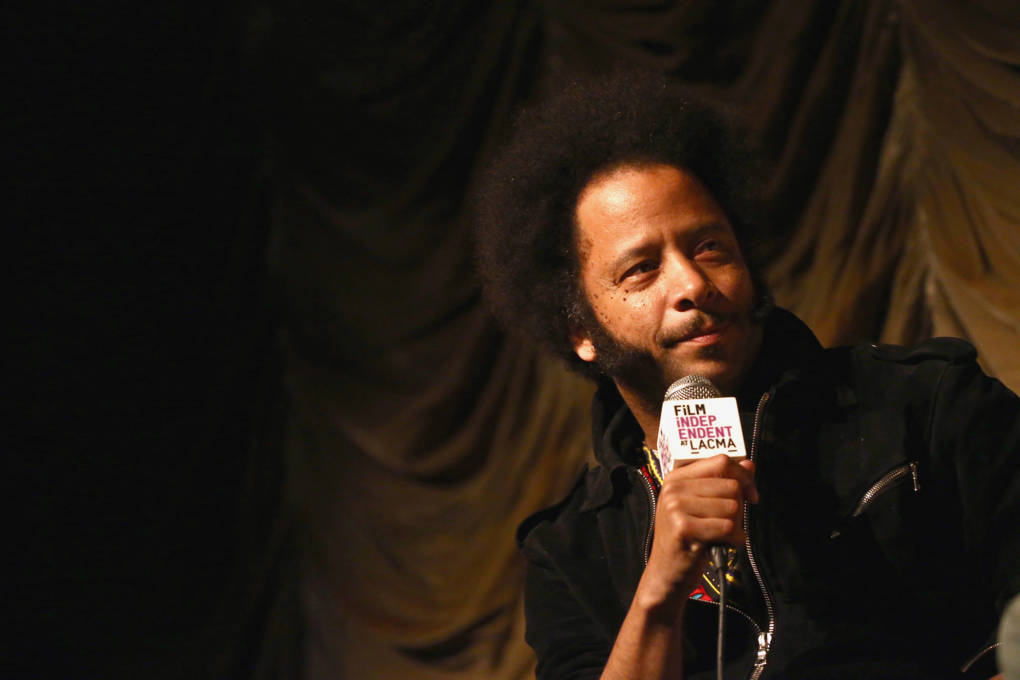
"caption": "'Sorry to Bother You' director Boots Riley attends the Film Independent at LACMA Presents Screening And Q&A Of 'Sorry To Bother You' at Bing Theater At LACMA on June 28, 2018 in Los Angeles, California.",
"description": "Director Boots Riley attends the Film Independent At LACMA Presents Screening And Q&A Of 'Sorry To Bother You' at Bing Theater At LACMA on June 28, 2018 in Los Angeles, California.",
"title": "Film Independent At LACMA Presents Screening And Q&A Of \"Sorry To Bother You\"",
"credit": "Tommaso Boddi/Getty Images",
"status": "inherit",
"isLoading": false,
"fetchFailed": false
},
"news_11968489": {
"type": "attachments",
"id": "news_11968489",
"meta": {
"index": "attachments_1716263798",
"site": "news",
"id": "11968489",
"found": true
},
"parent": 11968486,
"imgSizes": {
"twentyfourteen-full-width": {
"file": "https://ww2.kqed.org/app/uploads/sites/10/2023/11/TheBay_iTunesTile_01-1020x1020-1-big-1020x576.jpeg",
"width": 1020,
"mimeType": "image/jpeg",
"height": 576
},
"thumbnail": {
"file": "https://ww2.kqed.org/app/uploads/sites/10/2023/11/TheBay_iTunesTile_01-1020x1020-1-big-160x160.jpeg",
"width": 160,
"mimeType": "image/jpeg",
"height": 160
},
"post-thumbnail": {
"file": "https://ww2.kqed.org/app/uploads/sites/10/2023/11/TheBay_iTunesTile_01-1020x1020-1-big-672x372.jpeg",
"width": 672,
"mimeType": "image/jpeg",
"height": 372
},
"kqedFullSize": {
"file": "https://ww2.kqed.org/app/uploads/sites/10/2023/11/TheBay_iTunesTile_01-1020x1020-1-big.jpeg",
"width": 1020,
"height": 1020
},
"medium": {
"file": "https://ww2.kqed.org/app/uploads/sites/10/2023/11/TheBay_iTunesTile_01-1020x1020-1-big-800x800.jpeg",
"width": 800,
"mimeType": "image/jpeg",
"height": 800
}
},
"publishDate": 1701208049,
"modified": 1701208065,
"caption": null,
"description": null,
"title": "The-Bay-Tile",
"credit": null,
"status": "inherit",
"altTag": null,
"isLoading": false,
"fetchFailed": false
},
"news_11968558": {
"type": "attachments",
"id": "news_11968558",
"meta": {
"index": "attachments_1716263798",
"site": "news",
"id": "11968558",
"found": true
},
"parent": 11968536,
"imgSizes": {
"twentyfourteen-full-width": {
"file": "https://ww2.kqed.org/app/uploads/sites/10/2023/11/AP23332757227552-scaled-1038x576.jpg",
"width": 1038,
"mimeType": "image/jpeg",
"height": 576
},
"thumbnail": {
"file": "https://ww2.kqed.org/app/uploads/sites/10/2023/11/AP23332757227552-scaled-160x107.jpg",
"width": 160,
"mimeType": "image/jpeg",
"height": 107
},
"post-thumbnail": {
"file": "https://ww2.kqed.org/app/uploads/sites/10/2023/11/AP23332757227552-scaled-672x372.jpg",
"width": 672,
"mimeType": "image/jpeg",
"height": 372
},
"kqedFullSize": {
"file": "https://ww2.kqed.org/app/uploads/sites/10/2023/11/AP23332757227552-scaled.jpg?ver=1701218591",
"width": 2000,
"height": 1333
},
"large": {
"file": "https://ww2.kqed.org/app/uploads/sites/10/2023/11/AP23332757227552-scaled-1020x680.jpg",
"width": 1020,
"mimeType": "image/jpeg",
"height": 680
},
"1536x1536": {
"file": "https://ww2.kqed.org/app/uploads/sites/10/2023/11/AP23332757227552-scaled-1536x1024.jpg",
"width": 1536,
"mimeType": "image/jpeg",
"height": 1024
},
"full-width": {
"file": "https://ww2.kqed.org/app/uploads/sites/10/2023/11/AP23332757227552-scaled-1920x1280.jpg",
"width": 1920,
"mimeType": "image/jpeg",
"height": 1280
},
"medium": {
"file": "https://ww2.kqed.org/app/uploads/sites/10/2023/11/AP23332757227552-scaled-800x533.jpg",
"width": 800,
"mimeType": "image/jpeg",
"height": 533
}
},
"publishDate": 1701216826,
"modified": 1701218599,
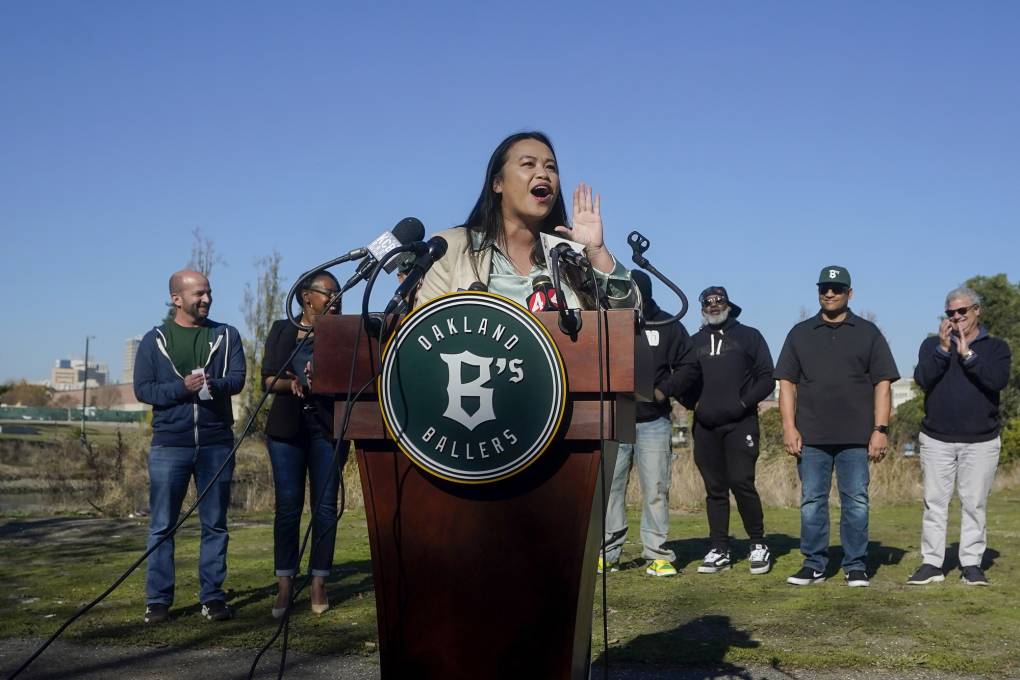
"caption": "Oakland Mayor Sheng Thao speaks during a news conference at Laney College in Oakland on Tuesday, Nov. 28, 2023. A new independent league baseball team called the Oakland Ballers is set to begin play next spring and embrace the loyal A's fans who are heartbroken about their club's planned departure to Las Vegas.",
"description": null,
"title": "Sheng Thao",
"credit": "Jeff Chiu/AP Photo",
"status": "inherit",
"altTag": "A woman speaks at podium with a line of people behind her.",
"isLoading": false,
"fetchFailed": false
},
"news_11964123": {
"type": "attachments",
"id": "news_11964123",
"meta": {
"index": "attachments_1716263798",
"site": "news",
"id": "11964123",
"found": true
},
"parent": 11964119,
"imgSizes": {
"twentyfourteen-full-width": {
"file": "https://ww2.kqed.org/app/uploads/sites/10/2023/10/29453895034_66004c1b14_k-1038x576.jpg",
"width": 1038,
"mimeType": "image/jpeg",
"height": 576
},
"thumbnail": {
"file": "https://ww2.kqed.org/app/uploads/sites/10/2023/10/29453895034_66004c1b14_k-160x106.jpg",
"width": 160,
"mimeType": "image/jpeg",
"height": 106
},
"post-thumbnail": {
"file": "https://ww2.kqed.org/app/uploads/sites/10/2023/10/29453895034_66004c1b14_k-672x372.jpg",
"width": 672,
"mimeType": "image/jpeg",
"height": 372
},
"kqedFullSize": {
"file": "https://ww2.kqed.org/app/uploads/sites/10/2023/10/29453895034_66004c1b14_k.jpg",
"width": 2047,
"height": 1356
},
"large": {
"file": "https://ww2.kqed.org/app/uploads/sites/10/2023/10/29453895034_66004c1b14_k-1020x676.jpg",
"width": 1020,
"mimeType": "image/jpeg",
"height": 676
},
"1536x1536": {
"file": "https://ww2.kqed.org/app/uploads/sites/10/2023/10/29453895034_66004c1b14_k-1536x1017.jpg",
"width": 1536,
"mimeType": "image/jpeg",
"height": 1017
},
"full-width": {
"file": "https://ww2.kqed.org/app/uploads/sites/10/2023/10/29453895034_66004c1b14_k-1920x1272.jpg",
"width": 1920,
"mimeType": "image/jpeg",
"height": 1272
},
"medium": {
"file": "https://ww2.kqed.org/app/uploads/sites/10/2023/10/29453895034_66004c1b14_k-800x530.jpg",
"width": 800,
"mimeType": "image/jpeg",
"height": 530
}
},
"publishDate": 1697054380,
"modified": 1697055934,
"caption": "The Dunsmuir Hellman Historic Estate has been a backdrop for many scary films, including 'Phantasm' and 'Burnt Offerings.' ",
"description": "The Dunsmuir Hellman Historic Estate has been a backdrop for many scary films, including \"Phantasm\" and \"Burnt Offerings.\" ",
"title": "29453895034_66004c1b14_k",
"credit": "Wayne Hsieh/Flickr",
"status": "inherit",
"altTag": "A large neoclassical white house sits behind a large lawn and in front of a stand of trees.",
"isLoading": false,
"fetchFailed": false
},
"news_11961924": {
"type": "attachments",
"id": "news_11961924",
"meta": {
"index": "attachments_1716263798",
"site": "news",
"id": "11961924",
"found": true
},
"parent": 11961919,
"imgSizes": {
"twentyfourteen-full-width": {
"file": "https://cdn.kqed.org/wp-content/uploads/sites/10/2023/09/GettyImages-1491552346-1038x576.jpg",
"width": 1038,
"mimeType": "image/jpeg",
"height": 576
},
"thumbnail": {
"file": "https://cdn.kqed.org/wp-content/uploads/sites/10/2023/09/GettyImages-1491552346-160x111.jpg",
"width": 160,
"mimeType": "image/jpeg",
"height": 111
},
"post-thumbnail": {
"file": "https://cdn.kqed.org/wp-content/uploads/sites/10/2023/09/GettyImages-1491552346-672x372.jpg",
"width": 672,
"mimeType": "image/jpeg",
"height": 372
},
"kqedFullSize": {
"file": "https://cdn.kqed.org/wp-content/uploads/sites/10/2023/09/GettyImages-1491552346-scaled.jpg",
"width": 2560,
"height": 1774
},
"2048x2048": {
"file": "https://cdn.kqed.org/wp-content/uploads/sites/10/2023/09/GettyImages-1491552346-2048x1419.jpg",
"width": 2048,
"mimeType": "image/jpeg",
"height": 1419
},
"large": {
"file": "https://cdn.kqed.org/wp-content/uploads/sites/10/2023/09/GettyImages-1491552346-1020x707.jpg",
"width": 1020,
"mimeType": "image/jpeg",
"height": 707
},
"1536x1536": {
"file": "https://cdn.kqed.org/wp-content/uploads/sites/10/2023/09/GettyImages-1491552346-1536x1064.jpg",
"width": 1536,
"mimeType": "image/jpeg",
"height": 1064
},
"full-width": {
"file": "https://cdn.kqed.org/wp-content/uploads/sites/10/2023/09/GettyImages-1491552346-1920x1330.jpg",
"width": 1920,
"mimeType": "image/jpeg",
"height": 1330
},
"medium": {
"file": "https://cdn.kqed.org/wp-content/uploads/sites/10/2023/09/GettyImages-1491552346-800x554.jpg",
"width": 800,
"mimeType": "image/jpeg",
"height": 554
}
},
"publishDate": 1695240988,
"modified": 1707444166,
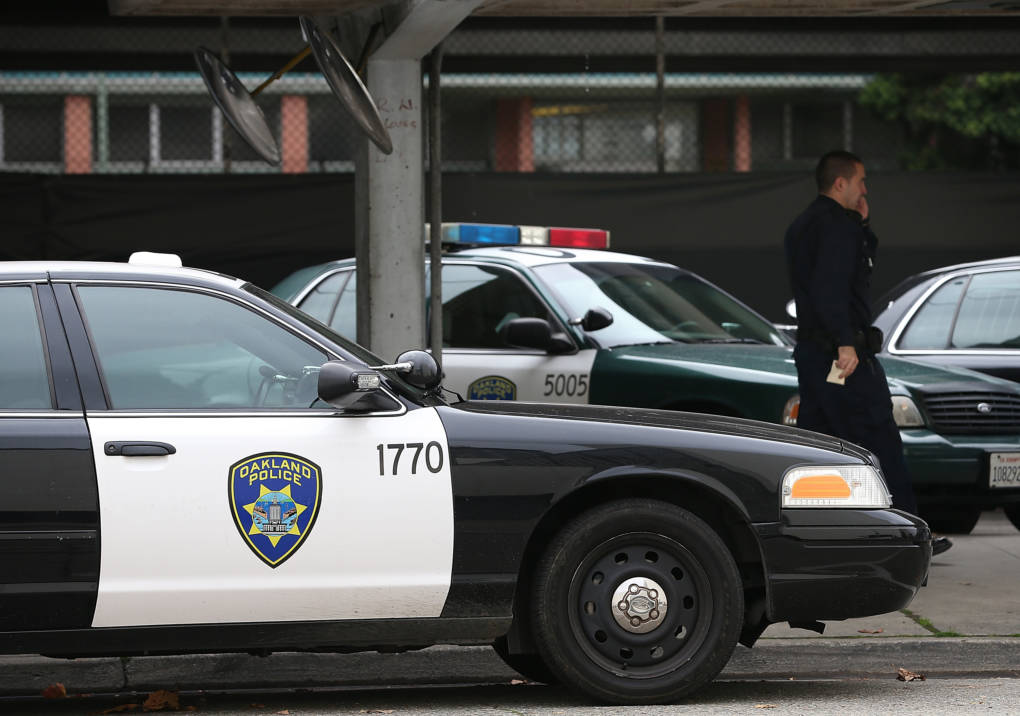
"caption": "Oakland police investigate a shooting in the Fruitvale Public Market plaza on May 16, 2023.",
"description": null,
"title": "Oakland Shooting",
"credit": "Jane Tyska/Digital First Media/East Bay Times via Getty Images",
"status": "inherit",
"altTag": "An Oakland police officer puts yellow crime tape around a sidewalk.",
"isLoading": false,
"fetchFailed": false
},
"news_11960197": {
"type": "attachments",
"id": "news_11960197",
"meta": {
"index": "attachments_1716263798",
"site": "news",
"id": "11960197",
"found": true
},
"title": "Stephen Curry, Ayesha Curry",
"publishDate": 1694024622,
"status": "inherit",
"parent": 12037103,
"modified": 1745354455,
"caption": "Golden State Warriors' star Stephen Curry (right) speaks next to his wife and renowned chef, Ayesha Curry, during a charity event at Stanford Golf Course in Stanford, Aug. 28, 2023. The Currys and partners are expanding the reach of their Eat. Learn. Play. Foundation, established in 2019, to support youth in Oakland, the Bay Area and beyond, while striving to improve lives of families nationwide. They are generating $50 million in additional funding to assist the Oakland Unified School District.",
"credit": "Jeff Chiu/AP Photo",
"altTag": "A man and a woman stand on a stage speaking with a huge banner behind the that says, \"Eat. Learn. Play.\"",
"description": null,
"imgSizes": {
"medium": {
"file": "https://cdn.kqed.org/wp-content/uploads/sites/10/2023/09/AP23247692842290-800x533.jpg",
"width": 800,
"height": 533,
"mimeType": "image/jpeg"
},
"large": {
"file": "https://cdn.kqed.org/wp-content/uploads/sites/10/2023/09/AP23247692842290-1020x680.jpg",
"width": 1020,
"height": 680,
"mimeType": "image/jpeg"
},
"thumbnail": {
"file": "https://cdn.kqed.org/wp-content/uploads/sites/10/2023/09/AP23247692842290-160x107.jpg",
"width": 160,
"height": 107,
"mimeType": "image/jpeg"
},
"1536x1536": {
"file": "https://cdn.kqed.org/wp-content/uploads/sites/10/2023/09/AP23247692842290-1536x1024.jpg",
"width": 1536,
"height": 1024,
"mimeType": "image/jpeg"
},
"2048x2048": {
"file": "https://cdn.kqed.org/wp-content/uploads/sites/10/2023/09/AP23247692842290-2048x1365.jpg",
"width": 2048,
"height": 1365,
"mimeType": "image/jpeg"
},
"post-thumbnail": {
"file": "https://cdn.kqed.org/wp-content/uploads/sites/10/2023/09/AP23247692842290-672x372.jpg",
"width": 672,
"height": 372,
"mimeType": "image/jpeg"
},
"twentyfourteen-full-width": {
"file": "https://cdn.kqed.org/wp-content/uploads/sites/10/2023/09/AP23247692842290-1038x576.jpg",
"width": 1038,
"height": 576,
"mimeType": "image/jpeg"
},
"full-width": {
"file": "https://cdn.kqed.org/wp-content/uploads/sites/10/2023/09/AP23247692842290-1920x1280.jpg",
"width": 1920,
"height": 1280,
"mimeType": "image/jpeg"
},
"kqedFullSize": {
"file": "https://cdn.kqed.org/wp-content/uploads/sites/10/2023/09/AP23247692842290-scaled.jpg",
"width": 2560,
"height": 1707
}
},
"isLoading": false,
"fetchFailed": false
},
"news_11716436": {
"type": "attachments",
"id": "news_11716436",
"meta": {
"index": "attachments_1716263798",
"site": "news",
"id": "11716436",
"found": true
},
"parent": 0,
"imgSizes": {
"twentyfourteen-full-width": {
"file": "https://ww2.kqed.org/app/uploads/sites/10/2019/01/RS5947_OaklandPoliceCar-1038x576.jpg",
"width": 1038,
"mimeType": "image/jpeg",
"height": 576
},
"thumbnail": {
"file": "https://ww2.kqed.org/app/uploads/sites/10/2019/01/RS5947_OaklandPoliceCar-160x112.jpg",
"width": 160,
"mimeType": "image/jpeg",
"height": 112
},
"post-thumbnail": {
"file": "https://ww2.kqed.org/app/uploads/sites/10/2019/01/RS5947_OaklandPoliceCar-672x372.jpg",
"width": 672,
"mimeType": "image/jpeg",
"height": 372
},
"kqedFullSize": {
"file": "https://ww2.kqed.org/app/uploads/sites/10/2019/01/RS5947_OaklandPoliceCar.jpg",
"width": 3000,
"height": 2105
},
"large": {
"file": "https://ww2.kqed.org/app/uploads/sites/10/2019/01/RS5947_OaklandPoliceCar-1020x716.jpg",
"width": 1020,
"mimeType": "image/jpeg",
"height": 716
},
"complete_open_graph": {
"file": "https://ww2.kqed.org/app/uploads/sites/10/2019/01/RS5947_OaklandPoliceCar-1200x842.jpg",
"width": 1200,
"mimeType": "image/jpeg",
"height": 842
},
"guest-author-50": {
"file": "https://ww2.kqed.org/app/uploads/sites/10/2019/01/RS5947_OaklandPoliceCar-50x50.jpg",
"width": 50,
"mimeType": "image/jpeg",
"height": 50
},
"guest-author-96": {
"file": "https://ww2.kqed.org/app/uploads/sites/10/2019/01/RS5947_OaklandPoliceCar-96x96.jpg",
"width": 96,
"mimeType": "image/jpeg",
"height": 96
},
"medium": {
"file": "https://ww2.kqed.org/app/uploads/sites/10/2019/01/RS5947_OaklandPoliceCar-800x561.jpg",
"width": 800,
"mimeType": "image/jpeg",
"height": 561
},
"guest-author-64": {
"file": "https://ww2.kqed.org/app/uploads/sites/10/2019/01/RS5947_OaklandPoliceCar-64x64.jpg",
"width": 64,
"mimeType": "image/jpeg",
"height": 64
},
"guest-author-32": {
"file": "https://ww2.kqed.org/app/uploads/sites/10/2019/01/RS5947_OaklandPoliceCar-32x32.jpg",
"width": 32,
"mimeType": "image/jpeg",
"height": 32
},
"full-width": {
"file": "https://ww2.kqed.org/app/uploads/sites/10/2019/01/RS5947_OaklandPoliceCar-1920x1347.jpg",
"width": 1920,
"mimeType": "image/jpeg",
"height": 1347
},
"detail": {
"file": "https://ww2.kqed.org/app/uploads/sites/10/2019/01/RS5947_OaklandPoliceCar-150x150.jpg",
"width": 150,
"mimeType": "image/jpeg",
"height": 150
},
"guest-author-128": {
"file": "https://ww2.kqed.org/app/uploads/sites/10/2019/01/RS5947_OaklandPoliceCar-128x128.jpg",
"width": 128,
"mimeType": "image/jpeg",
"height": 128
}
},
"publishDate": 1546897219,
"modified": 1546897273,
"caption": null,
"description": null,
"title": "After Failing To Reform, Oakland PD To Fall Under Court Appointed Director",
"credit": "Justin Sullivan/Getty Images",
"status": "inherit",
"isLoading": false,
"fetchFailed": false
},
"news_11952917": {
"type": "attachments",
"id": "news_11952917",
"meta": {
"index": "attachments_1716263798",
"site": "news",
"id": "11952917",
"found": true
},
"parent": 11952845,
"imgSizes": {
"twentyfourteen-full-width": {
"file": "https://ww2.kqed.org/app/uploads/sites/10/2023/06/20230614-AS-REVERSE-BOYCOTT-04-AC-KQED-1038x576.jpg",
"width": 1038,
"mimeType": "image/jpeg",
"height": 576
},
"thumbnail": {
"file": "https://ww2.kqed.org/app/uploads/sites/10/2023/06/20230614-AS-REVERSE-BOYCOTT-04-AC-KQED-160x107.jpg",
"width": 160,
"mimeType": "image/jpeg",
"height": 107
},
"post-thumbnail": {
"file": "https://ww2.kqed.org/app/uploads/sites/10/2023/06/20230614-AS-REVERSE-BOYCOTT-04-AC-KQED-672x372.jpg",
"width": 672,
"mimeType": "image/jpeg",
"height": 372
},
"kqedFullSize": {
"file": "https://ww2.kqed.org/app/uploads/sites/10/2023/06/20230614-AS-REVERSE-BOYCOTT-04-AC-KQED.jpg",
"width": 2000,
"height": 1333
},
"large": {
"file": "https://ww2.kqed.org/app/uploads/sites/10/2023/06/20230614-AS-REVERSE-BOYCOTT-04-AC-KQED-1020x680.jpg",
"width": 1020,
"mimeType": "image/jpeg",
"height": 680
},
"1536x1536": {
"file": "https://ww2.kqed.org/app/uploads/sites/10/2023/06/20230614-AS-REVERSE-BOYCOTT-04-AC-KQED-1536x1024.jpg",
"width": 1536,
"mimeType": "image/jpeg",
"height": 1024
},
"full-width": {
"file": "https://ww2.kqed.org/app/uploads/sites/10/2023/06/20230614-AS-REVERSE-BOYCOTT-04-AC-KQED-1920x1280.jpg",
"width": 1920,
"mimeType": "image/jpeg",
"height": 1280
},
"medium": {
"file": "https://ww2.kqed.org/app/uploads/sites/10/2023/06/20230614-AS-REVERSE-BOYCOTT-04-AC-KQED-800x533.jpg",
"width": 800,
"mimeType": "image/jpeg",
"height": 533
}
},
"publishDate": 1686762748,
"modified": 1686779592,
"caption": "Fans of the Oakland A's gather during a reverse boycott at the Oakland Coliseum to protest the ownership of the baseball team on June 13, 2023.",
"description": null,
"title": "20230614-AS-REVERSE-BOYCOTT-04-AC-KQED",
"credit": "Aryk Copley/KQED",
"status": "inherit",
"altTag": "A crowd of people wearing Oakland A's clothing stand together in a parking lot. The person in the middle wears a plastic fish mask and holds a sign reading \"A's Fish(er) rots from the head down!\"",
"isLoading": false,
"fetchFailed": false
},
"news_11952708": {
"type": "attachments",
"id": "news_11952708",
"meta": {
"index": "attachments_1716263798",
"site": "news",
"id": "11952708",
"found": true
},
"parent": 11952701,
"imgSizes": {
"twentyfourteen-full-width": {
"file": "https://ww2.kqed.org/app/uploads/sites/10/2023/06/IMG_9477-1038x576.jpg",
"width": 1038,
"mimeType": "image/jpeg",
"height": 576
},
"thumbnail": {
"file": "https://ww2.kqed.org/app/uploads/sites/10/2023/06/IMG_9477-160x120.jpg",
"width": 160,
"mimeType": "image/jpeg",
"height": 120
},
"post-thumbnail": {
"file": "https://ww2.kqed.org/app/uploads/sites/10/2023/06/IMG_9477-672x372.jpg",
"width": 672,
"mimeType": "image/jpeg",
"height": 372
},
"kqedFullSize": {
"file": "https://ww2.kqed.org/app/uploads/sites/10/2023/06/IMG_9477-scaled.jpg",
"width": 2560,
"height": 1920
},
"2048x2048": {
"file": "https://ww2.kqed.org/app/uploads/sites/10/2023/06/IMG_9477-2048x1536.jpg",
"width": 2048,
"mimeType": "image/jpeg",
"height": 1536
},
"large": {
"file": "https://ww2.kqed.org/app/uploads/sites/10/2023/06/IMG_9477-1020x765.jpg",
"width": 1020,
"mimeType": "image/jpeg",
"height": 765
},
"1536x1536": {
"file": "https://ww2.kqed.org/app/uploads/sites/10/2023/06/IMG_9477-1536x1152.jpg",
"width": 1536,
"mimeType": "image/jpeg",
"height": 1152
},
"full-width": {
"file": "https://ww2.kqed.org/app/uploads/sites/10/2023/06/IMG_9477-1920x1440.jpg",
"width": 1920,
"mimeType": "image/jpeg",
"height": 1440
},
"medium": {
"file": "https://ww2.kqed.org/app/uploads/sites/10/2023/06/IMG_9477-800x600.jpg",
"width": 800,
"mimeType": "image/jpeg",
"height": 600
}
},
"publishDate": 1686354339,
"modified": 1686354339,
"caption": null,
"description": null,
"title": "IMG_9477",
"credit": null,
"status": "inherit",
"altTag": null,
"isLoading": false,
"fetchFailed": false
},
"news_11948508": {
"type": "attachments",
"id": "news_11948508",
"meta": {
"index": "attachments_1716263798",
"site": "news",
"id": "11948508",
"found": true
},
"parent": 11948501,
"imgSizes": {
"twentyfourteen-full-width": {
"file": "https://ww2.kqed.org/app/uploads/sites/10/2023/05/DSC7177-1038x576.jpg",
"width": 1038,
"mimeType": "image/jpeg",
"height": 576
},
"thumbnail": {
"file": "https://ww2.kqed.org/app/uploads/sites/10/2023/05/DSC7177-160x107.jpg",
"width": 160,
"mimeType": "image/jpeg",
"height": 107
},
"post-thumbnail": {
"file": "https://ww2.kqed.org/app/uploads/sites/10/2023/05/DSC7177-672x372.jpg",
"width": 672,
"mimeType": "image/jpeg",
"height": 372
},
"kqedFullSize": {
"file": "https://ww2.kqed.org/app/uploads/sites/10/2023/05/DSC7177.jpg",
"width": 1616,
"height": 1080
},
"large": {
"file": "https://ww2.kqed.org/app/uploads/sites/10/2023/05/DSC7177-1020x682.jpg",
"width": 1020,
"mimeType": "image/jpeg",
"height": 682
},
"1536x1536": {
"file": "https://ww2.kqed.org/app/uploads/sites/10/2023/05/DSC7177-1536x1027.jpg",
"width": 1536,
"mimeType": "image/jpeg",
"height": 1027
},
"medium": {
"file": "https://ww2.kqed.org/app/uploads/sites/10/2023/05/DSC7177-800x535.jpg",
"width": 800,
"mimeType": "image/jpeg",
"height": 535
}
},
"publishDate": 1683221017,
"modified": 1683222291,
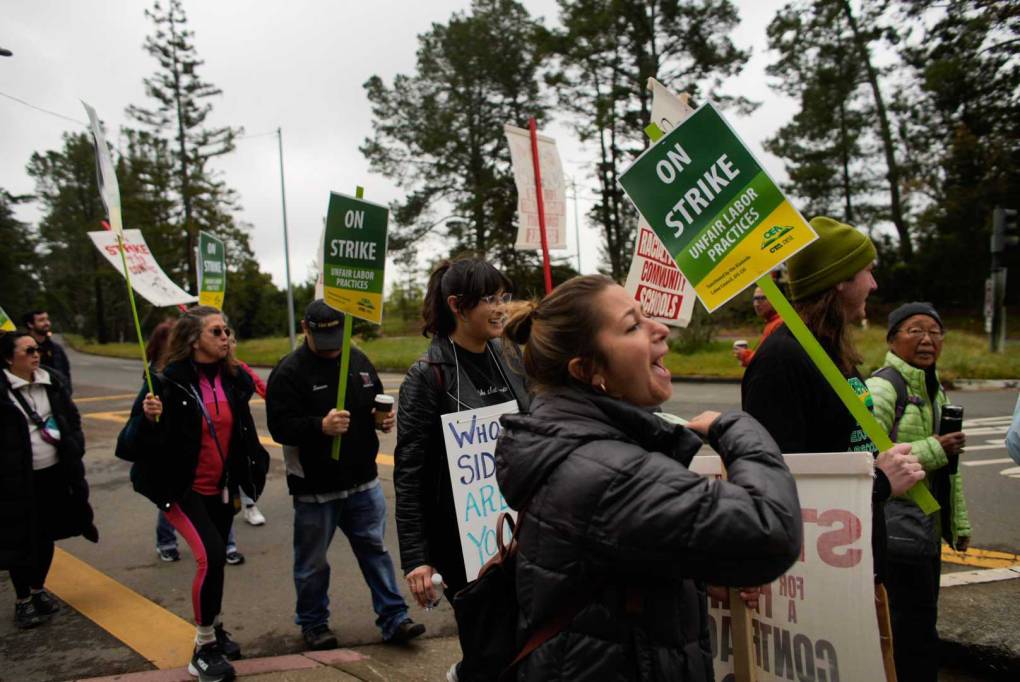
"caption": "Oakland teachers march on the picket line in front of Skyline High School on May 4, 2023, the first day of an open-ended teachers strike in a demand for higher wages and better working conditions.",
"description": null,
"title": "_DSC7177",
"credit": "Aryk Copley/KQED",
"status": "inherit",
"altTag": "Oakland teachers, holding 'on strike' picket signs, rally in front of a school.",
"isLoading": false,
"fetchFailed": false
},
"news_11948095": {
"type": "attachments",
"id": "news_11948095",
"meta": {
"index": "attachments_1716263798",
"site": "news",
"id": "11948095",
"found": true
},
"parent": 11948069,
"imgSizes": {
"twentyfourteen-full-width": {
"file": "https://ww2.kqed.org/app/uploads/sites/10/2023/04/coliseumconnections-gmaps-1038x576.jpg",
"width": 1038,
"mimeType": "image/jpeg",
"height": 576
},
"thumbnail": {
"file": "https://ww2.kqed.org/app/uploads/sites/10/2023/04/coliseumconnections-gmaps-160x118.jpg",
"width": 160,
"mimeType": "image/jpeg",
"height": 118
},
"post-thumbnail": {
"file": "https://ww2.kqed.org/app/uploads/sites/10/2023/04/coliseumconnections-gmaps-672x372.jpg",
"width": 672,
"mimeType": "image/jpeg",
"height": 372
},
"kqedFullSize": {
"file": "https://ww2.kqed.org/app/uploads/sites/10/2023/04/coliseumconnections-gmaps.jpg",
"width": 2192,
"height": 1618
},
"2048x2048": {
"file": "https://ww2.kqed.org/app/uploads/sites/10/2023/04/coliseumconnections-gmaps-2048x1512.jpg",
"width": 2048,
"mimeType": "image/jpeg",
"height": 1512
},
"large": {
"file": "https://ww2.kqed.org/app/uploads/sites/10/2023/04/coliseumconnections-gmaps-1020x753.jpg",
"width": 1020,
"mimeType": "image/jpeg",
"height": 753
},
"1536x1536": {
"file": "https://ww2.kqed.org/app/uploads/sites/10/2023/04/coliseumconnections-gmaps-1536x1134.jpg",
"width": 1536,
"mimeType": "image/jpeg",
"height": 1134
},
"full-width": {
"file": "https://ww2.kqed.org/app/uploads/sites/10/2023/04/coliseumconnections-gmaps-1920x1417.jpg",
"width": 1920,
"mimeType": "image/jpeg",
"height": 1417
},
"medium": {
"file": "https://ww2.kqed.org/app/uploads/sites/10/2023/04/coliseumconnections-gmaps-800x591.jpg",
"width": 800,
"mimeType": "image/jpeg",
"height": 591
}
},
"publishDate": 1682723427,
"modified": 1682732032,
"caption": "Part of the Coliseum Connections housing complex at BART's Coliseum station in East Oakland. ",
"description": null,
"title": "Coliseum Connections",
"credit": "Google Maps street view",
"status": "inherit",
"altTag": "A street-level view of new five-story apartment building in East Oakland.",
"isLoading": false,
"fetchFailed": false
},
"news_11947190": {
"type": "attachments",
"id": "news_11947190",
"meta": {
"index": "attachments_1716263798",
"site": "news",
"id": "11947190",
"found": true
},
"title": "006_KQED_UCSFBenioffChildrensHospStrike_04192023",
"publishDate": 1681947432,
"status": "inherit",
"parent": 0,
"modified": 1771023942,
"caption": "Over 100 employees and their supporters gather for a rally outside UCSF Benioff Children's Hospital in Oakland on April 19, 2023, during a one-day strike authorized by more than 1,200 members of the National Union of Healthcare Workers.",
"credit": "Beth LaBerge/KQED",
"altTag": "Hundreds of protesters in red T-shirts hold red and yellow picket signs outside of UCSF Benioff Children's Hospital Oakland.",
"description": null,
"imgSizes": {
"medium": {
"file": "https://cdn.kqed.org/wp-content/uploads/sites/10/2023/04/006_KQED_UCSFBenioffChildrensHospStrike_04192023-800x533.jpg",
"width": 800,
"height": 533,
"mimeType": "image/jpeg"
},
"large": {
"file": "https://cdn.kqed.org/wp-content/uploads/sites/10/2023/04/006_KQED_UCSFBenioffChildrensHospStrike_04192023-1020x680.jpg",
"width": 1020,
"height": 680,
"mimeType": "image/jpeg"
},
"thumbnail": {
"file": "https://cdn.kqed.org/wp-content/uploads/sites/10/2023/04/006_KQED_UCSFBenioffChildrensHospStrike_04192023-160x107.jpg",
"width": 160,
"height": 107,
"mimeType": "image/jpeg"
},
"1536x1536": {
"file": "https://cdn.kqed.org/wp-content/uploads/sites/10/2023/04/006_KQED_UCSFBenioffChildrensHospStrike_04192023-1536x1024.jpg",
"width": 1536,
"height": 1024,
"mimeType": "image/jpeg"
},
"post-thumbnail": {
"file": "https://cdn.kqed.org/wp-content/uploads/sites/10/2023/04/006_KQED_UCSFBenioffChildrensHospStrike_04192023-672x372.jpg",
"width": 672,
"height": 372,
"mimeType": "image/jpeg"
},
"twentyfourteen-full-width": {
"file": "https://cdn.kqed.org/wp-content/uploads/sites/10/2023/04/006_KQED_UCSFBenioffChildrensHospStrike_04192023-1038x576.jpg",
"width": 1038,
"height": 576,
"mimeType": "image/jpeg"
},
"kqedFullSize": {
"file": "https://cdn.kqed.org/wp-content/uploads/sites/10/2023/04/006_KQED_UCSFBenioffChildrensHospStrike_04192023.jpg",
"width": 1920,
"height": 1280
}
},
"isLoading": false,
"fetchFailed": false
}
},
"audioPlayerReducer": {
"postId": "stream_live",
"isPaused": true,
"isPlaying": false,
"pfsActive": false,
"pledgeModalIsOpen": true,
"playerDrawerIsOpen": false,
"liveAudioPlayStartedAt": 0,
"liveAudioPlayContext": ""
},
"authorsReducer": {
"byline_news_11960187": {
"type": "authors",
"id": "byline_news_11960187",
"meta": {
"override": true
},
"slug": "byline_news_11960187",
"name": "\u003ca href=\"https://twitter.com/JanieMcCAP\">Janie McCauley\u003c/a>\u003cbr>The Associated Press",
"isLoading": false
},
"danbrekke": {
"type": "authors",
"id": "222",
"meta": {
"index": "authors_1716337520",
"id": "222",
"found": true
},
"name": "Dan Brekke",
"firstName": "Dan",
"lastName": "Brekke",
"slug": "danbrekke",
"email": "dbrekke@kqed.org",
"display_author_email": true,
"staff_mastheads": [
"news",
"science"
],
"title": "KQED Editor and Reporter",
"bio": "Dan Brekke is a reporter and editor for KQED News, responsible for coverage of topics ranging from California water issues to the Bay Area's transportation challenges. In a newsroom career that began in Chicago in 1972, Dan has worked for \u003cem>The San Francisco Examiner,\u003c/em> Wired and TechTV and has been published in The New York Times, The New York Times Magazine, Business 2.0, Salon and elsewhere.\r\n\r\nSince joining KQED in 2007, Dan has reported, edited and produced both radio and online features and breaking news pieces. He has shared as both editor and reporter in four Society of Professional Journalists Norcal Excellence in Journalism awards and one Edward R. Murrow regional award. He was chosen for a spring 2017 residency at the Mesa Refuge to advance his research on California salmon.\r\n\r\nEmail Dan at: \u003ca href=\"mailto:dbrekke@kqed.org\">dbrekke@kqed.org\u003c/a>\r\n\r\n\u003cstrong>Twitter:\u003c/strong> \u003ca href=\"https://twitter.com/danbrekke\" rel=\"noopener noreferrer\">twitter.com/danbrekke\u003c/a>\r\n\u003cstrong>Facebook:\u003c/strong> \u003ca href=\"https://www.facebook.com/danbrekke\" rel=\"noopener noreferrer\">www.facebook.com/danbrekke\u003c/a>\r\n\u003cstrong>LinkedIn:\u003c/strong> \u003ca href=\"https://www.linkedin.com/in/danbrekke\" rel=\"noopener noreferrer\">www.linkedin.com/in/danbrekke\u003c/a>",
"avatar": "https://secure.gravatar.com/avatar/c8126230345efca3f7aa89b1a402be45?s=600&d=mm&r=g",
"twitter": "danbrekke",
"facebook": null,
"instagram": "https://www.instagram.com/dan.brekke/",
"linkedin": "https://www.linkedin.com/in/danbrekke/",
"sites": [
{
"site": "news",
"roles": [
"administrator",
"create_posts"
]
},
{
"site": "stateofhealth",
"roles": [
"editor"
]
},
{
"site": "science",
"roles": [
"editor"
]
},
{
"site": "quest",
"roles": [
"contributor"
]
},
{
"site": "food",
"roles": [
"contributor"
]
},
{
"site": "forum",
"roles": [
"contributor"
]
},
{
"site": "liveblog",
"roles": [
"editor"
]
}
],
"headData": {
"title": "Dan Brekke | KQED",
"description": "KQED Editor and Reporter",
"ogImgSrc": "https://secure.gravatar.com/avatar/c8126230345efca3f7aa89b1a402be45?s=600&d=mm&r=g",
"twImgSrc": "https://secure.gravatar.com/avatar/c8126230345efca3f7aa89b1a402be45?s=600&d=mm&r=g"
},
"isLoading": false,
"link": "/author/danbrekke"
},
"rachael-myrow": {
"type": "authors",
"id": "251",
"meta": {
"index": "authors_1716337520",
"id": "251",
"found": true
},
"name": "Rachael Myrow",
"firstName": "Rachael",
"lastName": "Myrow",
"slug": "rachael-myrow",
"email": "rmyrow@kqed.org",
"display_author_email": true,
"staff_mastheads": [
"news"
],
"title": "Senior Editor of KQED's Silicon Valley News Desk",
"bio": "• I write and edit stories about how Silicon Valley power and policies shape everyday life in California. I’m also passionate about making Bay Area history and culture more accessible to a broad public. • I’ve been a journalist for most of my life, starting in high school with The Franklin Press in Los Angeles, where I grew up. While earning my first degree in English at UC Berkeley, I got my start in public radio at KALX-FM. After completing a second degree in journalism at Cal, I landed my first professional job at Marketplace, then moved on to KPCC (now LAist), and then KQED, where I hosted The California Report for more than seven years. • My reporting has appeared on NPR, The World, WBUR’s \u003ci>Here & Now\u003c/i>, and the BBC. I also guest host for KQED’s \u003ci>Forum\u003c/i>, as well as the Commonwealth Club in San Francisco. • I speak periodically on media, democracy and technology issues, and do voiceover work for documentaries and educational video projects. • Outside of the studio, you'll find me hiking Bay Area trails and whipping up Insta-ready meals in my kitchen. • I do not accept gifts, money, or favors from anyone connected to my reporting, I don't pay people for information, and I do not support or donate to political causes. • I strive to treat the people I report on with fairness, honesty, and respect. I also recognize there are often multiple sides to a story and work to verify information through multiple sources and documentation. If I get something wrong, I correct it.",
"avatar": "https://secure.gravatar.com/avatar/87bf8cb5874e045cdff430523a6d48b1?s=600&d=blank&r=g",
"twitter": "rachaelmyrow",
"facebook": null,
"instagram": null,
"linkedin": "https://www.linkedin.com/in/rachaelmyrow/",
"sites": [
{
"site": "arts",
"roles": [
"administrator"
]
},
{
"site": "news",
"roles": [
"edit_others_posts",
"editor"
]
},
{
"site": "futureofyou",
"roles": [
"editor"
]
},
{
"site": "bayareabites",
"roles": [
"editor"
]
},
{
"site": "stateofhealth",
"roles": [
"editor"
]
},
{
"site": "science",
"roles": [
"editor"
]
},
{
"site": "food",
"roles": [
"editor"
]
},
{
"site": "forum",
"roles": [
"editor"
]
},
{
"site": "liveblog",
"roles": [
"author"
]
}
],
"headData": {
"title": "Rachael Myrow | KQED",
"description": "Senior Editor of KQED's Silicon Valley News Desk",
"ogImgSrc": "https://secure.gravatar.com/avatar/87bf8cb5874e045cdff430523a6d48b1?s=600&d=blank&r=g",
"twImgSrc": "https://secure.gravatar.com/avatar/87bf8cb5874e045cdff430523a6d48b1?s=600&d=blank&r=g"
},
"isLoading": false,
"link": "/author/rachael-myrow"
},
"matthewgreen": {
"type": "authors",
"id": "1263",
"meta": {
"index": "authors_1716337520",
"id": "1263",
"found": true
},
"name": "Matthew Green",
"firstName": "Matthew",
"lastName": "Green",
"slug": "matthewgreen",
"email": "mgreen@kqed.org",
"display_author_email": false,
"staff_mastheads": [],
"title": "KQED Editor/Reporter",
"bio": "Matthew Green is a digital media producer for KQED News. He previously produced \u003ca href=\"http://www.kqed.org/lowdown\">The Lowdown\u003c/a>, KQED’s multimedia news education blog. Matthew's written for numerous Bay Area publications, including the Oakland Tribune and San Francisco Chronicle. He also taught journalism classes at Fremont High School in East Oakland.\r\n\r\nEmail: mgreen@kqed.org; Twitter: @MGreenKQED",
"avatar": "https://secure.gravatar.com/avatar/3bf498d1267ca02c8494f33d8cfc575e?s=600&d=blank&r=g",
"twitter": "MGreenKQED",
"facebook": null,
"instagram": null,
"linkedin": null,
"sites": [
{
"site": "news",
"roles": []
},
{
"site": "lowdown",
"roles": []
},
{
"site": "science",
"roles": []
},
{
"site": "education",
"roles": []
},
{
"site": "quest",
"roles": []
},
{
"site": "liveblog",
"roles": []
}
],
"headData": {
"title": "Matthew Green | KQED",
"description": "KQED Editor/Reporter",
"ogImgSrc": "https://secure.gravatar.com/avatar/3bf498d1267ca02c8494f33d8cfc575e?s=600&d=blank&r=g",
"twImgSrc": "https://secure.gravatar.com/avatar/3bf498d1267ca02c8494f33d8cfc575e?s=600&d=blank&r=g"
},
"isLoading": false,
"link": "/author/matthewgreen"
},
"ecruzguevarra": {
"type": "authors",
"id": "8654",
"meta": {
"index": "authors_1716337520",
"id": "8654",
"found": true
},
"name": "Ericka Cruz Guevarra",
"firstName": "Ericka",
"lastName": "Cruz Guevarra",
"slug": "ecruzguevarra",
"email": "ecruzguevarra@kqed.org",
"display_author_email": true,
"staff_mastheads": [
"news"
],
"title": "Producer, The Bay Podcast",
"bio": "Ericka Cruz Guevarra is host of \u003ca href=\"https://www.kqed.org/podcasts/thebay\">\u003cem>The Bay\u003c/em>\u003c/a> podcast at KQED. Before host, she was the show’s producer. Her work in that capacity includes a three-part reported series on policing in Vallejo, which won a 2020 excellence in journalism award from the Society of Professional Journalists. Ericka has worked as a breaking news reporter at Oregon Public Broadcasting, helped produce the Code Switch podcast, and was KQED’s inaugural Raul Ramirez Diversity Fund intern. She’s also an alumna of NPR’s Next Generation Radio program. Send her an email if you have strong feelings about whether Fairfield and Suisun City are the Bay. Ericka is represented by SAG-AFTRA.",
"avatar": "https://secure.gravatar.com/avatar/25e5ab8d3d53fad2dcc7bb2b5c506b1a?s=600&d=blank&r=g",
"twitter": "NotoriousECG",
"facebook": null,
"instagram": null,
"linkedin": null,
"sites": [
{
"site": "arts",
"roles": [
"subscriber"
]
},
{
"site": "news",
"roles": [
"editor",
"manage_categories"
]
},
{
"site": "futureofyou",
"roles": [
"subscriber"
]
},
{
"site": "stateofhealth",
"roles": [
"subscriber"
]
},
{
"site": "science",
"roles": [
"editor"
]
},
{
"site": "forum",
"roles": [
"subscriber"
]
}
],
"headData": {
"title": "Ericka Cruz Guevarra | KQED",
"description": "Producer, The Bay Podcast",
"ogImgSrc": "https://secure.gravatar.com/avatar/25e5ab8d3d53fad2dcc7bb2b5c506b1a?s=600&d=blank&r=g",
"twImgSrc": "https://secure.gravatar.com/avatar/25e5ab8d3d53fad2dcc7bb2b5c506b1a?s=600&d=blank&r=g"
},
"isLoading": false,
"link": "/author/ecruzguevarra"
},
"ogpenn": {
"type": "authors",
"id": "11491",
"meta": {
"index": "authors_1716337520",
"id": "11491",
"found": true
},
"name": "Pendarvis Harshaw",
"firstName": "Pendarvis",
"lastName": "Harshaw",
"slug": "ogpenn",
"email": "ogpenn@gmail.com",
"display_author_email": false,
"staff_mastheads": [
"arts"
],
"title": "Community Engagement Reporter",
"bio": "Pendarvis Harshaw is an educator, host and writer with KQED Arts.",
"avatar": "https://secure.gravatar.com/avatar/972b77ee8e3f346ae2b00622661187fbfabd059b5693bbdc1475ea7a722fd4cd?s=600&d=blank&r=g",
"twitter": null,
"bluesky": null,
"facebook": null,
"instagram": "ogpenn",
"linkedin": null,
"sites": [
{
"site": "arts",
"roles": [
"administrator"
]
},
{
"site": "news",
"roles": [
"editor"
]
},
{
"site": "bayareabites",
"roles": [
"author"
]
},
{
"site": "hiphop",
"roles": [
"editor"
]
}
],
"headData": {
"title": "Pendarvis Harshaw | KQED",
"description": "Community Engagement Reporter",
"ogImgSrc": "https://secure.gravatar.com/avatar/972b77ee8e3f346ae2b00622661187fbfabd059b5693bbdc1475ea7a722fd4cd?s=600&d=blank&r=g",
"twImgSrc": "https://secure.gravatar.com/avatar/972b77ee8e3f346ae2b00622661187fbfabd059b5693bbdc1475ea7a722fd4cd?s=600&d=blank&r=g"
},
"isLoading": false,
"link": "/author/ogpenn"
},
"mmedina": {
"type": "authors",
"id": "11528",
"meta": {
"index": "authors_1716337520",
"id": "11528",
"found": true
},
"name": "Marisol Medina-Cadena",
"firstName": "Marisol",
"lastName": "Medina-Cadena",
"slug": "mmedina",
"email": "mmedina@KQED.org",
"display_author_email": true,
"staff_mastheads": [],
"title": "Producer, Rightnowish Podcast",
"bio": "Marisol Medina-Cadena is a radio reporter and podcast producer. Before working at KQED, she produced for PBS member station, KCET, in Los Angeles. In 2017, Marisol won an Emmy Award for her work on the televised documentary, \u003cem>City Rising\u003c/em>, examining California's affordable housing crisis and the historical roots of gentrification.",
"avatar": "https://secure.gravatar.com/avatar/6c3db46a1cabb5e1fe9a365b5f4e681e?s=600&d=blank&r=g",
"twitter": "marisolreports",
"facebook": null,
"instagram": null,
"linkedin": null,
"sites": [
{
"site": "arts",
"roles": []
},
{
"site": "news",
"roles": [
"edit_others_posts"
]
}
],
"headData": {
"title": "Marisol Medina-Cadena | KQED",
"description": "Producer, Rightnowish Podcast",
"ogImgSrc": "https://secure.gravatar.com/avatar/6c3db46a1cabb5e1fe9a365b5f4e681e?s=600&d=blank&r=g",
"twImgSrc": "https://secure.gravatar.com/avatar/6c3db46a1cabb5e1fe9a365b5f4e681e?s=600&d=blank&r=g"
},
"isLoading": false,
"link": "/author/mmedina"
},
"amontecillo": {
"type": "authors",
"id": "11649",
"meta": {
"index": "authors_1716337520",
"id": "11649",
"found": true
},
"name": "Alan Montecillo",
"firstName": "Alan",
"lastName": "Montecillo",
"slug": "amontecillo",
"email": "amontecillo@kqed.org",
"display_author_email": false,
"staff_mastheads": [
"news"
],
"title": "KQED Contributor",
"bio": "Alan Montecillo is the senior editor of \u003cem>\u003ca href=\"http://kqed.org/thebay\">The Bay\u003c/a>, \u003c/em> KQED's local news podcast. Before moving to the Bay Area, he worked as a senior talk show producer for WILL in Champaign-Urbana, Illinois and at Oregon Public Broadcasting in Portland, Oregon. He has won journalism awards from the Society of Professional Journalists Northern California, the Public Media Journalists Association, The Signal Awards, and has also received a regional Edward R. Murrow award. Alan is a Filipino American from Hong Kong and a graduate of Reed College.",
"avatar": "https://secure.gravatar.com/avatar/d5e4e7a76481969ccba76f4e2b5ccabc?s=600&d=blank&r=g",
"twitter": "alanmontecillo",
"facebook": null,
"instagram": null,
"linkedin": null,
"sites": [
{
"site": "",
"roles": [
"editor"
]
},
{
"site": "news",
"roles": [
"editor",
"manage_categories"
]
}
],
"headData": {
"title": "Alan Montecillo | KQED",
"description": "KQED Contributor",
"ogImgSrc": "https://secure.gravatar.com/avatar/d5e4e7a76481969ccba76f4e2b5ccabc?s=600&d=blank&r=g",
"twImgSrc": "https://secure.gravatar.com/avatar/d5e4e7a76481969ccba76f4e2b5ccabc?s=600&d=blank&r=g"
},
"isLoading": false,
"link": "/author/amontecillo"
},
"msolomon": {
"type": "authors",
"id": "11651",
"meta": {
"index": "authors_1716337520",
"id": "11651",
"found": true
},
"name": "Molly Solomon",
"firstName": "Molly",
"lastName": "Solomon",
"slug": "msolomon",
"email": "msolomon@KQED.org",
"display_author_email": false,
"staff_mastheads": [
"news"
],
"title": "Senior Editor",
"bio": "Molly Solomon is the senior editor of KQED's California Politics and Government Desk. Previously, she was the station's editor-at-large, with a focus on editing early childhood education, politics, and criminal justice. Before that, she managed and edited statewide election coverage for The California Newsroom, a collaboration of local public radio stations, CalMatters and NPR. Molly joined KQED in 2019 to launch the station’s housing affordability desk, where she reported on homelessness, evictions and is the co-host of KQED’s housing podcast, SOLD OUT: Rethinking Housing in America. Before that, she was the Southwest Washington Bureau Chief for Oregon Public Broadcasting and a reporter at Hawaii Public Radio. Her stories have aired on NPR’s \u003cem>Morning Edition\u003c/em>, \u003cem>All Things Considered\u003c/em>, \u003cem>Here & Now\u003c/em>, \u003cem>Science Friday\u003c/em> and \u003cem>Marketplace\u003c/em>. Molly's award-winning reporting has been honored by the Best of the West, Edward R. Murrow awards, Society of Professional Journalists, National Headliner Awards, and the Asian American Journalists Association. Born and raised in Berkeley, Molly is a big fan of burritos and her scruffy terrier, Ollie.",
"avatar": "https://secure.gravatar.com/avatar/9ad9794616923d81c9a79897161545bd?s=600&d=blank&r=g",
"twitter": "solomonout",
"facebook": null,
"instagram": null,
"linkedin": null,
"sites": [
{
"site": "news",
"roles": [
"editor"
]
},
{
"site": "science",
"roles": [
"editor"
]
}
],
"headData": {
"title": "Molly Solomon | KQED",
"description": "Senior Editor",
"ogImgSrc": "https://secure.gravatar.com/avatar/9ad9794616923d81c9a79897161545bd?s=600&d=blank&r=g",
"twImgSrc": "https://secure.gravatar.com/avatar/9ad9794616923d81c9a79897161545bd?s=600&d=blank&r=g"
},
"isLoading": false,
"link": "/author/msolomon"
},
"ebaldassari": {
"type": "authors",
"id": "11652",
"meta": {
"index": "authors_1716337520",
"id": "11652",
"found": true
},
"name": "Erin Baldassari",
"firstName": "Erin",
"lastName": "Baldassari",
"slug": "ebaldassari",
"email": "ebaldassari@KQED.org",
"display_author_email": true,
"staff_mastheads": [
"news"
],
"title": "Staff Writer",
"bio": "Erin Baldassari covers housing for KQED. She's a former print journalist and most recently worked as the transportation reporter for the \u003cem>Mercury News\u003c/em> and \u003cem>East Bay Times. \u003c/em>There, she focused on how the Bay Area’s housing shortage has changed the way people move around the region. She also served on the \u003cem>East Bay Times\u003c/em>’ 2017 Pulitzer Prize-winning team for coverage of the Ghost Ship Fire in Oakland. Prior to that, Erin worked as a breaking news and general assignment reporter for a variety of outlets in the Bay Area and the greater Boston area. A Tufts University alumna, Erin grew up in the foothills of the Sierra Nevada mountains and in Sonoma County. She is a life-long KQED listener.",
"avatar": "https://secure.gravatar.com/avatar/660ce35d088ca54ad606d7e941abc652?s=600&d=mm&r=g",
"twitter": "e_baldi",
"facebook": null,
"instagram": null,
"linkedin": null,
"sites": [
{
"site": "news",
"roles": [
"edit_others_posts",
"editor"
]
},
{
"site": "science",
"roles": [
"editor"
]
},
{
"site": "liveblog",
"roles": [
"editor"
]
}
],
"headData": {
"title": "Erin Baldassari | KQED",
"description": "Staff Writer",
"ogImgSrc": "https://secure.gravatar.com/avatar/660ce35d088ca54ad606d7e941abc652?s=600&d=mm&r=g",
"twImgSrc": "https://secure.gravatar.com/avatar/660ce35d088ca54ad606d7e941abc652?s=600&d=mm&r=g"
},
"isLoading": false,
"link": "/author/ebaldassari"
},
"mesquinca": {
"type": "authors",
"id": "11802",
"meta": {
"index": "authors_1716337520",
"id": "11802",
"found": true
},
"name": "Maria Esquinca",
"firstName": "Maria",
"lastName": "Esquinca",
"slug": "mesquinca",
"email": "mesquinca@kqed.org",
"display_author_email": false,
"staff_mastheads": [],
"title": "Producer, The Bay",
"bio": "María Esquinca is a producer of The Bay. Before that, she was a New York Women’s Foundation IGNITE Fellow at Latino USA. She worked at Radio Bilingue where she covered the San Joaquin Valley. Maria has interned at WLRN, News 21, The New York Times Student Journalism Institute and at Crain’s Detroit Business as a Dow Jones News Fund Business Reporting Intern. She is an MFA graduate from the University of Miami. In 2017, she graduated from the Walter Cronkite School of Journalism and Mass Communication with a Master of Mass Communication. A fronteriza, she was born in Ciudad Juárez, Chihuahua, Mexico and grew up in El Paso, Texas.",
"avatar": "https://secure.gravatar.com/avatar/77cedba18aae91da775038ba06dcd8d0?s=600&d=blank&r=g",
"twitter": "@m_esquinca",
"facebook": null,
"instagram": null,
"linkedin": null,
"sites": [
{
"site": "news",
"roles": []
}
],
"headData": {
"title": "Maria Esquinca | KQED",
"description": "Producer, The Bay",
"ogImgSrc": "https://secure.gravatar.com/avatar/77cedba18aae91da775038ba06dcd8d0?s=600&d=blank&r=g",
"twImgSrc": "https://secure.gravatar.com/avatar/77cedba18aae91da775038ba06dcd8d0?s=600&d=blank&r=g"
},
"isLoading": false,
"link": "/author/mesquinca"
},
"apelit": {
"type": "authors",
"id": "11812",
"meta": {
"index": "authors_1716337520",
"id": "11812",
"found": true
},
"name": "Attila Pelit",
"firstName": "Attila",
"lastName": "Pelit",
"slug": "apelit",
"email": "apelit@kqed.org",
"display_author_email": false,
"staff_mastheads": [],
"title": "KQED Contributor",
"bio": null,
"avatar": "https://secure.gravatar.com/avatar/9b7b8a9e595d58a1f4d853f8608ae584?s=600&d=mm&r=g",
"twitter": null,
"facebook": null,
"instagram": null,
"linkedin": null,
"sites": [
{
"site": "news",
"roles": [
"editor"
]
},
{
"site": "science",
"roles": [
"editor"
]
},
{
"site": "elections",
"roles": [
"editor"
]
},
{
"site": "liveblog",
"roles": [
"editor"
]
}
],
"headData": {
"title": "Attila Pelit | KQED",
"description": "KQED Contributor",
"ogImgSrc": "https://secure.gravatar.com/avatar/9b7b8a9e595d58a1f4d853f8608ae584?s=600&d=mm&r=g",
"twImgSrc": "https://secure.gravatar.com/avatar/9b7b8a9e595d58a1f4d853f8608ae584?s=600&d=mm&r=g"
},
"isLoading": false,
"link": "/author/apelit"
},
"sjohnson": {
"type": "authors",
"id": "11840",
"meta": {
"index": "authors_1716337520",
"id": "11840",
"found": true
},
"name": "Sydney Johnson",
"firstName": "Sydney",
"lastName": "Johnson",
"slug": "sjohnson",
"email": "sjohnson@kqed.org",
"display_author_email": false,
"staff_mastheads": [
"news"
],
"title": "KQED Reporter",
"bio": "Sydney Johnson is a general assignment reporter at KQED. She previously reported on public health and city government at the San Francisco Examiner, and before that, she covered statewide education policy for EdSource. Her reporting has won multiple local, state and national awards. Sydney is a graduate of the University of California, Berkeley and lives in San Francisco.",
"avatar": "https://secure.gravatar.com/avatar/97855f2719b72ad6190b7c535fe642c8?s=600&d=blank&r=g",
"twitter": "sydneyfjohnson",
"facebook": null,
"instagram": null,
"linkedin": null,
"sites": [
{
"site": "news",
"roles": [
"editor"
]
}
],
"headData": {
"title": "Sydney Johnson | KQED",
"description": "KQED Reporter",
"ogImgSrc": "https://secure.gravatar.com/avatar/97855f2719b72ad6190b7c535fe642c8?s=600&d=blank&r=g",
"twImgSrc": "https://secure.gravatar.com/avatar/97855f2719b72ad6190b7c535fe642c8?s=600&d=blank&r=g"
},
"isLoading": false,
"link": "/author/sjohnson"
},
"jherdman": {
"type": "authors",
"id": "11844",
"meta": {
"index": "authors_1716337520",
"id": "11844",
"found": true
},
"name": "Jehlen Herdman",
"firstName": "Jehlen",
"lastName": "Herdman",
"slug": "jherdman",
"email": "jherdman@kqed.org",
"display_author_email": false,
"staff_mastheads": [],
"title": "KQED Contributor",
"bio": null,
"avatar": "https://secure.gravatar.com/avatar/ecf8a8048cad2aa4bfa7eec2a24b7015?s=600&d=blank&r=g",
"twitter": null,
"facebook": null,
"instagram": null,
"linkedin": null,
"sites": [
{
"site": "news",
"roles": [
"editor"
]
}
],
"headData": {
"title": "Jehlen Herdman | KQED",
"description": "KQED Contributor",
"ogImgSrc": "https://secure.gravatar.com/avatar/ecf8a8048cad2aa4bfa7eec2a24b7015?s=600&d=blank&r=g",
"twImgSrc": "https://secure.gravatar.com/avatar/ecf8a8048cad2aa4bfa7eec2a24b7015?s=600&d=blank&r=g"
},
"isLoading": false,
"link": "/author/jherdman"
},
"srodriguez": {
"type": "authors",
"id": "11852",
"meta": {
"index": "authors_1716337520",
"id": "11852",
"found": true
},
"name": "Steph Rodriguez",
"firstName": "Steph",
"lastName": "Rodriguez",
"slug": "srodriguez",
"email": "srodriguez@KQED.org",
"display_author_email": true,
"staff_mastheads": [
"news"
],
"title": "KQED Contributor",
"bio": "Steph Rodriguez is an award-winning editor and journalist who specializes in writing stories about food and music, arts and culture. She’s currently a Digital Editor for KQED News in San Francisco. Her past professional experience includes Food Editor for SFGATE as well as Managing Editor and Dining Editor for the Sacramento News & Review. She has roots in Bakersfield and Sacramento California and currently lives in Oakland with her family.",
"avatar": "https://secure.gravatar.com/avatar/5220c101baf7d495ca871563de9b8653e5863afdbd5f55ea5db0dda0732db3a2?s=600&d=blank&r=g",
"twitter": "wordstospill",
"bluesky": null,
"facebook": null,
"instagram": null,
"linkedin": null,
"sites": [
{
"site": "arts",
"roles": [
"editor"
]
},
{
"site": "news",
"roles": [
"editor"
]
},
{
"site": "science",
"roles": [
"editor"
]
}
],
"headData": {
"title": "Steph Rodriguez | KQED",
"description": "KQED Contributor",
"ogImgSrc": "https://secure.gravatar.com/avatar/5220c101baf7d495ca871563de9b8653e5863afdbd5f55ea5db0dda0732db3a2?s=600&d=blank&r=g",
"twImgSrc": "https://secure.gravatar.com/avatar/5220c101baf7d495ca871563de9b8653e5863afdbd5f55ea5db0dda0732db3a2?s=600&d=blank&r=g"
},
"isLoading": false,
"link": "/author/srodriguez"
},
"rpalmer": {
"type": "authors",
"id": "11880",
"meta": {
"index": "authors_1716337520",
"id": "11880",
"found": true
},
"name": "Riley Palmer",
"firstName": "Riley",
"lastName": "Palmer",
"slug": "rpalmer",
"email": "rpalmer@KQED.org",
"display_author_email": true,
"staff_mastheads": [],
"title": "KQED Contributor",
"bio": "Riley Palmer is a North Bay Native who stayed close in order to report on the community she calls home. She is a Santa Rosa Junior College and UC Berkeley alum. Palmer started working at KQED as a radio newscast intern in January 2023. Since then she has reported on school safety, education, and mobile home tenancy rights along with other general assignments. She lives in Oakland, CA.",
"avatar": "https://secure.gravatar.com/avatar/28824e9d4a299de4200bd003607bee3a?s=600&d=blank&r=g",
"twitter": "ReporterRileyp",
"facebook": null,
"instagram": null,
"linkedin": null,
"sites": [
{
"site": "news",
"roles": []
}
],
"headData": {
"title": "Riley Palmer | KQED",
"description": "KQED Contributor",
"ogImgSrc": "https://secure.gravatar.com/avatar/28824e9d4a299de4200bd003607bee3a?s=600&d=blank&r=g",
"twImgSrc": "https://secure.gravatar.com/avatar/28824e9d4a299de4200bd003607bee3a?s=600&d=blank&r=g"
},
"isLoading": false,
"link": "/author/rpalmer"
}
},
"pagesReducer": {
"news_tag_oakland": {
"type": "terms",
"id": "news_34054",
"meta": {
"index": "terms_1716263798",
"site": "news",
"id": "34054",
"score": 6.883923
},
"featImg": null,
"name": "oakland",
"description": null,
"taxonomy": "tag",
"headData": {
"twImgId": null,
"twTitle": null,
"ogTitle": null,
"ogImgId": null,
"twDescription": null,
"description": null,
"title": "oakland Archives | KQED News",
"ogDescription": null
},
"ttid": 34071,
"slug": "oakland",
"isLoading": false,
"title": "oakland",
"pageMeta": {
"site": "news",
"WpPageTemplate": "page-topic-editorial",
"currentPage": 39
},
"blocks": [
{
"blockName": "kqed/post-list",
"attrs": {
"layout": "cardArticle2",
"query": "posts/news?tag=oakland",
"seeMore": false,
"paginated": true,
"page": 39
}
},
{
"blockName": "kqed/ad"
}
]
}
},
"pfsSessionReducer": {},
"postsReducer": {
"stream_live": {
"type": "live",
"id": "stream_live",
"audioUrl": "https://streams.kqed.org/kqedradio",
"title": "Live Stream",
"excerpt": "Live Stream information currently unavailable.",
"link": "/radio",
"featImg": "",
"label": {
"name": "KQED Live",
"link": "/"
}
},
"stream_kqedNewscast": {
"type": "posts",
"id": "stream_kqedNewscast",
"audioUrl": "https://www.kqed.org/.stream/anon/radio/RDnews/newscast.mp3?_=1",
"title": "KQED Newscast",
"featImg": "",
"label": {
"name": "88.5 FM",
"link": "/"
}
},
"news_11972559": {
"type": "posts",
"id": "news_11972559",
"meta": {
"index": "posts_1716263798",
"site": "news",
"id": "11972559",
"score": null,
"sort": [
1705316458000
]
},
"parent": 0,
"labelTerm": {},
"blocks": [],
"publishDate": 1705316458,
"format": "audio",
"title": "Boots Riley on Art, Oakland, and Labor Movements",
"headTitle": "Boots Riley on Art, Oakland, and Labor Movements | KQED",
"content": "\u003cp>\u003cspan style=\"font-weight: 400\">Today, we’re re-running an episode from our Rightnowish colleagues. Host Pendarvis Harshaw talks to Oakland filmmaker, organizer and MC, Boots Riley. They talk about his latest T.V show,\u003c/span>\u003ci>\u003cspan style=\"font-weight: 400\"> I’m a Virgo\u003c/span>\u003c/i>\u003cspan style=\"font-weight: 400\">, participating in the Writers Guild of America Strike, and the ways the media has failed in its coverage of the violence in Oakland. \u003c/span>\u003c/p>\n\u003cp>\u003ca href=\"https://www.kqed.org/arts/13939974/boots-riley-is-directing-the-future#episode-transcript\" target=\"_blank\" rel=\"noopener\">\u003ci>\u003cspan style=\"font-weight: 400\">This episode originally aired on Jan.4. \u003c/span>\u003c/i>\u003c/a>\u003c/p>\n\u003cp id=\"embed-code\" class=\"inconsolata\">\n\u003c!-- iframe plugin v.4.3 wordpress.org/plugins/iframe/ -->\u003cbr>\n\u003ciframe loading=\"lazy\" frameborder=\"0\" height=\"200\" scrolling=\"no\" src=\"https://playlist.megaphone.fm/?e=KQINC5648902476&light=true\" width=\"100%\" class=\"iframe-class\">\u003c/iframe>\u003c/p>\n\u003cp>[ad fullwidth]\u003c/p>\u003cp>\u003c/p>\n",
"stats": {
"hasVideo": false,
"hasChartOrMap": false,
"hasAudio": true,
"hasPolis": false,
"wordCount": 71,
"hasGoogleForm": false,
"hasGallery": false,
"hasHearkenModule": false,
"iframeSrcs": [],
"paragraphCount": 4
},
"modified": 1705098942,
"excerpt": "Boots Riley talks to Rightnowish Host, Pendarvis Harshaw, about his latest T.V show, I’m a Virgo, participating in the Writers Guild of America Strike, and the ways the media has failed in its coverage of the violence in Oakland. \r\n",
"headData": {
"twImgId": "",
"twTitle": "",
"ogTitle": "",
"ogImgId": "",
"twDescription": "",
"description": "Boots Riley talks to Rightnowish Host, Pendarvis Harshaw, about his latest T.V show, I’m a Virgo, participating in the Writers Guild of America Strike, and the ways the media has failed in its coverage of the violence in Oakland. \r\n",
"title": "Boots Riley on Art, Oakland, and Labor Movements | KQED",
"ogDescription": "",
"schema": {
"@context": "https://schema.org",
"@type": "NewsArticle",
"headline": "Boots Riley on Art, Oakland, and Labor Movements",
"datePublished": "2024-01-15T03:00:58-08:00",
"dateModified": "2024-01-12T14:35:42-08:00",
"image": "https://cdn.kqed.org/wp-content/uploads/2020/02/KQED-OG-Image@1x.png",
"isAccessibleForFree": "True",
"publisher": {
"@type": "NewsMediaOrganization",
"@id": "https://www.kqed.org/#organization",
"name": "KQED",
"logo": "https://cdn.kqed.org/wp-content/uploads/2020/02/KQED-OG-Image@1x.png",
"url": "https://www.kqed.org",
"sameAs": [
"https://www.facebook.com/KQED",
"https://twitter.com/KQED",
"https://www.instagram.com/kqed/",
"https://www.tiktok.com/@kqedofficial",
"https://www.linkedin.com/company/kqed",
"https://www.youtube.com/channel/UCeC0IOo7i1P_61zVUWbJ4nw"
]
}
}
},
"guestAuthors": [],
"slug": "boots-riley-on-art-oakland-and-labor-movements",
"status": "publish",
"sourceUrl": "https://www.kqed.org/podcasts/thebay",
"audioUrl": "https://www.podtrac.com/pts/redirect.mp3/chrt.fm/track/G6C7C3/traffic.megaphone.fm/KQINC5648902476.mp3?updated=1705098544",
"excludeFromSiteSearch": "Include",
"sticky": false,
"source": "The Bay",
"articleAge": "0",
"path": "/news/11972559/boots-riley-on-art-oakland-and-labor-movements",
"audioTrackLength": null,
"parsedContent": [
{
"type": "contentString",
"content": "\u003cdiv class=\"post-body\">\u003cp>\u003cp>\u003cspan style=\"font-weight: 400\">Today, we’re re-running an episode from our Rightnowish colleagues. Host Pendarvis Harshaw talks to Oakland filmmaker, organizer and MC, Boots Riley. They talk about his latest T.V show,\u003c/span>\u003ci>\u003cspan style=\"font-weight: 400\"> I’m a Virgo\u003c/span>\u003c/i>\u003cspan style=\"font-weight: 400\">, participating in the Writers Guild of America Strike, and the ways the media has failed in its coverage of the violence in Oakland. \u003c/span>\u003c/p>\n\u003cp>\u003ca href=\"https://www.kqed.org/arts/13939974/boots-riley-is-directing-the-future#episode-transcript\" target=\"_blank\" rel=\"noopener\">\u003ci>\u003cspan style=\"font-weight: 400\">This episode originally aired on Jan.4. \u003c/span>\u003c/i>\u003c/a>\u003c/p>\n\u003cp id=\"embed-code\" class=\"inconsolata\">\n\u003c!-- iframe plugin v.4.3 wordpress.org/plugins/iframe/ -->\u003cbr>\n\u003ciframe loading=\"lazy\" frameborder=\"0\" height=\"200\" scrolling=\"no\" src=\"https://playlist.megaphone.fm/?e=KQINC5648902476&light=true\" width=\"100%\" class=\"iframe-class\">\u003c/iframe>\u003c/p>\n\u003cp>\u003c/p>\u003c/div>",
"attributes": {
"named": {},
"numeric": []
}
},
{
"type": "component",
"content": "",
"name": "ad",
"attributes": {
"named": {
"label": "fullwidth"
},
"numeric": [
"fullwidth"
]
}
},
{
"type": "contentString",
"content": "\u003cdiv class=\"post-body\">\u003cp>\u003c/p>\u003cp>\u003c/p>\n\u003c/div>\u003c/p>",
"attributes": {
"named": {},
"numeric": []
}
}
],
"link": "/news/11972559/boots-riley-on-art-oakland-and-labor-movements",
"authors": [
"8654",
"11491",
"11528",
"11802"
],
"categories": [
"news_8"
],
"tags": [
"news_22872",
"news_802",
"news_18",
"news_22598",
"news_33254"
],
"featImg": "news_11679334",
"label": "source_news_11972559"
},
"news_11968486": {
"type": "posts",
"id": "news_11968486",
"meta": {
"index": "posts_1716263798",
"site": "news",
"id": "11968486",
"score": null,
"sort": [
1701255606000
]
},
"parent": 0,
"labelTerm": {},
"blocks": [],
"publishDate": 1701255606,
"format": "audio",
"title": "The Bay’s November News Roundup: Transit Funding, Prison Wages, and Tupac Shakur Way",
"headTitle": "The Bay’s November News Roundup: Transit Funding, Prison Wages, and Tupac Shakur Way | KQED",
"content": "\u003cp>\u003ca href=\"#episode-transcript\">\u003ci>\u003cspan style=\"font-weight: 400\">View the full episode transcript.\u003c/span>\u003c/i>\u003c/a>\u003c/p>\n\u003cp>In this edition of The Bay’s monthly news roundup (our last one of the year!), Ericka, Maria and Alan talk about how public transit agencies have temporarily averted a fiscal cliff, a proposal to increase the minimum wage for incarcerated workers, and the newly unveiled Tupac Shakur Way in Oakland.\u003c/p>\n\u003cp>\u003cb>Links: \u003c/b>\u003c/p>\n\u003cul>\n\u003cli>\u003ca href=\"https://www.kqed.org/liveblog/bay-area-transportation-news#in-transit-why-a-transportation-and-transit-blog\">In Transit: Bay Area Transportation News on Everything That Moves\u003c/a>\u003c/li>\n\u003cli>\u003cb>KQED: \u003c/b>\u003ca href=\"https://www.kqed.org/news/11967728/california-prison-officials-aim-to-raise-hourly-minimum-wage-to-at-least-16-cents\">\u003cspan style=\"font-weight: 400\">California Prison Officials Aim to Raise Hourly Minimum Wage for Incarcerated Workers — to at Least 16 Cents\u003c/span>\u003c/a>\u003c/li>\n\u003cli>\u003cb>KQED:\u003c/b>\u003ca href=\"https://www.kqed.org/arts/13937563/tupac-shakur-way-oakland-street-renaming\"> \u003cspan style=\"font-weight: 400\">‘Tupac Shakur Way’ Unveiled in Oakland as Rap Icon Gets His Own Street\u003c/span>\u003c/a>\u003c/li>\n\u003c/ul>\n\u003cp>\u003c!-- iframe plugin v.4.3 wordpress.org/plugins/iframe/ -->\u003cbr>\n\u003ciframe loading=\"lazy\" frameborder=\"0\" height=\"200\" scrolling=\"no\" src=\"https://playlist.megaphone.fm/?e=KQINC9612865389\" width=\"100%\" class=\"iframe-class\">\u003c/iframe>\u003c/p>\n\u003ch2 id=\"episode-transcript\">Episode Transcript\u003c/h2>\n\u003cp>\u003ci>\u003cspan style=\"font-weight: 400\">This is a computer-generated transcript. While our team has reviewed it, there may be errors.\u003c/span>\u003c/i>\u003c/p>\n\u003cp>[ad fullwidth]\u003c/p>\n\u003cp>\u003cstrong>Ericka Cruz Guevarra: \u003c/strong>I’m Ericka Cruz Guevarra and welcome to the bay. Local news to keep you rooted. And it’s time for our November news roundup. That time of the month where I sit down with the rest of the Bay team to discuss some of the stories that we’ve been following this month. I’ll have you all introduce yourselves.\u003c/p>\n\u003cp>\u003cstrong>Alan Montecillo: \u003c/strong>Hi, this is Alan Montecillo and I’m the senior editor of the Bay.\u003c/p>\n\u003cp>\u003cstrong>Maria Esquinca: \u003c/strong>And I’m Maria Esquinca, and I’m the producer for the Bay.\u003c/p>\n\u003cp>\u003cstrong>Ericka Cruz Guevarra: \u003c/strong>And we are. I feel like in kind of the middle of holiday season, I feel like a lot of people are definitely feeling like, let’s just get to the holidays, y’all.\u003c/p>\n\u003cp>\u003cstrong>Alan Montecillo: \u003c/strong>Yeah. Another busy news month. We had APEC in town was APEC epic. I’ll let you all decide that the news cycle keeps going, but for a lot of people too, it’s it’s just trying to get through the last few weeks before the winter holidays.\u003c/p>\n\u003cp>\u003cstrong>Ericka Cruz Guevarra: \u003c/strong>And it’s cold.\u003c/p>\n\u003cp>\u003cstrong>Maria Esquinca: \u003c/strong>It’s so cold.\u003c/p>\n\u003cp>\u003cstrong>Ericka Cruz Guevarra: \u003c/strong>It is so cold. I just want to, like, stay in my bed and cuddle with my big old cat.\u003c/p>\n\u003cp>\u003cstrong>Alan Montecillo: \u003c/strong>It’s Bay Area cold, but it is cold.\u003c/p>\n\u003cp>\u003cstrong>Maria Esquinca: \u003c/strong>It’s cozy season.\u003c/p>\n\u003cp>\u003cstrong>Ericka Cruz Guevarra: \u003c/strong>It is. And this is also probably going to be our last news roundup of the year, actually. And so let’s kick it off. Alan, I want to start with you. You got some good news about Barton Muni, which I feel like we don’t get much of these days.\u003c/p>\n\u003cp>\u003cstrong>Alan Montecillo: \u003c/strong>Yeah, good news for people who like transit. Bart and the S.F. MTA and transit agencies across the region have avoided the devastating fiscal cliff for now. Basically, the state legislature approved $1.1 billion for transit agencies across the state, $352 million for Bart, $308 million for Muni for the next two fiscal years.\u003c/p>\n\u003cp>\u003cstrong>Ericka Cruz Guevarra: \u003c/strong>This is, of course, been a huge problem, especially since the pandemic, which really impacted services like Bart. So what exactly is this money going to do?\u003c/p>\n\u003cp>\u003cstrong>Alan Montecillo: \u003c/strong>Essentially my understanding is this is just there to keep services afloat. Ever since pandemic relief funding ran out and frankly, ever since the pandemic caused such a huge drop off in ridership. You know, agencies that are so reliant on fares are just facing huge budget deficits. And so without money to close those gaps, our agencies would likely have to make major cuts in service. That would probably reduce ridership, which would probably reduce revenue, which would probably result in cuts to service and on and on and on.\u003c/p>\n\u003cp>\u003cstrong>Maria Esquinca: \u003c/strong>Okay. So this sounds like a lot of money that’s going to help the agencies for now. But are there any strings attached?\u003c/p>\n\u003cp>\u003cstrong>Alan Montecillo: \u003c/strong>Yes. And I think this is the interesting part of it. In order to access these funds, all transit agencies, not just Bart and SFO, to have to do a few things. One is that they have to continue to follow through with efforts across the region to basically increase coordination among all the transit agencies. So there’s already work around things like getting the schedules integrated, changing the payment system. We’re going to be soon moving to a system where you don’t have to have a clipper card to pay. You can actually use your debit card or credit card.\u003c/p>\n\u003cp>\u003cstrong>Alan Montecillo: \u003c/strong>They also must submit reports on what they’re going to continue to do to improve public safety. As we know, that’s been a major concern among many riders. And then there’s another provision which is specific to Bart, which is that they must complete their work on replacing their fare gates, more than 700 fare gates specifically. This is a measure to stop fare evasion. So Bart is and must continue to replace them with fare gates that are bigger, that are basically harder to jump over. They have to complete that work by 2025.\u003c/p>\n\u003cp>\u003cstrong>Maria Esquinca: \u003c/strong>So these millions of dollars, they’re going to last until 2026. But what is going to happen to these agencies after that?\u003c/p>\n\u003cp>\u003cstrong>Alan Montecillo: \u003c/strong>Well, the timing of this is interesting because this money is allocated for the next two fiscal years. It’s not a long term structural solution to keeping transit agencies afloat. It kicks the can down the road. Many people, including members of the Metropolitan Transportation Commission, which is the agency that oversees transit in the Bay Area, have already floated the idea of a ballot measure in 2026 that could raise up to $1 billion for transit agencies. So essentially, Bart and Muni especially are kind of on the clock for the next few years to make these improvements, to basically make the case to the public.\u003c/p>\n\u003cp>\u003cstrong>Alan Montecillo: \u003c/strong>We’ve talked about this before, that, hey, we should continue to fund transit. Who knows, right. In 2026, maybe people will say, hey, like, you know, Bart and Muni are back, it’s clean and feel safe and maybe people will want to reward that. Or maybe it won’t. This is sort of the beginning of what I think is 2 to 3 year window for transit to really, I think, make the case to voters and to legislators that transit should continue to be funded and that taxpayers should continue to help keep the agencies afloat.\u003c/p>\n\u003cp>\u003cstrong>Ericka Cruz Guevarra: \u003c/strong>Well, definitely something we’re going to be following here on the bay. And also, I wanted to just shout out Dan Brekke, our transportation editor here at KQED, who’s actually got a new live blog about transportation news. And everything that moves in the Bay Area is called In Transit. We’ll also leave a link in our show notes to that new blog. All right, Alan, thank you so much for that one. Coming up after the break, we’re going to talk about a proposal to pay working inmates more in California prisons. And Tupac Shakur, way in Oakland. Stay with us.\u003c/p>\n\u003cp>\u003cstrong>Ericka Cruz Guevarra: \u003c/strong>Maria, I want to move on to you. What story have you been following this month?\u003c/p>\n\u003cp>\u003cstrong>Maria Esquinca: \u003c/strong>So the story that I’ve been following is a proposal by the California Department of Corrections and Rehabilitation, commonly known as CDCr. And they’re proposing to increase wages for prisoners. What they have is a piece schedule. And this pay schedule is divided based on the way they categorize skills. And they’re starting at the lowest skill from $0.08 an hour to $0.16 an hour. The highest wage increase we would see is people that get paid $0.37 an hour would get paid $0.74 an hour.\u003c/p>\n\u003cp>\u003cstrong>Alan Montecillo: \u003c/strong>What are these wages for? I assume they’re for jobs. What kinds of jobs are we talking about?\u003c/p>\n\u003cp>\u003cstrong>Maria Esquinca: \u003c/strong>Yeah, so we’re talking about jobs that people do in state prisons, and that can vary from maintenance jobs to custodial jobs to food to critical service. And based on all these different types of of jobs, people are categorized into various skill levels or specialized kind of skills and that determines their wages. And so what this proposal will do is double it for every skill level that people are categorized in.\u003c/p>\n\u003cp>\u003cstrong>Ericka Cruz Guevarra: \u003c/strong>Why is this happening?\u003c/p>\n\u003cp>\u003cstrong>Maria Esquinca: \u003c/strong>So CDCr is saying that the reason they’re proposing these wage increases is to help workers retain their jobs. That will help support their rehabilitation, that it’ll give them greater buying power. And some prisoners have to do what is called restitution payments, which is money that they pay back to the state for their crime. And so they’re also arguing that this will help them meet those payments.\u003c/p>\n\u003cp>\u003cstrong>Ericka Cruz Guevarra: \u003c/strong>Okay. So, Maria, this is what CDCr is proposing, but what do advocacy groups think of this?\u003c/p>\n\u003cp>\u003cstrong>Maria Esquinca: \u003c/strong>Farida Jhabvala Romero who reported the story for KQED, spoke to Lawrence Cox, who worked as an inmate in California state prisons for seven years.\u003c/p>\n\u003cp>\u003cstrong>Lawrence Cox: \u003c/strong>The jobs I did were behind the wall in the kitchen, helping prepare food for the entire prison complex. I did janitorial services sanitizing the area, the showers.\u003c/p>\n\u003cp>\u003cstrong>Maria Esquinca: \u003c/strong>He talks about what people use this money for.\u003c/p>\n\u003cp>\u003cstrong>Lawrence Cox: \u003c/strong>Food, I need hygiene. Of course they feed us. But if anyone knows that’s been there, the food is deplorable.\u003c/p>\n\u003cp>\u003cstrong>Maria Esquinca: \u003c/strong>And he also says that this proposal is shameful. This sort of increase is still nothing about the money that they make in prison was already not enough to cover any of these things. He talks about how people in prison want to also support their family and that the wages that they make already are not enough. And this increase is really, in his words, shameful to continue.\u003c/p>\n\u003cp>\u003cstrong>Lawrence Cox: \u003c/strong>The practices of. Exploiting individuals is deplorable. Like it’s sorry. Give me an increase in 16 cent. I still I still can’t do anything with it.\u003c/p>\n\u003cp>\u003cstrong>Ericka Cruz Guevarra: \u003c/strong>Well, I guess, what do you think we should make of this story then, Maria? I mean, we we really are still talking about nickels and dimes here, people getting paid. I mean, like not even a dollar an hour for their work.\u003c/p>\n\u003cp>\u003cstrong>Maria Esquinca: \u003c/strong>Yeah. I think I also struggled with like, how to interpret this because I think at face value it seems like in like proposal to increase someone’s wages seems like a great idea. But I think like critics who are following this story, who work in prison reform or who advocate for prisoners, call this proposal grossly insufficient. They also argue that they’re not sure how people in prison will even make more money because part of this proposal is to cut most of these full time jobs into part time jobs. There has been a lot of criticism about prisons in general, and there has been a lot of conversations about abolition.\u003c/p>\n\u003cp>\u003cstrong>Maria Esquinca: \u003c/strong>I think this story scratches at the surface of conditions that might seem to better the lives of prisoners. But at the end of the day, we’re still talking about a pay schedule that has remained unchanged for the past 30 years. And so I think we’re it sort of returns us to the same place where we began, where there’s people that are like Lauren’s that rejected the idea that this is going to better the lives of people in prison in any way. And so I think it forces us to, again, think of what would actually better the lives of people in prison and what do people in prison actually want?\u003c/p>\n\u003cp>\u003cstrong>Ericka Cruz Guevarra: \u003c/strong>And lastly, we have my story out of Oakland, where earlier this month, in a star studded ceremony, Tupac Shakur Way was unveiled near Lake Merritt along a portion of MacArthur Boulevard where Tupac Shakur lived in the early 90s. There were a bunch of folks there, E-40, M.C. Hammer and even members of Tupac Shakur’s family, including his siblings.\u003c/p>\n\u003cp>\u003cstrong>Alan Montecillo: \u003c/strong>So Tupac born in New York. But I think a lot of people also probably know about his Bay Area ties. I’m sure some of that came up at the ceremony as well.\u003c/p>\n\u003cp>\u003cstrong>Ericka Cruz Guevarra: \u003c/strong>Yeah. I mean, like you said, Tupac was born in New York City, but he lived in a bunch of different cities throughout his life, like Baltimore, famously Marin City, Santa Rosa, Richmond, Los Angeles. But Tupac kind of famously claimed Oakland in a 1993 interview as the place where he says that he learned the game.\u003c/p>\n\u003cp>\u003cstrong>Tupac Shakur: \u003c/strong>The game is now one person. The game is just end. Game is ending. It was just a rough year. Somebody just woke it up inside me, you know what I’m saying? Like the lack of religion. And I just saw it and I saw it in Oakland. I saw it living in Oakland. I saw it thriving in Oakland. And that’s that was never no other city I lived in. So I give all my love to Oakland. If I’m acclaimed somewhere, I’m a claim Oakland.\u003c/p>\n\u003cp>\u003cstrong>Ericka Cruz Guevarra: \u003c/strong>So this effort to name a street after Tupac was actually spearheaded by his sister, a council member, Carol Fife, hip hop historian Leroy McCarthy, and one of Tupac’s closest friends, Ray Love, who really talked about how Oakland had a huge influence on his artistic development and also his political mindset. His mom was part of the Black Panther Party.\u003c/p>\n\u003cp>\u003cstrong>Ericka Cruz Guevarra: \u003c/strong>His friends and family say that Oakland is really where the birth of hip hop was based for them, especially around digital underground. And also, Tupac famously sued the Oakland Police Department in 1991 after they allegedly slammed and arrested him for jaywalking. He just has a lot of roots here. And as you heard in that clip, he gives all his love to Oakland.\u003c/p>\n\u003cp>\u003cstrong>Maria Esquinca: \u003c/strong>Tupac is also really known for his political outspokenness. I’m curious how you’re thinking of him in a moment like this as well.\u003c/p>\n\u003cp>\u003cstrong>Ericka Cruz Guevarra: \u003c/strong>Yeah, I mean, we’ve seen a lot of other hip hop legends being honored in this way all around the Bay Area. We had E-40 in Vallejo. He had to store in East Oakland. And at the ceremony, you heard a lot of people really wanting to honor Tupac’s importance to Oakland, but also hip hop culture at large, especially in this 50th anniversary of hip hop this year. And Councilmember Carroll Fife actually talked about how the naming of this street honoring Tupac is really about preserving some of what Tupac was trying to tell us back in the day.\u003c/p>\n\u003cp>\u003cstrong>Carroll Fife: \u003c/strong>He said Oakland gave him his game. Right. And it’s done that for a lot of us, Right. It’s done that for a lot of us. So let’s remember the game that it gave. Let’s remember we got to pour into our city. We got to pour into solutions. We got to pour into what we know he stood for, regardless of what the press and everybody else was trying. And we loved him.\u003c/p>\n\u003cp>\u003cstrong>Ericka Cruz Guevarra: \u003c/strong>This idea of really kind of pouring into solutions at a time where there is just so much conflict going on in the world and really honoring some of the things that he really stood for.\u003c/p>\n\u003cp>\u003cem>[Music] \u003c/em>\u003c/p>\n\u003cp>\u003cstrong>Ericka Cruz Guevarra: \u003c/strong>All right. And this is, again, probably our last news roundup of the year. Maria Elena and I, we really tried a new thing with this, so we’ll probably keep doing that next year. Hope you liked them as much as we did to John. Enjoy doing these little roundups.\u003c/p>\n\u003cp>\u003cstrong>Maria Esquinca: \u003c/strong>Oh yeah.\u003c/p>\n\u003cp>\u003cstrong>Alan Montecillo: \u003c/strong>It’s fine.\u003c/p>\n\u003cp>\u003cstrong>Alan Montecillo: \u003c/strong>No, it’s been fun. It’s nice to get to shake up the format a little bit and to make more space for four more stories.\u003c/p>\n\u003cp>\u003cstrong>Maria Esquinca: \u003c/strong>Yeah. And it’s always nice talking to the two of you in person and chatting, and I hope listeners enjoy it as much as we have.\u003c/p>\n\u003cp>\u003cstrong>Alan Montecillo: \u003c/strong>Right. Alan and Maria, thank you.\u003c/p>\n\u003cp>\u003cstrong>Maria Esquinca: \u003c/strong>Thank you.\u003c/p>\n\u003cp>\u003cstrong>Alan Montecillo: \u003c/strong>Thanks.\u003c/p>\n\u003cp>[ad floatright]\u003c/p>\n\u003cp>\u003cstrong>Ericka Cruz Guevarra: \u003c/strong>And I’m Ericka Cruz Guevarra. The Bay is a production of member supported KQED in San Francisco. Thank you for listening.\u003c/p>\n\n",
"stats": {
"hasVideo": false,
"hasChartOrMap": false,
"hasAudio": true,
"hasPolis": false,
"wordCount": 2833,
"hasGoogleForm": false,
"hasGallery": false,
"hasHearkenModule": false,
"iframeSrcs": [],
"paragraphCount": 64
},
"modified": 1702492913,
"excerpt": null,
"headData": {
"twImgId": "",
"twTitle": "",
"ogTitle": "",
"ogImgId": "",
"twDescription": "",
"description": "View the full episode transcript. In this edition of The Bay's monthly news roundup (our last one of the year!), Ericka, Maria and Alan talk about how public transit agencies have temporarily averted a fiscal cliff, a proposal to increase the minimum wage for incarcerated workers, and the newly unveiled Tupac Shakur Way in Oakland. Links: In Transit: Bay Area Transportation News on Everything That Moves KQED: California Prison Officials Aim to Raise Hourly Minimum Wage for Incarcerated Workers — to at Least 16 Cents KQED: 'Tupac Shakur Way' Unveiled in Oakland as Rap Icon Gets His Own Street Episode",
"title": "The Bay’s November News Roundup: Transit Funding, Prison Wages, and Tupac Shakur Way | KQED",
"ogDescription": "",
"schema": {
"@context": "https://schema.org",
"@type": "NewsArticle",
"headline": "The Bay’s November News Roundup: Transit Funding, Prison Wages, and Tupac Shakur Way",
"datePublished": "2023-11-29T03:00:06-08:00",
"dateModified": "2023-12-13T10:41:53-08:00",
"image": "https://cdn.kqed.org/wp-content/uploads/2020/02/KQED-OG-Image@1x.png",
"isAccessibleForFree": "True",
"publisher": {
"@type": "NewsMediaOrganization",
"@id": "https://www.kqed.org/#organization",
"name": "KQED",
"logo": "https://cdn.kqed.org/wp-content/uploads/2020/02/KQED-OG-Image@1x.png",
"url": "https://www.kqed.org",
"sameAs": [
"https://www.facebook.com/KQED",
"https://twitter.com/KQED",
"https://www.instagram.com/kqed/",
"https://www.tiktok.com/@kqedofficial",
"https://www.linkedin.com/company/kqed",
"https://www.youtube.com/channel/UCeC0IOo7i1P_61zVUWbJ4nw"
]
}
}
},
"guestAuthors": [],
"slug": "the-bays-november-news-roundup-bart-bailout-prison-wages-tupac-shakur-way",
"status": "publish",
"sourceUrl": "https://www.podtrac.com/pts/redirect.mp3/chrt.fm/track/G6C7C3/traffic.megaphone.fm/KQINC9612865389.mp3?updated=1701208122",
"audioUrl": "https://www.podtrac.com/pts/redirect.mp3/chrt.fm/track/G6C7C3/traffic.megaphone.fm/KQINC9612865389.mp3?updated=1701208122",
"excludeFromSiteSearch": "Include",
"sticky": false,
"source": "The Bay",
"articleAge": "0",
"path": "/news/11968486/the-bays-november-news-roundup-bart-bailout-prison-wages-tupac-shakur-way",
"audioTrackLength": null,
"parsedContent": [
{
"type": "contentString",
"content": "\u003cdiv class=\"post-body\">\u003cp>\u003cp>\u003ca href=\"#episode-transcript\">\u003ci>\u003cspan style=\"font-weight: 400\">View the full episode transcript.\u003c/span>\u003c/i>\u003c/a>\u003c/p>\n\u003cp>In this edition of The Bay’s monthly news roundup (our last one of the year!), Ericka, Maria and Alan talk about how public transit agencies have temporarily averted a fiscal cliff, a proposal to increase the minimum wage for incarcerated workers, and the newly unveiled Tupac Shakur Way in Oakland.\u003c/p>\n\u003cp>\u003cb>Links: \u003c/b>\u003c/p>\n\u003cul>\n\u003cli>\u003ca href=\"https://www.kqed.org/liveblog/bay-area-transportation-news#in-transit-why-a-transportation-and-transit-blog\">In Transit: Bay Area Transportation News on Everything That Moves\u003c/a>\u003c/li>\n\u003cli>\u003cb>KQED: \u003c/b>\u003ca href=\"https://www.kqed.org/news/11967728/california-prison-officials-aim-to-raise-hourly-minimum-wage-to-at-least-16-cents\">\u003cspan style=\"font-weight: 400\">California Prison Officials Aim to Raise Hourly Minimum Wage for Incarcerated Workers — to at Least 16 Cents\u003c/span>\u003c/a>\u003c/li>\n\u003cli>\u003cb>KQED:\u003c/b>\u003ca href=\"https://www.kqed.org/arts/13937563/tupac-shakur-way-oakland-street-renaming\"> \u003cspan style=\"font-weight: 400\">‘Tupac Shakur Way’ Unveiled in Oakland as Rap Icon Gets His Own Street\u003c/span>\u003c/a>\u003c/li>\n\u003c/ul>\n\u003cp>\u003c!-- iframe plugin v.4.3 wordpress.org/plugins/iframe/ -->\u003cbr>\n\u003ciframe loading=\"lazy\" frameborder=\"0\" height=\"200\" scrolling=\"no\" src=\"https://playlist.megaphone.fm/?e=KQINC9612865389\" width=\"100%\" class=\"iframe-class\">\u003c/iframe>\u003c/div>",
"attributes": {
"named": {},
"numeric": []
}
},
{
"type": "contentString",
"content": "\u003cdiv class=\"post-content post-body\">\u003ch2 id=\"episode-transcript\">Episode Transcript\u003c/h2>\n\u003cp>\u003ci>\u003cspan style=\"font-weight: 400\">This is a computer-generated transcript. While our team has reviewed it, there may be errors.\u003c/span>\u003c/i>\u003c/p>\n\u003cp>\u003c/p>\n\u003cp>\u003cstrong>Ericka Cruz Guevarra: \u003c/strong>I’m Ericka Cruz Guevarra and welcome to the bay. Local news to keep you rooted. And it’s time for our November news roundup. That time of the month where I sit down with the rest of the Bay team to discuss some of the stories that we’ve been following this month. I’ll have you all introduce yourselves.\u003c/p>\n\u003cp>\u003cstrong>Alan Montecillo: \u003c/strong>Hi, this is Alan Montecillo and I’m the senior editor of the Bay.\u003c/p>\n\u003cp>\u003cstrong>Maria Esquinca: \u003c/strong>And I’m Maria Esquinca, and I’m the producer for the Bay.\u003c/p>\n\u003cp>\u003cstrong>Ericka Cruz Guevarra: \u003c/strong>And we are. I feel like in kind of the middle of holiday season, I feel like a lot of people are definitely feeling like, let’s just get to the holidays, y’all.\u003c/p>\n\u003cp>\u003cstrong>Alan Montecillo: \u003c/strong>Yeah. Another busy news month. We had APEC in town was APEC epic. I’ll let you all decide that the news cycle keeps going, but for a lot of people too, it’s it’s just trying to get through the last few weeks before the winter holidays.\u003c/p>\n\u003cp>\u003cstrong>Ericka Cruz Guevarra: \u003c/strong>And it’s cold.\u003c/p>\n\u003cp>\u003cstrong>Maria Esquinca: \u003c/strong>It’s so cold.\u003c/p>\n\u003cp>\u003cstrong>Ericka Cruz Guevarra: \u003c/strong>It is so cold. I just want to, like, stay in my bed and cuddle with my big old cat.\u003c/p>\n\u003cp>\u003cstrong>Alan Montecillo: \u003c/strong>It’s Bay Area cold, but it is cold.\u003c/p>\n\u003cp>\u003cstrong>Maria Esquinca: \u003c/strong>It’s cozy season.\u003c/p>\n\u003cp>\u003cstrong>Ericka Cruz Guevarra: \u003c/strong>It is. And this is also probably going to be our last news roundup of the year, actually. And so let’s kick it off. Alan, I want to start with you. You got some good news about Barton Muni, which I feel like we don’t get much of these days.\u003c/p>\n\u003cp>\u003cstrong>Alan Montecillo: \u003c/strong>Yeah, good news for people who like transit. Bart and the S.F. MTA and transit agencies across the region have avoided the devastating fiscal cliff for now. Basically, the state legislature approved $1.1 billion for transit agencies across the state, $352 million for Bart, $308 million for Muni for the next two fiscal years.\u003c/p>\n\u003cp>\u003cstrong>Ericka Cruz Guevarra: \u003c/strong>This is, of course, been a huge problem, especially since the pandemic, which really impacted services like Bart. So what exactly is this money going to do?\u003c/p>\n\u003cp>\u003cstrong>Alan Montecillo: \u003c/strong>Essentially my understanding is this is just there to keep services afloat. Ever since pandemic relief funding ran out and frankly, ever since the pandemic caused such a huge drop off in ridership. You know, agencies that are so reliant on fares are just facing huge budget deficits. And so without money to close those gaps, our agencies would likely have to make major cuts in service. That would probably reduce ridership, which would probably reduce revenue, which would probably result in cuts to service and on and on and on.\u003c/p>\n\u003cp>\u003cstrong>Maria Esquinca: \u003c/strong>Okay. So this sounds like a lot of money that’s going to help the agencies for now. But are there any strings attached?\u003c/p>\n\u003cp>\u003cstrong>Alan Montecillo: \u003c/strong>Yes. And I think this is the interesting part of it. In order to access these funds, all transit agencies, not just Bart and SFO, to have to do a few things. One is that they have to continue to follow through with efforts across the region to basically increase coordination among all the transit agencies. So there’s already work around things like getting the schedules integrated, changing the payment system. We’re going to be soon moving to a system where you don’t have to have a clipper card to pay. You can actually use your debit card or credit card.\u003c/p>\n\u003cp>\u003cstrong>Alan Montecillo: \u003c/strong>They also must submit reports on what they’re going to continue to do to improve public safety. As we know, that’s been a major concern among many riders. And then there’s another provision which is specific to Bart, which is that they must complete their work on replacing their fare gates, more than 700 fare gates specifically. This is a measure to stop fare evasion. So Bart is and must continue to replace them with fare gates that are bigger, that are basically harder to jump over. They have to complete that work by 2025.\u003c/p>\n\u003cp>\u003cstrong>Maria Esquinca: \u003c/strong>So these millions of dollars, they’re going to last until 2026. But what is going to happen to these agencies after that?\u003c/p>\n\u003cp>\u003cstrong>Alan Montecillo: \u003c/strong>Well, the timing of this is interesting because this money is allocated for the next two fiscal years. It’s not a long term structural solution to keeping transit agencies afloat. It kicks the can down the road. Many people, including members of the Metropolitan Transportation Commission, which is the agency that oversees transit in the Bay Area, have already floated the idea of a ballot measure in 2026 that could raise up to $1 billion for transit agencies. So essentially, Bart and Muni especially are kind of on the clock for the next few years to make these improvements, to basically make the case to the public.\u003c/p>\n\u003cp>\u003cstrong>Alan Montecillo: \u003c/strong>We’ve talked about this before, that, hey, we should continue to fund transit. Who knows, right. In 2026, maybe people will say, hey, like, you know, Bart and Muni are back, it’s clean and feel safe and maybe people will want to reward that. Or maybe it won’t. This is sort of the beginning of what I think is 2 to 3 year window for transit to really, I think, make the case to voters and to legislators that transit should continue to be funded and that taxpayers should continue to help keep the agencies afloat.\u003c/p>\n\u003cp>\u003cstrong>Ericka Cruz Guevarra: \u003c/strong>Well, definitely something we’re going to be following here on the bay. And also, I wanted to just shout out Dan Brekke, our transportation editor here at KQED, who’s actually got a new live blog about transportation news. And everything that moves in the Bay Area is called In Transit. We’ll also leave a link in our show notes to that new blog. All right, Alan, thank you so much for that one. Coming up after the break, we’re going to talk about a proposal to pay working inmates more in California prisons. And Tupac Shakur, way in Oakland. Stay with us.\u003c/p>\n\u003cp>\u003cstrong>Ericka Cruz Guevarra: \u003c/strong>Maria, I want to move on to you. What story have you been following this month?\u003c/p>\n\u003cp>\u003cstrong>Maria Esquinca: \u003c/strong>So the story that I’ve been following is a proposal by the California Department of Corrections and Rehabilitation, commonly known as CDCr. And they’re proposing to increase wages for prisoners. What they have is a piece schedule. And this pay schedule is divided based on the way they categorize skills. And they’re starting at the lowest skill from $0.08 an hour to $0.16 an hour. The highest wage increase we would see is people that get paid $0.37 an hour would get paid $0.74 an hour.\u003c/p>\n\u003cp>\u003cstrong>Alan Montecillo: \u003c/strong>What are these wages for? I assume they’re for jobs. What kinds of jobs are we talking about?\u003c/p>\n\u003cp>\u003cstrong>Maria Esquinca: \u003c/strong>Yeah, so we’re talking about jobs that people do in state prisons, and that can vary from maintenance jobs to custodial jobs to food to critical service. And based on all these different types of of jobs, people are categorized into various skill levels or specialized kind of skills and that determines their wages. And so what this proposal will do is double it for every skill level that people are categorized in.\u003c/p>\n\u003cp>\u003cstrong>Ericka Cruz Guevarra: \u003c/strong>Why is this happening?\u003c/p>\n\u003cp>\u003cstrong>Maria Esquinca: \u003c/strong>So CDCr is saying that the reason they’re proposing these wage increases is to help workers retain their jobs. That will help support their rehabilitation, that it’ll give them greater buying power. And some prisoners have to do what is called restitution payments, which is money that they pay back to the state for their crime. And so they’re also arguing that this will help them meet those payments.\u003c/p>\n\u003cp>\u003cstrong>Ericka Cruz Guevarra: \u003c/strong>Okay. So, Maria, this is what CDCr is proposing, but what do advocacy groups think of this?\u003c/p>\n\u003cp>\u003cstrong>Maria Esquinca: \u003c/strong>Farida Jhabvala Romero who reported the story for KQED, spoke to Lawrence Cox, who worked as an inmate in California state prisons for seven years.\u003c/p>\n\u003cp>\u003cstrong>Lawrence Cox: \u003c/strong>The jobs I did were behind the wall in the kitchen, helping prepare food for the entire prison complex. I did janitorial services sanitizing the area, the showers.\u003c/p>\n\u003cp>\u003cstrong>Maria Esquinca: \u003c/strong>He talks about what people use this money for.\u003c/p>\n\u003cp>\u003cstrong>Lawrence Cox: \u003c/strong>Food, I need hygiene. Of course they feed us. But if anyone knows that’s been there, the food is deplorable.\u003c/p>\n\u003cp>\u003cstrong>Maria Esquinca: \u003c/strong>And he also says that this proposal is shameful. This sort of increase is still nothing about the money that they make in prison was already not enough to cover any of these things. He talks about how people in prison want to also support their family and that the wages that they make already are not enough. And this increase is really, in his words, shameful to continue.\u003c/p>\n\u003cp>\u003cstrong>Lawrence Cox: \u003c/strong>The practices of. Exploiting individuals is deplorable. Like it’s sorry. Give me an increase in 16 cent. I still I still can’t do anything with it.\u003c/p>\n\u003cp>\u003cstrong>Ericka Cruz Guevarra: \u003c/strong>Well, I guess, what do you think we should make of this story then, Maria? I mean, we we really are still talking about nickels and dimes here, people getting paid. I mean, like not even a dollar an hour for their work.\u003c/p>\n\u003cp>\u003cstrong>Maria Esquinca: \u003c/strong>Yeah. I think I also struggled with like, how to interpret this because I think at face value it seems like in like proposal to increase someone’s wages seems like a great idea. But I think like critics who are following this story, who work in prison reform or who advocate for prisoners, call this proposal grossly insufficient. They also argue that they’re not sure how people in prison will even make more money because part of this proposal is to cut most of these full time jobs into part time jobs. There has been a lot of criticism about prisons in general, and there has been a lot of conversations about abolition.\u003c/p>\n\u003cp>\u003cstrong>Maria Esquinca: \u003c/strong>I think this story scratches at the surface of conditions that might seem to better the lives of prisoners. But at the end of the day, we’re still talking about a pay schedule that has remained unchanged for the past 30 years. And so I think we’re it sort of returns us to the same place where we began, where there’s people that are like Lauren’s that rejected the idea that this is going to better the lives of people in prison in any way. And so I think it forces us to, again, think of what would actually better the lives of people in prison and what do people in prison actually want?\u003c/p>\n\u003cp>\u003cstrong>Ericka Cruz Guevarra: \u003c/strong>And lastly, we have my story out of Oakland, where earlier this month, in a star studded ceremony, Tupac Shakur Way was unveiled near Lake Merritt along a portion of MacArthur Boulevard where Tupac Shakur lived in the early 90s. There were a bunch of folks there, E-40, M.C. Hammer and even members of Tupac Shakur’s family, including his siblings.\u003c/p>\n\u003cp>\u003cstrong>Alan Montecillo: \u003c/strong>So Tupac born in New York. But I think a lot of people also probably know about his Bay Area ties. I’m sure some of that came up at the ceremony as well.\u003c/p>\n\u003cp>\u003cstrong>Ericka Cruz Guevarra: \u003c/strong>Yeah. I mean, like you said, Tupac was born in New York City, but he lived in a bunch of different cities throughout his life, like Baltimore, famously Marin City, Santa Rosa, Richmond, Los Angeles. But Tupac kind of famously claimed Oakland in a 1993 interview as the place where he says that he learned the game.\u003c/p>\n\u003cp>\u003cstrong>Tupac Shakur: \u003c/strong>The game is now one person. The game is just end. Game is ending. It was just a rough year. Somebody just woke it up inside me, you know what I’m saying? Like the lack of religion. And I just saw it and I saw it in Oakland. I saw it living in Oakland. I saw it thriving in Oakland. And that’s that was never no other city I lived in. So I give all my love to Oakland. If I’m acclaimed somewhere, I’m a claim Oakland.\u003c/p>\n\u003cp>\u003cstrong>Ericka Cruz Guevarra: \u003c/strong>So this effort to name a street after Tupac was actually spearheaded by his sister, a council member, Carol Fife, hip hop historian Leroy McCarthy, and one of Tupac’s closest friends, Ray Love, who really talked about how Oakland had a huge influence on his artistic development and also his political mindset. His mom was part of the Black Panther Party.\u003c/p>\n\u003cp>\u003cstrong>Ericka Cruz Guevarra: \u003c/strong>His friends and family say that Oakland is really where the birth of hip hop was based for them, especially around digital underground. And also, Tupac famously sued the Oakland Police Department in 1991 after they allegedly slammed and arrested him for jaywalking. He just has a lot of roots here. And as you heard in that clip, he gives all his love to Oakland.\u003c/p>\n\u003cp>\u003cstrong>Maria Esquinca: \u003c/strong>Tupac is also really known for his political outspokenness. I’m curious how you’re thinking of him in a moment like this as well.\u003c/p>\n\u003cp>\u003cstrong>Ericka Cruz Guevarra: \u003c/strong>Yeah, I mean, we’ve seen a lot of other hip hop legends being honored in this way all around the Bay Area. We had E-40 in Vallejo. He had to store in East Oakland. And at the ceremony, you heard a lot of people really wanting to honor Tupac’s importance to Oakland, but also hip hop culture at large, especially in this 50th anniversary of hip hop this year. And Councilmember Carroll Fife actually talked about how the naming of this street honoring Tupac is really about preserving some of what Tupac was trying to tell us back in the day.\u003c/p>\n\u003cp>\u003cstrong>Carroll Fife: \u003c/strong>He said Oakland gave him his game. Right. And it’s done that for a lot of us, Right. It’s done that for a lot of us. So let’s remember the game that it gave. Let’s remember we got to pour into our city. We got to pour into solutions. We got to pour into what we know he stood for, regardless of what the press and everybody else was trying. And we loved him.\u003c/p>\n\u003cp>\u003cstrong>Ericka Cruz Guevarra: \u003c/strong>This idea of really kind of pouring into solutions at a time where there is just so much conflict going on in the world and really honoring some of the things that he really stood for.\u003c/p>\n\u003cp>\u003cem>[Music] \u003c/em>\u003c/p>\n\u003cp>\u003cstrong>Ericka Cruz Guevarra: \u003c/strong>All right. And this is, again, probably our last news roundup of the year. Maria Elena and I, we really tried a new thing with this, so we’ll probably keep doing that next year. Hope you liked them as much as we did to John. Enjoy doing these little roundups.\u003c/p>\n\u003cp>\u003cstrong>Maria Esquinca: \u003c/strong>Oh yeah.\u003c/p>\n\u003cp>\u003cstrong>Alan Montecillo: \u003c/strong>It’s fine.\u003c/p>\n\u003cp>\u003cstrong>Alan Montecillo: \u003c/strong>No, it’s been fun. It’s nice to get to shake up the format a little bit and to make more space for four more stories.\u003c/p>\n\u003cp>\u003cstrong>Maria Esquinca: \u003c/strong>Yeah. And it’s always nice talking to the two of you in person and chatting, and I hope listeners enjoy it as much as we have.\u003c/p>\n\u003cp>\u003cstrong>Alan Montecillo: \u003c/strong>Right. Alan and Maria, thank you.\u003c/p>\n\u003cp>\u003cstrong>Maria Esquinca: \u003c/strong>Thank you.\u003c/p>\n\u003cp>\u003cstrong>Alan Montecillo: \u003c/strong>Thanks.\u003c/p>\n\u003cp>\u003c/p>\n\u003cp>\u003cstrong>Ericka Cruz Guevarra: \u003c/strong>And I’m Ericka Cruz Guevarra. The Bay is a production of member supported KQED in San Francisco. Thank you for listening.\u003c/p>\n\n\u003c/div>"
}
],
"link": "/news/11968486/the-bays-november-news-roundup-bart-bailout-prison-wages-tupac-shakur-way",
"authors": [
"8654",
"11802",
"11649"
],
"categories": [
"news_8"
],
"tags": [
"news_269",
"news_616",
"news_18",
"news_22598"
],
"featImg": "news_11968489",
"label": "source_news_11968486"
},
"news_11968536": {
"type": "posts",
"id": "news_11968536",
"meta": {
"index": "posts_1716263798",
"site": "news",
"id": "11968536",
"score": null,
"sort": [
1701218267000
]
},
"parent": 0,
"labelTerm": {
"site": "news"
},
"blocks": [],
"publishDate": 1701218267,
"format": "standard",
"title": "New ‘Oakland Ballers’ Baseball Team Aims to Keep the Sport in the City",
"headTitle": "New ‘Oakland Ballers’ Baseball Team Aims to Keep the Sport in the City | KQED",
"content": "\u003cp>With the announcement of a new baseball team coming to Oakland next spring, the Oakland Ballers have much to do before they step up to bat next year, including crowdsourcing, outfitting Laney’s College Baseball Field and building a roster. [aside postID=news_11967603 hero='https://ww2.kqed.org/app/uploads/sites/10/2023/11/AP23319732816713-1020x680.jpg']The Oakland Ballers, an expansion independent club in the Pioneer League, represent a community-led effort to keep baseball rooted in Oakland after the Oakland A’s all but guaranteed their move to Las Vegas earlier this year.\u003c/p>\n\u003cp>Co-founders Bryan Carmel and Paul Freedman have been focused on getting a management team together and are now looking at outfitting Laney’s baseball stadium with more seats.\u003c/p>\n\u003cp>“Laney stadium does not have that many seats at the moment, maybe a couple hundred. We have plans in motion [for] much more capacity in the matter of a thousand,” Carmel said.\u003c/p>\n\u003cp>The Oakland Ballers, nicknamed the Oakland B’s, are backed by 50 local investors, with $2 million in funding behind them, and founders say they will begin crowdsourcing early in the new year.\u003c/p>\n\u003cp>[ad fullwidth]\u003c/p>\n\u003cp>Former bench coach for the Oakland A’s and longtime baseball legend Don Wakamatsu is the newfound vice president of the Ballers baseball operation and is in charge of scouting players for the team. With experience playing in both minor and major league baseball, Wakamatsu said the B’s have a unique opportunity being in the Pioneer League, which is independent of the MLB. [pullquote size=\"medium\" align=\"right\" citation=\"Don Wakamatsu, former MLB player, vice president of the Oakland Ballers\"]‘You don’t get an opportunity to put an independent club in a metropolitan city. It’s one of the 10th largest markets. That’s where we think we’re going to succeed.’[/pullquote]“You don’t get an opportunity to put an independent club in a metropolitan city. It’s one of the 10th largest markets. That’s where we think we’re going to succeed,” he said.\u003c/p>\n\u003cp>Wakamatsu added that they’ll be scoping out players locally and nationally until around May 10, when the Oakland B’s will need a tentative roster to play in June.\u003c/p>\n\u003cp>Oakland’s Mayor Sheng Thao is in full support of the Oakland Ballers.\u003c/p>\n\u003cp>“We are stepping up, and giving our community a sense of hope, and showing our young people that you can be resilient. This is our territory, this is our town, and we’re taking baseball back,” Thao said.\u003c/p>\n\u003cp>\u003c/p>\n",
"stats": {
"hasVideo": false,
"hasChartOrMap": false,
"hasAudio": false,
"hasPolis": false,
"wordCount": 448,
"hasGoogleForm": false,
"hasGallery": false,
"hasHearkenModule": false,
"iframeSrcs": [],
"paragraphCount": 10
},
"modified": 1701218205,
"excerpt": "The Oakland Ballers are backed by 50 local investors, with $2 million in funding behind them, and founders say they will begin crowdsourcing in early 2024.",
"headData": {
"twImgId": "",
"twTitle": "",
"ogTitle": "",
"ogImgId": "",
"twDescription": "",
"description": "The Oakland Ballers are backed by 50 local investors, with $2 million in funding behind them, and founders say they will begin crowdsourcing in early 2024.",
"title": "New ‘Oakland Ballers’ Baseball Team Aims to Keep the Sport in the City | KQED",
"ogDescription": "",
"schema": {
"@context": "https://schema.org",
"@type": "NewsArticle",
"headline": "New ‘Oakland Ballers’ Baseball Team Aims to Keep the Sport in the City",
"datePublished": "2023-11-28T16:37:47-08:00",
"dateModified": "2023-11-28T16:36:45-08:00",
"image": "https://cdn.kqed.org/wp-content/uploads/2020/02/KQED-OG-Image@1x.png",
"isAccessibleForFree": "True",
"publisher": {
"@type": "NewsMediaOrganization",
"@id": "https://www.kqed.org/#organization",
"name": "KQED",
"logo": "https://cdn.kqed.org/wp-content/uploads/2020/02/KQED-OG-Image@1x.png",
"url": "https://www.kqed.org",
"sameAs": [
"https://www.facebook.com/KQED",
"https://twitter.com/KQED",
"https://www.instagram.com/kqed/",
"https://www.tiktok.com/@kqedofficial",
"https://www.linkedin.com/company/kqed",
"https://www.youtube.com/channel/UCeC0IOo7i1P_61zVUWbJ4nw"
]
}
}
},
"guestAuthors": [],
"slug": "new-oakland-ballers-baseball-team-aims-to-keep-the-sport-in-the-city",
"status": "publish",
"excludeFromSiteSearch": "Include",
"articleAge": "0",
"path": "/news/11968536/new-oakland-ballers-baseball-team-aims-to-keep-the-sport-in-the-city",
"audioTrackLength": null,
"parsedContent": [
{
"type": "contentString",
"content": "\u003cdiv class=\"post-body\">\u003cp>\u003cp>With the announcement of a new baseball team coming to Oakland next spring, the Oakland Ballers have much to do before they step up to bat next year, including crowdsourcing, outfitting Laney’s College Baseball Field and building a roster. \u003c/p>\u003c/div>",
"attributes": {
"named": {},
"numeric": []
}
},
{
"type": "component",
"content": "",
"name": "aside",
"attributes": {
"named": {
"postid": "news_11967603",
"hero": "https://ww2.kqed.org/app/uploads/sites/10/2023/11/AP23319732816713-1020x680.jpg",
"label": ""
},
"numeric": []
}
},
{
"type": "contentString",
"content": "\u003cdiv class=\"post-body\">\u003cp>The Oakland Ballers, an expansion independent club in the Pioneer League, represent a community-led effort to keep baseball rooted in Oakland after the Oakland A’s all but guaranteed their move to Las Vegas earlier this year.\u003c/p>\n\u003cp>Co-founders Bryan Carmel and Paul Freedman have been focused on getting a management team together and are now looking at outfitting Laney’s baseball stadium with more seats.\u003c/p>\n\u003cp>“Laney stadium does not have that many seats at the moment, maybe a couple hundred. We have plans in motion [for] much more capacity in the matter of a thousand,” Carmel said.\u003c/p>\n\u003cp>The Oakland Ballers, nicknamed the Oakland B’s, are backed by 50 local investors, with $2 million in funding behind them, and founders say they will begin crowdsourcing early in the new year.\u003c/p>\n\u003cp>\u003c/p>\u003c/div>",
"attributes": {
"named": {},
"numeric": []
}
},
{
"type": "component",
"content": "",
"name": "ad",
"attributes": {
"named": {
"label": "fullwidth"
},
"numeric": [
"fullwidth"
]
}
},
{
"type": "contentString",
"content": "\u003cdiv class=\"post-body\">\u003cp>\u003c/p>\n\u003cp>Former bench coach for the Oakland A’s and longtime baseball legend Don Wakamatsu is the newfound vice president of the Ballers baseball operation and is in charge of scouting players for the team. With experience playing in both minor and major league baseball, Wakamatsu said the B’s have a unique opportunity being in the Pioneer League, which is independent of the MLB. \u003c/p>\u003c/div>",
"attributes": {
"named": {},
"numeric": []
}
},
{
"type": "component",
"content": "‘You don’t get an opportunity to put an independent club in a metropolitan city. It’s one of the 10th largest markets. That’s where we think we’re going to succeed.’",
"name": "pullquote",
"attributes": {
"named": {
"size": "medium",
"align": "right",
"citation": "Don Wakamatsu, former MLB player, vice president of the Oakland Ballers",
"label": ""
},
"numeric": []
}
},
{
"type": "contentString",
"content": "\u003cdiv class=\"post-body\">\u003cp>“You don’t get an opportunity to put an independent club in a metropolitan city. It’s one of the 10th largest markets. That’s where we think we’re going to succeed,” he said.\u003c/p>\n\u003cp>Wakamatsu added that they’ll be scoping out players locally and nationally until around May 10, when the Oakland B’s will need a tentative roster to play in June.\u003c/p>\n\u003cp>Oakland’s Mayor Sheng Thao is in full support of the Oakland Ballers.\u003c/p>\n\u003cp>“We are stepping up, and giving our community a sense of hope, and showing our young people that you can be resilient. This is our territory, this is our town, and we’re taking baseball back,” Thao said.\u003c/p>\n\u003cp>\u003c/p>\n\u003c/div>\u003c/p>",
"attributes": {
"named": {},
"numeric": []
}
}
],
"link": "/news/11968536/new-oakland-ballers-baseball-team-aims-to-keep-the-sport-in-the-city",
"authors": [
"11880"
],
"categories": [
"news_8"
],
"tags": [
"news_18203",
"news_27626",
"news_18",
"news_161",
"news_33558"
],
"featImg": "news_11968558",
"label": "news"
},
"news_11964119": {
"type": "posts",
"id": "news_11964119",
"meta": {
"index": "posts_1716263798",
"site": "news",
"id": "11964119",
"score": null,
"sort": [
1697104836000
]
},
"parent": 0,
"labelTerm": {},
"blocks": [],
"publishDate": 1697104836,
"format": "standard",
"title": "Dunsmuir: The Oakland Mansion That Inspired Hollywood Nightmares",
"headTitle": "Dunsmuir: The Oakland Mansion That Inspired Hollywood Nightmares | KQED",
"content": "\u003cp>\u003cem>\u003ca href=\"#episode-transcript\">Read a transcript of this episode.\u003c/a>\u003c/em>\u003c/p>\n\u003cp>The \u003ca href=\"https://www.oaklandca.gov/topics/dunsmuir-historic-estate\">Dunsmuir Hellman Historic Estate\u003c/a> sits on 50 landscaped acres just south of the Oakland zoo. As you walk up to the massive Neoclassical Revival mansion, painted a crisp, almost blinding white, its looming immensity cuts a dramatic line against a backdrop of giant eucalyptus trees. Out in front, a vast, rolling green lawn. Three giant columns in the portico are so big, they appear to hold up the house.\u003c/p>\n\u003cp>Scary? That depends on whether you’ve seen the movie \u003cem>\u003ca href=\"https://www.imdb.com/title/tt0074258/\">Burnt Offerings.\u003c/a>\u003cbr>\n\u003c/em>\u003cbr>\nThis 1976 horror movie starred a host of then-famous actors like Karen Black, Burgess Meredith, Oliver Reed — and Bette Davis in her final role. Burnt Offerings terrified generations with its tale of a possessed Victorian mansion that feeds on the life force of its guests, driving them mad — or worse.\u003cem>\u003cbr>\n\u003c/em>\u003c/p>\n\u003cp>https://www.youtube.com/watch?v=Oo_6Fb5k2lo&t=74s\u003c/p>\n\u003ch2>A hidden gem in Oakland\u003c/h2>\n\u003cp>Half a century later, the Dunsmuir house is locked up, the interior unavailable to the public, unless you get a special tour like I did. You’d have to know what you were looking for to find the property, tucked away inside a sleepy residential neighborhood to the east of I-580.\u003c/p>\n\u003cp>Unlike other Victorian mansions that have been renovated or repurposed, the insides of Dunsmuir are frozen in time.\u003c/p>\n\u003cfigure id=\"attachment_11964137\" class=\"wp-caption aligncenter\" style=\"max-width: 800px\">\u003cimg decoding=\"async\" loading=\"lazy\" class=\"wp-image-11964137 size-medium\" src=\"https://ww2.kqed.org/app/uploads/sites/10/2023/10/D2BAB5B4-4E9B-4C0D-8873-C4D7012AFF17_1_201_a-800x450.jpg\" alt=\"A room featuring a broken bed and a dresser in the corner. There are signs of neglect and debris littered around the floor.\" width=\"800\" height=\"450\" srcset=\"https://ww2.kqed.org/app/uploads/sites/10/2023/10/D2BAB5B4-4E9B-4C0D-8873-C4D7012AFF17_1_201_a-800x450.jpg 800w, https://ww2.kqed.org/app/uploads/sites/10/2023/10/D2BAB5B4-4E9B-4C0D-8873-C4D7012AFF17_1_201_a-1020x574.jpg 1020w, https://ww2.kqed.org/app/uploads/sites/10/2023/10/D2BAB5B4-4E9B-4C0D-8873-C4D7012AFF17_1_201_a-160x90.jpg 160w, https://ww2.kqed.org/app/uploads/sites/10/2023/10/D2BAB5B4-4E9B-4C0D-8873-C4D7012AFF17_1_201_a-1536x864.jpg 1536w, https://ww2.kqed.org/app/uploads/sites/10/2023/10/D2BAB5B4-4E9B-4C0D-8873-C4D7012AFF17_1_201_a.jpg 1920w\" sizes=\"(max-width: 800px) 100vw, 800px\">\u003cfigcaption class=\"wp-caption-text\">Most of the rooms in the mansion haven’t been touched in years. \u003ccite>(Rachael Myrow/KQED)\u003c/cite>\u003c/figcaption>\u003c/figure>\n\u003cp>The wallpaper is peeling from the ceiling upstairs and broken pieces of furniture sag onto the carpet in the nursery. The house is littered with old Christmas decorations from party preparations years ago. There are four floors from the basement on up, including everything you’d expect in a mansion, like a wine cellar and servants’ quarters.\u003c/p>\n\u003cp>The couple that built this place in 1899, the Dunsmuirs, barely lived in it. Talk about bad luck: Alexander, the son of a Canadian coal baron, died on their honeymoon. Josephine died about a year later. Other families took up residence, like the Hellman family five years later, but the 37-rooms were barely used before this estate was sold to the city of Oakland in the 1950s. In the years since, a nonprofit rented Dunsmuir out for weddings, concerts and other events.\u003c/p>\n\u003cp>[ad fullwidth]\u003c/p>\n\u003cp>Historian Christopher Pollock wrote \u003cem>\u003ca href=\"https://www.amazon.com/Reel-San-Francisco-Stories-Filmography/dp/0578130424#:~:text=Book%20overview&text=More%20than%20600%20movies%2C%20from,your%20curiosity%20and%20identify%20locations.\">Reel San Francisco Stories: An Annotated Filmography of the Bay Area\u003c/a>\u003c/em>. Dunsmuir appears several times in the book, because \u003cem>Burnt Offerings\u003c/em> was just the first of several horror movies shot here, at least in part.\u003c/p>\n\u003cp>“We have today here a piece of preservation that happened by accident, more than anything,” he said. “But it helped set the stage for these movies that have been filmed here, and gives you kind of a creep factor.”\u003c/p>\n\u003cfigure id=\"attachment_11964139\" class=\"wp-caption aligncenter\" style=\"max-width: 800px\">\u003cimg decoding=\"async\" loading=\"lazy\" class=\"size-medium wp-image-11964139\" src=\"https://ww2.kqed.org/app/uploads/sites/10/2023/10/A19EF36F-50AD-4418-9C5F-45B4354F0544_1_201_a-800x450.jpg\" alt=\"An attic space with one small window. Scattered around the large room are folding chairs, Christmas decorations, and lots of boxes.\" width=\"800\" height=\"450\" srcset=\"https://ww2.kqed.org/app/uploads/sites/10/2023/10/A19EF36F-50AD-4418-9C5F-45B4354F0544_1_201_a-800x450.jpg 800w, https://ww2.kqed.org/app/uploads/sites/10/2023/10/A19EF36F-50AD-4418-9C5F-45B4354F0544_1_201_a-1020x574.jpg 1020w, https://ww2.kqed.org/app/uploads/sites/10/2023/10/A19EF36F-50AD-4418-9C5F-45B4354F0544_1_201_a-160x90.jpg 160w, https://ww2.kqed.org/app/uploads/sites/10/2023/10/A19EF36F-50AD-4418-9C5F-45B4354F0544_1_201_a-1536x864.jpg 1536w, https://ww2.kqed.org/app/uploads/sites/10/2023/10/A19EF36F-50AD-4418-9C5F-45B4354F0544_1_201_a.jpg 1920w\" sizes=\"(max-width: 800px) 100vw, 800px\">\u003cfigcaption class=\"wp-caption-text\">Peeling walls and old Christmas decorations are found in an upper floor of the home. \u003ccite>(Rachael Myrow/KQED)\u003c/cite>\u003c/figcaption>\u003c/figure>\n\u003ch2>Why Victorian mansions strike us as spooky\u003c/h2>\n\u003cp>Dunsmuir wasn’t the first or last Victorian to play the haunted house. There’s been something about these aging mansions that haunt the recesses of our fevered imaginations, pretty much since they went out of fashion as living spaces in the late 1920s.\u003c/p>\n\u003cp>[baycuriouspodcastinfo]\u003c/p>\n\u003cp>“Around the time of the Great Depression, people no longer wanted them. They were dark and dingy-feeling to people. They rambled all over the place,” Pollock said.\u003c/p>\n\u003cp>All those dusty nooks and crannies, creaky wood floors, musty, moth-eaten carpets, and the spooky sense that people lived — and died — there before you walked in. So when a young filmmaker named Don Coscarelli saw \u003cem>Burnt Offerings\u003c/em> in 1976, Dunsmuir struck him as the perfect place to film what would become a cult classic: \u003cem>\u003ca href=\"https://www.imdb.com/title/tt0079714/?ref_=fn_al_tt_1\">Phantasm\u003c/a>\u003c/em>.\u003c/p>\n\u003cp>Dunsmuir, used in the movie as “Morningside Mortuary,” is the setting for a story about an extra-dimensional grave robber, the Tall Man.\u003c/p>\n\u003cp>Fun fact: \u003ca href=\"https://www.kqed.org/arts/13813192/phantasm-fred-myrow\">my dad co-wrote the music\u003c/a>.\u003c/p>\n\u003cp>https://www.youtube.com/watch?v=RIRVOepV9Ik\u003c/p>\n\u003ch2>‘This massive, white, Neocolonial mansion, you know, on a hill.’\u003c/h2>\n\u003cp>Coscarelli grew up in Southern California, where Forest Lawn in the Hollywood Hills features a building with \u003ca href=\"https://forestlawn.com/parks/hollywood-hills/park-hollywood/\">striking visual similarity to Dunsmuir\u003c/a>.\u003c/p>\n\u003cp>“Forest Lawn has this massive, white, Neocolonial mansion, you know, on a hill,” said Coscarelli.\u003c/p>\n\u003cp>After \u003cem>Burnt Offerings\u003c/em>, Dunsmuir wouldn’t let Coscarelli film inside, for fear the shoot might cause more damage to an already crumbling house. His movie’s massive mausoleum, ostensibly inside the massive white mansion, was shot on a set in Hollywood. But Dunsmuir’s exterior and the lawn outside effectively set the scene for \u003cem>Phantasm\u003c/em>, which came out in 1979.\u003c/p>\n\u003cp>“We had a lot of action out there. You know, we had a 1968 Cadillac hearse that had to speed across the grass at night. At night we had a Plymouth muscle car that came racing out of the thing. And then the finale of \u003cem>Phantasm\u003c/em> required this cataclysmic wind storm as the dimensions were shifting,” Coscarelli said.\u003c/p>\n\u003cp>Multiple films followed featuring Dunsmuir, including \u003cem>The Vineyard\u003c/em> (1989), \u003cem>So I Married an Axe Murderer\u003c/em> (1993), and \u003cem>True Crime\u003c/em> (1999). But when tourists post videos on social media from Dunsmuir, they talk about \u003cem>Burnt Offerings\u003c/em> and \u003cem>Phantasm\u003c/em>.\u003c/p>\n\u003cp>“Actually, a fan sent me a photo,” Coscarelli said. “They had their wedding at Dunsmuir, and I think they drove off in a hearse!”\u003c/p>\n\u003cp>So it comes full circle. Dunsmuir’s notoriety in the movies helps goose the local special events business, run for the last year by the city of Oakland directly.\u003c/p>\n\u003cp>Historian Christopher Pollock thinks a little TLC — well, a lot, really — could restore the mansion to the extent it might open the interior to the public, like Filoli in Woodside. Not that there are any imminent plans, but one can hope.\u003c/p>\n\u003cp>Come see the outside for yourself. It’s a nice walk around the grounds … during the daytime.\u003c/p>\n\u003cp>[baycuriousquestion]\u003c/p>\n\u003ch2 id=\"episode-transcript\">Episode Transcript\u003c/h2>\n\u003cp>\u003ci>This is a computer-generated transcript. While our team has reviewed it, there may be errors.\u003c/i>\u003c/p>\n\u003cp>\u003cb>Olivia Allen-Price: \u003c/b>\u003cspan style=\"font-weight: 400\">I’ll never forget my first horror film. I was probably 7 or 8, spending the night at a friend’s house down the street. She pressed a tape into the VHS player – a movie her dad had rented from the 48 Hour video store that I’m pretty sure we weren’t meant to be watching. We hit play and for the next two hours, we sat … still a stone … taken in by the story of a house so haunted, nobody would make it out alive. \u003c/span>\u003cspan style=\"font-weight: 400\">\u003cbr>\n\u003c/span>\u003cspan style=\"font-weight: 400\">\u003cbr>\n\u003c/span>\u003ci>\u003cspan style=\"font-weight: 400\">Music from “Burnt Offerings” fades up\u003c/span>\u003c/i>\u003cspan style=\"font-weight: 400\">\u003cbr>\n\u003c/span>\u003cspan style=\"font-weight: 400\">\u003cbr>\n\u003c/span>\u003cb>Olivia Allen-Price: \u003c/b>\u003cspan style=\"font-weight: 400\">The film was Burnt Offerings. I didn’t sleep well for weeks. \u003c/span>\u003cspan style=\"font-weight: 400\">\u003cbr>\n\u003c/span>\u003cspan style=\"font-weight: 400\">\u003cbr>\n\u003c/span>\u003ci>\u003cspan style=\"font-weight: 400\">Music fades into the Boo Curious theme song, Hip Hop Halloween\u003c/span>\u003c/i>\u003cspan style=\"font-weight: 400\">\u003cbr>\n\u003c/span>\u003c/p>\n\u003cp>\u003cb>Olivia Allen-Price: \u003c/b>\u003cspan style=\"font-weight: 400\">It was only recently that I learned the house in the movie, the one that consumes it’s occupants, is lurking in the Oakland Hills…\u003c/span>\u003c/p>\n\u003cp>\u003cb>Olivia Allen-Price: \u003c/b>\u003cspan style=\"font-weight: 400\">This is Boo Curious. Your eerie tour of the San Francisco Bay Area. Today we have a double feature for you. Part 1 takes you inside the Dunsmuir House, the dusty mansion at the center of several renowned horror films. Then we’ll head to Hayward for a centuries-old legend of love, betrayal … and gruesome murder. I’m Olivia Allen-Price. Now stay close. You don’t want to get lost.\u003c/span>\u003cspan style=\"font-weight: 400\">\u003cbr>\n\u003c/span>\u003cspan style=\"font-weight: 400\">\u003cbr>\n\u003c/span>\u003ci>\u003cspan style=\"font-weight: 400\">Music ends\u003c/span>\u003c/i>\u003c/p>\n\u003cp>\u003cspan style=\"font-weight: 400\">SPONSORSHIP MESSAGE\u003c/span>\u003ci>\u003c/i>\u003c/p>\n\u003cp>\u003cb>Olivia Allen-Price:\u003c/b>\u003cspan style=\"font-weight: 400\"> Hiding away in the East Bay Hills is a home that has haunted the imaginations of decades of movie-goers … myself included. KQED’s Rachael Myrow went to see what hides within its crumbling walls…\u003c/span>\u003cspan style=\"font-weight: 400\">\u003cbr>\n\u003c/span>\u003c/p>\n\u003cp>\u003ci>\u003cspan style=\"font-weight: 400\">Crunch of feet on gravel\u003c/span>\u003c/i>\u003ci>\u003c/i>\u003c/p>\n\u003cp>\u003cb>Rachael Myrow: \u003c/b>\u003cspan style=\"font-weight: 400\">The Dunsmuir Hellman Historic Estate sits on 50 landscaped acres just south of the Oakland zoo, and as you walk up to the massive Neoclassical Revival Mansion, painted a crisp, almost blinding white, its looming immensity cuts a dramatic line against a backdrop of giant eucalyptus trees and out in front, a vast, rolling green lawn. Three giant columns in front of the front door are so big, they appear to hold up the house. Scary? That depends on whether you’ve seen the movie “Burnt Offerings.”\u003c/span>\u003c/p>\n\u003cp>\u003cb>Movie Trailer clip:\u003c/b>\u003cspan style=\"font-weight: 400\"> A young family, found a beautiful old house. They thought it was the answer to their dreams, but it was the beginning of a nightmare. \u003c/span>\u003ci>\u003c/i>\u003c/p>\n\u003cp>\u003cb>Rachael Myrow: \u003c/b>\u003cspan style=\"font-weight: 400\">This 1976 horror movie starred a host of then famous actors like Karen Black, Burgess Meredith, Oliver Reed … and Betty Davis in her final role. “Burnt Offerings” terrified generations with its tale of a possessed Victorian mansion that feeds on the life force of its guests, driving them mad, or worse.\u003c/span>\u003c/p>\n\u003cp>\u003cb>Movie trailer clip:\u003c/b>\u003cspan style=\"font-weight: 400\"> Bong bong bong. Oh God! Oh God! In this old house, up this staircase, behind this locked door, something lives. Something strange. Something powerful. Something evil! (:15 then fade down and under) \u003c/span>\u003ci>\u003c/i>\u003c/p>\n\u003cp>\u003ci>\u003cspan style=\"font-weight: 400\">Footsteps, low voices moving through the house.\u003c/span>\u003c/i>\u003ci>\u003c/i>\u003c/p>\n\u003cp>\u003cb>Rachael Myrow: \u003c/b>\u003cspan style=\"font-weight: 400\">Half a century later, Dunsmuir is locked up, the interior unavailable to the public … unless you get a special tour…like we did. You’d have to know what you were looking for to find the property, tucked away inside a sleepy residential neighborhood to the east of 580.\u003c/span>\u003ci>\u003c/i>\u003c/p>\n\u003cp>\u003cb>Rachael Myrow, in scene: \u003c/b>\u003cspan style=\"font-weight: 400\">Wow, that looks like a torture device! Not a shower.\u003c/span>\u003ci>\u003c/i>\u003c/p>\n\u003cp>\u003cb>Rachael Myrow: \u003c/b>\u003cspan style=\"font-weight: 400\">Unlike other Victorian mansions that have been renovated or repurposed, the insides of Dunsmuir are frozen in time. \u003c/span>\u003ci>\u003c/i>\u003c/p>\n\u003cp>\u003ci>\u003cspan style=\"font-weight: 400\">Ominous piano music begins, mashed up with a demented version of The Sugar Plum Fairy\u003c/span>\u003c/i>\u003ci>\u003c/i>\u003c/p>\n\u003cp>\u003cb>Rachael Myrow: \u003c/b>\u003cspan style=\"font-weight: 400\">The wallpaper is peeling from the ceiling upstairs and broken pieces of furniture sag onto the carpet in the nursery. The house is littered with old Christmas decorations from party preparations years ago. There are four floors from the basement on up, including everything you’d expect in a mansion, like a wine cellar and servants’ quarters. \u003c/span>\u003ci>\u003c/i>\u003c/p>\n\u003cp>\u003cb>Rachael Myrow: \u003c/b>\u003cspan style=\"font-weight: 400\">The couple that built this place in 1899, the Dunsmuirs, barely lived in it. Talk about bad luck: Alexander, the son of a Canadian coal baron, died ON their honeymoon. Josephine, long sick with lung cancer, died about a year later. Other families took up residence, like the Hellmans, but the 37-rooms were barely used before this estate was sold to the city of Oakland in the 1950s. In the years since, a non-profit rented it out for weddings, concerts and other events. But a giant house like this…it’s a lot to take care of.\u003c/span>\u003ci>\u003c/i>\u003c/p>\n\u003cp>\u003cb>Burnt Offerings clip of “Ben” speaking to a woman:\u003c/b>\u003cspan style=\"font-weight: 400\"> I don’t know, with a house this size and only my wife, I don’t know that we can—\u003c/span>\u003c/p>\n\u003cp>\u003cb>Woman: \u003c/b>\u003cspan style=\"font-weight: 400\">The house… takes care of itself, Mr. Roth. Believe me. \u003c/span>\u003ci>\u003c/i>\u003c/p>\n\u003cp>\u003cb>Rachael Myrow: \u003c/b>\u003cspan style=\"font-weight: 400\">Historian Christopher Pollock wrote Reel San Francisco Stories: An Annotated Filmography of the Bay Area. Dunsmuir appears several times in the book, because “Burnt Offerings” was just the first of several horror movies shot here, at least in part. \u003c/span>\u003ci>\u003c/i>\u003c/p>\n\u003cp>\u003cb>Christopher Pollock: \u003c/b>\u003cspan style=\"font-weight: 400\">We have here a piece of preservation that happened by accident, more than anything. But it helped set the stage for these movies that have been filmed here and give you kind of a creep factor.\u003c/span>\u003ci>\u003c/i>\u003c/p>\n\u003cp>\u003cb>Rachael Myrow: \u003c/b>\u003cspan style=\"font-weight: 400\">Dunsmuir wasn’t the first or last Victorian to play the haunted house. There’s been something about these aging mansions that haunt the recesses of our fevered imaginations … pretty much since they went out of fashion as living spaces in the late 1920s.\u003c/span>\u003ci>\u003c/i>\u003c/p>\n\u003cp>\u003cb>Christopher Pollock: \u003c/b>\u003cspan style=\"font-weight: 400\">Around the time of the Great Depression. People no longer wanted them. They were dark and dingy to people. They rambled all over the place.\u003c/span>\u003ci>\u003c/i>\u003c/p>\n\u003cp>\u003cb>Rachael Myrow: \u003c/b>\u003cspan style=\"font-weight: 400\">All those dusty nooks and crannies, creaky wood floors, musty, moth eaten carpets, and the spooky sense that people lived — and died — there before you walked in. So when a young filmmaker named Don Coscarelli saw “Burnt Offerings” in 1976, Dunsmuir struck him as the perfect place to film what would become a cult classic … “Phantasm.”\u003c/span>\u003ci>\u003c/i>\u003c/p>\n\u003cp>\u003ci>\u003cspan style=\"font-weight: 400\">Phantasm theme song\u003c/span>\u003c/i>\u003c/p>\n\u003cp>\u003cb>Rachael Myrow: \u003c/b>\u003cspan style=\"font-weight: 400\">Dunsmuir, used in the movie as “Morningside Mortuary,” is the setting for a story about an extra-dimensional grave robber, the Tall Man. \u003c/span>\u003ci>\u003c/i>\u003c/p>\n\u003cp>\u003cb>Clip from Phantasm: \u003c/b>\u003cspan style=\"font-weight: 400\">Boyyyyyy!\u003c/span>\u003ci>\u003c/i>\u003c/p>\n\u003cp>\u003cb>Rachael Myrow: \u003c/b>\u003cspan style=\"font-weight: 400\">Fun fact: my dad co-wrote the music.\u003c/span>\u003ci>\u003c/i>\u003c/p>\n\u003cp>\u003cb>Don Coscarelli:\u003c/b>\u003cspan style=\"font-weight: 400\"> When I met you, I must have been like 19/20, and you were about 5.\u003c/span>\u003ci>\u003c/i>\u003c/p>\n\u003cp>\u003cb>Rachael Myrow: \u003c/b>\u003cspan style=\"font-weight: 400\">Coscarelli grew up, as I did, in Southern California, where a certain cemetery holds a lot of the region’s dead people, and there are striking visual similarities with Dunsmuir. \u003c/span>\u003ci>\u003c/i>\u003c/p>\n\u003cp>\u003cb>Don Coscarelli:\u003c/b>\u003cspan style=\"font-weight: 400\"> Forest Lawn which has this massive, white, NeoColonial mansion, you know, on a hill.\u003c/span>\u003ci>\u003c/i>\u003c/p>\n\u003cp>\u003cb>Rachael Myrow: \u003c/b>\u003cspan style=\"font-weight: 400\">After “Burnt Offerings,” Dunsmuir wouldn’t let Coscarelli film inside, for fear the shoot might cause more damage to an already crumbling house. And his movie’s massive mausoleum, ostensibly inside the massive white mansion, was shot on a set in Hollywood. But Dunsmuir’s exterior and the lawn outside effectively set the scene for Phantasm, which came out in 1979.\u003c/span>\u003ci>\u003c/i>\u003c/p>\n\u003cp>\u003cb>Don Coscarelli:\u003c/b>\u003cspan style=\"font-weight: 400\"> We had a lot of action out there. You know, we had a 1968 Cadillac hearse that had to speed across the grass at night. At night we had a Plymouth muscle car that came racing out of the thing. And then the finale of Phantasm required this cataclysmic wind storm as the dimensions were shifting.\u003c/span>\u003c/p>\n\u003cp>\u003ci>\u003cspan style=\"font-weight: 400\">Clip of the windstorm from the film\u003c/span>\u003c/i>\u003ci>\u003c/i>\u003c/p>\n\u003cp>\u003cb>Clip from Phantasm:\u003c/b>\u003cspan style=\"font-weight: 400\"> What ever it is, if this one doesn’t scare you, you’re already dead.\u003c/span>\u003ci>\u003c/i>\u003c/p>\n\u003cp>\u003cb>Rachael Myrow: \u003c/b>\u003cspan style=\"font-weight: 400\">Multiple films followed featuring Dunsmuir, including “The Vineyard” (1989), “So I Married an Axe Murderer” (1993), and “True Crime” (1999). But when tourists post videos on social media from Dunsmuir, they talk about “Burnt Offerings” and “Phantasm.”\u003c/span>\u003ci>\u003c/i>\u003c/p>\n\u003cp>\u003cb>Don Coscarelli:\u003c/b>\u003cspan style=\"font-weight: 400\"> Actually, a fan sent me a photo. They had their wedding at Dunsmuir, and I think they drove off in a hearse!\u003c/span>\u003c/p>\n\u003cp>\u003cb>Rachael Myrow: \u003c/b>\u003cspan style=\"font-weight: 400\">So it comes full circle. Dunsmuir’s notoriety in the movies helps goose the local special events business, run for the last year by the city of Oakland directly. Historian Chris Pollock thinks a little TLC – well, a lot, really – could restore the mansion to the extent it might open the interior to the public, like Filoli in Woodside. Not that there are any imminent plans, but one can hope, given that the Dunsmuir House is listed in the U.S. National Register of Historic Places. And it’s pretty cool. \u003c/span>\u003ci>\u003c/i>\u003c/p>\n\u003cp>\u003cb>Christopher Pollock: \u003c/b>\u003cspan style=\"font-weight: 400\">I’m hoping Oakland can spend, find the funding in order to do some preservation on this house.\u003c/span>\u003ci>\u003c/i>\u003c/p>\n\u003cp>\u003cb>Rachael Myrow: \u003c/b>\u003cspan style=\"font-weight: 400\">Come see the outside for yourself. It’s a nice walk around the grounds…during daytime… Or treat yourself to a spooky movie tonight. \u003c/span>\u003ci>\u003c/i>\u003c/p>\n\u003cp>\u003ci>\u003cspan style=\"font-weight: 400\">Phantasm Theme\u003c/span>\u003c/i>\u003c/p>\n\u003cp>\u003cb>Olivia Allen-Price: \u003c/b>\u003cspan style=\"font-weight: 400\">That was KQED’s Rachael Myrow. \u003c/span>\u003c/p>\n\u003cp>\u003cb>Olivia Allen-Price: \u003c/b>\u003cspan style=\"font-weight: 400\">Next up, we’re staying in the East Bay, but heading about 10 miles south, to Hayward, where a story of bloody betrayal has been a part of community lore since … before Hayward was even a city. It’s called the Legend of Lone Tree … A Bay Curious listener wrote in asking about it and reporter Pauline Bartolone got intrigued…\u003c/span>\u003c/p>\n\u003cp>\u003cb>Pauline Bartolone: \u003c/b>\u003cspan style=\"font-weight: 400\">This East Bay legend is something of a Romeo and Juliet story… Iterations of the tale have been appearing in newspapers and local history books for almost one hundred and fifty years…Each account has its own flair, with its own set of details…dates, names, even locations. But they all go a little something like this…\u003c/span>\u003c/p>\n\u003cp>\u003ci>\u003cspan style=\"font-weight: 400\">Western music begins\u003c/span>\u003c/i>\u003c/p>\n\u003cp>\u003cb>Voice reading 1897 newspaper clip:\u003c/b>\u003cspan style=\"font-weight: 400\"> It was in the spring of 1830, \u003c/span>\u003c/p>\n\u003cp>\u003cb>Voice reading archival material:\u003c/b>\u003cspan style=\"font-weight: 400\"> “One warm summer morning, some four score years ago,\u003c/span>\u003c/p>\n\u003cp>\u003cb>Voice reading 1874 newspaper clip: \u003c/b>\u003cspan style=\"font-weight: 400\">There lived in Southern California a gentleman who had a bastard son…\u003c/span>\u003c/p>\n\u003cp>\u003cb>Voice reading 1897 newspaper clip:\u003c/b>\u003cspan style=\"font-weight: 400\"> he was one for a father to be proud of…although compelled by adverse circumstances to a second place in caste or society.\u003c/span>\u003c/p>\n\u003cp>\u003cb>Pauline Bartolone: \u003c/b>\u003cspan style=\"font-weight: 400\">And who did this illegitimate son love? An aristocratic young Spanish woman. \u003c/span>\u003c/p>\n\u003cp>\u003cb>Voice reading 1897 newspaper clip:\u003c/b>\u003cspan style=\"font-weight: 400\"> …Don Pedro was blessed with a daughter whose appearance caused the admiration of all who knew her,/// none could excel her in the dance or song of the country… \u003c/span>\u003c/p>\n\u003cp>\u003cb>Pauline Bartolone: \u003c/b>\u003cspan style=\"font-weight: 400\">Their names? Juan and Isabel, at least in one retelling. And they were in love. \u003c/span>\u003cspan style=\"font-weight: 400\">\u003cbr>\n\u003c/span>\u003cspan style=\"font-weight: 400\">\u003cbr>\n\u003c/span>\u003ci>\u003cspan style=\"font-weight: 400\">Music ends with a flourish\u003c/span>\u003c/i>\u003ci>\u003c/i>\u003c/p>\n\u003cp>\u003cb>Voice reading 1874 newspaper clip: \u003c/b>\u003cspan style=\"font-weight: 400\">Without the knowledge of the parents the young people had plighted their troth and pledged unchanging love.\u003c/span>\u003c/p>\n\u003cp>\u003cb>Pauline Bartolone: \u003c/b>\u003cspan style=\"font-weight: 400\">The problem was, Isabel’s father would never allow her marriage to an illegitimate man… And he promised his daughter to a Spaniard. So in the dark of night, with her arranged wedding imminent, Isabel and her lover escaped on horseback.\u003c/span>\u003c/p>\n\u003cp>\u003cb>Voice reading 1874 newspaper clip: \u003c/b>\u003cspan style=\"font-weight: 400\">when inquiry was made for the bride, she could no- where be found, and it was dis- covered that the two swiftest horses were missing from the corral…\u003c/span>\u003ci>\u003c/i>\u003c/p>\n\u003cp>\u003cb>Voice reading 1897 newspaper clip:\u003c/b>\u003cspan style=\"font-weight: 400\"> the two lovers had abandoned home, family and friends, for each other,\u003c/span>\u003ci>\u003c/i>\u003c/p>\n\u003cp>\u003cb>Voice reading 1874 newspaper clip: \u003c/b>\u003cspan style=\"font-weight: 400\">An elopement was of course understood.. \u003c/span>\u003ci>\u003c/i>\u003c/p>\n\u003cp>\u003cb>Pauline Bartolone: \u003c/b>\u003cspan style=\"font-weight: 400\">As the story goes, a chase ensues… Isabel’s father tails the couple with his own band of horse-riding henchmen. And they make it all the way up to modern day Hayward…\u003c/span>\u003ci>\u003c/i>\u003c/p>\n\u003cp>\u003cb>Pauline Bartolone: \u003c/b>\u003cspan style=\"font-weight: 400\">In one version, they encounter an important figure in Hayward history… Guillermo Castro. He owned what is now Hayward and Castro Valley … and apparently, Senor Castro’s was the place for any weary traveler.\u003c/span>\u003c/p>\n\u003cp>\u003cb>Caroline Sandoval:\u003c/b>\u003cspan style=\"font-weight: 400\"> Guillermo Castro had his hacienda and he was known for being incredibly hospitable. \u003c/span>\u003c/p>\n\u003cp>\u003cb>Pauline Bartolone: \u003c/b>\u003cspan style=\"font-weight: 400\">Caroline Sandoval is with the Hayward Area Historical Society recounts the most recent adaptation of the tale.\u003c/span>\u003c/p>\n\u003cp>\u003cb>Caroline Sandoval:\u003c/b>\u003cspan style=\"font-weight: 400\"> So this couple actually stopped to water their horses, get supplies, and to just get a little bit of rest after they got what they needed, they were sent on their way. And Mr. Castro started to notice that they were going in the direction of what was called the the old lone tree. \u003c/span>\u003c/p>\n\u003cp>\u003cb>Pauline Bartolone: \u003c/b>\u003cspan style=\"font-weight: 400\">The Old Lone Tree is an Oak with winding, gnarly branches that would have stood out on an otherwise grassy hillside.\u003c/span>\u003cspan style=\"font-weight: 400\">\u003cbr>\n\u003c/span>\u003cspan style=\"font-weight: 400\">\u003cbr>\n\u003c/span>\u003cb>Caroline Sandoval:\u003c/b>\u003cspan style=\"font-weight: 400\"> Because it was one of the only ones of the trees in the areas, it would have been used as a landmark for people on the property. \u003c/span>\u003c/p>\n\u003cp>\u003cb>Pauline Bartolone: \u003c/b>\u003cspan style=\"font-weight: 400\">Hayward Public Library’s Hector Villasenor is a local, and first heard this tale as a child.\u003c/span>\u003c/p>\n\u003cp>\u003cb>Hector Villasenor:\u003c/b>\u003cspan style=\"font-weight: 400\"> So what happened was they went out to the lone tree and they didn’t come back. And then in a meantime, somebody stopped looking for the young couple. Older man. \u003c/span>\u003c/p>\n\u003cp>\u003cb>Caroline Sandoval:\u003c/b>\u003cspan style=\"font-weight: 400\"> an older gentleman,\u003c/span>\u003c/p>\n\u003cp>\u003cb>Hector Villasenor:\u003c/b>\u003cspan style=\"font-weight: 400\"> They don’t really know his name. Lost to history. \u003c/span>\u003c/p>\n\u003cp>\u003cb>Caroline Sandoval:\u003c/b>\u003cspan style=\"font-weight: 400\"> and he asks about the direction of the couple. Have you seen the couple? Where is the couple representing himself to be the young woman’s father.\u003c/span>\u003c/p>\n\u003cp>\u003cb>Hector Villasenor:\u003c/b>\u003cspan style=\"font-weight: 400\"> Saying that, he needed to look for them to give them some news. So they pointed him in the way to where the lone tree was. \u003c/span>\u003c/p>\n\u003cp>\u003ci>\u003cspan style=\"font-weight: 400\">Dramatic music begins\u003c/span>\u003c/i>\u003c/p>\n\u003cp>\u003cb>Pauline Bartolone: \u003c/b>\u003cspan style=\"font-weight: 400\">The father finally catches up to the young couple at the Lone Tree. This is where the newspaper writers of the late 19th century let their imaginations run amok.\u003c/span>\u003c/p>\n\u003cp>\u003cb>Voice reading 1897 newspaper clip:\u003c/b>\u003cspan style=\"font-weight: 400\"> the pair dismounted and placed themselves side by side, and calmly and anxiously awaited their doom.\u003c/span>\u003ci>\u003c/i>\u003c/p>\n\u003cp>\u003cb>Voice reading 1874 newspaper clip: \u003c/b>\u003cspan style=\"font-weight: 400\">When the parties met, not a word was spoken. \u003c/span>\u003ci>\u003c/i>\u003c/p>\n\u003cp>\u003cb>Voice reading 1897 newspaper clip:\u003c/b>\u003cspan style=\"font-weight: 400\"> The stern Spanish Don Pascual…approached his daughter and her lover and his face gave evidence of the conflicting emotions…Scorn, pity and rage were depicted and his whole frame shook. (6:04)\u003c/span>\u003ci>\u003c/i>\u003c/p>\n\u003cp>\u003cb>Voice reading 1874 newspaper clip: \u003c/b>\u003cspan style=\"font-weight: 400\">The father/// drawing his stiletto, sprang to her side and buried it in her heart.\u003c/span>\u003c/p>\n\u003cp>\u003cb>Voice reading 1897 newspaper clip:\u003c/b>\u003cspan style=\"font-weight: 400\"> … plunged the cruel blade deeply into the bosom of his only child.\u003c/span>\u003ci>\u003c/i>\u003c/p>\n\u003cp>\u003cb>Voice reading 1874 newspaper clip: \u003c/b>\u003cspan style=\"font-weight: 400\">She fell and died without a word of outcry, her blood staining his hands. \u003c/span>\u003ci>\u003c/i>\u003c/p>\n\u003cp>\u003cb>Voice reading 1897 newspaper clip:\u003c/b>\u003cspan style=\"font-weight: 400\"> Quickly the daggers of his followers were struck into the body of the lover, who expired with scarcely a shudder. \u003c/span>\u003ci>\u003c/i>\u003c/p>\n\u003cp>\u003cb>Pauline Bartolone: \u003c/b>\u003cspan style=\"font-weight: 400\">The bodies of the lovers were supposedly buried at the lone tree, or at least nearby, and a cemetery took root around them. \u003c/span>\u003ci>\u003c/i>\u003c/p>\n\u003cp>\u003ci>\u003cspan style=\"font-weight: 400\">Music ends\u003c/span>\u003c/i>\u003c/p>\n\u003cp>\u003cb>Olivia Allen-Price: \u003c/b>\u003cspan style=\"font-weight: 400\"> Wow. Dramatic! A Hayward twist on star-crossed love. \u003c/span>\u003cspan style=\"font-weight: 400\">\u003cbr>\n\u003c/span>\u003cspan style=\"font-weight: 400\">\u003cbr>\n\u003c/span>\u003cb>Pauline Bartolone: \u003c/b>\u003cspan style=\"font-weight: 400\">I know right?\u003c/span>\u003cspan style=\"font-weight: 400\">\u003cbr>\n\u003c/span>\u003cspan style=\"font-weight: 400\">\u003cbr>\n\u003c/span>\u003cb>Olivia Allen-Price: \u003c/b>\u003cspan style=\"font-weight: 400\">Ok do we know how much of this story really true or is it just a tall tale? \u003c/span>\u003c/p>\n\u003cp>\u003cb>Pauline Bartolone: \u003c/b>\u003cspan style=\"font-weight: 400\">There are some puzzling discrepancies between the stories that make me doubt the tale. One version has the murder taking place back in the late 1700s, another in the 1830s. The later versions play up Don Guillermo Castro’s role in the whole ordeal, but he wasn’t in the area until 1839 at the earliest. \u003c/span>\u003c/p>\n\u003cp>\u003cb>Pauline Bartolone: \u003c/b>\u003cspan style=\"font-weight: 400\">In one version, the lovers started their escape from Southern California, in another, a coastal town in Mexico. Either way, that’s a long way to go by horse. Lastly, one of the original trustees of Lone Tree Cemetery takes credit for writing and publishing the tale. He said the story \u003c/span>\u003cspan style=\"font-weight: 400\">was \u003c/span>\u003cspan style=\"font-weight: 400\">based on facts, but who knows what his embellishments were…. \u003c/span>\u003cspan style=\"font-weight: 400\">\u003cbr>\n\u003c/span>\u003cspan style=\"font-weight: 400\">\u003cbr>\n\u003c/span>\u003cb>Pauline Bartolone: \u003c/b>\u003cspan style=\"font-weight: 400\">I will say that Caroline Sandoval with the historical society agrees that there are some discrepancies, but she thinks the stories are too detailed to be a complete fabrication. \u003c/span>\u003c/p>\n\u003cp>\u003cb>Olivia Allen-Price: \u003c/b>\u003cspan style=\"font-weight: 400\">True or not – why does a story like this keep getting told time and time and time again? \u003c/span>\u003c/p>\n\u003cp>\u003cb>Pauline Bartolone: \u003c/b>\u003cspan style=\"font-weight: 400\">Well like any local legend, stories like this help us learn about history. And that’s exactly what Sandoval says about Lone Tree. \u003c/span>\u003cspan style=\"font-weight: 400\">\u003cbr>\n\u003c/span>\u003cspan style=\"font-weight: 400\">\u003cbr>\n\u003c/span>\u003cb>Caroline Sandoval:\u003c/b>\u003cspan style=\"font-weight: 400\"> Such a huge population of people living in this area are not even native to the state. And so there’s lots of ways that people are really kind of looking to connect to, you know, the space that they’re moving into. And the easiest way to find history is by going to a cemetery. \u003c/span>\u003c/p>\n\u003cp>\u003ci>\u003cspan style=\"font-weight: 400\">Ambi of area around tree and music begins\u003c/span>\u003c/i>\u003c/p>\n\u003cp>\u003cb>Pauline Bartolone: \u003c/b>\u003cspan style=\"font-weight: 400\">I of course ventured out to the Lone Tree for this story, which still stands today, next to a small creek at the Lone Tree Cemetery. A headstone nearby dates it back to the 1700s. The tree’s gnarly branches make it look wise. Whether or not young love was brutally stolen here, this tree has lived through decades of history. And its legend… will no doubt continue to ignite people’s imagination and give us all a story to share. \u003c/span>\u003cspan style=\"font-weight: 400\">\u003cbr>\n\u003c/span>\u003cspan style=\"font-weight: 400\">\u003cbr>\n\u003c/span>\u003ci>\u003cspan style=\"font-weight: 400\">Music fades but continues playing softly through the end of episode\u003c/span>\u003c/i>\u003c/p>\n\u003cp>\u003cb>Olivia Allen-Price: \u003c/b>\u003cspan style=\"font-weight: 400\">Pauline Bartolone – thank you!\u003c/span>\u003c/p>\n\u003cp>\u003cb>Pauline Bartolone: \u003c/b>\u003cspan style=\"font-weight: 400\">Thank you, I was happy to do it.\u003c/span>\u003c/p>\n\u003cp>\u003cb>Olivia Allen-Price: \u003c/b>\u003cspan style=\"font-weight: 400\">That’s it for today’s installment in our Boo Curious series. If you’ve been digging it, please share with a friend, or leave us a five star rating or review on Apple Podcasts or wherever you listen. \u003c/span>\u003cspan style=\"font-weight: 400\">\u003cbr>\n\u003c/span>\u003cspan style=\"font-weight: 400\">\u003cbr>\n\u003c/span>\u003cb>Olivia Allen-Price: \u003c/b>\u003cspan style=\"font-weight: 400\">We’re gearing up for our next event, a walking tour of the AIDS Memorial Grove in Golden Gate Park. Featuring live dance, music and a performance from the Sisters of Perpetual Indulgence – I think it’s going to be a unique way to connect to the space, and learn about our history along the way. Tickets are limited – get yours today at KQED.org/live.\u003c/span>\u003c/p>\n\u003cp>\u003cb>Olivia Allen-Price: \u003c/b>\u003cspan style=\"font-weight: 400\">Bay Curious is made in San Francisco by Amanda Font, Christopher Beale, and me, Olivia-Allen Price. We got extra help this week from Brendan Willard and Pauline Bartolone. Thanks also to Jen Chien, Katie Sprenger, Cesar Saldana, Maha Sanad, Holly Kernan and the whole KQED Family. I’m Olivia Allen-Price. Have a wonderful week!\u003c/span>\u003c/p>\n\u003cp>[ad floatright]\u003c/p>\n",
"stats": {
"hasVideo": true,
"hasChartOrMap": false,
"hasAudio": false,
"hasPolis": false,
"wordCount": 4177,
"hasGoogleForm": false,
"hasGallery": false,
"hasHearkenModule": true,
"iframeSrcs": [],
"paragraphCount": 119
},
"modified": 1700531246,
"excerpt": "How did a 19th century estate in Oakland become the undisputed star of spooky films dating back to the 1970s? ",
"headData": {
"twImgId": "",
"twTitle": "",
"ogTitle": "",
"ogImgId": "",
"twDescription": "",
"description": "How did a 19th century estate in Oakland become the undisputed star of spooky films dating back to the 1970s? ",
"title": "Dunsmuir: The Oakland Mansion That Inspired Hollywood Nightmares | KQED",
"ogDescription": "",
"schema": {
"@context": "https://schema.org",
"@type": "NewsArticle",
"headline": "Dunsmuir: The Oakland Mansion That Inspired Hollywood Nightmares",
"datePublished": "2023-10-12T03:00:36-07:00",
"dateModified": "2023-11-20T17:47:26-08:00",
"image": "https://cdn.kqed.org/wp-content/uploads/2020/02/KQED-OG-Image@1x.png",
"isAccessibleForFree": "True",
"publisher": {
"@type": "NewsMediaOrganization",
"@id": "https://www.kqed.org/#organization",
"name": "KQED",
"logo": "https://cdn.kqed.org/wp-content/uploads/2020/02/KQED-OG-Image@1x.png",
"url": "https://www.kqed.org",
"sameAs": [
"https://www.facebook.com/KQED",
"https://twitter.com/KQED",
"https://www.instagram.com/kqed/",
"https://www.tiktok.com/@kqedofficial",
"https://www.linkedin.com/company/kqed",
"https://www.youtube.com/channel/UCeC0IOo7i1P_61zVUWbJ4nw"
]
}
}
},
"guestAuthors": [],
"slug": "dunsmuir-the-oakland-mansion-that-inspired-hollywood-nightmares",
"status": "publish",
"sourceUrl": "https://baycurious.org/",
"audioUrl": "https://www.podtrac.com/pts/redirect.mp3/pdst.fm/e/chrt.fm/track/G6C7C3/traffic.megaphone.fm/KQINC4776197381.mp3?updated=1697057682",
"excludeFromSiteSearch": "Include",
"source": "Bay Curious",
"articleAge": "0",
"path": "/news/11964119/dunsmuir-the-oakland-mansion-that-inspired-hollywood-nightmares",
"audioTrackLength": null,
"parsedContent": [
{
"type": "contentString",
"content": "\u003cdiv class=\"post-body\">\u003cp>\u003cp>\u003cem>\u003ca href=\"#episode-transcript\">Read a transcript of this episode.\u003c/a>\u003c/em>\u003c/p>\n\u003cp>The \u003ca href=\"https://www.oaklandca.gov/topics/dunsmuir-historic-estate\">Dunsmuir Hellman Historic Estate\u003c/a> sits on 50 landscaped acres just south of the Oakland zoo. As you walk up to the massive Neoclassical Revival mansion, painted a crisp, almost blinding white, its looming immensity cuts a dramatic line against a backdrop of giant eucalyptus trees. Out in front, a vast, rolling green lawn. Three giant columns in the portico are so big, they appear to hold up the house.\u003c/p>\n\u003cp>Scary? That depends on whether you’ve seen the movie \u003cem>\u003ca href=\"https://www.imdb.com/title/tt0074258/\">Burnt Offerings.\u003c/a>\u003cbr>\n\u003c/em>\u003cbr>\nThis 1976 horror movie starred a host of then-famous actors like Karen Black, Burgess Meredith, Oliver Reed — and Bette Davis in her final role. Burnt Offerings terrified generations with its tale of a possessed Victorian mansion that feeds on the life force of its guests, driving them mad — or worse.\u003cem>\u003cbr>\n\u003c/em>\u003c/p>\u003c/p>\u003cp>\u003cspan class='utils-parseShortcode-shortcodes-__youtubeShortcode__embedYoutube'>\n \u003cspan class='utils-parseShortcode-shortcodes-__youtubeShortcode__embedYoutubeInside'>\n \u003ciframe\n loading='lazy'\n class='utils-parseShortcode-shortcodes-__youtubeShortcode__youtubePlayer'\n type='text/html'\n src='//www.youtube.com/embed/Oo_6Fb5k2lo'\n title='//www.youtube.com/embed/Oo_6Fb5k2lo'\n allowfullscreen='true'\n style='border:0;'>\u003c/iframe>\n \u003c/span>\n \u003c/span>\u003c/p>\u003cp>\u003ch2>A hidden gem in Oakland\u003c/h2>\n\u003cp>Half a century later, the Dunsmuir house is locked up, the interior unavailable to the public, unless you get a special tour like I did. You’d have to know what you were looking for to find the property, tucked away inside a sleepy residential neighborhood to the east of I-580.\u003c/p>\n\u003cp>Unlike other Victorian mansions that have been renovated or repurposed, the insides of Dunsmuir are frozen in time.\u003c/p>\n\u003cfigure id=\"attachment_11964137\" class=\"wp-caption aligncenter\" style=\"max-width: 800px\">\u003cimg decoding=\"async\" loading=\"lazy\" class=\"wp-image-11964137 size-medium\" src=\"https://ww2.kqed.org/app/uploads/sites/10/2023/10/D2BAB5B4-4E9B-4C0D-8873-C4D7012AFF17_1_201_a-800x450.jpg\" alt=\"A room featuring a broken bed and a dresser in the corner. There are signs of neglect and debris littered around the floor.\" width=\"800\" height=\"450\" srcset=\"https://ww2.kqed.org/app/uploads/sites/10/2023/10/D2BAB5B4-4E9B-4C0D-8873-C4D7012AFF17_1_201_a-800x450.jpg 800w, https://ww2.kqed.org/app/uploads/sites/10/2023/10/D2BAB5B4-4E9B-4C0D-8873-C4D7012AFF17_1_201_a-1020x574.jpg 1020w, https://ww2.kqed.org/app/uploads/sites/10/2023/10/D2BAB5B4-4E9B-4C0D-8873-C4D7012AFF17_1_201_a-160x90.jpg 160w, https://ww2.kqed.org/app/uploads/sites/10/2023/10/D2BAB5B4-4E9B-4C0D-8873-C4D7012AFF17_1_201_a-1536x864.jpg 1536w, https://ww2.kqed.org/app/uploads/sites/10/2023/10/D2BAB5B4-4E9B-4C0D-8873-C4D7012AFF17_1_201_a.jpg 1920w\" sizes=\"(max-width: 800px) 100vw, 800px\">\u003cfigcaption class=\"wp-caption-text\">Most of the rooms in the mansion haven’t been touched in years. \u003ccite>(Rachael Myrow/KQED)\u003c/cite>\u003c/figcaption>\u003c/figure>\n\u003cp>The wallpaper is peeling from the ceiling upstairs and broken pieces of furniture sag onto the carpet in the nursery. The house is littered with old Christmas decorations from party preparations years ago. There are four floors from the basement on up, including everything you’d expect in a mansion, like a wine cellar and servants’ quarters.\u003c/p>\n\u003cp>The couple that built this place in 1899, the Dunsmuirs, barely lived in it. Talk about bad luck: Alexander, the son of a Canadian coal baron, died on their honeymoon. Josephine died about a year later. Other families took up residence, like the Hellman family five years later, but the 37-rooms were barely used before this estate was sold to the city of Oakland in the 1950s. In the years since, a nonprofit rented Dunsmuir out for weddings, concerts and other events.\u003c/p>\n\u003cp>\u003c/p>\u003c/div>",
"attributes": {
"named": {},
"numeric": []
}
},
{
"type": "component",
"content": "",
"name": "ad",
"attributes": {
"named": {
"label": "fullwidth"
},
"numeric": [
"fullwidth"
]
}
},
{
"type": "contentString",
"content": "\u003cdiv class=\"post-body\">\u003cp>\u003c/p>\n\u003cp>Historian Christopher Pollock wrote \u003cem>\u003ca href=\"https://www.amazon.com/Reel-San-Francisco-Stories-Filmography/dp/0578130424#:~:text=Book%20overview&text=More%20than%20600%20movies%2C%20from,your%20curiosity%20and%20identify%20locations.\">Reel San Francisco Stories: An Annotated Filmography of the Bay Area\u003c/a>\u003c/em>. Dunsmuir appears several times in the book, because \u003cem>Burnt Offerings\u003c/em> was just the first of several horror movies shot here, at least in part.\u003c/p>\n\u003cp>“We have today here a piece of preservation that happened by accident, more than anything,” he said. “But it helped set the stage for these movies that have been filmed here, and gives you kind of a creep factor.”\u003c/p>\n\u003cfigure id=\"attachment_11964139\" class=\"wp-caption aligncenter\" style=\"max-width: 800px\">\u003cimg decoding=\"async\" loading=\"lazy\" class=\"size-medium wp-image-11964139\" src=\"https://ww2.kqed.org/app/uploads/sites/10/2023/10/A19EF36F-50AD-4418-9C5F-45B4354F0544_1_201_a-800x450.jpg\" alt=\"An attic space with one small window. Scattered around the large room are folding chairs, Christmas decorations, and lots of boxes.\" width=\"800\" height=\"450\" srcset=\"https://ww2.kqed.org/app/uploads/sites/10/2023/10/A19EF36F-50AD-4418-9C5F-45B4354F0544_1_201_a-800x450.jpg 800w, https://ww2.kqed.org/app/uploads/sites/10/2023/10/A19EF36F-50AD-4418-9C5F-45B4354F0544_1_201_a-1020x574.jpg 1020w, https://ww2.kqed.org/app/uploads/sites/10/2023/10/A19EF36F-50AD-4418-9C5F-45B4354F0544_1_201_a-160x90.jpg 160w, https://ww2.kqed.org/app/uploads/sites/10/2023/10/A19EF36F-50AD-4418-9C5F-45B4354F0544_1_201_a-1536x864.jpg 1536w, https://ww2.kqed.org/app/uploads/sites/10/2023/10/A19EF36F-50AD-4418-9C5F-45B4354F0544_1_201_a.jpg 1920w\" sizes=\"(max-width: 800px) 100vw, 800px\">\u003cfigcaption class=\"wp-caption-text\">Peeling walls and old Christmas decorations are found in an upper floor of the home. \u003ccite>(Rachael Myrow/KQED)\u003c/cite>\u003c/figcaption>\u003c/figure>\n\u003ch2>Why Victorian mansions strike us as spooky\u003c/h2>\n\u003cp>Dunsmuir wasn’t the first or last Victorian to play the haunted house. There’s been something about these aging mansions that haunt the recesses of our fevered imaginations, pretty much since they went out of fashion as living spaces in the late 1920s.\u003c/p>\n\u003cp>\u003c/p>\u003cp>\u003caside class=\"alignleft utils-parseShortcode-shortcodes-__bayCuriousPodcastShortcode__bayCurious\">\u003cimg src=https://cdn.kqed.org/wp-content/uploads/2023/02/bayCuriousLogo.png alt=\"Bay Curious Podcast\" loading=\"lazy\" />\n \u003ca href=\"/news/series/baycurious\">Bay Curious\u003c/a> is a podcast that answers your questions about the Bay Area.\n Subscribe on \u003ca href=\"https://itunes.apple.com/us/podcast/bay-curious/id1172473406\" target=\"_blank\" rel=\"noopener noreferrer\">Apple Podcasts\u003c/a>,\n \u003ca href=\"http://www.npr.org/podcasts/500557090/bay-curious\" target=\"_blank\" rel=\"noopener noreferrer\">NPR One\u003c/a> or your favorite podcast platform.\u003c/aside>\u003c/p>\u003cp>\u003c/p>\n\u003cp>“Around the time of the Great Depression, people no longer wanted them. They were dark and dingy-feeling to people. They rambled all over the place,” Pollock said.\u003c/p>\n\u003cp>All those dusty nooks and crannies, creaky wood floors, musty, moth-eaten carpets, and the spooky sense that people lived — and died — there before you walked in. So when a young filmmaker named Don Coscarelli saw \u003cem>Burnt Offerings\u003c/em> in 1976, Dunsmuir struck him as the perfect place to film what would become a cult classic: \u003cem>\u003ca href=\"https://www.imdb.com/title/tt0079714/?ref_=fn_al_tt_1\">Phantasm\u003c/a>\u003c/em>.\u003c/p>\n\u003cp>Dunsmuir, used in the movie as “Morningside Mortuary,” is the setting for a story about an extra-dimensional grave robber, the Tall Man.\u003c/p>\n\u003cp>Fun fact: \u003ca href=\"https://www.kqed.org/arts/13813192/phantasm-fred-myrow\">my dad co-wrote the music\u003c/a>.\u003c/p>\u003c/p>\u003cp>\u003cspan class='utils-parseShortcode-shortcodes-__youtubeShortcode__embedYoutube'>\n \u003cspan class='utils-parseShortcode-shortcodes-__youtubeShortcode__embedYoutubeInside'>\n \u003ciframe\n loading='lazy'\n class='utils-parseShortcode-shortcodes-__youtubeShortcode__youtubePlayer'\n type='text/html'\n src='//www.youtube.com/embed/RIRVOepV9Ik'\n title='//www.youtube.com/embed/RIRVOepV9Ik'\n allowfullscreen='true'\n style='border:0;'>\u003c/iframe>\n \u003c/span>\n \u003c/span>\u003c/p>\u003cp>\u003ch2>‘This massive, white, Neocolonial mansion, you know, on a hill.’\u003c/h2>\n\u003cp>Coscarelli grew up in Southern California, where Forest Lawn in the Hollywood Hills features a building with \u003ca href=\"https://forestlawn.com/parks/hollywood-hills/park-hollywood/\">striking visual similarity to Dunsmuir\u003c/a>.\u003c/p>\n\u003cp>“Forest Lawn has this massive, white, Neocolonial mansion, you know, on a hill,” said Coscarelli.\u003c/p>\n\u003cp>After \u003cem>Burnt Offerings\u003c/em>, Dunsmuir wouldn’t let Coscarelli film inside, for fear the shoot might cause more damage to an already crumbling house. His movie’s massive mausoleum, ostensibly inside the massive white mansion, was shot on a set in Hollywood. But Dunsmuir’s exterior and the lawn outside effectively set the scene for \u003cem>Phantasm\u003c/em>, which came out in 1979.\u003c/p>\n\u003cp>“We had a lot of action out there. You know, we had a 1968 Cadillac hearse that had to speed across the grass at night. At night we had a Plymouth muscle car that came racing out of the thing. And then the finale of \u003cem>Phantasm\u003c/em> required this cataclysmic wind storm as the dimensions were shifting,” Coscarelli said.\u003c/p>\n\u003cp>Multiple films followed featuring Dunsmuir, including \u003cem>The Vineyard\u003c/em> (1989), \u003cem>So I Married an Axe Murderer\u003c/em> (1993), and \u003cem>True Crime\u003c/em> (1999). But when tourists post videos on social media from Dunsmuir, they talk about \u003cem>Burnt Offerings\u003c/em> and \u003cem>Phantasm\u003c/em>.\u003c/p>\n\u003cp>“Actually, a fan sent me a photo,” Coscarelli said. “They had their wedding at Dunsmuir, and I think they drove off in a hearse!”\u003c/p>\n\u003cp>So it comes full circle. Dunsmuir’s notoriety in the movies helps goose the local special events business, run for the last year by the city of Oakland directly.\u003c/p>\n\u003cp>Historian Christopher Pollock thinks a little TLC — well, a lot, really — could restore the mansion to the extent it might open the interior to the public, like Filoli in Woodside. Not that there are any imminent plans, but one can hope.\u003c/p>\n\u003cp>Come see the outside for yourself. It’s a nice walk around the grounds … during the daytime.\u003c/p>\n\u003cp>\u003c/p>\u003c/div>",
"attributes": {
"named": {},
"numeric": []
}
},
{
"type": "component",
"content": "",
"name": "baycuriousquestion",
"attributes": {
"named": {
"label": ""
},
"numeric": []
}
},
{
"type": "contentString",
"content": "\u003cdiv class=\"post-body\">\u003c/div>",
"attributes": {
"named": {},
"numeric": []
}
},
{
"type": "contentString",
"content": "\u003cdiv class=\"post-content post-body\">\u003ch2 id=\"episode-transcript\">Episode Transcript\u003c/h2>\n\u003cp>\u003ci>This is a computer-generated transcript. While our team has reviewed it, there may be errors.\u003c/i>\u003c/p>\n\u003cp>\u003cb>Olivia Allen-Price: \u003c/b>\u003cspan style=\"font-weight: 400\">I’ll never forget my first horror film. I was probably 7 or 8, spending the night at a friend’s house down the street. She pressed a tape into the VHS player – a movie her dad had rented from the 48 Hour video store that I’m pretty sure we weren’t meant to be watching. We hit play and for the next two hours, we sat … still a stone … taken in by the story of a house so haunted, nobody would make it out alive. \u003c/span>\u003cspan style=\"font-weight: 400\">\u003cbr>\n\u003c/span>\u003cspan style=\"font-weight: 400\">\u003cbr>\n\u003c/span>\u003ci>\u003cspan style=\"font-weight: 400\">Music from “Burnt Offerings” fades up\u003c/span>\u003c/i>\u003cspan style=\"font-weight: 400\">\u003cbr>\n\u003c/span>\u003cspan style=\"font-weight: 400\">\u003cbr>\n\u003c/span>\u003cb>Olivia Allen-Price: \u003c/b>\u003cspan style=\"font-weight: 400\">The film was Burnt Offerings. I didn’t sleep well for weeks. \u003c/span>\u003cspan style=\"font-weight: 400\">\u003cbr>\n\u003c/span>\u003cspan style=\"font-weight: 400\">\u003cbr>\n\u003c/span>\u003ci>\u003cspan style=\"font-weight: 400\">Music fades into the Boo Curious theme song, Hip Hop Halloween\u003c/span>\u003c/i>\u003cspan style=\"font-weight: 400\">\u003cbr>\n\u003c/span>\u003c/p>\n\u003cp>\u003cb>Olivia Allen-Price: \u003c/b>\u003cspan style=\"font-weight: 400\">It was only recently that I learned the house in the movie, the one that consumes it’s occupants, is lurking in the Oakland Hills…\u003c/span>\u003c/p>\n\u003cp>\u003cb>Olivia Allen-Price: \u003c/b>\u003cspan style=\"font-weight: 400\">This is Boo Curious. Your eerie tour of the San Francisco Bay Area. Today we have a double feature for you. Part 1 takes you inside the Dunsmuir House, the dusty mansion at the center of several renowned horror films. Then we’ll head to Hayward for a centuries-old legend of love, betrayal … and gruesome murder. I’m Olivia Allen-Price. Now stay close. You don’t want to get lost.\u003c/span>\u003cspan style=\"font-weight: 400\">\u003cbr>\n\u003c/span>\u003cspan style=\"font-weight: 400\">\u003cbr>\n\u003c/span>\u003ci>\u003cspan style=\"font-weight: 400\">Music ends\u003c/span>\u003c/i>\u003c/p>\n\u003cp>\u003cspan style=\"font-weight: 400\">SPONSORSHIP MESSAGE\u003c/span>\u003ci>\u003c/i>\u003c/p>\n\u003cp>\u003cb>Olivia Allen-Price:\u003c/b>\u003cspan style=\"font-weight: 400\"> Hiding away in the East Bay Hills is a home that has haunted the imaginations of decades of movie-goers … myself included. KQED’s Rachael Myrow went to see what hides within its crumbling walls…\u003c/span>\u003cspan style=\"font-weight: 400\">\u003cbr>\n\u003c/span>\u003c/p>\n\u003cp>\u003ci>\u003cspan style=\"font-weight: 400\">Crunch of feet on gravel\u003c/span>\u003c/i>\u003ci>\u003c/i>\u003c/p>\n\u003cp>\u003cb>Rachael Myrow: \u003c/b>\u003cspan style=\"font-weight: 400\">The Dunsmuir Hellman Historic Estate sits on 50 landscaped acres just south of the Oakland zoo, and as you walk up to the massive Neoclassical Revival Mansion, painted a crisp, almost blinding white, its looming immensity cuts a dramatic line against a backdrop of giant eucalyptus trees and out in front, a vast, rolling green lawn. Three giant columns in front of the front door are so big, they appear to hold up the house. Scary? That depends on whether you’ve seen the movie “Burnt Offerings.”\u003c/span>\u003c/p>\n\u003cp>\u003cb>Movie Trailer clip:\u003c/b>\u003cspan style=\"font-weight: 400\"> A young family, found a beautiful old house. They thought it was the answer to their dreams, but it was the beginning of a nightmare. \u003c/span>\u003ci>\u003c/i>\u003c/p>\n\u003cp>\u003cb>Rachael Myrow: \u003c/b>\u003cspan style=\"font-weight: 400\">This 1976 horror movie starred a host of then famous actors like Karen Black, Burgess Meredith, Oliver Reed … and Betty Davis in her final role. “Burnt Offerings” terrified generations with its tale of a possessed Victorian mansion that feeds on the life force of its guests, driving them mad, or worse.\u003c/span>\u003c/p>\n\u003cp>\u003cb>Movie trailer clip:\u003c/b>\u003cspan style=\"font-weight: 400\"> Bong bong bong. Oh God! Oh God! In this old house, up this staircase, behind this locked door, something lives. Something strange. Something powerful. Something evil! (:15 then fade down and under) \u003c/span>\u003ci>\u003c/i>\u003c/p>\n\u003cp>\u003ci>\u003cspan style=\"font-weight: 400\">Footsteps, low voices moving through the house.\u003c/span>\u003c/i>\u003ci>\u003c/i>\u003c/p>\n\u003cp>\u003cb>Rachael Myrow: \u003c/b>\u003cspan style=\"font-weight: 400\">Half a century later, Dunsmuir is locked up, the interior unavailable to the public … unless you get a special tour…like we did. You’d have to know what you were looking for to find the property, tucked away inside a sleepy residential neighborhood to the east of 580.\u003c/span>\u003ci>\u003c/i>\u003c/p>\n\u003cp>\u003cb>Rachael Myrow, in scene: \u003c/b>\u003cspan style=\"font-weight: 400\">Wow, that looks like a torture device! Not a shower.\u003c/span>\u003ci>\u003c/i>\u003c/p>\n\u003cp>\u003cb>Rachael Myrow: \u003c/b>\u003cspan style=\"font-weight: 400\">Unlike other Victorian mansions that have been renovated or repurposed, the insides of Dunsmuir are frozen in time. \u003c/span>\u003ci>\u003c/i>\u003c/p>\n\u003cp>\u003ci>\u003cspan style=\"font-weight: 400\">Ominous piano music begins, mashed up with a demented version of The Sugar Plum Fairy\u003c/span>\u003c/i>\u003ci>\u003c/i>\u003c/p>\n\u003cp>\u003cb>Rachael Myrow: \u003c/b>\u003cspan style=\"font-weight: 400\">The wallpaper is peeling from the ceiling upstairs and broken pieces of furniture sag onto the carpet in the nursery. The house is littered with old Christmas decorations from party preparations years ago. There are four floors from the basement on up, including everything you’d expect in a mansion, like a wine cellar and servants’ quarters. \u003c/span>\u003ci>\u003c/i>\u003c/p>\n\u003cp>\u003cb>Rachael Myrow: \u003c/b>\u003cspan style=\"font-weight: 400\">The couple that built this place in 1899, the Dunsmuirs, barely lived in it. Talk about bad luck: Alexander, the son of a Canadian coal baron, died ON their honeymoon. Josephine, long sick with lung cancer, died about a year later. Other families took up residence, like the Hellmans, but the 37-rooms were barely used before this estate was sold to the city of Oakland in the 1950s. In the years since, a non-profit rented it out for weddings, concerts and other events. But a giant house like this…it’s a lot to take care of.\u003c/span>\u003ci>\u003c/i>\u003c/p>\n\u003cp>\u003cb>Burnt Offerings clip of “Ben” speaking to a woman:\u003c/b>\u003cspan style=\"font-weight: 400\"> I don’t know, with a house this size and only my wife, I don’t know that we can—\u003c/span>\u003c/p>\n\u003cp>\u003cb>Woman: \u003c/b>\u003cspan style=\"font-weight: 400\">The house… takes care of itself, Mr. Roth. Believe me. \u003c/span>\u003ci>\u003c/i>\u003c/p>\n\u003cp>\u003cb>Rachael Myrow: \u003c/b>\u003cspan style=\"font-weight: 400\">Historian Christopher Pollock wrote Reel San Francisco Stories: An Annotated Filmography of the Bay Area. Dunsmuir appears several times in the book, because “Burnt Offerings” was just the first of several horror movies shot here, at least in part. \u003c/span>\u003ci>\u003c/i>\u003c/p>\n\u003cp>\u003cb>Christopher Pollock: \u003c/b>\u003cspan style=\"font-weight: 400\">We have here a piece of preservation that happened by accident, more than anything. But it helped set the stage for these movies that have been filmed here and give you kind of a creep factor.\u003c/span>\u003ci>\u003c/i>\u003c/p>\n\u003cp>\u003cb>Rachael Myrow: \u003c/b>\u003cspan style=\"font-weight: 400\">Dunsmuir wasn’t the first or last Victorian to play the haunted house. There’s been something about these aging mansions that haunt the recesses of our fevered imaginations … pretty much since they went out of fashion as living spaces in the late 1920s.\u003c/span>\u003ci>\u003c/i>\u003c/p>\n\u003cp>\u003cb>Christopher Pollock: \u003c/b>\u003cspan style=\"font-weight: 400\">Around the time of the Great Depression. People no longer wanted them. They were dark and dingy to people. They rambled all over the place.\u003c/span>\u003ci>\u003c/i>\u003c/p>\n\u003cp>\u003cb>Rachael Myrow: \u003c/b>\u003cspan style=\"font-weight: 400\">All those dusty nooks and crannies, creaky wood floors, musty, moth eaten carpets, and the spooky sense that people lived — and died — there before you walked in. So when a young filmmaker named Don Coscarelli saw “Burnt Offerings” in 1976, Dunsmuir struck him as the perfect place to film what would become a cult classic … “Phantasm.”\u003c/span>\u003ci>\u003c/i>\u003c/p>\n\u003cp>\u003ci>\u003cspan style=\"font-weight: 400\">Phantasm theme song\u003c/span>\u003c/i>\u003c/p>\n\u003cp>\u003cb>Rachael Myrow: \u003c/b>\u003cspan style=\"font-weight: 400\">Dunsmuir, used in the movie as “Morningside Mortuary,” is the setting for a story about an extra-dimensional grave robber, the Tall Man. \u003c/span>\u003ci>\u003c/i>\u003c/p>\n\u003cp>\u003cb>Clip from Phantasm: \u003c/b>\u003cspan style=\"font-weight: 400\">Boyyyyyy!\u003c/span>\u003ci>\u003c/i>\u003c/p>\n\u003cp>\u003cb>Rachael Myrow: \u003c/b>\u003cspan style=\"font-weight: 400\">Fun fact: my dad co-wrote the music.\u003c/span>\u003ci>\u003c/i>\u003c/p>\n\u003cp>\u003cb>Don Coscarelli:\u003c/b>\u003cspan style=\"font-weight: 400\"> When I met you, I must have been like 19/20, and you were about 5.\u003c/span>\u003ci>\u003c/i>\u003c/p>\n\u003cp>\u003cb>Rachael Myrow: \u003c/b>\u003cspan style=\"font-weight: 400\">Coscarelli grew up, as I did, in Southern California, where a certain cemetery holds a lot of the region’s dead people, and there are striking visual similarities with Dunsmuir. \u003c/span>\u003ci>\u003c/i>\u003c/p>\n\u003cp>\u003cb>Don Coscarelli:\u003c/b>\u003cspan style=\"font-weight: 400\"> Forest Lawn which has this massive, white, NeoColonial mansion, you know, on a hill.\u003c/span>\u003ci>\u003c/i>\u003c/p>\n\u003cp>\u003cb>Rachael Myrow: \u003c/b>\u003cspan style=\"font-weight: 400\">After “Burnt Offerings,” Dunsmuir wouldn’t let Coscarelli film inside, for fear the shoot might cause more damage to an already crumbling house. And his movie’s massive mausoleum, ostensibly inside the massive white mansion, was shot on a set in Hollywood. But Dunsmuir’s exterior and the lawn outside effectively set the scene for Phantasm, which came out in 1979.\u003c/span>\u003ci>\u003c/i>\u003c/p>\n\u003cp>\u003cb>Don Coscarelli:\u003c/b>\u003cspan style=\"font-weight: 400\"> We had a lot of action out there. You know, we had a 1968 Cadillac hearse that had to speed across the grass at night. At night we had a Plymouth muscle car that came racing out of the thing. And then the finale of Phantasm required this cataclysmic wind storm as the dimensions were shifting.\u003c/span>\u003c/p>\n\u003cp>\u003ci>\u003cspan style=\"font-weight: 400\">Clip of the windstorm from the film\u003c/span>\u003c/i>\u003ci>\u003c/i>\u003c/p>\n\u003cp>\u003cb>Clip from Phantasm:\u003c/b>\u003cspan style=\"font-weight: 400\"> What ever it is, if this one doesn’t scare you, you’re already dead.\u003c/span>\u003ci>\u003c/i>\u003c/p>\n\u003cp>\u003cb>Rachael Myrow: \u003c/b>\u003cspan style=\"font-weight: 400\">Multiple films followed featuring Dunsmuir, including “The Vineyard” (1989), “So I Married an Axe Murderer” (1993), and “True Crime” (1999). But when tourists post videos on social media from Dunsmuir, they talk about “Burnt Offerings” and “Phantasm.”\u003c/span>\u003ci>\u003c/i>\u003c/p>\n\u003cp>\u003cb>Don Coscarelli:\u003c/b>\u003cspan style=\"font-weight: 400\"> Actually, a fan sent me a photo. They had their wedding at Dunsmuir, and I think they drove off in a hearse!\u003c/span>\u003c/p>\n\u003cp>\u003cb>Rachael Myrow: \u003c/b>\u003cspan style=\"font-weight: 400\">So it comes full circle. Dunsmuir’s notoriety in the movies helps goose the local special events business, run for the last year by the city of Oakland directly. Historian Chris Pollock thinks a little TLC – well, a lot, really – could restore the mansion to the extent it might open the interior to the public, like Filoli in Woodside. Not that there are any imminent plans, but one can hope, given that the Dunsmuir House is listed in the U.S. National Register of Historic Places. And it’s pretty cool. \u003c/span>\u003ci>\u003c/i>\u003c/p>\n\u003cp>\u003cb>Christopher Pollock: \u003c/b>\u003cspan style=\"font-weight: 400\">I’m hoping Oakland can spend, find the funding in order to do some preservation on this house.\u003c/span>\u003ci>\u003c/i>\u003c/p>\n\u003cp>\u003cb>Rachael Myrow: \u003c/b>\u003cspan style=\"font-weight: 400\">Come see the outside for yourself. It’s a nice walk around the grounds…during daytime… Or treat yourself to a spooky movie tonight. \u003c/span>\u003ci>\u003c/i>\u003c/p>\n\u003cp>\u003ci>\u003cspan style=\"font-weight: 400\">Phantasm Theme\u003c/span>\u003c/i>\u003c/p>\n\u003cp>\u003cb>Olivia Allen-Price: \u003c/b>\u003cspan style=\"font-weight: 400\">That was KQED’s Rachael Myrow. \u003c/span>\u003c/p>\n\u003cp>\u003cb>Olivia Allen-Price: \u003c/b>\u003cspan style=\"font-weight: 400\">Next up, we’re staying in the East Bay, but heading about 10 miles south, to Hayward, where a story of bloody betrayal has been a part of community lore since … before Hayward was even a city. It’s called the Legend of Lone Tree … A Bay Curious listener wrote in asking about it and reporter Pauline Bartolone got intrigued…\u003c/span>\u003c/p>\n\u003cp>\u003cb>Pauline Bartolone: \u003c/b>\u003cspan style=\"font-weight: 400\">This East Bay legend is something of a Romeo and Juliet story… Iterations of the tale have been appearing in newspapers and local history books for almost one hundred and fifty years…Each account has its own flair, with its own set of details…dates, names, even locations. But they all go a little something like this…\u003c/span>\u003c/p>\n\u003cp>\u003ci>\u003cspan style=\"font-weight: 400\">Western music begins\u003c/span>\u003c/i>\u003c/p>\n\u003cp>\u003cb>Voice reading 1897 newspaper clip:\u003c/b>\u003cspan style=\"font-weight: 400\"> It was in the spring of 1830, \u003c/span>\u003c/p>\n\u003cp>\u003cb>Voice reading archival material:\u003c/b>\u003cspan style=\"font-weight: 400\"> “One warm summer morning, some four score years ago,\u003c/span>\u003c/p>\n\u003cp>\u003cb>Voice reading 1874 newspaper clip: \u003c/b>\u003cspan style=\"font-weight: 400\">There lived in Southern California a gentleman who had a bastard son…\u003c/span>\u003c/p>\n\u003cp>\u003cb>Voice reading 1897 newspaper clip:\u003c/b>\u003cspan style=\"font-weight: 400\"> he was one for a father to be proud of…although compelled by adverse circumstances to a second place in caste or society.\u003c/span>\u003c/p>\n\u003cp>\u003cb>Pauline Bartolone: \u003c/b>\u003cspan style=\"font-weight: 400\">And who did this illegitimate son love? An aristocratic young Spanish woman. \u003c/span>\u003c/p>\n\u003cp>\u003cb>Voice reading 1897 newspaper clip:\u003c/b>\u003cspan style=\"font-weight: 400\"> …Don Pedro was blessed with a daughter whose appearance caused the admiration of all who knew her,/// none could excel her in the dance or song of the country… \u003c/span>\u003c/p>\n\u003cp>\u003cb>Pauline Bartolone: \u003c/b>\u003cspan style=\"font-weight: 400\">Their names? Juan and Isabel, at least in one retelling. And they were in love. \u003c/span>\u003cspan style=\"font-weight: 400\">\u003cbr>\n\u003c/span>\u003cspan style=\"font-weight: 400\">\u003cbr>\n\u003c/span>\u003ci>\u003cspan style=\"font-weight: 400\">Music ends with a flourish\u003c/span>\u003c/i>\u003ci>\u003c/i>\u003c/p>\n\u003cp>\u003cb>Voice reading 1874 newspaper clip: \u003c/b>\u003cspan style=\"font-weight: 400\">Without the knowledge of the parents the young people had plighted their troth and pledged unchanging love.\u003c/span>\u003c/p>\n\u003cp>\u003cb>Pauline Bartolone: \u003c/b>\u003cspan style=\"font-weight: 400\">The problem was, Isabel’s father would never allow her marriage to an illegitimate man… And he promised his daughter to a Spaniard. So in the dark of night, with her arranged wedding imminent, Isabel and her lover escaped on horseback.\u003c/span>\u003c/p>\n\u003cp>\u003cb>Voice reading 1874 newspaper clip: \u003c/b>\u003cspan style=\"font-weight: 400\">when inquiry was made for the bride, she could no- where be found, and it was dis- covered that the two swiftest horses were missing from the corral…\u003c/span>\u003ci>\u003c/i>\u003c/p>\n\u003cp>\u003cb>Voice reading 1897 newspaper clip:\u003c/b>\u003cspan style=\"font-weight: 400\"> the two lovers had abandoned home, family and friends, for each other,\u003c/span>\u003ci>\u003c/i>\u003c/p>\n\u003cp>\u003cb>Voice reading 1874 newspaper clip: \u003c/b>\u003cspan style=\"font-weight: 400\">An elopement was of course understood.. \u003c/span>\u003ci>\u003c/i>\u003c/p>\n\u003cp>\u003cb>Pauline Bartolone: \u003c/b>\u003cspan style=\"font-weight: 400\">As the story goes, a chase ensues… Isabel’s father tails the couple with his own band of horse-riding henchmen. And they make it all the way up to modern day Hayward…\u003c/span>\u003ci>\u003c/i>\u003c/p>\n\u003cp>\u003cb>Pauline Bartolone: \u003c/b>\u003cspan style=\"font-weight: 400\">In one version, they encounter an important figure in Hayward history… Guillermo Castro. He owned what is now Hayward and Castro Valley … and apparently, Senor Castro’s was the place for any weary traveler.\u003c/span>\u003c/p>\n\u003cp>\u003cb>Caroline Sandoval:\u003c/b>\u003cspan style=\"font-weight: 400\"> Guillermo Castro had his hacienda and he was known for being incredibly hospitable. \u003c/span>\u003c/p>\n\u003cp>\u003cb>Pauline Bartolone: \u003c/b>\u003cspan style=\"font-weight: 400\">Caroline Sandoval is with the Hayward Area Historical Society recounts the most recent adaptation of the tale.\u003c/span>\u003c/p>\n\u003cp>\u003cb>Caroline Sandoval:\u003c/b>\u003cspan style=\"font-weight: 400\"> So this couple actually stopped to water their horses, get supplies, and to just get a little bit of rest after they got what they needed, they were sent on their way. And Mr. Castro started to notice that they were going in the direction of what was called the the old lone tree. \u003c/span>\u003c/p>\n\u003cp>\u003cb>Pauline Bartolone: \u003c/b>\u003cspan style=\"font-weight: 400\">The Old Lone Tree is an Oak with winding, gnarly branches that would have stood out on an otherwise grassy hillside.\u003c/span>\u003cspan style=\"font-weight: 400\">\u003cbr>\n\u003c/span>\u003cspan style=\"font-weight: 400\">\u003cbr>\n\u003c/span>\u003cb>Caroline Sandoval:\u003c/b>\u003cspan style=\"font-weight: 400\"> Because it was one of the only ones of the trees in the areas, it would have been used as a landmark for people on the property. \u003c/span>\u003c/p>\n\u003cp>\u003cb>Pauline Bartolone: \u003c/b>\u003cspan style=\"font-weight: 400\">Hayward Public Library’s Hector Villasenor is a local, and first heard this tale as a child.\u003c/span>\u003c/p>\n\u003cp>\u003cb>Hector Villasenor:\u003c/b>\u003cspan style=\"font-weight: 400\"> So what happened was they went out to the lone tree and they didn’t come back. And then in a meantime, somebody stopped looking for the young couple. Older man. \u003c/span>\u003c/p>\n\u003cp>\u003cb>Caroline Sandoval:\u003c/b>\u003cspan style=\"font-weight: 400\"> an older gentleman,\u003c/span>\u003c/p>\n\u003cp>\u003cb>Hector Villasenor:\u003c/b>\u003cspan style=\"font-weight: 400\"> They don’t really know his name. Lost to history. \u003c/span>\u003c/p>\n\u003cp>\u003cb>Caroline Sandoval:\u003c/b>\u003cspan style=\"font-weight: 400\"> and he asks about the direction of the couple. Have you seen the couple? Where is the couple representing himself to be the young woman’s father.\u003c/span>\u003c/p>\n\u003cp>\u003cb>Hector Villasenor:\u003c/b>\u003cspan style=\"font-weight: 400\"> Saying that, he needed to look for them to give them some news. So they pointed him in the way to where the lone tree was. \u003c/span>\u003c/p>\n\u003cp>\u003ci>\u003cspan style=\"font-weight: 400\">Dramatic music begins\u003c/span>\u003c/i>\u003c/p>\n\u003cp>\u003cb>Pauline Bartolone: \u003c/b>\u003cspan style=\"font-weight: 400\">The father finally catches up to the young couple at the Lone Tree. This is where the newspaper writers of the late 19th century let their imaginations run amok.\u003c/span>\u003c/p>\n\u003cp>\u003cb>Voice reading 1897 newspaper clip:\u003c/b>\u003cspan style=\"font-weight: 400\"> the pair dismounted and placed themselves side by side, and calmly and anxiously awaited their doom.\u003c/span>\u003ci>\u003c/i>\u003c/p>\n\u003cp>\u003cb>Voice reading 1874 newspaper clip: \u003c/b>\u003cspan style=\"font-weight: 400\">When the parties met, not a word was spoken. \u003c/span>\u003ci>\u003c/i>\u003c/p>\n\u003cp>\u003cb>Voice reading 1897 newspaper clip:\u003c/b>\u003cspan style=\"font-weight: 400\"> The stern Spanish Don Pascual…approached his daughter and her lover and his face gave evidence of the conflicting emotions…Scorn, pity and rage were depicted and his whole frame shook. (6:04)\u003c/span>\u003ci>\u003c/i>\u003c/p>\n\u003cp>\u003cb>Voice reading 1874 newspaper clip: \u003c/b>\u003cspan style=\"font-weight: 400\">The father/// drawing his stiletto, sprang to her side and buried it in her heart.\u003c/span>\u003c/p>\n\u003cp>\u003cb>Voice reading 1897 newspaper clip:\u003c/b>\u003cspan style=\"font-weight: 400\"> … plunged the cruel blade deeply into the bosom of his only child.\u003c/span>\u003ci>\u003c/i>\u003c/p>\n\u003cp>\u003cb>Voice reading 1874 newspaper clip: \u003c/b>\u003cspan style=\"font-weight: 400\">She fell and died without a word of outcry, her blood staining his hands. \u003c/span>\u003ci>\u003c/i>\u003c/p>\n\u003cp>\u003cb>Voice reading 1897 newspaper clip:\u003c/b>\u003cspan style=\"font-weight: 400\"> Quickly the daggers of his followers were struck into the body of the lover, who expired with scarcely a shudder. \u003c/span>\u003ci>\u003c/i>\u003c/p>\n\u003cp>\u003cb>Pauline Bartolone: \u003c/b>\u003cspan style=\"font-weight: 400\">The bodies of the lovers were supposedly buried at the lone tree, or at least nearby, and a cemetery took root around them. \u003c/span>\u003ci>\u003c/i>\u003c/p>\n\u003cp>\u003ci>\u003cspan style=\"font-weight: 400\">Music ends\u003c/span>\u003c/i>\u003c/p>\n\u003cp>\u003cb>Olivia Allen-Price: \u003c/b>\u003cspan style=\"font-weight: 400\"> Wow. Dramatic! A Hayward twist on star-crossed love. \u003c/span>\u003cspan style=\"font-weight: 400\">\u003cbr>\n\u003c/span>\u003cspan style=\"font-weight: 400\">\u003cbr>\n\u003c/span>\u003cb>Pauline Bartolone: \u003c/b>\u003cspan style=\"font-weight: 400\">I know right?\u003c/span>\u003cspan style=\"font-weight: 400\">\u003cbr>\n\u003c/span>\u003cspan style=\"font-weight: 400\">\u003cbr>\n\u003c/span>\u003cb>Olivia Allen-Price: \u003c/b>\u003cspan style=\"font-weight: 400\">Ok do we know how much of this story really true or is it just a tall tale? \u003c/span>\u003c/p>\n\u003cp>\u003cb>Pauline Bartolone: \u003c/b>\u003cspan style=\"font-weight: 400\">There are some puzzling discrepancies between the stories that make me doubt the tale. One version has the murder taking place back in the late 1700s, another in the 1830s. The later versions play up Don Guillermo Castro’s role in the whole ordeal, but he wasn’t in the area until 1839 at the earliest. \u003c/span>\u003c/p>\n\u003cp>\u003cb>Pauline Bartolone: \u003c/b>\u003cspan style=\"font-weight: 400\">In one version, the lovers started their escape from Southern California, in another, a coastal town in Mexico. Either way, that’s a long way to go by horse. Lastly, one of the original trustees of Lone Tree Cemetery takes credit for writing and publishing the tale. He said the story \u003c/span>\u003cspan style=\"font-weight: 400\">was \u003c/span>\u003cspan style=\"font-weight: 400\">based on facts, but who knows what his embellishments were…. \u003c/span>\u003cspan style=\"font-weight: 400\">\u003cbr>\n\u003c/span>\u003cspan style=\"font-weight: 400\">\u003cbr>\n\u003c/span>\u003cb>Pauline Bartolone: \u003c/b>\u003cspan style=\"font-weight: 400\">I will say that Caroline Sandoval with the historical society agrees that there are some discrepancies, but she thinks the stories are too detailed to be a complete fabrication. \u003c/span>\u003c/p>\n\u003cp>\u003cb>Olivia Allen-Price: \u003c/b>\u003cspan style=\"font-weight: 400\">True or not – why does a story like this keep getting told time and time and time again? \u003c/span>\u003c/p>\n\u003cp>\u003cb>Pauline Bartolone: \u003c/b>\u003cspan style=\"font-weight: 400\">Well like any local legend, stories like this help us learn about history. And that’s exactly what Sandoval says about Lone Tree. \u003c/span>\u003cspan style=\"font-weight: 400\">\u003cbr>\n\u003c/span>\u003cspan style=\"font-weight: 400\">\u003cbr>\n\u003c/span>\u003cb>Caroline Sandoval:\u003c/b>\u003cspan style=\"font-weight: 400\"> Such a huge population of people living in this area are not even native to the state. And so there’s lots of ways that people are really kind of looking to connect to, you know, the space that they’re moving into. And the easiest way to find history is by going to a cemetery. \u003c/span>\u003c/p>\n\u003cp>\u003ci>\u003cspan style=\"font-weight: 400\">Ambi of area around tree and music begins\u003c/span>\u003c/i>\u003c/p>\n\u003cp>\u003cb>Pauline Bartolone: \u003c/b>\u003cspan style=\"font-weight: 400\">I of course ventured out to the Lone Tree for this story, which still stands today, next to a small creek at the Lone Tree Cemetery. A headstone nearby dates it back to the 1700s. The tree’s gnarly branches make it look wise. Whether or not young love was brutally stolen here, this tree has lived through decades of history. And its legend… will no doubt continue to ignite people’s imagination and give us all a story to share. \u003c/span>\u003cspan style=\"font-weight: 400\">\u003cbr>\n\u003c/span>\u003cspan style=\"font-weight: 400\">\u003cbr>\n\u003c/span>\u003ci>\u003cspan style=\"font-weight: 400\">Music fades but continues playing softly through the end of episode\u003c/span>\u003c/i>\u003c/p>\n\u003cp>\u003cb>Olivia Allen-Price: \u003c/b>\u003cspan style=\"font-weight: 400\">Pauline Bartolone – thank you!\u003c/span>\u003c/p>\n\u003cp>\u003cb>Pauline Bartolone: \u003c/b>\u003cspan style=\"font-weight: 400\">Thank you, I was happy to do it.\u003c/span>\u003c/p>\n\u003cp>\u003cb>Olivia Allen-Price: \u003c/b>\u003cspan style=\"font-weight: 400\">That’s it for today’s installment in our Boo Curious series. If you’ve been digging it, please share with a friend, or leave us a five star rating or review on Apple Podcasts or wherever you listen. \u003c/span>\u003cspan style=\"font-weight: 400\">\u003cbr>\n\u003c/span>\u003cspan style=\"font-weight: 400\">\u003cbr>\n\u003c/span>\u003cb>Olivia Allen-Price: \u003c/b>\u003cspan style=\"font-weight: 400\">We’re gearing up for our next event, a walking tour of the AIDS Memorial Grove in Golden Gate Park. Featuring live dance, music and a performance from the Sisters of Perpetual Indulgence – I think it’s going to be a unique way to connect to the space, and learn about our history along the way. Tickets are limited – get yours today at KQED.org/live.\u003c/span>\u003c/p>\n\u003cp>\u003cb>Olivia Allen-Price: \u003c/b>\u003cspan style=\"font-weight: 400\">Bay Curious is made in San Francisco by Amanda Font, Christopher Beale, and me, Olivia-Allen Price. We got extra help this week from Brendan Willard and Pauline Bartolone. Thanks also to Jen Chien, Katie Sprenger, Cesar Saldana, Maha Sanad, Holly Kernan and the whole KQED Family. I’m Olivia Allen-Price. Have a wonderful week!\u003c/span>\u003c/p>\n\u003cp>\u003c/p>\n\u003c/div>"
}
],
"link": "/news/11964119/dunsmuir-the-oakland-mansion-that-inspired-hollywood-nightmares",
"authors": [
"251"
],
"programs": [
"news_33523"
],
"series": [
"news_17986"
],
"categories": [
"news_8",
"news_33520"
],
"tags": [
"news_33318",
"news_33317",
"news_27626",
"news_33320",
"news_18",
"news_33319"
],
"featImg": "news_11964123",
"label": "source_news_11964119"
},
"news_11961919": {
"type": "posts",
"id": "news_11961919",
"meta": {
"index": "posts_1716263798",
"site": "news",
"id": "11961919",
"score": null,
"sort": [
1695243611000
]
},
"parent": 0,
"labelTerm": {
"site": "news"
},
"blocks": [],
"publishDate": 1695243611,
"format": "standard",
"title": "Oakland Passes Broad Public Safety Resolution Amid Rising Crime Concerns",
"headTitle": "Oakland Passes Broad Public Safety Resolution Amid Rising Crime Concerns | KQED",
"content": "\u003cp>Following \u003ca href=\"https://www.kqed.org/forum/2010101894410/oakland-mayor-sheng-thao-interim-police-chief-respond-to-concerns-over-crime\">a recent uptick in reported crime\u003c/a>, Oakland city leaders plan to evaluate — and potentially expand — several key services and agencies focused on preventing and responding to violence and theft.\u003c/p>\n\u003cp>The Oakland City Council early Wednesday morning passed a \u003ca href=\"https://oakland.legistar.com/gateway.aspx?M=F&ID=95b35524-694d-401c-8ef5-c78ed8a14fda.pdf\">resolution (PDF)\u003c/a> directing the city administrator to evaluate how to hire and retain more 911 dispatchers and police officers, expand violence prevention programs, and create a grant program to provide surveillance equipment for local businesses.\u003c/p>\n\u003cp>“The increase in crime and the violent nature of some of those crimes over the past several months is just unacceptable,” Councilmember Dan Kalb, who proposed the resolution, told KQED. “We have to do as much as we can to help reduce crime in the short- and long-term.”\u003c/p>\n\u003cp>[aside postID=news_11927904,news_11961636,forum_2010101890809,news_11928655]Crime rates in Oakland are significantly lower than they were throughout much of the 1990s and at a peak in 2012. But there has been a more recent uptick that’s put many residents on edge, including a 17% increase in violent incidents such as homicide and aggravated assault compared to this time last year, and a 44% increase in burglary and other property crimes, according to \u003ca href=\"https://cityofoakland2.app.box.com/s/sjiq7usfy27gy9dfe51hp8arz5l1ixad/file/1280647384290\">the city’s police department (PDF)\u003c/a>. The rate of vehicle theft in the city has also nearly doubled since before the pandemic.\u003c/p>\n\u003cp>Among its numerous goals, the broad public safety resolution orders the city administrator to produce a report outlining possible measures the city can take to address its short-staffed 911 dispatch center.\u003c/p>\n\u003cp>Oakland needs to fill at least 16 vacancies for 911 dispatchers, a position that offers a competitive salary — about $110,000 annually — but is emotionally draining work, with high rates of turnover.\u003c/p>\n\u003cp>In 2020, an Alameda County Grand Jury found that the Oakland Police Department was \u003ca href=\"https://grandjury.acgov.org/wp-content/uploads/2023/01/city-of-oakland-response-1.pdf\">not answering emergency calls fast enough and was failing to adhere to state standards (PDF)\u003c/a>, which dictate that 95% of a department’s 911 calls be answered within 15 seconds. A 2022 report shows that Oakland’s emergency communication center only \u003ca href=\"https://grandjury.acgov.org/wp-content/uploads/2023/06/2022-23-GJ-Full-Report-Consolodated.pdf\">responded to about half of its calls within that time window (PDF)\u003c/a>.\u003c/p>\n\u003cp>The resolution also calls for recommendations on ways the city could create and implement a new grant program for small businesses looking to purchase security cameras.\u003c/p>\n\u003cp>In addition, Tuesday’s vote requires the city to evaluate and report on its \u003ca href=\"https://www.oaklandca.gov/topics/oaklands-ceasefire-strategy\">CeaseFire program\u003c/a> and other public safety programs, like the Mobile Assistance Community Responders of Oakland (MACRO), which dispatches mental health workers to handle certain non-violent 911 calls in an effort to free up police officers for more dangerous situations and divert them from incidents that may be better handled by mental health experts. Additionally, the vote requires the city administrator to do a cost-benefit analysis of the city’s walking beat officers and non-police ambassadors.\u003c/p>\n\u003cp>The resolution also calls for legislation to create and fund an abbreviated police academy, also known as lateral police academies, in the current budget cycle, in order to “get some experienced officers in place more quickly than it takes with brand new officers, which takes a long, long time,” Kalb said.\u003c/p>\n\u003cp>[ad fullwidth]\u003c/p>\n\u003cp>While nearly every council member supported the resolution, some members of the public called in to say they disagreed with the fast-tracked police academy idea.\u003c/p>\n\u003cp>At Tuesday night’s city council meeting, Oakland interim police chief Darren Alison stated that the lateral police academies “have not been wildly successful in the past.” He cited a past example where the Oakland Police Department ran one such academy. The program brought in 22 applicants, and none were successfully hired.\u003c/p>\n\u003cp>Kalb’s resolution is also looking for additional support from federal agencies, like the FBI, to assist Oakland in investigating unsolved homicides and shootings.\u003c/p>\n\u003cp>However, at 714 sworn officers, Oakland currently has more police than it’s ever had, Thao recently told KQED. In addition, she said, the governor has assigned six additional California Highway Patrol officers to work with the city.\u003c/p>\n\u003cp>Other public speakers and council members expressed concern over the focus on adding police instead of meeting basic needs and addressing the underlying reasons why robberies and other crimes have increased recently.\u003c/p>\n\u003cp>“The child tax credit ended, food stamps in California were slashed,” said Councilmember Carroll Fife. “What we need to do is make people feel safe by making sure their everyday needs are taken care of.”\u003c/p>\n\u003cp>Misty Cross, a mother and member of the Moms of Magnolia Street housing activist group, said to the council, “We got to talk about the issues that are creating this. When I think about the robberies and the \u003ca href=\"https://www.kqed.org/news/11959799/how-to-avoid-a-car-break-in-bay-area\">bipping\u003c/a> and everything going on, and people who are committing these crimes, these are people in poverty, these are people adapting to their survival mode.”\u003c/p>\n\u003cp>[aside postID=news_11959799 hero='https://cdn.kqed.org/wp-content/uploads/sites/10/2023/08/GettyImages-1258762861-1-1-1020x680.jpg']All findings and recommendations stemming from the resolution are due by the end of 2023.\u003c/p>\n\u003cp>Mayor Sheng Thao on Monday told KQED the city is working on many of the challenges the city plans to probe, including securing funding to expand police patrols, auditing the city’s gun violence prevention program, and approving 300 additional surveillance cameras around the city.\u003c/p>\n\u003cp>She also said she is working to obtain drones to assist police response to shootings. This comes after several recent homicides, including \u003ca href=\"https://www.eastbaytimes.com/2023/09/16/mother-of-two-killed-by-stray-bullet-in-oakland-friday-night/\">a mother of two who was shot and killed\u003c/a> by a stray bullet on Friday night as she sat on a couch in her Laurel District home.\u003c/p>\n\u003cp>The mayor, however, admitted that the city recently \u003ca href=\"https://oaklandside.org/2023/09/15/oakland-misses-state-grant-retail-theft/\">missed a key deadline\u003c/a> to apply for potentially millions of dollars in \u003ca href=\"https://www.kqed.org/news/11961449/california-targets-smash-and-grabs-with-267-million-program-aimed-at-brazen-store-thefts\">state funding to help combat retail theft\u003c/a>. San Francisco, San José, San Mateo, Santa Clara and Palo Alto are among the many cities across the state that will receive funding over the next three years to buy surveillance equipment, build up investigative units, increase foot patrols, and prosecute more theft cases — but Oakland will not.\u003c/p>\n\u003cp>Thao attributed the mishap in part to “a personnel issue,” including understaffing in the city’s Economic Workforce Development Department.\u003c/p>\n\u003cp>“We’re putting in measures and mechanisms so that we would never miss an opportunity like this again,” Thao said. “It is very disappointing. I’m highly disappointed in myself.”\u003c/p>\n\u003cp>[ad floatright]\u003c/p>\n",
"stats": {
"hasVideo": false,
"hasChartOrMap": false,
"hasAudio": false,
"hasPolis": false,
"wordCount": 1086,
"hasGoogleForm": false,
"hasGallery": false,
"hasHearkenModule": false,
"iframeSrcs": [],
"paragraphCount": 25
},
"modified": 1697500546,
"excerpt": "The city plans to probe its public safety programs and law enforcement academies for opportunities to expand. ",
"headData": {
"twImgId": "",
"twTitle": "",
"ogTitle": "",
"ogImgId": "",
"twDescription": "",
"description": "The city plans to probe its public safety programs and law enforcement academies for opportunities to expand. ",
"title": "Oakland Passes Broad Public Safety Resolution Amid Rising Crime Concerns | KQED",
"ogDescription": "",
"schema": {
"@context": "https://schema.org",
"@type": "NewsArticle",
"headline": "Oakland Passes Broad Public Safety Resolution Amid Rising Crime Concerns",
"datePublished": "2023-09-20T14:00:11-07:00",
"dateModified": "2023-10-16T16:55:46-07:00",
"image": "https://cdn.kqed.org/wp-content/uploads/2020/02/KQED-OG-Image@1x.png",
"isAccessibleForFree": "True",
"publisher": {
"@type": "NewsMediaOrganization",
"@id": "https://www.kqed.org/#organization",
"name": "KQED",
"logo": "https://cdn.kqed.org/wp-content/uploads/2020/02/KQED-OG-Image@1x.png",
"url": "https://www.kqed.org",
"sameAs": [
"https://www.facebook.com/KQED",
"https://twitter.com/KQED",
"https://www.instagram.com/kqed/",
"https://www.tiktok.com/@kqedofficial",
"https://www.linkedin.com/company/kqed",
"https://www.youtube.com/channel/UCeC0IOo7i1P_61zVUWbJ4nw"
]
}
}
},
"guestAuthors": [],
"slug": "oakland-passes-broad-public-safety-resolution-amid-rising-crime-concerns",
"status": "publish",
"excludeFromSiteSearch": "Include",
"articleAge": "0",
"path": "/news/11961919/oakland-passes-broad-public-safety-resolution-amid-rising-crime-concerns",
"audioTrackLength": null,
"parsedContent": [
{
"type": "contentString",
"content": "\u003cdiv class=\"post-body\">\u003cp>\u003cp>Following \u003ca href=\"https://www.kqed.org/forum/2010101894410/oakland-mayor-sheng-thao-interim-police-chief-respond-to-concerns-over-crime\">a recent uptick in reported crime\u003c/a>, Oakland city leaders plan to evaluate — and potentially expand — several key services and agencies focused on preventing and responding to violence and theft.\u003c/p>\n\u003cp>The Oakland City Council early Wednesday morning passed a \u003ca href=\"https://oakland.legistar.com/gateway.aspx?M=F&ID=95b35524-694d-401c-8ef5-c78ed8a14fda.pdf\">resolution (PDF)\u003c/a> directing the city administrator to evaluate how to hire and retain more 911 dispatchers and police officers, expand violence prevention programs, and create a grant program to provide surveillance equipment for local businesses.\u003c/p>\n\u003cp>“The increase in crime and the violent nature of some of those crimes over the past several months is just unacceptable,” Councilmember Dan Kalb, who proposed the resolution, told KQED. “We have to do as much as we can to help reduce crime in the short- and long-term.”\u003c/p>\n\u003cp>\u003c/p>\u003c/div>",
"attributes": {
"named": {},
"numeric": []
}
},
{
"type": "component",
"content": "",
"name": "aside",
"attributes": {
"named": {
"postid": "news_11927904,news_11961636,forum_2010101890809,news_11928655",
"label": ""
},
"numeric": []
}
},
{
"type": "contentString",
"content": "\u003cdiv class=\"post-body\">\u003cp>Crime rates in Oakland are significantly lower than they were throughout much of the 1990s and at a peak in 2012. But there has been a more recent uptick that’s put many residents on edge, including a 17% increase in violent incidents such as homicide and aggravated assault compared to this time last year, and a 44% increase in burglary and other property crimes, according to \u003ca href=\"https://cityofoakland2.app.box.com/s/sjiq7usfy27gy9dfe51hp8arz5l1ixad/file/1280647384290\">the city’s police department (PDF)\u003c/a>. The rate of vehicle theft in the city has also nearly doubled since before the pandemic.\u003c/p>\n\u003cp>Among its numerous goals, the broad public safety resolution orders the city administrator to produce a report outlining possible measures the city can take to address its short-staffed 911 dispatch center.\u003c/p>\n\u003cp>Oakland needs to fill at least 16 vacancies for 911 dispatchers, a position that offers a competitive salary — about $110,000 annually — but is emotionally draining work, with high rates of turnover.\u003c/p>\n\u003cp>In 2020, an Alameda County Grand Jury found that the Oakland Police Department was \u003ca href=\"https://grandjury.acgov.org/wp-content/uploads/2023/01/city-of-oakland-response-1.pdf\">not answering emergency calls fast enough and was failing to adhere to state standards (PDF)\u003c/a>, which dictate that 95% of a department’s 911 calls be answered within 15 seconds. A 2022 report shows that Oakland’s emergency communication center only \u003ca href=\"https://grandjury.acgov.org/wp-content/uploads/2023/06/2022-23-GJ-Full-Report-Consolodated.pdf\">responded to about half of its calls within that time window (PDF)\u003c/a>.\u003c/p>\n\u003cp>The resolution also calls for recommendations on ways the city could create and implement a new grant program for small businesses looking to purchase security cameras.\u003c/p>\n\u003cp>In addition, Tuesday’s vote requires the city to evaluate and report on its \u003ca href=\"https://www.oaklandca.gov/topics/oaklands-ceasefire-strategy\">CeaseFire program\u003c/a> and other public safety programs, like the Mobile Assistance Community Responders of Oakland (MACRO), which dispatches mental health workers to handle certain non-violent 911 calls in an effort to free up police officers for more dangerous situations and divert them from incidents that may be better handled by mental health experts. Additionally, the vote requires the city administrator to do a cost-benefit analysis of the city’s walking beat officers and non-police ambassadors.\u003c/p>\n\u003cp>The resolution also calls for legislation to create and fund an abbreviated police academy, also known as lateral police academies, in the current budget cycle, in order to “get some experienced officers in place more quickly than it takes with brand new officers, which takes a long, long time,” Kalb said.\u003c/p>\n\u003cp>\u003c/p>\u003c/div>",
"attributes": {
"named": {},
"numeric": []
}
},
{
"type": "component",
"content": "",
"name": "ad",
"attributes": {
"named": {
"label": "fullwidth"
},
"numeric": [
"fullwidth"
]
}
},
{
"type": "contentString",
"content": "\u003cdiv class=\"post-body\">\u003cp>\u003c/p>\n\u003cp>While nearly every council member supported the resolution, some members of the public called in to say they disagreed with the fast-tracked police academy idea.\u003c/p>\n\u003cp>At Tuesday night’s city council meeting, Oakland interim police chief Darren Alison stated that the lateral police academies “have not been wildly successful in the past.” He cited a past example where the Oakland Police Department ran one such academy. The program brought in 22 applicants, and none were successfully hired.\u003c/p>\n\u003cp>Kalb’s resolution is also looking for additional support from federal agencies, like the FBI, to assist Oakland in investigating unsolved homicides and shootings.\u003c/p>\n\u003cp>However, at 714 sworn officers, Oakland currently has more police than it’s ever had, Thao recently told KQED. In addition, she said, the governor has assigned six additional California Highway Patrol officers to work with the city.\u003c/p>\n\u003cp>Other public speakers and council members expressed concern over the focus on adding police instead of meeting basic needs and addressing the underlying reasons why robberies and other crimes have increased recently.\u003c/p>\n\u003cp>“The child tax credit ended, food stamps in California were slashed,” said Councilmember Carroll Fife. “What we need to do is make people feel safe by making sure their everyday needs are taken care of.”\u003c/p>\n\u003cp>Misty Cross, a mother and member of the Moms of Magnolia Street housing activist group, said to the council, “We got to talk about the issues that are creating this. When I think about the robberies and the \u003ca href=\"https://www.kqed.org/news/11959799/how-to-avoid-a-car-break-in-bay-area\">bipping\u003c/a> and everything going on, and people who are committing these crimes, these are people in poverty, these are people adapting to their survival mode.”\u003c/p>\n\u003cp>\u003c/p>\u003c/div>",
"attributes": {
"named": {},
"numeric": []
}
},
{
"type": "component",
"content": "",
"name": "aside",
"attributes": {
"named": {
"postid": "news_11959799",
"hero": "https://cdn.kqed.org/wp-content/uploads/sites/10/2023/08/GettyImages-1258762861-1-1-1020x680.jpg",
"label": ""
},
"numeric": []
}
},
{
"type": "contentString",
"content": "\u003cdiv class=\"post-body\">\u003cp>All findings and recommendations stemming from the resolution are due by the end of 2023.\u003c/p>\n\u003cp>Mayor Sheng Thao on Monday told KQED the city is working on many of the challenges the city plans to probe, including securing funding to expand police patrols, auditing the city’s gun violence prevention program, and approving 300 additional surveillance cameras around the city.\u003c/p>\n\u003cp>She also said she is working to obtain drones to assist police response to shootings. This comes after several recent homicides, including \u003ca href=\"https://www.eastbaytimes.com/2023/09/16/mother-of-two-killed-by-stray-bullet-in-oakland-friday-night/\">a mother of two who was shot and killed\u003c/a> by a stray bullet on Friday night as she sat on a couch in her Laurel District home.\u003c/p>\n\u003cp>The mayor, however, admitted that the city recently \u003ca href=\"https://oaklandside.org/2023/09/15/oakland-misses-state-grant-retail-theft/\">missed a key deadline\u003c/a> to apply for potentially millions of dollars in \u003ca href=\"https://www.kqed.org/news/11961449/california-targets-smash-and-grabs-with-267-million-program-aimed-at-brazen-store-thefts\">state funding to help combat retail theft\u003c/a>. San Francisco, San José, San Mateo, Santa Clara and Palo Alto are among the many cities across the state that will receive funding over the next three years to buy surveillance equipment, build up investigative units, increase foot patrols, and prosecute more theft cases — but Oakland will not.\u003c/p>\n\u003cp>Thao attributed the mishap in part to “a personnel issue,” including understaffing in the city’s Economic Workforce Development Department.\u003c/p>\n\u003cp>“We’re putting in measures and mechanisms so that we would never miss an opportunity like this again,” Thao said. “It is very disappointing. I’m highly disappointed in myself.”\u003c/p>\n\u003cp>\u003c/p>\u003c/div>",
"attributes": {
"named": {},
"numeric": []
}
},
{
"type": "component",
"content": "",
"name": "ad",
"attributes": {
"named": {
"label": "floatright"
},
"numeric": [
"floatright"
]
}
},
{
"type": "contentString",
"content": "\u003cdiv class=\"post-body\">\u003cp>\u003c/p>\n\u003c/div>\u003c/p>",
"attributes": {
"named": {},
"numeric": []
}
}
],
"link": "/news/11961919/oakland-passes-broad-public-safety-resolution-amid-rising-crime-concerns",
"authors": [
"11840"
],
"categories": [
"news_8"
],
"tags": [
"news_17626",
"news_18",
"news_643",
"news_412"
],
"featImg": "news_11961924",
"label": "news"
},
"news_11960187": {
"type": "posts",
"id": "news_11960187",
"meta": {
"index": "posts_1716263798",
"site": "news",
"id": "11960187",
"score": null,
"sort": [
1694028317000
]
},
"parent": 0,
"labelTerm": {
"site": "news"
},
"blocks": [],
"publishDate": 1694028317,
"format": "standard",
"title": "Steph and Ayesha Curry Invest Additional $50 Million for OUSD Children, Families",
"headTitle": "Steph and Ayesha Curry Invest Additional $50 Million for OUSD Children, Families | KQED",
"content": "\u003cp>Each day since school began in August, outgoing 10-year-old Ermias Afeworki asks someone on staff at Lockwood STEAM Academy when the school’s sparkling new play yard will finally be ready.\u003c/p>\n\u003cp>He skipped across campus recently before declaring, “This is going to be the best playground ever!”\u003c/p>\n\u003cp>Ermias can thank Golden State Warriors star Stephen Curry and his chef wife, Ayesha, for that.\u003c/p>\n\u003cp>The Currys’ Eat. Learn. Play. Foundation, and its supporting partners, are committing another $50 million to expand their investment in the Oakland Unified School District.\u003c/p>\n\u003cp>[ad fullwidth]\u003c/p>\n\u003cp>As part of that, Lockwood is receiving a new outdoor area that includes separate play structures for kindergartners and older students, a pair of new basketball courts and mini soccer pitches and a nature exploration area featuring logs and stumps for climbing and jumping.\u003c/p>\n\u003cp>“I love it, because I can play with my friends every day here,” said Ermias, whose regular inquiries go to various teachers and principal Nehseem Ratchford.\u003c/p>\n\u003cp>Ermias’ entire family could benefit.\u003c/p>\n\u003cp>He lives across the street from school, is one of four children and has a younger brother at Lockwood, which had an enrollment of 658 as of late last week — about 65% Hispanic, more than 25% Black and a growing Arabic community as well.[pullquote size=\"medium\" align=\"right\" citation=\"Ayesha Curry, co-founder, Eat. Learn. Play. Foundation\"]‘I think it mostly stems from our parenthood. When you have a child and then you start to hear about the disparities around you that other families and parents are facing and you start to realize that it’s nobody’s fault, it just is what it is.’[/pullquote]These are the children the Currys want to build up to chase big goals.\u003c/p>\n\u003cp>“I think it mostly stems from our parenthood,” Ayesha Curry said. “When you have a child, and then you start to hear about the disparities around you that other families and parents are facing, and you start to realize that it’s nobody’s fault, it just is what it is.”\u003c/p>\n\u003cp>The Currys hope to build on the impact they made during the initial four years of their foundation work, which began in 2019 and later identified families in need during the pandemic and delivered more than 25 million meals.\u003c/p>\n\u003cp>“It’s kind of springboarded a lot of momentum around the ways that we can keep it going,” Stephen Curry said.\u003c/p>\n\u003cp>Lockwood also soon will debut a covered outdoor classroom. It is one of six Oakland schools and community areas receiving remodeled play spaces this year. Another $1 million is going to help grow middle school sports and provide greater opportunities for girls especially.\u003c/p>\n\u003cp>Aside from new playgrounds and athletics, the expanded movement aims to serve more than 6 million meals to Oakland students annually while enhancing cafeterias, provide all children reading below grade level with regular access to tutoring, and distribute 300,000 books through efforts such as restocking school libraries and hosting elementary school book fairs.[aside postID=news_11957043 hero='https://ww2.kqed.org/app/uploads/sites/10/2023/08/RS67469_20230731-EastOaklandTrackGems-43-JY-KQED-1020x680.jpg']Eat. Learn. Play. hopes to refurbish 25 more play areas by the completion of the 2026 school year.\u003c/p>\n\u003cp>“You can dream big, obviously, that’s why we started. There’s an idea of leveraging the blessings of the platform that we both have and have been given,” Stephen Curry said. “And at that moment like, OK, Eat. Learn. Play. is again this specificity and clarity in how we want to amplify our impact and developing a strategy around that.”\u003c/p>\n\u003cp>Aneel Bhusri, co-founder and co-CEO of Workday, and one of the Currys’ primary partners, called the couple “one in a generation.”\u003c/p>\n\u003cp>“First of all, people like Steph and Ayesha, a lot of times they wait until they’re retired to have an impact, and they’re doing it at the prime of their lives, at the peak of their impact,” Bhusri said. “It’s just rare.”\u003c/p>\n\u003cp>\u003c/p>\n",
"stats": {
"hasVideo": false,
"hasChartOrMap": false,
"hasAudio": false,
"hasPolis": false,
"wordCount": 701,
"hasGoogleForm": false,
"hasGallery": false,
"hasHearkenModule": false,
"iframeSrcs": [],
"paragraphCount": 18
},
"modified": 1694030420,
"excerpt": "The Currys' Eat. Learn. Play. Foundation and its partners are committing another $50 million to expand their investment in the Oakland Unified School District. ",
"headData": {
"twImgId": "",
"twTitle": "",
"ogTitle": "",
"ogImgId": "",
"twDescription": "",
"description": "The Currys' Eat. Learn. Play. Foundation and its partners are committing another $50 million to expand their investment in the Oakland Unified School District. ",
"title": "Steph and Ayesha Curry Invest Additional $50 Million for OUSD Children, Families | KQED",
"ogDescription": "",
"schema": {
"@context": "https://schema.org",
"@type": "NewsArticle",
"headline": "Steph and Ayesha Curry Invest Additional $50 Million for OUSD Children, Families",
"datePublished": "2023-09-06T12:25:17-07:00",
"dateModified": "2023-09-06T13:00:20-07:00",
"image": "https://cdn.kqed.org/wp-content/uploads/2020/02/KQED-OG-Image@1x.png",
"isAccessibleForFree": "True",
"publisher": {
"@type": "NewsMediaOrganization",
"@id": "https://www.kqed.org/#organization",
"name": "KQED",
"logo": "https://cdn.kqed.org/wp-content/uploads/2020/02/KQED-OG-Image@1x.png",
"url": "https://www.kqed.org",
"sameAs": [
"https://www.facebook.com/KQED",
"https://twitter.com/KQED",
"https://www.instagram.com/kqed/",
"https://www.tiktok.com/@kqedofficial",
"https://www.linkedin.com/company/kqed",
"https://www.youtube.com/channel/UCeC0IOo7i1P_61zVUWbJ4nw"
]
}
}
},
"guestAuthors": [],
"slug": "steph-and-ayesha-curry-invest-additional-50-million-for-ousd-children-families",
"status": "publish",
"nprByline": "\u003ca href=\"https://twitter.com/JanieMcCAP\">Janie McCauley\u003c/a>\u003cbr>The Associated Press",
"excludeFromSiteSearch": "Include",
"showOnAuthorArchivePages": "No",
"articleAge": "0",
"path": "/news/11960187/steph-and-ayesha-curry-invest-additional-50-million-for-ousd-children-families",
"audioTrackLength": null,
"parsedContent": [
{
"type": "contentString",
"content": "\u003cdiv class=\"post-body\">\u003cp>\u003cp>Each day since school began in August, outgoing 10-year-old Ermias Afeworki asks someone on staff at Lockwood STEAM Academy when the school’s sparkling new play yard will finally be ready.\u003c/p>\n\u003cp>He skipped across campus recently before declaring, “This is going to be the best playground ever!”\u003c/p>\n\u003cp>Ermias can thank Golden State Warriors star Stephen Curry and his chef wife, Ayesha, for that.\u003c/p>\n\u003cp>The Currys’ Eat. Learn. Play. Foundation, and its supporting partners, are committing another $50 million to expand their investment in the Oakland Unified School District.\u003c/p>\n\u003cp>\u003c/p>\u003c/div>",
"attributes": {
"named": {},
"numeric": []
}
},
{
"type": "component",
"content": "",
"name": "ad",
"attributes": {
"named": {
"label": "fullwidth"
},
"numeric": [
"fullwidth"
]
}
},
{
"type": "contentString",
"content": "\u003cdiv class=\"post-body\">\u003cp>\u003c/p>\n\u003cp>As part of that, Lockwood is receiving a new outdoor area that includes separate play structures for kindergartners and older students, a pair of new basketball courts and mini soccer pitches and a nature exploration area featuring logs and stumps for climbing and jumping.\u003c/p>\n\u003cp>“I love it, because I can play with my friends every day here,” said Ermias, whose regular inquiries go to various teachers and principal Nehseem Ratchford.\u003c/p>\n\u003cp>Ermias’ entire family could benefit.\u003c/p>\n\u003cp>He lives across the street from school, is one of four children and has a younger brother at Lockwood, which had an enrollment of 658 as of late last week — about 65% Hispanic, more than 25% Black and a growing Arabic community as well.\u003c/p>\u003c/div>",
"attributes": {
"named": {},
"numeric": []
}
},
{
"type": "component",
"content": "‘I think it mostly stems from our parenthood. When you have a child and then you start to hear about the disparities around you that other families and parents are facing and you start to realize that it’s nobody’s fault, it just is what it is.’",
"name": "pullquote",
"attributes": {
"named": {
"size": "medium",
"align": "right",
"citation": "Ayesha Curry, co-founder, Eat. Learn. Play. Foundation",
"label": ""
},
"numeric": []
}
},
{
"type": "contentString",
"content": "\u003cdiv class=\"post-body\">\u003cp>These are the children the Currys want to build up to chase big goals.\u003c/p>\n\u003cp>“I think it mostly stems from our parenthood,” Ayesha Curry said. “When you have a child, and then you start to hear about the disparities around you that other families and parents are facing, and you start to realize that it’s nobody’s fault, it just is what it is.”\u003c/p>\n\u003cp>The Currys hope to build on the impact they made during the initial four years of their foundation work, which began in 2019 and later identified families in need during the pandemic and delivered more than 25 million meals.\u003c/p>\n\u003cp>“It’s kind of springboarded a lot of momentum around the ways that we can keep it going,” Stephen Curry said.\u003c/p>\n\u003cp>Lockwood also soon will debut a covered outdoor classroom. It is one of six Oakland schools and community areas receiving remodeled play spaces this year. Another $1 million is going to help grow middle school sports and provide greater opportunities for girls especially.\u003c/p>\n\u003cp>Aside from new playgrounds and athletics, the expanded movement aims to serve more than 6 million meals to Oakland students annually while enhancing cafeterias, provide all children reading below grade level with regular access to tutoring, and distribute 300,000 books through efforts such as restocking school libraries and hosting elementary school book fairs.\u003c/p>\u003c/div>",
"attributes": {
"named": {},
"numeric": []
}
},
{
"type": "component",
"content": "",
"name": "aside",
"attributes": {
"named": {
"postid": "news_11957043",
"hero": "https://ww2.kqed.org/app/uploads/sites/10/2023/08/RS67469_20230731-EastOaklandTrackGems-43-JY-KQED-1020x680.jpg",
"label": ""
},
"numeric": []
}
},
{
"type": "contentString",
"content": "\u003cdiv class=\"post-body\">\u003cp>Eat. Learn. Play. hopes to refurbish 25 more play areas by the completion of the 2026 school year.\u003c/p>\n\u003cp>“You can dream big, obviously, that’s why we started. There’s an idea of leveraging the blessings of the platform that we both have and have been given,” Stephen Curry said. “And at that moment like, OK, Eat. Learn. Play. is again this specificity and clarity in how we want to amplify our impact and developing a strategy around that.”\u003c/p>\n\u003cp>Aneel Bhusri, co-founder and co-CEO of Workday, and one of the Currys’ primary partners, called the couple “one in a generation.”\u003c/p>\n\u003cp>“First of all, people like Steph and Ayesha, a lot of times they wait until they’re retired to have an impact, and they’re doing it at the prime of their lives, at the peak of their impact,” Bhusri said. “It’s just rare.”\u003c/p>\n\u003cp>\u003c/p>\n\u003c/div>\u003c/p>",
"attributes": {
"named": {},
"numeric": []
}
}
],
"link": "/news/11960187/steph-and-ayesha-curry-invest-additional-50-million-for-ousd-children-families",
"authors": [
"byline_news_11960187"
],
"categories": [
"news_8"
],
"tags": [
"news_33138",
"news_18",
"news_3202",
"news_18016",
"news_18057"
],
"featImg": "news_11960197",
"label": "news"
},
"news_11958563": {
"type": "posts",
"id": "news_11958563",
"meta": {
"index": "posts_1716263798",
"site": "news",
"id": "11958563",
"score": null,
"sort": [
1692612029000
]
},
"parent": 0,
"labelTerm": {},
"blocks": [],
"publishDate": 1692612029,
"format": "audio",
"title": "‘All That’s Old is New Again’: OPD’s Long Road to Reform",
"headTitle": "‘All That’s Old is New Again’: OPD’s Long Road to Reform | KQED",
"content": "\u003cp>\u003ca href=\"#episode-transcript\">\u003ci>\u003cspan style=\"font-weight: 400\">View the full episode transcript.\u003c/span>\u003c/i>\u003c/a>\u003c/p>\n\u003cp>\u003cspan style=\"font-weight: 400\">Oakland is looking for a new police chief after Mayor Sheng Thao fired LeRonne Armstrong back in mid-February. Whoever takes the job next will inherit a department that has been under federal oversight for 20 years. \u003c/span>\u003c/p>\n\u003cp>\u003cspan style=\"font-weight: 400\">Today, we revisit a conversation with Ali Winston about the events that led to Armstrong’s downfall, and why OPD’s challenges run far deeper than who the chief is.\u003c/span>\u003c/p>\n\u003cp>\u003ci>\u003cspan style=\"font-weight: 400\">This episode originally published on Feb. 8, 2023.\u003c/span>\u003c/i>\u003c/p>\n\u003cdiv class=\"card card--enclosed grey\">\n\u003cp id=\"embed-code\" class=\"inconsolata\">\n\u003c!-- iframe plugin v.4.3 wordpress.org/plugins/iframe/ -->\u003cbr>\n\u003ciframe loading=\"lazy\" frameborder=\"0\" height=\"200\" scrolling=\"no\" src=\"https://playlist.megaphone.fm/?e=KQINC7285576043&light=true\" width=\"100%\" class=\"iframe-class\">\u003c/iframe>\n\u003c/p>\n\u003c/div>\n\u003ch2 id=\"episode-transcript\">Episode Transcript\u003c/h2>\n\u003cp>\u003ci>\u003cspan style=\"font-weight: 400\">This is a computer-generated transcript. While our team has reviewed it, there may be errors.\u003c/span>\u003c/i>\u003c/p>\n\u003cp>[ad fullwidth]\u003c/p>\n\u003cp style=\"font-weight: 400\">\u003cstrong>Ericka Cruz Guevarra: \u003c/strong>I’m Ericka Cruz Guevarra, and welcome to The Bay. Local news to keep you rooted. No other law enforcement agency has been undergoing the process of police reform longer than the Oakland Police Department. For the last two decades, OPD has been trying to get in line with a consent decree, a binding set of reforms laid out by the federal government. But officials say a new scandal that’s led its police chief, LeRonne Armstrong, to be put on administrative leave is a sign that OPD still has a long way to go.\u003c/p>\n\u003cp style=\"font-weight: 400\">\u003cstrong>Ali Winston: \u003c/strong>In the city’s desire to kind of clear the decks and get out from under the court oversight, they treat it as a box to be checked rather than lasting reforms that are meant to reshape the way that policing is done in Oakland.\u003c/p>\n\u003cp style=\"font-weight: 400\">\u003cstrong>Ericka Cruz Guevarra: \u003c/strong>Whether or not Chief Armstrong will keep his job is still up in the air after investigators say he failed to hold officers accountable for misconduct. Today: what this latest scandal reveals about what’s changed, what remains the same at the Oakland Police Department.\u003c/p>\n\u003cp style=\"font-weight: 400\">\u003cstrong>Ericka Cruz Guevarra: \u003c/strong>What was your initial reaction when you heard the news that Chief LeRonne Armstrong has been placed on administrative leave?\u003c/p>\n\u003cp style=\"font-weight: 400\">\u003cstrong>Ali Winston: \u003c/strong>All that’s old is new again.\u003c/p>\n\u003cp style=\"font-weight: 400\">\u003cstrong>Ericka Cruz Guevarra: \u003c/strong>Ali Winston is an independent journalist and coauthor of The Riders Come Out at Night, a book about corruption and brutality within the Oakland Police Department and its two-decades-long attempt at police reform.\u003c/p>\n\u003cp style=\"font-weight: 400\">\u003cstrong>Ali Winston: \u003c/strong>This is not a new situation, and sadly, it’s the kind of feature of the Oakland Police Department’s 20-year saga to come into compliance with modern practices of policing. They’ve been under a consent decree, a binding reform program, since the year 2003 as a result of an egregious civil rights scandal and abuses by a group of officers known as the “Riders.”\u003c/p>\n\u003cp style=\"font-weight: 400\">\u003cstrong>Ericka Cruz Guevarra: \u003c/strong>What prompted Chief LeRonne Armstrong to be put on leave last month?\u003c/p>\n\u003cp style=\"font-weight: 400\">\u003cstrong>Ali Winston: \u003c/strong>Exactly two years ago, roughly a sergeant named Michael Chung was driving in an OPD takeover vehicle, a police issued car in the parking garage of his luxury high-rise apartment building in downtown Oakland. His passenger was a another Oakland cop, I believe, his partner or girlfriend at the time. Sergeant Chung clipped another car while in the parking garage. We don’t know why he did not report this accident. And the Oakland Police Department learned about it only when the department received an insurance claim from the driver of the damaged vehicle. So, the Internal Affairs Division opened up a case to look into the accident and the lack of reporting, which is a matter that could rise to the level of discipline. And during the course of this investigation, the officer assigned to the case found that Sergeant Chung had left the scene of a crime, had not reported the accident, and had engaged in a relationship with a subordinate officer and had not reported it. Sergeant Chung was found to have committed these incidents of misconduct by the investigator who then presented his findings to the Captain of Internal Affairs. Wilson Lau. And Captain Lau overruled the investigator’s findings and reduced discipline down from potential termination to instructions which are basically a talking to by a superior officer. And he removed the partner, the female officer, from being a subject of the investigation, who also didn’t report the crime, to being a witness. Sergeant Chung is a very popular individual in the police department. He’s the current head of the Oakland Asian Police Officers Association. And the captain in this incident Wilson Lau was his immediate, past predecessor as president of the Asian POA.\u003c/p>\n\u003cp style=\"font-weight: 400\">\u003cstrong>Ericka Cruz Guevarra: \u003c/strong>So, there’s this hit and run that Sergeant Chung does not report – what happened after that?\u003c/p>\n\u003cp style=\"font-weight: 400\">\u003cstrong>Ali Winston: \u003c/strong>This case made its way up to Chief Armstrong’s desk, and he signed off on the final discipline, the verbal instructions in the file. There was the discrepancy between the initial recommendation and Captain Lau’s justification of the downgrade of discipline. This went unnoticed for about a year – until Sergeant Chung is riding in a freight elevator in OPD, I want to say in early 2022. He’s in headquarters and for whatever reason, fires a round from a service-issue pistol which creates a strike mark in the elevator. He doesn’t report this. He picks up his casing – the brass casing that ejects from the pistol – takes it with him, and on his way back from San Francisco while he’s driving, he rolls down his window and tosses it off the Bay Bridge. Another cop notices the strike mark in the elevator, reports it, and there’s a very serious investigation to find out what exactly happened in this elevator. Somebody fired a round in police headquarters and didn’t report it. Couple weeks go by and Sergeant Chung eventually comes forward and says, Hey, it was me. I did this.\u003c/p>\n\u003cp style=\"font-weight: 400\">\u003cstrong>Ericka Cruz Guevarra: \u003c/strong>After Michael Chung came forward, he was placed on administrative leave. But word about these incidents got back to the Federal Monitor, Robert Warshaw. He’s the court-appointed official who oversees Oakland’s police reforms. And Warshaw decided that OPD wasn’t capable of handling this investigation into Michael Chung. So, the city hired an outside law firm to do its own report, and on January 18, Judge William Orrick ordered that report to be made public. This is the moment when Oakland’s new mayor, Sheng Thao and the city administrator decided to place Chief LeRonne Armstrong on administrative leave. Where does the chief sort of fit into this? What exactly is he accused of?\u003c/p>\n\u003cp style=\"font-weight: 400\">\u003cstrong>Ali Winston: \u003c/strong>Chief Armstrong is on leave because he signed off on Mike Chung’s reduction of discipline in the vehicular accident without properly reviewing the report and noticing the disparity in discipline. So, as the chief of the Oakland Police Department, one of his main responsibilities is ensuring that the Oakland Police Department is in compliance with the reforms of the consent decree. And by failing to review and discern the issue in that case, the offense is on its own, not reporting the accident. The fact that he did not notice that disposition and that he signed off on Captain Wilson Lau’s decision to reduce that – that was, in a way, a dereliction of duty. The second incident, the discharging a firearm in police headquarters: that posed an immediate threat to someone’s life, and unfortunately, you know, the current back-and-forth over the police chief should be reinstated [or] he shouldn’t be reinstated. Well, the bottom line is that the failing happened at a level kind of below him. He failed to do his job and make certain that that failure didn’t happen. And the real issue here is that the same problems – the same type of problem keeps repeating itself in OPD every two, three, five years. Failing to ensure the integrity of the internal affairs process in the Oakland Police Department is the reason for the departure of LeRonne Armstrong’s immediate predecessors, Anne Kirkpatrick and Sean Whent. If we go back, it’s also the grounds for the dismissal of Howard Jordan, who is the last police chief with a significant term before Whent in, I believe, 2013. There are even some periods where there have been two or three police chiefs in a week just because of the sheer amount of tumult in the Oakland Police Department as a result of several past scandals. You know, history will come back to bite you.\u003c/p>\n\u003cp style=\"font-weight: 400\">\u003cstrong>Ericka Cruz Guevarra: \u003c/strong>I feel like Chief Armstrong has sort of become the principle person, as you’ve just been talking about, who’s really taken center stage in this scandal. But it seems like the problem is, in fact, deeper than him. So, what are the issues within OPD that this latest scandal has revealed?\u003c/p>\n\u003cp style=\"font-weight: 400\">\u003cstrong>Ali Winston: \u003c/strong>There are many issues that come up here. Consistency of discipline and the integrity of the internal affairs investigation is critical and at the center of all this. But there are bigger issues with the quality of people who OPD have brought in, their screening process for recruits, how they determine who should be promoted to a supervisory position or not, and then potentially whether or not there is outside influence in terms of Sergeant Chung being in his position. And if there was interference with – like, hey, look, this guy is…he’s our boy, don’t mess with him. Give him a slap on the wrist. Sergeant Chung made Sergeant within six years of joining the police department. He joined in 2013. There’s questions as to how someone rose that fast, but there are many, many issues here that deal with broader, not just cultural problems, in the department, but what the federal judge overseeing OPD’s consent decree called “rot” in his remarks a couple of weeks ago.\u003c/p>\n\u003cp style=\"font-weight: 400\">\u003cstrong>Ericka Cruz Guevarra: \u003c/strong>Do you think that there’s just too much attention being given to just Chief Armstrong as sort of the main character in this new story about OPD?\u003c/p>\n\u003cp style=\"font-weight: 400\">\u003cstrong>Ali Winston: \u003c/strong>Yes, I do. It’s unfortunate. It’s quite typical because the shiny dime kind of leads the news. What actually happened, the true incident at question here and the real problems are at a level below the chief. And in some ways, police chiefs are actually – this is going to sound funny, but they’re not really that important in some respects because they come and go within five years at the longest. And a lot of them kind of are keepers of the flame. They don’t really change much around their subject to political shifts as well. Mayors like to bring in their own chiefs, their own people. But what really happens, kind of [at] the captain- and deputy chief- and lieutenant-level is really more important for the day-to-day functions of the department. So, I do think that as time goes on and more information comes out about the incidents at the heart of this, the narrative will start to shift. But right now, there is way too much attention being focused on kind of the top-line issue.\u003c/p>\n\u003cp style=\"font-weight: 400\">\u003cstrong>Ericka Cruz Guevarra: \u003c/strong>One thing you’re also sort of alluding to is the idea that some of these problems are problems that should have ideally been fixed as a result of federal oversight, right, which has been going on for decades? And that is supposed to lead to reform and changes within the police department. So, has anything actually improved within the department?\u003c/p>\n\u003cp style=\"font-weight: 400\">\u003cstrong>Ali Winston: \u003c/strong>Yes, the Oakland Police Department is not the same police department it was in the 2000s. The police department no longer shoots 12 to 14 people a year. That was the case when I first started covering Oakland in 2008. Now, because of a huge modification in the chase policy, as a result, now we’re down to maybe one to four, which is still too many. But that in and of itself is a massive change. The department also engaged and overhauled its policy of strip-searching people in public. At one point that was very common. They’d engage in cavity searches in public streets of people for narcotics. The department also engaged in a massive study of racial profiling efforts. They studied the traffic stops and the walking stops that the Oakland Police Department engaged in. And in conjunction with Jennifer Eberhardt, a professor at Stanford, [they] were able to discern a pattern of vastly overpolicing African-Americans. And they’ve tried to readjust, readdress that racial balance. So, there have been big changes in the Oakland Police Department’s policies in their composition. The problem with the internal affairs process is that in the city’s eagerness to get out from under the consent decree, in the city’s desire to kind of clear the decks, they treat it as a box to be checked and something to be dealt with and filed away rather than lasting reforms that are meant to reshape the institution and reshape the way that policing is done in Oakland. I think that LeRonne Armstrong may have fallen into the same trap. I know that when he assumes his role as the head of the police department, he basically said, we’re going to get this consent decree done and we’re going to do away with it, and we need to make certain that nothing goes wrong. But again, we have to wait for the full shape of the alleged incident and the way in which it was disposed of to come to light.\u003c/p>\n\u003cp style=\"font-weight: 400\">\u003cstrong>Ericka Cruz Guevarra: \u003c/strong>Where do things stand right now for the police chief, and how has he responded to being put on leave?\u003c/p>\n\u003cp style=\"font-weight: 400\">\u003cstrong>Ali Winston: \u003c/strong>Well, LeRonne Armstrong hired a high profile PR consultant named Sam Singer, who’s worked for some of the more colorful characters in the Bay Area when they come under fire, including Chevron. And they’ve gone on the offensive.\u003c/p>\n\u003cp style=\"font-weight: 400\">\u003cstrong>Cable news anchor: \u003c/strong>Now at eight, embattled Oakland Police Chief LeRonne Armstrong continues to push for his reinstatement.\u003c/p>\n\u003cp style=\"font-weight: 400\">\u003cstrong>Ali Winston: \u003c/strong>And mounted a number of press conferences.\u003c/p>\n\u003cp style=\"font-weight: 400\">\u003cstrong>Unknown: \u003c/strong>LeRonne is a man of integrity. He is a man of honesty, of commitment, and most of all.\u003c/p>\n\u003cp style=\"font-weight: 400\">\u003cstrong>Ali Winston: \u003c/strong>To put pressure on Mayor Sheng Thao to reinstate LeRonne Armstrong as police chief and blames Robert Warshaw, the current federal monitor of OPD.\u003c/p>\n\u003cp style=\"font-weight: 400\">\u003cstrong>Unknown: \u003c/strong>I’m from West Oakland. I won’t pick a fight, but I ain’t running from none. I’m not running from none.\u003c/p>\n\u003cp style=\"font-weight: 400\">\u003cstrong>Ali Winston: \u003c/strong>There have also been a number of really nasty racial tensions that have evolved from this, especially if you look at some of the message boards and the comments that have been made on social media about his suspension. There are tensions growing now between some elements of the African-American and the Asian community in Oakland. So, that’s where we stand. Right now, he’s still on administrative leave. Darren Allison, the assistant police chief, is now in temporary charge of the police department. And it remains to be seen what the federal court will do with regard to LeRonne Armstrong’s position, because in the end, they have the ability to determine whether or not he should or should not be in charge of the Oakland Police Department.\u003c/p>\n\u003cp style=\"font-weight: 400\">\u003cstrong>Ericka Cruz Guevarra: \u003c/strong>So, if you could shake someone’s shoulders and tell them what this story is really about, what would you say?\u003c/p>\n\u003cp style=\"font-weight: 400\">\u003cstrong>Ali Winston: \u003c/strong>It’s about police culture and the kind of reactionary nature of it. You know, the inability of that culture to change itself from the inside. And frankly, one thing that my colleague and I, in our book, really – one of our bigger conclusions is that change and reform for police departments only comes with relentless outside pressure. Be that through protest movements, court monitors, independent oversight bodies, politicians who actually pay attention to what’s happening in the city rather than going along with what a lobbying group wants or what a particular institution wants. That’s really where change comes from. This is a problem generations of Oaklanders have been dealing with for a long time. It’s grave, and I want to reemphasize that these seemingly episodic problems, they have a much longer tale and they echo out.\u003c/p>\n\u003cp style=\"font-weight: 400\">\u003cstrong>Ericka Cruz Guevarra: \u003c/strong>Oakland city officials say there are still more details of the investigation that have not been made public, including confidential interviews with OPD officers. Meanwhile, yesterday, Armstrong and his supporters held another public event, this time outside OPD headquarters to demand that he get his job back. That was Ali Winston, an independent journalist and coauthor of “The Riders Come Out at Night,” which was co-written by him and Darwin BondGraham of the Oaklandside. This 45-minute conversation with Ali was cut down and edited by senior editor Alan Montecillo. Producer Maria Esquinca scored this one and added all the tape. And our intern is Jehlen Herdman. And that’s it for The Bay. I’m Ericka Cruz Guevarra. Thank you so much for listening. Talk to you next time.\u003c/p>\n\u003cp>[ad floatright]\u003c/p>\n\u003cp style=\"font-weight: 400\">\n\u003c/p>\n",
"stats": {
"hasVideo": false,
"hasChartOrMap": false,
"hasAudio": true,
"hasPolis": false,
"wordCount": 2945,
"hasGoogleForm": false,
"hasGallery": false,
"hasHearkenModule": false,
"iframeSrcs": [],
"paragraphCount": 7
},
"modified": 1700689179,
"excerpt": "Today, we revisit a conversation with Ali Winston about the events that led to Armstrong’s downfall, and why OPD’s challenges run far deeper than who the chief is.",
"headData": {
"twImgId": "",
"twTitle": "",
"ogTitle": "",
"ogImgId": "",
"twDescription": "",
"description": "Today, we revisit a conversation with Ali Winston about the events that led to Armstrong’s downfall, and why OPD’s challenges run far deeper than who the chief is.",
"title": "‘All That’s Old is New Again’: OPD’s Long Road to Reform | KQED",
"ogDescription": "",
"schema": {
"@context": "https://schema.org",
"@type": "NewsArticle",
"headline": "‘All That’s Old is New Again’: OPD’s Long Road to Reform",
"datePublished": "2023-08-21T03:00:29-07:00",
"dateModified": "2023-11-22T13:39:39-08:00",
"image": "https://cdn.kqed.org/wp-content/uploads/2020/02/KQED-OG-Image@1x.png",
"isAccessibleForFree": "True",
"publisher": {
"@type": "NewsMediaOrganization",
"@id": "https://www.kqed.org/#organization",
"name": "KQED",
"logo": "https://cdn.kqed.org/wp-content/uploads/2020/02/KQED-OG-Image@1x.png",
"url": "https://www.kqed.org",
"sameAs": [
"https://www.facebook.com/KQED",
"https://twitter.com/KQED",
"https://www.instagram.com/kqed/",
"https://www.tiktok.com/@kqedofficial",
"https://www.linkedin.com/company/kqed",
"https://www.youtube.com/channel/UCeC0IOo7i1P_61zVUWbJ4nw"
]
}
}
},
"guestAuthors": [],
"slug": "all-thats-old-is-new-again-opds-long-road-to-reform",
"status": "publish",
"sourceUrl": "https://www.kqed.org/podcasts/thebay",
"audioUrl": "https://www.podtrac.com/pts/redirect.mp3/chrt.fm/track/G6C7C3/traffic.megaphone.fm/KQINC7285576043.mp3?updated=1692394458",
"excludeFromSiteSearch": "Include",
"source": "The Bay",
"articleAge": "0",
"path": "/news/11958563/all-thats-old-is-new-again-opds-long-road-to-reform",
"audioTrackLength": null,
"parsedContent": [
{
"type": "contentString",
"content": "\u003cdiv class=\"post-body\">\u003cp>\u003cp>\u003ca href=\"#episode-transcript\">\u003ci>\u003cspan style=\"font-weight: 400\">View the full episode transcript.\u003c/span>\u003c/i>\u003c/a>\u003c/p>\n\u003cp>\u003cspan style=\"font-weight: 400\">Oakland is looking for a new police chief after Mayor Sheng Thao fired LeRonne Armstrong back in mid-February. Whoever takes the job next will inherit a department that has been under federal oversight for 20 years. \u003c/span>\u003c/p>\n\u003cp>\u003cspan style=\"font-weight: 400\">Today, we revisit a conversation with Ali Winston about the events that led to Armstrong’s downfall, and why OPD’s challenges run far deeper than who the chief is.\u003c/span>\u003c/p>\n\u003cp>\u003ci>\u003cspan style=\"font-weight: 400\">This episode originally published on Feb. 8, 2023.\u003c/span>\u003c/i>\u003c/p>\n\u003cdiv class=\"card card--enclosed grey\">\n\u003cp id=\"embed-code\" class=\"inconsolata\">\n\u003c!-- iframe plugin v.4.3 wordpress.org/plugins/iframe/ -->\u003cbr>\n\u003ciframe loading=\"lazy\" frameborder=\"0\" height=\"200\" scrolling=\"no\" src=\"https://playlist.megaphone.fm/?e=KQINC7285576043&light=true\" width=\"100%\" class=\"iframe-class\">\u003c/iframe>\n\u003c/p>\n\u003c/div>\u003c/div>",
"attributes": {
"named": {},
"numeric": []
}
},
{
"type": "contentString",
"content": "\u003cdiv class=\"post-content post-body\">\u003ch2 id=\"episode-transcript\">Episode Transcript\u003c/h2>\n\u003cp>\u003ci>\u003cspan style=\"font-weight: 400\">This is a computer-generated transcript. While our team has reviewed it, there may be errors.\u003c/span>\u003c/i>\u003c/p>\n\u003cp>\u003c/p>\n\u003cp style=\"font-weight: 400\">\u003cstrong>Ericka Cruz Guevarra: \u003c/strong>I’m Ericka Cruz Guevarra, and welcome to The Bay. Local news to keep you rooted. No other law enforcement agency has been undergoing the process of police reform longer than the Oakland Police Department. For the last two decades, OPD has been trying to get in line with a consent decree, a binding set of reforms laid out by the federal government. But officials say a new scandal that’s led its police chief, LeRonne Armstrong, to be put on administrative leave is a sign that OPD still has a long way to go.\u003c/p>\n\u003cp style=\"font-weight: 400\">\u003cstrong>Ali Winston: \u003c/strong>In the city’s desire to kind of clear the decks and get out from under the court oversight, they treat it as a box to be checked rather than lasting reforms that are meant to reshape the way that policing is done in Oakland.\u003c/p>\n\u003cp style=\"font-weight: 400\">\u003cstrong>Ericka Cruz Guevarra: \u003c/strong>Whether or not Chief Armstrong will keep his job is still up in the air after investigators say he failed to hold officers accountable for misconduct. Today: what this latest scandal reveals about what’s changed, what remains the same at the Oakland Police Department.\u003c/p>\n\u003cp style=\"font-weight: 400\">\u003cstrong>Ericka Cruz Guevarra: \u003c/strong>What was your initial reaction when you heard the news that Chief LeRonne Armstrong has been placed on administrative leave?\u003c/p>\n\u003cp style=\"font-weight: 400\">\u003cstrong>Ali Winston: \u003c/strong>All that’s old is new again.\u003c/p>\n\u003cp style=\"font-weight: 400\">\u003cstrong>Ericka Cruz Guevarra: \u003c/strong>Ali Winston is an independent journalist and coauthor of The Riders Come Out at Night, a book about corruption and brutality within the Oakland Police Department and its two-decades-long attempt at police reform.\u003c/p>\n\u003cp style=\"font-weight: 400\">\u003cstrong>Ali Winston: \u003c/strong>This is not a new situation, and sadly, it’s the kind of feature of the Oakland Police Department’s 20-year saga to come into compliance with modern practices of policing. They’ve been under a consent decree, a binding reform program, since the year 2003 as a result of an egregious civil rights scandal and abuses by a group of officers known as the “Riders.”\u003c/p>\n\u003cp style=\"font-weight: 400\">\u003cstrong>Ericka Cruz Guevarra: \u003c/strong>What prompted Chief LeRonne Armstrong to be put on leave last month?\u003c/p>\n\u003cp style=\"font-weight: 400\">\u003cstrong>Ali Winston: \u003c/strong>Exactly two years ago, roughly a sergeant named Michael Chung was driving in an OPD takeover vehicle, a police issued car in the parking garage of his luxury high-rise apartment building in downtown Oakland. His passenger was a another Oakland cop, I believe, his partner or girlfriend at the time. Sergeant Chung clipped another car while in the parking garage. We don’t know why he did not report this accident. And the Oakland Police Department learned about it only when the department received an insurance claim from the driver of the damaged vehicle. So, the Internal Affairs Division opened up a case to look into the accident and the lack of reporting, which is a matter that could rise to the level of discipline. And during the course of this investigation, the officer assigned to the case found that Sergeant Chung had left the scene of a crime, had not reported the accident, and had engaged in a relationship with a subordinate officer and had not reported it. Sergeant Chung was found to have committed these incidents of misconduct by the investigator who then presented his findings to the Captain of Internal Affairs. Wilson Lau. And Captain Lau overruled the investigator’s findings and reduced discipline down from potential termination to instructions which are basically a talking to by a superior officer. And he removed the partner, the female officer, from being a subject of the investigation, who also didn’t report the crime, to being a witness. Sergeant Chung is a very popular individual in the police department. He’s the current head of the Oakland Asian Police Officers Association. And the captain in this incident Wilson Lau was his immediate, past predecessor as president of the Asian POA.\u003c/p>\n\u003cp style=\"font-weight: 400\">\u003cstrong>Ericka Cruz Guevarra: \u003c/strong>So, there’s this hit and run that Sergeant Chung does not report – what happened after that?\u003c/p>\n\u003cp style=\"font-weight: 400\">\u003cstrong>Ali Winston: \u003c/strong>This case made its way up to Chief Armstrong’s desk, and he signed off on the final discipline, the verbal instructions in the file. There was the discrepancy between the initial recommendation and Captain Lau’s justification of the downgrade of discipline. This went unnoticed for about a year – until Sergeant Chung is riding in a freight elevator in OPD, I want to say in early 2022. He’s in headquarters and for whatever reason, fires a round from a service-issue pistol which creates a strike mark in the elevator. He doesn’t report this. He picks up his casing – the brass casing that ejects from the pistol – takes it with him, and on his way back from San Francisco while he’s driving, he rolls down his window and tosses it off the Bay Bridge. Another cop notices the strike mark in the elevator, reports it, and there’s a very serious investigation to find out what exactly happened in this elevator. Somebody fired a round in police headquarters and didn’t report it. Couple weeks go by and Sergeant Chung eventually comes forward and says, Hey, it was me. I did this.\u003c/p>\n\u003cp style=\"font-weight: 400\">\u003cstrong>Ericka Cruz Guevarra: \u003c/strong>After Michael Chung came forward, he was placed on administrative leave. But word about these incidents got back to the Federal Monitor, Robert Warshaw. He’s the court-appointed official who oversees Oakland’s police reforms. And Warshaw decided that OPD wasn’t capable of handling this investigation into Michael Chung. So, the city hired an outside law firm to do its own report, and on January 18, Judge William Orrick ordered that report to be made public. This is the moment when Oakland’s new mayor, Sheng Thao and the city administrator decided to place Chief LeRonne Armstrong on administrative leave. Where does the chief sort of fit into this? What exactly is he accused of?\u003c/p>\n\u003cp style=\"font-weight: 400\">\u003cstrong>Ali Winston: \u003c/strong>Chief Armstrong is on leave because he signed off on Mike Chung’s reduction of discipline in the vehicular accident without properly reviewing the report and noticing the disparity in discipline. So, as the chief of the Oakland Police Department, one of his main responsibilities is ensuring that the Oakland Police Department is in compliance with the reforms of the consent decree. And by failing to review and discern the issue in that case, the offense is on its own, not reporting the accident. The fact that he did not notice that disposition and that he signed off on Captain Wilson Lau’s decision to reduce that – that was, in a way, a dereliction of duty. The second incident, the discharging a firearm in police headquarters: that posed an immediate threat to someone’s life, and unfortunately, you know, the current back-and-forth over the police chief should be reinstated [or] he shouldn’t be reinstated. Well, the bottom line is that the failing happened at a level kind of below him. He failed to do his job and make certain that that failure didn’t happen. And the real issue here is that the same problems – the same type of problem keeps repeating itself in OPD every two, three, five years. Failing to ensure the integrity of the internal affairs process in the Oakland Police Department is the reason for the departure of LeRonne Armstrong’s immediate predecessors, Anne Kirkpatrick and Sean Whent. If we go back, it’s also the grounds for the dismissal of Howard Jordan, who is the last police chief with a significant term before Whent in, I believe, 2013. There are even some periods where there have been two or three police chiefs in a week just because of the sheer amount of tumult in the Oakland Police Department as a result of several past scandals. You know, history will come back to bite you.\u003c/p>\n\u003cp style=\"font-weight: 400\">\u003cstrong>Ericka Cruz Guevarra: \u003c/strong>I feel like Chief Armstrong has sort of become the principle person, as you’ve just been talking about, who’s really taken center stage in this scandal. But it seems like the problem is, in fact, deeper than him. So, what are the issues within OPD that this latest scandal has revealed?\u003c/p>\n\u003cp style=\"font-weight: 400\">\u003cstrong>Ali Winston: \u003c/strong>There are many issues that come up here. Consistency of discipline and the integrity of the internal affairs investigation is critical and at the center of all this. But there are bigger issues with the quality of people who OPD have brought in, their screening process for recruits, how they determine who should be promoted to a supervisory position or not, and then potentially whether or not there is outside influence in terms of Sergeant Chung being in his position. And if there was interference with – like, hey, look, this guy is…he’s our boy, don’t mess with him. Give him a slap on the wrist. Sergeant Chung made Sergeant within six years of joining the police department. He joined in 2013. There’s questions as to how someone rose that fast, but there are many, many issues here that deal with broader, not just cultural problems, in the department, but what the federal judge overseeing OPD’s consent decree called “rot” in his remarks a couple of weeks ago.\u003c/p>\n\u003cp style=\"font-weight: 400\">\u003cstrong>Ericka Cruz Guevarra: \u003c/strong>Do you think that there’s just too much attention being given to just Chief Armstrong as sort of the main character in this new story about OPD?\u003c/p>\n\u003cp style=\"font-weight: 400\">\u003cstrong>Ali Winston: \u003c/strong>Yes, I do. It’s unfortunate. It’s quite typical because the shiny dime kind of leads the news. What actually happened, the true incident at question here and the real problems are at a level below the chief. And in some ways, police chiefs are actually – this is going to sound funny, but they’re not really that important in some respects because they come and go within five years at the longest. And a lot of them kind of are keepers of the flame. They don’t really change much around their subject to political shifts as well. Mayors like to bring in their own chiefs, their own people. But what really happens, kind of [at] the captain- and deputy chief- and lieutenant-level is really more important for the day-to-day functions of the department. So, I do think that as time goes on and more information comes out about the incidents at the heart of this, the narrative will start to shift. But right now, there is way too much attention being focused on kind of the top-line issue.\u003c/p>\n\u003cp style=\"font-weight: 400\">\u003cstrong>Ericka Cruz Guevarra: \u003c/strong>One thing you’re also sort of alluding to is the idea that some of these problems are problems that should have ideally been fixed as a result of federal oversight, right, which has been going on for decades? And that is supposed to lead to reform and changes within the police department. So, has anything actually improved within the department?\u003c/p>\n\u003cp style=\"font-weight: 400\">\u003cstrong>Ali Winston: \u003c/strong>Yes, the Oakland Police Department is not the same police department it was in the 2000s. The police department no longer shoots 12 to 14 people a year. That was the case when I first started covering Oakland in 2008. Now, because of a huge modification in the chase policy, as a result, now we’re down to maybe one to four, which is still too many. But that in and of itself is a massive change. The department also engaged and overhauled its policy of strip-searching people in public. At one point that was very common. They’d engage in cavity searches in public streets of people for narcotics. The department also engaged in a massive study of racial profiling efforts. They studied the traffic stops and the walking stops that the Oakland Police Department engaged in. And in conjunction with Jennifer Eberhardt, a professor at Stanford, [they] were able to discern a pattern of vastly overpolicing African-Americans. And they’ve tried to readjust, readdress that racial balance. So, there have been big changes in the Oakland Police Department’s policies in their composition. The problem with the internal affairs process is that in the city’s eagerness to get out from under the consent decree, in the city’s desire to kind of clear the decks, they treat it as a box to be checked and something to be dealt with and filed away rather than lasting reforms that are meant to reshape the institution and reshape the way that policing is done in Oakland. I think that LeRonne Armstrong may have fallen into the same trap. I know that when he assumes his role as the head of the police department, he basically said, we’re going to get this consent decree done and we’re going to do away with it, and we need to make certain that nothing goes wrong. But again, we have to wait for the full shape of the alleged incident and the way in which it was disposed of to come to light.\u003c/p>\n\u003cp style=\"font-weight: 400\">\u003cstrong>Ericka Cruz Guevarra: \u003c/strong>Where do things stand right now for the police chief, and how has he responded to being put on leave?\u003c/p>\n\u003cp style=\"font-weight: 400\">\u003cstrong>Ali Winston: \u003c/strong>Well, LeRonne Armstrong hired a high profile PR consultant named Sam Singer, who’s worked for some of the more colorful characters in the Bay Area when they come under fire, including Chevron. And they’ve gone on the offensive.\u003c/p>\n\u003cp style=\"font-weight: 400\">\u003cstrong>Cable news anchor: \u003c/strong>Now at eight, embattled Oakland Police Chief LeRonne Armstrong continues to push for his reinstatement.\u003c/p>\n\u003cp style=\"font-weight: 400\">\u003cstrong>Ali Winston: \u003c/strong>And mounted a number of press conferences.\u003c/p>\n\u003cp style=\"font-weight: 400\">\u003cstrong>Unknown: \u003c/strong>LeRonne is a man of integrity. He is a man of honesty, of commitment, and most of all.\u003c/p>\n\u003cp style=\"font-weight: 400\">\u003cstrong>Ali Winston: \u003c/strong>To put pressure on Mayor Sheng Thao to reinstate LeRonne Armstrong as police chief and blames Robert Warshaw, the current federal monitor of OPD.\u003c/p>\n\u003cp style=\"font-weight: 400\">\u003cstrong>Unknown: \u003c/strong>I’m from West Oakland. I won’t pick a fight, but I ain’t running from none. I’m not running from none.\u003c/p>\n\u003cp style=\"font-weight: 400\">\u003cstrong>Ali Winston: \u003c/strong>There have also been a number of really nasty racial tensions that have evolved from this, especially if you look at some of the message boards and the comments that have been made on social media about his suspension. There are tensions growing now between some elements of the African-American and the Asian community in Oakland. So, that’s where we stand. Right now, he’s still on administrative leave. Darren Allison, the assistant police chief, is now in temporary charge of the police department. And it remains to be seen what the federal court will do with regard to LeRonne Armstrong’s position, because in the end, they have the ability to determine whether or not he should or should not be in charge of the Oakland Police Department.\u003c/p>\n\u003cp style=\"font-weight: 400\">\u003cstrong>Ericka Cruz Guevarra: \u003c/strong>So, if you could shake someone’s shoulders and tell them what this story is really about, what would you say?\u003c/p>\n\u003cp style=\"font-weight: 400\">\u003cstrong>Ali Winston: \u003c/strong>It’s about police culture and the kind of reactionary nature of it. You know, the inability of that culture to change itself from the inside. And frankly, one thing that my colleague and I, in our book, really – one of our bigger conclusions is that change and reform for police departments only comes with relentless outside pressure. Be that through protest movements, court monitors, independent oversight bodies, politicians who actually pay attention to what’s happening in the city rather than going along with what a lobbying group wants or what a particular institution wants. That’s really where change comes from. This is a problem generations of Oaklanders have been dealing with for a long time. It’s grave, and I want to reemphasize that these seemingly episodic problems, they have a much longer tale and they echo out.\u003c/p>\n\u003cp style=\"font-weight: 400\">\u003cstrong>Ericka Cruz Guevarra: \u003c/strong>Oakland city officials say there are still more details of the investigation that have not been made public, including confidential interviews with OPD officers. Meanwhile, yesterday, Armstrong and his supporters held another public event, this time outside OPD headquarters to demand that he get his job back. That was Ali Winston, an independent journalist and coauthor of “The Riders Come Out at Night,” which was co-written by him and Darwin BondGraham of the Oaklandside. This 45-minute conversation with Ali was cut down and edited by senior editor Alan Montecillo. Producer Maria Esquinca scored this one and added all the tape. And our intern is Jehlen Herdman. And that’s it for The Bay. I’m Ericka Cruz Guevarra. Thank you so much for listening. Talk to you next time.\u003c/p>\n\u003cp>\u003c/p>\n\u003cp style=\"font-weight: 400\">\n\u003c/p>\n\u003c/div>"
}
],
"link": "/news/11958563/all-thats-old-is-new-again-opds-long-road-to-reform",
"authors": [
"8654",
"11802",
"11649"
],
"programs": [
"news_28779"
],
"categories": [
"news_8",
"news_33520"
],
"tags": [
"news_18",
"news_116",
"news_22598"
],
"featImg": "news_11716436",
"label": "source_news_11958563"
},
"news_11952845": {
"type": "posts",
"id": "news_11952845",
"meta": {
"index": "posts_1716263798",
"site": "news",
"id": "11952845",
"score": null,
"sort": [
1686774350000
]
},
"guestAuthors": [],
"slug": "oakland-as-fans-swing-to-save-oakland-baseball",
"title": "Oakland A's Fans' 'Reverse Boycott' Draws 27,000 as Team Moves a Step Closer to Leaving",
"publishDate": 1686774350,
"format": "standard",
"headTitle": "Oakland A’s Fans’ ‘Reverse Boycott’ Draws 27,000 as Team Moves a Step Closer to Leaving | KQED",
"labelTerm": {
"site": "news"
},
"content": "\u003cp>Oakland A’s fans swarmed into the Coliseum Tuesday night, many wearing green T-shirts emblazoned with the word “Sell” as part of a last-ditch effort to keep the team in the city.\u003c/p>\n\u003cp>“Sell the team!” fans chanted thousands of times during the A’s 2–1 victory against the Tampa Bay Rays that gave Oakland a season-best seven-game winning streak.\u003c/p>\n\u003cp>Organizers of the so-called reverse boycott, which drew the biggest crowd of the season at 27,759, are calling for A’s owner John Fisher to sell the 55-year-old baseball franchise to a buyer committed to keeping the team in Oakland, rather than moving forward with plans to build a \u003ca href=\"https://www.kqed.org/news/11949532/oakland-as-signal-move-to-las-vegas-strip-after-reaching-an-agreement-for-potential-stadium-site\">$1.5 billion stadium on the Las Vegas Strip\u003c/a>.\u003c/p>\n\u003cp>But the proposed move to the desert came one step closer to reality Tuesday afternoon when the Nevada state Senate \u003ca href=\"https://www.reviewjournal.com/news/politics-and-government/nevada/2023-legislature/as-ballpark-funding-bill-approved-by-nevada-senate-2793296/\">voted in favor of an amended version\u003c/a> of a proposed $380 million public financing package for the new stadium. The measure must now be approved by the state Assembly and the governor.\u003c/p>\n\u003cfigure id=\"attachment_11952972\" class=\"wp-caption alignnone\" style=\"max-width: 2000px\">\u003cimg loading=\"lazy\" decoding=\"async\" class=\"wp-image-11952972 size-full\" src=\"https://ww2.kqed.org/app/uploads/sites/10/2023/06/RS66248__DSC3948-KQED.jpg\" alt='A man in a lime green shirt that reads \"sell\" points and smiles at the camera while standing in a parking lot.' width=\"2000\" height=\"1333\" srcset=\"https://cdn.kqed.org/wp-content/uploads/sites/10/2023/06/RS66248__DSC3948-KQED.jpg 2000w, https://cdn.kqed.org/wp-content/uploads/sites/10/2023/06/RS66248__DSC3948-KQED-800x533.jpg 800w, https://cdn.kqed.org/wp-content/uploads/sites/10/2023/06/RS66248__DSC3948-KQED-1020x680.jpg 1020w, https://cdn.kqed.org/wp-content/uploads/sites/10/2023/06/RS66248__DSC3948-KQED-160x107.jpg 160w, https://cdn.kqed.org/wp-content/uploads/sites/10/2023/06/RS66248__DSC3948-KQED-1536x1024.jpg 1536w, https://cdn.kqed.org/wp-content/uploads/sites/10/2023/06/RS66248__DSC3948-KQED-1920x1280.jpg 1920w\" sizes=\"(max-width: 2000px) 100vw, 2000px\">\u003cfigcaption class=\"wp-caption-text\">Matthew Wohl at the reverse boycott at the Oakland Coliseum on June 13, 2023. \u003ccite>(Aryk Copley/KQED)\u003c/cite>\u003c/figcaption>\u003c/figure>\n\u003cp>“I feel like my heart is being ripped out. It’s the worst feeling in the world, really,” Matthew Wohl, a lifelong A’s fan, said during a tailgate party before the game Tuesday night. “I’ve barely been watching baseball this year, but I know more than likely they’re leaving. Watching them leave is just killing me.”\u003c/p>\n\u003cp>“Baseball needs to be in Oakland,” he insisted.\u003c/p>\n\u003cp>If the A’s defy the odds and manage to stay “rooted in Oakland,” as its supporters are demanding, the team would face an already bruised and \u003ca href=\"https://www.kqed.org/news/11947286/devastated-oakland-as-fans-react-to-teams-vegas-move\">devastated fan base\u003c/a> that has united in condemning Fisher and team president Dave Kaval. Both executives, they say, have poorly managed the team and are betraying a city the A’s have called home since moving from Kansas City in 1968.\u003c/p>\n\u003cp>“Right now, the owner owns the team, but it’s not theirs, it’s the community’s,” said Jorge Leon, president of A’s fan group the Oakland ’68s, at the Coliseum last week. “The A’s [management] have been alienating the fan base for a while. It’s nothing new. And so, now it’s the last straw — and people are tired of it.”\u003c/p>\n\u003cp>The Oakland ’68s are known for sitting in the right-field bleachers, spiritedly rooting for their team. Since news of the potential A’s Vegas move, the group has taken to chanting brazen sentiments such as, “Sell the team,” as they beat on drums.\u003c/p>\n\u003cfigure id=\"attachment_11952927\" class=\"wp-caption alignnone\" style=\"max-width: 2000px\">\u003ca href=\"https://ww2.kqed.org/app/uploads/sites/10/2023/06/RS66260_DSC03329-KQED.jpg\">\u003cimg loading=\"lazy\" decoding=\"async\" class=\"size-full wp-image-11952927\" src=\"https://ww2.kqed.org/app/uploads/sites/10/2023/06/RS66260_DSC03329-KQED.jpg\" alt=\"A large crowd of people wearing Oakland A's clothing fill an outdoor parking lot.\" width=\"2000\" height=\"1333\" srcset=\"https://cdn.kqed.org/wp-content/uploads/sites/10/2023/06/RS66260_DSC03329-KQED.jpg 2000w, https://cdn.kqed.org/wp-content/uploads/sites/10/2023/06/RS66260_DSC03329-KQED-800x533.jpg 800w, https://cdn.kqed.org/wp-content/uploads/sites/10/2023/06/RS66260_DSC03329-KQED-1020x680.jpg 1020w, https://cdn.kqed.org/wp-content/uploads/sites/10/2023/06/RS66260_DSC03329-KQED-160x107.jpg 160w, https://cdn.kqed.org/wp-content/uploads/sites/10/2023/06/RS66260_DSC03329-KQED-1536x1024.jpg 1536w, https://cdn.kqed.org/wp-content/uploads/sites/10/2023/06/RS66260_DSC03329-KQED-1920x1280.jpg 1920w\" sizes=\"(max-width: 2000px) 100vw, 2000px\">\u003c/a>\u003cfigcaption class=\"wp-caption-text\">Fans of the Oakland A’s gather at the Oakland Coliseum as part of a reverse boycott to protest the ownership of the team. \u003ccite>(Aryk Copley/KQED)\u003c/cite>\u003c/figcaption>\u003c/figure>\n\u003cp>Over the last few months, the group raised more than $27,000 from fans in Oakland and farther afield, and teamed up with local clothing company Oaklandish to produce the “Sell” T-shirts that go for $5 a pop.\u003c/p>\n\u003cp>Adrian Batres, who drove down from Sacramento for Tuesday’s event, was among the thousands donning the green T-shirts. “I’ve had a big love affair with the A’s over the Giants for quite some time. And I felt that it was kind of a personal thing, especially when I consider them my team,” said Batres, who’s been a die-hard fan for four decades. “So even suggesting the fact they’re going to move to Las Vegas is kind of a big deal to me.”\u003c/p>\n\u003cfigure id=\"attachment_11952915\" class=\"wp-caption alignnone\" style=\"max-width: 2000px\">\u003ca href=\"https://ww2.kqed.org/app/uploads/sites/10/2023/06/20230614-AS-REVERSE-BOYCOTT-02-AC-KQED.jpg\">\u003cimg loading=\"lazy\" decoding=\"async\" class=\"size-full wp-image-11952915\" src=\"https://ww2.kqed.org/app/uploads/sites/10/2023/06/20230614-AS-REVERSE-BOYCOTT-02-AC-KQED.jpg\" alt='Three men stand beside a car with t-shirts that read \"sell\" drinking beer, eating snacks and talking to each other.' width=\"2000\" height=\"1333\" srcset=\"https://cdn.kqed.org/wp-content/uploads/sites/10/2023/06/20230614-AS-REVERSE-BOYCOTT-02-AC-KQED.jpg 2000w, https://cdn.kqed.org/wp-content/uploads/sites/10/2023/06/20230614-AS-REVERSE-BOYCOTT-02-AC-KQED-800x533.jpg 800w, https://cdn.kqed.org/wp-content/uploads/sites/10/2023/06/20230614-AS-REVERSE-BOYCOTT-02-AC-KQED-1020x680.jpg 1020w, https://cdn.kqed.org/wp-content/uploads/sites/10/2023/06/20230614-AS-REVERSE-BOYCOTT-02-AC-KQED-160x107.jpg 160w, https://cdn.kqed.org/wp-content/uploads/sites/10/2023/06/20230614-AS-REVERSE-BOYCOTT-02-AC-KQED-1536x1024.jpg 1536w, https://cdn.kqed.org/wp-content/uploads/sites/10/2023/06/20230614-AS-REVERSE-BOYCOTT-02-AC-KQED-1920x1280.jpg 1920w\" sizes=\"(max-width: 2000px) 100vw, 2000px\">\u003c/a>\u003cfigcaption class=\"wp-caption-text\">Adrian Batres (right) joins other Oakland A’s fans during a reverse boycott at the Oakland Coliseum. \u003ccite>(Aryk Copley/KQED)\u003c/cite>\u003c/figcaption>\u003c/figure>\n\u003cp>Katie Callahan-Cisco said she and her older sister had come both to support the team and as tribute to their father, Dick Callahan, the longtime A’s public address announcer, who died in 2021.\u003c/p>\n\u003cp>“It’s so gratifying to see all of these people supporting the team and this reverse boycott,” she said. “The fans really initiated this and then it just really spread like wildfire.”\u003c/p>\n\u003cp>Just before first pitch, the A’s announced they would donate all ticket revenue from the game to the Alameda County Community Food Bank and Oakland Public Education Fund — a total of $811,107.\u003c/p>\n\u003cfigure id=\"attachment_11952928\" class=\"wp-caption alignnone\" style=\"max-width: 2000px\">\u003cimg loading=\"lazy\" decoding=\"async\" class=\"wp-image-11952928 size-full\" src=\"https://ww2.kqed.org/app/uploads/sites/10/2023/06/RS66268__DSC3917-KQED.jpg\" alt=\"A group of seven people stand together to take a photo in an outdoor parking lot, all but one wear t-shirts reading "sell" and several wear Oakland A's hats.\" width=\"2000\" height=\"1333\" srcset=\"https://cdn.kqed.org/wp-content/uploads/sites/10/2023/06/RS66268__DSC3917-KQED.jpg 2000w, https://cdn.kqed.org/wp-content/uploads/sites/10/2023/06/RS66268__DSC3917-KQED-800x533.jpg 800w, https://cdn.kqed.org/wp-content/uploads/sites/10/2023/06/RS66268__DSC3917-KQED-1020x680.jpg 1020w, https://cdn.kqed.org/wp-content/uploads/sites/10/2023/06/RS66268__DSC3917-KQED-160x107.jpg 160w, https://cdn.kqed.org/wp-content/uploads/sites/10/2023/06/RS66268__DSC3917-KQED-1536x1024.jpg 1536w, https://cdn.kqed.org/wp-content/uploads/sites/10/2023/06/RS66268__DSC3917-KQED-1920x1280.jpg 1920w\" sizes=\"(max-width: 2000px) 100vw, 2000px\">\u003cfigcaption class=\"wp-caption-text\">Colleen Callahan (second from the right), Cary Kennerley (left of center) and Katie Callahan-Cisco (center) tailgate in the parking lot of the Oakland Coliseum with their families. \u003ccite>(Aryk Copley/KQED)\u003c/cite>\u003c/figcaption>\u003c/figure>\n\u003cp>The fight to keep the A’s in Oakland comes just three years after the city lost the Raiders — also to Las Vegas. The year before, the Golden State Warriors jumped ship to a new stadium in San Francisco.\u003c/p>\n\u003cp>The A’s, who play in the American League West, currently sit at the bottom of their division and, at 19–50, have lost more games this season than any other team in the league. Still, they managed to beat the Rays — who have the best record in baseball — on Monday and Tuesday.\u003c/p>\n\u003cfigure id=\"attachment_11952916\" class=\"wp-caption alignnone\" style=\"max-width: 2000px\">\u003ca href=\"https://ww2.kqed.org/app/uploads/sites/10/2023/06/20230614-AS-REVERSE-BOYCOTT-03-AC-KQED.jpg\">\u003cimg loading=\"lazy\" decoding=\"async\" class=\"wp-image-11952916 size-full\" src=\"https://ww2.kqed.org/app/uploads/sites/10/2023/06/20230614-AS-REVERSE-BOYCOTT-03-AC-KQED.jpg\" alt=\"Two young men wearing Oakland A's jerseys look at the camera while standing beside a car a large open parking lot.\" width=\"2000\" height=\"1333\" srcset=\"https://cdn.kqed.org/wp-content/uploads/sites/10/2023/06/20230614-AS-REVERSE-BOYCOTT-03-AC-KQED.jpg 2000w, https://cdn.kqed.org/wp-content/uploads/sites/10/2023/06/20230614-AS-REVERSE-BOYCOTT-03-AC-KQED-800x533.jpg 800w, https://cdn.kqed.org/wp-content/uploads/sites/10/2023/06/20230614-AS-REVERSE-BOYCOTT-03-AC-KQED-1020x680.jpg 1020w, https://cdn.kqed.org/wp-content/uploads/sites/10/2023/06/20230614-AS-REVERSE-BOYCOTT-03-AC-KQED-160x107.jpg 160w, https://cdn.kqed.org/wp-content/uploads/sites/10/2023/06/20230614-AS-REVERSE-BOYCOTT-03-AC-KQED-1536x1024.jpg 1536w, https://cdn.kqed.org/wp-content/uploads/sites/10/2023/06/20230614-AS-REVERSE-BOYCOTT-03-AC-KQED-1920x1280.jpg 1920w\" sizes=\"(max-width: 2000px) 100vw, 2000px\">\u003c/a>\u003cfigcaption class=\"wp-caption-text\">Jacob and Joseph Palpallatoc join other fans of the Oakland A’s during a reverse boycott at the Oakland Coliseum to protest the ownership of the baseball team. \u003ccite>(Aryk Copley/KQED)\u003c/cite>\u003c/figcaption>\u003c/figure>\n\u003cp>“This is ridiculous that they’re trying to move to Las Vegas. I think that we need to keep them here in Oakland,” said Annette Burt, 60, who has been an A’s fan since she was 5 years old. “It’s been a family pastime for me forever.”\u003c/p>\n\u003cp>Burt said she understands the chances of the team staying here are slim, but is still holding out hope.\u003c/p>\n\u003cp>“I don’t think it’s a done deal,” she said. “I think there’s still enough interest, and it can be a very competitive team and it has been in the past. If we had owners backing us up, it would be very successful. And it would be successful for Oakland.”\u003c/p>\n\u003cp>\u003cem>This story includes reporting from KQED’s Phoebe Quinton and Matthew Green, and The Associated Press.\u003c/em>\u003cbr>\n[ad fullwidth]\u003c/p>\n\u003cp>\u003c/p>\n",
"blocks": [],
"excerpt": "Filling the Coliseum with chants of, 'Sell the team!,' A's fans vented their anger toward owners' plans to uproot the team and mourned what looks like an increasingly likely move to Las Vegas.",
"status": "publish",
"parent": 0,
"modified": 1723061913,
"stats": {
"hasAudio": false,
"hasVideo": false,
"hasChartOrMap": false,
"iframeSrcs": [],
"hasGoogleForm": false,
"hasGallery": false,
"hasHearkenModule": false,
"hasPolis": false,
"paragraphCount": 21,
"wordCount": 1089
},
"headData": {
"title": "Oakland A's Fans' 'Reverse Boycott' Draws 27,000 as Team Moves a Step Closer to Leaving | KQED",
"description": "Filling the Coliseum with chants of, 'Sell the team!,' A's fans vented their anger toward owners' plans to uproot the team and mourned what looks like an increasingly likely move to Las Vegas.",
"ogTitle": "",
"ogDescription": "",
"ogImgId": "",
"twTitle": "",
"twDescription": "",
"twImgId": "",
"schema": {
"@context": "https://schema.org",
"@type": "NewsArticle",
"headline": "Oakland A's Fans' 'Reverse Boycott' Draws 27,000 as Team Moves a Step Closer to Leaving",
"datePublished": "2023-06-14T13:25:50-07:00",
"dateModified": "2024-08-07T13:18:33-07:00",
"image": "https://cdn.kqed.org/wp-content/uploads/2020/02/KQED-OG-Image@1x.png",
"isAccessibleForFree": "True",
"publisher": {
"@type": "NewsMediaOrganization",
"@id": "https://www.kqed.org/#organization",
"name": "KQED",
"logo": "https://cdn.kqed.org/wp-content/uploads/2020/02/KQED-OG-Image@1x.png",
"url": "https://www.kqed.org",
"sameAs": [
"https://www.facebook.com/KQED",
"https://twitter.com/KQED",
"https://www.instagram.com/kqed/",
"https://www.tiktok.com/@kqedofficial",
"https://www.linkedin.com/company/kqed",
"https://www.youtube.com/channel/UCeC0IOo7i1P_61zVUWbJ4nw"
]
}
}
},
"audioUrl": "https://traffic.omny.fm/d/clips/0af137ef-751e-4b19-a055-aaef00d2d578/ffca7e9f-6831-41c5-bcaf-aaef00f5a073/54b519f9-95ea-4db1-954d-b021012a8a4d/audio.mp3",
"sticky": false,
"excludeFromSiteSearch": "Include",
"articleAge": "0",
"path": "/news/11952845/oakland-as-fans-swing-to-save-oakland-baseball",
"audioTrackLength": null,
"parsedContent": [
{
"type": "contentString",
"content": "\u003cdiv class=\"post-body\">\u003cp>\u003cp>Oakland A’s fans swarmed into the Coliseum Tuesday night, many wearing green T-shirts emblazoned with the word “Sell” as part of a last-ditch effort to keep the team in the city.\u003c/p>\n\u003cp>“Sell the team!” fans chanted thousands of times during the A’s 2–1 victory against the Tampa Bay Rays that gave Oakland a season-best seven-game winning streak.\u003c/p>\n\u003cp>Organizers of the so-called reverse boycott, which drew the biggest crowd of the season at 27,759, are calling for A’s owner John Fisher to sell the 55-year-old baseball franchise to a buyer committed to keeping the team in Oakland, rather than moving forward with plans to build a \u003ca href=\"https://www.kqed.org/news/11949532/oakland-as-signal-move-to-las-vegas-strip-after-reaching-an-agreement-for-potential-stadium-site\">$1.5 billion stadium on the Las Vegas Strip\u003c/a>.\u003c/p>\n\u003cp>But the proposed move to the desert came one step closer to reality Tuesday afternoon when the Nevada state Senate \u003ca href=\"https://www.reviewjournal.com/news/politics-and-government/nevada/2023-legislature/as-ballpark-funding-bill-approved-by-nevada-senate-2793296/\">voted in favor of an amended version\u003c/a> of a proposed $380 million public financing package for the new stadium. The measure must now be approved by the state Assembly and the governor.\u003c/p>\n\u003cfigure id=\"attachment_11952972\" class=\"wp-caption alignnone\" style=\"max-width: 2000px\">\u003cimg loading=\"lazy\" decoding=\"async\" class=\"wp-image-11952972 size-full\" src=\"https://ww2.kqed.org/app/uploads/sites/10/2023/06/RS66248__DSC3948-KQED.jpg\" alt='A man in a lime green shirt that reads \"sell\" points and smiles at the camera while standing in a parking lot.' width=\"2000\" height=\"1333\" srcset=\"https://cdn.kqed.org/wp-content/uploads/sites/10/2023/06/RS66248__DSC3948-KQED.jpg 2000w, https://cdn.kqed.org/wp-content/uploads/sites/10/2023/06/RS66248__DSC3948-KQED-800x533.jpg 800w, https://cdn.kqed.org/wp-content/uploads/sites/10/2023/06/RS66248__DSC3948-KQED-1020x680.jpg 1020w, https://cdn.kqed.org/wp-content/uploads/sites/10/2023/06/RS66248__DSC3948-KQED-160x107.jpg 160w, https://cdn.kqed.org/wp-content/uploads/sites/10/2023/06/RS66248__DSC3948-KQED-1536x1024.jpg 1536w, https://cdn.kqed.org/wp-content/uploads/sites/10/2023/06/RS66248__DSC3948-KQED-1920x1280.jpg 1920w\" sizes=\"(max-width: 2000px) 100vw, 2000px\">\u003cfigcaption class=\"wp-caption-text\">Matthew Wohl at the reverse boycott at the Oakland Coliseum on June 13, 2023. \u003ccite>(Aryk Copley/KQED)\u003c/cite>\u003c/figcaption>\u003c/figure>\n\u003cp>“I feel like my heart is being ripped out. It’s the worst feeling in the world, really,” Matthew Wohl, a lifelong A’s fan, said during a tailgate party before the game Tuesday night. “I’ve barely been watching baseball this year, but I know more than likely they’re leaving. Watching them leave is just killing me.”\u003c/p>\n\u003cp>“Baseball needs to be in Oakland,” he insisted.\u003c/p>\n\u003cp>If the A’s defy the odds and manage to stay “rooted in Oakland,” as its supporters are demanding, the team would face an already bruised and \u003ca href=\"https://www.kqed.org/news/11947286/devastated-oakland-as-fans-react-to-teams-vegas-move\">devastated fan base\u003c/a> that has united in condemning Fisher and team president Dave Kaval. Both executives, they say, have poorly managed the team and are betraying a city the A’s have called home since moving from Kansas City in 1968.\u003c/p>\n\u003cp>“Right now, the owner owns the team, but it’s not theirs, it’s the community’s,” said Jorge Leon, president of A’s fan group the Oakland ’68s, at the Coliseum last week. “The A’s [management] have been alienating the fan base for a while. It’s nothing new. And so, now it’s the last straw — and people are tired of it.”\u003c/p>\n\u003cp>The Oakland ’68s are known for sitting in the right-field bleachers, spiritedly rooting for their team. Since news of the potential A’s Vegas move, the group has taken to chanting brazen sentiments such as, “Sell the team,” as they beat on drums.\u003c/p>\n\u003cfigure id=\"attachment_11952927\" class=\"wp-caption alignnone\" style=\"max-width: 2000px\">\u003ca href=\"https://ww2.kqed.org/app/uploads/sites/10/2023/06/RS66260_DSC03329-KQED.jpg\">\u003cimg loading=\"lazy\" decoding=\"async\" class=\"size-full wp-image-11952927\" src=\"https://ww2.kqed.org/app/uploads/sites/10/2023/06/RS66260_DSC03329-KQED.jpg\" alt=\"A large crowd of people wearing Oakland A's clothing fill an outdoor parking lot.\" width=\"2000\" height=\"1333\" srcset=\"https://cdn.kqed.org/wp-content/uploads/sites/10/2023/06/RS66260_DSC03329-KQED.jpg 2000w, https://cdn.kqed.org/wp-content/uploads/sites/10/2023/06/RS66260_DSC03329-KQED-800x533.jpg 800w, https://cdn.kqed.org/wp-content/uploads/sites/10/2023/06/RS66260_DSC03329-KQED-1020x680.jpg 1020w, https://cdn.kqed.org/wp-content/uploads/sites/10/2023/06/RS66260_DSC03329-KQED-160x107.jpg 160w, https://cdn.kqed.org/wp-content/uploads/sites/10/2023/06/RS66260_DSC03329-KQED-1536x1024.jpg 1536w, https://cdn.kqed.org/wp-content/uploads/sites/10/2023/06/RS66260_DSC03329-KQED-1920x1280.jpg 1920w\" sizes=\"(max-width: 2000px) 100vw, 2000px\">\u003c/a>\u003cfigcaption class=\"wp-caption-text\">Fans of the Oakland A’s gather at the Oakland Coliseum as part of a reverse boycott to protest the ownership of the team. \u003ccite>(Aryk Copley/KQED)\u003c/cite>\u003c/figcaption>\u003c/figure>\n\u003cp>Over the last few months, the group raised more than $27,000 from fans in Oakland and farther afield, and teamed up with local clothing company Oaklandish to produce the “Sell” T-shirts that go for $5 a pop.\u003c/p>\n\u003cp>Adrian Batres, who drove down from Sacramento for Tuesday’s event, was among the thousands donning the green T-shirts. “I’ve had a big love affair with the A’s over the Giants for quite some time. And I felt that it was kind of a personal thing, especially when I consider them my team,” said Batres, who’s been a die-hard fan for four decades. “So even suggesting the fact they’re going to move to Las Vegas is kind of a big deal to me.”\u003c/p>\n\u003cfigure id=\"attachment_11952915\" class=\"wp-caption alignnone\" style=\"max-width: 2000px\">\u003ca href=\"https://ww2.kqed.org/app/uploads/sites/10/2023/06/20230614-AS-REVERSE-BOYCOTT-02-AC-KQED.jpg\">\u003cimg loading=\"lazy\" decoding=\"async\" class=\"size-full wp-image-11952915\" src=\"https://ww2.kqed.org/app/uploads/sites/10/2023/06/20230614-AS-REVERSE-BOYCOTT-02-AC-KQED.jpg\" alt='Three men stand beside a car with t-shirts that read \"sell\" drinking beer, eating snacks and talking to each other.' width=\"2000\" height=\"1333\" srcset=\"https://cdn.kqed.org/wp-content/uploads/sites/10/2023/06/20230614-AS-REVERSE-BOYCOTT-02-AC-KQED.jpg 2000w, https://cdn.kqed.org/wp-content/uploads/sites/10/2023/06/20230614-AS-REVERSE-BOYCOTT-02-AC-KQED-800x533.jpg 800w, https://cdn.kqed.org/wp-content/uploads/sites/10/2023/06/20230614-AS-REVERSE-BOYCOTT-02-AC-KQED-1020x680.jpg 1020w, https://cdn.kqed.org/wp-content/uploads/sites/10/2023/06/20230614-AS-REVERSE-BOYCOTT-02-AC-KQED-160x107.jpg 160w, https://cdn.kqed.org/wp-content/uploads/sites/10/2023/06/20230614-AS-REVERSE-BOYCOTT-02-AC-KQED-1536x1024.jpg 1536w, https://cdn.kqed.org/wp-content/uploads/sites/10/2023/06/20230614-AS-REVERSE-BOYCOTT-02-AC-KQED-1920x1280.jpg 1920w\" sizes=\"(max-width: 2000px) 100vw, 2000px\">\u003c/a>\u003cfigcaption class=\"wp-caption-text\">Adrian Batres (right) joins other Oakland A’s fans during a reverse boycott at the Oakland Coliseum. \u003ccite>(Aryk Copley/KQED)\u003c/cite>\u003c/figcaption>\u003c/figure>\n\u003cp>Katie Callahan-Cisco said she and her older sister had come both to support the team and as tribute to their father, Dick Callahan, the longtime A’s public address announcer, who died in 2021.\u003c/p>\n\u003cp>“It’s so gratifying to see all of these people supporting the team and this reverse boycott,” she said. “The fans really initiated this and then it just really spread like wildfire.”\u003c/p>\n\u003cp>Just before first pitch, the A’s announced they would donate all ticket revenue from the game to the Alameda County Community Food Bank and Oakland Public Education Fund — a total of $811,107.\u003c/p>\n\u003cfigure id=\"attachment_11952928\" class=\"wp-caption alignnone\" style=\"max-width: 2000px\">\u003cimg loading=\"lazy\" decoding=\"async\" class=\"wp-image-11952928 size-full\" src=\"https://ww2.kqed.org/app/uploads/sites/10/2023/06/RS66268__DSC3917-KQED.jpg\" alt=\"A group of seven people stand together to take a photo in an outdoor parking lot, all but one wear t-shirts reading "sell" and several wear Oakland A's hats.\" width=\"2000\" height=\"1333\" srcset=\"https://cdn.kqed.org/wp-content/uploads/sites/10/2023/06/RS66268__DSC3917-KQED.jpg 2000w, https://cdn.kqed.org/wp-content/uploads/sites/10/2023/06/RS66268__DSC3917-KQED-800x533.jpg 800w, https://cdn.kqed.org/wp-content/uploads/sites/10/2023/06/RS66268__DSC3917-KQED-1020x680.jpg 1020w, https://cdn.kqed.org/wp-content/uploads/sites/10/2023/06/RS66268__DSC3917-KQED-160x107.jpg 160w, https://cdn.kqed.org/wp-content/uploads/sites/10/2023/06/RS66268__DSC3917-KQED-1536x1024.jpg 1536w, https://cdn.kqed.org/wp-content/uploads/sites/10/2023/06/RS66268__DSC3917-KQED-1920x1280.jpg 1920w\" sizes=\"(max-width: 2000px) 100vw, 2000px\">\u003cfigcaption class=\"wp-caption-text\">Colleen Callahan (second from the right), Cary Kennerley (left of center) and Katie Callahan-Cisco (center) tailgate in the parking lot of the Oakland Coliseum with their families. \u003ccite>(Aryk Copley/KQED)\u003c/cite>\u003c/figcaption>\u003c/figure>\n\u003cp>The fight to keep the A’s in Oakland comes just three years after the city lost the Raiders — also to Las Vegas. The year before, the Golden State Warriors jumped ship to a new stadium in San Francisco.\u003c/p>\n\u003cp>The A’s, who play in the American League West, currently sit at the bottom of their division and, at 19–50, have lost more games this season than any other team in the league. Still, they managed to beat the Rays — who have the best record in baseball — on Monday and Tuesday.\u003c/p>\n\u003cfigure id=\"attachment_11952916\" class=\"wp-caption alignnone\" style=\"max-width: 2000px\">\u003ca href=\"https://ww2.kqed.org/app/uploads/sites/10/2023/06/20230614-AS-REVERSE-BOYCOTT-03-AC-KQED.jpg\">\u003cimg loading=\"lazy\" decoding=\"async\" class=\"wp-image-11952916 size-full\" src=\"https://ww2.kqed.org/app/uploads/sites/10/2023/06/20230614-AS-REVERSE-BOYCOTT-03-AC-KQED.jpg\" alt=\"Two young men wearing Oakland A's jerseys look at the camera while standing beside a car a large open parking lot.\" width=\"2000\" height=\"1333\" srcset=\"https://cdn.kqed.org/wp-content/uploads/sites/10/2023/06/20230614-AS-REVERSE-BOYCOTT-03-AC-KQED.jpg 2000w, https://cdn.kqed.org/wp-content/uploads/sites/10/2023/06/20230614-AS-REVERSE-BOYCOTT-03-AC-KQED-800x533.jpg 800w, https://cdn.kqed.org/wp-content/uploads/sites/10/2023/06/20230614-AS-REVERSE-BOYCOTT-03-AC-KQED-1020x680.jpg 1020w, https://cdn.kqed.org/wp-content/uploads/sites/10/2023/06/20230614-AS-REVERSE-BOYCOTT-03-AC-KQED-160x107.jpg 160w, https://cdn.kqed.org/wp-content/uploads/sites/10/2023/06/20230614-AS-REVERSE-BOYCOTT-03-AC-KQED-1536x1024.jpg 1536w, https://cdn.kqed.org/wp-content/uploads/sites/10/2023/06/20230614-AS-REVERSE-BOYCOTT-03-AC-KQED-1920x1280.jpg 1920w\" sizes=\"(max-width: 2000px) 100vw, 2000px\">\u003c/a>\u003cfigcaption class=\"wp-caption-text\">Jacob and Joseph Palpallatoc join other fans of the Oakland A’s during a reverse boycott at the Oakland Coliseum to protest the ownership of the baseball team. \u003ccite>(Aryk Copley/KQED)\u003c/cite>\u003c/figcaption>\u003c/figure>\n\u003cp>“This is ridiculous that they’re trying to move to Las Vegas. I think that we need to keep them here in Oakland,” said Annette Burt, 60, who has been an A’s fan since she was 5 years old. “It’s been a family pastime for me forever.”\u003c/p>\n\u003cp>Burt said she understands the chances of the team staying here are slim, but is still holding out hope.\u003c/p>\n\u003cp>“I don’t think it’s a done deal,” she said. “I think there’s still enough interest, and it can be a very competitive team and it has been in the past. If we had owners backing us up, it would be very successful. And it would be successful for Oakland.”\u003c/p>\n\u003cp>\u003cem>This story includes reporting from KQED’s Phoebe Quinton and Matthew Green, and The Associated Press.\u003c/em>\u003cbr>\n\u003c/p>\u003c/div>",
"attributes": {
"named": {},
"numeric": []
}
},
{
"type": "component",
"content": "",
"name": "ad",
"attributes": {
"named": {
"label": "fullwidth"
},
"numeric": [
"fullwidth"
]
}
},
{
"type": "contentString",
"content": "\u003cdiv class=\"post-body\">\u003cp>\u003c/p>\n\u003cp>\u003c/p>\n\u003c/div>\u003c/p>",
"attributes": {
"named": {},
"numeric": []
}
}
],
"link": "/news/11952845/oakland-as-fans-swing-to-save-oakland-baseball",
"authors": [
"11812",
"11852"
],
"categories": [
"news_8",
"news_10"
],
"tags": [
"news_18203",
"news_20013",
"news_27626",
"news_20426",
"news_4694",
"news_34054",
"news_161",
"news_17596"
],
"featImg": "news_11952917",
"label": "news"
},
"news_11952701": {
"type": "posts",
"id": "news_11952701",
"meta": {
"index": "posts_1716263798",
"site": "news",
"id": "11952701",
"score": null,
"sort": [
1686564036000
]
},
"parent": 0,
"labelTerm": {},
"blocks": [],
"publishDate": 1686564036,
"format": "audio",
"title": "Finding Community in the Oakland Pickleball Scene",
"headTitle": "Finding Community in the Oakland Pickleball Scene | KQED",
"content": "\u003cp>\u003cspan style=\"font-weight: 400\">D\u003c/span>\u003cspan style=\"font-weight: 400\">esignated “the fastest-growing sport in America” by the Sports and Fitness Industry Association in the last three years, \u003c/span>\u003cspan style=\"font-weight: 400\">pickleball is blowing up here in the Bay Area, too. Local enthusiasts say the sport has helped them stay active during the pandemic and find community. \u003c/span>\u003c/p>\n\u003cp>\u003cspan style=\"font-weight: 400\">Today on The Bay: a field trip to Bushrod Park, the heart of Oakland’s pickleball scene, to see what all the hype is about. \u003c/span>\u003c/p>\n\u003cp>\u003ca href=\"https://bit.ly/3CMKZKJ\">\u003cem>Episode transcript\u003c/em>\u003c/a>\u003c/p>\n\u003cp>\u003cb>Guest: \u003c/b>\u003ca href=\"https://twitter.com/WallAlix\">\u003cspan style=\"font-weight: 400\">Alix Wall\u003c/span>\u003c/a>\u003cspan style=\"font-weight: 400\">, Freelance Writer, Darlene Vendegna, Oakland’s USA Pickleball Association Ambassador\u003c/span>\u003c/p>\n\u003cp id=\"embed-code\" class=\"inconsolata\">\n\u003c!-- iframe plugin v.4.3 wordpress.org/plugins/iframe/ -->\u003cbr>\n\u003ciframe loading=\"lazy\" frameborder=\"0\" height=\"200\" scrolling=\"no\" src=\"https://playlist.megaphone.fm/?e=KQINC3497432201&light=true\" width=\"100%\" class=\"iframe-class\">\u003c/iframe>\n\u003c/p>\n\u003cp>[ad fullwidth]\u003c/p>\n\u003cp>\u003cspan style=\"font-weight: 400\">Links: \u003c/span>\u003c/p>\n\u003cul>\n\u003cli>\u003ca href=\"https://oaklandside.org/2023/04/05/pickleball-courts-oakland-east-bay-darlene-vendegna/\" target=\"_blank\" rel=\"noopener\">\u003cspan style=\"font-weight: 400\">A look inside Oakland’s booming pickleball scene\u003c/span>\u003c/a>\u003c/li>\n\u003c/ul>\n\u003cp>\u003c/p>\n\u003cp>\u003ci>\u003cspan style=\"font-weight: 400\">Maria Esquinca provided additional support with the scoring for this episode. \u003c/span>\u003c/i>\u003c/p>\n\n",
"stats": {
"hasVideo": false,
"hasChartOrMap": false,
"hasAudio": true,
"hasPolis": false,
"wordCount": 116,
"hasGoogleForm": false,
"hasGallery": false,
"hasHearkenModule": false,
"iframeSrcs": [],
"paragraphCount": 8
},
"modified": 1700689295,
"excerpt": "Designated “the fastest-growing sport in America” by the Sports and Fitness Industry Association in the last three years, pickleball is blowing up here in the Bay Area, too.",
"headData": {
"twImgId": "",
"twTitle": "",
"ogTitle": "",
"ogImgId": "",
"twDescription": "",
"description": "Designated “the fastest-growing sport in America” by the Sports and Fitness Industry Association in the last three years, pickleball is blowing up here in the Bay Area, too.",
"title": "Finding Community in the Oakland Pickleball Scene | KQED",
"ogDescription": "",
"schema": {
"@context": "https://schema.org",
"@type": "NewsArticle",
"headline": "Finding Community in the Oakland Pickleball Scene",
"datePublished": "2023-06-12T03:00:36-07:00",
"dateModified": "2023-11-22T13:41:35-08:00",
"image": "https://cdn.kqed.org/wp-content/uploads/2020/02/KQED-OG-Image@1x.png",
"isAccessibleForFree": "True",
"publisher": {
"@type": "NewsMediaOrganization",
"@id": "https://www.kqed.org/#organization",
"name": "KQED",
"logo": "https://cdn.kqed.org/wp-content/uploads/2020/02/KQED-OG-Image@1x.png",
"url": "https://www.kqed.org",
"sameAs": [
"https://www.facebook.com/KQED",
"https://twitter.com/KQED",
"https://www.instagram.com/kqed/",
"https://www.tiktok.com/@kqedofficial",
"https://www.linkedin.com/company/kqed",
"https://www.youtube.com/channel/UCeC0IOo7i1P_61zVUWbJ4nw"
]
}
}
},
"guestAuthors": [],
"slug": "finding-community-in-the-oakland-pickleball-scene",
"status": "publish",
"sourceUrl": "https://www.kqed.org/podcasts/thebay",
"audioUrl": "https://www.podtrac.com/pts/redirect.mp3/chrt.fm/track/G6C7C3/traffic.megaphone.fm/KQINC3497432201.mp3?updated=1686354827",
"excludeFromSiteSearch": "Include",
"source": "The Bay",
"articleAge": "0",
"path": "/news/11952701/finding-community-in-the-oakland-pickleball-scene",
"audioTrackLength": null,
"parsedContent": [
{
"type": "contentString",
"content": "\u003cdiv class=\"post-body\">\u003cp>\u003cp>\u003cspan style=\"font-weight: 400\">D\u003c/span>\u003cspan style=\"font-weight: 400\">esignated “the fastest-growing sport in America” by the Sports and Fitness Industry Association in the last three years, \u003c/span>\u003cspan style=\"font-weight: 400\">pickleball is blowing up here in the Bay Area, too. Local enthusiasts say the sport has helped them stay active during the pandemic and find community. \u003c/span>\u003c/p>\n\u003cp>\u003cspan style=\"font-weight: 400\">Today on The Bay: a field trip to Bushrod Park, the heart of Oakland’s pickleball scene, to see what all the hype is about. \u003c/span>\u003c/p>\n\u003cp>\u003ca href=\"https://bit.ly/3CMKZKJ\">\u003cem>Episode transcript\u003c/em>\u003c/a>\u003c/p>\n\u003cp>\u003cb>Guest: \u003c/b>\u003ca href=\"https://twitter.com/WallAlix\">\u003cspan style=\"font-weight: 400\">Alix Wall\u003c/span>\u003c/a>\u003cspan style=\"font-weight: 400\">, Freelance Writer, Darlene Vendegna, Oakland’s USA Pickleball Association Ambassador\u003c/span>\u003c/p>\n\u003cp id=\"embed-code\" class=\"inconsolata\">\n\u003c!-- iframe plugin v.4.3 wordpress.org/plugins/iframe/ -->\u003cbr>\n\u003ciframe loading=\"lazy\" frameborder=\"0\" height=\"200\" scrolling=\"no\" src=\"https://playlist.megaphone.fm/?e=KQINC3497432201&light=true\" width=\"100%\" class=\"iframe-class\">\u003c/iframe>\n\u003c/p>\n\u003cp>\u003c/p>\u003c/div>",
"attributes": {
"named": {},
"numeric": []
}
},
{
"type": "component",
"content": "",
"name": "ad",
"attributes": {
"named": {
"label": "fullwidth"
},
"numeric": [
"fullwidth"
]
}
},
{
"type": "contentString",
"content": "\u003cdiv class=\"post-body\">\u003cp>\u003c/p>\n\u003cp>\u003cspan style=\"font-weight: 400\">Links: \u003c/span>\u003c/p>\n\u003cul>\n\u003cli>\u003ca href=\"https://oaklandside.org/2023/04/05/pickleball-courts-oakland-east-bay-darlene-vendegna/\" target=\"_blank\" rel=\"noopener\">\u003cspan style=\"font-weight: 400\">A look inside Oakland’s booming pickleball scene\u003c/span>\u003c/a>\u003c/li>\n\u003c/ul>\n\u003cp>\u003c/p>\n\u003cp>\u003ci>\u003cspan style=\"font-weight: 400\">Maria Esquinca provided additional support with the scoring for this episode. \u003c/span>\u003c/i>\u003c/p>\n\n\u003c/div>\u003c/p>",
"attributes": {
"named": {},
"numeric": []
}
}
],
"link": "/news/11952701/finding-community-in-the-oakland-pickleball-scene",
"authors": [
"8654",
"11802",
"11651",
"11844"
],
"programs": [
"news_28779"
],
"categories": [
"news_8",
"news_33520"
],
"tags": [
"news_18",
"news_32810",
"news_111",
"news_22598"
],
"featImg": "news_11952708",
"label": "source_news_11952701"
},
"news_11948501": {
"type": "posts",
"id": "news_11948501",
"meta": {
"index": "posts_1716263798",
"site": "news",
"id": "11948501",
"score": null,
"sort": [
1683280851000
]
},
"parent": 0,
"labelTerm": {},
"blocks": [],
"publishDate": 1683280851,
"format": "audio",
"title": "Oakland Public School Teachers Go On Strike",
"headTitle": "Oakland Public School Teachers Go On Strike | KQED",
"content": "\u003cp>On Thursday morning, nearly 3,000 educators and staff at the Oakland Unified School District officially went on strike in a push for higher wages and better resources. The union and the district have not had an active contract since the last one expired in October. This marks the third walkout this year and the second official strike since 2019.\u003c/p>\n\u003cp>\u003ca href=\"https://bit.ly/44InNu1\">\u003cem>Episode transcript\u003c/em>\u003c/a>\u003c/p>\n\u003cp>\u003cb>Guest: \u003c/b>\u003cspan style=\"font-weight: 400\">Erin Baldassari, KQED reporter\u003c/span>\u003c/p>\n\u003cdiv class=\"card card--enclosed grey\">\n\u003cp id=\"embed-code\" class=\"inconsolata\">\n\u003c!-- iframe plugin v.4.3 wordpress.org/plugins/iframe/ -->\u003cbr>\n\u003ciframe loading=\"lazy\" frameborder=\"0\" height=\"200\" scrolling=\"no\" src=\"https://playlist.megaphone.fm/?e=KQINC8446023112&light=true\" width=\"100%\" class=\"iframe-class\">\u003c/iframe>\n\u003c/p>\n\u003cp>\u003cstrong>Links:\u003c/strong>\u003c/p>\n\u003cul>\n\u003cli>\u003ca href=\"https://www.kqed.org/news/11948465/oakland-teachers-to-go-on-strike-thursday-amid-deadlock-with-district\">‘Justice for Our Students’: Oakland Teachers Go on Strike Amid Deadlock With District\u003c/a>\u003c/li>\n\u003cli>The Bay Survey\u003c/li>\n\u003c/ul>\n\u003c/div>\n\u003cp>[ad fullwidth]\u003c/p>\u003cp>\u003c/p>\n",
"stats": {
"hasVideo": false,
"hasChartOrMap": false,
"hasAudio": true,
"hasPolis": false,
"wordCount": 88,
"hasGoogleForm": false,
"hasGallery": false,
"hasHearkenModule": false,
"iframeSrcs": [],
"paragraphCount": 6
},
"modified": 1700682646,
"excerpt": null,
"headData": {
"twImgId": "",
"twTitle": "",
"ogTitle": "",
"ogImgId": "",
"twDescription": "",
"description": "On Thursday morning, nearly 3,000 educators and staff at the Oakland Unified School District officially went on strike in a push for higher wages and better resources. The union and the district have not had an active contract since the last one expired in October. This marks the third walkout this year and the second",
"title": "Oakland Public School Teachers Go On Strike | KQED",
"ogDescription": "",
"schema": {
"@context": "https://schema.org",
"@type": "NewsArticle",
"headline": "Oakland Public School Teachers Go On Strike",
"datePublished": "2023-05-05T03:00:51-07:00",
"dateModified": "2023-11-22T11:50:46-08:00",
"image": "https://cdn.kqed.org/wp-content/uploads/2020/02/KQED-OG-Image@1x.png",
"isAccessibleForFree": "True",
"publisher": {
"@type": "NewsMediaOrganization",
"@id": "https://www.kqed.org/#organization",
"name": "KQED",
"logo": "https://cdn.kqed.org/wp-content/uploads/2020/02/KQED-OG-Image@1x.png",
"url": "https://www.kqed.org",
"sameAs": [
"https://www.facebook.com/KQED",
"https://twitter.com/KQED",
"https://www.instagram.com/kqed/",
"https://www.tiktok.com/@kqedofficial",
"https://www.linkedin.com/company/kqed",
"https://www.youtube.com/channel/UCeC0IOo7i1P_61zVUWbJ4nw"
]
}
}
},
"guestAuthors": [],
"slug": "oakland-unified-teachers-have-gone-on-strike",
"status": "publish",
"sourceUrl": "https://www.kqed.org/podcasts/thebay",
"audioUrl": "https://www.podtrac.com/pts/redirect.mp3/chrt.fm/track/A511B8/traffic.megaphone.fm/KQINC8446023112.mp3",
"excludeFromSiteSearch": "Include",
"source": "The Bay",
"articleAge": "0",
"path": "/news/11948501/oakland-unified-teachers-have-gone-on-strike",
"audioTrackLength": null,
"parsedContent": [
{
"type": "contentString",
"content": "\u003cdiv class=\"post-body\">\u003cp>\u003cp>On Thursday morning, nearly 3,000 educators and staff at the Oakland Unified School District officially went on strike in a push for higher wages and better resources. The union and the district have not had an active contract since the last one expired in October. This marks the third walkout this year and the second official strike since 2019.\u003c/p>\n\u003cp>\u003ca href=\"https://bit.ly/44InNu1\">\u003cem>Episode transcript\u003c/em>\u003c/a>\u003c/p>\n\u003cp>\u003cb>Guest: \u003c/b>\u003cspan style=\"font-weight: 400\">Erin Baldassari, KQED reporter\u003c/span>\u003c/p>\n\u003cdiv class=\"card card--enclosed grey\">\n\u003cp id=\"embed-code\" class=\"inconsolata\">\n\u003c!-- iframe plugin v.4.3 wordpress.org/plugins/iframe/ -->\u003cbr>\n\u003ciframe loading=\"lazy\" frameborder=\"0\" height=\"200\" scrolling=\"no\" src=\"https://playlist.megaphone.fm/?e=KQINC8446023112&light=true\" width=\"100%\" class=\"iframe-class\">\u003c/iframe>\n\u003c/p>\n\u003cp>\u003cstrong>Links:\u003c/strong>\u003c/p>\n\u003cul>\n\u003cli>\u003ca href=\"https://www.kqed.org/news/11948465/oakland-teachers-to-go-on-strike-thursday-amid-deadlock-with-district\">‘Justice for Our Students’: Oakland Teachers Go on Strike Amid Deadlock With District\u003c/a>\u003c/li>\n\u003cli>The Bay Survey\u003c/li>\n\u003c/ul>\n\u003c/div>\n\u003cp>\u003c/p>\u003c/div>",
"attributes": {
"named": {},
"numeric": []
}
},
{
"type": "component",
"content": "",
"name": "ad",
"attributes": {
"named": {
"label": "fullwidth"
},
"numeric": [
"fullwidth"
]
}
},
{
"type": "contentString",
"content": "\u003cdiv class=\"post-body\">\u003cp>\u003c/p>\u003cp>\u003c/p>\n\u003c/div>\u003c/p>",
"attributes": {
"named": {},
"numeric": []
}
}
],
"link": "/news/11948501/oakland-unified-teachers-have-gone-on-strike",
"authors": [
"8654",
"11652",
"11649",
"11802"
],
"programs": [
"news_28779"
],
"categories": [
"news_8",
"news_33520"
],
"tags": [
"news_18",
"news_2998",
"news_22598"
],
"featImg": "news_11948508",
"label": "source_news_11948501"
},
"news_11948069": {
"type": "posts",
"id": "news_11948069",
"meta": {
"index": "posts_1716263798",
"site": "news",
"id": "11948069",
"score": null,
"sort": [
1682773243000
]
},
"parent": 0,
"labelTerm": {
"site": "news"
},
"blocks": [],
"publishDate": 1682773243,
"format": "standard",
"title": "Displaced Residents From Coliseum-Area Complex Want BART to Hold Developer Accountable",
"headTitle": "Displaced Residents From Coliseum-Area Complex Want BART to Hold Developer Accountable | KQED",
"content": "\u003cp>Scores of residents forced over New Year’s weekend to evacuate a flood-damaged East Oakland apartment complex built on BART property are still months away from being able to return home and are appealing to the agency’s elected board for help.\u003c/p>\n\u003cp>Tenants from the 110-unit Coliseum Connections development confronted the board on Thursday about the conditions they’re facing — including vermin-infested temporary hotel accommodations, disrupted family and work life, and ongoing stress and mental health challenges — after a resident at the complex reportedly took his own life earlier this week.\u003c/p>\n\u003cp>“It’s been 117 days. We don’t need you to listen anymore. We need you to do something,” resident Jasmine Braggs told the board. “We’re done talking. We’re done telling you guys what we don’t have — you have that.”\u003c/p>\n\u003cp>Residents are still awaiting the completion of extensive work and repairs needed after New Year’s weekend storms flooded streets adjacent to BART’s Coliseum station and inundated the development’s parking garage.[pullquote align=\"right\" size=\"medium\" citation=\"Tommie Wheeler, tenant\"]‘A lot of mental breakdowns are happening. It’s just really unfortunate what happened this week. My Coliseum Connection family — we’re literally begging for help.’[/pullquote]Michael Johnson, CEO of the property’s developer and owner, UrbanCore Development, earlier estimated residents would be able to move back in by April 1. The delay was mostly due, he said, to the difficulty in purchasing electrical equipment to replace gear damaged during the flood.\u003c/p>\n\u003cp>In an email responding to KQED questions Thursday, he said the new target date is July 1.\u003c/p>\n\u003cp>Braggs acknowledged that BART has given the displaced residents free Clipper cards, but said much more is needed, with residents facing at least two more months before they can get back into their units and some semblance of the daily routines that have been taken away from them.\u003c/p>\n\u003cp>“What you guys have done, we appreciate it, but it’s not enough,” Braggs said. “I want to cook a meal. I want to be at home. I want to invite people over. I can’t do that.”\u003c/p>\n\u003cp>Most of the residents who addressed the board Thursday blamed UrbanCore’s Johnson for leaving them to fend for themselves.\u003c/p>\n\u003cp>UrbanCore initially paid the hotel bills for displaced residents after the New Year’s flood. The city of Oakland stepped in to pick up the tab after Johnson announced abruptly in early February his firm could no longer afford to pay.\u003c/p>\n\u003cp>Some residents have exercised an option to get out of their Coliseum Connections leases. But many others in the complex, which includes a mix of 50% lower-income and 50% market-rate units, remain in hotels amid sometimes dismal conditions.\u003c/p>\n\u003cp>[ad fullwidth]\u003c/p>\n\u003cp>East Bay BART board member Lateefah Simon, who has been in frequent touch with the displaced residents, described some hotel accommodations as “laden with vermin and crime.” Braggs said families with three or more children are staying in single-room units with just one sink for dishwashing and personal care.\u003c/p>\n\u003cp>“People are not having their needs met,” tenant Hezekiah Burton told the board. “People cannot get their kids to school or to work, and the amount of emotional and mental effort needed for my fellow neighbors to advocate for themselves — we are not dedicated, fully trained civil rights or community grassroots organizers. We are just ordinary people working and trying to make a living and pay our taxes.”\u003c/p>\n\u003cp>Several residents mentioned the reported incident earlier in the week in which a neighbor returned to his unit in the complex and took his own life. The meeting paused at one point for an extended moment of silence.\u003c/p>\n\u003cp>“A lot of mental breakdowns are happening,” said tenant Tommie Wheeler. “It’s just really unfortunate what happened this week. My Coliseum Connection family — we’re literally begging for help.”\u003c/p>\n\u003cp>Burton asked the board what the agency would do to “make sure our neighbors are made whole again and, two, make sure this never happens again. Part of that is to acknowledge that Michael Johnson is not a person to do business with.”[pullquote align=\"right\" size=\"medium\" citation=\"Lateefah Simon, East Bay BART board member\"]‘I would hope that moving forward, when we are selecting developers to build for us, especially when it involves real people and housing and families, that we do everything possible to look into their backgrounds and how they have treated other investors and residents and community members.’[/pullquote]The harshest criticism of Johnson came from board member Simon, who said the developer has been “blatently disrespectful to single mothers and horrifically negligent in his response toward these community members.”\u003c/p>\n\u003cp>“The ways in which this developer has treated these residents in this process — I speak only for myself, but I would hope that moving forward, when we are selecting developers to build for us, especially when it involves real people and housing and families, that we do everything possible to look into their backgrounds and how they have treated other investors and residents and community members,” she said.\u003c/p>\n\u003cp>Johnson said in an email “there is absolutely no basis” to the accusations leveled by Simon and others.\u003c/p>\n\u003cp>BART granted UrbanCore Development a long-term lease on its Coliseum property as part of its extensive transit-oriented development program. The agency has no formal role in operating or overseeing the Coliseum Connections complex, which opened in 2019.\u003c/p>\n\u003cp>Some residents are encouraging BART to consider revoking UrbanCore’s lease.\u003c/p>\n\u003cp>Tenant Alex Vila urged agency officials to closely scrutinize its contract with Johnson and UrbanCore, saying, “and he breaks any piece of that lease, remove him from the right to lease your property and find us a new landlord.”\u003c/p>\n\u003cp>\u003c/p>\n",
"stats": {
"hasVideo": false,
"hasChartOrMap": false,
"hasAudio": false,
"hasPolis": false,
"wordCount": 1014,
"hasGoogleForm": false,
"hasGallery": false,
"hasHearkenModule": false,
"iframeSrcs": [],
"paragraphCount": 22
},
"modified": 1682783386,
"excerpt": "About 200 people were forced out of their homes in the Coliseum Connections complex, built on BART property, during New Year's weekend floods. Four months later — and after the reported suicide of a fellow displaced tenant — they want the transit agency to take action.",
"headData": {
"twImgId": "",
"twTitle": "",
"ogTitle": "",
"ogImgId": "",
"twDescription": "",
"description": "About 200 people were forced out of their homes in the Coliseum Connections complex, built on BART property, during New Year's weekend floods. Four months later — and after the reported suicide of a fellow displaced tenant — they want the transit agency to take action.",
"title": "Displaced Residents From Coliseum-Area Complex Want BART to Hold Developer Accountable | KQED",
"ogDescription": "",
"schema": {
"@context": "https://schema.org",
"@type": "NewsArticle",
"headline": "Displaced Residents From Coliseum-Area Complex Want BART to Hold Developer Accountable",
"datePublished": "2023-04-29T06:00:43-07:00",
"dateModified": "2023-04-29T08:49:46-07:00",
"image": "https://cdn.kqed.org/wp-content/uploads/2020/02/KQED-OG-Image@1x.png",
"isAccessibleForFree": "True",
"publisher": {
"@type": "NewsMediaOrganization",
"@id": "https://www.kqed.org/#organization",
"name": "KQED",
"logo": "https://cdn.kqed.org/wp-content/uploads/2020/02/KQED-OG-Image@1x.png",
"url": "https://www.kqed.org",
"sameAs": [
"https://www.facebook.com/KQED",
"https://twitter.com/KQED",
"https://www.instagram.com/kqed/",
"https://www.tiktok.com/@kqedofficial",
"https://www.linkedin.com/company/kqed",
"https://www.youtube.com/channel/UCeC0IOo7i1P_61zVUWbJ4nw"
]
}
}
},
"guestAuthors": [],
"slug": "displaced-residents-from-coliseum-area-complex-want-bart-to-hold-developer-accountable",
"status": "publish",
"excludeFromSiteSearch": "Include",
"articleAge": "0",
"path": "/news/11948069/displaced-residents-from-coliseum-area-complex-want-bart-to-hold-developer-accountable",
"audioTrackLength": null,
"parsedContent": [
{
"type": "contentString",
"content": "\u003cdiv class=\"post-body\">\u003cp>\u003cp>Scores of residents forced over New Year’s weekend to evacuate a flood-damaged East Oakland apartment complex built on BART property are still months away from being able to return home and are appealing to the agency’s elected board for help.\u003c/p>\n\u003cp>Tenants from the 110-unit Coliseum Connections development confronted the board on Thursday about the conditions they’re facing — including vermin-infested temporary hotel accommodations, disrupted family and work life, and ongoing stress and mental health challenges — after a resident at the complex reportedly took his own life earlier this week.\u003c/p>\n\u003cp>“It’s been 117 days. We don’t need you to listen anymore. We need you to do something,” resident Jasmine Braggs told the board. “We’re done talking. We’re done telling you guys what we don’t have — you have that.”\u003c/p>\n\u003cp>Residents are still awaiting the completion of extensive work and repairs needed after New Year’s weekend storms flooded streets adjacent to BART’s Coliseum station and inundated the development’s parking garage.\u003c/p>\u003c/div>",
"attributes": {
"named": {},
"numeric": []
}
},
{
"type": "component",
"content": "‘A lot of mental breakdowns are happening. It’s just really unfortunate what happened this week. My Coliseum Connection family — we’re literally begging for help.’",
"name": "pullquote",
"attributes": {
"named": {
"align": "right",
"size": "medium",
"citation": "Tommie Wheeler, tenant",
"label": ""
},
"numeric": []
}
},
{
"type": "contentString",
"content": "\u003cdiv class=\"post-body\">\u003cp>Michael Johnson, CEO of the property’s developer and owner, UrbanCore Development, earlier estimated residents would be able to move back in by April 1. The delay was mostly due, he said, to the difficulty in purchasing electrical equipment to replace gear damaged during the flood.\u003c/p>\n\u003cp>In an email responding to KQED questions Thursday, he said the new target date is July 1.\u003c/p>\n\u003cp>Braggs acknowledged that BART has given the displaced residents free Clipper cards, but said much more is needed, with residents facing at least two more months before they can get back into their units and some semblance of the daily routines that have been taken away from them.\u003c/p>\n\u003cp>“What you guys have done, we appreciate it, but it’s not enough,” Braggs said. “I want to cook a meal. I want to be at home. I want to invite people over. I can’t do that.”\u003c/p>\n\u003cp>Most of the residents who addressed the board Thursday blamed UrbanCore’s Johnson for leaving them to fend for themselves.\u003c/p>\n\u003cp>UrbanCore initially paid the hotel bills for displaced residents after the New Year’s flood. The city of Oakland stepped in to pick up the tab after Johnson announced abruptly in early February his firm could no longer afford to pay.\u003c/p>\n\u003cp>Some residents have exercised an option to get out of their Coliseum Connections leases. But many others in the complex, which includes a mix of 50% lower-income and 50% market-rate units, remain in hotels amid sometimes dismal conditions.\u003c/p>\n\u003cp>\u003c/p>\u003c/div>",
"attributes": {
"named": {},
"numeric": []
}
},
{
"type": "component",
"content": "",
"name": "ad",
"attributes": {
"named": {
"label": "fullwidth"
},
"numeric": [
"fullwidth"
]
}
},
{
"type": "contentString",
"content": "\u003cdiv class=\"post-body\">\u003cp>\u003c/p>\n\u003cp>East Bay BART board member Lateefah Simon, who has been in frequent touch with the displaced residents, described some hotel accommodations as “laden with vermin and crime.” Braggs said families with three or more children are staying in single-room units with just one sink for dishwashing and personal care.\u003c/p>\n\u003cp>“People are not having their needs met,” tenant Hezekiah Burton told the board. “People cannot get their kids to school or to work, and the amount of emotional and mental effort needed for my fellow neighbors to advocate for themselves — we are not dedicated, fully trained civil rights or community grassroots organizers. We are just ordinary people working and trying to make a living and pay our taxes.”\u003c/p>\n\u003cp>Several residents mentioned the reported incident earlier in the week in which a neighbor returned to his unit in the complex and took his own life. The meeting paused at one point for an extended moment of silence.\u003c/p>\n\u003cp>“A lot of mental breakdowns are happening,” said tenant Tommie Wheeler. “It’s just really unfortunate what happened this week. My Coliseum Connection family — we’re literally begging for help.”\u003c/p>\n\u003cp>Burton asked the board what the agency would do to “make sure our neighbors are made whole again and, two, make sure this never happens again. Part of that is to acknowledge that Michael Johnson is not a person to do business with.”\u003c/p>\u003c/div>",
"attributes": {
"named": {},
"numeric": []
}
},
{
"type": "component",
"content": "‘I would hope that moving forward, when we are selecting developers to build for us, especially when it involves real people and housing and families, that we do everything possible to look into their backgrounds and how they have treated other investors and residents and community members.’",
"name": "pullquote",
"attributes": {
"named": {
"align": "right",
"size": "medium",
"citation": "Lateefah Simon, East Bay BART board member",
"label": ""
},
"numeric": []
}
},
{
"type": "contentString",
"content": "\u003cdiv class=\"post-body\">\u003cp>The harshest criticism of Johnson came from board member Simon, who said the developer has been “blatently disrespectful to single mothers and horrifically negligent in his response toward these community members.”\u003c/p>\n\u003cp>“The ways in which this developer has treated these residents in this process — I speak only for myself, but I would hope that moving forward, when we are selecting developers to build for us, especially when it involves real people and housing and families, that we do everything possible to look into their backgrounds and how they have treated other investors and residents and community members,” she said.\u003c/p>\n\u003cp>Johnson said in an email “there is absolutely no basis” to the accusations leveled by Simon and others.\u003c/p>\n\u003cp>BART granted UrbanCore Development a long-term lease on its Coliseum property as part of its extensive transit-oriented development program. The agency has no formal role in operating or overseeing the Coliseum Connections complex, which opened in 2019.\u003c/p>\n\u003cp>Some residents are encouraging BART to consider revoking UrbanCore’s lease.\u003c/p>\n\u003cp>Tenant Alex Vila urged agency officials to closely scrutinize its contract with Johnson and UrbanCore, saying, “and he breaks any piece of that lease, remove him from the right to lease your property and find us a new landlord.”\u003c/p>\n\u003cp>\u003c/p>\n\u003c/div>\u003c/p>",
"attributes": {
"named": {},
"numeric": []
}
}
],
"link": "/news/11948069/displaced-residents-from-coliseum-area-complex-want-bart-to-hold-developer-accountable",
"authors": [
"222"
],
"categories": [
"news_6266",
"news_8",
"news_1397"
],
"tags": [
"news_3921",
"news_269",
"news_32683",
"news_18"
],
"featImg": "news_11948095",
"label": "news"
},
"news_11947102": {
"type": "posts",
"id": "news_11947102",
"meta": {
"index": "posts_1716263798",
"site": "news",
"id": "11947102",
"score": null,
"sort": [
1681948532000
]
},
"guestAuthors": [],
"slug": "workers-at-oakland-childrens-hospital-stage-1-day-strike-demanding-better-working-conditions-and-services",
"title": "Workers at Oakland Children's Hospital Stage 1-Day Strike, Demanding Better Working Conditions and Services",
"publishDate": 1681948532,
"format": "standard",
"headTitle": "Workers at Oakland Children’s Hospital Stage 1-Day Strike, Demanding Better Working Conditions and Services | KQED",
"labelTerm": {},
"content": "\u003cp>Hundreds of workers at UCSF Benioff Children’s Hospital Oakland walked off the job Wednesday in a one-day strike over job security and protecting medical services in the East Bay, chanting, “UC, UC, you can’t hide … We can see your greedy side!”\u003c/p>\n\u003cp>Vocational nurses, mental health staff, physical therapists and housekeepers were among the broad swath of workers represented by the National Union of Healthcare Workers, who formed an early morning picket line as the sun rose outside the North Oakland hospital — in what the union is calling the largest strike in the hospital’s history.\u003c/p>\n\u003cp>The workers have been without contracts since last year, amid stalled negotiations with UCSF Health, which took over most hospital operations in 2014.\u003c/p>\n\u003cp>[ad fullwidth]\u003c/p>\n\u003cp>Since then, the union says, UCSF has cut crucial services and failed to adequately invest in its workforce, resulting in severe staffing shortages in some departments and reduced access to a variety of programs and procedures that many lower-income East Bay families have long relied on.\u003c/p>\n\u003cp>“Job security is the one thing that seems at the heart of all of this,” said Susana Yerian, a Spanish medical interpreter who translates for families who come in for pediatric surgery. “We just want to be able to provide care and not have anxiety about losing our job or not having a job.”\u003c/p>\n\u003cp>Fears of further cutbacks have only increased after UCSF recently projected a $200 million budget shortfall in 2023 and warned that it must “operate more efficiently,” according to the union.\u003c/p>\n\u003cfigure id=\"attachment_11947188\" class=\"wp-caption aligncenter\" style=\"max-width: 1920px\">\u003cimg loading=\"lazy\" decoding=\"async\" class=\"wp-image-11947188 size-full\" src=\"https://ww2.kqed.org/app/uploads/sites/10/2023/04/018_KQED_UCSFBenioffChildrensHospStrike_04192023.jpg\" alt=\"Throngs of protestors in red T-shirts hold red and yellow picket signs outside of UCSF Benioff Children's Hospital Oakland.\" width=\"1920\" height=\"1280\" srcset=\"https://cdn.kqed.org/wp-content/uploads/sites/10/2023/04/018_KQED_UCSFBenioffChildrensHospStrike_04192023.jpg 1920w, https://cdn.kqed.org/wp-content/uploads/sites/10/2023/04/018_KQED_UCSFBenioffChildrensHospStrike_04192023-800x533.jpg 800w, https://cdn.kqed.org/wp-content/uploads/sites/10/2023/04/018_KQED_UCSFBenioffChildrensHospStrike_04192023-1020x680.jpg 1020w, https://cdn.kqed.org/wp-content/uploads/sites/10/2023/04/018_KQED_UCSFBenioffChildrensHospStrike_04192023-160x107.jpg 160w, https://cdn.kqed.org/wp-content/uploads/sites/10/2023/04/018_KQED_UCSFBenioffChildrensHospStrike_04192023-1536x1024.jpg 1536w\" sizes=\"auto, (max-width: 1920px) 100vw, 1920px\">\u003cfigcaption class=\"wp-caption-text\">Hospital employees and supporters gather for a rally outside UCSF Benioff Children’s Hospital in Oakland on April 19, 2023, during a one-day strike authorized by more than 1,200 members of the National Union of Healthcare Workers at the Oakland and Walnut Creek hospitals. \u003ccite>(Beth LaBerge/KQED)\u003c/cite>\u003c/figcaption>\u003c/figure>\n\u003cp>“We’re understaffed, and patients are underserved,” said Stephanie Lum Ho, an office associate at the hospital’s Walnut Creek outpatient center, where workers also picketed on Wednesday.\u003c/p>\n\u003cp>Along with a push for expanded services at the facility, the union says UCSF has rejected its key demands that workers receive the same compensation as their counterparts at UCSF facilities in San Francisco and be guaranteed comparable jobs if the company takes full control of the hospital.\u003c/p>\n\u003cp>Wednesday’s walkout follows a long succession of recent local and national labor actions, particularly in the health care sector, including a \u003ca href=\"https://www.kqed.org/news/11929713/kaiser-mental-health-workers-appove-new-contract-ending-10-week-strike\">10-week strike last fall\u003c/a> waged by Kaiser Permanente mental health workers in Northern California, and a shorter walkout in late December \u003ca href=\"https://www.sfchronicle.com/bayarea/article/Nurses-at-Alta-Bates-Summit-plan-to-strike-17652715.php\">among registered nurses\u003c/a> at Alta Bates Summit Medical Center in Oakland and Berkeley.\u003c/p>\n\u003cp>[pullquote size=\"medium\" align=\"right\" citation=\"Jackie Schalit, children’s mental health clinician, UCSF Benioff Children’s Hospital Oakland\"]‘We love the population that we work with. We love the kids. But to be disrespected by UCSF, and to be told they know better than the folks on the front lines, is just really, really upsetting.’[/pullquote]\u003c/p>\n\u003cp>Jackie Schalit, a children’s mental health clinician at the hospital and part of the union’s bargaining team, says staffing in her department has been slashed in half under UCSF’s leadership, with a growing number of programs squeezed, shut down altogether or relocated to offices in San Francisco.\u003c/p>\n\u003cp>“We love the population that we work with. We love the kids,” she said. “But to be disrespected by UCSF, and to be told they know better than the folks on the front lines, is just really, really upsetting.”\u003c/p>\n\u003cp>UCSF Benioff Children’s Hospital Oakland is one of five Level One pediatric trauma centers in California; the hospital accepts all patients no matter their income level or insurance status, and more than 70% of patients get their health coverage through Medi-Cal.\u003c/p>\n\u003cp>Schalit, who has worked at the hospital for more than 20 years, said she was drawn to the Oakland institution for the community-centered services it has historically provided.\u003c/p>\n\u003cp>“I felt so proud to work there. And it’s changed,” she said, noting that many of her young patients now have to wait months for services like occupational therapy — and are forced to travel to San Francisco for an increasing number of other basic services, like speech therapy.\u003c/p>\n\u003cfigure id=\"attachment_11947189\" class=\"wp-caption aligncenter\" style=\"max-width: 1920px\">\u003cimg loading=\"lazy\" decoding=\"async\" class=\"wp-image-11947189 size-full\" src=\"https://ww2.kqed.org/app/uploads/sites/10/2023/04/013_KQED_UCSFBenioffChildrensHospStrike_04192023.jpg\" alt=\"Throngs of protestors in red T-shirts hold red and yellow picket signs outside of UCSF Benioff Children's Hospital Oakland.\" width=\"1920\" height=\"1280\" srcset=\"https://cdn.kqed.org/wp-content/uploads/sites/10/2023/04/013_KQED_UCSFBenioffChildrensHospStrike_04192023.jpg 1920w, https://cdn.kqed.org/wp-content/uploads/sites/10/2023/04/013_KQED_UCSFBenioffChildrensHospStrike_04192023-800x533.jpg 800w, https://cdn.kqed.org/wp-content/uploads/sites/10/2023/04/013_KQED_UCSFBenioffChildrensHospStrike_04192023-1020x680.jpg 1020w, https://cdn.kqed.org/wp-content/uploads/sites/10/2023/04/013_KQED_UCSFBenioffChildrensHospStrike_04192023-160x107.jpg 160w, https://cdn.kqed.org/wp-content/uploads/sites/10/2023/04/013_KQED_UCSFBenioffChildrensHospStrike_04192023-1536x1024.jpg 1536w\" sizes=\"auto, (max-width: 1920px) 100vw, 1920px\">\u003cfigcaption class=\"wp-caption-text\">A rally outside UCSF Benioff Children’s Hospital in Oakland on April 19, 2023. Workers staged a one-day strike demanding better working conditions and preserving services in the East Bay for their patients. \u003ccite>(Beth LaBerge/KQED)\u003c/cite>\u003c/figcaption>\u003c/figure>\n\u003cp>“How do you afford that? That’s not easy for a family that’s impacted by lots of different things,” Schalit said.\u003c/p>\n\u003cp>The hospital will continue to provide critical health care services throughout the day, with the help of replacement staff, and its emergency room will remain open, but all outpatient services throughout the region will be closed, UCSF said in a statement.[aside label='More Stories on Health Care' tag='health-care']In the statement, UCSF also said it had made its “last, best, and final offer” to the union on Friday, one that would provide most NUHW-represented employees a pay increase of at least 13%. The company said it had also agreed to most of the union’s job-security and enhanced severance demands.\u003c/p>\n\u003cp>“We worked hard to develop a proposal that honors the excellent work of our employees while preserving our ability to continue caring for children in our community,” UCSF said. “We’re disappointed the union rejected our final offer late Sunday night and is choosing to engage in a costly and disruptive strike.”\u003c/p>\n\u003cp>The union’s claim that UCSF was not committed to serving Oakland and East Bay communities was “simply not true,” the company said. It noted that the number of NUHW-represented employees at the hospital has steadily increased since 2018 and that UCSF is now investing $1.5 billion in modernizing its Oakland facilities and constructing a new hospital building to expand services.\u003c/p>\n\u003cp>\u003cem>This story includes reporting from KQED’s April Dembosky.\u003c/em>\u003c/p>\n\u003cp>\u003c/p>\n",
"blocks": [],
"excerpt": "Hospital workers represented by the National Union of Healthcare Workers have been without contracts since last year, amid stalled negotiations with hospital administrator UCSF Health.",
"status": "publish",
"parent": 0,
"modified": 1738186389,
"stats": {
"hasAudio": false,
"hasVideo": false,
"hasChartOrMap": false,
"iframeSrcs": [],
"hasGoogleForm": false,
"hasGallery": false,
"hasHearkenModule": false,
"hasPolis": false,
"paragraphCount": 22,
"wordCount": 1044
},
"headData": {
"title": "Workers at Oakland Children's Hospital Stage 1-Day Strike, Demanding Better Working Conditions and Services | KQED",
"description": "Hospital workers represented by the National Union of Healthcare Workers have been without contracts since last year, amid stalled negotiations with hospital administrator UCSF Health.",
"ogTitle": "",
"ogDescription": "",
"ogImgId": "",
"twTitle": "",
"twDescription": "",
"twImgId": "",
"schema": {
"@context": "https://schema.org",
"@type": "NewsArticle",
"headline": "Workers at Oakland Children's Hospital Stage 1-Day Strike, Demanding Better Working Conditions and Services",
"datePublished": "2023-04-19T16:55:32-07:00",
"dateModified": "2025-01-29T13:33:09-08:00",
"image": "https://cdn.kqed.org/wp-content/uploads/2020/02/KQED-OG-Image@1x.png",
"isAccessibleForFree": "True",
"publisher": {
"@type": "NewsMediaOrganization",
"@id": "https://www.kqed.org/#organization",
"name": "KQED",
"logo": "https://cdn.kqed.org/wp-content/uploads/2020/02/KQED-OG-Image@1x.png",
"url": "https://www.kqed.org",
"sameAs": [
"https://www.facebook.com/KQED",
"https://twitter.com/KQED",
"https://www.instagram.com/kqed/",
"https://www.tiktok.com/@kqedofficial",
"https://www.linkedin.com/company/kqed",
"https://www.youtube.com/channel/UCeC0IOo7i1P_61zVUWbJ4nw"
]
}
}
},
"source": "News",
"sticky": false,
"excludeFromSiteSearch": "Include",
"articleAge": "0",
"path": "/news/11947102/workers-at-oakland-childrens-hospital-stage-1-day-strike-demanding-better-working-conditions-and-services",
"audioTrackLength": null,
"parsedContent": [
{
"type": "contentString",
"content": "\u003cdiv class=\"post-body\">\u003cp>\u003cp>Hundreds of workers at UCSF Benioff Children’s Hospital Oakland walked off the job Wednesday in a one-day strike over job security and protecting medical services in the East Bay, chanting, “UC, UC, you can’t hide … We can see your greedy side!”\u003c/p>\n\u003cp>Vocational nurses, mental health staff, physical therapists and housekeepers were among the broad swath of workers represented by the National Union of Healthcare Workers, who formed an early morning picket line as the sun rose outside the North Oakland hospital — in what the union is calling the largest strike in the hospital’s history.\u003c/p>\n\u003cp>The workers have been without contracts since last year, amid stalled negotiations with UCSF Health, which took over most hospital operations in 2014.\u003c/p>\n\u003cp>\u003c/p>\u003c/div>",
"attributes": {
"named": {},
"numeric": []
}
},
{
"type": "component",
"content": "",
"name": "ad",
"attributes": {
"named": {
"label": "fullwidth"
},
"numeric": [
"fullwidth"
]
}
},
{
"type": "contentString",
"content": "\u003cdiv class=\"post-body\">\u003cp>\u003c/p>\n\u003cp>Since then, the union says, UCSF has cut crucial services and failed to adequately invest in its workforce, resulting in severe staffing shortages in some departments and reduced access to a variety of programs and procedures that many lower-income East Bay families have long relied on.\u003c/p>\n\u003cp>“Job security is the one thing that seems at the heart of all of this,” said Susana Yerian, a Spanish medical interpreter who translates for families who come in for pediatric surgery. “We just want to be able to provide care and not have anxiety about losing our job or not having a job.”\u003c/p>\n\u003cp>Fears of further cutbacks have only increased after UCSF recently projected a $200 million budget shortfall in 2023 and warned that it must “operate more efficiently,” according to the union.\u003c/p>\n\u003cfigure id=\"attachment_11947188\" class=\"wp-caption aligncenter\" style=\"max-width: 1920px\">\u003cimg loading=\"lazy\" decoding=\"async\" class=\"wp-image-11947188 size-full\" src=\"https://ww2.kqed.org/app/uploads/sites/10/2023/04/018_KQED_UCSFBenioffChildrensHospStrike_04192023.jpg\" alt=\"Throngs of protestors in red T-shirts hold red and yellow picket signs outside of UCSF Benioff Children's Hospital Oakland.\" width=\"1920\" height=\"1280\" srcset=\"https://cdn.kqed.org/wp-content/uploads/sites/10/2023/04/018_KQED_UCSFBenioffChildrensHospStrike_04192023.jpg 1920w, https://cdn.kqed.org/wp-content/uploads/sites/10/2023/04/018_KQED_UCSFBenioffChildrensHospStrike_04192023-800x533.jpg 800w, https://cdn.kqed.org/wp-content/uploads/sites/10/2023/04/018_KQED_UCSFBenioffChildrensHospStrike_04192023-1020x680.jpg 1020w, https://cdn.kqed.org/wp-content/uploads/sites/10/2023/04/018_KQED_UCSFBenioffChildrensHospStrike_04192023-160x107.jpg 160w, https://cdn.kqed.org/wp-content/uploads/sites/10/2023/04/018_KQED_UCSFBenioffChildrensHospStrike_04192023-1536x1024.jpg 1536w\" sizes=\"auto, (max-width: 1920px) 100vw, 1920px\">\u003cfigcaption class=\"wp-caption-text\">Hospital employees and supporters gather for a rally outside UCSF Benioff Children’s Hospital in Oakland on April 19, 2023, during a one-day strike authorized by more than 1,200 members of the National Union of Healthcare Workers at the Oakland and Walnut Creek hospitals. \u003ccite>(Beth LaBerge/KQED)\u003c/cite>\u003c/figcaption>\u003c/figure>\n\u003cp>“We’re understaffed, and patients are underserved,” said Stephanie Lum Ho, an office associate at the hospital’s Walnut Creek outpatient center, where workers also picketed on Wednesday.\u003c/p>\n\u003cp>Along with a push for expanded services at the facility, the union says UCSF has rejected its key demands that workers receive the same compensation as their counterparts at UCSF facilities in San Francisco and be guaranteed comparable jobs if the company takes full control of the hospital.\u003c/p>\n\u003cp>Wednesday’s walkout follows a long succession of recent local and national labor actions, particularly in the health care sector, including a \u003ca href=\"https://www.kqed.org/news/11929713/kaiser-mental-health-workers-appove-new-contract-ending-10-week-strike\">10-week strike last fall\u003c/a> waged by Kaiser Permanente mental health workers in Northern California, and a shorter walkout in late December \u003ca href=\"https://www.sfchronicle.com/bayarea/article/Nurses-at-Alta-Bates-Summit-plan-to-strike-17652715.php\">among registered nurses\u003c/a> at Alta Bates Summit Medical Center in Oakland and Berkeley.\u003c/p>\n\u003cp>\u003c/p>\u003c/div>",
"attributes": {
"named": {},
"numeric": []
}
},
{
"type": "component",
"content": "‘We love the population that we work with. We love the kids. But to be disrespected by UCSF, and to be told they know better than the folks on the front lines, is just really, really upsetting.’",
"name": "pullquote",
"attributes": {
"named": {
"size": "medium",
"align": "right",
"citation": "Jackie Schalit, children’s mental health clinician, UCSF Benioff Children’s Hospital Oakland",
"label": ""
},
"numeric": []
}
},
{
"type": "contentString",
"content": "\u003cdiv class=\"post-body\">\u003cp>\u003c/p>\n\u003cp>Jackie Schalit, a children’s mental health clinician at the hospital and part of the union’s bargaining team, says staffing in her department has been slashed in half under UCSF’s leadership, with a growing number of programs squeezed, shut down altogether or relocated to offices in San Francisco.\u003c/p>\n\u003cp>“We love the population that we work with. We love the kids,” she said. “But to be disrespected by UCSF, and to be told they know better than the folks on the front lines, is just really, really upsetting.”\u003c/p>\n\u003cp>UCSF Benioff Children’s Hospital Oakland is one of five Level One pediatric trauma centers in California; the hospital accepts all patients no matter their income level or insurance status, and more than 70% of patients get their health coverage through Medi-Cal.\u003c/p>\n\u003cp>Schalit, who has worked at the hospital for more than 20 years, said she was drawn to the Oakland institution for the community-centered services it has historically provided.\u003c/p>\n\u003cp>“I felt so proud to work there. And it’s changed,” she said, noting that many of her young patients now have to wait months for services like occupational therapy — and are forced to travel to San Francisco for an increasing number of other basic services, like speech therapy.\u003c/p>\n\u003cfigure id=\"attachment_11947189\" class=\"wp-caption aligncenter\" style=\"max-width: 1920px\">\u003cimg loading=\"lazy\" decoding=\"async\" class=\"wp-image-11947189 size-full\" src=\"https://ww2.kqed.org/app/uploads/sites/10/2023/04/013_KQED_UCSFBenioffChildrensHospStrike_04192023.jpg\" alt=\"Throngs of protestors in red T-shirts hold red and yellow picket signs outside of UCSF Benioff Children's Hospital Oakland.\" width=\"1920\" height=\"1280\" srcset=\"https://cdn.kqed.org/wp-content/uploads/sites/10/2023/04/013_KQED_UCSFBenioffChildrensHospStrike_04192023.jpg 1920w, https://cdn.kqed.org/wp-content/uploads/sites/10/2023/04/013_KQED_UCSFBenioffChildrensHospStrike_04192023-800x533.jpg 800w, https://cdn.kqed.org/wp-content/uploads/sites/10/2023/04/013_KQED_UCSFBenioffChildrensHospStrike_04192023-1020x680.jpg 1020w, https://cdn.kqed.org/wp-content/uploads/sites/10/2023/04/013_KQED_UCSFBenioffChildrensHospStrike_04192023-160x107.jpg 160w, https://cdn.kqed.org/wp-content/uploads/sites/10/2023/04/013_KQED_UCSFBenioffChildrensHospStrike_04192023-1536x1024.jpg 1536w\" sizes=\"auto, (max-width: 1920px) 100vw, 1920px\">\u003cfigcaption class=\"wp-caption-text\">A rally outside UCSF Benioff Children’s Hospital in Oakland on April 19, 2023. Workers staged a one-day strike demanding better working conditions and preserving services in the East Bay for their patients. \u003ccite>(Beth LaBerge/KQED)\u003c/cite>\u003c/figcaption>\u003c/figure>\n\u003cp>“How do you afford that? That’s not easy for a family that’s impacted by lots of different things,” Schalit said.\u003c/p>\n\u003cp>The hospital will continue to provide critical health care services throughout the day, with the help of replacement staff, and its emergency room will remain open, but all outpatient services throughout the region will be closed, UCSF said in a statement.\u003c/p>\u003c/div>",
"attributes": {
"named": {},
"numeric": []
}
},
{
"type": "component",
"content": "",
"name": "aside",
"attributes": {
"named": {
"label": "More Stories on Health Care ",
"tag": "health-care"
},
"numeric": []
}
},
{
"type": "contentString",
"content": "\u003cdiv class=\"post-body\">\u003cp>In the statement, UCSF also said it had made its “last, best, and final offer” to the union on Friday, one that would provide most NUHW-represented employees a pay increase of at least 13%. The company said it had also agreed to most of the union’s job-security and enhanced severance demands.\u003c/p>\n\u003cp>“We worked hard to develop a proposal that honors the excellent work of our employees while preserving our ability to continue caring for children in our community,” UCSF said. “We’re disappointed the union rejected our final offer late Sunday night and is choosing to engage in a costly and disruptive strike.”\u003c/p>\n\u003cp>The union’s claim that UCSF was not committed to serving Oakland and East Bay communities was “simply not true,” the company said. It noted that the number of NUHW-represented employees at the hospital has steadily increased since 2018 and that UCSF is now investing $1.5 billion in modernizing its Oakland facilities and constructing a new hospital building to expand services.\u003c/p>\n\u003cp>\u003cem>This story includes reporting from KQED’s April Dembosky.\u003c/em>\u003c/p>\n\u003cp>\u003c/p>\n\u003c/div>\u003c/p>",
"attributes": {
"named": {},
"numeric": []
}
}
],
"link": "/news/11947102/workers-at-oakland-childrens-hospital-stage-1-day-strike-demanding-better-working-conditions-and-services",
"authors": [
"1263"
],
"series": [
"news_17411"
],
"categories": [
"news_457",
"news_34551",
"news_8"
],
"tags": [
"news_27626",
"news_18543",
"news_19904",
"news_32652",
"news_34054",
"news_31295"
],
"featImg": "news_11947190",
"label": "source_news_11947102"
}
},
"podcastsReducer": {
"isFetching": false,
"fetchFailed": false,
"hasFetched": false,
"podcasts": {}
},
"radioProgramsReducer": {
"isFetching": false,
"fetchFailed": false,
"hasFetched": false,
"radioPrograms": {}
},
"programsReducer": {
"all-things-considered": {
"id": "all-things-considered",
"title": "All Things Considered",
"info": "Every weekday, \u003cem>All Things Considered\u003c/em> hosts Robert Siegel, Audie Cornish, Ari Shapiro, and Kelly McEvers present the program's trademark mix of news, interviews, commentaries, reviews, and offbeat features. Michel Martin hosts on the weekends.",
"airtime": "MON-FRI 1pm-2pm, 4:30pm-6:30pm\u003cbr />SAT-SUN 5pm-6pm",
"imageSrc": "https://cdn.kqed.org/wp-content/uploads/2024/04/All-Things-Considered-Podcast-Tile-360x360-1.jpg",
"officialWebsiteLink": "https://www.npr.org/programs/all-things-considered/",
"meta": {
"site": "news",
"source": "npr"
},
"link": "/radio/program/all-things-considered"
},
"american-suburb-podcast": {
"id": "american-suburb-podcast",
"title": "American Suburb: The Podcast",
"tagline": "The flip side of gentrification, told through one town",
"info": "Gentrification is changing cities across America, forcing people from neighborhoods they have long called home. Call them the displaced. Now those priced out of the Bay Area are looking for a better life in an unlikely place. American Suburb follows this migration to one California town along the Delta, 45 miles from San Francisco. But is this once sleepy suburb ready for them?",
"imageSrc": "https://cdn.kqed.org/wp-content/uploads/2024/04/American-Suburb-Podcast-Tile-703x703-1.jpg",
"officialWebsiteLink": "/news/series/american-suburb-podcast",
"meta": {
"site": "news",
"source": "kqed",
"order": 19
},
"link": "/news/series/american-suburb-podcast/",
"subscribe": {
"npr": "https://rpb3r.app.goo.gl/RBrW",
"apple": "https://itunes.apple.com/WebObjects/MZStore.woa/wa/viewPodcast?mt=2&id=1287748328",
"tuneIn": "https://tunein.com/radio/American-Suburb-p1086805/",
"rss": "https://ww2.kqed.org/news/series/american-suburb-podcast/feed/podcast",
"google": "https://podcasts.google.com/feed/aHR0cHM6Ly9mZWVkcy5tZWdhcGhvbmUuZm0vS1FJTkMzMDExODgxNjA5"
}
},
"baycurious": {
"id": "baycurious",
"title": "Bay Curious",
"tagline": "Exploring the Bay Area, one question at a time",
"info": "KQED’s new podcast, Bay Curious, gets to the bottom of the mysteries — both profound and peculiar — that give the Bay Area its unique identity. And we’ll do it with your help! You ask the questions. You decide what Bay Curious investigates. And you join us on the journey to find the answers.",
"imageSrc": "https://cdn.kqed.org/wp-content/uploads/2024/04/Bay-Curious-Podcast-Tile-703x703-1.jpg",
"imageAlt": "KQED Bay Curious",
"officialWebsiteLink": "/news/series/baycurious",
"meta": {
"site": "news",
"source": "kqed",
"order": 3
},
"link": "/podcasts/baycurious",
"subscribe": {
"apple": "https://podcasts.apple.com/us/podcast/bay-curious/id1172473406",
"npr": "https://www.npr.org/podcasts/500557090/bay-curious",
"rss": "https://ww2.kqed.org/news/category/bay-curious-podcast/feed/podcast",
"amazon": "https://music.amazon.com/podcasts/9a90d476-aa04-455d-9a4c-0871ed6216d4/bay-curious",
"stitcher": "https://www.stitcher.com/podcast/kqed/bay-curious",
"spotify": "https://open.spotify.com/show/6O76IdmhixfijmhTZLIJ8k"
}
},
"bbc-world-service": {
"id": "bbc-world-service",
"title": "BBC World Service",
"info": "The day's top stories from BBC News compiled twice daily in the week, once at weekends.",
"airtime": "MON-FRI 9pm-10pm, TUE-FRI 1am-2am",
"imageSrc": "https://cdn.kqed.org/wp-content/uploads/2024/04/BBC-World-Service-Podcast-Tile-360x360-1.jpg",
"officialWebsiteLink": "https://www.bbc.co.uk/sounds/play/live:bbc_world_service",
"meta": {
"site": "news",
"source": "BBC World Service"
},
"link": "/radio/program/bbc-world-service",
"subscribe": {
"apple": "https://itunes.apple.com/us/podcast/global-news-podcast/id135067274?mt=2",
"tuneIn": "https://tunein.com/radio/BBC-World-Service-p455581/",
"rss": "https://podcasts.files.bbci.co.uk/p02nq0gn.rss"
}
},
"californiareport": {
"id": "californiareport",
"title": "The California Report",
"tagline": "California, day by day",
"info": "KQED’s statewide radio news program providing daily coverage of issues, trends and public policy decisions.",
"imageSrc": "https://cdn.kqed.org/wp-content/uploads/2024/04/The-California-Report-Podcast-Tile-703x703-1.jpg",
"imageAlt": "KQED The California Report",
"officialWebsiteLink": "/californiareport",
"meta": {
"site": "news",
"source": "kqed",
"order": 8
},
"link": "/californiareport",
"subscribe": {
"apple": "https://podcasts.apple.com/us/podcast/kqeds-the-california-report/id79681292",
"amazon": "https://music.amazon.com/podcasts/26099305-72af-4542-9dde-ac1807fe36d5/kqed-s-the-california-report",
"npr": "https://www.npr.org/podcasts/432285393/the-california-report",
"stitcher": "https://www.stitcher.com/podcast/kqedfm-kqeds-the-california-report-podcast-8838",
"rss": "https://ww2.kqed.org/news/tag/tcram/feed/podcast"
}
},
"californiareportmagazine": {
"id": "californiareportmagazine",
"title": "The California Report Magazine",
"tagline": "Your state, your stories",
"info": "Every week, The California Report Magazine takes you on a road trip for the ears: to visit the places and meet the people who make California unique. The in-depth storytelling podcast from the California Report.",
"airtime": "FRI 4:30pm-5pm, 6:30pm-7pm, 11pm-11:30pm",
"imageSrc": "https://cdn.kqed.org/wp-content/uploads/2024/04/The-California-Report-Magazine-Podcast-Tile-703x703-1.jpg",
"imageAlt": "KQED The California Report Magazine",
"officialWebsiteLink": "/californiareportmagazine",
"meta": {
"site": "news",
"source": "kqed",
"order": 10
},
"link": "/californiareportmagazine",
"subscribe": {
"apple": "https://podcasts.apple.com/us/podcast/the-california-report-magazine/id1314750545",
"google": "https://podcasts.google.com/feed/aHR0cHM6Ly9mZWVkcy5tZWdhcGhvbmUuZm0vS1FJTkM3NjkwNjk1OTAz",
"npr": "https://www.npr.org/podcasts/564733126/the-california-report-magazine",
"stitcher": "https://www.stitcher.com/podcast/kqed/the-california-report-magazine",
"rss": "https://ww2.kqed.org/news/tag/tcrmag/feed/podcast"
}
},
"city-arts": {
"id": "city-arts",
"title": "City Arts & Lectures",
"info": "A one-hour radio program to hear celebrated writers, artists and thinkers address contemporary ideas and values, often discussing the creative process. Please note: tapes or transcripts are not available",
"imageSrc": "https://ww2.kqed.org/radio/wp-content/uploads/sites/50/2018/05/cityartsandlecture-300x300.jpg",
"officialWebsiteLink": "https://www.cityarts.net/",
"airtime": "SUN 1pm-2pm, TUE 10pm, WED 1am",
"meta": {
"site": "news",
"source": "City Arts & Lectures"
},
"link": "https://www.cityarts.net",
"subscribe": {
"tuneIn": "https://tunein.com/radio/City-Arts-and-Lectures-p692/",
"rss": "https://www.cityarts.net/feed/"
}
},
"closealltabs": {
"id": "closealltabs",
"title": "Close All Tabs",
"tagline": "Your irreverent guide to the trends redefining our world",
"info": "Close All Tabs breaks down how digital culture shapes our world through thoughtful insights and irreverent humor.",
"imageSrc": "https://cdn.kqed.org/wp-content/uploads/2025/02/CAT_2_Tile-scaled.jpg",
"imageAlt": "KQED Close All Tabs",
"officialWebsiteLink": "/podcasts/closealltabs",
"meta": {
"site": "news",
"source": "kqed",
"order": 1
},
"link": "/podcasts/closealltabs",
"subscribe": {
"apple": "https://podcasts.apple.com/us/podcast/close-all-tabs/id214663465",
"rss": "https://feeds.megaphone.fm/KQINC6993880386",
"amazon": "https://music.amazon.com/podcasts/92d9d4ac-67a3-4eed-b10a-fb45d45b1ef2/close-all-tabs",
"spotify": "https://open.spotify.com/show/6LAJFHnGK1pYXYzv6SIol6?si=deb0cae19813417c"
}
},
"code-switch-life-kit": {
"id": "code-switch-life-kit",
"title": "Code Switch / Life Kit",
"info": "\u003cem>Code Switch\u003c/em>, which listeners will hear in the first part of the hour, has fearless and much-needed conversations about race. Hosted by journalists of color, the show tackles the subject of race head-on, exploring how it impacts every part of society — from politics and pop culture to history, sports and more.\u003cbr />\u003cbr />\u003cem>Life Kit\u003c/em>, which will be in the second part of the hour, guides you through spaces and feelings no one prepares you for — from finances to mental health, from workplace microaggressions to imposter syndrome, from relationships to parenting. The show features experts with real world experience and shares their knowledge. Because everyone needs a little help being human.\u003cbr />\u003cbr />\u003ca href=\"https://www.npr.org/podcasts/510312/codeswitch\">\u003cem>Code Switch\u003c/em> offical site and podcast\u003c/a>\u003cbr />\u003ca href=\"https://www.npr.org/lifekit\">\u003cem>Life Kit\u003c/em> offical site and podcast\u003c/a>\u003cbr />",
"airtime": "SUN 9pm-10pm",
"imageSrc": "https://cdn.kqed.org/wp-content/uploads/2024/04/Code-Switch-Life-Kit-Podcast-Tile-360x360-1.jpg",
"meta": {
"site": "radio",
"source": "npr"
},
"link": "/radio/program/code-switch-life-kit",
"subscribe": {
"apple": "https://podcasts.apple.com/podcast/1112190608?mt=2&at=11l79Y&ct=nprdirectory",
"google": "https://podcasts.google.com/feed/aHR0cHM6Ly93d3cubnByLm9yZy9yc3MvcG9kY2FzdC5waHA_aWQ9NTEwMzEy",
"spotify": "https://open.spotify.com/show/3bExJ9JQpkwNhoHvaIIuyV",
"rss": "https://feeds.npr.org/510312/podcast.xml"
}
},
"commonwealth-club": {
"id": "commonwealth-club",
"title": "Commonwealth Club of California Podcast",
"info": "The Commonwealth Club of California is the nation's oldest and largest public affairs forum. As a non-partisan forum, The Club brings to the public airwaves diverse viewpoints on important topics. The Club's weekly radio broadcast - the oldest in the U.S., dating back to 1924 - is carried across the nation on public radio stations and is now podcasting. Our website archive features audio of our recent programs, as well as selected speeches from our long and distinguished history. This podcast feed is usually updated twice a week and is always un-edited.",
"airtime": "THU 10pm, FRI 1am",
"imageSrc": "https://cdn.kqed.org/wp-content/uploads/2024/04/Commonwealth-Club-Podcast-Tile-360x360-1.jpg",
"officialWebsiteLink": "https://www.commonwealthclub.org/podcasts",
"meta": {
"site": "news",
"source": "Commonwealth Club of California"
},
"link": "/radio/program/commonwealth-club",
"subscribe": {
"apple": "https://itunes.apple.com/us/podcast/commonwealth-club-of-california-podcast/id976334034?mt=2",
"google": "https://podcasts.google.com/feed/aHR0cDovL3d3dy5jb21tb253ZWFsdGhjbHViLm9yZy9hdWRpby9wb2RjYXN0L3dlZWtseS54bWw",
"tuneIn": "https://tunein.com/radio/Commonwealth-Club-of-California-p1060/"
}
},
"forum": {
"id": "forum",
"title": "Forum",
"tagline": "The conversation starts here",
"info": "KQED’s live call-in program discussing local, state, national and international issues, as well as in-depth interviews.",
"airtime": "MON-FRI 9am-11am, 10pm-11pm",
"imageSrc": "https://cdn.kqed.org/wp-content/uploads/2024/04/Forum-Podcast-Tile-703x703-1.jpg",
"imageAlt": "KQED Forum with Mina Kim and Alexis Madrigal",
"officialWebsiteLink": "/forum",
"meta": {
"site": "news",
"source": "kqed",
"order": 9
},
"link": "/forum",
"subscribe": {
"apple": "https://podcasts.apple.com/us/podcast/kqeds-forum/id73329719",
"google": "https://podcasts.google.com/feed/aHR0cHM6Ly9mZWVkcy5tZWdhcGhvbmUuZm0vS1FJTkM5NTU3MzgxNjMz",
"npr": "https://www.npr.org/podcasts/432307980/forum",
"stitcher": "https://www.stitcher.com/podcast/kqedfm-kqeds-forum-podcast",
"rss": "https://feeds.megaphone.fm/KQINC9557381633"
}
},
"freakonomics-radio": {
"id": "freakonomics-radio",
"title": "Freakonomics Radio",
"info": "Freakonomics Radio is a one-hour award-winning podcast and public-radio project hosted by Stephen Dubner, with co-author Steve Levitt as a regular guest. It is produced in partnership with WNYC.",
"imageSrc": "https://ww2.kqed.org/news/wp-content/uploads/sites/10/2018/05/freakonomicsRadio.png",
"officialWebsiteLink": "http://freakonomics.com/",
"airtime": "SUN 1am-2am, SAT 3pm-4pm",
"meta": {
"site": "radio",
"source": "WNYC"
},
"link": "/radio/program/freakonomics-radio",
"subscribe": {
"npr": "https://rpb3r.app.goo.gl/4s8b",
"apple": "https://itunes.apple.com/us/podcast/freakonomics-radio/id354668519",
"tuneIn": "https://tunein.com/podcasts/WNYC-Podcasts/Freakonomics-Radio-p272293/",
"rss": "https://feeds.feedburner.com/freakonomicsradio"
}
},
"fresh-air": {
"id": "fresh-air",
"title": "Fresh Air",
"info": "Hosted by Terry Gross, \u003cem>Fresh Air from WHYY\u003c/em> is the Peabody Award-winning weekday magazine of contemporary arts and issues. One of public radio's most popular programs, Fresh Air features intimate conversations with today's biggest luminaries.",
"airtime": "MON-FRI 7pm-8pm",
"imageSrc": "https://cdn.kqed.org/wp-content/uploads/2024/04/Fresh-Air-Podcast-Tile-360x360-1.jpg",
"officialWebsiteLink": "https://www.npr.org/programs/fresh-air/",
"meta": {
"site": "radio",
"source": "npr"
},
"link": "/radio/program/fresh-air",
"subscribe": {
"npr": "https://rpb3r.app.goo.gl/4s8b",
"apple": "https://itunes.apple.com/WebObjects/MZStore.woa/wa/viewPodcast?s=143441&mt=2&id=214089682&at=11l79Y&ct=nprdirectory",
"tuneIn": "https://tunein.com/radio/Fresh-Air-p17/",
"rss": "https://feeds.npr.org/381444908/podcast.xml"
}
},
"here-and-now": {
"id": "here-and-now",
"title": "Here & Now",
"info": "A live production of NPR and WBUR Boston, in collaboration with stations across the country, Here & Now reflects the fluid world of news as it's happening in the middle of the day, with timely, in-depth news, interviews and conversation. Hosted by Robin Young, Jeremy Hobson and Tonya Mosley.",
"airtime": "MON-THU 11am-12pm",
"imageSrc": "https://cdn.kqed.org/wp-content/uploads/2024/04/Here-And-Now-Podcast-Tile-360x360-1.jpg",
"officialWebsiteLink": "http://www.wbur.org/hereandnow",
"meta": {
"site": "news",
"source": "npr"
},
"link": "/radio/program/here-and-now",
"subsdcribe": {
"apple": "https://itunes.apple.com/WebObjects/MZStore.woa/wa/viewPodcast?mt=2&id=426698661",
"tuneIn": "https://tunein.com/radio/Here--Now-p211/",
"rss": "https://feeds.npr.org/510051/podcast.xml"
}
},
"hidden-brain": {
"id": "hidden-brain",
"title": "Hidden Brain",
"info": "Shankar Vedantam uses science and storytelling to reveal the unconscious patterns that drive human behavior, shape our choices and direct our relationships.",
"imageSrc": "https://ww2.kqed.org/radio/wp-content/uploads/sites/50/2018/05/hiddenbrain.jpg",
"officialWebsiteLink": "https://www.npr.org/series/423302056/hidden-brain",
"airtime": "SUN 7pm-8pm",
"meta": {
"site": "news",
"source": "NPR"
},
"link": "/radio/program/hidden-brain",
"subscribe": {
"apple": "https://itunes.apple.com/us/podcast/hidden-brain/id1028908750?mt=2",
"tuneIn": "https://tunein.com/podcasts/Science-Podcasts/Hidden-Brain-p787503/",
"rss": "https://feeds.npr.org/510308/podcast.xml"
}
},
"how-i-built-this": {
"id": "how-i-built-this",
"title": "How I Built This with Guy Raz",
"info": "Guy Raz dives into the stories behind some of the world's best known companies. How I Built This weaves a narrative journey about innovators, entrepreneurs and idealists—and the movements they built.",
"imageSrc": "https://ww2.kqed.org/news/wp-content/uploads/sites/10/2018/05/howIBuiltThis.png",
"officialWebsiteLink": "https://www.npr.org/podcasts/510313/how-i-built-this",
"airtime": "SUN 7:30pm-8pm",
"meta": {
"site": "news",
"source": "npr"
},
"link": "/radio/program/how-i-built-this",
"subscribe": {
"npr": "https://rpb3r.app.goo.gl/3zxy",
"apple": "https://itunes.apple.com/us/podcast/how-i-built-this-with-guy-raz/id1150510297?mt=2",
"tuneIn": "https://tunein.com/podcasts/Arts--Culture-Podcasts/How-I-Built-This-p910896/",
"rss": "https://feeds.npr.org/510313/podcast.xml"
}
},
"hyphenacion": {
"id": "hyphenacion",
"title": "Hyphenación",
"tagline": "Where conversation and cultura meet",
"info": "What kind of no sabo word is Hyphenación? For us, it’s about living within a hyphenation. Like being a third-gen Mexican-American from the Texas border now living that Bay Area Chicano life. Like Xorje! Each week we bring together a couple of hyphenated Latinos to talk all about personal life choices: family, careers, relationships, belonging … everything is on the table. ",
"imageSrc": "https://cdn.kqed.org/wp-content/uploads/2025/03/Hyphenacion_FinalAssets_PodcastTile.png",
"imageAlt": "KQED Hyphenación",
"officialWebsiteLink": "/podcasts/hyphenacion",
"meta": {
"site": "news",
"source": "kqed",
"order": 15
},
"link": "/podcasts/hyphenacion",
"subscribe": {
"apple": "https://podcasts.apple.com/us/podcast/hyphenaci%C3%B3n/id1191591838",
"spotify": "https://open.spotify.com/show/2p3Fifq96nw9BPcmFdIq0o?si=39209f7b25774f38",
"youtube": "https://www.youtube.com/c/kqedarts",
"amazon": "https://music.amazon.com/podcasts/6c3dd23c-93fb-4aab-97ba-1725fa6315f1/hyphenaci%C3%B3n",
"rss": "https://feeds.megaphone.fm/KQINC2275451163"
}
},
"jerrybrown": {
"id": "jerrybrown",
"title": "The Political Mind of Jerry Brown",
"tagline": "Lessons from a lifetime in politics",
"info": "The Political Mind of Jerry Brown brings listeners the wisdom of the former Governor, Mayor, and presidential candidate. Scott Shafer interviewed Brown for more than 40 hours, covering the former governor's life and half-century in the political game – and Brown has some lessons he'd like to share. ",
"imageSrc": "https://cdn.kqed.org/wp-content/uploads/2024/04/The-Political-Mind-of-Jerry-Brown-Podcast-Tile-703x703-1.jpg",
"imageAlt": "KQED The Political Mind of Jerry Brown",
"officialWebsiteLink": "/podcasts/jerrybrown",
"meta": {
"site": "news",
"source": "kqed",
"order": 18
},
"link": "/podcasts/jerrybrown",
"subscribe": {
"npr": "https://www.npr.org/podcasts/790253322/the-political-mind-of-jerry-brown",
"apple": "https://itunes.apple.com/us/podcast/id1492194549",
"rss": "https://ww2.kqed.org/news/series/jerrybrown/feed/podcast/",
"tuneIn": "http://tun.in/pjGcK",
"stitcher": "https://www.stitcher.com/podcast/kqed/the-political-mind-of-jerry-brown",
"spotify": "https://open.spotify.com/show/54C1dmuyFyKMFttY6X2j6r?si=K8SgRCoISNK6ZbjpXrX5-w",
"amazon": "https://music.amazon.com/podcasts/44420f75-3b0e-4301-ab3b-16da6b09e543/the-political-mind-of-jerry-brown"
}
},
"latino-usa": {
"id": "latino-usa",
"title": "Latino USA",
"airtime": "MON 1am-2am, SUN 6pm-7pm",
"info": "Latino USA, the radio journal of news and culture, is the only national, English-language radio program produced from a Latino perspective.",
"imageSrc": "https://ww2.kqed.org/radio/wp-content/uploads/sites/50/2018/04/latinoUsa.jpg",
"officialWebsiteLink": "http://latinousa.org/",
"meta": {
"site": "news",
"source": "npr"
},
"link": "/radio/program/latino-usa",
"subscribe": {
"npr": "https://rpb3r.app.goo.gl/xtTd",
"apple": "https://itunes.apple.com/WebObjects/MZStore.woa/wa/viewPodcast?s=143441&mt=2&id=79681317&at=11l79Y&ct=nprdirectory",
"tuneIn": "https://tunein.com/radio/Latino-USA-p621/",
"rss": "https://feeds.npr.org/510016/podcast.xml"
}
},
"marketplace": {
"id": "marketplace",
"title": "Marketplace",
"info": "Our flagship program, helmed by Kai Ryssdal, examines what the day in money delivered, through stories, conversations, newsworthy numbers and more. Updated Monday through Friday at about 3:30 p.m. PT.",
"airtime": "MON-FRI 4pm-4:30pm, MON-WED 6:30pm-7pm",
"imageSrc": "https://cdn.kqed.org/wp-content/uploads/2024/04/Marketplace-Podcast-Tile-360x360-1.jpg",
"officialWebsiteLink": "https://www.marketplace.org/",
"meta": {
"site": "news",
"source": "American Public Media"
},
"link": "/radio/program/marketplace",
"subscribe": {
"apple": "https://itunes.apple.com/WebObjects/MZStore.woa/wa/viewPodcast?s=143441&mt=2&id=201853034&at=11l79Y&ct=nprdirectory",
"tuneIn": "https://tunein.com/radio/APM-Marketplace-p88/",
"rss": "https://feeds.publicradio.org/public_feeds/marketplace-pm/rss/rss"
}
},
"masters-of-scale": {
"id": "masters-of-scale",
"title": "Masters of Scale",
"info": "Masters of Scale is an original podcast in which LinkedIn co-founder and Greylock Partner Reid Hoffman sets out to describe and prove theories that explain how great entrepreneurs take their companies from zero to a gazillion in ingenious fashion.",
"airtime": "Every other Wednesday June 12 through October 16 at 8pm (repeats Thursdays at 2am)",
"imageSrc": "https://cdn.kqed.org/wp-content/uploads/2024/04/Masters-of-Scale-Podcast-Tile-360x360-1.jpg",
"officialWebsiteLink": "https://mastersofscale.com/",
"meta": {
"site": "radio",
"source": "WaitWhat"
},
"link": "/radio/program/masters-of-scale",
"subscribe": {
"apple": "http://mastersofscale.app.link/",
"rss": "https://rss.art19.com/masters-of-scale"
}
},
"mindshift": {
"id": "mindshift",
"title": "MindShift",
"tagline": "A podcast about the future of learning and how we raise our kids",
"info": "The MindShift podcast explores the innovations in education that are shaping how kids learn. Hosts Ki Sung and Katrina Schwartz introduce listeners to educators, researchers, parents and students who are developing effective ways to improve how kids learn. We cover topics like how fed-up administrators are developing surprising tactics to deal with classroom disruptions; how listening to podcasts are helping kids develop reading skills; the consequences of overparenting; and why interdisciplinary learning can engage students on all ends of the traditional achievement spectrum. This podcast is part of the MindShift education site, a division of KQED News. KQED is an NPR/PBS member station based in San Francisco. You can also visit the MindShift website for episodes and supplemental blog posts or tweet us \u003ca href=\"https://twitter.com/MindShiftKQED\">@MindShiftKQED\u003c/a> or visit us at \u003ca href=\"/mindshift\">MindShift.KQED.org\u003c/a>",
"imageSrc": "https://cdn.kqed.org/wp-content/uploads/2024/04/Mindshift-Podcast-Tile-703x703-1.jpg",
"imageAlt": "KQED MindShift: How We Will Learn",
"officialWebsiteLink": "/mindshift/",
"meta": {
"site": "news",
"source": "kqed",
"order": 12
},
"link": "/podcasts/mindshift",
"subscribe": {
"apple": "https://podcasts.apple.com/us/podcast/mindshift-podcast/id1078765985",
"google": "https://podcasts.google.com/feed/aHR0cHM6Ly9mZWVkcy5tZWdhcGhvbmUuZm0vS1FJTkM1NzY0NjAwNDI5",
"npr": "https://www.npr.org/podcasts/464615685/mind-shift-podcast",
"stitcher": "https://www.stitcher.com/podcast/kqed/stories-teachers-share",
"spotify": "https://open.spotify.com/show/0MxSpNYZKNprFLCl7eEtyx"
}
},
"morning-edition": {
"id": "morning-edition",
"title": "Morning Edition",
"info": "\u003cem>Morning Edition\u003c/em> takes listeners around the country and the world with multi-faceted stories and commentaries every weekday. Hosts Steve Inskeep, David Greene and Rachel Martin bring you the latest breaking news and features to prepare you for the day.",
"airtime": "MON-FRI 3am-9am",
"imageSrc": "https://cdn.kqed.org/wp-content/uploads/2024/04/Morning-Edition-Podcast-Tile-360x360-1.jpg",
"officialWebsiteLink": "https://www.npr.org/programs/morning-edition/",
"meta": {
"site": "news",
"source": "npr"
},
"link": "/radio/program/morning-edition"
},
"onourwatch": {
"id": "onourwatch",
"title": "On Our Watch",
"tagline": "Deeply-reported investigative journalism",
"info": "For decades, the process for how police police themselves has been inconsistent – if not opaque. In some states, like California, these proceedings were completely hidden. After a new police transparency law unsealed scores of internal affairs files, our reporters set out to examine these cases and the shadow world of police discipline. On Our Watch brings listeners into the rooms where officers are questioned and witnesses are interrogated to find out who this system is really protecting. Is it the officers, or the public they've sworn to serve?",
"imageSrc": "https://cdn.kqed.org/wp-content/uploads/2024/04/On-Our-Watch-Podcast-Tile-703x703-1.jpg",
"imageAlt": "On Our Watch from NPR and KQED",
"officialWebsiteLink": "/podcasts/onourwatch",
"meta": {
"site": "news",
"source": "kqed",
"order": 11
},
"link": "/podcasts/onourwatch",
"subscribe": {
"apple": "https://podcasts.apple.com/podcast/id1567098962",
"google": "https://podcasts.google.com/feed/aHR0cHM6Ly9mZWVkcy5ucHIub3JnLzUxMDM2MC9wb2RjYXN0LnhtbD9zYz1nb29nbGVwb2RjYXN0cw",
"npr": "https://rpb3r.app.goo.gl/onourwatch",
"spotify": "https://open.spotify.com/show/0OLWoyizopu6tY1XiuX70x",
"tuneIn": "https://tunein.com/radio/On-Our-Watch-p1436229/",
"stitcher": "https://www.stitcher.com/show/on-our-watch",
"rss": "https://feeds.npr.org/510360/podcast.xml"
}
},
"on-the-media": {
"id": "on-the-media",
"title": "On The Media",
"info": "Our weekly podcast explores how the media 'sausage' is made, casts an incisive eye on fluctuations in the marketplace of ideas, and examines threats to the freedom of information and expression in America and abroad. For one hour a week, the show tries to lift the veil from the process of \"making media,\" especially news media, because it's through that lens that we see the world and the world sees us",
"airtime": "SUN 2pm-3pm, MON 12am-1am",
"imageSrc": "https://ww2.kqed.org/radio/wp-content/uploads/sites/50/2018/04/onTheMedia.png",
"officialWebsiteLink": "https://www.wnycstudios.org/shows/otm",
"meta": {
"site": "news",
"source": "wnyc"
},
"link": "/radio/program/on-the-media",
"subscribe": {
"apple": "https://itunes.apple.com/us/podcast/on-the-media/id73330715?mt=2",
"tuneIn": "https://tunein.com/radio/On-the-Media-p69/",
"rss": "http://feeds.wnyc.org/onthemedia"
}
},
"pbs-newshour": {
"id": "pbs-newshour",
"title": "PBS NewsHour",
"info": "Analysis, background reports and updates from the PBS NewsHour putting today's news in context.",
"airtime": "MON-FRI 3pm-4pm",
"imageSrc": "https://cdn.kqed.org/wp-content/uploads/2024/04/PBS-News-Hour-Podcast-Tile-360x360-1.jpg",
"officialWebsiteLink": "https://www.pbs.org/newshour/",
"meta": {
"site": "news",
"source": "pbs"
},
"link": "/radio/program/pbs-newshour",
"subscribe": {
"apple": "https://itunes.apple.com/us/podcast/pbs-newshour-full-show/id394432287?mt=2",
"tuneIn": "https://tunein.com/radio/PBS-NewsHour---Full-Show-p425698/",
"rss": "https://www.pbs.org/newshour/feeds/rss/podcasts/show"
}
},
"perspectives": {
"id": "perspectives",
"title": "Perspectives",
"tagline": "KQED's series of daily listener commentaries since 1991",
"info": "KQED's series of daily listener commentaries since 1991.",
"imageSrc": "https://cdn.kqed.org/wp-content/uploads/2025/01/Perspectives_Tile_Final.jpg",
"imageAlt": "KQED Perspectives",
"officialWebsiteLink": "/perspectives/",
"meta": {
"site": "radio",
"source": "kqed",
"order": 14
},
"link": "/perspectives",
"subscribe": {
"apple": "https://podcasts.apple.com/us/podcast/id73801135",
"npr": "https://www.npr.org/podcasts/432309616/perspectives",
"rss": "https://ww2.kqed.org/perspectives/category/perspectives/feed/",
"google": "https://podcasts.google.com/feed/aHR0cHM6Ly93dzIua3FlZC5vcmcvcGVyc3BlY3RpdmVzL2NhdGVnb3J5L3BlcnNwZWN0aXZlcy9mZWVkLw"
}
},
"planet-money": {
"id": "planet-money",
"title": "Planet Money",
"info": "The economy explained. Imagine you could call up a friend and say, Meet me at the bar and tell me what's going on with the economy. Now imagine that's actually a fun evening.",
"airtime": "SUN 3pm-4pm",
"imageSrc": "https://ww2.kqed.org/radio/wp-content/uploads/sites/50/2018/04/planetmoney.jpg",
"officialWebsiteLink": "https://www.npr.org/sections/money/",
"meta": {
"site": "news",
"source": "npr"
},
"link": "/radio/program/planet-money",
"subscribe": {
"npr": "https://rpb3r.app.goo.gl/M4f5",
"apple": "https://itunes.apple.com/us/podcast/planet-money/id290783428?mt=2",
"tuneIn": "https://tunein.com/podcasts/Business--Economics-Podcasts/Planet-Money-p164680/",
"rss": "https://feeds.npr.org/510289/podcast.xml"
}
},
"politicalbreakdown": {
"id": "politicalbreakdown",
"title": "Political Breakdown",
"tagline": "Politics from a personal perspective",
"info": "Political Breakdown is a new series that explores the political intersection of California and the nation. Each week hosts Scott Shafer and Marisa Lagos are joined with a new special guest to unpack politics -- with personality — and offer an insider’s glimpse at how politics happens.",
"airtime": "THU 6:30pm-7pm",
"imageSrc": "https://cdn.kqed.org/wp-content/uploads/2024/04/Political-Breakdown-2024-Podcast-Tile-703x703-1.jpg",
"imageAlt": "KQED Political Breakdown",
"officialWebsiteLink": "/podcasts/politicalbreakdown",
"meta": {
"site": "radio",
"source": "kqed",
"order": 5
},
"link": "/podcasts/politicalbreakdown",
"subscribe": {
"apple": "https://podcasts.apple.com/us/podcast/political-breakdown/id1327641087",
"amazon": "https://music.amazon.com/podcasts/e0c2d153-ad36-4c8d-901d-f1da6a724824/political-breakdown",
"npr": "https://www.npr.org/podcasts/572155894/political-breakdown",
"stitcher": "https://www.stitcher.com/podcast/kqed/political-breakdown",
"spotify": "https://open.spotify.com/show/07RVyIjIdk2WDuVehvBMoN",
"rss": "https://ww2.kqed.org/news/tag/political-breakdown/feed/podcast"
}
},
"possible": {
"id": "possible",
"title": "Possible",
"info": "Possible is hosted by entrepreneur Reid Hoffman and writer Aria Finger. Together in Possible, Hoffman and Finger lead enlightening discussions about building a brighter collective future. The show features interviews with visionary guests like Trevor Noah, Sam Altman and Janette Sadik-Khan. Possible paints an optimistic portrait of the world we can create through science, policy, business, art and our shared humanity. It asks: What if everything goes right for once? How can we get there? Each episode also includes a short fiction story generated by advanced AI GPT-4, serving as a thought-provoking springboard to speculate how humanity could leverage technology for good.",
"airtime": "SUN 2pm",
"imageSrc": "https://cdn.kqed.org/wp-content/uploads/2024/04/Possible-Podcast-Tile-360x360-1.jpg",
"officialWebsiteLink": "https://www.possible.fm/",
"meta": {
"site": "news",
"source": "Possible"
},
"link": "/radio/program/possible",
"subscribe": {
"apple": "https://podcasts.apple.com/us/podcast/possible/id1677184070",
"spotify": "https://open.spotify.com/show/730YpdUSNlMyPQwNnyjp4k"
}
},
"pri-the-world": {
"id": "pri-the-world",
"title": "PRI's The World: Latest Edition",
"info": "Each weekday, host Marco Werman and his team of producers bring you the world's most interesting stories in an hour of radio that reminds us just how small our planet really is.",
"airtime": "MON-FRI 2pm-3pm",
"imageSrc": "https://cdn.kqed.org/wp-content/uploads/2024/04/The-World-Podcast-Tile-360x360-1.jpg",
"officialWebsiteLink": "https://www.pri.org/programs/the-world",
"meta": {
"site": "news",
"source": "PRI"
},
"link": "/radio/program/pri-the-world",
"subscribe": {
"apple": "https://itunes.apple.com/us/podcast/pris-the-world-latest-edition/id278196007?mt=2",
"tuneIn": "https://tunein.com/podcasts/News--Politics-Podcasts/PRIs-The-World-p24/",
"rss": "http://feeds.feedburner.com/pri/theworld"
}
},
"radiolab": {
"id": "radiolab",
"title": "Radiolab",
"info": "A two-time Peabody Award-winner, Radiolab is an investigation told through sounds and stories, and centered around one big idea. In the Radiolab world, information sounds like music and science and culture collide. Hosted by Jad Abumrad and Robert Krulwich, the show is designed for listeners who demand skepticism, but appreciate wonder. WNYC Studios is the producer of other leading podcasts including Freakonomics Radio, Death, Sex & Money, On the Media and many more.",
"airtime": "SUN 12am-1am, SAT 2pm-3pm",
"imageSrc": "https://ww2.kqed.org/radio/wp-content/uploads/sites/50/2018/04/radiolab1400.png",
"officialWebsiteLink": "https://www.wnycstudios.org/shows/radiolab/",
"meta": {
"site": "science",
"source": "WNYC"
},
"link": "/radio/program/radiolab",
"subscribe": {
"apple": "https://itunes.apple.com/us/podcast/radiolab/id152249110?mt=2",
"tuneIn": "https://tunein.com/radio/RadioLab-p68032/",
"rss": "https://feeds.wnyc.org/radiolab"
}
},
"reveal": {
"id": "reveal",
"title": "Reveal",
"info": "Created by The Center for Investigative Reporting and PRX, Reveal is public radios first one-hour weekly radio show and podcast dedicated to investigative reporting. Credible, fact based and without a partisan agenda, Reveal combines the power and artistry of driveway moment storytelling with data-rich reporting on critically important issues. The result is stories that inform and inspire, arming our listeners with information to right injustices, hold the powerful accountable and improve lives.Reveal is hosted by Al Letson and showcases the award-winning work of CIR and newsrooms large and small across the nation. In a radio and podcast market crowded with choices, Reveal focuses on important and often surprising stories that illuminate the world for our listeners.",
"airtime": "SAT 4pm-5pm",
"imageSrc": "https://ww2.kqed.org/radio/wp-content/uploads/sites/50/2018/04/reveal300px.png",
"officialWebsiteLink": "https://www.revealnews.org/episodes/",
"meta": {
"site": "news",
"source": "npr"
},
"link": "/radio/program/reveal",
"subscribe": {
"apple": "https://itunes.apple.com/us/podcast/reveal/id886009669",
"tuneIn": "https://tunein.com/radio/Reveal-p679597/",
"rss": "http://feeds.revealradio.org/revealpodcast"
}
},
"rightnowish": {
"id": "rightnowish",
"title": "Rightnowish",
"tagline": "Art is where you find it",
"info": "Rightnowish digs into life in the Bay Area right now… ish. Journalist Pendarvis Harshaw takes us to galleries painted on the sides of liquor stores in West Oakland. We'll dance in warehouses in the Bayview, make smoothies with kids in South Berkeley, and listen to classical music in a 1984 Cutlass Supreme in Richmond. Every week, Pen talks to movers and shakers about how the Bay Area shapes what they create, and how they shape the place we call home.",
"imageSrc": "https://cdn.kqed.org/wp-content/uploads/2024/04/Rightnowish-Podcast-Tile-500x500-1.jpg",
"imageAlt": "KQED Rightnowish with Pendarvis Harshaw",
"officialWebsiteLink": "/podcasts/rightnowish",
"meta": {
"site": "arts",
"source": "kqed",
"order": 16
},
"link": "/podcasts/rightnowish",
"subscribe": {
"npr": "https://www.npr.org/podcasts/721590300/rightnowish",
"rss": "https://ww2.kqed.org/arts/programs/rightnowish/feed/podcast",
"apple": "https://podcasts.apple.com/us/podcast/rightnowish/id1482187648",
"stitcher": "https://www.stitcher.com/podcast/kqed/rightnowish",
"google": "https://podcasts.google.com/feed/aHR0cHM6Ly9mZWVkcy5tZWdhcGhvbmUuZm0vS1FJTkMxMjU5MTY3NDc4",
"spotify": "https://open.spotify.com/show/7kEJuafTzTVan7B78ttz1I"
}
},
"science-friday": {
"id": "science-friday",
"title": "Science Friday",
"info": "Science Friday is a weekly science talk show, broadcast live over public radio stations nationwide. Each week, the show focuses on science topics that are in the news and tries to bring an educated, balanced discussion to bear on the scientific issues at hand. Panels of expert guests join host Ira Flatow, a veteran science journalist, to discuss science and to take questions from listeners during the call-in portion of the program.",
"airtime": "FRI 11am-1pm",
"imageSrc": "https://cdn.kqed.org/wp-content/uploads/2024/04/Science-Friday-Podcast-Tile-360x360-1.jpg",
"officialWebsiteLink": "https://www.wnycstudios.org/shows/science-friday",
"meta": {
"site": "news",
"source": "npr"
},
"link": "/radio/program/science-friday",
"subscribe": {
"apple": "https://itunes.apple.com/WebObjects/MZStore.woa/wa/viewPodcast?s=143441&mt=2&id=73329284&at=11l79Y&ct=nprdirectory",
"tuneIn": "https://tunein.com/radio/Science-Friday-p394/",
"rss": "http://feeds.wnyc.org/science-friday"
}
},
"snap-judgment": {
"id": "snap-judgment",
"title": "Snap Judgment",
"tagline": "Real stories with killer beats",
"info": "The Snap Judgment radio show and podcast mixes real stories with killer beats to produce cinematic, dramatic radio. Snap's musical brand of storytelling dares listeners to see the world through the eyes of another. This is storytelling... with a BEAT!! Snap first aired on public radio stations nationwide in July 2010. Today, Snap Judgment airs on over 450 public radio stations and is brought to the airwaves by KQED & PRX.",
"airtime": "SAT 1pm-2pm, 9pm-10pm",
"imageSrc": "https://cdn.kqed.org/wp-content/uploads/2024/05/Snap-Judgment-Podcast-Tile-703x703-1.jpg",
"imageAlt": "KQED Snap Judgment",
"officialWebsiteLink": "https://snapjudgment.org",
"meta": {
"site": "arts",
"source": "kqed",
"order": 4
},
"link": "https://snapjudgment.org",
"subscribe": {
"apple": "https://podcasts.apple.com/us/podcast/snap-judgment/id283657561",
"npr": "https://www.npr.org/podcasts/449018144/snap-judgment",
"stitcher": "https://www.pandora.com/podcast/snap-judgment/PC:241?source=stitcher-sunset",
"spotify": "https://open.spotify.com/show/3Cct7ZWmxHNAtLgBTqjC5v",
"rss": "https://snap.feed.snapjudgment.org/"
}
},
"soldout": {
"id": "soldout",
"title": "SOLD OUT: Rethinking Housing in America",
"tagline": "A new future for housing",
"info": "Sold Out: Rethinking Housing in America",
"imageSrc": "https://cdn.kqed.org/wp-content/uploads/2024/04/Sold-Out-Podcast-Tile-703x703-1.jpg",
"imageAlt": "KQED Sold Out: Rethinking Housing in America",
"officialWebsiteLink": "/podcasts/soldout",
"meta": {
"site": "news",
"source": "kqed",
"order": 13
},
"link": "/podcasts/soldout",
"subscribe": {
"npr": "https://www.npr.org/podcasts/911586047/s-o-l-d-o-u-t-a-new-future-for-housing",
"apple": "https://podcasts.apple.com/us/podcast/introducing-sold-out-rethinking-housing-in-america/id1531354937",
"rss": "https://feeds.megaphone.fm/soldout",
"spotify": "https://open.spotify.com/show/38dTBSk2ISFoPiyYNoKn1X",
"stitcher": "https://www.stitcher.com/podcast/kqed/sold-out-rethinking-housing-in-america",
"tunein": "https://tunein.com/radio/SOLD-OUT-Rethinking-Housing-in-America-p1365871/"
}
},
"spooked": {
"id": "spooked",
"title": "Spooked",
"tagline": "True-life supernatural stories",
"info": "",
"imageSrc": "https://cdn.kqed.org/wp-content/uploads/2024/10/Spooked-Podcast-Tile-703x703-1.jpg",
"imageAlt": "KQED Spooked",
"officialWebsiteLink": "https://spookedpodcast.org/",
"meta": {
"site": "news",
"source": "kqed",
"order": 7
},
"link": "https://spookedpodcast.org/",
"subscribe": {
"apple": "https://podcasts.apple.com/us/podcast/spooked/id1279361017",
"npr": "https://www.npr.org/podcasts/549547848/snap-judgment-presents-spooked",
"spotify": "https://open.spotify.com/show/76571Rfl3m7PLJQZKQIGCT",
"rss": "https://feeds.simplecast.com/TBotaapn"
}
},
"tech-nation": {
"id": "tech-nation",
"title": "Tech Nation Radio Podcast",
"info": "Tech Nation is a weekly public radio program, hosted by Dr. Moira Gunn. Founded in 1993, it has grown from a simple interview show to a multi-faceted production, featuring conversations with noted technology and science leaders, and a weekly science and technology-related commentary.",
"airtime": "FRI 10pm",
"imageSrc": "https://cdn.kqed.org/wp-content/uploads/2024/04/Tech-Nation-Radio-Podcast-Tile-360x360-1.jpg",
"officialWebsiteLink": "http://technation.podomatic.com/",
"meta": {
"site": "science",
"source": "Tech Nation Media"
},
"link": "/radio/program/tech-nation",
"subscribe": {
"rss": "https://technation.podomatic.com/rss2.xml"
}
},
"ted-radio-hour": {
"id": "ted-radio-hour",
"title": "TED Radio Hour",
"info": "The TED Radio Hour is a journey through fascinating ideas, astonishing inventions, fresh approaches to old problems, and new ways to think and create.",
"airtime": "SUN 3pm-4pm, SAT 10pm-11pm",
"imageSrc": "https://ww2.kqed.org/radio/wp-content/uploads/sites/50/2018/04/tedRadioHour.jpg",
"officialWebsiteLink": "https://www.npr.org/programs/ted-radio-hour/?showDate=2018-06-22",
"meta": {
"site": "news",
"source": "npr"
},
"link": "/radio/program/ted-radio-hour",
"subscribe": {
"npr": "https://rpb3r.app.goo.gl/8vsS",
"apple": "https://itunes.apple.com/WebObjects/MZStore.woa/wa/viewPodcast?s=143441&mt=2&id=523121474&at=11l79Y&ct=nprdirectory",
"tuneIn": "https://tunein.com/radio/TED-Radio-Hour-p418021/",
"rss": "https://feeds.npr.org/510298/podcast.xml"
}
},
"thebay": {
"id": "thebay",
"title": "The Bay",
"tagline": "Local news to keep you rooted",
"info": "Host Devin Katayama walks you through the biggest story of the day with reporters and newsmakers.",
"imageSrc": "https://cdn.kqed.org/wp-content/uploads/2024/04/The-Bay-Podcast-Tile-703x703-1.jpg",
"imageAlt": "KQED The Bay",
"officialWebsiteLink": "/podcasts/thebay",
"meta": {
"site": "radio",
"source": "kqed",
"order": 2
},
"link": "/podcasts/thebay",
"subscribe": {
"apple": "https://podcasts.apple.com/us/podcast/the-bay/id1350043452",
"amazon": "https://music.amazon.com/podcasts/d800ea4c-7a2c-42f2-b861-edaf78a5db0b/the-bay",
"npr": "https://www.npr.org/podcasts/586725995/the-bay",
"stitcher": "https://www.stitcher.com/podcast/kqed/the-bay",
"spotify": "https://open.spotify.com/show/4BIKBKIujizLHlIlBNaAqQ",
"rss": "https://feeds.megaphone.fm/KQINC8259786327"
}
},
"thelatest": {
"id": "thelatest",
"title": "The Latest",
"tagline": "Trusted local news in real time",
"info": "",
"imageSrc": "https://cdn.kqed.org/wp-content/uploads/2025/05/The-Latest-2025-Podcast-Tile-703x703-1.jpg",
"imageAlt": "KQED The Latest",
"officialWebsiteLink": "/thelatest",
"meta": {
"site": "news",
"source": "kqed",
"order": 6
},
"link": "/thelatest",
"subscribe": {
"apple": "https://podcasts.apple.com/us/podcast/the-latest-from-kqed/id1197721799",
"npr": "https://www.npr.org/podcasts/1257949365/the-latest-from-k-q-e-d",
"spotify": "https://open.spotify.com/show/5KIIXMgM9GTi5AepwOYvIZ?si=bd3053fec7244dba",
"rss": "https://feeds.megaphone.fm/KQINC9137121918"
}
},
"theleap": {
"id": "theleap",
"title": "The Leap",
"tagline": "What if you closed your eyes, and jumped?",
"info": "Stories about people making dramatic, risky changes, told by award-winning public radio reporter Judy Campbell.",
"imageSrc": "https://cdn.kqed.org/wp-content/uploads/2024/04/The-Leap-Podcast-Tile-703x703-1.jpg",
"imageAlt": "KQED The Leap",
"officialWebsiteLink": "/podcasts/theleap",
"meta": {
"site": "news",
"source": "kqed",
"order": 17
},
"link": "/podcasts/theleap",
"subscribe": {
"apple": "https://podcasts.apple.com/us/podcast/the-leap/id1046668171",
"npr": "https://www.npr.org/podcasts/447248267/the-leap",
"stitcher": "https://www.stitcher.com/podcast/kqed/the-leap",
"spotify": "https://open.spotify.com/show/3sSlVHHzU0ytLwuGs1SD1U",
"rss": "https://ww2.kqed.org/news/programs/the-leap/feed/podcast"
}
},
"the-moth-radio-hour": {
"id": "the-moth-radio-hour",
"title": "The Moth Radio Hour",
"info": "Since its launch in 1997, The Moth has presented thousands of true stories, told live and without notes, to standing-room-only crowds worldwide. Moth storytellers stand alone, under a spotlight, with only a microphone and a roomful of strangers. The storyteller and the audience embark on a high-wire act of shared experience which is both terrifying and exhilarating. Since 2008, The Moth podcast has featured many of our favorite stories told live on Moth stages around the country. For information on all of our programs and live events, visit themoth.org.",
"airtime": "SAT 8pm-9pm and SUN 11am-12pm",
"imageSrc": "https://ww2.kqed.org/radio/wp-content/uploads/sites/50/2018/04/theMoth.jpg",
"officialWebsiteLink": "https://themoth.org/",
"meta": {
"site": "arts",
"source": "prx"
},
"link": "/radio/program/the-moth-radio-hour",
"subscribe": {
"apple": "https://itunes.apple.com/us/podcast/the-moth-podcast/id275699983?mt=2",
"tuneIn": "https://tunein.com/radio/The-Moth-p273888/",
"rss": "http://feeds.themoth.org/themothpodcast"
}
},
"the-new-yorker-radio-hour": {
"id": "the-new-yorker-radio-hour",
"title": "The New Yorker Radio Hour",
"info": "The New Yorker Radio Hour is a weekly program presented by the magazine's editor, David Remnick, and produced by WNYC Studios and The New Yorker. Each episode features a diverse mix of interviews, profiles, storytelling, and an occasional burst of humor inspired by the magazine, and shaped by its writers, artists, and editors. This isn't a radio version of a magazine, but something all its own, reflecting the rich possibilities of audio storytelling and conversation. Theme music for the show was composed and performed by Merrill Garbus of tUnE-YArDs.",
"airtime": "SAT 10am-11am",
"imageSrc": "https://cdn.kqed.org/wp-content/uploads/2024/04/The-New-Yorker-Podcast-Tile-360x360-1.jpg",
"officialWebsiteLink": "https://www.wnycstudios.org/shows/tnyradiohour",
"meta": {
"site": "arts",
"source": "WNYC"
},
"link": "/radio/program/the-new-yorker-radio-hour",
"subscribe": {
"apple": "https://itunes.apple.com/us/podcast/id1050430296",
"tuneIn": "https://tunein.com/podcasts/WNYC-Podcasts/New-Yorker-Radio-Hour-p803804/",
"rss": "https://feeds.feedburner.com/newyorkerradiohour"
}
},
"the-sam-sanders-show": {
"id": "the-sam-sanders-show",
"title": "The Sam Sanders Show",
"info": "One of public radio's most dynamic voices, Sam Sanders helped launch The NPR Politics Podcast and hosted NPR's hit show It's Been A Minute. Now, the award-winning host returns with something brand new, The Sam Sanders Show. Every week, Sam Sanders and friends dig into the culture that shapes our lives: what's driving the biggest trends, how artists really think, and even the memes you can't stop scrolling past. Sam is beloved for his way of unpacking the world and bringing you up close to fresh currents and engaging conversations. The Sam Sanders Show is smart, funny and always a good time.",
"airtime": "FRI 12-1pm AND SAT 11am-12pm",
"imageSrc": "https://cdn.kqed.org/wp-content/uploads/2025/11/The-Sam-Sanders-Show-Podcast-Tile-400x400-1.jpg",
"officialWebsiteLink": "https://www.kcrw.com/shows/the-sam-sanders-show/latest",
"meta": {
"site": "arts",
"source": "KCRW"
},
"link": "https://www.kcrw.com/shows/the-sam-sanders-show/latest",
"subscribe": {
"rss": "https://feed.cdnstream1.com/zjb/feed/download/ac/28/59/ac28594c-e1d0-4231-8728-61865cdc80e8.xml"
}
},
"the-splendid-table": {
"id": "the-splendid-table",
"title": "The Splendid Table",
"info": "\u003cem>The Splendid Table\u003c/em> hosts our nation's conversations about cooking, sustainability and food culture.",
"imageSrc": "https://cdn.kqed.org/wp-content/uploads/2024/04/The-Splendid-Table-Podcast-Tile-360x360-1.jpg",
"officialWebsiteLink": "https://www.splendidtable.org/",
"airtime": "SUN 10-11 pm",
"meta": {
"site": "radio",
"source": "npr"
},
"link": "/radio/program/the-splendid-table"
},
"this-american-life": {
"id": "this-american-life",
"title": "This American Life",
"info": "This American Life is a weekly public radio show, heard by 2.2 million people on more than 500 stations. Another 2.5 million people download the weekly podcast. It is hosted by Ira Glass, produced in collaboration with Chicago Public Media, delivered to stations by PRX The Public Radio Exchange, and has won all of the major broadcasting awards.",
"airtime": "SAT 12pm-1pm, 7pm-8pm",
"imageSrc": "https://ww2.kqed.org/radio/wp-content/uploads/sites/50/2018/04/thisAmericanLife.png",
"officialWebsiteLink": "https://www.thisamericanlife.org/",
"meta": {
"site": "news",
"source": "wbez"
},
"link": "/radio/program/this-american-life",
"subscribe": {
"apple": "https://itunes.apple.com/WebObjects/MZStore.woa/wa/viewPodcast?s=143441&mt=2&id=201671138&at=11l79Y&ct=nprdirectory",
"rss": "https://www.thisamericanlife.org/podcast/rss.xml"
}
},
"tinydeskradio": {
"id": "tinydeskradio",
"title": "Tiny Desk Radio",
"info": "We're bringing the best of Tiny Desk to the airwaves, only on public radio.",
"airtime": "SUN 8pm and SAT 9pm",
"imageSrc": "https://cdn.kqed.org/wp-content/uploads/2025/04/300x300-For-Member-Station-Logo-Tiny-Desk-Radio-@2x.png",
"officialWebsiteLink": "https://www.npr.org/series/g-s1-52030/tiny-desk-radio",
"meta": {
"site": "news",
"source": "npr"
},
"link": "/radio/program/tinydeskradio",
"subscribe": {
"rss": "https://feeds.npr.org/g-s1-52030/rss.xml"
}
},
"wait-wait-dont-tell-me": {
"id": "wait-wait-dont-tell-me",
"title": "Wait Wait... Don't Tell Me!",
"info": "Peter Sagal and Bill Kurtis host the weekly NPR News quiz show alongside some of the best and brightest news and entertainment personalities.",
"airtime": "SUN 10am-11am, SAT 11am-12pm, SAT 6pm-7pm",
"imageSrc": "https://cdn.kqed.org/wp-content/uploads/2024/04/Wait-Wait-Podcast-Tile-300x300-1.jpg",
"officialWebsiteLink": "https://www.npr.org/programs/wait-wait-dont-tell-me/",
"meta": {
"site": "news",
"source": "npr"
},
"link": "/radio/program/wait-wait-dont-tell-me",
"subscribe": {
"npr": "https://rpb3r.app.goo.gl/Xogv",
"apple": "https://itunes.apple.com/WebObjects/MZStore.woa/wa/viewPodcast?s=143441&mt=2&id=121493804&at=11l79Y&ct=nprdirectory",
"tuneIn": "https://tunein.com/radio/Wait-Wait-Dont-Tell-Me-p46/",
"rss": "https://feeds.npr.org/344098539/podcast.xml"
}
},
"weekend-edition-saturday": {
"id": "weekend-edition-saturday",
"title": "Weekend Edition Saturday",
"info": "Weekend Edition Saturday wraps up the week's news and offers a mix of analysis and features on a wide range of topics, including arts, sports, entertainment, and human interest stories. The two-hour program is hosted by NPR's Peabody Award-winning Scott Simon.",
"airtime": "SAT 5am-10am",
"imageSrc": "https://cdn.kqed.org/wp-content/uploads/2024/04/Weekend-Edition-Podcast-Tile-360x360-1.jpg",
"officialWebsiteLink": "https://www.npr.org/programs/weekend-edition-saturday/",
"meta": {
"site": "news",
"source": "npr"
},
"link": "/radio/program/weekend-edition-saturday"
},
"weekend-edition-sunday": {
"id": "weekend-edition-sunday",
"title": "Weekend Edition Sunday",
"info": "Weekend Edition Sunday features interviews with newsmakers, artists, scientists, politicians, musicians, writers, theologians and historians. The program has covered news events from Nelson Mandela's 1990 release from a South African prison to the capture of Saddam Hussein.",
"airtime": "SUN 5am-10am",
"imageSrc": "https://cdn.kqed.org/wp-content/uploads/2024/04/Weekend-Edition-Podcast-Tile-360x360-1.jpg",
"officialWebsiteLink": "https://www.npr.org/programs/weekend-edition-sunday/",
"meta": {
"site": "news",
"source": "npr"
},
"link": "/radio/program/weekend-edition-sunday"
}
},
"racesReducer": {},
"racesGenElectionReducer": {},
"racesGenElection2026Reducer": {},
"radioSchedulesReducer": {},
"listsReducer": {
"posts/news?tag=oakland": {
"isFetching": false,
"latestQuery": {
"from": 456,
"size": 12
},
"vitalsOnly": false,
"totalRequested": 12,
"isLoading": false,
"isLoadingMore": true,
"total": {
"value": 1206,
"relation": "eq"
},
"items": [
"news_11972559",
"news_11968486",
"news_11968536",
"news_11964119",
"news_11961919",
"news_11960187",
"news_11958563",
"news_11952845",
"news_11952701",
"news_11948501",
"news_11948069",
"news_11947102"
],
"complete": true
}
},
"recallGuideReducer": {
"intros": {},
"policy": {},
"candidates": {}
},
"savedArticleReducer": {
"articles": [],
"status": {}
},
"newslettersReducer": {
"isFetching": false,
"fetchFailed": false,
"hasFetched": false,
"newsletters": {},
"isSubscribing": false,
"isUnsubscribing": false,
"subscribedNewsletters": {}
},
"termsReducer": {
"about": {
"name": "About",
"type": "terms",
"id": "about",
"slug": "about",
"link": "/about",
"taxonomy": "site"
},
"arts": {
"name": "Arts & Culture",
"grouping": [
"arts",
"pop",
"trulyca"
],
"description": "KQED Arts provides daily in-depth coverage of the Bay Area's music, art, film, performing arts, literature and arts news, as well as cultural commentary and criticism.",
"type": "terms",
"id": "arts",
"slug": "arts",
"link": "/arts",
"taxonomy": "site"
},
"artschool": {
"name": "Art School",
"parent": "arts",
"type": "terms",
"id": "artschool",
"slug": "artschool",
"link": "/artschool",
"taxonomy": "site"
},
"bayareabites": {
"name": "KQED food",
"grouping": [
"food",
"bayareabites",
"checkplease"
],
"parent": "food",
"type": "terms",
"id": "bayareabites",
"slug": "bayareabites",
"link": "/food",
"taxonomy": "site"
},
"bayareahiphop": {
"name": "Bay Area Hiphop",
"type": "terms",
"id": "bayareahiphop",
"slug": "bayareahiphop",
"link": "/bayareahiphop",
"taxonomy": "site"
},
"campaign21": {
"name": "Campaign 21",
"type": "terms",
"id": "campaign21",
"slug": "campaign21",
"link": "/campaign21",
"taxonomy": "site"
},
"careers": {
"name": "Careers",
"type": "terms",
"id": "careers",
"slug": "careers",
"link": "/careers",
"taxonomy": "site"
},
"checkplease": {
"name": "KQED food",
"grouping": [
"food",
"bayareabites",
"checkplease"
],
"parent": "food",
"type": "terms",
"id": "checkplease",
"slug": "checkplease",
"link": "/food",
"taxonomy": "site"
},
"education": {
"name": "Education",
"grouping": [
"education"
],
"type": "terms",
"id": "education",
"slug": "education",
"link": "/education",
"taxonomy": "site"
},
"elections": {
"name": "Elections",
"type": "terms",
"id": "elections",
"slug": "elections",
"link": "/elections",
"taxonomy": "site"
},
"events": {
"name": "Events",
"type": "terms",
"id": "events",
"slug": "events",
"link": "/events",
"taxonomy": "site"
},
"event": {
"name": "Event",
"alias": "events",
"type": "terms",
"id": "event",
"slug": "event",
"link": "/event",
"taxonomy": "site"
},
"filmschoolshorts": {
"name": "Film School Shorts",
"type": "terms",
"id": "filmschoolshorts",
"slug": "filmschoolshorts",
"link": "/filmschoolshorts",
"taxonomy": "site"
},
"food": {
"name": "KQED food",
"grouping": [
"food",
"bayareabites",
"checkplease"
],
"type": "terms",
"id": "food",
"slug": "food",
"link": "/food",
"taxonomy": "site"
},
"forum": {
"name": "Forum",
"relatedContentQuery": "posts/forum?",
"parent": "news",
"type": "terms",
"id": "forum",
"slug": "forum",
"link": "/forum",
"taxonomy": "site"
},
"futureofyou": {
"name": "Future of You",
"grouping": [
"science",
"futureofyou"
],
"parent": "science",
"type": "terms",
"id": "futureofyou",
"slug": "futureofyou",
"link": "/futureofyou",
"taxonomy": "site"
},
"jpepinheart": {
"name": "KQED food",
"relatedContentQuery": "posts/food,bayareabites,checkplease",
"parent": "food",
"type": "terms",
"id": "jpepinheart",
"slug": "jpepinheart",
"link": "/food",
"taxonomy": "site"
},
"liveblog": {
"name": "Live Blog",
"type": "terms",
"id": "liveblog",
"slug": "liveblog",
"link": "/liveblog",
"taxonomy": "site"
},
"livetv": {
"name": "Live TV",
"parent": "tv",
"type": "terms",
"id": "livetv",
"slug": "livetv",
"link": "/livetv",
"taxonomy": "site"
},
"lowdown": {
"name": "The Lowdown",
"relatedContentQuery": "posts/lowdown?",
"parent": "news",
"type": "terms",
"id": "lowdown",
"slug": "lowdown",
"link": "/lowdown",
"taxonomy": "site"
},
"mindshift": {
"name": "Mindshift",
"parent": "news",
"description": "MindShift explores the future of education by highlighting the innovative – and sometimes counterintuitive – ways educators and parents are helping all children succeed.",
"type": "terms",
"id": "mindshift",
"slug": "mindshift",
"link": "/mindshift",
"taxonomy": "site"
},
"news": {
"name": "News",
"grouping": [
"news",
"forum"
],
"type": "terms",
"id": "news",
"slug": "news",
"link": "/news",
"taxonomy": "site"
},
"newsletters": {
"name": "newsletters",
"type": "terms",
"id": "newsletters",
"slug": "newsletters",
"link": "/newsletters",
"taxonomy": "site"
},
"perspectives": {
"name": "Perspectives",
"parent": "radio",
"type": "terms",
"id": "perspectives",
"slug": "perspectives",
"link": "/perspectives",
"taxonomy": "site"
},
"podcasts": {
"name": "Podcasts",
"type": "terms",
"id": "podcasts",
"slug": "podcasts",
"link": "/podcasts",
"taxonomy": "site"
},
"pop": {
"name": "Pop",
"parent": "arts",
"type": "terms",
"id": "pop",
"slug": "pop",
"link": "/pop",
"taxonomy": "site"
},
"pressroom": {
"name": "Pressroom",
"type": "terms",
"id": "pressroom",
"slug": "pressroom",
"link": "/pressroom",
"taxonomy": "site"
},
"quest": {
"name": "Quest",
"parent": "science",
"type": "terms",
"id": "quest",
"slug": "quest",
"link": "/quest",
"taxonomy": "site"
},
"radio": {
"name": "Radio",
"grouping": [
"forum",
"perspectives"
],
"description": "Listen to KQED Public Radio – home of Forum and The California Report – on 88.5 FM in San Francisco, 89.3 FM in Sacramento, 88.3 FM in Santa Rosa and 88.1 FM in Martinez.",
"type": "terms",
"id": "radio",
"slug": "radio",
"link": "/radio",
"taxonomy": "site"
},
"root": {
"name": "KQED",
"image": "https://ww2.kqed.org/app/uploads/2020/02/KQED-OG-Image@1x.png",
"imageWidth": 1200,
"imageHeight": 630,
"headData": {
"title": "KQED | News, Radio, Podcasts, TV | Public Media for Northern California",
"description": "KQED provides public radio, television, and independent reporting on issues that matter to the Bay Area. We’re the NPR and PBS member station for Northern California."
},
"type": "terms",
"id": "root",
"slug": "root",
"link": "/root",
"taxonomy": "site"
},
"science": {
"name": "Science",
"grouping": [
"science",
"futureofyou"
],
"description": "KQED Science brings you award-winning science and environment coverage from the Bay Area and beyond.",
"type": "terms",
"id": "science",
"slug": "science",
"link": "/science",
"taxonomy": "site"
},
"stateofhealth": {
"name": "State of Health",
"parent": "science",
"type": "terms",
"id": "stateofhealth",
"slug": "stateofhealth",
"link": "/stateofhealth",
"taxonomy": "site"
},
"support": {
"name": "Support",
"type": "terms",
"id": "support",
"slug": "support",
"link": "/support",
"taxonomy": "site"
},
"thedolist": {
"name": "The Do List",
"parent": "arts",
"type": "terms",
"id": "thedolist",
"slug": "thedolist",
"link": "/thedolist",
"taxonomy": "site"
},
"trulyca": {
"name": "Truly CA",
"grouping": [
"arts",
"pop",
"trulyca"
],
"parent": "arts",
"type": "terms",
"id": "trulyca",
"slug": "trulyca",
"link": "/trulyca",
"taxonomy": "site"
},
"tv": {
"name": "TV",
"type": "terms",
"id": "tv",
"slug": "tv",
"link": "/tv",
"taxonomy": "site"
},
"voterguide": {
"name": "Voter Guide",
"parent": "elections",
"alias": "elections",
"type": "terms",
"id": "voterguide",
"slug": "voterguide",
"link": "/voterguide",
"taxonomy": "site"
},
"guiaelectoral": {
"name": "Guia Electoral",
"parent": "elections",
"alias": "elections",
"type": "terms",
"id": "guiaelectoral",
"slug": "guiaelectoral",
"link": "/guiaelectoral",
"taxonomy": "site"
},
"news_tag_oakland": {
"isLoading": true
},
"news_34054": {
"type": "terms",
"id": "news_34054",
"meta": {
"index": "terms_1716263798",
"site": "news",
"id": "34054",
"found": true
},
"relationships": {},
"featImg": null,
"name": "oakland",
"description": null,
"taxonomy": "tag",
"headData": {
"twImgId": null,
"twTitle": null,
"ogTitle": null,
"ogImgId": null,
"twDescription": null,
"description": null,
"title": "oakland Archives | KQED News",
"ogDescription": null
},
"ttid": 34071,
"slug": "oakland",
"isLoading": false,
"link": "/news/tag/oakland"
},
"source_news_11972559": {
"type": "terms",
"id": "source_news_11972559",
"meta": {
"override": true
},
"name": "The Bay",
"link": "https://www.kqed.org/podcasts/thebay",
"isLoading": false
},
"source_news_11968486": {
"type": "terms",
"id": "source_news_11968486",
"meta": {
"override": true
},
"name": "The Bay",
"link": "https://www.podtrac.com/pts/redirect.mp3/chrt.fm/track/G6C7C3/traffic.megaphone.fm/KQINC9612865389.mp3?updated=1701208122",
"isLoading": false
},
"source_news_11964119": {
"type": "terms",
"id": "source_news_11964119",
"meta": {
"override": true
},
"name": "Bay Curious",
"link": "https://baycurious.org/",
"isLoading": false
},
"source_news_11958563": {
"type": "terms",
"id": "source_news_11958563",
"meta": {
"override": true
},
"name": "The Bay",
"link": "https://www.kqed.org/podcasts/thebay",
"isLoading": false
},
"source_news_11952701": {
"type": "terms",
"id": "source_news_11952701",
"meta": {
"override": true
},
"name": "The Bay",
"link": "https://www.kqed.org/podcasts/thebay",
"isLoading": false
},
"source_news_11948501": {
"type": "terms",
"id": "source_news_11948501",
"meta": {
"override": true
},
"name": "The Bay",
"link": "https://www.kqed.org/podcasts/thebay",
"isLoading": false
},
"source_news_11947102": {
"type": "terms",
"id": "source_news_11947102",
"meta": {
"override": true
},
"name": "News",
"isLoading": false
},
"news_8": {
"type": "terms",
"id": "news_8",
"meta": {
"index": "terms_1716263798",
"site": "news",
"id": "8",
"found": true
},
"relationships": {},
"featImg": null,
"name": "News",
"description": null,
"taxonomy": "category",
"headData": {
"twImgId": null,
"twTitle": null,
"ogTitle": null,
"ogImgId": null,
"twDescription": null,
"description": null,
"title": "News Archives | KQED News",
"ogDescription": null
},
"ttid": 8,
"slug": "news",
"isLoading": false,
"link": "/news/category/news"
},
"news_22872": {
"type": "terms",
"id": "news_22872",
"meta": {
"index": "terms_1716263798",
"site": "news",
"id": "22872",
"found": true
},
"relationships": {},
"name": "boots riley",
"slug": "boots-riley",
"taxonomy": "tag",
"description": null,
"featImg": null,
"headData": {
"title": "boots riley | KQED News",
"description": null,
"ogTitle": null,
"ogDescription": null,
"ogImgId": null,
"twTitle": null,
"twDescription": null,
"twImgId": null,
"metaRobotsNoIndex": "noindex"
},
"ttid": 22889,
"isLoading": false,
"link": "/news/tag/boots-riley"
},
"news_802": {
"type": "terms",
"id": "news_802",
"meta": {
"index": "terms_1716263798",
"site": "news",
"id": "802",
"found": true
},
"relationships": {},
"name": "Current TV",
"slug": "current-tv",
"taxonomy": "tag",
"description": null,
"featImg": null,
"headData": {
"title": "Current TV | KQED News",
"description": null,
"ogTitle": null,
"ogDescription": null,
"ogImgId": null,
"twTitle": null,
"twDescription": null,
"twImgId": null,
"metaRobotsNoIndex": "noindex"
},
"ttid": 812,
"isLoading": false,
"link": "/news/tag/current-tv"
},
"news_22598": {
"type": "terms",
"id": "news_22598",
"meta": {
"index": "terms_1716263798",
"site": "news",
"id": "22598",
"found": true
},
"relationships": {},
"featImg": null,
"name": "The Bay",
"description": "\u003cimg class=\"alignnone size-medium wp-image-11638190\" src=\"https://ww2.kqed.org/news/wp-content/uploads/sites/10/2018/02/TheBay_1200x6301.png\" alt=\"\" />\r\n\u003cbr/>\r\n\r\nEvery good story starts local. So that’s where we start. \u003ci>The Bay\u003c/i> is storytelling for daily news. KQED host Devin Katayama talks with reporters to help us make sense of what’s happening in the Bay Area. One story. One conversation. One idea.\r\n\r\n\u003cstrong>Subscribe to The Bay:\u003c/strong>\r\n\r\n\u003ca href=\"https://itunes.apple.com/us/podcast/the-bay/id1350043452?mt=2\">\u003cimg src=\"https://ww2.kqed.org/news/wp-content/uploads/sites/10/2018/01/Listen_on_Apple_Podcasts_sRGB_US-e1515635079510.png\" />\u003c/a>",
"taxonomy": "tag",
"headData": {
"twImgId": null,
"twTitle": null,
"ogTitle": null,
"ogImgId": null,
"twDescription": null,
"description": "Every good story starts local. So that’s where we start. The Bay is storytelling for daily news. KQED host Devin Katayama talks with reporters to help us make sense of what’s happening in the Bay Area. One story. One conversation. One idea. Subscribe to The Bay:",
"title": "The Bay Archives | KQED News",
"ogDescription": null
},
"ttid": 22615,
"slug": "the-bay",
"isLoading": false,
"link": "/news/tag/the-bay"
},
"news_33254": {
"type": "terms",
"id": "news_33254",
"meta": {
"index": "terms_1716263798",
"site": "news",
"id": "33254",
"found": true
},
"relationships": {},
"name": "writers strike",
"slug": "writers-strike",
"taxonomy": "tag",
"description": null,
"featImg": null,
"headData": {
"title": "writers strike | KQED News",
"description": null,
"ogTitle": null,
"ogDescription": null,
"ogImgId": null,
"twTitle": null,
"twDescription": null,
"twImgId": null,
"metaRobotsNoIndex": "noindex"
},
"ttid": 33271,
"isLoading": false,
"link": "/news/tag/writers-strike"
},
"news_269": {
"type": "terms",
"id": "news_269",
"meta": {
"index": "terms_1716263798",
"site": "news",
"id": "269",
"found": true
},
"relationships": {},
"featImg": null,
"name": "BART",
"description": null,
"taxonomy": "tag",
"headData": {
"twImgId": null,
"twTitle": null,
"ogTitle": null,
"ogImgId": null,
"twDescription": null,
"description": null,
"title": "BART Archives | KQED News",
"ogDescription": null
},
"ttid": 277,
"slug": "bart",
"isLoading": false,
"link": "/news/tag/bart"
},
"news_616": {
"type": "terms",
"id": "news_616",
"meta": {
"index": "terms_1716263798",
"site": "news",
"id": "616",
"found": true
},
"relationships": {},
"featImg": null,
"name": "California prisons",
"description": null,
"taxonomy": "tag",
"headData": {
"twImgId": null,
"twTitle": null,
"ogTitle": null,
"ogImgId": null,
"twDescription": null,
"description": null,
"title": "California prisons Archives | KQED News",
"ogDescription": null
},
"ttid": 625,
"slug": "california-prisons",
"isLoading": false,
"link": "/news/tag/california-prisons"
},
"news_18203": {
"type": "terms",
"id": "news_18203",
"meta": {
"index": "terms_1716263798",
"site": "news",
"id": "18203",
"found": true
},
"relationships": {},
"featImg": null,
"name": "baseball",
"description": null,
"taxonomy": "tag",
"headData": {
"twImgId": null,
"twTitle": null,
"ogTitle": null,
"ogImgId": null,
"twDescription": null,
"description": null,
"title": "baseball Archives | KQED News",
"ogDescription": null
},
"ttid": 18237,
"slug": "baseball",
"isLoading": false,
"link": "/news/tag/baseball"
},
"news_27626": {
"type": "terms",
"id": "news_27626",
"meta": {
"index": "terms_1716263798",
"site": "news",
"id": "27626",
"found": true
},
"relationships": {},
"featImg": null,
"name": "featured-news",
"description": null,
"taxonomy": "tag",
"headData": {
"twImgId": null,
"twTitle": null,
"ogTitle": null,
"ogImgId": null,
"twDescription": null,
"description": null,
"title": "featured-news Archives | KQED News",
"ogDescription": null
},
"ttid": 27643,
"slug": "featured-news",
"isLoading": false,
"link": "/news/tag/featured-news"
},
"news_161": {
"type": "terms",
"id": "news_161",
"meta": {
"index": "terms_1716263798",
"site": "news",
"id": "161",
"found": true
},
"relationships": {},
"name": "Oakland As",
"slug": "oakland-as",
"taxonomy": "tag",
"description": null,
"featImg": null,
"headData": {
"title": "Oakland As | KQED News",
"description": null,
"ogTitle": null,
"ogDescription": null,
"ogImgId": null,
"twTitle": null,
"twDescription": null,
"twImgId": null
},
"ttid": 168,
"isLoading": false,
"link": "/news/tag/oakland-as"
},
"news_33523": {
"type": "terms",
"id": "news_33523",
"meta": {
"index": "terms_1716263798",
"site": "news",
"id": "33523",
"found": true
},
"relationships": {},
"featImg": null,
"name": "Bay Curious",
"description": null,
"taxonomy": "program",
"headData": {
"twImgId": null,
"twTitle": null,
"ogTitle": null,
"ogImgId": null,
"twDescription": null,
"description": null,
"title": "Bay Curious Archives | KQED News",
"ogDescription": null
},
"ttid": 33540,
"slug": "bay-curious",
"isLoading": false,
"link": "/news/program/bay-curious"
},
"news_17986": {
"type": "terms",
"id": "news_17986",
"meta": {
"index": "terms_1716263798",
"site": "news",
"id": "17986",
"found": true
},
"relationships": {},
"featImg": "https://ww2.kqed.org/app/uploads/sites/10/2016/11/BayCuriousLogoFinal01-e1493662037229.png",
"name": "Bay Curious",
"description": "\u003ch2>A podcast exploring the Bay Area one question at a time\u003c/h2>\r\n\r\n\u003caside>\r\n\u003cdiv style=\"width: 100%; padding-right: 20px;\">\r\n\r\nKQED’s \u003cstrong>Bay Curious\u003c/strong> gets to the bottom of the mysteries — both profound and peculiar — that give the Bay Area its unique identity. And we’ll do it with your help! You ask the questions. You decide what Bay Curious investigates. And you join us on the journey to find the answers.\r\n\u003cbr />\r\n\u003cspan class=\"alignleft\">\u003ca href=\"https://itunes.apple.com/us/podcast/id1172473406\">\u003cimg width=\"75px\" src=\"https://ww2.kqed.org/news/wp-content/uploads/sites/10/2016/11/DownloadOniTunes_100x100.png\">\u003c/a> \u003ca href=\"https://goo.gl/app/playmusic?ibi=com.google.PlayMusic&isi=691797987&ius=googleplaymusic&link=https://play.google.com/music/m/Ipi2mc5aqfen4nr2daayiziiyuy?t%3DBay_Curious\">\u003cimg width=\"75px\" src=\"https://ww2.kqed.org/news/wp-content/uploads/sites/10/2016/11/Google_Play_100x100.png\">\u003c/a>\u003c/span>\u003c/div>\r\n\u003c/aside> \r\n\u003ch2>What's your question?\u003c/h2>\r\n\u003cdiv id=\"huxq6\" class=\"curiosity-module\" data-pym-src=\"//modules.wearehearken.com/kqed/curiosity_modules/133\">\u003c/div>\r\n\u003cscript src=\"//assets.wearehearken.com/production/thirdparty/p.m.js\">\u003c/script>\r\n\u003ch2>Bay Curious monthly newsletter\u003c/h2>\r\nWe're launching it soon! \u003ca href=\"https://docs.google.com/forms/d/e/1FAIpQLSdEtzbyNbSQkRHCCAkKhoGiAl3Bd0zWxhk0ZseJ1KH_o_ZDjQ/viewform\" target=\"_blank\">Sign up\u003c/a> so you don't miss it when it drops.\r\n",
"taxonomy": "series",
"headData": {
"twImgId": null,
"twTitle": null,
"ogTitle": null,
"ogImgId": null,
"twDescription": null,
"description": "A podcast exploring the Bay Area one question at a time KQED’s Bay Curious gets to the bottom of the mysteries — both profound and peculiar — that give the Bay Area its unique identity. And we’ll do it with your help! You ask the questions. You decide what Bay Curious investigates. And you join us on the journey to find the answers. What's your question? Bay Curious monthly newsletter We're launching it soon! Sign up so you don't miss it when it drops.",
"title": "Bay Curious Archives | KQED News",
"ogDescription": null
},
"ttid": 18020,
"slug": "baycurious",
"isLoading": false,
"link": "/news/series/baycurious"
},
"news_33520": {
"type": "terms",
"id": "news_33520",
"meta": {
"index": "terms_1716263798",
"site": "news",
"id": "33520",
"found": true
},
"relationships": {},
"featImg": null,
"name": "Podcast",
"description": null,
"taxonomy": "category",
"headData": {
"twImgId": null,
"twTitle": null,
"ogTitle": null,
"ogImgId": null,
"twDescription": null,
"description": null,
"title": "Podcast Archives | KQED News",
"ogDescription": null
},
"ttid": 33537,
"slug": "podcast",
"isLoading": false,
"link": "/news/category/podcast"
},
"news_17626": {
"type": "terms",
"id": "news_17626",
"meta": {
"index": "terms_1716263798",
"site": "news",
"id": "17626",
"found": true
},
"relationships": {},
"featImg": null,
"name": "crime",
"description": null,
"taxonomy": "tag",
"headData": {
"twImgId": null,
"twTitle": null,
"ogTitle": null,
"ogImgId": null,
"twDescription": null,
"description": null,
"title": "crime Archives | KQED News",
"ogDescription": null
},
"ttid": 17660,
"slug": "crime",
"isLoading": false,
"link": "/news/tag/crime"
},
"news_643": {
"type": "terms",
"id": "news_643",
"meta": {
"index": "terms_1716263798",
"site": "news",
"id": "643",
"found": true
},
"relationships": {},
"featImg": null,
"name": "Oakland City Council",
"description": null,
"taxonomy": "tag",
"headData": {
"twImgId": null,
"twTitle": null,
"ogTitle": null,
"ogImgId": null,
"twDescription": null,
"description": null,
"title": "Oakland City Council Archives | KQED News",
"ogDescription": null
},
"ttid": 652,
"slug": "oakland-city-council",
"isLoading": false,
"link": "/news/tag/oakland-city-council"
},
"news_412": {
"type": "terms",
"id": "news_412",
"meta": {
"index": "terms_1716263798",
"site": "news",
"id": "412",
"found": true
},
"relationships": {},
"featImg": null,
"name": "Oakland police",
"description": null,
"taxonomy": "tag",
"headData": {
"twImgId": null,
"twTitle": null,
"ogTitle": null,
"ogImgId": null,
"twDescription": null,
"description": null,
"title": "Oakland police Archives | KQED News",
"ogDescription": null
},
"ttid": 421,
"slug": "oakland-police",
"isLoading": false,
"link": "/news/tag/oakland-police"
},
"news_3202": {
"type": "terms",
"id": "news_3202",
"meta": {
"index": "terms_1716263798",
"site": "news",
"id": "3202",
"found": true
},
"relationships": {},
"featImg": null,
"name": "Oakland schools",
"description": null,
"taxonomy": "tag",
"headData": {
"twImgId": null,
"twTitle": null,
"ogTitle": null,
"ogImgId": null,
"twDescription": null,
"description": null,
"title": "Oakland schools Archives | KQED News",
"ogDescription": null
},
"ttid": 3220,
"slug": "oakland-schools",
"isLoading": false,
"link": "/news/tag/oakland-schools"
},
"news_18016": {
"type": "terms",
"id": "news_18016",
"meta": {
"index": "terms_1716263798",
"site": "news",
"id": "18016",
"found": true
},
"relationships": {},
"featImg": null,
"name": "Steph Curry",
"description": null,
"taxonomy": "tag",
"headData": {
"twImgId": null,
"twTitle": null,
"ogTitle": null,
"ogImgId": null,
"twDescription": null,
"description": null,
"title": "Steph Curry Archives | KQED News",
"ogDescription": null
},
"ttid": 18050,
"slug": "steph-curry",
"isLoading": false,
"link": "/news/tag/steph-curry"
},
"news_18057": {
"type": "terms",
"id": "news_18057",
"meta": {
"index": "terms_1716263798",
"site": "news",
"id": "18057",
"found": true
},
"relationships": {},
"featImg": null,
"name": "stephen curry",
"description": null,
"taxonomy": "tag",
"headData": {
"twImgId": null,
"twTitle": null,
"ogTitle": null,
"ogImgId": null,
"twDescription": null,
"description": null,
"title": "stephen curry Archives | KQED News",
"ogDescription": null
},
"ttid": 18091,
"slug": "stephen-curry",
"isLoading": false,
"link": "/news/tag/stephen-curry"
},
"news_28779": {
"type": "terms",
"id": "news_28779",
"meta": {
"index": "terms_1716263798",
"site": "news",
"id": "28779",
"found": true
},
"relationships": {},
"featImg": null,
"name": "The Bay",
"description": null,
"taxonomy": "program",
"headData": {
"twImgId": null,
"twTitle": null,
"ogTitle": null,
"ogImgId": null,
"twDescription": null,
"description": "The Bay is a daily news and culture program from KQED that covers the latest headlines, trends, and stories that matter to the Bay Area.",
"title": "The Bay Area Archives | KQED",
"ogDescription": null
},
"ttid": 28796,
"slug": "the-bay",
"isLoading": false,
"link": "/news/program/the-bay"
},
"news_116": {
"type": "terms",
"id": "news_116",
"meta": {
"index": "terms_1716263798",
"site": "news",
"id": "116",
"found": true
},
"relationships": {},
"featImg": null,
"name": "police",
"description": null,
"taxonomy": "tag",
"headData": {
"twImgId": null,
"twTitle": null,
"ogTitle": null,
"ogImgId": null,
"twDescription": null,
"description": null,
"title": "police Archives | KQED News",
"ogDescription": null
},
"ttid": 120,
"slug": "police",
"isLoading": false,
"link": "/news/tag/police"
},
"news_10": {
"type": "terms",
"id": "news_10",
"meta": {
"index": "terms_1716263798",
"site": "news",
"id": "10",
"found": true
},
"relationships": {},
"featImg": null,
"name": "Sports",
"description": null,
"taxonomy": "category",
"headData": {
"twImgId": null,
"twTitle": null,
"ogTitle": null,
"ogImgId": null,
"twDescription": null,
"description": null,
"title": "Sports Archives | KQED News",
"ogDescription": null
},
"ttid": 10,
"slug": "sports",
"isLoading": false,
"link": "/news/category/sports"
},
"news_20013": {
"type": "terms",
"id": "news_20013",
"meta": {
"index": "terms_1716263798",
"site": "news",
"id": "20013",
"found": true
},
"relationships": {},
"featImg": null,
"name": "education",
"description": null,
"taxonomy": "tag",
"headData": {
"twImgId": null,
"twTitle": null,
"ogTitle": null,
"ogImgId": null,
"twDescription": null,
"description": null,
"title": "education Archives | KQED News",
"ogDescription": null
},
"ttid": 20030,
"slug": "education",
"isLoading": false,
"link": "/news/tag/education"
},
"news_20426": {
"type": "terms",
"id": "news_20426",
"meta": {
"index": "terms_1716263798",
"site": "news",
"id": "20426",
"found": true
},
"relationships": {},
"featImg": null,
"name": "Las Vegas",
"description": null,
"taxonomy": "tag",
"headData": {
"twImgId": null,
"twTitle": null,
"ogTitle": null,
"ogImgId": null,
"twDescription": null,
"description": null,
"title": "Las Vegas Archives | KQED News",
"ogDescription": null
},
"ttid": 20443,
"slug": "las-vegas",
"isLoading": false,
"link": "/news/tag/las-vegas"
},
"news_4694": {
"type": "terms",
"id": "news_4694",
"meta": {
"index": "terms_1716263798",
"site": "news",
"id": "4694",
"found": true
},
"relationships": {},
"featImg": null,
"name": "Major League Baseball",
"description": null,
"taxonomy": "tag",
"headData": {
"twImgId": null,
"twTitle": null,
"ogTitle": null,
"ogImgId": null,
"twDescription": null,
"description": null,
"title": "Major League Baseball Archives | KQED News",
"ogDescription": null
},
"ttid": 4713,
"slug": "major-league-baseball",
"isLoading": false,
"link": "/news/tag/major-league-baseball"
},
"news_17596": {
"type": "terms",
"id": "news_17596",
"meta": {
"index": "terms_1716263798",
"site": "news",
"id": "17596",
"found": true
},
"relationships": {},
"featImg": null,
"name": "Oakland Coliseum",
"description": null,
"taxonomy": "tag",
"headData": {
"twImgId": null,
"twTitle": null,
"ogTitle": null,
"ogImgId": null,
"twDescription": null,
"description": null,
"title": "Oakland Coliseum Archives | KQED News",
"ogDescription": null
},
"ttid": 17630,
"slug": "oakland-coliseum",
"isLoading": false,
"link": "/news/tag/oakland-coliseum"
},
"news_2998": {
"type": "terms",
"id": "news_2998",
"meta": {
"index": "terms_1716263798",
"site": "news",
"id": "2998",
"found": true
},
"relationships": {},
"featImg": null,
"name": "schools",
"description": null,
"taxonomy": "tag",
"headData": {
"twImgId": null,
"twTitle": null,
"ogTitle": null,
"ogImgId": null,
"twDescription": null,
"description": null,
"title": "schools Archives | KQED News",
"ogDescription": null
},
"ttid": 3016,
"slug": "schools",
"isLoading": false,
"link": "/news/tag/schools"
},
"news_6266": {
"type": "terms",
"id": "news_6266",
"meta": {
"index": "terms_1716263798",
"site": "news",
"id": "6266",
"found": true
},
"relationships": {},
"featImg": null,
"name": "Housing",
"description": null,
"taxonomy": "category",
"headData": {
"twImgId": null,
"twTitle": null,
"ogTitle": null,
"ogImgId": null,
"twDescription": null,
"description": null,
"title": "Housing Archives | KQED News",
"ogDescription": null
},
"ttid": 6290,
"slug": "housing",
"isLoading": false,
"link": "/news/category/housing"
},
"news_1397": {
"type": "terms",
"id": "news_1397",
"meta": {
"index": "terms_1716263798",
"site": "news",
"id": "1397",
"found": true
},
"relationships": {},
"featImg": null,
"name": "Transportation",
"description": null,
"taxonomy": "category",
"headData": {
"twImgId": null,
"twTitle": null,
"ogTitle": null,
"ogImgId": null,
"twDescription": null,
"description": null,
"title": "Transportation Archives | KQED News",
"ogDescription": null
},
"ttid": 1409,
"slug": "transportation",
"isLoading": false,
"link": "/news/category/transportation"
},
"news_3921": {
"type": "terms",
"id": "news_3921",
"meta": {
"index": "terms_1716263798",
"site": "news",
"id": "3921",
"found": true
},
"relationships": {},
"featImg": null,
"name": "affordable housing",
"description": null,
"taxonomy": "tag",
"headData": {
"twImgId": null,
"twTitle": null,
"ogTitle": null,
"ogImgId": null,
"twDescription": null,
"description": null,
"title": "affordable housing Archives | KQED News",
"ogDescription": null
},
"ttid": 3940,
"slug": "affordable-housing",
"isLoading": false,
"link": "/news/tag/affordable-housing"
},
"news_17411": {
"type": "terms",
"id": "news_17411",
"meta": {
"index": "terms_1716263798",
"site": "news",
"id": "17411",
"found": true
},
"relationships": {},
"featImg": "https://ww2.kqed.org/app/uploads/sites/10/2014/12/boomtown-logo-series.jpg",
"name": "Boomtown",
"description": "Boom-bust. Starting with the Gold Rush in 1849, the Bay Area has experienced dramatic up-and-down cycles that generate tremendous new wealth for some and trouble for others. Exhibit A is the current tech boom.\r\n\r\nKQED’s “Boomtown” series seeks to identify not only what is happening in real time in this boom but drawing out the causes and possible solutions to the conflicts and pressures between the old and the new.",
"taxonomy": "series",
"headData": {
"twImgId": null,
"twTitle": null,
"ogTitle": null,
"ogImgId": null,
"twDescription": null,
"description": "Boom-bust. Starting with the Gold Rush in 1849, the Bay Area has experienced dramatic up-and-down cycles that generate tremendous new wealth for some and trouble for others. Exhibit A is the current tech boom. KQED’s “Boomtown” series seeks to identify not only what is happening in real time in this boom but drawing out the causes and possible solutions to the conflicts and pressures between the old and the new.",
"title": "Boomtown Archives | KQED News",
"ogDescription": null
},
"ttid": 17444,
"slug": "boomtown",
"isLoading": false,
"link": "/news/series/boomtown"
},
"news_457": {
"type": "terms",
"id": "news_457",
"meta": {
"index": "terms_1716263798",
"site": "news",
"id": "457",
"found": true
},
"relationships": {},
"featImg": null,
"name": "Health",
"description": null,
"taxonomy": "category",
"headData": {
"twImgId": null,
"twTitle": null,
"ogTitle": null,
"ogImgId": null,
"twDescription": null,
"description": null,
"title": "Health Archives | KQED News",
"ogDescription": null
},
"ttid": 16998,
"slug": "health",
"isLoading": false,
"link": "/news/category/health"
},
"news_34551": {
"type": "terms",
"id": "news_34551",
"meta": {
"index": "terms_1716263798",
"site": "news",
"id": "34551",
"found": true
},
"relationships": {},
"name": "Labor",
"slug": "labor",
"taxonomy": "category",
"description": "We examine worker safety, workplace regulation, employment trends and union organizing.",
"featImg": null,
"headData": {
"title": "Labor | KQED News",
"description": "We examine worker safety, workplace regulation, employment trends and union organizing.",
"ogTitle": null,
"ogDescription": null,
"ogImgId": null,
"twTitle": null,
"twDescription": null,
"twImgId": null
},
"ttid": 34568,
"isLoading": false,
"link": "/news/category/labor"
},
"news_18543": {
"type": "terms",
"id": "news_18543",
"meta": {
"index": "terms_1716263798",
"site": "news",
"id": "18543",
"found": true
},
"relationships": {},
"featImg": null,
"name": "Health",
"description": null,
"taxonomy": "tag",
"headData": {
"twImgId": null,
"twTitle": null,
"ogTitle": null,
"ogImgId": null,
"twDescription": null,
"description": null,
"title": "Health Archives | KQED News",
"ogDescription": null
},
"ttid": 466,
"slug": "health",
"isLoading": false,
"link": "/news/tag/health"
},
"news_19904": {
"type": "terms",
"id": "news_19904",
"meta": {
"index": "terms_1716263798",
"site": "news",
"id": "19904",
"found": true
},
"relationships": {},
"name": "Labor",
"slug": "labor",
"taxonomy": "tag",
"description": null,
"featImg": null,
"headData": {
"title": "Labor | KQED News",
"description": null,
"ogTitle": null,
"ogDescription": null,
"ogImgId": null,
"twTitle": null,
"twDescription": null,
"twImgId": null
},
"ttid": 19921,
"isLoading": false,
"link": "/news/tag/labor"
},
"news_32652": {
"type": "terms",
"id": "news_32652",
"meta": {
"index": "terms_1716263798",
"site": "news",
"id": "32652",
"found": true
},
"relationships": {},
"name": "labor actions",
"slug": "labor-actions",
"taxonomy": "tag",
"description": null,
"featImg": null,
"headData": {
"title": "labor actions | KQED News",
"description": null,
"ogTitle": null,
"ogDescription": null,
"ogImgId": null,
"twTitle": null,
"twDescription": null,
"twImgId": null,
"metaRobotsNoIndex": "noindex"
},
"ttid": 32669,
"isLoading": false,
"link": "/news/tag/labor-actions"
},
"news_31295": {
"type": "terms",
"id": "news_31295",
"meta": {
"index": "terms_1716263798",
"site": "news",
"id": "31295",
"found": true
},
"relationships": {},
"featImg": null,
"name": "UCSF Benioff Children's Hospital San Francisco",
"description": null,
"taxonomy": "tag",
"headData": {
"twImgId": null,
"twTitle": null,
"ogTitle": null,
"ogImgId": null,
"twDescription": null,
"description": null,
"title": "UCSF Benioff Children's Hospital San Francisco Archives | KQED News",
"ogDescription": null
},
"ttid": 31312,
"slug": "ucsf-benioff-childrens-hospital-san-francisco",
"isLoading": false,
"link": "/news/tag/ucsf-benioff-childrens-hospital-san-francisco"
}
},
"userPermissionsReducer": {
"wpLoggedIn": false
},
"eventsReducer": {},
"fssReducer": {},
"tvDailyScheduleReducer": {},
"tvWeeklyScheduleReducer": {},
"tvPrimetimeScheduleReducer": {},
"tvMonthlyScheduleReducer": {},
"userAccountReducer": {
"user": {
"email": null,
"emailStatus": "EMAIL_UNVALIDATED",
"loggedStatus": "LOGGED_OUT",
"loggingChecked": false,
"articles": [],
"firstName": null,
"lastName": null,
"phoneNumber": null,
"fetchingMembership": false,
"membershipError": false,
"memberships": [
{
"id": null,
"startDate": null,
"firstName": null,
"lastName": null,
"familyNumber": null,
"memberNumber": null,
"memberSince": null,
"expirationDate": null,
"pfsEligible": false,
"isSustaining": false,
"membershipLevel": "Prospect",
"membershipStatus": "Non Member",
"lastGiftDate": null,
"renewalDate": null,
"lastDonationAmount": null
}
]
},
"authModal": {
"isOpen": false,
"view": "LANDING_VIEW"
},
"error": null
},
"youthMediaReducer": {},
"checkPleaseReducer": {
"filterData": {
"region": {
"key": "Restaurant Region",
"filters": [
"Any Region"
]
},
"cuisine": {
"key": "Restaurant Cuisine",
"filters": [
"Any Cuisine"
]
}
},
"restaurantDataById": {},
"restaurantIdsSorted": [],
"error": null
},
"userAgentReducer": {
"userAgent": "Mozilla/5.0 AppleWebKit/537.36 (KHTML, like Gecko; compatible; ClaudeBot/1.0; +claudebot@anthropic.com)",
"isBot": true
}
}