window.__IS_SSR__=true
window.__INITIAL_STATE__={
"attachmentsReducer": {
"audio_0": {
"type": "attachments",
"id": "audio_0",
"imgSizes": {
"kqedFullSize": {
"file": "https://ww2.kqed.org/news/wp-content/themes/KQED-unified/img/audio_bgs/background0.jpg"
}
}
},
"audio_1": {
"type": "attachments",
"id": "audio_1",
"imgSizes": {
"kqedFullSize": {
"file": "https://ww2.kqed.org/news/wp-content/themes/KQED-unified/img/audio_bgs/background1.jpg"
}
}
},
"audio_2": {
"type": "attachments",
"id": "audio_2",
"imgSizes": {
"kqedFullSize": {
"file": "https://ww2.kqed.org/news/wp-content/themes/KQED-unified/img/audio_bgs/background2.jpg"
}
}
},
"audio_3": {
"type": "attachments",
"id": "audio_3",
"imgSizes": {
"kqedFullSize": {
"file": "https://ww2.kqed.org/news/wp-content/themes/KQED-unified/img/audio_bgs/background3.jpg"
}
}
},
"audio_4": {
"type": "attachments",
"id": "audio_4",
"imgSizes": {
"kqedFullSize": {
"file": "https://ww2.kqed.org/news/wp-content/themes/KQED-unified/img/audio_bgs/background4.jpg"
}
}
},
"placeholder": {
"type": "attachments",
"id": "placeholder",
"imgSizes": {
"thumbnail": {
"file": "https://cdn.kqed.org/wp-content/uploads/2024/12/KQED-Default-Image-816638274-2000x1333-1-160x107.jpg",
"width": 160,
"height": 107,
"mimeType": "image/jpeg"
},
"medium": {
"file": "https://cdn.kqed.org/wp-content/uploads/2024/12/KQED-Default-Image-816638274-2000x1333-1-800x533.jpg",
"width": 800,
"height": 533,
"mimeType": "image/jpeg"
},
"medium_large": {
"file": "https://cdn.kqed.org/wp-content/uploads/2024/12/KQED-Default-Image-816638274-2000x1333-1-768x512.jpg",
"width": 768,
"height": 512,
"mimeType": "image/jpeg"
},
"large": {
"file": "https://cdn.kqed.org/wp-content/uploads/2024/12/KQED-Default-Image-816638274-2000x1333-1-1020x680.jpg",
"width": 1020,
"height": 680,
"mimeType": "image/jpeg"
},
"1536x1536": {
"file": "https://cdn.kqed.org/wp-content/uploads/2024/12/KQED-Default-Image-816638274-2000x1333-1-1536x1024.jpg",
"width": 1536,
"height": 1024,
"mimeType": "image/jpeg"
},
"fd-lrg": {
"file": "https://cdn.kqed.org/wp-content/uploads/2024/12/KQED-Default-Image-816638274-2000x1333-1-1536x1024.jpg",
"width": 1536,
"height": 1024,
"mimeType": "image/jpeg"
},
"fd-med": {
"file": "https://cdn.kqed.org/wp-content/uploads/2024/12/KQED-Default-Image-816638274-2000x1333-1-1020x680.jpg",
"width": 1020,
"height": 680,
"mimeType": "image/jpeg"
},
"fd-sm": {
"file": "https://cdn.kqed.org/wp-content/uploads/2024/12/KQED-Default-Image-816638274-2000x1333-1-800x533.jpg",
"width": 800,
"height": 533,
"mimeType": "image/jpeg"
},
"post-thumbnail": {
"file": "https://cdn.kqed.org/wp-content/uploads/2024/12/KQED-Default-Image-816638274-2000x1333-1-672x372.jpg",
"width": 672,
"height": 372,
"mimeType": "image/jpeg"
},
"twentyfourteen-full-width": {
"file": "https://cdn.kqed.org/wp-content/uploads/2024/12/KQED-Default-Image-816638274-2000x1333-1-1038x576.jpg",
"width": 1038,
"height": 576,
"mimeType": "image/jpeg"
},
"xxsmall": {
"file": "https://cdn.kqed.org/wp-content/uploads/2024/12/KQED-Default-Image-816638274-2000x1333-1-160x107.jpg",
"width": 160,
"height": 107,
"mimeType": "image/jpeg"
},
"xsmall": {
"file": "https://cdn.kqed.org/wp-content/uploads/2024/12/KQED-Default-Image-816638274-2000x1333-1-672x372.jpg",
"width": 672,
"height": 372,
"mimeType": "image/jpeg"
},
"small": {
"file": "https://cdn.kqed.org/wp-content/uploads/2024/12/KQED-Default-Image-816638274-2000x1333-1-672x372.jpg",
"width": 672,
"height": 372,
"mimeType": "image/jpeg"
},
"xlarge": {
"file": "https://cdn.kqed.org/wp-content/uploads/2024/12/KQED-Default-Image-816638274-2000x1333-1-1020x680.jpg",
"width": 1020,
"height": 680,
"mimeType": "image/jpeg"
},
"full-width": {
"file": "https://cdn.kqed.org/wp-content/uploads/2024/12/KQED-Default-Image-816638274-2000x1333-1-1920x1280.jpg",
"width": 1920,
"height": 1280,
"mimeType": "image/jpeg"
},
"guest-author-32": {
"file": "https://cdn.kqed.org/wp-content/uploads/2025/01/KQED-Default-Image-816638274-1333x1333-1-160x160.jpg",
"width": 32,
"height": 32,
"mimeType": "image/jpeg"
},
"guest-author-50": {
"file": "https://cdn.kqed.org/wp-content/uploads/2025/01/KQED-Default-Image-816638274-1333x1333-1-160x160.jpg",
"width": 50,
"height": 50,
"mimeType": "image/jpeg"
},
"guest-author-64": {
"file": "https://cdn.kqed.org/wp-content/uploads/2025/01/KQED-Default-Image-816638274-1333x1333-1-160x160.jpg",
"width": 64,
"height": 64,
"mimeType": "image/jpeg"
},
"guest-author-96": {
"file": "https://cdn.kqed.org/wp-content/uploads/2025/01/KQED-Default-Image-816638274-1333x1333-1-160x160.jpg",
"width": 96,
"height": 96,
"mimeType": "image/jpeg"
},
"guest-author-128": {
"file": "https://cdn.kqed.org/wp-content/uploads/2025/01/KQED-Default-Image-816638274-1333x1333-1-160x160.jpg",
"width": 128,
"height": 128,
"mimeType": "image/jpeg"
},
"detail": {
"file": "https://cdn.kqed.org/wp-content/uploads/2025/01/KQED-Default-Image-816638274-1333x1333-1-160x160.jpg",
"width": 160,
"height": 160,
"mimeType": "image/jpeg"
},
"kqedFullSize": {
"file": "https://cdn.kqed.org/wp-content/uploads/2024/12/KQED-Default-Image-816638274-2000x1333-1.jpg",
"width": 2000,
"height": 1333
}
}
},
"news_12048517": {
"type": "attachments",
"id": "news_12048517",
"meta": {
"index": "attachments_1716263798",
"site": "news",
"id": "12048517",
"found": true
},
"title": "250717-BontaForum-04-BL_qed",
"publishDate": 1752773433,
"status": "inherit",
"parent": 0,
"modified": 1752773451,
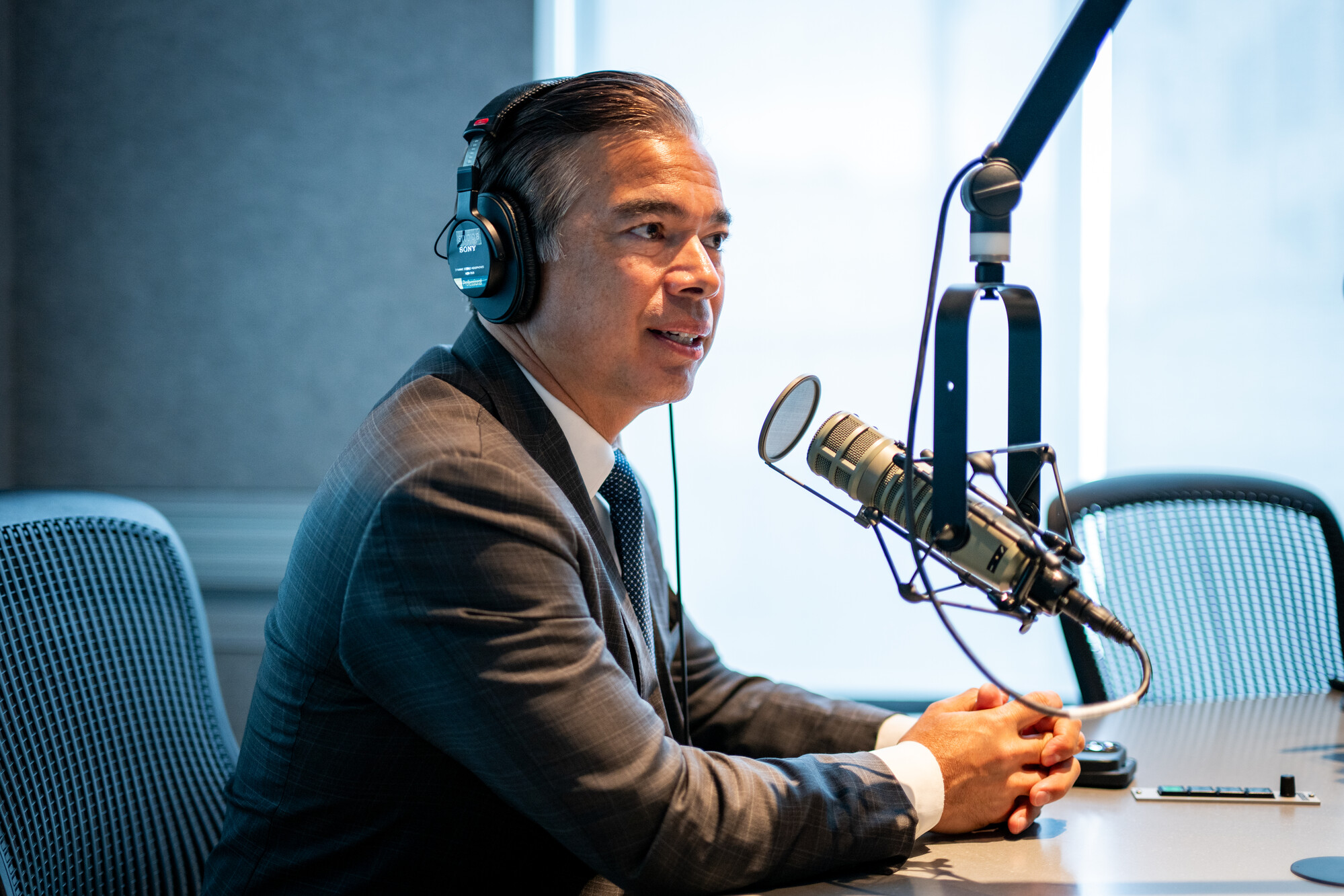
"caption": "Attorney General Rob Bonta speaks with Mina Kim before Forum at the KQED offices in San Francisco on July 17, 2025. Bonta announced on KQED that he’s suing the Trump administration over new legislation slashing Medicaid and Affordable Care Act funding.",
"credit": "Beth LaBerge/KQED",
"altTag": null,
"description": null,
"imgSizes": {
"thumbnail": {
"file": "https://cdn.kqed.org/wp-content/uploads/sites/10/2025/07/250717-BontaForum-04-BL_qed-160x107.jpg",
"width": 160,
"height": 107,
"mimeType": "image/jpeg"
},
"1536x1536": {
"file": "https://cdn.kqed.org/wp-content/uploads/sites/10/2025/07/250717-BontaForum-04-BL_qed-1536x1024.jpg",
"width": 1536,
"height": 1024,
"mimeType": "image/jpeg"
},
"post-thumbnail": {
"file": "https://cdn.kqed.org/wp-content/uploads/sites/10/2025/07/250717-BontaForum-04-BL_qed-672x372.jpg",
"width": 672,
"height": 372,
"mimeType": "image/jpeg"
},
"twentyfourteen-full-width": {
"file": "https://cdn.kqed.org/wp-content/uploads/sites/10/2025/07/250717-BontaForum-04-BL_qed-1038x576.jpg",
"width": 1038,
"height": 576,
"mimeType": "image/jpeg"
},
"kqedFullSize": {
"file": "https://cdn.kqed.org/wp-content/uploads/sites/10/2025/07/250717-BontaForum-04-BL_qed.jpg",
"width": 1999,
"height": 1333
}
},
"isLoading": false,
"fetchFailed": false
},
"news_11343203": {
"type": "attachments",
"id": "news_11343203",
"meta": {
"index": "attachments_1716263798",
"site": "news",
"id": "11343203",
"found": true
},
"parent": 11343175,
"imgSizes": {
"small": {
"file": "https://ww2.kqed.org/app/uploads/sites/10/2017/03/hospital-520x347.jpg",
"width": 520,
"mimeType": "image/jpeg",
"height": 347
},
"twentyfourteen-full-width": {
"file": "https://ww2.kqed.org/app/uploads/sites/10/2017/03/hospital-1038x576.jpg",
"width": 1038,
"mimeType": "image/jpeg",
"height": 576
},
"thumbnail": {
"file": "https://ww2.kqed.org/app/uploads/sites/10/2017/03/hospital-160x107.jpg",
"width": 160,
"mimeType": "image/jpeg",
"height": 107
},
"fd-sm": {
"file": "https://ww2.kqed.org/app/uploads/sites/10/2017/03/hospital-960x640.jpg",
"width": 960,
"mimeType": "image/jpeg",
"height": 640
},
"post-thumbnail": {
"file": "https://ww2.kqed.org/app/uploads/sites/10/2017/03/hospital-672x372.jpg",
"width": 672,
"mimeType": "image/jpeg",
"height": 372
},
"xsmall": {
"file": "https://ww2.kqed.org/app/uploads/sites/10/2017/03/hospital-375x250.jpg",
"width": 375,
"mimeType": "image/jpeg",
"height": 250
},
"kqedFullSize": {
"file": "https://ww2.kqed.org/app/uploads/sites/10/2017/03/hospital.jpg",
"width": 1440,
"height": 960
},
"large": {
"file": "https://ww2.kqed.org/app/uploads/sites/10/2017/03/hospital-1020x680.jpg",
"width": 1020,
"mimeType": "image/jpeg",
"height": 680
},
"xlarge": {
"file": "https://ww2.kqed.org/app/uploads/sites/10/2017/03/hospital-1180x787.jpg",
"width": 1180,
"mimeType": "image/jpeg",
"height": 787
},
"guest-author-50": {
"file": "https://ww2.kqed.org/app/uploads/sites/10/2017/03/hospital-50x50.jpg",
"width": 50,
"mimeType": "image/jpeg",
"height": 50
},
"guest-author-96": {
"file": "https://ww2.kqed.org/app/uploads/sites/10/2017/03/hospital-96x96.jpg",
"width": 96,
"mimeType": "image/jpeg",
"height": 96
},
"medium": {
"file": "https://ww2.kqed.org/app/uploads/sites/10/2017/03/hospital-800x533.jpg",
"width": 800,
"mimeType": "image/jpeg",
"height": 533
},
"guest-author-64": {
"file": "https://ww2.kqed.org/app/uploads/sites/10/2017/03/hospital-64x64.jpg",
"width": 64,
"mimeType": "image/jpeg",
"height": 64
},
"guest-author-32": {
"file": "https://ww2.kqed.org/app/uploads/sites/10/2017/03/hospital-32x32.jpg",
"width": 32,
"mimeType": "image/jpeg",
"height": 32
},
"fd-med": {
"file": "https://ww2.kqed.org/app/uploads/sites/10/2017/03/hospital-1180x787.jpg",
"width": 1180,
"mimeType": "image/jpeg",
"height": 787
},
"detail": {
"file": "https://ww2.kqed.org/app/uploads/sites/10/2017/03/hospital-150x150.jpg",
"width": 150,
"mimeType": "image/jpeg",
"height": 150
},
"guest-author-128": {
"file": "https://ww2.kqed.org/app/uploads/sites/10/2017/03/hospital-128x128.jpg",
"width": 128,
"mimeType": "image/jpeg",
"height": 128
},
"xxsmall": {
"file": "https://ww2.kqed.org/app/uploads/sites/10/2017/03/hospital-240x160.jpg",
"width": 240,
"mimeType": "image/jpeg",
"height": 160
}
},
"publishDate": 1488590043,
"modified": 1488834303,
"caption": "Roughly 40 of the 113 records UC released detailing investigations and findings related to allegations of sex-based discrimination or misconduct involved UC medical centers and hospitals. ",
"description": null,
"title": "hospital",
"credit": "Getty Images",
"status": "inherit",
"isLoading": false,
"fetchFailed": false
},
"news_11944683": {
"type": "attachments",
"id": "news_11944683",
"meta": {
"index": "attachments_1716263798",
"site": "news",
"id": "11944683",
"found": true
},
"parent": 11944543,
"imgSizes": {
"twentyfourteen-full-width": {
"file": "https://ww2.kqed.org/app/uploads/sites/10/2023/03/pexels-thirdman-5327584-1038x576.jpg",
"width": 1038,
"mimeType": "image/jpeg",
"height": 576
},
"thumbnail": {
"file": "https://ww2.kqed.org/app/uploads/sites/10/2023/03/pexels-thirdman-5327584-160x107.jpg",
"width": 160,
"mimeType": "image/jpeg",
"height": 107
},
"post-thumbnail": {
"file": "https://ww2.kqed.org/app/uploads/sites/10/2023/03/pexels-thirdman-5327584-672x372.jpg",
"width": 672,
"mimeType": "image/jpeg",
"height": 372
},
"kqedFullSize": {
"file": "https://ww2.kqed.org/app/uploads/sites/10/2023/03/pexels-thirdman-5327584.jpg",
"width": 1920,
"height": 1280
},
"large": {
"file": "https://ww2.kqed.org/app/uploads/sites/10/2023/03/pexels-thirdman-5327584-1020x680.jpg",
"width": 1020,
"mimeType": "image/jpeg",
"height": 680
},
"1536x1536": {
"file": "https://ww2.kqed.org/app/uploads/sites/10/2023/03/pexels-thirdman-5327584-1536x1024.jpg",
"width": 1536,
"mimeType": "image/jpeg",
"height": 1024
},
"medium": {
"file": "https://ww2.kqed.org/app/uploads/sites/10/2023/03/pexels-thirdman-5327584-800x533.jpg",
"width": 800,
"mimeType": "image/jpeg",
"height": 533
}
},
"publishDate": 1679679715,
"modified": 1679679803,
"caption": "Medi-Cal eligibility changes mean you'll need to take action to keep your coverage, starting April.",
"description": null,
"title": "medi-cal-eligibility-change-login",
"credit": "Thirdman/Pexels",
"status": "inherit",
"altTag": "A photograph of a person with lighter skin in medical uniform wearing a stethoscope, attending to another person whose face we can't see, wearing a beige shirt.",
"isLoading": false,
"fetchFailed": false
},
"news_12047046": {
"type": "attachments",
"id": "news_12047046",
"meta": {
"index": "attachments_1716263798",
"site": "news",
"id": "12047046",
"found": true
},
"title": "Rally To Oppose House Republicans' Tax Proposal Ahead Of Final House Vote",
"publishDate": 1751576109,
"status": "inherit",
"parent": 12047037,
"modified": 1751579101,
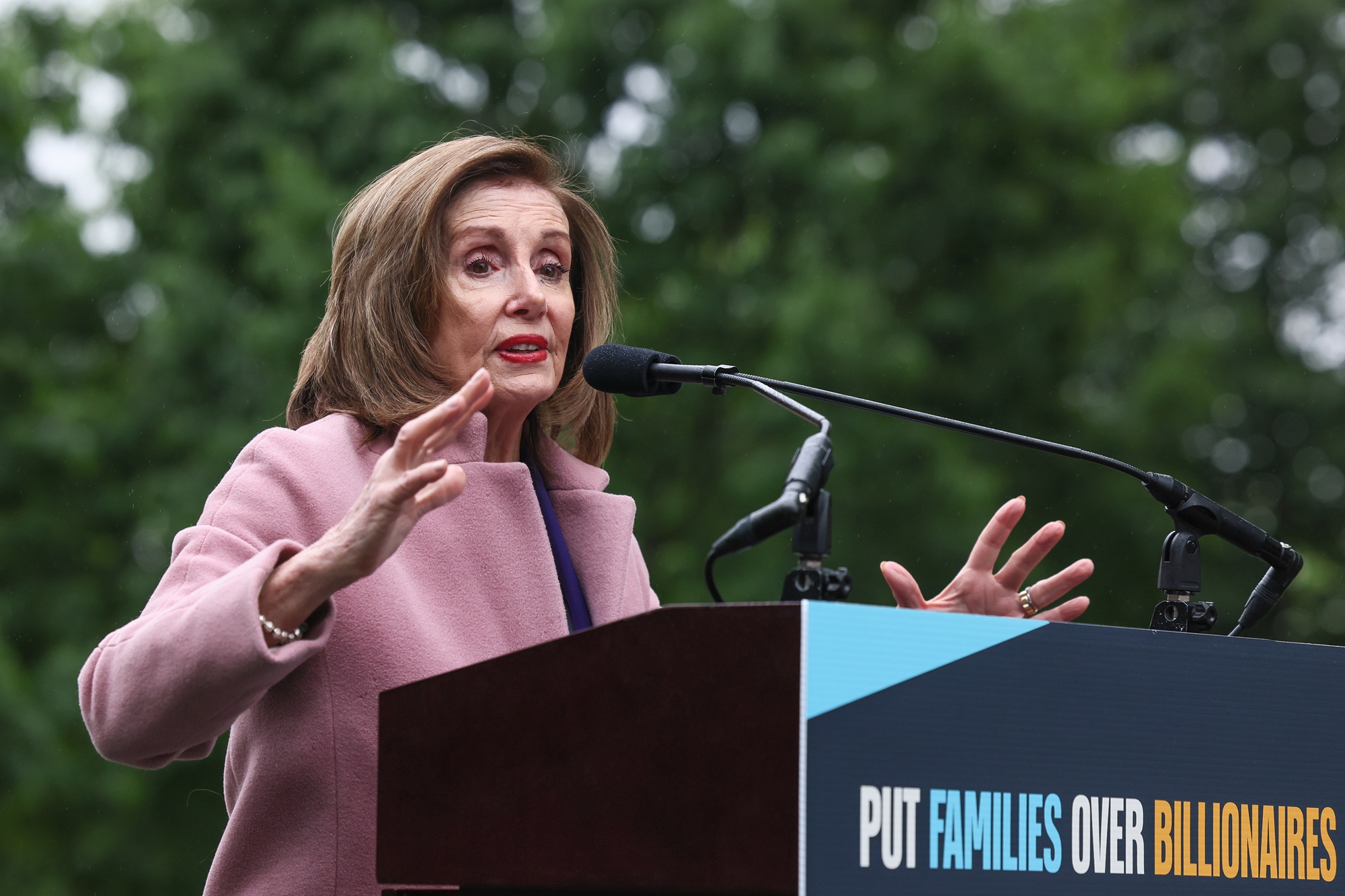
"caption": "Rep. Nancy Pelosi, D-Calif., speaks during a rally opposing House Republicans' tax proposal prior to the final House Vote on Capitol Hill on May 21, 2025, in Washington, D.C. ",
"credit": "Jemal Countess/Getty Images for Families Over Billionaires",
"altTag": null,
"description": null,
"imgSizes": {
"thumbnail": {
"file": "https://cdn.kqed.org/wp-content/uploads/sites/10/2025/07/NancyPelosiGetty2-160x107.jpg",
"width": 160,
"height": 107,
"mimeType": "image/jpeg"
},
"1536x1536": {
"file": "https://cdn.kqed.org/wp-content/uploads/sites/10/2025/07/NancyPelosiGetty2-1536x1024.jpg",
"width": 1536,
"height": 1024,
"mimeType": "image/jpeg"
},
"post-thumbnail": {
"file": "https://cdn.kqed.org/wp-content/uploads/sites/10/2025/07/NancyPelosiGetty2-672x372.jpg",
"width": 672,
"height": 372,
"mimeType": "image/jpeg"
},
"twentyfourteen-full-width": {
"file": "https://cdn.kqed.org/wp-content/uploads/sites/10/2025/07/NancyPelosiGetty2-1038x576.jpg",
"width": 1038,
"height": 576,
"mimeType": "image/jpeg"
},
"kqedFullSize": {
"file": "https://cdn.kqed.org/wp-content/uploads/sites/10/2025/07/NancyPelosiGetty2.jpg",
"width": 2000,
"height": 1333
}
},
"isLoading": false,
"fetchFailed": false
},
"news_12030155": {
"type": "attachments",
"id": "news_12030155",
"meta": {
"index": "attachments_1716263798",
"site": "news",
"id": "12030155",
"found": true
},
"title": "Rally To Stop Elon Musk's Closing Of The CFPB",
"publishDate": 1741296565,
"status": "inherit",
"parent": 12030116,
"modified": 1741373303,
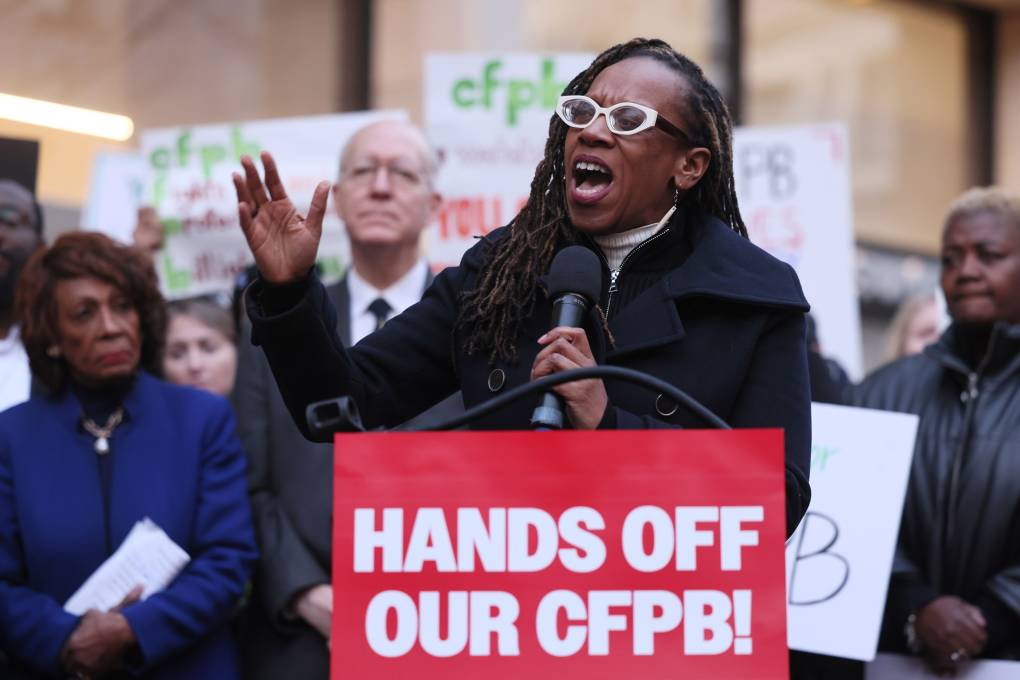
"caption": "Rep. Lateefah Simon speaks as Congressional Democrats and Consumer Financial Protection Bureau (CFPB) workers hold a rally on Feb. 10, 2025, in Washington, D.C., to protest the closure of the agency's headquarters and the work-from-home order issued by CFPB Director Russell Vought.",
"credit": "Jemal Countess/Getty Images for MoveOn",
"altTag": "A Black woman in glasses speak into a microphone at a rally, with people standing behind her. In front of her is a sign that says 'Hands off our CFPB!'",
"description": null,
"imgSizes": {
"medium": {
"file": "https://cdn.kqed.org/wp-content/uploads/sites/10/2025/03/LateefahSimonGetty2-800x533.jpg",
"width": 800,
"height": 533,
"mimeType": "image/jpeg"
},
"large": {
"file": "https://cdn.kqed.org/wp-content/uploads/sites/10/2025/03/LateefahSimonGetty2-1020x680.jpg",
"width": 1020,
"height": 680,
"mimeType": "image/jpeg"
},
"thumbnail": {
"file": "https://cdn.kqed.org/wp-content/uploads/sites/10/2025/03/LateefahSimonGetty2-160x107.jpg",
"width": 160,
"height": 107,
"mimeType": "image/jpeg"
},
"1536x1536": {
"file": "https://cdn.kqed.org/wp-content/uploads/sites/10/2025/03/LateefahSimonGetty2-1536x1024.jpg",
"width": 1536,
"height": 1024,
"mimeType": "image/jpeg"
},
"post-thumbnail": {
"file": "https://cdn.kqed.org/wp-content/uploads/sites/10/2025/03/LateefahSimonGetty2-672x372.jpg",
"width": 672,
"height": 372,
"mimeType": "image/jpeg"
},
"twentyfourteen-full-width": {
"file": "https://cdn.kqed.org/wp-content/uploads/sites/10/2025/03/LateefahSimonGetty2-1038x576.jpg",
"width": 1038,
"height": 576,
"mimeType": "image/jpeg"
},
"full-width": {
"file": "https://cdn.kqed.org/wp-content/uploads/sites/10/2025/03/LateefahSimonGetty2-1920x1280.jpg",
"width": 1920,
"height": 1280,
"mimeType": "image/jpeg"
},
"kqedFullSize": {
"file": "https://cdn.kqed.org/wp-content/uploads/sites/10/2025/03/LateefahSimonGetty2.jpg",
"width": 2000,
"height": 1333
}
},
"isLoading": false,
"fetchFailed": false
},
"news_12042346": {
"type": "attachments",
"id": "news_12042346",
"meta": {
"index": "attachments_1716263798",
"site": "news",
"id": "12042346",
"found": true
},
"title": "052825_WorkRequirements_JC_CM_23 copy",
"publishDate": 1748732813,
"status": "inherit",
"parent": 12042342,
"modified": 1748732847,
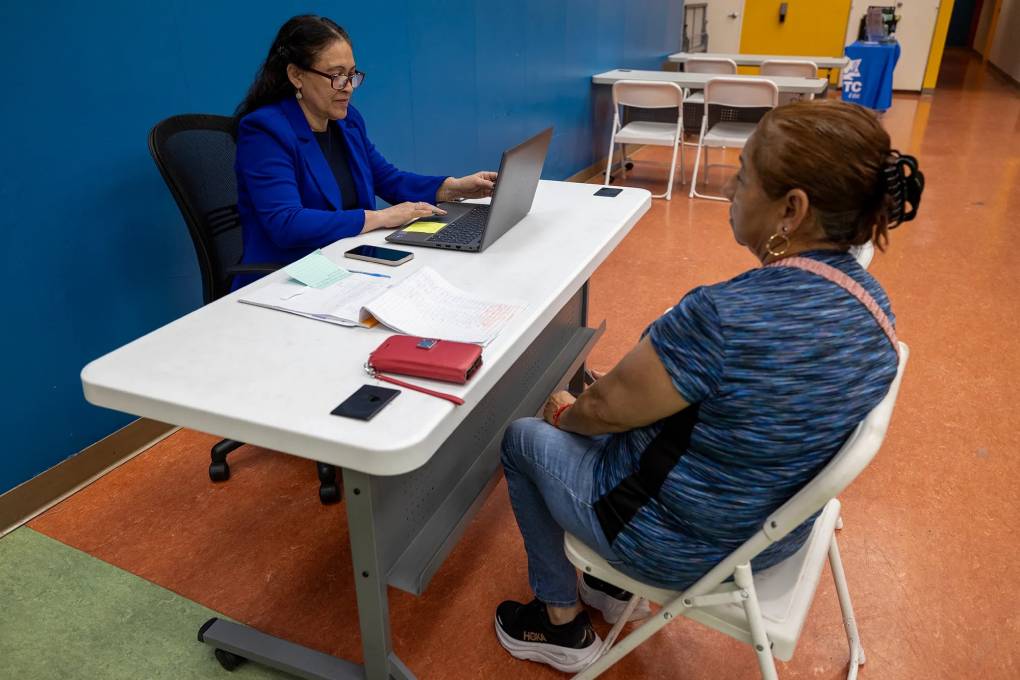
"caption": "At the Central City Neighborhood Partners office in Los Angeles, health navigator Elba Medina (left) assists Carmen Umana with her Medi-Cal application.\n",
"credit": "Jill Connelly for CalMatters",
"altTag": null,
"description": null,
"imgSizes": {
"medium": {
"file": "https://cdn.kqed.org/wp-content/uploads/sites/10/2025/05/052825_WorkRequirements_JC_CM_23-copy-800x534.jpg",
"width": 800,
"height": 534,
"mimeType": "image/jpeg"
},
"large": {
"file": "https://cdn.kqed.org/wp-content/uploads/sites/10/2025/05/052825_WorkRequirements_JC_CM_23-copy-1020x680.jpg",
"width": 1020,
"height": 680,
"mimeType": "image/jpeg"
},
"thumbnail": {
"file": "https://cdn.kqed.org/wp-content/uploads/sites/10/2025/05/052825_WorkRequirements_JC_CM_23-copy-160x107.jpg",
"width": 160,
"height": 107,
"mimeType": "image/jpeg"
},
"1536x1536": {
"file": "https://cdn.kqed.org/wp-content/uploads/sites/10/2025/05/052825_WorkRequirements_JC_CM_23-copy-1536x1025.jpg",
"width": 1536,
"height": 1025,
"mimeType": "image/jpeg"
},
"post-thumbnail": {
"file": "https://cdn.kqed.org/wp-content/uploads/sites/10/2025/05/052825_WorkRequirements_JC_CM_23-copy-672x372.jpg",
"width": 672,
"height": 372,
"mimeType": "image/jpeg"
},
"twentyfourteen-full-width": {
"file": "https://cdn.kqed.org/wp-content/uploads/sites/10/2025/05/052825_WorkRequirements_JC_CM_23-copy-1038x576.jpg",
"width": 1038,
"height": 576,
"mimeType": "image/jpeg"
},
"full-width": {
"file": "https://cdn.kqed.org/wp-content/uploads/sites/10/2025/05/052825_WorkRequirements_JC_CM_23-copy-1920x1281.jpg",
"width": 1920,
"height": 1281,
"mimeType": "image/jpeg"
},
"kqedFullSize": {
"file": "https://cdn.kqed.org/wp-content/uploads/sites/10/2025/05/052825_WorkRequirements_JC_CM_23-copy.jpg",
"width": 2000,
"height": 1334
}
},
"isLoading": false,
"fetchFailed": false
},
"news_12041725": {
"type": "attachments",
"id": "news_12041725",
"meta": {
"index": "attachments_1716263798",
"site": "news",
"id": "12041725",
"found": true
},
"title": "IMG_8132",
"publishDate": 1748387782,
"status": "inherit",
"parent": 0,
"modified": 1748388292,
"caption": "Health care providers and patients who receive acupuncture treatment spoke against the state budget cut on Medi-Cal’s acupuncture benefit on May 27, 2025, in San Francisco's Chinatown.",
"credit": "Gilare Zada/KQED",
"altTag": null,
"description": null,
"imgSizes": {
"medium": {
"file": "https://cdn.kqed.org/wp-content/uploads/sites/10/2025/05/IMG_8132-800x600.jpg",
"width": 800,
"height": 600,
"mimeType": "image/jpeg"
},
"large": {
"file": "https://cdn.kqed.org/wp-content/uploads/sites/10/2025/05/IMG_8132-1020x765.jpg",
"width": 1020,
"height": 765,
"mimeType": "image/jpeg"
},
"thumbnail": {
"file": "https://cdn.kqed.org/wp-content/uploads/sites/10/2025/05/IMG_8132-160x120.jpg",
"width": 160,
"height": 120,
"mimeType": "image/jpeg"
},
"1536x1536": {
"file": "https://cdn.kqed.org/wp-content/uploads/sites/10/2025/05/IMG_8132-1536x1152.jpg",
"width": 1536,
"height": 1152,
"mimeType": "image/jpeg"
},
"2048x2048": {
"file": "https://cdn.kqed.org/wp-content/uploads/sites/10/2025/05/IMG_8132-2048x1536.jpg",
"width": 2048,
"height": 1536,
"mimeType": "image/jpeg"
},
"post-thumbnail": {
"file": "https://cdn.kqed.org/wp-content/uploads/sites/10/2025/05/IMG_8132-672x372.jpg",
"width": 672,
"height": 372,
"mimeType": "image/jpeg"
},
"twentyfourteen-full-width": {
"file": "https://cdn.kqed.org/wp-content/uploads/sites/10/2025/05/IMG_8132-1038x576.jpg",
"width": 1038,
"height": 576,
"mimeType": "image/jpeg"
},
"full-width": {
"file": "https://cdn.kqed.org/wp-content/uploads/sites/10/2025/05/IMG_8132-1920x1440.jpg",
"width": 1920,
"height": 1440,
"mimeType": "image/jpeg"
},
"kqedFullSize": {
"file": "https://cdn.kqed.org/wp-content/uploads/sites/10/2025/05/IMG_8132-scaled.jpg",
"width": 2560,
"height": 1920
}
},
"isLoading": false,
"fetchFailed": false
},
"news_12030841": {
"type": "attachments",
"id": "news_12030841",
"meta": {
"index": "attachments_1716263798",
"site": "news",
"id": "12030841",
"found": true
},
"title": "Medicaid",
"publishDate": 1741733766,
"status": "inherit",
"parent": 12030830,
"modified": 1757976663,
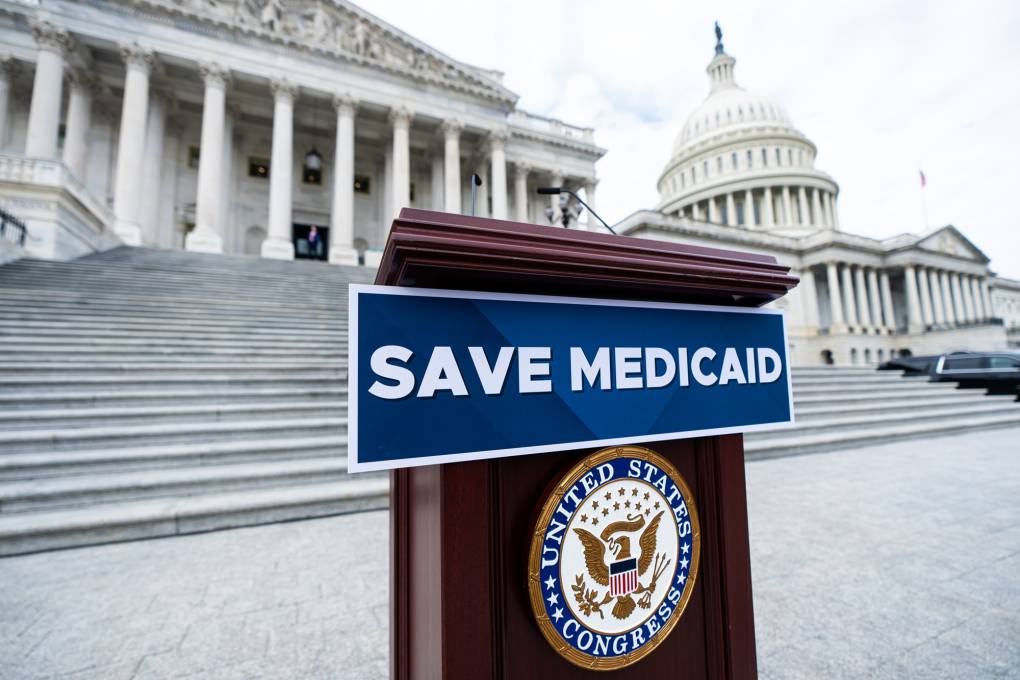
"caption": "A \"Save Medicaid\" sign is affixed to the podium for the House Democrats' press event to oppose the Republicans' budget on the House steps of the Capitol on Feb. 25, 2024.",
"credit": "Bill Clark/CRoll Call, Inc., via Getty Images",
"altTag": null,
"description": null,
"imgSizes": {
"medium": {
"file": "https://cdn.kqed.org/wp-content/uploads/sites/10/2025/03/GettyImages-2201320740-800x533.jpg",
"width": 800,
"height": 533,
"mimeType": "image/jpeg"
},
"large": {
"file": "https://cdn.kqed.org/wp-content/uploads/sites/10/2025/03/GettyImages-2201320740-1020x680.jpg",
"width": 1020,
"height": 680,
"mimeType": "image/jpeg"
},
"thumbnail": {
"file": "https://cdn.kqed.org/wp-content/uploads/sites/10/2025/03/GettyImages-2201320740-160x107.jpg",
"width": 160,
"height": 107,
"mimeType": "image/jpeg"
},
"1536x1536": {
"file": "https://cdn.kqed.org/wp-content/uploads/sites/10/2025/03/GettyImages-2201320740-1536x1024.jpg",
"width": 1536,
"height": 1024,
"mimeType": "image/jpeg"
},
"post-thumbnail": {
"file": "https://cdn.kqed.org/wp-content/uploads/sites/10/2025/03/GettyImages-2201320740-672x372.jpg",
"width": 672,
"height": 372,
"mimeType": "image/jpeg"
},
"twentyfourteen-full-width": {
"file": "https://cdn.kqed.org/wp-content/uploads/sites/10/2025/03/GettyImages-2201320740-1038x576.jpg",
"width": 1038,
"height": 576,
"mimeType": "image/jpeg"
},
"full-width": {
"file": "https://cdn.kqed.org/wp-content/uploads/sites/10/2025/03/GettyImages-2201320740-1920x1280.jpg",
"width": 1920,
"height": 1280,
"mimeType": "image/jpeg"
},
"kqedFullSize": {
"file": "https://cdn.kqed.org/wp-content/uploads/sites/10/2025/03/GettyImages-2201320740.jpg",
"width": 2000,
"height": 1333
}
},
"isLoading": false,
"fetchFailed": false
},
"news_12040027": {
"type": "attachments",
"id": "news_12040027",
"meta": {
"index": "attachments_1716263798",
"site": "news",
"id": "12040027",
"found": true
},
"title": "California Budget",
"publishDate": 1747240720,
"status": "inherit",
"parent": 12040025,
"modified": 1747240749,
"caption": "Gov. Gavin Newsom stands in front of a state flag during a press conference about President Donald Trump's tariffs on Wednesday, April 16, 2025, at an almond farm in Ceres, California.",
"credit": "Noah Berger/AP Photo",
"altTag": null,
"description": null,
"imgSizes": {
"medium": {
"file": "https://cdn.kqed.org/wp-content/uploads/sites/10/2025/05/GavinNewsom2025AP2-800x533.jpg",
"width": 800,
"height": 533,
"mimeType": "image/jpeg"
},
"large": {
"file": "https://cdn.kqed.org/wp-content/uploads/sites/10/2025/05/GavinNewsom2025AP2-1020x680.jpg",
"width": 1020,
"height": 680,
"mimeType": "image/jpeg"
},
"thumbnail": {
"file": "https://cdn.kqed.org/wp-content/uploads/sites/10/2025/05/GavinNewsom2025AP2-160x107.jpg",
"width": 160,
"height": 107,
"mimeType": "image/jpeg"
},
"1536x1536": {
"file": "https://cdn.kqed.org/wp-content/uploads/sites/10/2025/05/GavinNewsom2025AP2-1536x1024.jpg",
"width": 1536,
"height": 1024,
"mimeType": "image/jpeg"
},
"post-thumbnail": {
"file": "https://cdn.kqed.org/wp-content/uploads/sites/10/2025/05/GavinNewsom2025AP2-672x372.jpg",
"width": 672,
"height": 372,
"mimeType": "image/jpeg"
},
"twentyfourteen-full-width": {
"file": "https://cdn.kqed.org/wp-content/uploads/sites/10/2025/05/GavinNewsom2025AP2-1038x576.jpg",
"width": 1038,
"height": 576,
"mimeType": "image/jpeg"
},
"full-width": {
"file": "https://cdn.kqed.org/wp-content/uploads/sites/10/2025/05/GavinNewsom2025AP2-1920x1280.jpg",
"width": 1920,
"height": 1280,
"mimeType": "image/jpeg"
},
"kqedFullSize": {
"file": "https://cdn.kqed.org/wp-content/uploads/sites/10/2025/05/GavinNewsom2025AP2.jpg",
"width": 2000,
"height": 1333
}
},
"isLoading": false,
"fetchFailed": false
},
"news_12039588": {
"type": "attachments",
"id": "news_12039588",
"meta": {
"index": "attachments_1716263798",
"site": "news",
"id": "12039588",
"found": true
},
"title": "101023_AI-College-Toby-Reed_LA_CM_05 copy",
"publishDate": 1746821475,
"status": "inherit",
"parent": 12039585,
"modified": 1752708567,
"caption": "A student walks down a hallway at Fremont High School in Oakland on Oct. 10, 2023. \n",
"credit": "Laure Andrillon for Cal Matters",
"altTag": null,
"description": null,
"imgSizes": {
"medium": {
"file": "https://cdn.kqed.org/wp-content/uploads/sites/10/2025/05/101023_AI-College-Toby-Reed_LA_CM_05-copy-800x533.jpg",
"width": 800,
"height": 533,
"mimeType": "image/jpeg"
},
"large": {
"file": "https://cdn.kqed.org/wp-content/uploads/sites/10/2025/05/101023_AI-College-Toby-Reed_LA_CM_05-copy-1020x680.jpg",
"width": 1020,
"height": 680,
"mimeType": "image/jpeg"
},
"thumbnail": {
"file": "https://cdn.kqed.org/wp-content/uploads/sites/10/2025/05/101023_AI-College-Toby-Reed_LA_CM_05-copy-160x107.jpg",
"width": 160,
"height": 107,
"mimeType": "image/jpeg"
},
"1536x1536": {
"file": "https://cdn.kqed.org/wp-content/uploads/sites/10/2025/05/101023_AI-College-Toby-Reed_LA_CM_05-copy-1536x1024.jpg",
"width": 1536,
"height": 1024,
"mimeType": "image/jpeg"
},
"post-thumbnail": {
"file": "https://cdn.kqed.org/wp-content/uploads/sites/10/2025/05/101023_AI-College-Toby-Reed_LA_CM_05-copy-672x372.jpg",
"width": 672,
"height": 372,
"mimeType": "image/jpeg"
},
"twentyfourteen-full-width": {
"file": "https://cdn.kqed.org/wp-content/uploads/sites/10/2025/05/101023_AI-College-Toby-Reed_LA_CM_05-copy-1038x576.jpg",
"width": 1038,
"height": 576,
"mimeType": "image/jpeg"
},
"full-width": {
"file": "https://cdn.kqed.org/wp-content/uploads/sites/10/2025/05/101023_AI-College-Toby-Reed_LA_CM_05-copy-1920x1280.jpg",
"width": 1920,
"height": 1280,
"mimeType": "image/jpeg"
},
"kqedFullSize": {
"file": "https://cdn.kqed.org/wp-content/uploads/sites/10/2025/05/101023_AI-College-Toby-Reed_LA_CM_05-copy.jpg",
"width": 2000,
"height": 1333
}
},
"isLoading": false,
"fetchFailed": false
},
"news_12032695": {
"type": "attachments",
"id": "news_12032695",
"meta": {
"index": "attachments_1716263798",
"site": "news",
"id": "12032695",
"found": true
},
"title": "250323-DEM TOWN HALLS-MD-13-KQED-1",
"publishDate": 1742819402,
"status": "inherit",
"parent": 12032718,
"modified": 1746801700,
"caption": "Dawna Sodders-Simpson holds a sign at a town hall meeting with Rep. Ro Khanna at the MLK Community Center in Bakersfield on March 23, 2025.",
"credit": "Martin do Nascimento/KQED",
"altTag": null,
"description": null,
"imgSizes": {
"medium": {
"file": "https://cdn.kqed.org/wp-content/uploads/sites/10/2025/03/250323-DEM-TOWN-HALLS-MD-13-KQED-1-800x533.jpg",
"width": 800,
"height": 533,
"mimeType": "image/jpeg"
},
"large": {
"file": "https://cdn.kqed.org/wp-content/uploads/sites/10/2025/03/250323-DEM-TOWN-HALLS-MD-13-KQED-1-1020x680.jpg",
"width": 1020,
"height": 680,
"mimeType": "image/jpeg"
},
"thumbnail": {
"file": "https://cdn.kqed.org/wp-content/uploads/sites/10/2025/03/250323-DEM-TOWN-HALLS-MD-13-KQED-1-160x107.jpg",
"width": 160,
"height": 107,
"mimeType": "image/jpeg"
},
"1536x1536": {
"file": "https://cdn.kqed.org/wp-content/uploads/sites/10/2025/03/250323-DEM-TOWN-HALLS-MD-13-KQED-1-1536x1024.jpg",
"width": 1536,
"height": 1024,
"mimeType": "image/jpeg"
},
"post-thumbnail": {
"file": "https://cdn.kqed.org/wp-content/uploads/sites/10/2025/03/250323-DEM-TOWN-HALLS-MD-13-KQED-1-672x372.jpg",
"width": 672,
"height": 372,
"mimeType": "image/jpeg"
},
"twentyfourteen-full-width": {
"file": "https://cdn.kqed.org/wp-content/uploads/sites/10/2025/03/250323-DEM-TOWN-HALLS-MD-13-KQED-1-1038x576.jpg",
"width": 1038,
"height": 576,
"mimeType": "image/jpeg"
},
"full-width": {
"file": "https://cdn.kqed.org/wp-content/uploads/sites/10/2025/03/250323-DEM-TOWN-HALLS-MD-13-KQED-1-1920x1280.jpg",
"width": 1920,
"height": 1280,
"mimeType": "image/jpeg"
},
"kqedFullSize": {
"file": "https://cdn.kqed.org/wp-content/uploads/sites/10/2025/03/250323-DEM-TOWN-HALLS-MD-13-KQED-1.jpg",
"width": 2000,
"height": 1333
}
},
"isLoading": false,
"fetchFailed": false
},
"news_12029302": {
"type": "attachments",
"id": "news_12029302",
"meta": {
"index": "attachments_1716263798",
"site": "news",
"id": "12029302",
"found": true
},
"title": "072820-Doctor-Pediatrician-Kid-GETTY-CM-01 copy",
"publishDate": 1740777322,
"status": "inherit",
"parent": 12029294,
"modified": 1752270887,
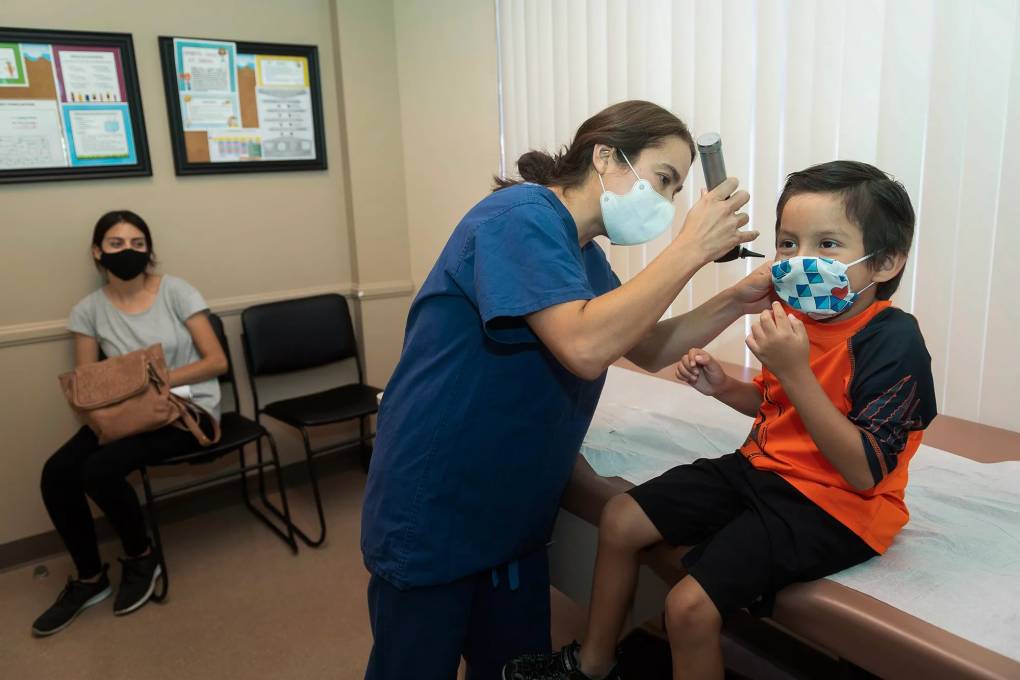
"caption": "A doctor examines a child at Southern Orange County Pediatric Associates in Ladera Ranch on July 28, 2020.",
"credit": "Paul Bersebach/Orange County Register via Getty Images",
"altTag": null,
"description": null,
"imgSizes": {
"medium": {
"file": "https://cdn.kqed.org/wp-content/uploads/sites/10/2025/03/072820-Doctor-Pediatrician-Kid-GETTY-CM-01-copy-800x533.jpg",
"width": 800,
"height": 533,
"mimeType": "image/jpeg"
},
"large": {
"file": "https://cdn.kqed.org/wp-content/uploads/sites/10/2025/03/072820-Doctor-Pediatrician-Kid-GETTY-CM-01-copy-1020x680.jpg",
"width": 1020,
"height": 680,
"mimeType": "image/jpeg"
},
"thumbnail": {
"file": "https://cdn.kqed.org/wp-content/uploads/sites/10/2025/03/072820-Doctor-Pediatrician-Kid-GETTY-CM-01-copy-160x107.jpg",
"width": 160,
"height": 107,
"mimeType": "image/jpeg"
},
"1536x1536": {
"file": "https://cdn.kqed.org/wp-content/uploads/sites/10/2025/03/072820-Doctor-Pediatrician-Kid-GETTY-CM-01-copy-1536x1024.jpg",
"width": 1536,
"height": 1024,
"mimeType": "image/jpeg"
},
"post-thumbnail": {
"file": "https://cdn.kqed.org/wp-content/uploads/sites/10/2025/03/072820-Doctor-Pediatrician-Kid-GETTY-CM-01-copy-672x372.jpg",
"width": 672,
"height": 372,
"mimeType": "image/jpeg"
},
"twentyfourteen-full-width": {
"file": "https://cdn.kqed.org/wp-content/uploads/sites/10/2025/03/072820-Doctor-Pediatrician-Kid-GETTY-CM-01-copy-1038x576.jpg",
"width": 1038,
"height": 576,
"mimeType": "image/jpeg"
},
"full-width": {
"file": "https://cdn.kqed.org/wp-content/uploads/sites/10/2025/03/072820-Doctor-Pediatrician-Kid-GETTY-CM-01-copy-1920x1280.jpg",
"width": 1920,
"height": 1280,
"mimeType": "image/jpeg"
},
"kqedFullSize": {
"file": "https://cdn.kqed.org/wp-content/uploads/sites/10/2025/03/072820-Doctor-Pediatrician-Kid-GETTY-CM-01-copy.jpg",
"width": 2000,
"height": 1333
}
},
"isLoading": false,
"fetchFailed": false
}
},
"audioPlayerReducer": {
"postId": "stream_live",
"isPaused": true,
"isPlaying": false,
"pfsActive": false,
"pledgeModalIsOpen": true,
"playerDrawerIsOpen": false,
"liveAudioPlayStartedAt": 0,
"liveAudioPlayContext": ""
},
"authorsReducer": {
"byline_news_12042342": {
"type": "authors",
"id": "byline_news_12042342",
"meta": {
"override": true
},
"slug": "byline_news_12042342",
"name": "\u003ca href=\"https://calmatters.org/author/anaibarra/\">Ana B. Ibarra\u003c/a>, CalMatters",
"isLoading": false
},
"byline_news_12039585": {
"type": "authors",
"id": "byline_news_12039585",
"meta": {
"override": true
},
"slug": "byline_news_12039585",
"name": "\u003ca href=\"https://calmatters.org/author/anaibarra/\">Ana B. Ibarra\u003c/a>, CalMatters",
"isLoading": false
},
"gmarzorati": {
"type": "authors",
"id": "227",
"meta": {
"index": "authors_1716337520",
"id": "227",
"found": true
},
"name": "Guy Marzorati",
"firstName": "Guy",
"lastName": "Marzorati",
"slug": "gmarzorati",
"email": "gmarzorati@KQED.org",
"display_author_email": true,
"staff_mastheads": [
"news"
],
"title": "Correspondent",
"bio": "Guy Marzorati is a correspondent on KQED's California Politics and Government Desk, based in San Jose. A graduate of Santa Clara University, Guy joined KQED in 2013. He reports on state and local politics and produces KQED's digital voter guide.",
"avatar": "https://secure.gravatar.com/avatar/e7038b8dbfd55b104369b76b1cd0b9de?s=600&d=blank&r=g",
"twitter": "guymarzorati",
"facebook": null,
"instagram": null,
"linkedin": null,
"sites": [
{
"site": "",
"roles": [
"editor"
]
},
{
"site": "news",
"roles": [
"editor"
]
},
{
"site": "science",
"roles": [
"editor"
]
},
{
"site": "forum",
"roles": [
"editor"
]
},
{
"site": "elections",
"roles": [
"editor"
]
},
{
"site": "liveblog",
"roles": [
"editor"
]
}
],
"headData": {
"title": "Guy Marzorati | KQED",
"description": "Correspondent",
"ogImgSrc": "https://secure.gravatar.com/avatar/e7038b8dbfd55b104369b76b1cd0b9de?s=600&d=blank&r=g",
"twImgSrc": "https://secure.gravatar.com/avatar/e7038b8dbfd55b104369b76b1cd0b9de?s=600&d=blank&r=g"
},
"isLoading": false,
"link": "/author/gmarzorati"
},
"mlagos": {
"type": "authors",
"id": "3239",
"meta": {
"index": "authors_1716337520",
"id": "3239",
"found": true
},
"name": "Marisa Lagos",
"firstName": "Marisa",
"lastName": "Lagos",
"slug": "mlagos",
"email": "mlagos@kqed.org",
"display_author_email": false,
"staff_mastheads": [
"news"
],
"title": "KQED Contributor",
"bio": "Marisa Lagos is a correspondent for KQED’s California Politics and Government Desk and co-hosts the award-winning show and podcast, Political Breakdown. At KQED, Lagos also conducts reporting, analysis and investigations into state, local and national politics for radio, TV, online and onstage. In 2022, she and co-host, Scott Shafer, moderated the only gubernatorial debate in California. In 2020, the \u003ci>Washington Post\u003c/i> named her one of the top political journalists in California; she was nominated for a Peabody and won several other awards for her work investigating the 2017 California wildfires. She has worked at the \u003ci>San Francisco Chronicle\u003c/i>, \u003ci>San Francisco Examiner\u003c/i> and \u003ci>Los Angeles Times\u003c/i>. A UC Santa Barbara graduate, she lives in San Francisco with her two sons and husband.",
"avatar": "https://secure.gravatar.com/avatar/a261a0d3696fc066871ef96b85b5e7d2?s=600&d=blank&r=g",
"twitter": "@mlagos",
"facebook": null,
"instagram": null,
"linkedin": null,
"sites": [
{
"site": "arts",
"roles": [
"author"
]
},
{
"site": "news",
"roles": [
"editor"
]
},
{
"site": "science",
"roles": [
"editor"
]
},
{
"site": "forum",
"roles": [
"author"
]
},
{
"site": "liveblog",
"roles": [
"author"
]
}
],
"headData": {
"title": "Marisa Lagos | KQED",
"description": "KQED Contributor",
"ogImgSrc": "https://secure.gravatar.com/avatar/a261a0d3696fc066871ef96b85b5e7d2?s=600&d=blank&r=g",
"twImgSrc": "https://secure.gravatar.com/avatar/a261a0d3696fc066871ef96b85b5e7d2?s=600&d=blank&r=g"
},
"isLoading": false,
"link": "/author/mlagos"
},
"ccabreralomeli": {
"type": "authors",
"id": "11708",
"meta": {
"index": "authors_1716337520",
"id": "11708",
"found": true
},
"name": "Carlos Cabrera-Lomelí",
"firstName": "Carlos",
"lastName": "Cabrera-Lomelí",
"slug": "ccabreralomeli",
"email": "ccabreralomeli@KQED.org",
"display_author_email": true,
"staff_mastheads": [
"news"
],
"title": "Community Reporter",
"bio": "Carlos Cabrera-Lomelí is a community reporter with KQED's digital engagement team. He also reports and co-produces for KQED's bilingual news hub KQED en Español. He grew up in San Francisco's Mission District and has previously worked with Univision, 48 Hills and REFORMA in Mexico City.",
"avatar": "https://secure.gravatar.com/avatar/c309be9665e484f887b818c89e273ecc673004f426f36b24d00a4d813a2e0518?s=600&d=blank&r=g",
"twitter": "@LomeliCabrera",
"bluesky": null,
"facebook": null,
"instagram": null,
"linkedin": null,
"sites": [
{
"site": "arts",
"roles": [
"editor"
]
},
{
"site": "news",
"roles": [
"editor"
]
},
{
"site": "about",
"roles": [
"editor"
]
},
{
"site": "science",
"roles": [
"editor"
]
},
{
"site": "perspectives",
"roles": [
"editor"
]
},
{
"site": "elections",
"roles": [
"editor"
]
},
{
"site": "liveblog",
"roles": [
"contributor"
]
}
],
"headData": {
"title": "Carlos Cabrera-Lomelí | KQED",
"description": "Community Reporter",
"ogImgSrc": "https://secure.gravatar.com/avatar/c309be9665e484f887b818c89e273ecc673004f426f36b24d00a4d813a2e0518?s=600&d=blank&r=g",
"twImgSrc": "https://secure.gravatar.com/avatar/c309be9665e484f887b818c89e273ecc673004f426f36b24d00a4d813a2e0518?s=600&d=blank&r=g"
},
"isLoading": false,
"link": "/author/ccabreralomeli"
},
"kmizuguchi": {
"type": "authors",
"id": "11739",
"meta": {
"index": "authors_1716337520",
"id": "11739",
"found": true
},
"name": "Keith Mizuguchi",
"firstName": "Keith",
"lastName": "Mizuguchi",
"slug": "kmizuguchi",
"email": "kmizuguchi@kqed.org",
"display_author_email": false,
"staff_mastheads": [],
"title": "KQED Contributor",
"bio": null,
"avatar": "https://secure.gravatar.com/avatar/64d8a7de0723d4099b9fe4e915136103febcc20809abce228ee4415bcb237023?s=600&d=blank&r=g",
"twitter": null,
"bluesky": null,
"facebook": null,
"instagram": null,
"linkedin": null,
"sites": [
{
"site": "news",
"roles": [
"editor"
]
},
{
"site": "science",
"roles": [
"editor"
]
}
],
"headData": {
"title": "Keith Mizuguchi | KQED",
"description": "KQED Contributor",
"ogImgSrc": "https://secure.gravatar.com/avatar/64d8a7de0723d4099b9fe4e915136103febcc20809abce228ee4415bcb237023?s=600&d=blank&r=g",
"twImgSrc": "https://secure.gravatar.com/avatar/64d8a7de0723d4099b9fe4e915136103febcc20809abce228ee4415bcb237023?s=600&d=blank&r=g"
},
"isLoading": false,
"link": "/author/kmizuguchi"
},
"sjohnson": {
"type": "authors",
"id": "11840",
"meta": {
"index": "authors_1716337520",
"id": "11840",
"found": true
},
"name": "Sydney Johnson",
"firstName": "Sydney",
"lastName": "Johnson",
"slug": "sjohnson",
"email": "sjohnson@kqed.org",
"display_author_email": false,
"staff_mastheads": [
"news"
],
"title": "KQED Reporter",
"bio": "Sydney Johnson is a general assignment reporter at KQED. She previously reported on public health and city government at the San Francisco Examiner, and before that, she covered statewide education policy for EdSource. Her reporting has won multiple local, state and national awards. Sydney is a graduate of the University of California, Berkeley and lives in San Francisco.",
"avatar": "https://secure.gravatar.com/avatar/97855f2719b72ad6190b7c535fe642c8?s=600&d=blank&r=g",
"twitter": "sydneyfjohnson",
"facebook": null,
"instagram": null,
"linkedin": null,
"sites": [
{
"site": "news",
"roles": [
"editor"
]
}
],
"headData": {
"title": "Sydney Johnson | KQED",
"description": "KQED Reporter",
"ogImgSrc": "https://secure.gravatar.com/avatar/97855f2719b72ad6190b7c535fe642c8?s=600&d=blank&r=g",
"twImgSrc": "https://secure.gravatar.com/avatar/97855f2719b72ad6190b7c535fe642c8?s=600&d=blank&r=g"
},
"isLoading": false,
"link": "/author/sjohnson"
},
"kdebenedetti": {
"type": "authors",
"id": "11913",
"meta": {
"index": "authors_1716337520",
"id": "11913",
"found": true
},
"name": "Katie DeBenedetti",
"firstName": "Katie",
"lastName": "DeBenedetti",
"slug": "kdebenedetti",
"email": "kdebenedetti@kqed.org",
"display_author_email": false,
"staff_mastheads": [
"news",
"science"
],
"title": "KQED Contributor",
"bio": "Katie DeBenedetti is a digital reporter covering daily news for the Express Desk. Prior to joining KQED as a culture reporting intern in January 2024, she covered education and city government for the Napa Valley Register.",
"avatar": "https://secure.gravatar.com/avatar/6e31073cb8f7e4214ab03f42771d0f45?s=600&d=blank&r=g",
"twitter": null,
"facebook": null,
"instagram": null,
"linkedin": null,
"sites": [
{
"site": "news",
"roles": [
"author"
]
},
{
"site": "science",
"roles": [
"author"
]
},
{
"site": "liveblog",
"roles": [
"author"
]
}
],
"headData": {
"title": "Katie DeBenedetti | KQED",
"description": "KQED Contributor",
"ogImgSrc": "https://secure.gravatar.com/avatar/6e31073cb8f7e4214ab03f42771d0f45?s=600&d=blank&r=g",
"twImgSrc": "https://secure.gravatar.com/avatar/6e31073cb8f7e4214ab03f42771d0f45?s=600&d=blank&r=g"
},
"isLoading": false,
"link": "/author/kdebenedetti"
},
"gzada": {
"type": "authors",
"id": "11929",
"meta": {
"index": "authors_1716337520",
"id": "11929",
"found": true
},
"name": "Gilare Zada",
"firstName": "Gilare",
"lastName": "Zada",
"slug": "gzada",
"email": "gzada@kqed.org",
"display_author_email": true,
"staff_mastheads": [
"news"
],
"title": null,
"bio": "Gilare Zada is a Kurdish-American from San Diego, CA. Storytelling, fitness, and binge reading are some of her passions outside of news reporting. Her work has appeared in Mission Local, the Peninsula Press, the San Francisco Press Club, and more. She also writes as a class correspondent for the Stanford Magazine - go Card!",
"avatar": "https://secure.gravatar.com/avatar/33a75f2b947669a488a805edec3fbf3838c1cedaedda710e983770633b4d6a75?s=600&d=blank&r=g",
"twitter": null,
"bluesky": null,
"facebook": null,
"instagram": null,
"linkedin": null,
"sites": [
{
"site": "arts",
"roles": [
"editor"
]
},
{
"site": "news",
"roles": [
"administrator"
]
},
{
"site": "science",
"roles": [
"editor"
]
}
],
"headData": {
"title": "Gilare Zada | KQED",
"description": null,
"ogImgSrc": "https://secure.gravatar.com/avatar/33a75f2b947669a488a805edec3fbf3838c1cedaedda710e983770633b4d6a75?s=600&d=blank&r=g",
"twImgSrc": "https://secure.gravatar.com/avatar/33a75f2b947669a488a805edec3fbf3838c1cedaedda710e983770633b4d6a75?s=600&d=blank&r=g"
},
"isLoading": false,
"link": "/author/gzada"
}
},
"pagesReducer": {
"news_tag_medi-cal": {
"type": "terms",
"id": "news_2605",
"meta": {
"index": "terms_1716263798",
"site": "news",
"id": "2605",
"score": 9.892363
},
"featImg": null,
"name": "Medi-Cal",
"description": null,
"taxonomy": "tag",
"headData": {
"twImgId": null,
"twTitle": null,
"ogTitle": null,
"ogImgId": null,
"twDescription": null,
"description": null,
"title": "Medi-Cal Archives | KQED News",
"ogDescription": null
},
"ttid": 2621,
"slug": "medi-cal",
"isLoading": false,
"title": "Medi-Cal",
"pageMeta": {
"site": "news",
"WpPageTemplate": "page-topic-editorial",
"currentPage": 3
},
"blocks": [
{
"blockName": "kqed/post-list",
"attrs": {
"layout": "cardArticle2",
"query": "posts/news?tag=medi-cal",
"seeMore": false,
"paginated": true,
"page": 3
}
},
{
"blockName": "kqed/ad"
}
]
}
},
"pfsSessionReducer": {},
"postsReducer": {
"stream_live": {
"type": "live",
"id": "stream_live",
"audioUrl": "https://streams.kqed.org/kqedradio",
"title": "Live Stream",
"excerpt": "Live Stream information currently unavailable.",
"link": "/radio",
"featImg": "",
"label": {
"name": "KQED Live",
"link": "/"
}
},
"stream_kqedNewscast": {
"type": "posts",
"id": "stream_kqedNewscast",
"audioUrl": "https://www.kqed.org/.stream/anon/radio/RDnews/newscast.mp3?_=1",
"title": "KQED Newscast",
"featImg": "",
"label": {
"name": "88.5 FM",
"link": "/"
}
},
"news_12048504": {
"type": "posts",
"id": "news_12048504",
"meta": {
"index": "posts_1716263798",
"site": "news",
"id": "12048504",
"score": null,
"sort": [
1752783248000
]
},
"guestAuthors": [],
"slug": "bonta-announces-33rd-trump-lawsuit-on-kqed-this-one-targets-health-care-cuts",
"title": "Bonta Announces 33rd Trump Lawsuit on KQED, This One Targets Health Care Cuts",
"publishDate": 1752783248,
"format": "standard",
"headTitle": "Bonta Announces 33rd Trump Lawsuit on KQED, This One Targets Health Care Cuts | KQED",
"labelTerm": {
"site": "news"
},
"content": "\u003cp>\u003cstrong>\u003cem>Updated at 3 p.m. July 18\u003c/em>\u003c/strong>\u003c/p>\n\u003cp>California Attorney General Rob Bonta \u003ca href=\"https://www.kqed.org/forum/2010101910625/california-attorney-general-rob-bonta-on-standing-up-to-the-trump-administration\">announced Thursday on KQED’s Forum\u003c/a> that the state is filing a third lawsuit this week against President Donald Trump.\u003c/p>\n\u003cp>On Monday, Bonta \u003ca href=\"https://www.kqed.org/news/12047925/california-sues-trump-administration-again-this-time-over-withheld-school-funds\">joined \u003c/a>23 other states in suing the administration over its withholding of nearly $6 billion of federal education funding. On Wednesday, he joined 18 other states in filing suit over Trump’s \u003ca href=\"https://www.npr.org/2025/04/02/nx-s1-5345777/trump-states-fema-funds\">cancellation \u003c/a>of FEMA disaster mitigation funds.\u003c/p>\n\u003cp>This time, Bonta will join New Jersey and Massachusetts to co-lead a \u003ca href=\"https://oag.ca.gov/news/press-releases/attorney-general-bonta-co-leads-lawsuit-challenging-trump-administration-rule#:~:text=OAKLAND%2520%E2%80%94%2520California%2520Attorney%2520General%2520Rob,Medicare%2520%2526%2520Medicaid%2520Services%2520(CMS)\">lawsuit\u003c/a> challenging a Trump administration rule designed to make it more difficult for Americans to access health coverage through the Affordable Care Act.\u003c/p>\n\u003cp>It marks the 33rd lawsuit that Bonta has filed against Trump since the start of the year.\u003c/p>\n\u003cp>[ad fullwidth]\u003c/p>\n\u003cp>\u003cstrong>The big picture: \u003c/strong>Since his January inauguration, Trump has signed 170 executive \u003ca href=\"https://www.federalregister.gov/presidential-documents/executive-orders/donald-trump/2025\">orders \u003c/a>— many of them targeted by Bonta’s legal challenges. Bonta’s first lawsuit contested Trump’s executive order \u003ca href=\"https://www.kqed.org/news/12015449/a-129-year-old-san-francisco-lawsuit-could-stop-trump-from-ending-birthright-citizenship\">ending birthright citizenship\u003c/a>. He has since sued over mass firings of federal workers, \u003ca href=\"https://www.kqed.org/news/tag/california-national-guard\">deployment of the National Guard to California\u003c/a>, and other legislative policies. Bonta estimates that his office has filed lawsuits at a pace of more than one per week.\u003c/p>\n\u003cp>\u003cstrong>The latest: \u003c/strong>Bonta appeared on \u003ca href=\"https://www.kqed.org/forum/2010101910625/california-attorney-general-rob-bonta-on-standing-up-to-the-trump-administration\">Forum\u003c/a>, where he announced the latest lawsuit.\u003c/p>\n\u003cp>“We are following our North Star, which is the law,” Bonta said.[aside postID=forum_2010101910625 hero='https://cdn.kqed.org/wp-content/uploads/sites/43/2025/07/241107-AttorneyGeneralBonta-01-BL_qed.jpg']The final rule by the U.S. Department of Health and Human Services would add new bureaucratic barriers, shorten the ACA enrollment window, impose automatic charges on some $0-premium plans, and make coverage less affordable for millions while also excluding gender-affirming care as an essential benefit in federal exchange plans. (California’s coverage would not be affected.)\u003c/p>\n\u003cp>Bonta said it would strip millions of Americans of coverage and restrict others from receiving gender affirming care.\u003c/p>\n\u003cp>\u003cstrong>By the numbers: \u003c/strong>Bonta said California has spent $5 million on lawsuits against Trump this year — legal action he said has saved roughly $170 billion for the state. He estimates that at stake in this most recent lawsuit is around 2 million Americans who could lose access to healthcare under Trump’s new legislation.\u003c/p>\n\u003cp>\u003cstrong>What we’re watching: \u003c/strong>“We’ve got a full tank of gas,” Bonta said. He said his office isn’t slowing down and will sue again anytime Trump “tramples over the Constitution.” As for the rescission vote this week that would strip $9 billion in funding for NPR and PBS, Bonta said he plans to look at the lawfulness of the rescission package and “If it’s lawful, it’s lawful. If it’s not, we’ll sue.”\u003c/p>\n\u003cp>\u003cem>\u003cstrong>Editor’s Note:\u003c/strong> This story was updated to clarify that the lawsuit filed by California Attorney General Rob Bonta challenges a rule designed to make it more difficult for Americans to access health coverage through the Affordable Care Act.\u003c/em>\u003c/p>\n\u003cp>\u003c/p>\n",
"blocks": [],
"excerpt": "California Attorney General Rob Bonta announced on KQED that he’s suing the Trump administration over new legislation slashing Medicaid and Affordable Care Act funding.",
"status": "publish",
"parent": 0,
"modified": 1752876882,
"stats": {
"hasAudio": false,
"hasVideo": false,
"hasChartOrMap": false,
"iframeSrcs": [],
"hasGoogleForm": false,
"hasGallery": false,
"hasHearkenModule": false,
"hasPolis": false,
"paragraphCount": 14,
"wordCount": 516
},
"headData": {
"title": "Bonta Announces 33rd Trump Lawsuit on KQED, This One Targets Health Care Cuts | KQED",
"description": "California Attorney General Rob Bonta announced on KQED that he’s suing the Trump administration over new legislation slashing Medicaid and Affordable Care Act funding.",
"ogTitle": "",
"ogDescription": "",
"ogImgId": "",
"twTitle": "",
"twDescription": "",
"twImgId": "",
"schema": {
"@context": "https://schema.org",
"@type": "NewsArticle",
"headline": "Bonta Announces 33rd Trump Lawsuit on KQED, This One Targets Health Care Cuts",
"datePublished": "2025-07-17T13:14:08-07:00",
"dateModified": "2025-07-18T15:14:42-07:00",
"image": "https://cdn.kqed.org/wp-content/uploads/2020/02/KQED-OG-Image@1x.png",
"isAccessibleForFree": "True",
"publisher": {
"@type": "NewsMediaOrganization",
"@id": "https://www.kqed.org/#organization",
"name": "KQED",
"logo": "https://cdn.kqed.org/wp-content/uploads/2020/02/KQED-OG-Image@1x.png",
"url": "https://www.kqed.org",
"sameAs": [
"https://www.facebook.com/KQED",
"https://twitter.com/KQED",
"https://www.instagram.com/kqed/",
"https://www.tiktok.com/@kqedofficial",
"https://www.linkedin.com/company/kqed",
"https://www.youtube.com/channel/UCeC0IOo7i1P_61zVUWbJ4nw"
]
}
}
},
"primaryCategory": {
"termId": 8,
"slug": "news",
"name": "News"
},
"sticky": false,
"nprStoryId": "kqed-12048504",
"templateType": "standard",
"featuredImageType": "standard",
"excludeFromSiteSearch": "Include",
"articleAge": "0",
"path": "/news/12048504/bonta-announces-33rd-trump-lawsuit-on-kqed-this-one-targets-health-care-cuts",
"audioTrackLength": null,
"parsedContent": [
{
"type": "contentString",
"content": "\u003cdiv class=\"post-body\">\u003cp>\u003cp>\u003cstrong>\u003cem>Updated at 3 p.m. July 18\u003c/em>\u003c/strong>\u003c/p>\n\u003cp>California Attorney General Rob Bonta \u003ca href=\"https://www.kqed.org/forum/2010101910625/california-attorney-general-rob-bonta-on-standing-up-to-the-trump-administration\">announced Thursday on KQED’s Forum\u003c/a> that the state is filing a third lawsuit this week against President Donald Trump.\u003c/p>\n\u003cp>On Monday, Bonta \u003ca href=\"https://www.kqed.org/news/12047925/california-sues-trump-administration-again-this-time-over-withheld-school-funds\">joined \u003c/a>23 other states in suing the administration over its withholding of nearly $6 billion of federal education funding. On Wednesday, he joined 18 other states in filing suit over Trump’s \u003ca href=\"https://www.npr.org/2025/04/02/nx-s1-5345777/trump-states-fema-funds\">cancellation \u003c/a>of FEMA disaster mitigation funds.\u003c/p>\n\u003cp>This time, Bonta will join New Jersey and Massachusetts to co-lead a \u003ca href=\"https://oag.ca.gov/news/press-releases/attorney-general-bonta-co-leads-lawsuit-challenging-trump-administration-rule#:~:text=OAKLAND%2520%E2%80%94%2520California%2520Attorney%2520General%2520Rob,Medicare%2520%2526%2520Medicaid%2520Services%2520(CMS)\">lawsuit\u003c/a> challenging a Trump administration rule designed to make it more difficult for Americans to access health coverage through the Affordable Care Act.\u003c/p>\n\u003cp>It marks the 33rd lawsuit that Bonta has filed against Trump since the start of the year.\u003c/p>\n\u003cp>\u003c/p>\u003c/div>",
"attributes": {
"named": {},
"numeric": []
}
},
{
"type": "component",
"content": "",
"name": "ad",
"attributes": {
"named": {
"label": "fullwidth"
},
"numeric": [
"fullwidth"
]
}
},
{
"type": "contentString",
"content": "\u003cdiv class=\"post-body\">\u003cp>\u003c/p>\n\u003cp>\u003cstrong>The big picture: \u003c/strong>Since his January inauguration, Trump has signed 170 executive \u003ca href=\"https://www.federalregister.gov/presidential-documents/executive-orders/donald-trump/2025\">orders \u003c/a>— many of them targeted by Bonta’s legal challenges. Bonta’s first lawsuit contested Trump’s executive order \u003ca href=\"https://www.kqed.org/news/12015449/a-129-year-old-san-francisco-lawsuit-could-stop-trump-from-ending-birthright-citizenship\">ending birthright citizenship\u003c/a>. He has since sued over mass firings of federal workers, \u003ca href=\"https://www.kqed.org/news/tag/california-national-guard\">deployment of the National Guard to California\u003c/a>, and other legislative policies. Bonta estimates that his office has filed lawsuits at a pace of more than one per week.\u003c/p>\n\u003cp>\u003cstrong>The latest: \u003c/strong>Bonta appeared on \u003ca href=\"https://www.kqed.org/forum/2010101910625/california-attorney-general-rob-bonta-on-standing-up-to-the-trump-administration\">Forum\u003c/a>, where he announced the latest lawsuit.\u003c/p>\n\u003cp>“We are following our North Star, which is the law,” Bonta said.\u003c/p>\u003c/div>",
"attributes": {
"named": {},
"numeric": []
}
},
{
"type": "component",
"content": "",
"name": "aside",
"attributes": {
"named": {
"postid": "forum_2010101910625",
"hero": "https://cdn.kqed.org/wp-content/uploads/sites/43/2025/07/241107-AttorneyGeneralBonta-01-BL_qed.jpg",
"label": ""
},
"numeric": []
}
},
{
"type": "contentString",
"content": "\u003cdiv class=\"post-body\">\u003cp>The final rule by the U.S. Department of Health and Human Services would add new bureaucratic barriers, shorten the ACA enrollment window, impose automatic charges on some $0-premium plans, and make coverage less affordable for millions while also excluding gender-affirming care as an essential benefit in federal exchange plans. (California’s coverage would not be affected.)\u003c/p>\n\u003cp>Bonta said it would strip millions of Americans of coverage and restrict others from receiving gender affirming care.\u003c/p>\n\u003cp>\u003cstrong>By the numbers: \u003c/strong>Bonta said California has spent $5 million on lawsuits against Trump this year — legal action he said has saved roughly $170 billion for the state. He estimates that at stake in this most recent lawsuit is around 2 million Americans who could lose access to healthcare under Trump’s new legislation.\u003c/p>\n\u003cp>\u003cstrong>What we’re watching: \u003c/strong>“We’ve got a full tank of gas,” Bonta said. He said his office isn’t slowing down and will sue again anytime Trump “tramples over the Constitution.” As for the rescission vote this week that would strip $9 billion in funding for NPR and PBS, Bonta said he plans to look at the lawfulness of the rescission package and “If it’s lawful, it’s lawful. If it’s not, we’ll sue.”\u003c/p>\n\u003cp>\u003cem>\u003cstrong>Editor’s Note:\u003c/strong> This story was updated to clarify that the lawsuit filed by California Attorney General Rob Bonta challenges a rule designed to make it more difficult for Americans to access health coverage through the Affordable Care Act.\u003c/em>\u003c/p>\n\u003cp>\u003c/p>\n\u003c/div>\u003c/p>",
"attributes": {
"named": {},
"numeric": []
}
}
],
"link": "/news/12048504/bonta-announces-33rd-trump-lawsuit-on-kqed-this-one-targets-health-care-cuts",
"authors": [
"11929"
],
"categories": [
"news_31795",
"news_1169",
"news_8",
"news_13"
],
"tags": [
"news_18538",
"news_1323",
"news_34377",
"news_35118",
"news_21891",
"news_2605",
"news_20666",
"news_17968",
"news_19960",
"news_3674",
"news_38"
],
"featImg": "news_12048517",
"label": "news"
},
"news_12047647": {
"type": "posts",
"id": "news_12047647",
"meta": {
"index": "posts_1716263798",
"site": "news",
"id": "12047647",
"score": null,
"sort": [
1752332404000
]
},
"guestAuthors": [],
"slug": "trumps-health-law-spurs-big-medi-cal-changes-what-californians-need-to-know",
"title": "On Medi-Cal? When to Expect New Rules, Higher Costs and Enrollment Freezes",
"publishDate": 1752332404,
"format": "standard",
"headTitle": "On Medi-Cal? When to Expect New Rules, Higher Costs and Enrollment Freezes | KQED",
"labelTerm": {
"site": "news"
},
"content": "\u003cp>Weeks before President Donald Trump signed into law the \u003ca href=\"https://www.kqed.org/news/12047037/a-betrayal-bay-area-leaders-react-to-us-house-passing-trumps-tax-and-welfare-cuts\">massive spending and tax plan\u003c/a> known as the One Big Beautiful Bill, California officials warned about its potential impacts on \u003ca href=\"https://www.coveredca.com/health/medi-cal/\">Medi-Cal\u003c/a>, the state’s Medicaid program that covers over 15 million lower-income Californians.\u003c/p>\n\u003cp>Gov. Gavin Newsom \u003ca href=\"https://www.youtube.com/watch?v=5qqbn1FK1Ac\">called Trump’s budget plan\u003c/a> “reckless, cruel and damaging,” citing \u003ca href=\"https://www.gov.ca.gov/wp-content/uploads/2025/05/newsom-medicaid-impacts-memo.pdf\">state estimates\u003c/a> that up to 3.4 million Medi-Cal recipients could lose their coverage if the legislation moved forward. While the White House insists that the OBBB \u003ca href=\"https://www.whitehouse.gov/articles/2025/06/myth-vs-fact-the-one-big-beautiful-bill/\">will not kick people off their health care plan\u003c/a>, the back-and-forth has sown confusion among many Californians about their Medi-Cal coverage.\u003c/p>\n\u003cp>“What we’re hearing from members is: One, is my information protected? And two, have there been any changes to my benefits and when can I expect a change?” said Michael Hunn, CEO of CalOptima Health, which serves Medi-Cal patients in Orange County.\u003c/p>\n\u003cp>[ad fullwidth]\u003c/p>\n\u003cp>Hunn said that his team has been assuring members that their personal health information is protected and that “there have been no changes to either benefits or eligibility right now in California.”\u003c/p>\n\u003cp>“We don’t want any of our members to think that somehow their coverage or their health insurance has gone away because it has not,” he said. “Please continue to get the care you need.”\u003c/p>\n\u003cfigure id=\"attachment_12029302\" class=\"wp-caption aligncenter\" style=\"max-width: 2000px\">\u003cimg loading=\"lazy\" decoding=\"async\" class=\"size-full wp-image-12029302\" src=\"https://cdn.kqed.org/wp-content/uploads/sites/10/2025/03/072820-Doctor-Pediatrician-Kid-GETTY-CM-01-copy.jpg\" alt=\"\" width=\"2000\" height=\"1333\" srcset=\"https://cdn.kqed.org/wp-content/uploads/sites/10/2025/03/072820-Doctor-Pediatrician-Kid-GETTY-CM-01-copy.jpg 2000w, https://cdn.kqed.org/wp-content/uploads/sites/10/2025/03/072820-Doctor-Pediatrician-Kid-GETTY-CM-01-copy-800x533.jpg 800w, https://cdn.kqed.org/wp-content/uploads/sites/10/2025/03/072820-Doctor-Pediatrician-Kid-GETTY-CM-01-copy-1020x680.jpg 1020w, https://cdn.kqed.org/wp-content/uploads/sites/10/2025/03/072820-Doctor-Pediatrician-Kid-GETTY-CM-01-copy-160x107.jpg 160w, https://cdn.kqed.org/wp-content/uploads/sites/10/2025/03/072820-Doctor-Pediatrician-Kid-GETTY-CM-01-copy-1536x1024.jpg 1536w, https://cdn.kqed.org/wp-content/uploads/sites/10/2025/03/072820-Doctor-Pediatrician-Kid-GETTY-CM-01-copy-1920x1280.jpg 1920w\" sizes=\"auto, (max-width: 2000px) 100vw, 2000px\">\u003cfigcaption class=\"wp-caption-text\">A doctor examines a child at Southern Orange County Pediatric Associates in Ladera Ranch on July 28, 2020. \u003ccite>(Paul Bersebach/Orange County Register via Getty Images)\u003c/cite>\u003c/figcaption>\u003c/figure>\n\u003cp>While Medi-Cal remains the same for the time being, the OBBB — along with other state and federal legislation — is expected to bring \u003ca href=\"https://www.congress.gov/119/bills/hr1/BILLS-119hr1eas.pdf\">big changes to the program\u003c/a> in the coming years, impacting different groups of recipients.\u003c/p>\n\u003cp>Keep reading for a timeline of when these changes will kick in and how to prepare. We will be updating this guide as more information becomes available.\u003c/p>\n\u003ch2>\u003cstrong>Dec. 31, 2025: \u003c/strong>\u003c/h2>\n\u003cp>\u003cstrong>End of subsidies for those who bought health coverage through Covered California\u003c/strong>\u003c/p>\n\u003cp>In 2021, Congress approved additional tax credits for people who bought health insurance through an Affordable Care Act marketplace, with Covered California being one.[aside postID=news_12033802 hero='https://cdn.kqed.org/wp-content/uploads/sites/10/2025/03/250323-DEM-TOWN-HALLS-MD-14-KQED-1-1020x680.jpg']The subsidies include both Medicare and market-rate plans, making it easier for \u003ca href=\"https://www.kff.org/affordable-care-act/issue-brief/inflation-reduction-act-health-insurance-subsidies-what-is-their-impact-and-what-would-happen-if-they-expire/\">millions of Americans to buy health insurance\u003c/a>. But when the credits expire, it will be more expensive for folks to keep their current coverage.\u003c/p>\n\u003cp>According to the \u003ca href=\"https://www.kff.org/affordable-care-act/issue-brief/inflation-reduction-act-health-insurance-subsidies-what-is-their-impact-and-what-would-happen-if-they-expire/#:~:text=The%20enhanced%20subsidies%20in%20the%20Inflation%20Reduction%20Act%20reduce%20net%20premium%20costs%20by%2044%25%2C%20on%20average%2C%20for%20enrollees%20receiving%20premium%20tax%20credits%2C%20though%20the%20amount%20of%20savings%20varies%20by%20person.\">Kaiser Family Foundation\u003c/a>, a San Francisco-based public health research nonprofit, the average annual premium payment for Medicaid in 2024 decreased from $1,593 to $888 — a difference of $705.\u003c/p>\n\u003cp>Two income groups could see the biggest changes in their premiums, said Dylan Roby, professor of health, society and behavior at UC Irvine. “When people start getting their renewals this year for coverage, they will probably see their premiums skyrocket if they make under 150% of the federal poverty level or above 400% of the federal poverty level,” he said.\u003c/p>\n\u003cul>\n\u003cli>\u003cstrong>\u003ca href=\"https://www.coveredca.com/pdfs/FPL-chart.pdf\">CHART: See where your income falls according to the federal poverty level\u003c/a>\u003c/strong>\u003c/li>\n\u003c/ul>\n\u003cp>Without enhanced subsidies, people above 400% of the federal poverty level may have to pay the full monthly premium for their insurance. On the other hand, those under 150% of the federal poverty level who previously received enough subsidies to cover all their premiums would have to start paying for part of their coverage.\u003c/p>\n\u003cp>While Congress failed to renew the subsidies in the OBBB, it still has time to extend them this year before they end.\u003c/p>\n\u003ch2>\u003cstrong>Jan. 1, 2026: \u003c/strong>\u003c/h2>\n\u003cp>\u003cstrong>Medi-Cal begins to freeze new enrollment for undocumented Californians \u003c/strong>\u003c/p>\n\u003cp>California has gradually expanded Medi-Cal enrollment to lower-income undocumented immigrants, adding new age groups every few years. About 1.6 million undocumented Californians are now covered by Medi-Cal, but the expansion cost the state \u003ca href=\"https://www.kqed.org/news/12031544/providing-health-care-for-immigrants-is-costing-california-more-than-expected-is-coverage-at-risk\">$2.7 billion more than it originally projected\u003c/a>, CalMatters reported.[aside postID=forum_2010101908967 hero='https://cdn.kqed.org/wp-content/uploads/sites/43/2025/02/iStock-1156622320-1-1020x574.jpg']As the state faces a growing deficit, \u003ca href=\"https://calmatters.org/politics/2025/06/california-budget-newsom-democrats/\">Newsom and the state Legislature agreed\u003c/a> to freeze Medi-Cal enrollment for undocumented immigrants who are 19 and older at the start of 2026. Then, on July 1, Medi-Cal will stop covering dental services for both undocumented individuals and those with an immigration status the \u003ca href=\"https://www.dhcs.ca.gov/Budget/Documents/DHCS-TBL-Policy-Changes-to-Individuals-with-UIS-Fact-Sheet.pdf\">state considers\u003c/a> “unsatisfactory.”\u003c/p>\n\u003cp>These cuts put at risk the yearslong work to improve health care access among the state’s undocumented community, said Adriana Ramos-Yamamoto, senior policy analyst at the California Budget and Policy Center.\u003c/p>\n\u003cp>“All of this progress is now under threat because of our own state budget deficit,” she said, adding that lawmakers in Sacramento are now under greater pressure as the federal government cuts down on funding for state programs. “We currently do not have the funding to help backfill any loss in federal funds.\u003c/p>\n\u003cp>“We really need state leaders to take bold action to equitably raise revenues to help mitigate the impact of these federal funding cuts to our state and Medi-Cal specifically.\u003c/p>\n\u003ch2>\u003cstrong>Dec. 31, 2026: \u003c/strong>\u003c/h2>\n\u003cp>\u003cstrong>States begin to roll out new Medicaid eligibility rules\u003c/strong>\u003c/p>\n\u003cp>When then-President Barack Obama \u003ca href=\"https://www.kqed.org/news/tag/affordable-care-act\">signed the Affordable Care Act\u003c/a> in 2010, it allowed adults ages 19–64 with incomes below 138% of the federal poverty level to qualify for Medicaid. Since then, \u003ca href=\"https://www.kff.org/medicaid/issue-brief/medicaid-expansion-is-a-red-and-blue-state-issue/\">over 21 million adults\u003c/a> have enrolled nationwide, including 5 million in Medi-Cal.\u003c/p>\n\u003cp>Under the OBBB, states must implement new eligibility requirements for this “expansion population”:\u003c/p>\n\u003cul>\n\u003cli>Individuals will now have to go through the Medicaid renewal process \u003ca href=\"https://www.kqed.org/news/11944543/on-medi\">with their county’s health and human services agency\u003c/a> every six months, instead of once a year.\u003c/li>\n\u003cli>Able-bodied adults without dependents must work, attend school classes or do community service for at least 80 hours each month. There are several exceptions, including if your state’s unemployment rate rises above 8%.\u003c/li>\n\u003c/ul>\n\u003cp>This will mean a lot more paperwork for both Medi-Cal recipients and the county offices managing these requirements, UC Irvine’s Roby said. “You could have somebody working two different jobs, but they don’t see the email coming from their eligibility office or maybe they changed addresses,” he said. “Because they don’t turn in proof that they’re working, they could lose their coverage.”\u003c/p>\n\u003cp>Individual states and counties will have two years to fully implement these changes, said Hunn from CalOptima Health, who added that his team will be working with Orange County officials to make sure that their members are aware of all the new forms they need to complete. “So they know when to look for certain envelopes,” he said, “and that they understand they have X number of days to complete that application redetermination package and turn it in.”\u003c/p>\n\u003cdiv class=\"mceTemp\">\u003c/div>\n\u003cfigure id=\"attachment_12047349\" class=\"wp-caption aligncenter\" style=\"max-width: 2000px\">\u003cimg loading=\"lazy\" decoding=\"async\" class=\"size-medium wp-image-12047349\" src=\"https://cdn.kqed.org/wp-content/uploads/sites/10/2025/07/GettyImages-2216476723-2000x1363.jpg\" alt=\"\" width=\"2000\" height=\"1363\" srcset=\"https://cdn.kqed.org/wp-content/uploads/sites/10/2025/07/GettyImages-2216476723-2000x1363.jpg 2000w, https://cdn.kqed.org/wp-content/uploads/sites/10/2025/07/GettyImages-2216476723-160x109.jpg 160w, https://cdn.kqed.org/wp-content/uploads/sites/10/2025/07/GettyImages-2216476723-1536x1047.jpg 1536w, https://cdn.kqed.org/wp-content/uploads/sites/10/2025/07/GettyImages-2216476723-2048x1396.jpg 2048w\" sizes=\"auto, (max-width: 2000px) 100vw, 2000px\">\u003cfigcaption class=\"wp-caption-text\">US Speaker of the House Mike Johnson (R-La.) speaks to the media after the House narrowly passed a bill forwarding President Donald Trump’s agenda at the US Capitol on May 22, 2025, in Washington, DC. \u003ccite>(Kevin Dietsch/Getty Images)\u003c/cite>\u003c/figcaption>\u003c/figure>\n\u003ch2>\u003cstrong>Jan. 1, 2027: \u003c/strong>\u003c/h2>\n\u003cp>\u003cstrong>Higher premiums for undocumented immigrants on Medi-Cal\u003c/strong>\u003c/p>\n\u003cp>As part of this year’s state budget deal, Medi-Cal recipients ages 19–59 with an immigration status \u003ca href=\"https://www.dhcs.ca.gov/Budget/Documents/DHCS-TBL-Policy-Changes-to-Individuals-with-UIS-Fact-Sheet.pdf\">the state considers “unsatisfactory”\u003c/a> — which includes both undocumented immigrants and those with a temporary status — will have to pay a $30 monthly premium starting in 2027.\u003c/p>\n\u003cp>Pregnant people will be exempt.\u003c/p>\n\u003cp>If someone misses three consecutive premium payments, they will be dropped from their coverage — and because of the 2026 enrollment freeze, they would be unable to reenroll.\u003c/p>\n\u003cp>\u003cstrong>Oct. 1, 2028: Minimum copays begin at the national level\u003c/strong>\u003c/p>\n\u003cp>The OBBB will also require Medicaid recipients in the “expansion population” to begin paying copays for medical care or services. States will set their own copays, but the OBBB requires the amount to be between $1 and $35 per service. There is an exception to this rule: copays are not required for primary care and services for mental health or substance use disorders.\u003c/p>\n\u003cp>Another caveat: The total amount that someone pays in copays in one year cannot exceed 5% of their income. This could make things confusing for individual states, Roby said.\u003c/p>\n\u003cp>“The state would have to track how much people are spending out of pocket on their cost sharing in order to make sure they don’t hit the 5% level,” he said.\u003c/p>\n\u003cp>[ad floatright]\u003c/p>\n",
"blocks": [],
"excerpt": "Medi-Cal faces major changes under Trump’s new health care law, including enrollment freezes, premium hikes for undocumented immigrants and stricter eligibility rules that could impact millions of lower-income Californians.",
"status": "publish",
"parent": 0,
"modified": 1752270935,
"stats": {
"hasAudio": false,
"hasVideo": false,
"hasChartOrMap": false,
"iframeSrcs": [],
"hasGoogleForm": false,
"hasGallery": false,
"hasHearkenModule": false,
"hasPolis": false,
"paragraphCount": 33,
"wordCount": 1447
},
"headData": {
"title": "On Medi-Cal? When to Expect New Rules, Higher Costs and Enrollment Freezes | KQED",
"description": "Medi-Cal faces major changes under Trump’s new health care law, including enrollment freezes, premium hikes for undocumented immigrants and stricter eligibility rules that could impact millions of lower-income Californians.",
"ogTitle": "",
"ogDescription": "",
"ogImgId": "",
"twTitle": "",
"twDescription": "",
"twImgId": "",
"schema": {
"@context": "https://schema.org",
"@type": "NewsArticle",
"headline": "On Medi-Cal? When to Expect New Rules, Higher Costs and Enrollment Freezes",
"datePublished": "2025-07-12T08:00:04-07:00",
"dateModified": "2025-07-11T14:55:35-07:00",
"image": "https://cdn.kqed.org/wp-content/uploads/2020/02/KQED-OG-Image@1x.png",
"isAccessibleForFree": "True",
"publisher": {
"@type": "NewsMediaOrganization",
"@id": "https://www.kqed.org/#organization",
"name": "KQED",
"logo": "https://cdn.kqed.org/wp-content/uploads/2020/02/KQED-OG-Image@1x.png",
"url": "https://www.kqed.org",
"sameAs": [
"https://www.facebook.com/KQED",
"https://twitter.com/KQED",
"https://www.instagram.com/kqed/",
"https://www.tiktok.com/@kqedofficial",
"https://www.linkedin.com/company/kqed",
"https://www.youtube.com/channel/UCeC0IOo7i1P_61zVUWbJ4nw"
]
}
}
},
"primaryCategory": {
"termId": 31795,
"slug": "california",
"name": "California"
},
"audioUrl": "https://cdn.kqed.org/wp-content/uploads/sites/10/2025/07/What-Medi-Cal-Recipients-Need-to-Know-About-the-Federal-Budget-Bill.mp3",
"sticky": false,
"templateType": "standard",
"featuredImageType": "standard",
"excludeFromSiteSearch": "Include",
"articleAge": "0",
"path": "/news/12047647/trumps-health-law-spurs-big-medi-cal-changes-what-californians-need-to-know",
"audioTrackLength": null,
"parsedContent": [
{
"type": "contentString",
"content": "\u003cdiv class=\"post-body\">\u003cp>\u003cp>Weeks before President Donald Trump signed into law the \u003ca href=\"https://www.kqed.org/news/12047037/a-betrayal-bay-area-leaders-react-to-us-house-passing-trumps-tax-and-welfare-cuts\">massive spending and tax plan\u003c/a> known as the One Big Beautiful Bill, California officials warned about its potential impacts on \u003ca href=\"https://www.coveredca.com/health/medi-cal/\">Medi-Cal\u003c/a>, the state’s Medicaid program that covers over 15 million lower-income Californians.\u003c/p>\n\u003cp>Gov. Gavin Newsom \u003ca href=\"https://www.youtube.com/watch?v=5qqbn1FK1Ac\">called Trump’s budget plan\u003c/a> “reckless, cruel and damaging,” citing \u003ca href=\"https://www.gov.ca.gov/wp-content/uploads/2025/05/newsom-medicaid-impacts-memo.pdf\">state estimates\u003c/a> that up to 3.4 million Medi-Cal recipients could lose their coverage if the legislation moved forward. While the White House insists that the OBBB \u003ca href=\"https://www.whitehouse.gov/articles/2025/06/myth-vs-fact-the-one-big-beautiful-bill/\">will not kick people off their health care plan\u003c/a>, the back-and-forth has sown confusion among many Californians about their Medi-Cal coverage.\u003c/p>\n\u003cp>“What we’re hearing from members is: One, is my information protected? And two, have there been any changes to my benefits and when can I expect a change?” said Michael Hunn, CEO of CalOptima Health, which serves Medi-Cal patients in Orange County.\u003c/p>\n\u003cp>\u003c/p>\u003c/div>",
"attributes": {
"named": {},
"numeric": []
}
},
{
"type": "component",
"content": "",
"name": "ad",
"attributes": {
"named": {
"label": "fullwidth"
},
"numeric": [
"fullwidth"
]
}
},
{
"type": "contentString",
"content": "\u003cdiv class=\"post-body\">\u003cp>\u003c/p>\n\u003cp>Hunn said that his team has been assuring members that their personal health information is protected and that “there have been no changes to either benefits or eligibility right now in California.”\u003c/p>\n\u003cp>“We don’t want any of our members to think that somehow their coverage or their health insurance has gone away because it has not,” he said. “Please continue to get the care you need.”\u003c/p>\n\u003cfigure id=\"attachment_12029302\" class=\"wp-caption aligncenter\" style=\"max-width: 2000px\">\u003cimg loading=\"lazy\" decoding=\"async\" class=\"size-full wp-image-12029302\" src=\"https://cdn.kqed.org/wp-content/uploads/sites/10/2025/03/072820-Doctor-Pediatrician-Kid-GETTY-CM-01-copy.jpg\" alt=\"\" width=\"2000\" height=\"1333\" srcset=\"https://cdn.kqed.org/wp-content/uploads/sites/10/2025/03/072820-Doctor-Pediatrician-Kid-GETTY-CM-01-copy.jpg 2000w, https://cdn.kqed.org/wp-content/uploads/sites/10/2025/03/072820-Doctor-Pediatrician-Kid-GETTY-CM-01-copy-800x533.jpg 800w, https://cdn.kqed.org/wp-content/uploads/sites/10/2025/03/072820-Doctor-Pediatrician-Kid-GETTY-CM-01-copy-1020x680.jpg 1020w, https://cdn.kqed.org/wp-content/uploads/sites/10/2025/03/072820-Doctor-Pediatrician-Kid-GETTY-CM-01-copy-160x107.jpg 160w, https://cdn.kqed.org/wp-content/uploads/sites/10/2025/03/072820-Doctor-Pediatrician-Kid-GETTY-CM-01-copy-1536x1024.jpg 1536w, https://cdn.kqed.org/wp-content/uploads/sites/10/2025/03/072820-Doctor-Pediatrician-Kid-GETTY-CM-01-copy-1920x1280.jpg 1920w\" sizes=\"auto, (max-width: 2000px) 100vw, 2000px\">\u003cfigcaption class=\"wp-caption-text\">A doctor examines a child at Southern Orange County Pediatric Associates in Ladera Ranch on July 28, 2020. \u003ccite>(Paul Bersebach/Orange County Register via Getty Images)\u003c/cite>\u003c/figcaption>\u003c/figure>\n\u003cp>While Medi-Cal remains the same for the time being, the OBBB — along with other state and federal legislation — is expected to bring \u003ca href=\"https://www.congress.gov/119/bills/hr1/BILLS-119hr1eas.pdf\">big changes to the program\u003c/a> in the coming years, impacting different groups of recipients.\u003c/p>\n\u003cp>Keep reading for a timeline of when these changes will kick in and how to prepare. We will be updating this guide as more information becomes available.\u003c/p>\n\u003ch2>\u003cstrong>Dec. 31, 2025: \u003c/strong>\u003c/h2>\n\u003cp>\u003cstrong>End of subsidies for those who bought health coverage through Covered California\u003c/strong>\u003c/p>\n\u003cp>In 2021, Congress approved additional tax credits for people who bought health insurance through an Affordable Care Act marketplace, with Covered California being one.\u003c/p>\u003c/div>",
"attributes": {
"named": {},
"numeric": []
}
},
{
"type": "component",
"content": "",
"name": "aside",
"attributes": {
"named": {
"postid": "news_12033802",
"hero": "https://cdn.kqed.org/wp-content/uploads/sites/10/2025/03/250323-DEM-TOWN-HALLS-MD-14-KQED-1-1020x680.jpg",
"label": ""
},
"numeric": []
}
},
{
"type": "contentString",
"content": "\u003cdiv class=\"post-body\">\u003cp>The subsidies include both Medicare and market-rate plans, making it easier for \u003ca href=\"https://www.kff.org/affordable-care-act/issue-brief/inflation-reduction-act-health-insurance-subsidies-what-is-their-impact-and-what-would-happen-if-they-expire/\">millions of Americans to buy health insurance\u003c/a>. But when the credits expire, it will be more expensive for folks to keep their current coverage.\u003c/p>\n\u003cp>According to the \u003ca href=\"https://www.kff.org/affordable-care-act/issue-brief/inflation-reduction-act-health-insurance-subsidies-what-is-their-impact-and-what-would-happen-if-they-expire/#:~:text=The%20enhanced%20subsidies%20in%20the%20Inflation%20Reduction%20Act%20reduce%20net%20premium%20costs%20by%2044%25%2C%20on%20average%2C%20for%20enrollees%20receiving%20premium%20tax%20credits%2C%20though%20the%20amount%20of%20savings%20varies%20by%20person.\">Kaiser Family Foundation\u003c/a>, a San Francisco-based public health research nonprofit, the average annual premium payment for Medicaid in 2024 decreased from $1,593 to $888 — a difference of $705.\u003c/p>\n\u003cp>Two income groups could see the biggest changes in their premiums, said Dylan Roby, professor of health, society and behavior at UC Irvine. “When people start getting their renewals this year for coverage, they will probably see their premiums skyrocket if they make under 150% of the federal poverty level or above 400% of the federal poverty level,” he said.\u003c/p>\n\u003cul>\n\u003cli>\u003cstrong>\u003ca href=\"https://www.coveredca.com/pdfs/FPL-chart.pdf\">CHART: See where your income falls according to the federal poverty level\u003c/a>\u003c/strong>\u003c/li>\n\u003c/ul>\n\u003cp>Without enhanced subsidies, people above 400% of the federal poverty level may have to pay the full monthly premium for their insurance. On the other hand, those under 150% of the federal poverty level who previously received enough subsidies to cover all their premiums would have to start paying for part of their coverage.\u003c/p>\n\u003cp>While Congress failed to renew the subsidies in the OBBB, it still has time to extend them this year before they end.\u003c/p>\n\u003ch2>\u003cstrong>Jan. 1, 2026: \u003c/strong>\u003c/h2>\n\u003cp>\u003cstrong>Medi-Cal begins to freeze new enrollment for undocumented Californians \u003c/strong>\u003c/p>\n\u003cp>California has gradually expanded Medi-Cal enrollment to lower-income undocumented immigrants, adding new age groups every few years. About 1.6 million undocumented Californians are now covered by Medi-Cal, but the expansion cost the state \u003ca href=\"https://www.kqed.org/news/12031544/providing-health-care-for-immigrants-is-costing-california-more-than-expected-is-coverage-at-risk\">$2.7 billion more than it originally projected\u003c/a>, CalMatters reported.\u003c/p>\u003c/div>",
"attributes": {
"named": {},
"numeric": []
}
},
{
"type": "component",
"content": "",
"name": "aside",
"attributes": {
"named": {
"postid": "forum_2010101908967",
"hero": "https://cdn.kqed.org/wp-content/uploads/sites/43/2025/02/iStock-1156622320-1-1020x574.jpg",
"label": ""
},
"numeric": []
}
},
{
"type": "contentString",
"content": "\u003cdiv class=\"post-body\">\u003cp>As the state faces a growing deficit, \u003ca href=\"https://calmatters.org/politics/2025/06/california-budget-newsom-democrats/\">Newsom and the state Legislature agreed\u003c/a> to freeze Medi-Cal enrollment for undocumented immigrants who are 19 and older at the start of 2026. Then, on July 1, Medi-Cal will stop covering dental services for both undocumented individuals and those with an immigration status the \u003ca href=\"https://www.dhcs.ca.gov/Budget/Documents/DHCS-TBL-Policy-Changes-to-Individuals-with-UIS-Fact-Sheet.pdf\">state considers\u003c/a> “unsatisfactory.”\u003c/p>\n\u003cp>These cuts put at risk the yearslong work to improve health care access among the state’s undocumented community, said Adriana Ramos-Yamamoto, senior policy analyst at the California Budget and Policy Center.\u003c/p>\n\u003cp>“All of this progress is now under threat because of our own state budget deficit,” she said, adding that lawmakers in Sacramento are now under greater pressure as the federal government cuts down on funding for state programs. “We currently do not have the funding to help backfill any loss in federal funds.\u003c/p>\n\u003cp>“We really need state leaders to take bold action to equitably raise revenues to help mitigate the impact of these federal funding cuts to our state and Medi-Cal specifically.\u003c/p>\n\u003ch2>\u003cstrong>Dec. 31, 2026: \u003c/strong>\u003c/h2>\n\u003cp>\u003cstrong>States begin to roll out new Medicaid eligibility rules\u003c/strong>\u003c/p>\n\u003cp>When then-President Barack Obama \u003ca href=\"https://www.kqed.org/news/tag/affordable-care-act\">signed the Affordable Care Act\u003c/a> in 2010, it allowed adults ages 19–64 with incomes below 138% of the federal poverty level to qualify for Medicaid. Since then, \u003ca href=\"https://www.kff.org/medicaid/issue-brief/medicaid-expansion-is-a-red-and-blue-state-issue/\">over 21 million adults\u003c/a> have enrolled nationwide, including 5 million in Medi-Cal.\u003c/p>\n\u003cp>Under the OBBB, states must implement new eligibility requirements for this “expansion population”:\u003c/p>\n\u003cul>\n\u003cli>Individuals will now have to go through the Medicaid renewal process \u003ca href=\"https://www.kqed.org/news/11944543/on-medi\">with their county’s health and human services agency\u003c/a> every six months, instead of once a year.\u003c/li>\n\u003cli>Able-bodied adults without dependents must work, attend school classes or do community service for at least 80 hours each month. There are several exceptions, including if your state’s unemployment rate rises above 8%.\u003c/li>\n\u003c/ul>\n\u003cp>This will mean a lot more paperwork for both Medi-Cal recipients and the county offices managing these requirements, UC Irvine’s Roby said. “You could have somebody working two different jobs, but they don’t see the email coming from their eligibility office or maybe they changed addresses,” he said. “Because they don’t turn in proof that they’re working, they could lose their coverage.”\u003c/p>\n\u003cp>Individual states and counties will have two years to fully implement these changes, said Hunn from CalOptima Health, who added that his team will be working with Orange County officials to make sure that their members are aware of all the new forms they need to complete. “So they know when to look for certain envelopes,” he said, “and that they understand they have X number of days to complete that application redetermination package and turn it in.”\u003c/p>\n\u003cdiv class=\"mceTemp\">\u003c/div>\n\u003cfigure id=\"attachment_12047349\" class=\"wp-caption aligncenter\" style=\"max-width: 2000px\">\u003cimg loading=\"lazy\" decoding=\"async\" class=\"size-medium wp-image-12047349\" src=\"https://cdn.kqed.org/wp-content/uploads/sites/10/2025/07/GettyImages-2216476723-2000x1363.jpg\" alt=\"\" width=\"2000\" height=\"1363\" srcset=\"https://cdn.kqed.org/wp-content/uploads/sites/10/2025/07/GettyImages-2216476723-2000x1363.jpg 2000w, https://cdn.kqed.org/wp-content/uploads/sites/10/2025/07/GettyImages-2216476723-160x109.jpg 160w, https://cdn.kqed.org/wp-content/uploads/sites/10/2025/07/GettyImages-2216476723-1536x1047.jpg 1536w, https://cdn.kqed.org/wp-content/uploads/sites/10/2025/07/GettyImages-2216476723-2048x1396.jpg 2048w\" sizes=\"auto, (max-width: 2000px) 100vw, 2000px\">\u003cfigcaption class=\"wp-caption-text\">US Speaker of the House Mike Johnson (R-La.) speaks to the media after the House narrowly passed a bill forwarding President Donald Trump’s agenda at the US Capitol on May 22, 2025, in Washington, DC. \u003ccite>(Kevin Dietsch/Getty Images)\u003c/cite>\u003c/figcaption>\u003c/figure>\n\u003ch2>\u003cstrong>Jan. 1, 2027: \u003c/strong>\u003c/h2>\n\u003cp>\u003cstrong>Higher premiums for undocumented immigrants on Medi-Cal\u003c/strong>\u003c/p>\n\u003cp>As part of this year’s state budget deal, Medi-Cal recipients ages 19–59 with an immigration status \u003ca href=\"https://www.dhcs.ca.gov/Budget/Documents/DHCS-TBL-Policy-Changes-to-Individuals-with-UIS-Fact-Sheet.pdf\">the state considers “unsatisfactory”\u003c/a> — which includes both undocumented immigrants and those with a temporary status — will have to pay a $30 monthly premium starting in 2027.\u003c/p>\n\u003cp>Pregnant people will be exempt.\u003c/p>\n\u003cp>If someone misses three consecutive premium payments, they will be dropped from their coverage — and because of the 2026 enrollment freeze, they would be unable to reenroll.\u003c/p>\n\u003cp>\u003cstrong>Oct. 1, 2028: Minimum copays begin at the national level\u003c/strong>\u003c/p>\n\u003cp>The OBBB will also require Medicaid recipients in the “expansion population” to begin paying copays for medical care or services. States will set their own copays, but the OBBB requires the amount to be between $1 and $35 per service. There is an exception to this rule: copays are not required for primary care and services for mental health or substance use disorders.\u003c/p>\n\u003cp>Another caveat: The total amount that someone pays in copays in one year cannot exceed 5% of their income. This could make things confusing for individual states, Roby said.\u003c/p>\n\u003cp>“The state would have to track how much people are spending out of pocket on their cost sharing in order to make sure they don’t hit the 5% level,” he said.\u003c/p>\n\u003cp>\u003c/p>\u003c/div>",
"attributes": {
"named": {},
"numeric": []
}
},
{
"type": "component",
"content": "",
"name": "ad",
"attributes": {
"named": {
"label": "floatright"
},
"numeric": [
"floatright"
]
}
},
{
"type": "contentString",
"content": "\u003cdiv class=\"post-body\">\u003cp>\u003c/p>\n\u003c/div>\u003c/p>",
"attributes": {
"named": {},
"numeric": []
}
}
],
"link": "/news/12047647/trumps-health-law-spurs-big-medi-cal-changes-what-californians-need-to-know",
"authors": [
"11708"
],
"categories": [
"news_31795",
"news_34168",
"news_457",
"news_8",
"news_13"
],
"tags": [
"news_32707",
"news_1323",
"news_35118",
"news_1054",
"news_26702",
"news_2605",
"news_20666",
"news_17968",
"news_35256"
],
"featImg": "news_11343203",
"label": "news"
},
"news_12047635": {
"type": "posts",
"id": "news_12047635",
"meta": {
"index": "posts_1716263798",
"site": "news",
"id": "12047635",
"score": null,
"sort": [
1752254082000
]
},
"guestAuthors": [],
"slug": "californias-medi-cal-recipients-concerned-about-impacts-of-budget-bill",
"title": "California's Medi-Cal Recipients Concerned About Impacts Of Budget Bill",
"publishDate": 1752254082,
"format": "audio",
"headTitle": "California’s Medi-Cal Recipients Concerned About Impacts Of Budget Bill | KQED",
"labelTerm": {},
"content": "\u003cp>\u003cb>Here are the morning’s top stories on Friday, July 11, 2025…\u003c/b>\u003c/p>\n\u003cul>\n\u003cli style=\"font-weight: 400\">\u003cspan style=\"font-weight: 400\">It’s been a week since President Donald Trump signed the budget reconciliation bill into law, and California officials are still reviewing how \u003c/span>\u003ca href=\"https://calmatters.org/health/2025/07/federal-budget-health-care-medicaid-medi-cal/\">\u003cspan style=\"font-weight: 400\">this legislation will impact Medi-Cal\u003c/span>\u003c/a>\u003cspan style=\"font-weight: 400\">, the state’s Medicaid program for low-income residents, which covers 15 million Californians. Governor Gavin Newsom’s office estimates that Medi-Cal could lose billions of federal dollars over the next few years, and on social media, folks on Medi-Cal are worried that they could lose their coverage soon. \u003c/span>\u003c/li>\n\u003cli style=\"font-weight: 400\">\u003cspan style=\"font-weight: 400\">Federal authorities conducting an immigration raid at a legal cannabis farm in Ventura County \u003c/span>\u003ca href=\"https://www.npr.org/2025/07/11/g-s1-77139/protesters-agents-clash-raid-southern-california-farm\">\u003cspan style=\"font-weight: 400\">clashed with demonstrators\u003c/span>\u003c/a>\u003cspan style=\"font-weight: 400\"> on Thursday.\u003c/span>\u003c/li>\n\u003cli>In the Santa Barbara County community of Carpinteria, \u003ca href=\"https://www.kclu.org/2025-07-10/ice-raids-hit-farms-in-carpinteria-and-camarillo-with-both-events-triggering-large-protests\">a similar immigration sweep\u003c/a> took place at a cannabis farm.\u003c/li>\n\u003c/ul>\n\u003ch2>\u003cstrong>Budget Bill Could Have Huge Impact For Californians On Medi-Cal \u003c/strong>\u003c/h2>\n\u003cp>The new federal budget signed into law by President Donald Trump \u003ca href=\"https://calmatters.org/health/2025/07/federal-budget-health-care-medicaid-medi-cal/\">is expected\u003c/a> to raise some health care insurance premiums and force millions off coverage, reverberating the most in lower-income families and communities that are already struggling.\u003c/p>\n\u003cp>Medi-Cal, the state’s Medicaid program for low-income residents, covers 15 million Californians. Governor Gavin Newsom’s office estimates that Medi-Cal could lose billions of federal dollars over the next few years. But as of right now, this new law has not kicked anyone off their healthcare plan and changes to Medi-Cal actually won’t begin until December, 2026. Medi-Cal providers are also encouraging members to keep seeing their doctors and get the care they need.\u003c/p>\n\u003cp>In California, if you are between 19 and 60 years old and make less than a certain amount, you qualify for Medicaid. Not all states do this. However, this new federal law requires California to set up new rules for this 19 to 60 group starting December 31, 2026. First, you will have to reapply for Medi-Cal coverage every six months to verify that you’re still eligible for the program. The other big change is in order to stay on Medi-Cal, you will need to prove that each month, you spend at least 80 hours either working, in school, or at a training program. These changes start December, 2026 and will only impact you if you are between 19 and 60 and do not have a disability.\u003c/p>\n\u003ch2>\u003ca href=\"https://www.npr.org/2025/07/11/g-s1-77139/protesters-agents-clash-raid-southern-california-farm\">\u003cstrong>Protesters And Federal Agents Clash During Raid At Ventura County Farm\u003c/strong>\u003c/a>\u003c/h2>\n\u003cp>A confrontation erupted Thursday between protesters and federal officials carrying out a raid on a Southern California cannabis farm, with authorities throwing canisters that sprayed what looked like smoke into the air to disperse the crowd.\u003c/p>\n\u003cp>[ad fullwidth]\u003c/p>\n\u003cp>Vehicles from Border Patrol and U.S. Customs and Border Protection blocked the road in a largely agricultural area of Camarillo in Ventura County. There were military-style vehicles and a helicopter flying overhead.\u003c/p>\n\u003cp>Television images showed dozens of demonstrators gathered on a road between fields where uniformed officers stood in a line across from them. In other images, white and green smoke can be seen as protesters retreat. Other images showed protesters shouting at agents wearing camouflage gear, helmets and gas masks. It wasn’t clear why the authorities threw the canisters or if they released chemicals like tear gas.\u003c/p>\n\u003cp>The incident comes as federal immigration enforcement agents have ramped up arrests in Southern California, heading to car washes, farms and Home Depot parking lots to take people into custody while stoking widespread fear among immigrant communities.\u003c/p>\n\u003ch2 class=\"ArtP-headline\">\u003ca href=\"https://www.kclu.org/2025-07-10/ice-raids-hit-farms-in-carpinteria-and-camarillo-with-both-events-triggering-large-protests\">\u003cstrong>ICE Raid Hits Farm In Carpinteria\u003c/strong>\u003c/a>\u003c/h2>\n\u003cp>Emotions were high as more than 200 people showed up on Casitas Pass Road in Carpinteria on Thursday, after learning ICE raids targeted some farms in the area.\u003c/p>\n\u003cp>At one point, a dozen armed officers armed with rifles blocked demonstrators from walking towards the ranches. “It did get a little heated. A lot of folks here, their blood is up, and they’re very, very angry that there’s ICE in the neighborhood,” said Steve Mead, who lives in the area. “They (the officers) went as far as to throw flash grenades at the crowd, which I don’t think was called for at the time, because there was no contact whatsoever.”\u003c/p>\n\u003cp>\u003c/p>\n\u003cp>George Jimenez said his parents work at one of the farms in the area. He said they are safe, but he doesn’t understand why the workers are being treated as criminals. “They’re working,” said Jimenez. “It’s not like they are criminals.” As officers left the roadblock area, they deployed smoke grenades as some of the protesters ran after their armored vehicle.\u003c/p>\n\n",
"blocks": [],
"excerpt": "But most of the major Medi-Cal changes won't go into effect until December, 2026.",
"status": "publish",
"parent": 0,
"modified": 1752254083,
"stats": {
"hasAudio": false,
"hasVideo": false,
"hasChartOrMap": false,
"iframeSrcs": [],
"hasGoogleForm": false,
"hasGallery": false,
"hasHearkenModule": false,
"hasPolis": false,
"paragraphCount": 13,
"wordCount": 789
},
"headData": {
"title": "California's Medi-Cal Recipients Concerned About Impacts Of Budget Bill | KQED",
"description": "But most of the major Medi-Cal changes won't go into effect until December, 2026.",
"ogTitle": "",
"ogDescription": "",
"ogImgId": "",
"twTitle": "",
"twDescription": "",
"twImgId": "",
"schema": {
"@context": "https://schema.org",
"@type": "NewsArticle",
"headline": "California's Medi-Cal Recipients Concerned About Impacts Of Budget Bill",
"datePublished": "2025-07-11T10:14:42-07:00",
"dateModified": "2025-07-11T10:14:43-07:00",
"image": "https://cdn.kqed.org/wp-content/uploads/2020/02/KQED-OG-Image@1x.png",
"isAccessibleForFree": "True",
"publisher": {
"@type": "NewsMediaOrganization",
"@id": "https://www.kqed.org/#organization",
"name": "KQED",
"logo": "https://cdn.kqed.org/wp-content/uploads/2020/02/KQED-OG-Image@1x.png",
"url": "https://www.kqed.org",
"sameAs": [
"https://www.facebook.com/KQED",
"https://twitter.com/KQED",
"https://www.instagram.com/kqed/",
"https://www.tiktok.com/@kqedofficial",
"https://www.linkedin.com/company/kqed",
"https://www.youtube.com/channel/UCeC0IOo7i1P_61zVUWbJ4nw"
]
}
}
},
"primaryCategory": {
"termId": 33520,
"slug": "podcast",
"name": "Podcast"
},
"source": "The California Report",
"sourceUrl": "https://www.kqed.org/news/tag/tcrarchive/",
"audioUrl": "https://www.podtrac.com/pts/redirect.mp3/chrt.fm/track/G6C7C3/traffic.megaphone.fm/KQINC7312010557.mp3?updated=1752242590",
"sticky": false,
"nprStoryId": "kqed-12047635",
"templateType": "standard",
"featuredImageType": "standard",
"excludeFromSiteSearch": "Include",
"articleAge": "0",
"path": "/news/12047635/californias-medi-cal-recipients-concerned-about-impacts-of-budget-bill",
"audioTrackLength": null,
"parsedContent": [
{
"type": "contentString",
"content": "\u003cdiv class=\"post-body\">\u003cp>\u003cp>\u003cb>Here are the morning’s top stories on Friday, July 11, 2025…\u003c/b>\u003c/p>\n\u003cul>\n\u003cli style=\"font-weight: 400\">\u003cspan style=\"font-weight: 400\">It’s been a week since President Donald Trump signed the budget reconciliation bill into law, and California officials are still reviewing how \u003c/span>\u003ca href=\"https://calmatters.org/health/2025/07/federal-budget-health-care-medicaid-medi-cal/\">\u003cspan style=\"font-weight: 400\">this legislation will impact Medi-Cal\u003c/span>\u003c/a>\u003cspan style=\"font-weight: 400\">, the state’s Medicaid program for low-income residents, which covers 15 million Californians. Governor Gavin Newsom’s office estimates that Medi-Cal could lose billions of federal dollars over the next few years, and on social media, folks on Medi-Cal are worried that they could lose their coverage soon. \u003c/span>\u003c/li>\n\u003cli style=\"font-weight: 400\">\u003cspan style=\"font-weight: 400\">Federal authorities conducting an immigration raid at a legal cannabis farm in Ventura County \u003c/span>\u003ca href=\"https://www.npr.org/2025/07/11/g-s1-77139/protesters-agents-clash-raid-southern-california-farm\">\u003cspan style=\"font-weight: 400\">clashed with demonstrators\u003c/span>\u003c/a>\u003cspan style=\"font-weight: 400\"> on Thursday.\u003c/span>\u003c/li>\n\u003cli>In the Santa Barbara County community of Carpinteria, \u003ca href=\"https://www.kclu.org/2025-07-10/ice-raids-hit-farms-in-carpinteria-and-camarillo-with-both-events-triggering-large-protests\">a similar immigration sweep\u003c/a> took place at a cannabis farm.\u003c/li>\n\u003c/ul>\n\u003ch2>\u003cstrong>Budget Bill Could Have Huge Impact For Californians On Medi-Cal \u003c/strong>\u003c/h2>\n\u003cp>The new federal budget signed into law by President Donald Trump \u003ca href=\"https://calmatters.org/health/2025/07/federal-budget-health-care-medicaid-medi-cal/\">is expected\u003c/a> to raise some health care insurance premiums and force millions off coverage, reverberating the most in lower-income families and communities that are already struggling.\u003c/p>\n\u003cp>Medi-Cal, the state’s Medicaid program for low-income residents, covers 15 million Californians. Governor Gavin Newsom’s office estimates that Medi-Cal could lose billions of federal dollars over the next few years. But as of right now, this new law has not kicked anyone off their healthcare plan and changes to Medi-Cal actually won’t begin until December, 2026. Medi-Cal providers are also encouraging members to keep seeing their doctors and get the care they need.\u003c/p>\n\u003cp>In California, if you are between 19 and 60 years old and make less than a certain amount, you qualify for Medicaid. Not all states do this. However, this new federal law requires California to set up new rules for this 19 to 60 group starting December 31, 2026. First, you will have to reapply for Medi-Cal coverage every six months to verify that you’re still eligible for the program. The other big change is in order to stay on Medi-Cal, you will need to prove that each month, you spend at least 80 hours either working, in school, or at a training program. These changes start December, 2026 and will only impact you if you are between 19 and 60 and do not have a disability.\u003c/p>\n\u003ch2>\u003ca href=\"https://www.npr.org/2025/07/11/g-s1-77139/protesters-agents-clash-raid-southern-california-farm\">\u003cstrong>Protesters And Federal Agents Clash During Raid At Ventura County Farm\u003c/strong>\u003c/a>\u003c/h2>\n\u003cp>A confrontation erupted Thursday between protesters and federal officials carrying out a raid on a Southern California cannabis farm, with authorities throwing canisters that sprayed what looked like smoke into the air to disperse the crowd.\u003c/p>\n\u003cp>\u003c/p>\u003c/div>",
"attributes": {
"named": {},
"numeric": []
}
},
{
"type": "component",
"content": "",
"name": "ad",
"attributes": {
"named": {
"label": "fullwidth"
},
"numeric": [
"fullwidth"
]
}
},
{
"type": "contentString",
"content": "\u003cdiv class=\"post-body\">\u003cp>\u003c/p>\n\u003cp>Vehicles from Border Patrol and U.S. Customs and Border Protection blocked the road in a largely agricultural area of Camarillo in Ventura County. There were military-style vehicles and a helicopter flying overhead.\u003c/p>\n\u003cp>Television images showed dozens of demonstrators gathered on a road between fields where uniformed officers stood in a line across from them. In other images, white and green smoke can be seen as protesters retreat. Other images showed protesters shouting at agents wearing camouflage gear, helmets and gas masks. It wasn’t clear why the authorities threw the canisters or if they released chemicals like tear gas.\u003c/p>\n\u003cp>The incident comes as federal immigration enforcement agents have ramped up arrests in Southern California, heading to car washes, farms and Home Depot parking lots to take people into custody while stoking widespread fear among immigrant communities.\u003c/p>\n\u003ch2 class=\"ArtP-headline\">\u003ca href=\"https://www.kclu.org/2025-07-10/ice-raids-hit-farms-in-carpinteria-and-camarillo-with-both-events-triggering-large-protests\">\u003cstrong>ICE Raid Hits Farm In Carpinteria\u003c/strong>\u003c/a>\u003c/h2>\n\u003cp>Emotions were high as more than 200 people showed up on Casitas Pass Road in Carpinteria on Thursday, after learning ICE raids targeted some farms in the area.\u003c/p>\n\u003cp>At one point, a dozen armed officers armed with rifles blocked demonstrators from walking towards the ranches. “It did get a little heated. A lot of folks here, their blood is up, and they’re very, very angry that there’s ICE in the neighborhood,” said Steve Mead, who lives in the area. “They (the officers) went as far as to throw flash grenades at the crowd, which I don’t think was called for at the time, because there was no contact whatsoever.”\u003c/p>\n\u003cp>\u003c/p>\n\u003cp>George Jimenez said his parents work at one of the farms in the area. He said they are safe, but he doesn’t understand why the workers are being treated as criminals. “They’re working,” said Jimenez. “It’s not like they are criminals.” As officers left the roadblock area, they deployed smoke grenades as some of the protesters ran after their armored vehicle.\u003c/p>\n\n\u003c/div>\u003c/p>",
"attributes": {
"named": {},
"numeric": []
}
}
],
"link": "/news/12047635/californias-medi-cal-recipients-concerned-about-impacts-of-budget-bill",
"authors": [
"11739"
],
"programs": [
"news_72"
],
"categories": [
"news_33520",
"news_34018"
],
"tags": [
"news_1759",
"news_35606",
"news_21791",
"news_2605",
"news_21998",
"news_21268"
],
"featImg": "news_11944683",
"label": "source_news_12047635"
},
"news_12047037": {
"type": "posts",
"id": "news_12047037",
"meta": {
"index": "posts_1716263798",
"site": "news",
"id": "12047037",
"score": null,
"sort": [
1751650253000
]
},
"guestAuthors": [],
"slug": "a-betrayal-bay-area-leaders-react-to-us-house-passing-trumps-tax-and-welfare-cuts",
"title": "‘A Betrayal’: Bay Area Leaders React to US House Passing Trump’s Tax and Welfare Cuts",
"publishDate": 1751650253,
"format": "standard",
"headTitle": "‘A Betrayal’: Bay Area Leaders React to US House Passing Trump’s Tax and Welfare Cuts | KQED",
"labelTerm": {
"site": "news"
},
"content": "\u003cp>\u003cem>Updated 3:05 p.m. Thursday\u003c/em>\u003c/p>\n\u003cp>The House of Representatives narrowly passed President Trump’s \u003ca href=\"https://www.kqed.org/news/12046831/cruel-ugly-nasty-immoral-democrats-slam-mega-bill-ahead-of-house-vote\">federal budget proposal on Thursday\u003c/a>, slashing \u003ca href=\"https://www.kqed.org/news/12046134/a-big-bad-betrayal-san-jose-groups-protest-trumps-tax-bill\">social safety net programs\u003c/a> and extending tax cuts that Bay Area lawmakers say are a betrayal of the American people.\u003c/p>\n\u003cp>Votes largely fell along party lines, with the exception of Republican Reps. Thomas Massie of Kentucky and Brian Fitzpatrick of Pennsylvania, who joined Democrats to vote against the so-called “Big Beautiful Bill.”\u003c/p>\n\u003cp>The legislation heads to Trump’s desk next, and he is expected to sign it on July Fourth.\u003c/p>\n\u003cp>[ad fullwidth]\u003c/p>\n\u003cp>“This bill is a betrayal that abandons the needs of hardworking Americans and balloons the national debt by over $4 trillion — not to invest in the future, but to reward the wealthiest in our country at the expense of everyone else,” Speaker Emerita Nancy Pelosi, D-San Francisco, said in a statement on Thursday, referring to the legislation as the “Big, Ugly Bill.”\u003c/p>\n\u003cp>She said the legislation makes the \u003ca href=\"https://www.kqed.org/news/12028454/potential-medicaid-cuts-who-would-be-affected-and-what-are-republicans-proposing\">largest cuts to Medicaid\u003c/a>, Medicare and federal food stamps programs in history.\u003c/p>\n\u003cp>An estimated 2 million California residents could also lose healthcare coverage as a result of more than $28.4 billion slashed from Medicaid funding to the state. Gov. Gavin Newsom said in a statement that rural hospitals could see services reduced or close their doors entirely.\u003c/p>\n\u003cfigure id=\"attachment_12047045\" class=\"wp-caption aligncenter\" style=\"max-width: 2000px\">\u003cimg loading=\"lazy\" decoding=\"async\" class=\"size-full wp-image-12047045\" src=\"https://cdn.kqed.org/wp-content/uploads/sites/10/2025/07/BigBeautifulBillAP1.jpg\" alt=\"\" width=\"2000\" height=\"1333\" srcset=\"https://cdn.kqed.org/wp-content/uploads/sites/10/2025/07/BigBeautifulBillAP1.jpg 2000w, https://cdn.kqed.org/wp-content/uploads/sites/10/2025/07/BigBeautifulBillAP1-160x107.jpg 160w, https://cdn.kqed.org/wp-content/uploads/sites/10/2025/07/BigBeautifulBillAP1-1536x1024.jpg 1536w\" sizes=\"auto, (max-width: 2000px) 100vw, 2000px\">\u003cfigcaption class=\"wp-caption-text\">House Minority Leader Hakeem Jeffries, D-N.Y., left, speaks in the House chamber as House Democrats stand to applaud him, prior to the final vote for President Donald Trump’s signature bill of tax breaks and spending cuts, at the Capitol, on Thursday, July 3, 2025, in Washington. \u003ccite>(Rod Lamkey, Jr./AP Photo)\u003c/cite>\u003c/figcaption>\u003c/figure>\n\u003cp>Marnie Regan, director of government relations at Larkin Street Youth Services, said that the nonprofit’s clients, many of whom are homeless or formerly homeless young people, are especially at risk of losing access to these services.\u003c/p>\n\u003cp>Many of the 18- to 25-year-olds Larkin supports work gig jobs, or hold multiple part-time roles that don’t include health benefits, or allow them to cobble together the income necessary to afford enough food — making them dependent on public assistance for healthcare and nutrition.\u003c/p>\n\u003cp>“It’s that sort of invisible part of the workforce that we are very, very concerned about losing their benefits,” she said, adding that many of these young people are especially likely to forgo routine and preventative health care when they don’t have access to Medicaid.[aside postID=news_12046831 hero='https://cdn.kqed.org/wp-content/uploads/sites/10/2025/03/LateefahSimonGetty2-1020x680.jpg']“They’re worried about the cost … they don’t do dental care, there’s a lot of things that they just don’t access,” she told KQED.\u003c/p>\n\u003cp>The bill also blocks abortion care providers, like Planned Parenthood, from receiving federal funding.\u003c/p>\n\u003cp>While a federal law already prevents Medicaid from paying for abortions unless the pregnancy is a result of rape or incest or there is a threat to the pregnant person’s life, the bill would block Medicaid reimbursements for other care offered at these sites, like pregnancy testing, cancer screenings and contraceptives.\u003c/p>\n\u003cp>In a post on its website this week, Planned Parenthood said the bill could put as many as 200 of its health centers at risk of shutting down.\u003c/p>\n\u003cp>“The health and lives of 1.1 million patients across the country are at risk,” the organization said.\u003c/p>\n\u003cp>Newsom called the move to defund Planned Parenthood a “backdoor abortion ban.”\u003c/p>\n\u003cp>More than \u003ca href=\"https://calbudgetcenter.org/resources/republican-proposed-calfresh-cuts-put-millions-of-californians-at-risk-of-hunger/\">5.5 million\u003c/a> Californians rely on food assistance benefits in California, which are nearly entirely funded by the federal government, according to the \u003ca href=\"https://calbudgetcenter.org/resources/republican-proposed-calfresh-cuts-put-millions-of-californians-at-risk-of-hunger/\">California Budget & Policy Center\u003c/a>.\u003c/p>\n\u003cp>Gina Fromer, the executive director of the service organization GLIDE, told KQED that its meal lines have already grown in anticipation of cuts to CalFresh, California’s Supplemental Nutrition Assistance Program.\u003c/p>\n\u003cfigure id=\"attachment_12009979\" class=\"wp-caption aligncenter\" style=\"max-width: 2000px\">\u003cimg loading=\"lazy\" decoding=\"async\" class=\"size-full wp-image-12009979\" src=\"https://cdn.kqed.org/wp-content/uploads/sites/10/2024/10/241017-GLIDE-COMMUNITY-AMBASSADORS-MD-02-KQED.jpg\" alt=\"\" width=\"2000\" height=\"1333\" srcset=\"https://cdn.kqed.org/wp-content/uploads/sites/10/2024/10/241017-GLIDE-COMMUNITY-AMBASSADORS-MD-02-KQED.jpg 2000w, https://cdn.kqed.org/wp-content/uploads/sites/10/2024/10/241017-GLIDE-COMMUNITY-AMBASSADORS-MD-02-KQED-800x533.jpg 800w, https://cdn.kqed.org/wp-content/uploads/sites/10/2024/10/241017-GLIDE-COMMUNITY-AMBASSADORS-MD-02-KQED-1020x680.jpg 1020w, https://cdn.kqed.org/wp-content/uploads/sites/10/2024/10/241017-GLIDE-COMMUNITY-AMBASSADORS-MD-02-KQED-160x107.jpg 160w, https://cdn.kqed.org/wp-content/uploads/sites/10/2024/10/241017-GLIDE-COMMUNITY-AMBASSADORS-MD-02-KQED-1536x1024.jpg 1536w, https://cdn.kqed.org/wp-content/uploads/sites/10/2024/10/241017-GLIDE-COMMUNITY-AMBASSADORS-MD-02-KQED-1920x1280.jpg 1920w\" sizes=\"auto, (max-width: 2000px) 100vw, 2000px\">\u003cfigcaption class=\"wp-caption-text\">Dr. Gina Fromer, CEO of GLIDE, speaks at an event highlighting the work of the GLIDE Community Ambassadors program in the lobby of the GLIDE building in the Tenderloin neighborhood in San Francisco on Oct. 17, 2024. \u003ccite>(Martin do Nascimento/KQED)\u003c/cite>\u003c/figcaption>\u003c/figure>\n\u003cp>The organization serves three hot meals on weekdays, and previously offered bagged food instead of a full lunch and dinner service on weekends. This week, she said, GLIDE returned to a more full meal schedule on the weekend because of growing demand — especially as other city food providers, like Saint Anthony’s — \u003ca href=\"https://missionlocal.org/2025/07/sf-tenderloin-st-anthony-layoffs/\">face cuts.\u003c/a>\u003c/p>\n\u003cp>“We already have families in our food line who can’t afford the third meal [of the day], now they’re not going be able to afford the second meal,” she told KQED. “The impact is going to be devastating to GLIDE because it’s a strain on our resources already that are [stretched thin].”\u003c/p>\n\u003cp>All Republican members of Congress from California, including those in purple districts such as Rep. David Valadao, R-Bakersfield, voted in support of the bill.\u003c/p>\n\u003cp>“It was not an easy decision for me,” Valadao said in a statement on Thursday. “I’ve been a vocal advocate for protecting and preserving Medicaid for the most vulnerable in my district. I know how important the program is for my constituents.”\u003c/p>\n\u003cp>Trump earlier blasted the three Senate Republicans who voted against the bill — Rand Paul of Kentucky, Susan Collins of Maine and Thom Tillis of North Carolina — threatening to support their challengers in upcoming primaries.\u003c/p>\n\u003cp>Tillis announced his decision not to seek reelection on Sunday, the day after Trump \u003ca href=\"https://www.politico.com/live-updates/2025/06/28/congress/donald-trump-threatens-thom-tillis-00431472\">threatened \u003c/a>the senator online for opposing cuts to Medicaid that Tillis warned would devastate his state.\u003c/p>\n\u003cfigure id=\"attachment_11804662\" class=\"wp-caption aligncenter\" style=\"max-width: 1920px\">\u003cimg loading=\"lazy\" decoding=\"async\" class=\"size-full wp-image-11804662\" src=\"https://cdn.kqed.org/wp-content/uploads/sites/10/2020/03/John-Garamendi.jpg\" alt=\"North Bay Rep. John Garamendi (right), pictured in 2011. Garamendi and two other California congressmen want clarity from federal health officials in the wake of a whistleblower complaint.\" width=\"1920\" height=\"1128\" srcset=\"https://cdn.kqed.org/wp-content/uploads/sites/10/2020/03/John-Garamendi.jpg 1920w, https://cdn.kqed.org/wp-content/uploads/sites/10/2020/03/John-Garamendi-160x94.jpg 160w, https://cdn.kqed.org/wp-content/uploads/sites/10/2020/03/John-Garamendi-800x470.jpg 800w, https://cdn.kqed.org/wp-content/uploads/sites/10/2020/03/John-Garamendi-1020x599.jpg 1020w\" sizes=\"auto, (max-width: 1920px) 100vw, 1920px\">\u003cfigcaption class=\"wp-caption-text\">North Bay Rep. John Garamendi (right), pictured in 2011. \u003ccite>(Chip Somodevilla/Getty Images)\u003c/cite>\u003c/figcaption>\u003c/figure>\n\u003cp>“It has been very, very clear that if a Republican does not vote for this bill, then Trump is going to come after them,” Rep. John Garamendi, D-Fairfield, told KQED this week after the bill passed the Senate. “They fear Trump.”\u003c/p>\n\u003cp>In addition to preserving tax cuts, the federal budget bill significantly ramps up funding for Trump’s immigration agenda. The bill includes nearly $45 billion for new detention centers and $14 billion for increased deportation operations and hiring more Immigration and Customs Enforcement agents.\u003c/p>\n\u003cp>“Republicans have a choice between governance for the people or cruelty,” Rep. Lateefah Simon, D-Oakland, said Thursday in a statement. “It is undeniable that the policies in the bill will hurt communities in my district.”\u003c/p>\n\u003cp>Civil rights groups fighting against the bill said the impacts on vulnerable communities could be devastating.\u003c/p>\n\u003cp>“The bill will inflict generational harm on Black communities, people with disabilities, low-income families, veterans, immigrants, and countless others who already struggle to access basic necessities,” Janai Nelson, director of the NAACP Legal Defense Fund, said in a statement.\u003c/p>\n\u003cfigure id=\"attachment_11969248\" class=\"wp-caption aligncenter\" style=\"max-width: 2000px\">\u003cimg loading=\"lazy\" decoding=\"async\" class=\"size-full wp-image-11969248\" src=\"https://cdn.kqed.org/wp-content/uploads/sites/10/2023/12/231206-LateefahSimon-19-BL-KQED.jpg\" alt=\"\" width=\"2000\" height=\"1333\" srcset=\"https://cdn.kqed.org/wp-content/uploads/sites/10/2023/12/231206-LateefahSimon-19-BL-KQED.jpg 2000w, https://cdn.kqed.org/wp-content/uploads/sites/10/2023/12/231206-LateefahSimon-19-BL-KQED-800x533.jpg 800w, https://cdn.kqed.org/wp-content/uploads/sites/10/2023/12/231206-LateefahSimon-19-BL-KQED-1020x680.jpg 1020w, https://cdn.kqed.org/wp-content/uploads/sites/10/2023/12/231206-LateefahSimon-19-BL-KQED-160x107.jpg 160w, https://cdn.kqed.org/wp-content/uploads/sites/10/2023/12/231206-LateefahSimon-19-BL-KQED-1536x1024.jpg 1536w, https://cdn.kqed.org/wp-content/uploads/sites/10/2023/12/231206-LateefahSimon-19-BL-KQED-1920x1280.jpg 1920w\" sizes=\"auto, (max-width: 2000px) 100vw, 2000px\">\u003cfigcaption class=\"wp-caption-text\">Lateefah Simon poses for a portrait on Dec. 6, 2023, after signing paperwork for her congressional campaign candidacy at the Alameda County Registrar of Voters Office in Oakland. \u003ccite>(Beth LaBerge/KQED)\u003c/cite>\u003c/figcaption>\u003c/figure>\n\u003cp>The California Immigrant Policy Center, in a statement, called on Gov. Gavin Newsom and California lawmakers to “identify short and long-term opportunities to generate revenue to help mitigate the enormous harm this bill will cause.”\u003c/p>\n\u003cp>The bill also eliminates much of the \u003ca href=\"https://www.kqed.org/news/11922351/3-ways-the-inflation-reduction-act-would-pay-you-to-help-fight-climate-change\">Inflation Reduction Act’s clean energy tax credits\u003c/a> for renewable energy projects, efficient appliances and more, putting 686,000 California jobs at risk.\u003c/p>\n\u003cp>Democrats, including Simon, threw amendments at the bill this week in hopes of delaying the vote and maintaining funding for Medicaid and the Supplemental Nutrition Assistance Program.\u003c/p>\n\u003cp>Now, they’re scrambling to determine next steps for healthcare and other basic needs programs slashed in Trump’s budget.\u003c/p>\n\u003cp>“We will wake up tomorrow and fight another day, and many more days after that — until we create a society and government that we can actually be proud of,” said Simon, addressing her constituents in the statement. “That is what you sent me to Congress to do, and that is the clear-eyed goal I have for the coming months.”\u003c/p>\n\u003cp>[ad floatright]\u003c/p>\n",
"blocks": [],
"excerpt": "Votes largely fell along party lines, with the exception of two Republicans who joined Democrats to vote against the so-called “Big Beautiful Bill.” ",
"status": "publish",
"parent": 0,
"modified": 1751652239,
"stats": {
"hasAudio": false,
"hasVideo": false,
"hasChartOrMap": false,
"iframeSrcs": [],
"hasGoogleForm": false,
"hasGallery": false,
"hasHearkenModule": false,
"hasPolis": false,
"paragraphCount": 35,
"wordCount": 1384
},
"headData": {
"title": "‘A Betrayal’: Bay Area Leaders React to US House Passing Trump’s Tax and Welfare Cuts | KQED",
"description": "Votes largely fell along party lines, with the exception of two Republicans who joined Democrats to vote against the so-called “Big Beautiful Bill.” ",
"ogTitle": "",
"ogDescription": "",
"ogImgId": "",
"twTitle": "",
"twDescription": "",
"twImgId": "",
"schema": {
"@context": "https://schema.org",
"@type": "NewsArticle",
"headline": "‘A Betrayal’: Bay Area Leaders React to US House Passing Trump’s Tax and Welfare Cuts",
"datePublished": "2025-07-04T10:30:53-07:00",
"dateModified": "2025-07-04T11:03:59-07:00",
"image": "https://cdn.kqed.org/wp-content/uploads/2020/02/KQED-OG-Image@1x.png",
"isAccessibleForFree": "True",
"publisher": {
"@type": "NewsMediaOrganization",
"@id": "https://www.kqed.org/#organization",
"name": "KQED",
"logo": "https://cdn.kqed.org/wp-content/uploads/2020/02/KQED-OG-Image@1x.png",
"url": "https://www.kqed.org",
"sameAs": [
"https://www.facebook.com/KQED",
"https://twitter.com/KQED",
"https://www.instagram.com/kqed/",
"https://www.tiktok.com/@kqedofficial",
"https://www.linkedin.com/company/kqed",
"https://www.youtube.com/channel/UCeC0IOo7i1P_61zVUWbJ4nw"
]
}
}
},
"primaryCategory": {
"termId": 8,
"slug": "news",
"name": "News"
},
"sticky": false,
"nprStoryId": "kqed-12047037",
"templateType": "standard",
"featuredImageType": "standard",
"excludeFromSiteSearch": "Include",
"articleAge": "0",
"path": "/news/12047037/a-betrayal-bay-area-leaders-react-to-us-house-passing-trumps-tax-and-welfare-cuts",
"audioTrackLength": null,
"parsedContent": [
{
"type": "contentString",
"content": "\u003cdiv class=\"post-body\">\u003cp>\u003cp>\u003cem>Updated 3:05 p.m. Thursday\u003c/em>\u003c/p>\n\u003cp>The House of Representatives narrowly passed President Trump’s \u003ca href=\"https://www.kqed.org/news/12046831/cruel-ugly-nasty-immoral-democrats-slam-mega-bill-ahead-of-house-vote\">federal budget proposal on Thursday\u003c/a>, slashing \u003ca href=\"https://www.kqed.org/news/12046134/a-big-bad-betrayal-san-jose-groups-protest-trumps-tax-bill\">social safety net programs\u003c/a> and extending tax cuts that Bay Area lawmakers say are a betrayal of the American people.\u003c/p>\n\u003cp>Votes largely fell along party lines, with the exception of Republican Reps. Thomas Massie of Kentucky and Brian Fitzpatrick of Pennsylvania, who joined Democrats to vote against the so-called “Big Beautiful Bill.”\u003c/p>\n\u003cp>The legislation heads to Trump’s desk next, and he is expected to sign it on July Fourth.\u003c/p>\n\u003cp>\u003c/p>\u003c/div>",
"attributes": {
"named": {},
"numeric": []
}
},
{
"type": "component",
"content": "",
"name": "ad",
"attributes": {
"named": {
"label": "fullwidth"
},
"numeric": [
"fullwidth"
]
}
},
{
"type": "contentString",
"content": "\u003cdiv class=\"post-body\">\u003cp>\u003c/p>\n\u003cp>“This bill is a betrayal that abandons the needs of hardworking Americans and balloons the national debt by over $4 trillion — not to invest in the future, but to reward the wealthiest in our country at the expense of everyone else,” Speaker Emerita Nancy Pelosi, D-San Francisco, said in a statement on Thursday, referring to the legislation as the “Big, Ugly Bill.”\u003c/p>\n\u003cp>She said the legislation makes the \u003ca href=\"https://www.kqed.org/news/12028454/potential-medicaid-cuts-who-would-be-affected-and-what-are-republicans-proposing\">largest cuts to Medicaid\u003c/a>, Medicare and federal food stamps programs in history.\u003c/p>\n\u003cp>An estimated 2 million California residents could also lose healthcare coverage as a result of more than $28.4 billion slashed from Medicaid funding to the state. Gov. Gavin Newsom said in a statement that rural hospitals could see services reduced or close their doors entirely.\u003c/p>\n\u003cfigure id=\"attachment_12047045\" class=\"wp-caption aligncenter\" style=\"max-width: 2000px\">\u003cimg loading=\"lazy\" decoding=\"async\" class=\"size-full wp-image-12047045\" src=\"https://cdn.kqed.org/wp-content/uploads/sites/10/2025/07/BigBeautifulBillAP1.jpg\" alt=\"\" width=\"2000\" height=\"1333\" srcset=\"https://cdn.kqed.org/wp-content/uploads/sites/10/2025/07/BigBeautifulBillAP1.jpg 2000w, https://cdn.kqed.org/wp-content/uploads/sites/10/2025/07/BigBeautifulBillAP1-160x107.jpg 160w, https://cdn.kqed.org/wp-content/uploads/sites/10/2025/07/BigBeautifulBillAP1-1536x1024.jpg 1536w\" sizes=\"auto, (max-width: 2000px) 100vw, 2000px\">\u003cfigcaption class=\"wp-caption-text\">House Minority Leader Hakeem Jeffries, D-N.Y., left, speaks in the House chamber as House Democrats stand to applaud him, prior to the final vote for President Donald Trump’s signature bill of tax breaks and spending cuts, at the Capitol, on Thursday, July 3, 2025, in Washington. \u003ccite>(Rod Lamkey, Jr./AP Photo)\u003c/cite>\u003c/figcaption>\u003c/figure>\n\u003cp>Marnie Regan, director of government relations at Larkin Street Youth Services, said that the nonprofit’s clients, many of whom are homeless or formerly homeless young people, are especially at risk of losing access to these services.\u003c/p>\n\u003cp>Many of the 18- to 25-year-olds Larkin supports work gig jobs, or hold multiple part-time roles that don’t include health benefits, or allow them to cobble together the income necessary to afford enough food — making them dependent on public assistance for healthcare and nutrition.\u003c/p>\n\u003cp>“It’s that sort of invisible part of the workforce that we are very, very concerned about losing their benefits,” she said, adding that many of these young people are especially likely to forgo routine and preventative health care when they don’t have access to Medicaid.\u003c/p>\u003c/div>",
"attributes": {
"named": {},
"numeric": []
}
},
{
"type": "component",
"content": "",
"name": "aside",
"attributes": {
"named": {
"postid": "news_12046831",
"hero": "https://cdn.kqed.org/wp-content/uploads/sites/10/2025/03/LateefahSimonGetty2-1020x680.jpg",
"label": ""
},
"numeric": []
}
},
{
"type": "contentString",
"content": "\u003cdiv class=\"post-body\">\u003cp>“They’re worried about the cost … they don’t do dental care, there’s a lot of things that they just don’t access,” she told KQED.\u003c/p>\n\u003cp>The bill also blocks abortion care providers, like Planned Parenthood, from receiving federal funding.\u003c/p>\n\u003cp>While a federal law already prevents Medicaid from paying for abortions unless the pregnancy is a result of rape or incest or there is a threat to the pregnant person’s life, the bill would block Medicaid reimbursements for other care offered at these sites, like pregnancy testing, cancer screenings and contraceptives.\u003c/p>\n\u003cp>In a post on its website this week, Planned Parenthood said the bill could put as many as 200 of its health centers at risk of shutting down.\u003c/p>\n\u003cp>“The health and lives of 1.1 million patients across the country are at risk,” the organization said.\u003c/p>\n\u003cp>Newsom called the move to defund Planned Parenthood a “backdoor abortion ban.”\u003c/p>\n\u003cp>More than \u003ca href=\"https://calbudgetcenter.org/resources/republican-proposed-calfresh-cuts-put-millions-of-californians-at-risk-of-hunger/\">5.5 million\u003c/a> Californians rely on food assistance benefits in California, which are nearly entirely funded by the federal government, according to the \u003ca href=\"https://calbudgetcenter.org/resources/republican-proposed-calfresh-cuts-put-millions-of-californians-at-risk-of-hunger/\">California Budget & Policy Center\u003c/a>.\u003c/p>\n\u003cp>Gina Fromer, the executive director of the service organization GLIDE, told KQED that its meal lines have already grown in anticipation of cuts to CalFresh, California’s Supplemental Nutrition Assistance Program.\u003c/p>\n\u003cfigure id=\"attachment_12009979\" class=\"wp-caption aligncenter\" style=\"max-width: 2000px\">\u003cimg loading=\"lazy\" decoding=\"async\" class=\"size-full wp-image-12009979\" src=\"https://cdn.kqed.org/wp-content/uploads/sites/10/2024/10/241017-GLIDE-COMMUNITY-AMBASSADORS-MD-02-KQED.jpg\" alt=\"\" width=\"2000\" height=\"1333\" srcset=\"https://cdn.kqed.org/wp-content/uploads/sites/10/2024/10/241017-GLIDE-COMMUNITY-AMBASSADORS-MD-02-KQED.jpg 2000w, https://cdn.kqed.org/wp-content/uploads/sites/10/2024/10/241017-GLIDE-COMMUNITY-AMBASSADORS-MD-02-KQED-800x533.jpg 800w, https://cdn.kqed.org/wp-content/uploads/sites/10/2024/10/241017-GLIDE-COMMUNITY-AMBASSADORS-MD-02-KQED-1020x680.jpg 1020w, https://cdn.kqed.org/wp-content/uploads/sites/10/2024/10/241017-GLIDE-COMMUNITY-AMBASSADORS-MD-02-KQED-160x107.jpg 160w, https://cdn.kqed.org/wp-content/uploads/sites/10/2024/10/241017-GLIDE-COMMUNITY-AMBASSADORS-MD-02-KQED-1536x1024.jpg 1536w, https://cdn.kqed.org/wp-content/uploads/sites/10/2024/10/241017-GLIDE-COMMUNITY-AMBASSADORS-MD-02-KQED-1920x1280.jpg 1920w\" sizes=\"auto, (max-width: 2000px) 100vw, 2000px\">\u003cfigcaption class=\"wp-caption-text\">Dr. Gina Fromer, CEO of GLIDE, speaks at an event highlighting the work of the GLIDE Community Ambassadors program in the lobby of the GLIDE building in the Tenderloin neighborhood in San Francisco on Oct. 17, 2024. \u003ccite>(Martin do Nascimento/KQED)\u003c/cite>\u003c/figcaption>\u003c/figure>\n\u003cp>The organization serves three hot meals on weekdays, and previously offered bagged food instead of a full lunch and dinner service on weekends. This week, she said, GLIDE returned to a more full meal schedule on the weekend because of growing demand — especially as other city food providers, like Saint Anthony’s — \u003ca href=\"https://missionlocal.org/2025/07/sf-tenderloin-st-anthony-layoffs/\">face cuts.\u003c/a>\u003c/p>\n\u003cp>“We already have families in our food line who can’t afford the third meal [of the day], now they’re not going be able to afford the second meal,” she told KQED. “The impact is going to be devastating to GLIDE because it’s a strain on our resources already that are [stretched thin].”\u003c/p>\n\u003cp>All Republican members of Congress from California, including those in purple districts such as Rep. David Valadao, R-Bakersfield, voted in support of the bill.\u003c/p>\n\u003cp>“It was not an easy decision for me,” Valadao said in a statement on Thursday. “I’ve been a vocal advocate for protecting and preserving Medicaid for the most vulnerable in my district. I know how important the program is for my constituents.”\u003c/p>\n\u003cp>Trump earlier blasted the three Senate Republicans who voted against the bill — Rand Paul of Kentucky, Susan Collins of Maine and Thom Tillis of North Carolina — threatening to support their challengers in upcoming primaries.\u003c/p>\n\u003cp>Tillis announced his decision not to seek reelection on Sunday, the day after Trump \u003ca href=\"https://www.politico.com/live-updates/2025/06/28/congress/donald-trump-threatens-thom-tillis-00431472\">threatened \u003c/a>the senator online for opposing cuts to Medicaid that Tillis warned would devastate his state.\u003c/p>\n\u003cfigure id=\"attachment_11804662\" class=\"wp-caption aligncenter\" style=\"max-width: 1920px\">\u003cimg loading=\"lazy\" decoding=\"async\" class=\"size-full wp-image-11804662\" src=\"https://cdn.kqed.org/wp-content/uploads/sites/10/2020/03/John-Garamendi.jpg\" alt=\"North Bay Rep. John Garamendi (right), pictured in 2011. Garamendi and two other California congressmen want clarity from federal health officials in the wake of a whistleblower complaint.\" width=\"1920\" height=\"1128\" srcset=\"https://cdn.kqed.org/wp-content/uploads/sites/10/2020/03/John-Garamendi.jpg 1920w, https://cdn.kqed.org/wp-content/uploads/sites/10/2020/03/John-Garamendi-160x94.jpg 160w, https://cdn.kqed.org/wp-content/uploads/sites/10/2020/03/John-Garamendi-800x470.jpg 800w, https://cdn.kqed.org/wp-content/uploads/sites/10/2020/03/John-Garamendi-1020x599.jpg 1020w\" sizes=\"auto, (max-width: 1920px) 100vw, 1920px\">\u003cfigcaption class=\"wp-caption-text\">North Bay Rep. John Garamendi (right), pictured in 2011. \u003ccite>(Chip Somodevilla/Getty Images)\u003c/cite>\u003c/figcaption>\u003c/figure>\n\u003cp>“It has been very, very clear that if a Republican does not vote for this bill, then Trump is going to come after them,” Rep. John Garamendi, D-Fairfield, told KQED this week after the bill passed the Senate. “They fear Trump.”\u003c/p>\n\u003cp>In addition to preserving tax cuts, the federal budget bill significantly ramps up funding for Trump’s immigration agenda. The bill includes nearly $45 billion for new detention centers and $14 billion for increased deportation operations and hiring more Immigration and Customs Enforcement agents.\u003c/p>\n\u003cp>“Republicans have a choice between governance for the people or cruelty,” Rep. Lateefah Simon, D-Oakland, said Thursday in a statement. “It is undeniable that the policies in the bill will hurt communities in my district.”\u003c/p>\n\u003cp>Civil rights groups fighting against the bill said the impacts on vulnerable communities could be devastating.\u003c/p>\n\u003cp>“The bill will inflict generational harm on Black communities, people with disabilities, low-income families, veterans, immigrants, and countless others who already struggle to access basic necessities,” Janai Nelson, director of the NAACP Legal Defense Fund, said in a statement.\u003c/p>\n\u003cfigure id=\"attachment_11969248\" class=\"wp-caption aligncenter\" style=\"max-width: 2000px\">\u003cimg loading=\"lazy\" decoding=\"async\" class=\"size-full wp-image-11969248\" src=\"https://cdn.kqed.org/wp-content/uploads/sites/10/2023/12/231206-LateefahSimon-19-BL-KQED.jpg\" alt=\"\" width=\"2000\" height=\"1333\" srcset=\"https://cdn.kqed.org/wp-content/uploads/sites/10/2023/12/231206-LateefahSimon-19-BL-KQED.jpg 2000w, https://cdn.kqed.org/wp-content/uploads/sites/10/2023/12/231206-LateefahSimon-19-BL-KQED-800x533.jpg 800w, https://cdn.kqed.org/wp-content/uploads/sites/10/2023/12/231206-LateefahSimon-19-BL-KQED-1020x680.jpg 1020w, https://cdn.kqed.org/wp-content/uploads/sites/10/2023/12/231206-LateefahSimon-19-BL-KQED-160x107.jpg 160w, https://cdn.kqed.org/wp-content/uploads/sites/10/2023/12/231206-LateefahSimon-19-BL-KQED-1536x1024.jpg 1536w, https://cdn.kqed.org/wp-content/uploads/sites/10/2023/12/231206-LateefahSimon-19-BL-KQED-1920x1280.jpg 1920w\" sizes=\"auto, (max-width: 2000px) 100vw, 2000px\">\u003cfigcaption class=\"wp-caption-text\">Lateefah Simon poses for a portrait on Dec. 6, 2023, after signing paperwork for her congressional campaign candidacy at the Alameda County Registrar of Voters Office in Oakland. \u003ccite>(Beth LaBerge/KQED)\u003c/cite>\u003c/figcaption>\u003c/figure>\n\u003cp>The California Immigrant Policy Center, in a statement, called on Gov. Gavin Newsom and California lawmakers to “identify short and long-term opportunities to generate revenue to help mitigate the enormous harm this bill will cause.”\u003c/p>\n\u003cp>The bill also eliminates much of the \u003ca href=\"https://www.kqed.org/news/11922351/3-ways-the-inflation-reduction-act-would-pay-you-to-help-fight-climate-change\">Inflation Reduction Act’s clean energy tax credits\u003c/a> for renewable energy projects, efficient appliances and more, putting 686,000 California jobs at risk.\u003c/p>\n\u003cp>Democrats, including Simon, threw amendments at the bill this week in hopes of delaying the vote and maintaining funding for Medicaid and the Supplemental Nutrition Assistance Program.\u003c/p>\n\u003cp>Now, they’re scrambling to determine next steps for healthcare and other basic needs programs slashed in Trump’s budget.\u003c/p>\n\u003cp>“We will wake up tomorrow and fight another day, and many more days after that — until we create a society and government that we can actually be proud of,” said Simon, addressing her constituents in the statement. “That is what you sent me to Congress to do, and that is the clear-eyed goal I have for the coming months.”\u003c/p>\n\u003cp>\u003c/p>\u003c/div>",
"attributes": {
"named": {},
"numeric": []
}
},
{
"type": "component",
"content": "",
"name": "ad",
"attributes": {
"named": {
"label": "floatright"
},
"numeric": [
"floatright"
]
}
},
{
"type": "contentString",
"content": "\u003cdiv class=\"post-body\">\u003cp>\u003c/p>\n\u003c/div>\u003c/p>",
"attributes": {
"named": {},
"numeric": []
}
}
],
"link": "/news/12047037/a-betrayal-bay-area-leaders-react-to-us-house-passing-trumps-tax-and-welfare-cuts",
"authors": [
"11913",
"11840"
],
"categories": [
"news_31795",
"news_8",
"news_13"
],
"tags": [
"news_3854",
"news_20156",
"news_20251",
"news_1323",
"news_27626",
"news_34377",
"news_35063",
"news_34927",
"news_23122",
"news_16",
"news_18543",
"news_2605",
"news_20666",
"news_17968",
"news_22992"
],
"featImg": "news_12047046",
"label": "news"
},
"news_12046831": {
"type": "posts",
"id": "news_12046831",
"meta": {
"index": "posts_1716263798",
"site": "news",
"id": "12046831",
"score": null,
"sort": [
1751488097000
]
},
"guestAuthors": [],
"slug": "cruel-ugly-nasty-immoral-democrats-slam-mega-bill-ahead-of-house-vote",
"title": "‘Cruel, Ugly, Nasty, Immoral’: Democrats Slam Mega-Bill Ahead of House Vote",
"publishDate": 1751488097,
"format": "standard",
"headTitle": "‘Cruel, Ugly, Nasty, Immoral’: Democrats Slam Mega-Bill Ahead of House Vote | KQED",
"labelTerm": {
"site": "news"
},
"content": "\u003cp>\u003cem>Updated 9:50 a.m. Thursday\u003c/em>\u003c/p>\n\u003cp>As U.S. representatives gear up for a vote on Donald Trump’s federal budget proposal, House Democrats are planning to buy time and delay the \u003ca href=\"https://www.kqed.org/news/12041305/californias-members-congress-vote-along-party-lines-house-budget-bill\">so-called “big, beautiful bill.”\u003c/a>\u003c/p>\n\u003cp>“I’ll be there in the morning to fight this cruel, ugly, nasty, immoral bill,” Rep. Lateefah Simon, D-Oakland, told KQED while heading to the airport on Tuesday shortly after Senate Republicans passed the bill.\u003c/p>\n\u003cp>The Senate bill narrowly passed after an all-night session on Tuesday, with Vice President JD Vance casting the tie-breaker vote. The latest version of the bill extends tax cuts that Republicans passed in 2017 while slashing \u003ca href=\"https://www.kqed.org/news/12046134/a-big-bad-betrayal-san-jose-groups-protest-trumps-tax-bill\">food assistance funding and Medicaid\u003c/a>.\u003c/p>\n\u003cp>[ad fullwidth]\u003c/p>\n\u003cp>Simon, who represents the East Bay, is among Democrats presenting amendments to further delay Trump’s tax-and-spending mega-bill’s advance. A core amendment she is proposing would maintain federal funding for food benefits and health care coverage.\u003c/p>\n\u003cp>“Poor families in my district and across the country are surviving off of $6 equivalent of SNAP benefits per day, and Republicans want to cut those. So I’m going to say ‘Hell no,’” Simon said, adding that the changes will be difficult to get through in the Republican-majority House. “Our job is to fight.”\u003c/p>\n\u003cfigure id=\"attachment_11804662\" class=\"wp-caption aligncenter\" style=\"max-width: 1920px\">\u003cimg loading=\"lazy\" decoding=\"async\" class=\"size-full wp-image-11804662\" src=\"https://cdn.kqed.org/wp-content/uploads/sites/10/2020/03/John-Garamendi.jpg\" alt=\"North Bay Rep. John Garamendi (right), pictured in 2011. Garamendi and two other California congressmen want clarity from federal health officials in the wake of a whistleblower complaint.\" width=\"1920\" height=\"1128\" srcset=\"https://cdn.kqed.org/wp-content/uploads/sites/10/2020/03/John-Garamendi.jpg 1920w, https://cdn.kqed.org/wp-content/uploads/sites/10/2020/03/John-Garamendi-160x94.jpg 160w, https://cdn.kqed.org/wp-content/uploads/sites/10/2020/03/John-Garamendi-800x470.jpg 800w, https://cdn.kqed.org/wp-content/uploads/sites/10/2020/03/John-Garamendi-1020x599.jpg 1020w\" sizes=\"auto, (max-width: 1920px) 100vw, 1920px\">\u003cfigcaption class=\"wp-caption-text\">Democratic Rep. John Garamendi (right), pictured in 2011. \u003ccite>(Chip Somodevilla/Getty Images)\u003c/cite>\u003c/figcaption>\u003c/figure>\n\u003cp>U.S. Rep. John Garamendi of the East Bay is also offering amendments, including to limit tax reductions for Americans who earn more than $500,000 per year.\u003c/p>\n\u003cp>“Most of the deficit is a result of the tax cut for billionaires,” Garamendi told KQED. “Nurses, construction workers, teachers — they’re not the ones causing the deficit. If the billionaire tax cut were to be eliminated, we would be in a much better situation dealing with the healthcare services that 16 million Americans will lose, unless there’s a change.”\u003c/p>\n\u003cp>The bill adds nearly $45 billion for Immigration and Customs Enforcement facilities and $14 billion for ongoing deportation efforts that include hiring thousands of more agents, on the heels of mass deportation raids, often by unidentified officers in unmarked vans.[aside postID=news_12046684 hero='https://cdn.kqed.org/wp-content/uploads/sites/10/2025/07/240517-TKBilingualLearners-128-BL_qed.jpg']Democrats who spoke to KQED said the ICE funding would further entrench the terror enveloping communities across the country, in the place of creating substantive immigration reform.\u003c/p>\n\u003cp>“The connections between the head of ICE and Stephen Miller, to companies that they once owned — and have an interest in — is gross corruption,” Garamendi said. Increased funding for ICE “not only goes to a very corrupt program, but it doesn’t solve the problem. The problem is that our immigration laws are so out of date.”\u003c/p>\n\u003cp>U.S. Sen. Alex Padilla, D-Calif., earlier this week proposed an amendment to ensure the bill would not increase the deficit, in response to changes made by the Senate that would pile trillions onto the nation’s debt load. Republicans rejected the amendment.\u003c/p>\n\u003cp>“Senate Republicans just voted to let President Trump and his billionaire buddies steal from working families in order to cut their own taxes by trillions of dollars,” Padilla said. “Americans are struggling to keep up with rising costs from Trump’s chaotic tariffs. Instead of trying to reduce costs, Senate Republicans have chosen to cut a trillion dollars from Medicaid, kicking 17 million people — including over 2.3 million Californians — off their health insurance. Their votes will cause rural hospitals across the country to close.”\u003c/p>\n\u003cfigure id=\"attachment_11977969\" class=\"wp-caption aligncenter\" style=\"max-width: 1920px\">\u003cimg loading=\"lazy\" decoding=\"async\" class=\"size-full wp-image-11977969\" src=\"https://cdn.kqed.org/wp-content/uploads/sites/10/2024/03/022_SanJose_VTAShootingPressBriefing_05262021_qut.jpg\" alt=\"A man in a gray suit and a purple tie.\" width=\"1920\" height=\"1280\" srcset=\"https://cdn.kqed.org/wp-content/uploads/sites/10/2024/03/022_SanJose_VTAShootingPressBriefing_05262021_qut.jpg 1920w, https://cdn.kqed.org/wp-content/uploads/sites/10/2024/03/022_SanJose_VTAShootingPressBriefing_05262021_qut-800x533.jpg 800w, https://cdn.kqed.org/wp-content/uploads/sites/10/2024/03/022_SanJose_VTAShootingPressBriefing_05262021_qut-1020x680.jpg 1020w, https://cdn.kqed.org/wp-content/uploads/sites/10/2024/03/022_SanJose_VTAShootingPressBriefing_05262021_qut-160x107.jpg 160w, https://cdn.kqed.org/wp-content/uploads/sites/10/2024/03/022_SanJose_VTAShootingPressBriefing_05262021_qut-1536x1024.jpg 1536w\" sizes=\"auto, (max-width: 1920px) 100vw, 1920px\">\u003cfigcaption class=\"wp-caption-text\">Sam Liccardo, former mayor of San José, speaks during a press conference on May 26, 2021. \u003ccite>(Beth LaBerge/KQED)\u003c/cite>\u003c/figcaption>\u003c/figure>\n\u003cp>Representatives across the Bay Area took their opportunity on Wednesday to slam the budget bill.\u003c/p>\n\u003cp>“We have a sacred duty to act in [our children’s] best interest. But we are spending their money and borrowing from their future to pay for our present,” Rep. Sam Liccardo, D-San José, said to the House Rules Committee, calling the bill a “shit show.”\u003c/p>\n\u003cp>Members of Congress know the battle ahead will be ugly. Democrats are expected to vote against the bill, and they need to get at least five Republicans to join them in order to kill it. A vote could come down as soon as Thursday, but Democrats said they are hoping to delay the vote as long as possible.\u003c/p>\n\u003cp>A handful of Republicans are still on the fence, but most are expected to support it.\u003c/p>\n\u003cp>“If a Republican does not vote for this bill, then Trump is going to come after them,” Garamendi said. “A delay is probably our best option. There is absolutely no reason this bill has to pass before the 4th of July, other than an artificial deadline set by the president.”\u003c/p>\n\u003cp>\u003cem>An earlier version of this article misquoted Rep. John Garamendi as saying his amendment would limit tax reductions for Americans for those who earn less than $500,000 per year. The article has been updated to reflect that. \u003c/em>\u003c/p>\n\u003cp>\u003c/p>\n",
"blocks": [],
"excerpt": "House Democrats rush to amend the president’s One Big Beautiful Bill Act ahead of the July 4 holiday weekend. ",
"status": "publish",
"parent": 0,
"modified": 1751561794,
"stats": {
"hasAudio": false,
"hasVideo": false,
"hasChartOrMap": false,
"iframeSrcs": [],
"hasGoogleForm": false,
"hasGallery": false,
"hasHearkenModule": false,
"hasPolis": false,
"paragraphCount": 20,
"wordCount": 879
},
"headData": {
"title": "‘Cruel, Ugly, Nasty, Immoral’: Democrats Slam Mega-Bill Ahead of House Vote | KQED",
"description": "House Democrats rush to amend the president’s One Big Beautiful Bill Act ahead of the July 4 holiday weekend. ",
"ogTitle": "",
"ogDescription": "",
"ogImgId": "",
"twTitle": "",
"twDescription": "",
"twImgId": "",
"schema": {
"@context": "https://schema.org",
"@type": "NewsArticle",
"headline": "‘Cruel, Ugly, Nasty, Immoral’: Democrats Slam Mega-Bill Ahead of House Vote",
"datePublished": "2025-07-02T13:28:17-07:00",
"dateModified": "2025-07-03T09:56:34-07:00",
"image": "https://cdn.kqed.org/wp-content/uploads/2020/02/KQED-OG-Image@1x.png",
"isAccessibleForFree": "True",
"publisher": {
"@type": "NewsMediaOrganization",
"@id": "https://www.kqed.org/#organization",
"name": "KQED",
"logo": "https://cdn.kqed.org/wp-content/uploads/2020/02/KQED-OG-Image@1x.png",
"url": "https://www.kqed.org",
"sameAs": [
"https://www.facebook.com/KQED",
"https://twitter.com/KQED",
"https://www.instagram.com/kqed/",
"https://www.tiktok.com/@kqedofficial",
"https://www.linkedin.com/company/kqed",
"https://www.youtube.com/channel/UCeC0IOo7i1P_61zVUWbJ4nw"
]
}
}
},
"primaryCategory": {
"termId": 8,
"slug": "news",
"name": "News"
},
"sticky": false,
"nprStoryId": "kqed-12046831",
"templateType": "standard",
"featuredImageType": "standard",
"excludeFromSiteSearch": "Include",
"articleAge": "0",
"path": "/news/12046831/cruel-ugly-nasty-immoral-democrats-slam-mega-bill-ahead-of-house-vote",
"audioTrackLength": null,
"parsedContent": [
{
"type": "contentString",
"content": "\u003cdiv class=\"post-body\">\u003cp>\u003cp>\u003cem>Updated 9:50 a.m. Thursday\u003c/em>\u003c/p>\n\u003cp>As U.S. representatives gear up for a vote on Donald Trump’s federal budget proposal, House Democrats are planning to buy time and delay the \u003ca href=\"https://www.kqed.org/news/12041305/californias-members-congress-vote-along-party-lines-house-budget-bill\">so-called “big, beautiful bill.”\u003c/a>\u003c/p>\n\u003cp>“I’ll be there in the morning to fight this cruel, ugly, nasty, immoral bill,” Rep. Lateefah Simon, D-Oakland, told KQED while heading to the airport on Tuesday shortly after Senate Republicans passed the bill.\u003c/p>\n\u003cp>The Senate bill narrowly passed after an all-night session on Tuesday, with Vice President JD Vance casting the tie-breaker vote. The latest version of the bill extends tax cuts that Republicans passed in 2017 while slashing \u003ca href=\"https://www.kqed.org/news/12046134/a-big-bad-betrayal-san-jose-groups-protest-trumps-tax-bill\">food assistance funding and Medicaid\u003c/a>.\u003c/p>\n\u003cp>\u003c/p>\u003c/div>",
"attributes": {
"named": {},
"numeric": []
}
},
{
"type": "component",
"content": "",
"name": "ad",
"attributes": {
"named": {
"label": "fullwidth"
},
"numeric": [
"fullwidth"
]
}
},
{
"type": "contentString",
"content": "\u003cdiv class=\"post-body\">\u003cp>\u003c/p>\n\u003cp>Simon, who represents the East Bay, is among Democrats presenting amendments to further delay Trump’s tax-and-spending mega-bill’s advance. A core amendment she is proposing would maintain federal funding for food benefits and health care coverage.\u003c/p>\n\u003cp>“Poor families in my district and across the country are surviving off of $6 equivalent of SNAP benefits per day, and Republicans want to cut those. So I’m going to say ‘Hell no,’” Simon said, adding that the changes will be difficult to get through in the Republican-majority House. “Our job is to fight.”\u003c/p>\n\u003cfigure id=\"attachment_11804662\" class=\"wp-caption aligncenter\" style=\"max-width: 1920px\">\u003cimg loading=\"lazy\" decoding=\"async\" class=\"size-full wp-image-11804662\" src=\"https://cdn.kqed.org/wp-content/uploads/sites/10/2020/03/John-Garamendi.jpg\" alt=\"North Bay Rep. John Garamendi (right), pictured in 2011. Garamendi and two other California congressmen want clarity from federal health officials in the wake of a whistleblower complaint.\" width=\"1920\" height=\"1128\" srcset=\"https://cdn.kqed.org/wp-content/uploads/sites/10/2020/03/John-Garamendi.jpg 1920w, https://cdn.kqed.org/wp-content/uploads/sites/10/2020/03/John-Garamendi-160x94.jpg 160w, https://cdn.kqed.org/wp-content/uploads/sites/10/2020/03/John-Garamendi-800x470.jpg 800w, https://cdn.kqed.org/wp-content/uploads/sites/10/2020/03/John-Garamendi-1020x599.jpg 1020w\" sizes=\"auto, (max-width: 1920px) 100vw, 1920px\">\u003cfigcaption class=\"wp-caption-text\">Democratic Rep. John Garamendi (right), pictured in 2011. \u003ccite>(Chip Somodevilla/Getty Images)\u003c/cite>\u003c/figcaption>\u003c/figure>\n\u003cp>U.S. Rep. John Garamendi of the East Bay is also offering amendments, including to limit tax reductions for Americans who earn more than $500,000 per year.\u003c/p>\n\u003cp>“Most of the deficit is a result of the tax cut for billionaires,” Garamendi told KQED. “Nurses, construction workers, teachers — they’re not the ones causing the deficit. If the billionaire tax cut were to be eliminated, we would be in a much better situation dealing with the healthcare services that 16 million Americans will lose, unless there’s a change.”\u003c/p>\n\u003cp>The bill adds nearly $45 billion for Immigration and Customs Enforcement facilities and $14 billion for ongoing deportation efforts that include hiring thousands of more agents, on the heels of mass deportation raids, often by unidentified officers in unmarked vans.\u003c/p>\u003c/div>",
"attributes": {
"named": {},
"numeric": []
}
},
{
"type": "component",
"content": "",
"name": "aside",
"attributes": {
"named": {
"postid": "news_12046684",
"hero": "https://cdn.kqed.org/wp-content/uploads/sites/10/2025/07/240517-TKBilingualLearners-128-BL_qed.jpg",
"label": ""
},
"numeric": []
}
},
{
"type": "contentString",
"content": "\u003cdiv class=\"post-body\">\u003cp>Democrats who spoke to KQED said the ICE funding would further entrench the terror enveloping communities across the country, in the place of creating substantive immigration reform.\u003c/p>\n\u003cp>“The connections between the head of ICE and Stephen Miller, to companies that they once owned — and have an interest in — is gross corruption,” Garamendi said. Increased funding for ICE “not only goes to a very corrupt program, but it doesn’t solve the problem. The problem is that our immigration laws are so out of date.”\u003c/p>\n\u003cp>U.S. Sen. Alex Padilla, D-Calif., earlier this week proposed an amendment to ensure the bill would not increase the deficit, in response to changes made by the Senate that would pile trillions onto the nation’s debt load. Republicans rejected the amendment.\u003c/p>\n\u003cp>“Senate Republicans just voted to let President Trump and his billionaire buddies steal from working families in order to cut their own taxes by trillions of dollars,” Padilla said. “Americans are struggling to keep up with rising costs from Trump’s chaotic tariffs. Instead of trying to reduce costs, Senate Republicans have chosen to cut a trillion dollars from Medicaid, kicking 17 million people — including over 2.3 million Californians — off their health insurance. Their votes will cause rural hospitals across the country to close.”\u003c/p>\n\u003cfigure id=\"attachment_11977969\" class=\"wp-caption aligncenter\" style=\"max-width: 1920px\">\u003cimg loading=\"lazy\" decoding=\"async\" class=\"size-full wp-image-11977969\" src=\"https://cdn.kqed.org/wp-content/uploads/sites/10/2024/03/022_SanJose_VTAShootingPressBriefing_05262021_qut.jpg\" alt=\"A man in a gray suit and a purple tie.\" width=\"1920\" height=\"1280\" srcset=\"https://cdn.kqed.org/wp-content/uploads/sites/10/2024/03/022_SanJose_VTAShootingPressBriefing_05262021_qut.jpg 1920w, https://cdn.kqed.org/wp-content/uploads/sites/10/2024/03/022_SanJose_VTAShootingPressBriefing_05262021_qut-800x533.jpg 800w, https://cdn.kqed.org/wp-content/uploads/sites/10/2024/03/022_SanJose_VTAShootingPressBriefing_05262021_qut-1020x680.jpg 1020w, https://cdn.kqed.org/wp-content/uploads/sites/10/2024/03/022_SanJose_VTAShootingPressBriefing_05262021_qut-160x107.jpg 160w, https://cdn.kqed.org/wp-content/uploads/sites/10/2024/03/022_SanJose_VTAShootingPressBriefing_05262021_qut-1536x1024.jpg 1536w\" sizes=\"auto, (max-width: 1920px) 100vw, 1920px\">\u003cfigcaption class=\"wp-caption-text\">Sam Liccardo, former mayor of San José, speaks during a press conference on May 26, 2021. \u003ccite>(Beth LaBerge/KQED)\u003c/cite>\u003c/figcaption>\u003c/figure>\n\u003cp>Representatives across the Bay Area took their opportunity on Wednesday to slam the budget bill.\u003c/p>\n\u003cp>“We have a sacred duty to act in [our children’s] best interest. But we are spending their money and borrowing from their future to pay for our present,” Rep. Sam Liccardo, D-San José, said to the House Rules Committee, calling the bill a “shit show.”\u003c/p>\n\u003cp>Members of Congress know the battle ahead will be ugly. Democrats are expected to vote against the bill, and they need to get at least five Republicans to join them in order to kill it. A vote could come down as soon as Thursday, but Democrats said they are hoping to delay the vote as long as possible.\u003c/p>\n\u003cp>A handful of Republicans are still on the fence, but most are expected to support it.\u003c/p>\n\u003cp>“If a Republican does not vote for this bill, then Trump is going to come after them,” Garamendi said. “A delay is probably our best option. There is absolutely no reason this bill has to pass before the 4th of July, other than an artificial deadline set by the president.”\u003c/p>\n\u003cp>\u003cem>An earlier version of this article misquoted Rep. John Garamendi as saying his amendment would limit tax reductions for Americans for those who earn less than $500,000 per year. The article has been updated to reflect that. \u003c/em>\u003c/p>\n\u003cp>\u003c/p>\n\u003c/div>\u003c/p>",
"attributes": {
"named": {},
"numeric": []
}
}
],
"link": "/news/12046831/cruel-ugly-nasty-immoral-democrats-slam-mega-bill-ahead-of-house-vote",
"authors": [
"11840"
],
"categories": [
"news_31795",
"news_8",
"news_13"
],
"tags": [
"news_1386",
"news_18538",
"news_1323",
"news_27626",
"news_34377",
"news_18543",
"news_2605",
"news_20666",
"news_17968",
"news_24023"
],
"featImg": "news_12030155",
"label": "news"
},
"news_12042342": {
"type": "posts",
"id": "news_12042342",
"meta": {
"index": "posts_1716263798",
"site": "news",
"id": "12042342",
"score": null,
"sort": [
1748797209000
]
},
"guestAuthors": [],
"slug": "medicaid-work-rules-could-leave-a-million-californians-with-no-health-insurance",
"title": "Medicaid Work Rules Could Leave a Million Californians With No Health Insurance",
"publishDate": 1748797209,
"format": "standard",
"headTitle": "Medicaid Work Rules Could Leave a Million Californians With No Health Insurance | KQED",
"labelTerm": {
"term": 18481,
"site": "news"
},
"content": "\u003cp>\u003c!-- Creative Commons Attribution-NonCommercial-NoDerivatives https://creativecommons.org/licenses/by-nc-nd/4.0/ -->\u003c/p>\n\u003cp>\u003cem>This story was originally published by \u003ca href=\"https://calmatters.org/\">CalMatters\u003c/a>. \u003ca href=\"https://calmatters.org/subscribe-to-calmatters/\">Sign up\u003c/a> for their newsletters.\u003c/em>\u003c/p>\n\u003cp>If Congress moves forward with a controversial \u003ca href=\"https://www.nytimes.com/2025/05/22/upshot/medicaid-republicans-work-requirement.html\">proposal to require people to report work hours\u003c/a> to keep Medicaid, more than a million of California’s poorest residents could lose their health insurance.\u003c/p>\n\u003cp>The budget bill that the U.S. House advanced last week includes a requirement that certain adults — largely those under 65 without children or a disability — meet work reporting rules. In California, about a third of them could lose their health coverage, according to an analysis by the research group Urban Institute. Based on 2026 enrollment projections, that’s \u003ca href=\"https://www.urban.org/research/publication/expanding-federal-work-requirements-medicaid-expansion-coverage-age-64-would\">between 1.2 and 1.4 million\u003c/a> Californians.\u003c/p>\n\u003cp>As Congress looks at Medicaid for ways to help offset the cost of extending President Donald Trump’s 2017 tax cuts, imposing work requirements has increasingly been deemed as one of the most feasible and significant cost-savings actions. House Speaker Mike Johnson \u003ca href=\"https://www.cbsnews.com/news/mike-johnson-house-speaker-trump-bill-medicaid-work-requirements/\">told CBS that work requirements\u003c/a> have a “moral component” and that people who don’t work are “defrauding the system.”\u003c/p>\n\u003cp>[ad fullwidth]\u003c/p>\n\u003cp>But health policy researchers and advocates point to New Hampshire and Arkansas, where state-imposed work requirements failed in recent years. Their \u003ca href=\"https://www.healthaffairs.org/doi/10.1377/hlthaff.2020.00538\">policies didn’t actually boost employment\u003c/a>; they did, however, leave thousands of eligible people without health insurance within a matter of months. Both states have since canceled their work policies. Georgia is the only state that currently has work requirements.\u003c/p>\n\u003cp>Nationwide and in California, about two-thirds of Medicaid enrollees work, according to the health research firm KFF. Another 29% care for children, attend school or have a disability that would exempt them. But health advocates say the additional red tape to prove employment could be so cumbersome that many eligible people would fall out of the health insurance program.\u003c/p>\n\u003cp>“You might say you’re combating waste, fraud and abuse,” said Katherine Hempstead, a senior policy officer at the Robert Wood Johnson Foundation, a nonprofit health advocacy organization that funds policy research. But “the way you’re going to save money is by people inadvertently or accidentally losing their coverage. The program saves money through mistakes. And that’s not a good way to run social insurance or to run policy.”\u003c/p>\n\u003cp>Medi-Cal — the California version of Medicaid — provides health insurance to almost 15 million people.\u003c/p>\n\u003cp>Diana Alfaro, associate executive director of Central City Neighborhood Partners, a nonprofit that helps people enroll in public benefits and services, says some of her low-income clients in Los Angeles who rely on Medi-Cal are employed — but not always in “typical” paying jobs. They are housekeepers, gardeners, construction workers and others who don’t have a regular paycheck or a single employer.\u003c/p>\n\u003cfigure>\u003cimg decoding=\"async\" src=\"https://calmatters.org/wp-content/uploads/2025/05/052825_WorkRequirements_JC_CM_16-819x1024.jpg\" alt=\"A person with long, wavy dark hair smiles while leaning on a podium decorated with various organizational logos. They wear a navy blouse with white trim and black pants, standing against a bright blue background. The overall mood is confident and welcoming.\">\u003cfigcaption>Diana Alfaro, shown at the Central City Neighborhood Partners office in Los Angeles, worries about people who will have trouble documenting work requirements if Congress’ proposal is enacted. Many are housekeepers, gardeners or others without a single employer and pay stubs. \u003cem>Jill Connelly for CalMatters\u003c/em>\u003c/figcaption>\u003c/figure>\n\u003cp>So far, it’s unclear exactly what documentation enrollees would need to show if a work requirement is enacted. But Alfaro is concerned that it could be especially challenging for people whose schedules fluctuate or who are paid in cash and don’t receive a pay stub that shows their hours worked. Some enrollees use a copy of their taxes, a letter from their employer or in some cases self-attestation to verify income eligibility when first applying for Medi-Cal.\u003c/p>\n\u003cp>“Some of them are doing those jobs of gardening or being a nanny or a housekeeper, and so they’re already going to have a hard time getting a letter that certifies the amount of hours that they’re doing if this were to pass,” Alfaro said.\u003c/p>\n\u003ch2>House proposal requires 80 hours a month of work or school\u003c/h2>\n\u003cp>The work requirement proposal is part of President Donald Trump’s “big beautiful bill,” which the U.S. House passed last week and is now in the hands of the Senate. All nine of California’s House Republicans voted in favor of the bill, while all Democrats voted against it.[aside postID=news_12039465 hero='https://cdn.kqed.org/wp-content/uploads/sites/10/2025/03/250323-DEM-TOWN-HALLS-MD-13-KQED-1-1020x680.jpg']The current version requires certain adults to log at least 80 hours a month of “community engagement,” which could be employment, school or volunteer work. As proposed, the rule would pertain specifically to adults ages 19 to 64 who qualify for Medicaid as part of an expansion under the Affordable Care Act. Pregnant women, parents and caregivers of young children, and people with mental and physical disabilities would be exempt.\u003c/p>\n\u003cp>Rep. David Valadao, a California Republican who represents portions of the San Joaquin Valley that have some of the highest Medicaid enrollment, \u003ca href=\"https://www.youtube.com/watch?v=mBNAOogpqGs\">told ABC’s Bakersfield affiliate\u003c/a> that work requirements are a fair ask.\u003c/p>\n\u003cp>“For those who are able-bodied with no dependents and you choose not to try to make that effort to go get a job, go to school or volunteer, do something in your community, yeah you’re probably going to be affected by this, but the average person who is working really hard to provide for their family thinks that’s the right thing to do,” Valadao said.\u003c/p>\n\u003cp>But Rep. Laura Friedman, a California Democrat representing Los Angeles, said it is the responsibility of the government to help people stay safe and healthy, but work requirements would do the opposite.\u003c/p>\n\u003cp>“They want to make it so hard for you and your family to access care with these onerous work requirements that you say ‘I’m not even going to bother, I’ll just try not to get sick,’” Friedman said during a press conference this week.\u003c/p>\n\u003cp>Friedman said the proposed cuts and requirements in the House bill would lead to more uncompensated care costs for clinics and hospitals, which ultimately could lead to reduced services for entire communities.\u003c/p>\n\u003cfigure>\u003cimg decoding=\"async\" src=\"https://calmatters.org/wp-content/uploads/2025/05/052825_WorkRequirements_JC_CM_02-1024x683.jpg\" alt=\"Two people sit across from each other at a white table in a brightly lit community center. One person, wearing a blue blazer, types on a laptop and speaks while holding a pen. The other person listens attentively, seated with hands on the table. Papers, folders, and a red wallet are spread out between them. The background includes folding chairs, a table with flowers, and yellow walls.\">\u003cfigcaption>Health navigator Elba Medina, right, works with Carmen Umana to apply for Medi-Cal. \u003cem>Jill Connelly for CalMatters\u003c/em>\u003c/figcaption>\u003c/figure>\n\u003cp>As currently drafted in the House bill, work requirements would kick in on Dec. 31, 2026. States would have the option to start earlier.\u003c/p>\n\u003cp>In addition to the work rules, the House budget bill proposes several other changes, including requiring these enrollees to verify their income every six months, rather than once a year. A separate measure seeks to financially penalize states that offer non-emergency Medicaid coverage to undocumented people, even if it’s with state-only funds, as California does. And less federal funding may force states to reduce benefits or enrollment.\u003c/p>\n\u003cp>The federal proposals are on top of changes that Gov. Gavin Newsom is already eyeing that could also force people to lose their health insurance. In his most recent budget proposal, Newsom proposed \u003ca href=\"https://calmatters.org/health/2025/05/newsom-freeze-medi-cal-undocumented-immigrants/\">benefit reductions, a premium charge and enrollment freezes\u003c/a> for undocumented residents as the state deals with a projected $12 billion shortfall.\u003c/p>\n\u003cp>All of the proposals at the federal and state level are bound to result in confusion and disruption for patients, Alfaro said.\u003c/p>\n\u003cp>“Last year we were doing a bunch of promotion around how easier it is to get health insurance,” she said. “And it seems like now we’re going a step backwards.”\u003c/p>\n\u003ch2>The Arkansas and New Hampshire experience\u003c/h2>\n\u003cp>Currently about 5 million Californians with Medi-Cal are eligible because of the Affordable Care Act’s Medicaid expansion. The 2010 health law allowed states to add adults without children or a disability to their rolls. It’s this group of enrollees that would be subject to the work requirements.\u003c/p>\n\u003cp>The Urban Institute’s estimate of more than a million of them losing coverage in 2026 is based on multiple factors, including trends and experiences observed in Arkansas and New Hampshire.\u003c/p>\n\u003cp>In 2018, Arkansas became the first state to implement work rules as a condition for Medicaid coverage. The rule applied to adults ages 30 to 49 who had to show 80 hours of work a month. Within six months, 18,000 adults had lost their coverage. In 2019, \u003ca href=\"https://www.npr.org/2019/03/27/707425729/federal-judge-strikes-down-medicaid-work-requirements-in-arkansas-and-kentucky\">a federal judge struck down\u003c/a> the state’s work requirement.\u003c/p>\n\u003cp>State lawmakers in New Hampshire said they’d do a better job than Arkansas in rolling out their own 2019 work requirement, but they faced similar challenges. The state had \u003ca href=\"https://www.unionleader.com/news/health/spreading-the-word-on-medicaid-work-requirement-proves-challenging/article_740b99e7-9f48-52d4-b2d8-030167e66af8.html\">a difficult time reaching enrollees\u003c/a> and notifying them about the changes, news reports at the time show. On track to lose thousands of people more than anticipated, the state suspended its rule.\u003c/p>\n\u003cp>“Based on the experience of other states, even if you spend a ton of energy on outreach, a lot of people just don’t realize what they have to do,” said Nari Rhee, director of the Retirement Security Program at the UC Berkeley Labor Center. “People have a bunch of questions: ‘Am I exempt? What do I have to do?’\u003c/p>\n\u003cp>“Even in New Hampshire, where they thought they were being gentle about the rollout, people had a hard time getting through (phone lines) to ask questions,” Rhee said. “So you can expect a pretty large percentage of people who could meet the requirements just fine, basically falling through the cracks and losing coverage because they just didn’t know or couldn’t get the information they needed.”\u003c/p>\n\u003cp>\u003cem>This article was \u003ca href=\"https://calmatters.org/health/2025/05/medicaid-work-requirement-california-congress/\">originally published on CalMatters\u003c/a> and was republished under the \u003ca href=\"https://creativecommons.org/licenses/by-nc-nd/4.0/\">Creative Commons Attribution-NonCommercial-NoDerivatives\u003c/a> license.\u003c/em>\u003c/p>\n\u003cp>[ad floatright]\u003c/p>\n",
"blocks": [],
"excerpt": "A proposal in Congress would require some adults to document 80 hours a month of work or school. Experts say the red tape and paperwork is so cumbersome that even people who work will lose their health insurance.",
"status": "publish",
"parent": 0,
"modified": 1748733185,
"stats": {
"hasAudio": false,
"hasVideo": false,
"hasChartOrMap": false,
"iframeSrcs": [],
"hasGoogleForm": false,
"hasGallery": false,
"hasHearkenModule": false,
"hasPolis": false,
"paragraphCount": 32,
"wordCount": 1636
},
"headData": {
"title": "Medicaid Work Rules Could Leave a Million Californians With No Health Insurance | KQED",
"description": "A proposal in Congress would require some adults to document 80 hours a month of work or school. Experts say the red tape and paperwork is so cumbersome that even people who work will lose their health insurance.",
"ogTitle": "",
"ogDescription": "",
"ogImgId": "",
"twTitle": "",
"twDescription": "",
"twImgId": "",
"schema": {
"@context": "https://schema.org",
"@type": "NewsArticle",
"headline": "Medicaid Work Rules Could Leave a Million Californians With No Health Insurance",
"datePublished": "2025-06-01T10:00:09-07:00",
"dateModified": "2025-05-31T16:13:05-07:00",
"image": "https://cdn.kqed.org/wp-content/uploads/2020/02/KQED-OG-Image@1x.png",
"isAccessibleForFree": "True",
"publisher": {
"@type": "NewsMediaOrganization",
"@id": "https://www.kqed.org/#organization",
"name": "KQED",
"logo": "https://cdn.kqed.org/wp-content/uploads/2020/02/KQED-OG-Image@1x.png",
"url": "https://www.kqed.org",
"sameAs": [
"https://www.facebook.com/KQED",
"https://twitter.com/KQED",
"https://www.instagram.com/kqed/",
"https://www.tiktok.com/@kqedofficial",
"https://www.linkedin.com/company/kqed",
"https://www.youtube.com/channel/UCeC0IOo7i1P_61zVUWbJ4nw"
]
}
}
},
"sticky": false,
"nprByline": "\u003ca href=\"https://calmatters.org/author/anaibarra/\">Ana B. Ibarra\u003c/a>, CalMatters",
"templateType": "standard",
"featuredImageType": "standard",
"excludeFromSiteSearch": "Include",
"showOnAuthorArchivePages": "No",
"articleAge": "0",
"path": "/news/12042342/medicaid-work-rules-could-leave-a-million-californians-with-no-health-insurance",
"audioTrackLength": null,
"parsedContent": [
{
"type": "contentString",
"content": "\u003cdiv class=\"post-body\">\u003cp>\u003cp>\u003c!-- Creative Commons Attribution-NonCommercial-NoDerivatives https://creativecommons.org/licenses/by-nc-nd/4.0/ -->\u003c/p>\n\u003cp>\u003cem>This story was originally published by \u003ca href=\"https://calmatters.org/\">CalMatters\u003c/a>. \u003ca href=\"https://calmatters.org/subscribe-to-calmatters/\">Sign up\u003c/a> for their newsletters.\u003c/em>\u003c/p>\n\u003cp>If Congress moves forward with a controversial \u003ca href=\"https://www.nytimes.com/2025/05/22/upshot/medicaid-republicans-work-requirement.html\">proposal to require people to report work hours\u003c/a> to keep Medicaid, more than a million of California’s poorest residents could lose their health insurance.\u003c/p>\n\u003cp>The budget bill that the U.S. House advanced last week includes a requirement that certain adults — largely those under 65 without children or a disability — meet work reporting rules. In California, about a third of them could lose their health coverage, according to an analysis by the research group Urban Institute. Based on 2026 enrollment projections, that’s \u003ca href=\"https://www.urban.org/research/publication/expanding-federal-work-requirements-medicaid-expansion-coverage-age-64-would\">between 1.2 and 1.4 million\u003c/a> Californians.\u003c/p>\n\u003cp>As Congress looks at Medicaid for ways to help offset the cost of extending President Donald Trump’s 2017 tax cuts, imposing work requirements has increasingly been deemed as one of the most feasible and significant cost-savings actions. House Speaker Mike Johnson \u003ca href=\"https://www.cbsnews.com/news/mike-johnson-house-speaker-trump-bill-medicaid-work-requirements/\">told CBS that work requirements\u003c/a> have a “moral component” and that people who don’t work are “defrauding the system.”\u003c/p>\n\u003cp>\u003c/p>\u003c/div>",
"attributes": {
"named": {},
"numeric": []
}
},
{
"type": "component",
"content": "",
"name": "ad",
"attributes": {
"named": {
"label": "fullwidth"
},
"numeric": [
"fullwidth"
]
}
},
{
"type": "contentString",
"content": "\u003cdiv class=\"post-body\">\u003cp>\u003c/p>\n\u003cp>But health policy researchers and advocates point to New Hampshire and Arkansas, where state-imposed work requirements failed in recent years. Their \u003ca href=\"https://www.healthaffairs.org/doi/10.1377/hlthaff.2020.00538\">policies didn’t actually boost employment\u003c/a>; they did, however, leave thousands of eligible people without health insurance within a matter of months. Both states have since canceled their work policies. Georgia is the only state that currently has work requirements.\u003c/p>\n\u003cp>Nationwide and in California, about two-thirds of Medicaid enrollees work, according to the health research firm KFF. Another 29% care for children, attend school or have a disability that would exempt them. But health advocates say the additional red tape to prove employment could be so cumbersome that many eligible people would fall out of the health insurance program.\u003c/p>\n\u003cp>“You might say you’re combating waste, fraud and abuse,” said Katherine Hempstead, a senior policy officer at the Robert Wood Johnson Foundation, a nonprofit health advocacy organization that funds policy research. But “the way you’re going to save money is by people inadvertently or accidentally losing their coverage. The program saves money through mistakes. And that’s not a good way to run social insurance or to run policy.”\u003c/p>\n\u003cp>Medi-Cal — the California version of Medicaid — provides health insurance to almost 15 million people.\u003c/p>\n\u003cp>Diana Alfaro, associate executive director of Central City Neighborhood Partners, a nonprofit that helps people enroll in public benefits and services, says some of her low-income clients in Los Angeles who rely on Medi-Cal are employed — but not always in “typical” paying jobs. They are housekeepers, gardeners, construction workers and others who don’t have a regular paycheck or a single employer.\u003c/p>\n\u003cfigure>\u003cimg decoding=\"async\" src=\"https://calmatters.org/wp-content/uploads/2025/05/052825_WorkRequirements_JC_CM_16-819x1024.jpg\" alt=\"A person with long, wavy dark hair smiles while leaning on a podium decorated with various organizational logos. They wear a navy blouse with white trim and black pants, standing against a bright blue background. The overall mood is confident and welcoming.\">\u003cfigcaption>Diana Alfaro, shown at the Central City Neighborhood Partners office in Los Angeles, worries about people who will have trouble documenting work requirements if Congress’ proposal is enacted. Many are housekeepers, gardeners or others without a single employer and pay stubs. \u003cem>Jill Connelly for CalMatters\u003c/em>\u003c/figcaption>\u003c/figure>\n\u003cp>So far, it’s unclear exactly what documentation enrollees would need to show if a work requirement is enacted. But Alfaro is concerned that it could be especially challenging for people whose schedules fluctuate or who are paid in cash and don’t receive a pay stub that shows their hours worked. Some enrollees use a copy of their taxes, a letter from their employer or in some cases self-attestation to verify income eligibility when first applying for Medi-Cal.\u003c/p>\n\u003cp>“Some of them are doing those jobs of gardening or being a nanny or a housekeeper, and so they’re already going to have a hard time getting a letter that certifies the amount of hours that they’re doing if this were to pass,” Alfaro said.\u003c/p>\n\u003ch2>House proposal requires 80 hours a month of work or school\u003c/h2>\n\u003cp>The work requirement proposal is part of President Donald Trump’s “big beautiful bill,” which the U.S. House passed last week and is now in the hands of the Senate. All nine of California’s House Republicans voted in favor of the bill, while all Democrats voted against it.\u003c/p>\u003c/div>",
"attributes": {
"named": {},
"numeric": []
}
},
{
"type": "component",
"content": "",
"name": "aside",
"attributes": {
"named": {
"postid": "news_12039465",
"hero": "https://cdn.kqed.org/wp-content/uploads/sites/10/2025/03/250323-DEM-TOWN-HALLS-MD-13-KQED-1-1020x680.jpg",
"label": ""
},
"numeric": []
}
},
{
"type": "contentString",
"content": "\u003cdiv class=\"post-body\">\u003cp>The current version requires certain adults to log at least 80 hours a month of “community engagement,” which could be employment, school or volunteer work. As proposed, the rule would pertain specifically to adults ages 19 to 64 who qualify for Medicaid as part of an expansion under the Affordable Care Act. Pregnant women, parents and caregivers of young children, and people with mental and physical disabilities would be exempt.\u003c/p>\n\u003cp>Rep. David Valadao, a California Republican who represents portions of the San Joaquin Valley that have some of the highest Medicaid enrollment, \u003ca href=\"https://www.youtube.com/watch?v=mBNAOogpqGs\">told ABC’s Bakersfield affiliate\u003c/a> that work requirements are a fair ask.\u003c/p>\n\u003cp>“For those who are able-bodied with no dependents and you choose not to try to make that effort to go get a job, go to school or volunteer, do something in your community, yeah you’re probably going to be affected by this, but the average person who is working really hard to provide for their family thinks that’s the right thing to do,” Valadao said.\u003c/p>\n\u003cp>But Rep. Laura Friedman, a California Democrat representing Los Angeles, said it is the responsibility of the government to help people stay safe and healthy, but work requirements would do the opposite.\u003c/p>\n\u003cp>“They want to make it so hard for you and your family to access care with these onerous work requirements that you say ‘I’m not even going to bother, I’ll just try not to get sick,’” Friedman said during a press conference this week.\u003c/p>\n\u003cp>Friedman said the proposed cuts and requirements in the House bill would lead to more uncompensated care costs for clinics and hospitals, which ultimately could lead to reduced services for entire communities.\u003c/p>\n\u003cfigure>\u003cimg decoding=\"async\" src=\"https://calmatters.org/wp-content/uploads/2025/05/052825_WorkRequirements_JC_CM_02-1024x683.jpg\" alt=\"Two people sit across from each other at a white table in a brightly lit community center. One person, wearing a blue blazer, types on a laptop and speaks while holding a pen. The other person listens attentively, seated with hands on the table. Papers, folders, and a red wallet are spread out between them. The background includes folding chairs, a table with flowers, and yellow walls.\">\u003cfigcaption>Health navigator Elba Medina, right, works with Carmen Umana to apply for Medi-Cal. \u003cem>Jill Connelly for CalMatters\u003c/em>\u003c/figcaption>\u003c/figure>\n\u003cp>As currently drafted in the House bill, work requirements would kick in on Dec. 31, 2026. States would have the option to start earlier.\u003c/p>\n\u003cp>In addition to the work rules, the House budget bill proposes several other changes, including requiring these enrollees to verify their income every six months, rather than once a year. A separate measure seeks to financially penalize states that offer non-emergency Medicaid coverage to undocumented people, even if it’s with state-only funds, as California does. And less federal funding may force states to reduce benefits or enrollment.\u003c/p>\n\u003cp>The federal proposals are on top of changes that Gov. Gavin Newsom is already eyeing that could also force people to lose their health insurance. In his most recent budget proposal, Newsom proposed \u003ca href=\"https://calmatters.org/health/2025/05/newsom-freeze-medi-cal-undocumented-immigrants/\">benefit reductions, a premium charge and enrollment freezes\u003c/a> for undocumented residents as the state deals with a projected $12 billion shortfall.\u003c/p>\n\u003cp>All of the proposals at the federal and state level are bound to result in confusion and disruption for patients, Alfaro said.\u003c/p>\n\u003cp>“Last year we were doing a bunch of promotion around how easier it is to get health insurance,” she said. “And it seems like now we’re going a step backwards.”\u003c/p>\n\u003ch2>The Arkansas and New Hampshire experience\u003c/h2>\n\u003cp>Currently about 5 million Californians with Medi-Cal are eligible because of the Affordable Care Act’s Medicaid expansion. The 2010 health law allowed states to add adults without children or a disability to their rolls. It’s this group of enrollees that would be subject to the work requirements.\u003c/p>\n\u003cp>The Urban Institute’s estimate of more than a million of them losing coverage in 2026 is based on multiple factors, including trends and experiences observed in Arkansas and New Hampshire.\u003c/p>\n\u003cp>In 2018, Arkansas became the first state to implement work rules as a condition for Medicaid coverage. The rule applied to adults ages 30 to 49 who had to show 80 hours of work a month. Within six months, 18,000 adults had lost their coverage. In 2019, \u003ca href=\"https://www.npr.org/2019/03/27/707425729/federal-judge-strikes-down-medicaid-work-requirements-in-arkansas-and-kentucky\">a federal judge struck down\u003c/a> the state’s work requirement.\u003c/p>\n\u003cp>State lawmakers in New Hampshire said they’d do a better job than Arkansas in rolling out their own 2019 work requirement, but they faced similar challenges. The state had \u003ca href=\"https://www.unionleader.com/news/health/spreading-the-word-on-medicaid-work-requirement-proves-challenging/article_740b99e7-9f48-52d4-b2d8-030167e66af8.html\">a difficult time reaching enrollees\u003c/a> and notifying them about the changes, news reports at the time show. On track to lose thousands of people more than anticipated, the state suspended its rule.\u003c/p>\n\u003cp>“Based on the experience of other states, even if you spend a ton of energy on outreach, a lot of people just don’t realize what they have to do,” said Nari Rhee, director of the Retirement Security Program at the UC Berkeley Labor Center. “People have a bunch of questions: ‘Am I exempt? What do I have to do?’\u003c/p>\n\u003cp>“Even in New Hampshire, where they thought they were being gentle about the rollout, people had a hard time getting through (phone lines) to ask questions,” Rhee said. “So you can expect a pretty large percentage of people who could meet the requirements just fine, basically falling through the cracks and losing coverage because they just didn’t know or couldn’t get the information they needed.”\u003c/p>\n\u003cp>\u003cem>This article was \u003ca href=\"https://calmatters.org/health/2025/05/medicaid-work-requirement-california-congress/\">originally published on CalMatters\u003c/a> and was republished under the \u003ca href=\"https://creativecommons.org/licenses/by-nc-nd/4.0/\">Creative Commons Attribution-NonCommercial-NoDerivatives\u003c/a> license.\u003c/em>\u003c/p>\n\u003cp>\u003c/p>\u003c/div>",
"attributes": {
"named": {},
"numeric": []
}
},
{
"type": "component",
"content": "",
"name": "ad",
"attributes": {
"named": {
"label": "floatright"
},
"numeric": [
"floatright"
]
}
},
{
"type": "contentString",
"content": "\u003cdiv class=\"post-body\">\u003cp>\u003c/p>\n\u003c/div>\u003c/p>",
"attributes": {
"named": {},
"numeric": []
}
}
],
"link": "/news/12042342/medicaid-work-rules-could-leave-a-million-californians-with-no-health-insurance",
"authors": [
"byline_news_12042342"
],
"categories": [
"news_31795",
"news_457",
"news_8",
"news_13"
],
"tags": [
"news_18543",
"news_1054",
"news_2605",
"news_20666",
"news_35256"
],
"affiliates": [
"news_18481"
],
"featImg": "news_12042346",
"label": "news_18481"
},
"news_12041709": {
"type": "posts",
"id": "news_12041709",
"meta": {
"index": "posts_1716263798",
"site": "news",
"id": "12041709",
"score": null,
"sort": [
1748442610000
]
},
"guestAuthors": [],
"slug": "newsom-cuts-acupuncture-from-medi-cal-alarming-patients-and-providers",
"title": "Newsom Proposes to Cut Acupuncture From Medi-Cal, Alarming Patients and Providers",
"publishDate": 1748442610,
"format": "standard",
"headTitle": "Newsom Proposes to Cut Acupuncture From Medi-Cal, Alarming Patients and Providers | KQED",
"labelTerm": {
"site": "news"
},
"content": "\u003cp>In the face of a $12 billion state deficit, Gov. Gavin Newsom’s revised budget plan has sparked a wave of \u003ca href=\"https://www.kqed.org/news/12041584/health-advocates-say-newsoms-medi-cal-budget-could-cripple-womens-reproductive-care\">backlash\u003c/a> among acupuncture advocates across the state.\u003c/p>\n\u003cp>A coalition of San Francisco health care providers and patients gathered in Chinatown on Tuesday to slam Newsom’s exclusion of acupuncture from state-subsidized Medi-Cal services from the proposal, released earlier this month.\u003c/p>\n\u003cp>Michael Bozier, a San Francisco resident, said acupuncture is the only treatment that has relieved his debilitating and chronic pain from a car accident 40 years ago.\u003c/p>\n\u003cp>“As we look to vote to fund or defund acupuncture, remember … there is a face and a name to suffering,” Bozier said. “Help when the opportunity calls — save the acupuncture.”\u003c/p>\n\u003cp>[ad fullwidth]\u003c/p>\n\u003cp>Eliminating the benefit would result in an estimated saving of $5.4 million from the state’s general fund this year, and “$13.1 million ongoing,” according to the state’s revised Department of Health Care Services budget.\u003c/p>\n\u003cp>In a statement, Newsom’s staff attributed the cuts to tough choices the Trump administration has forced upon the state.\u003c/p>\n\u003cp>“Because of the $16 billion Trump Slump and higher-than-expected health care utilization, the state must take difficult but necessary steps to ensure fiscal stability and preserve the long-term viability of Medi-Cal for all Californians,” a spokesperson said by email.\u003c/p>\n\u003cfigure id=\"attachment_12041726\" class=\"wp-caption aligncenter\" style=\"max-width: 2560px\">\u003cimg loading=\"lazy\" decoding=\"async\" class=\"wp-image-12041726 size-full\" src=\"https://cdn.kqed.org/wp-content/uploads/sites/10/2025/05/IMG_8129-scaled.jpg\" alt=\"\" width=\"2560\" height=\"1920\" srcset=\"https://cdn.kqed.org/wp-content/uploads/sites/10/2025/05/IMG_8129-scaled.jpg 2560w, https://cdn.kqed.org/wp-content/uploads/sites/10/2025/05/IMG_8129-800x600.jpg 800w, https://cdn.kqed.org/wp-content/uploads/sites/10/2025/05/IMG_8129-1020x765.jpg 1020w, https://cdn.kqed.org/wp-content/uploads/sites/10/2025/05/IMG_8129-160x120.jpg 160w, https://cdn.kqed.org/wp-content/uploads/sites/10/2025/05/IMG_8129-1536x1152.jpg 1536w, https://cdn.kqed.org/wp-content/uploads/sites/10/2025/05/IMG_8129-2048x1536.jpg 2048w, https://cdn.kqed.org/wp-content/uploads/sites/10/2025/05/IMG_8129-1920x1440.jpg 1920w\" sizes=\"auto, (max-width: 2560px) 100vw, 2560px\">\u003cfigcaption class=\"wp-caption-text\">Acupuncture advocates and health care providers rally in San Francisco’s Chinatown on Tuesday to protest Gov. Gavin Newsom’s revised budget plan, which excludes acupuncture from Medi-Cal coverage amid a $12 billion state deficit. \u003ccite>(Gilare Zada/KQED)\u003c/cite>\u003c/figcaption>\u003c/figure>\n\u003cp>Last year, Newsom also attempted to slash the traditional Chinese treatment from Medi-Cal, the state’s health insurance for low-income residents.\u003c/p>\n\u003cp>But the AAPI legislative caucus, state Sen. Scott Wiener and other legislative leadership were able to restore acupuncture in the budget, said Kenneth Wilkerson, a spokesperson for North East Medical Services, a nonprofit community health center.\u003c/p>\n\u003cp>“Here we are again,” Wilkerson told KQED in an email, “trying to restore this critical benefit again this year.”\u003c/p>\n\u003cp>Of the 20,000 patient visits to NEMS since 2017, 90% “were funded by Medi-Cal,” state Assemblymember Matt Haney said at the protest.\u003c/p>\n\u003cp>If the cuts go through, those who won’t be able to afford it out of pocket “will be forced into much more expensive, sometimes addictive medications, and higher cost, riskier treatments,” Haney added.[aside postID=news_12041305 hero='https://cdn.kqed.org/wp-content/uploads/sites/10/2025/03/GettyImages-2201320740-1020x680.jpg']At the press conference, retired acupuncturist Han Shulin carried a book of scrolls, bound by leather ties and filled with loose-leaf parchment that frayed at the corners.\u003c/p>\n\u003cp>The book bears ancient Chinese instructions for acupuncture treatment, Shulin said at the event, referring to the book as “a kind of acupuncture bible.”\u003c/p>\n\u003cp>\u003cstrong>“\u003c/strong>Our job is to inherit, to achieve acupunctures, to let acupunctions travel the world, to let them travel the whole family,” Shulin said, the book’s yellowed pages wrestling with light gusts of wind.\u003c/p>\n\u003cp>In a major \u003ca href=\"https://pubmed.ncbi.nlm.nih.gov/39384145/\">study —\u003c/a> in which Veterans Affairs Healthcare of Connecticut and Yale University researchers followed nearly 2 million veterans suffering from musculoskeletal disorders from 2005 to 2017 — researchers found that for over 270,000 veterans who used acupuncture services, opioid prescriptions “dropped significantly after these approaches were integrated.”\u003c/p>\n\u003cp>After these results, the VA widely adopted acupuncture as part of its holistic health model, “because it works and it reduces long-term costs,” Lin Yang, vice-president of the California Acupuncture Coalition, said at the event.\u003c/p>\n\u003cp>Speaking at the event, District 3 Supervisor Danny Sauter recalled that a year earlier, his campaign trail led him to Chinatown’s Portsmouth Square, where the budget cut protest was located. He had asked a senior citizen what was most important to her, expecting her response to involve housing affordability or public safety.\u003c/p>\n\u003cp>But he said he was surprised when she responded: ‘Zom Gao,’ or acupuncture, in Mandarin.\u003c/p>\n\u003cp>“She grabbed my hand and showed [me] where she gets acupuncture,” Sauter said. “She said, ‘Zom-Gao.’ She said acupuncture is the most important thing to her.”\u003c/p>\n\u003cp>\u003c/p>\n",
"blocks": [],
"excerpt": "Patients and providers gathered in San Francisco’s Chinatown to speak out against the state’s cuts to acupuncture coverage.",
"status": "publish",
"parent": 0,
"modified": 1748448436,
"stats": {
"hasAudio": false,
"hasVideo": false,
"hasChartOrMap": false,
"iframeSrcs": [],
"hasGoogleForm": false,
"hasGallery": false,
"hasHearkenModule": false,
"hasPolis": false,
"paragraphCount": 21,
"wordCount": 731
},
"headData": {
"title": "Newsom Proposes to Cut Acupuncture From Medi-Cal, Alarming Patients and Providers | KQED",
"description": "Patients and providers gathered in San Francisco’s Chinatown to speak out against the state’s cuts to acupuncture coverage.",
"ogTitle": "",
"ogDescription": "",
"ogImgId": "",
"twTitle": "",
"twDescription": "",
"twImgId": "",
"schema": {
"@context": "https://schema.org",
"@type": "NewsArticle",
"headline": "Newsom Proposes to Cut Acupuncture From Medi-Cal, Alarming Patients and Providers",
"datePublished": "2025-05-28T07:30:10-07:00",
"dateModified": "2025-05-28T09:07:16-07:00",
"image": "https://cdn.kqed.org/wp-content/uploads/2020/02/KQED-OG-Image@1x.png",
"isAccessibleForFree": "True",
"publisher": {
"@type": "NewsMediaOrganization",
"@id": "https://www.kqed.org/#organization",
"name": "KQED",
"logo": "https://cdn.kqed.org/wp-content/uploads/2020/02/KQED-OG-Image@1x.png",
"url": "https://www.kqed.org",
"sameAs": [
"https://www.facebook.com/KQED",
"https://twitter.com/KQED",
"https://www.instagram.com/kqed/",
"https://www.tiktok.com/@kqedofficial",
"https://www.linkedin.com/company/kqed",
"https://www.youtube.com/channel/UCeC0IOo7i1P_61zVUWbJ4nw"
]
}
}
},
"sticky": false,
"nprStoryId": "kqed-12041709",
"templateType": "standard",
"featuredImageType": "standard",
"excludeFromSiteSearch": "Include",
"articleAge": "0",
"path": "/news/12041709/newsom-cuts-acupuncture-from-medi-cal-alarming-patients-and-providers",
"audioTrackLength": null,
"parsedContent": [
{
"type": "contentString",
"content": "\u003cdiv class=\"post-body\">\u003cp>\u003cp>In the face of a $12 billion state deficit, Gov. Gavin Newsom’s revised budget plan has sparked a wave of \u003ca href=\"https://www.kqed.org/news/12041584/health-advocates-say-newsoms-medi-cal-budget-could-cripple-womens-reproductive-care\">backlash\u003c/a> among acupuncture advocates across the state.\u003c/p>\n\u003cp>A coalition of San Francisco health care providers and patients gathered in Chinatown on Tuesday to slam Newsom’s exclusion of acupuncture from state-subsidized Medi-Cal services from the proposal, released earlier this month.\u003c/p>\n\u003cp>Michael Bozier, a San Francisco resident, said acupuncture is the only treatment that has relieved his debilitating and chronic pain from a car accident 40 years ago.\u003c/p>\n\u003cp>“As we look to vote to fund or defund acupuncture, remember … there is a face and a name to suffering,” Bozier said. “Help when the opportunity calls — save the acupuncture.”\u003c/p>\n\u003cp>\u003c/p>\u003c/div>",
"attributes": {
"named": {},
"numeric": []
}
},
{
"type": "component",
"content": "",
"name": "ad",
"attributes": {
"named": {
"label": "fullwidth"
},
"numeric": [
"fullwidth"
]
}
},
{
"type": "contentString",
"content": "\u003cdiv class=\"post-body\">\u003cp>\u003c/p>\n\u003cp>Eliminating the benefit would result in an estimated saving of $5.4 million from the state’s general fund this year, and “$13.1 million ongoing,” according to the state’s revised Department of Health Care Services budget.\u003c/p>\n\u003cp>In a statement, Newsom’s staff attributed the cuts to tough choices the Trump administration has forced upon the state.\u003c/p>\n\u003cp>“Because of the $16 billion Trump Slump and higher-than-expected health care utilization, the state must take difficult but necessary steps to ensure fiscal stability and preserve the long-term viability of Medi-Cal for all Californians,” a spokesperson said by email.\u003c/p>\n\u003cfigure id=\"attachment_12041726\" class=\"wp-caption aligncenter\" style=\"max-width: 2560px\">\u003cimg loading=\"lazy\" decoding=\"async\" class=\"wp-image-12041726 size-full\" src=\"https://cdn.kqed.org/wp-content/uploads/sites/10/2025/05/IMG_8129-scaled.jpg\" alt=\"\" width=\"2560\" height=\"1920\" srcset=\"https://cdn.kqed.org/wp-content/uploads/sites/10/2025/05/IMG_8129-scaled.jpg 2560w, https://cdn.kqed.org/wp-content/uploads/sites/10/2025/05/IMG_8129-800x600.jpg 800w, https://cdn.kqed.org/wp-content/uploads/sites/10/2025/05/IMG_8129-1020x765.jpg 1020w, https://cdn.kqed.org/wp-content/uploads/sites/10/2025/05/IMG_8129-160x120.jpg 160w, https://cdn.kqed.org/wp-content/uploads/sites/10/2025/05/IMG_8129-1536x1152.jpg 1536w, https://cdn.kqed.org/wp-content/uploads/sites/10/2025/05/IMG_8129-2048x1536.jpg 2048w, https://cdn.kqed.org/wp-content/uploads/sites/10/2025/05/IMG_8129-1920x1440.jpg 1920w\" sizes=\"auto, (max-width: 2560px) 100vw, 2560px\">\u003cfigcaption class=\"wp-caption-text\">Acupuncture advocates and health care providers rally in San Francisco’s Chinatown on Tuesday to protest Gov. Gavin Newsom’s revised budget plan, which excludes acupuncture from Medi-Cal coverage amid a $12 billion state deficit. \u003ccite>(Gilare Zada/KQED)\u003c/cite>\u003c/figcaption>\u003c/figure>\n\u003cp>Last year, Newsom also attempted to slash the traditional Chinese treatment from Medi-Cal, the state’s health insurance for low-income residents.\u003c/p>\n\u003cp>But the AAPI legislative caucus, state Sen. Scott Wiener and other legislative leadership were able to restore acupuncture in the budget, said Kenneth Wilkerson, a spokesperson for North East Medical Services, a nonprofit community health center.\u003c/p>\n\u003cp>“Here we are again,” Wilkerson told KQED in an email, “trying to restore this critical benefit again this year.”\u003c/p>\n\u003cp>Of the 20,000 patient visits to NEMS since 2017, 90% “were funded by Medi-Cal,” state Assemblymember Matt Haney said at the protest.\u003c/p>\n\u003cp>If the cuts go through, those who won’t be able to afford it out of pocket “will be forced into much more expensive, sometimes addictive medications, and higher cost, riskier treatments,” Haney added.\u003c/p>\u003c/div>",
"attributes": {
"named": {},
"numeric": []
}
},
{
"type": "component",
"content": "",
"name": "aside",
"attributes": {
"named": {
"postid": "news_12041305",
"hero": "https://cdn.kqed.org/wp-content/uploads/sites/10/2025/03/GettyImages-2201320740-1020x680.jpg",
"label": ""
},
"numeric": []
}
},
{
"type": "contentString",
"content": "\u003cdiv class=\"post-body\">\u003cp>At the press conference, retired acupuncturist Han Shulin carried a book of scrolls, bound by leather ties and filled with loose-leaf parchment that frayed at the corners.\u003c/p>\n\u003cp>The book bears ancient Chinese instructions for acupuncture treatment, Shulin said at the event, referring to the book as “a kind of acupuncture bible.”\u003c/p>\n\u003cp>\u003cstrong>“\u003c/strong>Our job is to inherit, to achieve acupunctures, to let acupunctions travel the world, to let them travel the whole family,” Shulin said, the book’s yellowed pages wrestling with light gusts of wind.\u003c/p>\n\u003cp>In a major \u003ca href=\"https://pubmed.ncbi.nlm.nih.gov/39384145/\">study —\u003c/a> in which Veterans Affairs Healthcare of Connecticut and Yale University researchers followed nearly 2 million veterans suffering from musculoskeletal disorders from 2005 to 2017 — researchers found that for over 270,000 veterans who used acupuncture services, opioid prescriptions “dropped significantly after these approaches were integrated.”\u003c/p>\n\u003cp>After these results, the VA widely adopted acupuncture as part of its holistic health model, “because it works and it reduces long-term costs,” Lin Yang, vice-president of the California Acupuncture Coalition, said at the event.\u003c/p>\n\u003cp>Speaking at the event, District 3 Supervisor Danny Sauter recalled that a year earlier, his campaign trail led him to Chinatown’s Portsmouth Square, where the budget cut protest was located. He had asked a senior citizen what was most important to her, expecting her response to involve housing affordability or public safety.\u003c/p>\n\u003cp>But he said he was surprised when she responded: ‘Zom Gao,’ or acupuncture, in Mandarin.\u003c/p>\n\u003cp>“She grabbed my hand and showed [me] where she gets acupuncture,” Sauter said. “She said, ‘Zom-Gao.’ She said acupuncture is the most important thing to her.”\u003c/p>\n\u003cp>\u003c/p>\n\u003c/div>\u003c/p>",
"attributes": {
"named": {},
"numeric": []
}
}
],
"link": "/news/12041709/newsom-cuts-acupuncture-from-medi-cal-alarming-patients-and-providers",
"authors": [
"11929"
],
"categories": [
"news_31795",
"news_457",
"news_8"
],
"tags": [
"news_18538",
"news_16",
"news_18543",
"news_35118",
"news_2605",
"news_20666",
"news_19960"
],
"featImg": "news_12041725",
"label": "news"
},
"news_12041305": {
"type": "posts",
"id": "news_12041305",
"meta": {
"index": "posts_1716263798",
"site": "news",
"id": "12041305",
"score": null,
"sort": [
1747947602000
]
},
"guestAuthors": [],
"slug": "californias-members-congress-vote-along-party-lines-house-budget-bill",
"title": "California’s Members of Congress Vote Along Party Lines on House Budget Bill",
"publishDate": 1747947602,
"format": "standard",
"headTitle": "California’s Members of Congress Vote Along Party Lines on House Budget Bill | KQED",
"labelTerm": {
"site": "news"
},
"content": "\u003cp>California’s congressional delegation split along party lines early Thursday morning, as the U.S. House of Representatives passed a sweeping budget plan on a \u003ca href=\"https://clerk.house.gov/Votes/2025145\">narrow\u003c/a> 215–214 vote.\u003c/p>\n\u003cp>The One Big Beautiful Act contains much of President Donald Trump’s legislative agenda, including an extension of the 2017 tax cuts, which are partially offset by cuts to health care, food assistance and clean energy programs. Key pieces of the bill will have an outsized impact on California — such as \u003ca href=\"https://www.kqed.org/news/12039102/californians-worried-about-medi-cal-congressional-republicans-consider-cuts\">cuts to Medicaid\u003c/a> and the expansion of the state and local tax deduction — and will likely feature prominently in next year’s midterm congressional campaigns.\u003c/p>\n\u003cp>California is home to a dozen congressional districts deemed “competitive” by the Cook Political Report — more than any other state — putting a microscope on the vote of many swing-district members. In the end, all 43 California Democrats in the House voted against the bill, while the state’s nine Republican representatives voted in support. The legislation now heads to the U.S. Senate, where it can pass with a simple majority vote under budget reconciliation rules.\u003c/p>\n\u003cp>[ad fullwidth]\u003c/p>\n\u003cp>Republicans in California touted the bill’s extension of income tax cuts that are set to expire at the end of the year, in addition to new tax breaks on tips and overtime, and increased funding for border security.\u003c/p>\n\u003cp>“By this time next year, Americans could be experiencing one of the most explosive periods of growth in our history,” Rep. Tom McClintock, a Republican from the Sierra foothills, said early Thursday on the House floor. “All of that means secure borders, safer communities, lower taxes, abundant energy, more and better jobs, a higher standard of living and a better quality of life.”\u003c/p>\n\u003cp>Democrats focused much of their criticism on the bill’s cuts to Medicaid, which provides healthcare coverage for Americans with low incomes and disabilities, as well as covering nursing home costs. Los Angeles Democratic Rep. Sydney Kamlager-Dove called the legislation a “backstabbing billionaire bill” during the House debate.\u003c/p>\n\u003cfigure id=\"attachment_12041312\" class=\"wp-caption aligncenter\" style=\"max-width: 2000px\">\u003cimg loading=\"lazy\" decoding=\"async\" class=\"size-full wp-image-12041312\" src=\"https://cdn.kqed.org/wp-content/uploads/sites/10/2025/05/Sydney-Kamlager-Dove-Getty.jpg\" alt=\"\" width=\"2000\" height=\"1600\" srcset=\"https://cdn.kqed.org/wp-content/uploads/sites/10/2025/05/Sydney-Kamlager-Dove-Getty.jpg 2000w, https://cdn.kqed.org/wp-content/uploads/sites/10/2025/05/Sydney-Kamlager-Dove-Getty-800x640.jpg 800w, https://cdn.kqed.org/wp-content/uploads/sites/10/2025/05/Sydney-Kamlager-Dove-Getty-1020x816.jpg 1020w, https://cdn.kqed.org/wp-content/uploads/sites/10/2025/05/Sydney-Kamlager-Dove-Getty-160x128.jpg 160w, https://cdn.kqed.org/wp-content/uploads/sites/10/2025/05/Sydney-Kamlager-Dove-Getty-1536x1229.jpg 1536w, https://cdn.kqed.org/wp-content/uploads/sites/10/2025/05/Sydney-Kamlager-Dove-Getty-1920x1536.jpg 1920w\" sizes=\"auto, (max-width: 2000px) 100vw, 2000px\">\u003cfigcaption class=\"wp-caption-text\">U.S. Representative Sydney Kamlager-Dove, D-CA, speaks as bipartisan lawmakers mark the end of Second Chance Month with Federal Clean Slate Legislation on April 30, 2025, in Washington, D.C. \u003ccite>(Shannon Finney/Getty Images for The Clean Slate Initiative)\u003c/cite>\u003c/figcaption>\u003c/figure>\n\u003cp>“My constituents call my office asking me to protect their Medicaid,” she said. “They don’t ask that their life-saving benefits be taken away and given to the 1%.”\u003c/p>\n\u003cp>The largest cuts to Medicaid spending, known as Medi-Cal in California, will come through the implementation of new requirements that adults ages 19–64 document 80 hours of monthly work, volunteering or education in order to receive health care coverage. People with disabilities, pregnant women and caregivers will be exempted from the requirements.\u003c/p>\n\u003cp>The Center on Budget on Policy Priorities \u003ca href=\"https://www.cbpp.org/research/health/harsh-work-requirements-in-house-republican-bill-would-take-away-medicaid-coverage\">estimated\u003c/a> that the new documentation requirements could lead to health care coverage loss for between 2.2 million and 3.4 million Californians, depending on how strictly the state implements the law.[aside postID=news_12040842 hero='https://cdn.kqed.org/wp-content/uploads/sites/10/2025/05/npr.brightspotcdn-1020x680.jpg']Their study found that “much of the coverage loss due to work requirements would occur among people who work or should qualify for an exemption but nevertheless would lose coverage due to red tape.”\u003c/p>\n\u003cp>Another provision of the bill would punish California more directly by reducing federal payments to states that allow undocumented residents to enroll in Medicaid or have expanded health coverage to children and pregnant women who have green cards. California has expanded Medi-Cal coverage eligibility to all residents, regardless of immigration status, and does so with state funds. The Center on Budget on Policy Priorities found the penalty could \u003ca href=\"https://www.cbpp.org/research/health/house-republican-bill-grows-even-harsher-cutting-medicaid-funding-to-states-that\">cost California\u003c/a> $27 billion between 2028 and 2034.\u003c/p>\n\u003cp>“Our constituents lose, our hospitals and our clinics close, our veterans’ communities lose — this is a bad bill,” said Rep. Mike Thompson, a Democrat from Napa.\u003c/p>\n\u003cp>The cuts to Medi-Cal could be a particularly vulnerable issue for Republicans in California. A \u003ca href=\"https://www.kqed.org/news/12033802/how-cuts-medicaid-republican-gains-california\">KQED analysis\u003c/a> found that the congressional districts that moved the most toward President Trump in last year’s election also rely disproportionately on Medi-Cal.\u003c/p>\n\u003cp>While the health care cuts will have an outsized impact in working-class political battlegrounds, including many communities in the Central Valley, the GOP will likely tout a provision of the budget bill that expands the state and local tax (SALT) deduction limit — a boon to residents in competitive suburban districts.\u003c/p>\n\u003cp>The SALT deduction allows taxpayers to subtract what they owe in state and local taxes, such as property taxes, from their federal tax bill. The legislation passed by the House raises the limit on that deduction from $10,000 to $40,000. In 2022, 15% of California taxpayers \u003ca href=\"https://bipartisanpolicy.org/explainer/which-states-benefit-most-from-the-salt-deduction/\">utilized\u003c/a> the SALT deduction, the second-highest share of any state, according to the Bipartisan Policy Center.\u003c/p>\n\u003cp>“Increasing the SALT cap means bringing vital tax relief for hardworking, middle-class families I represent who face double taxation,” Orange County Republican Rep. Young Kim wrote on the social media platform X on Wednesday.\u003c/p>\n\u003cp>\u003c/p>\n",
"blocks": [],
"excerpt": "The Medi-Cal cuts and SALT deduction changes in the One Big Beautiful Act have far-reaching consequences for California. ",
"status": "publish",
"parent": 0,
"modified": 1747951028,
"stats": {
"hasAudio": false,
"hasVideo": false,
"hasChartOrMap": false,
"iframeSrcs": [],
"hasGoogleForm": false,
"hasGallery": false,
"hasHearkenModule": false,
"hasPolis": false,
"paragraphCount": 17,
"wordCount": 882
},
"headData": {
"title": "California’s Members of Congress Vote Along Party Lines on House Budget Bill | KQED",
"description": "The Medi-Cal cuts and SALT deduction changes in the One Big Beautiful Act have far-reaching consequences for California. ",
"ogTitle": "",
"ogDescription": "",
"ogImgId": "",
"twTitle": "",
"twDescription": "",
"twImgId": "",
"schema": {
"@context": "https://schema.org",
"@type": "NewsArticle",
"headline": "California’s Members of Congress Vote Along Party Lines on House Budget Bill",
"datePublished": "2025-05-22T14:00:02-07:00",
"dateModified": "2025-05-22T14:57:08-07:00",
"image": "https://cdn.kqed.org/wp-content/uploads/2020/02/KQED-OG-Image@1x.png",
"isAccessibleForFree": "True",
"publisher": {
"@type": "NewsMediaOrganization",
"@id": "https://www.kqed.org/#organization",
"name": "KQED",
"logo": "https://cdn.kqed.org/wp-content/uploads/2020/02/KQED-OG-Image@1x.png",
"url": "https://www.kqed.org",
"sameAs": [
"https://www.facebook.com/KQED",
"https://twitter.com/KQED",
"https://www.instagram.com/kqed/",
"https://www.tiktok.com/@kqedofficial",
"https://www.linkedin.com/company/kqed",
"https://www.youtube.com/channel/UCeC0IOo7i1P_61zVUWbJ4nw"
]
}
}
},
"sticky": false,
"nprStoryId": "kqed-12041305",
"templateType": "standard",
"featuredImageType": "standard",
"excludeFromSiteSearch": "Include",
"articleAge": "0",
"path": "/news/12041305/californias-members-congress-vote-along-party-lines-house-budget-bill",
"audioTrackLength": null,
"parsedContent": [
{
"type": "contentString",
"content": "\u003cdiv class=\"post-body\">\u003cp>\u003cp>California’s congressional delegation split along party lines early Thursday morning, as the U.S. House of Representatives passed a sweeping budget plan on a \u003ca href=\"https://clerk.house.gov/Votes/2025145\">narrow\u003c/a> 215–214 vote.\u003c/p>\n\u003cp>The One Big Beautiful Act contains much of President Donald Trump’s legislative agenda, including an extension of the 2017 tax cuts, which are partially offset by cuts to health care, food assistance and clean energy programs. Key pieces of the bill will have an outsized impact on California — such as \u003ca href=\"https://www.kqed.org/news/12039102/californians-worried-about-medi-cal-congressional-republicans-consider-cuts\">cuts to Medicaid\u003c/a> and the expansion of the state and local tax deduction — and will likely feature prominently in next year’s midterm congressional campaigns.\u003c/p>\n\u003cp>California is home to a dozen congressional districts deemed “competitive” by the Cook Political Report — more than any other state — putting a microscope on the vote of many swing-district members. In the end, all 43 California Democrats in the House voted against the bill, while the state’s nine Republican representatives voted in support. The legislation now heads to the U.S. Senate, where it can pass with a simple majority vote under budget reconciliation rules.\u003c/p>\n\u003cp>\u003c/p>\u003c/div>",
"attributes": {
"named": {},
"numeric": []
}
},
{
"type": "component",
"content": "",
"name": "ad",
"attributes": {
"named": {
"label": "fullwidth"
},
"numeric": [
"fullwidth"
]
}
},
{
"type": "contentString",
"content": "\u003cdiv class=\"post-body\">\u003cp>\u003c/p>\n\u003cp>Republicans in California touted the bill’s extension of income tax cuts that are set to expire at the end of the year, in addition to new tax breaks on tips and overtime, and increased funding for border security.\u003c/p>\n\u003cp>“By this time next year, Americans could be experiencing one of the most explosive periods of growth in our history,” Rep. Tom McClintock, a Republican from the Sierra foothills, said early Thursday on the House floor. “All of that means secure borders, safer communities, lower taxes, abundant energy, more and better jobs, a higher standard of living and a better quality of life.”\u003c/p>\n\u003cp>Democrats focused much of their criticism on the bill’s cuts to Medicaid, which provides healthcare coverage for Americans with low incomes and disabilities, as well as covering nursing home costs. Los Angeles Democratic Rep. Sydney Kamlager-Dove called the legislation a “backstabbing billionaire bill” during the House debate.\u003c/p>\n\u003cfigure id=\"attachment_12041312\" class=\"wp-caption aligncenter\" style=\"max-width: 2000px\">\u003cimg loading=\"lazy\" decoding=\"async\" class=\"size-full wp-image-12041312\" src=\"https://cdn.kqed.org/wp-content/uploads/sites/10/2025/05/Sydney-Kamlager-Dove-Getty.jpg\" alt=\"\" width=\"2000\" height=\"1600\" srcset=\"https://cdn.kqed.org/wp-content/uploads/sites/10/2025/05/Sydney-Kamlager-Dove-Getty.jpg 2000w, https://cdn.kqed.org/wp-content/uploads/sites/10/2025/05/Sydney-Kamlager-Dove-Getty-800x640.jpg 800w, https://cdn.kqed.org/wp-content/uploads/sites/10/2025/05/Sydney-Kamlager-Dove-Getty-1020x816.jpg 1020w, https://cdn.kqed.org/wp-content/uploads/sites/10/2025/05/Sydney-Kamlager-Dove-Getty-160x128.jpg 160w, https://cdn.kqed.org/wp-content/uploads/sites/10/2025/05/Sydney-Kamlager-Dove-Getty-1536x1229.jpg 1536w, https://cdn.kqed.org/wp-content/uploads/sites/10/2025/05/Sydney-Kamlager-Dove-Getty-1920x1536.jpg 1920w\" sizes=\"auto, (max-width: 2000px) 100vw, 2000px\">\u003cfigcaption class=\"wp-caption-text\">U.S. Representative Sydney Kamlager-Dove, D-CA, speaks as bipartisan lawmakers mark the end of Second Chance Month with Federal Clean Slate Legislation on April 30, 2025, in Washington, D.C. \u003ccite>(Shannon Finney/Getty Images for The Clean Slate Initiative)\u003c/cite>\u003c/figcaption>\u003c/figure>\n\u003cp>“My constituents call my office asking me to protect their Medicaid,” she said. “They don’t ask that their life-saving benefits be taken away and given to the 1%.”\u003c/p>\n\u003cp>The largest cuts to Medicaid spending, known as Medi-Cal in California, will come through the implementation of new requirements that adults ages 19–64 document 80 hours of monthly work, volunteering or education in order to receive health care coverage. People with disabilities, pregnant women and caregivers will be exempted from the requirements.\u003c/p>\n\u003cp>The Center on Budget on Policy Priorities \u003ca href=\"https://www.cbpp.org/research/health/harsh-work-requirements-in-house-republican-bill-would-take-away-medicaid-coverage\">estimated\u003c/a> that the new documentation requirements could lead to health care coverage loss for between 2.2 million and 3.4 million Californians, depending on how strictly the state implements the law.\u003c/p>\u003c/div>",
"attributes": {
"named": {},
"numeric": []
}
},
{
"type": "component",
"content": "",
"name": "aside",
"attributes": {
"named": {
"postid": "news_12040842",
"hero": "https://cdn.kqed.org/wp-content/uploads/sites/10/2025/05/npr.brightspotcdn-1020x680.jpg",
"label": ""
},
"numeric": []
}
},
{
"type": "contentString",
"content": "\u003cdiv class=\"post-body\">\u003cp>Their study found that “much of the coverage loss due to work requirements would occur among people who work or should qualify for an exemption but nevertheless would lose coverage due to red tape.”\u003c/p>\n\u003cp>Another provision of the bill would punish California more directly by reducing federal payments to states that allow undocumented residents to enroll in Medicaid or have expanded health coverage to children and pregnant women who have green cards. California has expanded Medi-Cal coverage eligibility to all residents, regardless of immigration status, and does so with state funds. The Center on Budget on Policy Priorities found the penalty could \u003ca href=\"https://www.cbpp.org/research/health/house-republican-bill-grows-even-harsher-cutting-medicaid-funding-to-states-that\">cost California\u003c/a> $27 billion between 2028 and 2034.\u003c/p>\n\u003cp>“Our constituents lose, our hospitals and our clinics close, our veterans’ communities lose — this is a bad bill,” said Rep. Mike Thompson, a Democrat from Napa.\u003c/p>\n\u003cp>The cuts to Medi-Cal could be a particularly vulnerable issue for Republicans in California. A \u003ca href=\"https://www.kqed.org/news/12033802/how-cuts-medicaid-republican-gains-california\">KQED analysis\u003c/a> found that the congressional districts that moved the most toward President Trump in last year’s election also rely disproportionately on Medi-Cal.\u003c/p>\n\u003cp>While the health care cuts will have an outsized impact in working-class political battlegrounds, including many communities in the Central Valley, the GOP will likely tout a provision of the budget bill that expands the state and local tax (SALT) deduction limit — a boon to residents in competitive suburban districts.\u003c/p>\n\u003cp>The SALT deduction allows taxpayers to subtract what they owe in state and local taxes, such as property taxes, from their federal tax bill. The legislation passed by the House raises the limit on that deduction from $10,000 to $40,000. In 2022, 15% of California taxpayers \u003ca href=\"https://bipartisanpolicy.org/explainer/which-states-benefit-most-from-the-salt-deduction/\">utilized\u003c/a> the SALT deduction, the second-highest share of any state, according to the Bipartisan Policy Center.\u003c/p>\n\u003cp>“Increasing the SALT cap means bringing vital tax relief for hardworking, middle-class families I represent who face double taxation,” Orange County Republican Rep. Young Kim wrote on the social media platform X on Wednesday.\u003c/p>\n\u003cp>\u003c/p>\n\u003c/div>\u003c/p>",
"attributes": {
"named": {},
"numeric": []
}
}
],
"link": "/news/12041305/californias-members-congress-vote-along-party-lines-house-budget-bill",
"authors": [
"227"
],
"categories": [
"news_31795",
"news_457",
"news_8",
"news_13"
],
"tags": [
"news_18538",
"news_20251",
"news_3976",
"news_1323",
"news_34377",
"news_18543",
"news_35118",
"news_2605",
"news_30761",
"news_20666",
"news_17968",
"news_237"
],
"featImg": "news_12030841",
"label": "news"
},
"news_12040025": {
"type": "posts",
"id": "news_12040025",
"meta": {
"index": "posts_1716263798",
"site": "news",
"id": "12040025",
"score": null,
"sort": [
1747249495000
]
},
"guestAuthors": [],
"slug": "newsom-blames-trump-california-budget-deficit-aims-cap-undocumented-health-care",
"title": "Citing ‘Trump Slump,’ Newsom Unveils Budget Gap, Aims to Cap Undocumented Health Care",
"publishDate": 1747249495,
"format": "standard",
"headTitle": "Citing ‘Trump Slump,’ Newsom Unveils Budget Gap, Aims to Cap Undocumented Health Care | KQED",
"labelTerm": {
"site": "news"
},
"content": "\u003cp>\u003cem>Updated 3:35 p.m. Wednesday\u003c/em>\u003c/p>\n\u003cp>California’s fiscal outlook has taken a turn for the worse, \u003ca href=\"https://www.kqed.org/news/tag/gavin-newsom\">Gov. Gavin Newsom\u003c/a> said as he unveiled an updated 2025–26 state budget plan on Wednesday with a projected $11.9 billion shortfall.\u003c/p>\n\u003cp>The governor said President Donald Trump’s tariffs and market volatility, combined with rising state health care costs, have derailed what appeared to be a relatively \u003ca href=\"https://www.kqed.org/news/12020389/newsom-projects-slight-budget-surplus-with-focus-on-saving-accountability\">healthy budget\u003c/a> just a few months ago. In response, he is proposing cuts that include scaling back the state’s offer of \u003ca href=\"https://www.kqed.org/news/12031544/providing-health-care-for-immigrants-is-costing-california-more-than-expected-is-coverage-at-risk\">health insurance\u003c/a> to low-income undocumented immigrants.\u003c/p>\n\u003cp>And he pledged to continue pushing back against the president’s agenda in court. California has already filed more than a dozen lawsuits against this Trump administration, \u003ca href=\"https://www.kqed.org/news/12036199/trumps-tariffs-could-wreck-californias-economy-the-state-is-suing\">including one last month targeting the tariffs.\u003c/a>\u003c/p>\n\u003cp>[ad fullwidth]\u003c/p>\n\u003cp>“California is under assault,” Newsom said, arguing that the uncertainty caused by the tariffs, in particular, has made it difficult to plan ahead. “The impacts of these tariffs … are being felt disproportionately in the fourth-largest economy in the world that has so much goods, volume and trade.”\u003c/p>\n\u003cp>Newsom’s proposal kicks off a month of high-stakes negotiations with leaders of the state Legislature, which must pass a budget plan by June 15. In a statement, Assembly Speaker Robert Rivas echoed the governor’s blame of Trump for revenue shortfalls.\u003c/p>\n\u003cp>“The Assembly will thoroughly review the Governor’s May budget revision during public hearings, and we will continue to stand up to the chaotic actions of Trump and his Republican allies,” Rivas said.\u003c/p>\n\u003cfigure id=\"attachment_11753593\" class=\"wp-caption aligncenter\" style=\"max-width: 2000px\">\u003cimg loading=\"lazy\" decoding=\"async\" class=\"size-full wp-image-11753593\" src=\"https://cdn.kqed.org/wp-content/uploads/sites/10/2019/06/RS5067_NurseChecksBloodPressure-e1747249186287.jpg\" alt=\"As part of a budget deal, low-income adults between the ages of 19 and 25 living in California illegally could become eligible for California's Medicaid program, Medi-Cal.\" width=\"2000\" height=\"1333\">\u003cfigcaption class=\"wp-caption-text\">Under the governor’s plan, Medi-Cal will stop enrolling new undocumented immigrants starting Jan. 1. Those already covered can keep their benefits, but adults over 18 will face a $100 monthly premium beginning in 2027. \u003ccite>(David McNew/Getty Images)\u003c/cite>\u003c/figcaption>\u003c/figure>\n\u003cp>Under the governor’s plan, Medi-Cal, the state’s Medicaid program for Californians with low incomes or disabilities, will stop enrolling new undocumented adults beginning on Jan. 1. Californians without legal status currently on the program will maintain coverage, but beginning in 2027, enrollees older than 18 will be charged a $100 monthly premium.\u003c/p>\n\u003cp>“We believe that people should have some skin in the game as it relates to contributions,” Newsom said.\u003c/p>\n\u003cp>The changes will save the state an estimated $5.4 billion by 2028–29, but advocates for immigrants are already warning that they will result in hundreds of thousands of Californians losing health care coverage.\u003c/p>\n\u003cp>“We are outraged,” said Joshua Stehlik, policy director for the California Immigrant Policy Center. “We feel like the governor is abandoning his legacy with this proposed rollback.”[aside postID=news_12039730 hero='https://cdn.kqed.org/wp-content/uploads/sites/10/2024/08/080924-ENCAMPMENT-SWEEP-MD-01-KQED-1020x680.jpg']“It feels like a particularly difficult moment to target vulnerable immigrants when they’re under such relentless attacks by the Trump administration,” Stehlik added.\u003c/p>\n\u003cp>Republicans in the state legislature said Newsom should have acted earlier to rein in healthcare spending on undocumented Californians.\u003c/p>\n\u003cp>“I urged the governor to immediately freeze his reckless Medi-Cal expansion for illegal immigrants a year and a half ago, before it buried our healthcare system and bankrupted the state,” said Senate Republican Leader Brian Jones in a statement. “Had he listened, we wouldn’t be in this crisis — breaking promises, scrambling for loans, and cutting services for legal Californians just to keep this broken program afloat.”\u003c/p>\n\u003cp>Newsom blamed Trump’s increased tariffs for what he dubbed a “Trump Slump” in the stock market. California’s progressive tax system leaves the state’s revenue heavily reliant on high-income earners and especially vulnerable to dips in the market.\u003c/p>\n\u003cp>The governor said Trump’s protectionist policies have led to an estimated $16 billion decline in state revenues through the next fiscal year — $10 billion of it from losses in expected capital gains tax. And he cited declines in tourism and port activity as further evidence of how the president’s trade policy is hurting the Golden State.\u003c/p>\n\u003cfigure id=\"attachment_12034427\" class=\"wp-caption aligncenter\" style=\"max-width: 1600px\">\u003cimg loading=\"lazy\" decoding=\"async\" class=\"size-full wp-image-12034427\" src=\"https://cdn.kqed.org/wp-content/uploads/sites/10/2025/04/npr.brightspotcdn-copy-4.jpg\" alt=\"\" width=\"1600\" height=\"1067\" srcset=\"https://cdn.kqed.org/wp-content/uploads/sites/10/2025/04/npr.brightspotcdn-copy-4.jpg 1600w, https://cdn.kqed.org/wp-content/uploads/sites/10/2025/04/npr.brightspotcdn-copy-4-800x534.jpg 800w, https://cdn.kqed.org/wp-content/uploads/sites/10/2025/04/npr.brightspotcdn-copy-4-1020x680.jpg 1020w, https://cdn.kqed.org/wp-content/uploads/sites/10/2025/04/npr.brightspotcdn-copy-4-160x107.jpg 160w, https://cdn.kqed.org/wp-content/uploads/sites/10/2025/04/npr.brightspotcdn-copy-4-1536x1024.jpg 1536w\" sizes=\"auto, (max-width: 1600px) 100vw, 1600px\">\u003cfigcaption class=\"wp-caption-text\">President Donald Trump holds a chart as he delivers remarks on reciprocal tariffs during an event in the Rose Garden entitled “Make America Wealthy Again” at the White House in Washington, D.C., on April 2, 2025. \u003ccite>(Brendan Smialowski/AFP via Getty Images)\u003c/cite>\u003c/figcaption>\u003c/figure>\n\u003cp>As Trump has eased the tariffs he announced in early April, major stock indexes have recovered their losses, with the S&P 500 returning to positive territory for the year this week.\u003c/p>\n\u003cp>Before the April downturn, an extended surge in the stock market had filled California’s budget coffers. Newsom’s initial January spending plan projected a modest $363 million surplus and no spending cuts — although the governor proposed using $7.1 billion from the state’s rainy day reserve fund.[aside postID=science_1996769 hero='https://cdn.kqed.org/wp-content/uploads/sites/35/2025/05/DeltaGetty-1020x574.jpg']During a two-hour press conference announcing his spending plan, Newsom pinned responsibility for revenue declines on Trump’s trade agenda, but maintained he was “not blaming the president for the deficit.”\u003c/p>\n\u003cp>“I certainly am attaching those revenue concerns directly to the activities of the administration, unquestionable,” Newsom said. “But not the totality of the deficit.”\u003c/p>\n\u003cp>Despite the downturn in revenues, Newsom labeled the current deficit “pretty mild,” as it accounts for just 5.8% of the total $226 billion general fund budget.\u003c/p>\n\u003cp>But the budget picture could get worse.\u003c/p>\n\u003cp>Republicans in Congress are considering a budget bill that cuts funding to programs such as Medicaid, which is paid for jointly by the federal government and states. Those cuts could require Newsom and legislative leaders to amend their spending plan later this year.\u003c/p>\n\u003cp>“I wouldn’t be surprised if we’re talking about significant revisions to the state budget in August,” said Chris Hoene, executive director of the California Budget & Policy Center.\u003c/p>\n\u003cfigure id=\"attachment_12030841\" class=\"wp-caption aligncenter\" style=\"max-width: 2000px\">\u003cimg loading=\"lazy\" decoding=\"async\" class=\"size-full wp-image-12030841\" src=\"https://cdn.kqed.org/wp-content/uploads/sites/10/2025/03/GettyImages-2201320740.jpg\" alt=\"\" width=\"2000\" height=\"1333\" srcset=\"https://cdn.kqed.org/wp-content/uploads/sites/10/2025/03/GettyImages-2201320740.jpg 2000w, https://cdn.kqed.org/wp-content/uploads/sites/10/2025/03/GettyImages-2201320740-800x533.jpg 800w, https://cdn.kqed.org/wp-content/uploads/sites/10/2025/03/GettyImages-2201320740-1020x680.jpg 1020w, https://cdn.kqed.org/wp-content/uploads/sites/10/2025/03/GettyImages-2201320740-160x107.jpg 160w, https://cdn.kqed.org/wp-content/uploads/sites/10/2025/03/GettyImages-2201320740-1536x1024.jpg 1536w, https://cdn.kqed.org/wp-content/uploads/sites/10/2025/03/GettyImages-2201320740-1920x1280.jpg 1920w\" sizes=\"auto, (max-width: 2000px) 100vw, 2000px\">\u003cfigcaption class=\"wp-caption-text\">A “Save Medicaid” sign is affixed to the podium for the House Democrats’ press event to oppose the Republicans’ budget on the House steps of the Capitol on Feb. 25, 2024. \u003ccite>(Bill Clark/CQ-Roll Call, Inc., via Getty Images)\u003c/cite>\u003c/figcaption>\u003c/figure>\n\u003cp>One proposal in the current House spending plan would reduce federal Medicaid funding to states, such as California, that provide health coverage to undocumented immigrants. That change could cost California $27 billion between 2028 and 2034, according to \u003ca href=\"https://www.cbpp.org/research/health/house-republican-bill-would-cut-medicaid-funding-to-states-providing-own-health\">an estimate\u003c/a> from the Center on Budget and Policy Priorities.\u003c/p>\n\u003cp>As governor, Newsom has pushed the expansion of Medi-Cal to cover California residents regardless of legal status. He has championed the initiative as a way to save the state money in the long run, but the program’s full rollout has cost $2.7 billion more than his administration expected.\u003c/p>\n\u003cp>“No state has done more than the state of California, no state will continue to do more than the state of California, by a long shot,” Newsom said about the undocumented health care program. “That’s a point of pride and it’s a point of privilege to be [a] governor that’s been part of that effort.”\u003c/p>\n\u003cp>In addition to the changes to undocumented health care, Newsom is proposing to close the shortfall by shifting more than $5 billion in from special funds, capping overtime for in-home supportive service workers and paying for $1.7 billion in state firefighting costs with revenue raised from polluters through the state’s cap-and-trade program — which he proposed extending through 2045.\u003c/p>\n\u003cp>\u003cem>KQED’s \u003ca href=\"https://www.kqed.org/author/tychehendricks\">Tyche Hendricks\u003c/a> contributed to this report. \u003c/em>\u003c/p>\n\u003cp>[ad floatright]\u003c/p>\n",
"blocks": [],
"excerpt": "Gov. Gavin Newsom said tariffs, market volatility and rising state health care costs have led to a projected $12 billion budget gap after projecting a modest surplus a few months ago. ",
"status": "publish",
"parent": 0,
"modified": 1747262777,
"stats": {
"hasAudio": false,
"hasVideo": false,
"hasChartOrMap": false,
"iframeSrcs": [],
"hasGoogleForm": false,
"hasGallery": false,
"hasHearkenModule": false,
"hasPolis": false,
"paragraphCount": 29,
"wordCount": 1316
},
"headData": {
"title": "Citing ‘Trump Slump,’ Newsom Unveils Budget Gap, Aims to Cap Undocumented Health Care | KQED",
"description": "Gov. Gavin Newsom said tariffs, market volatility and rising state health care costs have led to a projected $12 billion budget gap after projecting a modest surplus a few months ago. ",
"ogTitle": "",
"ogDescription": "",
"ogImgId": "",
"twTitle": "",
"twDescription": "",
"twImgId": "",
"schema": {
"@context": "https://schema.org",
"@type": "NewsArticle",
"headline": "Citing ‘Trump Slump,’ Newsom Unveils Budget Gap, Aims to Cap Undocumented Health Care",
"datePublished": "2025-05-14T12:04:55-07:00",
"dateModified": "2025-05-14T15:46:17-07:00",
"image": "https://cdn.kqed.org/wp-content/uploads/2020/02/KQED-OG-Image@1x.png",
"isAccessibleForFree": "True",
"publisher": {
"@type": "NewsMediaOrganization",
"@id": "https://www.kqed.org/#organization",
"name": "KQED",
"logo": "https://cdn.kqed.org/wp-content/uploads/2020/02/KQED-OG-Image@1x.png",
"url": "https://www.kqed.org",
"sameAs": [
"https://www.facebook.com/KQED",
"https://twitter.com/KQED",
"https://www.instagram.com/kqed/",
"https://www.tiktok.com/@kqedofficial",
"https://www.linkedin.com/company/kqed",
"https://www.youtube.com/channel/UCeC0IOo7i1P_61zVUWbJ4nw"
]
}
}
},
"sticky": false,
"nprStoryId": "kqed-12040025",
"templateType": "standard",
"featuredImageType": "standard",
"excludeFromSiteSearch": "Include",
"articleAge": "0",
"path": "/news/12040025/newsom-blames-trump-california-budget-deficit-aims-cap-undocumented-health-care",
"audioTrackLength": null,
"parsedContent": [
{
"type": "contentString",
"content": "\u003cdiv class=\"post-body\">\u003cp>\u003cp>\u003cem>Updated 3:35 p.m. Wednesday\u003c/em>\u003c/p>\n\u003cp>California’s fiscal outlook has taken a turn for the worse, \u003ca href=\"https://www.kqed.org/news/tag/gavin-newsom\">Gov. Gavin Newsom\u003c/a> said as he unveiled an updated 2025–26 state budget plan on Wednesday with a projected $11.9 billion shortfall.\u003c/p>\n\u003cp>The governor said President Donald Trump’s tariffs and market volatility, combined with rising state health care costs, have derailed what appeared to be a relatively \u003ca href=\"https://www.kqed.org/news/12020389/newsom-projects-slight-budget-surplus-with-focus-on-saving-accountability\">healthy budget\u003c/a> just a few months ago. In response, he is proposing cuts that include scaling back the state’s offer of \u003ca href=\"https://www.kqed.org/news/12031544/providing-health-care-for-immigrants-is-costing-california-more-than-expected-is-coverage-at-risk\">health insurance\u003c/a> to low-income undocumented immigrants.\u003c/p>\n\u003cp>And he pledged to continue pushing back against the president’s agenda in court. California has already filed more than a dozen lawsuits against this Trump administration, \u003ca href=\"https://www.kqed.org/news/12036199/trumps-tariffs-could-wreck-californias-economy-the-state-is-suing\">including one last month targeting the tariffs.\u003c/a>\u003c/p>\n\u003cp>\u003c/p>\u003c/div>",
"attributes": {
"named": {},
"numeric": []
}
},
{
"type": "component",
"content": "",
"name": "ad",
"attributes": {
"named": {
"label": "fullwidth"
},
"numeric": [
"fullwidth"
]
}
},
{
"type": "contentString",
"content": "\u003cdiv class=\"post-body\">\u003cp>\u003c/p>\n\u003cp>“California is under assault,” Newsom said, arguing that the uncertainty caused by the tariffs, in particular, has made it difficult to plan ahead. “The impacts of these tariffs … are being felt disproportionately in the fourth-largest economy in the world that has so much goods, volume and trade.”\u003c/p>\n\u003cp>Newsom’s proposal kicks off a month of high-stakes negotiations with leaders of the state Legislature, which must pass a budget plan by June 15. In a statement, Assembly Speaker Robert Rivas echoed the governor’s blame of Trump for revenue shortfalls.\u003c/p>\n\u003cp>“The Assembly will thoroughly review the Governor’s May budget revision during public hearings, and we will continue to stand up to the chaotic actions of Trump and his Republican allies,” Rivas said.\u003c/p>\n\u003cfigure id=\"attachment_11753593\" class=\"wp-caption aligncenter\" style=\"max-width: 2000px\">\u003cimg loading=\"lazy\" decoding=\"async\" class=\"size-full wp-image-11753593\" src=\"https://cdn.kqed.org/wp-content/uploads/sites/10/2019/06/RS5067_NurseChecksBloodPressure-e1747249186287.jpg\" alt=\"As part of a budget deal, low-income adults between the ages of 19 and 25 living in California illegally could become eligible for California's Medicaid program, Medi-Cal.\" width=\"2000\" height=\"1333\">\u003cfigcaption class=\"wp-caption-text\">Under the governor’s plan, Medi-Cal will stop enrolling new undocumented immigrants starting Jan. 1. Those already covered can keep their benefits, but adults over 18 will face a $100 monthly premium beginning in 2027. \u003ccite>(David McNew/Getty Images)\u003c/cite>\u003c/figcaption>\u003c/figure>\n\u003cp>Under the governor’s plan, Medi-Cal, the state’s Medicaid program for Californians with low incomes or disabilities, will stop enrolling new undocumented adults beginning on Jan. 1. Californians without legal status currently on the program will maintain coverage, but beginning in 2027, enrollees older than 18 will be charged a $100 monthly premium.\u003c/p>\n\u003cp>“We believe that people should have some skin in the game as it relates to contributions,” Newsom said.\u003c/p>\n\u003cp>The changes will save the state an estimated $5.4 billion by 2028–29, but advocates for immigrants are already warning that they will result in hundreds of thousands of Californians losing health care coverage.\u003c/p>\n\u003cp>“We are outraged,” said Joshua Stehlik, policy director for the California Immigrant Policy Center. “We feel like the governor is abandoning his legacy with this proposed rollback.”\u003c/p>\u003c/div>",
"attributes": {
"named": {},
"numeric": []
}
},
{
"type": "component",
"content": "",
"name": "aside",
"attributes": {
"named": {
"postid": "news_12039730",
"hero": "https://cdn.kqed.org/wp-content/uploads/sites/10/2024/08/080924-ENCAMPMENT-SWEEP-MD-01-KQED-1020x680.jpg",
"label": ""
},
"numeric": []
}
},
{
"type": "contentString",
"content": "\u003cdiv class=\"post-body\">\u003cp>“It feels like a particularly difficult moment to target vulnerable immigrants when they’re under such relentless attacks by the Trump administration,” Stehlik added.\u003c/p>\n\u003cp>Republicans in the state legislature said Newsom should have acted earlier to rein in healthcare spending on undocumented Californians.\u003c/p>\n\u003cp>“I urged the governor to immediately freeze his reckless Medi-Cal expansion for illegal immigrants a year and a half ago, before it buried our healthcare system and bankrupted the state,” said Senate Republican Leader Brian Jones in a statement. “Had he listened, we wouldn’t be in this crisis — breaking promises, scrambling for loans, and cutting services for legal Californians just to keep this broken program afloat.”\u003c/p>\n\u003cp>Newsom blamed Trump’s increased tariffs for what he dubbed a “Trump Slump” in the stock market. California’s progressive tax system leaves the state’s revenue heavily reliant on high-income earners and especially vulnerable to dips in the market.\u003c/p>\n\u003cp>The governor said Trump’s protectionist policies have led to an estimated $16 billion decline in state revenues through the next fiscal year — $10 billion of it from losses in expected capital gains tax. And he cited declines in tourism and port activity as further evidence of how the president’s trade policy is hurting the Golden State.\u003c/p>\n\u003cfigure id=\"attachment_12034427\" class=\"wp-caption aligncenter\" style=\"max-width: 1600px\">\u003cimg loading=\"lazy\" decoding=\"async\" class=\"size-full wp-image-12034427\" src=\"https://cdn.kqed.org/wp-content/uploads/sites/10/2025/04/npr.brightspotcdn-copy-4.jpg\" alt=\"\" width=\"1600\" height=\"1067\" srcset=\"https://cdn.kqed.org/wp-content/uploads/sites/10/2025/04/npr.brightspotcdn-copy-4.jpg 1600w, https://cdn.kqed.org/wp-content/uploads/sites/10/2025/04/npr.brightspotcdn-copy-4-800x534.jpg 800w, https://cdn.kqed.org/wp-content/uploads/sites/10/2025/04/npr.brightspotcdn-copy-4-1020x680.jpg 1020w, https://cdn.kqed.org/wp-content/uploads/sites/10/2025/04/npr.brightspotcdn-copy-4-160x107.jpg 160w, https://cdn.kqed.org/wp-content/uploads/sites/10/2025/04/npr.brightspotcdn-copy-4-1536x1024.jpg 1536w\" sizes=\"auto, (max-width: 1600px) 100vw, 1600px\">\u003cfigcaption class=\"wp-caption-text\">President Donald Trump holds a chart as he delivers remarks on reciprocal tariffs during an event in the Rose Garden entitled “Make America Wealthy Again” at the White House in Washington, D.C., on April 2, 2025. \u003ccite>(Brendan Smialowski/AFP via Getty Images)\u003c/cite>\u003c/figcaption>\u003c/figure>\n\u003cp>As Trump has eased the tariffs he announced in early April, major stock indexes have recovered their losses, with the S&P 500 returning to positive territory for the year this week.\u003c/p>\n\u003cp>Before the April downturn, an extended surge in the stock market had filled California’s budget coffers. Newsom’s initial January spending plan projected a modest $363 million surplus and no spending cuts — although the governor proposed using $7.1 billion from the state’s rainy day reserve fund.\u003c/p>\u003c/div>",
"attributes": {
"named": {},
"numeric": []
}
},
{
"type": "component",
"content": "",
"name": "aside",
"attributes": {
"named": {
"postid": "science_1996769",
"hero": "https://cdn.kqed.org/wp-content/uploads/sites/35/2025/05/DeltaGetty-1020x574.jpg",
"label": ""
},
"numeric": []
}
},
{
"type": "contentString",
"content": "\u003cdiv class=\"post-body\">\u003cp>During a two-hour press conference announcing his spending plan, Newsom pinned responsibility for revenue declines on Trump’s trade agenda, but maintained he was “not blaming the president for the deficit.”\u003c/p>\n\u003cp>“I certainly am attaching those revenue concerns directly to the activities of the administration, unquestionable,” Newsom said. “But not the totality of the deficit.”\u003c/p>\n\u003cp>Despite the downturn in revenues, Newsom labeled the current deficit “pretty mild,” as it accounts for just 5.8% of the total $226 billion general fund budget.\u003c/p>\n\u003cp>But the budget picture could get worse.\u003c/p>\n\u003cp>Republicans in Congress are considering a budget bill that cuts funding to programs such as Medicaid, which is paid for jointly by the federal government and states. Those cuts could require Newsom and legislative leaders to amend their spending plan later this year.\u003c/p>\n\u003cp>“I wouldn’t be surprised if we’re talking about significant revisions to the state budget in August,” said Chris Hoene, executive director of the California Budget & Policy Center.\u003c/p>\n\u003cfigure id=\"attachment_12030841\" class=\"wp-caption aligncenter\" style=\"max-width: 2000px\">\u003cimg loading=\"lazy\" decoding=\"async\" class=\"size-full wp-image-12030841\" src=\"https://cdn.kqed.org/wp-content/uploads/sites/10/2025/03/GettyImages-2201320740.jpg\" alt=\"\" width=\"2000\" height=\"1333\" srcset=\"https://cdn.kqed.org/wp-content/uploads/sites/10/2025/03/GettyImages-2201320740.jpg 2000w, https://cdn.kqed.org/wp-content/uploads/sites/10/2025/03/GettyImages-2201320740-800x533.jpg 800w, https://cdn.kqed.org/wp-content/uploads/sites/10/2025/03/GettyImages-2201320740-1020x680.jpg 1020w, https://cdn.kqed.org/wp-content/uploads/sites/10/2025/03/GettyImages-2201320740-160x107.jpg 160w, https://cdn.kqed.org/wp-content/uploads/sites/10/2025/03/GettyImages-2201320740-1536x1024.jpg 1536w, https://cdn.kqed.org/wp-content/uploads/sites/10/2025/03/GettyImages-2201320740-1920x1280.jpg 1920w\" sizes=\"auto, (max-width: 2000px) 100vw, 2000px\">\u003cfigcaption class=\"wp-caption-text\">A “Save Medicaid” sign is affixed to the podium for the House Democrats’ press event to oppose the Republicans’ budget on the House steps of the Capitol on Feb. 25, 2024. \u003ccite>(Bill Clark/CQ-Roll Call, Inc., via Getty Images)\u003c/cite>\u003c/figcaption>\u003c/figure>\n\u003cp>One proposal in the current House spending plan would reduce federal Medicaid funding to states, such as California, that provide health coverage to undocumented immigrants. That change could cost California $27 billion between 2028 and 2034, according to \u003ca href=\"https://www.cbpp.org/research/health/house-republican-bill-would-cut-medicaid-funding-to-states-providing-own-health\">an estimate\u003c/a> from the Center on Budget and Policy Priorities.\u003c/p>\n\u003cp>As governor, Newsom has pushed the expansion of Medi-Cal to cover California residents regardless of legal status. He has championed the initiative as a way to save the state money in the long run, but the program’s full rollout has cost $2.7 billion more than his administration expected.\u003c/p>\n\u003cp>“No state has done more than the state of California, no state will continue to do more than the state of California, by a long shot,” Newsom said about the undocumented health care program. “That’s a point of pride and it’s a point of privilege to be [a] governor that’s been part of that effort.”\u003c/p>\n\u003cp>In addition to the changes to undocumented health care, Newsom is proposing to close the shortfall by shifting more than $5 billion in from special funds, capping overtime for in-home supportive service workers and paying for $1.7 billion in state firefighting costs with revenue raised from polluters through the state’s cap-and-trade program — which he proposed extending through 2045.\u003c/p>\n\u003cp>\u003cem>KQED’s \u003ca href=\"https://www.kqed.org/author/tychehendricks\">Tyche Hendricks\u003c/a> contributed to this report. \u003c/em>\u003c/p>\n\u003cp>\u003c/p>\u003c/div>",
"attributes": {
"named": {},
"numeric": []
}
},
{
"type": "component",
"content": "",
"name": "ad",
"attributes": {
"named": {
"label": "floatright"
},
"numeric": [
"floatright"
]
}
},
{
"type": "contentString",
"content": "\u003cdiv class=\"post-body\">\u003cp>\u003c/p>\n\u003c/div>\u003c/p>",
"attributes": {
"named": {},
"numeric": []
}
}
],
"link": "/news/12040025/newsom-blames-trump-california-budget-deficit-aims-cap-undocumented-health-care",
"authors": [
"227"
],
"categories": [
"news_31795",
"news_8",
"news_13"
],
"tags": [
"news_34186",
"news_18538",
"news_22178",
"news_1323",
"news_27626",
"news_34377",
"news_16",
"news_18543",
"news_35118",
"news_20202",
"news_19904",
"news_2605",
"news_20666",
"news_17968",
"news_70",
"news_23908",
"news_244"
],
"featImg": "news_12040027",
"label": "news"
},
"news_12039585": {
"type": "posts",
"id": "news_12039585",
"meta": {
"index": "posts_1716263798",
"site": "news",
"id": "12039585",
"score": null,
"sort": [
1746898248000
]
},
"guestAuthors": [],
"slug": "california-promised-to-boost-mental-health-in-schools-why-1-key-program-is-behind-schedule",
"title": "California Promised to Boost Mental Health in Schools. Why a Key Program Is Behind Schedule ",
"publishDate": 1746898248,
"format": "standard",
"headTitle": "California Promised to Boost Mental Health in Schools. Why a Key Program Is Behind Schedule | KQED",
"labelTerm": {
"term": 18481,
"site": "news"
},
"content": "\u003cp>\u003cem>This story was originally published by \u003ca href=\"https://calmatters.org/\">CalMatters\u003c/a>. \u003ca href=\"https://calmatters.org/subscribe-to-calmatters/\">Sign up\u003c/a> for their newsletters.\u003c/em>\u003c/p>\n\u003cp>California made a huge \u003ca href=\"https://calmatters.org/health/2022/03/california-children-mental-health-crisis/\">one-time investment in youth mental health \u003c/a>during the COVID-19 pandemic as rates of depression, anxiety and eating disorders surged among children and teens. One piece of the state’s plan included a way to keep money flowing for schools that wanted to expand mental health services for students.\u003c/p>\n\u003cp>It involved allowing K–12 schools and colleges to charge \u003ca href=\"https://calmatters.org/tag/medi-cal/\">Medi-Cal\u003c/a> and private health insurance for behavioral health care provided on campus, a change that would allow them to provide more services and hire additional mental health staff.\u003c/p>\n\u003cp>But that effort — among the first of its kind in the country — is off to a slow start, delaying dollars and resources for schools to help students with \u003ca href=\"https://calmatters.org/tag/mental-health/\">mental health\u003c/a> challenges.\u003c/p>\n\u003cp>[ad fullwidth]\u003c/p>\n\u003cp>Only 14 school districts and county offices of education have begun billing for behavioral health services under the Children and Youth Behavioral Health Initiative Fee Schedule Program, according to state health officials. Forty six school districts and county offices of education started the implementation process in January 2024 and were supposed to start billing last July. A total of 494 school districts, county offices of education and colleges have signed up to participate in the new billing program.\u003c/p>\n\u003cp>Some school officials are frustrated over program delays. They say the state was slow to release guidance and necessary training to submit claims for mental health services provided. Officials at schools that hired mental health staff say they may soon have to lay off recent hires because payments for services provided are not coming in as expected. This means students could lose newly gained access to services.\u003c/p>\n\u003cp>“There are so many unknowns and the timelines just keep getting pushed,” said Trina Frazier, assistant superintendent of student services at the Fresno County Office of Education. “And that’s really sad because it has so much potential.”\u003c/p>\n\u003cp>The California Department of Health Care Services, which is overseeing implementation of the program, told CalMatters in an email that while the target was to begin billing in mid-2024, “the scale and complexity of implementation required adjustments to provide additional flexibilities to schools.”\u003c/p>\n\u003cp>“Major reforms of this kind require time, coordination, and phased implementation,” the department said in its email.\u003c/p>\n\u003cp>The department said it continues to work with schools to address any outstanding challenges. Its new goal is for that first group of 46 districts and education offices to start billing by the end of the current school year.\u003c/p>\n\u003ch2>A boost for mental health in schools\u003c/h2>\n\u003cp>California and the nation have seen a surge in mental health disorders among students. For example, about 284,000 California children and teens deal with major depression, and \u003ca href=\"https://www.gov.ca.gov/wp-content/uploads/2022/08/KidsMentalHealthMasterPlan_8.18.22.pdf\">two-thirds of them do not receive treatment\u003c/a>, according to state estimates.\u003c/p>\n\u003cp>Despite the slow start for the new school billing program, other mental health efforts are underway through other components of the state’s $4.7 billion \u003ca href=\"https://cybhi.chhs.ca.gov/\">Children and Youth Behavioral Health Initiative\u003c/a> that launched in 2021. That money has paid for mental health apps, education campaigns, and mental health workforce training programs, among a number of other efforts. About \u003ca href=\"https://cybhi.chhs.ca.gov/workstream/school-linked-partnership-and-capacity-grants/\">$400 million of that money\u003c/a> was allotted in the form of one-time grants to education institutions to hire providers and prepare for this new billing program.[aside postID=forum_2010101909165 hero='https://cdn.kqed.org/wp-content/uploads/sites/43/2025/03/002_SanFrancisco_ClarendonSchoolReopeningRally_02182021-1020x680.jpg']In response to delays in the billing program, a group of lawmakers recently sent Gov. Gavin Newsom \u003ca href=\"https://calmatters.org/wp-content/uploads/2025/05/4.29.25-letter.pdf\">a letter requesting bridge funding\u003c/a> that they say would allow schools to keep building mental health services while the program comes up to speed. The letter does not specify a dollar amount.\u003c/p>\n\u003cp>For the last 30 years and through a separate program, California schools have been able to get reimbursed by Medi-Cal, the state’s Medicaid program for low-income residents, \u003ca href=\"https://www.dhcs.ca.gov/provgovpart/Documents/ACLSS/LEA%20BOP/Program_Req_and_Info/LEAProgramOverview.pdf\">for certain physical and mental health services\u003c/a>. But there’s long been a gap for children with private insurance. This new billing program is supposed to address that, as well as allow schools to expand the types of mental health services they can provide and charge for.\u003c/p>\n\u003cp>Mental health experts regard school as an ideal setting for children to receive help. It’s where they spend most of their weekdays and generally feel safe. It’s also a “logistics problem solver” because schools resolve some potential barriers to care, like transportation to appointments, said Sarah Broome, a school Medicaid consultant. Also, teachers and staff see children every day and can notice when things are off.\u003c/p>\n\u003cp>Broome said that the challenges that the state and schools are facing in rolling out this new fee schedule program are somewhat predictable, partly because what California is doing is new. “So it’s not even like you can call your peer states and be like, ‘Hey, how did you guys figure out how to do this?’ You are creating a lot of this as you go. So there’s absolutely real pain there.”\u003c/p>\n\u003ch2>What’s behind the delays?\u003c/h2>\n\u003cp>State legislators are hearing from frustrated local officials about the billing delays. The Fresno County Office of Education filed its first claim for reimbursement on Feb. 28, but as of last week continued to face challenges, according to Frazier.\u003c/p>\n\u003cp>Frazier told lawmakers in a hearing last week that the program rollout “feels like building the plane while flying it.”\u003c/p>\n\u003cp>In Santa Clara County, the local office of education established 25 wellness centers across its schools and hired 50 new mental health workers, including clinicians and wellness coaches. But the delays prompted the office to notify its new staff about possible layoffs, Amanda Dickey, executive director of government relations for the Santa Clara County Office of Education, told lawmakers during the hearing.\u003c/p>\n\u003cp>“Because we didn’t receive reimbursement for a single claim until 15 months after (starting program implementation) … as of March we were forced to pink slip 27 of our staff. So 27 of the approximately 50 that we hired,” she said.\u003c/p>\n\u003cp>Dickey told legislators that the state and the third party administrator contracted to process claims, Carelon Behavioral Health, did not give schools access to or training for the billing software used to file claims until late last year.\u003c/p>\n\u003cfigure>\u003cimg decoding=\"async\" src=\"https://calmatters.org/wp-content/uploads/2025/05/031524_Wellness-Center_MO_CM_01-1024x682.jpg\" alt='A wide view of a room with students sitting on couches or chairs as they stare down at their phones or laptops. The room is decorated in light purple tones and includes several activities and resources. A digital monitor displayed a slide with \"student self-referral\" information on it.'>\u003cfigcaption>College Park High School students relax in the Wellness Center, which provides a quiet environment, peer support, social services and other resources in Pleasant Hill on March 15, 2024. \u003cem>Manuel Orbegozo for CalMatters\u003c/em>\u003c/figcaption>\u003c/figure>\n\u003cp>Meanwhile, the Los Angeles County Office of Education told CalMatters that one of the challenges has been \u003ca href=\"https://www.dhcs.ca.gov/CYBHI/Documents/CYBHI-Fee-Schedule-Program-Parent-and-Caregiver-Flyer.pdf\">collecting students’ health insurance information\u003c/a> — a new task for schools, and one that requires parents and caregivers to cooperate in sharing information about their health plan. (Mental health care provided at schools under this program should not result in any out-of-pocket costs for families, according to the state.)\u003c/p>\n\u003cp>Tanya Ward, a project director at the Los Angeles County Office of Education, said her office has yet to file mental health claims under this new program, but expects to do so later this month.\u003c/p>\n\u003cp>The California Department of Health Care Services attributes the delays to a “learning curve” for both the state and schools.\u003c/p>\n\u003cp>According to the department, a number of factors contributed to the delays, including the fact that some schools requested edits to the contractual documents to participate in the program and that others expressed confusion about the process and needed additional support.\u003c/p>\n\u003cp>The department said that districts are allowed to submit claims retroactively for dates of service back to July 1, 2024, as long as those claims are submitted by June 30.\u003c/p>\n\u003cp>The 14 districts and education offices that are now able to file claims are starting to do so in larger numbers, Autumn Boylan, deputy director of the Office of Strategic Partnerships at the state health department, told lawmakers in last week’s hearing.\u003c/p>\n\u003cp>“This is a significant change for the entire system, and changes of this magnitude take time,” Boylan told lawmakers.\u003c/p>\n\u003cp>“There is still work to be done, but I do think we are making progress,” she said.\u003c/p>\n\u003cp>Testifying next to each other at last week’s hearing, Boylan and Frazier from Fresno couldn’t agree on how much in claims had actually been paid out to the Fresno County Office of Education.\u003c/p>\n\u003cp>Of the first 40 claims that had been processed for Fresno, 21 were denied, Frazier said. Boylan said that some claims are being denied because they are incomplete or not properly filed. Lawmakers questioned whether schools are filing claims incorrectly because they have not been adequately taught how to do so.\u003c/p>\n\u003cp>“This is brand new for schools,” Sen. Caroline Menjivar, a Van Nuys Democrat, said during the hearing. “It is imperative on us, as government, to lead them in the right path if we want them to take on something that’s completely out of their scope.”\u003c/p>\n\u003cp>\u003cem>Supported by the California Health Care Foundation (CHCF), which works to ensure that people have access to the care they need, when they need it, at a price they can afford. Visit www.chcf.org to learn more.\u003c/em>\u003c/p>\n\u003cp>\u003cem>This article was \u003ca href=\"https://calmatters.org/health/mental-health/2025/05/youth-mental-health-insurance-billing/\">originally published on CalMatters\u003c/a> and was republished under the \u003ca href=\"https://creativecommons.org/licenses/by-nc-nd/4.0/\">Creative Commons Attribution-NonCommercial-NoDerivatives\u003c/a> license.\u003c/em>\u003c/p>\n\u003cp>[ad floatright]\u003c/p>\n",
"blocks": [],
"excerpt": "Only 14 school districts and county offices of education have begun billing for behavioral health services under the Children and Youth Behavioral Health Initiative Fee Schedule Program, according to state health officials.",
"status": "publish",
"parent": 0,
"modified": 1746842152,
"stats": {
"hasAudio": false,
"hasVideo": false,
"hasChartOrMap": false,
"iframeSrcs": [],
"hasGoogleForm": false,
"hasGallery": false,
"hasHearkenModule": false,
"hasPolis": false,
"paragraphCount": 35,
"wordCount": 1591
},
"headData": {
"title": "California Promised to Boost Mental Health in Schools. Why a Key Program Is Behind Schedule | KQED",
"description": "Only 14 school districts and county offices of education have begun billing for behavioral health services under the Children and Youth Behavioral Health Initiative Fee Schedule Program, according to state health officials.",
"ogTitle": "",
"ogDescription": "",
"ogImgId": "",
"twTitle": "",
"twDescription": "",
"twImgId": "",
"schema": {
"@context": "https://schema.org",
"@type": "NewsArticle",
"headline": "California Promised to Boost Mental Health in Schools. Why a Key Program Is Behind Schedule ",
"datePublished": "2025-05-10T10:30:48-07:00",
"dateModified": "2025-05-09T18:55:52-07:00",
"image": "https://cdn.kqed.org/wp-content/uploads/2020/02/KQED-OG-Image@1x.png",
"isAccessibleForFree": "True",
"publisher": {
"@type": "NewsMediaOrganization",
"@id": "https://www.kqed.org/#organization",
"name": "KQED",
"logo": "https://cdn.kqed.org/wp-content/uploads/2020/02/KQED-OG-Image@1x.png",
"url": "https://www.kqed.org",
"sameAs": [
"https://www.facebook.com/KQED",
"https://twitter.com/KQED",
"https://www.instagram.com/kqed/",
"https://www.tiktok.com/@kqedofficial",
"https://www.linkedin.com/company/kqed",
"https://www.youtube.com/channel/UCeC0IOo7i1P_61zVUWbJ4nw"
]
}
}
},
"sticky": false,
"nprByline": "\u003ca href=\"https://calmatters.org/author/anaibarra/\">Ana B. Ibarra\u003c/a>, CalMatters",
"templateType": "standard",
"featuredImageType": "standard",
"excludeFromSiteSearch": "Include",
"showOnAuthorArchivePages": "No",
"articleAge": "0",
"path": "/news/12039585/california-promised-to-boost-mental-health-in-schools-why-1-key-program-is-behind-schedule",
"audioTrackLength": null,
"parsedContent": [
{
"type": "contentString",
"content": "\u003cdiv class=\"post-body\">\u003cp>\u003cp>\u003cem>This story was originally published by \u003ca href=\"https://calmatters.org/\">CalMatters\u003c/a>. \u003ca href=\"https://calmatters.org/subscribe-to-calmatters/\">Sign up\u003c/a> for their newsletters.\u003c/em>\u003c/p>\n\u003cp>California made a huge \u003ca href=\"https://calmatters.org/health/2022/03/california-children-mental-health-crisis/\">one-time investment in youth mental health \u003c/a>during the COVID-19 pandemic as rates of depression, anxiety and eating disorders surged among children and teens. One piece of the state’s plan included a way to keep money flowing for schools that wanted to expand mental health services for students.\u003c/p>\n\u003cp>It involved allowing K–12 schools and colleges to charge \u003ca href=\"https://calmatters.org/tag/medi-cal/\">Medi-Cal\u003c/a> and private health insurance for behavioral health care provided on campus, a change that would allow them to provide more services and hire additional mental health staff.\u003c/p>\n\u003cp>But that effort — among the first of its kind in the country — is off to a slow start, delaying dollars and resources for schools to help students with \u003ca href=\"https://calmatters.org/tag/mental-health/\">mental health\u003c/a> challenges.\u003c/p>\n\u003cp>\u003c/p>\u003c/div>",
"attributes": {
"named": {},
"numeric": []
}
},
{
"type": "component",
"content": "",
"name": "ad",
"attributes": {
"named": {
"label": "fullwidth"
},
"numeric": [
"fullwidth"
]
}
},
{
"type": "contentString",
"content": "\u003cdiv class=\"post-body\">\u003cp>\u003c/p>\n\u003cp>Only 14 school districts and county offices of education have begun billing for behavioral health services under the Children and Youth Behavioral Health Initiative Fee Schedule Program, according to state health officials. Forty six school districts and county offices of education started the implementation process in January 2024 and were supposed to start billing last July. A total of 494 school districts, county offices of education and colleges have signed up to participate in the new billing program.\u003c/p>\n\u003cp>Some school officials are frustrated over program delays. They say the state was slow to release guidance and necessary training to submit claims for mental health services provided. Officials at schools that hired mental health staff say they may soon have to lay off recent hires because payments for services provided are not coming in as expected. This means students could lose newly gained access to services.\u003c/p>\n\u003cp>“There are so many unknowns and the timelines just keep getting pushed,” said Trina Frazier, assistant superintendent of student services at the Fresno County Office of Education. “And that’s really sad because it has so much potential.”\u003c/p>\n\u003cp>The California Department of Health Care Services, which is overseeing implementation of the program, told CalMatters in an email that while the target was to begin billing in mid-2024, “the scale and complexity of implementation required adjustments to provide additional flexibilities to schools.”\u003c/p>\n\u003cp>“Major reforms of this kind require time, coordination, and phased implementation,” the department said in its email.\u003c/p>\n\u003cp>The department said it continues to work with schools to address any outstanding challenges. Its new goal is for that first group of 46 districts and education offices to start billing by the end of the current school year.\u003c/p>\n\u003ch2>A boost for mental health in schools\u003c/h2>\n\u003cp>California and the nation have seen a surge in mental health disorders among students. For example, about 284,000 California children and teens deal with major depression, and \u003ca href=\"https://www.gov.ca.gov/wp-content/uploads/2022/08/KidsMentalHealthMasterPlan_8.18.22.pdf\">two-thirds of them do not receive treatment\u003c/a>, according to state estimates.\u003c/p>\n\u003cp>Despite the slow start for the new school billing program, other mental health efforts are underway through other components of the state’s $4.7 billion \u003ca href=\"https://cybhi.chhs.ca.gov/\">Children and Youth Behavioral Health Initiative\u003c/a> that launched in 2021. That money has paid for mental health apps, education campaigns, and mental health workforce training programs, among a number of other efforts. About \u003ca href=\"https://cybhi.chhs.ca.gov/workstream/school-linked-partnership-and-capacity-grants/\">$400 million of that money\u003c/a> was allotted in the form of one-time grants to education institutions to hire providers and prepare for this new billing program.\u003c/p>\u003c/div>",
"attributes": {
"named": {},
"numeric": []
}
},
{
"type": "component",
"content": "",
"name": "aside",
"attributes": {
"named": {
"postid": "forum_2010101909165",
"hero": "https://cdn.kqed.org/wp-content/uploads/sites/43/2025/03/002_SanFrancisco_ClarendonSchoolReopeningRally_02182021-1020x680.jpg",
"label": ""
},
"numeric": []
}
},
{
"type": "contentString",
"content": "\u003cdiv class=\"post-body\">\u003cp>In response to delays in the billing program, a group of lawmakers recently sent Gov. Gavin Newsom \u003ca href=\"https://calmatters.org/wp-content/uploads/2025/05/4.29.25-letter.pdf\">a letter requesting bridge funding\u003c/a> that they say would allow schools to keep building mental health services while the program comes up to speed. The letter does not specify a dollar amount.\u003c/p>\n\u003cp>For the last 30 years and through a separate program, California schools have been able to get reimbursed by Medi-Cal, the state’s Medicaid program for low-income residents, \u003ca href=\"https://www.dhcs.ca.gov/provgovpart/Documents/ACLSS/LEA%20BOP/Program_Req_and_Info/LEAProgramOverview.pdf\">for certain physical and mental health services\u003c/a>. But there’s long been a gap for children with private insurance. This new billing program is supposed to address that, as well as allow schools to expand the types of mental health services they can provide and charge for.\u003c/p>\n\u003cp>Mental health experts regard school as an ideal setting for children to receive help. It’s where they spend most of their weekdays and generally feel safe. It’s also a “logistics problem solver” because schools resolve some potential barriers to care, like transportation to appointments, said Sarah Broome, a school Medicaid consultant. Also, teachers and staff see children every day and can notice when things are off.\u003c/p>\n\u003cp>Broome said that the challenges that the state and schools are facing in rolling out this new fee schedule program are somewhat predictable, partly because what California is doing is new. “So it’s not even like you can call your peer states and be like, ‘Hey, how did you guys figure out how to do this?’ You are creating a lot of this as you go. So there’s absolutely real pain there.”\u003c/p>\n\u003ch2>What’s behind the delays?\u003c/h2>\n\u003cp>State legislators are hearing from frustrated local officials about the billing delays. The Fresno County Office of Education filed its first claim for reimbursement on Feb. 28, but as of last week continued to face challenges, according to Frazier.\u003c/p>\n\u003cp>Frazier told lawmakers in a hearing last week that the program rollout “feels like building the plane while flying it.”\u003c/p>\n\u003cp>In Santa Clara County, the local office of education established 25 wellness centers across its schools and hired 50 new mental health workers, including clinicians and wellness coaches. But the delays prompted the office to notify its new staff about possible layoffs, Amanda Dickey, executive director of government relations for the Santa Clara County Office of Education, told lawmakers during the hearing.\u003c/p>\n\u003cp>“Because we didn’t receive reimbursement for a single claim until 15 months after (starting program implementation) … as of March we were forced to pink slip 27 of our staff. So 27 of the approximately 50 that we hired,” she said.\u003c/p>\n\u003cp>Dickey told legislators that the state and the third party administrator contracted to process claims, Carelon Behavioral Health, did not give schools access to or training for the billing software used to file claims until late last year.\u003c/p>\n\u003cfigure>\u003cimg decoding=\"async\" src=\"https://calmatters.org/wp-content/uploads/2025/05/031524_Wellness-Center_MO_CM_01-1024x682.jpg\" alt='A wide view of a room with students sitting on couches or chairs as they stare down at their phones or laptops. The room is decorated in light purple tones and includes several activities and resources. A digital monitor displayed a slide with \"student self-referral\" information on it.'>\u003cfigcaption>College Park High School students relax in the Wellness Center, which provides a quiet environment, peer support, social services and other resources in Pleasant Hill on March 15, 2024. \u003cem>Manuel Orbegozo for CalMatters\u003c/em>\u003c/figcaption>\u003c/figure>\n\u003cp>Meanwhile, the Los Angeles County Office of Education told CalMatters that one of the challenges has been \u003ca href=\"https://www.dhcs.ca.gov/CYBHI/Documents/CYBHI-Fee-Schedule-Program-Parent-and-Caregiver-Flyer.pdf\">collecting students’ health insurance information\u003c/a> — a new task for schools, and one that requires parents and caregivers to cooperate in sharing information about their health plan. (Mental health care provided at schools under this program should not result in any out-of-pocket costs for families, according to the state.)\u003c/p>\n\u003cp>Tanya Ward, a project director at the Los Angeles County Office of Education, said her office has yet to file mental health claims under this new program, but expects to do so later this month.\u003c/p>\n\u003cp>The California Department of Health Care Services attributes the delays to a “learning curve” for both the state and schools.\u003c/p>\n\u003cp>According to the department, a number of factors contributed to the delays, including the fact that some schools requested edits to the contractual documents to participate in the program and that others expressed confusion about the process and needed additional support.\u003c/p>\n\u003cp>The department said that districts are allowed to submit claims retroactively for dates of service back to July 1, 2024, as long as those claims are submitted by June 30.\u003c/p>\n\u003cp>The 14 districts and education offices that are now able to file claims are starting to do so in larger numbers, Autumn Boylan, deputy director of the Office of Strategic Partnerships at the state health department, told lawmakers in last week’s hearing.\u003c/p>\n\u003cp>“This is a significant change for the entire system, and changes of this magnitude take time,” Boylan told lawmakers.\u003c/p>\n\u003cp>“There is still work to be done, but I do think we are making progress,” she said.\u003c/p>\n\u003cp>Testifying next to each other at last week’s hearing, Boylan and Frazier from Fresno couldn’t agree on how much in claims had actually been paid out to the Fresno County Office of Education.\u003c/p>\n\u003cp>Of the first 40 claims that had been processed for Fresno, 21 were denied, Frazier said. Boylan said that some claims are being denied because they are incomplete or not properly filed. Lawmakers questioned whether schools are filing claims incorrectly because they have not been adequately taught how to do so.\u003c/p>\n\u003cp>“This is brand new for schools,” Sen. Caroline Menjivar, a Van Nuys Democrat, said during the hearing. “It is imperative on us, as government, to lead them in the right path if we want them to take on something that’s completely out of their scope.”\u003c/p>\n\u003cp>\u003cem>Supported by the California Health Care Foundation (CHCF), which works to ensure that people have access to the care they need, when they need it, at a price they can afford. Visit www.chcf.org to learn more.\u003c/em>\u003c/p>\n\u003cp>\u003cem>This article was \u003ca href=\"https://calmatters.org/health/mental-health/2025/05/youth-mental-health-insurance-billing/\">originally published on CalMatters\u003c/a> and was republished under the \u003ca href=\"https://creativecommons.org/licenses/by-nc-nd/4.0/\">Creative Commons Attribution-NonCommercial-NoDerivatives\u003c/a> license.\u003c/em>\u003c/p>\n\u003cp>\u003c/p>\u003c/div>",
"attributes": {
"named": {},
"numeric": []
}
},
{
"type": "component",
"content": "",
"name": "ad",
"attributes": {
"named": {
"label": "floatright"
},
"numeric": [
"floatright"
]
}
},
{
"type": "contentString",
"content": "\u003cdiv class=\"post-body\">\u003cp>\u003c/p>\n\u003c/div>\u003c/p>",
"attributes": {
"named": {},
"numeric": []
}
}
],
"link": "/news/12039585/california-promised-to-boost-mental-health-in-schools-why-1-key-program-is-behind-schedule",
"authors": [
"byline_news_12039585"
],
"categories": [
"news_31795",
"news_18540",
"news_457",
"news_8"
],
"tags": [
"news_30911",
"news_30826",
"news_35401",
"news_2605",
"news_2109",
"news_3457"
],
"affiliates": [
"news_18481"
],
"featImg": "news_12039588",
"label": "news_18481"
},
"news_12039465": {
"type": "posts",
"id": "news_12039465",
"meta": {
"index": "posts_1716263798",
"site": "news",
"id": "12039465",
"score": null,
"sort": [
1746802832000
]
},
"guestAuthors": [],
"slug": "medicaid-cuts-divide-california-house-members-as-budget-deadline-looms",
"title": "Medicaid Cuts Divide California House Members as Budget Deadline Looms",
"publishDate": 1746802832,
"format": "standard",
"headTitle": "Medicaid Cuts Divide California House Members as Budget Deadline Looms | KQED",
"labelTerm": {
"site": "news"
},
"content": "\u003cp>Washington, D.C. — As Republicans in Congress debate how to cut as much as $880 billion over the next 10 years from Medicaid, which provides health coverage to about 72 million Americans who are low-income or disabled, the proposed cuts are \u003ca href=\"https://www.kqed.org/news/12033802/how-cuts-medicaid-republican-gains-california\">putting swing district Republicans in a tough spot\u003c/a>.\u003c/p>\n\u003cp>That’s not the case for their colleagues in safe seats on both sides of the aisle, who are doubling down on their respective party’s positions.\u003c/p>\n\u003cp>Given the partisan divide over nearly every policy issue at this moment, those positions shouldn’t be surprising. Case in point: A \u003ca href=\"https://escholarship.org/uc/igs_poll\">series of polls\u003c/a> released this week from the UC Berkeley Institute for Governmental Studies found partisanship influencing voter views on virtually every policy area, including Medicaid — or as it’s known in California, Medi-Cal. About 15 million Californians are covered by Medi-Cal.\u003c/p>\n\u003cp>[ad fullwidth]\u003c/p>\n\u003cp>According to \u003ca href=\"https://escholarship.org/uc/item/1nd0h87z\">one IGS poll\u003c/a>, more than half — 56% — of California voters believe Republicans’ proposed changes to Medi-Cal will negatively impact the state, while 21% think it will be positive. The number concerned about negative impacts skyrockets to 78% with Democrats, while 47% of GOP voters say the changes could have a positive effect.[aside postID=news_12039102 hero='https://cdn.kqed.org/wp-content/uploads/sites/10/2025/03/033023_Hollister-Hospital_LV_CM_21-copy.jpg']\u003c/p>\n\u003cp>Nearly half of voters say \u003ca href=\"https://www.kqed.org/news/12039102/californians-worried-about-medi-cal-congressional-republicans-consider-cuts\">they are worried about their own health insurance coverage\u003c/a> under President Donald Trump, though those views also break along party lines: Just 18% of Republicans are worried compared to 66% of Democrats, while no party preference voters are pretty evenly split on the question. Medi-Cal recipients are most worried, with more than two-thirds expressing concern.\u003c/p>\n\u003cp>“Voters, especially the Democrats, are very, very fearful of what’s going down in Washington, and I think this poll just pretty much verifies that,” said IGS poll director Mark DiCamillo. “Republicans seem to be rather blasé about it in terms of the impacts on the state.”\u003c/p>\n\u003cp>DiCamillo called the partisan divide on policy issues “extreme.”\u003c/p>\n\u003cp>“Republicans have very, very different views than Democrats on just about everything,” he said.\u003c/p>\n\u003cfigure id=\"attachment_12029302\" class=\"wp-caption aligncenter\" style=\"max-width: 2000px\">\u003cimg loading=\"lazy\" decoding=\"async\" class=\"size-full wp-image-12029302\" src=\"https://cdn.kqed.org/wp-content/uploads/sites/10/2025/03/072820-Doctor-Pediatrician-Kid-GETTY-CM-01-copy.jpg\" alt=\"\" width=\"2000\" height=\"1333\" srcset=\"https://cdn.kqed.org/wp-content/uploads/sites/10/2025/03/072820-Doctor-Pediatrician-Kid-GETTY-CM-01-copy.jpg 2000w, https://cdn.kqed.org/wp-content/uploads/sites/10/2025/03/072820-Doctor-Pediatrician-Kid-GETTY-CM-01-copy-800x533.jpg 800w, https://cdn.kqed.org/wp-content/uploads/sites/10/2025/03/072820-Doctor-Pediatrician-Kid-GETTY-CM-01-copy-1020x680.jpg 1020w, https://cdn.kqed.org/wp-content/uploads/sites/10/2025/03/072820-Doctor-Pediatrician-Kid-GETTY-CM-01-copy-160x107.jpg 160w, https://cdn.kqed.org/wp-content/uploads/sites/10/2025/03/072820-Doctor-Pediatrician-Kid-GETTY-CM-01-copy-1536x1024.jpg 1536w, https://cdn.kqed.org/wp-content/uploads/sites/10/2025/03/072820-Doctor-Pediatrician-Kid-GETTY-CM-01-copy-1920x1280.jpg 1920w\" sizes=\"auto, (max-width: 2000px) 100vw, 2000px\">\u003cfigcaption class=\"wp-caption-text\">House Republicans this week passed a budget proposal that sets up cuts to Medicaid, the program that provides health insurance to lower-income households. Many Californians rely on the program, which is known as Medi-Cal in the state. \u003ccite>(Paul Bersebach/Orange County Register via Getty Images)\u003c/cite>\u003c/figcaption>\u003c/figure>\n\u003cp>Those divergent views explain why Rep. Kevin Kiley, a Republican who won his Northern California district by a comfortable 10-point margin last year, supports his party’s plan to make deep cuts to Medicaid. Though the GOP hasn’t finalized which areas to cut, one idea involves tying Medicaid to work requirements.\u003c/p>\n\u003cp>“Work requirements, I think, absolutely make sense,” Kiley told \u003ca href=\"https://www.kqed.org/podcasts/politicalbreakdown\">KQED’s \u003cem>Political Breakdown\u003c/em> podcast\u003c/a> this week.\u003c/p>\n\u003cp>Studies show most Medicaid recipients who can work already do. Advocates for people with lower incomes warn that new work requirements are just a way to boot people off their health insurance. The California Budget and Policy Center estimates that more than 8 million Californians, or half of Medi-Cal recipients, \u003ca href=\"https://calbudgetcenter.org/resources/republicans-are-pushing-medicaid-cuts-heres-how-theyd-affect-california/\">could lose healthcare\u003c/a> if work requirements are imposed, despite most adults enrolled in Medi-Cal already being employed.\u003c/p>\n\u003cp>An \u003ca href=\"https://publichealth.gwu.edu/new-state-state-report-medicaid-work-requirements-threaten-half-million-jobs-and-could-drain-state\">analysis\u003c/a> by the Commonwealth Fund and Milken Institute of Public Health at George Washington University finds that work requirements don’t increase employment, they simply lead to coverage losses.\u003c/p>\n\u003cp>“They push people out of Medicaid not because they aren’t working, but because they can’t navigate complex paperwork and reporting rules,” said Sara R. Collins, a senior scholar and vice president for health care coverage and access at the Commonwealth Fund. “The result is more uninsured Americans and greater strain on families and the doctors, clinics and hospitals they depend on.”\u003c/p>\n\u003cp>Kiley also wants to prohibit undocumented immigrants from accessing Medi-Cal, even though their coverage is funded by the state rather than federal money. He noted that covering undocumented immigrants \u003ca href=\"https://www.kqed.org/news/12031544/providing-health-care-for-immigrants-is-costing-california-more-than-expected-is-coverage-at-risk\">costs more than California officials expected\u003c/a>, and argued that the funds could be used to cover citizens if federal Medi-Cal dollars decline under the GOP plan.\u003c/p>\n\u003cp>“Let’s say you extend that over the next 10 years,” he said. “That’s hundreds of billions of dollars potentially that could be going to supporting access to care for our own residents, but is instead being used as essentially an incentive for further illegal immigration.”\u003c/p>\n\u003cfigure id=\"attachment_12039256\" class=\"wp-caption aligncenter\" style=\"max-width: 2000px\">\u003cimg loading=\"lazy\" decoding=\"async\" class=\"size-full wp-image-12039256\" src=\"https://cdn.kqed.org/wp-content/uploads/sites/10/2025/05/FTG02453_qed.jpg\" alt=\"\" width=\"2000\" height=\"1333\" srcset=\"https://cdn.kqed.org/wp-content/uploads/sites/10/2025/05/FTG02453_qed.jpg 2000w, https://cdn.kqed.org/wp-content/uploads/sites/10/2025/05/FTG02453_qed-800x533.jpg 800w, https://cdn.kqed.org/wp-content/uploads/sites/10/2025/05/FTG02453_qed-1020x680.jpg 1020w, https://cdn.kqed.org/wp-content/uploads/sites/10/2025/05/FTG02453_qed-160x107.jpg 160w, https://cdn.kqed.org/wp-content/uploads/sites/10/2025/05/FTG02453_qed-1536x1024.jpg 1536w, https://cdn.kqed.org/wp-content/uploads/sites/10/2025/05/FTG02453_qed-1920x1280.jpg 1920w\" sizes=\"auto, (max-width: 2000px) 100vw, 2000px\">\u003cfigcaption class=\"wp-caption-text\">Rep. Pete Aguilar, the third-ranking Democrat in the House, represents portions of California’s Inland Empire. He spoke with KQED’s Scott Shafer and Marisa Lagos in his Washington, D.C. office on May 7, 2025. \u003ccite>(Izzy Bloom/KQED)\u003c/cite>\u003c/figcaption>\u003c/figure>\n\u003cp>California Democrats are unapologetic about their support for Medi-Cal and say Republicans in Congress and Trump are making a political miscalculation by supporting cuts.\u003c/p>\n\u003cp>“There is not this magic bucket of waste, fraud, and abuse that Republicans are going to unlock and all the savings are going to emerge,” said Democratic Rep. Pete Aguilar. He added that even in his more centrist Inland Empire district, Medi-Cal is incredibly popular.\u003c/p>\n\u003cp>Aguilar warned that the cuts, if realized, wouldn’t just hurt individuals who lose their insurance but could have a ripple effect on the entire hospital and healthcare system, especially in more rural districts like Kiley’s.\u003c/p>\n\u003cp>“These are essential services that are being provided by the federal government,” he said.\u003c/p>\n\u003cp>That potential pain may be why two vulnerable House Republicans from California joined 10 other swing-state GOP members of Congress in \u003ca href=\"https://www.politico.com/news/2025/05/01/the-key-republican-warning-about-a-megabill-medicaid-fallout-00322377\">sounding the alarm\u003c/a> to House leadership over the proposed cuts.\u003c/p>\n\u003cfigure id=\"attachment_12010091\" class=\"wp-caption aligncenter\" style=\"max-width: 2000px\">\u003cimg loading=\"lazy\" decoding=\"async\" class=\"size-full wp-image-12010091\" src=\"https://cdn.kqed.org/wp-content/uploads/sites/10/2024/10/GettyImages-1255046550-1-scaled-e1743452454384.jpg\" alt=\"\" width=\"2000\" height=\"1334\">\u003cfigcaption class=\"wp-caption-text\">Republican Rep. David Valadao pictured in 2022. \u003ccite>(Irfan Khan/Los Angeles Times via Getty Images)\u003c/cite>\u003c/figcaption>\u003c/figure>\n\u003cp>California Reps. David Valadao (R-Hanford) and Young Kim (R-Anaheim Hills) recently \u003ca href=\"https://bresnahan.house.gov/sites/evo-subsites/bresnahan.house.gov/files/evo-media-document/letter-to-leadership-on-medicaid.pdf\">signed a letter\u003c/a> to Speaker Mike Johnson that said ”we cannot and will not support a final reconciliation bill that includes any reduction in Medicaid coverage for vulnerable populations.”\u003c/p>\n\u003cp>In Valadao’s Central Valley district, \u003ca href=\"https://www.kqed.org/news/12033802/how-cuts-medicaid-republican-gains-california\">which has the highest percentage\u003c/a> of Medicaid recipients, 67% of residents rely on the public program for their health insurance. In Kim’s Orange County district, one-fifth of residents are enrolled in the program, \u003ca href=\"https://www.chcf.org/publication/how-many-congressional-district-get-medi-cal-premium-subsidy-through-covered-california/#related-links-and-downloads\">according to data\u003c/a> from the California Health Care Foundation.\u003c/p>\n\u003cp>“Communities like ours won us the majority, and we have a responsibility to deliver on the promises we made,” the letter stated. “Balancing the federal budget must not come at the expense of those who depend on these benefits for their health and economic security.”\u003c/p>\n\u003cp>GOP leaders are still looking for a way to cut spending while assuaging the concerns of Republican members like Valadao and Kim. But they’ll need those swing district members to pass a budget by Memorial Day because House Republicans hold a slim majority and cannot afford to lose more than a few votes.\u003c/p>\n\u003cp>[ad floatright]\u003c/p>\n",
"blocks": [],
"excerpt": "Partisan divides shape Congressional stances on Medicaid cuts, leaving swing-district members in politically perilous positions.",
"status": "publish",
"parent": 0,
"modified": 1746814618,
"stats": {
"hasAudio": false,
"hasVideo": false,
"hasChartOrMap": false,
"iframeSrcs": [],
"hasGoogleForm": false,
"hasGallery": false,
"hasHearkenModule": false,
"hasPolis": false,
"paragraphCount": 26,
"wordCount": 1189
},
"headData": {
"title": "Medicaid Cuts Divide California House Members as Budget Deadline Looms | KQED",
"description": "Partisan divides shape Congressional stances on Medicaid cuts, leaving swing-district members in politically perilous positions.",
"ogTitle": "",
"ogDescription": "",
"ogImgId": "",
"twTitle": "",
"twDescription": "",
"twImgId": "",
"schema": {
"@context": "https://schema.org",
"@type": "NewsArticle",
"headline": "Medicaid Cuts Divide California House Members as Budget Deadline Looms",
"datePublished": "2025-05-09T08:00:32-07:00",
"dateModified": "2025-05-09T11:16:58-07:00",
"image": "https://cdn.kqed.org/wp-content/uploads/2020/02/KQED-OG-Image@1x.png",
"isAccessibleForFree": "True",
"publisher": {
"@type": "NewsMediaOrganization",
"@id": "https://www.kqed.org/#organization",
"name": "KQED",
"logo": "https://cdn.kqed.org/wp-content/uploads/2020/02/KQED-OG-Image@1x.png",
"url": "https://www.kqed.org",
"sameAs": [
"https://www.facebook.com/KQED",
"https://twitter.com/KQED",
"https://www.instagram.com/kqed/",
"https://www.tiktok.com/@kqedofficial",
"https://www.linkedin.com/company/kqed",
"https://www.youtube.com/channel/UCeC0IOo7i1P_61zVUWbJ4nw"
]
}
}
},
"sticky": false,
"nprStoryId": "kqed-12039465",
"templateType": "standard",
"featuredImageType": "standard",
"excludeFromSiteSearch": "Include",
"articleAge": "0",
"path": "/news/12039465/medicaid-cuts-divide-california-house-members-as-budget-deadline-looms",
"audioTrackLength": null,
"parsedContent": [
{
"type": "contentString",
"content": "\u003cdiv class=\"post-body\">\u003cp>\u003cp>Washington, D.C. — As Republicans in Congress debate how to cut as much as $880 billion over the next 10 years from Medicaid, which provides health coverage to about 72 million Americans who are low-income or disabled, the proposed cuts are \u003ca href=\"https://www.kqed.org/news/12033802/how-cuts-medicaid-republican-gains-california\">putting swing district Republicans in a tough spot\u003c/a>.\u003c/p>\n\u003cp>That’s not the case for their colleagues in safe seats on both sides of the aisle, who are doubling down on their respective party’s positions.\u003c/p>\n\u003cp>Given the partisan divide over nearly every policy issue at this moment, those positions shouldn’t be surprising. Case in point: A \u003ca href=\"https://escholarship.org/uc/igs_poll\">series of polls\u003c/a> released this week from the UC Berkeley Institute for Governmental Studies found partisanship influencing voter views on virtually every policy area, including Medicaid — or as it’s known in California, Medi-Cal. About 15 million Californians are covered by Medi-Cal.\u003c/p>\n\u003cp>\u003c/p>\u003c/div>",
"attributes": {
"named": {},
"numeric": []
}
},
{
"type": "component",
"content": "",
"name": "ad",
"attributes": {
"named": {
"label": "fullwidth"
},
"numeric": [
"fullwidth"
]
}
},
{
"type": "contentString",
"content": "\u003cdiv class=\"post-body\">\u003cp>\u003c/p>\n\u003cp>According to \u003ca href=\"https://escholarship.org/uc/item/1nd0h87z\">one IGS poll\u003c/a>, more than half — 56% — of California voters believe Republicans’ proposed changes to Medi-Cal will negatively impact the state, while 21% think it will be positive. The number concerned about negative impacts skyrockets to 78% with Democrats, while 47% of GOP voters say the changes could have a positive effect.\u003c/p>\u003c/div>",
"attributes": {
"named": {},
"numeric": []
}
},
{
"type": "component",
"content": "",
"name": "aside",
"attributes": {
"named": {
"postid": "news_12039102",
"hero": "https://cdn.kqed.org/wp-content/uploads/sites/10/2025/03/033023_Hollister-Hospital_LV_CM_21-copy.jpg",
"label": ""
},
"numeric": []
}
},
{
"type": "contentString",
"content": "\u003cdiv class=\"post-body\">\u003cp>\u003c/p>\n\u003cp>Nearly half of voters say \u003ca href=\"https://www.kqed.org/news/12039102/californians-worried-about-medi-cal-congressional-republicans-consider-cuts\">they are worried about their own health insurance coverage\u003c/a> under President Donald Trump, though those views also break along party lines: Just 18% of Republicans are worried compared to 66% of Democrats, while no party preference voters are pretty evenly split on the question. Medi-Cal recipients are most worried, with more than two-thirds expressing concern.\u003c/p>\n\u003cp>“Voters, especially the Democrats, are very, very fearful of what’s going down in Washington, and I think this poll just pretty much verifies that,” said IGS poll director Mark DiCamillo. “Republicans seem to be rather blasé about it in terms of the impacts on the state.”\u003c/p>\n\u003cp>DiCamillo called the partisan divide on policy issues “extreme.”\u003c/p>\n\u003cp>“Republicans have very, very different views than Democrats on just about everything,” he said.\u003c/p>\n\u003cfigure id=\"attachment_12029302\" class=\"wp-caption aligncenter\" style=\"max-width: 2000px\">\u003cimg loading=\"lazy\" decoding=\"async\" class=\"size-full wp-image-12029302\" src=\"https://cdn.kqed.org/wp-content/uploads/sites/10/2025/03/072820-Doctor-Pediatrician-Kid-GETTY-CM-01-copy.jpg\" alt=\"\" width=\"2000\" height=\"1333\" srcset=\"https://cdn.kqed.org/wp-content/uploads/sites/10/2025/03/072820-Doctor-Pediatrician-Kid-GETTY-CM-01-copy.jpg 2000w, https://cdn.kqed.org/wp-content/uploads/sites/10/2025/03/072820-Doctor-Pediatrician-Kid-GETTY-CM-01-copy-800x533.jpg 800w, https://cdn.kqed.org/wp-content/uploads/sites/10/2025/03/072820-Doctor-Pediatrician-Kid-GETTY-CM-01-copy-1020x680.jpg 1020w, https://cdn.kqed.org/wp-content/uploads/sites/10/2025/03/072820-Doctor-Pediatrician-Kid-GETTY-CM-01-copy-160x107.jpg 160w, https://cdn.kqed.org/wp-content/uploads/sites/10/2025/03/072820-Doctor-Pediatrician-Kid-GETTY-CM-01-copy-1536x1024.jpg 1536w, https://cdn.kqed.org/wp-content/uploads/sites/10/2025/03/072820-Doctor-Pediatrician-Kid-GETTY-CM-01-copy-1920x1280.jpg 1920w\" sizes=\"auto, (max-width: 2000px) 100vw, 2000px\">\u003cfigcaption class=\"wp-caption-text\">House Republicans this week passed a budget proposal that sets up cuts to Medicaid, the program that provides health insurance to lower-income households. Many Californians rely on the program, which is known as Medi-Cal in the state. \u003ccite>(Paul Bersebach/Orange County Register via Getty Images)\u003c/cite>\u003c/figcaption>\u003c/figure>\n\u003cp>Those divergent views explain why Rep. Kevin Kiley, a Republican who won his Northern California district by a comfortable 10-point margin last year, supports his party’s plan to make deep cuts to Medicaid. Though the GOP hasn’t finalized which areas to cut, one idea involves tying Medicaid to work requirements.\u003c/p>\n\u003cp>“Work requirements, I think, absolutely make sense,” Kiley told \u003ca href=\"https://www.kqed.org/podcasts/politicalbreakdown\">KQED’s \u003cem>Political Breakdown\u003c/em> podcast\u003c/a> this week.\u003c/p>\n\u003cp>Studies show most Medicaid recipients who can work already do. Advocates for people with lower incomes warn that new work requirements are just a way to boot people off their health insurance. The California Budget and Policy Center estimates that more than 8 million Californians, or half of Medi-Cal recipients, \u003ca href=\"https://calbudgetcenter.org/resources/republicans-are-pushing-medicaid-cuts-heres-how-theyd-affect-california/\">could lose healthcare\u003c/a> if work requirements are imposed, despite most adults enrolled in Medi-Cal already being employed.\u003c/p>\n\u003cp>An \u003ca href=\"https://publichealth.gwu.edu/new-state-state-report-medicaid-work-requirements-threaten-half-million-jobs-and-could-drain-state\">analysis\u003c/a> by the Commonwealth Fund and Milken Institute of Public Health at George Washington University finds that work requirements don’t increase employment, they simply lead to coverage losses.\u003c/p>\n\u003cp>“They push people out of Medicaid not because they aren’t working, but because they can’t navigate complex paperwork and reporting rules,” said Sara R. Collins, a senior scholar and vice president for health care coverage and access at the Commonwealth Fund. “The result is more uninsured Americans and greater strain on families and the doctors, clinics and hospitals they depend on.”\u003c/p>\n\u003cp>Kiley also wants to prohibit undocumented immigrants from accessing Medi-Cal, even though their coverage is funded by the state rather than federal money. He noted that covering undocumented immigrants \u003ca href=\"https://www.kqed.org/news/12031544/providing-health-care-for-immigrants-is-costing-california-more-than-expected-is-coverage-at-risk\">costs more than California officials expected\u003c/a>, and argued that the funds could be used to cover citizens if federal Medi-Cal dollars decline under the GOP plan.\u003c/p>\n\u003cp>“Let’s say you extend that over the next 10 years,” he said. “That’s hundreds of billions of dollars potentially that could be going to supporting access to care for our own residents, but is instead being used as essentially an incentive for further illegal immigration.”\u003c/p>\n\u003cfigure id=\"attachment_12039256\" class=\"wp-caption aligncenter\" style=\"max-width: 2000px\">\u003cimg loading=\"lazy\" decoding=\"async\" class=\"size-full wp-image-12039256\" src=\"https://cdn.kqed.org/wp-content/uploads/sites/10/2025/05/FTG02453_qed.jpg\" alt=\"\" width=\"2000\" height=\"1333\" srcset=\"https://cdn.kqed.org/wp-content/uploads/sites/10/2025/05/FTG02453_qed.jpg 2000w, https://cdn.kqed.org/wp-content/uploads/sites/10/2025/05/FTG02453_qed-800x533.jpg 800w, https://cdn.kqed.org/wp-content/uploads/sites/10/2025/05/FTG02453_qed-1020x680.jpg 1020w, https://cdn.kqed.org/wp-content/uploads/sites/10/2025/05/FTG02453_qed-160x107.jpg 160w, https://cdn.kqed.org/wp-content/uploads/sites/10/2025/05/FTG02453_qed-1536x1024.jpg 1536w, https://cdn.kqed.org/wp-content/uploads/sites/10/2025/05/FTG02453_qed-1920x1280.jpg 1920w\" sizes=\"auto, (max-width: 2000px) 100vw, 2000px\">\u003cfigcaption class=\"wp-caption-text\">Rep. Pete Aguilar, the third-ranking Democrat in the House, represents portions of California’s Inland Empire. He spoke with KQED’s Scott Shafer and Marisa Lagos in his Washington, D.C. office on May 7, 2025. \u003ccite>(Izzy Bloom/KQED)\u003c/cite>\u003c/figcaption>\u003c/figure>\n\u003cp>California Democrats are unapologetic about their support for Medi-Cal and say Republicans in Congress and Trump are making a political miscalculation by supporting cuts.\u003c/p>\n\u003cp>“There is not this magic bucket of waste, fraud, and abuse that Republicans are going to unlock and all the savings are going to emerge,” said Democratic Rep. Pete Aguilar. He added that even in his more centrist Inland Empire district, Medi-Cal is incredibly popular.\u003c/p>\n\u003cp>Aguilar warned that the cuts, if realized, wouldn’t just hurt individuals who lose their insurance but could have a ripple effect on the entire hospital and healthcare system, especially in more rural districts like Kiley’s.\u003c/p>\n\u003cp>“These are essential services that are being provided by the federal government,” he said.\u003c/p>\n\u003cp>That potential pain may be why two vulnerable House Republicans from California joined 10 other swing-state GOP members of Congress in \u003ca href=\"https://www.politico.com/news/2025/05/01/the-key-republican-warning-about-a-megabill-medicaid-fallout-00322377\">sounding the alarm\u003c/a> to House leadership over the proposed cuts.\u003c/p>\n\u003cfigure id=\"attachment_12010091\" class=\"wp-caption aligncenter\" style=\"max-width: 2000px\">\u003cimg loading=\"lazy\" decoding=\"async\" class=\"size-full wp-image-12010091\" src=\"https://cdn.kqed.org/wp-content/uploads/sites/10/2024/10/GettyImages-1255046550-1-scaled-e1743452454384.jpg\" alt=\"\" width=\"2000\" height=\"1334\">\u003cfigcaption class=\"wp-caption-text\">Republican Rep. David Valadao pictured in 2022. \u003ccite>(Irfan Khan/Los Angeles Times via Getty Images)\u003c/cite>\u003c/figcaption>\u003c/figure>\n\u003cp>California Reps. David Valadao (R-Hanford) and Young Kim (R-Anaheim Hills) recently \u003ca href=\"https://bresnahan.house.gov/sites/evo-subsites/bresnahan.house.gov/files/evo-media-document/letter-to-leadership-on-medicaid.pdf\">signed a letter\u003c/a> to Speaker Mike Johnson that said ”we cannot and will not support a final reconciliation bill that includes any reduction in Medicaid coverage for vulnerable populations.”\u003c/p>\n\u003cp>In Valadao’s Central Valley district, \u003ca href=\"https://www.kqed.org/news/12033802/how-cuts-medicaid-republican-gains-california\">which has the highest percentage\u003c/a> of Medicaid recipients, 67% of residents rely on the public program for their health insurance. In Kim’s Orange County district, one-fifth of residents are enrolled in the program, \u003ca href=\"https://www.chcf.org/publication/how-many-congressional-district-get-medi-cal-premium-subsidy-through-covered-california/#related-links-and-downloads\">according to data\u003c/a> from the California Health Care Foundation.\u003c/p>\n\u003cp>“Communities like ours won us the majority, and we have a responsibility to deliver on the promises we made,” the letter stated. “Balancing the federal budget must not come at the expense of those who depend on these benefits for their health and economic security.”\u003c/p>\n\u003cp>GOP leaders are still looking for a way to cut spending while assuaging the concerns of Republican members like Valadao and Kim. But they’ll need those swing district members to pass a budget by Memorial Day because House Republicans hold a slim majority and cannot afford to lose more than a few votes.\u003c/p>\n\u003cp>\u003c/p>\u003c/div>",
"attributes": {
"named": {},
"numeric": []
}
},
{
"type": "component",
"content": "",
"name": "ad",
"attributes": {
"named": {
"label": "floatright"
},
"numeric": [
"floatright"
]
}
},
{
"type": "contentString",
"content": "\u003cdiv class=\"post-body\">\u003cp>\u003c/p>\n\u003c/div>\u003c/p>",
"attributes": {
"named": {},
"numeric": []
}
}
],
"link": "/news/12039465/medicaid-cuts-divide-california-house-members-as-budget-deadline-looms",
"authors": [
"3239"
],
"categories": [
"news_31795",
"news_8",
"news_13"
],
"tags": [
"news_18538",
"news_1323",
"news_34377",
"news_2605",
"news_20666",
"news_17968"
],
"featImg": "news_12032695",
"label": "news"
},
"news_12039102": {
"type": "posts",
"id": "news_12039102",
"meta": {
"index": "posts_1716263798",
"site": "news",
"id": "12039102",
"score": null,
"sort": [
1746742089000
]
},
"guestAuthors": [],
"slug": "californians-worried-about-medi-cal-congressional-republicans-consider-cuts",
"title": "Californians Worried About Medi-Cal as Congressional Republicans Consider Cuts",
"publishDate": 1746742089,
"format": "standard",
"headTitle": "Californians Worried About Medi-Cal as Congressional Republicans Consider Cuts | KQED",
"labelTerm": {
"site": "news"
},
"content": "\u003cp>Californians are expressing widespread worry about the future of \u003ca href=\"https://www.kqed.org/news/tag/medicaid\">Medicaid\u003c/a>, as Republicans in Congress weigh cuts to the program that covers health care for Americans with low incomes and disabilities.\u003c/p>\n\u003cp>GOP leaders are looking for budget savings to pay for the extension of tax cuts favored by President Donald Trump, but the idea of cutting Medicaid has raised alarm among some in the party — including \u003ca href=\"https://www.kqed.org/news/12032994/democrats-focus-their-message-on-gop-cuts-to-medicaid\">California Republicans\u003c/a> who represent districts with high numbers of Medicaid recipients. A \u003ca href=\"https://escholarship.org/uc/item/1nd0h87z\">pair of surveys\u003c/a> released \u003ca href=\"https://escholarship.org/uc/item/40r36594\">this week\u003c/a> by the UC Berkeley Institute of Governmental Studies found broad concern about \u003ca href=\"https://www.kqed.org/news/tag/medi-cal\">Medi-Cal\u003c/a>, the state’s Medicaid program, among California voters.\u003c/p>\n\u003cp>A full two-thirds, 67%, of registered voters who receive coverage through Medi-Cal are worried that they, or a family member, will lose insurance due to changes being pursued by the Trump administration. In a separate survey, 56% of voters polled said that the Trump administration’s proposed changes to Medi-Cal will have a “negative impact” on California.\u003c/p>\n\u003cp>[ad fullwidth]\u003c/p>\n\u003cp>Only tariffs ranked higher on voters’ lists of issues facing negative headwinds from Washington, said Mark DiCamillo, the poll’s director.\u003c/p>\n\u003cp>“Medi-Cal was right up there, so it’s one of the areas where most voters have concerns,” he said.\u003c/p>\n\u003cp>The program has emerged as a key inflection point in House Republicans’ budget talks this week. House Speaker Mike Johnson has been meeting privately in his office with groups of Republicans, as he works to enact the president’s legislative agenda with a slim seven-seat majority.\u003c/p>\n\u003cfigure id=\"attachment_12030841\" class=\"wp-caption aligncenter\" style=\"max-width: 2000px\">\u003cimg loading=\"lazy\" decoding=\"async\" class=\"size-full wp-image-12030841\" src=\"https://cdn.kqed.org/wp-content/uploads/sites/10/2025/03/GettyImages-2201320740.jpg\" alt=\"\" width=\"2000\" height=\"1333\" srcset=\"https://cdn.kqed.org/wp-content/uploads/sites/10/2025/03/GettyImages-2201320740.jpg 2000w, https://cdn.kqed.org/wp-content/uploads/sites/10/2025/03/GettyImages-2201320740-800x533.jpg 800w, https://cdn.kqed.org/wp-content/uploads/sites/10/2025/03/GettyImages-2201320740-1020x680.jpg 1020w, https://cdn.kqed.org/wp-content/uploads/sites/10/2025/03/GettyImages-2201320740-160x107.jpg 160w, https://cdn.kqed.org/wp-content/uploads/sites/10/2025/03/GettyImages-2201320740-1536x1024.jpg 1536w, https://cdn.kqed.org/wp-content/uploads/sites/10/2025/03/GettyImages-2201320740-1920x1280.jpg 1920w\" sizes=\"auto, (max-width: 2000px) 100vw, 2000px\">\u003cfigcaption class=\"wp-caption-text\">A “Save Medicaid” sign is affixed to the podium for the House Democrats’ press event to oppose the Republicans’ budget on the House steps of the Capitol on Tuesday, February 25, 2024. \u003ccite>(Bill Clark/CQ-Roll Call, Inc., via Getty Images)\u003c/cite>\u003c/figcaption>\u003c/figure>\n\u003cp>The IGS surveys did not ask specifically about the budget plan, which sets a target of $880 billion in spending cuts over the next decade from the committee that oversees Medicaid spending. Trump has supported the budget framework, but told NBC last week that House Republicans are “not cutting [Medicaid]. They’re looking at fraud, waste and abuse.”\u003c/p>\n\u003cp>An \u003ca href=\"https://www.cbo.gov/system/files/2025-03/61235-Boyle-Pallone.pdf\">analysis\u003c/a> by the nonpartisan Congressional Budget Office shows that there is no way to reach the spending target without cutting Medicaid.\u003c/p>\n\u003cp>For most enrollees, Medi-Cal costs are shared evenly between California and the federal government. However, the federal government picks up 90% of the tab for the Medicaid expansion authorized through the Affordable Care Act, which covers Californians making up to $21,597.\u003c/p>\n\u003cp>Fiscal conservatives in the GOP caucus have floated ideas such as reducing the federal cost-share for expansion enrollees or enacting a per-enrollee cap on federal spending. Those proposals would generate significant savings in the range of $700 billion, according to the Congressional Budget Office, but also result in millions of Americans losing their health insurance.[aside postID=news_12038904 hero='https://cdn.kqed.org/wp-content/uploads/sites/10/2024/05/20240524_MobileHeadStart-34_qut-1020x680.jpg']Supporters of Medi-Cal warn that the impact of cuts will ripple beyond the patients who lose insurance. A \u003ca href=\"https://laborcenter.berkeley.edu/california-could-lose-up-to-217000-jobs-if-congress-cuts-medicaid/\">report\u003c/a> from the UC Berkeley Labor Center found that reductions to the healthcare program could result in the loss of up to 217,000 jobs.\u003c/p>\n\u003cp>In the rural Central Valley community of Visalia, Kaweah Health Center receives more than 30% of its revenue from Medi-Cal. The hospital is also the largest employer in Tulare County.\u003c/p>\n\u003cp>“When a healthcare job is lost, that healthcare worker has less money to spend in their community, at the stores they normally shop at,” said Laurel Lucia, director of the Health Care Program at the Labor Center. “That in turn could lead to job losses in those other non-healthcare industries.”\u003c/p>\n\u003cp>The potential cuts could also slow Republican momentum in California heading into the 2026 midterm elections. A \u003ca href=\"https://www.kqed.org/news/12033802/how-cuts-medicaid-republican-gains-california\">KQED analysis\u003c/a> found the congressional districts that shifted most toward Trump between 2020 and 2024 rely disproportionately on Medi-Cal. Enrollment is especially high in a pair of Central Valley swing districts held by Republican Rep. David Valadao and Democratic Rep. Adam Gray.\u003c/p>\n\u003cp>Republicans may be backing away from changes to the federal matching fund rates provided to the states.\u003c/p>\n\u003cp>New Jersey Republican Rep. Jeff Van Drew said those Medicaid changes “are dead.”\u003c/p>\n\u003cp>Instead, moderate Republicans have emphasized support for a different suite of ideas, such as restricting Medicaid access for undocumented immigrants and adults without jobs — ideas that would likely result in fewer savings, but generate less political blowback.\u003c/p>\n\u003cp>California has expanded Medi-Cal enrollment to residents without citizenship, a move that appears broadly popular in the new IGS polling. Support for providing Medi-Cal coverage for undocumented Californians stands at 61% for undocumented children, 49% for adults up to age 49, and 53% for those over age 50.\u003c/p>\n\u003cp>\u003cem>This story includes reporting from \u003c/em>\u003ca href=\"https://apnews.com/\">\u003cem>The Associated Press\u003c/em>\u003c/a>\u003cem> and KQED’s \u003c/em>\u003ca href=\"https://www.kqed.org/author/mbolanos\">\u003cem>Madi Bolaños\u003c/em>\u003c/a>\u003cem>.\u003c/em>\u003c/p>\n\u003cp>\u003c/p>\n",
"blocks": [],
"excerpt": "New polling from the UC Berkeley Institute of Governmental Studies finds two-thirds of California voters on Medi-Cal fear losing their health coverage.",
"status": "publish",
"parent": 0,
"modified": 1746744663,
"stats": {
"hasAudio": false,
"hasVideo": false,
"hasChartOrMap": false,
"iframeSrcs": [],
"hasGoogleForm": false,
"hasGallery": false,
"hasHearkenModule": false,
"hasPolis": false,
"paragraphCount": 20,
"wordCount": 841
},
"headData": {
"title": "Californians Worried About Medi-Cal as Congressional Republicans Consider Cuts | KQED",
"description": "New polling from the UC Berkeley Institute of Governmental Studies finds two-thirds of California voters on Medi-Cal fear losing their health coverage.",
"ogTitle": "",
"ogDescription": "",
"ogImgId": "",
"twTitle": "",
"twDescription": "",
"twImgId": "",
"schema": {
"@context": "https://schema.org",
"@type": "NewsArticle",
"headline": "Californians Worried About Medi-Cal as Congressional Republicans Consider Cuts",
"datePublished": "2025-05-08T15:08:09-07:00",
"dateModified": "2025-05-08T15:51:03-07:00",
"image": "https://cdn.kqed.org/wp-content/uploads/2020/02/KQED-OG-Image@1x.png",
"isAccessibleForFree": "True",
"publisher": {
"@type": "NewsMediaOrganization",
"@id": "https://www.kqed.org/#organization",
"name": "KQED",
"logo": "https://cdn.kqed.org/wp-content/uploads/2020/02/KQED-OG-Image@1x.png",
"url": "https://www.kqed.org",
"sameAs": [
"https://www.facebook.com/KQED",
"https://twitter.com/KQED",
"https://www.instagram.com/kqed/",
"https://www.tiktok.com/@kqedofficial",
"https://www.linkedin.com/company/kqed",
"https://www.youtube.com/channel/UCeC0IOo7i1P_61zVUWbJ4nw"
]
}
}
},
"sticky": false,
"nprStoryId": "kqed-12039102",
"templateType": "standard",
"featuredImageType": "standard",
"excludeFromSiteSearch": "Include",
"articleAge": "0",
"path": "/news/12039102/californians-worried-about-medi-cal-congressional-republicans-consider-cuts",
"audioTrackLength": null,
"parsedContent": [
{
"type": "contentString",
"content": "\u003cdiv class=\"post-body\">\u003cp>\u003cp>Californians are expressing widespread worry about the future of \u003ca href=\"https://www.kqed.org/news/tag/medicaid\">Medicaid\u003c/a>, as Republicans in Congress weigh cuts to the program that covers health care for Americans with low incomes and disabilities.\u003c/p>\n\u003cp>GOP leaders are looking for budget savings to pay for the extension of tax cuts favored by President Donald Trump, but the idea of cutting Medicaid has raised alarm among some in the party — including \u003ca href=\"https://www.kqed.org/news/12032994/democrats-focus-their-message-on-gop-cuts-to-medicaid\">California Republicans\u003c/a> who represent districts with high numbers of Medicaid recipients. A \u003ca href=\"https://escholarship.org/uc/item/1nd0h87z\">pair of surveys\u003c/a> released \u003ca href=\"https://escholarship.org/uc/item/40r36594\">this week\u003c/a> by the UC Berkeley Institute of Governmental Studies found broad concern about \u003ca href=\"https://www.kqed.org/news/tag/medi-cal\">Medi-Cal\u003c/a>, the state’s Medicaid program, among California voters.\u003c/p>\n\u003cp>A full two-thirds, 67%, of registered voters who receive coverage through Medi-Cal are worried that they, or a family member, will lose insurance due to changes being pursued by the Trump administration. In a separate survey, 56% of voters polled said that the Trump administration’s proposed changes to Medi-Cal will have a “negative impact” on California.\u003c/p>\n\u003cp>\u003c/p>\u003c/div>",
"attributes": {
"named": {},
"numeric": []
}
},
{
"type": "component",
"content": "",
"name": "ad",
"attributes": {
"named": {
"label": "fullwidth"
},
"numeric": [
"fullwidth"
]
}
},
{
"type": "contentString",
"content": "\u003cdiv class=\"post-body\">\u003cp>\u003c/p>\n\u003cp>Only tariffs ranked higher on voters’ lists of issues facing negative headwinds from Washington, said Mark DiCamillo, the poll’s director.\u003c/p>\n\u003cp>“Medi-Cal was right up there, so it’s one of the areas where most voters have concerns,” he said.\u003c/p>\n\u003cp>The program has emerged as a key inflection point in House Republicans’ budget talks this week. House Speaker Mike Johnson has been meeting privately in his office with groups of Republicans, as he works to enact the president’s legislative agenda with a slim seven-seat majority.\u003c/p>\n\u003cfigure id=\"attachment_12030841\" class=\"wp-caption aligncenter\" style=\"max-width: 2000px\">\u003cimg loading=\"lazy\" decoding=\"async\" class=\"size-full wp-image-12030841\" src=\"https://cdn.kqed.org/wp-content/uploads/sites/10/2025/03/GettyImages-2201320740.jpg\" alt=\"\" width=\"2000\" height=\"1333\" srcset=\"https://cdn.kqed.org/wp-content/uploads/sites/10/2025/03/GettyImages-2201320740.jpg 2000w, https://cdn.kqed.org/wp-content/uploads/sites/10/2025/03/GettyImages-2201320740-800x533.jpg 800w, https://cdn.kqed.org/wp-content/uploads/sites/10/2025/03/GettyImages-2201320740-1020x680.jpg 1020w, https://cdn.kqed.org/wp-content/uploads/sites/10/2025/03/GettyImages-2201320740-160x107.jpg 160w, https://cdn.kqed.org/wp-content/uploads/sites/10/2025/03/GettyImages-2201320740-1536x1024.jpg 1536w, https://cdn.kqed.org/wp-content/uploads/sites/10/2025/03/GettyImages-2201320740-1920x1280.jpg 1920w\" sizes=\"auto, (max-width: 2000px) 100vw, 2000px\">\u003cfigcaption class=\"wp-caption-text\">A “Save Medicaid” sign is affixed to the podium for the House Democrats’ press event to oppose the Republicans’ budget on the House steps of the Capitol on Tuesday, February 25, 2024. \u003ccite>(Bill Clark/CQ-Roll Call, Inc., via Getty Images)\u003c/cite>\u003c/figcaption>\u003c/figure>\n\u003cp>The IGS surveys did not ask specifically about the budget plan, which sets a target of $880 billion in spending cuts over the next decade from the committee that oversees Medicaid spending. Trump has supported the budget framework, but told NBC last week that House Republicans are “not cutting [Medicaid]. They’re looking at fraud, waste and abuse.”\u003c/p>\n\u003cp>An \u003ca href=\"https://www.cbo.gov/system/files/2025-03/61235-Boyle-Pallone.pdf\">analysis\u003c/a> by the nonpartisan Congressional Budget Office shows that there is no way to reach the spending target without cutting Medicaid.\u003c/p>\n\u003cp>For most enrollees, Medi-Cal costs are shared evenly between California and the federal government. However, the federal government picks up 90% of the tab for the Medicaid expansion authorized through the Affordable Care Act, which covers Californians making up to $21,597.\u003c/p>\n\u003cp>Fiscal conservatives in the GOP caucus have floated ideas such as reducing the federal cost-share for expansion enrollees or enacting a per-enrollee cap on federal spending. Those proposals would generate significant savings in the range of $700 billion, according to the Congressional Budget Office, but also result in millions of Americans losing their health insurance.\u003c/p>\u003c/div>",
"attributes": {
"named": {},
"numeric": []
}
},
{
"type": "component",
"content": "",
"name": "aside",
"attributes": {
"named": {
"postid": "news_12038904",
"hero": "https://cdn.kqed.org/wp-content/uploads/sites/10/2024/05/20240524_MobileHeadStart-34_qut-1020x680.jpg",
"label": ""
},
"numeric": []
}
},
{
"type": "contentString",
"content": "\u003cdiv class=\"post-body\">\u003cp>Supporters of Medi-Cal warn that the impact of cuts will ripple beyond the patients who lose insurance. A \u003ca href=\"https://laborcenter.berkeley.edu/california-could-lose-up-to-217000-jobs-if-congress-cuts-medicaid/\">report\u003c/a> from the UC Berkeley Labor Center found that reductions to the healthcare program could result in the loss of up to 217,000 jobs.\u003c/p>\n\u003cp>In the rural Central Valley community of Visalia, Kaweah Health Center receives more than 30% of its revenue from Medi-Cal. The hospital is also the largest employer in Tulare County.\u003c/p>\n\u003cp>“When a healthcare job is lost, that healthcare worker has less money to spend in their community, at the stores they normally shop at,” said Laurel Lucia, director of the Health Care Program at the Labor Center. “That in turn could lead to job losses in those other non-healthcare industries.”\u003c/p>\n\u003cp>The potential cuts could also slow Republican momentum in California heading into the 2026 midterm elections. A \u003ca href=\"https://www.kqed.org/news/12033802/how-cuts-medicaid-republican-gains-california\">KQED analysis\u003c/a> found the congressional districts that shifted most toward Trump between 2020 and 2024 rely disproportionately on Medi-Cal. Enrollment is especially high in a pair of Central Valley swing districts held by Republican Rep. David Valadao and Democratic Rep. Adam Gray.\u003c/p>\n\u003cp>Republicans may be backing away from changes to the federal matching fund rates provided to the states.\u003c/p>\n\u003cp>New Jersey Republican Rep. Jeff Van Drew said those Medicaid changes “are dead.”\u003c/p>\n\u003cp>Instead, moderate Republicans have emphasized support for a different suite of ideas, such as restricting Medicaid access for undocumented immigrants and adults without jobs — ideas that would likely result in fewer savings, but generate less political blowback.\u003c/p>\n\u003cp>California has expanded Medi-Cal enrollment to residents without citizenship, a move that appears broadly popular in the new IGS polling. Support for providing Medi-Cal coverage for undocumented Californians stands at 61% for undocumented children, 49% for adults up to age 49, and 53% for those over age 50.\u003c/p>\n\u003cp>\u003cem>This story includes reporting from \u003c/em>\u003ca href=\"https://apnews.com/\">\u003cem>The Associated Press\u003c/em>\u003c/a>\u003cem> and KQED’s \u003c/em>\u003ca href=\"https://www.kqed.org/author/mbolanos\">\u003cem>Madi Bolaños\u003c/em>\u003c/a>\u003cem>.\u003c/em>\u003c/p>\n\u003cp>\u003c/p>\n\u003c/div>\u003c/p>",
"attributes": {
"named": {},
"numeric": []
}
}
],
"link": "/news/12039102/californians-worried-about-medi-cal-congressional-republicans-consider-cuts",
"authors": [
"227"
],
"categories": [
"news_457",
"news_8",
"news_13"
],
"tags": [
"news_18538",
"news_1323",
"news_20466",
"news_34377",
"news_18543",
"news_35118",
"news_1054",
"news_2605",
"news_30761",
"news_32785",
"news_2109",
"news_17968",
"news_19960",
"news_386",
"news_17597"
],
"featImg": "news_12029302",
"label": "news"
}
},
"podcastsReducer": {
"isFetching": false,
"fetchFailed": false,
"hasFetched": false,
"podcasts": {}
},
"radioProgramsReducer": {
"isFetching": false,
"fetchFailed": false,
"hasFetched": false,
"radioPrograms": {}
},
"radioSearchSegmentsReducer": {},
"programsReducer": {
"all-things-considered": {
"id": "all-things-considered",
"title": "All Things Considered",
"info": "Every weekday, \u003cem>All Things Considered\u003c/em> hosts Robert Siegel, Audie Cornish, Ari Shapiro, and Kelly McEvers present the program's trademark mix of news, interviews, commentaries, reviews, and offbeat features. Michel Martin hosts on the weekends.",
"airtime": "MON-FRI 1pm-2pm, 4:30pm-6:30pm\u003cbr />SAT-SUN 5pm-6pm",
"imageSrc": "https://cdn.kqed.org/wp-content/uploads/2024/04/All-Things-Considered-Podcast-Tile-360x360-1.jpg",
"officialWebsiteLink": "https://www.npr.org/programs/all-things-considered/",
"meta": {
"site": "news",
"source": "npr"
},
"link": "/radio/program/all-things-considered"
},
"american-suburb-podcast": {
"id": "american-suburb-podcast",
"title": "American Suburb: The Podcast",
"tagline": "The flip side of gentrification, told through one town",
"info": "Gentrification is changing cities across America, forcing people from neighborhoods they have long called home. Call them the displaced. Now those priced out of the Bay Area are looking for a better life in an unlikely place. American Suburb follows this migration to one California town along the Delta, 45 miles from San Francisco. But is this once sleepy suburb ready for them?",
"imageSrc": "https://cdn.kqed.org/wp-content/uploads/2024/04/American-Suburb-Podcast-Tile-703x703-1.jpg",
"officialWebsiteLink": "/news/series/american-suburb-podcast",
"meta": {
"site": "news",
"source": "kqed",
"order": 19
},
"link": "/news/series/american-suburb-podcast/",
"subscribe": {
"npr": "https://rpb3r.app.goo.gl/RBrW",
"apple": "https://itunes.apple.com/WebObjects/MZStore.woa/wa/viewPodcast?mt=2&id=1287748328",
"tuneIn": "https://tunein.com/radio/American-Suburb-p1086805/",
"rss": "https://ww2.kqed.org/news/series/american-suburb-podcast/feed/podcast",
"google": "https://podcasts.google.com/feed/aHR0cHM6Ly9mZWVkcy5tZWdhcGhvbmUuZm0vS1FJTkMzMDExODgxNjA5"
}
},
"baycurious": {
"id": "baycurious",
"title": "Bay Curious",
"tagline": "Exploring the Bay Area, one question at a time",
"info": "KQED’s new podcast, Bay Curious, gets to the bottom of the mysteries — both profound and peculiar — that give the Bay Area its unique identity. And we’ll do it with your help! You ask the questions. You decide what Bay Curious investigates. And you join us on the journey to find the answers.",
"imageSrc": "https://cdn.kqed.org/wp-content/uploads/2024/04/Bay-Curious-Podcast-Tile-703x703-1.jpg",
"imageAlt": "KQED Bay Curious",
"officialWebsiteLink": "/news/series/baycurious",
"meta": {
"site": "news",
"source": "kqed",
"order": 3
},
"link": "/podcasts/baycurious",
"subscribe": {
"apple": "https://podcasts.apple.com/us/podcast/bay-curious/id1172473406",
"npr": "https://www.npr.org/podcasts/500557090/bay-curious",
"rss": "https://ww2.kqed.org/news/category/bay-curious-podcast/feed/podcast",
"amazon": "https://music.amazon.com/podcasts/9a90d476-aa04-455d-9a4c-0871ed6216d4/bay-curious",
"stitcher": "https://www.stitcher.com/podcast/kqed/bay-curious",
"spotify": "https://open.spotify.com/show/6O76IdmhixfijmhTZLIJ8k"
}
},
"bbc-world-service": {
"id": "bbc-world-service",
"title": "BBC World Service",
"info": "The day's top stories from BBC News compiled twice daily in the week, once at weekends.",
"airtime": "MON-FRI 9pm-10pm, TUE-FRI 1am-2am",
"imageSrc": "https://cdn.kqed.org/wp-content/uploads/2024/04/BBC-World-Service-Podcast-Tile-360x360-1.jpg",
"officialWebsiteLink": "https://www.bbc.co.uk/sounds/play/live:bbc_world_service",
"meta": {
"site": "news",
"source": "BBC World Service"
},
"link": "/radio/program/bbc-world-service",
"subscribe": {
"apple": "https://itunes.apple.com/us/podcast/global-news-podcast/id135067274?mt=2",
"tuneIn": "https://tunein.com/radio/BBC-World-Service-p455581/",
"rss": "https://podcasts.files.bbci.co.uk/p02nq0gn.rss"
}
},
"californiareport": {
"id": "californiareport",
"title": "The California Report",
"tagline": "California, day by day",
"info": "KQED’s statewide radio news program providing daily coverage of issues, trends and public policy decisions.",
"imageSrc": "https://cdn.kqed.org/wp-content/uploads/2024/04/The-California-Report-Podcast-Tile-703x703-1.jpg",
"imageAlt": "KQED The California Report",
"officialWebsiteLink": "/californiareport",
"meta": {
"site": "news",
"source": "kqed",
"order": 8
},
"link": "/californiareport",
"subscribe": {
"apple": "https://podcasts.apple.com/us/podcast/kqeds-the-california-report/id79681292",
"amazon": "https://music.amazon.com/podcasts/26099305-72af-4542-9dde-ac1807fe36d5/kqed-s-the-california-report",
"npr": "https://www.npr.org/podcasts/432285393/the-california-report",
"stitcher": "https://www.stitcher.com/podcast/kqedfm-kqeds-the-california-report-podcast-8838",
"rss": "https://ww2.kqed.org/news/tag/tcram/feed/podcast"
}
},
"californiareportmagazine": {
"id": "californiareportmagazine",
"title": "The California Report Magazine",
"tagline": "Your state, your stories",
"info": "Every week, The California Report Magazine takes you on a road trip for the ears: to visit the places and meet the people who make California unique. The in-depth storytelling podcast from the California Report.",
"airtime": "FRI 4:30pm-5pm, 6:30pm-7pm, 11pm-11:30pm",
"imageSrc": "https://cdn.kqed.org/wp-content/uploads/2024/04/The-California-Report-Magazine-Podcast-Tile-703x703-1.jpg",
"imageAlt": "KQED The California Report Magazine",
"officialWebsiteLink": "/californiareportmagazine",
"meta": {
"site": "news",
"source": "kqed",
"order": 10
},
"link": "/californiareportmagazine",
"subscribe": {
"apple": "https://podcasts.apple.com/us/podcast/the-california-report-magazine/id1314750545",
"google": "https://podcasts.google.com/feed/aHR0cHM6Ly9mZWVkcy5tZWdhcGhvbmUuZm0vS1FJTkM3NjkwNjk1OTAz",
"npr": "https://www.npr.org/podcasts/564733126/the-california-report-magazine",
"stitcher": "https://www.stitcher.com/podcast/kqed/the-california-report-magazine",
"rss": "https://ww2.kqed.org/news/tag/tcrmag/feed/podcast"
}
},
"city-arts": {
"id": "city-arts",
"title": "City Arts & Lectures",
"info": "A one-hour radio program to hear celebrated writers, artists and thinkers address contemporary ideas and values, often discussing the creative process. Please note: tapes or transcripts are not available",
"imageSrc": "https://ww2.kqed.org/radio/wp-content/uploads/sites/50/2018/05/cityartsandlecture-300x300.jpg",
"officialWebsiteLink": "https://www.cityarts.net/",
"airtime": "SUN 1pm-2pm, TUE 10pm, WED 1am",
"meta": {
"site": "news",
"source": "City Arts & Lectures"
},
"link": "https://www.cityarts.net",
"subscribe": {
"tuneIn": "https://tunein.com/radio/City-Arts-and-Lectures-p692/",
"rss": "https://www.cityarts.net/feed/"
}
},
"closealltabs": {
"id": "closealltabs",
"title": "Close All Tabs",
"tagline": "Your irreverent guide to the trends redefining our world",
"info": "Close All Tabs breaks down how digital culture shapes our world through thoughtful insights and irreverent humor.",
"imageSrc": "https://cdn.kqed.org/wp-content/uploads/2025/02/CAT_2_Tile-scaled.jpg",
"imageAlt": "KQED Close All Tabs",
"officialWebsiteLink": "/podcasts/closealltabs",
"meta": {
"site": "news",
"source": "kqed",
"order": 1
},
"link": "/podcasts/closealltabs",
"subscribe": {
"apple": "https://podcasts.apple.com/us/podcast/close-all-tabs/id214663465",
"rss": "https://feeds.megaphone.fm/KQINC6993880386",
"amazon": "https://music.amazon.com/podcasts/92d9d4ac-67a3-4eed-b10a-fb45d45b1ef2/close-all-tabs",
"spotify": "https://open.spotify.com/show/6LAJFHnGK1pYXYzv6SIol6?si=deb0cae19813417c"
}
},
"code-switch-life-kit": {
"id": "code-switch-life-kit",
"title": "Code Switch / Life Kit",
"info": "\u003cem>Code Switch\u003c/em>, which listeners will hear in the first part of the hour, has fearless and much-needed conversations about race. Hosted by journalists of color, the show tackles the subject of race head-on, exploring how it impacts every part of society — from politics and pop culture to history, sports and more.\u003cbr />\u003cbr />\u003cem>Life Kit\u003c/em>, which will be in the second part of the hour, guides you through spaces and feelings no one prepares you for — from finances to mental health, from workplace microaggressions to imposter syndrome, from relationships to parenting. The show features experts with real world experience and shares their knowledge. Because everyone needs a little help being human.\u003cbr />\u003cbr />\u003ca href=\"https://www.npr.org/podcasts/510312/codeswitch\">\u003cem>Code Switch\u003c/em> offical site and podcast\u003c/a>\u003cbr />\u003ca href=\"https://www.npr.org/lifekit\">\u003cem>Life Kit\u003c/em> offical site and podcast\u003c/a>\u003cbr />",
"airtime": "SUN 9pm-10pm",
"imageSrc": "https://cdn.kqed.org/wp-content/uploads/2024/04/Code-Switch-Life-Kit-Podcast-Tile-360x360-1.jpg",
"meta": {
"site": "radio",
"source": "npr"
},
"link": "/radio/program/code-switch-life-kit",
"subscribe": {
"apple": "https://podcasts.apple.com/podcast/1112190608?mt=2&at=11l79Y&ct=nprdirectory",
"google": "https://podcasts.google.com/feed/aHR0cHM6Ly93d3cubnByLm9yZy9yc3MvcG9kY2FzdC5waHA_aWQ9NTEwMzEy",
"spotify": "https://open.spotify.com/show/3bExJ9JQpkwNhoHvaIIuyV",
"rss": "https://feeds.npr.org/510312/podcast.xml"
}
},
"commonwealth-club": {
"id": "commonwealth-club",
"title": "Commonwealth Club of California Podcast",
"info": "The Commonwealth Club of California is the nation's oldest and largest public affairs forum. As a non-partisan forum, The Club brings to the public airwaves diverse viewpoints on important topics. The Club's weekly radio broadcast - the oldest in the U.S., dating back to 1924 - is carried across the nation on public radio stations and is now podcasting. Our website archive features audio of our recent programs, as well as selected speeches from our long and distinguished history. This podcast feed is usually updated twice a week and is always un-edited.",
"airtime": "THU 10pm, FRI 1am",
"imageSrc": "https://cdn.kqed.org/wp-content/uploads/2024/04/Commonwealth-Club-Podcast-Tile-360x360-1.jpg",
"officialWebsiteLink": "https://www.commonwealthclub.org/podcasts",
"meta": {
"site": "news",
"source": "Commonwealth Club of California"
},
"link": "/radio/program/commonwealth-club",
"subscribe": {
"apple": "https://itunes.apple.com/us/podcast/commonwealth-club-of-california-podcast/id976334034?mt=2",
"google": "https://podcasts.google.com/feed/aHR0cDovL3d3dy5jb21tb253ZWFsdGhjbHViLm9yZy9hdWRpby9wb2RjYXN0L3dlZWtseS54bWw",
"tuneIn": "https://tunein.com/radio/Commonwealth-Club-of-California-p1060/"
}
},
"forum": {
"id": "forum",
"title": "Forum",
"tagline": "The conversation starts here",
"info": "KQED’s live call-in program discussing local, state, national and international issues, as well as in-depth interviews.",
"airtime": "MON-FRI 9am-11am, 10pm-11pm",
"imageSrc": "https://cdn.kqed.org/wp-content/uploads/2024/04/Forum-Podcast-Tile-703x703-1.jpg",
"imageAlt": "KQED Forum with Mina Kim and Alexis Madrigal",
"officialWebsiteLink": "/forum",
"meta": {
"site": "news",
"source": "kqed",
"order": 9
},
"link": "/forum",
"subscribe": {
"apple": "https://podcasts.apple.com/us/podcast/kqeds-forum/id73329719",
"google": "https://podcasts.google.com/feed/aHR0cHM6Ly9mZWVkcy5tZWdhcGhvbmUuZm0vS1FJTkM5NTU3MzgxNjMz",
"npr": "https://www.npr.org/podcasts/432307980/forum",
"stitcher": "https://www.stitcher.com/podcast/kqedfm-kqeds-forum-podcast",
"rss": "https://feeds.megaphone.fm/KQINC9557381633"
}
},
"freakonomics-radio": {
"id": "freakonomics-radio",
"title": "Freakonomics Radio",
"info": "Freakonomics Radio is a one-hour award-winning podcast and public-radio project hosted by Stephen Dubner, with co-author Steve Levitt as a regular guest. It is produced in partnership with WNYC.",
"imageSrc": "https://ww2.kqed.org/news/wp-content/uploads/sites/10/2018/05/freakonomicsRadio.png",
"officialWebsiteLink": "http://freakonomics.com/",
"airtime": "SUN 1am-2am, SAT 3pm-4pm",
"meta": {
"site": "radio",
"source": "WNYC"
},
"link": "/radio/program/freakonomics-radio",
"subscribe": {
"npr": "https://rpb3r.app.goo.gl/4s8b",
"apple": "https://itunes.apple.com/us/podcast/freakonomics-radio/id354668519",
"tuneIn": "https://tunein.com/podcasts/WNYC-Podcasts/Freakonomics-Radio-p272293/",
"rss": "https://feeds.feedburner.com/freakonomicsradio"
}
},
"fresh-air": {
"id": "fresh-air",
"title": "Fresh Air",
"info": "Hosted by Terry Gross, \u003cem>Fresh Air from WHYY\u003c/em> is the Peabody Award-winning weekday magazine of contemporary arts and issues. One of public radio's most popular programs, Fresh Air features intimate conversations with today's biggest luminaries.",
"airtime": "MON-FRI 7pm-8pm",
"imageSrc": "https://cdn.kqed.org/wp-content/uploads/2024/04/Fresh-Air-Podcast-Tile-360x360-1.jpg",
"officialWebsiteLink": "https://www.npr.org/programs/fresh-air/",
"meta": {
"site": "radio",
"source": "npr"
},
"link": "/radio/program/fresh-air",
"subscribe": {
"npr": "https://rpb3r.app.goo.gl/4s8b",
"apple": "https://itunes.apple.com/WebObjects/MZStore.woa/wa/viewPodcast?s=143441&mt=2&id=214089682&at=11l79Y&ct=nprdirectory",
"tuneIn": "https://tunein.com/radio/Fresh-Air-p17/",
"rss": "https://feeds.npr.org/381444908/podcast.xml"
}
},
"here-and-now": {
"id": "here-and-now",
"title": "Here & Now",
"info": "A live production of NPR and WBUR Boston, in collaboration with stations across the country, Here & Now reflects the fluid world of news as it's happening in the middle of the day, with timely, in-depth news, interviews and conversation. Hosted by Robin Young, Jeremy Hobson and Tonya Mosley.",
"airtime": "MON-THU 11am-12pm",
"imageSrc": "https://cdn.kqed.org/wp-content/uploads/2024/04/Here-And-Now-Podcast-Tile-360x360-1.jpg",
"officialWebsiteLink": "http://www.wbur.org/hereandnow",
"meta": {
"site": "news",
"source": "npr"
},
"link": "/radio/program/here-and-now",
"subsdcribe": {
"apple": "https://itunes.apple.com/WebObjects/MZStore.woa/wa/viewPodcast?mt=2&id=426698661",
"tuneIn": "https://tunein.com/radio/Here--Now-p211/",
"rss": "https://feeds.npr.org/510051/podcast.xml"
}
},
"hidden-brain": {
"id": "hidden-brain",
"title": "Hidden Brain",
"info": "Shankar Vedantam uses science and storytelling to reveal the unconscious patterns that drive human behavior, shape our choices and direct our relationships.",
"imageSrc": "https://ww2.kqed.org/radio/wp-content/uploads/sites/50/2018/05/hiddenbrain.jpg",
"officialWebsiteLink": "https://www.npr.org/series/423302056/hidden-brain",
"airtime": "SUN 7pm-8pm",
"meta": {
"site": "news",
"source": "NPR"
},
"link": "/radio/program/hidden-brain",
"subscribe": {
"apple": "https://itunes.apple.com/us/podcast/hidden-brain/id1028908750?mt=2",
"tuneIn": "https://tunein.com/podcasts/Science-Podcasts/Hidden-Brain-p787503/",
"rss": "https://feeds.npr.org/510308/podcast.xml"
}
},
"how-i-built-this": {
"id": "how-i-built-this",
"title": "How I Built This with Guy Raz",
"info": "Guy Raz dives into the stories behind some of the world's best known companies. How I Built This weaves a narrative journey about innovators, entrepreneurs and idealists—and the movements they built.",
"imageSrc": "https://ww2.kqed.org/news/wp-content/uploads/sites/10/2018/05/howIBuiltThis.png",
"officialWebsiteLink": "https://www.npr.org/podcasts/510313/how-i-built-this",
"airtime": "SUN 7:30pm-8pm",
"meta": {
"site": "news",
"source": "npr"
},
"link": "/radio/program/how-i-built-this",
"subscribe": {
"npr": "https://rpb3r.app.goo.gl/3zxy",
"apple": "https://itunes.apple.com/us/podcast/how-i-built-this-with-guy-raz/id1150510297?mt=2",
"tuneIn": "https://tunein.com/podcasts/Arts--Culture-Podcasts/How-I-Built-This-p910896/",
"rss": "https://feeds.npr.org/510313/podcast.xml"
}
},
"hyphenacion": {
"id": "hyphenacion",
"title": "Hyphenación",
"tagline": "Where conversation and cultura meet",
"info": "What kind of no sabo word is Hyphenación? For us, it’s about living within a hyphenation. Like being a third-gen Mexican-American from the Texas border now living that Bay Area Chicano life. Like Xorje! Each week we bring together a couple of hyphenated Latinos to talk all about personal life choices: family, careers, relationships, belonging … everything is on the table. ",
"imageSrc": "https://cdn.kqed.org/wp-content/uploads/2025/03/Hyphenacion_FinalAssets_PodcastTile.png",
"imageAlt": "KQED Hyphenación",
"officialWebsiteLink": "/podcasts/hyphenacion",
"meta": {
"site": "news",
"source": "kqed",
"order": 15
},
"link": "/podcasts/hyphenacion",
"subscribe": {
"apple": "https://podcasts.apple.com/us/podcast/hyphenaci%C3%B3n/id1191591838",
"spotify": "https://open.spotify.com/show/2p3Fifq96nw9BPcmFdIq0o?si=39209f7b25774f38",
"youtube": "https://www.youtube.com/c/kqedarts",
"amazon": "https://music.amazon.com/podcasts/6c3dd23c-93fb-4aab-97ba-1725fa6315f1/hyphenaci%C3%B3n",
"rss": "https://feeds.megaphone.fm/KQINC2275451163"
}
},
"jerrybrown": {
"id": "jerrybrown",
"title": "The Political Mind of Jerry Brown",
"tagline": "Lessons from a lifetime in politics",
"info": "The Political Mind of Jerry Brown brings listeners the wisdom of the former Governor, Mayor, and presidential candidate. Scott Shafer interviewed Brown for more than 40 hours, covering the former governor's life and half-century in the political game – and Brown has some lessons he'd like to share. ",
"imageSrc": "https://cdn.kqed.org/wp-content/uploads/2024/04/The-Political-Mind-of-Jerry-Brown-Podcast-Tile-703x703-1.jpg",
"imageAlt": "KQED The Political Mind of Jerry Brown",
"officialWebsiteLink": "/podcasts/jerrybrown",
"meta": {
"site": "news",
"source": "kqed",
"order": 18
},
"link": "/podcasts/jerrybrown",
"subscribe": {
"npr": "https://www.npr.org/podcasts/790253322/the-political-mind-of-jerry-brown",
"apple": "https://itunes.apple.com/us/podcast/id1492194549",
"rss": "https://ww2.kqed.org/news/series/jerrybrown/feed/podcast/",
"tuneIn": "http://tun.in/pjGcK",
"stitcher": "https://www.stitcher.com/podcast/kqed/the-political-mind-of-jerry-brown",
"spotify": "https://open.spotify.com/show/54C1dmuyFyKMFttY6X2j6r?si=K8SgRCoISNK6ZbjpXrX5-w",
"amazon": "https://music.amazon.com/podcasts/44420f75-3b0e-4301-ab3b-16da6b09e543/the-political-mind-of-jerry-brown"
}
},
"latino-usa": {
"id": "latino-usa",
"title": "Latino USA",
"airtime": "MON 1am-2am, SUN 6pm-7pm",
"info": "Latino USA, the radio journal of news and culture, is the only national, English-language radio program produced from a Latino perspective.",
"imageSrc": "https://ww2.kqed.org/radio/wp-content/uploads/sites/50/2018/04/latinoUsa.jpg",
"officialWebsiteLink": "http://latinousa.org/",
"meta": {
"site": "news",
"source": "npr"
},
"link": "/radio/program/latino-usa",
"subscribe": {
"npr": "https://rpb3r.app.goo.gl/xtTd",
"apple": "https://itunes.apple.com/WebObjects/MZStore.woa/wa/viewPodcast?s=143441&mt=2&id=79681317&at=11l79Y&ct=nprdirectory",
"tuneIn": "https://tunein.com/radio/Latino-USA-p621/",
"rss": "https://feeds.npr.org/510016/podcast.xml"
}
},
"marketplace": {
"id": "marketplace",
"title": "Marketplace",
"info": "Our flagship program, helmed by Kai Ryssdal, examines what the day in money delivered, through stories, conversations, newsworthy numbers and more. Updated Monday through Friday at about 3:30 p.m. PT.",
"airtime": "MON-FRI 4pm-4:30pm, MON-WED 6:30pm-7pm",
"imageSrc": "https://cdn.kqed.org/wp-content/uploads/2024/04/Marketplace-Podcast-Tile-360x360-1.jpg",
"officialWebsiteLink": "https://www.marketplace.org/",
"meta": {
"site": "news",
"source": "American Public Media"
},
"link": "/radio/program/marketplace",
"subscribe": {
"apple": "https://itunes.apple.com/WebObjects/MZStore.woa/wa/viewPodcast?s=143441&mt=2&id=201853034&at=11l79Y&ct=nprdirectory",
"tuneIn": "https://tunein.com/radio/APM-Marketplace-p88/",
"rss": "https://feeds.publicradio.org/public_feeds/marketplace-pm/rss/rss"
}
},
"masters-of-scale": {
"id": "masters-of-scale",
"title": "Masters of Scale",
"info": "Masters of Scale is an original podcast in which LinkedIn co-founder and Greylock Partner Reid Hoffman sets out to describe and prove theories that explain how great entrepreneurs take their companies from zero to a gazillion in ingenious fashion.",
"airtime": "Every other Wednesday June 12 through October 16 at 8pm (repeats Thursdays at 2am)",
"imageSrc": "https://cdn.kqed.org/wp-content/uploads/2024/04/Masters-of-Scale-Podcast-Tile-360x360-1.jpg",
"officialWebsiteLink": "https://mastersofscale.com/",
"meta": {
"site": "radio",
"source": "WaitWhat"
},
"link": "/radio/program/masters-of-scale",
"subscribe": {
"apple": "http://mastersofscale.app.link/",
"rss": "https://rss.art19.com/masters-of-scale"
}
},
"mindshift": {
"id": "mindshift",
"title": "MindShift",
"tagline": "A podcast about the future of learning and how we raise our kids",
"info": "The MindShift podcast explores the innovations in education that are shaping how kids learn. Hosts Ki Sung and Katrina Schwartz introduce listeners to educators, researchers, parents and students who are developing effective ways to improve how kids learn. We cover topics like how fed-up administrators are developing surprising tactics to deal with classroom disruptions; how listening to podcasts are helping kids develop reading skills; the consequences of overparenting; and why interdisciplinary learning can engage students on all ends of the traditional achievement spectrum. This podcast is part of the MindShift education site, a division of KQED News. KQED is an NPR/PBS member station based in San Francisco. You can also visit the MindShift website for episodes and supplemental blog posts or tweet us \u003ca href=\"https://twitter.com/MindShiftKQED\">@MindShiftKQED\u003c/a> or visit us at \u003ca href=\"/mindshift\">MindShift.KQED.org\u003c/a>",
"imageSrc": "https://cdn.kqed.org/wp-content/uploads/2024/04/Mindshift-Podcast-Tile-703x703-1.jpg",
"imageAlt": "KQED MindShift: How We Will Learn",
"officialWebsiteLink": "/mindshift/",
"meta": {
"site": "news",
"source": "kqed",
"order": 12
},
"link": "/podcasts/mindshift",
"subscribe": {
"apple": "https://podcasts.apple.com/us/podcast/mindshift-podcast/id1078765985",
"google": "https://podcasts.google.com/feed/aHR0cHM6Ly9mZWVkcy5tZWdhcGhvbmUuZm0vS1FJTkM1NzY0NjAwNDI5",
"npr": "https://www.npr.org/podcasts/464615685/mind-shift-podcast",
"stitcher": "https://www.stitcher.com/podcast/kqed/stories-teachers-share",
"spotify": "https://open.spotify.com/show/0MxSpNYZKNprFLCl7eEtyx"
}
},
"morning-edition": {
"id": "morning-edition",
"title": "Morning Edition",
"info": "\u003cem>Morning Edition\u003c/em> takes listeners around the country and the world with multi-faceted stories and commentaries every weekday. Hosts Steve Inskeep, David Greene and Rachel Martin bring you the latest breaking news and features to prepare you for the day.",
"airtime": "MON-FRI 3am-9am",
"imageSrc": "https://cdn.kqed.org/wp-content/uploads/2024/04/Morning-Edition-Podcast-Tile-360x360-1.jpg",
"officialWebsiteLink": "https://www.npr.org/programs/morning-edition/",
"meta": {
"site": "news",
"source": "npr"
},
"link": "/radio/program/morning-edition"
},
"onourwatch": {
"id": "onourwatch",
"title": "On Our Watch",
"tagline": "Deeply-reported investigative journalism",
"info": "For decades, the process for how police police themselves has been inconsistent – if not opaque. In some states, like California, these proceedings were completely hidden. After a new police transparency law unsealed scores of internal affairs files, our reporters set out to examine these cases and the shadow world of police discipline. On Our Watch brings listeners into the rooms where officers are questioned and witnesses are interrogated to find out who this system is really protecting. Is it the officers, or the public they've sworn to serve?",
"imageSrc": "https://cdn.kqed.org/wp-content/uploads/2024/04/On-Our-Watch-Podcast-Tile-703x703-1.jpg",
"imageAlt": "On Our Watch from NPR and KQED",
"officialWebsiteLink": "/podcasts/onourwatch",
"meta": {
"site": "news",
"source": "kqed",
"order": 11
},
"link": "/podcasts/onourwatch",
"subscribe": {
"apple": "https://podcasts.apple.com/podcast/id1567098962",
"google": "https://podcasts.google.com/feed/aHR0cHM6Ly9mZWVkcy5ucHIub3JnLzUxMDM2MC9wb2RjYXN0LnhtbD9zYz1nb29nbGVwb2RjYXN0cw",
"npr": "https://rpb3r.app.goo.gl/onourwatch",
"spotify": "https://open.spotify.com/show/0OLWoyizopu6tY1XiuX70x",
"tuneIn": "https://tunein.com/radio/On-Our-Watch-p1436229/",
"stitcher": "https://www.stitcher.com/show/on-our-watch",
"rss": "https://feeds.npr.org/510360/podcast.xml"
}
},
"on-the-media": {
"id": "on-the-media",
"title": "On The Media",
"info": "Our weekly podcast explores how the media 'sausage' is made, casts an incisive eye on fluctuations in the marketplace of ideas, and examines threats to the freedom of information and expression in America and abroad. For one hour a week, the show tries to lift the veil from the process of \"making media,\" especially news media, because it's through that lens that we see the world and the world sees us",
"airtime": "SUN 2pm-3pm, MON 12am-1am",
"imageSrc": "https://ww2.kqed.org/radio/wp-content/uploads/sites/50/2018/04/onTheMedia.png",
"officialWebsiteLink": "https://www.wnycstudios.org/shows/otm",
"meta": {
"site": "news",
"source": "wnyc"
},
"link": "/radio/program/on-the-media",
"subscribe": {
"apple": "https://itunes.apple.com/us/podcast/on-the-media/id73330715?mt=2",
"tuneIn": "https://tunein.com/radio/On-the-Media-p69/",
"rss": "http://feeds.wnyc.org/onthemedia"
}
},
"pbs-newshour": {
"id": "pbs-newshour",
"title": "PBS NewsHour",
"info": "Analysis, background reports and updates from the PBS NewsHour putting today's news in context.",
"airtime": "MON-FRI 3pm-4pm",
"imageSrc": "https://cdn.kqed.org/wp-content/uploads/2024/04/PBS-News-Hour-Podcast-Tile-360x360-1.jpg",
"officialWebsiteLink": "https://www.pbs.org/newshour/",
"meta": {
"site": "news",
"source": "pbs"
},
"link": "/radio/program/pbs-newshour",
"subscribe": {
"apple": "https://itunes.apple.com/us/podcast/pbs-newshour-full-show/id394432287?mt=2",
"tuneIn": "https://tunein.com/radio/PBS-NewsHour---Full-Show-p425698/",
"rss": "https://www.pbs.org/newshour/feeds/rss/podcasts/show"
}
},
"perspectives": {
"id": "perspectives",
"title": "Perspectives",
"tagline": "KQED's series of daily listener commentaries since 1991",
"info": "KQED's series of daily listener commentaries since 1991.",
"imageSrc": "https://cdn.kqed.org/wp-content/uploads/2025/01/Perspectives_Tile_Final.jpg",
"imageAlt": "KQED Perspectives",
"officialWebsiteLink": "/perspectives/",
"meta": {
"site": "radio",
"source": "kqed",
"order": 14
},
"link": "/perspectives",
"subscribe": {
"apple": "https://podcasts.apple.com/us/podcast/id73801135",
"npr": "https://www.npr.org/podcasts/432309616/perspectives",
"rss": "https://ww2.kqed.org/perspectives/category/perspectives/feed/",
"google": "https://podcasts.google.com/feed/aHR0cHM6Ly93dzIua3FlZC5vcmcvcGVyc3BlY3RpdmVzL2NhdGVnb3J5L3BlcnNwZWN0aXZlcy9mZWVkLw"
}
},
"planet-money": {
"id": "planet-money",
"title": "Planet Money",
"info": "The economy explained. Imagine you could call up a friend and say, Meet me at the bar and tell me what's going on with the economy. Now imagine that's actually a fun evening.",
"airtime": "SUN 3pm-4pm",
"imageSrc": "https://ww2.kqed.org/radio/wp-content/uploads/sites/50/2018/04/planetmoney.jpg",
"officialWebsiteLink": "https://www.npr.org/sections/money/",
"meta": {
"site": "news",
"source": "npr"
},
"link": "/radio/program/planet-money",
"subscribe": {
"npr": "https://rpb3r.app.goo.gl/M4f5",
"apple": "https://itunes.apple.com/us/podcast/planet-money/id290783428?mt=2",
"tuneIn": "https://tunein.com/podcasts/Business--Economics-Podcasts/Planet-Money-p164680/",
"rss": "https://feeds.npr.org/510289/podcast.xml"
}
},
"politicalbreakdown": {
"id": "politicalbreakdown",
"title": "Political Breakdown",
"tagline": "Politics from a personal perspective",
"info": "Political Breakdown is a new series that explores the political intersection of California and the nation. Each week hosts Scott Shafer and Marisa Lagos are joined with a new special guest to unpack politics -- with personality — and offer an insider’s glimpse at how politics happens.",
"airtime": "THU 6:30pm-7pm",
"imageSrc": "https://cdn.kqed.org/wp-content/uploads/2024/04/Political-Breakdown-2024-Podcast-Tile-703x703-1.jpg",
"imageAlt": "KQED Political Breakdown",
"officialWebsiteLink": "/podcasts/politicalbreakdown",
"meta": {
"site": "radio",
"source": "kqed",
"order": 5
},
"link": "/podcasts/politicalbreakdown",
"subscribe": {
"apple": "https://podcasts.apple.com/us/podcast/political-breakdown/id1327641087",
"amazon": "https://music.amazon.com/podcasts/e0c2d153-ad36-4c8d-901d-f1da6a724824/political-breakdown",
"npr": "https://www.npr.org/podcasts/572155894/political-breakdown",
"stitcher": "https://www.stitcher.com/podcast/kqed/political-breakdown",
"spotify": "https://open.spotify.com/show/07RVyIjIdk2WDuVehvBMoN",
"rss": "https://ww2.kqed.org/news/tag/political-breakdown/feed/podcast"
}
},
"possible": {
"id": "possible",
"title": "Possible",
"info": "Possible is hosted by entrepreneur Reid Hoffman and writer Aria Finger. Together in Possible, Hoffman and Finger lead enlightening discussions about building a brighter collective future. The show features interviews with visionary guests like Trevor Noah, Sam Altman and Janette Sadik-Khan. Possible paints an optimistic portrait of the world we can create through science, policy, business, art and our shared humanity. It asks: What if everything goes right for once? How can we get there? Each episode also includes a short fiction story generated by advanced AI GPT-4, serving as a thought-provoking springboard to speculate how humanity could leverage technology for good.",
"airtime": "SUN 2pm",
"imageSrc": "https://cdn.kqed.org/wp-content/uploads/2024/04/Possible-Podcast-Tile-360x360-1.jpg",
"officialWebsiteLink": "https://www.possible.fm/",
"meta": {
"site": "news",
"source": "Possible"
},
"link": "/radio/program/possible",
"subscribe": {
"apple": "https://podcasts.apple.com/us/podcast/possible/id1677184070",
"spotify": "https://open.spotify.com/show/730YpdUSNlMyPQwNnyjp4k"
}
},
"pri-the-world": {
"id": "pri-the-world",
"title": "PRI's The World: Latest Edition",
"info": "Each weekday, host Marco Werman and his team of producers bring you the world's most interesting stories in an hour of radio that reminds us just how small our planet really is.",
"airtime": "MON-FRI 2pm-3pm",
"imageSrc": "https://cdn.kqed.org/wp-content/uploads/2024/04/The-World-Podcast-Tile-360x360-1.jpg",
"officialWebsiteLink": "https://www.pri.org/programs/the-world",
"meta": {
"site": "news",
"source": "PRI"
},
"link": "/radio/program/pri-the-world",
"subscribe": {
"apple": "https://itunes.apple.com/us/podcast/pris-the-world-latest-edition/id278196007?mt=2",
"tuneIn": "https://tunein.com/podcasts/News--Politics-Podcasts/PRIs-The-World-p24/",
"rss": "http://feeds.feedburner.com/pri/theworld"
}
},
"radiolab": {
"id": "radiolab",
"title": "Radiolab",
"info": "A two-time Peabody Award-winner, Radiolab is an investigation told through sounds and stories, and centered around one big idea. In the Radiolab world, information sounds like music and science and culture collide. Hosted by Jad Abumrad and Robert Krulwich, the show is designed for listeners who demand skepticism, but appreciate wonder. WNYC Studios is the producer of other leading podcasts including Freakonomics Radio, Death, Sex & Money, On the Media and many more.",
"airtime": "SUN 12am-1am, SAT 2pm-3pm",
"imageSrc": "https://ww2.kqed.org/radio/wp-content/uploads/sites/50/2018/04/radiolab1400.png",
"officialWebsiteLink": "https://www.wnycstudios.org/shows/radiolab/",
"meta": {
"site": "science",
"source": "WNYC"
},
"link": "/radio/program/radiolab",
"subscribe": {
"apple": "https://itunes.apple.com/us/podcast/radiolab/id152249110?mt=2",
"tuneIn": "https://tunein.com/radio/RadioLab-p68032/",
"rss": "https://feeds.wnyc.org/radiolab"
}
},
"reveal": {
"id": "reveal",
"title": "Reveal",
"info": "Created by The Center for Investigative Reporting and PRX, Reveal is public radios first one-hour weekly radio show and podcast dedicated to investigative reporting. Credible, fact based and without a partisan agenda, Reveal combines the power and artistry of driveway moment storytelling with data-rich reporting on critically important issues. The result is stories that inform and inspire, arming our listeners with information to right injustices, hold the powerful accountable and improve lives.Reveal is hosted by Al Letson and showcases the award-winning work of CIR and newsrooms large and small across the nation. In a radio and podcast market crowded with choices, Reveal focuses on important and often surprising stories that illuminate the world for our listeners.",
"airtime": "SAT 4pm-5pm",
"imageSrc": "https://ww2.kqed.org/radio/wp-content/uploads/sites/50/2018/04/reveal300px.png",
"officialWebsiteLink": "https://www.revealnews.org/episodes/",
"meta": {
"site": "news",
"source": "npr"
},
"link": "/radio/program/reveal",
"subscribe": {
"apple": "https://itunes.apple.com/us/podcast/reveal/id886009669",
"tuneIn": "https://tunein.com/radio/Reveal-p679597/",
"rss": "http://feeds.revealradio.org/revealpodcast"
}
},
"rightnowish": {
"id": "rightnowish",
"title": "Rightnowish",
"tagline": "Art is where you find it",
"info": "Rightnowish digs into life in the Bay Area right now… ish. Journalist Pendarvis Harshaw takes us to galleries painted on the sides of liquor stores in West Oakland. We'll dance in warehouses in the Bayview, make smoothies with kids in South Berkeley, and listen to classical music in a 1984 Cutlass Supreme in Richmond. Every week, Pen talks to movers and shakers about how the Bay Area shapes what they create, and how they shape the place we call home.",
"imageSrc": "https://cdn.kqed.org/wp-content/uploads/2024/04/Rightnowish-Podcast-Tile-500x500-1.jpg",
"imageAlt": "KQED Rightnowish with Pendarvis Harshaw",
"officialWebsiteLink": "/podcasts/rightnowish",
"meta": {
"site": "arts",
"source": "kqed",
"order": 16
},
"link": "/podcasts/rightnowish",
"subscribe": {
"npr": "https://www.npr.org/podcasts/721590300/rightnowish",
"rss": "https://ww2.kqed.org/arts/programs/rightnowish/feed/podcast",
"apple": "https://podcasts.apple.com/us/podcast/rightnowish/id1482187648",
"stitcher": "https://www.stitcher.com/podcast/kqed/rightnowish",
"google": "https://podcasts.google.com/feed/aHR0cHM6Ly9mZWVkcy5tZWdhcGhvbmUuZm0vS1FJTkMxMjU5MTY3NDc4",
"spotify": "https://open.spotify.com/show/7kEJuafTzTVan7B78ttz1I"
}
},
"science-friday": {
"id": "science-friday",
"title": "Science Friday",
"info": "Science Friday is a weekly science talk show, broadcast live over public radio stations nationwide. Each week, the show focuses on science topics that are in the news and tries to bring an educated, balanced discussion to bear on the scientific issues at hand. Panels of expert guests join host Ira Flatow, a veteran science journalist, to discuss science and to take questions from listeners during the call-in portion of the program.",
"airtime": "FRI 11am-1pm",
"imageSrc": "https://cdn.kqed.org/wp-content/uploads/2024/04/Science-Friday-Podcast-Tile-360x360-1.jpg",
"officialWebsiteLink": "https://www.wnycstudios.org/shows/science-friday",
"meta": {
"site": "news",
"source": "npr"
},
"link": "/radio/program/science-friday",
"subscribe": {
"apple": "https://itunes.apple.com/WebObjects/MZStore.woa/wa/viewPodcast?s=143441&mt=2&id=73329284&at=11l79Y&ct=nprdirectory",
"tuneIn": "https://tunein.com/radio/Science-Friday-p394/",
"rss": "http://feeds.wnyc.org/science-friday"
}
},
"snap-judgment": {
"id": "snap-judgment",
"title": "Snap Judgment",
"tagline": "Real stories with killer beats",
"info": "The Snap Judgment radio show and podcast mixes real stories with killer beats to produce cinematic, dramatic radio. Snap's musical brand of storytelling dares listeners to see the world through the eyes of another. This is storytelling... with a BEAT!! Snap first aired on public radio stations nationwide in July 2010. Today, Snap Judgment airs on over 450 public radio stations and is brought to the airwaves by KQED & PRX.",
"airtime": "SAT 1pm-2pm, 9pm-10pm",
"imageSrc": "https://cdn.kqed.org/wp-content/uploads/2024/05/Snap-Judgment-Podcast-Tile-703x703-1.jpg",
"imageAlt": "KQED Snap Judgment",
"officialWebsiteLink": "https://snapjudgment.org",
"meta": {
"site": "arts",
"source": "kqed",
"order": 4
},
"link": "https://snapjudgment.org",
"subscribe": {
"apple": "https://podcasts.apple.com/us/podcast/snap-judgment/id283657561",
"npr": "https://www.npr.org/podcasts/449018144/snap-judgment",
"stitcher": "https://www.pandora.com/podcast/snap-judgment/PC:241?source=stitcher-sunset",
"spotify": "https://open.spotify.com/show/3Cct7ZWmxHNAtLgBTqjC5v",
"rss": "https://snap.feed.snapjudgment.org/"
}
},
"soldout": {
"id": "soldout",
"title": "SOLD OUT: Rethinking Housing in America",
"tagline": "A new future for housing",
"info": "Sold Out: Rethinking Housing in America",
"imageSrc": "https://cdn.kqed.org/wp-content/uploads/2024/04/Sold-Out-Podcast-Tile-703x703-1.jpg",
"imageAlt": "KQED Sold Out: Rethinking Housing in America",
"officialWebsiteLink": "/podcasts/soldout",
"meta": {
"site": "news",
"source": "kqed",
"order": 13
},
"link": "/podcasts/soldout",
"subscribe": {
"npr": "https://www.npr.org/podcasts/911586047/s-o-l-d-o-u-t-a-new-future-for-housing",
"apple": "https://podcasts.apple.com/us/podcast/introducing-sold-out-rethinking-housing-in-america/id1531354937",
"rss": "https://feeds.megaphone.fm/soldout",
"spotify": "https://open.spotify.com/show/38dTBSk2ISFoPiyYNoKn1X",
"stitcher": "https://www.stitcher.com/podcast/kqed/sold-out-rethinking-housing-in-america",
"tunein": "https://tunein.com/radio/SOLD-OUT-Rethinking-Housing-in-America-p1365871/"
}
},
"spooked": {
"id": "spooked",
"title": "Spooked",
"tagline": "True-life supernatural stories",
"info": "",
"imageSrc": "https://cdn.kqed.org/wp-content/uploads/2024/10/Spooked-Podcast-Tile-703x703-1.jpg",
"imageAlt": "KQED Spooked",
"officialWebsiteLink": "https://spookedpodcast.org/",
"meta": {
"site": "news",
"source": "kqed",
"order": 7
},
"link": "https://spookedpodcast.org/",
"subscribe": {
"apple": "https://podcasts.apple.com/us/podcast/spooked/id1279361017",
"npr": "https://www.npr.org/podcasts/549547848/snap-judgment-presents-spooked",
"spotify": "https://open.spotify.com/show/76571Rfl3m7PLJQZKQIGCT",
"rss": "https://feeds.simplecast.com/TBotaapn"
}
},
"tech-nation": {
"id": "tech-nation",
"title": "Tech Nation Radio Podcast",
"info": "Tech Nation is a weekly public radio program, hosted by Dr. Moira Gunn. Founded in 1993, it has grown from a simple interview show to a multi-faceted production, featuring conversations with noted technology and science leaders, and a weekly science and technology-related commentary.",
"airtime": "FRI 10pm",
"imageSrc": "https://cdn.kqed.org/wp-content/uploads/2024/04/Tech-Nation-Radio-Podcast-Tile-360x360-1.jpg",
"officialWebsiteLink": "http://technation.podomatic.com/",
"meta": {
"site": "science",
"source": "Tech Nation Media"
},
"link": "/radio/program/tech-nation",
"subscribe": {
"rss": "https://technation.podomatic.com/rss2.xml"
}
},
"ted-radio-hour": {
"id": "ted-radio-hour",
"title": "TED Radio Hour",
"info": "The TED Radio Hour is a journey through fascinating ideas, astonishing inventions, fresh approaches to old problems, and new ways to think and create.",
"airtime": "SUN 3pm-4pm, SAT 10pm-11pm",
"imageSrc": "https://ww2.kqed.org/radio/wp-content/uploads/sites/50/2018/04/tedRadioHour.jpg",
"officialWebsiteLink": "https://www.npr.org/programs/ted-radio-hour/?showDate=2018-06-22",
"meta": {
"site": "news",
"source": "npr"
},
"link": "/radio/program/ted-radio-hour",
"subscribe": {
"npr": "https://rpb3r.app.goo.gl/8vsS",
"apple": "https://itunes.apple.com/WebObjects/MZStore.woa/wa/viewPodcast?s=143441&mt=2&id=523121474&at=11l79Y&ct=nprdirectory",
"tuneIn": "https://tunein.com/radio/TED-Radio-Hour-p418021/",
"rss": "https://feeds.npr.org/510298/podcast.xml"
}
},
"thebay": {
"id": "thebay",
"title": "The Bay",
"tagline": "Local news to keep you rooted",
"info": "Host Devin Katayama walks you through the biggest story of the day with reporters and newsmakers.",
"imageSrc": "https://cdn.kqed.org/wp-content/uploads/2024/04/The-Bay-Podcast-Tile-703x703-1.jpg",
"imageAlt": "KQED The Bay",
"officialWebsiteLink": "/podcasts/thebay",
"meta": {
"site": "radio",
"source": "kqed",
"order": 2
},
"link": "/podcasts/thebay",
"subscribe": {
"apple": "https://podcasts.apple.com/us/podcast/the-bay/id1350043452",
"amazon": "https://music.amazon.com/podcasts/d800ea4c-7a2c-42f2-b861-edaf78a5db0b/the-bay",
"npr": "https://www.npr.org/podcasts/586725995/the-bay",
"stitcher": "https://www.stitcher.com/podcast/kqed/the-bay",
"spotify": "https://open.spotify.com/show/4BIKBKIujizLHlIlBNaAqQ",
"rss": "https://feeds.megaphone.fm/KQINC8259786327"
}
},
"thelatest": {
"id": "thelatest",
"title": "The Latest",
"tagline": "Trusted local news in real time",
"info": "",
"imageSrc": "https://cdn.kqed.org/wp-content/uploads/2025/05/The-Latest-2025-Podcast-Tile-703x703-1.jpg",
"imageAlt": "KQED The Latest",
"officialWebsiteLink": "/thelatest",
"meta": {
"site": "news",
"source": "kqed",
"order": 6
},
"link": "/thelatest",
"subscribe": {
"apple": "https://podcasts.apple.com/us/podcast/the-latest-from-kqed/id1197721799",
"npr": "https://www.npr.org/podcasts/1257949365/the-latest-from-k-q-e-d",
"spotify": "https://open.spotify.com/show/5KIIXMgM9GTi5AepwOYvIZ?si=bd3053fec7244dba",
"rss": "https://feeds.megaphone.fm/KQINC9137121918"
}
},
"theleap": {
"id": "theleap",
"title": "The Leap",
"tagline": "What if you closed your eyes, and jumped?",
"info": "Stories about people making dramatic, risky changes, told by award-winning public radio reporter Judy Campbell.",
"imageSrc": "https://cdn.kqed.org/wp-content/uploads/2024/04/The-Leap-Podcast-Tile-703x703-1.jpg",
"imageAlt": "KQED The Leap",
"officialWebsiteLink": "/podcasts/theleap",
"meta": {
"site": "news",
"source": "kqed",
"order": 17
},
"link": "/podcasts/theleap",
"subscribe": {
"apple": "https://podcasts.apple.com/us/podcast/the-leap/id1046668171",
"npr": "https://www.npr.org/podcasts/447248267/the-leap",
"stitcher": "https://www.stitcher.com/podcast/kqed/the-leap",
"spotify": "https://open.spotify.com/show/3sSlVHHzU0ytLwuGs1SD1U",
"rss": "https://ww2.kqed.org/news/programs/the-leap/feed/podcast"
}
},
"the-moth-radio-hour": {
"id": "the-moth-radio-hour",
"title": "The Moth Radio Hour",
"info": "Since its launch in 1997, The Moth has presented thousands of true stories, told live and without notes, to standing-room-only crowds worldwide. Moth storytellers stand alone, under a spotlight, with only a microphone and a roomful of strangers. The storyteller and the audience embark on a high-wire act of shared experience which is both terrifying and exhilarating. Since 2008, The Moth podcast has featured many of our favorite stories told live on Moth stages around the country. For information on all of our programs and live events, visit themoth.org.",
"airtime": "SAT 8pm-9pm and SUN 11am-12pm",
"imageSrc": "https://ww2.kqed.org/radio/wp-content/uploads/sites/50/2018/04/theMoth.jpg",
"officialWebsiteLink": "https://themoth.org/",
"meta": {
"site": "arts",
"source": "prx"
},
"link": "/radio/program/the-moth-radio-hour",
"subscribe": {
"apple": "https://itunes.apple.com/us/podcast/the-moth-podcast/id275699983?mt=2",
"tuneIn": "https://tunein.com/radio/The-Moth-p273888/",
"rss": "http://feeds.themoth.org/themothpodcast"
}
},
"the-new-yorker-radio-hour": {
"id": "the-new-yorker-radio-hour",
"title": "The New Yorker Radio Hour",
"info": "The New Yorker Radio Hour is a weekly program presented by the magazine's editor, David Remnick, and produced by WNYC Studios and The New Yorker. Each episode features a diverse mix of interviews, profiles, storytelling, and an occasional burst of humor inspired by the magazine, and shaped by its writers, artists, and editors. This isn't a radio version of a magazine, but something all its own, reflecting the rich possibilities of audio storytelling and conversation. Theme music for the show was composed and performed by Merrill Garbus of tUnE-YArDs.",
"airtime": "SAT 10am-11am",
"imageSrc": "https://cdn.kqed.org/wp-content/uploads/2024/04/The-New-Yorker-Podcast-Tile-360x360-1.jpg",
"officialWebsiteLink": "https://www.wnycstudios.org/shows/tnyradiohour",
"meta": {
"site": "arts",
"source": "WNYC"
},
"link": "/radio/program/the-new-yorker-radio-hour",
"subscribe": {
"apple": "https://itunes.apple.com/us/podcast/id1050430296",
"tuneIn": "https://tunein.com/podcasts/WNYC-Podcasts/New-Yorker-Radio-Hour-p803804/",
"rss": "https://feeds.feedburner.com/newyorkerradiohour"
}
},
"the-sam-sanders-show": {
"id": "the-sam-sanders-show",
"title": "The Sam Sanders Show",
"info": "One of public radio's most dynamic voices, Sam Sanders helped launch The NPR Politics Podcast and hosted NPR's hit show It's Been A Minute. Now, the award-winning host returns with something brand new, The Sam Sanders Show. Every week, Sam Sanders and friends dig into the culture that shapes our lives: what's driving the biggest trends, how artists really think, and even the memes you can't stop scrolling past. Sam is beloved for his way of unpacking the world and bringing you up close to fresh currents and engaging conversations. The Sam Sanders Show is smart, funny and always a good time.",
"airtime": "FRI 12-1pm AND SAT 11am-12pm",
"imageSrc": "https://cdn.kqed.org/wp-content/uploads/2025/11/The-Sam-Sanders-Show-Podcast-Tile-400x400-1.jpg",
"officialWebsiteLink": "https://www.kcrw.com/shows/the-sam-sanders-show/latest",
"meta": {
"site": "arts",
"source": "KCRW"
},
"link": "https://www.kcrw.com/shows/the-sam-sanders-show/latest",
"subscribe": {
"rss": "https://feed.cdnstream1.com/zjb/feed/download/ac/28/59/ac28594c-e1d0-4231-8728-61865cdc80e8.xml"
}
},
"the-splendid-table": {
"id": "the-splendid-table",
"title": "The Splendid Table",
"info": "\u003cem>The Splendid Table\u003c/em> hosts our nation's conversations about cooking, sustainability and food culture.",
"imageSrc": "https://cdn.kqed.org/wp-content/uploads/2024/04/The-Splendid-Table-Podcast-Tile-360x360-1.jpg",
"officialWebsiteLink": "https://www.splendidtable.org/",
"airtime": "SUN 10-11 pm",
"meta": {
"site": "radio",
"source": "npr"
},
"link": "/radio/program/the-splendid-table"
},
"this-american-life": {
"id": "this-american-life",
"title": "This American Life",
"info": "This American Life is a weekly public radio show, heard by 2.2 million people on more than 500 stations. Another 2.5 million people download the weekly podcast. It is hosted by Ira Glass, produced in collaboration with Chicago Public Media, delivered to stations by PRX The Public Radio Exchange, and has won all of the major broadcasting awards.",
"airtime": "SAT 12pm-1pm, 7pm-8pm",
"imageSrc": "https://ww2.kqed.org/radio/wp-content/uploads/sites/50/2018/04/thisAmericanLife.png",
"officialWebsiteLink": "https://www.thisamericanlife.org/",
"meta": {
"site": "news",
"source": "wbez"
},
"link": "/radio/program/this-american-life",
"subscribe": {
"apple": "https://itunes.apple.com/WebObjects/MZStore.woa/wa/viewPodcast?s=143441&mt=2&id=201671138&at=11l79Y&ct=nprdirectory",
"rss": "https://www.thisamericanlife.org/podcast/rss.xml"
}
},
"tinydeskradio": {
"id": "tinydeskradio",
"title": "Tiny Desk Radio",
"info": "We're bringing the best of Tiny Desk to the airwaves, only on public radio.",
"airtime": "SUN 8pm and SAT 9pm",
"imageSrc": "https://cdn.kqed.org/wp-content/uploads/2025/04/300x300-For-Member-Station-Logo-Tiny-Desk-Radio-@2x.png",
"officialWebsiteLink": "https://www.npr.org/series/g-s1-52030/tiny-desk-radio",
"meta": {
"site": "news",
"source": "npr"
},
"link": "/radio/program/tinydeskradio",
"subscribe": {
"rss": "https://feeds.npr.org/g-s1-52030/rss.xml"
}
},
"wait-wait-dont-tell-me": {
"id": "wait-wait-dont-tell-me",
"title": "Wait Wait... Don't Tell Me!",
"info": "Peter Sagal and Bill Kurtis host the weekly NPR News quiz show alongside some of the best and brightest news and entertainment personalities.",
"airtime": "SUN 10am-11am, SAT 11am-12pm, SAT 6pm-7pm",
"imageSrc": "https://cdn.kqed.org/wp-content/uploads/2024/04/Wait-Wait-Podcast-Tile-300x300-1.jpg",
"officialWebsiteLink": "https://www.npr.org/programs/wait-wait-dont-tell-me/",
"meta": {
"site": "news",
"source": "npr"
},
"link": "/radio/program/wait-wait-dont-tell-me",
"subscribe": {
"npr": "https://rpb3r.app.goo.gl/Xogv",
"apple": "https://itunes.apple.com/WebObjects/MZStore.woa/wa/viewPodcast?s=143441&mt=2&id=121493804&at=11l79Y&ct=nprdirectory",
"tuneIn": "https://tunein.com/radio/Wait-Wait-Dont-Tell-Me-p46/",
"rss": "https://feeds.npr.org/344098539/podcast.xml"
}
},
"weekend-edition-saturday": {
"id": "weekend-edition-saturday",
"title": "Weekend Edition Saturday",
"info": "Weekend Edition Saturday wraps up the week's news and offers a mix of analysis and features on a wide range of topics, including arts, sports, entertainment, and human interest stories. The two-hour program is hosted by NPR's Peabody Award-winning Scott Simon.",
"airtime": "SAT 5am-10am",
"imageSrc": "https://cdn.kqed.org/wp-content/uploads/2024/04/Weekend-Edition-Podcast-Tile-360x360-1.jpg",
"officialWebsiteLink": "https://www.npr.org/programs/weekend-edition-saturday/",
"meta": {
"site": "news",
"source": "npr"
},
"link": "/radio/program/weekend-edition-saturday"
},
"weekend-edition-sunday": {
"id": "weekend-edition-sunday",
"title": "Weekend Edition Sunday",
"info": "Weekend Edition Sunday features interviews with newsmakers, artists, scientists, politicians, musicians, writers, theologians and historians. The program has covered news events from Nelson Mandela's 1990 release from a South African prison to the capture of Saddam Hussein.",
"airtime": "SUN 5am-10am",
"imageSrc": "https://cdn.kqed.org/wp-content/uploads/2024/04/Weekend-Edition-Podcast-Tile-360x360-1.jpg",
"officialWebsiteLink": "https://www.npr.org/programs/weekend-edition-sunday/",
"meta": {
"site": "news",
"source": "npr"
},
"link": "/radio/program/weekend-edition-sunday"
}
},
"racesReducer": {},
"racesGenElectionReducer": {},
"racesGenElection2026Reducer": {},
"radioSchedulesReducer": {},
"listsReducer": {
"posts/news?tag=medi-cal": {
"isFetching": false,
"latestQuery": {
"from": 24,
"size": 12
},
"vitalsOnly": false,
"totalRequested": 12,
"isLoading": false,
"isLoadingMore": true,
"total": {
"value": 135,
"relation": "eq"
},
"items": [
"news_12048504",
"news_12047647",
"news_12047635",
"news_12047037",
"news_12046831",
"news_12042342",
"news_12041709",
"news_12041305",
"news_12040025",
"news_12039585",
"news_12039465",
"news_12039102"
],
"complete": true
}
},
"recallGuideReducer": {
"intros": {},
"policy": {},
"candidates": {}
},
"savedArticleReducer": {
"articles": [],
"status": {}
},
"newslettersReducer": {
"isFetching": false,
"fetchFailed": false,
"hasFetched": false,
"newsletters": {},
"isSubscribing": false,
"isUnsubscribing": false,
"subscribedNewsletters": {}
},
"termsReducer": {
"about": {
"name": "About",
"type": "terms",
"id": "about",
"slug": "about",
"link": "/about",
"taxonomy": "site"
},
"arts": {
"name": "Arts & Culture",
"grouping": [
"arts",
"pop",
"trulyca"
],
"description": "KQED Arts provides daily in-depth coverage of the Bay Area's music, art, film, performing arts, literature and arts news, as well as cultural commentary and criticism.",
"type": "terms",
"id": "arts",
"slug": "arts",
"link": "/arts",
"taxonomy": "site"
},
"artschool": {
"name": "Art School",
"parent": "arts",
"type": "terms",
"id": "artschool",
"slug": "artschool",
"link": "/artschool",
"taxonomy": "site"
},
"bayareabites": {
"name": "KQED food",
"grouping": [
"food",
"bayareabites",
"checkplease"
],
"parent": "food",
"type": "terms",
"id": "bayareabites",
"slug": "bayareabites",
"link": "/food",
"taxonomy": "site"
},
"bayareahiphop": {
"name": "Bay Area Hiphop",
"type": "terms",
"id": "bayareahiphop",
"slug": "bayareahiphop",
"link": "/bayareahiphop",
"taxonomy": "site"
},
"campaign21": {
"name": "Campaign 21",
"type": "terms",
"id": "campaign21",
"slug": "campaign21",
"link": "/campaign21",
"taxonomy": "site"
},
"careers": {
"name": "Careers",
"type": "terms",
"id": "careers",
"slug": "careers",
"link": "/careers",
"taxonomy": "site"
},
"checkplease": {
"name": "KQED food",
"grouping": [
"food",
"bayareabites",
"checkplease"
],
"parent": "food",
"type": "terms",
"id": "checkplease",
"slug": "checkplease",
"link": "/food",
"taxonomy": "site"
},
"education": {
"name": "Education",
"grouping": [
"education"
],
"type": "terms",
"id": "education",
"slug": "education",
"link": "/education",
"taxonomy": "site"
},
"elections": {
"name": "Elections",
"type": "terms",
"id": "elections",
"slug": "elections",
"link": "/elections",
"taxonomy": "site"
},
"events": {
"name": "Events",
"type": "terms",
"id": "events",
"slug": "events",
"link": "/events",
"taxonomy": "site"
},
"event": {
"name": "Event",
"alias": "events",
"type": "terms",
"id": "event",
"slug": "event",
"link": "/event",
"taxonomy": "site"
},
"filmschoolshorts": {
"name": "Film School Shorts",
"type": "terms",
"id": "filmschoolshorts",
"slug": "filmschoolshorts",
"link": "/filmschoolshorts",
"taxonomy": "site"
},
"food": {
"name": "KQED food",
"grouping": [
"food",
"bayareabites",
"checkplease"
],
"type": "terms",
"id": "food",
"slug": "food",
"link": "/food",
"taxonomy": "site"
},
"forum": {
"name": "Forum",
"relatedContentQuery": "posts/forum?",
"parent": "news",
"type": "terms",
"id": "forum",
"slug": "forum",
"link": "/forum",
"taxonomy": "site"
},
"futureofyou": {
"name": "Future of You",
"grouping": [
"science",
"futureofyou"
],
"parent": "science",
"type": "terms",
"id": "futureofyou",
"slug": "futureofyou",
"link": "/futureofyou",
"taxonomy": "site"
},
"jpepinheart": {
"name": "KQED food",
"relatedContentQuery": "posts/food,bayareabites,checkplease",
"parent": "food",
"type": "terms",
"id": "jpepinheart",
"slug": "jpepinheart",
"link": "/food",
"taxonomy": "site"
},
"liveblog": {
"name": "Live Blog",
"type": "terms",
"id": "liveblog",
"slug": "liveblog",
"link": "/liveblog",
"taxonomy": "site"
},
"livetv": {
"name": "Live TV",
"parent": "tv",
"type": "terms",
"id": "livetv",
"slug": "livetv",
"link": "/livetv",
"taxonomy": "site"
},
"lowdown": {
"name": "The Lowdown",
"relatedContentQuery": "posts/lowdown?",
"parent": "news",
"type": "terms",
"id": "lowdown",
"slug": "lowdown",
"link": "/lowdown",
"taxonomy": "site"
},
"mindshift": {
"name": "Mindshift",
"parent": "news",
"description": "MindShift explores the future of education by highlighting the innovative – and sometimes counterintuitive – ways educators and parents are helping all children succeed.",
"type": "terms",
"id": "mindshift",
"slug": "mindshift",
"link": "/mindshift",
"taxonomy": "site"
},
"news": {
"name": "News",
"grouping": [
"news",
"forum"
],
"type": "terms",
"id": "news",
"slug": "news",
"link": "/news",
"taxonomy": "site"
},
"newsletters": {
"name": "newsletters",
"type": "terms",
"id": "newsletters",
"slug": "newsletters",
"link": "/newsletters",
"taxonomy": "site"
},
"perspectives": {
"name": "Perspectives",
"parent": "radio",
"type": "terms",
"id": "perspectives",
"slug": "perspectives",
"link": "/perspectives",
"taxonomy": "site"
},
"podcasts": {
"name": "Podcasts",
"type": "terms",
"id": "podcasts",
"slug": "podcasts",
"link": "/podcasts",
"taxonomy": "site"
},
"pop": {
"name": "Pop",
"parent": "arts",
"type": "terms",
"id": "pop",
"slug": "pop",
"link": "/pop",
"taxonomy": "site"
},
"pressroom": {
"name": "Pressroom",
"type": "terms",
"id": "pressroom",
"slug": "pressroom",
"link": "/pressroom",
"taxonomy": "site"
},
"quest": {
"name": "Quest",
"parent": "science",
"type": "terms",
"id": "quest",
"slug": "quest",
"link": "/quest",
"taxonomy": "site"
},
"radio": {
"name": "Radio",
"grouping": [
"forum",
"perspectives"
],
"description": "Listen to KQED Public Radio – home of Forum and The California Report – on 88.5 FM in San Francisco, 89.3 FM in Sacramento, 88.3 FM in Santa Rosa and 88.1 FM in Martinez.",
"type": "terms",
"id": "radio",
"slug": "radio",
"link": "/radio",
"taxonomy": "site"
},
"root": {
"name": "KQED",
"image": "https://ww2.kqed.org/app/uploads/2020/02/KQED-OG-Image@1x.png",
"imageWidth": 1200,
"imageHeight": 630,
"headData": {
"title": "KQED | News, Radio, Podcasts, TV | Public Media for Northern California",
"description": "KQED provides public radio, television, and independent reporting on issues that matter to the Bay Area. We’re the NPR and PBS member station for Northern California."
},
"type": "terms",
"id": "root",
"slug": "root",
"link": "/root",
"taxonomy": "site"
},
"science": {
"name": "Science",
"grouping": [
"science",
"futureofyou"
],
"description": "KQED Science brings you award-winning science and environment coverage from the Bay Area and beyond.",
"type": "terms",
"id": "science",
"slug": "science",
"link": "/science",
"taxonomy": "site"
},
"stateofhealth": {
"name": "State of Health",
"parent": "science",
"type": "terms",
"id": "stateofhealth",
"slug": "stateofhealth",
"link": "/stateofhealth",
"taxonomy": "site"
},
"support": {
"name": "Support",
"type": "terms",
"id": "support",
"slug": "support",
"link": "/support",
"taxonomy": "site"
},
"thedolist": {
"name": "The Do List",
"parent": "arts",
"type": "terms",
"id": "thedolist",
"slug": "thedolist",
"link": "/thedolist",
"taxonomy": "site"
},
"trulyca": {
"name": "Truly CA",
"grouping": [
"arts",
"pop",
"trulyca"
],
"parent": "arts",
"type": "terms",
"id": "trulyca",
"slug": "trulyca",
"link": "/trulyca",
"taxonomy": "site"
},
"tv": {
"name": "TV",
"type": "terms",
"id": "tv",
"slug": "tv",
"link": "/tv",
"taxonomy": "site"
},
"voterguide": {
"name": "Voter Guide",
"parent": "elections",
"alias": "elections",
"type": "terms",
"id": "voterguide",
"slug": "voterguide",
"link": "/voterguide",
"taxonomy": "site"
},
"guiaelectoral": {
"name": "Guia Electoral",
"parent": "elections",
"alias": "elections",
"type": "terms",
"id": "guiaelectoral",
"slug": "guiaelectoral",
"link": "/guiaelectoral",
"taxonomy": "site"
},
"news_tag_medi-cal": {
"isLoading": true
},
"news_2605": {
"type": "terms",
"id": "news_2605",
"meta": {
"index": "terms_1716263798",
"site": "news",
"id": "2605",
"found": true
},
"relationships": {},
"featImg": null,
"name": "Medi-Cal",
"description": null,
"taxonomy": "tag",
"headData": {
"twImgId": null,
"twTitle": null,
"ogTitle": null,
"ogImgId": null,
"twDescription": null,
"description": null,
"title": "Medi-Cal Archives | KQED News",
"ogDescription": null
},
"ttid": 2621,
"slug": "medi-cal",
"isLoading": false,
"link": "/news/tag/medi-cal"
},
"source_news_12047635": {
"type": "terms",
"id": "source_news_12047635",
"meta": {
"override": true
},
"name": "The California Report",
"link": "https://www.kqed.org/news/tag/tcrarchive/",
"isLoading": false
},
"news_31795": {
"type": "terms",
"id": "news_31795",
"meta": {
"index": "terms_1716263798",
"site": "news",
"id": "31795",
"found": true
},
"relationships": {},
"featImg": null,
"name": "California",
"description": null,
"taxonomy": "category",
"headData": {
"twImgId": null,
"twTitle": null,
"ogTitle": null,
"ogImgId": null,
"twDescription": null,
"description": null,
"title": "California Archives | KQED News",
"ogDescription": null
},
"ttid": 31812,
"slug": "california",
"isLoading": false,
"link": "/news/category/california"
},
"news_1169": {
"type": "terms",
"id": "news_1169",
"meta": {
"index": "terms_1716263798",
"site": "news",
"id": "1169",
"found": true
},
"relationships": {},
"featImg": null,
"name": "Immigration",
"description": null,
"taxonomy": "category",
"headData": {
"twImgId": null,
"twTitle": null,
"ogTitle": null,
"ogImgId": null,
"twDescription": null,
"description": null,
"title": "Immigration Archives | KQED News",
"ogDescription": null
},
"ttid": 1180,
"slug": "immigration",
"isLoading": false,
"link": "/news/category/immigration"
},
"news_8": {
"type": "terms",
"id": "news_8",
"meta": {
"index": "terms_1716263798",
"site": "news",
"id": "8",
"found": true
},
"relationships": {},
"featImg": null,
"name": "News",
"description": null,
"taxonomy": "category",
"headData": {
"twImgId": null,
"twTitle": null,
"ogTitle": null,
"ogImgId": null,
"twDescription": null,
"description": null,
"title": "News Archives | KQED News",
"ogDescription": null
},
"ttid": 8,
"slug": "news",
"isLoading": false,
"link": "/news/category/news"
},
"news_13": {
"type": "terms",
"id": "news_13",
"meta": {
"index": "terms_1716263798",
"site": "news",
"id": "13",
"found": true
},
"relationships": {},
"name": "Politics",
"slug": "politics",
"taxonomy": "category",
"description": null,
"featImg": null,
"headData": {
"title": "Politics | KQED News",
"description": null,
"ogTitle": null,
"ogDescription": null,
"ogImgId": null,
"twTitle": null,
"twDescription": null,
"twImgId": null
},
"ttid": 13,
"isLoading": false,
"link": "/news/category/politics"
},
"news_18538": {
"type": "terms",
"id": "news_18538",
"meta": {
"index": "terms_1716263798",
"site": "news",
"id": "18538",
"found": true
},
"relationships": {},
"featImg": null,
"name": "California",
"description": null,
"taxonomy": "tag",
"headData": {
"twImgId": null,
"twTitle": null,
"ogTitle": null,
"ogImgId": null,
"twDescription": null,
"description": null,
"title": "California Archives | KQED News",
"ogDescription": null
},
"ttid": 31,
"slug": "california",
"isLoading": false,
"link": "/news/tag/california"
},
"news_1323": {
"type": "terms",
"id": "news_1323",
"meta": {
"index": "terms_1716263798",
"site": "news",
"id": "1323",
"found": true
},
"relationships": {},
"featImg": null,
"name": "Donald Trump",
"description": null,
"taxonomy": "tag",
"headData": {
"twImgId": null,
"twTitle": null,
"ogTitle": null,
"ogImgId": null,
"twDescription": null,
"description": null,
"title": "Donald Trump Archives | KQED News",
"ogDescription": null
},
"ttid": 1335,
"slug": "donald-trump",
"isLoading": false,
"link": "/news/tag/donald-trump"
},
"news_34377": {
"type": "terms",
"id": "news_34377",
"meta": {
"index": "terms_1716263798",
"site": "news",
"id": "34377",
"found": true
},
"relationships": {},
"name": "featured-politics",
"slug": "featured-politics",
"taxonomy": "tag",
"description": null,
"featImg": null,
"headData": {
"title": "featured-politics Archives | KQED News",
"description": null,
"ogTitle": null,
"ogDescription": null,
"ogImgId": null,
"twTitle": null,
"twDescription": null,
"twImgId": null
},
"ttid": 34394,
"isLoading": false,
"link": "/news/tag/featured-politics"
},
"news_35118": {
"type": "terms",
"id": "news_35118",
"meta": {
"index": "terms_1716263798",
"site": "news",
"id": "35118",
"found": true
},
"relationships": {},
"name": "health care",
"slug": "health-care",
"taxonomy": "tag",
"description": null,
"featImg": null,
"headData": {
"title": "health care | KQED News",
"description": null,
"ogTitle": null,
"ogDescription": null,
"ogImgId": null,
"twTitle": null,
"twDescription": null,
"twImgId": null
},
"ttid": 35135,
"isLoading": false,
"link": "/news/tag/health-care"
},
"news_21891": {
"type": "terms",
"id": "news_21891",
"meta": {
"index": "terms_1716263798",
"site": "news",
"id": "21891",
"found": true
},
"relationships": {},
"featImg": null,
"name": "lawsuits",
"description": null,
"taxonomy": "tag",
"headData": {
"twImgId": null,
"twTitle": null,
"ogTitle": null,
"ogImgId": null,
"twDescription": null,
"description": null,
"title": "lawsuits Archives | KQED News",
"ogDescription": null
},
"ttid": 21908,
"slug": "lawsuits",
"isLoading": false,
"link": "/news/tag/lawsuits"
},
"news_20666": {
"type": "terms",
"id": "news_20666",
"meta": {
"index": "terms_1716263798",
"site": "news",
"id": "20666",
"found": true
},
"relationships": {},
"featImg": null,
"name": "Medicaid",
"description": null,
"taxonomy": "tag",
"headData": {
"twImgId": null,
"twTitle": null,
"ogTitle": null,
"ogImgId": null,
"twDescription": null,
"description": null,
"title": "Medicaid Archives | KQED News",
"ogDescription": null
},
"ttid": 20683,
"slug": "medicaid",
"isLoading": false,
"link": "/news/tag/medicaid"
},
"news_17968": {
"type": "terms",
"id": "news_17968",
"meta": {
"index": "terms_1716263798",
"site": "news",
"id": "17968",
"found": true
},
"relationships": {},
"name": "Politics",
"slug": "politics",
"taxonomy": "tag",
"description": null,
"featImg": null,
"headData": {
"title": "Politics | KQED News",
"description": null,
"ogTitle": null,
"ogDescription": null,
"ogImgId": null,
"twTitle": null,
"twDescription": null,
"twImgId": null
},
"ttid": 18002,
"isLoading": false,
"link": "/news/tag/politics"
},
"news_19960": {
"type": "terms",
"id": "news_19960",
"meta": {
"index": "terms_1716263798",
"site": "news",
"id": "19960",
"found": true
},
"relationships": {},
"featImg": null,
"name": "public health",
"description": null,
"taxonomy": "tag",
"headData": {
"twImgId": null,
"twTitle": null,
"ogTitle": null,
"ogImgId": null,
"twDescription": null,
"description": null,
"title": "public health Archives | KQED News",
"ogDescription": null
},
"ttid": 19977,
"slug": "public-health",
"isLoading": false,
"link": "/news/tag/public-health"
},
"news_3674": {
"type": "terms",
"id": "news_3674",
"meta": {
"index": "terms_1716263798",
"site": "news",
"id": "3674",
"found": true
},
"relationships": {},
"featImg": null,
"name": "Rob Bonta",
"description": null,
"taxonomy": "tag",
"headData": {
"twImgId": null,
"twTitle": null,
"ogTitle": null,
"ogImgId": null,
"twDescription": null,
"description": null,
"title": "Rob Bonta Archives | KQED News",
"ogDescription": null
},
"ttid": 3692,
"slug": "rob-bonta",
"isLoading": false,
"link": "/news/tag/rob-bonta"
},
"news_38": {
"type": "terms",
"id": "news_38",
"meta": {
"index": "terms_1716263798",
"site": "news",
"id": "38",
"found": true
},
"relationships": {},
"featImg": null,
"name": "San Francisco",
"description": null,
"taxonomy": "tag",
"headData": {
"twImgId": null,
"twTitle": null,
"ogTitle": null,
"ogImgId": null,
"twDescription": null,
"description": null,
"title": "San Francisco Archives | KQED News",
"ogDescription": null
},
"ttid": 58,
"slug": "san-francisco",
"isLoading": false,
"link": "/news/tag/san-francisco"
},
"news_33738": {
"type": "terms",
"id": "news_33738",
"meta": {
"index": "terms_1716263798",
"site": "news",
"id": "33738",
"found": true
},
"relationships": {},
"featImg": null,
"name": "California",
"description": null,
"taxonomy": "interest",
"headData": {
"twImgId": null,
"twTitle": null,
"ogTitle": null,
"ogImgId": null,
"twDescription": null,
"description": null,
"title": "California Archives | KQED News",
"ogDescription": null
},
"ttid": 33755,
"slug": "california",
"isLoading": false,
"link": "/news/interest/california"
},
"news_33734": {
"type": "terms",
"id": "news_33734",
"meta": {
"index": "terms_1716263798",
"site": "news",
"id": "33734",
"found": true
},
"relationships": {},
"featImg": null,
"name": "Local Politics",
"description": null,
"taxonomy": "interest",
"headData": {
"twImgId": null,
"twTitle": null,
"ogTitle": null,
"ogImgId": null,
"twDescription": null,
"description": null,
"title": "Local Politics Archives | KQED News",
"ogDescription": null
},
"ttid": 33751,
"slug": "local-politics",
"isLoading": false,
"link": "/news/interest/local-politics"
},
"news_33733": {
"type": "terms",
"id": "news_33733",
"meta": {
"index": "terms_1716263798",
"site": "news",
"id": "33733",
"found": true
},
"relationships": {},
"featImg": null,
"name": "News",
"description": null,
"taxonomy": "interest",
"headData": {
"twImgId": null,
"twTitle": null,
"ogTitle": null,
"ogImgId": null,
"twDescription": null,
"description": null,
"title": "News Archives | KQED News",
"ogDescription": null
},
"ttid": 33750,
"slug": "news",
"isLoading": false,
"link": "/news/interest/news"
},
"news_34168": {
"type": "terms",
"id": "news_34168",
"meta": {
"index": "terms_1716263798",
"site": "news",
"id": "34168",
"found": true
},
"relationships": {},
"name": "Guides and Explainers",
"slug": "guides-and-explainers",
"taxonomy": "category",
"description": null,
"featImg": null,
"headData": {
"title": "Guides and Explainers Archives | KQED News",
"description": null,
"ogTitle": null,
"ogDescription": null,
"ogImgId": null,
"twTitle": null,
"twDescription": null,
"twImgId": null
},
"ttid": 34185,
"isLoading": false,
"link": "/news/category/guides-and-explainers"
},
"news_457": {
"type": "terms",
"id": "news_457",
"meta": {
"index": "terms_1716263798",
"site": "news",
"id": "457",
"found": true
},
"relationships": {},
"featImg": null,
"name": "Health",
"description": null,
"taxonomy": "category",
"headData": {
"twImgId": null,
"twTitle": null,
"ogTitle": null,
"ogImgId": null,
"twDescription": null,
"description": null,
"title": "Health Archives | KQED News",
"ogDescription": null
},
"ttid": 16998,
"slug": "health",
"isLoading": false,
"link": "/news/category/health"
},
"news_32707": {
"type": "terms",
"id": "news_32707",
"meta": {
"index": "terms_1716263798",
"site": "news",
"id": "32707",
"found": true
},
"relationships": {},
"featImg": null,
"name": "audience-news",
"description": null,
"taxonomy": "tag",
"headData": {
"twImgId": null,
"twTitle": null,
"ogTitle": null,
"ogImgId": null,
"twDescription": null,
"description": null,
"title": "audience-news Archives | KQED News",
"ogDescription": null
},
"ttid": 32724,
"slug": "audience-news",
"isLoading": false,
"link": "/news/tag/audience-news"
},
"news_1054": {
"type": "terms",
"id": "news_1054",
"meta": {
"index": "terms_1716263798",
"site": "news",
"id": "1054",
"found": true
},
"relationships": {},
"featImg": null,
"name": "health insurance",
"description": null,
"taxonomy": "tag",
"headData": {
"twImgId": null,
"twTitle": null,
"ogTitle": null,
"ogImgId": null,
"twDescription": null,
"description": null,
"title": "health insurance Archives | KQED News",
"ogDescription": null
},
"ttid": 1065,
"slug": "health-insurance",
"isLoading": false,
"link": "/news/tag/health-insurance"
},
"news_26702": {
"type": "terms",
"id": "news_26702",
"meta": {
"index": "terms_1716263798",
"site": "news",
"id": "26702",
"found": true
},
"relationships": {},
"featImg": null,
"name": "KQED guides",
"description": null,
"taxonomy": "tag",
"headData": {
"twImgId": null,
"twTitle": null,
"ogTitle": null,
"ogImgId": null,
"twDescription": null,
"description": null,
"title": "KQED guides Archives | KQED News",
"ogDescription": null
},
"ttid": 26719,
"slug": "kqed-guides",
"isLoading": false,
"link": "/news/tag/kqed-guides"
},
"news_35256": {
"type": "terms",
"id": "news_35256",
"meta": {
"index": "terms_1716263798",
"site": "news",
"id": "35256",
"found": true
},
"relationships": {},
"name": "Trump Administration",
"slug": "trump-administration",
"taxonomy": "tag",
"description": null,
"featImg": null,
"headData": {
"title": "Trump Administration | KQED News",
"description": null,
"ogTitle": null,
"ogDescription": null,
"ogImgId": null,
"twTitle": null,
"twDescription": null,
"twImgId": null
},
"ttid": 35273,
"isLoading": false,
"link": "/news/tag/trump-administration"
},
"news_33747": {
"type": "terms",
"id": "news_33747",
"meta": {
"index": "terms_1716263798",
"site": "news",
"id": "33747",
"found": true
},
"relationships": {},
"featImg": null,
"name": "Health",
"description": null,
"taxonomy": "interest",
"headData": {
"twImgId": null,
"twTitle": null,
"ogTitle": null,
"ogImgId": null,
"twDescription": null,
"description": null,
"title": "Health Archives | KQED News",
"ogDescription": null
},
"ttid": 33764,
"slug": "health",
"isLoading": false,
"link": "/news/interest/health"
},
"news_72": {
"type": "terms",
"id": "news_72",
"meta": {
"index": "terms_1716263798",
"site": "news",
"id": "72",
"found": true
},
"relationships": {},
"featImg": "https://ww2.kqed.org/app/uploads/sites/10/2014/10/TCR-2-Logo-Web-Banners-03.png",
"name": "The California Report",
"description": null,
"taxonomy": "program",
"headData": {
"twImgId": null,
"twTitle": null,
"ogTitle": null,
"ogImgId": null,
"twDescription": null,
"description": null,
"title": "The California Report Archives | KQED News",
"ogDescription": null
},
"ttid": 6969,
"slug": "the-california-report",
"isLoading": false,
"link": "/news/program/the-california-report"
},
"news_33520": {
"type": "terms",
"id": "news_33520",
"meta": {
"index": "terms_1716263798",
"site": "news",
"id": "33520",
"found": true
},
"relationships": {},
"featImg": null,
"name": "Podcast",
"description": null,
"taxonomy": "category",
"headData": {
"twImgId": null,
"twTitle": null,
"ogTitle": null,
"ogImgId": null,
"twDescription": null,
"description": null,
"title": "Podcast Archives | KQED News",
"ogDescription": null
},
"ttid": 33537,
"slug": "podcast",
"isLoading": false,
"link": "/news/category/podcast"
},
"news_34018": {
"type": "terms",
"id": "news_34018",
"meta": {
"index": "terms_1716263798",
"site": "news",
"id": "34018",
"found": true
},
"relationships": {},
"featImg": null,
"name": "tcr",
"description": null,
"taxonomy": "category",
"headData": {
"twImgId": null,
"twTitle": null,
"ogTitle": null,
"ogImgId": null,
"twDescription": null,
"description": null,
"title": "tcr Archives | KQED News",
"ogDescription": null
},
"ttid": 34035,
"slug": "tcr",
"isLoading": false,
"link": "/news/category/tcr"
},
"news_1759": {
"type": "terms",
"id": "news_1759",
"meta": {
"index": "terms_1716263798",
"site": "news",
"id": "1759",
"found": true
},
"relationships": {},
"featImg": null,
"name": "budget",
"description": null,
"taxonomy": "tag",
"headData": {
"twImgId": null,
"twTitle": null,
"ogTitle": null,
"ogImgId": null,
"twDescription": null,
"description": null,
"title": "budget Archives | KQED News",
"ogDescription": null
},
"ttid": 1772,
"slug": "budget",
"isLoading": false,
"link": "/news/tag/budget"
},
"news_35606": {
"type": "terms",
"id": "news_35606",
"meta": {
"index": "terms_1716263798",
"site": "news",
"id": "35606",
"found": true
},
"relationships": {},
"name": "ICE raids",
"slug": "ice-raids",
"taxonomy": "tag",
"description": null,
"featImg": null,
"headData": {
"title": "ICE raids | KQED News",
"description": null,
"ogTitle": null,
"ogDescription": null,
"ogImgId": null,
"twTitle": null,
"twDescription": null,
"twImgId": null
},
"ttid": 35623,
"isLoading": false,
"link": "/news/tag/ice-raids"
},
"news_21791": {
"type": "terms",
"id": "news_21791",
"meta": {
"index": "terms_1716263798",
"site": "news",
"id": "21791",
"found": true
},
"relationships": {},
"featImg": null,
"name": "immigration enforcement",
"description": null,
"taxonomy": "tag",
"headData": {
"twImgId": null,
"twTitle": null,
"ogTitle": null,
"ogImgId": null,
"twDescription": null,
"description": null,
"title": "immigration enforcement Archives | KQED News",
"ogDescription": null
},
"ttid": 21808,
"slug": "immigration-enforcement",
"isLoading": false,
"link": "/news/tag/immigration-enforcement"
},
"news_21998": {
"type": "terms",
"id": "news_21998",
"meta": {
"index": "terms_1716263798",
"site": "news",
"id": "21998",
"found": true
},
"relationships": {},
"featImg": null,
"name": "TCRAM",
"description": null,
"taxonomy": "tag",
"headData": {
"twImgId": null,
"twTitle": null,
"ogTitle": null,
"ogImgId": null,
"twDescription": null,
"description": null,
"title": "TCRAM Archives | KQED News",
"ogDescription": null
},
"ttid": 22015,
"slug": "tcram",
"isLoading": false,
"link": "/news/tag/tcram"
},
"news_21268": {
"type": "terms",
"id": "news_21268",
"meta": {
"index": "terms_1716263798",
"site": "news",
"id": "21268",
"found": true
},
"relationships": {},
"featImg": null,
"name": "tcrarchive",
"description": null,
"taxonomy": "tag",
"headData": {
"twImgId": null,
"twTitle": null,
"ogTitle": null,
"ogImgId": null,
"twDescription": null,
"description": null,
"title": "tcrarchive Archives | KQED News",
"ogDescription": null
},
"ttid": 21285,
"slug": "tcrarchive",
"isLoading": false,
"link": "/news/tag/tcrarchive"
},
"news_3854": {
"type": "terms",
"id": "news_3854",
"meta": {
"index": "terms_1716263798",
"site": "news",
"id": "3854",
"found": true
},
"relationships": {},
"featImg": null,
"name": "budget cuts",
"description": null,
"taxonomy": "tag",
"headData": {
"twImgId": null,
"twTitle": null,
"ogTitle": null,
"ogImgId": null,
"twDescription": null,
"description": null,
"title": "budget cuts Archives | KQED News",
"ogDescription": null
},
"ttid": 3873,
"slug": "budget-cuts",
"isLoading": false,
"link": "/news/tag/budget-cuts"
},
"news_20156": {
"type": "terms",
"id": "news_20156",
"meta": {
"index": "terms_1716263798",
"site": "news",
"id": "20156",
"found": true
},
"relationships": {},
"featImg": null,
"name": "California Democratic Party",
"description": null,
"taxonomy": "tag",
"headData": {
"twImgId": null,
"twTitle": null,
"ogTitle": null,
"ogImgId": null,
"twDescription": null,
"description": null,
"title": "California Democratic Party Archives | KQED News",
"ogDescription": null
},
"ttid": 20173,
"slug": "california-democratic-party",
"isLoading": false,
"link": "/news/tag/california-democratic-party"
},
"news_20251": {
"type": "terms",
"id": "news_20251",
"meta": {
"index": "terms_1716263798",
"site": "news",
"id": "20251",
"found": true
},
"relationships": {},
"featImg": null,
"name": "California Democrats",
"description": null,
"taxonomy": "tag",
"headData": {
"twImgId": null,
"twTitle": null,
"ogTitle": null,
"ogImgId": null,
"twDescription": null,
"description": null,
"title": "California Democrats Archives | KQED News",
"ogDescription": null
},
"ttid": 20268,
"slug": "california-democrats",
"isLoading": false,
"link": "/news/tag/california-democrats"
},
"news_27626": {
"type": "terms",
"id": "news_27626",
"meta": {
"index": "terms_1716263798",
"site": "news",
"id": "27626",
"found": true
},
"relationships": {},
"featImg": null,
"name": "featured-news",
"description": null,
"taxonomy": "tag",
"headData": {
"twImgId": null,
"twTitle": null,
"ogTitle": null,
"ogImgId": null,
"twDescription": null,
"description": null,
"title": "featured-news Archives | KQED News",
"ogDescription": null
},
"ttid": 27643,
"slug": "featured-news",
"isLoading": false,
"link": "/news/tag/featured-news"
},
"news_35063": {
"type": "terms",
"id": "news_35063",
"meta": {
"index": "terms_1716263798",
"site": "news",
"id": "35063",
"found": true
},
"relationships": {},
"name": "federal funding",
"slug": "federal-funding",
"taxonomy": "tag",
"description": null,
"featImg": null,
"headData": {
"title": "federal funding | KQED News",
"description": null,
"ogTitle": null,
"ogDescription": null,
"ogImgId": null,
"twTitle": null,
"twDescription": null,
"twImgId": null
},
"ttid": 35080,
"isLoading": false,
"link": "/news/tag/federal-funding"
},
"news_34927": {
"type": "terms",
"id": "news_34927",
"meta": {
"index": "terms_1716263798",
"site": "news",
"id": "34927",
"found": true
},
"relationships": {},
"name": "federal funds",
"slug": "federal-funds",
"taxonomy": "tag",
"description": null,
"featImg": null,
"headData": {
"title": "federal funds | KQED News",
"description": null,
"ogTitle": null,
"ogDescription": null,
"ogImgId": null,
"twTitle": null,
"twDescription": null,
"twImgId": null
},
"ttid": 34944,
"isLoading": false,
"link": "/news/tag/federal-funds"
},
"news_23122": {
"type": "terms",
"id": "news_23122",
"meta": {
"index": "terms_1716263798",
"site": "news",
"id": "23122",
"found": true
},
"relationships": {},
"featImg": null,
"name": "food assistance",
"description": null,
"taxonomy": "tag",
"headData": {
"twImgId": null,
"twTitle": null,
"ogTitle": null,
"ogImgId": null,
"twDescription": null,
"description": null,
"title": "food assistance Archives | KQED News",
"ogDescription": null
},
"ttid": 23139,
"slug": "food-assistance",
"isLoading": false,
"link": "/news/tag/food-assistance"
},
"news_16": {
"type": "terms",
"id": "news_16",
"meta": {
"index": "terms_1716263798",
"site": "news",
"id": "16",
"found": true
},
"relationships": {},
"featImg": null,
"name": "Gavin Newsom",
"description": null,
"taxonomy": "tag",
"headData": {
"twImgId": null,
"twTitle": null,
"ogTitle": null,
"ogImgId": null,
"twDescription": null,
"description": null,
"title": "Gavin Newsom Archives | KQED News",
"ogDescription": null
},
"ttid": 16,
"slug": "gavin-newsom",
"isLoading": false,
"link": "/news/tag/gavin-newsom"
},
"news_18543": {
"type": "terms",
"id": "news_18543",
"meta": {
"index": "terms_1716263798",
"site": "news",
"id": "18543",
"found": true
},
"relationships": {},
"featImg": null,
"name": "Health",
"description": null,
"taxonomy": "tag",
"headData": {
"twImgId": null,
"twTitle": null,
"ogTitle": null,
"ogImgId": null,
"twDescription": null,
"description": null,
"title": "Health Archives | KQED News",
"ogDescription": null
},
"ttid": 466,
"slug": "health",
"isLoading": false,
"link": "/news/tag/health"
},
"news_22992": {
"type": "terms",
"id": "news_22992",
"meta": {
"index": "terms_1716263798",
"site": "news",
"id": "22992",
"found": true
},
"relationships": {},
"featImg": null,
"name": "snap",
"description": null,
"taxonomy": "tag",
"headData": {
"twImgId": null,
"twTitle": null,
"ogTitle": null,
"ogImgId": null,
"twDescription": null,
"description": null,
"title": "snap Archives | KQED News",
"ogDescription": null
},
"ttid": 23009,
"slug": "snap",
"isLoading": false,
"link": "/news/tag/snap"
},
"news_1386": {
"type": "terms",
"id": "news_1386",
"meta": {
"index": "terms_1716263798",
"site": "news",
"id": "1386",
"found": true
},
"relationships": {},
"featImg": null,
"name": "Bay Area",
"description": null,
"taxonomy": "tag",
"headData": {
"twImgId": null,
"twTitle": null,
"ogTitle": null,
"ogImgId": null,
"twDescription": null,
"description": null,
"title": "Bay Area Archives | KQED News",
"ogDescription": null
},
"ttid": 1398,
"slug": "bay-area",
"isLoading": false,
"link": "/news/tag/bay-area"
},
"news_24023": {
"type": "terms",
"id": "news_24023",
"meta": {
"index": "terms_1716263798",
"site": "news",
"id": "24023",
"found": true
},
"relationships": {},
"featImg": null,
"name": "Senate",
"description": null,
"taxonomy": "tag",
"headData": {
"twImgId": null,
"twTitle": null,
"ogTitle": null,
"ogImgId": null,
"twDescription": null,
"description": null,
"title": "Senate Archives | KQED News",
"ogDescription": null
},
"ttid": 24040,
"slug": "senate",
"isLoading": false,
"link": "/news/tag/senate"
},
"news_18481": {
"type": "terms",
"id": "news_18481",
"meta": {
"index": "terms_1716263798",
"site": "news",
"id": "18481",
"found": true
},
"relationships": {},
"featImg": null,
"name": "CALmatters",
"description": null,
"taxonomy": "affiliate",
"headData": {
"twImgId": null,
"twTitle": null,
"ogTitle": null,
"ogImgId": null,
"twDescription": null,
"description": null,
"title": "CALmatters Archives | KQED Arts",
"ogDescription": null
},
"ttid": 18515,
"slug": "calmatters",
"isLoading": false,
"link": "/news/affiliate/calmatters"
},
"news_3976": {
"type": "terms",
"id": "news_3976",
"meta": {
"index": "terms_1716263798",
"site": "news",
"id": "3976",
"found": true
},
"relationships": {},
"featImg": null,
"name": "California Republicans",
"description": null,
"taxonomy": "tag",
"headData": {
"twImgId": null,
"twTitle": null,
"ogTitle": null,
"ogImgId": null,
"twDescription": null,
"description": null,
"title": "California Republicans Archives | KQED News",
"ogDescription": null
},
"ttid": 3995,
"slug": "california-republicans",
"isLoading": false,
"link": "/news/tag/california-republicans"
},
"news_30761": {
"type": "terms",
"id": "news_30761",
"meta": {
"index": "terms_1716263798",
"site": "news",
"id": "30761",
"found": true
},
"relationships": {},
"featImg": null,
"name": "Medi-Cal coverage",
"description": null,
"taxonomy": "tag",
"headData": {
"twImgId": null,
"twTitle": null,
"ogTitle": null,
"ogImgId": null,
"twDescription": null,
"description": null,
"title": "Medi-Cal coverage Archives | KQED News",
"ogDescription": null
},
"ttid": 30778,
"slug": "medi-cal-coverage",
"isLoading": false,
"link": "/news/tag/medi-cal-coverage"
},
"news_237": {
"type": "terms",
"id": "news_237",
"meta": {
"index": "terms_1716263798",
"site": "news",
"id": "237",
"found": true
},
"relationships": {},
"featImg": null,
"name": "veterans",
"description": null,
"taxonomy": "tag",
"headData": {
"twImgId": null,
"twTitle": null,
"ogTitle": null,
"ogImgId": null,
"twDescription": null,
"description": null,
"title": "veterans Archives | KQED News",
"ogDescription": null
},
"ttid": 245,
"slug": "veterans",
"isLoading": false,
"link": "/news/tag/veterans"
},
"news_34186": {
"type": "terms",
"id": "news_34186",
"meta": {
"index": "terms_1716263798",
"site": "news",
"id": "34186",
"found": true
},
"relationships": {},
"name": "budget deficit",
"slug": "budget-deficit",
"taxonomy": "tag",
"description": null,
"featImg": null,
"headData": {
"title": "budget deficit Archives | KQED News",
"description": null,
"ogTitle": null,
"ogDescription": null,
"ogImgId": null,
"twTitle": null,
"twDescription": null,
"twImgId": null
},
"ttid": 34203,
"isLoading": false,
"link": "/news/tag/budget-deficit"
},
"news_22178": {
"type": "terms",
"id": "news_22178",
"meta": {
"index": "terms_1716263798",
"site": "news",
"id": "22178",
"found": true
},
"relationships": {},
"featImg": null,
"name": "California State Budget",
"description": null,
"taxonomy": "tag",
"headData": {
"twImgId": null,
"twTitle": null,
"ogTitle": null,
"ogImgId": null,
"twDescription": null,
"description": null,
"title": "California State Budget Archives | KQED News",
"ogDescription": null
},
"ttid": 22195,
"slug": "california-state-budget",
"isLoading": false,
"link": "/news/tag/california-state-budget"
},
"news_20202": {
"type": "terms",
"id": "news_20202",
"meta": {
"index": "terms_1716263798",
"site": "news",
"id": "20202",
"found": true
},
"relationships": {},
"featImg": null,
"name": "immigration",
"description": null,
"taxonomy": "tag",
"headData": {
"twImgId": null,
"twTitle": null,
"ogTitle": null,
"ogImgId": null,
"twDescription": null,
"description": null,
"title": "immigration Archives | KQED News",
"ogDescription": null
},
"ttid": 20219,
"slug": "immigration",
"isLoading": false,
"link": "/news/tag/immigration"
},
"news_19904": {
"type": "terms",
"id": "news_19904",
"meta": {
"index": "terms_1716263798",
"site": "news",
"id": "19904",
"found": true
},
"relationships": {},
"name": "Labor",
"slug": "labor",
"taxonomy": "tag",
"description": null,
"featImg": null,
"headData": {
"title": "Labor | KQED News",
"description": null,
"ogTitle": null,
"ogDescription": null,
"ogImgId": null,
"twTitle": null,
"twDescription": null,
"twImgId": null
},
"ttid": 19921,
"isLoading": false,
"link": "/news/tag/labor"
},
"news_70": {
"type": "terms",
"id": "news_70",
"meta": {
"index": "terms_1716263798",
"site": "news",
"id": "70",
"found": true
},
"relationships": {},
"featImg": null,
"name": "state budget",
"description": null,
"taxonomy": "tag",
"headData": {
"twImgId": null,
"twTitle": null,
"ogTitle": null,
"ogImgId": null,
"twDescription": null,
"description": null,
"title": "state budget Archives | KQED News",
"ogDescription": null
},
"ttid": 71,
"slug": "state-budget",
"isLoading": false,
"link": "/news/tag/state-budget"
},
"news_23908": {
"type": "terms",
"id": "news_23908",
"meta": {
"index": "terms_1716263798",
"site": "news",
"id": "23908",
"found": true
},
"relationships": {},
"featImg": null,
"name": "tariffs",
"description": null,
"taxonomy": "tag",
"headData": {
"twImgId": null,
"twTitle": null,
"ogTitle": null,
"ogImgId": null,
"twDescription": null,
"description": null,
"title": "tariffs Archives | KQED News",
"ogDescription": null
},
"ttid": 23925,
"slug": "tariffs",
"isLoading": false,
"link": "/news/tag/tariffs"
},
"news_244": {
"type": "terms",
"id": "news_244",
"meta": {
"index": "terms_1716263798",
"site": "news",
"id": "244",
"found": true
},
"relationships": {},
"featImg": null,
"name": "undocumented immigrants",
"description": null,
"taxonomy": "tag",
"headData": {
"twImgId": null,
"twTitle": null,
"ogTitle": null,
"ogImgId": null,
"twDescription": null,
"description": null,
"title": "undocumented immigrants Archives | KQED News",
"ogDescription": null
},
"ttid": 252,
"slug": "undocumented-immigrants",
"isLoading": false,
"link": "/news/tag/undocumented-immigrants"
},
"news_18540": {
"type": "terms",
"id": "news_18540",
"meta": {
"index": "terms_1716263798",
"site": "news",
"id": "18540",
"found": true
},
"relationships": {},
"featImg": null,
"name": "Education",
"description": null,
"taxonomy": "category",
"headData": {
"twImgId": null,
"twTitle": null,
"ogTitle": null,
"ogImgId": null,
"twDescription": null,
"description": null,
"title": "Education Archives | KQED News",
"ogDescription": null
},
"ttid": 2595,
"slug": "education",
"isLoading": false,
"link": "/news/category/education"
},
"news_30911": {
"type": "terms",
"id": "news_30911",
"meta": {
"index": "terms_1716263798",
"site": "news",
"id": "30911",
"found": true
},
"relationships": {},
"featImg": null,
"name": "california schools",
"description": null,
"taxonomy": "tag",
"headData": {
"twImgId": null,
"twTitle": null,
"ogTitle": null,
"ogImgId": null,
"twDescription": null,
"description": null,
"title": "california schools Archives | KQED News",
"ogDescription": null
},
"ttid": 30928,
"slug": "california-schools",
"isLoading": false,
"link": "/news/tag/california-schools"
},
"news_30826": {
"type": "terms",
"id": "news_30826",
"meta": {
"index": "terms_1716263798",
"site": "news",
"id": "30826",
"found": true
},
"relationships": {},
"featImg": null,
"name": "children's mental health",
"description": null,
"taxonomy": "tag",
"headData": {
"twImgId": null,
"twTitle": null,
"ogTitle": null,
"ogImgId": null,
"twDescription": null,
"description": null,
"title": "children's mental health Archives | KQED News",
"ogDescription": null
},
"ttid": 30843,
"slug": "childrens-mental-health",
"isLoading": false,
"link": "/news/tag/childrens-mental-health"
},
"news_35401": {
"type": "terms",
"id": "news_35401",
"meta": {
"index": "terms_1716263798",
"site": "news",
"id": "35401",
"found": true
},
"relationships": {},
"name": "k-12",
"slug": "k-12",
"taxonomy": "tag",
"description": null,
"featImg": null,
"headData": {
"title": "k-12 | KQED News",
"description": null,
"ogTitle": null,
"ogDescription": null,
"ogImgId": null,
"twTitle": null,
"twDescription": null,
"twImgId": null
},
"ttid": 35418,
"isLoading": false,
"link": "/news/tag/k-12"
},
"news_2109": {
"type": "terms",
"id": "news_2109",
"meta": {
"index": "terms_1716263798",
"site": "news",
"id": "2109",
"found": true
},
"relationships": {},
"featImg": null,
"name": "mental health",
"description": null,
"taxonomy": "tag",
"headData": {
"twImgId": null,
"twTitle": null,
"ogTitle": null,
"ogImgId": null,
"twDescription": null,
"description": null,
"title": "mental health Archives | KQED News",
"ogDescription": null
},
"ttid": 2124,
"slug": "mental-health",
"isLoading": false,
"link": "/news/tag/mental-health"
},
"news_3457": {
"type": "terms",
"id": "news_3457",
"meta": {
"index": "terms_1716263798",
"site": "news",
"id": "3457",
"found": true
},
"relationships": {},
"name": "Students",
"slug": "students",
"taxonomy": "tag",
"description": null,
"featImg": null,
"headData": {
"title": "Students | KQED News",
"description": null,
"ogTitle": null,
"ogDescription": null,
"ogImgId": null,
"twTitle": null,
"twDescription": null,
"twImgId": null
},
"ttid": 3475,
"isLoading": false,
"link": "/news/tag/students"
},
"news_33746": {
"type": "terms",
"id": "news_33746",
"meta": {
"index": "terms_1716263798",
"site": "news",
"id": "33746",
"found": true
},
"relationships": {},
"featImg": null,
"name": "Education",
"description": null,
"taxonomy": "interest",
"headData": {
"twImgId": null,
"twTitle": null,
"ogTitle": null,
"ogImgId": null,
"twDescription": null,
"description": null,
"title": "Education Archives | KQED News",
"ogDescription": null
},
"ttid": 33763,
"slug": "education",
"isLoading": false,
"link": "/news/interest/education"
},
"news_20466": {
"type": "terms",
"id": "news_20466",
"meta": {
"index": "terms_1716263798",
"site": "news",
"id": "20466",
"found": true
},
"relationships": {},
"featImg": null,
"name": "Executive Order",
"description": null,
"taxonomy": "tag",
"headData": {
"twImgId": null,
"twTitle": null,
"ogTitle": null,
"ogImgId": null,
"twDescription": null,
"description": null,
"title": "Executive Order Archives | KQED News",
"ogDescription": null
},
"ttid": 20483,
"slug": "executive-order",
"isLoading": false,
"link": "/news/tag/executive-order"
},
"news_32785": {
"type": "terms",
"id": "news_32785",
"meta": {
"index": "terms_1716263798",
"site": "news",
"id": "32785",
"found": true
},
"relationships": {},
"featImg": null,
"name": "medical insurance",
"description": null,
"taxonomy": "tag",
"headData": {
"twImgId": null,
"twTitle": null,
"ogTitle": null,
"ogImgId": null,
"twDescription": null,
"description": null,
"title": "medical insurance Archives | KQED News",
"ogDescription": null
},
"ttid": 32802,
"slug": "medical-insurance",
"isLoading": false,
"link": "/news/tag/medical-insurance"
},
"news_386": {
"type": "terms",
"id": "news_386",
"meta": {
"index": "terms_1716263798",
"site": "news",
"id": "386",
"found": true
},
"relationships": {},
"featImg": null,
"name": "Republicans",
"description": null,
"taxonomy": "tag",
"headData": {
"twImgId": null,
"twTitle": null,
"ogTitle": null,
"ogImgId": null,
"twDescription": null,
"description": null,
"title": "Republicans Archives | KQED News",
"ogDescription": null
},
"ttid": 394,
"slug": "republicans",
"isLoading": false,
"link": "/news/tag/republicans"
},
"news_17597": {
"type": "terms",
"id": "news_17597",
"meta": {
"index": "terms_1716263798",
"site": "news",
"id": "17597",
"found": true
},
"relationships": {},
"featImg": null,
"name": "UC Berkeley",
"description": null,
"taxonomy": "tag",
"headData": {
"twImgId": null,
"twTitle": null,
"ogTitle": null,
"ogImgId": null,
"twDescription": null,
"description": null,
"title": "UC Berkeley Archives | KQED News",
"ogDescription": null
},
"ttid": 17631,
"slug": "uc-berkeley",
"isLoading": false,
"link": "/news/tag/uc-berkeley"
}
},
"userPermissionsReducer": {
"wpLoggedIn": false
},
"eventsReducer": {},
"fssReducer": {},
"tvDailyScheduleReducer": {},
"tvWeeklyScheduleReducer": {},
"tvPrimetimeScheduleReducer": {},
"tvMonthlyScheduleReducer": {},
"userAccountReducer": {
"user": {
"email": null,
"emailStatus": "EMAIL_UNVALIDATED",
"loggedStatus": "LOGGED_OUT",
"loggingChecked": false,
"articles": [],
"firstName": null,
"lastName": null,
"phoneNumber": null,
"fetchingMembership": false,
"membershipError": false,
"memberships": [
{
"id": null,
"startDate": null,
"firstName": null,
"lastName": null,
"familyNumber": null,
"memberNumber": null,
"memberSince": null,
"expirationDate": null,
"pfsEligible": false,
"isSustaining": false,
"membershipLevel": "Prospect",
"membershipStatus": "Non Member",
"lastGiftDate": null,
"renewalDate": null,
"lastDonationAmount": null
}
]
},
"authModal": {
"isOpen": false,
"view": "LANDING_VIEW"
},
"error": null
},
"youthMediaReducer": {},
"checkPleaseReducer": {
"filterData": {
"region": {
"key": "Restaurant Region",
"filters": [
"Any Region"
]
},
"cuisine": {
"key": "Restaurant Cuisine",
"filters": [
"Any Cuisine"
]
}
},
"restaurantDataById": {},
"restaurantIdsSorted": [],
"error": null
},
"userAgentReducer": {
"userAgent": "Mozilla/5.0 AppleWebKit/537.36 (KHTML, like Gecko; compatible; ClaudeBot/1.0; +claudebot@anthropic.com)",
"isBot": true
},
"requestOutcomesReducer": {
"notFound": []
}
}