window.__IS_SSR__=true
window.__INITIAL_STATE__={
"attachmentsReducer": {
"audio_0": {
"type": "attachments",
"id": "audio_0",
"imgSizes": {
"kqedFullSize": {
"file": "https://ww2.kqed.org/news/wp-content/themes/KQED-unified/img/audio_bgs/background0.jpg"
}
}
},
"audio_1": {
"type": "attachments",
"id": "audio_1",
"imgSizes": {
"kqedFullSize": {
"file": "https://ww2.kqed.org/news/wp-content/themes/KQED-unified/img/audio_bgs/background1.jpg"
}
}
},
"audio_2": {
"type": "attachments",
"id": "audio_2",
"imgSizes": {
"kqedFullSize": {
"file": "https://ww2.kqed.org/news/wp-content/themes/KQED-unified/img/audio_bgs/background2.jpg"
}
}
},
"audio_3": {
"type": "attachments",
"id": "audio_3",
"imgSizes": {
"kqedFullSize": {
"file": "https://ww2.kqed.org/news/wp-content/themes/KQED-unified/img/audio_bgs/background3.jpg"
}
}
},
"audio_4": {
"type": "attachments",
"id": "audio_4",
"imgSizes": {
"kqedFullSize": {
"file": "https://ww2.kqed.org/news/wp-content/themes/KQED-unified/img/audio_bgs/background4.jpg"
}
}
},
"placeholder": {
"type": "attachments",
"id": "placeholder",
"imgSizes": {
"thumbnail": {
"file": "https://cdn.kqed.org/wp-content/uploads/2024/12/KQED-Default-Image-816638274-2000x1333-1-160x107.jpg",
"width": 160,
"height": 107,
"mimeType": "image/jpeg"
},
"medium": {
"file": "https://cdn.kqed.org/wp-content/uploads/2024/12/KQED-Default-Image-816638274-2000x1333-1-800x533.jpg",
"width": 800,
"height": 533,
"mimeType": "image/jpeg"
},
"medium_large": {
"file": "https://cdn.kqed.org/wp-content/uploads/2024/12/KQED-Default-Image-816638274-2000x1333-1-768x512.jpg",
"width": 768,
"height": 512,
"mimeType": "image/jpeg"
},
"large": {
"file": "https://cdn.kqed.org/wp-content/uploads/2024/12/KQED-Default-Image-816638274-2000x1333-1-1020x680.jpg",
"width": 1020,
"height": 680,
"mimeType": "image/jpeg"
},
"1536x1536": {
"file": "https://cdn.kqed.org/wp-content/uploads/2024/12/KQED-Default-Image-816638274-2000x1333-1-1536x1024.jpg",
"width": 1536,
"height": 1024,
"mimeType": "image/jpeg"
},
"fd-lrg": {
"file": "https://cdn.kqed.org/wp-content/uploads/2024/12/KQED-Default-Image-816638274-2000x1333-1-1536x1024.jpg",
"width": 1536,
"height": 1024,
"mimeType": "image/jpeg"
},
"fd-med": {
"file": "https://cdn.kqed.org/wp-content/uploads/2024/12/KQED-Default-Image-816638274-2000x1333-1-1020x680.jpg",
"width": 1020,
"height": 680,
"mimeType": "image/jpeg"
},
"fd-sm": {
"file": "https://cdn.kqed.org/wp-content/uploads/2024/12/KQED-Default-Image-816638274-2000x1333-1-800x533.jpg",
"width": 800,
"height": 533,
"mimeType": "image/jpeg"
},
"post-thumbnail": {
"file": "https://cdn.kqed.org/wp-content/uploads/2024/12/KQED-Default-Image-816638274-2000x1333-1-672x372.jpg",
"width": 672,
"height": 372,
"mimeType": "image/jpeg"
},
"twentyfourteen-full-width": {
"file": "https://cdn.kqed.org/wp-content/uploads/2024/12/KQED-Default-Image-816638274-2000x1333-1-1038x576.jpg",
"width": 1038,
"height": 576,
"mimeType": "image/jpeg"
},
"xxsmall": {
"file": "https://cdn.kqed.org/wp-content/uploads/2024/12/KQED-Default-Image-816638274-2000x1333-1-160x107.jpg",
"width": 160,
"height": 107,
"mimeType": "image/jpeg"
},
"xsmall": {
"file": "https://cdn.kqed.org/wp-content/uploads/2024/12/KQED-Default-Image-816638274-2000x1333-1-672x372.jpg",
"width": 672,
"height": 372,
"mimeType": "image/jpeg"
},
"small": {
"file": "https://cdn.kqed.org/wp-content/uploads/2024/12/KQED-Default-Image-816638274-2000x1333-1-672x372.jpg",
"width": 672,
"height": 372,
"mimeType": "image/jpeg"
},
"xlarge": {
"file": "https://cdn.kqed.org/wp-content/uploads/2024/12/KQED-Default-Image-816638274-2000x1333-1-1020x680.jpg",
"width": 1020,
"height": 680,
"mimeType": "image/jpeg"
},
"full-width": {
"file": "https://cdn.kqed.org/wp-content/uploads/2024/12/KQED-Default-Image-816638274-2000x1333-1-1920x1280.jpg",
"width": 1920,
"height": 1280,
"mimeType": "image/jpeg"
},
"guest-author-32": {
"file": "https://cdn.kqed.org/wp-content/uploads/2025/01/KQED-Default-Image-816638274-1333x1333-1-160x160.jpg",
"width": 32,
"height": 32,
"mimeType": "image/jpeg"
},
"guest-author-50": {
"file": "https://cdn.kqed.org/wp-content/uploads/2025/01/KQED-Default-Image-816638274-1333x1333-1-160x160.jpg",
"width": 50,
"height": 50,
"mimeType": "image/jpeg"
},
"guest-author-64": {
"file": "https://cdn.kqed.org/wp-content/uploads/2025/01/KQED-Default-Image-816638274-1333x1333-1-160x160.jpg",
"width": 64,
"height": 64,
"mimeType": "image/jpeg"
},
"guest-author-96": {
"file": "https://cdn.kqed.org/wp-content/uploads/2025/01/KQED-Default-Image-816638274-1333x1333-1-160x160.jpg",
"width": 96,
"height": 96,
"mimeType": "image/jpeg"
},
"guest-author-128": {
"file": "https://cdn.kqed.org/wp-content/uploads/2025/01/KQED-Default-Image-816638274-1333x1333-1-160x160.jpg",
"width": 128,
"height": 128,
"mimeType": "image/jpeg"
},
"detail": {
"file": "https://cdn.kqed.org/wp-content/uploads/2025/01/KQED-Default-Image-816638274-1333x1333-1-160x160.jpg",
"width": 160,
"height": 160,
"mimeType": "image/jpeg"
},
"kqedFullSize": {
"file": "https://cdn.kqed.org/wp-content/uploads/2024/12/KQED-Default-Image-816638274-2000x1333-1.jpg",
"width": 2000,
"height": 1333
}
}
},
"news_11969092": {
"type": "attachments",
"id": "news_11969092",
"meta": {
"index": "attachments_1716263798",
"site": "news",
"id": "11969092",
"found": true
},
"parent": 0,
"imgSizes": {
"twentyfourteen-full-width": {
"file": "https://cdn.kqed.org/wp-content/uploads/sites/10/2023/12/231205-SFSUFacultyStrike-24-BL-KQED-1038x576.jpg",
"width": 1038,
"mimeType": "image/jpeg",
"height": 576
},
"thumbnail": {
"file": "https://cdn.kqed.org/wp-content/uploads/sites/10/2023/12/231205-SFSUFacultyStrike-24-BL-KQED-160x107.jpg",
"width": 160,
"mimeType": "image/jpeg",
"height": 107
},
"post-thumbnail": {
"file": "https://cdn.kqed.org/wp-content/uploads/sites/10/2023/12/231205-SFSUFacultyStrike-24-BL-KQED-672x372.jpg",
"width": 672,
"mimeType": "image/jpeg",
"height": 372
},
"kqedFullSize": {
"file": "https://cdn.kqed.org/wp-content/uploads/sites/10/2023/12/231205-SFSUFacultyStrike-24-BL-KQED.jpg",
"width": 2000,
"height": 1333
},
"large": {
"file": "https://cdn.kqed.org/wp-content/uploads/sites/10/2023/12/231205-SFSUFacultyStrike-24-BL-KQED-1020x680.jpg",
"width": 1020,
"mimeType": "image/jpeg",
"height": 680
},
"1536x1536": {
"file": "https://cdn.kqed.org/wp-content/uploads/sites/10/2023/12/231205-SFSUFacultyStrike-24-BL-KQED-1536x1024.jpg",
"width": 1536,
"mimeType": "image/jpeg",
"height": 1024
},
"full-width": {
"file": "https://cdn.kqed.org/wp-content/uploads/sites/10/2023/12/231205-SFSUFacultyStrike-24-BL-KQED-1920x1280.jpg",
"width": 1920,
"mimeType": "image/jpeg",
"height": 1280
},
"medium": {
"file": "https://cdn.kqed.org/wp-content/uploads/sites/10/2023/12/231205-SFSUFacultyStrike-24-BL-KQED-800x533.jpg",
"width": 800,
"mimeType": "image/jpeg",
"height": 533
}
},
"publishDate": 1701812933,
"modified": 1701825627,
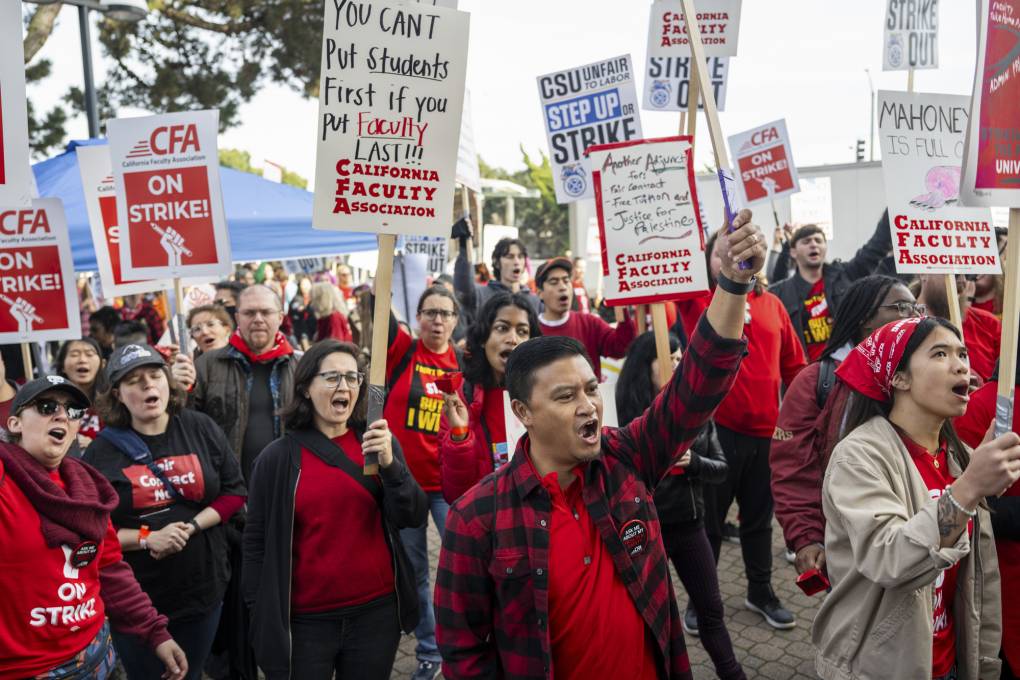
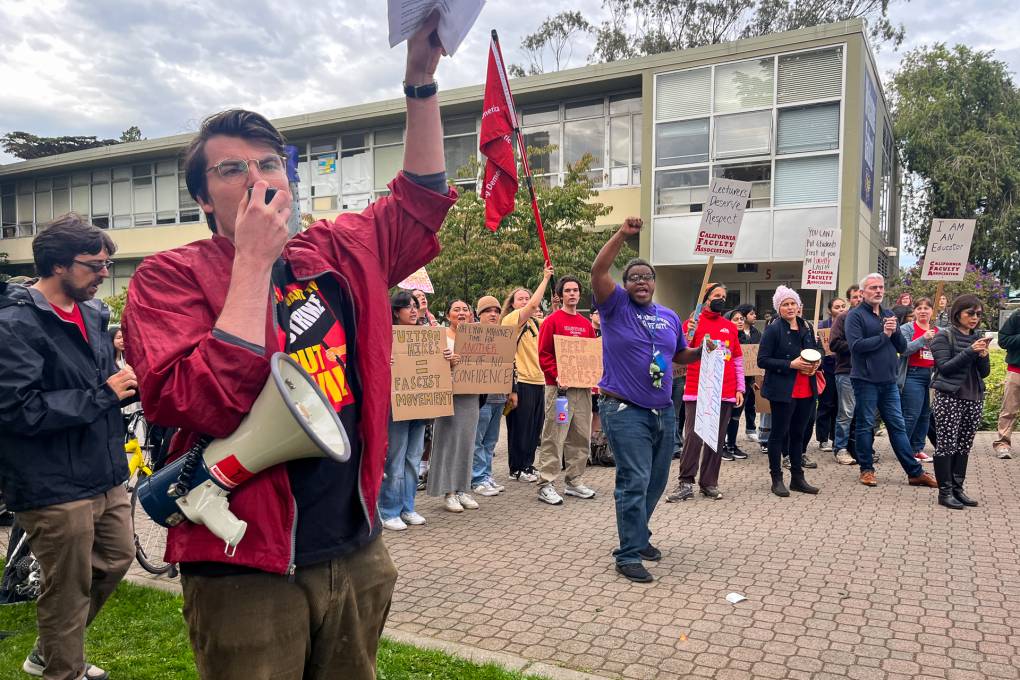
"caption": "San Francisco State University faculty, students, and other supporters participate in a one-day strike over salary demands and working conditions on Dec. 5, 2023, as part of a series of faculty walkouts at four CSU campuses across the state this week.",
"description": null,
"title": "231205-SFSUFacultyStrike-24-BL-KQED",
"credit": "Beth LaBerge/KQED",
"status": "inherit",
"altTag": "A group of people in red shirts cheer and carry picket signs in an outdoor setting.",
"isLoading": false,
"fetchFailed": false
},
"news_11968474": {
"type": "attachments",
"id": "news_11968474",
"meta": {
"index": "attachments_1716263798",
"site": "news",
"id": "11968474",
"found": true
},
"parent": 11968382,
"imgSizes": {
"twentyfourteen-full-width": {
"file": "https://ww2.kqed.org/app/uploads/sites/10/2023/11/231127-VendorRally-31-BL-qut-1038x576.jpg",
"width": 1038,
"mimeType": "image/jpeg",
"height": 576
},
"thumbnail": {
"file": "https://ww2.kqed.org/app/uploads/sites/10/2023/11/231127-VendorRally-31-BL-qut-160x107.jpg",
"width": 160,
"mimeType": "image/jpeg",
"height": 107
},
"post-thumbnail": {
"file": "https://ww2.kqed.org/app/uploads/sites/10/2023/11/231127-VendorRally-31-BL-qut-672x372.jpg",
"width": 672,
"mimeType": "image/jpeg",
"height": 372
},
"kqedFullSize": {
"file": "https://ww2.kqed.org/app/uploads/sites/10/2023/11/231127-VendorRally-31-BL-qut.jpg",
"width": 1920,
"height": 1280
},
"large": {
"file": "https://ww2.kqed.org/app/uploads/sites/10/2023/11/231127-VendorRally-31-BL-qut-1020x680.jpg",
"width": 1020,
"mimeType": "image/jpeg",
"height": 680
},
"1536x1536": {
"file": "https://ww2.kqed.org/app/uploads/sites/10/2023/11/231127-VendorRally-31-BL-qut-1536x1024.jpg",
"width": 1536,
"mimeType": "image/jpeg",
"height": 1024
},
"medium": {
"file": "https://ww2.kqed.org/app/uploads/sites/10/2023/11/231127-VendorRally-31-BL-qut-800x533.jpg",
"width": 800,
"mimeType": "image/jpeg",
"height": 533
}
},
"publishDate": 1701204135,
"modified": 1701207278,
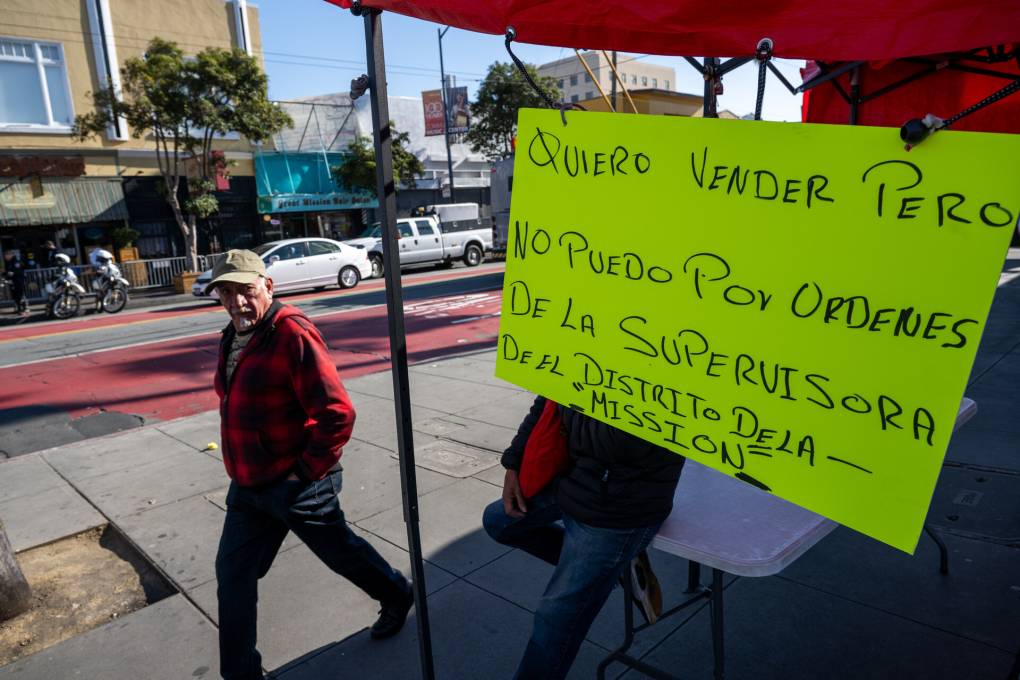
"caption": "Shelters and tables set up by street vendors sit empty near the 24th Street BART plaza on Nov. 27, 2023, the first day of a 90-day street vending ban in the area, which vendors showed up to protest. The sign in Spanish says: 'I want to sell, but I can't due to orders from the supervisor of the Mission District.'",
"description": null,
"title": "231127-VendorRally-31-BL-qut",
"credit": "Beth LaBerge/KQED",
"status": "inherit",
"altTag": "A yellow sign in Spanish hangs from an empty temporary shelter on the street.",
"isLoading": false,
"fetchFailed": false
},
"news_11968236": {
"type": "attachments",
"id": "news_11968236",
"meta": {
"index": "attachments_1716263798",
"site": "news",
"id": "11968236",
"found": true
},
"parent": 0,
"imgSizes": {
"twentyfourteen-full-width": {
"file": "https://ww2.kqed.org/app/uploads/sites/10/2023/11/231122-MissionStVendors-14-BL-1-1038x576.jpg",
"width": 1038,
"mimeType": "image/jpeg",
"height": 576
},
"thumbnail": {
"file": "https://ww2.kqed.org/app/uploads/sites/10/2023/11/231122-MissionStVendors-14-BL-1-160x107.jpg",
"width": 160,
"mimeType": "image/jpeg",
"height": 107
},
"post-thumbnail": {
"file": "https://ww2.kqed.org/app/uploads/sites/10/2023/11/231122-MissionStVendors-14-BL-1-672x372.jpg",
"width": 672,
"mimeType": "image/jpeg",
"height": 372
},
"kqedFullSize": {
"file": "https://ww2.kqed.org/app/uploads/sites/10/2023/11/231122-MissionStVendors-14-BL-1.jpg",
"width": 1920,
"height": 1280
},
"large": {
"file": "https://ww2.kqed.org/app/uploads/sites/10/2023/11/231122-MissionStVendors-14-BL-1-1020x680.jpg",
"width": 1020,
"mimeType": "image/jpeg",
"height": 680
},
"1536x1536": {
"file": "https://ww2.kqed.org/app/uploads/sites/10/2023/11/231122-MissionStVendors-14-BL-1-1536x1024.jpg",
"width": 1536,
"mimeType": "image/jpeg",
"height": 1024
},
"medium": {
"file": "https://ww2.kqed.org/app/uploads/sites/10/2023/11/231122-MissionStVendors-14-BL-1-800x533.jpg",
"width": 800,
"mimeType": "image/jpeg",
"height": 533
}
},
"publishDate": 1700685693,
"modified": 1701038970,
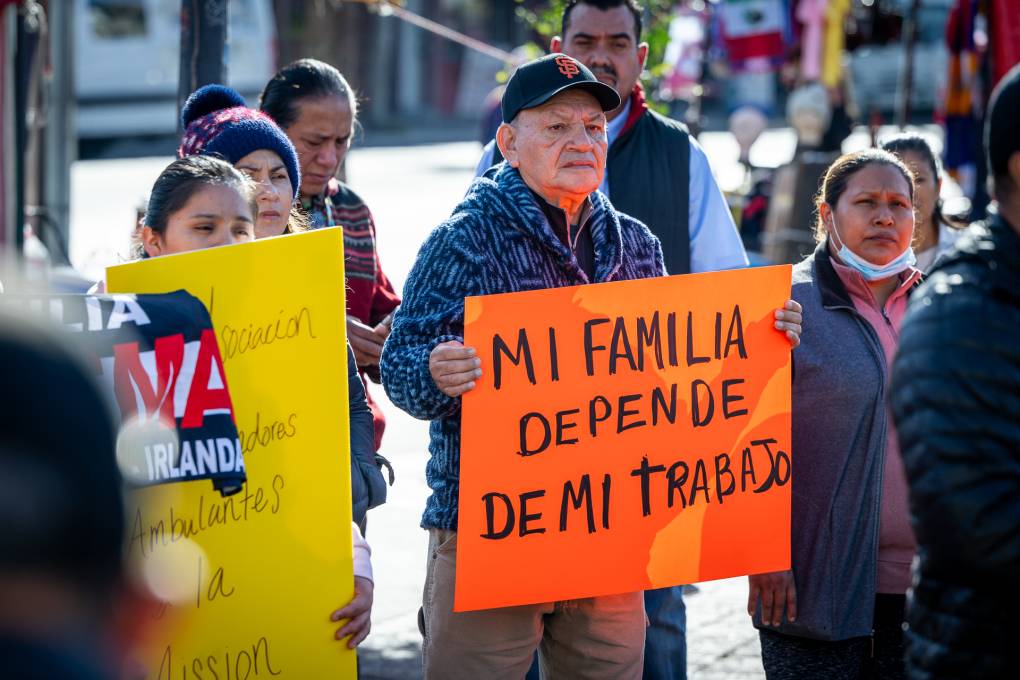
"caption": "Members of the recently formed Mission Vendor Association gather at the 24th Street BART plaza for a press conference in San Francisco on Nov. 22, 2023, condemning an upcoming rule banning vending on Mission Street. The ban would extend from Cesar Chavez Street to 14th Street on Mission Street, with some exceptions, and is set to begin on Nov. 27.",
"description": null,
"title": "231122-MissionStVendors-14-BL",
"credit": "Beth LaBerge/KQED",
"status": "inherit",
"altTag": "A man holds a neon orange protest sign in Spanish with several people around him.",
"isLoading": false,
"fetchFailed": false
},
"news_11967747": {
"type": "attachments",
"id": "news_11967747",
"meta": {
"index": "attachments_1716263798",
"site": "news",
"id": "11967747",
"found": true
},
"parent": 11967728,
"imgSizes": {
"twentyfourteen-full-width": {
"file": "https://ww2.kqed.org/app/uploads/sites/10/2023/11/GettyImages-1210676459-1024x576.jpg",
"width": 1024,
"mimeType": "image/jpeg",
"height": 576
},
"thumbnail": {
"file": "https://ww2.kqed.org/app/uploads/sites/10/2023/11/GettyImages-1210676459-160x106.jpg",
"width": 160,
"mimeType": "image/jpeg",
"height": 106
},
"post-thumbnail": {
"file": "https://ww2.kqed.org/app/uploads/sites/10/2023/11/GettyImages-1210676459-672x372.jpg",
"width": 672,
"mimeType": "image/jpeg",
"height": 372
},
"kqedFullSize": {
"file": "https://ww2.kqed.org/app/uploads/sites/10/2023/11/GettyImages-1210676459.jpg",
"width": 1024,
"height": 680
},
"large": {
"file": "https://ww2.kqed.org/app/uploads/sites/10/2023/11/GettyImages-1210676459-1020x677.jpg",
"width": 1020,
"mimeType": "image/jpeg",
"height": 677
},
"medium": {
"file": "https://ww2.kqed.org/app/uploads/sites/10/2023/11/GettyImages-1210676459-800x531.jpg",
"width": 800,
"mimeType": "image/jpeg",
"height": 531
}
},
"publishDate": 1700182063,
"modified": 1700253743,
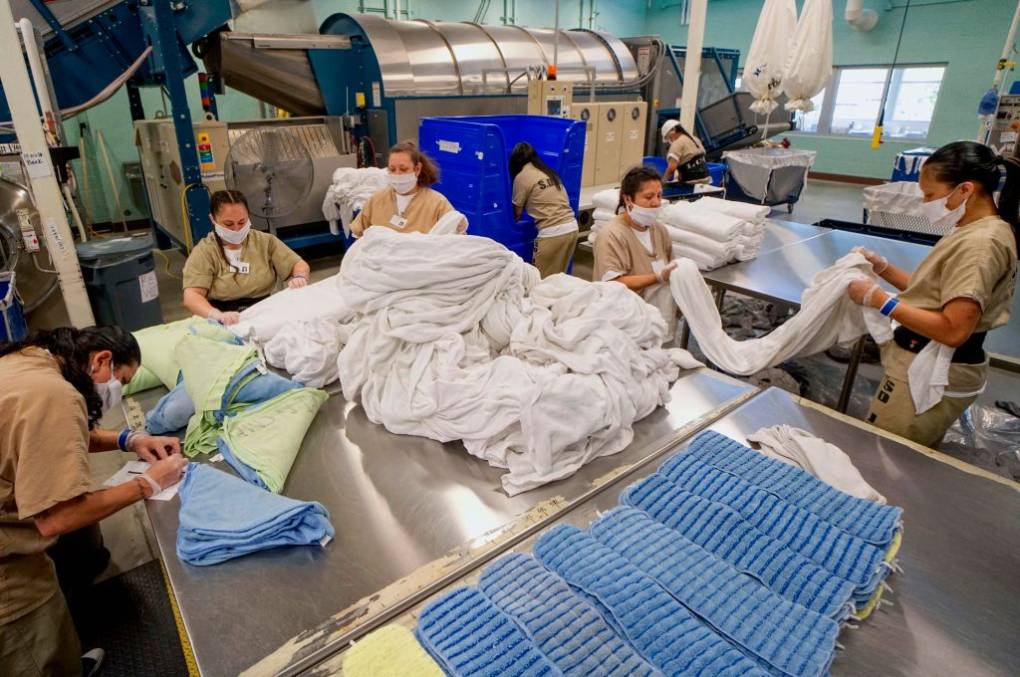
"caption": "Incarcerated women work in the laundry room at Las Colinas Women's Detention Facility in Santee, California, on April 22, 2020.",
"description": null,
"title": "US-HEALTH-VIRUS-PRISON",
"credit": "Sandy Huffaker/AFP via Getty Images",
"status": "inherit",
"altTag": "A group of female workers, in prison uniforms, fold sheets in an industrial laundry facility.",
"isLoading": false,
"fetchFailed": false
},
"news_11967487": {
"type": "attachments",
"id": "news_11967487",
"meta": {
"index": "attachments_1716263798",
"site": "news",
"id": "11967487",
"found": true
},
"parent": 11967471,
"imgSizes": {
"twentyfourteen-full-width": {
"file": "https://ww2.kqed.org/app/uploads/sites/10/2023/11/231115-IMG_1846-02-1038x576.jpg",
"width": 1038,
"mimeType": "image/jpeg",
"height": 576
},
"thumbnail": {
"file": "https://ww2.kqed.org/app/uploads/sites/10/2023/11/231115-IMG_1846-02-160x107.jpg",
"width": 160,
"mimeType": "image/jpeg",
"height": 107
},
"post-thumbnail": {
"file": "https://ww2.kqed.org/app/uploads/sites/10/2023/11/231115-IMG_1846-02-672x372.jpg",
"width": 672,
"mimeType": "image/jpeg",
"height": 372
},
"kqedFullSize": {
"file": "https://ww2.kqed.org/app/uploads/sites/10/2023/11/231115-IMG_1846-02.jpg",
"width": 1920,
"height": 1280
},
"large": {
"file": "https://ww2.kqed.org/app/uploads/sites/10/2023/11/231115-IMG_1846-02-1020x680.jpg",
"width": 1020,
"mimeType": "image/jpeg",
"height": 680
},
"1536x1536": {
"file": "https://ww2.kqed.org/app/uploads/sites/10/2023/11/231115-IMG_1846-02-1536x1024.jpg",
"width": 1536,
"mimeType": "image/jpeg",
"height": 1024
},
"medium": {
"file": "https://ww2.kqed.org/app/uploads/sites/10/2023/11/231115-IMG_1846-02-800x533.jpg",
"width": 800,
"mimeType": "image/jpeg",
"height": 533
}
},
"publishDate": 1700093879,
"modified": 1700093953,
"caption": "Student Dan Buschmeyer (left) leads a group of SF State students and faculty in chants of “When lecturer lives are under attack, what do we do? Stand up fight back” on the school's campus on Wednesday.\n",
"description": null,
"title": "231115-IMG_1846-02",
"credit": "Juan Carlos Lara/KQED",
"status": "inherit",
"altTag": null,
"isLoading": false,
"fetchFailed": false
},
"news_11967054": {
"type": "attachments",
"id": "news_11967054",
"meta": {
"index": "attachments_1716263798",
"site": "news",
"id": "11967054",
"found": true
},
"parent": 11967053,
"imgSizes": {
"twentyfourteen-full-width": {
"file": "https://ww2.kqed.org/app/uploads/sites/10/2023/11/011022_SICK-LEAVE_LN_REUTERS_CM_01-copy-1038x576.jpg",
"width": 1038,
"mimeType": "image/jpeg",
"height": 576
},
"thumbnail": {
"file": "https://ww2.kqed.org/app/uploads/sites/10/2023/11/011022_SICK-LEAVE_LN_REUTERS_CM_01-copy-160x107.jpg",
"width": 160,
"mimeType": "image/jpeg",
"height": 107
},
"post-thumbnail": {
"file": "https://ww2.kqed.org/app/uploads/sites/10/2023/11/011022_SICK-LEAVE_LN_REUTERS_CM_01-copy-672x372.jpg",
"width": 672,
"mimeType": "image/jpeg",
"height": 372
},
"kqedFullSize": {
"file": "https://ww2.kqed.org/app/uploads/sites/10/2023/11/011022_SICK-LEAVE_LN_REUTERS_CM_01-copy.jpg",
"width": 2000,
"height": 1334
},
"large": {
"file": "https://ww2.kqed.org/app/uploads/sites/10/2023/11/011022_SICK-LEAVE_LN_REUTERS_CM_01-copy-1020x680.jpg",
"width": 1020,
"mimeType": "image/jpeg",
"height": 680
},
"1536x1536": {
"file": "https://ww2.kqed.org/app/uploads/sites/10/2023/11/011022_SICK-LEAVE_LN_REUTERS_CM_01-copy-1536x1025.jpg",
"width": 1536,
"mimeType": "image/jpeg",
"height": 1025
},
"full-width": {
"file": "https://ww2.kqed.org/app/uploads/sites/10/2023/11/011022_SICK-LEAVE_LN_REUTERS_CM_01-copy-1920x1281.jpg",
"width": 1920,
"mimeType": "image/jpeg",
"height": 1281
},
"medium": {
"file": "https://ww2.kqed.org/app/uploads/sites/10/2023/11/011022_SICK-LEAVE_LN_REUTERS_CM_01-copy-800x534.jpg",
"width": 800,
"mimeType": "image/jpeg",
"height": 534
}
},
"publishDate": 1699729421,
"modified": 1699729477,
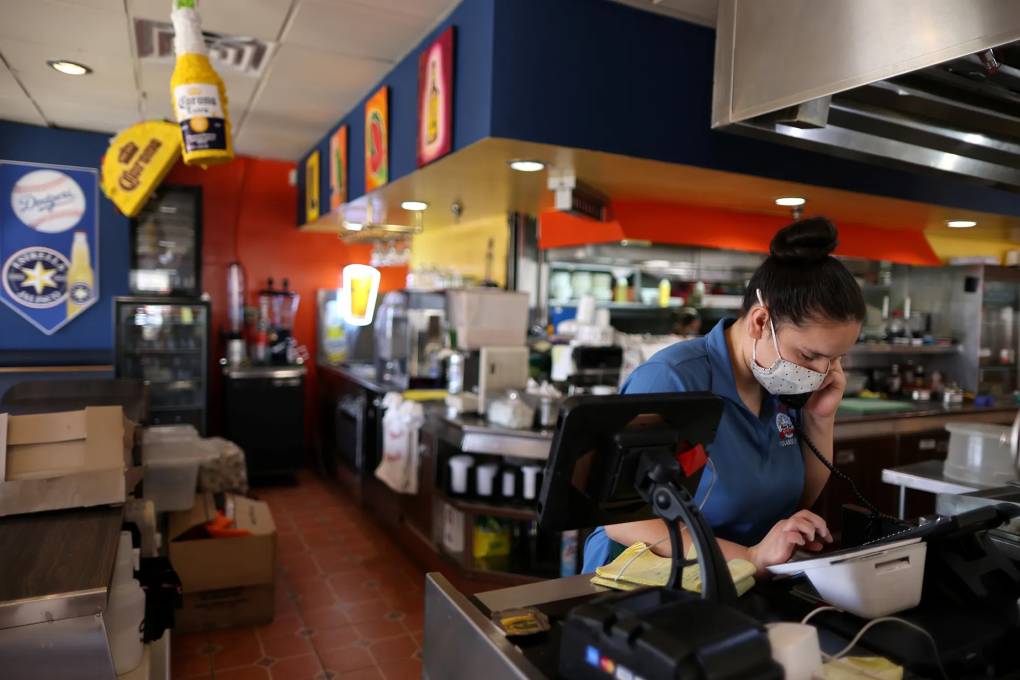
"caption": "Alexis Reyna, 20, works at Chalio Mexican Restaurant in East Los Angeles on May 26, 2021.",
"description": null,
"title": "011022_SICK-LEAVE_LN_REUTERS_CM_01 copy",
"credit": "Lucy Nicholson/Reuters",
"status": "inherit",
"altTag": "A young woman works behind the counter at a restaurant.",
"isLoading": false,
"fetchFailed": false
},
"news_11964796": {
"type": "attachments",
"id": "news_11964796",
"meta": {
"index": "attachments_1716263798",
"site": "news",
"id": "11964796",
"found": true
},
"parent": 11964791,
"imgSizes": {
"twentyfourteen-full-width": {
"file": "https://ww2.kqed.org/app/uploads/sites/10/2023/10/CalMatters01-1038x576.jpg",
"width": 1038,
"mimeType": "image/jpeg",
"height": 576
},
"thumbnail": {
"file": "https://ww2.kqed.org/app/uploads/sites/10/2023/10/CalMatters01-160x107.jpg",
"width": 160,
"mimeType": "image/jpeg",
"height": 107
},
"post-thumbnail": {
"file": "https://ww2.kqed.org/app/uploads/sites/10/2023/10/CalMatters01-672x372.jpg",
"width": 672,
"mimeType": "image/jpeg",
"height": 372
},
"kqedFullSize": {
"file": "https://ww2.kqed.org/app/uploads/sites/10/2023/10/CalMatters01.jpg",
"width": 2000,
"height": 1333
},
"large": {
"file": "https://ww2.kqed.org/app/uploads/sites/10/2023/10/CalMatters01-1020x680.jpg",
"width": 1020,
"mimeType": "image/jpeg",
"height": 680
},
"1536x1536": {
"file": "https://ww2.kqed.org/app/uploads/sites/10/2023/10/CalMatters01-1536x1024.jpg",
"width": 1536,
"mimeType": "image/jpeg",
"height": 1024
},
"full-width": {
"file": "https://ww2.kqed.org/app/uploads/sites/10/2023/10/CalMatters01-1920x1280.jpg",
"width": 1920,
"mimeType": "image/jpeg",
"height": 1280
},
"medium": {
"file": "https://ww2.kqed.org/app/uploads/sites/10/2023/10/CalMatters01-800x533.jpg",
"width": 800,
"mimeType": "image/jpeg",
"height": 533
}
},
"publishDate": 1697561951,
"modified": 1697562044,
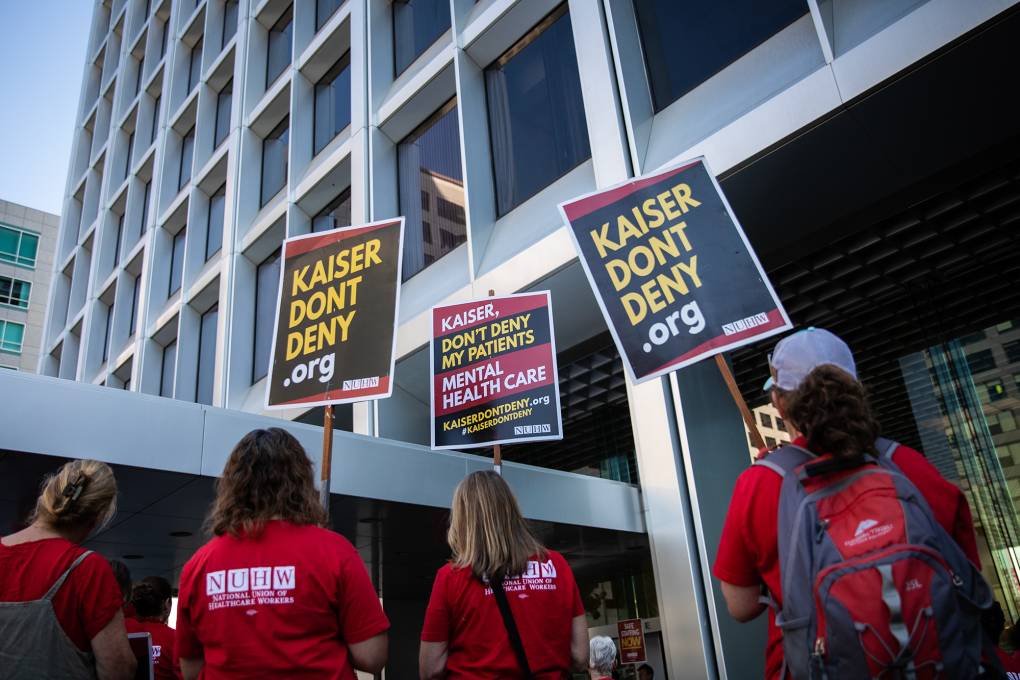
"caption": "Striking Kaiser Permanente mental health workers stage a die-in at the Kaiser Headquarters in Oakland on Oct. 7, 2022.",
"description": null,
"title": "CalMatters01",
"credit": "Martin do Nascimento/CalMatters",
"status": "inherit",
"altTag": "Mental health workers in red T-shirts hold signs in protest outside of a Kaiser facility in Oakland.",
"isLoading": false,
"fetchFailed": false
},
"news_11964381": {
"type": "attachments",
"id": "news_11964381",
"meta": {
"index": "attachments_1716263798",
"site": "news",
"id": "11964381",
"found": true
},
"parent": 0,
"imgSizes": {
"twentyfourteen-full-width": {
"file": "https://ww2.kqed.org/app/uploads/sites/10/2023/10/AP23286504550196-1038x576.jpg",
"width": 1038,
"mimeType": "image/jpeg",
"height": 576
},
"thumbnail": {
"file": "https://ww2.kqed.org/app/uploads/sites/10/2023/10/AP23286504550196-160x107.jpg",
"width": 160,
"mimeType": "image/jpeg",
"height": 107
},
"post-thumbnail": {
"file": "https://ww2.kqed.org/app/uploads/sites/10/2023/10/AP23286504550196-672x372.jpg",
"width": 672,
"mimeType": "image/jpeg",
"height": 372
},
"kqedFullSize": {
"file": "https://ww2.kqed.org/app/uploads/sites/10/2023/10/AP23286504550196-scaled.jpg",
"width": 2560,
"height": 1707
},
"2048x2048": {
"file": "https://ww2.kqed.org/app/uploads/sites/10/2023/10/AP23286504550196-2048x1366.jpg",
"width": 2048,
"mimeType": "image/jpeg",
"height": 1366
},
"large": {
"file": "https://ww2.kqed.org/app/uploads/sites/10/2023/10/AP23286504550196-1020x680.jpg",
"width": 1020,
"mimeType": "image/jpeg",
"height": 680
},
"1536x1536": {
"file": "https://ww2.kqed.org/app/uploads/sites/10/2023/10/AP23286504550196-1536x1024.jpg",
"width": 1536,
"mimeType": "image/jpeg",
"height": 1024
},
"full-width": {
"file": "https://ww2.kqed.org/app/uploads/sites/10/2023/10/AP23286504550196-1920x1280.jpg",
"width": 1920,
"mimeType": "image/jpeg",
"height": 1280
},
"medium": {
"file": "https://ww2.kqed.org/app/uploads/sites/10/2023/10/AP23286504550196-800x533.jpg",
"width": 800,
"mimeType": "image/jpeg",
"height": 533
}
},
"publishDate": 1697216239,
"modified": 1697216361,
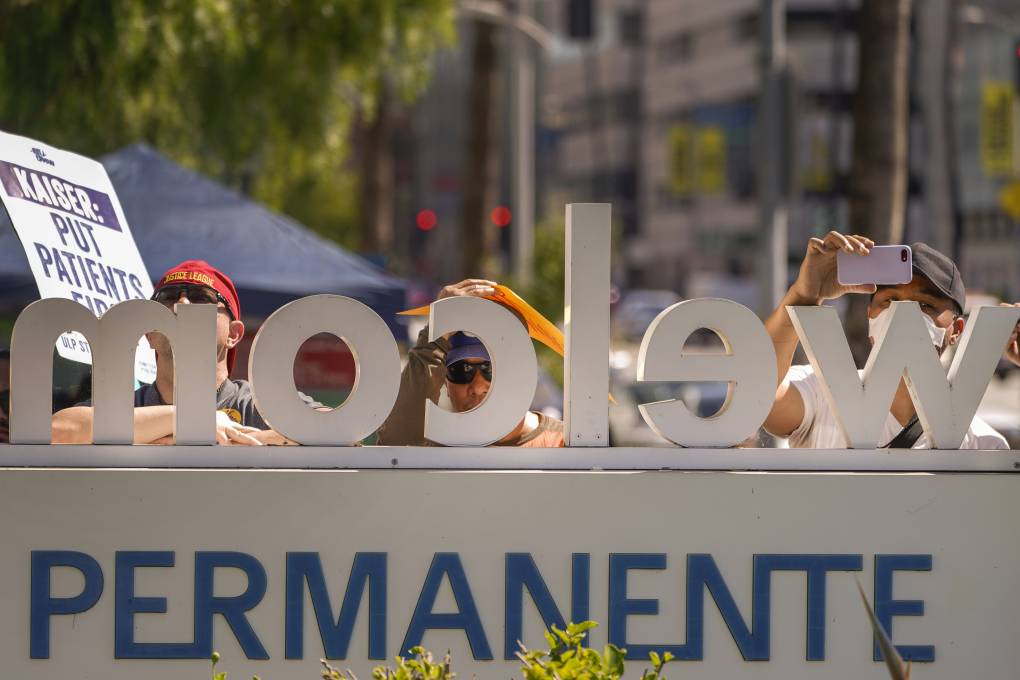
"caption": "Kaiser Permanente frontline health care workers picket outside the Kaiser Permanente Los Angeles Medical Center in Los Angeles on Friday, Oct. 6, 2023. Unions representing 75,000 health care workers who recently held a strike against industry giant Kaiser Permanente over wages and staffing shortages have reached a tentative agreement with the company. ",
"description": null,
"title": "Hospital Strike",
"credit": "Damian Dovarganes/AP ",
"status": "inherit",
"altTag": "Protestors outside of a Kaiser Permanente in Los Angeles stand behind the medical center's sign holding signs.",
"isLoading": false,
"fetchFailed": false
},
"news_11963445": {
"type": "attachments",
"id": "news_11963445",
"meta": {
"index": "attachments_1716263798",
"site": "news",
"id": "11963445",
"found": true
},
"parent": 0,
"imgSizes": {
"twentyfourteen-full-width": {
"file": "https://ww2.kqed.org/app/uploads/sites/10/2023/10/231004-KAISER-STRIKE-OAKLAND-MD-14-KQED-1038x576.jpg",
"width": 1038,
"mimeType": "image/jpeg",
"height": 576
},
"thumbnail": {
"file": "https://ww2.kqed.org/app/uploads/sites/10/2023/10/231004-KAISER-STRIKE-OAKLAND-MD-14-KQED-160x107.jpg",
"width": 160,
"mimeType": "image/jpeg",
"height": 107
},
"post-thumbnail": {
"file": "https://ww2.kqed.org/app/uploads/sites/10/2023/10/231004-KAISER-STRIKE-OAKLAND-MD-14-KQED-672x372.jpg",
"width": 672,
"mimeType": "image/jpeg",
"height": 372
},
"kqedFullSize": {
"file": "https://ww2.kqed.org/app/uploads/sites/10/2023/10/231004-KAISER-STRIKE-OAKLAND-MD-14-KQED.jpg?ver=1696456624",
"width": 2000,
"height": 1333
},
"large": {
"file": "https://ww2.kqed.org/app/uploads/sites/10/2023/10/231004-KAISER-STRIKE-OAKLAND-MD-14-KQED-1020x680.jpg",
"width": 1020,
"mimeType": "image/jpeg",
"height": 680
},
"1536x1536": {
"file": "https://ww2.kqed.org/app/uploads/sites/10/2023/10/231004-KAISER-STRIKE-OAKLAND-MD-14-KQED-1536x1024.jpg",
"width": 1536,
"mimeType": "image/jpeg",
"height": 1024
},
"full-width": {
"file": "https://ww2.kqed.org/app/uploads/sites/10/2023/10/231004-KAISER-STRIKE-OAKLAND-MD-14-KQED-1920x1280.jpg",
"width": 1920,
"mimeType": "image/jpeg",
"height": 1280
},
"medium": {
"file": "https://ww2.kqed.org/app/uploads/sites/10/2023/10/231004-KAISER-STRIKE-OAKLAND-MD-14-KQED-800x533.jpg",
"width": 800,
"mimeType": "image/jpeg",
"height": 533
}
},
"publishDate": 1696455993,
"modified": 1696456646,
"caption": "Kaiser workers strike in front of the Kaiser Permanente Oakland Medical Center in Oakland on Oct. 4, 2023",
"description": null,
"title": "231004-KAISER STRIKE OAKLAND-MD-14-KQED",
"credit": "Martin do Nascimento/KQED",
"status": "inherit",
"altTag": "A large group of people hold signs in an outdoor setting.",
"isLoading": false,
"fetchFailed": false
},
"news_11963436": {
"type": "attachments",
"id": "news_11963436",
"meta": {
"index": "attachments_1716263798",
"site": "news",
"id": "11963436",
"found": true
},
"parent": 0,
"imgSizes": {
"twentyfourteen-full-width": {
"file": "https://ww2.kqed.org/app/uploads/sites/10/2023/10/231004-KAISER-STRIKE-OAKLAND-MD-12-KQED-e1696616585760-1038x576.jpg",
"width": 1038,
"mimeType": "image/jpeg",
"height": 576
},
"thumbnail": {
"file": "https://ww2.kqed.org/app/uploads/sites/10/2023/10/231004-KAISER-STRIKE-OAKLAND-MD-12-KQED-e1696616585760-160x107.jpg",
"width": 160,
"mimeType": "image/jpeg",
"height": 107
},
"post-thumbnail": {
"file": "https://ww2.kqed.org/app/uploads/sites/10/2023/10/231004-KAISER-STRIKE-OAKLAND-MD-12-KQED-e1696616585760-672x372.jpg",
"width": 672,
"mimeType": "image/jpeg",
"height": 372
},
"kqedFullSize": {
"file": "https://ww2.kqed.org/app/uploads/sites/10/2023/10/231004-KAISER-STRIKE-OAKLAND-MD-12-KQED-e1696616585760.jpg?ver=1696633770",
"width": 2000,
"height": 1333
},
"large": {
"file": "https://ww2.kqed.org/app/uploads/sites/10/2023/10/231004-KAISER-STRIKE-OAKLAND-MD-12-KQED-e1696616585760-1020x680.jpg",
"width": 1020,
"mimeType": "image/jpeg",
"height": 680
},
"1536x1536": {
"file": "https://ww2.kqed.org/app/uploads/sites/10/2023/10/231004-KAISER-STRIKE-OAKLAND-MD-12-KQED-e1696616585760-1536x1024.jpg",
"width": 1536,
"mimeType": "image/jpeg",
"height": 1024
},
"full-width": {
"file": "https://ww2.kqed.org/app/uploads/sites/10/2023/10/231004-KAISER-STRIKE-OAKLAND-MD-12-KQED-e1696616585760-1920x1280.jpg",
"width": 1920,
"mimeType": "image/jpeg",
"height": 1280
},
"medium": {
"file": "https://ww2.kqed.org/app/uploads/sites/10/2023/10/231004-KAISER-STRIKE-OAKLAND-MD-12-KQED-e1696616585760-800x533.jpg",
"width": 800,
"mimeType": "image/jpeg",
"height": 533
}
},
"publishDate": 1696454613,
"modified": 1696633783,
"caption": "Gina Salcedo (center) and others strike at the Kaiser Permanente Oakland Medical Center in Oakland on Oct. 4, 2023.",
"description": null,
"title": "231004-KAISER STRIKE OAKLAND-MD-12-KQED",
"credit": "Martin do Nascimento/KQED",
"status": "inherit",
"altTag": "A large group of people hold signs in an outdoor setting.",
"isLoading": false,
"fetchFailed": false
},
"news_11963528": {
"type": "attachments",
"id": "news_11963528",
"meta": {
"index": "attachments_1716263798",
"site": "news",
"id": "11963528",
"found": true
},
"parent": 0,
"imgSizes": {
"twentyfourteen-full-width": {
"file": "https://ww2.kqed.org/app/uploads/sites/10/2023/10/231005-GAVIN-NEWSOM-GETTY-TC-KQED-1038x576.jpg",
"width": 1038,
"mimeType": "image/jpeg",
"height": 576
},
"thumbnail": {
"file": "https://ww2.kqed.org/app/uploads/sites/10/2023/10/231005-GAVIN-NEWSOM-GETTY-TC-KQED-160x115.jpg",
"width": 160,
"mimeType": "image/jpeg",
"height": 115
},
"post-thumbnail": {
"file": "https://ww2.kqed.org/app/uploads/sites/10/2023/10/231005-GAVIN-NEWSOM-GETTY-TC-KQED-672x372.jpg",
"width": 672,
"mimeType": "image/jpeg",
"height": 372
},
"kqedFullSize": {
"file": "https://ww2.kqed.org/app/uploads/sites/10/2023/10/231005-GAVIN-NEWSOM-GETTY-TC-KQED.jpg",
"width": 2000,
"height": 1436
},
"large": {
"file": "https://ww2.kqed.org/app/uploads/sites/10/2023/10/231005-GAVIN-NEWSOM-GETTY-TC-KQED-1020x732.jpg",
"width": 1020,
"mimeType": "image/jpeg",
"height": 732
},
"1536x1536": {
"file": "https://ww2.kqed.org/app/uploads/sites/10/2023/10/231005-GAVIN-NEWSOM-GETTY-TC-KQED-1536x1103.jpg",
"width": 1536,
"mimeType": "image/jpeg",
"height": 1103
},
"full-width": {
"file": "https://ww2.kqed.org/app/uploads/sites/10/2023/10/231005-GAVIN-NEWSOM-GETTY-TC-KQED-1920x1379.jpg",
"width": 1920,
"mimeType": "image/jpeg",
"height": 1379
},
"medium": {
"file": "https://ww2.kqed.org/app/uploads/sites/10/2023/10/231005-GAVIN-NEWSOM-GETTY-TC-KQED-800x574.jpg",
"width": 800,
"mimeType": "image/jpeg",
"height": 574
}
},
"publishDate": 1696525947,
"modified": 1696526084,
"caption": "California Governor Gavin Newsom speaks in Sacramento on Sept. 12, 2023.",
"description": null,
"title": "California Governor Newsom joins 'Politico' in conversation",
"credit": "Tayfun Coskun/Anadolu Agency via Getty Images",
"status": "inherit",
"altTag": "A person in a suit gesticulates with their hands.",
"isLoading": false,
"fetchFailed": false
},
"news_11963747": {
"type": "attachments",
"id": "news_11963747",
"meta": {
"index": "attachments_1716263798",
"site": "news",
"id": "11963747",
"found": true
},
"parent": 0,
"imgSizes": {
"twentyfourteen-full-width": {
"file": "https://ww2.kqed.org/app/uploads/sites/10/2023/10/231006-2019-TEACHERS-STRIKE-Getty-DM-KQED-1038x576.jpg",
"width": 1038,
"mimeType": "image/jpeg",
"height": 576
},
"thumbnail": {
"file": "https://ww2.kqed.org/app/uploads/sites/10/2023/10/231006-2019-TEACHERS-STRIKE-Getty-DM-KQED-160x107.jpg",
"width": 160,
"mimeType": "image/jpeg",
"height": 107
},
"post-thumbnail": {
"file": "https://ww2.kqed.org/app/uploads/sites/10/2023/10/231006-2019-TEACHERS-STRIKE-Getty-DM-KQED-672x372.jpg",
"width": 672,
"mimeType": "image/jpeg",
"height": 372
},
"kqedFullSize": {
"file": "https://ww2.kqed.org/app/uploads/sites/10/2023/10/231006-2019-TEACHERS-STRIKE-Getty-DM-KQED.jpg",
"width": 2000,
"height": 1333
},
"large": {
"file": "https://ww2.kqed.org/app/uploads/sites/10/2023/10/231006-2019-TEACHERS-STRIKE-Getty-DM-KQED-1020x680.jpg",
"width": 1020,
"mimeType": "image/jpeg",
"height": 680
},
"1536x1536": {
"file": "https://ww2.kqed.org/app/uploads/sites/10/2023/10/231006-2019-TEACHERS-STRIKE-Getty-DM-KQED-1536x1024.jpg",
"width": 1536,
"mimeType": "image/jpeg",
"height": 1024
},
"full-width": {
"file": "https://ww2.kqed.org/app/uploads/sites/10/2023/10/231006-2019-TEACHERS-STRIKE-Getty-DM-KQED-1920x1280.jpg",
"width": 1920,
"mimeType": "image/jpeg",
"height": 1280
},
"medium": {
"file": "https://ww2.kqed.org/app/uploads/sites/10/2023/10/231006-2019-TEACHERS-STRIKE-Getty-DM-KQED-800x533.jpg",
"width": 800,
"mimeType": "image/jpeg",
"height": 533
}
},
"publishDate": 1696628545,
"modified": 1696628623,
"caption": "Striking teachers and supporters rally outside the Los Angeles City Hall in Los Angeles on January 18, 2019.",
"description": null,
"title": "Los Angeles Teachers End First Week Of Strike With Friday Rally",
"credit": "David McNew/Getty Images",
"status": "inherit",
"altTag": "A large mass of people holding signs and wearing red.",
"isLoading": false,
"fetchFailed": false
}
},
"audioPlayerReducer": {
"postId": "stream_live",
"isPaused": true,
"isPlaying": false,
"pfsActive": false,
"pledgeModalIsOpen": true,
"playerDrawerIsOpen": false,
"liveAudioPlayStartedAt": 0,
"liveAudioPlayContext": ""
},
"authorsReducer": {
"byline_news_11967053": {
"type": "authors",
"id": "byline_news_11967053",
"meta": {
"override": true
},
"slug": "byline_news_11967053",
"name": "\u003ca href=\"https://calmatters.org/author/alejandra-reyesvelarde/\">Alejandra Reyes-Velarde\u003c/a>",
"isLoading": false
},
"byline_news_11964791": {
"type": "authors",
"id": "byline_news_11964791",
"meta": {
"override": true
},
"slug": "byline_news_11964791",
"name": "\u003ca href=\"https://calmatters.org/author/jocelyn-wiener/\">Jocelyn Wiener\u003c/a>",
"isLoading": false
},
"byline_news_11964377": {
"type": "authors",
"id": "byline_news_11964377",
"meta": {
"override": true
},
"slug": "byline_news_11964377",
"name": "The Associated Press",
"isLoading": false
},
"fjhabvala": {
"type": "authors",
"id": "8659",
"meta": {
"index": "authors_1716337520",
"id": "8659",
"found": true
},
"name": "Farida Jhabvala Romero",
"firstName": "Farida",
"lastName": "Jhabvala Romero",
"slug": "fjhabvala",
"email": "fjhabvala@kqed.org",
"display_author_email": true,
"staff_mastheads": [
"news"
],
"title": "KQED Contributor",
"bio": "Farida Jhabvala Romero is a Labor Correspondent for KQED. She previously covered immigration. Farida was \u003ca href=\"https://www.ccnma.org/2022-most-influential-latina-journalists\">named\u003c/a> one of the 10 Most Influential Latina Journalists in California in 2022 by the California Chicano News Media Association. Her work has won awards from the Society of Professional Journalists (Northern California), as well as a national and regional Edward M. Murrow Award for the collaborative reporting projects “Dangerous Air” and “Graying California.” Before joining KQED, Farida worked as a producer at Radio Bilingüe, a national public radio network. Farida earned her master’s degree in journalism from Stanford University.",
"avatar": "https://secure.gravatar.com/avatar/f9f022d4e2609741874222a1e9d41f48fea74011aa7c615eef91d9a50c944ebe?s=600&d=blank&r=g",
"twitter": "FaridaJhabvala",
"bluesky": null,
"facebook": null,
"instagram": null,
"linkedin": "https://www.linkedin.com/in/faridajhabvala/",
"sites": [
{
"site": "news",
"roles": [
"editor"
]
},
{
"site": "stateofhealth",
"roles": [
"author"
]
},
{
"site": "liveblog",
"roles": [
"author"
]
}
],
"headData": {
"title": "Farida Jhabvala Romero | KQED",
"description": "KQED Contributor",
"ogImgSrc": "https://secure.gravatar.com/avatar/f9f022d4e2609741874222a1e9d41f48fea74011aa7c615eef91d9a50c944ebe?s=600&d=blank&r=g",
"twImgSrc": "https://secure.gravatar.com/avatar/f9f022d4e2609741874222a1e9d41f48fea74011aa7c615eef91d9a50c944ebe?s=600&d=blank&r=g"
},
"isLoading": false,
"link": "/author/fjhabvala"
},
"jlara": {
"type": "authors",
"id": "11761",
"meta": {
"index": "authors_1716337520",
"id": "11761",
"found": true
},
"name": "Juan Carlos Lara",
"firstName": "Juan Carlos",
"lastName": "Lara",
"slug": "jlara",
"email": "jlara@kqed.org",
"display_author_email": false,
"staff_mastheads": [],
"title": "KQED Contributor",
"bio": null,
"avatar": "https://secure.gravatar.com/avatar/19e2052b9b05657c5ff2af2121846e9c?s=600&d=blank&r=g",
"twitter": null,
"facebook": null,
"instagram": null,
"linkedin": null,
"sites": [
{
"site": "arts",
"roles": [
"editor"
]
},
{
"site": "news",
"roles": [
"editor"
]
},
{
"site": "forum",
"roles": [
"editor"
]
},
{
"site": "liveblog",
"roles": [
"contributor"
]
}
],
"headData": {
"title": "Juan Carlos Lara | KQED",
"description": "KQED Contributor",
"ogImgSrc": "https://secure.gravatar.com/avatar/19e2052b9b05657c5ff2af2121846e9c?s=600&d=blank&r=g",
"twImgSrc": "https://secure.gravatar.com/avatar/19e2052b9b05657c5ff2af2121846e9c?s=600&d=blank&r=g"
},
"isLoading": false,
"link": "/author/jlara"
},
"adahlstromeckman": {
"type": "authors",
"id": "11785",
"meta": {
"index": "authors_1716337520",
"id": "11785",
"found": true
},
"name": "Azul Dahlstrom-Eckman",
"firstName": "Azul",
"lastName": "Dahlstrom-Eckman",
"slug": "adahlstromeckman",
"email": "adahlstrom-eckman@kqed.org",
"display_author_email": true,
"staff_mastheads": [],
"title": "Reporter",
"bio": "Azul is a reporter for KQED focusing on transportation and features. He joined KQED in 2021 as an alumna of KALW's Audio Academy radio journalism training program.",
"avatar": "https://secure.gravatar.com/avatar/9cb750298435add7815a777f55bf1f46845c1386bb8452555c60a7b820b5aba3?s=600&d=blank&r=g",
"twitter": "@zuliemann",
"bluesky": "@azul415.bsky.social",
"facebook": null,
"instagram": null,
"linkedin": null,
"sites": [
{
"site": "arts",
"roles": [
"editor"
]
},
{
"site": "news",
"roles": [
"editor"
]
},
{
"site": "science",
"roles": [
"editor"
]
},
{
"site": "liveblog",
"roles": [
"author"
]
}
],
"headData": {
"title": "Azul Dahlstrom-Eckman | KQED",
"description": "Reporter",
"ogImgSrc": "https://secure.gravatar.com/avatar/9cb750298435add7815a777f55bf1f46845c1386bb8452555c60a7b820b5aba3?s=600&d=blank&r=g",
"twImgSrc": "https://secure.gravatar.com/avatar/9cb750298435add7815a777f55bf1f46845c1386bb8452555c60a7b820b5aba3?s=600&d=blank&r=g"
},
"isLoading": false,
"link": "/author/adahlstromeckman"
},
"sjohnson": {
"type": "authors",
"id": "11840",
"meta": {
"index": "authors_1716337520",
"id": "11840",
"found": true
},
"name": "Sydney Johnson",
"firstName": "Sydney",
"lastName": "Johnson",
"slug": "sjohnson",
"email": "sjohnson@kqed.org",
"display_author_email": false,
"staff_mastheads": [
"news"
],
"title": "KQED Reporter",
"bio": "Sydney Johnson is a general assignment reporter at KQED. She previously reported on public health and city government at the San Francisco Examiner, and before that, she covered statewide education policy for EdSource. Her reporting has won multiple local, state and national awards. Sydney is a graduate of the University of California, Berkeley and lives in San Francisco.",
"avatar": "https://secure.gravatar.com/avatar/97855f2719b72ad6190b7c535fe642c8?s=600&d=blank&r=g",
"twitter": "sydneyfjohnson",
"facebook": null,
"instagram": null,
"linkedin": null,
"sites": [
{
"site": "news",
"roles": [
"editor"
]
}
],
"headData": {
"title": "Sydney Johnson | KQED",
"description": "KQED Reporter",
"ogImgSrc": "https://secure.gravatar.com/avatar/97855f2719b72ad6190b7c535fe642c8?s=600&d=blank&r=g",
"twImgSrc": "https://secure.gravatar.com/avatar/97855f2719b72ad6190b7c535fe642c8?s=600&d=blank&r=g"
},
"isLoading": false,
"link": "/author/sjohnson"
},
"nkhan": {
"type": "authors",
"id": "11867",
"meta": {
"index": "authors_1716337520",
"id": "11867",
"found": true
},
"name": "Nisa Khan",
"firstName": "Nisa",
"lastName": "Khan",
"slug": "nkhan",
"email": "nkhan@kqed.org",
"display_author_email": false,
"staff_mastheads": [],
"title": "KQED Contributor",
"bio": "Nisa Khan is a reporter for KQED's Audience News Desk. She was formerly a data reporter at Michigan Radio. She earned a Bachelor of Science in Information from the University of Michigan and a Master of Arts in Communication from Stanford University.",
"avatar": "https://secure.gravatar.com/avatar/8720459eef081ff64582b3506b124d58523e80e120704a0cbd9892533c914991?s=600&d=blank&r=g",
"twitter": "mnisakhan",
"bluesky": null,
"facebook": null,
"instagram": null,
"linkedin": null,
"sites": [
{
"site": "arts",
"roles": [
"editor"
]
},
{
"site": "news",
"roles": [
"editor"
]
},
{
"site": "science",
"roles": [
"editor",
"author"
]
},
{
"site": "forum",
"roles": [
"editor"
]
},
{
"site": "liveblog",
"roles": [
"contributor"
]
}
],
"headData": {
"title": "Nisa Khan | KQED",
"description": "KQED Contributor",
"ogImgSrc": "https://secure.gravatar.com/avatar/8720459eef081ff64582b3506b124d58523e80e120704a0cbd9892533c914991?s=600&d=blank&r=g",
"twImgSrc": "https://secure.gravatar.com/avatar/8720459eef081ff64582b3506b124d58523e80e120704a0cbd9892533c914991?s=600&d=blank&r=g"
},
"isLoading": false,
"link": "/author/nkhan"
},
"naltenberg": {
"type": "authors",
"id": "11896",
"meta": {
"index": "authors_1716337520",
"id": "11896",
"found": true
},
"name": "Nik Altenberg",
"firstName": "Nik",
"lastName": "Altenberg",
"slug": "naltenberg",
"email": "naltenberg@kqed.org",
"display_author_email": false,
"staff_mastheads": [],
"title": "KQED Contributor",
"bio": "Nik Altenberg is an on-call reporter for KQED and a copy editor and fact checker for Santa Cruz Local. Nik’s reporting interests include policing, public health, environment, immigration, housing and the places where these issues intersect.",
"avatar": "https://secure.gravatar.com/avatar/e391b3a18ce4a53a7ca3f3065c74418b?s=600&d=blank&r=g",
"twitter": null,
"facebook": null,
"instagram": "https://www.instagram.com/nikaltenberg/",
"linkedin": null,
"sites": [
{
"site": "news",
"roles": []
}
],
"headData": {
"title": "Nik Altenberg | KQED",
"description": "KQED Contributor",
"ogImgSrc": "https://secure.gravatar.com/avatar/e391b3a18ce4a53a7ca3f3065c74418b?s=600&d=blank&r=g",
"twImgSrc": "https://secure.gravatar.com/avatar/e391b3a18ce4a53a7ca3f3065c74418b?s=600&d=blank&r=g"
},
"isLoading": false,
"link": "/author/naltenberg"
}
},
"pagesReducer": {
"news_tag_labor": {
"type": "terms",
"id": "news_19904",
"meta": {
"index": "terms_1716263798",
"site": "news",
"id": "19904",
"score": 8.558112
},
"name": "Labor",
"slug": "labor",
"taxonomy": "tag",
"description": null,
"featImg": null,
"headData": {
"title": "Labor | KQED News",
"description": null,
"ogTitle": null,
"ogDescription": null,
"ogImgId": null,
"twTitle": null,
"twDescription": null,
"twImgId": null
},
"ttid": 19921,
"isLoading": false,
"title": "Labor",
"pageMeta": {
"site": "news",
"WpPageTemplate": "page-topic-editorial",
"currentPage": 35
},
"blocks": [
{
"blockName": "kqed/post-list",
"attrs": {
"layout": "cardArticle2",
"query": "posts/news?tag=labor",
"seeMore": false,
"paginated": true,
"page": 35
}
},
{
"blockName": "kqed/ad"
}
]
}
},
"pfsSessionReducer": {},
"postsReducer": {
"stream_live": {
"type": "live",
"id": "stream_live",
"audioUrl": "https://streams.kqed.org/kqedradio",
"title": "Live Stream",
"excerpt": "Live Stream information currently unavailable.",
"link": "/radio",
"featImg": "",
"label": {
"name": "KQED Live",
"link": "/"
}
},
"stream_kqedNewscast": {
"type": "posts",
"id": "stream_kqedNewscast",
"audioUrl": "https://www.kqed.org/.stream/anon/radio/RDnews/newscast.mp3?_=1",
"title": "KQED Newscast",
"featImg": "",
"label": {
"name": "88.5 FM",
"link": "/"
}
},
"news_11969109": {
"type": "posts",
"id": "news_11969109",
"meta": {
"index": "posts_1716263798",
"site": "news",
"id": "11969109",
"score": null,
"sort": [
1701825258000
]
},
"guestAuthors": [],
"slug": "hundreds-of-sf-state-faculty-ditch-class-in-1-day-strike-for-better-wages-working-conditions",
"title": "Hundreds of SF State Faculty Ditch Class in 1-Day Strike for Better Wages, Working Conditions",
"publishDate": 1701825258,
"format": "standard",
"headTitle": "Hundreds of SF State Faculty Ditch Class in 1-Day Strike for Better Wages, Working Conditions | KQED",
"labelTerm": {
"site": "news"
},
"content": "\u003cp>San Francisco State University faculty held a single-day strike on Tuesday, demanding significant pay increases, amid the looming threat of widespread layoffs and hundreds of class cuts across campus.\u003c/p>\n\u003cp>Hundreds of faculty members, including professors, librarians, counselors and coaches, gathered on the campus alongside some of their students, holding signs and shouting chants as passing cars honked in support.\u003c/p>\n\u003cp>“When education is under attack, what do we do?” one strike leader called out. “Stand up, fight back!” the crowd responded.\u003c/p>\n\u003cp>The action is the second in a \u003ca href=\"https://www.kqed.org/news/11968948/thousands-of-cal-state-faculty-launch-rolling-1-day-walkouts-in-fight-for-higher-pay\">series of one-day strikes\u003c/a> at four California State University campuses this week, with Cal Poly Pomona faculty kicking things off on Monday. CSU Los Angeles faculty plan to strike on Wednesday, followed by Sacramento State faculty on Thursday.\u003c/p>\n\u003cp>The California Faculty Association, which represents some 29,000 CSU employees, is demanding a retroactive 12% salary hike for the current academic year, more manageable workloads and an increase in parental leave — from six weeks to a full semester.\u003c/p>\n\u003cfigure id=\"attachment_11969093\" class=\"wp-caption alignnone\" style=\"max-width: 2000px\">\u003ca href=\"https://cdn.kqed.org/wp-content/uploads/sites/10/2023/12/231205-SFSUFacultyStrike-27-BL-KQED.jpg\">\u003cimg loading=\"lazy\" decoding=\"async\" class=\"size-full wp-image-11969093\" src=\"https://cdn.kqed.org/wp-content/uploads/sites/10/2023/12/231205-SFSUFacultyStrike-27-BL-KQED.jpg\" alt=\"A person in a baseball cap speaks into a microphone in front of a group of people in red shirts carry picket signs in an outdoor setting.\" width=\"2000\" height=\"1333\" srcset=\"https://cdn.kqed.org/wp-content/uploads/sites/10/2023/12/231205-SFSUFacultyStrike-27-BL-KQED.jpg 2000w, https://cdn.kqed.org/wp-content/uploads/sites/10/2023/12/231205-SFSUFacultyStrike-27-BL-KQED-800x533.jpg 800w, https://cdn.kqed.org/wp-content/uploads/sites/10/2023/12/231205-SFSUFacultyStrike-27-BL-KQED-1020x680.jpg 1020w, https://cdn.kqed.org/wp-content/uploads/sites/10/2023/12/231205-SFSUFacultyStrike-27-BL-KQED-160x107.jpg 160w, https://cdn.kqed.org/wp-content/uploads/sites/10/2023/12/231205-SFSUFacultyStrike-27-BL-KQED-1536x1024.jpg 1536w, https://cdn.kqed.org/wp-content/uploads/sites/10/2023/12/231205-SFSUFacultyStrike-27-BL-KQED-1920x1280.jpg 1920w\" sizes=\"(max-width: 2000px) 100vw, 2000px\">\u003c/a>\u003cfigcaption class=\"wp-caption-text\">Charles Toombs, president of the California Faculty Association, addresses SF State faculty members and supporters during Tuesday’s strike on campus. \u003ccite>(Beth LaBerge/KQED)\u003c/cite>\u003c/figcaption>\u003c/figure>\n\u003cp>The work stoppages come after months of fruitless negotiations between the union and university system administrators, who have held fast to their offer of a 5% increase.\u003c/p>\n\u003cp>And neither side accepted some of the key terms that an \u003ca href=\"https://www.kqed.org/news/11968703/cal-state-faculty-plans-to-strike-as-officials-reject-a-12-salary-increase\">independent fact finder recommended last week\u003c/a> — including a 7% pay hike — in a final effort to avert a strike.\u003c/p>\n\u003cp>Blanca Missé, an associate professor of French at SF State, blamed administrators for failing to seriously consider the union’s demands, noting that a 5% pay increase would not even cover inflation.\u003c/p>\n\u003cp>[ad fullwidth]\u003c/p>\n\u003cp>“We need to look at the facts of the cost of living, the cost of keeping faculty working in this institution because a lot of faculty are leaving because they cannot afford to live in the Bay Area anymore,” said Missé, who joined the campus picket line on Tuesday. “We have a high turnover of faculty, which in turn affects the quality of education for students.”\u003c/p>\n\u003cp>But Leora Freedman, CSU’s vice chancellor for human resources, said that while the university system aims to pay its workers fairly and provide competitive benefits, it simply lacked the financial resources to accommodate the union’s demands.[aside label=\"related coverage\" tag=\"csu\"]“We recognize the need to increase compensation and are committed to doing so, but our financial commitments must be fiscally sustainable,” she said in a statement.\u003c/p>\n\u003cp>SF State, more so than any other CSU campus, is also \u003ca href=\"https://www.kqed.org/news/11967471/sf-state-faculty-and-students-rally-against-layoffs-class-cuts-planned-for-spring\">facing the prospect of sweeping cuts\u003c/a>, with over 300 lecturers expected to be laid off in the spring and more than 650 classes on the chopping block following years of declining enrollment and a projected budget shortfall.\u003c/p>\n\u003cp>Missé said that although the strike was not about the planned layoffs, that grim context helped mobilize faculty and students to show up on Tuesday.\u003c/p>\n\u003cp>“When you’re losing 300 lecture-line faculty, people who have been working here for 20 years, when you see programs being decimated, students struggling to graduate, people get angry,” Missé said.\u003c/p>\n\u003cp>Ali Noorzad, a fourth-year history student who participated in Tuesday’s strike, said his education is directly dependent on the working conditions of his professors.\u003c/p>\n\u003cp>“Looking at my class schedule, there’s classes I needed to take that I could not take because so many classes are cut because so many faculty have been cut,” Noorzad said. “Faculty are obviously the ones being most directly affected by [cuts], but you can see how this is affecting us as well.”\u003c/p>\n\u003cp>Members of Teamsters Local 2010, which represents some 1,100 plumbers, electricians and other skilled trade workers in the CSU system, joined Tuesday’s strike in a show of solidarity.\u003c/p>\n\u003cfigure id=\"attachment_11969091\" class=\"wp-caption alignnone\" style=\"max-width: 2000px\">\u003ca href=\"https://cdn.kqed.org/wp-content/uploads/sites/10/2023/12/231205-SFSUFacultyStrike-10-BL-KQED.jpg\">\u003cimg loading=\"lazy\" decoding=\"async\" class=\"size-full wp-image-11969091\" src=\"https://cdn.kqed.org/wp-content/uploads/sites/10/2023/12/231205-SFSUFacultyStrike-10-BL-KQED.jpg\" alt=\"A group of people in red shirts carry picket signs in an outdoor setting.\" width=\"2000\" height=\"1333\" srcset=\"https://cdn.kqed.org/wp-content/uploads/sites/10/2023/12/231205-SFSUFacultyStrike-10-BL-KQED.jpg 2000w, https://cdn.kqed.org/wp-content/uploads/sites/10/2023/12/231205-SFSUFacultyStrike-10-BL-KQED-800x533.jpg 800w, https://cdn.kqed.org/wp-content/uploads/sites/10/2023/12/231205-SFSUFacultyStrike-10-BL-KQED-1020x680.jpg 1020w, https://cdn.kqed.org/wp-content/uploads/sites/10/2023/12/231205-SFSUFacultyStrike-10-BL-KQED-160x107.jpg 160w, https://cdn.kqed.org/wp-content/uploads/sites/10/2023/12/231205-SFSUFacultyStrike-10-BL-KQED-1536x1024.jpg 1536w, https://cdn.kqed.org/wp-content/uploads/sites/10/2023/12/231205-SFSUFacultyStrike-10-BL-KQED-1920x1280.jpg 1920w\" sizes=\"(max-width: 2000px) 100vw, 2000px\">\u003c/a>\u003cfigcaption class=\"wp-caption-text\">SF State student Violet Street chants in support of faculty during Tuesday’s campus walkout. \u003ccite>(Beth LaBerge/KQED)\u003c/cite>\u003c/figcaption>\u003c/figure>\n\u003cp>“We’ve always had crappy negotiating and bad contracts, and that’s why we’re here,” said David Hagstrom, the Teamsters Local 2010 chief steward, whose own union held a one-day strike last month after also failing to agree on a new contract with university administrators. “The CSU has pushed us to this point where we have to stand up and we have to do something or they’re just going to walk all over us.”\u003c/p>\n\u003cp>For CSU faculty, the current three-year contract now under negotiation expires in the spring, at the end of this academic year. So even if the two sides do reach a compromise, they will have to return to the negotiating table in a matter of months to face off over the next contract.\u003c/p>\n\u003cp>But Ali Kashani, a senior lecturer of political philosophy at SF State, said the prospect of that ongoing struggle doesn’t daunt him.\u003c/p>\n\u003cp>“People are fed up. They want to have better living conditions, so we’re not afraid of that,” he said. “This is actually a good testing ground for us. We’re going to get ready, solidarity is going to be there, we’re going to actually get more militant for our next contract.”\u003c/p>\n\u003cp>\u003c/p>\n",
"blocks": [],
"excerpt": "The action is the second in a series of day-long strikes at four California State University campuses this week, with CSU Los Angeles faculty planning to walk out on Wednesday, followed by faculty at Sacramento State on Thursday.",
"status": "publish",
"parent": 0,
"modified": 1721125730,
"stats": {
"hasAudio": false,
"hasVideo": false,
"hasChartOrMap": false,
"iframeSrcs": [],
"hasGoogleForm": false,
"hasGallery": false,
"hasHearkenModule": false,
"hasPolis": false,
"paragraphCount": 22,
"wordCount": 904
},
"headData": {
"title": "Hundreds of SF State Faculty Ditch Class in 1-Day Strike for Better Wages, Working Conditions | KQED",
"description": "The action is the second in a series of day-long strikes at four California State University campuses this week, with CSU Los Angeles faculty planning to walk out on Wednesday, followed by faculty at Sacramento State on Thursday.",
"ogTitle": "",
"ogDescription": "",
"ogImgId": "",
"twTitle": "",
"twDescription": "",
"twImgId": "",
"schema": {
"@context": "https://schema.org",
"@type": "NewsArticle",
"headline": "Hundreds of SF State Faculty Ditch Class in 1-Day Strike for Better Wages, Working Conditions",
"datePublished": "2023-12-05T17:14:18-08:00",
"dateModified": "2024-07-16T03:28:50-07:00",
"image": "https://cdn.kqed.org/wp-content/uploads/2020/02/KQED-OG-Image@1x.png",
"isAccessibleForFree": "True",
"publisher": {
"@type": "NewsMediaOrganization",
"@id": "https://www.kqed.org/#organization",
"name": "KQED",
"logo": "https://cdn.kqed.org/wp-content/uploads/2020/02/KQED-OG-Image@1x.png",
"url": "https://www.kqed.org",
"sameAs": [
"https://www.facebook.com/KQED",
"https://twitter.com/KQED",
"https://www.instagram.com/kqed/",
"https://www.tiktok.com/@kqedofficial",
"https://www.linkedin.com/company/kqed",
"https://www.youtube.com/channel/UCeC0IOo7i1P_61zVUWbJ4nw"
]
}
}
},
"sticky": false,
"excludeFromSiteSearch": "Include",
"articleAge": "0",
"path": "/news/11969109/hundreds-of-sf-state-faculty-ditch-class-in-1-day-strike-for-better-wages-working-conditions",
"audioTrackLength": null,
"parsedContent": [
{
"type": "contentString",
"content": "\u003cdiv class=\"post-body\">\u003cp>\u003cp>San Francisco State University faculty held a single-day strike on Tuesday, demanding significant pay increases, amid the looming threat of widespread layoffs and hundreds of class cuts across campus.\u003c/p>\n\u003cp>Hundreds of faculty members, including professors, librarians, counselors and coaches, gathered on the campus alongside some of their students, holding signs and shouting chants as passing cars honked in support.\u003c/p>\n\u003cp>“When education is under attack, what do we do?” one strike leader called out. “Stand up, fight back!” the crowd responded.\u003c/p>\n\u003cp>The action is the second in a \u003ca href=\"https://www.kqed.org/news/11968948/thousands-of-cal-state-faculty-launch-rolling-1-day-walkouts-in-fight-for-higher-pay\">series of one-day strikes\u003c/a> at four California State University campuses this week, with Cal Poly Pomona faculty kicking things off on Monday. CSU Los Angeles faculty plan to strike on Wednesday, followed by Sacramento State faculty on Thursday.\u003c/p>\n\u003cp>The California Faculty Association, which represents some 29,000 CSU employees, is demanding a retroactive 12% salary hike for the current academic year, more manageable workloads and an increase in parental leave — from six weeks to a full semester.\u003c/p>\n\u003cfigure id=\"attachment_11969093\" class=\"wp-caption alignnone\" style=\"max-width: 2000px\">\u003ca href=\"https://cdn.kqed.org/wp-content/uploads/sites/10/2023/12/231205-SFSUFacultyStrike-27-BL-KQED.jpg\">\u003cimg loading=\"lazy\" decoding=\"async\" class=\"size-full wp-image-11969093\" src=\"https://cdn.kqed.org/wp-content/uploads/sites/10/2023/12/231205-SFSUFacultyStrike-27-BL-KQED.jpg\" alt=\"A person in a baseball cap speaks into a microphone in front of a group of people in red shirts carry picket signs in an outdoor setting.\" width=\"2000\" height=\"1333\" srcset=\"https://cdn.kqed.org/wp-content/uploads/sites/10/2023/12/231205-SFSUFacultyStrike-27-BL-KQED.jpg 2000w, https://cdn.kqed.org/wp-content/uploads/sites/10/2023/12/231205-SFSUFacultyStrike-27-BL-KQED-800x533.jpg 800w, https://cdn.kqed.org/wp-content/uploads/sites/10/2023/12/231205-SFSUFacultyStrike-27-BL-KQED-1020x680.jpg 1020w, https://cdn.kqed.org/wp-content/uploads/sites/10/2023/12/231205-SFSUFacultyStrike-27-BL-KQED-160x107.jpg 160w, https://cdn.kqed.org/wp-content/uploads/sites/10/2023/12/231205-SFSUFacultyStrike-27-BL-KQED-1536x1024.jpg 1536w, https://cdn.kqed.org/wp-content/uploads/sites/10/2023/12/231205-SFSUFacultyStrike-27-BL-KQED-1920x1280.jpg 1920w\" sizes=\"(max-width: 2000px) 100vw, 2000px\">\u003c/a>\u003cfigcaption class=\"wp-caption-text\">Charles Toombs, president of the California Faculty Association, addresses SF State faculty members and supporters during Tuesday’s strike on campus. \u003ccite>(Beth LaBerge/KQED)\u003c/cite>\u003c/figcaption>\u003c/figure>\n\u003cp>The work stoppages come after months of fruitless negotiations between the union and university system administrators, who have held fast to their offer of a 5% increase.\u003c/p>\n\u003cp>And neither side accepted some of the key terms that an \u003ca href=\"https://www.kqed.org/news/11968703/cal-state-faculty-plans-to-strike-as-officials-reject-a-12-salary-increase\">independent fact finder recommended last week\u003c/a> — including a 7% pay hike — in a final effort to avert a strike.\u003c/p>\n\u003cp>Blanca Missé, an associate professor of French at SF State, blamed administrators for failing to seriously consider the union’s demands, noting that a 5% pay increase would not even cover inflation.\u003c/p>\n\u003cp>\u003c/p>\u003c/div>",
"attributes": {
"named": {},
"numeric": []
}
},
{
"type": "component",
"content": "",
"name": "ad",
"attributes": {
"named": {
"label": "fullwidth"
},
"numeric": [
"fullwidth"
]
}
},
{
"type": "contentString",
"content": "\u003cdiv class=\"post-body\">\u003cp>\u003c/p>\n\u003cp>“We need to look at the facts of the cost of living, the cost of keeping faculty working in this institution because a lot of faculty are leaving because they cannot afford to live in the Bay Area anymore,” said Missé, who joined the campus picket line on Tuesday. “We have a high turnover of faculty, which in turn affects the quality of education for students.”\u003c/p>\n\u003cp>But Leora Freedman, CSU’s vice chancellor for human resources, said that while the university system aims to pay its workers fairly and provide competitive benefits, it simply lacked the financial resources to accommodate the union’s demands.\u003c/p>\u003c/div>",
"attributes": {
"named": {},
"numeric": []
}
},
{
"type": "component",
"content": "",
"name": "aside",
"attributes": {
"named": {
"label": "related coverage ",
"tag": "csu"
},
"numeric": []
}
},
{
"type": "contentString",
"content": "\u003cdiv class=\"post-body\">\u003cp>“We recognize the need to increase compensation and are committed to doing so, but our financial commitments must be fiscally sustainable,” she said in a statement.\u003c/p>\n\u003cp>SF State, more so than any other CSU campus, is also \u003ca href=\"https://www.kqed.org/news/11967471/sf-state-faculty-and-students-rally-against-layoffs-class-cuts-planned-for-spring\">facing the prospect of sweeping cuts\u003c/a>, with over 300 lecturers expected to be laid off in the spring and more than 650 classes on the chopping block following years of declining enrollment and a projected budget shortfall.\u003c/p>\n\u003cp>Missé said that although the strike was not about the planned layoffs, that grim context helped mobilize faculty and students to show up on Tuesday.\u003c/p>\n\u003cp>“When you’re losing 300 lecture-line faculty, people who have been working here for 20 years, when you see programs being decimated, students struggling to graduate, people get angry,” Missé said.\u003c/p>\n\u003cp>Ali Noorzad, a fourth-year history student who participated in Tuesday’s strike, said his education is directly dependent on the working conditions of his professors.\u003c/p>\n\u003cp>“Looking at my class schedule, there’s classes I needed to take that I could not take because so many classes are cut because so many faculty have been cut,” Noorzad said. “Faculty are obviously the ones being most directly affected by [cuts], but you can see how this is affecting us as well.”\u003c/p>\n\u003cp>Members of Teamsters Local 2010, which represents some 1,100 plumbers, electricians and other skilled trade workers in the CSU system, joined Tuesday’s strike in a show of solidarity.\u003c/p>\n\u003cfigure id=\"attachment_11969091\" class=\"wp-caption alignnone\" style=\"max-width: 2000px\">\u003ca href=\"https://cdn.kqed.org/wp-content/uploads/sites/10/2023/12/231205-SFSUFacultyStrike-10-BL-KQED.jpg\">\u003cimg loading=\"lazy\" decoding=\"async\" class=\"size-full wp-image-11969091\" src=\"https://cdn.kqed.org/wp-content/uploads/sites/10/2023/12/231205-SFSUFacultyStrike-10-BL-KQED.jpg\" alt=\"A group of people in red shirts carry picket signs in an outdoor setting.\" width=\"2000\" height=\"1333\" srcset=\"https://cdn.kqed.org/wp-content/uploads/sites/10/2023/12/231205-SFSUFacultyStrike-10-BL-KQED.jpg 2000w, https://cdn.kqed.org/wp-content/uploads/sites/10/2023/12/231205-SFSUFacultyStrike-10-BL-KQED-800x533.jpg 800w, https://cdn.kqed.org/wp-content/uploads/sites/10/2023/12/231205-SFSUFacultyStrike-10-BL-KQED-1020x680.jpg 1020w, https://cdn.kqed.org/wp-content/uploads/sites/10/2023/12/231205-SFSUFacultyStrike-10-BL-KQED-160x107.jpg 160w, https://cdn.kqed.org/wp-content/uploads/sites/10/2023/12/231205-SFSUFacultyStrike-10-BL-KQED-1536x1024.jpg 1536w, https://cdn.kqed.org/wp-content/uploads/sites/10/2023/12/231205-SFSUFacultyStrike-10-BL-KQED-1920x1280.jpg 1920w\" sizes=\"(max-width: 2000px) 100vw, 2000px\">\u003c/a>\u003cfigcaption class=\"wp-caption-text\">SF State student Violet Street chants in support of faculty during Tuesday’s campus walkout. \u003ccite>(Beth LaBerge/KQED)\u003c/cite>\u003c/figcaption>\u003c/figure>\n\u003cp>“We’ve always had crappy negotiating and bad contracts, and that’s why we’re here,” said David Hagstrom, the Teamsters Local 2010 chief steward, whose own union held a one-day strike last month after also failing to agree on a new contract with university administrators. “The CSU has pushed us to this point where we have to stand up and we have to do something or they’re just going to walk all over us.”\u003c/p>\n\u003cp>For CSU faculty, the current three-year contract now under negotiation expires in the spring, at the end of this academic year. So even if the two sides do reach a compromise, they will have to return to the negotiating table in a matter of months to face off over the next contract.\u003c/p>\n\u003cp>But Ali Kashani, a senior lecturer of political philosophy at SF State, said the prospect of that ongoing struggle doesn’t daunt him.\u003c/p>\n\u003cp>“People are fed up. They want to have better living conditions, so we’re not afraid of that,” he said. “This is actually a good testing ground for us. We’re going to get ready, solidarity is going to be there, we’re going to actually get more militant for our next contract.”\u003c/p>\n\u003cp>\u003c/p>\n\u003c/div>\u003c/p>",
"attributes": {
"named": {},
"numeric": []
}
}
],
"link": "/news/11969109/hundreds-of-sf-state-faculty-ditch-class-in-1-day-strike-for-better-wages-working-conditions",
"authors": [
"11761"
],
"categories": [
"news_8"
],
"tags": [
"news_221",
"news_18738",
"news_27626",
"news_19904",
"news_32652",
"news_1260",
"news_2200"
],
"featImg": "news_11969092",
"label": "news"
},
"news_11968382": {
"type": "posts",
"id": "news_11968382",
"meta": {
"index": "posts_1716263798",
"site": "news",
"id": "11968382",
"score": null,
"sort": [
1701201645000
]
},
"guestAuthors": [],
"slug": "on-first-day-of-mission-street-vending-ban-vendors-urge-city-to-postpone-rules",
"title": "On First Day of Mission Street Vending Ban, Vendors Implore City to Reconsider",
"publishDate": 1701201645,
"format": "standard",
"headTitle": "On First Day of Mission Street Vending Ban, Vendors Implore City to Reconsider | KQED",
"labelTerm": {
"site": "news"
},
"content": "\u003cp>Street vendors in San Francisco’s Mission District are urging Mayor London Breed and Supervisor Hillary Ronen to postpone \u003ca href=\"https://www.kqed.org/news/11968298/sfs-mission-street-vending-ban-begins\">a street- vending ban \u003c/a>— that began on Monday — until after the holiday shopping season.[pullquote align=\"right\" size=\"medium\" citation=\"Gladys Maigua, Mission street vendor\"]‘We’re hardworking, honest people. We’ve complied with all the laws, the requirements that the city has given us. This is our request: that we want to keep working this December.’[/pullquote]The \u003ca href=\"https://sfpublicworks.org/sites/default/files/Order208803.docx.pdf\">90-day rule\u003c/a>, which prohibits street vendors from selling goods within 300 feet of Mission Street between 14th and Cesar Chavez streets, marks the city’s latest attempt to crack down on illegal transactions, retail theft and violent crime near the neighborhood’s BART plazas.\u003c/p>\n\u003cp>But, at a rally on Monday afternoon, a group of street vendors and community advocates said the ban comes at the busiest time of the year and will be a major gut punch to the more than 100 permitted vendors in the neighborhood, most of whom are lower-income immigrants struggling to make a living.\u003c/p>\n\u003cp>“We’re working hard, without selling things that one shouldn’t be selling,” José Barajas, a permitted vendor who has been selling flowers in the Mission for more than 20 years and is part of the Mission Street Vendors Association, said in Spanish at Monday’s event. “We’re selling things the right way. They want to remove us because of other problems that we do not have.”\u003c/p>\n\u003cp>Relocating even a block or two away from his usual spot near the 24th Street BART plaza could really hurt his sales, Barajas added. As he spoke, eight motorcycle police officers stood guard on that stretch of sidewalk, devoid of the street vendors that normally set up shop there.\u003c/p>\n\u003cfigure id=\"attachment_11968473\" class=\"wp-caption alignnone\" style=\"max-width: 1920px\">\u003ca href=\"https://ww2.kqed.org/app/uploads/sites/10/2023/11/231127-VendorRally-03-BL-qut.jpg\">\u003cimg loading=\"lazy\" decoding=\"async\" class=\"size-full wp-image-11968473\" src=\"https://ww2.kqed.org/app/uploads/sites/10/2023/11/231127-VendorRally-03-BL-qut.jpg\" alt=\"Two police officers cross a busy intersection in San Francisco.\" width=\"1920\" height=\"1280\" srcset=\"https://cdn.kqed.org/wp-content/uploads/sites/10/2023/11/231127-VendorRally-03-BL-qut.jpg 1920w, https://cdn.kqed.org/wp-content/uploads/sites/10/2023/11/231127-VendorRally-03-BL-qut-800x533.jpg 800w, https://cdn.kqed.org/wp-content/uploads/sites/10/2023/11/231127-VendorRally-03-BL-qut-1020x680.jpg 1020w, https://cdn.kqed.org/wp-content/uploads/sites/10/2023/11/231127-VendorRally-03-BL-qut-160x107.jpg 160w, https://cdn.kqed.org/wp-content/uploads/sites/10/2023/11/231127-VendorRally-03-BL-qut-1536x1024.jpg 1536w\" sizes=\"(max-width: 1920px) 100vw, 1920px\">\u003c/a>\u003cfigcaption class=\"wp-caption-text\">San Francisco police officers walk across Mission Street at 24th Street during a press conference held by the recently formed Mission Street Vendors Association in San Francisco on Nov. 27, 2023, in opposition to the new temporary street-vending ban. \u003ccite>(Beth LaBerge/KQED)\u003c/cite>\u003c/figcaption>\u003c/figure>\n\u003cp>Gladys Maigua, another Mission Street vendor who spoke at Monday’s rally, emphasized that December is the most important and profitable month for most vendors.\u003c/p>\n\u003cp>“We’re hardworking, honest people. We’ve complied with all the laws, the requirements that the city has given us,” she said in Spanish. “This is our request: that we want to keep working this December.”\u003c/p>\n\u003cp>Three San Francisco Public Works department crews — each accompanied by two police officers — plan to monitor this stretch of Mission Street through Feb. 24 from 9 a.m. to 8 p.m., Monday through Friday, and 8 a.m. to 4 p.m. on Saturday and Sunday, Rachel Gordon, a spokesperson for the agency, said in an email to KQED.\u003c/p>\n\u003cp>Anyone found vending in the off-limits areas during those times will first be issued a verbal or written warning, with repeat offenders subject to potential fines ranging from $100 to $1,000, Gordon said. Inspectors also can impound the items being sold.\u003c/p>\n\u003cp>[ad fullwidth]\u003c/p>\n\u003cp>“We need to disrupt the dangerous conditions around unpermitted vending and create a safer neighborhood for residents, small businesses, and our permitted street vendors,” Mayor London Breed said in a press announcement about the changes.\u003c/p>\n\u003cp>On Monday, the city also announced that space in two nearby marketplaces will be made available starting this week for permitted street vendors to sell their goods while the ban remains in effect. Tiangue Marketplace (on Mission Street between 17th and 18th streets) will be open daily from 10 a.m. to 6 p.m., and La Placita (on 24th between Capp and Lilac streets) will be open Tuesday through Saturday from 10:00 a.m. to 6 p.m., the city said.\u003c/p>\n\u003cp>Three Mission-based nonprofits — Calle 24 Latino Cultural District, Clecha, and the Latino Task Force Resource Hub — will help oversee the temporary marketplaces.\u003c/p>\n\u003cfigure id=\"attachment_11968476\" class=\"wp-caption alignnone\" style=\"max-width: 1920px\">\u003ca href=\"https://ww2.kqed.org/app/uploads/sites/10/2023/11/231127-VendorRally-15-BL-qut.jpg\">\u003cimg loading=\"lazy\" decoding=\"async\" class=\"size-full wp-image-11968476\" src=\"https://ww2.kqed.org/app/uploads/sites/10/2023/11/231127-VendorRally-15-BL-qut.jpg\" alt=\"An older Latina speaks in front of microphones at an outdoor event. Behind her is a small crowd of people, and pigeons flying above them.\" width=\"1920\" height=\"1280\" srcset=\"https://cdn.kqed.org/wp-content/uploads/sites/10/2023/11/231127-VendorRally-15-BL-qut.jpg 1920w, https://cdn.kqed.org/wp-content/uploads/sites/10/2023/11/231127-VendorRally-15-BL-qut-800x533.jpg 800w, https://cdn.kqed.org/wp-content/uploads/sites/10/2023/11/231127-VendorRally-15-BL-qut-1020x680.jpg 1020w, https://cdn.kqed.org/wp-content/uploads/sites/10/2023/11/231127-VendorRally-15-BL-qut-160x107.jpg 160w, https://cdn.kqed.org/wp-content/uploads/sites/10/2023/11/231127-VendorRally-15-BL-qut-1536x1024.jpg 1536w\" sizes=\"(max-width: 1920px) 100vw, 1920px\">\u003c/a>\u003cfigcaption class=\"wp-caption-text\">Sofia Lopez, a permitted street vendor, speaks at Monday’s press event at the 24th Street BART plaza, on the first day of the temporary street-vending ban on Mission Street. \u003ccite>(Beth LaBerge/KQED)\u003c/cite>\u003c/figcaption>\u003c/figure>\n\u003cp>The city is paying about $150,000 per month to rent the two spaces, and marketplace stalls are free for permitted vendors, said Supervisor Ronen, a strong proponent of the ban, whose district includes most of the Mission District.\u003c/p>\n\u003cp>Ronen, who spoke at Monday’s rally, said multiple stalls at both marketplaces were still available and encouraged vendors to apply for them, adding that the city would consider opening a third site if more space is needed. She also urged people to do their holiday shopping at the new temporary sites, emphasizing that the program’s success will depend on community support.\u003c/p>\n\u003cp>But, unlike most other speakers at the rally, she did not support postponing the ban.\u003c/p>\n\u003cp>“The problem with vending on Mission Street is not these people behind me,” Ronen said, referring to the vendors at the rally. “The problem is that there is another element of stealing and selling stolen goods, and it has become dangerous here.”[aside label=\"Related Stories\" postID=news_11968298,news_11923790]Conditions have gotten so dangerous near the two Mission BART stations that Public Works employees now don bulletproof vests when checking for vending permits, Ronen said, noting that she receives daily calls and emails from her constituents imploring the city to crack down on illegal street activity in the area.\u003c/p>\n\u003cp>But despite demands from vendors to stave off the ban until the new year, it’s highly unlikely the city will delay the plan now that it’s in effect. Ronen said that her office will meet with vendors and other city agencies to evaluate the impacts of the temporary ban and determine the next steps.\u003c/p>\n\u003cp>The mayor’s office will also host a resource fair to help vendors with other entrepreneurship opportunities and provide additional immigration, health and housing support, Breed said in the press statement.\u003c/p>\n\u003cp>“We want to support people who are trying to make a living and following our permits and guidelines, and these new spaces and support will do just that,” Breed said. “This is about helping the entire Mission community and making sure that merchants, residents, and City workers feel safe and that the neighborhood can thrive.”\u003c/p>\n\u003cp>California lawmakers \u003ca href=\"https://leginfo.legislature.ca.gov/faces/billTextClient.xhtml?bill_id=201720180SB946&search_keywords=vendor\">decriminalized street vending in 2018\u003c/a>. But as complaints over sidewalk safety increased, San Francisco officials created a new system last year allowing vendors to apply for permits. \u003ca href=\"https://sf.gov/apply-street-vending-permit\">In the online application\u003c/a>, vendors must agree to only sell items that they have legitimately procured. In most cases, the city has waived the $430 application fee to encourage more participation.\u003c/p>\n\u003cfigure id=\"attachment_11968475\" class=\"wp-caption alignnone\" style=\"max-width: 1920px\">\u003ca href=\"https://ww2.kqed.org/app/uploads/sites/10/2023/11/231127-VendorRally-17-BL-qut.jpg\">\u003cimg loading=\"lazy\" decoding=\"async\" class=\"size-full wp-image-11968475\" src=\"https://ww2.kqed.org/app/uploads/sites/10/2023/11/231127-VendorRally-17-BL-qut.jpg\" alt=\"A middle-aged white woman speaks into multiple microphones at an outside event, with a crowd of people standing behind her.\" width=\"1920\" height=\"1280\" srcset=\"https://cdn.kqed.org/wp-content/uploads/sites/10/2023/11/231127-VendorRally-17-BL-qut.jpg 1920w, https://cdn.kqed.org/wp-content/uploads/sites/10/2023/11/231127-VendorRally-17-BL-qut-800x533.jpg 800w, https://cdn.kqed.org/wp-content/uploads/sites/10/2023/11/231127-VendorRally-17-BL-qut-1020x680.jpg 1020w, https://cdn.kqed.org/wp-content/uploads/sites/10/2023/11/231127-VendorRally-17-BL-qut-160x107.jpg 160w, https://cdn.kqed.org/wp-content/uploads/sites/10/2023/11/231127-VendorRally-17-BL-qut-1536x1024.jpg 1536w\" sizes=\"(max-width: 1920px) 100vw, 1920px\">\u003c/a>\u003cfigcaption class=\"wp-caption-text\">San Francisco Supervisor Hillary Ronen speaks during a press conference at 24th Street BART plaza in San Francisco on Monday, held by the newly formed Mission Street Vendors Association, about the new street-vending ban she supports. \u003ccite>(Beth LaBerge/KQED)\u003c/cite>\u003c/figcaption>\u003c/figure>\n\u003cp>In July 2022, before that permit process launched, \u003ca href=\"https://www.kqed.org/news/11923790/the-fences-didnt-help-24th-street-mission-bart-vendors-brace-for-new-permit-system-amid-crackdown-on-sale-of-stolen-goods\">BART erected fences around the 24th Street BART Plaza\u003c/a> — over which it has jurisdiction — to steer vendors onto the sidewalk where Public Works employees could then cite and force them to move. The approach was met with fierce criticism from vendors and community members who said it did little to resolve issues of crime and stolen goods while making it harder to simply pass through the otherwise bustling, vibrant cultural center. Less than two months later, after protesters repeatedly tore down the fences, BART abandoned the plan.\u003c/p>\n\u003cp>However, several months ago, in late September, \u003ca href=\"https://missionlocal.org/2023/09/new-barricades-erected-at-16th-st-bart-plaza-to-deter-vendors/\">BART erected similar temporary barricades\u003c/a> around the 16th Street BART plaza to deter street vending.\u003c/p>\n\u003cp>George Brown, 27, who grew up in San Francisco, said he has a street-vending permit to sell refurbished household items, which helps supplement his income as a desk clerk at a nursing home.\u003c/p>\n\u003cp>“There’s been a lot of anger because they made us get these permits, go downtown and fill out paperwork, and then blame everybody for the crime that’s happening,” Brown told KQED at Monday’s press event. “It’s just like all that work for nothing.”\u003c/p>\n\u003cp>[ad floatright]\u003c/p>\n",
"blocks": [],
"excerpt": "The 90-day rule prohibits street vendors from selling goods on Mission Street between 14th and Cesar Chavez streets. But vendors say the ban will decimate their sales during the year's busiest shopping period.",
"status": "publish",
"parent": 0,
"modified": 1721129310,
"stats": {
"hasAudio": false,
"hasVideo": false,
"hasChartOrMap": false,
"iframeSrcs": [],
"hasGoogleForm": false,
"hasGallery": false,
"hasHearkenModule": false,
"hasPolis": false,
"paragraphCount": 25,
"wordCount": 1392
},
"headData": {
"title": "On First Day of Mission Street Vending Ban, Vendors Implore City to Reconsider | KQED",
"description": "The 90-day rule prohibits street vendors from selling goods on Mission Street between 14th and Cesar Chavez streets. But vendors say the ban will decimate their sales during the year's busiest shopping period.",
"ogTitle": "",
"ogDescription": "",
"ogImgId": "",
"twTitle": "",
"twDescription": "",
"twImgId": "",
"schema": {
"@context": "https://schema.org",
"@type": "NewsArticle",
"headline": "On First Day of Mission Street Vending Ban, Vendors Implore City to Reconsider",
"datePublished": "2023-11-28T12:00:45-08:00",
"dateModified": "2024-07-16T04:28:30-07:00",
"image": "https://cdn.kqed.org/wp-content/uploads/2020/02/KQED-OG-Image@1x.png",
"isAccessibleForFree": "True",
"publisher": {
"@type": "NewsMediaOrganization",
"@id": "https://www.kqed.org/#organization",
"name": "KQED",
"logo": "https://cdn.kqed.org/wp-content/uploads/2020/02/KQED-OG-Image@1x.png",
"url": "https://www.kqed.org",
"sameAs": [
"https://www.facebook.com/KQED",
"https://twitter.com/KQED",
"https://www.instagram.com/kqed/",
"https://www.tiktok.com/@kqedofficial",
"https://www.linkedin.com/company/kqed",
"https://www.youtube.com/channel/UCeC0IOo7i1P_61zVUWbJ4nw"
]
}
}
},
"sticky": false,
"excludeFromSiteSearch": "Include",
"showOnAuthorArchivePages": "Yes",
"articleAge": "0",
"path": "/news/11968382/on-first-day-of-mission-street-vending-ban-vendors-urge-city-to-postpone-rules",
"audioTrackLength": null,
"parsedContent": [
{
"type": "contentString",
"content": "\u003cdiv class=\"post-body\">\u003cp>\u003cp>Street vendors in San Francisco’s Mission District are urging Mayor London Breed and Supervisor Hillary Ronen to postpone \u003ca href=\"https://www.kqed.org/news/11968298/sfs-mission-street-vending-ban-begins\">a street- vending ban \u003c/a>— that began on Monday — until after the holiday shopping season.\u003c/p>\u003c/div>",
"attributes": {
"named": {},
"numeric": []
}
},
{
"type": "component",
"content": "‘We’re hardworking, honest people. We’ve complied with all the laws, the requirements that the city has given us. This is our request: that we want to keep working this December.’",
"name": "pullquote",
"attributes": {
"named": {
"align": "right",
"size": "medium",
"citation": "Gladys Maigua, Mission street vendor",
"label": ""
},
"numeric": []
}
},
{
"type": "contentString",
"content": "\u003cdiv class=\"post-body\">\u003cp>The \u003ca href=\"https://sfpublicworks.org/sites/default/files/Order208803.docx.pdf\">90-day rule\u003c/a>, which prohibits street vendors from selling goods within 300 feet of Mission Street between 14th and Cesar Chavez streets, marks the city’s latest attempt to crack down on illegal transactions, retail theft and violent crime near the neighborhood’s BART plazas.\u003c/p>\n\u003cp>But, at a rally on Monday afternoon, a group of street vendors and community advocates said the ban comes at the busiest time of the year and will be a major gut punch to the more than 100 permitted vendors in the neighborhood, most of whom are lower-income immigrants struggling to make a living.\u003c/p>\n\u003cp>“We’re working hard, without selling things that one shouldn’t be selling,” José Barajas, a permitted vendor who has been selling flowers in the Mission for more than 20 years and is part of the Mission Street Vendors Association, said in Spanish at Monday’s event. “We’re selling things the right way. They want to remove us because of other problems that we do not have.”\u003c/p>\n\u003cp>Relocating even a block or two away from his usual spot near the 24th Street BART plaza could really hurt his sales, Barajas added. As he spoke, eight motorcycle police officers stood guard on that stretch of sidewalk, devoid of the street vendors that normally set up shop there.\u003c/p>\n\u003cfigure id=\"attachment_11968473\" class=\"wp-caption alignnone\" style=\"max-width: 1920px\">\u003ca href=\"https://ww2.kqed.org/app/uploads/sites/10/2023/11/231127-VendorRally-03-BL-qut.jpg\">\u003cimg loading=\"lazy\" decoding=\"async\" class=\"size-full wp-image-11968473\" src=\"https://ww2.kqed.org/app/uploads/sites/10/2023/11/231127-VendorRally-03-BL-qut.jpg\" alt=\"Two police officers cross a busy intersection in San Francisco.\" width=\"1920\" height=\"1280\" srcset=\"https://cdn.kqed.org/wp-content/uploads/sites/10/2023/11/231127-VendorRally-03-BL-qut.jpg 1920w, https://cdn.kqed.org/wp-content/uploads/sites/10/2023/11/231127-VendorRally-03-BL-qut-800x533.jpg 800w, https://cdn.kqed.org/wp-content/uploads/sites/10/2023/11/231127-VendorRally-03-BL-qut-1020x680.jpg 1020w, https://cdn.kqed.org/wp-content/uploads/sites/10/2023/11/231127-VendorRally-03-BL-qut-160x107.jpg 160w, https://cdn.kqed.org/wp-content/uploads/sites/10/2023/11/231127-VendorRally-03-BL-qut-1536x1024.jpg 1536w\" sizes=\"(max-width: 1920px) 100vw, 1920px\">\u003c/a>\u003cfigcaption class=\"wp-caption-text\">San Francisco police officers walk across Mission Street at 24th Street during a press conference held by the recently formed Mission Street Vendors Association in San Francisco on Nov. 27, 2023, in opposition to the new temporary street-vending ban. \u003ccite>(Beth LaBerge/KQED)\u003c/cite>\u003c/figcaption>\u003c/figure>\n\u003cp>Gladys Maigua, another Mission Street vendor who spoke at Monday’s rally, emphasized that December is the most important and profitable month for most vendors.\u003c/p>\n\u003cp>“We’re hardworking, honest people. We’ve complied with all the laws, the requirements that the city has given us,” she said in Spanish. “This is our request: that we want to keep working this December.”\u003c/p>\n\u003cp>Three San Francisco Public Works department crews — each accompanied by two police officers — plan to monitor this stretch of Mission Street through Feb. 24 from 9 a.m. to 8 p.m., Monday through Friday, and 8 a.m. to 4 p.m. on Saturday and Sunday, Rachel Gordon, a spokesperson for the agency, said in an email to KQED.\u003c/p>\n\u003cp>Anyone found vending in the off-limits areas during those times will first be issued a verbal or written warning, with repeat offenders subject to potential fines ranging from $100 to $1,000, Gordon said. Inspectors also can impound the items being sold.\u003c/p>\n\u003cp>\u003c/p>\u003c/div>",
"attributes": {
"named": {},
"numeric": []
}
},
{
"type": "component",
"content": "",
"name": "ad",
"attributes": {
"named": {
"label": "fullwidth"
},
"numeric": [
"fullwidth"
]
}
},
{
"type": "contentString",
"content": "\u003cdiv class=\"post-body\">\u003cp>\u003c/p>\n\u003cp>“We need to disrupt the dangerous conditions around unpermitted vending and create a safer neighborhood for residents, small businesses, and our permitted street vendors,” Mayor London Breed said in a press announcement about the changes.\u003c/p>\n\u003cp>On Monday, the city also announced that space in two nearby marketplaces will be made available starting this week for permitted street vendors to sell their goods while the ban remains in effect. Tiangue Marketplace (on Mission Street between 17th and 18th streets) will be open daily from 10 a.m. to 6 p.m., and La Placita (on 24th between Capp and Lilac streets) will be open Tuesday through Saturday from 10:00 a.m. to 6 p.m., the city said.\u003c/p>\n\u003cp>Three Mission-based nonprofits — Calle 24 Latino Cultural District, Clecha, and the Latino Task Force Resource Hub — will help oversee the temporary marketplaces.\u003c/p>\n\u003cfigure id=\"attachment_11968476\" class=\"wp-caption alignnone\" style=\"max-width: 1920px\">\u003ca href=\"https://ww2.kqed.org/app/uploads/sites/10/2023/11/231127-VendorRally-15-BL-qut.jpg\">\u003cimg loading=\"lazy\" decoding=\"async\" class=\"size-full wp-image-11968476\" src=\"https://ww2.kqed.org/app/uploads/sites/10/2023/11/231127-VendorRally-15-BL-qut.jpg\" alt=\"An older Latina speaks in front of microphones at an outdoor event. Behind her is a small crowd of people, and pigeons flying above them.\" width=\"1920\" height=\"1280\" srcset=\"https://cdn.kqed.org/wp-content/uploads/sites/10/2023/11/231127-VendorRally-15-BL-qut.jpg 1920w, https://cdn.kqed.org/wp-content/uploads/sites/10/2023/11/231127-VendorRally-15-BL-qut-800x533.jpg 800w, https://cdn.kqed.org/wp-content/uploads/sites/10/2023/11/231127-VendorRally-15-BL-qut-1020x680.jpg 1020w, https://cdn.kqed.org/wp-content/uploads/sites/10/2023/11/231127-VendorRally-15-BL-qut-160x107.jpg 160w, https://cdn.kqed.org/wp-content/uploads/sites/10/2023/11/231127-VendorRally-15-BL-qut-1536x1024.jpg 1536w\" sizes=\"(max-width: 1920px) 100vw, 1920px\">\u003c/a>\u003cfigcaption class=\"wp-caption-text\">Sofia Lopez, a permitted street vendor, speaks at Monday’s press event at the 24th Street BART plaza, on the first day of the temporary street-vending ban on Mission Street. \u003ccite>(Beth LaBerge/KQED)\u003c/cite>\u003c/figcaption>\u003c/figure>\n\u003cp>The city is paying about $150,000 per month to rent the two spaces, and marketplace stalls are free for permitted vendors, said Supervisor Ronen, a strong proponent of the ban, whose district includes most of the Mission District.\u003c/p>\n\u003cp>Ronen, who spoke at Monday’s rally, said multiple stalls at both marketplaces were still available and encouraged vendors to apply for them, adding that the city would consider opening a third site if more space is needed. She also urged people to do their holiday shopping at the new temporary sites, emphasizing that the program’s success will depend on community support.\u003c/p>\n\u003cp>But, unlike most other speakers at the rally, she did not support postponing the ban.\u003c/p>\n\u003cp>“The problem with vending on Mission Street is not these people behind me,” Ronen said, referring to the vendors at the rally. “The problem is that there is another element of stealing and selling stolen goods, and it has become dangerous here.”\u003c/p>\u003c/div>",
"attributes": {
"named": {},
"numeric": []
}
},
{
"type": "component",
"content": "",
"name": "aside",
"attributes": {
"named": {
"label": "Related Stories ",
"postid": "news_11968298,news_11923790"
},
"numeric": []
}
},
{
"type": "contentString",
"content": "\u003cdiv class=\"post-body\">\u003cp>Conditions have gotten so dangerous near the two Mission BART stations that Public Works employees now don bulletproof vests when checking for vending permits, Ronen said, noting that she receives daily calls and emails from her constituents imploring the city to crack down on illegal street activity in the area.\u003c/p>\n\u003cp>But despite demands from vendors to stave off the ban until the new year, it’s highly unlikely the city will delay the plan now that it’s in effect. Ronen said that her office will meet with vendors and other city agencies to evaluate the impacts of the temporary ban and determine the next steps.\u003c/p>\n\u003cp>The mayor’s office will also host a resource fair to help vendors with other entrepreneurship opportunities and provide additional immigration, health and housing support, Breed said in the press statement.\u003c/p>\n\u003cp>“We want to support people who are trying to make a living and following our permits and guidelines, and these new spaces and support will do just that,” Breed said. “This is about helping the entire Mission community and making sure that merchants, residents, and City workers feel safe and that the neighborhood can thrive.”\u003c/p>\n\u003cp>California lawmakers \u003ca href=\"https://leginfo.legislature.ca.gov/faces/billTextClient.xhtml?bill_id=201720180SB946&search_keywords=vendor\">decriminalized street vending in 2018\u003c/a>. But as complaints over sidewalk safety increased, San Francisco officials created a new system last year allowing vendors to apply for permits. \u003ca href=\"https://sf.gov/apply-street-vending-permit\">In the online application\u003c/a>, vendors must agree to only sell items that they have legitimately procured. In most cases, the city has waived the $430 application fee to encourage more participation.\u003c/p>\n\u003cfigure id=\"attachment_11968475\" class=\"wp-caption alignnone\" style=\"max-width: 1920px\">\u003ca href=\"https://ww2.kqed.org/app/uploads/sites/10/2023/11/231127-VendorRally-17-BL-qut.jpg\">\u003cimg loading=\"lazy\" decoding=\"async\" class=\"size-full wp-image-11968475\" src=\"https://ww2.kqed.org/app/uploads/sites/10/2023/11/231127-VendorRally-17-BL-qut.jpg\" alt=\"A middle-aged white woman speaks into multiple microphones at an outside event, with a crowd of people standing behind her.\" width=\"1920\" height=\"1280\" srcset=\"https://cdn.kqed.org/wp-content/uploads/sites/10/2023/11/231127-VendorRally-17-BL-qut.jpg 1920w, https://cdn.kqed.org/wp-content/uploads/sites/10/2023/11/231127-VendorRally-17-BL-qut-800x533.jpg 800w, https://cdn.kqed.org/wp-content/uploads/sites/10/2023/11/231127-VendorRally-17-BL-qut-1020x680.jpg 1020w, https://cdn.kqed.org/wp-content/uploads/sites/10/2023/11/231127-VendorRally-17-BL-qut-160x107.jpg 160w, https://cdn.kqed.org/wp-content/uploads/sites/10/2023/11/231127-VendorRally-17-BL-qut-1536x1024.jpg 1536w\" sizes=\"(max-width: 1920px) 100vw, 1920px\">\u003c/a>\u003cfigcaption class=\"wp-caption-text\">San Francisco Supervisor Hillary Ronen speaks during a press conference at 24th Street BART plaza in San Francisco on Monday, held by the newly formed Mission Street Vendors Association, about the new street-vending ban she supports. \u003ccite>(Beth LaBerge/KQED)\u003c/cite>\u003c/figcaption>\u003c/figure>\n\u003cp>In July 2022, before that permit process launched, \u003ca href=\"https://www.kqed.org/news/11923790/the-fences-didnt-help-24th-street-mission-bart-vendors-brace-for-new-permit-system-amid-crackdown-on-sale-of-stolen-goods\">BART erected fences around the 24th Street BART Plaza\u003c/a> — over which it has jurisdiction — to steer vendors onto the sidewalk where Public Works employees could then cite and force them to move. The approach was met with fierce criticism from vendors and community members who said it did little to resolve issues of crime and stolen goods while making it harder to simply pass through the otherwise bustling, vibrant cultural center. Less than two months later, after protesters repeatedly tore down the fences, BART abandoned the plan.\u003c/p>\n\u003cp>However, several months ago, in late September, \u003ca href=\"https://missionlocal.org/2023/09/new-barricades-erected-at-16th-st-bart-plaza-to-deter-vendors/\">BART erected similar temporary barricades\u003c/a> around the 16th Street BART plaza to deter street vending.\u003c/p>\n\u003cp>George Brown, 27, who grew up in San Francisco, said he has a street-vending permit to sell refurbished household items, which helps supplement his income as a desk clerk at a nursing home.\u003c/p>\n\u003cp>“There’s been a lot of anger because they made us get these permits, go downtown and fill out paperwork, and then blame everybody for the crime that’s happening,” Brown told KQED at Monday’s press event. “It’s just like all that work for nothing.”\u003c/p>\n\u003cp>\u003c/p>\u003c/div>",
"attributes": {
"named": {},
"numeric": []
}
},
{
"type": "component",
"content": "",
"name": "ad",
"attributes": {
"named": {
"label": "floatright"
},
"numeric": [
"floatright"
]
}
},
{
"type": "contentString",
"content": "\u003cdiv class=\"post-body\">\u003cp>\u003c/p>\n\u003c/div>\u003c/p>",
"attributes": {
"named": {},
"numeric": []
}
}
],
"link": "/news/11968382/on-first-day-of-mission-street-vending-ban-vendors-urge-city-to-postpone-rules",
"authors": [
"11840",
"11896"
],
"categories": [
"news_8"
],
"tags": [
"news_27626",
"news_24298",
"news_19904",
"news_6931",
"news_5270",
"news_38"
],
"featImg": "news_11968474",
"label": "news"
},
"news_11968298": {
"type": "posts",
"id": "news_11968298",
"meta": {
"index": "posts_1716263798",
"site": "news",
"id": "11968298",
"score": null,
"sort": [
1701086456000
]
},
"guestAuthors": [],
"slug": "sfs-mission-street-vending-ban-begins",
"title": "SF's Mission Street Vending Ban Begins",
"publishDate": 1701086456,
"format": "standard",
"headTitle": "SF’s Mission Street Vending Ban Begins | KQED",
"labelTerm": {
"site": "news"
},
"content": "\u003cp>A 90-day ban on street vending on a section of San Francisco’s Mission Street goes into effect today. The ban extends along a large stretch of the corridor, anywhere within 300 feet of Mission Street, from 14th Street to Cesar Chavez Street.\u003c/p>\n\u003cp>The city is moving ahead with the plan, spearheaded by Supervisor Hillary Ronen, despite calls by some vendors to delay the ban. Vendors still selling goods on the street will be asked to move or risk having their items confiscated.\u003c/p>\n\u003cp>On Wednesday, dozens of members of the recently formed Mission Street Vendors Association, a group of more than a hundred street vendors who sell on Mission Street, took to the 24th Street BART Plaza to call on the city to hold off on the ban until the new year.\u003c/p>\n\u003cp>[pullquote size=\"medium\" align=\"right\" citation=\"Deldelp Medina, co-president, Latinx Democratic Club\"]‘Safety does not equal the lack of vendors. Having a safety plan is what gains safety. Having people be economically viable is what creates safety.’[/pullquote]Allies of the vendors said the ban couldn’t come at a worse time.\u003c/p>\n\u003cp>“It is deeply immoral and unconscionable to take away what for many folks is their only livelihood before the holidays,” said Kevin Ortiz, co-president of the San Francisco Latinx Democratic Club.\u003c/p>\n\u003cp>In a community newsletter sent last month, Ronen said uncontrolled vending has created “measurable hazards,” and that she pulled together a group of city leaders to address the problem after learning that some people selling stolen goods on the street had threatened and assaulted Department of Public Works inspectors.\u003c/p>\n\u003cp>[ad fullwidth]\u003c/p>\n\u003cp>The resulting \u003ca href=\"https://sfpublicworks.org/sites/default/files/Order208803.docx.pdf\">Public Works Order\u003c/a> banning all vending on the street is set to last for 90 days, although it may be extended if there are “objective health, safety, and welfare concerns.” \u003ca href=\"https://sfpublicworks.org/sites/default/files/Order208803.docx.pdf\">The order\u003c/a> directly links people who sell stolen goods with a rise in crime in the neighborhood.\u003c/p>\n\u003cp>“Illegal Vending and concerns that illegal Vending has caused the street conditions of the Mission Street Corridor to be worse than ever are common topics of discussion at community meetings, and the community members who attend these meetings routinely call for and support greater police action to make the Mission Street Corridor safer and more accessible for pedestrians;” the order states.\u003c/p>\n\u003cp>Deldelp Medina, the other co-president of the Latinx Democratic Club, challenged the idea that vendors cause crime.\u003c/p>\n\u003cp>“Safety does not equal the lack of vendors. Having a safety plan is what gains safety. Having people be economically viable is what creates safety,” Medina said.\u003c/p>\n\u003cfigure id=\"attachment_11968229\" class=\"wp-caption aligncenter\" style=\"max-width: 1920px\">\u003ca href=\"https://ww2.kqed.org/app/uploads/sites/10/2023/11/231122-MissionStVendors-25-BL.jpg\">\u003cimg loading=\"lazy\" decoding=\"async\" class=\"size-full wp-image-11968229\" src=\"https://ww2.kqed.org/app/uploads/sites/10/2023/11/231122-MissionStVendors-25-BL.jpg\" alt=\"A woman speaks into news microphones with a group of people behind.\" width=\"1920\" height=\"1280\" srcset=\"https://cdn.kqed.org/wp-content/uploads/sites/10/2023/11/231122-MissionStVendors-25-BL.jpg 1920w, https://cdn.kqed.org/wp-content/uploads/sites/10/2023/11/231122-MissionStVendors-25-BL-800x533.jpg 800w, https://cdn.kqed.org/wp-content/uploads/sites/10/2023/11/231122-MissionStVendors-25-BL-1020x680.jpg 1020w, https://cdn.kqed.org/wp-content/uploads/sites/10/2023/11/231122-MissionStVendors-25-BL-160x107.jpg 160w, https://cdn.kqed.org/wp-content/uploads/sites/10/2023/11/231122-MissionStVendors-25-BL-1536x1024.jpg 1536w\" sizes=\"(max-width: 1920px) 100vw, 1920px\">\u003c/a>\u003cfigcaption class=\"wp-caption-text\">Sofia Lopez, a permitted vendor, speaks alongside members of the recently formed Mission Vendor Association gather at the 24th Street BART plaza during a press conference in San Francisco on Nov. 22, 2023, condemning an upcoming rule banning vending on Mission Street. The ban would extend from Cesar Chavez Street to 14th Street on Mission Street, with some exceptions, and is set to begin on Nov. 27. \u003ccite>(Beth LaBerge/KQED)\u003c/cite>\u003c/figcaption>\u003c/figure>\n\u003cp>Vendors also said the ban was an attempt to provide a blanket solution to a problem they have nothing to do with. With the passage of Senate Bill 946 in 2018, sidewalk vending was decriminalized in the state.\u003c/p>\n\u003cp>“[Ronen] wants to take away the vendors in the Mission because she says vendors sell stolen items. We are not part of the problem,” said Sofia Lopez, who has sold Central American crafts in the Mission for the last eight years.\u003c/p>\n\u003cp>Lopez held a sheaf of papers aloft, showing the various permits she has acquired since 2015 to comply with city vending laws. In March 2022, the city expanded laws regulating vendors, requiring all vendors in the city to carry a permit. Permits for Mission Street recently expired and are not currently being renewed.\u003c/p>\n\u003cp>“There are many people here today for the holidays,” Lopez said. “If we aren’t here, they are going to miss the products we sell. Our products aren’t sold in nearby stores. Our products [are] specially obtained from places like Mexico, Guatemala, Honduras, and El Salvador.”\u003c/p>\n\u003cp>Ronen has tried to address a perceived rise in crime due to vendors selling apparently stolen goods before. \u003ca href=\"https://www.kqed.org/news/11923790/the-fences-didnt-help-24th-street-mission-bart-vendors-brace-for-new-permit-system-amid-crackdown-on-sale-of-stolen-goods\">In July of last year\u003c/a>, BART erected fences around the 24th Street BART Plaza at Ronen’s request in an attempt to push vendors onto the sidewalk, where they could be cited and forced to move by Public Works employees.\u003c/p>\n\u003cp>At that time, Ronen said the fences were in part to protect longtime legal vendors who had reported being assaulted.\u003c/p>\n\u003cp>“People would come and rip their tablecloth off the table and have all of their wares flying away,” she told KQED last year.\u003c/p>\n\u003cfigure id=\"attachment_11968224\" class=\"wp-caption aligncenter\" style=\"max-width: 1920px\">\u003ca href=\"https://ww2.kqed.org/app/uploads/sites/10/2023/11/231122-MissionStVendors-12-BL.jpg\">\u003cimg loading=\"lazy\" decoding=\"async\" class=\"size-full wp-image-11968224\" src=\"https://ww2.kqed.org/app/uploads/sites/10/2023/11/231122-MissionStVendors-12-BL.jpg\" alt=\"A man holds a neon green protest sign with several people around him on a city street.\" width=\"1920\" height=\"1280\" srcset=\"https://cdn.kqed.org/wp-content/uploads/sites/10/2023/11/231122-MissionStVendors-12-BL.jpg 1920w, https://cdn.kqed.org/wp-content/uploads/sites/10/2023/11/231122-MissionStVendors-12-BL-800x533.jpg 800w, https://cdn.kqed.org/wp-content/uploads/sites/10/2023/11/231122-MissionStVendors-12-BL-1020x680.jpg 1020w, https://cdn.kqed.org/wp-content/uploads/sites/10/2023/11/231122-MissionStVendors-12-BL-160x107.jpg 160w, https://cdn.kqed.org/wp-content/uploads/sites/10/2023/11/231122-MissionStVendors-12-BL-1536x1024.jpg 1536w\" sizes=\"(max-width: 1920px) 100vw, 1920px\">\u003c/a>\u003cfigcaption class=\"wp-caption-text\">Members of the recently formed Mission Vendor Association gather at the 24th Street BART plaza for a press conference in San Francisco on Nov. 22, 2023, condemning an upcoming rule banning vending on Mission Street. \u003ccite>(Beth LaBerge/KQED)\u003c/cite>\u003c/figcaption>\u003c/figure>\n\u003cp>But members of the Mission Street Vendors Association are now expressing frustration that they have been left out of the decision-making process.\u003c/p>\n\u003cp>“We want more transparency,” vendor Rodrigo Lopez said. “We want Supervisor Ronen to make us participants in the decisions she makes together with the City, DPW, and ourselves. The Mission has begun to change, but it has changed for many other reasons, not us.”\u003c/p>\n\u003cp>Ronen said she is working to open spaces off public sidewalks where the vendors can continue to sell their wares. Vendors say a storefront on Mission Street between 17th and 18th streets and a part of a parking lot on 24th and Capp streets have been identified as places that could likely house the vendors while the ban is in place. However, they added that the spaces were unlikely to provide room for all 116 members, which the Mission Street Vendors Association claims.\u003c/p>\n\u003cp>“It won’t work for my kind of products. The space is too small, so it isn’t feasible for me,” said Cesar Oyagata, who says he has sold indigenous crafts in the neighborhood for over 25 years.\u003c/p>\n\u003cfigure id=\"attachment_11968225\" class=\"wp-caption aligncenter\" style=\"max-width: 1920px\">\u003ca href=\"https://ww2.kqed.org/app/uploads/sites/10/2023/11/231122-MissionStVendors-13-BL.jpg\">\u003cimg loading=\"lazy\" decoding=\"async\" class=\"size-full wp-image-11968225\" src=\"https://ww2.kqed.org/app/uploads/sites/10/2023/11/231122-MissionStVendors-13-BL.jpg\" alt=\"A woman speaks into microphones with a group of people behind.\" width=\"1920\" height=\"1280\" srcset=\"https://cdn.kqed.org/wp-content/uploads/sites/10/2023/11/231122-MissionStVendors-13-BL.jpg 1920w, https://cdn.kqed.org/wp-content/uploads/sites/10/2023/11/231122-MissionStVendors-13-BL-800x533.jpg 800w, https://cdn.kqed.org/wp-content/uploads/sites/10/2023/11/231122-MissionStVendors-13-BL-1020x680.jpg 1020w, https://cdn.kqed.org/wp-content/uploads/sites/10/2023/11/231122-MissionStVendors-13-BL-160x107.jpg 160w, https://cdn.kqed.org/wp-content/uploads/sites/10/2023/11/231122-MissionStVendors-13-BL-1536x1024.jpg 1536w\" sizes=\"(max-width: 1920px) 100vw, 1920px\">\u003c/a>\u003cfigcaption class=\"wp-caption-text\">Luz Ledesma speaks alongside members of the recently formed Mission Vendor Association at the 24th Street BART plaza during a press conference in San Francisco on Nov. 22, 2023, condemning an upcoming rule banning vending on Mission Street. \u003ccite>(Beth LaBerge/KQED)\u003c/cite>\u003c/figcaption>\u003c/figure>\n\u003cp>Luz Ledesma, who has sold jewelry on the street for more than 10 years with her husband, said she felt blindsided by the ban.\u003c/p>\n\u003cp>“What are we going to do now? We’re worried.”\u003c/p>\n\u003cp>[ad floatright]\u003c/p>\n",
"blocks": [],
"excerpt": "A 90-day ban on street vending on a section of San Francisco’s Mission Street goes into effect today.",
"status": "publish",
"parent": 0,
"modified": 1721129316,
"stats": {
"hasAudio": false,
"hasVideo": false,
"hasChartOrMap": false,
"iframeSrcs": [],
"hasGoogleForm": false,
"hasGallery": false,
"hasHearkenModule": false,
"hasPolis": false,
"paragraphCount": 25,
"wordCount": 1113
},
"headData": {
"title": "SF's Mission Street Vending Ban Begins | KQED",
"description": "A 90-day ban on street vending on a section of San Francisco’s Mission Street goes into effect today.",
"ogTitle": "",
"ogDescription": "",
"ogImgId": "",
"twTitle": "",
"twDescription": "",
"twImgId": "",
"schema": {
"@context": "https://schema.org",
"@type": "NewsArticle",
"headline": "SF's Mission Street Vending Ban Begins",
"datePublished": "2023-11-27T04:00:56-08:00",
"dateModified": "2024-07-16T04:28:36-07:00",
"image": "https://cdn.kqed.org/wp-content/uploads/2020/02/KQED-OG-Image@1x.png",
"isAccessibleForFree": "True",
"publisher": {
"@type": "NewsMediaOrganization",
"@id": "https://www.kqed.org/#organization",
"name": "KQED",
"logo": "https://cdn.kqed.org/wp-content/uploads/2020/02/KQED-OG-Image@1x.png",
"url": "https://www.kqed.org",
"sameAs": [
"https://www.facebook.com/KQED",
"https://twitter.com/KQED",
"https://www.instagram.com/kqed/",
"https://www.tiktok.com/@kqedofficial",
"https://www.linkedin.com/company/kqed",
"https://www.youtube.com/channel/UCeC0IOo7i1P_61zVUWbJ4nw"
]
}
}
},
"audioUrl": "https://traffic.omny.fm/d/clips/0af137ef-751e-4b19-a055-aaef00d2d578/ffca7e9f-6831-41c5-bcaf-aaef00f5a073/e65aa316-a73d-43ec-8325-b0c70117157b/audio.mp3?download=true",
"sticky": false,
"excludeFromSiteSearch": "Include",
"articleAge": "0",
"path": "/news/11968298/sfs-mission-street-vending-ban-begins",
"audioTrackLength": null,
"parsedContent": [
{
"type": "contentString",
"content": "\u003cdiv class=\"post-body\">\u003cp>\u003cp>A 90-day ban on street vending on a section of San Francisco’s Mission Street goes into effect today. The ban extends along a large stretch of the corridor, anywhere within 300 feet of Mission Street, from 14th Street to Cesar Chavez Street.\u003c/p>\n\u003cp>The city is moving ahead with the plan, spearheaded by Supervisor Hillary Ronen, despite calls by some vendors to delay the ban. Vendors still selling goods on the street will be asked to move or risk having their items confiscated.\u003c/p>\n\u003cp>On Wednesday, dozens of members of the recently formed Mission Street Vendors Association, a group of more than a hundred street vendors who sell on Mission Street, took to the 24th Street BART Plaza to call on the city to hold off on the ban until the new year.\u003c/p>\n\u003cp>\u003c/p>\u003c/div>",
"attributes": {
"named": {},
"numeric": []
}
},
{
"type": "component",
"content": "‘Safety does not equal the lack of vendors. Having a safety plan is what gains safety. Having people be economically viable is what creates safety.’",
"name": "pullquote",
"attributes": {
"named": {
"size": "medium",
"align": "right",
"citation": "Deldelp Medina, co-president, Latinx Democratic Club",
"label": ""
},
"numeric": []
}
},
{
"type": "contentString",
"content": "\u003cdiv class=\"post-body\">\u003cp>Allies of the vendors said the ban couldn’t come at a worse time.\u003c/p>\n\u003cp>“It is deeply immoral and unconscionable to take away what for many folks is their only livelihood before the holidays,” said Kevin Ortiz, co-president of the San Francisco Latinx Democratic Club.\u003c/p>\n\u003cp>In a community newsletter sent last month, Ronen said uncontrolled vending has created “measurable hazards,” and that she pulled together a group of city leaders to address the problem after learning that some people selling stolen goods on the street had threatened and assaulted Department of Public Works inspectors.\u003c/p>\n\u003cp>\u003c/p>\u003c/div>",
"attributes": {
"named": {},
"numeric": []
}
},
{
"type": "component",
"content": "",
"name": "ad",
"attributes": {
"named": {
"label": "fullwidth"
},
"numeric": [
"fullwidth"
]
}
},
{
"type": "contentString",
"content": "\u003cdiv class=\"post-body\">\u003cp>\u003c/p>\n\u003cp>The resulting \u003ca href=\"https://sfpublicworks.org/sites/default/files/Order208803.docx.pdf\">Public Works Order\u003c/a> banning all vending on the street is set to last for 90 days, although it may be extended if there are “objective health, safety, and welfare concerns.” \u003ca href=\"https://sfpublicworks.org/sites/default/files/Order208803.docx.pdf\">The order\u003c/a> directly links people who sell stolen goods with a rise in crime in the neighborhood.\u003c/p>\n\u003cp>“Illegal Vending and concerns that illegal Vending has caused the street conditions of the Mission Street Corridor to be worse than ever are common topics of discussion at community meetings, and the community members who attend these meetings routinely call for and support greater police action to make the Mission Street Corridor safer and more accessible for pedestrians;” the order states.\u003c/p>\n\u003cp>Deldelp Medina, the other co-president of the Latinx Democratic Club, challenged the idea that vendors cause crime.\u003c/p>\n\u003cp>“Safety does not equal the lack of vendors. Having a safety plan is what gains safety. Having people be economically viable is what creates safety,” Medina said.\u003c/p>\n\u003cfigure id=\"attachment_11968229\" class=\"wp-caption aligncenter\" style=\"max-width: 1920px\">\u003ca href=\"https://ww2.kqed.org/app/uploads/sites/10/2023/11/231122-MissionStVendors-25-BL.jpg\">\u003cimg loading=\"lazy\" decoding=\"async\" class=\"size-full wp-image-11968229\" src=\"https://ww2.kqed.org/app/uploads/sites/10/2023/11/231122-MissionStVendors-25-BL.jpg\" alt=\"A woman speaks into news microphones with a group of people behind.\" width=\"1920\" height=\"1280\" srcset=\"https://cdn.kqed.org/wp-content/uploads/sites/10/2023/11/231122-MissionStVendors-25-BL.jpg 1920w, https://cdn.kqed.org/wp-content/uploads/sites/10/2023/11/231122-MissionStVendors-25-BL-800x533.jpg 800w, https://cdn.kqed.org/wp-content/uploads/sites/10/2023/11/231122-MissionStVendors-25-BL-1020x680.jpg 1020w, https://cdn.kqed.org/wp-content/uploads/sites/10/2023/11/231122-MissionStVendors-25-BL-160x107.jpg 160w, https://cdn.kqed.org/wp-content/uploads/sites/10/2023/11/231122-MissionStVendors-25-BL-1536x1024.jpg 1536w\" sizes=\"(max-width: 1920px) 100vw, 1920px\">\u003c/a>\u003cfigcaption class=\"wp-caption-text\">Sofia Lopez, a permitted vendor, speaks alongside members of the recently formed Mission Vendor Association gather at the 24th Street BART plaza during a press conference in San Francisco on Nov. 22, 2023, condemning an upcoming rule banning vending on Mission Street. The ban would extend from Cesar Chavez Street to 14th Street on Mission Street, with some exceptions, and is set to begin on Nov. 27. \u003ccite>(Beth LaBerge/KQED)\u003c/cite>\u003c/figcaption>\u003c/figure>\n\u003cp>Vendors also said the ban was an attempt to provide a blanket solution to a problem they have nothing to do with. With the passage of Senate Bill 946 in 2018, sidewalk vending was decriminalized in the state.\u003c/p>\n\u003cp>“[Ronen] wants to take away the vendors in the Mission because she says vendors sell stolen items. We are not part of the problem,” said Sofia Lopez, who has sold Central American crafts in the Mission for the last eight years.\u003c/p>\n\u003cp>Lopez held a sheaf of papers aloft, showing the various permits she has acquired since 2015 to comply with city vending laws. In March 2022, the city expanded laws regulating vendors, requiring all vendors in the city to carry a permit. Permits for Mission Street recently expired and are not currently being renewed.\u003c/p>\n\u003cp>“There are many people here today for the holidays,” Lopez said. “If we aren’t here, they are going to miss the products we sell. Our products aren’t sold in nearby stores. Our products [are] specially obtained from places like Mexico, Guatemala, Honduras, and El Salvador.”\u003c/p>\n\u003cp>Ronen has tried to address a perceived rise in crime due to vendors selling apparently stolen goods before. \u003ca href=\"https://www.kqed.org/news/11923790/the-fences-didnt-help-24th-street-mission-bart-vendors-brace-for-new-permit-system-amid-crackdown-on-sale-of-stolen-goods\">In July of last year\u003c/a>, BART erected fences around the 24th Street BART Plaza at Ronen’s request in an attempt to push vendors onto the sidewalk, where they could be cited and forced to move by Public Works employees.\u003c/p>\n\u003cp>At that time, Ronen said the fences were in part to protect longtime legal vendors who had reported being assaulted.\u003c/p>\n\u003cp>“People would come and rip their tablecloth off the table and have all of their wares flying away,” she told KQED last year.\u003c/p>\n\u003cfigure id=\"attachment_11968224\" class=\"wp-caption aligncenter\" style=\"max-width: 1920px\">\u003ca href=\"https://ww2.kqed.org/app/uploads/sites/10/2023/11/231122-MissionStVendors-12-BL.jpg\">\u003cimg loading=\"lazy\" decoding=\"async\" class=\"size-full wp-image-11968224\" src=\"https://ww2.kqed.org/app/uploads/sites/10/2023/11/231122-MissionStVendors-12-BL.jpg\" alt=\"A man holds a neon green protest sign with several people around him on a city street.\" width=\"1920\" height=\"1280\" srcset=\"https://cdn.kqed.org/wp-content/uploads/sites/10/2023/11/231122-MissionStVendors-12-BL.jpg 1920w, https://cdn.kqed.org/wp-content/uploads/sites/10/2023/11/231122-MissionStVendors-12-BL-800x533.jpg 800w, https://cdn.kqed.org/wp-content/uploads/sites/10/2023/11/231122-MissionStVendors-12-BL-1020x680.jpg 1020w, https://cdn.kqed.org/wp-content/uploads/sites/10/2023/11/231122-MissionStVendors-12-BL-160x107.jpg 160w, https://cdn.kqed.org/wp-content/uploads/sites/10/2023/11/231122-MissionStVendors-12-BL-1536x1024.jpg 1536w\" sizes=\"(max-width: 1920px) 100vw, 1920px\">\u003c/a>\u003cfigcaption class=\"wp-caption-text\">Members of the recently formed Mission Vendor Association gather at the 24th Street BART plaza for a press conference in San Francisco on Nov. 22, 2023, condemning an upcoming rule banning vending on Mission Street. \u003ccite>(Beth LaBerge/KQED)\u003c/cite>\u003c/figcaption>\u003c/figure>\n\u003cp>But members of the Mission Street Vendors Association are now expressing frustration that they have been left out of the decision-making process.\u003c/p>\n\u003cp>“We want more transparency,” vendor Rodrigo Lopez said. “We want Supervisor Ronen to make us participants in the decisions she makes together with the City, DPW, and ourselves. The Mission has begun to change, but it has changed for many other reasons, not us.”\u003c/p>\n\u003cp>Ronen said she is working to open spaces off public sidewalks where the vendors can continue to sell their wares. Vendors say a storefront on Mission Street between 17th and 18th streets and a part of a parking lot on 24th and Capp streets have been identified as places that could likely house the vendors while the ban is in place. However, they added that the spaces were unlikely to provide room for all 116 members, which the Mission Street Vendors Association claims.\u003c/p>\n\u003cp>“It won’t work for my kind of products. The space is too small, so it isn’t feasible for me,” said Cesar Oyagata, who says he has sold indigenous crafts in the neighborhood for over 25 years.\u003c/p>\n\u003cfigure id=\"attachment_11968225\" class=\"wp-caption aligncenter\" style=\"max-width: 1920px\">\u003ca href=\"https://ww2.kqed.org/app/uploads/sites/10/2023/11/231122-MissionStVendors-13-BL.jpg\">\u003cimg loading=\"lazy\" decoding=\"async\" class=\"size-full wp-image-11968225\" src=\"https://ww2.kqed.org/app/uploads/sites/10/2023/11/231122-MissionStVendors-13-BL.jpg\" alt=\"A woman speaks into microphones with a group of people behind.\" width=\"1920\" height=\"1280\" srcset=\"https://cdn.kqed.org/wp-content/uploads/sites/10/2023/11/231122-MissionStVendors-13-BL.jpg 1920w, https://cdn.kqed.org/wp-content/uploads/sites/10/2023/11/231122-MissionStVendors-13-BL-800x533.jpg 800w, https://cdn.kqed.org/wp-content/uploads/sites/10/2023/11/231122-MissionStVendors-13-BL-1020x680.jpg 1020w, https://cdn.kqed.org/wp-content/uploads/sites/10/2023/11/231122-MissionStVendors-13-BL-160x107.jpg 160w, https://cdn.kqed.org/wp-content/uploads/sites/10/2023/11/231122-MissionStVendors-13-BL-1536x1024.jpg 1536w\" sizes=\"(max-width: 1920px) 100vw, 1920px\">\u003c/a>\u003cfigcaption class=\"wp-caption-text\">Luz Ledesma speaks alongside members of the recently formed Mission Vendor Association at the 24th Street BART plaza during a press conference in San Francisco on Nov. 22, 2023, condemning an upcoming rule banning vending on Mission Street. \u003ccite>(Beth LaBerge/KQED)\u003c/cite>\u003c/figcaption>\u003c/figure>\n\u003cp>Luz Ledesma, who has sold jewelry on the street for more than 10 years with her husband, said she felt blindsided by the ban.\u003c/p>\n\u003cp>“What are we going to do now? We’re worried.”\u003c/p>\n\u003cp>\u003c/p>\u003c/div>",
"attributes": {
"named": {},
"numeric": []
}
},
{
"type": "component",
"content": "",
"name": "ad",
"attributes": {
"named": {
"label": "floatright"
},
"numeric": [
"floatright"
]
}
},
{
"type": "contentString",
"content": "\u003cdiv class=\"post-body\">\u003cp>\u003c/p>\n\u003c/div>\u003c/p>",
"attributes": {
"named": {},
"numeric": []
}
}
],
"link": "/news/11968298/sfs-mission-street-vending-ban-begins",
"authors": [
"11785"
],
"categories": [
"news_8"
],
"tags": [
"news_17725",
"news_27626",
"news_24298",
"news_19904",
"news_3986",
"news_38"
],
"featImg": "news_11968236",
"label": "news"
},
"news_11967728": {
"type": "posts",
"id": "news_11967728",
"meta": {
"index": "posts_1716263798",
"site": "news",
"id": "11967728",
"score": null,
"sort": [
1700258457000
]
},
"parent": 0,
"labelTerm": {
"site": "news"
},
"blocks": [],
"publishDate": 1700258457,
"format": "standard",
"title": "California Prison Officials Aim to Raise Hourly Minimum Wage for Incarcerated Workers — to at Least 16 Cents",
"headTitle": "California Prison Officials Aim to Raise Hourly Minimum Wage for Incarcerated Workers — to at Least 16 Cents | KQED",
"content": "\u003cp>\u003cem>\u003ca href=\"#correction\">This story contains a correction.\u003c/a>\u003c/em>\u003c/p>\n\u003cp>Over the seven years Lawrence Cox worked as an inmate in California state prisons, he washed kitchen dishes and pans and cleaned urinals and dormitories.\u003c/p>\n\u003cp>Cox said he was never paid more than 18 cents an hour and was not paid at all for some work assignments.\u003c/p>\n\u003cp>California’s Department of Corrections and Rehabilitation then deducted about half of his meager earnings to cover court-imposed restitution fines.\u003c/p>\n\u003cp>When Cox was eventually released last year, he was entitled under \u003ca href=\"https://law.justia.com/codes/california/2007/pen/2700-2717.html\">state law\u003c/a> to collect $200, but received no additional compensation for his many years of labor.\u003c/p>\n\u003cp>[ad fullwidth]\u003c/p>\n\u003cp>“Like a lot of people, I got out with really nothing,” said Cox, 39. He said he was lucky to get financial help from loved ones, but it was still difficult for him to afford housing, transportation and other basic services as he tried to reestablish himself after serving time.\u003c/p>\n\u003cp>\u003ca href=\"https://www.cdcr.ca.gov/regulations/wp-content/uploads/sites/171/2023/10/NCR-23-11-Inmate-Pay-Rates-Schedules-and-Exceptions.pdf\">Under a recent CDCR proposal\u003c/a>, tens of thousands of incarcerated workers in state prisons would get marginal wage increases, but most would still earn well under $1 per hour.\u003c/p>\n\u003cp>The plan calls for doubling the minimum wage — from its current rate of just 8 cents an hour to 16 cents. Incarcerated people with the highest skill levels or in lead positions would earn as much as 74 cents an hour, up from 37 cents.\u003c/p>\n\u003cp>The agency is seeking public comment on the proposed changes through Nov. 22.\u003c/p>\n\u003cp>Nearly 39,000 incarcerated people have job assignments in state prisons, doing everything from construction and maintenance work to custodial, food and clerical services, among a host of other \u003ca href=\"https://calmatters.org/wp-content/uploads/2022/06/202120220ACA3_Senate-Appropriations-4.pdf\">jobs\u003c/a>. Some also \u003ca href=\"https://www.calpia.ca.gov/about/\">manufacture\u003c/a> products like office furniture, license plates, cell phone equipment and eyewear.\u003c/p>\n\u003cp>[aside label=\"related coverage\" tag=\"prisons\"]More than 1,000 incarcerated firefighters across the state would also receive a pay hike. Under the new proposal, they would earn a maximum daily rate ranging between $5.80 to $10.24, about double their current daily rate of $2.90 to $5.13 — which includes an additional $1 per hour when battling active fires.\u003c/p>\n\u003cp>CDCR said these wage increases would incentivize incarcerated workers to retain jobs that support their rehabilitation and would give them greater “buying power” for canteen hygiene and food items. It would also provide the state with more firefighting personnel, the agency noted.\u003c/p>\n\u003cp>“It is the responsibility of CDCR to ensure its inmate population is treated with dignity and has the resources and skills needed to transition back to society. This responsibility extends to fair compensation for jobs performed while incarcerated,” CDCR said in its \u003ca href=\"https://www.cdcr.ca.gov/regulations/wp-content/uploads/sites/171/2023/10/NCR-23-11-Inmate-Pay-Rates-Schedules-and-Exceptions.pdf\">notice\u003c/a> of the regulation changes.\u003c/p>\n\u003cp>Increased compensation will also help workers meet restitution-payment requirements for crime victims and save more money for after their release, Tessa Outhyse, a CDCR spokesperson, said in an email to KQED.\u003c/p>\n\u003cp>The proposed regulations would additionally eliminate all unpaid work assignments, Outhyse added, although it would also reduce a majority of full-time job assignments to half-time.\u003c/p>\n\u003cp>“CDCR values the contributions of its incarcerated workers and is committed to its mission to prepare people in its custody to successfully return to their communities,” Outhyse said.\u003c/p>\n\u003cp>But some living wage advocates have slammed CDCR’s proposed pay increases, calling them grossly insufficient.\u003c/p>\n\u003cp>Members of the \u003ca href=\"https://onefairwage.site/wp-content/uploads/2023/04/CA_NeedsLivingWage_2304.pdf\">California Living Wage For All Coalition \u003c/a>have questioned how incarcerated people will make more money, even with a wage hike, if their total hours are cut. They also argue that subminimum wages contribute to recidivism, as incarcerated people are often released into abject poverty.\u003c/p>\n\u003cp>“It’s shameful,” said Cox, who now works as a policy and organizing associate at \u003ca href=\"https://prisonerswithchildren.org\">Legal Services for Prisoners with Children\u003c/a>, an Oakland-based nonprofit. “To continue the practice of exploiting individuals is just deplorable. An increase to 16 cents … I still can’t do anything with it.”\u003c/p>\n\u003cp>California’s pay schedule for incarcerated workers has remained largely unchanged for the last 30 years. The state’s hourly pay rate is well below the national average, which was 39 cents in 2017, according to CDCR.\u003c/p>\n\u003cp>Advocates argue the state has the ability to pay incarcerated workers higher wages. They point to the California Prison Industry Authority’s \u003ca href=\"https://jointventureprogram.calpia.ca.gov/workers-wages/\">Joint Venture Program\u003c/a>, which offers incarcerated workers comparable wages to those outside prison. The program boasts \u003ca href=\"https://jointventureprogram.calpia.ca.gov/benefits/\">a 9% recidivism rate\u003c/a>, drastically lower than for CDCR’s general population, although only 13 incarcerated workers are currently participating in it.\u003c/p>\n\u003cp>The Thirteenth Amendment of the U.S. Constitution forbids slavery and involuntary servitude except to punish crime. California’s law contains that \u003ca href=\"https://law.justia.com/constitution/california/article-i/section-6/#:~:text=SEC.,prohibited%20except%20to%20punish%20crime.\">same exemption\u003c/a>, which allows CDCR to compel incarcerated people to work, regardless of the wages.\u003c/p>\n\u003cp>Voters in several states, including Oregon and Alabama, recently approved measures removing\u003ca href=\"https://apnews.com/article/politics-united-states-government-california-nevada-constitutions-cd220ed1abfd63c5971ee1394756c7e7\"> involuntary servitude\u003c/a> from their constitutions. However, a proposed \u003ca href=\"https://leginfo.legislature.ca.gov/faces/billHistoryClient.xhtml?bill_id=202320240ACA8\">constitutional amendment\u003c/a> in California to prohibit involuntary servitude as a punishment to a crime is being considered in the state Legislature.\u003c/p>\n\u003cp>Additionally, a \u003ca href=\"https://leginfo.legislature.ca.gov/faces/billNavClient.xhtml?bill_id=202120220SB1371\">bill\u003c/a> to require CDCR to adopt a five-year plan to increase incarcerated workers’ wages was vetoed by Gov. Gavin Newsom last year because of its fiscal impact, estimated at more than $400 million per year.\u003c/p>\n\u003cp>Newsom \u003ca href=\"https://www.gov.ca.gov/wp-content/uploads/2022/09/SB-1371-VETO.pdf?emrc=bdd649\">argued\u003c/a> that with lower-than-expected revenues, the state must prioritize existing obligations and priorities, such as education and health care.\u003c/p>\n\u003cp>\u003c/p>\n\u003cp>\u003cem>\u003ca id=\"correction\">\u003c/a>January 29: An earlier version of this story incorrectly stated that a California constitutional amendment to prohibit all forms of involuntary servitude died in the state Legislature last year. This story has been edited to correct the inaccuracy that the measure is still being considered by the state Legislature.\u003c/em>\u003c/p>\n\n",
"stats": {
"hasVideo": false,
"hasChartOrMap": false,
"hasAudio": false,
"hasPolis": false,
"wordCount": 943,
"hasGoogleForm": false,
"hasGallery": false,
"hasHearkenModule": false,
"iframeSrcs": [],
"paragraphCount": 28
},
"modified": 1706553825,
"excerpt": "Tens of thousands of incarcerated workers in California could soon get a slight wage increase, but most would still earn well under $1 an hour.",
"headData": {
"twImgId": "",
"twTitle": "",
"ogTitle": "",
"ogImgId": "",
"twDescription": "",
"description": "Tens of thousands of incarcerated workers in California could soon get a slight wage increase, but most would still earn well under $1 an hour.",
"title": "California Prison Officials Aim to Raise Hourly Minimum Wage for Incarcerated Workers — to at Least 16 Cents | KQED",
"ogDescription": "",
"schema": {
"@context": "https://schema.org",
"@type": "NewsArticle",
"headline": "California Prison Officials Aim to Raise Hourly Minimum Wage for Incarcerated Workers — to at Least 16 Cents",
"datePublished": "2023-11-17T14:00:57-08:00",
"dateModified": "2024-01-29T10:43:45-08:00",
"image": "https://cdn.kqed.org/wp-content/uploads/2020/02/KQED-OG-Image@1x.png",
"isAccessibleForFree": "True",
"publisher": {
"@type": "NewsMediaOrganization",
"@id": "https://www.kqed.org/#organization",
"name": "KQED",
"logo": "https://cdn.kqed.org/wp-content/uploads/2020/02/KQED-OG-Image@1x.png",
"url": "https://www.kqed.org",
"sameAs": [
"https://www.facebook.com/KQED",
"https://twitter.com/KQED",
"https://www.instagram.com/kqed/",
"https://www.tiktok.com/@kqedofficial",
"https://www.linkedin.com/company/kqed",
"https://www.youtube.com/channel/UCeC0IOo7i1P_61zVUWbJ4nw"
]
}
}
},
"guestAuthors": [],
"slug": "california-prison-officials-aim-to-raise-hourly-minimum-wage-to-at-least-16-cents",
"status": "publish",
"excludeFromSiteSearch": "Include",
"sticky": false,
"articleAge": "0",
"path": "/news/11967728/california-prison-officials-aim-to-raise-hourly-minimum-wage-to-at-least-16-cents",
"audioTrackLength": null,
"parsedContent": [
{
"type": "contentString",
"content": "\u003cdiv class=\"post-body\">\u003cp>\u003cp>\u003cem>\u003ca href=\"#correction\">This story contains a correction.\u003c/a>\u003c/em>\u003c/p>\n\u003cp>Over the seven years Lawrence Cox worked as an inmate in California state prisons, he washed kitchen dishes and pans and cleaned urinals and dormitories.\u003c/p>\n\u003cp>Cox said he was never paid more than 18 cents an hour and was not paid at all for some work assignments.\u003c/p>\n\u003cp>California’s Department of Corrections and Rehabilitation then deducted about half of his meager earnings to cover court-imposed restitution fines.\u003c/p>\n\u003cp>When Cox was eventually released last year, he was entitled under \u003ca href=\"https://law.justia.com/codes/california/2007/pen/2700-2717.html\">state law\u003c/a> to collect $200, but received no additional compensation for his many years of labor.\u003c/p>\n\u003cp>\u003c/p>\u003c/div>",
"attributes": {
"named": {},
"numeric": []
}
},
{
"type": "component",
"content": "",
"name": "ad",
"attributes": {
"named": {
"label": "fullwidth"
},
"numeric": [
"fullwidth"
]
}
},
{
"type": "contentString",
"content": "\u003cdiv class=\"post-body\">\u003cp>\u003c/p>\n\u003cp>“Like a lot of people, I got out with really nothing,” said Cox, 39. He said he was lucky to get financial help from loved ones, but it was still difficult for him to afford housing, transportation and other basic services as he tried to reestablish himself after serving time.\u003c/p>\n\u003cp>\u003ca href=\"https://www.cdcr.ca.gov/regulations/wp-content/uploads/sites/171/2023/10/NCR-23-11-Inmate-Pay-Rates-Schedules-and-Exceptions.pdf\">Under a recent CDCR proposal\u003c/a>, tens of thousands of incarcerated workers in state prisons would get marginal wage increases, but most would still earn well under $1 per hour.\u003c/p>\n\u003cp>The plan calls for doubling the minimum wage — from its current rate of just 8 cents an hour to 16 cents. Incarcerated people with the highest skill levels or in lead positions would earn as much as 74 cents an hour, up from 37 cents.\u003c/p>\n\u003cp>The agency is seeking public comment on the proposed changes through Nov. 22.\u003c/p>\n\u003cp>Nearly 39,000 incarcerated people have job assignments in state prisons, doing everything from construction and maintenance work to custodial, food and clerical services, among a host of other \u003ca href=\"https://calmatters.org/wp-content/uploads/2022/06/202120220ACA3_Senate-Appropriations-4.pdf\">jobs\u003c/a>. Some also \u003ca href=\"https://www.calpia.ca.gov/about/\">manufacture\u003c/a> products like office furniture, license plates, cell phone equipment and eyewear.\u003c/p>\n\u003cp>\u003c/p>\u003c/div>",
"attributes": {
"named": {},
"numeric": []
}
},
{
"type": "component",
"content": "",
"name": "aside",
"attributes": {
"named": {
"label": "related coverage ",
"tag": "prisons"
},
"numeric": []
}
},
{
"type": "contentString",
"content": "\u003cdiv class=\"post-body\">\u003cp>More than 1,000 incarcerated firefighters across the state would also receive a pay hike. Under the new proposal, they would earn a maximum daily rate ranging between $5.80 to $10.24, about double their current daily rate of $2.90 to $5.13 — which includes an additional $1 per hour when battling active fires.\u003c/p>\n\u003cp>CDCR said these wage increases would incentivize incarcerated workers to retain jobs that support their rehabilitation and would give them greater “buying power” for canteen hygiene and food items. It would also provide the state with more firefighting personnel, the agency noted.\u003c/p>\n\u003cp>“It is the responsibility of CDCR to ensure its inmate population is treated with dignity and has the resources and skills needed to transition back to society. This responsibility extends to fair compensation for jobs performed while incarcerated,” CDCR said in its \u003ca href=\"https://www.cdcr.ca.gov/regulations/wp-content/uploads/sites/171/2023/10/NCR-23-11-Inmate-Pay-Rates-Schedules-and-Exceptions.pdf\">notice\u003c/a> of the regulation changes.\u003c/p>\n\u003cp>Increased compensation will also help workers meet restitution-payment requirements for crime victims and save more money for after their release, Tessa Outhyse, a CDCR spokesperson, said in an email to KQED.\u003c/p>\n\u003cp>The proposed regulations would additionally eliminate all unpaid work assignments, Outhyse added, although it would also reduce a majority of full-time job assignments to half-time.\u003c/p>\n\u003cp>“CDCR values the contributions of its incarcerated workers and is committed to its mission to prepare people in its custody to successfully return to their communities,” Outhyse said.\u003c/p>\n\u003cp>But some living wage advocates have slammed CDCR’s proposed pay increases, calling them grossly insufficient.\u003c/p>\n\u003cp>Members of the \u003ca href=\"https://onefairwage.site/wp-content/uploads/2023/04/CA_NeedsLivingWage_2304.pdf\">California Living Wage For All Coalition \u003c/a>have questioned how incarcerated people will make more money, even with a wage hike, if their total hours are cut. They also argue that subminimum wages contribute to recidivism, as incarcerated people are often released into abject poverty.\u003c/p>\n\u003cp>“It’s shameful,” said Cox, who now works as a policy and organizing associate at \u003ca href=\"https://prisonerswithchildren.org\">Legal Services for Prisoners with Children\u003c/a>, an Oakland-based nonprofit. “To continue the practice of exploiting individuals is just deplorable. An increase to 16 cents … I still can’t do anything with it.”\u003c/p>\n\u003cp>California’s pay schedule for incarcerated workers has remained largely unchanged for the last 30 years. The state’s hourly pay rate is well below the national average, which was 39 cents in 2017, according to CDCR.\u003c/p>\n\u003cp>Advocates argue the state has the ability to pay incarcerated workers higher wages. They point to the California Prison Industry Authority’s \u003ca href=\"https://jointventureprogram.calpia.ca.gov/workers-wages/\">Joint Venture Program\u003c/a>, which offers incarcerated workers comparable wages to those outside prison. The program boasts \u003ca href=\"https://jointventureprogram.calpia.ca.gov/benefits/\">a 9% recidivism rate\u003c/a>, drastically lower than for CDCR’s general population, although only 13 incarcerated workers are currently participating in it.\u003c/p>\n\u003cp>The Thirteenth Amendment of the U.S. Constitution forbids slavery and involuntary servitude except to punish crime. California’s law contains that \u003ca href=\"https://law.justia.com/constitution/california/article-i/section-6/#:~:text=SEC.,prohibited%20except%20to%20punish%20crime.\">same exemption\u003c/a>, which allows CDCR to compel incarcerated people to work, regardless of the wages.\u003c/p>\n\u003cp>Voters in several states, including Oregon and Alabama, recently approved measures removing\u003ca href=\"https://apnews.com/article/politics-united-states-government-california-nevada-constitutions-cd220ed1abfd63c5971ee1394756c7e7\"> involuntary servitude\u003c/a> from their constitutions. However, a proposed \u003ca href=\"https://leginfo.legislature.ca.gov/faces/billHistoryClient.xhtml?bill_id=202320240ACA8\">constitutional amendment\u003c/a> in California to prohibit involuntary servitude as a punishment to a crime is being considered in the state Legislature.\u003c/p>\n\u003cp>Additionally, a \u003ca href=\"https://leginfo.legislature.ca.gov/faces/billNavClient.xhtml?bill_id=202120220SB1371\">bill\u003c/a> to require CDCR to adopt a five-year plan to increase incarcerated workers’ wages was vetoed by Gov. Gavin Newsom last year because of its fiscal impact, estimated at more than $400 million per year.\u003c/p>\n\u003cp>Newsom \u003ca href=\"https://www.gov.ca.gov/wp-content/uploads/2022/09/SB-1371-VETO.pdf?emrc=bdd649\">argued\u003c/a> that with lower-than-expected revenues, the state must prioritize existing obligations and priorities, such as education and health care.\u003c/p>\n\u003cp>\u003c/p>\n\u003cp>\u003cem>\u003ca id=\"correction\">\u003c/a>January 29: An earlier version of this story incorrectly stated that a California constitutional amendment to prohibit all forms of involuntary servitude died in the state Legislature last year. This story has been edited to correct the inaccuracy that the measure is still being considered by the state Legislature.\u003c/em>\u003c/p>\n\n\u003c/div>\u003c/p>",
"attributes": {
"named": {},
"numeric": []
}
}
],
"link": "/news/11967728/california-prison-officials-aim-to-raise-hourly-minimum-wage-to-at-least-16-cents",
"authors": [
"8659"
],
"categories": [
"news_8"
],
"tags": [
"news_1628",
"news_616",
"news_1629",
"news_27626",
"news_33501",
"news_19904",
"news_33502",
"news_33500"
],
"featImg": "news_11967747",
"label": "news"
},
"news_11967471": {
"type": "posts",
"id": "news_11967471",
"meta": {
"index": "posts_1716263798",
"site": "news",
"id": "11967471",
"score": null,
"sort": [
1700095502000
]
},
"guestAuthors": [],
"slug": "sf-state-faculty-and-students-rally-against-layoffs-class-cuts-planned-for-spring",
"title": "SF State Faculty and Students Rally Against Layoffs, Class Cuts Planned for Spring",
"publishDate": 1700095502,
"format": "standard",
"headTitle": "SF State Faculty and Students Rally Against Layoffs, Class Cuts Planned for Spring | KQED",
"labelTerm": {
"site": "news"
},
"content": "\u003cp>Dozens of San Francisco State University faculty members and students rallied on campus on Wednesday in opposition to widespread layoffs and class cuts anticipated this spring.\u003c/p>\n\u003cp>In an \u003ca href=\"https://adminfin.sfsu.edu/sites/default/files/documents/UBC%20Presentation%20August%202023%20complete%20slideshow%20v2.1.pdf\">August presentation\u003c/a> to the university’s budget committee, administrators estimated they would need to cut the equivalent of 125 full-time positions and hundreds of classes by early 2024 to make up for a projected budget shortfall. The staff cuts would mostly impact lecturers and result in the layoff of about 325 of the university’s 1,084 largely part-time lecturers, according to the California Faculty Association, the union representing staff across the state’s CSU campuses.\u003c/p>\n\u003cp>“That’s devastating,” said Brad Erickson, a lecturer in the School of Liberal Studies and the SF State union chapter president. “It represents about 655 courses that won’t be taught. It represents slowing students’ path to graduation by not being able to get the courses they need. It also means increased workloads for the remaining faculty, who will be teaching more students in larger classes.”\u003c/p>\n\u003cp>Juliana van Olphen, chair of the Department of Public Health, said students and faculty will bear the brunt of the cuts.\u003c/p>\n\u003cp>“They may say, ‘If I can’t take it this semester, then I’ll have to be here an extra semester… I need this to graduate,’” van Olphen said. “The university claims to be focused on student success, yet widespread cuts to classes and layoffs of our valued colleagues break our spirit and will have a devastating impact on student success.”\u003c/p>\n\u003cp>[ad fullwidth]\u003c/p>\n\u003cp>University officials said the cuts are in response to declining enrollment, which is a main contributor to the expected budget shortfall. Fall enrollment figures have fallen every year since 2018, and this year were roughly 20% lower than those in 2018. Across the California State University system, fall enrollment rates fell roughly 5% between 2018 and 2022.\u003c/p>\n\u003cp>SF State President Lynn Mahoney noted similar declining enrollment rates across the nation and specifically among educational institutions in California amid changing demographic patterns.\u003c/p>\n\u003cp>“When you look at the college-going-age population across California, it has shrunk. And when you look at where it has shrunk, it has largely shrunk in Northern California,” Mahoney said.\u003c/p>\n\u003cp>But union members at SF State contend that the planned cuts are not proportional to enrollment declines and said the university should instead look toward its administrative budget, which grew by roughly a third across the CSU between 2006 and 2018, according to the union.\u003c/p>\n\u003cp>“There’s one manager for every 100 students, but only one counselor for every 1,800 students. This represents really skewed priorities,” Erickson said.\u003c/p>\n\u003cfigure id=\"attachment_11967486\" class=\"wp-caption aligncenter\" style=\"max-width: 1920px\">\u003cimg loading=\"lazy\" decoding=\"async\" class=\"size-full wp-image-11967486\" src=\"https://ww2.kqed.org/app/uploads/sites/10/2023/11/231115-IMG_1844-01.jpg\" alt=\"\" width=\"1920\" height=\"1280\" srcset=\"https://cdn.kqed.org/wp-content/uploads/sites/10/2023/11/231115-IMG_1844-01.jpg 1920w, https://cdn.kqed.org/wp-content/uploads/sites/10/2023/11/231115-IMG_1844-01-800x533.jpg 800w, https://cdn.kqed.org/wp-content/uploads/sites/10/2023/11/231115-IMG_1844-01-1020x680.jpg 1020w, https://cdn.kqed.org/wp-content/uploads/sites/10/2023/11/231115-IMG_1844-01-160x107.jpg 160w, https://cdn.kqed.org/wp-content/uploads/sites/10/2023/11/231115-IMG_1844-01-1536x1024.jpg 1536w\" sizes=\"(max-width: 1920px) 100vw, 1920px\">\u003cfigcaption class=\"wp-caption-text\">Brad Erickson, a lecturer in the School of Liberal Arts and SF State union chapter president, condemns what he calls a two-tier system that separates tenure-line faculty from lecturers. \u003ccite>(Juan Carlos Lara/KQED)\u003c/cite>\u003c/figcaption>\u003c/figure>\n\u003cp>Mahoney said the university and the union continued to disagree on the financial figures and pushed back on what she called the demonization of administrators. She added that the cuts are a means of adapting to a new baseline for the university.\u003c/p>\n\u003cp>“Because of the enrollment decline statewide and nationwide, we’ll never get to our old numbers, but we will eventually level off and then start to increase a little,” Mahoney said. “We’ve lost $36 million in tuition revenue, so we can’t keep spending money we don’t have. And the CSU has said that starting next year, they’re going to reduce our state allocation.”\u003c/p>\n\u003cp>[aside postID=news_11830384 label='SF State History']Erickson, the union chapter president, said any cuts could happen more gradually rather than the very dramatic cuts for next semester, which he said is causing chaos.\u003c/p>\n\u003cp>“We’re not going to put up with this. This is not going to stand. There will be consequences,” he said.\u003c/p>\n\u003cp>The ongoing budget crisis is also occurring as the union and CSU officials renegotiate their contract. Union members are pushing for 12% raises, while CSU officials have thus far only agreed to 5%.\u003c/p>\n\u003cp>Union officials declared an impasse in negotiations in August, triggering the assignment of a mediator. After that failed to produce results, a fact-finding panel was assembled, including members of both sides and an impartial third party, to assess the latest proposals and issue recommended terms.\u003c/p>\n\u003cp>\u003c/p>\n\u003cp>The fact-finding panel’s recommendations are expected to be released before the end of the month, according to union officials. They have also announced planned single-day strikes at four campuses across the state in early December if a deal is not reached before then. San Francisco State is one of the campuses planning to strike.\u003c/p>\n\n",
"blocks": [],
"excerpt": "Layoffs would likely mean the loss of nearly one-third of the university’s largely part-time lecturers, according to the union representing staff across the state’s CSU campuses.",
"status": "publish",
"parent": 0,
"modified": 1721127561,
"stats": {
"hasAudio": false,
"hasVideo": false,
"hasChartOrMap": false,
"iframeSrcs": [],
"hasGoogleForm": false,
"hasGallery": false,
"hasHearkenModule": false,
"hasPolis": false,
"paragraphCount": 19,
"wordCount": 810
},
"headData": {
"title": "SF State Faculty and Students Rally Against Layoffs, Class Cuts Planned for Spring | KQED",
"description": "Layoffs would likely mean the loss of nearly one-third of the university’s largely part-time lecturers, according to the union representing staff across the state’s CSU campuses.",
"ogTitle": "",
"ogDescription": "",
"ogImgId": "",
"twTitle": "",
"twDescription": "",
"twImgId": "",
"schema": {
"@context": "https://schema.org",
"@type": "NewsArticle",
"headline": "SF State Faculty and Students Rally Against Layoffs, Class Cuts Planned for Spring",
"datePublished": "2023-11-15T16:45:02-08:00",
"dateModified": "2024-07-16T03:59:21-07:00",
"image": "https://cdn.kqed.org/wp-content/uploads/2020/02/KQED-OG-Image@1x.png",
"isAccessibleForFree": "True",
"publisher": {
"@type": "NewsMediaOrganization",
"@id": "https://www.kqed.org/#organization",
"name": "KQED",
"logo": "https://cdn.kqed.org/wp-content/uploads/2020/02/KQED-OG-Image@1x.png",
"url": "https://www.kqed.org",
"sameAs": [
"https://www.facebook.com/KQED",
"https://twitter.com/KQED",
"https://www.instagram.com/kqed/",
"https://www.tiktok.com/@kqedofficial",
"https://www.linkedin.com/company/kqed",
"https://www.youtube.com/channel/UCeC0IOo7i1P_61zVUWbJ4nw"
]
}
}
},
"sticky": false,
"excludeFromSiteSearch": "Include",
"articleAge": "0",
"path": "/news/11967471/sf-state-faculty-and-students-rally-against-layoffs-class-cuts-planned-for-spring",
"audioTrackLength": null,
"parsedContent": [
{
"type": "contentString",
"content": "\u003cdiv class=\"post-body\">\u003cp>\u003cp>Dozens of San Francisco State University faculty members and students rallied on campus on Wednesday in opposition to widespread layoffs and class cuts anticipated this spring.\u003c/p>\n\u003cp>In an \u003ca href=\"https://adminfin.sfsu.edu/sites/default/files/documents/UBC%20Presentation%20August%202023%20complete%20slideshow%20v2.1.pdf\">August presentation\u003c/a> to the university’s budget committee, administrators estimated they would need to cut the equivalent of 125 full-time positions and hundreds of classes by early 2024 to make up for a projected budget shortfall. The staff cuts would mostly impact lecturers and result in the layoff of about 325 of the university’s 1,084 largely part-time lecturers, according to the California Faculty Association, the union representing staff across the state’s CSU campuses.\u003c/p>\n\u003cp>“That’s devastating,” said Brad Erickson, a lecturer in the School of Liberal Studies and the SF State union chapter president. “It represents about 655 courses that won’t be taught. It represents slowing students’ path to graduation by not being able to get the courses they need. It also means increased workloads for the remaining faculty, who will be teaching more students in larger classes.”\u003c/p>\n\u003cp>Juliana van Olphen, chair of the Department of Public Health, said students and faculty will bear the brunt of the cuts.\u003c/p>\n\u003cp>“They may say, ‘If I can’t take it this semester, then I’ll have to be here an extra semester… I need this to graduate,’” van Olphen said. “The university claims to be focused on student success, yet widespread cuts to classes and layoffs of our valued colleagues break our spirit and will have a devastating impact on student success.”\u003c/p>\n\u003cp>\u003c/p>\u003c/div>",
"attributes": {
"named": {},
"numeric": []
}
},
{
"type": "component",
"content": "",
"name": "ad",
"attributes": {
"named": {
"label": "fullwidth"
},
"numeric": [
"fullwidth"
]
}
},
{
"type": "contentString",
"content": "\u003cdiv class=\"post-body\">\u003cp>\u003c/p>\n\u003cp>University officials said the cuts are in response to declining enrollment, which is a main contributor to the expected budget shortfall. Fall enrollment figures have fallen every year since 2018, and this year were roughly 20% lower than those in 2018. Across the California State University system, fall enrollment rates fell roughly 5% between 2018 and 2022.\u003c/p>\n\u003cp>SF State President Lynn Mahoney noted similar declining enrollment rates across the nation and specifically among educational institutions in California amid changing demographic patterns.\u003c/p>\n\u003cp>“When you look at the college-going-age population across California, it has shrunk. And when you look at where it has shrunk, it has largely shrunk in Northern California,” Mahoney said.\u003c/p>\n\u003cp>But union members at SF State contend that the planned cuts are not proportional to enrollment declines and said the university should instead look toward its administrative budget, which grew by roughly a third across the CSU between 2006 and 2018, according to the union.\u003c/p>\n\u003cp>“There’s one manager for every 100 students, but only one counselor for every 1,800 students. This represents really skewed priorities,” Erickson said.\u003c/p>\n\u003cfigure id=\"attachment_11967486\" class=\"wp-caption aligncenter\" style=\"max-width: 1920px\">\u003cimg loading=\"lazy\" decoding=\"async\" class=\"size-full wp-image-11967486\" src=\"https://ww2.kqed.org/app/uploads/sites/10/2023/11/231115-IMG_1844-01.jpg\" alt=\"\" width=\"1920\" height=\"1280\" srcset=\"https://cdn.kqed.org/wp-content/uploads/sites/10/2023/11/231115-IMG_1844-01.jpg 1920w, https://cdn.kqed.org/wp-content/uploads/sites/10/2023/11/231115-IMG_1844-01-800x533.jpg 800w, https://cdn.kqed.org/wp-content/uploads/sites/10/2023/11/231115-IMG_1844-01-1020x680.jpg 1020w, https://cdn.kqed.org/wp-content/uploads/sites/10/2023/11/231115-IMG_1844-01-160x107.jpg 160w, https://cdn.kqed.org/wp-content/uploads/sites/10/2023/11/231115-IMG_1844-01-1536x1024.jpg 1536w\" sizes=\"(max-width: 1920px) 100vw, 1920px\">\u003cfigcaption class=\"wp-caption-text\">Brad Erickson, a lecturer in the School of Liberal Arts and SF State union chapter president, condemns what he calls a two-tier system that separates tenure-line faculty from lecturers. \u003ccite>(Juan Carlos Lara/KQED)\u003c/cite>\u003c/figcaption>\u003c/figure>\n\u003cp>Mahoney said the university and the union continued to disagree on the financial figures and pushed back on what she called the demonization of administrators. She added that the cuts are a means of adapting to a new baseline for the university.\u003c/p>\n\u003cp>“Because of the enrollment decline statewide and nationwide, we’ll never get to our old numbers, but we will eventually level off and then start to increase a little,” Mahoney said. “We’ve lost $36 million in tuition revenue, so we can’t keep spending money we don’t have. And the CSU has said that starting next year, they’re going to reduce our state allocation.”\u003c/p>\n\u003cp>\u003c/p>\u003c/div>",
"attributes": {
"named": {},
"numeric": []
}
},
{
"type": "component",
"content": "",
"name": "aside",
"attributes": {
"named": {
"postid": "news_11830384",
"label": "SF State History "
},
"numeric": []
}
},
{
"type": "contentString",
"content": "\u003cdiv class=\"post-body\">\u003cp>Erickson, the union chapter president, said any cuts could happen more gradually rather than the very dramatic cuts for next semester, which he said is causing chaos.\u003c/p>\n\u003cp>“We’re not going to put up with this. This is not going to stand. There will be consequences,” he said.\u003c/p>\n\u003cp>The ongoing budget crisis is also occurring as the union and CSU officials renegotiate their contract. Union members are pushing for 12% raises, while CSU officials have thus far only agreed to 5%.\u003c/p>\n\u003cp>Union officials declared an impasse in negotiations in August, triggering the assignment of a mediator. After that failed to produce results, a fact-finding panel was assembled, including members of both sides and an impartial third party, to assess the latest proposals and issue recommended terms.\u003c/p>\n\u003cp>\u003c/p>\n\u003cp>The fact-finding panel’s recommendations are expected to be released before the end of the month, according to union officials. They have also announced planned single-day strikes at four campuses across the state in early December if a deal is not reached before then. San Francisco State is one of the campuses planning to strike.\u003c/p>\n\n\u003c/div>\u003c/p>",
"attributes": {
"named": {},
"numeric": []
}
}
],
"link": "/news/11967471/sf-state-faculty-and-students-rally-against-layoffs-class-cuts-planned-for-spring",
"authors": [
"11761"
],
"categories": [
"news_18540",
"news_8"
],
"tags": [
"news_20013",
"news_19904",
"news_24590",
"news_2200"
],
"featImg": "news_11967487",
"label": "news"
},
"news_11967053": {
"type": "posts",
"id": "news_11967053",
"meta": {
"index": "posts_1716263798",
"site": "news",
"id": "11967053",
"score": null,
"sort": [
1699790452000
]
},
"guestAuthors": [],
"slug": "californias-young-workers-struggle-in-low-wage-work-despite-critical-role-in-economy",
"title": "California's Young Workers Struggle in Low-Wage Work Despite Critical Role in Economy",
"publishDate": 1699790452,
"format": "standard",
"headTitle": "California’s Young Workers Struggle in Low-Wage Work Despite Critical Role in Economy | KQED",
"labelTerm": {
"term": 18481,
"site": "news"
},
"content": "\u003cp>More than 2 million people ages 16 to 24 are working in California — about the same as the population of Houston — making up 12% of the workforce. They comprise a critical portion of the state’s economy, according to a \u003ca href=\"https://www.labor.ucla.edu/publication/california-future-clocked-in-young-workers/\">new report\u003c/a> by the UCLA Labor Center.\u003c/p>\n\u003cp>But many young people earned low wages, worked long hours — often while going to school — and lacked sufficient worker protections and benefits. These hardships may impact their financial future and the state’s economy for years to come, said researchers who examined the years surrounding the COVID-19 pandemic, 2019 to 2021.\u003c/p>\n\u003cp>[pullquote align=\"right\" size=\"medium\" citation=\"UCLA Labor Center\"]‘[Y]oung workers in California find themselves navigating a tumultuous landscape of societal shifts, economic challenges, and the lingering aftermath of a global pandemic.’[/pullquote]“Young people are critical actors in California’s vibrant economy and labor force,” says the study, released Nov. 9. “Yet, young workers in California find themselves navigating a tumultuous landscape of societal shifts, economic challenges, and the lingering aftermath of a global pandemic.”\u003c/p>\n\u003cp>About 64% of California’s young workers earned low wages — defined as about $18 an hour, two-thirds of the median wage — and 60% reported difficulty affording their expenses, researchers wrote.\u003c/p>\n\u003cp>The assumption that young people work at service-oriented, low-wage jobs temporarily before they’re propelled to full-time careers isn’t necessarily true, said UCLA researcher Vivek Ramakrishnan. Many young people stay in low-wage jobs for years.\u003c/p>\n\u003cp>“When we’re looking at the data, we’re seeing young people are really struggling in these kinds of roles,” he said, adding later, “There’s a sense you can get stuck working in the service industry.”\u003c/p>\n\u003cp>The report analyzed data from multiple sources, including the U.S. Census Bureau’s American Community Survey, the COVID-19 Household Pulse Survey — which documented the impact of the pandemic — and the federal Bureau of Labor Statistics.\u003c/p>\n\u003cp>Young workers reflect California’s growing diversity. About three in four are people of color and more than half are Latino. About 15% of high school-aged young people worked full time and half of young people ages 19 to 24 worked full time.\u003c/p>\n\u003ch2>Young workers’ trap\u003c/h2>\n\u003cp>In the service industry, 40% of young workers are employed in bars, restaurants and retail.\u003c/p>\n\u003cp>These young people run the risk of being caught in a “circular labor trap,” the study says, because these low-wage service jobs are structured with little room for growth or skill development.\u003c/p>\n\u003cp>“When you have these skill sets that are hyper-specific toward these industries, and not much room for growth, it’s hard to compete against students who may take an unpaid internship in a very content-specific area of expertise and gain connections in the career they want to go into,” Ramakrishnan said.\u003c/p>\n\u003cp>Because so many service industry jobs were considered frontline jobs, the pandemic was particularly disruptive for young people, who often had to choose between their health and their income. And when grocers and restaurant businesses closed during the pandemic, younger workers, especially young people of color, experienced higher levels of unemployment or underemployment compared to older workers in other industries.\u003c/p>\n\u003cp>[ad fullwidth]\u003c/p>\n\u003cp>In 2020, the unemployment rate for California’s young workers increased to 18% from 9% the year before. That was twice the rate of workers ages 25 to 64.\u003c/p>\n\u003cp>Unemployment among young people has since rebounded to pre-pandemic levels at 8.7% nationally, according to the \u003ca href=\"https://www.bls.gov/news.release/pdf/youth.pdf\">Bureau of Labor Statistics (PDF)\u003c/a>.\u003c/p>\n\u003cp>While many young people are stuck in lower-wage jobs, the research suggests they are contributing significantly to their household income. And about 12% of young workers are heads of households, according to the report.\u003c/p>\n\u003cp>Young workers are overrepresented in households living below the poverty line compared to those over the age of 25. About 14% of young workers lived in poverty compared to 5% of older workers, according to the report. A third lived in households with incomes below 200% the federal poverty line. That number in 2021 was $53,000 for a family of four.\u003c/p>\n\u003ch2>Working through school\u003c/h2>\n\u003cp>Along with responsibility for helping family members cover basic expenses, young people often have to balance work with education, in pursuit of a better future.\u003c/p>\n\u003cp>About half of young workers go to school. and about 40% of them worked 15 to 29 hours a week, the report says. One-fourth of workers in high school, and more than half in college, worked 20 hours or more a week. And about 17% of young workers worked 40 hours or more weekly.\u003c/p>\n\u003cp>Postsecondary education became more essential for a stable career, yet with education costs increasing, it was less accessible for young people, according to the report.\u003c/p>\n\u003cp>From 2018 to 2020, the share of California high school graduates enrolled in postsecondary education within 12 months fell from 65% to 63%, according to the study.\u003c/p>\n\u003cp>While nearly all racial and ethnic groups experienced declines in college matriculation, Black college-going rates plunged from 61% to 55%, and American Indian and Alaska Native rates dropped from 53% to 47%.\u003c/p>\n\u003cp>Nationally postsecondary enrollment began rebounding last fall, though study researchers said they don’t know yet if that’s the case in California.\u003c/p>\n\u003cp>Meanwhile, from 2019 to 2020, young peoples’ average student loan amount increased from $6,847 to $10,000.\u003c/p>\n\u003ch2>On-the-job training?\u003c/h2>\n\u003cp>One in three jobs in California requires some college education, the study notes. Yet as higher education costs and student debt climbed, job earnings haven’t kept up.\u003c/p>\n\u003cp>[aside label=\"Related Stories\" postID=\"news_11928042,news_11962737,news_11954205\"]Aside from education, researchers found other pathways toward higher paying jobs and careers also are not very accessible to young people.\u003c/p>\n\u003cp>For instance, trade apprenticeships are significantly underutilized. In 2022, there were about 80,000 federally registered apprenticeships in California, but only 24,000 were filled, the study said.\u003c/p>\n\u003cp>Latino workers held the majority of apprenticeships, 66%, while Black young people held 4%. Most apprenticeships went to young men, 94%, while young women held 6%.\u003c/p>\n\u003cp>Many apprenticeships are linked to unions. While surveys show young people are more pro-union than ever, they’re underrepresented in unionized jobs. Just 9% of young workers are union members, compared to 19% of older workers.\u003c/p>\n\u003cp>Ramakrishnan said the data paints a “scary” picture of the realities young people face, but it also highlights some areas where policy changes can help.\u003c/p>\n\u003cp>He noted that Gov. Gavin Newsom recently signed a measure by Assemblymember \u003ca href=\"https://calmatters.org/legislator-tracker/liz-ortega-1977/\">Liz Ortega\u003c/a>, a Democrat from Hayward, that \u003ca href=\"https://leginfo.legislature.ca.gov/faces/billTextClient.xhtml?bill_id=202320240AB800\">directs California high schools\u003c/a> to educate students about workers’ rights and the labor movement.\u003c/p>\n\u003cp>There’s a need for other career programs that offer young people training and school credit, Ramakrishnan said.\u003c/p>\n\u003cp>[ad floatright]\u003c/p>\n",
"blocks": [],
"excerpt": "Young people are stuck earning low wages, working long hours — often while going to school — and often without benefits or work protections. Their hardships may hamper the state’s economy for years to come, researchers said.",
"status": "publish",
"parent": 0,
"modified": 1721128156,
"stats": {
"hasAudio": false,
"hasVideo": false,
"hasChartOrMap": false,
"iframeSrcs": [],
"hasGoogleForm": false,
"hasGallery": false,
"hasHearkenModule": false,
"hasPolis": false,
"paragraphCount": 33,
"wordCount": 1169
},
"headData": {
"title": "California's Young Workers Struggle in Low-Wage Work Despite Critical Role in Economy | KQED",
"description": "Young people are stuck earning low wages, working long hours — often while going to school — and often without benefits or work protections. Their hardships may hamper the state’s economy for years to come, researchers said.",
"ogTitle": "",
"ogDescription": "",
"ogImgId": "",
"twTitle": "",
"twDescription": "",
"twImgId": "",
"schema": {
"@context": "https://schema.org",
"@type": "NewsArticle",
"headline": "California's Young Workers Struggle in Low-Wage Work Despite Critical Role in Economy",
"datePublished": "2023-11-12T04:00:52-08:00",
"dateModified": "2024-07-16T04:09:16-07:00",
"image": "https://cdn.kqed.org/wp-content/uploads/2020/02/KQED-OG-Image@1x.png",
"isAccessibleForFree": "True",
"publisher": {
"@type": "NewsMediaOrganization",
"@id": "https://www.kqed.org/#organization",
"name": "KQED",
"logo": "https://cdn.kqed.org/wp-content/uploads/2020/02/KQED-OG-Image@1x.png",
"url": "https://www.kqed.org",
"sameAs": [
"https://www.facebook.com/KQED",
"https://twitter.com/KQED",
"https://www.instagram.com/kqed/",
"https://www.tiktok.com/@kqedofficial",
"https://www.linkedin.com/company/kqed",
"https://www.youtube.com/channel/UCeC0IOo7i1P_61zVUWbJ4nw"
]
}
}
},
"sticky": false,
"nprByline": "\u003ca href=\"https://calmatters.org/author/alejandra-reyesvelarde/\">Alejandra Reyes-Velarde\u003c/a>",
"excludeFromSiteSearch": "Include",
"showOnAuthorArchivePages": "No",
"articleAge": "0",
"path": "/news/11967053/californias-young-workers-struggle-in-low-wage-work-despite-critical-role-in-economy",
"audioTrackLength": null,
"parsedContent": [
{
"type": "contentString",
"content": "\u003cdiv class=\"post-body\">\u003cp>\u003cp>More than 2 million people ages 16 to 24 are working in California — about the same as the population of Houston — making up 12% of the workforce. They comprise a critical portion of the state’s economy, according to a \u003ca href=\"https://www.labor.ucla.edu/publication/california-future-clocked-in-young-workers/\">new report\u003c/a> by the UCLA Labor Center.\u003c/p>\n\u003cp>But many young people earned low wages, worked long hours — often while going to school — and lacked sufficient worker protections and benefits. These hardships may impact their financial future and the state’s economy for years to come, said researchers who examined the years surrounding the COVID-19 pandemic, 2019 to 2021.\u003c/p>\n\u003cp>\u003c/p>\u003c/div>",
"attributes": {
"named": {},
"numeric": []
}
},
{
"type": "component",
"content": "‘[Y]oung workers in California find themselves navigating a tumultuous landscape of societal shifts, economic challenges, and the lingering aftermath of a global pandemic.’",
"name": "pullquote",
"attributes": {
"named": {
"align": "right",
"size": "medium",
"citation": "UCLA Labor Center",
"label": ""
},
"numeric": []
}
},
{
"type": "contentString",
"content": "\u003cdiv class=\"post-body\">\u003cp>“Young people are critical actors in California’s vibrant economy and labor force,” says the study, released Nov. 9. “Yet, young workers in California find themselves navigating a tumultuous landscape of societal shifts, economic challenges, and the lingering aftermath of a global pandemic.”\u003c/p>\n\u003cp>About 64% of California’s young workers earned low wages — defined as about $18 an hour, two-thirds of the median wage — and 60% reported difficulty affording their expenses, researchers wrote.\u003c/p>\n\u003cp>The assumption that young people work at service-oriented, low-wage jobs temporarily before they’re propelled to full-time careers isn’t necessarily true, said UCLA researcher Vivek Ramakrishnan. Many young people stay in low-wage jobs for years.\u003c/p>\n\u003cp>“When we’re looking at the data, we’re seeing young people are really struggling in these kinds of roles,” he said, adding later, “There’s a sense you can get stuck working in the service industry.”\u003c/p>\n\u003cp>The report analyzed data from multiple sources, including the U.S. Census Bureau’s American Community Survey, the COVID-19 Household Pulse Survey — which documented the impact of the pandemic — and the federal Bureau of Labor Statistics.\u003c/p>\n\u003cp>Young workers reflect California’s growing diversity. About three in four are people of color and more than half are Latino. About 15% of high school-aged young people worked full time and half of young people ages 19 to 24 worked full time.\u003c/p>\n\u003ch2>Young workers’ trap\u003c/h2>\n\u003cp>In the service industry, 40% of young workers are employed in bars, restaurants and retail.\u003c/p>\n\u003cp>These young people run the risk of being caught in a “circular labor trap,” the study says, because these low-wage service jobs are structured with little room for growth or skill development.\u003c/p>\n\u003cp>“When you have these skill sets that are hyper-specific toward these industries, and not much room for growth, it’s hard to compete against students who may take an unpaid internship in a very content-specific area of expertise and gain connections in the career they want to go into,” Ramakrishnan said.\u003c/p>\n\u003cp>Because so many service industry jobs were considered frontline jobs, the pandemic was particularly disruptive for young people, who often had to choose between their health and their income. And when grocers and restaurant businesses closed during the pandemic, younger workers, especially young people of color, experienced higher levels of unemployment or underemployment compared to older workers in other industries.\u003c/p>\n\u003cp>\u003c/p>\u003c/div>",
"attributes": {
"named": {},
"numeric": []
}
},
{
"type": "component",
"content": "",
"name": "ad",
"attributes": {
"named": {
"label": "fullwidth"
},
"numeric": [
"fullwidth"
]
}
},
{
"type": "contentString",
"content": "\u003cdiv class=\"post-body\">\u003cp>\u003c/p>\n\u003cp>In 2020, the unemployment rate for California’s young workers increased to 18% from 9% the year before. That was twice the rate of workers ages 25 to 64.\u003c/p>\n\u003cp>Unemployment among young people has since rebounded to pre-pandemic levels at 8.7% nationally, according to the \u003ca href=\"https://www.bls.gov/news.release/pdf/youth.pdf\">Bureau of Labor Statistics (PDF)\u003c/a>.\u003c/p>\n\u003cp>While many young people are stuck in lower-wage jobs, the research suggests they are contributing significantly to their household income. And about 12% of young workers are heads of households, according to the report.\u003c/p>\n\u003cp>Young workers are overrepresented in households living below the poverty line compared to those over the age of 25. About 14% of young workers lived in poverty compared to 5% of older workers, according to the report. A third lived in households with incomes below 200% the federal poverty line. That number in 2021 was $53,000 for a family of four.\u003c/p>\n\u003ch2>Working through school\u003c/h2>\n\u003cp>Along with responsibility for helping family members cover basic expenses, young people often have to balance work with education, in pursuit of a better future.\u003c/p>\n\u003cp>About half of young workers go to school. and about 40% of them worked 15 to 29 hours a week, the report says. One-fourth of workers in high school, and more than half in college, worked 20 hours or more a week. And about 17% of young workers worked 40 hours or more weekly.\u003c/p>\n\u003cp>Postsecondary education became more essential for a stable career, yet with education costs increasing, it was less accessible for young people, according to the report.\u003c/p>\n\u003cp>From 2018 to 2020, the share of California high school graduates enrolled in postsecondary education within 12 months fell from 65% to 63%, according to the study.\u003c/p>\n\u003cp>While nearly all racial and ethnic groups experienced declines in college matriculation, Black college-going rates plunged from 61% to 55%, and American Indian and Alaska Native rates dropped from 53% to 47%.\u003c/p>\n\u003cp>Nationally postsecondary enrollment began rebounding last fall, though study researchers said they don’t know yet if that’s the case in California.\u003c/p>\n\u003cp>Meanwhile, from 2019 to 2020, young peoples’ average student loan amount increased from $6,847 to $10,000.\u003c/p>\n\u003ch2>On-the-job training?\u003c/h2>\n\u003cp>One in three jobs in California requires some college education, the study notes. Yet as higher education costs and student debt climbed, job earnings haven’t kept up.\u003c/p>\n\u003cp>\u003c/p>\u003c/div>",
"attributes": {
"named": {},
"numeric": []
}
},
{
"type": "component",
"content": "",
"name": "aside",
"attributes": {
"named": {
"label": "Related Stories ",
"postid": "news_11928042,news_11962737,news_11954205"
},
"numeric": []
}
},
{
"type": "contentString",
"content": "\u003cdiv class=\"post-body\">\u003cp>Aside from education, researchers found other pathways toward higher paying jobs and careers also are not very accessible to young people.\u003c/p>\n\u003cp>For instance, trade apprenticeships are significantly underutilized. In 2022, there were about 80,000 federally registered apprenticeships in California, but only 24,000 were filled, the study said.\u003c/p>\n\u003cp>Latino workers held the majority of apprenticeships, 66%, while Black young people held 4%. Most apprenticeships went to young men, 94%, while young women held 6%.\u003c/p>\n\u003cp>Many apprenticeships are linked to unions. While surveys show young people are more pro-union than ever, they’re underrepresented in unionized jobs. Just 9% of young workers are union members, compared to 19% of older workers.\u003c/p>\n\u003cp>Ramakrishnan said the data paints a “scary” picture of the realities young people face, but it also highlights some areas where policy changes can help.\u003c/p>\n\u003cp>He noted that Gov. Gavin Newsom recently signed a measure by Assemblymember \u003ca href=\"https://calmatters.org/legislator-tracker/liz-ortega-1977/\">Liz Ortega\u003c/a>, a Democrat from Hayward, that \u003ca href=\"https://leginfo.legislature.ca.gov/faces/billTextClient.xhtml?bill_id=202320240AB800\">directs California high schools\u003c/a> to educate students about workers’ rights and the labor movement.\u003c/p>\n\u003cp>There’s a need for other career programs that offer young people training and school credit, Ramakrishnan said.\u003c/p>\n\u003cp>\u003c/p>\u003c/div>",
"attributes": {
"named": {},
"numeric": []
}
},
{
"type": "component",
"content": "",
"name": "ad",
"attributes": {
"named": {
"label": "floatright"
},
"numeric": [
"floatright"
]
}
},
{
"type": "contentString",
"content": "\u003cdiv class=\"post-body\">\u003cp>\u003c/p>\n\u003c/div>\u003c/p>",
"attributes": {
"named": {},
"numeric": []
}
}
],
"link": "/news/11967053/californias-young-workers-struggle-in-low-wage-work-despite-critical-role-in-economy",
"authors": [
"byline_news_11967053"
],
"categories": [
"news_1758",
"news_8"
],
"tags": [
"news_3651",
"news_19904",
"news_21308"
],
"affiliates": [
"news_18481"
],
"featImg": "news_11967054",
"label": "news_18481"
},
"news_11964791": {
"type": "posts",
"id": "news_11964791",
"meta": {
"index": "posts_1716263798",
"site": "news",
"id": "11964791",
"score": null,
"sort": [
1697569223000
]
},
"guestAuthors": [],
"slug": "californias-groundbreaking-mental-health-law-faces-scrutiny",
"title": "California's 'Groundbreaking' Mental Health Law Faces Scrutiny",
"publishDate": 1697569223,
"format": "standard",
"headTitle": "California’s ‘Groundbreaking’ Mental Health Law Faces Scrutiny | KQED",
"labelTerm": {
"term": 18481,
"site": "news"
},
"content": "\u003cp>Three years ago, California leaders passed legislation that promised \u003ca href=\"https://calmatters.org/health/2020/08/california-leader-mental-health/\">the most dramatic expansion \u003c/a>of mental health and addiction care coverage in decades.\u003c/p>\n\u003cp>As the state’s residents struggled with the stress and trauma of a raging pandemic and a record wildfire season, mental health advocates used words like “groundbreaking” to describe the new law. Finally, they said, California was poised to become a national leader in mental health.\u003c/p>\n\u003cp>Their optimism about that law, Senate Bill 855, has been fraying ever since. Advocates say health plans routinely fail to ensure enough mental health providers accept their coverage, making patients wait too long before being seen.\u003c/p>\n\u003cp>Case in point: Last week, the Department of Managed Health Care unveiled news of a historic $200 million settlement with Kaiser Permanente for failing to provide patients with\u003ca href=\"https://calmatters.org/health/2023/10/kaiser-permanente-california-behavioral-health-settlement/\"> timely mental health appointments\u003c/a>, among other issues.\u003c/p>\n\u003cp>[ad fullwidth]\u003c/p>\n\u003cp>Such issues will take center stage on Wednesday at a \u003ca href=\"https://www.senate.ca.gov/mental-health-and-addiction\">special oversight hearing\u003c/a> of the Senate Select Committee on Mental Health and Addiction.\u003c/p>\n\u003cp>Democratic state Sen. Scott Wiener of San Francisco, chair of the committee and author of the California Mental Health Parity Act, says he shares many of the mental health advocates’ concerns. [pullquote size=\"medium\" align=\"right\" citation=\"Sen. Scott Wiener, D-San Francisco\"]‘We know the plans have a long history of finding ways not to cover mental health treatment. The whole purpose of this law is to put an end to that.’[/pullquote] “We know the plans have a long history of finding ways not to cover mental health treatment,” he told CalMatters. “The whole purpose of this law is to put an end to that.”\u003c/p>\n\u003cp>Before the passage of the 2020 law, the state only required health plans to cover medically necessary treatment of nine serious mental illnesses. For years, mental health advocates have tried and failed to \u003ca href=\"https://calmatters.org/projects/california-mental-health-care-parity/\">expand that list\u003c/a>. With Wiener’s law, they were finally triumphant.\u003c/p>\n\u003cp>Beginning in January 2021, the state has required plans to pay for treatment of a much more extensive array of mental health issues, along with substance use disorder and addiction. This state law is separate from a \u003ca href=\"https://www.apa.org/topics/managed-care-insurance/parity-law-resources\">federal mental health parity\u003c/a> law passed in 2008. The concept of “parity” refers to requiring insurers to treat mental and physical health conditions equally.\u003c/p>\n\u003cp>Health plans say they “have been diligently working in good faith” to comply with these laws while facing industry-wide challenges like workforce shortages. They say they are navigating guidelines that are ambiguous and uneven while waiting for the Department of Managed Health Care to finalize regulations.\u003c/p>\n\u003cp>“This creates a situation of moving goalposts for plans, providers, and our enrollees,” said Mary Ellen Grant, spokesperson for the California Association of Health Plans, in an email.\u003c/p>\n\u003ch2>Mental health parity investigations\u003c/h2>\n\u003cp>Mental health advocates have also long criticized the Department of Managed Health Care, which oversees health plans in the state that receive monthly fees to provide health care for their members. And they, too, are concerned that it’s taking so long for the official rules to be decided.\u003c/p>\n\u003cp>This summer, more than a dozen advocacy groups signed a letter of concern to the department, questioning its commitment to enforcing some aspects of\u003ca href=\"https://steinberginstitute.org/wp-content/uploads/2023/08/Comments-to-DMHC-on-BH-Investigations_DRAFT.pdf\"> the new state parity law\u003c/a>. The organizations want the department to publish and publicize its investigations.\u003c/p>\n\u003cp>“It’s still a relatively secret process,” said Lauren Finke, a policy director at The Kennedy Forum, a national organization that cosponsored California’s parity legislation.\u003c/p>\n\u003cfigure id=\"attachment_11964805\" class=\"wp-caption aligncenter\" style=\"max-width: 800px\">\u003cimg loading=\"lazy\" decoding=\"async\" class=\"size-medium wp-image-11964805\" src=\"https://ww2.kqed.org/app/uploads/sites/10/2023/10/231004-KAISER-STRIKE-MD-03-qut-1-800x533.jpg\" alt=\"Kaiser workers on strike in front of a building.\" width=\"800\" height=\"533\" srcset=\"https://cdn.kqed.org/wp-content/uploads/sites/10/2023/10/231004-KAISER-STRIKE-MD-03-qut-1-800x533.jpg 800w, https://cdn.kqed.org/wp-content/uploads/sites/10/2023/10/231004-KAISER-STRIKE-MD-03-qut-1-1020x680.jpg 1020w, https://cdn.kqed.org/wp-content/uploads/sites/10/2023/10/231004-KAISER-STRIKE-MD-03-qut-1-160x107.jpg 160w, https://cdn.kqed.org/wp-content/uploads/sites/10/2023/10/231004-KAISER-STRIKE-MD-03-qut-1-1536x1024.jpg 1536w, https://cdn.kqed.org/wp-content/uploads/sites/10/2023/10/231004-KAISER-STRIKE-MD-03-qut-1.jpg 1920w\" sizes=\"(max-width: 800px) 100vw, 800px\">\u003cfigcaption class=\"wp-caption-text\">Kaiser workers strike in front of the Kaiser Permanente Oakland Medical Center in Oakland on Oct. 2, 2023. \u003ccite>(Martin do Nascimento/KQED)\u003c/cite>\u003c/figcaption>\u003c/figure>\n\u003cp>The Department of Managed Health Care declined to make anyone available to speak with CalMatters until later this fall. In an email, a representative said the department “is committed to ensuring enrollees have appropriate access to behavioral health care when they need it.”\u003c/p>\n\u003cp>In response to advocates’ critiques that the department isn’t adequately analyzing and publicizing how well plans are complying with state parity law, the department said in a statement that it is evaluating health plans’ compliance in other ways; including that analysis in the behavioral health investigations would slow them down too much, the statement said. [pullquote size=\"medium\" align=\"right\" citation=\"Meiram Bendat, attorney and psychotherapist, Santa Barbara\"]‘The historic network inadequacy around the state and the lack of meaningful fines, that’s a real failure on the part of the department.’[/pullquote] Meiram Bendat, a Santa Barbara attorney and psychotherapist who focuses on mental health parity, says that the three-year-old state law has improved patients’ ability to receive mental health care by creating a uniform definition of what is considered “medically necessary.”\u003c/p>\n\u003cp>But when it comes to ensuring that health plans maintain adequate provider networks, he said, the department is “failing miserably.” Too often, plans offer their members only outdated lists of providers who then prove to be unavailable, Bendat said. The Department of Managed Health Care hasn’t adequately held plans accountable for this and other problematic practices, he said.\u003c/p>\n\u003cp>“The historic network inadequacy around the state and the lack of meaningful fines, that’s a real failure on the part of the department,” he said.\u003c/p>\n\u003ch2>Kaiser mental health settlement\u003c/h2>\n\u003cp>Finke, of The Kennedy Forum, called the Kaiser settlement “long overdue” and “a very important first step in the Department holding plans more accountable for their performance [or lack thereof].” The settlement includes a $50 million fine and corrective action plan as well as a commitment by Kaiser to invest an additional $150 million over five years to improve behavioral health services. [aside label='More on Around California' tag='california-law'] But Finke and others also said the settlement itself provides evidence of the department’s failures to enforce a previous \u003ca href=\"https://wpso.dmhc.ca.gov/enfactions/docs/2895/1500394196511.pdf\">settlement agreement\u003c/a> with Kaiser from 2017.\u003c/p>\n\u003cp>“Will DMHC do its job going forward? That’s the big question,” asked Fred Seavey, research director for the National Union of Healthcare Workers. The union represents 2,000 Kaiser mental health workers in Northern California who undertook a 10-week strike last year over heavy clinician workloads and long wait times for appointments.\u003c/p>\n\u003cp>He said he wrote complaints to the Department of Managed Health Care earlier this year, saying that Kaiser in Southern California has been illegally restricting the scope of behavioral health services.\u003c/p>\n\u003cp>Kaiser said, in an emailed statement, that “any accusation that we intentionally limit or restrict needed care is untrue.”\u003c/p>\n\u003cp>Southern California Kaiser members receive a wide range of behavioral health clinical offerings, the statement said. Despite a statewide shortage of clinicians, Kaiser is “doing all that we can” to expand its network of mental health providers.\u003c/p>\n\u003cp>[ad floatright]\u003c/p>\n",
"blocks": [],
"excerpt": "A 2020 California law expanded the number of mental health conditions that insurers must cover. Now, lawmakers are reviewing whether the law is working as intended.",
"status": "publish",
"parent": 0,
"modified": 1726004824,
"stats": {
"hasAudio": false,
"hasVideo": false,
"hasChartOrMap": false,
"iframeSrcs": [],
"hasGoogleForm": false,
"hasGallery": false,
"hasHearkenModule": false,
"hasPolis": false,
"paragraphCount": 24,
"wordCount": 1161
},
"headData": {
"title": "California's 'Groundbreaking' Mental Health Law Faces Scrutiny | KQED",
"description": "A 2020 California law expanded the number of mental health conditions that insurers must cover. Now, lawmakers are reviewing whether the law is working as intended.",
"ogTitle": "",
"ogDescription": "",
"ogImgId": "",
"twTitle": "",
"twDescription": "",
"twImgId": "",
"schema": {
"@context": "https://schema.org",
"@type": "NewsArticle",
"headline": "California's 'Groundbreaking' Mental Health Law Faces Scrutiny",
"datePublished": "2023-10-17T12:00:23-07:00",
"dateModified": "2024-09-10T14:47:04-07:00",
"image": "https://cdn.kqed.org/wp-content/uploads/2020/02/KQED-OG-Image@1x.png",
"isAccessibleForFree": "True",
"publisher": {
"@type": "NewsMediaOrganization",
"@id": "https://www.kqed.org/#organization",
"name": "KQED",
"logo": "https://cdn.kqed.org/wp-content/uploads/2020/02/KQED-OG-Image@1x.png",
"url": "https://www.kqed.org",
"sameAs": [
"https://www.facebook.com/KQED",
"https://twitter.com/KQED",
"https://www.instagram.com/kqed/",
"https://www.tiktok.com/@kqedofficial",
"https://www.linkedin.com/company/kqed",
"https://www.youtube.com/channel/UCeC0IOo7i1P_61zVUWbJ4nw"
]
}
}
},
"sticky": false,
"nprByline": "\u003ca href=\"https://calmatters.org/author/jocelyn-wiener/\">Jocelyn Wiener\u003c/a>",
"excludeFromSiteSearch": "Include",
"showOnAuthorArchivePages": "No",
"articleAge": "0",
"path": "/news/11964791/californias-groundbreaking-mental-health-law-faces-scrutiny",
"audioTrackLength": null,
"parsedContent": [
{
"type": "contentString",
"content": "\u003cdiv class=\"post-body\">\u003cp>\u003cp>Three years ago, California leaders passed legislation that promised \u003ca href=\"https://calmatters.org/health/2020/08/california-leader-mental-health/\">the most dramatic expansion \u003c/a>of mental health and addiction care coverage in decades.\u003c/p>\n\u003cp>As the state’s residents struggled with the stress and trauma of a raging pandemic and a record wildfire season, mental health advocates used words like “groundbreaking” to describe the new law. Finally, they said, California was poised to become a national leader in mental health.\u003c/p>\n\u003cp>Their optimism about that law, Senate Bill 855, has been fraying ever since. Advocates say health plans routinely fail to ensure enough mental health providers accept their coverage, making patients wait too long before being seen.\u003c/p>\n\u003cp>Case in point: Last week, the Department of Managed Health Care unveiled news of a historic $200 million settlement with Kaiser Permanente for failing to provide patients with\u003ca href=\"https://calmatters.org/health/2023/10/kaiser-permanente-california-behavioral-health-settlement/\"> timely mental health appointments\u003c/a>, among other issues.\u003c/p>\n\u003cp>\u003c/p>\u003c/div>",
"attributes": {
"named": {},
"numeric": []
}
},
{
"type": "component",
"content": "",
"name": "ad",
"attributes": {
"named": {
"label": "fullwidth"
},
"numeric": [
"fullwidth"
]
}
},
{
"type": "contentString",
"content": "\u003cdiv class=\"post-body\">\u003cp>\u003c/p>\n\u003cp>Such issues will take center stage on Wednesday at a \u003ca href=\"https://www.senate.ca.gov/mental-health-and-addiction\">special oversight hearing\u003c/a> of the Senate Select Committee on Mental Health and Addiction.\u003c/p>\n\u003cp>Democratic state Sen. Scott Wiener of San Francisco, chair of the committee and author of the California Mental Health Parity Act, says he shares many of the mental health advocates’ concerns. \u003c/p>\u003c/div>",
"attributes": {
"named": {},
"numeric": []
}
},
{
"type": "component",
"content": "‘We know the plans have a long history of finding ways not to cover mental health treatment. The whole purpose of this law is to put an end to that.’",
"name": "pullquote",
"attributes": {
"named": {
"size": "medium",
"align": "right",
"citation": "Sen. Scott Wiener, D-San Francisco",
"label": ""
},
"numeric": []
}
},
{
"type": "contentString",
"content": "\u003cdiv class=\"post-body\">\u003cp> “We know the plans have a long history of finding ways not to cover mental health treatment,” he told CalMatters. “The whole purpose of this law is to put an end to that.”\u003c/p>\n\u003cp>Before the passage of the 2020 law, the state only required health plans to cover medically necessary treatment of nine serious mental illnesses. For years, mental health advocates have tried and failed to \u003ca href=\"https://calmatters.org/projects/california-mental-health-care-parity/\">expand that list\u003c/a>. With Wiener’s law, they were finally triumphant.\u003c/p>\n\u003cp>Beginning in January 2021, the state has required plans to pay for treatment of a much more extensive array of mental health issues, along with substance use disorder and addiction. This state law is separate from a \u003ca href=\"https://www.apa.org/topics/managed-care-insurance/parity-law-resources\">federal mental health parity\u003c/a> law passed in 2008. The concept of “parity” refers to requiring insurers to treat mental and physical health conditions equally.\u003c/p>\n\u003cp>Health plans say they “have been diligently working in good faith” to comply with these laws while facing industry-wide challenges like workforce shortages. They say they are navigating guidelines that are ambiguous and uneven while waiting for the Department of Managed Health Care to finalize regulations.\u003c/p>\n\u003cp>“This creates a situation of moving goalposts for plans, providers, and our enrollees,” said Mary Ellen Grant, spokesperson for the California Association of Health Plans, in an email.\u003c/p>\n\u003ch2>Mental health parity investigations\u003c/h2>\n\u003cp>Mental health advocates have also long criticized the Department of Managed Health Care, which oversees health plans in the state that receive monthly fees to provide health care for their members. And they, too, are concerned that it’s taking so long for the official rules to be decided.\u003c/p>\n\u003cp>This summer, more than a dozen advocacy groups signed a letter of concern to the department, questioning its commitment to enforcing some aspects of\u003ca href=\"https://steinberginstitute.org/wp-content/uploads/2023/08/Comments-to-DMHC-on-BH-Investigations_DRAFT.pdf\"> the new state parity law\u003c/a>. The organizations want the department to publish and publicize its investigations.\u003c/p>\n\u003cp>“It’s still a relatively secret process,” said Lauren Finke, a policy director at The Kennedy Forum, a national organization that cosponsored California’s parity legislation.\u003c/p>\n\u003cfigure id=\"attachment_11964805\" class=\"wp-caption aligncenter\" style=\"max-width: 800px\">\u003cimg loading=\"lazy\" decoding=\"async\" class=\"size-medium wp-image-11964805\" src=\"https://ww2.kqed.org/app/uploads/sites/10/2023/10/231004-KAISER-STRIKE-MD-03-qut-1-800x533.jpg\" alt=\"Kaiser workers on strike in front of a building.\" width=\"800\" height=\"533\" srcset=\"https://cdn.kqed.org/wp-content/uploads/sites/10/2023/10/231004-KAISER-STRIKE-MD-03-qut-1-800x533.jpg 800w, https://cdn.kqed.org/wp-content/uploads/sites/10/2023/10/231004-KAISER-STRIKE-MD-03-qut-1-1020x680.jpg 1020w, https://cdn.kqed.org/wp-content/uploads/sites/10/2023/10/231004-KAISER-STRIKE-MD-03-qut-1-160x107.jpg 160w, https://cdn.kqed.org/wp-content/uploads/sites/10/2023/10/231004-KAISER-STRIKE-MD-03-qut-1-1536x1024.jpg 1536w, https://cdn.kqed.org/wp-content/uploads/sites/10/2023/10/231004-KAISER-STRIKE-MD-03-qut-1.jpg 1920w\" sizes=\"(max-width: 800px) 100vw, 800px\">\u003cfigcaption class=\"wp-caption-text\">Kaiser workers strike in front of the Kaiser Permanente Oakland Medical Center in Oakland on Oct. 2, 2023. \u003ccite>(Martin do Nascimento/KQED)\u003c/cite>\u003c/figcaption>\u003c/figure>\n\u003cp>The Department of Managed Health Care declined to make anyone available to speak with CalMatters until later this fall. In an email, a representative said the department “is committed to ensuring enrollees have appropriate access to behavioral health care when they need it.”\u003c/p>\n\u003cp>In response to advocates’ critiques that the department isn’t adequately analyzing and publicizing how well plans are complying with state parity law, the department said in a statement that it is evaluating health plans’ compliance in other ways; including that analysis in the behavioral health investigations would slow them down too much, the statement said. \u003c/p>\u003c/div>",
"attributes": {
"named": {},
"numeric": []
}
},
{
"type": "component",
"content": "‘The historic network inadequacy around the state and the lack of meaningful fines, that’s a real failure on the part of the department.’",
"name": "pullquote",
"attributes": {
"named": {
"size": "medium",
"align": "right",
"citation": "Meiram Bendat, attorney and psychotherapist, Santa Barbara",
"label": ""
},
"numeric": []
}
},
{
"type": "contentString",
"content": "\u003cdiv class=\"post-body\">\u003cp> Meiram Bendat, a Santa Barbara attorney and psychotherapist who focuses on mental health parity, says that the three-year-old state law has improved patients’ ability to receive mental health care by creating a uniform definition of what is considered “medically necessary.”\u003c/p>\n\u003cp>But when it comes to ensuring that health plans maintain adequate provider networks, he said, the department is “failing miserably.” Too often, plans offer their members only outdated lists of providers who then prove to be unavailable, Bendat said. The Department of Managed Health Care hasn’t adequately held plans accountable for this and other problematic practices, he said.\u003c/p>\n\u003cp>“The historic network inadequacy around the state and the lack of meaningful fines, that’s a real failure on the part of the department,” he said.\u003c/p>\n\u003ch2>Kaiser mental health settlement\u003c/h2>\n\u003cp>Finke, of The Kennedy Forum, called the Kaiser settlement “long overdue” and “a very important first step in the Department holding plans more accountable for their performance [or lack thereof].” The settlement includes a $50 million fine and corrective action plan as well as a commitment by Kaiser to invest an additional $150 million over five years to improve behavioral health services. \u003c/p>\u003c/div>",
"attributes": {
"named": {},
"numeric": []
}
},
{
"type": "component",
"content": "",
"name": "aside",
"attributes": {
"named": {
"label": "More on Around California ",
"tag": "california-law"
},
"numeric": []
}
},
{
"type": "contentString",
"content": "\u003cdiv class=\"post-body\">\u003cp> But Finke and others also said the settlement itself provides evidence of the department’s failures to enforce a previous \u003ca href=\"https://wpso.dmhc.ca.gov/enfactions/docs/2895/1500394196511.pdf\">settlement agreement\u003c/a> with Kaiser from 2017.\u003c/p>\n\u003cp>“Will DMHC do its job going forward? That’s the big question,” asked Fred Seavey, research director for the National Union of Healthcare Workers. The union represents 2,000 Kaiser mental health workers in Northern California who undertook a 10-week strike last year over heavy clinician workloads and long wait times for appointments.\u003c/p>\n\u003cp>He said he wrote complaints to the Department of Managed Health Care earlier this year, saying that Kaiser in Southern California has been illegally restricting the scope of behavioral health services.\u003c/p>\n\u003cp>Kaiser said, in an emailed statement, that “any accusation that we intentionally limit or restrict needed care is untrue.”\u003c/p>\n\u003cp>Southern California Kaiser members receive a wide range of behavioral health clinical offerings, the statement said. Despite a statewide shortage of clinicians, Kaiser is “doing all that we can” to expand its network of mental health providers.\u003c/p>\n\u003cp>\u003c/p>\u003c/div>",
"attributes": {
"named": {},
"numeric": []
}
},
{
"type": "component",
"content": "",
"name": "ad",
"attributes": {
"named": {
"label": "floatright"
},
"numeric": [
"floatright"
]
}
},
{
"type": "contentString",
"content": "\u003cdiv class=\"post-body\">\u003cp>\u003c/p>\n\u003c/div>\u003c/p>",
"attributes": {
"named": {},
"numeric": []
}
}
],
"link": "/news/11964791/californias-groundbreaking-mental-health-law-faces-scrutiny",
"authors": [
"byline_news_11964791"
],
"categories": [
"news_457",
"news_8"
],
"tags": [
"news_18538",
"news_30069",
"news_22307",
"news_18543",
"news_421",
"news_6637",
"news_33310",
"news_19904",
"news_2109"
],
"affiliates": [
"news_18481"
],
"featImg": "news_11964796",
"label": "news_18481"
},
"news_11964377": {
"type": "posts",
"id": "news_11964377",
"meta": {
"index": "posts_1716263798",
"site": "news",
"id": "11964377",
"score": null,
"sort": [
1697217165000
]
},
"guestAuthors": [],
"slug": "kaiser-permanente-reaches-tentative-deal-with-unions-following-3-day-strike",
"title": "Kaiser Permanente Reaches Tentative Deal With Unions Following Massive 3-Day Strike",
"publishDate": 1697217165,
"format": "standard",
"headTitle": "Kaiser Permanente Reaches Tentative Deal With Unions Following Massive 3-Day Strike | KQED",
"labelTerm": {
"site": "news"
},
"content": "\u003cp>Unions representing 85,000 health care workers have reached a tentative agreement with industry giant Kaiser Permanente following a strike over wages and staffing levels, the parties announced Friday.\u003c/p>\n\u003cp>The deal includes setting minimum hourly wages at $25 in California, where most of Kaiser’s facilities are located, and $23 in other states. Workers will also see a 21% wage increase over four years. The ratification process is scheduled to begin next week.\u003c/p>\n\u003cp>[pullquote size=\"medium\" align=\"right\" citation=\"Yvonne Esquivel, Kaiser pediatric medical assistant in Gilroy\"]‘This deal is life-changing for frontline health care workers like me, and life-saving for our patients.’[/pullquote]Both sides said they prioritized patient health care during their talks. Steve Shields, Kaiser’s senior vice president of labor relations, said the deal will not affect rates.\u003c/p>\n\u003cp>The \u003ca href=\"https://apnews.com/article/kaiser-health-care-workers-strike-b8b40ce8c082c0b8c4f1c0fb7ec38741\">three-day strike\u003c/a> last week involving tens of thousands of workers in multiple states officially ended last Saturday and workers returned to their jobs in Kaiser’s hospitals and clinics that serve nearly 13 million Americans. Union members said understaffing is boosting the hospital system’s profits but hurting patients, and that executives had been bargaining in bad faith during negotiations.\u003c/p>\n\u003cp>“Millions of Americans are safer today because tens of thousands of dedicated healthcare workers fought for and won the critical resources they need and that patients need,” said Caroline Lucas, executive director of the Coalition of Kaiser Permanente Unions, in a statement Friday. “This historic agreement will set a higher standard for the healthcare industry nationwide.”\u003c/p>\n\u003cp>[ad fullwidth]\u003c/p>\n\u003cp>The tentative agreement also includes protective terms around subcontracting and outsourcing, as well as initiatives to invest in the current workforce and address the staffing crisis. The workers’ last contract was negotiated in 2019, before the COVID-19 pandemic.\u003c/p>\n\u003cp>“We have an interest in helping build the health care workforce of the future,” Shields said during a news briefing Friday with both sides.\u003c/p>\n\u003cp>The coalition of unions \u003ca href=\"https://www.kqed.org/news/11963708/kaiser-workers-could-reauthorize-strike-if-negotiations-break-down\">had given the company notice\u003c/a> that another strike, from Nov. 1 to Nov. 8, was possible if the latest round of negotiations fell through. It also said the Oct. 31 expiration of a contract covering the Seattle area would enable another 3,000 workers to join picket lines.\u003c/p>\n\u003cp>“What the parties have achieved here in Oakland demonstrates, once again, that collective bargaining works,” said acting Secretary of Labor Julie A. Su, who helped mediate negotiations this week. “When workers have a voice and a seat at the table, it can result in historic gains for workers, their employer and our country.”\u003c/p>\n\u003cp>Kaiser Permanente, based in Oakland, confirmed the deal in a \u003ca href=\"https://twitter.com/aboutKP/status/1712889965095670195\">social media post\u003c/a> on Friday, noting that the strike notice for November “has been canceled.”\u003c/p>\n\u003cp>https://twitter.com/seiu_uhw/status/1712787147978321951\u003c/p>\n\u003cp>President Joe Biden applauded the tentative deal in a statement Friday, echoing his support for the health care unions. The president last month joined \u003ca href=\"https://apnews.com/article/president-joe-biden-strike-united-auto-workers-8ecc84eeca15c99673f31bdac6921f7b\">picketing United Auto Workers in Michigan\u003c/a> on the 12th day of their strike against major carmakers, becoming the first known sitting president in U.S. history to join an active picket line.\u003c/p>\n\u003cp>“We owe a tremendous debt to health care workers and the hard-working men and women who make their work possible,” Biden said in a statement. “Health care workers and support staff kept our hospitals — and our nation — going during the dark months of the pandemic. They had our backs during one of our nation’s toughest times. We must continue to have theirs.”\u003c/p>\n\u003cp>Last week’s three-day strike at facilities in California, Colorado, Oregon and Washington state was a last resort after Kaiser executives ignored the short-staffing crisis worsened by the coronavirus pandemic, union officials said.\u003c/p>\n\u003cp>[aside label='More on Kaiser Permanente' tag='kaiser-permanente']“This deal is life-changing for frontline health care workers like me, and life-saving for our patients,” said Yvonne Esquivel, a pediatric medical assistant at Kaiser Permanente in Gilroy.\u003c/p>\n\u003cp>Their goal was to bring the problems to the public’s consciousness for support, according to the Coalition of Kaiser Permanente Unions.\u003c/p>\n\u003cp>“The new [four-year] agreement will offer Coalition-represented employees competitive wages, excellent benefits, generous retirement income plans, and valuable job training opportunities that support their economic well-being, advance our shared mission, and keep Kaiser Permanente a best place to work and receive care,” read a joint-statement from Kaiser Permanente and the Coalition of Kaiser Permanente Unions, on Friday.\u003c/p>\n\u003cp>The strikers include licensed vocational nurses, home health aides and ultrasound sonographers, as well as technicians in the radiology, X-ray, surgical, pharmacy and emergency departments.\u003c/p>\n\u003cp>“No health care worker wants to go on strike,” Caroline Lucas, the coalition’s executive director, said Thursday. “I hope that the last few days have helped escalate this issue.”\u003c/p>\n\u003cp>The company warned the work stoppage could cause delays in people getting appointments and scheduling non-urgent procedures.\u003c/p>\n\u003cp>Unions representing Kaiser workers in August asked for a $25 hourly minimum wage, as well as increases of 7% each year in the first two years and 6.25% each year in the two years afterward.\u003c/p>\n\u003cp>Kaiser, which turned a $2.1 billion profit for the quarter, said in a statement last week that it proposed minimum hourly wages between $21 and $23 depending on the location. The company said it also completed hiring 10,000 more people, adding to the 51,000 workers the hospital system has brought on board since 2022.\u003c/p>\n\u003cp>\u003c/p>\n\u003cp>The deal comes a day after Kaiser \u003ca href=\"https://calmatters.org/health/2023/10/kaiser-permanente-california-behavioral-health-settlement/\">agreed to pay a $50 million fine\u003c/a> as part of a larger settlement with the state of California, which found major deficiencies in its delivery of behavioral health care services. The settlement requires the health care giant to provide its patients with more timely access to behavioral health care, among other improvements, and to invest an additional $150 million in those programs over the next five years.\u003c/p>\n\n",
"blocks": [],
"excerpt": "Unions representing some 85,000 Kaiser frontline health care workers, who demanded wage hikes and more robust staffing, reached a tentative agreement with the industry giant, averting the threat of a longer strike next month.",
"status": "publish",
"parent": 0,
"modified": 1738186297,
"stats": {
"hasAudio": false,
"hasVideo": false,
"hasChartOrMap": false,
"iframeSrcs": [],
"hasGoogleForm": false,
"hasGallery": false,
"hasHearkenModule": false,
"hasPolis": false,
"paragraphCount": 24,
"wordCount": 1011
},
"headData": {
"title": "Kaiser Permanente Reaches Tentative Deal With Unions Following Massive 3-Day Strike | KQED",
"description": "Unions representing some 85,000 Kaiser frontline health care workers, who demanded wage hikes and more robust staffing, reached a tentative agreement with the industry giant, averting the threat of a longer strike next month.",
"ogTitle": "",
"ogDescription": "",
"ogImgId": "",
"twTitle": "",
"twDescription": "",
"twImgId": "",
"schema": {
"@context": "https://schema.org",
"@type": "NewsArticle",
"headline": "Kaiser Permanente Reaches Tentative Deal With Unions Following Massive 3-Day Strike",
"datePublished": "2023-10-13T10:12:45-07:00",
"dateModified": "2025-01-29T13:31:37-08:00",
"image": "https://cdn.kqed.org/wp-content/uploads/2020/02/KQED-OG-Image@1x.png",
"isAccessibleForFree": "True",
"publisher": {
"@type": "NewsMediaOrganization",
"@id": "https://www.kqed.org/#organization",
"name": "KQED",
"logo": "https://cdn.kqed.org/wp-content/uploads/2020/02/KQED-OG-Image@1x.png",
"url": "https://www.kqed.org",
"sameAs": [
"https://www.facebook.com/KQED",
"https://twitter.com/KQED",
"https://www.instagram.com/kqed/",
"https://www.tiktok.com/@kqedofficial",
"https://www.linkedin.com/company/kqed",
"https://www.youtube.com/channel/UCeC0IOo7i1P_61zVUWbJ4nw"
]
}
}
},
"sticky": false,
"nprByline": "The Associated Press",
"excludeFromSiteSearch": "Include",
"showOnAuthorArchivePages": "No",
"articleAge": "0",
"path": "/news/11964377/kaiser-permanente-reaches-tentative-deal-with-unions-following-3-day-strike",
"audioTrackLength": null,
"parsedContent": [
{
"type": "contentString",
"content": "\u003cdiv class=\"post-body\">\u003cp>\u003cp>Unions representing 85,000 health care workers have reached a tentative agreement with industry giant Kaiser Permanente following a strike over wages and staffing levels, the parties announced Friday.\u003c/p>\n\u003cp>The deal includes setting minimum hourly wages at $25 in California, where most of Kaiser’s facilities are located, and $23 in other states. Workers will also see a 21% wage increase over four years. The ratification process is scheduled to begin next week.\u003c/p>\n\u003cp>\u003c/p>\u003c/div>",
"attributes": {
"named": {},
"numeric": []
}
},
{
"type": "component",
"content": "‘This deal is life-changing for frontline health care workers like me, and life-saving for our patients.’",
"name": "pullquote",
"attributes": {
"named": {
"size": "medium",
"align": "right",
"citation": "Yvonne Esquivel, Kaiser pediatric medical assistant in Gilroy",
"label": ""
},
"numeric": []
}
},
{
"type": "contentString",
"content": "\u003cdiv class=\"post-body\">\u003cp>Both sides said they prioritized patient health care during their talks. Steve Shields, Kaiser’s senior vice president of labor relations, said the deal will not affect rates.\u003c/p>\n\u003cp>The \u003ca href=\"https://apnews.com/article/kaiser-health-care-workers-strike-b8b40ce8c082c0b8c4f1c0fb7ec38741\">three-day strike\u003c/a> last week involving tens of thousands of workers in multiple states officially ended last Saturday and workers returned to their jobs in Kaiser’s hospitals and clinics that serve nearly 13 million Americans. Union members said understaffing is boosting the hospital system’s profits but hurting patients, and that executives had been bargaining in bad faith during negotiations.\u003c/p>\n\u003cp>“Millions of Americans are safer today because tens of thousands of dedicated healthcare workers fought for and won the critical resources they need and that patients need,” said Caroline Lucas, executive director of the Coalition of Kaiser Permanente Unions, in a statement Friday. “This historic agreement will set a higher standard for the healthcare industry nationwide.”\u003c/p>\n\u003cp>\u003c/p>\u003c/div>",
"attributes": {
"named": {},
"numeric": []
}
},
{
"type": "component",
"content": "",
"name": "ad",
"attributes": {
"named": {
"label": "fullwidth"
},
"numeric": [
"fullwidth"
]
}
},
{
"type": "contentString",
"content": "\u003cdiv class=\"post-body\">\u003cp>\u003c/p>\n\u003cp>The tentative agreement also includes protective terms around subcontracting and outsourcing, as well as initiatives to invest in the current workforce and address the staffing crisis. The workers’ last contract was negotiated in 2019, before the COVID-19 pandemic.\u003c/p>\n\u003cp>“We have an interest in helping build the health care workforce of the future,” Shields said during a news briefing Friday with both sides.\u003c/p>\n\u003cp>The coalition of unions \u003ca href=\"https://www.kqed.org/news/11963708/kaiser-workers-could-reauthorize-strike-if-negotiations-break-down\">had given the company notice\u003c/a> that another strike, from Nov. 1 to Nov. 8, was possible if the latest round of negotiations fell through. It also said the Oct. 31 expiration of a contract covering the Seattle area would enable another 3,000 workers to join picket lines.\u003c/p>\n\u003cp>“What the parties have achieved here in Oakland demonstrates, once again, that collective bargaining works,” said acting Secretary of Labor Julie A. Su, who helped mediate negotiations this week. “When workers have a voice and a seat at the table, it can result in historic gains for workers, their employer and our country.”\u003c/p>\n\u003cp>Kaiser Permanente, based in Oakland, confirmed the deal in a \u003ca href=\"https://twitter.com/aboutKP/status/1712889965095670195\">social media post\u003c/a> on Friday, noting that the strike notice for November “has been canceled.”\u003c/p>\u003c/p>\u003c/div>",
"attributes": {
"named": {},
"numeric": []
}
},
{
"type": "component",
"content": "",
"name": "singleTwitterStatus",
"attributes": {
"named": {
"id": "1712787147978321951"
},
"numeric": []
}
},
{
"type": "contentString",
"content": "\u003cdiv class=\"post-body\">\u003cp>\n\u003cp>President Joe Biden applauded the tentative deal in a statement Friday, echoing his support for the health care unions. The president last month joined \u003ca href=\"https://apnews.com/article/president-joe-biden-strike-united-auto-workers-8ecc84eeca15c99673f31bdac6921f7b\">picketing United Auto Workers in Michigan\u003c/a> on the 12th day of their strike against major carmakers, becoming the first known sitting president in U.S. history to join an active picket line.\u003c/p>\n\u003cp>“We owe a tremendous debt to health care workers and the hard-working men and women who make their work possible,” Biden said in a statement. “Health care workers and support staff kept our hospitals — and our nation — going during the dark months of the pandemic. They had our backs during one of our nation’s toughest times. We must continue to have theirs.”\u003c/p>\n\u003cp>Last week’s three-day strike at facilities in California, Colorado, Oregon and Washington state was a last resort after Kaiser executives ignored the short-staffing crisis worsened by the coronavirus pandemic, union officials said.\u003c/p>\n\u003cp>\u003c/p>\u003c/div>",
"attributes": {
"named": {},
"numeric": []
}
},
{
"type": "component",
"content": "",
"name": "aside",
"attributes": {
"named": {
"label": "More on Kaiser Permanente ",
"tag": "kaiser-permanente"
},
"numeric": []
}
},
{
"type": "contentString",
"content": "\u003cdiv class=\"post-body\">\u003cp>“This deal is life-changing for frontline health care workers like me, and life-saving for our patients,” said Yvonne Esquivel, a pediatric medical assistant at Kaiser Permanente in Gilroy.\u003c/p>\n\u003cp>Their goal was to bring the problems to the public’s consciousness for support, according to the Coalition of Kaiser Permanente Unions.\u003c/p>\n\u003cp>“The new [four-year] agreement will offer Coalition-represented employees competitive wages, excellent benefits, generous retirement income plans, and valuable job training opportunities that support their economic well-being, advance our shared mission, and keep Kaiser Permanente a best place to work and receive care,” read a joint-statement from Kaiser Permanente and the Coalition of Kaiser Permanente Unions, on Friday.\u003c/p>\n\u003cp>The strikers include licensed vocational nurses, home health aides and ultrasound sonographers, as well as technicians in the radiology, X-ray, surgical, pharmacy and emergency departments.\u003c/p>\n\u003cp>“No health care worker wants to go on strike,” Caroline Lucas, the coalition’s executive director, said Thursday. “I hope that the last few days have helped escalate this issue.”\u003c/p>\n\u003cp>The company warned the work stoppage could cause delays in people getting appointments and scheduling non-urgent procedures.\u003c/p>\n\u003cp>Unions representing Kaiser workers in August asked for a $25 hourly minimum wage, as well as increases of 7% each year in the first two years and 6.25% each year in the two years afterward.\u003c/p>\n\u003cp>Kaiser, which turned a $2.1 billion profit for the quarter, said in a statement last week that it proposed minimum hourly wages between $21 and $23 depending on the location. The company said it also completed hiring 10,000 more people, adding to the 51,000 workers the hospital system has brought on board since 2022.\u003c/p>\n\u003cp>\u003c/p>\n\u003cp>The deal comes a day after Kaiser \u003ca href=\"https://calmatters.org/health/2023/10/kaiser-permanente-california-behavioral-health-settlement/\">agreed to pay a $50 million fine\u003c/a> as part of a larger settlement with the state of California, which found major deficiencies in its delivery of behavioral health care services. The settlement requires the health care giant to provide its patients with more timely access to behavioral health care, among other improvements, and to invest an additional $150 million in those programs over the next five years.\u003c/p>\n\n\u003c/div>\u003c/p>",
"attributes": {
"named": {},
"numeric": []
}
}
],
"link": "/news/11964377/kaiser-permanente-reaches-tentative-deal-with-unions-following-3-day-strike",
"authors": [
"byline_news_11964377"
],
"categories": [
"news_457",
"news_34551",
"news_8"
],
"tags": [
"news_27626",
"news_18543",
"news_24939",
"news_32885",
"news_421",
"news_19904",
"news_24590",
"news_1901"
],
"featImg": "news_11964381",
"label": "news"
},
"news_11964043": {
"type": "posts",
"id": "news_11964043",
"meta": {
"index": "posts_1716263798",
"site": "news",
"id": "11964043",
"score": null,
"sort": [
1696984942000
]
},
"guestAuthors": [],
"slug": "kaiser-frontline-workers-warn-of-longer-strike-next-month-if-negotiations-fall-through",
"title": "Kaiser Frontline Workers Warn of Longer Strike Next Month if Negotiations Fall Through",
"publishDate": 1696984942,
"format": "standard",
"headTitle": "Kaiser Frontline Workers Warn of Longer Strike Next Month if Negotiations Fall Through | KQED",
"labelTerm": {
"site": "news"
},
"content": "\u003cp>A week after tens of thousands of Kaiser Permanente employees across the country \u003ca href=\"https://www.kqed.org/news/11963306/kaiser-strike-furthers-delays-in-covid-19-vaccines-some-surgeries-in-the-bay-area\">staged a three-day walkout\u003c/a> demanding higher wages and more robust staffing, the unions representing them warned on Tuesday of a longer strike early next month if upcoming negotiations with the company prove unsuccessful.\u003c/p>\n\u003cp>The next bargaining sessions are scheduled for later this week, with Julie Su, the acting U.S. secretary of labor, expected to mediate, according to the union coalition representing Kaiser employees. Anything short of a fair deal will result in a subsequent strike starting on Nov. 1 and lasting until Nov. 8, coalition representatives told KQED.\u003c/p>\n\u003cp>“If we don’t stand up for our work, they’re going to continue treating us the way they are treating us,” said Drenda Sims, a receptionist in the OB-GYN department at Kaiser’s Oakland facility.[aside label=\"related coverage\" tag=\"kaiser-strike\"]Sims participated in last week’s walkout, which marked the largest health care worker strike in U.S. history. And like many of her colleagues, she said she hopes another strike will be averted, but is prepared to join the picket line again if necessary.\u003c/p>\n\u003cp>“It’s not a good feeling,” she said. “But it’s for the cause.”\u003c/p>\n\u003cp>The labor coalition, comprised of chapters of the Service Employees International Union and the Office and Professional Employees International Union, represent a wide range of Kaiser frontline workers, including respiratory therapists, X-ray technicians, behavioral health workers and pharmacists, among many other positions. Doctors and nurses, however, are not involved.\u003c/p>\n\u003cp>Coalition officials say limiting how much Kaiser can outsource and subcontract workers remains a major sticking point in the ongoing negotiations with the massive health care provider.\u003c/p>\n\u003cp>“The critical issues that are outstanding really are still a long-term comprehensive solution to the Kaiser short-staffing crisis,” Caroline Lucas, executive director of the Coalition of Kaiser Permanente Unions, told KQED on Tuesday, arguing that simply outsourcing the work, as she says Kaiser has considered, is not a remedy. “We need common sense limitations on subcontracting and outsourcing.”\u003c/p>\n\u003cp>Last week’s strike included nearly 75,000 Kaiser workers from facilities in California, Oregon, Washington, Colorado, Virginia and Washington, D.C. The majority of the strikers were located in California, with some 23,000 joining picket lines in the Bay Area alone.\u003c/p>\n\u003cp>[ad fullwidth]\u003c/p>\n\u003cp>In addition to significant staffing increases, workers are pushing for a 6.5% wage hike in the first two years of their next contract, and a 5.75% increase the following two years. They are also seeking to raise the minimum wage among workers in the union to $26 by 2026. Kaiser’s current minimum wage varies by region, but many places offer just under $20 per hour.\u003c/p>\n\u003cp>In the last round of negotiations, union officials rejected \u003ca href=\"https://about.kaiserpermanente.org/content/dam/kp/mykp/documents/infographics-pdf/new-offer-infographic_100123_5pm.pdf\">Kaiser’s offer (PDF)\u003c/a> of 4% across-the-board wage increases for all Northern California workers for the next two years, and 3% for the following two years, in addition to a minimum performance bonus.\u003c/p>\n\u003cp>Kaiser also recently offered a $23-per-hour minimum wage for its employees in California starting in 2024.\u003c/p>\n\u003cp>“Kaiser Permanente remains committed to reaching an agreement that is good for our employees, our members, and our organization, and we will continue to bargain in good faith,” the Oakland-based company said in an email to KQED on Tuesday.\u003c/p>\n\u003cp>As part of negotiations with the labor coalition, Kaiser has also vowed to accelerate the pace of hiring and add 10,000 new employees nationwide by the end of this year.\u003c/p>\n\u003cp>And although the company is on track to surpass that goal, union officials say it’s still not enough to make up for the burnout and turnover fueled by the pandemic, that has left many facilities severely understaffed.\u003c/p>\n\u003cp>“This week, Kaiser executives will have another opportunity to listen to frontline staff,” said Lucas, the union coalition leader, “and to begin investing in ways that will solve the Kaiser short-staffing crisis.”\u003c/p>\n\u003cp>\u003c/p>\n",
"blocks": [],
"excerpt": "If this week's negotiations with the company are unsuccessful, some 75,000 Kaiser employees — including thousands in the Bay Area — plan to walk off the job again next month, from Nov. 1 until Nov. 8, according to the union coalition representing the workers.",
"status": "publish",
"parent": 0,
"modified": 1738186302,
"stats": {
"hasAudio": false,
"hasVideo": false,
"hasChartOrMap": false,
"iframeSrcs": [],
"hasGoogleForm": false,
"hasGallery": false,
"hasHearkenModule": false,
"hasPolis": false,
"paragraphCount": 17,
"wordCount": 687
},
"headData": {
"title": "Kaiser Frontline Workers Warn of Longer Strike Next Month if Negotiations Fall Through | KQED",
"description": "If this week's negotiations with the company are unsuccessful, some 75,000 Kaiser employees — including thousands in the Bay Area — plan to walk off the job again next month, from Nov. 1 until Nov. 8, according to the union coalition representing the workers.",
"ogTitle": "",
"ogDescription": "",
"ogImgId": "",
"twTitle": "",
"twDescription": "",
"twImgId": "",
"schema": {
"@context": "https://schema.org",
"@type": "NewsArticle",
"headline": "Kaiser Frontline Workers Warn of Longer Strike Next Month if Negotiations Fall Through",
"datePublished": "2023-10-10T17:42:22-07:00",
"dateModified": "2025-01-29T13:31:42-08:00",
"image": "https://cdn.kqed.org/wp-content/uploads/2020/02/KQED-OG-Image@1x.png",
"isAccessibleForFree": "True",
"publisher": {
"@type": "NewsMediaOrganization",
"@id": "https://www.kqed.org/#organization",
"name": "KQED",
"logo": "https://cdn.kqed.org/wp-content/uploads/2020/02/KQED-OG-Image@1x.png",
"url": "https://www.kqed.org",
"sameAs": [
"https://www.facebook.com/KQED",
"https://twitter.com/KQED",
"https://www.instagram.com/kqed/",
"https://www.tiktok.com/@kqedofficial",
"https://www.linkedin.com/company/kqed",
"https://www.youtube.com/channel/UCeC0IOo7i1P_61zVUWbJ4nw"
]
}
}
},
"sticky": false,
"excludeFromSiteSearch": "Include",
"articleAge": "0",
"path": "/news/11964043/kaiser-frontline-workers-warn-of-longer-strike-next-month-if-negotiations-fall-through",
"audioTrackLength": null,
"parsedContent": [
{
"type": "contentString",
"content": "\u003cdiv class=\"post-body\">\u003cp>\u003cp>A week after tens of thousands of Kaiser Permanente employees across the country \u003ca href=\"https://www.kqed.org/news/11963306/kaiser-strike-furthers-delays-in-covid-19-vaccines-some-surgeries-in-the-bay-area\">staged a three-day walkout\u003c/a> demanding higher wages and more robust staffing, the unions representing them warned on Tuesday of a longer strike early next month if upcoming negotiations with the company prove unsuccessful.\u003c/p>\n\u003cp>The next bargaining sessions are scheduled for later this week, with Julie Su, the acting U.S. secretary of labor, expected to mediate, according to the union coalition representing Kaiser employees. Anything short of a fair deal will result in a subsequent strike starting on Nov. 1 and lasting until Nov. 8, coalition representatives told KQED.\u003c/p>\n\u003cp>“If we don’t stand up for our work, they’re going to continue treating us the way they are treating us,” said Drenda Sims, a receptionist in the OB-GYN department at Kaiser’s Oakland facility.\u003c/p>\u003c/div>",
"attributes": {
"named": {},
"numeric": []
}
},
{
"type": "component",
"content": "",
"name": "aside",
"attributes": {
"named": {
"label": "related coverage ",
"tag": "kaiser-strike"
},
"numeric": []
}
},
{
"type": "contentString",
"content": "\u003cdiv class=\"post-body\">\u003cp>Sims participated in last week’s walkout, which marked the largest health care worker strike in U.S. history. And like many of her colleagues, she said she hopes another strike will be averted, but is prepared to join the picket line again if necessary.\u003c/p>\n\u003cp>“It’s not a good feeling,” she said. “But it’s for the cause.”\u003c/p>\n\u003cp>The labor coalition, comprised of chapters of the Service Employees International Union and the Office and Professional Employees International Union, represent a wide range of Kaiser frontline workers, including respiratory therapists, X-ray technicians, behavioral health workers and pharmacists, among many other positions. Doctors and nurses, however, are not involved.\u003c/p>\n\u003cp>Coalition officials say limiting how much Kaiser can outsource and subcontract workers remains a major sticking point in the ongoing negotiations with the massive health care provider.\u003c/p>\n\u003cp>“The critical issues that are outstanding really are still a long-term comprehensive solution to the Kaiser short-staffing crisis,” Caroline Lucas, executive director of the Coalition of Kaiser Permanente Unions, told KQED on Tuesday, arguing that simply outsourcing the work, as she says Kaiser has considered, is not a remedy. “We need common sense limitations on subcontracting and outsourcing.”\u003c/p>\n\u003cp>Last week’s strike included nearly 75,000 Kaiser workers from facilities in California, Oregon, Washington, Colorado, Virginia and Washington, D.C. The majority of the strikers were located in California, with some 23,000 joining picket lines in the Bay Area alone.\u003c/p>\n\u003cp>\u003c/p>\u003c/div>",
"attributes": {
"named": {},
"numeric": []
}
},
{
"type": "component",
"content": "",
"name": "ad",
"attributes": {
"named": {
"label": "fullwidth"
},
"numeric": [
"fullwidth"
]
}
},
{
"type": "contentString",
"content": "\u003cdiv class=\"post-body\">\u003cp>\u003c/p>\n\u003cp>In addition to significant staffing increases, workers are pushing for a 6.5% wage hike in the first two years of their next contract, and a 5.75% increase the following two years. They are also seeking to raise the minimum wage among workers in the union to $26 by 2026. Kaiser’s current minimum wage varies by region, but many places offer just under $20 per hour.\u003c/p>\n\u003cp>In the last round of negotiations, union officials rejected \u003ca href=\"https://about.kaiserpermanente.org/content/dam/kp/mykp/documents/infographics-pdf/new-offer-infographic_100123_5pm.pdf\">Kaiser’s offer (PDF)\u003c/a> of 4% across-the-board wage increases for all Northern California workers for the next two years, and 3% for the following two years, in addition to a minimum performance bonus.\u003c/p>\n\u003cp>Kaiser also recently offered a $23-per-hour minimum wage for its employees in California starting in 2024.\u003c/p>\n\u003cp>“Kaiser Permanente remains committed to reaching an agreement that is good for our employees, our members, and our organization, and we will continue to bargain in good faith,” the Oakland-based company said in an email to KQED on Tuesday.\u003c/p>\n\u003cp>As part of negotiations with the labor coalition, Kaiser has also vowed to accelerate the pace of hiring and add 10,000 new employees nationwide by the end of this year.\u003c/p>\n\u003cp>And although the company is on track to surpass that goal, union officials say it’s still not enough to make up for the burnout and turnover fueled by the pandemic, that has left many facilities severely understaffed.\u003c/p>\n\u003cp>“This week, Kaiser executives will have another opportunity to listen to frontline staff,” said Lucas, the union coalition leader, “and to begin investing in ways that will solve the Kaiser short-staffing crisis.”\u003c/p>\n\u003cp>\u003c/p>\n\u003c/div>\u003c/p>",
"attributes": {
"named": {},
"numeric": []
}
}
],
"link": "/news/11964043/kaiser-frontline-workers-warn-of-longer-strike-next-month-if-negotiations-fall-through",
"authors": [
"11840"
],
"categories": [
"news_457",
"news_34551",
"news_8"
],
"tags": [
"news_27626",
"news_18543",
"news_421",
"news_33310",
"news_19904"
],
"featImg": "news_11963445",
"label": "news"
},
"news_11963708": {
"type": "posts",
"id": "news_11963708",
"meta": {
"index": "posts_1716263798",
"site": "news",
"id": "11963708",
"score": null,
"sort": [
1696705243000
]
},
"guestAuthors": [],
"slug": "kaiser-workers-could-reauthorize-strike-if-negotiations-break-down",
"title": "Kaiser Workers Could Reauthorize Strike if Negotiations Break Down",
"publishDate": 1696705243,
"format": "standard",
"headTitle": "Kaiser Workers Could Reauthorize Strike if Negotiations Break Down | KQED",
"labelTerm": {
"site": "news"
},
"content": "\u003cp>Kaiser Permanente health care \u003ca href=\"https://www.kqed.org/news/11963568/kaiser-strike-to-end-saturday-but-negotiations-will-continue\">employees could continue to strike\u003c/a> after Saturday’s scheduled end if negotiations with their employer aren’t successful.\u003c/p>\n\u003cp>Nearly 23,000 Kaiser employees in the Bay Area walked off the job on Wednesday for what has been recognized as the \u003ca href=\"https://www.kqed.org/news/11963306/kaiser-strike-furthers-delays-in-covid-19-vaccines-some-surgeries-in-the-bay-area\">largest health care worker strike\u003c/a> in U.S. history. The strike — which includes tens of thousands more Kaiser employees in Oregon, Washington, Colorado, Virginia and Washington, D.C. — is slated to end on Saturday morning at 6 a.m., and the next bargaining session is scheduled for Oct. 12.\u003c/p>\n\u003cp>On Friday morning, the coalition of unions representing Kaiser employees said they could authorize another strike in the near future if bargaining continues to stand still.\u003c/p>\n\u003cp>There will be at least a 10-day notice before the strike might resume.\u003c/p>\n\u003cp>“It is possible that the coalition will issue a 10-day strike notice after Saturday, which could lead to further striking by Kaiser employees after those ten days if Kaiser executives continue to commit unfair labor practices and bargain in bad faith,” the Coalition of Kaiser Permanente Unions said in a press statement on Friday.\u003c/p>\n\u003cp>[ad fullwidth]\u003c/p>\n\u003cp>The two sides held negotiations earlier this week but were not able to reach an agreement before tens of thousands of Kaiser employees took to the \u003ca href=\"https://www.kqed.org/news/11963306/kaiser-strike-furthers-delays-in-covid-19-vaccines-some-surgeries-in-the-bay-area\">picket lines\u003c/a> early Wednesday morning.\u003c/p>\n\u003cp>Kaiser workers on strike this week include ultrasound sonographers, X-ray technicians, pharmacists and pharmacy technicians, transporters, medical assistants and more.\u003c/p>\n\u003cp>The employees are demanding higher wages and increased staffing to slow burnout and turnover after millions of health care professionals left the field during the pandemic.\u003c/p>\n\u003cp>“Frontline healthcare workers continue to await meaningful action by Kaiser executives to address our key priorities, including safe staffing, outsourcing protections for incumbent healthcare workers, and fair wages to reduce turnover,” Gwendolyn Holloway, a contact lens technician at Kaiser Permanente Vallejo Medical Center, said in a prepared statement.[aside postID=news_11963308 hero='https://ww2.kqed.org/app/uploads/sites/10/2023/10/231004-KAISER-STRIKE-MD-02-KQED-e1696434457630-1020x680.jpg']\u003c/p>\n\u003cp>Kaiser officials said in an email that they “look forward to reaching a new agreement that continues to provide our employees with market-leading wages and benefits, and ensures our high-quality care is affordable and available to meet our members’ needs.”\u003c/p>\n\u003cp>Close to 75,000 Kaiser workers across the country are currently seeking increased staffing to raise the minimum wage across the board to $26 by 2026.\u003c/p>\n\u003cp>Kaiser recently offered a $23-per-hour minimum wage for its employees in California starting in 2024.\u003c/p>\n\u003cp>In earlier bargaining talks this year, Kaiser said it agreed to accelerate bringing on new staff and set a goal of adding 10,000 new employees represented by the Coalition by the end of 2023.\u003c/p>\n\u003cp>So far, Kaiser has hired 29,000 people in 2022, and 22,000 so far in 2023. Of the new hires this year, the company said more than 9,800 are in jobs represented by the Coalition of Kaiser Permanente Unions, the company said in a press release.\u003c/p>\n\u003cp>For patients, some elective surgeries were postponed due to the strike, and COVID-19 and flu vaccine availability was also disrupted. (\u003ca href=\"https://www.kqed.org/news/11963308/kaiser-strike-if-youre-a-patient-what-medical-services-would-be-affected\">Read KQED’s guide for Kaiser patients during the strike and what you need to know.\u003c/a>)\u003c/p>\n\u003cp>\u003c/p>\n\u003cp>The next bargaining sessions are scheduled for Thursday, Oct. 12 and Friday, Oct. 13.\u003c/p>\n\n",
"blocks": [],
"excerpt": "The strike is set to end on Oct. 7. But workers say they could authorize another strike if the next round of negotiations falls flat. ",
"status": "publish",
"parent": 0,
"modified": 1721134243,
"stats": {
"hasAudio": false,
"hasVideo": false,
"hasChartOrMap": false,
"iframeSrcs": [],
"hasGoogleForm": false,
"hasGallery": false,
"hasHearkenModule": false,
"hasPolis": false,
"paragraphCount": 18,
"wordCount": 570
},
"headData": {
"title": "Kaiser Workers Could Reauthorize Strike if Negotiations Break Down | KQED",
"description": "The strike is set to end on Oct. 7. But workers say they could authorize another strike if the next round of negotiations falls flat. ",
"ogTitle": "",
"ogDescription": "",
"ogImgId": "",
"twTitle": "",
"twDescription": "",
"twImgId": "",
"schema": {
"@context": "https://schema.org",
"@type": "NewsArticle",
"headline": "Kaiser Workers Could Reauthorize Strike if Negotiations Break Down",
"datePublished": "2023-10-07T12:00:43-07:00",
"dateModified": "2024-07-16T05:50:43-07:00",
"image": "https://cdn.kqed.org/wp-content/uploads/2020/02/KQED-OG-Image@1x.png",
"isAccessibleForFree": "True",
"publisher": {
"@type": "NewsMediaOrganization",
"@id": "https://www.kqed.org/#organization",
"name": "KQED",
"logo": "https://cdn.kqed.org/wp-content/uploads/2020/02/KQED-OG-Image@1x.png",
"url": "https://www.kqed.org",
"sameAs": [
"https://www.facebook.com/KQED",
"https://twitter.com/KQED",
"https://www.instagram.com/kqed/",
"https://www.tiktok.com/@kqedofficial",
"https://www.linkedin.com/company/kqed",
"https://www.youtube.com/channel/UCeC0IOo7i1P_61zVUWbJ4nw"
]
}
}
},
"sticky": false,
"excludeFromSiteSearch": "Include",
"articleAge": "0",
"path": "/news/11963708/kaiser-workers-could-reauthorize-strike-if-negotiations-break-down",
"audioTrackLength": null,
"parsedContent": [
{
"type": "contentString",
"content": "\u003cdiv class=\"post-body\">\u003cp>\u003cp>Kaiser Permanente health care \u003ca href=\"https://www.kqed.org/news/11963568/kaiser-strike-to-end-saturday-but-negotiations-will-continue\">employees could continue to strike\u003c/a> after Saturday’s scheduled end if negotiations with their employer aren’t successful.\u003c/p>\n\u003cp>Nearly 23,000 Kaiser employees in the Bay Area walked off the job on Wednesday for what has been recognized as the \u003ca href=\"https://www.kqed.org/news/11963306/kaiser-strike-furthers-delays-in-covid-19-vaccines-some-surgeries-in-the-bay-area\">largest health care worker strike\u003c/a> in U.S. history. The strike — which includes tens of thousands more Kaiser employees in Oregon, Washington, Colorado, Virginia and Washington, D.C. — is slated to end on Saturday morning at 6 a.m., and the next bargaining session is scheduled for Oct. 12.\u003c/p>\n\u003cp>On Friday morning, the coalition of unions representing Kaiser employees said they could authorize another strike in the near future if bargaining continues to stand still.\u003c/p>\n\u003cp>There will be at least a 10-day notice before the strike might resume.\u003c/p>\n\u003cp>“It is possible that the coalition will issue a 10-day strike notice after Saturday, which could lead to further striking by Kaiser employees after those ten days if Kaiser executives continue to commit unfair labor practices and bargain in bad faith,” the Coalition of Kaiser Permanente Unions said in a press statement on Friday.\u003c/p>\n\u003cp>\u003c/p>\u003c/div>",
"attributes": {
"named": {},
"numeric": []
}
},
{
"type": "component",
"content": "",
"name": "ad",
"attributes": {
"named": {
"label": "fullwidth"
},
"numeric": [
"fullwidth"
]
}
},
{
"type": "contentString",
"content": "\u003cdiv class=\"post-body\">\u003cp>\u003c/p>\n\u003cp>The two sides held negotiations earlier this week but were not able to reach an agreement before tens of thousands of Kaiser employees took to the \u003ca href=\"https://www.kqed.org/news/11963306/kaiser-strike-furthers-delays-in-covid-19-vaccines-some-surgeries-in-the-bay-area\">picket lines\u003c/a> early Wednesday morning.\u003c/p>\n\u003cp>Kaiser workers on strike this week include ultrasound sonographers, X-ray technicians, pharmacists and pharmacy technicians, transporters, medical assistants and more.\u003c/p>\n\u003cp>The employees are demanding higher wages and increased staffing to slow burnout and turnover after millions of health care professionals left the field during the pandemic.\u003c/p>\n\u003cp>“Frontline healthcare workers continue to await meaningful action by Kaiser executives to address our key priorities, including safe staffing, outsourcing protections for incumbent healthcare workers, and fair wages to reduce turnover,” Gwendolyn Holloway, a contact lens technician at Kaiser Permanente Vallejo Medical Center, said in a prepared statement.\u003c/p>\u003c/div>",
"attributes": {
"named": {},
"numeric": []
}
},
{
"type": "component",
"content": "",
"name": "aside",
"attributes": {
"named": {
"postid": "news_11963308",
"hero": "https://ww2.kqed.org/app/uploads/sites/10/2023/10/231004-KAISER-STRIKE-MD-02-KQED-e1696434457630-1020x680.jpg",
"label": ""
},
"numeric": []
}
},
{
"type": "contentString",
"content": "\u003cdiv class=\"post-body\">\u003cp>\u003c/p>\n\u003cp>Kaiser officials said in an email that they “look forward to reaching a new agreement that continues to provide our employees with market-leading wages and benefits, and ensures our high-quality care is affordable and available to meet our members’ needs.”\u003c/p>\n\u003cp>Close to 75,000 Kaiser workers across the country are currently seeking increased staffing to raise the minimum wage across the board to $26 by 2026.\u003c/p>\n\u003cp>Kaiser recently offered a $23-per-hour minimum wage for its employees in California starting in 2024.\u003c/p>\n\u003cp>In earlier bargaining talks this year, Kaiser said it agreed to accelerate bringing on new staff and set a goal of adding 10,000 new employees represented by the Coalition by the end of 2023.\u003c/p>\n\u003cp>So far, Kaiser has hired 29,000 people in 2022, and 22,000 so far in 2023. Of the new hires this year, the company said more than 9,800 are in jobs represented by the Coalition of Kaiser Permanente Unions, the company said in a press release.\u003c/p>\n\u003cp>For patients, some elective surgeries were postponed due to the strike, and COVID-19 and flu vaccine availability was also disrupted. (\u003ca href=\"https://www.kqed.org/news/11963308/kaiser-strike-if-youre-a-patient-what-medical-services-would-be-affected\">Read KQED’s guide for Kaiser patients during the strike and what you need to know.\u003c/a>)\u003c/p>\n\u003cp>\u003c/p>\n\u003cp>The next bargaining sessions are scheduled for Thursday, Oct. 12 and Friday, Oct. 13.\u003c/p>\n\n\u003c/div>\u003c/p>",
"attributes": {
"named": {},
"numeric": []
}
}
],
"link": "/news/11963708/kaiser-workers-could-reauthorize-strike-if-negotiations-break-down",
"authors": [
"11840"
],
"categories": [
"news_8"
],
"tags": [
"news_21790",
"news_421",
"news_19904"
],
"featImg": "news_11963436",
"label": "news"
},
"news_11963514": {
"type": "posts",
"id": "news_11963514",
"meta": {
"index": "posts_1716263798",
"site": "news",
"id": "11963514",
"score": null,
"sort": [
1696684029000
]
},
"guestAuthors": [],
"slug": "labor-rights-ice-and-self-driving-trucks-the-biggest-bills-vetoed-by-newsom-so-far",
"title": "Psychedelics, Caste, High School Condoms and Jury Pay: The Biggest Bills Vetoed by Newsom So Far",
"publishDate": 1696684029,
"format": "standard",
"headTitle": "Psychedelics, Caste, High School Condoms and Jury Pay: The Biggest Bills Vetoed by Newsom So Far | KQED",
"labelTerm": {
"site": "news"
},
"content": "\u003cp>\u003cem>Updated 1:41 p.m. Tuesday\u003c/em>\u003c/p>\n\u003cp>This is the time of year when Californians learn which bills their governor has decided to take forward to become state law — and which will be rejected in the process known as vetoing.\u003c/p>\n\u003cp>\u003ca href=\"https://www.kqed.org/news/11963061/newsom-rejects-bill-to-give-unemployment-checks-to-striking-workers\">Governor Gavin Newsom vetoed several bills in September\u003c/a>, with two specifically about labor concerns that have been in heated discussion in California. And \u003ca href=\"https://laist.com/brief/news/politics/gov-newsom-vetoed-three-bills-including-wide-supported-proposal-against-ice-transfers-of-non-citizen-prisoners\">Newsom has hundreds of more bills to look over by October 14\u003c/a>, either to sign them in or veto them.\u003c/p>\n\u003cp>More bills were vetoed by the governor on\u003ca href=\"https://www.gov.ca.gov/2023/10/07/governor-newsom-issues-legislative-update-10-7-23/\"> October 7\u003c/a>, including a bill that would have banned discrimination on grounds of caste, and one that would have decriminalized the possession and use of psychedelic substances for those over the age of 21.\u003c/p>\n\u003cp>\u003ca href=\"https://www.senate.ca.gov/legislativeprocess#:~:text=If%20the%20Governor%20vetoes%20the,needed%20to%20override%20the%20veto.\">If a bill is vetoed by a governor, it goes back to the state Legislature\u003c/a> where it needs a two-thirds vote in both chambers to override the veto. However,\u003ca href=\"https://www.kqed.org/news/11963061/newsom-rejects-bill-to-give-unemployment-checks-to-striking-workers\"> it has been decades since that has happened in California.\u003c/a>\u003c/p>\n\u003cp>Keep reading for an overview of some of the most notable vetoes Newsom has made so far, starting with his latest. \u003ca href=\"https://www.gov.ca.gov/2023/10/\">You can follow a complete list of Newsom’s vetoes on the state’s website\u003c/a> under “Governor Newsom Legislative Updates,” which includes a variety of topics such as hazing in schools, providing broadband access and a cap on campaign finances.\u003c/p>\n\u003ch2>A bill that would have required more mental health training for school staff\u003c/h2>\n\u003cp>\u003cstrong>When did this veto happen?\u003c/strong> October 13\u003c/p>\n\u003cp>\u003cstrong>Who does this affect?\u003c/strong> School staff, students, parents\u003c/p>\n\u003cp>\u003cstrong>What’s the deeper dive? \u003c/strong>State Senator Anthony Portantino (D-Burbank) \u003ca href=\"https://sd25.senate.ca.gov/news/2023-02-14/senator-portantino-introduces-bill-implement-mental-health-education-and-training\">introduced this bill\u003c/a> to address \u003ca href=\"https://www.kqed.org/mindshift/61186/what-parents-need-to-know-about-their-teens-mental-health\">the growing mental health crisis among young Californians\u003c/a>. SB 509 would have mandated youth behavioral health training for all certified staff and for 40 percent of classified employees who interact with students.\u003c/p>\n\u003cp>In \u003ca href=\"https://www.gov.ca.gov/wp-content/uploads/2023/10/SB-509-Veto-Message.pdf\">his veto message\u003c/a>, Newsom said he had concerns with aspects of the bill, including the scope of the training and the “the lack of an appropriate mechanism to fund the bill via the Gun Violence Prevention and School Safety Fund.” He referred to the Department of Finance to propose new language – meaning there is a chance for the bill in January’s state budget proposal.\u003c/p>\n\u003ch2>A bill that would have prevented counties from taking foster kids’ money\u003c/h2>\n\u003cp>\u003cstrong>When did this veto happen?\u003c/strong> October 8\u003c/p>\n\u003cp>\u003cstrong>Who does this affect?\u003c/strong> Foster children or people once in the foster care system\u003c/p>\n\u003cp>\u003cstrong>What’s the deeper dive?\u003c/strong> After \u003ca href=\"https://www.npr.org/2021/04/22/988806806/state-foster-care-agencies-take-millions-of-dollars-owed-to-children-in-their-ca\">an investigation by criminal justice outlet The Marshall Project and NPR\u003c/a>, states like Arizona, New Mexico and Oregon have been cracking down on agencies who have been taking benefits from \u003ca href=\"https://calmatters.org/california-divide/2023/10/california-foster-kids-money/\">foster children’s Social Security checks\u003c/a>. California’s AB 1512 would have prevented counties from using those benefits to pay for the cost of foster care, instead of going to the children directly.\u003c/p>\n\u003cp>Newsom, however, said changing this reimbursement practice would cost the state too much.\u003c/p>\n\u003cp>“…This bill creates implementation challenges that should be considered as part of the annual budget process,” he \u003ca href=\"https://www.gov.ca.gov/wp-content/uploads/2023/10/AB-1512-VETO.pdf\">wrote in his veto message\u003c/a>. “Both Supplemental Security Income (SSI) and foster care benefits are intended to provide for the daily care and supervision of youth, including costs for housing and food. If counties are not permitted to use SSI to cover the cost of providing care to foster youth, the General Fund will need to offset those costs.”\u003c/p>\n\u003ch2>A bill that would have allowed cannabis cafes in California\u003c/h2>\n\u003cp>\u003cstrong>When did this veto happen?\u003c/strong> October 8\u003c/p>\n\u003cp>\u003cstrong>Who does this affect?\u003c/strong> Businesses, people who use cannabis recreationally[aside postID=news_11963827 hero='https://cdn.kqed.org/wp-content/uploads/sites/10/2022/12/RS61679_GettyImages-1241629214-qut.jpg']\u003c/p>\n\u003cp>\u003cstrong>What’s the deeper dive?\u003c/strong> This bill would have allowed\u003ca href=\"https://www.kqed.org/news/11963827/newsom-vetoes-more-bills-including-bill-that-would-have-legalized-cannabis-cafes\"> “Amsterdam-style” cannabis cafes in California\u003c/a>, with food and live music. In his message vetoing the bill, Newsom said he was concerned about its conflict with California’s smoke-free workplace protections. The governor said he nonetheless “appreciates the author’s intent to provide cannabis retailers with increased business opportunities.”\u003c/p>\n\u003ch2>A bill that would have expanded benefits to Californians, regardless of immigration status\u003c/h2>\n\u003cp>\u003cstrong>When did this veto happen?\u003c/strong> October 8\u003c/p>\n\u003cp>\u003cstrong>Who does this affect?\u003c/strong> Undocumented Californians\u003c/p>\n\u003cp>\u003cstrong>What’s the deeper dive?\u003c/strong> \u003ca href=\"https://leginfo.legislature.ca.gov/faces/billNavClient.xhtml?bill_id=202320240AB1536\">AB 1536 would have extended a state-funded, monthly cash assistance to lower-income aged, blind, or disabled immigrants in California\u003c/a> – regardless of whether they are undocumented or not.\u003c/p>\n\u003cp>Newsom vetoed the bill, saying that despite supporting the goal of the bill, he couldn’t approve the policy without funding.\u003c/p>\n\u003ch2>A bill that would have paid lower-income jurors $100 for their service\u003c/h2>\n\u003cp>\u003cstrong>When did this happen?\u003c/strong> October 8\u003c/p>\n\u003cp>\u003cstrong>Who does this affect?\u003c/strong> Lower-income California residents\u003c/p>\n\u003cp>\u003cstrong>What’s the deeper dive?\u003c/strong> Expanding on \u003ca href=\"https://sfgov.org/financialjustice/files/2022-11/Be%20the%20Jury%20Report_Final.pdf\">a San Francisco pilot program called Be the Jury\u003c/a>, this bill would have paid lower-to-moderate income jurors $100 for each day of service, in hopes of making jury duty more accessible and diverse. \u003ca href=\"https://abc7.com/sf-be-the-jury-ca-duty-pay-la-county-alameda/13434126/\">Californians are currently given $15 a day to serve on a jury.\u003c/a>\u003c/p>\n\u003cp>San Francisco Mayor London Breed called the concept “groundbreaking” in a report about the pilot program.\u003c/p>\n\u003cp>“In our country’s history, laws barred certain communities from serving on juries,” said Breed, according to the release. “…Even when those discriminatory laws changed, low-income jurors — many being Black, Asian, Latino — struggled to be able to serve because they couldn’t give up their wages.” Breed called the SF pilot program “the kind of smart, innovative change that will create a more equitable and fair criminal justice system.”\u003c/p>\n\u003cp>\u003ca href=\"https://www.gov.ca.gov/wp-content/uploads/2023/10/AB-881-VETO.pdf\">Newsom vetoed this for a statewide measure\u003c/a>, citing budget concerns.\u003c/p>\n\u003ch2>A bill that would have enforced a nurse-to-patient ratio\u003c/h2>\n\u003cp>\u003cstrong>When did this veto happen?\u003c/strong> October 8\u003c/p>\n\u003cp>\u003cstrong>Who does this affect?\u003c/strong> Healthcare workers\u003c/p>\n\u003cp>\u003cstrong>What’s the deeper dive?\u003c/strong> Encino Democrat Assemblymember Jesse Gabriel introduced a bill that would ask the California Department of Public Health (CDPH) to annually review its enforcement of hospital nurse-to-patient ratio and \u003ca href=\"https://www.gov.ca.gov/wp-content/uploads/2023/10/AB-1063-VETO.pdf\">submit a public report to the state legislature in January\u003c/a>. Every two years, the CDPH would also have to hold a public hearing to receive input from nurses.\u003c/p>\n\u003cp>Newsroom vetoed the bill – amidst\u003ca href=\"https://www.kqed.org/news/11963568/kaiser-strike-to-end-saturday-but-negotiations-will-continue\"> labor discussions among healthcare workers\u003c/a> at one of California’s largest private insurers, Kaiser Permanente – writing in his message that since the \u003ca href=\"https://www.gov.ca.gov/wp-content/uploads/2023/10/AB-1063-VETO.pdf\">CDPH already “prioritizes open engagement with stakeholders,”\u003c/a> a biennial public hearing would be unnecessary for the state to make changes, and that the information the bill seeks is publicly available.\u003c/p>\n\u003ch2>A bill that would have prevented public agencies from selling firearms\u003c/h2>\n\u003cp>\u003cstrong>When did this happen?\u003c/strong> October 8\u003c/p>\n\u003cp>\u003cstrong>Who does this affect?\u003c/strong> Proponents of gun control\u003c/p>\n\u003cp>\u003cstrong>What’s the deeper dive?\u003c/strong> AB 733 aimed to prohibit public agencies – like police departments – from selling firearms, ammunition and body armor. Newsom wrote in his veto message that while \u003ca href=\"https://www.gov.ca.gov/wp-content/uploads/2023/10/AB-733-VETO.pdf\">he applauded the author’s efforts to curb gun violence\u003c/a>, he was “concerned about the cost implications of this legislation” writing that “law enforcement agencies, both local and state, oftentimes sell their firearms to a dealer when they upgrade.”\u003c/p>\n\u003cp>“I am concerned that this bill, which limits these sales to a dealer who contractually agrees to resell only to a law enforcement agency, will restrict the ability to trade in these firearms and will cost law enforcement agencies across the state millions of dollars,” wrote Newsom – saying that this bill was being proposed “at a time when resources are limited, and staffing is low.”\u003c/p>\n\u003ch2>A bill that would have allowed condoms to be sold to high schoolers\u003c/h2>\n\u003cp>\u003cstrong>When did this veto happen?\u003c/strong> October 8\u003c/p>\n\u003cp>\u003cstrong>Who does this affect?\u003c/strong> Proponents of sex-ed, high school age Californians\u003c/p>\n\u003cp>\u003cstrong>What’s the deeper dive?\u003c/strong> Senate Bill 541 would require all public high schools to make free condoms available – and prohibit retailers from refusing to sell to teenagers.\u003c/p>\n\u003cp>Newsom said while evidence showed that increasing access to contraceptives improve adolescent sexual health, the bill would cause economic uncertainty for the state.\u003c/p>\n\u003cp>“With our state facing continuing economic risk and revenue uncertainty,\u003ca href=\"https://www.gov.ca.gov/wp-content/uploads/2023/10/SB-541-Veto-Message.pdf\"> it is important to remain disciplined when considering bills with significant fiscal implications\u003c/a>, such as this measure,” he wrote in his veto message.\u003c/p>\n\u003ch2>A bill that would have capped insulin costs at $35\u003c/h2>\n\u003cp>\u003cstrong>When did this veto happen?\u003c/strong> October 7\u003c/p>\n\u003cp>\u003cstrong>Who does this affect?\u003c/strong> Diabetes patients\u003c/p>\n\u003cp>\u003cstrong>What’s the deeper dive?\u003c/strong> Insulin – \u003ca href=\"https://apnews.com/article/health-prices-diabetes-congress-a2f9986b7bf3500b81d1ec80a01e5abb\">an important medication for most people with diabetes that helps control glucose levels\u003c/a> – is uniquely expensive in America, with \u003ca href=\"https://www.vox.com/2019/4/3/18293950/why-is-insulin-so-expensive\">insulin costs tripling in the past decade\u003c/a>. SB90 aimed to cap these costs at $35.\u003c/p>\n\u003cp>\u003ca href=\"https://www.gov.ca.gov/wp-content/uploads/2023/10/SB-90-Veto.pdf\">Newsom said bringing down costs of prescription drugs is a priority\u003c/a> in his veto message. However, he said the state is creating its own line of CalRX biosimilar insulins, which will cost around $30.[aside postID=forum_2010101892595 hero='https://ww2.kqed.org/app/uploads/sites/43/2023/03/Prescription-shelves-George-Frey-via-Getty-Images-1020x680.jpg']\u003c/p>\n\u003cp>“This is a fraction of the current price for most insulins, and CalRx biosimilar insulins will be available to insured and uninsured patients nationwide,” he wrote. “With CalRx, we are getting at the underlying cost, which is the true sustainable solution to high-cost pharmaceuticals. With copay caps however, the long-term costs are still passed down to consumers through higher premiums from health plans.”\u003c/p>\n\u003ch2>\u003cstrong>A bill that would have decriminalized the possession and use of psychedelics for people over 21\u003c/strong>\u003c/h2>\n\u003cp>\u003cstrong>When did this veto happen?\u003c/strong> October 7.\u003c/p>\n\u003cp>\u003cstrong>Who does this affect?\u003c/strong> Those over age 21 who use, or are interested in using, psychedelic treatments for therapeutic purposes.\u003c/p>\n\u003cp>\u003cstrong>What’s the deeper dive?\u003c/strong> Senate Bill 58, which was introduced by state Sen. Scott Wiener (D-San Francisco), would’ve decriminalized the possession and ingesting of certain quantities of mescaline; ibogaine; dimethyltryptamine (DMT); and the psychoactive ingredients — psilocybin and psilocin — in hallucinogenic mushrooms.\u003c/p>\n\u003cp>In a \u003ca href=\"https://www.gov.ca.gov/wp-content/uploads/2023/10/SB-58-Veto-1.pdf\">statement (PDF) \u003c/a>Saturday, Gov. Newsom said “peer-reviewed science and powerful personal anecdotes” have led him to believe psychedelics can relieve people suffering from conditions such as depression, PTSD, traumatic brain injury, and other addictive personality traits and that this was “an exciting frontier and California will be on the front-end of leading it.” But Newsom refused to sign the bill, saying that it doesn’t have guidelines for the drugs’ therapeutic use.\u003c/p>\n\u003cp>At an Assembly Health Committee hearing in July, Sen. Wiener argued that a “huge number” of people have already been using psychedelics despite the ban, and that decriminalizing these substances would promote responsible use. Numerous clinical trials have also shown \u003ca href=\"https://www.kqed.org/news/11959628/california-advocates-push-to-decriminalize-psychedelics-with-therapeutic-benefits\">promising results\u003c/a>.\u003c/p>\n\u003cp>But Gov. Newsom left the door open for compromise.\u003c/p>\n\u003cp>“I urge the legislature to send me legislation next year that includes therapeutic guidelines,” read Newsom’s statement. “I am, additionally, committed to working with the legislature and sponsors of this bill to craft legislation that would authorize permissible uses and consider a framework for potential broader decriminalization in the future, once the impacts, dosing, best practice, and safety guardrails are thoroughly contemplated and put in place.”\u003c/p>\n\u003cp>In a \u003ca href=\"https://www.psychiatry.org/getattachment/d5c13619-ca1f-491f-a7a8-b7141c800904/Position-Use-of-Psychedelic-Empathogenic-Agents.pdf\">position statement from July 2022 (PDF)\u003c/a>, the American Psychiatric Association stated “There is currently inadequate scientific evidence for endorsing the use of psychedelics to treat any psychiatric disorder except within the context of approved investigational studies.”\u003c/p>\n\u003ch2>\u003cstrong>A bill that would’ve banned discrimination based on caste\u003c/strong>\u003c/h2>\n\u003cp>\u003cstrong>When did this veto happen?\u003c/strong> October 7.\u003c/p>\n\u003cp>\u003cstrong>Who does this affect?\u003c/strong> Members of South Asian communities.\u003c/p>\n\u003cp>\u003cstrong>What’s the deeper dive? \u003c/strong>Gov. Newsom vetoed SB 403 from state Sen. Aisha Wahab, which would have made California the first state in the nation to ban discrimination on the basis of caste.\u003c/p>\n\u003cp>In his \u003ca href=\"https://www.gov.ca.gov/wp-content/uploads/2023/10/SB-403-Veto-1.pdf\">veto message (PDF)\u003c/a>, Newsom said the bill is “unnecessary” because caste discrimination is already prohibited under existing civil rights protections that “shall be liberally construed.”\u003c/p>\n\u003cp>But supporters of the bill argue that further legislation is needed in light of the emergence of several high profile discrimination claims in Silicon Valley’s South Asian community that were brought by Dalits, who belong to the lowest stratum of the castes in the Indian subcontinent, and who say they faced blatant prejudice from coworkers and were punished when they tried to speak out. The issue has led to \u003ca href=\"https://twitter.com/EqualityLabs/status/1710340631682564401?s=20\">protests and a hunger strike\u003c/a>.\u003c/p>\n\u003cfigure id=\"attachment_11963801\" class=\"wp-caption alignnone\" style=\"max-width: 2560px\">\u003cimg loading=\"lazy\" decoding=\"async\" class=\"size-full wp-image-11963801\" src=\"https://ww2.kqed.org/app/uploads/sites/10/2023/10/GettyImages-1246541284-scaled.jpg\" alt=\"A South Asian woman in a gray suit speaks into a mic.\" width=\"2560\" height=\"1707\" srcset=\"https://cdn.kqed.org/wp-content/uploads/sites/10/2023/10/GettyImages-1246541284-scaled.jpg 2560w, https://cdn.kqed.org/wp-content/uploads/sites/10/2023/10/GettyImages-1246541284-800x533.jpg 800w, https://cdn.kqed.org/wp-content/uploads/sites/10/2023/10/GettyImages-1246541284-1020x680.jpg 1020w, https://cdn.kqed.org/wp-content/uploads/sites/10/2023/10/GettyImages-1246541284-160x107.jpg 160w, https://cdn.kqed.org/wp-content/uploads/sites/10/2023/10/GettyImages-1246541284-1536x1024.jpg 1536w, https://cdn.kqed.org/wp-content/uploads/sites/10/2023/10/GettyImages-1246541284-2048x1365.jpg 2048w, https://cdn.kqed.org/wp-content/uploads/sites/10/2023/10/GettyImages-1246541284-1920x1280.jpg 1920w\" sizes=\"(max-width: 2560px) 100vw, 2560px\">\u003cfigcaption class=\"wp-caption-text\">State Sen. Aisha Wahab (D-10) speaks during the 50th Anniversary of Roe v. Wade at San Francisco, City Hall on Jan. 25, 2023. \u003ccite>(Tayfun Coskun/Anadolu Agency via Getty Images)\u003c/cite>\u003c/figcaption>\u003c/figure>\n\u003cp>“It’s incredibly important to civil rights,” said Sen. Wahab, who represents California’s 10th district, including a large South Asian population. “It’s incredibly important to the state of California as we grow more and more diverse. Our laws need to go further and deeper to protect more people.”\u003c/p>\n\u003cp>Seattle was the first city to pass a caste discrimination ordinance earlier this year, and last month Fresno in the Central Valley also passed a city ordinance.\u003c/p>\n\u003cp>Opponents of the bill question the prevalence of caste discrimination in the United States and say the legal focus fuels negative stereotypes of South Asians and Hindus.\u003c/p>\n\u003ch2>A bill that would have offered unemployment to striking workers\u003c/h2>\n\u003cp>\u003cstrong>When did this veto happen?\u003c/strong> September 30.\u003c/p>\n\u003cp>\u003cstrong>Who does this affect?\u003c/strong> Workers who are on strike.\u003c/p>\n\u003cp>\u003cstrong>What’s the deeper dive?\u003c/strong> Inspired by the widespread strikes in Hollywood and the hotel industry, Senate Bill 799 — sponsored by Burbank Democratic Sen. Anthony Portantino — aimed to\u003ca href=\"https://leginfo.legislature.ca.gov/faces/billNavClient.xhtml?bill_id=202320240SB799\"> provide Unemployment Insurance to workers\u003c/a> who have been on strike for more than two weeks.\u003c/p>\n\u003cp>\u003ca href=\"https://www.gov.ca.gov/wp-content/uploads/2023/09/SB-799-Veto-Message.pdf\">Newsom said he supported the workers, but vetoed the bill (PDF)\u003c/a> over concerns that the bill could significantly increase the number of people receiving unemployment insurance benefits, which are financed by taxes on employers. California borrowed billions of dollars from the federal government to keep the UI fund afloat after \u003ca href=\"https://www.kqed.org/news/11893715/californias-unemployment-fraud-balloons-to-20-billion#:~:text=California%20has%20given%20away%20at,the%20start%20of%20the%20pandemic\">the state paid fraudulent claims during the pandemic.\u003c/a>[aside postID=news_11963061 hero='https://ww2.kqed.org/app/uploads/sites/10/2023/10/GettyImages-1532794346-1020x680.jpg']\u003c/p>\n\u003cp>“Any expansion of eligibility for (Unemployment Insurance) benefits could increase California’s outstanding federal UI debt projected to be nearly $20 billion by the end of the year and could jeopardize California’s Benefit Cost Ratio add-on waiver application, significantly increasing taxes on employers,” he wrote in a statement.\u003c/p>\n\u003ch2>A bill that would have extended OSHA protections for domestic workers\u003c/h2>\n\u003cp>\u003cstrong>When did this veto happen?\u003c/strong> September 30.\u003c/p>\n\u003cp>\u003cstrong>Who does this affect?\u003c/strong> An estimated 350,000 domestic workers in California, including nannies, housecleaners and home care aides\u003c/p>\n\u003cp>\u003cstrong>What’s the deeper dive?\u003c/strong> The California Occupational Safety and Health Act of 1973 requires that employers comply with standards that ensure healthy and safe working conditions. However, \u003ca href=\"https://leginfo.legislature.ca.gov/faces/billNavClient.xhtml?bill_id=202320240SB686\">domestic workers are not included in the act’s definition of employment\u003c/a>. Senate Bill 686 is the third attempt by Los Angeles Democrat Sen. María Elena Durazo to change that — and this is the second time Newsom has vetoed it.\u003c/p>\n\u003cp>In his most recent veto, Newsom said while his administration approved an education grant and advisory committee for domestic workers, \u003ca href=\"https://www.gov.ca.gov/wp-content/uploads/2023/09/SB-686-Veto-Message.pdf\">current OSHA regulations were meant for businesses (PDF),\u003c/a> not private individuals. If this bill were to pass, private households employers would need to follow certain obligations, like an eyewash station if workers were using bleach, the governor said.\u003c/p>\n\u003cp>“The households that employ domestic workers include middle- and low-income families and older Californians who require daily assistance, ranging from personal care to home cleaning to childcare,” Newsom wrote. “I am particularly concerned given that approximately 44% of the households that employ domestic workers are low-income themselves, that this bill creates severe cost burdens and penalties for many people who cannot afford them.”\u003c/p>\n\u003cp>In a texted statement, Durazo told KQED she was “deeply disappointed that the Governor does not recognize the inherent worth and dignity of the women who care for our homes and families by vetoing SB 686.”\u003c/p>\n\u003cp>Kimberly Alvarenga, who directs the California Domestic Workers Coalition, said that without the inclusion of domestic workers in health and safety protections, this workforce will continue to face the risk of injury and illness at their jobs.\u003c/p>\n\u003cp>“We have worked tirelessly over the last four years to create a framework to bring California forward, and the Governor’s office has been unwilling to recognize the women who make up this workforce as equal to other workers,” she wrote in a statement.\u003c/p>\n\u003cp>“We will not back down from this fight,” wrote Alvarenga.\u003c/p>\n\u003cfigure id=\"attachment_11963529\" class=\"wp-caption alignnone\" style=\"max-width: 2000px\">\u003cimg loading=\"lazy\" decoding=\"async\" class=\"size-full wp-image-11963529\" src=\"https://ww2.kqed.org/app/uploads/sites/10/2023/10/231005-TRUCK-GETTY-KQED.jpg\" alt=\"A big rig tractor trailer semi truck on a freeway.\" width=\"2000\" height=\"1334\" srcset=\"https://cdn.kqed.org/wp-content/uploads/sites/10/2023/10/231005-TRUCK-GETTY-KQED.jpg 2000w, https://cdn.kqed.org/wp-content/uploads/sites/10/2023/10/231005-TRUCK-GETTY-KQED-800x534.jpg 800w, https://cdn.kqed.org/wp-content/uploads/sites/10/2023/10/231005-TRUCK-GETTY-KQED-1020x680.jpg 1020w, https://cdn.kqed.org/wp-content/uploads/sites/10/2023/10/231005-TRUCK-GETTY-KQED-160x107.jpg 160w, https://cdn.kqed.org/wp-content/uploads/sites/10/2023/10/231005-TRUCK-GETTY-KQED-1536x1025.jpg 1536w, https://cdn.kqed.org/wp-content/uploads/sites/10/2023/10/231005-TRUCK-GETTY-KQED-1920x1281.jpg 1920w\" sizes=\"(max-width: 2000px) 100vw, 2000px\">\u003cfigcaption class=\"wp-caption-text\">A semitruck on a freeway. \u003ccite>(Getty Images)\u003c/cite>\u003c/figcaption>\u003c/figure>\n\u003ch2>A bill that would have banned driverless testing of autonomous trucks\u003c/h2>\n\u003cp>\u003cstrong>When did this veto happen?\u003c/strong> September 22.\u003c/p>\n\u003cp>\u003cstrong>Who does this affect?\u003c/strong> The Teamsters Union, which represents workers like freight drivers and warehouse employees.\u003c/p>\n\u003cp>\u003cstrong>What’s the deeper dive?\u003c/strong> This bill, introduced by Winters Democratic Assemblymember Cecilia Aguiar-Curry, aimed to require a human driver on board of a self-driving truck. The Teamsters heavily supported this bill, saying the bill is not a ban on self-driving trucks themselves.\u003c/p>\n\u003cp>“Rather,\u003ca href=\"https://teamster.org/2023/08/teamsters-call-on-gov-newsom-to-put-safety-before-big-tech-by-supporting-autonomous-vehicle-bill-ab-316/\"> it protects good jobs and keeps roads safe by requiring a trained human operator behind the wheel\u003c/a> of autonomous vehicles weighing over 10,000 pounds,” a Teamsters’ news release from last month reads, pleading with Newsom to end his opposition to the bill and his support of “Big Tech.”\u003c/p>\n\u003cp>However, in his veto \u003ca href=\"https://www.gov.ca.gov/wp-content/uploads/2023/09/AB-316-Veto-Message.pdf\">Newsom wrote that Assembly Bill 316 was “unnecessary,” (PDF)\u003c/a> and that existing law provides sufficient regulations for self-driving vehicles. Newsom highlights the Department of Motor Vehicles as the body to monitor the testing and operations of automated vehicles.\u003c/p>\n\u003ch2>A bill that would have included a parental recognition of a child’s gender identity in custody disputes\u003c/h2>\n\u003cp>\u003cstrong>When did this veto happen?\u003c/strong> September 22.\u003c/p>\n\u003cp>\u003cstrong>Who does this affect?\u003c/strong> Parents in custody battles, transgender children.\u003c/p>\n\u003cp>\u003cstrong>What’s the deeper dive?\u003c/strong> Assembly Bill 957 — introduced by Suisun City Democratic Assemblymember Lori Wilson — would require that as the court determined the best interest of a child in a custody proceeding, it should determine a parent’s affirmation of their gender identity.\u003c/p>\n\u003cp>The bill attracted misinformation online, with \u003ca href=\"https://www.thedailybeast.com/elon-musk-slams-california-bill-aimed-at-protecting-trans-kids\">critics like Tesla and X (formerly Twitter) owner Elon Musk claiming it would take away custody\u003c/a> from parents who chose not to affirm their child’s gender identity.\u003c/p>\n\u003cp>However, \u003ca href=\"https://apnews.com/article/misinformation-lgbtq-transgender-california-custody-3cc6d2b5282d6b0e8ba9d1ffc55edeb7\">the bill does not actually suggest this, according to The Associated Press\u003c/a> — and California prioritizes legal joint custody when parents can cooperate with decision-making. When it comes to parent affirmation,\u003ca href=\"https://leginfo.legislature.ca.gov/faces/billAnalysisClient.xhtml?bill_id=202320240AB957\"> the “bill does not compel the court to come to a particular outcome,”\u003c/a> a state Senate analysis reads.\u003c/p>\n\u003cp>In his veto, Newsom wrote that he appreciated the passion behind the bill, and shared the commitment to advancing the rights of transgender Californians. However, he said the existing law already takes a child’s health into consideration, and that would include a child’s gender identity.\u003c/p>\n\u003cp>“\u003ca href=\"https://www.gov.ca.gov/wp-content/uploads/2023/09/AB-957-Veto-Message.pdf\">That said, I urge caution (PDF)\u003c/a> when the Executive and Legislative branches of state government attempt to dictate — in prescriptive terms that single out one characteristic — legal standards for the Judicial branch to apply,” Newsom wrote. “Other-minded elected officials, in California and other states, could very well use this strategy to diminish the civil rights of vulnerable communities.”\u003c/p>\n\u003cp>[ad fullwidth]\u003c/p>\n\u003ch2>A bill that would have prevented state prisons from releasing information to ICE in some cases\u003c/h2>\n\u003cp>\u003cstrong>When did this veto happen?\u003c/strong> September 22.\u003c/p>\n\u003cp>\u003cstrong>Who does this affect?\u003c/strong> Incarcerated non-citizens who are set to be released under recent criminal justice reforms.\u003c/p>\n\u003cp>\u003cstrong>What’s the deeper dive?\u003c/strong> Assembly Bill 1306 — by Los Angeles Democratic Assemblymember Wendy Carrillo — aimed to prohibit the California Department of Corrections and Rehabilitation (CDCR) from providing any information facilitating transfers to U.S. Immigration and Customs Enforcement (ICE), of non-citizens who win release under recent laws aimed at reducing mass incarceration.[aside postID=news_11960794 hero='https://ww2.kqed.org/app/uploads/sites/10/2023/09/GettyImages-450371241-qut-1020x680.jpg']\u003c/p>\n\u003cp>“I believe current law strikes the right balance on limiting interaction to support community trust and cooperation between law enforcement and local communities,” \u003ca href=\"https://www.gov.ca.gov/wp-content/uploads/2023/09/AB-1306-Veto-Message.pdf\">Newsom wrote in his veto (PDF)\u003c/a>. “For this reason, I cannot sign this bill.”\u003c/p>\n\u003cp>Newsom also wrote that “as an Administration, we recognize that improvements in this process are important,” and as part of this, CDCR would “limit how it communicates with ICE as a federal law enforcement agency, so information is only provided to ICE when a non-citizen individual enters prison and is approaching their release date.” At that point, ICE would then “determine how it will proceed with its enforcement of federal law.”\u003c/p>\n\u003cp>\u003ca href=\"https://a52.asmdc.org/press-releases/20230922-assemblywoman-wendy-carrillos-statement-governor-newsom-vetoing-ab-1306#:~:text=%E2%80%9CI%20am%20disappointed%20in%20Governor,immigrants%20who%20have%20earned%20parole.\">Assemblymember Carrillo expressed her disappointment\u003c/a> at the veto, saying it was never the intention of the Legislature to exclude immigrants from restorative justice reform policies.\u003c/p>\n\u003cp>In her statement, Carrillo referred to public records obtained by the ACLU that give a window into CDCR practices. In two months, the agency transferred over 200 people from CDCR facilities to ICE, according to the ACLU.\u003c/p>\n\u003cp>“\u003ca href=\"https://www.aclunc.org/news/california-prisons-systematically-profile-and-report-suspected-immigrants-ice-new-report\">Emails between CDCR and ICE reveal that prison staff ignore their own records \u003c/a>to flag people for ICE based on racist assumptions about their names, the languages they speak, and where they were born,” the ACLU report reads. “When marked with a ‘potential ICE hold’ — a category invented by CDCR — people are denied rehabilitation, training, education, and credit-earning opportunities, and have little to no recourse to challenge their treatment.”\u003c/p>\n\u003cp>“In one exchange, an official at Avenal State Prison joked ‘should we just put US citizen on a piece of paper fold it up and put it in a hat, and then write on another piece of paper Mexican, fold it up and also throw that in the hat and pick one,’” the ACLU release reads.\u003c/p>\n\u003cp>\u003ca href=\"https://www.gov.ca.gov/2023/09/30/governor-newsom-issues-legislative-update-9-30-23/\">Read more of Newsom’s veto messages on the Office of the Governor’s website\u003c/a>. We’ll be updating this story with more notable vetoes.\u003c/p>\n\u003cp>\u003cem>KQED’s Farida Jhabvala Romero, Tyche Hendricks, Lakshmi Sarah and Attila Pelit contributed to this story.\u003c/em>\u003c/p>\n\u003cp>[ad floatright]\u003c/p>\n",
"blocks": [],
"excerpt": "Gov. Newsom vetoed more bills Saturday, including one that would ban discrimination based on caste and another that would decriminalize some psychedelics. Here's a look at some of the most notable vetoes Newsom has made so far.",
"status": "publish",
"parent": 0,
"modified": 1721133167,
"stats": {
"hasAudio": false,
"hasVideo": false,
"hasChartOrMap": false,
"iframeSrcs": [],
"hasGoogleForm": false,
"hasGallery": false,
"hasHearkenModule": false,
"hasPolis": false,
"paragraphCount": 101,
"wordCount": 3784
},
"headData": {
"title": "Psychedelics, Caste, High School Condoms and Jury Pay: The Biggest Bills Vetoed by Newsom So Far | KQED",
"description": "Gov. Newsom vetoed more bills Saturday, including one that would ban discrimination based on caste and another that would decriminalize some psychedelics. Here's a look at some of the most notable vetoes Newsom has made so far.",
"ogTitle": "",
"ogDescription": "",
"ogImgId": "",
"twTitle": "",
"twDescription": "",
"twImgId": "",
"schema": {
"@context": "https://schema.org",
"@type": "NewsArticle",
"headline": "Psychedelics, Caste, High School Condoms and Jury Pay: The Biggest Bills Vetoed by Newsom So Far",
"datePublished": "2023-10-07T06:07:09-07:00",
"dateModified": "2024-07-16T05:32:47-07:00",
"image": "https://cdn.kqed.org/wp-content/uploads/2020/02/KQED-OG-Image@1x.png",
"isAccessibleForFree": "True",
"publisher": {
"@type": "NewsMediaOrganization",
"@id": "https://www.kqed.org/#organization",
"name": "KQED",
"logo": "https://cdn.kqed.org/wp-content/uploads/2020/02/KQED-OG-Image@1x.png",
"url": "https://www.kqed.org",
"sameAs": [
"https://www.facebook.com/KQED",
"https://twitter.com/KQED",
"https://www.instagram.com/kqed/",
"https://www.tiktok.com/@kqedofficial",
"https://www.linkedin.com/company/kqed",
"https://www.youtube.com/channel/UCeC0IOo7i1P_61zVUWbJ4nw"
]
}
}
},
"sticky": false,
"excludeFromSiteSearch": "Include",
"articleAge": "0",
"path": "/news/11963514/labor-rights-ice-and-self-driving-trucks-the-biggest-bills-vetoed-by-newsom-so-far",
"audioTrackLength": null,
"parsedContent": [
{
"type": "contentString",
"content": "\u003cdiv class=\"post-body\">\u003cp>\u003cp>\u003cem>Updated 1:41 p.m. Tuesday\u003c/em>\u003c/p>\n\u003cp>This is the time of year when Californians learn which bills their governor has decided to take forward to become state law — and which will be rejected in the process known as vetoing.\u003c/p>\n\u003cp>\u003ca href=\"https://www.kqed.org/news/11963061/newsom-rejects-bill-to-give-unemployment-checks-to-striking-workers\">Governor Gavin Newsom vetoed several bills in September\u003c/a>, with two specifically about labor concerns that have been in heated discussion in California. And \u003ca href=\"https://laist.com/brief/news/politics/gov-newsom-vetoed-three-bills-including-wide-supported-proposal-against-ice-transfers-of-non-citizen-prisoners\">Newsom has hundreds of more bills to look over by October 14\u003c/a>, either to sign them in or veto them.\u003c/p>\n\u003cp>More bills were vetoed by the governor on\u003ca href=\"https://www.gov.ca.gov/2023/10/07/governor-newsom-issues-legislative-update-10-7-23/\"> October 7\u003c/a>, including a bill that would have banned discrimination on grounds of caste, and one that would have decriminalized the possession and use of psychedelic substances for those over the age of 21.\u003c/p>\n\u003cp>\u003ca href=\"https://www.senate.ca.gov/legislativeprocess#:~:text=If%20the%20Governor%20vetoes%20the,needed%20to%20override%20the%20veto.\">If a bill is vetoed by a governor, it goes back to the state Legislature\u003c/a> where it needs a two-thirds vote in both chambers to override the veto. However,\u003ca href=\"https://www.kqed.org/news/11963061/newsom-rejects-bill-to-give-unemployment-checks-to-striking-workers\"> it has been decades since that has happened in California.\u003c/a>\u003c/p>\n\u003cp>Keep reading for an overview of some of the most notable vetoes Newsom has made so far, starting with his latest. \u003ca href=\"https://www.gov.ca.gov/2023/10/\">You can follow a complete list of Newsom’s vetoes on the state’s website\u003c/a> under “Governor Newsom Legislative Updates,” which includes a variety of topics such as hazing in schools, providing broadband access and a cap on campaign finances.\u003c/p>\n\u003ch2>A bill that would have required more mental health training for school staff\u003c/h2>\n\u003cp>\u003cstrong>When did this veto happen?\u003c/strong> October 13\u003c/p>\n\u003cp>\u003cstrong>Who does this affect?\u003c/strong> School staff, students, parents\u003c/p>\n\u003cp>\u003cstrong>What’s the deeper dive? \u003c/strong>State Senator Anthony Portantino (D-Burbank) \u003ca href=\"https://sd25.senate.ca.gov/news/2023-02-14/senator-portantino-introduces-bill-implement-mental-health-education-and-training\">introduced this bill\u003c/a> to address \u003ca href=\"https://www.kqed.org/mindshift/61186/what-parents-need-to-know-about-their-teens-mental-health\">the growing mental health crisis among young Californians\u003c/a>. SB 509 would have mandated youth behavioral health training for all certified staff and for 40 percent of classified employees who interact with students.\u003c/p>\n\u003cp>In \u003ca href=\"https://www.gov.ca.gov/wp-content/uploads/2023/10/SB-509-Veto-Message.pdf\">his veto message\u003c/a>, Newsom said he had concerns with aspects of the bill, including the scope of the training and the “the lack of an appropriate mechanism to fund the bill via the Gun Violence Prevention and School Safety Fund.” He referred to the Department of Finance to propose new language – meaning there is a chance for the bill in January’s state budget proposal.\u003c/p>\n\u003ch2>A bill that would have prevented counties from taking foster kids’ money\u003c/h2>\n\u003cp>\u003cstrong>When did this veto happen?\u003c/strong> October 8\u003c/p>\n\u003cp>\u003cstrong>Who does this affect?\u003c/strong> Foster children or people once in the foster care system\u003c/p>\n\u003cp>\u003cstrong>What’s the deeper dive?\u003c/strong> After \u003ca href=\"https://www.npr.org/2021/04/22/988806806/state-foster-care-agencies-take-millions-of-dollars-owed-to-children-in-their-ca\">an investigation by criminal justice outlet The Marshall Project and NPR\u003c/a>, states like Arizona, New Mexico and Oregon have been cracking down on agencies who have been taking benefits from \u003ca href=\"https://calmatters.org/california-divide/2023/10/california-foster-kids-money/\">foster children’s Social Security checks\u003c/a>. California’s AB 1512 would have prevented counties from using those benefits to pay for the cost of foster care, instead of going to the children directly.\u003c/p>\n\u003cp>Newsom, however, said changing this reimbursement practice would cost the state too much.\u003c/p>\n\u003cp>“…This bill creates implementation challenges that should be considered as part of the annual budget process,” he \u003ca href=\"https://www.gov.ca.gov/wp-content/uploads/2023/10/AB-1512-VETO.pdf\">wrote in his veto message\u003c/a>. “Both Supplemental Security Income (SSI) and foster care benefits are intended to provide for the daily care and supervision of youth, including costs for housing and food. If counties are not permitted to use SSI to cover the cost of providing care to foster youth, the General Fund will need to offset those costs.”\u003c/p>\n\u003ch2>A bill that would have allowed cannabis cafes in California\u003c/h2>\n\u003cp>\u003cstrong>When did this veto happen?\u003c/strong> October 8\u003c/p>\n\u003cp>\u003cstrong>Who does this affect?\u003c/strong> Businesses, people who use cannabis recreationally\u003c/p>\u003c/div>",
"attributes": {
"named": {},
"numeric": []
}
},
{
"type": "component",
"content": "",
"name": "aside",
"attributes": {
"named": {
"postid": "news_11963827",
"hero": "https://cdn.kqed.org/wp-content/uploads/sites/10/2022/12/RS61679_GettyImages-1241629214-qut.jpg",
"label": ""
},
"numeric": []
}
},
{
"type": "contentString",
"content": "\u003cdiv class=\"post-body\">\u003cp>\u003c/p>\n\u003cp>\u003cstrong>What’s the deeper dive?\u003c/strong> This bill would have allowed\u003ca href=\"https://www.kqed.org/news/11963827/newsom-vetoes-more-bills-including-bill-that-would-have-legalized-cannabis-cafes\"> “Amsterdam-style” cannabis cafes in California\u003c/a>, with food and live music. In his message vetoing the bill, Newsom said he was concerned about its conflict with California’s smoke-free workplace protections. The governor said he nonetheless “appreciates the author’s intent to provide cannabis retailers with increased business opportunities.”\u003c/p>\n\u003ch2>A bill that would have expanded benefits to Californians, regardless of immigration status\u003c/h2>\n\u003cp>\u003cstrong>When did this veto happen?\u003c/strong> October 8\u003c/p>\n\u003cp>\u003cstrong>Who does this affect?\u003c/strong> Undocumented Californians\u003c/p>\n\u003cp>\u003cstrong>What’s the deeper dive?\u003c/strong> \u003ca href=\"https://leginfo.legislature.ca.gov/faces/billNavClient.xhtml?bill_id=202320240AB1536\">AB 1536 would have extended a state-funded, monthly cash assistance to lower-income aged, blind, or disabled immigrants in California\u003c/a> – regardless of whether they are undocumented or not.\u003c/p>\n\u003cp>Newsom vetoed the bill, saying that despite supporting the goal of the bill, he couldn’t approve the policy without funding.\u003c/p>\n\u003ch2>A bill that would have paid lower-income jurors $100 for their service\u003c/h2>\n\u003cp>\u003cstrong>When did this happen?\u003c/strong> October 8\u003c/p>\n\u003cp>\u003cstrong>Who does this affect?\u003c/strong> Lower-income California residents\u003c/p>\n\u003cp>\u003cstrong>What’s the deeper dive?\u003c/strong> Expanding on \u003ca href=\"https://sfgov.org/financialjustice/files/2022-11/Be%20the%20Jury%20Report_Final.pdf\">a San Francisco pilot program called Be the Jury\u003c/a>, this bill would have paid lower-to-moderate income jurors $100 for each day of service, in hopes of making jury duty more accessible and diverse. \u003ca href=\"https://abc7.com/sf-be-the-jury-ca-duty-pay-la-county-alameda/13434126/\">Californians are currently given $15 a day to serve on a jury.\u003c/a>\u003c/p>\n\u003cp>San Francisco Mayor London Breed called the concept “groundbreaking” in a report about the pilot program.\u003c/p>\n\u003cp>“In our country’s history, laws barred certain communities from serving on juries,” said Breed, according to the release. “…Even when those discriminatory laws changed, low-income jurors — many being Black, Asian, Latino — struggled to be able to serve because they couldn’t give up their wages.” Breed called the SF pilot program “the kind of smart, innovative change that will create a more equitable and fair criminal justice system.”\u003c/p>\n\u003cp>\u003ca href=\"https://www.gov.ca.gov/wp-content/uploads/2023/10/AB-881-VETO.pdf\">Newsom vetoed this for a statewide measure\u003c/a>, citing budget concerns.\u003c/p>\n\u003ch2>A bill that would have enforced a nurse-to-patient ratio\u003c/h2>\n\u003cp>\u003cstrong>When did this veto happen?\u003c/strong> October 8\u003c/p>\n\u003cp>\u003cstrong>Who does this affect?\u003c/strong> Healthcare workers\u003c/p>\n\u003cp>\u003cstrong>What’s the deeper dive?\u003c/strong> Encino Democrat Assemblymember Jesse Gabriel introduced a bill that would ask the California Department of Public Health (CDPH) to annually review its enforcement of hospital nurse-to-patient ratio and \u003ca href=\"https://www.gov.ca.gov/wp-content/uploads/2023/10/AB-1063-VETO.pdf\">submit a public report to the state legislature in January\u003c/a>. Every two years, the CDPH would also have to hold a public hearing to receive input from nurses.\u003c/p>\n\u003cp>Newsroom vetoed the bill – amidst\u003ca href=\"https://www.kqed.org/news/11963568/kaiser-strike-to-end-saturday-but-negotiations-will-continue\"> labor discussions among healthcare workers\u003c/a> at one of California’s largest private insurers, Kaiser Permanente – writing in his message that since the \u003ca href=\"https://www.gov.ca.gov/wp-content/uploads/2023/10/AB-1063-VETO.pdf\">CDPH already “prioritizes open engagement with stakeholders,”\u003c/a> a biennial public hearing would be unnecessary for the state to make changes, and that the information the bill seeks is publicly available.\u003c/p>\n\u003ch2>A bill that would have prevented public agencies from selling firearms\u003c/h2>\n\u003cp>\u003cstrong>When did this happen?\u003c/strong> October 8\u003c/p>\n\u003cp>\u003cstrong>Who does this affect?\u003c/strong> Proponents of gun control\u003c/p>\n\u003cp>\u003cstrong>What’s the deeper dive?\u003c/strong> AB 733 aimed to prohibit public agencies – like police departments – from selling firearms, ammunition and body armor. Newsom wrote in his veto message that while \u003ca href=\"https://www.gov.ca.gov/wp-content/uploads/2023/10/AB-733-VETO.pdf\">he applauded the author’s efforts to curb gun violence\u003c/a>, he was “concerned about the cost implications of this legislation” writing that “law enforcement agencies, both local and state, oftentimes sell their firearms to a dealer when they upgrade.”\u003c/p>\n\u003cp>“I am concerned that this bill, which limits these sales to a dealer who contractually agrees to resell only to a law enforcement agency, will restrict the ability to trade in these firearms and will cost law enforcement agencies across the state millions of dollars,” wrote Newsom – saying that this bill was being proposed “at a time when resources are limited, and staffing is low.”\u003c/p>\n\u003ch2>A bill that would have allowed condoms to be sold to high schoolers\u003c/h2>\n\u003cp>\u003cstrong>When did this veto happen?\u003c/strong> October 8\u003c/p>\n\u003cp>\u003cstrong>Who does this affect?\u003c/strong> Proponents of sex-ed, high school age Californians\u003c/p>\n\u003cp>\u003cstrong>What’s the deeper dive?\u003c/strong> Senate Bill 541 would require all public high schools to make free condoms available – and prohibit retailers from refusing to sell to teenagers.\u003c/p>\n\u003cp>Newsom said while evidence showed that increasing access to contraceptives improve adolescent sexual health, the bill would cause economic uncertainty for the state.\u003c/p>\n\u003cp>“With our state facing continuing economic risk and revenue uncertainty,\u003ca href=\"https://www.gov.ca.gov/wp-content/uploads/2023/10/SB-541-Veto-Message.pdf\"> it is important to remain disciplined when considering bills with significant fiscal implications\u003c/a>, such as this measure,” he wrote in his veto message.\u003c/p>\n\u003ch2>A bill that would have capped insulin costs at $35\u003c/h2>\n\u003cp>\u003cstrong>When did this veto happen?\u003c/strong> October 7\u003c/p>\n\u003cp>\u003cstrong>Who does this affect?\u003c/strong> Diabetes patients\u003c/p>\n\u003cp>\u003cstrong>What’s the deeper dive?\u003c/strong> Insulin – \u003ca href=\"https://apnews.com/article/health-prices-diabetes-congress-a2f9986b7bf3500b81d1ec80a01e5abb\">an important medication for most people with diabetes that helps control glucose levels\u003c/a> – is uniquely expensive in America, with \u003ca href=\"https://www.vox.com/2019/4/3/18293950/why-is-insulin-so-expensive\">insulin costs tripling in the past decade\u003c/a>. SB90 aimed to cap these costs at $35.\u003c/p>\n\u003cp>\u003ca href=\"https://www.gov.ca.gov/wp-content/uploads/2023/10/SB-90-Veto.pdf\">Newsom said bringing down costs of prescription drugs is a priority\u003c/a> in his veto message. However, he said the state is creating its own line of CalRX biosimilar insulins, which will cost around $30.\u003c/p>\u003c/div>",
"attributes": {
"named": {},
"numeric": []
}
},
{
"type": "component",
"content": "",
"name": "aside",
"attributes": {
"named": {
"postid": "forum_2010101892595",
"hero": "https://ww2.kqed.org/app/uploads/sites/43/2023/03/Prescription-shelves-George-Frey-via-Getty-Images-1020x680.jpg",
"label": ""
},
"numeric": []
}
},
{
"type": "contentString",
"content": "\u003cdiv class=\"post-body\">\u003cp>\u003c/p>\n\u003cp>“This is a fraction of the current price for most insulins, and CalRx biosimilar insulins will be available to insured and uninsured patients nationwide,” he wrote. “With CalRx, we are getting at the underlying cost, which is the true sustainable solution to high-cost pharmaceuticals. With copay caps however, the long-term costs are still passed down to consumers through higher premiums from health plans.”\u003c/p>\n\u003ch2>\u003cstrong>A bill that would have decriminalized the possession and use of psychedelics for people over 21\u003c/strong>\u003c/h2>\n\u003cp>\u003cstrong>When did this veto happen?\u003c/strong> October 7.\u003c/p>\n\u003cp>\u003cstrong>Who does this affect?\u003c/strong> Those over age 21 who use, or are interested in using, psychedelic treatments for therapeutic purposes.\u003c/p>\n\u003cp>\u003cstrong>What’s the deeper dive?\u003c/strong> Senate Bill 58, which was introduced by state Sen. Scott Wiener (D-San Francisco), would’ve decriminalized the possession and ingesting of certain quantities of mescaline; ibogaine; dimethyltryptamine (DMT); and the psychoactive ingredients — psilocybin and psilocin — in hallucinogenic mushrooms.\u003c/p>\n\u003cp>In a \u003ca href=\"https://www.gov.ca.gov/wp-content/uploads/2023/10/SB-58-Veto-1.pdf\">statement (PDF) \u003c/a>Saturday, Gov. Newsom said “peer-reviewed science and powerful personal anecdotes” have led him to believe psychedelics can relieve people suffering from conditions such as depression, PTSD, traumatic brain injury, and other addictive personality traits and that this was “an exciting frontier and California will be on the front-end of leading it.” But Newsom refused to sign the bill, saying that it doesn’t have guidelines for the drugs’ therapeutic use.\u003c/p>\n\u003cp>At an Assembly Health Committee hearing in July, Sen. Wiener argued that a “huge number” of people have already been using psychedelics despite the ban, and that decriminalizing these substances would promote responsible use. Numerous clinical trials have also shown \u003ca href=\"https://www.kqed.org/news/11959628/california-advocates-push-to-decriminalize-psychedelics-with-therapeutic-benefits\">promising results\u003c/a>.\u003c/p>\n\u003cp>But Gov. Newsom left the door open for compromise.\u003c/p>\n\u003cp>“I urge the legislature to send me legislation next year that includes therapeutic guidelines,” read Newsom’s statement. “I am, additionally, committed to working with the legislature and sponsors of this bill to craft legislation that would authorize permissible uses and consider a framework for potential broader decriminalization in the future, once the impacts, dosing, best practice, and safety guardrails are thoroughly contemplated and put in place.”\u003c/p>\n\u003cp>In a \u003ca href=\"https://www.psychiatry.org/getattachment/d5c13619-ca1f-491f-a7a8-b7141c800904/Position-Use-of-Psychedelic-Empathogenic-Agents.pdf\">position statement from July 2022 (PDF)\u003c/a>, the American Psychiatric Association stated “There is currently inadequate scientific evidence for endorsing the use of psychedelics to treat any psychiatric disorder except within the context of approved investigational studies.”\u003c/p>\n\u003ch2>\u003cstrong>A bill that would’ve banned discrimination based on caste\u003c/strong>\u003c/h2>\n\u003cp>\u003cstrong>When did this veto happen?\u003c/strong> October 7.\u003c/p>\n\u003cp>\u003cstrong>Who does this affect?\u003c/strong> Members of South Asian communities.\u003c/p>\n\u003cp>\u003cstrong>What’s the deeper dive? \u003c/strong>Gov. Newsom vetoed SB 403 from state Sen. Aisha Wahab, which would have made California the first state in the nation to ban discrimination on the basis of caste.\u003c/p>\n\u003cp>In his \u003ca href=\"https://www.gov.ca.gov/wp-content/uploads/2023/10/SB-403-Veto-1.pdf\">veto message (PDF)\u003c/a>, Newsom said the bill is “unnecessary” because caste discrimination is already prohibited under existing civil rights protections that “shall be liberally construed.”\u003c/p>\n\u003cp>But supporters of the bill argue that further legislation is needed in light of the emergence of several high profile discrimination claims in Silicon Valley’s South Asian community that were brought by Dalits, who belong to the lowest stratum of the castes in the Indian subcontinent, and who say they faced blatant prejudice from coworkers and were punished when they tried to speak out. The issue has led to \u003ca href=\"https://twitter.com/EqualityLabs/status/1710340631682564401?s=20\">protests and a hunger strike\u003c/a>.\u003c/p>\n\u003cfigure id=\"attachment_11963801\" class=\"wp-caption alignnone\" style=\"max-width: 2560px\">\u003cimg loading=\"lazy\" decoding=\"async\" class=\"size-full wp-image-11963801\" src=\"https://ww2.kqed.org/app/uploads/sites/10/2023/10/GettyImages-1246541284-scaled.jpg\" alt=\"A South Asian woman in a gray suit speaks into a mic.\" width=\"2560\" height=\"1707\" srcset=\"https://cdn.kqed.org/wp-content/uploads/sites/10/2023/10/GettyImages-1246541284-scaled.jpg 2560w, https://cdn.kqed.org/wp-content/uploads/sites/10/2023/10/GettyImages-1246541284-800x533.jpg 800w, https://cdn.kqed.org/wp-content/uploads/sites/10/2023/10/GettyImages-1246541284-1020x680.jpg 1020w, https://cdn.kqed.org/wp-content/uploads/sites/10/2023/10/GettyImages-1246541284-160x107.jpg 160w, https://cdn.kqed.org/wp-content/uploads/sites/10/2023/10/GettyImages-1246541284-1536x1024.jpg 1536w, https://cdn.kqed.org/wp-content/uploads/sites/10/2023/10/GettyImages-1246541284-2048x1365.jpg 2048w, https://cdn.kqed.org/wp-content/uploads/sites/10/2023/10/GettyImages-1246541284-1920x1280.jpg 1920w\" sizes=\"(max-width: 2560px) 100vw, 2560px\">\u003cfigcaption class=\"wp-caption-text\">State Sen. Aisha Wahab (D-10) speaks during the 50th Anniversary of Roe v. Wade at San Francisco, City Hall on Jan. 25, 2023. \u003ccite>(Tayfun Coskun/Anadolu Agency via Getty Images)\u003c/cite>\u003c/figcaption>\u003c/figure>\n\u003cp>“It’s incredibly important to civil rights,” said Sen. Wahab, who represents California’s 10th district, including a large South Asian population. “It’s incredibly important to the state of California as we grow more and more diverse. Our laws need to go further and deeper to protect more people.”\u003c/p>\n\u003cp>Seattle was the first city to pass a caste discrimination ordinance earlier this year, and last month Fresno in the Central Valley also passed a city ordinance.\u003c/p>\n\u003cp>Opponents of the bill question the prevalence of caste discrimination in the United States and say the legal focus fuels negative stereotypes of South Asians and Hindus.\u003c/p>\n\u003ch2>A bill that would have offered unemployment to striking workers\u003c/h2>\n\u003cp>\u003cstrong>When did this veto happen?\u003c/strong> September 30.\u003c/p>\n\u003cp>\u003cstrong>Who does this affect?\u003c/strong> Workers who are on strike.\u003c/p>\n\u003cp>\u003cstrong>What’s the deeper dive?\u003c/strong> Inspired by the widespread strikes in Hollywood and the hotel industry, Senate Bill 799 — sponsored by Burbank Democratic Sen. Anthony Portantino — aimed to\u003ca href=\"https://leginfo.legislature.ca.gov/faces/billNavClient.xhtml?bill_id=202320240SB799\"> provide Unemployment Insurance to workers\u003c/a> who have been on strike for more than two weeks.\u003c/p>\n\u003cp>\u003ca href=\"https://www.gov.ca.gov/wp-content/uploads/2023/09/SB-799-Veto-Message.pdf\">Newsom said he supported the workers, but vetoed the bill (PDF)\u003c/a> over concerns that the bill could significantly increase the number of people receiving unemployment insurance benefits, which are financed by taxes on employers. California borrowed billions of dollars from the federal government to keep the UI fund afloat after \u003ca href=\"https://www.kqed.org/news/11893715/californias-unemployment-fraud-balloons-to-20-billion#:~:text=California%20has%20given%20away%20at,the%20start%20of%20the%20pandemic\">the state paid fraudulent claims during the pandemic.\u003c/a>\u003c/p>\u003c/div>",
"attributes": {
"named": {},
"numeric": []
}
},
{
"type": "component",
"content": "",
"name": "aside",
"attributes": {
"named": {
"postid": "news_11963061",
"hero": "https://ww2.kqed.org/app/uploads/sites/10/2023/10/GettyImages-1532794346-1020x680.jpg",
"label": ""
},
"numeric": []
}
},
{
"type": "contentString",
"content": "\u003cdiv class=\"post-body\">\u003cp>\u003c/p>\n\u003cp>“Any expansion of eligibility for (Unemployment Insurance) benefits could increase California’s outstanding federal UI debt projected to be nearly $20 billion by the end of the year and could jeopardize California’s Benefit Cost Ratio add-on waiver application, significantly increasing taxes on employers,” he wrote in a statement.\u003c/p>\n\u003ch2>A bill that would have extended OSHA protections for domestic workers\u003c/h2>\n\u003cp>\u003cstrong>When did this veto happen?\u003c/strong> September 30.\u003c/p>\n\u003cp>\u003cstrong>Who does this affect?\u003c/strong> An estimated 350,000 domestic workers in California, including nannies, housecleaners and home care aides\u003c/p>\n\u003cp>\u003cstrong>What’s the deeper dive?\u003c/strong> The California Occupational Safety and Health Act of 1973 requires that employers comply with standards that ensure healthy and safe working conditions. However, \u003ca href=\"https://leginfo.legislature.ca.gov/faces/billNavClient.xhtml?bill_id=202320240SB686\">domestic workers are not included in the act’s definition of employment\u003c/a>. Senate Bill 686 is the third attempt by Los Angeles Democrat Sen. María Elena Durazo to change that — and this is the second time Newsom has vetoed it.\u003c/p>\n\u003cp>In his most recent veto, Newsom said while his administration approved an education grant and advisory committee for domestic workers, \u003ca href=\"https://www.gov.ca.gov/wp-content/uploads/2023/09/SB-686-Veto-Message.pdf\">current OSHA regulations were meant for businesses (PDF),\u003c/a> not private individuals. If this bill were to pass, private households employers would need to follow certain obligations, like an eyewash station if workers were using bleach, the governor said.\u003c/p>\n\u003cp>“The households that employ domestic workers include middle- and low-income families and older Californians who require daily assistance, ranging from personal care to home cleaning to childcare,” Newsom wrote. “I am particularly concerned given that approximately 44% of the households that employ domestic workers are low-income themselves, that this bill creates severe cost burdens and penalties for many people who cannot afford them.”\u003c/p>\n\u003cp>In a texted statement, Durazo told KQED she was “deeply disappointed that the Governor does not recognize the inherent worth and dignity of the women who care for our homes and families by vetoing SB 686.”\u003c/p>\n\u003cp>Kimberly Alvarenga, who directs the California Domestic Workers Coalition, said that without the inclusion of domestic workers in health and safety protections, this workforce will continue to face the risk of injury and illness at their jobs.\u003c/p>\n\u003cp>“We have worked tirelessly over the last four years to create a framework to bring California forward, and the Governor’s office has been unwilling to recognize the women who make up this workforce as equal to other workers,” she wrote in a statement.\u003c/p>\n\u003cp>“We will not back down from this fight,” wrote Alvarenga.\u003c/p>\n\u003cfigure id=\"attachment_11963529\" class=\"wp-caption alignnone\" style=\"max-width: 2000px\">\u003cimg loading=\"lazy\" decoding=\"async\" class=\"size-full wp-image-11963529\" src=\"https://ww2.kqed.org/app/uploads/sites/10/2023/10/231005-TRUCK-GETTY-KQED.jpg\" alt=\"A big rig tractor trailer semi truck on a freeway.\" width=\"2000\" height=\"1334\" srcset=\"https://cdn.kqed.org/wp-content/uploads/sites/10/2023/10/231005-TRUCK-GETTY-KQED.jpg 2000w, https://cdn.kqed.org/wp-content/uploads/sites/10/2023/10/231005-TRUCK-GETTY-KQED-800x534.jpg 800w, https://cdn.kqed.org/wp-content/uploads/sites/10/2023/10/231005-TRUCK-GETTY-KQED-1020x680.jpg 1020w, https://cdn.kqed.org/wp-content/uploads/sites/10/2023/10/231005-TRUCK-GETTY-KQED-160x107.jpg 160w, https://cdn.kqed.org/wp-content/uploads/sites/10/2023/10/231005-TRUCK-GETTY-KQED-1536x1025.jpg 1536w, https://cdn.kqed.org/wp-content/uploads/sites/10/2023/10/231005-TRUCK-GETTY-KQED-1920x1281.jpg 1920w\" sizes=\"(max-width: 2000px) 100vw, 2000px\">\u003cfigcaption class=\"wp-caption-text\">A semitruck on a freeway. \u003ccite>(Getty Images)\u003c/cite>\u003c/figcaption>\u003c/figure>\n\u003ch2>A bill that would have banned driverless testing of autonomous trucks\u003c/h2>\n\u003cp>\u003cstrong>When did this veto happen?\u003c/strong> September 22.\u003c/p>\n\u003cp>\u003cstrong>Who does this affect?\u003c/strong> The Teamsters Union, which represents workers like freight drivers and warehouse employees.\u003c/p>\n\u003cp>\u003cstrong>What’s the deeper dive?\u003c/strong> This bill, introduced by Winters Democratic Assemblymember Cecilia Aguiar-Curry, aimed to require a human driver on board of a self-driving truck. The Teamsters heavily supported this bill, saying the bill is not a ban on self-driving trucks themselves.\u003c/p>\n\u003cp>“Rather,\u003ca href=\"https://teamster.org/2023/08/teamsters-call-on-gov-newsom-to-put-safety-before-big-tech-by-supporting-autonomous-vehicle-bill-ab-316/\"> it protects good jobs and keeps roads safe by requiring a trained human operator behind the wheel\u003c/a> of autonomous vehicles weighing over 10,000 pounds,” a Teamsters’ news release from last month reads, pleading with Newsom to end his opposition to the bill and his support of “Big Tech.”\u003c/p>\n\u003cp>However, in his veto \u003ca href=\"https://www.gov.ca.gov/wp-content/uploads/2023/09/AB-316-Veto-Message.pdf\">Newsom wrote that Assembly Bill 316 was “unnecessary,” (PDF)\u003c/a> and that existing law provides sufficient regulations for self-driving vehicles. Newsom highlights the Department of Motor Vehicles as the body to monitor the testing and operations of automated vehicles.\u003c/p>\n\u003ch2>A bill that would have included a parental recognition of a child’s gender identity in custody disputes\u003c/h2>\n\u003cp>\u003cstrong>When did this veto happen?\u003c/strong> September 22.\u003c/p>\n\u003cp>\u003cstrong>Who does this affect?\u003c/strong> Parents in custody battles, transgender children.\u003c/p>\n\u003cp>\u003cstrong>What’s the deeper dive?\u003c/strong> Assembly Bill 957 — introduced by Suisun City Democratic Assemblymember Lori Wilson — would require that as the court determined the best interest of a child in a custody proceeding, it should determine a parent’s affirmation of their gender identity.\u003c/p>\n\u003cp>The bill attracted misinformation online, with \u003ca href=\"https://www.thedailybeast.com/elon-musk-slams-california-bill-aimed-at-protecting-trans-kids\">critics like Tesla and X (formerly Twitter) owner Elon Musk claiming it would take away custody\u003c/a> from parents who chose not to affirm their child’s gender identity.\u003c/p>\n\u003cp>However, \u003ca href=\"https://apnews.com/article/misinformation-lgbtq-transgender-california-custody-3cc6d2b5282d6b0e8ba9d1ffc55edeb7\">the bill does not actually suggest this, according to The Associated Press\u003c/a> — and California prioritizes legal joint custody when parents can cooperate with decision-making. When it comes to parent affirmation,\u003ca href=\"https://leginfo.legislature.ca.gov/faces/billAnalysisClient.xhtml?bill_id=202320240AB957\"> the “bill does not compel the court to come to a particular outcome,”\u003c/a> a state Senate analysis reads.\u003c/p>\n\u003cp>In his veto, Newsom wrote that he appreciated the passion behind the bill, and shared the commitment to advancing the rights of transgender Californians. However, he said the existing law already takes a child’s health into consideration, and that would include a child’s gender identity.\u003c/p>\n\u003cp>“\u003ca href=\"https://www.gov.ca.gov/wp-content/uploads/2023/09/AB-957-Veto-Message.pdf\">That said, I urge caution (PDF)\u003c/a> when the Executive and Legislative branches of state government attempt to dictate — in prescriptive terms that single out one characteristic — legal standards for the Judicial branch to apply,” Newsom wrote. “Other-minded elected officials, in California and other states, could very well use this strategy to diminish the civil rights of vulnerable communities.”\u003c/p>\n\u003cp>\u003c/p>\u003c/div>",
"attributes": {
"named": {},
"numeric": []
}
},
{
"type": "component",
"content": "",
"name": "ad",
"attributes": {
"named": {
"label": "fullwidth"
},
"numeric": [
"fullwidth"
]
}
},
{
"type": "contentString",
"content": "\u003cdiv class=\"post-body\">\u003cp>\u003c/p>\n\u003ch2>A bill that would have prevented state prisons from releasing information to ICE in some cases\u003c/h2>\n\u003cp>\u003cstrong>When did this veto happen?\u003c/strong> September 22.\u003c/p>\n\u003cp>\u003cstrong>Who does this affect?\u003c/strong> Incarcerated non-citizens who are set to be released under recent criminal justice reforms.\u003c/p>\n\u003cp>\u003cstrong>What’s the deeper dive?\u003c/strong> Assembly Bill 1306 — by Los Angeles Democratic Assemblymember Wendy Carrillo — aimed to prohibit the California Department of Corrections and Rehabilitation (CDCR) from providing any information facilitating transfers to U.S. Immigration and Customs Enforcement (ICE), of non-citizens who win release under recent laws aimed at reducing mass incarceration.\u003c/p>\u003c/div>",
"attributes": {
"named": {},
"numeric": []
}
},
{
"type": "component",
"content": "",
"name": "aside",
"attributes": {
"named": {
"postid": "news_11960794",
"hero": "https://ww2.kqed.org/app/uploads/sites/10/2023/09/GettyImages-450371241-qut-1020x680.jpg",
"label": ""
},
"numeric": []
}
},
{
"type": "contentString",
"content": "\u003cdiv class=\"post-body\">\u003cp>\u003c/p>\n\u003cp>“I believe current law strikes the right balance on limiting interaction to support community trust and cooperation between law enforcement and local communities,” \u003ca href=\"https://www.gov.ca.gov/wp-content/uploads/2023/09/AB-1306-Veto-Message.pdf\">Newsom wrote in his veto (PDF)\u003c/a>. “For this reason, I cannot sign this bill.”\u003c/p>\n\u003cp>Newsom also wrote that “as an Administration, we recognize that improvements in this process are important,” and as part of this, CDCR would “limit how it communicates with ICE as a federal law enforcement agency, so information is only provided to ICE when a non-citizen individual enters prison and is approaching their release date.” At that point, ICE would then “determine how it will proceed with its enforcement of federal law.”\u003c/p>\n\u003cp>\u003ca href=\"https://a52.asmdc.org/press-releases/20230922-assemblywoman-wendy-carrillos-statement-governor-newsom-vetoing-ab-1306#:~:text=%E2%80%9CI%20am%20disappointed%20in%20Governor,immigrants%20who%20have%20earned%20parole.\">Assemblymember Carrillo expressed her disappointment\u003c/a> at the veto, saying it was never the intention of the Legislature to exclude immigrants from restorative justice reform policies.\u003c/p>\n\u003cp>In her statement, Carrillo referred to public records obtained by the ACLU that give a window into CDCR practices. In two months, the agency transferred over 200 people from CDCR facilities to ICE, according to the ACLU.\u003c/p>\n\u003cp>“\u003ca href=\"https://www.aclunc.org/news/california-prisons-systematically-profile-and-report-suspected-immigrants-ice-new-report\">Emails between CDCR and ICE reveal that prison staff ignore their own records \u003c/a>to flag people for ICE based on racist assumptions about their names, the languages they speak, and where they were born,” the ACLU report reads. “When marked with a ‘potential ICE hold’ — a category invented by CDCR — people are denied rehabilitation, training, education, and credit-earning opportunities, and have little to no recourse to challenge their treatment.”\u003c/p>\n\u003cp>“In one exchange, an official at Avenal State Prison joked ‘should we just put US citizen on a piece of paper fold it up and put it in a hat, and then write on another piece of paper Mexican, fold it up and also throw that in the hat and pick one,’” the ACLU release reads.\u003c/p>\n\u003cp>\u003ca href=\"https://www.gov.ca.gov/2023/09/30/governor-newsom-issues-legislative-update-9-30-23/\">Read more of Newsom’s veto messages on the Office of the Governor’s website\u003c/a>. We’ll be updating this story with more notable vetoes.\u003c/p>\n\u003cp>\u003cem>KQED’s Farida Jhabvala Romero, Tyche Hendricks, Lakshmi Sarah and Attila Pelit contributed to this story.\u003c/em>\u003c/p>\n\u003cp>\u003c/p>\u003c/div>",
"attributes": {
"named": {},
"numeric": []
}
},
{
"type": "component",
"content": "",
"name": "ad",
"attributes": {
"named": {
"label": "floatright"
},
"numeric": [
"floatright"
]
}
},
{
"type": "contentString",
"content": "\u003cdiv class=\"post-body\">\u003cp>\u003c/p>\n\u003c/div>\u003c/p>",
"attributes": {
"named": {},
"numeric": []
}
}
],
"link": "/news/11963514/labor-rights-ice-and-self-driving-trucks-the-biggest-bills-vetoed-by-newsom-so-far",
"authors": [
"11867"
],
"categories": [
"news_8"
],
"tags": [
"news_16",
"news_20202",
"news_19904"
],
"featImg": "news_11963528",
"label": "news"
},
"news_11963717": {
"type": "posts",
"id": "news_11963717",
"meta": {
"index": "posts_1716263798",
"site": "news",
"id": "11963717",
"score": null,
"sort": [
1696629023000
]
},
"guestAuthors": [],
"slug": "amid-kaiser-strike-a-look-at-the-biggest-union-walkouts-in-california-recently",
"title": "California’s Major Union Strikes: A Recent Overview",
"publishDate": 1696629023,
"format": "standard",
"headTitle": "California’s Major Union Strikes: A Recent Overview | KQED",
"labelTerm": {
"site": "news"
},
"content": "\u003cp>\u003ca href=\"https://www.nytimes.com/2023/09/05/us/california-unions-kaiser-permanente.html\">The summer of strike\u003c/a> has entered its fall season, as nearly 75,000 \u003ca href=\"https://www.kqed.org/news/11963308/kaiser-strike-if-youre-a-patient-what-medical-services-would-be-affected\">Kaiser Permanente health care workers across six states \u003c/a>are on the\u003ca href=\"https://www.kqed.org/news/11963568/kaiser-strike-to-end-saturday-but-negotiations-will-continue\"> last day of their three-day walkout\u003c/a>. This strike by Kaiser staff including X-ray operators, surgical technicians and nursing assistants is now one of the biggest health care work stoppages in U.S. history — involving over 20,000 workers in the Bay Area alone.\u003c/p>\n\u003cp>Kaiser is one of California’s largest private insurers — and its workers have joined thousands of other strikers that brought California’s labor issues national attention, such as \u003ca href=\"https://www.kqed.org/arts/13928545/hollywood-writers-begin-strike-late-night-shows-go-dark\">the writers guild\u003c/a> and \u003ca href=\"https://www.kqed.org/news/11955707/actors-now-on-strike-halting-entertainment-industry\">actors guild in Hollywood\u003c/a>, and \u003ca href=\"https://www.latimes.com/business/story/2023-09-29/strike-biltmore-hotel-workers-reach-tentative-agreement\">one that centered on the hotel industry in Los Angeles.\u003c/a>\u003c/p>\n\u003cp>\u003ca href=\"https://www.bls.gov/wsp/factsheets/summary-of-work-stoppages-in-the-united-states.htm\">Labor action like this in the United States has gone down in recent decades.\u003c/a> These decreases — noticeable during the recession — are attributed to the growth of the service industry, technology, and declining union membership, according to the Bureau of Labor Statistics (BLS).\u003c/p>\n\u003cp>\u003c!-- iframe plugin v.4.3 wordpress.org/plugins/iframe/ -->\u003cbr>\n\u003ciframe loading=\"lazy\" title=\"Average annual number of work stoppages by decade in the U.S.\" aria-label=\"Column Chart\" id=\"datawrapper-chart-Uvb3V\" src=\"https://datawrapper.dwcdn.net/Uvb3V/2/\" scrolling=\"no\" frameborder=\"0\" style=\"border: none;\" width=\"680\" height=\"453\" data-external=\"1\" class=\"iframe-class\">\u003c/iframe>\u003c/p>\n\u003cp>However, when measured by the number of workers walking off the job, some of California’s biggest strikes have taken place in recent years — although these walkouts may also include workers from other states (such as the current Kaiser Permanente protests, which includes states like Colorado and Washington).\u003c/p>\n\u003cp>Here are a few of the biggest labor strikes in California since 1993, according to BLS data. This data includes work stoppages that involve 1,000 workers or more, and the number of workers at the beginning of the strike are rounded to the nearest hundred.\u003c/p>\n\u003ch2>1. The current actors strike\u003c/h2>\n\u003cp>\u003cstrong>How many workers on strike?\u003c/strong> Around 160,000.\u003c/p>\n\u003cp>Following its writers equivalent, the SAG-AFTRA (Screen Actors Guild and the American Federation of Television and Radio Artists) went on strike this July, bringing Hollywood to a standstill. \u003ca href=\"https://www.kqed.org/news/11956178/its-now-or-never-writers-and-actors-see-conflict-with-big-tech-as-existential\">The actors union is still out picketing\u003c/a> over declining pay, residuals in the age of streaming, and the threat of AI.\u003c/p>\n\u003cp>The writers strike recently ended — and \u003ca href=\"https://variety.com/2023/film/news/sag-aftra-amptp-negotiations-day-3-1235745741/\">SAG-AFTRA is planning to meet with the Alliance of Motion Picture and Television Producers\u003c/a> Friday and next week for more negotiations.\u003c/p>\n\u003ch2>2. Actors, this time from the 2000s\u003c/h2>\n\u003cp>\u003cstrong>How many workers on strike?\u003c/strong> Around 135,000.\u003c/p>\n\u003cp>A little over twenty years prior, \u003ca href=\"https://variety.com/2020/tv/news/sag-aftra-strike-20-years-later-1234792060/\">SAG and AFTRA (then two different unions) went on strike\u003c/a> from May 2000 to the end of October 2000, with William Daniels — \u003ca href=\"https://www.youtube.com/watch?v=yD44rDa1eLo\">Mr. Feeny from \u003cem>Boy Meets World \u003c/em>\u003c/a>— as the SAG president.\u003c/p>\n\u003cp>It was contentious among actors, as the strike’s purpose was to argue over how their members were compensated in commercials and led to some non-union actors breaking picket lines and shooting advertisements anyway.\u003c/p>\n\u003cfigure id=\"attachment_11963573\" class=\"wp-caption alignnone\" style=\"max-width: 1920px\">\u003cimg loading=\"lazy\" decoding=\"async\" class=\"size-full wp-image-11963573\" src=\"https://ww2.kqed.org/app/uploads/sites/10/2023/10/231004-KAISER-STRIKE-MD-02-qut.jpg\" alt=\"\" width=\"1920\" height=\"1280\" srcset=\"https://cdn.kqed.org/wp-content/uploads/sites/10/2023/10/231004-KAISER-STRIKE-MD-02-qut.jpg 1920w, https://cdn.kqed.org/wp-content/uploads/sites/10/2023/10/231004-KAISER-STRIKE-MD-02-qut-800x533.jpg 800w, https://cdn.kqed.org/wp-content/uploads/sites/10/2023/10/231004-KAISER-STRIKE-MD-02-qut-1020x680.jpg 1020w, https://cdn.kqed.org/wp-content/uploads/sites/10/2023/10/231004-KAISER-STRIKE-MD-02-qut-160x107.jpg 160w, https://cdn.kqed.org/wp-content/uploads/sites/10/2023/10/231004-KAISER-STRIKE-MD-02-qut-1536x1024.jpg 1536w\" sizes=\"auto, (max-width: 1920px) 100vw, 1920px\">\u003cfigcaption class=\"wp-caption-text\">Michael Jones and others strike at the Kaiser Permanente Oakland Medical Center in Oakland on Oct. 4, 2023. \u003ccite>(Martin do Nascimento/KQED)\u003c/cite>\u003c/figcaption>\u003c/figure>\n\u003ch2>3. The 2003–2004 Southern California supermarket strikes\u003c/h2>\n\u003cp>\u003cstrong>How many workers on strike?\u003c/strong> Around 67,300.\u003c/p>\n\u003cp>From October 2003 to February 2004, \u003ca href=\"https://www.nytimes.com/2003/10/14/us/california-supermarket-strike-deters-shoppers.html\">workers went on strike against Albertsons, Ralphs and Vons Markets\u003c/a> after losing some of their health care benefits — although the number of those striking decreased as time went on.\u003c/p>\n\u003cp>\u003ca href=\"https://www.latimes.com/business/la-fi-ralphs-vons-albertsons-strike-vote-20190622-story.html\">The chains in question lost a combined $1.5 billion\u003c/a>, according to the \u003cem>Los Angeles Times\u003c/em>.\u003c/p>\n\u003ch2>4. Los Angeles Unified School District strikes this year\u003c/h2>\n\u003cp>\u003cstrong>How many workers on strike?\u003c/strong> Around 65,000.\u003c/p>\n\u003cp>For three days in March,\u003ca href=\"https://www.latimes.com/california/story/2023-03-21/lausd-bus-drivers-teachers-strike\"> education workers — specifically bus drivers, custodians, and cafeteria workers — went on strike\u003c/a> for higher wages to live in an increasingly pricey Southern California, \u003ca href=\"https://www.nytimes.com/2023/03/24/us/los-angeles-schools-strike-deal.html\">halting classes for over 400,000 students\u003c/a>.\u003c/p>\n\u003ch2>5. University of California in 2018\u003c/h2>\n\u003cp>\u003cstrong>How many workers on strike?\u003c/strong> Around 53,000.\u003c/p>\n\u003cp>For three days in May, thousands of custodians, security guards, gardeners and other service workers at the University of California’s ten campuses went on strike to address pay inequalities. \u003ca href=\"https://www.kqed.org/news/11666919/university-of-california-workers-start-3-day-strike-over-pay\">Nurses, pharmacies, radiologists, and medical workers then joined the walkouts\u003c/a> in a “sympathy strike.”\u003c/p>\n\u003ch2>6. University of California’s walkout last year\u003c/h2>\n\u003cp>\u003cstrong>How many workers on strike?\u003c/strong> Around 48,000.\u003c/p>\n\u003cp>The University of California’s ten campuses again saw a strike, this time in 2022 in what was \u003ca href=\"https://www.kqed.org/news/11932147/uc-has-left-us-no-choice-48000-academic-workers-walk-off-job-in-demand-for-better-pay-benefits\">the largest strike in the history of U.S. higher education\u003c/a>. Workers included researchers, postdoctoral scholars, tutors and more.\u003c/p>\n\u003cp>https://twitter.com/only_tanz/status/1592271003211948033?ref_src=twsrc%5Etfw%7Ctwcamp%5Etweetembed%7Ctwterm%5E1592271003211948033%7Ctwgr%5E35691c62a2b42bb8930753d8ed09baae7f241240%7Ctwcon%5Es1_&ref_url=https%3A%2F%2Fwww.kqed.org%2Fnews%2F11932147%2Fuc-has-left-us-no-choice-48000-academic-workers-walk-off-job-in-demand-for-better-pay-benefits\u003c/p>\n\u003ch2>7. Los Angeles County government workers in 2000\u003c/h2>\n\u003cp>\u003cstrong>How many workers on strike?\u003c/strong> Around 47,000.\u003c/p>\n\u003cp>\u003ca href=\"https://www.latimes.com/archives/la-xpm-2000-sep-30-mn-29280-story.html\">Los Angeles County — after struggling in the ’90s — had a booming economy in the 2000s\u003c/a> but workers said they didn’t see the rewards of that in their paychecks. Government workers like animal control officers, part-time librarians and ambulance drivers help \u003ca href=\"https://www.washingtonpost.com/archive/politics/2000/10/12/la-county-workers-strike-for-higher-pay/2027af80-e7ef-4bc2-bd44-bfc4e2b205f1/\">rolling strikes in hopes of higher wages.\u003c/a>\u003c/p>\n\u003ch2>8. Kaiser Permanente strikes in 2021\u003c/h2>\n\u003cp>\u003cstrong>How many workers on strike?\u003c/strong> Around 40,000.\u003c/p>\n\u003cp>In November 2021, \u003ca href=\"https://www.kqed.org/news/11896680/thousands-of-kaiser-permanente-staff-join-picket-line-in-solidarity-with-striking-engineers\">engineers walked out over alleged unfair labor practices for two days\u003c/a> — with fellow unions consisting of mental health professionals and pharmacists joining in sympathy.\u003c/p>\n\u003cp>“The engineers are a vital part of the facility,” Ron Cook, a patient mobility coach, told KQED in 2021. “When the power goes out and anything happens with lifesaving equipment, it’s the engineers that fix it.”\u003c/p>\n\u003cp>[ad fullwidth]\u003c/p>\n\u003ch2>9. Los Angeles teachers strike in 2019\u003c/h2>\n\u003cp>\u003cstrong>How many workers on strike?\u003c/strong> Around 33,000.\u003c/p>\n\u003cp>For six days, \u003ca href=\"https://www.latimes.com/california/story/2020-01-21/legacy-of-los-angeles-teachers-strike\">teachers in Los Angeles county walked out\u003c/a> — bringing national attention to the lack of resources public schools face in the United States. \u003ca href=\"https://www.kqed.org/news/11718384/3-reasons-to-pay-attention-to-the-l-a-teacher-strike#:~:text=The%20first%20mass%20teacher%20labor,the%20nation%20should%20pay%20attention.\">It was the first time the Los Angeles union had walked out in 30 years.\u003c/a>\u003c/p>\n\u003ch2>10. United Food and Commercial Workers protesting retail grocery chains from the ’90s\u003c/h2>\n\u003cp>\u003cstrong>How many workers on strike?\u003c/strong> Around 32,000.\u003c/p>\n\u003cp>Workers walked out of Safeway, Lucky Stores, and Save Mart from April 7–15, 1995, with \u003ca href=\"https://www.spokesman.com/stories/1995/apr/07/california-safeway-workers-go-on-strike/\">teamsters and truckers refusing to cross the picket line.\u003c/a>\u003c/p>\n\u003cp>\u003c/p>\n",
"blocks": [],
"excerpt": "The current strike by Kaiser Permanente health care workers is now one of the biggest health care work stoppages in US history. But some of California's biggest strikes ever have also taken place in recent years.",
"status": "publish",
"parent": 0,
"modified": 1747675273,
"stats": {
"hasAudio": false,
"hasVideo": false,
"hasChartOrMap": true,
"iframeSrcs": [
"https://datawrapper.dwcdn.net/Uvb3V/2/"
],
"hasGoogleForm": false,
"hasGallery": false,
"hasHearkenModule": false,
"hasPolis": false,
"paragraphCount": 32,
"wordCount": 1008
},
"headData": {
"title": "Recent Major Union Strikes in California | KQED",
"description": "Explore major union walkouts in California, including the Kaiser strike and other key labour actions across health care, education, and more.",
"ogTitle": "",
"ogDescription": "",
"ogImgId": "",
"twTitle": "",
"twDescription": "",
"twImgId": "",
"socialTitle": "Recent Major Union Strikes in California | KQED",
"socialDescription": "Explore major union walkouts in California, including the Kaiser strike and other key labour actions across health care, education, and more.",
"schema": {
"@context": "https://schema.org",
"@type": "NewsArticle",
"headline": "California’s Major Union Strikes: A Recent Overview",
"datePublished": "2023-10-06T14:50:23-07:00",
"dateModified": "2025-05-19T10:21:13-07:00",
"image": "https://cdn.kqed.org/wp-content/uploads/2020/02/KQED-OG-Image@1x.png",
"isAccessibleForFree": "True",
"publisher": {
"@type": "NewsMediaOrganization",
"@id": "https://www.kqed.org/#organization",
"name": "KQED",
"logo": "https://cdn.kqed.org/wp-content/uploads/2020/02/KQED-OG-Image@1x.png",
"url": "https://www.kqed.org",
"sameAs": [
"https://www.facebook.com/KQED",
"https://twitter.com/KQED",
"https://www.instagram.com/kqed/",
"https://www.tiktok.com/@kqedofficial",
"https://www.linkedin.com/company/kqed",
"https://www.youtube.com/channel/UCeC0IOo7i1P_61zVUWbJ4nw"
]
}
}
},
"sticky": false,
"templateType": "standard",
"featuredImageType": "standard",
"excludeFromSiteSearch": "Include",
"articleAge": "0",
"path": "/news/11963717/amid-kaiser-strike-a-look-at-the-biggest-union-walkouts-in-california-recently",
"audioTrackLength": null,
"parsedContent": [
{
"type": "contentString",
"content": "\u003cdiv class=\"post-body\">\u003cp>\u003cp>\u003ca href=\"https://www.nytimes.com/2023/09/05/us/california-unions-kaiser-permanente.html\">The summer of strike\u003c/a> has entered its fall season, as nearly 75,000 \u003ca href=\"https://www.kqed.org/news/11963308/kaiser-strike-if-youre-a-patient-what-medical-services-would-be-affected\">Kaiser Permanente health care workers across six states \u003c/a>are on the\u003ca href=\"https://www.kqed.org/news/11963568/kaiser-strike-to-end-saturday-but-negotiations-will-continue\"> last day of their three-day walkout\u003c/a>. This strike by Kaiser staff including X-ray operators, surgical technicians and nursing assistants is now one of the biggest health care work stoppages in U.S. history — involving over 20,000 workers in the Bay Area alone.\u003c/p>\n\u003cp>Kaiser is one of California’s largest private insurers — and its workers have joined thousands of other strikers that brought California’s labor issues national attention, such as \u003ca href=\"https://www.kqed.org/arts/13928545/hollywood-writers-begin-strike-late-night-shows-go-dark\">the writers guild\u003c/a> and \u003ca href=\"https://www.kqed.org/news/11955707/actors-now-on-strike-halting-entertainment-industry\">actors guild in Hollywood\u003c/a>, and \u003ca href=\"https://www.latimes.com/business/story/2023-09-29/strike-biltmore-hotel-workers-reach-tentative-agreement\">one that centered on the hotel industry in Los Angeles.\u003c/a>\u003c/p>\n\u003cp>\u003ca href=\"https://www.bls.gov/wsp/factsheets/summary-of-work-stoppages-in-the-united-states.htm\">Labor action like this in the United States has gone down in recent decades.\u003c/a> These decreases — noticeable during the recession — are attributed to the growth of the service industry, technology, and declining union membership, according to the Bureau of Labor Statistics (BLS).\u003c/p>\n\u003cp>\u003c!-- iframe plugin v.4.3 wordpress.org/plugins/iframe/ -->\u003cbr>\n\u003ciframe loading=\"lazy\" title=\"Average annual number of work stoppages by decade in the U.S.\" aria-label=\"Column Chart\" id=\"datawrapper-chart-Uvb3V\" src=\"https://datawrapper.dwcdn.net/Uvb3V/2/\" scrolling=\"no\" frameborder=\"0\" style=\"border: none;\" width=\"680\" height=\"453\" data-external=\"1\" class=\"iframe-class\">\u003c/iframe>\u003c/p>\n\u003cp>However, when measured by the number of workers walking off the job, some of California’s biggest strikes have taken place in recent years — although these walkouts may also include workers from other states (such as the current Kaiser Permanente protests, which includes states like Colorado and Washington).\u003c/p>\n\u003cp>Here are a few of the biggest labor strikes in California since 1993, according to BLS data. This data includes work stoppages that involve 1,000 workers or more, and the number of workers at the beginning of the strike are rounded to the nearest hundred.\u003c/p>\n\u003ch2>1. The current actors strike\u003c/h2>\n\u003cp>\u003cstrong>How many workers on strike?\u003c/strong> Around 160,000.\u003c/p>\n\u003cp>Following its writers equivalent, the SAG-AFTRA (Screen Actors Guild and the American Federation of Television and Radio Artists) went on strike this July, bringing Hollywood to a standstill. \u003ca href=\"https://www.kqed.org/news/11956178/its-now-or-never-writers-and-actors-see-conflict-with-big-tech-as-existential\">The actors union is still out picketing\u003c/a> over declining pay, residuals in the age of streaming, and the threat of AI.\u003c/p>\n\u003cp>The writers strike recently ended — and \u003ca href=\"https://variety.com/2023/film/news/sag-aftra-amptp-negotiations-day-3-1235745741/\">SAG-AFTRA is planning to meet with the Alliance of Motion Picture and Television Producers\u003c/a> Friday and next week for more negotiations.\u003c/p>\n\u003ch2>2. Actors, this time from the 2000s\u003c/h2>\n\u003cp>\u003cstrong>How many workers on strike?\u003c/strong> Around 135,000.\u003c/p>\n\u003cp>A little over twenty years prior, \u003ca href=\"https://variety.com/2020/tv/news/sag-aftra-strike-20-years-later-1234792060/\">SAG and AFTRA (then two different unions) went on strike\u003c/a> from May 2000 to the end of October 2000, with William Daniels — \u003ca href=\"https://www.youtube.com/watch?v=yD44rDa1eLo\">Mr. Feeny from \u003cem>Boy Meets World \u003c/em>\u003c/a>— as the SAG president.\u003c/p>\n\u003cp>It was contentious among actors, as the strike’s purpose was to argue over how their members were compensated in commercials and led to some non-union actors breaking picket lines and shooting advertisements anyway.\u003c/p>\n\u003cfigure id=\"attachment_11963573\" class=\"wp-caption alignnone\" style=\"max-width: 1920px\">\u003cimg loading=\"lazy\" decoding=\"async\" class=\"size-full wp-image-11963573\" src=\"https://ww2.kqed.org/app/uploads/sites/10/2023/10/231004-KAISER-STRIKE-MD-02-qut.jpg\" alt=\"\" width=\"1920\" height=\"1280\" srcset=\"https://cdn.kqed.org/wp-content/uploads/sites/10/2023/10/231004-KAISER-STRIKE-MD-02-qut.jpg 1920w, https://cdn.kqed.org/wp-content/uploads/sites/10/2023/10/231004-KAISER-STRIKE-MD-02-qut-800x533.jpg 800w, https://cdn.kqed.org/wp-content/uploads/sites/10/2023/10/231004-KAISER-STRIKE-MD-02-qut-1020x680.jpg 1020w, https://cdn.kqed.org/wp-content/uploads/sites/10/2023/10/231004-KAISER-STRIKE-MD-02-qut-160x107.jpg 160w, https://cdn.kqed.org/wp-content/uploads/sites/10/2023/10/231004-KAISER-STRIKE-MD-02-qut-1536x1024.jpg 1536w\" sizes=\"auto, (max-width: 1920px) 100vw, 1920px\">\u003cfigcaption class=\"wp-caption-text\">Michael Jones and others strike at the Kaiser Permanente Oakland Medical Center in Oakland on Oct. 4, 2023. \u003ccite>(Martin do Nascimento/KQED)\u003c/cite>\u003c/figcaption>\u003c/figure>\n\u003ch2>3. The 2003–2004 Southern California supermarket strikes\u003c/h2>\n\u003cp>\u003cstrong>How many workers on strike?\u003c/strong> Around 67,300.\u003c/p>\n\u003cp>From October 2003 to February 2004, \u003ca href=\"https://www.nytimes.com/2003/10/14/us/california-supermarket-strike-deters-shoppers.html\">workers went on strike against Albertsons, Ralphs and Vons Markets\u003c/a> after losing some of their health care benefits — although the number of those striking decreased as time went on.\u003c/p>\n\u003cp>\u003ca href=\"https://www.latimes.com/business/la-fi-ralphs-vons-albertsons-strike-vote-20190622-story.html\">The chains in question lost a combined $1.5 billion\u003c/a>, according to the \u003cem>Los Angeles Times\u003c/em>.\u003c/p>\n\u003ch2>4. Los Angeles Unified School District strikes this year\u003c/h2>\n\u003cp>\u003cstrong>How many workers on strike?\u003c/strong> Around 65,000.\u003c/p>\n\u003cp>For three days in March,\u003ca href=\"https://www.latimes.com/california/story/2023-03-21/lausd-bus-drivers-teachers-strike\"> education workers — specifically bus drivers, custodians, and cafeteria workers — went on strike\u003c/a> for higher wages to live in an increasingly pricey Southern California, \u003ca href=\"https://www.nytimes.com/2023/03/24/us/los-angeles-schools-strike-deal.html\">halting classes for over 400,000 students\u003c/a>.\u003c/p>\n\u003ch2>5. University of California in 2018\u003c/h2>\n\u003cp>\u003cstrong>How many workers on strike?\u003c/strong> Around 53,000.\u003c/p>\n\u003cp>For three days in May, thousands of custodians, security guards, gardeners and other service workers at the University of California’s ten campuses went on strike to address pay inequalities. \u003ca href=\"https://www.kqed.org/news/11666919/university-of-california-workers-start-3-day-strike-over-pay\">Nurses, pharmacies, radiologists, and medical workers then joined the walkouts\u003c/a> in a “sympathy strike.”\u003c/p>\n\u003ch2>6. University of California’s walkout last year\u003c/h2>\n\u003cp>\u003cstrong>How many workers on strike?\u003c/strong> Around 48,000.\u003c/p>\n\u003cp>The University of California’s ten campuses again saw a strike, this time in 2022 in what was \u003ca href=\"https://www.kqed.org/news/11932147/uc-has-left-us-no-choice-48000-academic-workers-walk-off-job-in-demand-for-better-pay-benefits\">the largest strike in the history of U.S. higher education\u003c/a>. Workers included researchers, postdoctoral scholars, tutors and more.\u003c/p>\u003c/p>\u003c/div>",
"attributes": {
"named": {},
"numeric": []
}
},
{
"type": "component",
"content": "",
"name": "singleTwitterStatus",
"attributes": {
"named": {
"id": "1592271003211948033"
},
"numeric": []
}
},
{
"type": "contentString",
"content": "\u003cdiv class=\"post-body\">\u003cp>\n\u003ch2>7. Los Angeles County government workers in 2000\u003c/h2>\n\u003cp>\u003cstrong>How many workers on strike?\u003c/strong> Around 47,000.\u003c/p>\n\u003cp>\u003ca href=\"https://www.latimes.com/archives/la-xpm-2000-sep-30-mn-29280-story.html\">Los Angeles County — after struggling in the ’90s — had a booming economy in the 2000s\u003c/a> but workers said they didn’t see the rewards of that in their paychecks. Government workers like animal control officers, part-time librarians and ambulance drivers help \u003ca href=\"https://www.washingtonpost.com/archive/politics/2000/10/12/la-county-workers-strike-for-higher-pay/2027af80-e7ef-4bc2-bd44-bfc4e2b205f1/\">rolling strikes in hopes of higher wages.\u003c/a>\u003c/p>\n\u003ch2>8. Kaiser Permanente strikes in 2021\u003c/h2>\n\u003cp>\u003cstrong>How many workers on strike?\u003c/strong> Around 40,000.\u003c/p>\n\u003cp>In November 2021, \u003ca href=\"https://www.kqed.org/news/11896680/thousands-of-kaiser-permanente-staff-join-picket-line-in-solidarity-with-striking-engineers\">engineers walked out over alleged unfair labor practices for two days\u003c/a> — with fellow unions consisting of mental health professionals and pharmacists joining in sympathy.\u003c/p>\n\u003cp>“The engineers are a vital part of the facility,” Ron Cook, a patient mobility coach, told KQED in 2021. “When the power goes out and anything happens with lifesaving equipment, it’s the engineers that fix it.”\u003c/p>\n\u003cp>\u003c/p>\u003c/div>",
"attributes": {
"named": {},
"numeric": []
}
},
{
"type": "component",
"content": "",
"name": "ad",
"attributes": {
"named": {
"label": "fullwidth"
},
"numeric": [
"fullwidth"
]
}
},
{
"type": "contentString",
"content": "\u003cdiv class=\"post-body\">\u003cp>\u003c/p>\n\u003ch2>9. Los Angeles teachers strike in 2019\u003c/h2>\n\u003cp>\u003cstrong>How many workers on strike?\u003c/strong> Around 33,000.\u003c/p>\n\u003cp>For six days, \u003ca href=\"https://www.latimes.com/california/story/2020-01-21/legacy-of-los-angeles-teachers-strike\">teachers in Los Angeles county walked out\u003c/a> — bringing national attention to the lack of resources public schools face in the United States. \u003ca href=\"https://www.kqed.org/news/11718384/3-reasons-to-pay-attention-to-the-l-a-teacher-strike#:~:text=The%20first%20mass%20teacher%20labor,the%20nation%20should%20pay%20attention.\">It was the first time the Los Angeles union had walked out in 30 years.\u003c/a>\u003c/p>\n\u003ch2>10. United Food and Commercial Workers protesting retail grocery chains from the ’90s\u003c/h2>\n\u003cp>\u003cstrong>How many workers on strike?\u003c/strong> Around 32,000.\u003c/p>\n\u003cp>Workers walked out of Safeway, Lucky Stores, and Save Mart from April 7–15, 1995, with \u003ca href=\"https://www.spokesman.com/stories/1995/apr/07/california-safeway-workers-go-on-strike/\">teamsters and truckers refusing to cross the picket line.\u003c/a>\u003c/p>\n\u003cp>\u003c/p>\n\u003c/div>\u003c/p>",
"attributes": {
"named": {},
"numeric": []
}
}
],
"link": "/news/11963717/amid-kaiser-strike-a-look-at-the-biggest-union-walkouts-in-california-recently",
"authors": [
"11867"
],
"categories": [
"news_34551",
"news_8"
],
"tags": [
"news_32707",
"news_19904",
"news_31988"
],
"featImg": "news_11963747",
"label": "news"
}
},
"podcastsReducer": {
"isFetching": false,
"fetchFailed": false,
"hasFetched": false,
"podcasts": {}
},
"radioProgramsReducer": {
"isFetching": false,
"fetchFailed": false,
"hasFetched": false,
"radioPrograms": {}
},
"radioSearchSegmentsReducer": {},
"programsReducer": {
"all-things-considered": {
"id": "all-things-considered",
"title": "All Things Considered",
"info": "Every weekday, \u003cem>All Things Considered\u003c/em> hosts Robert Siegel, Audie Cornish, Ari Shapiro, and Kelly McEvers present the program's trademark mix of news, interviews, commentaries, reviews, and offbeat features. Michel Martin hosts on the weekends.",
"airtime": "MON-FRI 1pm-2pm, 4:30pm-6:30pm\u003cbr />SAT-SUN 5pm-6pm",
"imageSrc": "https://cdn.kqed.org/wp-content/uploads/2024/04/All-Things-Considered-Podcast-Tile-360x360-1.jpg",
"officialWebsiteLink": "https://www.npr.org/programs/all-things-considered/",
"meta": {
"site": "news",
"source": "npr"
},
"link": "/radio/program/all-things-considered"
},
"american-suburb-podcast": {
"id": "american-suburb-podcast",
"title": "American Suburb: The Podcast",
"tagline": "The flip side of gentrification, told through one town",
"info": "Gentrification is changing cities across America, forcing people from neighborhoods they have long called home. Call them the displaced. Now those priced out of the Bay Area are looking for a better life in an unlikely place. American Suburb follows this migration to one California town along the Delta, 45 miles from San Francisco. But is this once sleepy suburb ready for them?",
"imageSrc": "https://cdn.kqed.org/wp-content/uploads/2024/04/American-Suburb-Podcast-Tile-703x703-1.jpg",
"officialWebsiteLink": "/news/series/american-suburb-podcast",
"meta": {
"site": "news",
"source": "kqed",
"order": 19
},
"link": "/news/series/american-suburb-podcast/",
"subscribe": {
"npr": "https://rpb3r.app.goo.gl/RBrW",
"apple": "https://itunes.apple.com/WebObjects/MZStore.woa/wa/viewPodcast?mt=2&id=1287748328",
"tuneIn": "https://tunein.com/radio/American-Suburb-p1086805/",
"rss": "https://ww2.kqed.org/news/series/american-suburb-podcast/feed/podcast",
"google": "https://podcasts.google.com/feed/aHR0cHM6Ly9mZWVkcy5tZWdhcGhvbmUuZm0vS1FJTkMzMDExODgxNjA5"
}
},
"baycurious": {
"id": "baycurious",
"title": "Bay Curious",
"tagline": "Exploring the Bay Area, one question at a time",
"info": "KQED’s new podcast, Bay Curious, gets to the bottom of the mysteries — both profound and peculiar — that give the Bay Area its unique identity. And we’ll do it with your help! You ask the questions. You decide what Bay Curious investigates. And you join us on the journey to find the answers.",
"imageSrc": "https://cdn.kqed.org/wp-content/uploads/2024/04/Bay-Curious-Podcast-Tile-703x703-1.jpg",
"imageAlt": "KQED Bay Curious",
"officialWebsiteLink": "/news/series/baycurious",
"meta": {
"site": "news",
"source": "kqed",
"order": 3
},
"link": "/podcasts/baycurious",
"subscribe": {
"apple": "https://podcasts.apple.com/us/podcast/bay-curious/id1172473406",
"npr": "https://www.npr.org/podcasts/500557090/bay-curious",
"rss": "https://ww2.kqed.org/news/category/bay-curious-podcast/feed/podcast",
"amazon": "https://music.amazon.com/podcasts/9a90d476-aa04-455d-9a4c-0871ed6216d4/bay-curious",
"stitcher": "https://www.stitcher.com/podcast/kqed/bay-curious",
"spotify": "https://open.spotify.com/show/6O76IdmhixfijmhTZLIJ8k"
}
},
"bbc-world-service": {
"id": "bbc-world-service",
"title": "BBC World Service",
"info": "The day's top stories from BBC News compiled twice daily in the week, once at weekends.",
"airtime": "MON-FRI 9pm-10pm, TUE-FRI 1am-2am",
"imageSrc": "https://cdn.kqed.org/wp-content/uploads/2024/04/BBC-World-Service-Podcast-Tile-360x360-1.jpg",
"officialWebsiteLink": "https://www.bbc.co.uk/sounds/play/live:bbc_world_service",
"meta": {
"site": "news",
"source": "BBC World Service"
},
"link": "/radio/program/bbc-world-service",
"subscribe": {
"apple": "https://itunes.apple.com/us/podcast/global-news-podcast/id135067274?mt=2",
"tuneIn": "https://tunein.com/radio/BBC-World-Service-p455581/",
"rss": "https://podcasts.files.bbci.co.uk/p02nq0gn.rss"
}
},
"californiareport": {
"id": "californiareport",
"title": "The California Report",
"tagline": "California, day by day",
"info": "KQED’s statewide radio news program providing daily coverage of issues, trends and public policy decisions.",
"imageSrc": "https://cdn.kqed.org/wp-content/uploads/2024/04/The-California-Report-Podcast-Tile-703x703-1.jpg",
"imageAlt": "KQED The California Report",
"officialWebsiteLink": "/californiareport",
"meta": {
"site": "news",
"source": "kqed",
"order": 8
},
"link": "/californiareport",
"subscribe": {
"apple": "https://podcasts.apple.com/us/podcast/kqeds-the-california-report/id79681292",
"amazon": "https://music.amazon.com/podcasts/26099305-72af-4542-9dde-ac1807fe36d5/kqed-s-the-california-report",
"npr": "https://www.npr.org/podcasts/432285393/the-california-report",
"stitcher": "https://www.stitcher.com/podcast/kqedfm-kqeds-the-california-report-podcast-8838",
"rss": "https://ww2.kqed.org/news/tag/tcram/feed/podcast"
}
},
"californiareportmagazine": {
"id": "californiareportmagazine",
"title": "The California Report Magazine",
"tagline": "Your state, your stories",
"info": "Every week, The California Report Magazine takes you on a road trip for the ears: to visit the places and meet the people who make California unique. The in-depth storytelling podcast from the California Report.",
"airtime": "FRI 4:30pm-5pm, 6:30pm-7pm, 11pm-11:30pm",
"imageSrc": "https://cdn.kqed.org/wp-content/uploads/2024/04/The-California-Report-Magazine-Podcast-Tile-703x703-1.jpg",
"imageAlt": "KQED The California Report Magazine",
"officialWebsiteLink": "/californiareportmagazine",
"meta": {
"site": "news",
"source": "kqed",
"order": 10
},
"link": "/californiareportmagazine",
"subscribe": {
"apple": "https://podcasts.apple.com/us/podcast/the-california-report-magazine/id1314750545",
"google": "https://podcasts.google.com/feed/aHR0cHM6Ly9mZWVkcy5tZWdhcGhvbmUuZm0vS1FJTkM3NjkwNjk1OTAz",
"npr": "https://www.npr.org/podcasts/564733126/the-california-report-magazine",
"stitcher": "https://www.stitcher.com/podcast/kqed/the-california-report-magazine",
"rss": "https://ww2.kqed.org/news/tag/tcrmag/feed/podcast"
}
},
"city-arts": {
"id": "city-arts",
"title": "City Arts & Lectures",
"info": "A one-hour radio program to hear celebrated writers, artists and thinkers address contemporary ideas and values, often discussing the creative process. Please note: tapes or transcripts are not available",
"imageSrc": "https://ww2.kqed.org/radio/wp-content/uploads/sites/50/2018/05/cityartsandlecture-300x300.jpg",
"officialWebsiteLink": "https://www.cityarts.net/",
"airtime": "SUN 1pm-2pm, TUE 10pm, WED 1am",
"meta": {
"site": "news",
"source": "City Arts & Lectures"
},
"link": "https://www.cityarts.net",
"subscribe": {
"tuneIn": "https://tunein.com/radio/City-Arts-and-Lectures-p692/",
"rss": "https://www.cityarts.net/feed/"
}
},
"closealltabs": {
"id": "closealltabs",
"title": "Close All Tabs",
"tagline": "Your irreverent guide to the trends redefining our world",
"info": "Close All Tabs breaks down how digital culture shapes our world through thoughtful insights and irreverent humor.",
"imageSrc": "https://cdn.kqed.org/wp-content/uploads/2025/02/CAT_2_Tile-scaled.jpg",
"imageAlt": "KQED Close All Tabs",
"officialWebsiteLink": "/podcasts/closealltabs",
"meta": {
"site": "news",
"source": "kqed",
"order": 1
},
"link": "/podcasts/closealltabs",
"subscribe": {
"apple": "https://podcasts.apple.com/us/podcast/close-all-tabs/id214663465",
"rss": "https://feeds.megaphone.fm/KQINC6993880386",
"amazon": "https://music.amazon.com/podcasts/92d9d4ac-67a3-4eed-b10a-fb45d45b1ef2/close-all-tabs",
"spotify": "https://open.spotify.com/show/6LAJFHnGK1pYXYzv6SIol6?si=deb0cae19813417c"
}
},
"code-switch-life-kit": {
"id": "code-switch-life-kit",
"title": "Code Switch / Life Kit",
"info": "\u003cem>Code Switch\u003c/em>, which listeners will hear in the first part of the hour, has fearless and much-needed conversations about race. Hosted by journalists of color, the show tackles the subject of race head-on, exploring how it impacts every part of society — from politics and pop culture to history, sports and more.\u003cbr />\u003cbr />\u003cem>Life Kit\u003c/em>, which will be in the second part of the hour, guides you through spaces and feelings no one prepares you for — from finances to mental health, from workplace microaggressions to imposter syndrome, from relationships to parenting. The show features experts with real world experience and shares their knowledge. Because everyone needs a little help being human.\u003cbr />\u003cbr />\u003ca href=\"https://www.npr.org/podcasts/510312/codeswitch\">\u003cem>Code Switch\u003c/em> offical site and podcast\u003c/a>\u003cbr />\u003ca href=\"https://www.npr.org/lifekit\">\u003cem>Life Kit\u003c/em> offical site and podcast\u003c/a>\u003cbr />",
"airtime": "SUN 9pm-10pm",
"imageSrc": "https://cdn.kqed.org/wp-content/uploads/2024/04/Code-Switch-Life-Kit-Podcast-Tile-360x360-1.jpg",
"meta": {
"site": "radio",
"source": "npr"
},
"link": "/radio/program/code-switch-life-kit",
"subscribe": {
"apple": "https://podcasts.apple.com/podcast/1112190608?mt=2&at=11l79Y&ct=nprdirectory",
"google": "https://podcasts.google.com/feed/aHR0cHM6Ly93d3cubnByLm9yZy9yc3MvcG9kY2FzdC5waHA_aWQ9NTEwMzEy",
"spotify": "https://open.spotify.com/show/3bExJ9JQpkwNhoHvaIIuyV",
"rss": "https://feeds.npr.org/510312/podcast.xml"
}
},
"commonwealth-club": {
"id": "commonwealth-club",
"title": "Commonwealth Club of California Podcast",
"info": "The Commonwealth Club of California is the nation's oldest and largest public affairs forum. As a non-partisan forum, The Club brings to the public airwaves diverse viewpoints on important topics. The Club's weekly radio broadcast - the oldest in the U.S., dating back to 1924 - is carried across the nation on public radio stations and is now podcasting. Our website archive features audio of our recent programs, as well as selected speeches from our long and distinguished history. This podcast feed is usually updated twice a week and is always un-edited.",
"airtime": "THU 10pm, FRI 1am",
"imageSrc": "https://cdn.kqed.org/wp-content/uploads/2024/04/Commonwealth-Club-Podcast-Tile-360x360-1.jpg",
"officialWebsiteLink": "https://www.commonwealthclub.org/podcasts",
"meta": {
"site": "news",
"source": "Commonwealth Club of California"
},
"link": "/radio/program/commonwealth-club",
"subscribe": {
"apple": "https://itunes.apple.com/us/podcast/commonwealth-club-of-california-podcast/id976334034?mt=2",
"google": "https://podcasts.google.com/feed/aHR0cDovL3d3dy5jb21tb253ZWFsdGhjbHViLm9yZy9hdWRpby9wb2RjYXN0L3dlZWtseS54bWw",
"tuneIn": "https://tunein.com/radio/Commonwealth-Club-of-California-p1060/"
}
},
"forum": {
"id": "forum",
"title": "Forum",
"tagline": "The conversation starts here",
"info": "KQED’s live call-in program discussing local, state, national and international issues, as well as in-depth interviews.",
"airtime": "MON-FRI 9am-11am, 10pm-11pm",
"imageSrc": "https://cdn.kqed.org/wp-content/uploads/2024/04/Forum-Podcast-Tile-703x703-1.jpg",
"imageAlt": "KQED Forum with Mina Kim and Alexis Madrigal",
"officialWebsiteLink": "/forum",
"meta": {
"site": "news",
"source": "kqed",
"order": 9
},
"link": "/forum",
"subscribe": {
"apple": "https://podcasts.apple.com/us/podcast/kqeds-forum/id73329719",
"google": "https://podcasts.google.com/feed/aHR0cHM6Ly9mZWVkcy5tZWdhcGhvbmUuZm0vS1FJTkM5NTU3MzgxNjMz",
"npr": "https://www.npr.org/podcasts/432307980/forum",
"stitcher": "https://www.stitcher.com/podcast/kqedfm-kqeds-forum-podcast",
"rss": "https://feeds.megaphone.fm/KQINC9557381633"
}
},
"freakonomics-radio": {
"id": "freakonomics-radio",
"title": "Freakonomics Radio",
"info": "Freakonomics Radio is a one-hour award-winning podcast and public-radio project hosted by Stephen Dubner, with co-author Steve Levitt as a regular guest. It is produced in partnership with WNYC.",
"imageSrc": "https://ww2.kqed.org/news/wp-content/uploads/sites/10/2018/05/freakonomicsRadio.png",
"officialWebsiteLink": "http://freakonomics.com/",
"airtime": "SUN 1am-2am, SAT 3pm-4pm",
"meta": {
"site": "radio",
"source": "WNYC"
},
"link": "/radio/program/freakonomics-radio",
"subscribe": {
"npr": "https://rpb3r.app.goo.gl/4s8b",
"apple": "https://itunes.apple.com/us/podcast/freakonomics-radio/id354668519",
"tuneIn": "https://tunein.com/podcasts/WNYC-Podcasts/Freakonomics-Radio-p272293/",
"rss": "https://feeds.feedburner.com/freakonomicsradio"
}
},
"fresh-air": {
"id": "fresh-air",
"title": "Fresh Air",
"info": "Hosted by Terry Gross, \u003cem>Fresh Air from WHYY\u003c/em> is the Peabody Award-winning weekday magazine of contemporary arts and issues. One of public radio's most popular programs, Fresh Air features intimate conversations with today's biggest luminaries.",
"airtime": "MON-FRI 7pm-8pm",
"imageSrc": "https://cdn.kqed.org/wp-content/uploads/2024/04/Fresh-Air-Podcast-Tile-360x360-1.jpg",
"officialWebsiteLink": "https://www.npr.org/programs/fresh-air/",
"meta": {
"site": "radio",
"source": "npr"
},
"link": "/radio/program/fresh-air",
"subscribe": {
"npr": "https://rpb3r.app.goo.gl/4s8b",
"apple": "https://itunes.apple.com/WebObjects/MZStore.woa/wa/viewPodcast?s=143441&mt=2&id=214089682&at=11l79Y&ct=nprdirectory",
"tuneIn": "https://tunein.com/radio/Fresh-Air-p17/",
"rss": "https://feeds.npr.org/381444908/podcast.xml"
}
},
"here-and-now": {
"id": "here-and-now",
"title": "Here & Now",
"info": "A live production of NPR and WBUR Boston, in collaboration with stations across the country, Here & Now reflects the fluid world of news as it's happening in the middle of the day, with timely, in-depth news, interviews and conversation. Hosted by Robin Young, Jeremy Hobson and Tonya Mosley.",
"airtime": "MON-THU 11am-12pm",
"imageSrc": "https://cdn.kqed.org/wp-content/uploads/2024/04/Here-And-Now-Podcast-Tile-360x360-1.jpg",
"officialWebsiteLink": "http://www.wbur.org/hereandnow",
"meta": {
"site": "news",
"source": "npr"
},
"link": "/radio/program/here-and-now",
"subsdcribe": {
"apple": "https://itunes.apple.com/WebObjects/MZStore.woa/wa/viewPodcast?mt=2&id=426698661",
"tuneIn": "https://tunein.com/radio/Here--Now-p211/",
"rss": "https://feeds.npr.org/510051/podcast.xml"
}
},
"hidden-brain": {
"id": "hidden-brain",
"title": "Hidden Brain",
"info": "Shankar Vedantam uses science and storytelling to reveal the unconscious patterns that drive human behavior, shape our choices and direct our relationships.",
"imageSrc": "https://ww2.kqed.org/radio/wp-content/uploads/sites/50/2018/05/hiddenbrain.jpg",
"officialWebsiteLink": "https://www.npr.org/series/423302056/hidden-brain",
"airtime": "SUN 7pm-8pm",
"meta": {
"site": "news",
"source": "NPR"
},
"link": "/radio/program/hidden-brain",
"subscribe": {
"apple": "https://itunes.apple.com/us/podcast/hidden-brain/id1028908750?mt=2",
"tuneIn": "https://tunein.com/podcasts/Science-Podcasts/Hidden-Brain-p787503/",
"rss": "https://feeds.npr.org/510308/podcast.xml"
}
},
"how-i-built-this": {
"id": "how-i-built-this",
"title": "How I Built This with Guy Raz",
"info": "Guy Raz dives into the stories behind some of the world's best known companies. How I Built This weaves a narrative journey about innovators, entrepreneurs and idealists—and the movements they built.",
"imageSrc": "https://ww2.kqed.org/news/wp-content/uploads/sites/10/2018/05/howIBuiltThis.png",
"officialWebsiteLink": "https://www.npr.org/podcasts/510313/how-i-built-this",
"airtime": "SUN 7:30pm-8pm",
"meta": {
"site": "news",
"source": "npr"
},
"link": "/radio/program/how-i-built-this",
"subscribe": {
"npr": "https://rpb3r.app.goo.gl/3zxy",
"apple": "https://itunes.apple.com/us/podcast/how-i-built-this-with-guy-raz/id1150510297?mt=2",
"tuneIn": "https://tunein.com/podcasts/Arts--Culture-Podcasts/How-I-Built-This-p910896/",
"rss": "https://feeds.npr.org/510313/podcast.xml"
}
},
"hyphenacion": {
"id": "hyphenacion",
"title": "Hyphenación",
"tagline": "Where conversation and cultura meet",
"info": "What kind of no sabo word is Hyphenación? For us, it’s about living within a hyphenation. Like being a third-gen Mexican-American from the Texas border now living that Bay Area Chicano life. Like Xorje! Each week we bring together a couple of hyphenated Latinos to talk all about personal life choices: family, careers, relationships, belonging … everything is on the table. ",
"imageSrc": "https://cdn.kqed.org/wp-content/uploads/2025/03/Hyphenacion_FinalAssets_PodcastTile.png",
"imageAlt": "KQED Hyphenación",
"officialWebsiteLink": "/podcasts/hyphenacion",
"meta": {
"site": "news",
"source": "kqed",
"order": 15
},
"link": "/podcasts/hyphenacion",
"subscribe": {
"apple": "https://podcasts.apple.com/us/podcast/hyphenaci%C3%B3n/id1191591838",
"spotify": "https://open.spotify.com/show/2p3Fifq96nw9BPcmFdIq0o?si=39209f7b25774f38",
"youtube": "https://www.youtube.com/c/kqedarts",
"amazon": "https://music.amazon.com/podcasts/6c3dd23c-93fb-4aab-97ba-1725fa6315f1/hyphenaci%C3%B3n",
"rss": "https://feeds.megaphone.fm/KQINC2275451163"
}
},
"jerrybrown": {
"id": "jerrybrown",
"title": "The Political Mind of Jerry Brown",
"tagline": "Lessons from a lifetime in politics",
"info": "The Political Mind of Jerry Brown brings listeners the wisdom of the former Governor, Mayor, and presidential candidate. Scott Shafer interviewed Brown for more than 40 hours, covering the former governor's life and half-century in the political game – and Brown has some lessons he'd like to share. ",
"imageSrc": "https://cdn.kqed.org/wp-content/uploads/2024/04/The-Political-Mind-of-Jerry-Brown-Podcast-Tile-703x703-1.jpg",
"imageAlt": "KQED The Political Mind of Jerry Brown",
"officialWebsiteLink": "/podcasts/jerrybrown",
"meta": {
"site": "news",
"source": "kqed",
"order": 18
},
"link": "/podcasts/jerrybrown",
"subscribe": {
"npr": "https://www.npr.org/podcasts/790253322/the-political-mind-of-jerry-brown",
"apple": "https://itunes.apple.com/us/podcast/id1492194549",
"rss": "https://ww2.kqed.org/news/series/jerrybrown/feed/podcast/",
"tuneIn": "http://tun.in/pjGcK",
"stitcher": "https://www.stitcher.com/podcast/kqed/the-political-mind-of-jerry-brown",
"spotify": "https://open.spotify.com/show/54C1dmuyFyKMFttY6X2j6r?si=K8SgRCoISNK6ZbjpXrX5-w",
"amazon": "https://music.amazon.com/podcasts/44420f75-3b0e-4301-ab3b-16da6b09e543/the-political-mind-of-jerry-brown"
}
},
"latino-usa": {
"id": "latino-usa",
"title": "Latino USA",
"airtime": "MON 1am-2am, SUN 6pm-7pm",
"info": "Latino USA, the radio journal of news and culture, is the only national, English-language radio program produced from a Latino perspective.",
"imageSrc": "https://ww2.kqed.org/radio/wp-content/uploads/sites/50/2018/04/latinoUsa.jpg",
"officialWebsiteLink": "http://latinousa.org/",
"meta": {
"site": "news",
"source": "npr"
},
"link": "/radio/program/latino-usa",
"subscribe": {
"npr": "https://rpb3r.app.goo.gl/xtTd",
"apple": "https://itunes.apple.com/WebObjects/MZStore.woa/wa/viewPodcast?s=143441&mt=2&id=79681317&at=11l79Y&ct=nprdirectory",
"tuneIn": "https://tunein.com/radio/Latino-USA-p621/",
"rss": "https://feeds.npr.org/510016/podcast.xml"
}
},
"marketplace": {
"id": "marketplace",
"title": "Marketplace",
"info": "Our flagship program, helmed by Kai Ryssdal, examines what the day in money delivered, through stories, conversations, newsworthy numbers and more. Updated Monday through Friday at about 3:30 p.m. PT.",
"airtime": "MON-FRI 4pm-4:30pm, MON-WED 6:30pm-7pm",
"imageSrc": "https://cdn.kqed.org/wp-content/uploads/2024/04/Marketplace-Podcast-Tile-360x360-1.jpg",
"officialWebsiteLink": "https://www.marketplace.org/",
"meta": {
"site": "news",
"source": "American Public Media"
},
"link": "/radio/program/marketplace",
"subscribe": {
"apple": "https://itunes.apple.com/WebObjects/MZStore.woa/wa/viewPodcast?s=143441&mt=2&id=201853034&at=11l79Y&ct=nprdirectory",
"tuneIn": "https://tunein.com/radio/APM-Marketplace-p88/",
"rss": "https://feeds.publicradio.org/public_feeds/marketplace-pm/rss/rss"
}
},
"masters-of-scale": {
"id": "masters-of-scale",
"title": "Masters of Scale",
"info": "Masters of Scale is an original podcast in which LinkedIn co-founder and Greylock Partner Reid Hoffman sets out to describe and prove theories that explain how great entrepreneurs take their companies from zero to a gazillion in ingenious fashion.",
"airtime": "Every other Wednesday June 12 through October 16 at 8pm (repeats Thursdays at 2am)",
"imageSrc": "https://cdn.kqed.org/wp-content/uploads/2024/04/Masters-of-Scale-Podcast-Tile-360x360-1.jpg",
"officialWebsiteLink": "https://mastersofscale.com/",
"meta": {
"site": "radio",
"source": "WaitWhat"
},
"link": "/radio/program/masters-of-scale",
"subscribe": {
"apple": "http://mastersofscale.app.link/",
"rss": "https://rss.art19.com/masters-of-scale"
}
},
"mindshift": {
"id": "mindshift",
"title": "MindShift",
"tagline": "A podcast about the future of learning and how we raise our kids",
"info": "The MindShift podcast explores the innovations in education that are shaping how kids learn. Hosts Ki Sung and Katrina Schwartz introduce listeners to educators, researchers, parents and students who are developing effective ways to improve how kids learn. We cover topics like how fed-up administrators are developing surprising tactics to deal with classroom disruptions; how listening to podcasts are helping kids develop reading skills; the consequences of overparenting; and why interdisciplinary learning can engage students on all ends of the traditional achievement spectrum. This podcast is part of the MindShift education site, a division of KQED News. KQED is an NPR/PBS member station based in San Francisco. You can also visit the MindShift website for episodes and supplemental blog posts or tweet us \u003ca href=\"https://twitter.com/MindShiftKQED\">@MindShiftKQED\u003c/a> or visit us at \u003ca href=\"/mindshift\">MindShift.KQED.org\u003c/a>",
"imageSrc": "https://cdn.kqed.org/wp-content/uploads/2024/04/Mindshift-Podcast-Tile-703x703-1.jpg",
"imageAlt": "KQED MindShift: How We Will Learn",
"officialWebsiteLink": "/mindshift/",
"meta": {
"site": "news",
"source": "kqed",
"order": 12
},
"link": "/podcasts/mindshift",
"subscribe": {
"apple": "https://podcasts.apple.com/us/podcast/mindshift-podcast/id1078765985",
"google": "https://podcasts.google.com/feed/aHR0cHM6Ly9mZWVkcy5tZWdhcGhvbmUuZm0vS1FJTkM1NzY0NjAwNDI5",
"npr": "https://www.npr.org/podcasts/464615685/mind-shift-podcast",
"stitcher": "https://www.stitcher.com/podcast/kqed/stories-teachers-share",
"spotify": "https://open.spotify.com/show/0MxSpNYZKNprFLCl7eEtyx"
}
},
"morning-edition": {
"id": "morning-edition",
"title": "Morning Edition",
"info": "\u003cem>Morning Edition\u003c/em> takes listeners around the country and the world with multi-faceted stories and commentaries every weekday. Hosts Steve Inskeep, David Greene and Rachel Martin bring you the latest breaking news and features to prepare you for the day.",
"airtime": "MON-FRI 3am-9am",
"imageSrc": "https://cdn.kqed.org/wp-content/uploads/2024/04/Morning-Edition-Podcast-Tile-360x360-1.jpg",
"officialWebsiteLink": "https://www.npr.org/programs/morning-edition/",
"meta": {
"site": "news",
"source": "npr"
},
"link": "/radio/program/morning-edition"
},
"onourwatch": {
"id": "onourwatch",
"title": "On Our Watch",
"tagline": "Deeply-reported investigative journalism",
"info": "For decades, the process for how police police themselves has been inconsistent – if not opaque. In some states, like California, these proceedings were completely hidden. After a new police transparency law unsealed scores of internal affairs files, our reporters set out to examine these cases and the shadow world of police discipline. On Our Watch brings listeners into the rooms where officers are questioned and witnesses are interrogated to find out who this system is really protecting. Is it the officers, or the public they've sworn to serve?",
"imageSrc": "https://cdn.kqed.org/wp-content/uploads/2024/04/On-Our-Watch-Podcast-Tile-703x703-1.jpg",
"imageAlt": "On Our Watch from NPR and KQED",
"officialWebsiteLink": "/podcasts/onourwatch",
"meta": {
"site": "news",
"source": "kqed",
"order": 11
},
"link": "/podcasts/onourwatch",
"subscribe": {
"apple": "https://podcasts.apple.com/podcast/id1567098962",
"google": "https://podcasts.google.com/feed/aHR0cHM6Ly9mZWVkcy5ucHIub3JnLzUxMDM2MC9wb2RjYXN0LnhtbD9zYz1nb29nbGVwb2RjYXN0cw",
"npr": "https://rpb3r.app.goo.gl/onourwatch",
"spotify": "https://open.spotify.com/show/0OLWoyizopu6tY1XiuX70x",
"tuneIn": "https://tunein.com/radio/On-Our-Watch-p1436229/",
"stitcher": "https://www.stitcher.com/show/on-our-watch",
"rss": "https://feeds.npr.org/510360/podcast.xml"
}
},
"on-the-media": {
"id": "on-the-media",
"title": "On The Media",
"info": "Our weekly podcast explores how the media 'sausage' is made, casts an incisive eye on fluctuations in the marketplace of ideas, and examines threats to the freedom of information and expression in America and abroad. For one hour a week, the show tries to lift the veil from the process of \"making media,\" especially news media, because it's through that lens that we see the world and the world sees us",
"airtime": "SUN 2pm-3pm, MON 12am-1am",
"imageSrc": "https://ww2.kqed.org/radio/wp-content/uploads/sites/50/2018/04/onTheMedia.png",
"officialWebsiteLink": "https://www.wnycstudios.org/shows/otm",
"meta": {
"site": "news",
"source": "wnyc"
},
"link": "/radio/program/on-the-media",
"subscribe": {
"apple": "https://itunes.apple.com/us/podcast/on-the-media/id73330715?mt=2",
"tuneIn": "https://tunein.com/radio/On-the-Media-p69/",
"rss": "http://feeds.wnyc.org/onthemedia"
}
},
"pbs-newshour": {
"id": "pbs-newshour",
"title": "PBS NewsHour",
"info": "Analysis, background reports and updates from the PBS NewsHour putting today's news in context.",
"airtime": "MON-FRI 3pm-4pm",
"imageSrc": "https://cdn.kqed.org/wp-content/uploads/2024/04/PBS-News-Hour-Podcast-Tile-360x360-1.jpg",
"officialWebsiteLink": "https://www.pbs.org/newshour/",
"meta": {
"site": "news",
"source": "pbs"
},
"link": "/radio/program/pbs-newshour",
"subscribe": {
"apple": "https://itunes.apple.com/us/podcast/pbs-newshour-full-show/id394432287?mt=2",
"tuneIn": "https://tunein.com/radio/PBS-NewsHour---Full-Show-p425698/",
"rss": "https://www.pbs.org/newshour/feeds/rss/podcasts/show"
}
},
"perspectives": {
"id": "perspectives",
"title": "Perspectives",
"tagline": "KQED's series of daily listener commentaries since 1991",
"info": "KQED's series of daily listener commentaries since 1991.",
"imageSrc": "https://cdn.kqed.org/wp-content/uploads/2025/01/Perspectives_Tile_Final.jpg",
"imageAlt": "KQED Perspectives",
"officialWebsiteLink": "/perspectives/",
"meta": {
"site": "radio",
"source": "kqed",
"order": 14
},
"link": "/perspectives",
"subscribe": {
"apple": "https://podcasts.apple.com/us/podcast/id73801135",
"npr": "https://www.npr.org/podcasts/432309616/perspectives",
"rss": "https://ww2.kqed.org/perspectives/category/perspectives/feed/",
"google": "https://podcasts.google.com/feed/aHR0cHM6Ly93dzIua3FlZC5vcmcvcGVyc3BlY3RpdmVzL2NhdGVnb3J5L3BlcnNwZWN0aXZlcy9mZWVkLw"
}
},
"planet-money": {
"id": "planet-money",
"title": "Planet Money",
"info": "The economy explained. Imagine you could call up a friend and say, Meet me at the bar and tell me what's going on with the economy. Now imagine that's actually a fun evening.",
"airtime": "SUN 3pm-4pm",
"imageSrc": "https://ww2.kqed.org/radio/wp-content/uploads/sites/50/2018/04/planetmoney.jpg",
"officialWebsiteLink": "https://www.npr.org/sections/money/",
"meta": {
"site": "news",
"source": "npr"
},
"link": "/radio/program/planet-money",
"subscribe": {
"npr": "https://rpb3r.app.goo.gl/M4f5",
"apple": "https://itunes.apple.com/us/podcast/planet-money/id290783428?mt=2",
"tuneIn": "https://tunein.com/podcasts/Business--Economics-Podcasts/Planet-Money-p164680/",
"rss": "https://feeds.npr.org/510289/podcast.xml"
}
},
"politicalbreakdown": {
"id": "politicalbreakdown",
"title": "Political Breakdown",
"tagline": "Politics from a personal perspective",
"info": "Political Breakdown is a new series that explores the political intersection of California and the nation. Each week hosts Scott Shafer and Marisa Lagos are joined with a new special guest to unpack politics -- with personality — and offer an insider’s glimpse at how politics happens.",
"airtime": "THU 6:30pm-7pm",
"imageSrc": "https://cdn.kqed.org/wp-content/uploads/2024/04/Political-Breakdown-2024-Podcast-Tile-703x703-1.jpg",
"imageAlt": "KQED Political Breakdown",
"officialWebsiteLink": "/podcasts/politicalbreakdown",
"meta": {
"site": "radio",
"source": "kqed",
"order": 5
},
"link": "/podcasts/politicalbreakdown",
"subscribe": {
"apple": "https://podcasts.apple.com/us/podcast/political-breakdown/id1327641087",
"amazon": "https://music.amazon.com/podcasts/e0c2d153-ad36-4c8d-901d-f1da6a724824/political-breakdown",
"npr": "https://www.npr.org/podcasts/572155894/political-breakdown",
"stitcher": "https://www.stitcher.com/podcast/kqed/political-breakdown",
"spotify": "https://open.spotify.com/show/07RVyIjIdk2WDuVehvBMoN",
"rss": "https://ww2.kqed.org/news/tag/political-breakdown/feed/podcast"
}
},
"possible": {
"id": "possible",
"title": "Possible",
"info": "Possible is hosted by entrepreneur Reid Hoffman and writer Aria Finger. Together in Possible, Hoffman and Finger lead enlightening discussions about building a brighter collective future. The show features interviews with visionary guests like Trevor Noah, Sam Altman and Janette Sadik-Khan. Possible paints an optimistic portrait of the world we can create through science, policy, business, art and our shared humanity. It asks: What if everything goes right for once? How can we get there? Each episode also includes a short fiction story generated by advanced AI GPT-4, serving as a thought-provoking springboard to speculate how humanity could leverage technology for good.",
"airtime": "SUN 2pm",
"imageSrc": "https://cdn.kqed.org/wp-content/uploads/2024/04/Possible-Podcast-Tile-360x360-1.jpg",
"officialWebsiteLink": "https://www.possible.fm/",
"meta": {
"site": "news",
"source": "Possible"
},
"link": "/radio/program/possible",
"subscribe": {
"apple": "https://podcasts.apple.com/us/podcast/possible/id1677184070",
"spotify": "https://open.spotify.com/show/730YpdUSNlMyPQwNnyjp4k"
}
},
"pri-the-world": {
"id": "pri-the-world",
"title": "PRI's The World: Latest Edition",
"info": "Each weekday, host Marco Werman and his team of producers bring you the world's most interesting stories in an hour of radio that reminds us just how small our planet really is.",
"airtime": "MON-FRI 2pm-3pm",
"imageSrc": "https://cdn.kqed.org/wp-content/uploads/2024/04/The-World-Podcast-Tile-360x360-1.jpg",
"officialWebsiteLink": "https://www.pri.org/programs/the-world",
"meta": {
"site": "news",
"source": "PRI"
},
"link": "/radio/program/pri-the-world",
"subscribe": {
"apple": "https://itunes.apple.com/us/podcast/pris-the-world-latest-edition/id278196007?mt=2",
"tuneIn": "https://tunein.com/podcasts/News--Politics-Podcasts/PRIs-The-World-p24/",
"rss": "http://feeds.feedburner.com/pri/theworld"
}
},
"radiolab": {
"id": "radiolab",
"title": "Radiolab",
"info": "A two-time Peabody Award-winner, Radiolab is an investigation told through sounds and stories, and centered around one big idea. In the Radiolab world, information sounds like music and science and culture collide. Hosted by Jad Abumrad and Robert Krulwich, the show is designed for listeners who demand skepticism, but appreciate wonder. WNYC Studios is the producer of other leading podcasts including Freakonomics Radio, Death, Sex & Money, On the Media and many more.",
"airtime": "SUN 12am-1am, SAT 2pm-3pm",
"imageSrc": "https://ww2.kqed.org/radio/wp-content/uploads/sites/50/2018/04/radiolab1400.png",
"officialWebsiteLink": "https://www.wnycstudios.org/shows/radiolab/",
"meta": {
"site": "science",
"source": "WNYC"
},
"link": "/radio/program/radiolab",
"subscribe": {
"apple": "https://itunes.apple.com/us/podcast/radiolab/id152249110?mt=2",
"tuneIn": "https://tunein.com/radio/RadioLab-p68032/",
"rss": "https://feeds.wnyc.org/radiolab"
}
},
"reveal": {
"id": "reveal",
"title": "Reveal",
"info": "Created by The Center for Investigative Reporting and PRX, Reveal is public radios first one-hour weekly radio show and podcast dedicated to investigative reporting. Credible, fact based and without a partisan agenda, Reveal combines the power and artistry of driveway moment storytelling with data-rich reporting on critically important issues. The result is stories that inform and inspire, arming our listeners with information to right injustices, hold the powerful accountable and improve lives.Reveal is hosted by Al Letson and showcases the award-winning work of CIR and newsrooms large and small across the nation. In a radio and podcast market crowded with choices, Reveal focuses on important and often surprising stories that illuminate the world for our listeners.",
"airtime": "SAT 4pm-5pm",
"imageSrc": "https://ww2.kqed.org/radio/wp-content/uploads/sites/50/2018/04/reveal300px.png",
"officialWebsiteLink": "https://www.revealnews.org/episodes/",
"meta": {
"site": "news",
"source": "npr"
},
"link": "/radio/program/reveal",
"subscribe": {
"apple": "https://itunes.apple.com/us/podcast/reveal/id886009669",
"tuneIn": "https://tunein.com/radio/Reveal-p679597/",
"rss": "http://feeds.revealradio.org/revealpodcast"
}
},
"rightnowish": {
"id": "rightnowish",
"title": "Rightnowish",
"tagline": "Art is where you find it",
"info": "Rightnowish digs into life in the Bay Area right now… ish. Journalist Pendarvis Harshaw takes us to galleries painted on the sides of liquor stores in West Oakland. We'll dance in warehouses in the Bayview, make smoothies with kids in South Berkeley, and listen to classical music in a 1984 Cutlass Supreme in Richmond. Every week, Pen talks to movers and shakers about how the Bay Area shapes what they create, and how they shape the place we call home.",
"imageSrc": "https://cdn.kqed.org/wp-content/uploads/2024/04/Rightnowish-Podcast-Tile-500x500-1.jpg",
"imageAlt": "KQED Rightnowish with Pendarvis Harshaw",
"officialWebsiteLink": "/podcasts/rightnowish",
"meta": {
"site": "arts",
"source": "kqed",
"order": 16
},
"link": "/podcasts/rightnowish",
"subscribe": {
"npr": "https://www.npr.org/podcasts/721590300/rightnowish",
"rss": "https://ww2.kqed.org/arts/programs/rightnowish/feed/podcast",
"apple": "https://podcasts.apple.com/us/podcast/rightnowish/id1482187648",
"stitcher": "https://www.stitcher.com/podcast/kqed/rightnowish",
"google": "https://podcasts.google.com/feed/aHR0cHM6Ly9mZWVkcy5tZWdhcGhvbmUuZm0vS1FJTkMxMjU5MTY3NDc4",
"spotify": "https://open.spotify.com/show/7kEJuafTzTVan7B78ttz1I"
}
},
"science-friday": {
"id": "science-friday",
"title": "Science Friday",
"info": "Science Friday is a weekly science talk show, broadcast live over public radio stations nationwide. Each week, the show focuses on science topics that are in the news and tries to bring an educated, balanced discussion to bear on the scientific issues at hand. Panels of expert guests join host Ira Flatow, a veteran science journalist, to discuss science and to take questions from listeners during the call-in portion of the program.",
"airtime": "FRI 11am-1pm",
"imageSrc": "https://cdn.kqed.org/wp-content/uploads/2024/04/Science-Friday-Podcast-Tile-360x360-1.jpg",
"officialWebsiteLink": "https://www.wnycstudios.org/shows/science-friday",
"meta": {
"site": "news",
"source": "npr"
},
"link": "/radio/program/science-friday",
"subscribe": {
"apple": "https://itunes.apple.com/WebObjects/MZStore.woa/wa/viewPodcast?s=143441&mt=2&id=73329284&at=11l79Y&ct=nprdirectory",
"tuneIn": "https://tunein.com/radio/Science-Friday-p394/",
"rss": "http://feeds.wnyc.org/science-friday"
}
},
"snap-judgment": {
"id": "snap-judgment",
"title": "Snap Judgment",
"tagline": "Real stories with killer beats",
"info": "The Snap Judgment radio show and podcast mixes real stories with killer beats to produce cinematic, dramatic radio. Snap's musical brand of storytelling dares listeners to see the world through the eyes of another. This is storytelling... with a BEAT!! Snap first aired on public radio stations nationwide in July 2010. Today, Snap Judgment airs on over 450 public radio stations and is brought to the airwaves by KQED & PRX.",
"airtime": "SAT 1pm-2pm, 9pm-10pm",
"imageSrc": "https://cdn.kqed.org/wp-content/uploads/2024/05/Snap-Judgment-Podcast-Tile-703x703-1.jpg",
"imageAlt": "KQED Snap Judgment",
"officialWebsiteLink": "https://snapjudgment.org",
"meta": {
"site": "arts",
"source": "kqed",
"order": 4
},
"link": "https://snapjudgment.org",
"subscribe": {
"apple": "https://podcasts.apple.com/us/podcast/snap-judgment/id283657561",
"npr": "https://www.npr.org/podcasts/449018144/snap-judgment",
"stitcher": "https://www.pandora.com/podcast/snap-judgment/PC:241?source=stitcher-sunset",
"spotify": "https://open.spotify.com/show/3Cct7ZWmxHNAtLgBTqjC5v",
"rss": "https://snap.feed.snapjudgment.org/"
}
},
"soldout": {
"id": "soldout",
"title": "SOLD OUT: Rethinking Housing in America",
"tagline": "A new future for housing",
"info": "Sold Out: Rethinking Housing in America",
"imageSrc": "https://cdn.kqed.org/wp-content/uploads/2024/04/Sold-Out-Podcast-Tile-703x703-1.jpg",
"imageAlt": "KQED Sold Out: Rethinking Housing in America",
"officialWebsiteLink": "/podcasts/soldout",
"meta": {
"site": "news",
"source": "kqed",
"order": 13
},
"link": "/podcasts/soldout",
"subscribe": {
"npr": "https://www.npr.org/podcasts/911586047/s-o-l-d-o-u-t-a-new-future-for-housing",
"apple": "https://podcasts.apple.com/us/podcast/introducing-sold-out-rethinking-housing-in-america/id1531354937",
"rss": "https://feeds.megaphone.fm/soldout",
"spotify": "https://open.spotify.com/show/38dTBSk2ISFoPiyYNoKn1X",
"stitcher": "https://www.stitcher.com/podcast/kqed/sold-out-rethinking-housing-in-america",
"tunein": "https://tunein.com/radio/SOLD-OUT-Rethinking-Housing-in-America-p1365871/"
}
},
"spooked": {
"id": "spooked",
"title": "Spooked",
"tagline": "True-life supernatural stories",
"info": "",
"imageSrc": "https://cdn.kqed.org/wp-content/uploads/2024/10/Spooked-Podcast-Tile-703x703-1.jpg",
"imageAlt": "KQED Spooked",
"officialWebsiteLink": "https://spookedpodcast.org/",
"meta": {
"site": "news",
"source": "kqed",
"order": 7
},
"link": "https://spookedpodcast.org/",
"subscribe": {
"apple": "https://podcasts.apple.com/us/podcast/spooked/id1279361017",
"npr": "https://www.npr.org/podcasts/549547848/snap-judgment-presents-spooked",
"spotify": "https://open.spotify.com/show/76571Rfl3m7PLJQZKQIGCT",
"rss": "https://feeds.simplecast.com/TBotaapn"
}
},
"tech-nation": {
"id": "tech-nation",
"title": "Tech Nation Radio Podcast",
"info": "Tech Nation is a weekly public radio program, hosted by Dr. Moira Gunn. Founded in 1993, it has grown from a simple interview show to a multi-faceted production, featuring conversations with noted technology and science leaders, and a weekly science and technology-related commentary.",
"airtime": "FRI 10pm",
"imageSrc": "https://cdn.kqed.org/wp-content/uploads/2024/04/Tech-Nation-Radio-Podcast-Tile-360x360-1.jpg",
"officialWebsiteLink": "http://technation.podomatic.com/",
"meta": {
"site": "science",
"source": "Tech Nation Media"
},
"link": "/radio/program/tech-nation",
"subscribe": {
"rss": "https://technation.podomatic.com/rss2.xml"
}
},
"ted-radio-hour": {
"id": "ted-radio-hour",
"title": "TED Radio Hour",
"info": "The TED Radio Hour is a journey through fascinating ideas, astonishing inventions, fresh approaches to old problems, and new ways to think and create.",
"airtime": "SUN 3pm-4pm, SAT 10pm-11pm",
"imageSrc": "https://ww2.kqed.org/radio/wp-content/uploads/sites/50/2018/04/tedRadioHour.jpg",
"officialWebsiteLink": "https://www.npr.org/programs/ted-radio-hour/?showDate=2018-06-22",
"meta": {
"site": "news",
"source": "npr"
},
"link": "/radio/program/ted-radio-hour",
"subscribe": {
"npr": "https://rpb3r.app.goo.gl/8vsS",
"apple": "https://itunes.apple.com/WebObjects/MZStore.woa/wa/viewPodcast?s=143441&mt=2&id=523121474&at=11l79Y&ct=nprdirectory",
"tuneIn": "https://tunein.com/radio/TED-Radio-Hour-p418021/",
"rss": "https://feeds.npr.org/510298/podcast.xml"
}
},
"thebay": {
"id": "thebay",
"title": "The Bay",
"tagline": "Local news to keep you rooted",
"info": "Host Devin Katayama walks you through the biggest story of the day with reporters and newsmakers.",
"imageSrc": "https://cdn.kqed.org/wp-content/uploads/2024/04/The-Bay-Podcast-Tile-703x703-1.jpg",
"imageAlt": "KQED The Bay",
"officialWebsiteLink": "/podcasts/thebay",
"meta": {
"site": "radio",
"source": "kqed",
"order": 2
},
"link": "/podcasts/thebay",
"subscribe": {
"apple": "https://podcasts.apple.com/us/podcast/the-bay/id1350043452",
"amazon": "https://music.amazon.com/podcasts/d800ea4c-7a2c-42f2-b861-edaf78a5db0b/the-bay",
"npr": "https://www.npr.org/podcasts/586725995/the-bay",
"stitcher": "https://www.stitcher.com/podcast/kqed/the-bay",
"spotify": "https://open.spotify.com/show/4BIKBKIujizLHlIlBNaAqQ",
"rss": "https://feeds.megaphone.fm/KQINC8259786327"
}
},
"thelatest": {
"id": "thelatest",
"title": "The Latest",
"tagline": "Trusted local news in real time",
"info": "",
"imageSrc": "https://cdn.kqed.org/wp-content/uploads/2025/05/The-Latest-2025-Podcast-Tile-703x703-1.jpg",
"imageAlt": "KQED The Latest",
"officialWebsiteLink": "/thelatest",
"meta": {
"site": "news",
"source": "kqed",
"order": 6
},
"link": "/thelatest",
"subscribe": {
"apple": "https://podcasts.apple.com/us/podcast/the-latest-from-kqed/id1197721799",
"npr": "https://www.npr.org/podcasts/1257949365/the-latest-from-k-q-e-d",
"spotify": "https://open.spotify.com/show/5KIIXMgM9GTi5AepwOYvIZ?si=bd3053fec7244dba",
"rss": "https://feeds.megaphone.fm/KQINC9137121918"
}
},
"theleap": {
"id": "theleap",
"title": "The Leap",
"tagline": "What if you closed your eyes, and jumped?",
"info": "Stories about people making dramatic, risky changes, told by award-winning public radio reporter Judy Campbell.",
"imageSrc": "https://cdn.kqed.org/wp-content/uploads/2024/04/The-Leap-Podcast-Tile-703x703-1.jpg",
"imageAlt": "KQED The Leap",
"officialWebsiteLink": "/podcasts/theleap",
"meta": {
"site": "news",
"source": "kqed",
"order": 17
},
"link": "/podcasts/theleap",
"subscribe": {
"apple": "https://podcasts.apple.com/us/podcast/the-leap/id1046668171",
"npr": "https://www.npr.org/podcasts/447248267/the-leap",
"stitcher": "https://www.stitcher.com/podcast/kqed/the-leap",
"spotify": "https://open.spotify.com/show/3sSlVHHzU0ytLwuGs1SD1U",
"rss": "https://ww2.kqed.org/news/programs/the-leap/feed/podcast"
}
},
"the-moth-radio-hour": {
"id": "the-moth-radio-hour",
"title": "The Moth Radio Hour",
"info": "Since its launch in 1997, The Moth has presented thousands of true stories, told live and without notes, to standing-room-only crowds worldwide. Moth storytellers stand alone, under a spotlight, with only a microphone and a roomful of strangers. The storyteller and the audience embark on a high-wire act of shared experience which is both terrifying and exhilarating. Since 2008, The Moth podcast has featured many of our favorite stories told live on Moth stages around the country. For information on all of our programs and live events, visit themoth.org.",
"airtime": "SAT 8pm-9pm and SUN 11am-12pm",
"imageSrc": "https://ww2.kqed.org/radio/wp-content/uploads/sites/50/2018/04/theMoth.jpg",
"officialWebsiteLink": "https://themoth.org/",
"meta": {
"site": "arts",
"source": "prx"
},
"link": "/radio/program/the-moth-radio-hour",
"subscribe": {
"apple": "https://itunes.apple.com/us/podcast/the-moth-podcast/id275699983?mt=2",
"tuneIn": "https://tunein.com/radio/The-Moth-p273888/",
"rss": "http://feeds.themoth.org/themothpodcast"
}
},
"the-new-yorker-radio-hour": {
"id": "the-new-yorker-radio-hour",
"title": "The New Yorker Radio Hour",
"info": "The New Yorker Radio Hour is a weekly program presented by the magazine's editor, David Remnick, and produced by WNYC Studios and The New Yorker. Each episode features a diverse mix of interviews, profiles, storytelling, and an occasional burst of humor inspired by the magazine, and shaped by its writers, artists, and editors. This isn't a radio version of a magazine, but something all its own, reflecting the rich possibilities of audio storytelling and conversation. Theme music for the show was composed and performed by Merrill Garbus of tUnE-YArDs.",
"airtime": "SAT 10am-11am",
"imageSrc": "https://cdn.kqed.org/wp-content/uploads/2024/04/The-New-Yorker-Podcast-Tile-360x360-1.jpg",
"officialWebsiteLink": "https://www.wnycstudios.org/shows/tnyradiohour",
"meta": {
"site": "arts",
"source": "WNYC"
},
"link": "/radio/program/the-new-yorker-radio-hour",
"subscribe": {
"apple": "https://itunes.apple.com/us/podcast/id1050430296",
"tuneIn": "https://tunein.com/podcasts/WNYC-Podcasts/New-Yorker-Radio-Hour-p803804/",
"rss": "https://feeds.feedburner.com/newyorkerradiohour"
}
},
"the-sam-sanders-show": {
"id": "the-sam-sanders-show",
"title": "The Sam Sanders Show",
"info": "One of public radio's most dynamic voices, Sam Sanders helped launch The NPR Politics Podcast and hosted NPR's hit show It's Been A Minute. Now, the award-winning host returns with something brand new, The Sam Sanders Show. Every week, Sam Sanders and friends dig into the culture that shapes our lives: what's driving the biggest trends, how artists really think, and even the memes you can't stop scrolling past. Sam is beloved for his way of unpacking the world and bringing you up close to fresh currents and engaging conversations. The Sam Sanders Show is smart, funny and always a good time.",
"airtime": "FRI 12-1pm AND SAT 11am-12pm",
"imageSrc": "https://cdn.kqed.org/wp-content/uploads/2025/11/The-Sam-Sanders-Show-Podcast-Tile-400x400-1.jpg",
"officialWebsiteLink": "https://www.kcrw.com/shows/the-sam-sanders-show/latest",
"meta": {
"site": "arts",
"source": "KCRW"
},
"link": "https://www.kcrw.com/shows/the-sam-sanders-show/latest",
"subscribe": {
"rss": "https://feed.cdnstream1.com/zjb/feed/download/ac/28/59/ac28594c-e1d0-4231-8728-61865cdc80e8.xml"
}
},
"the-splendid-table": {
"id": "the-splendid-table",
"title": "The Splendid Table",
"info": "\u003cem>The Splendid Table\u003c/em> hosts our nation's conversations about cooking, sustainability and food culture.",
"imageSrc": "https://cdn.kqed.org/wp-content/uploads/2024/04/The-Splendid-Table-Podcast-Tile-360x360-1.jpg",
"officialWebsiteLink": "https://www.splendidtable.org/",
"airtime": "SUN 10-11 pm",
"meta": {
"site": "radio",
"source": "npr"
},
"link": "/radio/program/the-splendid-table"
},
"this-american-life": {
"id": "this-american-life",
"title": "This American Life",
"info": "This American Life is a weekly public radio show, heard by 2.2 million people on more than 500 stations. Another 2.5 million people download the weekly podcast. It is hosted by Ira Glass, produced in collaboration with Chicago Public Media, delivered to stations by PRX The Public Radio Exchange, and has won all of the major broadcasting awards.",
"airtime": "SAT 12pm-1pm, 7pm-8pm",
"imageSrc": "https://ww2.kqed.org/radio/wp-content/uploads/sites/50/2018/04/thisAmericanLife.png",
"officialWebsiteLink": "https://www.thisamericanlife.org/",
"meta": {
"site": "news",
"source": "wbez"
},
"link": "/radio/program/this-american-life",
"subscribe": {
"apple": "https://itunes.apple.com/WebObjects/MZStore.woa/wa/viewPodcast?s=143441&mt=2&id=201671138&at=11l79Y&ct=nprdirectory",
"rss": "https://www.thisamericanlife.org/podcast/rss.xml"
}
},
"tinydeskradio": {
"id": "tinydeskradio",
"title": "Tiny Desk Radio",
"info": "We're bringing the best of Tiny Desk to the airwaves, only on public radio.",
"airtime": "SUN 8pm and SAT 9pm",
"imageSrc": "https://cdn.kqed.org/wp-content/uploads/2025/04/300x300-For-Member-Station-Logo-Tiny-Desk-Radio-@2x.png",
"officialWebsiteLink": "https://www.npr.org/series/g-s1-52030/tiny-desk-radio",
"meta": {
"site": "news",
"source": "npr"
},
"link": "/radio/program/tinydeskradio",
"subscribe": {
"rss": "https://feeds.npr.org/g-s1-52030/rss.xml"
}
},
"wait-wait-dont-tell-me": {
"id": "wait-wait-dont-tell-me",
"title": "Wait Wait... Don't Tell Me!",
"info": "Peter Sagal and Bill Kurtis host the weekly NPR News quiz show alongside some of the best and brightest news and entertainment personalities.",
"airtime": "SUN 10am-11am, SAT 11am-12pm, SAT 6pm-7pm",
"imageSrc": "https://cdn.kqed.org/wp-content/uploads/2024/04/Wait-Wait-Podcast-Tile-300x300-1.jpg",
"officialWebsiteLink": "https://www.npr.org/programs/wait-wait-dont-tell-me/",
"meta": {
"site": "news",
"source": "npr"
},
"link": "/radio/program/wait-wait-dont-tell-me",
"subscribe": {
"npr": "https://rpb3r.app.goo.gl/Xogv",
"apple": "https://itunes.apple.com/WebObjects/MZStore.woa/wa/viewPodcast?s=143441&mt=2&id=121493804&at=11l79Y&ct=nprdirectory",
"tuneIn": "https://tunein.com/radio/Wait-Wait-Dont-Tell-Me-p46/",
"rss": "https://feeds.npr.org/344098539/podcast.xml"
}
},
"weekend-edition-saturday": {
"id": "weekend-edition-saturday",
"title": "Weekend Edition Saturday",
"info": "Weekend Edition Saturday wraps up the week's news and offers a mix of analysis and features on a wide range of topics, including arts, sports, entertainment, and human interest stories. The two-hour program is hosted by NPR's Peabody Award-winning Scott Simon.",
"airtime": "SAT 5am-10am",
"imageSrc": "https://cdn.kqed.org/wp-content/uploads/2024/04/Weekend-Edition-Podcast-Tile-360x360-1.jpg",
"officialWebsiteLink": "https://www.npr.org/programs/weekend-edition-saturday/",
"meta": {
"site": "news",
"source": "npr"
},
"link": "/radio/program/weekend-edition-saturday"
},
"weekend-edition-sunday": {
"id": "weekend-edition-sunday",
"title": "Weekend Edition Sunday",
"info": "Weekend Edition Sunday features interviews with newsmakers, artists, scientists, politicians, musicians, writers, theologians and historians. The program has covered news events from Nelson Mandela's 1990 release from a South African prison to the capture of Saddam Hussein.",
"airtime": "SUN 5am-10am",
"imageSrc": "https://cdn.kqed.org/wp-content/uploads/2024/04/Weekend-Edition-Podcast-Tile-360x360-1.jpg",
"officialWebsiteLink": "https://www.npr.org/programs/weekend-edition-sunday/",
"meta": {
"site": "news",
"source": "npr"
},
"link": "/radio/program/weekend-edition-sunday"
}
},
"racesReducer": {},
"racesGenElectionReducer": {},
"racesGenElection2026Reducer": {},
"radioSchedulesReducer": {},
"listsReducer": {
"posts/news?tag=labor": {
"isFetching": false,
"latestQuery": {
"from": 408,
"size": 12
},
"vitalsOnly": false,
"totalRequested": 12,
"isLoading": false,
"isLoadingMore": true,
"total": {
"value": 1073,
"relation": "eq"
},
"items": [
"news_11969109",
"news_11968382",
"news_11968298",
"news_11967728",
"news_11967471",
"news_11967053",
"news_11964791",
"news_11964377",
"news_11964043",
"news_11963708",
"news_11963514",
"news_11963717"
],
"complete": true
}
},
"recallGuideReducer": {
"intros": {},
"policy": {},
"candidates": {}
},
"savedArticleReducer": {
"articles": [],
"status": {}
},
"newslettersReducer": {
"isFetching": false,
"fetchFailed": false,
"hasFetched": false,
"newsletters": {},
"isSubscribing": false,
"isUnsubscribing": false,
"subscribedNewsletters": {}
},
"termsReducer": {
"about": {
"name": "About",
"type": "terms",
"id": "about",
"slug": "about",
"link": "/about",
"taxonomy": "site"
},
"arts": {
"name": "Arts & Culture",
"grouping": [
"arts",
"pop",
"trulyca"
],
"description": "KQED Arts provides daily in-depth coverage of the Bay Area's music, art, film, performing arts, literature and arts news, as well as cultural commentary and criticism.",
"type": "terms",
"id": "arts",
"slug": "arts",
"link": "/arts",
"taxonomy": "site"
},
"artschool": {
"name": "Art School",
"parent": "arts",
"type": "terms",
"id": "artschool",
"slug": "artschool",
"link": "/artschool",
"taxonomy": "site"
},
"bayareabites": {
"name": "KQED food",
"grouping": [
"food",
"bayareabites",
"checkplease"
],
"parent": "food",
"type": "terms",
"id": "bayareabites",
"slug": "bayareabites",
"link": "/food",
"taxonomy": "site"
},
"bayareahiphop": {
"name": "Bay Area Hiphop",
"type": "terms",
"id": "bayareahiphop",
"slug": "bayareahiphop",
"link": "/bayareahiphop",
"taxonomy": "site"
},
"campaign21": {
"name": "Campaign 21",
"type": "terms",
"id": "campaign21",
"slug": "campaign21",
"link": "/campaign21",
"taxonomy": "site"
},
"careers": {
"name": "Careers",
"type": "terms",
"id": "careers",
"slug": "careers",
"link": "/careers",
"taxonomy": "site"
},
"checkplease": {
"name": "KQED food",
"grouping": [
"food",
"bayareabites",
"checkplease"
],
"parent": "food",
"type": "terms",
"id": "checkplease",
"slug": "checkplease",
"link": "/food",
"taxonomy": "site"
},
"education": {
"name": "Education",
"grouping": [
"education"
],
"type": "terms",
"id": "education",
"slug": "education",
"link": "/education",
"taxonomy": "site"
},
"elections": {
"name": "Elections",
"type": "terms",
"id": "elections",
"slug": "elections",
"link": "/elections",
"taxonomy": "site"
},
"events": {
"name": "Events",
"type": "terms",
"id": "events",
"slug": "events",
"link": "/events",
"taxonomy": "site"
},
"event": {
"name": "Event",
"alias": "events",
"type": "terms",
"id": "event",
"slug": "event",
"link": "/event",
"taxonomy": "site"
},
"filmschoolshorts": {
"name": "Film School Shorts",
"type": "terms",
"id": "filmschoolshorts",
"slug": "filmschoolshorts",
"link": "/filmschoolshorts",
"taxonomy": "site"
},
"food": {
"name": "KQED food",
"grouping": [
"food",
"bayareabites",
"checkplease"
],
"type": "terms",
"id": "food",
"slug": "food",
"link": "/food",
"taxonomy": "site"
},
"forum": {
"name": "Forum",
"relatedContentQuery": "posts/forum?",
"parent": "news",
"type": "terms",
"id": "forum",
"slug": "forum",
"link": "/forum",
"taxonomy": "site"
},
"futureofyou": {
"name": "Future of You",
"grouping": [
"science",
"futureofyou"
],
"parent": "science",
"type": "terms",
"id": "futureofyou",
"slug": "futureofyou",
"link": "/futureofyou",
"taxonomy": "site"
},
"jpepinheart": {
"name": "KQED food",
"relatedContentQuery": "posts/food,bayareabites,checkplease",
"parent": "food",
"type": "terms",
"id": "jpepinheart",
"slug": "jpepinheart",
"link": "/food",
"taxonomy": "site"
},
"liveblog": {
"name": "Live Blog",
"type": "terms",
"id": "liveblog",
"slug": "liveblog",
"link": "/liveblog",
"taxonomy": "site"
},
"livetv": {
"name": "Live TV",
"parent": "tv",
"type": "terms",
"id": "livetv",
"slug": "livetv",
"link": "/livetv",
"taxonomy": "site"
},
"lowdown": {
"name": "The Lowdown",
"relatedContentQuery": "posts/lowdown?",
"parent": "news",
"type": "terms",
"id": "lowdown",
"slug": "lowdown",
"link": "/lowdown",
"taxonomy": "site"
},
"mindshift": {
"name": "Mindshift",
"parent": "news",
"description": "MindShift explores the future of education by highlighting the innovative – and sometimes counterintuitive – ways educators and parents are helping all children succeed.",
"type": "terms",
"id": "mindshift",
"slug": "mindshift",
"link": "/mindshift",
"taxonomy": "site"
},
"news": {
"name": "News",
"grouping": [
"news",
"forum"
],
"type": "terms",
"id": "news",
"slug": "news",
"link": "/news",
"taxonomy": "site"
},
"newsletters": {
"name": "newsletters",
"type": "terms",
"id": "newsletters",
"slug": "newsletters",
"link": "/newsletters",
"taxonomy": "site"
},
"perspectives": {
"name": "Perspectives",
"parent": "radio",
"type": "terms",
"id": "perspectives",
"slug": "perspectives",
"link": "/perspectives",
"taxonomy": "site"
},
"podcasts": {
"name": "Podcasts",
"type": "terms",
"id": "podcasts",
"slug": "podcasts",
"link": "/podcasts",
"taxonomy": "site"
},
"pop": {
"name": "Pop",
"parent": "arts",
"type": "terms",
"id": "pop",
"slug": "pop",
"link": "/pop",
"taxonomy": "site"
},
"pressroom": {
"name": "Pressroom",
"type": "terms",
"id": "pressroom",
"slug": "pressroom",
"link": "/pressroom",
"taxonomy": "site"
},
"quest": {
"name": "Quest",
"parent": "science",
"type": "terms",
"id": "quest",
"slug": "quest",
"link": "/quest",
"taxonomy": "site"
},
"radio": {
"name": "Radio",
"grouping": [
"forum",
"perspectives"
],
"description": "Listen to KQED Public Radio – home of Forum and The California Report – on 88.5 FM in San Francisco, 89.3 FM in Sacramento, 88.3 FM in Santa Rosa and 88.1 FM in Martinez.",
"type": "terms",
"id": "radio",
"slug": "radio",
"link": "/radio",
"taxonomy": "site"
},
"root": {
"name": "KQED",
"image": "https://ww2.kqed.org/app/uploads/2020/02/KQED-OG-Image@1x.png",
"imageWidth": 1200,
"imageHeight": 630,
"headData": {
"title": "KQED | News, Radio, Podcasts, TV | Public Media for Northern California",
"description": "KQED provides public radio, television, and independent reporting on issues that matter to the Bay Area. We’re the NPR and PBS member station for Northern California."
},
"type": "terms",
"id": "root",
"slug": "root",
"link": "/root",
"taxonomy": "site"
},
"science": {
"name": "Science",
"grouping": [
"science",
"futureofyou"
],
"description": "KQED Science brings you award-winning science and environment coverage from the Bay Area and beyond.",
"type": "terms",
"id": "science",
"slug": "science",
"link": "/science",
"taxonomy": "site"
},
"stateofhealth": {
"name": "State of Health",
"parent": "science",
"type": "terms",
"id": "stateofhealth",
"slug": "stateofhealth",
"link": "/stateofhealth",
"taxonomy": "site"
},
"support": {
"name": "Support",
"type": "terms",
"id": "support",
"slug": "support",
"link": "/support",
"taxonomy": "site"
},
"thedolist": {
"name": "The Do List",
"parent": "arts",
"type": "terms",
"id": "thedolist",
"slug": "thedolist",
"link": "/thedolist",
"taxonomy": "site"
},
"trulyca": {
"name": "Truly CA",
"grouping": [
"arts",
"pop",
"trulyca"
],
"parent": "arts",
"type": "terms",
"id": "trulyca",
"slug": "trulyca",
"link": "/trulyca",
"taxonomy": "site"
},
"tv": {
"name": "TV",
"type": "terms",
"id": "tv",
"slug": "tv",
"link": "/tv",
"taxonomy": "site"
},
"voterguide": {
"name": "Voter Guide",
"parent": "elections",
"alias": "elections",
"type": "terms",
"id": "voterguide",
"slug": "voterguide",
"link": "/voterguide",
"taxonomy": "site"
},
"guiaelectoral": {
"name": "Guia Electoral",
"parent": "elections",
"alias": "elections",
"type": "terms",
"id": "guiaelectoral",
"slug": "guiaelectoral",
"link": "/guiaelectoral",
"taxonomy": "site"
},
"news_tag_labor": {
"isLoading": true
},
"news_19904": {
"type": "terms",
"id": "news_19904",
"meta": {
"index": "terms_1716263798",
"site": "news",
"id": "19904",
"found": true
},
"relationships": {},
"name": "Labor",
"slug": "labor",
"taxonomy": "tag",
"description": null,
"featImg": null,
"headData": {
"title": "Labor | KQED News",
"description": null,
"ogTitle": null,
"ogDescription": null,
"ogImgId": null,
"twTitle": null,
"twDescription": null,
"twImgId": null
},
"ttid": 19921,
"isLoading": false,
"link": "/news/tag/labor"
},
"news_8": {
"type": "terms",
"id": "news_8",
"meta": {
"index": "terms_1716263798",
"site": "news",
"id": "8",
"found": true
},
"relationships": {},
"featImg": null,
"name": "News",
"description": null,
"taxonomy": "category",
"headData": {
"twImgId": null,
"twTitle": null,
"ogTitle": null,
"ogImgId": null,
"twDescription": null,
"description": null,
"title": "News Archives | KQED News",
"ogDescription": null
},
"ttid": 8,
"slug": "news",
"isLoading": false,
"link": "/news/category/news"
},
"news_221": {
"type": "terms",
"id": "news_221",
"meta": {
"index": "terms_1716263798",
"site": "news",
"id": "221",
"found": true
},
"relationships": {},
"featImg": null,
"name": "California State University",
"description": null,
"taxonomy": "tag",
"headData": {
"twImgId": null,
"twTitle": null,
"ogTitle": null,
"ogImgId": null,
"twDescription": null,
"description": null,
"title": "California State University Archives | KQED News",
"ogDescription": null
},
"ttid": 229,
"slug": "california-state-university",
"isLoading": false,
"link": "/news/tag/california-state-university"
},
"news_18738": {
"type": "terms",
"id": "news_18738",
"meta": {
"index": "terms_1716263798",
"site": "news",
"id": "18738",
"found": true
},
"relationships": {},
"featImg": null,
"name": "CSU",
"description": null,
"taxonomy": "tag",
"headData": {
"twImgId": null,
"twTitle": null,
"ogTitle": null,
"ogImgId": null,
"twDescription": null,
"description": null,
"title": "CSU Archives | KQED News",
"ogDescription": null
},
"ttid": 18755,
"slug": "csu",
"isLoading": false,
"link": "/news/tag/csu"
},
"news_27626": {
"type": "terms",
"id": "news_27626",
"meta": {
"index": "terms_1716263798",
"site": "news",
"id": "27626",
"found": true
},
"relationships": {},
"featImg": null,
"name": "featured-news",
"description": null,
"taxonomy": "tag",
"headData": {
"twImgId": null,
"twTitle": null,
"ogTitle": null,
"ogImgId": null,
"twDescription": null,
"description": null,
"title": "featured-news Archives | KQED News",
"ogDescription": null
},
"ttid": 27643,
"slug": "featured-news",
"isLoading": false,
"link": "/news/tag/featured-news"
},
"news_32652": {
"type": "terms",
"id": "news_32652",
"meta": {
"index": "terms_1716263798",
"site": "news",
"id": "32652",
"found": true
},
"relationships": {},
"name": "labor actions",
"slug": "labor-actions",
"taxonomy": "tag",
"description": null,
"featImg": null,
"headData": {
"title": "labor actions | KQED News",
"description": null,
"ogTitle": null,
"ogDescription": null,
"ogImgId": null,
"twTitle": null,
"twDescription": null,
"twImgId": null,
"metaRobotsNoIndex": "noindex"
},
"ttid": 32669,
"isLoading": false,
"link": "/news/tag/labor-actions"
},
"news_1260": {
"type": "terms",
"id": "news_1260",
"meta": {
"index": "terms_1716263798",
"site": "news",
"id": "1260",
"found": true
},
"relationships": {},
"featImg": null,
"name": "San Francisco State",
"description": null,
"taxonomy": "tag",
"headData": {
"twImgId": null,
"twTitle": null,
"ogTitle": null,
"ogImgId": null,
"twDescription": null,
"description": null,
"title": "San Francisco State Archives | KQED News",
"ogDescription": null
},
"ttid": 1272,
"slug": "san-francisco-state",
"isLoading": false,
"link": "/news/tag/san-francisco-state"
},
"news_2200": {
"type": "terms",
"id": "news_2200",
"meta": {
"index": "terms_1716263798",
"site": "news",
"id": "2200",
"found": true
},
"relationships": {},
"featImg": null,
"name": "San Francisco State University",
"description": null,
"taxonomy": "tag",
"headData": {
"twImgId": null,
"twTitle": null,
"ogTitle": null,
"ogImgId": null,
"twDescription": null,
"description": null,
"title": "San Francisco State University Archives | KQED News",
"ogDescription": null
},
"ttid": 2215,
"slug": "san-francisco-state-university",
"isLoading": false,
"link": "/news/tag/san-francisco-state-university"
},
"news_24298": {
"type": "terms",
"id": "news_24298",
"meta": {
"index": "terms_1716263798",
"site": "news",
"id": "24298",
"found": true
},
"relationships": {},
"featImg": null,
"name": "hillary ronen",
"description": null,
"taxonomy": "tag",
"headData": {
"twImgId": null,
"twTitle": null,
"ogTitle": null,
"ogImgId": null,
"twDescription": null,
"description": null,
"title": "hillary ronen Archives | KQED News",
"ogDescription": null
},
"ttid": 24315,
"slug": "hillary-ronen",
"isLoading": false,
"link": "/news/tag/hillary-ronen"
},
"news_6931": {
"type": "terms",
"id": "news_6931",
"meta": {
"index": "terms_1716263798",
"site": "news",
"id": "6931",
"found": true
},
"relationships": {},
"featImg": null,
"name": "London Breed",
"description": null,
"taxonomy": "tag",
"headData": {
"twImgId": null,
"twTitle": null,
"ogTitle": null,
"ogImgId": null,
"twDescription": null,
"description": null,
"title": "London Breed Archives | KQED News",
"ogDescription": null
},
"ttid": 6955,
"slug": "london-breed",
"isLoading": false,
"link": "/news/tag/london-breed"
},
"news_5270": {
"type": "terms",
"id": "news_5270",
"meta": {
"index": "terms_1716263798",
"site": "news",
"id": "5270",
"found": true
},
"relationships": {},
"featImg": null,
"name": "Mission District",
"description": null,
"taxonomy": "tag",
"headData": {
"twImgId": null,
"twTitle": null,
"ogTitle": null,
"ogImgId": null,
"twDescription": null,
"description": null,
"title": "Mission District Archives | KQED News",
"ogDescription": null
},
"ttid": 5292,
"slug": "mission-district",
"isLoading": false,
"link": "/news/tag/mission-district"
},
"news_38": {
"type": "terms",
"id": "news_38",
"meta": {
"index": "terms_1716263798",
"site": "news",
"id": "38",
"found": true
},
"relationships": {},
"featImg": null,
"name": "San Francisco",
"description": null,
"taxonomy": "tag",
"headData": {
"twImgId": null,
"twTitle": null,
"ogTitle": null,
"ogImgId": null,
"twDescription": null,
"description": null,
"title": "San Francisco Archives | KQED News",
"ogDescription": null
},
"ttid": 58,
"slug": "san-francisco",
"isLoading": false,
"link": "/news/tag/san-francisco"
},
"news_17725": {
"type": "terms",
"id": "news_17725",
"meta": {
"index": "terms_1716263798",
"site": "news",
"id": "17725",
"found": true
},
"relationships": {},
"featImg": null,
"name": "criminal justice",
"description": null,
"taxonomy": "tag",
"headData": {
"twImgId": null,
"twTitle": null,
"ogTitle": null,
"ogImgId": null,
"twDescription": null,
"description": null,
"title": "criminal justice Archives | KQED News",
"ogDescription": null
},
"ttid": 17759,
"slug": "criminal-justice",
"isLoading": false,
"link": "/news/tag/criminal-justice"
},
"news_3986": {
"type": "terms",
"id": "news_3986",
"meta": {
"index": "terms_1716263798",
"site": "news",
"id": "3986",
"found": true
},
"relationships": {},
"featImg": null,
"name": "Mission",
"description": null,
"taxonomy": "tag",
"headData": {
"twImgId": null,
"twTitle": null,
"ogTitle": null,
"ogImgId": null,
"twDescription": null,
"description": null,
"title": "Mission Archives | KQED News",
"ogDescription": null
},
"ttid": 4005,
"slug": "mission",
"isLoading": false,
"link": "/news/tag/mission"
},
"news_1628": {
"type": "terms",
"id": "news_1628",
"meta": {
"index": "terms_1716263798",
"site": "news",
"id": "1628",
"found": true
},
"relationships": {},
"featImg": null,
"name": "California Department of Corrections and Rehabilitation",
"description": null,
"taxonomy": "tag",
"headData": {
"twImgId": null,
"twTitle": null,
"ogTitle": null,
"ogImgId": null,
"twDescription": null,
"description": null,
"title": "California Department of Corrections and Rehabilitation Archives | KQED News",
"ogDescription": null
},
"ttid": 1640,
"slug": "california-department-of-corrections-and-rehabilitation",
"isLoading": false,
"link": "/news/tag/california-department-of-corrections-and-rehabilitation"
},
"news_616": {
"type": "terms",
"id": "news_616",
"meta": {
"index": "terms_1716263798",
"site": "news",
"id": "616",
"found": true
},
"relationships": {},
"featImg": null,
"name": "California prisons",
"description": null,
"taxonomy": "tag",
"headData": {
"twImgId": null,
"twTitle": null,
"ogTitle": null,
"ogImgId": null,
"twDescription": null,
"description": null,
"title": "California prisons Archives | KQED News",
"ogDescription": null
},
"ttid": 625,
"slug": "california-prisons",
"isLoading": false,
"link": "/news/tag/california-prisons"
},
"news_1629": {
"type": "terms",
"id": "news_1629",
"meta": {
"index": "terms_1716263798",
"site": "news",
"id": "1629",
"found": true
},
"relationships": {},
"featImg": null,
"name": "CDCR",
"description": null,
"taxonomy": "tag",
"headData": {
"twImgId": null,
"twTitle": null,
"ogTitle": null,
"ogImgId": null,
"twDescription": null,
"description": null,
"title": "CDCR Archives | KQED News",
"ogDescription": null
},
"ttid": 1641,
"slug": "cdcr",
"isLoading": false,
"link": "/news/tag/cdcr"
},
"news_18540": {
"type": "terms",
"id": "news_18540",
"meta": {
"index": "terms_1716263798",
"site": "news",
"id": "18540",
"found": true
},
"relationships": {},
"featImg": null,
"name": "Education",
"description": null,
"taxonomy": "category",
"headData": {
"twImgId": null,
"twTitle": null,
"ogTitle": null,
"ogImgId": null,
"twDescription": null,
"description": null,
"title": "Education Archives | KQED News",
"ogDescription": null
},
"ttid": 2595,
"slug": "education",
"isLoading": false,
"link": "/news/category/education"
},
"news_20013": {
"type": "terms",
"id": "news_20013",
"meta": {
"index": "terms_1716263798",
"site": "news",
"id": "20013",
"found": true
},
"relationships": {},
"featImg": null,
"name": "education",
"description": null,
"taxonomy": "tag",
"headData": {
"twImgId": null,
"twTitle": null,
"ogTitle": null,
"ogImgId": null,
"twDescription": null,
"description": null,
"title": "education Archives | KQED News",
"ogDescription": null
},
"ttid": 20030,
"slug": "education",
"isLoading": false,
"link": "/news/tag/education"
},
"news_24590": {
"type": "terms",
"id": "news_24590",
"meta": {
"index": "terms_1716263798",
"site": "news",
"id": "24590",
"found": true
},
"relationships": {},
"featImg": null,
"name": "labor strikes",
"description": null,
"taxonomy": "tag",
"headData": {
"twImgId": null,
"twTitle": null,
"ogTitle": null,
"ogImgId": null,
"twDescription": null,
"description": null,
"title": "labor strikes Archives | KQED News",
"ogDescription": null
},
"ttid": 24607,
"slug": "labor-strikes",
"isLoading": false,
"link": "/news/tag/labor-strikes"
},
"news_1758": {
"type": "terms",
"id": "news_1758",
"meta": {
"index": "terms_1716263798",
"site": "news",
"id": "1758",
"found": true
},
"relationships": {},
"featImg": null,
"name": "Economy",
"description": null,
"taxonomy": "category",
"headData": {
"twImgId": null,
"twTitle": null,
"ogTitle": null,
"ogImgId": null,
"twDescription": null,
"description": "Full coverage of the economy",
"title": "Economy Archives | KQED News",
"ogDescription": null
},
"ttid": 2648,
"slug": "economy",
"isLoading": false,
"link": "/news/category/economy"
},
"news_3651": {
"type": "terms",
"id": "news_3651",
"meta": {
"index": "terms_1716263798",
"site": "news",
"id": "3651",
"found": true
},
"relationships": {},
"featImg": null,
"name": "California economy",
"description": null,
"taxonomy": "tag",
"headData": {
"twImgId": null,
"twTitle": null,
"ogTitle": null,
"ogImgId": null,
"twDescription": null,
"description": null,
"title": "California economy Archives | KQED News",
"ogDescription": null
},
"ttid": 3669,
"slug": "california-economy",
"isLoading": false,
"link": "/news/tag/california-economy"
},
"news_21308": {
"type": "terms",
"id": "news_21308",
"meta": {
"index": "terms_1716263798",
"site": "news",
"id": "21308",
"found": true
},
"relationships": {},
"featImg": null,
"name": "low-income",
"description": null,
"taxonomy": "tag",
"headData": {
"twImgId": null,
"twTitle": null,
"ogTitle": null,
"ogImgId": null,
"twDescription": null,
"description": null,
"title": "low-income Archives | KQED News",
"ogDescription": null
},
"ttid": 21325,
"slug": "low-income",
"isLoading": false,
"link": "/news/tag/low-income"
},
"news_18481": {
"type": "terms",
"id": "news_18481",
"meta": {
"index": "terms_1716263798",
"site": "news",
"id": "18481",
"found": true
},
"relationships": {},
"featImg": null,
"name": "CALmatters",
"description": null,
"taxonomy": "affiliate",
"headData": {
"twImgId": null,
"twTitle": null,
"ogTitle": null,
"ogImgId": null,
"twDescription": null,
"description": null,
"title": "CALmatters Archives | KQED Arts",
"ogDescription": null
},
"ttid": 18515,
"slug": "calmatters",
"isLoading": false,
"link": "/news/affiliate/calmatters"
},
"news_457": {
"type": "terms",
"id": "news_457",
"meta": {
"index": "terms_1716263798",
"site": "news",
"id": "457",
"found": true
},
"relationships": {},
"featImg": null,
"name": "Health",
"description": null,
"taxonomy": "category",
"headData": {
"twImgId": null,
"twTitle": null,
"ogTitle": null,
"ogImgId": null,
"twDescription": null,
"description": null,
"title": "Health Archives | KQED News",
"ogDescription": null
},
"ttid": 16998,
"slug": "health",
"isLoading": false,
"link": "/news/category/health"
},
"news_18538": {
"type": "terms",
"id": "news_18538",
"meta": {
"index": "terms_1716263798",
"site": "news",
"id": "18538",
"found": true
},
"relationships": {},
"featImg": null,
"name": "California",
"description": null,
"taxonomy": "tag",
"headData": {
"twImgId": null,
"twTitle": null,
"ogTitle": null,
"ogImgId": null,
"twDescription": null,
"description": null,
"title": "California Archives | KQED News",
"ogDescription": null
},
"ttid": 31,
"slug": "california",
"isLoading": false,
"link": "/news/tag/california"
},
"news_30069": {
"type": "terms",
"id": "news_30069",
"meta": {
"index": "terms_1716263798",
"site": "news",
"id": "30069",
"found": true
},
"relationships": {},
"featImg": null,
"name": "california law",
"description": null,
"taxonomy": "tag",
"headData": {
"twImgId": null,
"twTitle": null,
"ogTitle": null,
"ogImgId": null,
"twDescription": null,
"description": null,
"title": "california law Archives | KQED News",
"ogDescription": null
},
"ttid": 30086,
"slug": "california-law",
"isLoading": false,
"link": "/news/tag/california-law"
},
"news_22307": {
"type": "terms",
"id": "news_22307",
"meta": {
"index": "terms_1716263798",
"site": "news",
"id": "22307",
"found": true
},
"relationships": {},
"featImg": null,
"name": "california laws",
"description": null,
"taxonomy": "tag",
"headData": {
"twImgId": null,
"twTitle": null,
"ogTitle": null,
"ogImgId": null,
"twDescription": null,
"description": null,
"title": "california laws Archives | KQED News",
"ogDescription": null
},
"ttid": 22324,
"slug": "california-laws",
"isLoading": false,
"link": "/news/tag/california-laws"
},
"news_18543": {
"type": "terms",
"id": "news_18543",
"meta": {
"index": "terms_1716263798",
"site": "news",
"id": "18543",
"found": true
},
"relationships": {},
"featImg": null,
"name": "Health",
"description": null,
"taxonomy": "tag",
"headData": {
"twImgId": null,
"twTitle": null,
"ogTitle": null,
"ogImgId": null,
"twDescription": null,
"description": null,
"title": "Health Archives | KQED News",
"ogDescription": null
},
"ttid": 466,
"slug": "health",
"isLoading": false,
"link": "/news/tag/health"
},
"news_421": {
"type": "terms",
"id": "news_421",
"meta": {
"index": "terms_1716263798",
"site": "news",
"id": "421",
"found": true
},
"relationships": {},
"featImg": null,
"name": "Kaiser Permanente",
"description": null,
"taxonomy": "tag",
"headData": {
"twImgId": null,
"twTitle": null,
"ogTitle": null,
"ogImgId": null,
"twDescription": null,
"description": null,
"title": "Kaiser Permanente Archives | KQED News",
"ogDescription": null
},
"ttid": 430,
"slug": "kaiser-permanente",
"isLoading": false,
"link": "/news/tag/kaiser-permanente"
},
"news_6637": {
"type": "terms",
"id": "news_6637",
"meta": {
"index": "terms_1716263798",
"site": "news",
"id": "6637",
"found": true
},
"relationships": {},
"featImg": null,
"name": "Kaiser Permanente mental health",
"description": null,
"taxonomy": "tag",
"headData": {
"twImgId": null,
"twTitle": null,
"ogTitle": null,
"ogImgId": null,
"twDescription": null,
"description": null,
"title": "Kaiser Permanente mental health Archives | KQED News",
"ogDescription": null
},
"ttid": 6661,
"slug": "kaiser-permanente-mental-health",
"isLoading": false,
"link": "/news/tag/kaiser-permanente-mental-health"
},
"news_33310": {
"type": "terms",
"id": "news_33310",
"meta": {
"index": "terms_1716263798",
"site": "news",
"id": "33310",
"found": true
},
"relationships": {},
"name": "kaiser workers",
"slug": "kaiser-workers",
"taxonomy": "tag",
"description": null,
"featImg": null,
"headData": {
"title": "kaiser workers | KQED News",
"description": null,
"ogTitle": null,
"ogDescription": null,
"ogImgId": null,
"twTitle": null,
"twDescription": null,
"twImgId": null,
"metaRobotsNoIndex": "noindex"
},
"ttid": 33327,
"isLoading": false,
"link": "/news/tag/kaiser-workers"
},
"news_2109": {
"type": "terms",
"id": "news_2109",
"meta": {
"index": "terms_1716263798",
"site": "news",
"id": "2109",
"found": true
},
"relationships": {},
"featImg": null,
"name": "mental health",
"description": null,
"taxonomy": "tag",
"headData": {
"twImgId": null,
"twTitle": null,
"ogTitle": null,
"ogImgId": null,
"twDescription": null,
"description": null,
"title": "mental health Archives | KQED News",
"ogDescription": null
},
"ttid": 2124,
"slug": "mental-health",
"isLoading": false,
"link": "/news/tag/mental-health"
},
"news_34551": {
"type": "terms",
"id": "news_34551",
"meta": {
"index": "terms_1716263798",
"site": "news",
"id": "34551",
"found": true
},
"relationships": {},
"name": "Labor",
"slug": "labor",
"taxonomy": "category",
"description": "We examine worker safety, workplace regulation, employment trends and union organizing.",
"featImg": null,
"headData": {
"title": "Labor | KQED News",
"description": "We examine worker safety, workplace regulation, employment trends and union organizing.",
"ogTitle": null,
"ogDescription": null,
"ogImgId": null,
"twTitle": null,
"twDescription": null,
"twImgId": null
},
"ttid": 34568,
"isLoading": false,
"link": "/news/category/labor"
},
"news_24939": {
"type": "terms",
"id": "news_24939",
"meta": {
"index": "terms_1716263798",
"site": "news",
"id": "24939",
"found": true
},
"relationships": {},
"featImg": null,
"name": "health care workers",
"description": null,
"taxonomy": "tag",
"headData": {
"twImgId": null,
"twTitle": null,
"ogTitle": null,
"ogImgId": null,
"twDescription": null,
"description": null,
"title": "health care workers Archives | KQED News",
"ogDescription": null
},
"ttid": 24956,
"slug": "health-care-workers",
"isLoading": false,
"link": "/news/tag/health-care-workers"
},
"news_32885": {
"type": "terms",
"id": "news_32885",
"meta": {
"index": "terms_1716263798",
"site": "news",
"id": "32885",
"found": true
},
"relationships": {},
"featImg": null,
"name": "higher wages",
"description": null,
"taxonomy": "tag",
"headData": {
"twImgId": null,
"twTitle": null,
"ogTitle": null,
"ogImgId": null,
"twDescription": null,
"description": null,
"title": "higher wages Archives | KQED News",
"ogDescription": null
},
"ttid": 32902,
"slug": "higher-wages",
"isLoading": false,
"link": "/news/tag/higher-wages"
},
"news_1901": {
"type": "terms",
"id": "news_1901",
"meta": {
"index": "terms_1716263798",
"site": "news",
"id": "1901",
"found": true
},
"relationships": {},
"featImg": null,
"name": "nurses strike",
"description": null,
"taxonomy": "tag",
"headData": {
"twImgId": null,
"twTitle": null,
"ogTitle": null,
"ogImgId": null,
"twDescription": null,
"description": null,
"title": "nurses strike Archives | KQED News",
"ogDescription": null
},
"ttid": 1916,
"slug": "nurses-strike",
"isLoading": false,
"link": "/news/tag/nurses-strike"
},
"news_21790": {
"type": "terms",
"id": "news_21790",
"meta": {
"index": "terms_1716263798",
"site": "news",
"id": "21790",
"found": true
},
"relationships": {},
"featImg": null,
"name": "Kaiser",
"description": null,
"taxonomy": "tag",
"headData": {
"twImgId": null,
"twTitle": null,
"ogTitle": null,
"ogImgId": null,
"twDescription": null,
"description": null,
"title": "Kaiser Archives | KQED News",
"ogDescription": null
},
"ttid": 21807,
"slug": "kaiser",
"isLoading": false,
"link": "/news/tag/kaiser"
},
"news_16": {
"type": "terms",
"id": "news_16",
"meta": {
"index": "terms_1716263798",
"site": "news",
"id": "16",
"found": true
},
"relationships": {},
"featImg": null,
"name": "Gavin Newsom",
"description": null,
"taxonomy": "tag",
"headData": {
"twImgId": null,
"twTitle": null,
"ogTitle": null,
"ogImgId": null,
"twDescription": null,
"description": null,
"title": "Gavin Newsom Archives | KQED News",
"ogDescription": null
},
"ttid": 16,
"slug": "gavin-newsom",
"isLoading": false,
"link": "/news/tag/gavin-newsom"
},
"news_20202": {
"type": "terms",
"id": "news_20202",
"meta": {
"index": "terms_1716263798",
"site": "news",
"id": "20202",
"found": true
},
"relationships": {},
"featImg": null,
"name": "immigration",
"description": null,
"taxonomy": "tag",
"headData": {
"twImgId": null,
"twTitle": null,
"ogTitle": null,
"ogImgId": null,
"twDescription": null,
"description": null,
"title": "immigration Archives | KQED News",
"ogDescription": null
},
"ttid": 20219,
"slug": "immigration",
"isLoading": false,
"link": "/news/tag/immigration"
},
"news_32707": {
"type": "terms",
"id": "news_32707",
"meta": {
"index": "terms_1716263798",
"site": "news",
"id": "32707",
"found": true
},
"relationships": {},
"featImg": null,
"name": "audience-news",
"description": null,
"taxonomy": "tag",
"headData": {
"twImgId": null,
"twTitle": null,
"ogTitle": null,
"ogImgId": null,
"twDescription": null,
"description": null,
"title": "audience-news Archives | KQED News",
"ogDescription": null
},
"ttid": 32724,
"slug": "audience-news",
"isLoading": false,
"link": "/news/tag/audience-news"
},
"news_31988": {
"type": "terms",
"id": "news_31988",
"meta": {
"index": "terms_1716263798",
"site": "news",
"id": "31988",
"found": true
},
"relationships": {},
"featImg": null,
"name": "teachers union",
"description": null,
"taxonomy": "tag",
"headData": {
"twImgId": null,
"twTitle": null,
"ogTitle": null,
"ogImgId": null,
"twDescription": null,
"description": null,
"title": "teachers union Archives | KQED News",
"ogDescription": null
},
"ttid": 32005,
"slug": "teachers-union",
"isLoading": false,
"link": "/news/tag/teachers-union"
}
},
"userPermissionsReducer": {
"wpLoggedIn": false
},
"eventsReducer": {},
"fssReducer": {},
"tvDailyScheduleReducer": {},
"tvWeeklyScheduleReducer": {},
"tvPrimetimeScheduleReducer": {},
"tvMonthlyScheduleReducer": {},
"userAccountReducer": {
"user": {
"email": null,
"emailStatus": "EMAIL_UNVALIDATED",
"loggedStatus": "LOGGED_OUT",
"loggingChecked": false,
"articles": [],
"firstName": null,
"lastName": null,
"phoneNumber": null,
"fetchingMembership": false,
"membershipError": false,
"memberships": [
{
"id": null,
"startDate": null,
"firstName": null,
"lastName": null,
"familyNumber": null,
"memberNumber": null,
"memberSince": null,
"expirationDate": null,
"pfsEligible": false,
"isSustaining": false,
"membershipLevel": "Prospect",
"membershipStatus": "Non Member",
"lastGiftDate": null,
"renewalDate": null,
"lastDonationAmount": null
}
]
},
"authModal": {
"isOpen": false,
"view": "LANDING_VIEW"
},
"error": null
},
"youthMediaReducer": {},
"checkPleaseReducer": {
"filterData": {
"region": {
"key": "Restaurant Region",
"filters": [
"Any Region"
]
},
"cuisine": {
"key": "Restaurant Cuisine",
"filters": [
"Any Cuisine"
]
}
},
"restaurantDataById": {},
"restaurantIdsSorted": [],
"error": null
},
"userAgentReducer": {
"userAgent": "Mozilla/5.0 AppleWebKit/537.36 (KHTML, like Gecko; compatible; ClaudeBot/1.0; +claudebot@anthropic.com)",
"isBot": true
},
"requestOutcomesReducer": {
"notFound": []
}
}