window.__IS_SSR__=true
window.__INITIAL_STATE__={
"attachmentsReducer": {
"audio_0": {
"type": "attachments",
"id": "audio_0",
"imgSizes": {
"kqedFullSize": {
"file": "https://ww2.kqed.org/news/wp-content/themes/KQED-unified/img/audio_bgs/background0.jpg"
}
}
},
"audio_1": {
"type": "attachments",
"id": "audio_1",
"imgSizes": {
"kqedFullSize": {
"file": "https://ww2.kqed.org/news/wp-content/themes/KQED-unified/img/audio_bgs/background1.jpg"
}
}
},
"audio_2": {
"type": "attachments",
"id": "audio_2",
"imgSizes": {
"kqedFullSize": {
"file": "https://ww2.kqed.org/news/wp-content/themes/KQED-unified/img/audio_bgs/background2.jpg"
}
}
},
"audio_3": {
"type": "attachments",
"id": "audio_3",
"imgSizes": {
"kqedFullSize": {
"file": "https://ww2.kqed.org/news/wp-content/themes/KQED-unified/img/audio_bgs/background3.jpg"
}
}
},
"audio_4": {
"type": "attachments",
"id": "audio_4",
"imgSizes": {
"kqedFullSize": {
"file": "https://ww2.kqed.org/news/wp-content/themes/KQED-unified/img/audio_bgs/background4.jpg"
}
}
},
"placeholder": {
"type": "attachments",
"id": "placeholder",
"imgSizes": {
"thumbnail": {
"file": "https://cdn.kqed.org/wp-content/uploads/2024/12/KQED-Default-Image-816638274-2000x1333-1-160x107.jpg",
"width": 160,
"height": 107,
"mimeType": "image/jpeg"
},
"medium": {
"file": "https://cdn.kqed.org/wp-content/uploads/2024/12/KQED-Default-Image-816638274-2000x1333-1-800x533.jpg",
"width": 800,
"height": 533,
"mimeType": "image/jpeg"
},
"medium_large": {
"file": "https://cdn.kqed.org/wp-content/uploads/2024/12/KQED-Default-Image-816638274-2000x1333-1-768x512.jpg",
"width": 768,
"height": 512,
"mimeType": "image/jpeg"
},
"large": {
"file": "https://cdn.kqed.org/wp-content/uploads/2024/12/KQED-Default-Image-816638274-2000x1333-1-1020x680.jpg",
"width": 1020,
"height": 680,
"mimeType": "image/jpeg"
},
"1536x1536": {
"file": "https://cdn.kqed.org/wp-content/uploads/2024/12/KQED-Default-Image-816638274-2000x1333-1-1536x1024.jpg",
"width": 1536,
"height": 1024,
"mimeType": "image/jpeg"
},
"fd-lrg": {
"file": "https://cdn.kqed.org/wp-content/uploads/2024/12/KQED-Default-Image-816638274-2000x1333-1-1536x1024.jpg",
"width": 1536,
"height": 1024,
"mimeType": "image/jpeg"
},
"fd-med": {
"file": "https://cdn.kqed.org/wp-content/uploads/2024/12/KQED-Default-Image-816638274-2000x1333-1-1020x680.jpg",
"width": 1020,
"height": 680,
"mimeType": "image/jpeg"
},
"fd-sm": {
"file": "https://cdn.kqed.org/wp-content/uploads/2024/12/KQED-Default-Image-816638274-2000x1333-1-800x533.jpg",
"width": 800,
"height": 533,
"mimeType": "image/jpeg"
},
"post-thumbnail": {
"file": "https://cdn.kqed.org/wp-content/uploads/2024/12/KQED-Default-Image-816638274-2000x1333-1-672x372.jpg",
"width": 672,
"height": 372,
"mimeType": "image/jpeg"
},
"twentyfourteen-full-width": {
"file": "https://cdn.kqed.org/wp-content/uploads/2024/12/KQED-Default-Image-816638274-2000x1333-1-1038x576.jpg",
"width": 1038,
"height": 576,
"mimeType": "image/jpeg"
},
"xxsmall": {
"file": "https://cdn.kqed.org/wp-content/uploads/2024/12/KQED-Default-Image-816638274-2000x1333-1-160x107.jpg",
"width": 160,
"height": 107,
"mimeType": "image/jpeg"
},
"xsmall": {
"file": "https://cdn.kqed.org/wp-content/uploads/2024/12/KQED-Default-Image-816638274-2000x1333-1-672x372.jpg",
"width": 672,
"height": 372,
"mimeType": "image/jpeg"
},
"small": {
"file": "https://cdn.kqed.org/wp-content/uploads/2024/12/KQED-Default-Image-816638274-2000x1333-1-672x372.jpg",
"width": 672,
"height": 372,
"mimeType": "image/jpeg"
},
"xlarge": {
"file": "https://cdn.kqed.org/wp-content/uploads/2024/12/KQED-Default-Image-816638274-2000x1333-1-1020x680.jpg",
"width": 1020,
"height": 680,
"mimeType": "image/jpeg"
},
"full-width": {
"file": "https://cdn.kqed.org/wp-content/uploads/2024/12/KQED-Default-Image-816638274-2000x1333-1-1920x1280.jpg",
"width": 1920,
"height": 1280,
"mimeType": "image/jpeg"
},
"guest-author-32": {
"file": "https://cdn.kqed.org/wp-content/uploads/2025/01/KQED-Default-Image-816638274-1333x1333-1-160x160.jpg",
"width": 32,
"height": 32,
"mimeType": "image/jpeg"
},
"guest-author-50": {
"file": "https://cdn.kqed.org/wp-content/uploads/2025/01/KQED-Default-Image-816638274-1333x1333-1-160x160.jpg",
"width": 50,
"height": 50,
"mimeType": "image/jpeg"
},
"guest-author-64": {
"file": "https://cdn.kqed.org/wp-content/uploads/2025/01/KQED-Default-Image-816638274-1333x1333-1-160x160.jpg",
"width": 64,
"height": 64,
"mimeType": "image/jpeg"
},
"guest-author-96": {
"file": "https://cdn.kqed.org/wp-content/uploads/2025/01/KQED-Default-Image-816638274-1333x1333-1-160x160.jpg",
"width": 96,
"height": 96,
"mimeType": "image/jpeg"
},
"guest-author-128": {
"file": "https://cdn.kqed.org/wp-content/uploads/2025/01/KQED-Default-Image-816638274-1333x1333-1-160x160.jpg",
"width": 128,
"height": 128,
"mimeType": "image/jpeg"
},
"detail": {
"file": "https://cdn.kqed.org/wp-content/uploads/2025/01/KQED-Default-Image-816638274-1333x1333-1-160x160.jpg",
"width": 160,
"height": 160,
"mimeType": "image/jpeg"
},
"kqedFullSize": {
"file": "https://cdn.kqed.org/wp-content/uploads/2024/12/KQED-Default-Image-816638274-2000x1333-1.jpg",
"width": 2000,
"height": 1333
}
}
},
"news_12071574": {
"type": "attachments",
"id": "news_12071574",
"meta": {
"index": "attachments_1716263798",
"site": "news",
"id": "12071574",
"found": true
},
"title": "The Inauguration Of Donald J. Trump As The 47th President",
"publishDate": 1769720316,
"status": "inherit",
"parent": 12071559,
"modified": 1781212491,
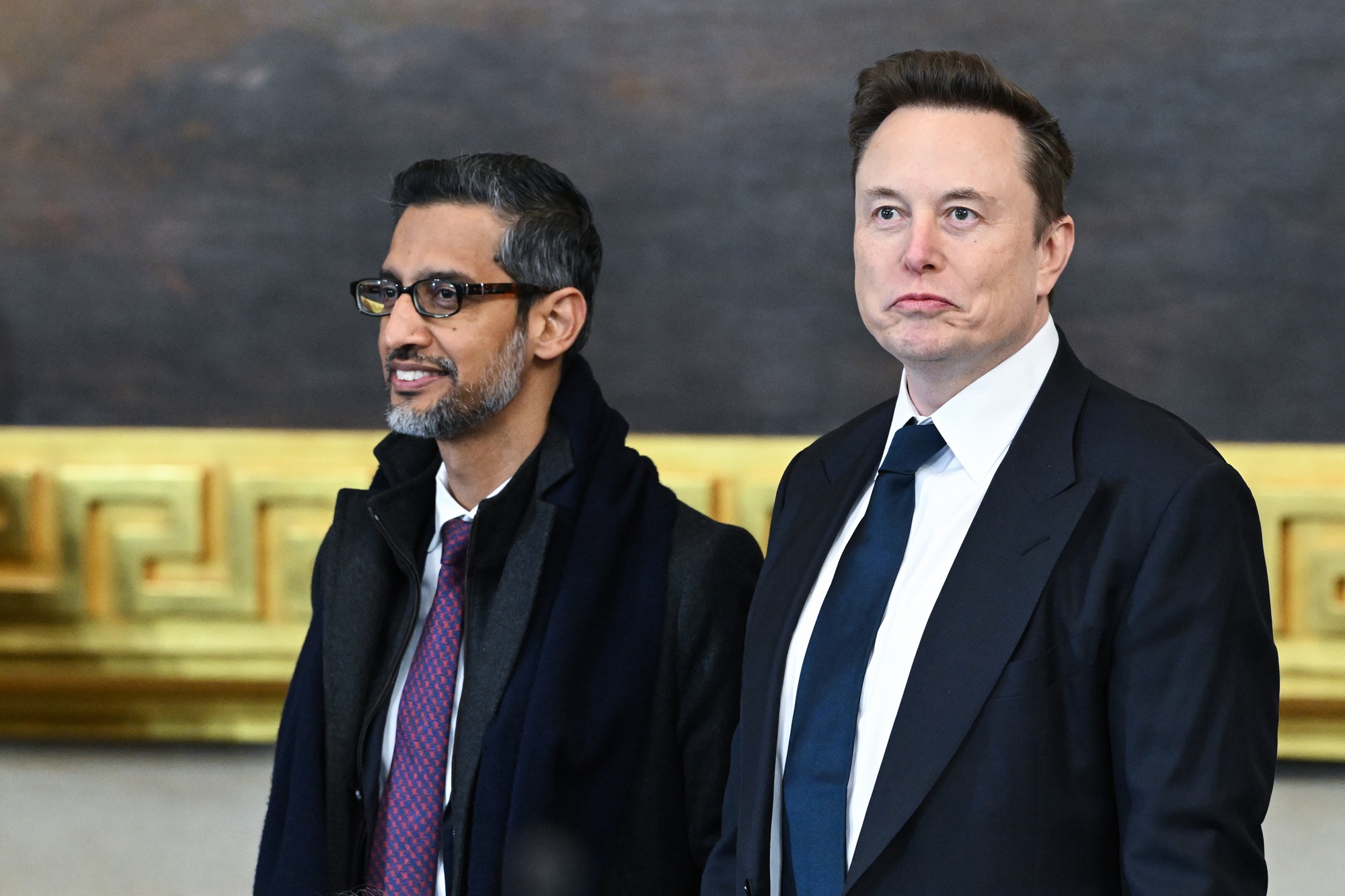
"caption": "Google CEO Sundar Pichai (left) and Tesla and SpaceX CEO Elon Musk attend the inauguration of Donald Trump in the U.S. Capitol Rotunda on Jan. 20, 2025, in Washington, D.C. Many more progressive rank-and-file tech workers stopped speaking out after the 2024 election as executives cozied up to Trump. For some, the recent killings in Minneapolis by federal agents mark a turning point.",
"credit": "Saul Loeb-Pool/Getty Images",
"altTag": null,
"description": null,
"imgSizes": {
"thumbnail": {
"file": "https://cdn.kqed.org/wp-content/uploads/sites/10/2026/01/ElonMuskInaugurationTechGetty-160x107.jpg",
"width": 160,
"height": 107,
"mimeType": "image/jpeg"
},
"1536x1536": {
"file": "https://cdn.kqed.org/wp-content/uploads/sites/10/2026/01/ElonMuskInaugurationTechGetty-1536x1024.jpg",
"width": 1536,
"height": 1024,
"mimeType": "image/jpeg"
},
"post-thumbnail": {
"file": "https://cdn.kqed.org/wp-content/uploads/sites/10/2026/01/ElonMuskInaugurationTechGetty-672x372.jpg",
"width": 672,
"height": 372,
"mimeType": "image/jpeg"
},
"twentyfourteen-full-width": {
"file": "https://cdn.kqed.org/wp-content/uploads/sites/10/2026/01/ElonMuskInaugurationTechGetty-1038x576.jpg",
"width": 1038,
"height": 576,
"mimeType": "image/jpeg"
},
"npr-cds-wide": {
"file": "https://cdn.kqed.org/wp-content/uploads/sites/10/2026/01/ElonMuskInaugurationTechGetty-1200x675.jpg",
"width": 1200,
"height": 675,
"mimeType": "image/jpeg"
},
"kqedFullSize": {
"file": "https://cdn.kqed.org/wp-content/uploads/sites/10/2026/01/ElonMuskInaugurationTechGetty.jpg",
"width": 2000,
"height": 1333
}
},
"isLoading": false,
"fetchFailed": false
},
"news_12069851": {
"type": "attachments",
"id": "news_12069851",
"meta": {
"index": "attachments_1716263798",
"site": "news",
"id": "12069851",
"found": true
},
"title": "A sign for Creekside San José on Dec. 8, 2025.",
"publishDate": 1768431731,
"status": "inherit",
"parent": 0,
"modified": 1768431862,
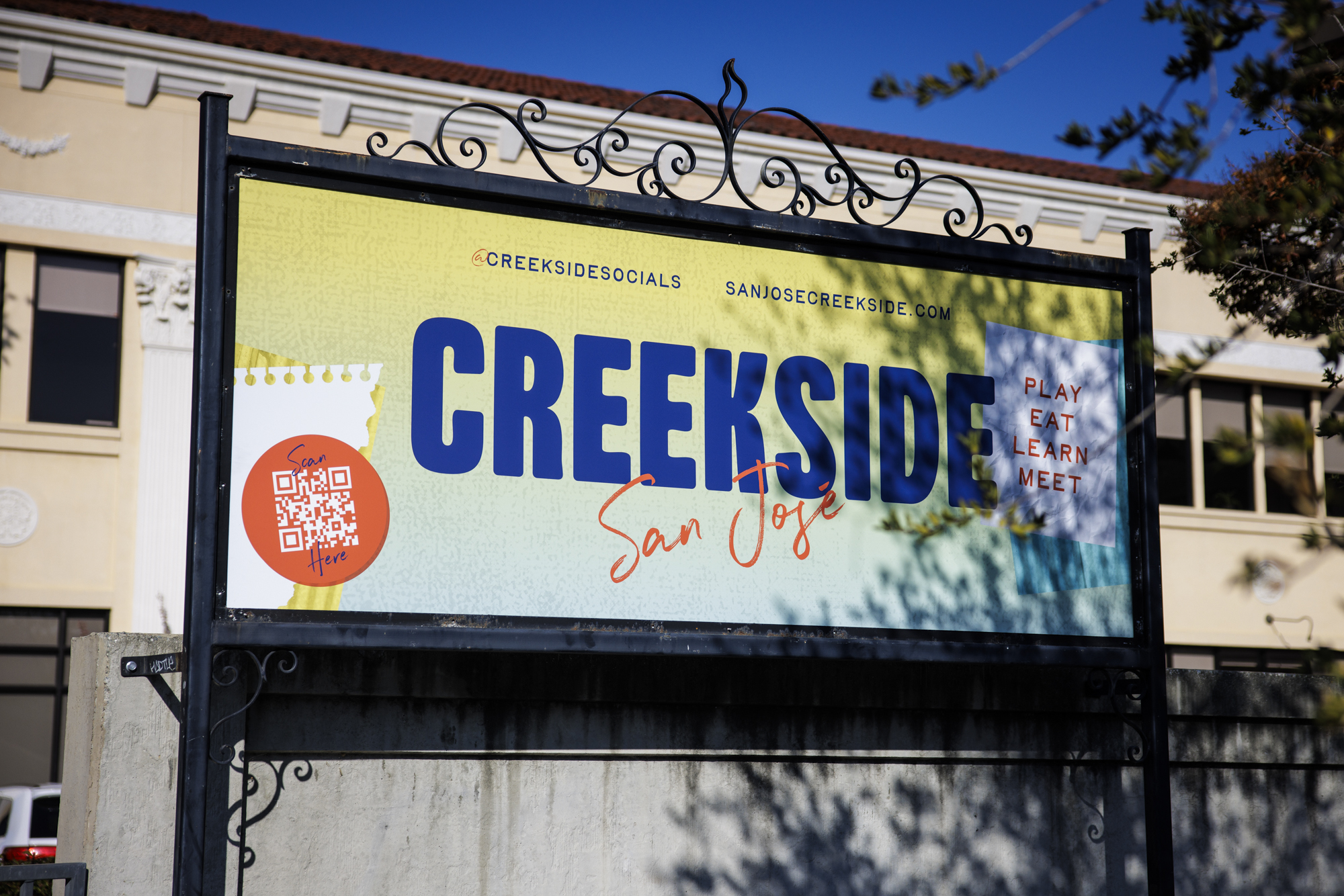
"caption": "A sign for Creekside San José in San José on Dec. 8, 2025.",
"credit": "Martin do Nascimento/KQED",
"altTag": null,
"description": null,
"imgSizes": {
"thumbnail": {
"file": "https://cdn.kqed.org/wp-content/uploads/sites/10/2026/01/251208-DOWNTOWN-WEST-MD-08-KQED-160x107.jpg",
"width": 160,
"height": 107,
"mimeType": "image/jpeg"
},
"1536x1536": {
"file": "https://cdn.kqed.org/wp-content/uploads/sites/10/2026/01/251208-DOWNTOWN-WEST-MD-08-KQED-1536x1025.jpg",
"width": 1536,
"height": 1025,
"mimeType": "image/jpeg"
},
"post-thumbnail": {
"file": "https://cdn.kqed.org/wp-content/uploads/sites/10/2026/01/251208-DOWNTOWN-WEST-MD-08-KQED-672x372.jpg",
"width": 672,
"height": 372,
"mimeType": "image/jpeg"
},
"twentyfourteen-full-width": {
"file": "https://cdn.kqed.org/wp-content/uploads/sites/10/2026/01/251208-DOWNTOWN-WEST-MD-08-KQED-1038x576.jpg",
"width": 1038,
"height": 576,
"mimeType": "image/jpeg"
},
"npr-cds-wide": {
"file": "https://cdn.kqed.org/wp-content/uploads/sites/10/2026/01/251208-DOWNTOWN-WEST-MD-08-KQED-1200x675.jpg",
"width": 1200,
"height": 675,
"mimeType": "image/jpeg"
},
"kqedFullSize": {
"file": "https://cdn.kqed.org/wp-content/uploads/sites/10/2026/01/251208-DOWNTOWN-WEST-MD-08-KQED.jpg",
"width": 2000,
"height": 1334
}
},
"isLoading": false,
"fetchFailed": false
},
"news_12055857": {
"type": "attachments",
"id": "news_12055857",
"meta": {
"index": "attachments_1716263798",
"site": "news",
"id": "12055857",
"found": true
},
"title": "111215_Google-Campus_AP_CM_01",
"publishDate": 1757719431,
"status": "inherit",
"parent": 12055854,
"modified": 1757787966,
"caption": "Mountain View tech giant Google asked small business owners to sign a petition opposing new rules for web browsers. Its Chrome browser leads the market. \n",
"credit": "Jeff Chiu/AP Photo",
"altTag": null,
"description": null,
"imgSizes": {
"thumbnail": {
"file": "https://cdn.kqed.org/wp-content/uploads/sites/10/2025/09/111215_Google-Campus_AP_CM_01-160x107.jpg",
"width": 160,
"height": 107,
"mimeType": "image/jpeg"
},
"1536x1536": {
"file": "https://cdn.kqed.org/wp-content/uploads/sites/10/2025/09/111215_Google-Campus_AP_CM_01-1536x1024.jpg",
"width": 1536,
"height": 1024,
"mimeType": "image/jpeg"
},
"post-thumbnail": {
"file": "https://cdn.kqed.org/wp-content/uploads/sites/10/2025/09/111215_Google-Campus_AP_CM_01-672x372.jpg",
"width": 672,
"height": 372,
"mimeType": "image/jpeg"
},
"twentyfourteen-full-width": {
"file": "https://cdn.kqed.org/wp-content/uploads/sites/10/2025/09/111215_Google-Campus_AP_CM_01-1038x576.jpg",
"width": 1038,
"height": 576,
"mimeType": "image/jpeg"
},
"kqedFullSize": {
"file": "https://cdn.kqed.org/wp-content/uploads/sites/10/2025/09/111215_Google-Campus_AP_CM_01.jpg",
"width": 2000,
"height": 1333
}
},
"isLoading": false,
"fetchFailed": false
},
"news_12051437": {
"type": "attachments",
"id": "news_12051437",
"meta": {
"index": "attachments_1716263798",
"site": "news",
"id": "12051437",
"found": true
},
"title": "GavinNewsomAISF1",
"publishDate": 1754670249,
"status": "inherit",
"parent": 12051433,
"modified": 1754670737,
"caption": "On the rooftop of Google’s San Francisco offices on Aug. 7, 2025, Gov. Gavin Newsom announced a major statewide partnership with Google, Microsoft, IBM and Adobe to expand generative AI education — including training programs, certifications and internships — across California’s high schools, community colleges and Cal State universities.",
"credit": "Courtesy of the Office of the Governor",
"altTag": null,
"description": null,
"imgSizes": {
"thumbnail": {
"file": "https://cdn.kqed.org/wp-content/uploads/sites/10/2025/08/GavinNewsomAISF1-160x107.jpg",
"width": 160,
"height": 107,
"mimeType": "image/jpeg"
},
"1536x1536": {
"file": "https://cdn.kqed.org/wp-content/uploads/sites/10/2025/08/GavinNewsomAISF1-1536x1024.jpg",
"width": 1536,
"height": 1024,
"mimeType": "image/jpeg"
},
"post-thumbnail": {
"file": "https://cdn.kqed.org/wp-content/uploads/sites/10/2025/08/GavinNewsomAISF1-672x372.jpg",
"width": 672,
"height": 372,
"mimeType": "image/jpeg"
},
"twentyfourteen-full-width": {
"file": "https://cdn.kqed.org/wp-content/uploads/sites/10/2025/08/GavinNewsomAISF1-1038x576.jpg",
"width": 1038,
"height": 576,
"mimeType": "image/jpeg"
},
"kqedFullSize": {
"file": "https://cdn.kqed.org/wp-content/uploads/sites/10/2025/08/GavinNewsomAISF1.jpg",
"width": 2000,
"height": 1333
}
},
"isLoading": false,
"fetchFailed": false
},
"news_12045085": {
"type": "attachments",
"id": "news_12045085",
"meta": {
"index": "attachments_1716263798",
"site": "news",
"id": "12045085",
"found": true
},
"title": "061125-HEALTH-EXCHANGE-LEAKS-GH-CM copy",
"publishDate": 1750351185,
"status": "inherit",
"parent": 12045084,
"modified": 1750351199,
"caption": null,
"credit": "Illustration by Gabriel Hongsdusit/CalMatters",
"altTag": null,
"description": null,
"imgSizes": {
"thumbnail": {
"file": "https://cdn.kqed.org/wp-content/uploads/sites/10/2025/06/061125-HEALTH-EXCHANGE-LEAKS-GH-CM-copy-160x107.jpg",
"width": 160,
"height": 107,
"mimeType": "image/jpeg"
},
"1536x1536": {
"file": "https://cdn.kqed.org/wp-content/uploads/sites/10/2025/06/061125-HEALTH-EXCHANGE-LEAKS-GH-CM-copy-1536x1024.jpg",
"width": 1536,
"height": 1024,
"mimeType": "image/jpeg"
},
"post-thumbnail": {
"file": "https://cdn.kqed.org/wp-content/uploads/sites/10/2025/06/061125-HEALTH-EXCHANGE-LEAKS-GH-CM-copy-672x372.jpg",
"width": 672,
"height": 372,
"mimeType": "image/jpeg"
},
"twentyfourteen-full-width": {
"file": "https://cdn.kqed.org/wp-content/uploads/sites/10/2025/06/061125-HEALTH-EXCHANGE-LEAKS-GH-CM-copy-1038x576.jpg",
"width": 1038,
"height": 576,
"mimeType": "image/jpeg"
},
"kqedFullSize": {
"file": "https://cdn.kqed.org/wp-content/uploads/sites/10/2025/06/061125-HEALTH-EXCHANGE-LEAKS-GH-CM-copy.jpg",
"width": 2000,
"height": 1333
}
},
"isLoading": false,
"fetchFailed": false
},
"news_12036976": {
"type": "attachments",
"id": "news_12036976",
"meta": {
"index": "attachments_1716263798",
"site": "news",
"id": "12036976",
"found": true
},
"title": "Internet Market Considers MIcrosoft Bid for Yahoo",
"publishDate": 1745269392,
"status": "inherit",
"parent": 12036593,
"modified": 1745270950,
"caption": "The Google logo is reflected in the eye of a girl on Feb. 3, 2008, in London, England. ",
"credit": "Chris Jackson/Getty Images",
"altTag": null,
"description": null,
"imgSizes": {
"medium": {
"file": "https://cdn.kqed.org/wp-content/uploads/sites/10/2025/04/GoogleGetty-800x588.jpg",
"width": 800,
"height": 588,
"mimeType": "image/jpeg"
},
"large": {
"file": "https://cdn.kqed.org/wp-content/uploads/sites/10/2025/04/GoogleGetty-1020x750.jpg",
"width": 1020,
"height": 750,
"mimeType": "image/jpeg"
},
"thumbnail": {
"file": "https://cdn.kqed.org/wp-content/uploads/sites/10/2025/04/GoogleGetty-160x118.jpg",
"width": 160,
"height": 118,
"mimeType": "image/jpeg"
},
"1536x1536": {
"file": "https://cdn.kqed.org/wp-content/uploads/sites/10/2025/04/GoogleGetty-1536x1129.jpg",
"width": 1536,
"height": 1129,
"mimeType": "image/jpeg"
},
"post-thumbnail": {
"file": "https://cdn.kqed.org/wp-content/uploads/sites/10/2025/04/GoogleGetty-672x372.jpg",
"width": 672,
"height": 372,
"mimeType": "image/jpeg"
},
"twentyfourteen-full-width": {
"file": "https://cdn.kqed.org/wp-content/uploads/sites/10/2025/04/GoogleGetty-1038x576.jpg",
"width": 1038,
"height": 576,
"mimeType": "image/jpeg"
},
"full-width": {
"file": "https://cdn.kqed.org/wp-content/uploads/sites/10/2025/04/GoogleGetty-1920x1411.jpg",
"width": 1920,
"height": 1411,
"mimeType": "image/jpeg"
},
"kqedFullSize": {
"file": "https://cdn.kqed.org/wp-content/uploads/sites/10/2025/04/GoogleGetty.jpg",
"width": 2000,
"height": 1470
}
},
"isLoading": false,
"fetchFailed": false
},
"news_12036476": {
"type": "attachments",
"id": "news_12036476",
"meta": {
"index": "attachments_1716263798",
"site": "news",
"id": "12036476",
"found": true
},
"title": "Google Launches New Products At \"Made By Google\" Event",
"publishDate": 1744926888,
"status": "inherit",
"parent": 12036411,
"modified": 1744926924,
"caption": "The Google logo is displayed in front of company headquarters during the Made By Google event on August 13, 2024 in Mountain View, California. Google announced new Pixel phones, watches and AI features at the event. ",
"credit": "Justin Sullivan/Getty Images",
"altTag": null,
"description": null,
"imgSizes": {
"medium": {
"file": "https://cdn.kqed.org/wp-content/uploads/sites/10/2025/04/GettyImages-2166671481-800x552.jpg",
"width": 800,
"height": 552,
"mimeType": "image/jpeg"
},
"large": {
"file": "https://cdn.kqed.org/wp-content/uploads/sites/10/2025/04/GettyImages-2166671481-1020x703.jpg",
"width": 1020,
"height": 703,
"mimeType": "image/jpeg"
},
"thumbnail": {
"file": "https://cdn.kqed.org/wp-content/uploads/sites/10/2025/04/GettyImages-2166671481-160x110.jpg",
"width": 160,
"height": 110,
"mimeType": "image/jpeg"
},
"post-thumbnail": {
"file": "https://cdn.kqed.org/wp-content/uploads/sites/10/2025/04/GettyImages-2166671481-672x372.jpg",
"width": 672,
"height": 372,
"mimeType": "image/jpeg"
},
"twentyfourteen-full-width": {
"file": "https://cdn.kqed.org/wp-content/uploads/sites/10/2025/04/GettyImages-2166671481-1024x576.jpg",
"width": 1024,
"height": 576,
"mimeType": "image/jpeg"
},
"kqedFullSize": {
"file": "https://cdn.kqed.org/wp-content/uploads/sites/10/2025/04/GettyImages-2166671481.jpg",
"width": 1024,
"height": 706
}
},
"isLoading": false,
"fetchFailed": false
},
"news_12035915": {
"type": "attachments",
"id": "news_12035915",
"meta": {
"index": "attachments_1716263798",
"site": "news",
"id": "12035915",
"found": true
},
"title": "US-POLITICS-TRUMP-INAUGURATION",
"publishDate": 1744661677,
"status": "inherit",
"parent": 12035855,
"modified": 1744663114,
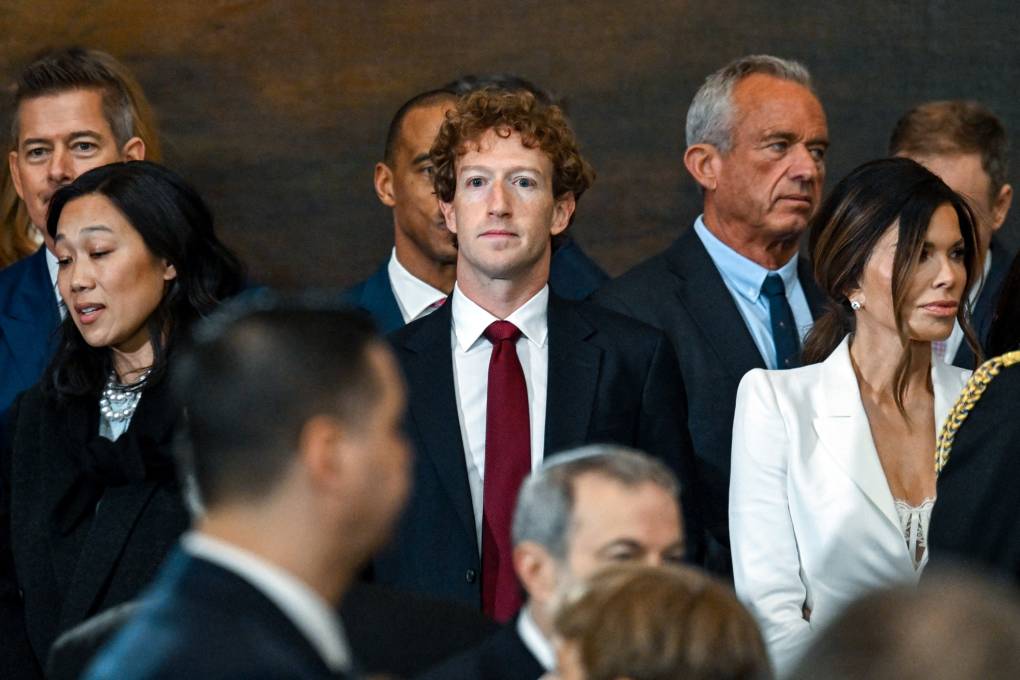
"caption": "CEO of Meta, Mark Zuckerberg (center), attends the inauguration ceremony of Donald Trump as he swears in as the 47th U.S. President in the U.S. Capitol Rotunda in Washington, D.C., on Jan. 20, 2025.",
"credit": "Kenny Holston/AFP via Getty Images",
"altTag": null,
"description": null,
"imgSizes": {
"medium": {
"file": "https://cdn.kqed.org/wp-content/uploads/sites/10/2025/04/MetaGetty-800x533.jpg",
"width": 800,
"height": 533,
"mimeType": "image/jpeg"
},
"large": {
"file": "https://cdn.kqed.org/wp-content/uploads/sites/10/2025/04/MetaGetty-1020x680.jpg",
"width": 1020,
"height": 680,
"mimeType": "image/jpeg"
},
"thumbnail": {
"file": "https://cdn.kqed.org/wp-content/uploads/sites/10/2025/04/MetaGetty-160x107.jpg",
"width": 160,
"height": 107,
"mimeType": "image/jpeg"
},
"1536x1536": {
"file": "https://cdn.kqed.org/wp-content/uploads/sites/10/2025/04/MetaGetty-1536x1024.jpg",
"width": 1536,
"height": 1024,
"mimeType": "image/jpeg"
},
"post-thumbnail": {
"file": "https://cdn.kqed.org/wp-content/uploads/sites/10/2025/04/MetaGetty-672x372.jpg",
"width": 672,
"height": 372,
"mimeType": "image/jpeg"
},
"twentyfourteen-full-width": {
"file": "https://cdn.kqed.org/wp-content/uploads/sites/10/2025/04/MetaGetty-1038x576.jpg",
"width": 1038,
"height": 576,
"mimeType": "image/jpeg"
},
"full-width": {
"file": "https://cdn.kqed.org/wp-content/uploads/sites/10/2025/04/MetaGetty-1920x1280.jpg",
"width": 1920,
"height": 1280,
"mimeType": "image/jpeg"
},
"kqedFullSize": {
"file": "https://cdn.kqed.org/wp-content/uploads/sites/10/2025/04/MetaGetty.jpg",
"width": 2000,
"height": 1333
}
},
"isLoading": false,
"fetchFailed": false
},
"news_12016604": {
"type": "attachments",
"id": "news_12016604",
"meta": {
"index": "attachments_1716263798",
"site": "news",
"id": "12016604",
"found": true
},
"title": "The UC Berkeley Campus in Berkeley on Aug. 17, 2023.",
"publishDate": 1733334753,
"status": "inherit",
"parent": 12016602,
"modified": 1733334766,
"caption": "The UC Berkeley Campus in Berkeley on Aug. 17, 2023.",
"credit": "Martin do Nascimento/KQED",
"altTag": null,
"description": null,
"imgSizes": {
"medium": {
"file": "https://cdn.kqed.org/wp-content/uploads/sites/10/2024/12/230817-UC-BERKELEY-CAMPUS-MD-02_qed-800x533.jpg",
"width": 800,
"height": 533,
"mimeType": "image/jpeg"
},
"large": {
"file": "https://cdn.kqed.org/wp-content/uploads/sites/10/2024/12/230817-UC-BERKELEY-CAMPUS-MD-02_qed-1020x680.jpg",
"width": 1020,
"height": 680,
"mimeType": "image/jpeg"
},
"thumbnail": {
"file": "https://cdn.kqed.org/wp-content/uploads/sites/10/2024/12/230817-UC-BERKELEY-CAMPUS-MD-02_qed-160x107.jpg",
"width": 160,
"height": 107,
"mimeType": "image/jpeg"
},
"1536x1536": {
"file": "https://cdn.kqed.org/wp-content/uploads/sites/10/2024/12/230817-UC-BERKELEY-CAMPUS-MD-02_qed-1536x1024.jpg",
"width": 1536,
"height": 1024,
"mimeType": "image/jpeg"
},
"post-thumbnail": {
"file": "https://cdn.kqed.org/wp-content/uploads/sites/10/2024/12/230817-UC-BERKELEY-CAMPUS-MD-02_qed-672x372.jpg",
"width": 672,
"height": 372,
"mimeType": "image/jpeg"
},
"twentyfourteen-full-width": {
"file": "https://cdn.kqed.org/wp-content/uploads/sites/10/2024/12/230817-UC-BERKELEY-CAMPUS-MD-02_qed-1038x576.jpg",
"width": 1038,
"height": 576,
"mimeType": "image/jpeg"
},
"full-width": {
"file": "https://cdn.kqed.org/wp-content/uploads/sites/10/2024/12/230817-UC-BERKELEY-CAMPUS-MD-02_qed-1920x1280.jpg",
"width": 1920,
"height": 1280,
"mimeType": "image/jpeg"
},
"kqedFullSize": {
"file": "https://cdn.kqed.org/wp-content/uploads/sites/10/2024/12/230817-UC-BERKELEY-CAMPUS-MD-02_qed.jpg",
"width": 2000,
"height": 1333
}
},
"isLoading": false,
"fetchFailed": false
},
"news_11919282": {
"type": "attachments",
"id": "news_11919282",
"meta": {
"index": "attachments_1716263798",
"site": "news",
"id": "11919282",
"found": true
},
"title": "Google Updates Its Logo",
"publishDate": 1657566086,
"status": "inherit",
"parent": 11919277,
"modified": 1657567640,
"caption": "An image of the Google headquarters in Mountain View.",
"credit": "Justin Sullivan/Getty Images",
"altTag": "An image of a building with the colorful Google logo on the side. The building looks very modern, the whole wall is a grid of glass windows. The Google logo is the new version.",
"description": "The new Google logo is displayed at the Google headquarters on September 2, 2015 in Mountain View, California. Google has made the most dramatic change to their logo since 1999 and have replaced their signature serif font with a new typeface called Product Sans.",
"imgSizes": {
"medium": {
"file": "https://cdn.kqed.org/wp-content/uploads/sites/10/2022/07/RS26525_GettyImages-486234008-800x534.jpg",
"width": 800,
"height": 534,
"mimeType": "image/jpeg"
},
"large": {
"file": "https://cdn.kqed.org/wp-content/uploads/sites/10/2022/07/RS26525_GettyImages-486234008-1020x681.jpg",
"width": 1020,
"height": 681,
"mimeType": "image/jpeg"
},
"thumbnail": {
"file": "https://cdn.kqed.org/wp-content/uploads/sites/10/2022/07/RS26525_GettyImages-486234008-160x107.jpg",
"width": 160,
"height": 107,
"mimeType": "image/jpeg"
},
"1536x1536": {
"file": "https://cdn.kqed.org/wp-content/uploads/sites/10/2022/07/RS26525_GettyImages-486234008-1536x1025.jpg",
"width": 1536,
"height": 1025,
"mimeType": "image/jpeg"
},
"2048x2048": {
"file": "https://cdn.kqed.org/wp-content/uploads/sites/10/2022/07/RS26525_GettyImages-486234008-2048x1367.jpg",
"width": 2048,
"height": 1367,
"mimeType": "image/jpeg"
},
"post-thumbnail": {
"file": "https://cdn.kqed.org/wp-content/uploads/sites/10/2022/07/RS26525_GettyImages-486234008-672x372.jpg",
"width": 672,
"height": 372,
"mimeType": "image/jpeg"
},
"twentyfourteen-full-width": {
"file": "https://cdn.kqed.org/wp-content/uploads/sites/10/2022/07/RS26525_GettyImages-486234008-1038x576.jpg",
"width": 1038,
"height": 576,
"mimeType": "image/jpeg"
},
"full-width": {
"file": "https://cdn.kqed.org/wp-content/uploads/sites/10/2022/07/RS26525_GettyImages-486234008-1920x1281.jpg",
"width": 1920,
"height": 1281,
"mimeType": "image/jpeg"
},
"kqedFullSize": {
"file": "https://cdn.kqed.org/wp-content/uploads/sites/10/2022/07/RS26525_GettyImages-486234008-scaled-e1736207624368.jpg",
"width": 2000,
"height": 1334
}
},
"isLoading": false,
"fetchFailed": false
},
"news_12019335": {
"type": "attachments",
"id": "news_12019335",
"meta": {
"index": "attachments_1716263798",
"site": "news",
"id": "12019335",
"found": true
},
"title": "GoogleQuantumAI_WillowChip_Closeup04",
"publishDate": 1734719379,
"status": "inherit",
"parent": 12018788,
"modified": 1734719419,
"caption": "Google’s quantum computer chip, Willow.",
"credit": "Courtesy of Google Quantum AI",
"altTag": null,
"description": null,
"imgSizes": {
"medium": {
"file": "https://cdn.kqed.org/wp-content/uploads/sites/10/2024/12/GoogleQuantumAI_WillowChip_Closeup04-800x533.jpg",
"width": 800,
"height": 533,
"mimeType": "image/jpeg"
},
"large": {
"file": "https://cdn.kqed.org/wp-content/uploads/sites/10/2024/12/GoogleQuantumAI_WillowChip_Closeup04-1020x680.jpg",
"width": 1020,
"height": 680,
"mimeType": "image/jpeg"
},
"thumbnail": {
"file": "https://cdn.kqed.org/wp-content/uploads/sites/10/2024/12/GoogleQuantumAI_WillowChip_Closeup04-160x107.jpg",
"width": 160,
"height": 107,
"mimeType": "image/jpeg"
},
"1536x1536": {
"file": "https://cdn.kqed.org/wp-content/uploads/sites/10/2024/12/GoogleQuantumAI_WillowChip_Closeup04-1536x1024.jpg",
"width": 1536,
"height": 1024,
"mimeType": "image/jpeg"
},
"post-thumbnail": {
"file": "https://cdn.kqed.org/wp-content/uploads/sites/10/2024/12/GoogleQuantumAI_WillowChip_Closeup04-672x372.jpg",
"width": 672,
"height": 372,
"mimeType": "image/jpeg"
},
"twentyfourteen-full-width": {
"file": "https://cdn.kqed.org/wp-content/uploads/sites/10/2024/12/GoogleQuantumAI_WillowChip_Closeup04-1038x576.jpg",
"width": 1038,
"height": 576,
"mimeType": "image/jpeg"
},
"full-width": {
"file": "https://cdn.kqed.org/wp-content/uploads/sites/10/2024/12/GoogleQuantumAI_WillowChip_Closeup04-1920x1280.jpg",
"width": 1920,
"height": 1280,
"mimeType": "image/jpeg"
},
"kqedFullSize": {
"file": "https://cdn.kqed.org/wp-content/uploads/sites/10/2024/12/GoogleQuantumAI_WillowChip_Closeup04.jpg",
"width": 2000,
"height": 1333
}
},
"isLoading": false,
"fetchFailed": false
},
"news_12015743": {
"type": "attachments",
"id": "news_12015743",
"meta": {
"index": "attachments_1716263798",
"site": "news",
"id": "12015743",
"found": true
},
"title": "Google Headquarters in Mountain View, California",
"publishDate": 1732555955,
"status": "inherit",
"parent": 12015740,
"modified": 1732556011,
"caption": "A view of Google Headquarters in Mountain View, Santa Clara County, on Aug. 22, 2024. ",
"credit": "Tayfun Coskun/Anadolu via Getty Images",
"altTag": null,
"description": null,
"imgSizes": {
"medium": {
"file": "https://cdn.kqed.org/wp-content/uploads/sites/10/2024/11/GettyImages-2167175697-800x534.jpg",
"width": 800,
"height": 534,
"mimeType": "image/jpeg"
},
"large": {
"file": "https://cdn.kqed.org/wp-content/uploads/sites/10/2024/11/GettyImages-2167175697-1020x680.jpg",
"width": 1020,
"height": 680,
"mimeType": "image/jpeg"
},
"thumbnail": {
"file": "https://cdn.kqed.org/wp-content/uploads/sites/10/2024/11/GettyImages-2167175697-160x107.jpg",
"width": 160,
"height": 107,
"mimeType": "image/jpeg"
},
"post-thumbnail": {
"file": "https://cdn.kqed.org/wp-content/uploads/sites/10/2024/11/GettyImages-2167175697-672x372.jpg",
"width": 672,
"height": 372,
"mimeType": "image/jpeg"
},
"twentyfourteen-full-width": {
"file": "https://cdn.kqed.org/wp-content/uploads/sites/10/2024/11/GettyImages-2167175697-1024x576.jpg",
"width": 1024,
"height": 576,
"mimeType": "image/jpeg"
},
"kqedFullSize": {
"file": "https://cdn.kqed.org/wp-content/uploads/sites/10/2024/11/GettyImages-2167175697.jpg",
"width": 1024,
"height": 683
}
},
"isLoading": false,
"fetchFailed": false
}
},
"audioPlayerReducer": {
"postId": "stream_live",
"isPaused": true,
"isPlaying": false,
"pfsActive": false,
"pledgeModalIsOpen": true,
"playerDrawerIsOpen": false,
"liveAudioPlayStartedAt": 0,
"liveAudioPlayContext": ""
},
"authorsReducer": {
"byline_news_12055854": {
"type": "authors",
"id": "byline_news_12055854",
"meta": {
"override": true
},
"slug": "byline_news_12055854",
"name": "Khari Johnson and Yue Stella Yu, CalMatters",
"isLoading": false
},
"byline_news_12045084": {
"type": "authors",
"id": "byline_news_12045084",
"meta": {
"override": true
},
"slug": "byline_news_12045084",
"name": "Colin Lecher and Tomas Apodaca, CalMatters",
"isLoading": false
},
"byline_news_12015740": {
"type": "authors",
"id": "byline_news_12015740",
"meta": {
"override": true
},
"slug": "byline_news_12015740",
"name": "Matthew Barakat, The Associated Press",
"isLoading": false
},
"rachael-myrow": {
"type": "authors",
"id": "251",
"meta": {
"index": "authors_1716337520",
"id": "251",
"found": true
},
"name": "Rachael Myrow",
"firstName": "Rachael",
"lastName": "Myrow",
"slug": "rachael-myrow",
"email": "rmyrow@kqed.org",
"display_author_email": true,
"staff_mastheads": [
"news"
],
"title": "Senior Editor of KQED's Silicon Valley News Desk",
"bio": "• I write and edit stories about how Silicon Valley power and policies shape everyday life in California. I’m also passionate about making Bay Area history and culture more accessible to a broad public. • I’ve been a journalist for most of my life, starting in high school with The Franklin Press in Los Angeles, where I grew up. While earning my first degree in English at UC Berkeley, I got my start in public radio at KALX-FM. After completing a second degree in journalism at Cal, I landed my first professional job at Marketplace, then moved on to KPCC (now LAist), and then KQED, where I hosted The California Report for more than seven years. • My reporting has appeared on NPR, The World, WBUR’s \u003ci>Here & Now\u003c/i>, and the BBC. I also guest host for KQED’s \u003ci>Forum\u003c/i>, as well as the Commonwealth Club in San Francisco. • I speak periodically on media, democracy and technology issues, and do voiceover work for documentaries and educational video projects. • Outside of the studio, you'll find me hiking Bay Area trails and whipping up Insta-ready meals in my kitchen. • I do not accept gifts, money, or favors from anyone connected to my reporting, I don't pay people for information, and I do not support or donate to political causes. • I strive to treat the people I report on with fairness, honesty, and respect. I also recognize there are often multiple sides to a story and work to verify information through multiple sources and documentation. If I get something wrong, I correct it.",
"avatar": "https://secure.gravatar.com/avatar/3ed8a3c5f26025e4a805ba634cda8cd764906b97438a6d9ce216b044e340da4e?s=600&d=blank&r=g",
"twitter": "rachaelmyrow",
"bluesky": null,
"facebook": null,
"instagram": null,
"linkedin": "https://www.linkedin.com/in/rachaelmyrow/",
"sites": [
{
"site": "arts",
"roles": [
"administrator"
]
},
{
"site": "news",
"roles": [
"edit_others_posts",
"editor"
]
},
{
"site": "futureofyou",
"roles": [
"editor"
]
},
{
"site": "bayareabites",
"roles": [
"editor"
]
},
{
"site": "stateofhealth",
"roles": [
"editor"
]
},
{
"site": "science",
"roles": [
"editor"
]
},
{
"site": "food",
"roles": [
"editor"
]
},
{
"site": "forum",
"roles": [
"editor"
]
},
{
"site": "liveblog",
"roles": [
"author"
]
}
],
"headData": {
"title": "Rachael Myrow | KQED",
"description": "Senior Editor of KQED's Silicon Valley News Desk",
"ogImgSrc": "https://secure.gravatar.com/avatar/3ed8a3c5f26025e4a805ba634cda8cd764906b97438a6d9ce216b044e340da4e?s=600&d=blank&r=g",
"twImgSrc": "https://secure.gravatar.com/avatar/3ed8a3c5f26025e4a805ba634cda8cd764906b97438a6d9ce216b044e340da4e?s=600&d=blank&r=g"
},
"isLoading": false,
"link": "/author/rachael-myrow"
},
"jgeha": {
"type": "authors",
"id": "11906",
"meta": {
"index": "authors_1716337520",
"id": "11906",
"found": true
},
"name": "Joseph Geha",
"firstName": "Joseph",
"lastName": "Geha",
"slug": "jgeha",
"email": "jgeha@kqed.org",
"display_author_email": false,
"staff_mastheads": [
"news",
"science"
],
"title": "KQED Contributor",
"bio": null,
"avatar": "https://secure.gravatar.com/avatar/ea84d2b6dd93d6369d453edf19dd583f117cd1759d2d9c9c92f9de77017354fe?s=600&d=blank&r=g",
"twitter": null,
"bluesky": null,
"facebook": null,
"instagram": null,
"linkedin": null,
"sites": [
{
"site": "news",
"roles": [
"editor"
]
},
{
"site": "liveblog",
"roles": [
"author"
]
}
],
"headData": {
"title": "Joseph Geha | KQED",
"description": "KQED Contributor",
"ogImgSrc": "https://secure.gravatar.com/avatar/ea84d2b6dd93d6369d453edf19dd583f117cd1759d2d9c9c92f9de77017354fe?s=600&d=blank&r=g",
"twImgSrc": "https://secure.gravatar.com/avatar/ea84d2b6dd93d6369d453edf19dd583f117cd1759d2d9c9c92f9de77017354fe?s=600&d=blank&r=g"
},
"isLoading": false,
"link": "/author/jgeha"
}
},
"pagesReducer": {
"news_tag_google": {
"type": "terms",
"id": "news_93",
"meta": {
"index": "terms_1716263798",
"site": "news",
"id": "93",
"score": 8.458717
},
"featImg": null,
"name": "Google",
"description": null,
"taxonomy": "tag",
"headData": {
"twImgId": null,
"twTitle": null,
"ogTitle": null,
"ogImgId": null,
"twDescription": null,
"description": null,
"title": "Google Archives | KQED News",
"ogDescription": null
},
"ttid": 96,
"slug": "google",
"isLoading": false,
"title": "Google",
"pageMeta": {
"site": "news",
"WpPageTemplate": "page-topic-editorial",
"currentPage": 2
},
"blocks": [
{
"blockName": "kqed/post-list",
"attrs": {
"layout": "cardArticle2",
"query": "posts/news?tag=google",
"seeMore": false,
"paginated": true,
"page": 2
}
},
{
"blockName": "kqed/ad"
}
]
}
},
"pfsSessionReducer": {},
"postsReducer": {
"stream_live": {
"type": "live",
"id": "stream_live",
"audioUrl": "https://streams.kqed.org/kqedradio",
"title": "Live Stream",
"excerpt": "Live Stream information currently unavailable.",
"link": "/radio",
"featImg": "",
"label": {
"name": "KQED Live",
"link": "/"
}
},
"stream_kqedNewscast": {
"type": "posts",
"id": "stream_kqedNewscast",
"audioUrl": "https://www.kqed.org/.stream/anon/radio/RDnews/newscast.mp3?_=1",
"title": "KQED Newscast",
"featImg": "",
"label": {
"name": "88.5 FM",
"link": "/"
}
},
"news_12071559": {
"type": "posts",
"id": "news_12071559",
"meta": {
"index": "posts_1716263798",
"site": "news",
"id": "12071559",
"score": null,
"sort": [
1769721315000
]
},
"guestAuthors": [],
"slug": "growing-wave-of-silicon-valley-workers-condemns-ice-as-c-suites-split-over-fear-of-trump",
"title": "Growing Wave of Silicon Valley Workers Condemns ICE as C-Suites Split Over Fear of Trump",
"publishDate": 1769721315,
"format": "audio",
"headTitle": "Growing Wave of Silicon Valley Workers Condemns ICE as C-Suites Split Over Fear of Trump | KQED",
"labelTerm": {
"site": "news"
},
"content": "\u003cp>After \u003ca href=\"https://www.kqed.org/news/12071074/heres-what-california-leaders-said-about-latest-minneapolis-killing\">two killings in Minneapolis\u003c/a>, a group of employees at Google’s parent company added their voices this week to a growing wave of tech workers speaking out and demanding their industry condemn \u003ca href=\"https://www.kqed.org/forum/2010101912777/whats-the-endgame-in-dhs-brutality\">violence by federal immigration officers\u003c/a>, even as many executives who spent the past year cozying up to President Donald Trump remain silent.\u003c/p>\n\u003cp>The Alphabet Workers Union, which represents roughly 1,400 North American employees, said in a statement on Wednesday that it stands in solidarity with immigrant communities and working people “\u003ca href=\"https://www.alphabetworkersunion.org/press/alphabet-workers-union-statement-condemning-ice\">standing up to ICE terror across the country\u003c/a>.”\u003c/p>\n\u003cp>“While President Donald Trump and parts of his administration have attempted to smear [Renee] Good and [Alex] Pretti as ‘terrorists,’ we all have seen the footage and know the truth: these citizens were executed in broad daylight while protesting mass deportation, an activity protected under the First Amendment,” the statement said.\u003c/p>\n\u003cp>[ad fullwidth]\u003c/p>\n\u003cp>For much of the second Trump administration, however, such political speech among more progressive rank-and-file tech workers has been chilled as many Silicon Valley leaders have publicly drawn closer to the White House — and as their companies sign lucrative contracts with agencies like Immigration and Customs Enforcement.\u003c/p>\n\u003cp>“Even though I don’t directly work on the things that power things like ICE, I feel like I have to stand up and represent and be a force of good where I can,” Alphabet software engineer and AWU member Daniel Freedman said.\u003c/p>\n\u003cp>He added that many of his colleagues fear Google might fire them for speaking out publicly as the union has. Some employees who protested Google’s \u003ca href=\"https://www.kqed.org/news/11969898/protesters-outside-google-in-san-francisco-call-for-immediate-end-to-project-nimbus\">$1.2 billion contract\u003c/a> with the Israeli government and military have since been let go.\u003c/p>\n\u003cfigure id=\"attachment_12055857\" class=\"wp-caption aligncenter\" style=\"max-width: 2000px\">\u003cimg loading=\"lazy\" decoding=\"async\" class=\"wp-image-12055857 size-full\" src=\"https://cdn.kqed.org/wp-content/uploads/sites/10/2025/09/111215_Google-Campus_AP_CM_01.jpg\" alt=\"\" width=\"2000\" height=\"1333\" srcset=\"https://cdn.kqed.org/wp-content/uploads/sites/10/2025/09/111215_Google-Campus_AP_CM_01.jpg 2000w, https://cdn.kqed.org/wp-content/uploads/sites/10/2025/09/111215_Google-Campus_AP_CM_01-160x107.jpg 160w, https://cdn.kqed.org/wp-content/uploads/sites/10/2025/09/111215_Google-Campus_AP_CM_01-1536x1024.jpg 1536w\" sizes=\"auto, (max-width: 2000px) 100vw, 2000px\">\u003cfigcaption class=\"wp-caption-text\">Many more progressive rank-and-file tech workers stopped speaking out after the 2024 election as executives cozied up to Trump. For some, the recent killings in Minneapolis by federal agents mark a turning point. \u003ccite>(Jeff Chiu/AP Photo)\u003c/cite>\u003c/figcaption>\u003c/figure>\n\u003cp>Google did not respond to KQED’s request for comment about the AWU statement. According to Freedman and reporting from Wired, Chief Executive Officer Sundar Pichai and other senior leaders have remained silent, even internally, about the killings in Minneapolis.\u003c/p>\n\u003cp>That’s not true for every Silicon Valley c-suiter. In contrast to Pichai, for instance, Apple CEO Tim Cook wrote a \u003ca href=\"https://www.bloomberg.com/news/articles/2026-01-28/apple-s-cook-calls-for-deescalation-after-latest-ice-shooting\">memo\u003c/a> to employees saying he’s “heartbroken” by the events in Minneapolis, but then said he “had a good conversation with the president” and spoke about a need for “deescalation,” mirroring language used by Trump.\u003c/p>\n\u003cp>Other leaders were never friendly with Trump and don’t appear likely to start being so. Vinod Khosla, one of Silicon Valley’s most prominent venture capitalists, \u003ca href=\"https://x.com/vkhosla/status/2015647215642186008\">wrote on the social media platform X\u003c/a>, “The video was sickening to watch and the storytelling without facts or with invented fictitious facts by authorities almost unimaginable in a civilized society.”[aside postID=news_12070405 hero='https://cdn.kqed.org/wp-content/uploads/sites/10/2026/01/CloseAllTabsDataPrivacy.jpg']Former Block executive Mike Brock, who now writes the Substack \u003ca href=\"https://www.notesfromthecircus.com/?utm_source=beehiiv&utm_medium=email&utm_campaign=newsletter-in-the-loop\">Notes from the Circus\u003c/a>, wrote that many tech workers stopped speaking out after the 2024 presidential election because “they understand they’ll lose their job.”\u003c/p>\n\u003cp>In the wake of the killings in Minnesota, that wary discretion is evaporating in favor of open rage and upset.\u003c/p>\n\u003cp>Last week, more than 200 Silicon Valley staffers \u003ca href=\"https://iceout.tech\">published an open letter\u003c/a> urging tech leaders to use their platforms to call for ICE’s removal from U.S. cities. As of this story’s publication, the letter has roughly 1,000 signatories, including employees from Google, Amazon and TikTok — although many declined to list more than their job titles.\u003c/p>\n\u003cp>“The killings of Renee Good and Alex Pretti were a breaking point,” wrote tech executive Lisa Conn, a signatory of the \u003ca href=\"https://url.us.m.mimecastprotect.com/s/rdbGCmZEBgFk1OMyCGfwHRw-kk?domain=iceout.tech\" target=\"_blank\" rel=\"noopener noreferrer\">ICEout.tech\u003c/a> letter. “And, this isn’t one corner of the industry. Signers include engineers, VPs, startup founders, and people at AI labs — many who’ve never been politically active before.”\u003c/p>\n\u003cp>Industry watchers say there are two key factors reflected in this new agitation among Silicon Valley workers.\u003c/p>\n\u003cp>“Workers know that many of them and their coworkers could be targets and/or be affected by dramatic changes to the immigration system — including the implementation of new fees and restrictions \u003ca href=\"https://www.kqed.org/news/12058586/silicon-valley-dreams-at-risk-current-h-1bs-sidestep-trumps-100k-fee-for-now\">associated with H1B visas\u003c/a>,” UC Irvine law professor Veena Dubal wrote to KQED.\u003c/p>\n\u003cfigure id=\"attachment_11932363\" class=\"wp-caption aligncenter\" style=\"max-width: 2000px\">\u003cimg loading=\"lazy\" decoding=\"async\" class=\"wp-image-11932363 size-full\" src=\"https://cdn.kqed.org/wp-content/uploads/sites/10/2022/11/ap22234766150296-38718ea7ac763e322f50108cf25682a33d4e9fcd-scaled-e1769721170277.jpg\" alt=\"the outside of an Amazon building\" width=\"2000\" height=\"1500\">\u003cfigcaption class=\"wp-caption-text\">Last week, more than 200 Silicon Valley workers published an open letter urging tech leaders to use their platforms to call for ICE’s removal from U.S. cities. By publication, the letter had drawn roughly 1,000 signatures, including from employees at Google, Amazon and TikTok, though many signatories listed only their job titles. \u003ccite>(Michel Spingler/AP)\u003c/cite>\u003c/figcaption>\u003c/figure>\n\u003cp>“Perhaps more importantly, it is a collective moral recognition about how their own labor may be contributing to the horrors of family separation, detention, deportation, and recent assaults on protestors,” Dubal said. “The reality is that ICE could not engage in their operations without technologies supplied to them through contracts with Palantir, Amazon, and Microsoft.”\u003c/p>\n\u003cp>For all the energizing impact of organizing among rank-and-file employees, ICEOut.Tech and the Alphabet Workers Union both call for Silicon Valley leaders to use their political leverage, too.\u003c/p>\n\u003cp>“When CEOs called the White House in October over the National Guard threat to SF, Trump backed down,” Conn wrote. “We’re asking them to use that access to do the right thing now.”\u003c/p>\n\u003cp>And it’s not just the groups making those calls.\u003c/p>\n\u003cp>James Dyett, an executive at OpenAI, chided his peers on X over the weekend. “There is far more outrage from tech leaders over a wealth tax than masked ICE agents terrorizing communities and executing civilians in the streets,” he\u003ca href=\"https://x.com/dyett/status/2015193525273743447\"> wrote\u003c/a>, referring to California’s \u003ca href=\"https://www.kqed.org/news/12070052/proposal-to-tax-billionaires-ignites-a-political-fight-in-california\">proposed tax on billionaires\u003c/a> that’s prompted some Silicon Valley tech moguls to publicly warn they’d rather leave the state than pay the tax. “Tells you what you need to know about the values of our industry.”\u003c/p>\n\u003cp>\u003c/p>\n",
"blocks": [],
"excerpt": "Many more progressive rank-and-file tech workers stopped speaking out after the 2024 election as executives cozied up to Trump. For some, the recent killings in Minneapolis by federal agents mark a turning point.",
"status": "publish",
"parent": 0,
"modified": 1769796125,
"stats": {
"hasAudio": false,
"hasVideo": false,
"hasChartOrMap": false,
"iframeSrcs": [],
"hasGoogleForm": false,
"hasGallery": false,
"hasHearkenModule": false,
"hasPolis": false,
"paragraphCount": 21,
"wordCount": 1045
},
"headData": {
"title": "Growing Wave of Silicon Valley Workers Condemns ICE as C-Suites Split Over Fear of Trump | KQED",
"description": "Many more progressive rank-and-file tech workers stopped speaking out after the 2024 election as executives cozied up to Trump. For some, the recent killings in Minneapolis by federal agents mark a turning point.",
"ogTitle": "",
"ogDescription": "",
"ogImgId": "",
"twTitle": "",
"twDescription": "",
"twImgId": "",
"schema": {
"@context": "https://schema.org",
"@type": "NewsArticle",
"headline": "Growing Wave of Silicon Valley Workers Condemns ICE as C-Suites Split Over Fear of Trump",
"datePublished": "2026-01-29T13:15:15-08:00",
"dateModified": "2026-01-30T10:02:05-08:00",
"image": "https://cdn.kqed.org/wp-content/uploads/2020/02/KQED-OG-Image@1x.png",
"isAccessibleForFree": "True",
"publisher": {
"@type": "NewsMediaOrganization",
"@id": "https://www.kqed.org/#organization",
"name": "KQED",
"logo": "https://cdn.kqed.org/wp-content/uploads/2020/02/KQED-OG-Image@1x.png",
"url": "https://www.kqed.org",
"sameAs": [
"https://www.facebook.com/KQED",
"https://twitter.com/KQED",
"https://www.instagram.com/kqed/",
"https://www.tiktok.com/@kqedofficial",
"https://www.linkedin.com/company/kqed",
"https://www.youtube.com/channel/UCeC0IOo7i1P_61zVUWbJ4nw"
]
}
}
},
"primaryCategory": {
"termId": 1169,
"slug": "immigration",
"name": "Immigration"
},
"audioUrl": "https://traffic.omny.fm/d/clips/0af137ef-751e-4b19-a055-aaef00d2d578/ffca7e9f-6831-4[…]f-aaef00f5a073/6b832052-e10e-49f2-a9e5-b3e2011ed4fa/audio.mp3",
"sticky": false,
"nprStoryId": "kqed-12071559",
"templateType": "standard",
"featuredImageType": "standard",
"excludeFromSiteSearch": "Include",
"articleAge": "0",
"path": "/news/12071559/growing-wave-of-silicon-valley-workers-condemns-ice-as-c-suites-split-over-fear-of-trump",
"audioTrackLength": null,
"parsedContent": [
{
"type": "contentString",
"content": "\u003cdiv class=\"post-body\">\u003cp>\u003cp>After \u003ca href=\"https://www.kqed.org/news/12071074/heres-what-california-leaders-said-about-latest-minneapolis-killing\">two killings in Minneapolis\u003c/a>, a group of employees at Google’s parent company added their voices this week to a growing wave of tech workers speaking out and demanding their industry condemn \u003ca href=\"https://www.kqed.org/forum/2010101912777/whats-the-endgame-in-dhs-brutality\">violence by federal immigration officers\u003c/a>, even as many executives who spent the past year cozying up to President Donald Trump remain silent.\u003c/p>\n\u003cp>The Alphabet Workers Union, which represents roughly 1,400 North American employees, said in a statement on Wednesday that it stands in solidarity with immigrant communities and working people “\u003ca href=\"https://www.alphabetworkersunion.org/press/alphabet-workers-union-statement-condemning-ice\">standing up to ICE terror across the country\u003c/a>.”\u003c/p>\n\u003cp>“While President Donald Trump and parts of his administration have attempted to smear [Renee] Good and [Alex] Pretti as ‘terrorists,’ we all have seen the footage and know the truth: these citizens were executed in broad daylight while protesting mass deportation, an activity protected under the First Amendment,” the statement said.\u003c/p>\n\u003cp>\u003c/p>\u003c/div>",
"attributes": {
"named": {},
"numeric": []
}
},
{
"type": "component",
"content": "",
"name": "ad",
"attributes": {
"named": {
"label": "fullwidth"
},
"numeric": [
"fullwidth"
]
}
},
{
"type": "contentString",
"content": "\u003cdiv class=\"post-body\">\u003cp>\u003c/p>\n\u003cp>For much of the second Trump administration, however, such political speech among more progressive rank-and-file tech workers has been chilled as many Silicon Valley leaders have publicly drawn closer to the White House — and as their companies sign lucrative contracts with agencies like Immigration and Customs Enforcement.\u003c/p>\n\u003cp>“Even though I don’t directly work on the things that power things like ICE, I feel like I have to stand up and represent and be a force of good where I can,” Alphabet software engineer and AWU member Daniel Freedman said.\u003c/p>\n\u003cp>He added that many of his colleagues fear Google might fire them for speaking out publicly as the union has. Some employees who protested Google’s \u003ca href=\"https://www.kqed.org/news/11969898/protesters-outside-google-in-san-francisco-call-for-immediate-end-to-project-nimbus\">$1.2 billion contract\u003c/a> with the Israeli government and military have since been let go.\u003c/p>\n\u003cfigure id=\"attachment_12055857\" class=\"wp-caption aligncenter\" style=\"max-width: 2000px\">\u003cimg loading=\"lazy\" decoding=\"async\" class=\"wp-image-12055857 size-full\" src=\"https://cdn.kqed.org/wp-content/uploads/sites/10/2025/09/111215_Google-Campus_AP_CM_01.jpg\" alt=\"\" width=\"2000\" height=\"1333\" srcset=\"https://cdn.kqed.org/wp-content/uploads/sites/10/2025/09/111215_Google-Campus_AP_CM_01.jpg 2000w, https://cdn.kqed.org/wp-content/uploads/sites/10/2025/09/111215_Google-Campus_AP_CM_01-160x107.jpg 160w, https://cdn.kqed.org/wp-content/uploads/sites/10/2025/09/111215_Google-Campus_AP_CM_01-1536x1024.jpg 1536w\" sizes=\"auto, (max-width: 2000px) 100vw, 2000px\">\u003cfigcaption class=\"wp-caption-text\">Many more progressive rank-and-file tech workers stopped speaking out after the 2024 election as executives cozied up to Trump. For some, the recent killings in Minneapolis by federal agents mark a turning point. \u003ccite>(Jeff Chiu/AP Photo)\u003c/cite>\u003c/figcaption>\u003c/figure>\n\u003cp>Google did not respond to KQED’s request for comment about the AWU statement. According to Freedman and reporting from Wired, Chief Executive Officer Sundar Pichai and other senior leaders have remained silent, even internally, about the killings in Minneapolis.\u003c/p>\n\u003cp>That’s not true for every Silicon Valley c-suiter. In contrast to Pichai, for instance, Apple CEO Tim Cook wrote a \u003ca href=\"https://www.bloomberg.com/news/articles/2026-01-28/apple-s-cook-calls-for-deescalation-after-latest-ice-shooting\">memo\u003c/a> to employees saying he’s “heartbroken” by the events in Minneapolis, but then said he “had a good conversation with the president” and spoke about a need for “deescalation,” mirroring language used by Trump.\u003c/p>\n\u003cp>Other leaders were never friendly with Trump and don’t appear likely to start being so. Vinod Khosla, one of Silicon Valley’s most prominent venture capitalists, \u003ca href=\"https://x.com/vkhosla/status/2015647215642186008\">wrote on the social media platform X\u003c/a>, “The video was sickening to watch and the storytelling without facts or with invented fictitious facts by authorities almost unimaginable in a civilized society.”\u003c/p>\u003c/div>",
"attributes": {
"named": {},
"numeric": []
}
},
{
"type": "component",
"content": "",
"name": "aside",
"attributes": {
"named": {
"postid": "news_12070405",
"hero": "https://cdn.kqed.org/wp-content/uploads/sites/10/2026/01/CloseAllTabsDataPrivacy.jpg",
"label": ""
},
"numeric": []
}
},
{
"type": "contentString",
"content": "\u003cdiv class=\"post-body\">\u003cp>Former Block executive Mike Brock, who now writes the Substack \u003ca href=\"https://www.notesfromthecircus.com/?utm_source=beehiiv&utm_medium=email&utm_campaign=newsletter-in-the-loop\">Notes from the Circus\u003c/a>, wrote that many tech workers stopped speaking out after the 2024 presidential election because “they understand they’ll lose their job.”\u003c/p>\n\u003cp>In the wake of the killings in Minnesota, that wary discretion is evaporating in favor of open rage and upset.\u003c/p>\n\u003cp>Last week, more than 200 Silicon Valley staffers \u003ca href=\"https://iceout.tech\">published an open letter\u003c/a> urging tech leaders to use their platforms to call for ICE’s removal from U.S. cities. As of this story’s publication, the letter has roughly 1,000 signatories, including employees from Google, Amazon and TikTok — although many declined to list more than their job titles.\u003c/p>\n\u003cp>“The killings of Renee Good and Alex Pretti were a breaking point,” wrote tech executive Lisa Conn, a signatory of the \u003ca href=\"https://url.us.m.mimecastprotect.com/s/rdbGCmZEBgFk1OMyCGfwHRw-kk?domain=iceout.tech\" target=\"_blank\" rel=\"noopener noreferrer\">ICEout.tech\u003c/a> letter. “And, this isn’t one corner of the industry. Signers include engineers, VPs, startup founders, and people at AI labs — many who’ve never been politically active before.”\u003c/p>\n\u003cp>Industry watchers say there are two key factors reflected in this new agitation among Silicon Valley workers.\u003c/p>\n\u003cp>“Workers know that many of them and their coworkers could be targets and/or be affected by dramatic changes to the immigration system — including the implementation of new fees and restrictions \u003ca href=\"https://www.kqed.org/news/12058586/silicon-valley-dreams-at-risk-current-h-1bs-sidestep-trumps-100k-fee-for-now\">associated with H1B visas\u003c/a>,” UC Irvine law professor Veena Dubal wrote to KQED.\u003c/p>\n\u003cfigure id=\"attachment_11932363\" class=\"wp-caption aligncenter\" style=\"max-width: 2000px\">\u003cimg loading=\"lazy\" decoding=\"async\" class=\"wp-image-11932363 size-full\" src=\"https://cdn.kqed.org/wp-content/uploads/sites/10/2022/11/ap22234766150296-38718ea7ac763e322f50108cf25682a33d4e9fcd-scaled-e1769721170277.jpg\" alt=\"the outside of an Amazon building\" width=\"2000\" height=\"1500\">\u003cfigcaption class=\"wp-caption-text\">Last week, more than 200 Silicon Valley workers published an open letter urging tech leaders to use their platforms to call for ICE’s removal from U.S. cities. By publication, the letter had drawn roughly 1,000 signatures, including from employees at Google, Amazon and TikTok, though many signatories listed only their job titles. \u003ccite>(Michel Spingler/AP)\u003c/cite>\u003c/figcaption>\u003c/figure>\n\u003cp>“Perhaps more importantly, it is a collective moral recognition about how their own labor may be contributing to the horrors of family separation, detention, deportation, and recent assaults on protestors,” Dubal said. “The reality is that ICE could not engage in their operations without technologies supplied to them through contracts with Palantir, Amazon, and Microsoft.”\u003c/p>\n\u003cp>For all the energizing impact of organizing among rank-and-file employees, ICEOut.Tech and the Alphabet Workers Union both call for Silicon Valley leaders to use their political leverage, too.\u003c/p>\n\u003cp>“When CEOs called the White House in October over the National Guard threat to SF, Trump backed down,” Conn wrote. “We’re asking them to use that access to do the right thing now.”\u003c/p>\n\u003cp>And it’s not just the groups making those calls.\u003c/p>\n\u003cp>James Dyett, an executive at OpenAI, chided his peers on X over the weekend. “There is far more outrage from tech leaders over a wealth tax than masked ICE agents terrorizing communities and executing civilians in the streets,” he\u003ca href=\"https://x.com/dyett/status/2015193525273743447\"> wrote\u003c/a>, referring to California’s \u003ca href=\"https://www.kqed.org/news/12070052/proposal-to-tax-billionaires-ignites-a-political-fight-in-california\">proposed tax on billionaires\u003c/a> that’s prompted some Silicon Valley tech moguls to publicly warn they’d rather leave the state than pay the tax. “Tells you what you need to know about the values of our industry.”\u003c/p>\n\u003cp>\u003c/p>\n\u003c/div>\u003c/p>",
"attributes": {
"named": {},
"numeric": []
}
}
],
"link": "/news/12071559/growing-wave-of-silicon-valley-workers-condemns-ice-as-c-suites-split-over-fear-of-trump",
"authors": [
"251"
],
"categories": [
"news_1169",
"news_8",
"news_248"
],
"tags": [
"news_93",
"news_36298",
"news_20202",
"news_34586",
"news_21285",
"news_1631"
],
"featImg": "news_12071574",
"label": "news"
},
"news_12069836": {
"type": "posts",
"id": "news_12069836",
"meta": {
"index": "posts_1716263798",
"site": "news",
"id": "12069836",
"score": null,
"sort": [
1768500019000
]
},
"guestAuthors": [],
"slug": "googles-once-grand-vision-for-downtown-west-in-san-jose-still-on-hold-apparently",
"title": "Google’s Once Grand Vision for Downtown West in San José Still on Hold (Apparently)",
"publishDate": 1768500019,
"format": "standard",
"headTitle": "Google’s Once Grand Vision for Downtown West in San José Still on Hold (Apparently) | KQED",
"labelTerm": {
"site": "news"
},
"content": "\u003cp>Nearly a decade has passed since \u003ca href=\"https://www.kqed.org/news/tag/san-jose\">San José\u003c/a> agreed to sell more than $110 million worth of land to \u003ca href=\"https://www.kqed.org/news/tag/google\">Google\u003c/a>, to support the tech giant’s plans to transform a flagging industrial area of downtown into a vibrant village filled with gleaming new offices, apartments, hotels, shops and parks.\u003c/p>\n\u003cp>To date, almost none of the grand development plans — which city and business leaders praised at the time as a once-in-a-generation economic opportunity for the self-proclaimed capital of Silicon Valley — have come to fruition.\u003c/p>\n\u003cp>Google has instead laid a thick coat of varnish, both literal and metaphorical, over portions of roughly 80 acres near Diridon Station and the SAP Center, a swath of land it dubbed Downtown West. But the Mountain View-based company has shared scant details publicly about its current timeline or strategy for the collection of land and buildings.\u003c/p>\n\u003cp>[ad fullwidth]\u003c/p>\n\u003cp>The void has left those living, working or investing here in limbo — without a clear idea of whether a full-blown mixed-use neighborhood will materialize and unable to bank on it when making personal and business decisions.\u003c/p>\n\u003cp>“It seems, quite frankly, pretty long ago where we were promised all of this,” said Alan “Gumby” Marques, the past board president and interim CEO of the San José Downtown Association at the time of an interview in December. “As much as I would like to see that happen, I’ve kind of moved on. I don’t have any dependency on Google coming in and building the campus that they had planned.”\u003c/p>\n\u003cp>Google declined a phone interview request from KQED.\u003c/p>\n\u003cfigure id=\"attachment_12001241\" class=\"wp-caption aligncenter\" style=\"max-width: 2000px\">\u003cimg loading=\"lazy\" decoding=\"async\" class=\"size-full wp-image-12001241\" src=\"https://cdn.kqed.org/wp-content/uploads/sites/10/2024/08/GETTYIMAGES-1411232503-KQED.jpg\" alt=\"\" width=\"2000\" height=\"1333\" srcset=\"https://cdn.kqed.org/wp-content/uploads/sites/10/2024/08/GETTYIMAGES-1411232503-KQED.jpg 2000w, https://cdn.kqed.org/wp-content/uploads/sites/10/2024/08/GETTYIMAGES-1411232503-KQED-800x533.jpg 800w, https://cdn.kqed.org/wp-content/uploads/sites/10/2024/08/GETTYIMAGES-1411232503-KQED-1020x680.jpg 1020w, https://cdn.kqed.org/wp-content/uploads/sites/10/2024/08/GETTYIMAGES-1411232503-KQED-160x107.jpg 160w, https://cdn.kqed.org/wp-content/uploads/sites/10/2024/08/GETTYIMAGES-1411232503-KQED-1536x1024.jpg 1536w, https://cdn.kqed.org/wp-content/uploads/sites/10/2024/08/GETTYIMAGES-1411232503-KQED-1920x1280.jpg 1920w\" sizes=\"auto, (max-width: 2000px) 100vw, 2000px\">\u003cfigcaption class=\"wp-caption-text\">Google’s Bay View campus in Mountain View on June 16, 2022. \u003ccite>(Zhang Yi/VCG via Getty Images)\u003c/cite>\u003c/figcaption>\u003c/figure>\n\u003cp>In emailed comments, a Google spokesperson did not clearly answer questions about whether it still intends to move forward with the development plans in San José, signaling that it is still evaluating the company’s real estate needs as a whole.\u003c/p>\n\u003cp>The company said it has already brought new social activities and gathering spaces to the long-overlooked area.\u003c/p>\n\u003cp>Large endeavors like Downtown West can take multiple decades to complete, and can ebb and flow over the years, Google spokesperson Ryan Lamont said, adding that the company still communicates with developers to evaluate potential future work.\u003c/p>\n\u003cp>Some business advocates and residents say they still believe Google intends to eventually build out the area, noting the company hasn’t sold any of the hundreds of millions of dollars worth of land it purchased from the city and private owners.[aside postID=news_12066245 hero='https://cdn.kqed.org/wp-content/uploads/sites/10/2025/12/251208-BART-SILICON-VALLEY-TOUR-MD-03-KQED.jpg']“I think at some point in time in history, they plan on following through,” said Walter Wilson, a co-founder of the Minority Business Consortium and longtime civil rights advocate. His organization was part of a now-inactive group that provided input to Google about its plans for the area.\u003c/p>\n\u003cp>“It was really going. And then all of a sudden it just didn’t,” Wilson said of the development momentum. “I’ve talked to some people at Google, and they say that this is a process that they’re still committed to. It’s not a matter of if, but when.”\u003c/p>\n\u003cp>What’s clear to anyone familiar with the area is that the project has been pushed far beyond its original timeline.\u003c/p>\n\u003cp>The San José City Council agreed to sell Google nearly a dozen acres of land in 2018, and the company later indicated some of the first buildings could be completed as soon as 2023 or 2024.\u003c/p>\n\u003cp>Colorful renderings presented by the company featured an “urban destination” touting more than 7 million square feet of office space, and at least 4,000 new homes in an area in desperate need of housing.\u003c/p>\n\u003cp>It also envisioned 500,000 square feet of mixed uses, such as retail shops, cultural and art spaces and hotels, along with 15 acres of parks and plazas. Between 2022 and 2024, the company demolished older structures, including the remnants of an old hardware store and a longtime \u003ca href=\"https://www.mercurynews.com/2021/08/01/farewell-to-pattys-inn-a-san-jose-bar-with-character/\">neighborhood bar called Patty’s Inn\u003c/a> that slung beer and other beverages for nearly 90 years, to make way for what was to come.\u003c/p>\n\u003cp>But with the lack of any new construction following those demolition efforts, some people have lost hope for a drastically reshaped neighborhood.\u003c/p>\n\u003cfigure id=\"attachment_12069845\" class=\"wp-caption aligncenter\" style=\"max-width: 2000px\">\u003cimg loading=\"lazy\" decoding=\"async\" class=\"size-full wp-image-12069845\" src=\"https://cdn.kqed.org/wp-content/uploads/sites/10/2026/01/251208-DOWNTOWN-WEST-MD-01-KQED.jpg\" alt=\"\" width=\"2000\" height=\"1334\" srcset=\"https://cdn.kqed.org/wp-content/uploads/sites/10/2026/01/251208-DOWNTOWN-WEST-MD-01-KQED.jpg 2000w, https://cdn.kqed.org/wp-content/uploads/sites/10/2026/01/251208-DOWNTOWN-WEST-MD-01-KQED-160x107.jpg 160w, https://cdn.kqed.org/wp-content/uploads/sites/10/2026/01/251208-DOWNTOWN-WEST-MD-01-KQED-1536x1025.jpg 1536w\" sizes=\"auto, (max-width: 2000px) 100vw, 2000px\">\u003cfigcaption class=\"wp-caption-text\">A sign for proposed development in front of San José Diridon Station in San José on Dec. 8, 2025. \u003ccite>(Martin do Nascimento/KQED)\u003c/cite>\u003c/figcaption>\u003c/figure>\n\u003cp>“To be honest, I’m not counting on it, you know?” said Jay Meduri, the owner of Poor House Bistro, a Cajun- and Italian-inspired restaurant that operated for years on the corner of Barack Obama Boulevard and San Fernando Street, before he sold the site to Google.\u003c/p>\n\u003cp>The company helped him relocate the restaurant to a new location in Little Italy in 2022, where he formally reopened in 2023 after operating temporarily out of food trucks and cloud kitchens. He said most of the people he used to communicate with at Google have moved on or been laid off.\u003c/p>\n\u003cp>Meduri said he has no hard feelings toward Google, but he does get a bit wistful sometimes.\u003c/p>\n\u003cp>“I have to say it’s bittersweet when I drive by there every day, and I used to see where we were located and now that’s completely dug out and getting leveled out. And then Patty’s Inn, which was across the street and kind of a historic staple to San José — now they have containers,” he said.[aside postID=news_12068653 hero='https://cdn.kqed.org/wp-content/uploads/sites/10/2026/01/IMG_6335.jpg']“Who knows when Google Downtown West is going to be completed. But hopefully it’s while I’m still operating the restaurant and can enjoy all these visions that I saw of making this Downtown West a hopping spot, right? So, it remains to be seen when that’s gonna happen or if it happens,” Meduri said.\u003c/p>\n\u003cp>Despite the lack of action, project supporters, including current and former city officials and business boosters, say they’re confident Google is still committed to the city.\u003c/p>\n\u003cp>Congressman Sam Liccardo, who spearheaded San José’s deals with Google when he was mayor from 2015 through 2022, said the city has already gained “enormous benefit” from the tech giant’s presence and its land-buying spree, which \u003ca href=\"https://www.mercurynews.com/2021/09/16/google-village-downtown-san-jose-property-value-jump-real-estate-tech/\">some estimates\u003c/a> have pegged at several hundred million dollars.\u003c/p>\n\u003cp>The properties the company bought have significantly increased in assessed value, boosting the tax base for the city and county. Google also donated $12.5 million to nonprofits and community-serving organizations and programs, out of a plan to eventually pour $200 million into such efforts, and is bringing in new tenants to give life to the area, Liccardo said.\u003c/p>\n\u003cp>“A whole host of things [are] bringing people into a part of downtown where a few years ago, you could shoot a cannon down the street and not hit anybody,” Liccardo said. “You’re now starting to see activity and that will make, obviously, that part of the downtown much more attractive for future office tenants.”\u003c/p>\n\u003cdiv class=\"mceTemp\">\u003c/div>\n\u003cfigure id=\"attachment_12069848\" class=\"wp-caption aligncenter\" style=\"max-width: 2000px\">\u003cimg loading=\"lazy\" decoding=\"async\" class=\"size-full wp-image-12069848\" src=\"https://cdn.kqed.org/wp-content/uploads/sites/10/2026/01/251208-DOWNTOWN-WEST-MD-04-KQED.jpg\" alt=\"\" width=\"2000\" height=\"1334\" srcset=\"https://cdn.kqed.org/wp-content/uploads/sites/10/2026/01/251208-DOWNTOWN-WEST-MD-04-KQED.jpg 2000w, https://cdn.kqed.org/wp-content/uploads/sites/10/2026/01/251208-DOWNTOWN-WEST-MD-04-KQED-160x107.jpg 160w, https://cdn.kqed.org/wp-content/uploads/sites/10/2026/01/251208-DOWNTOWN-WEST-MD-04-KQED-1536x1025.jpg 1536w\" sizes=\"auto, (max-width: 2000px) 100vw, 2000px\">\u003cfigcaption class=\"wp-caption-text\">The former Kearny Pattern Works and Foundry in San José on Dec. 8, 2025. \u003ccite>(Martin do Nascimento/KQED)\u003c/cite>\u003c/figcaption>\u003c/figure>\n\u003cp>Google, through a subcontractor, has boosted what it calls the Creekside area with the recent opening of a beer garden run by local favorite Hapa’s Brewing Company. It has also repurposed a parking lot where Patty’s Inn once stood for events centered around food trucks, including art, fitness, cultural gatherings and hockey watch parties.\u003c/p>\n\u003cp>Preservation Action Council of San José, which pushes for historic preservation, education and appreciation in the city, is opening a rummage and reuse hub soon in a former warehouse, and has plans for a racket sport facility where Poor House Bistro once stood.\u003c/p>\n\u003cp>Liccardo said it shouldn’t come as a surprise that Google is not putting shovels in the ground for new offices in the wake of the COVID-19 pandemic, which upended work culture and contributed to massive office space vacancies.\u003c/p>\n\u003cp>At the end of the third quarter of 2025, national vacancy rates were nearly 19%, according to\u003ca href=\"https://www.cbre.com/insights/figures/silicon-valley-office-snapshot-q3-2025\"> commercial real estate firm CBRE\u003c/a>. While the Silicon Valley office market was about 17%, in San José’s downtown core, it was 32%.\u003c/p>\n\u003cfigure id=\"attachment_12069846\" class=\"wp-caption aligncenter\" style=\"max-width: 2000px\">\u003cimg loading=\"lazy\" decoding=\"async\" class=\"size-full wp-image-12069846\" src=\"https://cdn.kqed.org/wp-content/uploads/sites/10/2026/01/251208-DOWNTOWN-WEST-MD-02-KQED.jpg\" alt=\"\" width=\"2000\" height=\"1334\" srcset=\"https://cdn.kqed.org/wp-content/uploads/sites/10/2026/01/251208-DOWNTOWN-WEST-MD-02-KQED.jpg 2000w, https://cdn.kqed.org/wp-content/uploads/sites/10/2026/01/251208-DOWNTOWN-WEST-MD-02-KQED-160x107.jpg 160w, https://cdn.kqed.org/wp-content/uploads/sites/10/2026/01/251208-DOWNTOWN-WEST-MD-02-KQED-1536x1025.jpg 1536w\" sizes=\"auto, (max-width: 2000px) 100vw, 2000px\">\u003cfigcaption class=\"wp-caption-text\">The Templo La Hermosa is boarded up and behind a chain link fence in San José on Dec. 8, 2025. \u003ccite>(Martin do Nascimento/KQED)\u003c/cite>\u003c/figcaption>\u003c/figure>\n\u003cp>“Google has tried to do something and ran headfirst into a global pandemic. And like virtually every other entity that planned to build offices or office expansion, they put the brakes on their plan. And I expect those brakes will be in place for several years,” Liccardo said.\u003c/p>\n\u003cp>Liccardo said he thinks Google is “going to act like any landowner would at a time of great economic uncertainty,” and may simply sit on the land until it’s clear they need more office space. “And that’s certainly not now, and it’s probably not going to be next year either,” he said.\u003c/p>\n\u003cp>While the potential expansion of the artificial intelligence-driven economy could push Google’s original development plans into reality, it’s also possible the company may need to “reimagine” uses for the land to skew more toward housing, Liccardo said.\u003c/p>\n\u003cp>Bert Weaver, a board member of the Delmas Park Neighborhood Association, representing residents whose homes abut Google’s planned village, said he thinks the company has been a good neighbor.\u003c/p>\n\u003cp>He said the company listened to input from residents and local organizations, maintains and secures the parking lots and buildings it owns, and puts on events at the Creekside area that are “very well attended.” Even if the development has stalled for now, Weaver said he’s “cautiously optimistic” the plans will eventually shape up.\u003c/p>\n\u003cfigure id=\"attachment_12069857\" class=\"wp-caption aligncenter\" style=\"max-width: 2000px\">\u003cimg loading=\"lazy\" decoding=\"async\" class=\"size-full wp-image-12069857\" src=\"https://cdn.kqed.org/wp-content/uploads/sites/10/2026/01/251208-DOWNTOWN-WEST-MD-16-KQED.jpg\" alt=\"\" width=\"2000\" height=\"1334\" srcset=\"https://cdn.kqed.org/wp-content/uploads/sites/10/2026/01/251208-DOWNTOWN-WEST-MD-16-KQED.jpg 2000w, https://cdn.kqed.org/wp-content/uploads/sites/10/2026/01/251208-DOWNTOWN-WEST-MD-16-KQED-160x107.jpg 160w, https://cdn.kqed.org/wp-content/uploads/sites/10/2026/01/251208-DOWNTOWN-WEST-MD-16-KQED-1536x1025.jpg 1536w\" sizes=\"auto, (max-width: 2000px) 100vw, 2000px\">\u003cfigcaption class=\"wp-caption-text\">A sign for Creekside San José in front of the lot where the Poor House stood in San José on Dec. 8, 2025. \u003ccite>(Martin do Nascimento/KQED)\u003c/cite>\u003c/figcaption>\u003c/figure>\n\u003cp>“I mean, I hear occasional comments from neighbors that ‘No, Google is never going to come here,’ and all that. But I really don’t feel that way. And a number of my friends, a number of leaders of our group, feel the same way, that one day they will. As business improves, things will begin to happen,” Weaver said.\u003c/p>\n\u003cp>He said the neighborhood association leaders had a meeting with a Google representative in October, where no timelines were shared, but the company “sort of tried to assuage our fears and remind us that the bad rumors are not necessarily true, but, you know, they’re still there.”\u003c/p>\n\u003cp>At Hannah Coffee, a cafe across from SAP Center, customers are mostly neighborhood residents and people who work nearby at local businesses or for the San José Sharks, according to Andrew Harms, a manager at the shop.\u003c/p>\n\u003cp>Harms said that since he moved to the area about three years ago, he has heard a lot about the Google development.\u003c/p>\n\u003cfigure id=\"attachment_12069859\" class=\"wp-caption aligncenter\" style=\"max-width: 2000px\">\u003cimg loading=\"lazy\" decoding=\"async\" class=\"size-full wp-image-12069859\" src=\"https://cdn.kqed.org/wp-content/uploads/sites/10/2026/01/251208-DOWNTOWN-WEST-MD-19-KQED.jpg\" alt=\"\" width=\"2000\" height=\"1334\" srcset=\"https://cdn.kqed.org/wp-content/uploads/sites/10/2026/01/251208-DOWNTOWN-WEST-MD-19-KQED.jpg 2000w, https://cdn.kqed.org/wp-content/uploads/sites/10/2026/01/251208-DOWNTOWN-WEST-MD-19-KQED-160x107.jpg 160w, https://cdn.kqed.org/wp-content/uploads/sites/10/2026/01/251208-DOWNTOWN-WEST-MD-19-KQED-1536x1025.jpg 1536w\" sizes=\"auto, (max-width: 2000px) 100vw, 2000px\">\u003cfigcaption class=\"wp-caption-text\">A sign on a fence commemorating the Stephen’s Meat Products sign in San José on Dec. 8, 2025. \u003ccite>(Martin do Nascimento/KQED)\u003c/cite>\u003c/figcaption>\u003c/figure>\n\u003cp>“The privatization of any amount of space here is always, I think, a concerning thing to people, whether or not it affects their day-to-day lives, because it’ll change the landscape of the city forever, potentially,” Harms said. When the project was moving through the city approval process years ago, many residents and community organizations expressed concerns about gentrification and whether the development would benefit some while hurting others. But more jobs, housing, liveliness and gathering spaces would be a net benefit for the area, he said.\u003c/p>\n\u003cp>Still, the lack of substantial progress on the plans has been noticeable, he said.\u003c/p>\n\u003cp>“It’s strange to hand the golden keys, so to speak, to Google and have them do basically nothing with the space,” he said.\u003c/p>\n\u003cp>Jen Baker, San José’s director of economic development, who came to the city last summer from the Pacific Northwest, sees the area with fresh eyes. She expressed optimism about the potential of not only Downtown West, but the broader 250-acre Diridon Station area, where the city has envisioned millions more square feet of office space and up to 12,000 homes, including Google’s original plans.\u003c/p>\n\u003cfigure id=\"attachment_12069860\" class=\"wp-caption aligncenter\" style=\"max-width: 2000px\">\u003cimg loading=\"lazy\" decoding=\"async\" class=\"size-full wp-image-12069860\" src=\"https://cdn.kqed.org/wp-content/uploads/sites/10/2026/01/251208-DOWNTOWN-WEST-MD-21-KQED.jpg\" alt=\"\" width=\"2000\" height=\"1334\" srcset=\"https://cdn.kqed.org/wp-content/uploads/sites/10/2026/01/251208-DOWNTOWN-WEST-MD-21-KQED.jpg 2000w, https://cdn.kqed.org/wp-content/uploads/sites/10/2026/01/251208-DOWNTOWN-WEST-MD-21-KQED-160x107.jpg 160w, https://cdn.kqed.org/wp-content/uploads/sites/10/2026/01/251208-DOWNTOWN-WEST-MD-21-KQED-1536x1025.jpg 1536w\" sizes=\"auto, (max-width: 2000px) 100vw, 2000px\">\u003cfigcaption class=\"wp-caption-text\">One of three Victorian-era homes on W. Julian Street in San José now owned by Google that could eventually be relocated as part of the company’s development plans for the area on Dec. 8, 2025. \u003ccite>(Martin do Nascimento/KQED)\u003c/cite>\u003c/figcaption>\u003c/figure>\n\u003cp>“It’s really a unique and amazing site and space. How many West Coast cities have potentially developable acreage that is in downtown or downtown adjacent to really accomplish a major vision?” Baker said.\u003c/p>\n\u003cp>The pandemic’s effects on the economy and office markets have meant that projects didn’t move at the pace many were hoping for, Baker said, but she sees “an amazing canvas of opportunity” there.\u003c/p>\n\u003cp>“I realize that the timeline for people is not what was anticipated,” Baker said, “but I’m very bullish that something amazing will be realized.”\u003c/p>\n\u003cp>[ad floatright]\u003c/p>\n",
"blocks": [],
"excerpt": "The Silicon Valley titan’s plans to reshape acres of downtown San José have not been realized, leaving locals playing a waiting game.",
"status": "publish",
"parent": 0,
"modified": 1769107522,
"stats": {
"hasAudio": false,
"hasVideo": false,
"hasChartOrMap": false,
"iframeSrcs": [],
"hasGoogleForm": false,
"hasGallery": false,
"hasHearkenModule": false,
"hasPolis": false,
"paragraphCount": 46,
"wordCount": 2319
},
"headData": {
"title": "Google’s Once Grand Vision for Downtown West in San José Still on Hold (Apparently) | KQED",
"description": "The Silicon Valley titan’s plans to reshape acres of downtown San José have not been realized, leaving locals playing a waiting game.",
"ogTitle": "",
"ogDescription": "",
"ogImgId": "",
"twTitle": "",
"twDescription": "",
"twImgId": "",
"schema": {
"@context": "https://schema.org",
"@type": "NewsArticle",
"headline": "Google’s Once Grand Vision for Downtown West in San José Still on Hold (Apparently)",
"datePublished": "2026-01-15T10:00:19-08:00",
"dateModified": "2026-01-22T10:45:22-08:00",
"image": "https://cdn.kqed.org/wp-content/uploads/2020/02/KQED-OG-Image@1x.png",
"isAccessibleForFree": "True",
"publisher": {
"@type": "NewsMediaOrganization",
"@id": "https://www.kqed.org/#organization",
"name": "KQED",
"logo": "https://cdn.kqed.org/wp-content/uploads/2020/02/KQED-OG-Image@1x.png",
"url": "https://www.kqed.org",
"sameAs": [
"https://www.facebook.com/KQED",
"https://twitter.com/KQED",
"https://www.instagram.com/kqed/",
"https://www.tiktok.com/@kqedofficial",
"https://www.linkedin.com/company/kqed",
"https://www.youtube.com/channel/UCeC0IOo7i1P_61zVUWbJ4nw"
]
}
}
},
"primaryCategory": {
"termId": 31795,
"slug": "california",
"name": "California"
},
"audioUrl": "https://traffic.omny.fm/d/clips/0af137ef-751e-4b19-a055-aaef00d2d578/ffca7e9f-6831-4[…]f-aaef00f5a073/f7e2bd27-1fc3-490c-b2f0-b3d9011f1cc7/audio.mp3",
"sticky": false,
"nprStoryId": "kqed-12069836",
"templateType": "standard",
"featuredImageType": "standard",
"excludeFromSiteSearch": "Include",
"articleAge": "0",
"path": "/news/12069836/googles-once-grand-vision-for-downtown-west-in-san-jose-still-on-hold-apparently",
"audioTrackLength": null,
"parsedContent": [
{
"type": "contentString",
"content": "\u003cdiv class=\"post-body\">\u003cp>\u003cp>Nearly a decade has passed since \u003ca href=\"https://www.kqed.org/news/tag/san-jose\">San José\u003c/a> agreed to sell more than $110 million worth of land to \u003ca href=\"https://www.kqed.org/news/tag/google\">Google\u003c/a>, to support the tech giant’s plans to transform a flagging industrial area of downtown into a vibrant village filled with gleaming new offices, apartments, hotels, shops and parks.\u003c/p>\n\u003cp>To date, almost none of the grand development plans — which city and business leaders praised at the time as a once-in-a-generation economic opportunity for the self-proclaimed capital of Silicon Valley — have come to fruition.\u003c/p>\n\u003cp>Google has instead laid a thick coat of varnish, both literal and metaphorical, over portions of roughly 80 acres near Diridon Station and the SAP Center, a swath of land it dubbed Downtown West. But the Mountain View-based company has shared scant details publicly about its current timeline or strategy for the collection of land and buildings.\u003c/p>\n\u003cp>\u003c/p>\u003c/div>",
"attributes": {
"named": {},
"numeric": []
}
},
{
"type": "component",
"content": "",
"name": "ad",
"attributes": {
"named": {
"label": "fullwidth"
},
"numeric": [
"fullwidth"
]
}
},
{
"type": "contentString",
"content": "\u003cdiv class=\"post-body\">\u003cp>\u003c/p>\n\u003cp>The void has left those living, working or investing here in limbo — without a clear idea of whether a full-blown mixed-use neighborhood will materialize and unable to bank on it when making personal and business decisions.\u003c/p>\n\u003cp>“It seems, quite frankly, pretty long ago where we were promised all of this,” said Alan “Gumby” Marques, the past board president and interim CEO of the San José Downtown Association at the time of an interview in December. “As much as I would like to see that happen, I’ve kind of moved on. I don’t have any dependency on Google coming in and building the campus that they had planned.”\u003c/p>\n\u003cp>Google declined a phone interview request from KQED.\u003c/p>\n\u003cfigure id=\"attachment_12001241\" class=\"wp-caption aligncenter\" style=\"max-width: 2000px\">\u003cimg loading=\"lazy\" decoding=\"async\" class=\"size-full wp-image-12001241\" src=\"https://cdn.kqed.org/wp-content/uploads/sites/10/2024/08/GETTYIMAGES-1411232503-KQED.jpg\" alt=\"\" width=\"2000\" height=\"1333\" srcset=\"https://cdn.kqed.org/wp-content/uploads/sites/10/2024/08/GETTYIMAGES-1411232503-KQED.jpg 2000w, https://cdn.kqed.org/wp-content/uploads/sites/10/2024/08/GETTYIMAGES-1411232503-KQED-800x533.jpg 800w, https://cdn.kqed.org/wp-content/uploads/sites/10/2024/08/GETTYIMAGES-1411232503-KQED-1020x680.jpg 1020w, https://cdn.kqed.org/wp-content/uploads/sites/10/2024/08/GETTYIMAGES-1411232503-KQED-160x107.jpg 160w, https://cdn.kqed.org/wp-content/uploads/sites/10/2024/08/GETTYIMAGES-1411232503-KQED-1536x1024.jpg 1536w, https://cdn.kqed.org/wp-content/uploads/sites/10/2024/08/GETTYIMAGES-1411232503-KQED-1920x1280.jpg 1920w\" sizes=\"auto, (max-width: 2000px) 100vw, 2000px\">\u003cfigcaption class=\"wp-caption-text\">Google’s Bay View campus in Mountain View on June 16, 2022. \u003ccite>(Zhang Yi/VCG via Getty Images)\u003c/cite>\u003c/figcaption>\u003c/figure>\n\u003cp>In emailed comments, a Google spokesperson did not clearly answer questions about whether it still intends to move forward with the development plans in San José, signaling that it is still evaluating the company’s real estate needs as a whole.\u003c/p>\n\u003cp>The company said it has already brought new social activities and gathering spaces to the long-overlooked area.\u003c/p>\n\u003cp>Large endeavors like Downtown West can take multiple decades to complete, and can ebb and flow over the years, Google spokesperson Ryan Lamont said, adding that the company still communicates with developers to evaluate potential future work.\u003c/p>\n\u003cp>Some business advocates and residents say they still believe Google intends to eventually build out the area, noting the company hasn’t sold any of the hundreds of millions of dollars worth of land it purchased from the city and private owners.\u003c/p>\u003c/div>",
"attributes": {
"named": {},
"numeric": []
}
},
{
"type": "component",
"content": "",
"name": "aside",
"attributes": {
"named": {
"postid": "news_12066245",
"hero": "https://cdn.kqed.org/wp-content/uploads/sites/10/2025/12/251208-BART-SILICON-VALLEY-TOUR-MD-03-KQED.jpg",
"label": ""
},
"numeric": []
}
},
{
"type": "contentString",
"content": "\u003cdiv class=\"post-body\">\u003cp>“I think at some point in time in history, they plan on following through,” said Walter Wilson, a co-founder of the Minority Business Consortium and longtime civil rights advocate. His organization was part of a now-inactive group that provided input to Google about its plans for the area.\u003c/p>\n\u003cp>“It was really going. And then all of a sudden it just didn’t,” Wilson said of the development momentum. “I’ve talked to some people at Google, and they say that this is a process that they’re still committed to. It’s not a matter of if, but when.”\u003c/p>\n\u003cp>What’s clear to anyone familiar with the area is that the project has been pushed far beyond its original timeline.\u003c/p>\n\u003cp>The San José City Council agreed to sell Google nearly a dozen acres of land in 2018, and the company later indicated some of the first buildings could be completed as soon as 2023 or 2024.\u003c/p>\n\u003cp>Colorful renderings presented by the company featured an “urban destination” touting more than 7 million square feet of office space, and at least 4,000 new homes in an area in desperate need of housing.\u003c/p>\n\u003cp>It also envisioned 500,000 square feet of mixed uses, such as retail shops, cultural and art spaces and hotels, along with 15 acres of parks and plazas. Between 2022 and 2024, the company demolished older structures, including the remnants of an old hardware store and a longtime \u003ca href=\"https://www.mercurynews.com/2021/08/01/farewell-to-pattys-inn-a-san-jose-bar-with-character/\">neighborhood bar called Patty’s Inn\u003c/a> that slung beer and other beverages for nearly 90 years, to make way for what was to come.\u003c/p>\n\u003cp>But with the lack of any new construction following those demolition efforts, some people have lost hope for a drastically reshaped neighborhood.\u003c/p>\n\u003cfigure id=\"attachment_12069845\" class=\"wp-caption aligncenter\" style=\"max-width: 2000px\">\u003cimg loading=\"lazy\" decoding=\"async\" class=\"size-full wp-image-12069845\" src=\"https://cdn.kqed.org/wp-content/uploads/sites/10/2026/01/251208-DOWNTOWN-WEST-MD-01-KQED.jpg\" alt=\"\" width=\"2000\" height=\"1334\" srcset=\"https://cdn.kqed.org/wp-content/uploads/sites/10/2026/01/251208-DOWNTOWN-WEST-MD-01-KQED.jpg 2000w, https://cdn.kqed.org/wp-content/uploads/sites/10/2026/01/251208-DOWNTOWN-WEST-MD-01-KQED-160x107.jpg 160w, https://cdn.kqed.org/wp-content/uploads/sites/10/2026/01/251208-DOWNTOWN-WEST-MD-01-KQED-1536x1025.jpg 1536w\" sizes=\"auto, (max-width: 2000px) 100vw, 2000px\">\u003cfigcaption class=\"wp-caption-text\">A sign for proposed development in front of San José Diridon Station in San José on Dec. 8, 2025. \u003ccite>(Martin do Nascimento/KQED)\u003c/cite>\u003c/figcaption>\u003c/figure>\n\u003cp>“To be honest, I’m not counting on it, you know?” said Jay Meduri, the owner of Poor House Bistro, a Cajun- and Italian-inspired restaurant that operated for years on the corner of Barack Obama Boulevard and San Fernando Street, before he sold the site to Google.\u003c/p>\n\u003cp>The company helped him relocate the restaurant to a new location in Little Italy in 2022, where he formally reopened in 2023 after operating temporarily out of food trucks and cloud kitchens. He said most of the people he used to communicate with at Google have moved on or been laid off.\u003c/p>\n\u003cp>Meduri said he has no hard feelings toward Google, but he does get a bit wistful sometimes.\u003c/p>\n\u003cp>“I have to say it’s bittersweet when I drive by there every day, and I used to see where we were located and now that’s completely dug out and getting leveled out. And then Patty’s Inn, which was across the street and kind of a historic staple to San José — now they have containers,” he said.\u003c/p>\u003c/div>",
"attributes": {
"named": {},
"numeric": []
}
},
{
"type": "component",
"content": "",
"name": "aside",
"attributes": {
"named": {
"postid": "news_12068653",
"hero": "https://cdn.kqed.org/wp-content/uploads/sites/10/2026/01/IMG_6335.jpg",
"label": ""
},
"numeric": []
}
},
{
"type": "contentString",
"content": "\u003cdiv class=\"post-body\">\u003cp>“Who knows when Google Downtown West is going to be completed. But hopefully it’s while I’m still operating the restaurant and can enjoy all these visions that I saw of making this Downtown West a hopping spot, right? So, it remains to be seen when that’s gonna happen or if it happens,” Meduri said.\u003c/p>\n\u003cp>Despite the lack of action, project supporters, including current and former city officials and business boosters, say they’re confident Google is still committed to the city.\u003c/p>\n\u003cp>Congressman Sam Liccardo, who spearheaded San José’s deals with Google when he was mayor from 2015 through 2022, said the city has already gained “enormous benefit” from the tech giant’s presence and its land-buying spree, which \u003ca href=\"https://www.mercurynews.com/2021/09/16/google-village-downtown-san-jose-property-value-jump-real-estate-tech/\">some estimates\u003c/a> have pegged at several hundred million dollars.\u003c/p>\n\u003cp>The properties the company bought have significantly increased in assessed value, boosting the tax base for the city and county. Google also donated $12.5 million to nonprofits and community-serving organizations and programs, out of a plan to eventually pour $200 million into such efforts, and is bringing in new tenants to give life to the area, Liccardo said.\u003c/p>\n\u003cp>“A whole host of things [are] bringing people into a part of downtown where a few years ago, you could shoot a cannon down the street and not hit anybody,” Liccardo said. “You’re now starting to see activity and that will make, obviously, that part of the downtown much more attractive for future office tenants.”\u003c/p>\n\u003cdiv class=\"mceTemp\">\u003c/div>\n\u003cfigure id=\"attachment_12069848\" class=\"wp-caption aligncenter\" style=\"max-width: 2000px\">\u003cimg loading=\"lazy\" decoding=\"async\" class=\"size-full wp-image-12069848\" src=\"https://cdn.kqed.org/wp-content/uploads/sites/10/2026/01/251208-DOWNTOWN-WEST-MD-04-KQED.jpg\" alt=\"\" width=\"2000\" height=\"1334\" srcset=\"https://cdn.kqed.org/wp-content/uploads/sites/10/2026/01/251208-DOWNTOWN-WEST-MD-04-KQED.jpg 2000w, https://cdn.kqed.org/wp-content/uploads/sites/10/2026/01/251208-DOWNTOWN-WEST-MD-04-KQED-160x107.jpg 160w, https://cdn.kqed.org/wp-content/uploads/sites/10/2026/01/251208-DOWNTOWN-WEST-MD-04-KQED-1536x1025.jpg 1536w\" sizes=\"auto, (max-width: 2000px) 100vw, 2000px\">\u003cfigcaption class=\"wp-caption-text\">The former Kearny Pattern Works and Foundry in San José on Dec. 8, 2025. \u003ccite>(Martin do Nascimento/KQED)\u003c/cite>\u003c/figcaption>\u003c/figure>\n\u003cp>Google, through a subcontractor, has boosted what it calls the Creekside area with the recent opening of a beer garden run by local favorite Hapa’s Brewing Company. It has also repurposed a parking lot where Patty’s Inn once stood for events centered around food trucks, including art, fitness, cultural gatherings and hockey watch parties.\u003c/p>\n\u003cp>Preservation Action Council of San José, which pushes for historic preservation, education and appreciation in the city, is opening a rummage and reuse hub soon in a former warehouse, and has plans for a racket sport facility where Poor House Bistro once stood.\u003c/p>\n\u003cp>Liccardo said it shouldn’t come as a surprise that Google is not putting shovels in the ground for new offices in the wake of the COVID-19 pandemic, which upended work culture and contributed to massive office space vacancies.\u003c/p>\n\u003cp>At the end of the third quarter of 2025, national vacancy rates were nearly 19%, according to\u003ca href=\"https://www.cbre.com/insights/figures/silicon-valley-office-snapshot-q3-2025\"> commercial real estate firm CBRE\u003c/a>. While the Silicon Valley office market was about 17%, in San José’s downtown core, it was 32%.\u003c/p>\n\u003cfigure id=\"attachment_12069846\" class=\"wp-caption aligncenter\" style=\"max-width: 2000px\">\u003cimg loading=\"lazy\" decoding=\"async\" class=\"size-full wp-image-12069846\" src=\"https://cdn.kqed.org/wp-content/uploads/sites/10/2026/01/251208-DOWNTOWN-WEST-MD-02-KQED.jpg\" alt=\"\" width=\"2000\" height=\"1334\" srcset=\"https://cdn.kqed.org/wp-content/uploads/sites/10/2026/01/251208-DOWNTOWN-WEST-MD-02-KQED.jpg 2000w, https://cdn.kqed.org/wp-content/uploads/sites/10/2026/01/251208-DOWNTOWN-WEST-MD-02-KQED-160x107.jpg 160w, https://cdn.kqed.org/wp-content/uploads/sites/10/2026/01/251208-DOWNTOWN-WEST-MD-02-KQED-1536x1025.jpg 1536w\" sizes=\"auto, (max-width: 2000px) 100vw, 2000px\">\u003cfigcaption class=\"wp-caption-text\">The Templo La Hermosa is boarded up and behind a chain link fence in San José on Dec. 8, 2025. \u003ccite>(Martin do Nascimento/KQED)\u003c/cite>\u003c/figcaption>\u003c/figure>\n\u003cp>“Google has tried to do something and ran headfirst into a global pandemic. And like virtually every other entity that planned to build offices or office expansion, they put the brakes on their plan. And I expect those brakes will be in place for several years,” Liccardo said.\u003c/p>\n\u003cp>Liccardo said he thinks Google is “going to act like any landowner would at a time of great economic uncertainty,” and may simply sit on the land until it’s clear they need more office space. “And that’s certainly not now, and it’s probably not going to be next year either,” he said.\u003c/p>\n\u003cp>While the potential expansion of the artificial intelligence-driven economy could push Google’s original development plans into reality, it’s also possible the company may need to “reimagine” uses for the land to skew more toward housing, Liccardo said.\u003c/p>\n\u003cp>Bert Weaver, a board member of the Delmas Park Neighborhood Association, representing residents whose homes abut Google’s planned village, said he thinks the company has been a good neighbor.\u003c/p>\n\u003cp>He said the company listened to input from residents and local organizations, maintains and secures the parking lots and buildings it owns, and puts on events at the Creekside area that are “very well attended.” Even if the development has stalled for now, Weaver said he’s “cautiously optimistic” the plans will eventually shape up.\u003c/p>\n\u003cfigure id=\"attachment_12069857\" class=\"wp-caption aligncenter\" style=\"max-width: 2000px\">\u003cimg loading=\"lazy\" decoding=\"async\" class=\"size-full wp-image-12069857\" src=\"https://cdn.kqed.org/wp-content/uploads/sites/10/2026/01/251208-DOWNTOWN-WEST-MD-16-KQED.jpg\" alt=\"\" width=\"2000\" height=\"1334\" srcset=\"https://cdn.kqed.org/wp-content/uploads/sites/10/2026/01/251208-DOWNTOWN-WEST-MD-16-KQED.jpg 2000w, https://cdn.kqed.org/wp-content/uploads/sites/10/2026/01/251208-DOWNTOWN-WEST-MD-16-KQED-160x107.jpg 160w, https://cdn.kqed.org/wp-content/uploads/sites/10/2026/01/251208-DOWNTOWN-WEST-MD-16-KQED-1536x1025.jpg 1536w\" sizes=\"auto, (max-width: 2000px) 100vw, 2000px\">\u003cfigcaption class=\"wp-caption-text\">A sign for Creekside San José in front of the lot where the Poor House stood in San José on Dec. 8, 2025. \u003ccite>(Martin do Nascimento/KQED)\u003c/cite>\u003c/figcaption>\u003c/figure>\n\u003cp>“I mean, I hear occasional comments from neighbors that ‘No, Google is never going to come here,’ and all that. But I really don’t feel that way. And a number of my friends, a number of leaders of our group, feel the same way, that one day they will. As business improves, things will begin to happen,” Weaver said.\u003c/p>\n\u003cp>He said the neighborhood association leaders had a meeting with a Google representative in October, where no timelines were shared, but the company “sort of tried to assuage our fears and remind us that the bad rumors are not necessarily true, but, you know, they’re still there.”\u003c/p>\n\u003cp>At Hannah Coffee, a cafe across from SAP Center, customers are mostly neighborhood residents and people who work nearby at local businesses or for the San José Sharks, according to Andrew Harms, a manager at the shop.\u003c/p>\n\u003cp>Harms said that since he moved to the area about three years ago, he has heard a lot about the Google development.\u003c/p>\n\u003cfigure id=\"attachment_12069859\" class=\"wp-caption aligncenter\" style=\"max-width: 2000px\">\u003cimg loading=\"lazy\" decoding=\"async\" class=\"size-full wp-image-12069859\" src=\"https://cdn.kqed.org/wp-content/uploads/sites/10/2026/01/251208-DOWNTOWN-WEST-MD-19-KQED.jpg\" alt=\"\" width=\"2000\" height=\"1334\" srcset=\"https://cdn.kqed.org/wp-content/uploads/sites/10/2026/01/251208-DOWNTOWN-WEST-MD-19-KQED.jpg 2000w, https://cdn.kqed.org/wp-content/uploads/sites/10/2026/01/251208-DOWNTOWN-WEST-MD-19-KQED-160x107.jpg 160w, https://cdn.kqed.org/wp-content/uploads/sites/10/2026/01/251208-DOWNTOWN-WEST-MD-19-KQED-1536x1025.jpg 1536w\" sizes=\"auto, (max-width: 2000px) 100vw, 2000px\">\u003cfigcaption class=\"wp-caption-text\">A sign on a fence commemorating the Stephen’s Meat Products sign in San José on Dec. 8, 2025. \u003ccite>(Martin do Nascimento/KQED)\u003c/cite>\u003c/figcaption>\u003c/figure>\n\u003cp>“The privatization of any amount of space here is always, I think, a concerning thing to people, whether or not it affects their day-to-day lives, because it’ll change the landscape of the city forever, potentially,” Harms said. When the project was moving through the city approval process years ago, many residents and community organizations expressed concerns about gentrification and whether the development would benefit some while hurting others. But more jobs, housing, liveliness and gathering spaces would be a net benefit for the area, he said.\u003c/p>\n\u003cp>Still, the lack of substantial progress on the plans has been noticeable, he said.\u003c/p>\n\u003cp>“It’s strange to hand the golden keys, so to speak, to Google and have them do basically nothing with the space,” he said.\u003c/p>\n\u003cp>Jen Baker, San José’s director of economic development, who came to the city last summer from the Pacific Northwest, sees the area with fresh eyes. She expressed optimism about the potential of not only Downtown West, but the broader 250-acre Diridon Station area, where the city has envisioned millions more square feet of office space and up to 12,000 homes, including Google’s original plans.\u003c/p>\n\u003cfigure id=\"attachment_12069860\" class=\"wp-caption aligncenter\" style=\"max-width: 2000px\">\u003cimg loading=\"lazy\" decoding=\"async\" class=\"size-full wp-image-12069860\" src=\"https://cdn.kqed.org/wp-content/uploads/sites/10/2026/01/251208-DOWNTOWN-WEST-MD-21-KQED.jpg\" alt=\"\" width=\"2000\" height=\"1334\" srcset=\"https://cdn.kqed.org/wp-content/uploads/sites/10/2026/01/251208-DOWNTOWN-WEST-MD-21-KQED.jpg 2000w, https://cdn.kqed.org/wp-content/uploads/sites/10/2026/01/251208-DOWNTOWN-WEST-MD-21-KQED-160x107.jpg 160w, https://cdn.kqed.org/wp-content/uploads/sites/10/2026/01/251208-DOWNTOWN-WEST-MD-21-KQED-1536x1025.jpg 1536w\" sizes=\"auto, (max-width: 2000px) 100vw, 2000px\">\u003cfigcaption class=\"wp-caption-text\">One of three Victorian-era homes on W. Julian Street in San José now owned by Google that could eventually be relocated as part of the company’s development plans for the area on Dec. 8, 2025. \u003ccite>(Martin do Nascimento/KQED)\u003c/cite>\u003c/figcaption>\u003c/figure>\n\u003cp>“It’s really a unique and amazing site and space. How many West Coast cities have potentially developable acreage that is in downtown or downtown adjacent to really accomplish a major vision?” Baker said.\u003c/p>\n\u003cp>The pandemic’s effects on the economy and office markets have meant that projects didn’t move at the pace many were hoping for, Baker said, but she sees “an amazing canvas of opportunity” there.\u003c/p>\n\u003cp>“I realize that the timeline for people is not what was anticipated,” Baker said, “but I’m very bullish that something amazing will be realized.”\u003c/p>\n\u003cp>\u003c/p>\u003c/div>",
"attributes": {
"named": {},
"numeric": []
}
},
{
"type": "component",
"content": "",
"name": "ad",
"attributes": {
"named": {
"label": "floatright"
},
"numeric": [
"floatright"
]
}
},
{
"type": "contentString",
"content": "\u003cdiv class=\"post-body\">\u003cp>\u003c/p>\n\u003c/div>\u003c/p>",
"attributes": {
"named": {},
"numeric": []
}
}
],
"link": "/news/12069836/googles-once-grand-vision-for-downtown-west-in-san-jose-still-on-hold-apparently",
"authors": [
"11906"
],
"categories": [
"news_31795",
"news_28250",
"news_8",
"news_248"
],
"tags": [
"news_21863",
"news_32847",
"news_27626",
"news_93",
"news_17996",
"news_6413",
"news_18541",
"news_34586",
"news_21285",
"news_1631"
],
"featImg": "news_12069851",
"label": "news"
},
"news_12055854": {
"type": "posts",
"id": "news_12055854",
"meta": {
"index": "posts_1716263798",
"site": "news",
"id": "12055854",
"score": null,
"sort": [
1757854807000
]
},
"guestAuthors": [],
"slug": "how-google-organized-opposition-to-a-california-privacy-proposal",
"title": "How Google Organized Opposition to a California Privacy Proposal",
"publishDate": 1757854807,
"format": "standard",
"headTitle": "How Google Organized Opposition to a California Privacy Proposal | KQED",
"labelTerm": {},
"content": "\u003cp>\u003cem>This story was originally published by \u003ca href=\"https://calmatters.org/\">CalMatters\u003c/a>. \u003ca href=\"https://calmatters.org/subscribe-to-calmatters/\">Sign up\u003c/a> for their newsletters.\u003c/em>\u003c/p>\n\u003cp>In April, Rhode Island resident Navah Hopkins received a plea for her help to defeat legislation thousands of miles away in California.\u003c/p>\n\u003cp>The ask came from Google, maker of the world’s most used web browser, Chrome. The tech giant sent a message to an email list that Hopkins and other small business owners were subscribed to. Google’s request: To sign a petition opposing \u003ca href=\"https://calmatters.digitaldemocracy.org/bills/ca_202520260ab566\">Assembly Bill 566\u003c/a>, which would require browsers to provide users with a way to automatically tell websites not to share their personal information with third parties. The measure is sponsored by the California Privacy Protection Agency, which enforces state regulations on such sharing.\u003c/p>\n\u003cp>In its email to Hopkins, Google claimed that the legislation would “hurt your ability to use online ads to reach customers.”\u003c/p>\n\u003cp>“It was intentionally misleading people that by this bill passing, they were going to lose out on all of these tools within Google (to advertise),” she told CalMatters.\u003c/p>\n\u003cp>[ad fullwidth]\u003c/p>\n\u003cp>The outreach was particularly noteworthy because Google had not itself taken a public position on the bill. The tech giant was so quiet about its opposition that Assemblymember \u003ca href=\"https://calmatters.digitaldemocracy.org/legislators/josh-lowenthal-164206\">Josh Lowenthal\u003c/a>, the author of AB 566, did not know about Google’s email push until a CalMatters reporter asked. Lowenthal also said his office did not receive small business owners’ signatures or outreach.\u003c/p>\n\u003cp>Google’s name wasn’t on the petition either; instead, the document was officially from the “Connected Commerce Council,” which the tech giant backs financially.\u003c/p>\n\u003cfigure id=\"attachment_12036476\" class=\"wp-caption aligncenter\" style=\"max-width: 1024px\">\u003ca href=\"https://cdn.kqed.org/wp-content/uploads/sites/10/2025/04/GettyImages-2166671481.jpg\">\u003cimg loading=\"lazy\" decoding=\"async\" class=\"size-full wp-image-12036476\" src=\"https://cdn.kqed.org/wp-content/uploads/sites/10/2025/04/GettyImages-2166671481.jpg\" alt=\"\" width=\"1024\" height=\"706\" srcset=\"https://cdn.kqed.org/wp-content/uploads/sites/10/2025/04/GettyImages-2166671481.jpg 1024w, https://cdn.kqed.org/wp-content/uploads/sites/10/2025/04/GettyImages-2166671481-800x552.jpg 800w, https://cdn.kqed.org/wp-content/uploads/sites/10/2025/04/GettyImages-2166671481-1020x703.jpg 1020w, https://cdn.kqed.org/wp-content/uploads/sites/10/2025/04/GettyImages-2166671481-160x110.jpg 160w\" sizes=\"auto, (max-width: 1024px) 100vw, 1024px\">\u003c/a>\u003cfigcaption class=\"wp-caption-text\">The Google logo is displayed in front of company headquarters during the Made By Google event on August 13, 2024 in Mountain View, California. Google announced new Pixel phones, watches and AI features at the event. \u003ccite>(Justin Sullivan/Getty Images)\u003c/cite>\u003c/figcaption>\u003c/figure>\n\u003cp>The largely behind-the-scenes campaign offers a glimpse into how the tech giant is working to preserve its grip on the online advertising market and how it attempts, without being seen, to shape policies in a state with one of the nation’s strictest privacy protection laws.\u003c/p>\n\u003cp>Recruiting small businesses to represent the policy interests of a tech giant isn’t new. Last year, Google successfully blocked \u003ca href=\"https://calmatters.digitaldemocracy.org/bills/ca_202320240ab3048\">a similar bill\u003c/a> — ultimately vetoed by Gov. Gavin Newsom — by adopting the same tactic, reaching out to small businesses via email lists, according to a message obtained by CalMatters.\u003c/p>\n\u003cp>There’s no telling how effective Google’s lobbying on the measure has been this year, or how many people it successfully mobilized. Experts warn that the strategy could backfire if the people it reaches out to, like the small business owners, aren’t buying what the company is selling.\u003c/p>\n\u003cp>But before the browser bill reached its final floor vote, Lowenthal amended it to delay the effective date until 2027 and to add liability protections for browser companies like Google.\u003c/p>\n\u003cp>[aside postID=news_12054490 hero='https://cdn.kqed.org/wp-content/uploads/sites/10/2024/08/ChatGPTGetty-1020x680.jpg']\u003c/p>\n\u003cp>When asked who advocated for that language, Lowenthal said he’d taken input from “colleagues and stakeholders” to shape up the “strongest possible bill.”\u003c/p>\n\u003cp>“With any bill that’s been vetoed before, it takes some give-and-take to get it across the finish line,” he said.\u003c/p>\n\u003cp>The bill cleared the Legislature and headed to the governor’s desk Thursday after this story was published.\u003c/p>\n\u003cp>Google did not respond to multiple requests for comment.\u003c/p>\n\u003cp>Google ranked among the \u003ca href=\"https://calmatters.org/data/2025/04/california-lobbying-spending-2024/\">most active lobbyists in California\u003c/a> last year, spending more to influence the opinions of elected officials \u003ca href=\"https://calmatters.org/politics/capitol/2024/11/google-lobbying-california/\">than it had in the previous 20 years combined\u003c/a>. The lobbying was aimed at battling AI regulation, local news funding requirements, and a prior version of the browser bill.\u003c/p>\n\u003cp>This year, it has disclosed pouring nearly $700,000 into lobbying state leaders on bills including AB 566. Google has also increased lobbying spending in many \u003ca href=\"https://www.openmarketsinstitute.org/publications/google-refines-50-state-lobby-strategy-austin-ahlman\">other statehouses\u003c/a>, according to the Open Markets Institute. With inaction in Congress, states have led the way in tech regulation in recent years.\u003c/p>\n\u003cp>But it’s hard to trace Google’s full influence when the company does not publicly share its position on bills like AB 566, instead paying groups like the California Chamber of Commerce and Connected Commerce Council to influence legislators on its behalf.\u003c/p>\n\u003cfigure>\u003cimg decoding=\"async\" src=\"https://calmatters.org/wp-content/uploads/2025/09/082125_CA-Legislature_FG_CM_37-1024x682.jpg\" alt=\"A person, with white hair and wearing a gray suit, stands in front of a podium with a microphone on it while they speak.\">\u003cfigcaption>Assemblymember Josh Lowenthal at the dais during an Assembly floor session at the state Capitol in Sacramento on Aug. 21, 2025. \u003cem>(Fred Greaves for CalMatters)\u003c/em>\u003c/figcaption>\u003c/figure>\n\u003cp>Google registered to lobby 17 bills this year that sought to do things like place \u003ca href=\"https://calmatters.digitaldemocracy.org/bills/ca_202520260ab56\">warning labels on social media\u003c/a> or protect people from \u003ca href=\"https://calmatters.digitaldemocracy.org/bills/ca_202520260sb503\">algorithms that make health care decisions\u003c/a>, but the company only publicly stated its position on one bill that sought to require\u003ca href=\"https://calmatters.digitaldemocracy.org/bills/ca_202520260ab1043\"> online age verification\u003c/a>, according to\u003ca href=\"https://calmatters.digitaldemocracy.org/\"> state filings and Digital Democracy\u003c/a>.\u003c/p>\n\u003cp>Google’s lobbying tactics, while not illegal, demonstrate the sway money has over policies, said Sean McMorris, the transparency, ethics, and accountability program manager at California Common Cause.\u003c/p>\n\u003cp>“This type of activity … exemplifies the skewed playing field that we have to play on,” he said. “It’s important to report on and to point out these strategies and loopholes that money can afford you the privilege to engage in, and the public has every right to scrutinize whether that is just or not.”\u003c/p>\n\u003cp>If Google really believes this bill shouldn’t become a law, its lobbyists should show up to testify at a public hearing, not behave in shadowy ways that undercut democracy, said Brandon Forester, an organizer for MediaJustice, a nonprofit that has been critical of the influence of of Big Tech companies and internet service providers.\u003c/p>\n\u003cfigure id=\"attachment_12001241\" class=\"wp-caption aligncenter\" style=\"max-width: 2000px\">\u003ca href=\"https://cdn.kqed.org/wp-content/uploads/sites/10/2024/08/GETTYIMAGES-1411232503-KQED.jpg\">\u003cimg loading=\"lazy\" decoding=\"async\" class=\"size-full wp-image-12001241\" src=\"https://cdn.kqed.org/wp-content/uploads/sites/10/2024/08/GETTYIMAGES-1411232503-KQED.jpg\" alt=\"\" width=\"2000\" height=\"1333\" srcset=\"https://cdn.kqed.org/wp-content/uploads/sites/10/2024/08/GETTYIMAGES-1411232503-KQED.jpg 2000w, https://cdn.kqed.org/wp-content/uploads/sites/10/2024/08/GETTYIMAGES-1411232503-KQED-800x533.jpg 800w, https://cdn.kqed.org/wp-content/uploads/sites/10/2024/08/GETTYIMAGES-1411232503-KQED-1020x680.jpg 1020w, https://cdn.kqed.org/wp-content/uploads/sites/10/2024/08/GETTYIMAGES-1411232503-KQED-160x107.jpg 160w, https://cdn.kqed.org/wp-content/uploads/sites/10/2024/08/GETTYIMAGES-1411232503-KQED-1536x1024.jpg 1536w, https://cdn.kqed.org/wp-content/uploads/sites/10/2024/08/GETTYIMAGES-1411232503-KQED-1920x1280.jpg 1920w\" sizes=\"auto, (max-width: 2000px) 100vw, 2000px\">\u003c/a>\u003cfigcaption class=\"wp-caption-text\">Google’s Bay View campus in Mountain View on June 16, 2022. \u003ccite>(Zhang Yi/VCG via Getty Images)\u003c/cite>\u003c/figcaption>\u003c/figure>\n\u003cp>“None of us wants to enter a surveillance marketplace every time that we go on the internet,” he said. “Part of the reason they need to do the shadow lobbying is because the things that they want to do to achieve their infinite growth model is not good for the public.”\u003c/p>\n\u003cp>AB 566 is not the only threat Google faces to its grip on how people surf the web. A \u003ca href=\"https://www.latimes.com/business/story/2025-09-02/google-chrome-decision\">judge ruled\u003c/a> last month that the company may no longer enter into exclusive distribution deals for Chrome or Google search. And Chrome faces new competition from a \u003ca href=\"https://www.platformer.news/ai-web-browsers-openai-perplexity-opera/?ref=platformer-newsletter\">number of AI-powered browsers entering the market\u003c/a>, reportedly to \u003ca href=\"https://www.reuters.com/business/media-telecom/openai-release-web-browser-challenge-google-chrome-2025-07-09/\">soon include\u003c/a> one from ChatGPT maker OpenAI.\u003c/p>\n\u003ch2>Onerous mandate or consumer convenience?\u003c/h2>\n\u003cp>Under a 2018 state law, California businesses \u003ca href=\"https://calmatters.org/economy/technology/2025/08/companies-make-it-hard-to-delete-personal-data/\">must provide customers\u003c/a> with a way to forbid the sharing or sale of their personal information to businesses. AB 566 seeks to streamline that process.\u003c/p>\n\u003cp>Browsers such as DuckDuckGo, Brave, and Firefox already have privacy features that, once enabled, \u003ca href=\"https://support.mozilla.org/en-US/kb/global-privacy-control\">automatically send an opt-out signal\u003c/a> to each website the user goes to.[aside postID=forum_2010101911184 hero='https://cdn.kqed.org/wp-content/uploads/sites/43/2025/09/GettyImages-2204906139-2000x1335.jpg']The California Chamber of Commerce opposes AB 566, arguing it represents an onerous mandate. The measure lacks clarity, regulates browsers that aren’t “consumer-facing” and is hard to implement, the trade association argued in a letter to lawmakers.\u003c/p>\n\u003cp>“Browsers and devices already compete to offer clear, effective privacy controls,” Ronak Dalami, a lobbyist for the chamber, told lawmakers in July.\u003c/p>\n\u003cp>A similar bill the Legislature passed last year would have required both web browsers and mobile operating systems to offer ways to automatically prohibit the sharing of a user’s personal information, but Gov. Gavin Newsom \u003ca href=\"https://www.gov.ca.gov/wp-content/uploads/2024/09/AB-3048-Veto-Message.pdf\">vetoed\u003c/a> the bill because no major mobile operating system includes such an option.\u003c/p>\n\u003cp>“To ensure the ongoing usability of mobile devices, it’s best if design questions are first addressed by developers, rather than by regulators,” Newsom said \u003ca href=\"https://www.gov.ca.gov/wp-content/uploads/2024/09/AB-3048-Veto-Message.pdf\">in a veto message\u003c/a>.\u003c/p>\n\u003cp>Bianca Blomquist, California director of nonprofit Small Business Majority, which represents 85,000 small businesses nationwide, was among the business owners who received an email last year from Google, on a mailing list of businesses that participated in the company’s training program, Grow with Google. The letter argued that allowing people to easily stop companies from sharing their personal information would make it more expensive for small businesses to sell their products.\u003c/p>\n\u003cp>But Blomquist was skeptical. And while Newsom’s veto message spoke of design risks, she said that most people she talks to “are more concerned about their data being shared than they are too many buttons flashing on a screen.”\u003c/p>\n\u003cp>To Blomquist, the email is clear evidence that Google was “leveraging” the data it collected from partners for advocacy.\u003c/p>\n\u003cp>“What we find is that small business owners … and partner organizations oftentimes sign on to support or oppose legislation without having an understanding of what it does.”\u003c/p>\n\u003ch2>Connected Commerce Council\u003c/h2>\n\u003cp>The petition Google circulated this year was authored by \u003ca href=\"https://www.politico.com/news/2022/03/30/connected-commerce-council-amazon-google-lobbying-00021801\">Connected Commerce Council\u003c/a>, or 3C, a lobbying group that in 2022 \u003ca href=\"https://connectedcouncil.org/statement-from-the-connected-commerce-council-on-behalf-of-15000-small-business-members-criticizing-the-senate-judiciarys-passage-of-the-american-innovation-and-choice-online-act/\">claimed to represent 15,000 small businesses\u003c/a> but lists Google and Amazon as \u003ca href=\"https://connectedcouncil.org/partners/\">funders and partners\u003c/a>. In 2022, Google and Amazon mobilized their users to fight anti-trust bills in Congress by encouraging them to sign a model online petition the council drafted. That year, the nonprofit published and later removed a membership directory of 5,000 small businesses, many of which told Politico \u003ca href=\"https://www.politico.com/news/2022/03/30/connected-commerce-council-amazon-google-lobbying-00021801\">they were not members of the organization\u003c/a>.[aside postID=news_12049301 hero='https://cdn.kqed.org/wp-content/uploads/sites/10/2025/07/CAT-%E2%80%94-OG-of-Tech.png']This spring, the group sent a letter to California state lawmakers, arguing that the requirements proposed in AB 566 would cause small businesses to lose out on customer data and make their websites more expensive to operate.\u003c/p>\n\u003cp>“Implementing a sweeping experiment that would jeopardize small businesses’ success, limit Californians’ access to relevant products and services, and potentially disrupt access to free web content, is not a sensible way forward,” wrote Rob Retzlaff, executive director of the group.\u003c/p>\n\u003cp>In a virtual press conference last month, the organization put forward two California online business owners who oppose the legislation. The owners argued that the browser feature mandated in the bill could inadvertently drive away customers, would block them from sending targeted ads to users who opt out of having their personal information shared, and would make it impossible for customers who opted out to opt back in.\u003c/p>\n\u003cp>“If they opt out of one thing — maybe they just didn’t want … my weekly emails about moms connecting, but they want to have discounts — how are we going to segment that?” said Michelle Mak, owner of baby product store Mewl Baby.\u003c/p>\n\u003cp>Google did not report paying the commerce council any money to lobby on its behalf to the California secretary of state. But Google reported paying the California Chamber of Commerce, the face of its opposition, almost $100,000 to lobby this year. It also reported paying TechNet, which also registered its opposition, $2,500.\u003c/p>\n\u003cp>Connected Commerce Council spokesperson Jennifer Hodgkins declined to answer a list of questions from CalMatters, instead providing a statement pointing to the organization’s letters to the Legislature, press releases and statements from small business owners featured in its press conference.\u003c/p>\n\u003cp>“Small business owners are deeply concerned about the impact AB 566 will have on their ability to advertise online, find new customers, and grow,” Hodgkins said.\u003c/p>\n\u003cfigure id=\"attachment_12052593\" class=\"wp-caption aligncenter\" style=\"max-width: 2000px\">\u003ca href=\"https://cdn.kqed.org/wp-content/uploads/sites/10/2025/08/CA-state-capitol.jpg\">\u003cimg loading=\"lazy\" decoding=\"async\" class=\"size-full wp-image-12052593\" src=\"https://cdn.kqed.org/wp-content/uploads/sites/10/2025/08/CA-state-capitol.jpg\" alt=\"\" width=\"2000\" height=\"1333\" srcset=\"https://cdn.kqed.org/wp-content/uploads/sites/10/2025/08/CA-state-capitol.jpg 2000w, https://cdn.kqed.org/wp-content/uploads/sites/10/2025/08/CA-state-capitol-160x107.jpg 160w, https://cdn.kqed.org/wp-content/uploads/sites/10/2025/08/CA-state-capitol-1536x1024.jpg 1536w\" sizes=\"auto, (max-width: 2000px) 100vw, 2000px\">\u003c/a>\u003cfigcaption class=\"wp-caption-text\">The State Capitol of California in Sacramento, May 6, 2025. \u003ccite>(Beth LaBerge/KQE)\u003c/cite>\u003c/figcaption>\u003c/figure>\n\u003cp>John Myers, a spokesperson for the California Chamber of Commerce, declined to answer a CalMatters question about the payments it received from Google.\u003c/p>\n\u003cp>But McMorris of Common Cause said Google’s payments to the chamber for lobbying should be “closely scrutinized.”\u003c/p>\n\u003cp>“If it’s not for (AB566), then what was it for?” he said. “That’s where the law gets murky, and you have these wink and nod relationships where both sides know how to play the game without explicitly saying, ‘This is how we are going to play the game.’”\u003c/p>\n\u003ch2>Mobilizing users a unique tactic\u003c/h2>\n\u003cp>It tracks that Google turned to small business owners to protect the company’s business model, said Jeremy Mack, director of the\u003ca href=\"http://phoenixprojectnow.com/\"> Phoenix Project\u003c/a>, a group that tries to draw attention to San Francisco Bay Area front organizations secretly funded by tech billionaires.\u003c/p>\n\u003cp>Mack said the practice is reminiscent of how Uber and Lyft mobilized people who use ride-hailing apps to \u003ca href=\"https://calmatters.org/economy/2024/07/prop-22-california-gig-work-law-upheld/\">support Proposition 22\u003c/a> and keep gig workers from being defined as employees instead of contractors, and tactics embraced by apartment landlords and realtor groups.[aside postID=news_12052617 hero='https://cdn.kqed.org/wp-content/uploads/sites/10/2025/08/GETTYIMAGES-2228237489-KQED.jpg']“It’s not surprising that Google would do this, but it’s definitely good to be able to flag this for people and put it on their radar,” he said.\u003c/p>\n\u003cp>Unlike other industries seeking to influence policy, tech companies can mobilize users through their online platforms, said Austin Ahlman, a researcher who tracks Google lobbying efforts in state capitals for the Open Markets Institute. It’s part of a long pattern of tech companies using small businesses that rely on their platforms to preempt regulation.\u003c/p>\n\u003cp>Meta also has a history of recruiting small businesses to represent its interests, and Google and Meta threatened or prevented people in \u003ca href=\"https://www.theguardian.com/technology/2021/feb/18/time-to-reactivate-myspace-the-day-australia-woke-up-to-a-facebook-news-blackout\">Australia\u003c/a>, \u003ca href=\"https://www.cbc.ca/radio/frontburner/how-the-google-news-blackout-was-avoided-1.7045601\">Canada\u003c/a>, and \u003ca href=\"https://blog.google/products/news/california-journalism-preservation-act-puts-news-ecosystem-at-risk/\">California\u003c/a> from seeing the news to oppose a demand that the companies pay to \u003ca href=\"https://calmatters.org/politics/2025/05/google-california-local-news/\">link to news websites\u003c/a>. An earlier, prominent instance of tech companies using their platforms to influence legislation came around the Stop Online Piracy Act and the PROTECT IP Act when major companies, including Google, organized to shut down their websites for a day in September 2012 to oppose those laws.\u003c/p>\n\u003cp>Mack thinks mobilizing users has been devastatingly effective, but companies probably do it sparingly because if they do it too often people will be more aware of how much control large tech companies have over people’s information.\u003c/p>\n\u003cp>“I’d call it anti-democratic, but I wouldn’t call it desperate, because, frankly, it mostly works,” he said.\u003c/p>\n\u003cp>Powerful companies typically combine traditional lobbying and strategies used by civil society organizations when regulatory pressures threaten their core business model, according to a \u003ca href=\"https://academic.oup.com/ser/article/21/4/1917/7202313\">2023 research paper\u003c/a> about corporate lobbying campaigns. Those tactics were historically associated with the fossil fuel, pharmaceutical and tobacco industries, but tech companies have innovated on and rejuvenated the lobbying form. They can do so more effectively because they can tap into user data and their platforms give them unmediated communication with customers.\u003c/p>\n\u003cp>Companies typically recruit users to advance their policy initiatives when they sense a threat to their business and no longer believe conventional lobbying will be sufficient, said UCLA sociology professor Edward Walker, who studies how companies mobilize customers to speak out about legislation.\u003c/p>\n\u003cp>But it only works if users are motivated to speak out, such as when video game players fought efforts to regulate in-game violence, or when for-profit college students opposed a push by the Obama administration to keep them from receiving federal student aid.\u003c/p>\n\u003cp>“It’s important to know that these kinds of grassroots lobbying strategies, or user mobilization strategies, are a double-edged sword. It’s not a given that they’re always going to work in your favor,” he said. “If you do this in a scattershot way, you really increase the risk it’s going to backfire on you.”\u003c/p>\n\u003cp>\u003cem>\u003cstrong>For the record\u003c/strong>: An earlier version of this post misstated Uber and Lyft’s position on Prop. 22.\u003c/em>\u003c/p>\n\u003cp>\u003cem>This article was \u003ca href=\"https://calmatters.org/politics/2025/09/google-lobbying/\">originally published on CalMatters\u003c/a> and was republished under the \u003ca href=\"https://creativecommons.org/licenses/by-nc-nd/4.0/\">Creative Commons Attribution-NonCommercial-NoDerivatives\u003c/a> license.\u003c/em>\u003c/p>\n\u003cp>[ad floatright]\u003c/p>\n",
"blocks": [],
"excerpt": "Google organized business owners against California legislation to force its Chrome web browser to safeguard personal data.",
"status": "publish",
"parent": 0,
"modified": 1757788156,
"stats": {
"hasAudio": false,
"hasVideo": false,
"hasChartOrMap": false,
"iframeSrcs": [],
"hasGoogleForm": false,
"hasGallery": false,
"hasHearkenModule": false,
"hasPolis": false,
"paragraphCount": 58,
"wordCount": 2680
},
"headData": {
"title": "How Google Organized Opposition to a California Privacy Proposal | KQED",
"description": "Google organized business owners against California legislation to force its Chrome web browser to safeguard personal data.",
"ogTitle": "",
"ogDescription": "",
"ogImgId": "",
"twTitle": "",
"twDescription": "",
"twImgId": "",
"schema": {
"@context": "https://schema.org",
"@type": "NewsArticle",
"headline": "How Google Organized Opposition to a California Privacy Proposal",
"datePublished": "2025-09-14T06:00:07-07:00",
"dateModified": "2025-09-13T11:29:16-07:00",
"image": "https://cdn.kqed.org/wp-content/uploads/2020/02/KQED-OG-Image@1x.png",
"isAccessibleForFree": "True",
"publisher": {
"@type": "NewsMediaOrganization",
"@id": "https://www.kqed.org/#organization",
"name": "KQED",
"logo": "https://cdn.kqed.org/wp-content/uploads/2020/02/KQED-OG-Image@1x.png",
"url": "https://www.kqed.org",
"sameAs": [
"https://www.facebook.com/KQED",
"https://twitter.com/KQED",
"https://www.instagram.com/kqed/",
"https://www.tiktok.com/@kqedofficial",
"https://www.linkedin.com/company/kqed",
"https://www.youtube.com/channel/UCeC0IOo7i1P_61zVUWbJ4nw"
]
}
}
},
"primaryCategory": {
"termId": 248,
"slug": "technology",
"name": "Technology"
},
"source": "CalMatters",
"sourceUrl": "https://calmatters.org/",
"sticky": false,
"nprByline": "Khari Johnson and Yue Stella Yu, CalMatters",
"templateType": "standard",
"featuredImageType": "standard",
"excludeFromSiteSearch": "Include",
"showOnAuthorArchivePages": "No",
"articleAge": "0",
"path": "/news/12055854/how-google-organized-opposition-to-a-california-privacy-proposal",
"audioTrackLength": null,
"parsedContent": [
{
"type": "contentString",
"content": "\u003cdiv class=\"post-body\">\u003cp>\u003cp>\u003cem>This story was originally published by \u003ca href=\"https://calmatters.org/\">CalMatters\u003c/a>. \u003ca href=\"https://calmatters.org/subscribe-to-calmatters/\">Sign up\u003c/a> for their newsletters.\u003c/em>\u003c/p>\n\u003cp>In April, Rhode Island resident Navah Hopkins received a plea for her help to defeat legislation thousands of miles away in California.\u003c/p>\n\u003cp>The ask came from Google, maker of the world’s most used web browser, Chrome. The tech giant sent a message to an email list that Hopkins and other small business owners were subscribed to. Google’s request: To sign a petition opposing \u003ca href=\"https://calmatters.digitaldemocracy.org/bills/ca_202520260ab566\">Assembly Bill 566\u003c/a>, which would require browsers to provide users with a way to automatically tell websites not to share their personal information with third parties. The measure is sponsored by the California Privacy Protection Agency, which enforces state regulations on such sharing.\u003c/p>\n\u003cp>In its email to Hopkins, Google claimed that the legislation would “hurt your ability to use online ads to reach customers.”\u003c/p>\n\u003cp>“It was intentionally misleading people that by this bill passing, they were going to lose out on all of these tools within Google (to advertise),” she told CalMatters.\u003c/p>\n\u003cp>\u003c/p>\u003c/div>",
"attributes": {
"named": {},
"numeric": []
}
},
{
"type": "component",
"content": "",
"name": "ad",
"attributes": {
"named": {
"label": "fullwidth"
},
"numeric": [
"fullwidth"
]
}
},
{
"type": "contentString",
"content": "\u003cdiv class=\"post-body\">\u003cp>\u003c/p>\n\u003cp>The outreach was particularly noteworthy because Google had not itself taken a public position on the bill. The tech giant was so quiet about its opposition that Assemblymember \u003ca href=\"https://calmatters.digitaldemocracy.org/legislators/josh-lowenthal-164206\">Josh Lowenthal\u003c/a>, the author of AB 566, did not know about Google’s email push until a CalMatters reporter asked. Lowenthal also said his office did not receive small business owners’ signatures or outreach.\u003c/p>\n\u003cp>Google’s name wasn’t on the petition either; instead, the document was officially from the “Connected Commerce Council,” which the tech giant backs financially.\u003c/p>\n\u003cfigure id=\"attachment_12036476\" class=\"wp-caption aligncenter\" style=\"max-width: 1024px\">\u003ca href=\"https://cdn.kqed.org/wp-content/uploads/sites/10/2025/04/GettyImages-2166671481.jpg\">\u003cimg loading=\"lazy\" decoding=\"async\" class=\"size-full wp-image-12036476\" src=\"https://cdn.kqed.org/wp-content/uploads/sites/10/2025/04/GettyImages-2166671481.jpg\" alt=\"\" width=\"1024\" height=\"706\" srcset=\"https://cdn.kqed.org/wp-content/uploads/sites/10/2025/04/GettyImages-2166671481.jpg 1024w, https://cdn.kqed.org/wp-content/uploads/sites/10/2025/04/GettyImages-2166671481-800x552.jpg 800w, https://cdn.kqed.org/wp-content/uploads/sites/10/2025/04/GettyImages-2166671481-1020x703.jpg 1020w, https://cdn.kqed.org/wp-content/uploads/sites/10/2025/04/GettyImages-2166671481-160x110.jpg 160w\" sizes=\"auto, (max-width: 1024px) 100vw, 1024px\">\u003c/a>\u003cfigcaption class=\"wp-caption-text\">The Google logo is displayed in front of company headquarters during the Made By Google event on August 13, 2024 in Mountain View, California. Google announced new Pixel phones, watches and AI features at the event. \u003ccite>(Justin Sullivan/Getty Images)\u003c/cite>\u003c/figcaption>\u003c/figure>\n\u003cp>The largely behind-the-scenes campaign offers a glimpse into how the tech giant is working to preserve its grip on the online advertising market and how it attempts, without being seen, to shape policies in a state with one of the nation’s strictest privacy protection laws.\u003c/p>\n\u003cp>Recruiting small businesses to represent the policy interests of a tech giant isn’t new. Last year, Google successfully blocked \u003ca href=\"https://calmatters.digitaldemocracy.org/bills/ca_202320240ab3048\">a similar bill\u003c/a> — ultimately vetoed by Gov. Gavin Newsom — by adopting the same tactic, reaching out to small businesses via email lists, according to a message obtained by CalMatters.\u003c/p>\n\u003cp>There’s no telling how effective Google’s lobbying on the measure has been this year, or how many people it successfully mobilized. Experts warn that the strategy could backfire if the people it reaches out to, like the small business owners, aren’t buying what the company is selling.\u003c/p>\n\u003cp>But before the browser bill reached its final floor vote, Lowenthal amended it to delay the effective date until 2027 and to add liability protections for browser companies like Google.\u003c/p>\n\u003cp>\u003c/p>\u003c/div>",
"attributes": {
"named": {},
"numeric": []
}
},
{
"type": "component",
"content": "",
"name": "aside",
"attributes": {
"named": {
"postid": "news_12054490",
"hero": "https://cdn.kqed.org/wp-content/uploads/sites/10/2024/08/ChatGPTGetty-1020x680.jpg",
"label": ""
},
"numeric": []
}
},
{
"type": "contentString",
"content": "\u003cdiv class=\"post-body\">\u003cp>\u003c/p>\n\u003cp>When asked who advocated for that language, Lowenthal said he’d taken input from “colleagues and stakeholders” to shape up the “strongest possible bill.”\u003c/p>\n\u003cp>“With any bill that’s been vetoed before, it takes some give-and-take to get it across the finish line,” he said.\u003c/p>\n\u003cp>The bill cleared the Legislature and headed to the governor’s desk Thursday after this story was published.\u003c/p>\n\u003cp>Google did not respond to multiple requests for comment.\u003c/p>\n\u003cp>Google ranked among the \u003ca href=\"https://calmatters.org/data/2025/04/california-lobbying-spending-2024/\">most active lobbyists in California\u003c/a> last year, spending more to influence the opinions of elected officials \u003ca href=\"https://calmatters.org/politics/capitol/2024/11/google-lobbying-california/\">than it had in the previous 20 years combined\u003c/a>. The lobbying was aimed at battling AI regulation, local news funding requirements, and a prior version of the browser bill.\u003c/p>\n\u003cp>This year, it has disclosed pouring nearly $700,000 into lobbying state leaders on bills including AB 566. Google has also increased lobbying spending in many \u003ca href=\"https://www.openmarketsinstitute.org/publications/google-refines-50-state-lobby-strategy-austin-ahlman\">other statehouses\u003c/a>, according to the Open Markets Institute. With inaction in Congress, states have led the way in tech regulation in recent years.\u003c/p>\n\u003cp>But it’s hard to trace Google’s full influence when the company does not publicly share its position on bills like AB 566, instead paying groups like the California Chamber of Commerce and Connected Commerce Council to influence legislators on its behalf.\u003c/p>\n\u003cfigure>\u003cimg decoding=\"async\" src=\"https://calmatters.org/wp-content/uploads/2025/09/082125_CA-Legislature_FG_CM_37-1024x682.jpg\" alt=\"A person, with white hair and wearing a gray suit, stands in front of a podium with a microphone on it while they speak.\">\u003cfigcaption>Assemblymember Josh Lowenthal at the dais during an Assembly floor session at the state Capitol in Sacramento on Aug. 21, 2025. \u003cem>(Fred Greaves for CalMatters)\u003c/em>\u003c/figcaption>\u003c/figure>\n\u003cp>Google registered to lobby 17 bills this year that sought to do things like place \u003ca href=\"https://calmatters.digitaldemocracy.org/bills/ca_202520260ab56\">warning labels on social media\u003c/a> or protect people from \u003ca href=\"https://calmatters.digitaldemocracy.org/bills/ca_202520260sb503\">algorithms that make health care decisions\u003c/a>, but the company only publicly stated its position on one bill that sought to require\u003ca href=\"https://calmatters.digitaldemocracy.org/bills/ca_202520260ab1043\"> online age verification\u003c/a>, according to\u003ca href=\"https://calmatters.digitaldemocracy.org/\"> state filings and Digital Democracy\u003c/a>.\u003c/p>\n\u003cp>Google’s lobbying tactics, while not illegal, demonstrate the sway money has over policies, said Sean McMorris, the transparency, ethics, and accountability program manager at California Common Cause.\u003c/p>\n\u003cp>“This type of activity … exemplifies the skewed playing field that we have to play on,” he said. “It’s important to report on and to point out these strategies and loopholes that money can afford you the privilege to engage in, and the public has every right to scrutinize whether that is just or not.”\u003c/p>\n\u003cp>If Google really believes this bill shouldn’t become a law, its lobbyists should show up to testify at a public hearing, not behave in shadowy ways that undercut democracy, said Brandon Forester, an organizer for MediaJustice, a nonprofit that has been critical of the influence of of Big Tech companies and internet service providers.\u003c/p>\n\u003cfigure id=\"attachment_12001241\" class=\"wp-caption aligncenter\" style=\"max-width: 2000px\">\u003ca href=\"https://cdn.kqed.org/wp-content/uploads/sites/10/2024/08/GETTYIMAGES-1411232503-KQED.jpg\">\u003cimg loading=\"lazy\" decoding=\"async\" class=\"size-full wp-image-12001241\" src=\"https://cdn.kqed.org/wp-content/uploads/sites/10/2024/08/GETTYIMAGES-1411232503-KQED.jpg\" alt=\"\" width=\"2000\" height=\"1333\" srcset=\"https://cdn.kqed.org/wp-content/uploads/sites/10/2024/08/GETTYIMAGES-1411232503-KQED.jpg 2000w, https://cdn.kqed.org/wp-content/uploads/sites/10/2024/08/GETTYIMAGES-1411232503-KQED-800x533.jpg 800w, https://cdn.kqed.org/wp-content/uploads/sites/10/2024/08/GETTYIMAGES-1411232503-KQED-1020x680.jpg 1020w, https://cdn.kqed.org/wp-content/uploads/sites/10/2024/08/GETTYIMAGES-1411232503-KQED-160x107.jpg 160w, https://cdn.kqed.org/wp-content/uploads/sites/10/2024/08/GETTYIMAGES-1411232503-KQED-1536x1024.jpg 1536w, https://cdn.kqed.org/wp-content/uploads/sites/10/2024/08/GETTYIMAGES-1411232503-KQED-1920x1280.jpg 1920w\" sizes=\"auto, (max-width: 2000px) 100vw, 2000px\">\u003c/a>\u003cfigcaption class=\"wp-caption-text\">Google’s Bay View campus in Mountain View on June 16, 2022. \u003ccite>(Zhang Yi/VCG via Getty Images)\u003c/cite>\u003c/figcaption>\u003c/figure>\n\u003cp>“None of us wants to enter a surveillance marketplace every time that we go on the internet,” he said. “Part of the reason they need to do the shadow lobbying is because the things that they want to do to achieve their infinite growth model is not good for the public.”\u003c/p>\n\u003cp>AB 566 is not the only threat Google faces to its grip on how people surf the web. A \u003ca href=\"https://www.latimes.com/business/story/2025-09-02/google-chrome-decision\">judge ruled\u003c/a> last month that the company may no longer enter into exclusive distribution deals for Chrome or Google search. And Chrome faces new competition from a \u003ca href=\"https://www.platformer.news/ai-web-browsers-openai-perplexity-opera/?ref=platformer-newsletter\">number of AI-powered browsers entering the market\u003c/a>, reportedly to \u003ca href=\"https://www.reuters.com/business/media-telecom/openai-release-web-browser-challenge-google-chrome-2025-07-09/\">soon include\u003c/a> one from ChatGPT maker OpenAI.\u003c/p>\n\u003ch2>Onerous mandate or consumer convenience?\u003c/h2>\n\u003cp>Under a 2018 state law, California businesses \u003ca href=\"https://calmatters.org/economy/technology/2025/08/companies-make-it-hard-to-delete-personal-data/\">must provide customers\u003c/a> with a way to forbid the sharing or sale of their personal information to businesses. AB 566 seeks to streamline that process.\u003c/p>\n\u003cp>Browsers such as DuckDuckGo, Brave, and Firefox already have privacy features that, once enabled, \u003ca href=\"https://support.mozilla.org/en-US/kb/global-privacy-control\">automatically send an opt-out signal\u003c/a> to each website the user goes to.\u003c/p>\u003c/div>",
"attributes": {
"named": {},
"numeric": []
}
},
{
"type": "component",
"content": "",
"name": "aside",
"attributes": {
"named": {
"postid": "forum_2010101911184",
"hero": "https://cdn.kqed.org/wp-content/uploads/sites/43/2025/09/GettyImages-2204906139-2000x1335.jpg",
"label": ""
},
"numeric": []
}
},
{
"type": "contentString",
"content": "\u003cdiv class=\"post-body\">\u003cp>The California Chamber of Commerce opposes AB 566, arguing it represents an onerous mandate. The measure lacks clarity, regulates browsers that aren’t “consumer-facing” and is hard to implement, the trade association argued in a letter to lawmakers.\u003c/p>\n\u003cp>“Browsers and devices already compete to offer clear, effective privacy controls,” Ronak Dalami, a lobbyist for the chamber, told lawmakers in July.\u003c/p>\n\u003cp>A similar bill the Legislature passed last year would have required both web browsers and mobile operating systems to offer ways to automatically prohibit the sharing of a user’s personal information, but Gov. Gavin Newsom \u003ca href=\"https://www.gov.ca.gov/wp-content/uploads/2024/09/AB-3048-Veto-Message.pdf\">vetoed\u003c/a> the bill because no major mobile operating system includes such an option.\u003c/p>\n\u003cp>“To ensure the ongoing usability of mobile devices, it’s best if design questions are first addressed by developers, rather than by regulators,” Newsom said \u003ca href=\"https://www.gov.ca.gov/wp-content/uploads/2024/09/AB-3048-Veto-Message.pdf\">in a veto message\u003c/a>.\u003c/p>\n\u003cp>Bianca Blomquist, California director of nonprofit Small Business Majority, which represents 85,000 small businesses nationwide, was among the business owners who received an email last year from Google, on a mailing list of businesses that participated in the company’s training program, Grow with Google. The letter argued that allowing people to easily stop companies from sharing their personal information would make it more expensive for small businesses to sell their products.\u003c/p>\n\u003cp>But Blomquist was skeptical. And while Newsom’s veto message spoke of design risks, she said that most people she talks to “are more concerned about their data being shared than they are too many buttons flashing on a screen.”\u003c/p>\n\u003cp>To Blomquist, the email is clear evidence that Google was “leveraging” the data it collected from partners for advocacy.\u003c/p>\n\u003cp>“What we find is that small business owners … and partner organizations oftentimes sign on to support or oppose legislation without having an understanding of what it does.”\u003c/p>\n\u003ch2>Connected Commerce Council\u003c/h2>\n\u003cp>The petition Google circulated this year was authored by \u003ca href=\"https://www.politico.com/news/2022/03/30/connected-commerce-council-amazon-google-lobbying-00021801\">Connected Commerce Council\u003c/a>, or 3C, a lobbying group that in 2022 \u003ca href=\"https://connectedcouncil.org/statement-from-the-connected-commerce-council-on-behalf-of-15000-small-business-members-criticizing-the-senate-judiciarys-passage-of-the-american-innovation-and-choice-online-act/\">claimed to represent 15,000 small businesses\u003c/a> but lists Google and Amazon as \u003ca href=\"https://connectedcouncil.org/partners/\">funders and partners\u003c/a>. In 2022, Google and Amazon mobilized their users to fight anti-trust bills in Congress by encouraging them to sign a model online petition the council drafted. That year, the nonprofit published and later removed a membership directory of 5,000 small businesses, many of which told Politico \u003ca href=\"https://www.politico.com/news/2022/03/30/connected-commerce-council-amazon-google-lobbying-00021801\">they were not members of the organization\u003c/a>.\u003c/p>\u003c/div>",
"attributes": {
"named": {},
"numeric": []
}
},
{
"type": "component",
"content": "",
"name": "aside",
"attributes": {
"named": {
"postid": "news_12049301",
"hero": "https://cdn.kqed.org/wp-content/uploads/sites/10/2025/07/CAT-%E2%80%94-OG-of-Tech.png",
"label": ""
},
"numeric": []
}
},
{
"type": "contentString",
"content": "\u003cdiv class=\"post-body\">\u003cp>This spring, the group sent a letter to California state lawmakers, arguing that the requirements proposed in AB 566 would cause small businesses to lose out on customer data and make their websites more expensive to operate.\u003c/p>\n\u003cp>“Implementing a sweeping experiment that would jeopardize small businesses’ success, limit Californians’ access to relevant products and services, and potentially disrupt access to free web content, is not a sensible way forward,” wrote Rob Retzlaff, executive director of the group.\u003c/p>\n\u003cp>In a virtual press conference last month, the organization put forward two California online business owners who oppose the legislation. The owners argued that the browser feature mandated in the bill could inadvertently drive away customers, would block them from sending targeted ads to users who opt out of having their personal information shared, and would make it impossible for customers who opted out to opt back in.\u003c/p>\n\u003cp>“If they opt out of one thing — maybe they just didn’t want … my weekly emails about moms connecting, but they want to have discounts — how are we going to segment that?” said Michelle Mak, owner of baby product store Mewl Baby.\u003c/p>\n\u003cp>Google did not report paying the commerce council any money to lobby on its behalf to the California secretary of state. But Google reported paying the California Chamber of Commerce, the face of its opposition, almost $100,000 to lobby this year. It also reported paying TechNet, which also registered its opposition, $2,500.\u003c/p>\n\u003cp>Connected Commerce Council spokesperson Jennifer Hodgkins declined to answer a list of questions from CalMatters, instead providing a statement pointing to the organization’s letters to the Legislature, press releases and statements from small business owners featured in its press conference.\u003c/p>\n\u003cp>“Small business owners are deeply concerned about the impact AB 566 will have on their ability to advertise online, find new customers, and grow,” Hodgkins said.\u003c/p>\n\u003cfigure id=\"attachment_12052593\" class=\"wp-caption aligncenter\" style=\"max-width: 2000px\">\u003ca href=\"https://cdn.kqed.org/wp-content/uploads/sites/10/2025/08/CA-state-capitol.jpg\">\u003cimg loading=\"lazy\" decoding=\"async\" class=\"size-full wp-image-12052593\" src=\"https://cdn.kqed.org/wp-content/uploads/sites/10/2025/08/CA-state-capitol.jpg\" alt=\"\" width=\"2000\" height=\"1333\" srcset=\"https://cdn.kqed.org/wp-content/uploads/sites/10/2025/08/CA-state-capitol.jpg 2000w, https://cdn.kqed.org/wp-content/uploads/sites/10/2025/08/CA-state-capitol-160x107.jpg 160w, https://cdn.kqed.org/wp-content/uploads/sites/10/2025/08/CA-state-capitol-1536x1024.jpg 1536w\" sizes=\"auto, (max-width: 2000px) 100vw, 2000px\">\u003c/a>\u003cfigcaption class=\"wp-caption-text\">The State Capitol of California in Sacramento, May 6, 2025. \u003ccite>(Beth LaBerge/KQE)\u003c/cite>\u003c/figcaption>\u003c/figure>\n\u003cp>John Myers, a spokesperson for the California Chamber of Commerce, declined to answer a CalMatters question about the payments it received from Google.\u003c/p>\n\u003cp>But McMorris of Common Cause said Google’s payments to the chamber for lobbying should be “closely scrutinized.”\u003c/p>\n\u003cp>“If it’s not for (AB566), then what was it for?” he said. “That’s where the law gets murky, and you have these wink and nod relationships where both sides know how to play the game without explicitly saying, ‘This is how we are going to play the game.’”\u003c/p>\n\u003ch2>Mobilizing users a unique tactic\u003c/h2>\n\u003cp>It tracks that Google turned to small business owners to protect the company’s business model, said Jeremy Mack, director of the\u003ca href=\"http://phoenixprojectnow.com/\"> Phoenix Project\u003c/a>, a group that tries to draw attention to San Francisco Bay Area front organizations secretly funded by tech billionaires.\u003c/p>\n\u003cp>Mack said the practice is reminiscent of how Uber and Lyft mobilized people who use ride-hailing apps to \u003ca href=\"https://calmatters.org/economy/2024/07/prop-22-california-gig-work-law-upheld/\">support Proposition 22\u003c/a> and keep gig workers from being defined as employees instead of contractors, and tactics embraced by apartment landlords and realtor groups.\u003c/p>\u003c/div>",
"attributes": {
"named": {},
"numeric": []
}
},
{
"type": "component",
"content": "",
"name": "aside",
"attributes": {
"named": {
"postid": "news_12052617",
"hero": "https://cdn.kqed.org/wp-content/uploads/sites/10/2025/08/GETTYIMAGES-2228237489-KQED.jpg",
"label": ""
},
"numeric": []
}
},
{
"type": "contentString",
"content": "\u003cdiv class=\"post-body\">\u003cp>“It’s not surprising that Google would do this, but it’s definitely good to be able to flag this for people and put it on their radar,” he said.\u003c/p>\n\u003cp>Unlike other industries seeking to influence policy, tech companies can mobilize users through their online platforms, said Austin Ahlman, a researcher who tracks Google lobbying efforts in state capitals for the Open Markets Institute. It’s part of a long pattern of tech companies using small businesses that rely on their platforms to preempt regulation.\u003c/p>\n\u003cp>Meta also has a history of recruiting small businesses to represent its interests, and Google and Meta threatened or prevented people in \u003ca href=\"https://www.theguardian.com/technology/2021/feb/18/time-to-reactivate-myspace-the-day-australia-woke-up-to-a-facebook-news-blackout\">Australia\u003c/a>, \u003ca href=\"https://www.cbc.ca/radio/frontburner/how-the-google-news-blackout-was-avoided-1.7045601\">Canada\u003c/a>, and \u003ca href=\"https://blog.google/products/news/california-journalism-preservation-act-puts-news-ecosystem-at-risk/\">California\u003c/a> from seeing the news to oppose a demand that the companies pay to \u003ca href=\"https://calmatters.org/politics/2025/05/google-california-local-news/\">link to news websites\u003c/a>. An earlier, prominent instance of tech companies using their platforms to influence legislation came around the Stop Online Piracy Act and the PROTECT IP Act when major companies, including Google, organized to shut down their websites for a day in September 2012 to oppose those laws.\u003c/p>\n\u003cp>Mack thinks mobilizing users has been devastatingly effective, but companies probably do it sparingly because if they do it too often people will be more aware of how much control large tech companies have over people’s information.\u003c/p>\n\u003cp>“I’d call it anti-democratic, but I wouldn’t call it desperate, because, frankly, it mostly works,” he said.\u003c/p>\n\u003cp>Powerful companies typically combine traditional lobbying and strategies used by civil society organizations when regulatory pressures threaten their core business model, according to a \u003ca href=\"https://academic.oup.com/ser/article/21/4/1917/7202313\">2023 research paper\u003c/a> about corporate lobbying campaigns. Those tactics were historically associated with the fossil fuel, pharmaceutical and tobacco industries, but tech companies have innovated on and rejuvenated the lobbying form. They can do so more effectively because they can tap into user data and their platforms give them unmediated communication with customers.\u003c/p>\n\u003cp>Companies typically recruit users to advance their policy initiatives when they sense a threat to their business and no longer believe conventional lobbying will be sufficient, said UCLA sociology professor Edward Walker, who studies how companies mobilize customers to speak out about legislation.\u003c/p>\n\u003cp>But it only works if users are motivated to speak out, such as when video game players fought efforts to regulate in-game violence, or when for-profit college students opposed a push by the Obama administration to keep them from receiving federal student aid.\u003c/p>\n\u003cp>“It’s important to know that these kinds of grassroots lobbying strategies, or user mobilization strategies, are a double-edged sword. It’s not a given that they’re always going to work in your favor,” he said. “If you do this in a scattershot way, you really increase the risk it’s going to backfire on you.”\u003c/p>\n\u003cp>\u003cem>\u003cstrong>For the record\u003c/strong>: An earlier version of this post misstated Uber and Lyft’s position on Prop. 22.\u003c/em>\u003c/p>\n\u003cp>\u003cem>This article was \u003ca href=\"https://calmatters.org/politics/2025/09/google-lobbying/\">originally published on CalMatters\u003c/a> and was republished under the \u003ca href=\"https://creativecommons.org/licenses/by-nc-nd/4.0/\">Creative Commons Attribution-NonCommercial-NoDerivatives\u003c/a> license.\u003c/em>\u003c/p>\n\u003cp>\u003c/p>\u003c/div>",
"attributes": {
"named": {},
"numeric": []
}
},
{
"type": "component",
"content": "",
"name": "ad",
"attributes": {
"named": {
"label": "floatright"
},
"numeric": [
"floatright"
]
}
},
{
"type": "contentString",
"content": "\u003cdiv class=\"post-body\">\u003cp>\u003c/p>\n\u003c/div>\u003c/p>",
"attributes": {
"named": {},
"numeric": []
}
}
],
"link": "/news/12055854/how-google-organized-opposition-to-a-california-privacy-proposal",
"authors": [
"byline_news_12055854"
],
"categories": [
"news_31795",
"news_8",
"news_13",
"news_248"
],
"tags": [
"news_18538",
"news_16",
"news_93",
"news_34586",
"news_1631"
],
"affiliates": [
"news_18481"
],
"featImg": "news_12055857",
"label": "source_news_12055854"
},
"news_12051433": {
"type": "posts",
"id": "news_12051433",
"meta": {
"index": "posts_1716263798",
"site": "news",
"id": "12051433",
"score": null,
"sort": [
1754670865000
]
},
"guestAuthors": [],
"slug": "california-teams-with-google-microsoft-ibm-adobe-to-prepare-students-for-ai-era",
"title": "California Teams With Google, Microsoft, IBM, Adobe to Prepare Students for AI Era",
"publishDate": 1754670865,
"format": "standard",
"headTitle": "California Teams With Google, Microsoft, IBM, Adobe to Prepare Students for AI Era | KQED",
"labelTerm": {
"site": "news"
},
"content": "\u003cp>At Google’s San Francisco offices on Thursday, \u003ca href=\"https://www.kqed.org/news/tag/gavin-newsom\">Gov. Gavin Newsom\u003c/a> announced a \u003ca href=\"https://www.gov.ca.gov/2025/08/07/governor-newsom-partners-with-worlds-leading-tech-companies-to-prepare-californians-for-ai-future/\">joint effort\u003c/a> with four top tech companies to better prepare California’s students for the future of work.\u003c/p>\n\u003cp>At a time when hundreds of thousands of tech workers are \u003ca href=\"https://www.kqed.org/forum/2010101906932/are-you-struggling-to-find-a-tech-job-in-california\">losing their jobs\u003c/a> to layoffs, California is teaming up with Microsoft, Google, IBM and Adobe to help students and teachers get up to speed on generative AI.\u003c/p>\n\u003cp>“The world in many ways is now competing against us, and we’ve got to step up our game,” Newsom said.\u003c/p>\n\u003cp>[ad fullwidth]\u003c/p>\n\u003cp>The agreements will bring the companies’ free AI training — along with software, certification programs and internship opportunities — into California’s high schools, community colleges and California State University campuses.\u003c/p>\n\u003cp>The companies already offer an array of educational services nationwide, free of charge. IBM offers IBM SkillsBuild globally and nationwide. Google recently announced $1 billion in funding over three years for U.S. education, including AI literacy programs, research funding and cloud computing resources.\u003c/p>\n\u003cfigure id=\"attachment_12051438\" class=\"wp-caption aligncenter\" style=\"max-width: 2000px\">\u003cimg loading=\"lazy\" decoding=\"async\" class=\"wp-image-12051438 size-full\" src=\"https://cdn.kqed.org/wp-content/uploads/sites/10/2025/08/GavinNewsomAISF2.jpg\" alt=\"\" width=\"2000\" height=\"1333\" srcset=\"https://cdn.kqed.org/wp-content/uploads/sites/10/2025/08/GavinNewsomAISF2.jpg 2000w, https://cdn.kqed.org/wp-content/uploads/sites/10/2025/08/GavinNewsomAISF2-160x107.jpg 160w, https://cdn.kqed.org/wp-content/uploads/sites/10/2025/08/GavinNewsomAISF2-1536x1024.jpg 1536w\" sizes=\"auto, (max-width: 2000px) 100vw, 2000px\">\u003cfigcaption class=\"wp-caption-text\">Gov. Gavin Newsom announced a major statewide partnership with Google, Microsoft, IBM and Adobe to expand generative AI education across California’s high schools, community colleges and Cal State universities on Aug. 7, 2025, at Google’s San Francisco office. \u003ccite>(Courtesy of the Office of the Governor)\u003c/cite>\u003c/figcaption>\u003c/figure>\n\u003cp>Its AI for Education Accelerator promises free\u003ca href=\"https://grow.google/students/\"> AI training\u003c/a> and Google Career Certificates to every college student in America.\u003c/p>\n\u003cp>“Over 100 public universities, including the University of Michigan, The Ohio State University, the University of Virginia and the University Systems in Texas, North Carolina and Pennsylvania have already signed up,” a spokesperson wrote KQED.\u003c/p>\n\u003cp>What distinguishes the memorandum of understanding Newsom announced is unclear. The California State University System and the California Community College systems are already involved with the Google accelerator.[aside postID=news_12049674 hero='https://cdn.kqed.org/wp-content/uploads/sites/10/2025/07/IMG_1101-2000x1500.jpg']\u003c/p>\n\u003cp>It’s also unclear how many people benefiting most from the generative AI boom are homegrown Californians or imported from elsewhere.\u003c/p>\n\u003cp>Newsom frequently notes that the San Francisco Bay Area \u003ca href=\"https://www.forbes.com/lists/ai50/\">leads the world\u003c/a> in both the number of AI companies and \u003ca href=\"https://www.axios.com/newsletters/axios-what%27s-next-50f48bee-afd8-4f83-9ba4-56bc73b0317e?utm_source=chatgpt.com\">AI jobs\u003c/a> by nearly all available measures. He has created a \u003ca href=\"https://www.gov.ca.gov/wp-content/uploads/2025/06/June-17-2025-%E2%80%93-The-California-Report-on-Frontier-AI-Policy.pdf\">working group\u003c/a> to advise state leaders on how to address the ramifications for the state’s government, economy and education system.\u003c/p>\n\u003cp>“AI is reshaping the future of work, revolutionizing industries, transforming government services and creating entirely new career paths,” said Matthew Schneider, who heads the Education, State & Local Government division for Google Public Sector.\u003c/p>\n\u003cp>That’s already proving true, as is the corollary that generative AI is rapidly eliminating old career paths in Silicon Valley and beyond.\u003c/p>\n\u003cp>Newsom said he recognizes the nature of work is “radically changing,” as is the value of university degrees in the modern workplace. He suggested that credentials issued by private companies, along with practical experience such as internships, could become more important.\u003c/p>\n\u003cp>\u003c/p>\n",
"blocks": [],
"excerpt": "California is partnering with Google, Microsoft, IBM and Adobe to bring generative AI training, certifications and internships to high schools, community colleges and Cal State campuses statewide. ",
"status": "publish",
"parent": 0,
"modified": 1754674716,
"stats": {
"hasAudio": false,
"hasVideo": false,
"hasChartOrMap": false,
"iframeSrcs": [],
"hasGoogleForm": false,
"hasGallery": false,
"hasHearkenModule": false,
"hasPolis": false,
"paragraphCount": 15,
"wordCount": 503
},
"headData": {
"title": "California Teams With Google, Microsoft, IBM, Adobe to Prepare Students for AI Era | KQED",
"description": "California is partnering with Google, Microsoft, IBM and Adobe to bring generative AI training, certifications and internships to high schools, community colleges and Cal State campuses statewide. ",
"ogTitle": "",
"ogDescription": "",
"ogImgId": "",
"twTitle": "",
"twDescription": "",
"twImgId": "",
"schema": {
"@context": "https://schema.org",
"@type": "NewsArticle",
"headline": "California Teams With Google, Microsoft, IBM, Adobe to Prepare Students for AI Era",
"datePublished": "2025-08-08T09:34:25-07:00",
"dateModified": "2025-08-08T10:38:36-07:00",
"image": "https://cdn.kqed.org/wp-content/uploads/2020/02/KQED-OG-Image@1x.png",
"isAccessibleForFree": "True",
"publisher": {
"@type": "NewsMediaOrganization",
"@id": "https://www.kqed.org/#organization",
"name": "KQED",
"logo": "https://cdn.kqed.org/wp-content/uploads/2020/02/KQED-OG-Image@1x.png",
"url": "https://www.kqed.org",
"sameAs": [
"https://www.facebook.com/KQED",
"https://twitter.com/KQED",
"https://www.instagram.com/kqed/",
"https://www.tiktok.com/@kqedofficial",
"https://www.linkedin.com/company/kqed",
"https://www.youtube.com/channel/UCeC0IOo7i1P_61zVUWbJ4nw"
]
}
}
},
"primaryCategory": {
"termId": 8,
"slug": "news",
"name": "News"
},
"audioUrl": "https://traffic.omny.fm/d/clips/0af137ef-751e-4b19-a055-aaef00d2d578/ffca7e9f-6831-41c5-bcaf-aaef00f5a073/7ef9e468-c244-4298-95c0-b33300fd5d89/audio.mp3",
"sticky": false,
"nprStoryId": "kqed-12051433",
"templateType": "standard",
"featuredImageType": "standard",
"excludeFromSiteSearch": "Include",
"articleAge": "0",
"path": "/news/12051433/california-teams-with-google-microsoft-ibm-adobe-to-prepare-students-for-ai-era",
"audioTrackLength": null,
"parsedContent": [
{
"type": "contentString",
"content": "\u003cdiv class=\"post-body\">\u003cp>\u003cp>At Google’s San Francisco offices on Thursday, \u003ca href=\"https://www.kqed.org/news/tag/gavin-newsom\">Gov. Gavin Newsom\u003c/a> announced a \u003ca href=\"https://www.gov.ca.gov/2025/08/07/governor-newsom-partners-with-worlds-leading-tech-companies-to-prepare-californians-for-ai-future/\">joint effort\u003c/a> with four top tech companies to better prepare California’s students for the future of work.\u003c/p>\n\u003cp>At a time when hundreds of thousands of tech workers are \u003ca href=\"https://www.kqed.org/forum/2010101906932/are-you-struggling-to-find-a-tech-job-in-california\">losing their jobs\u003c/a> to layoffs, California is teaming up with Microsoft, Google, IBM and Adobe to help students and teachers get up to speed on generative AI.\u003c/p>\n\u003cp>“The world in many ways is now competing against us, and we’ve got to step up our game,” Newsom said.\u003c/p>\n\u003cp>\u003c/p>\u003c/div>",
"attributes": {
"named": {},
"numeric": []
}
},
{
"type": "component",
"content": "",
"name": "ad",
"attributes": {
"named": {
"label": "fullwidth"
},
"numeric": [
"fullwidth"
]
}
},
{
"type": "contentString",
"content": "\u003cdiv class=\"post-body\">\u003cp>\u003c/p>\n\u003cp>The agreements will bring the companies’ free AI training — along with software, certification programs and internship opportunities — into California’s high schools, community colleges and California State University campuses.\u003c/p>\n\u003cp>The companies already offer an array of educational services nationwide, free of charge. IBM offers IBM SkillsBuild globally and nationwide. Google recently announced $1 billion in funding over three years for U.S. education, including AI literacy programs, research funding and cloud computing resources.\u003c/p>\n\u003cfigure id=\"attachment_12051438\" class=\"wp-caption aligncenter\" style=\"max-width: 2000px\">\u003cimg loading=\"lazy\" decoding=\"async\" class=\"wp-image-12051438 size-full\" src=\"https://cdn.kqed.org/wp-content/uploads/sites/10/2025/08/GavinNewsomAISF2.jpg\" alt=\"\" width=\"2000\" height=\"1333\" srcset=\"https://cdn.kqed.org/wp-content/uploads/sites/10/2025/08/GavinNewsomAISF2.jpg 2000w, https://cdn.kqed.org/wp-content/uploads/sites/10/2025/08/GavinNewsomAISF2-160x107.jpg 160w, https://cdn.kqed.org/wp-content/uploads/sites/10/2025/08/GavinNewsomAISF2-1536x1024.jpg 1536w\" sizes=\"auto, (max-width: 2000px) 100vw, 2000px\">\u003cfigcaption class=\"wp-caption-text\">Gov. Gavin Newsom announced a major statewide partnership with Google, Microsoft, IBM and Adobe to expand generative AI education across California’s high schools, community colleges and Cal State universities on Aug. 7, 2025, at Google’s San Francisco office. \u003ccite>(Courtesy of the Office of the Governor)\u003c/cite>\u003c/figcaption>\u003c/figure>\n\u003cp>Its AI for Education Accelerator promises free\u003ca href=\"https://grow.google/students/\"> AI training\u003c/a> and Google Career Certificates to every college student in America.\u003c/p>\n\u003cp>“Over 100 public universities, including the University of Michigan, The Ohio State University, the University of Virginia and the University Systems in Texas, North Carolina and Pennsylvania have already signed up,” a spokesperson wrote KQED.\u003c/p>\n\u003cp>What distinguishes the memorandum of understanding Newsom announced is unclear. The California State University System and the California Community College systems are already involved with the Google accelerator.\u003c/p>\u003c/div>",
"attributes": {
"named": {},
"numeric": []
}
},
{
"type": "component",
"content": "",
"name": "aside",
"attributes": {
"named": {
"postid": "news_12049674",
"hero": "https://cdn.kqed.org/wp-content/uploads/sites/10/2025/07/IMG_1101-2000x1500.jpg",
"label": ""
},
"numeric": []
}
},
{
"type": "contentString",
"content": "\u003cdiv class=\"post-body\">\u003cp>\u003c/p>\n\u003cp>It’s also unclear how many people benefiting most from the generative AI boom are homegrown Californians or imported from elsewhere.\u003c/p>\n\u003cp>Newsom frequently notes that the San Francisco Bay Area \u003ca href=\"https://www.forbes.com/lists/ai50/\">leads the world\u003c/a> in both the number of AI companies and \u003ca href=\"https://www.axios.com/newsletters/axios-what%27s-next-50f48bee-afd8-4f83-9ba4-56bc73b0317e?utm_source=chatgpt.com\">AI jobs\u003c/a> by nearly all available measures. He has created a \u003ca href=\"https://www.gov.ca.gov/wp-content/uploads/2025/06/June-17-2025-%E2%80%93-The-California-Report-on-Frontier-AI-Policy.pdf\">working group\u003c/a> to advise state leaders on how to address the ramifications for the state’s government, economy and education system.\u003c/p>\n\u003cp>“AI is reshaping the future of work, revolutionizing industries, transforming government services and creating entirely new career paths,” said Matthew Schneider, who heads the Education, State & Local Government division for Google Public Sector.\u003c/p>\n\u003cp>That’s already proving true, as is the corollary that generative AI is rapidly eliminating old career paths in Silicon Valley and beyond.\u003c/p>\n\u003cp>Newsom said he recognizes the nature of work is “radically changing,” as is the value of university degrees in the modern workplace. He suggested that credentials issued by private companies, along with practical experience such as internships, could become more important.\u003c/p>\n\u003cp>\u003c/p>\n\u003c/div>\u003c/p>",
"attributes": {
"named": {},
"numeric": []
}
}
],
"link": "/news/12051433/california-teams-with-google-microsoft-ibm-adobe-to-prepare-students-for-ai-era",
"authors": [
"251"
],
"categories": [
"news_31795",
"news_8",
"news_13",
"news_248"
],
"tags": [
"news_25184",
"news_32664",
"news_34755",
"news_18538",
"news_34377",
"news_16",
"news_93",
"news_512",
"news_3952",
"news_17968",
"news_34586",
"news_1631"
],
"featImg": "news_12051437",
"label": "news"
},
"news_12045084": {
"type": "posts",
"id": "news_12045084",
"meta": {
"index": "posts_1716263798",
"site": "news",
"id": "12045084",
"score": null,
"sort": [
1750528801000
]
},
"guestAuthors": [],
"slug": "4-more-states-caught-sharing-personal-health-data-with-big-tech",
"title": "4 More States Caught Sharing Personal Health Data With Big Tech",
"publishDate": 1750528801,
"format": "standard",
"headTitle": "4 More States Caught Sharing Personal Health Data With Big Tech | KQED",
"labelTerm": {
"term": 18481,
"site": "news"
},
"content": "\u003cp>\u003cem>This story was originally published by \u003ca href=\"https://calmatters.org/\">CalMatters\u003c/a>. \u003ca href=\"https://calmatters.org/subscribe-to-calmatters/\">Sign up\u003c/a> for their newsletters.\u003c/em>\u003c/p>\n\u003cp>State-run health care websites around the country, meant to provide a simple way to shop for insurance, have been quietly sending visitors’ sensitive health information to Google and social media companies, The Markup and CalMatters found.\u003c/p>\n\u003cp>\u003ca href=\"https://github.com/the-markup/investigation-healthcare-exchange-tracking\">The data\u003c/a>, including prescription drug names and dosages, was sent by web trackers on state exchanges set up under the Affordable Care Act to help Americans purchase health coverage.\u003c/p>\n\u003cp>The exchange websites ask users to answer a series of questions, including about their health histories, to find them the most relevant information on plans. But in some cases, when visitors responded to sensitive questions, the invisible trackers sent that information to platforms like Google, LinkedIn, and Snapchat.\u003c/p>\n\u003cp>[ad fullwidth]\u003c/p>\n\u003cp>The Markup and CalMatters audited the websites of all 19 states that independently operate their own online health exchange. While most of the sites contained advertising trackers of some kind, The Markup and CalMatters found that four states exposed visitors’ sensitive health information.\u003c/p>\n\u003cp>Nevada’s exchange, Nevada Health Link, asks visitors about what prescriptions they use, including the names and dosages of the drugs, to help them find their best options for health insurance. When visitors start typing, it suggests specific medications, including antidepressants, birth control and hormone therapies.\u003c/p>\n\u003cp>As visitors answered the questions, their responses were sent to LinkedIn and Snapchat, according to tests conducted by The Markup and CalMatters in April and May.\u003c/p>\n\u003cp>\u003cimg loading=\"lazy\" decoding=\"async\" class=\"aligncenter size-full wp-image-12045091\" src=\"https://cdn.kqed.org/wp-content/uploads/sites/10/2025/06/Image-6-19-25-at-9.49%E2%80%AFAM.jpg\" alt=\"\" width=\"1024\" height=\"747\" srcset=\"https://cdn.kqed.org/wp-content/uploads/sites/10/2025/06/Image-6-19-25-at-9.49 AM.jpg 1024w, https://cdn.kqed.org/wp-content/uploads/sites/10/2025/06/Image-6-19-25-at-9.49 AM-160x117.jpg 160w\" sizes=\"auto, (max-width: 1024px) 100vw, 1024px\">\u003c/p>\n\u003cp>On the other side of the country, Maine’s exchange, CoverME.gov, sent information on drug prescriptions and dosages to Google through an analytics tool. It also sent the names of doctors and hospitals that people had previously visited.\u003c/p>\n\u003cp>Rhode Island’s exchange, HealthSource RI, sent prescription information, dosages, and doctors’ names to Google.\u003c/p>\n\u003cp>[aside postID=news_12037319 hero='https://cdn.kqed.org/wp-content/uploads/sites/10/2025/04/GettyImages-2207057172-1020x680.jpg']\u003c/p>\n\u003cp>Massachusetts Health Connector, another exchange, told LinkedIn whether visitors said they were pregnant, blind, or disabled.\u003c/p>\n\u003cp>After being contacted by The Markup and CalMatters, Nevada’s health exchange stopped sending visitors’ data to Snapchat and Massachusetts stopped sending data to LinkedIn. Additionally, The Markup and CalMatters found that Nevada stopped sending data to LinkedIn in early May, as we were testing.\u003c/p>\n\u003cp>The Markup and CalMatters discovered the sharing after finding that California’s exchange, Covered California, \u003ca href=\"https://themarkup.org/pixel-hunt/2025/04/28/how-california-sent-residents-personal-health-data-to-linkedin\">told LinkedIn when a visitor indicated\u003c/a> they were blind, pregnant, or a victim of domestic violence.\u003c/p>\n\u003cp>Experts said state health exchanges’ use of advertising trackers was troubling if not entirely surprising. Such tools can help organizations to reach visitors and tailor ads for them. Google Analytics allows website operators to better understand who is coming to their site and to optimize ad campaigns. The LinkedIn and Snap trackers, like a similar offering from Meta, help companies target their social media ads.\u003c/p>\n\u003cp>Nevada uses the trackers to help target marketing at uninsured residents, according to Russell Cook, Executive Director of the state agency that operates Nevada’s exchange, Silver State Health Insurance Exchange.\u003c/p>\n\u003cp>But health care services need to be especially careful with those tools, said John Haskell, a data privacy attorney who has previously worked as an investigator for the Department of Health and Human Services.\u003c/p>\n\u003cp>“It doesn’t surprise me that organizations that have these massive tech stacks that rely on third party-resources don’t have a full understanding of what the configuration is, what the data flows are, and then once they go to somebody, what that data is being used for,” Haskell said. “It’s something that needs to be addressed.”\u003c/p>\n\u003ch2>How was state exchange data tied to users’ identities?\u003c/h2>\n\u003cp>After \u003ca href=\"https://themarkup.org/pixel-hunt/2025/04/28/how-california-sent-residents-personal-health-data-to-linkedin\">The Markup and CalMatters reported\u003c/a> on Covered California’s sharing of health data with LinkedIn, the exchange removed its trackers and said it would review its data practices. The news \u003ca href=\"https://themarkup.org/impact/2025/05/02/after-markup-investigation-linkedin-and-google-face-lawsuit-alleging-improper-access-to-health-data\">triggered\u003c/a> a class-action lawsuit and questions from federal lawmakers.\u003c/p>\n\u003cp>The Markup and CalMatters then examined websites operated by 18 states other than California, as well as Washington, D.C., to see what information they shared as users navigated them. The sites were established under the Affordable Care Act, which requires states to offer health insurance either through their own exchanges or one operated by the federal government.\u003c/p>\n\u003cp>To test them, we first ran the sites through \u003ca href=\"https://themarkup.org/blacklight\">Blacklight\u003c/a>, a tool we developed to reveal web trackers. We then reviewed network traffic on the sites to see what data the trackers received when visitors filled out forms.\u003c/p>\n\u003cp>The results showed that 18 used some sort of tracker. Some were filled with them. Nevada, for example, used nearly 50. By contrast, Blacklight found no tracker of any kind on Washington, D.C.’s exchange. Popular websites use on average seven trackers, according to \u003ca href=\"https://themarkup.org/blacklight/2020/09/22/how-we-built-a-real-time-privacy-inspector#survey\">Blacklight scans of the 100,000 most trafficked sites on the web\u003c/a>.\u003c/p>\n\u003cdiv id=\"datawrapper-vis-KRc8b\" style=\"min-height: 971px\">\u003cimg decoding=\"async\" src=\"https://datawrapper.dwcdn.net/KRc8b/full.png\" alt=\"\">\u003c/div>\n\u003cp>Many of the sites used trackers in relatively innocuous ways, like counting page views.\u003c/p>\n\u003cp>The four exchanges we found sharing sensitive health data sent varied responses to questions about the tracking.\u003c/p>\n\u003cp>Cook said in a statement that trackers placed by his Nevada agency were “inadvertently obtaining information regarding the name and dosage of prescription drugs” and sending it to LinkedIn and Snapchat.\u003c/p>\n\u003cp>Cook acknowledged such data was “wholly irrelevant to our marketing efforts” and said it had disabled tracking software pending an audit.\u003c/p>\n\u003cp>Jason Lefferts, a spokesperson for Massachusetts Health Connector, said in a statement that “personally identifiable information is not part of the tool’s structure and no personally identifiable information, not even the IP addresses of users of the tool, has ever been shared with any party in any way via this tool.” But LinkedIn’s \u003ca href=\"https://www.linkedin.com/help/lms/answer/a427660\">tracker documentation\u003c/a> makes clear that it correlates the information it receives with specific LinkedIn accounts so companies can use the data for features like retargeting website visitors. The company’s documentation also states it later obscures this information and eventually deletes it.\u003c/p>\n\u003cp>Spokespeople for the Rhode Island and Maine health exchanges said that they pay a vendor, Consumers’ Checkbook, to run a separate site that allows visitors to explore what plans are available to them through their states’ exchanges. It was from these sites that sensitive information was shared to Google. Consumers’ Checkbook’s sites are at different web addresses than the exchange sites, but are prominently linked to on the exchange sites and display identical branding like the state health exchange’s logo, making it unlikely that an average visitor would realize they were no longer on a state-run domain.\u003c/p>\n\u003cp>Christina Spaight O’Reilly, a spokesperson for HealthSource RI, said the company uses Google Analytics to study trends but not to serve ads, and “disables Google Signals Data Collection, ensuring that no data is shared with Google Ads for audience creation or ad personalization, and no session data is linked to Google’s advertising cookies or identifiers.” HealthSource RI’s terms of use mention the use of Google Analytics, she noted. A spokesperson for CoverME.gov made similar points, saying that the agency “does not collect or retain any data entered into the tool.”\u003c/p>\n\u003cp>Consumers’ Checkbook declined to comment beyond the exchanges’ statements.\u003c/p>\n\u003cp>All of the exchanges said that individually identifiable health information, like names and addresses, wasn’t sent to third parties. But the point of the trackers is to enhance information sent about a user with data the platforms already have on that user, and every tracker found by The Markup and CalMatters logged details about individual visitors, such as their operating system, browser, device, and times of visit.\u003c/p>\n\u003cp>In response to requests for comment, the tech companies whose trackers we examined uniformly said they do not want organizations sending them potentially sensitive health data, and that doing so is against their terms of use.\u003c/p>\n\u003cp>Steve Ganem, Director of Product Management for Google Analytics, said that “by default any data sent to Google Analytics does not identify individuals, and we have strict policies against collecting Private Health Information or advertising based on sensitive information.” A spokesperson for LinkedIn, Brionna Ruff, said that advertisers are not allowed “to target ads based on sensitive data categories,” such as health issues. A spokesperson for Snapchat owner Snap said the same, noting that sending purchases of supplies like prescriptions would run afoul of the company’s rules about sensitive data.\u003c/p>\n\u003cp>\u003ca href=\"https://support.google.com/analytics/answer/13297105?hl=en\">A Google Analytics information page\u003c/a> specifically discusses how organizations that use the company’s tools should comply with the Health Insurance Portability and Accountability Act, which protects health data. The page notes that “Google makes no representations that Google Analytics satisfies HIPAA requirements.”\u003c/p>\n\u003cp>“It is important to ensure that your implementation of Google Analytics and the data collected about visitors to your properties satisfies all applicable legal requirements,” the page reads.\u003c/p>\n\u003cp>(Full disclosure: CalMatters uses Google Analytics on our website. \u003ca href=\"https://calmatters.org/about/policies-and-standards/#j-privacy-policy\">Read more about how\u003c/a>.)\u003c/p>\n\u003ch2>More incidents\u003c/h2>\n\u003cp>State exchanges aren’t the only health sites that have sent medical information to social media companies.\u003c/p>\n\u003cp>In 2022, \u003ca href=\"https://themarkup.org/pixel-hunt/2022/06/16/facebook-is-receiving-sensitive-medical-information-from-hospital-websites\">The Markup revealed\u003c/a> that dozens of hospital websites shared information with Facebook’s parent company, Meta, through a tool called the Meta Pixel. The hospitals faced \u003ca href=\"https://themarkup.org/pixel-hunt/2022/09/19/meta-faces-mounting-questions-from-congress-on-health-data-privacy-as-hospitals-remove-facebook-tracker\">scrutiny from Congress and legal action\u003c/a>. \u003ca href=\"https://themarkup.org/pixel-hunt/2023/06/30/need-to-get-plan-b-or-an-hiv-test-online-facebook-may-know-about-it\">Another Markup investigation\u003c/a> found trackers logging information about online drugstore visitors purchasing HIV tests and Plan B.\u003c/p>\n\u003cp>In 2023, a New York hospital agreed to pay a $300,000 fine for violations of the Health Insurance Portability and Accountability Act, or HIPAA.\u003c/p>\n\u003cp>In response to a series of incidents, the \u003ca href=\"https://www.hhs.gov/sites/default/files/use-online-tracking-technologies.pdf\">Department of Health and Human Services said in 2023\u003c/a> that use of social media trackers to log health information could violate HIPAA, although recent court decisions have narrowed how the law can be applied against companies that use those trackers.\u003c/p>\n\u003cp>Some plaintiffs have used state laws, like those in California, to argue that they should be compensated for having their health data sent to third parties without consent. Others have argued that this kind of tracking runs afoul of \u003ca href=\"https://www.wisnerbaum.com/consumer-class-actions/hr-block-lawsuit/\">wiretapping or even racketeering laws\u003c/a>.\u003cbr>\n“Organizations aren’t investing enough time and resources into properly vetting everything,” said Haskell, who advises clients to be very careful about the information they track on their sites. “When organizations are saying, ‘we didn’t understand that there’s a certain configuration of this tool that we’re using,’ well, I can’t really \u003cem>not\u003c/em> put that on you.”\u003c/p>\n\u003cp>\u003cem>This article was \u003ca href=\"https://calmatters.org/economy/technology/2025/06/more-states-share-health-data-to-trackers/\">originally published on CalMatters\u003c/a> and was republished under the \u003ca href=\"https://creativecommons.org/licenses/by-nc-nd/4.0/\">Creative Commons Attribution-NonCommercial-NoDerivatives\u003c/a> license.\u003c/em>\u003c/p>\n\u003cp>[ad floatright]\u003c/p>\n",
"blocks": [],
"excerpt": "Health care exchanges in Nevada, Maine, Massachusetts and Rhode Island shared users’ sensitive health data with companies like Google and LinkedIn.",
"status": "publish",
"parent": 0,
"modified": 1750352587,
"stats": {
"hasAudio": false,
"hasVideo": false,
"hasChartOrMap": false,
"iframeSrcs": [],
"hasGoogleForm": false,
"hasGallery": false,
"hasHearkenModule": false,
"hasPolis": false,
"paragraphCount": 44,
"wordCount": 1797
},
"headData": {
"title": "4 More States Caught Sharing Personal Health Data With Big Tech | KQED",
"description": "Health care exchanges in Nevada, Maine, Massachusetts and Rhode Island shared users’ sensitive health data with companies like Google and LinkedIn.",
"ogTitle": "",
"ogDescription": "",
"ogImgId": "",
"twTitle": "",
"twDescription": "",
"twImgId": "",
"schema": {
"@context": "https://schema.org",
"@type": "NewsArticle",
"headline": "4 More States Caught Sharing Personal Health Data With Big Tech",
"datePublished": "2025-06-21T11:00:01-07:00",
"dateModified": "2025-06-19T10:03:07-07:00",
"image": "https://cdn.kqed.org/wp-content/uploads/2020/02/KQED-OG-Image@1x.png",
"isAccessibleForFree": "True",
"publisher": {
"@type": "NewsMediaOrganization",
"@id": "https://www.kqed.org/#organization",
"name": "KQED",
"logo": "https://cdn.kqed.org/wp-content/uploads/2020/02/KQED-OG-Image@1x.png",
"url": "https://www.kqed.org",
"sameAs": [
"https://www.facebook.com/KQED",
"https://twitter.com/KQED",
"https://www.instagram.com/kqed/",
"https://www.tiktok.com/@kqedofficial",
"https://www.linkedin.com/company/kqed",
"https://www.youtube.com/channel/UCeC0IOo7i1P_61zVUWbJ4nw"
]
}
}
},
"sticky": false,
"nprByline": "Colin Lecher and Tomas Apodaca, CalMatters",
"templateType": "standard",
"featuredImageType": "standard",
"excludeFromSiteSearch": "Include",
"showOnAuthorArchivePages": "No",
"articleAge": "0",
"path": "/news/12045084/4-more-states-caught-sharing-personal-health-data-with-big-tech",
"audioTrackLength": null,
"parsedContent": [
{
"type": "contentString",
"content": "\u003cdiv class=\"post-body\">\u003cp>\u003cp>\u003cem>This story was originally published by \u003ca href=\"https://calmatters.org/\">CalMatters\u003c/a>. \u003ca href=\"https://calmatters.org/subscribe-to-calmatters/\">Sign up\u003c/a> for their newsletters.\u003c/em>\u003c/p>\n\u003cp>State-run health care websites around the country, meant to provide a simple way to shop for insurance, have been quietly sending visitors’ sensitive health information to Google and social media companies, The Markup and CalMatters found.\u003c/p>\n\u003cp>\u003ca href=\"https://github.com/the-markup/investigation-healthcare-exchange-tracking\">The data\u003c/a>, including prescription drug names and dosages, was sent by web trackers on state exchanges set up under the Affordable Care Act to help Americans purchase health coverage.\u003c/p>\n\u003cp>The exchange websites ask users to answer a series of questions, including about their health histories, to find them the most relevant information on plans. But in some cases, when visitors responded to sensitive questions, the invisible trackers sent that information to platforms like Google, LinkedIn, and Snapchat.\u003c/p>\n\u003cp>\u003c/p>\u003c/div>",
"attributes": {
"named": {},
"numeric": []
}
},
{
"type": "component",
"content": "",
"name": "ad",
"attributes": {
"named": {
"label": "fullwidth"
},
"numeric": [
"fullwidth"
]
}
},
{
"type": "contentString",
"content": "\u003cdiv class=\"post-body\">\u003cp>\u003c/p>\n\u003cp>The Markup and CalMatters audited the websites of all 19 states that independently operate their own online health exchange. While most of the sites contained advertising trackers of some kind, The Markup and CalMatters found that four states exposed visitors’ sensitive health information.\u003c/p>\n\u003cp>Nevada’s exchange, Nevada Health Link, asks visitors about what prescriptions they use, including the names and dosages of the drugs, to help them find their best options for health insurance. When visitors start typing, it suggests specific medications, including antidepressants, birth control and hormone therapies.\u003c/p>\n\u003cp>As visitors answered the questions, their responses were sent to LinkedIn and Snapchat, according to tests conducted by The Markup and CalMatters in April and May.\u003c/p>\n\u003cp>\u003cimg loading=\"lazy\" decoding=\"async\" class=\"aligncenter size-full wp-image-12045091\" src=\"https://cdn.kqed.org/wp-content/uploads/sites/10/2025/06/Image-6-19-25-at-9.49%E2%80%AFAM.jpg\" alt=\"\" width=\"1024\" height=\"747\" srcset=\"https://cdn.kqed.org/wp-content/uploads/sites/10/2025/06/Image-6-19-25-at-9.49 AM.jpg 1024w, https://cdn.kqed.org/wp-content/uploads/sites/10/2025/06/Image-6-19-25-at-9.49 AM-160x117.jpg 160w\" sizes=\"auto, (max-width: 1024px) 100vw, 1024px\">\u003c/p>\n\u003cp>On the other side of the country, Maine’s exchange, CoverME.gov, sent information on drug prescriptions and dosages to Google through an analytics tool. It also sent the names of doctors and hospitals that people had previously visited.\u003c/p>\n\u003cp>Rhode Island’s exchange, HealthSource RI, sent prescription information, dosages, and doctors’ names to Google.\u003c/p>\n\u003cp>\u003c/p>\u003c/div>",
"attributes": {
"named": {},
"numeric": []
}
},
{
"type": "component",
"content": "",
"name": "aside",
"attributes": {
"named": {
"postid": "news_12037319",
"hero": "https://cdn.kqed.org/wp-content/uploads/sites/10/2025/04/GettyImages-2207057172-1020x680.jpg",
"label": ""
},
"numeric": []
}
},
{
"type": "contentString",
"content": "\u003cdiv class=\"post-body\">\u003cp>\u003c/p>\n\u003cp>Massachusetts Health Connector, another exchange, told LinkedIn whether visitors said they were pregnant, blind, or disabled.\u003c/p>\n\u003cp>After being contacted by The Markup and CalMatters, Nevada’s health exchange stopped sending visitors’ data to Snapchat and Massachusetts stopped sending data to LinkedIn. Additionally, The Markup and CalMatters found that Nevada stopped sending data to LinkedIn in early May, as we were testing.\u003c/p>\n\u003cp>The Markup and CalMatters discovered the sharing after finding that California’s exchange, Covered California, \u003ca href=\"https://themarkup.org/pixel-hunt/2025/04/28/how-california-sent-residents-personal-health-data-to-linkedin\">told LinkedIn when a visitor indicated\u003c/a> they were blind, pregnant, or a victim of domestic violence.\u003c/p>\n\u003cp>Experts said state health exchanges’ use of advertising trackers was troubling if not entirely surprising. Such tools can help organizations to reach visitors and tailor ads for them. Google Analytics allows website operators to better understand who is coming to their site and to optimize ad campaigns. The LinkedIn and Snap trackers, like a similar offering from Meta, help companies target their social media ads.\u003c/p>\n\u003cp>Nevada uses the trackers to help target marketing at uninsured residents, according to Russell Cook, Executive Director of the state agency that operates Nevada’s exchange, Silver State Health Insurance Exchange.\u003c/p>\n\u003cp>But health care services need to be especially careful with those tools, said John Haskell, a data privacy attorney who has previously worked as an investigator for the Department of Health and Human Services.\u003c/p>\n\u003cp>“It doesn’t surprise me that organizations that have these massive tech stacks that rely on third party-resources don’t have a full understanding of what the configuration is, what the data flows are, and then once they go to somebody, what that data is being used for,” Haskell said. “It’s something that needs to be addressed.”\u003c/p>\n\u003ch2>How was state exchange data tied to users’ identities?\u003c/h2>\n\u003cp>After \u003ca href=\"https://themarkup.org/pixel-hunt/2025/04/28/how-california-sent-residents-personal-health-data-to-linkedin\">The Markup and CalMatters reported\u003c/a> on Covered California’s sharing of health data with LinkedIn, the exchange removed its trackers and said it would review its data practices. The news \u003ca href=\"https://themarkup.org/impact/2025/05/02/after-markup-investigation-linkedin-and-google-face-lawsuit-alleging-improper-access-to-health-data\">triggered\u003c/a> a class-action lawsuit and questions from federal lawmakers.\u003c/p>\n\u003cp>The Markup and CalMatters then examined websites operated by 18 states other than California, as well as Washington, D.C., to see what information they shared as users navigated them. The sites were established under the Affordable Care Act, which requires states to offer health insurance either through their own exchanges or one operated by the federal government.\u003c/p>\n\u003cp>To test them, we first ran the sites through \u003ca href=\"https://themarkup.org/blacklight\">Blacklight\u003c/a>, a tool we developed to reveal web trackers. We then reviewed network traffic on the sites to see what data the trackers received when visitors filled out forms.\u003c/p>\n\u003cp>The results showed that 18 used some sort of tracker. Some were filled with them. Nevada, for example, used nearly 50. By contrast, Blacklight found no tracker of any kind on Washington, D.C.’s exchange. Popular websites use on average seven trackers, according to \u003ca href=\"https://themarkup.org/blacklight/2020/09/22/how-we-built-a-real-time-privacy-inspector#survey\">Blacklight scans of the 100,000 most trafficked sites on the web\u003c/a>.\u003c/p>\n\u003cdiv id=\"datawrapper-vis-KRc8b\" style=\"min-height: 971px\">\u003cimg decoding=\"async\" src=\"https://datawrapper.dwcdn.net/KRc8b/full.png\" alt=\"\">\u003c/div>\n\u003cp>Many of the sites used trackers in relatively innocuous ways, like counting page views.\u003c/p>\n\u003cp>The four exchanges we found sharing sensitive health data sent varied responses to questions about the tracking.\u003c/p>\n\u003cp>Cook said in a statement that trackers placed by his Nevada agency were “inadvertently obtaining information regarding the name and dosage of prescription drugs” and sending it to LinkedIn and Snapchat.\u003c/p>\n\u003cp>Cook acknowledged such data was “wholly irrelevant to our marketing efforts” and said it had disabled tracking software pending an audit.\u003c/p>\n\u003cp>Jason Lefferts, a spokesperson for Massachusetts Health Connector, said in a statement that “personally identifiable information is not part of the tool’s structure and no personally identifiable information, not even the IP addresses of users of the tool, has ever been shared with any party in any way via this tool.” But LinkedIn’s \u003ca href=\"https://www.linkedin.com/help/lms/answer/a427660\">tracker documentation\u003c/a> makes clear that it correlates the information it receives with specific LinkedIn accounts so companies can use the data for features like retargeting website visitors. The company’s documentation also states it later obscures this information and eventually deletes it.\u003c/p>\n\u003cp>Spokespeople for the Rhode Island and Maine health exchanges said that they pay a vendor, Consumers’ Checkbook, to run a separate site that allows visitors to explore what plans are available to them through their states’ exchanges. It was from these sites that sensitive information was shared to Google. Consumers’ Checkbook’s sites are at different web addresses than the exchange sites, but are prominently linked to on the exchange sites and display identical branding like the state health exchange’s logo, making it unlikely that an average visitor would realize they were no longer on a state-run domain.\u003c/p>\n\u003cp>Christina Spaight O’Reilly, a spokesperson for HealthSource RI, said the company uses Google Analytics to study trends but not to serve ads, and “disables Google Signals Data Collection, ensuring that no data is shared with Google Ads for audience creation or ad personalization, and no session data is linked to Google’s advertising cookies or identifiers.” HealthSource RI’s terms of use mention the use of Google Analytics, she noted. A spokesperson for CoverME.gov made similar points, saying that the agency “does not collect or retain any data entered into the tool.”\u003c/p>\n\u003cp>Consumers’ Checkbook declined to comment beyond the exchanges’ statements.\u003c/p>\n\u003cp>All of the exchanges said that individually identifiable health information, like names and addresses, wasn’t sent to third parties. But the point of the trackers is to enhance information sent about a user with data the platforms already have on that user, and every tracker found by The Markup and CalMatters logged details about individual visitors, such as their operating system, browser, device, and times of visit.\u003c/p>\n\u003cp>In response to requests for comment, the tech companies whose trackers we examined uniformly said they do not want organizations sending them potentially sensitive health data, and that doing so is against their terms of use.\u003c/p>\n\u003cp>Steve Ganem, Director of Product Management for Google Analytics, said that “by default any data sent to Google Analytics does not identify individuals, and we have strict policies against collecting Private Health Information or advertising based on sensitive information.” A spokesperson for LinkedIn, Brionna Ruff, said that advertisers are not allowed “to target ads based on sensitive data categories,” such as health issues. A spokesperson for Snapchat owner Snap said the same, noting that sending purchases of supplies like prescriptions would run afoul of the company’s rules about sensitive data.\u003c/p>\n\u003cp>\u003ca href=\"https://support.google.com/analytics/answer/13297105?hl=en\">A Google Analytics information page\u003c/a> specifically discusses how organizations that use the company’s tools should comply with the Health Insurance Portability and Accountability Act, which protects health data. The page notes that “Google makes no representations that Google Analytics satisfies HIPAA requirements.”\u003c/p>\n\u003cp>“It is important to ensure that your implementation of Google Analytics and the data collected about visitors to your properties satisfies all applicable legal requirements,” the page reads.\u003c/p>\n\u003cp>(Full disclosure: CalMatters uses Google Analytics on our website. \u003ca href=\"https://calmatters.org/about/policies-and-standards/#j-privacy-policy\">Read more about how\u003c/a>.)\u003c/p>\n\u003ch2>More incidents\u003c/h2>\n\u003cp>State exchanges aren’t the only health sites that have sent medical information to social media companies.\u003c/p>\n\u003cp>In 2022, \u003ca href=\"https://themarkup.org/pixel-hunt/2022/06/16/facebook-is-receiving-sensitive-medical-information-from-hospital-websites\">The Markup revealed\u003c/a> that dozens of hospital websites shared information with Facebook’s parent company, Meta, through a tool called the Meta Pixel. The hospitals faced \u003ca href=\"https://themarkup.org/pixel-hunt/2022/09/19/meta-faces-mounting-questions-from-congress-on-health-data-privacy-as-hospitals-remove-facebook-tracker\">scrutiny from Congress and legal action\u003c/a>. \u003ca href=\"https://themarkup.org/pixel-hunt/2023/06/30/need-to-get-plan-b-or-an-hiv-test-online-facebook-may-know-about-it\">Another Markup investigation\u003c/a> found trackers logging information about online drugstore visitors purchasing HIV tests and Plan B.\u003c/p>\n\u003cp>In 2023, a New York hospital agreed to pay a $300,000 fine for violations of the Health Insurance Portability and Accountability Act, or HIPAA.\u003c/p>\n\u003cp>In response to a series of incidents, the \u003ca href=\"https://www.hhs.gov/sites/default/files/use-online-tracking-technologies.pdf\">Department of Health and Human Services said in 2023\u003c/a> that use of social media trackers to log health information could violate HIPAA, although recent court decisions have narrowed how the law can be applied against companies that use those trackers.\u003c/p>\n\u003cp>Some plaintiffs have used state laws, like those in California, to argue that they should be compensated for having their health data sent to third parties without consent. Others have argued that this kind of tracking runs afoul of \u003ca href=\"https://www.wisnerbaum.com/consumer-class-actions/hr-block-lawsuit/\">wiretapping or even racketeering laws\u003c/a>.\u003cbr>\n“Organizations aren’t investing enough time and resources into properly vetting everything,” said Haskell, who advises clients to be very careful about the information they track on their sites. “When organizations are saying, ‘we didn’t understand that there’s a certain configuration of this tool that we’re using,’ well, I can’t really \u003cem>not\u003c/em> put that on you.”\u003c/p>\n\u003cp>\u003cem>This article was \u003ca href=\"https://calmatters.org/economy/technology/2025/06/more-states-share-health-data-to-trackers/\">originally published on CalMatters\u003c/a> and was republished under the \u003ca href=\"https://creativecommons.org/licenses/by-nc-nd/4.0/\">Creative Commons Attribution-NonCommercial-NoDerivatives\u003c/a> license.\u003c/em>\u003c/p>\n\u003cp>\u003c/p>\u003c/div>",
"attributes": {
"named": {},
"numeric": []
}
},
{
"type": "component",
"content": "",
"name": "ad",
"attributes": {
"named": {
"label": "floatright"
},
"numeric": [
"floatright"
]
}
},
{
"type": "contentString",
"content": "\u003cdiv class=\"post-body\">\u003cp>\u003c/p>\n\u003c/div>\u003c/p>",
"attributes": {
"named": {},
"numeric": []
}
}
],
"link": "/news/12045084/4-more-states-caught-sharing-personal-health-data-with-big-tech",
"authors": [
"byline_news_12045084"
],
"categories": [
"news_457",
"news_8",
"news_248"
],
"tags": [
"news_93",
"news_35118",
"news_1445",
"news_34586",
"news_1631"
],
"affiliates": [
"news_18481"
],
"featImg": "news_12045085",
"label": "news_18481"
},
"news_12036593": {
"type": "posts",
"id": "news_12036593",
"meta": {
"index": "posts_1716263798",
"site": "news",
"id": "12036593",
"score": null,
"sort": [
1745269758000
]
},
"guestAuthors": [],
"slug": "the-most-important-case-about-the-internet-since-the-internet-was-invented-enters-its-final-phase",
"title": "The ‘Most Important Case About the Internet Since the Internet was Invented’ Enters Its Final Phase",
"publishDate": 1745269758,
"format": "standard",
"headTitle": "The ‘Most Important Case About the Internet Since the Internet was Invented’ Enters Its Final Phase | KQED",
"labelTerm": {
"site": "news"
},
"content": "\u003cp>For many people, \u003ca href=\"https://www.kqed.org/news/tag/google\" target=\"_blank\" rel=\"noopener\">Google\u003c/a> search is the default, as obvious and unremarkable as water is to fish. That could soon change.\u003c/p>\n\u003cp>In 2020, the U.S. Department of Justice and a group of states,\u003ca href=\"https://oag.ca.gov/news/press-releases/attorney-general-becerra-moves-join-federal-lawsuit-against-google\" target=\"_blank\" rel=\"noopener\"> later joined by California\u003c/a>, \u003ca href=\"https://www.justice.gov/archives/opa/press-release/file/1328941/dl\" target=\"_blank\" rel=\"noopener\">accused Google\u003c/a> of illegally stifling competition by paying to have its search engine as the default on web browsers and phones.\u003c/p>\n\u003cp>In the complaint, the DOJ argued, “Largely as a result of Google’s exclusionary agreements and anticompetitive conduct, Google in recent years has accounted for nearly 90 percent of all general-search-engine queries in the United States, and almost 95 percent of queries on mobile devices.” Google’s monopoly in general search services thus provided the company “extraordinary power as the gateway to the internet, which it uses to promote its own web content and increase its profits.”\u003c/p>\n\u003cp>[ad fullwidth]\u003c/p>\n\u003cp>Last summer, U.S. District Judge Amit Mehta \u003ca href=\"https://www.kqed.org/forum/2010101906758/will-the-government-break-up-google\" target=\"_blank\" rel=\"noopener\">agreed\u003c/a>, ruling after a 10-week trial that “Google is a monopolist, and it has acted as one to maintain its monopoly.”\u003c/p>\n\u003cp>Now, during a remedies phase expected to stretch over several weeks, attorneys for the Justice Department and Google will present competing visions of how to remedy the company’s monopolistic behavior.\u003c/p>\n\u003cp>“The Google search case, in my opinion, is the most important case about the Internet since the Internet was invented,” said Doha Mekki, \u003ca href=\"https://www.justice.gov/archives/atr/staff-profile/doha-mekki-acting-assistant-attorney-general\" target=\"_blank\" rel=\"noopener\">formerly a top antitrust official at the DOJ\u003c/a>, and currently a senior fellow at UC Berkeley’s Center for Consumer Law and Economic Justice. “The idea that we have to trust all of our innovation and ingenuity to this small set of companies is actually deeply un-American.”\u003c/p>\n\u003cfigure id=\"attachment_11999023\" class=\"wp-caption aligncenter\" style=\"max-width: 2000px\">\u003cimg loading=\"lazy\" decoding=\"async\" class=\"size-full wp-image-11999023\" src=\"https://cdn.kqed.org/wp-content/uploads/sites/10/2024/08/GoogleAntitrustGetty.jpg\" alt=\"\" width=\"2000\" height=\"1333\" srcset=\"https://cdn.kqed.org/wp-content/uploads/sites/10/2024/08/GoogleAntitrustGetty.jpg 2000w, https://cdn.kqed.org/wp-content/uploads/sites/10/2024/08/GoogleAntitrustGetty-800x533.jpg 800w, https://cdn.kqed.org/wp-content/uploads/sites/10/2024/08/GoogleAntitrustGetty-1020x680.jpg 1020w, https://cdn.kqed.org/wp-content/uploads/sites/10/2024/08/GoogleAntitrustGetty-160x107.jpg 160w, https://cdn.kqed.org/wp-content/uploads/sites/10/2024/08/GoogleAntitrustGetty-1536x1024.jpg 1536w, https://cdn.kqed.org/wp-content/uploads/sites/10/2024/08/GoogleAntitrustGetty-1920x1280.jpg 1920w\" sizes=\"auto, (max-width: 2000px) 100vw, 2000px\">\u003cfigcaption class=\"wp-caption-text\">After a judge ruled that Google held an illegal monopoly on search, legal analysts are split on whether the case will break up the company or influence other antitrust lawsuits. \u003ccite>(Drew Angerer/Getty Images)\u003c/cite>\u003c/figcaption>\u003c/figure>\n\u003cp>During her decade-long tenure at the Justice Department, Mekki had a front-row seat to a series of major antitrust cases the agency has pursued since the first Trump Administration, including cases against \u003ca href=\"https://www.kqed.org/news/12036411/googles-ad-dominance-is-illegal-federal-judge-rules\">Google over its advertising technology\u003c/a> and \u003ca href=\"https://www.kqed.org/news/12035855/metas-purchased-dominance-social-media-ftc-trial\">Facebook\u003c/a> over its purchases of WhatsApp and Instagram.\u003c/p>\n\u003cp>Mekki argues this Google antitrust case comes at a pivotal moment when large tech companies are jostling for a lead position in the development of generative artificial intelligence. “AI has done nothing to disturb the Internet search monopoly. ChatGPT has not displaced Google search,” Mekki said.\u003c/p>\n\u003cp>The Silicon Valley giant has already said it will appeal. “The U.S. Department of Justice’s 2020 search distribution lawsuit is a backwards-looking case at a time of intense \u003ca href=\"https://storage.googleapis.com/gweb-uniblog-publish-prod/documents/AI_has_Transformed_the_Tech_Industry_-_Google_Docs.pdf\">competition\u003c/a> and unprecedented innovation. With new services like ChatGPT (and foreign competitors like DeepSeek) thriving, DOJ’s sweeping remedy proposals are both unnecessary and harmful,” Lee-Anne Mulholland, Google’s Vice President for Regulatory Affairs, \u003ca href=\"https://blog.google/outreach-initiatives/public-policy/doj-search-remedies-apr-2025/\">wrote\u003c/a> in a blog post.[aside postID=news_12036411 hero='https://cdn.kqed.org/wp-content/uploads/sites/10/2025/04/GettyImages-2166671481-1020x703.jpg']In the company’s early days, Google’s search service was widely praised for its credibility. But over time, the company began to prioritize ad revenue, and its highly profitable advertising business has been powered by data harvested from user activity on Google Search and Chrome.\u003c/p>\n\u003cp>In the nearly three decades since Larry Page and Sergey Brin launched Google as a research project at Stanford University, the company has drawn criticism because of its practice of topping search results with paid product placements and even \u003ca href=\"https://www.malwarebytes.com/blog/scams/2024/04/google-ad-for-facebook-redirects-to-scam\">scam links\u003c/a>. “We heard throughout the investigation and trial of this case that Internet search is not what it used to be, that the Google search page is now more littered with ads, and there’s more routing to Google’s products and services,” Mekki said.\u003c/p>\n\u003cp>The DOJ is seeking strong remedies to address Google’s unlawful monopoly in the online search market, including proposing that Google be required to sell its Chrome browser and barring Google from entering into agreements that set its search engine as the default on devices and browsers, such as those it has with Apple. \u003c/p>\n\u003cp>“It seems like a bad idea to have people paying tens of billions of dollars to buy placement of their search engines,” said Mark Lemley, who teaches intellectual property, antitrust and internet law at Stanford Law School. “We’d probably be better off in a world in which Apple couldn’t just auction off to the highest bidder what search engine you were going to use. But Apple’s not the defendant in this case. Google is.”\u003c/p>\n\u003cp>Lemley added that Judge Mehta’s challenge is to respond to a search market where there aren’t many viable alternatives to Google search.\u003c/p>\n\u003cp>Lemley argues that the court might consider giving consumers a choice screen from which they can select Google or one of its rivals, like Bing. “My guess is most people choose Google, and so it’s not obvious that the Google monopoly in search is much diminished if that happens, but at least we’re giving [consumers] an option up front.”\u003c/p>\n\u003cp>\u003c/p>\n",
"blocks": [],
"excerpt": "Google faces a possible breakup in another landmark antitrust case. The decision could shake up internet search and send shockwaves through the tech world.",
"status": "publish",
"parent": 0,
"modified": 1745271402,
"stats": {
"hasAudio": false,
"hasVideo": false,
"hasChartOrMap": false,
"iframeSrcs": [],
"hasGoogleForm": false,
"hasGallery": false,
"hasHearkenModule": false,
"hasPolis": false,
"paragraphCount": 16,
"wordCount": 879
},
"headData": {
"title": "The ‘Most Important Case About the Internet Since the Internet was Invented’ Enters Its Final Phase | KQED",
"description": "Google faces a possible breakup in another landmark antitrust case. The decision could shake up internet search and send shockwaves through the tech world.",
"ogTitle": "",
"ogDescription": "",
"ogImgId": "",
"twTitle": "",
"twDescription": "",
"twImgId": "",
"schema": {
"@context": "https://schema.org",
"@type": "NewsArticle",
"headline": "The ‘Most Important Case About the Internet Since the Internet was Invented’ Enters Its Final Phase",
"datePublished": "2025-04-21T14:09:18-07:00",
"dateModified": "2025-04-21T14:36:42-07:00",
"image": "https://cdn.kqed.org/wp-content/uploads/2020/02/KQED-OG-Image@1x.png",
"isAccessibleForFree": "True",
"publisher": {
"@type": "NewsMediaOrganization",
"@id": "https://www.kqed.org/#organization",
"name": "KQED",
"logo": "https://cdn.kqed.org/wp-content/uploads/2020/02/KQED-OG-Image@1x.png",
"url": "https://www.kqed.org",
"sameAs": [
"https://www.facebook.com/KQED",
"https://twitter.com/KQED",
"https://www.instagram.com/kqed/",
"https://www.tiktok.com/@kqedofficial",
"https://www.linkedin.com/company/kqed",
"https://www.youtube.com/channel/UCeC0IOo7i1P_61zVUWbJ4nw"
]
}
}
},
"sticky": false,
"nprStoryId": "kqed-12036593",
"templateType": "standard",
"featuredImageType": "standard",
"excludeFromSiteSearch": "Include",
"articleAge": "0",
"path": "/news/12036593/the-most-important-case-about-the-internet-since-the-internet-was-invented-enters-its-final-phase",
"audioTrackLength": null,
"parsedContent": [
{
"type": "contentString",
"content": "\u003cdiv class=\"post-body\">\u003cp>\u003cp>For many people, \u003ca href=\"https://www.kqed.org/news/tag/google\" target=\"_blank\" rel=\"noopener\">Google\u003c/a> search is the default, as obvious and unremarkable as water is to fish. That could soon change.\u003c/p>\n\u003cp>In 2020, the U.S. Department of Justice and a group of states,\u003ca href=\"https://oag.ca.gov/news/press-releases/attorney-general-becerra-moves-join-federal-lawsuit-against-google\" target=\"_blank\" rel=\"noopener\"> later joined by California\u003c/a>, \u003ca href=\"https://www.justice.gov/archives/opa/press-release/file/1328941/dl\" target=\"_blank\" rel=\"noopener\">accused Google\u003c/a> of illegally stifling competition by paying to have its search engine as the default on web browsers and phones.\u003c/p>\n\u003cp>In the complaint, the DOJ argued, “Largely as a result of Google’s exclusionary agreements and anticompetitive conduct, Google in recent years has accounted for nearly 90 percent of all general-search-engine queries in the United States, and almost 95 percent of queries on mobile devices.” Google’s monopoly in general search services thus provided the company “extraordinary power as the gateway to the internet, which it uses to promote its own web content and increase its profits.”\u003c/p>\n\u003cp>\u003c/p>\u003c/div>",
"attributes": {
"named": {},
"numeric": []
}
},
{
"type": "component",
"content": "",
"name": "ad",
"attributes": {
"named": {
"label": "fullwidth"
},
"numeric": [
"fullwidth"
]
}
},
{
"type": "contentString",
"content": "\u003cdiv class=\"post-body\">\u003cp>\u003c/p>\n\u003cp>Last summer, U.S. District Judge Amit Mehta \u003ca href=\"https://www.kqed.org/forum/2010101906758/will-the-government-break-up-google\" target=\"_blank\" rel=\"noopener\">agreed\u003c/a>, ruling after a 10-week trial that “Google is a monopolist, and it has acted as one to maintain its monopoly.”\u003c/p>\n\u003cp>Now, during a remedies phase expected to stretch over several weeks, attorneys for the Justice Department and Google will present competing visions of how to remedy the company’s monopolistic behavior.\u003c/p>\n\u003cp>“The Google search case, in my opinion, is the most important case about the Internet since the Internet was invented,” said Doha Mekki, \u003ca href=\"https://www.justice.gov/archives/atr/staff-profile/doha-mekki-acting-assistant-attorney-general\" target=\"_blank\" rel=\"noopener\">formerly a top antitrust official at the DOJ\u003c/a>, and currently a senior fellow at UC Berkeley’s Center for Consumer Law and Economic Justice. “The idea that we have to trust all of our innovation and ingenuity to this small set of companies is actually deeply un-American.”\u003c/p>\n\u003cfigure id=\"attachment_11999023\" class=\"wp-caption aligncenter\" style=\"max-width: 2000px\">\u003cimg loading=\"lazy\" decoding=\"async\" class=\"size-full wp-image-11999023\" src=\"https://cdn.kqed.org/wp-content/uploads/sites/10/2024/08/GoogleAntitrustGetty.jpg\" alt=\"\" width=\"2000\" height=\"1333\" srcset=\"https://cdn.kqed.org/wp-content/uploads/sites/10/2024/08/GoogleAntitrustGetty.jpg 2000w, https://cdn.kqed.org/wp-content/uploads/sites/10/2024/08/GoogleAntitrustGetty-800x533.jpg 800w, https://cdn.kqed.org/wp-content/uploads/sites/10/2024/08/GoogleAntitrustGetty-1020x680.jpg 1020w, https://cdn.kqed.org/wp-content/uploads/sites/10/2024/08/GoogleAntitrustGetty-160x107.jpg 160w, https://cdn.kqed.org/wp-content/uploads/sites/10/2024/08/GoogleAntitrustGetty-1536x1024.jpg 1536w, https://cdn.kqed.org/wp-content/uploads/sites/10/2024/08/GoogleAntitrustGetty-1920x1280.jpg 1920w\" sizes=\"auto, (max-width: 2000px) 100vw, 2000px\">\u003cfigcaption class=\"wp-caption-text\">After a judge ruled that Google held an illegal monopoly on search, legal analysts are split on whether the case will break up the company or influence other antitrust lawsuits. \u003ccite>(Drew Angerer/Getty Images)\u003c/cite>\u003c/figcaption>\u003c/figure>\n\u003cp>During her decade-long tenure at the Justice Department, Mekki had a front-row seat to a series of major antitrust cases the agency has pursued since the first Trump Administration, including cases against \u003ca href=\"https://www.kqed.org/news/12036411/googles-ad-dominance-is-illegal-federal-judge-rules\">Google over its advertising technology\u003c/a> and \u003ca href=\"https://www.kqed.org/news/12035855/metas-purchased-dominance-social-media-ftc-trial\">Facebook\u003c/a> over its purchases of WhatsApp and Instagram.\u003c/p>\n\u003cp>Mekki argues this Google antitrust case comes at a pivotal moment when large tech companies are jostling for a lead position in the development of generative artificial intelligence. “AI has done nothing to disturb the Internet search monopoly. ChatGPT has not displaced Google search,” Mekki said.\u003c/p>\n\u003cp>The Silicon Valley giant has already said it will appeal. “The U.S. Department of Justice’s 2020 search distribution lawsuit is a backwards-looking case at a time of intense \u003ca href=\"https://storage.googleapis.com/gweb-uniblog-publish-prod/documents/AI_has_Transformed_the_Tech_Industry_-_Google_Docs.pdf\">competition\u003c/a> and unprecedented innovation. With new services like ChatGPT (and foreign competitors like DeepSeek) thriving, DOJ’s sweeping remedy proposals are both unnecessary and harmful,” Lee-Anne Mulholland, Google’s Vice President for Regulatory Affairs, \u003ca href=\"https://blog.google/outreach-initiatives/public-policy/doj-search-remedies-apr-2025/\">wrote\u003c/a> in a blog post.\u003c/p>\u003c/div>",
"attributes": {
"named": {},
"numeric": []
}
},
{
"type": "component",
"content": "",
"name": "aside",
"attributes": {
"named": {
"postid": "news_12036411",
"hero": "https://cdn.kqed.org/wp-content/uploads/sites/10/2025/04/GettyImages-2166671481-1020x703.jpg",
"label": ""
},
"numeric": []
}
},
{
"type": "contentString",
"content": "\u003cdiv class=\"post-body\">\u003cp>In the company’s early days, Google’s search service was widely praised for its credibility. But over time, the company began to prioritize ad revenue, and its highly profitable advertising business has been powered by data harvested from user activity on Google Search and Chrome.\u003c/p>\n\u003cp>In the nearly three decades since Larry Page and Sergey Brin launched Google as a research project at Stanford University, the company has drawn criticism because of its practice of topping search results with paid product placements and even \u003ca href=\"https://www.malwarebytes.com/blog/scams/2024/04/google-ad-for-facebook-redirects-to-scam\">scam links\u003c/a>. “We heard throughout the investigation and trial of this case that Internet search is not what it used to be, that the Google search page is now more littered with ads, and there’s more routing to Google’s products and services,” Mekki said.\u003c/p>\n\u003cp>The DOJ is seeking strong remedies to address Google’s unlawful monopoly in the online search market, including proposing that Google be required to sell its Chrome browser and barring Google from entering into agreements that set its search engine as the default on devices and browsers, such as those it has with Apple. \u003c/p>\n\u003cp>“It seems like a bad idea to have people paying tens of billions of dollars to buy placement of their search engines,” said Mark Lemley, who teaches intellectual property, antitrust and internet law at Stanford Law School. “We’d probably be better off in a world in which Apple couldn’t just auction off to the highest bidder what search engine you were going to use. But Apple’s not the defendant in this case. Google is.”\u003c/p>\n\u003cp>Lemley added that Judge Mehta’s challenge is to respond to a search market where there aren’t many viable alternatives to Google search.\u003c/p>\n\u003cp>Lemley argues that the court might consider giving consumers a choice screen from which they can select Google or one of its rivals, like Bing. “My guess is most people choose Google, and so it’s not obvious that the Google monopoly in search is much diminished if that happens, but at least we’re giving [consumers] an option up front.”\u003c/p>\n\u003cp>\u003c/p>\n\u003c/div>\u003c/p>",
"attributes": {
"named": {},
"numeric": []
}
}
],
"link": "/news/12036593/the-most-important-case-about-the-internet-since-the-internet-was-invented-enters-its-final-phase",
"authors": [
"251"
],
"categories": [
"news_31795",
"news_8",
"news_248"
],
"tags": [
"news_23736",
"news_18538",
"news_93",
"news_30214",
"news_34586",
"news_21285",
"news_1631"
],
"featImg": "news_12036976",
"label": "news"
},
"news_12036411": {
"type": "posts",
"id": "news_12036411",
"meta": {
"index": "posts_1716263798",
"site": "news",
"id": "12036411",
"score": null,
"sort": [
1744927238000
]
},
"guestAuthors": [],
"slug": "googles-ad-dominance-is-illegal-federal-judge-rules",
"title": "Google’s Ad Dominance Is Illegal, Federal Judge Rules",
"publishDate": 1744927238,
"format": "audio",
"headTitle": "Google’s Ad Dominance Is Illegal, Federal Judge Rules | KQED",
"labelTerm": {
"site": "news"
},
"content": "\u003cp>Google has illegally built “monopoly power” with its \u003ca href=\"https://www.npr.org/2024/09/10/nx-s1-5106389/google-is-back-in-court-this-time-over-its-digital-advertising-technology\">web advertising business\u003c/a>, a federal judge in Virginia \u003ca href=\"https://oag.ca.gov/system/files/attachments/press-docs/Google%20AdTech%20decision.pdf\" target=\"_blank\" rel=\"noopener\">ruled (PDF)\u003c/a> on Thursday, siding with the Department of Justice in a landmark case against the tech giant that could reshape the basic economics of running a modern website.\u003c/p>\n\u003cp>In her ruling in the case, brought by the DOJ, the District of Columbia and 17 states including California, Judge Leonie Brinkema of the U.S. District Court for the Eastern District of Virginia mostly agreed with the argument that Google’s monopoly in online advertising allowed it to charge higher prices and take a bigger cut of each ad sale. The Mountain View-based giant now faces the prospect of being forced to sell off some of its ad business, which brings in the lion’s share of its profits.\u003c/p>\n\u003cp>Judge Brinkema’s ruling addresses the technology “stack” that determines what banner ads appear on countless sites across the web. She found that Google’s monopoly in ad exchanges and server markets violated the Sherman Antitrust Act, harming advertisers and consumers, and conditioning access to one product on paying for another.\u003c/p>\n\u003cp>[ad fullwidth]\u003c/p>\n\u003cp>“In addition to depriving rivals of the ability to compete,” the judge wrote, “this exclusionary conduct substantially harmed Google’s publisher customers, the competitive process, and, ultimately, consumers of information on the open web.”\u003c/p>\n\u003cp>The ruling is the latest in a series of antitrust challenges against Google, which together could force the company to undergo drastic restructuring.\u003c/p>\n\u003cp>\u003ca href=\"https://www.kqed.org/news/11999009/landmark-google-antitrust-case-could-shake-up-silicon-valley-heres-what-to-know\">Another case\u003c/a> might force it to sell off part of its search business, including its Chrome browser. A third antitrust case threatens yet another part of its empire: the Google Play Store. Filed by a coalition of state attorneys general and led by Epic Games, that case alleges Google engaged in exclusionary practices to maintain its dominance over Android app distribution and in-app payments.\u003c/p>\n\u003cp>Taken together, the three lawsuits represent the most sweeping antitrust challenge Google has faced since its founding in 1998.\u003c/p>\n\u003cp>In this latest lawsuit, the Justice Department didn’t win on all of its legal claims. The judge rejected the government’s position that Google unlawfully monopolized a third market within the ad tech industry: the market for networks that help advertisers buy display ads across the open web.\u003c/p>\n\u003cp>[aside postID=news_11999009 hero='https://cdn.kqed.org/wp-content/uploads/sites/10/2024/08/GoogleAntitrustGetty-1020x680.jpg']\u003c/p>\n\u003cp>Nonetheless, California Attorney General Bonta declared victory.\u003cstrong> \u003c/strong>\u003c/p>\n\u003cp>“Advertising is key to a business’s success, and Google has been playing unfairly in the advertising space,” he wrote in a statement. “As the fifth largest economy in the world, California has an outsized role in protecting competition and a vibrant economy where business can thrive on merits, not on illegal business practices — today, we’ve done just that.”\u003c/p>\n\u003cp>Google’s parent company, Alphabet’s shares fell in Thursday morning trading, but company lawyers are declaring the ruling a partial win.\u003c/p>\n\u003cp>“We won half of this case and we will appeal the other half,” Lee-Anne Mulholland, Google’s Vice President of Regulatory Affairs, \u003ca href=\"https://x.com/NewsFromGoogle/status/1912892999047971152\">wrote on X\u003c/a>. “The Court found that our advertiser tools and our acquisitions, such as DoubleClick, don’t harm competition. We disagree with the Court’s decision regarding our publisher tools. Publishers have many options, and they choose Google because our ad tech tools are simple, affordable and effective.”\u003c/p>\n\u003cp>The Silicon Valley giant’s hope for salvation may ultimately lie with the conservative-leaning U.S. Supreme Court. However, even though Republican appointees now control the Justice Department and Federal Trade Commission, they have signaled an intent to continue pursuing Big Tech in the courts.\u003c/p>\n\u003cp>For example, this week, Meta’s trial got \u003ca href=\"https://www.kqed.org/news/12035855/metas-purchased-dominance-social-media-ftc-trial\">underway\u003c/a> with CEO Mark Zuckerberg taking the stand to defend the company against claims it bought its competition to maintain dominance in social media. The Justice Department has also sued Apple, arguing that the company made it difficult for consumers to leave its tightly knit universe of devices and software. Meanwhile, the Federal Trade Commission is investigating \u003ca href=\"https://www.kqed.org/news/11925651/california-sues-amazon-alleging-antitrust-and-unfair-competition-law-violations\">Amazon\u003c/a>‘s $3.9 billion acquisition of the primary health organization One Medical as well as the sign-up and cancellation practices of Amazon Prime, the company’s paid subscription service.\u003c/p>\n\u003cp>Consumer advocates say this is a long time coming.\u003c/p>\n\u003cp>“We’re excited to see such enthusiasm,” said Alison Rice with \u003ca href=\"https://accountabletech.org/about/\">Accountable Tech\u003c/a>, which targets the industry’s \u003ca href=\"https://www.youtube.com/watch?v=BjDyqZoVwMA\">surveillance advertising business model\u003c/a>. “The mechanism and the model that Big Tech has been using is taking advantage of the power that they have over this entire ecosystem to leverage nefarious designs and \u003ca href=\"https://www.kqed.org/news/12028137/california-lawmakers-take-on-predatory-surveillance-pricing\">weaponize\u003c/a> them in order to drive profits.”\u003c/p>\n\u003cp>\u003c/p>\n",
"blocks": [],
"excerpt": "A federal judge ruled Thursday that Google is operating an illegal monopoly in online advertising technology.",
"status": "publish",
"parent": 0,
"modified": 1745264944,
"stats": {
"hasAudio": false,
"hasVideo": false,
"hasChartOrMap": false,
"iframeSrcs": [],
"hasGoogleForm": false,
"hasGallery": false,
"hasHearkenModule": false,
"hasPolis": false,
"paragraphCount": 19,
"wordCount": 809
},
"headData": {
"title": "Google’s Ad Dominance Is Illegal, Federal Judge Rules | KQED",
"description": "A federal judge ruled Thursday that Google is operating an illegal monopoly in online advertising technology.",
"ogTitle": "",
"ogDescription": "",
"ogImgId": "",
"twTitle": "",
"twDescription": "",
"twImgId": "",
"schema": {
"@context": "https://schema.org",
"@type": "NewsArticle",
"headline": "Google’s Ad Dominance Is Illegal, Federal Judge Rules",
"datePublished": "2025-04-17T15:00:38-07:00",
"dateModified": "2025-04-21T12:49:04-07:00",
"image": "https://cdn.kqed.org/wp-content/uploads/2020/02/KQED-OG-Image@1x.png",
"isAccessibleForFree": "True",
"publisher": {
"@type": "NewsMediaOrganization",
"@id": "https://www.kqed.org/#organization",
"name": "KQED",
"logo": "https://cdn.kqed.org/wp-content/uploads/2020/02/KQED-OG-Image@1x.png",
"url": "https://www.kqed.org",
"sameAs": [
"https://www.facebook.com/KQED",
"https://twitter.com/KQED",
"https://www.instagram.com/kqed/",
"https://www.tiktok.com/@kqedofficial",
"https://www.linkedin.com/company/kqed",
"https://www.youtube.com/channel/UCeC0IOo7i1P_61zVUWbJ4nw"
]
}
}
},
"sourceUrl": "https://traffic.omny.fm/d/clips/0af137ef-751e-4b19-a055-aaef00d2d578/ffca7e9f-6831-4[…]f-aaef00f5a073/3b70497b-e965-48fc-ab49-b2c300fe7453/audio.mp3",
"audioUrl": "https://traffic.omny.fm/d/clips/0af137ef-751e-4b19-a055-aaef00d2d578/ffca7e9f-6831-4[…]f-aaef00f5a073/3b70497b-e965-48fc-ab49-b2c300fe7453/audio.mp3",
"sticky": false,
"nprStoryId": "kqed-12036411",
"templateType": "standard",
"featuredImageType": "standard",
"excludeFromSiteSearch": "Include",
"articleAge": "0",
"path": "/news/12036411/googles-ad-dominance-is-illegal-federal-judge-rules",
"audioTrackLength": null,
"parsedContent": [
{
"type": "contentString",
"content": "\u003cdiv class=\"post-body\">\u003cp>\u003cp>Google has illegally built “monopoly power” with its \u003ca href=\"https://www.npr.org/2024/09/10/nx-s1-5106389/google-is-back-in-court-this-time-over-its-digital-advertising-technology\">web advertising business\u003c/a>, a federal judge in Virginia \u003ca href=\"https://oag.ca.gov/system/files/attachments/press-docs/Google%20AdTech%20decision.pdf\" target=\"_blank\" rel=\"noopener\">ruled (PDF)\u003c/a> on Thursday, siding with the Department of Justice in a landmark case against the tech giant that could reshape the basic economics of running a modern website.\u003c/p>\n\u003cp>In her ruling in the case, brought by the DOJ, the District of Columbia and 17 states including California, Judge Leonie Brinkema of the U.S. District Court for the Eastern District of Virginia mostly agreed with the argument that Google’s monopoly in online advertising allowed it to charge higher prices and take a bigger cut of each ad sale. The Mountain View-based giant now faces the prospect of being forced to sell off some of its ad business, which brings in the lion’s share of its profits.\u003c/p>\n\u003cp>Judge Brinkema’s ruling addresses the technology “stack” that determines what banner ads appear on countless sites across the web. She found that Google’s monopoly in ad exchanges and server markets violated the Sherman Antitrust Act, harming advertisers and consumers, and conditioning access to one product on paying for another.\u003c/p>\n\u003cp>\u003c/p>\u003c/div>",
"attributes": {
"named": {},
"numeric": []
}
},
{
"type": "component",
"content": "",
"name": "ad",
"attributes": {
"named": {
"label": "fullwidth"
},
"numeric": [
"fullwidth"
]
}
},
{
"type": "contentString",
"content": "\u003cdiv class=\"post-body\">\u003cp>\u003c/p>\n\u003cp>“In addition to depriving rivals of the ability to compete,” the judge wrote, “this exclusionary conduct substantially harmed Google’s publisher customers, the competitive process, and, ultimately, consumers of information on the open web.”\u003c/p>\n\u003cp>The ruling is the latest in a series of antitrust challenges against Google, which together could force the company to undergo drastic restructuring.\u003c/p>\n\u003cp>\u003ca href=\"https://www.kqed.org/news/11999009/landmark-google-antitrust-case-could-shake-up-silicon-valley-heres-what-to-know\">Another case\u003c/a> might force it to sell off part of its search business, including its Chrome browser. A third antitrust case threatens yet another part of its empire: the Google Play Store. Filed by a coalition of state attorneys general and led by Epic Games, that case alleges Google engaged in exclusionary practices to maintain its dominance over Android app distribution and in-app payments.\u003c/p>\n\u003cp>Taken together, the three lawsuits represent the most sweeping antitrust challenge Google has faced since its founding in 1998.\u003c/p>\n\u003cp>In this latest lawsuit, the Justice Department didn’t win on all of its legal claims. The judge rejected the government’s position that Google unlawfully monopolized a third market within the ad tech industry: the market for networks that help advertisers buy display ads across the open web.\u003c/p>\n\u003cp>\u003c/p>\u003c/div>",
"attributes": {
"named": {},
"numeric": []
}
},
{
"type": "component",
"content": "",
"name": "aside",
"attributes": {
"named": {
"postid": "news_11999009",
"hero": "https://cdn.kqed.org/wp-content/uploads/sites/10/2024/08/GoogleAntitrustGetty-1020x680.jpg",
"label": ""
},
"numeric": []
}
},
{
"type": "contentString",
"content": "\u003cdiv class=\"post-body\">\u003cp>\u003c/p>\n\u003cp>Nonetheless, California Attorney General Bonta declared victory.\u003cstrong> \u003c/strong>\u003c/p>\n\u003cp>“Advertising is key to a business’s success, and Google has been playing unfairly in the advertising space,” he wrote in a statement. “As the fifth largest economy in the world, California has an outsized role in protecting competition and a vibrant economy where business can thrive on merits, not on illegal business practices — today, we’ve done just that.”\u003c/p>\n\u003cp>Google’s parent company, Alphabet’s shares fell in Thursday morning trading, but company lawyers are declaring the ruling a partial win.\u003c/p>\n\u003cp>“We won half of this case and we will appeal the other half,” Lee-Anne Mulholland, Google’s Vice President of Regulatory Affairs, \u003ca href=\"https://x.com/NewsFromGoogle/status/1912892999047971152\">wrote on X\u003c/a>. “The Court found that our advertiser tools and our acquisitions, such as DoubleClick, don’t harm competition. We disagree with the Court’s decision regarding our publisher tools. Publishers have many options, and they choose Google because our ad tech tools are simple, affordable and effective.”\u003c/p>\n\u003cp>The Silicon Valley giant’s hope for salvation may ultimately lie with the conservative-leaning U.S. Supreme Court. However, even though Republican appointees now control the Justice Department and Federal Trade Commission, they have signaled an intent to continue pursuing Big Tech in the courts.\u003c/p>\n\u003cp>For example, this week, Meta’s trial got \u003ca href=\"https://www.kqed.org/news/12035855/metas-purchased-dominance-social-media-ftc-trial\">underway\u003c/a> with CEO Mark Zuckerberg taking the stand to defend the company against claims it bought its competition to maintain dominance in social media. The Justice Department has also sued Apple, arguing that the company made it difficult for consumers to leave its tightly knit universe of devices and software. Meanwhile, the Federal Trade Commission is investigating \u003ca href=\"https://www.kqed.org/news/11925651/california-sues-amazon-alleging-antitrust-and-unfair-competition-law-violations\">Amazon\u003c/a>‘s $3.9 billion acquisition of the primary health organization One Medical as well as the sign-up and cancellation practices of Amazon Prime, the company’s paid subscription service.\u003c/p>\n\u003cp>Consumer advocates say this is a long time coming.\u003c/p>\n\u003cp>“We’re excited to see such enthusiasm,” said Alison Rice with \u003ca href=\"https://accountabletech.org/about/\">Accountable Tech\u003c/a>, which targets the industry’s \u003ca href=\"https://www.youtube.com/watch?v=BjDyqZoVwMA\">surveillance advertising business model\u003c/a>. “The mechanism and the model that Big Tech has been using is taking advantage of the power that they have over this entire ecosystem to leverage nefarious designs and \u003ca href=\"https://www.kqed.org/news/12028137/california-lawmakers-take-on-predatory-surveillance-pricing\">weaponize\u003c/a> them in order to drive profits.”\u003c/p>\n\u003cp>\u003c/p>\n\u003c/div>\u003c/p>",
"attributes": {
"named": {},
"numeric": []
}
}
],
"link": "/news/12036411/googles-ad-dominance-is-illegal-federal-judge-rules",
"authors": [
"251"
],
"categories": [
"news_31795",
"news_8",
"news_248"
],
"tags": [
"news_21267",
"news_18538",
"news_93",
"news_34586",
"news_21285",
"news_1631",
"news_20058"
],
"featImg": "news_12036476",
"label": "news"
},
"news_12035855": {
"type": "posts",
"id": "news_12035855",
"meta": {
"index": "posts_1716263798",
"site": "news",
"id": "12035855",
"score": null,
"sort": [
1744662804000
]
},
"guestAuthors": [],
"slug": "metas-purchased-dominance-social-media-ftc-trial",
"title": "‘Better to Buy Than Compete’: US Challenges Meta’s Market Dominance in Court",
"publishDate": 1744662804,
"format": "audio",
"headTitle": "‘Better to Buy Than Compete’: US Challenges Meta’s Market Dominance in Court | KQED",
"labelTerm": {
"site": "news"
},
"content": "\u003cp>In 2012, Facebook announced a \u003ca href=\"https://www.kqed.org/news/61601/facebook-to-buy-instagram-for-1-billion\">$1 billion deal\u003c/a> to buy Instagram, and the Federal Trade Commission approved. Two years later, Facebook \u003ca href=\"https://www.kqed.org/news/127028/facebooks-purchase-of-whatsapp-is-about-reaching-its-next-5-billion-users\">paid $19 billion\u003c/a> to take over WhatsApp, and once again, antitrust regulators signed off.\u003c/p>\n\u003cp>But that wasn’t the end of the story for federal regulators, who observed the fallout from those corporate deals, investigated and brought a case against the Menlo-Park based \u003ca href=\"https://www.kqed.org/news/tag/mark-zuckerberg\">social media juggernaut\u003c/a>. Their primary argument: that Meta used those acquisitions to build and maintain a monopoly in the ad surveillance economy that the social media giant helped create.\u003c/p>\n\u003cp>At stake is Meta’s $1.4 trillion advertising business and the prospect of a corporate breakup the likes of which has not been seen since AT&T’s telephone monopoly was forced to split apart more than 40 years ago.\u003c/p>\n\u003cp>[ad fullwidth]\u003c/p>\n\u003cp>In his opening statement in court on Monday, FTC attorney Daniel Matheson said Meta used its size to crush rivals. “They decided that competition was too hard, and it would be easier to buy out their rivals rather than compete with them.”\u003c/p>\n\u003cp>Meta’s lawyer, Mark Hansen, countered that the quality of Meta’s apps “has improved on every objective measure,” adding that people use more of something when it becomes better. “That’s economics 101.”\u003c/p>\n\u003cfigure id=\"attachment_11951943\" class=\"wp-caption aligncenter\" style=\"max-width: 1920px\">\u003cimg loading=\"lazy\" decoding=\"async\" class=\"size-full wp-image-11951943\" src=\"https://cdn.kqed.org/wp-content/uploads/sites/10/2023/06/060123-Meta-Facebook-Instagram-AP-JC-KQED.jpg\" alt=\"The Meta booth at the Game Developers Conference 2023 in San Francisco.\" width=\"1920\" height=\"1280\" srcset=\"https://cdn.kqed.org/wp-content/uploads/sites/10/2023/06/060123-Meta-Facebook-Instagram-AP-JC-KQED.jpg 1920w, https://cdn.kqed.org/wp-content/uploads/sites/10/2023/06/060123-Meta-Facebook-Instagram-AP-JC-KQED-800x533.jpg 800w, https://cdn.kqed.org/wp-content/uploads/sites/10/2023/06/060123-Meta-Facebook-Instagram-AP-JC-KQED-1020x680.jpg 1020w, https://cdn.kqed.org/wp-content/uploads/sites/10/2023/06/060123-Meta-Facebook-Instagram-AP-JC-KQED-160x107.jpg 160w, https://cdn.kqed.org/wp-content/uploads/sites/10/2023/06/060123-Meta-Facebook-Instagram-AP-JC-KQED-1536x1024.jpg 1536w\" sizes=\"auto, (max-width: 1920px) 100vw, 1920px\">\u003cfigcaption class=\"wp-caption-text\">Despite heavy lobbying by Mark Zuckerberg to avoid a trial, the Federal Trade Commission’s case against Meta began Monday, alleging the company violated competition laws with its acquisitions of Instagram and WhatsApp. \u003ccite>(Jeff Chiu/AP Photo)\u003c/cite>\u003c/figcaption>\u003c/figure>\n\u003cp>Meta does not charge consumers money for its services, so there are no consumer price hikes to demonstrate what many consider direct evidence of monopoly power. However, the FTC will attempt to demonstrate that market power allowed Meta to diminish the quality of its product for consumers.\u003c/p>\n\u003cp>Journalist Cory Doctorow famously coined a term for this pattern, which he calls “\u003ca href=\"https://www.wired.com/story/tiktok-platforms-cory-doctorow/\">enshittification\u003c/a>.” In short, Doctorow argues that tech platforms start with a compellingly enjoyable service to build their consumer base and achieve scale. But over time, platforms inevitably try to maximize profits by stuffing their products with as much advertising as possible.[aside postID=news_12031294 hero='https://cdn.kqed.org/wp-content/uploads/sites/10/2025/03/GettyImages-1327685501-1020x720.jpg']By that point, Doctorow explains, that both users and advertisers are locked in to continued use of the platform; advertisers, because they value the market share the company dominates; consumers, because it’s difficult to replicate their social network elsewhere and they’ve posted a lot of personal history that can’t easily be shifted elsewhere.\u003c/p>\n\u003cp>“Imagine Meta is a castle, and they want to maintain their kingdom, so they build this moat around their monopoly, so no one else can access their users or take them away,” said Jen Howard, who was chief of staff at the FTC under former chair Lina Khan. Before that, Howard was at the agency when the case was opened under Joe Simons, the FTC chair during the first Trump Administration.\u003c/p>\n\u003cp>In the transition from desktop to mobile, Facebook was caught “flat-footed,” Howard argues.\u003c/p>\n\u003cp>“They didn’t have the technical talent to make Facebook a popular mobile app,” Howard said. “They panicked, absolutely panicked, and they decided to buy their way to the top.”\u003c/p>\n\u003cp>Meta, for its part, argues the FTC’s case “ignores how the market actually works and chases a theory that doesn’t hold up in the real world.”\u003c/p>\n\u003cp>Jennifer Newstead, Meta’s chief legal officer, posting on Sunday, wrote that the company has invested vast technical resources into making Instagram and WhatsApp better products, and “in reality, more time is spent on TikTok and YouTube than on either Facebook or Instagram — if you only add TikTok and YouTube into the FTC’s social media market definition, Meta has <30% market share.”\u003c/p>\n\u003cp>https://twitter.com/TrumpDailyPosts/status/1864361511776395438?ref_src=twsrc%5Etfw\u003c/p>\n\u003cp>There has been speculation that President Trump could be convinced to abandon the trial and force federal regulators to settle with Meta after CEO Mark Zuckerberg donated $1 million to Trump’s inaugural committee. Zuckerberg \u003ca href=\"https://www.npr.org/2025/01/29/nx-s1-5279570/meta-trump-settlement-facebook-instagram-suspensions\">agreed to pay\u003c/a> Trump $25 million to settle a suit Trump filed for being suspended from Facebook and Instagram in the wake of \u003ca href=\"https://www.kqed.org/news/12020383/looking-back-on-january-6-insurrection-four-years-later\">Jan. 6\u003c/a>. Zuckerberg ended fact-checking on Facebook and Instagram and dialed back diversity, equity and inclusion programs. The CEO has also repeatedly visited Trump’s White House and the Mar-a-Lago club in recent months.\u003c/p>\n\u003cp>But so far, there’s no indication that Trump is responding to the lobbying. And not just for Meta, but for Google, which \u003ca href=\"https://apnews.com/article/google-antitrust-search-engine-verdict-apple-319a61f20fb11510097845a30abaefd8\">also faces an antitrust case\u003c/a> launched during Trump’s first term. Next week, in the same courthouse where Meta’s case is happening, Alphabet’s Google will argue why it shouldn’t face a breakup after a judge found it illegally monopolized the online search market.\u003c/p>\n\u003cp>Howard calls the case a “reckoning” for Meta — and a sign the president meant what he posted when he announced Gail Slater his pick to head the Department of Justice, writing on X: “Big Tech has run wild for years, stifling competition in our most innovative sector and, as we all know, using its market power to crack down on the rights of so many Americans, as well as those of Little Tech! I was proud to fight these abuses in my First Term, and our Department of Justice’s antitrust team will continue that work.”\u003c/p>\n\u003cp>“We’re not going to be competitive if we allow these big, bloated bureaucratic businesses to continue to stifle the next generation of innovation,” Howard told KQED. “Certainly, it’s not going to come from here if we continue to protect them by allowing them to do this sort of moating of monopolies. China’s going to come, and come with something better.”\u003c/p>\n\u003cp>On that score, Howard noted, antitrust advocates on both sides of the political divide have something they can agree on.\u003c/p>\n\u003cp>\u003c/p>\n",
"blocks": [],
"excerpt": "Despite Mark Zuckerberg's heavy lobbying to avoid a trial, the Federal Trade Commission’s effort to prosecute Meta began on Monday, alleging that the social media broke competition laws in acquiring Instagram and WhatsApp.",
"status": "publish",
"parent": 0,
"modified": 1744737561,
"stats": {
"hasAudio": false,
"hasVideo": false,
"hasChartOrMap": false,
"iframeSrcs": [],
"hasGoogleForm": false,
"hasGallery": false,
"hasHearkenModule": false,
"hasPolis": false,
"paragraphCount": 19,
"wordCount": 1042
},
"headData": {
"title": "‘Better to Buy Than Compete’: US Challenges Meta’s Market Dominance in Court | KQED",
"description": "Despite Mark Zuckerberg's heavy lobbying to avoid a trial, the Federal Trade Commission’s effort to prosecute Meta began on Monday, alleging that the social media broke competition laws in acquiring Instagram and WhatsApp.",
"ogTitle": "",
"ogDescription": "",
"ogImgId": "",
"twTitle": "",
"twDescription": "",
"twImgId": "",
"schema": {
"@context": "https://schema.org",
"@type": "NewsArticle",
"headline": "‘Better to Buy Than Compete’: US Challenges Meta’s Market Dominance in Court",
"datePublished": "2025-04-14T13:33:24-07:00",
"dateModified": "2025-04-15T10:19:21-07:00",
"image": "https://cdn.kqed.org/wp-content/uploads/2020/02/KQED-OG-Image@1x.png",
"isAccessibleForFree": "True",
"publisher": {
"@type": "NewsMediaOrganization",
"@id": "https://www.kqed.org/#organization",
"name": "KQED",
"logo": "https://cdn.kqed.org/wp-content/uploads/2020/02/KQED-OG-Image@1x.png",
"url": "https://www.kqed.org",
"sameAs": [
"https://www.facebook.com/KQED",
"https://twitter.com/KQED",
"https://www.instagram.com/kqed/",
"https://www.tiktok.com/@kqedofficial",
"https://www.linkedin.com/company/kqed",
"https://www.youtube.com/channel/UCeC0IOo7i1P_61zVUWbJ4nw"
]
}
}
},
"sourceUrl": "https://traffic.omny.fm/d/clips/0af137ef-751e-4b19-a055-aaef00d2d578/ffca7e9f-6831-4[…]f-aaef00f5a073/74ea76b7-12d2-4a72-b122-b2c0010c0fd4/audio.mp3",
"audioUrl": "https://traffic.omny.fm/d/clips/0af137ef-751e-4b19-a055-aaef00d2d578/ffca7e9f-6831-4[…]f-aaef00f5a073/74ea76b7-12d2-4a72-b122-b2c0010c0fd4/audio.mp3",
"sticky": false,
"nprStoryId": "kqed-12035855",
"templateType": "standard",
"featuredImageType": "standard",
"excludeFromSiteSearch": "Include",
"articleAge": "0",
"path": "/news/12035855/metas-purchased-dominance-social-media-ftc-trial",
"audioTrackLength": null,
"parsedContent": [
{
"type": "contentString",
"content": "\u003cdiv class=\"post-body\">\u003cp>\u003cp>In 2012, Facebook announced a \u003ca href=\"https://www.kqed.org/news/61601/facebook-to-buy-instagram-for-1-billion\">$1 billion deal\u003c/a> to buy Instagram, and the Federal Trade Commission approved. Two years later, Facebook \u003ca href=\"https://www.kqed.org/news/127028/facebooks-purchase-of-whatsapp-is-about-reaching-its-next-5-billion-users\">paid $19 billion\u003c/a> to take over WhatsApp, and once again, antitrust regulators signed off.\u003c/p>\n\u003cp>But that wasn’t the end of the story for federal regulators, who observed the fallout from those corporate deals, investigated and brought a case against the Menlo-Park based \u003ca href=\"https://www.kqed.org/news/tag/mark-zuckerberg\">social media juggernaut\u003c/a>. Their primary argument: that Meta used those acquisitions to build and maintain a monopoly in the ad surveillance economy that the social media giant helped create.\u003c/p>\n\u003cp>At stake is Meta’s $1.4 trillion advertising business and the prospect of a corporate breakup the likes of which has not been seen since AT&T’s telephone monopoly was forced to split apart more than 40 years ago.\u003c/p>\n\u003cp>\u003c/p>\u003c/div>",
"attributes": {
"named": {},
"numeric": []
}
},
{
"type": "component",
"content": "",
"name": "ad",
"attributes": {
"named": {
"label": "fullwidth"
},
"numeric": [
"fullwidth"
]
}
},
{
"type": "contentString",
"content": "\u003cdiv class=\"post-body\">\u003cp>\u003c/p>\n\u003cp>In his opening statement in court on Monday, FTC attorney Daniel Matheson said Meta used its size to crush rivals. “They decided that competition was too hard, and it would be easier to buy out their rivals rather than compete with them.”\u003c/p>\n\u003cp>Meta’s lawyer, Mark Hansen, countered that the quality of Meta’s apps “has improved on every objective measure,” adding that people use more of something when it becomes better. “That’s economics 101.”\u003c/p>\n\u003cfigure id=\"attachment_11951943\" class=\"wp-caption aligncenter\" style=\"max-width: 1920px\">\u003cimg loading=\"lazy\" decoding=\"async\" class=\"size-full wp-image-11951943\" src=\"https://cdn.kqed.org/wp-content/uploads/sites/10/2023/06/060123-Meta-Facebook-Instagram-AP-JC-KQED.jpg\" alt=\"The Meta booth at the Game Developers Conference 2023 in San Francisco.\" width=\"1920\" height=\"1280\" srcset=\"https://cdn.kqed.org/wp-content/uploads/sites/10/2023/06/060123-Meta-Facebook-Instagram-AP-JC-KQED.jpg 1920w, https://cdn.kqed.org/wp-content/uploads/sites/10/2023/06/060123-Meta-Facebook-Instagram-AP-JC-KQED-800x533.jpg 800w, https://cdn.kqed.org/wp-content/uploads/sites/10/2023/06/060123-Meta-Facebook-Instagram-AP-JC-KQED-1020x680.jpg 1020w, https://cdn.kqed.org/wp-content/uploads/sites/10/2023/06/060123-Meta-Facebook-Instagram-AP-JC-KQED-160x107.jpg 160w, https://cdn.kqed.org/wp-content/uploads/sites/10/2023/06/060123-Meta-Facebook-Instagram-AP-JC-KQED-1536x1024.jpg 1536w\" sizes=\"auto, (max-width: 1920px) 100vw, 1920px\">\u003cfigcaption class=\"wp-caption-text\">Despite heavy lobbying by Mark Zuckerberg to avoid a trial, the Federal Trade Commission’s case against Meta began Monday, alleging the company violated competition laws with its acquisitions of Instagram and WhatsApp. \u003ccite>(Jeff Chiu/AP Photo)\u003c/cite>\u003c/figcaption>\u003c/figure>\n\u003cp>Meta does not charge consumers money for its services, so there are no consumer price hikes to demonstrate what many consider direct evidence of monopoly power. However, the FTC will attempt to demonstrate that market power allowed Meta to diminish the quality of its product for consumers.\u003c/p>\n\u003cp>Journalist Cory Doctorow famously coined a term for this pattern, which he calls “\u003ca href=\"https://www.wired.com/story/tiktok-platforms-cory-doctorow/\">enshittification\u003c/a>.” In short, Doctorow argues that tech platforms start with a compellingly enjoyable service to build their consumer base and achieve scale. But over time, platforms inevitably try to maximize profits by stuffing their products with as much advertising as possible.\u003c/p>\u003c/div>",
"attributes": {
"named": {},
"numeric": []
}
},
{
"type": "component",
"content": "",
"name": "aside",
"attributes": {
"named": {
"postid": "news_12031294",
"hero": "https://cdn.kqed.org/wp-content/uploads/sites/10/2025/03/GettyImages-1327685501-1020x720.jpg",
"label": ""
},
"numeric": []
}
},
{
"type": "contentString",
"content": "\u003cdiv class=\"post-body\">\u003cp>By that point, Doctorow explains, that both users and advertisers are locked in to continued use of the platform; advertisers, because they value the market share the company dominates; consumers, because it’s difficult to replicate their social network elsewhere and they’ve posted a lot of personal history that can’t easily be shifted elsewhere.\u003c/p>\n\u003cp>“Imagine Meta is a castle, and they want to maintain their kingdom, so they build this moat around their monopoly, so no one else can access their users or take them away,” said Jen Howard, who was chief of staff at the FTC under former chair Lina Khan. Before that, Howard was at the agency when the case was opened under Joe Simons, the FTC chair during the first Trump Administration.\u003c/p>\n\u003cp>In the transition from desktop to mobile, Facebook was caught “flat-footed,” Howard argues.\u003c/p>\n\u003cp>“They didn’t have the technical talent to make Facebook a popular mobile app,” Howard said. “They panicked, absolutely panicked, and they decided to buy their way to the top.”\u003c/p>\n\u003cp>Meta, for its part, argues the FTC’s case “ignores how the market actually works and chases a theory that doesn’t hold up in the real world.”\u003c/p>\n\u003cp>Jennifer Newstead, Meta’s chief legal officer, posting on Sunday, wrote that the company has invested vast technical resources into making Instagram and WhatsApp better products, and “in reality, more time is spent on TikTok and YouTube than on either Facebook or Instagram — if you only add TikTok and YouTube into the FTC’s social media market definition, Meta has <30% market share.”\u003c/p>\u003c/p>\u003c/div>",
"attributes": {
"named": {},
"numeric": []
}
},
{
"type": "component",
"content": "",
"name": "singleTwitterStatus",
"attributes": {
"named": {
"id": "1864361511776395438"
},
"numeric": []
}
},
{
"type": "contentString",
"content": "\u003cdiv class=\"post-body\">\u003cp>\n\u003cp>There has been speculation that President Trump could be convinced to abandon the trial and force federal regulators to settle with Meta after CEO Mark Zuckerberg donated $1 million to Trump’s inaugural committee. Zuckerberg \u003ca href=\"https://www.npr.org/2025/01/29/nx-s1-5279570/meta-trump-settlement-facebook-instagram-suspensions\">agreed to pay\u003c/a> Trump $25 million to settle a suit Trump filed for being suspended from Facebook and Instagram in the wake of \u003ca href=\"https://www.kqed.org/news/12020383/looking-back-on-january-6-insurrection-four-years-later\">Jan. 6\u003c/a>. Zuckerberg ended fact-checking on Facebook and Instagram and dialed back diversity, equity and inclusion programs. The CEO has also repeatedly visited Trump’s White House and the Mar-a-Lago club in recent months.\u003c/p>\n\u003cp>But so far, there’s no indication that Trump is responding to the lobbying. And not just for Meta, but for Google, which \u003ca href=\"https://apnews.com/article/google-antitrust-search-engine-verdict-apple-319a61f20fb11510097845a30abaefd8\">also faces an antitrust case\u003c/a> launched during Trump’s first term. Next week, in the same courthouse where Meta’s case is happening, Alphabet’s Google will argue why it shouldn’t face a breakup after a judge found it illegally monopolized the online search market.\u003c/p>\n\u003cp>Howard calls the case a “reckoning” for Meta — and a sign the president meant what he posted when he announced Gail Slater his pick to head the Department of Justice, writing on X: “Big Tech has run wild for years, stifling competition in our most innovative sector and, as we all know, using its market power to crack down on the rights of so many Americans, as well as those of Little Tech! I was proud to fight these abuses in my First Term, and our Department of Justice’s antitrust team will continue that work.”\u003c/p>\n\u003cp>“We’re not going to be competitive if we allow these big, bloated bureaucratic businesses to continue to stifle the next generation of innovation,” Howard told KQED. “Certainly, it’s not going to come from here if we continue to protect them by allowing them to do this sort of moating of monopolies. China’s going to come, and come with something better.”\u003c/p>\n\u003cp>On that score, Howard noted, antitrust advocates on both sides of the political divide have something they can agree on.\u003c/p>\n\u003cp>\u003c/p>\n\u003c/div>\u003c/p>",
"attributes": {
"named": {},
"numeric": []
}
}
],
"link": "/news/12035855/metas-purchased-dominance-social-media-ftc-trial",
"authors": [
"251"
],
"categories": [
"news_8",
"news_13",
"news_248"
],
"tags": [
"news_23736",
"news_1323",
"news_34377",
"news_2103",
"news_93",
"news_30214",
"news_17968",
"news_34586",
"news_1631",
"news_20058"
],
"featImg": "news_12035915",
"label": "news"
},
"news_12022776": {
"type": "posts",
"id": "news_12022776",
"meta": {
"index": "posts_1716263798",
"site": "news",
"id": "12022776",
"score": null,
"sort": [
1737151109000
]
},
"guestAuthors": [],
"slug": "googles-journalism-deal-california-up-in-air-after-uc-berkeley-backs-out",
"title": "Google’s Journalism Deal With California Up in the Air After UC Berkeley Backs Out",
"publishDate": 1737151109,
"format": "standard",
"headTitle": "Google’s Journalism Deal With California Up in the Air After UC Berkeley Backs Out | KQED",
"labelTerm": {
"site": "news"
},
"content": "\u003cp>California officials are looking for another school to help execute its \u003ca href=\"https://www.kqed.org/news/12020406/journalists-union-california-should-renegotiate-states-newsroom-funding-deal-google\">controversial\u003c/a> deal with Google to fund journalism in the state after the University of California, Berkeley, announced it would not host the partnership.\u003c/p>\n\u003cp>The deal, reached last summer, came after Google and Meta lobbied against legislation, modeled after agreements in\u003ca href=\"https://www.latimes.com/world-nation/story/2024-07-24/california-is-trying-to-pressure-big-tech-to-pay-for-news-what-can-we-learn-from-australia-and-canada\"> Australia and Canada\u003c/a>, that would have mandated that digital platforms pay publishers for using their content.\u003c/p>\n\u003cp>The legislation, authored by Assemblymember Buffy Wicks and approved by Gov. Gavin Newsom, promises to send $180 million to California journalism programs over five years, beginning in 2025. Of that money, $125 million was earmarked for a proposed News Transformation Fund to be housed at the UC Berkeley Graduate School of Journalism.\u003c/p>\n\u003cp>[ad fullwidth]\u003c/p>\n\u003cp>However, a spokesperson for Wicks confirmed, “The journalism school did write a letter indicating that UC Berkeley cannot serve as a passthrough for funds from Google and the state. However, the letter does express an interest in other potential ways for us to work together, and there have been continuing conversations with members of the journalism school in recent months,” Erin Ivie wrote.\u003c/p>\n\u003cp>In the letter sent to Wicks’ office in mid-October, school officials wrote they had concerns about the fact the school would not have the power to determine how money would be allocated to newsrooms. The agreement would leave decisions up to a seven-member board that has yet to be named.\u003c/p>\n\u003cp>[aside postID=news_12020406 hero='https://cdn.kqed.org/wp-content/uploads/sites/10/2022/07/RS26525_GettyImages-486234008-1020x681.jpg']\u003c/p>\n\u003cp>“We remain actively in conversation with Assemblymember Wicks about how our school can be helpful and about any and all efforts that can support California newsrooms,” Acting Dean Elena Conis told KQED.\u003c/p>\n\u003cp>A spokesperson for Gov. Gavin Newsom’s office wrote to KQED, “The Governor agreed to allocate $30 million as part of the proposed budget for this program, and we have done that,” in his 2025 budget proposal, released last week. The final budget is expected to be approved this summer.\u003c/p>\n\u003cp>A spokesperson for the University of Southern California — which previously indicated it was approached by state negotiators about housing the fund — told KQED that no final decision had been made.\u003c/p>\n\u003cp>“We were contacted about the proposal last fall. We are learning more, and no commitment has been made,” the USC spokesperson wrote in an email on Thursday.\u003c/p>\n\u003cp>Earlier this month, the Media Guild of the West \u003ca href=\"https://www.kqed.org/news/12020406/journalists-union-california-should-renegotiate-states-newsroom-funding-deal-google\">called for an overhaul\u003c/a> of the agreement. Union President Matt Pearce wrote that the “meager” contributions of the deal will not be enough to “correct” the market and stimulate job growth across California’s collapsing news sector.\u003c/p>\n\u003cp>Google did not respond to repeated requests for comment.\u003c/p>\n\u003cp>\u003c/p>\n",
"blocks": [],
"excerpt": "The university’s journalism school informed Assemblymember Buffy Wicks that it could not act as an intermediary for funds from Google and the state.",
"status": "publish",
"parent": 0,
"modified": 1737153369,
"stats": {
"hasAudio": false,
"hasVideo": false,
"hasChartOrMap": false,
"iframeSrcs": [],
"hasGoogleForm": false,
"hasGallery": false,
"hasHearkenModule": false,
"hasPolis": false,
"paragraphCount": 14,
"wordCount": 466
},
"headData": {
"title": "Google’s Journalism Deal With California Up in the Air After UC Berkeley Backs Out | KQED",
"description": "The university’s journalism school informed Assemblymember Buffy Wicks that it could not act as an intermediary for funds from Google and the state.",
"ogTitle": "",
"ogDescription": "",
"ogImgId": "",
"twTitle": "",
"twDescription": "",
"twImgId": "",
"schema": {
"@context": "https://schema.org",
"@type": "NewsArticle",
"headline": "Google’s Journalism Deal With California Up in the Air After UC Berkeley Backs Out",
"datePublished": "2025-01-17T13:58:29-08:00",
"dateModified": "2025-01-17T14:36:09-08:00",
"image": "https://cdn.kqed.org/wp-content/uploads/2020/02/KQED-OG-Image@1x.png",
"isAccessibleForFree": "True",
"publisher": {
"@type": "NewsMediaOrganization",
"@id": "https://www.kqed.org/#organization",
"name": "KQED",
"logo": "https://cdn.kqed.org/wp-content/uploads/2020/02/KQED-OG-Image@1x.png",
"url": "https://www.kqed.org",
"sameAs": [
"https://www.facebook.com/KQED",
"https://twitter.com/KQED",
"https://www.instagram.com/kqed/",
"https://www.tiktok.com/@kqedofficial",
"https://www.linkedin.com/company/kqed",
"https://www.youtube.com/channel/UCeC0IOo7i1P_61zVUWbJ4nw"
]
}
}
},
"sticky": false,
"nprStoryId": "kqed-12022776",
"excludeFromSiteSearch": "Include",
"articleAge": "0",
"path": "/news/12022776/googles-journalism-deal-california-up-in-air-after-uc-berkeley-backs-out",
"audioTrackLength": null,
"parsedContent": [
{
"type": "contentString",
"content": "\u003cdiv class=\"post-body\">\u003cp>\u003cp>California officials are looking for another school to help execute its \u003ca href=\"https://www.kqed.org/news/12020406/journalists-union-california-should-renegotiate-states-newsroom-funding-deal-google\">controversial\u003c/a> deal with Google to fund journalism in the state after the University of California, Berkeley, announced it would not host the partnership.\u003c/p>\n\u003cp>The deal, reached last summer, came after Google and Meta lobbied against legislation, modeled after agreements in\u003ca href=\"https://www.latimes.com/world-nation/story/2024-07-24/california-is-trying-to-pressure-big-tech-to-pay-for-news-what-can-we-learn-from-australia-and-canada\"> Australia and Canada\u003c/a>, that would have mandated that digital platforms pay publishers for using their content.\u003c/p>\n\u003cp>The legislation, authored by Assemblymember Buffy Wicks and approved by Gov. Gavin Newsom, promises to send $180 million to California journalism programs over five years, beginning in 2025. Of that money, $125 million was earmarked for a proposed News Transformation Fund to be housed at the UC Berkeley Graduate School of Journalism.\u003c/p>\n\u003cp>\u003c/p>\u003c/div>",
"attributes": {
"named": {},
"numeric": []
}
},
{
"type": "component",
"content": "",
"name": "ad",
"attributes": {
"named": {
"label": "fullwidth"
},
"numeric": [
"fullwidth"
]
}
},
{
"type": "contentString",
"content": "\u003cdiv class=\"post-body\">\u003cp>\u003c/p>\n\u003cp>However, a spokesperson for Wicks confirmed, “The journalism school did write a letter indicating that UC Berkeley cannot serve as a passthrough for funds from Google and the state. However, the letter does express an interest in other potential ways for us to work together, and there have been continuing conversations with members of the journalism school in recent months,” Erin Ivie wrote.\u003c/p>\n\u003cp>In the letter sent to Wicks’ office in mid-October, school officials wrote they had concerns about the fact the school would not have the power to determine how money would be allocated to newsrooms. The agreement would leave decisions up to a seven-member board that has yet to be named.\u003c/p>\n\u003cp>\u003c/p>\u003c/div>",
"attributes": {
"named": {},
"numeric": []
}
},
{
"type": "component",
"content": "",
"name": "aside",
"attributes": {
"named": {
"postid": "news_12020406",
"hero": "https://cdn.kqed.org/wp-content/uploads/sites/10/2022/07/RS26525_GettyImages-486234008-1020x681.jpg",
"label": ""
},
"numeric": []
}
},
{
"type": "contentString",
"content": "\u003cdiv class=\"post-body\">\u003cp>\u003c/p>\n\u003cp>“We remain actively in conversation with Assemblymember Wicks about how our school can be helpful and about any and all efforts that can support California newsrooms,” Acting Dean Elena Conis told KQED.\u003c/p>\n\u003cp>A spokesperson for Gov. Gavin Newsom’s office wrote to KQED, “The Governor agreed to allocate $30 million as part of the proposed budget for this program, and we have done that,” in his 2025 budget proposal, released last week. The final budget is expected to be approved this summer.\u003c/p>\n\u003cp>A spokesperson for the University of Southern California — which previously indicated it was approached by state negotiators about housing the fund — told KQED that no final decision had been made.\u003c/p>\n\u003cp>“We were contacted about the proposal last fall. We are learning more, and no commitment has been made,” the USC spokesperson wrote in an email on Thursday.\u003c/p>\n\u003cp>Earlier this month, the Media Guild of the West \u003ca href=\"https://www.kqed.org/news/12020406/journalists-union-california-should-renegotiate-states-newsroom-funding-deal-google\">called for an overhaul\u003c/a> of the agreement. Union President Matt Pearce wrote that the “meager” contributions of the deal will not be enough to “correct” the market and stimulate job growth across California’s collapsing news sector.\u003c/p>\n\u003cp>Google did not respond to repeated requests for comment.\u003c/p>\n\u003cp>\u003c/p>\n\u003c/div>\u003c/p>",
"attributes": {
"named": {},
"numeric": []
}
}
],
"link": "/news/12022776/googles-journalism-deal-california-up-in-air-after-uc-berkeley-backs-out",
"authors": [
"251"
],
"categories": [
"news_31795",
"news_8",
"news_248"
],
"tags": [
"news_25184",
"news_34755",
"news_18538",
"news_20013",
"news_34377",
"news_16",
"news_93",
"news_2670",
"news_17968",
"news_34586",
"news_1631",
"news_17597"
],
"featImg": "news_12016604",
"label": "news"
},
"news_12020406": {
"type": "posts",
"id": "news_12020406",
"meta": {
"index": "posts_1716263798",
"site": "news",
"id": "12020406",
"score": null,
"sort": [
1736207955000
]
},
"guestAuthors": [],
"slug": "journalists-union-california-should-renegotiate-states-newsroom-funding-deal-google",
"title": "Journalists’ Union: California Should Renegotiate State’s Newsroom Funding Deal With Google",
"publishDate": 1736207955,
"format": "standard",
"headTitle": "Journalists’ Union: California Should Renegotiate State’s Newsroom Funding Deal With Google | KQED",
"labelTerm": {
"site": "news"
},
"content": "\u003cp>The Media Guild of the West is calling for an overhaul of last year’s \u003ca href=\"https://www.kqed.org/news/12001227/newsom-strikes-deal-with-google-and-openai-to-support-california-newsrooms\">agreement with Google\u003c/a> to fund California newsrooms.\u003c/p>\n\u003cp>The $250 million deal reached in August promised to provide funding over the next five years to newsrooms and launch a “National AI Innovation Accelerator.” The accelerator would have supplied financial resources “and other support” to enable newsrooms to experiment with AI to bolster their work.\u003c/p>\n\u003cp>However, in a\u003ca href=\"https://static1.squarespace.com/static/5dc4d9a691d92155f36cba0d/t/677bf06e33d1ab24cf430c2d/1736175726789/1-6-24+MGW+Google+fund+letter.pdf\"> letter addressed to Gov. Gavin Newsom and legislative leaders\u003c/a>, the union representing local journalists in Southern California, Arizona and Texas explained that it sees the upcoming budget process as an opportunity to rework the first-of-its-kind settlement.\u003c/p>\n\u003cp>[ad fullwidth]\u003c/p>\n\u003cp>Union President Matt Pearce wrote that the “meager” contributions of the deal will not be enough to “correct” the market and stimulate job growth across California’s collapsing news sector.\u003c/p>\n\u003cp>“Our guild believes the draft settlement cannot achieve Governor Newsom’s stated aim of creating a program that ‘helps rebuild a robust and dynamic California press corps for years to come, reinforcing the vital role of journalism in our democracy,’” Pearce wrote.\u003c/p>\n\u003cp>The agreement tabled the California Journalism Preservation Act, a bill Google fiercely objected to. \u003ca href=\"https://leginfo.legislature.ca.gov/faces/billNavClient.xhtml?bill_id=202320240AB886\">The bill\u003c/a> from Assemblymember Buffy Wicks, D-Oakland, would have forced large tech platforms to pay California newsrooms a portion of their online advertising revenues in exchange for using their content.\u003c/p>\n\u003cp>[aside postID=news_12018788 hero='https://cdn.kqed.org/wp-content/uploads/sites/10/2024/12/GoogleQuantumAI_WillowChip_Closeup04-1020x680.jpg']\u003c/p>\n\u003cp>The deal also shelved a\u003ca href=\"https://leginfo.legislature.ca.gov/faces/billNavClient.xhtml?bill_id=202320240SB1327\"> bill\u003c/a> by state Sen. Steve Glazer, D-Orinda, that would have levied a 7.25% tax on digital advertising revenue to create a tax credit for newsrooms.\u003c/p>\n\u003cp>Pearce told KQED he is also concerned about the public funding provisions in the agreement.\u003c/p>\n\u003cp>“There’s a real risk of news publishers in California doing unsavory things that would make their own journalists uncomfortable if we create a system where [news publishers are] incentivized to hire lobbyists instead of hiring more reporters to go back to the Legislature and ask for more money,” Pearce said. “We need a law, not lobbying mayhem.”\u003c/p>\n\u003cp>Pearce supports a different funding model, similar to stricter laws passed in\u003ca href=\"https://www.canada.ca/en/canadian-heritage/services/online-news.html\"> Canada\u003c/a> and\u003ca href=\"https://www.accc.gov.au/by-industry/digital-platforms-and-services/news-media-bargaining-code/news-media-bargaining-code#:~:text=The%20Treasury%20Laws%20Amendment%20(News,a%20significant%20bargaining%20power%20imbalance.\"> Australia\u003c/a> that apply to more tech companies than just Google.\u003c/p>\n\u003cp>The Media Guild of the West proposed six recommendations to improve the settlement, including imposing a contribution incentive encouraging multiple Big Tech companies to donate to the Journalism Fund instead of relying on public dollars; requiring fair-labor standards for public funds allocated to large, corporate-owned news employers via the Journalism Fund; and removing California and the Journalism Fund from involvement with Google’s National AI Accelerator.\u003c/p>\n\u003cp>“These companies, whether through banning hyperlinks or degrading them on their services — which almost all platforms are doing now — to using generative AI to create their own content … they’re still extracting and benefiting from journalism,” Pearce said. “The old rules of copyright don’t quite make sense in this new era of AI-powered factory farming.\u003c/p>\n\u003cp>“There need to be compensation systems set up because somebody’s doing the work, whether you realize it or not, and these companies are just free-riding.”\u003c/p>\n\u003cp>The governor’s office and Google did not respond to KQED’s request for comment. However, in a press conference on Monday, Newsom said details about the current deal would be unveiled Friday.\u003c/p>\n\u003cp>\u003c/p>\n",
"blocks": [],
"excerpt": "The $250 million deal tabled the California Journalism Preservation Act, a bill that would have forced large tech platforms to pay newsrooms for using their content.",
"status": "publish",
"parent": 0,
"modified": 1736209053,
"stats": {
"hasAudio": false,
"hasVideo": false,
"hasChartOrMap": false,
"iframeSrcs": [],
"hasGoogleForm": false,
"hasGallery": false,
"hasHearkenModule": false,
"hasPolis": false,
"paragraphCount": 17,
"wordCount": 595
},
"headData": {
"title": "Journalists’ Union: California Should Renegotiate State’s Newsroom Funding Deal With Google | KQED",
"description": "The $250 million deal tabled the California Journalism Preservation Act, a bill that would have forced large tech platforms to pay newsrooms for using their content.",
"ogTitle": "",
"ogDescription": "",
"ogImgId": "",
"twTitle": "",
"twDescription": "",
"twImgId": "",
"schema": {
"@context": "https://schema.org",
"@type": "NewsArticle",
"headline": "Journalists’ Union: California Should Renegotiate State’s Newsroom Funding Deal With Google",
"datePublished": "2025-01-06T15:59:15-08:00",
"dateModified": "2025-01-06T16:17:33-08:00",
"image": "https://cdn.kqed.org/wp-content/uploads/2020/02/KQED-OG-Image@1x.png",
"isAccessibleForFree": "True",
"publisher": {
"@type": "NewsMediaOrganization",
"@id": "https://www.kqed.org/#organization",
"name": "KQED",
"logo": "https://cdn.kqed.org/wp-content/uploads/2020/02/KQED-OG-Image@1x.png",
"url": "https://www.kqed.org",
"sameAs": [
"https://www.facebook.com/KQED",
"https://twitter.com/KQED",
"https://www.instagram.com/kqed/",
"https://www.tiktok.com/@kqedofficial",
"https://www.linkedin.com/company/kqed",
"https://www.youtube.com/channel/UCeC0IOo7i1P_61zVUWbJ4nw"
]
}
}
},
"sticky": false,
"nprStoryId": "kqed-12020406",
"excludeFromSiteSearch": "Include",
"articleAge": "0",
"path": "/news/12020406/journalists-union-california-should-renegotiate-states-newsroom-funding-deal-google",
"audioTrackLength": null,
"parsedContent": [
{
"type": "contentString",
"content": "\u003cdiv class=\"post-body\">\u003cp>\u003cp>The Media Guild of the West is calling for an overhaul of last year’s \u003ca href=\"https://www.kqed.org/news/12001227/newsom-strikes-deal-with-google-and-openai-to-support-california-newsrooms\">agreement with Google\u003c/a> to fund California newsrooms.\u003c/p>\n\u003cp>The $250 million deal reached in August promised to provide funding over the next five years to newsrooms and launch a “National AI Innovation Accelerator.” The accelerator would have supplied financial resources “and other support” to enable newsrooms to experiment with AI to bolster their work.\u003c/p>\n\u003cp>However, in a\u003ca href=\"https://static1.squarespace.com/static/5dc4d9a691d92155f36cba0d/t/677bf06e33d1ab24cf430c2d/1736175726789/1-6-24+MGW+Google+fund+letter.pdf\"> letter addressed to Gov. Gavin Newsom and legislative leaders\u003c/a>, the union representing local journalists in Southern California, Arizona and Texas explained that it sees the upcoming budget process as an opportunity to rework the first-of-its-kind settlement.\u003c/p>\n\u003cp>\u003c/p>\u003c/div>",
"attributes": {
"named": {},
"numeric": []
}
},
{
"type": "component",
"content": "",
"name": "ad",
"attributes": {
"named": {
"label": "fullwidth"
},
"numeric": [
"fullwidth"
]
}
},
{
"type": "contentString",
"content": "\u003cdiv class=\"post-body\">\u003cp>\u003c/p>\n\u003cp>Union President Matt Pearce wrote that the “meager” contributions of the deal will not be enough to “correct” the market and stimulate job growth across California’s collapsing news sector.\u003c/p>\n\u003cp>“Our guild believes the draft settlement cannot achieve Governor Newsom’s stated aim of creating a program that ‘helps rebuild a robust and dynamic California press corps for years to come, reinforcing the vital role of journalism in our democracy,’” Pearce wrote.\u003c/p>\n\u003cp>The agreement tabled the California Journalism Preservation Act, a bill Google fiercely objected to. \u003ca href=\"https://leginfo.legislature.ca.gov/faces/billNavClient.xhtml?bill_id=202320240AB886\">The bill\u003c/a> from Assemblymember Buffy Wicks, D-Oakland, would have forced large tech platforms to pay California newsrooms a portion of their online advertising revenues in exchange for using their content.\u003c/p>\n\u003cp>\u003c/p>\u003c/div>",
"attributes": {
"named": {},
"numeric": []
}
},
{
"type": "component",
"content": "",
"name": "aside",
"attributes": {
"named": {
"postid": "news_12018788",
"hero": "https://cdn.kqed.org/wp-content/uploads/sites/10/2024/12/GoogleQuantumAI_WillowChip_Closeup04-1020x680.jpg",
"label": ""
},
"numeric": []
}
},
{
"type": "contentString",
"content": "\u003cdiv class=\"post-body\">\u003cp>\u003c/p>\n\u003cp>The deal also shelved a\u003ca href=\"https://leginfo.legislature.ca.gov/faces/billNavClient.xhtml?bill_id=202320240SB1327\"> bill\u003c/a> by state Sen. Steve Glazer, D-Orinda, that would have levied a 7.25% tax on digital advertising revenue to create a tax credit for newsrooms.\u003c/p>\n\u003cp>Pearce told KQED he is also concerned about the public funding provisions in the agreement.\u003c/p>\n\u003cp>“There’s a real risk of news publishers in California doing unsavory things that would make their own journalists uncomfortable if we create a system where [news publishers are] incentivized to hire lobbyists instead of hiring more reporters to go back to the Legislature and ask for more money,” Pearce said. “We need a law, not lobbying mayhem.”\u003c/p>\n\u003cp>Pearce supports a different funding model, similar to stricter laws passed in\u003ca href=\"https://www.canada.ca/en/canadian-heritage/services/online-news.html\"> Canada\u003c/a> and\u003ca href=\"https://www.accc.gov.au/by-industry/digital-platforms-and-services/news-media-bargaining-code/news-media-bargaining-code#:~:text=The%20Treasury%20Laws%20Amendment%20(News,a%20significant%20bargaining%20power%20imbalance.\"> Australia\u003c/a> that apply to more tech companies than just Google.\u003c/p>\n\u003cp>The Media Guild of the West proposed six recommendations to improve the settlement, including imposing a contribution incentive encouraging multiple Big Tech companies to donate to the Journalism Fund instead of relying on public dollars; requiring fair-labor standards for public funds allocated to large, corporate-owned news employers via the Journalism Fund; and removing California and the Journalism Fund from involvement with Google’s National AI Accelerator.\u003c/p>\n\u003cp>“These companies, whether through banning hyperlinks or degrading them on their services — which almost all platforms are doing now — to using generative AI to create their own content … they’re still extracting and benefiting from journalism,” Pearce said. “The old rules of copyright don’t quite make sense in this new era of AI-powered factory farming.\u003c/p>\n\u003cp>“There need to be compensation systems set up because somebody’s doing the work, whether you realize it or not, and these companies are just free-riding.”\u003c/p>\n\u003cp>The governor’s office and Google did not respond to KQED’s request for comment. However, in a press conference on Monday, Newsom said details about the current deal would be unveiled Friday.\u003c/p>\n\u003cp>\u003c/p>\n\u003c/div>\u003c/p>",
"attributes": {
"named": {},
"numeric": []
}
}
],
"link": "/news/12020406/journalists-union-california-should-renegotiate-states-newsroom-funding-deal-google",
"authors": [
"251"
],
"categories": [
"news_31795",
"news_34551",
"news_8"
],
"tags": [
"news_18538",
"news_16",
"news_93",
"news_2670",
"news_19904",
"news_34586"
],
"featImg": "news_11919282",
"label": "news"
},
"news_12018788": {
"type": "posts",
"id": "news_12018788",
"meta": {
"index": "posts_1716263798",
"site": "news",
"id": "12018788",
"score": null,
"sort": [
1734719753000
]
},
"guestAuthors": [],
"slug": "google-unveils-willow-quantum-chip-solves-complicated-problems-5-minutes",
"title": "Google Unveils Willow Quantum Chip That Solves Complicated Problems in 5 Minutes",
"publishDate": 1734719753,
"format": "standard",
"headTitle": "Google Unveils Willow Quantum Chip That Solves Complicated Problems in 5 Minutes | KQED",
"labelTerm": {
"site": "news"
},
"content": "\u003cp>Google made a big splash \u003ca href=\"https://blog.google/technology/research/google-willow-quantum-chip/\">unveiling Willow, a quantum chip\u003c/a> that, among other things, needs just five minutes to solve a problem that would take conventional supercomputers around 10 septillion years.\u003c/p>\n\u003cp>That’s a 1 followed by 25 zeros.\u003c/p>\n\u003cp>Think of quantum computing as turbo-charged computing. The classical computer in your laptop or phone uses binary bits to process information — either a 0 or a 1, either on or off. Everything a computer does, whether simple or complex, is the result of billions of zeros and ones working together.\u003c/p>\n\u003cp>[ad fullwidth]\u003c/p>\n\u003cp>A quantum bit, or qubit, sits in a state of possibility between a 0 and a 1. A qubit exists in a superposition, a fundamental concept in quantum mechanics where a quantum system exists in multiple states at the same time. When measured, it collapses to either 0 or 1.\u003c/p>\n\u003cp>When an interaction between two qubits is engineered — what quantum experts refer to as “entanglement” — the qubits consider interconnected possibilities simultaneously, processing information in ways standard computers simply can’t.\u003c/p>\n\u003cfigure id=\"attachment_12019338\" class=\"wp-caption aligncenter\" style=\"max-width: 2000px\">\u003cimg loading=\"lazy\" decoding=\"async\" class=\"size-full wp-image-12019338\" src=\"https://cdn.kqed.org/wp-content/uploads/sites/10/2024/12/QuantumAI.jpg\" alt=\"\" width=\"2000\" height=\"1500\" srcset=\"https://cdn.kqed.org/wp-content/uploads/sites/10/2024/12/QuantumAI.jpg 2000w, https://cdn.kqed.org/wp-content/uploads/sites/10/2024/12/QuantumAI-800x600.jpg 800w, https://cdn.kqed.org/wp-content/uploads/sites/10/2024/12/QuantumAI-1020x765.jpg 1020w, https://cdn.kqed.org/wp-content/uploads/sites/10/2024/12/QuantumAI-160x120.jpg 160w, https://cdn.kqed.org/wp-content/uploads/sites/10/2024/12/QuantumAI-1536x1152.jpg 1536w, https://cdn.kqed.org/wp-content/uploads/sites/10/2024/12/QuantumAI-1920x1440.jpg 1920w\" sizes=\"auto, (max-width: 2000px) 100vw, 2000px\">\u003cfigcaption class=\"wp-caption-text\">On the floor of the Q2B conference at the Santa Clara Convention Center on December 10, 2024. \u003ccite>(Rachael Myrow/KQED)\u003c/cite>\u003c/figcaption>\u003c/figure>\n\u003cp>“We just built a fabulous new quantum chip, and we used it to do two interesting computations with it,” said Hartmut Neven, the founder of \u003ca href=\"https://quantumai.google/\">Google Quantum AI\u003c/a>.\u003c/p>\n\u003cp>Right now, there’s not a long list of practical applications for quantum computing, but when you want to crunch a lot of data fast, quantum computing might be the tool companies use. Especially if corporations want to develop new drugs, car batteries or nuclear reactors.\u003c/p>\n\u003cp>Consumers who work for a living should care because one day, quantum computing is going to break out of the lab and into your daily life.\u003c/p>\n\u003cp>Neven made the big announcement about Willow at the \u003ca href=\"https://q2b.qcware.com/2024-conferences/silicon-valley/\">Q2B\u003c/a> conference in Santa Clara last week.\u003c/p>\n\u003cp>[aside postID=science_1995370 hero='https://cdn.kqed.org/wp-content/uploads/sites/35/2024/12/20240506_EVFile-9_qed-1020x680.jpg']\u003c/p>\n\u003cp>“I think there’s a sigh of relief in the community overall that certain things that were theoretically predicted, like how to do error correction, and that’s a technical term for an important technique you need … it was, in theory, always understood that this should work,” Neven said. “But we showed it for the first time in practice.”\u003c/p>\n\u003cp>Quantum researchers KQED spoke to at the conference applauded Google’s announcement, and not just because it pushes quantum computing forward. Venture capital investment in quantum computing research has dropped in the last two years due in part to the growing interest and investment in AI.\u003c/p>\n\u003cp>According to the European quantum computer manufacturer \u003ca href=\"https://www.meetiqm.com/newsroom/press-releases/state-of-quantum-report-2024#:~:text=A%2050%25%20drop%20occurred%20in,%241.2%20billion%20in%202023%20globally\">IQM\u003c/a>, there’s been a 50% drop in venture capital invested into quantum startups in two years — from $2.2 billion in 2022 to around $1.2 billion in 2023. The hope is that Willow restores interest.\u003c/p>\n\u003cp>“The fact that Google is doing this work, along with others like IBM, is really wonderful for the industry,” said David Rivas, chief technology officer of Berkeley-based Rigetti Computing.\u003c/p>\n\u003cp>But that’s not to say the world needs to choose between the two technologies. Quantum experts see scientists using Generative AI and quantum in tandem — if not now, then sometime in the near future. Quantum computing could help AI tackle higher-dimensional, probabilistic and optimization-heavy challenges like, for instance, delivering a short list of possible treatments for diseases AI could focus on.\u003c/p>\n\u003cp>“These are two different technologies. Both will turn out to be the most transformational of our time,” Neven said. “But there are many things that AI or machine learning can do that quantum mechanics would be much better suited to do.”\u003c/p>\n\u003cp>\u003c/p>\n",
"blocks": [],
"excerpt": "Computing experts hope Google’s quantum chip breakthrough will attract more investment.",
"status": "publish",
"parent": 0,
"modified": 1740181182,
"stats": {
"hasAudio": false,
"hasVideo": false,
"hasChartOrMap": false,
"iframeSrcs": [],
"hasGoogleForm": false,
"hasGallery": false,
"hasHearkenModule": false,
"hasPolis": false,
"paragraphCount": 18,
"wordCount": 636
},
"headData": {
"title": "Google Unveils Willow Quantum Chip That Solves Complicated Problems in 5 Minutes | KQED",
"description": "Computing experts hope Google’s quantum chip breakthrough will attract more investment.",
"ogTitle": "",
"ogDescription": "",
"ogImgId": "",
"twTitle": "",
"twDescription": "",
"twImgId": "",
"schema": {
"@context": "https://schema.org",
"@type": "NewsArticle",
"headline": "Google Unveils Willow Quantum Chip That Solves Complicated Problems in 5 Minutes",
"datePublished": "2024-12-20T10:35:53-08:00",
"dateModified": "2025-02-21T15:39:42-08:00",
"image": "https://cdn.kqed.org/wp-content/uploads/2020/02/KQED-OG-Image@1x.png",
"isAccessibleForFree": "True",
"publisher": {
"@type": "NewsMediaOrganization",
"@id": "https://www.kqed.org/#organization",
"name": "KQED",
"logo": "https://cdn.kqed.org/wp-content/uploads/2020/02/KQED-OG-Image@1x.png",
"url": "https://www.kqed.org",
"sameAs": [
"https://www.facebook.com/KQED",
"https://twitter.com/KQED",
"https://www.instagram.com/kqed/",
"https://www.tiktok.com/@kqedofficial",
"https://www.linkedin.com/company/kqed",
"https://www.youtube.com/channel/UCeC0IOo7i1P_61zVUWbJ4nw"
]
}
}
},
"audioUrl": "https://traffic.omny.fm/d/clips/0af137ef-751e-4b19-a055-aaef00d2d578/ffca7e9f-6831-41c5-bcaf-aaef00f5a073/60dcd20e-9f56-46fa-8385-b24501107678/audio.mp3",
"sticky": false,
"nprStoryId": "kqed-12018788",
"excludeFromSiteSearch": "Include",
"articleAge": "0",
"path": "/news/12018788/google-unveils-willow-quantum-chip-solves-complicated-problems-5-minutes",
"audioTrackLength": null,
"parsedContent": [
{
"type": "contentString",
"content": "\u003cdiv class=\"post-body\">\u003cp>\u003cp>Google made a big splash \u003ca href=\"https://blog.google/technology/research/google-willow-quantum-chip/\">unveiling Willow, a quantum chip\u003c/a> that, among other things, needs just five minutes to solve a problem that would take conventional supercomputers around 10 septillion years.\u003c/p>\n\u003cp>That’s a 1 followed by 25 zeros.\u003c/p>\n\u003cp>Think of quantum computing as turbo-charged computing. The classical computer in your laptop or phone uses binary bits to process information — either a 0 or a 1, either on or off. Everything a computer does, whether simple or complex, is the result of billions of zeros and ones working together.\u003c/p>\n\u003cp>\u003c/p>\u003c/div>",
"attributes": {
"named": {},
"numeric": []
}
},
{
"type": "component",
"content": "",
"name": "ad",
"attributes": {
"named": {
"label": "fullwidth"
},
"numeric": [
"fullwidth"
]
}
},
{
"type": "contentString",
"content": "\u003cdiv class=\"post-body\">\u003cp>\u003c/p>\n\u003cp>A quantum bit, or qubit, sits in a state of possibility between a 0 and a 1. A qubit exists in a superposition, a fundamental concept in quantum mechanics where a quantum system exists in multiple states at the same time. When measured, it collapses to either 0 or 1.\u003c/p>\n\u003cp>When an interaction between two qubits is engineered — what quantum experts refer to as “entanglement” — the qubits consider interconnected possibilities simultaneously, processing information in ways standard computers simply can’t.\u003c/p>\n\u003cfigure id=\"attachment_12019338\" class=\"wp-caption aligncenter\" style=\"max-width: 2000px\">\u003cimg loading=\"lazy\" decoding=\"async\" class=\"size-full wp-image-12019338\" src=\"https://cdn.kqed.org/wp-content/uploads/sites/10/2024/12/QuantumAI.jpg\" alt=\"\" width=\"2000\" height=\"1500\" srcset=\"https://cdn.kqed.org/wp-content/uploads/sites/10/2024/12/QuantumAI.jpg 2000w, https://cdn.kqed.org/wp-content/uploads/sites/10/2024/12/QuantumAI-800x600.jpg 800w, https://cdn.kqed.org/wp-content/uploads/sites/10/2024/12/QuantumAI-1020x765.jpg 1020w, https://cdn.kqed.org/wp-content/uploads/sites/10/2024/12/QuantumAI-160x120.jpg 160w, https://cdn.kqed.org/wp-content/uploads/sites/10/2024/12/QuantumAI-1536x1152.jpg 1536w, https://cdn.kqed.org/wp-content/uploads/sites/10/2024/12/QuantumAI-1920x1440.jpg 1920w\" sizes=\"auto, (max-width: 2000px) 100vw, 2000px\">\u003cfigcaption class=\"wp-caption-text\">On the floor of the Q2B conference at the Santa Clara Convention Center on December 10, 2024. \u003ccite>(Rachael Myrow/KQED)\u003c/cite>\u003c/figcaption>\u003c/figure>\n\u003cp>“We just built a fabulous new quantum chip, and we used it to do two interesting computations with it,” said Hartmut Neven, the founder of \u003ca href=\"https://quantumai.google/\">Google Quantum AI\u003c/a>.\u003c/p>\n\u003cp>Right now, there’s not a long list of practical applications for quantum computing, but when you want to crunch a lot of data fast, quantum computing might be the tool companies use. Especially if corporations want to develop new drugs, car batteries or nuclear reactors.\u003c/p>\n\u003cp>Consumers who work for a living should care because one day, quantum computing is going to break out of the lab and into your daily life.\u003c/p>\n\u003cp>Neven made the big announcement about Willow at the \u003ca href=\"https://q2b.qcware.com/2024-conferences/silicon-valley/\">Q2B\u003c/a> conference in Santa Clara last week.\u003c/p>\n\u003cp>\u003c/p>\u003c/div>",
"attributes": {
"named": {},
"numeric": []
}
},
{
"type": "component",
"content": "",
"name": "aside",
"attributes": {
"named": {
"postid": "science_1995370",
"hero": "https://cdn.kqed.org/wp-content/uploads/sites/35/2024/12/20240506_EVFile-9_qed-1020x680.jpg",
"label": ""
},
"numeric": []
}
},
{
"type": "contentString",
"content": "\u003cdiv class=\"post-body\">\u003cp>\u003c/p>\n\u003cp>“I think there’s a sigh of relief in the community overall that certain things that were theoretically predicted, like how to do error correction, and that’s a technical term for an important technique you need … it was, in theory, always understood that this should work,” Neven said. “But we showed it for the first time in practice.”\u003c/p>\n\u003cp>Quantum researchers KQED spoke to at the conference applauded Google’s announcement, and not just because it pushes quantum computing forward. Venture capital investment in quantum computing research has dropped in the last two years due in part to the growing interest and investment in AI.\u003c/p>\n\u003cp>According to the European quantum computer manufacturer \u003ca href=\"https://www.meetiqm.com/newsroom/press-releases/state-of-quantum-report-2024#:~:text=A%2050%25%20drop%20occurred%20in,%241.2%20billion%20in%202023%20globally\">IQM\u003c/a>, there’s been a 50% drop in venture capital invested into quantum startups in two years — from $2.2 billion in 2022 to around $1.2 billion in 2023. The hope is that Willow restores interest.\u003c/p>\n\u003cp>“The fact that Google is doing this work, along with others like IBM, is really wonderful for the industry,” said David Rivas, chief technology officer of Berkeley-based Rigetti Computing.\u003c/p>\n\u003cp>But that’s not to say the world needs to choose between the two technologies. Quantum experts see scientists using Generative AI and quantum in tandem — if not now, then sometime in the near future. Quantum computing could help AI tackle higher-dimensional, probabilistic and optimization-heavy challenges like, for instance, delivering a short list of possible treatments for diseases AI could focus on.\u003c/p>\n\u003cp>“These are two different technologies. Both will turn out to be the most transformational of our time,” Neven said. “But there are many things that AI or machine learning can do that quantum mechanics would be much better suited to do.”\u003c/p>\n\u003cp>\u003c/p>\n\u003c/div>\u003c/p>",
"attributes": {
"named": {},
"numeric": []
}
}
],
"link": "/news/12018788/google-unveils-willow-quantum-chip-solves-complicated-problems-5-minutes",
"authors": [
"251"
],
"categories": [
"news_31795",
"news_8",
"news_248"
],
"tags": [
"news_18538",
"news_28199",
"news_93",
"news_3187",
"news_34586",
"news_1631"
],
"featImg": "news_12019335",
"label": "news"
},
"news_12015740": {
"type": "posts",
"id": "news_12015740",
"meta": {
"index": "posts_1716263798",
"site": "news",
"id": "12015740",
"score": null,
"sort": [
1732559404000
]
},
"guestAuthors": [],
"slug": "judge-to-hear-arguments-on-whether-googles-advertising-tech-constitutes-a-monopoly",
"title": "Judge Hears Closing Arguments on Whether Google's Advertising Tech Constitutes a Monopoly",
"publishDate": 1732559404,
"format": "standard",
"headTitle": "Judge Hears Closing Arguments on Whether Google’s Advertising Tech Constitutes a Monopoly | KQED",
"labelTerm": {
"site": "news"
},
"content": "\u003cp>\u003cem>Updated 12:25 p.m. Monday\u003c/em>\u003c/p>\n\u003cp>Google, already facing a possible breakup of the company \u003ca href=\"https://apnews.com/article/google-search-monopoly-penalty-justice-department-84e07fec51c5c59751d846118cb900a7\">over its ubiquitous search engine\u003c/a>, is fighting to beat back another attack by the U.S. Department of Justice alleging monopolistic conduct, this time over technology that puts \u003ca href=\"https://apnews.com/hub/marketing-and-advertising\">online advertising\u003c/a> in front of consumers.\u003c/p>\n\u003cp>The Justice Department and Google made closing arguments Monday in a trial alleging Google’s advertising technology constitutes an illegal monopoly.\u003c/p>\n\u003cp>U.S. District Judge Leonie Brinkema in Alexandria, Virginia, will decide the case and is expected to issue a written ruling by the end of the year. If Brinkema finds Google has engaged in illegal, monopolistic conduct, she will then hold further hearings to explore what remedies should be imposed.\u003c/p>\n\u003cp>[ad fullwidth]\u003c/p>\n\u003cp>The Justice Department, along with a coalition of states, has already said it believes Google should be forced to sell off parts of its ad tech business, which generates tens of billions of dollars annually for the Mountain View, California-based company.\u003c/p>\n\u003cp>After roughly a month of trial testimony earlier this year, \u003ca href=\"https://apnews.com/article/google-antitrust-ad-tech-virginia-opening-7a19f525287f782609a5316b1fdb08f0\">the arguments in the case remain\u003c/a> the same.\u003c/p>\n\u003cp>During three hours of arguments Monday, Brinkema, who sometimes tips her hand during legal arguments, did little to indicate how she might rule. She did, though, question the applicability of a key antitrust case Google cites in its defense.\u003c/p>\n\u003cp>The Justice Department contends Google built and maintained a monopoly in “open-web display advertising,” essentially the rectangular ads that appear on the top and right-hand side of the page when one browses websites.\u003c/p>\n\u003cp>Google dominates all facets of the market. A technology called DoubleClick is used pervasively by news sites and other online publishers, while Google Ads maintains a cache of advertisers large and small looking to place their ads on the right webpage in front of the right consumer.\u003c/p>\n\u003cp>In between is another Google product, AdExchange, that conducts nearly instantaneous auctions matching advertisers to publishers.\u003c/p>\n\u003cp>In court papers, Justice Department lawyers say Google “is more concerned with acquiring and preserving its trifecta of monopolies than serving its own publisher and advertiser customers or winning on the merits.”\u003c/p>\n\u003cp>As a result, content providers and news organizations have never been able to generate the online revenue they should due to Google’s excessive fees for brokering transactions between advertisers and publishers, the government says.\u003c/p>\n\u003cp>Google argues \u003ca href=\"https://apnews.com/article/google-antitrust-case-advertising-technology-64dc88ff8ede9db77f80b243ba3605a3\">the government’s case improperly focuses\u003c/a> on a narrow niche of online advertising. If one looks more broadly at online advertising to include social media, streaming TV services, and app-based advertising, Google says it controls as little as 10% of the market, a share that is dwindling as it faces increased and evolving competition.\u003c/p>\n\u003cp>Google alleges in court papers that the government’s lawsuit “boil(s) down to the persistent complaints of a handful of Google’s rivals and several mammoth publishers.”\u003c/p>\n\u003cp>Google also says it has invested billions in technology that facilitates the efficient match of advertisers to interested consumers and it should not be forced to share its technology and success with competitors.\u003c/p>\n\u003cp>“Requiring a company to do further engineering work to make its technology and customers accessible by all of its competitors on their preferred terms has never been compelled by U.S. antitrust law,” the company wrote.\u003c/p>\n\u003cp>Brinkema, during Monday’s arguments, also sought clarity on Google’s market share, a number the two sides dispute, depending on how broadly the market is defined.[aside label=\"Related Stories\" postID=\"news_12008707,forum_2010101906758,news_11999009\"]Historically, courts have been unwilling to declare an illegal monopoly in markets in which a company holds less than a 70% market share. Google says that when online display advertising is viewed as a whole, it holds only a 10% market share, and dwindling.\u003c/p>\n\u003cp>The Justice Department contends, though, that when focusing on open-web display advertising, Google controls 91% of the market for publisher ad servers and 87% of the market for advertiser ad networks.\u003c/p>\n\u003cp>Google says that the “open web display advertising” market is gerrymandered by the Justice Department to make Google look bad, and that nobody in the industry looks at that category of ads without considering the ability of advertisers to switch to other forms of advertising, like in mobile apps.\u003c/p>\n\u003cp>The Justice Department also contends that the public is harmed by the excessive rates Google charges to facilitate ad purchases, saying the company takes 36 cents on the dollar when it facilitates the transaction end to end.\u003c/p>\n\u003cp>Google says its “take rate” has dropped to 31% and continues to decrease, and it says that rate is lower than that of its competitors.\u003c/p>\n\u003cp>“When you have an integrated system, one of the benefits is lower prices,” Google lawyer Karen Dunn said Monday.\u003c/p>\n\u003cp>The Virginia case is separate from an ongoing lawsuit brought against Google in the District of Columbia over its namesake search engine. In that case, the judge determined it constitutes an illegal monopoly but has not decided what remedy to impose.\u003c/p>\n\u003cp>The Justice Department said last week it will seek to force Google to \u003ca href=\"https://apnews.com/article/google-search-monopoly-penalty-justice-department-84e07fec51c5c59751d846118cb900a7\">sell its Chrome web browser\u003c/a>, among a host of other penalties. Google has said the department’s request is overkill and unhinged from legitimate regulation.\u003c/p>\n\u003cp>In Monday’s arguments, Justice Department lawyer Aaron Teitelbaum cited the search engine case when he highlighted an email from a Google executive, David Rosenblatt, who said in a 2009 email that Google’s goal was to “do to display what Google did to search,” which Teitelbaum said showed the company’s intent to achieve market dominance.\u003c/p>\n\u003cp>“Google did not achieve its trifecta of monopolies by accident,” Teitelbaum said.\u003c/p>\n\u003cp>\u003c/p>\n",
"blocks": [],
"excerpt": "The Justice Department and a coalition of states have already said they believe Google should be forced to sell off its ad tech business, which generates tens of billions of dollars annually for the Mountain View-based company.",
"status": "publish",
"parent": 0,
"modified": 1740181207,
"stats": {
"hasAudio": false,
"hasVideo": false,
"hasChartOrMap": false,
"iframeSrcs": [],
"hasGoogleForm": false,
"hasGallery": false,
"hasHearkenModule": false,
"hasPolis": false,
"paragraphCount": 28,
"wordCount": 966
},
"headData": {
"title": "Judge Hears Closing Arguments on Whether Google's Advertising Tech Constitutes a Monopoly | KQED",
"description": "The Justice Department and a coalition of states have already said they believe Google should be forced to sell off its ad tech business, which generates tens of billions of dollars annually for the Mountain View-based company.",
"ogTitle": "",
"ogDescription": "",
"ogImgId": "",
"twTitle": "",
"twDescription": "",
"twImgId": "",
"schema": {
"@context": "https://schema.org",
"@type": "NewsArticle",
"headline": "Judge Hears Closing Arguments on Whether Google's Advertising Tech Constitutes a Monopoly",
"datePublished": "2024-11-25T10:30:04-08:00",
"dateModified": "2025-02-21T15:40:07-08:00",
"image": "https://cdn.kqed.org/wp-content/uploads/2020/02/KQED-OG-Image@1x.png",
"isAccessibleForFree": "True",
"publisher": {
"@type": "NewsMediaOrganization",
"@id": "https://www.kqed.org/#organization",
"name": "KQED",
"logo": "https://cdn.kqed.org/wp-content/uploads/2020/02/KQED-OG-Image@1x.png",
"url": "https://www.kqed.org",
"sameAs": [
"https://www.facebook.com/KQED",
"https://twitter.com/KQED",
"https://www.instagram.com/kqed/",
"https://www.tiktok.com/@kqedofficial",
"https://www.linkedin.com/company/kqed",
"https://www.youtube.com/channel/UCeC0IOo7i1P_61zVUWbJ4nw"
]
}
}
},
"sticky": false,
"nprByline": "Matthew Barakat, The Associated Press",
"nprStoryId": "kqed-12015740",
"excludeFromSiteSearch": "Include",
"showOnAuthorArchivePages": "No",
"articleAge": "0",
"path": "/news/12015740/judge-to-hear-arguments-on-whether-googles-advertising-tech-constitutes-a-monopoly",
"audioTrackLength": null,
"parsedContent": [
{
"type": "contentString",
"content": "\u003cdiv class=\"post-body\">\u003cp>\u003cp>\u003cem>Updated 12:25 p.m. Monday\u003c/em>\u003c/p>\n\u003cp>Google, already facing a possible breakup of the company \u003ca href=\"https://apnews.com/article/google-search-monopoly-penalty-justice-department-84e07fec51c5c59751d846118cb900a7\">over its ubiquitous search engine\u003c/a>, is fighting to beat back another attack by the U.S. Department of Justice alleging monopolistic conduct, this time over technology that puts \u003ca href=\"https://apnews.com/hub/marketing-and-advertising\">online advertising\u003c/a> in front of consumers.\u003c/p>\n\u003cp>The Justice Department and Google made closing arguments Monday in a trial alleging Google’s advertising technology constitutes an illegal monopoly.\u003c/p>\n\u003cp>U.S. District Judge Leonie Brinkema in Alexandria, Virginia, will decide the case and is expected to issue a written ruling by the end of the year. If Brinkema finds Google has engaged in illegal, monopolistic conduct, she will then hold further hearings to explore what remedies should be imposed.\u003c/p>\n\u003cp>\u003c/p>\u003c/div>",
"attributes": {
"named": {},
"numeric": []
}
},
{
"type": "component",
"content": "",
"name": "ad",
"attributes": {
"named": {
"label": "fullwidth"
},
"numeric": [
"fullwidth"
]
}
},
{
"type": "contentString",
"content": "\u003cdiv class=\"post-body\">\u003cp>\u003c/p>\n\u003cp>The Justice Department, along with a coalition of states, has already said it believes Google should be forced to sell off parts of its ad tech business, which generates tens of billions of dollars annually for the Mountain View, California-based company.\u003c/p>\n\u003cp>After roughly a month of trial testimony earlier this year, \u003ca href=\"https://apnews.com/article/google-antitrust-ad-tech-virginia-opening-7a19f525287f782609a5316b1fdb08f0\">the arguments in the case remain\u003c/a> the same.\u003c/p>\n\u003cp>During three hours of arguments Monday, Brinkema, who sometimes tips her hand during legal arguments, did little to indicate how she might rule. She did, though, question the applicability of a key antitrust case Google cites in its defense.\u003c/p>\n\u003cp>The Justice Department contends Google built and maintained a monopoly in “open-web display advertising,” essentially the rectangular ads that appear on the top and right-hand side of the page when one browses websites.\u003c/p>\n\u003cp>Google dominates all facets of the market. A technology called DoubleClick is used pervasively by news sites and other online publishers, while Google Ads maintains a cache of advertisers large and small looking to place their ads on the right webpage in front of the right consumer.\u003c/p>\n\u003cp>In between is another Google product, AdExchange, that conducts nearly instantaneous auctions matching advertisers to publishers.\u003c/p>\n\u003cp>In court papers, Justice Department lawyers say Google “is more concerned with acquiring and preserving its trifecta of monopolies than serving its own publisher and advertiser customers or winning on the merits.”\u003c/p>\n\u003cp>As a result, content providers and news organizations have never been able to generate the online revenue they should due to Google’s excessive fees for brokering transactions between advertisers and publishers, the government says.\u003c/p>\n\u003cp>Google argues \u003ca href=\"https://apnews.com/article/google-antitrust-case-advertising-technology-64dc88ff8ede9db77f80b243ba3605a3\">the government’s case improperly focuses\u003c/a> on a narrow niche of online advertising. If one looks more broadly at online advertising to include social media, streaming TV services, and app-based advertising, Google says it controls as little as 10% of the market, a share that is dwindling as it faces increased and evolving competition.\u003c/p>\n\u003cp>Google alleges in court papers that the government’s lawsuit “boil(s) down to the persistent complaints of a handful of Google’s rivals and several mammoth publishers.”\u003c/p>\n\u003cp>Google also says it has invested billions in technology that facilitates the efficient match of advertisers to interested consumers and it should not be forced to share its technology and success with competitors.\u003c/p>\n\u003cp>“Requiring a company to do further engineering work to make its technology and customers accessible by all of its competitors on their preferred terms has never been compelled by U.S. antitrust law,” the company wrote.\u003c/p>\n\u003cp>Brinkema, during Monday’s arguments, also sought clarity on Google’s market share, a number the two sides dispute, depending on how broadly the market is defined.\u003c/p>\u003c/div>",
"attributes": {
"named": {},
"numeric": []
}
},
{
"type": "component",
"content": "",
"name": "aside",
"attributes": {
"named": {
"label": "Related Stories ",
"postid": "news_12008707,forum_2010101906758,news_11999009"
},
"numeric": []
}
},
{
"type": "contentString",
"content": "\u003cdiv class=\"post-body\">\u003cp>Historically, courts have been unwilling to declare an illegal monopoly in markets in which a company holds less than a 70% market share. Google says that when online display advertising is viewed as a whole, it holds only a 10% market share, and dwindling.\u003c/p>\n\u003cp>The Justice Department contends, though, that when focusing on open-web display advertising, Google controls 91% of the market for publisher ad servers and 87% of the market for advertiser ad networks.\u003c/p>\n\u003cp>Google says that the “open web display advertising” market is gerrymandered by the Justice Department to make Google look bad, and that nobody in the industry looks at that category of ads without considering the ability of advertisers to switch to other forms of advertising, like in mobile apps.\u003c/p>\n\u003cp>The Justice Department also contends that the public is harmed by the excessive rates Google charges to facilitate ad purchases, saying the company takes 36 cents on the dollar when it facilitates the transaction end to end.\u003c/p>\n\u003cp>Google says its “take rate” has dropped to 31% and continues to decrease, and it says that rate is lower than that of its competitors.\u003c/p>\n\u003cp>“When you have an integrated system, one of the benefits is lower prices,” Google lawyer Karen Dunn said Monday.\u003c/p>\n\u003cp>The Virginia case is separate from an ongoing lawsuit brought against Google in the District of Columbia over its namesake search engine. In that case, the judge determined it constitutes an illegal monopoly but has not decided what remedy to impose.\u003c/p>\n\u003cp>The Justice Department said last week it will seek to force Google to \u003ca href=\"https://apnews.com/article/google-search-monopoly-penalty-justice-department-84e07fec51c5c59751d846118cb900a7\">sell its Chrome web browser\u003c/a>, among a host of other penalties. Google has said the department’s request is overkill and unhinged from legitimate regulation.\u003c/p>\n\u003cp>In Monday’s arguments, Justice Department lawyer Aaron Teitelbaum cited the search engine case when he highlighted an email from a Google executive, David Rosenblatt, who said in a 2009 email that Google’s goal was to “do to display what Google did to search,” which Teitelbaum said showed the company’s intent to achieve market dominance.\u003c/p>\n\u003cp>“Google did not achieve its trifecta of monopolies by accident,” Teitelbaum said.\u003c/p>\n\u003cp>\u003c/p>\n\u003c/div>\u003c/p>",
"attributes": {
"named": {},
"numeric": []
}
}
],
"link": "/news/12015740/judge-to-hear-arguments-on-whether-googles-advertising-tech-constitutes-a-monopoly",
"authors": [
"byline_news_12015740"
],
"categories": [
"news_6188",
"news_8",
"news_248"
],
"tags": [
"news_21267",
"news_93",
"news_33170",
"news_34586"
],
"featImg": "news_12015743",
"label": "news"
}
},
"podcastsReducer": {
"isFetching": false,
"fetchFailed": false,
"hasFetched": false,
"podcasts": {}
},
"radioProgramsReducer": {
"isFetching": false,
"fetchFailed": false,
"hasFetched": false,
"radioPrograms": {}
},
"radioSearchSegmentsReducer": {},
"programsReducer": {
"all-things-considered": {
"id": "all-things-considered",
"title": "All Things Considered",
"info": "Every weekday, \u003cem>All Things Considered\u003c/em> hosts Robert Siegel, Audie Cornish, Ari Shapiro, and Kelly McEvers present the program's trademark mix of news, interviews, commentaries, reviews, and offbeat features. Michel Martin hosts on the weekends.",
"airtime": "MON-FRI 1pm-2pm, 4:30pm-6:30pm\u003cbr />SAT-SUN 5pm-6pm",
"imageSrc": "https://cdn.kqed.org/wp-content/uploads/2024/04/All-Things-Considered-Podcast-Tile-360x360-1.jpg",
"officialWebsiteLink": "https://www.npr.org/programs/all-things-considered/",
"meta": {
"site": "news",
"source": "npr"
},
"link": "/radio/program/all-things-considered"
},
"american-suburb-podcast": {
"id": "american-suburb-podcast",
"title": "American Suburb: The Podcast",
"tagline": "The flip side of gentrification, told through one town",
"info": "Gentrification is changing cities across America, forcing people from neighborhoods they have long called home. Call them the displaced. Now those priced out of the Bay Area are looking for a better life in an unlikely place. American Suburb follows this migration to one California town along the Delta, 45 miles from San Francisco. But is this once sleepy suburb ready for them?",
"imageSrc": "https://cdn.kqed.org/wp-content/uploads/2024/04/American-Suburb-Podcast-Tile-703x703-1.jpg",
"officialWebsiteLink": "/news/series/american-suburb-podcast",
"meta": {
"site": "news",
"source": "kqed",
"order": 19
},
"link": "/news/series/american-suburb-podcast/",
"subscribe": {
"npr": "https://rpb3r.app.goo.gl/RBrW",
"apple": "https://itunes.apple.com/WebObjects/MZStore.woa/wa/viewPodcast?mt=2&id=1287748328",
"tuneIn": "https://tunein.com/radio/American-Suburb-p1086805/",
"rss": "https://ww2.kqed.org/news/series/american-suburb-podcast/feed/podcast",
"google": "https://podcasts.google.com/feed/aHR0cHM6Ly9mZWVkcy5tZWdhcGhvbmUuZm0vS1FJTkMzMDExODgxNjA5"
}
},
"baycurious": {
"id": "baycurious",
"title": "Bay Curious",
"tagline": "Exploring the Bay Area, one question at a time",
"info": "KQED’s new podcast, Bay Curious, gets to the bottom of the mysteries — both profound and peculiar — that give the Bay Area its unique identity. And we’ll do it with your help! You ask the questions. You decide what Bay Curious investigates. And you join us on the journey to find the answers.",
"imageSrc": "https://cdn.kqed.org/wp-content/uploads/2024/04/Bay-Curious-Podcast-Tile-703x703-1.jpg",
"imageAlt": "KQED Bay Curious",
"officialWebsiteLink": "/news/series/baycurious",
"meta": {
"site": "news",
"source": "kqed",
"order": 3
},
"link": "/podcasts/baycurious",
"subscribe": {
"apple": "https://podcasts.apple.com/us/podcast/bay-curious/id1172473406",
"npr": "https://www.npr.org/podcasts/500557090/bay-curious",
"rss": "https://ww2.kqed.org/news/category/bay-curious-podcast/feed/podcast",
"amazon": "https://music.amazon.com/podcasts/9a90d476-aa04-455d-9a4c-0871ed6216d4/bay-curious",
"stitcher": "https://www.stitcher.com/podcast/kqed/bay-curious",
"spotify": "https://open.spotify.com/show/6O76IdmhixfijmhTZLIJ8k"
}
},
"bbc-world-service": {
"id": "bbc-world-service",
"title": "BBC World Service",
"info": "The day's top stories from BBC News compiled twice daily in the week, once at weekends.",
"airtime": "MON-FRI 9pm-10pm, TUE-FRI 1am-2am",
"imageSrc": "https://cdn.kqed.org/wp-content/uploads/2024/04/BBC-World-Service-Podcast-Tile-360x360-1.jpg",
"officialWebsiteLink": "https://www.bbc.co.uk/sounds/play/live:bbc_world_service",
"meta": {
"site": "news",
"source": "BBC World Service"
},
"link": "/radio/program/bbc-world-service",
"subscribe": {
"apple": "https://itunes.apple.com/us/podcast/global-news-podcast/id135067274?mt=2",
"tuneIn": "https://tunein.com/radio/BBC-World-Service-p455581/",
"rss": "https://podcasts.files.bbci.co.uk/p02nq0gn.rss"
}
},
"californiareport": {
"id": "californiareport",
"title": "The California Report",
"tagline": "California, day by day",
"info": "KQED’s statewide radio news program providing daily coverage of issues, trends and public policy decisions.",
"imageSrc": "https://cdn.kqed.org/wp-content/uploads/2024/04/The-California-Report-Podcast-Tile-703x703-1.jpg",
"imageAlt": "KQED The California Report",
"officialWebsiteLink": "/californiareport",
"meta": {
"site": "news",
"source": "kqed",
"order": 8
},
"link": "/californiareport",
"subscribe": {
"apple": "https://podcasts.apple.com/us/podcast/kqeds-the-california-report/id79681292",
"amazon": "https://music.amazon.com/podcasts/26099305-72af-4542-9dde-ac1807fe36d5/kqed-s-the-california-report",
"npr": "https://www.npr.org/podcasts/432285393/the-california-report",
"stitcher": "https://www.stitcher.com/podcast/kqedfm-kqeds-the-california-report-podcast-8838",
"rss": "https://ww2.kqed.org/news/tag/tcram/feed/podcast"
}
},
"californiareportmagazine": {
"id": "californiareportmagazine",
"title": "The California Report Magazine",
"tagline": "Your state, your stories",
"info": "Every week, The California Report Magazine takes you on a road trip for the ears: to visit the places and meet the people who make California unique. The in-depth storytelling podcast from the California Report.",
"airtime": "FRI 4:30pm-5pm, 6:30pm-7pm, 11pm-11:30pm",
"imageSrc": "https://cdn.kqed.org/wp-content/uploads/2024/04/The-California-Report-Magazine-Podcast-Tile-703x703-1.jpg",
"imageAlt": "KQED The California Report Magazine",
"officialWebsiteLink": "/californiareportmagazine",
"meta": {
"site": "news",
"source": "kqed",
"order": 10
},
"link": "/californiareportmagazine",
"subscribe": {
"apple": "https://podcasts.apple.com/us/podcast/the-california-report-magazine/id1314750545",
"google": "https://podcasts.google.com/feed/aHR0cHM6Ly9mZWVkcy5tZWdhcGhvbmUuZm0vS1FJTkM3NjkwNjk1OTAz",
"npr": "https://www.npr.org/podcasts/564733126/the-california-report-magazine",
"stitcher": "https://www.stitcher.com/podcast/kqed/the-california-report-magazine",
"rss": "https://ww2.kqed.org/news/tag/tcrmag/feed/podcast"
}
},
"city-arts": {
"id": "city-arts",
"title": "City Arts & Lectures",
"info": "A one-hour radio program to hear celebrated writers, artists and thinkers address contemporary ideas and values, often discussing the creative process. Please note: tapes or transcripts are not available",
"imageSrc": "https://ww2.kqed.org/radio/wp-content/uploads/sites/50/2018/05/cityartsandlecture-300x300.jpg",
"officialWebsiteLink": "https://www.cityarts.net/",
"airtime": "SUN 1pm-2pm, TUE 10pm, WED 1am",
"meta": {
"site": "news",
"source": "City Arts & Lectures"
},
"link": "https://www.cityarts.net",
"subscribe": {
"tuneIn": "https://tunein.com/radio/City-Arts-and-Lectures-p692/",
"rss": "https://www.cityarts.net/feed/"
}
},
"closealltabs": {
"id": "closealltabs",
"title": "Close All Tabs",
"tagline": "Your irreverent guide to the trends redefining our world",
"info": "Close All Tabs breaks down how digital culture shapes our world through thoughtful insights and irreverent humor.",
"imageSrc": "https://cdn.kqed.org/wp-content/uploads/2025/02/CAT_2_Tile-scaled.jpg",
"imageAlt": "KQED Close All Tabs",
"officialWebsiteLink": "/podcasts/closealltabs",
"meta": {
"site": "news",
"source": "kqed",
"order": 1
},
"link": "/podcasts/closealltabs",
"subscribe": {
"apple": "https://podcasts.apple.com/us/podcast/close-all-tabs/id214663465",
"rss": "https://feeds.megaphone.fm/KQINC6993880386",
"amazon": "https://music.amazon.com/podcasts/92d9d4ac-67a3-4eed-b10a-fb45d45b1ef2/close-all-tabs",
"spotify": "https://open.spotify.com/show/6LAJFHnGK1pYXYzv6SIol6?si=deb0cae19813417c"
}
},
"code-switch-life-kit": {
"id": "code-switch-life-kit",
"title": "Code Switch / Life Kit",
"info": "\u003cem>Code Switch\u003c/em>, which listeners will hear in the first part of the hour, has fearless and much-needed conversations about race. Hosted by journalists of color, the show tackles the subject of race head-on, exploring how it impacts every part of society — from politics and pop culture to history, sports and more.\u003cbr />\u003cbr />\u003cem>Life Kit\u003c/em>, which will be in the second part of the hour, guides you through spaces and feelings no one prepares you for — from finances to mental health, from workplace microaggressions to imposter syndrome, from relationships to parenting. The show features experts with real world experience and shares their knowledge. Because everyone needs a little help being human.\u003cbr />\u003cbr />\u003ca href=\"https://www.npr.org/podcasts/510312/codeswitch\">\u003cem>Code Switch\u003c/em> offical site and podcast\u003c/a>\u003cbr />\u003ca href=\"https://www.npr.org/lifekit\">\u003cem>Life Kit\u003c/em> offical site and podcast\u003c/a>\u003cbr />",
"airtime": "SUN 9pm-10pm",
"imageSrc": "https://cdn.kqed.org/wp-content/uploads/2024/04/Code-Switch-Life-Kit-Podcast-Tile-360x360-1.jpg",
"meta": {
"site": "radio",
"source": "npr"
},
"link": "/radio/program/code-switch-life-kit",
"subscribe": {
"apple": "https://podcasts.apple.com/podcast/1112190608?mt=2&at=11l79Y&ct=nprdirectory",
"google": "https://podcasts.google.com/feed/aHR0cHM6Ly93d3cubnByLm9yZy9yc3MvcG9kY2FzdC5waHA_aWQ9NTEwMzEy",
"spotify": "https://open.spotify.com/show/3bExJ9JQpkwNhoHvaIIuyV",
"rss": "https://feeds.npr.org/510312/podcast.xml"
}
},
"commonwealth-club": {
"id": "commonwealth-club",
"title": "Commonwealth Club of California Podcast",
"info": "The Commonwealth Club of California is the nation's oldest and largest public affairs forum. As a non-partisan forum, The Club brings to the public airwaves diverse viewpoints on important topics. The Club's weekly radio broadcast - the oldest in the U.S., dating back to 1924 - is carried across the nation on public radio stations and is now podcasting. Our website archive features audio of our recent programs, as well as selected speeches from our long and distinguished history. This podcast feed is usually updated twice a week and is always un-edited.",
"airtime": "THU 10pm, FRI 1am",
"imageSrc": "https://cdn.kqed.org/wp-content/uploads/2024/04/Commonwealth-Club-Podcast-Tile-360x360-1.jpg",
"officialWebsiteLink": "https://www.commonwealthclub.org/podcasts",
"meta": {
"site": "news",
"source": "Commonwealth Club of California"
},
"link": "/radio/program/commonwealth-club",
"subscribe": {
"apple": "https://itunes.apple.com/us/podcast/commonwealth-club-of-california-podcast/id976334034?mt=2",
"google": "https://podcasts.google.com/feed/aHR0cDovL3d3dy5jb21tb253ZWFsdGhjbHViLm9yZy9hdWRpby9wb2RjYXN0L3dlZWtseS54bWw",
"tuneIn": "https://tunein.com/radio/Commonwealth-Club-of-California-p1060/"
}
},
"forum": {
"id": "forum",
"title": "Forum",
"tagline": "The conversation starts here",
"info": "KQED’s live call-in program discussing local, state, national and international issues, as well as in-depth interviews.",
"airtime": "MON-FRI 9am-11am, 10pm-11pm",
"imageSrc": "https://cdn.kqed.org/wp-content/uploads/2024/04/Forum-Podcast-Tile-703x703-1.jpg",
"imageAlt": "KQED Forum with Mina Kim and Alexis Madrigal",
"officialWebsiteLink": "/forum",
"meta": {
"site": "news",
"source": "kqed",
"order": 9
},
"link": "/forum",
"subscribe": {
"apple": "https://podcasts.apple.com/us/podcast/kqeds-forum/id73329719",
"google": "https://podcasts.google.com/feed/aHR0cHM6Ly9mZWVkcy5tZWdhcGhvbmUuZm0vS1FJTkM5NTU3MzgxNjMz",
"npr": "https://www.npr.org/podcasts/432307980/forum",
"stitcher": "https://www.stitcher.com/podcast/kqedfm-kqeds-forum-podcast",
"rss": "https://feeds.megaphone.fm/KQINC9557381633"
}
},
"freakonomics-radio": {
"id": "freakonomics-radio",
"title": "Freakonomics Radio",
"info": "Freakonomics Radio is a one-hour award-winning podcast and public-radio project hosted by Stephen Dubner, with co-author Steve Levitt as a regular guest. It is produced in partnership with WNYC.",
"imageSrc": "https://ww2.kqed.org/news/wp-content/uploads/sites/10/2018/05/freakonomicsRadio.png",
"officialWebsiteLink": "http://freakonomics.com/",
"airtime": "SUN 1am-2am, SAT 3pm-4pm",
"meta": {
"site": "radio",
"source": "WNYC"
},
"link": "/radio/program/freakonomics-radio",
"subscribe": {
"npr": "https://rpb3r.app.goo.gl/4s8b",
"apple": "https://itunes.apple.com/us/podcast/freakonomics-radio/id354668519",
"tuneIn": "https://tunein.com/podcasts/WNYC-Podcasts/Freakonomics-Radio-p272293/",
"rss": "https://feeds.feedburner.com/freakonomicsradio"
}
},
"fresh-air": {
"id": "fresh-air",
"title": "Fresh Air",
"info": "Hosted by Terry Gross, \u003cem>Fresh Air from WHYY\u003c/em> is the Peabody Award-winning weekday magazine of contemporary arts and issues. One of public radio's most popular programs, Fresh Air features intimate conversations with today's biggest luminaries.",
"airtime": "MON-FRI 7pm-8pm",
"imageSrc": "https://cdn.kqed.org/wp-content/uploads/2024/04/Fresh-Air-Podcast-Tile-360x360-1.jpg",
"officialWebsiteLink": "https://www.npr.org/programs/fresh-air/",
"meta": {
"site": "radio",
"source": "npr"
},
"link": "/radio/program/fresh-air",
"subscribe": {
"npr": "https://rpb3r.app.goo.gl/4s8b",
"apple": "https://itunes.apple.com/WebObjects/MZStore.woa/wa/viewPodcast?s=143441&mt=2&id=214089682&at=11l79Y&ct=nprdirectory",
"tuneIn": "https://tunein.com/radio/Fresh-Air-p17/",
"rss": "https://feeds.npr.org/381444908/podcast.xml"
}
},
"here-and-now": {
"id": "here-and-now",
"title": "Here & Now",
"info": "A live production of NPR and WBUR Boston, in collaboration with stations across the country, Here & Now reflects the fluid world of news as it's happening in the middle of the day, with timely, in-depth news, interviews and conversation. Hosted by Robin Young, Jeremy Hobson and Tonya Mosley.",
"airtime": "MON-THU 11am-12pm",
"imageSrc": "https://cdn.kqed.org/wp-content/uploads/2024/04/Here-And-Now-Podcast-Tile-360x360-1.jpg",
"officialWebsiteLink": "http://www.wbur.org/hereandnow",
"meta": {
"site": "news",
"source": "npr"
},
"link": "/radio/program/here-and-now",
"subsdcribe": {
"apple": "https://itunes.apple.com/WebObjects/MZStore.woa/wa/viewPodcast?mt=2&id=426698661",
"tuneIn": "https://tunein.com/radio/Here--Now-p211/",
"rss": "https://feeds.npr.org/510051/podcast.xml"
}
},
"hidden-brain": {
"id": "hidden-brain",
"title": "Hidden Brain",
"info": "Shankar Vedantam uses science and storytelling to reveal the unconscious patterns that drive human behavior, shape our choices and direct our relationships.",
"imageSrc": "https://ww2.kqed.org/radio/wp-content/uploads/sites/50/2018/05/hiddenbrain.jpg",
"officialWebsiteLink": "https://www.npr.org/series/423302056/hidden-brain",
"airtime": "SUN 7pm-8pm",
"meta": {
"site": "news",
"source": "NPR"
},
"link": "/radio/program/hidden-brain",
"subscribe": {
"apple": "https://itunes.apple.com/us/podcast/hidden-brain/id1028908750?mt=2",
"tuneIn": "https://tunein.com/podcasts/Science-Podcasts/Hidden-Brain-p787503/",
"rss": "https://feeds.npr.org/510308/podcast.xml"
}
},
"how-i-built-this": {
"id": "how-i-built-this",
"title": "How I Built This with Guy Raz",
"info": "Guy Raz dives into the stories behind some of the world's best known companies. How I Built This weaves a narrative journey about innovators, entrepreneurs and idealists—and the movements they built.",
"imageSrc": "https://ww2.kqed.org/news/wp-content/uploads/sites/10/2018/05/howIBuiltThis.png",
"officialWebsiteLink": "https://www.npr.org/podcasts/510313/how-i-built-this",
"airtime": "SUN 7:30pm-8pm",
"meta": {
"site": "news",
"source": "npr"
},
"link": "/radio/program/how-i-built-this",
"subscribe": {
"npr": "https://rpb3r.app.goo.gl/3zxy",
"apple": "https://itunes.apple.com/us/podcast/how-i-built-this-with-guy-raz/id1150510297?mt=2",
"tuneIn": "https://tunein.com/podcasts/Arts--Culture-Podcasts/How-I-Built-This-p910896/",
"rss": "https://feeds.npr.org/510313/podcast.xml"
}
},
"hyphenacion": {
"id": "hyphenacion",
"title": "Hyphenación",
"tagline": "Where conversation and cultura meet",
"info": "What kind of no sabo word is Hyphenación? For us, it’s about living within a hyphenation. Like being a third-gen Mexican-American from the Texas border now living that Bay Area Chicano life. Like Xorje! Each week we bring together a couple of hyphenated Latinos to talk all about personal life choices: family, careers, relationships, belonging … everything is on the table. ",
"imageSrc": "https://cdn.kqed.org/wp-content/uploads/2025/03/Hyphenacion_FinalAssets_PodcastTile.png",
"imageAlt": "KQED Hyphenación",
"officialWebsiteLink": "/podcasts/hyphenacion",
"meta": {
"site": "news",
"source": "kqed",
"order": 15
},
"link": "/podcasts/hyphenacion",
"subscribe": {
"apple": "https://podcasts.apple.com/us/podcast/hyphenaci%C3%B3n/id1191591838",
"spotify": "https://open.spotify.com/show/2p3Fifq96nw9BPcmFdIq0o?si=39209f7b25774f38",
"youtube": "https://www.youtube.com/c/kqedarts",
"amazon": "https://music.amazon.com/podcasts/6c3dd23c-93fb-4aab-97ba-1725fa6315f1/hyphenaci%C3%B3n",
"rss": "https://feeds.megaphone.fm/KQINC2275451163"
}
},
"jerrybrown": {
"id": "jerrybrown",
"title": "The Political Mind of Jerry Brown",
"tagline": "Lessons from a lifetime in politics",
"info": "The Political Mind of Jerry Brown brings listeners the wisdom of the former Governor, Mayor, and presidential candidate. Scott Shafer interviewed Brown for more than 40 hours, covering the former governor's life and half-century in the political game – and Brown has some lessons he'd like to share. ",
"imageSrc": "https://cdn.kqed.org/wp-content/uploads/2024/04/The-Political-Mind-of-Jerry-Brown-Podcast-Tile-703x703-1.jpg",
"imageAlt": "KQED The Political Mind of Jerry Brown",
"officialWebsiteLink": "/podcasts/jerrybrown",
"meta": {
"site": "news",
"source": "kqed",
"order": 18
},
"link": "/podcasts/jerrybrown",
"subscribe": {
"npr": "https://www.npr.org/podcasts/790253322/the-political-mind-of-jerry-brown",
"apple": "https://itunes.apple.com/us/podcast/id1492194549",
"rss": "https://ww2.kqed.org/news/series/jerrybrown/feed/podcast/",
"tuneIn": "http://tun.in/pjGcK",
"stitcher": "https://www.stitcher.com/podcast/kqed/the-political-mind-of-jerry-brown",
"spotify": "https://open.spotify.com/show/54C1dmuyFyKMFttY6X2j6r?si=K8SgRCoISNK6ZbjpXrX5-w",
"amazon": "https://music.amazon.com/podcasts/44420f75-3b0e-4301-ab3b-16da6b09e543/the-political-mind-of-jerry-brown"
}
},
"latino-usa": {
"id": "latino-usa",
"title": "Latino USA",
"airtime": "MON 1am-2am, SUN 6pm-7pm",
"info": "Latino USA, the radio journal of news and culture, is the only national, English-language radio program produced from a Latino perspective.",
"imageSrc": "https://ww2.kqed.org/radio/wp-content/uploads/sites/50/2018/04/latinoUsa.jpg",
"officialWebsiteLink": "http://latinousa.org/",
"meta": {
"site": "news",
"source": "npr"
},
"link": "/radio/program/latino-usa",
"subscribe": {
"npr": "https://rpb3r.app.goo.gl/xtTd",
"apple": "https://itunes.apple.com/WebObjects/MZStore.woa/wa/viewPodcast?s=143441&mt=2&id=79681317&at=11l79Y&ct=nprdirectory",
"tuneIn": "https://tunein.com/radio/Latino-USA-p621/",
"rss": "https://feeds.npr.org/510016/podcast.xml"
}
},
"marketplace": {
"id": "marketplace",
"title": "Marketplace",
"info": "Our flagship program, helmed by Kai Ryssdal, examines what the day in money delivered, through stories, conversations, newsworthy numbers and more. Updated Monday through Friday at about 3:30 p.m. PT.",
"airtime": "MON-FRI 4pm-4:30pm, MON-WED 6:30pm-7pm",
"imageSrc": "https://cdn.kqed.org/wp-content/uploads/2024/04/Marketplace-Podcast-Tile-360x360-1.jpg",
"officialWebsiteLink": "https://www.marketplace.org/",
"meta": {
"site": "news",
"source": "American Public Media"
},
"link": "/radio/program/marketplace",
"subscribe": {
"apple": "https://itunes.apple.com/WebObjects/MZStore.woa/wa/viewPodcast?s=143441&mt=2&id=201853034&at=11l79Y&ct=nprdirectory",
"tuneIn": "https://tunein.com/radio/APM-Marketplace-p88/",
"rss": "https://feeds.publicradio.org/public_feeds/marketplace-pm/rss/rss"
}
},
"masters-of-scale": {
"id": "masters-of-scale",
"title": "Masters of Scale",
"info": "Masters of Scale is an original podcast in which LinkedIn co-founder and Greylock Partner Reid Hoffman sets out to describe and prove theories that explain how great entrepreneurs take their companies from zero to a gazillion in ingenious fashion.",
"airtime": "Every other Wednesday June 12 through October 16 at 8pm (repeats Thursdays at 2am)",
"imageSrc": "https://cdn.kqed.org/wp-content/uploads/2024/04/Masters-of-Scale-Podcast-Tile-360x360-1.jpg",
"officialWebsiteLink": "https://mastersofscale.com/",
"meta": {
"site": "radio",
"source": "WaitWhat"
},
"link": "/radio/program/masters-of-scale",
"subscribe": {
"apple": "http://mastersofscale.app.link/",
"rss": "https://rss.art19.com/masters-of-scale"
}
},
"mindshift": {
"id": "mindshift",
"title": "MindShift",
"tagline": "A podcast about the future of learning and how we raise our kids",
"info": "The MindShift podcast explores the innovations in education that are shaping how kids learn. Hosts Ki Sung and Katrina Schwartz introduce listeners to educators, researchers, parents and students who are developing effective ways to improve how kids learn. We cover topics like how fed-up administrators are developing surprising tactics to deal with classroom disruptions; how listening to podcasts are helping kids develop reading skills; the consequences of overparenting; and why interdisciplinary learning can engage students on all ends of the traditional achievement spectrum. This podcast is part of the MindShift education site, a division of KQED News. KQED is an NPR/PBS member station based in San Francisco. You can also visit the MindShift website for episodes and supplemental blog posts or tweet us \u003ca href=\"https://twitter.com/MindShiftKQED\">@MindShiftKQED\u003c/a> or visit us at \u003ca href=\"/mindshift\">MindShift.KQED.org\u003c/a>",
"imageSrc": "https://cdn.kqed.org/wp-content/uploads/2024/04/Mindshift-Podcast-Tile-703x703-1.jpg",
"imageAlt": "KQED MindShift: How We Will Learn",
"officialWebsiteLink": "/mindshift/",
"meta": {
"site": "news",
"source": "kqed",
"order": 12
},
"link": "/podcasts/mindshift",
"subscribe": {
"apple": "https://podcasts.apple.com/us/podcast/mindshift-podcast/id1078765985",
"google": "https://podcasts.google.com/feed/aHR0cHM6Ly9mZWVkcy5tZWdhcGhvbmUuZm0vS1FJTkM1NzY0NjAwNDI5",
"npr": "https://www.npr.org/podcasts/464615685/mind-shift-podcast",
"stitcher": "https://www.stitcher.com/podcast/kqed/stories-teachers-share",
"spotify": "https://open.spotify.com/show/0MxSpNYZKNprFLCl7eEtyx"
}
},
"morning-edition": {
"id": "morning-edition",
"title": "Morning Edition",
"info": "\u003cem>Morning Edition\u003c/em> takes listeners around the country and the world with multi-faceted stories and commentaries every weekday. Hosts Steve Inskeep, David Greene and Rachel Martin bring you the latest breaking news and features to prepare you for the day.",
"airtime": "MON-FRI 3am-9am",
"imageSrc": "https://cdn.kqed.org/wp-content/uploads/2024/04/Morning-Edition-Podcast-Tile-360x360-1.jpg",
"officialWebsiteLink": "https://www.npr.org/programs/morning-edition/",
"meta": {
"site": "news",
"source": "npr"
},
"link": "/radio/program/morning-edition"
},
"onourwatch": {
"id": "onourwatch",
"title": "On Our Watch",
"tagline": "Deeply-reported investigative journalism",
"info": "For decades, the process for how police police themselves has been inconsistent – if not opaque. In some states, like California, these proceedings were completely hidden. After a new police transparency law unsealed scores of internal affairs files, our reporters set out to examine these cases and the shadow world of police discipline. On Our Watch brings listeners into the rooms where officers are questioned and witnesses are interrogated to find out who this system is really protecting. Is it the officers, or the public they've sworn to serve?",
"imageSrc": "https://cdn.kqed.org/wp-content/uploads/2024/04/On-Our-Watch-Podcast-Tile-703x703-1.jpg",
"imageAlt": "On Our Watch from NPR and KQED",
"officialWebsiteLink": "/podcasts/onourwatch",
"meta": {
"site": "news",
"source": "kqed",
"order": 11
},
"link": "/podcasts/onourwatch",
"subscribe": {
"apple": "https://podcasts.apple.com/podcast/id1567098962",
"google": "https://podcasts.google.com/feed/aHR0cHM6Ly9mZWVkcy5ucHIub3JnLzUxMDM2MC9wb2RjYXN0LnhtbD9zYz1nb29nbGVwb2RjYXN0cw",
"npr": "https://rpb3r.app.goo.gl/onourwatch",
"spotify": "https://open.spotify.com/show/0OLWoyizopu6tY1XiuX70x",
"tuneIn": "https://tunein.com/radio/On-Our-Watch-p1436229/",
"stitcher": "https://www.stitcher.com/show/on-our-watch",
"rss": "https://feeds.npr.org/510360/podcast.xml"
}
},
"on-the-media": {
"id": "on-the-media",
"title": "On The Media",
"info": "Our weekly podcast explores how the media 'sausage' is made, casts an incisive eye on fluctuations in the marketplace of ideas, and examines threats to the freedom of information and expression in America and abroad. For one hour a week, the show tries to lift the veil from the process of \"making media,\" especially news media, because it's through that lens that we see the world and the world sees us",
"airtime": "SUN 2pm-3pm, MON 12am-1am",
"imageSrc": "https://ww2.kqed.org/radio/wp-content/uploads/sites/50/2018/04/onTheMedia.png",
"officialWebsiteLink": "https://www.wnycstudios.org/shows/otm",
"meta": {
"site": "news",
"source": "wnyc"
},
"link": "/radio/program/on-the-media",
"subscribe": {
"apple": "https://itunes.apple.com/us/podcast/on-the-media/id73330715?mt=2",
"tuneIn": "https://tunein.com/radio/On-the-Media-p69/",
"rss": "http://feeds.wnyc.org/onthemedia"
}
},
"pbs-newshour": {
"id": "pbs-newshour",
"title": "PBS NewsHour",
"info": "Analysis, background reports and updates from the PBS NewsHour putting today's news in context.",
"airtime": "MON-FRI 3pm-4pm",
"imageSrc": "https://cdn.kqed.org/wp-content/uploads/2024/04/PBS-News-Hour-Podcast-Tile-360x360-1.jpg",
"officialWebsiteLink": "https://www.pbs.org/newshour/",
"meta": {
"site": "news",
"source": "pbs"
},
"link": "/radio/program/pbs-newshour",
"subscribe": {
"apple": "https://itunes.apple.com/us/podcast/pbs-newshour-full-show/id394432287?mt=2",
"tuneIn": "https://tunein.com/radio/PBS-NewsHour---Full-Show-p425698/",
"rss": "https://www.pbs.org/newshour/feeds/rss/podcasts/show"
}
},
"perspectives": {
"id": "perspectives",
"title": "Perspectives",
"tagline": "KQED's series of daily listener commentaries since 1991",
"info": "KQED's series of daily listener commentaries since 1991.",
"imageSrc": "https://cdn.kqed.org/wp-content/uploads/2025/01/Perspectives_Tile_Final.jpg",
"imageAlt": "KQED Perspectives",
"officialWebsiteLink": "/perspectives/",
"meta": {
"site": "radio",
"source": "kqed",
"order": 14
},
"link": "/perspectives",
"subscribe": {
"apple": "https://podcasts.apple.com/us/podcast/id73801135",
"npr": "https://www.npr.org/podcasts/432309616/perspectives",
"rss": "https://ww2.kqed.org/perspectives/category/perspectives/feed/",
"google": "https://podcasts.google.com/feed/aHR0cHM6Ly93dzIua3FlZC5vcmcvcGVyc3BlY3RpdmVzL2NhdGVnb3J5L3BlcnNwZWN0aXZlcy9mZWVkLw"
}
},
"planet-money": {
"id": "planet-money",
"title": "Planet Money",
"info": "The economy explained. Imagine you could call up a friend and say, Meet me at the bar and tell me what's going on with the economy. Now imagine that's actually a fun evening.",
"airtime": "SUN 3pm-4pm",
"imageSrc": "https://ww2.kqed.org/radio/wp-content/uploads/sites/50/2018/04/planetmoney.jpg",
"officialWebsiteLink": "https://www.npr.org/sections/money/",
"meta": {
"site": "news",
"source": "npr"
},
"link": "/radio/program/planet-money",
"subscribe": {
"npr": "https://rpb3r.app.goo.gl/M4f5",
"apple": "https://itunes.apple.com/us/podcast/planet-money/id290783428?mt=2",
"tuneIn": "https://tunein.com/podcasts/Business--Economics-Podcasts/Planet-Money-p164680/",
"rss": "https://feeds.npr.org/510289/podcast.xml"
}
},
"politicalbreakdown": {
"id": "politicalbreakdown",
"title": "Political Breakdown",
"tagline": "Politics from a personal perspective",
"info": "Political Breakdown is a new series that explores the political intersection of California and the nation. Each week hosts Scott Shafer and Marisa Lagos are joined with a new special guest to unpack politics -- with personality — and offer an insider’s glimpse at how politics happens.",
"airtime": "THU 6:30pm-7pm",
"imageSrc": "https://cdn.kqed.org/wp-content/uploads/2024/04/Political-Breakdown-2024-Podcast-Tile-703x703-1.jpg",
"imageAlt": "KQED Political Breakdown",
"officialWebsiteLink": "/podcasts/politicalbreakdown",
"meta": {
"site": "radio",
"source": "kqed",
"order": 5
},
"link": "/podcasts/politicalbreakdown",
"subscribe": {
"apple": "https://podcasts.apple.com/us/podcast/political-breakdown/id1327641087",
"amazon": "https://music.amazon.com/podcasts/e0c2d153-ad36-4c8d-901d-f1da6a724824/political-breakdown",
"npr": "https://www.npr.org/podcasts/572155894/political-breakdown",
"stitcher": "https://www.stitcher.com/podcast/kqed/political-breakdown",
"spotify": "https://open.spotify.com/show/07RVyIjIdk2WDuVehvBMoN",
"rss": "https://ww2.kqed.org/news/tag/political-breakdown/feed/podcast"
}
},
"possible": {
"id": "possible",
"title": "Possible",
"info": "Possible is hosted by entrepreneur Reid Hoffman and writer Aria Finger. Together in Possible, Hoffman and Finger lead enlightening discussions about building a brighter collective future. The show features interviews with visionary guests like Trevor Noah, Sam Altman and Janette Sadik-Khan. Possible paints an optimistic portrait of the world we can create through science, policy, business, art and our shared humanity. It asks: What if everything goes right for once? How can we get there? Each episode also includes a short fiction story generated by advanced AI GPT-4, serving as a thought-provoking springboard to speculate how humanity could leverage technology for good.",
"airtime": "SUN 2pm",
"imageSrc": "https://cdn.kqed.org/wp-content/uploads/2024/04/Possible-Podcast-Tile-360x360-1.jpg",
"officialWebsiteLink": "https://www.possible.fm/",
"meta": {
"site": "news",
"source": "Possible"
},
"link": "/radio/program/possible",
"subscribe": {
"apple": "https://podcasts.apple.com/us/podcast/possible/id1677184070",
"spotify": "https://open.spotify.com/show/730YpdUSNlMyPQwNnyjp4k"
}
},
"pri-the-world": {
"id": "pri-the-world",
"title": "PRI's The World: Latest Edition",
"info": "Each weekday, host Marco Werman and his team of producers bring you the world's most interesting stories in an hour of radio that reminds us just how small our planet really is.",
"airtime": "MON-FRI 2pm-3pm",
"imageSrc": "https://cdn.kqed.org/wp-content/uploads/2024/04/The-World-Podcast-Tile-360x360-1.jpg",
"officialWebsiteLink": "https://www.pri.org/programs/the-world",
"meta": {
"site": "news",
"source": "PRI"
},
"link": "/radio/program/pri-the-world",
"subscribe": {
"apple": "https://itunes.apple.com/us/podcast/pris-the-world-latest-edition/id278196007?mt=2",
"tuneIn": "https://tunein.com/podcasts/News--Politics-Podcasts/PRIs-The-World-p24/",
"rss": "http://feeds.feedburner.com/pri/theworld"
}
},
"radiolab": {
"id": "radiolab",
"title": "Radiolab",
"info": "A two-time Peabody Award-winner, Radiolab is an investigation told through sounds and stories, and centered around one big idea. In the Radiolab world, information sounds like music and science and culture collide. Hosted by Jad Abumrad and Robert Krulwich, the show is designed for listeners who demand skepticism, but appreciate wonder. WNYC Studios is the producer of other leading podcasts including Freakonomics Radio, Death, Sex & Money, On the Media and many more.",
"airtime": "SUN 12am-1am, SAT 2pm-3pm",
"imageSrc": "https://ww2.kqed.org/radio/wp-content/uploads/sites/50/2018/04/radiolab1400.png",
"officialWebsiteLink": "https://www.wnycstudios.org/shows/radiolab/",
"meta": {
"site": "science",
"source": "WNYC"
},
"link": "/radio/program/radiolab",
"subscribe": {
"apple": "https://itunes.apple.com/us/podcast/radiolab/id152249110?mt=2",
"tuneIn": "https://tunein.com/radio/RadioLab-p68032/",
"rss": "https://feeds.wnyc.org/radiolab"
}
},
"reveal": {
"id": "reveal",
"title": "Reveal",
"info": "Created by The Center for Investigative Reporting and PRX, Reveal is public radios first one-hour weekly radio show and podcast dedicated to investigative reporting. Credible, fact based and without a partisan agenda, Reveal combines the power and artistry of driveway moment storytelling with data-rich reporting on critically important issues. The result is stories that inform and inspire, arming our listeners with information to right injustices, hold the powerful accountable and improve lives.Reveal is hosted by Al Letson and showcases the award-winning work of CIR and newsrooms large and small across the nation. In a radio and podcast market crowded with choices, Reveal focuses on important and often surprising stories that illuminate the world for our listeners.",
"airtime": "SAT 4pm-5pm",
"imageSrc": "https://ww2.kqed.org/radio/wp-content/uploads/sites/50/2018/04/reveal300px.png",
"officialWebsiteLink": "https://www.revealnews.org/episodes/",
"meta": {
"site": "news",
"source": "npr"
},
"link": "/radio/program/reveal",
"subscribe": {
"apple": "https://itunes.apple.com/us/podcast/reveal/id886009669",
"tuneIn": "https://tunein.com/radio/Reveal-p679597/",
"rss": "http://feeds.revealradio.org/revealpodcast"
}
},
"rightnowish": {
"id": "rightnowish",
"title": "Rightnowish",
"tagline": "Art is where you find it",
"info": "Rightnowish digs into life in the Bay Area right now… ish. Journalist Pendarvis Harshaw takes us to galleries painted on the sides of liquor stores in West Oakland. We'll dance in warehouses in the Bayview, make smoothies with kids in South Berkeley, and listen to classical music in a 1984 Cutlass Supreme in Richmond. Every week, Pen talks to movers and shakers about how the Bay Area shapes what they create, and how they shape the place we call home.",
"imageSrc": "https://cdn.kqed.org/wp-content/uploads/2024/04/Rightnowish-Podcast-Tile-500x500-1.jpg",
"imageAlt": "KQED Rightnowish with Pendarvis Harshaw",
"officialWebsiteLink": "/podcasts/rightnowish",
"meta": {
"site": "arts",
"source": "kqed",
"order": 16
},
"link": "/podcasts/rightnowish",
"subscribe": {
"npr": "https://www.npr.org/podcasts/721590300/rightnowish",
"rss": "https://ww2.kqed.org/arts/programs/rightnowish/feed/podcast",
"apple": "https://podcasts.apple.com/us/podcast/rightnowish/id1482187648",
"stitcher": "https://www.stitcher.com/podcast/kqed/rightnowish",
"google": "https://podcasts.google.com/feed/aHR0cHM6Ly9mZWVkcy5tZWdhcGhvbmUuZm0vS1FJTkMxMjU5MTY3NDc4",
"spotify": "https://open.spotify.com/show/7kEJuafTzTVan7B78ttz1I"
}
},
"science-friday": {
"id": "science-friday",
"title": "Science Friday",
"info": "Science Friday is a weekly science talk show, broadcast live over public radio stations nationwide. Each week, the show focuses on science topics that are in the news and tries to bring an educated, balanced discussion to bear on the scientific issues at hand. Panels of expert guests join host Ira Flatow, a veteran science journalist, to discuss science and to take questions from listeners during the call-in portion of the program.",
"airtime": "FRI 11am-1pm",
"imageSrc": "https://cdn.kqed.org/wp-content/uploads/2024/04/Science-Friday-Podcast-Tile-360x360-1.jpg",
"officialWebsiteLink": "https://www.wnycstudios.org/shows/science-friday",
"meta": {
"site": "news",
"source": "npr"
},
"link": "/radio/program/science-friday",
"subscribe": {
"apple": "https://itunes.apple.com/WebObjects/MZStore.woa/wa/viewPodcast?s=143441&mt=2&id=73329284&at=11l79Y&ct=nprdirectory",
"tuneIn": "https://tunein.com/radio/Science-Friday-p394/",
"rss": "http://feeds.wnyc.org/science-friday"
}
},
"snap-judgment": {
"id": "snap-judgment",
"title": "Snap Judgment",
"tagline": "Real stories with killer beats",
"info": "The Snap Judgment radio show and podcast mixes real stories with killer beats to produce cinematic, dramatic radio. Snap's musical brand of storytelling dares listeners to see the world through the eyes of another. This is storytelling... with a BEAT!! Snap first aired on public radio stations nationwide in July 2010. Today, Snap Judgment airs on over 450 public radio stations and is brought to the airwaves by KQED & PRX.",
"airtime": "SAT 1pm-2pm, 9pm-10pm",
"imageSrc": "https://cdn.kqed.org/wp-content/uploads/2024/05/Snap-Judgment-Podcast-Tile-703x703-1.jpg",
"imageAlt": "KQED Snap Judgment",
"officialWebsiteLink": "https://snapjudgment.org",
"meta": {
"site": "arts",
"source": "kqed",
"order": 4
},
"link": "https://snapjudgment.org",
"subscribe": {
"apple": "https://podcasts.apple.com/us/podcast/snap-judgment/id283657561",
"npr": "https://www.npr.org/podcasts/449018144/snap-judgment",
"stitcher": "https://www.pandora.com/podcast/snap-judgment/PC:241?source=stitcher-sunset",
"spotify": "https://open.spotify.com/show/3Cct7ZWmxHNAtLgBTqjC5v",
"rss": "https://snap.feed.snapjudgment.org/"
}
},
"soldout": {
"id": "soldout",
"title": "SOLD OUT: Rethinking Housing in America",
"tagline": "A new future for housing",
"info": "Sold Out: Rethinking Housing in America",
"imageSrc": "https://cdn.kqed.org/wp-content/uploads/2024/04/Sold-Out-Podcast-Tile-703x703-1.jpg",
"imageAlt": "KQED Sold Out: Rethinking Housing in America",
"officialWebsiteLink": "/podcasts/soldout",
"meta": {
"site": "news",
"source": "kqed",
"order": 13
},
"link": "/podcasts/soldout",
"subscribe": {
"npr": "https://www.npr.org/podcasts/911586047/s-o-l-d-o-u-t-a-new-future-for-housing",
"apple": "https://podcasts.apple.com/us/podcast/introducing-sold-out-rethinking-housing-in-america/id1531354937",
"rss": "https://feeds.megaphone.fm/soldout",
"spotify": "https://open.spotify.com/show/38dTBSk2ISFoPiyYNoKn1X",
"stitcher": "https://www.stitcher.com/podcast/kqed/sold-out-rethinking-housing-in-america",
"tunein": "https://tunein.com/radio/SOLD-OUT-Rethinking-Housing-in-America-p1365871/"
}
},
"spooked": {
"id": "spooked",
"title": "Spooked",
"tagline": "True-life supernatural stories",
"info": "",
"imageSrc": "https://cdn.kqed.org/wp-content/uploads/2024/10/Spooked-Podcast-Tile-703x703-1.jpg",
"imageAlt": "KQED Spooked",
"officialWebsiteLink": "https://spookedpodcast.org/",
"meta": {
"site": "news",
"source": "kqed",
"order": 7
},
"link": "https://spookedpodcast.org/",
"subscribe": {
"apple": "https://podcasts.apple.com/us/podcast/spooked/id1279361017",
"npr": "https://www.npr.org/podcasts/549547848/snap-judgment-presents-spooked",
"spotify": "https://open.spotify.com/show/76571Rfl3m7PLJQZKQIGCT",
"rss": "https://feeds.simplecast.com/TBotaapn"
}
},
"tech-nation": {
"id": "tech-nation",
"title": "Tech Nation Radio Podcast",
"info": "Tech Nation is a weekly public radio program, hosted by Dr. Moira Gunn. Founded in 1993, it has grown from a simple interview show to a multi-faceted production, featuring conversations with noted technology and science leaders, and a weekly science and technology-related commentary.",
"airtime": "FRI 10pm",
"imageSrc": "https://cdn.kqed.org/wp-content/uploads/2024/04/Tech-Nation-Radio-Podcast-Tile-360x360-1.jpg",
"officialWebsiteLink": "http://technation.podomatic.com/",
"meta": {
"site": "science",
"source": "Tech Nation Media"
},
"link": "/radio/program/tech-nation",
"subscribe": {
"rss": "https://technation.podomatic.com/rss2.xml"
}
},
"ted-radio-hour": {
"id": "ted-radio-hour",
"title": "TED Radio Hour",
"info": "The TED Radio Hour is a journey through fascinating ideas, astonishing inventions, fresh approaches to old problems, and new ways to think and create.",
"airtime": "SUN 3pm-4pm, SAT 10pm-11pm",
"imageSrc": "https://ww2.kqed.org/radio/wp-content/uploads/sites/50/2018/04/tedRadioHour.jpg",
"officialWebsiteLink": "https://www.npr.org/programs/ted-radio-hour/?showDate=2018-06-22",
"meta": {
"site": "news",
"source": "npr"
},
"link": "/radio/program/ted-radio-hour",
"subscribe": {
"npr": "https://rpb3r.app.goo.gl/8vsS",
"apple": "https://itunes.apple.com/WebObjects/MZStore.woa/wa/viewPodcast?s=143441&mt=2&id=523121474&at=11l79Y&ct=nprdirectory",
"tuneIn": "https://tunein.com/radio/TED-Radio-Hour-p418021/",
"rss": "https://feeds.npr.org/510298/podcast.xml"
}
},
"thebay": {
"id": "thebay",
"title": "The Bay",
"tagline": "Local news to keep you rooted",
"info": "Host Devin Katayama walks you through the biggest story of the day with reporters and newsmakers.",
"imageSrc": "https://cdn.kqed.org/wp-content/uploads/2024/04/The-Bay-Podcast-Tile-703x703-1.jpg",
"imageAlt": "KQED The Bay",
"officialWebsiteLink": "/podcasts/thebay",
"meta": {
"site": "radio",
"source": "kqed",
"order": 2
},
"link": "/podcasts/thebay",
"subscribe": {
"apple": "https://podcasts.apple.com/us/podcast/the-bay/id1350043452",
"amazon": "https://music.amazon.com/podcasts/d800ea4c-7a2c-42f2-b861-edaf78a5db0b/the-bay",
"npr": "https://www.npr.org/podcasts/586725995/the-bay",
"stitcher": "https://www.stitcher.com/podcast/kqed/the-bay",
"spotify": "https://open.spotify.com/show/4BIKBKIujizLHlIlBNaAqQ",
"rss": "https://feeds.megaphone.fm/KQINC8259786327"
}
},
"thelatest": {
"id": "thelatest",
"title": "The Latest",
"tagline": "Trusted local news in real time",
"info": "",
"imageSrc": "https://cdn.kqed.org/wp-content/uploads/2025/05/The-Latest-2025-Podcast-Tile-703x703-1.jpg",
"imageAlt": "KQED The Latest",
"officialWebsiteLink": "/thelatest",
"meta": {
"site": "news",
"source": "kqed",
"order": 6
},
"link": "/thelatest",
"subscribe": {
"apple": "https://podcasts.apple.com/us/podcast/the-latest-from-kqed/id1197721799",
"npr": "https://www.npr.org/podcasts/1257949365/the-latest-from-k-q-e-d",
"spotify": "https://open.spotify.com/show/5KIIXMgM9GTi5AepwOYvIZ?si=bd3053fec7244dba",
"rss": "https://feeds.megaphone.fm/KQINC9137121918"
}
},
"theleap": {
"id": "theleap",
"title": "The Leap",
"tagline": "What if you closed your eyes, and jumped?",
"info": "Stories about people making dramatic, risky changes, told by award-winning public radio reporter Judy Campbell.",
"imageSrc": "https://cdn.kqed.org/wp-content/uploads/2024/04/The-Leap-Podcast-Tile-703x703-1.jpg",
"imageAlt": "KQED The Leap",
"officialWebsiteLink": "/podcasts/theleap",
"meta": {
"site": "news",
"source": "kqed",
"order": 17
},
"link": "/podcasts/theleap",
"subscribe": {
"apple": "https://podcasts.apple.com/us/podcast/the-leap/id1046668171",
"npr": "https://www.npr.org/podcasts/447248267/the-leap",
"stitcher": "https://www.stitcher.com/podcast/kqed/the-leap",
"spotify": "https://open.spotify.com/show/3sSlVHHzU0ytLwuGs1SD1U",
"rss": "https://ww2.kqed.org/news/programs/the-leap/feed/podcast"
}
},
"the-moth-radio-hour": {
"id": "the-moth-radio-hour",
"title": "The Moth Radio Hour",
"info": "Since its launch in 1997, The Moth has presented thousands of true stories, told live and without notes, to standing-room-only crowds worldwide. Moth storytellers stand alone, under a spotlight, with only a microphone and a roomful of strangers. The storyteller and the audience embark on a high-wire act of shared experience which is both terrifying and exhilarating. Since 2008, The Moth podcast has featured many of our favorite stories told live on Moth stages around the country. For information on all of our programs and live events, visit themoth.org.",
"airtime": "SAT 8pm-9pm and SUN 11am-12pm",
"imageSrc": "https://ww2.kqed.org/radio/wp-content/uploads/sites/50/2018/04/theMoth.jpg",
"officialWebsiteLink": "https://themoth.org/",
"meta": {
"site": "arts",
"source": "prx"
},
"link": "/radio/program/the-moth-radio-hour",
"subscribe": {
"apple": "https://itunes.apple.com/us/podcast/the-moth-podcast/id275699983?mt=2",
"tuneIn": "https://tunein.com/radio/The-Moth-p273888/",
"rss": "http://feeds.themoth.org/themothpodcast"
}
},
"the-new-yorker-radio-hour": {
"id": "the-new-yorker-radio-hour",
"title": "The New Yorker Radio Hour",
"info": "The New Yorker Radio Hour is a weekly program presented by the magazine's editor, David Remnick, and produced by WNYC Studios and The New Yorker. Each episode features a diverse mix of interviews, profiles, storytelling, and an occasional burst of humor inspired by the magazine, and shaped by its writers, artists, and editors. This isn't a radio version of a magazine, but something all its own, reflecting the rich possibilities of audio storytelling and conversation. Theme music for the show was composed and performed by Merrill Garbus of tUnE-YArDs.",
"airtime": "SAT 10am-11am",
"imageSrc": "https://cdn.kqed.org/wp-content/uploads/2024/04/The-New-Yorker-Podcast-Tile-360x360-1.jpg",
"officialWebsiteLink": "https://www.wnycstudios.org/shows/tnyradiohour",
"meta": {
"site": "arts",
"source": "WNYC"
},
"link": "/radio/program/the-new-yorker-radio-hour",
"subscribe": {
"apple": "https://itunes.apple.com/us/podcast/id1050430296",
"tuneIn": "https://tunein.com/podcasts/WNYC-Podcasts/New-Yorker-Radio-Hour-p803804/",
"rss": "https://feeds.feedburner.com/newyorkerradiohour"
}
},
"the-sam-sanders-show": {
"id": "the-sam-sanders-show",
"title": "The Sam Sanders Show",
"info": "One of public radio's most dynamic voices, Sam Sanders helped launch The NPR Politics Podcast and hosted NPR's hit show It's Been A Minute. Now, the award-winning host returns with something brand new, The Sam Sanders Show. Every week, Sam Sanders and friends dig into the culture that shapes our lives: what's driving the biggest trends, how artists really think, and even the memes you can't stop scrolling past. Sam is beloved for his way of unpacking the world and bringing you up close to fresh currents and engaging conversations. The Sam Sanders Show is smart, funny and always a good time.",
"airtime": "FRI 12-1pm AND SAT 11am-12pm",
"imageSrc": "https://cdn.kqed.org/wp-content/uploads/2025/11/The-Sam-Sanders-Show-Podcast-Tile-400x400-1.jpg",
"officialWebsiteLink": "https://www.kcrw.com/shows/the-sam-sanders-show/latest",
"meta": {
"site": "arts",
"source": "KCRW"
},
"link": "https://www.kcrw.com/shows/the-sam-sanders-show/latest",
"subscribe": {
"rss": "https://feed.cdnstream1.com/zjb/feed/download/ac/28/59/ac28594c-e1d0-4231-8728-61865cdc80e8.xml"
}
},
"the-splendid-table": {
"id": "the-splendid-table",
"title": "The Splendid Table",
"info": "\u003cem>The Splendid Table\u003c/em> hosts our nation's conversations about cooking, sustainability and food culture.",
"imageSrc": "https://cdn.kqed.org/wp-content/uploads/2024/04/The-Splendid-Table-Podcast-Tile-360x360-1.jpg",
"officialWebsiteLink": "https://www.splendidtable.org/",
"airtime": "SUN 10-11 pm",
"meta": {
"site": "radio",
"source": "npr"
},
"link": "/radio/program/the-splendid-table"
},
"this-american-life": {
"id": "this-american-life",
"title": "This American Life",
"info": "This American Life is a weekly public radio show, heard by 2.2 million people on more than 500 stations. Another 2.5 million people download the weekly podcast. It is hosted by Ira Glass, produced in collaboration with Chicago Public Media, delivered to stations by PRX The Public Radio Exchange, and has won all of the major broadcasting awards.",
"airtime": "SAT 12pm-1pm, 7pm-8pm",
"imageSrc": "https://ww2.kqed.org/radio/wp-content/uploads/sites/50/2018/04/thisAmericanLife.png",
"officialWebsiteLink": "https://www.thisamericanlife.org/",
"meta": {
"site": "news",
"source": "wbez"
},
"link": "/radio/program/this-american-life",
"subscribe": {
"apple": "https://itunes.apple.com/WebObjects/MZStore.woa/wa/viewPodcast?s=143441&mt=2&id=201671138&at=11l79Y&ct=nprdirectory",
"rss": "https://www.thisamericanlife.org/podcast/rss.xml"
}
},
"tinydeskradio": {
"id": "tinydeskradio",
"title": "Tiny Desk Radio",
"info": "We're bringing the best of Tiny Desk to the airwaves, only on public radio.",
"airtime": "SUN 8pm and SAT 9pm",
"imageSrc": "https://cdn.kqed.org/wp-content/uploads/2025/04/300x300-For-Member-Station-Logo-Tiny-Desk-Radio-@2x.png",
"officialWebsiteLink": "https://www.npr.org/series/g-s1-52030/tiny-desk-radio",
"meta": {
"site": "news",
"source": "npr"
},
"link": "/radio/program/tinydeskradio",
"subscribe": {
"rss": "https://feeds.npr.org/g-s1-52030/rss.xml"
}
},
"wait-wait-dont-tell-me": {
"id": "wait-wait-dont-tell-me",
"title": "Wait Wait... Don't Tell Me!",
"info": "Peter Sagal and Bill Kurtis host the weekly NPR News quiz show alongside some of the best and brightest news and entertainment personalities.",
"airtime": "SUN 10am-11am, SAT 11am-12pm, SAT 6pm-7pm",
"imageSrc": "https://cdn.kqed.org/wp-content/uploads/2024/04/Wait-Wait-Podcast-Tile-300x300-1.jpg",
"officialWebsiteLink": "https://www.npr.org/programs/wait-wait-dont-tell-me/",
"meta": {
"site": "news",
"source": "npr"
},
"link": "/radio/program/wait-wait-dont-tell-me",
"subscribe": {
"npr": "https://rpb3r.app.goo.gl/Xogv",
"apple": "https://itunes.apple.com/WebObjects/MZStore.woa/wa/viewPodcast?s=143441&mt=2&id=121493804&at=11l79Y&ct=nprdirectory",
"tuneIn": "https://tunein.com/radio/Wait-Wait-Dont-Tell-Me-p46/",
"rss": "https://feeds.npr.org/344098539/podcast.xml"
}
},
"weekend-edition-saturday": {
"id": "weekend-edition-saturday",
"title": "Weekend Edition Saturday",
"info": "Weekend Edition Saturday wraps up the week's news and offers a mix of analysis and features on a wide range of topics, including arts, sports, entertainment, and human interest stories. The two-hour program is hosted by NPR's Peabody Award-winning Scott Simon.",
"airtime": "SAT 5am-10am",
"imageSrc": "https://cdn.kqed.org/wp-content/uploads/2024/04/Weekend-Edition-Podcast-Tile-360x360-1.jpg",
"officialWebsiteLink": "https://www.npr.org/programs/weekend-edition-saturday/",
"meta": {
"site": "news",
"source": "npr"
},
"link": "/radio/program/weekend-edition-saturday"
},
"weekend-edition-sunday": {
"id": "weekend-edition-sunday",
"title": "Weekend Edition Sunday",
"info": "Weekend Edition Sunday features interviews with newsmakers, artists, scientists, politicians, musicians, writers, theologians and historians. The program has covered news events from Nelson Mandela's 1990 release from a South African prison to the capture of Saddam Hussein.",
"airtime": "SUN 5am-10am",
"imageSrc": "https://cdn.kqed.org/wp-content/uploads/2024/04/Weekend-Edition-Podcast-Tile-360x360-1.jpg",
"officialWebsiteLink": "https://www.npr.org/programs/weekend-edition-sunday/",
"meta": {
"site": "news",
"source": "npr"
},
"link": "/radio/program/weekend-edition-sunday"
}
},
"racesReducer": {},
"racesGenElectionReducer": {},
"racesGenElection2026Reducer": {},
"racesGenElection2026PresidentialReducer": {},
"radioSchedulesReducer": {},
"listsReducer": {
"posts/news?tag=google": {
"isFetching": false,
"latestQuery": {
"from": 12,
"size": 12
},
"vitalsOnly": false,
"totalRequested": 12,
"isLoading": false,
"isLoadingMore": true,
"total": {
"value": 283,
"relation": "eq"
},
"items": [
"news_12071559",
"news_12069836",
"news_12055854",
"news_12051433",
"news_12045084",
"news_12036593",
"news_12036411",
"news_12035855",
"news_12022776",
"news_12020406",
"news_12018788",
"news_12015740"
],
"complete": true
}
},
"recallGuideReducer": {
"intros": {},
"policy": {},
"candidates": {}
},
"savedArticleReducer": {
"articles": [],
"status": {}
},
"newslettersReducer": {
"isFetching": false,
"fetchFailed": false,
"hasFetched": false,
"newsletters": {},
"isSubscribing": false,
"isUnsubscribing": false,
"subscribedNewsletters": {}
},
"termsReducer": {
"about": {
"name": "About",
"type": "terms",
"id": "about",
"slug": "about",
"link": "/about",
"taxonomy": "site"
},
"arts": {
"name": "Arts & Culture",
"grouping": [
"arts",
"pop",
"trulyca"
],
"description": "KQED Arts provides daily in-depth coverage of the Bay Area's music, art, film, performing arts, literature and arts news, as well as cultural commentary and criticism.",
"type": "terms",
"id": "arts",
"slug": "arts",
"link": "/arts",
"taxonomy": "site"
},
"artschool": {
"name": "Art School",
"parent": "arts",
"type": "terms",
"id": "artschool",
"slug": "artschool",
"link": "/artschool",
"taxonomy": "site"
},
"bayareabites": {
"name": "KQED food",
"grouping": [
"food",
"bayareabites",
"checkplease"
],
"parent": "food",
"type": "terms",
"id": "bayareabites",
"slug": "bayareabites",
"link": "/food",
"taxonomy": "site"
},
"bayareahiphop": {
"name": "Bay Area Hiphop",
"type": "terms",
"id": "bayareahiphop",
"slug": "bayareahiphop",
"link": "/bayareahiphop",
"taxonomy": "site"
},
"campaign21": {
"name": "Campaign 21",
"type": "terms",
"id": "campaign21",
"slug": "campaign21",
"link": "/campaign21",
"taxonomy": "site"
},
"careers": {
"name": "Careers",
"type": "terms",
"id": "careers",
"slug": "careers",
"link": "/careers",
"taxonomy": "site"
},
"checkplease": {
"name": "KQED food",
"grouping": [
"food",
"bayareabites",
"checkplease"
],
"parent": "food",
"type": "terms",
"id": "checkplease",
"slug": "checkplease",
"link": "/food",
"taxonomy": "site"
},
"education": {
"name": "Education",
"grouping": [
"education"
],
"type": "terms",
"id": "education",
"slug": "education",
"link": "/education",
"taxonomy": "site"
},
"elections": {
"name": "Elections",
"type": "terms",
"id": "elections",
"slug": "elections",
"link": "/elections",
"taxonomy": "site"
},
"events": {
"name": "Events",
"type": "terms",
"id": "events",
"slug": "events",
"link": "/events",
"taxonomy": "site"
},
"event": {
"name": "Event",
"alias": "events",
"type": "terms",
"id": "event",
"slug": "event",
"link": "/event",
"taxonomy": "site"
},
"filmschoolshorts": {
"name": "Film School Shorts",
"type": "terms",
"id": "filmschoolshorts",
"slug": "filmschoolshorts",
"link": "/filmschoolshorts",
"taxonomy": "site"
},
"food": {
"name": "KQED food",
"grouping": [
"food",
"bayareabites",
"checkplease"
],
"type": "terms",
"id": "food",
"slug": "food",
"link": "/food",
"taxonomy": "site"
},
"forum": {
"name": "Forum",
"relatedContentQuery": "posts/forum?",
"parent": "news",
"type": "terms",
"id": "forum",
"slug": "forum",
"link": "/forum",
"taxonomy": "site"
},
"futureofyou": {
"name": "Future of You",
"grouping": [
"science",
"futureofyou"
],
"parent": "science",
"type": "terms",
"id": "futureofyou",
"slug": "futureofyou",
"link": "/futureofyou",
"taxonomy": "site"
},
"jpepinheart": {
"name": "KQED food",
"relatedContentQuery": "posts/food,bayareabites,checkplease",
"parent": "food",
"type": "terms",
"id": "jpepinheart",
"slug": "jpepinheart",
"link": "/food",
"taxonomy": "site"
},
"liveblog": {
"name": "Live Blog",
"type": "terms",
"id": "liveblog",
"slug": "liveblog",
"link": "/liveblog",
"taxonomy": "site"
},
"livetv": {
"name": "Live TV",
"parent": "tv",
"type": "terms",
"id": "livetv",
"slug": "livetv",
"link": "/livetv",
"taxonomy": "site"
},
"lowdown": {
"name": "The Lowdown",
"relatedContentQuery": "posts/lowdown?",
"parent": "news",
"type": "terms",
"id": "lowdown",
"slug": "lowdown",
"link": "/lowdown",
"taxonomy": "site"
},
"mindshift": {
"name": "Mindshift",
"parent": "news",
"description": "MindShift explores the future of education by highlighting the innovative – and sometimes counterintuitive – ways educators and parents are helping all children succeed.",
"type": "terms",
"id": "mindshift",
"slug": "mindshift",
"link": "/mindshift",
"taxonomy": "site"
},
"news": {
"name": "News",
"grouping": [
"news",
"forum"
],
"type": "terms",
"id": "news",
"slug": "news",
"link": "/news",
"taxonomy": "site"
},
"newsletters": {
"name": "newsletters",
"type": "terms",
"id": "newsletters",
"slug": "newsletters",
"link": "/newsletters",
"taxonomy": "site"
},
"perspectives": {
"name": "Perspectives",
"parent": "radio",
"type": "terms",
"id": "perspectives",
"slug": "perspectives",
"link": "/perspectives",
"taxonomy": "site"
},
"podcasts": {
"name": "Podcasts",
"type": "terms",
"id": "podcasts",
"slug": "podcasts",
"link": "/podcasts",
"taxonomy": "site"
},
"pop": {
"name": "Pop",
"parent": "arts",
"type": "terms",
"id": "pop",
"slug": "pop",
"link": "/pop",
"taxonomy": "site"
},
"pressroom": {
"name": "Pressroom",
"type": "terms",
"id": "pressroom",
"slug": "pressroom",
"link": "/pressroom",
"taxonomy": "site"
},
"quest": {
"name": "Quest",
"parent": "science",
"type": "terms",
"id": "quest",
"slug": "quest",
"link": "/quest",
"taxonomy": "site"
},
"radio": {
"name": "Radio",
"grouping": [
"forum",
"perspectives"
],
"description": "Listen to KQED Public Radio – home of Forum and The California Report – on 88.5 FM in San Francisco, 89.3 FM in Sacramento, 88.3 FM in Santa Rosa and 88.1 FM in Martinez.",
"type": "terms",
"id": "radio",
"slug": "radio",
"link": "/radio",
"taxonomy": "site"
},
"root": {
"name": "KQED",
"image": "https://ww2.kqed.org/app/uploads/2020/02/KQED-OG-Image@1x.png",
"imageWidth": 1200,
"imageHeight": 630,
"headData": {
"title": "KQED | News, Radio, Podcasts, TV | Public Media for Northern California",
"description": "KQED provides public radio, television, and independent reporting on issues that matter to the Bay Area. We’re the NPR and PBS member station for Northern California."
},
"type": "terms",
"id": "root",
"slug": "root",
"link": "/root",
"taxonomy": "site"
},
"science": {
"name": "Science",
"grouping": [
"science",
"futureofyou"
],
"description": "KQED Science brings you award-winning science and environment coverage from the Bay Area and beyond.",
"type": "terms",
"id": "science",
"slug": "science",
"link": "/science",
"taxonomy": "site"
},
"stateofhealth": {
"name": "State of Health",
"parent": "science",
"type": "terms",
"id": "stateofhealth",
"slug": "stateofhealth",
"link": "/stateofhealth",
"taxonomy": "site"
},
"support": {
"name": "Support",
"type": "terms",
"id": "support",
"slug": "support",
"link": "/support",
"taxonomy": "site"
},
"thedolist": {
"name": "The Do List",
"parent": "arts",
"type": "terms",
"id": "thedolist",
"slug": "thedolist",
"link": "/thedolist",
"taxonomy": "site"
},
"trulyca": {
"name": "Truly CA",
"grouping": [
"arts",
"pop",
"trulyca"
],
"parent": "arts",
"type": "terms",
"id": "trulyca",
"slug": "trulyca",
"link": "/trulyca",
"taxonomy": "site"
},
"tv": {
"name": "TV",
"type": "terms",
"id": "tv",
"slug": "tv",
"link": "/tv",
"taxonomy": "site"
},
"voterguide": {
"name": "Voter Guide",
"parent": "elections",
"alias": "elections",
"type": "terms",
"id": "voterguide",
"slug": "voterguide",
"link": "/voterguide",
"taxonomy": "site"
},
"guiaelectoral": {
"name": "Guia Electoral",
"parent": "elections",
"alias": "elections",
"type": "terms",
"id": "guiaelectoral",
"slug": "guiaelectoral",
"link": "/guiaelectoral",
"taxonomy": "site"
},
"news_tag_google": {
"isLoading": true
},
"news_93": {
"type": "terms",
"id": "news_93",
"meta": {
"index": "terms_1716263798",
"site": "news",
"id": "93",
"found": true
},
"relationships": {},
"featImg": null,
"name": "Google",
"description": null,
"taxonomy": "tag",
"headData": {
"twImgId": null,
"twTitle": null,
"ogTitle": null,
"ogImgId": null,
"twDescription": null,
"description": null,
"title": "Google Archives | KQED News",
"ogDescription": null
},
"ttid": 96,
"slug": "google",
"isLoading": false,
"link": "/news/tag/google"
},
"source_news_12055854": {
"type": "terms",
"id": "source_news_12055854",
"meta": {
"override": true
},
"name": "CalMatters",
"link": "https://calmatters.org/",
"isLoading": false
},
"news_1169": {
"type": "terms",
"id": "news_1169",
"meta": {
"index": "terms_1716263798",
"site": "news",
"id": "1169",
"found": true
},
"relationships": {},
"featImg": null,
"name": "Immigration",
"description": null,
"taxonomy": "category",
"headData": {
"twImgId": null,
"twTitle": null,
"ogTitle": null,
"ogImgId": null,
"twDescription": null,
"description": null,
"title": "Immigration Archives | KQED News",
"ogDescription": null
},
"ttid": 1180,
"slug": "immigration",
"isLoading": false,
"link": "/news/category/immigration"
},
"news_8": {
"type": "terms",
"id": "news_8",
"meta": {
"index": "terms_1716263798",
"site": "news",
"id": "8",
"found": true
},
"relationships": {},
"featImg": null,
"name": "News",
"description": null,
"taxonomy": "category",
"headData": {
"twImgId": null,
"twTitle": null,
"ogTitle": null,
"ogImgId": null,
"twDescription": null,
"description": null,
"title": "News Archives | KQED News",
"ogDescription": null
},
"ttid": 8,
"slug": "news",
"isLoading": false,
"link": "/news/category/news"
},
"news_248": {
"type": "terms",
"id": "news_248",
"meta": {
"index": "terms_1716263798",
"site": "news",
"id": "248",
"found": true
},
"relationships": {},
"featImg": null,
"name": "Technology",
"description": null,
"taxonomy": "category",
"headData": {
"twImgId": null,
"twTitle": null,
"ogTitle": null,
"ogImgId": null,
"twDescription": null,
"description": null,
"title": "Technology Archives | KQED News",
"ogDescription": null
},
"ttid": 256,
"slug": "technology",
"isLoading": false,
"link": "/news/category/technology"
},
"news_36298": {
"type": "terms",
"id": "news_36298",
"meta": {
"index": "terms_1716263798",
"site": "news",
"id": "36298",
"found": true
},
"relationships": {},
"name": "ICE arrests",
"slug": "ice-arrests",
"taxonomy": "tag",
"description": null,
"featImg": null,
"headData": {
"title": "ICE arrests | KQED News",
"description": null,
"ogTitle": null,
"ogDescription": null,
"ogImgId": null,
"twTitle": null,
"twDescription": null,
"twImgId": null
},
"ttid": 36315,
"isLoading": false,
"link": "/news/tag/ice-arrests"
},
"news_20202": {
"type": "terms",
"id": "news_20202",
"meta": {
"index": "terms_1716263798",
"site": "news",
"id": "20202",
"found": true
},
"relationships": {},
"featImg": null,
"name": "immigration",
"description": null,
"taxonomy": "tag",
"headData": {
"twImgId": null,
"twTitle": null,
"ogTitle": null,
"ogImgId": null,
"twDescription": null,
"description": null,
"title": "immigration Archives | KQED News",
"ogDescription": null
},
"ttid": 20219,
"slug": "immigration",
"isLoading": false,
"link": "/news/tag/immigration"
},
"news_34586": {
"type": "terms",
"id": "news_34586",
"meta": {
"index": "terms_1716263798",
"site": "news",
"id": "34586",
"found": true
},
"relationships": {},
"name": "Silicon Valley",
"slug": "silicon-valley",
"taxonomy": "tag",
"description": null,
"featImg": null,
"headData": {
"title": "Silicon Valley | KQED News",
"description": null,
"ogTitle": null,
"ogDescription": null,
"ogImgId": null,
"twTitle": null,
"twDescription": null,
"twImgId": null
},
"ttid": 34603,
"isLoading": false,
"link": "/news/tag/silicon-valley"
},
"news_21285": {
"type": "terms",
"id": "news_21285",
"meta": {
"index": "terms_1716263798",
"site": "news",
"id": "21285",
"found": true
},
"relationships": {},
"featImg": null,
"name": "South Bay",
"description": null,
"taxonomy": "tag",
"headData": {
"twImgId": null,
"twTitle": null,
"ogTitle": null,
"ogImgId": null,
"twDescription": null,
"description": null,
"title": "South Bay Archives | KQED News",
"ogDescription": null
},
"ttid": 21302,
"slug": "south-bay",
"isLoading": false,
"link": "/news/tag/south-bay"
},
"news_1631": {
"type": "terms",
"id": "news_1631",
"meta": {
"index": "terms_1716263798",
"site": "news",
"id": "1631",
"found": true
},
"relationships": {},
"name": "Technology",
"slug": "technology",
"taxonomy": "tag",
"description": null,
"featImg": null,
"headData": {
"title": "Technology | KQED News",
"description": null,
"ogTitle": null,
"ogDescription": null,
"ogImgId": null,
"twTitle": null,
"twDescription": null,
"twImgId": null
},
"ttid": 1643,
"isLoading": false,
"link": "/news/tag/technology"
},
"news_33748": {
"type": "terms",
"id": "news_33748",
"meta": {
"index": "terms_1716263798",
"site": "news",
"id": "33748",
"found": true
},
"relationships": {},
"featImg": null,
"name": "Immigration",
"description": null,
"taxonomy": "interest",
"headData": {
"twImgId": null,
"twTitle": null,
"ogTitle": null,
"ogImgId": null,
"twDescription": null,
"description": null,
"title": "Immigration Archives | KQED News",
"ogDescription": null
},
"ttid": 33765,
"slug": "immigration",
"isLoading": false,
"link": "/news/interest/immigration"
},
"news_33733": {
"type": "terms",
"id": "news_33733",
"meta": {
"index": "terms_1716263798",
"site": "news",
"id": "33733",
"found": true
},
"relationships": {},
"featImg": null,
"name": "News",
"description": null,
"taxonomy": "interest",
"headData": {
"twImgId": null,
"twTitle": null,
"ogTitle": null,
"ogImgId": null,
"twDescription": null,
"description": null,
"title": "News Archives | KQED News",
"ogDescription": null
},
"ttid": 33750,
"slug": "news",
"isLoading": false,
"link": "/news/interest/news"
},
"news_33731": {
"type": "terms",
"id": "news_33731",
"meta": {
"index": "terms_1716263798",
"site": "news",
"id": "33731",
"found": true
},
"relationships": {},
"featImg": null,
"name": "South Bay",
"description": null,
"taxonomy": "interest",
"headData": {
"twImgId": null,
"twTitle": null,
"ogTitle": null,
"ogImgId": null,
"twDescription": null,
"description": null,
"title": "South Bay Archives | KQED News",
"ogDescription": null
},
"ttid": 33748,
"slug": "south-bay",
"isLoading": false,
"link": "/news/interest/south-bay"
},
"news_31795": {
"type": "terms",
"id": "news_31795",
"meta": {
"index": "terms_1716263798",
"site": "news",
"id": "31795",
"found": true
},
"relationships": {},
"featImg": null,
"name": "California",
"description": null,
"taxonomy": "category",
"headData": {
"twImgId": null,
"twTitle": null,
"ogTitle": null,
"ogImgId": null,
"twDescription": null,
"description": null,
"title": "California Archives | KQED News",
"ogDescription": null
},
"ttid": 31812,
"slug": "california",
"isLoading": false,
"link": "/news/category/california"
},
"news_28250": {
"type": "terms",
"id": "news_28250",
"meta": {
"index": "terms_1716263798",
"site": "news",
"id": "28250",
"found": true
},
"relationships": {},
"featImg": null,
"name": "Local",
"description": null,
"taxonomy": "category",
"headData": {
"twImgId": null,
"twTitle": null,
"ogTitle": null,
"ogImgId": null,
"twDescription": null,
"description": null,
"title": "Local Archives | KQED News",
"ogDescription": null
},
"ttid": 28267,
"slug": "local",
"isLoading": false,
"link": "/news/category/local"
},
"news_21863": {
"type": "terms",
"id": "news_21863",
"meta": {
"index": "terms_1716263798",
"site": "news",
"id": "21863",
"found": true
},
"relationships": {},
"featImg": null,
"name": "development",
"description": null,
"taxonomy": "tag",
"headData": {
"twImgId": null,
"twTitle": null,
"ogTitle": null,
"ogImgId": null,
"twDescription": null,
"description": null,
"title": "development Archives | KQED News",
"ogDescription": null
},
"ttid": 21880,
"slug": "development",
"isLoading": false,
"link": "/news/tag/development"
},
"news_32847": {
"type": "terms",
"id": "news_32847",
"meta": {
"index": "terms_1716263798",
"site": "news",
"id": "32847",
"found": true
},
"relationships": {},
"featImg": null,
"name": "downtown",
"description": null,
"taxonomy": "tag",
"headData": {
"twImgId": null,
"twTitle": null,
"ogTitle": null,
"ogImgId": null,
"twDescription": null,
"description": null,
"title": "downtown Archives | KQED News",
"ogDescription": null
},
"ttid": 32864,
"slug": "downtown",
"isLoading": false,
"link": "/news/tag/downtown"
},
"news_27626": {
"type": "terms",
"id": "news_27626",
"meta": {
"index": "terms_1716263798",
"site": "news",
"id": "27626",
"found": true
},
"relationships": {},
"featImg": null,
"name": "featured-news",
"description": null,
"taxonomy": "tag",
"headData": {
"twImgId": null,
"twTitle": null,
"ogTitle": null,
"ogImgId": null,
"twDescription": null,
"description": null,
"title": "featured-news Archives | KQED News",
"ogDescription": null
},
"ttid": 27643,
"slug": "featured-news",
"isLoading": false,
"link": "/news/tag/featured-news"
},
"news_17996": {
"type": "terms",
"id": "news_17996",
"meta": {
"index": "terms_1716263798",
"site": "news",
"id": "17996",
"found": true
},
"relationships": {},
"featImg": null,
"name": "News",
"description": null,
"taxonomy": "tag",
"headData": {
"twImgId": null,
"twTitle": null,
"ogTitle": null,
"ogImgId": null,
"twDescription": null,
"description": null,
"title": "News Archives | KQED News",
"ogDescription": null
},
"ttid": 18030,
"slug": "news",
"isLoading": false,
"link": "/news/tag/news"
},
"news_6413": {
"type": "terms",
"id": "news_6413",
"meta": {
"index": "terms_1716263798",
"site": "news",
"id": "6413",
"found": true
},
"relationships": {},
"featImg": null,
"name": "Sam Liccardo",
"description": null,
"taxonomy": "tag",
"headData": {
"twImgId": null,
"twTitle": null,
"ogTitle": null,
"ogImgId": null,
"twDescription": null,
"description": null,
"title": "Sam Liccardo Archives | KQED News",
"ogDescription": null
},
"ttid": 6437,
"slug": "sam-liccardo",
"isLoading": false,
"link": "/news/tag/sam-liccardo"
},
"news_18541": {
"type": "terms",
"id": "news_18541",
"meta": {
"index": "terms_1716263798",
"site": "news",
"id": "18541",
"found": true
},
"relationships": {},
"featImg": null,
"name": "San Jose",
"description": null,
"taxonomy": "tag",
"headData": {
"twImgId": null,
"twTitle": null,
"ogTitle": null,
"ogImgId": null,
"twDescription": null,
"description": null,
"title": "San Jose Archives | KQED News",
"ogDescription": null
},
"ttid": 91,
"slug": "san-jose",
"isLoading": false,
"link": "/news/tag/san-jose"
},
"news_33738": {
"type": "terms",
"id": "news_33738",
"meta": {
"index": "terms_1716263798",
"site": "news",
"id": "33738",
"found": true
},
"relationships": {},
"featImg": null,
"name": "California",
"description": null,
"taxonomy": "interest",
"headData": {
"twImgId": null,
"twTitle": null,
"ogTitle": null,
"ogImgId": null,
"twDescription": null,
"description": null,
"title": "California Archives | KQED News",
"ogDescription": null
},
"ttid": 33755,
"slug": "california",
"isLoading": false,
"link": "/news/interest/california"
},
"news_33732": {
"type": "terms",
"id": "news_33732",
"meta": {
"index": "terms_1716263798",
"site": "news",
"id": "33732",
"found": true
},
"relationships": {},
"featImg": null,
"name": "Technology",
"description": null,
"taxonomy": "interest",
"headData": {
"twImgId": null,
"twTitle": null,
"ogTitle": null,
"ogImgId": null,
"twDescription": null,
"description": null,
"title": "Technology Archives | KQED News",
"ogDescription": null
},
"ttid": 33749,
"slug": "technology",
"isLoading": false,
"link": "/news/interest/technology"
},
"news_13": {
"type": "terms",
"id": "news_13",
"meta": {
"index": "terms_1716263798",
"site": "news",
"id": "13",
"found": true
},
"relationships": {},
"name": "Politics",
"slug": "politics",
"taxonomy": "category",
"description": null,
"featImg": null,
"headData": {
"title": "Politics | KQED News",
"description": null,
"ogTitle": null,
"ogDescription": null,
"ogImgId": null,
"twTitle": null,
"twDescription": null,
"twImgId": null
},
"ttid": 13,
"isLoading": false,
"link": "/news/category/politics"
},
"news_18538": {
"type": "terms",
"id": "news_18538",
"meta": {
"index": "terms_1716263798",
"site": "news",
"id": "18538",
"found": true
},
"relationships": {},
"featImg": null,
"name": "California",
"description": null,
"taxonomy": "tag",
"headData": {
"twImgId": null,
"twTitle": null,
"ogTitle": null,
"ogImgId": null,
"twDescription": null,
"description": null,
"title": "California Archives | KQED News",
"ogDescription": null
},
"ttid": 31,
"slug": "california",
"isLoading": false,
"link": "/news/tag/california"
},
"news_16": {
"type": "terms",
"id": "news_16",
"meta": {
"index": "terms_1716263798",
"site": "news",
"id": "16",
"found": true
},
"relationships": {},
"featImg": null,
"name": "Gavin Newsom",
"description": null,
"taxonomy": "tag",
"headData": {
"twImgId": null,
"twTitle": null,
"ogTitle": null,
"ogImgId": null,
"twDescription": null,
"description": null,
"title": "Gavin Newsom Archives | KQED News",
"ogDescription": null
},
"ttid": 16,
"slug": "gavin-newsom",
"isLoading": false,
"link": "/news/tag/gavin-newsom"
},
"news_18481": {
"type": "terms",
"id": "news_18481",
"meta": {
"index": "terms_1716263798",
"site": "news",
"id": "18481",
"found": true
},
"relationships": {},
"featImg": null,
"name": "CALmatters",
"description": null,
"taxonomy": "affiliate",
"headData": {
"twImgId": null,
"twTitle": null,
"ogTitle": null,
"ogImgId": null,
"twDescription": null,
"description": null,
"title": "CALmatters Archives | KQED Arts",
"ogDescription": null
},
"ttid": 18515,
"slug": "calmatters",
"isLoading": false,
"link": "/news/affiliate/calmatters"
},
"news_25184": {
"type": "terms",
"id": "news_25184",
"meta": {
"index": "terms_1716263798",
"site": "news",
"id": "25184",
"found": true
},
"relationships": {},
"featImg": null,
"name": "AI",
"description": null,
"taxonomy": "tag",
"headData": {
"twImgId": null,
"twTitle": null,
"ogTitle": null,
"ogImgId": null,
"twDescription": null,
"description": null,
"title": "AI Archives | KQED News",
"ogDescription": null
},
"ttid": 25201,
"slug": "ai",
"isLoading": false,
"link": "/news/tag/ai"
},
"news_32664": {
"type": "terms",
"id": "news_32664",
"meta": {
"index": "terms_1716263798",
"site": "news",
"id": "32664",
"found": true
},
"relationships": {},
"name": "AI software",
"slug": "ai-software",
"taxonomy": "tag",
"description": null,
"featImg": null,
"headData": {
"title": "AI software | KQED News",
"description": null,
"ogTitle": null,
"ogDescription": null,
"ogImgId": null,
"twTitle": null,
"twDescription": null,
"twImgId": null
},
"ttid": 32681,
"isLoading": false,
"link": "/news/tag/ai-software"
},
"news_34755": {
"type": "terms",
"id": "news_34755",
"meta": {
"index": "terms_1716263798",
"site": "news",
"id": "34755",
"found": true
},
"relationships": {},
"name": "artificial intelligence",
"slug": "artificial-intelligence",
"taxonomy": "tag",
"description": null,
"featImg": null,
"headData": {
"title": "artificial intelligence | KQED News",
"description": null,
"ogTitle": null,
"ogDescription": null,
"ogImgId": null,
"twTitle": null,
"twDescription": null,
"twImgId": null
},
"ttid": 34772,
"isLoading": false,
"link": "/news/tag/artificial-intelligence"
},
"news_34377": {
"type": "terms",
"id": "news_34377",
"meta": {
"index": "terms_1716263798",
"site": "news",
"id": "34377",
"found": true
},
"relationships": {},
"name": "featured-politics",
"slug": "featured-politics",
"taxonomy": "tag",
"description": null,
"featImg": null,
"headData": {
"title": "featured-politics Archives | KQED News",
"description": null,
"ogTitle": null,
"ogDescription": null,
"ogImgId": null,
"twTitle": null,
"twDescription": null,
"twImgId": null
},
"ttid": 34394,
"isLoading": false,
"link": "/news/tag/featured-politics"
},
"news_512": {
"type": "terms",
"id": "news_512",
"meta": {
"index": "terms_1716263798",
"site": "news",
"id": "512",
"found": true
},
"relationships": {},
"name": "IBM",
"slug": "ibm",
"taxonomy": "tag",
"description": null,
"featImg": null,
"headData": {
"title": "IBM | KQED News",
"description": null,
"ogTitle": null,
"ogDescription": null,
"ogImgId": null,
"twTitle": null,
"twDescription": null,
"twImgId": null,
"metaRobotsNoIndex": "noindex"
},
"ttid": 521,
"isLoading": false,
"link": "/news/tag/ibm"
},
"news_3952": {
"type": "terms",
"id": "news_3952",
"meta": {
"index": "terms_1716263798",
"site": "news",
"id": "3952",
"found": true
},
"relationships": {},
"featImg": null,
"name": "Microsoft",
"description": null,
"taxonomy": "tag",
"headData": {
"twImgId": null,
"twTitle": null,
"ogTitle": null,
"ogImgId": null,
"twDescription": null,
"description": null,
"title": "Microsoft Archives | KQED News",
"ogDescription": null
},
"ttid": 3971,
"slug": "microsoft",
"isLoading": false,
"link": "/news/tag/microsoft"
},
"news_17968": {
"type": "terms",
"id": "news_17968",
"meta": {
"index": "terms_1716263798",
"site": "news",
"id": "17968",
"found": true
},
"relationships": {},
"name": "Politics",
"slug": "politics",
"taxonomy": "tag",
"description": null,
"featImg": null,
"headData": {
"title": "Politics | KQED News",
"description": null,
"ogTitle": null,
"ogDescription": null,
"ogImgId": null,
"twTitle": null,
"twDescription": null,
"twImgId": null
},
"ttid": 18002,
"isLoading": false,
"link": "/news/tag/politics"
},
"news_33734": {
"type": "terms",
"id": "news_33734",
"meta": {
"index": "terms_1716263798",
"site": "news",
"id": "33734",
"found": true
},
"relationships": {},
"featImg": null,
"name": "Local Politics",
"description": null,
"taxonomy": "interest",
"headData": {
"twImgId": null,
"twTitle": null,
"ogTitle": null,
"ogImgId": null,
"twDescription": null,
"description": null,
"title": "Local Politics Archives | KQED News",
"ogDescription": null
},
"ttid": 33751,
"slug": "local-politics",
"isLoading": false,
"link": "/news/interest/local-politics"
},
"news_457": {
"type": "terms",
"id": "news_457",
"meta": {
"index": "terms_1716263798",
"site": "news",
"id": "457",
"found": true
},
"relationships": {},
"featImg": null,
"name": "Health",
"description": null,
"taxonomy": "category",
"headData": {
"twImgId": null,
"twTitle": null,
"ogTitle": null,
"ogImgId": null,
"twDescription": null,
"description": null,
"title": "Health Archives | KQED News",
"ogDescription": null
},
"ttid": 16998,
"slug": "health",
"isLoading": false,
"link": "/news/category/health"
},
"news_35118": {
"type": "terms",
"id": "news_35118",
"meta": {
"index": "terms_1716263798",
"site": "news",
"id": "35118",
"found": true
},
"relationships": {},
"name": "health care",
"slug": "health-care",
"taxonomy": "tag",
"description": null,
"featImg": null,
"headData": {
"title": "health care | KQED News",
"description": null,
"ogTitle": null,
"ogDescription": null,
"ogImgId": null,
"twTitle": null,
"twDescription": null,
"twImgId": null
},
"ttid": 35135,
"isLoading": false,
"link": "/news/tag/health-care"
},
"news_1445": {
"type": "terms",
"id": "news_1445",
"meta": {
"index": "terms_1716263798",
"site": "news",
"id": "1445",
"found": true
},
"relationships": {},
"featImg": null,
"name": "LinkedIn",
"description": null,
"taxonomy": "tag",
"headData": {
"twImgId": null,
"twTitle": null,
"ogTitle": null,
"ogImgId": null,
"twDescription": null,
"description": null,
"title": "LinkedIn Archives | KQED News",
"ogDescription": null
},
"ttid": 1457,
"slug": "linkedin",
"isLoading": false,
"link": "/news/tag/linkedin"
},
"news_33747": {
"type": "terms",
"id": "news_33747",
"meta": {
"index": "terms_1716263798",
"site": "news",
"id": "33747",
"found": true
},
"relationships": {},
"featImg": null,
"name": "Health",
"description": null,
"taxonomy": "interest",
"headData": {
"twImgId": null,
"twTitle": null,
"ogTitle": null,
"ogImgId": null,
"twDescription": null,
"description": null,
"title": "Health Archives | KQED News",
"ogDescription": null
},
"ttid": 33764,
"slug": "health",
"isLoading": false,
"link": "/news/interest/health"
},
"news_23736": {
"type": "terms",
"id": "news_23736",
"meta": {
"index": "terms_1716263798",
"site": "news",
"id": "23736",
"found": true
},
"relationships": {},
"featImg": null,
"name": "antitrust",
"description": null,
"taxonomy": "tag",
"headData": {
"twImgId": null,
"twTitle": null,
"ogTitle": null,
"ogImgId": null,
"twDescription": null,
"description": null,
"title": "antitrust Archives | KQED News",
"ogDescription": null
},
"ttid": 23753,
"slug": "antitrust",
"isLoading": false,
"link": "/news/tag/antitrust"
},
"news_30214": {
"type": "terms",
"id": "news_30214",
"meta": {
"index": "terms_1716263798",
"site": "news",
"id": "30214",
"found": true
},
"relationships": {},
"featImg": null,
"name": "Meta",
"description": null,
"taxonomy": "tag",
"headData": {
"twImgId": null,
"twTitle": null,
"ogTitle": null,
"ogImgId": null,
"twDescription": null,
"description": null,
"title": "Meta Archives | KQED News",
"ogDescription": null
},
"ttid": 30231,
"slug": "meta",
"isLoading": false,
"link": "/news/tag/meta"
},
"news_21267": {
"type": "terms",
"id": "news_21267",
"meta": {
"index": "terms_1716263798",
"site": "news",
"id": "21267",
"found": true
},
"relationships": {},
"featImg": null,
"name": "Advertising",
"description": null,
"taxonomy": "tag",
"headData": {
"twImgId": null,
"twTitle": null,
"ogTitle": null,
"ogImgId": null,
"twDescription": null,
"description": null,
"title": "Advertising Archives | KQED News",
"ogDescription": null
},
"ttid": 21284,
"slug": "advertising",
"isLoading": false,
"link": "/news/tag/advertising"
},
"news_20058": {
"type": "terms",
"id": "news_20058",
"meta": {
"index": "terms_1716263798",
"site": "news",
"id": "20058",
"found": true
},
"relationships": {},
"featImg": null,
"name": "U.S. Department of Justice",
"description": null,
"taxonomy": "tag",
"headData": {
"twImgId": null,
"twTitle": null,
"ogTitle": null,
"ogImgId": null,
"twDescription": null,
"description": null,
"title": "U.S. Department of Justice Archives | KQED News",
"ogDescription": null
},
"ttid": 20075,
"slug": "u-s-department-of-justice",
"isLoading": false,
"link": "/news/tag/u-s-department-of-justice"
},
"news_1323": {
"type": "terms",
"id": "news_1323",
"meta": {
"index": "terms_1716263798",
"site": "news",
"id": "1323",
"found": true
},
"relationships": {},
"featImg": null,
"name": "Donald Trump",
"description": null,
"taxonomy": "tag",
"headData": {
"twImgId": null,
"twTitle": null,
"ogTitle": null,
"ogImgId": null,
"twDescription": null,
"description": null,
"title": "Donald Trump Archives | KQED News",
"ogDescription": null
},
"ttid": 1335,
"slug": "donald-trump",
"isLoading": false,
"link": "/news/tag/donald-trump"
},
"news_2103": {
"type": "terms",
"id": "news_2103",
"meta": {
"index": "terms_1716263798",
"site": "news",
"id": "2103",
"found": true
},
"relationships": {},
"featImg": null,
"name": "Federal Trade Commission",
"description": null,
"taxonomy": "tag",
"headData": {
"twImgId": null,
"twTitle": null,
"ogTitle": null,
"ogImgId": null,
"twDescription": null,
"description": null,
"title": "Federal Trade Commission Archives | KQED News",
"ogDescription": null
},
"ttid": 2118,
"slug": "federal-trade-commission",
"isLoading": false,
"link": "/news/tag/federal-trade-commission"
},
"news_20013": {
"type": "terms",
"id": "news_20013",
"meta": {
"index": "terms_1716263798",
"site": "news",
"id": "20013",
"found": true
},
"relationships": {},
"featImg": null,
"name": "education",
"description": null,
"taxonomy": "tag",
"headData": {
"twImgId": null,
"twTitle": null,
"ogTitle": null,
"ogImgId": null,
"twDescription": null,
"description": null,
"title": "education Archives | KQED News",
"ogDescription": null
},
"ttid": 20030,
"slug": "education",
"isLoading": false,
"link": "/news/tag/education"
},
"news_2670": {
"type": "terms",
"id": "news_2670",
"meta": {
"index": "terms_1716263798",
"site": "news",
"id": "2670",
"found": true
},
"relationships": {},
"featImg": null,
"name": "journalism",
"description": null,
"taxonomy": "tag",
"headData": {
"twImgId": null,
"twTitle": null,
"ogTitle": null,
"ogImgId": null,
"twDescription": null,
"description": null,
"title": "journalism Archives | KQED News",
"ogDescription": null
},
"ttid": 2687,
"slug": "journalism",
"isLoading": false,
"link": "/news/tag/journalism"
},
"news_17597": {
"type": "terms",
"id": "news_17597",
"meta": {
"index": "terms_1716263798",
"site": "news",
"id": "17597",
"found": true
},
"relationships": {},
"featImg": null,
"name": "UC Berkeley",
"description": null,
"taxonomy": "tag",
"headData": {
"twImgId": null,
"twTitle": null,
"ogTitle": null,
"ogImgId": null,
"twDescription": null,
"description": null,
"title": "UC Berkeley Archives | KQED News",
"ogDescription": null
},
"ttid": 17631,
"slug": "uc-berkeley",
"isLoading": false,
"link": "/news/tag/uc-berkeley"
},
"news_33742": {
"type": "terms",
"id": "news_33742",
"meta": {
"index": "terms_1716263798",
"site": "news",
"id": "33742",
"found": true
},
"relationships": {},
"featImg": null,
"name": "Berkeley",
"description": null,
"taxonomy": "interest",
"headData": {
"twImgId": null,
"twTitle": null,
"ogTitle": null,
"ogImgId": null,
"twDescription": null,
"description": null,
"title": "Berkeley Archives | KQED News",
"ogDescription": null
},
"ttid": 33759,
"slug": "berkeley",
"isLoading": false,
"link": "/news/interest/berkeley"
},
"news_34551": {
"type": "terms",
"id": "news_34551",
"meta": {
"index": "terms_1716263798",
"site": "news",
"id": "34551",
"found": true
},
"relationships": {},
"name": "Labor",
"slug": "labor",
"taxonomy": "category",
"description": "We examine worker safety, workplace regulation, employment trends and union organizing.",
"featImg": null,
"headData": {
"title": "Labor | KQED News",
"description": "We examine worker safety, workplace regulation, employment trends and union organizing.",
"ogTitle": null,
"ogDescription": null,
"ogImgId": null,
"twTitle": null,
"twDescription": null,
"twImgId": null
},
"ttid": 34568,
"isLoading": false,
"link": "/news/category/labor"
},
"news_19904": {
"type": "terms",
"id": "news_19904",
"meta": {
"index": "terms_1716263798",
"site": "news",
"id": "19904",
"found": true
},
"relationships": {},
"name": "Labor",
"slug": "labor",
"taxonomy": "tag",
"description": null,
"featImg": null,
"headData": {
"title": "Labor | KQED News",
"description": null,
"ogTitle": null,
"ogDescription": null,
"ogImgId": null,
"twTitle": null,
"twDescription": null,
"twImgId": null
},
"ttid": 19921,
"isLoading": false,
"link": "/news/tag/labor"
},
"news_28199": {
"type": "terms",
"id": "news_28199",
"meta": {
"index": "terms_1716263798",
"site": "news",
"id": "28199",
"found": true
},
"relationships": {},
"featImg": null,
"name": "featured-science",
"description": null,
"taxonomy": "tag",
"headData": {
"twImgId": null,
"twTitle": null,
"ogTitle": null,
"ogImgId": null,
"twDescription": null,
"description": null,
"title": "featured-science Archives | KQED News",
"ogDescription": null
},
"ttid": 28216,
"slug": "featured-science",
"isLoading": false,
"link": "/news/tag/featured-science"
},
"news_3187": {
"type": "terms",
"id": "news_3187",
"meta": {
"index": "terms_1716263798",
"site": "news",
"id": "3187",
"found": true
},
"relationships": {},
"featImg": null,
"name": "science",
"description": null,
"taxonomy": "tag",
"headData": {
"twImgId": null,
"twTitle": null,
"ogTitle": null,
"ogImgId": null,
"twDescription": null,
"description": null,
"title": "science Archives | KQED News",
"ogDescription": null
},
"ttid": 3205,
"slug": "science-2",
"isLoading": false,
"link": "/news/tag/science-2"
},
"news_33737": {
"type": "terms",
"id": "news_33737",
"meta": {
"index": "terms_1716263798",
"site": "news",
"id": "33737",
"found": true
},
"relationships": {},
"featImg": null,
"name": "Science",
"description": null,
"taxonomy": "interest",
"headData": {
"twImgId": null,
"twTitle": null,
"ogTitle": null,
"ogImgId": null,
"twDescription": null,
"description": null,
"title": "Science Archives | KQED News",
"ogDescription": null
},
"ttid": 33754,
"slug": "science",
"isLoading": false,
"link": "/news/interest/science"
},
"news_6188": {
"type": "terms",
"id": "news_6188",
"meta": {
"index": "terms_1716263798",
"site": "news",
"id": "6188",
"found": true
},
"relationships": {},
"featImg": null,
"name": "Law and Justice",
"description": null,
"taxonomy": "category",
"headData": {
"twImgId": null,
"twTitle": null,
"ogTitle": null,
"ogImgId": null,
"twDescription": null,
"description": null,
"title": "Law and Justice Archives | KQED News",
"ogDescription": null
},
"ttid": 6212,
"slug": "law-and-justice",
"isLoading": false,
"link": "/news/category/law-and-justice"
},
"news_33170": {
"type": "terms",
"id": "news_33170",
"meta": {
"index": "terms_1716263798",
"site": "news",
"id": "33170",
"found": true
},
"relationships": {},
"name": "monopoly",
"slug": "monopoly",
"taxonomy": "tag",
"description": null,
"featImg": null,
"headData": {
"title": "monopoly | KQED News",
"description": null,
"ogTitle": null,
"ogDescription": null,
"ogImgId": null,
"twTitle": null,
"twDescription": null,
"twImgId": null,
"metaRobotsNoIndex": "noindex"
},
"ttid": 33187,
"isLoading": false,
"link": "/news/tag/monopoly"
}
},
"userPermissionsReducer": {
"wpLoggedIn": false
},
"eventsReducer": {},
"fssReducer": {},
"tvDailyScheduleReducer": {},
"tvWeeklyScheduleReducer": {},
"tvPrimetimeScheduleReducer": {},
"tvMonthlyScheduleReducer": {},
"userAccountReducer": {
"user": {
"email": null,
"emailStatus": "EMAIL_UNVALIDATED",
"loggedStatus": "LOGGED_OUT",
"loggingChecked": false,
"articles": [],
"firstName": null,
"lastName": null,
"phoneNumber": null,
"fetchingMembership": false,
"membershipError": false,
"memberships": [
{
"id": null,
"startDate": null,
"firstName": null,
"lastName": null,
"familyNumber": null,
"memberNumber": null,
"memberSince": null,
"expirationDate": null,
"pfsEligible": false,
"isSustaining": false,
"membershipLevel": "Prospect",
"membershipStatus": "Non Member",
"lastGiftDate": null,
"renewalDate": null,
"lastDonationAmount": null
}
]
},
"authModal": {
"isOpen": false,
"view": "LANDING_VIEW"
},
"error": null
},
"youthMediaReducer": {},
"checkPleaseReducer": {
"filterData": {
"region": {
"key": "Restaurant Region",
"filters": [
"Any Region"
]
},
"cuisine": {
"key": "Restaurant Cuisine",
"filters": [
"Any Cuisine"
]
}
},
"restaurantDataById": {},
"restaurantIdsSorted": [],
"error": null
},
"userAgentReducer": {
"userAgent": "Mozilla/5.0 AppleWebKit/537.36 (KHTML, like Gecko; compatible; ClaudeBot/1.0; +claudebot@anthropic.com)",
"isBot": true
},
"requestOutcomesReducer": {
"notFound": []
}
}