window.__IS_SSR__=true
window.__INITIAL_STATE__={
"attachmentsReducer": {
"audio_0": {
"type": "attachments",
"id": "audio_0",
"imgSizes": {
"kqedFullSize": {
"file": "https://ww2.kqed.org/news/wp-content/themes/KQED-unified/img/audio_bgs/background0.jpg"
}
}
},
"audio_1": {
"type": "attachments",
"id": "audio_1",
"imgSizes": {
"kqedFullSize": {
"file": "https://ww2.kqed.org/news/wp-content/themes/KQED-unified/img/audio_bgs/background1.jpg"
}
}
},
"audio_2": {
"type": "attachments",
"id": "audio_2",
"imgSizes": {
"kqedFullSize": {
"file": "https://ww2.kqed.org/news/wp-content/themes/KQED-unified/img/audio_bgs/background2.jpg"
}
}
},
"audio_3": {
"type": "attachments",
"id": "audio_3",
"imgSizes": {
"kqedFullSize": {
"file": "https://ww2.kqed.org/news/wp-content/themes/KQED-unified/img/audio_bgs/background3.jpg"
}
}
},
"audio_4": {
"type": "attachments",
"id": "audio_4",
"imgSizes": {
"kqedFullSize": {
"file": "https://ww2.kqed.org/news/wp-content/themes/KQED-unified/img/audio_bgs/background4.jpg"
}
}
},
"placeholder": {
"type": "attachments",
"id": "placeholder",
"imgSizes": {
"thumbnail": {
"file": "https://cdn.kqed.org/wp-content/uploads/2024/12/KQED-Default-Image-816638274-2000x1333-1-160x107.jpg",
"width": 160,
"height": 107,
"mimeType": "image/jpeg"
},
"medium": {
"file": "https://cdn.kqed.org/wp-content/uploads/2024/12/KQED-Default-Image-816638274-2000x1333-1-800x533.jpg",
"width": 800,
"height": 533,
"mimeType": "image/jpeg"
},
"medium_large": {
"file": "https://cdn.kqed.org/wp-content/uploads/2024/12/KQED-Default-Image-816638274-2000x1333-1-768x512.jpg",
"width": 768,
"height": 512,
"mimeType": "image/jpeg"
},
"large": {
"file": "https://cdn.kqed.org/wp-content/uploads/2024/12/KQED-Default-Image-816638274-2000x1333-1-1020x680.jpg",
"width": 1020,
"height": 680,
"mimeType": "image/jpeg"
},
"1536x1536": {
"file": "https://cdn.kqed.org/wp-content/uploads/2024/12/KQED-Default-Image-816638274-2000x1333-1-1536x1024.jpg",
"width": 1536,
"height": 1024,
"mimeType": "image/jpeg"
},
"fd-lrg": {
"file": "https://cdn.kqed.org/wp-content/uploads/2024/12/KQED-Default-Image-816638274-2000x1333-1-1536x1024.jpg",
"width": 1536,
"height": 1024,
"mimeType": "image/jpeg"
},
"fd-med": {
"file": "https://cdn.kqed.org/wp-content/uploads/2024/12/KQED-Default-Image-816638274-2000x1333-1-1020x680.jpg",
"width": 1020,
"height": 680,
"mimeType": "image/jpeg"
},
"fd-sm": {
"file": "https://cdn.kqed.org/wp-content/uploads/2024/12/KQED-Default-Image-816638274-2000x1333-1-800x533.jpg",
"width": 800,
"height": 533,
"mimeType": "image/jpeg"
},
"post-thumbnail": {
"file": "https://cdn.kqed.org/wp-content/uploads/2024/12/KQED-Default-Image-816638274-2000x1333-1-672x372.jpg",
"width": 672,
"height": 372,
"mimeType": "image/jpeg"
},
"twentyfourteen-full-width": {
"file": "https://cdn.kqed.org/wp-content/uploads/2024/12/KQED-Default-Image-816638274-2000x1333-1-1038x576.jpg",
"width": 1038,
"height": 576,
"mimeType": "image/jpeg"
},
"xxsmall": {
"file": "https://cdn.kqed.org/wp-content/uploads/2024/12/KQED-Default-Image-816638274-2000x1333-1-160x107.jpg",
"width": 160,
"height": 107,
"mimeType": "image/jpeg"
},
"xsmall": {
"file": "https://cdn.kqed.org/wp-content/uploads/2024/12/KQED-Default-Image-816638274-2000x1333-1-672x372.jpg",
"width": 672,
"height": 372,
"mimeType": "image/jpeg"
},
"small": {
"file": "https://cdn.kqed.org/wp-content/uploads/2024/12/KQED-Default-Image-816638274-2000x1333-1-672x372.jpg",
"width": 672,
"height": 372,
"mimeType": "image/jpeg"
},
"xlarge": {
"file": "https://cdn.kqed.org/wp-content/uploads/2024/12/KQED-Default-Image-816638274-2000x1333-1-1020x680.jpg",
"width": 1020,
"height": 680,
"mimeType": "image/jpeg"
},
"full-width": {
"file": "https://cdn.kqed.org/wp-content/uploads/2024/12/KQED-Default-Image-816638274-2000x1333-1-1920x1280.jpg",
"width": 1920,
"height": 1280,
"mimeType": "image/jpeg"
},
"guest-author-32": {
"file": "https://cdn.kqed.org/wp-content/uploads/2025/01/KQED-Default-Image-816638274-1333x1333-1-160x160.jpg",
"width": 32,
"height": 32,
"mimeType": "image/jpeg"
},
"guest-author-50": {
"file": "https://cdn.kqed.org/wp-content/uploads/2025/01/KQED-Default-Image-816638274-1333x1333-1-160x160.jpg",
"width": 50,
"height": 50,
"mimeType": "image/jpeg"
},
"guest-author-64": {
"file": "https://cdn.kqed.org/wp-content/uploads/2025/01/KQED-Default-Image-816638274-1333x1333-1-160x160.jpg",
"width": 64,
"height": 64,
"mimeType": "image/jpeg"
},
"guest-author-96": {
"file": "https://cdn.kqed.org/wp-content/uploads/2025/01/KQED-Default-Image-816638274-1333x1333-1-160x160.jpg",
"width": 96,
"height": 96,
"mimeType": "image/jpeg"
},
"guest-author-128": {
"file": "https://cdn.kqed.org/wp-content/uploads/2025/01/KQED-Default-Image-816638274-1333x1333-1-160x160.jpg",
"width": 128,
"height": 128,
"mimeType": "image/jpeg"
},
"detail": {
"file": "https://cdn.kqed.org/wp-content/uploads/2025/01/KQED-Default-Image-816638274-1333x1333-1-160x160.jpg",
"width": 160,
"height": 160,
"mimeType": "image/jpeg"
},
"kqedFullSize": {
"file": "https://cdn.kqed.org/wp-content/uploads/2024/12/KQED-Default-Image-816638274-2000x1333-1.jpg",
"width": 2000,
"height": 1333
}
}
},
"news_11963068": {
"type": "attachments",
"id": "news_11963068",
"meta": {
"index": "attachments_1716263798",
"site": "news",
"id": "11963068",
"found": true
},
"parent": 11963066,
"imgSizes": {
"twentyfourteen-full-width": {
"file": "https://ww2.kqed.org/app/uploads/sites/10/2023/10/GettyImages-1471936853-scaled-e1696216105540-1038x576.jpg",
"width": 1038,
"mimeType": "image/jpeg",
"height": 576
},
"thumbnail": {
"file": "https://ww2.kqed.org/app/uploads/sites/10/2023/10/GettyImages-1471936853-scaled-e1696216105540-160x120.jpg",
"width": 160,
"mimeType": "image/jpeg",
"height": 120
},
"post-thumbnail": {
"file": "https://ww2.kqed.org/app/uploads/sites/10/2023/10/GettyImages-1471936853-scaled-e1696216105540-672x372.jpg",
"width": 672,
"mimeType": "image/jpeg",
"height": 372
},
"kqedFullSize": {
"file": "https://ww2.kqed.org/app/uploads/sites/10/2023/10/GettyImages-1471936853-scaled-e1696216105540.jpg",
"width": 2060,
"height": 1542
},
"2048x2048": {
"file": "https://ww2.kqed.org/app/uploads/sites/10/2023/10/GettyImages-1471936853-scaled-e1696216105540-2048x1533.jpg",
"width": 2048,
"mimeType": "image/jpeg",
"height": 1533
},
"large": {
"file": "https://ww2.kqed.org/app/uploads/sites/10/2023/10/GettyImages-1471936853-scaled-e1696216105540-1020x764.jpg",
"width": 1020,
"mimeType": "image/jpeg",
"height": 764
},
"1536x1536": {
"file": "https://ww2.kqed.org/app/uploads/sites/10/2023/10/GettyImages-1471936853-scaled-e1696216105540-1536x1150.jpg",
"width": 1536,
"mimeType": "image/jpeg",
"height": 1150
},
"full-width": {
"file": "https://ww2.kqed.org/app/uploads/sites/10/2023/10/GettyImages-1471936853-scaled-e1696216105540-1920x1437.jpg",
"width": 1920,
"mimeType": "image/jpeg",
"height": 1437
},
"medium": {
"file": "https://ww2.kqed.org/app/uploads/sites/10/2023/10/GettyImages-1471936853-scaled-e1696216105540-800x599.jpg",
"width": 800,
"mimeType": "image/jpeg",
"height": 599
}
},
"publishDate": 1696216062,
"modified": 1696216178,
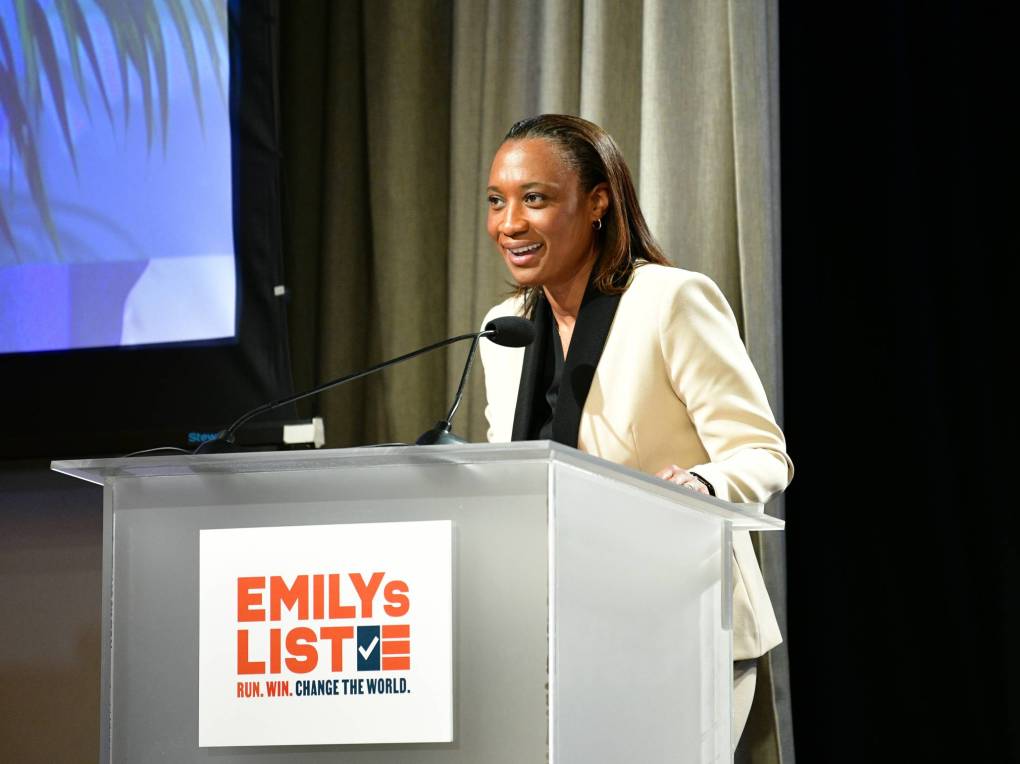
"caption": "EMILYs List President Laphonza Butler speaks onstage during EMILYs List's 2023 Pre-Oscars Breakfast at The Beverly Hilton on March 07, 2023 in Beverly Hills, California. (Photo by Araya Doheny/Getty Images for EMILYs List)",
"description": null,
"title": "EMILYs List's 2023 Pre-Oscars Breakfast",
"credit": null,
"status": "inherit",
"altTag": "Woman in a white suit standing at a lecturn",
"isLoading": false,
"fetchFailed": false
},
"news_11963118": {
"type": "attachments",
"id": "news_11963118",
"meta": {
"index": "attachments_1716263798",
"site": "news",
"id": "11963118",
"found": true
},
"parent": 11963061,
"imgSizes": {
"twentyfourteen-full-width": {
"file": "https://ww2.kqed.org/app/uploads/sites/10/2023/10/GettyImages-1532794346-1024x576.jpg",
"width": 1024,
"mimeType": "image/jpeg",
"height": 576
},
"thumbnail": {
"file": "https://ww2.kqed.org/app/uploads/sites/10/2023/10/GettyImages-1532794346-160x107.jpg",
"width": 160,
"mimeType": "image/jpeg",
"height": 107
},
"post-thumbnail": {
"file": "https://ww2.kqed.org/app/uploads/sites/10/2023/10/GettyImages-1532794346-672x372.jpg",
"width": 672,
"mimeType": "image/jpeg",
"height": 372
},
"kqedFullSize": {
"file": "https://ww2.kqed.org/app/uploads/sites/10/2023/10/GettyImages-1532794346.jpg",
"width": 1024,
"height": 683
},
"large": {
"file": "https://ww2.kqed.org/app/uploads/sites/10/2023/10/GettyImages-1532794346-1020x680.jpg",
"width": 1020,
"mimeType": "image/jpeg",
"height": 680
},
"medium": {
"file": "https://ww2.kqed.org/app/uploads/sites/10/2023/10/GettyImages-1532794346-800x534.jpg",
"width": 800,
"mimeType": "image/jpeg",
"height": 534
}
},
"publishDate": 1696267844,
"modified": 1696268246,
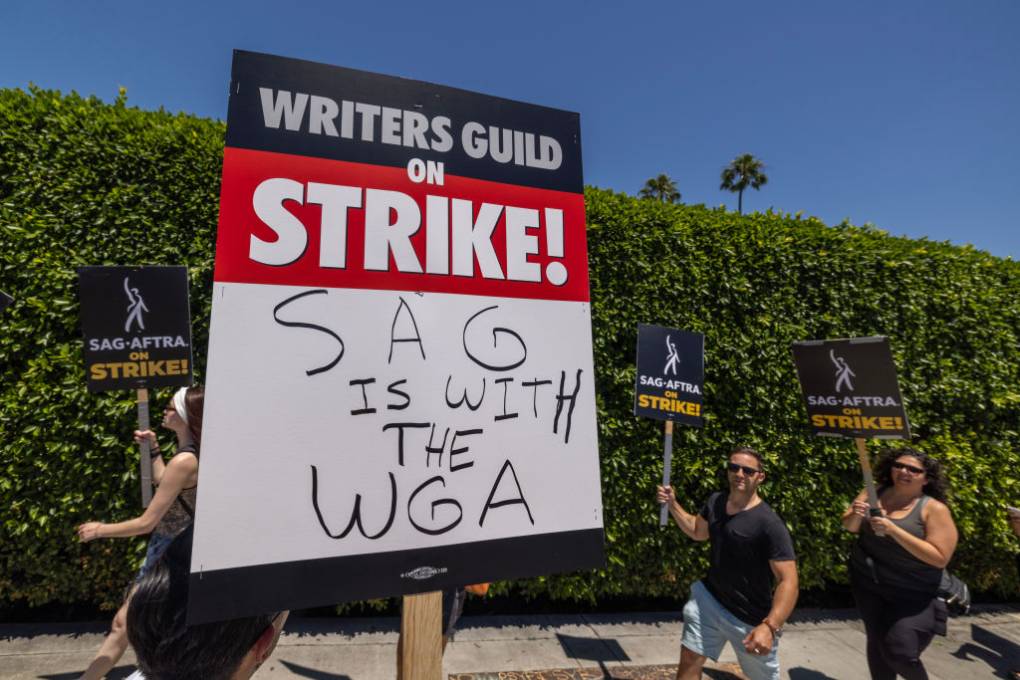
"caption": "Members of the Hollywood actors SAG-AFTRA union walk a picket line with screenwriters outside of Paramount Studios on Day 2 of the actors' strike on July 14, 2023 in Los Angeles. ",
"description": null,
"title": "SAG-AFTRA Actors Strike For First Time Since 1980 After Contract Negotiations Fail",
"credit": "David McNew/Getty Images",
"status": "inherit",
"altTag": "SAG-AFTRA on STRIKE sign with protestors in the back holding the same signs.",
"isLoading": false,
"fetchFailed": false
},
"news_11962881": {
"type": "attachments",
"id": "news_11962881",
"meta": {
"index": "attachments_1716263798",
"site": "news",
"id": "11962881",
"found": true
},
"parent": 11962877,
"imgSizes": {
"twentyfourteen-full-width": {
"file": "https://ww2.kqed.org/app/uploads/sites/10/2023/09/AP23272503321402-1024x576.jpg",
"width": 1024,
"mimeType": "image/jpeg",
"height": 576
},
"thumbnail": {
"file": "https://ww2.kqed.org/app/uploads/sites/10/2023/09/AP23272503321402-160x110.jpg",
"width": 160,
"mimeType": "image/jpeg",
"height": 110
},
"post-thumbnail": {
"file": "https://ww2.kqed.org/app/uploads/sites/10/2023/09/AP23272503321402-672x372.jpg",
"width": 672,
"mimeType": "image/jpeg",
"height": 372
},
"kqedFullSize": {
"file": "https://ww2.kqed.org/app/uploads/sites/10/2023/09/AP23272503321402.jpg",
"width": 1024,
"height": 707
},
"large": {
"file": "https://ww2.kqed.org/app/uploads/sites/10/2023/09/AP23272503321402-1020x704.jpg",
"width": 1020,
"mimeType": "image/jpeg",
"height": 704
},
"medium": {
"file": "https://ww2.kqed.org/app/uploads/sites/10/2023/09/AP23272503321402-800x552.jpg",
"width": 800,
"mimeType": "image/jpeg",
"height": 552
}
},
"publishDate": 1696013016,
"modified": 1696013914,
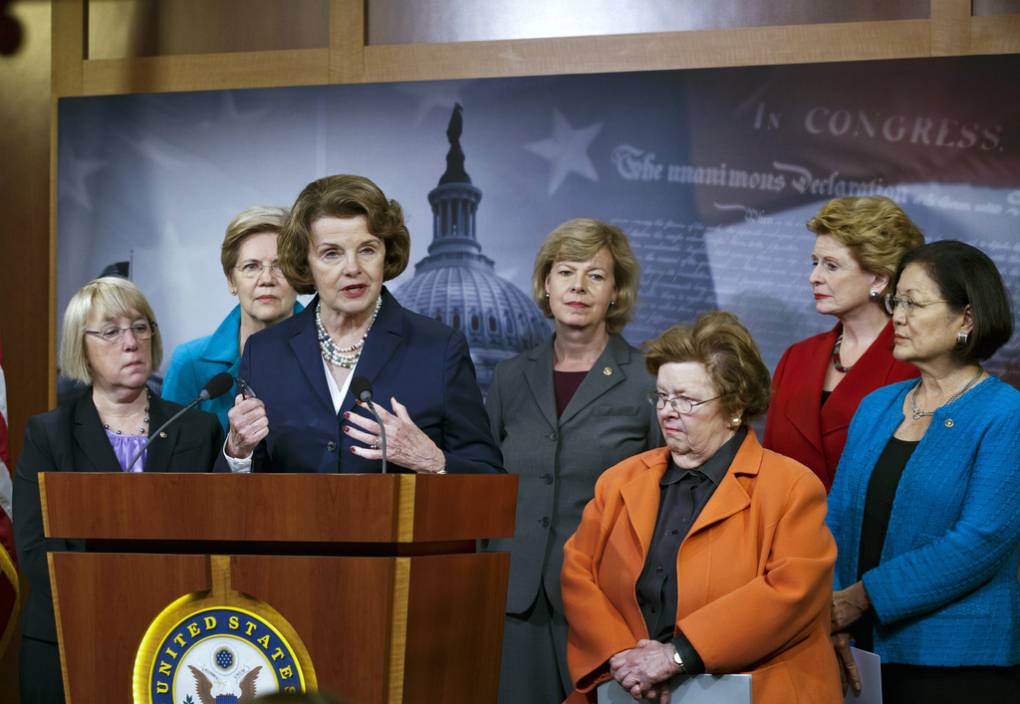
"caption": "California Democratic Sen. Dianne Feinstein, and a group of women senators gather at a news conference on Capitol Hill on June 4, 2014. From left are, Sen. Patty Murray (D-Wash.) Sen. Elizabeth Warren (D-Mass.) Feinstein, Sen. Tammy Baldwin (D-Wis.), Sen. Barbara A. Mikulski, (D-Md.), Sen. Mazie K. Hirono (D-Hawaii). Feinstein died Thursday night, at the age of 90.",
"description": null,
"title": "Obit Feinstein",
"credit": "J. Scott Applewhite/AP",
"status": "inherit",
"altTag": "Sen. Dianne Feinstein stands at a podium, surrounded by other female senators.",
"isLoading": false,
"fetchFailed": false
},
"news_11962740": {
"type": "attachments",
"id": "news_11962740",
"meta": {
"index": "attachments_1716263798",
"site": "news",
"id": "11962740",
"found": true
},
"parent": 11962737,
"imgSizes": {
"twentyfourteen-full-width": {
"file": "https://ww2.kqed.org/app/uploads/sites/10/2023/09/AP23271646868071-1038x576.jpg",
"width": 1038,
"mimeType": "image/jpeg",
"height": 576
},
"thumbnail": {
"file": "https://ww2.kqed.org/app/uploads/sites/10/2023/09/AP23271646868071-160x107.jpg",
"width": 160,
"mimeType": "image/jpeg",
"height": 107
},
"post-thumbnail": {
"file": "https://ww2.kqed.org/app/uploads/sites/10/2023/09/AP23271646868071-672x372.jpg",
"width": 672,
"mimeType": "image/jpeg",
"height": 372
},
"kqedFullSize": {
"file": "https://ww2.kqed.org/app/uploads/sites/10/2023/09/AP23271646868071.jpg",
"width": 1920,
"height": 1280
},
"large": {
"file": "https://ww2.kqed.org/app/uploads/sites/10/2023/09/AP23271646868071-1020x680.jpg",
"width": 1020,
"mimeType": "image/jpeg",
"height": 680
},
"1536x1536": {
"file": "https://ww2.kqed.org/app/uploads/sites/10/2023/09/AP23271646868071-1536x1024.jpg",
"width": 1536,
"mimeType": "image/jpeg",
"height": 1024
},
"medium": {
"file": "https://ww2.kqed.org/app/uploads/sites/10/2023/09/AP23271646868071-800x533.jpg",
"width": 800,
"mimeType": "image/jpeg",
"height": 533
}
},
"publishDate": 1695926348,
"modified": 1695938253,
"caption": "Gov. Gavin Newsom signs the fast food bill surrounded by fast food workers at the SEIU Local 721 in Los Angeles, on Thursday, Sept. 28, 2023. Anneisha Williams, right, who works at a Jack in the Box restaurant in Southern California celebrates as she holds up the bill. ",
"description": null,
"title": "AP23271646868071",
"credit": "Damian Dovarganes/The Associated Press",
"status": "inherit",
"altTag": "A white man wearing a suit holds a piece of paper at a podium and is surrounded by people cheering and clapping.",
"isLoading": false,
"fetchFailed": false
},
"news_11962623": {
"type": "attachments",
"id": "news_11962623",
"meta": {
"index": "attachments_1716263798",
"site": "news",
"id": "11962623",
"found": true
},
"parent": 0,
"imgSizes": {
"twentyfourteen-full-width": {
"file": "https://ww2.kqed.org/app/uploads/sites/10/2023/09/230927-CHINO-TRANSGENDER-SCHOOL-BOARD-Getty-DM-KQED-1038x576.jpg",
"width": 1038,
"mimeType": "image/jpeg",
"height": 576
},
"thumbnail": {
"file": "https://ww2.kqed.org/app/uploads/sites/10/2023/09/230927-CHINO-TRANSGENDER-SCHOOL-BOARD-Getty-DM-KQED-160x107.jpg",
"width": 160,
"mimeType": "image/jpeg",
"height": 107
},
"post-thumbnail": {
"file": "https://ww2.kqed.org/app/uploads/sites/10/2023/09/230927-CHINO-TRANSGENDER-SCHOOL-BOARD-Getty-DM-KQED-672x372.jpg",
"width": 672,
"mimeType": "image/jpeg",
"height": 372
},
"kqedFullSize": {
"file": "https://ww2.kqed.org/app/uploads/sites/10/2023/09/230927-CHINO-TRANSGENDER-SCHOOL-BOARD-Getty-DM-KQED.jpg",
"width": 2000,
"height": 1334
},
"large": {
"file": "https://ww2.kqed.org/app/uploads/sites/10/2023/09/230927-CHINO-TRANSGENDER-SCHOOL-BOARD-Getty-DM-KQED-1020x680.jpg",
"width": 1020,
"mimeType": "image/jpeg",
"height": 680
},
"1536x1536": {
"file": "https://ww2.kqed.org/app/uploads/sites/10/2023/09/230927-CHINO-TRANSGENDER-SCHOOL-BOARD-Getty-DM-KQED-1536x1025.jpg",
"width": 1536,
"mimeType": "image/jpeg",
"height": 1025
},
"full-width": {
"file": "https://ww2.kqed.org/app/uploads/sites/10/2023/09/230927-CHINO-TRANSGENDER-SCHOOL-BOARD-Getty-DM-KQED-1920x1281.jpg",
"width": 1920,
"mimeType": "image/jpeg",
"height": 1281
},
"medium": {
"file": "https://ww2.kqed.org/app/uploads/sites/10/2023/09/230927-CHINO-TRANSGENDER-SCHOOL-BOARD-Getty-DM-KQED-800x534.jpg",
"width": 800,
"mimeType": "image/jpeg",
"height": 534
}
},
"publishDate": 1695850696,
"modified": 1695853730,
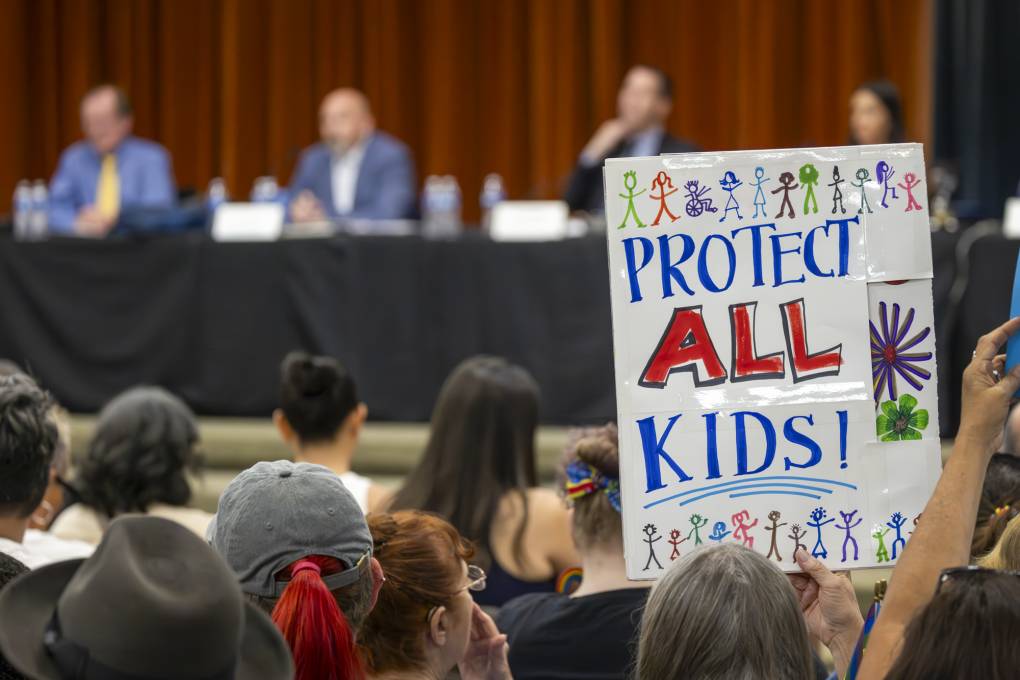
"caption": "A person holds a sign in opposition to a policy that the Chino Valley school board is meeting to vote on which would require school staff to 'out' students to their parents if they ask to be identified by a gender that is not listed on their birth certificate, in Chino, San Bernardino County, on July 20, 2023.",
"description": null,
"title": "Chino Valley School Board Votes On Student Transgender Policy",
"credit": "David McNew/Getty Images",
"status": "inherit",
"altTag": "A person holds a sign above their head that reads \"protect all kids\" in a crowded indoor space.",
"isLoading": false,
"fetchFailed": false
},
"news_11936510": {
"type": "attachments",
"id": "news_11936510",
"meta": {
"index": "attachments_1716263798",
"site": "news",
"id": "11936510",
"found": true
},
"parent": 11936507,
"imgSizes": {
"twentyfourteen-full-width": {
"file": "https://ww2.kqed.org/app/uploads/sites/10/2022/12/GettyImages-1360489934-1024x576.jpg",
"width": 1024,
"mimeType": "image/jpeg",
"height": 576
},
"thumbnail": {
"file": "https://ww2.kqed.org/app/uploads/sites/10/2022/12/GettyImages-1360489934-160x109.jpg",
"width": 160,
"mimeType": "image/jpeg",
"height": 109
},
"post-thumbnail": {
"file": "https://ww2.kqed.org/app/uploads/sites/10/2022/12/GettyImages-1360489934-672x372.jpg",
"width": 672,
"mimeType": "image/jpeg",
"height": 372
},
"kqedFullSize": {
"file": "https://ww2.kqed.org/app/uploads/sites/10/2022/12/GettyImages-1360489934.jpg",
"width": 1024,
"height": 697
},
"large": {
"file": "https://ww2.kqed.org/app/uploads/sites/10/2022/12/GettyImages-1360489934-1020x694.jpg",
"width": 1020,
"mimeType": "image/jpeg",
"height": 694
},
"medium": {
"file": "https://ww2.kqed.org/app/uploads/sites/10/2022/12/GettyImages-1360489934-800x545.jpg",
"width": 800,
"mimeType": "image/jpeg",
"height": 545
}
},
"publishDate": 1672428513,
"modified": 1673036687,
"caption": "Gov. Gavin Newsom speaks during a press conference in Oakland, on Dec. 22, 2021.",
"description": null,
"title": "Gov. Gavin Newsom Covid-19 Testing",
"credit": "Jane Tyska/Digital First Media/East Bay Times via Getty Images",
"status": "inherit",
"altTag": "A white man in a suit and tie explains something toward the camera.",
"isLoading": false,
"fetchFailed": false
},
"news_11962548": {
"type": "attachments",
"id": "news_11962548",
"meta": {
"index": "attachments_1716263798",
"site": "news",
"id": "11962548",
"found": true
},
"title": "Gavin Newsom, Jesse Gabriel",
"publishDate": 1695834959,
"status": "inherit",
"parent": 11962545,
"modified": 1783030523,
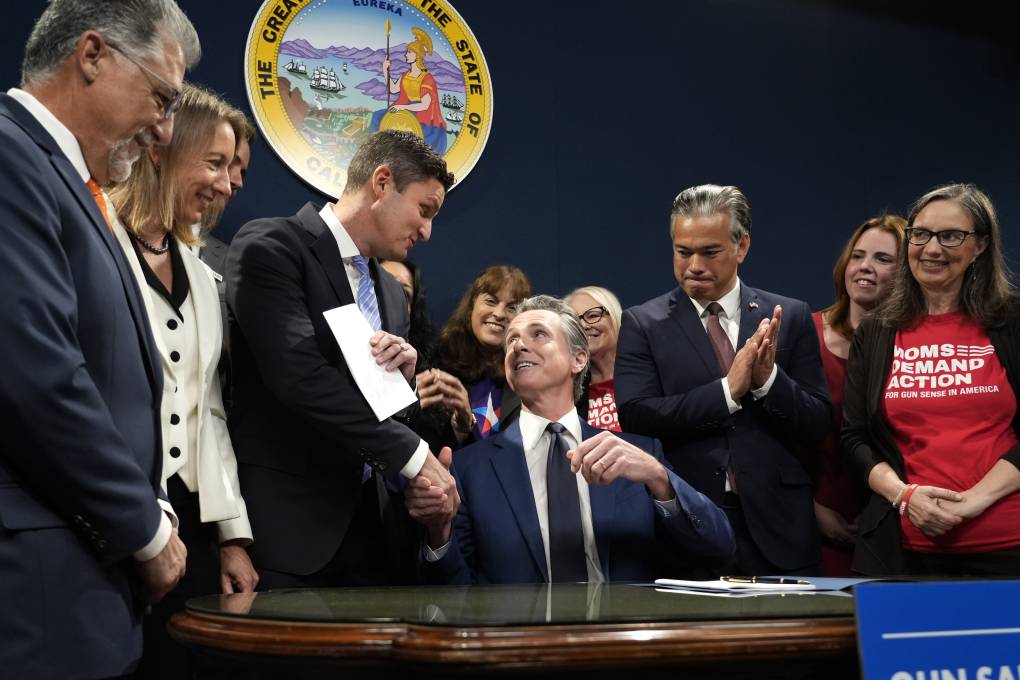
"caption": "Gov. Gavin Newsom shakes hands with Assemblymember Jesse Gabriel (D-Los Angeles County), 3rd from left, after signing Gabriel's bill that raises taxes on guns and ammunition, during a news conference in Sacramento on Sept. 26, 2023. ",
"credit": "Rich Pedroncelli/The Associated Press",
"altTag": "People dressed in business suits and dresses stand around a man in a business suit who looks up at a man to shake his hand.",
"description": null,
"imgSizes": {
"medium": {
"file": "https://cdn.kqed.org/wp-content/uploads/sites/10/2023/09/AP23269726479806-800x533.jpg",
"width": 800,
"height": 533,
"mimeType": "image/jpeg"
},
"large": {
"file": "https://cdn.kqed.org/wp-content/uploads/sites/10/2023/09/AP23269726479806-1020x680.jpg",
"width": 1020,
"height": 680,
"mimeType": "image/jpeg"
},
"thumbnail": {
"file": "https://cdn.kqed.org/wp-content/uploads/sites/10/2023/09/AP23269726479806-160x107.jpg",
"width": 160,
"height": 107,
"mimeType": "image/jpeg"
},
"1536x1536": {
"file": "https://cdn.kqed.org/wp-content/uploads/sites/10/2023/09/AP23269726479806-1536x1024.jpg",
"width": 1536,
"height": 1024,
"mimeType": "image/jpeg"
},
"2048x2048": {
"file": "https://cdn.kqed.org/wp-content/uploads/sites/10/2023/09/AP23269726479806-2048x1365.jpg",
"width": 2048,
"height": 1365,
"mimeType": "image/jpeg"
},
"post-thumbnail": {
"file": "https://cdn.kqed.org/wp-content/uploads/sites/10/2023/09/AP23269726479806-672x372.jpg",
"width": 672,
"height": 372,
"mimeType": "image/jpeg"
},
"twentyfourteen-full-width": {
"file": "https://cdn.kqed.org/wp-content/uploads/sites/10/2023/09/AP23269726479806-1038x576.jpg",
"width": 1038,
"height": 576,
"mimeType": "image/jpeg"
},
"full-width": {
"file": "https://cdn.kqed.org/wp-content/uploads/sites/10/2023/09/AP23269726479806-1920x1280.jpg",
"width": 1920,
"height": 1280,
"mimeType": "image/jpeg"
},
"kqedFullSize": {
"file": "https://cdn.kqed.org/wp-content/uploads/sites/10/2023/09/AP23269726479806-scaled-e1783030536835.jpg",
"width": 2000,
"height": 1334
}
},
"isLoading": false,
"fetchFailed": false
},
"news_11962465": {
"type": "attachments",
"id": "news_11962465",
"meta": {
"index": "attachments_1716263798",
"site": "news",
"id": "11962465",
"found": true
},
"parent": 11962463,
"imgSizes": {
"twentyfourteen-full-width": {
"file": "https://ww2.kqed.org/app/uploads/sites/10/2023/09/AP23269099212242-1038x576.jpg",
"width": 1038,
"mimeType": "image/jpeg",
"height": 576
},
"thumbnail": {
"file": "https://ww2.kqed.org/app/uploads/sites/10/2023/09/AP23269099212242-160x107.jpg",
"width": 160,
"mimeType": "image/jpeg",
"height": 107
},
"post-thumbnail": {
"file": "https://ww2.kqed.org/app/uploads/sites/10/2023/09/AP23269099212242-672x372.jpg",
"width": 672,
"mimeType": "image/jpeg",
"height": 372
},
"kqedFullSize": {
"file": "https://ww2.kqed.org/app/uploads/sites/10/2023/09/AP23269099212242-scaled.jpg",
"width": 2560,
"height": 1707
},
"2048x2048": {
"file": "https://ww2.kqed.org/app/uploads/sites/10/2023/09/AP23269099212242-2048x1366.jpg",
"width": 2048,
"mimeType": "image/jpeg",
"height": 1366
},
"large": {
"file": "https://ww2.kqed.org/app/uploads/sites/10/2023/09/AP23269099212242-1020x680.jpg",
"width": 1020,
"mimeType": "image/jpeg",
"height": 680
},
"1536x1536": {
"file": "https://ww2.kqed.org/app/uploads/sites/10/2023/09/AP23269099212242-1536x1024.jpg",
"width": 1536,
"mimeType": "image/jpeg",
"height": 1024
},
"full-width": {
"file": "https://ww2.kqed.org/app/uploads/sites/10/2023/09/AP23269099212242-1920x1280.jpg",
"width": 1920,
"mimeType": "image/jpeg",
"height": 1280
},
"medium": {
"file": "https://ww2.kqed.org/app/uploads/sites/10/2023/09/AP23269099212242-800x533.jpg",
"width": 800,
"mimeType": "image/jpeg",
"height": 533
}
},
"publishDate": 1695752097,
"modified": 1695752204,
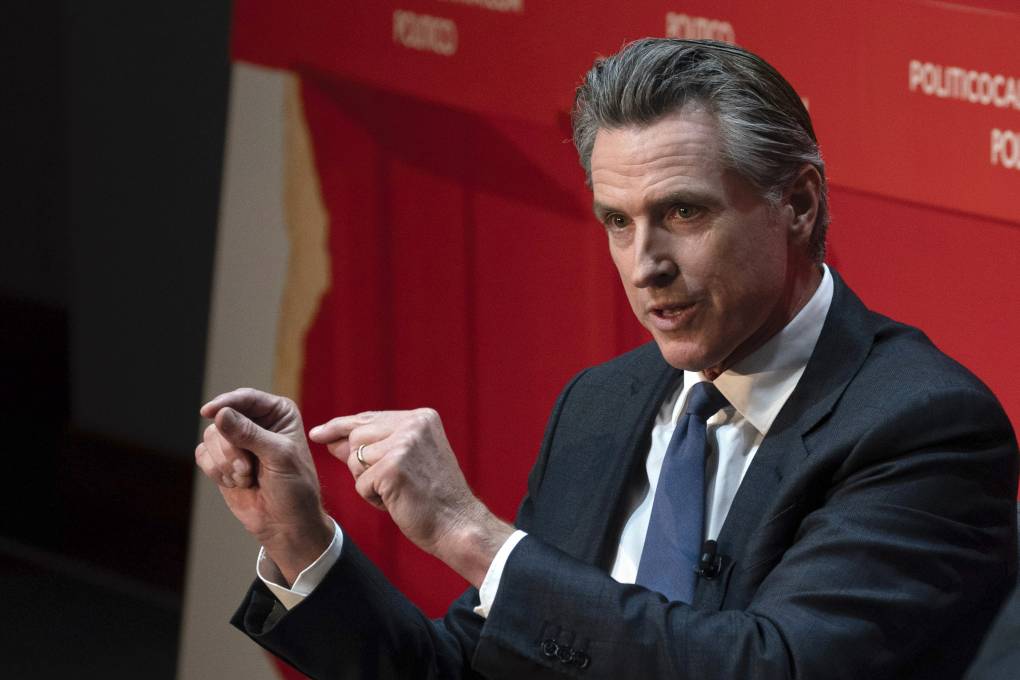
"caption": "Gov. Gavin Newsom speaks during an interview in Sacramento on Tuesday, Sept. 12, 2023. ",
"description": null,
"title": "California Book Ban Law",
"credit": "Rich Pedroncelli/The Associated Press",
"status": "inherit",
"altTag": "A photo of a white man in a business suit gesturing with both his hands.",
"isLoading": false,
"fetchFailed": false
},
"news_11917005": {
"type": "attachments",
"id": "news_11917005",
"meta": {
"index": "attachments_1716263798",
"site": "news",
"id": "11917005",
"found": true
},
"parent": 11916962,
"imgSizes": {
"twentyfourteen-full-width": {
"file": "https://ww2.kqed.org/app/uploads/sites/10/2022/06/GettyImages-1172021652-1024x576.jpg",
"width": 1024,
"mimeType": "image/jpeg",
"height": 576
},
"thumbnail": {
"file": "https://ww2.kqed.org/app/uploads/sites/10/2022/06/GettyImages-1172021652-160x107.jpg",
"width": 160,
"mimeType": "image/jpeg",
"height": 107
},
"post-thumbnail": {
"file": "https://ww2.kqed.org/app/uploads/sites/10/2022/06/GettyImages-1172021652-672x372.jpg",
"width": 672,
"mimeType": "image/jpeg",
"height": 372
},
"kqedFullSize": {
"file": "https://ww2.kqed.org/app/uploads/sites/10/2022/06/GettyImages-1172021652.jpg",
"width": 1024,
"height": 683
},
"large": {
"file": "https://ww2.kqed.org/app/uploads/sites/10/2022/06/GettyImages-1172021652-1020x680.jpg",
"width": 1020,
"mimeType": "image/jpeg",
"height": 680
},
"medium": {
"file": "https://ww2.kqed.org/app/uploads/sites/10/2022/06/GettyImages-1172021652-800x534.jpg",
"width": 800,
"mimeType": "image/jpeg",
"height": 534
}
},
"publishDate": 1655154480,
"modified": 1695573222,
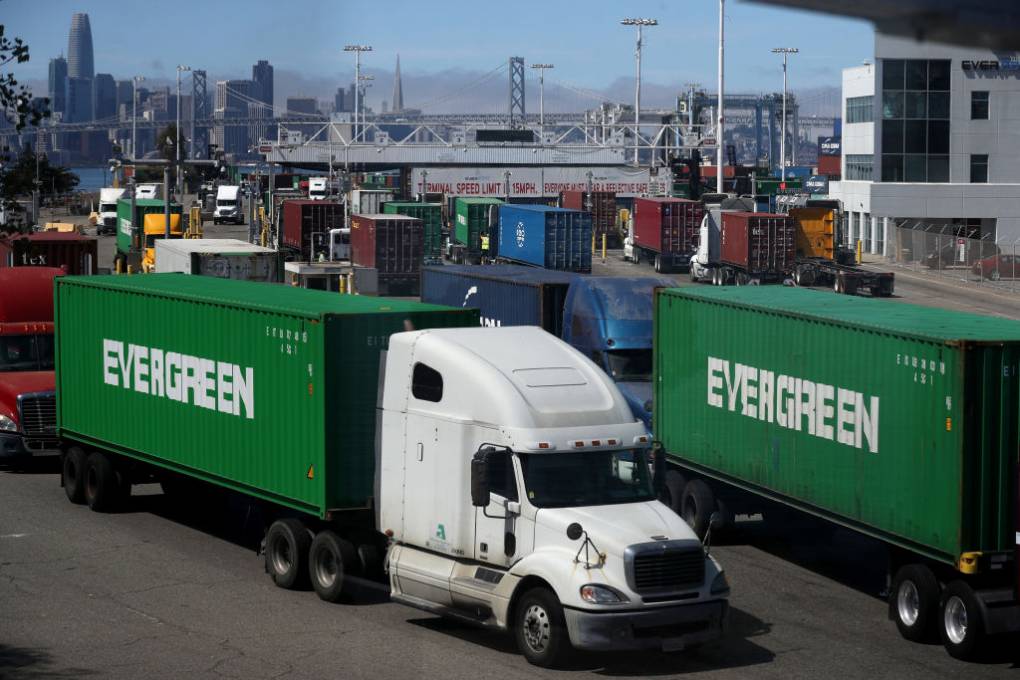
"caption": "Trucks move containers in and out of the Ben E. Nutter terminal at the Port of Oakland on Sept. 3, 2019, in Oakland. ",
"description": null,
"title": "Markets Drop As U.S. And China Impose New Tariffs",
"credit": "Justin Sullivan/Getty Images",
"status": "inherit",
"altTag": "Two bright green containers on flatbed trucks (the white cab of one truck is visible), with lettering on the side that says \"Evergreen\" in white, sit in a shipping yard. Around them are many other flatbeds, carrying mostly blue or red containers. In the distance, on the left, you can see a sliver of the San Francisco Bay; the Bay Bridge crosses the entire frame, and beyond that is the SF skyline, including the Salesforce and Transamerica towers.",
"isLoading": false,
"fetchFailed": false
},
"news_11962109": {
"type": "attachments",
"id": "news_11962109",
"meta": {
"index": "attachments_1716263798",
"site": "news",
"id": "11962109",
"found": true
},
"parent": 11962107,
"imgSizes": {
"twentyfourteen-full-width": {
"file": "https://ww2.kqed.org/app/uploads/sites/10/2023/09/AP23264825691516-1038x576.jpg",
"width": 1038,
"mimeType": "image/jpeg",
"height": 576
},
"thumbnail": {
"file": "https://ww2.kqed.org/app/uploads/sites/10/2023/09/AP23264825691516-160x107.jpg",
"width": 160,
"mimeType": "image/jpeg",
"height": 107
},
"post-thumbnail": {
"file": "https://ww2.kqed.org/app/uploads/sites/10/2023/09/AP23264825691516-672x372.jpg",
"width": 672,
"mimeType": "image/jpeg",
"height": 372
},
"kqedFullSize": {
"file": "https://ww2.kqed.org/app/uploads/sites/10/2023/09/AP23264825691516-scaled.jpg",
"width": 2560,
"height": 1707
},
"2048x2048": {
"file": "https://ww2.kqed.org/app/uploads/sites/10/2023/09/AP23264825691516-2048x1366.jpg",
"width": 2048,
"mimeType": "image/jpeg",
"height": 1366
},
"large": {
"file": "https://ww2.kqed.org/app/uploads/sites/10/2023/09/AP23264825691516-1020x680.jpg",
"width": 1020,
"mimeType": "image/jpeg",
"height": 680
},
"1536x1536": {
"file": "https://ww2.kqed.org/app/uploads/sites/10/2023/09/AP23264825691516-1536x1024.jpg",
"width": 1536,
"mimeType": "image/jpeg",
"height": 1024
},
"full-width": {
"file": "https://ww2.kqed.org/app/uploads/sites/10/2023/09/AP23264825691516-1920x1280.jpg",
"width": 1920,
"mimeType": "image/jpeg",
"height": 1280
},
"medium": {
"file": "https://ww2.kqed.org/app/uploads/sites/10/2023/09/AP23264825691516-800x533.jpg",
"width": 800,
"mimeType": "image/jpeg",
"height": 533
}
},
"publishDate": 1695338102,
"modified": 1695342225,
"caption": "California Insurance Commissioner Ricardo Lara announced a new plan on Sept. 21, 2023 aimed at keeping insurance companies from leaving the wildfire-prone state. ",
"description": null,
"title": "Ricardo Lara",
"credit": "Adam Beam/AP Photo",
"status": "inherit",
"altTag": "a man in a suit stands at a lectern in front of a sign that says 'California's sustainable insurance strategy'",
"isLoading": false,
"fetchFailed": false
},
"news_11961552": {
"type": "attachments",
"id": "news_11961552",
"meta": {
"index": "attachments_1716263798",
"site": "news",
"id": "11961552",
"found": true
},
"parent": 11961542,
"imgSizes": {
"twentyfourteen-full-width": {
"file": "https://ww2.kqed.org/app/uploads/sites/10/2023/09/GettyImages-1321841890-1024x576.jpg",
"width": 1024,
"mimeType": "image/jpeg",
"height": 576
},
"thumbnail": {
"file": "https://ww2.kqed.org/app/uploads/sites/10/2023/09/GettyImages-1321841890-160x107.jpg",
"width": 160,
"mimeType": "image/jpeg",
"height": 107
},
"post-thumbnail": {
"file": "https://ww2.kqed.org/app/uploads/sites/10/2023/09/GettyImages-1321841890-672x372.jpg",
"width": 672,
"mimeType": "image/jpeg",
"height": 372
},
"kqedFullSize": {
"file": "https://ww2.kqed.org/app/uploads/sites/10/2023/09/GettyImages-1321841890.jpg",
"width": 1024,
"height": 683
},
"large": {
"file": "https://ww2.kqed.org/app/uploads/sites/10/2023/09/GettyImages-1321841890-1020x680.jpg",
"width": 1020,
"mimeType": "image/jpeg",
"height": 680
},
"medium": {
"file": "https://ww2.kqed.org/app/uploads/sites/10/2023/09/GettyImages-1321841890-800x534.jpg",
"width": 800,
"mimeType": "image/jpeg",
"height": 534
}
},
"publishDate": 1694906000,
"modified": 1695063479,
"caption": "The Shell oil refinery in Martinez, as seen on June 20, 2017.",
"description": null,
"title": "The Shell refinery in Martinez, Ca., as seen on Tuesday June 20, 2017. The Bay Area Air Quality Management District on Wednesday is expected to approve the nation's first limits on greenhouse gas emissions from oil refineries.",
"credit": "Michael Macor/The San Francisco Chronicle via Getty Images",
"status": "inherit",
"altTag": "Oil refinery seen across a body of water.",
"isLoading": false,
"fetchFailed": false
},
"news_11961523": {
"type": "attachments",
"id": "news_11961523",
"meta": {
"index": "attachments_1716263798",
"site": "news",
"id": "11961523",
"found": true
},
"title": "California State Capital",
"publishDate": 1694885522,
"status": "inherit",
"parent": 11961519,
"modified": 1694885652,
"caption": "The California State Capitol in Sacramento.",
"credit": "iStock/Getty Images Plus",
"altTag": "The California state flag with the Capitol cupola in Sacramento behind it.",
"description": null,
"imgSizes": {
"medium": {
"file": "https://cdn.kqed.org/wp-content/uploads/sites/10/2023/09/GettyImages-186653928-800x533.jpg",
"width": 800,
"height": 533,
"mimeType": "image/jpeg"
},
"large": {
"file": "https://cdn.kqed.org/wp-content/uploads/sites/10/2023/09/GettyImages-186653928-1020x680.jpg",
"width": 1020,
"height": 680,
"mimeType": "image/jpeg"
},
"thumbnail": {
"file": "https://cdn.kqed.org/wp-content/uploads/sites/10/2023/09/GettyImages-186653928-160x107.jpg",
"width": 160,
"height": 107,
"mimeType": "image/jpeg"
},
"1536x1536": {
"file": "https://cdn.kqed.org/wp-content/uploads/sites/10/2023/09/GettyImages-186653928-1536x1024.jpg",
"width": 1536,
"height": 1024,
"mimeType": "image/jpeg"
},
"2048x2048": {
"file": "https://cdn.kqed.org/wp-content/uploads/sites/10/2023/09/GettyImages-186653928-2048x1365.jpg",
"width": 2048,
"height": 1365,
"mimeType": "image/jpeg"
},
"post-thumbnail": {
"file": "https://cdn.kqed.org/wp-content/uploads/sites/10/2023/09/GettyImages-186653928-672x372.jpg",
"width": 672,
"height": 372,
"mimeType": "image/jpeg"
},
"twentyfourteen-full-width": {
"file": "https://cdn.kqed.org/wp-content/uploads/sites/10/2023/09/GettyImages-186653928-1038x576.jpg",
"width": 1038,
"height": 576,
"mimeType": "image/jpeg"
},
"full-width": {
"file": "https://cdn.kqed.org/wp-content/uploads/sites/10/2023/09/GettyImages-186653928-1920x1280.jpg",
"width": 1920,
"height": 1280,
"mimeType": "image/jpeg"
},
"kqedFullSize": {
"file": "https://cdn.kqed.org/wp-content/uploads/sites/10/2023/09/GettyImages-186653928-e1737496719981.jpg",
"width": 2000,
"height": 1333
}
},
"isLoading": false,
"fetchFailed": false
}
},
"audioPlayerReducer": {
"postId": "stream_live",
"isPaused": true,
"isPlaying": false,
"pfsActive": false,
"pledgeModalIsOpen": true,
"playerDrawerIsOpen": false,
"liveAudioPlayStartedAt": 0,
"liveAudioPlayContext": ""
},
"authorsReducer": {
"byline_news_11963061": {
"type": "authors",
"id": "byline_news_11963061",
"meta": {
"override": true
},
"slug": "byline_news_11963061",
"name": "Adam Beam\u003cbr>The Associated Press",
"isLoading": false
},
"byline_news_11962877": {
"type": "authors",
"id": "byline_news_11962877",
"meta": {
"override": true
},
"slug": "byline_news_11962877",
"name": "Michelle L. Price\u003cbr>The Associated Press",
"isLoading": false
},
"byline_news_11962674": {
"type": "authors",
"id": "byline_news_11962674",
"meta": {
"override": true
},
"slug": "byline_news_11962674",
"name": "Adam Beam \u003cbr> The Associated Press",
"isLoading": false
},
"byline_news_11962545": {
"type": "authors",
"id": "byline_news_11962545",
"meta": {
"override": true
},
"slug": "byline_news_11962545",
"name": "Adam Beam\u003cbr>The Associated Press",
"isLoading": false
},
"byline_news_11962463": {
"type": "authors",
"id": "byline_news_11962463",
"meta": {
"override": true
},
"slug": "byline_news_11962463",
"name": "Sophie Austin\u003cbr>The Associated Press\u003c/br>",
"isLoading": false
},
"byline_news_11962285": {
"type": "authors",
"id": "byline_news_11962285",
"meta": {
"override": true
},
"slug": "byline_news_11962285",
"name": "The Associated Press",
"isLoading": false
},
"byline_news_11961519": {
"type": "authors",
"id": "byline_news_11961519",
"meta": {
"override": true
},
"slug": "byline_news_11961519",
"name": "Adam Beam, Sophie Austin\u003cbr>The Associated Press",
"isLoading": false
},
"gmarzorati": {
"type": "authors",
"id": "227",
"meta": {
"index": "authors_1716337520",
"id": "227",
"found": true
},
"name": "Guy Marzorati",
"firstName": "Guy",
"lastName": "Marzorati",
"slug": "gmarzorati",
"email": "gmarzorati@KQED.org",
"display_author_email": true,
"staff_mastheads": [
"news"
],
"title": "Correspondent",
"bio": "Guy Marzorati is a correspondent on KQED's California Politics and Government Desk, based in San Jose. A graduate of Santa Clara University, Guy joined KQED in 2013. He reports on state and local politics and produces KQED's digital voter guide.",
"avatar": "https://secure.gravatar.com/avatar/e7038b8dbfd55b104369b76b1cd0b9de?s=600&d=blank&r=g",
"twitter": "guymarzorati",
"facebook": null,
"instagram": null,
"linkedin": null,
"sites": [
{
"site": "",
"roles": [
"editor"
]
},
{
"site": "news",
"roles": [
"editor"
]
},
{
"site": "science",
"roles": [
"editor"
]
},
{
"site": "forum",
"roles": [
"editor"
]
},
{
"site": "elections",
"roles": [
"editor"
]
},
{
"site": "liveblog",
"roles": [
"editor"
]
}
],
"headData": {
"title": "Guy Marzorati | KQED",
"description": "Correspondent",
"ogImgSrc": "https://secure.gravatar.com/avatar/e7038b8dbfd55b104369b76b1cd0b9de?s=600&d=blank&r=g",
"twImgSrc": "https://secure.gravatar.com/avatar/e7038b8dbfd55b104369b76b1cd0b9de?s=600&d=blank&r=g"
},
"isLoading": false,
"link": "/author/gmarzorati"
},
"kqed": {
"type": "authors",
"id": "236",
"meta": {
"index": "authors_1716337520",
"id": "236",
"found": true
},
"name": "KQED News Staff",
"firstName": "KQED News Staff",
"lastName": null,
"slug": "kqed",
"email": "faq@kqed.org",
"display_author_email": false,
"staff_mastheads": [],
"title": null,
"bio": null,
"avatar": "https://secure.gravatar.com/avatar/ef0e801a68c4c54afa9180db14084167?s=600&d=blank&r=g",
"twitter": null,
"facebook": null,
"instagram": null,
"linkedin": null,
"sites": [
{
"site": "arts",
"roles": [
"contributor"
]
},
{
"site": "news",
"roles": [
"editor"
]
},
{
"site": "futureofyou",
"roles": [
"author"
]
}
],
"headData": {
"title": "KQED News Staff | KQED",
"description": null,
"ogImgSrc": "https://secure.gravatar.com/avatar/ef0e801a68c4c54afa9180db14084167?s=600&d=blank&r=g",
"twImgSrc": "https://secure.gravatar.com/avatar/ef0e801a68c4c54afa9180db14084167?s=600&d=blank&r=g"
},
"isLoading": false,
"link": "/author/kqed"
},
"mlagos": {
"type": "authors",
"id": "3239",
"meta": {
"index": "authors_1716337520",
"id": "3239",
"found": true
},
"name": "Marisa Lagos",
"firstName": "Marisa",
"lastName": "Lagos",
"slug": "mlagos",
"email": "mlagos@kqed.org",
"display_author_email": false,
"staff_mastheads": [
"news"
],
"title": "KQED Contributor",
"bio": "Marisa Lagos is a correspondent for KQED’s California Politics and Government Desk and co-hosts the award-winning show and podcast, Political Breakdown. At KQED, Lagos also conducts reporting, analysis and investigations into state, local and national politics for radio, TV, online and onstage. In 2022, she and co-host, Scott Shafer, moderated the only gubernatorial debate in California. In 2020, the \u003ci>Washington Post\u003c/i> named her one of the top political journalists in California; she was nominated for a Peabody and won several other awards for her work investigating the 2017 California wildfires. She has worked at the \u003ci>San Francisco Chronicle\u003c/i>, \u003ci>San Francisco Examiner\u003c/i> and \u003ci>Los Angeles Times\u003c/i>. A UC Santa Barbara graduate, she lives in San Francisco with her two sons and husband.",
"avatar": "https://secure.gravatar.com/avatar/a261a0d3696fc066871ef96b85b5e7d2?s=600&d=blank&r=g",
"twitter": "@mlagos",
"facebook": null,
"instagram": null,
"linkedin": null,
"sites": [
{
"site": "arts",
"roles": [
"author"
]
},
{
"site": "news",
"roles": [
"editor"
]
},
{
"site": "science",
"roles": [
"editor"
]
},
{
"site": "forum",
"roles": [
"author"
]
},
{
"site": "liveblog",
"roles": [
"author"
]
}
],
"headData": {
"title": "Marisa Lagos | KQED",
"description": "KQED Contributor",
"ogImgSrc": "https://secure.gravatar.com/avatar/a261a0d3696fc066871ef96b85b5e7d2?s=600&d=blank&r=g",
"twImgSrc": "https://secure.gravatar.com/avatar/a261a0d3696fc066871ef96b85b5e7d2?s=600&d=blank&r=g"
},
"isLoading": false,
"link": "/author/mlagos"
},
"fjhabvala": {
"type": "authors",
"id": "8659",
"meta": {
"index": "authors_1716337520",
"id": "8659",
"found": true
},
"name": "Farida Jhabvala Romero",
"firstName": "Farida",
"lastName": "Jhabvala Romero",
"slug": "fjhabvala",
"email": "fjhabvala@kqed.org",
"display_author_email": true,
"staff_mastheads": [
"news"
],
"title": "KQED Contributor",
"bio": "Farida Jhabvala Romero is a Labor Correspondent for KQED. She previously covered immigration. Farida was \u003ca href=\"https://www.ccnma.org/2022-most-influential-latina-journalists\">named\u003c/a> one of the 10 Most Influential Latina Journalists in California in 2022 by the California Chicano News Media Association. Her work has won awards from the Society of Professional Journalists (Northern California), as well as a national and regional Edward M. Murrow Award for the collaborative reporting projects “Dangerous Air” and “Graying California.” Before joining KQED, Farida worked as a producer at Radio Bilingüe, a national public radio network. Farida earned her master’s degree in journalism from Stanford University.",
"avatar": "https://secure.gravatar.com/avatar/f9f022d4e2609741874222a1e9d41f48fea74011aa7c615eef91d9a50c944ebe?s=600&d=blank&r=g",
"twitter": "FaridaJhabvala",
"bluesky": null,
"facebook": null,
"instagram": null,
"linkedin": "https://www.linkedin.com/in/faridajhabvala/",
"sites": [
{
"site": "news",
"roles": [
"editor"
]
},
{
"site": "stateofhealth",
"roles": [
"author"
]
},
{
"site": "liveblog",
"roles": [
"author"
]
}
],
"headData": {
"title": "Farida Jhabvala Romero | KQED",
"description": "KQED Contributor",
"ogImgSrc": "https://secure.gravatar.com/avatar/f9f022d4e2609741874222a1e9d41f48fea74011aa7c615eef91d9a50c944ebe?s=600&d=blank&r=g",
"twImgSrc": "https://secure.gravatar.com/avatar/f9f022d4e2609741874222a1e9d41f48fea74011aa7c615eef91d9a50c944ebe?s=600&d=blank&r=g"
},
"isLoading": false,
"link": "/author/fjhabvala"
},
"sjohnson": {
"type": "authors",
"id": "11840",
"meta": {
"index": "authors_1716337520",
"id": "11840",
"found": true
},
"name": "Sydney Johnson",
"firstName": "Sydney",
"lastName": "Johnson",
"slug": "sjohnson",
"email": "sjohnson@kqed.org",
"display_author_email": false,
"staff_mastheads": [
"news"
],
"title": "KQED Reporter",
"bio": "Sydney Johnson is a general assignment reporter at KQED. She previously reported on public health and city government at the San Francisco Examiner, and before that, she covered statewide education policy for EdSource. Her reporting has won multiple local, state and national awards. Sydney is a graduate of the University of California, Berkeley and lives in San Francisco.",
"avatar": "https://secure.gravatar.com/avatar/97855f2719b72ad6190b7c535fe642c8?s=600&d=blank&r=g",
"twitter": "sydneyfjohnson",
"facebook": null,
"instagram": null,
"linkedin": null,
"sites": [
{
"site": "news",
"roles": [
"editor"
]
}
],
"headData": {
"title": "Sydney Johnson | KQED",
"description": "KQED Reporter",
"ogImgSrc": "https://secure.gravatar.com/avatar/97855f2719b72ad6190b7c535fe642c8?s=600&d=blank&r=g",
"twImgSrc": "https://secure.gravatar.com/avatar/97855f2719b72ad6190b7c535fe642c8?s=600&d=blank&r=g"
},
"isLoading": false,
"link": "/author/sjohnson"
}
},
"pagesReducer": {
"news_tag_gavin-newsom": {
"type": "terms",
"id": "news_16",
"meta": {
"index": "terms_1716263798",
"site": "news",
"id": "16",
"score": 8.937016
},
"featImg": null,
"name": "Gavin Newsom",
"description": null,
"taxonomy": "tag",
"headData": {
"twImgId": null,
"twTitle": null,
"ogTitle": null,
"ogImgId": null,
"twDescription": null,
"description": null,
"title": "Gavin Newsom Archives | KQED News",
"ogDescription": null
},
"ttid": 16,
"slug": "gavin-newsom",
"isLoading": false,
"title": "Gavin Newsom",
"pageMeta": {
"site": "news",
"WpPageTemplate": "page-topic-editorial",
"currentPage": 36
},
"blocks": [
{
"blockName": "kqed/post-list",
"attrs": {
"layout": "cardArticle2",
"query": "posts/news?tag=gavin-newsom",
"seeMore": false,
"paginated": true,
"page": 36
}
},
{
"blockName": "kqed/ad"
}
]
}
},
"pfsSessionReducer": {},
"postsReducer": {
"stream_live": {
"type": "live",
"id": "stream_live",
"audioUrl": "https://streams.kqed.org/kqedradio",
"title": "Live Stream",
"excerpt": "Live Stream information currently unavailable.",
"link": "/radio",
"featImg": "",
"label": {
"name": "KQED Live",
"link": "/"
}
},
"stream_kqedNewscast": {
"type": "posts",
"id": "stream_kqedNewscast",
"audioUrl": "https://www.kqed.org/.stream/anon/radio/RDnews/newscast.mp3?_=1",
"title": "KQED Newscast",
"featImg": "",
"label": {
"name": "88.5 FM",
"link": "/"
}
},
"news_11963066": {
"type": "posts",
"id": "news_11963066",
"meta": {
"index": "posts_1716263798",
"site": "news",
"id": "11963066",
"score": null,
"sort": [
1696216692000
]
},
"guestAuthors": [],
"slug": "gov-newsom-names-laphonza-butler-to-dianne-feinsteins-senate-seat",
"title": "Gov. Newsom Names Laphonza Butler to Dianne Feinstein’s Senate Seat",
"publishDate": 1696216692,
"format": "standard",
"headTitle": "Gov. Newsom Names Laphonza Butler to Dianne Feinstein’s Senate Seat | KQED",
"labelTerm": {
"site": "news"
},
"content": "\u003cp>Longtime Democratic adviser and labor leader Laphonza Butler will be California’s next U.S. Senator, Gov. Gavin Newsom’s office confirmed late Sunday. She will become the second openly lesbian person to serve in the Senate and only the third Black woman.\u003c/p>\n\u003cp>Butler, currently president of the pro-choice women’s fundraising group EMILY’S List, will fill the seat left empty by Sen. \u003ca href=\"https://www.kqed.org/news/11946670/dianne-feinstein-californias-longest-serving-us-senator-dies-at-age-90\">Dianne Feinstein’s death\u003c/a> Thursday at the age of 90. She has advised Vice President Kamala Harris and former Secretary of State Hillary Clinton and has close ties to Newsom’s inner circle.[aside postID=news_11739580 hero='https://ww2.kqed.org/app/uploads/sites/10/2019/04/Butler.jpg']\u003c/p>\n\u003cp>“An advocate for women and girls, a second-generation fighter for working people, and a trusted adviser to Vice President Harris, Laphonza Butler represents the best of California, and she’ll represent us proudly in the United States Senate,” Newsom said in a written statement.\u003c/p>\n\u003cp>“As we mourn the enormous loss of Senator Feinstein, the very freedoms she fought for — reproductive freedom, equal protection, and safety from gun violence — have never been under greater assault. Laphonza will carry the baton left by Senator Feinstein, continue to break glass ceilings, and fight for all Californians in Washington D.C.”\u003c/p>\n\u003cp>Newsom’s choice of Butler just two days after the news of Feinstein’s death was made public lets him fulfill a promise he made to appoint a Black woman to the seat. It also could scramble the race already underway to fill the seat Feinstein had planned to vacate at the end of her term.\u003c/p>\n\u003cp>[ad fullwidth]\u003c/p>\n\u003cp>Allies of one of those candidates, Oakland Congresswoman Barbara Lee, had lobbied hard for her to nab the appointment. But Newsom said he didn’t want to put his thumb on the scale in a race between Lee, Orange County Congresswoman Katie Porter and Los Angeles Congressman Adam Schiff.\u003c/p>\n\u003cp>It was assumed that Newsom would ask an appointee not to run – but advisers to the governors said that he did not ask Butler to promise not to run. \u003cspan style=\"font-weight: 400\">In a statement Sunday night, Lee wished Butler well and said she remains “singularly focused on winning her campaign for Senate.”\u003c/span>\u003c/p>\n\u003cp>https://twitter.com/BarbaraLeeForCA/status/1708708221870014894\u003c/p>\n\u003cp>Butler is a Democratic powerhouse with progressive credentials who worked for years at the labor union SEIU. She also advised Hillary Clinton’s 2016 presidential campaign and for a time was a partner at Bearstar Strategies, Newsom’s top political consulting firm. Still, it could be tough to mount a senate campaign with just five months left before the primary election.\u003c/p>\n\u003ch2>Trauma in Childhood\u003c/h2>\n\u003cp>Butler was born in Magnolia, Miss., the youngest of three children. Her father battled heart disease and died when she was a teenager. Butler told \u003ca href=\"https://www.kqed.org/news/11739580/laphonza-butler-on-her-move-from-labor-leadership-to-the-harris-campaign\">KQED’s Political Breakdown\u003c/a> that her mother worked multiple jobs to keep the family afloat, in addition to caring for her father.\u003c/p>\n\u003cp>“My life was really lived through the eyes of a caregiver,” Butler said. “My mother was my father’s caregiver in the last years of his life, and having to understand what families everyday go through when it comes to issues like health care…really was the precursor to my professional career.”\u003c/p>\n\u003cp>That career took off in California. She arrived in the state in 2009, working as an organizer for long-term care workers with SEIU.\u003c/p>\n\u003ch2>Labor Leadership\u003c/h2>\n\u003cp>Butler quickly rose to leadership of the caregivers union and in 2013 was elected head of SEIU California, the state’s largest union, representing more than 700,000 workers.\u003c/p>\n\u003cp>In that position Butler led SEIU’s push to raise California’s minimum wage to $15 an hour, the result of high-stakes negotiations between Butler and Gov. Jerry Brown’s chief of staff Nancy McFadden.\u003c/p>\n\u003cp>“We were both working for the people of California,” Butler remembered in the Political Breakdown interview. “She represented way more than I did. But we all came into rooms of tension and disagreement and negotiation with Californians in mind and the best for Californians.”\u003c/p>\n\u003cp>Newsom’s choice of Butler earned the praise of Aimee Allison, who is a \u003ca href=\"https://www.kqed.org/liveblog/dianne-feinstein-dies#newsom-faces-renewed-pressure-to-appoint-black-woman-to-senate-seat\">vocal ally\u003c/a> of Congresswoman Lee. Allison, founder of \u003ca href=\"https://www.shethepeople.org/about\">She the People\u003c/a> – which helps elect women of color to office – had lobbied the governor to appoint Lee, and said Newsom kept his promise by tapping Butler.\u003c/p>\n\u003cp>“I know Laphonza Butler, and her long history of commitments to working people, women, and the gay community, and her work behind the scenes to elect the Vice President. She is a well-respected leader here in California and understands our diverse, growing electorate and will do admirably in the Senate,” Allison said.\u003c/p>\n\u003cp>Butler, who moved her family from Los Angeles to work in Washington, D.C., when she took over as EMILY’s List president in 2021, is currently registered in Maryland. Newsom’s office said she will re-register in California, where she still owns a home, before she is sworn in.\u003c/p>\n\u003cp>Sen. Alex Padilla said he’s “honored to welcome” Butler to the Senate, noting her longtime work for “working families, LGBTQ rights, and a champion for increasing women’s representation in politics.”\u003c/p>\n\u003cp>“Gov. Newsom’s swift action ensures that Californians maintain full representation in the Senate as we navigate a narrow Democratic majority. I look forward to working together to deliver for the people of California.”\u003c/p>\n\u003ch2>What this means for California voters\u003c/h2>\n\u003cp>With Newsom’s decision now out of the way, the next decider of that Senate seat will be California voters.\u003c/p>\n\u003cp>In March 2024, voters will have two choices to make: who will compete to fill out the remainder of Feinstein’s term and who will compete to fill the full term beginning in January 2025.\u003c/p>\n\u003cp>Essentially, California voters will \u003ca href=\"https://www.kqed.org/liveblog/dianne-feinstein-dies#heres-why-youre-likely-to-vote-4-times-on-feinsteins-replacement\">simultaneously vote in two primaries\u003c/a> on the March ballot and then in \u003ca href=\"https://www.kqed.org/liveblog/dianne-feinstein-dies#heres-why-youre-likely-to-vote-4-times-on-feinsteins-replacement\">two general elections\u003c/a> on the November ballot.\u003c/p>\n\u003cp>The candidate that wins the November election to fulfill the remainder of Feinstein’s term will only serve for about two months. The candidate that wins the full term will be sworn in Jan. 3, 2025.\u003c/p>\n\u003cp>If this feels somewhat familiar, it’s because a less complicated version of it happened in 2022. Sen. Alex Padilla was appointed by Newsom in December 2020 after then-Sen. Kamala Harris won Vice President, four years into her six-year senate term. Last November, Padilla ran to complete the last two months of that term and run for the next term that began in January 2023.\u003c/p>\n\u003cp>Kim Alexander, president of the California Voter Foundation, said the election process might be confusing to voters, but it prevents a gubernatorial appointment from serving for multiple years without a vote from the people.\u003c/p>\n\u003cp>“It protects voters’ ability to have a say in who represents them in the Senate, whether it’s for two months or for four or five years,” Alexander said.\u003c/p>\n\u003cp>[ad floatright]\u003c/p>\n\u003cp>Whether Butler will run in any of these elections remains to be seen.\u003c/p>\n\n",
"blocks": [],
"excerpt": "Gov. Gavin Newsom has selected EMILY's List president Laphonza Butler to fill the senate seat of the late Dianne Feinstein. ",
"status": "publish",
"parent": 0,
"modified": 1728425455,
"stats": {
"hasAudio": false,
"hasVideo": false,
"hasChartOrMap": false,
"iframeSrcs": [],
"hasGoogleForm": false,
"hasGallery": false,
"hasHearkenModule": false,
"hasPolis": false,
"paragraphCount": 29,
"wordCount": 1218
},
"headData": {
"title": "Gov. Newsom Names Laphonza Butler to Dianne Feinstein’s Senate Seat | KQED",
"description": "Gov. Gavin Newsom has selected EMILY's List president Laphonza Butler to fill the senate seat of the late Dianne Feinstein. ",
"ogTitle": "",
"ogDescription": "",
"ogImgId": "",
"twTitle": "",
"twDescription": "",
"twImgId": "",
"schema": {
"@context": "https://schema.org",
"@type": "NewsArticle",
"headline": "Gov. Newsom Names Laphonza Butler to Dianne Feinstein’s Senate Seat",
"datePublished": "2023-10-01T20:18:12-07:00",
"dateModified": "2024-10-08T15:10:55-07:00",
"image": "https://cdn.kqed.org/wp-content/uploads/2020/02/KQED-OG-Image@1x.png",
"isAccessibleForFree": "True",
"publisher": {
"@type": "NewsMediaOrganization",
"@id": "https://www.kqed.org/#organization",
"name": "KQED",
"logo": "https://cdn.kqed.org/wp-content/uploads/2020/02/KQED-OG-Image@1x.png",
"url": "https://www.kqed.org",
"sameAs": [
"https://www.facebook.com/KQED",
"https://twitter.com/KQED",
"https://www.instagram.com/kqed/",
"https://www.tiktok.com/@kqedofficial",
"https://www.linkedin.com/company/kqed",
"https://www.youtube.com/channel/UCeC0IOo7i1P_61zVUWbJ4nw"
]
}
}
},
"sticky": false,
"excludeFromSiteSearch": "Include",
"articleAge": "0",
"path": "/news/11963066/gov-newsom-names-laphonza-butler-to-dianne-feinsteins-senate-seat",
"audioTrackLength": null,
"parsedContent": [
{
"type": "contentString",
"content": "\u003cdiv class=\"post-body\">\u003cp>\u003cp>Longtime Democratic adviser and labor leader Laphonza Butler will be California’s next U.S. Senator, Gov. Gavin Newsom’s office confirmed late Sunday. She will become the second openly lesbian person to serve in the Senate and only the third Black woman.\u003c/p>\n\u003cp>Butler, currently president of the pro-choice women’s fundraising group EMILY’S List, will fill the seat left empty by Sen. \u003ca href=\"https://www.kqed.org/news/11946670/dianne-feinstein-californias-longest-serving-us-senator-dies-at-age-90\">Dianne Feinstein’s death\u003c/a> Thursday at the age of 90. She has advised Vice President Kamala Harris and former Secretary of State Hillary Clinton and has close ties to Newsom’s inner circle.\u003c/p>\u003c/div>",
"attributes": {
"named": {},
"numeric": []
}
},
{
"type": "component",
"content": "",
"name": "aside",
"attributes": {
"named": {
"postid": "news_11739580",
"hero": "https://ww2.kqed.org/app/uploads/sites/10/2019/04/Butler.jpg",
"label": ""
},
"numeric": []
}
},
{
"type": "contentString",
"content": "\u003cdiv class=\"post-body\">\u003cp>\u003c/p>\n\u003cp>“An advocate for women and girls, a second-generation fighter for working people, and a trusted adviser to Vice President Harris, Laphonza Butler represents the best of California, and she’ll represent us proudly in the United States Senate,” Newsom said in a written statement.\u003c/p>\n\u003cp>“As we mourn the enormous loss of Senator Feinstein, the very freedoms she fought for — reproductive freedom, equal protection, and safety from gun violence — have never been under greater assault. Laphonza will carry the baton left by Senator Feinstein, continue to break glass ceilings, and fight for all Californians in Washington D.C.”\u003c/p>\n\u003cp>Newsom’s choice of Butler just two days after the news of Feinstein’s death was made public lets him fulfill a promise he made to appoint a Black woman to the seat. It also could scramble the race already underway to fill the seat Feinstein had planned to vacate at the end of her term.\u003c/p>\n\u003cp>\u003c/p>\u003c/div>",
"attributes": {
"named": {},
"numeric": []
}
},
{
"type": "component",
"content": "",
"name": "ad",
"attributes": {
"named": {
"label": "fullwidth"
},
"numeric": [
"fullwidth"
]
}
},
{
"type": "contentString",
"content": "\u003cdiv class=\"post-body\">\u003cp>\u003c/p>\n\u003cp>Allies of one of those candidates, Oakland Congresswoman Barbara Lee, had lobbied hard for her to nab the appointment. But Newsom said he didn’t want to put his thumb on the scale in a race between Lee, Orange County Congresswoman Katie Porter and Los Angeles Congressman Adam Schiff.\u003c/p>\n\u003cp>It was assumed that Newsom would ask an appointee not to run – but advisers to the governors said that he did not ask Butler to promise not to run. \u003cspan style=\"font-weight: 400\">In a statement Sunday night, Lee wished Butler well and said she remains “singularly focused on winning her campaign for Senate.”\u003c/span>\u003c/p>\u003c/p>\u003c/div>",
"attributes": {
"named": {},
"numeric": []
}
},
{
"type": "component",
"content": "",
"name": "singleTwitterStatus",
"attributes": {
"named": {
"id": "1708708221870014894"
},
"numeric": []
}
},
{
"type": "contentString",
"content": "\u003cdiv class=\"post-body\">\u003cp>\n\u003cp>Butler is a Democratic powerhouse with progressive credentials who worked for years at the labor union SEIU. She also advised Hillary Clinton’s 2016 presidential campaign and for a time was a partner at Bearstar Strategies, Newsom’s top political consulting firm. Still, it could be tough to mount a senate campaign with just five months left before the primary election.\u003c/p>\n\u003ch2>Trauma in Childhood\u003c/h2>\n\u003cp>Butler was born in Magnolia, Miss., the youngest of three children. Her father battled heart disease and died when she was a teenager. Butler told \u003ca href=\"https://www.kqed.org/news/11739580/laphonza-butler-on-her-move-from-labor-leadership-to-the-harris-campaign\">KQED’s Political Breakdown\u003c/a> that her mother worked multiple jobs to keep the family afloat, in addition to caring for her father.\u003c/p>\n\u003cp>“My life was really lived through the eyes of a caregiver,” Butler said. “My mother was my father’s caregiver in the last years of his life, and having to understand what families everyday go through when it comes to issues like health care…really was the precursor to my professional career.”\u003c/p>\n\u003cp>That career took off in California. She arrived in the state in 2009, working as an organizer for long-term care workers with SEIU.\u003c/p>\n\u003ch2>Labor Leadership\u003c/h2>\n\u003cp>Butler quickly rose to leadership of the caregivers union and in 2013 was elected head of SEIU California, the state’s largest union, representing more than 700,000 workers.\u003c/p>\n\u003cp>In that position Butler led SEIU’s push to raise California’s minimum wage to $15 an hour, the result of high-stakes negotiations between Butler and Gov. Jerry Brown’s chief of staff Nancy McFadden.\u003c/p>\n\u003cp>“We were both working for the people of California,” Butler remembered in the Political Breakdown interview. “She represented way more than I did. But we all came into rooms of tension and disagreement and negotiation with Californians in mind and the best for Californians.”\u003c/p>\n\u003cp>Newsom’s choice of Butler earned the praise of Aimee Allison, who is a \u003ca href=\"https://www.kqed.org/liveblog/dianne-feinstein-dies#newsom-faces-renewed-pressure-to-appoint-black-woman-to-senate-seat\">vocal ally\u003c/a> of Congresswoman Lee. Allison, founder of \u003ca href=\"https://www.shethepeople.org/about\">She the People\u003c/a> – which helps elect women of color to office – had lobbied the governor to appoint Lee, and said Newsom kept his promise by tapping Butler.\u003c/p>\n\u003cp>“I know Laphonza Butler, and her long history of commitments to working people, women, and the gay community, and her work behind the scenes to elect the Vice President. She is a well-respected leader here in California and understands our diverse, growing electorate and will do admirably in the Senate,” Allison said.\u003c/p>\n\u003cp>Butler, who moved her family from Los Angeles to work in Washington, D.C., when she took over as EMILY’s List president in 2021, is currently registered in Maryland. Newsom’s office said she will re-register in California, where she still owns a home, before she is sworn in.\u003c/p>\n\u003cp>Sen. Alex Padilla said he’s “honored to welcome” Butler to the Senate, noting her longtime work for “working families, LGBTQ rights, and a champion for increasing women’s representation in politics.”\u003c/p>\n\u003cp>“Gov. Newsom’s swift action ensures that Californians maintain full representation in the Senate as we navigate a narrow Democratic majority. I look forward to working together to deliver for the people of California.”\u003c/p>\n\u003ch2>What this means for California voters\u003c/h2>\n\u003cp>With Newsom’s decision now out of the way, the next decider of that Senate seat will be California voters.\u003c/p>\n\u003cp>In March 2024, voters will have two choices to make: who will compete to fill out the remainder of Feinstein’s term and who will compete to fill the full term beginning in January 2025.\u003c/p>\n\u003cp>Essentially, California voters will \u003ca href=\"https://www.kqed.org/liveblog/dianne-feinstein-dies#heres-why-youre-likely-to-vote-4-times-on-feinsteins-replacement\">simultaneously vote in two primaries\u003c/a> on the March ballot and then in \u003ca href=\"https://www.kqed.org/liveblog/dianne-feinstein-dies#heres-why-youre-likely-to-vote-4-times-on-feinsteins-replacement\">two general elections\u003c/a> on the November ballot.\u003c/p>\n\u003cp>The candidate that wins the November election to fulfill the remainder of Feinstein’s term will only serve for about two months. The candidate that wins the full term will be sworn in Jan. 3, 2025.\u003c/p>\n\u003cp>If this feels somewhat familiar, it’s because a less complicated version of it happened in 2022. Sen. Alex Padilla was appointed by Newsom in December 2020 after then-Sen. Kamala Harris won Vice President, four years into her six-year senate term. Last November, Padilla ran to complete the last two months of that term and run for the next term that began in January 2023.\u003c/p>\n\u003cp>Kim Alexander, president of the California Voter Foundation, said the election process might be confusing to voters, but it prevents a gubernatorial appointment from serving for multiple years without a vote from the people.\u003c/p>\n\u003cp>“It protects voters’ ability to have a say in who represents them in the Senate, whether it’s for two months or for four or five years,” Alexander said.\u003c/p>\n\u003cp>\u003c/p>\u003c/div>",
"attributes": {
"named": {},
"numeric": []
}
},
{
"type": "component",
"content": "",
"name": "ad",
"attributes": {
"named": {
"label": "floatright"
},
"numeric": [
"floatright"
]
}
},
{
"type": "contentString",
"content": "\u003cdiv class=\"post-body\">\u003cp>\u003c/p>\n\u003cp>Whether Butler will run in any of these elections remains to be seen.\u003c/p>\n\n\u003c/div>\u003c/p>",
"attributes": {
"named": {},
"numeric": []
}
}
],
"link": "/news/11963066/gov-newsom-names-laphonza-butler-to-dianne-feinsteins-senate-seat",
"authors": [
"3239",
"227"
],
"categories": [
"news_8"
],
"tags": [
"news_274",
"news_27626",
"news_16",
"news_33277",
"news_17968"
],
"featImg": "news_11963068",
"label": "news"
},
"news_11963061": {
"type": "posts",
"id": "news_11963061",
"meta": {
"index": "posts_1716263798",
"site": "news",
"id": "11963061",
"score": null,
"sort": [
1696212036000
]
},
"guestAuthors": [],
"slug": "newsom-rejects-bill-to-give-unemployment-checks-to-striking-workers",
"title": "Newsom Rejects Bill to Give Unemployment Checks to Striking Workers",
"publishDate": 1696212036,
"format": "standard",
"headTitle": "Newsom Rejects Bill to Give Unemployment Checks to Striking Workers | KQED",
"labelTerm": {
"site": "news"
},
"content": "\u003cp>California won’t be giving unemployment checks to workers on strike, with Democratic Gov. Gavin Newsom vetoing a bill Saturday that had been inspired by high-profile work stoppages in Hollywood and the hotel industry.\u003c/p>\n\u003cp>Newsom, a Democrat, says he supports workers and often benefits from \u003ca href=\"https://apnews.com/article/government-and-politics-f77c7772d349bed42b8140313a6999ca\">campaign contributions from labor unions\u003c/a>. But he said he vetoed this bill because the fund the state uses to \u003ca href=\"https://apnews.com/article/california-unemployment-workers-strike-231c27a95c7e19ed439530904af7e6c5\">pay unemployment benefits\u003c/a> will be nearly $20 billion in debt by the end of the year.\u003c/p>\n\u003cp>“Now is not the time to increase costs or incur this sizable debt,” Newsom wrote in a veto message.\u003c/p>\n\u003cp>[pullquote size=\"medium\" align=\"right\" citation=\"Lorena Gonzalez Fletcher, executive secretary-treasurer, California Labor Federation\"]‘This veto tips the scales further in favor of corporations and CEOs and punishes workers who exercise their fundamental right to strike.’[/pullquote]The fund the state uses to pay unemployment benefits is already more than $18 billion in debt. That’s because the fund ran out of money and had to borrow from the federal government during the pandemic, when Newsom ordered most businesses to close and caused a massive spike in unemployment. The fund was also beset by \u003ca href=\"https://apnews.com/article/business-california-5ec16ebe5b5982a9531a7a3d5a45e93c\">massive amounts of fraud\u003c/a> that cost the state billions of dollars.\u003c/p>\n\u003cp>The bill would have let workers who were on strike for at least two weeks receive unemployment checks from the state, which can be as much as $450 per week. Normally, only workers who lost their job through no fault of their own are eligible for those benefits.\u003c/p>\n\u003cp>[ad fullwidth]\u003c/p>\n\u003cp>Labor unions had argued that the amount of workers on strike for more than two weeks is so small it would not have had a significant impact on the state’s unemployment trust fund. Of the 56 strikes in California over the past decade, only two lasted longer than two weeks, according to Democratic state Sen. Anthony Portantino, the author of the bill.\u003c/p>\n\u003cp>[aside postID=\"news_11961243,news_11958216\" label=\"Related Stories\"]“This veto tips the scales further in favor of corporations and CEOs and punishes workers who exercise their fundamental right to strike,” said Lorena Gonzalez Fletcher, executive secretary-treasurer of the California Labor Federation. “At a time when public support of unions and strikes are at an all-time high, this veto is out-of-step with American values.”\u003c/p>\n\u003cp>The legislation was an attempt by Democratic state lawmakers to support Southern California hotel workers and Hollywood actors and writers who have been on strike for much of this year. The \u003ca href=\"https://apnews.com/article/writers-strike-deal-hollywood-vote-actors-d3119d670a4fd3449773bf8f4026fb2b#:~:text=LOS%20ANGELES%20(AP)%20%E2%80%94%20Hollywood's,a%20historic%20halt%20in%20production.\">writers strike ended Sept. 26\u003c/a>, but the other two are ongoing — meaning many workers have gone months without pay.\u003c/p>\n\u003cp>Beyond the debt, the Newsom administration has said the fund is not collecting enough money to pay all of the benefits owed. The money comes from a tax businesses must pay on each worker. But that tax only applies to the first $7,000 of workers’ wages, a figure that has not changed since 1984 and is the lowest amount allowed under federal law.\u003c/p>\n\u003cp>Meanwhile, unemployment benefits have increased. The Newsom administration has predicted benefit payments will exceed tax collections by $1.1 billion this year. It’s the first time this has happened during a period of job growth, according to the nonpartisan \u003ca href=\"https://lao.ca.gov/LAOEconTax/article/Detail/779\">Legislative Analyst’s Office\u003c/a>.\u003c/p>\n\u003cp>\u003c/p>\n\u003cp>Lawmakers could attempt to pass the law anyway, but it’s been decades since a governor’s veto was overruled in California.\u003c/p>\n\n",
"blocks": [],
"excerpt": "Gov. Gavin Newsom vetoed a bill that had been inspired by high-profile work stoppages in Hollywood and the hotel industry, citing budget concerns. It would've give unemployment checks to workers on strike. ",
"status": "publish",
"parent": 0,
"modified": 1740182235,
"stats": {
"hasAudio": false,
"hasVideo": false,
"hasChartOrMap": false,
"iframeSrcs": [],
"hasGoogleForm": false,
"hasGallery": false,
"hasHearkenModule": false,
"hasPolis": false,
"paragraphCount": 13,
"wordCount": 582
},
"headData": {
"title": "Newsom Rejects Bill to Give Unemployment Checks to Striking Workers | KQED",
"description": "Gov. Gavin Newsom vetoed a bill that had been inspired by high-profile work stoppages in Hollywood and the hotel industry, citing budget concerns. It would've give unemployment checks to workers on strike. ",
"ogTitle": "",
"ogDescription": "",
"ogImgId": "",
"twTitle": "",
"twDescription": "",
"twImgId": "",
"schema": {
"@context": "https://schema.org",
"@type": "NewsArticle",
"headline": "Newsom Rejects Bill to Give Unemployment Checks to Striking Workers",
"datePublished": "2023-10-01T19:00:36-07:00",
"dateModified": "2025-02-21T15:57:15-08:00",
"image": "https://cdn.kqed.org/wp-content/uploads/2020/02/KQED-OG-Image@1x.png",
"isAccessibleForFree": "True",
"publisher": {
"@type": "NewsMediaOrganization",
"@id": "https://www.kqed.org/#organization",
"name": "KQED",
"logo": "https://cdn.kqed.org/wp-content/uploads/2020/02/KQED-OG-Image@1x.png",
"url": "https://www.kqed.org",
"sameAs": [
"https://www.facebook.com/KQED",
"https://twitter.com/KQED",
"https://www.instagram.com/kqed/",
"https://www.tiktok.com/@kqedofficial",
"https://www.linkedin.com/company/kqed",
"https://www.youtube.com/channel/UCeC0IOo7i1P_61zVUWbJ4nw"
]
}
}
},
"sticky": false,
"nprByline": "Adam Beam\u003cbr>The Associated Press",
"excludeFromSiteSearch": "Include",
"showOnAuthorArchivePages": "No",
"articleAge": "0",
"path": "/news/11963061/newsom-rejects-bill-to-give-unemployment-checks-to-striking-workers",
"audioTrackLength": null,
"parsedContent": [
{
"type": "contentString",
"content": "\u003cdiv class=\"post-body\">\u003cp>\u003cp>California won’t be giving unemployment checks to workers on strike, with Democratic Gov. Gavin Newsom vetoing a bill Saturday that had been inspired by high-profile work stoppages in Hollywood and the hotel industry.\u003c/p>\n\u003cp>Newsom, a Democrat, says he supports workers and often benefits from \u003ca href=\"https://apnews.com/article/government-and-politics-f77c7772d349bed42b8140313a6999ca\">campaign contributions from labor unions\u003c/a>. But he said he vetoed this bill because the fund the state uses to \u003ca href=\"https://apnews.com/article/california-unemployment-workers-strike-231c27a95c7e19ed439530904af7e6c5\">pay unemployment benefits\u003c/a> will be nearly $20 billion in debt by the end of the year.\u003c/p>\n\u003cp>“Now is not the time to increase costs or incur this sizable debt,” Newsom wrote in a veto message.\u003c/p>\n\u003cp>\u003c/p>\u003c/div>",
"attributes": {
"named": {},
"numeric": []
}
},
{
"type": "component",
"content": "‘This veto tips the scales further in favor of corporations and CEOs and punishes workers who exercise their fundamental right to strike.’",
"name": "pullquote",
"attributes": {
"named": {
"size": "medium",
"align": "right",
"citation": "Lorena Gonzalez Fletcher, executive secretary-treasurer, California Labor Federation",
"label": ""
},
"numeric": []
}
},
{
"type": "contentString",
"content": "\u003cdiv class=\"post-body\">\u003cp>The fund the state uses to pay unemployment benefits is already more than $18 billion in debt. That’s because the fund ran out of money and had to borrow from the federal government during the pandemic, when Newsom ordered most businesses to close and caused a massive spike in unemployment. The fund was also beset by \u003ca href=\"https://apnews.com/article/business-california-5ec16ebe5b5982a9531a7a3d5a45e93c\">massive amounts of fraud\u003c/a> that cost the state billions of dollars.\u003c/p>\n\u003cp>The bill would have let workers who were on strike for at least two weeks receive unemployment checks from the state, which can be as much as $450 per week. Normally, only workers who lost their job through no fault of their own are eligible for those benefits.\u003c/p>\n\u003cp>\u003c/p>\u003c/div>",
"attributes": {
"named": {},
"numeric": []
}
},
{
"type": "component",
"content": "",
"name": "ad",
"attributes": {
"named": {
"label": "fullwidth"
},
"numeric": [
"fullwidth"
]
}
},
{
"type": "contentString",
"content": "\u003cdiv class=\"post-body\">\u003cp>\u003c/p>\n\u003cp>Labor unions had argued that the amount of workers on strike for more than two weeks is so small it would not have had a significant impact on the state’s unemployment trust fund. Of the 56 strikes in California over the past decade, only two lasted longer than two weeks, according to Democratic state Sen. Anthony Portantino, the author of the bill.\u003c/p>\n\u003cp>\u003c/p>\u003c/div>",
"attributes": {
"named": {},
"numeric": []
}
},
{
"type": "component",
"content": "",
"name": "aside",
"attributes": {
"named": {
"postid": "news_11961243,news_11958216",
"label": "Related Stories "
},
"numeric": []
}
},
{
"type": "contentString",
"content": "\u003cdiv class=\"post-body\">\u003cp>“This veto tips the scales further in favor of corporations and CEOs and punishes workers who exercise their fundamental right to strike,” said Lorena Gonzalez Fletcher, executive secretary-treasurer of the California Labor Federation. “At a time when public support of unions and strikes are at an all-time high, this veto is out-of-step with American values.”\u003c/p>\n\u003cp>The legislation was an attempt by Democratic state lawmakers to support Southern California hotel workers and Hollywood actors and writers who have been on strike for much of this year. The \u003ca href=\"https://apnews.com/article/writers-strike-deal-hollywood-vote-actors-d3119d670a4fd3449773bf8f4026fb2b#:~:text=LOS%20ANGELES%20(AP)%20%E2%80%94%20Hollywood's,a%20historic%20halt%20in%20production.\">writers strike ended Sept. 26\u003c/a>, but the other two are ongoing — meaning many workers have gone months without pay.\u003c/p>\n\u003cp>Beyond the debt, the Newsom administration has said the fund is not collecting enough money to pay all of the benefits owed. The money comes from a tax businesses must pay on each worker. But that tax only applies to the first $7,000 of workers’ wages, a figure that has not changed since 1984 and is the lowest amount allowed under federal law.\u003c/p>\n\u003cp>Meanwhile, unemployment benefits have increased. The Newsom administration has predicted benefit payments will exceed tax collections by $1.1 billion this year. It’s the first time this has happened during a period of job growth, according to the nonpartisan \u003ca href=\"https://lao.ca.gov/LAOEconTax/article/Detail/779\">Legislative Analyst’s Office\u003c/a>.\u003c/p>\n\u003cp>\u003c/p>\n\u003cp>Lawmakers could attempt to pass the law anyway, but it’s been decades since a governor’s veto was overruled in California.\u003c/p>\n\n\u003c/div>\u003c/p>",
"attributes": {
"named": {},
"numeric": []
}
}
],
"link": "/news/11963061/newsom-rejects-bill-to-give-unemployment-checks-to-striking-workers",
"authors": [
"byline_news_11963061"
],
"categories": [
"news_34551",
"news_8"
],
"tags": [
"news_16",
"news_19904",
"news_2759"
],
"featImg": "news_11963118",
"label": "news"
},
"news_11962877": {
"type": "posts",
"id": "news_11962877",
"meta": {
"index": "posts_1716263798",
"site": "news",
"id": "11962877",
"score": null,
"sort": [
1696014628000
]
},
"parent": 0,
"labelTerm": {
"site": "news"
},
"blocks": [],
"publishDate": 1696014628,
"format": "standard",
"title": "What Does Feinstein's Death Mean for Senate Control — and the Looming Government Shutdown?",
"headTitle": "What Does Feinstein’s Death Mean for Senate Control — and the Looming Government Shutdown? | KQED",
"content": "\u003cp>U.S. Sen. \u003ca href=\"https://www.kqed.org/news/11946670/dianne-feinstein-californias-longest-serving-us-senator-dies-at-age-90\">Dianne Feinstein’s death\u003c/a> creates a vacancy in the Senate at a time when her Democrats hold the slightest majority in the chamber.\u003c/p>\n\u003cp>Feinstein, a centrist Democrat who had represented California since 1992, \u003ca href=\"https://apnews.com/article/dianne-feinstein-medical-bills-senate-health-trust-42cdcaa61134f2597458d54a62e2437c\">had medical struggles in recent months\u003c/a> that already prompted questions about whether she’d resign and \u003ca href=\"https://www.kqed.org/news/11957755/sen-dianne-feinstein-back-home-from-hospital-after-falling\">who might replace her\u003c/a>.\u003c/p>\n\u003cp>Gov. Gavin Newsom \u003ca href=\"https://apnews.com/article/feinstein-replacement-newsom-democrat-death-528b55aa50d06aa3901b16c129aa3fe0\">is expected to pick a replacement soon\u003c/a>. An election to pick the state’s next senator serving a full six-year term is scheduled for next year.\u003c/p>\n\u003cp>Here’s a look at what Feinstein’s death means for the Senate at a critical time on Capitol Hill:\u003c/p>\n\u003ch2>How does it impact control of the Senate?\u003c/h2>\n\u003cp>Before Feinstein’s death, Democrats held a 51–49 majority. They had control of 48 seats, plus three independent members who generally vote with Democrats. Until her seat is filled, Democrats will be at least one vote short of a majority as they try to advance their priorities. There are no major votes currently looming in the Senate that are expected to fall totally along party lines.\u003c/p>\n\u003ch2>How will Feinstein’s seat be filled?\u003c/h2>\n\u003cp>Newsom, a Democrat, has the power to appoint a replacement for the rest of Feinstein’s term, which ends in January 2025.\u003c/p>\n\u003cp>[ad fullwidth]\u003c/p>\n\u003cp>The race to replace her in the fall 2024 election is already underway, with a primary scheduled for March. Reps. Katie Porter (Irvine) , Adam Schiff (Burbank), and Barbara Lee (Oakland) are among the top Democrats vying for the seat.\u003c/p>\n\u003cp>In the meantime, Newsom is expected to select a Democrat to fill the seat.\u003c/p>\n\u003ch2>How long will her seat be vacant?\u003c/h2>\n\u003cp>It’s not immediately clear how quickly Newsom will move to pick a replacement. No timeline is set forth in state law.\u003c/p>\n\u003cp>When then-Sen. Kamala Harris left her seat after being elected vice president in 2020, it went vacant for about two weeks until Newsom appointed then-Secretary of State Alex Padilla.\u003c/p>\n\u003ch2>Who will replace Feinstein?\u003c/h2>\n\u003cp>Harris’ departure from the Senate left Black women without any representation in the chamber. Newsom was under dual pressures to name either a Black woman or a Latino person to replace her, and he chose Padilla, who became California’s first Latino U.S. senator. After that, Newsom said that if Feinstein’s seat became vacant, he’d appoint a Black woman.\u003c/p>\n\u003cp>Newsom, who is seen as a potential 2028 Democratic presidential candidate, will face pressure to make good on his promise. He has already said he does not plan to select one of the Democratic candidates currently running for Feinstein’s seat, including Lee, who is a Black woman.\u003c/p>\n\u003cp>Newsom may choose merely a caretaker to hold the seat as a short-term replacement until someone is elected in November 2024.\u003c/p>\n\u003cp>San Francisco Mayor London Breed, who is Black, shied away from directly answering a question Friday about whether she would consider serving as a replacement if Newsom chose her.\u003c/p>\n\u003cp>Newsom could also appoint himself, though that is seen as unlikely.\u003c/p>\n\u003ch2>Is there any impact on the looming government shutdown?\u003c/h2>\n\u003cp>The biggest issue Congress is currently facing is the near-certain shutdown. Unlike in the bitterly divided House of Representatives, there has so far been overwhelming bipartisan support for Senate spending bills so far.\u003c/p>\n\u003cp>Still, if Newsom doesn’t appoint a replacement quickly, Senate Democrats could have a more difficult time winning enough votes as they try to keep the government open over the weekend.\u003c/p>\n\u003cp>It’s unlikely that Senate Minority Leader Mitch McConnell and his Republican caucus in the Senate will suddenly side with House Republicans pushing for a shutdown, but if that were to happen, it could make it tougher for Democrats, with their razor-thin majority, to bring in the votes they need to stave off a shutdown.\u003c/p>\n\u003cp>\u003c/p>\n\u003cp>\u003cem>Associated Press writer Mary Clare Jalonick in Washington contributed to this report.\u003c/em>\u003c/p>\n\n",
"stats": {
"hasVideo": false,
"hasChartOrMap": false,
"hasAudio": false,
"hasPolis": false,
"wordCount": 664,
"hasGoogleForm": false,
"hasGallery": false,
"hasHearkenModule": false,
"iframeSrcs": [],
"paragraphCount": 21
},
"modified": 1696014628,
"excerpt": "Sen. Dianne Feinstein's death creates a vacancy in the Senate at a time when her Democrats hold the slightest majority in the chamber, and as Congress braces for a likely government shutdown. ",
"headData": {
"twImgId": "",
"twTitle": "",
"ogTitle": "",
"ogImgId": "",
"twDescription": "",
"description": "Sen. Dianne Feinstein's death creates a vacancy in the Senate at a time when her Democrats hold the slightest majority in the chamber, and as Congress braces for a likely government shutdown. ",
"title": "What Does Feinstein's Death Mean for Senate Control — and the Looming Government Shutdown? | KQED",
"ogDescription": "",
"schema": {
"@context": "https://schema.org",
"@type": "NewsArticle",
"headline": "What Does Feinstein's Death Mean for Senate Control — and the Looming Government Shutdown?",
"datePublished": "2023-09-29T12:10:28-07:00",
"dateModified": "2023-09-29T12:10:28-07:00",
"image": "https://cdn.kqed.org/wp-content/uploads/2020/02/KQED-OG-Image@1x.png",
"isAccessibleForFree": "True",
"publisher": {
"@type": "NewsMediaOrganization",
"@id": "https://www.kqed.org/#organization",
"name": "KQED",
"logo": "https://cdn.kqed.org/wp-content/uploads/2020/02/KQED-OG-Image@1x.png",
"url": "https://www.kqed.org",
"sameAs": [
"https://www.facebook.com/KQED",
"https://twitter.com/KQED",
"https://www.instagram.com/kqed/",
"https://www.tiktok.com/@kqedofficial",
"https://www.linkedin.com/company/kqed",
"https://www.youtube.com/channel/UCeC0IOo7i1P_61zVUWbJ4nw"
]
}
}
},
"guestAuthors": [],
"slug": "what-does-feinsteins-death-mean-for-senate-control-and-the-looming-government-shutdown",
"status": "publish",
"nprByline": "Michelle L. Price\u003cbr>The Associated Press",
"excludeFromSiteSearch": "Include",
"showOnAuthorArchivePages": "No",
"articleAge": "0",
"path": "/news/11962877/what-does-feinsteins-death-mean-for-senate-control-and-the-looming-government-shutdown",
"audioTrackLength": null,
"parsedContent": [
{
"type": "contentString",
"content": "\u003cdiv class=\"post-body\">\u003cp>\u003cp>U.S. Sen. \u003ca href=\"https://www.kqed.org/news/11946670/dianne-feinstein-californias-longest-serving-us-senator-dies-at-age-90\">Dianne Feinstein’s death\u003c/a> creates a vacancy in the Senate at a time when her Democrats hold the slightest majority in the chamber.\u003c/p>\n\u003cp>Feinstein, a centrist Democrat who had represented California since 1992, \u003ca href=\"https://apnews.com/article/dianne-feinstein-medical-bills-senate-health-trust-42cdcaa61134f2597458d54a62e2437c\">had medical struggles in recent months\u003c/a> that already prompted questions about whether she’d resign and \u003ca href=\"https://www.kqed.org/news/11957755/sen-dianne-feinstein-back-home-from-hospital-after-falling\">who might replace her\u003c/a>.\u003c/p>\n\u003cp>Gov. Gavin Newsom \u003ca href=\"https://apnews.com/article/feinstein-replacement-newsom-democrat-death-528b55aa50d06aa3901b16c129aa3fe0\">is expected to pick a replacement soon\u003c/a>. An election to pick the state’s next senator serving a full six-year term is scheduled for next year.\u003c/p>\n\u003cp>Here’s a look at what Feinstein’s death means for the Senate at a critical time on Capitol Hill:\u003c/p>\n\u003ch2>How does it impact control of the Senate?\u003c/h2>\n\u003cp>Before Feinstein’s death, Democrats held a 51–49 majority. They had control of 48 seats, plus three independent members who generally vote with Democrats. Until her seat is filled, Democrats will be at least one vote short of a majority as they try to advance their priorities. There are no major votes currently looming in the Senate that are expected to fall totally along party lines.\u003c/p>\n\u003ch2>How will Feinstein’s seat be filled?\u003c/h2>\n\u003cp>Newsom, a Democrat, has the power to appoint a replacement for the rest of Feinstein’s term, which ends in January 2025.\u003c/p>\n\u003cp>\u003c/p>\u003c/div>",
"attributes": {
"named": {},
"numeric": []
}
},
{
"type": "component",
"content": "",
"name": "ad",
"attributes": {
"named": {
"label": "fullwidth"
},
"numeric": [
"fullwidth"
]
}
},
{
"type": "contentString",
"content": "\u003cdiv class=\"post-body\">\u003cp>\u003c/p>\n\u003cp>The race to replace her in the fall 2024 election is already underway, with a primary scheduled for March. Reps. Katie Porter (Irvine) , Adam Schiff (Burbank), and Barbara Lee (Oakland) are among the top Democrats vying for the seat.\u003c/p>\n\u003cp>In the meantime, Newsom is expected to select a Democrat to fill the seat.\u003c/p>\n\u003ch2>How long will her seat be vacant?\u003c/h2>\n\u003cp>It’s not immediately clear how quickly Newsom will move to pick a replacement. No timeline is set forth in state law.\u003c/p>\n\u003cp>When then-Sen. Kamala Harris left her seat after being elected vice president in 2020, it went vacant for about two weeks until Newsom appointed then-Secretary of State Alex Padilla.\u003c/p>\n\u003ch2>Who will replace Feinstein?\u003c/h2>\n\u003cp>Harris’ departure from the Senate left Black women without any representation in the chamber. Newsom was under dual pressures to name either a Black woman or a Latino person to replace her, and he chose Padilla, who became California’s first Latino U.S. senator. After that, Newsom said that if Feinstein’s seat became vacant, he’d appoint a Black woman.\u003c/p>\n\u003cp>Newsom, who is seen as a potential 2028 Democratic presidential candidate, will face pressure to make good on his promise. He has already said he does not plan to select one of the Democratic candidates currently running for Feinstein’s seat, including Lee, who is a Black woman.\u003c/p>\n\u003cp>Newsom may choose merely a caretaker to hold the seat as a short-term replacement until someone is elected in November 2024.\u003c/p>\n\u003cp>San Francisco Mayor London Breed, who is Black, shied away from directly answering a question Friday about whether she would consider serving as a replacement if Newsom chose her.\u003c/p>\n\u003cp>Newsom could also appoint himself, though that is seen as unlikely.\u003c/p>\n\u003ch2>Is there any impact on the looming government shutdown?\u003c/h2>\n\u003cp>The biggest issue Congress is currently facing is the near-certain shutdown. Unlike in the bitterly divided House of Representatives, there has so far been overwhelming bipartisan support for Senate spending bills so far.\u003c/p>\n\u003cp>Still, if Newsom doesn’t appoint a replacement quickly, Senate Democrats could have a more difficult time winning enough votes as they try to keep the government open over the weekend.\u003c/p>\n\u003cp>It’s unlikely that Senate Minority Leader Mitch McConnell and his Republican caucus in the Senate will suddenly side with House Republicans pushing for a shutdown, but if that were to happen, it could make it tougher for Democrats, with their razor-thin majority, to bring in the votes they need to stave off a shutdown.\u003c/p>\n\u003cp>\u003c/p>\n\u003cp>\u003cem>Associated Press writer Mary Clare Jalonick in Washington contributed to this report.\u003c/em>\u003c/p>\n\n\u003c/div>\u003c/p>",
"attributes": {
"named": {},
"numeric": []
}
}
],
"link": "/news/11962877/what-does-feinsteins-death-mean-for-senate-control-and-the-looming-government-shutdown",
"authors": [
"byline_news_11962877"
],
"categories": [
"news_8"
],
"tags": [
"news_18538",
"news_274",
"news_16",
"news_17628"
],
"featImg": "news_11962881",
"label": "news"
},
"news_11962737": {
"type": "posts",
"id": "news_11962737",
"meta": {
"index": "posts_1716263798",
"site": "news",
"id": "11962737",
"score": null,
"sort": [
1695927658000
]
},
"guestAuthors": [],
"slug": "most-california-fast-food-workers-will-make-at-least-20-per-hour-starting-next-spring",
"title": "Most California Fast-Food Workers to Get $20 Minimum Wage Starting Next Spring",
"publishDate": 1695927658,
"format": "standard",
"headTitle": "Most California Fast-Food Workers to Get $20 Minimum Wage Starting Next Spring | KQED",
"labelTerm": {
"site": "news"
},
"content": "\u003cp>Gov. Gavin Newsom signed legislation Thursday to increase the minimum wage to $20 an hour for roughly half a million fast-food workers in California, starting next April.\u003c/p>\n\u003cp>\u003ca href=\"https://leginfo.legislature.ca.gov/faces/billNavClient.xhtml?bill_id=202320240AB1228\">AB 1228\u003c/a>, which is based on a deal made between fast-food companies and labor groups, will also establish a first-in-the-nation Fast Food Council, including employer and worker representatives, that will have the power to boost wages on an annual basis and recommend statewide changes to workplace rules, such as those on health and safety.[pullquote size=\"medium\" align=\"right\" citation=\"Anneisha Williams, fast food worker\"]‘We are here today to make history, for not only one, but millions of fast food, essential workers.’[/pullquote]“This is a state that prides itself not only being on the leading, cutting edge, but we recognize businesses cannot thrive in a world that’s failing,” Newsom said Thursday, as he signed the new law, standing amid a throng of cheering workers and labor leaders in a Los Angeles union hall. “This state’s about inclusion. And that’s the foundational principle we’re advancing here today. And I can assure you this wasn’t easy.”\u003c/p>\n\u003cp>As Newsom signed the law, some workers and labor leaders in attendance chanted “Sí, se puede!” (“Yes, we can” in Spanish).\u003c/p>\n\u003cp>When the wage hike goes into effect on April 1, most fast-food workers in the state will have one of the highest guaranteed base salaries in the industry. The state’s minimum wage for all other workers — \u003ca href=\"https://apnews.com/article/california-gavin-newsom-minimum-wage-inflation-686b6c1ddc9240f76e8e61613717edd8\">$15.50 per hour\u003c/a> — is already among the highest in the United States.\u003c/p>\n\u003cp>The new minimum wage will apply to workers in fast-food chains that have at least 60 locations nationwide, with an exception for chains that make and sell their own bread, like Panera Bread.\u003c/p>\n\u003cp>[ad fullwidth]\u003c/p>\n\u003cp>Right now, California’s fast-food workers \u003ca href=\"https://www.bls.gov/oes/current/oes353023.htm\">earn an average of $16.60 per hour\u003c/a>, or just over $34,000 per year, according to the U.S. Bureau of Labor Statistics. That’s below the \u003ca href=\"https://inequality.stanford.edu/data/california-poverty-measure\">California Poverty Measure\u003c/a> for a family of four, a statistic calculated by the Public Policy Institute of California and the Stanford Center on Poverty and Equality that accounts for housing costs and publicly funded benefits.\u003c/p>\n\u003cp>Newsom on Thursday dismissed the popular view that fast-food jobs are meant for teenagers to have their first experience in the workforce.\u003c/p>\n\u003cp>“That’s a romanticized version of a world that doesn’t exist,” he said, noting that the vast majority of fast-food workers are women of color who are supporting their families. “We have the opportunity to reward that contribution, reward that sacrifice and stabilize an industry.”\u003c/p>\n\u003cp>The new $20 minimum wage is just a starting point. The council created by the law will also have the power to increase that wage each year through 2029, by 3.5% or a change in Consumer Price Index averages for urban wage earners and clerical workers — whichever is lower.\u003c/p>\n\u003cp>“We are here today to make history, for not only one, but millions of fast food, essential workers,” Anneisha Williams, a Jack in the Box worker and mother from Ingleside, told other cheering workers at the signing ceremony. “They tried to shred us up like a piece of paper. Shame on them. … They tried it. But guess what? We told them ‘No.’”\u003c/p>\n\u003cp>Williams fought back tears as she spoke of her six children that she provides for.\u003c/p>\n\u003cp>“They’ve been with me on the picket line, and they’ve been marching with me as well,” Williams said. “This is for them.”\u003c/p>\n\u003cp>The legislation replaces \u003ca href=\"https://leginfo.legislature.ca.gov/faces/billStatusClient.xhtml?bill_id=202120220AB257\">AB 257, enacted last year,\u003c/a> that would have increased wages to $22 in its first year and given the new council more regulatory authority.[aside postID=\"news_11924154,news_11924068,news_11913643\" label=\"Related Stories\"]But the law was staunchly opposed by the Save Local Restaurants Coalition, a group supported by fast-food corporations and franchisees, that threatened to put it before voters as a referendum next year, in what was widely expected to be an extremely costly campaign.\u003c/p>\n\u003cp>The replacement law that Newsom signed Thursday settles — for now, at least — the longtime fight between labor and business groups over how to regulate the industry. In exchange for higher pay, labor unions have dropped their attempt to make fast-food corporations liable for any workplace law violations committed by their franchise operators in California, an action that industry leaders said could have upended the business model on which the industry is based. Opponents of the law, meanwhile, agreed to drop their referendum.\u003c/p>\n\u003cp>Most fast-food restaurants in California are franchises, run by small business owners who buy the right to use the branding of specific fast-food companies, and sell their products.\u003c/p>\n\u003cp>Industry groups called the deal a “common sense” outcome that would, most importantly, preserve the state’s franchise business model.\u003c/p>\n\u003cp>“Signature of AB 1228 preserves the franchise business model in the state and solidifies the best possible outcome for workers, local restaurant owners, and brands,” Matthew Haller, president at the International Franchise Association, which represents franchise owners, said in a statement. “Common sense has prevailed, as franchising is responsible for creating opportunities for hundreds of thousands of people to become small business owners, and this agreement eliminates the existential threats our members faced.”\u003c/p>\n\u003cp>At Thursday’s signing, Mary Kay Henry, president of the Service Employees International Union, which helped negotiate the new deal, said the effort capped 10 years of work — including 450 strikes across the state in the past two years. The law, she said, will give some of the lowest paid workers in the state “a seat at the table” to push multibillion dollar corporations to improve job conditions.\u003c/p>\n\u003cp>“This is a true David and Goliath story and the Davids — and Davidas — won,” she said at Thursday’s signing event. “Once again, California is showing us what true international leadership looks like.”\u003c/p>\n\u003cp>Now, the labor focus will shift to low-wage health care workers in hospitals, dialysis clinics and other health care facilities. Lawmakers \u003ca href=\"https://californiahealthline.org/news/article/california-lawmakers-approve-nation-leading-25-minimum-wage-for-health-workers/\">passed a separate bill\u003c/a> earlier this month that would gradually raise that group’s minimum wage to $25 per hour over the next decade. Newsom, who did not help negotiate that bill, has yet to say if he intends to sign it.\u003c/p>\n\u003cp>[ad floatright]\u003c/p>\n\u003cp>\u003ci>This story includes reporting from KQED’s Spencer Whitney and The Associated Press’ Adam Beam.\u003c/i>\u003c/p>\n\n",
"blocks": [],
"excerpt": "When the wage hike takes effect on April 1, 2024, most fast-food workers in the state will have among the highest guaranteed base salaries, and some of the strongest workplace safety protections, in the industry.",
"status": "publish",
"parent": 0,
"modified": 1721753232,
"stats": {
"hasAudio": false,
"hasVideo": false,
"hasChartOrMap": false,
"iframeSrcs": [],
"hasGoogleForm": false,
"hasGallery": false,
"hasHearkenModule": false,
"hasPolis": false,
"paragraphCount": 23,
"wordCount": 1124
},
"headData": {
"title": "Most California Fast-Food Workers to Get $20 Minimum Wage Starting Next Spring | KQED",
"description": "When the wage hike takes effect on April 1, 2024, most fast-food workers in the state will have among the highest guaranteed base salaries, and some of the strongest workplace safety protections, in the industry.",
"ogTitle": "",
"ogDescription": "",
"ogImgId": "",
"twTitle": "",
"twDescription": "",
"twImgId": "",
"schema": {
"@context": "https://schema.org",
"@type": "NewsArticle",
"headline": "Most California Fast-Food Workers to Get $20 Minimum Wage Starting Next Spring",
"datePublished": "2023-09-28T12:00:58-07:00",
"dateModified": "2024-07-23T09:47:12-07:00",
"image": "https://cdn.kqed.org/wp-content/uploads/2020/02/KQED-OG-Image@1x.png",
"isAccessibleForFree": "True",
"publisher": {
"@type": "NewsMediaOrganization",
"@id": "https://www.kqed.org/#organization",
"name": "KQED",
"logo": "https://cdn.kqed.org/wp-content/uploads/2020/02/KQED-OG-Image@1x.png",
"url": "https://www.kqed.org",
"sameAs": [
"https://www.facebook.com/KQED",
"https://twitter.com/KQED",
"https://www.instagram.com/kqed/",
"https://www.tiktok.com/@kqedofficial",
"https://www.linkedin.com/company/kqed",
"https://www.youtube.com/channel/UCeC0IOo7i1P_61zVUWbJ4nw"
]
}
}
},
"sticky": false,
"excludeFromSiteSearch": "Include",
"articleAge": "0",
"path": "/news/11962737/most-california-fast-food-workers-will-make-at-least-20-per-hour-starting-next-spring",
"audioTrackLength": null,
"parsedContent": [
{
"type": "contentString",
"content": "\u003cdiv class=\"post-body\">\u003cp>\u003cp>Gov. Gavin Newsom signed legislation Thursday to increase the minimum wage to $20 an hour for roughly half a million fast-food workers in California, starting next April.\u003c/p>\n\u003cp>\u003ca href=\"https://leginfo.legislature.ca.gov/faces/billNavClient.xhtml?bill_id=202320240AB1228\">AB 1228\u003c/a>, which is based on a deal made between fast-food companies and labor groups, will also establish a first-in-the-nation Fast Food Council, including employer and worker representatives, that will have the power to boost wages on an annual basis and recommend statewide changes to workplace rules, such as those on health and safety.\u003c/p>\u003c/div>",
"attributes": {
"named": {},
"numeric": []
}
},
{
"type": "component",
"content": "‘We are here today to make history, for not only one, but millions of fast food, essential workers.’",
"name": "pullquote",
"attributes": {
"named": {
"size": "medium",
"align": "right",
"citation": "Anneisha Williams, fast food worker",
"label": ""
},
"numeric": []
}
},
{
"type": "contentString",
"content": "\u003cdiv class=\"post-body\">\u003cp>“This is a state that prides itself not only being on the leading, cutting edge, but we recognize businesses cannot thrive in a world that’s failing,” Newsom said Thursday, as he signed the new law, standing amid a throng of cheering workers and labor leaders in a Los Angeles union hall. “This state’s about inclusion. And that’s the foundational principle we’re advancing here today. And I can assure you this wasn’t easy.”\u003c/p>\n\u003cp>As Newsom signed the law, some workers and labor leaders in attendance chanted “Sí, se puede!” (“Yes, we can” in Spanish).\u003c/p>\n\u003cp>When the wage hike goes into effect on April 1, most fast-food workers in the state will have one of the highest guaranteed base salaries in the industry. The state’s minimum wage for all other workers — \u003ca href=\"https://apnews.com/article/california-gavin-newsom-minimum-wage-inflation-686b6c1ddc9240f76e8e61613717edd8\">$15.50 per hour\u003c/a> — is already among the highest in the United States.\u003c/p>\n\u003cp>The new minimum wage will apply to workers in fast-food chains that have at least 60 locations nationwide, with an exception for chains that make and sell their own bread, like Panera Bread.\u003c/p>\n\u003cp>\u003c/p>\u003c/div>",
"attributes": {
"named": {},
"numeric": []
}
},
{
"type": "component",
"content": "",
"name": "ad",
"attributes": {
"named": {
"label": "fullwidth"
},
"numeric": [
"fullwidth"
]
}
},
{
"type": "contentString",
"content": "\u003cdiv class=\"post-body\">\u003cp>\u003c/p>\n\u003cp>Right now, California’s fast-food workers \u003ca href=\"https://www.bls.gov/oes/current/oes353023.htm\">earn an average of $16.60 per hour\u003c/a>, or just over $34,000 per year, according to the U.S. Bureau of Labor Statistics. That’s below the \u003ca href=\"https://inequality.stanford.edu/data/california-poverty-measure\">California Poverty Measure\u003c/a> for a family of four, a statistic calculated by the Public Policy Institute of California and the Stanford Center on Poverty and Equality that accounts for housing costs and publicly funded benefits.\u003c/p>\n\u003cp>Newsom on Thursday dismissed the popular view that fast-food jobs are meant for teenagers to have their first experience in the workforce.\u003c/p>\n\u003cp>“That’s a romanticized version of a world that doesn’t exist,” he said, noting that the vast majority of fast-food workers are women of color who are supporting their families. “We have the opportunity to reward that contribution, reward that sacrifice and stabilize an industry.”\u003c/p>\n\u003cp>The new $20 minimum wage is just a starting point. The council created by the law will also have the power to increase that wage each year through 2029, by 3.5% or a change in Consumer Price Index averages for urban wage earners and clerical workers — whichever is lower.\u003c/p>\n\u003cp>“We are here today to make history, for not only one, but millions of fast food, essential workers,” Anneisha Williams, a Jack in the Box worker and mother from Ingleside, told other cheering workers at the signing ceremony. “They tried to shred us up like a piece of paper. Shame on them. … They tried it. But guess what? We told them ‘No.’”\u003c/p>\n\u003cp>Williams fought back tears as she spoke of her six children that she provides for.\u003c/p>\n\u003cp>“They’ve been with me on the picket line, and they’ve been marching with me as well,” Williams said. “This is for them.”\u003c/p>\n\u003cp>The legislation replaces \u003ca href=\"https://leginfo.legislature.ca.gov/faces/billStatusClient.xhtml?bill_id=202120220AB257\">AB 257, enacted last year,\u003c/a> that would have increased wages to $22 in its first year and given the new council more regulatory authority.\u003c/p>\u003c/div>",
"attributes": {
"named": {},
"numeric": []
}
},
{
"type": "component",
"content": "",
"name": "aside",
"attributes": {
"named": {
"postid": "news_11924154,news_11924068,news_11913643",
"label": "Related Stories "
},
"numeric": []
}
},
{
"type": "contentString",
"content": "\u003cdiv class=\"post-body\">\u003cp>But the law was staunchly opposed by the Save Local Restaurants Coalition, a group supported by fast-food corporations and franchisees, that threatened to put it before voters as a referendum next year, in what was widely expected to be an extremely costly campaign.\u003c/p>\n\u003cp>The replacement law that Newsom signed Thursday settles — for now, at least — the longtime fight between labor and business groups over how to regulate the industry. In exchange for higher pay, labor unions have dropped their attempt to make fast-food corporations liable for any workplace law violations committed by their franchise operators in California, an action that industry leaders said could have upended the business model on which the industry is based. Opponents of the law, meanwhile, agreed to drop their referendum.\u003c/p>\n\u003cp>Most fast-food restaurants in California are franchises, run by small business owners who buy the right to use the branding of specific fast-food companies, and sell their products.\u003c/p>\n\u003cp>Industry groups called the deal a “common sense” outcome that would, most importantly, preserve the state’s franchise business model.\u003c/p>\n\u003cp>“Signature of AB 1228 preserves the franchise business model in the state and solidifies the best possible outcome for workers, local restaurant owners, and brands,” Matthew Haller, president at the International Franchise Association, which represents franchise owners, said in a statement. “Common sense has prevailed, as franchising is responsible for creating opportunities for hundreds of thousands of people to become small business owners, and this agreement eliminates the existential threats our members faced.”\u003c/p>\n\u003cp>At Thursday’s signing, Mary Kay Henry, president of the Service Employees International Union, which helped negotiate the new deal, said the effort capped 10 years of work — including 450 strikes across the state in the past two years. The law, she said, will give some of the lowest paid workers in the state “a seat at the table” to push multibillion dollar corporations to improve job conditions.\u003c/p>\n\u003cp>“This is a true David and Goliath story and the Davids — and Davidas — won,” she said at Thursday’s signing event. “Once again, California is showing us what true international leadership looks like.”\u003c/p>\n\u003cp>Now, the labor focus will shift to low-wage health care workers in hospitals, dialysis clinics and other health care facilities. Lawmakers \u003ca href=\"https://californiahealthline.org/news/article/california-lawmakers-approve-nation-leading-25-minimum-wage-for-health-workers/\">passed a separate bill\u003c/a> earlier this month that would gradually raise that group’s minimum wage to $25 per hour over the next decade. Newsom, who did not help negotiate that bill, has yet to say if he intends to sign it.\u003c/p>\n\u003cp>\u003c/p>\u003c/div>",
"attributes": {
"named": {},
"numeric": []
}
},
{
"type": "component",
"content": "",
"name": "ad",
"attributes": {
"named": {
"label": "floatright"
},
"numeric": [
"floatright"
]
}
},
{
"type": "contentString",
"content": "\u003cdiv class=\"post-body\">\u003cp>\u003c/p>\n\u003cp>\u003ci>This story includes reporting from KQED’s Spencer Whitney and The Associated Press’ Adam Beam.\u003c/i>\u003c/p>\n\n\u003c/div>\u003c/p>",
"attributes": {
"named": {},
"numeric": []
}
}
],
"link": "/news/11962737/most-california-fast-food-workers-will-make-at-least-20-per-hour-starting-next-spring",
"authors": [
"8659"
],
"categories": [
"news_8"
],
"tags": [
"news_29044",
"news_27626",
"news_16",
"news_19904",
"news_20482",
"news_2141",
"news_31387"
],
"featImg": "news_11962740",
"label": "news"
},
"news_11962571": {
"type": "posts",
"id": "news_11962571",
"meta": {
"index": "posts_1716263798",
"site": "news",
"id": "11962571",
"score": null,
"sort": [
1695898802000
]
},
"guestAuthors": [],
"slug": "california-democrats-search-for-counter-to-transgender-reporting-policies",
"title": "California Democrats Search for 'Counter' to Transgender Reporting Policies",
"publishDate": 1695898802,
"format": "standard",
"headTitle": "California Democrats Search for ‘Counter’ to Transgender Reporting Policies | KQED",
"labelTerm": {
"site": "news"
},
"content": "\u003cp>When California’s top education official, Tony Thurmond, \u003ca href=\"https://www.kqed.org/news/11959851/tony-thurmond-on-culture-wars-in-california-schools\">showed up at a local school board meeting in Chino\u003c/a> this summer, he was ready for a fight.\u003c/p>\n\u003cp>But this conservative school board was ready, too.\u003c/p>\n\u003cp>Like dozens of local school board candidates across the state, their president and other members were backed by both local religious leaders and national far-right groups. Frustrated by the domination of California Democrats in Sacramento and around the state, those groups have focused not on electing state lawmakers or even local city leaders, but instead on \u003ca href=\"https://www.latimes.com/california/story/2022-11-29/despite-statewide-losses-california-conservatives-say-school-board-wars-arent-over\">putting conservative majorities\u003c/a> on local school boards.\u003c/p>\n\u003cp>In Chino, that resulted in a ban on the pride flag and then, this summer, a policy to require teachers and school staff to alert parents if a student requests to be “identified or treated” as a gender other than the one listed on their birth certificate.\u003c/p>\n\u003cp>Some supporters argue the policy is necessary to keep parents abreast of what their kids are doing at school, while others have gone further to suggest that teachers are pushing students to change their gender identities.\u003c/p>\n\u003cp>[ad fullwidth]\u003c/p>\n\u003cp>When Thurmond, who this week \u003ca href=\"https://www.kqed.org/news/11962489/california-education-chief-tony-thurmond-announces-run-for-governor-in-2026-race\">announced his bid for governor\u003c/a> in the 2026 race, showed up to the board meeting in San Bernardino County to voice his opposition to the notification proposal, he was berated by board president Sonja Shaw. That evening, Chino Valley Unified School District passed the transgender reporting policy, which has now been adopted by a half-dozen districts across California.\u003c/p>\n\u003cp>Now, Democrats are grappling with how to respond. While party leaders like Thurmond have spoken out strongly against the transgender notification policies — and the state attorney general is suing the district over its policy — the state Legislature recently ended its annual session without any concrete action on the parental notification issue. Lawmakers have also acknowledged the challenge of crafting responses on a fast-moving issue largely playing out on the local level. When recently asked if he thinks Democrats were caught off guard by the push, Thurmond was blunt.\u003c/p>\n\u003cfigure id=\"attachment_11962595\" class=\"wp-caption aligncenter\" style=\"max-width: 1920px\">\u003cimg loading=\"lazy\" decoding=\"async\" class=\"size-full wp-image-11962595\" src=\"https://ww2.kqed.org/app/uploads/sites/10/2023/09/022_ElSobrante_BettyReidSoskinMiddleSchool_09222021-qut.jpg\" alt=\"California Superintendent Tony Thurmond is pictured speaking from a wooden podium. He has a business suit and black face mask on. It's daytime.\" width=\"1920\" height=\"1278\" srcset=\"https://cdn.kqed.org/wp-content/uploads/sites/10/2023/09/022_ElSobrante_BettyReidSoskinMiddleSchool_09222021-qut.jpg 1920w, https://cdn.kqed.org/wp-content/uploads/sites/10/2023/09/022_ElSobrante_BettyReidSoskinMiddleSchool_09222021-qut-800x533.jpg 800w, https://cdn.kqed.org/wp-content/uploads/sites/10/2023/09/022_ElSobrante_BettyReidSoskinMiddleSchool_09222021-qut-1020x679.jpg 1020w, https://cdn.kqed.org/wp-content/uploads/sites/10/2023/09/022_ElSobrante_BettyReidSoskinMiddleSchool_09222021-qut-160x107.jpg 160w, https://cdn.kqed.org/wp-content/uploads/sites/10/2023/09/022_ElSobrante_BettyReidSoskinMiddleSchool_09222021-qut-1536x1022.jpg 1536w\" sizes=\"auto, (max-width: 1920px) 100vw, 1920px\">\u003cfigcaption class=\"wp-caption-text\">California Superintendent Tony Thurmond told KQED that Democrats and progressives need to come up with ways to counter what some are calling anti-trans policies throughout California that focus on LGBTQ students. Thurmond recently showed up to a school board meeting in San Bernardino County to voice his opposition to a transgender reporting policy, which has now been adopted by a half-dozen districts across California. \u003ccite>(Beth LaBerge/KQED)\u003c/cite>\u003c/figcaption>\u003c/figure>\n\u003cp>“I think the short answer is yes,” he \u003ca href=\"https://www.kqed.org/news/11959851/tony-thurmond-on-culture-wars-in-california-schools\">said on KQED’s Political Breakdown\u003c/a>. “This is a scripted playbook. It is a nationally driven playbook by groups that have been losing at the ballot box in congressional races, and [for] the White House and in state legislatures. And they’ve made a decision that they’re going to wage war at the local level, at the school district level and the school board. And so, Democrats and progressives and others need to come back with ways to counter this.”\u003c/p>\n\u003cp>But countering what backers frame not as anti-trans policies, but simply “parental rights” is proving to be a more politically fraught conversation for Democrats than other conservative culture crusades, such as banning books or restricting abortion.\u003c/p>\n\u003cp>[pullquote size=\"medium\" align=\"right\" citation=\"State Superintendent of Public Instruction Tony Thurmond\"]‘It is a nationally driven playbook by groups that have been losing at the ballot box. … They’re going to wage war at the local level, at the school district level and the school board. And so, Democrats and progressives and others need to come back with ways to counter this.’[/pullquote]And Gov. Gavin Newsom — who normally relishes his role publicly baiting Republicans for issues he sees as politically expedient for the left — has acknowledged the political minefield that issues involving transgender students present for Democrats.\u003c/p>\n\u003cp>While broadly defending transgender kids, the governor has also, at times, acknowledged the nuance of an issue that intersects with not one, but two, thorny political questions: One, the public’s general uneasiness with transgender issues, which were not even part of the broader political debate a few years ago. And two, the public support for including parents in conversations about their kids.\u003c/p>\n\u003cp>Late last week, Newsom signed a bill requiring all public schools to have at least one gender-neutral bathroom, but vetoed legislation requiring courts to consider a parent’s affirmation of their child’s gender identity in custody and visitation decisions.\u003c/p>\n\u003cp>At a recent onstage interview with Politico, Newsom mocked Republican leaders for focusing on transgender kids over issues like academics and for obsessively talking about a group that makes up just a tiny fraction of the population. But he also said, that after talking to parents, he gets why they’re angry.\u003c/p>\n\u003cp>“I totally understand why you were out there. If I were told those things, I would’ve been out there too,” he said. “People are being ginned up. And so, I’m not here to criticize them, but there’s a lot of misunderstanding, misrepresentation out there because people are weaponizing these grievances against vulnerable communities.”\u003c/p>\n\u003cfigure id=\"attachment_11962596\" class=\"wp-caption aligncenter\" style=\"max-width: 1920px\">\u003cimg loading=\"lazy\" decoding=\"async\" class=\"size-full wp-image-11962596\" src=\"https://ww2.kqed.org/app/uploads/sites/10/2023/09/003_SanFrancisco_NewsomRecallEvent_09142021-qut.jpg\" alt=\"California Gov. Gavin Newsom is pictured speaking from a podium inside a conference room.\" width=\"1920\" height=\"1280\" srcset=\"https://cdn.kqed.org/wp-content/uploads/sites/10/2023/09/003_SanFrancisco_NewsomRecallEvent_09142021-qut.jpg 1920w, https://cdn.kqed.org/wp-content/uploads/sites/10/2023/09/003_SanFrancisco_NewsomRecallEvent_09142021-qut-800x533.jpg 800w, https://cdn.kqed.org/wp-content/uploads/sites/10/2023/09/003_SanFrancisco_NewsomRecallEvent_09142021-qut-1020x680.jpg 1020w, https://cdn.kqed.org/wp-content/uploads/sites/10/2023/09/003_SanFrancisco_NewsomRecallEvent_09142021-qut-160x107.jpg 160w, https://cdn.kqed.org/wp-content/uploads/sites/10/2023/09/003_SanFrancisco_NewsomRecallEvent_09142021-qut-1536x1024.jpg 1536w\" sizes=\"auto, (max-width: 1920px) 100vw, 1920px\">\u003cfigcaption class=\"wp-caption-text\">Gov. Newsom signed Senate Bill 760 on Saturday, Sept. 23, that requires all public schools to have at least 1 gender-neutral bathroom. Newsom later vetoed legislation requiring courts to consider a parent’s affirmation of their child’s gender identity in custody and visitation decisions. \u003ccite>(Beth LaBerge/KQED)\u003c/cite>\u003c/figcaption>\u003c/figure>\n\u003cp>At the state Capitol, Democrats lambasted the transgender reporting policies as an affront to student privacy that will potentially endanger kids and thrust teachers into the middle of delicate family conversations. A direct legislative response, however, was constrained by both the Capitol calendar and the power local governments have over decision-making in California schools.\u003c/p>\n\u003cp>When the Temecula Valley Unified School District in Riverside County voted earlier this year to ban curriculum materials that referenced gay rights leader Harvey Milk, the state Legislature fired back, passing a bill to prevent book banning in the state. Newsom signed that bill Monday.\u003c/p>\n\u003cp>[pullquote size=\"medium\" align=\"right\" citation=\"Gov. Gavin Newsom\"]‘People are being ginned up. And so, I’m not here to criticize them, but there’s a lot of misunderstanding, misrepresentation out there because people are weaponizing these grievances against vulnerable communities.’[/pullquote]But that legislation was the product of months of compromise — which led to the removal of language placing tougher restrictions on districts, in the face of opposition from the group representing California school boards.\u003c/p>\n\u003cp>When the transgender reporting policies began to proliferate this summer, Assemblymember Alex Lee (D-San José) said his colleagues in the Legislative LGBTQ caucus had conversations with fellow Democrats and the Newsom administration about a legislative response, but decided that more time was needed to craft a bill that could pass legal muster.\u003c/p>\n\u003cp>“We’re really playing kind of a whack-a-mole approach to it — when they come up with new ways to hurt LGBTQ families and kids, we have to make sure we are approaching it with much more sensitivity and much more nuance,” Lee said. “So, there is more time and delay when we’re coming up with [a] new policy.”\u003c/p>\n\u003cp>Lee vowed “quick, decisive action” on the issue when the Legislature reconvenes in January, though he acknowledged a political response on the local level will be critical as LGBTQ rights debates continue to serve as flashpoints in districts up and down the state.\u003c/p>\n\u003cp>[aside label='More on LGBTQ Students’ Rights' tag='lgbtq-students']“I really hope that folks will take that to heart and really get involved in local school districts,” Lee added. “Local control does matter, so it really matters who actually runs for school board, who’s involved in that process.”\u003c/p>\n\u003cp>In Chino, the board was swung toward a conservative majority in last year’s election \u003ca href=\"https://www.kqed.org/news/11922860/california-republicans-are-betting-big-on-local-school-board-races\">through the organizing work of the California Republican Party\u003c/a> and Real Impact, a political group run by local pastor Jack Hibbs.\u003c/p>\n\u003cp>Chino’s transgender reporting policy followed a ban on the display of certain flags, including the LGBTQ pride flag. The moves came after a series of tense meetings marked by personal attacks and heightened rhetoric. On both issues, the lone dissenting vote on the five-member board was cast by Donald Bridge, the former president of the local teachers union.\u003c/p>\n\u003cp>Opponents of the policies pushed by the board majority worry this year’s raucous debates could stymie efforts to reverse the political balance of the board in the future.\u003c/p>\n\u003cp>“When potential candidates look at what he’s going through, are they going to jump in? I wouldn’t,” said Brenda Walker, current president of the Associated Chino Teachers union. “So, yes, it’s going to be difficult to find candidates.”\u003c/p>\n\u003cp>Walker said her members have already noticed a chilling effect on both students and teachers compared to last school year.\u003c/p>\n\u003cp>For now, the concerns are moot: A superior court judge in San Bernardino County has put Chino’s transgender notification policy on hold after California Attorney General Rob Bonta filed a lawsuit arguing the policy violates the privacy rights of students.\u003c/p>\n\u003cp>But supporters of similar policies are hoping to expand their campaign beyond this initial series of local skirmishes.\u003c/p>\n\u003cp>Nearly two dozen conservative and religious groups, including Real Impact, have formed the Coalition for Parental Rights, to encourage more California school districts to adopt transgender reporting policies.\u003c/p>\n\u003cp>Some members of that group are also attempting to qualify three statewide initiatives for the November ballot: a transgender notification law, a ban on transgender students from competing on sports teams consistent with their gender identity, and a ban on puberty blockers and sexual reassignment surgery for minors.\u003c/p>\n\u003cp>Erin Friday, who heads the group Our Duty, and who is sponsoring the notification ballot measure, said she’s turning to California voters after a similar policy was blocked by the state Legislature.\u003c/p>\n\u003cp>“They’re ignoring [us] and saying that we’re right-wing bigots,” Friday said. “And that’s just not true. We’re parents who are safeguarding the bodily integrity of our children.”\u003c/p>\n\u003cp>[pullquote size=\"medium\" align=\"right\" citation=\"Rob Stutzman, GOP consultant\"]‘If voters are presented with a specific question about, you know, ‘Should parents be notified if their minor child identifies as transgender?’ I think that’s likely to pass.’[/pullquote]If the transgender reporting law qualifies for the ballot, progressives would be wise to define the effort as an attack on LGBTQ children, said GOP consultant Rob Stutzman.\u003c/p>\n\u003cp>“To the extent that it starts to become a backlash to LGBTQ citizens, that’s not going to fly in California,” Stutzman said. “But if voters are presented with a specific question about, you know, ‘Should parents be notified if their minor child identifies as transgender?’ I think that’s likely to pass. Now, the people running the campaign could be distasteful enough that it clouds out the actual policy question before them.”\u003c/p>\n\u003cp>Those who have been involved in education leadership say that while the details of the current dustup are new, the broad contours are not.\u003c/p>\n\u003cp>[aside postID=news_11936552 hero='https://ww2.kqed.org/app/uploads/sites/10/2023/01/122622-Eli-Erlick-TH-01-CM-1020x680.jpg']Camille Maben served on the Rocklin School Board for nearly 30 years, starting in the early 1990s. She recalled a debate 20 years ago over sex education curriculum at the board that also made national headlines. The conservative majority at the time, she said, voted to institute an “abstinence only” curriculum — and were promptly voted out of power in the next election. The new board repealed the abstinence-only class in lieu of a more “well-rounded” approach.\u003c/p>\n\u003cp>“What it did really was kind of reset our community’s look at education … and work to have a board that was balanced, that put students first always,” she said. “When an issue takes off and becomes part of a bigger conversation or agenda … it’s easy to lose sight of … you’re locally elected to serve the people within your community and do your best for those people.”\u003c/p>\n\u003cp>Maben said the current debate seems strikingly similar. Rocklin’s new conservative majority recently passed a policy nearly identical to the Chino Hills one, also requiring school staff to notify parents of a change to a kid’s gender status. Teachers and others are already planning to sue.\u003c/p>\n\u003cp>Mabel said in any community, school board members would do well to listen to the entire community — not just their allies. If they don’t, she said, each community has recourse.\u003c/p>\n\u003cp>\u003cem>“\u003c/em>The process we have in place, not only locally, but as a country, is if you really don’t like it, no matter what side you’re on, then when it comes time for election, you change that. And you elect someone else. That’s the process we have. That’s how democracy works,” she said.\u003c/p>\n\u003cp>[ad floatright]\u003c/p>\n",
"blocks": [],
"excerpt": "With some school districts passing anti-LGBTQ policies and conservative groups threatening ballot measures, KQED looks at how Democrats are responding and the political dilemma it presents.",
"status": "publish",
"parent": 0,
"modified": 1738777716,
"stats": {
"hasAudio": false,
"hasVideo": false,
"hasChartOrMap": false,
"iframeSrcs": [],
"hasGoogleForm": false,
"hasGallery": false,
"hasHearkenModule": false,
"hasPolis": false,
"paragraphCount": 42,
"wordCount": 2245
},
"headData": {
"title": "California Democrats Search for 'Counter' to Transgender Reporting Policies | KQED",
"description": "With some school districts passing anti-LGBTQ policies and conservative groups threatening ballot measures, KQED looks at how Democrats are responding and the political dilemma it presents.",
"ogTitle": "",
"ogDescription": "",
"ogImgId": "",
"twTitle": "",
"twDescription": "",
"twImgId": "",
"schema": {
"@context": "https://schema.org",
"@type": "NewsArticle",
"headline": "California Democrats Search for 'Counter' to Transgender Reporting Policies",
"datePublished": "2023-09-28T04:00:02-07:00",
"dateModified": "2025-02-05T09:48:36-08:00",
"image": "https://cdn.kqed.org/wp-content/uploads/2020/02/KQED-OG-Image@1x.png",
"isAccessibleForFree": "True",
"publisher": {
"@type": "NewsMediaOrganization",
"@id": "https://www.kqed.org/#organization",
"name": "KQED",
"logo": "https://cdn.kqed.org/wp-content/uploads/2020/02/KQED-OG-Image@1x.png",
"url": "https://www.kqed.org",
"sameAs": [
"https://www.facebook.com/KQED",
"https://twitter.com/KQED",
"https://www.instagram.com/kqed/",
"https://www.tiktok.com/@kqedofficial",
"https://www.linkedin.com/company/kqed",
"https://www.youtube.com/channel/UCeC0IOo7i1P_61zVUWbJ4nw"
]
}
}
},
"sticky": false,
"excludeFromSiteSearch": "Include",
"articleAge": "0",
"path": "/news/11962571/california-democrats-search-for-counter-to-transgender-reporting-policies",
"audioTrackLength": null,
"parsedContent": [
{
"type": "contentString",
"content": "\u003cdiv class=\"post-body\">\u003cp>\u003cp>When California’s top education official, Tony Thurmond, \u003ca href=\"https://www.kqed.org/news/11959851/tony-thurmond-on-culture-wars-in-california-schools\">showed up at a local school board meeting in Chino\u003c/a> this summer, he was ready for a fight.\u003c/p>\n\u003cp>But this conservative school board was ready, too.\u003c/p>\n\u003cp>Like dozens of local school board candidates across the state, their president and other members were backed by both local religious leaders and national far-right groups. Frustrated by the domination of California Democrats in Sacramento and around the state, those groups have focused not on electing state lawmakers or even local city leaders, but instead on \u003ca href=\"https://www.latimes.com/california/story/2022-11-29/despite-statewide-losses-california-conservatives-say-school-board-wars-arent-over\">putting conservative majorities\u003c/a> on local school boards.\u003c/p>\n\u003cp>In Chino, that resulted in a ban on the pride flag and then, this summer, a policy to require teachers and school staff to alert parents if a student requests to be “identified or treated” as a gender other than the one listed on their birth certificate.\u003c/p>\n\u003cp>Some supporters argue the policy is necessary to keep parents abreast of what their kids are doing at school, while others have gone further to suggest that teachers are pushing students to change their gender identities.\u003c/p>\n\u003cp>\u003c/p>\u003c/div>",
"attributes": {
"named": {},
"numeric": []
}
},
{
"type": "component",
"content": "",
"name": "ad",
"attributes": {
"named": {
"label": "fullwidth"
},
"numeric": [
"fullwidth"
]
}
},
{
"type": "contentString",
"content": "\u003cdiv class=\"post-body\">\u003cp>\u003c/p>\n\u003cp>When Thurmond, who this week \u003ca href=\"https://www.kqed.org/news/11962489/california-education-chief-tony-thurmond-announces-run-for-governor-in-2026-race\">announced his bid for governor\u003c/a> in the 2026 race, showed up to the board meeting in San Bernardino County to voice his opposition to the notification proposal, he was berated by board president Sonja Shaw. That evening, Chino Valley Unified School District passed the transgender reporting policy, which has now been adopted by a half-dozen districts across California.\u003c/p>\n\u003cp>Now, Democrats are grappling with how to respond. While party leaders like Thurmond have spoken out strongly against the transgender notification policies — and the state attorney general is suing the district over its policy — the state Legislature recently ended its annual session without any concrete action on the parental notification issue. Lawmakers have also acknowledged the challenge of crafting responses on a fast-moving issue largely playing out on the local level. When recently asked if he thinks Democrats were caught off guard by the push, Thurmond was blunt.\u003c/p>\n\u003cfigure id=\"attachment_11962595\" class=\"wp-caption aligncenter\" style=\"max-width: 1920px\">\u003cimg loading=\"lazy\" decoding=\"async\" class=\"size-full wp-image-11962595\" src=\"https://ww2.kqed.org/app/uploads/sites/10/2023/09/022_ElSobrante_BettyReidSoskinMiddleSchool_09222021-qut.jpg\" alt=\"California Superintendent Tony Thurmond is pictured speaking from a wooden podium. He has a business suit and black face mask on. It's daytime.\" width=\"1920\" height=\"1278\" srcset=\"https://cdn.kqed.org/wp-content/uploads/sites/10/2023/09/022_ElSobrante_BettyReidSoskinMiddleSchool_09222021-qut.jpg 1920w, https://cdn.kqed.org/wp-content/uploads/sites/10/2023/09/022_ElSobrante_BettyReidSoskinMiddleSchool_09222021-qut-800x533.jpg 800w, https://cdn.kqed.org/wp-content/uploads/sites/10/2023/09/022_ElSobrante_BettyReidSoskinMiddleSchool_09222021-qut-1020x679.jpg 1020w, https://cdn.kqed.org/wp-content/uploads/sites/10/2023/09/022_ElSobrante_BettyReidSoskinMiddleSchool_09222021-qut-160x107.jpg 160w, https://cdn.kqed.org/wp-content/uploads/sites/10/2023/09/022_ElSobrante_BettyReidSoskinMiddleSchool_09222021-qut-1536x1022.jpg 1536w\" sizes=\"auto, (max-width: 1920px) 100vw, 1920px\">\u003cfigcaption class=\"wp-caption-text\">California Superintendent Tony Thurmond told KQED that Democrats and progressives need to come up with ways to counter what some are calling anti-trans policies throughout California that focus on LGBTQ students. Thurmond recently showed up to a school board meeting in San Bernardino County to voice his opposition to a transgender reporting policy, which has now been adopted by a half-dozen districts across California. \u003ccite>(Beth LaBerge/KQED)\u003c/cite>\u003c/figcaption>\u003c/figure>\n\u003cp>“I think the short answer is yes,” he \u003ca href=\"https://www.kqed.org/news/11959851/tony-thurmond-on-culture-wars-in-california-schools\">said on KQED’s Political Breakdown\u003c/a>. “This is a scripted playbook. It is a nationally driven playbook by groups that have been losing at the ballot box in congressional races, and [for] the White House and in state legislatures. And they’ve made a decision that they’re going to wage war at the local level, at the school district level and the school board. And so, Democrats and progressives and others need to come back with ways to counter this.”\u003c/p>\n\u003cp>But countering what backers frame not as anti-trans policies, but simply “parental rights” is proving to be a more politically fraught conversation for Democrats than other conservative culture crusades, such as banning books or restricting abortion.\u003c/p>\n\u003cp>\u003c/p>\u003c/div>",
"attributes": {
"named": {},
"numeric": []
}
},
{
"type": "component",
"content": "‘It is a nationally driven playbook by groups that have been losing at the ballot box. … They’re going to wage war at the local level, at the school district level and the school board. And so, Democrats and progressives and others need to come back with ways to counter this.’",
"name": "pullquote",
"attributes": {
"named": {
"size": "medium",
"align": "right",
"citation": "State Superintendent of Public Instruction Tony Thurmond",
"label": ""
},
"numeric": []
}
},
{
"type": "contentString",
"content": "\u003cdiv class=\"post-body\">\u003cp>And Gov. Gavin Newsom — who normally relishes his role publicly baiting Republicans for issues he sees as politically expedient for the left — has acknowledged the political minefield that issues involving transgender students present for Democrats.\u003c/p>\n\u003cp>While broadly defending transgender kids, the governor has also, at times, acknowledged the nuance of an issue that intersects with not one, but two, thorny political questions: One, the public’s general uneasiness with transgender issues, which were not even part of the broader political debate a few years ago. And two, the public support for including parents in conversations about their kids.\u003c/p>\n\u003cp>Late last week, Newsom signed a bill requiring all public schools to have at least one gender-neutral bathroom, but vetoed legislation requiring courts to consider a parent’s affirmation of their child’s gender identity in custody and visitation decisions.\u003c/p>\n\u003cp>At a recent onstage interview with Politico, Newsom mocked Republican leaders for focusing on transgender kids over issues like academics and for obsessively talking about a group that makes up just a tiny fraction of the population. But he also said, that after talking to parents, he gets why they’re angry.\u003c/p>\n\u003cp>“I totally understand why you were out there. If I were told those things, I would’ve been out there too,” he said. “People are being ginned up. And so, I’m not here to criticize them, but there’s a lot of misunderstanding, misrepresentation out there because people are weaponizing these grievances against vulnerable communities.”\u003c/p>\n\u003cfigure id=\"attachment_11962596\" class=\"wp-caption aligncenter\" style=\"max-width: 1920px\">\u003cimg loading=\"lazy\" decoding=\"async\" class=\"size-full wp-image-11962596\" src=\"https://ww2.kqed.org/app/uploads/sites/10/2023/09/003_SanFrancisco_NewsomRecallEvent_09142021-qut.jpg\" alt=\"California Gov. Gavin Newsom is pictured speaking from a podium inside a conference room.\" width=\"1920\" height=\"1280\" srcset=\"https://cdn.kqed.org/wp-content/uploads/sites/10/2023/09/003_SanFrancisco_NewsomRecallEvent_09142021-qut.jpg 1920w, https://cdn.kqed.org/wp-content/uploads/sites/10/2023/09/003_SanFrancisco_NewsomRecallEvent_09142021-qut-800x533.jpg 800w, https://cdn.kqed.org/wp-content/uploads/sites/10/2023/09/003_SanFrancisco_NewsomRecallEvent_09142021-qut-1020x680.jpg 1020w, https://cdn.kqed.org/wp-content/uploads/sites/10/2023/09/003_SanFrancisco_NewsomRecallEvent_09142021-qut-160x107.jpg 160w, https://cdn.kqed.org/wp-content/uploads/sites/10/2023/09/003_SanFrancisco_NewsomRecallEvent_09142021-qut-1536x1024.jpg 1536w\" sizes=\"auto, (max-width: 1920px) 100vw, 1920px\">\u003cfigcaption class=\"wp-caption-text\">Gov. Newsom signed Senate Bill 760 on Saturday, Sept. 23, that requires all public schools to have at least 1 gender-neutral bathroom. Newsom later vetoed legislation requiring courts to consider a parent’s affirmation of their child’s gender identity in custody and visitation decisions. \u003ccite>(Beth LaBerge/KQED)\u003c/cite>\u003c/figcaption>\u003c/figure>\n\u003cp>At the state Capitol, Democrats lambasted the transgender reporting policies as an affront to student privacy that will potentially endanger kids and thrust teachers into the middle of delicate family conversations. A direct legislative response, however, was constrained by both the Capitol calendar and the power local governments have over decision-making in California schools.\u003c/p>\n\u003cp>When the Temecula Valley Unified School District in Riverside County voted earlier this year to ban curriculum materials that referenced gay rights leader Harvey Milk, the state Legislature fired back, passing a bill to prevent book banning in the state. Newsom signed that bill Monday.\u003c/p>\n\u003cp>\u003c/p>\u003c/div>",
"attributes": {
"named": {},
"numeric": []
}
},
{
"type": "component",
"content": "‘People are being ginned up. And so, I’m not here to criticize them, but there’s a lot of misunderstanding, misrepresentation out there because people are weaponizing these grievances against vulnerable communities.’",
"name": "pullquote",
"attributes": {
"named": {
"size": "medium",
"align": "right",
"citation": "Gov. Gavin Newsom",
"label": ""
},
"numeric": []
}
},
{
"type": "contentString",
"content": "\u003cdiv class=\"post-body\">\u003cp>But that legislation was the product of months of compromise — which led to the removal of language placing tougher restrictions on districts, in the face of opposition from the group representing California school boards.\u003c/p>\n\u003cp>When the transgender reporting policies began to proliferate this summer, Assemblymember Alex Lee (D-San José) said his colleagues in the Legislative LGBTQ caucus had conversations with fellow Democrats and the Newsom administration about a legislative response, but decided that more time was needed to craft a bill that could pass legal muster.\u003c/p>\n\u003cp>“We’re really playing kind of a whack-a-mole approach to it — when they come up with new ways to hurt LGBTQ families and kids, we have to make sure we are approaching it with much more sensitivity and much more nuance,” Lee said. “So, there is more time and delay when we’re coming up with [a] new policy.”\u003c/p>\n\u003cp>Lee vowed “quick, decisive action” on the issue when the Legislature reconvenes in January, though he acknowledged a political response on the local level will be critical as LGBTQ rights debates continue to serve as flashpoints in districts up and down the state.\u003c/p>\n\u003cp>\u003c/p>\u003c/div>",
"attributes": {
"named": {},
"numeric": []
}
},
{
"type": "component",
"content": "",
"name": "aside",
"attributes": {
"named": {
"label": "More on LGBTQ Students Rights ",
"tag": "lgbtq-students"
},
"numeric": []
}
},
{
"type": "contentString",
"content": "\u003cdiv class=\"post-body\">\u003cp>“I really hope that folks will take that to heart and really get involved in local school districts,” Lee added. “Local control does matter, so it really matters who actually runs for school board, who’s involved in that process.”\u003c/p>\n\u003cp>In Chino, the board was swung toward a conservative majority in last year’s election \u003ca href=\"https://www.kqed.org/news/11922860/california-republicans-are-betting-big-on-local-school-board-races\">through the organizing work of the California Republican Party\u003c/a> and Real Impact, a political group run by local pastor Jack Hibbs.\u003c/p>\n\u003cp>Chino’s transgender reporting policy followed a ban on the display of certain flags, including the LGBTQ pride flag. The moves came after a series of tense meetings marked by personal attacks and heightened rhetoric. On both issues, the lone dissenting vote on the five-member board was cast by Donald Bridge, the former president of the local teachers union.\u003c/p>\n\u003cp>Opponents of the policies pushed by the board majority worry this year’s raucous debates could stymie efforts to reverse the political balance of the board in the future.\u003c/p>\n\u003cp>“When potential candidates look at what he’s going through, are they going to jump in? I wouldn’t,” said Brenda Walker, current president of the Associated Chino Teachers union. “So, yes, it’s going to be difficult to find candidates.”\u003c/p>\n\u003cp>Walker said her members have already noticed a chilling effect on both students and teachers compared to last school year.\u003c/p>\n\u003cp>For now, the concerns are moot: A superior court judge in San Bernardino County has put Chino’s transgender notification policy on hold after California Attorney General Rob Bonta filed a lawsuit arguing the policy violates the privacy rights of students.\u003c/p>\n\u003cp>But supporters of similar policies are hoping to expand their campaign beyond this initial series of local skirmishes.\u003c/p>\n\u003cp>Nearly two dozen conservative and religious groups, including Real Impact, have formed the Coalition for Parental Rights, to encourage more California school districts to adopt transgender reporting policies.\u003c/p>\n\u003cp>Some members of that group are also attempting to qualify three statewide initiatives for the November ballot: a transgender notification law, a ban on transgender students from competing on sports teams consistent with their gender identity, and a ban on puberty blockers and sexual reassignment surgery for minors.\u003c/p>\n\u003cp>Erin Friday, who heads the group Our Duty, and who is sponsoring the notification ballot measure, said she’s turning to California voters after a similar policy was blocked by the state Legislature.\u003c/p>\n\u003cp>“They’re ignoring [us] and saying that we’re right-wing bigots,” Friday said. “And that’s just not true. We’re parents who are safeguarding the bodily integrity of our children.”\u003c/p>\n\u003cp>\u003c/p>\u003c/div>",
"attributes": {
"named": {},
"numeric": []
}
},
{
"type": "component",
"content": "‘If voters are presented with a specific question about, you know, ‘Should parents be notified if their minor child identifies as transgender?’ I think that’s likely to pass.’",
"name": "pullquote",
"attributes": {
"named": {
"size": "medium",
"align": "right",
"citation": "Rob Stutzman, GOP consultant",
"label": ""
},
"numeric": []
}
},
{
"type": "contentString",
"content": "\u003cdiv class=\"post-body\">\u003cp>If the transgender reporting law qualifies for the ballot, progressives would be wise to define the effort as an attack on LGBTQ children, said GOP consultant Rob Stutzman.\u003c/p>\n\u003cp>“To the extent that it starts to become a backlash to LGBTQ citizens, that’s not going to fly in California,” Stutzman said. “But if voters are presented with a specific question about, you know, ‘Should parents be notified if their minor child identifies as transgender?’ I think that’s likely to pass. Now, the people running the campaign could be distasteful enough that it clouds out the actual policy question before them.”\u003c/p>\n\u003cp>Those who have been involved in education leadership say that while the details of the current dustup are new, the broad contours are not.\u003c/p>\n\u003cp>\u003c/p>\u003c/div>",
"attributes": {
"named": {},
"numeric": []
}
},
{
"type": "component",
"content": "",
"name": "aside",
"attributes": {
"named": {
"postid": "news_11936552",
"hero": "https://ww2.kqed.org/app/uploads/sites/10/2023/01/122622-Eli-Erlick-TH-01-CM-1020x680.jpg",
"label": ""
},
"numeric": []
}
},
{
"type": "contentString",
"content": "\u003cdiv class=\"post-body\">\u003cp>Camille Maben served on the Rocklin School Board for nearly 30 years, starting in the early 1990s. She recalled a debate 20 years ago over sex education curriculum at the board that also made national headlines. The conservative majority at the time, she said, voted to institute an “abstinence only” curriculum — and were promptly voted out of power in the next election. The new board repealed the abstinence-only class in lieu of a more “well-rounded” approach.\u003c/p>\n\u003cp>“What it did really was kind of reset our community’s look at education … and work to have a board that was balanced, that put students first always,” she said. “When an issue takes off and becomes part of a bigger conversation or agenda … it’s easy to lose sight of … you’re locally elected to serve the people within your community and do your best for those people.”\u003c/p>\n\u003cp>Maben said the current debate seems strikingly similar. Rocklin’s new conservative majority recently passed a policy nearly identical to the Chino Hills one, also requiring school staff to notify parents of a change to a kid’s gender status. Teachers and others are already planning to sue.\u003c/p>\n\u003cp>Mabel said in any community, school board members would do well to listen to the entire community — not just their allies. If they don’t, she said, each community has recourse.\u003c/p>\n\u003cp>\u003cem>“\u003c/em>The process we have in place, not only locally, but as a country, is if you really don’t like it, no matter what side you’re on, then when it comes time for election, you change that. And you elect someone else. That’s the process we have. That’s how democracy works,” she said.\u003c/p>\n\u003cp>\u003c/p>\u003c/div>",
"attributes": {
"named": {},
"numeric": []
}
},
{
"type": "component",
"content": "",
"name": "ad",
"attributes": {
"named": {
"label": "floatright"
},
"numeric": [
"floatright"
]
}
},
{
"type": "contentString",
"content": "\u003cdiv class=\"post-body\">\u003cp>\u003c/p>\n\u003c/div>\u003c/p>",
"attributes": {
"named": {},
"numeric": []
}
}
],
"link": "/news/11962571/california-democrats-search-for-counter-to-transgender-reporting-policies",
"authors": [
"227",
"3239"
],
"categories": [
"news_8",
"news_13"
],
"tags": [
"news_18538",
"news_23177",
"news_33094",
"news_27626",
"news_16",
"news_20004",
"news_19345",
"news_17968",
"news_33256",
"news_20859",
"news_3674",
"news_95",
"news_2717",
"news_2486"
],
"featImg": "news_11962623",
"label": "news"
},
"news_11962674": {
"type": "posts",
"id": "news_11962674",
"meta": {
"index": "posts_1716263798",
"site": "news",
"id": "11962674",
"score": null,
"sort": [
1695859970000
]
},
"guestAuthors": [],
"slug": "newsom-signs-law-to-protect-doctors-who-mail-abortion-pills-to-other-states",
"title": "Newsom Signs Law to Protect Doctors Who Mail Abortion Pills to Other States",
"publishDate": 1695859970,
"format": "standard",
"headTitle": "Newsom Signs Law to Protect Doctors Who Mail Abortion Pills to Other States | KQED",
"labelTerm": {
"site": "news"
},
"content": "\u003cp>Gov. Gavin Newsom signed a new law on Wednesday that aims to stop other states from prosecuting doctors and pharmacists who mail abortion pills to patients in places where the procedure is banned.\u003c/p>\n\u003cp>California already has a law protecting doctors who provide abortions from out-of-state judgements. But that law was designed to protect doctors who treat patients from other states who travel to California.\u003c/p>\n\u003cp>The new law goes further by forbidding authorities from cooperating with out-of-state investigations into doctors who mail abortion pills to patients in other states. It also bans bounty hunters or bail agents from apprehending doctors and pharmacists in California and transporting them to another state to stand trial for providing an abortion.\u003c/p>\n\u003cp>Other states, including New York and Massachusetts, have similar laws. But California’s law also bars state-based social media companies — like Facebook — from complying with out-of-state subpoenas, warrants or other requests for records to discover the identity of patients seeking abortion pills.\u003c/p>\n\u003cp>“Health care providers, physically located in California, will be able to offer a lifeline to people in states that have cut off access to essential care, and be shielded from the draconian laws of those states,” state Sen. Nancy Skinner, a Berkeley Democrat and author of the bill, said in a statement.\u003c/p>\n\u003cp>[ad fullwidth]\u003c/p>\n\u003cp>The law only protects doctors and pharmacists who reside in California. If a doctor or pharmacist leaves California to provide care to a patient in another state, the law would not protect them.\u003c/p>\n\u003cp>“We will continue to protect women and health care workers who are seeking and providing basic care,” Newsom said in a news release announcing he had signed the law.\u003c/p>\n\u003cp>The California Catholic Conference opposed the law, arguing the state is “engaging in ideological colonization against states and citizens that do not want abortion.”\u003c/p>\n\u003cp>“Denying the legitimate interest of other states to protect unborn children and public health is a dangerous precedent,” the association wrote in a letter to lawmakers earlier this year.\u003c/p>\n\u003cp>Last year, the U.S. Supreme Court \u003ca href=\"https://apnews.com/article/abortion-supreme-court-decision-854f60302f21c2c35129e58cf8d8a7b0\">overturned Roe v. Wade\u003c/a>, the 1973 decision that guaranteed access to abortion nationwide. Since then, half of the states have passed laws either banning or restricting access to abortion.[aside tag=\"abortion, politics\" label=\"More Related Stories\"]\u003c/p>\n\u003cp>In some states, that includes trying to limit access to the abortion pill mifepristone, which has been approved by the U.S. Food and Drug Administration for up to the 10th week of pregnancy. It’s now the most common abortion method in the country.\u003c/p>\n\u003cp>The advocacy group Alliance Defending Freedom has challenged the FDA’s approval of mifepristone. In April, a federal judge revoked the FDA’s approval, a ruling that would have banned the drug in the U.S. But the U.S. Supreme Court decided to let the FDA’s approval \u003ca href=\"https://apnews.com/article/supreme-court-abortion-pill-mifepristone-access-f781488016640bf571faf36096339ea4\">remain in place\u003c/a> while the judge’s ruling \u003ca href=\"https://apnews.com/article/supreme-court-abortion-pill-mifepristone-fda-approval-c673116607517af1e0e0f9ba95d0f9df\">was appealed\u003c/a>.\u003c/p>\n\u003cp>\u003c/p>\n\u003cp>The law is one of eight that Newsom signed on Wednesday aiming to protect access to abortion. The Democrats who control California’s Legislature have made \u003ca href=\"https://apnews.com/article/abortion-us-supreme-court-health-california-df6dd40a7e2af65a1c6a4042e4ffa485\">protecting access to abortion a priority\u003c/a> since the overturning of Roe v. Wade.\u003c/p>\n\n",
"blocks": [],
"excerpt": "The new law goes further by forbidding authorities from cooperating with out-of-state investigations into doctors who mail abortion pills to patients in other states.",
"status": "publish",
"parent": 0,
"modified": 1723498324,
"stats": {
"hasAudio": false,
"hasVideo": false,
"hasChartOrMap": false,
"iframeSrcs": [],
"hasGoogleForm": false,
"hasGallery": false,
"hasHearkenModule": false,
"hasPolis": false,
"paragraphCount": 15,
"wordCount": 538
},
"headData": {
"title": "Newsom Signs Law to Protect Doctors Who Mail Abortion Pills to Other States | KQED",
"description": "The new law goes further by forbidding authorities from cooperating with out-of-state investigations into doctors who mail abortion pills to patients in other states.",
"ogTitle": "",
"ogDescription": "",
"ogImgId": "",
"twTitle": "",
"twDescription": "",
"twImgId": "",
"schema": {
"@context": "https://schema.org",
"@type": "NewsArticle",
"headline": "Newsom Signs Law to Protect Doctors Who Mail Abortion Pills to Other States",
"datePublished": "2023-09-27T17:12:50-07:00",
"dateModified": "2024-08-12T14:32:04-07:00",
"image": "https://cdn.kqed.org/wp-content/uploads/2020/02/KQED-OG-Image@1x.png",
"isAccessibleForFree": "True",
"publisher": {
"@type": "NewsMediaOrganization",
"@id": "https://www.kqed.org/#organization",
"name": "KQED",
"logo": "https://cdn.kqed.org/wp-content/uploads/2020/02/KQED-OG-Image@1x.png",
"url": "https://www.kqed.org",
"sameAs": [
"https://www.facebook.com/KQED",
"https://twitter.com/KQED",
"https://www.instagram.com/kqed/",
"https://www.tiktok.com/@kqedofficial",
"https://www.linkedin.com/company/kqed",
"https://www.youtube.com/channel/UCeC0IOo7i1P_61zVUWbJ4nw"
]
}
}
},
"sticky": false,
"nprByline": "Adam Beam \u003cbr> The Associated Press",
"excludeFromSiteSearch": "Include",
"showOnAuthorArchivePages": "No",
"articleAge": "0",
"path": "/news/11962674/newsom-signs-law-to-protect-doctors-who-mail-abortion-pills-to-other-states",
"audioTrackLength": null,
"parsedContent": [
{
"type": "contentString",
"content": "\u003cdiv class=\"post-body\">\u003cp>\u003cp>Gov. Gavin Newsom signed a new law on Wednesday that aims to stop other states from prosecuting doctors and pharmacists who mail abortion pills to patients in places where the procedure is banned.\u003c/p>\n\u003cp>California already has a law protecting doctors who provide abortions from out-of-state judgements. But that law was designed to protect doctors who treat patients from other states who travel to California.\u003c/p>\n\u003cp>The new law goes further by forbidding authorities from cooperating with out-of-state investigations into doctors who mail abortion pills to patients in other states. It also bans bounty hunters or bail agents from apprehending doctors and pharmacists in California and transporting them to another state to stand trial for providing an abortion.\u003c/p>\n\u003cp>Other states, including New York and Massachusetts, have similar laws. But California’s law also bars state-based social media companies — like Facebook — from complying with out-of-state subpoenas, warrants or other requests for records to discover the identity of patients seeking abortion pills.\u003c/p>\n\u003cp>“Health care providers, physically located in California, will be able to offer a lifeline to people in states that have cut off access to essential care, and be shielded from the draconian laws of those states,” state Sen. Nancy Skinner, a Berkeley Democrat and author of the bill, said in a statement.\u003c/p>\n\u003cp>\u003c/p>\u003c/div>",
"attributes": {
"named": {},
"numeric": []
}
},
{
"type": "component",
"content": "",
"name": "ad",
"attributes": {
"named": {
"label": "fullwidth"
},
"numeric": [
"fullwidth"
]
}
},
{
"type": "contentString",
"content": "\u003cdiv class=\"post-body\">\u003cp>\u003c/p>\n\u003cp>The law only protects doctors and pharmacists who reside in California. If a doctor or pharmacist leaves California to provide care to a patient in another state, the law would not protect them.\u003c/p>\n\u003cp>“We will continue to protect women and health care workers who are seeking and providing basic care,” Newsom said in a news release announcing he had signed the law.\u003c/p>\n\u003cp>The California Catholic Conference opposed the law, arguing the state is “engaging in ideological colonization against states and citizens that do not want abortion.”\u003c/p>\n\u003cp>“Denying the legitimate interest of other states to protect unborn children and public health is a dangerous precedent,” the association wrote in a letter to lawmakers earlier this year.\u003c/p>\n\u003cp>Last year, the U.S. Supreme Court \u003ca href=\"https://apnews.com/article/abortion-supreme-court-decision-854f60302f21c2c35129e58cf8d8a7b0\">overturned Roe v. Wade\u003c/a>, the 1973 decision that guaranteed access to abortion nationwide. Since then, half of the states have passed laws either banning or restricting access to abortion.\u003c/p>\u003c/div>",
"attributes": {
"named": {},
"numeric": []
}
},
{
"type": "component",
"content": "",
"name": "aside",
"attributes": {
"named": {
"tag": "abortion, politics",
"label": "More Related Stories "
},
"numeric": []
}
},
{
"type": "contentString",
"content": "\u003cdiv class=\"post-body\">\u003cp>\u003c/p>\n\u003cp>In some states, that includes trying to limit access to the abortion pill mifepristone, which has been approved by the U.S. Food and Drug Administration for up to the 10th week of pregnancy. It’s now the most common abortion method in the country.\u003c/p>\n\u003cp>The advocacy group Alliance Defending Freedom has challenged the FDA’s approval of mifepristone. In April, a federal judge revoked the FDA’s approval, a ruling that would have banned the drug in the U.S. But the U.S. Supreme Court decided to let the FDA’s approval \u003ca href=\"https://apnews.com/article/supreme-court-abortion-pill-mifepristone-access-f781488016640bf571faf36096339ea4\">remain in place\u003c/a> while the judge’s ruling \u003ca href=\"https://apnews.com/article/supreme-court-abortion-pill-mifepristone-fda-approval-c673116607517af1e0e0f9ba95d0f9df\">was appealed\u003c/a>.\u003c/p>\n\u003cp>\u003c/p>\n\u003cp>The law is one of eight that Newsom signed on Wednesday aiming to protect access to abortion. The Democrats who control California’s Legislature have made \u003ca href=\"https://apnews.com/article/abortion-us-supreme-court-health-california-df6dd40a7e2af65a1c6a4042e4ffa485\">protecting access to abortion a priority\u003c/a> since the overturning of Roe v. Wade.\u003c/p>\n\n\u003c/div>\u003c/p>",
"attributes": {
"named": {},
"numeric": []
}
}
],
"link": "/news/11962674/newsom-signs-law-to-protect-doctors-who-mail-abortion-pills-to-other-states",
"authors": [
"byline_news_11962674"
],
"categories": [
"news_31795",
"news_6188",
"news_8",
"news_13"
],
"tags": [
"news_866",
"news_16",
"news_23688"
],
"featImg": "news_11936510",
"label": "news"
},
"news_11962545": {
"type": "posts",
"id": "news_11962545",
"meta": {
"index": "posts_1716263798",
"site": "news",
"id": "11962545",
"score": null,
"sort": [
1695840330000
]
},
"guestAuthors": [],
"slug": "new-california-gun-laws-will-raise-taxes-on-sales-and-ban-firearms-in-most-public-places",
"title": "New California Gun Laws Will Raise Taxes on Sales and Ban Firearms in Most Public Places",
"publishDate": 1695840330,
"format": "standard",
"headTitle": "New California Gun Laws Will Raise Taxes on Sales and Ban Firearms in Most Public Places | KQED",
"labelTerm": {
"site": "news"
},
"content": "\u003cp>California will ban people from carrying firearms in most public places while doubling the taxes on guns and ammunition sold in the state under two new laws Gov. Gavin Newsom signed Tuesday that will \u003ca href=\"https://apnews.com/article/politics-mississippi-state-government-delaware-california-massachusetts-3983cecfd1107c263d5309ec0d80a966\">test the limits\u003c/a> of the U.S. Supreme Court’s \u003ca href=\"https://apnews.com/article/supreme-court-guns-decision-58d01ef8bd48e816d5f8761ffa84e3e8\">new standard\u003c/a> for interpreting the Second Amendment.\u003c/p>\n\u003cp>The federal government already taxes the sale of guns and ammunition at either 10% or 11%, depending on the type of gun. The law Newsom signed adds another 11% tax on top of that — making California the only state with a separate tax on guns and ammunition, according to the gun control advocacy group Brady.\u003c/p>\n\u003cp>[pullquote size=\"medium\" align=\"right\" citation=\"Gov. Gavin Newsom\"]‘The carnage, it’s too much. We can’t normalize it, we can’t accept it. This is a small price to pay.’[/pullquote]The money will pay for security improvements at public schools and a variety of gun violence prevention programs, including those geared toward young people in gangs. The money from the federal tax, which has been in place for more than 100 years, pays for wildlife conservation and hunter education programs.\u003c/p>\n\u003cp>The laws were some of nearly two dozen gun control measures Newsom signed on Tuesday. But he acknowledged many of these laws might not survive legal challenges now that the U.S. Supreme Court has imposed a new standard on interpreting the nation’s gun laws. Just last week, a federal judge \u003ca href=\"https://apnews.com/article/california-gun-laws-highcapacity-magazines-ban-5e16caf66a17964b292d647e432ca6d8\">struck down\u003c/a> a California law banning guns with detachable magazines that carry more than 10 rounds — one of three major pending cases challenging California’s gun restrictions.\u003c/p>\n\u003cp>Newsom said California must continue to lead on gun safety measures, especially with courts across the country ruling against some existing laws including initiatives to prevent mass shootings, bolster firearm investigations, and remove guns from domestic abusers.\u003c/p>\n\u003cp>[ad fullwidth]\u003c/p>\n\u003cp>“It may mean nothing if the federal courts are throwing them out,” Newsom said. “We feel very strongly that these bills meet the (new standard), and they were drafted accordingly. But I’m not naive about the recklessness of the federal courts and the ideological agenda.”\u003c/p>\n\u003cp>The California Rifle & Pistol Association has already sued to block one new law Newsom signed on Tuesday that bans people from carrying guns in most public places. The law overhauls the state’s rules for \u003ca href=\"https://apnews.com/article/politics-gavin-newsom-california-88e454123119ed1ec0c33faae6fa62f9\">concealed carry permits\u003c/a> in light of the U.S. Supreme Court’s decision in New York State Rifle & Pistol Association v. Bruen.\u003c/p>\n\u003cp>[aside postID=\"news_11962204,news_11962236,news_11952872\" label=\"Related Stories\"]It specifically bans people from carrying guns in 26 places, including public parks and playgrounds, public demonstrations and gatherings, amusement parks, churches, banks, zoos and “any other privately owned commercial establishment that is open to the public” unless the owner puts up a sign saying guns are allowed.\u003c/p>\n\u003cp>“These laws will not make us safer. They are an unconstitutional retaliatory and vindictive response to the Supreme Court’s affirmation that the Second Amendment protects an individual’s right to choose to own a firearm for sport or to defend your family,” said Chuck Michel, president of the California Rifle & Pistol Association. “They are being challenged, and the second they are signed, the clock starts ticking towards a judgment striking them down.”\u003c/p>\n\u003cp>Newsom — a potential Democratic candidate for president beyond 2024 — has a reputation as one of the country’s most liberal governors. But he has often refused to raise taxes, even for causes he supports like \u003ca href=\"https://apnews.com/article/2022-midterm-elections-technology-campaigns-electric-vehicles-gavin-newsom-98e68ba3c7edcacf660d86e1d64a94ec\">combating climate change\u003c/a>. However, Newsom said he viewed this tax differently than the other general increases he tends to oppose. He argued that gun violence already costs taxpayers a lot of money in health impacts and in the criminal justice system.\u003c/p>\n\u003cp>“I think this is a pretty modest investment in prevention and reducing those costs, ultimately,” he said, later adding, “The carnage, it’s too much. We can’t normalize it, we can’t accept it. This is a small price to pay.”\u003c/p>\n\u003cp>California has some of the lowest gun death rates in the country, ranking 43rd out of 50 states with 9 deaths for every 100,000 people, according to 2021 data from the Centers for Disease Control and Prevention. But violent crimes \u003ca href=\"https://data-openjustice.doj.ca.gov/sites/default/files/2023-06/Crime%20In%20CA%202022f.pdf\">have increased (PDF)\u003c/a> recently. The violent crime rate increased by 6.1% in 2022, according to the California Department of Justice.\u003c/p>\n\u003cp>No other state has a special tax just for guns and ammunition, although some local governments do. Tennessee once had a 10-cent tax on shotgun shells, but that tax was repealed in 2019. Pennsylvania collects a $3 surcharge on gun sales to pay for background checks. Fees on California gun purchases currently total more than $37, with most of that money paying for background checks.\u003c/p>\n\u003cp>“Taxing firearm sales to fund violence intervention programs is essential to interrupting the cycle of violence and stopping gun violence before it begins, and we encourage other states to follow suit,” said Kris Brown, president of Brady.\u003c/p>\n\u003cp>The tax has some exceptions. It would not apply to police officers and it would not apply to businesses with sales of less than $5,000 over a three-month period. State officials estimate it would generate about $159 million annually.\u003c/p>\n\u003cp>The law says the first $75 million of that money must go to the California Violence Intervention and Prevention Grant Program. The program has funded projects targeting young people in gangs, including sports programs, life coaching and tattoo removal.\u003c/p>\n\u003cp>The next $50 million would go to the State Department of Education to boost security at public schools. That includes things like physical security improvements, safety assessments, after-school programs for at-risk students and mental and behavioral health services for students, teachers and other school employees.\u003c/p>\n\u003cp>That brought comfort to state Sen. Catherine Blakespear, a Democrat from San Diego, who said she was on the Senate floor earlier this year when she got a text message from her ninth-grader saying they were hiding under their desk. No one was injured.\u003c/p>\n\u003cp>[ad floatright]\u003c/p>\n\u003cp>“I know that there are thousands of families that are going through this and normalizing the hardening of our schools,” she said. “The reality that we have to protect people by doing things like that is something that we don’t want in this state and in this country.”\u003c/p>\n\n",
"blocks": [],
"excerpt": "Gov. Gavin Newsom has signed a law that will raise taxes on guns and ammunition to pay for school safety programs. The law will add an additional 11% tax on top of the federal government's tax of 10% or 11%.",
"status": "publish",
"parent": 0,
"modified": 1721146708,
"stats": {
"hasAudio": false,
"hasVideo": false,
"hasChartOrMap": false,
"iframeSrcs": [],
"hasGoogleForm": false,
"hasGallery": false,
"hasHearkenModule": false,
"hasPolis": false,
"paragraphCount": 21,
"wordCount": 1090
},
"headData": {
"title": "New California Gun Laws Will Raise Taxes on Sales and Ban Firearms in Most Public Places | KQED",
"description": "Gov. Gavin Newsom has signed a law that will raise taxes on guns and ammunition to pay for school safety programs. The law will add an additional 11% tax on top of the federal government's tax of 10% or 11%.",
"ogTitle": "",
"ogDescription": "",
"ogImgId": "",
"twTitle": "",
"twDescription": "",
"twImgId": "",
"schema": {
"@context": "https://schema.org",
"@type": "NewsArticle",
"headline": "New California Gun Laws Will Raise Taxes on Sales and Ban Firearms in Most Public Places",
"datePublished": "2023-09-27T11:45:30-07:00",
"dateModified": "2024-07-16T09:18:28-07:00",
"image": "https://cdn.kqed.org/wp-content/uploads/2020/02/KQED-OG-Image@1x.png",
"isAccessibleForFree": "True",
"publisher": {
"@type": "NewsMediaOrganization",
"@id": "https://www.kqed.org/#organization",
"name": "KQED",
"logo": "https://cdn.kqed.org/wp-content/uploads/2020/02/KQED-OG-Image@1x.png",
"url": "https://www.kqed.org",
"sameAs": [
"https://www.facebook.com/KQED",
"https://twitter.com/KQED",
"https://www.instagram.com/kqed/",
"https://www.tiktok.com/@kqedofficial",
"https://www.linkedin.com/company/kqed",
"https://www.youtube.com/channel/UCeC0IOo7i1P_61zVUWbJ4nw"
]
}
}
},
"sticky": false,
"nprByline": "Adam Beam\u003cbr>The Associated Press",
"excludeFromSiteSearch": "Include",
"showOnAuthorArchivePages": "No",
"articleAge": "0",
"path": "/news/11962545/new-california-gun-laws-will-raise-taxes-on-sales-and-ban-firearms-in-most-public-places",
"audioTrackLength": null,
"parsedContent": [
{
"type": "contentString",
"content": "\u003cdiv class=\"post-body\">\u003cp>\u003cp>California will ban people from carrying firearms in most public places while doubling the taxes on guns and ammunition sold in the state under two new laws Gov. Gavin Newsom signed Tuesday that will \u003ca href=\"https://apnews.com/article/politics-mississippi-state-government-delaware-california-massachusetts-3983cecfd1107c263d5309ec0d80a966\">test the limits\u003c/a> of the U.S. Supreme Court’s \u003ca href=\"https://apnews.com/article/supreme-court-guns-decision-58d01ef8bd48e816d5f8761ffa84e3e8\">new standard\u003c/a> for interpreting the Second Amendment.\u003c/p>\n\u003cp>The federal government already taxes the sale of guns and ammunition at either 10% or 11%, depending on the type of gun. The law Newsom signed adds another 11% tax on top of that — making California the only state with a separate tax on guns and ammunition, according to the gun control advocacy group Brady.\u003c/p>\n\u003cp>\u003c/p>\u003c/div>",
"attributes": {
"named": {},
"numeric": []
}
},
{
"type": "component",
"content": "‘The carnage, it’s too much. We can’t normalize it, we can’t accept it. This is a small price to pay.’",
"name": "pullquote",
"attributes": {
"named": {
"size": "medium",
"align": "right",
"citation": "Gov. Gavin Newsom",
"label": ""
},
"numeric": []
}
},
{
"type": "contentString",
"content": "\u003cdiv class=\"post-body\">\u003cp>The money will pay for security improvements at public schools and a variety of gun violence prevention programs, including those geared toward young people in gangs. The money from the federal tax, which has been in place for more than 100 years, pays for wildlife conservation and hunter education programs.\u003c/p>\n\u003cp>The laws were some of nearly two dozen gun control measures Newsom signed on Tuesday. But he acknowledged many of these laws might not survive legal challenges now that the U.S. Supreme Court has imposed a new standard on interpreting the nation’s gun laws. Just last week, a federal judge \u003ca href=\"https://apnews.com/article/california-gun-laws-highcapacity-magazines-ban-5e16caf66a17964b292d647e432ca6d8\">struck down\u003c/a> a California law banning guns with detachable magazines that carry more than 10 rounds — one of three major pending cases challenging California’s gun restrictions.\u003c/p>\n\u003cp>Newsom said California must continue to lead on gun safety measures, especially with courts across the country ruling against some existing laws including initiatives to prevent mass shootings, bolster firearm investigations, and remove guns from domestic abusers.\u003c/p>\n\u003cp>\u003c/p>\u003c/div>",
"attributes": {
"named": {},
"numeric": []
}
},
{
"type": "component",
"content": "",
"name": "ad",
"attributes": {
"named": {
"label": "fullwidth"
},
"numeric": [
"fullwidth"
]
}
},
{
"type": "contentString",
"content": "\u003cdiv class=\"post-body\">\u003cp>\u003c/p>\n\u003cp>“It may mean nothing if the federal courts are throwing them out,” Newsom said. “We feel very strongly that these bills meet the (new standard), and they were drafted accordingly. But I’m not naive about the recklessness of the federal courts and the ideological agenda.”\u003c/p>\n\u003cp>The California Rifle & Pistol Association has already sued to block one new law Newsom signed on Tuesday that bans people from carrying guns in most public places. The law overhauls the state’s rules for \u003ca href=\"https://apnews.com/article/politics-gavin-newsom-california-88e454123119ed1ec0c33faae6fa62f9\">concealed carry permits\u003c/a> in light of the U.S. Supreme Court’s decision in New York State Rifle & Pistol Association v. Bruen.\u003c/p>\n\u003cp>\u003c/p>\u003c/div>",
"attributes": {
"named": {},
"numeric": []
}
},
{
"type": "component",
"content": "",
"name": "aside",
"attributes": {
"named": {
"postid": "news_11962204,news_11962236,news_11952872",
"label": "Related Stories "
},
"numeric": []
}
},
{
"type": "contentString",
"content": "\u003cdiv class=\"post-body\">\u003cp>It specifically bans people from carrying guns in 26 places, including public parks and playgrounds, public demonstrations and gatherings, amusement parks, churches, banks, zoos and “any other privately owned commercial establishment that is open to the public” unless the owner puts up a sign saying guns are allowed.\u003c/p>\n\u003cp>“These laws will not make us safer. They are an unconstitutional retaliatory and vindictive response to the Supreme Court’s affirmation that the Second Amendment protects an individual’s right to choose to own a firearm for sport or to defend your family,” said Chuck Michel, president of the California Rifle & Pistol Association. “They are being challenged, and the second they are signed, the clock starts ticking towards a judgment striking them down.”\u003c/p>\n\u003cp>Newsom — a potential Democratic candidate for president beyond 2024 — has a reputation as one of the country’s most liberal governors. But he has often refused to raise taxes, even for causes he supports like \u003ca href=\"https://apnews.com/article/2022-midterm-elections-technology-campaigns-electric-vehicles-gavin-newsom-98e68ba3c7edcacf660d86e1d64a94ec\">combating climate change\u003c/a>. However, Newsom said he viewed this tax differently than the other general increases he tends to oppose. He argued that gun violence already costs taxpayers a lot of money in health impacts and in the criminal justice system.\u003c/p>\n\u003cp>“I think this is a pretty modest investment in prevention and reducing those costs, ultimately,” he said, later adding, “The carnage, it’s too much. We can’t normalize it, we can’t accept it. This is a small price to pay.”\u003c/p>\n\u003cp>California has some of the lowest gun death rates in the country, ranking 43rd out of 50 states with 9 deaths for every 100,000 people, according to 2021 data from the Centers for Disease Control and Prevention. But violent crimes \u003ca href=\"https://data-openjustice.doj.ca.gov/sites/default/files/2023-06/Crime%20In%20CA%202022f.pdf\">have increased (PDF)\u003c/a> recently. The violent crime rate increased by 6.1% in 2022, according to the California Department of Justice.\u003c/p>\n\u003cp>No other state has a special tax just for guns and ammunition, although some local governments do. Tennessee once had a 10-cent tax on shotgun shells, but that tax was repealed in 2019. Pennsylvania collects a $3 surcharge on gun sales to pay for background checks. Fees on California gun purchases currently total more than $37, with most of that money paying for background checks.\u003c/p>\n\u003cp>“Taxing firearm sales to fund violence intervention programs is essential to interrupting the cycle of violence and stopping gun violence before it begins, and we encourage other states to follow suit,” said Kris Brown, president of Brady.\u003c/p>\n\u003cp>The tax has some exceptions. It would not apply to police officers and it would not apply to businesses with sales of less than $5,000 over a three-month period. State officials estimate it would generate about $159 million annually.\u003c/p>\n\u003cp>The law says the first $75 million of that money must go to the California Violence Intervention and Prevention Grant Program. The program has funded projects targeting young people in gangs, including sports programs, life coaching and tattoo removal.\u003c/p>\n\u003cp>The next $50 million would go to the State Department of Education to boost security at public schools. That includes things like physical security improvements, safety assessments, after-school programs for at-risk students and mental and behavioral health services for students, teachers and other school employees.\u003c/p>\n\u003cp>That brought comfort to state Sen. Catherine Blakespear, a Democrat from San Diego, who said she was on the Senate floor earlier this year when she got a text message from her ninth-grader saying they were hiding under their desk. No one was injured.\u003c/p>\n\u003cp>\u003c/p>\u003c/div>",
"attributes": {
"named": {},
"numeric": []
}
},
{
"type": "component",
"content": "",
"name": "ad",
"attributes": {
"named": {
"label": "floatright"
},
"numeric": [
"floatright"
]
}
},
{
"type": "contentString",
"content": "\u003cdiv class=\"post-body\">\u003cp>\u003c/p>\n\u003cp>“I know that there are thousands of families that are going through this and normalizing the hardening of our schools,” she said. “The reality that we have to protect people by doing things like that is something that we don’t want in this state and in this country.”\u003c/p>\n\n\u003c/div>\u003c/p>",
"attributes": {
"named": {},
"numeric": []
}
}
],
"link": "/news/11962545/new-california-gun-laws-will-raise-taxes-on-sales-and-ban-firearms-in-most-public-places",
"authors": [
"byline_news_11962545"
],
"categories": [
"news_8"
],
"tags": [
"news_16",
"news_1103"
],
"featImg": "news_11962548",
"label": "news"
},
"news_11962463": {
"type": "posts",
"id": "news_11962463",
"meta": {
"index": "posts_1716263798",
"site": "news",
"id": "11962463",
"score": null,
"sort": [
1695752632000
]
},
"guestAuthors": [],
"slug": "newsom-signs-law-barring-schoolbook-bans-based-on-racial-gender-teachings",
"title": "Newsom Signs Law Barring Schoolbook Bans Based on Racial, Gender Teachings",
"publishDate": 1695752632,
"format": "standard",
"headTitle": "Newsom Signs Law Barring Schoolbook Bans Based on Racial, Gender Teachings | KQED",
"labelTerm": {
"site": "news"
},
"content": "\u003cp>California Gov. Gavin Newsom signed a bill Monday to ban school boards from rejecting textbooks based on their teachings about the contributions of people from different racial backgrounds, sexual orientations and gender identities.\u003c/p>\n\u003cp>Newsom called the measure “long overdue.”\u003c/p>\n\u003cp>“From Temecula to Tallahassee, fringe ideologues across the country are attempting to whitewash history and ban books from schools,” Newsom said in a statement. “With this new law, we’re cementing California’s role as the true freedom state: a place where families — not political fanatics — have the freedom to decide what’s right for them.”\u003c/p>\n\u003cp>[aside postID=\"forum_2010101893478,mindshift_62083\" label=\"Related Stories\"]The bill takes effect immediately. The topic of banning and censoring books has become a U.S. political flashpoint, cropping up in states around the country. Many of the new restrictions enacted by conservative-dominated school boards have been over textbook representations of sexuality and LGBTQ+ history.\u003c/p>\n\u003cp>The California bill garnered heightened attention when a Southern California school board this summer rejected a social studies curriculum for elementary students that had supplementary material teaching about Harvey Milk, who was a San Francisco politician and gay rights advocate.\u003c/p>\n\u003cp>A 2011 state law requires schools to teach students about the historical contributions of gay, bisexual and transgender Americans. Newsom threatened the school board with a $1.5 million fine and the board later voted to approve a modified curriculum for elementary students that met state requirements.\u003c/p>\n\u003cp>[ad fullwidth]\u003c/p>\n\u003cp>The new legislation bars school boards from banning instructional materials or library books because they provide “inclusive and diverse perspectives in compliance with state law,” according to a press release from Newsom’s office.\u003c/p>\n\u003cp>The bill cleared the state Legislature after intense debates about what role the state should have in curricula approved by local districts and how lawmakers can make sure students are exposed to diverse and accurate portrayals of history.\u003c/p>\n\u003cp>Newsom also signed a bill Monday to increase penalties for child traffickers.\u003c/p>\n\u003cp>Democrats in the Assembly Public Safety Committee blocked the proposal earlier this year. Some lawmakers initially opposed it because they were concerned it could inadvertently punish victims of child trafficking.\u003c/p>\n\u003cp>After it was blocked, Newsom weighed in with his disapproval of the bill’s failure to advance, and lawmakers revived it. Republican state Sen. Shannon Grove, who authored the bill, later amended the bill to protect victims from being criminalized.\u003c/p>\n\u003cp>\u003c/p>\n",
"blocks": [],
"excerpt": "Gov. Gavin Newsom has signed a bill to ban school boards from rejecting textbooks based on their teachings about the contributions of people from different racial backgrounds, sexual orientations and gender identities.",
"status": "publish",
"parent": 0,
"modified": 1721753250,
"stats": {
"hasAudio": false,
"hasVideo": false,
"hasChartOrMap": false,
"iframeSrcs": [],
"hasGoogleForm": false,
"hasGallery": false,
"hasHearkenModule": false,
"hasPolis": false,
"paragraphCount": 13,
"wordCount": 407
},
"headData": {
"title": "Newsom Signs Law Barring Schoolbook Bans Based on Racial, Gender Teachings | KQED",
"description": "Gov. Gavin Newsom has signed a bill to ban school boards from rejecting textbooks based on their teachings about the contributions of people from different racial backgrounds, sexual orientations and gender identities.",
"ogTitle": "",
"ogDescription": "",
"ogImgId": "",
"twTitle": "",
"twDescription": "",
"twImgId": "",
"schema": {
"@context": "https://schema.org",
"@type": "NewsArticle",
"headline": "Newsom Signs Law Barring Schoolbook Bans Based on Racial, Gender Teachings",
"datePublished": "2023-09-26T11:23:52-07:00",
"dateModified": "2024-07-23T09:47:30-07:00",
"image": "https://cdn.kqed.org/wp-content/uploads/2020/02/KQED-OG-Image@1x.png",
"isAccessibleForFree": "True",
"publisher": {
"@type": "NewsMediaOrganization",
"@id": "https://www.kqed.org/#organization",
"name": "KQED",
"logo": "https://cdn.kqed.org/wp-content/uploads/2020/02/KQED-OG-Image@1x.png",
"url": "https://www.kqed.org",
"sameAs": [
"https://www.facebook.com/KQED",
"https://twitter.com/KQED",
"https://www.instagram.com/kqed/",
"https://www.tiktok.com/@kqedofficial",
"https://www.linkedin.com/company/kqed",
"https://www.youtube.com/channel/UCeC0IOo7i1P_61zVUWbJ4nw"
]
}
}
},
"sticky": false,
"nprByline": "Sophie Austin\u003cbr>The Associated Press\u003c/br>",
"excludeFromSiteSearch": "Include",
"showOnAuthorArchivePages": "No",
"articleAge": "0",
"path": "/news/11962463/newsom-signs-law-barring-schoolbook-bans-based-on-racial-gender-teachings",
"audioTrackLength": null,
"parsedContent": [
{
"type": "contentString",
"content": "\u003cdiv class=\"post-body\">\u003cp>\u003cp>California Gov. Gavin Newsom signed a bill Monday to ban school boards from rejecting textbooks based on their teachings about the contributions of people from different racial backgrounds, sexual orientations and gender identities.\u003c/p>\n\u003cp>Newsom called the measure “long overdue.”\u003c/p>\n\u003cp>“From Temecula to Tallahassee, fringe ideologues across the country are attempting to whitewash history and ban books from schools,” Newsom said in a statement. “With this new law, we’re cementing California’s role as the true freedom state: a place where families — not political fanatics — have the freedom to decide what’s right for them.”\u003c/p>\n\u003cp>\u003c/p>\u003c/div>",
"attributes": {
"named": {},
"numeric": []
}
},
{
"type": "component",
"content": "",
"name": "aside",
"attributes": {
"named": {
"postid": "forum_2010101893478,mindshift_62083",
"label": "Related Stories "
},
"numeric": []
}
},
{
"type": "contentString",
"content": "\u003cdiv class=\"post-body\">\u003cp>The bill takes effect immediately. The topic of banning and censoring books has become a U.S. political flashpoint, cropping up in states around the country. Many of the new restrictions enacted by conservative-dominated school boards have been over textbook representations of sexuality and LGBTQ+ history.\u003c/p>\n\u003cp>The California bill garnered heightened attention when a Southern California school board this summer rejected a social studies curriculum for elementary students that had supplementary material teaching about Harvey Milk, who was a San Francisco politician and gay rights advocate.\u003c/p>\n\u003cp>A 2011 state law requires schools to teach students about the historical contributions of gay, bisexual and transgender Americans. Newsom threatened the school board with a $1.5 million fine and the board later voted to approve a modified curriculum for elementary students that met state requirements.\u003c/p>\n\u003cp>\u003c/p>\u003c/div>",
"attributes": {
"named": {},
"numeric": []
}
},
{
"type": "component",
"content": "",
"name": "ad",
"attributes": {
"named": {
"label": "fullwidth"
},
"numeric": [
"fullwidth"
]
}
},
{
"type": "contentString",
"content": "\u003cdiv class=\"post-body\">\u003cp>\u003c/p>\n\u003cp>The new legislation bars school boards from banning instructional materials or library books because they provide “inclusive and diverse perspectives in compliance with state law,” according to a press release from Newsom’s office.\u003c/p>\n\u003cp>The bill cleared the state Legislature after intense debates about what role the state should have in curricula approved by local districts and how lawmakers can make sure students are exposed to diverse and accurate portrayals of history.\u003c/p>\n\u003cp>Newsom also signed a bill Monday to increase penalties for child traffickers.\u003c/p>\n\u003cp>Democrats in the Assembly Public Safety Committee blocked the proposal earlier this year. Some lawmakers initially opposed it because they were concerned it could inadvertently punish victims of child trafficking.\u003c/p>\n\u003cp>After it was blocked, Newsom weighed in with his disapproval of the bill’s failure to advance, and lawmakers revived it. Republican state Sen. Shannon Grove, who authored the bill, later amended the bill to protect victims from being criminalized.\u003c/p>\n\u003cp>\u003c/p>\n\u003c/div>\u003c/p>",
"attributes": {
"named": {},
"numeric": []
}
}
],
"link": "/news/11962463/newsom-signs-law-barring-schoolbook-bans-based-on-racial-gender-teachings",
"authors": [
"byline_news_11962463"
],
"categories": [
"news_8"
],
"tags": [
"news_31485",
"news_20013",
"news_16",
"news_2162",
"news_5653"
],
"featImg": "news_11962465",
"label": "news"
},
"news_11962285": {
"type": "posts",
"id": "news_11962285",
"meta": {
"index": "posts_1716263798",
"site": "news",
"id": "11962285",
"score": null,
"sort": [
1695578581000
]
},
"guestAuthors": [],
"slug": "newsom-vetoes-bill-that-would-mandate-humans-in-autonomous-trucks-could-cost-state-a-quarter-million-jobs",
"title": "Newsom Vetoes Bill to Require Humans in Autonomous Trucks – Critics Say That Could Cost a Quarter-Million Jobs",
"publishDate": 1695578581,
"format": "standard",
"headTitle": "Newsom Vetoes Bill to Require Humans in Autonomous Trucks – Critics Say That Could Cost a Quarter-Million Jobs | KQED",
"labelTerm": {
"site": "news"
},
"content": "\u003cp>California Gov. Gavin Newsom has vetoed a bill to require human drivers on board \u003ca href=\"https://apnews.com/article/technology-california-state-government-gavin-newsom-business-2577c0328ec9e7138bcd1e079cc5ce29\" target=\"_blank\" rel=\"noopener\">self-driving trucks\u003c/a>, a measure that union leaders and truck drivers said would save hundreds of thousands of jobs in the state.\u003c/p>\n\u003cp>The legislation vetoed Friday night would have banned self-driving trucks weighing more than 10,000 pounds — ranging from UPS delivery vans to massive big rigs — from operating on public roads unless a human driver is on board.\u003c/p>\n\u003cp>Lorena Gonzalez Fletcher, head of the California Labor Federation, said driverless trucks are dangerous and called Newsom’s veto shocking. She estimates that removing drivers would cost a quarter-million jobs in the state.\u003c/p>\n\u003cp>“We will not sit by as bureaucrats side with tech companies, trading our safety and jobs for increased corporate profits. We will continue to fight to make sure that robots do not replace human drivers and that technology is not used to destroy good jobs,” Fletcher said in a statement late Friday.\u003c/p>\n\u003cp>In a statement announcing that he would not sign the bill, the Democratic governor said additional regulation of autonomous trucks was unnecessary because existing laws are sufficient.\u003c/p>\n\u003cp>[ad fullwidth]\u003c/p>\n\u003cp>Newsom pointed to 2012 legislation that allows the state Department of Motor Vehicles to work with the California Highway Patrol, the National Highway Traffic Safety Administration “and others with relevant expertise to determine the regulations necessary for the safe operation of autonomous vehicles on public roads.”\u003c/p>\n\u003cp>Opponents of the bill argued self-driving cars that are already on the roads haven’t caused many serious accidents compared to cars driven by people. Businesses say self-driving trucks would help them transport products more efficiently.\u003c/p>\n\u003cp>Union leaders and drivers said the bill would have helped address concerns about safety and losing truck driving jobs to automation.\u003c/p>\n\u003cp>The bill coasted through the Legislature with few lawmakers voting against it. It’s part of ongoing debates about the potential risks of self-driving vehicles and how workforces adapt to a new era as companies deploy technologies to do work traditionally done by humans.\u003c/p>\n\u003cp>Newsom, who typically enjoys strong support from labor, faced some pressure from within his administration not to sign it. His administration’s Office of Business and Economic Development says it would push companies making self-driving technologies to move out-of-state.\u003c/p>\n\u003cp>The veto comes as the debate over the future of autonomous vehicles heats up. In San Francisco, two robotaxi companies \u003ca href=\"https://www.kqed.org/news/11957833/are-you-ready-for-more-driverless-taxis-cpuc-votes-on-whether-to-let-cruise-waymo-expand-in-sf\">got approval\u003c/a> last month from state regulators to operate in the city at all hours.\u003c/p>\n\u003cp>Last Tuesday in Sacramento, hundreds of truck drivers, union leaders and other supporters of the bill rallied at the state Capitol. Drivers chanted “sign that bill” as semi-trucks lined a street in front of the Capitol. There are about 200,000 commercial truck drivers in California, according to Teamsters officials.\u003c/p>\n\u003cp>\u003c/p>\n\u003cp>Also Friday, Newsom \u003ca href=\"https://apnews.com/article/california-gender-affirm-transgender-nonbinary-children-parents-336c3a7ac2706eb185aa4285b02368ea\">vetoed a bill\u003c/a> that would have required judges in custody cases to consider whether a parent affirms their child’s gender identity and another measure that would have barred state prison officials from sharing information about incarcerated immigrants with federal officials.\u003c/p>\n\n",
"blocks": [],
"excerpt": "Lorena Gonzalez Fletcher, head of the California Labor Federation, said driverless trucks are dangerous and called Newsom’s veto shocking. She estimates that removing drivers would cost a quarter million jobs in the state.",
"status": "publish",
"parent": 0,
"modified": 1723498330,
"stats": {
"hasAudio": false,
"hasVideo": false,
"hasChartOrMap": false,
"iframeSrcs": [],
"hasGoogleForm": false,
"hasGallery": false,
"hasHearkenModule": false,
"hasPolis": false,
"paragraphCount": 15,
"wordCount": 524
},
"headData": {
"title": "Newsom Vetoes Bill to Require Humans in Autonomous Trucks – Critics Say That Could Cost a Quarter-Million Jobs | KQED",
"description": "Lorena Gonzalez Fletcher, head of the California Labor Federation, said driverless trucks are dangerous and called Newsom’s veto shocking. She estimates that removing drivers would cost a quarter million jobs in the state.",
"ogTitle": "",
"ogDescription": "",
"ogImgId": "",
"twTitle": "",
"twDescription": "",
"twImgId": "",
"schema": {
"@context": "https://schema.org",
"@type": "NewsArticle",
"headline": "Newsom Vetoes Bill to Require Humans in Autonomous Trucks – Critics Say That Could Cost a Quarter-Million Jobs",
"datePublished": "2023-09-24T11:03:01-07:00",
"dateModified": "2024-08-12T14:32:10-07:00",
"image": "https://cdn.kqed.org/wp-content/uploads/2020/02/KQED-OG-Image@1x.png",
"isAccessibleForFree": "True",
"publisher": {
"@type": "NewsMediaOrganization",
"@id": "https://www.kqed.org/#organization",
"name": "KQED",
"logo": "https://cdn.kqed.org/wp-content/uploads/2020/02/KQED-OG-Image@1x.png",
"url": "https://www.kqed.org",
"sameAs": [
"https://www.facebook.com/KQED",
"https://twitter.com/KQED",
"https://www.instagram.com/kqed/",
"https://www.tiktok.com/@kqedofficial",
"https://www.linkedin.com/company/kqed",
"https://www.youtube.com/channel/UCeC0IOo7i1P_61zVUWbJ4nw"
]
}
}
},
"sticky": false,
"nprByline": "The Associated Press",
"excludeFromSiteSearch": "Include",
"showOnAuthorArchivePages": "No",
"articleAge": "0",
"path": "/news/11962285/newsom-vetoes-bill-that-would-mandate-humans-in-autonomous-trucks-could-cost-state-a-quarter-million-jobs",
"audioTrackLength": null,
"parsedContent": [
{
"type": "contentString",
"content": "\u003cdiv class=\"post-body\">\u003cp>\u003cp>California Gov. Gavin Newsom has vetoed a bill to require human drivers on board \u003ca href=\"https://apnews.com/article/technology-california-state-government-gavin-newsom-business-2577c0328ec9e7138bcd1e079cc5ce29\" target=\"_blank\" rel=\"noopener\">self-driving trucks\u003c/a>, a measure that union leaders and truck drivers said would save hundreds of thousands of jobs in the state.\u003c/p>\n\u003cp>The legislation vetoed Friday night would have banned self-driving trucks weighing more than 10,000 pounds — ranging from UPS delivery vans to massive big rigs — from operating on public roads unless a human driver is on board.\u003c/p>\n\u003cp>Lorena Gonzalez Fletcher, head of the California Labor Federation, said driverless trucks are dangerous and called Newsom’s veto shocking. She estimates that removing drivers would cost a quarter-million jobs in the state.\u003c/p>\n\u003cp>“We will not sit by as bureaucrats side with tech companies, trading our safety and jobs for increased corporate profits. We will continue to fight to make sure that robots do not replace human drivers and that technology is not used to destroy good jobs,” Fletcher said in a statement late Friday.\u003c/p>\n\u003cp>In a statement announcing that he would not sign the bill, the Democratic governor said additional regulation of autonomous trucks was unnecessary because existing laws are sufficient.\u003c/p>\n\u003cp>\u003c/p>\u003c/div>",
"attributes": {
"named": {},
"numeric": []
}
},
{
"type": "component",
"content": "",
"name": "ad",
"attributes": {
"named": {
"label": "fullwidth"
},
"numeric": [
"fullwidth"
]
}
},
{
"type": "contentString",
"content": "\u003cdiv class=\"post-body\">\u003cp>\u003c/p>\n\u003cp>Newsom pointed to 2012 legislation that allows the state Department of Motor Vehicles to work with the California Highway Patrol, the National Highway Traffic Safety Administration “and others with relevant expertise to determine the regulations necessary for the safe operation of autonomous vehicles on public roads.”\u003c/p>\n\u003cp>Opponents of the bill argued self-driving cars that are already on the roads haven’t caused many serious accidents compared to cars driven by people. Businesses say self-driving trucks would help them transport products more efficiently.\u003c/p>\n\u003cp>Union leaders and drivers said the bill would have helped address concerns about safety and losing truck driving jobs to automation.\u003c/p>\n\u003cp>The bill coasted through the Legislature with few lawmakers voting against it. It’s part of ongoing debates about the potential risks of self-driving vehicles and how workforces adapt to a new era as companies deploy technologies to do work traditionally done by humans.\u003c/p>\n\u003cp>Newsom, who typically enjoys strong support from labor, faced some pressure from within his administration not to sign it. His administration’s Office of Business and Economic Development says it would push companies making self-driving technologies to move out-of-state.\u003c/p>\n\u003cp>The veto comes as the debate over the future of autonomous vehicles heats up. In San Francisco, two robotaxi companies \u003ca href=\"https://www.kqed.org/news/11957833/are-you-ready-for-more-driverless-taxis-cpuc-votes-on-whether-to-let-cruise-waymo-expand-in-sf\">got approval\u003c/a> last month from state regulators to operate in the city at all hours.\u003c/p>\n\u003cp>Last Tuesday in Sacramento, hundreds of truck drivers, union leaders and other supporters of the bill rallied at the state Capitol. Drivers chanted “sign that bill” as semi-trucks lined a street in front of the Capitol. There are about 200,000 commercial truck drivers in California, according to Teamsters officials.\u003c/p>\n\u003cp>\u003c/p>\n\u003cp>Also Friday, Newsom \u003ca href=\"https://apnews.com/article/california-gender-affirm-transgender-nonbinary-children-parents-336c3a7ac2706eb185aa4285b02368ea\">vetoed a bill\u003c/a> that would have required judges in custody cases to consider whether a parent affirms their child’s gender identity and another measure that would have barred state prison officials from sharing information about incarcerated immigrants with federal officials.\u003c/p>\n\n\u003c/div>\u003c/p>",
"attributes": {
"named": {},
"numeric": []
}
}
],
"link": "/news/11962285/newsom-vetoes-bill-that-would-mandate-humans-in-autonomous-trucks-could-cost-state-a-quarter-million-jobs",
"authors": [
"byline_news_11962285"
],
"categories": [
"news_8",
"news_13"
],
"tags": [
"news_18538",
"news_26650",
"news_27626",
"news_16"
],
"featImg": "news_11917005",
"label": "news"
},
"news_11962107": {
"type": "posts",
"id": "news_11962107",
"meta": {
"index": "posts_1716263798",
"site": "news",
"id": "11962107",
"score": null,
"sort": [
1695340792000
]
},
"guestAuthors": [],
"slug": "newsom-signs-executive-order-aimed-at-fixing-homeowners-insurance-crisis-in-california",
"title": "Newsom Signs Executive Order Aimed at Fixing Homeowners' Insurance Crisis in California",
"publishDate": 1695340792,
"format": "standard",
"headTitle": "Newsom Signs Executive Order Aimed at Fixing Homeowners’ Insurance Crisis in California | KQED",
"labelTerm": {
"site": "news"
},
"content": "\u003cp>\u003cem>Updated 10:15 a.m. Friday \u003c/em>\u003c/p>\n\u003cp>Gov. Gavin Newsom issued \u003ca href=\"https://www.gov.ca.gov/wp-content/uploads/2023/09/9.21.23-Homeowners-Insurance-EO.pdf\">an executive order (PDF)\u003c/a> on Thursday pressing the state’s insurance commissioner to shore up California’s troubled insurance market as options for homeowners across the state are dwindling.\u003c/p>\n\u003cp>Citing increased risk from wildfire, major insurance companies have drastically pulled back their coverage in California this year. Both \u003ca href=\"https://www.kqed.org/news/11953252/what-california-can-do-as-home-insurance-companies-retreat-in-face-of-mounting-climate-change-risks\">State Farm and Allstate announced\u003c/a> they would not issue new policies in the state, while Farmers put a cap on the number of new homeowners policies each month. The governor’s new plan aims to keep those and other smaller insurance companies from leaving Californians without coverage, by essentially allowing insurers to consider climate risks when setting their rates.\u003c/p>\n\u003cp>Ricardo Lara, the state’s insurance commissioner, praised what he called an “emergency regulatory action” to address the declining options for California homeowners and business owners.\u003c/p>\n\u003cp>“The current regulatory framework does not meet our needs,” Lara told reporters at a press conference on Thursday afternoon. “Can consumers get the insurance they need? Can they get it today? And the answer, in all honesty, is no.”\u003c/p>\n\u003cp>[aside postID=news_11953252,news_11951923,forum_2010101893331]As the risk for wildfire damage has gone up, prices for insurance have not increased to match that risk, creating less profit incentive for insurers to operate in the state.\u003c/p>\n\u003cp>At least seven of the country’s largest insurance companies have already stopped or plan to stop issuing new insurance policies in California, despite rate increases approved or pending with the Department of Insurance.\u003c/p>\n\u003cp>With fewer insurance options, more Californians are struggling to find insurance coverage for their homes and businesses. \u003ca href=\"https://ains.assembly.ca.gov/sites/ains.assembly.ca.gov/files/FAIR%20Plan-Factsheet-2.23.23.pdf\">The FAIR Plan (PDF)\u003c/a>, a state-mandated insurance security net for people who can’t get insurance through no fault of their own, has more than doubled in the last five years, going from 126,709 policies in 2018 to 272,846 in 2022.\u003c/p>\n\u003cp>The issue has left those in fire-prone areas particularly unable to protect their houses, as wildfires have grown more common and more intense in recent years due to a changing climate, warming temperatures and drier foliage.\u003c/p>\n\u003cp>Overall damage from wildfires has also gone up, according to \u003ca href=\"https://www.epa.gov/climate-indicators/climate-change-indicators-wildfires\">data\u003c/a> from the U.S. Environmental Protection Agency.\u003c/p>\n\u003cp>California tightly restricts how insurance companies can price policies. Insurers can only look to the past when deciding how to set rates. They can’t consider current or future risks, like climate change.\u003c/p>\n\u003cp>Newsom’s executive order will increase Lara’s regulatory authority to stabilize California’s insurance market. Specifically, it calls on Lara to increase insurance coverage choices for consumers, particularly in areas most vulnerable to wildfire, by allowing insurers to consider climate risks when setting their rates.\u003c/p>\n\u003cp>The executive order also seeks to speed up the approval process for insurance plans, and direct the Department of Finance to consult with the state’s Department of Insurance to implement new regulations to achieve those goals.\u003c/p>\n\u003cp>[ad fullwidth]\u003c/p>\n\u003cp>“This is yet another example of how climate change is directly threatening our communities and livelihoods. It is critical that California’s insurance market works to protect homes and businesses in every corner of our state,” Newsom said in a press announcement Thursday afternoon. “A balanced approach that will help maintain fair prices and protections for Californians is essential.”\u003c/p>\n\u003cp>Last week, California lawmakers tried — \u003ca href=\"https://www.kqed.org/news/11961162/california-lawmakers-failed-to-fix-the-insurance-market-so-what-comes-next\">and failed\u003c/a> — to reach an agreement on how to fix the problem before the end of the legislative session last week.\u003c/p>\n\u003cp>The unsuccessful legislative approach appears to have prompted Newsom’s executive order using the regulatory process instead.\u003c/p>\n\u003cp>At the press conference on Thursday, Lara said that the state will adapt its laws to let insurers include climate risk as a factor in rate-setting. In exchange, they will be required to write more policies for homeowners in the highest risk areas.\u003c/p>\n\u003cp>[pullquote size=\"medium\" align=\"right\" citation=\"Denni Ritter, American Property Casualty Insurance Association\"]‘Everyone understands that California’s insurance market is in a spiraling crisis …’[/pullquote]Michael Wara, director of the Climate and Energy Policy Program at Stanford told \u003ca href=\"https://www.kqed.org/podcasts/politicalbreakdown\">KQED’s Political Breakdown\u003c/a> this week that home insurance prices for some consumers will go up modestly with the plan. But, he said, “what will also occur is that insurance will be available to people in a way that it currently is not. So, it’s not a question of ‘is the price higher or lower,’ it’s ‘can you even get insurance?’”\u003c/p>\n\u003cp>However, the advocacy group Consumer Watchdog issued \u003ca href=\"https://consumerwatchdog.org/wp-content/uploads/2023/09/LtrNewsom9-21-23.pdf\">a letter (PDF)\u003c/a> urging the governor not to waive the rules that have prevented price increases.\u003c/p>\n\u003cp>“A very small percentage of California’s insurance market – 3% – has been forced out of the California market into the FAIR plan,” the group wrote in the letter. It noted that Newsom has said he was one of those homeowners who has been pushed out of the private insurance marketplace.\u003c/p>\n\u003cp>“While this is unfair to you and others, it does not constitute a statewide emergency that justifies forcing the other 97% of people in the homeowners insurance market to pay more for their insurance,” the letter said. “By signaling a state of emergency, you would be empowering the commissioner to put your 3% above the needs of the 97% — without any guarantees that the 3% would even be offered insurance coverage.”\u003c/p>\n\u003cp>But state lawmakers in areas like Napa, which is currently under a red flag warning for increased fire risk, celebrated the governor’s move.\u003c/p>\n\u003cp>“I want to thank the governor and insurance commissioner for stepping up to address California’s insurance crisis,” said state Sen. Bill Dodd (D-Napa). “Because clearly, the status quo is not working. It is critically important that we adopt policies and efficiencies that are going to ensure the availability of insurance. Given that the Legislature is not in session right now, utilizing the commissioner’s regulatory authority makes good sense.”\u003c/p>\n\u003cp>Denni Ritter, vice president at the American Property Casualty Insurance Association, called California’s 35-year-old regulatory system “outdated, cumbersome and fails to reflect the increasing catastrophic losses consumers and businesses are facing from inflation, climate change, extreme weather and more residents living in wildfire prone areas,” he said in a press statement following Newsom’s order.\u003c/p>\n\u003cp>“Everyone understands that California’s insurance market is in a spiraling crisis that requires immediate policy solutions to protect consumer access to the coverage they need.”\u003c/p>\n\u003cp>\u003cem>KQED editor Kevin Stark also contributed to this report. \u003c/em>\u003c/p>\n\u003cp>[ad floatright]\u003c/p>\n",
"blocks": [],
"excerpt": "Several major insurance companies, including State Farm and Allstate, have drastically pulled back their homeowners’ coverage in the state. ",
"status": "publish",
"parent": 0,
"modified": 1721146662,
"stats": {
"hasAudio": false,
"hasVideo": false,
"hasChartOrMap": false,
"iframeSrcs": [],
"hasGoogleForm": false,
"hasGallery": false,
"hasHearkenModule": false,
"hasPolis": false,
"paragraphCount": 28,
"wordCount": 1131
},
"headData": {
"title": "Newsom Signs Executive Order Aimed at Fixing Homeowners' Insurance Crisis in California | KQED",
"description": "Several major insurance companies, including State Farm and Allstate, have drastically pulled back their homeowners’ coverage in the state. ",
"ogTitle": "",
"ogDescription": "",
"ogImgId": "",
"twTitle": "",
"twDescription": "",
"twImgId": "",
"schema": {
"@context": "https://schema.org",
"@type": "NewsArticle",
"headline": "Newsom Signs Executive Order Aimed at Fixing Homeowners' Insurance Crisis in California",
"datePublished": "2023-09-21T16:59:52-07:00",
"dateModified": "2024-07-16T09:17:42-07:00",
"image": "https://cdn.kqed.org/wp-content/uploads/2020/02/KQED-OG-Image@1x.png",
"isAccessibleForFree": "True",
"publisher": {
"@type": "NewsMediaOrganization",
"@id": "https://www.kqed.org/#organization",
"name": "KQED",
"logo": "https://cdn.kqed.org/wp-content/uploads/2020/02/KQED-OG-Image@1x.png",
"url": "https://www.kqed.org",
"sameAs": [
"https://www.facebook.com/KQED",
"https://twitter.com/KQED",
"https://www.instagram.com/kqed/",
"https://www.tiktok.com/@kqedofficial",
"https://www.linkedin.com/company/kqed",
"https://www.youtube.com/channel/UCeC0IOo7i1P_61zVUWbJ4nw"
]
}
}
},
"sticky": false,
"excludeFromSiteSearch": "Include",
"articleAge": "0",
"path": "/news/11962107/newsom-signs-executive-order-aimed-at-fixing-homeowners-insurance-crisis-in-california",
"audioTrackLength": null,
"parsedContent": [
{
"type": "contentString",
"content": "\u003cdiv class=\"post-body\">\u003cp>\u003cp>\u003cem>Updated 10:15 a.m. Friday \u003c/em>\u003c/p>\n\u003cp>Gov. Gavin Newsom issued \u003ca href=\"https://www.gov.ca.gov/wp-content/uploads/2023/09/9.21.23-Homeowners-Insurance-EO.pdf\">an executive order (PDF)\u003c/a> on Thursday pressing the state’s insurance commissioner to shore up California’s troubled insurance market as options for homeowners across the state are dwindling.\u003c/p>\n\u003cp>Citing increased risk from wildfire, major insurance companies have drastically pulled back their coverage in California this year. Both \u003ca href=\"https://www.kqed.org/news/11953252/what-california-can-do-as-home-insurance-companies-retreat-in-face-of-mounting-climate-change-risks\">State Farm and Allstate announced\u003c/a> they would not issue new policies in the state, while Farmers put a cap on the number of new homeowners policies each month. The governor’s new plan aims to keep those and other smaller insurance companies from leaving Californians without coverage, by essentially allowing insurers to consider climate risks when setting their rates.\u003c/p>\n\u003cp>Ricardo Lara, the state’s insurance commissioner, praised what he called an “emergency regulatory action” to address the declining options for California homeowners and business owners.\u003c/p>\n\u003cp>“The current regulatory framework does not meet our needs,” Lara told reporters at a press conference on Thursday afternoon. “Can consumers get the insurance they need? Can they get it today? And the answer, in all honesty, is no.”\u003c/p>\n\u003cp>\u003c/p>\u003c/div>",
"attributes": {
"named": {},
"numeric": []
}
},
{
"type": "component",
"content": "",
"name": "aside",
"attributes": {
"named": {
"postid": "news_11953252,news_11951923,forum_2010101893331",
"label": ""
},
"numeric": []
}
},
{
"type": "contentString",
"content": "\u003cdiv class=\"post-body\">\u003cp>As the risk for wildfire damage has gone up, prices for insurance have not increased to match that risk, creating less profit incentive for insurers to operate in the state.\u003c/p>\n\u003cp>At least seven of the country’s largest insurance companies have already stopped or plan to stop issuing new insurance policies in California, despite rate increases approved or pending with the Department of Insurance.\u003c/p>\n\u003cp>With fewer insurance options, more Californians are struggling to find insurance coverage for their homes and businesses. \u003ca href=\"https://ains.assembly.ca.gov/sites/ains.assembly.ca.gov/files/FAIR%20Plan-Factsheet-2.23.23.pdf\">The FAIR Plan (PDF)\u003c/a>, a state-mandated insurance security net for people who can’t get insurance through no fault of their own, has more than doubled in the last five years, going from 126,709 policies in 2018 to 272,846 in 2022.\u003c/p>\n\u003cp>The issue has left those in fire-prone areas particularly unable to protect their houses, as wildfires have grown more common and more intense in recent years due to a changing climate, warming temperatures and drier foliage.\u003c/p>\n\u003cp>Overall damage from wildfires has also gone up, according to \u003ca href=\"https://www.epa.gov/climate-indicators/climate-change-indicators-wildfires\">data\u003c/a> from the U.S. Environmental Protection Agency.\u003c/p>\n\u003cp>California tightly restricts how insurance companies can price policies. Insurers can only look to the past when deciding how to set rates. They can’t consider current or future risks, like climate change.\u003c/p>\n\u003cp>Newsom’s executive order will increase Lara’s regulatory authority to stabilize California’s insurance market. Specifically, it calls on Lara to increase insurance coverage choices for consumers, particularly in areas most vulnerable to wildfire, by allowing insurers to consider climate risks when setting their rates.\u003c/p>\n\u003cp>The executive order also seeks to speed up the approval process for insurance plans, and direct the Department of Finance to consult with the state’s Department of Insurance to implement new regulations to achieve those goals.\u003c/p>\n\u003cp>\u003c/p>\u003c/div>",
"attributes": {
"named": {},
"numeric": []
}
},
{
"type": "component",
"content": "",
"name": "ad",
"attributes": {
"named": {
"label": "fullwidth"
},
"numeric": [
"fullwidth"
]
}
},
{
"type": "contentString",
"content": "\u003cdiv class=\"post-body\">\u003cp>\u003c/p>\n\u003cp>“This is yet another example of how climate change is directly threatening our communities and livelihoods. It is critical that California’s insurance market works to protect homes and businesses in every corner of our state,” Newsom said in a press announcement Thursday afternoon. “A balanced approach that will help maintain fair prices and protections for Californians is essential.”\u003c/p>\n\u003cp>Last week, California lawmakers tried — \u003ca href=\"https://www.kqed.org/news/11961162/california-lawmakers-failed-to-fix-the-insurance-market-so-what-comes-next\">and failed\u003c/a> — to reach an agreement on how to fix the problem before the end of the legislative session last week.\u003c/p>\n\u003cp>The unsuccessful legislative approach appears to have prompted Newsom’s executive order using the regulatory process instead.\u003c/p>\n\u003cp>At the press conference on Thursday, Lara said that the state will adapt its laws to let insurers include climate risk as a factor in rate-setting. In exchange, they will be required to write more policies for homeowners in the highest risk areas.\u003c/p>\n\u003cp>\u003c/p>\u003c/div>",
"attributes": {
"named": {},
"numeric": []
}
},
{
"type": "component",
"content": "‘Everyone understands that California’s insurance market is in a spiraling crisis …’",
"name": "pullquote",
"attributes": {
"named": {
"size": "medium",
"align": "right",
"citation": "Denni Ritter, American Property Casualty Insurance Association",
"label": ""
},
"numeric": []
}
},
{
"type": "contentString",
"content": "\u003cdiv class=\"post-body\">\u003cp>Michael Wara, director of the Climate and Energy Policy Program at Stanford told \u003ca href=\"https://www.kqed.org/podcasts/politicalbreakdown\">KQED’s Political Breakdown\u003c/a> this week that home insurance prices for some consumers will go up modestly with the plan. But, he said, “what will also occur is that insurance will be available to people in a way that it currently is not. So, it’s not a question of ‘is the price higher or lower,’ it’s ‘can you even get insurance?’”\u003c/p>\n\u003cp>However, the advocacy group Consumer Watchdog issued \u003ca href=\"https://consumerwatchdog.org/wp-content/uploads/2023/09/LtrNewsom9-21-23.pdf\">a letter (PDF)\u003c/a> urging the governor not to waive the rules that have prevented price increases.\u003c/p>\n\u003cp>“A very small percentage of California’s insurance market – 3% – has been forced out of the California market into the FAIR plan,” the group wrote in the letter. It noted that Newsom has said he was one of those homeowners who has been pushed out of the private insurance marketplace.\u003c/p>\n\u003cp>“While this is unfair to you and others, it does not constitute a statewide emergency that justifies forcing the other 97% of people in the homeowners insurance market to pay more for their insurance,” the letter said. “By signaling a state of emergency, you would be empowering the commissioner to put your 3% above the needs of the 97% — without any guarantees that the 3% would even be offered insurance coverage.”\u003c/p>\n\u003cp>But state lawmakers in areas like Napa, which is currently under a red flag warning for increased fire risk, celebrated the governor’s move.\u003c/p>\n\u003cp>“I want to thank the governor and insurance commissioner for stepping up to address California’s insurance crisis,” said state Sen. Bill Dodd (D-Napa). “Because clearly, the status quo is not working. It is critically important that we adopt policies and efficiencies that are going to ensure the availability of insurance. Given that the Legislature is not in session right now, utilizing the commissioner’s regulatory authority makes good sense.”\u003c/p>\n\u003cp>Denni Ritter, vice president at the American Property Casualty Insurance Association, called California’s 35-year-old regulatory system “outdated, cumbersome and fails to reflect the increasing catastrophic losses consumers and businesses are facing from inflation, climate change, extreme weather and more residents living in wildfire prone areas,” he said in a press statement following Newsom’s order.\u003c/p>\n\u003cp>“Everyone understands that California’s insurance market is in a spiraling crisis that requires immediate policy solutions to protect consumer access to the coverage they need.”\u003c/p>\n\u003cp>\u003cem>KQED editor Kevin Stark also contributed to this report. \u003c/em>\u003c/p>\n\u003cp>\u003c/p>\u003c/div>",
"attributes": {
"named": {},
"numeric": []
}
},
{
"type": "component",
"content": "",
"name": "ad",
"attributes": {
"named": {
"label": "floatright"
},
"numeric": [
"floatright"
]
}
},
{
"type": "contentString",
"content": "\u003cdiv class=\"post-body\">\u003cp>\u003c/p>\n\u003c/div>\u003c/p>",
"attributes": {
"named": {},
"numeric": []
}
}
],
"link": "/news/11962107/newsom-signs-executive-order-aimed-at-fixing-homeowners-insurance-crisis-in-california",
"authors": [
"11840"
],
"categories": [
"news_8"
],
"tags": [
"news_27626",
"news_16",
"news_18159",
"news_24336",
"news_22316"
],
"featImg": "news_11962109",
"label": "news"
},
"news_11961542": {
"type": "posts",
"id": "news_11961542",
"meta": {
"index": "posts_1716263798",
"site": "news",
"id": "11961542",
"score": null,
"sort": [
1694907046000
]
},
"guestAuthors": [],
"slug": "it-is-time-they-pay-california-sues-big-oil-over-decades-of-damage-and-deception",
"title": "'It Is Time They Pay': California Sues Big Oil Over 'Decades of Damage and Deception'",
"publishDate": 1694907046,
"format": "standard",
"headTitle": "‘It Is Time They Pay’: California Sues Big Oil Over ‘Decades of Damage and Deception’ | KQED",
"labelTerm": {
"site": "news"
},
"content": "\u003cp>\u003cem>Updated 5 p.m. Sunday\u003c/em>\u003c/p>\n\u003cp>Gov. Gavin Newsom and Attorney General Rob Bonta \u003ca href=\"https://www.gov.ca.gov/2023/09/16/people-of-the-state-of-california-v-big-oil/\">announced Saturday\u003c/a> that California is suing five of the world’s largest oil companies for cover-up, deception and damages that they say have cost Californians billions of dollars in environmental and health impacts.\u003c/p>\n\u003cp>“Oil and gas executives have known for decades about the dangers of the fossil fuels they produce,” stated a press release from Newsom’s office. In the press release, Newsom accused the companies of spreading disinformation on climate change in order to protect profits over the last 50 years.\u003c/p>\n\u003cp>Exxon, Shell, Chevron, ConocoPhillips and BP — along with the largest domestic oil industry lobby group, American Petroleum Institute — are all named as defendants in the suit, which was filed in San Francisco Superior Court on Friday.\u003c/p>\n\u003cp>The announcement Saturday is the latest in \u003ca href=\"https://www.pbs.org/wgbh/frontline/article/us-cities-states-sue-big-oil-climate-change-lawsuits/\">a slew of lawsuits brought against the oil industry in states across the U.S.\u003c/a>, including similar suits in Colorado, Minnesota, Massachusetts, Rhode Island, and even Puerto Rico.\u003c/p>\n\u003cp>[pullquote align=\"right\" size=\"medium\" citation=\"Gov. Gavin Newsom\"]‘For more than 50 years, Big Oil has been lying to us — covering up the fact that they’ve long known how dangerous the fossil fuels they produce are for our planet.’[/pullquote]Michael Wara, who is a senior research scholar at the Woods Institute for the Environment and director of the Climate and Energy Policy Program at Stanford Law School, said it was unsurprising that the suit was filed in state court, which he says is generally “more favorable on issues of climate litigation” towards the plaintiffs than federal courts have been. He expects the oil companies will likely try to move the case to a federal court on some of the claims, where the oil companies would expect to have a more favorable outcome.\u003c/p>\n\u003cp>“I think this is kind of an acceleration and amplification of the broader attempts to hold oil companies to account for their deceptive marketing and advocacy campaigns around climate change,” said Wara in an interview with KQED. “And the more that we learn about that, the more it becomes apparent that they have been deceptive.”\u003c/p>\n\u003cp>[ad fullwidth]\u003c/p>\n\u003cp>California is attempting to hold the oil companies responsible for what it says are their impacts on the environment, human health and Californians’ livelihoods. The state also seeks to prohibit the companies from “engaging in further pollution and destruction” of California communities and natural resources, and insists that they they pay financial penalties for “lying to the public” and ordered to “immediately stop … ongoing efforts to deceive or misinform about their catastrophic impacts.” The state also seeks punitive damages “to punish these companies for their misconduct.”\u003c/p>\n\u003cp>“For more than 50 years, Big Oil has been lying to us — covering up the fact that they’ve long known how dangerous the fossil fuels they produce are for our planet,” Gov. Newsom said in the statement. “It has been decades of damage and deception. Wildfires wiping out entire communities, toxic smoke clogging our air, deadly heat waves, record-breaking droughts parching our wells. California taxpayers shouldn’t have to foot the bill. California is taking action to hold big polluters accountable.”\u003c/p>\n\u003cp>In the statement, Attorney General Bonta said “Enough is enough.”\u003c/p>\n\u003cp>“With our lawsuit, California becomes the largest geographic area and the largest economy to take these giant oil companies to court,” he said. “From extreme heat to drought and water shortages, the climate crisis they have caused is undeniable. It is time they pay to abate the harm they have caused.”\u003c/p>\n\u003cp>News of the lawsuit triggered a flurry of statements from environmental groups welcoming the news.\u003c/p>\n\u003cp>“With this historic lawsuit, Gov. Newsom and Attorney General Bonta are providing the climate leadership the world so desperately needs,” said Kassie Siegel, director of the Center for Biological Diversity’s Climate Law Institute, in a statement released Saturday.\u003c/p>\n\u003cp>[aside label=\"Related Stories\" postID=\"news_11960699,news_11923242,news_11957321\"]Richard Wiles, president of the Center for Climate Integrity, released a statement saying, “Whether it’s fires, droughts, extreme heat, or sea-level rise, Californians have been living in a climate emergency caused by the fossil fuel industry, and now the state is taking decisive action to make those polluters pay.”\u003c/p>\n\u003cp>Jamie Henn, founder of Fossil Free Media, said “Climate change isn’t just a tragedy, it’s a crime. Fossil fuel companies knew, they lied, and now it’s time to make them pay.”\u003c/p>\n\u003cp>Patrick Parenteau, professor of environmental law at Vermont Law and Graduate School, says the lawsuit is a straightforward tort case, alleging that the oil companies lied about the dangers they knew their products were causing.\u003c/p>\n\u003cp>“This is no different than cigarette companies lying about the dangers of smoking, or paint companies lying about the dangers of lead-based paint, or chemical companies lying about the dangers of PFAS in Teflon-coated frying pans,” said Parenteau in an email to KQED.\u003c/p>\n\u003cp>In an emailed statement to KQED late Saturday, a spokesperson for Chevron said that climate change is a global problem that required coordinated international policy response rather than “piecemeal litigation.”\u003c/p>\n\u003cp>“California has long been a leading promoter of oil and gas development. Its local courts have no constructive or constitutionally permissible role in crafting global energy policy,” Chevron said.\u003c/p>\n\u003cp>In an email statement on Sunday morning, a Shell spokesperson wrote: “The Shell Group’s position on climate change has been a matter of public record for decades. We agree that action is needed now on climate change, and we fully support the need for society to transition to a lower-carbon future. As we supply vital energy the world needs today, we continue to reduce our emissions and help customers reduce theirs.”\u003c/p>\n\u003cp>The email also added: “We do not believe the courtroom is the right venue to address climate change, but that smart policy from government and action from all sectors is the appropriate way to reach solutions and drive progress.”\u003c/p>\n\u003cp>Scott Lauermann, media relations manager for the American Petroleum Institute, told KQED in a statement that “This ongoing, coordinated campaign to wage meritless, politicized lawsuits against a foundational American industry and its workers is nothing more than a distraction from important national conversations and an enormous waste of California taxpayer resources. Climate policy is for Congress to debate and decide, not the court system.”\u003c/p>\n\u003cp>Patrick Parenteau, a professor of law emeritus at Vermont Law & Graduate School told KQED that in order to win the case, California needs to prove that the alleged lies caused real damage. \u003c/p>\n\u003cp>“They have to connect the lie to the damage, so they have to say if you hadn’t lied we would be in a better position than we are today,” he said. “That’s where the cases are going to be decided.”\u003c/p>\n\u003cp>Parenteau said that “everybody knows that these cases aren’t going to solve climate change,” but “the fundamental rule of environmental law is [that the] polluter pays. In the end, that’s all these cases are about.”\u003c/p>\n\u003cp>\u003cem>KQED’s Lakshmi Sarah, Kevin Stark, Azul Dahlstrom Eckman and Attila Pelit contributed to this story.\u003c/em>\u003c/p>\n\u003cp>[ad floatright]\u003c/p>\n",
"blocks": [],
"excerpt": "Gov. Gavin Newsom and Attorney General Rob Bonta announced Saturday they are suing ExxonMobil, Chevron, BP, Shell, ConocoPhillips and the American Petroleum Institute for 'disinformation.'",
"status": "publish",
"parent": 0,
"modified": 1727136755,
"stats": {
"hasAudio": false,
"hasVideo": false,
"hasChartOrMap": false,
"iframeSrcs": [],
"hasGoogleForm": false,
"hasGallery": false,
"hasHearkenModule": false,
"hasPolis": false,
"paragraphCount": 28,
"wordCount": 1257
},
"headData": {
"title": "'It Is Time They Pay': California Sues Big Oil Over 'Decades of Damage and Deception' | KQED",
"description": "Gov. Gavin Newsom and Attorney General Rob Bonta announced Saturday they are suing ExxonMobil, Chevron, BP, Shell, ConocoPhillips and the American Petroleum Institute for 'disinformation.'",
"ogTitle": "",
"ogDescription": "",
"ogImgId": "",
"twTitle": "",
"twDescription": "",
"twImgId": "",
"schema": {
"@context": "https://schema.org",
"@type": "NewsArticle",
"headline": "'It Is Time They Pay': California Sues Big Oil Over 'Decades of Damage and Deception'",
"datePublished": "2023-09-16T16:30:46-07:00",
"dateModified": "2024-09-23T17:12:35-07:00",
"image": "https://cdn.kqed.org/wp-content/uploads/2020/02/KQED-OG-Image@1x.png",
"isAccessibleForFree": "True",
"publisher": {
"@type": "NewsMediaOrganization",
"@id": "https://www.kqed.org/#organization",
"name": "KQED",
"logo": "https://cdn.kqed.org/wp-content/uploads/2020/02/KQED-OG-Image@1x.png",
"url": "https://www.kqed.org",
"sameAs": [
"https://www.facebook.com/KQED",
"https://twitter.com/KQED",
"https://www.instagram.com/kqed/",
"https://www.tiktok.com/@kqedofficial",
"https://www.linkedin.com/company/kqed",
"https://www.youtube.com/channel/UCeC0IOo7i1P_61zVUWbJ4nw"
]
}
}
},
"sticky": false,
"excludeFromSiteSearch": "Include",
"articleAge": "0",
"path": "/news/11961542/it-is-time-they-pay-california-sues-big-oil-over-decades-of-damage-and-deception",
"audioTrackLength": null,
"parsedContent": [
{
"type": "contentString",
"content": "\u003cdiv class=\"post-body\">\u003cp>\u003cp>\u003cem>Updated 5 p.m. Sunday\u003c/em>\u003c/p>\n\u003cp>Gov. Gavin Newsom and Attorney General Rob Bonta \u003ca href=\"https://www.gov.ca.gov/2023/09/16/people-of-the-state-of-california-v-big-oil/\">announced Saturday\u003c/a> that California is suing five of the world’s largest oil companies for cover-up, deception and damages that they say have cost Californians billions of dollars in environmental and health impacts.\u003c/p>\n\u003cp>“Oil and gas executives have known for decades about the dangers of the fossil fuels they produce,” stated a press release from Newsom’s office. In the press release, Newsom accused the companies of spreading disinformation on climate change in order to protect profits over the last 50 years.\u003c/p>\n\u003cp>Exxon, Shell, Chevron, ConocoPhillips and BP — along with the largest domestic oil industry lobby group, American Petroleum Institute — are all named as defendants in the suit, which was filed in San Francisco Superior Court on Friday.\u003c/p>\n\u003cp>The announcement Saturday is the latest in \u003ca href=\"https://www.pbs.org/wgbh/frontline/article/us-cities-states-sue-big-oil-climate-change-lawsuits/\">a slew of lawsuits brought against the oil industry in states across the U.S.\u003c/a>, including similar suits in Colorado, Minnesota, Massachusetts, Rhode Island, and even Puerto Rico.\u003c/p>\n\u003cp>\u003c/p>\u003c/div>",
"attributes": {
"named": {},
"numeric": []
}
},
{
"type": "component",
"content": "‘For more than 50 years, Big Oil has been lying to us — covering up the fact that they’ve long known how dangerous the fossil fuels they produce are for our planet.’",
"name": "pullquote",
"attributes": {
"named": {
"align": "right",
"size": "medium",
"citation": "Gov. Gavin Newsom",
"label": ""
},
"numeric": []
}
},
{
"type": "contentString",
"content": "\u003cdiv class=\"post-body\">\u003cp>Michael Wara, who is a senior research scholar at the Woods Institute for the Environment and director of the Climate and Energy Policy Program at Stanford Law School, said it was unsurprising that the suit was filed in state court, which he says is generally “more favorable on issues of climate litigation” towards the plaintiffs than federal courts have been. He expects the oil companies will likely try to move the case to a federal court on some of the claims, where the oil companies would expect to have a more favorable outcome.\u003c/p>\n\u003cp>“I think this is kind of an acceleration and amplification of the broader attempts to hold oil companies to account for their deceptive marketing and advocacy campaigns around climate change,” said Wara in an interview with KQED. “And the more that we learn about that, the more it becomes apparent that they have been deceptive.”\u003c/p>\n\u003cp>\u003c/p>\u003c/div>",
"attributes": {
"named": {},
"numeric": []
}
},
{
"type": "component",
"content": "",
"name": "ad",
"attributes": {
"named": {
"label": "fullwidth"
},
"numeric": [
"fullwidth"
]
}
},
{
"type": "contentString",
"content": "\u003cdiv class=\"post-body\">\u003cp>\u003c/p>\n\u003cp>California is attempting to hold the oil companies responsible for what it says are their impacts on the environment, human health and Californians’ livelihoods. The state also seeks to prohibit the companies from “engaging in further pollution and destruction” of California communities and natural resources, and insists that they they pay financial penalties for “lying to the public” and ordered to “immediately stop … ongoing efforts to deceive or misinform about their catastrophic impacts.” The state also seeks punitive damages “to punish these companies for their misconduct.”\u003c/p>\n\u003cp>“For more than 50 years, Big Oil has been lying to us — covering up the fact that they’ve long known how dangerous the fossil fuels they produce are for our planet,” Gov. Newsom said in the statement. “It has been decades of damage and deception. Wildfires wiping out entire communities, toxic smoke clogging our air, deadly heat waves, record-breaking droughts parching our wells. California taxpayers shouldn’t have to foot the bill. California is taking action to hold big polluters accountable.”\u003c/p>\n\u003cp>In the statement, Attorney General Bonta said “Enough is enough.”\u003c/p>\n\u003cp>“With our lawsuit, California becomes the largest geographic area and the largest economy to take these giant oil companies to court,” he said. “From extreme heat to drought and water shortages, the climate crisis they have caused is undeniable. It is time they pay to abate the harm they have caused.”\u003c/p>\n\u003cp>News of the lawsuit triggered a flurry of statements from environmental groups welcoming the news.\u003c/p>\n\u003cp>“With this historic lawsuit, Gov. Newsom and Attorney General Bonta are providing the climate leadership the world so desperately needs,” said Kassie Siegel, director of the Center for Biological Diversity’s Climate Law Institute, in a statement released Saturday.\u003c/p>\n\u003cp>\u003c/p>\u003c/div>",
"attributes": {
"named": {},
"numeric": []
}
},
{
"type": "component",
"content": "",
"name": "aside",
"attributes": {
"named": {
"label": "Related Stories ",
"postid": "news_11960699,news_11923242,news_11957321"
},
"numeric": []
}
},
{
"type": "contentString",
"content": "\u003cdiv class=\"post-body\">\u003cp>Richard Wiles, president of the Center for Climate Integrity, released a statement saying, “Whether it’s fires, droughts, extreme heat, or sea-level rise, Californians have been living in a climate emergency caused by the fossil fuel industry, and now the state is taking decisive action to make those polluters pay.”\u003c/p>\n\u003cp>Jamie Henn, founder of Fossil Free Media, said “Climate change isn’t just a tragedy, it’s a crime. Fossil fuel companies knew, they lied, and now it’s time to make them pay.”\u003c/p>\n\u003cp>Patrick Parenteau, professor of environmental law at Vermont Law and Graduate School, says the lawsuit is a straightforward tort case, alleging that the oil companies lied about the dangers they knew their products were causing.\u003c/p>\n\u003cp>“This is no different than cigarette companies lying about the dangers of smoking, or paint companies lying about the dangers of lead-based paint, or chemical companies lying about the dangers of PFAS in Teflon-coated frying pans,” said Parenteau in an email to KQED.\u003c/p>\n\u003cp>In an emailed statement to KQED late Saturday, a spokesperson for Chevron said that climate change is a global problem that required coordinated international policy response rather than “piecemeal litigation.”\u003c/p>\n\u003cp>“California has long been a leading promoter of oil and gas development. Its local courts have no constructive or constitutionally permissible role in crafting global energy policy,” Chevron said.\u003c/p>\n\u003cp>In an email statement on Sunday morning, a Shell spokesperson wrote: “The Shell Group’s position on climate change has been a matter of public record for decades. We agree that action is needed now on climate change, and we fully support the need for society to transition to a lower-carbon future. As we supply vital energy the world needs today, we continue to reduce our emissions and help customers reduce theirs.”\u003c/p>\n\u003cp>The email also added: “We do not believe the courtroom is the right venue to address climate change, but that smart policy from government and action from all sectors is the appropriate way to reach solutions and drive progress.”\u003c/p>\n\u003cp>Scott Lauermann, media relations manager for the American Petroleum Institute, told KQED in a statement that “This ongoing, coordinated campaign to wage meritless, politicized lawsuits against a foundational American industry and its workers is nothing more than a distraction from important national conversations and an enormous waste of California taxpayer resources. Climate policy is for Congress to debate and decide, not the court system.”\u003c/p>\n\u003cp>Patrick Parenteau, a professor of law emeritus at Vermont Law & Graduate School told KQED that in order to win the case, California needs to prove that the alleged lies caused real damage. \u003c/p>\n\u003cp>“They have to connect the lie to the damage, so they have to say if you hadn’t lied we would be in a better position than we are today,” he said. “That’s where the cases are going to be decided.”\u003c/p>\n\u003cp>Parenteau said that “everybody knows that these cases aren’t going to solve climate change,” but “the fundamental rule of environmental law is [that the] polluter pays. In the end, that’s all these cases are about.”\u003c/p>\n\u003cp>\u003cem>KQED’s Lakshmi Sarah, Kevin Stark, Azul Dahlstrom Eckman and Attila Pelit contributed to this story.\u003c/em>\u003c/p>\n\u003cp>\u003c/p>\u003c/div>",
"attributes": {
"named": {},
"numeric": []
}
},
{
"type": "component",
"content": "",
"name": "ad",
"attributes": {
"named": {
"label": "floatright"
},
"numeric": [
"floatright"
]
}
},
{
"type": "contentString",
"content": "\u003cdiv class=\"post-body\">\u003cp>\u003c/p>\n\u003c/div>\u003c/p>",
"attributes": {
"named": {},
"numeric": []
}
}
],
"link": "/news/11961542/it-is-time-they-pay-california-sues-big-oil-over-decades-of-damage-and-deception",
"authors": [
"236"
],
"categories": [
"news_34165",
"news_19906",
"news_6188",
"news_8"
],
"tags": [
"news_3844",
"news_424",
"news_255",
"news_3804",
"news_27626",
"news_16",
"news_2920",
"news_3674"
],
"featImg": "news_11961552",
"label": "news"
},
"news_11961519": {
"type": "posts",
"id": "news_11961519",
"meta": {
"index": "posts_1716263798",
"site": "news",
"id": "11961519",
"score": null,
"sort": [
1694886168000
]
},
"guestAuthors": [],
"slug": "big-wins-for-labor-unions-and-health-care-workers-as-california-lawmakers-adjourn-for-the-year",
"title": "Big Wins for Labor Unions and Health Care Workers as California Lawmakers Adjourn for the Year",
"publishDate": 1694886168,
"format": "standard",
"headTitle": "Big Wins for Labor Unions and Health Care Workers as California Lawmakers Adjourn for the Year | KQED",
"labelTerm": {
"site": "news"
},
"content": "\u003cp>When health care workers in California asked the state Legislature for a raise earlier this year, it seemed like the longest of long shots — especially after lawmakers in May had to \u003ca href=\"https://apnews.com/article/hospitals-failing-california-emergency-loan-799865ef7cf99732a8b1c10b77194f4c\">loan hospitals in financial distress\u003c/a> $150 million just to stay open.\u003c/p>\n\u003cp>But on Thursday, just before the Legislature adjourned for the year, lawmakers voted to boost the pay of health care workers to at least $25 per hour — and the California Hospital Association supported it, even issuing a joint news release with the labor union praising the bill. The union behind the effort called it the nation’s first statewide minimum wage for health workers.\u003c/p>\n\u003cp>The vote capped a legislative session in California that once again showed the strength of organized labor in the nation’s most populous state.\u003c/p>\n\u003cp>[ad fullwidth]\u003c/p>\n\u003cp>\u003ca href=\"https://apnews.com/article/california-fast-food-health-care-workers-wage-increase-3c1e3b2815523816b5e5d1ffc535aaad\">Fast food workers\u003c/a>? They got a $20-per-hour minimum wage, which would be the highest base pay in the country for an often overlooked workforce.\u003c/p>\n\u003cp>Striking workers? They could get \u003ca href=\"https://apnews.com/article/california-unemployment-workers-strike-231c27a95c7e19ed439530904af7e6c5\">unemployment benefits\u003c/a> starting in January, which could benefit \u003ca href=\"https://apnews.com/hub/hollywood-strikes/\">actors, writers\u003c/a> and Southern California hotel workers who have been on strike for months.\u003c/p>\n\u003cp>\u003ca href=\"https://apnews.com/article/technology-california-state-government-gavin-newsom-business-2577c0328ec9e7138bcd1e079cc5ce29\">Semitruck drivers\u003c/a>? Lawmakers gave them job security by voting to require a human to be present in any self-driving truck.\u003c/p>\n\u003cp>The broader workforce? Most other workers would get at least five guaranteed paid sick days, an increase from the three days required under existing law.\u003c/p>\n\u003cp>Organized labor’s influence is easily explained by their prolific campaign donations, as they are some of the most reliable source of funds for the Democrats who control the state Legislature. But more than that, Democratic leaders credited labor’s success this year to what Assembly Speaker Robert Rivas called “the times we live in” as the state emerges from a disruptive pandemic with inflation driving up the costs of everyday living.\u003c/p>\n\u003cp>[pullquote align=\"right\" size=\"medium\" citation=\"Senate President Pro Tempore Toni Atkins (D-San Diego)\"]‘I think workers and employees have really felt like they need more support and more help. … I think that resonated.’[/pullquote]“You consider the economy that we’re living in, consider what we’ve been through this last three years. I think workers and employees have really felt like they need more support and more help,” said Senate President Pro Tempore Toni Atkins, a Democrat from San Diego. “I think that resonated.”\u003c/p>\n\u003cp>All of these bills now head to Democratic Gov. Gavin Newsom’s desk, who has a month to decide whether to sign them into law — something that’s not guaranteed in all cases despite strong support from lawmakers in his own party. He’s already pledged to sign the bill giving fast food workers a raise, a deal he helped negotiate and what a spokesperson from his office called a “win-win for workers and businesses.”\u003c/p>\n\u003cp>But Newsom has raised concerns about the bill giving unemployment benefits to striking workers, in part because the fund the state uses to pay those benefits \u003ca href=\"https://apnews.com/article/california-unemployment-workers-strike-231c27a95c7e19ed439530904af7e6c5\">is insolvent\u003c/a>. His administration has opposed the bill requiring people to be present to oversee self-driving trucks, warning it would stifle innovation.\u003c/p>\n\u003cp>Beyond wage and labor proposals, lawmakers sent Newsom hundreds of bills this year that do everything from \u003ca href=\"https://apnews.com/article/california-guns-ammunition-tax-increase-c90dae394f43b1e982aaf973960a7105\">raise taxes on gun and ammunition sales\u003c/a>, and to give in-state tuition rates to some low-income Mexican residents who live near the California-Mexico border and attend community colleges.\u003c/p>\n\u003cp>A \u003ca href=\"https://apnews.com/article/california-assembly-speaker-anthony-rendon-robert-rivas-a4b4fc12e431b2107f692d2a225c4708\">dramatic summer leadership fight\u003c/a> in the state Assembly that caused some tension ultimately didn’t stop Democrats from holding together to advance their agenda. Republicans \u003ca href=\"https://apnews.com/article/california-gavin-newsom-child-trafficking-e4bde1ada68261e8b6bf5c299e93241c\">got a rare win\u003c/a> when a bill by state Sen. Shannon Grove to increase penalties leveraged against child traffickers passed the Legislature. Democrats in the Assembly has initially blocked the bill, but they \u003ca href=\"https://apnews.com/article/child-traffickers-california-gavin-newsom-1d89510172a8046bf36e6f05814ec05c\">reversed course\u003c/a> after Newsom and Democratic leaders intervened.\u003c/p>\n\u003cp>The session proved the power of Newsom’s influence, as the second-term governor got nearly everything he wanted. In the spring, lawmakers agreed to Newsom’s request to authorize state regulators to \u003ca href=\"https://apnews.com/article/california-oil-company-profits-penalty-bill-7092c33a80bcab63658e118bbcbabf11\">punish oil companies for price gouging\u003c/a>. On Thursday, lawmakers agreed to place two of Newsom’s \u003ca href=\"https://apnews.com/article/california-mental-health-substance-homeless-legislature-19b2e6087ceee2042e750a7acd72c979\">initiatives before voters in March\u003c/a>: One to change how the state pays mental health services, and the other to borrow more than $6 billion to increase the number of treatment beds available for people with mental illness.\u003c/p>\n\u003cp>And earlier this week, California became the first state to answer Newsom’s call to \u003ca href=\"https://apnews.com/article/california-governor-newsom-constitutional-amendment-guns-6895729e1c3ebee7075e28d04c500063#:~:text=Newsom's%20proposed%2028th%20Amendment%20has,buy%20a%20firearm%20to%2021.\">ask Congress for a Constitutional convention\u003c/a> to add more restrictions on gun sales nationwide — an action that dozens of other states would have to follow before anything would happen.\u003c/p>\n\u003cp>[aside label=\"Related Stories\" postID=\"news_11961350,news_11954314,news_11961346\"]One thing lawmakers failed to tackle: A burgeoning home insurance crisis after major carriers announced they were \u003ca href=\"https://apnews.com/article/california-wildfire-insurance-e31bef0ed7eeddcde096a5b8f2c1768f\">limiting new policies in the state\u003c/a> due to the constant threat of wildfires and other disasters. Lawmakers and industry representatives met in secret for weeks hoping to hammer out a deal, but a bill never materialized, which postpones the issue until next year. Assembly Speaker Robert Rivas, a Democrat from Hollister, vowed to hold public hearings on the issue over the next few weeks.\u003c/p>\n\u003cp>“More time was needed to ensure that you were addressing all concerns,” Rivas said of lawmakers.\u003c/p>\n\u003cp>Big businesses had their eyes on a pair of major climate bills that some lauded as a chance for California to lead the nation in corporate transparency rules — while others criticized the bills as impractical and too wide in scope. The legislation would make big companies \u003ca href=\"https://apnews.com/article/california-climate-change-emissions-disclosure-reporting-companies-123fe15c840b82f960384cbe04f3d955\">disclose a wide range of greenhouse gas emissions\u003c/a> and how climate change affects their company’s finances. The emissions bills would create the most sweeping reporting laws in the nation. Newsom hasn’t said yet whether he’ll sign it.\u003c/p>\n\u003cp>The federal government could soon sign off on \u003ca href=\"https://apnews.com/article/climate-business-environment-e55ae33115e6a9e1202673ab51745924\">disclosure rules for public companies\u003c/a>.\u003c/p>\n\u003cp>Many state have been debating transgender rights — including efforts to ban gender-affirming care, bar transgender women and girls from participating in sports, and require school employees to notify parents if their children change their gender identity.\u003c/p>\n\u003cp>But California lawmakers passed bills this year to expand protections for young LGBTQ+ people. Courts may have to weigh whether a parent affirms their \u003ca href=\"https://apnews.com/article/california-gender-affirm-transgender-nonbinary-children-parents-50815672a60690099ecfed71c738e911\">child’s gender identity\u003c/a> during custody disputes. Documents for a gender-change petition of a minor may be placed under seal. And families who want to care for foster youth may have to show that they can meet their needs regardless of the child’s gender identity or sexual orientation.\u003c/p>\n\u003cp>[ad floatright]\u003c/p>\n",
"blocks": [],
"excerpt": "Having finished their work for 2023, California lawmakers sent hundreds of bills to Gov. Gavin Newsom, who has the next month to decide which to sign into law.",
"status": "publish",
"parent": 0,
"modified": 1722644170,
"stats": {
"hasAudio": false,
"hasVideo": false,
"hasChartOrMap": false,
"iframeSrcs": [],
"hasGoogleForm": false,
"hasGallery": false,
"hasHearkenModule": false,
"hasPolis": false,
"paragraphCount": 23,
"wordCount": 1140
},
"headData": {
"title": "Big Wins for Labor Unions and Health Care Workers as California Lawmakers Adjourn for the Year | KQED",
"description": "Having finished their work for 2023, California lawmakers sent hundreds of bills to Gov. Gavin Newsom, who has the next month to decide which to sign into law.",
"ogTitle": "",
"ogDescription": "",
"ogImgId": "",
"twTitle": "",
"twDescription": "",
"twImgId": "",
"schema": {
"@context": "https://schema.org",
"@type": "NewsArticle",
"headline": "Big Wins for Labor Unions and Health Care Workers as California Lawmakers Adjourn for the Year",
"datePublished": "2023-09-16T10:42:48-07:00",
"dateModified": "2024-08-02T17:16:10-07:00",
"image": "https://cdn.kqed.org/wp-content/uploads/2020/02/KQED-OG-Image@1x.png",
"isAccessibleForFree": "True",
"publisher": {
"@type": "NewsMediaOrganization",
"@id": "https://www.kqed.org/#organization",
"name": "KQED",
"logo": "https://cdn.kqed.org/wp-content/uploads/2020/02/KQED-OG-Image@1x.png",
"url": "https://www.kqed.org",
"sameAs": [
"https://www.facebook.com/KQED",
"https://twitter.com/KQED",
"https://www.instagram.com/kqed/",
"https://www.tiktok.com/@kqedofficial",
"https://www.linkedin.com/company/kqed",
"https://www.youtube.com/channel/UCeC0IOo7i1P_61zVUWbJ4nw"
]
}
}
},
"sticky": false,
"nprByline": "Adam Beam, Sophie Austin\u003cbr>The Associated Press",
"excludeFromSiteSearch": "Include",
"showOnAuthorArchivePages": "No",
"articleAge": "0",
"path": "/news/11961519/big-wins-for-labor-unions-and-health-care-workers-as-california-lawmakers-adjourn-for-the-year",
"audioTrackLength": null,
"parsedContent": [
{
"type": "contentString",
"content": "\u003cdiv class=\"post-body\">\u003cp>\u003cp>When health care workers in California asked the state Legislature for a raise earlier this year, it seemed like the longest of long shots — especially after lawmakers in May had to \u003ca href=\"https://apnews.com/article/hospitals-failing-california-emergency-loan-799865ef7cf99732a8b1c10b77194f4c\">loan hospitals in financial distress\u003c/a> $150 million just to stay open.\u003c/p>\n\u003cp>But on Thursday, just before the Legislature adjourned for the year, lawmakers voted to boost the pay of health care workers to at least $25 per hour — and the California Hospital Association supported it, even issuing a joint news release with the labor union praising the bill. The union behind the effort called it the nation’s first statewide minimum wage for health workers.\u003c/p>\n\u003cp>The vote capped a legislative session in California that once again showed the strength of organized labor in the nation’s most populous state.\u003c/p>\n\u003cp>\u003c/p>\u003c/div>",
"attributes": {
"named": {},
"numeric": []
}
},
{
"type": "component",
"content": "",
"name": "ad",
"attributes": {
"named": {
"label": "fullwidth"
},
"numeric": [
"fullwidth"
]
}
},
{
"type": "contentString",
"content": "\u003cdiv class=\"post-body\">\u003cp>\u003c/p>\n\u003cp>\u003ca href=\"https://apnews.com/article/california-fast-food-health-care-workers-wage-increase-3c1e3b2815523816b5e5d1ffc535aaad\">Fast food workers\u003c/a>? They got a $20-per-hour minimum wage, which would be the highest base pay in the country for an often overlooked workforce.\u003c/p>\n\u003cp>Striking workers? They could get \u003ca href=\"https://apnews.com/article/california-unemployment-workers-strike-231c27a95c7e19ed439530904af7e6c5\">unemployment benefits\u003c/a> starting in January, which could benefit \u003ca href=\"https://apnews.com/hub/hollywood-strikes/\">actors, writers\u003c/a> and Southern California hotel workers who have been on strike for months.\u003c/p>\n\u003cp>\u003ca href=\"https://apnews.com/article/technology-california-state-government-gavin-newsom-business-2577c0328ec9e7138bcd1e079cc5ce29\">Semitruck drivers\u003c/a>? Lawmakers gave them job security by voting to require a human to be present in any self-driving truck.\u003c/p>\n\u003cp>The broader workforce? Most other workers would get at least five guaranteed paid sick days, an increase from the three days required under existing law.\u003c/p>\n\u003cp>Organized labor’s influence is easily explained by their prolific campaign donations, as they are some of the most reliable source of funds for the Democrats who control the state Legislature. But more than that, Democratic leaders credited labor’s success this year to what Assembly Speaker Robert Rivas called “the times we live in” as the state emerges from a disruptive pandemic with inflation driving up the costs of everyday living.\u003c/p>\n\u003cp>\u003c/p>\u003c/div>",
"attributes": {
"named": {},
"numeric": []
}
},
{
"type": "component",
"content": "‘I think workers and employees have really felt like they need more support and more help. … I think that resonated.’",
"name": "pullquote",
"attributes": {
"named": {
"align": "right",
"size": "medium",
"citation": "Senate President Pro Tempore Toni Atkins (D-San Diego)",
"label": ""
},
"numeric": []
}
},
{
"type": "contentString",
"content": "\u003cdiv class=\"post-body\">\u003cp>“You consider the economy that we’re living in, consider what we’ve been through this last three years. I think workers and employees have really felt like they need more support and more help,” said Senate President Pro Tempore Toni Atkins, a Democrat from San Diego. “I think that resonated.”\u003c/p>\n\u003cp>All of these bills now head to Democratic Gov. Gavin Newsom’s desk, who has a month to decide whether to sign them into law — something that’s not guaranteed in all cases despite strong support from lawmakers in his own party. He’s already pledged to sign the bill giving fast food workers a raise, a deal he helped negotiate and what a spokesperson from his office called a “win-win for workers and businesses.”\u003c/p>\n\u003cp>But Newsom has raised concerns about the bill giving unemployment benefits to striking workers, in part because the fund the state uses to pay those benefits \u003ca href=\"https://apnews.com/article/california-unemployment-workers-strike-231c27a95c7e19ed439530904af7e6c5\">is insolvent\u003c/a>. His administration has opposed the bill requiring people to be present to oversee self-driving trucks, warning it would stifle innovation.\u003c/p>\n\u003cp>Beyond wage and labor proposals, lawmakers sent Newsom hundreds of bills this year that do everything from \u003ca href=\"https://apnews.com/article/california-guns-ammunition-tax-increase-c90dae394f43b1e982aaf973960a7105\">raise taxes on gun and ammunition sales\u003c/a>, and to give in-state tuition rates to some low-income Mexican residents who live near the California-Mexico border and attend community colleges.\u003c/p>\n\u003cp>A \u003ca href=\"https://apnews.com/article/california-assembly-speaker-anthony-rendon-robert-rivas-a4b4fc12e431b2107f692d2a225c4708\">dramatic summer leadership fight\u003c/a> in the state Assembly that caused some tension ultimately didn’t stop Democrats from holding together to advance their agenda. Republicans \u003ca href=\"https://apnews.com/article/california-gavin-newsom-child-trafficking-e4bde1ada68261e8b6bf5c299e93241c\">got a rare win\u003c/a> when a bill by state Sen. Shannon Grove to increase penalties leveraged against child traffickers passed the Legislature. Democrats in the Assembly has initially blocked the bill, but they \u003ca href=\"https://apnews.com/article/child-traffickers-california-gavin-newsom-1d89510172a8046bf36e6f05814ec05c\">reversed course\u003c/a> after Newsom and Democratic leaders intervened.\u003c/p>\n\u003cp>The session proved the power of Newsom’s influence, as the second-term governor got nearly everything he wanted. In the spring, lawmakers agreed to Newsom’s request to authorize state regulators to \u003ca href=\"https://apnews.com/article/california-oil-company-profits-penalty-bill-7092c33a80bcab63658e118bbcbabf11\">punish oil companies for price gouging\u003c/a>. On Thursday, lawmakers agreed to place two of Newsom’s \u003ca href=\"https://apnews.com/article/california-mental-health-substance-homeless-legislature-19b2e6087ceee2042e750a7acd72c979\">initiatives before voters in March\u003c/a>: One to change how the state pays mental health services, and the other to borrow more than $6 billion to increase the number of treatment beds available for people with mental illness.\u003c/p>\n\u003cp>And earlier this week, California became the first state to answer Newsom’s call to \u003ca href=\"https://apnews.com/article/california-governor-newsom-constitutional-amendment-guns-6895729e1c3ebee7075e28d04c500063#:~:text=Newsom's%20proposed%2028th%20Amendment%20has,buy%20a%20firearm%20to%2021.\">ask Congress for a Constitutional convention\u003c/a> to add more restrictions on gun sales nationwide — an action that dozens of other states would have to follow before anything would happen.\u003c/p>\n\u003cp>\u003c/p>\u003c/div>",
"attributes": {
"named": {},
"numeric": []
}
},
{
"type": "component",
"content": "",
"name": "aside",
"attributes": {
"named": {
"label": "Related Stories ",
"postid": "news_11961350,news_11954314,news_11961346"
},
"numeric": []
}
},
{
"type": "contentString",
"content": "\u003cdiv class=\"post-body\">\u003cp>One thing lawmakers failed to tackle: A burgeoning home insurance crisis after major carriers announced they were \u003ca href=\"https://apnews.com/article/california-wildfire-insurance-e31bef0ed7eeddcde096a5b8f2c1768f\">limiting new policies in the state\u003c/a> due to the constant threat of wildfires and other disasters. Lawmakers and industry representatives met in secret for weeks hoping to hammer out a deal, but a bill never materialized, which postpones the issue until next year. Assembly Speaker Robert Rivas, a Democrat from Hollister, vowed to hold public hearings on the issue over the next few weeks.\u003c/p>\n\u003cp>“More time was needed to ensure that you were addressing all concerns,” Rivas said of lawmakers.\u003c/p>\n\u003cp>Big businesses had their eyes on a pair of major climate bills that some lauded as a chance for California to lead the nation in corporate transparency rules — while others criticized the bills as impractical and too wide in scope. The legislation would make big companies \u003ca href=\"https://apnews.com/article/california-climate-change-emissions-disclosure-reporting-companies-123fe15c840b82f960384cbe04f3d955\">disclose a wide range of greenhouse gas emissions\u003c/a> and how climate change affects their company’s finances. The emissions bills would create the most sweeping reporting laws in the nation. Newsom hasn’t said yet whether he’ll sign it.\u003c/p>\n\u003cp>The federal government could soon sign off on \u003ca href=\"https://apnews.com/article/climate-business-environment-e55ae33115e6a9e1202673ab51745924\">disclosure rules for public companies\u003c/a>.\u003c/p>\n\u003cp>Many state have been debating transgender rights — including efforts to ban gender-affirming care, bar transgender women and girls from participating in sports, and require school employees to notify parents if their children change their gender identity.\u003c/p>\n\u003cp>But California lawmakers passed bills this year to expand protections for young LGBTQ+ people. Courts may have to weigh whether a parent affirms their \u003ca href=\"https://apnews.com/article/california-gender-affirm-transgender-nonbinary-children-parents-50815672a60690099ecfed71c738e911\">child’s gender identity\u003c/a> during custody disputes. Documents for a gender-change petition of a minor may be placed under seal. And families who want to care for foster youth may have to show that they can meet their needs regardless of the child’s gender identity or sexual orientation.\u003c/p>\n\u003cp>\u003c/p>\u003c/div>",
"attributes": {
"named": {},
"numeric": []
}
},
{
"type": "component",
"content": "",
"name": "ad",
"attributes": {
"named": {
"label": "floatright"
},
"numeric": [
"floatright"
]
}
},
{
"type": "contentString",
"content": "\u003cdiv class=\"post-body\">\u003cp>\u003c/p>\n\u003c/div>\u003c/p>",
"attributes": {
"named": {},
"numeric": []
}
}
],
"link": "/news/11961519/big-wins-for-labor-unions-and-health-care-workers-as-california-lawmakers-adjourn-for-the-year",
"authors": [
"byline_news_11961519"
],
"categories": [
"news_8",
"news_13"
],
"tags": [
"news_913",
"news_30069",
"news_2704",
"news_914",
"news_16"
],
"featImg": "news_11961523",
"label": "news"
}
},
"podcastsReducer": {
"isFetching": false,
"fetchFailed": false,
"hasFetched": false,
"podcasts": {}
},
"radioProgramsReducer": {
"isFetching": false,
"fetchFailed": false,
"hasFetched": false,
"radioPrograms": {}
},
"radioSearchSegmentsReducer": {},
"programsReducer": {
"all-things-considered": {
"id": "all-things-considered",
"title": "All Things Considered",
"info": "Every weekday, \u003cem>All Things Considered\u003c/em> hosts Robert Siegel, Audie Cornish, Ari Shapiro, and Kelly McEvers present the program's trademark mix of news, interviews, commentaries, reviews, and offbeat features. Michel Martin hosts on the weekends.",
"airtime": "MON-FRI 1pm-2pm, 4:30pm-6:30pm\u003cbr />SAT-SUN 5pm-6pm",
"imageSrc": "https://cdn.kqed.org/wp-content/uploads/2024/04/All-Things-Considered-Podcast-Tile-360x360-1.jpg",
"officialWebsiteLink": "https://www.npr.org/programs/all-things-considered/",
"meta": {
"site": "news",
"source": "npr"
},
"link": "/radio/program/all-things-considered"
},
"american-suburb-podcast": {
"id": "american-suburb-podcast",
"title": "American Suburb: The Podcast",
"tagline": "The flip side of gentrification, told through one town",
"info": "Gentrification is changing cities across America, forcing people from neighborhoods they have long called home. Call them the displaced. Now those priced out of the Bay Area are looking for a better life in an unlikely place. American Suburb follows this migration to one California town along the Delta, 45 miles from San Francisco. But is this once sleepy suburb ready for them?",
"imageSrc": "https://cdn.kqed.org/wp-content/uploads/2024/04/American-Suburb-Podcast-Tile-703x703-1.jpg",
"officialWebsiteLink": "/news/series/american-suburb-podcast",
"meta": {
"site": "news",
"source": "kqed",
"order": 19
},
"link": "/news/series/american-suburb-podcast/",
"subscribe": {
"npr": "https://rpb3r.app.goo.gl/RBrW",
"apple": "https://itunes.apple.com/WebObjects/MZStore.woa/wa/viewPodcast?mt=2&id=1287748328",
"tuneIn": "https://tunein.com/radio/American-Suburb-p1086805/",
"rss": "https://ww2.kqed.org/news/series/american-suburb-podcast/feed/podcast",
"google": "https://podcasts.google.com/feed/aHR0cHM6Ly9mZWVkcy5tZWdhcGhvbmUuZm0vS1FJTkMzMDExODgxNjA5"
}
},
"baycurious": {
"id": "baycurious",
"title": "Bay Curious",
"tagline": "Exploring the Bay Area, one question at a time",
"info": "KQED’s new podcast, Bay Curious, gets to the bottom of the mysteries — both profound and peculiar — that give the Bay Area its unique identity. And we’ll do it with your help! You ask the questions. You decide what Bay Curious investigates. And you join us on the journey to find the answers.",
"imageSrc": "https://cdn.kqed.org/wp-content/uploads/2024/04/Bay-Curious-Podcast-Tile-703x703-1.jpg",
"imageAlt": "KQED Bay Curious",
"officialWebsiteLink": "/news/series/baycurious",
"meta": {
"site": "news",
"source": "kqed",
"order": 3
},
"link": "/podcasts/baycurious",
"subscribe": {
"apple": "https://podcasts.apple.com/us/podcast/bay-curious/id1172473406",
"npr": "https://www.npr.org/podcasts/500557090/bay-curious",
"rss": "https://ww2.kqed.org/news/category/bay-curious-podcast/feed/podcast",
"amazon": "https://music.amazon.com/podcasts/9a90d476-aa04-455d-9a4c-0871ed6216d4/bay-curious",
"stitcher": "https://www.stitcher.com/podcast/kqed/bay-curious",
"spotify": "https://open.spotify.com/show/6O76IdmhixfijmhTZLIJ8k"
}
},
"bbc-world-service": {
"id": "bbc-world-service",
"title": "BBC World Service",
"info": "The day's top stories from BBC News compiled twice daily in the week, once at weekends.",
"airtime": "MON-FRI 9pm-10pm, TUE-FRI 1am-2am",
"imageSrc": "https://cdn.kqed.org/wp-content/uploads/2024/04/BBC-World-Service-Podcast-Tile-360x360-1.jpg",
"officialWebsiteLink": "https://www.bbc.co.uk/sounds/play/live:bbc_world_service",
"meta": {
"site": "news",
"source": "BBC World Service"
},
"link": "/radio/program/bbc-world-service",
"subscribe": {
"apple": "https://itunes.apple.com/us/podcast/global-news-podcast/id135067274?mt=2",
"tuneIn": "https://tunein.com/radio/BBC-World-Service-p455581/",
"rss": "https://podcasts.files.bbci.co.uk/p02nq0gn.rss"
}
},
"californiareport": {
"id": "californiareport",
"title": "The California Report",
"tagline": "California, day by day",
"info": "KQED’s statewide radio news program providing daily coverage of issues, trends and public policy decisions.",
"imageSrc": "https://cdn.kqed.org/wp-content/uploads/2024/04/The-California-Report-Podcast-Tile-703x703-1.jpg",
"imageAlt": "KQED The California Report",
"officialWebsiteLink": "/californiareport",
"meta": {
"site": "news",
"source": "kqed",
"order": 8
},
"link": "/californiareport",
"subscribe": {
"apple": "https://podcasts.apple.com/us/podcast/kqeds-the-california-report/id79681292",
"amazon": "https://music.amazon.com/podcasts/26099305-72af-4542-9dde-ac1807fe36d5/kqed-s-the-california-report",
"npr": "https://www.npr.org/podcasts/432285393/the-california-report",
"stitcher": "https://www.stitcher.com/podcast/kqedfm-kqeds-the-california-report-podcast-8838",
"rss": "https://ww2.kqed.org/news/tag/tcram/feed/podcast"
}
},
"californiareportmagazine": {
"id": "californiareportmagazine",
"title": "The California Report Magazine",
"tagline": "Your state, your stories",
"info": "Every week, The California Report Magazine takes you on a road trip for the ears: to visit the places and meet the people who make California unique. The in-depth storytelling podcast from the California Report.",
"airtime": "FRI 4:30pm-5pm, 6:30pm-7pm, 11pm-11:30pm",
"imageSrc": "https://cdn.kqed.org/wp-content/uploads/2024/04/The-California-Report-Magazine-Podcast-Tile-703x703-1.jpg",
"imageAlt": "KQED The California Report Magazine",
"officialWebsiteLink": "/californiareportmagazine",
"meta": {
"site": "news",
"source": "kqed",
"order": 10
},
"link": "/californiareportmagazine",
"subscribe": {
"apple": "https://podcasts.apple.com/us/podcast/the-california-report-magazine/id1314750545",
"google": "https://podcasts.google.com/feed/aHR0cHM6Ly9mZWVkcy5tZWdhcGhvbmUuZm0vS1FJTkM3NjkwNjk1OTAz",
"npr": "https://www.npr.org/podcasts/564733126/the-california-report-magazine",
"stitcher": "https://www.stitcher.com/podcast/kqed/the-california-report-magazine",
"rss": "https://ww2.kqed.org/news/tag/tcrmag/feed/podcast"
}
},
"city-arts": {
"id": "city-arts",
"title": "City Arts & Lectures",
"info": "A one-hour radio program to hear celebrated writers, artists and thinkers address contemporary ideas and values, often discussing the creative process. Please note: tapes or transcripts are not available",
"imageSrc": "https://ww2.kqed.org/radio/wp-content/uploads/sites/50/2018/05/cityartsandlecture-300x300.jpg",
"officialWebsiteLink": "https://www.cityarts.net/",
"airtime": "SUN 1pm-2pm, TUE 10pm, WED 1am",
"meta": {
"site": "news",
"source": "City Arts & Lectures"
},
"link": "https://www.cityarts.net",
"subscribe": {
"tuneIn": "https://tunein.com/radio/City-Arts-and-Lectures-p692/",
"rss": "https://www.cityarts.net/feed/"
}
},
"closealltabs": {
"id": "closealltabs",
"title": "Close All Tabs",
"tagline": "Your irreverent guide to the trends redefining our world",
"info": "Close All Tabs breaks down how digital culture shapes our world through thoughtful insights and irreverent humor.",
"imageSrc": "https://cdn.kqed.org/wp-content/uploads/2025/02/CAT_2_Tile-scaled.jpg",
"imageAlt": "KQED Close All Tabs",
"officialWebsiteLink": "/podcasts/closealltabs",
"meta": {
"site": "news",
"source": "kqed",
"order": 1
},
"link": "/podcasts/closealltabs",
"subscribe": {
"apple": "https://podcasts.apple.com/us/podcast/close-all-tabs/id214663465",
"rss": "https://feeds.megaphone.fm/KQINC6993880386",
"amazon": "https://music.amazon.com/podcasts/92d9d4ac-67a3-4eed-b10a-fb45d45b1ef2/close-all-tabs",
"spotify": "https://open.spotify.com/show/6LAJFHnGK1pYXYzv6SIol6?si=deb0cae19813417c"
}
},
"code-switch-life-kit": {
"id": "code-switch-life-kit",
"title": "Code Switch / Life Kit",
"info": "\u003cem>Code Switch\u003c/em>, which listeners will hear in the first part of the hour, has fearless and much-needed conversations about race. Hosted by journalists of color, the show tackles the subject of race head-on, exploring how it impacts every part of society — from politics and pop culture to history, sports and more.\u003cbr />\u003cbr />\u003cem>Life Kit\u003c/em>, which will be in the second part of the hour, guides you through spaces and feelings no one prepares you for — from finances to mental health, from workplace microaggressions to imposter syndrome, from relationships to parenting. The show features experts with real world experience and shares their knowledge. Because everyone needs a little help being human.\u003cbr />\u003cbr />\u003ca href=\"https://www.npr.org/podcasts/510312/codeswitch\">\u003cem>Code Switch\u003c/em> offical site and podcast\u003c/a>\u003cbr />\u003ca href=\"https://www.npr.org/lifekit\">\u003cem>Life Kit\u003c/em> offical site and podcast\u003c/a>\u003cbr />",
"airtime": "SUN 9pm-10pm",
"imageSrc": "https://cdn.kqed.org/wp-content/uploads/2024/04/Code-Switch-Life-Kit-Podcast-Tile-360x360-1.jpg",
"meta": {
"site": "radio",
"source": "npr"
},
"link": "/radio/program/code-switch-life-kit",
"subscribe": {
"apple": "https://podcasts.apple.com/podcast/1112190608?mt=2&at=11l79Y&ct=nprdirectory",
"google": "https://podcasts.google.com/feed/aHR0cHM6Ly93d3cubnByLm9yZy9yc3MvcG9kY2FzdC5waHA_aWQ9NTEwMzEy",
"spotify": "https://open.spotify.com/show/3bExJ9JQpkwNhoHvaIIuyV",
"rss": "https://feeds.npr.org/510312/podcast.xml"
}
},
"commonwealth-club": {
"id": "commonwealth-club",
"title": "Commonwealth Club of California Podcast",
"info": "The Commonwealth Club of California is the nation's oldest and largest public affairs forum. As a non-partisan forum, The Club brings to the public airwaves diverse viewpoints on important topics. The Club's weekly radio broadcast - the oldest in the U.S., dating back to 1924 - is carried across the nation on public radio stations and is now podcasting. Our website archive features audio of our recent programs, as well as selected speeches from our long and distinguished history. This podcast feed is usually updated twice a week and is always un-edited.",
"airtime": "THU 10pm, FRI 1am",
"imageSrc": "https://cdn.kqed.org/wp-content/uploads/2024/04/Commonwealth-Club-Podcast-Tile-360x360-1.jpg",
"officialWebsiteLink": "https://www.commonwealthclub.org/podcasts",
"meta": {
"site": "news",
"source": "Commonwealth Club of California"
},
"link": "/radio/program/commonwealth-club",
"subscribe": {
"apple": "https://itunes.apple.com/us/podcast/commonwealth-club-of-california-podcast/id976334034?mt=2",
"google": "https://podcasts.google.com/feed/aHR0cDovL3d3dy5jb21tb253ZWFsdGhjbHViLm9yZy9hdWRpby9wb2RjYXN0L3dlZWtseS54bWw",
"tuneIn": "https://tunein.com/radio/Commonwealth-Club-of-California-p1060/"
}
},
"forum": {
"id": "forum",
"title": "Forum",
"tagline": "The conversation starts here",
"info": "KQED’s live call-in program discussing local, state, national and international issues, as well as in-depth interviews.",
"airtime": "MON-FRI 9am-11am, 10pm-11pm",
"imageSrc": "https://cdn.kqed.org/wp-content/uploads/2024/04/Forum-Podcast-Tile-703x703-1.jpg",
"imageAlt": "KQED Forum with Mina Kim and Alexis Madrigal",
"officialWebsiteLink": "/forum",
"meta": {
"site": "news",
"source": "kqed",
"order": 9
},
"link": "/forum",
"subscribe": {
"apple": "https://podcasts.apple.com/us/podcast/kqeds-forum/id73329719",
"google": "https://podcasts.google.com/feed/aHR0cHM6Ly9mZWVkcy5tZWdhcGhvbmUuZm0vS1FJTkM5NTU3MzgxNjMz",
"npr": "https://www.npr.org/podcasts/432307980/forum",
"stitcher": "https://www.stitcher.com/podcast/kqedfm-kqeds-forum-podcast",
"rss": "https://feeds.megaphone.fm/KQINC9557381633"
}
},
"freakonomics-radio": {
"id": "freakonomics-radio",
"title": "Freakonomics Radio",
"info": "Freakonomics Radio is a one-hour award-winning podcast and public-radio project hosted by Stephen Dubner, with co-author Steve Levitt as a regular guest. It is produced in partnership with WNYC.",
"imageSrc": "https://ww2.kqed.org/news/wp-content/uploads/sites/10/2018/05/freakonomicsRadio.png",
"officialWebsiteLink": "http://freakonomics.com/",
"airtime": "SUN 1am-2am, SAT 3pm-4pm",
"meta": {
"site": "radio",
"source": "WNYC"
},
"link": "/radio/program/freakonomics-radio",
"subscribe": {
"npr": "https://rpb3r.app.goo.gl/4s8b",
"apple": "https://itunes.apple.com/us/podcast/freakonomics-radio/id354668519",
"tuneIn": "https://tunein.com/podcasts/WNYC-Podcasts/Freakonomics-Radio-p272293/",
"rss": "https://feeds.feedburner.com/freakonomicsradio"
}
},
"fresh-air": {
"id": "fresh-air",
"title": "Fresh Air",
"info": "Hosted by Terry Gross, \u003cem>Fresh Air from WHYY\u003c/em> is the Peabody Award-winning weekday magazine of contemporary arts and issues. One of public radio's most popular programs, Fresh Air features intimate conversations with today's biggest luminaries.",
"airtime": "MON-FRI 7pm-8pm",
"imageSrc": "https://cdn.kqed.org/wp-content/uploads/2024/04/Fresh-Air-Podcast-Tile-360x360-1.jpg",
"officialWebsiteLink": "https://www.npr.org/programs/fresh-air/",
"meta": {
"site": "radio",
"source": "npr"
},
"link": "/radio/program/fresh-air",
"subscribe": {
"npr": "https://rpb3r.app.goo.gl/4s8b",
"apple": "https://itunes.apple.com/WebObjects/MZStore.woa/wa/viewPodcast?s=143441&mt=2&id=214089682&at=11l79Y&ct=nprdirectory",
"tuneIn": "https://tunein.com/radio/Fresh-Air-p17/",
"rss": "https://feeds.npr.org/381444908/podcast.xml"
}
},
"here-and-now": {
"id": "here-and-now",
"title": "Here & Now",
"info": "A live production of NPR and WBUR Boston, in collaboration with stations across the country, Here & Now reflects the fluid world of news as it's happening in the middle of the day, with timely, in-depth news, interviews and conversation. Hosted by Robin Young, Jeremy Hobson and Tonya Mosley.",
"airtime": "MON-THU 11am-12pm",
"imageSrc": "https://cdn.kqed.org/wp-content/uploads/2024/04/Here-And-Now-Podcast-Tile-360x360-1.jpg",
"officialWebsiteLink": "http://www.wbur.org/hereandnow",
"meta": {
"site": "news",
"source": "npr"
},
"link": "/radio/program/here-and-now",
"subsdcribe": {
"apple": "https://itunes.apple.com/WebObjects/MZStore.woa/wa/viewPodcast?mt=2&id=426698661",
"tuneIn": "https://tunein.com/radio/Here--Now-p211/",
"rss": "https://feeds.npr.org/510051/podcast.xml"
}
},
"hidden-brain": {
"id": "hidden-brain",
"title": "Hidden Brain",
"info": "Shankar Vedantam uses science and storytelling to reveal the unconscious patterns that drive human behavior, shape our choices and direct our relationships.",
"imageSrc": "https://ww2.kqed.org/radio/wp-content/uploads/sites/50/2018/05/hiddenbrain.jpg",
"officialWebsiteLink": "https://www.npr.org/series/423302056/hidden-brain",
"airtime": "SUN 7pm-8pm",
"meta": {
"site": "news",
"source": "NPR"
},
"link": "/radio/program/hidden-brain",
"subscribe": {
"apple": "https://itunes.apple.com/us/podcast/hidden-brain/id1028908750?mt=2",
"tuneIn": "https://tunein.com/podcasts/Science-Podcasts/Hidden-Brain-p787503/",
"rss": "https://feeds.npr.org/510308/podcast.xml"
}
},
"how-i-built-this": {
"id": "how-i-built-this",
"title": "How I Built This with Guy Raz",
"info": "Guy Raz dives into the stories behind some of the world's best known companies. How I Built This weaves a narrative journey about innovators, entrepreneurs and idealists—and the movements they built.",
"imageSrc": "https://ww2.kqed.org/news/wp-content/uploads/sites/10/2018/05/howIBuiltThis.png",
"officialWebsiteLink": "https://www.npr.org/podcasts/510313/how-i-built-this",
"airtime": "SUN 7:30pm-8pm",
"meta": {
"site": "news",
"source": "npr"
},
"link": "/radio/program/how-i-built-this",
"subscribe": {
"npr": "https://rpb3r.app.goo.gl/3zxy",
"apple": "https://itunes.apple.com/us/podcast/how-i-built-this-with-guy-raz/id1150510297?mt=2",
"tuneIn": "https://tunein.com/podcasts/Arts--Culture-Podcasts/How-I-Built-This-p910896/",
"rss": "https://feeds.npr.org/510313/podcast.xml"
}
},
"hyphenacion": {
"id": "hyphenacion",
"title": "Hyphenación",
"tagline": "Where conversation and cultura meet",
"info": "What kind of no sabo word is Hyphenación? For us, it’s about living within a hyphenation. Like being a third-gen Mexican-American from the Texas border now living that Bay Area Chicano life. Like Xorje! Each week we bring together a couple of hyphenated Latinos to talk all about personal life choices: family, careers, relationships, belonging … everything is on the table. ",
"imageSrc": "https://cdn.kqed.org/wp-content/uploads/2025/03/Hyphenacion_FinalAssets_PodcastTile.png",
"imageAlt": "KQED Hyphenación",
"officialWebsiteLink": "/podcasts/hyphenacion",
"meta": {
"site": "news",
"source": "kqed",
"order": 15
},
"link": "/podcasts/hyphenacion",
"subscribe": {
"apple": "https://podcasts.apple.com/us/podcast/hyphenaci%C3%B3n/id1191591838",
"spotify": "https://open.spotify.com/show/2p3Fifq96nw9BPcmFdIq0o?si=39209f7b25774f38",
"youtube": "https://www.youtube.com/c/kqedarts",
"amazon": "https://music.amazon.com/podcasts/6c3dd23c-93fb-4aab-97ba-1725fa6315f1/hyphenaci%C3%B3n",
"rss": "https://feeds.megaphone.fm/KQINC2275451163"
}
},
"jerrybrown": {
"id": "jerrybrown",
"title": "The Political Mind of Jerry Brown",
"tagline": "Lessons from a lifetime in politics",
"info": "The Political Mind of Jerry Brown brings listeners the wisdom of the former Governor, Mayor, and presidential candidate. Scott Shafer interviewed Brown for more than 40 hours, covering the former governor's life and half-century in the political game – and Brown has some lessons he'd like to share. ",
"imageSrc": "https://cdn.kqed.org/wp-content/uploads/2024/04/The-Political-Mind-of-Jerry-Brown-Podcast-Tile-703x703-1.jpg",
"imageAlt": "KQED The Political Mind of Jerry Brown",
"officialWebsiteLink": "/podcasts/jerrybrown",
"meta": {
"site": "news",
"source": "kqed",
"order": 18
},
"link": "/podcasts/jerrybrown",
"subscribe": {
"npr": "https://www.npr.org/podcasts/790253322/the-political-mind-of-jerry-brown",
"apple": "https://itunes.apple.com/us/podcast/id1492194549",
"rss": "https://ww2.kqed.org/news/series/jerrybrown/feed/podcast/",
"tuneIn": "http://tun.in/pjGcK",
"stitcher": "https://www.stitcher.com/podcast/kqed/the-political-mind-of-jerry-brown",
"spotify": "https://open.spotify.com/show/54C1dmuyFyKMFttY6X2j6r?si=K8SgRCoISNK6ZbjpXrX5-w",
"amazon": "https://music.amazon.com/podcasts/44420f75-3b0e-4301-ab3b-16da6b09e543/the-political-mind-of-jerry-brown"
}
},
"latino-usa": {
"id": "latino-usa",
"title": "Latino USA",
"airtime": "MON 1am-2am, SUN 6pm-7pm",
"info": "Latino USA, the radio journal of news and culture, is the only national, English-language radio program produced from a Latino perspective.",
"imageSrc": "https://ww2.kqed.org/radio/wp-content/uploads/sites/50/2018/04/latinoUsa.jpg",
"officialWebsiteLink": "http://latinousa.org/",
"meta": {
"site": "news",
"source": "npr"
},
"link": "/radio/program/latino-usa",
"subscribe": {
"npr": "https://rpb3r.app.goo.gl/xtTd",
"apple": "https://itunes.apple.com/WebObjects/MZStore.woa/wa/viewPodcast?s=143441&mt=2&id=79681317&at=11l79Y&ct=nprdirectory",
"tuneIn": "https://tunein.com/radio/Latino-USA-p621/",
"rss": "https://feeds.npr.org/510016/podcast.xml"
}
},
"marketplace": {
"id": "marketplace",
"title": "Marketplace",
"info": "Our flagship program, helmed by Kai Ryssdal, examines what the day in money delivered, through stories, conversations, newsworthy numbers and more. Updated Monday through Friday at about 3:30 p.m. PT.",
"airtime": "MON-FRI 4pm-4:30pm, MON-WED 6:30pm-7pm",
"imageSrc": "https://cdn.kqed.org/wp-content/uploads/2024/04/Marketplace-Podcast-Tile-360x360-1.jpg",
"officialWebsiteLink": "https://www.marketplace.org/",
"meta": {
"site": "news",
"source": "American Public Media"
},
"link": "/radio/program/marketplace",
"subscribe": {
"apple": "https://itunes.apple.com/WebObjects/MZStore.woa/wa/viewPodcast?s=143441&mt=2&id=201853034&at=11l79Y&ct=nprdirectory",
"tuneIn": "https://tunein.com/radio/APM-Marketplace-p88/",
"rss": "https://feeds.publicradio.org/public_feeds/marketplace-pm/rss/rss"
}
},
"masters-of-scale": {
"id": "masters-of-scale",
"title": "Masters of Scale",
"info": "Masters of Scale is an original podcast in which LinkedIn co-founder and Greylock Partner Reid Hoffman sets out to describe and prove theories that explain how great entrepreneurs take their companies from zero to a gazillion in ingenious fashion.",
"airtime": "Every other Wednesday June 12 through October 16 at 8pm (repeats Thursdays at 2am)",
"imageSrc": "https://cdn.kqed.org/wp-content/uploads/2024/04/Masters-of-Scale-Podcast-Tile-360x360-1.jpg",
"officialWebsiteLink": "https://mastersofscale.com/",
"meta": {
"site": "radio",
"source": "WaitWhat"
},
"link": "/radio/program/masters-of-scale",
"subscribe": {
"apple": "http://mastersofscale.app.link/",
"rss": "https://rss.art19.com/masters-of-scale"
}
},
"mindshift": {
"id": "mindshift",
"title": "MindShift",
"tagline": "A podcast about the future of learning and how we raise our kids",
"info": "The MindShift podcast explores the innovations in education that are shaping how kids learn. Hosts Ki Sung and Katrina Schwartz introduce listeners to educators, researchers, parents and students who are developing effective ways to improve how kids learn. We cover topics like how fed-up administrators are developing surprising tactics to deal with classroom disruptions; how listening to podcasts are helping kids develop reading skills; the consequences of overparenting; and why interdisciplinary learning can engage students on all ends of the traditional achievement spectrum. This podcast is part of the MindShift education site, a division of KQED News. KQED is an NPR/PBS member station based in San Francisco. You can also visit the MindShift website for episodes and supplemental blog posts or tweet us \u003ca href=\"https://twitter.com/MindShiftKQED\">@MindShiftKQED\u003c/a> or visit us at \u003ca href=\"/mindshift\">MindShift.KQED.org\u003c/a>",
"imageSrc": "https://cdn.kqed.org/wp-content/uploads/2024/04/Mindshift-Podcast-Tile-703x703-1.jpg",
"imageAlt": "KQED MindShift: How We Will Learn",
"officialWebsiteLink": "/mindshift/",
"meta": {
"site": "news",
"source": "kqed",
"order": 12
},
"link": "/podcasts/mindshift",
"subscribe": {
"apple": "https://podcasts.apple.com/us/podcast/mindshift-podcast/id1078765985",
"google": "https://podcasts.google.com/feed/aHR0cHM6Ly9mZWVkcy5tZWdhcGhvbmUuZm0vS1FJTkM1NzY0NjAwNDI5",
"npr": "https://www.npr.org/podcasts/464615685/mind-shift-podcast",
"stitcher": "https://www.stitcher.com/podcast/kqed/stories-teachers-share",
"spotify": "https://open.spotify.com/show/0MxSpNYZKNprFLCl7eEtyx"
}
},
"morning-edition": {
"id": "morning-edition",
"title": "Morning Edition",
"info": "\u003cem>Morning Edition\u003c/em> takes listeners around the country and the world with multi-faceted stories and commentaries every weekday. Hosts Steve Inskeep, David Greene and Rachel Martin bring you the latest breaking news and features to prepare you for the day.",
"airtime": "MON-FRI 3am-9am",
"imageSrc": "https://cdn.kqed.org/wp-content/uploads/2024/04/Morning-Edition-Podcast-Tile-360x360-1.jpg",
"officialWebsiteLink": "https://www.npr.org/programs/morning-edition/",
"meta": {
"site": "news",
"source": "npr"
},
"link": "/radio/program/morning-edition"
},
"onourwatch": {
"id": "onourwatch",
"title": "On Our Watch",
"tagline": "Deeply-reported investigative journalism",
"info": "For decades, the process for how police police themselves has been inconsistent – if not opaque. In some states, like California, these proceedings were completely hidden. After a new police transparency law unsealed scores of internal affairs files, our reporters set out to examine these cases and the shadow world of police discipline. On Our Watch brings listeners into the rooms where officers are questioned and witnesses are interrogated to find out who this system is really protecting. Is it the officers, or the public they've sworn to serve?",
"imageSrc": "https://cdn.kqed.org/wp-content/uploads/2024/04/On-Our-Watch-Podcast-Tile-703x703-1.jpg",
"imageAlt": "On Our Watch from NPR and KQED",
"officialWebsiteLink": "/podcasts/onourwatch",
"meta": {
"site": "news",
"source": "kqed",
"order": 11
},
"link": "/podcasts/onourwatch",
"subscribe": {
"apple": "https://podcasts.apple.com/podcast/id1567098962",
"google": "https://podcasts.google.com/feed/aHR0cHM6Ly9mZWVkcy5ucHIub3JnLzUxMDM2MC9wb2RjYXN0LnhtbD9zYz1nb29nbGVwb2RjYXN0cw",
"npr": "https://rpb3r.app.goo.gl/onourwatch",
"spotify": "https://open.spotify.com/show/0OLWoyizopu6tY1XiuX70x",
"tuneIn": "https://tunein.com/radio/On-Our-Watch-p1436229/",
"stitcher": "https://www.stitcher.com/show/on-our-watch",
"rss": "https://feeds.npr.org/510360/podcast.xml"
}
},
"on-the-media": {
"id": "on-the-media",
"title": "On The Media",
"info": "Our weekly podcast explores how the media 'sausage' is made, casts an incisive eye on fluctuations in the marketplace of ideas, and examines threats to the freedom of information and expression in America and abroad. For one hour a week, the show tries to lift the veil from the process of \"making media,\" especially news media, because it's through that lens that we see the world and the world sees us",
"airtime": "SUN 2pm-3pm, MON 12am-1am",
"imageSrc": "https://ww2.kqed.org/radio/wp-content/uploads/sites/50/2018/04/onTheMedia.png",
"officialWebsiteLink": "https://www.wnycstudios.org/shows/otm",
"meta": {
"site": "news",
"source": "wnyc"
},
"link": "/radio/program/on-the-media",
"subscribe": {
"apple": "https://itunes.apple.com/us/podcast/on-the-media/id73330715?mt=2",
"tuneIn": "https://tunein.com/radio/On-the-Media-p69/",
"rss": "http://feeds.wnyc.org/onthemedia"
}
},
"pbs-newshour": {
"id": "pbs-newshour",
"title": "PBS NewsHour",
"info": "Analysis, background reports and updates from the PBS NewsHour putting today's news in context.",
"airtime": "MON-FRI 3pm-4pm",
"imageSrc": "https://cdn.kqed.org/wp-content/uploads/2024/04/PBS-News-Hour-Podcast-Tile-360x360-1.jpg",
"officialWebsiteLink": "https://www.pbs.org/newshour/",
"meta": {
"site": "news",
"source": "pbs"
},
"link": "/radio/program/pbs-newshour",
"subscribe": {
"apple": "https://itunes.apple.com/us/podcast/pbs-newshour-full-show/id394432287?mt=2",
"tuneIn": "https://tunein.com/radio/PBS-NewsHour---Full-Show-p425698/",
"rss": "https://www.pbs.org/newshour/feeds/rss/podcasts/show"
}
},
"perspectives": {
"id": "perspectives",
"title": "Perspectives",
"tagline": "KQED's series of daily listener commentaries since 1991",
"info": "KQED's series of daily listener commentaries since 1991.",
"imageSrc": "https://cdn.kqed.org/wp-content/uploads/2025/01/Perspectives_Tile_Final.jpg",
"imageAlt": "KQED Perspectives",
"officialWebsiteLink": "/perspectives/",
"meta": {
"site": "radio",
"source": "kqed",
"order": 14
},
"link": "/perspectives",
"subscribe": {
"apple": "https://podcasts.apple.com/us/podcast/id73801135",
"npr": "https://www.npr.org/podcasts/432309616/perspectives",
"rss": "https://ww2.kqed.org/perspectives/category/perspectives/feed/",
"google": "https://podcasts.google.com/feed/aHR0cHM6Ly93dzIua3FlZC5vcmcvcGVyc3BlY3RpdmVzL2NhdGVnb3J5L3BlcnNwZWN0aXZlcy9mZWVkLw"
}
},
"planet-money": {
"id": "planet-money",
"title": "Planet Money",
"info": "The economy explained. Imagine you could call up a friend and say, Meet me at the bar and tell me what's going on with the economy. Now imagine that's actually a fun evening.",
"airtime": "SUN 3pm-4pm",
"imageSrc": "https://ww2.kqed.org/radio/wp-content/uploads/sites/50/2018/04/planetmoney.jpg",
"officialWebsiteLink": "https://www.npr.org/sections/money/",
"meta": {
"site": "news",
"source": "npr"
},
"link": "/radio/program/planet-money",
"subscribe": {
"npr": "https://rpb3r.app.goo.gl/M4f5",
"apple": "https://itunes.apple.com/us/podcast/planet-money/id290783428?mt=2",
"tuneIn": "https://tunein.com/podcasts/Business--Economics-Podcasts/Planet-Money-p164680/",
"rss": "https://feeds.npr.org/510289/podcast.xml"
}
},
"politicalbreakdown": {
"id": "politicalbreakdown",
"title": "Political Breakdown",
"tagline": "Politics from a personal perspective",
"info": "Political Breakdown is a new series that explores the political intersection of California and the nation. Each week hosts Scott Shafer and Marisa Lagos are joined with a new special guest to unpack politics -- with personality — and offer an insider’s glimpse at how politics happens.",
"airtime": "THU 6:30pm-7pm",
"imageSrc": "https://cdn.kqed.org/wp-content/uploads/2024/04/Political-Breakdown-2024-Podcast-Tile-703x703-1.jpg",
"imageAlt": "KQED Political Breakdown",
"officialWebsiteLink": "/podcasts/politicalbreakdown",
"meta": {
"site": "radio",
"source": "kqed",
"order": 5
},
"link": "/podcasts/politicalbreakdown",
"subscribe": {
"apple": "https://podcasts.apple.com/us/podcast/political-breakdown/id1327641087",
"amazon": "https://music.amazon.com/podcasts/e0c2d153-ad36-4c8d-901d-f1da6a724824/political-breakdown",
"npr": "https://www.npr.org/podcasts/572155894/political-breakdown",
"stitcher": "https://www.stitcher.com/podcast/kqed/political-breakdown",
"spotify": "https://open.spotify.com/show/07RVyIjIdk2WDuVehvBMoN",
"rss": "https://ww2.kqed.org/news/tag/political-breakdown/feed/podcast"
}
},
"possible": {
"id": "possible",
"title": "Possible",
"info": "Possible is hosted by entrepreneur Reid Hoffman and writer Aria Finger. Together in Possible, Hoffman and Finger lead enlightening discussions about building a brighter collective future. The show features interviews with visionary guests like Trevor Noah, Sam Altman and Janette Sadik-Khan. Possible paints an optimistic portrait of the world we can create through science, policy, business, art and our shared humanity. It asks: What if everything goes right for once? How can we get there? Each episode also includes a short fiction story generated by advanced AI GPT-4, serving as a thought-provoking springboard to speculate how humanity could leverage technology for good.",
"airtime": "SUN 2pm",
"imageSrc": "https://cdn.kqed.org/wp-content/uploads/2024/04/Possible-Podcast-Tile-360x360-1.jpg",
"officialWebsiteLink": "https://www.possible.fm/",
"meta": {
"site": "news",
"source": "Possible"
},
"link": "/radio/program/possible",
"subscribe": {
"apple": "https://podcasts.apple.com/us/podcast/possible/id1677184070",
"spotify": "https://open.spotify.com/show/730YpdUSNlMyPQwNnyjp4k"
}
},
"pri-the-world": {
"id": "pri-the-world",
"title": "PRI's The World: Latest Edition",
"info": "Each weekday, host Marco Werman and his team of producers bring you the world's most interesting stories in an hour of radio that reminds us just how small our planet really is.",
"airtime": "MON-FRI 2pm-3pm",
"imageSrc": "https://cdn.kqed.org/wp-content/uploads/2024/04/The-World-Podcast-Tile-360x360-1.jpg",
"officialWebsiteLink": "https://www.pri.org/programs/the-world",
"meta": {
"site": "news",
"source": "PRI"
},
"link": "/radio/program/pri-the-world",
"subscribe": {
"apple": "https://itunes.apple.com/us/podcast/pris-the-world-latest-edition/id278196007?mt=2",
"tuneIn": "https://tunein.com/podcasts/News--Politics-Podcasts/PRIs-The-World-p24/",
"rss": "http://feeds.feedburner.com/pri/theworld"
}
},
"radiolab": {
"id": "radiolab",
"title": "Radiolab",
"info": "A two-time Peabody Award-winner, Radiolab is an investigation told through sounds and stories, and centered around one big idea. In the Radiolab world, information sounds like music and science and culture collide. Hosted by Jad Abumrad and Robert Krulwich, the show is designed for listeners who demand skepticism, but appreciate wonder. WNYC Studios is the producer of other leading podcasts including Freakonomics Radio, Death, Sex & Money, On the Media and many more.",
"airtime": "SUN 12am-1am, SAT 2pm-3pm",
"imageSrc": "https://ww2.kqed.org/radio/wp-content/uploads/sites/50/2018/04/radiolab1400.png",
"officialWebsiteLink": "https://www.wnycstudios.org/shows/radiolab/",
"meta": {
"site": "science",
"source": "WNYC"
},
"link": "/radio/program/radiolab",
"subscribe": {
"apple": "https://itunes.apple.com/us/podcast/radiolab/id152249110?mt=2",
"tuneIn": "https://tunein.com/radio/RadioLab-p68032/",
"rss": "https://feeds.wnyc.org/radiolab"
}
},
"reveal": {
"id": "reveal",
"title": "Reveal",
"info": "Created by The Center for Investigative Reporting and PRX, Reveal is public radios first one-hour weekly radio show and podcast dedicated to investigative reporting. Credible, fact based and without a partisan agenda, Reveal combines the power and artistry of driveway moment storytelling with data-rich reporting on critically important issues. The result is stories that inform and inspire, arming our listeners with information to right injustices, hold the powerful accountable and improve lives.Reveal is hosted by Al Letson and showcases the award-winning work of CIR and newsrooms large and small across the nation. In a radio and podcast market crowded with choices, Reveal focuses on important and often surprising stories that illuminate the world for our listeners.",
"airtime": "SAT 4pm-5pm",
"imageSrc": "https://ww2.kqed.org/radio/wp-content/uploads/sites/50/2018/04/reveal300px.png",
"officialWebsiteLink": "https://www.revealnews.org/episodes/",
"meta": {
"site": "news",
"source": "npr"
},
"link": "/radio/program/reveal",
"subscribe": {
"apple": "https://itunes.apple.com/us/podcast/reveal/id886009669",
"tuneIn": "https://tunein.com/radio/Reveal-p679597/",
"rss": "http://feeds.revealradio.org/revealpodcast"
}
},
"rightnowish": {
"id": "rightnowish",
"title": "Rightnowish",
"tagline": "Art is where you find it",
"info": "Rightnowish digs into life in the Bay Area right now… ish. Journalist Pendarvis Harshaw takes us to galleries painted on the sides of liquor stores in West Oakland. We'll dance in warehouses in the Bayview, make smoothies with kids in South Berkeley, and listen to classical music in a 1984 Cutlass Supreme in Richmond. Every week, Pen talks to movers and shakers about how the Bay Area shapes what they create, and how they shape the place we call home.",
"imageSrc": "https://cdn.kqed.org/wp-content/uploads/2024/04/Rightnowish-Podcast-Tile-500x500-1.jpg",
"imageAlt": "KQED Rightnowish with Pendarvis Harshaw",
"officialWebsiteLink": "/podcasts/rightnowish",
"meta": {
"site": "arts",
"source": "kqed",
"order": 16
},
"link": "/podcasts/rightnowish",
"subscribe": {
"npr": "https://www.npr.org/podcasts/721590300/rightnowish",
"rss": "https://ww2.kqed.org/arts/programs/rightnowish/feed/podcast",
"apple": "https://podcasts.apple.com/us/podcast/rightnowish/id1482187648",
"stitcher": "https://www.stitcher.com/podcast/kqed/rightnowish",
"google": "https://podcasts.google.com/feed/aHR0cHM6Ly9mZWVkcy5tZWdhcGhvbmUuZm0vS1FJTkMxMjU5MTY3NDc4",
"spotify": "https://open.spotify.com/show/7kEJuafTzTVan7B78ttz1I"
}
},
"science-friday": {
"id": "science-friday",
"title": "Science Friday",
"info": "Science Friday is a weekly science talk show, broadcast live over public radio stations nationwide. Each week, the show focuses on science topics that are in the news and tries to bring an educated, balanced discussion to bear on the scientific issues at hand. Panels of expert guests join host Ira Flatow, a veteran science journalist, to discuss science and to take questions from listeners during the call-in portion of the program.",
"airtime": "FRI 11am-1pm",
"imageSrc": "https://cdn.kqed.org/wp-content/uploads/2024/04/Science-Friday-Podcast-Tile-360x360-1.jpg",
"officialWebsiteLink": "https://www.wnycstudios.org/shows/science-friday",
"meta": {
"site": "news",
"source": "npr"
},
"link": "/radio/program/science-friday",
"subscribe": {
"apple": "https://itunes.apple.com/WebObjects/MZStore.woa/wa/viewPodcast?s=143441&mt=2&id=73329284&at=11l79Y&ct=nprdirectory",
"tuneIn": "https://tunein.com/radio/Science-Friday-p394/",
"rss": "http://feeds.wnyc.org/science-friday"
}
},
"snap-judgment": {
"id": "snap-judgment",
"title": "Snap Judgment",
"tagline": "Real stories with killer beats",
"info": "The Snap Judgment radio show and podcast mixes real stories with killer beats to produce cinematic, dramatic radio. Snap's musical brand of storytelling dares listeners to see the world through the eyes of another. This is storytelling... with a BEAT!! Snap first aired on public radio stations nationwide in July 2010. Today, Snap Judgment airs on over 450 public radio stations and is brought to the airwaves by KQED & PRX.",
"airtime": "SAT 1pm-2pm, 9pm-10pm",
"imageSrc": "https://cdn.kqed.org/wp-content/uploads/2024/05/Snap-Judgment-Podcast-Tile-703x703-1.jpg",
"imageAlt": "KQED Snap Judgment",
"officialWebsiteLink": "https://snapjudgment.org",
"meta": {
"site": "arts",
"source": "kqed",
"order": 4
},
"link": "https://snapjudgment.org",
"subscribe": {
"apple": "https://podcasts.apple.com/us/podcast/snap-judgment/id283657561",
"npr": "https://www.npr.org/podcasts/449018144/snap-judgment",
"stitcher": "https://www.pandora.com/podcast/snap-judgment/PC:241?source=stitcher-sunset",
"spotify": "https://open.spotify.com/show/3Cct7ZWmxHNAtLgBTqjC5v",
"rss": "https://snap.feed.snapjudgment.org/"
}
},
"soldout": {
"id": "soldout",
"title": "SOLD OUT: Rethinking Housing in America",
"tagline": "A new future for housing",
"info": "Sold Out: Rethinking Housing in America",
"imageSrc": "https://cdn.kqed.org/wp-content/uploads/2024/04/Sold-Out-Podcast-Tile-703x703-1.jpg",
"imageAlt": "KQED Sold Out: Rethinking Housing in America",
"officialWebsiteLink": "/podcasts/soldout",
"meta": {
"site": "news",
"source": "kqed",
"order": 13
},
"link": "/podcasts/soldout",
"subscribe": {
"npr": "https://www.npr.org/podcasts/911586047/s-o-l-d-o-u-t-a-new-future-for-housing",
"apple": "https://podcasts.apple.com/us/podcast/introducing-sold-out-rethinking-housing-in-america/id1531354937",
"rss": "https://feeds.megaphone.fm/soldout",
"spotify": "https://open.spotify.com/show/38dTBSk2ISFoPiyYNoKn1X",
"stitcher": "https://www.stitcher.com/podcast/kqed/sold-out-rethinking-housing-in-america",
"tunein": "https://tunein.com/radio/SOLD-OUT-Rethinking-Housing-in-America-p1365871/"
}
},
"spooked": {
"id": "spooked",
"title": "Spooked",
"tagline": "True-life supernatural stories",
"info": "",
"imageSrc": "https://cdn.kqed.org/wp-content/uploads/2024/10/Spooked-Podcast-Tile-703x703-1.jpg",
"imageAlt": "KQED Spooked",
"officialWebsiteLink": "https://spookedpodcast.org/",
"meta": {
"site": "news",
"source": "kqed",
"order": 7
},
"link": "https://spookedpodcast.org/",
"subscribe": {
"apple": "https://podcasts.apple.com/us/podcast/spooked/id1279361017",
"npr": "https://www.npr.org/podcasts/549547848/snap-judgment-presents-spooked",
"spotify": "https://open.spotify.com/show/76571Rfl3m7PLJQZKQIGCT",
"rss": "https://feeds.simplecast.com/TBotaapn"
}
},
"tech-nation": {
"id": "tech-nation",
"title": "Tech Nation Radio Podcast",
"info": "Tech Nation is a weekly public radio program, hosted by Dr. Moira Gunn. Founded in 1993, it has grown from a simple interview show to a multi-faceted production, featuring conversations with noted technology and science leaders, and a weekly science and technology-related commentary.",
"airtime": "FRI 10pm",
"imageSrc": "https://cdn.kqed.org/wp-content/uploads/2024/04/Tech-Nation-Radio-Podcast-Tile-360x360-1.jpg",
"officialWebsiteLink": "http://technation.podomatic.com/",
"meta": {
"site": "science",
"source": "Tech Nation Media"
},
"link": "/radio/program/tech-nation",
"subscribe": {
"rss": "https://technation.podomatic.com/rss2.xml"
}
},
"ted-radio-hour": {
"id": "ted-radio-hour",
"title": "TED Radio Hour",
"info": "The TED Radio Hour is a journey through fascinating ideas, astonishing inventions, fresh approaches to old problems, and new ways to think and create.",
"airtime": "SUN 3pm-4pm, SAT 10pm-11pm",
"imageSrc": "https://ww2.kqed.org/radio/wp-content/uploads/sites/50/2018/04/tedRadioHour.jpg",
"officialWebsiteLink": "https://www.npr.org/programs/ted-radio-hour/?showDate=2018-06-22",
"meta": {
"site": "news",
"source": "npr"
},
"link": "/radio/program/ted-radio-hour",
"subscribe": {
"npr": "https://rpb3r.app.goo.gl/8vsS",
"apple": "https://itunes.apple.com/WebObjects/MZStore.woa/wa/viewPodcast?s=143441&mt=2&id=523121474&at=11l79Y&ct=nprdirectory",
"tuneIn": "https://tunein.com/radio/TED-Radio-Hour-p418021/",
"rss": "https://feeds.npr.org/510298/podcast.xml"
}
},
"thebay": {
"id": "thebay",
"title": "The Bay",
"tagline": "Local news to keep you rooted",
"info": "Host Devin Katayama walks you through the biggest story of the day with reporters and newsmakers.",
"imageSrc": "https://cdn.kqed.org/wp-content/uploads/2024/04/The-Bay-Podcast-Tile-703x703-1.jpg",
"imageAlt": "KQED The Bay",
"officialWebsiteLink": "/podcasts/thebay",
"meta": {
"site": "radio",
"source": "kqed",
"order": 2
},
"link": "/podcasts/thebay",
"subscribe": {
"apple": "https://podcasts.apple.com/us/podcast/the-bay/id1350043452",
"amazon": "https://music.amazon.com/podcasts/d800ea4c-7a2c-42f2-b861-edaf78a5db0b/the-bay",
"npr": "https://www.npr.org/podcasts/586725995/the-bay",
"stitcher": "https://www.stitcher.com/podcast/kqed/the-bay",
"spotify": "https://open.spotify.com/show/4BIKBKIujizLHlIlBNaAqQ",
"rss": "https://feeds.megaphone.fm/KQINC8259786327"
}
},
"thelatest": {
"id": "thelatest",
"title": "The Latest",
"tagline": "Trusted local news in real time",
"info": "",
"imageSrc": "https://cdn.kqed.org/wp-content/uploads/2025/05/The-Latest-2025-Podcast-Tile-703x703-1.jpg",
"imageAlt": "KQED The Latest",
"officialWebsiteLink": "/thelatest",
"meta": {
"site": "news",
"source": "kqed",
"order": 6
},
"link": "/thelatest",
"subscribe": {
"apple": "https://podcasts.apple.com/us/podcast/the-latest-from-kqed/id1197721799",
"npr": "https://www.npr.org/podcasts/1257949365/the-latest-from-k-q-e-d",
"spotify": "https://open.spotify.com/show/5KIIXMgM9GTi5AepwOYvIZ?si=bd3053fec7244dba",
"rss": "https://feeds.megaphone.fm/KQINC9137121918"
}
},
"theleap": {
"id": "theleap",
"title": "The Leap",
"tagline": "What if you closed your eyes, and jumped?",
"info": "Stories about people making dramatic, risky changes, told by award-winning public radio reporter Judy Campbell.",
"imageSrc": "https://cdn.kqed.org/wp-content/uploads/2024/04/The-Leap-Podcast-Tile-703x703-1.jpg",
"imageAlt": "KQED The Leap",
"officialWebsiteLink": "/podcasts/theleap",
"meta": {
"site": "news",
"source": "kqed",
"order": 17
},
"link": "/podcasts/theleap",
"subscribe": {
"apple": "https://podcasts.apple.com/us/podcast/the-leap/id1046668171",
"npr": "https://www.npr.org/podcasts/447248267/the-leap",
"stitcher": "https://www.stitcher.com/podcast/kqed/the-leap",
"spotify": "https://open.spotify.com/show/3sSlVHHzU0ytLwuGs1SD1U",
"rss": "https://ww2.kqed.org/news/programs/the-leap/feed/podcast"
}
},
"the-moth-radio-hour": {
"id": "the-moth-radio-hour",
"title": "The Moth Radio Hour",
"info": "Since its launch in 1997, The Moth has presented thousands of true stories, told live and without notes, to standing-room-only crowds worldwide. Moth storytellers stand alone, under a spotlight, with only a microphone and a roomful of strangers. The storyteller and the audience embark on a high-wire act of shared experience which is both terrifying and exhilarating. Since 2008, The Moth podcast has featured many of our favorite stories told live on Moth stages around the country. For information on all of our programs and live events, visit themoth.org.",
"airtime": "SAT 8pm-9pm and SUN 11am-12pm",
"imageSrc": "https://ww2.kqed.org/radio/wp-content/uploads/sites/50/2018/04/theMoth.jpg",
"officialWebsiteLink": "https://themoth.org/",
"meta": {
"site": "arts",
"source": "prx"
},
"link": "/radio/program/the-moth-radio-hour",
"subscribe": {
"apple": "https://itunes.apple.com/us/podcast/the-moth-podcast/id275699983?mt=2",
"tuneIn": "https://tunein.com/radio/The-Moth-p273888/",
"rss": "http://feeds.themoth.org/themothpodcast"
}
},
"the-new-yorker-radio-hour": {
"id": "the-new-yorker-radio-hour",
"title": "The New Yorker Radio Hour",
"info": "The New Yorker Radio Hour is a weekly program presented by the magazine's editor, David Remnick, and produced by WNYC Studios and The New Yorker. Each episode features a diverse mix of interviews, profiles, storytelling, and an occasional burst of humor inspired by the magazine, and shaped by its writers, artists, and editors. This isn't a radio version of a magazine, but something all its own, reflecting the rich possibilities of audio storytelling and conversation. Theme music for the show was composed and performed by Merrill Garbus of tUnE-YArDs.",
"airtime": "SAT 10am-11am",
"imageSrc": "https://cdn.kqed.org/wp-content/uploads/2024/04/The-New-Yorker-Podcast-Tile-360x360-1.jpg",
"officialWebsiteLink": "https://www.wnycstudios.org/shows/tnyradiohour",
"meta": {
"site": "arts",
"source": "WNYC"
},
"link": "/radio/program/the-new-yorker-radio-hour",
"subscribe": {
"apple": "https://itunes.apple.com/us/podcast/id1050430296",
"tuneIn": "https://tunein.com/podcasts/WNYC-Podcasts/New-Yorker-Radio-Hour-p803804/",
"rss": "https://feeds.feedburner.com/newyorkerradiohour"
}
},
"the-sam-sanders-show": {
"id": "the-sam-sanders-show",
"title": "The Sam Sanders Show",
"info": "One of public radio's most dynamic voices, Sam Sanders helped launch The NPR Politics Podcast and hosted NPR's hit show It's Been A Minute. Now, the award-winning host returns with something brand new, The Sam Sanders Show. Every week, Sam Sanders and friends dig into the culture that shapes our lives: what's driving the biggest trends, how artists really think, and even the memes you can't stop scrolling past. Sam is beloved for his way of unpacking the world and bringing you up close to fresh currents and engaging conversations. The Sam Sanders Show is smart, funny and always a good time.",
"airtime": "FRI 12-1pm AND SAT 11am-12pm",
"imageSrc": "https://cdn.kqed.org/wp-content/uploads/2025/11/The-Sam-Sanders-Show-Podcast-Tile-400x400-1.jpg",
"officialWebsiteLink": "https://www.kcrw.com/shows/the-sam-sanders-show/latest",
"meta": {
"site": "arts",
"source": "KCRW"
},
"link": "https://www.kcrw.com/shows/the-sam-sanders-show/latest",
"subscribe": {
"rss": "https://feed.cdnstream1.com/zjb/feed/download/ac/28/59/ac28594c-e1d0-4231-8728-61865cdc80e8.xml"
}
},
"the-splendid-table": {
"id": "the-splendid-table",
"title": "The Splendid Table",
"info": "\u003cem>The Splendid Table\u003c/em> hosts our nation's conversations about cooking, sustainability and food culture.",
"imageSrc": "https://cdn.kqed.org/wp-content/uploads/2024/04/The-Splendid-Table-Podcast-Tile-360x360-1.jpg",
"officialWebsiteLink": "https://www.splendidtable.org/",
"airtime": "SUN 10-11 pm",
"meta": {
"site": "radio",
"source": "npr"
},
"link": "/radio/program/the-splendid-table"
},
"this-american-life": {
"id": "this-american-life",
"title": "This American Life",
"info": "This American Life is a weekly public radio show, heard by 2.2 million people on more than 500 stations. Another 2.5 million people download the weekly podcast. It is hosted by Ira Glass, produced in collaboration with Chicago Public Media, delivered to stations by PRX The Public Radio Exchange, and has won all of the major broadcasting awards.",
"airtime": "SAT 12pm-1pm, 7pm-8pm",
"imageSrc": "https://ww2.kqed.org/radio/wp-content/uploads/sites/50/2018/04/thisAmericanLife.png",
"officialWebsiteLink": "https://www.thisamericanlife.org/",
"meta": {
"site": "news",
"source": "wbez"
},
"link": "/radio/program/this-american-life",
"subscribe": {
"apple": "https://itunes.apple.com/WebObjects/MZStore.woa/wa/viewPodcast?s=143441&mt=2&id=201671138&at=11l79Y&ct=nprdirectory",
"rss": "https://www.thisamericanlife.org/podcast/rss.xml"
}
},
"tinydeskradio": {
"id": "tinydeskradio",
"title": "Tiny Desk Radio",
"info": "We're bringing the best of Tiny Desk to the airwaves, only on public radio.",
"airtime": "SUN 8pm and SAT 9pm",
"imageSrc": "https://cdn.kqed.org/wp-content/uploads/2025/04/300x300-For-Member-Station-Logo-Tiny-Desk-Radio-@2x.png",
"officialWebsiteLink": "https://www.npr.org/series/g-s1-52030/tiny-desk-radio",
"meta": {
"site": "news",
"source": "npr"
},
"link": "/radio/program/tinydeskradio",
"subscribe": {
"rss": "https://feeds.npr.org/g-s1-52030/rss.xml"
}
},
"wait-wait-dont-tell-me": {
"id": "wait-wait-dont-tell-me",
"title": "Wait Wait... Don't Tell Me!",
"info": "Peter Sagal and Bill Kurtis host the weekly NPR News quiz show alongside some of the best and brightest news and entertainment personalities.",
"airtime": "SUN 10am-11am, SAT 11am-12pm, SAT 6pm-7pm",
"imageSrc": "https://cdn.kqed.org/wp-content/uploads/2024/04/Wait-Wait-Podcast-Tile-300x300-1.jpg",
"officialWebsiteLink": "https://www.npr.org/programs/wait-wait-dont-tell-me/",
"meta": {
"site": "news",
"source": "npr"
},
"link": "/radio/program/wait-wait-dont-tell-me",
"subscribe": {
"npr": "https://rpb3r.app.goo.gl/Xogv",
"apple": "https://itunes.apple.com/WebObjects/MZStore.woa/wa/viewPodcast?s=143441&mt=2&id=121493804&at=11l79Y&ct=nprdirectory",
"tuneIn": "https://tunein.com/radio/Wait-Wait-Dont-Tell-Me-p46/",
"rss": "https://feeds.npr.org/344098539/podcast.xml"
}
},
"weekend-edition-saturday": {
"id": "weekend-edition-saturday",
"title": "Weekend Edition Saturday",
"info": "Weekend Edition Saturday wraps up the week's news and offers a mix of analysis and features on a wide range of topics, including arts, sports, entertainment, and human interest stories. The two-hour program is hosted by NPR's Peabody Award-winning Scott Simon.",
"airtime": "SAT 5am-10am",
"imageSrc": "https://cdn.kqed.org/wp-content/uploads/2024/04/Weekend-Edition-Podcast-Tile-360x360-1.jpg",
"officialWebsiteLink": "https://www.npr.org/programs/weekend-edition-saturday/",
"meta": {
"site": "news",
"source": "npr"
},
"link": "/radio/program/weekend-edition-saturday"
},
"weekend-edition-sunday": {
"id": "weekend-edition-sunday",
"title": "Weekend Edition Sunday",
"info": "Weekend Edition Sunday features interviews with newsmakers, artists, scientists, politicians, musicians, writers, theologians and historians. The program has covered news events from Nelson Mandela's 1990 release from a South African prison to the capture of Saddam Hussein.",
"airtime": "SUN 5am-10am",
"imageSrc": "https://cdn.kqed.org/wp-content/uploads/2024/04/Weekend-Edition-Podcast-Tile-360x360-1.jpg",
"officialWebsiteLink": "https://www.npr.org/programs/weekend-edition-sunday/",
"meta": {
"site": "news",
"source": "npr"
},
"link": "/radio/program/weekend-edition-sunday"
}
},
"racesReducer": {},
"racesGenElectionReducer": {},
"racesGenElection2026Reducer": {},
"radioSchedulesReducer": {},
"listsReducer": {
"posts/news?tag=gavin-newsom": {
"isFetching": false,
"latestQuery": {
"from": 420,
"size": 12
},
"vitalsOnly": false,
"totalRequested": 12,
"isLoading": false,
"isLoadingMore": true,
"total": {
"value": 1221,
"relation": "eq"
},
"items": [
"news_11963066",
"news_11963061",
"news_11962877",
"news_11962737",
"news_11962571",
"news_11962674",
"news_11962545",
"news_11962463",
"news_11962285",
"news_11962107",
"news_11961542",
"news_11961519"
],
"complete": true
}
},
"recallGuideReducer": {
"intros": {},
"policy": {},
"candidates": {}
},
"savedArticleReducer": {
"articles": [],
"status": {}
},
"newslettersReducer": {
"isFetching": false,
"fetchFailed": false,
"hasFetched": false,
"newsletters": {},
"isSubscribing": false,
"isUnsubscribing": false,
"subscribedNewsletters": {}
},
"termsReducer": {
"about": {
"name": "About",
"type": "terms",
"id": "about",
"slug": "about",
"link": "/about",
"taxonomy": "site"
},
"arts": {
"name": "Arts & Culture",
"grouping": [
"arts",
"pop",
"trulyca"
],
"description": "KQED Arts provides daily in-depth coverage of the Bay Area's music, art, film, performing arts, literature and arts news, as well as cultural commentary and criticism.",
"type": "terms",
"id": "arts",
"slug": "arts",
"link": "/arts",
"taxonomy": "site"
},
"artschool": {
"name": "Art School",
"parent": "arts",
"type": "terms",
"id": "artschool",
"slug": "artschool",
"link": "/artschool",
"taxonomy": "site"
},
"bayareabites": {
"name": "KQED food",
"grouping": [
"food",
"bayareabites",
"checkplease"
],
"parent": "food",
"type": "terms",
"id": "bayareabites",
"slug": "bayareabites",
"link": "/food",
"taxonomy": "site"
},
"bayareahiphop": {
"name": "Bay Area Hiphop",
"type": "terms",
"id": "bayareahiphop",
"slug": "bayareahiphop",
"link": "/bayareahiphop",
"taxonomy": "site"
},
"campaign21": {
"name": "Campaign 21",
"type": "terms",
"id": "campaign21",
"slug": "campaign21",
"link": "/campaign21",
"taxonomy": "site"
},
"careers": {
"name": "Careers",
"type": "terms",
"id": "careers",
"slug": "careers",
"link": "/careers",
"taxonomy": "site"
},
"checkplease": {
"name": "KQED food",
"grouping": [
"food",
"bayareabites",
"checkplease"
],
"parent": "food",
"type": "terms",
"id": "checkplease",
"slug": "checkplease",
"link": "/food",
"taxonomy": "site"
},
"education": {
"name": "Education",
"grouping": [
"education"
],
"type": "terms",
"id": "education",
"slug": "education",
"link": "/education",
"taxonomy": "site"
},
"elections": {
"name": "Elections",
"type": "terms",
"id": "elections",
"slug": "elections",
"link": "/elections",
"taxonomy": "site"
},
"events": {
"name": "Events",
"type": "terms",
"id": "events",
"slug": "events",
"link": "/events",
"taxonomy": "site"
},
"event": {
"name": "Event",
"alias": "events",
"type": "terms",
"id": "event",
"slug": "event",
"link": "/event",
"taxonomy": "site"
},
"filmschoolshorts": {
"name": "Film School Shorts",
"type": "terms",
"id": "filmschoolshorts",
"slug": "filmschoolshorts",
"link": "/filmschoolshorts",
"taxonomy": "site"
},
"food": {
"name": "KQED food",
"grouping": [
"food",
"bayareabites",
"checkplease"
],
"type": "terms",
"id": "food",
"slug": "food",
"link": "/food",
"taxonomy": "site"
},
"forum": {
"name": "Forum",
"relatedContentQuery": "posts/forum?",
"parent": "news",
"type": "terms",
"id": "forum",
"slug": "forum",
"link": "/forum",
"taxonomy": "site"
},
"futureofyou": {
"name": "Future of You",
"grouping": [
"science",
"futureofyou"
],
"parent": "science",
"type": "terms",
"id": "futureofyou",
"slug": "futureofyou",
"link": "/futureofyou",
"taxonomy": "site"
},
"jpepinheart": {
"name": "KQED food",
"relatedContentQuery": "posts/food,bayareabites,checkplease",
"parent": "food",
"type": "terms",
"id": "jpepinheart",
"slug": "jpepinheart",
"link": "/food",
"taxonomy": "site"
},
"liveblog": {
"name": "Live Blog",
"type": "terms",
"id": "liveblog",
"slug": "liveblog",
"link": "/liveblog",
"taxonomy": "site"
},
"livetv": {
"name": "Live TV",
"parent": "tv",
"type": "terms",
"id": "livetv",
"slug": "livetv",
"link": "/livetv",
"taxonomy": "site"
},
"lowdown": {
"name": "The Lowdown",
"relatedContentQuery": "posts/lowdown?",
"parent": "news",
"type": "terms",
"id": "lowdown",
"slug": "lowdown",
"link": "/lowdown",
"taxonomy": "site"
},
"mindshift": {
"name": "Mindshift",
"parent": "news",
"description": "MindShift explores the future of education by highlighting the innovative – and sometimes counterintuitive – ways educators and parents are helping all children succeed.",
"type": "terms",
"id": "mindshift",
"slug": "mindshift",
"link": "/mindshift",
"taxonomy": "site"
},
"news": {
"name": "News",
"grouping": [
"news",
"forum"
],
"type": "terms",
"id": "news",
"slug": "news",
"link": "/news",
"taxonomy": "site"
},
"newsletters": {
"name": "newsletters",
"type": "terms",
"id": "newsletters",
"slug": "newsletters",
"link": "/newsletters",
"taxonomy": "site"
},
"perspectives": {
"name": "Perspectives",
"parent": "radio",
"type": "terms",
"id": "perspectives",
"slug": "perspectives",
"link": "/perspectives",
"taxonomy": "site"
},
"podcasts": {
"name": "Podcasts",
"type": "terms",
"id": "podcasts",
"slug": "podcasts",
"link": "/podcasts",
"taxonomy": "site"
},
"pop": {
"name": "Pop",
"parent": "arts",
"type": "terms",
"id": "pop",
"slug": "pop",
"link": "/pop",
"taxonomy": "site"
},
"pressroom": {
"name": "Pressroom",
"type": "terms",
"id": "pressroom",
"slug": "pressroom",
"link": "/pressroom",
"taxonomy": "site"
},
"quest": {
"name": "Quest",
"parent": "science",
"type": "terms",
"id": "quest",
"slug": "quest",
"link": "/quest",
"taxonomy": "site"
},
"radio": {
"name": "Radio",
"grouping": [
"forum",
"perspectives"
],
"description": "Listen to KQED Public Radio – home of Forum and The California Report – on 88.5 FM in San Francisco, 89.3 FM in Sacramento, 88.3 FM in Santa Rosa and 88.1 FM in Martinez.",
"type": "terms",
"id": "radio",
"slug": "radio",
"link": "/radio",
"taxonomy": "site"
},
"root": {
"name": "KQED",
"image": "https://ww2.kqed.org/app/uploads/2020/02/KQED-OG-Image@1x.png",
"imageWidth": 1200,
"imageHeight": 630,
"headData": {
"title": "KQED | News, Radio, Podcasts, TV | Public Media for Northern California",
"description": "KQED provides public radio, television, and independent reporting on issues that matter to the Bay Area. We’re the NPR and PBS member station for Northern California."
},
"type": "terms",
"id": "root",
"slug": "root",
"link": "/root",
"taxonomy": "site"
},
"science": {
"name": "Science",
"grouping": [
"science",
"futureofyou"
],
"description": "KQED Science brings you award-winning science and environment coverage from the Bay Area and beyond.",
"type": "terms",
"id": "science",
"slug": "science",
"link": "/science",
"taxonomy": "site"
},
"stateofhealth": {
"name": "State of Health",
"parent": "science",
"type": "terms",
"id": "stateofhealth",
"slug": "stateofhealth",
"link": "/stateofhealth",
"taxonomy": "site"
},
"support": {
"name": "Support",
"type": "terms",
"id": "support",
"slug": "support",
"link": "/support",
"taxonomy": "site"
},
"thedolist": {
"name": "The Do List",
"parent": "arts",
"type": "terms",
"id": "thedolist",
"slug": "thedolist",
"link": "/thedolist",
"taxonomy": "site"
},
"trulyca": {
"name": "Truly CA",
"grouping": [
"arts",
"pop",
"trulyca"
],
"parent": "arts",
"type": "terms",
"id": "trulyca",
"slug": "trulyca",
"link": "/trulyca",
"taxonomy": "site"
},
"tv": {
"name": "TV",
"type": "terms",
"id": "tv",
"slug": "tv",
"link": "/tv",
"taxonomy": "site"
},
"voterguide": {
"name": "Voter Guide",
"parent": "elections",
"alias": "elections",
"type": "terms",
"id": "voterguide",
"slug": "voterguide",
"link": "/voterguide",
"taxonomy": "site"
},
"guiaelectoral": {
"name": "Guia Electoral",
"parent": "elections",
"alias": "elections",
"type": "terms",
"id": "guiaelectoral",
"slug": "guiaelectoral",
"link": "/guiaelectoral",
"taxonomy": "site"
},
"news_tag_gavin-newsom": {
"isLoading": true
},
"news_16": {
"type": "terms",
"id": "news_16",
"meta": {
"index": "terms_1716263798",
"site": "news",
"id": "16",
"found": true
},
"relationships": {},
"featImg": null,
"name": "Gavin Newsom",
"description": null,
"taxonomy": "tag",
"headData": {
"twImgId": null,
"twTitle": null,
"ogTitle": null,
"ogImgId": null,
"twDescription": null,
"description": null,
"title": "Gavin Newsom Archives | KQED News",
"ogDescription": null
},
"ttid": 16,
"slug": "gavin-newsom",
"isLoading": false,
"link": "/news/tag/gavin-newsom"
},
"news_8": {
"type": "terms",
"id": "news_8",
"meta": {
"index": "terms_1716263798",
"site": "news",
"id": "8",
"found": true
},
"relationships": {},
"featImg": null,
"name": "News",
"description": null,
"taxonomy": "category",
"headData": {
"twImgId": null,
"twTitle": null,
"ogTitle": null,
"ogImgId": null,
"twDescription": null,
"description": null,
"title": "News Archives | KQED News",
"ogDescription": null
},
"ttid": 8,
"slug": "news",
"isLoading": false,
"link": "/news/category/news"
},
"news_274": {
"type": "terms",
"id": "news_274",
"meta": {
"index": "terms_1716263798",
"site": "news",
"id": "274",
"found": true
},
"relationships": {},
"featImg": null,
"name": "Dianne Feinstein",
"description": null,
"taxonomy": "tag",
"headData": {
"twImgId": null,
"twTitle": null,
"ogTitle": null,
"ogImgId": null,
"twDescription": null,
"description": null,
"title": "Dianne Feinstein Archives | KQED News",
"ogDescription": null
},
"ttid": 282,
"slug": "dianne-feinstein",
"isLoading": false,
"link": "/news/tag/dianne-feinstein"
},
"news_27626": {
"type": "terms",
"id": "news_27626",
"meta": {
"index": "terms_1716263798",
"site": "news",
"id": "27626",
"found": true
},
"relationships": {},
"featImg": null,
"name": "featured-news",
"description": null,
"taxonomy": "tag",
"headData": {
"twImgId": null,
"twTitle": null,
"ogTitle": null,
"ogImgId": null,
"twDescription": null,
"description": null,
"title": "featured-news Archives | KQED News",
"ogDescription": null
},
"ttid": 27643,
"slug": "featured-news",
"isLoading": false,
"link": "/news/tag/featured-news"
},
"news_33277": {
"type": "terms",
"id": "news_33277",
"meta": {
"index": "terms_1716263798",
"site": "news",
"id": "33277",
"found": true
},
"relationships": {},
"featImg": null,
"name": "Laphonza Butler",
"description": null,
"taxonomy": "tag",
"headData": {
"twImgId": null,
"twTitle": null,
"ogTitle": null,
"ogImgId": null,
"twDescription": null,
"description": null,
"title": "Laphonza Butler Archives | KQED News",
"ogDescription": null
},
"ttid": 33294,
"slug": "laphonza-butler",
"isLoading": false,
"link": "/news/tag/laphonza-butler"
},
"news_17968": {
"type": "terms",
"id": "news_17968",
"meta": {
"index": "terms_1716263798",
"site": "news",
"id": "17968",
"found": true
},
"relationships": {},
"name": "Politics",
"slug": "politics",
"taxonomy": "tag",
"description": null,
"featImg": null,
"headData": {
"title": "Politics | KQED News",
"description": null,
"ogTitle": null,
"ogDescription": null,
"ogImgId": null,
"twTitle": null,
"twDescription": null,
"twImgId": null
},
"ttid": 18002,
"isLoading": false,
"link": "/news/tag/politics"
},
"news_34551": {
"type": "terms",
"id": "news_34551",
"meta": {
"index": "terms_1716263798",
"site": "news",
"id": "34551",
"found": true
},
"relationships": {},
"name": "Labor",
"slug": "labor",
"taxonomy": "category",
"description": "We examine worker safety, workplace regulation, employment trends and union organizing.",
"featImg": null,
"headData": {
"title": "Labor | KQED News",
"description": "We examine worker safety, workplace regulation, employment trends and union organizing.",
"ogTitle": null,
"ogDescription": null,
"ogImgId": null,
"twTitle": null,
"twDescription": null,
"twImgId": null
},
"ttid": 34568,
"isLoading": false,
"link": "/news/category/labor"
},
"news_19904": {
"type": "terms",
"id": "news_19904",
"meta": {
"index": "terms_1716263798",
"site": "news",
"id": "19904",
"found": true
},
"relationships": {},
"name": "Labor",
"slug": "labor",
"taxonomy": "tag",
"description": null,
"featImg": null,
"headData": {
"title": "Labor | KQED News",
"description": null,
"ogTitle": null,
"ogDescription": null,
"ogImgId": null,
"twTitle": null,
"twDescription": null,
"twImgId": null
},
"ttid": 19921,
"isLoading": false,
"link": "/news/tag/labor"
},
"news_2759": {
"type": "terms",
"id": "news_2759",
"meta": {
"index": "terms_1716263798",
"site": "news",
"id": "2759",
"found": true
},
"relationships": {},
"featImg": null,
"name": "Strike",
"description": null,
"taxonomy": "tag",
"headData": {
"twImgId": null,
"twTitle": null,
"ogTitle": null,
"ogImgId": null,
"twDescription": null,
"description": null,
"title": "Strike Archives | KQED News",
"ogDescription": null
},
"ttid": 2777,
"slug": "strike",
"isLoading": false,
"link": "/news/tag/strike"
},
"news_18538": {
"type": "terms",
"id": "news_18538",
"meta": {
"index": "terms_1716263798",
"site": "news",
"id": "18538",
"found": true
},
"relationships": {},
"featImg": null,
"name": "California",
"description": null,
"taxonomy": "tag",
"headData": {
"twImgId": null,
"twTitle": null,
"ogTitle": null,
"ogImgId": null,
"twDescription": null,
"description": null,
"title": "California Archives | KQED News",
"ogDescription": null
},
"ttid": 31,
"slug": "california",
"isLoading": false,
"link": "/news/tag/california"
},
"news_17628": {
"type": "terms",
"id": "news_17628",
"meta": {
"index": "terms_1716263798",
"site": "news",
"id": "17628",
"found": true
},
"relationships": {},
"featImg": null,
"name": "U.S. Senate",
"description": null,
"taxonomy": "tag",
"headData": {
"twImgId": null,
"twTitle": null,
"ogTitle": null,
"ogImgId": null,
"twDescription": null,
"description": null,
"title": "U.S. Senate Archives | KQED News",
"ogDescription": null
},
"ttid": 17662,
"slug": "u-s-senate",
"isLoading": false,
"link": "/news/tag/u-s-senate"
},
"news_29044": {
"type": "terms",
"id": "news_29044",
"meta": {
"index": "terms_1716263798",
"site": "news",
"id": "29044",
"found": true
},
"relationships": {},
"featImg": null,
"name": "fast food workers",
"description": null,
"taxonomy": "tag",
"headData": {
"twImgId": null,
"twTitle": null,
"ogTitle": null,
"ogImgId": null,
"twDescription": null,
"description": null,
"title": "fast food workers Archives | KQED News",
"ogDescription": null
},
"ttid": 29061,
"slug": "fast-food-workers",
"isLoading": false,
"link": "/news/tag/fast-food-workers"
},
"news_20482": {
"type": "terms",
"id": "news_20482",
"meta": {
"index": "terms_1716263798",
"site": "news",
"id": "20482",
"found": true
},
"relationships": {},
"featImg": null,
"name": "labor unions",
"description": null,
"taxonomy": "tag",
"headData": {
"twImgId": null,
"twTitle": null,
"ogTitle": null,
"ogImgId": null,
"twDescription": null,
"description": null,
"title": "labor unions Archives | KQED News",
"ogDescription": null
},
"ttid": 20499,
"slug": "labor-unions",
"isLoading": false,
"link": "/news/tag/labor-unions"
},
"news_2141": {
"type": "terms",
"id": "news_2141",
"meta": {
"index": "terms_1716263798",
"site": "news",
"id": "2141",
"found": true
},
"relationships": {},
"featImg": null,
"name": "minimum wage",
"description": null,
"taxonomy": "tag",
"headData": {
"twImgId": null,
"twTitle": null,
"ogTitle": null,
"ogImgId": null,
"twDescription": null,
"description": null,
"title": "minimum wage Archives | KQED News",
"ogDescription": null
},
"ttid": 2156,
"slug": "minimum-wage",
"isLoading": false,
"link": "/news/tag/minimum-wage"
},
"news_31387": {
"type": "terms",
"id": "news_31387",
"meta": {
"index": "terms_1716263798",
"site": "news",
"id": "31387",
"found": true
},
"relationships": {},
"featImg": null,
"name": "workers' rights",
"description": null,
"taxonomy": "tag",
"headData": {
"twImgId": null,
"twTitle": null,
"ogTitle": null,
"ogImgId": null,
"twDescription": null,
"description": null,
"title": "workers' rights Archives | KQED News",
"ogDescription": null
},
"ttid": 31404,
"slug": "workers-rights",
"isLoading": false,
"link": "/news/tag/workers-rights"
},
"news_13": {
"type": "terms",
"id": "news_13",
"meta": {
"index": "terms_1716263798",
"site": "news",
"id": "13",
"found": true
},
"relationships": {},
"name": "Politics",
"slug": "politics",
"taxonomy": "category",
"description": null,
"featImg": null,
"headData": {
"title": "Politics | KQED News",
"description": null,
"ogTitle": null,
"ogDescription": null,
"ogImgId": null,
"twTitle": null,
"twDescription": null,
"twImgId": null
},
"ttid": 13,
"isLoading": false,
"link": "/news/category/politics"
},
"news_23177": {
"type": "terms",
"id": "news_23177",
"meta": {
"index": "terms_1716263798",
"site": "news",
"id": "23177",
"found": true
},
"relationships": {},
"featImg": null,
"name": "California Republican Party",
"description": null,
"taxonomy": "tag",
"headData": {
"twImgId": null,
"twTitle": null,
"ogTitle": null,
"ogImgId": null,
"twDescription": null,
"description": null,
"title": "California Republican Party Archives | KQED News",
"ogDescription": null
},
"ttid": 23194,
"slug": "california-republican-party",
"isLoading": false,
"link": "/news/tag/california-republican-party"
},
"news_33094": {
"type": "terms",
"id": "news_33094",
"meta": {
"index": "terms_1716263798",
"site": "news",
"id": "33094",
"found": true
},
"relationships": {},
"name": "Chino Valley Unified School District",
"slug": "chino-valley-unified-school-district",
"taxonomy": "tag",
"description": null,
"featImg": null,
"headData": {
"title": "Chino Valley Unified School District | KQED News",
"description": null,
"ogTitle": null,
"ogDescription": null,
"ogImgId": null,
"twTitle": null,
"twDescription": null,
"twImgId": null,
"metaRobotsNoIndex": "noindex"
},
"ttid": 33111,
"isLoading": false,
"link": "/news/tag/chino-valley-unified-school-district"
},
"news_20004": {
"type": "terms",
"id": "news_20004",
"meta": {
"index": "terms_1716263798",
"site": "news",
"id": "20004",
"found": true
},
"relationships": {},
"featImg": null,
"name": "LGBTQ",
"description": null,
"taxonomy": "tag",
"headData": {
"twImgId": null,
"twTitle": null,
"ogTitle": null,
"ogImgId": null,
"twDescription": null,
"description": null,
"title": "LGBTQ Archives | KQED News",
"ogDescription": null
},
"ttid": 20021,
"slug": "lgbtq",
"isLoading": false,
"link": "/news/tag/lgbtq"
},
"news_19345": {
"type": "terms",
"id": "news_19345",
"meta": {
"index": "terms_1716263798",
"site": "news",
"id": "19345",
"found": true
},
"relationships": {},
"featImg": null,
"name": "LGBTQ rights",
"description": null,
"taxonomy": "tag",
"headData": {
"twImgId": null,
"twTitle": null,
"ogTitle": null,
"ogImgId": null,
"twDescription": null,
"description": null,
"title": "LGBTQ rights Archives | KQED News",
"ogDescription": null
},
"ttid": 19362,
"slug": "lgbtq-rights",
"isLoading": false,
"link": "/news/tag/lgbtq-rights"
},
"news_33256": {
"type": "terms",
"id": "news_33256",
"meta": {
"index": "terms_1716263798",
"site": "news",
"id": "33256",
"found": true
},
"relationships": {},
"name": "pride flag",
"slug": "pride-flag",
"taxonomy": "tag",
"description": null,
"featImg": null,
"headData": {
"title": "pride flag | KQED News",
"description": null,
"ogTitle": null,
"ogDescription": null,
"ogImgId": null,
"twTitle": null,
"twDescription": null,
"twImgId": null,
"metaRobotsNoIndex": "noindex"
},
"ttid": 33273,
"isLoading": false,
"link": "/news/tag/pride-flag"
},
"news_20859": {
"type": "terms",
"id": "news_20859",
"meta": {
"index": "terms_1716263798",
"site": "news",
"id": "20859",
"found": true
},
"relationships": {},
"featImg": null,
"name": "Riverside County",
"description": null,
"taxonomy": "tag",
"headData": {
"twImgId": null,
"twTitle": null,
"ogTitle": null,
"ogImgId": null,
"twDescription": null,
"description": null,
"title": "Riverside County Archives | KQED News",
"ogDescription": null
},
"ttid": 20876,
"slug": "riverside-county",
"isLoading": false,
"link": "/news/tag/riverside-county"
},
"news_3674": {
"type": "terms",
"id": "news_3674",
"meta": {
"index": "terms_1716263798",
"site": "news",
"id": "3674",
"found": true
},
"relationships": {},
"featImg": null,
"name": "Rob Bonta",
"description": null,
"taxonomy": "tag",
"headData": {
"twImgId": null,
"twTitle": null,
"ogTitle": null,
"ogImgId": null,
"twDescription": null,
"description": null,
"title": "Rob Bonta Archives | KQED News",
"ogDescription": null
},
"ttid": 3692,
"slug": "rob-bonta",
"isLoading": false,
"link": "/news/tag/rob-bonta"
},
"news_95": {
"type": "terms",
"id": "news_95",
"meta": {
"index": "terms_1716263798",
"site": "news",
"id": "95",
"found": true
},
"relationships": {},
"featImg": null,
"name": "Sacramento",
"description": null,
"taxonomy": "tag",
"headData": {
"twImgId": null,
"twTitle": null,
"ogTitle": null,
"ogImgId": null,
"twDescription": null,
"description": null,
"title": "Sacramento Archives | KQED News",
"ogDescription": null
},
"ttid": 411,
"slug": "sacramento",
"isLoading": false,
"link": "/news/tag/sacramento"
},
"news_2717": {
"type": "terms",
"id": "news_2717",
"meta": {
"index": "terms_1716263798",
"site": "news",
"id": "2717",
"found": true
},
"relationships": {},
"featImg": null,
"name": "San Bernardino",
"description": null,
"taxonomy": "tag",
"headData": {
"twImgId": null,
"twTitle": null,
"ogTitle": null,
"ogImgId": null,
"twDescription": null,
"description": null,
"title": "San Bernardino Archives | KQED News",
"ogDescription": null
},
"ttid": 2735,
"slug": "san-bernardino",
"isLoading": false,
"link": "/news/tag/san-bernardino"
},
"news_2486": {
"type": "terms",
"id": "news_2486",
"meta": {
"index": "terms_1716263798",
"site": "news",
"id": "2486",
"found": true
},
"relationships": {},
"featImg": null,
"name": "transgender",
"description": null,
"taxonomy": "tag",
"headData": {
"twImgId": null,
"twTitle": null,
"ogTitle": null,
"ogImgId": null,
"twDescription": null,
"description": null,
"title": "transgender Archives | KQED News",
"ogDescription": null
},
"ttid": 2501,
"slug": "transgender",
"isLoading": false,
"link": "/news/tag/transgender"
},
"news_31795": {
"type": "terms",
"id": "news_31795",
"meta": {
"index": "terms_1716263798",
"site": "news",
"id": "31795",
"found": true
},
"relationships": {},
"featImg": null,
"name": "California",
"description": null,
"taxonomy": "category",
"headData": {
"twImgId": null,
"twTitle": null,
"ogTitle": null,
"ogImgId": null,
"twDescription": null,
"description": null,
"title": "California Archives | KQED News",
"ogDescription": null
},
"ttid": 31812,
"slug": "california",
"isLoading": false,
"link": "/news/category/california"
},
"news_6188": {
"type": "terms",
"id": "news_6188",
"meta": {
"index": "terms_1716263798",
"site": "news",
"id": "6188",
"found": true
},
"relationships": {},
"featImg": null,
"name": "Law and Justice",
"description": null,
"taxonomy": "category",
"headData": {
"twImgId": null,
"twTitle": null,
"ogTitle": null,
"ogImgId": null,
"twDescription": null,
"description": null,
"title": "Law and Justice Archives | KQED News",
"ogDescription": null
},
"ttid": 6212,
"slug": "law-and-justice",
"isLoading": false,
"link": "/news/category/law-and-justice"
},
"news_866": {
"type": "terms",
"id": "news_866",
"meta": {
"index": "terms_1716263798",
"site": "news",
"id": "866",
"found": true
},
"relationships": {},
"featImg": null,
"name": "abortion",
"description": null,
"taxonomy": "tag",
"headData": {
"twImgId": null,
"twTitle": null,
"ogTitle": null,
"ogImgId": null,
"twDescription": null,
"description": null,
"title": "abortion Archives | KQED News",
"ogDescription": null
},
"ttid": 876,
"slug": "abortion",
"isLoading": false,
"link": "/news/tag/abortion"
},
"news_23688": {
"type": "terms",
"id": "news_23688",
"meta": {
"index": "terms_1716263798",
"site": "news",
"id": "23688",
"found": true
},
"relationships": {},
"featImg": null,
"name": "roe v. wade",
"description": null,
"taxonomy": "tag",
"headData": {
"twImgId": null,
"twTitle": null,
"ogTitle": null,
"ogImgId": null,
"twDescription": null,
"description": null,
"title": "roe v. wade Archives | KQED News",
"ogDescription": null
},
"ttid": 23705,
"slug": "roe-v-wade",
"isLoading": false,
"link": "/news/tag/roe-v-wade"
},
"news_1103": {
"type": "terms",
"id": "news_1103",
"meta": {
"index": "terms_1716263798",
"site": "news",
"id": "1103",
"found": true
},
"relationships": {},
"featImg": null,
"name": "guns",
"description": null,
"taxonomy": "tag",
"headData": {
"twImgId": null,
"twTitle": null,
"ogTitle": null,
"ogImgId": null,
"twDescription": null,
"description": null,
"title": "guns Archives | KQED News",
"ogDescription": null
},
"ttid": 1114,
"slug": "guns",
"isLoading": false,
"link": "/news/tag/guns"
},
"news_31485": {
"type": "terms",
"id": "news_31485",
"meta": {
"index": "terms_1716263798",
"site": "news",
"id": "31485",
"found": true
},
"relationships": {},
"name": "book banning",
"slug": "book-banning",
"taxonomy": "tag",
"description": null,
"featImg": null,
"headData": {
"title": "book banning | KQED News",
"description": null,
"ogTitle": null,
"ogDescription": null,
"ogImgId": null,
"twTitle": null,
"twDescription": null,
"twImgId": null,
"metaRobotsNoIndex": "noindex"
},
"ttid": 31502,
"isLoading": false,
"link": "/news/tag/book-banning"
},
"news_20013": {
"type": "terms",
"id": "news_20013",
"meta": {
"index": "terms_1716263798",
"site": "news",
"id": "20013",
"found": true
},
"relationships": {},
"featImg": null,
"name": "education",
"description": null,
"taxonomy": "tag",
"headData": {
"twImgId": null,
"twTitle": null,
"ogTitle": null,
"ogImgId": null,
"twDescription": null,
"description": null,
"title": "education Archives | KQED News",
"ogDescription": null
},
"ttid": 20030,
"slug": "education",
"isLoading": false,
"link": "/news/tag/education"
},
"news_2162": {
"type": "terms",
"id": "news_2162",
"meta": {
"index": "terms_1716263798",
"site": "news",
"id": "2162",
"found": true
},
"relationships": {},
"featImg": null,
"name": "Racial Issues",
"description": null,
"taxonomy": "tag",
"headData": {
"twImgId": null,
"twTitle": null,
"ogTitle": null,
"ogImgId": null,
"twDescription": null,
"description": null,
"title": "Racial Issues Archives | KQED News",
"ogDescription": null
},
"ttid": 2177,
"slug": "racial-issues",
"isLoading": false,
"link": "/news/tag/racial-issues"
},
"news_5653": {
"type": "terms",
"id": "news_5653",
"meta": {
"index": "terms_1716263798",
"site": "news",
"id": "5653",
"found": true
},
"relationships": {},
"name": "sexual orientation",
"slug": "sexual-orientation",
"taxonomy": "tag",
"description": null,
"featImg": null,
"headData": {
"title": "sexual orientation | KQED News",
"description": null,
"ogTitle": null,
"ogDescription": null,
"ogImgId": null,
"twTitle": null,
"twDescription": null,
"twImgId": null,
"metaRobotsNoIndex": "noindex"
},
"ttid": 5677,
"isLoading": false,
"link": "/news/tag/sexual-orientation"
},
"news_26650": {
"type": "terms",
"id": "news_26650",
"meta": {
"index": "terms_1716263798",
"site": "news",
"id": "26650",
"found": true
},
"relationships": {},
"featImg": null,
"name": "California State Legislature",
"description": null,
"taxonomy": "tag",
"headData": {
"twImgId": null,
"twTitle": null,
"ogTitle": null,
"ogImgId": null,
"twDescription": null,
"description": null,
"title": "California State Legislature Archives | KQED News",
"ogDescription": null
},
"ttid": 26667,
"slug": "california-state-legislature",
"isLoading": false,
"link": "/news/tag/california-state-legislature"
},
"news_18159": {
"type": "terms",
"id": "news_18159",
"meta": {
"index": "terms_1716263798",
"site": "news",
"id": "18159",
"found": true
},
"relationships": {},
"featImg": null,
"name": "insurance",
"description": null,
"taxonomy": "tag",
"headData": {
"twImgId": null,
"twTitle": null,
"ogTitle": null,
"ogImgId": null,
"twDescription": null,
"description": null,
"title": "insurance Archives | KQED News",
"ogDescription": null
},
"ttid": 18193,
"slug": "insurance",
"isLoading": false,
"link": "/news/tag/insurance"
},
"news_24336": {
"type": "terms",
"id": "news_24336",
"meta": {
"index": "terms_1716263798",
"site": "news",
"id": "24336",
"found": true
},
"relationships": {},
"featImg": null,
"name": "Insurance Commissioner",
"description": null,
"taxonomy": "tag",
"headData": {
"twImgId": null,
"twTitle": null,
"ogTitle": null,
"ogImgId": null,
"twDescription": null,
"description": null,
"title": "Insurance Commissioner Archives | KQED News",
"ogDescription": null
},
"ttid": 24353,
"slug": "insurance-commissioner",
"isLoading": false,
"link": "/news/tag/insurance-commissioner"
},
"news_22316": {
"type": "terms",
"id": "news_22316",
"meta": {
"index": "terms_1716263798",
"site": "news",
"id": "22316",
"found": true
},
"relationships": {},
"featImg": null,
"name": "Ricardo Lara",
"description": null,
"taxonomy": "tag",
"headData": {
"twImgId": null,
"twTitle": null,
"ogTitle": null,
"ogImgId": null,
"twDescription": null,
"description": null,
"title": "Ricardo Lara Archives | KQED News",
"ogDescription": null
},
"ttid": 22333,
"slug": "ricardo-lara",
"isLoading": false,
"link": "/news/tag/ricardo-lara"
},
"news_34165": {
"type": "terms",
"id": "news_34165",
"meta": {
"index": "terms_1716263798",
"site": "news",
"id": "34165",
"found": true
},
"relationships": {},
"name": "Climate",
"slug": "climate",
"taxonomy": "category",
"description": null,
"featImg": null,
"headData": {
"title": "Climate Archives | KQED News",
"description": null,
"ogTitle": null,
"ogDescription": null,
"ogImgId": null,
"twTitle": null,
"twDescription": null,
"twImgId": null
},
"ttid": 34182,
"isLoading": false,
"link": "/news/category/climate"
},
"news_19906": {
"type": "terms",
"id": "news_19906",
"meta": {
"index": "terms_1716263798",
"site": "news",
"id": "19906",
"found": true
},
"relationships": {},
"featImg": null,
"name": "Environment",
"description": null,
"taxonomy": "category",
"headData": {
"twImgId": null,
"twTitle": null,
"ogTitle": null,
"ogImgId": null,
"twDescription": null,
"description": null,
"title": "Environment Archives | KQED News",
"ogDescription": null
},
"ttid": 19923,
"slug": "environment",
"isLoading": false,
"link": "/news/category/environment"
},
"news_3844": {
"type": "terms",
"id": "news_3844",
"meta": {
"index": "terms_1716263798",
"site": "news",
"id": "3844",
"found": true
},
"relationships": {},
"name": "BP",
"slug": "bp",
"taxonomy": "tag",
"description": null,
"featImg": null,
"headData": {
"title": "BP | KQED News",
"description": null,
"ogTitle": null,
"ogDescription": null,
"ogImgId": null,
"twTitle": null,
"twDescription": null,
"twImgId": null,
"metaRobotsNoIndex": "noindex"
},
"ttid": 3863,
"isLoading": false,
"link": "/news/tag/bp"
},
"news_424": {
"type": "terms",
"id": "news_424",
"meta": {
"index": "terms_1716263798",
"site": "news",
"id": "424",
"found": true
},
"relationships": {},
"featImg": null,
"name": "Chevron",
"description": null,
"taxonomy": "tag",
"headData": {
"twImgId": null,
"twTitle": null,
"ogTitle": null,
"ogImgId": null,
"twDescription": null,
"description": null,
"title": "Chevron Archives | KQED News",
"ogDescription": null
},
"ttid": 433,
"slug": "chevron",
"isLoading": false,
"link": "/news/tag/chevron"
},
"news_255": {
"type": "terms",
"id": "news_255",
"meta": {
"index": "terms_1716263798",
"site": "news",
"id": "255",
"found": true
},
"relationships": {},
"featImg": null,
"name": "climate change",
"description": null,
"taxonomy": "tag",
"headData": {
"twImgId": null,
"twTitle": null,
"ogTitle": null,
"ogImgId": null,
"twDescription": null,
"description": null,
"title": "climate change Archives | KQED News",
"ogDescription": null
},
"ttid": 263,
"slug": "climate-change",
"isLoading": false,
"link": "/news/tag/climate-change"
},
"news_3804": {
"type": "terms",
"id": "news_3804",
"meta": {
"index": "terms_1716263798",
"site": "news",
"id": "3804",
"found": true
},
"relationships": {},
"featImg": null,
"name": "Exxon",
"description": null,
"taxonomy": "tag",
"headData": {
"twImgId": null,
"twTitle": null,
"ogTitle": null,
"ogImgId": null,
"twDescription": null,
"description": null,
"title": "Exxon Archives | KQED News",
"ogDescription": null
},
"ttid": 3823,
"slug": "exxon",
"isLoading": false,
"link": "/news/tag/exxon"
},
"news_2920": {
"type": "terms",
"id": "news_2920",
"meta": {
"index": "terms_1716263798",
"site": "news",
"id": "2920",
"found": true
},
"relationships": {},
"featImg": null,
"name": "pollution",
"description": null,
"taxonomy": "tag",
"headData": {
"twImgId": null,
"twTitle": null,
"ogTitle": null,
"ogImgId": null,
"twDescription": null,
"description": null,
"title": "pollution Archives | KQED News",
"ogDescription": null
},
"ttid": 2938,
"slug": "pollution",
"isLoading": false,
"link": "/news/tag/pollution"
},
"news_913": {
"type": "terms",
"id": "news_913",
"meta": {
"index": "terms_1716263798",
"site": "news",
"id": "913",
"found": true
},
"relationships": {},
"featImg": null,
"name": "California Assembly",
"description": null,
"taxonomy": "tag",
"headData": {
"twImgId": null,
"twTitle": null,
"ogTitle": null,
"ogImgId": null,
"twDescription": null,
"description": null,
"title": "California Assembly Archives | KQED News",
"ogDescription": null
},
"ttid": 923,
"slug": "california-assembly",
"isLoading": false,
"link": "/news/tag/california-assembly"
},
"news_30069": {
"type": "terms",
"id": "news_30069",
"meta": {
"index": "terms_1716263798",
"site": "news",
"id": "30069",
"found": true
},
"relationships": {},
"featImg": null,
"name": "california law",
"description": null,
"taxonomy": "tag",
"headData": {
"twImgId": null,
"twTitle": null,
"ogTitle": null,
"ogImgId": null,
"twDescription": null,
"description": null,
"title": "california law Archives | KQED News",
"ogDescription": null
},
"ttid": 30086,
"slug": "california-law",
"isLoading": false,
"link": "/news/tag/california-law"
},
"news_2704": {
"type": "terms",
"id": "news_2704",
"meta": {
"index": "terms_1716263798",
"site": "news",
"id": "2704",
"found": true
},
"relationships": {},
"featImg": null,
"name": "California Legislature",
"description": null,
"taxonomy": "tag",
"headData": {
"twImgId": null,
"twTitle": null,
"ogTitle": null,
"ogImgId": null,
"twDescription": null,
"description": null,
"title": "California Legislature Archives | KQED News",
"ogDescription": null
},
"ttid": 2722,
"slug": "california-legislature",
"isLoading": false,
"link": "/news/tag/california-legislature"
},
"news_914": {
"type": "terms",
"id": "news_914",
"meta": {
"index": "terms_1716263798",
"site": "news",
"id": "914",
"found": true
},
"relationships": {},
"featImg": null,
"name": "California Senate",
"description": null,
"taxonomy": "tag",
"headData": {
"twImgId": null,
"twTitle": null,
"ogTitle": null,
"ogImgId": null,
"twDescription": null,
"description": null,
"title": "California Senate Archives | KQED News",
"ogDescription": null
},
"ttid": 924,
"slug": "california-senate",
"isLoading": false,
"link": "/news/tag/california-senate"
}
},
"userPermissionsReducer": {
"wpLoggedIn": false
},
"eventsReducer": {},
"fssReducer": {},
"tvDailyScheduleReducer": {},
"tvWeeklyScheduleReducer": {},
"tvPrimetimeScheduleReducer": {},
"tvMonthlyScheduleReducer": {},
"userAccountReducer": {
"user": {
"email": null,
"emailStatus": "EMAIL_UNVALIDATED",
"loggedStatus": "LOGGED_OUT",
"loggingChecked": false,
"articles": [],
"firstName": null,
"lastName": null,
"phoneNumber": null,
"fetchingMembership": false,
"membershipError": false,
"memberships": [
{
"id": null,
"startDate": null,
"firstName": null,
"lastName": null,
"familyNumber": null,
"memberNumber": null,
"memberSince": null,
"expirationDate": null,
"pfsEligible": false,
"isSustaining": false,
"membershipLevel": "Prospect",
"membershipStatus": "Non Member",
"lastGiftDate": null,
"renewalDate": null,
"lastDonationAmount": null
}
]
},
"authModal": {
"isOpen": false,
"view": "LANDING_VIEW"
},
"error": null
},
"youthMediaReducer": {},
"checkPleaseReducer": {
"filterData": {
"region": {
"key": "Restaurant Region",
"filters": [
"Any Region"
]
},
"cuisine": {
"key": "Restaurant Cuisine",
"filters": [
"Any Cuisine"
]
}
},
"restaurantDataById": {},
"restaurantIdsSorted": [],
"error": null
},
"userAgentReducer": {
"userAgent": "Mozilla/5.0 AppleWebKit/537.36 (KHTML, like Gecko; compatible; ClaudeBot/1.0; +claudebot@anthropic.com)",
"isBot": true
},
"requestOutcomesReducer": {
"notFound": []
}
}