window.__IS_SSR__=true
window.__INITIAL_STATE__={
"attachmentsReducer": {
"audio_0": {
"type": "attachments",
"id": "audio_0",
"imgSizes": {
"kqedFullSize": {
"file": "https://ww2.kqed.org/news/wp-content/themes/KQED-unified/img/audio_bgs/background0.jpg"
}
}
},
"audio_1": {
"type": "attachments",
"id": "audio_1",
"imgSizes": {
"kqedFullSize": {
"file": "https://ww2.kqed.org/news/wp-content/themes/KQED-unified/img/audio_bgs/background1.jpg"
}
}
},
"audio_2": {
"type": "attachments",
"id": "audio_2",
"imgSizes": {
"kqedFullSize": {
"file": "https://ww2.kqed.org/news/wp-content/themes/KQED-unified/img/audio_bgs/background2.jpg"
}
}
},
"audio_3": {
"type": "attachments",
"id": "audio_3",
"imgSizes": {
"kqedFullSize": {
"file": "https://ww2.kqed.org/news/wp-content/themes/KQED-unified/img/audio_bgs/background3.jpg"
}
}
},
"audio_4": {
"type": "attachments",
"id": "audio_4",
"imgSizes": {
"kqedFullSize": {
"file": "https://ww2.kqed.org/news/wp-content/themes/KQED-unified/img/audio_bgs/background4.jpg"
}
}
},
"placeholder": {
"type": "attachments",
"id": "placeholder",
"imgSizes": {
"thumbnail": {
"file": "https://cdn.kqed.org/wp-content/uploads/2024/12/KQED-Default-Image-816638274-2000x1333-1-160x107.jpg",
"width": 160,
"height": 107,
"mimeType": "image/jpeg"
},
"medium": {
"file": "https://cdn.kqed.org/wp-content/uploads/2024/12/KQED-Default-Image-816638274-2000x1333-1-800x533.jpg",
"width": 800,
"height": 533,
"mimeType": "image/jpeg"
},
"medium_large": {
"file": "https://cdn.kqed.org/wp-content/uploads/2024/12/KQED-Default-Image-816638274-2000x1333-1-768x512.jpg",
"width": 768,
"height": 512,
"mimeType": "image/jpeg"
},
"large": {
"file": "https://cdn.kqed.org/wp-content/uploads/2024/12/KQED-Default-Image-816638274-2000x1333-1-1020x680.jpg",
"width": 1020,
"height": 680,
"mimeType": "image/jpeg"
},
"1536x1536": {
"file": "https://cdn.kqed.org/wp-content/uploads/2024/12/KQED-Default-Image-816638274-2000x1333-1-1536x1024.jpg",
"width": 1536,
"height": 1024,
"mimeType": "image/jpeg"
},
"fd-lrg": {
"file": "https://cdn.kqed.org/wp-content/uploads/2024/12/KQED-Default-Image-816638274-2000x1333-1-1536x1024.jpg",
"width": 1536,
"height": 1024,
"mimeType": "image/jpeg"
},
"fd-med": {
"file": "https://cdn.kqed.org/wp-content/uploads/2024/12/KQED-Default-Image-816638274-2000x1333-1-1020x680.jpg",
"width": 1020,
"height": 680,
"mimeType": "image/jpeg"
},
"fd-sm": {
"file": "https://cdn.kqed.org/wp-content/uploads/2024/12/KQED-Default-Image-816638274-2000x1333-1-800x533.jpg",
"width": 800,
"height": 533,
"mimeType": "image/jpeg"
},
"post-thumbnail": {
"file": "https://cdn.kqed.org/wp-content/uploads/2024/12/KQED-Default-Image-816638274-2000x1333-1-672x372.jpg",
"width": 672,
"height": 372,
"mimeType": "image/jpeg"
},
"twentyfourteen-full-width": {
"file": "https://cdn.kqed.org/wp-content/uploads/2024/12/KQED-Default-Image-816638274-2000x1333-1-1038x576.jpg",
"width": 1038,
"height": 576,
"mimeType": "image/jpeg"
},
"xxsmall": {
"file": "https://cdn.kqed.org/wp-content/uploads/2024/12/KQED-Default-Image-816638274-2000x1333-1-160x107.jpg",
"width": 160,
"height": 107,
"mimeType": "image/jpeg"
},
"xsmall": {
"file": "https://cdn.kqed.org/wp-content/uploads/2024/12/KQED-Default-Image-816638274-2000x1333-1-672x372.jpg",
"width": 672,
"height": 372,
"mimeType": "image/jpeg"
},
"small": {
"file": "https://cdn.kqed.org/wp-content/uploads/2024/12/KQED-Default-Image-816638274-2000x1333-1-672x372.jpg",
"width": 672,
"height": 372,
"mimeType": "image/jpeg"
},
"xlarge": {
"file": "https://cdn.kqed.org/wp-content/uploads/2024/12/KQED-Default-Image-816638274-2000x1333-1-1020x680.jpg",
"width": 1020,
"height": 680,
"mimeType": "image/jpeg"
},
"full-width": {
"file": "https://cdn.kqed.org/wp-content/uploads/2024/12/KQED-Default-Image-816638274-2000x1333-1-1920x1280.jpg",
"width": 1920,
"height": 1280,
"mimeType": "image/jpeg"
},
"guest-author-32": {
"file": "https://cdn.kqed.org/wp-content/uploads/2025/01/KQED-Default-Image-816638274-1333x1333-1-160x160.jpg",
"width": 32,
"height": 32,
"mimeType": "image/jpeg"
},
"guest-author-50": {
"file": "https://cdn.kqed.org/wp-content/uploads/2025/01/KQED-Default-Image-816638274-1333x1333-1-160x160.jpg",
"width": 50,
"height": 50,
"mimeType": "image/jpeg"
},
"guest-author-64": {
"file": "https://cdn.kqed.org/wp-content/uploads/2025/01/KQED-Default-Image-816638274-1333x1333-1-160x160.jpg",
"width": 64,
"height": 64,
"mimeType": "image/jpeg"
},
"guest-author-96": {
"file": "https://cdn.kqed.org/wp-content/uploads/2025/01/KQED-Default-Image-816638274-1333x1333-1-160x160.jpg",
"width": 96,
"height": 96,
"mimeType": "image/jpeg"
},
"guest-author-128": {
"file": "https://cdn.kqed.org/wp-content/uploads/2025/01/KQED-Default-Image-816638274-1333x1333-1-160x160.jpg",
"width": 128,
"height": 128,
"mimeType": "image/jpeg"
},
"detail": {
"file": "https://cdn.kqed.org/wp-content/uploads/2025/01/KQED-Default-Image-816638274-1333x1333-1-160x160.jpg",
"width": 160,
"height": 160,
"mimeType": "image/jpeg"
},
"kqedFullSize": {
"file": "https://cdn.kqed.org/wp-content/uploads/2024/12/KQED-Default-Image-816638274-2000x1333-1.jpg",
"width": 2000,
"height": 1333
}
}
},
"news_11970946": {
"type": "attachments",
"id": "news_11970946",
"meta": {
"index": "attachments_1716263798",
"site": "news",
"id": "11970946",
"found": true
},
"parent": 11970945,
"imgSizes": {
"twentyfourteen-full-width": {
"file": "https://cdn.kqed.org/wp-content/uploads/sites/10/2023/12/img_1158-2e0e3c9d3fd1fab0e5f05b7d06438852ce07bfe9-1038x576.jpg",
"width": 1038,
"mimeType": "image/jpeg",
"height": 576
},
"thumbnail": {
"file": "https://cdn.kqed.org/wp-content/uploads/sites/10/2023/12/img_1158-2e0e3c9d3fd1fab0e5f05b7d06438852ce07bfe9-160x120.jpg",
"width": 160,
"mimeType": "image/jpeg",
"height": 120
},
"post-thumbnail": {
"file": "https://cdn.kqed.org/wp-content/uploads/sites/10/2023/12/img_1158-2e0e3c9d3fd1fab0e5f05b7d06438852ce07bfe9-672x372.jpg",
"width": 672,
"mimeType": "image/jpeg",
"height": 372
},
"kqedFullSize": {
"file": "https://cdn.kqed.org/wp-content/uploads/sites/10/2023/12/img_1158-2e0e3c9d3fd1fab0e5f05b7d06438852ce07bfe9-scaled.jpg",
"width": 2560,
"height": 1918
},
"2048x2048": {
"file": "https://cdn.kqed.org/wp-content/uploads/sites/10/2023/12/img_1158-2e0e3c9d3fd1fab0e5f05b7d06438852ce07bfe9-2048x1534.jpg",
"width": 2048,
"mimeType": "image/jpeg",
"height": 1534
},
"large": {
"file": "https://cdn.kqed.org/wp-content/uploads/sites/10/2023/12/img_1158-2e0e3c9d3fd1fab0e5f05b7d06438852ce07bfe9-1020x764.jpg",
"width": 1020,
"mimeType": "image/jpeg",
"height": 764
},
"1536x1536": {
"file": "https://cdn.kqed.org/wp-content/uploads/sites/10/2023/12/img_1158-2e0e3c9d3fd1fab0e5f05b7d06438852ce07bfe9-1536x1151.jpg",
"width": 1536,
"mimeType": "image/jpeg",
"height": 1151
},
"full-width": {
"file": "https://cdn.kqed.org/wp-content/uploads/sites/10/2023/12/img_1158-2e0e3c9d3fd1fab0e5f05b7d06438852ce07bfe9-1920x1438.jpg",
"width": 1920,
"mimeType": "image/jpeg",
"height": 1438
},
"medium": {
"file": "https://cdn.kqed.org/wp-content/uploads/sites/10/2023/12/img_1158-2e0e3c9d3fd1fab0e5f05b7d06438852ce07bfe9-800x599.jpg",
"width": 800,
"mimeType": "image/jpeg",
"height": 599
}
},
"publishDate": 1703626357,
"modified": 1703626357,
"caption": null,
"description": null,
"title": "Students at The Wesley School in the Los Angeles neighborhood of North Hollywood collected their food waste for a year and turned it into compost.",
"credit": null,
"status": "inherit",
"altTag": null,
"isLoading": false,
"fetchFailed": false
},
"news_11970925": {
"type": "attachments",
"id": "news_11970925",
"meta": {
"index": "attachments_1716263798",
"site": "news",
"id": "11970925",
"found": true
},
"parent": 0,
"imgSizes": {
"twentyfourteen-full-width": {
"file": "https://cdn.kqed.org/wp-content/uploads/sites/10/2023/12/CMNative01-1038x576.jpg",
"width": 1038,
"mimeType": "image/jpeg",
"height": 576
},
"thumbnail": {
"file": "https://cdn.kqed.org/wp-content/uploads/sites/10/2023/12/CMNative01-160x107.jpg",
"width": 160,
"mimeType": "image/jpeg",
"height": 107
},
"post-thumbnail": {
"file": "https://cdn.kqed.org/wp-content/uploads/sites/10/2023/12/CMNative01-672x372.jpg",
"width": 672,
"mimeType": "image/jpeg",
"height": 372
},
"kqedFullSize": {
"file": "https://cdn.kqed.org/wp-content/uploads/sites/10/2023/12/CMNative01.jpg",
"width": 2000,
"height": 1333
},
"large": {
"file": "https://cdn.kqed.org/wp-content/uploads/sites/10/2023/12/CMNative01-1020x680.jpg",
"width": 1020,
"mimeType": "image/jpeg",
"height": 680
},
"1536x1536": {
"file": "https://cdn.kqed.org/wp-content/uploads/sites/10/2023/12/CMNative01-1536x1024.jpg",
"width": 1536,
"mimeType": "image/jpeg",
"height": 1024
},
"full-width": {
"file": "https://cdn.kqed.org/wp-content/uploads/sites/10/2023/12/CMNative01-1920x1280.jpg",
"width": 1920,
"mimeType": "image/jpeg",
"height": 1280
},
"medium": {
"file": "https://cdn.kqed.org/wp-content/uploads/sites/10/2023/12/CMNative01-800x533.jpg",
"width": 800,
"mimeType": "image/jpeg",
"height": 533
}
},
"publishDate": 1703618857,
"modified": 1703619088,
"caption": "A vendor sells pottery items at the California Native American Day celebration at the state Capitol on Sept. 22, 2023.",
"description": null,
"title": "CMNative01",
"credit": "Miguel Gutierrez Jr./CalMatters",
"status": "inherit",
"altTag": "Colorful Native American pottery is pictured. Some of it is weathered.",
"isLoading": false,
"fetchFailed": false
},
"news_11970320": {
"type": "attachments",
"id": "news_11970320",
"meta": {
"index": "attachments_1716263798",
"site": "news",
"id": "11970320",
"found": true
},
"parent": 0,
"imgSizes": {
"twentyfourteen-full-width": {
"file": "https://cdn.kqed.org/wp-content/uploads/sites/10/2023/12/231218-YIP-Lede-MD-02-KQED-1038x576.jpg",
"width": 1038,
"mimeType": "image/jpeg",
"height": 576
},
"thumbnail": {
"file": "https://cdn.kqed.org/wp-content/uploads/sites/10/2023/12/231218-YIP-Lede-MD-02-KQED-160x107.jpg",
"width": 160,
"mimeType": "image/jpeg",
"height": 107
},
"post-thumbnail": {
"file": "https://cdn.kqed.org/wp-content/uploads/sites/10/2023/12/231218-YIP-Lede-MD-02-KQED-672x372.jpg",
"width": 672,
"mimeType": "image/jpeg",
"height": 372
},
"kqedFullSize": {
"file": "https://cdn.kqed.org/wp-content/uploads/sites/10/2023/12/231218-YIP-Lede-MD-02-KQED.jpg",
"width": 2000,
"height": 1333
},
"large": {
"file": "https://cdn.kqed.org/wp-content/uploads/sites/10/2023/12/231218-YIP-Lede-MD-02-KQED-1020x680.jpg",
"width": 1020,
"mimeType": "image/jpeg",
"height": 680
},
"1536x1536": {
"file": "https://cdn.kqed.org/wp-content/uploads/sites/10/2023/12/231218-YIP-Lede-MD-02-KQED-1536x1024.jpg",
"width": 1536,
"mimeType": "image/jpeg",
"height": 1024
},
"full-width": {
"file": "https://cdn.kqed.org/wp-content/uploads/sites/10/2023/12/231218-YIP-Lede-MD-02-KQED-1920x1280.jpg",
"width": 1920,
"mimeType": "image/jpeg",
"height": 1280
},
"medium": {
"file": "https://cdn.kqed.org/wp-content/uploads/sites/10/2023/12/231218-YIP-Lede-MD-02-KQED-800x533.jpg",
"width": 800,
"mimeType": "image/jpeg",
"height": 533
}
},
"publishDate": 1702931704,
"modified": 1702939529,
"caption": null,
"description": null,
"title": "231218-Year In Photos Lede-MD-02-KQED",
"credit": null,
"status": "inherit",
"altTag": "A collage of nine photos made over the course of 2023.",
"isLoading": false,
"fetchFailed": false
},
"news_11970804": {
"type": "attachments",
"id": "news_11970804",
"meta": {
"index": "attachments_1716263798",
"site": "news",
"id": "11970804",
"found": true
},
"parent": 11970802,
"imgSizes": {
"twentyfourteen-full-width": {
"file": "https://cdn.kqed.org/wp-content/uploads/sites/10/2023/12/101423_Collge-Info-Berkeley_JY_CM_08-copy-1038x576.jpg",
"width": 1038,
"mimeType": "image/jpeg",
"height": 576
},
"thumbnail": {
"file": "https://cdn.kqed.org/wp-content/uploads/sites/10/2023/12/101423_Collge-Info-Berkeley_JY_CM_08-copy-160x107.jpg",
"width": 160,
"mimeType": "image/jpeg",
"height": 107
},
"post-thumbnail": {
"file": "https://cdn.kqed.org/wp-content/uploads/sites/10/2023/12/101423_Collge-Info-Berkeley_JY_CM_08-copy-672x372.jpg",
"width": 672,
"mimeType": "image/jpeg",
"height": 372
},
"kqedFullSize": {
"file": "https://cdn.kqed.org/wp-content/uploads/sites/10/2023/12/101423_Collge-Info-Berkeley_JY_CM_08-copy.jpg",
"width": 2000,
"height": 1333
},
"large": {
"file": "https://cdn.kqed.org/wp-content/uploads/sites/10/2023/12/101423_Collge-Info-Berkeley_JY_CM_08-copy-1020x680.jpg",
"width": 1020,
"mimeType": "image/jpeg",
"height": 680
},
"1536x1536": {
"file": "https://cdn.kqed.org/wp-content/uploads/sites/10/2023/12/101423_Collge-Info-Berkeley_JY_CM_08-copy-1536x1024.jpg",
"width": 1536,
"mimeType": "image/jpeg",
"height": 1024
},
"full-width": {
"file": "https://cdn.kqed.org/wp-content/uploads/sites/10/2023/12/101423_Collge-Info-Berkeley_JY_CM_08-copy-1920x1280.jpg",
"width": 1920,
"mimeType": "image/jpeg",
"height": 1280
},
"medium": {
"file": "https://cdn.kqed.org/wp-content/uploads/sites/10/2023/12/101423_Collge-Info-Berkeley_JY_CM_08-copy-800x533.jpg",
"width": 800,
"mimeType": "image/jpeg",
"height": 533
}
},
"publishDate": 1703362534,
"modified": 1703362590,
"caption": "Prospective college applicants visit the California Student Aid Commission booth at College Information Day at UC Berkeley in Berkeley on Oct. 14, 2023. CSAC held informational sessions on financial aid to help inform students and their families about their options.",
"description": null,
"title": "101423_Collge-Info-Berkeley_JY_CM_08 copy",
"credit": "Juliana Yamada for CalMatters",
"status": "inherit",
"altTag": "Female students behind a desk outdoors.",
"isLoading": false,
"fetchFailed": false
},
"news_11970490": {
"type": "attachments",
"id": "news_11970490",
"meta": {
"index": "attachments_1716263798",
"site": "news",
"id": "11970490",
"found": true
},
"parent": 11970486,
"imgSizes": {
"twentyfourteen-full-width": {
"file": "https://cdn.kqed.org/wp-content/uploads/sites/10/2023/12/RS68740_230601-MindShift-13-BL-KQED-1038x576.jpeg",
"width": 1038,
"mimeType": "image/jpeg",
"height": 576
},
"thumbnail": {
"file": "https://cdn.kqed.org/wp-content/uploads/sites/10/2023/12/RS68740_230601-MindShift-13-BL-KQED-160x107.jpeg",
"width": 160,
"mimeType": "image/jpeg",
"height": 107
},
"post-thumbnail": {
"file": "https://cdn.kqed.org/wp-content/uploads/sites/10/2023/12/RS68740_230601-MindShift-13-BL-KQED-672x372.jpeg",
"width": 672,
"mimeType": "image/jpeg",
"height": 372
},
"kqedFullSize": {
"file": "https://cdn.kqed.org/wp-content/uploads/sites/10/2023/12/RS68740_230601-MindShift-13-BL-KQED.jpeg",
"width": 2000,
"height": 1333
},
"large": {
"file": "https://cdn.kqed.org/wp-content/uploads/sites/10/2023/12/RS68740_230601-MindShift-13-BL-KQED-1020x680.jpeg",
"width": 1020,
"mimeType": "image/jpeg",
"height": 680
},
"1536x1536": {
"file": "https://cdn.kqed.org/wp-content/uploads/sites/10/2023/12/RS68740_230601-MindShift-13-BL-KQED-1536x1024.jpeg",
"width": 1536,
"mimeType": "image/jpeg",
"height": 1024
},
"full-width": {
"file": "https://cdn.kqed.org/wp-content/uploads/sites/10/2023/12/RS68740_230601-MindShift-13-BL-KQED-1920x1280.jpeg",
"width": 1920,
"mimeType": "image/jpeg",
"height": 1280
},
"medium": {
"file": "https://cdn.kqed.org/wp-content/uploads/sites/10/2023/12/RS68740_230601-MindShift-13-BL-KQED-800x533.jpeg",
"width": 800,
"mimeType": "image/jpeg",
"height": 533
}
},
"publishDate": 1703031550,
"modified": 1703033953,
"caption": "Students at Roosevelt Elementary School in San Leandro on June 1, 2023. ",
"description": null,
"title": "RS68740_230601-MindShift-13-BL-KQED",
"credit": "Beth LaBerge/KQED",
"status": "inherit",
"altTag": "A group of students sitting at tables in an indoor setting.",
"isLoading": false,
"fetchFailed": false
},
"news_11970439": {
"type": "attachments",
"id": "news_11970439",
"meta": {
"index": "attachments_1716263798",
"site": "news",
"id": "11970439",
"found": true
},
"parent": 11970415,
"imgSizes": {
"twentyfourteen-full-width": {
"file": "https://cdn.kqed.org/wp-content/uploads/sites/10/2023/12/AP23313223975478-1038x576.jpg",
"width": 1038,
"mimeType": "image/jpeg",
"height": 576
},
"thumbnail": {
"file": "https://cdn.kqed.org/wp-content/uploads/sites/10/2023/12/AP23313223975478-160x107.jpg",
"width": 160,
"mimeType": "image/jpeg",
"height": 107
},
"post-thumbnail": {
"file": "https://cdn.kqed.org/wp-content/uploads/sites/10/2023/12/AP23313223975478-672x372.jpg",
"width": 672,
"mimeType": "image/jpeg",
"height": 372
},
"kqedFullSize": {
"file": "https://cdn.kqed.org/wp-content/uploads/sites/10/2023/12/AP23313223975478-scaled.jpg",
"width": 2560,
"height": 1707
},
"2048x2048": {
"file": "https://cdn.kqed.org/wp-content/uploads/sites/10/2023/12/AP23313223975478-2048x1365.jpg",
"width": 2048,
"mimeType": "image/jpeg",
"height": 1365
},
"large": {
"file": "https://cdn.kqed.org/wp-content/uploads/sites/10/2023/12/AP23313223975478-1020x680.jpg",
"width": 1020,
"mimeType": "image/jpeg",
"height": 680
},
"1536x1536": {
"file": "https://cdn.kqed.org/wp-content/uploads/sites/10/2023/12/AP23313223975478-1536x1024.jpg",
"width": 1536,
"mimeType": "image/jpeg",
"height": 1024
},
"full-width": {
"file": "https://cdn.kqed.org/wp-content/uploads/sites/10/2023/12/AP23313223975478-1920x1280.jpg",
"width": 1920,
"mimeType": "image/jpeg",
"height": 1280
},
"medium": {
"file": "https://cdn.kqed.org/wp-content/uploads/sites/10/2023/12/AP23313223975478-800x533.jpg",
"width": 800,
"mimeType": "image/jpeg",
"height": 533
}
},
"publishDate": 1703017192,
"modified": 1703017699,
"caption": "Hannah Levy holds her daughter Aylah, 6, in Albany, on Wednesday, Nov. 8, 2023. ",
"description": null,
"title": "Education Kindergarten Enrollment",
"credit": "Jeff Chiu/The Associated Press",
"status": "inherit",
"altTag": "A white woman with glasses holds a child in her arms in a building.",
"isLoading": false,
"fetchFailed": false
},
"news_11963870": {
"type": "attachments",
"id": "news_11963870",
"meta": {
"index": "attachments_1716263798",
"site": "news",
"id": "11963870",
"found": true
},
"title": "The UC Berkeley Campus in Berkeley on Aug. 17, 2023.",
"publishDate": 1696875591,
"status": "inherit",
"parent": 12052533,
"modified": 1755379640,
"caption": "Students walk across the UC Berkeley campus on Aug. 17, 2023.",
"credit": "Martin do Nascimento/KQED",
"altTag": "Young people walk outdoors in front of a large ornate tower.",
"description": null,
"imgSizes": {
"medium": {
"file": "https://cdn.kqed.org/wp-content/uploads/sites/10/2023/10/230817-UC-BERKELEY-CAMPUS-MD-03-KQED-800x533.jpg",
"width": 800,
"height": 533,
"mimeType": "image/jpeg"
},
"large": {
"file": "https://cdn.kqed.org/wp-content/uploads/sites/10/2023/10/230817-UC-BERKELEY-CAMPUS-MD-03-KQED-1020x680.jpg",
"width": 1020,
"height": 680,
"mimeType": "image/jpeg"
},
"thumbnail": {
"file": "https://cdn.kqed.org/wp-content/uploads/sites/10/2023/10/230817-UC-BERKELEY-CAMPUS-MD-03-KQED-160x107.jpg",
"width": 160,
"height": 107,
"mimeType": "image/jpeg"
},
"1536x1536": {
"file": "https://cdn.kqed.org/wp-content/uploads/sites/10/2023/10/230817-UC-BERKELEY-CAMPUS-MD-03-KQED-1536x1024.jpg",
"width": 1536,
"height": 1024,
"mimeType": "image/jpeg"
},
"post-thumbnail": {
"file": "https://cdn.kqed.org/wp-content/uploads/sites/10/2023/10/230817-UC-BERKELEY-CAMPUS-MD-03-KQED-672x372.jpg",
"width": 672,
"height": 372,
"mimeType": "image/jpeg"
},
"twentyfourteen-full-width": {
"file": "https://cdn.kqed.org/wp-content/uploads/sites/10/2023/10/230817-UC-BERKELEY-CAMPUS-MD-03-KQED-1038x576.jpg",
"width": 1038,
"height": 576,
"mimeType": "image/jpeg"
},
"full-width": {
"file": "https://cdn.kqed.org/wp-content/uploads/sites/10/2023/10/230817-UC-BERKELEY-CAMPUS-MD-03-KQED-1920x1280.jpg",
"width": 1920,
"height": 1280,
"mimeType": "image/jpeg"
},
"kqedFullSize": {
"file": "https://cdn.kqed.org/wp-content/uploads/sites/10/2023/10/230817-UC-BERKELEY-CAMPUS-MD-03-KQED.jpg",
"width": 2000,
"height": 1333
}
},
"isLoading": false,
"fetchFailed": false
},
"news_11969471": {
"type": "attachments",
"id": "news_11969471",
"meta": {
"index": "attachments_1716263798",
"site": "news",
"id": "11969471",
"found": true
},
"parent": 11969432,
"imgSizes": {
"twentyfourteen-full-width": {
"file": "https://cdn.kqed.org/wp-content/uploads/sites/10/2023/12/230817-UC-BERKELEY-CAMPUS-MD-03-KQED-1038x576.jpg",
"width": 1038,
"mimeType": "image/jpeg",
"height": 576
},
"thumbnail": {
"file": "https://cdn.kqed.org/wp-content/uploads/sites/10/2023/12/230817-UC-BERKELEY-CAMPUS-MD-03-KQED-160x107.jpg",
"width": 160,
"mimeType": "image/jpeg",
"height": 107
},
"post-thumbnail": {
"file": "https://cdn.kqed.org/wp-content/uploads/sites/10/2023/12/230817-UC-BERKELEY-CAMPUS-MD-03-KQED-672x372.jpg",
"width": 672,
"mimeType": "image/jpeg",
"height": 372
},
"kqedFullSize": {
"file": "https://cdn.kqed.org/wp-content/uploads/sites/10/2023/12/230817-UC-BERKELEY-CAMPUS-MD-03-KQED.jpg",
"width": 2000,
"height": 1333
},
"large": {
"file": "https://cdn.kqed.org/wp-content/uploads/sites/10/2023/12/230817-UC-BERKELEY-CAMPUS-MD-03-KQED-1020x680.jpg",
"width": 1020,
"mimeType": "image/jpeg",
"height": 680
},
"1536x1536": {
"file": "https://cdn.kqed.org/wp-content/uploads/sites/10/2023/12/230817-UC-BERKELEY-CAMPUS-MD-03-KQED-1536x1024.jpg",
"width": 1536,
"mimeType": "image/jpeg",
"height": 1024
},
"full-width": {
"file": "https://cdn.kqed.org/wp-content/uploads/sites/10/2023/12/230817-UC-BERKELEY-CAMPUS-MD-03-KQED-1920x1280.jpg",
"width": 1920,
"mimeType": "image/jpeg",
"height": 1280
},
"medium": {
"file": "https://cdn.kqed.org/wp-content/uploads/sites/10/2023/12/230817-UC-BERKELEY-CAMPUS-MD-03-KQED-800x533.jpg",
"width": 800,
"mimeType": "image/jpeg",
"height": 533
}
},
"publishDate": 1702079094,
"modified": 1702084982,
"caption": "The UC Berkeley Campus in Berkeley on Aug. 17, 2023.",
"description": null,
"title": "The UC Berkeley Campus in Berkeley on Aug. 17, 2023.",
"credit": "Martin do Nascimento/KQED",
"status": "inherit",
"altTag": "A bell and clock tower are set amid trees as students walk below.",
"isLoading": false,
"fetchFailed": false
},
"news_11969093": {
"type": "attachments",
"id": "news_11969093",
"meta": {
"index": "attachments_1716263798",
"site": "news",
"id": "11969093",
"found": true
},
"parent": 11969109,
"imgSizes": {
"twentyfourteen-full-width": {
"file": "https://cdn.kqed.org/wp-content/uploads/sites/10/2023/12/231205-SFSUFacultyStrike-27-BL-KQED-1038x576.jpg",
"width": 1038,
"mimeType": "image/jpeg",
"height": 576
},
"thumbnail": {
"file": "https://cdn.kqed.org/wp-content/uploads/sites/10/2023/12/231205-SFSUFacultyStrike-27-BL-KQED-160x107.jpg",
"width": 160,
"mimeType": "image/jpeg",
"height": 107
},
"post-thumbnail": {
"file": "https://cdn.kqed.org/wp-content/uploads/sites/10/2023/12/231205-SFSUFacultyStrike-27-BL-KQED-672x372.jpg",
"width": 672,
"mimeType": "image/jpeg",
"height": 372
},
"kqedFullSize": {
"file": "https://cdn.kqed.org/wp-content/uploads/sites/10/2023/12/231205-SFSUFacultyStrike-27-BL-KQED.jpg",
"width": 2000,
"height": 1333
},
"large": {
"file": "https://cdn.kqed.org/wp-content/uploads/sites/10/2023/12/231205-SFSUFacultyStrike-27-BL-KQED-1020x680.jpg",
"width": 1020,
"mimeType": "image/jpeg",
"height": 680
},
"1536x1536": {
"file": "https://cdn.kqed.org/wp-content/uploads/sites/10/2023/12/231205-SFSUFacultyStrike-27-BL-KQED-1536x1024.jpg",
"width": 1536,
"mimeType": "image/jpeg",
"height": 1024
},
"full-width": {
"file": "https://cdn.kqed.org/wp-content/uploads/sites/10/2023/12/231205-SFSUFacultyStrike-27-BL-KQED-1920x1280.jpg",
"width": 1920,
"mimeType": "image/jpeg",
"height": 1280
},
"medium": {
"file": "https://cdn.kqed.org/wp-content/uploads/sites/10/2023/12/231205-SFSUFacultyStrike-27-BL-KQED-800x533.jpg",
"width": 800,
"mimeType": "image/jpeg",
"height": 533
}
},
"publishDate": 1701812939,
"modified": 1701824768,
"caption": "Charles Toombs, president of the California Faculty Association, addresses striking SF State faculty members during a 1-day strike on campus on Dec. 5, 2023. ",
"description": null,
"title": "231205-SFSUFacultyStrike-27-BL-KQED",
"credit": "Beth LaBerge/KQED",
"status": "inherit",
"altTag": "A person in a baseball cap speaks into a microphone in front of a group of people in red shirts carry picket signs in an outdoor setting.",
"isLoading": false,
"fetchFailed": false
},
"news_11969191": {
"type": "attachments",
"id": "news_11969191",
"meta": {
"index": "attachments_1716263798",
"site": "news",
"id": "11969191",
"found": true
},
"parent": 11969190,
"imgSizes": {
"twentyfourteen-full-width": {
"file": "https://cdn.kqed.org/wp-content/uploads/sites/10/2023/12/gettyimages-1653661278-8cbd56467973d5d040aa53775f8b56b63f8c7342-1-1038x576.jpg",
"width": 1038,
"mimeType": "image/jpeg",
"height": 576
},
"thumbnail": {
"file": "https://cdn.kqed.org/wp-content/uploads/sites/10/2023/12/gettyimages-1653661278-8cbd56467973d5d040aa53775f8b56b63f8c7342-1-160x120.jpg",
"width": 160,
"mimeType": "image/jpeg",
"height": 120
},
"post-thumbnail": {
"file": "https://cdn.kqed.org/wp-content/uploads/sites/10/2023/12/gettyimages-1653661278-8cbd56467973d5d040aa53775f8b56b63f8c7342-1-672x372.jpg",
"width": 672,
"mimeType": "image/jpeg",
"height": 372
},
"kqedFullSize": {
"file": "https://cdn.kqed.org/wp-content/uploads/sites/10/2023/12/gettyimages-1653661278-8cbd56467973d5d040aa53775f8b56b63f8c7342-1-scaled.jpg",
"width": 2560,
"height": 1920
},
"2048x2048": {
"file": "https://cdn.kqed.org/wp-content/uploads/sites/10/2023/12/gettyimages-1653661278-8cbd56467973d5d040aa53775f8b56b63f8c7342-1-2048x1536.jpg",
"width": 2048,
"mimeType": "image/jpeg",
"height": 1536
},
"large": {
"file": "https://cdn.kqed.org/wp-content/uploads/sites/10/2023/12/gettyimages-1653661278-8cbd56467973d5d040aa53775f8b56b63f8c7342-1-1020x765.jpg",
"width": 1020,
"mimeType": "image/jpeg",
"height": 765
},
"1536x1536": {
"file": "https://cdn.kqed.org/wp-content/uploads/sites/10/2023/12/gettyimages-1653661278-8cbd56467973d5d040aa53775f8b56b63f8c7342-1-1536x1152.jpg",
"width": 1536,
"mimeType": "image/jpeg",
"height": 1152
},
"full-width": {
"file": "https://cdn.kqed.org/wp-content/uploads/sites/10/2023/12/gettyimages-1653661278-8cbd56467973d5d040aa53775f8b56b63f8c7342-1-1920x1440.jpg",
"width": 1920,
"mimeType": "image/jpeg",
"height": 1440
},
"medium": {
"file": "https://cdn.kqed.org/wp-content/uploads/sites/10/2023/12/gettyimages-1653661278-8cbd56467973d5d040aa53775f8b56b63f8c7342-1-800x600.jpg",
"width": 800,
"mimeType": "image/jpeg",
"height": 600
}
},
"publishDate": 1701903565,
"modified": 1701903565,
"caption": null,
"description": "Miguel Cardona, US secretary of education, speaks during a bus tour kick off at the University of Kansas as part of the Department of Education's (DOE) \"Back to School Bus Tour 2023: Raise the Bar\" campaign in Lawrence, Kansas, US, on Tuesday, Sept. 5, 2023. The multi-state road trip is showcasing the ways schools, families, and communities are doubling down on accelerating student learning and raising the bar in education, according to the DOE. Photographer: Arin Yoon/Bloomberg via Getty Images",
"title": "Miguel Cardona, the U.S. Education Secretary, announced new efforts to help borrowers hurt by problems with its repayment programs.",
"credit": null,
"status": "inherit",
"altTag": null,
"isLoading": false,
"fetchFailed": false
},
"news_11968971": {
"type": "attachments",
"id": "news_11968971",
"meta": {
"index": "attachments_1716263798",
"site": "news",
"id": "11968971",
"found": true
},
"title": "20230822-SFSU-37-JY-qut",
"publishDate": 1701720325,
"status": "inherit",
"parent": 11968948,
"modified": 1741396518,
"caption": "Students walk across San Francisco State’s campus on Aug. 22, 2023. ",
"credit": "Juliana Yamada/KQED",
"altTag": "Many students, wearing backpacks, walk across a college campus. A large sign says, 'San Francisco State University.'",
"description": null,
"imgSizes": {
"medium": {
"file": "https://cdn.kqed.org/wp-content/uploads/sites/10/2023/12/20230822-SFSU-37-JY-qut-800x533.jpg",
"width": 800,
"height": 533,
"mimeType": "image/jpeg"
},
"large": {
"file": "https://cdn.kqed.org/wp-content/uploads/sites/10/2023/12/20230822-SFSU-37-JY-qut-1020x680.jpg",
"width": 1020,
"height": 680,
"mimeType": "image/jpeg"
},
"thumbnail": {
"file": "https://cdn.kqed.org/wp-content/uploads/sites/10/2023/12/20230822-SFSU-37-JY-qut-160x107.jpg",
"width": 160,
"height": 107,
"mimeType": "image/jpeg"
},
"1536x1536": {
"file": "https://cdn.kqed.org/wp-content/uploads/sites/10/2023/12/20230822-SFSU-37-JY-qut-1536x1024.jpg",
"width": 1536,
"height": 1024,
"mimeType": "image/jpeg"
},
"post-thumbnail": {
"file": "https://cdn.kqed.org/wp-content/uploads/sites/10/2023/12/20230822-SFSU-37-JY-qut-672x372.jpg",
"width": 672,
"height": 372,
"mimeType": "image/jpeg"
},
"twentyfourteen-full-width": {
"file": "https://cdn.kqed.org/wp-content/uploads/sites/10/2023/12/20230822-SFSU-37-JY-qut-1038x576.jpg",
"width": 1038,
"height": 576,
"mimeType": "image/jpeg"
},
"kqedFullSize": {
"file": "https://cdn.kqed.org/wp-content/uploads/sites/10/2023/12/20230822-SFSU-37-JY-qut.jpg",
"width": 1920,
"height": 1280
}
},
"isLoading": false,
"fetchFailed": false
},
"news_11963873": {
"type": "attachments",
"id": "news_11963873",
"meta": {
"index": "attachments_1716263798",
"site": "news",
"id": "11963873",
"found": true
},
"parent": 0,
"imgSizes": {
"twentyfourteen-full-width": {
"file": "https://ww2.kqed.org/app/uploads/sites/10/2023/10/20230822-SFSU-36-JY-KQED-1038x576.jpg",
"width": 1038,
"mimeType": "image/jpeg",
"height": 576
},
"thumbnail": {
"file": "https://ww2.kqed.org/app/uploads/sites/10/2023/10/20230822-SFSU-36-JY-KQED-160x107.jpg",
"width": 160,
"mimeType": "image/jpeg",
"height": 107
},
"post-thumbnail": {
"file": "https://ww2.kqed.org/app/uploads/sites/10/2023/10/20230822-SFSU-36-JY-KQED-672x372.jpg",
"width": 672,
"mimeType": "image/jpeg",
"height": 372
},
"kqedFullSize": {
"file": "https://ww2.kqed.org/app/uploads/sites/10/2023/10/20230822-SFSU-36-JY-KQED.jpg",
"width": 2000,
"height": 1333
},
"large": {
"file": "https://ww2.kqed.org/app/uploads/sites/10/2023/10/20230822-SFSU-36-JY-KQED-1020x680.jpg",
"width": 1020,
"mimeType": "image/jpeg",
"height": 680
},
"1536x1536": {
"file": "https://ww2.kqed.org/app/uploads/sites/10/2023/10/20230822-SFSU-36-JY-KQED-1536x1024.jpg",
"width": 1536,
"mimeType": "image/jpeg",
"height": 1024
},
"full-width": {
"file": "https://ww2.kqed.org/app/uploads/sites/10/2023/10/20230822-SFSU-36-JY-KQED-1920x1280.jpg",
"width": 1920,
"mimeType": "image/jpeg",
"height": 1280
},
"medium": {
"file": "https://ww2.kqed.org/app/uploads/sites/10/2023/10/20230822-SFSU-36-JY-KQED-800x533.jpg",
"width": 800,
"mimeType": "image/jpeg",
"height": 533
}
},
"publishDate": 1696876136,
"modified": 1701379630,
"caption": "Students walk up to the top of SF State’s campus in San Francisco on Tuesday, Aug. 22, 2023.",
"description": null,
"title": "20230822-SFSU-36-JY-KQED",
"credit": "Juliana Yamada/KQED",
"status": "inherit",
"altTag": "Young people walk outdoors on a college campus.",
"isLoading": false,
"fetchFailed": false
}
},
"audioPlayerReducer": {
"postId": "stream_live",
"isPaused": true,
"isPlaying": false,
"pfsActive": false,
"pledgeModalIsOpen": true,
"playerDrawerIsOpen": false,
"liveAudioPlayStartedAt": 0,
"liveAudioPlayContext": ""
},
"authorsReducer": {
"byline_news_11970945": {
"type": "authors",
"id": "byline_news_11970945",
"meta": {
"override": true
},
"slug": "byline_news_11970945",
"name": "Caleigh Wells",
"isLoading": false
},
"byline_news_11970846": {
"type": "authors",
"id": "byline_news_11970846",
"meta": {
"override": true
},
"slug": "byline_news_11970846",
"name": "Amelia Wu and Helena San Roque",
"isLoading": false
},
"byline_news_11970292": {
"type": "authors",
"id": "byline_news_11970292",
"meta": {
"override": true
},
"slug": "byline_news_11970292",
"name": "KQED Photo Team",
"isLoading": false
},
"byline_news_11970802": {
"type": "authors",
"id": "byline_news_11970802",
"meta": {
"override": true
},
"slug": "byline_news_11970802",
"name": "\u003ca href=\"https://calmatters.org/author/mikhailzinshteyn/\">Mikhail Zinshteyn\u003c/a>",
"isLoading": false
},
"byline_news_11970486": {
"type": "authors",
"id": "byline_news_11970486",
"meta": {
"override": true
},
"slug": "byline_news_11970486",
"name": "\u003ca href=\"https://edsource.org/author/mvelez\">Monica Velez\u003c/a>",
"isLoading": false
},
"byline_news_11970415": {
"type": "authors",
"id": "byline_news_11970415",
"meta": {
"override": true
},
"slug": "byline_news_11970415",
"name": "Cheyanne Mumphrey and Sharon Lurye of The Associated Press and Zaidee Stavely of EdSource",
"isLoading": false
},
"byline_news_11969685": {
"type": "authors",
"id": "byline_news_11969685",
"meta": {
"override": true
},
"slug": "byline_news_11969685",
"name": "\u003ca href=\"https://edsource.org/author/zstavely\">Zaidee Stavely\u003c/a>",
"isLoading": false
},
"byline_news_11969432": {
"type": "authors",
"id": "byline_news_11969432",
"meta": {
"override": true
},
"slug": "byline_news_11969432",
"name": "\u003ca href=\"https://edsource.org/author/jfensterwald\">John Fensterwald\u003c/a>",
"isLoading": false
},
"byline_news_11969190": {
"type": "authors",
"id": "byline_news_11969190",
"meta": {
"override": true
},
"slug": "byline_news_11969190",
"name": "\u003ca href=\"https://www.npr.org/people/349625027/cory-turner\">Cory Turner\u003c/a>\u003cbr> NPR News",
"isLoading": false
},
"byline_news_11968948": {
"type": "authors",
"id": "byline_news_11968948",
"meta": {
"override": true
},
"slug": "byline_news_11968948",
"name": "\u003ca href=\"https://twitter.com/sophieadanna\">Sophie Austin\u003c/a>\u003cbr>The Associated Press/Report for America",
"isLoading": false
},
"byline_news_11968703": {
"type": "authors",
"id": "byline_news_11968703",
"meta": {
"override": true
},
"slug": "byline_news_11968703",
"name": "Mikhail Zinshteyn",
"isLoading": false
},
"ecruzguevarra": {
"type": "authors",
"id": "8654",
"meta": {
"index": "authors_1716337520",
"id": "8654",
"found": true
},
"name": "Ericka Cruz Guevarra",
"firstName": "Ericka",
"lastName": "Cruz Guevarra",
"slug": "ecruzguevarra",
"email": "ecruzguevarra@kqed.org",
"display_author_email": true,
"staff_mastheads": [
"news"
],
"title": "Producer, The Bay Podcast",
"bio": "Ericka Cruz Guevarra is host of \u003ca href=\"https://www.kqed.org/podcasts/thebay\">\u003cem>The Bay\u003c/em>\u003c/a> podcast at KQED. Before host, she was the show’s producer. Her work in that capacity includes a three-part reported series on policing in Vallejo, which won a 2020 excellence in journalism award from the Society of Professional Journalists. Ericka has worked as a breaking news reporter at Oregon Public Broadcasting, helped produce the Code Switch podcast, and was KQED’s inaugural Raul Ramirez Diversity Fund intern. She’s also an alumna of NPR’s Next Generation Radio program. Send her an email if you have strong feelings about whether Fairfield and Suisun City are the Bay. Ericka is represented by SAG-AFTRA.",
"avatar": "https://secure.gravatar.com/avatar/accefc1de4bafc7e234b69bcb9b6f6536c130fd84709bc3069ef11a78787e1bb?s=600&d=blank&r=g",
"twitter": "NotoriousECG",
"bluesky": null,
"facebook": null,
"instagram": null,
"linkedin": null,
"sites": [
{
"site": "arts",
"roles": [
"subscriber"
]
},
{
"site": "news",
"roles": [
"editor",
"manage_categories"
]
},
{
"site": "futureofyou",
"roles": [
"subscriber"
]
},
{
"site": "stateofhealth",
"roles": [
"subscriber"
]
},
{
"site": "science",
"roles": [
"editor"
]
},
{
"site": "forum",
"roles": [
"subscriber"
]
}
],
"headData": {
"title": "Ericka Cruz Guevarra | KQED",
"description": "Producer, The Bay Podcast",
"ogImgSrc": "https://secure.gravatar.com/avatar/accefc1de4bafc7e234b69bcb9b6f6536c130fd84709bc3069ef11a78787e1bb?s=600&d=blank&r=g",
"twImgSrc": "https://secure.gravatar.com/avatar/accefc1de4bafc7e234b69bcb9b6f6536c130fd84709bc3069ef11a78787e1bb?s=600&d=blank&r=g"
},
"isLoading": false,
"link": "/author/ecruzguevarra"
},
"amontecillo": {
"type": "authors",
"id": "11649",
"meta": {
"index": "authors_1716337520",
"id": "11649",
"found": true
},
"name": "Alan Montecillo",
"firstName": "Alan",
"lastName": "Montecillo",
"slug": "amontecillo",
"email": "amontecillo@kqed.org",
"display_author_email": false,
"staff_mastheads": [
"news"
],
"title": "KQED Contributor",
"bio": "Alan Montecillo is the senior editor of \u003cem>\u003ca href=\"http://kqed.org/thebay\">The Bay\u003c/a>, \u003c/em> KQED's local news podcast. Before moving to the Bay Area, he worked as a senior talk show producer for WILL in Champaign-Urbana, Illinois and at Oregon Public Broadcasting in Portland, Oregon. He has won journalism awards from the Society of Professional Journalists Northern California, the Public Media Journalists Association, The Signal Awards, and has also received a regional Edward R. Murrow award. Alan is a Filipino American from Hong Kong and a graduate of Reed College.",
"avatar": "https://secure.gravatar.com/avatar/268f53a2066899ea9efdd8a5900218b17c822d9862cbc9326cccec53ef41d349?s=600&d=blank&r=g",
"twitter": "alanmontecillo",
"bluesky": null,
"facebook": null,
"instagram": null,
"linkedin": null,
"sites": [
{
"site": "",
"roles": [
"editor"
]
},
{
"site": "news",
"roles": [
"editor",
"manage_categories"
]
}
],
"headData": {
"title": "Alan Montecillo | KQED",
"description": "KQED Contributor",
"ogImgSrc": "https://secure.gravatar.com/avatar/268f53a2066899ea9efdd8a5900218b17c822d9862cbc9326cccec53ef41d349?s=600&d=blank&r=g",
"twImgSrc": "https://secure.gravatar.com/avatar/268f53a2066899ea9efdd8a5900218b17c822d9862cbc9326cccec53ef41d349?s=600&d=blank&r=g"
},
"isLoading": false,
"link": "/author/amontecillo"
},
"jlara": {
"type": "authors",
"id": "11761",
"meta": {
"index": "authors_1716337520",
"id": "11761",
"found": true
},
"name": "Juan Carlos Lara",
"firstName": "Juan Carlos",
"lastName": "Lara",
"slug": "jlara",
"email": "jlara@kqed.org",
"display_author_email": false,
"staff_mastheads": [],
"title": "KQED Contributor",
"bio": null,
"avatar": "https://secure.gravatar.com/avatar/19e2052b9b05657c5ff2af2121846e9c?s=600&d=blank&r=g",
"twitter": null,
"facebook": null,
"instagram": null,
"linkedin": null,
"sites": [
{
"site": "arts",
"roles": [
"editor"
]
},
{
"site": "news",
"roles": [
"editor"
]
},
{
"site": "forum",
"roles": [
"editor"
]
},
{
"site": "liveblog",
"roles": [
"contributor"
]
}
],
"headData": {
"title": "Juan Carlos Lara | KQED",
"description": "KQED Contributor",
"ogImgSrc": "https://secure.gravatar.com/avatar/19e2052b9b05657c5ff2af2121846e9c?s=600&d=blank&r=g",
"twImgSrc": "https://secure.gravatar.com/avatar/19e2052b9b05657c5ff2af2121846e9c?s=600&d=blank&r=g"
},
"isLoading": false,
"link": "/author/jlara"
},
"mesquinca": {
"type": "authors",
"id": "11802",
"meta": {
"index": "authors_1716337520",
"id": "11802",
"found": true
},
"name": "Maria Esquinca",
"firstName": "Maria",
"lastName": "Esquinca",
"slug": "mesquinca",
"email": "mesquinca@kqed.org",
"display_author_email": false,
"staff_mastheads": [],
"title": "Producer, The Bay",
"bio": "María Esquinca is a producer of The Bay. Before that, she was a New York Women’s Foundation IGNITE Fellow at Latino USA. She worked at Radio Bilingue where she covered the San Joaquin Valley. Maria has interned at WLRN, News 21, The New York Times Student Journalism Institute and at Crain’s Detroit Business as a Dow Jones News Fund Business Reporting Intern. She is an MFA graduate from the University of Miami. In 2017, she graduated from the Walter Cronkite School of Journalism and Mass Communication with a Master of Mass Communication. A fronteriza, she was born in Ciudad Juárez, Chihuahua, Mexico and grew up in El Paso, Texas.",
"avatar": "https://secure.gravatar.com/avatar/77cedba18aae91da775038ba06dcd8d0?s=600&d=blank&r=g",
"twitter": "@m_esquinca",
"facebook": null,
"instagram": null,
"linkedin": null,
"sites": [
{
"site": "news",
"roles": []
}
],
"headData": {
"title": "Maria Esquinca | KQED",
"description": "Producer, The Bay",
"ogImgSrc": "https://secure.gravatar.com/avatar/77cedba18aae91da775038ba06dcd8d0?s=600&d=blank&r=g",
"twImgSrc": "https://secure.gravatar.com/avatar/77cedba18aae91da775038ba06dcd8d0?s=600&d=blank&r=g"
},
"isLoading": false,
"link": "/author/mesquinca"
}
},
"pagesReducer": {
"news_tag_education": {
"type": "terms",
"id": "news_20013",
"meta": {
"index": "terms_1716263798",
"site": "news",
"id": "20013",
"score": 6.9701543
},
"featImg": null,
"name": "education",
"description": null,
"taxonomy": "tag",
"headData": {
"twImgId": null,
"twTitle": null,
"ogTitle": null,
"ogImgId": null,
"twDescription": null,
"description": null,
"title": "education Archives | KQED News",
"ogDescription": null
},
"ttid": 20030,
"slug": "education",
"isLoading": false,
"title": "education",
"pageMeta": {
"site": "news",
"WpPageTemplate": "page-topic-editorial",
"currentPage": 51
},
"blocks": [
{
"blockName": "kqed/post-list",
"attrs": {
"layout": "cardArticle2",
"query": "posts/news?tag=education",
"seeMore": false,
"paginated": true,
"page": 51
}
},
{
"blockName": "kqed/ad"
}
]
}
},
"pfsSessionReducer": {},
"postsReducer": {
"stream_live": {
"type": "live",
"id": "stream_live",
"audioUrl": "https://streams.kqed.org/kqedradio",
"title": "Live Stream",
"excerpt": "Live Stream information currently unavailable.",
"link": "/radio",
"featImg": "",
"label": {
"name": "KQED Live",
"link": "/"
}
},
"stream_kqedNewscast": {
"type": "posts",
"id": "stream_kqedNewscast",
"audioUrl": "https://www.kqed.org/.stream/anon/radio/RDnews/newscast.mp3?_=1",
"title": "KQED Newscast",
"featImg": "",
"label": {
"name": "88.5 FM",
"link": "/"
}
},
"news_11970945": {
"type": "posts",
"id": "news_11970945",
"meta": {
"index": "posts_1716263798",
"site": "news",
"id": "11970945",
"score": null,
"sort": [
1703714403000
]
},
"guestAuthors": [],
"slug": "california-k-8-students-get-their-hands-dirty-to-fight-climate-change",
"title": "California K–8 Students Get Their Hands Dirty to Fight Climate Change",
"publishDate": 1703714403,
"format": "standard",
"headTitle": "California K–8 Students Get Their Hands Dirty to Fight Climate Change | KQED",
"labelTerm": {
"term": 253,
"site": "news"
},
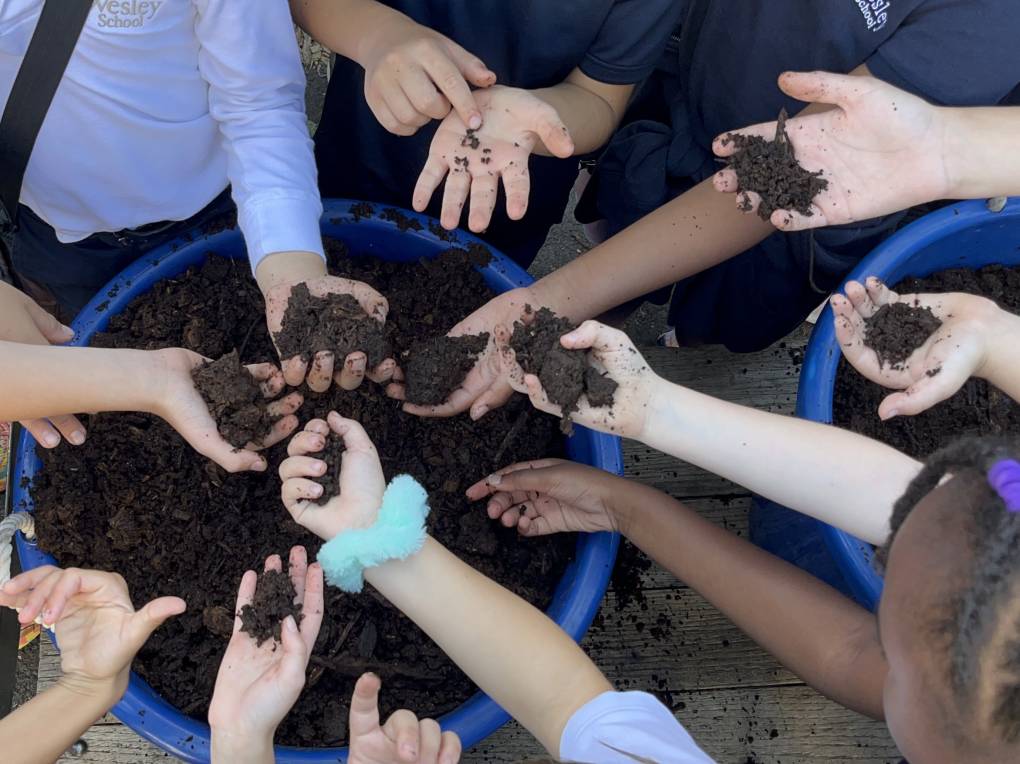
"content": "\u003cp>A composting program at \u003ca href=\"https://www.wesleyschool.org/\">The Wesley School\u003c/a> in Los Angeles is helping kindergarten through eighth-grade students get hands-on experience with making dirt while also teaching them ways to address human-driven climate change.\u003c/p>\n\u003cp>For the past year, all the leftover food waste from the school has gone into composting containers rather than a landfill where it would just decompose and produce planet-warming gasses. [aside postID=science_1985830 hero='https://cdn.kqed.org/wp-content/uploads/sites/35/2023/12/GettyImages-1419796991-1020x667.jpg']\u003ca href=\"https://www.jennisilverstein.com/\">Jennifer Silverstein,\u003c/a> a therapist, a social worker, and part of the \u003ca href=\"https://www.climatepsychology.us/\">Climate Psychology Alliance of North America, \u003c/a>says the school’s composting program checks a lot of the boxes for effective, positive climate education.\u003c/p>\n\u003cp>“Instead of [teaching kids] just, ‘all these horrible things are happening,’ it’s like, ‘all these horrible things are happening, and there’s all these adults out there who are really actively trying to make it better. And here’s ways you can participate,'” Silverstein says.\u003c/p>\n\u003cp>The school’s composting program started in 2022, and in October this year, the school held a celebration to reveal what happened inside a series of five-foot-tall containers.\u003c/p>\n\u003cp>“OK! Want to crack this baby open?” says Steven Wynbrandt, a \u003ca href=\"https://www.wynbrandtfarms.com/\">local farmer\u003c/a> and composting consultant who has helped the school with its program.\u003c/p>\n\u003cp>[ad fullwidth]\u003c/p>\n\u003cp>The “Yeah!” from the dozens of students to his question is deafening.\u003c/p>\n\u003cp>They pepper Wynbrandt with questions as he breaks the ties that hold the container closed: “Is it going to smell?” “What’s it going to look like?” “Is it going to spill out?”\u003c/p>\n\u003cp>Rich black compost spills out from the container.\u003c/p>\n\u003cp>“It doesn’t stink at all!” says one of the kids. “It smells earthy!”\u003c/p>\n\u003cp>The 5,200 pounds of food waste diverted from a landfill is \u003ca href=\"https://www.epa.gov/snep/composting-food-waste-keeping-good-thing-going#:~:text=In%20addition%2C%20composting%20lowers%20greenhouse,in%20the%20presence%20of%20oxygen.\">great news for the climate\u003c/a>. Food that breaks down in a landfill produces \u003ca href=\"https://www.epa.gov/gmi/importance-methane\">methane\u003c/a> — one of the most potent planet-warming gasses. But transforming organic material into compost means there’s less methane going into the atmosphere.\u003c/p>\n\u003cp>The Wesley School staff could have easily tossed the school’s food waste into a city-provided green bin. California law requires municipal food waste to be recycled. But taking it out of sight, which would have been easier, would have missed the point, says science teacher Johnna Hampton-Walker.\u003c/p>\n\u003cp>“When it’s invisible like that, they don’t see it,” she says. “They know, but it doesn’t sink in.” [aside postID=news_11967943 hero='https://ww2.kqed.org/app/uploads/sites/10/2023/11/EdSource01-1020x755.jpeg']When sixth grader Finn saw the finished compost pile, it sank in.\u003c/p>\n\u003cp>“That’s my orange chicken in there,” he says. “That’s not just like any food. Somewhere in there is \u003cem>my \u003c/em>food.”\u003c/p>\n\u003cp>The school will use the compost on plants around campus. Some will be offered to families that want to use it at home, and whatever is left will be donated.\u003c/p>\n\u003cp>Fifth grader Kingston was excited to learn his food waste will help grow new food on campus. “It feels good that you’re doing something that helps the planet, instead of just sitting and watching it get destroyed,” he says.\u003c/p>\n\u003cp>That’s the response Wynbrandt wants. He wants to work with more schools like The Wesley School to start these composting programs. “A lot of us, especially kids, feel really overwhelmed and powerless and don’t know what to do,” Wynbrandt says about the climate crisis. “This is quite an existential crisis, and how do we make a difference? How do we make a dent?”\u003c/p>\n\u003cp>Therapist Jennifer Silverstein says part of helping youth understand the gravity of human-caused climate change is to build their tolerance to new — and sometimes devastating — information. She says during those difficult conversations, it helps to allow them to be outside in nature, and participate in collective action. [pullquote size=\"medium\" align=\"right\" citation=\"Leo, a fifth grader, The Wesley School in Los Angeles\"]‘Knowing I’m a part of something good just helps me sleep at night. If we can just work together, it’s all going to be OK and everything’s going to work out fine.’[/pullquote]Fifth grader Sloan felt so empowered by the school’s compositing program she decided to take climate action outside of school. Along with several other fifth graders, Sloane says, “We did a lemonade stand at our friend’s house and we made over $200, and we donated it to the \u003ca href=\"https://www.nrdc.org/\">NRDC\u003c/a>,” the Natural Resources Defense Council. They also helped create a petition to replace the plastic forks and spoons in the school cafeteria with compostable ones.\u003c/p>\n\u003cp>Fifth grader Leo says he’s found the composting program helpful.\u003c/p>\n\u003cp>“Knowing I’m a part of something good just helps me sleep at night,” he says. “If we can just work together, it’s all going to be OK and everything’s going to work out fine.”\u003c/p>\n\u003cp>In October it took two hours for the container of compost to be emptied and prepared to receive the next day’s lunch leftovers. The other four containers remain full of food waste that’s in the process of breaking down. Decorated posters on the outside of each container indicate when in the new year they can be opened so that the next generation of plants on campus can benefit from the rich soil.\u003c/p>\n\u003cp>\u003c/p>\n",
"blocks": [],
"excerpt": "A school composting program in Los Angeles helps teach students how to take climate action through its composting program.",
"status": "publish",
"parent": 0,
"modified": 1726000598,
"stats": {
"hasAudio": false,
"hasVideo": false,
"hasChartOrMap": false,
"iframeSrcs": [],
"hasGoogleForm": false,
"hasGallery": false,
"hasHearkenModule": false,
"hasPolis": false,
"paragraphCount": 22,
"wordCount": 964
},
"headData": {
"title": "California K–8 Students Get Their Hands Dirty to Fight Climate Change | KQED",
"description": "A school composting program in Los Angeles helps teach students how to take climate action through its composting program.",
"ogTitle": "",
"ogDescription": "",
"ogImgId": "",
"twTitle": "",
"twDescription": "",
"twImgId": "",
"schema": {
"@context": "https://schema.org",
"@type": "NewsArticle",
"headline": "California K–8 Students Get Their Hands Dirty to Fight Climate Change",
"datePublished": "2023-12-27T14:00:03-08:00",
"dateModified": "2024-09-10T13:36:38-07:00",
"image": "https://cdn.kqed.org/wp-content/uploads/2020/02/KQED-OG-Image@1x.png",
"isAccessibleForFree": "True",
"publisher": {
"@type": "NewsMediaOrganization",
"@id": "https://www.kqed.org/#organization",
"name": "KQED",
"logo": "https://cdn.kqed.org/wp-content/uploads/2020/02/KQED-OG-Image@1x.png",
"url": "https://www.kqed.org",
"sameAs": [
"https://www.facebook.com/KQED",
"https://twitter.com/KQED",
"https://www.instagram.com/kqed/",
"https://www.tiktok.com/@kqedofficial",
"https://www.linkedin.com/company/kqed",
"https://www.youtube.com/channel/UCeC0IOo7i1P_61zVUWbJ4nw"
]
}
}
},
"sticky": false,
"nprImageCredit": "Steven Wynbrandt",
"nprByline": "Caleigh Wells",
"nprImageAgency": "Steven Wynbrandt",
"nprStoryId": "1221100212",
"nprApiLink": "http://api.npr.org/query?id=1221100212&apiKey=MDAxOTAwOTE4MDEyMTkxMDAzNjczZDljZA004",
"nprHtmlLink": "https://www.npr.org/2023/12/26/1221100212/how-to-inspire-climate-hope-in-kids-get-their-hands-dirty?ft=nprml&f=1221100212",
"nprRetrievedStory": "1",
"nprPubDate": "Tue, 26 Dec 2023 12:04:00 -0500",
"nprStoryDate": "Tue, 26 Dec 2023 05:00:50 -0500",
"nprLastModifiedDate": "Tue, 26 Dec 2023 12:04:50 -0500",
"nprAudio": "https://play.podtrac.com/npr-1149128116/ondemand.npr.org/anon.npr-mp3/npr/me/2023/12/20231212_me_kids_in_los_angeled_fight_climate_change_by_tackling_food_waste_at_school.mp3?orgId=55&topicId=1167&d=212&story=1221100212&ft=nprml&f=1221100212",
"nprAudioM3u": "http://api.npr.org/m3u/11221102714-780c90.m3u?orgId=55&topicId=1167&d=212&story=1221100212&ft=nprml&f=1221100212",
"excludeFromSiteSearch": "Include",
"showOnAuthorArchivePages": "No",
"articleAge": "0",
"path": "/news/11970945/california-k-8-students-get-their-hands-dirty-to-fight-climate-change",
"audioUrl": "https://play.podtrac.com/npr-1149128116/ondemand.npr.org/anon.npr-mp3/npr/me/2023/12/20231212_me_kids_in_los_angeled_fight_climate_change_by_tackling_food_waste_at_school.mp3?orgId=55&topicId=1167&d=212&story=1221100212&ft=nprml&f=1221100212",
"audioTrackLength": null,
"parsedContent": [
{
"type": "contentString",
"content": "\u003cdiv class=\"post-body\">\u003cp>\u003cp>A composting program at \u003ca href=\"https://www.wesleyschool.org/\">The Wesley School\u003c/a> in Los Angeles is helping kindergarten through eighth-grade students get hands-on experience with making dirt while also teaching them ways to address human-driven climate change.\u003c/p>\n\u003cp>For the past year, all the leftover food waste from the school has gone into composting containers rather than a landfill where it would just decompose and produce planet-warming gasses. \u003c/p>\u003c/div>",
"attributes": {
"named": {},
"numeric": []
}
},
{
"type": "component",
"content": "",
"name": "aside",
"attributes": {
"named": {
"postid": "science_1985830",
"hero": "https://cdn.kqed.org/wp-content/uploads/sites/35/2023/12/GettyImages-1419796991-1020x667.jpg",
"label": ""
},
"numeric": []
}
},
{
"type": "contentString",
"content": "\u003cdiv class=\"post-body\">\u003cp>\u003ca href=\"https://www.jennisilverstein.com/\">Jennifer Silverstein,\u003c/a> a therapist, a social worker, and part of the \u003ca href=\"https://www.climatepsychology.us/\">Climate Psychology Alliance of North America, \u003c/a>says the school’s composting program checks a lot of the boxes for effective, positive climate education.\u003c/p>\n\u003cp>“Instead of [teaching kids] just, ‘all these horrible things are happening,’ it’s like, ‘all these horrible things are happening, and there’s all these adults out there who are really actively trying to make it better. And here’s ways you can participate,'” Silverstein says.\u003c/p>\n\u003cp>The school’s composting program started in 2022, and in October this year, the school held a celebration to reveal what happened inside a series of five-foot-tall containers.\u003c/p>\n\u003cp>“OK! Want to crack this baby open?” says Steven Wynbrandt, a \u003ca href=\"https://www.wynbrandtfarms.com/\">local farmer\u003c/a> and composting consultant who has helped the school with its program.\u003c/p>\n\u003cp>\u003c/p>\u003c/div>",
"attributes": {
"named": {},
"numeric": []
}
},
{
"type": "component",
"content": "",
"name": "ad",
"attributes": {
"named": {
"label": "fullwidth"
},
"numeric": [
"fullwidth"
]
}
},
{
"type": "contentString",
"content": "\u003cdiv class=\"post-body\">\u003cp>\u003c/p>\n\u003cp>The “Yeah!” from the dozens of students to his question is deafening.\u003c/p>\n\u003cp>They pepper Wynbrandt with questions as he breaks the ties that hold the container closed: “Is it going to smell?” “What’s it going to look like?” “Is it going to spill out?”\u003c/p>\n\u003cp>Rich black compost spills out from the container.\u003c/p>\n\u003cp>“It doesn’t stink at all!” says one of the kids. “It smells earthy!”\u003c/p>\n\u003cp>The 5,200 pounds of food waste diverted from a landfill is \u003ca href=\"https://www.epa.gov/snep/composting-food-waste-keeping-good-thing-going#:~:text=In%20addition%2C%20composting%20lowers%20greenhouse,in%20the%20presence%20of%20oxygen.\">great news for the climate\u003c/a>. Food that breaks down in a landfill produces \u003ca href=\"https://www.epa.gov/gmi/importance-methane\">methane\u003c/a> — one of the most potent planet-warming gasses. But transforming organic material into compost means there’s less methane going into the atmosphere.\u003c/p>\n\u003cp>The Wesley School staff could have easily tossed the school’s food waste into a city-provided green bin. California law requires municipal food waste to be recycled. But taking it out of sight, which would have been easier, would have missed the point, says science teacher Johnna Hampton-Walker.\u003c/p>\n\u003cp>“When it’s invisible like that, they don’t see it,” she says. “They know, but it doesn’t sink in.” \u003c/p>\u003c/div>",
"attributes": {
"named": {},
"numeric": []
}
},
{
"type": "component",
"content": "",
"name": "aside",
"attributes": {
"named": {
"postid": "news_11967943",
"hero": "https://ww2.kqed.org/app/uploads/sites/10/2023/11/EdSource01-1020x755.jpeg",
"label": ""
},
"numeric": []
}
},
{
"type": "contentString",
"content": "\u003cdiv class=\"post-body\">\u003cp>When sixth grader Finn saw the finished compost pile, it sank in.\u003c/p>\n\u003cp>“That’s my orange chicken in there,” he says. “That’s not just like any food. Somewhere in there is \u003cem>my \u003c/em>food.”\u003c/p>\n\u003cp>The school will use the compost on plants around campus. Some will be offered to families that want to use it at home, and whatever is left will be donated.\u003c/p>\n\u003cp>Fifth grader Kingston was excited to learn his food waste will help grow new food on campus. “It feels good that you’re doing something that helps the planet, instead of just sitting and watching it get destroyed,” he says.\u003c/p>\n\u003cp>That’s the response Wynbrandt wants. He wants to work with more schools like The Wesley School to start these composting programs. “A lot of us, especially kids, feel really overwhelmed and powerless and don’t know what to do,” Wynbrandt says about the climate crisis. “This is quite an existential crisis, and how do we make a difference? How do we make a dent?”\u003c/p>\n\u003cp>Therapist Jennifer Silverstein says part of helping youth understand the gravity of human-caused climate change is to build their tolerance to new — and sometimes devastating — information. She says during those difficult conversations, it helps to allow them to be outside in nature, and participate in collective action. \u003c/p>\u003c/div>",
"attributes": {
"named": {},
"numeric": []
}
},
{
"type": "component",
"content": "‘Knowing I’m a part of something good just helps me sleep at night. If we can just work together, it’s all going to be OK and everything’s going to work out fine.’",
"name": "pullquote",
"attributes": {
"named": {
"size": "medium",
"align": "right",
"citation": "Leo, a fifth grader, The Wesley School in Los Angeles",
"label": ""
},
"numeric": []
}
},
{
"type": "contentString",
"content": "\u003cdiv class=\"post-body\">\u003cp>Fifth grader Sloan felt so empowered by the school’s compositing program she decided to take climate action outside of school. Along with several other fifth graders, Sloane says, “We did a lemonade stand at our friend’s house and we made over $200, and we donated it to the \u003ca href=\"https://www.nrdc.org/\">NRDC\u003c/a>,” the Natural Resources Defense Council. They also helped create a petition to replace the plastic forks and spoons in the school cafeteria with compostable ones.\u003c/p>\n\u003cp>Fifth grader Leo says he’s found the composting program helpful.\u003c/p>\n\u003cp>“Knowing I’m a part of something good just helps me sleep at night,” he says. “If we can just work together, it’s all going to be OK and everything’s going to work out fine.”\u003c/p>\n\u003cp>In October it took two hours for the container of compost to be emptied and prepared to receive the next day’s lunch leftovers. The other four containers remain full of food waste that’s in the process of breaking down. Decorated posters on the outside of each container indicate when in the new year they can be opened so that the next generation of plants on campus can benefit from the rich soil.\u003c/p>\n\u003cp>\u003c/p>\n\u003c/div>\u003c/p>",
"attributes": {
"named": {},
"numeric": []
}
}
],
"link": "/news/11970945/california-k-8-students-get-their-hands-dirty-to-fight-climate-change",
"authors": [
"byline_news_11970945"
],
"categories": [
"news_34165",
"news_8"
],
"tags": [
"news_255",
"news_20013",
"news_20023",
"news_27626",
"news_4",
"news_3187"
],
"affiliates": [
"news_253"
],
"featImg": "news_11970946",
"label": "news_253"
},
"news_11970846": {
"type": "posts",
"id": "news_11970846",
"meta": {
"index": "posts_1716263798",
"site": "news",
"id": "11970846",
"score": null,
"sort": [
1703628055000
]
},
"parent": 0,
"labelTerm": {},
"blocks": [],
"publishDate": 1703628055,
"format": "standard",
"title": "California Urges Universities to Return Native American Remains and Artifacts",
"headTitle": "California Urges Universities to Return Native American Remains and Artifacts | KQED",
"content": "\u003cp>When San José State anthropology professor Elizabeth Weiss tweeted a picture to celebrate returning to campus in September 2021, it caught the attention of \u003ca href=\"https://calmatters.org/legislator-tracker/james-ramos-1967/\">Assemblymember James Ramos\u003c/a>, a Democrat from San Bernardino and the Legislature’s first and only Native American member.\u003c/p>\n\u003cp>“So happy to be back with some old friends,” read the caption of Weiss’ tweet, which included a photo of her holding the skull of a Native ancestor in front of boxes of other remains. [pullquote size=\"medium\" align=\"right\" citation=\"Assemblymember James Ramos, D-San Bernardino\"]‘Now that I’m in the state Legislature, we have a stronger voice to ensure that people truly understand that this is something that needs to get done.’[/pullquote]For Ramos, a member of the San Manuel Indian Reservation’s Serrano/Cahuilla tribe, the caption was an example of the lack of respect for Native history in California. The boxes in the photograph’s background were a reminder of the vast collections of Native remains and artifacts still being held illegally in California’s public university systems.\u003c/p>\n\u003cp>The post prompted Ramos to request an audit of the California State University’s repatriation progress — the act of institutions giving back remains and artifacts to Native tribes as required by state and federal laws passed as far back as three decades ago.\u003c/p>\n\u003cp>“To find that we’re still in the year 2023 and that hasn’t happened is really daunting to find out how we move forward,” Ramos said. “But now that I’m in the state Legislature, we have a stronger voice to ensure that people truly understand that this is something that needs to get done.”\u003c/p>\n\u003cp>When the \u003ca href=\"https://auditor.ca.gov/reports/2022-107/index.html#section3\">Cal State audit\u003c/a> was published in June 2023, results were similar to an audit of the \u003ca href=\"https://www.auditor.ca.gov/reports/2019-047/summary.html\">University of California\u003c/a> conducted three years prior — a lack of policies, urgency and staffing meant neither system complied with the California Native American Graves Protection Act of 2001 or the federal Native American Graves Protection and Repatriation Act of 1990.\u003c/p>\n\u003cp>[ad fullwidth]\u003c/p>\n\u003cp>Cal State campuses collectively returned only 6% of the 698,000 Native remains and artifacts to local tribes. UC campuses collectively returned around 35% of 17,000 human remains as of October 2023, according to UC spokesperson Stett Holbrook, with an additional 30% in the process of being returned.\u003c/p>\n\u003cp>Two campuses stand out among their peers, however. UCLA has returned 96% of its 58,200 items, while Cal State Long Beach has given back 70% of its 9,000 items, the only campuses in their respective systems to return a majority of remains and artifacts to Native tribes. Strong Native American voices, along with allies in campus leadership and academic departments, were factors that allowed both universities to lead their systems in repatriation progress.\u003c/p>\n\u003cp>\u003c!-- iframe plugin v.4.3 wordpress.org/plugins/iframe/ -->\u003cbr>\n\u003ciframe loading=\"lazy\" src=\"https://flo.uri.sh/visualisation/16206456/embed?auto=1\" width=\"800\" height=\"1000\" scrolling=\"yes\" class=\"iframe-class\" frameborder=\"0\">\u003c/iframe>\u003c/p>\n\u003cp>In response to the \u003ca href=\"https://www.auditor.ca.gov/pdfs/reports/2019-047.pdf\">state audit\u003c/a> of the UC system, university officials released \u003ca href=\"https://www.ucop.edu/research-policy-analysis-coordination/policies-guidance/curation-and-repatriation/index.html\">new policies\u003c/a> governing repatriation efforts in December 2021. The six UC campuses with collections of more than 100 items are now required to have a full-time repatriation coordinator. UC also required campuses to submit budget proposals to fund the full return of their collections to tribes and add more tribal members to committees that review repatriation requests.\u003c/p>\n\u003cp>As of June 2023, 12 of 21 Cal State campuses with collections subject to repatriation laws had yet to meet a 1995 federal deadline to complete an inventory of their collections, much less return remains or artifacts. Since the audit, Cal State has opened nominations for a new systemwide repatriation committee that aims for majority representation from Native American tribes, giving preference to California Indian tribal members.\u003c/p>\n\u003cfigure id=\"attachment_11970926\" class=\"wp-caption aligncenter\" style=\"max-width: 2000px\">\u003cimg loading=\"lazy\" decoding=\"async\" class=\"size-full wp-image-11970926\" src=\"https://cdn.kqed.org/wp-content/uploads/sites/10/2023/12/CMNative02.jpg\" alt=\"Photos of Native American history.\" width=\"2000\" height=\"629\" srcset=\"https://cdn.kqed.org/wp-content/uploads/sites/10/2023/12/CMNative02.jpg 2000w, https://cdn.kqed.org/wp-content/uploads/sites/10/2023/12/CMNative02-800x252.jpg 800w, https://cdn.kqed.org/wp-content/uploads/sites/10/2023/12/CMNative02-1020x321.jpg 1020w, https://cdn.kqed.org/wp-content/uploads/sites/10/2023/12/CMNative02-160x50.jpg 160w, https://cdn.kqed.org/wp-content/uploads/sites/10/2023/12/CMNative02-1536x483.jpg 1536w, https://cdn.kqed.org/wp-content/uploads/sites/10/2023/12/CMNative02-1920x604.jpg 1920w\" sizes=\"(max-width: 2000px) 100vw, 2000px\">\u003cfigcaption class=\"wp-caption-text\">A display of photos at the CSU Long Beach campus from gatherings in which the Tongva community launched a Southern California Indian sewn plank canoe (ti’at) along with a Chumash sewn plank canoe (tomol). Dec. 14, 2023. \u003ccite>( Julie A. Hotz/CalMatters)\u003c/cite>\u003c/figcaption>\u003c/figure>\n\u003cp>\u003ca href=\"https://leginfo.legislature.ca.gov/faces/billNavClient.xhtml?bill_id=202320240AB389\">Assembly Bill 389,\u003c/a> introduced by Ramos and signed into law in October, requires Cal State campuses to fund the full expense of returning their collections, including full-time coordinators. The law also shifts the system’s relationship with Native remains and artifacts by prohibiting their use for teaching or research, a win for tribes who have accused universities in California of \u003ca href=\"https://calmatters.org/education/2018/07/native-american-tribes-clash-with-uc-over-bones-of-their-ancestors/\">delaying repatriation\u003c/a> so professors can continue their research. The law amounts to a major overhaul of the system’s repatriation process, ensuring funding shortfalls and research priorities no longer stall efforts.\u003c/p>\n\u003cp>At San José State, Weiss will resign effective May 29, 2024, as part of a settlement after she sued the university for barring her access to the campus’ skeletal collection following her post. The campus holds around 500 Native remains and 5,000 cultural items and completed its first repatriation of two remains and two cultural items to the Central Valley Yokuts tribe in March 2020, according to the audit.\u003c/p>\n\u003cp>“As I have said many times before, there is nothing wrong or controversial about this photo or the tweet,” Weiss wrote in a statement to CalMatters. “The photo shows my true love and respect for anthropology and the skeletal remains that make it possible.”\u003c/p>\n\u003ch2>How UCLA returned nearly all remains and artifacts\u003c/h2>\n\u003cp>When the state auditor reviewed the UC’s progress, UCLA stood out. Between 1996 and 2022, UCLA returned nearly its entire collection of Native remains and artifacts through \u003ca href=\"https://www3.research.ucla.edu/nagpra/collections\">127 repatriations\u003c/a> to tribes in California, Arizona, Hawaii and Utah. Most items in the university’s collections were unearthed during university and government construction projects, according to Sylvia Forni, director of UCLA’s Fowler Museum.\u003c/p>\n\u003cp>“We don’t do anything special at UCLA that isn’t supposed to be done legally at other UCs and Cal States,” said Michael Chavez, who started as UCLA’s archaeological collections manager and repatriation coordinator this year. [pullquote size=\"medium\" align=\"right\" citation=\"Michael Chavez, archaeological collections manager and repatriation coordinator, UCLA\"]‘We don’t decide for the tribe. We work in collaboration with the tribe and strongly defer to their opinion and position.’[/pullquote]Chavez, a Native member of the Tongva of the Los Angeles Basin, applauded a 2020 revision to the state’s repatriation law making it easier for non-federally recognized tribes to reclaim their ancestors and artifacts. He said his work largely involves listening to local tribes, federally recognized or not.\u003c/p>\n\u003cp>“We don’t decide for the tribe,” Chavez said. “We work in collaboration with the tribe and strongly defer to their opinion and position.”\u003c/p>\n\u003cp>Chavez credits the university’s 2020 audit results to the impact of his predecessor, former coordinator Dr. Wendy Teeter.\u003c/p>\n\u003cp>“[She] didn’t allow any obstacles to get in her way in the pursuit of repatriation,” Chavez said.\u003c/p>\n\u003cp>Despite limited funding and her multiple roles as a lecturer in American Indian Studies, a member of the UC’s Native American Advisory Committee and curator at the Fowler Museum, Teeter established a culture of welcoming Native communities during her 25 years on campus.\u003c/p>\n\u003cp>“We just broadened it to be more reciprocal in nature and more understanding that they had a lot to share with us, and we had a lot to share with them,” Teeter said.\u003c/p>\n\u003cfigure id=\"attachment_11970927\" class=\"wp-caption alignright\" style=\"max-width: 640px\">\u003cimg loading=\"lazy\" decoding=\"async\" class=\"size-large wp-image-11970927\" src=\"https://cdn.kqed.org/wp-content/uploads/sites/10/2023/12/CMNative03-1020x1275.jpg\" alt=\"A woman in a green T-shirt is pictured outdoors with trees behind her.\" width=\"640\" height=\"800\" srcset=\"https://cdn.kqed.org/wp-content/uploads/sites/10/2023/12/CMNative03-1020x1275.jpg 1020w, https://cdn.kqed.org/wp-content/uploads/sites/10/2023/12/CMNative03-800x1000.jpg 800w, https://cdn.kqed.org/wp-content/uploads/sites/10/2023/12/CMNative03-160x200.jpg 160w, https://cdn.kqed.org/wp-content/uploads/sites/10/2023/12/CMNative03-1229x1536.jpg 1229w, https://cdn.kqed.org/wp-content/uploads/sites/10/2023/12/CMNative03.jpg 1600w\" sizes=\"(max-width: 640px) 100vw, 640px\">\u003cfigcaption class=\"wp-caption-text\">Dr. Wendy G. Teeter, former lecturer of American Indian Studies at UCLA and Senior Curator of Archeology, Fowler Museum at UCLA, on Dec. 15, 2023. \u003ccite>(Julie A. Hotz/CalMatters)\u003c/cite>\u003c/figcaption>\u003c/figure>\n\u003cp>Beyond consulting with tribes on repatriation efforts, Teeter said Anthropology and American Indian Studies faculty assisted efforts by leading listening sessions and campus tours to strengthen relationships between the tribes and campus community. Having allies across academic departments was another key to UCLA’s success, according to Teeter.\u003c/p>\n\u003cp>Before campuses were required to estimate and fund the full cost of repatriation, Teeter said the vice chancellor of research would review funding requests to support her work, annually providing about $60,000 from federal grants. Teeter is hopeful new policies at UC and Cal State will lead to sustainable funding for returning remains and artifacts to their tribal homes.\u003c/p>\n\u003cp>Since retiring from UCLA last year, Teeter now works with the Santa Ynez Band of Chumash Indians as an archaeologist, where she reviews development projects and mediates between the developer and the tribe.\u003c/p>\n\u003cp>Forni, Teeter’s successor at the Fowler Museum, said she’s committed to finishing the work led by Teeter and others.\u003c/p>\n\u003cp>“We think, at this point, [it] is 99% done,” Forni said.\u003c/p>\n\u003ch2>Cal State Long Beach ‘a sacred site’\u003c/h2>\n\u003cp>\u003ca href=\"https://home.csulb.edu/~eruyle/puvudoc_0000_about.html\">Puvuu’nga\u003c/a>, the Native village that Cal State Long Beach occupies, is also a sacred site used for rituals and burials that \u003ca href=\"https://calmatters.org/environment/2020/08/native-american-sacred-land-on-csu-long-beach-campus-should-be-permanently-protected/\">connect tribes\u003c/a> in Southern California and beyond. Since 1990, Cal State Long Beach returned 275 ancestral remains and 6,059 cultural items to three of the tribes local to campus, according to the June 2023 audit. The university is the only Cal State campus to have transferred the majority of its collection, at 70%.\u003c/p>\n\u003cp>Founded in 1968, the American Indian Studies program at Cal State Long Beach is the oldest in California. Native history is central to the campus’ identity, unlike other institutions, said Dr. Craig Stone, professor emeritus of American Indian Studies and the former provost designee for Cal State Long Beach’s repatriation committee.\u003c/p>\n\u003cp>The land the university occupies has ties to \u003ca href=\"https://www.csulb.edu/university-relations-and-development/tribal-relations/consultation\">more than 20 tribes \u003c/a>from the Gabrielino, Acjachemen, Luiseño, and Cahuilla bands of Native Americans.\u003c/p>\n\u003cfigure id=\"attachment_11970928\" class=\"wp-caption aligncenter\" style=\"max-width: 2000px\">\u003cimg loading=\"lazy\" decoding=\"async\" class=\"size-full wp-image-11970928\" src=\"https://cdn.kqed.org/wp-content/uploads/sites/10/2023/12/CMNative04.jpg\" alt=\"A photo of three individuals are pictured: two men and one woman. All have serious faces as they stand in front of a wall full of bookshelves that have various Native American artifacts and books on it.\" width=\"2000\" height=\"1333\" srcset=\"https://cdn.kqed.org/wp-content/uploads/sites/10/2023/12/CMNative04.jpg 2000w, https://cdn.kqed.org/wp-content/uploads/sites/10/2023/12/CMNative04-800x533.jpg 800w, https://cdn.kqed.org/wp-content/uploads/sites/10/2023/12/CMNative04-1020x680.jpg 1020w, https://cdn.kqed.org/wp-content/uploads/sites/10/2023/12/CMNative04-160x107.jpg 160w, https://cdn.kqed.org/wp-content/uploads/sites/10/2023/12/CMNative04-1536x1024.jpg 1536w, https://cdn.kqed.org/wp-content/uploads/sites/10/2023/12/CMNative04-1920x1280.jpg 1920w\" sizes=\"(max-width: 2000px) 100vw, 2000px\">\u003cfigcaption class=\"wp-caption-text\">From left to right: Cindi Alvitre, Native American Graves Protection and Repatriation Act Coordinator, Craig Stone, Professor Emeritus and Director of American Indian Studies, and Luis Robles, Chair of the Native American Graves Protection and Repatriation Act Committee. at CSU Long Beach on. Dec. 14, 2023. \u003ccite>(Julie A. Hotz/CalMatters)\u003c/cite>\u003c/figcaption>\u003c/figure>\n\u003cp>“This is a sacred site, not just to the Tongva, Gabrielino people. This is a sacred site to anyone who’s been influenced by the Chingichnish spiritual philosophy,” Stone said. \u003ca href=\"https://scholarworks.calstate.edu/concern/theses/gx41mn02g\">Chingichnish\u003c/a> describes a deity and religion followed by Native tribes throughout Southern California.\u003c/p>\n\u003cp>The campus began repatriating the remains of Native ancestors long before the 1990 federal repatriation law, Stone said. Skeletal remains of ancestors \u003ca href=\"https://www.presstelegram.com/2016/09/22/ceremony-memorializes-reburial-of-indigenous-peoples-remains-at-cal-state-long-beach/\">found on campus\u003c/a> during construction projects were given proper reburial.\u003c/p>\n\u003cp>“We interred in 1979,” Stone said. “So this is a commitment that people have heard of, know about, care about, and know when the law came into being, ‘Oh, yeah, we did that back in 1979.’”\u003c/p>\n\u003cp>A Cal State Long Beach student in the ‘70s, Stone was one of 10 people on the student council who approached then-President Steven Thorn about the \u003ca href=\"https://cla.csulb.edu/departments/americanindianstudies/ancestors-final-journey-home/\">skeletal remains\u003c/a> of a Gabrielino ancestor unearthed near the university during the construction of a sprinkler system.\u003c/p>\n\u003cp>“We went down there, and we were gonna demand this, and as soon as we got to the office, he was like, ‘What’s going on guys? Let’s fix this, let’s review this ancestor,’” Stone said. “Which was interesting because people are not interested in fixing anything, so he was an ally right off the bat.”\u003c/p>\n\u003cfigure id=\"attachment_11970929\" class=\"wp-caption aligncenter\" style=\"max-width: 2000px\">\u003cimg loading=\"lazy\" decoding=\"async\" class=\"size-full wp-image-11970929\" src=\"https://cdn.kqed.org/wp-content/uploads/sites/10/2023/12/CMNative05.jpg\" alt=\"Native American women in traditions clothing and headwear are pictured.\" width=\"2000\" height=\"1333\" srcset=\"https://cdn.kqed.org/wp-content/uploads/sites/10/2023/12/CMNative05.jpg 2000w, https://cdn.kqed.org/wp-content/uploads/sites/10/2023/12/CMNative05-800x533.jpg 800w, https://cdn.kqed.org/wp-content/uploads/sites/10/2023/12/CMNative05-1020x680.jpg 1020w, https://cdn.kqed.org/wp-content/uploads/sites/10/2023/12/CMNative05-160x107.jpg 160w, https://cdn.kqed.org/wp-content/uploads/sites/10/2023/12/CMNative05-1536x1024.jpg 1536w, https://cdn.kqed.org/wp-content/uploads/sites/10/2023/12/CMNative05-1920x1280.jpg 1920w\" sizes=\"(max-width: 2000px) 100vw, 2000px\">\u003cfigcaption class=\"wp-caption-text\">Ms. UCR Powwow Princess 2023-24, Tishmal Herrera, dances at a performance during Native American Celebration Day at the state Capitol in Sacramento on Sept. 22, 2023. \u003ccite>(Miguel Gutierrez Jr./CalMatters)\u003c/cite>\u003c/figcaption>\u003c/figure>\n\u003cp>Cal State Long Beach would go on to have more allies — including Professor Emeritus Marcus Young Owl, who was Stone’s colleague for decades and a current member of the Cal State Long Beach repatriation committee representing the anthropology department. [pullquote size=\"medium\" align=\"right\" citation=\"Young Owl, professor emeritus, Cal State Long Beach\"]‘I’m actually proud of the fact that the anthropology department was so willing to participate and have good relations with American Indian Studies.’[/pullquote]Young Owl, who describes himself as of Ojibwe descent, was a student and a founding member of the campus Indian Youth Council in December 1968. He started working as a faculty member teaching anthropology in 1987, replacing a professor who disagreed with repatriation, Young Owl said.\u003c/p>\n\u003cp>“I’m actually proud of the fact that the anthropology department was so willing to participate and have good relations with American Indian Studies,” Young Owl said.\u003c/p>\n\u003cp>The repatriation process has been slow for the remaining 30% of the university’s collection. Stone attributes this to the previous lack of funding for a full-time repatriation coordinator and the months-long work of sifting through buckets of dirt and bones to identify ancestral remains.\u003c/p>\n\u003cp>A lack of funding for staff was a main issue cited in the audit of Cal State. Of the 23 campuses in the Cal State system, 10 reported a lack of sufficient funding to support the responsibilities that fall under federal and state laws, according to the audit.\u003c/p>\n\u003ch2>The work of repatriation continues\u003c/h2>\n\u003cp>Like UC before it, Cal State is now taking nominations until Feb. 2 to fill repatriation committees on campuses and statewide. Led by Adriane Tafoya, Cal State’s repatriation project manager, Cal State is working with the \u003ca href=\"https://nahc.ca.gov/\">Native American Heritage Commission\u003c/a> to host virtual training for campuses.\u003c/p>\n\u003cp>Cal State must adopt systemwide repatriation policies by July 1, 2025, and all campuses with collections must adopt campus-specific policies by July 1, 2026. The system will also have to submit yearly progress reports on its repatriation efforts starting in 2024.\u003c/p>\n\u003cp>Since the audit, repatriation efforts on some campuses have ramped up, said Cal State spokesperson Amy Bentley-Smith. Since June 2023, San Francisco State has returned cultural artifacts to four tribes. This year, Sacramento State transferred 66,686 cultural artifacts and 498 ancestral remains to local tribes. In August, Chico State conducted the second-largest repatriation since 1990, repatriating 532 remains and 87,935 cultural items. \u003cstrong> \u003c/strong>\u003c/p>\n\u003cfigure id=\"attachment_11970930\" class=\"wp-caption aligncenter\" style=\"max-width: 2000px\">\u003cimg loading=\"lazy\" decoding=\"async\" class=\"size-full wp-image-11970930\" src=\"https://cdn.kqed.org/wp-content/uploads/sites/10/2023/12/CMNative06.jpg\" alt=\"Native American pottery and bundles of sage are pictured.\" width=\"2000\" height=\"1333\" srcset=\"https://cdn.kqed.org/wp-content/uploads/sites/10/2023/12/CMNative06.jpg 2000w, https://cdn.kqed.org/wp-content/uploads/sites/10/2023/12/CMNative06-800x533.jpg 800w, https://cdn.kqed.org/wp-content/uploads/sites/10/2023/12/CMNative06-1020x680.jpg 1020w, https://cdn.kqed.org/wp-content/uploads/sites/10/2023/12/CMNative06-160x107.jpg 160w, https://cdn.kqed.org/wp-content/uploads/sites/10/2023/12/CMNative06-1536x1024.jpg 1536w, https://cdn.kqed.org/wp-content/uploads/sites/10/2023/12/CMNative06-1920x1280.jpg 1920w\" sizes=\"(max-width: 2000px) 100vw, 2000px\">\u003cfigcaption class=\"wp-caption-text\">Copal incense burns in a holder at the California Native American Day celebration at the state Capitol on Sept. 22, 2023. \u003ccite>(Miguel Gutierrez Jr./CalMatters)\u003c/cite>\u003c/figcaption>\u003c/figure>\n\u003cp>In October, UC Berkeley filed a report with the federal registrar, the first step to make available 4,400 Native remains and 25,000 Native cultural items for repatriation to California tribes. Once completed, it will be the \u003ca href=\"https://www.federalregister.gov/documents/2023/10/31/2023-23975/notice-of-inventory-completion-university-of-california-berkeley-berkeley-ca\">largest repatriation\u003c/a> for the campus, which once had \u003ca href=\"https://www.propublica.org/article/berkeley-steps-to-largest-repatriation\">11,000 Native ancestral remains\u003c/a>. [aside postID=news_11956856 hero='https://ww2.kqed.org/app/uploads/sites/10/2023/07/RS67156_230721-CoastMiwokLandMarin-04-BL-KQED-1020x680.jpg']“Tribal knowledge is key to repatriation, and we are so grateful to our tribal partners for working closely with us during this process,” UC Berkeley repatriation coordinator Alex Lucas wrote in a statement to CalMatters.\u003c/p>\n\u003cp>For Johnny Hernandez, the vice chairman of the San Juan Nation in California, repatriation is more than a legal procedure — it’s a matter of reuniting family members with their tribes after decades apart. Invited by Ramos to speak alongside other tribal leaders at a California State Assembly hearing on Aug. 29, Hernandez underscored the importance of allowing Native ancestors to finally rest in peace.\u003c/p>\n\u003cp>“There’s been a disturbance of grave sites on ancestral lands and remains of loved ones, our ancestors, being held without the opportunity to eternally rest in peace,” Hernandez said. “Imagine if it was your family, your ancestors, and their belongings that you hold near and dear that are owned and used under the guise of an artifact on display for the public’s learnings and teachings.”\u003c/p>\n\u003cp>[ad floatright]\u003c/p>\n",
"stats": {
"hasVideo": false,
"hasChartOrMap": true,
"hasAudio": false,
"hasPolis": false,
"wordCount": 2629,
"hasGoogleForm": false,
"hasGallery": false,
"hasHearkenModule": false,
"iframeSrcs": [
"https://flo.uri.sh/visualisation/16206456/embed"
],
"paragraphCount": 45
},
"modified": 1703641634,
"excerpt": "State audits reveal the University of California and California State University failed to comply with laws mandating the repatriation of Native ancestral remains and artifacts. UCLA and Cal State Long Beach stand out, having returned most collections to local tribes.",
"headData": {
"twImgId": "",
"twTitle": "",
"ogTitle": "",
"ogImgId": "",
"twDescription": "",
"description": "State audits reveal the University of California and California State University failed to comply with laws mandating the repatriation of Native ancestral remains and artifacts. UCLA and Cal State Long Beach stand out, having returned most collections to local tribes.",
"title": "California Urges Universities to Return Native American Remains and Artifacts | KQED",
"ogDescription": "",
"schema": {
"@context": "https://schema.org",
"@type": "NewsArticle",
"headline": "California Urges Universities to Return Native American Remains and Artifacts",
"datePublished": "2023-12-26T14:00:55-08:00",
"dateModified": "2023-12-26T17:47:14-08:00",
"image": "https://cdn.kqed.org/wp-content/uploads/2020/02/KQED-OG-Image@1x.png",
"isAccessibleForFree": "True",
"publisher": {
"@type": "NewsMediaOrganization",
"@id": "https://www.kqed.org/#organization",
"name": "KQED",
"logo": "https://cdn.kqed.org/wp-content/uploads/2020/02/KQED-OG-Image@1x.png",
"url": "https://www.kqed.org",
"sameAs": [
"https://www.facebook.com/KQED",
"https://twitter.com/KQED",
"https://www.instagram.com/kqed/",
"https://www.tiktok.com/@kqedofficial",
"https://www.linkedin.com/company/kqed",
"https://www.youtube.com/channel/UCeC0IOo7i1P_61zVUWbJ4nw"
]
}
}
},
"guestAuthors": [],
"slug": "california-urges-universities-to-return-native-american-remains-and-artifacts",
"status": "publish",
"sourceUrl": "https://calmatters.org/",
"nprByline": "Amelia Wu and Helena San Roque",
"excludeFromSiteSearch": "Include",
"sticky": false,
"source": "CalMatters",
"showOnAuthorArchivePages": "No",
"articleAge": "0",
"path": "/news/11970846/california-urges-universities-to-return-native-american-remains-and-artifacts",
"audioTrackLength": null,
"parsedContent": [
{
"type": "contentString",
"content": "\u003cdiv class=\"post-body\">\u003cp>\u003cp>When San José State anthropology professor Elizabeth Weiss tweeted a picture to celebrate returning to campus in September 2021, it caught the attention of \u003ca href=\"https://calmatters.org/legislator-tracker/james-ramos-1967/\">Assemblymember James Ramos\u003c/a>, a Democrat from San Bernardino and the Legislature’s first and only Native American member.\u003c/p>\n\u003cp>“So happy to be back with some old friends,” read the caption of Weiss’ tweet, which included a photo of her holding the skull of a Native ancestor in front of boxes of other remains. \u003c/p>\u003c/div>",
"attributes": {
"named": {},
"numeric": []
}
},
{
"type": "component",
"content": "‘Now that I’m in the state Legislature, we have a stronger voice to ensure that people truly understand that this is something that needs to get done.’",
"name": "pullquote",
"attributes": {
"named": {
"size": "medium",
"align": "right",
"citation": "Assemblymember James Ramos, D-San Bernardino",
"label": ""
},
"numeric": []
}
},
{
"type": "contentString",
"content": "\u003cdiv class=\"post-body\">\u003cp>For Ramos, a member of the San Manuel Indian Reservation’s Serrano/Cahuilla tribe, the caption was an example of the lack of respect for Native history in California. The boxes in the photograph’s background were a reminder of the vast collections of Native remains and artifacts still being held illegally in California’s public university systems.\u003c/p>\n\u003cp>The post prompted Ramos to request an audit of the California State University’s repatriation progress — the act of institutions giving back remains and artifacts to Native tribes as required by state and federal laws passed as far back as three decades ago.\u003c/p>\n\u003cp>“To find that we’re still in the year 2023 and that hasn’t happened is really daunting to find out how we move forward,” Ramos said. “But now that I’m in the state Legislature, we have a stronger voice to ensure that people truly understand that this is something that needs to get done.”\u003c/p>\n\u003cp>When the \u003ca href=\"https://auditor.ca.gov/reports/2022-107/index.html#section3\">Cal State audit\u003c/a> was published in June 2023, results were similar to an audit of the \u003ca href=\"https://www.auditor.ca.gov/reports/2019-047/summary.html\">University of California\u003c/a> conducted three years prior — a lack of policies, urgency and staffing meant neither system complied with the California Native American Graves Protection Act of 2001 or the federal Native American Graves Protection and Repatriation Act of 1990.\u003c/p>\n\u003cp>\u003c/p>\u003c/div>",
"attributes": {
"named": {},
"numeric": []
}
},
{
"type": "component",
"content": "",
"name": "ad",
"attributes": {
"named": {
"label": "fullwidth"
},
"numeric": [
"fullwidth"
]
}
},
{
"type": "contentString",
"content": "\u003cdiv class=\"post-body\">\u003cp>\u003c/p>\n\u003cp>Cal State campuses collectively returned only 6% of the 698,000 Native remains and artifacts to local tribes. UC campuses collectively returned around 35% of 17,000 human remains as of October 2023, according to UC spokesperson Stett Holbrook, with an additional 30% in the process of being returned.\u003c/p>\n\u003cp>Two campuses stand out among their peers, however. UCLA has returned 96% of its 58,200 items, while Cal State Long Beach has given back 70% of its 9,000 items, the only campuses in their respective systems to return a majority of remains and artifacts to Native tribes. Strong Native American voices, along with allies in campus leadership and academic departments, were factors that allowed both universities to lead their systems in repatriation progress.\u003c/p>\n\u003cp>\u003c!-- iframe plugin v.4.3 wordpress.org/plugins/iframe/ -->\u003cbr>\n\u003ciframe loading=\"lazy\" src=\"https://flo.uri.sh/visualisation/16206456/embed?auto=1\" width=\"800\" height=\"1000\" scrolling=\"yes\" class=\"iframe-class\" frameborder=\"0\">\u003c/iframe>\u003c/p>\n\u003cp>In response to the \u003ca href=\"https://www.auditor.ca.gov/pdfs/reports/2019-047.pdf\">state audit\u003c/a> of the UC system, university officials released \u003ca href=\"https://www.ucop.edu/research-policy-analysis-coordination/policies-guidance/curation-and-repatriation/index.html\">new policies\u003c/a> governing repatriation efforts in December 2021. The six UC campuses with collections of more than 100 items are now required to have a full-time repatriation coordinator. UC also required campuses to submit budget proposals to fund the full return of their collections to tribes and add more tribal members to committees that review repatriation requests.\u003c/p>\n\u003cp>As of June 2023, 12 of 21 Cal State campuses with collections subject to repatriation laws had yet to meet a 1995 federal deadline to complete an inventory of their collections, much less return remains or artifacts. Since the audit, Cal State has opened nominations for a new systemwide repatriation committee that aims for majority representation from Native American tribes, giving preference to California Indian tribal members.\u003c/p>\n\u003cfigure id=\"attachment_11970926\" class=\"wp-caption aligncenter\" style=\"max-width: 2000px\">\u003cimg loading=\"lazy\" decoding=\"async\" class=\"size-full wp-image-11970926\" src=\"https://cdn.kqed.org/wp-content/uploads/sites/10/2023/12/CMNative02.jpg\" alt=\"Photos of Native American history.\" width=\"2000\" height=\"629\" srcset=\"https://cdn.kqed.org/wp-content/uploads/sites/10/2023/12/CMNative02.jpg 2000w, https://cdn.kqed.org/wp-content/uploads/sites/10/2023/12/CMNative02-800x252.jpg 800w, https://cdn.kqed.org/wp-content/uploads/sites/10/2023/12/CMNative02-1020x321.jpg 1020w, https://cdn.kqed.org/wp-content/uploads/sites/10/2023/12/CMNative02-160x50.jpg 160w, https://cdn.kqed.org/wp-content/uploads/sites/10/2023/12/CMNative02-1536x483.jpg 1536w, https://cdn.kqed.org/wp-content/uploads/sites/10/2023/12/CMNative02-1920x604.jpg 1920w\" sizes=\"(max-width: 2000px) 100vw, 2000px\">\u003cfigcaption class=\"wp-caption-text\">A display of photos at the CSU Long Beach campus from gatherings in which the Tongva community launched a Southern California Indian sewn plank canoe (ti’at) along with a Chumash sewn plank canoe (tomol). Dec. 14, 2023. \u003ccite>( Julie A. Hotz/CalMatters)\u003c/cite>\u003c/figcaption>\u003c/figure>\n\u003cp>\u003ca href=\"https://leginfo.legislature.ca.gov/faces/billNavClient.xhtml?bill_id=202320240AB389\">Assembly Bill 389,\u003c/a> introduced by Ramos and signed into law in October, requires Cal State campuses to fund the full expense of returning their collections, including full-time coordinators. The law also shifts the system’s relationship with Native remains and artifacts by prohibiting their use for teaching or research, a win for tribes who have accused universities in California of \u003ca href=\"https://calmatters.org/education/2018/07/native-american-tribes-clash-with-uc-over-bones-of-their-ancestors/\">delaying repatriation\u003c/a> so professors can continue their research. The law amounts to a major overhaul of the system’s repatriation process, ensuring funding shortfalls and research priorities no longer stall efforts.\u003c/p>\n\u003cp>At San José State, Weiss will resign effective May 29, 2024, as part of a settlement after she sued the university for barring her access to the campus’ skeletal collection following her post. The campus holds around 500 Native remains and 5,000 cultural items and completed its first repatriation of two remains and two cultural items to the Central Valley Yokuts tribe in March 2020, according to the audit.\u003c/p>\n\u003cp>“As I have said many times before, there is nothing wrong or controversial about this photo or the tweet,” Weiss wrote in a statement to CalMatters. “The photo shows my true love and respect for anthropology and the skeletal remains that make it possible.”\u003c/p>\n\u003ch2>How UCLA returned nearly all remains and artifacts\u003c/h2>\n\u003cp>When the state auditor reviewed the UC’s progress, UCLA stood out. Between 1996 and 2022, UCLA returned nearly its entire collection of Native remains and artifacts through \u003ca href=\"https://www3.research.ucla.edu/nagpra/collections\">127 repatriations\u003c/a> to tribes in California, Arizona, Hawaii and Utah. Most items in the university’s collections were unearthed during university and government construction projects, according to Sylvia Forni, director of UCLA’s Fowler Museum.\u003c/p>\n\u003cp>“We don’t do anything special at UCLA that isn’t supposed to be done legally at other UCs and Cal States,” said Michael Chavez, who started as UCLA’s archaeological collections manager and repatriation coordinator this year. \u003c/p>\u003c/div>",
"attributes": {
"named": {},
"numeric": []
}
},
{
"type": "component",
"content": "‘We don’t decide for the tribe. We work in collaboration with the tribe and strongly defer to their opinion and position.’",
"name": "pullquote",
"attributes": {
"named": {
"size": "medium",
"align": "right",
"citation": "Michael Chavez, archaeological collections manager and repatriation coordinator, UCLA",
"label": ""
},
"numeric": []
}
},
{
"type": "contentString",
"content": "\u003cdiv class=\"post-body\">\u003cp>Chavez, a Native member of the Tongva of the Los Angeles Basin, applauded a 2020 revision to the state’s repatriation law making it easier for non-federally recognized tribes to reclaim their ancestors and artifacts. He said his work largely involves listening to local tribes, federally recognized or not.\u003c/p>\n\u003cp>“We don’t decide for the tribe,” Chavez said. “We work in collaboration with the tribe and strongly defer to their opinion and position.”\u003c/p>\n\u003cp>Chavez credits the university’s 2020 audit results to the impact of his predecessor, former coordinator Dr. Wendy Teeter.\u003c/p>\n\u003cp>“[She] didn’t allow any obstacles to get in her way in the pursuit of repatriation,” Chavez said.\u003c/p>\n\u003cp>Despite limited funding and her multiple roles as a lecturer in American Indian Studies, a member of the UC’s Native American Advisory Committee and curator at the Fowler Museum, Teeter established a culture of welcoming Native communities during her 25 years on campus.\u003c/p>\n\u003cp>“We just broadened it to be more reciprocal in nature and more understanding that they had a lot to share with us, and we had a lot to share with them,” Teeter said.\u003c/p>\n\u003cfigure id=\"attachment_11970927\" class=\"wp-caption alignright\" style=\"max-width: 640px\">\u003cimg loading=\"lazy\" decoding=\"async\" class=\"size-large wp-image-11970927\" src=\"https://cdn.kqed.org/wp-content/uploads/sites/10/2023/12/CMNative03-1020x1275.jpg\" alt=\"A woman in a green T-shirt is pictured outdoors with trees behind her.\" width=\"640\" height=\"800\" srcset=\"https://cdn.kqed.org/wp-content/uploads/sites/10/2023/12/CMNative03-1020x1275.jpg 1020w, https://cdn.kqed.org/wp-content/uploads/sites/10/2023/12/CMNative03-800x1000.jpg 800w, https://cdn.kqed.org/wp-content/uploads/sites/10/2023/12/CMNative03-160x200.jpg 160w, https://cdn.kqed.org/wp-content/uploads/sites/10/2023/12/CMNative03-1229x1536.jpg 1229w, https://cdn.kqed.org/wp-content/uploads/sites/10/2023/12/CMNative03.jpg 1600w\" sizes=\"(max-width: 640px) 100vw, 640px\">\u003cfigcaption class=\"wp-caption-text\">Dr. Wendy G. Teeter, former lecturer of American Indian Studies at UCLA and Senior Curator of Archeology, Fowler Museum at UCLA, on Dec. 15, 2023. \u003ccite>(Julie A. Hotz/CalMatters)\u003c/cite>\u003c/figcaption>\u003c/figure>\n\u003cp>Beyond consulting with tribes on repatriation efforts, Teeter said Anthropology and American Indian Studies faculty assisted efforts by leading listening sessions and campus tours to strengthen relationships between the tribes and campus community. Having allies across academic departments was another key to UCLA’s success, according to Teeter.\u003c/p>\n\u003cp>Before campuses were required to estimate and fund the full cost of repatriation, Teeter said the vice chancellor of research would review funding requests to support her work, annually providing about $60,000 from federal grants. Teeter is hopeful new policies at UC and Cal State will lead to sustainable funding for returning remains and artifacts to their tribal homes.\u003c/p>\n\u003cp>Since retiring from UCLA last year, Teeter now works with the Santa Ynez Band of Chumash Indians as an archaeologist, where she reviews development projects and mediates between the developer and the tribe.\u003c/p>\n\u003cp>Forni, Teeter’s successor at the Fowler Museum, said she’s committed to finishing the work led by Teeter and others.\u003c/p>\n\u003cp>“We think, at this point, [it] is 99% done,” Forni said.\u003c/p>\n\u003ch2>Cal State Long Beach ‘a sacred site’\u003c/h2>\n\u003cp>\u003ca href=\"https://home.csulb.edu/~eruyle/puvudoc_0000_about.html\">Puvuu’nga\u003c/a>, the Native village that Cal State Long Beach occupies, is also a sacred site used for rituals and burials that \u003ca href=\"https://calmatters.org/environment/2020/08/native-american-sacred-land-on-csu-long-beach-campus-should-be-permanently-protected/\">connect tribes\u003c/a> in Southern California and beyond. Since 1990, Cal State Long Beach returned 275 ancestral remains and 6,059 cultural items to three of the tribes local to campus, according to the June 2023 audit. The university is the only Cal State campus to have transferred the majority of its collection, at 70%.\u003c/p>\n\u003cp>Founded in 1968, the American Indian Studies program at Cal State Long Beach is the oldest in California. Native history is central to the campus’ identity, unlike other institutions, said Dr. Craig Stone, professor emeritus of American Indian Studies and the former provost designee for Cal State Long Beach’s repatriation committee.\u003c/p>\n\u003cp>The land the university occupies has ties to \u003ca href=\"https://www.csulb.edu/university-relations-and-development/tribal-relations/consultation\">more than 20 tribes \u003c/a>from the Gabrielino, Acjachemen, Luiseño, and Cahuilla bands of Native Americans.\u003c/p>\n\u003cfigure id=\"attachment_11970928\" class=\"wp-caption aligncenter\" style=\"max-width: 2000px\">\u003cimg loading=\"lazy\" decoding=\"async\" class=\"size-full wp-image-11970928\" src=\"https://cdn.kqed.org/wp-content/uploads/sites/10/2023/12/CMNative04.jpg\" alt=\"A photo of three individuals are pictured: two men and one woman. All have serious faces as they stand in front of a wall full of bookshelves that have various Native American artifacts and books on it.\" width=\"2000\" height=\"1333\" srcset=\"https://cdn.kqed.org/wp-content/uploads/sites/10/2023/12/CMNative04.jpg 2000w, https://cdn.kqed.org/wp-content/uploads/sites/10/2023/12/CMNative04-800x533.jpg 800w, https://cdn.kqed.org/wp-content/uploads/sites/10/2023/12/CMNative04-1020x680.jpg 1020w, https://cdn.kqed.org/wp-content/uploads/sites/10/2023/12/CMNative04-160x107.jpg 160w, https://cdn.kqed.org/wp-content/uploads/sites/10/2023/12/CMNative04-1536x1024.jpg 1536w, https://cdn.kqed.org/wp-content/uploads/sites/10/2023/12/CMNative04-1920x1280.jpg 1920w\" sizes=\"(max-width: 2000px) 100vw, 2000px\">\u003cfigcaption class=\"wp-caption-text\">From left to right: Cindi Alvitre, Native American Graves Protection and Repatriation Act Coordinator, Craig Stone, Professor Emeritus and Director of American Indian Studies, and Luis Robles, Chair of the Native American Graves Protection and Repatriation Act Committee. at CSU Long Beach on. Dec. 14, 2023. \u003ccite>(Julie A. Hotz/CalMatters)\u003c/cite>\u003c/figcaption>\u003c/figure>\n\u003cp>“This is a sacred site, not just to the Tongva, Gabrielino people. This is a sacred site to anyone who’s been influenced by the Chingichnish spiritual philosophy,” Stone said. \u003ca href=\"https://scholarworks.calstate.edu/concern/theses/gx41mn02g\">Chingichnish\u003c/a> describes a deity and religion followed by Native tribes throughout Southern California.\u003c/p>\n\u003cp>The campus began repatriating the remains of Native ancestors long before the 1990 federal repatriation law, Stone said. Skeletal remains of ancestors \u003ca href=\"https://www.presstelegram.com/2016/09/22/ceremony-memorializes-reburial-of-indigenous-peoples-remains-at-cal-state-long-beach/\">found on campus\u003c/a> during construction projects were given proper reburial.\u003c/p>\n\u003cp>“We interred in 1979,” Stone said. “So this is a commitment that people have heard of, know about, care about, and know when the law came into being, ‘Oh, yeah, we did that back in 1979.’”\u003c/p>\n\u003cp>A Cal State Long Beach student in the ‘70s, Stone was one of 10 people on the student council who approached then-President Steven Thorn about the \u003ca href=\"https://cla.csulb.edu/departments/americanindianstudies/ancestors-final-journey-home/\">skeletal remains\u003c/a> of a Gabrielino ancestor unearthed near the university during the construction of a sprinkler system.\u003c/p>\n\u003cp>“We went down there, and we were gonna demand this, and as soon as we got to the office, he was like, ‘What’s going on guys? Let’s fix this, let’s review this ancestor,’” Stone said. “Which was interesting because people are not interested in fixing anything, so he was an ally right off the bat.”\u003c/p>\n\u003cfigure id=\"attachment_11970929\" class=\"wp-caption aligncenter\" style=\"max-width: 2000px\">\u003cimg loading=\"lazy\" decoding=\"async\" class=\"size-full wp-image-11970929\" src=\"https://cdn.kqed.org/wp-content/uploads/sites/10/2023/12/CMNative05.jpg\" alt=\"Native American women in traditions clothing and headwear are pictured.\" width=\"2000\" height=\"1333\" srcset=\"https://cdn.kqed.org/wp-content/uploads/sites/10/2023/12/CMNative05.jpg 2000w, https://cdn.kqed.org/wp-content/uploads/sites/10/2023/12/CMNative05-800x533.jpg 800w, https://cdn.kqed.org/wp-content/uploads/sites/10/2023/12/CMNative05-1020x680.jpg 1020w, https://cdn.kqed.org/wp-content/uploads/sites/10/2023/12/CMNative05-160x107.jpg 160w, https://cdn.kqed.org/wp-content/uploads/sites/10/2023/12/CMNative05-1536x1024.jpg 1536w, https://cdn.kqed.org/wp-content/uploads/sites/10/2023/12/CMNative05-1920x1280.jpg 1920w\" sizes=\"(max-width: 2000px) 100vw, 2000px\">\u003cfigcaption class=\"wp-caption-text\">Ms. UCR Powwow Princess 2023-24, Tishmal Herrera, dances at a performance during Native American Celebration Day at the state Capitol in Sacramento on Sept. 22, 2023. \u003ccite>(Miguel Gutierrez Jr./CalMatters)\u003c/cite>\u003c/figcaption>\u003c/figure>\n\u003cp>Cal State Long Beach would go on to have more allies — including Professor Emeritus Marcus Young Owl, who was Stone’s colleague for decades and a current member of the Cal State Long Beach repatriation committee representing the anthropology department. \u003c/p>\u003c/div>",
"attributes": {
"named": {},
"numeric": []
}
},
{
"type": "component",
"content": "‘I’m actually proud of the fact that the anthropology department was so willing to participate and have good relations with American Indian Studies.’",
"name": "pullquote",
"attributes": {
"named": {
"size": "medium",
"align": "right",
"citation": "Young Owl, professor emeritus, Cal State Long Beach",
"label": ""
},
"numeric": []
}
},
{
"type": "contentString",
"content": "\u003cdiv class=\"post-body\">\u003cp>Young Owl, who describes himself as of Ojibwe descent, was a student and a founding member of the campus Indian Youth Council in December 1968. He started working as a faculty member teaching anthropology in 1987, replacing a professor who disagreed with repatriation, Young Owl said.\u003c/p>\n\u003cp>“I’m actually proud of the fact that the anthropology department was so willing to participate and have good relations with American Indian Studies,” Young Owl said.\u003c/p>\n\u003cp>The repatriation process has been slow for the remaining 30% of the university’s collection. Stone attributes this to the previous lack of funding for a full-time repatriation coordinator and the months-long work of sifting through buckets of dirt and bones to identify ancestral remains.\u003c/p>\n\u003cp>A lack of funding for staff was a main issue cited in the audit of Cal State. Of the 23 campuses in the Cal State system, 10 reported a lack of sufficient funding to support the responsibilities that fall under federal and state laws, according to the audit.\u003c/p>\n\u003ch2>The work of repatriation continues\u003c/h2>\n\u003cp>Like UC before it, Cal State is now taking nominations until Feb. 2 to fill repatriation committees on campuses and statewide. Led by Adriane Tafoya, Cal State’s repatriation project manager, Cal State is working with the \u003ca href=\"https://nahc.ca.gov/\">Native American Heritage Commission\u003c/a> to host virtual training for campuses.\u003c/p>\n\u003cp>Cal State must adopt systemwide repatriation policies by July 1, 2025, and all campuses with collections must adopt campus-specific policies by July 1, 2026. The system will also have to submit yearly progress reports on its repatriation efforts starting in 2024.\u003c/p>\n\u003cp>Since the audit, repatriation efforts on some campuses have ramped up, said Cal State spokesperson Amy Bentley-Smith. Since June 2023, San Francisco State has returned cultural artifacts to four tribes. This year, Sacramento State transferred 66,686 cultural artifacts and 498 ancestral remains to local tribes. In August, Chico State conducted the second-largest repatriation since 1990, repatriating 532 remains and 87,935 cultural items. \u003cstrong> \u003c/strong>\u003c/p>\n\u003cfigure id=\"attachment_11970930\" class=\"wp-caption aligncenter\" style=\"max-width: 2000px\">\u003cimg loading=\"lazy\" decoding=\"async\" class=\"size-full wp-image-11970930\" src=\"https://cdn.kqed.org/wp-content/uploads/sites/10/2023/12/CMNative06.jpg\" alt=\"Native American pottery and bundles of sage are pictured.\" width=\"2000\" height=\"1333\" srcset=\"https://cdn.kqed.org/wp-content/uploads/sites/10/2023/12/CMNative06.jpg 2000w, https://cdn.kqed.org/wp-content/uploads/sites/10/2023/12/CMNative06-800x533.jpg 800w, https://cdn.kqed.org/wp-content/uploads/sites/10/2023/12/CMNative06-1020x680.jpg 1020w, https://cdn.kqed.org/wp-content/uploads/sites/10/2023/12/CMNative06-160x107.jpg 160w, https://cdn.kqed.org/wp-content/uploads/sites/10/2023/12/CMNative06-1536x1024.jpg 1536w, https://cdn.kqed.org/wp-content/uploads/sites/10/2023/12/CMNative06-1920x1280.jpg 1920w\" sizes=\"(max-width: 2000px) 100vw, 2000px\">\u003cfigcaption class=\"wp-caption-text\">Copal incense burns in a holder at the California Native American Day celebration at the state Capitol on Sept. 22, 2023. \u003ccite>(Miguel Gutierrez Jr./CalMatters)\u003c/cite>\u003c/figcaption>\u003c/figure>\n\u003cp>In October, UC Berkeley filed a report with the federal registrar, the first step to make available 4,400 Native remains and 25,000 Native cultural items for repatriation to California tribes. Once completed, it will be the \u003ca href=\"https://www.federalregister.gov/documents/2023/10/31/2023-23975/notice-of-inventory-completion-university-of-california-berkeley-berkeley-ca\">largest repatriation\u003c/a> for the campus, which once had \u003ca href=\"https://www.propublica.org/article/berkeley-steps-to-largest-repatriation\">11,000 Native ancestral remains\u003c/a>. \u003c/p>\u003c/div>",
"attributes": {
"named": {},
"numeric": []
}
},
{
"type": "component",
"content": "",
"name": "aside",
"attributes": {
"named": {
"postid": "news_11956856",
"hero": "https://ww2.kqed.org/app/uploads/sites/10/2023/07/RS67156_230721-CoastMiwokLandMarin-04-BL-KQED-1020x680.jpg",
"label": ""
},
"numeric": []
}
},
{
"type": "contentString",
"content": "\u003cdiv class=\"post-body\">\u003cp>“Tribal knowledge is key to repatriation, and we are so grateful to our tribal partners for working closely with us during this process,” UC Berkeley repatriation coordinator Alex Lucas wrote in a statement to CalMatters.\u003c/p>\n\u003cp>For Johnny Hernandez, the vice chairman of the San Juan Nation in California, repatriation is more than a legal procedure — it’s a matter of reuniting family members with their tribes after decades apart. Invited by Ramos to speak alongside other tribal leaders at a California State Assembly hearing on Aug. 29, Hernandez underscored the importance of allowing Native ancestors to finally rest in peace.\u003c/p>\n\u003cp>“There’s been a disturbance of grave sites on ancestral lands and remains of loved ones, our ancestors, being held without the opportunity to eternally rest in peace,” Hernandez said. “Imagine if it was your family, your ancestors, and their belongings that you hold near and dear that are owned and used under the guise of an artifact on display for the public’s learnings and teachings.”\u003c/p>\n\u003cp>\u003c/p>\u003c/div>",
"attributes": {
"named": {},
"numeric": []
}
},
{
"type": "component",
"content": "",
"name": "ad",
"attributes": {
"named": {
"label": "floatright"
},
"numeric": [
"floatright"
]
}
},
{
"type": "contentString",
"content": "\u003cdiv class=\"post-body\">\u003cp>\u003c/p>\n\u003c/div>\u003c/p>",
"attributes": {
"named": {},
"numeric": []
}
}
],
"link": "/news/11970846/california-urges-universities-to-return-native-american-remains-and-artifacts",
"authors": [
"byline_news_11970846"
],
"categories": [
"news_8"
],
"tags": [
"news_18538",
"news_20397",
"news_18738",
"news_20013",
"news_27626",
"news_30881",
"news_1262",
"news_2792"
],
"affiliates": [
"news_18481"
],
"featImg": "news_11970925",
"label": "source_news_11970846"
},
"news_11970292": {
"type": "posts",
"id": "news_11970292",
"meta": {
"index": "posts_1716263798",
"site": "news",
"id": "11970292",
"score": null,
"sort": [
1703620837000
]
},
"guestAuthors": [],
"slug": "2023-in-photos-moments-that-shaped-the-bay-area-and-beyond",
"title": "2023 in Photos: Moments That Shaped the Bay Area and Beyond",
"publishDate": 1703620837,
"format": "standard",
"headTitle": "2023 in Photos: Moments That Shaped the Bay Area and Beyond | KQED",
"labelTerm": {
"site": "news"
},
"content": "\u003cp>\u003cspan style=\"font-weight: 400\">As 2023 draws to a close, we look back on a year that has been nothing short of \u003c/span>\u003cspan style=\"font-weight: 400\">extraordinary. In our annual “Year in Photos” feature, we invite you to journey through the moments, both monumental and minute, that have defined the past 12 months. \u003c/span>\u003c/p>\n\u003cp>\u003cspan style=\"font-weight: 400\">Across the nine Bay Area counties and beyond, our team captured glimpses of the vivid tapestry of life in Northern California — flooded streets in San Francisco, an East Oakland track team in the Junior Olympics, jam-packed stalls at the Berryessa Flea Market, the Bay Bridge blocked by protesters. At times, we documented celebrations of the joy and resilience of communities — and at times, we witnessed devastation and loss. \u003c/span>\u003c/p>\n\u003cp>\u003cspan style=\"font-weight: 400\">Each image reminds us of the challenges we’ve faced and the milestones we’ve celebrated. These photographs not only reflect the events of 2023 but also the emotions and experiences that will shape our region for years to come.\u003c/span>\u003c/p>\n\u003cp>[ad fullwidth]\u003c/p>\n\u003cfigure id=\"attachment_11970045\" class=\"wp-caption aligncenter\" style=\"max-width: 1920px\">\u003cimg loading=\"lazy\" decoding=\"async\" class=\"size-full wp-image-11970045\" src=\"https://cdn.kqed.org/wp-content/uploads/sites/10/2023/12/022_KQED_StormSanFrancisco_01102023-qut.jpg\" alt=\"Two people stand in deep water working with long tools in an urban setting.\" width=\"1920\" height=\"1280\" srcset=\"https://cdn.kqed.org/wp-content/uploads/sites/10/2023/12/022_KQED_StormSanFrancisco_01102023-qut.jpg 1920w, https://cdn.kqed.org/wp-content/uploads/sites/10/2023/12/022_KQED_StormSanFrancisco_01102023-qut-800x533.jpg 800w, https://cdn.kqed.org/wp-content/uploads/sites/10/2023/12/022_KQED_StormSanFrancisco_01102023-qut-1020x680.jpg 1020w, https://cdn.kqed.org/wp-content/uploads/sites/10/2023/12/022_KQED_StormSanFrancisco_01102023-qut-160x107.jpg 160w, https://cdn.kqed.org/wp-content/uploads/sites/10/2023/12/022_KQED_StormSanFrancisco_01102023-qut-1536x1024.jpg 1536w\" sizes=\"(max-width: 1920px) 100vw, 1920px\">\u003cfigcaption class=\"wp-caption-text\">Two Mission District residents work to open a clogged drain on Mission and 21st Streets in San Francisco on Jan. 10, 2023. \u003ccite>(Beth LaBerge/KQED)\u003c/cite>\u003c/figcaption>\u003c/figure>\n\u003cfigure id=\"attachment_11970081\" class=\"wp-caption aligncenter\" style=\"max-width: 2500px\">\u003cimg loading=\"lazy\" decoding=\"async\" class=\"size-full wp-image-11970081\" src=\"https://cdn.kqed.org/wp-content/uploads/sites/10/2023/12/231215-2023-YIP-1-KQED.jpg\" alt=\"Two photos: On the left, a large group of people marches holding signs at night. On the right, a large group of people marches holding signs at during the day.\" width=\"2500\" height=\"826\" srcset=\"https://cdn.kqed.org/wp-content/uploads/sites/10/2023/12/231215-2023-YIP-1-KQED.jpg 2500w, https://cdn.kqed.org/wp-content/uploads/sites/10/2023/12/231215-2023-YIP-1-KQED-800x264.jpg 800w, https://cdn.kqed.org/wp-content/uploads/sites/10/2023/12/231215-2023-YIP-1-KQED-1020x337.jpg 1020w, https://cdn.kqed.org/wp-content/uploads/sites/10/2023/12/231215-2023-YIP-1-KQED-160x53.jpg 160w, https://cdn.kqed.org/wp-content/uploads/sites/10/2023/12/231215-2023-YIP-1-KQED-1536x507.jpg 1536w, https://cdn.kqed.org/wp-content/uploads/sites/10/2023/12/231215-2023-YIP-1-KQED-2048x677.jpg 2048w, https://cdn.kqed.org/wp-content/uploads/sites/10/2023/12/231215-2023-YIP-1-KQED-1920x634.jpg 1920w\" sizes=\"(max-width: 2500px) 100vw, 2500px\">\u003cfigcaption class=\"wp-caption-text\">Left: Sloane Noel-Johnson, with the Black Organizing Project, marches with demonstrators against the Memphis police killing of Tyre Nichols in Oakland on Jan. 29, 2023. Right: Faye Crosley, center left, walks down Highland Ave in Richmond, California, with a group of friends, neighbors and family to protest her eviction from her home of several decades on Feb. 12, 2023. \u003ccite>(Beth LaBerge/ KQED; Kori Suzuki/KQED)\u003c/cite>\u003c/figcaption>\u003c/figure>\n\u003cfigure id=\"attachment_11944322\" class=\"wp-caption aligncenter\" style=\"max-width: 1920px\">\u003cimg loading=\"lazy\" decoding=\"async\" class=\"size-full wp-image-11944322\" src=\"https://cdn.kqed.org/wp-content/uploads/sites/10/2023/03/RS63633_03122023_kqed_fameservice-256-qut.jpg\" alt=\"An African American woman wearing a pink jumpsuit stands with both hands raised among several people who are seated in a building.\" width=\"1920\" height=\"1282\" srcset=\"https://cdn.kqed.org/wp-content/uploads/sites/10/2023/03/RS63633_03122023_kqed_fameservice-256-qut.jpg 1920w, https://cdn.kqed.org/wp-content/uploads/sites/10/2023/03/RS63633_03122023_kqed_fameservice-256-qut-800x534.jpg 800w, https://cdn.kqed.org/wp-content/uploads/sites/10/2023/03/RS63633_03122023_kqed_fameservice-256-qut-1020x681.jpg 1020w, https://cdn.kqed.org/wp-content/uploads/sites/10/2023/03/RS63633_03122023_kqed_fameservice-256-qut-160x107.jpg 160w, https://cdn.kqed.org/wp-content/uploads/sites/10/2023/03/RS63633_03122023_kqed_fameservice-256-qut-1536x1026.jpg 1536w\" sizes=\"(max-width: 1920px) 100vw, 1920px\">\u003cfigcaption class=\"wp-caption-text\">Debra Chambers, 56, bows her head during the First African Methodist Episcopal Church congregation’s Sunday service, temporarily being held at Temple Beth Abraham in Oakland on March 12, 2023. \u003ccite>(Kori Suzuki/KQED)\u003c/cite>\u003c/figcaption>\u003c/figure>\n\u003cfigure id=\"attachment_11944304\" class=\"wp-caption aligncenter\" style=\"max-width: 1920px\">\u003cimg loading=\"lazy\" decoding=\"async\" class=\"size-full wp-image-11944304\" src=\"https://cdn.kqed.org/wp-content/uploads/sites/10/2023/03/RS63704_03192023_kqed_pajarobridge-107-qut.jpg\" alt=\"A group of people stand behind police caution tape.\" width=\"1920\" height=\"1277\" srcset=\"https://cdn.kqed.org/wp-content/uploads/sites/10/2023/03/RS63704_03192023_kqed_pajarobridge-107-qut.jpg 1920w, https://cdn.kqed.org/wp-content/uploads/sites/10/2023/03/RS63704_03192023_kqed_pajarobridge-107-qut-800x532.jpg 800w, https://cdn.kqed.org/wp-content/uploads/sites/10/2023/03/RS63704_03192023_kqed_pajarobridge-107-qut-1020x678.jpg 1020w, https://cdn.kqed.org/wp-content/uploads/sites/10/2023/03/RS63704_03192023_kqed_pajarobridge-107-qut-160x106.jpg 160w, https://cdn.kqed.org/wp-content/uploads/sites/10/2023/03/RS63704_03192023_kqed_pajarobridge-107-qut-1536x1022.jpg 1536w\" sizes=\"(max-width: 1920px) 100vw, 1920px\">\u003cfigcaption class=\"wp-caption-text\">Residents of Pajaro, the unincorporated area in Monterey County that flooded due to a levee breach, gather just across the river in Watsonville, on March 19, 2023, waiting for authorities to let them return home. \u003ccite>(Kori Suzuki/KQED)\u003c/cite>\u003c/figcaption>\u003c/figure>\n\u003cfigure id=\"attachment_11970047\" class=\"wp-caption aligncenter\" style=\"max-width: 1920px\">\u003cimg loading=\"lazy\" decoding=\"async\" class=\"size-full wp-image-11970047\" src=\"https://cdn.kqed.org/wp-content/uploads/sites/10/2023/12/04282023_pajaroupdate-599-qut.jpg\" alt=\"A young person wearing rubber boots stands in a small galley kitchen, where appliances on piled on the counter, looking at a mud-caked floor and beside an older person looking at the camera.\" width=\"1920\" height=\"1277\" srcset=\"https://cdn.kqed.org/wp-content/uploads/sites/10/2023/12/04282023_pajaroupdate-599-qut.jpg 1920w, https://cdn.kqed.org/wp-content/uploads/sites/10/2023/12/04282023_pajaroupdate-599-qut-800x532.jpg 800w, https://cdn.kqed.org/wp-content/uploads/sites/10/2023/12/04282023_pajaroupdate-599-qut-1020x678.jpg 1020w, https://cdn.kqed.org/wp-content/uploads/sites/10/2023/12/04282023_pajaroupdate-599-qut-160x106.jpg 160w, https://cdn.kqed.org/wp-content/uploads/sites/10/2023/12/04282023_pajaroupdate-599-qut-1536x1022.jpg 1536w\" sizes=\"(max-width: 1920px) 100vw, 1920px\">\u003cfigcaption class=\"wp-caption-text\">Denia Escutia and her mother, Carla, pose for a portrait inside the family’s home in Pajaro on April 28, 2023. \u003ccite>(Kori Suzuki/KQED)\u003c/cite>\u003c/figcaption>\u003c/figure>\n\u003cfigure id=\"attachment_11970083\" class=\"wp-caption aligncenter\" style=\"max-width: 2500px\">\u003cimg loading=\"lazy\" decoding=\"async\" class=\"size-full wp-image-11970083\" src=\"https://cdn.kqed.org/wp-content/uploads/sites/10/2023/12/231215-2023-YIP-2-KQED.jpg\" alt=\"Two photos: On the left, a person with long hair is interviewed by reporters in front of a large official-looking building. On the right, bright purple flowers bloom on a hillside.\" width=\"2500\" height=\"826\" srcset=\"https://cdn.kqed.org/wp-content/uploads/sites/10/2023/12/231215-2023-YIP-2-KQED.jpg 2500w, https://cdn.kqed.org/wp-content/uploads/sites/10/2023/12/231215-2023-YIP-2-KQED-800x264.jpg 800w, https://cdn.kqed.org/wp-content/uploads/sites/10/2023/12/231215-2023-YIP-2-KQED-1020x337.jpg 1020w, https://cdn.kqed.org/wp-content/uploads/sites/10/2023/12/231215-2023-YIP-2-KQED-160x53.jpg 160w, https://cdn.kqed.org/wp-content/uploads/sites/10/2023/12/231215-2023-YIP-2-KQED-1536x507.jpg 1536w, https://cdn.kqed.org/wp-content/uploads/sites/10/2023/12/231215-2023-YIP-2-KQED-2048x677.jpg 2048w, https://cdn.kqed.org/wp-content/uploads/sites/10/2023/12/231215-2023-YIP-2-KQED-1920x634.jpg 1920w\" sizes=\"(max-width: 2500px) 100vw, 2500px\">\u003cfigcaption class=\"wp-caption-text\">Left: Oakland Mayor Sheng Thao speaks to reporters in front of city hall during a city-led “Welcome Back Wednesday” event to promote the recovery of the city’s downtown area on April 5, 2023. Right: Stems of purple lupine blossom along Grizzly Peak Boulevard in Berkeley on April 26, 2023. \u003ccite>(Kori Suzuki/KQED)\u003c/cite>\u003c/figcaption>\u003c/figure>\n\u003cfigure id=\"attachment_11946233\" class=\"wp-caption aligncenter\" style=\"max-width: 1920px\">\u003cimg loading=\"lazy\" decoding=\"async\" class=\"size-full wp-image-11946233\" src=\"https://cdn.kqed.org/wp-content/uploads/sites/10/2023/04/029_KQED_WoodStreetCommonsEviction_04102023.jpg\" alt=\"A woman with short, black hair and a purple bandana tied around her forehead looks distraught as tears stream down her cheeks. A crowd of blurred faces are in the background.\" width=\"1920\" height=\"1280\" srcset=\"https://cdn.kqed.org/wp-content/uploads/sites/10/2023/04/029_KQED_WoodStreetCommonsEviction_04102023.jpg 1920w, https://cdn.kqed.org/wp-content/uploads/sites/10/2023/04/029_KQED_WoodStreetCommonsEviction_04102023-800x533.jpg 800w, https://cdn.kqed.org/wp-content/uploads/sites/10/2023/04/029_KQED_WoodStreetCommonsEviction_04102023-1020x680.jpg 1020w, https://cdn.kqed.org/wp-content/uploads/sites/10/2023/04/029_KQED_WoodStreetCommonsEviction_04102023-160x107.jpg 160w, https://cdn.kqed.org/wp-content/uploads/sites/10/2023/04/029_KQED_WoodStreetCommonsEviction_04102023-1536x1024.jpg 1536w\" sizes=\"(max-width: 1920px) 100vw, 1920px\">\u003cfigcaption class=\"wp-caption-text\">Wood Street resident Mayana Sparks cries while watching the city of Oakland begin to evict the encampment in West Oakland on April 10, 2023. \u003ccite>(Beth LaBerge/KQED)\u003c/cite>\u003c/figcaption>\u003c/figure>\n\u003cfigure id=\"attachment_11970048\" class=\"wp-caption aligncenter\" style=\"max-width: 1920px\">\u003cimg loading=\"lazy\" decoding=\"async\" class=\"size-full wp-image-11970048\" src=\"https://cdn.kqed.org/wp-content/uploads/sites/10/2023/12/027_KQED_HetchHetchyCentennial_05022023-qut.jpg\" alt=\"A person speaks at a podium beside a large body of water set in a mountainous area.\" width=\"1920\" height=\"1280\" srcset=\"https://cdn.kqed.org/wp-content/uploads/sites/10/2023/12/027_KQED_HetchHetchyCentennial_05022023-qut.jpg 1920w, https://cdn.kqed.org/wp-content/uploads/sites/10/2023/12/027_KQED_HetchHetchyCentennial_05022023-qut-800x533.jpg 800w, https://cdn.kqed.org/wp-content/uploads/sites/10/2023/12/027_KQED_HetchHetchyCentennial_05022023-qut-1020x680.jpg 1020w, https://cdn.kqed.org/wp-content/uploads/sites/10/2023/12/027_KQED_HetchHetchyCentennial_05022023-qut-160x107.jpg 160w, https://cdn.kqed.org/wp-content/uploads/sites/10/2023/12/027_KQED_HetchHetchyCentennial_05022023-qut-1536x1024.jpg 1536w\" sizes=\"(max-width: 1920px) 100vw, 1920px\">\u003cfigcaption class=\"wp-caption-text\">San Francisco Mayor London Breed speaks during a centennial celebration of the Hetch Hetchy Reservoir in Yosemite National Park on May 2, 2023. \u003ccite>(Beth LaBerge/KQED)\u003c/cite>\u003c/figcaption>\u003c/figure>\n\u003cfigure id=\"attachment_11970084\" class=\"wp-caption aligncenter\" style=\"max-width: 2500px\">\u003cimg loading=\"lazy\" decoding=\"async\" class=\"size-full wp-image-11970084\" src=\"https://cdn.kqed.org/wp-content/uploads/sites/10/2023/12/231215-2023-YIP-3-KQED.jpg\" alt=\"Two photos: On the left, A group of colorfully dressed people ride a cable care waving pride flags. On the right, A crowd of people pack a city street.\" width=\"2500\" height=\"826\" srcset=\"https://cdn.kqed.org/wp-content/uploads/sites/10/2023/12/231215-2023-YIP-3-KQED.jpg 2500w, https://cdn.kqed.org/wp-content/uploads/sites/10/2023/12/231215-2023-YIP-3-KQED-800x264.jpg 800w, https://cdn.kqed.org/wp-content/uploads/sites/10/2023/12/231215-2023-YIP-3-KQED-1020x337.jpg 1020w, https://cdn.kqed.org/wp-content/uploads/sites/10/2023/12/231215-2023-YIP-3-KQED-160x53.jpg 160w, https://cdn.kqed.org/wp-content/uploads/sites/10/2023/12/231215-2023-YIP-3-KQED-1536x507.jpg 1536w, https://cdn.kqed.org/wp-content/uploads/sites/10/2023/12/231215-2023-YIP-3-KQED-2048x677.jpg 2048w, https://cdn.kqed.org/wp-content/uploads/sites/10/2023/12/231215-2023-YIP-3-KQED-1920x634.jpg 1920w\" sizes=\"(max-width: 2500px) 100vw, 2500px\">\u003cfigcaption class=\"wp-caption-text\">Left: San Francisco Mayor London Breed, center, waves a Pride flag from the side of a cable car as the 2023 Pride parade passes down Market Street in downtown San Francisco on June 25, 2023. Right: Bay to Breakers participants surge down Hayes Street in San Francisco on May 21, 2023. \u003ccite>(Kori Suzuki/KQED)\u003c/cite>\u003c/figcaption>\u003c/figure>\n\u003cfigure id=\"attachment_11970057\" class=\"wp-caption aligncenter\" style=\"max-width: 1920px\">\u003cimg loading=\"lazy\" decoding=\"async\" class=\"size-full wp-image-11970057\" src=\"https://cdn.kqed.org/wp-content/uploads/sites/10/2023/12/013_KQED_LongCOVIDCharlieMcCone_05182023-qut.jpg\" alt=\"A white man with light brown curly hair and eyeglasses has a steam inhaler in his mouth as he laws reclines against a sofa in his living room.\" width=\"1920\" height=\"1280\" srcset=\"https://cdn.kqed.org/wp-content/uploads/sites/10/2023/12/013_KQED_LongCOVIDCharlieMcCone_05182023-qut.jpg 1920w, https://cdn.kqed.org/wp-content/uploads/sites/10/2023/12/013_KQED_LongCOVIDCharlieMcCone_05182023-qut-800x533.jpg 800w, https://cdn.kqed.org/wp-content/uploads/sites/10/2023/12/013_KQED_LongCOVIDCharlieMcCone_05182023-qut-1020x680.jpg 1020w, https://cdn.kqed.org/wp-content/uploads/sites/10/2023/12/013_KQED_LongCOVIDCharlieMcCone_05182023-qut-160x107.jpg 160w, https://cdn.kqed.org/wp-content/uploads/sites/10/2023/12/013_KQED_LongCOVIDCharlieMcCone_05182023-qut-1536x1024.jpg 1536w\" sizes=\"(max-width: 1920px) 100vw, 1920px\">\u003cfigcaption class=\"wp-caption-text\">Long COVID patient Charlie McCone uses a steam inhaler at his home in San Francisco on May 18, 2023. \u003ccite>(Beth LaBerge/KQED)\u003c/cite>\u003c/figcaption>\u003c/figure>\n\u003cfigure id=\"attachment_11950737\" class=\"wp-caption aligncenter\" style=\"max-width: 1920px\">\u003cimg loading=\"lazy\" decoding=\"async\" class=\"size-full wp-image-11950737\" src=\"https://cdn.kqed.org/wp-content/uploads/sites/10/2023/05/RS65885_05252023_bankobrownfuneral-486-qut.jpg\" alt=\"African American men carry a white coffin to a hearse outside a church.\" width=\"1920\" height=\"1278\" srcset=\"https://cdn.kqed.org/wp-content/uploads/sites/10/2023/05/RS65885_05252023_bankobrownfuneral-486-qut.jpg 1920w, https://cdn.kqed.org/wp-content/uploads/sites/10/2023/05/RS65885_05252023_bankobrownfuneral-486-qut-800x533.jpg 800w, https://cdn.kqed.org/wp-content/uploads/sites/10/2023/05/RS65885_05252023_bankobrownfuneral-486-qut-1020x679.jpg 1020w, https://cdn.kqed.org/wp-content/uploads/sites/10/2023/05/RS65885_05252023_bankobrownfuneral-486-qut-160x107.jpg 160w, https://cdn.kqed.org/wp-content/uploads/sites/10/2023/05/RS65885_05252023_bankobrownfuneral-486-qut-1536x1022.jpg 1536w\" sizes=\"(max-width: 1920px) 100vw, 1920px\">\u003cfigcaption class=\"wp-caption-text\">Calvin Breedlove, Banko Brown’s cousin, and other pallbearers escort Brown’s coffin out of the historic Third Baptist Church in San Francisco on May 25, 2023. \u003ccite>(Kori Suzuki/KQED)\u003c/cite>\u003c/figcaption>\u003c/figure>\n\u003cfigure id=\"attachment_11970085\" class=\"wp-caption aligncenter\" style=\"max-width: 2500px\">\u003cimg loading=\"lazy\" decoding=\"async\" class=\"size-full wp-image-11970085\" src=\"https://cdn.kqed.org/wp-content/uploads/sites/10/2023/12/231215-2023-YIP-4-KQED.jpg\" alt=\"Two photos: On the left, a person with long hair standing in the doorway to a restaurant. On the right, a person with a bald head and blue jumpsuit stands beside a door in front of a large gate covered in concertina wire.\" width=\"2500\" height=\"826\" srcset=\"https://cdn.kqed.org/wp-content/uploads/sites/10/2023/12/231215-2023-YIP-4-KQED.jpg 2500w, https://cdn.kqed.org/wp-content/uploads/sites/10/2023/12/231215-2023-YIP-4-KQED-800x264.jpg 800w, https://cdn.kqed.org/wp-content/uploads/sites/10/2023/12/231215-2023-YIP-4-KQED-1020x337.jpg 1020w, https://cdn.kqed.org/wp-content/uploads/sites/10/2023/12/231215-2023-YIP-4-KQED-160x53.jpg 160w, https://cdn.kqed.org/wp-content/uploads/sites/10/2023/12/231215-2023-YIP-4-KQED-1536x507.jpg 1536w, https://cdn.kqed.org/wp-content/uploads/sites/10/2023/12/231215-2023-YIP-4-KQED-2048x677.jpg 2048w, https://cdn.kqed.org/wp-content/uploads/sites/10/2023/12/231215-2023-YIP-4-KQED-1920x634.jpg 1920w\" sizes=\"(max-width: 2500px) 100vw, 2500px\">\u003cfigcaption class=\"wp-caption-text\">Left: Lena Turner, 93, poses for a portrait in her restaurant, Chika and Sake, in San Francisco’s Japantown on Thursday, July 27, 2023. Right: Steve Brooks, Editor in Chief of San Quentin News, stands outside of the media center at San Quentin State Prison on July 26, 2023. \u003ccite>(Juliana Yamada/ KQED; Martin do Nascimento/KQED)\u003c/cite>\u003c/figcaption>\u003c/figure>\n\u003cfigure id=\"attachment_11970058\" class=\"wp-caption aligncenter\" style=\"max-width: 1920px\">\u003cimg loading=\"lazy\" decoding=\"async\" class=\"size-full wp-image-11970058\" src=\"https://cdn.kqed.org/wp-content/uploads/sites/10/2023/12/230720-HEINOLDS-MHN-08-KQED-qut.jpg\" alt=\"A bar tender speaks to two customers from behind a slanted bar.\" width=\"1920\" height=\"1280\" srcset=\"https://cdn.kqed.org/wp-content/uploads/sites/10/2023/12/230720-HEINOLDS-MHN-08-KQED-qut.jpg 1920w, https://cdn.kqed.org/wp-content/uploads/sites/10/2023/12/230720-HEINOLDS-MHN-08-KQED-qut-800x533.jpg 800w, https://cdn.kqed.org/wp-content/uploads/sites/10/2023/12/230720-HEINOLDS-MHN-08-KQED-qut-1020x680.jpg 1020w, https://cdn.kqed.org/wp-content/uploads/sites/10/2023/12/230720-HEINOLDS-MHN-08-KQED-qut-160x107.jpg 160w, https://cdn.kqed.org/wp-content/uploads/sites/10/2023/12/230720-HEINOLDS-MHN-08-KQED-qut-1536x1024.jpg 1536w\" sizes=\"(max-width: 1920px) 100vw, 1920px\">\u003cfigcaption class=\"wp-caption-text\">Lauren Barrett tends the bar at Heinold’s First and Last Chance Saloon in Oakland on July 20, 2023. \u003ccite>(Martin do Nascimento/KQED)\u003c/cite>\u003c/figcaption>\u003c/figure>\n\u003cfigure id=\"attachment_11957360\" class=\"wp-caption aligncenter\" style=\"max-width: 2000px\">\u003cimg loading=\"lazy\" decoding=\"async\" class=\"size-full wp-image-11957360\" src=\"https://cdn.kqed.org/wp-content/uploads/sites/10/2023/08/RS67667_230729-BERRYESSA-FLEA-MARKET-RT-06-KQED.jpg\" alt=\"Two people stand in front of a stall full of wares.\" width=\"2000\" height=\"1333\" srcset=\"https://cdn.kqed.org/wp-content/uploads/sites/10/2023/08/RS67667_230729-BERRYESSA-FLEA-MARKET-RT-06-KQED.jpg 2000w, https://cdn.kqed.org/wp-content/uploads/sites/10/2023/08/RS67667_230729-BERRYESSA-FLEA-MARKET-RT-06-KQED-800x533.jpg 800w, https://cdn.kqed.org/wp-content/uploads/sites/10/2023/08/RS67667_230729-BERRYESSA-FLEA-MARKET-RT-06-KQED-1020x680.jpg 1020w, https://cdn.kqed.org/wp-content/uploads/sites/10/2023/08/RS67667_230729-BERRYESSA-FLEA-MARKET-RT-06-KQED-160x107.jpg 160w, https://cdn.kqed.org/wp-content/uploads/sites/10/2023/08/RS67667_230729-BERRYESSA-FLEA-MARKET-RT-06-KQED-1536x1024.jpg 1536w, https://cdn.kqed.org/wp-content/uploads/sites/10/2023/08/RS67667_230729-BERRYESSA-FLEA-MARKET-RT-06-KQED-1920x1280.jpg 1920w\" sizes=\"(max-width: 2000px) 100vw, 2000px\">\u003cfigcaption class=\"wp-caption-text\">Hector Garcia (left) and Lizeth Valtierra (right) working at the BayFresh Piñateria, located in the Berryessa Flea Market in San José on July 29, 2023. \u003ccite>(Raphaël Timmons/KQED)\u003c/cite>\u003c/figcaption>\u003c/figure>\n\u003cfigure id=\"attachment_11957050\" class=\"wp-caption aligncenter\" style=\"max-width: 2000px\">\u003cimg loading=\"lazy\" decoding=\"async\" class=\"size-full wp-image-11957050\" src=\"https://cdn.kqed.org/wp-content/uploads/sites/10/2023/08/RS67509_230730-MariachiBonitasWedding-63-BL-KQED.jpg\" alt=\"Women wearing ornate white outfits and holding instruments in an indoor setting.\" width=\"2000\" height=\"1333\" srcset=\"https://cdn.kqed.org/wp-content/uploads/sites/10/2023/08/RS67509_230730-MariachiBonitasWedding-63-BL-KQED.jpg 2000w, https://cdn.kqed.org/wp-content/uploads/sites/10/2023/08/RS67509_230730-MariachiBonitasWedding-63-BL-KQED-800x533.jpg 800w, https://cdn.kqed.org/wp-content/uploads/sites/10/2023/08/RS67509_230730-MariachiBonitasWedding-63-BL-KQED-1020x680.jpg 1020w, https://cdn.kqed.org/wp-content/uploads/sites/10/2023/08/RS67509_230730-MariachiBonitasWedding-63-BL-KQED-160x107.jpg 160w, https://cdn.kqed.org/wp-content/uploads/sites/10/2023/08/RS67509_230730-MariachiBonitasWedding-63-BL-KQED-1536x1024.jpg 1536w, https://cdn.kqed.org/wp-content/uploads/sites/10/2023/08/RS67509_230730-MariachiBonitasWedding-63-BL-KQED-1920x1280.jpg 1920w\" sizes=\"(max-width: 2000px) 100vw, 2000px\">\u003cfigcaption class=\"wp-caption-text\">The group Mariachi Bonitas line up on a staircase for a group photo during a break from playing a wedding at Grand Island Mansion in Walnut Grove, Calif., on July 30, 2023. \u003ccite>(Beth LaBerge/KQED)\u003c/cite>\u003c/figcaption>\u003c/figure>\n\u003cfigure id=\"attachment_11970086\" class=\"wp-caption aligncenter\" style=\"max-width: 2500px\">\u003cimg loading=\"lazy\" decoding=\"async\" class=\"size-full wp-image-11970086\" src=\"https://cdn.kqed.org/wp-content/uploads/sites/10/2023/12/231215-2023-YIP-5-KQED.jpg\" alt=\"Two photos: On the left, an adult helps a child lace up their shots. On the right, the shadows of two children running are seen on a racetrack.\" width=\"2500\" height=\"826\" srcset=\"https://cdn.kqed.org/wp-content/uploads/sites/10/2023/12/231215-2023-YIP-5-KQED.jpg 2500w, https://cdn.kqed.org/wp-content/uploads/sites/10/2023/12/231215-2023-YIP-5-KQED-800x264.jpg 800w, https://cdn.kqed.org/wp-content/uploads/sites/10/2023/12/231215-2023-YIP-5-KQED-1020x337.jpg 1020w, https://cdn.kqed.org/wp-content/uploads/sites/10/2023/12/231215-2023-YIP-5-KQED-160x53.jpg 160w, https://cdn.kqed.org/wp-content/uploads/sites/10/2023/12/231215-2023-YIP-5-KQED-1536x507.jpg 1536w, https://cdn.kqed.org/wp-content/uploads/sites/10/2023/12/231215-2023-YIP-5-KQED-2048x677.jpg 2048w, https://cdn.kqed.org/wp-content/uploads/sites/10/2023/12/231215-2023-YIP-5-KQED-1920x634.jpg 1920w\" sizes=\"(max-width: 2500px) 100vw, 2500px\">\u003cfigcaption class=\"wp-caption-text\">Left: East Oakland Track Gems Coach Traivon Soto-Johnson (right) helps Kayden Thompson (left) tie his shoes at Castlemont High School in Oakland on July 31, 2023. Right: Kaden Remson (left) and John Howard III (right) run a drill on the track at Castlemont High School in Oakland on July 31, 2023. \u003ccite>(Juliana Yamada/ KQED)\u003c/cite>\u003c/figcaption>\u003c/figure>\n\u003cfigure id=\"attachment_11957034\" class=\"wp-caption aligncenter\" style=\"max-width: 2000px\">\u003cimg loading=\"lazy\" decoding=\"async\" class=\"size-full wp-image-11957034\" src=\"https://cdn.kqed.org/wp-content/uploads/sites/10/2023/08/RS67469_20230731-EastOaklandTrackGems-43-JY-KQED.jpg\" alt=\"A boy poses for a photo with medals hanging from around his neck.\" width=\"2000\" height=\"1333\" srcset=\"https://cdn.kqed.org/wp-content/uploads/sites/10/2023/08/RS67469_20230731-EastOaklandTrackGems-43-JY-KQED.jpg 2000w, https://cdn.kqed.org/wp-content/uploads/sites/10/2023/08/RS67469_20230731-EastOaklandTrackGems-43-JY-KQED-800x533.jpg 800w, https://cdn.kqed.org/wp-content/uploads/sites/10/2023/08/RS67469_20230731-EastOaklandTrackGems-43-JY-KQED-1020x680.jpg 1020w, https://cdn.kqed.org/wp-content/uploads/sites/10/2023/08/RS67469_20230731-EastOaklandTrackGems-43-JY-KQED-160x107.jpg 160w, https://cdn.kqed.org/wp-content/uploads/sites/10/2023/08/RS67469_20230731-EastOaklandTrackGems-43-JY-KQED-1536x1024.jpg 1536w, https://cdn.kqed.org/wp-content/uploads/sites/10/2023/08/RS67469_20230731-EastOaklandTrackGems-43-JY-KQED-1920x1280.jpg 1920w\" sizes=\"(max-width: 2000px) 100vw, 2000px\">\u003cfigcaption class=\"wp-caption-text\">Kaden Remson, 9, poses for a portrait with his track medals during track practice at Castlemont High School in Oakland on July 31, 2023. \u003ccite>(Juliana Yamada/KQED)\u003c/cite>\u003c/figcaption>\u003c/figure>\n\u003cfigure id=\"attachment_11970060\" class=\"wp-caption aligncenter\" style=\"max-width: 1920px\">\u003cimg loading=\"lazy\" decoding=\"async\" class=\"size-full wp-image-11970060\" src=\"https://cdn.kqed.org/wp-content/uploads/sites/10/2023/12/20230826-BonPop-45-JY-qut.jpg\" alt=\"People dance in KOHO’s BonPop Obon in the Japantown Peace Plaza in San Francisco on Saturday, August 26, 2023. This is KOHO’s second year holding Obon in Japantown, a traditional Japanese holiday that honors one’s ancestors.\" width=\"1920\" height=\"1280\" srcset=\"https://cdn.kqed.org/wp-content/uploads/sites/10/2023/12/20230826-BonPop-45-JY-qut.jpg 1920w, https://cdn.kqed.org/wp-content/uploads/sites/10/2023/12/20230826-BonPop-45-JY-qut-800x533.jpg 800w, https://cdn.kqed.org/wp-content/uploads/sites/10/2023/12/20230826-BonPop-45-JY-qut-1020x680.jpg 1020w, https://cdn.kqed.org/wp-content/uploads/sites/10/2023/12/20230826-BonPop-45-JY-qut-160x107.jpg 160w, https://cdn.kqed.org/wp-content/uploads/sites/10/2023/12/20230826-BonPop-45-JY-qut-1536x1024.jpg 1536w\" sizes=\"(max-width: 1920px) 100vw, 1920px\">\u003cfigcaption class=\"wp-caption-text\">People dance in KOHO’s BonPop Obon in the Japantown Peace Plaza in San Francisco on Aug. 26, 2023. This is KOHO’s second year holding Obon in Japantown, a traditional Japanese holiday that honors one’s ancestors. \u003ccite>(Juliana Yamada/KQED)\u003c/cite>\u003c/figcaption>\u003c/figure>\n\u003cfigure id=\"attachment_11970087\" class=\"wp-caption aligncenter\" style=\"max-width: 2500px\">\u003cimg loading=\"lazy\" decoding=\"async\" class=\"wp-image-11970087 size-full\" src=\"https://cdn.kqed.org/wp-content/uploads/sites/10/2023/12/231215-2023-YIP-6-KQED.jpg\" alt=\"Two photos: On the left, a group of people strikes expressive poses as they dance outdoors. On the right, a group of people wearing ornate clothing dances outdoors.\" width=\"2500\" height=\"826\" srcset=\"https://cdn.kqed.org/wp-content/uploads/sites/10/2023/12/231215-2023-YIP-6-KQED.jpg 2500w, https://cdn.kqed.org/wp-content/uploads/sites/10/2023/12/231215-2023-YIP-6-KQED-800x264.jpg 800w, https://cdn.kqed.org/wp-content/uploads/sites/10/2023/12/231215-2023-YIP-6-KQED-1020x337.jpg 1020w, https://cdn.kqed.org/wp-content/uploads/sites/10/2023/12/231215-2023-YIP-6-KQED-160x53.jpg 160w, https://cdn.kqed.org/wp-content/uploads/sites/10/2023/12/231215-2023-YIP-6-KQED-1536x507.jpg 1536w, https://cdn.kqed.org/wp-content/uploads/sites/10/2023/12/231215-2023-YIP-6-KQED-2048x677.jpg 2048w, https://cdn.kqed.org/wp-content/uploads/sites/10/2023/12/231215-2023-YIP-6-KQED-1920x634.jpg 1920w\" sizes=\"(max-width: 2500px) 100vw, 2500px\">\u003cfigcaption class=\"wp-caption-text\">Left: Partygoers dancing in front of the Lake Merritt Pergola at Days Like This in Oakland on Aug. 25, 2023. Right: Linus Lancaster (left) and Mari Lancaster (center) dance at KOHO’s BonPop Obon in the Japantown Peace Plaza in San Francisco on Aug. 26, 2023. \u003ccite>(Raphael Timmons/KQED; Juliana Yamada/ KQED)\u003c/cite>\u003c/figcaption>\u003c/figure>\n\u003cfigure id=\"attachment_11970064\" class=\"wp-caption aligncenter\" style=\"max-width: 1920px\">\u003cimg loading=\"lazy\" decoding=\"async\" class=\"size-full wp-image-11970064\" src=\"https://cdn.kqed.org/wp-content/uploads/sites/10/2023/12/230830-BeyonceFans-21-BL-qut.jpg\" alt=\"A person wears a disco ball on their head with a white sequined body suit.\" width=\"1920\" height=\"1280\" srcset=\"https://cdn.kqed.org/wp-content/uploads/sites/10/2023/12/230830-BeyonceFans-21-BL-qut.jpg 1920w, https://cdn.kqed.org/wp-content/uploads/sites/10/2023/12/230830-BeyonceFans-21-BL-qut-800x533.jpg 800w, https://cdn.kqed.org/wp-content/uploads/sites/10/2023/12/230830-BeyonceFans-21-BL-qut-1020x680.jpg 1020w, https://cdn.kqed.org/wp-content/uploads/sites/10/2023/12/230830-BeyonceFans-21-BL-qut-160x107.jpg 160w, https://cdn.kqed.org/wp-content/uploads/sites/10/2023/12/230830-BeyonceFans-21-BL-qut-1536x1024.jpg 1536w\" sizes=\"(max-width: 1920px) 100vw, 1920px\">\u003cfigcaption class=\"wp-caption-text\">West Walker, also known as the Disco Cowboy of San Francisco and ‘Wild West,’ kicks a sequined boot into the air before getting in line for Beyoncé at Levi’s Stadium in Santa Clara on Aug. 30, 2023. \u003ccite>(Beth LaBerge/KQED)\u003c/cite>\u003c/figcaption>\u003c/figure>\n\u003cfigure id=\"attachment_11960676\" class=\"wp-caption aligncenter\" style=\"max-width: 2000px\">\u003cimg loading=\"lazy\" decoding=\"async\" class=\"size-full wp-image-11960676\" src=\"https://cdn.kqed.org/wp-content/uploads/sites/10/2023/09/091023-CAMBODIAN-MENTAL-HEALTH-MD-01-KQED.jpg\" alt=\"A boy holds his hands together in prayer while sitting in a large group of people doing the same indoors.\" width=\"2000\" height=\"1333\" srcset=\"https://cdn.kqed.org/wp-content/uploads/sites/10/2023/09/091023-CAMBODIAN-MENTAL-HEALTH-MD-01-KQED.jpg 2000w, https://cdn.kqed.org/wp-content/uploads/sites/10/2023/09/091023-CAMBODIAN-MENTAL-HEALTH-MD-01-KQED-800x533.jpg 800w, https://cdn.kqed.org/wp-content/uploads/sites/10/2023/09/091023-CAMBODIAN-MENTAL-HEALTH-MD-01-KQED-1020x680.jpg 1020w, https://cdn.kqed.org/wp-content/uploads/sites/10/2023/09/091023-CAMBODIAN-MENTAL-HEALTH-MD-01-KQED-160x107.jpg 160w, https://cdn.kqed.org/wp-content/uploads/sites/10/2023/09/091023-CAMBODIAN-MENTAL-HEALTH-MD-01-KQED-1536x1024.jpg 1536w, https://cdn.kqed.org/wp-content/uploads/sites/10/2023/09/091023-CAMBODIAN-MENTAL-HEALTH-MD-01-KQED-1920x1280.jpg 1920w\" sizes=\"(max-width: 2000px) 100vw, 2000px\">\u003cfigcaption class=\"wp-caption-text\">Tyler Neang (center) prays alongside his family at the Fresno Cambodian Buddhist Society temple on Sept. 9, 2023. \u003ccite>(Martin do Nascimento/KQED)\u003c/cite>\u003c/figcaption>\u003c/figure>\n\u003cfigure id=\"attachment_11963112\" class=\"wp-caption aligncenter\" style=\"max-width: 2000px\">\u003cimg loading=\"lazy\" decoding=\"async\" class=\"size-full wp-image-11963112\" src=\"https://cdn.kqed.org/wp-content/uploads/sites/10/2023/10/231002-TULUWAT-ISLAND-01-KQED.jpg\" alt=\"Two people stand together in an outdoor setting looking at the camera.\" width=\"2000\" height=\"1333\" srcset=\"https://cdn.kqed.org/wp-content/uploads/sites/10/2023/10/231002-TULUWAT-ISLAND-01-KQED.jpg 2000w, https://cdn.kqed.org/wp-content/uploads/sites/10/2023/10/231002-TULUWAT-ISLAND-01-KQED-800x533.jpg 800w, https://cdn.kqed.org/wp-content/uploads/sites/10/2023/10/231002-TULUWAT-ISLAND-01-KQED-1020x680.jpg 1020w, https://cdn.kqed.org/wp-content/uploads/sites/10/2023/10/231002-TULUWAT-ISLAND-01-KQED-160x107.jpg 160w, https://cdn.kqed.org/wp-content/uploads/sites/10/2023/10/231002-TULUWAT-ISLAND-01-KQED-1536x1024.jpg 1536w, https://cdn.kqed.org/wp-content/uploads/sites/10/2023/10/231002-TULUWAT-ISLAND-01-KQED-1920x1280.jpg 1920w\" sizes=\"(max-width: 2000px) 100vw, 2000px\">\u003cfigcaption class=\"wp-caption-text\">Cheryl Seidner (right) and her grand-niece Hilanea Wilkinson in Loleta on Sept. 22, 2023. \u003ccite>(Alexandra Hootnick for KQED)\u003c/cite>\u003c/figcaption>\u003c/figure>\n\u003cfigure id=\"attachment_11962031\" class=\"wp-caption aligncenter\" style=\"max-width: 2000px\">\u003cimg loading=\"lazy\" decoding=\"async\" class=\"size-full wp-image-11962031\" src=\"https://cdn.kqed.org/wp-content/uploads/sites/10/2023/09/230920-OAKLAND-AIR-QUALITY-MD-08-KQED.jpg\" alt=\"A city shrouded in haze.\" width=\"2000\" height=\"1333\" srcset=\"https://cdn.kqed.org/wp-content/uploads/sites/10/2023/09/230920-OAKLAND-AIR-QUALITY-MD-08-KQED.jpg 2000w, https://cdn.kqed.org/wp-content/uploads/sites/10/2023/09/230920-OAKLAND-AIR-QUALITY-MD-08-KQED-800x533.jpg 800w, https://cdn.kqed.org/wp-content/uploads/sites/10/2023/09/230920-OAKLAND-AIR-QUALITY-MD-08-KQED-1020x680.jpg 1020w, https://cdn.kqed.org/wp-content/uploads/sites/10/2023/09/230920-OAKLAND-AIR-QUALITY-MD-08-KQED-160x107.jpg 160w, https://cdn.kqed.org/wp-content/uploads/sites/10/2023/09/230920-OAKLAND-AIR-QUALITY-MD-08-KQED-1536x1024.jpg 1536w, https://cdn.kqed.org/wp-content/uploads/sites/10/2023/09/230920-OAKLAND-AIR-QUALITY-MD-08-KQED-1920x1280.jpg 1920w\" sizes=\"(max-width: 2000px) 100vw, 2000px\">\u003cfigcaption class=\"wp-caption-text\">Downtown Oakland is seen through the wildfire-caused haze on Sept. 20, 2023. \u003ccite>(Martin do Nascimento/KQED)\u003c/cite>\u003c/figcaption>\u003c/figure>\n\u003cfigure id=\"attachment_11963467\" class=\"wp-caption aligncenter\" style=\"max-width: 2000px\">\u003cimg loading=\"lazy\" decoding=\"async\" class=\"size-full wp-image-11963467\" src=\"https://cdn.kqed.org/wp-content/uploads/sites/10/2023/10/20231004-Feinstein-Lying-in-State-006-JY-KQED.jpg\" alt='A large group of people salute a casket draped in an American flag as it enters a building with the words \"City Hall\" over the door.' width=\"2000\" height=\"1333\" srcset=\"https://cdn.kqed.org/wp-content/uploads/sites/10/2023/10/20231004-Feinstein-Lying-in-State-006-JY-KQED.jpg 2000w, https://cdn.kqed.org/wp-content/uploads/sites/10/2023/10/20231004-Feinstein-Lying-in-State-006-JY-KQED-800x533.jpg 800w, https://cdn.kqed.org/wp-content/uploads/sites/10/2023/10/20231004-Feinstein-Lying-in-State-006-JY-KQED-1020x680.jpg 1020w, https://cdn.kqed.org/wp-content/uploads/sites/10/2023/10/20231004-Feinstein-Lying-in-State-006-JY-KQED-160x107.jpg 160w, https://cdn.kqed.org/wp-content/uploads/sites/10/2023/10/20231004-Feinstein-Lying-in-State-006-JY-KQED-1536x1024.jpg 1536w, https://cdn.kqed.org/wp-content/uploads/sites/10/2023/10/20231004-Feinstein-Lying-in-State-006-JY-KQED-1920x1280.jpg 1920w\" sizes=\"(max-width: 2000px) 100vw, 2000px\">\u003cfigcaption class=\"wp-caption-text\">The body of Sen. Dianne Feinstein is carried into City Hall to lie in state in San Francisco on Oct. 4, 2023. Feinstein was the longest-serving female senator and longest-serving senator from California before her passing. \u003ccite>(Juliana Yamada/KQED)\u003c/cite>\u003c/figcaption>\u003c/figure>\n\u003cfigure id=\"attachment_11970088\" class=\"wp-caption aligncenter\" style=\"max-width: 2500px\">\u003cimg loading=\"lazy\" decoding=\"async\" class=\"size-full wp-image-11970088\" src=\"https://cdn.kqed.org/wp-content/uploads/sites/10/2023/12/231215-2023-YIP-7-KQED.jpg\" alt=\"Two photos: On the left, A person in a blue sport coat cries in front of a flag-draped casket. On the right, a flag draped casket in a large darkened room.\" width=\"2500\" height=\"826\" srcset=\"https://cdn.kqed.org/wp-content/uploads/sites/10/2023/12/231215-2023-YIP-7-KQED.jpg 2500w, https://cdn.kqed.org/wp-content/uploads/sites/10/2023/12/231215-2023-YIP-7-KQED-800x264.jpg 800w, https://cdn.kqed.org/wp-content/uploads/sites/10/2023/12/231215-2023-YIP-7-KQED-1020x337.jpg 1020w, https://cdn.kqed.org/wp-content/uploads/sites/10/2023/12/231215-2023-YIP-7-KQED-160x53.jpg 160w, https://cdn.kqed.org/wp-content/uploads/sites/10/2023/12/231215-2023-YIP-7-KQED-1536x507.jpg 1536w, https://cdn.kqed.org/wp-content/uploads/sites/10/2023/12/231215-2023-YIP-7-KQED-2048x677.jpg 2048w, https://cdn.kqed.org/wp-content/uploads/sites/10/2023/12/231215-2023-YIP-7-KQED-1920x634.jpg 1920w\" sizes=\"(max-width: 2500px) 100vw, 2500px\">\u003cfigcaption class=\"wp-caption-text\">Left: House Speaker Emerita Nancy Pelosi holds her hands to her face as she pays respect to Sen. Dianne Feinstein as she lies in state for public viewing at City Hall in San Francisco on Oct. 4, 2023. Right: The body of Senator Dianne Feinstein lies in state at City Hall in San Francisco on Oct. 4, 2023. \u003ccite>(Beth LaBerge/KQED; Juliana Yamada/KQED)\u003c/cite>\u003c/figcaption>\u003c/figure>\n\u003cfigure id=\"attachment_11970066\" class=\"wp-caption aligncenter\" style=\"max-width: 1920px\">\u003cimg loading=\"lazy\" decoding=\"async\" class=\"size-full wp-image-11970066\" src=\"https://cdn.kqed.org/wp-content/uploads/sites/10/2023/12/231008-ZUMBI-VIGIL-MD-04-qut.jpg\" alt=\"A person wearing a baseball cap looks down at a candle in their hands while standing in a large group of people.\" width=\"1920\" height=\"1280\" srcset=\"https://cdn.kqed.org/wp-content/uploads/sites/10/2023/12/231008-ZUMBI-VIGIL-MD-04-qut.jpg 1920w, https://cdn.kqed.org/wp-content/uploads/sites/10/2023/12/231008-ZUMBI-VIGIL-MD-04-qut-800x533.jpg 800w, https://cdn.kqed.org/wp-content/uploads/sites/10/2023/12/231008-ZUMBI-VIGIL-MD-04-qut-1020x680.jpg 1020w, https://cdn.kqed.org/wp-content/uploads/sites/10/2023/12/231008-ZUMBI-VIGIL-MD-04-qut-160x107.jpg 160w, https://cdn.kqed.org/wp-content/uploads/sites/10/2023/12/231008-ZUMBI-VIGIL-MD-04-qut-1536x1024.jpg 1536w\" sizes=\"(max-width: 1920px) 100vw, 1920px\">\u003cfigcaption class=\"wp-caption-text\">The Grouch (right), a collaborator of the rapper Zumbi, who died in 2021 at the hands of Alta Bates staff and security, attends a vigil in front of Alta Bates Summit Medical Center in Berkeley on Oct. 8, 2023. \u003ccite>(Martin do Nascimento/KQED)\u003c/cite>\u003c/figcaption>\u003c/figure>\n\u003cfigure id=\"attachment_11970067\" class=\"wp-caption aligncenter\" style=\"max-width: 1920px\">\u003cimg loading=\"lazy\" decoding=\"async\" class=\"wp-image-11970067 size-full\" src=\"https://cdn.kqed.org/wp-content/uploads/sites/10/2023/12/E-40-81-qut.jpg\" alt='An African American man holds a sign up that says \"E-40 Way.\"' width=\"1920\" height=\"1281\" srcset=\"https://cdn.kqed.org/wp-content/uploads/sites/10/2023/12/E-40-81-qut.jpg 1920w, https://cdn.kqed.org/wp-content/uploads/sites/10/2023/12/E-40-81-qut-800x534.jpg 800w, https://cdn.kqed.org/wp-content/uploads/sites/10/2023/12/E-40-81-qut-1020x681.jpg 1020w, https://cdn.kqed.org/wp-content/uploads/sites/10/2023/12/E-40-81-qut-160x107.jpg 160w, https://cdn.kqed.org/wp-content/uploads/sites/10/2023/12/E-40-81-qut-1536x1025.jpg 1536w\" sizes=\"(max-width: 1920px) 100vw, 1920px\">\u003cfigcaption class=\"wp-caption-text\">Earl “E-40” Stevens stands for a portrait outside his childhood home in Magazine St, aka E-40 Way, after the honorary ceremony on Oct. 21, 2023, in Vallejo. \u003ccite>(Michaela Vatcheva for KQED)\u003c/cite>\u003c/figcaption>\u003c/figure>\n\u003cfigure id=\"attachment_11970068\" class=\"wp-caption aligncenter\" style=\"max-width: 1920px\">\u003cimg loading=\"lazy\" decoding=\"async\" class=\"size-full wp-image-11970068\" src=\"https://cdn.kqed.org/wp-content/uploads/sites/10/2023/12/231019-MYCHAL-THREETS-MD-04-qut.jpg\" alt='A person with their hair in an afro stands in front of a building with the word \"Library\" written over the entrance.' width=\"1920\" height=\"1280\" srcset=\"https://cdn.kqed.org/wp-content/uploads/sites/10/2023/12/231019-MYCHAL-THREETS-MD-04-qut.jpg 1920w, https://cdn.kqed.org/wp-content/uploads/sites/10/2023/12/231019-MYCHAL-THREETS-MD-04-qut-800x533.jpg 800w, https://cdn.kqed.org/wp-content/uploads/sites/10/2023/12/231019-MYCHAL-THREETS-MD-04-qut-1020x680.jpg 1020w, https://cdn.kqed.org/wp-content/uploads/sites/10/2023/12/231019-MYCHAL-THREETS-MD-04-qut-160x107.jpg 160w, https://cdn.kqed.org/wp-content/uploads/sites/10/2023/12/231019-MYCHAL-THREETS-MD-04-qut-1536x1024.jpg 1536w\" sizes=\"(max-width: 1920px) 100vw, 1920px\">\u003cfigcaption class=\"wp-caption-text\">Mychal Threets at the Fairfield Civic Center Library in Fairfield on Oct. 19, 2023. \u003ccite>(Martin do Nascimento/KQED)\u003c/cite>\u003c/figcaption>\u003c/figure>\n\u003cfigure id=\"attachment_11970089\" class=\"wp-caption aligncenter\" style=\"max-width: 2500px\">\u003cimg loading=\"lazy\" decoding=\"async\" class=\"size-full wp-image-11970089\" src=\"https://cdn.kqed.org/wp-content/uploads/sites/10/2023/12/231215-2023-YIP-8-KQED.jpg\" alt=\"hold signs and mark. On the right, a person with a beard holds up a sign in front of a large building.\" width=\"2500\" height=\"826\" srcset=\"https://cdn.kqed.org/wp-content/uploads/sites/10/2023/12/231215-2023-YIP-8-KQED.jpg 2500w, https://cdn.kqed.org/wp-content/uploads/sites/10/2023/12/231215-2023-YIP-8-KQED-800x264.jpg 800w, https://cdn.kqed.org/wp-content/uploads/sites/10/2023/12/231215-2023-YIP-8-KQED-1020x337.jpg 1020w, https://cdn.kqed.org/wp-content/uploads/sites/10/2023/12/231215-2023-YIP-8-KQED-160x53.jpg 160w, https://cdn.kqed.org/wp-content/uploads/sites/10/2023/12/231215-2023-YIP-8-KQED-1536x507.jpg 1536w, https://cdn.kqed.org/wp-content/uploads/sites/10/2023/12/231215-2023-YIP-8-KQED-2048x677.jpg 2048w, https://cdn.kqed.org/wp-content/uploads/sites/10/2023/12/231215-2023-YIP-8-KQED-1920x634.jpg 1920w\" sizes=\"(max-width: 2500px) 100vw, 2500px\">\u003cfigcaption class=\"wp-caption-text\">Left: Kaiser workers strike in front of the Kaiser Permanente Oakland Medical Center in Oakland on Oct. 4, 2023. Right: Michael Jones and others strike at the Kaiser Permanente Oakland Medical Center in Oakland on Oct. 4, 2023. \u003ccite>(Martin do Nascimento/KQED)\u003c/cite>\u003c/figcaption>\u003c/figure>\n\u003cfigure id=\"attachment_11967609\" class=\"wp-caption aligncenter\" style=\"max-width: 1920px\">\u003cimg loading=\"lazy\" decoding=\"async\" class=\"size-full wp-image-11967609\" src=\"https://cdn.kqed.org/wp-content/uploads/sites/10/2023/11/231116-BayBridgeShutdown-003-BL-1.jpg\" alt=\"A woman yells into megaphone surrounding by protesters on a bridge. Police are in the background.\" width=\"1920\" height=\"1280\" srcset=\"https://cdn.kqed.org/wp-content/uploads/sites/10/2023/11/231116-BayBridgeShutdown-003-BL-1.jpg 1920w, https://cdn.kqed.org/wp-content/uploads/sites/10/2023/11/231116-BayBridgeShutdown-003-BL-1-800x533.jpg 800w, https://cdn.kqed.org/wp-content/uploads/sites/10/2023/11/231116-BayBridgeShutdown-003-BL-1-1020x680.jpg 1020w, https://cdn.kqed.org/wp-content/uploads/sites/10/2023/11/231116-BayBridgeShutdown-003-BL-1-160x107.jpg 160w, https://cdn.kqed.org/wp-content/uploads/sites/10/2023/11/231116-BayBridgeShutdown-003-BL-1-1536x1024.jpg 1536w\" sizes=\"(max-width: 1920px) 100vw, 1920px\">\u003cfigcaption class=\"wp-caption-text\">Protesters demanding a cease-fire in the Israel-Hamas war in Gaza block all westbound lanes of the Bay Bridge, unfurling banners reading “stop genocide” and “no US military aid to Israel” on Nov. 16, 2023. \u003ccite>(Beth LaBerge/KQED)\u003c/cite>\u003c/figcaption>\u003c/figure>\n\u003cfigure id=\"attachment_11970091\" class=\"wp-caption aligncenter\" style=\"max-width: 2500px\">\u003cimg loading=\"lazy\" decoding=\"async\" class=\"size-full wp-image-11970091\" src=\"https://cdn.kqed.org/wp-content/uploads/sites/10/2023/12/231215-2023-YIP-9-KQED.jpg\" alt=\"Two photos: On the left, a large group of people waving flags and holding signs. On the right, the reflection of a large group of people in the sunglasses of a person wearing a clear full face mask.\" width=\"2500\" height=\"826\" srcset=\"https://cdn.kqed.org/wp-content/uploads/sites/10/2023/12/231215-2023-YIP-9-KQED.jpg 2500w, https://cdn.kqed.org/wp-content/uploads/sites/10/2023/12/231215-2023-YIP-9-KQED-800x264.jpg 800w, https://cdn.kqed.org/wp-content/uploads/sites/10/2023/12/231215-2023-YIP-9-KQED-1020x337.jpg 1020w, https://cdn.kqed.org/wp-content/uploads/sites/10/2023/12/231215-2023-YIP-9-KQED-160x53.jpg 160w, https://cdn.kqed.org/wp-content/uploads/sites/10/2023/12/231215-2023-YIP-9-KQED-1536x507.jpg 1536w, https://cdn.kqed.org/wp-content/uploads/sites/10/2023/12/231215-2023-YIP-9-KQED-2048x677.jpg 2048w, https://cdn.kqed.org/wp-content/uploads/sites/10/2023/12/231215-2023-YIP-9-KQED-1920x634.jpg 1920w\" sizes=\"(max-width: 2500px) 100vw, 2500px\">\u003cfigcaption class=\"wp-caption-text\">Left: Amaani Cassim marches in Downtown San Francisco on Nov. 12, 2023, in opposition to the APEC international economic summit. Right: Protesters demanding a cease-fire in the Israel-Hamas war in Gaza are seen reflected in the glasses of a law enforcement officer as they block all westbound lanes of the Bay Bridge Nov. 16, 2023. \u003ccite>(Beth LaBerge/KQED)\u003c/cite>\u003c/figcaption>\u003c/figure>\n\u003cfigure id=\"attachment_11970069\" class=\"wp-caption aligncenter\" style=\"max-width: 1920px\">\u003cimg loading=\"lazy\" decoding=\"async\" class=\"size-full wp-image-11970069\" src=\"https://cdn.kqed.org/wp-content/uploads/sites/10/2023/12/231129-PALESTINE-SOLIDARITY-DAY-MD-07-qut.jpg\" alt=\"A group of people marches through the high-rises of an urban area.\" width=\"1920\" height=\"1280\" srcset=\"https://cdn.kqed.org/wp-content/uploads/sites/10/2023/12/231129-PALESTINE-SOLIDARITY-DAY-MD-07-qut.jpg 1920w, https://cdn.kqed.org/wp-content/uploads/sites/10/2023/12/231129-PALESTINE-SOLIDARITY-DAY-MD-07-qut-800x533.jpg 800w, https://cdn.kqed.org/wp-content/uploads/sites/10/2023/12/231129-PALESTINE-SOLIDARITY-DAY-MD-07-qut-1020x680.jpg 1020w, https://cdn.kqed.org/wp-content/uploads/sites/10/2023/12/231129-PALESTINE-SOLIDARITY-DAY-MD-07-qut-160x107.jpg 160w, https://cdn.kqed.org/wp-content/uploads/sites/10/2023/12/231129-PALESTINE-SOLIDARITY-DAY-MD-07-qut-1536x1024.jpg 1536w\" sizes=\"(max-width: 1920px) 100vw, 1920px\">\u003cfigcaption class=\"wp-caption-text\">Emad Abdulrahim (center) marches through downtown San Francisco on the International Day of Solidarity With the Palestinian People to demand a permanent cease-fire between Israel and Hamas on Nov. 29, 2023. \u003ccite>(Martin do Nascimento/KQED)\u003c/cite>\u003c/figcaption>\u003c/figure>\n\u003cfigure id=\"attachment_11968878\" class=\"wp-caption aligncenter\" style=\"max-width: 1920px\">\u003cimg loading=\"lazy\" decoding=\"async\" class=\"size-full wp-image-11968878\" src=\"https://cdn.kqed.org/wp-content/uploads/sites/10/2023/12/231202-SFIsADrag-25-BL.jpg\" alt=\"A drag performer in a white dress singing on a traffic island as cars go by.\" width=\"1920\" height=\"1280\" srcset=\"https://cdn.kqed.org/wp-content/uploads/sites/10/2023/12/231202-SFIsADrag-25-BL.jpg 1920w, https://cdn.kqed.org/wp-content/uploads/sites/10/2023/12/231202-SFIsADrag-25-BL-800x533.jpg 800w, https://cdn.kqed.org/wp-content/uploads/sites/10/2023/12/231202-SFIsADrag-25-BL-1020x680.jpg 1020w, https://cdn.kqed.org/wp-content/uploads/sites/10/2023/12/231202-SFIsADrag-25-BL-160x107.jpg 160w, https://cdn.kqed.org/wp-content/uploads/sites/10/2023/12/231202-SFIsADrag-25-BL-1536x1024.jpg 1536w\" sizes=\"(max-width: 1920px) 100vw, 1920px\">\u003cfigcaption class=\"wp-caption-text\">Dulce De Leche performs on Columbus Avenue during the San Francisco is a Drag! event on Saturday, Dec. 2, 2023. \u003ccite>(Beth LaBerge/KQED)\u003c/cite>\u003c/figcaption>\u003c/figure>\n\u003cp>[ad floatright]\u003c/p>\n",
"blocks": [],
"excerpt": "Reflecting on 2023: KQED’s ‘Year in Photos’ captures the Bay Area’s vivid tapestry, from flooded streets to celebrations and loss. Each image embodies the challenges and milestones shaping our region for years to come.",
"status": "publish",
"parent": 0,
"modified": 1726000602,
"stats": {
"hasAudio": false,
"hasVideo": false,
"hasChartOrMap": false,
"iframeSrcs": [],
"hasGoogleForm": false,
"hasGallery": false,
"hasHearkenModule": false,
"hasPolis": false,
"paragraphCount": 5,
"wordCount": 1408
},
"headData": {
"title": "2023 in Photos: Moments That Shaped the Bay Area and Beyond | KQED",
"description": "Reflecting on 2023: KQED’s ‘Year in Photos’ captures the Bay Area’s vivid tapestry, from flooded streets to celebrations and loss. Each image embodies the challenges and milestones shaping our region for years to come.",
"ogTitle": "",
"ogDescription": "",
"ogImgId": "",
"twTitle": "",
"twDescription": "",
"twImgId": "",
"schema": {
"@context": "https://schema.org",
"@type": "NewsArticle",
"headline": "2023 in Photos: Moments That Shaped the Bay Area and Beyond",
"datePublished": "2023-12-26T12:00:37-08:00",
"dateModified": "2024-09-10T13:36:42-07:00",
"image": "https://cdn.kqed.org/wp-content/uploads/2020/02/KQED-OG-Image@1x.png",
"isAccessibleForFree": "True",
"publisher": {
"@type": "NewsMediaOrganization",
"@id": "https://www.kqed.org/#organization",
"name": "KQED",
"logo": "https://cdn.kqed.org/wp-content/uploads/2020/02/KQED-OG-Image@1x.png",
"url": "https://www.kqed.org",
"sameAs": [
"https://www.facebook.com/KQED",
"https://twitter.com/KQED",
"https://www.instagram.com/kqed/",
"https://www.tiktok.com/@kqedofficial",
"https://www.linkedin.com/company/kqed",
"https://www.youtube.com/channel/UCeC0IOo7i1P_61zVUWbJ4nw"
]
}
}
},
"sticky": false,
"nprByline": "KQED Photo Team",
"excludeFromSiteSearch": "Include",
"showOnAuthorArchivePages": "No",
"articleAge": "0",
"path": "/news/11970292/2023-in-photos-moments-that-shaped-the-bay-area-and-beyond",
"audioTrackLength": null,
"parsedContent": [
{
"type": "contentString",
"content": "\u003cdiv class=\"post-body\">\u003cp>\u003cp>\u003cspan style=\"font-weight: 400\">As 2023 draws to a close, we look back on a year that has been nothing short of \u003c/span>\u003cspan style=\"font-weight: 400\">extraordinary. In our annual “Year in Photos” feature, we invite you to journey through the moments, both monumental and minute, that have defined the past 12 months. \u003c/span>\u003c/p>\n\u003cp>\u003cspan style=\"font-weight: 400\">Across the nine Bay Area counties and beyond, our team captured glimpses of the vivid tapestry of life in Northern California — flooded streets in San Francisco, an East Oakland track team in the Junior Olympics, jam-packed stalls at the Berryessa Flea Market, the Bay Bridge blocked by protesters. At times, we documented celebrations of the joy and resilience of communities — and at times, we witnessed devastation and loss. \u003c/span>\u003c/p>\n\u003cp>\u003cspan style=\"font-weight: 400\">Each image reminds us of the challenges we’ve faced and the milestones we’ve celebrated. These photographs not only reflect the events of 2023 but also the emotions and experiences that will shape our region for years to come.\u003c/span>\u003c/p>\n\u003cp>\u003c/p>\u003c/div>",
"attributes": {
"named": {},
"numeric": []
}
},
{
"type": "component",
"content": "",
"name": "ad",
"attributes": {
"named": {
"label": "fullwidth"
},
"numeric": [
"fullwidth"
]
}
},
{
"type": "contentString",
"content": "\u003cdiv class=\"post-body\">\u003cp>\u003c/p>\n\u003cfigure id=\"attachment_11970045\" class=\"wp-caption aligncenter\" style=\"max-width: 1920px\">\u003cimg loading=\"lazy\" decoding=\"async\" class=\"size-full wp-image-11970045\" src=\"https://cdn.kqed.org/wp-content/uploads/sites/10/2023/12/022_KQED_StormSanFrancisco_01102023-qut.jpg\" alt=\"Two people stand in deep water working with long tools in an urban setting.\" width=\"1920\" height=\"1280\" srcset=\"https://cdn.kqed.org/wp-content/uploads/sites/10/2023/12/022_KQED_StormSanFrancisco_01102023-qut.jpg 1920w, https://cdn.kqed.org/wp-content/uploads/sites/10/2023/12/022_KQED_StormSanFrancisco_01102023-qut-800x533.jpg 800w, https://cdn.kqed.org/wp-content/uploads/sites/10/2023/12/022_KQED_StormSanFrancisco_01102023-qut-1020x680.jpg 1020w, https://cdn.kqed.org/wp-content/uploads/sites/10/2023/12/022_KQED_StormSanFrancisco_01102023-qut-160x107.jpg 160w, https://cdn.kqed.org/wp-content/uploads/sites/10/2023/12/022_KQED_StormSanFrancisco_01102023-qut-1536x1024.jpg 1536w\" sizes=\"(max-width: 1920px) 100vw, 1920px\">\u003cfigcaption class=\"wp-caption-text\">Two Mission District residents work to open a clogged drain on Mission and 21st Streets in San Francisco on Jan. 10, 2023. \u003ccite>(Beth LaBerge/KQED)\u003c/cite>\u003c/figcaption>\u003c/figure>\n\u003cfigure id=\"attachment_11970081\" class=\"wp-caption aligncenter\" style=\"max-width: 2500px\">\u003cimg loading=\"lazy\" decoding=\"async\" class=\"size-full wp-image-11970081\" src=\"https://cdn.kqed.org/wp-content/uploads/sites/10/2023/12/231215-2023-YIP-1-KQED.jpg\" alt=\"Two photos: On the left, a large group of people marches holding signs at night. On the right, a large group of people marches holding signs at during the day.\" width=\"2500\" height=\"826\" srcset=\"https://cdn.kqed.org/wp-content/uploads/sites/10/2023/12/231215-2023-YIP-1-KQED.jpg 2500w, https://cdn.kqed.org/wp-content/uploads/sites/10/2023/12/231215-2023-YIP-1-KQED-800x264.jpg 800w, https://cdn.kqed.org/wp-content/uploads/sites/10/2023/12/231215-2023-YIP-1-KQED-1020x337.jpg 1020w, https://cdn.kqed.org/wp-content/uploads/sites/10/2023/12/231215-2023-YIP-1-KQED-160x53.jpg 160w, https://cdn.kqed.org/wp-content/uploads/sites/10/2023/12/231215-2023-YIP-1-KQED-1536x507.jpg 1536w, https://cdn.kqed.org/wp-content/uploads/sites/10/2023/12/231215-2023-YIP-1-KQED-2048x677.jpg 2048w, https://cdn.kqed.org/wp-content/uploads/sites/10/2023/12/231215-2023-YIP-1-KQED-1920x634.jpg 1920w\" sizes=\"(max-width: 2500px) 100vw, 2500px\">\u003cfigcaption class=\"wp-caption-text\">Left: Sloane Noel-Johnson, with the Black Organizing Project, marches with demonstrators against the Memphis police killing of Tyre Nichols in Oakland on Jan. 29, 2023. Right: Faye Crosley, center left, walks down Highland Ave in Richmond, California, with a group of friends, neighbors and family to protest her eviction from her home of several decades on Feb. 12, 2023. \u003ccite>(Beth LaBerge/ KQED; Kori Suzuki/KQED)\u003c/cite>\u003c/figcaption>\u003c/figure>\n\u003cfigure id=\"attachment_11944322\" class=\"wp-caption aligncenter\" style=\"max-width: 1920px\">\u003cimg loading=\"lazy\" decoding=\"async\" class=\"size-full wp-image-11944322\" src=\"https://cdn.kqed.org/wp-content/uploads/sites/10/2023/03/RS63633_03122023_kqed_fameservice-256-qut.jpg\" alt=\"An African American woman wearing a pink jumpsuit stands with both hands raised among several people who are seated in a building.\" width=\"1920\" height=\"1282\" srcset=\"https://cdn.kqed.org/wp-content/uploads/sites/10/2023/03/RS63633_03122023_kqed_fameservice-256-qut.jpg 1920w, https://cdn.kqed.org/wp-content/uploads/sites/10/2023/03/RS63633_03122023_kqed_fameservice-256-qut-800x534.jpg 800w, https://cdn.kqed.org/wp-content/uploads/sites/10/2023/03/RS63633_03122023_kqed_fameservice-256-qut-1020x681.jpg 1020w, https://cdn.kqed.org/wp-content/uploads/sites/10/2023/03/RS63633_03122023_kqed_fameservice-256-qut-160x107.jpg 160w, https://cdn.kqed.org/wp-content/uploads/sites/10/2023/03/RS63633_03122023_kqed_fameservice-256-qut-1536x1026.jpg 1536w\" sizes=\"(max-width: 1920px) 100vw, 1920px\">\u003cfigcaption class=\"wp-caption-text\">Debra Chambers, 56, bows her head during the First African Methodist Episcopal Church congregation’s Sunday service, temporarily being held at Temple Beth Abraham in Oakland on March 12, 2023. \u003ccite>(Kori Suzuki/KQED)\u003c/cite>\u003c/figcaption>\u003c/figure>\n\u003cfigure id=\"attachment_11944304\" class=\"wp-caption aligncenter\" style=\"max-width: 1920px\">\u003cimg loading=\"lazy\" decoding=\"async\" class=\"size-full wp-image-11944304\" src=\"https://cdn.kqed.org/wp-content/uploads/sites/10/2023/03/RS63704_03192023_kqed_pajarobridge-107-qut.jpg\" alt=\"A group of people stand behind police caution tape.\" width=\"1920\" height=\"1277\" srcset=\"https://cdn.kqed.org/wp-content/uploads/sites/10/2023/03/RS63704_03192023_kqed_pajarobridge-107-qut.jpg 1920w, https://cdn.kqed.org/wp-content/uploads/sites/10/2023/03/RS63704_03192023_kqed_pajarobridge-107-qut-800x532.jpg 800w, https://cdn.kqed.org/wp-content/uploads/sites/10/2023/03/RS63704_03192023_kqed_pajarobridge-107-qut-1020x678.jpg 1020w, https://cdn.kqed.org/wp-content/uploads/sites/10/2023/03/RS63704_03192023_kqed_pajarobridge-107-qut-160x106.jpg 160w, https://cdn.kqed.org/wp-content/uploads/sites/10/2023/03/RS63704_03192023_kqed_pajarobridge-107-qut-1536x1022.jpg 1536w\" sizes=\"(max-width: 1920px) 100vw, 1920px\">\u003cfigcaption class=\"wp-caption-text\">Residents of Pajaro, the unincorporated area in Monterey County that flooded due to a levee breach, gather just across the river in Watsonville, on March 19, 2023, waiting for authorities to let them return home. \u003ccite>(Kori Suzuki/KQED)\u003c/cite>\u003c/figcaption>\u003c/figure>\n\u003cfigure id=\"attachment_11970047\" class=\"wp-caption aligncenter\" style=\"max-width: 1920px\">\u003cimg loading=\"lazy\" decoding=\"async\" class=\"size-full wp-image-11970047\" src=\"https://cdn.kqed.org/wp-content/uploads/sites/10/2023/12/04282023_pajaroupdate-599-qut.jpg\" alt=\"A young person wearing rubber boots stands in a small galley kitchen, where appliances on piled on the counter, looking at a mud-caked floor and beside an older person looking at the camera.\" width=\"1920\" height=\"1277\" srcset=\"https://cdn.kqed.org/wp-content/uploads/sites/10/2023/12/04282023_pajaroupdate-599-qut.jpg 1920w, https://cdn.kqed.org/wp-content/uploads/sites/10/2023/12/04282023_pajaroupdate-599-qut-800x532.jpg 800w, https://cdn.kqed.org/wp-content/uploads/sites/10/2023/12/04282023_pajaroupdate-599-qut-1020x678.jpg 1020w, https://cdn.kqed.org/wp-content/uploads/sites/10/2023/12/04282023_pajaroupdate-599-qut-160x106.jpg 160w, https://cdn.kqed.org/wp-content/uploads/sites/10/2023/12/04282023_pajaroupdate-599-qut-1536x1022.jpg 1536w\" sizes=\"(max-width: 1920px) 100vw, 1920px\">\u003cfigcaption class=\"wp-caption-text\">Denia Escutia and her mother, Carla, pose for a portrait inside the family’s home in Pajaro on April 28, 2023. \u003ccite>(Kori Suzuki/KQED)\u003c/cite>\u003c/figcaption>\u003c/figure>\n\u003cfigure id=\"attachment_11970083\" class=\"wp-caption aligncenter\" style=\"max-width: 2500px\">\u003cimg loading=\"lazy\" decoding=\"async\" class=\"size-full wp-image-11970083\" src=\"https://cdn.kqed.org/wp-content/uploads/sites/10/2023/12/231215-2023-YIP-2-KQED.jpg\" alt=\"Two photos: On the left, a person with long hair is interviewed by reporters in front of a large official-looking building. On the right, bright purple flowers bloom on a hillside.\" width=\"2500\" height=\"826\" srcset=\"https://cdn.kqed.org/wp-content/uploads/sites/10/2023/12/231215-2023-YIP-2-KQED.jpg 2500w, https://cdn.kqed.org/wp-content/uploads/sites/10/2023/12/231215-2023-YIP-2-KQED-800x264.jpg 800w, https://cdn.kqed.org/wp-content/uploads/sites/10/2023/12/231215-2023-YIP-2-KQED-1020x337.jpg 1020w, https://cdn.kqed.org/wp-content/uploads/sites/10/2023/12/231215-2023-YIP-2-KQED-160x53.jpg 160w, https://cdn.kqed.org/wp-content/uploads/sites/10/2023/12/231215-2023-YIP-2-KQED-1536x507.jpg 1536w, https://cdn.kqed.org/wp-content/uploads/sites/10/2023/12/231215-2023-YIP-2-KQED-2048x677.jpg 2048w, https://cdn.kqed.org/wp-content/uploads/sites/10/2023/12/231215-2023-YIP-2-KQED-1920x634.jpg 1920w\" sizes=\"(max-width: 2500px) 100vw, 2500px\">\u003cfigcaption class=\"wp-caption-text\">Left: Oakland Mayor Sheng Thao speaks to reporters in front of city hall during a city-led “Welcome Back Wednesday” event to promote the recovery of the city’s downtown area on April 5, 2023. Right: Stems of purple lupine blossom along Grizzly Peak Boulevard in Berkeley on April 26, 2023. \u003ccite>(Kori Suzuki/KQED)\u003c/cite>\u003c/figcaption>\u003c/figure>\n\u003cfigure id=\"attachment_11946233\" class=\"wp-caption aligncenter\" style=\"max-width: 1920px\">\u003cimg loading=\"lazy\" decoding=\"async\" class=\"size-full wp-image-11946233\" src=\"https://cdn.kqed.org/wp-content/uploads/sites/10/2023/04/029_KQED_WoodStreetCommonsEviction_04102023.jpg\" alt=\"A woman with short, black hair and a purple bandana tied around her forehead looks distraught as tears stream down her cheeks. A crowd of blurred faces are in the background.\" width=\"1920\" height=\"1280\" srcset=\"https://cdn.kqed.org/wp-content/uploads/sites/10/2023/04/029_KQED_WoodStreetCommonsEviction_04102023.jpg 1920w, https://cdn.kqed.org/wp-content/uploads/sites/10/2023/04/029_KQED_WoodStreetCommonsEviction_04102023-800x533.jpg 800w, https://cdn.kqed.org/wp-content/uploads/sites/10/2023/04/029_KQED_WoodStreetCommonsEviction_04102023-1020x680.jpg 1020w, https://cdn.kqed.org/wp-content/uploads/sites/10/2023/04/029_KQED_WoodStreetCommonsEviction_04102023-160x107.jpg 160w, https://cdn.kqed.org/wp-content/uploads/sites/10/2023/04/029_KQED_WoodStreetCommonsEviction_04102023-1536x1024.jpg 1536w\" sizes=\"(max-width: 1920px) 100vw, 1920px\">\u003cfigcaption class=\"wp-caption-text\">Wood Street resident Mayana Sparks cries while watching the city of Oakland begin to evict the encampment in West Oakland on April 10, 2023. \u003ccite>(Beth LaBerge/KQED)\u003c/cite>\u003c/figcaption>\u003c/figure>\n\u003cfigure id=\"attachment_11970048\" class=\"wp-caption aligncenter\" style=\"max-width: 1920px\">\u003cimg loading=\"lazy\" decoding=\"async\" class=\"size-full wp-image-11970048\" src=\"https://cdn.kqed.org/wp-content/uploads/sites/10/2023/12/027_KQED_HetchHetchyCentennial_05022023-qut.jpg\" alt=\"A person speaks at a podium beside a large body of water set in a mountainous area.\" width=\"1920\" height=\"1280\" srcset=\"https://cdn.kqed.org/wp-content/uploads/sites/10/2023/12/027_KQED_HetchHetchyCentennial_05022023-qut.jpg 1920w, https://cdn.kqed.org/wp-content/uploads/sites/10/2023/12/027_KQED_HetchHetchyCentennial_05022023-qut-800x533.jpg 800w, https://cdn.kqed.org/wp-content/uploads/sites/10/2023/12/027_KQED_HetchHetchyCentennial_05022023-qut-1020x680.jpg 1020w, https://cdn.kqed.org/wp-content/uploads/sites/10/2023/12/027_KQED_HetchHetchyCentennial_05022023-qut-160x107.jpg 160w, https://cdn.kqed.org/wp-content/uploads/sites/10/2023/12/027_KQED_HetchHetchyCentennial_05022023-qut-1536x1024.jpg 1536w\" sizes=\"(max-width: 1920px) 100vw, 1920px\">\u003cfigcaption class=\"wp-caption-text\">San Francisco Mayor London Breed speaks during a centennial celebration of the Hetch Hetchy Reservoir in Yosemite National Park on May 2, 2023. \u003ccite>(Beth LaBerge/KQED)\u003c/cite>\u003c/figcaption>\u003c/figure>\n\u003cfigure id=\"attachment_11970084\" class=\"wp-caption aligncenter\" style=\"max-width: 2500px\">\u003cimg loading=\"lazy\" decoding=\"async\" class=\"size-full wp-image-11970084\" src=\"https://cdn.kqed.org/wp-content/uploads/sites/10/2023/12/231215-2023-YIP-3-KQED.jpg\" alt=\"Two photos: On the left, A group of colorfully dressed people ride a cable care waving pride flags. On the right, A crowd of people pack a city street.\" width=\"2500\" height=\"826\" srcset=\"https://cdn.kqed.org/wp-content/uploads/sites/10/2023/12/231215-2023-YIP-3-KQED.jpg 2500w, https://cdn.kqed.org/wp-content/uploads/sites/10/2023/12/231215-2023-YIP-3-KQED-800x264.jpg 800w, https://cdn.kqed.org/wp-content/uploads/sites/10/2023/12/231215-2023-YIP-3-KQED-1020x337.jpg 1020w, https://cdn.kqed.org/wp-content/uploads/sites/10/2023/12/231215-2023-YIP-3-KQED-160x53.jpg 160w, https://cdn.kqed.org/wp-content/uploads/sites/10/2023/12/231215-2023-YIP-3-KQED-1536x507.jpg 1536w, https://cdn.kqed.org/wp-content/uploads/sites/10/2023/12/231215-2023-YIP-3-KQED-2048x677.jpg 2048w, https://cdn.kqed.org/wp-content/uploads/sites/10/2023/12/231215-2023-YIP-3-KQED-1920x634.jpg 1920w\" sizes=\"(max-width: 2500px) 100vw, 2500px\">\u003cfigcaption class=\"wp-caption-text\">Left: San Francisco Mayor London Breed, center, waves a Pride flag from the side of a cable car as the 2023 Pride parade passes down Market Street in downtown San Francisco on June 25, 2023. Right: Bay to Breakers participants surge down Hayes Street in San Francisco on May 21, 2023. \u003ccite>(Kori Suzuki/KQED)\u003c/cite>\u003c/figcaption>\u003c/figure>\n\u003cfigure id=\"attachment_11970057\" class=\"wp-caption aligncenter\" style=\"max-width: 1920px\">\u003cimg loading=\"lazy\" decoding=\"async\" class=\"size-full wp-image-11970057\" src=\"https://cdn.kqed.org/wp-content/uploads/sites/10/2023/12/013_KQED_LongCOVIDCharlieMcCone_05182023-qut.jpg\" alt=\"A white man with light brown curly hair and eyeglasses has a steam inhaler in his mouth as he laws reclines against a sofa in his living room.\" width=\"1920\" height=\"1280\" srcset=\"https://cdn.kqed.org/wp-content/uploads/sites/10/2023/12/013_KQED_LongCOVIDCharlieMcCone_05182023-qut.jpg 1920w, https://cdn.kqed.org/wp-content/uploads/sites/10/2023/12/013_KQED_LongCOVIDCharlieMcCone_05182023-qut-800x533.jpg 800w, https://cdn.kqed.org/wp-content/uploads/sites/10/2023/12/013_KQED_LongCOVIDCharlieMcCone_05182023-qut-1020x680.jpg 1020w, https://cdn.kqed.org/wp-content/uploads/sites/10/2023/12/013_KQED_LongCOVIDCharlieMcCone_05182023-qut-160x107.jpg 160w, https://cdn.kqed.org/wp-content/uploads/sites/10/2023/12/013_KQED_LongCOVIDCharlieMcCone_05182023-qut-1536x1024.jpg 1536w\" sizes=\"(max-width: 1920px) 100vw, 1920px\">\u003cfigcaption class=\"wp-caption-text\">Long COVID patient Charlie McCone uses a steam inhaler at his home in San Francisco on May 18, 2023. \u003ccite>(Beth LaBerge/KQED)\u003c/cite>\u003c/figcaption>\u003c/figure>\n\u003cfigure id=\"attachment_11950737\" class=\"wp-caption aligncenter\" style=\"max-width: 1920px\">\u003cimg loading=\"lazy\" decoding=\"async\" class=\"size-full wp-image-11950737\" src=\"https://cdn.kqed.org/wp-content/uploads/sites/10/2023/05/RS65885_05252023_bankobrownfuneral-486-qut.jpg\" alt=\"African American men carry a white coffin to a hearse outside a church.\" width=\"1920\" height=\"1278\" srcset=\"https://cdn.kqed.org/wp-content/uploads/sites/10/2023/05/RS65885_05252023_bankobrownfuneral-486-qut.jpg 1920w, https://cdn.kqed.org/wp-content/uploads/sites/10/2023/05/RS65885_05252023_bankobrownfuneral-486-qut-800x533.jpg 800w, https://cdn.kqed.org/wp-content/uploads/sites/10/2023/05/RS65885_05252023_bankobrownfuneral-486-qut-1020x679.jpg 1020w, https://cdn.kqed.org/wp-content/uploads/sites/10/2023/05/RS65885_05252023_bankobrownfuneral-486-qut-160x107.jpg 160w, https://cdn.kqed.org/wp-content/uploads/sites/10/2023/05/RS65885_05252023_bankobrownfuneral-486-qut-1536x1022.jpg 1536w\" sizes=\"(max-width: 1920px) 100vw, 1920px\">\u003cfigcaption class=\"wp-caption-text\">Calvin Breedlove, Banko Brown’s cousin, and other pallbearers escort Brown’s coffin out of the historic Third Baptist Church in San Francisco on May 25, 2023. \u003ccite>(Kori Suzuki/KQED)\u003c/cite>\u003c/figcaption>\u003c/figure>\n\u003cfigure id=\"attachment_11970085\" class=\"wp-caption aligncenter\" style=\"max-width: 2500px\">\u003cimg loading=\"lazy\" decoding=\"async\" class=\"size-full wp-image-11970085\" src=\"https://cdn.kqed.org/wp-content/uploads/sites/10/2023/12/231215-2023-YIP-4-KQED.jpg\" alt=\"Two photos: On the left, a person with long hair standing in the doorway to a restaurant. On the right, a person with a bald head and blue jumpsuit stands beside a door in front of a large gate covered in concertina wire.\" width=\"2500\" height=\"826\" srcset=\"https://cdn.kqed.org/wp-content/uploads/sites/10/2023/12/231215-2023-YIP-4-KQED.jpg 2500w, https://cdn.kqed.org/wp-content/uploads/sites/10/2023/12/231215-2023-YIP-4-KQED-800x264.jpg 800w, https://cdn.kqed.org/wp-content/uploads/sites/10/2023/12/231215-2023-YIP-4-KQED-1020x337.jpg 1020w, https://cdn.kqed.org/wp-content/uploads/sites/10/2023/12/231215-2023-YIP-4-KQED-160x53.jpg 160w, https://cdn.kqed.org/wp-content/uploads/sites/10/2023/12/231215-2023-YIP-4-KQED-1536x507.jpg 1536w, https://cdn.kqed.org/wp-content/uploads/sites/10/2023/12/231215-2023-YIP-4-KQED-2048x677.jpg 2048w, https://cdn.kqed.org/wp-content/uploads/sites/10/2023/12/231215-2023-YIP-4-KQED-1920x634.jpg 1920w\" sizes=\"(max-width: 2500px) 100vw, 2500px\">\u003cfigcaption class=\"wp-caption-text\">Left: Lena Turner, 93, poses for a portrait in her restaurant, Chika and Sake, in San Francisco’s Japantown on Thursday, July 27, 2023. Right: Steve Brooks, Editor in Chief of San Quentin News, stands outside of the media center at San Quentin State Prison on July 26, 2023. \u003ccite>(Juliana Yamada/ KQED; Martin do Nascimento/KQED)\u003c/cite>\u003c/figcaption>\u003c/figure>\n\u003cfigure id=\"attachment_11970058\" class=\"wp-caption aligncenter\" style=\"max-width: 1920px\">\u003cimg loading=\"lazy\" decoding=\"async\" class=\"size-full wp-image-11970058\" src=\"https://cdn.kqed.org/wp-content/uploads/sites/10/2023/12/230720-HEINOLDS-MHN-08-KQED-qut.jpg\" alt=\"A bar tender speaks to two customers from behind a slanted bar.\" width=\"1920\" height=\"1280\" srcset=\"https://cdn.kqed.org/wp-content/uploads/sites/10/2023/12/230720-HEINOLDS-MHN-08-KQED-qut.jpg 1920w, https://cdn.kqed.org/wp-content/uploads/sites/10/2023/12/230720-HEINOLDS-MHN-08-KQED-qut-800x533.jpg 800w, https://cdn.kqed.org/wp-content/uploads/sites/10/2023/12/230720-HEINOLDS-MHN-08-KQED-qut-1020x680.jpg 1020w, https://cdn.kqed.org/wp-content/uploads/sites/10/2023/12/230720-HEINOLDS-MHN-08-KQED-qut-160x107.jpg 160w, https://cdn.kqed.org/wp-content/uploads/sites/10/2023/12/230720-HEINOLDS-MHN-08-KQED-qut-1536x1024.jpg 1536w\" sizes=\"(max-width: 1920px) 100vw, 1920px\">\u003cfigcaption class=\"wp-caption-text\">Lauren Barrett tends the bar at Heinold’s First and Last Chance Saloon in Oakland on July 20, 2023. \u003ccite>(Martin do Nascimento/KQED)\u003c/cite>\u003c/figcaption>\u003c/figure>\n\u003cfigure id=\"attachment_11957360\" class=\"wp-caption aligncenter\" style=\"max-width: 2000px\">\u003cimg loading=\"lazy\" decoding=\"async\" class=\"size-full wp-image-11957360\" src=\"https://cdn.kqed.org/wp-content/uploads/sites/10/2023/08/RS67667_230729-BERRYESSA-FLEA-MARKET-RT-06-KQED.jpg\" alt=\"Two people stand in front of a stall full of wares.\" width=\"2000\" height=\"1333\" srcset=\"https://cdn.kqed.org/wp-content/uploads/sites/10/2023/08/RS67667_230729-BERRYESSA-FLEA-MARKET-RT-06-KQED.jpg 2000w, https://cdn.kqed.org/wp-content/uploads/sites/10/2023/08/RS67667_230729-BERRYESSA-FLEA-MARKET-RT-06-KQED-800x533.jpg 800w, https://cdn.kqed.org/wp-content/uploads/sites/10/2023/08/RS67667_230729-BERRYESSA-FLEA-MARKET-RT-06-KQED-1020x680.jpg 1020w, https://cdn.kqed.org/wp-content/uploads/sites/10/2023/08/RS67667_230729-BERRYESSA-FLEA-MARKET-RT-06-KQED-160x107.jpg 160w, https://cdn.kqed.org/wp-content/uploads/sites/10/2023/08/RS67667_230729-BERRYESSA-FLEA-MARKET-RT-06-KQED-1536x1024.jpg 1536w, https://cdn.kqed.org/wp-content/uploads/sites/10/2023/08/RS67667_230729-BERRYESSA-FLEA-MARKET-RT-06-KQED-1920x1280.jpg 1920w\" sizes=\"(max-width: 2000px) 100vw, 2000px\">\u003cfigcaption class=\"wp-caption-text\">Hector Garcia (left) and Lizeth Valtierra (right) working at the BayFresh Piñateria, located in the Berryessa Flea Market in San José on July 29, 2023. \u003ccite>(Raphaël Timmons/KQED)\u003c/cite>\u003c/figcaption>\u003c/figure>\n\u003cfigure id=\"attachment_11957050\" class=\"wp-caption aligncenter\" style=\"max-width: 2000px\">\u003cimg loading=\"lazy\" decoding=\"async\" class=\"size-full wp-image-11957050\" src=\"https://cdn.kqed.org/wp-content/uploads/sites/10/2023/08/RS67509_230730-MariachiBonitasWedding-63-BL-KQED.jpg\" alt=\"Women wearing ornate white outfits and holding instruments in an indoor setting.\" width=\"2000\" height=\"1333\" srcset=\"https://cdn.kqed.org/wp-content/uploads/sites/10/2023/08/RS67509_230730-MariachiBonitasWedding-63-BL-KQED.jpg 2000w, https://cdn.kqed.org/wp-content/uploads/sites/10/2023/08/RS67509_230730-MariachiBonitasWedding-63-BL-KQED-800x533.jpg 800w, https://cdn.kqed.org/wp-content/uploads/sites/10/2023/08/RS67509_230730-MariachiBonitasWedding-63-BL-KQED-1020x680.jpg 1020w, https://cdn.kqed.org/wp-content/uploads/sites/10/2023/08/RS67509_230730-MariachiBonitasWedding-63-BL-KQED-160x107.jpg 160w, https://cdn.kqed.org/wp-content/uploads/sites/10/2023/08/RS67509_230730-MariachiBonitasWedding-63-BL-KQED-1536x1024.jpg 1536w, https://cdn.kqed.org/wp-content/uploads/sites/10/2023/08/RS67509_230730-MariachiBonitasWedding-63-BL-KQED-1920x1280.jpg 1920w\" sizes=\"(max-width: 2000px) 100vw, 2000px\">\u003cfigcaption class=\"wp-caption-text\">The group Mariachi Bonitas line up on a staircase for a group photo during a break from playing a wedding at Grand Island Mansion in Walnut Grove, Calif., on July 30, 2023. \u003ccite>(Beth LaBerge/KQED)\u003c/cite>\u003c/figcaption>\u003c/figure>\n\u003cfigure id=\"attachment_11970086\" class=\"wp-caption aligncenter\" style=\"max-width: 2500px\">\u003cimg loading=\"lazy\" decoding=\"async\" class=\"size-full wp-image-11970086\" src=\"https://cdn.kqed.org/wp-content/uploads/sites/10/2023/12/231215-2023-YIP-5-KQED.jpg\" alt=\"Two photos: On the left, an adult helps a child lace up their shots. On the right, the shadows of two children running are seen on a racetrack.\" width=\"2500\" height=\"826\" srcset=\"https://cdn.kqed.org/wp-content/uploads/sites/10/2023/12/231215-2023-YIP-5-KQED.jpg 2500w, https://cdn.kqed.org/wp-content/uploads/sites/10/2023/12/231215-2023-YIP-5-KQED-800x264.jpg 800w, https://cdn.kqed.org/wp-content/uploads/sites/10/2023/12/231215-2023-YIP-5-KQED-1020x337.jpg 1020w, https://cdn.kqed.org/wp-content/uploads/sites/10/2023/12/231215-2023-YIP-5-KQED-160x53.jpg 160w, https://cdn.kqed.org/wp-content/uploads/sites/10/2023/12/231215-2023-YIP-5-KQED-1536x507.jpg 1536w, https://cdn.kqed.org/wp-content/uploads/sites/10/2023/12/231215-2023-YIP-5-KQED-2048x677.jpg 2048w, https://cdn.kqed.org/wp-content/uploads/sites/10/2023/12/231215-2023-YIP-5-KQED-1920x634.jpg 1920w\" sizes=\"(max-width: 2500px) 100vw, 2500px\">\u003cfigcaption class=\"wp-caption-text\">Left: East Oakland Track Gems Coach Traivon Soto-Johnson (right) helps Kayden Thompson (left) tie his shoes at Castlemont High School in Oakland on July 31, 2023. Right: Kaden Remson (left) and John Howard III (right) run a drill on the track at Castlemont High School in Oakland on July 31, 2023. \u003ccite>(Juliana Yamada/ KQED)\u003c/cite>\u003c/figcaption>\u003c/figure>\n\u003cfigure id=\"attachment_11957034\" class=\"wp-caption aligncenter\" style=\"max-width: 2000px\">\u003cimg loading=\"lazy\" decoding=\"async\" class=\"size-full wp-image-11957034\" src=\"https://cdn.kqed.org/wp-content/uploads/sites/10/2023/08/RS67469_20230731-EastOaklandTrackGems-43-JY-KQED.jpg\" alt=\"A boy poses for a photo with medals hanging from around his neck.\" width=\"2000\" height=\"1333\" srcset=\"https://cdn.kqed.org/wp-content/uploads/sites/10/2023/08/RS67469_20230731-EastOaklandTrackGems-43-JY-KQED.jpg 2000w, https://cdn.kqed.org/wp-content/uploads/sites/10/2023/08/RS67469_20230731-EastOaklandTrackGems-43-JY-KQED-800x533.jpg 800w, https://cdn.kqed.org/wp-content/uploads/sites/10/2023/08/RS67469_20230731-EastOaklandTrackGems-43-JY-KQED-1020x680.jpg 1020w, https://cdn.kqed.org/wp-content/uploads/sites/10/2023/08/RS67469_20230731-EastOaklandTrackGems-43-JY-KQED-160x107.jpg 160w, https://cdn.kqed.org/wp-content/uploads/sites/10/2023/08/RS67469_20230731-EastOaklandTrackGems-43-JY-KQED-1536x1024.jpg 1536w, https://cdn.kqed.org/wp-content/uploads/sites/10/2023/08/RS67469_20230731-EastOaklandTrackGems-43-JY-KQED-1920x1280.jpg 1920w\" sizes=\"(max-width: 2000px) 100vw, 2000px\">\u003cfigcaption class=\"wp-caption-text\">Kaden Remson, 9, poses for a portrait with his track medals during track practice at Castlemont High School in Oakland on July 31, 2023. \u003ccite>(Juliana Yamada/KQED)\u003c/cite>\u003c/figcaption>\u003c/figure>\n\u003cfigure id=\"attachment_11970060\" class=\"wp-caption aligncenter\" style=\"max-width: 1920px\">\u003cimg loading=\"lazy\" decoding=\"async\" class=\"size-full wp-image-11970060\" src=\"https://cdn.kqed.org/wp-content/uploads/sites/10/2023/12/20230826-BonPop-45-JY-qut.jpg\" alt=\"People dance in KOHO’s BonPop Obon in the Japantown Peace Plaza in San Francisco on Saturday, August 26, 2023. This is KOHO’s second year holding Obon in Japantown, a traditional Japanese holiday that honors one’s ancestors.\" width=\"1920\" height=\"1280\" srcset=\"https://cdn.kqed.org/wp-content/uploads/sites/10/2023/12/20230826-BonPop-45-JY-qut.jpg 1920w, https://cdn.kqed.org/wp-content/uploads/sites/10/2023/12/20230826-BonPop-45-JY-qut-800x533.jpg 800w, https://cdn.kqed.org/wp-content/uploads/sites/10/2023/12/20230826-BonPop-45-JY-qut-1020x680.jpg 1020w, https://cdn.kqed.org/wp-content/uploads/sites/10/2023/12/20230826-BonPop-45-JY-qut-160x107.jpg 160w, https://cdn.kqed.org/wp-content/uploads/sites/10/2023/12/20230826-BonPop-45-JY-qut-1536x1024.jpg 1536w\" sizes=\"(max-width: 1920px) 100vw, 1920px\">\u003cfigcaption class=\"wp-caption-text\">People dance in KOHO’s BonPop Obon in the Japantown Peace Plaza in San Francisco on Aug. 26, 2023. This is KOHO’s second year holding Obon in Japantown, a traditional Japanese holiday that honors one’s ancestors. \u003ccite>(Juliana Yamada/KQED)\u003c/cite>\u003c/figcaption>\u003c/figure>\n\u003cfigure id=\"attachment_11970087\" class=\"wp-caption aligncenter\" style=\"max-width: 2500px\">\u003cimg loading=\"lazy\" decoding=\"async\" class=\"wp-image-11970087 size-full\" src=\"https://cdn.kqed.org/wp-content/uploads/sites/10/2023/12/231215-2023-YIP-6-KQED.jpg\" alt=\"Two photos: On the left, a group of people strikes expressive poses as they dance outdoors. On the right, a group of people wearing ornate clothing dances outdoors.\" width=\"2500\" height=\"826\" srcset=\"https://cdn.kqed.org/wp-content/uploads/sites/10/2023/12/231215-2023-YIP-6-KQED.jpg 2500w, https://cdn.kqed.org/wp-content/uploads/sites/10/2023/12/231215-2023-YIP-6-KQED-800x264.jpg 800w, https://cdn.kqed.org/wp-content/uploads/sites/10/2023/12/231215-2023-YIP-6-KQED-1020x337.jpg 1020w, https://cdn.kqed.org/wp-content/uploads/sites/10/2023/12/231215-2023-YIP-6-KQED-160x53.jpg 160w, https://cdn.kqed.org/wp-content/uploads/sites/10/2023/12/231215-2023-YIP-6-KQED-1536x507.jpg 1536w, https://cdn.kqed.org/wp-content/uploads/sites/10/2023/12/231215-2023-YIP-6-KQED-2048x677.jpg 2048w, https://cdn.kqed.org/wp-content/uploads/sites/10/2023/12/231215-2023-YIP-6-KQED-1920x634.jpg 1920w\" sizes=\"(max-width: 2500px) 100vw, 2500px\">\u003cfigcaption class=\"wp-caption-text\">Left: Partygoers dancing in front of the Lake Merritt Pergola at Days Like This in Oakland on Aug. 25, 2023. Right: Linus Lancaster (left) and Mari Lancaster (center) dance at KOHO’s BonPop Obon in the Japantown Peace Plaza in San Francisco on Aug. 26, 2023. \u003ccite>(Raphael Timmons/KQED; Juliana Yamada/ KQED)\u003c/cite>\u003c/figcaption>\u003c/figure>\n\u003cfigure id=\"attachment_11970064\" class=\"wp-caption aligncenter\" style=\"max-width: 1920px\">\u003cimg loading=\"lazy\" decoding=\"async\" class=\"size-full wp-image-11970064\" src=\"https://cdn.kqed.org/wp-content/uploads/sites/10/2023/12/230830-BeyonceFans-21-BL-qut.jpg\" alt=\"A person wears a disco ball on their head with a white sequined body suit.\" width=\"1920\" height=\"1280\" srcset=\"https://cdn.kqed.org/wp-content/uploads/sites/10/2023/12/230830-BeyonceFans-21-BL-qut.jpg 1920w, https://cdn.kqed.org/wp-content/uploads/sites/10/2023/12/230830-BeyonceFans-21-BL-qut-800x533.jpg 800w, https://cdn.kqed.org/wp-content/uploads/sites/10/2023/12/230830-BeyonceFans-21-BL-qut-1020x680.jpg 1020w, https://cdn.kqed.org/wp-content/uploads/sites/10/2023/12/230830-BeyonceFans-21-BL-qut-160x107.jpg 160w, https://cdn.kqed.org/wp-content/uploads/sites/10/2023/12/230830-BeyonceFans-21-BL-qut-1536x1024.jpg 1536w\" sizes=\"(max-width: 1920px) 100vw, 1920px\">\u003cfigcaption class=\"wp-caption-text\">West Walker, also known as the Disco Cowboy of San Francisco and ‘Wild West,’ kicks a sequined boot into the air before getting in line for Beyoncé at Levi’s Stadium in Santa Clara on Aug. 30, 2023. \u003ccite>(Beth LaBerge/KQED)\u003c/cite>\u003c/figcaption>\u003c/figure>\n\u003cfigure id=\"attachment_11960676\" class=\"wp-caption aligncenter\" style=\"max-width: 2000px\">\u003cimg loading=\"lazy\" decoding=\"async\" class=\"size-full wp-image-11960676\" src=\"https://cdn.kqed.org/wp-content/uploads/sites/10/2023/09/091023-CAMBODIAN-MENTAL-HEALTH-MD-01-KQED.jpg\" alt=\"A boy holds his hands together in prayer while sitting in a large group of people doing the same indoors.\" width=\"2000\" height=\"1333\" srcset=\"https://cdn.kqed.org/wp-content/uploads/sites/10/2023/09/091023-CAMBODIAN-MENTAL-HEALTH-MD-01-KQED.jpg 2000w, https://cdn.kqed.org/wp-content/uploads/sites/10/2023/09/091023-CAMBODIAN-MENTAL-HEALTH-MD-01-KQED-800x533.jpg 800w, https://cdn.kqed.org/wp-content/uploads/sites/10/2023/09/091023-CAMBODIAN-MENTAL-HEALTH-MD-01-KQED-1020x680.jpg 1020w, https://cdn.kqed.org/wp-content/uploads/sites/10/2023/09/091023-CAMBODIAN-MENTAL-HEALTH-MD-01-KQED-160x107.jpg 160w, https://cdn.kqed.org/wp-content/uploads/sites/10/2023/09/091023-CAMBODIAN-MENTAL-HEALTH-MD-01-KQED-1536x1024.jpg 1536w, https://cdn.kqed.org/wp-content/uploads/sites/10/2023/09/091023-CAMBODIAN-MENTAL-HEALTH-MD-01-KQED-1920x1280.jpg 1920w\" sizes=\"(max-width: 2000px) 100vw, 2000px\">\u003cfigcaption class=\"wp-caption-text\">Tyler Neang (center) prays alongside his family at the Fresno Cambodian Buddhist Society temple on Sept. 9, 2023. \u003ccite>(Martin do Nascimento/KQED)\u003c/cite>\u003c/figcaption>\u003c/figure>\n\u003cfigure id=\"attachment_11963112\" class=\"wp-caption aligncenter\" style=\"max-width: 2000px\">\u003cimg loading=\"lazy\" decoding=\"async\" class=\"size-full wp-image-11963112\" src=\"https://cdn.kqed.org/wp-content/uploads/sites/10/2023/10/231002-TULUWAT-ISLAND-01-KQED.jpg\" alt=\"Two people stand together in an outdoor setting looking at the camera.\" width=\"2000\" height=\"1333\" srcset=\"https://cdn.kqed.org/wp-content/uploads/sites/10/2023/10/231002-TULUWAT-ISLAND-01-KQED.jpg 2000w, https://cdn.kqed.org/wp-content/uploads/sites/10/2023/10/231002-TULUWAT-ISLAND-01-KQED-800x533.jpg 800w, https://cdn.kqed.org/wp-content/uploads/sites/10/2023/10/231002-TULUWAT-ISLAND-01-KQED-1020x680.jpg 1020w, https://cdn.kqed.org/wp-content/uploads/sites/10/2023/10/231002-TULUWAT-ISLAND-01-KQED-160x107.jpg 160w, https://cdn.kqed.org/wp-content/uploads/sites/10/2023/10/231002-TULUWAT-ISLAND-01-KQED-1536x1024.jpg 1536w, https://cdn.kqed.org/wp-content/uploads/sites/10/2023/10/231002-TULUWAT-ISLAND-01-KQED-1920x1280.jpg 1920w\" sizes=\"(max-width: 2000px) 100vw, 2000px\">\u003cfigcaption class=\"wp-caption-text\">Cheryl Seidner (right) and her grand-niece Hilanea Wilkinson in Loleta on Sept. 22, 2023. \u003ccite>(Alexandra Hootnick for KQED)\u003c/cite>\u003c/figcaption>\u003c/figure>\n\u003cfigure id=\"attachment_11962031\" class=\"wp-caption aligncenter\" style=\"max-width: 2000px\">\u003cimg loading=\"lazy\" decoding=\"async\" class=\"size-full wp-image-11962031\" src=\"https://cdn.kqed.org/wp-content/uploads/sites/10/2023/09/230920-OAKLAND-AIR-QUALITY-MD-08-KQED.jpg\" alt=\"A city shrouded in haze.\" width=\"2000\" height=\"1333\" srcset=\"https://cdn.kqed.org/wp-content/uploads/sites/10/2023/09/230920-OAKLAND-AIR-QUALITY-MD-08-KQED.jpg 2000w, https://cdn.kqed.org/wp-content/uploads/sites/10/2023/09/230920-OAKLAND-AIR-QUALITY-MD-08-KQED-800x533.jpg 800w, https://cdn.kqed.org/wp-content/uploads/sites/10/2023/09/230920-OAKLAND-AIR-QUALITY-MD-08-KQED-1020x680.jpg 1020w, https://cdn.kqed.org/wp-content/uploads/sites/10/2023/09/230920-OAKLAND-AIR-QUALITY-MD-08-KQED-160x107.jpg 160w, https://cdn.kqed.org/wp-content/uploads/sites/10/2023/09/230920-OAKLAND-AIR-QUALITY-MD-08-KQED-1536x1024.jpg 1536w, https://cdn.kqed.org/wp-content/uploads/sites/10/2023/09/230920-OAKLAND-AIR-QUALITY-MD-08-KQED-1920x1280.jpg 1920w\" sizes=\"(max-width: 2000px) 100vw, 2000px\">\u003cfigcaption class=\"wp-caption-text\">Downtown Oakland is seen through the wildfire-caused haze on Sept. 20, 2023. \u003ccite>(Martin do Nascimento/KQED)\u003c/cite>\u003c/figcaption>\u003c/figure>\n\u003cfigure id=\"attachment_11963467\" class=\"wp-caption aligncenter\" style=\"max-width: 2000px\">\u003cimg loading=\"lazy\" decoding=\"async\" class=\"size-full wp-image-11963467\" src=\"https://cdn.kqed.org/wp-content/uploads/sites/10/2023/10/20231004-Feinstein-Lying-in-State-006-JY-KQED.jpg\" alt='A large group of people salute a casket draped in an American flag as it enters a building with the words \"City Hall\" over the door.' width=\"2000\" height=\"1333\" srcset=\"https://cdn.kqed.org/wp-content/uploads/sites/10/2023/10/20231004-Feinstein-Lying-in-State-006-JY-KQED.jpg 2000w, https://cdn.kqed.org/wp-content/uploads/sites/10/2023/10/20231004-Feinstein-Lying-in-State-006-JY-KQED-800x533.jpg 800w, https://cdn.kqed.org/wp-content/uploads/sites/10/2023/10/20231004-Feinstein-Lying-in-State-006-JY-KQED-1020x680.jpg 1020w, https://cdn.kqed.org/wp-content/uploads/sites/10/2023/10/20231004-Feinstein-Lying-in-State-006-JY-KQED-160x107.jpg 160w, https://cdn.kqed.org/wp-content/uploads/sites/10/2023/10/20231004-Feinstein-Lying-in-State-006-JY-KQED-1536x1024.jpg 1536w, https://cdn.kqed.org/wp-content/uploads/sites/10/2023/10/20231004-Feinstein-Lying-in-State-006-JY-KQED-1920x1280.jpg 1920w\" sizes=\"(max-width: 2000px) 100vw, 2000px\">\u003cfigcaption class=\"wp-caption-text\">The body of Sen. Dianne Feinstein is carried into City Hall to lie in state in San Francisco on Oct. 4, 2023. Feinstein was the longest-serving female senator and longest-serving senator from California before her passing. \u003ccite>(Juliana Yamada/KQED)\u003c/cite>\u003c/figcaption>\u003c/figure>\n\u003cfigure id=\"attachment_11970088\" class=\"wp-caption aligncenter\" style=\"max-width: 2500px\">\u003cimg loading=\"lazy\" decoding=\"async\" class=\"size-full wp-image-11970088\" src=\"https://cdn.kqed.org/wp-content/uploads/sites/10/2023/12/231215-2023-YIP-7-KQED.jpg\" alt=\"Two photos: On the left, A person in a blue sport coat cries in front of a flag-draped casket. On the right, a flag draped casket in a large darkened room.\" width=\"2500\" height=\"826\" srcset=\"https://cdn.kqed.org/wp-content/uploads/sites/10/2023/12/231215-2023-YIP-7-KQED.jpg 2500w, https://cdn.kqed.org/wp-content/uploads/sites/10/2023/12/231215-2023-YIP-7-KQED-800x264.jpg 800w, https://cdn.kqed.org/wp-content/uploads/sites/10/2023/12/231215-2023-YIP-7-KQED-1020x337.jpg 1020w, https://cdn.kqed.org/wp-content/uploads/sites/10/2023/12/231215-2023-YIP-7-KQED-160x53.jpg 160w, https://cdn.kqed.org/wp-content/uploads/sites/10/2023/12/231215-2023-YIP-7-KQED-1536x507.jpg 1536w, https://cdn.kqed.org/wp-content/uploads/sites/10/2023/12/231215-2023-YIP-7-KQED-2048x677.jpg 2048w, https://cdn.kqed.org/wp-content/uploads/sites/10/2023/12/231215-2023-YIP-7-KQED-1920x634.jpg 1920w\" sizes=\"(max-width: 2500px) 100vw, 2500px\">\u003cfigcaption class=\"wp-caption-text\">Left: House Speaker Emerita Nancy Pelosi holds her hands to her face as she pays respect to Sen. Dianne Feinstein as she lies in state for public viewing at City Hall in San Francisco on Oct. 4, 2023. Right: The body of Senator Dianne Feinstein lies in state at City Hall in San Francisco on Oct. 4, 2023. \u003ccite>(Beth LaBerge/KQED; Juliana Yamada/KQED)\u003c/cite>\u003c/figcaption>\u003c/figure>\n\u003cfigure id=\"attachment_11970066\" class=\"wp-caption aligncenter\" style=\"max-width: 1920px\">\u003cimg loading=\"lazy\" decoding=\"async\" class=\"size-full wp-image-11970066\" src=\"https://cdn.kqed.org/wp-content/uploads/sites/10/2023/12/231008-ZUMBI-VIGIL-MD-04-qut.jpg\" alt=\"A person wearing a baseball cap looks down at a candle in their hands while standing in a large group of people.\" width=\"1920\" height=\"1280\" srcset=\"https://cdn.kqed.org/wp-content/uploads/sites/10/2023/12/231008-ZUMBI-VIGIL-MD-04-qut.jpg 1920w, https://cdn.kqed.org/wp-content/uploads/sites/10/2023/12/231008-ZUMBI-VIGIL-MD-04-qut-800x533.jpg 800w, https://cdn.kqed.org/wp-content/uploads/sites/10/2023/12/231008-ZUMBI-VIGIL-MD-04-qut-1020x680.jpg 1020w, https://cdn.kqed.org/wp-content/uploads/sites/10/2023/12/231008-ZUMBI-VIGIL-MD-04-qut-160x107.jpg 160w, https://cdn.kqed.org/wp-content/uploads/sites/10/2023/12/231008-ZUMBI-VIGIL-MD-04-qut-1536x1024.jpg 1536w\" sizes=\"(max-width: 1920px) 100vw, 1920px\">\u003cfigcaption class=\"wp-caption-text\">The Grouch (right), a collaborator of the rapper Zumbi, who died in 2021 at the hands of Alta Bates staff and security, attends a vigil in front of Alta Bates Summit Medical Center in Berkeley on Oct. 8, 2023. \u003ccite>(Martin do Nascimento/KQED)\u003c/cite>\u003c/figcaption>\u003c/figure>\n\u003cfigure id=\"attachment_11970067\" class=\"wp-caption aligncenter\" style=\"max-width: 1920px\">\u003cimg loading=\"lazy\" decoding=\"async\" class=\"wp-image-11970067 size-full\" src=\"https://cdn.kqed.org/wp-content/uploads/sites/10/2023/12/E-40-81-qut.jpg\" alt='An African American man holds a sign up that says \"E-40 Way.\"' width=\"1920\" height=\"1281\" srcset=\"https://cdn.kqed.org/wp-content/uploads/sites/10/2023/12/E-40-81-qut.jpg 1920w, https://cdn.kqed.org/wp-content/uploads/sites/10/2023/12/E-40-81-qut-800x534.jpg 800w, https://cdn.kqed.org/wp-content/uploads/sites/10/2023/12/E-40-81-qut-1020x681.jpg 1020w, https://cdn.kqed.org/wp-content/uploads/sites/10/2023/12/E-40-81-qut-160x107.jpg 160w, https://cdn.kqed.org/wp-content/uploads/sites/10/2023/12/E-40-81-qut-1536x1025.jpg 1536w\" sizes=\"(max-width: 1920px) 100vw, 1920px\">\u003cfigcaption class=\"wp-caption-text\">Earl “E-40” Stevens stands for a portrait outside his childhood home in Magazine St, aka E-40 Way, after the honorary ceremony on Oct. 21, 2023, in Vallejo. \u003ccite>(Michaela Vatcheva for KQED)\u003c/cite>\u003c/figcaption>\u003c/figure>\n\u003cfigure id=\"attachment_11970068\" class=\"wp-caption aligncenter\" style=\"max-width: 1920px\">\u003cimg loading=\"lazy\" decoding=\"async\" class=\"size-full wp-image-11970068\" src=\"https://cdn.kqed.org/wp-content/uploads/sites/10/2023/12/231019-MYCHAL-THREETS-MD-04-qut.jpg\" alt='A person with their hair in an afro stands in front of a building with the word \"Library\" written over the entrance.' width=\"1920\" height=\"1280\" srcset=\"https://cdn.kqed.org/wp-content/uploads/sites/10/2023/12/231019-MYCHAL-THREETS-MD-04-qut.jpg 1920w, https://cdn.kqed.org/wp-content/uploads/sites/10/2023/12/231019-MYCHAL-THREETS-MD-04-qut-800x533.jpg 800w, https://cdn.kqed.org/wp-content/uploads/sites/10/2023/12/231019-MYCHAL-THREETS-MD-04-qut-1020x680.jpg 1020w, https://cdn.kqed.org/wp-content/uploads/sites/10/2023/12/231019-MYCHAL-THREETS-MD-04-qut-160x107.jpg 160w, https://cdn.kqed.org/wp-content/uploads/sites/10/2023/12/231019-MYCHAL-THREETS-MD-04-qut-1536x1024.jpg 1536w\" sizes=\"(max-width: 1920px) 100vw, 1920px\">\u003cfigcaption class=\"wp-caption-text\">Mychal Threets at the Fairfield Civic Center Library in Fairfield on Oct. 19, 2023. \u003ccite>(Martin do Nascimento/KQED)\u003c/cite>\u003c/figcaption>\u003c/figure>\n\u003cfigure id=\"attachment_11970089\" class=\"wp-caption aligncenter\" style=\"max-width: 2500px\">\u003cimg loading=\"lazy\" decoding=\"async\" class=\"size-full wp-image-11970089\" src=\"https://cdn.kqed.org/wp-content/uploads/sites/10/2023/12/231215-2023-YIP-8-KQED.jpg\" alt=\"hold signs and mark. On the right, a person with a beard holds up a sign in front of a large building.\" width=\"2500\" height=\"826\" srcset=\"https://cdn.kqed.org/wp-content/uploads/sites/10/2023/12/231215-2023-YIP-8-KQED.jpg 2500w, https://cdn.kqed.org/wp-content/uploads/sites/10/2023/12/231215-2023-YIP-8-KQED-800x264.jpg 800w, https://cdn.kqed.org/wp-content/uploads/sites/10/2023/12/231215-2023-YIP-8-KQED-1020x337.jpg 1020w, https://cdn.kqed.org/wp-content/uploads/sites/10/2023/12/231215-2023-YIP-8-KQED-160x53.jpg 160w, https://cdn.kqed.org/wp-content/uploads/sites/10/2023/12/231215-2023-YIP-8-KQED-1536x507.jpg 1536w, https://cdn.kqed.org/wp-content/uploads/sites/10/2023/12/231215-2023-YIP-8-KQED-2048x677.jpg 2048w, https://cdn.kqed.org/wp-content/uploads/sites/10/2023/12/231215-2023-YIP-8-KQED-1920x634.jpg 1920w\" sizes=\"(max-width: 2500px) 100vw, 2500px\">\u003cfigcaption class=\"wp-caption-text\">Left: Kaiser workers strike in front of the Kaiser Permanente Oakland Medical Center in Oakland on Oct. 4, 2023. Right: Michael Jones and others strike at the Kaiser Permanente Oakland Medical Center in Oakland on Oct. 4, 2023. \u003ccite>(Martin do Nascimento/KQED)\u003c/cite>\u003c/figcaption>\u003c/figure>\n\u003cfigure id=\"attachment_11967609\" class=\"wp-caption aligncenter\" style=\"max-width: 1920px\">\u003cimg loading=\"lazy\" decoding=\"async\" class=\"size-full wp-image-11967609\" src=\"https://cdn.kqed.org/wp-content/uploads/sites/10/2023/11/231116-BayBridgeShutdown-003-BL-1.jpg\" alt=\"A woman yells into megaphone surrounding by protesters on a bridge. Police are in the background.\" width=\"1920\" height=\"1280\" srcset=\"https://cdn.kqed.org/wp-content/uploads/sites/10/2023/11/231116-BayBridgeShutdown-003-BL-1.jpg 1920w, https://cdn.kqed.org/wp-content/uploads/sites/10/2023/11/231116-BayBridgeShutdown-003-BL-1-800x533.jpg 800w, https://cdn.kqed.org/wp-content/uploads/sites/10/2023/11/231116-BayBridgeShutdown-003-BL-1-1020x680.jpg 1020w, https://cdn.kqed.org/wp-content/uploads/sites/10/2023/11/231116-BayBridgeShutdown-003-BL-1-160x107.jpg 160w, https://cdn.kqed.org/wp-content/uploads/sites/10/2023/11/231116-BayBridgeShutdown-003-BL-1-1536x1024.jpg 1536w\" sizes=\"(max-width: 1920px) 100vw, 1920px\">\u003cfigcaption class=\"wp-caption-text\">Protesters demanding a cease-fire in the Israel-Hamas war in Gaza block all westbound lanes of the Bay Bridge, unfurling banners reading “stop genocide” and “no US military aid to Israel” on Nov. 16, 2023. \u003ccite>(Beth LaBerge/KQED)\u003c/cite>\u003c/figcaption>\u003c/figure>\n\u003cfigure id=\"attachment_11970091\" class=\"wp-caption aligncenter\" style=\"max-width: 2500px\">\u003cimg loading=\"lazy\" decoding=\"async\" class=\"size-full wp-image-11970091\" src=\"https://cdn.kqed.org/wp-content/uploads/sites/10/2023/12/231215-2023-YIP-9-KQED.jpg\" alt=\"Two photos: On the left, a large group of people waving flags and holding signs. On the right, the reflection of a large group of people in the sunglasses of a person wearing a clear full face mask.\" width=\"2500\" height=\"826\" srcset=\"https://cdn.kqed.org/wp-content/uploads/sites/10/2023/12/231215-2023-YIP-9-KQED.jpg 2500w, https://cdn.kqed.org/wp-content/uploads/sites/10/2023/12/231215-2023-YIP-9-KQED-800x264.jpg 800w, https://cdn.kqed.org/wp-content/uploads/sites/10/2023/12/231215-2023-YIP-9-KQED-1020x337.jpg 1020w, https://cdn.kqed.org/wp-content/uploads/sites/10/2023/12/231215-2023-YIP-9-KQED-160x53.jpg 160w, https://cdn.kqed.org/wp-content/uploads/sites/10/2023/12/231215-2023-YIP-9-KQED-1536x507.jpg 1536w, https://cdn.kqed.org/wp-content/uploads/sites/10/2023/12/231215-2023-YIP-9-KQED-2048x677.jpg 2048w, https://cdn.kqed.org/wp-content/uploads/sites/10/2023/12/231215-2023-YIP-9-KQED-1920x634.jpg 1920w\" sizes=\"(max-width: 2500px) 100vw, 2500px\">\u003cfigcaption class=\"wp-caption-text\">Left: Amaani Cassim marches in Downtown San Francisco on Nov. 12, 2023, in opposition to the APEC international economic summit. Right: Protesters demanding a cease-fire in the Israel-Hamas war in Gaza are seen reflected in the glasses of a law enforcement officer as they block all westbound lanes of the Bay Bridge Nov. 16, 2023. \u003ccite>(Beth LaBerge/KQED)\u003c/cite>\u003c/figcaption>\u003c/figure>\n\u003cfigure id=\"attachment_11970069\" class=\"wp-caption aligncenter\" style=\"max-width: 1920px\">\u003cimg loading=\"lazy\" decoding=\"async\" class=\"size-full wp-image-11970069\" src=\"https://cdn.kqed.org/wp-content/uploads/sites/10/2023/12/231129-PALESTINE-SOLIDARITY-DAY-MD-07-qut.jpg\" alt=\"A group of people marches through the high-rises of an urban area.\" width=\"1920\" height=\"1280\" srcset=\"https://cdn.kqed.org/wp-content/uploads/sites/10/2023/12/231129-PALESTINE-SOLIDARITY-DAY-MD-07-qut.jpg 1920w, https://cdn.kqed.org/wp-content/uploads/sites/10/2023/12/231129-PALESTINE-SOLIDARITY-DAY-MD-07-qut-800x533.jpg 800w, https://cdn.kqed.org/wp-content/uploads/sites/10/2023/12/231129-PALESTINE-SOLIDARITY-DAY-MD-07-qut-1020x680.jpg 1020w, https://cdn.kqed.org/wp-content/uploads/sites/10/2023/12/231129-PALESTINE-SOLIDARITY-DAY-MD-07-qut-160x107.jpg 160w, https://cdn.kqed.org/wp-content/uploads/sites/10/2023/12/231129-PALESTINE-SOLIDARITY-DAY-MD-07-qut-1536x1024.jpg 1536w\" sizes=\"(max-width: 1920px) 100vw, 1920px\">\u003cfigcaption class=\"wp-caption-text\">Emad Abdulrahim (center) marches through downtown San Francisco on the International Day of Solidarity With the Palestinian People to demand a permanent cease-fire between Israel and Hamas on Nov. 29, 2023. \u003ccite>(Martin do Nascimento/KQED)\u003c/cite>\u003c/figcaption>\u003c/figure>\n\u003cfigure id=\"attachment_11968878\" class=\"wp-caption aligncenter\" style=\"max-width: 1920px\">\u003cimg loading=\"lazy\" decoding=\"async\" class=\"size-full wp-image-11968878\" src=\"https://cdn.kqed.org/wp-content/uploads/sites/10/2023/12/231202-SFIsADrag-25-BL.jpg\" alt=\"A drag performer in a white dress singing on a traffic island as cars go by.\" width=\"1920\" height=\"1280\" srcset=\"https://cdn.kqed.org/wp-content/uploads/sites/10/2023/12/231202-SFIsADrag-25-BL.jpg 1920w, https://cdn.kqed.org/wp-content/uploads/sites/10/2023/12/231202-SFIsADrag-25-BL-800x533.jpg 800w, https://cdn.kqed.org/wp-content/uploads/sites/10/2023/12/231202-SFIsADrag-25-BL-1020x680.jpg 1020w, https://cdn.kqed.org/wp-content/uploads/sites/10/2023/12/231202-SFIsADrag-25-BL-160x107.jpg 160w, https://cdn.kqed.org/wp-content/uploads/sites/10/2023/12/231202-SFIsADrag-25-BL-1536x1024.jpg 1536w\" sizes=\"(max-width: 1920px) 100vw, 1920px\">\u003cfigcaption class=\"wp-caption-text\">Dulce De Leche performs on Columbus Avenue during the San Francisco is a Drag! event on Saturday, Dec. 2, 2023. \u003ccite>(Beth LaBerge/KQED)\u003c/cite>\u003c/figcaption>\u003c/figure>\n\u003cp>\u003c/p>\u003c/div>",
"attributes": {
"named": {},
"numeric": []
}
},
{
"type": "component",
"content": "",
"name": "ad",
"attributes": {
"named": {
"label": "floatright"
},
"numeric": [
"floatright"
]
}
},
{
"type": "contentString",
"content": "\u003cdiv class=\"post-body\">\u003cp>\u003c/p>\n\u003c/div>\u003c/p>",
"attributes": {
"named": {},
"numeric": []
}
}
],
"link": "/news/11970292/2023-in-photos-moments-that-shaped-the-bay-area-and-beyond",
"authors": [
"byline_news_11970292"
],
"categories": [
"news_34165",
"news_8"
],
"tags": [
"news_18538",
"news_255",
"news_17725",
"news_20013",
"news_27626",
"news_6631",
"news_5930",
"news_2672",
"news_17968",
"news_38",
"news_18541",
"news_3187"
],
"featImg": "news_11970320",
"label": "news"
},
"news_11970802": {
"type": "posts",
"id": "news_11970802",
"meta": {
"index": "posts_1716263798",
"site": "news",
"id": "11970802",
"score": null,
"sort": [
1703368811000
]
},
"guestAuthors": [],
"slug": "for-undocumented-california-students-missing-out-on-financial-aid-a-new-application-could-help",
"title": "For Undocumented California Students Missing Out on Financial Aid, a New Application Could Help",
"publishDate": 1703368811,
"format": "standard",
"headTitle": "For Undocumented California Students Missing Out on Financial Aid, a New Application Could Help | KQED",
"labelTerm": {
"term": 18481,
"site": "news"
},
"content": "\u003cp>Each year more than \u003ca href=\"https://www.csac.ca.gov/post/total-applications\">35,000 undocumented students\u003c/a> with dreams of earning a college degree in California apply for the state’s marquee financial aid program, the Cal Grant — but \u003ca href=\"https://www.csac.ca.gov/post/cal-grant-paid-awards\">only about a third receive it\u003c/a>.\u003c/p>\n\u003cp>With no access to federal financial aid and \u003ca href=\"https://calmatters.org/newsletter/california-democrats-convention/#:~:text=From%20CalMatters%20higher,to%20break%20them.\">few work opportunities\u003c/a>, losing out on state dollars further undermines the ability of undocumented students to pay for school. The Cal Grant, for example, waives tuition at California’s public universities and provides cash awards of about $1,650 to community college students\u003c/p>\n\u003cp>Now, after several years of advocacy and a \u003ca href=\"https://leginfo.legislature.ca.gov/faces/billNavClient.xhtml?bill_id=202320240AB1540\">state law passed this year\u003c/a>, California financial aid administrators are about to debut a revised application meant to get more college grants for undocumented students.\u003c/p>\n\u003cp>[ad fullwidth]\u003c/p>\n\u003cp>“What we all recognized was that we’ve asked these students to go through more processes, more forms, unfortunately to receive less financial aid,” said Jake Brymner, deputy director for policy and public affairs for the California Student Aid Commission. He and a commission staff member provided CalMatters with a virtual walkthrough of the new application.\u003c/p>\n\u003cp>The California Dream Act Application, often called CADAA, will for the first time allow students to also complete a frequently overlooked legal affidavit that’s essential to accessing state aid. The new application \u003ca href=\"https://dream.csac.ca.gov/landing\">will debut by the end of December\u003c/a>.\u003c/p>\n\u003cp>While a seemingly small change, it spares students from having to fill out two documents separately and at different times in the year, which has been the process ever since undocumented students became eligible for state aid through a 2011 state law. That has resulted in many students completing one form but not the other out of confusion or lack of awareness.\u003c/p>\n\u003cp>[pullquote align=\"right\" size=\"medium\" citation=\"Jake Brymner, deputy director for policy and public affairs, California Student Aid Commission\"]‘What we all recognized was that we’ve asked these students to go through more processes, more forms, unfortunately to receive less financial aid.’[/pullquote]For example, among community college students, about 62,000 completed the affidavit but only around 25,000 finished the dream act application in 2021, according to data from the California Student Aid Commission, the state agency behind the application overhaul.\u003c/p>\n\u003cp>Without the application and affidavit, undocumented community college students \u003ca href=\"https://www.csac.ca.gov/sites/main/files/file-attachments/renewing_the_dream_full_report.pdf?1677607402#page=20\">can’t receive the Cal Grant and other related aid (PDF)\u003c/a>, such as a \u003ca href=\"https://icangotocollege.com/financial-aid/student-success-completion-grant\">grant for full-time students\u003c/a> and money in exchange for \u003ca href=\"https://www.csac.ca.gov/sites/main/files/file-attachments/dsig_faq_for_students.pdf?1696383968\">community service (PDF)\u003c/a>. Those three programs together provide more than $14,000 in possible grants annually. Undocumented students at public universities also lose out on key aid. Most undocumented college students in California \u003ca href=\"https://www.csac.ca.gov/sites/main/files/file-attachments/renewing_the_dream_full_report.pdf?1677607402#page=23\">attend a community college (PDF)\u003c/a>.\u003c/p>\n\u003cp>Now the legal affidavit will be embedded in the California Dream Act Application, the result of a 2023 state law created through \u003ca href=\"https://leginfo.legislature.ca.gov/faces/billNavClient.xhtml?bill_id=202320240AB1540\">Assembly Bill 1540\u003c/a>, authored by Mike Fong, a Democrat from Monterey Park.\u003c/p>\n\u003cp>The changes should help students who are in a situation Leo Rodriguez was in when he began college. “When I first enrolled at a community college, I was billed $6,000 because I was incorrectly deemed an international student, a common occurrence for undocumented students,” he wrote in a \u003ca href=\"https://calmatters.org/commentary/2023/05/undocumented-students-college-financial-aid/\">May CalMatters commentary\u003c/a> about affording college as an undocumented student. Though he attended and graduated from a California high school, he didn’t know that he needed the affidavit “to prove eligibility for in-state tuition, and to separately complete a Dream Act application to be considered for financial aid.”\u003c/p>\n\u003cp>A March report by the commission identified many of the hurdles undocumented students face in accessing state aid, including student confusion over the affidavit. All told, only \u003ca href=\"https://calmatters.org/newsletters/whatmatters/2023/03/california-budget-senate-newsom/#:~:text=From%20CalMatters%20higher%20education%20reporter%20Mikhail%20Zinshteyn%3A%C2%A0\">about 14%\u003c/a> of the state’s nearly 100,000 undocumented college students received any state financial aid in 2021–22, in large part because half didn’t take the first step to apply for aid even though many have low incomes. The report \u003ca href=\"https://www.csac.ca.gov/sites/main/files/file-attachments/renewing_the_dream_full_report.pdf?1677607402#page=13\">called for a state law to allow the affidavit (PDF)\u003c/a> to be a part of the dream act application. About half a year later, Fong’s bill was signed into law.\u003c/p>\n\u003cp>The affidavit in question stems from a 2001 law that has \u003ca href=\"https://www.csac.ca.gov/sites/main/files/file-attachments/renewing_the_dream_full_report.pdf?1677607402#page=19\">been amended several times since (PDF)\u003c/a>. It grants \u003ca href=\"https://immigrantsrising.org/wp-content/uploads/Immigrants-Rising_Statewide-AB-540-FAQ.pdf#page=5\">undocumented students, certain visa holders and other college-goers (PDF)\u003c/a> in-state tuition at California’s public universities and community colleges. This is a major perk because students deemed non-residents are charged about three times more in tuition. The in-state designation also makes undocumented students eligible for state grants, such as tuition waivers and cash awards.\u003c/p>\n\u003cp>[aside label=\"Related Stories\" postID=\"news_11969685,news_11928582,news_11923249\"]That’s where the California Dream Act Application and the affidavit intersect: One opens the door for aid, the other lets the applicant walk through it.\u003c/p>\n\u003cp>Students who sign the affidavit declare that they’ve either filed an application to legalize their immigration status in the U.S. or will do so once national law creates such a pathway. \u003ca href=\"https://immigrantsrising.org/wp-content/uploads/Immigrants-Rising_AB-540-Quick-Guide.pdf\">It also has students confirm (PDF)\u003c/a> that they’ve had three years of K–12, adult school or community college education in California, as well as a high school diploma, an equivalent certificate, an associate degree or proof that they’ve taken the minimum set courses needed to transfer to a University of California or California State University campus.\u003c/p>\n\u003cp>Embedding the affidavit in the dream act application is “going to be a big step forward,” but it’s not the only step needed “to ensure that students can receive all the financial aid for whatever they have eligibility for,” said Nancy Jodaitis, director of higher education issues at Immigrants Rising, a San Francisco-based project of \u003ca href=\"https://communityinitiatives.org/project/immigrants-rising/\">a larger nonprofit\u003c/a>.\u003c/p>\n\u003cp>Sending the affidavit to the schools the student hopes to attend is the first step, but all UCs and Cal States, and about half of community colleges, require official transcripts and attendance records from the student. How campuses will notify students with outstanding paperwork will be an ongoing issue to monitor, Jodaitis said.\u003c/p>\n\u003cp>Immigrants Rising in May \u003ca href=\"https://immigrantsrising.org/wp-content/uploads/Immigrants-Rising_Statewide-AB-540-FAQ.pdf\">published a comprehensive guide explaining the affidavit process (PDF)\u003c/a> in partnership with the state’s public colleges and universities. It’s now working on a set of recommendations for how campuses can best apprise students of the remaining paperwork they’ll have to submit once they’ve turned in their affidavit through the dream act. That’ll be published in January, she added.\u003c/p>\n\u003cfigure id=\"attachment_11970805\" class=\"wp-caption alignnone\" style=\"max-width: 1568px\">\u003cimg loading=\"lazy\" decoding=\"async\" class=\"size-full wp-image-11970805\" src=\"https://cdn.kqed.org/wp-content/uploads/sites/10/2023/12/101423_Collge-Info-Berkeley_JY_CM_23-copy.jpg\" alt=\"\" width=\"1568\" height=\"1045\" srcset=\"https://cdn.kqed.org/wp-content/uploads/sites/10/2023/12/101423_Collge-Info-Berkeley_JY_CM_23-copy.jpg 1568w, https://cdn.kqed.org/wp-content/uploads/sites/10/2023/12/101423_Collge-Info-Berkeley_JY_CM_23-copy-800x533.jpg 800w, https://cdn.kqed.org/wp-content/uploads/sites/10/2023/12/101423_Collge-Info-Berkeley_JY_CM_23-copy-1020x680.jpg 1020w, https://cdn.kqed.org/wp-content/uploads/sites/10/2023/12/101423_Collge-Info-Berkeley_JY_CM_23-copy-160x107.jpg 160w, https://cdn.kqed.org/wp-content/uploads/sites/10/2023/12/101423_Collge-Info-Berkeley_JY_CM_23-copy-1536x1024.jpg 1536w\" sizes=\"(max-width: 1568px) 100vw, 1568px\">\u003cfigcaption class=\"wp-caption-text\">FAFSA fact sheets are displayed at College Information Day at UC Berkeley in Berkeley on Oct. 14, 2023. \u003ccite>(Juliana Yamada for CalMatters)\u003c/cite>\u003c/figcaption>\u003c/figure>\n\u003cp>In 2024, UC will ask students to submit the affidavits to the campuses directly, instead of through the dream act application, a spokesperson said. That’s because the UC is \u003ca href=\"https://cshe.berkeley.edu/publications/how-and-why-university-california-got-its-autonomy\">constitutionally independent\u003c/a> of many state laws. \u003ca href=\"https://www.cccco.edu/-/media/CCCCO-Website/docs/report/2023-chaptered-legislation-and-guidance-november-report-a11y.pdf#page=21\">Community colleges (PDF)\u003c/a> and \u003ca href=\"https://leginfo.legislature.ca.gov/faces/billNavClient.xhtml?bill_id=202320240AB1540#:~:text=(B)%C2%A0(i)%C2%A0The%20California%20State%20University\">Cal State\u003c/a> have to comply with the law.\u003c/p>\n\u003cp>Advocates who focus on financial aid for undocumented students say that schools, state agencies and nonprofits that share with students information about college affordability should proactively include the dream act application and its related forms.\u003c/p>\n\u003cp>“I hardly saw financial aid workshops tailored for undocumented students in high school,” wrote Rodriguez. Instead, he mostly encountered information about the federal Free Application for Federal Student Aid, “which sent mixed messages about whether or not I was eligible for financial aid to begin with,” he added.\u003c/p>\n\u003cp>State law \u003ca href=\"https://calmatters.org/education/higher-education/college-beat/2023/11/high-school-financial-aid-applications-increase/\">now requires that high school seniors\u003c/a> complete a financial aid application, with few exceptions. The more school districts and nonprofits can stress the federal financial aid grant \u003cem>and \u003c/em>the dream act application, the likelier undocumented students will hear the message and apply, Jodaitis said.\u003c/p>\n\u003cp>Information students place in the dream act application isn’t shared with the federal government or with immigration authorities, the \u003ca href=\"https://www.csac.ca.gov/sites/main/files/file-attachments/california_dream_act_application_1.pdf?1698767919\">commission and state department of education stressed in a 2022 letter (PDF)\u003c/a>. That’s a message the commission will likely repeat in the face of a presidential election year in which \u003ca href=\"https://www.npr.org/2023/12/13/1218935981/republican-candidates-immigration#:~:text=What%20border%20security%20policies%20should%20the%20U.S.%20put%20in%20place%3F\">anti-immigrant sentiment is bound to take center stage\u003c/a>.\u003c/p>\n\u003cp>Students applying for the dream act who intend to enter college in fall 2024 will submit \u003ca href=\"https://www.csac.ca.gov/sites/main/files/file-attachments/california_dream_act_faq.pdf?1694549553#page=5\">their household’s 2022 income information (PDF)\u003c/a>. Once the application goes live, students pursuing a four-year degree should complete the dream act forms by \u003ca href=\"https://calmatters.org/education/higher-education/college-beat/2023/11/high-school-financial-aid-applications-increase/#:~:text=The%20overhauled%20FAFSA,Student%20Aid%20website.\">April 2 or sooner\u003c/a>. Students planning to attend a community college have until early September to file their paperwork.\u003c/p>\n\u003cp>[ad floatright]\u003c/p>\n",
"blocks": [],
"excerpt": "The financial aid application for undocumented students is cumbersome and confusing, and many students aren’t completing the forms. A new law streamlines the process.",
"status": "publish",
"parent": 0,
"modified": 1721136054,
"stats": {
"hasAudio": false,
"hasVideo": false,
"hasChartOrMap": false,
"iframeSrcs": [],
"hasGoogleForm": false,
"hasGallery": false,
"hasHearkenModule": false,
"hasPolis": false,
"paragraphCount": 25,
"wordCount": 1453
},
"headData": {
"title": "For Undocumented California Students Missing Out on Financial Aid, a New Application Could Help | KQED",
"description": "The financial aid application for undocumented students is cumbersome and confusing, and many students aren’t completing the forms. A new law streamlines the process.",
"ogTitle": "",
"ogDescription": "",
"ogImgId": "",
"twTitle": "",
"twDescription": "",
"twImgId": "",
"schema": {
"@context": "https://schema.org",
"@type": "NewsArticle",
"headline": "For Undocumented California Students Missing Out on Financial Aid, a New Application Could Help",
"datePublished": "2023-12-23T14:00:11-08:00",
"dateModified": "2024-07-16T06:20:54-07:00",
"image": "https://cdn.kqed.org/wp-content/uploads/2020/02/KQED-OG-Image@1x.png",
"isAccessibleForFree": "True",
"publisher": {
"@type": "NewsMediaOrganization",
"@id": "https://www.kqed.org/#organization",
"name": "KQED",
"logo": "https://cdn.kqed.org/wp-content/uploads/2020/02/KQED-OG-Image@1x.png",
"url": "https://www.kqed.org",
"sameAs": [
"https://www.facebook.com/KQED",
"https://twitter.com/KQED",
"https://www.instagram.com/kqed/",
"https://www.tiktok.com/@kqedofficial",
"https://www.linkedin.com/company/kqed",
"https://www.youtube.com/channel/UCeC0IOo7i1P_61zVUWbJ4nw"
]
}
}
},
"sticky": false,
"nprByline": "\u003ca href=\"https://calmatters.org/author/mikhailzinshteyn/\">Mikhail Zinshteyn\u003c/a>",
"excludeFromSiteSearch": "Include",
"showOnAuthorArchivePages": "No",
"articleAge": "0",
"path": "/news/11970802/for-undocumented-california-students-missing-out-on-financial-aid-a-new-application-could-help",
"audioTrackLength": null,
"parsedContent": [
{
"type": "contentString",
"content": "\u003cdiv class=\"post-body\">\u003cp>\u003cp>Each year more than \u003ca href=\"https://www.csac.ca.gov/post/total-applications\">35,000 undocumented students\u003c/a> with dreams of earning a college degree in California apply for the state’s marquee financial aid program, the Cal Grant — but \u003ca href=\"https://www.csac.ca.gov/post/cal-grant-paid-awards\">only about a third receive it\u003c/a>.\u003c/p>\n\u003cp>With no access to federal financial aid and \u003ca href=\"https://calmatters.org/newsletter/california-democrats-convention/#:~:text=From%20CalMatters%20higher,to%20break%20them.\">few work opportunities\u003c/a>, losing out on state dollars further undermines the ability of undocumented students to pay for school. The Cal Grant, for example, waives tuition at California’s public universities and provides cash awards of about $1,650 to community college students\u003c/p>\n\u003cp>Now, after several years of advocacy and a \u003ca href=\"https://leginfo.legislature.ca.gov/faces/billNavClient.xhtml?bill_id=202320240AB1540\">state law passed this year\u003c/a>, California financial aid administrators are about to debut a revised application meant to get more college grants for undocumented students.\u003c/p>\n\u003cp>\u003c/p>\u003c/div>",
"attributes": {
"named": {},
"numeric": []
}
},
{
"type": "component",
"content": "",
"name": "ad",
"attributes": {
"named": {
"label": "fullwidth"
},
"numeric": [
"fullwidth"
]
}
},
{
"type": "contentString",
"content": "\u003cdiv class=\"post-body\">\u003cp>\u003c/p>\n\u003cp>“What we all recognized was that we’ve asked these students to go through more processes, more forms, unfortunately to receive less financial aid,” said Jake Brymner, deputy director for policy and public affairs for the California Student Aid Commission. He and a commission staff member provided CalMatters with a virtual walkthrough of the new application.\u003c/p>\n\u003cp>The California Dream Act Application, often called CADAA, will for the first time allow students to also complete a frequently overlooked legal affidavit that’s essential to accessing state aid. The new application \u003ca href=\"https://dream.csac.ca.gov/landing\">will debut by the end of December\u003c/a>.\u003c/p>\n\u003cp>While a seemingly small change, it spares students from having to fill out two documents separately and at different times in the year, which has been the process ever since undocumented students became eligible for state aid through a 2011 state law. That has resulted in many students completing one form but not the other out of confusion or lack of awareness.\u003c/p>\n\u003cp>\u003c/p>\u003c/div>",
"attributes": {
"named": {},
"numeric": []
}
},
{
"type": "component",
"content": "‘What we all recognized was that we’ve asked these students to go through more processes, more forms, unfortunately to receive less financial aid.’",
"name": "pullquote",
"attributes": {
"named": {
"align": "right",
"size": "medium",
"citation": "Jake Brymner, deputy director for policy and public affairs, California Student Aid Commission",
"label": ""
},
"numeric": []
}
},
{
"type": "contentString",
"content": "\u003cdiv class=\"post-body\">\u003cp>For example, among community college students, about 62,000 completed the affidavit but only around 25,000 finished the dream act application in 2021, according to data from the California Student Aid Commission, the state agency behind the application overhaul.\u003c/p>\n\u003cp>Without the application and affidavit, undocumented community college students \u003ca href=\"https://www.csac.ca.gov/sites/main/files/file-attachments/renewing_the_dream_full_report.pdf?1677607402#page=20\">can’t receive the Cal Grant and other related aid (PDF)\u003c/a>, such as a \u003ca href=\"https://icangotocollege.com/financial-aid/student-success-completion-grant\">grant for full-time students\u003c/a> and money in exchange for \u003ca href=\"https://www.csac.ca.gov/sites/main/files/file-attachments/dsig_faq_for_students.pdf?1696383968\">community service (PDF)\u003c/a>. Those three programs together provide more than $14,000 in possible grants annually. Undocumented students at public universities also lose out on key aid. Most undocumented college students in California \u003ca href=\"https://www.csac.ca.gov/sites/main/files/file-attachments/renewing_the_dream_full_report.pdf?1677607402#page=23\">attend a community college (PDF)\u003c/a>.\u003c/p>\n\u003cp>Now the legal affidavit will be embedded in the California Dream Act Application, the result of a 2023 state law created through \u003ca href=\"https://leginfo.legislature.ca.gov/faces/billNavClient.xhtml?bill_id=202320240AB1540\">Assembly Bill 1540\u003c/a>, authored by Mike Fong, a Democrat from Monterey Park.\u003c/p>\n\u003cp>The changes should help students who are in a situation Leo Rodriguez was in when he began college. “When I first enrolled at a community college, I was billed $6,000 because I was incorrectly deemed an international student, a common occurrence for undocumented students,” he wrote in a \u003ca href=\"https://calmatters.org/commentary/2023/05/undocumented-students-college-financial-aid/\">May CalMatters commentary\u003c/a> about affording college as an undocumented student. Though he attended and graduated from a California high school, he didn’t know that he needed the affidavit “to prove eligibility for in-state tuition, and to separately complete a Dream Act application to be considered for financial aid.”\u003c/p>\n\u003cp>A March report by the commission identified many of the hurdles undocumented students face in accessing state aid, including student confusion over the affidavit. All told, only \u003ca href=\"https://calmatters.org/newsletters/whatmatters/2023/03/california-budget-senate-newsom/#:~:text=From%20CalMatters%20higher%20education%20reporter%20Mikhail%20Zinshteyn%3A%C2%A0\">about 14%\u003c/a> of the state’s nearly 100,000 undocumented college students received any state financial aid in 2021–22, in large part because half didn’t take the first step to apply for aid even though many have low incomes. The report \u003ca href=\"https://www.csac.ca.gov/sites/main/files/file-attachments/renewing_the_dream_full_report.pdf?1677607402#page=13\">called for a state law to allow the affidavit (PDF)\u003c/a> to be a part of the dream act application. About half a year later, Fong’s bill was signed into law.\u003c/p>\n\u003cp>The affidavit in question stems from a 2001 law that has \u003ca href=\"https://www.csac.ca.gov/sites/main/files/file-attachments/renewing_the_dream_full_report.pdf?1677607402#page=19\">been amended several times since (PDF)\u003c/a>. It grants \u003ca href=\"https://immigrantsrising.org/wp-content/uploads/Immigrants-Rising_Statewide-AB-540-FAQ.pdf#page=5\">undocumented students, certain visa holders and other college-goers (PDF)\u003c/a> in-state tuition at California’s public universities and community colleges. This is a major perk because students deemed non-residents are charged about three times more in tuition. The in-state designation also makes undocumented students eligible for state grants, such as tuition waivers and cash awards.\u003c/p>\n\u003cp>\u003c/p>\u003c/div>",
"attributes": {
"named": {},
"numeric": []
}
},
{
"type": "component",
"content": "",
"name": "aside",
"attributes": {
"named": {
"label": "Related Stories ",
"postid": "news_11969685,news_11928582,news_11923249"
},
"numeric": []
}
},
{
"type": "contentString",
"content": "\u003cdiv class=\"post-body\">\u003cp>That’s where the California Dream Act Application and the affidavit intersect: One opens the door for aid, the other lets the applicant walk through it.\u003c/p>\n\u003cp>Students who sign the affidavit declare that they’ve either filed an application to legalize their immigration status in the U.S. or will do so once national law creates such a pathway. \u003ca href=\"https://immigrantsrising.org/wp-content/uploads/Immigrants-Rising_AB-540-Quick-Guide.pdf\">It also has students confirm (PDF)\u003c/a> that they’ve had three years of K–12, adult school or community college education in California, as well as a high school diploma, an equivalent certificate, an associate degree or proof that they’ve taken the minimum set courses needed to transfer to a University of California or California State University campus.\u003c/p>\n\u003cp>Embedding the affidavit in the dream act application is “going to be a big step forward,” but it’s not the only step needed “to ensure that students can receive all the financial aid for whatever they have eligibility for,” said Nancy Jodaitis, director of higher education issues at Immigrants Rising, a San Francisco-based project of \u003ca href=\"https://communityinitiatives.org/project/immigrants-rising/\">a larger nonprofit\u003c/a>.\u003c/p>\n\u003cp>Sending the affidavit to the schools the student hopes to attend is the first step, but all UCs and Cal States, and about half of community colleges, require official transcripts and attendance records from the student. How campuses will notify students with outstanding paperwork will be an ongoing issue to monitor, Jodaitis said.\u003c/p>\n\u003cp>Immigrants Rising in May \u003ca href=\"https://immigrantsrising.org/wp-content/uploads/Immigrants-Rising_Statewide-AB-540-FAQ.pdf\">published a comprehensive guide explaining the affidavit process (PDF)\u003c/a> in partnership with the state’s public colleges and universities. It’s now working on a set of recommendations for how campuses can best apprise students of the remaining paperwork they’ll have to submit once they’ve turned in their affidavit through the dream act. That’ll be published in January, she added.\u003c/p>\n\u003cfigure id=\"attachment_11970805\" class=\"wp-caption alignnone\" style=\"max-width: 1568px\">\u003cimg loading=\"lazy\" decoding=\"async\" class=\"size-full wp-image-11970805\" src=\"https://cdn.kqed.org/wp-content/uploads/sites/10/2023/12/101423_Collge-Info-Berkeley_JY_CM_23-copy.jpg\" alt=\"\" width=\"1568\" height=\"1045\" srcset=\"https://cdn.kqed.org/wp-content/uploads/sites/10/2023/12/101423_Collge-Info-Berkeley_JY_CM_23-copy.jpg 1568w, https://cdn.kqed.org/wp-content/uploads/sites/10/2023/12/101423_Collge-Info-Berkeley_JY_CM_23-copy-800x533.jpg 800w, https://cdn.kqed.org/wp-content/uploads/sites/10/2023/12/101423_Collge-Info-Berkeley_JY_CM_23-copy-1020x680.jpg 1020w, https://cdn.kqed.org/wp-content/uploads/sites/10/2023/12/101423_Collge-Info-Berkeley_JY_CM_23-copy-160x107.jpg 160w, https://cdn.kqed.org/wp-content/uploads/sites/10/2023/12/101423_Collge-Info-Berkeley_JY_CM_23-copy-1536x1024.jpg 1536w\" sizes=\"(max-width: 1568px) 100vw, 1568px\">\u003cfigcaption class=\"wp-caption-text\">FAFSA fact sheets are displayed at College Information Day at UC Berkeley in Berkeley on Oct. 14, 2023. \u003ccite>(Juliana Yamada for CalMatters)\u003c/cite>\u003c/figcaption>\u003c/figure>\n\u003cp>In 2024, UC will ask students to submit the affidavits to the campuses directly, instead of through the dream act application, a spokesperson said. That’s because the UC is \u003ca href=\"https://cshe.berkeley.edu/publications/how-and-why-university-california-got-its-autonomy\">constitutionally independent\u003c/a> of many state laws. \u003ca href=\"https://www.cccco.edu/-/media/CCCCO-Website/docs/report/2023-chaptered-legislation-and-guidance-november-report-a11y.pdf#page=21\">Community colleges (PDF)\u003c/a> and \u003ca href=\"https://leginfo.legislature.ca.gov/faces/billNavClient.xhtml?bill_id=202320240AB1540#:~:text=(B)%C2%A0(i)%C2%A0The%20California%20State%20University\">Cal State\u003c/a> have to comply with the law.\u003c/p>\n\u003cp>Advocates who focus on financial aid for undocumented students say that schools, state agencies and nonprofits that share with students information about college affordability should proactively include the dream act application and its related forms.\u003c/p>\n\u003cp>“I hardly saw financial aid workshops tailored for undocumented students in high school,” wrote Rodriguez. Instead, he mostly encountered information about the federal Free Application for Federal Student Aid, “which sent mixed messages about whether or not I was eligible for financial aid to begin with,” he added.\u003c/p>\n\u003cp>State law \u003ca href=\"https://calmatters.org/education/higher-education/college-beat/2023/11/high-school-financial-aid-applications-increase/\">now requires that high school seniors\u003c/a> complete a financial aid application, with few exceptions. The more school districts and nonprofits can stress the federal financial aid grant \u003cem>and \u003c/em>the dream act application, the likelier undocumented students will hear the message and apply, Jodaitis said.\u003c/p>\n\u003cp>Information students place in the dream act application isn’t shared with the federal government or with immigration authorities, the \u003ca href=\"https://www.csac.ca.gov/sites/main/files/file-attachments/california_dream_act_application_1.pdf?1698767919\">commission and state department of education stressed in a 2022 letter (PDF)\u003c/a>. That’s a message the commission will likely repeat in the face of a presidential election year in which \u003ca href=\"https://www.npr.org/2023/12/13/1218935981/republican-candidates-immigration#:~:text=What%20border%20security%20policies%20should%20the%20U.S.%20put%20in%20place%3F\">anti-immigrant sentiment is bound to take center stage\u003c/a>.\u003c/p>\n\u003cp>Students applying for the dream act who intend to enter college in fall 2024 will submit \u003ca href=\"https://www.csac.ca.gov/sites/main/files/file-attachments/california_dream_act_faq.pdf?1694549553#page=5\">their household’s 2022 income information (PDF)\u003c/a>. Once the application goes live, students pursuing a four-year degree should complete the dream act forms by \u003ca href=\"https://calmatters.org/education/higher-education/college-beat/2023/11/high-school-financial-aid-applications-increase/#:~:text=The%20overhauled%20FAFSA,Student%20Aid%20website.\">April 2 or sooner\u003c/a>. Students planning to attend a community college have until early September to file their paperwork.\u003c/p>\n\u003cp>\u003c/p>\u003c/div>",
"attributes": {
"named": {},
"numeric": []
}
},
{
"type": "component",
"content": "",
"name": "ad",
"attributes": {
"named": {
"label": "floatright"
},
"numeric": [
"floatright"
]
}
},
{
"type": "contentString",
"content": "\u003cdiv class=\"post-body\">\u003cp>\u003c/p>\n\u003c/div>\u003c/p>",
"attributes": {
"named": {},
"numeric": []
}
}
],
"link": "/news/11970802/for-undocumented-california-students-missing-out-on-financial-aid-a-new-application-could-help",
"authors": [
"byline_news_11970802"
],
"categories": [
"news_18540",
"news_8"
],
"tags": [
"news_20415",
"news_20013",
"news_31715",
"news_27626",
"news_22697",
"news_20202"
],
"affiliates": [
"news_18481"
],
"featImg": "news_11970804",
"label": "news_18481"
},
"news_11970486": {
"type": "posts",
"id": "news_11970486",
"meta": {
"index": "posts_1716263798",
"site": "news",
"id": "11970486",
"score": null,
"sort": [
1703086255000
]
},
"parent": 0,
"labelTerm": {
"site": "news",
"term": 33681
},
"blocks": [],
"publishDate": 1703086255,
"format": "standard",
"title": "California Leans on Larger Health System to Sustain Mental Health Services in Schools",
"headTitle": "California Leans on Larger Health System to Sustain Mental Health Services in Schools | KQED",
"content": "\u003cp>To create an education system with stable mental health funds, California educators and leaders are turning to the health system and launching a statewide behavioral health initiative to fill funding gaps in fluctuating, sometimes unpredictable, school budgets.\u003c/p>\n\u003cp>“The health systems and the education systems are not bound together successfully enough to make sure we engage in both prevention and treatment,” said David Gordon, a commissioner at the \u003ca class=\"external\" href=\"https://mhsoac.ca.gov/about/\" target=\"_blank\" rel=\"noreferrer noopener\">Mental Health Services Oversight and Accountability Commission\u003c/a>. “That’s particularly true for the most underserved communities.”\u003c/p>\n\u003cp>Funding for mental health in California public schools typically comes from general education budgets, which is why funds have never been stable. As demand for school-based mental health services and specialists skyrockets, administrators and experts are increasingly turning to the health system to better serve needs that existing education budgets often can’t cover.\u003c/p>\n\u003cp>Schools bridge some gaps by placing nurses, social workers, school counselors, and psychologists on campuses, but there’s never enough money to meet students’ mental health needs fully. Without a built-in, statewide system to fund mental health in schools, districts are left to figure it out themselves.\u003c/p>\n\u003cp>“We’re so used to trying to provide external funding to fund us to some sort of equitable level for every student,” said Loretta Whitson, executive director of the California Association of School Counselors. “It’s never been the general fund will cover us — it’s just sort of baked into the cake.”\u003c/p>\n\u003cp>[ad fullwidth]\u003c/p>\n\u003cp>It’s been that way since at least the late 1980s when Whitson began her education career, she said.\u003c/p>\n\u003cp>\u003ca class=\"external\" href=\"https://www.cde.ca.gov/fg/aa/lc/#:~:text=LCFF%20Overview,succeed%20to%20their%20greatest%20potential.\" target=\"_blank\" rel=\"noreferrer noopener\">The Local Control Funding Formula\u003c/a>, legislation that changed how education was funded in California, created more funds for mental health and “a more holistic view and review of schools,” Whitson said. “But if there’s not enough money to go around, then school district administrators need to make very hard decisions.”\u003c/p>\n\u003cp>If districts have to rely on general fund money for mental health providers, it creates competition with funding for teachers and education programs, Whitson said. If budgets had more funds specifically for mental health, it would mean more money for education.\u003c/p>\n\u003cp>California encourages but does not mandate districts to provide school counselors, social workers, nurses or psychologists. Some experts say mandates could ensure there would be mental health specialists at every school. But that goes against the idea of local control, Whitson said, which allows districts to make decisions based on their community’s needs and resources.\u003c/p>\n\u003cp>Grants for mental health have helped, but they’re not sustainable, Gordon said. School districts will receive grants for a few years or even less, and when those dollars run out, the services or mental health specialists do as well if districts don’t have money to keep them going.\u003c/p>\n\u003cp>Similarly, districts turned to pandemic relief dollars to boost staffing for school counselors, social workers, psychologists and nurses, but those funds expired in September.\u003c/p>\n\u003cp>Nonprofits and community organizations have stepped in to help fill needs at lower costs, put therapists on school campuses, and complete some of the burdensome paperwork involved. But if the services aren’t free to school districts, then most money for mental health must come from the education budget.\u003c/p>\n\u003ch2 class=\"wp-block-heading\">Blending two systems\u003c/h2>\n\u003cp>Gordon credits Gov. Gavin Newsom’s \u003ca class=\"external\" href=\"https://cybhi.chhs.ca.gov/about/\" target=\"_blank\" rel=\"noreferrer noopener\">Children Youth and Behavioral Health Initiative\u003c/a> for beginning to merge the health and education system. Gordon said the goal for two major systems to come together is reachable, “but it will take a lot of coordination and collaboration.”\u003c/p>\n\u003cp>A key component of the behavioral health initiative is supporting partnerships between Medi-Cal managed care plans and schools to increase access for children receiving Medi-Cal —\u003ca class=\"external\" href=\"https://www.dhcs.ca.gov/services/Documents/Childrens-Health-Dashboard-March2023.pdf\" target=\"_blank\" rel=\"noreferrer noopener\"> nearly 5.7 million in 202\u003c/a>2. Another goal is to increase access to early interventions and preventative mental and behavioral health care.[aside label=\"more education coverage\" tag=\"education\"]The behavioral health initiative was part of the Budget Act of 2021 and the governor’s \u003ca class=\"external\" href=\"https://www.gov.ca.gov/wp-content/uploads/2022/08/KidsMentalHealthMasterPlan_8.18.22.pdf?emrc=6d3847\" target=\"_blank\" rel=\"noreferrer noopener\">Master Plan for Kids’ Mental Health\u003c/a>. The California Department of Health Care Services will \u003ca class=\"external\" href=\"https://www.dhcs.ca.gov/cybhi#:~:text=Established%20as%20part%20of%20the,%2C%20youth%2C%20and%20their%20families.\" target=\"_blank\" rel=\"noreferrer noopener\">invest $4.7 billion\u003c/a> over multiple years in youth behavioral services.\u003c/p>\n\u003cp>According to the master plan, more than 240,000 children cope with depression, and 66% don’t receive treatment. Suicide rates among children 10-to-18 years of age increased by 20% in 2019-2020.\u003c/p>\n\u003cp>\u003ca class=\"external\" href=\"https://cybhi.chhs.ca.gov/recent-progress-of-the-children-and-youth-behavioral-health-initiative/\" target=\"_blank\" rel=\"noreferrer noopener\">Efforts to implement the behavioral health initiative\u003c/a> started in January 2022. So far, hundreds of millions of dollars in funding have been disbursed to dozens of organizations for training and retention of providers, loan repayments and scholarships to increase providers in underserved areas.\u003c/p>\n\u003cp>But some of the funding is distributed as grants and won’t last long, Whitson said.\u003c/p>\n\u003cp>“I think it’s important to consider: How do we sustain this? A lot of programs come in as temporary programs, so seed money,” Whitson said. “We look at sustainable money as Medi-Cal a lot of times.”\u003c/p>\n\u003cp>The amount of money school districts can bill to Medi-Cal recently increased, thanks to new legislation. The California Education Code was updated in January after \u003ca class=\"external\" href=\"https://aedn.assembly.ca.gov/sites/aedn.assembly.ca.gov/files/AB%202508%20%28Quirk-Silva%29.pdf\" target=\"_blank\" rel=\"noreferrer noopener\">AB-2058\u003c/a> passed, allowing districts to bill Medi-Cal for mental health services provided by school counselors.\u003c/p>\n\u003cp>A 2018 statewide count of school counselors tallied about 11,000, Whitson said. She estimates there are about 14,000 now.\u003c/p>\n\u003cp>“School counselors are one of the biggest billing forces in the state. It should be bringing in quite a bit of money,” Whitson said. “It could be used to lower the caseloads on all levels — social workers, psychologists, school counselors.”\u003c/p>\n\u003cp>However, the process for school districts to bill Medi-Cal can be long and cumbersome.\u003c/p>\n\u003cp>Sometimes districts won’t get a full refund, and it could take a few years before the money is returned, said Marlon Morgan, founder and CEO of \u003ca class=\"external\" href=\"https://www.wellnesstogether.org/story\" target=\"_blank\" rel=\"noreferrer noopener\">Wellness Together\u003c/a>, a nonprofit that brings mental health providers to school campuses in California and New York.\u003c/p>\n\u003cp>“Schools are pretty reticent to use that billing option because they could end up spending $1 million but only get $500,000 back,” Morgan said. “If you’re on a school board and looking at ways to stabilize your budget and to know what to expect, that’s a huge wild card, and frankly, one that doesn’t get used very often.”\u003c/p>\n\u003cp>In Sacramento County, schools are partnering with the Sacramento County Health Department to have one mental health provider at every school, Gordon said, who is also the superintendent of the Sacramento County Office of Education. The partnership works well because the county health departments already manage Medi-Cal and Medicaid plans — which insure more than 60% of people in the county, he added.\u003c/p>\n\u003cp>The purpose isn’t only to provide direct services at schools but to have someone from the health system stationed at schools interacting with staff, students, and families every day, Gordon said. The goal is to have “centers of wellness and prevention, rather than a center of let’s go out and seek treatment for a problem that should’ve been caught many years ago,” he said.\u003c/p>\n\u003cp>Some organizations combine billing insurance and grant funding to bring providers to schools. \u003ca class=\"external\" href=\"https://campusclinic.org/\" target=\"_blank\" rel=\"noreferrer noopener\">Campus Clinic\u003c/a>, which aims to remove barriers to health care access by putting providers at schools, has brought mental health providers and other physicians to 14 districts and more than 600 schools in California, said Thomas Shaffer, the organization’s founder and president.\u003c/p>\n\u003cp>Most districts haven’t had to foot the bill. Campus Clinic started paying for all the costs, Shaffer said and was able to sustain its offerings through billing insurance, including Medi-Cal, and applying for grants. One burden Campus Clinic and other similar organizations lift from districts is handling the paperwork and billing.\u003c/p>\n\u003cp>“We aim to complete, not compete, with existing resources,” Shaffer said.\u003c/p>\n\u003cp>Still, the need for mental health services and providers is too great to catch up with demand. Campus Clinic is contracted with 28 more districts that are still in the planning stages, Shaffer said.\u003c/p>\n\u003cp>Campus Clinic also offers universal health screenings that allow schools to quickly identify which students are showing signs of anxiety, depression and risk of self-harm, Shaffer said. Schools can see responses through a dashboard that includes real-time notifications for students who are at risk of self-harm. Campus Clinic has teams that start reaching out to families to offer services.\u003c/p>\n\u003cp>But it doesn’t come without challenges. Building trusting relationships with families so they feel comfortable accepting services can be an uphill battle.\u003c/p>\n\u003ch2 class=\"wp-block-heading\">‘The cultural and trust piece’\u003c/h2>\n\u003cp>Officials at Feaster Charter School in Chula Vista saw immediate results after Campus Clinic gave universal mental health screenings to students in grades six through eight in May.\u003c/p>\n\u003cp>Out of the 350 students, roughly 40% were identified as having some level of anxiety and depression, said Karena Haro-Esparza, a school counselor.\u003c/p>\n\u003cp>Teams at Campus Clinic started contacting families right away, she said. Although it’s been a huge help, she added, it’s also created challenges — “the cultural and trust piece.”\u003c/p>\n\u003cp>“Because they are not a regular part of our staff when Campus Clinic communicates with families, they have a lot of questions,” Haro-Esparza said. “Our challenge has been, ‘How do we educate families further to destigmatize and normalize the partnerships?’”\u003c/p>\n\u003cp>The stigma around mental health — especially among people of color and different cultures — is one reason families or guardians don’t seek or access resources for students. Something most mental health experts working in education can agree on is the importance of maintaining trust among schools, providers and families.\u003c/p>\n\u003cp>“It’s not just putting money out to buy services. It’s working to try to put the systems together so that they’re relating and families will come to know and trust the medical system even though they aren’t located in their community,” Gordon said.\u003c/p>\n\u003cp>One strategy Campus Clinic providers use is to rotate through different classrooms to speak with students about health and wellness for 15 minutes to become more familiar and create connections.\u003c/p>\n\u003cp>Wellness Together is investing in interns to diversify the workforce and build trusting relationships between communities and mental health providers, Morgan, its CEO, said.\u003c/p>\n\u003cp>Morgan, who started his career as a school counselor, said he’s seen dozens of people never get their licenses because they can’t afford to work for free. He said it contributes to the lack of diversity in the behavioral health workforce. Now, the nonprofit has more than 30 partnerships with universities in California to ensure interns are paid liveable wages and receive benefits. Meanwhile, Campus Clinic pays interns working toward their licenses to be social workers, clinical and mental health counselors and licensed marriage and family therapists.\u003c/p>\n\u003cp>“The biggest challenge is finding staff and making sure the staff reflects the communities they’re serving,” Morgan said. “By paying interns and paying associates, we now have an option and an opportunity to really hire the best person for the job and often hire a person who is local and from the community.”\u003c/p>\n\u003cp>[ad floatright]\u003c/p>\n\u003cp>\u003cem>\u003ca href=\"https://edsource.org/2023/california-looks-to-the-health-system-to-sustain-mental-health-funds-in-schools/702583\">This article was first published by EdSource.\u003c/a>\u003c/em>\u003c/p>\n\n",
"stats": {
"hasVideo": false,
"hasChartOrMap": false,
"hasAudio": false,
"hasPolis": false,
"wordCount": 1932,
"hasGoogleForm": false,
"hasGallery": false,
"hasHearkenModule": false,
"iframeSrcs": [],
"paragraphCount": 45
},
"modified": 1703094139,
"excerpt": "As demand for more school mental health services and specialists skyrockets, administrators and experts are increasingly turning to the state health system to cover services that education budgets often can’t.",
"headData": {
"twImgId": "",
"twTitle": "",
"ogTitle": "",
"ogImgId": "",
"twDescription": "",
"description": "As demand for more school mental health services and specialists skyrockets, administrators and experts are increasingly turning to the state health system to cover services that education budgets often can’t.",
"title": "California Leans on Larger Health System to Sustain Mental Health Services in Schools | KQED",
"ogDescription": "",
"schema": {
"@context": "https://schema.org",
"@type": "NewsArticle",
"headline": "California Leans on Larger Health System to Sustain Mental Health Services in Schools",
"datePublished": "2023-12-20T07:30:55-08:00",
"dateModified": "2023-12-20T09:42:19-08:00",
"image": "https://cdn.kqed.org/wp-content/uploads/2020/02/KQED-OG-Image@1x.png",
"isAccessibleForFree": "True",
"publisher": {
"@type": "NewsMediaOrganization",
"@id": "https://www.kqed.org/#organization",
"name": "KQED",
"logo": "https://cdn.kqed.org/wp-content/uploads/2020/02/KQED-OG-Image@1x.png",
"url": "https://www.kqed.org",
"sameAs": [
"https://www.facebook.com/KQED",
"https://twitter.com/KQED",
"https://www.instagram.com/kqed/",
"https://www.tiktok.com/@kqedofficial",
"https://www.linkedin.com/company/kqed",
"https://www.youtube.com/channel/UCeC0IOo7i1P_61zVUWbJ4nw"
]
}
}
},
"guestAuthors": [],
"slug": "california-leans-on-larger-health-system-to-sustain-mental-health-services-in-schools",
"status": "publish",
"nprByline": "\u003ca href=\"https://edsource.org/author/mvelez\">Monica Velez\u003c/a>",
"excludeFromSiteSearch": "Include",
"sticky": false,
"showOnAuthorArchivePages": "No",
"articleAge": "0",
"path": "/news/11970486/california-leans-on-larger-health-system-to-sustain-mental-health-services-in-schools",
"audioTrackLength": null,
"parsedContent": [
{
"type": "contentString",
"content": "\u003cdiv class=\"post-body\">\u003cp>\u003cp>To create an education system with stable mental health funds, California educators and leaders are turning to the health system and launching a statewide behavioral health initiative to fill funding gaps in fluctuating, sometimes unpredictable, school budgets.\u003c/p>\n\u003cp>“The health systems and the education systems are not bound together successfully enough to make sure we engage in both prevention and treatment,” said David Gordon, a commissioner at the \u003ca class=\"external\" href=\"https://mhsoac.ca.gov/about/\" target=\"_blank\" rel=\"noreferrer noopener\">Mental Health Services Oversight and Accountability Commission\u003c/a>. “That’s particularly true for the most underserved communities.”\u003c/p>\n\u003cp>Funding for mental health in California public schools typically comes from general education budgets, which is why funds have never been stable. As demand for school-based mental health services and specialists skyrockets, administrators and experts are increasingly turning to the health system to better serve needs that existing education budgets often can’t cover.\u003c/p>\n\u003cp>Schools bridge some gaps by placing nurses, social workers, school counselors, and psychologists on campuses, but there’s never enough money to meet students’ mental health needs fully. Without a built-in, statewide system to fund mental health in schools, districts are left to figure it out themselves.\u003c/p>\n\u003cp>“We’re so used to trying to provide external funding to fund us to some sort of equitable level for every student,” said Loretta Whitson, executive director of the California Association of School Counselors. “It’s never been the general fund will cover us — it’s just sort of baked into the cake.”\u003c/p>\n\u003cp>\u003c/p>\u003c/div>",
"attributes": {
"named": {},
"numeric": []
}
},
{
"type": "component",
"content": "",
"name": "ad",
"attributes": {
"named": {
"label": "fullwidth"
},
"numeric": [
"fullwidth"
]
}
},
{
"type": "contentString",
"content": "\u003cdiv class=\"post-body\">\u003cp>\u003c/p>\n\u003cp>It’s been that way since at least the late 1980s when Whitson began her education career, she said.\u003c/p>\n\u003cp>\u003ca class=\"external\" href=\"https://www.cde.ca.gov/fg/aa/lc/#:~:text=LCFF%20Overview,succeed%20to%20their%20greatest%20potential.\" target=\"_blank\" rel=\"noreferrer noopener\">The Local Control Funding Formula\u003c/a>, legislation that changed how education was funded in California, created more funds for mental health and “a more holistic view and review of schools,” Whitson said. “But if there’s not enough money to go around, then school district administrators need to make very hard decisions.”\u003c/p>\n\u003cp>If districts have to rely on general fund money for mental health providers, it creates competition with funding for teachers and education programs, Whitson said. If budgets had more funds specifically for mental health, it would mean more money for education.\u003c/p>\n\u003cp>California encourages but does not mandate districts to provide school counselors, social workers, nurses or psychologists. Some experts say mandates could ensure there would be mental health specialists at every school. But that goes against the idea of local control, Whitson said, which allows districts to make decisions based on their community’s needs and resources.\u003c/p>\n\u003cp>Grants for mental health have helped, but they’re not sustainable, Gordon said. School districts will receive grants for a few years or even less, and when those dollars run out, the services or mental health specialists do as well if districts don’t have money to keep them going.\u003c/p>\n\u003cp>Similarly, districts turned to pandemic relief dollars to boost staffing for school counselors, social workers, psychologists and nurses, but those funds expired in September.\u003c/p>\n\u003cp>Nonprofits and community organizations have stepped in to help fill needs at lower costs, put therapists on school campuses, and complete some of the burdensome paperwork involved. But if the services aren’t free to school districts, then most money for mental health must come from the education budget.\u003c/p>\n\u003ch2 class=\"wp-block-heading\">Blending two systems\u003c/h2>\n\u003cp>Gordon credits Gov. Gavin Newsom’s \u003ca class=\"external\" href=\"https://cybhi.chhs.ca.gov/about/\" target=\"_blank\" rel=\"noreferrer noopener\">Children Youth and Behavioral Health Initiative\u003c/a> for beginning to merge the health and education system. Gordon said the goal for two major systems to come together is reachable, “but it will take a lot of coordination and collaboration.”\u003c/p>\n\u003cp>A key component of the behavioral health initiative is supporting partnerships between Medi-Cal managed care plans and schools to increase access for children receiving Medi-Cal —\u003ca class=\"external\" href=\"https://www.dhcs.ca.gov/services/Documents/Childrens-Health-Dashboard-March2023.pdf\" target=\"_blank\" rel=\"noreferrer noopener\"> nearly 5.7 million in 202\u003c/a>2. Another goal is to increase access to early interventions and preventative mental and behavioral health care.\u003c/p>\u003c/div>",
"attributes": {
"named": {},
"numeric": []
}
},
{
"type": "component",
"content": "",
"name": "aside",
"attributes": {
"named": {
"label": "more education coverage ",
"tag": "education"
},
"numeric": []
}
},
{
"type": "contentString",
"content": "\u003cdiv class=\"post-body\">\u003cp>The behavioral health initiative was part of the Budget Act of 2021 and the governor’s \u003ca class=\"external\" href=\"https://www.gov.ca.gov/wp-content/uploads/2022/08/KidsMentalHealthMasterPlan_8.18.22.pdf?emrc=6d3847\" target=\"_blank\" rel=\"noreferrer noopener\">Master Plan for Kids’ Mental Health\u003c/a>. The California Department of Health Care Services will \u003ca class=\"external\" href=\"https://www.dhcs.ca.gov/cybhi#:~:text=Established%20as%20part%20of%20the,%2C%20youth%2C%20and%20their%20families.\" target=\"_blank\" rel=\"noreferrer noopener\">invest $4.7 billion\u003c/a> over multiple years in youth behavioral services.\u003c/p>\n\u003cp>According to the master plan, more than 240,000 children cope with depression, and 66% don’t receive treatment. Suicide rates among children 10-to-18 years of age increased by 20% in 2019-2020.\u003c/p>\n\u003cp>\u003ca class=\"external\" href=\"https://cybhi.chhs.ca.gov/recent-progress-of-the-children-and-youth-behavioral-health-initiative/\" target=\"_blank\" rel=\"noreferrer noopener\">Efforts to implement the behavioral health initiative\u003c/a> started in January 2022. So far, hundreds of millions of dollars in funding have been disbursed to dozens of organizations for training and retention of providers, loan repayments and scholarships to increase providers in underserved areas.\u003c/p>\n\u003cp>But some of the funding is distributed as grants and won’t last long, Whitson said.\u003c/p>\n\u003cp>“I think it’s important to consider: How do we sustain this? A lot of programs come in as temporary programs, so seed money,” Whitson said. “We look at sustainable money as Medi-Cal a lot of times.”\u003c/p>\n\u003cp>The amount of money school districts can bill to Medi-Cal recently increased, thanks to new legislation. The California Education Code was updated in January after \u003ca class=\"external\" href=\"https://aedn.assembly.ca.gov/sites/aedn.assembly.ca.gov/files/AB%202508%20%28Quirk-Silva%29.pdf\" target=\"_blank\" rel=\"noreferrer noopener\">AB-2058\u003c/a> passed, allowing districts to bill Medi-Cal for mental health services provided by school counselors.\u003c/p>\n\u003cp>A 2018 statewide count of school counselors tallied about 11,000, Whitson said. She estimates there are about 14,000 now.\u003c/p>\n\u003cp>“School counselors are one of the biggest billing forces in the state. It should be bringing in quite a bit of money,” Whitson said. “It could be used to lower the caseloads on all levels — social workers, psychologists, school counselors.”\u003c/p>\n\u003cp>However, the process for school districts to bill Medi-Cal can be long and cumbersome.\u003c/p>\n\u003cp>Sometimes districts won’t get a full refund, and it could take a few years before the money is returned, said Marlon Morgan, founder and CEO of \u003ca class=\"external\" href=\"https://www.wellnesstogether.org/story\" target=\"_blank\" rel=\"noreferrer noopener\">Wellness Together\u003c/a>, a nonprofit that brings mental health providers to school campuses in California and New York.\u003c/p>\n\u003cp>“Schools are pretty reticent to use that billing option because they could end up spending $1 million but only get $500,000 back,” Morgan said. “If you’re on a school board and looking at ways to stabilize your budget and to know what to expect, that’s a huge wild card, and frankly, one that doesn’t get used very often.”\u003c/p>\n\u003cp>In Sacramento County, schools are partnering with the Sacramento County Health Department to have one mental health provider at every school, Gordon said, who is also the superintendent of the Sacramento County Office of Education. The partnership works well because the county health departments already manage Medi-Cal and Medicaid plans — which insure more than 60% of people in the county, he added.\u003c/p>\n\u003cp>The purpose isn’t only to provide direct services at schools but to have someone from the health system stationed at schools interacting with staff, students, and families every day, Gordon said. The goal is to have “centers of wellness and prevention, rather than a center of let’s go out and seek treatment for a problem that should’ve been caught many years ago,” he said.\u003c/p>\n\u003cp>Some organizations combine billing insurance and grant funding to bring providers to schools. \u003ca class=\"external\" href=\"https://campusclinic.org/\" target=\"_blank\" rel=\"noreferrer noopener\">Campus Clinic\u003c/a>, which aims to remove barriers to health care access by putting providers at schools, has brought mental health providers and other physicians to 14 districts and more than 600 schools in California, said Thomas Shaffer, the organization’s founder and president.\u003c/p>\n\u003cp>Most districts haven’t had to foot the bill. Campus Clinic started paying for all the costs, Shaffer said and was able to sustain its offerings through billing insurance, including Medi-Cal, and applying for grants. One burden Campus Clinic and other similar organizations lift from districts is handling the paperwork and billing.\u003c/p>\n\u003cp>“We aim to complete, not compete, with existing resources,” Shaffer said.\u003c/p>\n\u003cp>Still, the need for mental health services and providers is too great to catch up with demand. Campus Clinic is contracted with 28 more districts that are still in the planning stages, Shaffer said.\u003c/p>\n\u003cp>Campus Clinic also offers universal health screenings that allow schools to quickly identify which students are showing signs of anxiety, depression and risk of self-harm, Shaffer said. Schools can see responses through a dashboard that includes real-time notifications for students who are at risk of self-harm. Campus Clinic has teams that start reaching out to families to offer services.\u003c/p>\n\u003cp>But it doesn’t come without challenges. Building trusting relationships with families so they feel comfortable accepting services can be an uphill battle.\u003c/p>\n\u003ch2 class=\"wp-block-heading\">‘The cultural and trust piece’\u003c/h2>\n\u003cp>Officials at Feaster Charter School in Chula Vista saw immediate results after Campus Clinic gave universal mental health screenings to students in grades six through eight in May.\u003c/p>\n\u003cp>Out of the 350 students, roughly 40% were identified as having some level of anxiety and depression, said Karena Haro-Esparza, a school counselor.\u003c/p>\n\u003cp>Teams at Campus Clinic started contacting families right away, she said. Although it’s been a huge help, she added, it’s also created challenges — “the cultural and trust piece.”\u003c/p>\n\u003cp>“Because they are not a regular part of our staff when Campus Clinic communicates with families, they have a lot of questions,” Haro-Esparza said. “Our challenge has been, ‘How do we educate families further to destigmatize and normalize the partnerships?’”\u003c/p>\n\u003cp>The stigma around mental health — especially among people of color and different cultures — is one reason families or guardians don’t seek or access resources for students. Something most mental health experts working in education can agree on is the importance of maintaining trust among schools, providers and families.\u003c/p>\n\u003cp>“It’s not just putting money out to buy services. It’s working to try to put the systems together so that they’re relating and families will come to know and trust the medical system even though they aren’t located in their community,” Gordon said.\u003c/p>\n\u003cp>One strategy Campus Clinic providers use is to rotate through different classrooms to speak with students about health and wellness for 15 minutes to become more familiar and create connections.\u003c/p>\n\u003cp>Wellness Together is investing in interns to diversify the workforce and build trusting relationships between communities and mental health providers, Morgan, its CEO, said.\u003c/p>\n\u003cp>Morgan, who started his career as a school counselor, said he’s seen dozens of people never get their licenses because they can’t afford to work for free. He said it contributes to the lack of diversity in the behavioral health workforce. Now, the nonprofit has more than 30 partnerships with universities in California to ensure interns are paid liveable wages and receive benefits. Meanwhile, Campus Clinic pays interns working toward their licenses to be social workers, clinical and mental health counselors and licensed marriage and family therapists.\u003c/p>\n\u003cp>“The biggest challenge is finding staff and making sure the staff reflects the communities they’re serving,” Morgan said. “By paying interns and paying associates, we now have an option and an opportunity to really hire the best person for the job and often hire a person who is local and from the community.”\u003c/p>\n\u003cp>\u003c/p>\u003c/div>",
"attributes": {
"named": {},
"numeric": []
}
},
{
"type": "component",
"content": "",
"name": "ad",
"attributes": {
"named": {
"label": "floatright"
},
"numeric": [
"floatright"
]
}
},
{
"type": "contentString",
"content": "\u003cdiv class=\"post-body\">\u003cp>\u003c/p>\n\u003cp>\u003cem>\u003ca href=\"https://edsource.org/2023/california-looks-to-the-health-system-to-sustain-mental-health-funds-in-schools/702583\">This article was first published by EdSource.\u003c/a>\u003c/em>\u003c/p>\n\n\u003c/div>\u003c/p>",
"attributes": {
"named": {},
"numeric": []
}
}
],
"link": "/news/11970486/california-leans-on-larger-health-system-to-sustain-mental-health-services-in-schools",
"authors": [
"byline_news_11970486"
],
"categories": [
"news_8"
],
"tags": [
"news_20013",
"news_27626",
"news_2109",
"news_33682",
"news_2998"
],
"affiliates": [
"news_33681"
],
"featImg": "news_11970490",
"label": "news_33681"
},
"news_11970415": {
"type": "posts",
"id": "news_11970415",
"meta": {
"index": "posts_1716263798",
"site": "news",
"id": "11970415",
"score": null,
"sort": [
1703023236000
]
},
"parent": 0,
"labelTerm": {
"site": "news"
},
"blocks": [],
"publishDate": 1703023236,
"format": "standard",
"title": "Parents Question the Value of Kindergarten Amid Pandemic",
"headTitle": "Parents Question the Value of Kindergarten Amid Pandemic | KQED",
"content": "\u003cp>Aylah Levy had some catching up to do this fall when she started first grade.\u003c/p>\n\u003cp>After spending her kindergarten year at an alternative program that met exclusively outdoors, Aylah, 6, had to adjust to being inside a classroom. She knew only a handful of numbers and was not printing her letters clearly. To help her along, the teacher at her Bay Area elementary school has been showing her the right way to hold a pencil.\u003c/p>\n\u003cp>“It’s harder. Way, way harder,” Aylah said of the new grip.\u003c/p>\n\u003cp>Still, her mother, Hannah Levy, said it was the right decision to skip kindergarten. She wanted Aylah to enjoy being a kid. She reasoned that there is plenty of time for her daughter to develop study skills.\u003c/p>\n\u003cp>[pullquote size=\"medium\" align=\"right\" citation=\"Christina Engram, parent\"]‘If I put [Nevaeh] in public school, I would have to cut my hours, and I basically wouldn’t have a good income for me and my kids.’[/pullquote]The number of kindergartners in public schools \u003ca href=\"https://apnews.com/article/reading-phonics-grade-level-pandemic-53b0f3de56de526ead7a356bd7b853e0\">plunged during the COVID-19 pandemic\u003c/a>. Concerned about the virus or wanting to avoid online school, hundreds of thousands of families \u003ca href=\"https://projects.apnews.com/features/2023/pandemic-missing-students-school-enrollment/index.html\">delayed the start of school\u003c/a> for their young children. Most have \u003ca href=\"https://apnews.com/article/school-enrollment-data-homeschool-private-f5bcd6876a5e7163abb80319a7db6d5b\">returned to schooling\u003c/a> of some kind, but even three years after the pandemic school closures, kindergarten enrollment has continued to lag.\u003c/p>\n\u003cp>[ad fullwidth]\u003c/p>\n\u003cp>Some parents like Levy don’t see much value in traditional kindergarten. For others, it’s a matter of keeping children in other child care arrangements that better fit their lifestyles. And for many, kindergarten simply is no longer the assumed first step in a child’s formal education, another sign of how the pandemic and \u003ca href=\"https://apnews.com/article/online-school-covid-learning-loss-7c162ec1b4ce4d5219d5210aaac8f1ae\">online learning\u003c/a> upended the U.S. school system.\u003c/p>\n\u003cp>Kindergarten is considered a crucial year for children to learn to follow directions, regulate behavior and get accustomed to learning. Missing that year of school can put kids at a disadvantage, especially those from \u003ca href=\"https://projects.apnews.com/features/2023/missing-students-housing/index.html\">low-income families\u003c/a> and families whose first language is not English, said Deborah Stipek, a former dean of the Graduate School of Education at Stanford University. Those children are sometimes behind in recognizing letters and counting to 10 even before starting school, she said.\u003c/p>\n\u003cp>[aside postID=\"news_11929990,news_11930171,news_11964081\" label=\"Related Stories\"]But to some parents, that foundation seems less urgent post-pandemic. For many, kindergarten just doesn’t seem to work for their lives.\u003c/p>\n\u003cp>\u003ca href=\"https://projects.apnews.com/features/2023/missing-children/index.html\">Students who disengaged\u003c/a> during the pandemic school closures have been \u003ca href=\"https://apnews.com/article/school-enrollment-atlanta-paperwork-22f4b2e1fc15f73f370da9f2679c02f1\">making their way back to schools\u003c/a>. But kindergarten enrollment remained down 5.2% in the 2022–23 school year compared with the 2019–20 school year, according to an Associated Press analysis of state-level data. Public school enrollment across all grades fell by 2.2%.\u003c/p>\n\u003cp>Kindergarten means a seismic change in some families’ lifestyles. After years of all-day child care, they suddenly must manage afternoon pickups with limited and expensive options for after-school care. Some worry their child isn’t ready for the structure and behavioral expectations of a public school classroom. And many think whatever their child misses at school can be quickly learned in first grade.\u003c/p>\n\u003cfigure id=\"attachment_11970437\" class=\"wp-caption aligncenter\" style=\"max-width: 2560px\">\u003ca href=\"https://cdn.kqed.org/wp-content/uploads/sites/10/2023/12/AP23349691397663-scaled.jpg\">\u003cimg loading=\"lazy\" decoding=\"async\" class=\"size-full wp-image-11970437\" src=\"https://cdn.kqed.org/wp-content/uploads/sites/10/2023/12/AP23349691397663-scaled.jpg\" alt=\"A Black woman holding a small child laying down on her lap with another small child sitting to the right of her on a couch.\" width=\"2560\" height=\"1706\" srcset=\"https://cdn.kqed.org/wp-content/uploads/sites/10/2023/12/AP23349691397663-scaled.jpg 2560w, https://cdn.kqed.org/wp-content/uploads/sites/10/2023/12/AP23349691397663-800x533.jpg 800w, https://cdn.kqed.org/wp-content/uploads/sites/10/2023/12/AP23349691397663-1020x680.jpg 1020w, https://cdn.kqed.org/wp-content/uploads/sites/10/2023/12/AP23349691397663-160x107.jpg 160w, https://cdn.kqed.org/wp-content/uploads/sites/10/2023/12/AP23349691397663-1536x1024.jpg 1536w, https://cdn.kqed.org/wp-content/uploads/sites/10/2023/12/AP23349691397663-2048x1365.jpg 2048w, https://cdn.kqed.org/wp-content/uploads/sites/10/2023/12/AP23349691397663-1920x1280.jpg 1920w\" sizes=\"(max-width: 2560px) 100vw, 2560px\">\u003c/a>\u003cfigcaption class=\"wp-caption-text\">Christina Engram spends time at home with her daughter, Neveah, 6, and her son, Choncey (R), 4, in Oakland, on Friday, Nov. 24, 2023. “She knows her numbers. She knows her ABCs. She knows how to spell her name,” Engram said. “But when she feels frustrated that she can’t do something, her frustration overtakes her. She needs extra attention and care. She has some shyness about her when she thinks she’s going to give the wrong answer.” \u003ccite>(Loren Elliott/The Associated Press)\u003c/cite>\u003c/figcaption>\u003c/figure>\n\u003cp>Christina Engram was set to send her daughter Nevaeh to kindergarten this fall at her neighborhood school in Oakland until she learned her daughter would not have a spot in the after-school program there. That meant she would need to be picked up at 2:30 most afternoons.\u003c/p>\n\u003cp>“If I put her in public school, I would have to cut my hours, and I basically wouldn’t have a good income for me and my kids,” said Engram, a preschool teacher and a mother of two.\u003c/p>\n\u003cp>Engram decided to keep Nevaeh in a child care center for another year. Engram receives a state child care subsidy that helps her pay for full-time child care or preschool until her child is 6 and must enroll in first grade.\u003c/p>\n\u003cp>Compared with kindergarten, she believed her daughter would be more likely to receive extra attention at the child care center, which has more adult staff per child.\u003c/p>\n\u003cp>“She knows her numbers. She knows her ABCs. She knows how to spell her name,” Engram said. “But when she feels frustrated that she can’t do something, her frustration overtakes her. She needs extra attention and care. She has some shyness about her when she thinks she’s going to give the wrong answer.”\u003c/p>\n\u003cp>In California, where kindergarten is not mandatory, enrollment for that grade fell 10.1% from the 2019–20 to 2021–22 school year. Enrollment seemed to rebound partially in the next school year, growing by over 5% in fall 2022, but that may have been inflated by the state’s expansion of transitional kindergarten — a grade before kindergarten that is available to older 4-year-olds. The state Department of Education has not disclosed how many children last school year were regular kindergartners as opposed to transitional students.\u003c/p>\n\u003cp>Many would-be kindergartners are among the tens of thousands of families that have turned to homeschooling.\u003c/p>\n\u003cp>Some parents say they came to homeschooling almost accidentally. Convinced their family wasn’t ready for “school,” they kept their 5-year-old home, then found they needed more structure. They purchased some activities or a curriculum — and homeschooling stuck.\u003c/p>\n\u003cp>Others chose homeschooling for kindergartners after watching older children in traditional schools. Jenny Almazan is homeschooling Ezra, 6, after pulling his sister Emma, 9, from a school in Chino, California.\u003c/p>\n\u003cp>“She would rush home from school, eat dinner, do an hour or two of schoolwork, shower and go to bed. She wasn’t given time to be a kid,” Almazan said. Almazan also worried about school shootings and the pressures her kids might face at school to act or dress a certain way.\u003c/p>\n\u003cp>To make it all work, Almazan quit her job as a preschool teacher. Most days, the children’s learning happens outside of the home, when they are playing at the park, visiting museums or even doing math while grocery shopping.\u003c/p>\n\u003cp>“My kids are not missing anything by not being in public school,” she said. “Every child has different needs. I’m not saying public school is bad. It’s not. But for us, this fits.”\u003c/p>\n\u003cp>Kindergarten is important for all children, especially those who do not attend preschool or haven’t had much exposure to math, reading and other subjects, said Steve Barnett, co-director for the National Institute for Early Education Research and a professor at Rutgers University.\u003c/p>\n\u003cp>“The question actually is: If you didn’t go to kindergarten, what did you do instead?” he said.\u003c/p>\n\u003cp>Hannah Levy chose the Berkeley Forest School to start her daughter’s education, partly because she valued how teachers infused subjects like science with lessons on nature. She pictured traditional kindergarten as a place where children sit inside at desks, do worksheets and have few play-based experiences.\u003c/p>\n\u003cp>“I learned about nature. We learned in a different way,” daughter Aylah said.\u003c/p>\n\u003cp>But the appeal of a suburban school system had brought the family from San Francisco, and when it came time for first grade, Aylah enrolled at Cornell Elementary in Albany.\u003c/p>\n\u003cp>Early this fall, Levy recalled Aylah coming home with a project where every first grader had a page in a book to write about who they were. Some pages had only scribbles and others had legible print. She said Aylah fell somewhere in the middle.\u003c/p>\n\u003cp>“It was interesting to me because it was the moment I thought, ‘What would it be like if she was in kindergarten?’” she said.\u003c/p>\n\u003cp>In a conference with Levy, Aylah’s teacher said she was working with the girl on her writing, but there were no other concerns. “She said anything Aylah was behind on, she has caught up to the point that she would never differentiate that Aylah didn’t go to Cornell for kindergarten as well,” Levy said.\u003c/p>\n\u003cp>Levy said she feels good about Aylah’s attitude toward school, though she misses knowing she was outside interacting with nature.\u003c/p>\n\u003cp>So does Aylah.\u003c/p>\n\u003cp>“I miss my friends and being outside,” she said. “I also miss my favorite teacher.”\u003c/p>\n\u003cp>[ad floatright]\u003c/p>\n\u003cp>\u003cem>This article was co-published with EdSource. EdSource is a nonprofit newsroom based in California that covers equity in education with in-depth analysis and data-driven journalism.\u003c/em>\u003c/p>\n\n",
"stats": {
"hasVideo": false,
"hasChartOrMap": false,
"hasAudio": false,
"hasPolis": false,
"wordCount": 1530,
"hasGoogleForm": false,
"hasGallery": false,
"hasHearkenModule": false,
"iframeSrcs": [],
"paragraphCount": 36
},
"modified": 1703023207,
"excerpt": "Most children have returned to schooling of some kind, but even three years after the pandemic school closures, kindergarten enrollment has continued to lag.",
"headData": {
"twImgId": "",
"twTitle": "",
"ogTitle": "",
"ogImgId": "",
"twDescription": "",
"description": "Most children have returned to schooling of some kind, but even three years after the pandemic school closures, kindergarten enrollment has continued to lag.",
"title": "Parents Question the Value of Kindergarten Amid Pandemic | KQED",
"ogDescription": "",
"schema": {
"@context": "https://schema.org",
"@type": "NewsArticle",
"headline": "Parents Question the Value of Kindergarten Amid Pandemic",
"datePublished": "2023-12-19T14:00:36-08:00",
"dateModified": "2023-12-19T14:00:07-08:00",
"image": "https://cdn.kqed.org/wp-content/uploads/2020/02/KQED-OG-Image@1x.png",
"isAccessibleForFree": "True",
"publisher": {
"@type": "NewsMediaOrganization",
"@id": "https://www.kqed.org/#organization",
"name": "KQED",
"logo": "https://cdn.kqed.org/wp-content/uploads/2020/02/KQED-OG-Image@1x.png",
"url": "https://www.kqed.org",
"sameAs": [
"https://www.facebook.com/KQED",
"https://twitter.com/KQED",
"https://www.instagram.com/kqed/",
"https://www.tiktok.com/@kqedofficial",
"https://www.linkedin.com/company/kqed",
"https://www.youtube.com/channel/UCeC0IOo7i1P_61zVUWbJ4nw"
]
}
}
},
"guestAuthors": [],
"slug": "parents-question-the-value-of-kindergarten-amid-pandemic",
"status": "publish",
"nprByline": "Cheyanne Mumphrey and Sharon Lurye of The Associated Press and Zaidee Stavely of EdSource",
"excludeFromSiteSearch": "Include",
"sticky": false,
"showOnAuthorArchivePages": "No",
"articleAge": "0",
"path": "/news/11970415/parents-question-the-value-of-kindergarten-amid-pandemic",
"audioTrackLength": null,
"parsedContent": [
{
"type": "contentString",
"content": "\u003cdiv class=\"post-body\">\u003cp>\u003cp>Aylah Levy had some catching up to do this fall when she started first grade.\u003c/p>\n\u003cp>After spending her kindergarten year at an alternative program that met exclusively outdoors, Aylah, 6, had to adjust to being inside a classroom. She knew only a handful of numbers and was not printing her letters clearly. To help her along, the teacher at her Bay Area elementary school has been showing her the right way to hold a pencil.\u003c/p>\n\u003cp>“It’s harder. Way, way harder,” Aylah said of the new grip.\u003c/p>\n\u003cp>Still, her mother, Hannah Levy, said it was the right decision to skip kindergarten. She wanted Aylah to enjoy being a kid. She reasoned that there is plenty of time for her daughter to develop study skills.\u003c/p>\n\u003cp>\u003c/p>\u003c/div>",
"attributes": {
"named": {},
"numeric": []
}
},
{
"type": "component",
"content": "‘If I put [Nevaeh] in public school, I would have to cut my hours, and I basically wouldn’t have a good income for me and my kids.’",
"name": "pullquote",
"attributes": {
"named": {
"size": "medium",
"align": "right",
"citation": "Christina Engram, parent",
"label": ""
},
"numeric": []
}
},
{
"type": "contentString",
"content": "\u003cdiv class=\"post-body\">\u003cp>The number of kindergartners in public schools \u003ca href=\"https://apnews.com/article/reading-phonics-grade-level-pandemic-53b0f3de56de526ead7a356bd7b853e0\">plunged during the COVID-19 pandemic\u003c/a>. Concerned about the virus or wanting to avoid online school, hundreds of thousands of families \u003ca href=\"https://projects.apnews.com/features/2023/pandemic-missing-students-school-enrollment/index.html\">delayed the start of school\u003c/a> for their young children. Most have \u003ca href=\"https://apnews.com/article/school-enrollment-data-homeschool-private-f5bcd6876a5e7163abb80319a7db6d5b\">returned to schooling\u003c/a> of some kind, but even three years after the pandemic school closures, kindergarten enrollment has continued to lag.\u003c/p>\n\u003cp>\u003c/p>\u003c/div>",
"attributes": {
"named": {},
"numeric": []
}
},
{
"type": "component",
"content": "",
"name": "ad",
"attributes": {
"named": {
"label": "fullwidth"
},
"numeric": [
"fullwidth"
]
}
},
{
"type": "contentString",
"content": "\u003cdiv class=\"post-body\">\u003cp>\u003c/p>\n\u003cp>Some parents like Levy don’t see much value in traditional kindergarten. For others, it’s a matter of keeping children in other child care arrangements that better fit their lifestyles. And for many, kindergarten simply is no longer the assumed first step in a child’s formal education, another sign of how the pandemic and \u003ca href=\"https://apnews.com/article/online-school-covid-learning-loss-7c162ec1b4ce4d5219d5210aaac8f1ae\">online learning\u003c/a> upended the U.S. school system.\u003c/p>\n\u003cp>Kindergarten is considered a crucial year for children to learn to follow directions, regulate behavior and get accustomed to learning. Missing that year of school can put kids at a disadvantage, especially those from \u003ca href=\"https://projects.apnews.com/features/2023/missing-students-housing/index.html\">low-income families\u003c/a> and families whose first language is not English, said Deborah Stipek, a former dean of the Graduate School of Education at Stanford University. Those children are sometimes behind in recognizing letters and counting to 10 even before starting school, she said.\u003c/p>\n\u003cp>\u003c/p>\u003c/div>",
"attributes": {
"named": {},
"numeric": []
}
},
{
"type": "component",
"content": "",
"name": "aside",
"attributes": {
"named": {
"postid": "news_11929990,news_11930171,news_11964081",
"label": "Related Stories "
},
"numeric": []
}
},
{
"type": "contentString",
"content": "\u003cdiv class=\"post-body\">\u003cp>But to some parents, that foundation seems less urgent post-pandemic. For many, kindergarten just doesn’t seem to work for their lives.\u003c/p>\n\u003cp>\u003ca href=\"https://projects.apnews.com/features/2023/missing-children/index.html\">Students who disengaged\u003c/a> during the pandemic school closures have been \u003ca href=\"https://apnews.com/article/school-enrollment-atlanta-paperwork-22f4b2e1fc15f73f370da9f2679c02f1\">making their way back to schools\u003c/a>. But kindergarten enrollment remained down 5.2% in the 2022–23 school year compared with the 2019–20 school year, according to an Associated Press analysis of state-level data. Public school enrollment across all grades fell by 2.2%.\u003c/p>\n\u003cp>Kindergarten means a seismic change in some families’ lifestyles. After years of all-day child care, they suddenly must manage afternoon pickups with limited and expensive options for after-school care. Some worry their child isn’t ready for the structure and behavioral expectations of a public school classroom. And many think whatever their child misses at school can be quickly learned in first grade.\u003c/p>\n\u003cfigure id=\"attachment_11970437\" class=\"wp-caption aligncenter\" style=\"max-width: 2560px\">\u003ca href=\"https://cdn.kqed.org/wp-content/uploads/sites/10/2023/12/AP23349691397663-scaled.jpg\">\u003cimg loading=\"lazy\" decoding=\"async\" class=\"size-full wp-image-11970437\" src=\"https://cdn.kqed.org/wp-content/uploads/sites/10/2023/12/AP23349691397663-scaled.jpg\" alt=\"A Black woman holding a small child laying down on her lap with another small child sitting to the right of her on a couch.\" width=\"2560\" height=\"1706\" srcset=\"https://cdn.kqed.org/wp-content/uploads/sites/10/2023/12/AP23349691397663-scaled.jpg 2560w, https://cdn.kqed.org/wp-content/uploads/sites/10/2023/12/AP23349691397663-800x533.jpg 800w, https://cdn.kqed.org/wp-content/uploads/sites/10/2023/12/AP23349691397663-1020x680.jpg 1020w, https://cdn.kqed.org/wp-content/uploads/sites/10/2023/12/AP23349691397663-160x107.jpg 160w, https://cdn.kqed.org/wp-content/uploads/sites/10/2023/12/AP23349691397663-1536x1024.jpg 1536w, https://cdn.kqed.org/wp-content/uploads/sites/10/2023/12/AP23349691397663-2048x1365.jpg 2048w, https://cdn.kqed.org/wp-content/uploads/sites/10/2023/12/AP23349691397663-1920x1280.jpg 1920w\" sizes=\"(max-width: 2560px) 100vw, 2560px\">\u003c/a>\u003cfigcaption class=\"wp-caption-text\">Christina Engram spends time at home with her daughter, Neveah, 6, and her son, Choncey (R), 4, in Oakland, on Friday, Nov. 24, 2023. “She knows her numbers. She knows her ABCs. She knows how to spell her name,” Engram said. “But when she feels frustrated that she can’t do something, her frustration overtakes her. She needs extra attention and care. She has some shyness about her when she thinks she’s going to give the wrong answer.” \u003ccite>(Loren Elliott/The Associated Press)\u003c/cite>\u003c/figcaption>\u003c/figure>\n\u003cp>Christina Engram was set to send her daughter Nevaeh to kindergarten this fall at her neighborhood school in Oakland until she learned her daughter would not have a spot in the after-school program there. That meant she would need to be picked up at 2:30 most afternoons.\u003c/p>\n\u003cp>“If I put her in public school, I would have to cut my hours, and I basically wouldn’t have a good income for me and my kids,” said Engram, a preschool teacher and a mother of two.\u003c/p>\n\u003cp>Engram decided to keep Nevaeh in a child care center for another year. Engram receives a state child care subsidy that helps her pay for full-time child care or preschool until her child is 6 and must enroll in first grade.\u003c/p>\n\u003cp>Compared with kindergarten, she believed her daughter would be more likely to receive extra attention at the child care center, which has more adult staff per child.\u003c/p>\n\u003cp>“She knows her numbers. She knows her ABCs. She knows how to spell her name,” Engram said. “But when she feels frustrated that she can’t do something, her frustration overtakes her. She needs extra attention and care. She has some shyness about her when she thinks she’s going to give the wrong answer.”\u003c/p>\n\u003cp>In California, where kindergarten is not mandatory, enrollment for that grade fell 10.1% from the 2019–20 to 2021–22 school year. Enrollment seemed to rebound partially in the next school year, growing by over 5% in fall 2022, but that may have been inflated by the state’s expansion of transitional kindergarten — a grade before kindergarten that is available to older 4-year-olds. The state Department of Education has not disclosed how many children last school year were regular kindergartners as opposed to transitional students.\u003c/p>\n\u003cp>Many would-be kindergartners are among the tens of thousands of families that have turned to homeschooling.\u003c/p>\n\u003cp>Some parents say they came to homeschooling almost accidentally. Convinced their family wasn’t ready for “school,” they kept their 5-year-old home, then found they needed more structure. They purchased some activities or a curriculum — and homeschooling stuck.\u003c/p>\n\u003cp>Others chose homeschooling for kindergartners after watching older children in traditional schools. Jenny Almazan is homeschooling Ezra, 6, after pulling his sister Emma, 9, from a school in Chino, California.\u003c/p>\n\u003cp>“She would rush home from school, eat dinner, do an hour or two of schoolwork, shower and go to bed. She wasn’t given time to be a kid,” Almazan said. Almazan also worried about school shootings and the pressures her kids might face at school to act or dress a certain way.\u003c/p>\n\u003cp>To make it all work, Almazan quit her job as a preschool teacher. Most days, the children’s learning happens outside of the home, when they are playing at the park, visiting museums or even doing math while grocery shopping.\u003c/p>\n\u003cp>“My kids are not missing anything by not being in public school,” she said. “Every child has different needs. I’m not saying public school is bad. It’s not. But for us, this fits.”\u003c/p>\n\u003cp>Kindergarten is important for all children, especially those who do not attend preschool or haven’t had much exposure to math, reading and other subjects, said Steve Barnett, co-director for the National Institute for Early Education Research and a professor at Rutgers University.\u003c/p>\n\u003cp>“The question actually is: If you didn’t go to kindergarten, what did you do instead?” he said.\u003c/p>\n\u003cp>Hannah Levy chose the Berkeley Forest School to start her daughter’s education, partly because she valued how teachers infused subjects like science with lessons on nature. She pictured traditional kindergarten as a place where children sit inside at desks, do worksheets and have few play-based experiences.\u003c/p>\n\u003cp>“I learned about nature. We learned in a different way,” daughter Aylah said.\u003c/p>\n\u003cp>But the appeal of a suburban school system had brought the family from San Francisco, and when it came time for first grade, Aylah enrolled at Cornell Elementary in Albany.\u003c/p>\n\u003cp>Early this fall, Levy recalled Aylah coming home with a project where every first grader had a page in a book to write about who they were. Some pages had only scribbles and others had legible print. She said Aylah fell somewhere in the middle.\u003c/p>\n\u003cp>“It was interesting to me because it was the moment I thought, ‘What would it be like if she was in kindergarten?’” she said.\u003c/p>\n\u003cp>In a conference with Levy, Aylah’s teacher said she was working with the girl on her writing, but there were no other concerns. “She said anything Aylah was behind on, she has caught up to the point that she would never differentiate that Aylah didn’t go to Cornell for kindergarten as well,” Levy said.\u003c/p>\n\u003cp>Levy said she feels good about Aylah’s attitude toward school, though she misses knowing she was outside interacting with nature.\u003c/p>\n\u003cp>So does Aylah.\u003c/p>\n\u003cp>“I miss my friends and being outside,” she said. “I also miss my favorite teacher.”\u003c/p>\n\u003cp>\u003c/p>\u003c/div>",
"attributes": {
"named": {},
"numeric": []
}
},
{
"type": "component",
"content": "",
"name": "ad",
"attributes": {
"named": {
"label": "floatright"
},
"numeric": [
"floatright"
]
}
},
{
"type": "contentString",
"content": "\u003cdiv class=\"post-body\">\u003cp>\u003c/p>\n\u003cp>\u003cem>This article was co-published with EdSource. EdSource is a nonprofit newsroom based in California that covers equity in education with in-depth analysis and data-driven journalism.\u003c/em>\u003c/p>\n\n\u003c/div>\u003c/p>",
"attributes": {
"named": {},
"numeric": []
}
}
],
"link": "/news/11970415/parents-question-the-value-of-kindergarten-amid-pandemic",
"authors": [
"byline_news_11970415"
],
"categories": [
"news_8"
],
"tags": [
"news_20013",
"news_27626",
"news_22350",
"news_27660"
],
"featImg": "news_11970439",
"label": "news"
},
"news_11969685": {
"type": "posts",
"id": "news_11969685",
"meta": {
"index": "posts_1716263798",
"site": "news",
"id": "11969685",
"score": null,
"sort": [
1702468848000
]
},
"parent": 0,
"labelTerm": {},
"blocks": [],
"publishDate": 1702468848,
"format": "standard",
"title": "Many California College Employees With DACA Protections Lack Backup Plans If Program Ends",
"headTitle": "Many California College Employees With DACA Protections Lack Backup Plans If Program Ends | KQED",
"content": "\u003cp>Iveth Díaz has spent much of her career helping undocumented immigrant students navigate college. But when her own application to renew her work permit and temporary protection from deportation was delayed because of backlogs, she had to resign from her job for three months.\u003c/p>\n\u003cp>“It was extremely stressful. It was a time when I suffered from anxiety and depression, which is unfortunately very common within our community,” Díaz said.[pullquote align=\"right\" size=\"medium\" citation=\"Iveth Díaz, a student counselor at Cerritos College\"]‘Are we waiting until the program is canceled altogether, or are institutions being proactive in creating ways to retain their employees?[/pullquote]Díaz and other college and university employees with work permits and protection under the Deferred Action for Childhood Arrivals, or DACA, program are calling on universities to do more to help them prepare for alternative employment plans in case the program ends. Some proposals include helping employees become independent consultants, preparing a severance package or sponsoring work visas.\u003c/p>\n\u003cp>DACA offers temporary protection from deportation and work permits to about \u003ca class=\"external\" href=\"https://www.migrationpolicy.org/programs/data-hub/deferred-action-childhood-arrivals-daca-profiles\" target=\"_blank\" rel=\"noopener\">579,000\u003c/a> young people who were brought to the U.S. as children and graduated from high school, completed a GED or are veterans of the U.S. military. Every two years, recipients must apply for renewal. But the program could end at any time. It was \u003ca href=\"https://edsource.org/updates/advocates-urge-permanent-immigration-solution-after-another-daca-ruling\">found to be illegal\u003c/a> by a federal judge in Texas, and that case will likely end up in the U.S. Supreme Court.\u003c/p>\n\u003cp>The program, launched during the Obama administration, has long been associated with high school and college students, but most recipients are now working adults. The U.S. Citizenship and Immigration Services has not accepted new applications since 2017, making the youngest DACA recipients currently 21 years old and the oldest now 42.\u003c/p>\n\u003cp>“The DACA generation are not kids anymore,” said Madeleine Villanueva, higher education manager of Immigrants Rising, an organization based in San Francisco that helps undocumented people achieve career and educational goals, and published \u003ca class=\"external\" href=\"https://immigrantsrising.org/resource/building-effective-support-for-undocueducators-in-higher-education-action-plans/\" target=\"_blank\" rel=\"noopener\">a guide for colleges and universities\u003c/a> to support undocumented employees. “A lot of us are in our 30s and 40s. We’re doing this work so that the future generation of undocumented students doesn’t have such a hard time like we did when we were going to school.”\u003c/p>\n\u003cp>[ad fullwidth]\u003c/p>\n\u003cp>Hundreds of faculty and staff at California colleges and universities are DACA recipients, although the exact total is unclear. According to the Presidents’ Alliance on Higher Education and Immigration’s\u003ca class=\"external\" href=\"https://www.higheredimmigrationportal.org/state/california/\" target=\"_blank\" rel=\"noopener\"> Higher Ed Immigration Portal\u003c/a>, about 9,211 recipients work in education in California, from elementary school to college. The University of California estimates it has more than 400 employee recipients, some of them students. Spokespersons for the California State University and California Community Colleges said they did not have data on how many employees are temporarily protected from deportation.\u003c/p>\n\u003cp>Díaz worked for over eight years at CSU San Bernardino as an administrative support coordinator for graduate researchers and an admissions counselor. She now leads a program for Cerritos College students living in the country illegally. As a fellow at Immigrants Rising, she surveyed about 65 employees of California colleges and universities who, at one time, were living in the U.S. without permission, most of whom now have DACA protections. The employees included faculty, counselors, researchers and financial aid and admissions workers.\u003c/p>\n\u003cp>She said most respondents said their colleges and universities have not prepared them for what to do if the program ends.\u003c/p>\n\u003cp>“Are we waiting until the program is canceled altogether, or are institutions being proactive in creating ways to retain their employees?” Díaz said. “I found that 70% of respondents stated that their institutions have not even brought it up, have not even had a conversation to their knowledge about what a response plan would be, which is really worrisome.”\u003c/p>\n\u003cp>Laura Bohórquez García, the director of the AB 540 and Undocumented Student Center at UC Davis, decided to start her own business, Inner Work Collective Freedom, to employ herself if the program ends and she loses her work permit.\u003c/p>\n\u003cp>“I’m like, OK, how do I prepare? Because I don’t feel like the university would be ready to jump in,” Bohórquez García said.\u003c/p>\n\u003cp>In addition to plans in case DACA ends, concerned university employees and advocates recommended that universities offer more mental health benefits and that supervisors check in on their employees’ mental health.\u003c/p>\n\u003cp>Many recipients working in colleges and universities are employed in positions dedicated to supporting immigrant students on their campuses, helping them get legal services or mental health counseling. But many of these positions are part-time and don’t offer health benefits, which are crucial when living with the uncertainty of losing temporary protection from deportation, advocates said.\u003c/p>\n\u003cp>“So much of what they’re doing and the fires they’re turning off when it comes to students, it impacts them as well,” said Luz Bertadillo Rodríguez, director of campus engagement at the Presidents’ Alliance on Higher Education and Immigration, a group of college and university leaders dedicated to increasing public understanding of how immigration policies and practices impact students. “The constant word or feeling I hear when there’s a new DACA update is, ‘I’m exhausted.’ They’re just like, ‘I’m tired of living my life two years at a time and then even that not being certain.’”[aside label=\"more on DACA\" tag=\"daca\"]Whenever a new court decision comes out about the program, employees in the immigrant resource centers often find themselves holding workshops or trainings to help explain the decision to students. Yet, they are also processing the decision themselves.\u003c/p>\n\u003cp>“You have to check in with the students, but sometimes no one is checking in with you,” said Eric Yang, a recipient who has worked with immigrant students at two different California universities. “How can we help others if we can’t even advocate for ourselves?”\u003c/p>\n\u003cp>University of California officials are currently examining ways to support employees if the temporary deportation protections are terminated, according to UC Office of the President spokesperson Stett Holbrook. He added that the UC Immigrant Legal Services Center offered immigration consultation workshops for recipient employees last summer, “many of which identified eligibility for employment, family or humanitarian relief.”\u003c/p>\n\u003cp>“The University of California has a long record of support for DACA recipients, and we will continue to support our students, staff and faculty regardless of their immigration status,” Holbrook said.\u003c/p>\n\u003cp>The University of California is also currently \u003ca href=\"https://edsource.org/2023/uc-signals-support-for-hiring-of-undocumented-students-following-six-month-study/690855\">considering a proposal\u003c/a> to allow the university to hire students who do not have work permits under DACA. A coalition of immigrant students and allies, including legal scholars at UCLA and elsewhere, have argued that a federal law barring hiring immigrants living in the country without permission doesn’t apply to state entities.\u003c/p>\n\u003cp>California State University and California Community Colleges offer free legal services to employees with temporary work permits. However, advocates said many faculty and staff are unaware that these services are not just for students.\u003c/p>\n\u003cp>Melissa Villarin, spokesperson for the California Community Colleges Chancellor’s Office, said the community colleges have also recently included resources for staff and faculty during the annual Undocumented Student Action Week.\u003c/p>\n\u003cp>Díaz also recommended more training for university staff about DACA recipients. She said survey respondents said there was a lack of awareness or understanding among other staff and faculty about their colleagues living in the country illegally.\u003c/p>\n\u003cp>“There was just no knowledge by institutions of higher ed about even having undocumented staff and faculty on campus,” Díaz said.\u003c/p>\n\u003cp>She said lack of awareness can lead to insensitivity. At one point, for example, she said a human resources director asked her why she didn’t just fix her status or apply for a green card, not understanding that Díaz, like most immigrants who entered or stayed in the U.S. illegally, didn’t have a way to apply for a green card without leaving the country and possibly having to stay out for up to 10 years.\u003c/p>\n\u003cp>Yang said universities should do more to highlight the stories of staff covered by the Deferred Action for Childhood Arrivals program “so that people in the public know that there are professional staff who are also potentially without any protection or support.”\u003c/p>\n\u003cp>Despite the challenges these immigrants face, Rodríguez, from the Presidents’ Alliance on Higher Education and Immigration, said they should be commended for their work. “They’re very involved in the students’ lives because they’re able to create such strong bonds with the students,” she said. “They’re some of the most exceptional and brilliant practitioners that I’ve come across in higher education.”\u003c/p>\n\u003cp>[ad floatright]\u003c/p>\n\u003cp>\u003ca href=\"https://edsource.org/2023/faculty-staff-urge-california-colleges-to-make-backup-plans-in-case-daca-ends/702129\">This story was originally published by EdSource.\u003c/a>\u003c/p>\n\n",
"stats": {
"hasVideo": false,
"hasChartOrMap": false,
"hasAudio": false,
"hasPolis": false,
"wordCount": 1541,
"hasGoogleForm": false,
"hasGallery": false,
"hasHearkenModule": false,
"iframeSrcs": [],
"paragraphCount": 28
},
"modified": 1702495917,
"excerpt": "Some university employees who have work permits and protection under the Deferred Action for Childhood Arrivals, or DACA, program are calling on their institutions to do more to help them prepare for alternative employment plans in case the program ends.",
"headData": {
"twImgId": "",
"twTitle": "",
"ogTitle": "",
"ogImgId": "",
"twDescription": "",
"description": "Some university employees who have work permits and protection under the Deferred Action for Childhood Arrivals, or DACA, program are calling on their institutions to do more to help them prepare for alternative employment plans in case the program ends.",
"title": "Many California College Employees With DACA Protections Lack Backup Plans If Program Ends | KQED",
"ogDescription": "",
"schema": {
"@context": "https://schema.org",
"@type": "NewsArticle",
"headline": "Many California College Employees With DACA Protections Lack Backup Plans If Program Ends",
"datePublished": "2023-12-13T04:00:48-08:00",
"dateModified": "2023-12-13T11:31:57-08:00",
"image": "https://cdn.kqed.org/wp-content/uploads/2020/02/KQED-OG-Image@1x.png",
"isAccessibleForFree": "True",
"publisher": {
"@type": "NewsMediaOrganization",
"@id": "https://www.kqed.org/#organization",
"name": "KQED",
"logo": "https://cdn.kqed.org/wp-content/uploads/2020/02/KQED-OG-Image@1x.png",
"url": "https://www.kqed.org",
"sameAs": [
"https://www.facebook.com/KQED",
"https://twitter.com/KQED",
"https://www.instagram.com/kqed/",
"https://www.tiktok.com/@kqedofficial",
"https://www.linkedin.com/company/kqed",
"https://www.youtube.com/channel/UCeC0IOo7i1P_61zVUWbJ4nw"
]
}
}
},
"guestAuthors": [],
"slug": "faculty-urge-california-colleges-to-make-backup-plans-in-case-daca-ends",
"status": "publish",
"sourceUrl": "https://www.kqed.org/news/tag/edsource",
"nprByline": "\u003ca href=\"https://edsource.org/author/zstavely\">Zaidee Stavely\u003c/a>",
"excludeFromSiteSearch": "Include",
"sticky": false,
"source": "EdSource",
"showOnAuthorArchivePages": "No",
"articleAge": "0",
"path": "/news/11969685/faculty-urge-california-colleges-to-make-backup-plans-in-case-daca-ends",
"audioTrackLength": null,
"parsedContent": [
{
"type": "contentString",
"content": "\u003cdiv class=\"post-body\">\u003cp>\u003cp>Iveth Díaz has spent much of her career helping undocumented immigrant students navigate college. But when her own application to renew her work permit and temporary protection from deportation was delayed because of backlogs, she had to resign from her job for three months.\u003c/p>\n\u003cp>“It was extremely stressful. It was a time when I suffered from anxiety and depression, which is unfortunately very common within our community,” Díaz said.\u003c/p>\u003c/div>",
"attributes": {
"named": {},
"numeric": []
}
},
{
"type": "component",
"content": "‘Are we waiting until the program is canceled altogether, or are institutions being proactive in creating ways to retain their employees?",
"name": "pullquote",
"attributes": {
"named": {
"align": "right",
"size": "medium",
"citation": "Iveth Díaz, a student counselor at Cerritos College",
"label": ""
},
"numeric": []
}
},
{
"type": "contentString",
"content": "\u003cdiv class=\"post-body\">\u003cp>Díaz and other college and university employees with work permits and protection under the Deferred Action for Childhood Arrivals, or DACA, program are calling on universities to do more to help them prepare for alternative employment plans in case the program ends. Some proposals include helping employees become independent consultants, preparing a severance package or sponsoring work visas.\u003c/p>\n\u003cp>DACA offers temporary protection from deportation and work permits to about \u003ca class=\"external\" href=\"https://www.migrationpolicy.org/programs/data-hub/deferred-action-childhood-arrivals-daca-profiles\" target=\"_blank\" rel=\"noopener\">579,000\u003c/a> young people who were brought to the U.S. as children and graduated from high school, completed a GED or are veterans of the U.S. military. Every two years, recipients must apply for renewal. But the program could end at any time. It was \u003ca href=\"https://edsource.org/updates/advocates-urge-permanent-immigration-solution-after-another-daca-ruling\">found to be illegal\u003c/a> by a federal judge in Texas, and that case will likely end up in the U.S. Supreme Court.\u003c/p>\n\u003cp>The program, launched during the Obama administration, has long been associated with high school and college students, but most recipients are now working adults. The U.S. Citizenship and Immigration Services has not accepted new applications since 2017, making the youngest DACA recipients currently 21 years old and the oldest now 42.\u003c/p>\n\u003cp>“The DACA generation are not kids anymore,” said Madeleine Villanueva, higher education manager of Immigrants Rising, an organization based in San Francisco that helps undocumented people achieve career and educational goals, and published \u003ca class=\"external\" href=\"https://immigrantsrising.org/resource/building-effective-support-for-undocueducators-in-higher-education-action-plans/\" target=\"_blank\" rel=\"noopener\">a guide for colleges and universities\u003c/a> to support undocumented employees. “A lot of us are in our 30s and 40s. We’re doing this work so that the future generation of undocumented students doesn’t have such a hard time like we did when we were going to school.”\u003c/p>\n\u003cp>\u003c/p>\u003c/div>",
"attributes": {
"named": {},
"numeric": []
}
},
{
"type": "component",
"content": "",
"name": "ad",
"attributes": {
"named": {
"label": "fullwidth"
},
"numeric": [
"fullwidth"
]
}
},
{
"type": "contentString",
"content": "\u003cdiv class=\"post-body\">\u003cp>\u003c/p>\n\u003cp>Hundreds of faculty and staff at California colleges and universities are DACA recipients, although the exact total is unclear. According to the Presidents’ Alliance on Higher Education and Immigration’s\u003ca class=\"external\" href=\"https://www.higheredimmigrationportal.org/state/california/\" target=\"_blank\" rel=\"noopener\"> Higher Ed Immigration Portal\u003c/a>, about 9,211 recipients work in education in California, from elementary school to college. The University of California estimates it has more than 400 employee recipients, some of them students. Spokespersons for the California State University and California Community Colleges said they did not have data on how many employees are temporarily protected from deportation.\u003c/p>\n\u003cp>Díaz worked for over eight years at CSU San Bernardino as an administrative support coordinator for graduate researchers and an admissions counselor. She now leads a program for Cerritos College students living in the country illegally. As a fellow at Immigrants Rising, she surveyed about 65 employees of California colleges and universities who, at one time, were living in the U.S. without permission, most of whom now have DACA protections. The employees included faculty, counselors, researchers and financial aid and admissions workers.\u003c/p>\n\u003cp>She said most respondents said their colleges and universities have not prepared them for what to do if the program ends.\u003c/p>\n\u003cp>“Are we waiting until the program is canceled altogether, or are institutions being proactive in creating ways to retain their employees?” Díaz said. “I found that 70% of respondents stated that their institutions have not even brought it up, have not even had a conversation to their knowledge about what a response plan would be, which is really worrisome.”\u003c/p>\n\u003cp>Laura Bohórquez García, the director of the AB 540 and Undocumented Student Center at UC Davis, decided to start her own business, Inner Work Collective Freedom, to employ herself if the program ends and she loses her work permit.\u003c/p>\n\u003cp>“I’m like, OK, how do I prepare? Because I don’t feel like the university would be ready to jump in,” Bohórquez García said.\u003c/p>\n\u003cp>In addition to plans in case DACA ends, concerned university employees and advocates recommended that universities offer more mental health benefits and that supervisors check in on their employees’ mental health.\u003c/p>\n\u003cp>Many recipients working in colleges and universities are employed in positions dedicated to supporting immigrant students on their campuses, helping them get legal services or mental health counseling. But many of these positions are part-time and don’t offer health benefits, which are crucial when living with the uncertainty of losing temporary protection from deportation, advocates said.\u003c/p>\n\u003cp>“So much of what they’re doing and the fires they’re turning off when it comes to students, it impacts them as well,” said Luz Bertadillo Rodríguez, director of campus engagement at the Presidents’ Alliance on Higher Education and Immigration, a group of college and university leaders dedicated to increasing public understanding of how immigration policies and practices impact students. “The constant word or feeling I hear when there’s a new DACA update is, ‘I’m exhausted.’ They’re just like, ‘I’m tired of living my life two years at a time and then even that not being certain.’”\u003c/p>\u003c/div>",
"attributes": {
"named": {},
"numeric": []
}
},
{
"type": "component",
"content": "",
"name": "aside",
"attributes": {
"named": {
"label": "more on DACA ",
"tag": "daca"
},
"numeric": []
}
},
{
"type": "contentString",
"content": "\u003cdiv class=\"post-body\">\u003cp>Whenever a new court decision comes out about the program, employees in the immigrant resource centers often find themselves holding workshops or trainings to help explain the decision to students. Yet, they are also processing the decision themselves.\u003c/p>\n\u003cp>“You have to check in with the students, but sometimes no one is checking in with you,” said Eric Yang, a recipient who has worked with immigrant students at two different California universities. “How can we help others if we can’t even advocate for ourselves?”\u003c/p>\n\u003cp>University of California officials are currently examining ways to support employees if the temporary deportation protections are terminated, according to UC Office of the President spokesperson Stett Holbrook. He added that the UC Immigrant Legal Services Center offered immigration consultation workshops for recipient employees last summer, “many of which identified eligibility for employment, family or humanitarian relief.”\u003c/p>\n\u003cp>“The University of California has a long record of support for DACA recipients, and we will continue to support our students, staff and faculty regardless of their immigration status,” Holbrook said.\u003c/p>\n\u003cp>The University of California is also currently \u003ca href=\"https://edsource.org/2023/uc-signals-support-for-hiring-of-undocumented-students-following-six-month-study/690855\">considering a proposal\u003c/a> to allow the university to hire students who do not have work permits under DACA. A coalition of immigrant students and allies, including legal scholars at UCLA and elsewhere, have argued that a federal law barring hiring immigrants living in the country without permission doesn’t apply to state entities.\u003c/p>\n\u003cp>California State University and California Community Colleges offer free legal services to employees with temporary work permits. However, advocates said many faculty and staff are unaware that these services are not just for students.\u003c/p>\n\u003cp>Melissa Villarin, spokesperson for the California Community Colleges Chancellor’s Office, said the community colleges have also recently included resources for staff and faculty during the annual Undocumented Student Action Week.\u003c/p>\n\u003cp>Díaz also recommended more training for university staff about DACA recipients. She said survey respondents said there was a lack of awareness or understanding among other staff and faculty about their colleagues living in the country illegally.\u003c/p>\n\u003cp>“There was just no knowledge by institutions of higher ed about even having undocumented staff and faculty on campus,” Díaz said.\u003c/p>\n\u003cp>She said lack of awareness can lead to insensitivity. At one point, for example, she said a human resources director asked her why she didn’t just fix her status or apply for a green card, not understanding that Díaz, like most immigrants who entered or stayed in the U.S. illegally, didn’t have a way to apply for a green card without leaving the country and possibly having to stay out for up to 10 years.\u003c/p>\n\u003cp>Yang said universities should do more to highlight the stories of staff covered by the Deferred Action for Childhood Arrivals program “so that people in the public know that there are professional staff who are also potentially without any protection or support.”\u003c/p>\n\u003cp>Despite the challenges these immigrants face, Rodríguez, from the Presidents’ Alliance on Higher Education and Immigration, said they should be commended for their work. “They’re very involved in the students’ lives because they’re able to create such strong bonds with the students,” she said. “They’re some of the most exceptional and brilliant practitioners that I’ve come across in higher education.”\u003c/p>\n\u003cp>\u003c/p>\u003c/div>",
"attributes": {
"named": {},
"numeric": []
}
},
{
"type": "component",
"content": "",
"name": "ad",
"attributes": {
"named": {
"label": "floatright"
},
"numeric": [
"floatright"
]
}
},
{
"type": "contentString",
"content": "\u003cdiv class=\"post-body\">\u003cp>\u003c/p>\n\u003cp>\u003ca href=\"https://edsource.org/2023/faculty-staff-urge-california-colleges-to-make-backup-plans-in-case-daca-ends/702129\">This story was originally published by EdSource.\u003c/a>\u003c/p>\n\n\u003c/div>\u003c/p>",
"attributes": {
"named": {},
"numeric": []
}
}
],
"link": "/news/11969685/faculty-urge-california-colleges-to-make-backup-plans-in-case-daca-ends",
"authors": [
"byline_news_11969685"
],
"categories": [
"news_18540",
"news_8"
],
"tags": [
"news_33638",
"news_20226",
"news_20013",
"news_27626",
"news_20202"
],
"featImg": "news_11963870",
"label": "source_news_11969685"
},
"news_11969432": {
"type": "posts",
"id": "news_11969432",
"meta": {
"index": "posts_1716263798",
"site": "news",
"id": "11969432",
"score": null,
"sort": [
1702135855000
]
},
"guestAuthors": [],
"slug": "uc-reconsiders-high-school-math-requirements-for-data-science-students",
"title": "UC Reconsiders Requirements for Data Science Students Amid Ongoing High School Math Debate",
"publishDate": 1702135855,
"format": "standard",
"headTitle": "UC Reconsiders Requirements for Data Science Students Amid Ongoing High School Math Debate | KQED",
"labelTerm": {},
"content": "\u003cp>Next month, a panel of University of California professors in the sciences and math will give their recommendations on the contentious issue of how much math high school students should know before taking a college-qualifying course in data science. Its answer could influence future course offerings and admissions requirements in math for UC and CSU.\u003c/p>\n\u003cp>“There’s a tension between the interest in adhering to math standards and ensuring students learn math and also recognizing the changes that are happening in the uses of math in industry and the world in general,” said Pamela Burdman, executive director of Just Equations, a nonprofit that promotes policies that prepare students with quantitative skills to succeed in college.\u003c/p>\n\u003cp>“How UC resolves this issue will have a bearing on that, and the signals that UC sends to high schools about what is and isn’t approved will have a big impact on what this next generation of students learns.”\u003c/p>\n\u003cp>[pullquote align=\"right\" size=\"medium\" citation=\"Pamela Burdman, executive director, Just Equations\"]‘There’s a tension between the interest in adhering to math standards and ensuring students learn math and also recognizing the changes that are happening in the uses of math in industry and the world in general.’[/pullquote]The issue has embroiled California’s higher education decision-makers, and it mired proponents and opponents of California’s new TK–12 math framework in an acrimonious debate earlier this year.\u003c/p>\n\u003cp>Advocates have cited the appeal of introductory data science as a way to broaden math boundaries to students turned off by it. Traditionalists — including STEM professionals — countered that courses like introductory data science with little advanced math content create the illusion that students are prepared for college-level quantitative work while discouraging them from pursuing STEM majors.\u003c/p>\n\u003cp>Separate from this immediate question, a second group of UC, CSU and community college math professors is revisiting a more fundamental question: How much math knowledge is essential for any high school graduate with college aspirations and separately for those interested in pursuing STEM, the social sciences or majors needing few quantitative skills?\u003c/p>\n\u003cp>For the past two decades, the answer was cut-and-dried — and uniform. The CSU and UC defined foundational high school math as the topics and concepts covered by the three math courses — Algebra I, Geometry, and Advanced Algebra, which is Algebra II — that both systems require students to pass for admission.\u003c/p>\n\u003cp>With the state adopting the Common Core math standards for K–12 in 2010, the options expanded to include Integrated I, II and III, which cover the same Common Core topics in a different order. Both UC and CSU encourage students to take a fourth year of math, and most do.\u003c/p>\n\u003cp>[ad fullwidth]\u003c/p>\n\u003cp>The debate has centered on Algebra II. For future science, engineering and math majors, Algebra II is the gateway to the path from trigonometry and Pre-calculus to Calculus, which they must eventually take. But for most non-STEM-bound students, Algebra II can be a slog: difficult, abstract and irrelevant to the college plans.\u003c/p>\n\u003cp>Despite a general agreement that high school math should be more relatable and relevant, there is intense disagreement on the fix.\u003c/p>\n\u003cp>New course offerings in the burgeoning fields of data science and statistics “present new ways to engage students. At the same time, they can foster the quantitative literacy — or competency with numerical data — that math courses are intended to provide,” Burdman wrote in a commentary in EdSource. “They have the potential to improve equity and ensure that quantitative literacy is a right, not a privilege.”\u003c/p>\n\u003cp>But with 17% of Black children, 23% of Hispanic children and 23% of low-income children scoring proficient in the latest Smarter Balanced tests, the need for effective and engaging math instruction must begin long before high school. The new TK–12 math framework, approved in July after multiple revisions and four years of debate, forcefully calls for fundamental changes in math instruction.\u003c/p>\n\u003cp>[pullquote align=\"right\" size=\"medium\" citation=\"Ji Song and James Stigler, psychology professors, UCLA\"]‘Arguments about what content should be included in high school mathematics fail to acknowledge the elephant in the room: We haven’t yet figured out how to teach the concepts of algebra well to most students.’[/pullquote]“Arguments about what content should be included in high school mathematics fail to acknowledge the elephant in the room: We haven’t yet figured out how to teach the concepts of algebra well to most students,” wrote UCLA psychology professors Ji Song and James Stigler in an EdSource commentary\u003cem>.\u003c/em>\u003c/p>\n\u003cp>Committees of faculty senates of both UC and CSU have restated that Algebra II, along with geometry and Algebra I, provide the skills and quantitative reasoning needed for college work in whatever paths students eventually choose.\u003c/p>\n\u003cp>“College and career readiness expectations include completion of these sequences or their equivalent that cover all of the Common Core standards,” the CSU Math Council wrote in\u003ca href=\"https://www.calstate.edu/csu-system/faculty-staff/academic-senate/resolutions/2022-2023/3599.pdf\"> a January resolution\u003c/a>.\u003c/p>\n\u003cp>But in 2020, the influential UC academic senate, which is authorized to oversee course content for admissions, sent a critical mixed message. In a \u003ca href=\"https://senate.universityofcalifornia.edu/_files/committees/boars/documents/statement-on-mathematics-preparation-for-uc.pdf\">statement\u003c/a>, the Board of Admissions and Relations with Schools or BOARS invited proposals for a broader range of math courses for consideration\u003ca href=\"https://senate.universityofcalifornia.edu/_files/committees/boars/documents/statement-on-mathematics-preparation-for-uc.pdf\"> \u003c/a>that would enable students to “complete certain mathematics courses other than Algebra II or Mathematics III in their junior year of high school to fulfill the minimum admissions requirement.” BOARS said it saw the expanded options “as both a college preparation and equity issue.”\u003c/p>\n\u003cp>Proponents of data science seized the opportunity, launching an end-run around what they perceived to be the inflexibility of math professors to change.\u003c/p>\n\u003ch2>A tsunami of new courses\u003c/h2>\n\u003cp>BOARS oversees policy, but the High School Articulation Unit, a small office in the UC President’s Office, evaluates and vet the tens of thousands of courses that course developers and high school teachers submit annually for approval. The office began authorizing new data science courses as meeting or “validating” the content requirements of Algebra II and Integrated III. The validation exemption presumed that the new course would build upon concepts and standards that students had covered in previous courses — in this case, Algebra II — or would be covered in the new course.\u003c/p>\n\u003cp>Soon, a tsunami of classes was being submitted — hundreds of data science courses serving tens of thousands of students.\u003c/p>\n\u003cp>There had been a precedent. As early as 2014, the UC had questionably validated statistics courses as satisfying Algebra II because they covered statistics standards that many Algebra II teachers frequently don’t get to while not teaching other Algebra II content. However, extending validation to data science is more problematic since California has not established standards for the subject. As a result, there are no guidelines for what standards the courses should be teaching.\u003c/p>\n\u003ch2>A flaw in implementation or policy?\u003c/h2>\n\u003cp>\u003ca href=\"https://sites.google.com/view/mathregents/home\">In a detailed Nov. 12 letter \u003c/a>to UC regents, Jelani Nelson, a professor of electrical engineering and computer sciences at UC Berkeley and a leading critic of weakening math requirements through course substitution, put the blame not on policy changes but on the course-approval process. An Articulation Unit with a small staff, none of whom had a background in STEM, was overwhelmed, he wrote.\u003c/p>\n\u003cp>Others agree. Rick Ford, professor emeritus and former chair of the department of mathematics at CSU Chico, said that what once was a rigorous process for course approval had become a “horrendous” pro-forma exercise, “primarily reliant on the fidelity of submitters” to follow BOARS guidelines.\u003c/p>\n\u003cp>[aside label=\"Related Stories\" postID=\"news_11968324,mindshift_62724,forum_2010101894089\"]The oldest and most popular course, Introduction to Data Science, developed by UCLA statistics professor Robert Gould through funding from the National Science Foundation and used throughout Los Angeles Unified, covered only the statistics standards, not other content in Algebra II. The same was the case with another popular course validated for Algebra II, “\u003ca href=\"https://hsdatascience.youcubed.org/\">Explorations in Data Science\u003c/a>,” developed by the nonprofit YouCubed.\u003c/p>\n\u003cp>Most students who had taken Introduction to Data Science so far had taken Algebra II, so that was not a problem. But those who took it as juniors in lieu of Algebra II might find the course shut doors instead of opening them. Those who might later decide they want to major in biology, computer science, chemistry, neurology or statistics, all of which require passing Calculus, would find themselves struggling for lack of Algebra II; the CSU, meanwhile, no longer offers remediation courses in math.\u003c/p>\n\u003cp>“You’re asking a 14- or 15-year-old kid to make a lifelong decision in the spring of sophomore year,” said Ford, who chaired the influential\u003ca href=\"https://www.calstate.edu/csu-system/faculty-staff/academic-senate/Documents/reports/CDE_Letter_Mathematics_Framework.pdf.\"> Academic Preparation and Education Programs Committee \u003c/a>of the CSU academic senate. “Watering down content is creating a multitrack system instead of giving all students the greatest chance of success.”\u003c/p>\n\u003ch2>A backlash followed\u003c/h2>\n\u003cp>News that UC was approving the substitution of data science for third-year Common Core math frustrated the faculty of CSU, which has relied on BOARS and the UC faculty for policy decisions since the two systems agreed to common course requirements, known as A-G, in 2003. Approving coursework that does not meet Common Core standards “brought to light the complete lack of control that the CSU has over the A-G high school requirements that are used for admission to our system,” the CSU senate stated in a January resolution. It called for the academic senates of both systems “to explore establishing joint decision-making” over new courses and changes to the A-G standards.\u003c/p>\n\u003cp>In July, tensions came to a head during the lead-up to the anticipated approval of the final version of the updated California Math Framework by the State Board of Education. Thousands of STEM professionals and UC and CSU faculty had signed petitions sharply criticizing earlier drafts of the math guidelines. The proposed framework discouraged districts from offering Algebra I in eighth grade, compounding the challenge of taking Calculus before high school graduation while encouraging students to take data science over STEM professions described as less interesting and collaborative. One of the five authors of the drafts was Jo Boaler, a prominent professor of mathematics education at the Stanford Graduate School of Education and co-founder of YouCubed.\u003c/p>\n\u003cp>[pullquote align=\"right\" size=\"medium\" citation=\"Elizabeth Statton, math teacher, Lowell High in San Francisco\"]‘By encouraging students to abandon algebra before they’ve solidified their understanding, the (framework) makes it even more difficult for them to get back on that track — even more so now that our community colleges and CSUs have done away with remedial courses.’[/pullquote]\u003ca href=\"https://edsource.org/2023/next-maybe-last-big-test-for-californias-controversial-math-framework/693653\">In the framework it adopted\u003c/a> in July, the State Board of Education left it to districts to decide who should take Algebra in the eighth grade. The final version revised language conflating courses in data literacy, which all 21st-century students need, with math-intensive data science courses that, together with Calculus, would prepare students for a data science major in college. It also dropped a new third pathway for data science next to the traditional path leading to Calculus.\u003c/p>\n\u003cp>But the final framework hasn’t fully mollified critics, including Elizabeth Statton, a math teacher at Lowell High in San Francisco and former software executive.\u003c/p>\n\u003cp>“By encouraging students to abandon algebra before they’ve solidified their understanding, the (framework) makes it even more difficult for them to get back on that track — even more so now that our community colleges and CSUs have done away with remedial courses,” she wrote in an email.\u003c/p>\n\u003cp>“The only way we’re going to diversify STEM fields is to keep historically excluded young students \u003cem>on \u003c/em>the algebraic thinking pathway just a little bit longer. That will give them the mathematical competencies they will need to make their own decisions about whether or not they want to pursue rigorous quantitative majors and careers.”\u003c/p>\n\u003cp>Feeling the heat, BOARS hastily reversed positions on July 7 — days before the State Board meeting — \u003ca href=\"https://edsource.org/2023/uc-committee-changes-admission-standard-for-data-science-causing-confusion-over-math-framework/693892\">revoking validation for meeting Algebra II\u003c/a> requirements for all data science courses. And, \u003ca href=\"https://edsource.org/wp-content/uploads/2023/07/Math-Framework-Final-BOARS-let-070723.pdf\">in a letter to the State Board\u003c/a>, BOARS Chair Barbara Knowlton requested wording changes to the proposed framework, which the board did, including deleting a diagram that showed data science as an option to sub for Algebra II.\u003c/p>\n\u003cp>“The data science courses that have to date been approved by UCOP’s high school articulation team appear not to have been designed as third- or fourth-year mathematics courses,” wrote Knowlton, a professor of psychology at UCLA.\u003c/p>\n\u003cp>Ten days later, BOARS met again and clarified that there might be some exceptions for granting validation to those data science courses with “a prerequisite mastery of Algebra II content.” It also reiterated that the revocation of A-G credit would exempt students currently taking data science courses, with credit for Algebra II, or who had taken data science courses in past years.\u003c/p>\n\u003cp>[pullquote align=\"right\" size=\"medium\" citation=\"Pamela Burdman, executive directorJust Equations\"]‘It’s been unfortunate that UC’s process of determining the rules has caused far more confusion than was needed.’[/pullquote]“It’s been unfortunate that UC’s process of determining the rules has caused far more confusion than was needed,” said Burdman, the executive director of Just Equations.\u003c/p>\n\u003cp>The\u003ca href=\"https://senate.universityofcalifornia.edu/_files/committees/boars/boars-july-17-2023-minutes.pdf\"> minutes of the meeting\u003c/a> revealed that BOARS members professed they didn’t know how the articulation unit in the President’s Office determined if courses could be substituted. Nor could they determine how many data science courses were designated as advanced math. The President’s Office said about 400 data science courses were being taught in California high schools.\u003c/p>\n\u003cp>The minutes said that BOARS would appoint a working group, including computer science, neuroscience, statistics and math professors, to clarify how to enforce the July 7 revocation vote, incorporate Algebra II as a course prerequisite, and determine the criteria for course validation.\u003c/p>\n\u003cp>BOARS, whose meetings are not public, hasn’t disclosed who’s in the group, although it includes no CSU faculty. The group has been meeting ahead of a December deadline so that BOARS can review and take action in January; only then will its recommendations be made public, Knowlton said in an interview.\u003c/p>\n\u003cp>There’s pressure to complete work in time for the next course cycle for the fall of 2024, starting in February, so applicants know the new rules. “There is a concern among some people that if we don’t send this message quickly, there will be a proliferation of these courses,” she said.\u003c/p>\n\u003cp>Knowlton hopes the work group will identify algebra elements critical for student success and evaluate courses to see which ones don’t cover them.\u003c/p>\n\u003cp>[pullquote align=\"right\" size=\"medium\" citation=\"Barbara Knowlton, BOARS chair and psychology professor, UCLA\"]‘We want as much access as possible, yet it has to mean that students are prepared.’[/pullquote]“Some validated courses may leave out really very important foundational aspects of math, and we want to reiterate what those are,” she said. Course developers could choose to add concepts to qualify for validation for Algebra II; that’s what the developers of financial math have done. Or instead, they could offer courses like data science as advanced math in the fourth year of high school, with a prerequisite of Algebra II.\u003c/p>\n\u003cp>Knowlton said BOARS is committed to equity in college admissions. But the challenge is balancing access and preparation, she said. “We want as much access as possible, yet it has to mean that students are prepared.”\u003c/p>\n\u003cp>But Aly Martinez, the former math coordinator for San Diego Unified, worries that efforts to create innovative and rigorous data science and statistics courses will be swept aside if BOARS applies restrictions too broadly.\u003c/p>\n\u003cp>After surveying students about their math interests, the district worked with the creators of \u003ca href=\"https://coursekata.org/\">CourseKata\u003c/a> to turn its college statistics and data science course into two-year high school courses incorporating Algebra II standards and college and career pathway requirements. The courses can lead to Calculus for STEM majors; others can apply the knowledge to social science and other majors. The first-year course is popular and should be validated as satisfying Algebra II, she said.\u003c/p>\n\u003cp>“There is momentum and excitement about this work,” said Martinez, who is now the director of math for the nonprofit Student Achievement Partners. “Those who are innovative should not be the ones getting hurt.”\u003c/p>\n\u003ch2>A fresh look at standards\u003c/h2>\n\u003cp>The second committee commissioned by BOARS will take a broader and longer view of math content. Its members will include math professors from the CSU and community colleges, as well as UC, as a subcommittee of a joint faculty body,\u003ca href=\"https://icas-ca.org/\"> the Intersegmental Committee of Academic Senates\u003c/a>.\u003c/p>\n\u003cp>Kate Stevenson, a math professor at CSU Northridge and member of the new workgroup, said, “It’s not our goal to rewrite the standards, but to emphasize what parts of the standards are really critical to all students’ success and which are critical to life sciences as opposed to engineers, physicists and chemists.”\u003c/p>\n\u003cp>The committee will probably not recommend dropping math standards but could look at reorganizing or de-emphasizing them, she said.\u003c/p>\n\u003cp>Few Algebra II teachers find time for statistics standards, she said. “So what would a third year look like with a better balance between statistics and algebraic skills? Could we repeat less of Algebra I if we did the integrated pathway?” she asked. “Or what parts of the algebra curriculum could really belong in Pre-calculus rather than in Algebra II?”\u003c/p>\n\u003cp>Although it is not the committee’s role, Stevenson said she thinks the Common Core standards deserve revisiting. “It’s not that I don’t like the standards. But it’s very unlikely the mathematics that we agreed to in 2013 is the mathematics that we think students should have in 2030.”\u003c/p>\n\u003cp>\u003ca href=\"https://edsource.org/2023/advanced-algebra-data-science-and-more-uc-rethinks-contested-issues-of-high-school-math/701986\">\u003cem>This story originally appeared in EdSource.\u003c/em>\u003c/a>\u003c/p>\n\u003cp>[ad floatright]\u003c/p>\n",
"blocks": [],
"excerpt": "As UC rethinks how much math high school students should know before taking a college qualifying course in data science, the result could have a big impact on what the next generation of students learn.",
"status": "publish",
"parent": 0,
"modified": 1721150657,
"stats": {
"hasAudio": false,
"hasVideo": false,
"hasChartOrMap": false,
"iframeSrcs": [],
"hasGoogleForm": false,
"hasGallery": false,
"hasHearkenModule": false,
"hasPolis": false,
"paragraphCount": 53,
"wordCount": 3084
},
"headData": {
"title": "UC Reconsiders Requirements for Data Science Students Amid Ongoing High School Math Debate | KQED",
"description": "As UC rethinks how much math high school students should know before taking a college qualifying course in data science, the result could have a big impact on what the next generation of students learn.",
"ogTitle": "",
"ogDescription": "",
"ogImgId": "",
"twTitle": "",
"twDescription": "",
"twImgId": "",
"schema": {
"@context": "https://schema.org",
"@type": "NewsArticle",
"headline": "UC Reconsiders Requirements for Data Science Students Amid Ongoing High School Math Debate",
"datePublished": "2023-12-09T07:30:55-08:00",
"dateModified": "2024-07-16T10:24:17-07:00",
"image": "https://cdn.kqed.org/wp-content/uploads/2020/02/KQED-OG-Image@1x.png",
"isAccessibleForFree": "True",
"publisher": {
"@type": "NewsMediaOrganization",
"@id": "https://www.kqed.org/#organization",
"name": "KQED",
"logo": "https://cdn.kqed.org/wp-content/uploads/2020/02/KQED-OG-Image@1x.png",
"url": "https://www.kqed.org",
"sameAs": [
"https://www.facebook.com/KQED",
"https://twitter.com/KQED",
"https://www.instagram.com/kqed/",
"https://www.tiktok.com/@kqedofficial",
"https://www.linkedin.com/company/kqed",
"https://www.youtube.com/channel/UCeC0IOo7i1P_61zVUWbJ4nw"
]
}
}
},
"source": "edsource",
"sourceUrl": "https://edsource.org/",
"sticky": false,
"nprByline": "\u003ca href=\"https://edsource.org/author/jfensterwald\">John Fensterwald\u003c/a>",
"excludeFromSiteSearch": "Include",
"showOnAuthorArchivePages": "No",
"articleAge": "0",
"path": "/news/11969432/uc-reconsiders-high-school-math-requirements-for-data-science-students",
"audioTrackLength": null,
"parsedContent": [
{
"type": "contentString",
"content": "\u003cdiv class=\"post-body\">\u003cp>\u003cp>Next month, a panel of University of California professors in the sciences and math will give their recommendations on the contentious issue of how much math high school students should know before taking a college-qualifying course in data science. Its answer could influence future course offerings and admissions requirements in math for UC and CSU.\u003c/p>\n\u003cp>“There’s a tension between the interest in adhering to math standards and ensuring students learn math and also recognizing the changes that are happening in the uses of math in industry and the world in general,” said Pamela Burdman, executive director of Just Equations, a nonprofit that promotes policies that prepare students with quantitative skills to succeed in college.\u003c/p>\n\u003cp>“How UC resolves this issue will have a bearing on that, and the signals that UC sends to high schools about what is and isn’t approved will have a big impact on what this next generation of students learns.”\u003c/p>\n\u003cp>\u003c/p>\u003c/div>",
"attributes": {
"named": {},
"numeric": []
}
},
{
"type": "component",
"content": "‘There’s a tension between the interest in adhering to math standards and ensuring students learn math and also recognizing the changes that are happening in the uses of math in industry and the world in general.’",
"name": "pullquote",
"attributes": {
"named": {
"align": "right",
"size": "medium",
"citation": "Pamela Burdman, executive director, Just Equations",
"label": ""
},
"numeric": []
}
},
{
"type": "contentString",
"content": "\u003cdiv class=\"post-body\">\u003cp>The issue has embroiled California’s higher education decision-makers, and it mired proponents and opponents of California’s new TK–12 math framework in an acrimonious debate earlier this year.\u003c/p>\n\u003cp>Advocates have cited the appeal of introductory data science as a way to broaden math boundaries to students turned off by it. Traditionalists — including STEM professionals — countered that courses like introductory data science with little advanced math content create the illusion that students are prepared for college-level quantitative work while discouraging them from pursuing STEM majors.\u003c/p>\n\u003cp>Separate from this immediate question, a second group of UC, CSU and community college math professors is revisiting a more fundamental question: How much math knowledge is essential for any high school graduate with college aspirations and separately for those interested in pursuing STEM, the social sciences or majors needing few quantitative skills?\u003c/p>\n\u003cp>For the past two decades, the answer was cut-and-dried — and uniform. The CSU and UC defined foundational high school math as the topics and concepts covered by the three math courses — Algebra I, Geometry, and Advanced Algebra, which is Algebra II — that both systems require students to pass for admission.\u003c/p>\n\u003cp>With the state adopting the Common Core math standards for K–12 in 2010, the options expanded to include Integrated I, II and III, which cover the same Common Core topics in a different order. Both UC and CSU encourage students to take a fourth year of math, and most do.\u003c/p>\n\u003cp>\u003c/p>\u003c/div>",
"attributes": {
"named": {},
"numeric": []
}
},
{
"type": "component",
"content": "",
"name": "ad",
"attributes": {
"named": {
"label": "fullwidth"
},
"numeric": [
"fullwidth"
]
}
},
{
"type": "contentString",
"content": "\u003cdiv class=\"post-body\">\u003cp>\u003c/p>\n\u003cp>The debate has centered on Algebra II. For future science, engineering and math majors, Algebra II is the gateway to the path from trigonometry and Pre-calculus to Calculus, which they must eventually take. But for most non-STEM-bound students, Algebra II can be a slog: difficult, abstract and irrelevant to the college plans.\u003c/p>\n\u003cp>Despite a general agreement that high school math should be more relatable and relevant, there is intense disagreement on the fix.\u003c/p>\n\u003cp>New course offerings in the burgeoning fields of data science and statistics “present new ways to engage students. At the same time, they can foster the quantitative literacy — or competency with numerical data — that math courses are intended to provide,” Burdman wrote in a commentary in EdSource. “They have the potential to improve equity and ensure that quantitative literacy is a right, not a privilege.”\u003c/p>\n\u003cp>But with 17% of Black children, 23% of Hispanic children and 23% of low-income children scoring proficient in the latest Smarter Balanced tests, the need for effective and engaging math instruction must begin long before high school. The new TK–12 math framework, approved in July after multiple revisions and four years of debate, forcefully calls for fundamental changes in math instruction.\u003c/p>\n\u003cp>\u003c/p>\u003c/div>",
"attributes": {
"named": {},
"numeric": []
}
},
{
"type": "component",
"content": "‘Arguments about what content should be included in high school mathematics fail to acknowledge the elephant in the room: We haven’t yet figured out how to teach the concepts of algebra well to most students.’",
"name": "pullquote",
"attributes": {
"named": {
"align": "right",
"size": "medium",
"citation": "Ji Song and James Stigler, psychology professors, UCLA",
"label": ""
},
"numeric": []
}
},
{
"type": "contentString",
"content": "\u003cdiv class=\"post-body\">\u003cp>“Arguments about what content should be included in high school mathematics fail to acknowledge the elephant in the room: We haven’t yet figured out how to teach the concepts of algebra well to most students,” wrote UCLA psychology professors Ji Song and James Stigler in an EdSource commentary\u003cem>.\u003c/em>\u003c/p>\n\u003cp>Committees of faculty senates of both UC and CSU have restated that Algebra II, along with geometry and Algebra I, provide the skills and quantitative reasoning needed for college work in whatever paths students eventually choose.\u003c/p>\n\u003cp>“College and career readiness expectations include completion of these sequences or their equivalent that cover all of the Common Core standards,” the CSU Math Council wrote in\u003ca href=\"https://www.calstate.edu/csu-system/faculty-staff/academic-senate/resolutions/2022-2023/3599.pdf\"> a January resolution\u003c/a>.\u003c/p>\n\u003cp>But in 2020, the influential UC academic senate, which is authorized to oversee course content for admissions, sent a critical mixed message. In a \u003ca href=\"https://senate.universityofcalifornia.edu/_files/committees/boars/documents/statement-on-mathematics-preparation-for-uc.pdf\">statement\u003c/a>, the Board of Admissions and Relations with Schools or BOARS invited proposals for a broader range of math courses for consideration\u003ca href=\"https://senate.universityofcalifornia.edu/_files/committees/boars/documents/statement-on-mathematics-preparation-for-uc.pdf\"> \u003c/a>that would enable students to “complete certain mathematics courses other than Algebra II or Mathematics III in their junior year of high school to fulfill the minimum admissions requirement.” BOARS said it saw the expanded options “as both a college preparation and equity issue.”\u003c/p>\n\u003cp>Proponents of data science seized the opportunity, launching an end-run around what they perceived to be the inflexibility of math professors to change.\u003c/p>\n\u003ch2>A tsunami of new courses\u003c/h2>\n\u003cp>BOARS oversees policy, but the High School Articulation Unit, a small office in the UC President’s Office, evaluates and vet the tens of thousands of courses that course developers and high school teachers submit annually for approval. The office began authorizing new data science courses as meeting or “validating” the content requirements of Algebra II and Integrated III. The validation exemption presumed that the new course would build upon concepts and standards that students had covered in previous courses — in this case, Algebra II — or would be covered in the new course.\u003c/p>\n\u003cp>Soon, a tsunami of classes was being submitted — hundreds of data science courses serving tens of thousands of students.\u003c/p>\n\u003cp>There had been a precedent. As early as 2014, the UC had questionably validated statistics courses as satisfying Algebra II because they covered statistics standards that many Algebra II teachers frequently don’t get to while not teaching other Algebra II content. However, extending validation to data science is more problematic since California has not established standards for the subject. As a result, there are no guidelines for what standards the courses should be teaching.\u003c/p>\n\u003ch2>A flaw in implementation or policy?\u003c/h2>\n\u003cp>\u003ca href=\"https://sites.google.com/view/mathregents/home\">In a detailed Nov. 12 letter \u003c/a>to UC regents, Jelani Nelson, a professor of electrical engineering and computer sciences at UC Berkeley and a leading critic of weakening math requirements through course substitution, put the blame not on policy changes but on the course-approval process. An Articulation Unit with a small staff, none of whom had a background in STEM, was overwhelmed, he wrote.\u003c/p>\n\u003cp>Others agree. Rick Ford, professor emeritus and former chair of the department of mathematics at CSU Chico, said that what once was a rigorous process for course approval had become a “horrendous” pro-forma exercise, “primarily reliant on the fidelity of submitters” to follow BOARS guidelines.\u003c/p>\n\u003cp>\u003c/p>\u003c/div>",
"attributes": {
"named": {},
"numeric": []
}
},
{
"type": "component",
"content": "",
"name": "aside",
"attributes": {
"named": {
"label": "Related Stories ",
"postid": "news_11968324,mindshift_62724,forum_2010101894089"
},
"numeric": []
}
},
{
"type": "contentString",
"content": "\u003cdiv class=\"post-body\">\u003cp>The oldest and most popular course, Introduction to Data Science, developed by UCLA statistics professor Robert Gould through funding from the National Science Foundation and used throughout Los Angeles Unified, covered only the statistics standards, not other content in Algebra II. The same was the case with another popular course validated for Algebra II, “\u003ca href=\"https://hsdatascience.youcubed.org/\">Explorations in Data Science\u003c/a>,” developed by the nonprofit YouCubed.\u003c/p>\n\u003cp>Most students who had taken Introduction to Data Science so far had taken Algebra II, so that was not a problem. But those who took it as juniors in lieu of Algebra II might find the course shut doors instead of opening them. Those who might later decide they want to major in biology, computer science, chemistry, neurology or statistics, all of which require passing Calculus, would find themselves struggling for lack of Algebra II; the CSU, meanwhile, no longer offers remediation courses in math.\u003c/p>\n\u003cp>“You’re asking a 14- or 15-year-old kid to make a lifelong decision in the spring of sophomore year,” said Ford, who chaired the influential\u003ca href=\"https://www.calstate.edu/csu-system/faculty-staff/academic-senate/Documents/reports/CDE_Letter_Mathematics_Framework.pdf.\"> Academic Preparation and Education Programs Committee \u003c/a>of the CSU academic senate. “Watering down content is creating a multitrack system instead of giving all students the greatest chance of success.”\u003c/p>\n\u003ch2>A backlash followed\u003c/h2>\n\u003cp>News that UC was approving the substitution of data science for third-year Common Core math frustrated the faculty of CSU, which has relied on BOARS and the UC faculty for policy decisions since the two systems agreed to common course requirements, known as A-G, in 2003. Approving coursework that does not meet Common Core standards “brought to light the complete lack of control that the CSU has over the A-G high school requirements that are used for admission to our system,” the CSU senate stated in a January resolution. It called for the academic senates of both systems “to explore establishing joint decision-making” over new courses and changes to the A-G standards.\u003c/p>\n\u003cp>In July, tensions came to a head during the lead-up to the anticipated approval of the final version of the updated California Math Framework by the State Board of Education. Thousands of STEM professionals and UC and CSU faculty had signed petitions sharply criticizing earlier drafts of the math guidelines. The proposed framework discouraged districts from offering Algebra I in eighth grade, compounding the challenge of taking Calculus before high school graduation while encouraging students to take data science over STEM professions described as less interesting and collaborative. One of the five authors of the drafts was Jo Boaler, a prominent professor of mathematics education at the Stanford Graduate School of Education and co-founder of YouCubed.\u003c/p>\n\u003cp>\u003c/p>\u003c/div>",
"attributes": {
"named": {},
"numeric": []
}
},
{
"type": "component",
"content": "‘By encouraging students to abandon algebra before they’ve solidified their understanding, the (framework) makes it even more difficult for them to get back on that track — even more so now that our community colleges and CSUs have done away with remedial courses.’",
"name": "pullquote",
"attributes": {
"named": {
"align": "right",
"size": "medium",
"citation": "Elizabeth Statton, math teacher, Lowell High in San Francisco",
"label": ""
},
"numeric": []
}
},
{
"type": "contentString",
"content": "\u003cdiv class=\"post-body\">\u003cp>\u003ca href=\"https://edsource.org/2023/next-maybe-last-big-test-for-californias-controversial-math-framework/693653\">In the framework it adopted\u003c/a> in July, the State Board of Education left it to districts to decide who should take Algebra in the eighth grade. The final version revised language conflating courses in data literacy, which all 21st-century students need, with math-intensive data science courses that, together with Calculus, would prepare students for a data science major in college. It also dropped a new third pathway for data science next to the traditional path leading to Calculus.\u003c/p>\n\u003cp>But the final framework hasn’t fully mollified critics, including Elizabeth Statton, a math teacher at Lowell High in San Francisco and former software executive.\u003c/p>\n\u003cp>“By encouraging students to abandon algebra before they’ve solidified their understanding, the (framework) makes it even more difficult for them to get back on that track — even more so now that our community colleges and CSUs have done away with remedial courses,” she wrote in an email.\u003c/p>\n\u003cp>“The only way we’re going to diversify STEM fields is to keep historically excluded young students \u003cem>on \u003c/em>the algebraic thinking pathway just a little bit longer. That will give them the mathematical competencies they will need to make their own decisions about whether or not they want to pursue rigorous quantitative majors and careers.”\u003c/p>\n\u003cp>Feeling the heat, BOARS hastily reversed positions on July 7 — days before the State Board meeting — \u003ca href=\"https://edsource.org/2023/uc-committee-changes-admission-standard-for-data-science-causing-confusion-over-math-framework/693892\">revoking validation for meeting Algebra II\u003c/a> requirements for all data science courses. And, \u003ca href=\"https://edsource.org/wp-content/uploads/2023/07/Math-Framework-Final-BOARS-let-070723.pdf\">in a letter to the State Board\u003c/a>, BOARS Chair Barbara Knowlton requested wording changes to the proposed framework, which the board did, including deleting a diagram that showed data science as an option to sub for Algebra II.\u003c/p>\n\u003cp>“The data science courses that have to date been approved by UCOP’s high school articulation team appear not to have been designed as third- or fourth-year mathematics courses,” wrote Knowlton, a professor of psychology at UCLA.\u003c/p>\n\u003cp>Ten days later, BOARS met again and clarified that there might be some exceptions for granting validation to those data science courses with “a prerequisite mastery of Algebra II content.” It also reiterated that the revocation of A-G credit would exempt students currently taking data science courses, with credit for Algebra II, or who had taken data science courses in past years.\u003c/p>\n\u003cp>\u003c/p>\u003c/div>",
"attributes": {
"named": {},
"numeric": []
}
},
{
"type": "component",
"content": "‘It’s been unfortunate that UC’s process of determining the rules has caused far more confusion than was needed.’",
"name": "pullquote",
"attributes": {
"named": {
"align": "right",
"size": "medium",
"citation": "Pamela Burdman, executive directorJust Equations",
"label": ""
},
"numeric": []
}
},
{
"type": "contentString",
"content": "\u003cdiv class=\"post-body\">\u003cp>“It’s been unfortunate that UC’s process of determining the rules has caused far more confusion than was needed,” said Burdman, the executive director of Just Equations.\u003c/p>\n\u003cp>The\u003ca href=\"https://senate.universityofcalifornia.edu/_files/committees/boars/boars-july-17-2023-minutes.pdf\"> minutes of the meeting\u003c/a> revealed that BOARS members professed they didn’t know how the articulation unit in the President’s Office determined if courses could be substituted. Nor could they determine how many data science courses were designated as advanced math. The President’s Office said about 400 data science courses were being taught in California high schools.\u003c/p>\n\u003cp>The minutes said that BOARS would appoint a working group, including computer science, neuroscience, statistics and math professors, to clarify how to enforce the July 7 revocation vote, incorporate Algebra II as a course prerequisite, and determine the criteria for course validation.\u003c/p>\n\u003cp>BOARS, whose meetings are not public, hasn’t disclosed who’s in the group, although it includes no CSU faculty. The group has been meeting ahead of a December deadline so that BOARS can review and take action in January; only then will its recommendations be made public, Knowlton said in an interview.\u003c/p>\n\u003cp>There’s pressure to complete work in time for the next course cycle for the fall of 2024, starting in February, so applicants know the new rules. “There is a concern among some people that if we don’t send this message quickly, there will be a proliferation of these courses,” she said.\u003c/p>\n\u003cp>Knowlton hopes the work group will identify algebra elements critical for student success and evaluate courses to see which ones don’t cover them.\u003c/p>\n\u003cp>\u003c/p>\u003c/div>",
"attributes": {
"named": {},
"numeric": []
}
},
{
"type": "component",
"content": "‘We want as much access as possible, yet it has to mean that students are prepared.’",
"name": "pullquote",
"attributes": {
"named": {
"align": "right",
"size": "medium",
"citation": "Barbara Knowlton, BOARS chair and psychology professor, UCLA",
"label": ""
},
"numeric": []
}
},
{
"type": "contentString",
"content": "\u003cdiv class=\"post-body\">\u003cp>“Some validated courses may leave out really very important foundational aspects of math, and we want to reiterate what those are,” she said. Course developers could choose to add concepts to qualify for validation for Algebra II; that’s what the developers of financial math have done. Or instead, they could offer courses like data science as advanced math in the fourth year of high school, with a prerequisite of Algebra II.\u003c/p>\n\u003cp>Knowlton said BOARS is committed to equity in college admissions. But the challenge is balancing access and preparation, she said. “We want as much access as possible, yet it has to mean that students are prepared.”\u003c/p>\n\u003cp>But Aly Martinez, the former math coordinator for San Diego Unified, worries that efforts to create innovative and rigorous data science and statistics courses will be swept aside if BOARS applies restrictions too broadly.\u003c/p>\n\u003cp>After surveying students about their math interests, the district worked with the creators of \u003ca href=\"https://coursekata.org/\">CourseKata\u003c/a> to turn its college statistics and data science course into two-year high school courses incorporating Algebra II standards and college and career pathway requirements. The courses can lead to Calculus for STEM majors; others can apply the knowledge to social science and other majors. The first-year course is popular and should be validated as satisfying Algebra II, she said.\u003c/p>\n\u003cp>“There is momentum and excitement about this work,” said Martinez, who is now the director of math for the nonprofit Student Achievement Partners. “Those who are innovative should not be the ones getting hurt.”\u003c/p>\n\u003ch2>A fresh look at standards\u003c/h2>\n\u003cp>The second committee commissioned by BOARS will take a broader and longer view of math content. Its members will include math professors from the CSU and community colleges, as well as UC, as a subcommittee of a joint faculty body,\u003ca href=\"https://icas-ca.org/\"> the Intersegmental Committee of Academic Senates\u003c/a>.\u003c/p>\n\u003cp>Kate Stevenson, a math professor at CSU Northridge and member of the new workgroup, said, “It’s not our goal to rewrite the standards, but to emphasize what parts of the standards are really critical to all students’ success and which are critical to life sciences as opposed to engineers, physicists and chemists.”\u003c/p>\n\u003cp>The committee will probably not recommend dropping math standards but could look at reorganizing or de-emphasizing them, she said.\u003c/p>\n\u003cp>Few Algebra II teachers find time for statistics standards, she said. “So what would a third year look like with a better balance between statistics and algebraic skills? Could we repeat less of Algebra I if we did the integrated pathway?” she asked. “Or what parts of the algebra curriculum could really belong in Pre-calculus rather than in Algebra II?”\u003c/p>\n\u003cp>Although it is not the committee’s role, Stevenson said she thinks the Common Core standards deserve revisiting. “It’s not that I don’t like the standards. But it’s very unlikely the mathematics that we agreed to in 2013 is the mathematics that we think students should have in 2030.”\u003c/p>\n\u003cp>\u003ca href=\"https://edsource.org/2023/advanced-algebra-data-science-and-more-uc-rethinks-contested-issues-of-high-school-math/701986\">\u003cem>This story originally appeared in EdSource.\u003c/em>\u003c/a>\u003c/p>\n\u003cp>\u003c/p>\u003c/div>",
"attributes": {
"named": {},
"numeric": []
}
},
{
"type": "component",
"content": "",
"name": "ad",
"attributes": {
"named": {
"label": "floatright"
},
"numeric": [
"floatright"
]
}
},
{
"type": "contentString",
"content": "\u003cdiv class=\"post-body\">\u003cp>\u003c/p>\n\u003c/div>\u003c/p>",
"attributes": {
"named": {},
"numeric": []
}
}
],
"link": "/news/11969432/uc-reconsiders-high-school-math-requirements-for-data-science-students",
"authors": [
"byline_news_11969432"
],
"categories": [
"news_18540",
"news_8"
],
"tags": [
"news_18738",
"news_20013",
"news_6793",
"news_379"
],
"featImg": "news_11969471",
"label": "source_news_11969432"
},
"news_11969289": {
"type": "posts",
"id": "news_11969289",
"meta": {
"index": "posts_1716263798",
"site": "news",
"id": "11969289",
"score": null,
"sort": [
1702033206000
]
},
"guestAuthors": [],
"slug": "cal-state-faculty-hold-a-series-of-one-day-strikes",
"title": "Cal State Faculty Hold a Series of 1-Day Strikes",
"publishDate": 1702033206,
"format": "audio",
"headTitle": "Cal State Faculty Hold a Series of 1-Day Strikes | KQED",
"labelTerm": {},
"content": "\u003cp>\u003ca href=\"#episode-transcript\">\u003ci>\u003cspan style=\"font-weight: 400\">View the full episode transcript.\u003c/span>\u003c/i>\u003c/a>\u003c/p>\n\u003cp>The California State University system is the largest public university system in the nation. This week, faculty at four campuses — Cal Poly Pomona, San Francisco State, Cal State Los Angeles, and Sacramento State — launched a series of one-day strikes. KQED’s Juan Carlos Lara takes us to Tuesday’s strike at SF State, where faculty and staff say they’re fed up with working conditions, low pay, and looming job cuts.\u003c/p>\n\u003cdiv class=\"card card--enclosed grey\">\n\u003cp id=\"embed-code\" class=\"inconsolata\">\n\u003c!-- iframe plugin v.4.3 wordpress.org/plugins/iframe/ -->\u003cbr>\n\u003ciframe loading=\"lazy\" frameborder=\"0\" height=\"200\" scrolling=\"no\" src=\"https://playlist.megaphone.fm/?e=KQINC5061237772&light=true\" width=\"100%\" class=\"iframe-class\">\u003c/iframe>\n\u003c/p>\n\u003ch2 id=\"episode-transcript\">Episode Transcript\u003c/h2>\n\u003cp>\u003ci>\u003cspan style=\"font-weight: 400\">This is a computer-generated transcript. While our team has reviewed it, there may be errors.\u003c/span>\u003c/i>\u003c/p>\n\u003cp>\u003cstrong>Ericka Cruz Guevarra: \u003c/strong>I’m Ericka Cruz Guevarra and welcome to the bay. Local news to keep you rooted. California State University faculty held a series of one day strikes this past week across four campuses, including here in the bay at San Francisco State. The California Faculty Association, which represents 29,000 professors, lecturers, librarians and counselors, says that without better pay and smaller classes, the quality of students education suffers. And at San Francisco State, workers are particularly upset as the university also plans to cut hundreds of jobs and classes next year.\u003c/p>\n\u003cp>\u003cstrong>Ali Kashani: \u003c/strong>We are the engine of this, you know, university. University consists of faculty and students.\u003c/p>\n\u003cp>\u003cstrong>Ericka Cruz Guevarra: \u003c/strong>Today, the Cal State faculty strikes.\u003c/p>\n\u003cp>\u003cstrong>Juan Carlos Lara: \u003c/strong>On Tuesday, I went to San Francisco State University’s campus.\u003c/p>\n\u003cp>\u003cstrong>Ericka Cruz Guevarra: \u003c/strong>Juan Carlos Lara is a reporter for KQED.\u003c/p>\n\u003cp>\u003cstrong>Juan Carlos Lara: \u003c/strong>SF State is one of four CSU campuses that was participating in this series of single day strikes this week provided by the union. So it started with Cal Poly Pomona on Monday, SF State was Tuesday. Then that was followed by CSU, L.A. and Sacramento State was the last day. I’d say the mood was very energized.\u003c/p>\n\u003cp>\u003cstrong>Juan Carlos Lara: \u003c/strong>There were a few hundred people there for the strike. There was a lot of anger and frustration around the stalling in negotiations. But people also seemed pretty hopeful that something productive would come of their collective action, that they could pressure the university to make more movement at the bargaining table.\u003c/p>\n\u003cp>\u003cstrong>Ericka Cruz Guevarra: \u003c/strong>Well, tell me a little bit more about who exactly is on strike across these four campuses.\u003c/p>\n\u003cp>\u003cstrong>Juan Carlos Lara: \u003c/strong>So this strike was held by the California Faculty Association, which represents some 29,000 faculty across the CSU’s 23 campuses. So that would be professors, lecturers, librarians, counselors and coaches. Mm hmm. And joining the CFA on strike for these four days was actually the Teamsters Union, which represents about 1100 skilled trades workers on those campuses. So they have their separate negotiations, but they joined in solidarity for these four days.\u003c/p>\n\u003cp>\u003cstrong>Ericka Cruz Guevarra: \u003c/strong>And why are CSU faculty striking right now?\u003c/p>\n\u003cp>\u003cstrong>Juan Carlos Lara: \u003c/strong>Yeah, I mean, the big thing is, as usual, you know, salary the lowest paid lecturers in the CSU make about 50 4k. So they’re trying to raise that floor to 64. And they’re trying to get a 12% general salary increase for this year for 2023, 2024 school year. They argue that class sizes have been slowly increasing and that decreases the amount of time they’re able to give one on one attention to students.\u003c/p>\n\u003cp>\u003cstrong>Juan Carlos Lara: \u003c/strong>They are also hoping for a full semester of paid parental leave. There are also a few other things, like lactation centers on campuses that are accessible and gender neutral restrooms and other things. Negotiations between the CSU and the faculty union have kind of stalled. So they held these four days of strikes to kind of show the university that they were willing to hold work stoppages to get what they wanted.\u003c/p>\n\u003cp>\u003cstrong>Ericka Cruz Guevarra: \u003c/strong>I know you had a chance to talk with some folks out there at the strike. What do faculty that you spoke with say about what it’s like to work for CSU right now and why they don’t feel like they’re getting what they deserve?\u003c/p>\n\u003cp>\u003cstrong>Ali Kashani: \u003c/strong>Across the board they’re cutting. So all the humanities courses have been cut.\u003c/p>\n\u003cp>\u003cstrong>Juan Carlos Lara: \u003c/strong>Ali Kashani is a senior lecturer of political philosophy at SF State.\u003c/p>\n\u003cp>\u003cstrong>Ali Kashani: \u003c/strong>So if you’re lecturer faculty here, you’re you’re teaching more than two courses. You have a health care. So once you lose that job, you lose your health care automatically. So I think that’s a major impact.\u003c/p>\n\u003cp>\u003cstrong>Juan Carlos Lara: \u003c/strong>He was pretty upset.\u003c/p>\n\u003cp>\u003cstrong>Ali Kashani: \u003c/strong>You know, we’re just barely going to be, you know, dealing with the inflation. It’s not like we’re not asking anything more. You know, we live in a very expensive area. So 12% is nothing.\u003c/p>\n\u003cp>\u003cstrong>Juan Carlos Lara: \u003c/strong>He feels like more money is going towards administrators, campus presidents and chancellors who get paid hundreds of thousands of dollars. While the people are actually teaching these courses and supporting students are kind of struggling to make ends meet.\u003c/p>\n\u003cp>\u003cstrong>Ali Kashani: \u003c/strong>The chancellor, who’s the new chancellor, is making $1 million and all the other, you know, the president’s day. There is no problem giving those people raises. And when it comes to us, we are the engine of this, you know, university. University consists of faculty and students.\u003c/p>\n\u003cp>\u003cstrong>Juan Carlos Lara: \u003c/strong>And I talked to Blanca Misse, who’s an associate professor of French at SF State. They kind of talked about why faculty are so angry and riled up and we’re so ready for this strike.\u003c/p>\n\u003cp>\u003cstrong>Blanca Misse: \u003c/strong>But the reason why it was not very hard to organize a strike at San Francisco State. I mean, it was a lot of organizing work, but it’s because the faculty were ready to go. Because when you’re losing 300 lecturer line faculty for next semester, people who’ve been working here for 20 years, when you see programs are being devastated, decimated students struggling to graduate. I mean, faculty get angry.\u003c/p>\n\u003cp>\u003cstrong>Ericka Cruz Guevarra: \u003c/strong>I want to talk about how CSU is responding so far. How has the university’s system administrators responded to these demands by faculty?\u003c/p>\n\u003cp>\u003cstrong>Juan Carlos Lara: \u003c/strong>University administrators have made some small movement, so they went from their initial proposal of a 4% salary increase for the year to 5%. They were initially suggesting that the salary increases take effect after the contract is signed. The unions pushing for that to be retroactive to the beginning of the year. But in general, the university administration hasn’t really made much movement on these demands. They kind of argue that they’re too expensive and that they can’t afford them.\u003c/p>\n\u003cp>\u003cstrong>Ericka Cruz Guevarra: \u003c/strong>Yeah, I mean, I was going to say 5% offer compared to a 12% demand. I mean, that is a pretty big gap there between the CSU and its faculty. But why do administrators say that CSU doesn’t have enough money to pay these raises? What is their rationale there?\u003c/p>\n\u003cp>\u003cstrong>Juan Carlos Lara: \u003c/strong>Yeah, well, CSU administrators say that if they did agree to a 12% annual pay increase would result in like $380 million a year for them. That’s more than the annual budgets for some of their campuses. They also say that emergency funding that they were getting from the state during the first few years of the pandemic have gone away. The enrollment is kind of on the decline and that they don’t think that agreeing to these pay increases will be sustainable in the long term for them.\u003c/p>\n\u003cp>\u003cstrong>Ericka Cruz Guevarra: \u003c/strong>Coming up, why university administrators at San Francisco State say declining enrollment is going to make it hard for them to give faculty what they want.\u003c/p>\n\u003cp>\u003cstrong>Ericka Cruz Guevarra: \u003c/strong>At that point about declining enrollment is really interesting to me. I’m curious what we know about how CSU’s have been doing in terms of enrollment and what role is that really playing in all of this?\u003c/p>\n\u003cp>\u003cstrong>Juan Carlos Lara: \u003c/strong>This year’s fall undergraduate enrollment for the CSU as a whole is about 6.5% lower than it was in 2019. Obviously, they took a hit at the start of the pandemic, but there hasn’t really seen a full recovery. And it seems like the anticipation is that it won’t be with California’s overall population being in slight decline and and people having kids at slightly slower rates.\u003c/p>\n\u003cp>\u003cstrong>Lynn Mahoney: \u003c/strong>So I have a budget that I build based on two sources.\u003c/p>\n\u003cp>\u003cstrong>Juan Carlos Lara: \u003c/strong>I got to speak to the university’s president, Lynn Mahoney.\u003c/p>\n\u003cp>\u003cstrong>Lynn Mahoney: \u003c/strong>The state allocation, the tax dollars I get and then the tuition I collect from students. And that’s the money I can count on year after year. And that’s what I use to pay my employees.\u003c/p>\n\u003cp>\u003cstrong>Juan Carlos Lara: \u003c/strong>For San Francisco State. Those declines are even worse this year compared to 2019 for undergraduate enrollment has seen a 20% decline and the university says that it needs to adapt to that by making these substantive cuts. So they were looking at about 125 full time equivalent lecture positions and more than 600 classes to be cut.\u003c/p>\n\u003cp>\u003cstrong>Lynn Mahoney: \u003c/strong>We’re down about 5 or 6000 students.\u003c/p>\n\u003cp>\u003cstrong>Juan Carlos Lara: \u003c/strong>Most lecturers aren’t full time. So the union estimates that that would be about more than 300 lecturers that would be laid off. Mahoney said that she understands, but she says tough decisions have to be made and that if enrollment continues to decline, the university has to adjust for that in its staffing levels.\u003c/p>\n\u003cp>\u003cstrong>Lynn Mahoney: \u003c/strong>My role as a university president is to keep the university financially solvent. In the best interests of the graduation rates of our students. But I’ve got to keep it financially solvent.\u003c/p>\n\u003cp>\u003cstrong>Ericka Cruz Guevarra: \u003c/strong>Okay. So CSU says they can’t afford these pay raises that the faculty are demanding. And on top of that, at San Francisco State, there’s also these looming job cuts because of enrollment decline. How is the union responding to those claims by the CSU and the university?\u003c/p>\n\u003cp>\u003cstrong>Juan Carlos Lara: \u003c/strong>The union hired its own financial analyst to look at the university’s finances. That analyst found that the university regularly has surpluses at the end of each year and that its reserves have been growing and are now in the range of $8 billion. So they don’t think that the university even needs to use its reserves to pay for these raises. They think that with the surpluses it sees every year, this is something they can accommodate. Of course, the university denies that.\u003c/p>\n\u003cp>\u003cstrong>Brad Erickson: \u003c/strong>They have been giving us a kind of gloom and doom financial narrative.\u003c/p>\n\u003cp>\u003cstrong>Juan Carlos Lara: \u003c/strong>I spoke with Brad Erickson, who’s the president of the San Francisco State chapter of the faculty Union. He said the university is sort of has a history of not being transparent with its finances and that there look at future financial situations is usually more pessimistic and that it’s in their best interest to kind of keep costs down.\u003c/p>\n\u003cp>\u003cstrong>Brad Erickson: \u003c/strong>Last year was actually the best, the strongest financial year in the CSU and at San Francisco State. So I trust the independent accountant. And and at any rate, it puts a reasonable skepticism. For anyone watching this situation to be skeptical about management’s claims, about both the impact of enrollment decline and their real financial situation.\u003c/p>\n\u003cp>\u003cstrong>Ericka Cruz Guevarra: \u003c/strong>Well, you know, we’ve been talking about a series of one day strikes, but it doesn’t really sound like these issues are going to be resolved any time soon. So are we going to see more of these strikes? Juan Carlos?\u003c/p>\n\u003cp>\u003cstrong>Juan Carlos Lara: \u003c/strong>I think that’s entirely possible, if not likely. These four day strikes were planned as sort of a testing ground so that union officials could start gathering up their support. It’s notable that these strikes weren’t only attended by faculty of those respective campuses. Some faculty kind of went from around the area to the strike nearest them to participate.\u003c/p>\n\u003cp>\u003cstrong>Juan Carlos Lara: \u003c/strong>The union was also sort of motivated by trying to avoid disruptions to students because, of course, we’re in December right now. Students are nearing their finals and the end of the term. So they were hoping that this would kind of push the union to come back to the table with more meaningful proposals. If it doesn’t, which it’s very likely it won’t, They’ll probably plan bigger strikes.\u003c/p>\n\u003cp>\u003cstrong>Blanca Misse: \u003c/strong>And it will not be for one day any more.\u003c/p>\n\u003cp>\u003cstrong>Juan Carlos Lara: \u003c/strong>So for Blanca said that they totally anticipate larger strikes going on for longer and covering more campuses and that in the spring, if there’s no movement at the bargaining.\u003c/p>\n\u003cp>\u003cstrong>Blanca Misse: \u003c/strong>Table so they have a chance to do what they have to do, the CSU, but if they don’t do it, will give them another nudge with more strikes next semester.\u003c/p>\n\u003cp>\u003cstrong>Ericka Cruz Guevarra: \u003c/strong>What do you think this is all going to mean for students at the end of the day? Not just the strikes, but whatever comes out of these negotiations between faculty and the CSU.\u003c/p>\n\u003cp>\u003cstrong>Juan Carlos Lara: \u003c/strong>One of the lines that the faculty union has pushed a lot in these rallies and in these strikes is that faculty working conditions are student learning conditions. I think it’s fair to say that lower class sizes and better compensated faculty, which would translate to lower turnover, would be beneficial to students. So some of these gains could potentially mean. Students have more one on one time with their professors and they see less turnover in the professors that they have. But in the meantime, it might mean disruptions. The beginning of the spring semester might be marked by prolonged strikes, and obviously they won’t be having classes if that becomes the case.\u003c/p>\n\u003cp>\u003cstrong>Ericka Cruz Guevarra: \u003c/strong>Well, Juan Carlos, thank you so much for taking the time to break this down. I really appreciate it.\u003c/p>\n\u003cp>\u003cstrong>Juan Carlos Lara :\u003c/strong>Thank you so much for having me.\u003c/p>\n\u003cp>\u003cstrong>Ericka Cruz Guevarra: \u003c/strong>That was Juan Carlos Lara, a reporter for KQED. This 25 minute conversation with Juan Carlos was cut down and edited by me. Maria Esquinca is our producer. She scored this episode and added all the tape. Our senior editor is Alan Montecillo. Shout out as well to the rest of our podcast team here at KQED.\u003c/p>\n\u003cp>\u003cstrong>Ericka Cruz Guevarra: \u003c/strong>That’s Jen Chien, our director of podcasts. Katie Sprenger, our podcast operations manager, Cesar Saldana, our podcast engagement producer, and Maha Sanad, our podcast engagement intern, and Holly Kernan, our Chief Content Officer. If you aren’t already, make sure you are subscribed to the Bay so that you never miss a beat. I’m Ericka Cruz Guevarra. Thank you so much for listening. Talk to you next week.\u003c/p>\n\u003c/div>\n\u003cp>[ad fullwidth]\u003c/p>\u003cp>[ad floatright]\u003c/p>\n",
"blocks": [],
"excerpt": null,
"status": "publish",
"parent": 0,
"modified": 1721125724,
"stats": {
"hasAudio": true,
"hasVideo": false,
"hasChartOrMap": false,
"iframeSrcs": [],
"hasGoogleForm": false,
"hasGallery": false,
"hasHearkenModule": false,
"hasPolis": false,
"paragraphCount": 58,
"wordCount": 2598
},
"headData": {
"title": "Cal State Faculty Hold a Series of 1-Day Strikes | KQED",
"description": "View the full episode transcript. The California State University system is the largest public university system in the nation. This week, faculty at four campuses — Cal Poly Pomona, San Francisco State, Cal State Los Angeles, and Sacramento State — launched a series of one-day strikes. KQED’s Juan Carlos Lara takes us to Tuesday’s strike",
"ogTitle": "",
"ogDescription": "",
"ogImgId": "",
"twTitle": "",
"twDescription": "",
"twImgId": "",
"schema": {
"@context": "https://schema.org",
"@type": "NewsArticle",
"headline": "Cal State Faculty Hold a Series of 1-Day Strikes",
"datePublished": "2023-12-08T03:00:06-08:00",
"dateModified": "2024-07-16T03:28:44-07:00",
"image": "https://cdn.kqed.org/wp-content/uploads/2020/02/KQED-OG-Image@1x.png",
"isAccessibleForFree": "True",
"publisher": {
"@type": "NewsMediaOrganization",
"@id": "https://www.kqed.org/#organization",
"name": "KQED",
"logo": "https://cdn.kqed.org/wp-content/uploads/2020/02/KQED-OG-Image@1x.png",
"url": "https://www.kqed.org",
"sameAs": [
"https://www.facebook.com/KQED",
"https://twitter.com/KQED",
"https://www.instagram.com/kqed/",
"https://www.tiktok.com/@kqedofficial",
"https://www.linkedin.com/company/kqed",
"https://www.youtube.com/channel/UCeC0IOo7i1P_61zVUWbJ4nw"
]
}
}
},
"source": "The Bay",
"sourceUrl": "https://www.kqed.org/podcasts/thebay",
"audioUrl": "https://www.podtrac.com/pts/redirect.mp3/chrt.fm/track/G6C7C3/traffic.megaphone.fm/KQINC5061237772.mp3?updated=1701982174",
"sticky": false,
"excludeFromSiteSearch": "Include",
"articleAge": "0",
"path": "/news/11969289/cal-state-faculty-hold-a-series-of-one-day-strikes",
"audioTrackLength": null,
"parsedContent": [
{
"type": "contentString",
"content": "\u003cdiv class=\"post-body\">\u003cp>\u003cp>\u003ca href=\"#episode-transcript\">\u003ci>\u003cspan style=\"font-weight: 400\">View the full episode transcript.\u003c/span>\u003c/i>\u003c/a>\u003c/p>\n\u003cp>The California State University system is the largest public university system in the nation. This week, faculty at four campuses — Cal Poly Pomona, San Francisco State, Cal State Los Angeles, and Sacramento State — launched a series of one-day strikes. KQED’s Juan Carlos Lara takes us to Tuesday’s strike at SF State, where faculty and staff say they’re fed up with working conditions, low pay, and looming job cuts.\u003c/p>\n\u003cdiv class=\"card card--enclosed grey\">\n\u003cp id=\"embed-code\" class=\"inconsolata\">\n\u003c!-- iframe plugin v.4.3 wordpress.org/plugins/iframe/ -->\u003cbr>\n\u003ciframe loading=\"lazy\" frameborder=\"0\" height=\"200\" scrolling=\"no\" src=\"https://playlist.megaphone.fm/?e=KQINC5061237772&light=true\" width=\"100%\" class=\"iframe-class\">\u003c/iframe>\u003c/div>",
"attributes": {
"named": {},
"numeric": []
}
},
{
"type": "contentString",
"content": "\u003cdiv class=\"post-content post-body\">\u003ch2 id=\"episode-transcript\">Episode Transcript\u003c/h2>\n\u003cp>\u003ci>\u003cspan style=\"font-weight: 400\">This is a computer-generated transcript. While our team has reviewed it, there may be errors.\u003c/span>\u003c/i>\u003c/p>\n\u003cp>\u003cstrong>Ericka Cruz Guevarra: \u003c/strong>I’m Ericka Cruz Guevarra and welcome to the bay. Local news to keep you rooted. California State University faculty held a series of one day strikes this past week across four campuses, including here in the bay at San Francisco State. The California Faculty Association, which represents 29,000 professors, lecturers, librarians and counselors, says that without better pay and smaller classes, the quality of students education suffers. And at San Francisco State, workers are particularly upset as the university also plans to cut hundreds of jobs and classes next year.\u003c/p>\n\u003cp>\u003cstrong>Ali Kashani: \u003c/strong>We are the engine of this, you know, university. University consists of faculty and students.\u003c/p>\n\u003cp>\u003cstrong>Ericka Cruz Guevarra: \u003c/strong>Today, the Cal State faculty strikes.\u003c/p>\n\u003cp>\u003cstrong>Juan Carlos Lara: \u003c/strong>On Tuesday, I went to San Francisco State University’s campus.\u003c/p>\n\u003cp>\u003cstrong>Ericka Cruz Guevarra: \u003c/strong>Juan Carlos Lara is a reporter for KQED.\u003c/p>\n\u003cp>\u003cstrong>Juan Carlos Lara: \u003c/strong>SF State is one of four CSU campuses that was participating in this series of single day strikes this week provided by the union. So it started with Cal Poly Pomona on Monday, SF State was Tuesday. Then that was followed by CSU, L.A. and Sacramento State was the last day. I’d say the mood was very energized.\u003c/p>\n\u003cp>\u003cstrong>Juan Carlos Lara: \u003c/strong>There were a few hundred people there for the strike. There was a lot of anger and frustration around the stalling in negotiations. But people also seemed pretty hopeful that something productive would come of their collective action, that they could pressure the university to make more movement at the bargaining table.\u003c/p>\n\u003cp>\u003cstrong>Ericka Cruz Guevarra: \u003c/strong>Well, tell me a little bit more about who exactly is on strike across these four campuses.\u003c/p>\n\u003cp>\u003cstrong>Juan Carlos Lara: \u003c/strong>So this strike was held by the California Faculty Association, which represents some 29,000 faculty across the CSU’s 23 campuses. So that would be professors, lecturers, librarians, counselors and coaches. Mm hmm. And joining the CFA on strike for these four days was actually the Teamsters Union, which represents about 1100 skilled trades workers on those campuses. So they have their separate negotiations, but they joined in solidarity for these four days.\u003c/p>\n\u003cp>\u003cstrong>Ericka Cruz Guevarra: \u003c/strong>And why are CSU faculty striking right now?\u003c/p>\n\u003cp>\u003cstrong>Juan Carlos Lara: \u003c/strong>Yeah, I mean, the big thing is, as usual, you know, salary the lowest paid lecturers in the CSU make about 50 4k. So they’re trying to raise that floor to 64. And they’re trying to get a 12% general salary increase for this year for 2023, 2024 school year. They argue that class sizes have been slowly increasing and that decreases the amount of time they’re able to give one on one attention to students.\u003c/p>\n\u003cp>\u003cstrong>Juan Carlos Lara: \u003c/strong>They are also hoping for a full semester of paid parental leave. There are also a few other things, like lactation centers on campuses that are accessible and gender neutral restrooms and other things. Negotiations between the CSU and the faculty union have kind of stalled. So they held these four days of strikes to kind of show the university that they were willing to hold work stoppages to get what they wanted.\u003c/p>\n\u003cp>\u003cstrong>Ericka Cruz Guevarra: \u003c/strong>I know you had a chance to talk with some folks out there at the strike. What do faculty that you spoke with say about what it’s like to work for CSU right now and why they don’t feel like they’re getting what they deserve?\u003c/p>\n\u003cp>\u003cstrong>Ali Kashani: \u003c/strong>Across the board they’re cutting. So all the humanities courses have been cut.\u003c/p>\n\u003cp>\u003cstrong>Juan Carlos Lara: \u003c/strong>Ali Kashani is a senior lecturer of political philosophy at SF State.\u003c/p>\n\u003cp>\u003cstrong>Ali Kashani: \u003c/strong>So if you’re lecturer faculty here, you’re you’re teaching more than two courses. You have a health care. So once you lose that job, you lose your health care automatically. So I think that’s a major impact.\u003c/p>\n\u003cp>\u003cstrong>Juan Carlos Lara: \u003c/strong>He was pretty upset.\u003c/p>\n\u003cp>\u003cstrong>Ali Kashani: \u003c/strong>You know, we’re just barely going to be, you know, dealing with the inflation. It’s not like we’re not asking anything more. You know, we live in a very expensive area. So 12% is nothing.\u003c/p>\n\u003cp>\u003cstrong>Juan Carlos Lara: \u003c/strong>He feels like more money is going towards administrators, campus presidents and chancellors who get paid hundreds of thousands of dollars. While the people are actually teaching these courses and supporting students are kind of struggling to make ends meet.\u003c/p>\n\u003cp>\u003cstrong>Ali Kashani: \u003c/strong>The chancellor, who’s the new chancellor, is making $1 million and all the other, you know, the president’s day. There is no problem giving those people raises. And when it comes to us, we are the engine of this, you know, university. University consists of faculty and students.\u003c/p>\n\u003cp>\u003cstrong>Juan Carlos Lara: \u003c/strong>And I talked to Blanca Misse, who’s an associate professor of French at SF State. They kind of talked about why faculty are so angry and riled up and we’re so ready for this strike.\u003c/p>\n\u003cp>\u003cstrong>Blanca Misse: \u003c/strong>But the reason why it was not very hard to organize a strike at San Francisco State. I mean, it was a lot of organizing work, but it’s because the faculty were ready to go. Because when you’re losing 300 lecturer line faculty for next semester, people who’ve been working here for 20 years, when you see programs are being devastated, decimated students struggling to graduate. I mean, faculty get angry.\u003c/p>\n\u003cp>\u003cstrong>Ericka Cruz Guevarra: \u003c/strong>I want to talk about how CSU is responding so far. How has the university’s system administrators responded to these demands by faculty?\u003c/p>\n\u003cp>\u003cstrong>Juan Carlos Lara: \u003c/strong>University administrators have made some small movement, so they went from their initial proposal of a 4% salary increase for the year to 5%. They were initially suggesting that the salary increases take effect after the contract is signed. The unions pushing for that to be retroactive to the beginning of the year. But in general, the university administration hasn’t really made much movement on these demands. They kind of argue that they’re too expensive and that they can’t afford them.\u003c/p>\n\u003cp>\u003cstrong>Ericka Cruz Guevarra: \u003c/strong>Yeah, I mean, I was going to say 5% offer compared to a 12% demand. I mean, that is a pretty big gap there between the CSU and its faculty. But why do administrators say that CSU doesn’t have enough money to pay these raises? What is their rationale there?\u003c/p>\n\u003cp>\u003cstrong>Juan Carlos Lara: \u003c/strong>Yeah, well, CSU administrators say that if they did agree to a 12% annual pay increase would result in like $380 million a year for them. That’s more than the annual budgets for some of their campuses. They also say that emergency funding that they were getting from the state during the first few years of the pandemic have gone away. The enrollment is kind of on the decline and that they don’t think that agreeing to these pay increases will be sustainable in the long term for them.\u003c/p>\n\u003cp>\u003cstrong>Ericka Cruz Guevarra: \u003c/strong>Coming up, why university administrators at San Francisco State say declining enrollment is going to make it hard for them to give faculty what they want.\u003c/p>\n\u003cp>\u003cstrong>Ericka Cruz Guevarra: \u003c/strong>At that point about declining enrollment is really interesting to me. I’m curious what we know about how CSU’s have been doing in terms of enrollment and what role is that really playing in all of this?\u003c/p>\n\u003cp>\u003cstrong>Juan Carlos Lara: \u003c/strong>This year’s fall undergraduate enrollment for the CSU as a whole is about 6.5% lower than it was in 2019. Obviously, they took a hit at the start of the pandemic, but there hasn’t really seen a full recovery. And it seems like the anticipation is that it won’t be with California’s overall population being in slight decline and and people having kids at slightly slower rates.\u003c/p>\n\u003cp>\u003cstrong>Lynn Mahoney: \u003c/strong>So I have a budget that I build based on two sources.\u003c/p>\n\u003cp>\u003cstrong>Juan Carlos Lara: \u003c/strong>I got to speak to the university’s president, Lynn Mahoney.\u003c/p>\n\u003cp>\u003cstrong>Lynn Mahoney: \u003c/strong>The state allocation, the tax dollars I get and then the tuition I collect from students. And that’s the money I can count on year after year. And that’s what I use to pay my employees.\u003c/p>\n\u003cp>\u003cstrong>Juan Carlos Lara: \u003c/strong>For San Francisco State. Those declines are even worse this year compared to 2019 for undergraduate enrollment has seen a 20% decline and the university says that it needs to adapt to that by making these substantive cuts. So they were looking at about 125 full time equivalent lecture positions and more than 600 classes to be cut.\u003c/p>\n\u003cp>\u003cstrong>Lynn Mahoney: \u003c/strong>We’re down about 5 or 6000 students.\u003c/p>\n\u003cp>\u003cstrong>Juan Carlos Lara: \u003c/strong>Most lecturers aren’t full time. So the union estimates that that would be about more than 300 lecturers that would be laid off. Mahoney said that she understands, but she says tough decisions have to be made and that if enrollment continues to decline, the university has to adjust for that in its staffing levels.\u003c/p>\n\u003cp>\u003cstrong>Lynn Mahoney: \u003c/strong>My role as a university president is to keep the university financially solvent. In the best interests of the graduation rates of our students. But I’ve got to keep it financially solvent.\u003c/p>\n\u003cp>\u003cstrong>Ericka Cruz Guevarra: \u003c/strong>Okay. So CSU says they can’t afford these pay raises that the faculty are demanding. And on top of that, at San Francisco State, there’s also these looming job cuts because of enrollment decline. How is the union responding to those claims by the CSU and the university?\u003c/p>\n\u003cp>\u003cstrong>Juan Carlos Lara: \u003c/strong>The union hired its own financial analyst to look at the university’s finances. That analyst found that the university regularly has surpluses at the end of each year and that its reserves have been growing and are now in the range of $8 billion. So they don’t think that the university even needs to use its reserves to pay for these raises. They think that with the surpluses it sees every year, this is something they can accommodate. Of course, the university denies that.\u003c/p>\n\u003cp>\u003cstrong>Brad Erickson: \u003c/strong>They have been giving us a kind of gloom and doom financial narrative.\u003c/p>\n\u003cp>\u003cstrong>Juan Carlos Lara: \u003c/strong>I spoke with Brad Erickson, who’s the president of the San Francisco State chapter of the faculty Union. He said the university is sort of has a history of not being transparent with its finances and that there look at future financial situations is usually more pessimistic and that it’s in their best interest to kind of keep costs down.\u003c/p>\n\u003cp>\u003cstrong>Brad Erickson: \u003c/strong>Last year was actually the best, the strongest financial year in the CSU and at San Francisco State. So I trust the independent accountant. And and at any rate, it puts a reasonable skepticism. For anyone watching this situation to be skeptical about management’s claims, about both the impact of enrollment decline and their real financial situation.\u003c/p>\n\u003cp>\u003cstrong>Ericka Cruz Guevarra: \u003c/strong>Well, you know, we’ve been talking about a series of one day strikes, but it doesn’t really sound like these issues are going to be resolved any time soon. So are we going to see more of these strikes? Juan Carlos?\u003c/p>\n\u003cp>\u003cstrong>Juan Carlos Lara: \u003c/strong>I think that’s entirely possible, if not likely. These four day strikes were planned as sort of a testing ground so that union officials could start gathering up their support. It’s notable that these strikes weren’t only attended by faculty of those respective campuses. Some faculty kind of went from around the area to the strike nearest them to participate.\u003c/p>\n\u003cp>\u003cstrong>Juan Carlos Lara: \u003c/strong>The union was also sort of motivated by trying to avoid disruptions to students because, of course, we’re in December right now. Students are nearing their finals and the end of the term. So they were hoping that this would kind of push the union to come back to the table with more meaningful proposals. If it doesn’t, which it’s very likely it won’t, They’ll probably plan bigger strikes.\u003c/p>\n\u003cp>\u003cstrong>Blanca Misse: \u003c/strong>And it will not be for one day any more.\u003c/p>\n\u003cp>\u003cstrong>Juan Carlos Lara: \u003c/strong>So for Blanca said that they totally anticipate larger strikes going on for longer and covering more campuses and that in the spring, if there’s no movement at the bargaining.\u003c/p>\n\u003cp>\u003cstrong>Blanca Misse: \u003c/strong>Table so they have a chance to do what they have to do, the CSU, but if they don’t do it, will give them another nudge with more strikes next semester.\u003c/p>\n\u003cp>\u003cstrong>Ericka Cruz Guevarra: \u003c/strong>What do you think this is all going to mean for students at the end of the day? Not just the strikes, but whatever comes out of these negotiations between faculty and the CSU.\u003c/p>\n\u003cp>\u003cstrong>Juan Carlos Lara: \u003c/strong>One of the lines that the faculty union has pushed a lot in these rallies and in these strikes is that faculty working conditions are student learning conditions. I think it’s fair to say that lower class sizes and better compensated faculty, which would translate to lower turnover, would be beneficial to students. So some of these gains could potentially mean. Students have more one on one time with their professors and they see less turnover in the professors that they have. But in the meantime, it might mean disruptions. The beginning of the spring semester might be marked by prolonged strikes, and obviously they won’t be having classes if that becomes the case.\u003c/p>\n\u003cp>\u003cstrong>Ericka Cruz Guevarra: \u003c/strong>Well, Juan Carlos, thank you so much for taking the time to break this down. I really appreciate it.\u003c/p>\n\u003cp>\u003cstrong>Juan Carlos Lara :\u003c/strong>Thank you so much for having me.\u003c/p>\n\u003cp>\u003cstrong>Ericka Cruz Guevarra: \u003c/strong>That was Juan Carlos Lara, a reporter for KQED. This 25 minute conversation with Juan Carlos was cut down and edited by me. Maria Esquinca is our producer. She scored this episode and added all the tape. Our senior editor is Alan Montecillo. Shout out as well to the rest of our podcast team here at KQED.\u003c/p>\n\u003cp>\u003cstrong>Ericka Cruz Guevarra: \u003c/strong>That’s Jen Chien, our director of podcasts. Katie Sprenger, our podcast operations manager, Cesar Saldana, our podcast engagement producer, and Maha Sanad, our podcast engagement intern, and Holly Kernan, our Chief Content Officer. If you aren’t already, make sure you are subscribed to the Bay so that you never miss a beat. I’m Ericka Cruz Guevarra. Thank you so much for listening. Talk to you next week.\u003c/p>\n\u003c/div>\n\u003cp>\u003c/p>\u003cp>\u003c/p>\n\u003c/div>"
}
],
"link": "/news/11969289/cal-state-faculty-hold-a-series-of-one-day-strikes",
"authors": [
"8654",
"11761",
"11802",
"11649"
],
"categories": [
"news_8"
],
"tags": [
"news_2776",
"news_18085",
"news_18738",
"news_20013",
"news_19904",
"news_2200",
"news_2759",
"news_22598"
],
"featImg": "news_11969093",
"label": "source_news_11969289"
},
"news_11969190": {
"type": "posts",
"id": "news_11969190",
"meta": {
"index": "posts_1716263798",
"site": "news",
"id": "11969190",
"score": null,
"sort": [
1701950431000
]
},
"guestAuthors": [],
"slug": "government-efforts-to-erase-student-loan-debt-reaches-3-6-million-borrowers",
"title": "Government Efforts to Erase Student Loan Debt Reaches 3.6 Million Borrowers",
"publishDate": 1701950431,
"format": "standard",
"headTitle": "Government Efforts to Erase Student Loan Debt Reaches 3.6 Million Borrowers | KQED",
"labelTerm": {
"term": 253,
"site": "news"
},
"content": "\u003cp>More than 900,000 borrowers have had roughly $44 billion in federal student loan debts approved to be erased in the last year because of a little-understood effort to address past mistakes with federal income-driven (IDR) repayment plans, the U.S. Department of Education announced today.\u003c/p>\n\u003cp>In addition, the Department said almost 750,000 borrowers have now received up to $53.5 billion in relief through changes to the once-troubled Public Service Loan Forgiveness plan. [pullquote size=\"medium\" align=\"right\" citation=\"U.S. Secretary of Education Miguel Cardona\"]‘The data released today once again make clear that the Biden-Harris Administration’s relentless efforts to fix the broken student loan system are paying off in a big way.’[/pullquote]Combined, the Biden administration said it had approved the cancellation of nearly $132 billion in federal student loan debts for more than 3.6 million Americans. \u003c/p>\n\u003cp>“The data released today once again make clear that the Biden-Harris Administration’s relentless efforts to fix the broken student loan system are paying off in a big way. … ” U.S. Secretary of Education Miguel Cardona said in a statement. “This level of debt relief is unparalleled, and we have no intention of slowing down.”\u003c/p>\n\u003cp>The announcement is the latest result of a complex, slow-moving “account adjustment” the Department promised in \u003ca href=\"https://www.npr.org/2022/04/19/1093310151/student-loans-income-based-repayment\">April 2022\u003c/a>. That effort came after advocates and an \u003ca href=\"https://www.npr.org/2022/04/01/1089750113/student-loan-debt-investigation\">NPR investigation\u003c/a> revealed mistakes and mismanagement of IDR plans, which promise affordable monthly payments based on a borrower’s income and loan forgiveness after 20 or 25 years.\u003c/p>\n\u003cp>[ad fullwidth]\u003c/p>\n\u003cp>Among the problems the Biden administration committed to address: Some loan servicers weren’t keeping track of borrowers’ progress toward forgiveness, low-income borrowers didn’t always receive credit toward forgiveness when they made their monthly payments, and \u003ca href=\"https://www.npr.org/2022/12/19/1144064881/millions-of-student-loan-borrowers-debt-unnecessarily-spent-years-in-forbearance\">millions of borrowers spent long periods in forbearance\u003c/a> because that was easier for servicers than helping borrowers enroll in an IDR plan.\u003c/p>\n\u003cp>As a result, the Department committed to reviewing the loan histories of millions of borrowers and giving them retroactive credit for these mistakes, bringing many of them much closer to loan forgiveness.\u003c/p>\n\u003cp>This account adjustment has taken considerable time as the Department has been reviewing borrowers’ records in tranches. It \u003ca href=\"https://www.npr.org/2023/07/14/1187660793/student-loan-forgiveness-income-driven-repayment\">announced the first and largest tranche of loan forgiveness in July\u003c/a>, with 804,000 borrowers receiving $39 billion in debt relief. In early October, \u003ca href=\"https://www.ed.gov/news/press-releases/biden-harris-administration-announces-additional-9-billion-student-debt-relief\">it announced a second tranche\u003c/a> of 51,000 borrowers receiving another $2.8 billion in relief.\u003c/p>\n\u003cp>Wednesday marks the Department’s latest tranche of borrowers – an additional 46,000 who will receive $2.2 billion in relief – under the IDR account adjustment.\u003c/p>\n\u003ch2>‘I immediately just burst into tears’\u003c/h2>\n\u003cp>At the same time, the Education Department has also been updating its tally of borrowers who have received debt relief following its efforts to make it easier to qualify for Public Service Loan Forgiveness, a\u003ca href=\"https://www.npr.org/2018/10/17/653853227/the-student-loan-whistleblower\"> long-troubled program\u003c/a> that promises debt relief for borrowers who stay current on their payments while working for a decade in public service.\u003c/p>\n\u003cp>Phoema Dubra is one of those borrowers. She earned her master’s degree from Ole Miss and, until earlier this year, had about $80,000 in student loans. She now works as a speech-language pathologist in the public schools in Dallas. [aside label='More Stories on Student Loans' tag='student-loans']More than once over the years, Dubra struggled to afford her monthly loan payment but didn’t know she could enroll in a more flexible, income-based repayment plan. Instead, when she called her loan servicer for help, she said her loans were put into forbearance, pausing payments but allowing interest to keep accruing.\u003c/p>\n\u003cp>She wasn’t alone. According to federal data, nearly 12 million borrowers spent at least 12 straight months in forbearance in the decade before \u003ca href=\"https://www.npr.org/2023/10/02/1202937029/pause-on-federal-student-loans-ends-millions-have-to-make-payments-again\">the pandemic payment pause\u003c/a>. Nearly 5.5 million borrowers, including Dubra, spent at least \u003cem>three years\u003c/em> in forbearance. Many, perhaps most, could have benefited from income-based repayment had they known about it.\u003c/p>\n\u003cp>In February, Dubra was told that, under changes to PSLF rules, her remaining loans had been canceled in return for her decade of service in schools and a stint in a public hospital.\u003c/p>\n\u003cp>“I immediately just burst into tears,” Dubra said. She had called her loan servicer, “and the [call center worker] was so nice, and she said, ‘This is the purpose of this.’ I’ll never forget her saying that. ‘This is why we do this, because you’ve worked so hard to help other people, and now is our time to help you.'”\u003c/p>\n\u003cp>\u003c/p>\n",
"blocks": [],
"excerpt": "The Education Department said that changes to a pair of previously troubled programs have recently led to $4.8 billion in loan relief for another 80,000 borrowers. ",
"status": "publish",
"parent": 0,
"modified": 1740612612,
"stats": {
"hasAudio": false,
"hasVideo": false,
"hasChartOrMap": false,
"iframeSrcs": [],
"hasGoogleForm": false,
"hasGallery": false,
"hasHearkenModule": false,
"hasPolis": false,
"paragraphCount": 15,
"wordCount": 791
},
"headData": {
"title": "Government Efforts to Erase Student Loan Debt Reaches 3.6 Million Borrowers | KQED",
"description": "The Education Department said that changes to a pair of previously troubled programs have recently led to $4.8 billion in loan relief for another 80,000 borrowers. ",
"ogTitle": "",
"ogDescription": "",
"ogImgId": "",
"twTitle": "",
"twDescription": "",
"twImgId": "",
"schema": {
"@context": "https://schema.org",
"@type": "NewsArticle",
"headline": "Government Efforts to Erase Student Loan Debt Reaches 3.6 Million Borrowers",
"datePublished": "2023-12-07T04:00:31-08:00",
"dateModified": "2025-02-26T15:30:12-08:00",
"image": "https://cdn.kqed.org/wp-content/uploads/2020/02/KQED-OG-Image@1x.png",
"isAccessibleForFree": "True",
"publisher": {
"@type": "NewsMediaOrganization",
"@id": "https://www.kqed.org/#organization",
"name": "KQED",
"logo": "https://cdn.kqed.org/wp-content/uploads/2020/02/KQED-OG-Image@1x.png",
"url": "https://www.kqed.org",
"sameAs": [
"https://www.facebook.com/KQED",
"https://twitter.com/KQED",
"https://www.instagram.com/kqed/",
"https://www.tiktok.com/@kqedofficial",
"https://www.linkedin.com/company/kqed",
"https://www.youtube.com/channel/UCeC0IOo7i1P_61zVUWbJ4nw"
]
}
}
},
"sticky": false,
"nprImageCredit": "Arin Yoon",
"nprByline": "\u003ca href=\"https://www.npr.org/people/349625027/cory-turner\">Cory Turner\u003c/a>\u003cbr> NPR News",
"nprImageAgency": "Bloomberg via Getty Images",
"nprStoryId": "1217552875",
"nprApiLink": "http://api.npr.org/query?id=1217552875&apiKey=MDAxOTAwOTE4MDEyMTkxMDAzNjczZDljZA004",
"nprHtmlLink": "https://www.npr.org/2023/12/06/1217552875/government-efforts-to-erase-student-loan-debt-have-now-reached-3-6-million-borro?ft=nprml&f=1217552875",
"nprRetrievedStory": "1",
"nprPubDate": "Wed, 06 Dec 2023 17:48:00 -0500",
"nprStoryDate": "Wed, 06 Dec 2023 15:19:54 -0500",
"nprLastModifiedDate": "Wed, 06 Dec 2023 15:29:11 -0500",
"nprAudio": "https://play.podtrac.com/npr-191676894/ondemand.npr.org/anon.npr-mp3/npr/atc/2023/12/20231206_atc_government_efforts_to_erase_student_loan_debt_have_now_reached_36_million_borrowers.mp3?orgId=1&topicId=1013&aggIds=1187230214&d=196&p=2&story=1217552875&ft=nprml&f=1217552875",
"nprAudioM3u": "http://api.npr.org/m3u/11217663405-950d8d.m3u?orgId=1&topicId=1013&aggIds=1187230214&d=196&p=2&story=1217552875&ft=nprml&f=1217552875",
"templateType": "standard",
"featuredImageType": "standard",
"excludeFromSiteSearch": "Include",
"showOnAuthorArchivePages": "No",
"articleAge": "0",
"path": "/news/11969190/government-efforts-to-erase-student-loan-debt-reaches-3-6-million-borrowers",
"audioUrl": "https://play.podtrac.com/npr-191676894/ondemand.npr.org/anon.npr-mp3/npr/atc/2023/12/20231206_atc_government_efforts_to_erase_student_loan_debt_have_now_reached_36_million_borrowers.mp3?orgId=1&topicId=1013&aggIds=1187230214&d=196&p=2&story=1217552875&ft=nprml&f=1217552875",
"audioTrackLength": null,
"parsedContent": [
{
"type": "contentString",
"content": "\u003cdiv class=\"post-body\">\u003cp>\u003cp>More than 900,000 borrowers have had roughly $44 billion in federal student loan debts approved to be erased in the last year because of a little-understood effort to address past mistakes with federal income-driven (IDR) repayment plans, the U.S. Department of Education announced today.\u003c/p>\n\u003cp>In addition, the Department said almost 750,000 borrowers have now received up to $53.5 billion in relief through changes to the once-troubled Public Service Loan Forgiveness plan. \u003c/p>\u003c/div>",
"attributes": {
"named": {},
"numeric": []
}
},
{
"type": "component",
"content": "‘The data released today once again make clear that the Biden-Harris Administration’s relentless efforts to fix the broken student loan system are paying off in a big way.’",
"name": "pullquote",
"attributes": {
"named": {
"size": "medium",
"align": "right",
"citation": "U.S. Secretary of Education Miguel Cardona",
"label": ""
},
"numeric": []
}
},
{
"type": "contentString",
"content": "\u003cdiv class=\"post-body\">\u003cp>Combined, the Biden administration said it had approved the cancellation of nearly $132 billion in federal student loan debts for more than 3.6 million Americans. \u003c/p>\n\u003cp>“The data released today once again make clear that the Biden-Harris Administration’s relentless efforts to fix the broken student loan system are paying off in a big way. … ” U.S. Secretary of Education Miguel Cardona said in a statement. “This level of debt relief is unparalleled, and we have no intention of slowing down.”\u003c/p>\n\u003cp>The announcement is the latest result of a complex, slow-moving “account adjustment” the Department promised in \u003ca href=\"https://www.npr.org/2022/04/19/1093310151/student-loans-income-based-repayment\">April 2022\u003c/a>. That effort came after advocates and an \u003ca href=\"https://www.npr.org/2022/04/01/1089750113/student-loan-debt-investigation\">NPR investigation\u003c/a> revealed mistakes and mismanagement of IDR plans, which promise affordable monthly payments based on a borrower’s income and loan forgiveness after 20 or 25 years.\u003c/p>\n\u003cp>\u003c/p>\u003c/div>",
"attributes": {
"named": {},
"numeric": []
}
},
{
"type": "component",
"content": "",
"name": "ad",
"attributes": {
"named": {
"label": "fullwidth"
},
"numeric": [
"fullwidth"
]
}
},
{
"type": "contentString",
"content": "\u003cdiv class=\"post-body\">\u003cp>\u003c/p>\n\u003cp>Among the problems the Biden administration committed to address: Some loan servicers weren’t keeping track of borrowers’ progress toward forgiveness, low-income borrowers didn’t always receive credit toward forgiveness when they made their monthly payments, and \u003ca href=\"https://www.npr.org/2022/12/19/1144064881/millions-of-student-loan-borrowers-debt-unnecessarily-spent-years-in-forbearance\">millions of borrowers spent long periods in forbearance\u003c/a> because that was easier for servicers than helping borrowers enroll in an IDR plan.\u003c/p>\n\u003cp>As a result, the Department committed to reviewing the loan histories of millions of borrowers and giving them retroactive credit for these mistakes, bringing many of them much closer to loan forgiveness.\u003c/p>\n\u003cp>This account adjustment has taken considerable time as the Department has been reviewing borrowers’ records in tranches. It \u003ca href=\"https://www.npr.org/2023/07/14/1187660793/student-loan-forgiveness-income-driven-repayment\">announced the first and largest tranche of loan forgiveness in July\u003c/a>, with 804,000 borrowers receiving $39 billion in debt relief. In early October, \u003ca href=\"https://www.ed.gov/news/press-releases/biden-harris-administration-announces-additional-9-billion-student-debt-relief\">it announced a second tranche\u003c/a> of 51,000 borrowers receiving another $2.8 billion in relief.\u003c/p>\n\u003cp>Wednesday marks the Department’s latest tranche of borrowers – an additional 46,000 who will receive $2.2 billion in relief – under the IDR account adjustment.\u003c/p>\n\u003ch2>‘I immediately just burst into tears’\u003c/h2>\n\u003cp>At the same time, the Education Department has also been updating its tally of borrowers who have received debt relief following its efforts to make it easier to qualify for Public Service Loan Forgiveness, a\u003ca href=\"https://www.npr.org/2018/10/17/653853227/the-student-loan-whistleblower\"> long-troubled program\u003c/a> that promises debt relief for borrowers who stay current on their payments while working for a decade in public service.\u003c/p>\n\u003cp>Phoema Dubra is one of those borrowers. She earned her master’s degree from Ole Miss and, until earlier this year, had about $80,000 in student loans. She now works as a speech-language pathologist in the public schools in Dallas. \u003c/p>\u003c/div>",
"attributes": {
"named": {},
"numeric": []
}
},
{
"type": "component",
"content": "",
"name": "aside",
"attributes": {
"named": {
"label": "More Stories on Student Loans ",
"tag": "student-loans"
},
"numeric": []
}
},
{
"type": "contentString",
"content": "\u003cdiv class=\"post-body\">\u003cp>More than once over the years, Dubra struggled to afford her monthly loan payment but didn’t know she could enroll in a more flexible, income-based repayment plan. Instead, when she called her loan servicer for help, she said her loans were put into forbearance, pausing payments but allowing interest to keep accruing.\u003c/p>\n\u003cp>She wasn’t alone. According to federal data, nearly 12 million borrowers spent at least 12 straight months in forbearance in the decade before \u003ca href=\"https://www.npr.org/2023/10/02/1202937029/pause-on-federal-student-loans-ends-millions-have-to-make-payments-again\">the pandemic payment pause\u003c/a>. Nearly 5.5 million borrowers, including Dubra, spent at least \u003cem>three years\u003c/em> in forbearance. Many, perhaps most, could have benefited from income-based repayment had they known about it.\u003c/p>\n\u003cp>In February, Dubra was told that, under changes to PSLF rules, her remaining loans had been canceled in return for her decade of service in schools and a stint in a public hospital.\u003c/p>\n\u003cp>“I immediately just burst into tears,” Dubra said. She had called her loan servicer, “and the [call center worker] was so nice, and she said, ‘This is the purpose of this.’ I’ll never forget her saying that. ‘This is why we do this, because you’ve worked so hard to help other people, and now is our time to help you.'”\u003c/p>\n\u003cp>\u003c/p>\n\u003c/div>\u003c/p>",
"attributes": {
"named": {},
"numeric": []
}
}
],
"link": "/news/11969190/government-efforts-to-erase-student-loan-debt-reaches-3-6-million-borrowers",
"authors": [
"byline_news_11969190"
],
"categories": [
"news_18540",
"news_8"
],
"tags": [
"news_29052",
"news_20013",
"news_27626",
"news_717",
"news_25523",
"news_21567"
],
"affiliates": [
"news_253"
],
"featImg": "news_11969191",
"label": "news_253"
},
"news_11968948": {
"type": "posts",
"id": "news_11968948",
"meta": {
"index": "posts_1716263798",
"site": "news",
"id": "11968948",
"score": null,
"sort": [
1701720027000
]
},
"guestAuthors": [],
"slug": "thousands-of-cal-state-faculty-launch-rolling-1-day-walkouts-in-fight-for-higher-pay",
"title": "Thousands of Cal State Faculty Launch Rolling 1-Day Walkouts in Fight for Higher Pay",
"publishDate": 1701720027,
"format": "standard",
"headTitle": "Thousands of Cal State Faculty Launch Rolling 1-Day Walkouts in Fight for Higher Pay | KQED",
"labelTerm": {
"site": "news"
},
"content": "\u003cp>Thousands of faculty on four California State University campuses, are holding a series of one-day strikes this week, starting Monday, to demand higher pay and more parental leave for professors, librarians, counselors, coaches and other academic employees of the country’s largest public university system.\u003c/p>\n\u003cp>Cal Poly Pomona faculty are striking Monday, followed by faculty walkouts later this week at San Francisco State, Cal State Los Angeles and Sacramento State. The 1-day rolling work stoppages mark the latest push by the California Faculty Association to fight for better pay and benefits for the roughly 29,000 workers it represents.[aside label=\"more CSU coverage\" tag=\"csu\"]The union is seeking a 12% salary raise and an increase in parental leave from six weeks to a full semester. They also want more manageable workloads for faculty, better access to breastfeeding stations and more gender-inclusive restrooms.\u003c/p>\n\u003cp>“What we’re doing is in the spirit of maintaining the integrity of what the public education system should be for,” said Maria Gisela Sanchez, a counselor at Cal Poly Pomona, who picketed Monday. “Public education belongs to all of us.”\u003c/p>\n\u003cp>Anne Luna, president of the union’s Sacramento chapter, said CSU faculty need this boost to cover the rapidly rising cost of rent, groceries, child care and other necessities.\u003c/p>\n\u003cp>“They can afford to provide fair compensation and safe working conditions,” Luna said in a statement. “It’s time to stop funneling tuition and taxpayer money into a top-heavy administration.”\u003c/p>\n\u003cp>The CSU chancellor’s office says the pay increase the union is demanding would cost the system $380 million in new recurring spending — more than twice the amount the system will receive from the state in increased funding for the next school year.\u003c/p>\n\u003cp>Leora Freedman, the vice chancellor for human resources, said in a statement that while the university system can’t meet the union’s demands, it still aims to pay its workers fairly and provide competitive benefits.\u003c/p>\n\u003cp>“We recognize the need to increase compensation and are committed to doing so, but our financial commitments must be fiscally sustainable,” Freedman said.\u003c/p>\n\u003cp>She said the chancellor’s office respects workers’ right to strike and is preparing to minimize disruptions on campuses.\u003c/p>\n\u003cp>Cal Poly Pomona leadership said the campus would remain open on Monday and that some faculty would still hold classes. Instructors participating in the strike notified students about cancellations and gave them instructions to prepare for the next class.\u003c/p>\n\u003cp>Kate Ozment, an English assistant professor and assembly delegate for the union’s Cal Poly Pomona chapter, said the only reason she could afford to take her job at the university after earning $18,000 annually as a graduate student in Texas was because she is married.\u003c/p>\n\u003cp>“That’s what we’re seeing is that people who are two-income households or have generational wealth are the ones who can afford to take these jobs,” she said. “That’s not actually what the CSU is supposed to be about.”\u003c/p>\n\u003cp>The walkout comes as other non-faculty workers at CSU are also fighting for better pay and bargaining rights. In October, student workers across the university system’s 23 campuses became eligible to vote to form a union.\u003c/p>\n\u003cp>[ad fullwidth]\u003c/p>\n\u003cp>And last month, the Teamsters Local 2010 union, which represents some 1,100 plumbers, electricians and maintenance workers employed by the university system, held a one-day strike to demand better pay. The union said its members planned to strike this week, in solidarity with faculty at the four campuses.\u003c/p>\n\u003cp>Jason Rabinowitz, secretary-treasurer for Teamsters Local 2010, said skilled workers have been paid far less than workers in similar roles at University of California campuses.\u003c/p>\n\u003cp>“Teamsters will continue to stand together and to stand with our fellow Unions, until CSU treats our members, faculty, and all workers at CSU with the fairness we deserve,” Rabinowitz said in a statement.\u003c/p>\n\u003cp>The strike follows a big year for labor, one in which \u003ca href=\"https://apnews.com/article/kaiser-health-care-workers-strike-b8b40ce8c082c0b8c4f1c0fb7ec38741\">health care professionals\u003c/a>, \u003ca href=\"https://apnews.com/article/actors-strike-ends-hollywood-5769ab584bca99fe708c67d00d2ec241\">Hollywood actors and writers\u003c/a>, and \u003ca href=\"https://apnews.com/article/general-motors-ford-stellantis-uaw-strike-34f6f0d7ca32a671783594722b20fb24\">auto workers\u003c/a> successfully agitated for better pay and working conditions. And in California this year, legislators approved new state laws granting workers \u003ca href=\"https://apnews.com/article/california-paid-sick-days-manual-vote-counts-1fa0896084e3873efd365b447e87d140\">more paid sick leave\u003c/a>, as well as increased wages for \u003ca href=\"https://apnews.com/article/california-health-care-workers-minimum-wage-274c712eec29573731a479bc7ef9b452\">health care\u003c/a> and \u003ca href=\"https://apnews.com/article/california-minimum-wage-increase-fast-food-newsom-69c26b7f07f2647149c37677446cea30\">fast food workers\u003c/a>.\u003c/p>\n\u003cp>\u003c/p>\n",
"blocks": [],
"excerpt": "Cal Poly Pomona faculty — including professors, lecturers, librarians, counselors and coaches — are striking Monday, followed by faculty walkouts later this week at SF State, Cal State Los Angeles and Sacramento State.",
"status": "publish",
"parent": 0,
"modified": 1721125734,
"stats": {
"hasAudio": false,
"hasVideo": false,
"hasChartOrMap": false,
"iframeSrcs": [],
"hasGoogleForm": false,
"hasGallery": false,
"hasHearkenModule": false,
"hasPolis": false,
"paragraphCount": 19,
"wordCount": 740
},
"headData": {
"title": "Thousands of Cal State Faculty Launch Rolling 1-Day Walkouts in Fight for Higher Pay | KQED",
"description": "Cal Poly Pomona faculty — including professors, lecturers, librarians, counselors and coaches — are striking Monday, followed by faculty walkouts later this week at SF State, Cal State Los Angeles and Sacramento State.",
"ogTitle": "",
"ogDescription": "",
"ogImgId": "",
"twTitle": "",
"twDescription": "",
"twImgId": "",
"schema": {
"@context": "https://schema.org",
"@type": "NewsArticle",
"headline": "Thousands of Cal State Faculty Launch Rolling 1-Day Walkouts in Fight for Higher Pay",
"datePublished": "2023-12-04T12:00:27-08:00",
"dateModified": "2024-07-16T03:28:54-07:00",
"image": "https://cdn.kqed.org/wp-content/uploads/2020/02/KQED-OG-Image@1x.png",
"isAccessibleForFree": "True",
"publisher": {
"@type": "NewsMediaOrganization",
"@id": "https://www.kqed.org/#organization",
"name": "KQED",
"logo": "https://cdn.kqed.org/wp-content/uploads/2020/02/KQED-OG-Image@1x.png",
"url": "https://www.kqed.org",
"sameAs": [
"https://www.facebook.com/KQED",
"https://twitter.com/KQED",
"https://www.instagram.com/kqed/",
"https://www.tiktok.com/@kqedofficial",
"https://www.linkedin.com/company/kqed",
"https://www.youtube.com/channel/UCeC0IOo7i1P_61zVUWbJ4nw"
]
}
}
},
"sticky": false,
"nprByline": "\u003ca href=\"https://twitter.com/sophieadanna\">Sophie Austin\u003c/a>\u003cbr>The Associated Press/Report for America",
"excludeFromSiteSearch": "Include",
"showOnAuthorArchivePages": "No",
"articleAge": "0",
"path": "/news/11968948/thousands-of-cal-state-faculty-launch-rolling-1-day-walkouts-in-fight-for-higher-pay",
"audioTrackLength": null,
"parsedContent": [
{
"type": "contentString",
"content": "\u003cdiv class=\"post-body\">\u003cp>\u003cp>Thousands of faculty on four California State University campuses, are holding a series of one-day strikes this week, starting Monday, to demand higher pay and more parental leave for professors, librarians, counselors, coaches and other academic employees of the country’s largest public university system.\u003c/p>\n\u003cp>Cal Poly Pomona faculty are striking Monday, followed by faculty walkouts later this week at San Francisco State, Cal State Los Angeles and Sacramento State. The 1-day rolling work stoppages mark the latest push by the California Faculty Association to fight for better pay and benefits for the roughly 29,000 workers it represents.\u003c/p>\u003c/div>",
"attributes": {
"named": {},
"numeric": []
}
},
{
"type": "component",
"content": "",
"name": "aside",
"attributes": {
"named": {
"label": "more CSU coverage ",
"tag": "csu"
},
"numeric": []
}
},
{
"type": "contentString",
"content": "\u003cdiv class=\"post-body\">\u003cp>The union is seeking a 12% salary raise and an increase in parental leave from six weeks to a full semester. They also want more manageable workloads for faculty, better access to breastfeeding stations and more gender-inclusive restrooms.\u003c/p>\n\u003cp>“What we’re doing is in the spirit of maintaining the integrity of what the public education system should be for,” said Maria Gisela Sanchez, a counselor at Cal Poly Pomona, who picketed Monday. “Public education belongs to all of us.”\u003c/p>\n\u003cp>Anne Luna, president of the union’s Sacramento chapter, said CSU faculty need this boost to cover the rapidly rising cost of rent, groceries, child care and other necessities.\u003c/p>\n\u003cp>“They can afford to provide fair compensation and safe working conditions,” Luna said in a statement. “It’s time to stop funneling tuition and taxpayer money into a top-heavy administration.”\u003c/p>\n\u003cp>The CSU chancellor’s office says the pay increase the union is demanding would cost the system $380 million in new recurring spending — more than twice the amount the system will receive from the state in increased funding for the next school year.\u003c/p>\n\u003cp>Leora Freedman, the vice chancellor for human resources, said in a statement that while the university system can’t meet the union’s demands, it still aims to pay its workers fairly and provide competitive benefits.\u003c/p>\n\u003cp>“We recognize the need to increase compensation and are committed to doing so, but our financial commitments must be fiscally sustainable,” Freedman said.\u003c/p>\n\u003cp>She said the chancellor’s office respects workers’ right to strike and is preparing to minimize disruptions on campuses.\u003c/p>\n\u003cp>Cal Poly Pomona leadership said the campus would remain open on Monday and that some faculty would still hold classes. Instructors participating in the strike notified students about cancellations and gave them instructions to prepare for the next class.\u003c/p>\n\u003cp>Kate Ozment, an English assistant professor and assembly delegate for the union’s Cal Poly Pomona chapter, said the only reason she could afford to take her job at the university after earning $18,000 annually as a graduate student in Texas was because she is married.\u003c/p>\n\u003cp>“That’s what we’re seeing is that people who are two-income households or have generational wealth are the ones who can afford to take these jobs,” she said. “That’s not actually what the CSU is supposed to be about.”\u003c/p>\n\u003cp>The walkout comes as other non-faculty workers at CSU are also fighting for better pay and bargaining rights. In October, student workers across the university system’s 23 campuses became eligible to vote to form a union.\u003c/p>\n\u003cp>\u003c/p>\u003c/div>",
"attributes": {
"named": {},
"numeric": []
}
},
{
"type": "component",
"content": "",
"name": "ad",
"attributes": {
"named": {
"label": "fullwidth"
},
"numeric": [
"fullwidth"
]
}
},
{
"type": "contentString",
"content": "\u003cdiv class=\"post-body\">\u003cp>\u003c/p>\n\u003cp>And last month, the Teamsters Local 2010 union, which represents some 1,100 plumbers, electricians and maintenance workers employed by the university system, held a one-day strike to demand better pay. The union said its members planned to strike this week, in solidarity with faculty at the four campuses.\u003c/p>\n\u003cp>Jason Rabinowitz, secretary-treasurer for Teamsters Local 2010, said skilled workers have been paid far less than workers in similar roles at University of California campuses.\u003c/p>\n\u003cp>“Teamsters will continue to stand together and to stand with our fellow Unions, until CSU treats our members, faculty, and all workers at CSU with the fairness we deserve,” Rabinowitz said in a statement.\u003c/p>\n\u003cp>The strike follows a big year for labor, one in which \u003ca href=\"https://apnews.com/article/kaiser-health-care-workers-strike-b8b40ce8c082c0b8c4f1c0fb7ec38741\">health care professionals\u003c/a>, \u003ca href=\"https://apnews.com/article/actors-strike-ends-hollywood-5769ab584bca99fe708c67d00d2ec241\">Hollywood actors and writers\u003c/a>, and \u003ca href=\"https://apnews.com/article/general-motors-ford-stellantis-uaw-strike-34f6f0d7ca32a671783594722b20fb24\">auto workers\u003c/a> successfully agitated for better pay and working conditions. And in California this year, legislators approved new state laws granting workers \u003ca href=\"https://apnews.com/article/california-paid-sick-days-manual-vote-counts-1fa0896084e3873efd365b447e87d140\">more paid sick leave\u003c/a>, as well as increased wages for \u003ca href=\"https://apnews.com/article/california-health-care-workers-minimum-wage-274c712eec29573731a479bc7ef9b452\">health care\u003c/a> and \u003ca href=\"https://apnews.com/article/california-minimum-wage-increase-fast-food-newsom-69c26b7f07f2647149c37677446cea30\">fast food workers\u003c/a>.\u003c/p>\n\u003cp>\u003c/p>\n\u003c/div>\u003c/p>",
"attributes": {
"named": {},
"numeric": []
}
}
],
"link": "/news/11968948/thousands-of-cal-state-faculty-launch-rolling-1-day-walkouts-in-fight-for-higher-pay",
"authors": [
"byline_news_11968948"
],
"categories": [
"news_18540",
"news_8"
],
"tags": [
"news_2776",
"news_221",
"news_18738",
"news_20013",
"news_27626",
"news_32877",
"news_2200"
],
"featImg": "news_11968971",
"label": "news"
},
"news_11968703": {
"type": "posts",
"id": "news_11968703",
"meta": {
"index": "posts_1716263798",
"site": "news",
"id": "11968703",
"score": null,
"sort": [
1701444616000
]
},
"guestAuthors": [],
"slug": "cal-state-faculty-plans-to-strike-as-officials-reject-a-12-salary-increase",
"title": "Cal State Faculty Plans to Strike as Officials Reject a 12% Salary Increase",
"publishDate": 1701444616,
"format": "standard",
"headTitle": "Cal State Faculty Plans to Strike as Officials Reject a 12% Salary Increase | KQED",
"labelTerm": {
"term": 18481,
"site": "news"
},
"content": "\u003cp>Barring a breakthrough in negotiations, the California State University faculty will go on one-day strikes at \u003ca href=\"https://calmatters.org/newsletter/cal-state-strike/\">four campuses next week\u003c/a> as they fight for 12% wage hikes this academic year plus other key concessions — increases that the system of nearly 460,000 students says it cannot afford.\u003c/p>\n\u003cp>[pullquote size=\"medium\" align=\"right\" citation=\"Kevin Wehr, bargaining team chair and professor, California Faculty Association and Sacramento State\"]‘We’re going to demonstrate to them that we can shut down any campus we want with only a couple of weeks’ notice.’[/pullquote]The action would dash hopes of a labor peace between the union of 29,000 professors, lecturers, librarians, counselors, and coaches on one end and management of the nation’s largest public four-year university system on the other. And it would only be the beginning: If Cal State leadership doesn’t meet faculty demands, union leadership is promising more labor unrest in 2024.\u003c/p>\n\u003cp>“The decision was made to start on the smaller side…to allow us to give some space to escalate,” said Kevin Wehr, bargaining team chair for the California Faculty Association and a professor at Sacramento State. “We don’t feel the need necessarily to go from zero to 60.”\u003c/p>\n\u003cp data-reader-unique-id=\"20\">The planned dates and campuses are:\u003c/p>\n\u003cul data-reader-unique-id=\"24\">\n\u003cli data-reader-unique-id=\"25\">Dec. 4, Cal Poly Pomona\u003c/li>\n\u003cli data-reader-unique-id=\"26\">Dec. 5, San Francisco State\u003c/li>\n\u003cli data-reader-unique-id=\"27\">Dec. 6, CSU Los Angeles\u003c/li>\n\u003cli data-reader-unique-id=\"28\">Dec. 7, Sacramento State\u003c/li>\n\u003c/ul>\n\u003cp>The four schools are among the largest in the system and \u003ca href=\"https://tableau.calstate.edu/views/SelfEnrollmentDashboard/EnrollmentSummary?iframeSizedToWindow=true&%3Aembed=y&%3AshowAppBanner=false&%3Adisplay_count=no&%3AshowVizHome=no\">enroll around\u003c/a> 105,000 students combined. The labor walkouts are meant to signal to Cal State leadership that the union can quickly organize its members.\u003c/p>\n\u003cp>[ad fullwidth]\u003c/p>\n\u003cp>“We’re going to demonstrate to them that we can shut down any campus we want with only a couple of weeks’ notice,” Wehr said, who added the union doesn’t plan to stage any other work stoppages in December.\u003c/p>\n\u003cp>Cal State officials will hold a virtual press conference on Friday to discuss the state of play between the system and the California Faculty Association. Friday will also mark the end of a state labor mediation process that \u003ca href=\"https://www.calfac.org/wp-content/uploads/2023/04/FAQ-2023-web.pdf\">began in August\u003c/a>. By then, a \u003ca href=\"https://www.calfac.org/factfinding-begins-as-campus-activism-increases/\">fact-finding report \u003c/a>written by a third-party labor negotiator should become public, shedding more light on why the two sides are at loggerheads.\u003c/p>\n\u003cp>Last month, 95% of faculty members who voted approved a resolution granting union leaders the ability to call for a strike. The union refused to say what percentage of its membership participated in that vote. In response, a \u003ca href=\"https://calmatters.org/newsletter/cal-state-faculty-strike/\">Cal State spokesperson told CalMatters \u003c/a>that it “remains committed to the collective bargaining process and reaching a negotiated agreement with the (faculty union) as we have done with five of our other employee unions in recent weeks.”\u003c/p>\n\u003cp>[aside postID=\"news_11967471,news_11961149,news_11955960\" label=\"Related Stories\"]In the past month, Cal State has \u003ca href=\"https://www.calstate.edu/csu-system/faculty-staff/labor-and-employee-relations/Documents/multiple/communique_union-update_a-11-9-23.pdf\">come to agreements with five other unions\u003c/a> representing around 30,000 non-academic staff. The labor deals ensured that Cal State wouldn’t contend with all its unionized workers striking, which would have been calamitous for the system. A smaller union of about 1,100 trade workers \u003ca href=\"https://www.kpbs.org/news/local/2023/11/14/teamsters-strike-for-the-day-on-all-csu-campuses-over-stalled-contract-negotiations\">went on strike for one day this month\u003c/a>.\u003c/p>\n\u003ch2>Cal State lacks revenue\u003c/h2>\n\u003cp>Cal State has grappled with what it says are insufficient revenues to properly educate its students. In May, officials said the system \u003ca href=\"https://calmatters.org/education/higher-education/2023/05/cal-state-tuition/\">needs to generate at least $1.5 billion more \u003c/a>annually to provide students with the academic, cultural and supportive services they need.\u003c/p>\n\u003cp>That report triggered a multi-month discussion about upping revenue, culminating with the system’s board of trustees approving tuition hikes of \u003ca href=\"https://calmatters.org/education/higher-education/2023/09/cal-state-tuition-2/\">6% for each of the next five years\u003c/a>, starting next fall. But even those hikes aren’t enough to fully fund the system, \u003ca href=\"https://calmatters.org/education/higher-education/2023/09/cal-state-tuition-2/#:~:text=But%20even%20with,staff%2C%20it%20says.\">Cal State officials said\u003c/a>. The faculty union and student groups \u003ca href=\"https://calmatters.org/education/higher-education/2023/09/cal-state-tuition-2/#:~:text=The%20union%20reiterated%20its%20opposition\">bitterly opposed\u003c/a> those hikes. The union also \u003ca href=\"https://www.calfac.org/wp-content/uploads/2023/10/Bunsis-CFA-Assembly-presentation-October-2023.pdf\">released an accounting study last month\u003c/a> that argued Cal State can tap more of its reserves to cover academic expenses, such as faculty pay.\u003c/p>\n\u003cp>The impasse over finances and tuition played out in the same year Cal State’s new chancellor received a nearly $800,000 base salary — \u003ca href=\"https://www.sfchronicle.com/california/article/csu-university-tuition-increase-18348382.php#:~:text=66%25%20higher%20than%20Chancellor%20Timothy%20White%20earned%20when%20he%20retired%20in%202020\">66% more than what a predecessor earned in 2020\u003c/a>. Last year, several campus presidents \u003ca href=\"https://www.calfac.org/wp-content/uploads/2022/08/Exec-Comp-1.pdf#page=4\">received raises of as much as 29%\u003c/a> after a system report said \u003ca href=\"https://edsource.org/2022/cal-state-presidents-to-see-at-least-7-salary-increase/675482\">many were underpaid\u003c/a>.\u003c/p>\n\u003cp>In its most recent offer on Monday, Cal State leaders proposed 5% raises this year to the faculty union and two years of subsequent 5% raises between 2024-25 and 2025-26. On paper, that adds up to 15% across three years, above the 12% faculty seek in 2023-24.\u003c/p>\n\u003ch2>‘Lack of trust’\u003c/h2>\n\u003cp>But those future hikes are contingent on the system receiving funding that Gov. Gavin Newsom has promised Cal State for the next three years as part of his five-year compact of 5% annual increases. These are promised, but not guaranteed, jumps in state support in exchange for improvements in graduation rates and other academic advances. Newsom and the Legislature approved the 5% increases in state aid to Cal State — and the University of California — \u003ca href=\"https://ebudget.ca.gov/2023-24/pdf/Enacted/BudgetSummary/HigherEducation.pdf#page=3\">in each of the last two years\u003c/a>, despite facing a \u003ca href=\"https://calmatters.org/politics/2023/06/california-budget-deal-what-you-need-to-know/\">multi-billion deficit in June\u003c/a>.\u003c/p>\n\u003cp>Still, the union doesn’t want to take a deal that is at the mercy of a state budget negotiation process between the governor and lawmakers. Labor leaders feel spurned already; in 2022, \u003ca href=\"https://www.calstate.edu/csu-system/faculty-staff/labor-and-employee-relations/Documents/unit3-cfa/article31.pdf#page=3\">they expected\u003c/a> Cal State to receive enough state support for faculty \u003ca href=\"https://www.calfac.org/wp-content/uploads/2022/01/2022-Tentative-Agreement-FAQs-final-1.20.2022.pdf\">to get 4% raises\u003c/a>. Instead, the system lawmakers and the governor provided the system \u003ca href=\"https://www.calfac.org/governor-legislative-leaders-take-back-on-promises-to-faculty-cut-increases-in-11th-hour-budget-agreement/#:~:text=And%20because%20of%20this%20last%2Dminute%20political%20trade%2Daway%20from%20the%20Governor%20and%20legislative%20leaders%2C%20as%20of%20now%2C%20CSU%20faculty%20will%20receive%20three%20percent%20raises.\">enough to approve 3% salary bumps\u003c/a>.\u003c/p>\n\u003cp>“There’s a definite lack of trust with any budget contingency language now,” Wehr said.\u003c/p>\n\u003cp>The union is also hesitant to accept any multi-year deal now because of a technicality in its contract with Cal State. Right now, \u003ca href=\"https://www.cfabargaining.org/#:~:text=Throughout%202023%2C%20we%20are%20bargaining%20with%20CSU%20management%20on%20selected%20portions%20of%20our%20contract%20(Articles%2020%2C%2023%2C%2031%2C%20and%2037).\">the two sides are able to negotiate\u003c/a> on just the salary portion of the collective bargaining agreement and several benefits provisions. The full contract expires June 30, 2024, meaning that the union cannot negotiate on other details that will only become fair game to discuss next summer.\u003c/p>\n\u003cp>Agreeing to a multi-year contract now overrides that expiration date and locks into place any matter the two sides haven’t yet discussed. In effect, Wehr said the union would need to agree to a whole new contract now to approve a full multi-year deal.\u003c/p>\n\u003cp>“Management must think that faculty can’t do math,” a \u003ca href=\"https://calmatters.org/wp-content/uploads/2023/11/Message-to-Members-CFA-Members-Picket-Lines-Start-Next-Week-2.pdf\">faculty union letter to its members said\u003c/a>. “Management claims their latest salary offer as ‘15 percent over three years’ (even they acknowledge that is not guaranteed). We are demanding a 12-percent General Salary Increase for just 2023-24 to keep pace with rising costs of living. We will fight for more when the full contract opens next year. The three-year nature of management’s proposal would mean that we cannot bargain over other workplace issues for three years!”\u003c/p>\n\u003cp>Beyond the wage increases of 12% for all faculty, \u003ca href=\"https://www.cfabargaining.org/proposals#:~:text=The%20CFA%20Bargaining,other%20correspondence%20below.\">the union seeks\u003c/a> to lift pay for the lowest-paid instructors, expand parental leave, provide lactation rooms for new parents and more.\u003c/p>\n\u003cp>[ad floatright]\u003c/p>\n\u003cp>Cal State would need to give the faculty union a deal that matches, or comes close, to its demands to end the wave of strikes, Wehr said.” If they come at us with seven (percent), I don’t think faculty would accept that,” he said. “It would have to be 12% or very close to it.”\u003c/p>\n\n",
"blocks": [],
"excerpt": "Cal State officials offered a 5% increase for each of the next three years, although those raises are not guaranteed. The union plans to strike at four campuses.",
"status": "publish",
"parent": 0,
"modified": 1740699738,
"stats": {
"hasAudio": false,
"hasVideo": false,
"hasChartOrMap": false,
"iframeSrcs": [],
"hasGoogleForm": false,
"hasGallery": false,
"hasHearkenModule": false,
"hasPolis": false,
"paragraphCount": 22,
"wordCount": 1275
},
"headData": {
"title": "Cal State Faculty Plans to Strike as Officials Reject a 12% Salary Increase | KQED",
"description": "Cal State officials offered a 5% increase for each of the next three years, although those raises are not guaranteed. The union plans to strike at four campuses.",
"ogTitle": "",
"ogDescription": "",
"ogImgId": "",
"twTitle": "",
"twDescription": "",
"twImgId": "",
"schema": {
"@context": "https://schema.org",
"@type": "NewsArticle",
"headline": "Cal State Faculty Plans to Strike as Officials Reject a 12% Salary Increase",
"datePublished": "2023-12-01T07:30:16-08:00",
"dateModified": "2025-02-27T15:42:18-08:00",
"image": "https://cdn.kqed.org/wp-content/uploads/2020/02/KQED-OG-Image@1x.png",
"isAccessibleForFree": "True",
"publisher": {
"@type": "NewsMediaOrganization",
"@id": "https://www.kqed.org/#organization",
"name": "KQED",
"logo": "https://cdn.kqed.org/wp-content/uploads/2020/02/KQED-OG-Image@1x.png",
"url": "https://www.kqed.org",
"sameAs": [
"https://www.facebook.com/KQED",
"https://twitter.com/KQED",
"https://www.instagram.com/kqed/",
"https://www.tiktok.com/@kqedofficial",
"https://www.linkedin.com/company/kqed",
"https://www.youtube.com/channel/UCeC0IOo7i1P_61zVUWbJ4nw"
]
}
}
},
"sticky": false,
"nprByline": "Mikhail Zinshteyn",
"excludeFromSiteSearch": "Include",
"showOnAuthorArchivePages": "No",
"articleAge": "0",
"path": "/news/11968703/cal-state-faculty-plans-to-strike-as-officials-reject-a-12-salary-increase",
"audioTrackLength": null,
"parsedContent": [
{
"type": "contentString",
"content": "\u003cdiv class=\"post-body\">\u003cp>\u003cp>Barring a breakthrough in negotiations, the California State University faculty will go on one-day strikes at \u003ca href=\"https://calmatters.org/newsletter/cal-state-strike/\">four campuses next week\u003c/a> as they fight for 12% wage hikes this academic year plus other key concessions — increases that the system of nearly 460,000 students says it cannot afford.\u003c/p>\n\u003cp>\u003c/p>\u003c/div>",
"attributes": {
"named": {},
"numeric": []
}
},
{
"type": "component",
"content": "‘We’re going to demonstrate to them that we can shut down any campus we want with only a couple of weeks’ notice.’",
"name": "pullquote",
"attributes": {
"named": {
"size": "medium",
"align": "right",
"citation": "Kevin Wehr, bargaining team chair and professor, California Faculty Association and Sacramento State",
"label": ""
},
"numeric": []
}
},
{
"type": "contentString",
"content": "\u003cdiv class=\"post-body\">\u003cp>The action would dash hopes of a labor peace between the union of 29,000 professors, lecturers, librarians, counselors, and coaches on one end and management of the nation’s largest public four-year university system on the other. And it would only be the beginning: If Cal State leadership doesn’t meet faculty demands, union leadership is promising more labor unrest in 2024.\u003c/p>\n\u003cp>“The decision was made to start on the smaller side…to allow us to give some space to escalate,” said Kevin Wehr, bargaining team chair for the California Faculty Association and a professor at Sacramento State. “We don’t feel the need necessarily to go from zero to 60.”\u003c/p>\n\u003cp data-reader-unique-id=\"20\">The planned dates and campuses are:\u003c/p>\n\u003cul data-reader-unique-id=\"24\">\n\u003cli data-reader-unique-id=\"25\">Dec. 4, Cal Poly Pomona\u003c/li>\n\u003cli data-reader-unique-id=\"26\">Dec. 5, San Francisco State\u003c/li>\n\u003cli data-reader-unique-id=\"27\">Dec. 6, CSU Los Angeles\u003c/li>\n\u003cli data-reader-unique-id=\"28\">Dec. 7, Sacramento State\u003c/li>\n\u003c/ul>\n\u003cp>The four schools are among the largest in the system and \u003ca href=\"https://tableau.calstate.edu/views/SelfEnrollmentDashboard/EnrollmentSummary?iframeSizedToWindow=true&%3Aembed=y&%3AshowAppBanner=false&%3Adisplay_count=no&%3AshowVizHome=no\">enroll around\u003c/a> 105,000 students combined. The labor walkouts are meant to signal to Cal State leadership that the union can quickly organize its members.\u003c/p>\n\u003cp>\u003c/p>\u003c/div>",
"attributes": {
"named": {},
"numeric": []
}
},
{
"type": "component",
"content": "",
"name": "ad",
"attributes": {
"named": {
"label": "fullwidth"
},
"numeric": [
"fullwidth"
]
}
},
{
"type": "contentString",
"content": "\u003cdiv class=\"post-body\">\u003cp>\u003c/p>\n\u003cp>“We’re going to demonstrate to them that we can shut down any campus we want with only a couple of weeks’ notice,” Wehr said, who added the union doesn’t plan to stage any other work stoppages in December.\u003c/p>\n\u003cp>Cal State officials will hold a virtual press conference on Friday to discuss the state of play between the system and the California Faculty Association. Friday will also mark the end of a state labor mediation process that \u003ca href=\"https://www.calfac.org/wp-content/uploads/2023/04/FAQ-2023-web.pdf\">began in August\u003c/a>. By then, a \u003ca href=\"https://www.calfac.org/factfinding-begins-as-campus-activism-increases/\">fact-finding report \u003c/a>written by a third-party labor negotiator should become public, shedding more light on why the two sides are at loggerheads.\u003c/p>\n\u003cp>Last month, 95% of faculty members who voted approved a resolution granting union leaders the ability to call for a strike. The union refused to say what percentage of its membership participated in that vote. In response, a \u003ca href=\"https://calmatters.org/newsletter/cal-state-faculty-strike/\">Cal State spokesperson told CalMatters \u003c/a>that it “remains committed to the collective bargaining process and reaching a negotiated agreement with the (faculty union) as we have done with five of our other employee unions in recent weeks.”\u003c/p>\n\u003cp>\u003c/p>\u003c/div>",
"attributes": {
"named": {},
"numeric": []
}
},
{
"type": "component",
"content": "",
"name": "aside",
"attributes": {
"named": {
"postid": "news_11967471,news_11961149,news_11955960",
"label": "Related Stories "
},
"numeric": []
}
},
{
"type": "contentString",
"content": "\u003cdiv class=\"post-body\">\u003cp>In the past month, Cal State has \u003ca href=\"https://www.calstate.edu/csu-system/faculty-staff/labor-and-employee-relations/Documents/multiple/communique_union-update_a-11-9-23.pdf\">come to agreements with five other unions\u003c/a> representing around 30,000 non-academic staff. The labor deals ensured that Cal State wouldn’t contend with all its unionized workers striking, which would have been calamitous for the system. A smaller union of about 1,100 trade workers \u003ca href=\"https://www.kpbs.org/news/local/2023/11/14/teamsters-strike-for-the-day-on-all-csu-campuses-over-stalled-contract-negotiations\">went on strike for one day this month\u003c/a>.\u003c/p>\n\u003ch2>Cal State lacks revenue\u003c/h2>\n\u003cp>Cal State has grappled with what it says are insufficient revenues to properly educate its students. In May, officials said the system \u003ca href=\"https://calmatters.org/education/higher-education/2023/05/cal-state-tuition/\">needs to generate at least $1.5 billion more \u003c/a>annually to provide students with the academic, cultural and supportive services they need.\u003c/p>\n\u003cp>That report triggered a multi-month discussion about upping revenue, culminating with the system’s board of trustees approving tuition hikes of \u003ca href=\"https://calmatters.org/education/higher-education/2023/09/cal-state-tuition-2/\">6% for each of the next five years\u003c/a>, starting next fall. But even those hikes aren’t enough to fully fund the system, \u003ca href=\"https://calmatters.org/education/higher-education/2023/09/cal-state-tuition-2/#:~:text=But%20even%20with,staff%2C%20it%20says.\">Cal State officials said\u003c/a>. The faculty union and student groups \u003ca href=\"https://calmatters.org/education/higher-education/2023/09/cal-state-tuition-2/#:~:text=The%20union%20reiterated%20its%20opposition\">bitterly opposed\u003c/a> those hikes. The union also \u003ca href=\"https://www.calfac.org/wp-content/uploads/2023/10/Bunsis-CFA-Assembly-presentation-October-2023.pdf\">released an accounting study last month\u003c/a> that argued Cal State can tap more of its reserves to cover academic expenses, such as faculty pay.\u003c/p>\n\u003cp>The impasse over finances and tuition played out in the same year Cal State’s new chancellor received a nearly $800,000 base salary — \u003ca href=\"https://www.sfchronicle.com/california/article/csu-university-tuition-increase-18348382.php#:~:text=66%25%20higher%20than%20Chancellor%20Timothy%20White%20earned%20when%20he%20retired%20in%202020\">66% more than what a predecessor earned in 2020\u003c/a>. Last year, several campus presidents \u003ca href=\"https://www.calfac.org/wp-content/uploads/2022/08/Exec-Comp-1.pdf#page=4\">received raises of as much as 29%\u003c/a> after a system report said \u003ca href=\"https://edsource.org/2022/cal-state-presidents-to-see-at-least-7-salary-increase/675482\">many were underpaid\u003c/a>.\u003c/p>\n\u003cp>In its most recent offer on Monday, Cal State leaders proposed 5% raises this year to the faculty union and two years of subsequent 5% raises between 2024-25 and 2025-26. On paper, that adds up to 15% across three years, above the 12% faculty seek in 2023-24.\u003c/p>\n\u003ch2>‘Lack of trust’\u003c/h2>\n\u003cp>But those future hikes are contingent on the system receiving funding that Gov. Gavin Newsom has promised Cal State for the next three years as part of his five-year compact of 5% annual increases. These are promised, but not guaranteed, jumps in state support in exchange for improvements in graduation rates and other academic advances. Newsom and the Legislature approved the 5% increases in state aid to Cal State — and the University of California — \u003ca href=\"https://ebudget.ca.gov/2023-24/pdf/Enacted/BudgetSummary/HigherEducation.pdf#page=3\">in each of the last two years\u003c/a>, despite facing a \u003ca href=\"https://calmatters.org/politics/2023/06/california-budget-deal-what-you-need-to-know/\">multi-billion deficit in June\u003c/a>.\u003c/p>\n\u003cp>Still, the union doesn’t want to take a deal that is at the mercy of a state budget negotiation process between the governor and lawmakers. Labor leaders feel spurned already; in 2022, \u003ca href=\"https://www.calstate.edu/csu-system/faculty-staff/labor-and-employee-relations/Documents/unit3-cfa/article31.pdf#page=3\">they expected\u003c/a> Cal State to receive enough state support for faculty \u003ca href=\"https://www.calfac.org/wp-content/uploads/2022/01/2022-Tentative-Agreement-FAQs-final-1.20.2022.pdf\">to get 4% raises\u003c/a>. Instead, the system lawmakers and the governor provided the system \u003ca href=\"https://www.calfac.org/governor-legislative-leaders-take-back-on-promises-to-faculty-cut-increases-in-11th-hour-budget-agreement/#:~:text=And%20because%20of%20this%20last%2Dminute%20political%20trade%2Daway%20from%20the%20Governor%20and%20legislative%20leaders%2C%20as%20of%20now%2C%20CSU%20faculty%20will%20receive%20three%20percent%20raises.\">enough to approve 3% salary bumps\u003c/a>.\u003c/p>\n\u003cp>“There’s a definite lack of trust with any budget contingency language now,” Wehr said.\u003c/p>\n\u003cp>The union is also hesitant to accept any multi-year deal now because of a technicality in its contract with Cal State. Right now, \u003ca href=\"https://www.cfabargaining.org/#:~:text=Throughout%202023%2C%20we%20are%20bargaining%20with%20CSU%20management%20on%20selected%20portions%20of%20our%20contract%20(Articles%2020%2C%2023%2C%2031%2C%20and%2037).\">the two sides are able to negotiate\u003c/a> on just the salary portion of the collective bargaining agreement and several benefits provisions. The full contract expires June 30, 2024, meaning that the union cannot negotiate on other details that will only become fair game to discuss next summer.\u003c/p>\n\u003cp>Agreeing to a multi-year contract now overrides that expiration date and locks into place any matter the two sides haven’t yet discussed. In effect, Wehr said the union would need to agree to a whole new contract now to approve a full multi-year deal.\u003c/p>\n\u003cp>“Management must think that faculty can’t do math,” a \u003ca href=\"https://calmatters.org/wp-content/uploads/2023/11/Message-to-Members-CFA-Members-Picket-Lines-Start-Next-Week-2.pdf\">faculty union letter to its members said\u003c/a>. “Management claims their latest salary offer as ‘15 percent over three years’ (even they acknowledge that is not guaranteed). We are demanding a 12-percent General Salary Increase for just 2023-24 to keep pace with rising costs of living. We will fight for more when the full contract opens next year. The three-year nature of management’s proposal would mean that we cannot bargain over other workplace issues for three years!”\u003c/p>\n\u003cp>Beyond the wage increases of 12% for all faculty, \u003ca href=\"https://www.cfabargaining.org/proposals#:~:text=The%20CFA%20Bargaining,other%20correspondence%20below.\">the union seeks\u003c/a> to lift pay for the lowest-paid instructors, expand parental leave, provide lactation rooms for new parents and more.\u003c/p>\n\u003cp>\u003c/p>\u003c/div>",
"attributes": {
"named": {},
"numeric": []
}
},
{
"type": "component",
"content": "",
"name": "ad",
"attributes": {
"named": {
"label": "floatright"
},
"numeric": [
"floatright"
]
}
},
{
"type": "contentString",
"content": "\u003cdiv class=\"post-body\">\u003cp>\u003c/p>\n\u003cp>Cal State would need to give the faculty union a deal that matches, or comes close, to its demands to end the wave of strikes, Wehr said.” If they come at us with seven (percent), I don’t think faculty would accept that,” he said. “It would have to be 12% or very close to it.”\u003c/p>\n\n\u003c/div>\u003c/p>",
"attributes": {
"named": {},
"numeric": []
}
}
],
"link": "/news/11968703/cal-state-faculty-plans-to-strike-as-officials-reject-a-12-salary-increase",
"authors": [
"byline_news_11968703"
],
"categories": [
"news_18540",
"news_8"
],
"tags": [
"news_20013",
"news_27626",
"news_794"
],
"affiliates": [
"news_18481"
],
"featImg": "news_11963873",
"label": "news_18481"
}
},
"podcastsReducer": {
"isFetching": false,
"fetchFailed": false,
"hasFetched": false,
"podcasts": {}
},
"radioProgramsReducer": {
"isFetching": false,
"fetchFailed": false,
"hasFetched": false,
"radioPrograms": {}
},
"radioSearchSegmentsReducer": {},
"programsReducer": {
"all-things-considered": {
"id": "all-things-considered",
"title": "All Things Considered",
"info": "Every weekday, \u003cem>All Things Considered\u003c/em> hosts Robert Siegel, Audie Cornish, Ari Shapiro, and Kelly McEvers present the program's trademark mix of news, interviews, commentaries, reviews, and offbeat features. Michel Martin hosts on the weekends.",
"airtime": "MON-FRI 1pm-2pm, 4:30pm-6:30pm\u003cbr />SAT-SUN 5pm-6pm",
"imageSrc": "https://cdn.kqed.org/wp-content/uploads/2024/04/All-Things-Considered-Podcast-Tile-360x360-1.jpg",
"officialWebsiteLink": "https://www.npr.org/programs/all-things-considered/",
"meta": {
"site": "news",
"source": "npr"
},
"link": "/radio/program/all-things-considered"
},
"american-suburb-podcast": {
"id": "american-suburb-podcast",
"title": "American Suburb: The Podcast",
"tagline": "The flip side of gentrification, told through one town",
"info": "Gentrification is changing cities across America, forcing people from neighborhoods they have long called home. Call them the displaced. Now those priced out of the Bay Area are looking for a better life in an unlikely place. American Suburb follows this migration to one California town along the Delta, 45 miles from San Francisco. But is this once sleepy suburb ready for them?",
"imageSrc": "https://cdn.kqed.org/wp-content/uploads/2024/04/American-Suburb-Podcast-Tile-703x703-1.jpg",
"officialWebsiteLink": "/news/series/american-suburb-podcast",
"meta": {
"site": "news",
"source": "kqed",
"order": 19
},
"link": "/news/series/american-suburb-podcast/",
"subscribe": {
"npr": "https://rpb3r.app.goo.gl/RBrW",
"apple": "https://itunes.apple.com/WebObjects/MZStore.woa/wa/viewPodcast?mt=2&id=1287748328",
"tuneIn": "https://tunein.com/radio/American-Suburb-p1086805/",
"rss": "https://ww2.kqed.org/news/series/american-suburb-podcast/feed/podcast",
"google": "https://podcasts.google.com/feed/aHR0cHM6Ly9mZWVkcy5tZWdhcGhvbmUuZm0vS1FJTkMzMDExODgxNjA5"
}
},
"baycurious": {
"id": "baycurious",
"title": "Bay Curious",
"tagline": "Exploring the Bay Area, one question at a time",
"info": "KQED’s new podcast, Bay Curious, gets to the bottom of the mysteries — both profound and peculiar — that give the Bay Area its unique identity. And we’ll do it with your help! You ask the questions. You decide what Bay Curious investigates. And you join us on the journey to find the answers.",
"imageSrc": "https://cdn.kqed.org/wp-content/uploads/2024/04/Bay-Curious-Podcast-Tile-703x703-1.jpg",
"imageAlt": "KQED Bay Curious",
"officialWebsiteLink": "/news/series/baycurious",
"meta": {
"site": "news",
"source": "kqed",
"order": 3
},
"link": "/podcasts/baycurious",
"subscribe": {
"apple": "https://podcasts.apple.com/us/podcast/bay-curious/id1172473406",
"npr": "https://www.npr.org/podcasts/500557090/bay-curious",
"rss": "https://ww2.kqed.org/news/category/bay-curious-podcast/feed/podcast",
"amazon": "https://music.amazon.com/podcasts/9a90d476-aa04-455d-9a4c-0871ed6216d4/bay-curious",
"stitcher": "https://www.stitcher.com/podcast/kqed/bay-curious",
"spotify": "https://open.spotify.com/show/6O76IdmhixfijmhTZLIJ8k"
}
},
"bbc-world-service": {
"id": "bbc-world-service",
"title": "BBC World Service",
"info": "The day's top stories from BBC News compiled twice daily in the week, once at weekends.",
"airtime": "MON-FRI 9pm-10pm, TUE-FRI 1am-2am",
"imageSrc": "https://cdn.kqed.org/wp-content/uploads/2024/04/BBC-World-Service-Podcast-Tile-360x360-1.jpg",
"officialWebsiteLink": "https://www.bbc.co.uk/sounds/play/live:bbc_world_service",
"meta": {
"site": "news",
"source": "BBC World Service"
},
"link": "/radio/program/bbc-world-service",
"subscribe": {
"apple": "https://itunes.apple.com/us/podcast/global-news-podcast/id135067274?mt=2",
"tuneIn": "https://tunein.com/radio/BBC-World-Service-p455581/",
"rss": "https://podcasts.files.bbci.co.uk/p02nq0gn.rss"
}
},
"californiareport": {
"id": "californiareport",
"title": "The California Report",
"tagline": "California, day by day",
"info": "KQED’s statewide radio news program providing daily coverage of issues, trends and public policy decisions.",
"imageSrc": "https://cdn.kqed.org/wp-content/uploads/2024/04/The-California-Report-Podcast-Tile-703x703-1.jpg",
"imageAlt": "KQED The California Report",
"officialWebsiteLink": "/californiareport",
"meta": {
"site": "news",
"source": "kqed",
"order": 8
},
"link": "/californiareport",
"subscribe": {
"apple": "https://podcasts.apple.com/us/podcast/kqeds-the-california-report/id79681292",
"amazon": "https://music.amazon.com/podcasts/26099305-72af-4542-9dde-ac1807fe36d5/kqed-s-the-california-report",
"npr": "https://www.npr.org/podcasts/432285393/the-california-report",
"stitcher": "https://www.stitcher.com/podcast/kqedfm-kqeds-the-california-report-podcast-8838",
"rss": "https://ww2.kqed.org/news/tag/tcram/feed/podcast"
}
},
"californiareportmagazine": {
"id": "californiareportmagazine",
"title": "The California Report Magazine",
"tagline": "Your state, your stories",
"info": "Every week, The California Report Magazine takes you on a road trip for the ears: to visit the places and meet the people who make California unique. The in-depth storytelling podcast from the California Report.",
"airtime": "FRI 4:30pm-5pm, 6:30pm-7pm, 11pm-11:30pm",
"imageSrc": "https://cdn.kqed.org/wp-content/uploads/2024/04/The-California-Report-Magazine-Podcast-Tile-703x703-1.jpg",
"imageAlt": "KQED The California Report Magazine",
"officialWebsiteLink": "/californiareportmagazine",
"meta": {
"site": "news",
"source": "kqed",
"order": 10
},
"link": "/californiareportmagazine",
"subscribe": {
"apple": "https://podcasts.apple.com/us/podcast/the-california-report-magazine/id1314750545",
"google": "https://podcasts.google.com/feed/aHR0cHM6Ly9mZWVkcy5tZWdhcGhvbmUuZm0vS1FJTkM3NjkwNjk1OTAz",
"npr": "https://www.npr.org/podcasts/564733126/the-california-report-magazine",
"stitcher": "https://www.stitcher.com/podcast/kqed/the-california-report-magazine",
"rss": "https://ww2.kqed.org/news/tag/tcrmag/feed/podcast"
}
},
"city-arts": {
"id": "city-arts",
"title": "City Arts & Lectures",
"info": "A one-hour radio program to hear celebrated writers, artists and thinkers address contemporary ideas and values, often discussing the creative process. Please note: tapes or transcripts are not available",
"imageSrc": "https://ww2.kqed.org/radio/wp-content/uploads/sites/50/2018/05/cityartsandlecture-300x300.jpg",
"officialWebsiteLink": "https://www.cityarts.net/",
"airtime": "SUN 1pm-2pm, TUE 10pm, WED 1am",
"meta": {
"site": "news",
"source": "City Arts & Lectures"
},
"link": "https://www.cityarts.net",
"subscribe": {
"tuneIn": "https://tunein.com/radio/City-Arts-and-Lectures-p692/",
"rss": "https://www.cityarts.net/feed/"
}
},
"closealltabs": {
"id": "closealltabs",
"title": "Close All Tabs",
"tagline": "Your irreverent guide to the trends redefining our world",
"info": "Close All Tabs breaks down how digital culture shapes our world through thoughtful insights and irreverent humor.",
"imageSrc": "https://cdn.kqed.org/wp-content/uploads/2025/02/CAT_2_Tile-scaled.jpg",
"imageAlt": "KQED Close All Tabs",
"officialWebsiteLink": "/podcasts/closealltabs",
"meta": {
"site": "news",
"source": "kqed",
"order": 1
},
"link": "/podcasts/closealltabs",
"subscribe": {
"apple": "https://podcasts.apple.com/us/podcast/close-all-tabs/id214663465",
"rss": "https://feeds.megaphone.fm/KQINC6993880386",
"amazon": "https://music.amazon.com/podcasts/92d9d4ac-67a3-4eed-b10a-fb45d45b1ef2/close-all-tabs",
"spotify": "https://open.spotify.com/show/6LAJFHnGK1pYXYzv6SIol6?si=deb0cae19813417c"
}
},
"code-switch-life-kit": {
"id": "code-switch-life-kit",
"title": "Code Switch / Life Kit",
"info": "\u003cem>Code Switch\u003c/em>, which listeners will hear in the first part of the hour, has fearless and much-needed conversations about race. Hosted by journalists of color, the show tackles the subject of race head-on, exploring how it impacts every part of society — from politics and pop culture to history, sports and more.\u003cbr />\u003cbr />\u003cem>Life Kit\u003c/em>, which will be in the second part of the hour, guides you through spaces and feelings no one prepares you for — from finances to mental health, from workplace microaggressions to imposter syndrome, from relationships to parenting. The show features experts with real world experience and shares their knowledge. Because everyone needs a little help being human.\u003cbr />\u003cbr />\u003ca href=\"https://www.npr.org/podcasts/510312/codeswitch\">\u003cem>Code Switch\u003c/em> offical site and podcast\u003c/a>\u003cbr />\u003ca href=\"https://www.npr.org/lifekit\">\u003cem>Life Kit\u003c/em> offical site and podcast\u003c/a>\u003cbr />",
"airtime": "SUN 9pm-10pm",
"imageSrc": "https://cdn.kqed.org/wp-content/uploads/2024/04/Code-Switch-Life-Kit-Podcast-Tile-360x360-1.jpg",
"meta": {
"site": "radio",
"source": "npr"
},
"link": "/radio/program/code-switch-life-kit",
"subscribe": {
"apple": "https://podcasts.apple.com/podcast/1112190608?mt=2&at=11l79Y&ct=nprdirectory",
"google": "https://podcasts.google.com/feed/aHR0cHM6Ly93d3cubnByLm9yZy9yc3MvcG9kY2FzdC5waHA_aWQ9NTEwMzEy",
"spotify": "https://open.spotify.com/show/3bExJ9JQpkwNhoHvaIIuyV",
"rss": "https://feeds.npr.org/510312/podcast.xml"
}
},
"commonwealth-club": {
"id": "commonwealth-club",
"title": "Commonwealth Club of California Podcast",
"info": "The Commonwealth Club of California is the nation's oldest and largest public affairs forum. As a non-partisan forum, The Club brings to the public airwaves diverse viewpoints on important topics. The Club's weekly radio broadcast - the oldest in the U.S., dating back to 1924 - is carried across the nation on public radio stations and is now podcasting. Our website archive features audio of our recent programs, as well as selected speeches from our long and distinguished history. This podcast feed is usually updated twice a week and is always un-edited.",
"airtime": "THU 10pm, FRI 1am",
"imageSrc": "https://cdn.kqed.org/wp-content/uploads/2024/04/Commonwealth-Club-Podcast-Tile-360x360-1.jpg",
"officialWebsiteLink": "https://www.commonwealthclub.org/podcasts",
"meta": {
"site": "news",
"source": "Commonwealth Club of California"
},
"link": "/radio/program/commonwealth-club",
"subscribe": {
"apple": "https://itunes.apple.com/us/podcast/commonwealth-club-of-california-podcast/id976334034?mt=2",
"google": "https://podcasts.google.com/feed/aHR0cDovL3d3dy5jb21tb253ZWFsdGhjbHViLm9yZy9hdWRpby9wb2RjYXN0L3dlZWtseS54bWw",
"tuneIn": "https://tunein.com/radio/Commonwealth-Club-of-California-p1060/"
}
},
"forum": {
"id": "forum",
"title": "Forum",
"tagline": "The conversation starts here",
"info": "KQED’s live call-in program discussing local, state, national and international issues, as well as in-depth interviews.",
"airtime": "MON-FRI 9am-11am, 10pm-11pm",
"imageSrc": "https://cdn.kqed.org/wp-content/uploads/2024/04/Forum-Podcast-Tile-703x703-1.jpg",
"imageAlt": "KQED Forum with Mina Kim and Alexis Madrigal",
"officialWebsiteLink": "/forum",
"meta": {
"site": "news",
"source": "kqed",
"order": 9
},
"link": "/forum",
"subscribe": {
"apple": "https://podcasts.apple.com/us/podcast/kqeds-forum/id73329719",
"google": "https://podcasts.google.com/feed/aHR0cHM6Ly9mZWVkcy5tZWdhcGhvbmUuZm0vS1FJTkM5NTU3MzgxNjMz",
"npr": "https://www.npr.org/podcasts/432307980/forum",
"stitcher": "https://www.stitcher.com/podcast/kqedfm-kqeds-forum-podcast",
"rss": "https://feeds.megaphone.fm/KQINC9557381633"
}
},
"freakonomics-radio": {
"id": "freakonomics-radio",
"title": "Freakonomics Radio",
"info": "Freakonomics Radio is a one-hour award-winning podcast and public-radio project hosted by Stephen Dubner, with co-author Steve Levitt as a regular guest. It is produced in partnership with WNYC.",
"imageSrc": "https://ww2.kqed.org/news/wp-content/uploads/sites/10/2018/05/freakonomicsRadio.png",
"officialWebsiteLink": "http://freakonomics.com/",
"airtime": "SUN 1am-2am, SAT 3pm-4pm",
"meta": {
"site": "radio",
"source": "WNYC"
},
"link": "/radio/program/freakonomics-radio",
"subscribe": {
"npr": "https://rpb3r.app.goo.gl/4s8b",
"apple": "https://itunes.apple.com/us/podcast/freakonomics-radio/id354668519",
"tuneIn": "https://tunein.com/podcasts/WNYC-Podcasts/Freakonomics-Radio-p272293/",
"rss": "https://feeds.feedburner.com/freakonomicsradio"
}
},
"fresh-air": {
"id": "fresh-air",
"title": "Fresh Air",
"info": "Hosted by Terry Gross, \u003cem>Fresh Air from WHYY\u003c/em> is the Peabody Award-winning weekday magazine of contemporary arts and issues. One of public radio's most popular programs, Fresh Air features intimate conversations with today's biggest luminaries.",
"airtime": "MON-FRI 7pm-8pm",
"imageSrc": "https://cdn.kqed.org/wp-content/uploads/2024/04/Fresh-Air-Podcast-Tile-360x360-1.jpg",
"officialWebsiteLink": "https://www.npr.org/programs/fresh-air/",
"meta": {
"site": "radio",
"source": "npr"
},
"link": "/radio/program/fresh-air",
"subscribe": {
"npr": "https://rpb3r.app.goo.gl/4s8b",
"apple": "https://itunes.apple.com/WebObjects/MZStore.woa/wa/viewPodcast?s=143441&mt=2&id=214089682&at=11l79Y&ct=nprdirectory",
"tuneIn": "https://tunein.com/radio/Fresh-Air-p17/",
"rss": "https://feeds.npr.org/381444908/podcast.xml"
}
},
"here-and-now": {
"id": "here-and-now",
"title": "Here & Now",
"info": "A live production of NPR and WBUR Boston, in collaboration with stations across the country, Here & Now reflects the fluid world of news as it's happening in the middle of the day, with timely, in-depth news, interviews and conversation. Hosted by Robin Young, Jeremy Hobson and Tonya Mosley.",
"airtime": "MON-THU 11am-12pm",
"imageSrc": "https://cdn.kqed.org/wp-content/uploads/2024/04/Here-And-Now-Podcast-Tile-360x360-1.jpg",
"officialWebsiteLink": "http://www.wbur.org/hereandnow",
"meta": {
"site": "news",
"source": "npr"
},
"link": "/radio/program/here-and-now",
"subsdcribe": {
"apple": "https://itunes.apple.com/WebObjects/MZStore.woa/wa/viewPodcast?mt=2&id=426698661",
"tuneIn": "https://tunein.com/radio/Here--Now-p211/",
"rss": "https://feeds.npr.org/510051/podcast.xml"
}
},
"hidden-brain": {
"id": "hidden-brain",
"title": "Hidden Brain",
"info": "Shankar Vedantam uses science and storytelling to reveal the unconscious patterns that drive human behavior, shape our choices and direct our relationships.",
"imageSrc": "https://ww2.kqed.org/radio/wp-content/uploads/sites/50/2018/05/hiddenbrain.jpg",
"officialWebsiteLink": "https://www.npr.org/series/423302056/hidden-brain",
"airtime": "SUN 7pm-8pm",
"meta": {
"site": "news",
"source": "NPR"
},
"link": "/radio/program/hidden-brain",
"subscribe": {
"apple": "https://itunes.apple.com/us/podcast/hidden-brain/id1028908750?mt=2",
"tuneIn": "https://tunein.com/podcasts/Science-Podcasts/Hidden-Brain-p787503/",
"rss": "https://feeds.npr.org/510308/podcast.xml"
}
},
"how-i-built-this": {
"id": "how-i-built-this",
"title": "How I Built This with Guy Raz",
"info": "Guy Raz dives into the stories behind some of the world's best known companies. How I Built This weaves a narrative journey about innovators, entrepreneurs and idealists—and the movements they built.",
"imageSrc": "https://ww2.kqed.org/news/wp-content/uploads/sites/10/2018/05/howIBuiltThis.png",
"officialWebsiteLink": "https://www.npr.org/podcasts/510313/how-i-built-this",
"airtime": "SUN 7:30pm-8pm",
"meta": {
"site": "news",
"source": "npr"
},
"link": "/radio/program/how-i-built-this",
"subscribe": {
"npr": "https://rpb3r.app.goo.gl/3zxy",
"apple": "https://itunes.apple.com/us/podcast/how-i-built-this-with-guy-raz/id1150510297?mt=2",
"tuneIn": "https://tunein.com/podcasts/Arts--Culture-Podcasts/How-I-Built-This-p910896/",
"rss": "https://feeds.npr.org/510313/podcast.xml"
}
},
"hyphenacion": {
"id": "hyphenacion",
"title": "Hyphenación",
"tagline": "Where conversation and cultura meet",
"info": "What kind of no sabo word is Hyphenación? For us, it’s about living within a hyphenation. Like being a third-gen Mexican-American from the Texas border now living that Bay Area Chicano life. Like Xorje! Each week we bring together a couple of hyphenated Latinos to talk all about personal life choices: family, careers, relationships, belonging … everything is on the table. ",
"imageSrc": "https://cdn.kqed.org/wp-content/uploads/2025/03/Hyphenacion_FinalAssets_PodcastTile.png",
"imageAlt": "KQED Hyphenación",
"officialWebsiteLink": "/podcasts/hyphenacion",
"meta": {
"site": "news",
"source": "kqed",
"order": 15
},
"link": "/podcasts/hyphenacion",
"subscribe": {
"apple": "https://podcasts.apple.com/us/podcast/hyphenaci%C3%B3n/id1191591838",
"spotify": "https://open.spotify.com/show/2p3Fifq96nw9BPcmFdIq0o?si=39209f7b25774f38",
"youtube": "https://www.youtube.com/c/kqedarts",
"amazon": "https://music.amazon.com/podcasts/6c3dd23c-93fb-4aab-97ba-1725fa6315f1/hyphenaci%C3%B3n",
"rss": "https://feeds.megaphone.fm/KQINC2275451163"
}
},
"jerrybrown": {
"id": "jerrybrown",
"title": "The Political Mind of Jerry Brown",
"tagline": "Lessons from a lifetime in politics",
"info": "The Political Mind of Jerry Brown brings listeners the wisdom of the former Governor, Mayor, and presidential candidate. Scott Shafer interviewed Brown for more than 40 hours, covering the former governor's life and half-century in the political game – and Brown has some lessons he'd like to share. ",
"imageSrc": "https://cdn.kqed.org/wp-content/uploads/2024/04/The-Political-Mind-of-Jerry-Brown-Podcast-Tile-703x703-1.jpg",
"imageAlt": "KQED The Political Mind of Jerry Brown",
"officialWebsiteLink": "/podcasts/jerrybrown",
"meta": {
"site": "news",
"source": "kqed",
"order": 18
},
"link": "/podcasts/jerrybrown",
"subscribe": {
"npr": "https://www.npr.org/podcasts/790253322/the-political-mind-of-jerry-brown",
"apple": "https://itunes.apple.com/us/podcast/id1492194549",
"rss": "https://ww2.kqed.org/news/series/jerrybrown/feed/podcast/",
"tuneIn": "http://tun.in/pjGcK",
"stitcher": "https://www.stitcher.com/podcast/kqed/the-political-mind-of-jerry-brown",
"spotify": "https://open.spotify.com/show/54C1dmuyFyKMFttY6X2j6r?si=K8SgRCoISNK6ZbjpXrX5-w",
"amazon": "https://music.amazon.com/podcasts/44420f75-3b0e-4301-ab3b-16da6b09e543/the-political-mind-of-jerry-brown"
}
},
"latino-usa": {
"id": "latino-usa",
"title": "Latino USA",
"airtime": "MON 1am-2am, SUN 6pm-7pm",
"info": "Latino USA, the radio journal of news and culture, is the only national, English-language radio program produced from a Latino perspective.",
"imageSrc": "https://ww2.kqed.org/radio/wp-content/uploads/sites/50/2018/04/latinoUsa.jpg",
"officialWebsiteLink": "http://latinousa.org/",
"meta": {
"site": "news",
"source": "npr"
},
"link": "/radio/program/latino-usa",
"subscribe": {
"npr": "https://rpb3r.app.goo.gl/xtTd",
"apple": "https://itunes.apple.com/WebObjects/MZStore.woa/wa/viewPodcast?s=143441&mt=2&id=79681317&at=11l79Y&ct=nprdirectory",
"tuneIn": "https://tunein.com/radio/Latino-USA-p621/",
"rss": "https://feeds.npr.org/510016/podcast.xml"
}
},
"marketplace": {
"id": "marketplace",
"title": "Marketplace",
"info": "Our flagship program, helmed by Kai Ryssdal, examines what the day in money delivered, through stories, conversations, newsworthy numbers and more. Updated Monday through Friday at about 3:30 p.m. PT.",
"airtime": "MON-FRI 4pm-4:30pm, MON-WED 6:30pm-7pm",
"imageSrc": "https://cdn.kqed.org/wp-content/uploads/2024/04/Marketplace-Podcast-Tile-360x360-1.jpg",
"officialWebsiteLink": "https://www.marketplace.org/",
"meta": {
"site": "news",
"source": "American Public Media"
},
"link": "/radio/program/marketplace",
"subscribe": {
"apple": "https://itunes.apple.com/WebObjects/MZStore.woa/wa/viewPodcast?s=143441&mt=2&id=201853034&at=11l79Y&ct=nprdirectory",
"tuneIn": "https://tunein.com/radio/APM-Marketplace-p88/",
"rss": "https://feeds.publicradio.org/public_feeds/marketplace-pm/rss/rss"
}
},
"masters-of-scale": {
"id": "masters-of-scale",
"title": "Masters of Scale",
"info": "Masters of Scale is an original podcast in which LinkedIn co-founder and Greylock Partner Reid Hoffman sets out to describe and prove theories that explain how great entrepreneurs take their companies from zero to a gazillion in ingenious fashion.",
"airtime": "Every other Wednesday June 12 through October 16 at 8pm (repeats Thursdays at 2am)",
"imageSrc": "https://cdn.kqed.org/wp-content/uploads/2024/04/Masters-of-Scale-Podcast-Tile-360x360-1.jpg",
"officialWebsiteLink": "https://mastersofscale.com/",
"meta": {
"site": "radio",
"source": "WaitWhat"
},
"link": "/radio/program/masters-of-scale",
"subscribe": {
"apple": "http://mastersofscale.app.link/",
"rss": "https://rss.art19.com/masters-of-scale"
}
},
"mindshift": {
"id": "mindshift",
"title": "MindShift",
"tagline": "A podcast about the future of learning and how we raise our kids",
"info": "The MindShift podcast explores the innovations in education that are shaping how kids learn. Hosts Ki Sung and Katrina Schwartz introduce listeners to educators, researchers, parents and students who are developing effective ways to improve how kids learn. We cover topics like how fed-up administrators are developing surprising tactics to deal with classroom disruptions; how listening to podcasts are helping kids develop reading skills; the consequences of overparenting; and why interdisciplinary learning can engage students on all ends of the traditional achievement spectrum. This podcast is part of the MindShift education site, a division of KQED News. KQED is an NPR/PBS member station based in San Francisco. You can also visit the MindShift website for episodes and supplemental blog posts or tweet us \u003ca href=\"https://twitter.com/MindShiftKQED\">@MindShiftKQED\u003c/a> or visit us at \u003ca href=\"/mindshift\">MindShift.KQED.org\u003c/a>",
"imageSrc": "https://cdn.kqed.org/wp-content/uploads/2024/04/Mindshift-Podcast-Tile-703x703-1.jpg",
"imageAlt": "KQED MindShift: How We Will Learn",
"officialWebsiteLink": "/mindshift/",
"meta": {
"site": "news",
"source": "kqed",
"order": 12
},
"link": "/podcasts/mindshift",
"subscribe": {
"apple": "https://podcasts.apple.com/us/podcast/mindshift-podcast/id1078765985",
"google": "https://podcasts.google.com/feed/aHR0cHM6Ly9mZWVkcy5tZWdhcGhvbmUuZm0vS1FJTkM1NzY0NjAwNDI5",
"npr": "https://www.npr.org/podcasts/464615685/mind-shift-podcast",
"stitcher": "https://www.stitcher.com/podcast/kqed/stories-teachers-share",
"spotify": "https://open.spotify.com/show/0MxSpNYZKNprFLCl7eEtyx"
}
},
"morning-edition": {
"id": "morning-edition",
"title": "Morning Edition",
"info": "\u003cem>Morning Edition\u003c/em> takes listeners around the country and the world with multi-faceted stories and commentaries every weekday. Hosts Steve Inskeep, David Greene and Rachel Martin bring you the latest breaking news and features to prepare you for the day.",
"airtime": "MON-FRI 3am-9am",
"imageSrc": "https://cdn.kqed.org/wp-content/uploads/2024/04/Morning-Edition-Podcast-Tile-360x360-1.jpg",
"officialWebsiteLink": "https://www.npr.org/programs/morning-edition/",
"meta": {
"site": "news",
"source": "npr"
},
"link": "/radio/program/morning-edition"
},
"onourwatch": {
"id": "onourwatch",
"title": "On Our Watch",
"tagline": "Deeply-reported investigative journalism",
"info": "For decades, the process for how police police themselves has been inconsistent – if not opaque. In some states, like California, these proceedings were completely hidden. After a new police transparency law unsealed scores of internal affairs files, our reporters set out to examine these cases and the shadow world of police discipline. On Our Watch brings listeners into the rooms where officers are questioned and witnesses are interrogated to find out who this system is really protecting. Is it the officers, or the public they've sworn to serve?",
"imageSrc": "https://cdn.kqed.org/wp-content/uploads/2024/04/On-Our-Watch-Podcast-Tile-703x703-1.jpg",
"imageAlt": "On Our Watch from NPR and KQED",
"officialWebsiteLink": "/podcasts/onourwatch",
"meta": {
"site": "news",
"source": "kqed",
"order": 11
},
"link": "/podcasts/onourwatch",
"subscribe": {
"apple": "https://podcasts.apple.com/podcast/id1567098962",
"google": "https://podcasts.google.com/feed/aHR0cHM6Ly9mZWVkcy5ucHIub3JnLzUxMDM2MC9wb2RjYXN0LnhtbD9zYz1nb29nbGVwb2RjYXN0cw",
"npr": "https://rpb3r.app.goo.gl/onourwatch",
"spotify": "https://open.spotify.com/show/0OLWoyizopu6tY1XiuX70x",
"tuneIn": "https://tunein.com/radio/On-Our-Watch-p1436229/",
"stitcher": "https://www.stitcher.com/show/on-our-watch",
"rss": "https://feeds.npr.org/510360/podcast.xml"
}
},
"on-the-media": {
"id": "on-the-media",
"title": "On The Media",
"info": "Our weekly podcast explores how the media 'sausage' is made, casts an incisive eye on fluctuations in the marketplace of ideas, and examines threats to the freedom of information and expression in America and abroad. For one hour a week, the show tries to lift the veil from the process of \"making media,\" especially news media, because it's through that lens that we see the world and the world sees us",
"airtime": "SUN 2pm-3pm, MON 12am-1am",
"imageSrc": "https://ww2.kqed.org/radio/wp-content/uploads/sites/50/2018/04/onTheMedia.png",
"officialWebsiteLink": "https://www.wnycstudios.org/shows/otm",
"meta": {
"site": "news",
"source": "wnyc"
},
"link": "/radio/program/on-the-media",
"subscribe": {
"apple": "https://itunes.apple.com/us/podcast/on-the-media/id73330715?mt=2",
"tuneIn": "https://tunein.com/radio/On-the-Media-p69/",
"rss": "http://feeds.wnyc.org/onthemedia"
}
},
"pbs-newshour": {
"id": "pbs-newshour",
"title": "PBS NewsHour",
"info": "Analysis, background reports and updates from the PBS NewsHour putting today's news in context.",
"airtime": "MON-FRI 3pm-4pm",
"imageSrc": "https://cdn.kqed.org/wp-content/uploads/2024/04/PBS-News-Hour-Podcast-Tile-360x360-1.jpg",
"officialWebsiteLink": "https://www.pbs.org/newshour/",
"meta": {
"site": "news",
"source": "pbs"
},
"link": "/radio/program/pbs-newshour",
"subscribe": {
"apple": "https://itunes.apple.com/us/podcast/pbs-newshour-full-show/id394432287?mt=2",
"tuneIn": "https://tunein.com/radio/PBS-NewsHour---Full-Show-p425698/",
"rss": "https://www.pbs.org/newshour/feeds/rss/podcasts/show"
}
},
"perspectives": {
"id": "perspectives",
"title": "Perspectives",
"tagline": "KQED's series of daily listener commentaries since 1991",
"info": "KQED's series of daily listener commentaries since 1991.",
"imageSrc": "https://cdn.kqed.org/wp-content/uploads/2025/01/Perspectives_Tile_Final.jpg",
"imageAlt": "KQED Perspectives",
"officialWebsiteLink": "/perspectives/",
"meta": {
"site": "radio",
"source": "kqed",
"order": 14
},
"link": "/perspectives",
"subscribe": {
"apple": "https://podcasts.apple.com/us/podcast/id73801135",
"npr": "https://www.npr.org/podcasts/432309616/perspectives",
"rss": "https://ww2.kqed.org/perspectives/category/perspectives/feed/",
"google": "https://podcasts.google.com/feed/aHR0cHM6Ly93dzIua3FlZC5vcmcvcGVyc3BlY3RpdmVzL2NhdGVnb3J5L3BlcnNwZWN0aXZlcy9mZWVkLw"
}
},
"planet-money": {
"id": "planet-money",
"title": "Planet Money",
"info": "The economy explained. Imagine you could call up a friend and say, Meet me at the bar and tell me what's going on with the economy. Now imagine that's actually a fun evening.",
"airtime": "SUN 3pm-4pm",
"imageSrc": "https://ww2.kqed.org/radio/wp-content/uploads/sites/50/2018/04/planetmoney.jpg",
"officialWebsiteLink": "https://www.npr.org/sections/money/",
"meta": {
"site": "news",
"source": "npr"
},
"link": "/radio/program/planet-money",
"subscribe": {
"npr": "https://rpb3r.app.goo.gl/M4f5",
"apple": "https://itunes.apple.com/us/podcast/planet-money/id290783428?mt=2",
"tuneIn": "https://tunein.com/podcasts/Business--Economics-Podcasts/Planet-Money-p164680/",
"rss": "https://feeds.npr.org/510289/podcast.xml"
}
},
"politicalbreakdown": {
"id": "politicalbreakdown",
"title": "Political Breakdown",
"tagline": "Politics from a personal perspective",
"info": "Political Breakdown is a new series that explores the political intersection of California and the nation. Each week hosts Scott Shafer and Marisa Lagos are joined with a new special guest to unpack politics -- with personality — and offer an insider’s glimpse at how politics happens.",
"airtime": "THU 6:30pm-7pm",
"imageSrc": "https://cdn.kqed.org/wp-content/uploads/2024/04/Political-Breakdown-2024-Podcast-Tile-703x703-1.jpg",
"imageAlt": "KQED Political Breakdown",
"officialWebsiteLink": "/podcasts/politicalbreakdown",
"meta": {
"site": "radio",
"source": "kqed",
"order": 5
},
"link": "/podcasts/politicalbreakdown",
"subscribe": {
"apple": "https://podcasts.apple.com/us/podcast/political-breakdown/id1327641087",
"amazon": "https://music.amazon.com/podcasts/e0c2d153-ad36-4c8d-901d-f1da6a724824/political-breakdown",
"npr": "https://www.npr.org/podcasts/572155894/political-breakdown",
"stitcher": "https://www.stitcher.com/podcast/kqed/political-breakdown",
"spotify": "https://open.spotify.com/show/07RVyIjIdk2WDuVehvBMoN",
"rss": "https://ww2.kqed.org/news/tag/political-breakdown/feed/podcast"
}
},
"possible": {
"id": "possible",
"title": "Possible",
"info": "Possible is hosted by entrepreneur Reid Hoffman and writer Aria Finger. Together in Possible, Hoffman and Finger lead enlightening discussions about building a brighter collective future. The show features interviews with visionary guests like Trevor Noah, Sam Altman and Janette Sadik-Khan. Possible paints an optimistic portrait of the world we can create through science, policy, business, art and our shared humanity. It asks: What if everything goes right for once? How can we get there? Each episode also includes a short fiction story generated by advanced AI GPT-4, serving as a thought-provoking springboard to speculate how humanity could leverage technology for good.",
"airtime": "SUN 2pm",
"imageSrc": "https://cdn.kqed.org/wp-content/uploads/2024/04/Possible-Podcast-Tile-360x360-1.jpg",
"officialWebsiteLink": "https://www.possible.fm/",
"meta": {
"site": "news",
"source": "Possible"
},
"link": "/radio/program/possible",
"subscribe": {
"apple": "https://podcasts.apple.com/us/podcast/possible/id1677184070",
"spotify": "https://open.spotify.com/show/730YpdUSNlMyPQwNnyjp4k"
}
},
"pri-the-world": {
"id": "pri-the-world",
"title": "PRI's The World: Latest Edition",
"info": "Each weekday, host Marco Werman and his team of producers bring you the world's most interesting stories in an hour of radio that reminds us just how small our planet really is.",
"airtime": "MON-FRI 2pm-3pm",
"imageSrc": "https://cdn.kqed.org/wp-content/uploads/2024/04/The-World-Podcast-Tile-360x360-1.jpg",
"officialWebsiteLink": "https://www.pri.org/programs/the-world",
"meta": {
"site": "news",
"source": "PRI"
},
"link": "/radio/program/pri-the-world",
"subscribe": {
"apple": "https://itunes.apple.com/us/podcast/pris-the-world-latest-edition/id278196007?mt=2",
"tuneIn": "https://tunein.com/podcasts/News--Politics-Podcasts/PRIs-The-World-p24/",
"rss": "http://feeds.feedburner.com/pri/theworld"
}
},
"radiolab": {
"id": "radiolab",
"title": "Radiolab",
"info": "A two-time Peabody Award-winner, Radiolab is an investigation told through sounds and stories, and centered around one big idea. In the Radiolab world, information sounds like music and science and culture collide. Hosted by Jad Abumrad and Robert Krulwich, the show is designed for listeners who demand skepticism, but appreciate wonder. WNYC Studios is the producer of other leading podcasts including Freakonomics Radio, Death, Sex & Money, On the Media and many more.",
"airtime": "SUN 12am-1am, SAT 2pm-3pm",
"imageSrc": "https://ww2.kqed.org/radio/wp-content/uploads/sites/50/2018/04/radiolab1400.png",
"officialWebsiteLink": "https://www.wnycstudios.org/shows/radiolab/",
"meta": {
"site": "science",
"source": "WNYC"
},
"link": "/radio/program/radiolab",
"subscribe": {
"apple": "https://itunes.apple.com/us/podcast/radiolab/id152249110?mt=2",
"tuneIn": "https://tunein.com/radio/RadioLab-p68032/",
"rss": "https://feeds.wnyc.org/radiolab"
}
},
"reveal": {
"id": "reveal",
"title": "Reveal",
"info": "Created by The Center for Investigative Reporting and PRX, Reveal is public radios first one-hour weekly radio show and podcast dedicated to investigative reporting. Credible, fact based and without a partisan agenda, Reveal combines the power and artistry of driveway moment storytelling with data-rich reporting on critically important issues. The result is stories that inform and inspire, arming our listeners with information to right injustices, hold the powerful accountable and improve lives.Reveal is hosted by Al Letson and showcases the award-winning work of CIR and newsrooms large and small across the nation. In a radio and podcast market crowded with choices, Reveal focuses on important and often surprising stories that illuminate the world for our listeners.",
"airtime": "SAT 4pm-5pm",
"imageSrc": "https://ww2.kqed.org/radio/wp-content/uploads/sites/50/2018/04/reveal300px.png",
"officialWebsiteLink": "https://www.revealnews.org/episodes/",
"meta": {
"site": "news",
"source": "npr"
},
"link": "/radio/program/reveal",
"subscribe": {
"apple": "https://itunes.apple.com/us/podcast/reveal/id886009669",
"tuneIn": "https://tunein.com/radio/Reveal-p679597/",
"rss": "http://feeds.revealradio.org/revealpodcast"
}
},
"rightnowish": {
"id": "rightnowish",
"title": "Rightnowish",
"tagline": "Art is where you find it",
"info": "Rightnowish digs into life in the Bay Area right now… ish. Journalist Pendarvis Harshaw takes us to galleries painted on the sides of liquor stores in West Oakland. We'll dance in warehouses in the Bayview, make smoothies with kids in South Berkeley, and listen to classical music in a 1984 Cutlass Supreme in Richmond. Every week, Pen talks to movers and shakers about how the Bay Area shapes what they create, and how they shape the place we call home.",
"imageSrc": "https://cdn.kqed.org/wp-content/uploads/2024/04/Rightnowish-Podcast-Tile-500x500-1.jpg",
"imageAlt": "KQED Rightnowish with Pendarvis Harshaw",
"officialWebsiteLink": "/podcasts/rightnowish",
"meta": {
"site": "arts",
"source": "kqed",
"order": 16
},
"link": "/podcasts/rightnowish",
"subscribe": {
"npr": "https://www.npr.org/podcasts/721590300/rightnowish",
"rss": "https://ww2.kqed.org/arts/programs/rightnowish/feed/podcast",
"apple": "https://podcasts.apple.com/us/podcast/rightnowish/id1482187648",
"stitcher": "https://www.stitcher.com/podcast/kqed/rightnowish",
"google": "https://podcasts.google.com/feed/aHR0cHM6Ly9mZWVkcy5tZWdhcGhvbmUuZm0vS1FJTkMxMjU5MTY3NDc4",
"spotify": "https://open.spotify.com/show/7kEJuafTzTVan7B78ttz1I"
}
},
"science-friday": {
"id": "science-friday",
"title": "Science Friday",
"info": "Science Friday is a weekly science talk show, broadcast live over public radio stations nationwide. Each week, the show focuses on science topics that are in the news and tries to bring an educated, balanced discussion to bear on the scientific issues at hand. Panels of expert guests join host Ira Flatow, a veteran science journalist, to discuss science and to take questions from listeners during the call-in portion of the program.",
"airtime": "FRI 11am-1pm",
"imageSrc": "https://cdn.kqed.org/wp-content/uploads/2024/04/Science-Friday-Podcast-Tile-360x360-1.jpg",
"officialWebsiteLink": "https://www.wnycstudios.org/shows/science-friday",
"meta": {
"site": "news",
"source": "npr"
},
"link": "/radio/program/science-friday",
"subscribe": {
"apple": "https://itunes.apple.com/WebObjects/MZStore.woa/wa/viewPodcast?s=143441&mt=2&id=73329284&at=11l79Y&ct=nprdirectory",
"tuneIn": "https://tunein.com/radio/Science-Friday-p394/",
"rss": "http://feeds.wnyc.org/science-friday"
}
},
"snap-judgment": {
"id": "snap-judgment",
"title": "Snap Judgment",
"tagline": "Real stories with killer beats",
"info": "The Snap Judgment radio show and podcast mixes real stories with killer beats to produce cinematic, dramatic radio. Snap's musical brand of storytelling dares listeners to see the world through the eyes of another. This is storytelling... with a BEAT!! Snap first aired on public radio stations nationwide in July 2010. Today, Snap Judgment airs on over 450 public radio stations and is brought to the airwaves by KQED & PRX.",
"airtime": "SAT 1pm-2pm, 9pm-10pm",
"imageSrc": "https://cdn.kqed.org/wp-content/uploads/2024/05/Snap-Judgment-Podcast-Tile-703x703-1.jpg",
"imageAlt": "KQED Snap Judgment",
"officialWebsiteLink": "https://snapjudgment.org",
"meta": {
"site": "arts",
"source": "kqed",
"order": 4
},
"link": "https://snapjudgment.org",
"subscribe": {
"apple": "https://podcasts.apple.com/us/podcast/snap-judgment/id283657561",
"npr": "https://www.npr.org/podcasts/449018144/snap-judgment",
"stitcher": "https://www.pandora.com/podcast/snap-judgment/PC:241?source=stitcher-sunset",
"spotify": "https://open.spotify.com/show/3Cct7ZWmxHNAtLgBTqjC5v",
"rss": "https://snap.feed.snapjudgment.org/"
}
},
"soldout": {
"id": "soldout",
"title": "SOLD OUT: Rethinking Housing in America",
"tagline": "A new future for housing",
"info": "Sold Out: Rethinking Housing in America",
"imageSrc": "https://cdn.kqed.org/wp-content/uploads/2024/04/Sold-Out-Podcast-Tile-703x703-1.jpg",
"imageAlt": "KQED Sold Out: Rethinking Housing in America",
"officialWebsiteLink": "/podcasts/soldout",
"meta": {
"site": "news",
"source": "kqed",
"order": 13
},
"link": "/podcasts/soldout",
"subscribe": {
"npr": "https://www.npr.org/podcasts/911586047/s-o-l-d-o-u-t-a-new-future-for-housing",
"apple": "https://podcasts.apple.com/us/podcast/introducing-sold-out-rethinking-housing-in-america/id1531354937",
"rss": "https://feeds.megaphone.fm/soldout",
"spotify": "https://open.spotify.com/show/38dTBSk2ISFoPiyYNoKn1X",
"stitcher": "https://www.stitcher.com/podcast/kqed/sold-out-rethinking-housing-in-america",
"tunein": "https://tunein.com/radio/SOLD-OUT-Rethinking-Housing-in-America-p1365871/"
}
},
"spooked": {
"id": "spooked",
"title": "Spooked",
"tagline": "True-life supernatural stories",
"info": "",
"imageSrc": "https://cdn.kqed.org/wp-content/uploads/2024/10/Spooked-Podcast-Tile-703x703-1.jpg",
"imageAlt": "KQED Spooked",
"officialWebsiteLink": "https://spookedpodcast.org/",
"meta": {
"site": "news",
"source": "kqed",
"order": 7
},
"link": "https://spookedpodcast.org/",
"subscribe": {
"apple": "https://podcasts.apple.com/us/podcast/spooked/id1279361017",
"npr": "https://www.npr.org/podcasts/549547848/snap-judgment-presents-spooked",
"spotify": "https://open.spotify.com/show/76571Rfl3m7PLJQZKQIGCT",
"rss": "https://feeds.simplecast.com/TBotaapn"
}
},
"tech-nation": {
"id": "tech-nation",
"title": "Tech Nation Radio Podcast",
"info": "Tech Nation is a weekly public radio program, hosted by Dr. Moira Gunn. Founded in 1993, it has grown from a simple interview show to a multi-faceted production, featuring conversations with noted technology and science leaders, and a weekly science and technology-related commentary.",
"airtime": "FRI 10pm",
"imageSrc": "https://cdn.kqed.org/wp-content/uploads/2024/04/Tech-Nation-Radio-Podcast-Tile-360x360-1.jpg",
"officialWebsiteLink": "http://technation.podomatic.com/",
"meta": {
"site": "science",
"source": "Tech Nation Media"
},
"link": "/radio/program/tech-nation",
"subscribe": {
"rss": "https://technation.podomatic.com/rss2.xml"
}
},
"ted-radio-hour": {
"id": "ted-radio-hour",
"title": "TED Radio Hour",
"info": "The TED Radio Hour is a journey through fascinating ideas, astonishing inventions, fresh approaches to old problems, and new ways to think and create.",
"airtime": "SUN 3pm-4pm, SAT 10pm-11pm",
"imageSrc": "https://ww2.kqed.org/radio/wp-content/uploads/sites/50/2018/04/tedRadioHour.jpg",
"officialWebsiteLink": "https://www.npr.org/programs/ted-radio-hour/?showDate=2018-06-22",
"meta": {
"site": "news",
"source": "npr"
},
"link": "/radio/program/ted-radio-hour",
"subscribe": {
"npr": "https://rpb3r.app.goo.gl/8vsS",
"apple": "https://itunes.apple.com/WebObjects/MZStore.woa/wa/viewPodcast?s=143441&mt=2&id=523121474&at=11l79Y&ct=nprdirectory",
"tuneIn": "https://tunein.com/radio/TED-Radio-Hour-p418021/",
"rss": "https://feeds.npr.org/510298/podcast.xml"
}
},
"thebay": {
"id": "thebay",
"title": "The Bay",
"tagline": "Local news to keep you rooted",
"info": "Host Devin Katayama walks you through the biggest story of the day with reporters and newsmakers.",
"imageSrc": "https://cdn.kqed.org/wp-content/uploads/2024/04/The-Bay-Podcast-Tile-703x703-1.jpg",
"imageAlt": "KQED The Bay",
"officialWebsiteLink": "/podcasts/thebay",
"meta": {
"site": "radio",
"source": "kqed",
"order": 2
},
"link": "/podcasts/thebay",
"subscribe": {
"apple": "https://podcasts.apple.com/us/podcast/the-bay/id1350043452",
"amazon": "https://music.amazon.com/podcasts/d800ea4c-7a2c-42f2-b861-edaf78a5db0b/the-bay",
"npr": "https://www.npr.org/podcasts/586725995/the-bay",
"stitcher": "https://www.stitcher.com/podcast/kqed/the-bay",
"spotify": "https://open.spotify.com/show/4BIKBKIujizLHlIlBNaAqQ",
"rss": "https://feeds.megaphone.fm/KQINC8259786327"
}
},
"thelatest": {
"id": "thelatest",
"title": "The Latest",
"tagline": "Trusted local news in real time",
"info": "",
"imageSrc": "https://cdn.kqed.org/wp-content/uploads/2025/05/The-Latest-2025-Podcast-Tile-703x703-1.jpg",
"imageAlt": "KQED The Latest",
"officialWebsiteLink": "/thelatest",
"meta": {
"site": "news",
"source": "kqed",
"order": 6
},
"link": "/thelatest",
"subscribe": {
"apple": "https://podcasts.apple.com/us/podcast/the-latest-from-kqed/id1197721799",
"npr": "https://www.npr.org/podcasts/1257949365/the-latest-from-k-q-e-d",
"spotify": "https://open.spotify.com/show/5KIIXMgM9GTi5AepwOYvIZ?si=bd3053fec7244dba",
"rss": "https://feeds.megaphone.fm/KQINC9137121918"
}
},
"theleap": {
"id": "theleap",
"title": "The Leap",
"tagline": "What if you closed your eyes, and jumped?",
"info": "Stories about people making dramatic, risky changes, told by award-winning public radio reporter Judy Campbell.",
"imageSrc": "https://cdn.kqed.org/wp-content/uploads/2024/04/The-Leap-Podcast-Tile-703x703-1.jpg",
"imageAlt": "KQED The Leap",
"officialWebsiteLink": "/podcasts/theleap",
"meta": {
"site": "news",
"source": "kqed",
"order": 17
},
"link": "/podcasts/theleap",
"subscribe": {
"apple": "https://podcasts.apple.com/us/podcast/the-leap/id1046668171",
"npr": "https://www.npr.org/podcasts/447248267/the-leap",
"stitcher": "https://www.stitcher.com/podcast/kqed/the-leap",
"spotify": "https://open.spotify.com/show/3sSlVHHzU0ytLwuGs1SD1U",
"rss": "https://ww2.kqed.org/news/programs/the-leap/feed/podcast"
}
},
"the-moth-radio-hour": {
"id": "the-moth-radio-hour",
"title": "The Moth Radio Hour",
"info": "Since its launch in 1997, The Moth has presented thousands of true stories, told live and without notes, to standing-room-only crowds worldwide. Moth storytellers stand alone, under a spotlight, with only a microphone and a roomful of strangers. The storyteller and the audience embark on a high-wire act of shared experience which is both terrifying and exhilarating. Since 2008, The Moth podcast has featured many of our favorite stories told live on Moth stages around the country. For information on all of our programs and live events, visit themoth.org.",
"airtime": "SAT 8pm-9pm and SUN 11am-12pm",
"imageSrc": "https://ww2.kqed.org/radio/wp-content/uploads/sites/50/2018/04/theMoth.jpg",
"officialWebsiteLink": "https://themoth.org/",
"meta": {
"site": "arts",
"source": "prx"
},
"link": "/radio/program/the-moth-radio-hour",
"subscribe": {
"apple": "https://itunes.apple.com/us/podcast/the-moth-podcast/id275699983?mt=2",
"tuneIn": "https://tunein.com/radio/The-Moth-p273888/",
"rss": "http://feeds.themoth.org/themothpodcast"
}
},
"the-new-yorker-radio-hour": {
"id": "the-new-yorker-radio-hour",
"title": "The New Yorker Radio Hour",
"info": "The New Yorker Radio Hour is a weekly program presented by the magazine's editor, David Remnick, and produced by WNYC Studios and The New Yorker. Each episode features a diverse mix of interviews, profiles, storytelling, and an occasional burst of humor inspired by the magazine, and shaped by its writers, artists, and editors. This isn't a radio version of a magazine, but something all its own, reflecting the rich possibilities of audio storytelling and conversation. Theme music for the show was composed and performed by Merrill Garbus of tUnE-YArDs.",
"airtime": "SAT 10am-11am",
"imageSrc": "https://cdn.kqed.org/wp-content/uploads/2024/04/The-New-Yorker-Podcast-Tile-360x360-1.jpg",
"officialWebsiteLink": "https://www.wnycstudios.org/shows/tnyradiohour",
"meta": {
"site": "arts",
"source": "WNYC"
},
"link": "/radio/program/the-new-yorker-radio-hour",
"subscribe": {
"apple": "https://itunes.apple.com/us/podcast/id1050430296",
"tuneIn": "https://tunein.com/podcasts/WNYC-Podcasts/New-Yorker-Radio-Hour-p803804/",
"rss": "https://feeds.feedburner.com/newyorkerradiohour"
}
},
"the-sam-sanders-show": {
"id": "the-sam-sanders-show",
"title": "The Sam Sanders Show",
"info": "One of public radio's most dynamic voices, Sam Sanders helped launch The NPR Politics Podcast and hosted NPR's hit show It's Been A Minute. Now, the award-winning host returns with something brand new, The Sam Sanders Show. Every week, Sam Sanders and friends dig into the culture that shapes our lives: what's driving the biggest trends, how artists really think, and even the memes you can't stop scrolling past. Sam is beloved for his way of unpacking the world and bringing you up close to fresh currents and engaging conversations. The Sam Sanders Show is smart, funny and always a good time.",
"airtime": "FRI 12-1pm AND SAT 11am-12pm",
"imageSrc": "https://cdn.kqed.org/wp-content/uploads/2025/11/The-Sam-Sanders-Show-Podcast-Tile-400x400-1.jpg",
"officialWebsiteLink": "https://www.kcrw.com/shows/the-sam-sanders-show/latest",
"meta": {
"site": "arts",
"source": "KCRW"
},
"link": "https://www.kcrw.com/shows/the-sam-sanders-show/latest",
"subscribe": {
"rss": "https://feed.cdnstream1.com/zjb/feed/download/ac/28/59/ac28594c-e1d0-4231-8728-61865cdc80e8.xml"
}
},
"the-splendid-table": {
"id": "the-splendid-table",
"title": "The Splendid Table",
"info": "\u003cem>The Splendid Table\u003c/em> hosts our nation's conversations about cooking, sustainability and food culture.",
"imageSrc": "https://cdn.kqed.org/wp-content/uploads/2024/04/The-Splendid-Table-Podcast-Tile-360x360-1.jpg",
"officialWebsiteLink": "https://www.splendidtable.org/",
"airtime": "SUN 10-11 pm",
"meta": {
"site": "radio",
"source": "npr"
},
"link": "/radio/program/the-splendid-table"
},
"this-american-life": {
"id": "this-american-life",
"title": "This American Life",
"info": "This American Life is a weekly public radio show, heard by 2.2 million people on more than 500 stations. Another 2.5 million people download the weekly podcast. It is hosted by Ira Glass, produced in collaboration with Chicago Public Media, delivered to stations by PRX The Public Radio Exchange, and has won all of the major broadcasting awards.",
"airtime": "SAT 12pm-1pm, 7pm-8pm",
"imageSrc": "https://ww2.kqed.org/radio/wp-content/uploads/sites/50/2018/04/thisAmericanLife.png",
"officialWebsiteLink": "https://www.thisamericanlife.org/",
"meta": {
"site": "news",
"source": "wbez"
},
"link": "/radio/program/this-american-life",
"subscribe": {
"apple": "https://itunes.apple.com/WebObjects/MZStore.woa/wa/viewPodcast?s=143441&mt=2&id=201671138&at=11l79Y&ct=nprdirectory",
"rss": "https://www.thisamericanlife.org/podcast/rss.xml"
}
},
"tinydeskradio": {
"id": "tinydeskradio",
"title": "Tiny Desk Radio",
"info": "We're bringing the best of Tiny Desk to the airwaves, only on public radio.",
"airtime": "SUN 8pm and SAT 9pm",
"imageSrc": "https://cdn.kqed.org/wp-content/uploads/2025/04/300x300-For-Member-Station-Logo-Tiny-Desk-Radio-@2x.png",
"officialWebsiteLink": "https://www.npr.org/series/g-s1-52030/tiny-desk-radio",
"meta": {
"site": "news",
"source": "npr"
},
"link": "/radio/program/tinydeskradio",
"subscribe": {
"rss": "https://feeds.npr.org/g-s1-52030/rss.xml"
}
},
"wait-wait-dont-tell-me": {
"id": "wait-wait-dont-tell-me",
"title": "Wait Wait... Don't Tell Me!",
"info": "Peter Sagal and Bill Kurtis host the weekly NPR News quiz show alongside some of the best and brightest news and entertainment personalities.",
"airtime": "SUN 10am-11am, SAT 11am-12pm, SAT 6pm-7pm",
"imageSrc": "https://cdn.kqed.org/wp-content/uploads/2024/04/Wait-Wait-Podcast-Tile-300x300-1.jpg",
"officialWebsiteLink": "https://www.npr.org/programs/wait-wait-dont-tell-me/",
"meta": {
"site": "news",
"source": "npr"
},
"link": "/radio/program/wait-wait-dont-tell-me",
"subscribe": {
"npr": "https://rpb3r.app.goo.gl/Xogv",
"apple": "https://itunes.apple.com/WebObjects/MZStore.woa/wa/viewPodcast?s=143441&mt=2&id=121493804&at=11l79Y&ct=nprdirectory",
"tuneIn": "https://tunein.com/radio/Wait-Wait-Dont-Tell-Me-p46/",
"rss": "https://feeds.npr.org/344098539/podcast.xml"
}
},
"weekend-edition-saturday": {
"id": "weekend-edition-saturday",
"title": "Weekend Edition Saturday",
"info": "Weekend Edition Saturday wraps up the week's news and offers a mix of analysis and features on a wide range of topics, including arts, sports, entertainment, and human interest stories. The two-hour program is hosted by NPR's Peabody Award-winning Scott Simon.",
"airtime": "SAT 5am-10am",
"imageSrc": "https://cdn.kqed.org/wp-content/uploads/2024/04/Weekend-Edition-Podcast-Tile-360x360-1.jpg",
"officialWebsiteLink": "https://www.npr.org/programs/weekend-edition-saturday/",
"meta": {
"site": "news",
"source": "npr"
},
"link": "/radio/program/weekend-edition-saturday"
},
"weekend-edition-sunday": {
"id": "weekend-edition-sunday",
"title": "Weekend Edition Sunday",
"info": "Weekend Edition Sunday features interviews with newsmakers, artists, scientists, politicians, musicians, writers, theologians and historians. The program has covered news events from Nelson Mandela's 1990 release from a South African prison to the capture of Saddam Hussein.",
"airtime": "SUN 5am-10am",
"imageSrc": "https://cdn.kqed.org/wp-content/uploads/2024/04/Weekend-Edition-Podcast-Tile-360x360-1.jpg",
"officialWebsiteLink": "https://www.npr.org/programs/weekend-edition-sunday/",
"meta": {
"site": "news",
"source": "npr"
},
"link": "/radio/program/weekend-edition-sunday"
}
},
"racesReducer": {},
"racesGenElectionReducer": {},
"racesGenElection2026Reducer": {},
"racesGenElection2026PresidentialReducer": {},
"radioSchedulesReducer": {},
"listsReducer": {
"posts/news?tag=education": {
"isFetching": false,
"latestQuery": {
"from": 600,
"size": 12
},
"vitalsOnly": false,
"totalRequested": 12,
"isLoading": false,
"isLoadingMore": true,
"total": {
"value": 1523,
"relation": "eq"
},
"items": [
"news_11970945",
"news_11970846",
"news_11970292",
"news_11970802",
"news_11970486",
"news_11970415",
"news_11969685",
"news_11969432",
"news_11969289",
"news_11969190",
"news_11968948",
"news_11968703"
],
"complete": true
}
},
"recallGuideReducer": {
"intros": {},
"policy": {},
"candidates": {}
},
"savedArticleReducer": {
"articles": [],
"status": {}
},
"newslettersReducer": {
"isFetching": false,
"fetchFailed": false,
"hasFetched": false,
"newsletters": {},
"isSubscribing": false,
"isUnsubscribing": false,
"subscribedNewsletters": {}
},
"termsReducer": {
"about": {
"name": "About",
"type": "terms",
"id": "about",
"slug": "about",
"link": "/about",
"taxonomy": "site"
},
"arts": {
"name": "Arts & Culture",
"grouping": [
"arts",
"pop",
"trulyca"
],
"description": "KQED Arts provides daily in-depth coverage of the Bay Area's music, art, film, performing arts, literature and arts news, as well as cultural commentary and criticism.",
"type": "terms",
"id": "arts",
"slug": "arts",
"link": "/arts",
"taxonomy": "site"
},
"artschool": {
"name": "Art School",
"parent": "arts",
"type": "terms",
"id": "artschool",
"slug": "artschool",
"link": "/artschool",
"taxonomy": "site"
},
"bayareabites": {
"name": "KQED food",
"grouping": [
"food",
"bayareabites",
"checkplease"
],
"parent": "food",
"type": "terms",
"id": "bayareabites",
"slug": "bayareabites",
"link": "/food",
"taxonomy": "site"
},
"bayareahiphop": {
"name": "Bay Area Hiphop",
"type": "terms",
"id": "bayareahiphop",
"slug": "bayareahiphop",
"link": "/bayareahiphop",
"taxonomy": "site"
},
"campaign21": {
"name": "Campaign 21",
"type": "terms",
"id": "campaign21",
"slug": "campaign21",
"link": "/campaign21",
"taxonomy": "site"
},
"careers": {
"name": "Careers",
"type": "terms",
"id": "careers",
"slug": "careers",
"link": "/careers",
"taxonomy": "site"
},
"checkplease": {
"name": "KQED food",
"grouping": [
"food",
"bayareabites",
"checkplease"
],
"parent": "food",
"type": "terms",
"id": "checkplease",
"slug": "checkplease",
"link": "/food",
"taxonomy": "site"
},
"education": {
"name": "Education",
"grouping": [
"education"
],
"type": "terms",
"id": "education",
"slug": "education",
"link": "/education",
"taxonomy": "site"
},
"elections": {
"name": "Elections",
"type": "terms",
"id": "elections",
"slug": "elections",
"link": "/elections",
"taxonomy": "site"
},
"events": {
"name": "Events",
"type": "terms",
"id": "events",
"slug": "events",
"link": "/events",
"taxonomy": "site"
},
"event": {
"name": "Event",
"alias": "events",
"type": "terms",
"id": "event",
"slug": "event",
"link": "/event",
"taxonomy": "site"
},
"filmschoolshorts": {
"name": "Film School Shorts",
"type": "terms",
"id": "filmschoolshorts",
"slug": "filmschoolshorts",
"link": "/filmschoolshorts",
"taxonomy": "site"
},
"food": {
"name": "KQED food",
"grouping": [
"food",
"bayareabites",
"checkplease"
],
"type": "terms",
"id": "food",
"slug": "food",
"link": "/food",
"taxonomy": "site"
},
"forum": {
"name": "Forum",
"relatedContentQuery": "posts/forum?",
"parent": "news",
"type": "terms",
"id": "forum",
"slug": "forum",
"link": "/forum",
"taxonomy": "site"
},
"futureofyou": {
"name": "Future of You",
"grouping": [
"science",
"futureofyou"
],
"parent": "science",
"type": "terms",
"id": "futureofyou",
"slug": "futureofyou",
"link": "/futureofyou",
"taxonomy": "site"
},
"jpepinheart": {
"name": "KQED food",
"relatedContentQuery": "posts/food,bayareabites,checkplease",
"parent": "food",
"type": "terms",
"id": "jpepinheart",
"slug": "jpepinheart",
"link": "/food",
"taxonomy": "site"
},
"liveblog": {
"name": "Live Blog",
"type": "terms",
"id": "liveblog",
"slug": "liveblog",
"link": "/liveblog",
"taxonomy": "site"
},
"livetv": {
"name": "Live TV",
"parent": "tv",
"type": "terms",
"id": "livetv",
"slug": "livetv",
"link": "/livetv",
"taxonomy": "site"
},
"lowdown": {
"name": "The Lowdown",
"relatedContentQuery": "posts/lowdown?",
"parent": "news",
"type": "terms",
"id": "lowdown",
"slug": "lowdown",
"link": "/lowdown",
"taxonomy": "site"
},
"mindshift": {
"name": "Mindshift",
"parent": "news",
"description": "MindShift explores the future of education by highlighting the innovative – and sometimes counterintuitive – ways educators and parents are helping all children succeed.",
"type": "terms",
"id": "mindshift",
"slug": "mindshift",
"link": "/mindshift",
"taxonomy": "site"
},
"news": {
"name": "News",
"grouping": [
"news",
"forum"
],
"type": "terms",
"id": "news",
"slug": "news",
"link": "/news",
"taxonomy": "site"
},
"newsletters": {
"name": "newsletters",
"type": "terms",
"id": "newsletters",
"slug": "newsletters",
"link": "/newsletters",
"taxonomy": "site"
},
"perspectives": {
"name": "Perspectives",
"parent": "radio",
"type": "terms",
"id": "perspectives",
"slug": "perspectives",
"link": "/perspectives",
"taxonomy": "site"
},
"podcasts": {
"name": "Podcasts",
"type": "terms",
"id": "podcasts",
"slug": "podcasts",
"link": "/podcasts",
"taxonomy": "site"
},
"pop": {
"name": "Pop",
"parent": "arts",
"type": "terms",
"id": "pop",
"slug": "pop",
"link": "/pop",
"taxonomy": "site"
},
"pressroom": {
"name": "Pressroom",
"type": "terms",
"id": "pressroom",
"slug": "pressroom",
"link": "/pressroom",
"taxonomy": "site"
},
"quest": {
"name": "Quest",
"parent": "science",
"type": "terms",
"id": "quest",
"slug": "quest",
"link": "/quest",
"taxonomy": "site"
},
"radio": {
"name": "Radio",
"grouping": [
"forum",
"perspectives"
],
"description": "Listen to KQED Public Radio – home of Forum and The California Report – on 88.5 FM in San Francisco, 89.3 FM in Sacramento, 88.3 FM in Santa Rosa and 88.1 FM in Martinez.",
"type": "terms",
"id": "radio",
"slug": "radio",
"link": "/radio",
"taxonomy": "site"
},
"root": {
"name": "KQED",
"image": "https://ww2.kqed.org/app/uploads/2020/02/KQED-OG-Image@1x.png",
"imageWidth": 1200,
"imageHeight": 630,
"headData": {
"title": "KQED | News, Radio, Podcasts, TV | Public Media for Northern California",
"description": "KQED provides public radio, television, and independent reporting on issues that matter to the Bay Area. We’re the NPR and PBS member station for Northern California."
},
"type": "terms",
"id": "root",
"slug": "root",
"link": "/root",
"taxonomy": "site"
},
"science": {
"name": "Science",
"grouping": [
"science",
"futureofyou"
],
"description": "KQED Science brings you award-winning science and environment coverage from the Bay Area and beyond.",
"type": "terms",
"id": "science",
"slug": "science",
"link": "/science",
"taxonomy": "site"
},
"stateofhealth": {
"name": "State of Health",
"parent": "science",
"type": "terms",
"id": "stateofhealth",
"slug": "stateofhealth",
"link": "/stateofhealth",
"taxonomy": "site"
},
"support": {
"name": "Support",
"type": "terms",
"id": "support",
"slug": "support",
"link": "/support",
"taxonomy": "site"
},
"thedolist": {
"name": "The Do List",
"parent": "arts",
"type": "terms",
"id": "thedolist",
"slug": "thedolist",
"link": "/thedolist",
"taxonomy": "site"
},
"trulyca": {
"name": "Truly CA",
"grouping": [
"arts",
"pop",
"trulyca"
],
"parent": "arts",
"type": "terms",
"id": "trulyca",
"slug": "trulyca",
"link": "/trulyca",
"taxonomy": "site"
},
"tv": {
"name": "TV",
"type": "terms",
"id": "tv",
"slug": "tv",
"link": "/tv",
"taxonomy": "site"
},
"voterguide": {
"name": "Voter Guide",
"parent": "elections",
"alias": "elections",
"type": "terms",
"id": "voterguide",
"slug": "voterguide",
"link": "/voterguide",
"taxonomy": "site"
},
"guiaelectoral": {
"name": "Guia Electoral",
"parent": "elections",
"alias": "elections",
"type": "terms",
"id": "guiaelectoral",
"slug": "guiaelectoral",
"link": "/guiaelectoral",
"taxonomy": "site"
},
"news_tag_education": {
"isLoading": true
},
"news_20013": {
"type": "terms",
"id": "news_20013",
"meta": {
"index": "terms_1716263798",
"site": "news",
"id": "20013",
"found": true
},
"relationships": {},
"featImg": null,
"name": "education",
"description": null,
"taxonomy": "tag",
"headData": {
"twImgId": null,
"twTitle": null,
"ogTitle": null,
"ogImgId": null,
"twDescription": null,
"description": null,
"title": "education Archives | KQED News",
"ogDescription": null
},
"ttid": 20030,
"slug": "education",
"isLoading": false,
"link": "/news/tag/education"
},
"source_news_11970846": {
"type": "terms",
"id": "source_news_11970846",
"meta": {
"override": true
},
"name": "CalMatters",
"link": "https://calmatters.org/",
"isLoading": false
},
"source_news_11969685": {
"type": "terms",
"id": "source_news_11969685",
"meta": {
"override": true
},
"name": "EdSource",
"link": "https://www.kqed.org/news/tag/edsource",
"isLoading": false
},
"source_news_11969432": {
"type": "terms",
"id": "source_news_11969432",
"meta": {
"override": true
},
"name": "edsource",
"link": "https://edsource.org/",
"isLoading": false
},
"source_news_11969289": {
"type": "terms",
"id": "source_news_11969289",
"meta": {
"override": true
},
"name": "The Bay",
"link": "https://www.kqed.org/podcasts/thebay",
"isLoading": false
},
"news_34165": {
"type": "terms",
"id": "news_34165",
"meta": {
"index": "terms_1716263798",
"site": "news",
"id": "34165",
"found": true
},
"relationships": {},
"name": "Climate",
"slug": "climate",
"taxonomy": "category",
"description": null,
"featImg": null,
"headData": {
"title": "Climate Archives | KQED News",
"description": null,
"ogTitle": null,
"ogDescription": null,
"ogImgId": null,
"twTitle": null,
"twDescription": null,
"twImgId": null
},
"ttid": 34182,
"isLoading": false,
"link": "/news/category/climate"
},
"news_8": {
"type": "terms",
"id": "news_8",
"meta": {
"index": "terms_1716263798",
"site": "news",
"id": "8",
"found": true
},
"relationships": {},
"featImg": null,
"name": "News",
"description": null,
"taxonomy": "category",
"headData": {
"twImgId": null,
"twTitle": null,
"ogTitle": null,
"ogImgId": null,
"twDescription": null,
"description": null,
"title": "News Archives | KQED News",
"ogDescription": null
},
"ttid": 8,
"slug": "news",
"isLoading": false,
"link": "/news/category/news"
},
"news_255": {
"type": "terms",
"id": "news_255",
"meta": {
"index": "terms_1716263798",
"site": "news",
"id": "255",
"found": true
},
"relationships": {},
"featImg": null,
"name": "climate change",
"description": null,
"taxonomy": "tag",
"headData": {
"twImgId": null,
"twTitle": null,
"ogTitle": null,
"ogImgId": null,
"twDescription": null,
"description": null,
"title": "climate change Archives | KQED News",
"ogDescription": null
},
"ttid": 263,
"slug": "climate-change",
"isLoading": false,
"link": "/news/tag/climate-change"
},
"news_20023": {
"type": "terms",
"id": "news_20023",
"meta": {
"index": "terms_1716263798",
"site": "news",
"id": "20023",
"found": true
},
"relationships": {},
"featImg": null,
"name": "environment",
"description": null,
"taxonomy": "tag",
"headData": {
"twImgId": null,
"twTitle": null,
"ogTitle": null,
"ogImgId": null,
"twDescription": null,
"description": null,
"title": "environment Archives | KQED News",
"ogDescription": null
},
"ttid": 20040,
"slug": "environment",
"isLoading": false,
"link": "/news/tag/environment"
},
"news_27626": {
"type": "terms",
"id": "news_27626",
"meta": {
"index": "terms_1716263798",
"site": "news",
"id": "27626",
"found": true
},
"relationships": {},
"featImg": null,
"name": "featured-news",
"description": null,
"taxonomy": "tag",
"headData": {
"twImgId": null,
"twTitle": null,
"ogTitle": null,
"ogImgId": null,
"twDescription": null,
"description": null,
"title": "featured-news Archives | KQED News",
"ogDescription": null
},
"ttid": 27643,
"slug": "featured-news",
"isLoading": false,
"link": "/news/tag/featured-news"
},
"news_4": {
"type": "terms",
"id": "news_4",
"meta": {
"index": "terms_1716263798",
"site": "news",
"id": "4",
"found": true
},
"relationships": {},
"featImg": null,
"name": "los angeles",
"description": null,
"taxonomy": "tag",
"headData": {
"twImgId": null,
"twTitle": null,
"ogTitle": null,
"ogImgId": null,
"twDescription": null,
"description": null,
"title": "los angeles Archives | KQED News",
"ogDescription": null
},
"ttid": 4,
"slug": "los-angeles",
"isLoading": false,
"link": "/news/tag/los-angeles"
},
"news_3187": {
"type": "terms",
"id": "news_3187",
"meta": {
"index": "terms_1716263798",
"site": "news",
"id": "3187",
"found": true
},
"relationships": {},
"featImg": null,
"name": "science",
"description": null,
"taxonomy": "tag",
"headData": {
"twImgId": null,
"twTitle": null,
"ogTitle": null,
"ogImgId": null,
"twDescription": null,
"description": null,
"title": "science Archives | KQED News",
"ogDescription": null
},
"ttid": 3205,
"slug": "science-2",
"isLoading": false,
"link": "/news/tag/science-2"
},
"news_253": {
"type": "terms",
"id": "news_253",
"meta": {
"index": "terms_1716263798",
"site": "news",
"id": "253",
"found": true
},
"relationships": {},
"featImg": null,
"name": "NPR",
"description": null,
"taxonomy": "affiliate",
"headData": {
"twImgId": null,
"twTitle": null,
"ogTitle": null,
"ogImgId": null,
"twDescription": null,
"description": "KQED is the NPR station for the Bay Area, providing award-winning news, programming, and community engagement.",
"title": "NPR Archives - Get the Latest News and Reports from California | KQED",
"ogDescription": null
},
"ttid": 7083,
"slug": "npr",
"isLoading": false,
"link": "/news/affiliate/npr"
},
"news_18538": {
"type": "terms",
"id": "news_18538",
"meta": {
"index": "terms_1716263798",
"site": "news",
"id": "18538",
"found": true
},
"relationships": {},
"featImg": null,
"name": "California",
"description": null,
"taxonomy": "tag",
"headData": {
"twImgId": null,
"twTitle": null,
"ogTitle": null,
"ogImgId": null,
"twDescription": null,
"description": null,
"title": "California Archives | KQED News",
"ogDescription": null
},
"ttid": 31,
"slug": "california",
"isLoading": false,
"link": "/news/tag/california"
},
"news_20397": {
"type": "terms",
"id": "news_20397",
"meta": {
"index": "terms_1716263798",
"site": "news",
"id": "20397",
"found": true
},
"relationships": {},
"featImg": null,
"name": "California history",
"description": null,
"taxonomy": "tag",
"headData": {
"twImgId": null,
"twTitle": null,
"ogTitle": null,
"ogImgId": null,
"twDescription": null,
"description": null,
"title": "California history Archives | KQED News",
"ogDescription": null
},
"ttid": 20414,
"slug": "california-history",
"isLoading": false,
"link": "/news/tag/california-history"
},
"news_18738": {
"type": "terms",
"id": "news_18738",
"meta": {
"index": "terms_1716263798",
"site": "news",
"id": "18738",
"found": true
},
"relationships": {},
"featImg": null,
"name": "CSU",
"description": null,
"taxonomy": "tag",
"headData": {
"twImgId": null,
"twTitle": null,
"ogTitle": null,
"ogImgId": null,
"twDescription": null,
"description": null,
"title": "CSU Archives | KQED News",
"ogDescription": null
},
"ttid": 18755,
"slug": "csu",
"isLoading": false,
"link": "/news/tag/csu"
},
"news_30881": {
"type": "terms",
"id": "news_30881",
"meta": {
"index": "terms_1716263798",
"site": "news",
"id": "30881",
"found": true
},
"relationships": {},
"name": "James Ramos",
"slug": "james-ramos",
"taxonomy": "tag",
"description": null,
"featImg": null,
"headData": {
"title": "James Ramos | KQED News",
"description": null,
"ogTitle": null,
"ogDescription": null,
"ogImgId": null,
"twTitle": null,
"twDescription": null,
"twImgId": null,
"metaRobotsNoIndex": "noindex"
},
"ttid": 30898,
"isLoading": false,
"link": "/news/tag/james-ramos"
},
"news_1262": {
"type": "terms",
"id": "news_1262",
"meta": {
"index": "terms_1716263798",
"site": "news",
"id": "1262",
"found": true
},
"relationships": {},
"featImg": null,
"name": "native americans",
"description": null,
"taxonomy": "tag",
"headData": {
"twImgId": null,
"twTitle": null,
"ogTitle": null,
"ogImgId": null,
"twDescription": null,
"description": null,
"title": "native americans Archives | KQED News",
"ogDescription": null
},
"ttid": 1274,
"slug": "native-americans",
"isLoading": false,
"link": "/news/tag/native-americans"
},
"news_2792": {
"type": "terms",
"id": "news_2792",
"meta": {
"index": "terms_1716263798",
"site": "news",
"id": "2792",
"found": true
},
"relationships": {},
"featImg": null,
"name": "UCLA",
"description": null,
"taxonomy": "tag",
"headData": {
"twImgId": null,
"twTitle": null,
"ogTitle": null,
"ogImgId": null,
"twDescription": null,
"description": null,
"title": "UCLA Archives | KQED News",
"ogDescription": null
},
"ttid": 2810,
"slug": "ucla",
"isLoading": false,
"link": "/news/tag/ucla"
},
"news_18481": {
"type": "terms",
"id": "news_18481",
"meta": {
"index": "terms_1716263798",
"site": "news",
"id": "18481",
"found": true
},
"relationships": {},
"featImg": null,
"name": "CALmatters",
"description": null,
"taxonomy": "affiliate",
"headData": {
"twImgId": null,
"twTitle": null,
"ogTitle": null,
"ogImgId": null,
"twDescription": null,
"description": null,
"title": "CALmatters Archives | KQED Arts",
"ogDescription": null
},
"ttid": 18515,
"slug": "calmatters",
"isLoading": false,
"link": "/news/affiliate/calmatters"
},
"news_17725": {
"type": "terms",
"id": "news_17725",
"meta": {
"index": "terms_1716263798",
"site": "news",
"id": "17725",
"found": true
},
"relationships": {},
"featImg": null,
"name": "criminal justice",
"description": null,
"taxonomy": "tag",
"headData": {
"twImgId": null,
"twTitle": null,
"ogTitle": null,
"ogImgId": null,
"twDescription": null,
"description": null,
"title": "criminal justice Archives | KQED News",
"ogDescription": null
},
"ttid": 17759,
"slug": "criminal-justice",
"isLoading": false,
"link": "/news/tag/criminal-justice"
},
"news_6631": {
"type": "terms",
"id": "news_6631",
"meta": {
"index": "terms_1716263798",
"site": "news",
"id": "6631",
"found": true
},
"relationships": {},
"featImg": null,
"name": "Gaza",
"description": null,
"taxonomy": "tag",
"headData": {
"twImgId": null,
"twTitle": null,
"ogTitle": null,
"ogImgId": null,
"twDescription": null,
"description": null,
"title": "Gaza Archives | KQED News",
"ogDescription": null
},
"ttid": 6655,
"slug": "gaza",
"isLoading": false,
"link": "/news/tag/gaza"
},
"news_5930": {
"type": "terms",
"id": "news_5930",
"meta": {
"index": "terms_1716263798",
"site": "news",
"id": "5930",
"found": true
},
"relationships": {},
"featImg": null,
"name": "Northern California",
"description": null,
"taxonomy": "tag",
"headData": {
"twImgId": null,
"twTitle": null,
"ogTitle": null,
"ogImgId": null,
"twDescription": null,
"description": null,
"title": "Northern California Archives | KQED News",
"ogDescription": null
},
"ttid": 5954,
"slug": "northern-california",
"isLoading": false,
"link": "/news/tag/northern-california"
},
"news_2672": {
"type": "terms",
"id": "news_2672",
"meta": {
"index": "terms_1716263798",
"site": "news",
"id": "2672",
"found": true
},
"relationships": {},
"featImg": null,
"name": "Photography",
"description": "Witness the Bay Area through captivating images and compelling narratives. Explore the latest visually-driven storytelling by KQED and immerse yourself in the heart of our community.",
"taxonomy": "tag",
"headData": {
"twImgId": null,
"twTitle": null,
"ogTitle": null,
"ogImgId": null,
"twDescription": null,
"description": "Witness the Bay Area through captivating images and compelling narratives. Explore the latest visually-driven storytelling by KQED and immerse yourself in the heart of our community.",
"title": "Photography Archives | KQED News",
"ogDescription": null
},
"ttid": 2689,
"slug": "photography",
"isLoading": false,
"link": "/news/tag/photography"
},
"news_17968": {
"type": "terms",
"id": "news_17968",
"meta": {
"index": "terms_1716263798",
"site": "news",
"id": "17968",
"found": true
},
"relationships": {},
"name": "Politics",
"slug": "politics",
"taxonomy": "tag",
"description": null,
"featImg": null,
"headData": {
"title": "Politics | KQED News",
"description": null,
"ogTitle": null,
"ogDescription": null,
"ogImgId": null,
"twTitle": null,
"twDescription": null,
"twImgId": null
},
"ttid": 18002,
"isLoading": false,
"link": "/news/tag/politics"
},
"news_38": {
"type": "terms",
"id": "news_38",
"meta": {
"index": "terms_1716263798",
"site": "news",
"id": "38",
"found": true
},
"relationships": {},
"featImg": null,
"name": "San Francisco",
"description": null,
"taxonomy": "tag",
"headData": {
"twImgId": null,
"twTitle": null,
"ogTitle": null,
"ogImgId": null,
"twDescription": null,
"description": null,
"title": "San Francisco Archives | KQED News",
"ogDescription": null
},
"ttid": 58,
"slug": "san-francisco",
"isLoading": false,
"link": "/news/tag/san-francisco"
},
"news_18541": {
"type": "terms",
"id": "news_18541",
"meta": {
"index": "terms_1716263798",
"site": "news",
"id": "18541",
"found": true
},
"relationships": {},
"featImg": null,
"name": "San Jose",
"description": null,
"taxonomy": "tag",
"headData": {
"twImgId": null,
"twTitle": null,
"ogTitle": null,
"ogImgId": null,
"twDescription": null,
"description": null,
"title": "San Jose Archives | KQED News",
"ogDescription": null
},
"ttid": 91,
"slug": "san-jose",
"isLoading": false,
"link": "/news/tag/san-jose"
},
"news_18540": {
"type": "terms",
"id": "news_18540",
"meta": {
"index": "terms_1716263798",
"site": "news",
"id": "18540",
"found": true
},
"relationships": {},
"featImg": null,
"name": "Education",
"description": null,
"taxonomy": "category",
"headData": {
"twImgId": null,
"twTitle": null,
"ogTitle": null,
"ogImgId": null,
"twDescription": null,
"description": null,
"title": "Education Archives | KQED News",
"ogDescription": null
},
"ttid": 2595,
"slug": "education",
"isLoading": false,
"link": "/news/category/education"
},
"news_20415": {
"type": "terms",
"id": "news_20415",
"meta": {
"index": "terms_1716263798",
"site": "news",
"id": "20415",
"found": true
},
"relationships": {},
"featImg": null,
"name": "dreamers",
"description": null,
"taxonomy": "tag",
"headData": {
"twImgId": null,
"twTitle": null,
"ogTitle": null,
"ogImgId": null,
"twDescription": null,
"description": null,
"title": "dreamers Archives | KQED News",
"ogDescription": null
},
"ttid": 20432,
"slug": "dreamers",
"isLoading": false,
"link": "/news/tag/dreamers"
},
"news_31715": {
"type": "terms",
"id": "news_31715",
"meta": {
"index": "terms_1716263798",
"site": "news",
"id": "31715",
"found": true
},
"relationships": {},
"featImg": null,
"name": "FAFSA",
"description": null,
"taxonomy": "tag",
"headData": {
"twImgId": null,
"twTitle": null,
"ogTitle": null,
"ogImgId": null,
"twDescription": null,
"description": null,
"title": "FAFSA Archives | KQED News",
"ogDescription": null
},
"ttid": 31732,
"slug": "fafsa",
"isLoading": false,
"link": "/news/tag/fafsa"
},
"news_22697": {
"type": "terms",
"id": "news_22697",
"meta": {
"index": "terms_1716263798",
"site": "news",
"id": "22697",
"found": true
},
"relationships": {},
"featImg": null,
"name": "financial aid",
"description": null,
"taxonomy": "tag",
"headData": {
"twImgId": null,
"twTitle": null,
"ogTitle": null,
"ogImgId": null,
"twDescription": null,
"description": null,
"title": "financial aid Archives | KQED News",
"ogDescription": null
},
"ttid": 22714,
"slug": "financial-aid",
"isLoading": false,
"link": "/news/tag/financial-aid"
},
"news_20202": {
"type": "terms",
"id": "news_20202",
"meta": {
"index": "terms_1716263798",
"site": "news",
"id": "20202",
"found": true
},
"relationships": {},
"featImg": null,
"name": "immigration",
"description": null,
"taxonomy": "tag",
"headData": {
"twImgId": null,
"twTitle": null,
"ogTitle": null,
"ogImgId": null,
"twDescription": null,
"description": null,
"title": "immigration Archives | KQED News",
"ogDescription": null
},
"ttid": 20219,
"slug": "immigration",
"isLoading": false,
"link": "/news/tag/immigration"
},
"news_2109": {
"type": "terms",
"id": "news_2109",
"meta": {
"index": "terms_1716263798",
"site": "news",
"id": "2109",
"found": true
},
"relationships": {},
"featImg": null,
"name": "mental health",
"description": null,
"taxonomy": "tag",
"headData": {
"twImgId": null,
"twTitle": null,
"ogTitle": null,
"ogImgId": null,
"twDescription": null,
"description": null,
"title": "mental health Archives | KQED News",
"ogDescription": null
},
"ttid": 2124,
"slug": "mental-health",
"isLoading": false,
"link": "/news/tag/mental-health"
},
"news_2998": {
"type": "terms",
"id": "news_2998",
"meta": {
"index": "terms_1716263798",
"site": "news",
"id": "2998",
"found": true
},
"relationships": {},
"featImg": null,
"name": "schools",
"description": null,
"taxonomy": "tag",
"headData": {
"twImgId": null,
"twTitle": null,
"ogTitle": null,
"ogImgId": null,
"twDescription": null,
"description": null,
"title": "schools Archives | KQED News",
"ogDescription": null
},
"ttid": 3016,
"slug": "schools",
"isLoading": false,
"link": "/news/tag/schools"
},
"news_33681": {
"type": "terms",
"id": "news_33681",
"meta": {
"index": "terms_1716263798",
"site": "news",
"id": "33681",
"found": true
},
"relationships": {},
"featImg": null,
"name": "EdSource",
"description": null,
"taxonomy": "affiliate",
"headData": {
"twImgId": null,
"twTitle": null,
"ogTitle": null,
"ogImgId": null,
"twDescription": null,
"description": null,
"title": "EdSource Archives | KQED News",
"ogDescription": null
},
"ttid": 33698,
"slug": "edsource",
"isLoading": false,
"link": "/news/affiliate/edsource"
},
"news_22350": {
"type": "terms",
"id": "news_22350",
"meta": {
"index": "terms_1716263798",
"site": "news",
"id": "22350",
"found": true
},
"relationships": {},
"featImg": null,
"name": "kindergarten",
"description": null,
"taxonomy": "tag",
"headData": {
"twImgId": null,
"twTitle": null,
"ogTitle": null,
"ogImgId": null,
"twDescription": null,
"description": null,
"title": "kindergarten Archives | KQED News",
"ogDescription": null
},
"ttid": 22367,
"slug": "kindergarten",
"isLoading": false,
"link": "/news/tag/kindergarten"
},
"news_27660": {
"type": "terms",
"id": "news_27660",
"meta": {
"index": "terms_1716263798",
"site": "news",
"id": "27660",
"found": true
},
"relationships": {},
"featImg": null,
"name": "pandemic",
"description": null,
"taxonomy": "tag",
"headData": {
"twImgId": null,
"twTitle": null,
"ogTitle": null,
"ogImgId": null,
"twDescription": null,
"description": null,
"title": "pandemic Archives | KQED News",
"ogDescription": null
},
"ttid": 27677,
"slug": "pandemic",
"isLoading": false,
"link": "/news/tag/pandemic"
},
"news_33638": {
"type": "terms",
"id": "news_33638",
"meta": {
"index": "terms_1716263798",
"site": "news",
"id": "33638",
"found": true
},
"relationships": {},
"featImg": null,
"name": "california colleges",
"description": null,
"taxonomy": "tag",
"headData": {
"twImgId": null,
"twTitle": null,
"ogTitle": null,
"ogImgId": null,
"twDescription": null,
"description": null,
"title": "california colleges Archives | KQED News",
"ogDescription": null
},
"ttid": 33655,
"slug": "california-colleges",
"isLoading": false,
"link": "/news/tag/california-colleges"
},
"news_20226": {
"type": "terms",
"id": "news_20226",
"meta": {
"index": "terms_1716263798",
"site": "news",
"id": "20226",
"found": true
},
"relationships": {},
"featImg": null,
"name": "DACA",
"description": null,
"taxonomy": "tag",
"headData": {
"twImgId": null,
"twTitle": null,
"ogTitle": null,
"ogImgId": null,
"twDescription": null,
"description": null,
"title": "DACA Archives | KQED News",
"ogDescription": null
},
"ttid": 20243,
"slug": "daca",
"isLoading": false,
"link": "/news/tag/daca"
},
"news_6793": {
"type": "terms",
"id": "news_6793",
"meta": {
"index": "terms_1716263798",
"site": "news",
"id": "6793",
"found": true
},
"relationships": {},
"featImg": null,
"name": "STEM",
"description": null,
"taxonomy": "tag",
"headData": {
"twImgId": null,
"twTitle": null,
"ogTitle": null,
"ogImgId": null,
"twDescription": null,
"description": null,
"title": "STEM Archives | KQED News",
"ogDescription": null
},
"ttid": 6817,
"slug": "stem",
"isLoading": false,
"link": "/news/tag/stem"
},
"news_379": {
"type": "terms",
"id": "news_379",
"meta": {
"index": "terms_1716263798",
"site": "news",
"id": "379",
"found": true
},
"relationships": {},
"featImg": null,
"name": "UC",
"description": null,
"taxonomy": "tag",
"headData": {
"twImgId": null,
"twTitle": null,
"ogTitle": null,
"ogImgId": null,
"twDescription": null,
"description": null,
"title": "UC Archives | KQED News",
"ogDescription": null
},
"ttid": 387,
"slug": "uc",
"isLoading": false,
"link": "/news/tag/uc"
},
"news_2776": {
"type": "terms",
"id": "news_2776",
"meta": {
"index": "terms_1716263798",
"site": "news",
"id": "2776",
"found": true
},
"relationships": {},
"featImg": null,
"name": "Cal State",
"description": null,
"taxonomy": "tag",
"headData": {
"twImgId": null,
"twTitle": null,
"ogTitle": null,
"ogImgId": null,
"twDescription": null,
"description": null,
"title": "Cal State Archives | KQED News",
"ogDescription": null
},
"ttid": 2794,
"slug": "cal-state",
"isLoading": false,
"link": "/news/tag/cal-state"
},
"news_18085": {
"type": "terms",
"id": "news_18085",
"meta": {
"index": "terms_1716263798",
"site": "news",
"id": "18085",
"found": true
},
"relationships": {},
"name": "College",
"slug": "college",
"taxonomy": "tag",
"description": null,
"featImg": null,
"headData": {
"title": "College | KQED News",
"description": null,
"ogTitle": null,
"ogDescription": null,
"ogImgId": null,
"twTitle": null,
"twDescription": null,
"twImgId": null
},
"ttid": 18119,
"isLoading": false,
"link": "/news/tag/college"
},
"news_19904": {
"type": "terms",
"id": "news_19904",
"meta": {
"index": "terms_1716263798",
"site": "news",
"id": "19904",
"found": true
},
"relationships": {},
"name": "Labor",
"slug": "labor",
"taxonomy": "tag",
"description": null,
"featImg": null,
"headData": {
"title": "Labor | KQED News",
"description": null,
"ogTitle": null,
"ogDescription": null,
"ogImgId": null,
"twTitle": null,
"twDescription": null,
"twImgId": null
},
"ttid": 19921,
"isLoading": false,
"link": "/news/tag/labor"
},
"news_2200": {
"type": "terms",
"id": "news_2200",
"meta": {
"index": "terms_1716263798",
"site": "news",
"id": "2200",
"found": true
},
"relationships": {},
"featImg": null,
"name": "San Francisco State University",
"description": null,
"taxonomy": "tag",
"headData": {
"twImgId": null,
"twTitle": null,
"ogTitle": null,
"ogImgId": null,
"twDescription": null,
"description": null,
"title": "San Francisco State University Archives | KQED News",
"ogDescription": null
},
"ttid": 2215,
"slug": "san-francisco-state-university",
"isLoading": false,
"link": "/news/tag/san-francisco-state-university"
},
"news_2759": {
"type": "terms",
"id": "news_2759",
"meta": {
"index": "terms_1716263798",
"site": "news",
"id": "2759",
"found": true
},
"relationships": {},
"featImg": null,
"name": "Strike",
"description": null,
"taxonomy": "tag",
"headData": {
"twImgId": null,
"twTitle": null,
"ogTitle": null,
"ogImgId": null,
"twDescription": null,
"description": null,
"title": "Strike Archives | KQED News",
"ogDescription": null
},
"ttid": 2777,
"slug": "strike",
"isLoading": false,
"link": "/news/tag/strike"
},
"news_22598": {
"type": "terms",
"id": "news_22598",
"meta": {
"index": "terms_1716263798",
"site": "news",
"id": "22598",
"found": true
},
"relationships": {},
"featImg": null,
"name": "The Bay",
"description": "\u003cimg class=\"alignnone size-medium wp-image-11638190\" src=\"https://ww2.kqed.org/news/wp-content/uploads/sites/10/2018/02/TheBay_1200x6301.png\" alt=\"\" />\r\n\u003cbr/>\r\n\r\nEvery good story starts local. So that’s where we start. \u003ci>The Bay\u003c/i> is storytelling for daily news. KQED host Devin Katayama talks with reporters to help us make sense of what’s happening in the Bay Area. One story. One conversation. One idea.\r\n\r\n\u003cstrong>Subscribe to The Bay:\u003c/strong>\r\n\r\n\u003ca href=\"https://itunes.apple.com/us/podcast/the-bay/id1350043452?mt=2\">\u003cimg src=\"https://ww2.kqed.org/news/wp-content/uploads/sites/10/2018/01/Listen_on_Apple_Podcasts_sRGB_US-e1515635079510.png\" />\u003c/a>",
"taxonomy": "tag",
"headData": {
"twImgId": null,
"twTitle": null,
"ogTitle": null,
"ogImgId": null,
"twDescription": null,
"description": "Every good story starts local. So that’s where we start. The Bay is storytelling for daily news. KQED host Devin Katayama talks with reporters to help us make sense of what’s happening in the Bay Area. One story. One conversation. One idea. Subscribe to The Bay:",
"title": "The Bay Archives | KQED News",
"ogDescription": null
},
"ttid": 22615,
"slug": "the-bay",
"isLoading": false,
"link": "/news/tag/the-bay"
},
"news_29052": {
"type": "terms",
"id": "news_29052",
"meta": {
"index": "terms_1716263798",
"site": "news",
"id": "29052",
"found": true
},
"relationships": {},
"featImg": null,
"name": "biden administration",
"description": null,
"taxonomy": "tag",
"headData": {
"twImgId": null,
"twTitle": null,
"ogTitle": null,
"ogImgId": null,
"twDescription": null,
"description": null,
"title": "biden administration Archives | KQED News",
"ogDescription": null
},
"ttid": 29069,
"slug": "biden-administration",
"isLoading": false,
"link": "/news/tag/biden-administration"
},
"news_717": {
"type": "terms",
"id": "news_717",
"meta": {
"index": "terms_1716263798",
"site": "news",
"id": "717",
"found": true
},
"relationships": {},
"featImg": null,
"name": "Joe Biden",
"description": null,
"taxonomy": "tag",
"headData": {
"twImgId": null,
"twTitle": null,
"ogTitle": null,
"ogImgId": null,
"twDescription": null,
"description": null,
"title": "Joe Biden Archives | KQED News",
"ogDescription": null
},
"ttid": 726,
"slug": "joe-biden",
"isLoading": false,
"link": "/news/tag/joe-biden"
},
"news_25523": {
"type": "terms",
"id": "news_25523",
"meta": {
"index": "terms_1716263798",
"site": "news",
"id": "25523",
"found": true
},
"relationships": {},
"featImg": null,
"name": "student loans",
"description": null,
"taxonomy": "tag",
"headData": {
"twImgId": null,
"twTitle": null,
"ogTitle": null,
"ogImgId": null,
"twDescription": null,
"description": null,
"title": "student loans Archives | KQED News",
"ogDescription": null
},
"ttid": 25540,
"slug": "student-loans",
"isLoading": false,
"link": "/news/tag/student-loans"
},
"news_21567": {
"type": "terms",
"id": "news_21567",
"meta": {
"index": "terms_1716263798",
"site": "news",
"id": "21567",
"found": true
},
"relationships": {},
"featImg": null,
"name": "U.S. Department of Education",
"description": null,
"taxonomy": "tag",
"headData": {
"twImgId": null,
"twTitle": null,
"ogTitle": null,
"ogImgId": null,
"twDescription": null,
"description": null,
"title": "U.S. Department of Education Archives | KQED News",
"ogDescription": null
},
"ttid": 21584,
"slug": "u-s-department-of-education",
"isLoading": false,
"link": "/news/tag/u-s-department-of-education"
},
"news_221": {
"type": "terms",
"id": "news_221",
"meta": {
"index": "terms_1716263798",
"site": "news",
"id": "221",
"found": true
},
"relationships": {},
"featImg": null,
"name": "California State University",
"description": null,
"taxonomy": "tag",
"headData": {
"twImgId": null,
"twTitle": null,
"ogTitle": null,
"ogImgId": null,
"twDescription": null,
"description": null,
"title": "California State University Archives | KQED News",
"ogDescription": null
},
"ttid": 229,
"slug": "california-state-university",
"isLoading": false,
"link": "/news/tag/california-state-university"
},
"news_32877": {
"type": "terms",
"id": "news_32877",
"meta": {
"index": "terms_1716263798",
"site": "news",
"id": "32877",
"found": true
},
"relationships": {},
"name": "sacramento state university",
"slug": "sacramento-state-university",
"taxonomy": "tag",
"description": null,
"featImg": null,
"headData": {
"title": "sacramento state university | KQED News",
"description": null,
"ogTitle": null,
"ogDescription": null,
"ogImgId": null,
"twTitle": null,
"twDescription": null,
"twImgId": null,
"metaRobotsNoIndex": "noindex"
},
"ttid": 32894,
"isLoading": false,
"link": "/news/tag/sacramento-state-university"
},
"news_794": {
"type": "terms",
"id": "news_794",
"meta": {
"index": "terms_1716263798",
"site": "news",
"id": "794",
"found": true
},
"relationships": {},
"name": "Unions",
"slug": "unions",
"taxonomy": "tag",
"description": null,
"featImg": null,
"headData": {
"title": "Unions | KQED News",
"description": null,
"ogTitle": null,
"ogDescription": null,
"ogImgId": null,
"twTitle": null,
"twDescription": null,
"twImgId": null
},
"ttid": 804,
"isLoading": false,
"link": "/news/tag/unions"
}
},
"userPermissionsReducer": {
"wpLoggedIn": false
},
"eventsReducer": {},
"fssReducer": {},
"tvDailyScheduleReducer": {},
"tvWeeklyScheduleReducer": {},
"tvPrimetimeScheduleReducer": {},
"tvMonthlyScheduleReducer": {},
"userAccountReducer": {
"user": {
"email": null,
"emailStatus": "EMAIL_UNVALIDATED",
"loggedStatus": "LOGGED_OUT",
"loggingChecked": false,
"articles": [],
"firstName": null,
"lastName": null,
"phoneNumber": null,
"fetchingMembership": false,
"membershipError": false,
"memberships": [
{
"id": null,
"startDate": null,
"firstName": null,
"lastName": null,
"familyNumber": null,
"memberNumber": null,
"memberSince": null,
"expirationDate": null,
"pfsEligible": false,
"isSustaining": false,
"membershipLevel": "Prospect",
"membershipStatus": "Non Member",
"lastGiftDate": null,
"renewalDate": null,
"lastDonationAmount": null
}
]
},
"authModal": {
"isOpen": false,
"view": "LANDING_VIEW"
},
"error": null
},
"youthMediaReducer": {},
"checkPleaseReducer": {
"filterData": {
"region": {
"key": "Restaurant Region",
"filters": [
"Any Region"
]
},
"cuisine": {
"key": "Restaurant Cuisine",
"filters": [
"Any Cuisine"
]
}
},
"restaurantDataById": {},
"restaurantIdsSorted": [],
"error": null
},
"userAgentReducer": {
"userAgent": "Mozilla/5.0 AppleWebKit/537.36 (KHTML, like Gecko; compatible; ClaudeBot/1.0; +claudebot@anthropic.com)",
"isBot": true
},
"requestOutcomesReducer": {
"notFound": []
}
}