window.__IS_SSR__=true
window.__INITIAL_STATE__={
"attachmentsReducer": {
"audio_0": {
"type": "attachments",
"id": "audio_0",
"imgSizes": {
"kqedFullSize": {
"file": "https://ww2.kqed.org/news/wp-content/themes/KQED-unified/img/audio_bgs/background0.jpg"
}
}
},
"audio_1": {
"type": "attachments",
"id": "audio_1",
"imgSizes": {
"kqedFullSize": {
"file": "https://ww2.kqed.org/news/wp-content/themes/KQED-unified/img/audio_bgs/background1.jpg"
}
}
},
"audio_2": {
"type": "attachments",
"id": "audio_2",
"imgSizes": {
"kqedFullSize": {
"file": "https://ww2.kqed.org/news/wp-content/themes/KQED-unified/img/audio_bgs/background2.jpg"
}
}
},
"audio_3": {
"type": "attachments",
"id": "audio_3",
"imgSizes": {
"kqedFullSize": {
"file": "https://ww2.kqed.org/news/wp-content/themes/KQED-unified/img/audio_bgs/background3.jpg"
}
}
},
"audio_4": {
"type": "attachments",
"id": "audio_4",
"imgSizes": {
"kqedFullSize": {
"file": "https://ww2.kqed.org/news/wp-content/themes/KQED-unified/img/audio_bgs/background4.jpg"
}
}
},
"placeholder": {
"type": "attachments",
"id": "placeholder",
"imgSizes": {
"thumbnail": {
"file": "https://cdn.kqed.org/wp-content/uploads/2024/12/KQED-Default-Image-816638274-2000x1333-1-160x107.jpg",
"width": 160,
"height": 107,
"mimeType": "image/jpeg"
},
"medium": {
"file": "https://cdn.kqed.org/wp-content/uploads/2024/12/KQED-Default-Image-816638274-2000x1333-1-800x533.jpg",
"width": 800,
"height": 533,
"mimeType": "image/jpeg"
},
"medium_large": {
"file": "https://cdn.kqed.org/wp-content/uploads/2024/12/KQED-Default-Image-816638274-2000x1333-1-768x512.jpg",
"width": 768,
"height": 512,
"mimeType": "image/jpeg"
},
"large": {
"file": "https://cdn.kqed.org/wp-content/uploads/2024/12/KQED-Default-Image-816638274-2000x1333-1-1020x680.jpg",
"width": 1020,
"height": 680,
"mimeType": "image/jpeg"
},
"1536x1536": {
"file": "https://cdn.kqed.org/wp-content/uploads/2024/12/KQED-Default-Image-816638274-2000x1333-1-1536x1024.jpg",
"width": 1536,
"height": 1024,
"mimeType": "image/jpeg"
},
"fd-lrg": {
"file": "https://cdn.kqed.org/wp-content/uploads/2024/12/KQED-Default-Image-816638274-2000x1333-1-1536x1024.jpg",
"width": 1536,
"height": 1024,
"mimeType": "image/jpeg"
},
"fd-med": {
"file": "https://cdn.kqed.org/wp-content/uploads/2024/12/KQED-Default-Image-816638274-2000x1333-1-1020x680.jpg",
"width": 1020,
"height": 680,
"mimeType": "image/jpeg"
},
"fd-sm": {
"file": "https://cdn.kqed.org/wp-content/uploads/2024/12/KQED-Default-Image-816638274-2000x1333-1-800x533.jpg",
"width": 800,
"height": 533,
"mimeType": "image/jpeg"
},
"post-thumbnail": {
"file": "https://cdn.kqed.org/wp-content/uploads/2024/12/KQED-Default-Image-816638274-2000x1333-1-672x372.jpg",
"width": 672,
"height": 372,
"mimeType": "image/jpeg"
},
"twentyfourteen-full-width": {
"file": "https://cdn.kqed.org/wp-content/uploads/2024/12/KQED-Default-Image-816638274-2000x1333-1-1038x576.jpg",
"width": 1038,
"height": 576,
"mimeType": "image/jpeg"
},
"xxsmall": {
"file": "https://cdn.kqed.org/wp-content/uploads/2024/12/KQED-Default-Image-816638274-2000x1333-1-160x107.jpg",
"width": 160,
"height": 107,
"mimeType": "image/jpeg"
},
"xsmall": {
"file": "https://cdn.kqed.org/wp-content/uploads/2024/12/KQED-Default-Image-816638274-2000x1333-1-672x372.jpg",
"width": 672,
"height": 372,
"mimeType": "image/jpeg"
},
"small": {
"file": "https://cdn.kqed.org/wp-content/uploads/2024/12/KQED-Default-Image-816638274-2000x1333-1-672x372.jpg",
"width": 672,
"height": 372,
"mimeType": "image/jpeg"
},
"xlarge": {
"file": "https://cdn.kqed.org/wp-content/uploads/2024/12/KQED-Default-Image-816638274-2000x1333-1-1020x680.jpg",
"width": 1020,
"height": 680,
"mimeType": "image/jpeg"
},
"full-width": {
"file": "https://cdn.kqed.org/wp-content/uploads/2024/12/KQED-Default-Image-816638274-2000x1333-1-1920x1280.jpg",
"width": 1920,
"height": 1280,
"mimeType": "image/jpeg"
},
"guest-author-32": {
"file": "https://cdn.kqed.org/wp-content/uploads/2025/01/KQED-Default-Image-816638274-1333x1333-1-160x160.jpg",
"width": 32,
"height": 32,
"mimeType": "image/jpeg"
},
"guest-author-50": {
"file": "https://cdn.kqed.org/wp-content/uploads/2025/01/KQED-Default-Image-816638274-1333x1333-1-160x160.jpg",
"width": 50,
"height": 50,
"mimeType": "image/jpeg"
},
"guest-author-64": {
"file": "https://cdn.kqed.org/wp-content/uploads/2025/01/KQED-Default-Image-816638274-1333x1333-1-160x160.jpg",
"width": 64,
"height": 64,
"mimeType": "image/jpeg"
},
"guest-author-96": {
"file": "https://cdn.kqed.org/wp-content/uploads/2025/01/KQED-Default-Image-816638274-1333x1333-1-160x160.jpg",
"width": 96,
"height": 96,
"mimeType": "image/jpeg"
},
"guest-author-128": {
"file": "https://cdn.kqed.org/wp-content/uploads/2025/01/KQED-Default-Image-816638274-1333x1333-1-160x160.jpg",
"width": 128,
"height": 128,
"mimeType": "image/jpeg"
},
"detail": {
"file": "https://cdn.kqed.org/wp-content/uploads/2025/01/KQED-Default-Image-816638274-1333x1333-1-160x160.jpg",
"width": 160,
"height": 160,
"mimeType": "image/jpeg"
},
"kqedFullSize": {
"file": "https://cdn.kqed.org/wp-content/uploads/2024/12/KQED-Default-Image-816638274-2000x1333-1.jpg",
"width": 2000,
"height": 1333
}
}
},
"news_12016343": {
"type": "attachments",
"id": "news_12016343",
"meta": {
"index": "attachments_1716263798",
"site": "news",
"id": "12016343",
"found": true
},
"title": "20230822-SFSU-45-JY_qed",
"publishDate": 1733183024,
"status": "inherit",
"parent": 12016316,
"modified": 1741396209,
"caption": "San Francisco State plans to eliminate men’s soccer, baseball, and women’s indoor track and field teams in July.",
"credit": "Juliana Yamada/KQED",
"altTag": null,
"description": null,
"imgSizes": {
"medium": {
"file": "https://cdn.kqed.org/wp-content/uploads/sites/10/2024/12/20230822-SFSU-45-JY_qed-800x533.jpg",
"width": 800,
"height": 533,
"mimeType": "image/jpeg"
},
"large": {
"file": "https://cdn.kqed.org/wp-content/uploads/sites/10/2024/12/20230822-SFSU-45-JY_qed-1020x680.jpg",
"width": 1020,
"height": 680,
"mimeType": "image/jpeg"
},
"thumbnail": {
"file": "https://cdn.kqed.org/wp-content/uploads/sites/10/2024/12/20230822-SFSU-45-JY_qed-160x107.jpg",
"width": 160,
"height": 107,
"mimeType": "image/jpeg"
},
"1536x1536": {
"file": "https://cdn.kqed.org/wp-content/uploads/sites/10/2024/12/20230822-SFSU-45-JY_qed-1536x1024.jpg",
"width": 1536,
"height": 1024,
"mimeType": "image/jpeg"
},
"post-thumbnail": {
"file": "https://cdn.kqed.org/wp-content/uploads/sites/10/2024/12/20230822-SFSU-45-JY_qed-672x372.jpg",
"width": 672,
"height": 372,
"mimeType": "image/jpeg"
},
"twentyfourteen-full-width": {
"file": "https://cdn.kqed.org/wp-content/uploads/sites/10/2024/12/20230822-SFSU-45-JY_qed-1038x576.jpg",
"width": 1038,
"height": 576,
"mimeType": "image/jpeg"
},
"full-width": {
"file": "https://cdn.kqed.org/wp-content/uploads/sites/10/2024/12/20230822-SFSU-45-JY_qed-1920x1280.jpg",
"width": 1920,
"height": 1280,
"mimeType": "image/jpeg"
},
"kqedFullSize": {
"file": "https://cdn.kqed.org/wp-content/uploads/sites/10/2024/12/20230822-SFSU-45-JY_qed.jpg",
"width": 2000,
"height": 1333
}
},
"isLoading": false,
"fetchFailed": false
},
"news_12004888": {
"type": "attachments",
"id": "news_12004888",
"meta": {
"index": "attachments_1716263798",
"site": "news",
"id": "12004888",
"found": true
},
"title": "032723-Isaac-Bryan-MG-CM-01",
"publishDate": 1726516312,
"status": "inherit",
"parent": 12004883,
"modified": 1733172184,
"caption": "Assemblymember Isaac Bryan (D-Culver City) on the Assembly floor at the state Capitol on March 27, 2023.",
"credit": "Miguel Gutierrez Jr./CalMatters",
"altTag": "A young, bald Black man with a beard, wearing a grey suit, speaks at a formal hearing.",
"description": null,
"imgSizes": {
"medium": {
"file": "https://cdn.kqed.org/wp-content/uploads/sites/10/2024/09/032723-Isaac-Bryan-MG-CM-01-800x533.jpeg",
"width": 800,
"height": 533,
"mimeType": "image/jpeg"
},
"large": {
"file": "https://cdn.kqed.org/wp-content/uploads/sites/10/2024/09/032723-Isaac-Bryan-MG-CM-01-1020x680.jpeg",
"width": 1020,
"height": 680,
"mimeType": "image/jpeg"
},
"thumbnail": {
"file": "https://cdn.kqed.org/wp-content/uploads/sites/10/2024/09/032723-Isaac-Bryan-MG-CM-01-160x107.jpeg",
"width": 160,
"height": 107,
"mimeType": "image/jpeg"
},
"1536x1536": {
"file": "https://cdn.kqed.org/wp-content/uploads/sites/10/2024/09/032723-Isaac-Bryan-MG-CM-01-1536x1024.jpeg",
"width": 1536,
"height": 1024,
"mimeType": "image/jpeg"
},
"post-thumbnail": {
"file": "https://cdn.kqed.org/wp-content/uploads/sites/10/2024/09/032723-Isaac-Bryan-MG-CM-01-672x372.jpeg",
"width": 672,
"height": 372,
"mimeType": "image/jpeg"
},
"twentyfourteen-full-width": {
"file": "https://cdn.kqed.org/wp-content/uploads/sites/10/2024/09/032723-Isaac-Bryan-MG-CM-01-1038x576.jpeg",
"width": 1038,
"height": 576,
"mimeType": "image/jpeg"
},
"kqedFullSize": {
"file": "https://cdn.kqed.org/wp-content/uploads/sites/10/2024/09/032723-Isaac-Bryan-MG-CM-01.jpeg",
"width": 1568,
"height": 1045
}
},
"isLoading": false,
"fetchFailed": false
},
"news_12016237": {
"type": "attachments",
"id": "news_12016237",
"meta": {
"index": "attachments_1716263798",
"site": "news",
"id": "12016237",
"found": true
},
"title": "Air Force San Jose St Volleyball",
"publishDate": 1732983342,
"status": "inherit",
"parent": 12016234,
"modified": 1738876150,
"caption": "The San Jose State Spartans play the Air Force Falcons during the first set of an NCAA college volleyball match on Thursday, Oct. 31, 2024, in San Jose, California.",
"credit": "Eakin Howard/AP Photo",
"altTag": "Inside a gym with players in yellow uniforms.",
"description": null,
"imgSizes": {
"medium": {
"file": "https://cdn.kqed.org/wp-content/uploads/sites/10/2024/11/AP24306173842056_qed-800x533.jpg",
"width": 800,
"height": 533,
"mimeType": "image/jpeg"
},
"large": {
"file": "https://cdn.kqed.org/wp-content/uploads/sites/10/2024/11/AP24306173842056_qed-1020x680.jpg",
"width": 1020,
"height": 680,
"mimeType": "image/jpeg"
},
"thumbnail": {
"file": "https://cdn.kqed.org/wp-content/uploads/sites/10/2024/11/AP24306173842056_qed-160x107.jpg",
"width": 160,
"height": 107,
"mimeType": "image/jpeg"
},
"1536x1536": {
"file": "https://cdn.kqed.org/wp-content/uploads/sites/10/2024/11/AP24306173842056_qed-1536x1024.jpg",
"width": 1536,
"height": 1024,
"mimeType": "image/jpeg"
},
"post-thumbnail": {
"file": "https://cdn.kqed.org/wp-content/uploads/sites/10/2024/11/AP24306173842056_qed-672x372.jpg",
"width": 672,
"height": 372,
"mimeType": "image/jpeg"
},
"twentyfourteen-full-width": {
"file": "https://cdn.kqed.org/wp-content/uploads/sites/10/2024/11/AP24306173842056_qed-1038x576.jpg",
"width": 1038,
"height": 576,
"mimeType": "image/jpeg"
},
"full-width": {
"file": "https://cdn.kqed.org/wp-content/uploads/sites/10/2024/11/AP24306173842056_qed-1920x1280.jpg",
"width": 1920,
"height": 1280,
"mimeType": "image/jpeg"
},
"kqedFullSize": {
"file": "https://cdn.kqed.org/wp-content/uploads/sites/10/2024/11/AP24306173842056_qed.jpg",
"width": 1999,
"height": 1333
}
},
"isLoading": false,
"fetchFailed": false
},
"news_12015832": {
"type": "attachments",
"id": "news_12015832",
"meta": {
"index": "attachments_1716263798",
"site": "news",
"id": "12015832",
"found": true
},
"title": "Election 2024 RNC",
"publishDate": 1732568722,
"status": "inherit",
"parent": 12015828,
"modified": 1732568754,
"caption": "Linda McMahon, former Administrator of Small Business Administration, speaking during the Republican National Convention on Thursday, July 18, 2024, in Milwaukee. ",
"credit": "J. Scott Applewhite/AP Photo",
"altTag": null,
"description": null,
"imgSizes": {
"medium": {
"file": "https://cdn.kqed.org/wp-content/uploads/sites/10/2024/11/24200843019562-2048x1365-1-800x533.jpg",
"width": 800,
"height": 533,
"mimeType": "image/jpeg"
},
"large": {
"file": "https://cdn.kqed.org/wp-content/uploads/sites/10/2024/11/24200843019562-2048x1365-1-1020x680.jpg",
"width": 1020,
"height": 680,
"mimeType": "image/jpeg"
},
"thumbnail": {
"file": "https://cdn.kqed.org/wp-content/uploads/sites/10/2024/11/24200843019562-2048x1365-1-160x107.jpg",
"width": 160,
"height": 107,
"mimeType": "image/jpeg"
},
"1536x1536": {
"file": "https://cdn.kqed.org/wp-content/uploads/sites/10/2024/11/24200843019562-2048x1365-1-1536x1024.jpg",
"width": 1536,
"height": 1024,
"mimeType": "image/jpeg"
},
"post-thumbnail": {
"file": "https://cdn.kqed.org/wp-content/uploads/sites/10/2024/11/24200843019562-2048x1365-1-672x372.jpg",
"width": 672,
"height": 372,
"mimeType": "image/jpeg"
},
"twentyfourteen-full-width": {
"file": "https://cdn.kqed.org/wp-content/uploads/sites/10/2024/11/24200843019562-2048x1365-1-1038x576.jpg",
"width": 1038,
"height": 576,
"mimeType": "image/jpeg"
},
"full-width": {
"file": "https://cdn.kqed.org/wp-content/uploads/sites/10/2024/11/24200843019562-2048x1365-1-1920x1280.jpg",
"width": 1920,
"height": 1280,
"mimeType": "image/jpeg"
},
"kqedFullSize": {
"file": "https://cdn.kqed.org/wp-content/uploads/sites/10/2024/11/24200843019562-2048x1365-1.jpg",
"width": 2048,
"height": 1365
}
},
"isLoading": false,
"fetchFailed": false
},
"news_12015371": {
"type": "attachments",
"id": "news_12015371",
"meta": {
"index": "attachments_1716263798",
"site": "news",
"id": "12015371",
"found": true
},
"title": "Photo3_qed",
"publishDate": 1732224825,
"status": "inherit",
"parent": 12015335,
"modified": 1732224856,
"caption": "Students talk after class at Lighthouse Charter School in Oakland. ",
"credit": "Aaron Mendelson/KQED",
"altTag": null,
"description": null,
"imgSizes": {
"medium": {
"file": "https://cdn.kqed.org/wp-content/uploads/sites/10/2024/11/Photo3_qed-800x533.jpg",
"width": 800,
"height": 533,
"mimeType": "image/jpeg"
},
"large": {
"file": "https://cdn.kqed.org/wp-content/uploads/sites/10/2024/11/Photo3_qed-1020x680.jpg",
"width": 1020,
"height": 680,
"mimeType": "image/jpeg"
},
"thumbnail": {
"file": "https://cdn.kqed.org/wp-content/uploads/sites/10/2024/11/Photo3_qed-160x107.jpg",
"width": 160,
"height": 107,
"mimeType": "image/jpeg"
},
"1536x1536": {
"file": "https://cdn.kqed.org/wp-content/uploads/sites/10/2024/11/Photo3_qed-1536x1024.jpg",
"width": 1536,
"height": 1024,
"mimeType": "image/jpeg"
},
"post-thumbnail": {
"file": "https://cdn.kqed.org/wp-content/uploads/sites/10/2024/11/Photo3_qed-672x372.jpg",
"width": 672,
"height": 372,
"mimeType": "image/jpeg"
},
"twentyfourteen-full-width": {
"file": "https://cdn.kqed.org/wp-content/uploads/sites/10/2024/11/Photo3_qed-1038x576.jpg",
"width": 1038,
"height": 576,
"mimeType": "image/jpeg"
},
"full-width": {
"file": "https://cdn.kqed.org/wp-content/uploads/sites/10/2024/11/Photo3_qed-1920x1280.jpg",
"width": 1920,
"height": 1280,
"mimeType": "image/jpeg"
},
"kqedFullSize": {
"file": "https://cdn.kqed.org/wp-content/uploads/sites/10/2024/11/Photo3_qed.jpg",
"width": 1999,
"height": 1333
}
},
"isLoading": false,
"fetchFailed": false
},
"news_12014796": {
"type": "attachments",
"id": "news_12014796",
"meta": {
"index": "attachments_1716263798",
"site": "news",
"id": "12014796",
"found": true
},
"title": "110824_Woodworth-Monroe_CS_CM_13 copy",
"publishDate": 1731788390,
"status": "inherit",
"parent": 12014795,
"modified": 1731788429,
"caption": "Students attend class at Woodworth-Monroe K–8 Academy in Inglewood on Nov. 8, 2024.\n",
"credit": "Carlin Stiehl for CalMatters",
"altTag": null,
"description": null,
"imgSizes": {
"medium": {
"file": "https://cdn.kqed.org/wp-content/uploads/sites/10/2024/11/110824_Woodworth-Monroe_CS_CM_13-copy-800x533.jpg",
"width": 800,
"height": 533,
"mimeType": "image/jpeg"
},
"large": {
"file": "https://cdn.kqed.org/wp-content/uploads/sites/10/2024/11/110824_Woodworth-Monroe_CS_CM_13-copy-1020x680.jpg",
"width": 1020,
"height": 680,
"mimeType": "image/jpeg"
},
"thumbnail": {
"file": "https://cdn.kqed.org/wp-content/uploads/sites/10/2024/11/110824_Woodworth-Monroe_CS_CM_13-copy-160x107.jpg",
"width": 160,
"height": 107,
"mimeType": "image/jpeg"
},
"1536x1536": {
"file": "https://cdn.kqed.org/wp-content/uploads/sites/10/2024/11/110824_Woodworth-Monroe_CS_CM_13-copy-1536x1024.jpg",
"width": 1536,
"height": 1024,
"mimeType": "image/jpeg"
},
"post-thumbnail": {
"file": "https://cdn.kqed.org/wp-content/uploads/sites/10/2024/11/110824_Woodworth-Monroe_CS_CM_13-copy-672x372.jpg",
"width": 672,
"height": 372,
"mimeType": "image/jpeg"
},
"twentyfourteen-full-width": {
"file": "https://cdn.kqed.org/wp-content/uploads/sites/10/2024/11/110824_Woodworth-Monroe_CS_CM_13-copy-1038x576.jpg",
"width": 1038,
"height": 576,
"mimeType": "image/jpeg"
},
"full-width": {
"file": "https://cdn.kqed.org/wp-content/uploads/sites/10/2024/11/110824_Woodworth-Monroe_CS_CM_13-copy-1920x1280.jpg",
"width": 1920,
"height": 1280,
"mimeType": "image/jpeg"
},
"kqedFullSize": {
"file": "https://cdn.kqed.org/wp-content/uploads/sites/10/2024/11/110824_Woodworth-Monroe_CS_CM_13-copy.jpg",
"width": 2000,
"height": 1333
}
},
"isLoading": false,
"fetchFailed": false
},
"news_12014135": {
"type": "attachments",
"id": "news_12014135",
"meta": {
"index": "attachments_1716263798",
"site": "news",
"id": "12014135",
"found": true
},
"title": "101724-HECHINGER-Pelican-MO-CM-08 copy",
"publishDate": 1731454992,
"status": "inherit",
"parent": 12014128,
"modified": 1731455056,
"caption": "Incarcerated college students participate in a persuasive speaking class by giving feedback to a classmate after their presentation at Pelican Bay State Prison in Crescent City, on Sept. 17, 2024. ",
"credit": "Manuel Orbegozo for Hechinger Report",
"altTag": null,
"description": null,
"imgSizes": {
"medium": {
"file": "https://cdn.kqed.org/wp-content/uploads/sites/10/2024/11/101724-HECHINGER-Pelican-MO-CM-08-copy-800x533.jpg",
"width": 800,
"height": 533,
"mimeType": "image/jpeg"
},
"large": {
"file": "https://cdn.kqed.org/wp-content/uploads/sites/10/2024/11/101724-HECHINGER-Pelican-MO-CM-08-copy-1020x680.jpg",
"width": 1020,
"height": 680,
"mimeType": "image/jpeg"
},
"thumbnail": {
"file": "https://cdn.kqed.org/wp-content/uploads/sites/10/2024/11/101724-HECHINGER-Pelican-MO-CM-08-copy-160x107.jpg",
"width": 160,
"height": 107,
"mimeType": "image/jpeg"
},
"1536x1536": {
"file": "https://cdn.kqed.org/wp-content/uploads/sites/10/2024/11/101724-HECHINGER-Pelican-MO-CM-08-copy-1536x1024.jpg",
"width": 1536,
"height": 1024,
"mimeType": "image/jpeg"
},
"post-thumbnail": {
"file": "https://cdn.kqed.org/wp-content/uploads/sites/10/2024/11/101724-HECHINGER-Pelican-MO-CM-08-copy-672x372.jpg",
"width": 672,
"height": 372,
"mimeType": "image/jpeg"
},
"twentyfourteen-full-width": {
"file": "https://cdn.kqed.org/wp-content/uploads/sites/10/2024/11/101724-HECHINGER-Pelican-MO-CM-08-copy-1038x576.jpg",
"width": 1038,
"height": 576,
"mimeType": "image/jpeg"
},
"full-width": {
"file": "https://cdn.kqed.org/wp-content/uploads/sites/10/2024/11/101724-HECHINGER-Pelican-MO-CM-08-copy-1920x1280.jpg",
"width": 1920,
"height": 1280,
"mimeType": "image/jpeg"
},
"kqedFullSize": {
"file": "https://cdn.kqed.org/wp-content/uploads/sites/10/2024/11/101724-HECHINGER-Pelican-MO-CM-08-copy.jpg",
"width": 2000,
"height": 1333
}
},
"isLoading": false,
"fetchFailed": false
},
"news_12014499": {
"type": "attachments",
"id": "news_12014499",
"meta": {
"index": "attachments_1716263798",
"site": "news",
"id": "12014499",
"found": true
},
"title": "081623_Berkeley-Student-Housing_SN_CM_14 copy",
"publishDate": 1731626667,
"status": "inherit",
"parent": 12014494,
"modified": 1731626689,
"caption": "Students move into the UC Berkeley dorms in Berkeley on Aug. 16, 2023. ",
"credit": "Semantha Norris/CalMatters",
"altTag": null,
"description": null,
"imgSizes": {
"medium": {
"file": "https://cdn.kqed.org/wp-content/uploads/sites/10/2024/11/081623_Berkeley-Student-Housing_SN_CM_14-copy-800x533.jpg",
"width": 800,
"height": 533,
"mimeType": "image/jpeg"
},
"large": {
"file": "https://cdn.kqed.org/wp-content/uploads/sites/10/2024/11/081623_Berkeley-Student-Housing_SN_CM_14-copy-1020x680.jpg",
"width": 1020,
"height": 680,
"mimeType": "image/jpeg"
},
"thumbnail": {
"file": "https://cdn.kqed.org/wp-content/uploads/sites/10/2024/11/081623_Berkeley-Student-Housing_SN_CM_14-copy-160x107.jpg",
"width": 160,
"height": 107,
"mimeType": "image/jpeg"
},
"1536x1536": {
"file": "https://cdn.kqed.org/wp-content/uploads/sites/10/2024/11/081623_Berkeley-Student-Housing_SN_CM_14-copy-1536x1024.jpg",
"width": 1536,
"height": 1024,
"mimeType": "image/jpeg"
},
"post-thumbnail": {
"file": "https://cdn.kqed.org/wp-content/uploads/sites/10/2024/11/081623_Berkeley-Student-Housing_SN_CM_14-copy-672x372.jpg",
"width": 672,
"height": 372,
"mimeType": "image/jpeg"
},
"twentyfourteen-full-width": {
"file": "https://cdn.kqed.org/wp-content/uploads/sites/10/2024/11/081623_Berkeley-Student-Housing_SN_CM_14-copy-1038x576.jpg",
"width": 1038,
"height": 576,
"mimeType": "image/jpeg"
},
"full-width": {
"file": "https://cdn.kqed.org/wp-content/uploads/sites/10/2024/11/081623_Berkeley-Student-Housing_SN_CM_14-copy-1920x1280.jpg",
"width": 1920,
"height": 1280,
"mimeType": "image/jpeg"
},
"kqedFullSize": {
"file": "https://cdn.kqed.org/wp-content/uploads/sites/10/2024/11/081623_Berkeley-Student-Housing_SN_CM_14-copy.jpg",
"width": 2000,
"height": 1333
}
},
"isLoading": false,
"fetchFailed": false
},
"news_12007545": {
"type": "attachments",
"id": "news_12007545",
"meta": {
"index": "attachments_1716263798",
"site": "news",
"id": "12007545",
"found": true
},
"title": "241002-CHILDCARE AND CLIMATE CHANGE-MD-02-KQED",
"publishDate": 1727904547,
"status": "inherit",
"parent": 0,
"modified": 1731626582,
"caption": "Preschoolers work with clay and flowers under a tented canopy at the North Bay Children's Center in Healdsburg on Oct. 2, 2024.",
"credit": "Martin do Nascimento/KQED",
"altTag": "An adult's hands lay on top of a little kid's hands while making something with clay.",
"description": null,
"imgSizes": {
"medium": {
"file": "https://cdn.kqed.org/wp-content/uploads/sites/10/2024/10/241002-CHILDCARE-AND-CLIMATE-CHANGE-MD-02-KQED-800x533.jpg",
"width": 800,
"height": 533,
"mimeType": "image/jpeg"
},
"large": {
"file": "https://cdn.kqed.org/wp-content/uploads/sites/10/2024/10/241002-CHILDCARE-AND-CLIMATE-CHANGE-MD-02-KQED-1020x680.jpg",
"width": 1020,
"height": 680,
"mimeType": "image/jpeg"
},
"thumbnail": {
"file": "https://cdn.kqed.org/wp-content/uploads/sites/10/2024/10/241002-CHILDCARE-AND-CLIMATE-CHANGE-MD-02-KQED-160x107.jpg",
"width": 160,
"height": 107,
"mimeType": "image/jpeg"
},
"1536x1536": {
"file": "https://cdn.kqed.org/wp-content/uploads/sites/10/2024/10/241002-CHILDCARE-AND-CLIMATE-CHANGE-MD-02-KQED-1536x1024.jpg",
"width": 1536,
"height": 1024,
"mimeType": "image/jpeg"
},
"post-thumbnail": {
"file": "https://cdn.kqed.org/wp-content/uploads/sites/10/2024/10/241002-CHILDCARE-AND-CLIMATE-CHANGE-MD-02-KQED-672x372.jpg",
"width": 672,
"height": 372,
"mimeType": "image/jpeg"
},
"twentyfourteen-full-width": {
"file": "https://cdn.kqed.org/wp-content/uploads/sites/10/2024/10/241002-CHILDCARE-AND-CLIMATE-CHANGE-MD-02-KQED-1038x576.jpg",
"width": 1038,
"height": 576,
"mimeType": "image/jpeg"
},
"full-width": {
"file": "https://cdn.kqed.org/wp-content/uploads/sites/10/2024/10/241002-CHILDCARE-AND-CLIMATE-CHANGE-MD-02-KQED-1920x1280.jpg",
"width": 1920,
"height": 1280,
"mimeType": "image/jpeg"
},
"kqedFullSize": {
"file": "https://cdn.kqed.org/wp-content/uploads/sites/10/2024/10/241002-CHILDCARE-AND-CLIMATE-CHANGE-MD-02-KQED.jpg",
"width": 2000,
"height": 1333
}
},
"isLoading": false,
"fetchFailed": false
},
"news_12014399": {
"type": "attachments",
"id": "news_12014399",
"meta": {
"index": "attachments_1716263798",
"site": "news",
"id": "12014399",
"found": true
},
"title": "028_KQEDScience_IntCommunitySchoolOakland_10202022_qed",
"publishDate": 1731605204,
"status": "inherit",
"parent": 12014397,
"modified": 1731605329,
"caption": "Students run behind a wall providing shade in the schoolyard at International Community School in Oakland on Oct. 20, 2022. The campus is part of the five pairs of Oakland public schools that would merge, which are all already co-located on the same campuses. The move comes as the Oakland Unified School District faces a major budget crisis.",
"credit": "Beth LaBerge/KQED",
"altTag": null,
"description": null,
"imgSizes": {
"medium": {
"file": "https://cdn.kqed.org/wp-content/uploads/sites/10/2024/11/028_KQEDScience_IntCommunitySchoolOakland_10202022_qed-800x533.jpg",
"width": 800,
"height": 533,
"mimeType": "image/jpeg"
},
"large": {
"file": "https://cdn.kqed.org/wp-content/uploads/sites/10/2024/11/028_KQEDScience_IntCommunitySchoolOakland_10202022_qed-1020x680.jpg",
"width": 1020,
"height": 680,
"mimeType": "image/jpeg"
},
"thumbnail": {
"file": "https://cdn.kqed.org/wp-content/uploads/sites/10/2024/11/028_KQEDScience_IntCommunitySchoolOakland_10202022_qed-160x107.jpg",
"width": 160,
"height": 107,
"mimeType": "image/jpeg"
},
"1536x1536": {
"file": "https://cdn.kqed.org/wp-content/uploads/sites/10/2024/11/028_KQEDScience_IntCommunitySchoolOakland_10202022_qed-1536x1024.jpg",
"width": 1536,
"height": 1024,
"mimeType": "image/jpeg"
},
"post-thumbnail": {
"file": "https://cdn.kqed.org/wp-content/uploads/sites/10/2024/11/028_KQEDScience_IntCommunitySchoolOakland_10202022_qed-672x372.jpg",
"width": 672,
"height": 372,
"mimeType": "image/jpeg"
},
"twentyfourteen-full-width": {
"file": "https://cdn.kqed.org/wp-content/uploads/sites/10/2024/11/028_KQEDScience_IntCommunitySchoolOakland_10202022_qed-1038x576.jpg",
"width": 1038,
"height": 576,
"mimeType": "image/jpeg"
},
"full-width": {
"file": "https://cdn.kqed.org/wp-content/uploads/sites/10/2024/11/028_KQEDScience_IntCommunitySchoolOakland_10202022_qed-1920x1280.jpg",
"width": 1920,
"height": 1280,
"mimeType": "image/jpeg"
},
"kqedFullSize": {
"file": "https://cdn.kqed.org/wp-content/uploads/sites/10/2024/11/028_KQEDScience_IntCommunitySchoolOakland_10202022_qed.jpg",
"width": 1999,
"height": 1333
}
},
"isLoading": false,
"fetchFailed": false
},
"news_12014065": {
"type": "attachments",
"id": "news_12014065",
"meta": {
"index": "attachments_1716263798",
"site": "news",
"id": "12014065",
"found": true
},
"title": "alisonyin.com",
"publishDate": 1731433935,
"status": "inherit",
"parent": 12014064,
"modified": 1731437663,
"caption": "Recess at Redwood Heights Elementary School in Oakland on Wednesday, May 17, 2017.\nPhotos by Alison Yin for EdSource",
"credit": null,
"altTag": null,
"description": null,
"imgSizes": {
"medium": {
"file": "https://cdn.kqed.org/wp-content/uploads/sites/10/2024/11/241112Redwood_Elem_082-1536x1024-1-800x533.jpg",
"width": 800,
"height": 533,
"mimeType": "image/jpeg"
},
"large": {
"file": "https://cdn.kqed.org/wp-content/uploads/sites/10/2024/11/241112Redwood_Elem_082-1536x1024-1-1020x680.jpg",
"width": 1020,
"height": 680,
"mimeType": "image/jpeg"
},
"thumbnail": {
"file": "https://cdn.kqed.org/wp-content/uploads/sites/10/2024/11/241112Redwood_Elem_082-1536x1024-1-160x107.jpg",
"width": 160,
"height": 107,
"mimeType": "image/jpeg"
},
"post-thumbnail": {
"file": "https://cdn.kqed.org/wp-content/uploads/sites/10/2024/11/241112Redwood_Elem_082-1536x1024-1-672x372.jpg",
"width": 672,
"height": 372,
"mimeType": "image/jpeg"
},
"twentyfourteen-full-width": {
"file": "https://cdn.kqed.org/wp-content/uploads/sites/10/2024/11/241112Redwood_Elem_082-1536x1024-1-1038x576.jpg",
"width": 1038,
"height": 576,
"mimeType": "image/jpeg"
},
"kqedFullSize": {
"file": "https://cdn.kqed.org/wp-content/uploads/sites/10/2024/11/241112Redwood_Elem_082-1536x1024-1.jpg",
"width": 1536,
"height": 1024
}
},
"isLoading": false,
"fetchFailed": false
},
"news_11813962": {
"type": "attachments",
"id": "news_11813962",
"meta": {
"index": "attachments_1716263798",
"site": "news",
"id": "11813962",
"found": true
},
"parent": 11813888,
"imgSizes": {
"apple_news_ca_landscape_5_5": {
"file": "https://ww2.kqed.org/app/uploads/sites/10/2020/04/GettyImages-1206287512_1920x-1044x783.jpg",
"width": 1044,
"mimeType": "image/jpeg",
"height": 783
},
"apple_news_ca_square_4_0": {
"file": "https://ww2.kqed.org/app/uploads/sites/10/2020/04/GettyImages-1206287512_1920x-470x470.jpg",
"width": 470,
"mimeType": "image/jpeg",
"height": 470
},
"twentyfourteen-full-width": {
"file": "https://ww2.kqed.org/app/uploads/sites/10/2020/04/GettyImages-1206287512_1920x-1038x576.jpg",
"width": 1038,
"mimeType": "image/jpeg",
"height": 576
},
"thumbnail": {
"file": "https://ww2.kqed.org/app/uploads/sites/10/2020/04/GettyImages-1206287512_1920x-160x107.jpg",
"width": 160,
"mimeType": "image/jpeg",
"height": 107
},
"post-thumbnail": {
"file": "https://ww2.kqed.org/app/uploads/sites/10/2020/04/GettyImages-1206287512_1920x-672x372.jpg",
"width": 672,
"mimeType": "image/jpeg",
"height": 372
},
"kqedFullSize": {
"file": "https://ww2.kqed.org/app/uploads/sites/10/2020/04/GettyImages-1206287512_1920x.jpg",
"width": 1920,
"height": 1280
},
"apple_news_ca_landscape_4_7": {
"file": "https://ww2.kqed.org/app/uploads/sites/10/2020/04/GettyImages-1206287512_1920x-632x474.jpg",
"width": 632,
"mimeType": "image/jpeg",
"height": 474
},
"large": {
"file": "https://ww2.kqed.org/app/uploads/sites/10/2020/04/GettyImages-1206287512_1920x-1020x680.jpg",
"width": 1020,
"mimeType": "image/jpeg",
"height": 680
},
"apple_news_ca_landscape_4_0": {
"file": "https://ww2.kqed.org/app/uploads/sites/10/2020/04/GettyImages-1206287512_1920x-536x402.jpg",
"width": 536,
"mimeType": "image/jpeg",
"height": 402
},
"apple_news_ca_portrait_12_9": {
"file": "https://ww2.kqed.org/app/uploads/sites/10/2020/04/GettyImages-1206287512_1920x-1122x1280.jpg",
"width": 1122,
"mimeType": "image/jpeg",
"height": 1280
},
"medium": {
"file": "https://ww2.kqed.org/app/uploads/sites/10/2020/04/GettyImages-1206287512_1920x-800x533.jpg",
"width": 800,
"mimeType": "image/jpeg",
"height": 533
},
"apple_news_ca_portrait_4_0": {
"file": "https://ww2.kqed.org/app/uploads/sites/10/2020/04/GettyImages-1206287512_1920x-354x472.jpg",
"width": 354,
"mimeType": "image/jpeg",
"height": 472
},
"apple_news_ca_portrait_9_7": {
"file": "https://ww2.kqed.org/app/uploads/sites/10/2020/04/GettyImages-1206287512_1920x-840x1120.jpg",
"width": 840,
"mimeType": "image/jpeg",
"height": 1120
},
"apple_news_ca_landscape_12_9": {
"file": "https://ww2.kqed.org/app/uploads/sites/10/2020/04/GettyImages-1206287512_1920x-1832x1280.jpg",
"width": 1832,
"mimeType": "image/jpeg",
"height": 1280
},
"apple_news_ca_square_9_7": {
"file": "https://ww2.kqed.org/app/uploads/sites/10/2020/04/GettyImages-1206287512_1920x-1104x1104.jpg",
"width": 1104,
"mimeType": "image/jpeg",
"height": 1104
},
"apple_news_ca_portrait_4_7": {
"file": "https://ww2.kqed.org/app/uploads/sites/10/2020/04/GettyImages-1206287512_1920x-414x552.jpg",
"width": 414,
"mimeType": "image/jpeg",
"height": 552
},
"apple_news_ca_square_12_9": {
"file": "https://ww2.kqed.org/app/uploads/sites/10/2020/04/GettyImages-1206287512_1920x-1472x1280.jpg",
"width": 1472,
"mimeType": "image/jpeg",
"height": 1280
},
"apple_news_ca_portrait_5_5": {
"file": "https://ww2.kqed.org/app/uploads/sites/10/2020/04/GettyImages-1206287512_1920x-687x916.jpg",
"width": 687,
"mimeType": "image/jpeg",
"height": 916
},
"full-width": {
"file": "https://ww2.kqed.org/app/uploads/sites/10/2020/04/GettyImages-1206287512_1920x-1920x1280.jpg",
"width": 1920,
"mimeType": "image/jpeg",
"height": 1280
},
"apple_news_ca_square_4_7": {
"file": "https://ww2.kqed.org/app/uploads/sites/10/2020/04/GettyImages-1206287512_1920x-550x550.jpg",
"width": 550,
"mimeType": "image/jpeg",
"height": 550
},
"apple_news_ca_landscape_9_7": {
"file": "https://ww2.kqed.org/app/uploads/sites/10/2020/04/GettyImages-1206287512_1920x-1376x1032.jpg",
"width": 1376,
"mimeType": "image/jpeg",
"height": 1032
},
"apple_news_ca_square_5_5": {
"file": "https://ww2.kqed.org/app/uploads/sites/10/2020/04/GettyImages-1206287512_1920x-912x912.jpg",
"width": 912,
"mimeType": "image/jpeg",
"height": 912
}
},
"publishDate": 1587667826,
"modified": 1587669970,
"caption": "A person walks past archways during a quiet morning at Stanford University on March 9, 2020. ",
"description": "STANFORD, CA - MARCH 09: A person walks past archways during a quiet morning at Stanford University on March 9, 2020 in Stanford, California. ",
"title": "Stanford University Cancels On-Campus Classes After Faculty Member Tests Positive For Coronavirus",
"credit": "Philip Pacheco/Getty Images",
"status": "inherit",
"isLoading": false,
"fetchFailed": false
}
},
"audioPlayerReducer": {
"postId": "stream_live",
"isPaused": true,
"isPlaying": false,
"pfsActive": false,
"pledgeModalIsOpen": true,
"playerDrawerIsOpen": false,
"liveAudioPlayStartedAt": 0,
"liveAudioPlayContext": ""
},
"authorsReducer": {
"byline_news_12016282": {
"type": "authors",
"id": "byline_news_12016282",
"meta": {
"override": true
},
"slug": "byline_news_12016282",
"name": "Sophie Austin, Trân Nguyễn and Olga R. Rodriguez, Associated Press",
"isLoading": false
},
"byline_news_12016234": {
"type": "authors",
"id": "byline_news_12016234",
"meta": {
"override": true
},
"slug": "byline_news_12016234",
"name": "Mark Anderson, The Associated Press",
"isLoading": false
},
"byline_news_12015828": {
"type": "authors",
"id": "byline_news_12015828",
"meta": {
"override": true
},
"slug": "byline_news_12015828",
"name": "\u003ca href=\"https://edsource.org/author/lfreedberg\">Louis Freedberg\u003c/a>, EdSource",
"isLoading": false
},
"byline_news_12015335": {
"type": "authors",
"id": "byline_news_12015335",
"meta": {
"override": true
},
"slug": "byline_news_12015335",
"name": "Carolyn Jones, CalMatters",
"isLoading": false
},
"byline_news_12014795": {
"type": "authors",
"id": "byline_news_12014795",
"meta": {
"override": true
},
"slug": "byline_news_12014795",
"name": "\u003ca href=\"https://calmatters.org/author/carolyn-jones/\">Carolyn Jones\u003c/a>, CalMatters",
"isLoading": false
},
"byline_news_12014128": {
"type": "authors",
"id": "byline_news_12014128",
"meta": {
"override": true
},
"slug": "byline_news_12014128",
"name": "Wayne D’Orio",
"isLoading": false
},
"byline_news_12014494": {
"type": "authors",
"id": "byline_news_12014494",
"meta": {
"override": true
},
"slug": "byline_news_12014494",
"name": "\u003ca href=\"https://calmatters.org/author/mikhailzinshteyn/\">Mikhail Zinshteyn\u003c/a>, CalMatters",
"isLoading": false
},
"byline_news_12014064": {
"type": "authors",
"id": "byline_news_12014064",
"meta": {
"override": true
},
"slug": "byline_news_12014064",
"name": "Emma Gallegos",
"isLoading": false
},
"daisynguyen": {
"type": "authors",
"id": "11829",
"meta": {
"index": "authors_1716337520",
"id": "11829",
"found": true
},
"name": "Daisy Nguyen",
"firstName": "Daisy",
"lastName": "Nguyen",
"slug": "daisynguyen",
"email": "daisynguyen@kqed.org",
"display_author_email": true,
"staff_mastheads": [
"news"
],
"title": "KQED Contributor",
"bio": "I have covered early childhood education and child care for KQED since 2022. I focus on policies aimed at increasing access to early care and education and how they shape individual lives. I've been a journalist for more than two decades, with most of that time devoted to covering breaking news throughout California for The Associated Press. I grew up in San Francisco and studied at UC Davis and Columbia University's Graduate School of Journalism. I live in Oakland with my husband and two kids.",
"avatar": "https://secure.gravatar.com/avatar/2da2127c27f7143b53ebd419800fd55f?s=600&d=blank&r=g",
"twitter": null,
"facebook": null,
"instagram": null,
"linkedin": "https://www.linkedin.com/in/daisynguyen/",
"sites": [
{
"site": "news",
"roles": [
"author"
]
},
{
"site": "liveblog",
"roles": [
"author"
]
}
],
"headData": {
"title": "Daisy Nguyen | KQED",
"description": "KQED Contributor",
"ogImgSrc": "https://secure.gravatar.com/avatar/2da2127c27f7143b53ebd419800fd55f?s=600&d=blank&r=g",
"twImgSrc": "https://secure.gravatar.com/avatar/2da2127c27f7143b53ebd419800fd55f?s=600&d=blank&r=g"
},
"isLoading": false,
"link": "/author/daisynguyen"
},
"kdebenedetti": {
"type": "authors",
"id": "11913",
"meta": {
"index": "authors_1716337520",
"id": "11913",
"found": true
},
"name": "Katie DeBenedetti",
"firstName": "Katie",
"lastName": "DeBenedetti",
"slug": "kdebenedetti",
"email": "kdebenedetti@kqed.org",
"display_author_email": false,
"staff_mastheads": [
"news",
"science"
],
"title": "KQED Contributor",
"bio": "Katie DeBenedetti is a digital reporter covering daily news for the Express Desk. Prior to joining KQED as a culture reporting intern in January 2024, she covered education and city government for the Napa Valley Register.",
"avatar": "https://secure.gravatar.com/avatar/6e31073cb8f7e4214ab03f42771d0f45?s=600&d=blank&r=g",
"twitter": null,
"facebook": null,
"instagram": null,
"linkedin": null,
"sites": [
{
"site": "news",
"roles": [
"author"
]
},
{
"site": "science",
"roles": [
"author"
]
},
{
"site": "liveblog",
"roles": [
"author"
]
}
],
"headData": {
"title": "Katie DeBenedetti | KQED",
"description": "KQED Contributor",
"ogImgSrc": "https://secure.gravatar.com/avatar/6e31073cb8f7e4214ab03f42771d0f45?s=600&d=blank&r=g",
"twImgSrc": "https://secure.gravatar.com/avatar/6e31073cb8f7e4214ab03f42771d0f45?s=600&d=blank&r=g"
},
"isLoading": false,
"link": "/author/kdebenedetti"
}
},
"pagesReducer": {
"news_tag_education": {
"type": "terms",
"id": "news_20013",
"meta": {
"index": "terms_1716263798",
"site": "news",
"id": "20013",
"score": 6.966849
},
"featImg": null,
"name": "education",
"description": null,
"taxonomy": "tag",
"headData": {
"twImgId": null,
"twTitle": null,
"ogTitle": null,
"ogImgId": null,
"twDescription": null,
"description": null,
"title": "education Archives | KQED News",
"ogDescription": null
},
"ttid": 20030,
"slug": "education",
"isLoading": false,
"title": "education",
"pageMeta": {
"site": "news",
"WpPageTemplate": "page-topic-editorial",
"currentPage": 30
},
"blocks": [
{
"blockName": "kqed/post-list",
"attrs": {
"layout": "cardArticle2",
"query": "posts/news?tag=education",
"seeMore": false,
"paginated": true,
"page": 30
}
},
{
"blockName": "kqed/ad"
}
]
}
},
"pfsSessionReducer": {},
"postsReducer": {
"stream_live": {
"type": "live",
"id": "stream_live",
"audioUrl": "https://streams.kqed.org/kqedradio",
"title": "Live Stream",
"excerpt": "Live Stream information currently unavailable.",
"link": "/radio",
"featImg": "",
"label": {
"name": "KQED Live",
"link": "/"
}
},
"stream_kqedNewscast": {
"type": "posts",
"id": "stream_kqedNewscast",
"audioUrl": "https://www.kqed.org/.stream/anon/radio/RDnews/newscast.mp3?_=1",
"title": "KQED Newscast",
"featImg": "",
"label": {
"name": "88.5 FM",
"link": "/"
}
},
"news_12016316": {
"type": "posts",
"id": "news_12016316",
"meta": {
"index": "posts_1716263798",
"site": "news",
"id": "12016316",
"score": null,
"sort": [
1733183696000
]
},
"guestAuthors": [],
"slug": "sf-state-lecturers-rattled-by-looming-job-cuts-enrollment-slides",
"title": "SF State Lecturers Rattled by Looming Job Cuts as Enrollment Slides",
"publishDate": 1733183696,
"format": "standard",
"headTitle": "SF State Lecturers Rattled by Looming Job Cuts as Enrollment Slides | KQED",
"labelTerm": {
"site": "news"
},
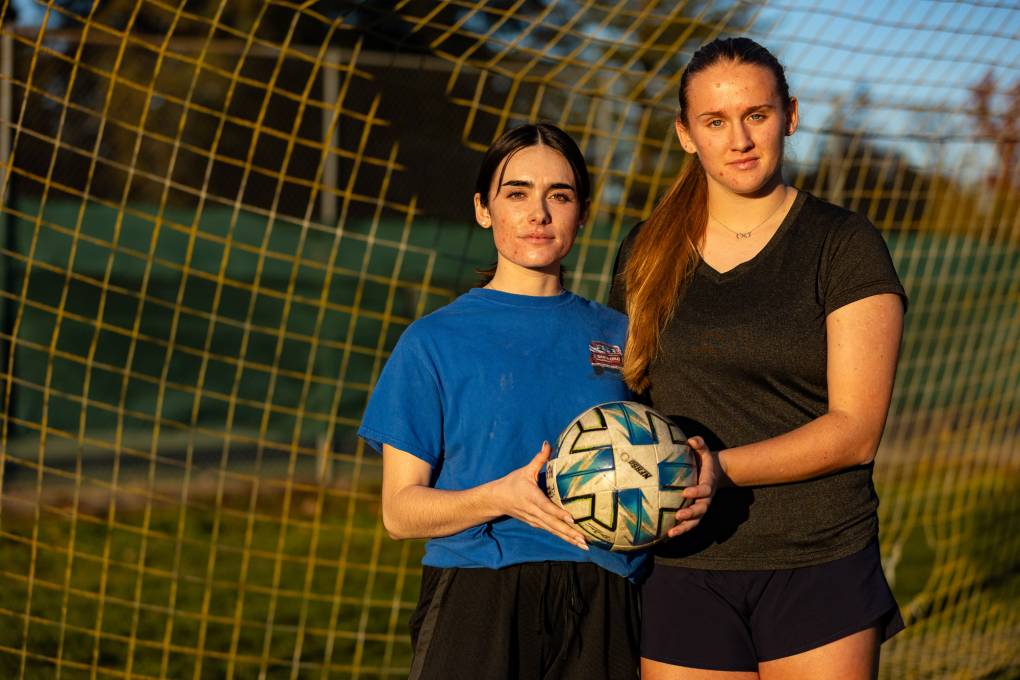
"content": "\u003cp>In more than a decade as a \u003ca href=\"https://www.kqed.org/news/tag/san-francisco-state-university\">San Francisco State University\u003c/a> lecturer, Christy Shick has taught a steady stream of first-year students fulfilling their mandatory writing requirements and dedicated English majors enrolled in upper-division electives.\u003c/p>\n\u003cp>Her long career at SF State has perks. Shick now works toward a pension, has built up the credit to warrant longer contracts and said she’s entitled to a more consistent workload — important benefits for lecturers, who lack the tenure track and job security of professors.\u003c/p>\n\u003cp>But this spring, all of that could go away.\u003c/p>\n\u003cp>“I have chosen to stay with this career at SF State because of the job security I thought I had,” Shick told KQED. “I’ve spent decades becoming, I think, highly expert at what I do. To suddenly have to change that, of course, is hard for me.”\u003c/p>\n\u003cp>[ad fullwidth]\u003c/p>\n\u003cp>Shick is one of an unknown number of lecturers who won’t be rehired next semester. She said she hasn’t been assigned courses despite being entitled to four because of her long-running employment status with SF State, where she has worked since 2012.\u003c/p>\n\u003cp>The lecturer cuts are due to declining enrollment and follow similar reductions in recent semesters, according to University President Lynn Mahoney. SF State’s student body has been decreasing since the fall of 2019, and this year, its freshman class was 20% to 25% smaller than anticipated.\u003c/p>\n\u003cfigure id=\"attachment_11847079\" class=\"wp-caption aligncenter\" style=\"max-width: 1920px\">\u003cimg loading=\"lazy\" decoding=\"async\" class=\"size-full wp-image-11847079\" src=\"https://cdn.kqed.org/wp-content/uploads/sites/10/2020/11/RS41990_023_KQED_SanFrancisco_SFSU_03112020_6857-qut.jpg\" alt=\"\" width=\"1920\" height=\"1280\" srcset=\"https://cdn.kqed.org/wp-content/uploads/sites/10/2020/11/RS41990_023_KQED_SanFrancisco_SFSU_03112020_6857-qut.jpg 1920w, https://cdn.kqed.org/wp-content/uploads/sites/10/2020/11/RS41990_023_KQED_SanFrancisco_SFSU_03112020_6857-qut-800x533.jpg 800w, https://cdn.kqed.org/wp-content/uploads/sites/10/2020/11/RS41990_023_KQED_SanFrancisco_SFSU_03112020_6857-qut-1020x680.jpg 1020w, https://cdn.kqed.org/wp-content/uploads/sites/10/2020/11/RS41990_023_KQED_SanFrancisco_SFSU_03112020_6857-qut-160x107.jpg 160w, https://cdn.kqed.org/wp-content/uploads/sites/10/2020/11/RS41990_023_KQED_SanFrancisco_SFSU_03112020_6857-qut-1536x1024.jpg 1536w\" sizes=\"(max-width: 1920px) 100vw, 1920px\">\u003cfigcaption class=\"wp-caption-text\">An empty campus at San Francisco State University on Wednesday, March 11, 2020. \u003ccite>(Beth LaBerge/KQED)\u003c/cite>\u003c/figcaption>\u003c/figure>\n\u003cp>Shick and her colleagues worry that the Department of English Language and Literature will be hit especially hard by this round of cuts. Some reports have estimated that six lecturers could be dropped ahead of the spring semester, and there will be 19 fewer introductory writing courses than in the fall.\u003c/p>\n\u003cp>On top of the lecturer cuts, the university declared a fiscal emergency last month. Mahoney has maintained that the declaration was just a matter of language in a school policy that allows her to initiate a review of programs with low enrollment.\u003c/p>\n\u003cp>“Outside of that policy, I have not declared a financial emergency,” she told KQED. “It’s actually just the language that I had to use based on a very old [Academic] Senate policy.”\u003c/p>\n\u003cp>Still, the budget situation at the university isn’t good as enrollment falls, forcing lecturer cuts and other budget reductions to bring costs in line with revenues.\u003c/p>\n\u003cp>Enrollment hovered around 30,000 throughout much of the 2010s, but since the fall of 2019, it has been declining quickly. This semester, SF State has just over 22,300 registered students.\u003c/p>\n\u003cp>[aside postID=news_12015757 hero='https://cdn.kqed.org/wp-content/uploads/sites/10/2024/11/MarriottHotelWorkerStrikeGetty-1020x735.jpg']\u003c/p>\n\u003cp>Funding for the university comes from two primary sources: tuition revenue, which is dwindling, and state dollars, which are also down after the \u003ca href=\"https://www.kqed.org/news/tag/california-state-university\">California State University\u003c/a> system reallocated some funds away from campuses, including SF State, that haven’t met enrollment goals. \u003ca href=\"https://www.kqed.org/news/11998761/california-state-university-stares-down-a-1-billion-budget-gap-as-campuses-cut-costs\">Gov. Gavin Newsom’s budget\u003c/a> for the next fiscal year, due in January, is expected to reduce overall CSU funding altogether by nearly 8%.\u003c/p>\n\u003cp>The university has made $40 million worth of budget reductions and is predicting it will need $25 million or so more to get back on track. That doesn’t factor in budget constraints if enrollment continues to decline at its current rate, which hasn’t shown signs of slowing yet.\u003c/p>\n\u003cp>While lecturers worry about their job security, they’re also advocating for the university to retain courses that cater specifically to freshmen. While 30 lecturers taught 90 sections of a required first-year writing course this fall, only 11 are expected to teach 34 sections in the spring. Last spring, 23 lecturers taught 90 sections.\u003c/p>\n\u003cp>“By gutting first your experience courses, by piling too many students into these classrooms, by having faculty who are not trained teach them, there’s going to be a legacy of an incredible decline in graduation rates,” Shick told KQED. “The school is going to be so much less appealing to students because a lot of the reason students come here is for these programs that have been built over decades to make them feel heard, to give them voices.”\u003c/p>\n\u003cp>She said that cuts to administrative roles and wages would have much less of an effect on students.\u003c/p>\n\u003cp>“If there’s been that much of a decrease, why do we need the same number of administrators?” Shick asked.\u003c/p>\n\u003cp>Mahoney said the university was curtailing the hiring of both staff and administrators. After one of her office’s vice presidents left their role last year, their work was divided up among other VPs instead of hiring a replacement. Mahoney’s salary, which is nearly half a million dollars, hasn’t been affected.\u003c/p>\n\u003cp>“It’s just very sad for a university that’s been built on decades of a reputation of inclusivity and diversity and opportunity for all students … be mishandled and downsized so swiftly,” Shick told KQED. “My students are wondering if they should transfer somewhere else. They’re not even sure they want to stay here anymore.”\u003c/p>\n\u003cp>\u003cem>KQED’s \u003ca href=\"https://www.kqed.org/author/shossaini\">Sara Hossaini\u003c/a> contributed to this report.\u003c/em>\u003c/p>\n\u003cp>\u003c/p>\n",
"blocks": [],
"excerpt": "Some longtime San Francisco State University lecturers say they haven’t been rehired for next semester.",
"status": "publish",
"parent": 0,
"modified": 1733186504,
"stats": {
"hasAudio": false,
"hasVideo": false,
"hasChartOrMap": false,
"iframeSrcs": [],
"hasGoogleForm": false,
"hasGallery": false,
"hasHearkenModule": false,
"hasPolis": false,
"paragraphCount": 23,
"wordCount": 901
},
"headData": {
"title": "SF State Lecturers Rattled by Looming Job Cuts as Enrollment Slides | KQED",
"description": "Some longtime San Francisco State University lecturers say they haven’t been rehired for next semester.",
"ogTitle": "",
"ogDescription": "",
"ogImgId": "",
"twTitle": "",
"twDescription": "",
"twImgId": "",
"schema": {
"@context": "https://schema.org",
"@type": "NewsArticle",
"headline": "SF State Lecturers Rattled by Looming Job Cuts as Enrollment Slides",
"datePublished": "2024-12-02T15:54:56-08:00",
"dateModified": "2024-12-02T16:41:44-08:00",
"image": "https://cdn.kqed.org/wp-content/uploads/2020/02/KQED-OG-Image@1x.png",
"isAccessibleForFree": "True",
"publisher": {
"@type": "NewsMediaOrganization",
"@id": "https://www.kqed.org/#organization",
"name": "KQED",
"logo": "https://cdn.kqed.org/wp-content/uploads/2020/02/KQED-OG-Image@1x.png",
"url": "https://www.kqed.org",
"sameAs": [
"https://www.facebook.com/KQED",
"https://twitter.com/KQED",
"https://www.instagram.com/kqed/",
"https://www.tiktok.com/@kqedofficial",
"https://www.linkedin.com/company/kqed",
"https://www.youtube.com/channel/UCeC0IOo7i1P_61zVUWbJ4nw"
]
}
}
},
"sticky": false,
"nprStoryId": "kqed-12016316",
"excludeFromSiteSearch": "Include",
"articleAge": "0",
"path": "/news/12016316/sf-state-lecturers-rattled-by-looming-job-cuts-enrollment-slides",
"audioTrackLength": null,
"parsedContent": [
{
"type": "contentString",
"content": "\u003cdiv class=\"post-body\">\u003cp>\u003cp>In more than a decade as a \u003ca href=\"https://www.kqed.org/news/tag/san-francisco-state-university\">San Francisco State University\u003c/a> lecturer, Christy Shick has taught a steady stream of first-year students fulfilling their mandatory writing requirements and dedicated English majors enrolled in upper-division electives.\u003c/p>\n\u003cp>Her long career at SF State has perks. Shick now works toward a pension, has built up the credit to warrant longer contracts and said she’s entitled to a more consistent workload — important benefits for lecturers, who lack the tenure track and job security of professors.\u003c/p>\n\u003cp>But this spring, all of that could go away.\u003c/p>\n\u003cp>“I have chosen to stay with this career at SF State because of the job security I thought I had,” Shick told KQED. “I’ve spent decades becoming, I think, highly expert at what I do. To suddenly have to change that, of course, is hard for me.”\u003c/p>\n\u003cp>\u003c/p>\u003c/div>",
"attributes": {
"named": {},
"numeric": []
}
},
{
"type": "component",
"content": "",
"name": "ad",
"attributes": {
"named": {
"label": "fullwidth"
},
"numeric": [
"fullwidth"
]
}
},
{
"type": "contentString",
"content": "\u003cdiv class=\"post-body\">\u003cp>\u003c/p>\n\u003cp>Shick is one of an unknown number of lecturers who won’t be rehired next semester. She said she hasn’t been assigned courses despite being entitled to four because of her long-running employment status with SF State, where she has worked since 2012.\u003c/p>\n\u003cp>The lecturer cuts are due to declining enrollment and follow similar reductions in recent semesters, according to University President Lynn Mahoney. SF State’s student body has been decreasing since the fall of 2019, and this year, its freshman class was 20% to 25% smaller than anticipated.\u003c/p>\n\u003cfigure id=\"attachment_11847079\" class=\"wp-caption aligncenter\" style=\"max-width: 1920px\">\u003cimg loading=\"lazy\" decoding=\"async\" class=\"size-full wp-image-11847079\" src=\"https://cdn.kqed.org/wp-content/uploads/sites/10/2020/11/RS41990_023_KQED_SanFrancisco_SFSU_03112020_6857-qut.jpg\" alt=\"\" width=\"1920\" height=\"1280\" srcset=\"https://cdn.kqed.org/wp-content/uploads/sites/10/2020/11/RS41990_023_KQED_SanFrancisco_SFSU_03112020_6857-qut.jpg 1920w, https://cdn.kqed.org/wp-content/uploads/sites/10/2020/11/RS41990_023_KQED_SanFrancisco_SFSU_03112020_6857-qut-800x533.jpg 800w, https://cdn.kqed.org/wp-content/uploads/sites/10/2020/11/RS41990_023_KQED_SanFrancisco_SFSU_03112020_6857-qut-1020x680.jpg 1020w, https://cdn.kqed.org/wp-content/uploads/sites/10/2020/11/RS41990_023_KQED_SanFrancisco_SFSU_03112020_6857-qut-160x107.jpg 160w, https://cdn.kqed.org/wp-content/uploads/sites/10/2020/11/RS41990_023_KQED_SanFrancisco_SFSU_03112020_6857-qut-1536x1024.jpg 1536w\" sizes=\"(max-width: 1920px) 100vw, 1920px\">\u003cfigcaption class=\"wp-caption-text\">An empty campus at San Francisco State University on Wednesday, March 11, 2020. \u003ccite>(Beth LaBerge/KQED)\u003c/cite>\u003c/figcaption>\u003c/figure>\n\u003cp>Shick and her colleagues worry that the Department of English Language and Literature will be hit especially hard by this round of cuts. Some reports have estimated that six lecturers could be dropped ahead of the spring semester, and there will be 19 fewer introductory writing courses than in the fall.\u003c/p>\n\u003cp>On top of the lecturer cuts, the university declared a fiscal emergency last month. Mahoney has maintained that the declaration was just a matter of language in a school policy that allows her to initiate a review of programs with low enrollment.\u003c/p>\n\u003cp>“Outside of that policy, I have not declared a financial emergency,” she told KQED. “It’s actually just the language that I had to use based on a very old [Academic] Senate policy.”\u003c/p>\n\u003cp>Still, the budget situation at the university isn’t good as enrollment falls, forcing lecturer cuts and other budget reductions to bring costs in line with revenues.\u003c/p>\n\u003cp>Enrollment hovered around 30,000 throughout much of the 2010s, but since the fall of 2019, it has been declining quickly. This semester, SF State has just over 22,300 registered students.\u003c/p>\n\u003cp>\u003c/p>\u003c/div>",
"attributes": {
"named": {},
"numeric": []
}
},
{
"type": "component",
"content": "",
"name": "aside",
"attributes": {
"named": {
"postid": "news_12015757",
"hero": "https://cdn.kqed.org/wp-content/uploads/sites/10/2024/11/MarriottHotelWorkerStrikeGetty-1020x735.jpg",
"label": ""
},
"numeric": []
}
},
{
"type": "contentString",
"content": "\u003cdiv class=\"post-body\">\u003cp>\u003c/p>\n\u003cp>Funding for the university comes from two primary sources: tuition revenue, which is dwindling, and state dollars, which are also down after the \u003ca href=\"https://www.kqed.org/news/tag/california-state-university\">California State University\u003c/a> system reallocated some funds away from campuses, including SF State, that haven’t met enrollment goals. \u003ca href=\"https://www.kqed.org/news/11998761/california-state-university-stares-down-a-1-billion-budget-gap-as-campuses-cut-costs\">Gov. Gavin Newsom’s budget\u003c/a> for the next fiscal year, due in January, is expected to reduce overall CSU funding altogether by nearly 8%.\u003c/p>\n\u003cp>The university has made $40 million worth of budget reductions and is predicting it will need $25 million or so more to get back on track. That doesn’t factor in budget constraints if enrollment continues to decline at its current rate, which hasn’t shown signs of slowing yet.\u003c/p>\n\u003cp>While lecturers worry about their job security, they’re also advocating for the university to retain courses that cater specifically to freshmen. While 30 lecturers taught 90 sections of a required first-year writing course this fall, only 11 are expected to teach 34 sections in the spring. Last spring, 23 lecturers taught 90 sections.\u003c/p>\n\u003cp>“By gutting first your experience courses, by piling too many students into these classrooms, by having faculty who are not trained teach them, there’s going to be a legacy of an incredible decline in graduation rates,” Shick told KQED. “The school is going to be so much less appealing to students because a lot of the reason students come here is for these programs that have been built over decades to make them feel heard, to give them voices.”\u003c/p>\n\u003cp>She said that cuts to administrative roles and wages would have much less of an effect on students.\u003c/p>\n\u003cp>“If there’s been that much of a decrease, why do we need the same number of administrators?” Shick asked.\u003c/p>\n\u003cp>Mahoney said the university was curtailing the hiring of both staff and administrators. After one of her office’s vice presidents left their role last year, their work was divided up among other VPs instead of hiring a replacement. Mahoney’s salary, which is nearly half a million dollars, hasn’t been affected.\u003c/p>\n\u003cp>“It’s just very sad for a university that’s been built on decades of a reputation of inclusivity and diversity and opportunity for all students … be mishandled and downsized so swiftly,” Shick told KQED. “My students are wondering if they should transfer somewhere else. They’re not even sure they want to stay here anymore.”\u003c/p>\n\u003cp>\u003cem>KQED’s \u003ca href=\"https://www.kqed.org/author/shossaini\">Sara Hossaini\u003c/a> contributed to this report.\u003c/em>\u003c/p>\n\u003cp>\u003c/p>\n\u003c/div>\u003c/p>",
"attributes": {
"named": {},
"numeric": []
}
}
],
"link": "/news/12016316/sf-state-lecturers-rattled-by-looming-job-cuts-enrollment-slides",
"authors": [
"11913"
],
"categories": [
"news_18540",
"news_34551",
"news_8"
],
"tags": [
"news_20013",
"news_19904",
"news_38",
"news_2200"
],
"featImg": "news_12016343",
"label": "news"
},
"news_12016282": {
"type": "posts",
"id": "news_12016282",
"meta": {
"index": "posts_1716263798",
"site": "news",
"id": "12016282",
"score": null,
"sort": [
1733169612000
]
},
"guestAuthors": [],
"slug": "california-bill-would-give-public-university-admission-priority-to-slaves-descendants",
"title": "California Bill Would Give Public University Admission Priority to Descendants of Slaves",
"publishDate": 1733169612,
"format": "standard",
"headTitle": "California Bill Would Give Public University Admission Priority to Descendants of Slaves | KQED",
"labelTerm": {
"site": "news"
},
"content": "\u003cp>A California lawmaker said he will introduce a bill on Monday that would give admission priority to the descendants of slaves at the University of California and California State University, the state’s two large public university systems.\u003c/p>\n\u003cp>Assemblymember Isaac Bryan, a Democrat who represents parts of Los Angeles, told \u003cem>The Associated Press\u003c/em> he will introduce the bill as lawmakers meet in the Capitol to swear in new members for a new legislative session. They also will convene a special session to consider ways to protect the state’s progressive policies ahead of another Trump administration.\u003c/p>\n\u003cp>The incoming administration of President-elect Donald Trump is expected to make dismantling diversity, equity and inclusion programs a priority. Around the U.S., a conservative movement to limit DEI initiatives has been gaining momentum in state capitals and college governing boards, with officials in many states taking action against them.\u003c/p>\n\u003cp>The movement gained momentum last year after the Supreme Court’s decision to end affirmative action at universities, which created a new legal landscape around diversity programs in the workplace and civil society.\u003c/p>\n\u003cp>But DEI’s emergence as a political rallying cry also has its roots on campus, with Republican opponents saying the programs are discriminatory and promote left-wing ideology. Trump has hinted at potential legislation to fine universities over diversity initiatives.\u003c/p>\n\u003cp>[ad fullwidth]\u003c/p>\n\u003cp>At the same time, legacy admissions, long seen as a perk for the white and wealthy at selective colleges, have come under fire in recent years following the Supreme Court’s ruling against affirmative action. By banning affirmative action but allowing legacy preferences, which favor the children of alumni and donors, critics say the court left admissions even more lopsided against students of color.\u003c/p>\n\u003cp>“For decades, universities gave preferential admission treatment to donors and their family members, while others tied to legacies of harm were ignored and at times outright excluded,” Bryan told the AP. “We have a moral responsibility to do all we can to right those wrongs.”\u003c/p>\n\u003cp>[aside label='Related Coverage' tag='reparations']\u003c/p>\n\u003cp>Bryan said he is hopeful for approval of the measure, which is in line with recommendations developed by members of California’s Black Reparations Task Force.\u003c/p>\n\u003cp>“There is a growing understanding of California’s role in perpetuating the inequalities that arose from slavery, and there’s a willingness to try to rectify that harm, to heal that harm,” he said.\u003c/p>\n\u003cp>Black students made up about 4% of the California State University’s student population and about 4.7% at the University of California in 2023, according to the university systems’ latest reports.\u003c/p>\n\u003cp>The proposal follows reparations efforts at the state level that have yielded mixed results. Democratic Gov. Gavin Newsom signed a law in September to formally apologize for the state’s legacy of racism and discrimination against Black residents.\u003c/p>\n\u003cp>But state lawmakers blocked a bill that would have created an agency to administer reparations programs, and Newsom vetoed a proposal that would have helped Black families reclaim property that was seized unjustly by the government through eminent domain.\u003c/p>\n\u003cp>Earlier this month, California voters also rejected a ballot measure that would have amended the state constitution to ban forced prison labor, squashing another proposal championed by Bryan and other members of the California Legislative Black Caucus.\u003c/p>\n\u003cfigure id=\"attachment_12002657\" class=\"wp-caption alignnone\" style=\"max-width: 2560px\">\u003ca href=\"https://cdn.kqed.org/wp-content/uploads/sites/10/2024/08/AP24244812299639-scaled.jpg\">\u003cimg loading=\"lazy\" decoding=\"async\" class=\"wp-image-12002657 size-full\" src=\"https://cdn.kqed.org/wp-content/uploads/sites/10/2024/08/AP24244812299639-scaled.jpg\" alt=\"\" width=\"2560\" height=\"1920\" srcset=\"https://cdn.kqed.org/wp-content/uploads/sites/10/2024/08/AP24244812299639-scaled.jpg 2560w, https://cdn.kqed.org/wp-content/uploads/sites/10/2024/08/AP24244812299639-800x600.jpg 800w, https://cdn.kqed.org/wp-content/uploads/sites/10/2024/08/AP24244812299639-1020x765.jpg 1020w, https://cdn.kqed.org/wp-content/uploads/sites/10/2024/08/AP24244812299639-160x120.jpg 160w, https://cdn.kqed.org/wp-content/uploads/sites/10/2024/08/AP24244812299639-1536x1152.jpg 1536w, https://cdn.kqed.org/wp-content/uploads/sites/10/2024/08/AP24244812299639-2048x1536.jpg 2048w, https://cdn.kqed.org/wp-content/uploads/sites/10/2024/08/AP24244812299639-1920x1440.jpg 1920w\" sizes=\"auto, (max-width: 2560px) 100vw, 2560px\">\u003c/a>\u003cfigcaption class=\"wp-caption-text\">Assemblymember Isaac Bryan (right) talks to members of Coalition for a Just and Equitable California about two reparations bills in the rotunda on the last day of the legislative year, Saturday, Aug. 31, 2024, in Sacramento. \u003ccite>(Tran Nguyen/AP Photo)\u003c/cite>\u003c/figcaption>\u003c/figure>\n\u003cp>The purpose of the measure is to rectify past and current discrimination at universities, Bryan said.\u003c/p>\n\u003cp>“When folks think about reparations, they think about just cash payments. But repairing the harm and the inequality that came from slavery and the policies thereafter is a much bigger process,” he said.\u003c/p>\n\u003cp>Bryan said he also proposed the measure, which will have to go through a monthslong legislative approval process, in part to respond to Trump’s recent statements about paying “reparations” to white students that he said have been affected by diversity, equity and inclusion programs.\u003c/p>\n\u003cp>States, including Kansas and Iowa, passed laws banning DEI offices and initiatives in higher education, and Republican lawmakers in about two dozen states proposed at least 50 bills to restrict DEI programs last year.\u003c/p>\n\u003cp>Trump’s incoming deputy chief of policy will be his former adviser, Stephen Miller, who leads a group called America First Legal that has aggressively challenged corporate DEI policies.\u003c/p>\n\u003cp>Trump, who has vowed to rid America’s schools of perceived “ wokeness,” also has plans to cut funding for schools that defy him on a multitude of issues on his first day in office, though even some of his supporters say he lacks the authority to make such swift and sweeping changes.\u003c/p>\n\u003cfigure id=\"attachment_11990718\" class=\"wp-caption alignnone\" style=\"max-width: 1920px\">\u003ca href=\"https://cdn.kqed.org/wp-content/uploads/sites/10/2024/06/ucberkeley20140213.jpg\">\u003cimg loading=\"lazy\" decoding=\"async\" class=\"wp-image-11990718 size-full\" src=\"https://cdn.kqed.org/wp-content/uploads/sites/10/2024/06/ucberkeley20140213.jpg\" alt=\"\" width=\"1920\" height=\"1279\" srcset=\"https://cdn.kqed.org/wp-content/uploads/sites/10/2024/06/ucberkeley20140213.jpg 1920w, https://cdn.kqed.org/wp-content/uploads/sites/10/2024/06/ucberkeley20140213-800x533.jpg 800w, https://cdn.kqed.org/wp-content/uploads/sites/10/2024/06/ucberkeley20140213-1020x679.jpg 1020w, https://cdn.kqed.org/wp-content/uploads/sites/10/2024/06/ucberkeley20140213-160x107.jpg 160w, https://cdn.kqed.org/wp-content/uploads/sites/10/2024/06/ucberkeley20140213-1536x1023.jpg 1536w\" sizes=\"auto, (max-width: 1920px) 100vw, 1920px\">\u003c/a>\u003cfigcaption class=\"wp-caption-text\">UC Berkeley students walk through Sproul Plaza on the UC Berkeley campus on April 23, 2012, in Berkeley, California. \u003ccite>(Justin Sullivan/Getty Images)\u003c/cite>\u003c/figcaption>\u003c/figure>\n\u003cp>Trump has heaped scorn on the federal Department of Education, describing it as infiltrated by “radicals, zealots and Marxists.” He has picked Linda McMahon, a former wrestling executive, to lead the department.\u003c/p>\n\u003cp>\u003c/p>\n\u003cp>But like many conservative politicians before him, Trump also has called for dismantling the department altogether, a cumbersome task that likely would require action from Congress.\u003c/p>\n\n",
"blocks": [],
"excerpt": "A California lawmaker proposed a bill to give admission priority to the descendants of slaves at the University of California and California State University.",
"status": "publish",
"parent": 0,
"modified": 1738109843,
"stats": {
"hasAudio": false,
"hasVideo": false,
"hasChartOrMap": false,
"iframeSrcs": [],
"hasGoogleForm": false,
"hasGallery": false,
"hasHearkenModule": false,
"hasPolis": false,
"paragraphCount": 24,
"wordCount": 901
},
"headData": {
"title": "California Bill Would Give Public University Admission Priority to Descendants of Slaves | KQED",
"description": "A California lawmaker proposed a bill to give admission priority to the descendants of slaves at the University of California and California State University.",
"ogTitle": "",
"ogDescription": "",
"ogImgId": "",
"twTitle": "",
"twDescription": "",
"twImgId": "",
"schema": {
"@context": "https://schema.org",
"@type": "NewsArticle",
"headline": "California Bill Would Give Public University Admission Priority to Descendants of Slaves",
"datePublished": "2024-12-02T12:00:12-08:00",
"dateModified": "2025-01-28T16:17:23-08:00",
"image": "https://cdn.kqed.org/wp-content/uploads/2020/02/KQED-OG-Image@1x.png",
"isAccessibleForFree": "True",
"publisher": {
"@type": "NewsMediaOrganization",
"@id": "https://www.kqed.org/#organization",
"name": "KQED",
"logo": "https://cdn.kqed.org/wp-content/uploads/2020/02/KQED-OG-Image@1x.png",
"url": "https://www.kqed.org",
"sameAs": [
"https://www.facebook.com/KQED",
"https://twitter.com/KQED",
"https://www.instagram.com/kqed/",
"https://www.tiktok.com/@kqedofficial",
"https://www.linkedin.com/company/kqed",
"https://www.youtube.com/channel/UCeC0IOo7i1P_61zVUWbJ4nw"
]
}
}
},
"sticky": false,
"nprByline": "Sophie Austin, Trân Nguyễn and Olga R. Rodriguez, Associated Press",
"excludeFromSiteSearch": "Include",
"showOnAuthorArchivePages": "No",
"articleAge": "0",
"path": "/news/12016282/california-bill-would-give-public-university-admission-priority-to-slaves-descendants",
"audioTrackLength": null,
"parsedContent": [
{
"type": "contentString",
"content": "\u003cdiv class=\"post-body\">\u003cp>\u003cp>A California lawmaker said he will introduce a bill on Monday that would give admission priority to the descendants of slaves at the University of California and California State University, the state’s two large public university systems.\u003c/p>\n\u003cp>Assemblymember Isaac Bryan, a Democrat who represents parts of Los Angeles, told \u003cem>The Associated Press\u003c/em> he will introduce the bill as lawmakers meet in the Capitol to swear in new members for a new legislative session. They also will convene a special session to consider ways to protect the state’s progressive policies ahead of another Trump administration.\u003c/p>\n\u003cp>The incoming administration of President-elect Donald Trump is expected to make dismantling diversity, equity and inclusion programs a priority. Around the U.S., a conservative movement to limit DEI initiatives has been gaining momentum in state capitals and college governing boards, with officials in many states taking action against them.\u003c/p>\n\u003cp>The movement gained momentum last year after the Supreme Court’s decision to end affirmative action at universities, which created a new legal landscape around diversity programs in the workplace and civil society.\u003c/p>\n\u003cp>But DEI’s emergence as a political rallying cry also has its roots on campus, with Republican opponents saying the programs are discriminatory and promote left-wing ideology. Trump has hinted at potential legislation to fine universities over diversity initiatives.\u003c/p>\n\u003cp>\u003c/p>\u003c/div>",
"attributes": {
"named": {},
"numeric": []
}
},
{
"type": "component",
"content": "",
"name": "ad",
"attributes": {
"named": {
"label": "fullwidth"
},
"numeric": [
"fullwidth"
]
}
},
{
"type": "contentString",
"content": "\u003cdiv class=\"post-body\">\u003cp>\u003c/p>\n\u003cp>At the same time, legacy admissions, long seen as a perk for the white and wealthy at selective colleges, have come under fire in recent years following the Supreme Court’s ruling against affirmative action. By banning affirmative action but allowing legacy preferences, which favor the children of alumni and donors, critics say the court left admissions even more lopsided against students of color.\u003c/p>\n\u003cp>“For decades, universities gave preferential admission treatment to donors and their family members, while others tied to legacies of harm were ignored and at times outright excluded,” Bryan told the AP. “We have a moral responsibility to do all we can to right those wrongs.”\u003c/p>\n\u003cp>\u003c/p>\u003c/div>",
"attributes": {
"named": {},
"numeric": []
}
},
{
"type": "component",
"content": "",
"name": "aside",
"attributes": {
"named": {
"label": "Related Coverage ",
"tag": "reparations"
},
"numeric": []
}
},
{
"type": "contentString",
"content": "\u003cdiv class=\"post-body\">\u003cp>\u003c/p>\n\u003cp>Bryan said he is hopeful for approval of the measure, which is in line with recommendations developed by members of California’s Black Reparations Task Force.\u003c/p>\n\u003cp>“There is a growing understanding of California’s role in perpetuating the inequalities that arose from slavery, and there’s a willingness to try to rectify that harm, to heal that harm,” he said.\u003c/p>\n\u003cp>Black students made up about 4% of the California State University’s student population and about 4.7% at the University of California in 2023, according to the university systems’ latest reports.\u003c/p>\n\u003cp>The proposal follows reparations efforts at the state level that have yielded mixed results. Democratic Gov. Gavin Newsom signed a law in September to formally apologize for the state’s legacy of racism and discrimination against Black residents.\u003c/p>\n\u003cp>But state lawmakers blocked a bill that would have created an agency to administer reparations programs, and Newsom vetoed a proposal that would have helped Black families reclaim property that was seized unjustly by the government through eminent domain.\u003c/p>\n\u003cp>Earlier this month, California voters also rejected a ballot measure that would have amended the state constitution to ban forced prison labor, squashing another proposal championed by Bryan and other members of the California Legislative Black Caucus.\u003c/p>\n\u003cfigure id=\"attachment_12002657\" class=\"wp-caption alignnone\" style=\"max-width: 2560px\">\u003ca href=\"https://cdn.kqed.org/wp-content/uploads/sites/10/2024/08/AP24244812299639-scaled.jpg\">\u003cimg loading=\"lazy\" decoding=\"async\" class=\"wp-image-12002657 size-full\" src=\"https://cdn.kqed.org/wp-content/uploads/sites/10/2024/08/AP24244812299639-scaled.jpg\" alt=\"\" width=\"2560\" height=\"1920\" srcset=\"https://cdn.kqed.org/wp-content/uploads/sites/10/2024/08/AP24244812299639-scaled.jpg 2560w, https://cdn.kqed.org/wp-content/uploads/sites/10/2024/08/AP24244812299639-800x600.jpg 800w, https://cdn.kqed.org/wp-content/uploads/sites/10/2024/08/AP24244812299639-1020x765.jpg 1020w, https://cdn.kqed.org/wp-content/uploads/sites/10/2024/08/AP24244812299639-160x120.jpg 160w, https://cdn.kqed.org/wp-content/uploads/sites/10/2024/08/AP24244812299639-1536x1152.jpg 1536w, https://cdn.kqed.org/wp-content/uploads/sites/10/2024/08/AP24244812299639-2048x1536.jpg 2048w, https://cdn.kqed.org/wp-content/uploads/sites/10/2024/08/AP24244812299639-1920x1440.jpg 1920w\" sizes=\"auto, (max-width: 2560px) 100vw, 2560px\">\u003c/a>\u003cfigcaption class=\"wp-caption-text\">Assemblymember Isaac Bryan (right) talks to members of Coalition for a Just and Equitable California about two reparations bills in the rotunda on the last day of the legislative year, Saturday, Aug. 31, 2024, in Sacramento. \u003ccite>(Tran Nguyen/AP Photo)\u003c/cite>\u003c/figcaption>\u003c/figure>\n\u003cp>The purpose of the measure is to rectify past and current discrimination at universities, Bryan said.\u003c/p>\n\u003cp>“When folks think about reparations, they think about just cash payments. But repairing the harm and the inequality that came from slavery and the policies thereafter is a much bigger process,” he said.\u003c/p>\n\u003cp>Bryan said he also proposed the measure, which will have to go through a monthslong legislative approval process, in part to respond to Trump’s recent statements about paying “reparations” to white students that he said have been affected by diversity, equity and inclusion programs.\u003c/p>\n\u003cp>States, including Kansas and Iowa, passed laws banning DEI offices and initiatives in higher education, and Republican lawmakers in about two dozen states proposed at least 50 bills to restrict DEI programs last year.\u003c/p>\n\u003cp>Trump’s incoming deputy chief of policy will be his former adviser, Stephen Miller, who leads a group called America First Legal that has aggressively challenged corporate DEI policies.\u003c/p>\n\u003cp>Trump, who has vowed to rid America’s schools of perceived “ wokeness,” also has plans to cut funding for schools that defy him on a multitude of issues on his first day in office, though even some of his supporters say he lacks the authority to make such swift and sweeping changes.\u003c/p>\n\u003cfigure id=\"attachment_11990718\" class=\"wp-caption alignnone\" style=\"max-width: 1920px\">\u003ca href=\"https://cdn.kqed.org/wp-content/uploads/sites/10/2024/06/ucberkeley20140213.jpg\">\u003cimg loading=\"lazy\" decoding=\"async\" class=\"wp-image-11990718 size-full\" src=\"https://cdn.kqed.org/wp-content/uploads/sites/10/2024/06/ucberkeley20140213.jpg\" alt=\"\" width=\"1920\" height=\"1279\" srcset=\"https://cdn.kqed.org/wp-content/uploads/sites/10/2024/06/ucberkeley20140213.jpg 1920w, https://cdn.kqed.org/wp-content/uploads/sites/10/2024/06/ucberkeley20140213-800x533.jpg 800w, https://cdn.kqed.org/wp-content/uploads/sites/10/2024/06/ucberkeley20140213-1020x679.jpg 1020w, https://cdn.kqed.org/wp-content/uploads/sites/10/2024/06/ucberkeley20140213-160x107.jpg 160w, https://cdn.kqed.org/wp-content/uploads/sites/10/2024/06/ucberkeley20140213-1536x1023.jpg 1536w\" sizes=\"auto, (max-width: 1920px) 100vw, 1920px\">\u003c/a>\u003cfigcaption class=\"wp-caption-text\">UC Berkeley students walk through Sproul Plaza on the UC Berkeley campus on April 23, 2012, in Berkeley, California. \u003ccite>(Justin Sullivan/Getty Images)\u003c/cite>\u003c/figcaption>\u003c/figure>\n\u003cp>Trump has heaped scorn on the federal Department of Education, describing it as infiltrated by “radicals, zealots and Marxists.” He has picked Linda McMahon, a former wrestling executive, to lead the department.\u003c/p>\n\u003cp>\u003c/p>\n\u003cp>But like many conservative politicians before him, Trump also has called for dismantling the department altogether, a cumbersome task that likely would require action from Congress.\u003c/p>\n\n\u003c/div>\u003c/p>",
"attributes": {
"named": {},
"numeric": []
}
}
],
"link": "/news/12016282/california-bill-would-give-public-university-admission-priority-to-slaves-descendants",
"authors": [
"byline_news_12016282"
],
"categories": [
"news_8"
],
"tags": [
"news_1895",
"news_18538",
"news_32395",
"news_20228",
"news_1323",
"news_20013",
"news_2923",
"news_95",
"news_22493",
"news_932",
"news_33765"
],
"featImg": "news_12004888",
"label": "news"
},
"news_12016234": {
"type": "posts",
"id": "news_12016234",
"meta": {
"index": "posts_1716263798",
"site": "news",
"id": "12016234",
"score": null,
"sort": [
1733016604000
]
},
"guestAuthors": [],
"slug": "colorado-state-advances-to-volleyball-final-and-will-take-the-court-against-san-jose-state",
"title": "San José State's Volleyball Season That Ignited Debate Over Women in Sports Ends in Title Match",
"publishDate": 1733016604,
"format": "standard",
"headTitle": "San José State’s Volleyball Season That Ignited Debate Over Women in Sports Ends in Title Match | KQED",
"labelTerm": {
"site": "news"
},
"content": "\u003cp>\u003cstrong>Updated, 5:30 p.m. Saturday:\u003c/strong> San José State’s volleyball team, the subject of a national debate about women in sports, was beaten by Colorado State 27–25, 25–20, 23–25, 25–16 in Saturday’s Mountain West tournament final, ending the Spartans’ season.\u003c/p>\n\u003cp>The Rams (20–10) received the conference’s automatic bid to the 64-team NCAA Tournament.\u003c/p>\n\u003cp>San José State’s season was marked by forfeits, limited protests and the topic of gender identity becoming a political issue in an election year. The Spartans were 14–6.\u003c/p>\n\u003cp>The controversy didn’t end during the Mountain West tournament.\u003c/p>\n\u003cp>Boise State, which twice boycotted regular-season matches with San José State, \u003ca href=\"https://apnews.com/article/san-jose-state-boise-state-mountain-west-volleyball-e568628c57805bb26f1be1fdf8f1e7a7?utm_source=copy&utm_medium=share\">pulled out of the conference tournament\u003c/a> on Wednesday night, hours after it defeated Utah State to secure a spot against the Spartans in Friday’s semifinals.\u003c/p>\n\u003cp>[ad fullwidth]\u003c/p>\n\u003cp>While the Broncos didn’t announce explicitly why they withdrew, a \u003ca href=\"https://apnews.com/article/san-jose-state-colorado-state-volleyball-title-ix-9f5e4f5642c2fe2a07cf3ff048bc9730\">lawsuit was recently filed\u003c/a> in Colorado by players from various schools against the conference and San José State officials calling for a Spartans player to be blocked from participating in the tournament. They cited unspecified reports asserting there was a transgender player on the San José State volleyball team, even naming her.\u003c/p>\n\u003cp>U.S. Magistrate Judge S. Kato Crews in Denver \u003ca href=\"https://apnews.com/article/transgender-san-jose-women-volleyball-judge-ruling-a45e6751924f73abd5ba5d786d43f5a3?utm_source=copy&utm_medium=share\">ruled Monday\u003c/a> that the player was allowed to play, and a federal appeals court \u003ca href=\"https://apnews.com/article/transgender-san-jose-women-volleyball-judge-ruling-901f0a74e816d91eca10c37e52a54f7c?utm_source=copy&utm_medium=share\">upheld the decision\u003c/a> the following day.\u003c/p>\n\u003cp>San José State, which received six forfeit victories \u003ca href=\"https://apnews.com/article/san-jose-state-volleyball-transgender-forfeit-3481bc5bfd68ad9aecef9cff7f497465?utm_source=copy&utm_medium=share\">because of boycotts\u003c/a> from opponents during the regular season, was seeded second in the conference tournament and received a first-round bye.\u003c/p>\n\u003cp>In addition to Boise State, Mountain West members Wyoming, Utah State and Nevada as well as Southern Utah canceled matches this season against the Spartans. Nevada’s players said they “refuse to participate in any match that advances injustice against female athletes,” without providing further details.\u003c/p>\n\u003cp>While some media have reported those and other details, San José State has not confirmed the school has a trans women’s volleyball player. The Associated Press is withholding the player’s name because she has not publicly commented on her gender identity and through school officials has declined an interview request.\u003c/p>\n\u003cp>Participation of transgender women in women’s sports became a hot political topic ahead of the recent election.\u003c/p>\n\u003cp>Though there were two protestors outside of Cox Pavilion on Friday, none were there Saturday. There also were no noticeable signs of hostility directed from the crowd of about 100 in the championship match.\u003c/p>\n\u003cp>\u003cstrong>Original story, 8:18 a.m. Saturday:\u003c/strong> Colorado State coach Emily Kohan said her team will take the floor rather than become the latest team to forfeit against San José State after the top-seeded Rams advanced to the Mountain West volleyball tournament final on Friday.\u003c/p>\n\u003cp>An automatic bid to the 64-team NCAA Tournament is on the line in Saturday’s final.[aside tag=\"transgender, sports\" label=\"More Related Stories\"]Colorado State made the final by beating fifth-seeded San Diego State 20–25, 25–23, 25–21, 25–23.\u003c/p>\n\u003cp>Boise State, which twice boycotted regular-season matches with San José State, \u003ca href=\"https://apnews.com/article/san-jose-state-boise-state-mountain-west-volleyball-e568628c57805bb26f1be1fdf8f1e7a7\">pulled out of the conference tournament\u003c/a> on Wednesday night, hours after it defeated Utah State to secure a spot against the Spartans in Friday’s semifinals.\u003c/p>\n\u003cp>While the Broncos didn’t announce explicitly why they withdrew, a \u003ca href=\"https://apnews.com/article/san-jose-state-colorado-state-volleyball-title-ix-9f5e4f5642c2fe2a07cf3ff048bc9730\">lawsuit was recently filed\u003c/a> in Colorado by players from various schools against the conference and San José State officials calling for a Spartans player to be blocked from participating in the tournament. They cited unspecified reports asserting there was a transgender player on the San José State volleyball team, even naming her.\u003c/p>\n\u003cp>U.S. Magistrate Judge S. Kato Crews in Denver \u003ca href=\"https://apnews.com/article/transgender-san-jose-women-volleyball-judge-ruling-a45e6751924f73abd5ba5d786d43f5a3\">ruled Monday\u003c/a> that the player was allowed to play, and a federal appeals court \u003ca href=\"https://apnews.com/article/transgender-san-jose-women-volleyball-judge-ruling-901f0a74e816d91eca10c37e52a54f7c\">upheld the decision\u003c/a> the following day.\u003c/p>\n\u003cp>“It’s been a really complex and emotional situation for us this season,” Colorado State’s Kohan said. “Unless you’re in those rooms having those hard conversations and making those hard decisions, I don’t think you truly know how this feels. I also think regardless of your opinion on it, there’s some room here to acknowledge that there’s been a lot of young people showing courage all season long.\u003c/p>\n\u003cp>“This can stop with us. We’re not going to pass these difficult conversations on to the NCAA committee or any other team to have those crying conversations in the hotel.”\u003c/p>\n\u003cp>San José State, which received six forfeit victories \u003ca href=\"https://apnews.com/article/san-jose-state-volleyball-transgender-forfeit-3481bc5bfd68ad9aecef9cff7f497465\">because of boycotts\u003c/a> from opponents during the regular season, is seeded second in the conference tournament and received a first-round bye.\u003c/p>\n\u003cp>Boise State was the latest school to forfeit. The Broncos’ athletic department released a statement Wednesday night saying their team “should not have to forgo this opportunity while waiting for a more thoughtful and better system that serves all athletes.”\u003c/p>\n\u003cp>In addition to Boise State, Mountain West members Wyoming, Utah State and Nevada as well as Southern Utah canceled matches this season against the Spartans. Nevada’s players said they “refuse to participate in any match that advances injustice against female athletes,” without providing further details.\u003c/p>\n\u003cp>While some media have reported those and other details, San José State has not confirmed the school has a trans women’s volleyball player. The Associated Press is withholding the player’s name because she has not publicly commented on her gender identity and through school officials has declined an interview request.\u003c/p>\n\u003cp>Participation of transgender women in women’s sports became a hot political topic ahead of the recent election.\u003c/p>\n\u003cp>Two protestors from Davis, California, stood outside Cox Pavilion before and during the Colorado State-San Diego State semifinal match on Friday. They supported those teams that forfeited matches against San José State, arguing the Spartans had an unfair athletic advantage.\u003c/p>\n\u003cp>\u003c/p>\n",
"blocks": [],
"excerpt": "The Spartans were beaten by Colorado State 27–25, 25–20, 23–25, 25–16 in Saturday’s Mountain West tournament final. That ended the Spartans’ season at 14–6.",
"status": "publish",
"parent": 0,
"modified": 1733017356,
"stats": {
"hasAudio": false,
"hasVideo": false,
"hasChartOrMap": false,
"iframeSrcs": [],
"hasGoogleForm": false,
"hasGallery": false,
"hasHearkenModule": false,
"hasPolis": false,
"paragraphCount": 27,
"wordCount": 1035
},
"headData": {
"title": "San José State's Volleyball Season That Ignited Debate Over Women in Sports Ends in Title Match | KQED",
"description": "The Spartans were beaten by Colorado State 27–25, 25–20, 23–25, 25–16 in Saturday’s Mountain West tournament final. That ended the Spartans’ season at 14–6.",
"ogTitle": "",
"ogDescription": "",
"ogImgId": "",
"twTitle": "",
"twDescription": "",
"twImgId": "",
"schema": {
"@context": "https://schema.org",
"@type": "NewsArticle",
"headline": "San José State's Volleyball Season That Ignited Debate Over Women in Sports Ends in Title Match",
"datePublished": "2024-11-30T17:30:04-08:00",
"dateModified": "2024-11-30T17:42:36-08:00",
"image": "https://cdn.kqed.org/wp-content/uploads/2020/02/KQED-OG-Image@1x.png",
"isAccessibleForFree": "True",
"publisher": {
"@type": "NewsMediaOrganization",
"@id": "https://www.kqed.org/#organization",
"name": "KQED",
"logo": "https://cdn.kqed.org/wp-content/uploads/2020/02/KQED-OG-Image@1x.png",
"url": "https://www.kqed.org",
"sameAs": [
"https://www.facebook.com/KQED",
"https://twitter.com/KQED",
"https://www.instagram.com/kqed/",
"https://www.tiktok.com/@kqedofficial",
"https://www.linkedin.com/company/kqed",
"https://www.youtube.com/channel/UCeC0IOo7i1P_61zVUWbJ4nw"
]
}
}
},
"sticky": false,
"nprByline": "Mark Anderson, The Associated Press",
"nprStoryId": "kqed-12016234",
"excludeFromSiteSearch": "Include",
"showOnAuthorArchivePages": "No",
"articleAge": "0",
"path": "/news/12016234/colorado-state-advances-to-volleyball-final-and-will-take-the-court-against-san-jose-state",
"audioTrackLength": null,
"parsedContent": [
{
"type": "contentString",
"content": "\u003cdiv class=\"post-body\">\u003cp>\u003cp>\u003cstrong>Updated, 5:30 p.m. Saturday:\u003c/strong> San José State’s volleyball team, the subject of a national debate about women in sports, was beaten by Colorado State 27–25, 25–20, 23–25, 25–16 in Saturday’s Mountain West tournament final, ending the Spartans’ season.\u003c/p>\n\u003cp>The Rams (20–10) received the conference’s automatic bid to the 64-team NCAA Tournament.\u003c/p>\n\u003cp>San José State’s season was marked by forfeits, limited protests and the topic of gender identity becoming a political issue in an election year. The Spartans were 14–6.\u003c/p>\n\u003cp>The controversy didn’t end during the Mountain West tournament.\u003c/p>\n\u003cp>Boise State, which twice boycotted regular-season matches with San José State, \u003ca href=\"https://apnews.com/article/san-jose-state-boise-state-mountain-west-volleyball-e568628c57805bb26f1be1fdf8f1e7a7?utm_source=copy&utm_medium=share\">pulled out of the conference tournament\u003c/a> on Wednesday night, hours after it defeated Utah State to secure a spot against the Spartans in Friday’s semifinals.\u003c/p>\n\u003cp>\u003c/p>\u003c/div>",
"attributes": {
"named": {},
"numeric": []
}
},
{
"type": "component",
"content": "",
"name": "ad",
"attributes": {
"named": {
"label": "fullwidth"
},
"numeric": [
"fullwidth"
]
}
},
{
"type": "contentString",
"content": "\u003cdiv class=\"post-body\">\u003cp>\u003c/p>\n\u003cp>While the Broncos didn’t announce explicitly why they withdrew, a \u003ca href=\"https://apnews.com/article/san-jose-state-colorado-state-volleyball-title-ix-9f5e4f5642c2fe2a07cf3ff048bc9730\">lawsuit was recently filed\u003c/a> in Colorado by players from various schools against the conference and San José State officials calling for a Spartans player to be blocked from participating in the tournament. They cited unspecified reports asserting there was a transgender player on the San José State volleyball team, even naming her.\u003c/p>\n\u003cp>U.S. Magistrate Judge S. Kato Crews in Denver \u003ca href=\"https://apnews.com/article/transgender-san-jose-women-volleyball-judge-ruling-a45e6751924f73abd5ba5d786d43f5a3?utm_source=copy&utm_medium=share\">ruled Monday\u003c/a> that the player was allowed to play, and a federal appeals court \u003ca href=\"https://apnews.com/article/transgender-san-jose-women-volleyball-judge-ruling-901f0a74e816d91eca10c37e52a54f7c?utm_source=copy&utm_medium=share\">upheld the decision\u003c/a> the following day.\u003c/p>\n\u003cp>San José State, which received six forfeit victories \u003ca href=\"https://apnews.com/article/san-jose-state-volleyball-transgender-forfeit-3481bc5bfd68ad9aecef9cff7f497465?utm_source=copy&utm_medium=share\">because of boycotts\u003c/a> from opponents during the regular season, was seeded second in the conference tournament and received a first-round bye.\u003c/p>\n\u003cp>In addition to Boise State, Mountain West members Wyoming, Utah State and Nevada as well as Southern Utah canceled matches this season against the Spartans. Nevada’s players said they “refuse to participate in any match that advances injustice against female athletes,” without providing further details.\u003c/p>\n\u003cp>While some media have reported those and other details, San José State has not confirmed the school has a trans women’s volleyball player. The Associated Press is withholding the player’s name because she has not publicly commented on her gender identity and through school officials has declined an interview request.\u003c/p>\n\u003cp>Participation of transgender women in women’s sports became a hot political topic ahead of the recent election.\u003c/p>\n\u003cp>Though there were two protestors outside of Cox Pavilion on Friday, none were there Saturday. There also were no noticeable signs of hostility directed from the crowd of about 100 in the championship match.\u003c/p>\n\u003cp>\u003cstrong>Original story, 8:18 a.m. Saturday:\u003c/strong> Colorado State coach Emily Kohan said her team will take the floor rather than become the latest team to forfeit against San José State after the top-seeded Rams advanced to the Mountain West volleyball tournament final on Friday.\u003c/p>\n\u003cp>An automatic bid to the 64-team NCAA Tournament is on the line in Saturday’s final.\u003c/p>\u003c/div>",
"attributes": {
"named": {},
"numeric": []
}
},
{
"type": "component",
"content": "",
"name": "aside",
"attributes": {
"named": {
"tag": "transgender, sports",
"label": "More Related Stories "
},
"numeric": []
}
},
{
"type": "contentString",
"content": "\u003cdiv class=\"post-body\">\u003cp>Colorado State made the final by beating fifth-seeded San Diego State 20–25, 25–23, 25–21, 25–23.\u003c/p>\n\u003cp>Boise State, which twice boycotted regular-season matches with San José State, \u003ca href=\"https://apnews.com/article/san-jose-state-boise-state-mountain-west-volleyball-e568628c57805bb26f1be1fdf8f1e7a7\">pulled out of the conference tournament\u003c/a> on Wednesday night, hours after it defeated Utah State to secure a spot against the Spartans in Friday’s semifinals.\u003c/p>\n\u003cp>While the Broncos didn’t announce explicitly why they withdrew, a \u003ca href=\"https://apnews.com/article/san-jose-state-colorado-state-volleyball-title-ix-9f5e4f5642c2fe2a07cf3ff048bc9730\">lawsuit was recently filed\u003c/a> in Colorado by players from various schools against the conference and San José State officials calling for a Spartans player to be blocked from participating in the tournament. They cited unspecified reports asserting there was a transgender player on the San José State volleyball team, even naming her.\u003c/p>\n\u003cp>U.S. Magistrate Judge S. Kato Crews in Denver \u003ca href=\"https://apnews.com/article/transgender-san-jose-women-volleyball-judge-ruling-a45e6751924f73abd5ba5d786d43f5a3\">ruled Monday\u003c/a> that the player was allowed to play, and a federal appeals court \u003ca href=\"https://apnews.com/article/transgender-san-jose-women-volleyball-judge-ruling-901f0a74e816d91eca10c37e52a54f7c\">upheld the decision\u003c/a> the following day.\u003c/p>\n\u003cp>“It’s been a really complex and emotional situation for us this season,” Colorado State’s Kohan said. “Unless you’re in those rooms having those hard conversations and making those hard decisions, I don’t think you truly know how this feels. I also think regardless of your opinion on it, there’s some room here to acknowledge that there’s been a lot of young people showing courage all season long.\u003c/p>\n\u003cp>“This can stop with us. We’re not going to pass these difficult conversations on to the NCAA committee or any other team to have those crying conversations in the hotel.”\u003c/p>\n\u003cp>San José State, which received six forfeit victories \u003ca href=\"https://apnews.com/article/san-jose-state-volleyball-transgender-forfeit-3481bc5bfd68ad9aecef9cff7f497465\">because of boycotts\u003c/a> from opponents during the regular season, is seeded second in the conference tournament and received a first-round bye.\u003c/p>\n\u003cp>Boise State was the latest school to forfeit. The Broncos’ athletic department released a statement Wednesday night saying their team “should not have to forgo this opportunity while waiting for a more thoughtful and better system that serves all athletes.”\u003c/p>\n\u003cp>In addition to Boise State, Mountain West members Wyoming, Utah State and Nevada as well as Southern Utah canceled matches this season against the Spartans. Nevada’s players said they “refuse to participate in any match that advances injustice against female athletes,” without providing further details.\u003c/p>\n\u003cp>While some media have reported those and other details, San José State has not confirmed the school has a trans women’s volleyball player. The Associated Press is withholding the player’s name because she has not publicly commented on her gender identity and through school officials has declined an interview request.\u003c/p>\n\u003cp>Participation of transgender women in women’s sports became a hot political topic ahead of the recent election.\u003c/p>\n\u003cp>Two protestors from Davis, California, stood outside Cox Pavilion before and during the Colorado State-San Diego State semifinal match on Friday. They supported those teams that forfeited matches against San José State, arguing the Spartans had an unfair athletic advantage.\u003c/p>\n\u003cp>\u003c/p>\n\u003c/div>\u003c/p>",
"attributes": {
"named": {},
"numeric": []
}
}
],
"link": "/news/12016234/colorado-state-advances-to-volleyball-final-and-will-take-the-court-against-san-jose-state",
"authors": [
"byline_news_12016234"
],
"categories": [
"news_8",
"news_10"
],
"tags": [
"news_20013",
"news_27626",
"news_17968",
"news_34078"
],
"featImg": "news_12016237",
"label": "news"
},
"news_12015828": {
"type": "posts",
"id": "news_12015828",
"meta": {
"index": "posts_1716263798",
"site": "news",
"id": "12015828",
"score": null,
"sort": [
1732644022000
]
},
"guestAuthors": [],
"slug": "trump-nominee-for-education-secretary-would-come-backed-with-detailed-policy-agenda",
"title": "Trump's Education Secretary Pick Linda McMahon Is Backed by a Detailed Policy Agenda",
"publishDate": 1732644022,
"format": "standard",
"headTitle": "Trump’s Education Secretary Pick Linda McMahon Is Backed by a Detailed Policy Agenda | KQED",
"labelTerm": {
"term": 33681,
"site": "news"
},
"content": "\u003cp>President-elect Donald Trump’s selection of a close ally and the co-chair of his transition team indicates that education could be a major priority of his administration, even though it did not feature prominently in the 2024 presidential campaign.\u003c/p>\n\u003cp>Linda McMahon, the former CEO of World Wrestling Entertainment, is a leading financial backer Trump has been close to for decades. She is also chair of the board of the little-known \u003ca class=\"external\" href=\"https://americafirstpolicy.com/\">America First Policy Institute,\u003c/a> \u003ca class=\"external\" href=\"https://americafirstpolicy.com/\">sometimes\u003c/a> referred to as a \u003ca class=\"external\" href=\"https://www.forbes.com/sites/alisondurkee/2024/11/06/america-first-agenda-what-to-know-about-the-project-2025-alternative-reportedly-behind-trump-transition/\">“shadow transition operation\u003c/a>” or “\u003ca class=\"external\" href=\"https://www.politico.com/news/2024/08/29/trump-transition-plan-afpi-00176674\">White House in waiting.\u003c/a>”\u003c/p>\n\u003cp>The institute has issued a \u003ca class=\"external\" href=\"https://americafirstpolicy.com/issues/education/k-12\">detailed education policy\u003c/a> agenda that is likely to serve as a guide for McMahon and the Trump administration in general, should the U.S. Senate confirm her.\u003c/p>\n\u003cp>For those reading the political tea leaves, it was notable that in nominating McMahon, Trump did not explicitly charge her with shutting down the U.S. Department of Education and that the agenda of the America First Policy Institute does not call for it either. Instead, Trump called on her “\u003ca class=\"external\" href=\"https://www.cnn.com/2024/11/19/politics/linda-mcmahon-education-secretary-trump/index.html\">to spearhead efforts to send education back to the states,”\u003c/a> an expansive and undefined charge, especially because, by law, education is already mostly a state and local function.\u003c/p>\n\u003cp>[ad fullwidth]\u003c/p>\n\u003cp>Regardless of the fate of the department, the contrast between President Joe Biden’s and Trump’s education agendas — and between McMahon and current Secretary of Education Miguel Cardona — could not be wider.\u003c/p>\n\u003cp>Cardona is a lifelong educator, becoming secretary after a career as a teacher, principal, district administrator and state commissioner of education. McMahon spent most of her career building the WWE, founded with her husband, Vince McMahon.\u003c/p>\n\u003cp>Cardona’s net worth is estimated by Forbes magazine to be \u003ca class=\"external\" href=\"https://www.forbes.com/sites/michelatindera/2021/06/26/heres-how-much-education-secretary-miguel-cardona-is-worth/\">$1 million\u003c/a>, most of it tied up in his principal residence, retirement savings and a 529 college savings account for his children. By contrast, Forbes places McMahon and her husband’s \u003ca class=\"external\" href=\"https://www.yahoo.com/news/billionaire-presidential-administration-trump-plans-170515584.html\">net worth\u003c/a> at $2.5 billion.\u003c/p>\n\u003cp>The only thing they seem to have in common is that they are both from Connecticut.\u003c/p>\n\u003cp>However, even though McMahon has a slim resume regarding education, she is not entirely an education neophyte. She studied to become a French teacher in college. She has been a trustee of \u003ca class=\"external\" href=\"https://www.sacredheart.edu/about-shu/leadership/\">Sacred Heart College,\u003c/a> a Catholic college in Fairfield, Connecticut, for years. She was appointed to the Connecticut State Board of Education in 2009, although she left after a year to run for the U.S. Senate in 2010 and again in 2012 — both times unsuccessfully.\u003c/p>\n\u003cp>McMahon is more of a traditional conservative Republican than several of Trump’s other Cabinet nominees. In some ways, she is more similar to Betsy DeVos, another billionaire, who was Trump’s first secretary of education. However, unlike DeVos, she has had experience in government as head of the Small Business Administration during Trump’s first term.\u003c/p>\n\u003cp>In 2019, she left that post — not under a cloud or fleeing vitriol from Trump, like many others in his administration — to head the America First PAC, which raised funds for Trump’s reelection bid in 2020.\u003c/p>\n\u003cp>On the explosive issue of “school choice,” publicly, at least, she has mostly called for expanding charter schools, rather than taxpayer-funded vouchers. “I am an advocate for choice through charter schools,” she declared in her 2010 campaign for Senate.\u003c/p>\n\u003cp>She also has some bipartisan instincts, even getting support from the Democratic senators she had previously run against when they had to approve her nomination to head the Small Business Administration. Sen. Richard Blumenthal called her “a person of serious accomplishment and ability,” and Sen. Chris Murphy described her as a “talented and experienced businessperson.”\u003c/p>\n\u003cp>As SBA administrator, she drew \u003ca class=\"external\" href=\"https://www.govexec.com/management/2019/04/small-business-administrator-departs-bipartisan-praise/155968/\">high praise\u003c/a> from some Democrats for increasing loans to women-owned businesses and for making the agency more efficient, including from then-Sen. Ben Cardin (D-Md.), the ranking member of the Small Business and Entrepreneur Committee.\u003c/p>\n\u003cp>Another sign of her bipartisan inclinations came in a September \u003ca class=\"external\" href=\"https://thehill.com/opinion/congress-blog/4871602-skilled-workforce-investment/\">commentary \u003c/a>in \u003cem>The Hill\u003c/em> newspaper when she argued for a radical revision of the Pell Grant, the main form of federal student financial aid.\u003c/p>\n\u003cp>While most Pell Grants go to full-time students, McMahon argued that the grant should also be available to students enrolled in “high-quality, shorter-term, industry-aligned education programs that could lead to immediate employment in well-paying jobs.”\u003c/p>\n\u003cp>To that end, she endorsed a bill \u003ca class=\"external\" href=\"https://www.congress.gov/bill/118th-congress/house-bill/6585\">known as the Workforce Pell Act\u003c/a>, sponsored by lawmakers usually on far opposite sides of the political aisle, including Reps. Virginia Foxx (R-N.C.), Elise Stefanik (R-N.Y.), Mark DeSaulnier (D-Calif.) and Bobby Scott (D-Va).\u003c/p>\n\u003cp>Arguably, one of her key qualifications is that she and Trump have a positive relationship. Unlike many who served in his first administration and left reviled by their former boss, when she stepped down as SBA administrator, Trump \u003ca class=\"external\" href=\"https://www.nytimes.com/2019/03/29/us/politics/linda-mcmahon-small-business-trump.html\">praised her as a “superstar\u003c/a>.” “Just so smooth,” he said. “She’s been one of our all-time favorites.”\u003c/p>\n\u003cp>However, her most important credential may well be her role as chair of the board of the America First Policy Institute, which \u003ca class=\"external\" href=\"https://apnews.com/article/linda-mcmahon-trump-education-secretary-wwe-613016d0c164b89765af761404cbb123\">she helped start.\u003c/a>\u003c/p>\n\u003cp>Its 150-person staff includes well-known Trump staffers like Kellyanne Conway and its executive director, Chad Wolf, the former secretary of homeland security. Pam Bondi, the head of the institute’s legal arm, \u003ca class=\"external\" href=\"https://www.nytimes.com/2024/11/21/us/politics/pam-bondi-attorney-general-trump.html\">was just nominated by Trump\u003c/a> to be attorney general in place of Matt Gaetz, who withdrew his nomination.\u003c/p>\n\u003cp>Like \u003ca class=\"external\" href=\"https://www.project2025.org/\">Project 2025\u003c/a>, the conservative blueprint issued by the Heritage Foundation (which Trump \u003ca class=\"external\" href=\"https://www.nytimes.com/article/project-2025.html\">has disavowed\u003c/a> and said he had no role in crafting), the America First Policy Institute has also drawn up a similar detailed policy framework, including one on education. Yet the institute has not done much to publicize its proposals, which Trump has reportedly appreciated.\u003c/p>\n\u003cp>The institute draws a sharp contrast between its “America First” policies and what it calls “America Last” policies championed by Democrats.\u003c/p>\n\u003cp>“America Last” policies, it argues, “prioritize radical ideologies and failing public schools.” These include promoting “transgenderism” and “radical ideologies over core subjects” while fighting “school choice expansion” and parent notification policies regarding curriculum and gender identification.\u003c/p>\n\u003cp>The institute calls for reinstating Trump’s \u003ca class=\"external\" href=\"https://www.heritage.org/american-founders/commentary/bidens-disbanding-1776-commission-shows-lefts-war-us-history\">1776 Commission \u003c/a>to promote “patriotic civic education” and removing critical race theory and diversity, equity and inclusion from what it alleges are requirements for federal grants.[aside label=\"Related Stories\" postID=\"news_12013558,news_12013686,news_12013269\"]And instead of supporting “leftist teachers unions” and teacher tenure, it advocates for “reduced union influence and increasing flexibility in hiring and firing.”\u003c/p>\n\u003cp>For these and other reasons, it is to be expected that key education groups would oppose McMahon’s nomination.\u003c/p>\n\u003cp>“Rather than working to strengthen public schools, expand learning opportunities for students and support educators, McMahon’s only mission is to eliminate the Department of Education and take away taxpayer dollars from public schools,” said President Becky Pringle, president of the National Education Association, the largest teachers union in the U.S.\u003c/p>\n\u003cp>However, for conservatives like Frederick Hess, director of education policy studies at the American Enterprise Institute, McMahon is an unknown quantity when it comes to education, and he made a pitch for approaching her nomination with an open mind. “I’m looking forward to learning more about her views and approach to the role in the weeks to come,” he said. “I’d avoid gross assumptions based on biography. Those seeking reflexive celebration or condemnation should look elsewhere. “\u003c/p>\n\u003cp>Controversy has already surfaced about her nomination. Media reports point to an October lawsuit in Maryland alleging McMahon and her husband failed to stop a prominent WWE ringside announcer in the 1980s and 1990s from sexually abusing 12- and 13-year-olds known as “ring boys” who were hired to do errands in preparation for wrestling matches.\u003c/p>\n\u003cp>What is still an open question is whether Trump will move to eliminate the Department of Education or how aggressively he will do so. His administration may decide that it is more important to keep the department intact for any number of reasons, including transforming its influential Office of Civil Rights into a weapon to impose his education agenda onto states or schools.\u003c/p>\n\u003cp>And it is possible that McMahon will continue to voice her praise for teachers and for public schools, including charter schools. “We have a very good system of public and private schools,” she said \u003ca class=\"external\" href=\"https://www.leadersmag.com/issues/2014.1_jan/Women%20Leaders/LEADERS-Linda-McMahon.html\">in an interview\u003c/a> a decade ago. “I’ve watched some masterful teachers who are innovative and who are reaching kids who are below grade level in many of the subjects. To see how they get turned around is heartwarming and astounding.”\u003c/p>\n\u003cp>\u003ca href=\"https://edsource.org/2024/trump-nominee-for-education-secretary-would-come-backed-with-detailed-policy-agenda/722774\">\u003cem>This story originally appeared in EdSource.\u003c/em>\u003c/a>\u003c/p>\n\u003cp>[ad floatright]\u003c/p>\n",
"blocks": [],
"excerpt": "McMahon, who is chair of the board at the America First Policy Institute, is expected to bring a detailed policy agenda and has not been publicly charged by Trump with shutting down the U.S. Department of Education. ",
"status": "publish",
"parent": 0,
"modified": 1732642758,
"stats": {
"hasAudio": false,
"hasVideo": false,
"hasChartOrMap": false,
"iframeSrcs": [],
"hasGoogleForm": false,
"hasGallery": false,
"hasHearkenModule": false,
"hasPolis": false,
"paragraphCount": 33,
"wordCount": 1524
},
"headData": {
"title": "Trump's Education Secretary Pick Linda McMahon Is Backed by a Detailed Policy Agenda | KQED",
"description": "McMahon, who is chair of the board at the America First Policy Institute, is expected to bring a detailed policy agenda and has not been publicly charged by Trump with shutting down the U.S. Department of Education. ",
"ogTitle": "",
"ogDescription": "",
"ogImgId": "",
"twTitle": "",
"twDescription": "",
"twImgId": "",
"schema": {
"@context": "https://schema.org",
"@type": "NewsArticle",
"headline": "Trump's Education Secretary Pick Linda McMahon Is Backed by a Detailed Policy Agenda",
"datePublished": "2024-11-26T10:00:22-08:00",
"dateModified": "2024-11-26T09:39:18-08:00",
"image": "https://cdn.kqed.org/wp-content/uploads/2020/02/KQED-OG-Image@1x.png",
"isAccessibleForFree": "True",
"publisher": {
"@type": "NewsMediaOrganization",
"@id": "https://www.kqed.org/#organization",
"name": "KQED",
"logo": "https://cdn.kqed.org/wp-content/uploads/2020/02/KQED-OG-Image@1x.png",
"url": "https://www.kqed.org",
"sameAs": [
"https://www.facebook.com/KQED",
"https://twitter.com/KQED",
"https://www.instagram.com/kqed/",
"https://www.tiktok.com/@kqedofficial",
"https://www.linkedin.com/company/kqed",
"https://www.youtube.com/channel/UCeC0IOo7i1P_61zVUWbJ4nw"
]
}
}
},
"sticky": false,
"nprByline": "\u003ca href=\"https://edsource.org/author/lfreedberg\">Louis Freedberg\u003c/a>, EdSource",
"excludeFromSiteSearch": "Include",
"showOnAuthorArchivePages": "No",
"articleAge": "0",
"path": "/news/12015828/trump-nominee-for-education-secretary-would-come-backed-with-detailed-policy-agenda",
"audioTrackLength": null,
"parsedContent": [
{
"type": "contentString",
"content": "\u003cdiv class=\"post-body\">\u003cp>\u003cp>President-elect Donald Trump’s selection of a close ally and the co-chair of his transition team indicates that education could be a major priority of his administration, even though it did not feature prominently in the 2024 presidential campaign.\u003c/p>\n\u003cp>Linda McMahon, the former CEO of World Wrestling Entertainment, is a leading financial backer Trump has been close to for decades. She is also chair of the board of the little-known \u003ca class=\"external\" href=\"https://americafirstpolicy.com/\">America First Policy Institute,\u003c/a> \u003ca class=\"external\" href=\"https://americafirstpolicy.com/\">sometimes\u003c/a> referred to as a \u003ca class=\"external\" href=\"https://www.forbes.com/sites/alisondurkee/2024/11/06/america-first-agenda-what-to-know-about-the-project-2025-alternative-reportedly-behind-trump-transition/\">“shadow transition operation\u003c/a>” or “\u003ca class=\"external\" href=\"https://www.politico.com/news/2024/08/29/trump-transition-plan-afpi-00176674\">White House in waiting.\u003c/a>”\u003c/p>\n\u003cp>The institute has issued a \u003ca class=\"external\" href=\"https://americafirstpolicy.com/issues/education/k-12\">detailed education policy\u003c/a> agenda that is likely to serve as a guide for McMahon and the Trump administration in general, should the U.S. Senate confirm her.\u003c/p>\n\u003cp>For those reading the political tea leaves, it was notable that in nominating McMahon, Trump did not explicitly charge her with shutting down the U.S. Department of Education and that the agenda of the America First Policy Institute does not call for it either. Instead, Trump called on her “\u003ca class=\"external\" href=\"https://www.cnn.com/2024/11/19/politics/linda-mcmahon-education-secretary-trump/index.html\">to spearhead efforts to send education back to the states,”\u003c/a> an expansive and undefined charge, especially because, by law, education is already mostly a state and local function.\u003c/p>\n\u003cp>\u003c/p>\u003c/div>",
"attributes": {
"named": {},
"numeric": []
}
},
{
"type": "component",
"content": "",
"name": "ad",
"attributes": {
"named": {
"label": "fullwidth"
},
"numeric": [
"fullwidth"
]
}
},
{
"type": "contentString",
"content": "\u003cdiv class=\"post-body\">\u003cp>\u003c/p>\n\u003cp>Regardless of the fate of the department, the contrast between President Joe Biden’s and Trump’s education agendas — and between McMahon and current Secretary of Education Miguel Cardona — could not be wider.\u003c/p>\n\u003cp>Cardona is a lifelong educator, becoming secretary after a career as a teacher, principal, district administrator and state commissioner of education. McMahon spent most of her career building the WWE, founded with her husband, Vince McMahon.\u003c/p>\n\u003cp>Cardona’s net worth is estimated by Forbes magazine to be \u003ca class=\"external\" href=\"https://www.forbes.com/sites/michelatindera/2021/06/26/heres-how-much-education-secretary-miguel-cardona-is-worth/\">$1 million\u003c/a>, most of it tied up in his principal residence, retirement savings and a 529 college savings account for his children. By contrast, Forbes places McMahon and her husband’s \u003ca class=\"external\" href=\"https://www.yahoo.com/news/billionaire-presidential-administration-trump-plans-170515584.html\">net worth\u003c/a> at $2.5 billion.\u003c/p>\n\u003cp>The only thing they seem to have in common is that they are both from Connecticut.\u003c/p>\n\u003cp>However, even though McMahon has a slim resume regarding education, she is not entirely an education neophyte. She studied to become a French teacher in college. She has been a trustee of \u003ca class=\"external\" href=\"https://www.sacredheart.edu/about-shu/leadership/\">Sacred Heart College,\u003c/a> a Catholic college in Fairfield, Connecticut, for years. She was appointed to the Connecticut State Board of Education in 2009, although she left after a year to run for the U.S. Senate in 2010 and again in 2012 — both times unsuccessfully.\u003c/p>\n\u003cp>McMahon is more of a traditional conservative Republican than several of Trump’s other Cabinet nominees. In some ways, she is more similar to Betsy DeVos, another billionaire, who was Trump’s first secretary of education. However, unlike DeVos, she has had experience in government as head of the Small Business Administration during Trump’s first term.\u003c/p>\n\u003cp>In 2019, she left that post — not under a cloud or fleeing vitriol from Trump, like many others in his administration — to head the America First PAC, which raised funds for Trump’s reelection bid in 2020.\u003c/p>\n\u003cp>On the explosive issue of “school choice,” publicly, at least, she has mostly called for expanding charter schools, rather than taxpayer-funded vouchers. “I am an advocate for choice through charter schools,” she declared in her 2010 campaign for Senate.\u003c/p>\n\u003cp>She also has some bipartisan instincts, even getting support from the Democratic senators she had previously run against when they had to approve her nomination to head the Small Business Administration. Sen. Richard Blumenthal called her “a person of serious accomplishment and ability,” and Sen. Chris Murphy described her as a “talented and experienced businessperson.”\u003c/p>\n\u003cp>As SBA administrator, she drew \u003ca class=\"external\" href=\"https://www.govexec.com/management/2019/04/small-business-administrator-departs-bipartisan-praise/155968/\">high praise\u003c/a> from some Democrats for increasing loans to women-owned businesses and for making the agency more efficient, including from then-Sen. Ben Cardin (D-Md.), the ranking member of the Small Business and Entrepreneur Committee.\u003c/p>\n\u003cp>Another sign of her bipartisan inclinations came in a September \u003ca class=\"external\" href=\"https://thehill.com/opinion/congress-blog/4871602-skilled-workforce-investment/\">commentary \u003c/a>in \u003cem>The Hill\u003c/em> newspaper when she argued for a radical revision of the Pell Grant, the main form of federal student financial aid.\u003c/p>\n\u003cp>While most Pell Grants go to full-time students, McMahon argued that the grant should also be available to students enrolled in “high-quality, shorter-term, industry-aligned education programs that could lead to immediate employment in well-paying jobs.”\u003c/p>\n\u003cp>To that end, she endorsed a bill \u003ca class=\"external\" href=\"https://www.congress.gov/bill/118th-congress/house-bill/6585\">known as the Workforce Pell Act\u003c/a>, sponsored by lawmakers usually on far opposite sides of the political aisle, including Reps. Virginia Foxx (R-N.C.), Elise Stefanik (R-N.Y.), Mark DeSaulnier (D-Calif.) and Bobby Scott (D-Va).\u003c/p>\n\u003cp>Arguably, one of her key qualifications is that she and Trump have a positive relationship. Unlike many who served in his first administration and left reviled by their former boss, when she stepped down as SBA administrator, Trump \u003ca class=\"external\" href=\"https://www.nytimes.com/2019/03/29/us/politics/linda-mcmahon-small-business-trump.html\">praised her as a “superstar\u003c/a>.” “Just so smooth,” he said. “She’s been one of our all-time favorites.”\u003c/p>\n\u003cp>However, her most important credential may well be her role as chair of the board of the America First Policy Institute, which \u003ca class=\"external\" href=\"https://apnews.com/article/linda-mcmahon-trump-education-secretary-wwe-613016d0c164b89765af761404cbb123\">she helped start.\u003c/a>\u003c/p>\n\u003cp>Its 150-person staff includes well-known Trump staffers like Kellyanne Conway and its executive director, Chad Wolf, the former secretary of homeland security. Pam Bondi, the head of the institute’s legal arm, \u003ca class=\"external\" href=\"https://www.nytimes.com/2024/11/21/us/politics/pam-bondi-attorney-general-trump.html\">was just nominated by Trump\u003c/a> to be attorney general in place of Matt Gaetz, who withdrew his nomination.\u003c/p>\n\u003cp>Like \u003ca class=\"external\" href=\"https://www.project2025.org/\">Project 2025\u003c/a>, the conservative blueprint issued by the Heritage Foundation (which Trump \u003ca class=\"external\" href=\"https://www.nytimes.com/article/project-2025.html\">has disavowed\u003c/a> and said he had no role in crafting), the America First Policy Institute has also drawn up a similar detailed policy framework, including one on education. Yet the institute has not done much to publicize its proposals, which Trump has reportedly appreciated.\u003c/p>\n\u003cp>The institute draws a sharp contrast between its “America First” policies and what it calls “America Last” policies championed by Democrats.\u003c/p>\n\u003cp>“America Last” policies, it argues, “prioritize radical ideologies and failing public schools.” These include promoting “transgenderism” and “radical ideologies over core subjects” while fighting “school choice expansion” and parent notification policies regarding curriculum and gender identification.\u003c/p>\n\u003cp>The institute calls for reinstating Trump’s \u003ca class=\"external\" href=\"https://www.heritage.org/american-founders/commentary/bidens-disbanding-1776-commission-shows-lefts-war-us-history\">1776 Commission \u003c/a>to promote “patriotic civic education” and removing critical race theory and diversity, equity and inclusion from what it alleges are requirements for federal grants.\u003c/p>\u003c/div>",
"attributes": {
"named": {},
"numeric": []
}
},
{
"type": "component",
"content": "",
"name": "aside",
"attributes": {
"named": {
"label": "Related Stories ",
"postid": "news_12013558,news_12013686,news_12013269"
},
"numeric": []
}
},
{
"type": "contentString",
"content": "\u003cdiv class=\"post-body\">\u003cp>And instead of supporting “leftist teachers unions” and teacher tenure, it advocates for “reduced union influence and increasing flexibility in hiring and firing.”\u003c/p>\n\u003cp>For these and other reasons, it is to be expected that key education groups would oppose McMahon’s nomination.\u003c/p>\n\u003cp>“Rather than working to strengthen public schools, expand learning opportunities for students and support educators, McMahon’s only mission is to eliminate the Department of Education and take away taxpayer dollars from public schools,” said President Becky Pringle, president of the National Education Association, the largest teachers union in the U.S.\u003c/p>\n\u003cp>However, for conservatives like Frederick Hess, director of education policy studies at the American Enterprise Institute, McMahon is an unknown quantity when it comes to education, and he made a pitch for approaching her nomination with an open mind. “I’m looking forward to learning more about her views and approach to the role in the weeks to come,” he said. “I’d avoid gross assumptions based on biography. Those seeking reflexive celebration or condemnation should look elsewhere. “\u003c/p>\n\u003cp>Controversy has already surfaced about her nomination. Media reports point to an October lawsuit in Maryland alleging McMahon and her husband failed to stop a prominent WWE ringside announcer in the 1980s and 1990s from sexually abusing 12- and 13-year-olds known as “ring boys” who were hired to do errands in preparation for wrestling matches.\u003c/p>\n\u003cp>What is still an open question is whether Trump will move to eliminate the Department of Education or how aggressively he will do so. His administration may decide that it is more important to keep the department intact for any number of reasons, including transforming its influential Office of Civil Rights into a weapon to impose his education agenda onto states or schools.\u003c/p>\n\u003cp>And it is possible that McMahon will continue to voice her praise for teachers and for public schools, including charter schools. “We have a very good system of public and private schools,” she said \u003ca class=\"external\" href=\"https://www.leadersmag.com/issues/2014.1_jan/Women%20Leaders/LEADERS-Linda-McMahon.html\">in an interview\u003c/a> a decade ago. “I’ve watched some masterful teachers who are innovative and who are reaching kids who are below grade level in many of the subjects. To see how they get turned around is heartwarming and astounding.”\u003c/p>\n\u003cp>\u003ca href=\"https://edsource.org/2024/trump-nominee-for-education-secretary-would-come-backed-with-detailed-policy-agenda/722774\">\u003cem>This story originally appeared in EdSource.\u003c/em>\u003c/a>\u003c/p>\n\u003cp>\u003c/p>\u003c/div>",
"attributes": {
"named": {},
"numeric": []
}
},
{
"type": "component",
"content": "",
"name": "ad",
"attributes": {
"named": {
"label": "floatright"
},
"numeric": [
"floatright"
]
}
},
{
"type": "contentString",
"content": "\u003cdiv class=\"post-body\">\u003cp>\u003c/p>\n\u003c/div>\u003c/p>",
"attributes": {
"named": {},
"numeric": []
}
}
],
"link": "/news/12015828/trump-nominee-for-education-secretary-would-come-backed-with-detailed-policy-agenda",
"authors": [
"byline_news_12015828"
],
"categories": [
"news_18540",
"news_8",
"news_13"
],
"tags": [
"news_1323",
"news_20013",
"news_32839",
"news_21567"
],
"affiliates": [
"news_33681"
],
"featImg": "news_12015832",
"label": "news_33681"
},
"news_12015335": {
"type": "posts",
"id": "news_12015335",
"meta": {
"index": "posts_1716263798",
"site": "news",
"id": "12015335",
"score": null,
"sort": [
1732225227000
]
},
"guestAuthors": [],
"slug": "attendance-in-california-schools-is-slowly-rebounding-new-data-shows",
"title": "Attendance in California Schools Is Slowly Rebounding, New Data Shows",
"publishDate": 1732225227,
"format": "standard",
"headTitle": "Attendance in California Schools Is Slowly Rebounding, New Data Shows | KQED",
"labelTerm": {},
"content": "\u003cp>California’s public school students are continuing to rebound from the pandemic, with more showing up for class, more graduating and fewer misbehaving at school, according to new data released on Thursday.\u003c/p>\n\u003cp>The California School Dashboard, a color-coded snapshot of how students and schools are faring, showed improvements in many categories during the 2023–24 school year — a relief for schools trying to help students recover academically and social-emotionally after the 2020 campus closures.\u003c/p>\n\u003cp>The most notable improvement was in attendance. The percentage of students who were chronically absent, missing more than 10% of school days in a year, dropped to about 20%, a significant decline from when it peaked at 30% three years ago. Prior to the pandemic, about 12% of students were chronically absent.\u003c/p>\n\u003cp>“This is good news,” said Hedy Chang, director of Attendance Works, a nonprofit that advocates for school attendance. “I’m pleasantly surprised. … To benefit from all the services that schools are offering, kids have to show up.”\u003c/p>\n\u003cp>Since the pandemic, schools across the state have been doubling down on efforts to lure students back to school. Many used their federal and state COVID-19 relief money to hire outreach workers, add bus routes, host pizza parties and otherwise make it easier and more enticing to come to school. Some districts had\u003ca href=\"https://calmatters.org/education/k-12-education/2023/09/soaring-chronic-absenteeism-in-california-schools-is-at-pivotal-moment/\"> social workers connect directly with parents\u003c/a> to solve transportation and other obstacles.\u003c/p>\n\u003cp>[ad fullwidth]\u003c/p>\n\u003cp>\u003c!-- iframe plugin v.4.3 wordpress.org/plugins/iframe/ -->\u003cbr>\n\u003ciframe loading=\"lazy\" src=\"https://datawrapper.dwcdn.net/2uJPe/5/\" height=\"500\" width=\"100%\" scrolling=\"yes\" class=\"iframe-class\" frameborder=\"0\">\u003c/iframe>\u003c/p>\n\u003cp>Those efforts paid off, Chang said. While the pizza parties helped, she pointed to many schools’ focus on improving campus climate overall. That includes counseling, social-emotional learning, stronger relationships between school staff and families, and health and wellness services.\u003c/p>\n\u003cp>Pandemic relief \u003ca href=\"https://calmatters.org/education/k-12-education/2024/09/pandemic-relief/\">grants expired this year\u003c/a>, so some districts will be scrambling to maintain these programs going forward. But the state’s recent investments in community schools, arts education, transitional kindergarten and other services will help, Chang said.\u003c/p>\n\u003ch3>Recognition for long-term English learners\u003c/h3>\n\u003cp>Another noteworthy item in the dashboard is the inclusion of a new student group: long-term English learners or students who were not fluent in English after seven years. The reasons for these students’ delays vary, but in general, they’re not receiving adequate help learning English and, as a result, lag far behind their peers academically.\u003c/p>\n\u003cp>About 10% of students who were ever classified as English learners were considered long-term English learners last year, according to state data. Those students had some of the lowest math and English language arts scores of any of California’s 13 other student groups.\u003c/p>\n\u003cp>“We’re celebrating this significant milestone, that long-term English learners get the spotlight they deserve and they are no longer invisible,” said Martha Hernandez, director of Californians Together, which advocates for students who are English learners. “But now the work begins to ensure their needs are met.”\u003c/p>\n\u003cp>Schools need to do a better job helping families who are recent immigrants by finding translators, providing counseling to students, boosting bilingual education and bringing in tutors to help with English and academic skills, said Lindsay Tornatore, director of systems improvement and student success at California County Superintendents, which represents county office of education superintendents.\u003c/p>\n\u003cp>“We should be mindful this is a student group that’s in the greatest need of support,” Tornatore said.\u003c/p>\n\u003ch3>‘Not good enough’\u003c/h3>\n\u003cp>Elsewhere on the dashboard, the graduation rate was 86.4%, up a bit from the previous year and higher than the pre-pandemic rate of 84.2%. However, a related item on the dashboard raised alarm bells with researchers. The number of students meeting the requirements for admission to California’s public universities was up only slightly — an increase of just 3,700 students among a graduating class of 438,000. Close to half of high school graduates are ineligible for the University of California or California State University.\u003c/p>\n\u003cp>“That’s just not good enough,” said Alix Gallagher, interim managing director at the nonpartisan think tank Policy Analysis for California Education. “It means the recovery has been anemic, and that’s a problem. We need a different approach, starting at the state level.”\u003c/p>\n\u003cp>\u003c!-- iframe plugin v.4.3 wordpress.org/plugins/iframe/ -->\u003cbr>\n\u003ciframe loading=\"lazy\" src=\"https://datawrapper.dwcdn.net/mHI0Y/4/\" height=\"400\" width=\"100%\" scrolling=\"yes\" class=\"iframe-class\" frameborder=\"0\">\u003c/iframe>\u003c/p>\n\u003cp>She pointed to some districts’ policies of placing students on math tracks that don’t allow them to meet the college admission requirements by their senior year. While not all students should be expected to enroll in four-year colleges, they should at least have the option available, she said.\u003c/p>\n\u003cp>The Department of Education hailed a drop in the suspension rate among all student groups. Student misbehavior increased after schools reopened, and schools struggled to maintain a positive atmosphere for staff and other students. The rate dropped from 3.6% to 3.3% last year.\u003c/p>\n\u003ch3>No major changes to format\u003c/h3>\n\u003cp>The dashboard itself has been under fire recently. The data is too hard for parents to navigate, and the color coding can be misleading, according to a report from the Center for Reinventing Public Education at Arizona State University.\u003c/p>\n\u003cp>For example, a school might earn an orange color, the second-from-lowest designation, for showing slight improvements, but its scores might actually be lower than schools that earned a red, the lowest ranking. The state said it would consider making some changes but hadn’t made any major alterations to this year’s version.\u003c/p>\n\u003cp>The dashboard was released a few weeks earlier than it was last year. By 2026, the dashboard’s release will coincide with the Smarter Balanced test score announcement in mid-October.\u003c/p>\n\u003cp>\u003c/p>\n\u003cp>\u003cem>CalMatters data reporter \u003ca href=\"https://calmatters.org/author/ericayee/\">Erica Yee\u003c/a> contributed to this reporting.\u003c/em>\u003c/p>\n\n",
"blocks": [],
"excerpt": "The latest California School Dashboard data shows a drop in chronic absenteeism in public schools to 20%, down from a high of 30% three years ago.",
"status": "publish",
"parent": 0,
"modified": 1732230492,
"stats": {
"hasAudio": false,
"hasVideo": false,
"hasChartOrMap": true,
"iframeSrcs": [
"https://datawrapper.dwcdn.net/2uJPe/5/",
"https://datawrapper.dwcdn.net/mHI0Y/4/"
],
"hasGoogleForm": false,
"hasGallery": false,
"hasHearkenModule": false,
"hasPolis": false,
"paragraphCount": 24,
"wordCount": 954
},
"headData": {
"title": "Attendance in California Schools Is Slowly Rebounding, New Data Shows | KQED",
"description": "The latest California School Dashboard data shows a drop in chronic absenteeism in public schools to 20%, down from a high of 30% three years ago.",
"ogTitle": "",
"ogDescription": "",
"ogImgId": "",
"twTitle": "",
"twDescription": "",
"twImgId": "",
"schema": {
"@context": "https://schema.org",
"@type": "NewsArticle",
"headline": "Attendance in California Schools Is Slowly Rebounding, New Data Shows",
"datePublished": "2024-11-21T13:40:27-08:00",
"dateModified": "2024-11-21T15:08:12-08:00",
"image": "https://cdn.kqed.org/wp-content/uploads/2020/02/KQED-OG-Image@1x.png",
"isAccessibleForFree": "True",
"publisher": {
"@type": "NewsMediaOrganization",
"@id": "https://www.kqed.org/#organization",
"name": "KQED",
"logo": "https://cdn.kqed.org/wp-content/uploads/2020/02/KQED-OG-Image@1x.png",
"url": "https://www.kqed.org",
"sameAs": [
"https://www.facebook.com/KQED",
"https://twitter.com/KQED",
"https://www.instagram.com/kqed/",
"https://www.tiktok.com/@kqedofficial",
"https://www.linkedin.com/company/kqed",
"https://www.youtube.com/channel/UCeC0IOo7i1P_61zVUWbJ4nw"
]
}
}
},
"source": "CalMatters",
"sourceUrl": "https://calmatters.org/",
"sticky": false,
"nprByline": "Carolyn Jones, CalMatters",
"nprStoryId": "kqed-12015335",
"excludeFromSiteSearch": "Include",
"showOnAuthorArchivePages": "No",
"articleAge": "0",
"path": "/news/12015335/attendance-in-california-schools-is-slowly-rebounding-new-data-shows",
"audioTrackLength": null,
"parsedContent": [
{
"type": "contentString",
"content": "\u003cdiv class=\"post-body\">\u003cp>\u003cp>California’s public school students are continuing to rebound from the pandemic, with more showing up for class, more graduating and fewer misbehaving at school, according to new data released on Thursday.\u003c/p>\n\u003cp>The California School Dashboard, a color-coded snapshot of how students and schools are faring, showed improvements in many categories during the 2023–24 school year — a relief for schools trying to help students recover academically and social-emotionally after the 2020 campus closures.\u003c/p>\n\u003cp>The most notable improvement was in attendance. The percentage of students who were chronically absent, missing more than 10% of school days in a year, dropped to about 20%, a significant decline from when it peaked at 30% three years ago. Prior to the pandemic, about 12% of students were chronically absent.\u003c/p>\n\u003cp>“This is good news,” said Hedy Chang, director of Attendance Works, a nonprofit that advocates for school attendance. “I’m pleasantly surprised. … To benefit from all the services that schools are offering, kids have to show up.”\u003c/p>\n\u003cp>Since the pandemic, schools across the state have been doubling down on efforts to lure students back to school. Many used their federal and state COVID-19 relief money to hire outreach workers, add bus routes, host pizza parties and otherwise make it easier and more enticing to come to school. Some districts had\u003ca href=\"https://calmatters.org/education/k-12-education/2023/09/soaring-chronic-absenteeism-in-california-schools-is-at-pivotal-moment/\"> social workers connect directly with parents\u003c/a> to solve transportation and other obstacles.\u003c/p>\n\u003cp>\u003c/p>\u003c/div>",
"attributes": {
"named": {},
"numeric": []
}
},
{
"type": "component",
"content": "",
"name": "ad",
"attributes": {
"named": {
"label": "fullwidth"
},
"numeric": [
"fullwidth"
]
}
},
{
"type": "contentString",
"content": "\u003cdiv class=\"post-body\">\u003cp>\u003c/p>\n\u003cp>\u003c!-- iframe plugin v.4.3 wordpress.org/plugins/iframe/ -->\u003cbr>\n\u003ciframe loading=\"lazy\" src=\"https://datawrapper.dwcdn.net/2uJPe/5/\" height=\"500\" width=\"100%\" scrolling=\"yes\" class=\"iframe-class\" frameborder=\"0\">\u003c/iframe>\u003c/p>\n\u003cp>Those efforts paid off, Chang said. While the pizza parties helped, she pointed to many schools’ focus on improving campus climate overall. That includes counseling, social-emotional learning, stronger relationships between school staff and families, and health and wellness services.\u003c/p>\n\u003cp>Pandemic relief \u003ca href=\"https://calmatters.org/education/k-12-education/2024/09/pandemic-relief/\">grants expired this year\u003c/a>, so some districts will be scrambling to maintain these programs going forward. But the state’s recent investments in community schools, arts education, transitional kindergarten and other services will help, Chang said.\u003c/p>\n\u003ch3>Recognition for long-term English learners\u003c/h3>\n\u003cp>Another noteworthy item in the dashboard is the inclusion of a new student group: long-term English learners or students who were not fluent in English after seven years. The reasons for these students’ delays vary, but in general, they’re not receiving adequate help learning English and, as a result, lag far behind their peers academically.\u003c/p>\n\u003cp>About 10% of students who were ever classified as English learners were considered long-term English learners last year, according to state data. Those students had some of the lowest math and English language arts scores of any of California’s 13 other student groups.\u003c/p>\n\u003cp>“We’re celebrating this significant milestone, that long-term English learners get the spotlight they deserve and they are no longer invisible,” said Martha Hernandez, director of Californians Together, which advocates for students who are English learners. “But now the work begins to ensure their needs are met.”\u003c/p>\n\u003cp>Schools need to do a better job helping families who are recent immigrants by finding translators, providing counseling to students, boosting bilingual education and bringing in tutors to help with English and academic skills, said Lindsay Tornatore, director of systems improvement and student success at California County Superintendents, which represents county office of education superintendents.\u003c/p>\n\u003cp>“We should be mindful this is a student group that’s in the greatest need of support,” Tornatore said.\u003c/p>\n\u003ch3>‘Not good enough’\u003c/h3>\n\u003cp>Elsewhere on the dashboard, the graduation rate was 86.4%, up a bit from the previous year and higher than the pre-pandemic rate of 84.2%. However, a related item on the dashboard raised alarm bells with researchers. The number of students meeting the requirements for admission to California’s public universities was up only slightly — an increase of just 3,700 students among a graduating class of 438,000. Close to half of high school graduates are ineligible for the University of California or California State University.\u003c/p>\n\u003cp>“That’s just not good enough,” said Alix Gallagher, interim managing director at the nonpartisan think tank Policy Analysis for California Education. “It means the recovery has been anemic, and that’s a problem. We need a different approach, starting at the state level.”\u003c/p>\n\u003cp>\u003c!-- iframe plugin v.4.3 wordpress.org/plugins/iframe/ -->\u003cbr>\n\u003ciframe loading=\"lazy\" src=\"https://datawrapper.dwcdn.net/mHI0Y/4/\" height=\"400\" width=\"100%\" scrolling=\"yes\" class=\"iframe-class\" frameborder=\"0\">\u003c/iframe>\u003c/p>\n\u003cp>She pointed to some districts’ policies of placing students on math tracks that don’t allow them to meet the college admission requirements by their senior year. While not all students should be expected to enroll in four-year colleges, they should at least have the option available, she said.\u003c/p>\n\u003cp>The Department of Education hailed a drop in the suspension rate among all student groups. Student misbehavior increased after schools reopened, and schools struggled to maintain a positive atmosphere for staff and other students. The rate dropped from 3.6% to 3.3% last year.\u003c/p>\n\u003ch3>No major changes to format\u003c/h3>\n\u003cp>The dashboard itself has been under fire recently. The data is too hard for parents to navigate, and the color coding can be misleading, according to a report from the Center for Reinventing Public Education at Arizona State University.\u003c/p>\n\u003cp>For example, a school might earn an orange color, the second-from-lowest designation, for showing slight improvements, but its scores might actually be lower than schools that earned a red, the lowest ranking. The state said it would consider making some changes but hadn’t made any major alterations to this year’s version.\u003c/p>\n\u003cp>The dashboard was released a few weeks earlier than it was last year. By 2026, the dashboard’s release will coincide with the Smarter Balanced test score announcement in mid-October.\u003c/p>\n\u003cp>\u003c/p>\n\u003cp>\u003cem>CalMatters data reporter \u003ca href=\"https://calmatters.org/author/ericayee/\">Erica Yee\u003c/a> contributed to this reporting.\u003c/em>\u003c/p>\n\n\u003c/div>\u003c/p>",
"attributes": {
"named": {},
"numeric": []
}
}
],
"link": "/news/12015335/attendance-in-california-schools-is-slowly-rebounding-new-data-shows",
"authors": [
"byline_news_12015335"
],
"categories": [
"news_31795",
"news_18540",
"news_8"
],
"tags": [
"news_22772",
"news_31231",
"news_20013",
"news_20516"
],
"affiliates": [
"news_18481"
],
"featImg": "news_12015371",
"label": "source_news_12015335"
},
"news_12014795": {
"type": "posts",
"id": "news_12014795",
"meta": {
"index": "posts_1716263798",
"site": "news",
"id": "12014795",
"score": null,
"sort": [
1731794408000
]
},
"guestAuthors": [],
"slug": "fewer-kids-are-going-to-california-public-schools-is-there-a-right-way-to-close-campuses",
"title": "Fewer Kids Are Going to California Public Schools. Is There a Right Way to Close Campuses?",
"publishDate": 1731794408,
"format": "standard",
"headTitle": "Fewer Kids Are Going to California Public Schools. Is There a Right Way to Close Campuses? | KQED",
"labelTerm": {
"term": 18481,
"site": "news"
},
"content": "\u003cp>When the superintendent in San Francisco Unified proposed closing schools recently, parents launched a prolonged — and successful — protest. The uproar may have died down for now, but the issue is likely to erupt at school boards across the state — and some say that’s a good thing.\u003c/p>\n\u003cp>Declining enrollment, the \u003ca href=\"https://calmatters.org/education/k-12-education/2024/09/pandemic-relief/\">end of pandemic relief grants\u003c/a> and \u003ca href=\"https://calmatters.org/commentary/2024/05/newsom-budget-revision-deficit-cuts/\">state budget uncertainty\u003c/a> have combined to put hundreds of California school districts in precarious financial straits. Closing schools is never a popular option, but for some districts it may be the only way to avoid the state seizing control of operations. When the state takes over a district, the school board loses power and a state-appointed administrator makes cuts until the budget is balanced. A takeover could last a decade.\u003c/p>\n\u003cp>“This is the big thing that we’re going to be dealing with in California education over the next few years. The declines in enrollment that we have seen so far pale in comparison to the declines the state is projecting,” said Carrie Hahnel, a senior fellow at Policy Analysis for California Education. “In some areas, the declines will be severe. And I don’t see how we manage those kinds of reductions without closing schools.”\u003c/p>\n\u003cp>\u003cimg loading=\"lazy\" decoding=\"async\" class=\"aligncenter size-full wp-image-12014801\" src=\"https://cdn.kqed.org/wp-content/uploads/sites/10/2024/11/Graph-scaled-e1731790671268.jpg\" alt=\"\" width=\"1817\" height=\"1028\" srcset=\"https://cdn.kqed.org/wp-content/uploads/sites/10/2024/11/Graph-scaled-e1731790671268.jpg 1817w, https://cdn.kqed.org/wp-content/uploads/sites/10/2024/11/Graph-scaled-e1731790671268-800x453.jpg 800w, https://cdn.kqed.org/wp-content/uploads/sites/10/2024/11/Graph-scaled-e1731790671268-1020x577.jpg 1020w, https://cdn.kqed.org/wp-content/uploads/sites/10/2024/11/Graph-scaled-e1731790671268-160x91.jpg 160w, https://cdn.kqed.org/wp-content/uploads/sites/10/2024/11/Graph-scaled-e1731790671268-1536x869.jpg 1536w\" sizes=\"(max-width: 1817px) 100vw, 1817px\">\u003c/p>\n\u003cp>The number of students enrolled in California’s K–12 public schools has dropped by 461,000 students — or 7% — over the past two decades. Lower birth rates, declines in immigration and an outflow of families from California have all contributed. Enrollment is expected to \u003ca href=\"https://dru-data-portal-cacensus.hub.arcgis.com/apps/a2a7efaa52b941e7878489aeafc4a1ca/explore\">drop even further over the next decade\u003c/a>, according to the state Department of Finance, to just over 5 million students — a decline of nearly 20% since the peak in the early 2000s.\u003c/p>\n\u003cp>The declines have hit some regions harder than others. San Francisco, Oakland, Los Angeles, San José and San Diego have all experienced steep declines in enrollment, in part due to a high cost of living that’s led families to move to less expensive areas. In San Francisco, the lure of private schools has also made a significant dent in public school enrollment: \u003ca href=\"https://dq.cde.ca.gov/dataquest/dqcensus/EnrEthGrd.aspx?cds=3868478&agglevel=district&year=2023-24\">Roughly 40%\u003c/a> of the children in the city \u003ca href=\"https://www.cde.ca.gov/ds/si/ps/psastatcountsbycnty.asp\">attend private school\u003c/a>, compared to about 9% statewide.\u003c/p>\n\u003cp>Because California funds its schools based on attendance, fewer students equals less money. Pandemic relief grants — totaling more than $13.5 billion in California — offered a buffer for many school districts facing financial hardship, but those grants expire this year. Meanwhile, the state education budget may dip in the coming years due to a shaky economy. Gov. Gavin Newsom largely protected schools from budget cuts this year, but there’s no guarantee that will continue next year.\u003c/p>\n\u003cp>[ad fullwidth]\u003c/p>\n\u003cp>Closing under-enrolled, half-empty schools is an obvious way for school districts to save money. A bit of the savings comes from facilities costs, such as utility bills and maintenance, but the bulk comes from staff. By reassigning or laying off teachers, districts can consolidate programs and lower their payroll costs. Districts can also lease or sell the vacant schools to generate revenue.\u003c/p>\n\u003cp>But closing schools nearly always sparks impassioned protests from families, students, teachers and the community. Schools are often the heart of a neighborhood, and a closure — especially in a neighborhood that’s already struggling — can be a significant blow. A closed school often means that students must travel further to get to their new school, and adjust to new teachers and a new campus culture. The experience can be deeply disruptive to students as well as teachers and parents.\u003c/p>\n\u003ch2>Impact on Black, lower-income students\u003c/h2>\n\u003cp>It’s often low-income and Black communities that are most affected by school closures, \u003ca href=\"https://edpolicyinca.org/publications/declining-enrollment-school-closures-and-equity-considerations\">research shows\u003c/a>. That’s partly because those neighborhoods have seen some of the greatest declines in enrollment, but some see it as part of a long history of disinvestment in Black students’ education.\u003c/p>\n\u003cp>“If they invested in the schools they want to close, maybe the district wouldn’t have a problem with declining enrollment,” said Brandie Bowen-Bremond, policy director for Coleman Advocates, a nonprofit that promotes policies related to families of color in San Francisco. Tutoring, wellness centers, social workers and other services would make the under-enrolled schools more attractive to local families and they might be less likely to move away or enroll their children in charter schools, she said.\u003c/p>\n\u003cp>Coleman Advocates helped fight proposed school closures in San Francisco Unified last month, a battle that resulted in the superintendent’s resignation and a promise from the new superintendent that the district wouldn’t close schools this year.\u003c/p>\n\u003cfigure id=\"attachment_12014797\" class=\"wp-caption aligncenter\" style=\"max-width: 1568px\">\u003cimg loading=\"lazy\" decoding=\"async\" class=\"size-full wp-image-12014797\" src=\"https://cdn.kqed.org/wp-content/uploads/sites/10/2024/11/110824_Woodworth-Monroe_CS_CM_08-copy.jpg\" alt=\"\" width=\"1568\" height=\"1045\" srcset=\"https://cdn.kqed.org/wp-content/uploads/sites/10/2024/11/110824_Woodworth-Monroe_CS_CM_08-copy.jpg 1568w, https://cdn.kqed.org/wp-content/uploads/sites/10/2024/11/110824_Woodworth-Monroe_CS_CM_08-copy-800x533.jpg 800w, https://cdn.kqed.org/wp-content/uploads/sites/10/2024/11/110824_Woodworth-Monroe_CS_CM_08-copy-1020x680.jpg 1020w, https://cdn.kqed.org/wp-content/uploads/sites/10/2024/11/110824_Woodworth-Monroe_CS_CM_08-copy-160x107.jpg 160w, https://cdn.kqed.org/wp-content/uploads/sites/10/2024/11/110824_Woodworth-Monroe_CS_CM_08-copy-1536x1024.jpg 1536w\" sizes=\"(max-width: 1568px) 100vw, 1568px\">\u003cfigcaption class=\"wp-caption-text\">A student works on a worksheet at Woodworth-Monroe K–8 Academy in Inglewood on Nov. 8, 2024. \u003ccite>(Carlin Stiehl for CalMatters)\u003c/cite>\u003c/figcaption>\u003c/figure>\n\u003cp>The California Teachers Association also opposes school closures in nearly all cases. Instead of closing schools, districts should look to lower class sizes, push for more education funding from the state, and look for creative solutions such as partnering with cities to open libraries, parks and community centers at under-used school campuses, the union said.\u003c/p>\n\u003cp>“Closing schools is the last thing we should be doing,” said David Goldberg, president of the California Teachers Association. “Schools are a safety net in so many communities. These schools have a whole ecosystem, a whole history in a community. Disrupting that is a setback that is hard to undo.”\u003c/p>\n\u003ch2>Tough choices in Oakland\u003c/h2>\n\u003cp>But for districts that have already made steep cuts, and are facing grim enrollment projections, school closures may be inevitable. Between 2012 and 2022, California school districts closed nearly 700 schools, and more are almost certain to come. Oakland Unified went through a painful round of school closures three years ago, and the district is bracing for more as it looks to trim a $95 million budget deficit and avoid another state takeover.\u003c/p>\n\u003cp>The district’s enrollment has dropped from 50,000 students in the early 2000s to just 34,000 last year. Meanwhile, the district maintains 77 schools, one of the lowest students-per-school ratios in the state. Fontana Unified, for example, has 46 schools for about the same number of students. Moreno Valley Unified, also with about the same enrollment, has 40 schools.[aside label=\"Related Stories\" postID=\"news_12013686,news_12003311,news_11701044\"]“I’m a firm believer that solvency is the foundation of quality,” Superintendent Kyla Johnson-Trammell said. “It’s pretty straightforward. If we fail to make some of the necessary and difficult cuts, we’ll head toward insolvency.”\u003c/p>\n\u003cp>She expects pushback from the community, but believes that students, teachers and families will be better off in the long run. Closures will free up more money for teacher raises, workforce housing at vacant school sites and improved academic and extracurricular offerings at existing schools.\u003c/p>\n\u003cp>“To think that there’s some way we can do this where everyone’s going to be happy is fantasy,” Johnson-Trammell said. “But we can be transparent, we can be honest, we can lead with respect and compassion. But we cannot lose sight of the economics.”\u003c/p>\n\u003cp>The hardest part for school boards might not even be closing schools. It might come later — ensuring a smooth transition for displaced families and creating long-term financial plans so the district doesn’t go through the same upheaval next year.\u003c/p>\n\u003cp>Districts need to consider even the smallest details, like whether the merged school will have a new mascot, or how new families will be included in school events, Hahnel and her colleagues said. And throughout the process, districts need to include teachers and parents at every step, she said.\u003c/p>\n\u003ch2>Upsides of closures at Azusa Unified\u003c/h2>\n\u003cp>Azusa Unified, a predominantly low-income and Latino district in Los Angeles County, recently managed to close schools with relatively little tumult, thanks in part to meticulous planning. With enrollment dropping from about 12,000 to 6,000 over the last two decades, the need to close schools was inevitable, but a transparent process minimized the disruptions, Superintendent Arturo Ortega said.\u003c/p>\n\u003cp>The key, Ortega said, was a planning committee made up of parents, union representatives and district administrators, who held a series of community meetings to hear concerns and suggestions. The committee made clear the need for school closures, live-streamed meetings on YouTube and kept a regularly updated website. After months of discussions, the committee submitted recommendations to the school board, which approved the plan.\u003c/p>\n\u003cp>The result was a series of closures, mergers and school relocations that Ortega said has led to a slew of upsides: the high school baseball team won the division championship; teachers have more opportunities to collaborate; elementary schools have improved art programs and science labs; the middle school has a new college and career center, science lab and improved sports field; and the high school has more Advanced Placement classes, career pathways and a stronger sports program.\u003c/p>\n\u003cp>“It was important for us that our community understood the ‘why’ behind the school reorganization process,” Ortega said. “Our ‘why’ was to increase and improve our programs and facilities.”\u003c/p>\n\u003ch2>Closures, opportunities in Inglewood\u003c/h2>\n\u003cfigure id=\"attachment_12014798\" class=\"wp-caption aligncenter\" style=\"max-width: 2500px\">\u003cimg loading=\"lazy\" decoding=\"async\" class=\"size-full wp-image-12014798\" src=\"https://cdn.kqed.org/wp-content/uploads/sites/10/2024/11/Copy-of-KQED-side-by-side-downpage-image-6.jpg\" alt=\"\" width=\"2500\" height=\"833\" srcset=\"https://cdn.kqed.org/wp-content/uploads/sites/10/2024/11/Copy-of-KQED-side-by-side-downpage-image-6.jpg 2500w, https://cdn.kqed.org/wp-content/uploads/sites/10/2024/11/Copy-of-KQED-side-by-side-downpage-image-6-800x267.jpg 800w, https://cdn.kqed.org/wp-content/uploads/sites/10/2024/11/Copy-of-KQED-side-by-side-downpage-image-6-1020x340.jpg 1020w, https://cdn.kqed.org/wp-content/uploads/sites/10/2024/11/Copy-of-KQED-side-by-side-downpage-image-6-160x53.jpg 160w, https://cdn.kqed.org/wp-content/uploads/sites/10/2024/11/Copy-of-KQED-side-by-side-downpage-image-6-1536x512.jpg 1536w, https://cdn.kqed.org/wp-content/uploads/sites/10/2024/11/Copy-of-KQED-side-by-side-downpage-image-6-2048x682.jpg 2048w, https://cdn.kqed.org/wp-content/uploads/sites/10/2024/11/Copy-of-KQED-side-by-side-downpage-image-6-1920x640.jpg 1920w\" sizes=\"(max-width: 2500px) 100vw, 2500px\">\u003cfigcaption class=\"wp-caption-text\">Left: A teacher helps a student during class at Woodworth-Monroe K–8 Academy. Right: The school’s logo on a building in Inglewood on Nov. 8, 2024. \u003ccite>(Carlin Stiehl for CalMatters)\u003c/cite>\u003c/figcaption>\u003c/figure>\n\u003cp>The story of Inglewood Unified is both a cautionary tale for districts that refuse to address declining enrollment, and a success story for those who are navigating the closure process. A dozen years ago, faced with fewer students and a constricting budget, the school board opted not to close schools or make budget cuts and instead borrowed $29 million from the state to close a budget gap. As a condition of the loan, the state took over district operations, appointing its own administrator and stripping all but advisory power from the school board.\u003c/p>\n\u003cp>James Morris is the ninth state-appointed administrator in the role, taking over two years ago. He closed one school and plans to close five more next year. There was resistance, he said, but he had little choice: Two decades ago the district had 18,000 students; now, it’s down to 7,000.\u003c/p>\n\u003cp>“I’m old and I’m tough and I’m going to stay here until the job is done,” said Morris, a former assistant superintendent at Los Angeles Unified. “The children in this district are so full of hope and promise, they deserve the best schools we can give them.”\u003c/p>\n\u003cp>\u003cimg loading=\"lazy\" decoding=\"async\" class=\"aligncenter size-full wp-image-12014802\" src=\"https://cdn.kqed.org/wp-content/uploads/sites/10/2024/11/Graph2-scaled-e1731790738332.jpg\" alt=\"\" width=\"1642\" height=\"1297\" srcset=\"https://cdn.kqed.org/wp-content/uploads/sites/10/2024/11/Graph2-scaled-e1731790738332.jpg 1642w, https://cdn.kqed.org/wp-content/uploads/sites/10/2024/11/Graph2-scaled-e1731790738332-800x632.jpg 800w, https://cdn.kqed.org/wp-content/uploads/sites/10/2024/11/Graph2-scaled-e1731790738332-1020x806.jpg 1020w, https://cdn.kqed.org/wp-content/uploads/sites/10/2024/11/Graph2-scaled-e1731790738332-160x126.jpg 160w, https://cdn.kqed.org/wp-content/uploads/sites/10/2024/11/Graph2-scaled-e1731790738332-1536x1213.jpg 1536w\" sizes=\"(max-width: 1642px) 100vw, 1642px\">\u003c/p>\n\u003cp>Closing schools has meant laying off staff and closing schools that had expensive maintenance needs. It also stoked the wrath of the community, leading to marathon school board meetings with hundreds of anguished speakers.\u003c/p>\n\u003cp>But the school closures have allowed the district to invest in the new merged schools, modernizing campuses and adding resources. For example, Woodworth-Monroe Academy, a merged TK–8 school, now has a wellness center and more clubs and activities for students. Inglewood High School now has a marching band with 100 students, and \u003ca href=\"https://www.latimes.com/california/story/2024-08-13/dr-dre-jimmy-iovine-to-open-high-school-in-inglewood\">a new design, technology and entrepreneur academy\u003c/a> sponsored by Andre “Dr. Dre” Young and music recording mogul Jimmy Iovine.\u003c/p>\n\u003cp>And the community has come around, at least a little. The alumni association of Morningside High, one of the high schools slated to close, actually endorsed its closure because it means students will have more opportunities.\u003c/p>\n\u003cp>“You can’t have a world-class city if you don’t have a world-class education system,” Morris said. “And that’s what our job has to be.”\u003c/p>\n\u003cp>[ad floatright]\u003c/p>\n",
"blocks": [],
"excerpt": "Declining enrollment, the end of pandemic relief funding and uncertain state funding are forcing school districts to make some difficult decisions.",
"status": "publish",
"parent": 0,
"modified": 1731794052,
"stats": {
"hasAudio": false,
"hasVideo": false,
"hasChartOrMap": false,
"iframeSrcs": [],
"hasGoogleForm": false,
"hasGallery": false,
"hasHearkenModule": false,
"hasPolis": false,
"paragraphCount": 34,
"wordCount": 1982
},
"headData": {
"title": "Fewer Kids Are Going to California Public Schools. Is There a Right Way to Close Campuses? | KQED",
"description": "Declining enrollment, the end of pandemic relief funding and uncertain state funding are forcing school districts to make some difficult decisions.",
"ogTitle": "",
"ogDescription": "",
"ogImgId": "",
"twTitle": "",
"twDescription": "",
"twImgId": "",
"schema": {
"@context": "https://schema.org",
"@type": "NewsArticle",
"headline": "Fewer Kids Are Going to California Public Schools. Is There a Right Way to Close Campuses?",
"datePublished": "2024-11-16T14:00:08-08:00",
"dateModified": "2024-11-16T13:54:12-08:00",
"image": "https://cdn.kqed.org/wp-content/uploads/2020/02/KQED-OG-Image@1x.png",
"isAccessibleForFree": "True",
"publisher": {
"@type": "NewsMediaOrganization",
"@id": "https://www.kqed.org/#organization",
"name": "KQED",
"logo": "https://cdn.kqed.org/wp-content/uploads/2020/02/KQED-OG-Image@1x.png",
"url": "https://www.kqed.org",
"sameAs": [
"https://www.facebook.com/KQED",
"https://twitter.com/KQED",
"https://www.instagram.com/kqed/",
"https://www.tiktok.com/@kqedofficial",
"https://www.linkedin.com/company/kqed",
"https://www.youtube.com/channel/UCeC0IOo7i1P_61zVUWbJ4nw"
]
}
}
},
"sticky": false,
"nprByline": "\u003ca href=\"https://calmatters.org/author/carolyn-jones/\">Carolyn Jones\u003c/a>, CalMatters",
"excludeFromSiteSearch": "Include",
"showOnAuthorArchivePages": "No",
"articleAge": "0",
"path": "/news/12014795/fewer-kids-are-going-to-california-public-schools-is-there-a-right-way-to-close-campuses",
"audioTrackLength": null,
"parsedContent": [
{
"type": "contentString",
"content": "\u003cdiv class=\"post-body\">\u003cp>\u003cp>When the superintendent in San Francisco Unified proposed closing schools recently, parents launched a prolonged — and successful — protest. The uproar may have died down for now, but the issue is likely to erupt at school boards across the state — and some say that’s a good thing.\u003c/p>\n\u003cp>Declining enrollment, the \u003ca href=\"https://calmatters.org/education/k-12-education/2024/09/pandemic-relief/\">end of pandemic relief grants\u003c/a> and \u003ca href=\"https://calmatters.org/commentary/2024/05/newsom-budget-revision-deficit-cuts/\">state budget uncertainty\u003c/a> have combined to put hundreds of California school districts in precarious financial straits. Closing schools is never a popular option, but for some districts it may be the only way to avoid the state seizing control of operations. When the state takes over a district, the school board loses power and a state-appointed administrator makes cuts until the budget is balanced. A takeover could last a decade.\u003c/p>\n\u003cp>“This is the big thing that we’re going to be dealing with in California education over the next few years. The declines in enrollment that we have seen so far pale in comparison to the declines the state is projecting,” said Carrie Hahnel, a senior fellow at Policy Analysis for California Education. “In some areas, the declines will be severe. And I don’t see how we manage those kinds of reductions without closing schools.”\u003c/p>\n\u003cp>\u003cimg loading=\"lazy\" decoding=\"async\" class=\"aligncenter size-full wp-image-12014801\" src=\"https://cdn.kqed.org/wp-content/uploads/sites/10/2024/11/Graph-scaled-e1731790671268.jpg\" alt=\"\" width=\"1817\" height=\"1028\" srcset=\"https://cdn.kqed.org/wp-content/uploads/sites/10/2024/11/Graph-scaled-e1731790671268.jpg 1817w, https://cdn.kqed.org/wp-content/uploads/sites/10/2024/11/Graph-scaled-e1731790671268-800x453.jpg 800w, https://cdn.kqed.org/wp-content/uploads/sites/10/2024/11/Graph-scaled-e1731790671268-1020x577.jpg 1020w, https://cdn.kqed.org/wp-content/uploads/sites/10/2024/11/Graph-scaled-e1731790671268-160x91.jpg 160w, https://cdn.kqed.org/wp-content/uploads/sites/10/2024/11/Graph-scaled-e1731790671268-1536x869.jpg 1536w\" sizes=\"(max-width: 1817px) 100vw, 1817px\">\u003c/p>\n\u003cp>The number of students enrolled in California’s K–12 public schools has dropped by 461,000 students — or 7% — over the past two decades. Lower birth rates, declines in immigration and an outflow of families from California have all contributed. Enrollment is expected to \u003ca href=\"https://dru-data-portal-cacensus.hub.arcgis.com/apps/a2a7efaa52b941e7878489aeafc4a1ca/explore\">drop even further over the next decade\u003c/a>, according to the state Department of Finance, to just over 5 million students — a decline of nearly 20% since the peak in the early 2000s.\u003c/p>\n\u003cp>The declines have hit some regions harder than others. San Francisco, Oakland, Los Angeles, San José and San Diego have all experienced steep declines in enrollment, in part due to a high cost of living that’s led families to move to less expensive areas. In San Francisco, the lure of private schools has also made a significant dent in public school enrollment: \u003ca href=\"https://dq.cde.ca.gov/dataquest/dqcensus/EnrEthGrd.aspx?cds=3868478&agglevel=district&year=2023-24\">Roughly 40%\u003c/a> of the children in the city \u003ca href=\"https://www.cde.ca.gov/ds/si/ps/psastatcountsbycnty.asp\">attend private school\u003c/a>, compared to about 9% statewide.\u003c/p>\n\u003cp>Because California funds its schools based on attendance, fewer students equals less money. Pandemic relief grants — totaling more than $13.5 billion in California — offered a buffer for many school districts facing financial hardship, but those grants expire this year. Meanwhile, the state education budget may dip in the coming years due to a shaky economy. Gov. Gavin Newsom largely protected schools from budget cuts this year, but there’s no guarantee that will continue next year.\u003c/p>\n\u003cp>\u003c/p>\u003c/div>",
"attributes": {
"named": {},
"numeric": []
}
},
{
"type": "component",
"content": "",
"name": "ad",
"attributes": {
"named": {
"label": "fullwidth"
},
"numeric": [
"fullwidth"
]
}
},
{
"type": "contentString",
"content": "\u003cdiv class=\"post-body\">\u003cp>\u003c/p>\n\u003cp>Closing under-enrolled, half-empty schools is an obvious way for school districts to save money. A bit of the savings comes from facilities costs, such as utility bills and maintenance, but the bulk comes from staff. By reassigning or laying off teachers, districts can consolidate programs and lower their payroll costs. Districts can also lease or sell the vacant schools to generate revenue.\u003c/p>\n\u003cp>But closing schools nearly always sparks impassioned protests from families, students, teachers and the community. Schools are often the heart of a neighborhood, and a closure — especially in a neighborhood that’s already struggling — can be a significant blow. A closed school often means that students must travel further to get to their new school, and adjust to new teachers and a new campus culture. The experience can be deeply disruptive to students as well as teachers and parents.\u003c/p>\n\u003ch2>Impact on Black, lower-income students\u003c/h2>\n\u003cp>It’s often low-income and Black communities that are most affected by school closures, \u003ca href=\"https://edpolicyinca.org/publications/declining-enrollment-school-closures-and-equity-considerations\">research shows\u003c/a>. That’s partly because those neighborhoods have seen some of the greatest declines in enrollment, but some see it as part of a long history of disinvestment in Black students’ education.\u003c/p>\n\u003cp>“If they invested in the schools they want to close, maybe the district wouldn’t have a problem with declining enrollment,” said Brandie Bowen-Bremond, policy director for Coleman Advocates, a nonprofit that promotes policies related to families of color in San Francisco. Tutoring, wellness centers, social workers and other services would make the under-enrolled schools more attractive to local families and they might be less likely to move away or enroll their children in charter schools, she said.\u003c/p>\n\u003cp>Coleman Advocates helped fight proposed school closures in San Francisco Unified last month, a battle that resulted in the superintendent’s resignation and a promise from the new superintendent that the district wouldn’t close schools this year.\u003c/p>\n\u003cfigure id=\"attachment_12014797\" class=\"wp-caption aligncenter\" style=\"max-width: 1568px\">\u003cimg loading=\"lazy\" decoding=\"async\" class=\"size-full wp-image-12014797\" src=\"https://cdn.kqed.org/wp-content/uploads/sites/10/2024/11/110824_Woodworth-Monroe_CS_CM_08-copy.jpg\" alt=\"\" width=\"1568\" height=\"1045\" srcset=\"https://cdn.kqed.org/wp-content/uploads/sites/10/2024/11/110824_Woodworth-Monroe_CS_CM_08-copy.jpg 1568w, https://cdn.kqed.org/wp-content/uploads/sites/10/2024/11/110824_Woodworth-Monroe_CS_CM_08-copy-800x533.jpg 800w, https://cdn.kqed.org/wp-content/uploads/sites/10/2024/11/110824_Woodworth-Monroe_CS_CM_08-copy-1020x680.jpg 1020w, https://cdn.kqed.org/wp-content/uploads/sites/10/2024/11/110824_Woodworth-Monroe_CS_CM_08-copy-160x107.jpg 160w, https://cdn.kqed.org/wp-content/uploads/sites/10/2024/11/110824_Woodworth-Monroe_CS_CM_08-copy-1536x1024.jpg 1536w\" sizes=\"(max-width: 1568px) 100vw, 1568px\">\u003cfigcaption class=\"wp-caption-text\">A student works on a worksheet at Woodworth-Monroe K–8 Academy in Inglewood on Nov. 8, 2024. \u003ccite>(Carlin Stiehl for CalMatters)\u003c/cite>\u003c/figcaption>\u003c/figure>\n\u003cp>The California Teachers Association also opposes school closures in nearly all cases. Instead of closing schools, districts should look to lower class sizes, push for more education funding from the state, and look for creative solutions such as partnering with cities to open libraries, parks and community centers at under-used school campuses, the union said.\u003c/p>\n\u003cp>“Closing schools is the last thing we should be doing,” said David Goldberg, president of the California Teachers Association. “Schools are a safety net in so many communities. These schools have a whole ecosystem, a whole history in a community. Disrupting that is a setback that is hard to undo.”\u003c/p>\n\u003ch2>Tough choices in Oakland\u003c/h2>\n\u003cp>But for districts that have already made steep cuts, and are facing grim enrollment projections, school closures may be inevitable. Between 2012 and 2022, California school districts closed nearly 700 schools, and more are almost certain to come. Oakland Unified went through a painful round of school closures three years ago, and the district is bracing for more as it looks to trim a $95 million budget deficit and avoid another state takeover.\u003c/p>\n\u003cp>The district’s enrollment has dropped from 50,000 students in the early 2000s to just 34,000 last year. Meanwhile, the district maintains 77 schools, one of the lowest students-per-school ratios in the state. Fontana Unified, for example, has 46 schools for about the same number of students. Moreno Valley Unified, also with about the same enrollment, has 40 schools.\u003c/p>\u003c/div>",
"attributes": {
"named": {},
"numeric": []
}
},
{
"type": "component",
"content": "",
"name": "aside",
"attributes": {
"named": {
"label": "Related Stories ",
"postid": "news_12013686,news_12003311,news_11701044"
},
"numeric": []
}
},
{
"type": "contentString",
"content": "\u003cdiv class=\"post-body\">\u003cp>“I’m a firm believer that solvency is the foundation of quality,” Superintendent Kyla Johnson-Trammell said. “It’s pretty straightforward. If we fail to make some of the necessary and difficult cuts, we’ll head toward insolvency.”\u003c/p>\n\u003cp>She expects pushback from the community, but believes that students, teachers and families will be better off in the long run. Closures will free up more money for teacher raises, workforce housing at vacant school sites and improved academic and extracurricular offerings at existing schools.\u003c/p>\n\u003cp>“To think that there’s some way we can do this where everyone’s going to be happy is fantasy,” Johnson-Trammell said. “But we can be transparent, we can be honest, we can lead with respect and compassion. But we cannot lose sight of the economics.”\u003c/p>\n\u003cp>The hardest part for school boards might not even be closing schools. It might come later — ensuring a smooth transition for displaced families and creating long-term financial plans so the district doesn’t go through the same upheaval next year.\u003c/p>\n\u003cp>Districts need to consider even the smallest details, like whether the merged school will have a new mascot, or how new families will be included in school events, Hahnel and her colleagues said. And throughout the process, districts need to include teachers and parents at every step, she said.\u003c/p>\n\u003ch2>Upsides of closures at Azusa Unified\u003c/h2>\n\u003cp>Azusa Unified, a predominantly low-income and Latino district in Los Angeles County, recently managed to close schools with relatively little tumult, thanks in part to meticulous planning. With enrollment dropping from about 12,000 to 6,000 over the last two decades, the need to close schools was inevitable, but a transparent process minimized the disruptions, Superintendent Arturo Ortega said.\u003c/p>\n\u003cp>The key, Ortega said, was a planning committee made up of parents, union representatives and district administrators, who held a series of community meetings to hear concerns and suggestions. The committee made clear the need for school closures, live-streamed meetings on YouTube and kept a regularly updated website. After months of discussions, the committee submitted recommendations to the school board, which approved the plan.\u003c/p>\n\u003cp>The result was a series of closures, mergers and school relocations that Ortega said has led to a slew of upsides: the high school baseball team won the division championship; teachers have more opportunities to collaborate; elementary schools have improved art programs and science labs; the middle school has a new college and career center, science lab and improved sports field; and the high school has more Advanced Placement classes, career pathways and a stronger sports program.\u003c/p>\n\u003cp>“It was important for us that our community understood the ‘why’ behind the school reorganization process,” Ortega said. “Our ‘why’ was to increase and improve our programs and facilities.”\u003c/p>\n\u003ch2>Closures, opportunities in Inglewood\u003c/h2>\n\u003cfigure id=\"attachment_12014798\" class=\"wp-caption aligncenter\" style=\"max-width: 2500px\">\u003cimg loading=\"lazy\" decoding=\"async\" class=\"size-full wp-image-12014798\" src=\"https://cdn.kqed.org/wp-content/uploads/sites/10/2024/11/Copy-of-KQED-side-by-side-downpage-image-6.jpg\" alt=\"\" width=\"2500\" height=\"833\" srcset=\"https://cdn.kqed.org/wp-content/uploads/sites/10/2024/11/Copy-of-KQED-side-by-side-downpage-image-6.jpg 2500w, https://cdn.kqed.org/wp-content/uploads/sites/10/2024/11/Copy-of-KQED-side-by-side-downpage-image-6-800x267.jpg 800w, https://cdn.kqed.org/wp-content/uploads/sites/10/2024/11/Copy-of-KQED-side-by-side-downpage-image-6-1020x340.jpg 1020w, https://cdn.kqed.org/wp-content/uploads/sites/10/2024/11/Copy-of-KQED-side-by-side-downpage-image-6-160x53.jpg 160w, https://cdn.kqed.org/wp-content/uploads/sites/10/2024/11/Copy-of-KQED-side-by-side-downpage-image-6-1536x512.jpg 1536w, https://cdn.kqed.org/wp-content/uploads/sites/10/2024/11/Copy-of-KQED-side-by-side-downpage-image-6-2048x682.jpg 2048w, https://cdn.kqed.org/wp-content/uploads/sites/10/2024/11/Copy-of-KQED-side-by-side-downpage-image-6-1920x640.jpg 1920w\" sizes=\"(max-width: 2500px) 100vw, 2500px\">\u003cfigcaption class=\"wp-caption-text\">Left: A teacher helps a student during class at Woodworth-Monroe K–8 Academy. Right: The school’s logo on a building in Inglewood on Nov. 8, 2024. \u003ccite>(Carlin Stiehl for CalMatters)\u003c/cite>\u003c/figcaption>\u003c/figure>\n\u003cp>The story of Inglewood Unified is both a cautionary tale for districts that refuse to address declining enrollment, and a success story for those who are navigating the closure process. A dozen years ago, faced with fewer students and a constricting budget, the school board opted not to close schools or make budget cuts and instead borrowed $29 million from the state to close a budget gap. As a condition of the loan, the state took over district operations, appointing its own administrator and stripping all but advisory power from the school board.\u003c/p>\n\u003cp>James Morris is the ninth state-appointed administrator in the role, taking over two years ago. He closed one school and plans to close five more next year. There was resistance, he said, but he had little choice: Two decades ago the district had 18,000 students; now, it’s down to 7,000.\u003c/p>\n\u003cp>“I’m old and I’m tough and I’m going to stay here until the job is done,” said Morris, a former assistant superintendent at Los Angeles Unified. “The children in this district are so full of hope and promise, they deserve the best schools we can give them.”\u003c/p>\n\u003cp>\u003cimg loading=\"lazy\" decoding=\"async\" class=\"aligncenter size-full wp-image-12014802\" src=\"https://cdn.kqed.org/wp-content/uploads/sites/10/2024/11/Graph2-scaled-e1731790738332.jpg\" alt=\"\" width=\"1642\" height=\"1297\" srcset=\"https://cdn.kqed.org/wp-content/uploads/sites/10/2024/11/Graph2-scaled-e1731790738332.jpg 1642w, https://cdn.kqed.org/wp-content/uploads/sites/10/2024/11/Graph2-scaled-e1731790738332-800x632.jpg 800w, https://cdn.kqed.org/wp-content/uploads/sites/10/2024/11/Graph2-scaled-e1731790738332-1020x806.jpg 1020w, https://cdn.kqed.org/wp-content/uploads/sites/10/2024/11/Graph2-scaled-e1731790738332-160x126.jpg 160w, https://cdn.kqed.org/wp-content/uploads/sites/10/2024/11/Graph2-scaled-e1731790738332-1536x1213.jpg 1536w\" sizes=\"(max-width: 1642px) 100vw, 1642px\">\u003c/p>\n\u003cp>Closing schools has meant laying off staff and closing schools that had expensive maintenance needs. It also stoked the wrath of the community, leading to marathon school board meetings with hundreds of anguished speakers.\u003c/p>\n\u003cp>But the school closures have allowed the district to invest in the new merged schools, modernizing campuses and adding resources. For example, Woodworth-Monroe Academy, a merged TK–8 school, now has a wellness center and more clubs and activities for students. Inglewood High School now has a marching band with 100 students, and \u003ca href=\"https://www.latimes.com/california/story/2024-08-13/dr-dre-jimmy-iovine-to-open-high-school-in-inglewood\">a new design, technology and entrepreneur academy\u003c/a> sponsored by Andre “Dr. Dre” Young and music recording mogul Jimmy Iovine.\u003c/p>\n\u003cp>And the community has come around, at least a little. The alumni association of Morningside High, one of the high schools slated to close, actually endorsed its closure because it means students will have more opportunities.\u003c/p>\n\u003cp>“You can’t have a world-class city if you don’t have a world-class education system,” Morris said. “And that’s what our job has to be.”\u003c/p>\n\u003cp>\u003c/p>\u003c/div>",
"attributes": {
"named": {},
"numeric": []
}
},
{
"type": "component",
"content": "",
"name": "ad",
"attributes": {
"named": {
"label": "floatright"
},
"numeric": [
"floatright"
]
}
},
{
"type": "contentString",
"content": "\u003cdiv class=\"post-body\">\u003cp>\u003c/p>\n\u003c/div>\u003c/p>",
"attributes": {
"named": {},
"numeric": []
}
}
],
"link": "/news/12014795/fewer-kids-are-going-to-california-public-schools-is-there-a-right-way-to-close-campuses",
"authors": [
"byline_news_12014795"
],
"categories": [
"news_31795",
"news_18540",
"news_8"
],
"tags": [
"news_30911",
"news_20013",
"news_25717"
],
"affiliates": [
"news_18481"
],
"featImg": "news_12014796",
"label": "news_18481"
},
"news_12014128": {
"type": "posts",
"id": "news_12014128",
"meta": {
"index": "posts_1716263798",
"site": "news",
"id": "12014128",
"score": null,
"sort": [
1731769214000
]
},
"guestAuthors": [],
"slug": "it-used-to-be-a-notoriously-violent-prison-now-its-home-to-a-first-of-its-kind-education-program",
"title": "It Used to Be a Notoriously Violent Prison. Now It’s Home to a First-of-Its Kind Education Program",
"publishDate": 1731769214,
"format": "standard",
"headTitle": "It Used to Be a Notoriously Violent Prison. Now It’s Home to a First-of-Its Kind Education Program | KQED",
"labelTerm": {},
"content": "\u003cp>CRESCENT CITY, Calif. — In less than 15 minutes, Michael Mariscal validated why a team of officials at Cal Poly Humboldt has spent more than three years trying to set up the first bachelor’s degree program at a maximum-security prison in California.\u003c/p>\n\u003cp>At the end of a class in persuasive speaking, Mariscal was tasked with giving a presentation to highlight his personal growth. His 22 classmates inside B Facility at Pelican Bay State Prison were skeptical: Just two weeks earlier, Mariscal had used his presentation time to give step-by-step directions on how to make a peanut butter and jelly sandwich.\u003c/p>\n\u003cp>But today was different.\u003c/p>\n\u003cp>“I’ve never told this to anyone before,” the 32-year-old Mariscal said, holding back tears as he explained his feelings when he learned at his trial that the state was requesting he be put to death. “I said, ‘That’s OK, that’s cool,’” showing no outward emotion at the time, he told the class. But inside, his mind was reeling.\u003c/p>\n\u003cp>“I’m not innocent; I did everything I was convicted for,” he quickly added, referring to a gang shooting that left two people dead.\u003c/p>\n\u003cfigure id=\"attachment_12014138\" class=\"wp-caption alignnone\" style=\"max-width: 1568px\">\u003cimg loading=\"lazy\" decoding=\"async\" class=\"size-full wp-image-12014138\" src=\"https://cdn.kqed.org/wp-content/uploads/sites/10/2024/11/101724-HECHINGER-Pelican-MO-CM-11-copy.jpg\" alt=\"\" width=\"1568\" height=\"1045\" srcset=\"https://cdn.kqed.org/wp-content/uploads/sites/10/2024/11/101724-HECHINGER-Pelican-MO-CM-11-copy.jpg 1568w, https://cdn.kqed.org/wp-content/uploads/sites/10/2024/11/101724-HECHINGER-Pelican-MO-CM-11-copy-800x533.jpg 800w, https://cdn.kqed.org/wp-content/uploads/sites/10/2024/11/101724-HECHINGER-Pelican-MO-CM-11-copy-1020x680.jpg 1020w, https://cdn.kqed.org/wp-content/uploads/sites/10/2024/11/101724-HECHINGER-Pelican-MO-CM-11-copy-160x107.jpg 160w, https://cdn.kqed.org/wp-content/uploads/sites/10/2024/11/101724-HECHINGER-Pelican-MO-CM-11-copy-1536x1024.jpg 1536w\" sizes=\"auto, (max-width: 1568px) 100vw, 1568px\">\u003cfigcaption class=\"wp-caption-text\">Incarcerated college students applaud Michael Anthony Mariscal, 32, after he gave a presentation about his own journey to turn his life around during a CalPoly Humboldt class on persuasive speaking at Pelican Bay State Prison in Crescent City, on Sept. 17, 2024. \u003ccite>(Manuel Orbegozo for Hechinger Report)\u003c/cite>\u003c/figcaption>\u003c/figure>\n\u003cp>Mariscal went on to say that his brother had received a life sentence and been murdered while in prison. Mariscal himself was given five life sentences. He declared that he did not expect ever to be released but finished by saying, “I can still live a meaningful life in here. Freedom is different for everybody.”\u003c/p>\n\u003cp>A shocked silence filled the room before classmate Darryl Baca spoke up. “That’s some raw stuff right here. I recognize the potential in you.”\u003c/p>\n\u003cp>“It’s not the first time I’ve cried after class,” the professor, Romi Hitchcock-Tinseth, said later, although she was teaching only her fourth session at the prison.\u003c/p>\n\u003cfigure id=\"attachment_12014139\" class=\"wp-caption alignnone\" style=\"max-width: 1568px\">\u003cimg loading=\"lazy\" decoding=\"async\" class=\"size-full wp-image-12014139\" src=\"https://cdn.kqed.org/wp-content/uploads/sites/10/2024/11/101724-HECHINGER-Pelican-MO-CM-13-copy.jpg\" alt=\"\" width=\"1568\" height=\"1046\" srcset=\"https://cdn.kqed.org/wp-content/uploads/sites/10/2024/11/101724-HECHINGER-Pelican-MO-CM-13-copy.jpg 1568w, https://cdn.kqed.org/wp-content/uploads/sites/10/2024/11/101724-HECHINGER-Pelican-MO-CM-13-copy-800x534.jpg 800w, https://cdn.kqed.org/wp-content/uploads/sites/10/2024/11/101724-HECHINGER-Pelican-MO-CM-13-copy-1020x680.jpg 1020w, https://cdn.kqed.org/wp-content/uploads/sites/10/2024/11/101724-HECHINGER-Pelican-MO-CM-13-copy-160x107.jpg 160w, https://cdn.kqed.org/wp-content/uploads/sites/10/2024/11/101724-HECHINGER-Pelican-MO-CM-13-copy-1536x1025.jpg 1536w\" sizes=\"auto, (max-width: 1568px) 100vw, 1568px\">\u003cfigcaption class=\"wp-caption-text\">Incarcerated college student Michael Anthony Mariscal, 32, center, leaves the education hallway with fellow classmates after school at Pelican Bay State Prison in Crescent City, Calif, on Sept. 17, 2024. \u003ccite>(Manuel Orbegozo for Hechinger Report)\u003c/cite>\u003c/figcaption>\u003c/figure>\n\u003cp>Mariscal’s speech exemplified everything officials at Cal Poly Humboldt hoped to accomplish when they set out to create a satellite campus at one of the most notorious prisons in the country. They knew that earning a degree could help some men shorten their sentences and possibly land well-paying jobs once released. But they also hoped that the classes, and the camaraderie fostered there, would pay immediate dividends, lessening violence at the prison and improving students’ daily behaviors. Seeing Mariscal address his past while both sharing his feelings and mapping out a hopeful path forward just four weeks into the semester was validating, officials said.\u003c/p>\n\u003cp>California has been a leader in \u003ca href=\"https://calmatters.org/education/higher-education/college-beat/2021/10/prison-bachelors-degree-california-inside-out/\">prison education\u003c/a> programs, starting with a \u003ca href=\"https://lao.ca.gov/Publications/Report/4913#:~:text=In%202014%2C%20the%20state%20approved,closed%20to%20the%20general%20public).\">2014 rule\u003c/a> authorizing state funding for community colleges to set up programs for students who are incarcerated. Since then, some 25 community colleges and eight universities have established degree-granting programs that now cover every facility in the state. Humboldt’s Pelican Bay program is not only the state’s first bachelor’s initiative at a max-security prison; earlier this year, it became the first program in the country approved under new federal Department of Education rules to let incarcerated individuals access \u003ca href=\"https://now.humboldt.edu/news/prison-education-program-first-nation-receive-pell-grant-eligibility-under-new-federal-policy\">Pell Grant funds\u003c/a> to pay for college.\u003c/p>\n\u003cp>[ad fullwidth]\u003c/p>\n\u003cp>For about 29 years, Pell money had been largely prohibited for individuals who are incarcerated, with the exception of a small federal pilot program \u003ca href=\"https://www.vera.org/publications/second-chance-pell-six-years-of-expanding-access-to-education-in-prison\">that debuted in 2015\u003c/a>. The new Pell rules made 767,000 people at state prisons nationwide eligible to pay for college with federal funds — starting with a handful of those at Pelican Bay.\u003c/p>\n\u003cp>“We’re setting an example,” said Tony Wallin-Sato, a former Humboldt official who helped create the program. “If we can be successful at Pelican Bay, it can work anywhere.”\u003c/p>\n\u003cp>Pelican Bay is one of the most infamous prisons in the country. Built in 1989 in the extreme northwest corner of California, the facility was created to isolate its occupants in two ways. Many of the men who are incarcerated there hail from the Los Angeles area, nearly 700 miles south. And nearly half of the facility’s units were \u003ca href=\"https://www.nytimes.com/2015/08/04/health/solitary-confinement-mental-illness.html\">built for solitary confinement\u003c/a>, with some occupants stuck inside these 7-by-11-foot cells for decades.\u003c/p>\n\u003cp>A “60 Minutes” report in 1993 highlighted excessive force by guards, and a 1995 lawsuit exposed inadequate medical care. In 2013, people incarcerated there staged a two-month hunger strike that spread throughout the state’s prisons to protest the excessive use of \u003ca href=\"https://calmatters.org/justice/2022/09/california-solitary-confinement-bill/\">solitary confinement\u003c/a>.\u003c/p>\n\u003cp>But program staffers and people incarcerated at the facility say day-to-day life there now bears little resemblance to those days. About 400 of the prison’s 2,200 incarcerated men currently take classes that include GED preparation, courses from four community colleges and, now, Humboldt’s new bachelor’s program.\u003c/p>\n\u003cp>Pelican Bay “used to be one of the most violent prisons in the country. Now it’s not,” said Mark Taylor, a Humboldt official who spent more than 21 years incarcerated before helping to create this program.\u003c/p>\n\u003cp>In fact, incarcerated students openly drop hints around Kari Telaro Rexford, the prison’s supervisor of academic instruction, telling her they hope she’ll soon bring in a master’s degree program. “I’m trying,” she tells them.\u003c/p>\n\u003ch2>Humboldt prison program ‘makes people safer’\u003c/h2>\n\u003cp>Rebecca Silbert, the deputy superintendent of higher education for the state’s Department of Corrections and Rehabilitation, has watched every program that has started in the eight years since bachelor’s degree programs began in state prisons. “Because of the involvement of senior leadership,” she said, “Cal Poly Humboldt’s was the easiest by far.”\u003c/p>\n\u003cp>Yet Silbert admitted she first tried to talk officials out of creating this program. “Are you sure?” she said she asked them. “It’s easy to be starry-eyed in the beginning, but it’s an endeavor.”\u003c/p>\n\u003cp>Humboldt’s provost, Jenn Capps, said she agreed with that assessment but pushed on because the program “makes people safer.” Offering bachelor’s degree classes helps “disrupt the narrative” of violence in these men’s lives, making life safer for them, their families, guards at Pelican Bay, and ultimately the public, she argued.\u003c/p>\n\u003cp>“There are lots of myths out there about people who are incarcerated,” Capps said. “But everybody wants community safety. Offering prison education programs is key to community safety.”\u003c/p>\n\u003cp>A team of Cal Poly Humboldt officials worked for more than two years before beginning the program in January. The university’s communications department chair, Maxwell Schnurer, taught a class at the prison through the College of the Redwoods to understand why that community college’s program had been so successful. Redwoods began with one course at the prison in 2015, and its program has since mushroomed to 43 courses serving 390 students, said Tory Eagles, the college’s Pelican Bay Scholars program manager.\u003c/p>\n\u003cfigure id=\"attachment_12014137\" class=\"wp-caption alignnone\" style=\"max-width: 1568px\">\u003cimg loading=\"lazy\" decoding=\"async\" class=\"size-full wp-image-12014137\" src=\"https://cdn.kqed.org/wp-content/uploads/sites/10/2024/11/101724-HECHINGER-Pelican-MO-CM-03-copy.jpg\" alt=\"\" width=\"1568\" height=\"1045\" srcset=\"https://cdn.kqed.org/wp-content/uploads/sites/10/2024/11/101724-HECHINGER-Pelican-MO-CM-03-copy.jpg 1568w, https://cdn.kqed.org/wp-content/uploads/sites/10/2024/11/101724-HECHINGER-Pelican-MO-CM-03-copy-800x533.jpg 800w, https://cdn.kqed.org/wp-content/uploads/sites/10/2024/11/101724-HECHINGER-Pelican-MO-CM-03-copy-1020x680.jpg 1020w, https://cdn.kqed.org/wp-content/uploads/sites/10/2024/11/101724-HECHINGER-Pelican-MO-CM-03-copy-160x107.jpg 160w, https://cdn.kqed.org/wp-content/uploads/sites/10/2024/11/101724-HECHINGER-Pelican-MO-CM-03-copy-1536x1024.jpg 1536w\" sizes=\"auto, (max-width: 1568px) 100vw, 1568px\">\u003cfigcaption class=\"wp-caption-text\">CalPoly Humboldt communications lecturer Romi Hitchcock-Tinseth discusses a presentation assignment with inmates during her persuasive speaking class at Pelican Bay State Prison in Crescent City on Sept. 17, 2024. \u003ccite>(Manuel Orbegozo for Hechinger Report)\u003c/cite>\u003c/figcaption>\u003c/figure>\n\u003cp>As of this semester, the university has ramped up to four classes, each of which are taken by all of the school’s 23 students. Each student had already earned associate degrees and all are now communications majors. Humboldt’s five-year plan is to add other majors and expand to two more of the prison’s four yards, said Steve Ladwig, the director of the university’s Transformative and Restorative Education Center.\u003c/p>\n\u003cp>Being the first program the federal government authorized to use Pell Grants for incarcerated men put a spotlight on Humboldt’s work. However, actually getting those funds has proven to be hard, largely because of the federal Department of Education’s botched rollout of the Free Application for Federal Student Aid, or FAFSA, last year.\u003c/p>\n\u003cp>Although all of Humboldt’s students are eligible for Pell, only about half of the 23 have had their applications reviewed by the Department of Education so far, said Ladwig. While the university waits for approval of its students’ Pell Grants, it is covering tuition for each student, he added.\u003c/p>\n\u003cp>When Humboldt staged a ceremony to hand incarcerated individuals their college acceptance letters, Ladwig had to venture to the prison’s solitary confinement wing to deliver Mariscal’s letter because he was being punished for getting into a fight.\u003c/p>\n\u003ch2>Decades in solitary confinement\u003c/h2>\n\u003cp>Darryl Baca — the student who praised Mariscal after his classroom speech — epitomizes the entire history of Pelican Bay. He came to the prison in 1990, only months after it opened. He spent his first 25 years in solitary confinement, where many incarcerated individuals with gang backgrounds were placed. He was part of the \u003ca href=\"https://www.kqed.org/forum/2010101905589/how-a-massive-california-prison-hunger-strike-overhauled-solitary-confinement\">2013 hunger strike \u003c/a>that led to changes in how the prison uses solitary. Now, he’s not only a straight-A student but someone both staff and fellow students look to for guidance.\u003c/p>\n\u003cp>As Mariscal unspooled his revelation, Baca noticed the seven-minute timer the instructor had set was about to go off and interrupt his speech. From his seat at the front of the class, Baca reached over and deftly paused the timer while handing Mariscal a tissue.\u003c/p>\n\u003cp>Baca said it took him three tries to earn his GED. Later, he used correspondence courses to secure an associate degree. He continued his education with College of the Redwood’s courses and said he recently passed up a chance to transfer to a lower-security prison because of his Humboldt classes.\u003c/p>\n\u003cp>“It’s the opportunity of a lifetime,” he said. The college classes have erased the barriers that typically exist among prisoners of different backgrounds, he explained. While classmates support each other, many people at the prison “are making better choices now. The culture has evolved. We’re like a campus now.”\u003c/p>\n\u003cp>Baca isn’t the only person incarcerated at Pelican Bay who has rejected possible transfers to other prisons. Others said they made the difficult decision to pass up the chance to be moved closer to home and earn a lower-security designation because they wanted to continue in Humboldt’s classes. “I told my family, ‘I want to see you and get closer, but I can’t transfer,’” said Davion Holman, 35, who is originally from the Los Angeles area. Holman, sentenced to 31 years in 2013, told his classmates that before being arrested, he liked school. “I knew I was smart, but I was content being stupid,” he said.\u003c/p>\n\u003cp>“We take it serious because it is serious,” he added.\u003c/p>\n\u003cp>Humboldt Professor Roberto Mónico, who teaches a course called multiethnic resistance in the U.S., says at times, it feels more like a graduate-level seminar than an undergraduate class. Students are well prepared, he said, with “all the readings marked up,” and they drop in references to the theories of Plato and Aristotle. Yet they can be sensitive about not knowing how to create a PowerPoint presentation or other computer skills because of their lack of formal education.\u003c/p>\n\u003cp>“If I tell them to read two out of five essays, they read all five,” said Hitchcock-Tinseth. Added Ladwig: “They are phenomenally well prepared to take on a bachelor’s degree.”\u003c/p>\n\u003cp>Being in a college classroom and able to debate ideas freely is “not mirrored in a lot of other prison experiences,” said Ruth Delaney, who directs the Vera Institute of Justice’s Unlocking Potential initiative, which helps colleges develop prison programs.\u003c/p>\n\u003cfigure id=\"attachment_12014136\" class=\"wp-caption alignright\" style=\"max-width: 1568px\">\u003cimg loading=\"lazy\" decoding=\"async\" class=\"size-full wp-image-12014136\" src=\"https://cdn.kqed.org/wp-content/uploads/sites/10/2024/11/101724-HECHINGER-Pelican-MO-CM-04-copy.jpg\" alt=\"\" width=\"1568\" height=\"1960\" srcset=\"https://cdn.kqed.org/wp-content/uploads/sites/10/2024/11/101724-HECHINGER-Pelican-MO-CM-04-copy.jpg 1568w, https://cdn.kqed.org/wp-content/uploads/sites/10/2024/11/101724-HECHINGER-Pelican-MO-CM-04-copy-800x1000.jpg 800w, https://cdn.kqed.org/wp-content/uploads/sites/10/2024/11/101724-HECHINGER-Pelican-MO-CM-04-copy-1020x1275.jpg 1020w, https://cdn.kqed.org/wp-content/uploads/sites/10/2024/11/101724-HECHINGER-Pelican-MO-CM-04-copy-160x200.jpg 160w, https://cdn.kqed.org/wp-content/uploads/sites/10/2024/11/101724-HECHINGER-Pelican-MO-CM-04-copy-1229x1536.jpg 1229w\" sizes=\"auto, (max-width: 1568px) 100vw, 1568px\">\u003cfigcaption class=\"wp-caption-text\">Francisco Vallejo, an incarcerated college student with a passion for multicultural resistance courses, poses in front of a mural painted by inmates at Pelican Bay State Prison in Crescent City on Sept. 17, 2024. \u003ccite>(Manuel Orbegozo for Hechinger Report)\u003c/cite>\u003c/figcaption>\u003c/figure>\n\u003cp>Francisco Vallejo admitted he struggled when he first began taking community college classes, dropping some before trying again the next semester. But now he hopes his academic progress will bolster his case for parole in 2026. “I had to train to be a student,” he said. “Redwoods gives you the tools, but you use them at Humboldt.”\u003c/p>\n\u003cp>Student Dom Congiardo said the prison environment teaches people to guard their feelings. But taking college classes shows them “you don’t have to be afraid to open up,” he said. “You won’t be judged for it. It’s all new territory for us.”\u003c/p>\n\u003cp>Carlson Bryant is another student who declined a transfer to stay in Humboldt’s program. At 41 years old, he’s been at Pelican Bay since 2003, more than half his life.\u003c/p>\n\u003cp>Bryant said he was scared of the prison’s reputation when he came to Pelican Bay at age 19. “In the beginning, I would have left so fast,” he said. “But there’s too much positive stuff here. It changes you all the way around.”\u003c/p>\n\u003cp>\u003cem>Contact editor Lawrie Mifflin at 212-678-4078 or mifflin@hechingerreport.org.\u003c/em>\u003c/p>\n\u003cp>\u003cem>This story was produced with support from the Education Writers Association Reporting Fellowship program.\u003c/em>\u003c/p>\n\u003cp>\u003cem>This story about prison education was produced by \u003ca href=\"https://hechingerreport.org/\">The Hechinger Report\u003c/a>, a nonprofit, independent news organization focused on inequality and innovation in education. Sign up for the \u003ca href=\"https://hechingerreport.org/highereducation/\">Hechinger higher education newsletter\u003c/a>.\u003c/em>\u003c/p>\n\u003cp>[ad floatright]\u003c/p>\n",
"blocks": [],
"excerpt": "Cal Poly Humboldt’s bachelor’s program offers new opportunity to people incarcerated at maximum-security Pelican Bay State Prison",
"status": "publish",
"parent": 0,
"modified": 1738777981,
"stats": {
"hasAudio": false,
"hasVideo": false,
"hasChartOrMap": false,
"iframeSrcs": [],
"hasGoogleForm": false,
"hasGallery": false,
"hasHearkenModule": false,
"hasPolis": false,
"paragraphCount": 44,
"wordCount": 2378
},
"headData": {
"title": "It Used to Be a Notoriously Violent Prison. Now It’s Home to a First-of-Its Kind Education Program | KQED",
"description": "Cal Poly Humboldt’s bachelor’s program offers new opportunity to people incarcerated at maximum-security Pelican Bay State Prison",
"ogTitle": "",
"ogDescription": "",
"ogImgId": "",
"twTitle": "",
"twDescription": "",
"twImgId": "",
"schema": {
"@context": "https://schema.org",
"@type": "NewsArticle",
"headline": "It Used to Be a Notoriously Violent Prison. Now It’s Home to a First-of-Its Kind Education Program",
"datePublished": "2024-11-16T07:00:14-08:00",
"dateModified": "2025-02-05T09:53:01-08:00",
"image": "https://cdn.kqed.org/wp-content/uploads/2020/02/KQED-OG-Image@1x.png",
"isAccessibleForFree": "True",
"publisher": {
"@type": "NewsMediaOrganization",
"@id": "https://www.kqed.org/#organization",
"name": "KQED",
"logo": "https://cdn.kqed.org/wp-content/uploads/2020/02/KQED-OG-Image@1x.png",
"url": "https://www.kqed.org",
"sameAs": [
"https://www.facebook.com/KQED",
"https://twitter.com/KQED",
"https://www.instagram.com/kqed/",
"https://www.tiktok.com/@kqedofficial",
"https://www.linkedin.com/company/kqed",
"https://www.youtube.com/channel/UCeC0IOo7i1P_61zVUWbJ4nw"
]
}
}
},
"source": "CalMatters",
"sourceUrl": "https://calmatters.org/",
"sticky": false,
"nprByline": "Wayne D’Orio",
"excludeFromSiteSearch": "Include",
"showOnAuthorArchivePages": "No",
"articleAge": "0",
"path": "/news/12014128/it-used-to-be-a-notoriously-violent-prison-now-its-home-to-a-first-of-its-kind-education-program",
"audioTrackLength": null,
"parsedContent": [
{
"type": "contentString",
"content": "\u003cdiv class=\"post-body\">\u003cp>\u003cp>CRESCENT CITY, Calif. — In less than 15 minutes, Michael Mariscal validated why a team of officials at Cal Poly Humboldt has spent more than three years trying to set up the first bachelor’s degree program at a maximum-security prison in California.\u003c/p>\n\u003cp>At the end of a class in persuasive speaking, Mariscal was tasked with giving a presentation to highlight his personal growth. His 22 classmates inside B Facility at Pelican Bay State Prison were skeptical: Just two weeks earlier, Mariscal had used his presentation time to give step-by-step directions on how to make a peanut butter and jelly sandwich.\u003c/p>\n\u003cp>But today was different.\u003c/p>\n\u003cp>“I’ve never told this to anyone before,” the 32-year-old Mariscal said, holding back tears as he explained his feelings when he learned at his trial that the state was requesting he be put to death. “I said, ‘That’s OK, that’s cool,’” showing no outward emotion at the time, he told the class. But inside, his mind was reeling.\u003c/p>\n\u003cp>“I’m not innocent; I did everything I was convicted for,” he quickly added, referring to a gang shooting that left two people dead.\u003c/p>\n\u003cfigure id=\"attachment_12014138\" class=\"wp-caption alignnone\" style=\"max-width: 1568px\">\u003cimg loading=\"lazy\" decoding=\"async\" class=\"size-full wp-image-12014138\" src=\"https://cdn.kqed.org/wp-content/uploads/sites/10/2024/11/101724-HECHINGER-Pelican-MO-CM-11-copy.jpg\" alt=\"\" width=\"1568\" height=\"1045\" srcset=\"https://cdn.kqed.org/wp-content/uploads/sites/10/2024/11/101724-HECHINGER-Pelican-MO-CM-11-copy.jpg 1568w, https://cdn.kqed.org/wp-content/uploads/sites/10/2024/11/101724-HECHINGER-Pelican-MO-CM-11-copy-800x533.jpg 800w, https://cdn.kqed.org/wp-content/uploads/sites/10/2024/11/101724-HECHINGER-Pelican-MO-CM-11-copy-1020x680.jpg 1020w, https://cdn.kqed.org/wp-content/uploads/sites/10/2024/11/101724-HECHINGER-Pelican-MO-CM-11-copy-160x107.jpg 160w, https://cdn.kqed.org/wp-content/uploads/sites/10/2024/11/101724-HECHINGER-Pelican-MO-CM-11-copy-1536x1024.jpg 1536w\" sizes=\"auto, (max-width: 1568px) 100vw, 1568px\">\u003cfigcaption class=\"wp-caption-text\">Incarcerated college students applaud Michael Anthony Mariscal, 32, after he gave a presentation about his own journey to turn his life around during a CalPoly Humboldt class on persuasive speaking at Pelican Bay State Prison in Crescent City, on Sept. 17, 2024. \u003ccite>(Manuel Orbegozo for Hechinger Report)\u003c/cite>\u003c/figcaption>\u003c/figure>\n\u003cp>Mariscal went on to say that his brother had received a life sentence and been murdered while in prison. Mariscal himself was given five life sentences. He declared that he did not expect ever to be released but finished by saying, “I can still live a meaningful life in here. Freedom is different for everybody.”\u003c/p>\n\u003cp>A shocked silence filled the room before classmate Darryl Baca spoke up. “That’s some raw stuff right here. I recognize the potential in you.”\u003c/p>\n\u003cp>“It’s not the first time I’ve cried after class,” the professor, Romi Hitchcock-Tinseth, said later, although she was teaching only her fourth session at the prison.\u003c/p>\n\u003cfigure id=\"attachment_12014139\" class=\"wp-caption alignnone\" style=\"max-width: 1568px\">\u003cimg loading=\"lazy\" decoding=\"async\" class=\"size-full wp-image-12014139\" src=\"https://cdn.kqed.org/wp-content/uploads/sites/10/2024/11/101724-HECHINGER-Pelican-MO-CM-13-copy.jpg\" alt=\"\" width=\"1568\" height=\"1046\" srcset=\"https://cdn.kqed.org/wp-content/uploads/sites/10/2024/11/101724-HECHINGER-Pelican-MO-CM-13-copy.jpg 1568w, https://cdn.kqed.org/wp-content/uploads/sites/10/2024/11/101724-HECHINGER-Pelican-MO-CM-13-copy-800x534.jpg 800w, https://cdn.kqed.org/wp-content/uploads/sites/10/2024/11/101724-HECHINGER-Pelican-MO-CM-13-copy-1020x680.jpg 1020w, https://cdn.kqed.org/wp-content/uploads/sites/10/2024/11/101724-HECHINGER-Pelican-MO-CM-13-copy-160x107.jpg 160w, https://cdn.kqed.org/wp-content/uploads/sites/10/2024/11/101724-HECHINGER-Pelican-MO-CM-13-copy-1536x1025.jpg 1536w\" sizes=\"auto, (max-width: 1568px) 100vw, 1568px\">\u003cfigcaption class=\"wp-caption-text\">Incarcerated college student Michael Anthony Mariscal, 32, center, leaves the education hallway with fellow classmates after school at Pelican Bay State Prison in Crescent City, Calif, on Sept. 17, 2024. \u003ccite>(Manuel Orbegozo for Hechinger Report)\u003c/cite>\u003c/figcaption>\u003c/figure>\n\u003cp>Mariscal’s speech exemplified everything officials at Cal Poly Humboldt hoped to accomplish when they set out to create a satellite campus at one of the most notorious prisons in the country. They knew that earning a degree could help some men shorten their sentences and possibly land well-paying jobs once released. But they also hoped that the classes, and the camaraderie fostered there, would pay immediate dividends, lessening violence at the prison and improving students’ daily behaviors. Seeing Mariscal address his past while both sharing his feelings and mapping out a hopeful path forward just four weeks into the semester was validating, officials said.\u003c/p>\n\u003cp>California has been a leader in \u003ca href=\"https://calmatters.org/education/higher-education/college-beat/2021/10/prison-bachelors-degree-california-inside-out/\">prison education\u003c/a> programs, starting with a \u003ca href=\"https://lao.ca.gov/Publications/Report/4913#:~:text=In%202014%2C%20the%20state%20approved,closed%20to%20the%20general%20public).\">2014 rule\u003c/a> authorizing state funding for community colleges to set up programs for students who are incarcerated. Since then, some 25 community colleges and eight universities have established degree-granting programs that now cover every facility in the state. Humboldt’s Pelican Bay program is not only the state’s first bachelor’s initiative at a max-security prison; earlier this year, it became the first program in the country approved under new federal Department of Education rules to let incarcerated individuals access \u003ca href=\"https://now.humboldt.edu/news/prison-education-program-first-nation-receive-pell-grant-eligibility-under-new-federal-policy\">Pell Grant funds\u003c/a> to pay for college.\u003c/p>\n\u003cp>\u003c/p>\u003c/div>",
"attributes": {
"named": {},
"numeric": []
}
},
{
"type": "component",
"content": "",
"name": "ad",
"attributes": {
"named": {
"label": "fullwidth"
},
"numeric": [
"fullwidth"
]
}
},
{
"type": "contentString",
"content": "\u003cdiv class=\"post-body\">\u003cp>\u003c/p>\n\u003cp>For about 29 years, Pell money had been largely prohibited for individuals who are incarcerated, with the exception of a small federal pilot program \u003ca href=\"https://www.vera.org/publications/second-chance-pell-six-years-of-expanding-access-to-education-in-prison\">that debuted in 2015\u003c/a>. The new Pell rules made 767,000 people at state prisons nationwide eligible to pay for college with federal funds — starting with a handful of those at Pelican Bay.\u003c/p>\n\u003cp>“We’re setting an example,” said Tony Wallin-Sato, a former Humboldt official who helped create the program. “If we can be successful at Pelican Bay, it can work anywhere.”\u003c/p>\n\u003cp>Pelican Bay is one of the most infamous prisons in the country. Built in 1989 in the extreme northwest corner of California, the facility was created to isolate its occupants in two ways. Many of the men who are incarcerated there hail from the Los Angeles area, nearly 700 miles south. And nearly half of the facility’s units were \u003ca href=\"https://www.nytimes.com/2015/08/04/health/solitary-confinement-mental-illness.html\">built for solitary confinement\u003c/a>, with some occupants stuck inside these 7-by-11-foot cells for decades.\u003c/p>\n\u003cp>A “60 Minutes” report in 1993 highlighted excessive force by guards, and a 1995 lawsuit exposed inadequate medical care. In 2013, people incarcerated there staged a two-month hunger strike that spread throughout the state’s prisons to protest the excessive use of \u003ca href=\"https://calmatters.org/justice/2022/09/california-solitary-confinement-bill/\">solitary confinement\u003c/a>.\u003c/p>\n\u003cp>But program staffers and people incarcerated at the facility say day-to-day life there now bears little resemblance to those days. About 400 of the prison’s 2,200 incarcerated men currently take classes that include GED preparation, courses from four community colleges and, now, Humboldt’s new bachelor’s program.\u003c/p>\n\u003cp>Pelican Bay “used to be one of the most violent prisons in the country. Now it’s not,” said Mark Taylor, a Humboldt official who spent more than 21 years incarcerated before helping to create this program.\u003c/p>\n\u003cp>In fact, incarcerated students openly drop hints around Kari Telaro Rexford, the prison’s supervisor of academic instruction, telling her they hope she’ll soon bring in a master’s degree program. “I’m trying,” she tells them.\u003c/p>\n\u003ch2>Humboldt prison program ‘makes people safer’\u003c/h2>\n\u003cp>Rebecca Silbert, the deputy superintendent of higher education for the state’s Department of Corrections and Rehabilitation, has watched every program that has started in the eight years since bachelor’s degree programs began in state prisons. “Because of the involvement of senior leadership,” she said, “Cal Poly Humboldt’s was the easiest by far.”\u003c/p>\n\u003cp>Yet Silbert admitted she first tried to talk officials out of creating this program. “Are you sure?” she said she asked them. “It’s easy to be starry-eyed in the beginning, but it’s an endeavor.”\u003c/p>\n\u003cp>Humboldt’s provost, Jenn Capps, said she agreed with that assessment but pushed on because the program “makes people safer.” Offering bachelor’s degree classes helps “disrupt the narrative” of violence in these men’s lives, making life safer for them, their families, guards at Pelican Bay, and ultimately the public, she argued.\u003c/p>\n\u003cp>“There are lots of myths out there about people who are incarcerated,” Capps said. “But everybody wants community safety. Offering prison education programs is key to community safety.”\u003c/p>\n\u003cp>A team of Cal Poly Humboldt officials worked for more than two years before beginning the program in January. The university’s communications department chair, Maxwell Schnurer, taught a class at the prison through the College of the Redwoods to understand why that community college’s program had been so successful. Redwoods began with one course at the prison in 2015, and its program has since mushroomed to 43 courses serving 390 students, said Tory Eagles, the college’s Pelican Bay Scholars program manager.\u003c/p>\n\u003cfigure id=\"attachment_12014137\" class=\"wp-caption alignnone\" style=\"max-width: 1568px\">\u003cimg loading=\"lazy\" decoding=\"async\" class=\"size-full wp-image-12014137\" src=\"https://cdn.kqed.org/wp-content/uploads/sites/10/2024/11/101724-HECHINGER-Pelican-MO-CM-03-copy.jpg\" alt=\"\" width=\"1568\" height=\"1045\" srcset=\"https://cdn.kqed.org/wp-content/uploads/sites/10/2024/11/101724-HECHINGER-Pelican-MO-CM-03-copy.jpg 1568w, https://cdn.kqed.org/wp-content/uploads/sites/10/2024/11/101724-HECHINGER-Pelican-MO-CM-03-copy-800x533.jpg 800w, https://cdn.kqed.org/wp-content/uploads/sites/10/2024/11/101724-HECHINGER-Pelican-MO-CM-03-copy-1020x680.jpg 1020w, https://cdn.kqed.org/wp-content/uploads/sites/10/2024/11/101724-HECHINGER-Pelican-MO-CM-03-copy-160x107.jpg 160w, https://cdn.kqed.org/wp-content/uploads/sites/10/2024/11/101724-HECHINGER-Pelican-MO-CM-03-copy-1536x1024.jpg 1536w\" sizes=\"auto, (max-width: 1568px) 100vw, 1568px\">\u003cfigcaption class=\"wp-caption-text\">CalPoly Humboldt communications lecturer Romi Hitchcock-Tinseth discusses a presentation assignment with inmates during her persuasive speaking class at Pelican Bay State Prison in Crescent City on Sept. 17, 2024. \u003ccite>(Manuel Orbegozo for Hechinger Report)\u003c/cite>\u003c/figcaption>\u003c/figure>\n\u003cp>As of this semester, the university has ramped up to four classes, each of which are taken by all of the school’s 23 students. Each student had already earned associate degrees and all are now communications majors. Humboldt’s five-year plan is to add other majors and expand to two more of the prison’s four yards, said Steve Ladwig, the director of the university’s Transformative and Restorative Education Center.\u003c/p>\n\u003cp>Being the first program the federal government authorized to use Pell Grants for incarcerated men put a spotlight on Humboldt’s work. However, actually getting those funds has proven to be hard, largely because of the federal Department of Education’s botched rollout of the Free Application for Federal Student Aid, or FAFSA, last year.\u003c/p>\n\u003cp>Although all of Humboldt’s students are eligible for Pell, only about half of the 23 have had their applications reviewed by the Department of Education so far, said Ladwig. While the university waits for approval of its students’ Pell Grants, it is covering tuition for each student, he added.\u003c/p>\n\u003cp>When Humboldt staged a ceremony to hand incarcerated individuals their college acceptance letters, Ladwig had to venture to the prison’s solitary confinement wing to deliver Mariscal’s letter because he was being punished for getting into a fight.\u003c/p>\n\u003ch2>Decades in solitary confinement\u003c/h2>\n\u003cp>Darryl Baca — the student who praised Mariscal after his classroom speech — epitomizes the entire history of Pelican Bay. He came to the prison in 1990, only months after it opened. He spent his first 25 years in solitary confinement, where many incarcerated individuals with gang backgrounds were placed. He was part of the \u003ca href=\"https://www.kqed.org/forum/2010101905589/how-a-massive-california-prison-hunger-strike-overhauled-solitary-confinement\">2013 hunger strike \u003c/a>that led to changes in how the prison uses solitary. Now, he’s not only a straight-A student but someone both staff and fellow students look to for guidance.\u003c/p>\n\u003cp>As Mariscal unspooled his revelation, Baca noticed the seven-minute timer the instructor had set was about to go off and interrupt his speech. From his seat at the front of the class, Baca reached over and deftly paused the timer while handing Mariscal a tissue.\u003c/p>\n\u003cp>Baca said it took him three tries to earn his GED. Later, he used correspondence courses to secure an associate degree. He continued his education with College of the Redwood’s courses and said he recently passed up a chance to transfer to a lower-security prison because of his Humboldt classes.\u003c/p>\n\u003cp>“It’s the opportunity of a lifetime,” he said. The college classes have erased the barriers that typically exist among prisoners of different backgrounds, he explained. While classmates support each other, many people at the prison “are making better choices now. The culture has evolved. We’re like a campus now.”\u003c/p>\n\u003cp>Baca isn’t the only person incarcerated at Pelican Bay who has rejected possible transfers to other prisons. Others said they made the difficult decision to pass up the chance to be moved closer to home and earn a lower-security designation because they wanted to continue in Humboldt’s classes. “I told my family, ‘I want to see you and get closer, but I can’t transfer,’” said Davion Holman, 35, who is originally from the Los Angeles area. Holman, sentenced to 31 years in 2013, told his classmates that before being arrested, he liked school. “I knew I was smart, but I was content being stupid,” he said.\u003c/p>\n\u003cp>“We take it serious because it is serious,” he added.\u003c/p>\n\u003cp>Humboldt Professor Roberto Mónico, who teaches a course called multiethnic resistance in the U.S., says at times, it feels more like a graduate-level seminar than an undergraduate class. Students are well prepared, he said, with “all the readings marked up,” and they drop in references to the theories of Plato and Aristotle. Yet they can be sensitive about not knowing how to create a PowerPoint presentation or other computer skills because of their lack of formal education.\u003c/p>\n\u003cp>“If I tell them to read two out of five essays, they read all five,” said Hitchcock-Tinseth. Added Ladwig: “They are phenomenally well prepared to take on a bachelor’s degree.”\u003c/p>\n\u003cp>Being in a college classroom and able to debate ideas freely is “not mirrored in a lot of other prison experiences,” said Ruth Delaney, who directs the Vera Institute of Justice’s Unlocking Potential initiative, which helps colleges develop prison programs.\u003c/p>\n\u003cfigure id=\"attachment_12014136\" class=\"wp-caption alignright\" style=\"max-width: 1568px\">\u003cimg loading=\"lazy\" decoding=\"async\" class=\"size-full wp-image-12014136\" src=\"https://cdn.kqed.org/wp-content/uploads/sites/10/2024/11/101724-HECHINGER-Pelican-MO-CM-04-copy.jpg\" alt=\"\" width=\"1568\" height=\"1960\" srcset=\"https://cdn.kqed.org/wp-content/uploads/sites/10/2024/11/101724-HECHINGER-Pelican-MO-CM-04-copy.jpg 1568w, https://cdn.kqed.org/wp-content/uploads/sites/10/2024/11/101724-HECHINGER-Pelican-MO-CM-04-copy-800x1000.jpg 800w, https://cdn.kqed.org/wp-content/uploads/sites/10/2024/11/101724-HECHINGER-Pelican-MO-CM-04-copy-1020x1275.jpg 1020w, https://cdn.kqed.org/wp-content/uploads/sites/10/2024/11/101724-HECHINGER-Pelican-MO-CM-04-copy-160x200.jpg 160w, https://cdn.kqed.org/wp-content/uploads/sites/10/2024/11/101724-HECHINGER-Pelican-MO-CM-04-copy-1229x1536.jpg 1229w\" sizes=\"auto, (max-width: 1568px) 100vw, 1568px\">\u003cfigcaption class=\"wp-caption-text\">Francisco Vallejo, an incarcerated college student with a passion for multicultural resistance courses, poses in front of a mural painted by inmates at Pelican Bay State Prison in Crescent City on Sept. 17, 2024. \u003ccite>(Manuel Orbegozo for Hechinger Report)\u003c/cite>\u003c/figcaption>\u003c/figure>\n\u003cp>Francisco Vallejo admitted he struggled when he first began taking community college classes, dropping some before trying again the next semester. But now he hopes his academic progress will bolster his case for parole in 2026. “I had to train to be a student,” he said. “Redwoods gives you the tools, but you use them at Humboldt.”\u003c/p>\n\u003cp>Student Dom Congiardo said the prison environment teaches people to guard their feelings. But taking college classes shows them “you don’t have to be afraid to open up,” he said. “You won’t be judged for it. It’s all new territory for us.”\u003c/p>\n\u003cp>Carlson Bryant is another student who declined a transfer to stay in Humboldt’s program. At 41 years old, he’s been at Pelican Bay since 2003, more than half his life.\u003c/p>\n\u003cp>Bryant said he was scared of the prison’s reputation when he came to Pelican Bay at age 19. “In the beginning, I would have left so fast,” he said. “But there’s too much positive stuff here. It changes you all the way around.”\u003c/p>\n\u003cp>\u003cem>Contact editor Lawrie Mifflin at 212-678-4078 or mifflin@hechingerreport.org.\u003c/em>\u003c/p>\n\u003cp>\u003cem>This story was produced with support from the Education Writers Association Reporting Fellowship program.\u003c/em>\u003c/p>\n\u003cp>\u003cem>This story about prison education was produced by \u003ca href=\"https://hechingerreport.org/\">The Hechinger Report\u003c/a>, a nonprofit, independent news organization focused on inequality and innovation in education. Sign up for the \u003ca href=\"https://hechingerreport.org/highereducation/\">Hechinger higher education newsletter\u003c/a>.\u003c/em>\u003c/p>\n\u003cp>\u003c/p>\u003c/div>",
"attributes": {
"named": {},
"numeric": []
}
},
{
"type": "component",
"content": "",
"name": "ad",
"attributes": {
"named": {
"label": "floatright"
},
"numeric": [
"floatright"
]
}
},
{
"type": "contentString",
"content": "\u003cdiv class=\"post-body\">\u003cp>\u003c/p>\n\u003c/div>\u003c/p>",
"attributes": {
"named": {},
"numeric": []
}
}
],
"link": "/news/12014128/it-used-to-be-a-notoriously-violent-prison-now-its-home-to-a-first-of-its-kind-education-program",
"authors": [
"byline_news_12014128"
],
"categories": [
"news_34167",
"news_18540",
"news_6188",
"news_8"
],
"tags": [
"news_20013",
"news_614",
"news_1471"
],
"affiliates": [
"news_18481"
],
"featImg": "news_12014135",
"label": "source_news_12014128"
},
"news_12014494": {
"type": "posts",
"id": "news_12014494",
"meta": {
"index": "posts_1716263798",
"site": "news",
"id": "12014494",
"score": null,
"sort": [
1731708034000
]
},
"guestAuthors": [],
"slug": "uc-faces-500-million-budget-shortfall-increases-tuition-for-new-nonresident-students",
"title": "UC Faces $500 Million Budget Shortfall, Increases Tuition for New Nonresident Students",
"publishDate": 1731708034,
"format": "standard",
"headTitle": "UC Faces $500 Million Budget Shortfall, Increases Tuition for New Nonresident Students | KQED",
"labelTerm": {
"term": 18481,
"site": "news"
},
"content": "\u003cp>The University of California is eyeing a looming budget gap of half a billion dollars next year. To help balance the books it’s relying in part on its out-of-state undergraduates.\u003c/p>\n\u003cp>Meanwhile, the system is pouring tens of billions of dollars into construction projects for seismic retrofitting, new classrooms and medical centers — while also acknowledging it lacks the funding to build or renovate most of what it needs.\u003c/p>\n\u003cp>Out-of-state undergraduates at the UC are charged more than three times the total tuition in-state students are expected to pay. Now system leaders have increased the supplemental tuition for new nonresident undergraduates by $3,402 next fall, an amount that’s $2,208 more than what the supplemental tuition would increase by under existing UC policy.\u003c/p>\n\u003cp>[ad fullwidth]\u003c/p>\n\u003cp>A UC regents committee approved the new hike Wednesday; the full board voted to green-light the measure today.\u003c/p>\n\u003cp>One regent, Jose M. Hernandez, voted No. Two elected state leaders on the board, Lt. Gov. Eleni Kounalakis and Assembly Speaker Robert Rivas, abstained from voting.\u003c/p>\n\u003cp>“I just want to be on the record opposing the tuition increase, and also on the record recognizing the commitment of staff to continue to work to evaluate and understand these decisions to increase the cost of attendance for out of state students,” Kounalakis said today.\u003c/p>\n\u003cp>Under a \u003ca href=\"https://calmatters.org/education/higher-education/2021/07/uc-tuition-hike/\">model passed in 2021\u003c/a>, each new cohort of undergraduates sees higher tuition and fees than the previous crop of new students but that tuition stays flat for their time at the UC. In-state students are charged tuition and a systemwide fee. Out-of-state students are charged that plus a much larger supplemental fee. The base tuition and fee would go up as planned under the 2022 model; only the supplemental fee would rise at a higher than expected amount.\u003c/p>\n\u003cp>All told, it would mean new nonresident undergraduates would pay $52,536 in total mandatory tuition next fall, excluding separate campus fees that are an \u003ca href=\"https://admission.universityofcalifornia.edu/tuition-financial-aid/tuition-cost-of-attendance/\">average of $1,700\u003c/a>. Current new nonresident undergraduates \u003ca href=\"https://www.ucop.edu/operating-budget/_files/fees/202425/2024-25.pdf\">pay $48,636 annually (PDF)\u003c/a>, plus campus fees.\u003c/p>\n\u003cp>The move would affect the roughly \u003ca href=\"https://www.universityofcalifornia.edu/about-us/information-center/fall-enrollment-glance#ugentry\">15% of UC undergraduates\u003c/a>, including transfer students, who live outside of California and will begin their studies at the university system next fall. The increase wouldn’t affect current students or future graduate students.\u003c/p>\n\u003cp>“As UC prepares for an anticipated state budget cut that could impact student services across the entire system, we are proposing an increase to support core operations without raising costs for current students and California residents,” wrote UC spokesperson Omar Rodriguez in an email.\u003c/p>\n\u003cp>The hike would increase revenue by about $41 million for the system annually, Rodriguez wrote.\u003c/p>\n\u003cp>The \u003ca href=\"https://www.youtube.com/live/3lngISvja2s?si=zdrPdTCtK5t-A0lD&t=3551\">impending half-billion shortfall next summer\u003c/a> would occur if state lawmakers and Gov. Gavin Newsom make good on a deal to delay previously promised new money for the UC and apply a cut to its state support.\u003c/p>\n\u003cp>UC’s operating revenue is estimated to be \u003ca href=\"https://regents.universityofcalifornia.edu/regmeet/nov24/f10.pdf#page=3\">about $53 billion in 2024–25 (PDF)\u003c/a>. Most of that is from the system’s medical services work, including hospitals. Its core mission of educating students, \u003ca href=\"https://regents.universityofcalifornia.edu/regmeet/nov24/f10.pdf#page=4\">largely faculty salary and benefits (PDF)\u003c/a> as well as financial aid, makes up about $11 billion of the system’s budget. That amount is \u003ca href=\"https://regents.universityofcalifornia.edu/regmeet/nov24/f10.pdf#page=4\">almost evenly paid (PDF)\u003c/a> for with state dollars and a combination of tuition revenue and other university funds.\u003c/p>\n\u003cp>It’s among the numerous fiscal details that emerged at the regents’ regularly scheduled November meeting, including the revelation that the UC plans to spend $30 billion to repair or replace its increasingly aging stock of academic buildings, medical centers and dorms by decade’s end. And yet, that massive sum falls far short of the 10-campus system’s stated construction needs — \u003ca href=\"https://www.youtube.com/live/3lngISvja2s?si=99wyMrJDoDasG7Ug&t=1643\">a total of $53 billion in projects without a funding source\u003c/a>.\u003c/p>\n\u003cp>The building spree is occurring as UC trundles\u003ca href=\"https://regents.universityofcalifornia.edu/regmeet/nov24/f8attach4.pdf#page=11\"> toward a goal of adding 23,000 new California students by 2030 (PDF)\u003c/a> — fueled in part by lawmaker demands that the vaunted system make space for more California high schoolers.\u003c/p>\n\u003ch2>The tuition hike in context\u003c/h2>\n\u003cp>In some ways the emphasis on out-of-state students is a return to form for the UC, which both relies on these students for the much higher tuition they pay but also is under pressure by lawmakers to \u003ca href=\"https://calmatters.org/education/higher-education/2021/09/uc-out-of-state-tuition/\">limit how many non-Californian undergraduates the system enrolls\u003c/a>.\u003c/p>\n\u003cp>Eduardo Tapia Jr-Urbieta, an executive officer for the UC Student Association, which represents undergraduate students, said that the student association opposes the increase. “Opportunity to higher education should not face any more barriers. Instead of increasing the salaries of UC administrators, let’s make sure college is more affordable for all,” he told regents yesterday.\u003c/p>\n\u003cp>Those September raises came in two waves: \u003ca href=\"https://regents.universityofcalifornia.edu/regmeet/sept24/g2.pdf\">4.2% (PDF)\u003c/a> for senior UC officials, such as the system president and most campus chancellors, and \u003ca href=\"https://regents.universityofcalifornia.edu/regmeet/sept24/g4.pdf\">extra raises (PDF)\u003c/a>, including for most of the chancellors — ranging from \u003ca href=\"https://regents.universityofcalifornia.edu/regmeet/sept24/g3.pdf#page=3\">16% to 33% (PDF)\u003c/a>. The extra chancellor raises are paid with private donations, not tuition or state support. The updated chancellor salaries range from $785,000 to nearly $1.2 million\u003c/p>\n\u003cp>Nonresident undergraduate students tend to have \u003ca href=\"https://accountability.universityofcalifornia.edu/2023/chapters/chapter-2.html#:~:text=the%20data%20glossary.-,2.2%20INCOME%20PROFILE,-A%20large%20proportion\">higher family incomes than resident students\u003c/a>. In 2021, 45% of nonresident undergraduates had family incomes of above $185,000. The same was true for 25% of undergraduates from California. Nearly three-quarters of nonresident undergraduates came from households exceeding $93,000; for California-based undergrads, it was 45%.\u003c/p>\n\u003cp>Still, nonresident students on average pay much more to attend a UC campus, even after all financial aid \u003ca href=\"https://www.universityofcalifornia.edu/about-us/information-center/undergraduate-affordability#Netcostoftrend\">is factored into their costs\u003c/a>. The net price — which includes tuition, housing and other related costs minus grants and scholarships — for resident undergraduates with household incomes above $180,000 was around $37,000 a year last fall. For nonresident undergraduates, the average net price was $67,000.\u003c/p>\n\u003cp>“I support it (the nonresident tuition increase). I’ll get pushback for that, but here we are,” said Josiah Beharry, a student regent who can cast a vote on the board.\u003c/p>\n\u003cp>UC officials said that compared to some other major public universities, UC’s nonresident undergraduates \u003ca href=\"https://www.youtube.com/live/3lngISvja2s?si=wdlQCmWop4RGp5M8&t=3101\">pay lower nonresident fees\u003c/a>. For example, University of Michigan nonresident students paid $11,500 more than their nonresident UC peers in 2023-24. University of Virginia nonresident undergraduate paid $7,000 more. Even when adjusting for living costs, nonresident Californians are charged less for their education, UC officials said.\u003c/p>\n\u003cp>UC policy permits 20% of new nonresident tuition revenue to be \u003ca href=\"https://www.ucop.edu/enrollment-services/policies/universitywide-program-policies-and-guidelines/revised-administrative-guidelines-for-usap-and-select-aid-programs-final-002.pdf#page=6\">reserved for financial aid for nonresident undergraduates (PDF)\u003c/a>.\u003c/p>\n\u003ch2>$30 billion in planned construction\u003c/h2>\n\u003cp>The $30 billion construction plan — and $50 billion in projects without a funding source — were spelled out in a new, \u003ca href=\"https://regents.universityofcalifornia.edu/regmeet/nov24/f8attach4.pdf\">207-page report detailing (PDF)\u003c/a> construction plans that UC budget officials presented to the system’s regents yesterday.\u003c/p>\n\u003cp>“The University’s enrollment growth and continuing needs for renewal, modernization and seismic correction of existing facilities are the key drivers of capital investments,” \u003ca href=\"https://regents.universityofcalifornia.edu/regmeet/nov24/f9attach1.pdf#page=17\">the report said (PDF)\u003c/a>.\u003c/p>\n\u003cp>Cranes have been soaring above the system’s campus skylines for years.\u003c/p>\n\u003cp>Since 2011, the UC has added beds for 42,000 students, growing from nearly 75,000 beds. The increase means the system can house 40% of its students, up from 32% a decade ago.\u003c/p>\n\u003cp>And UC isn’t done as it’s on track to build dorm space for 14,000 new beds at all nine undergraduate-serving campuses through 2030 — at a cost of $6.9 billion. That’s nearly half-a-million-dollars per bed.\u003c/p>\n\u003cp>But while student housing projects can largely pay for themselves over time through the rents campuses charge, classroom buildings have fewer sources of cash beyond system bonds and state dollars — which the UC says are hardly enough to meet campus needs.[aside label=\"Related Stories\" postID=\"news_12006322,news_11986301,news_11987878\"]Take for example all the seismic repairs UC says it must undergo to extend the life of its buildings, with structures built in the 1950s and 1960s \u003ca href=\"https://regents.universityofcalifornia.edu/regmeet/nov24/f8attach4.pdf#page=18\">representing the largest chunk of UC’s gargantuan building footprint (PDF)\u003c/a>. UC has $16 billion in seismic retrofit needs but only identified funding for 16% of that, or $2.5 billion, \u003ca href=\"https://regents.universityofcalifornia.edu/regmeet/nov24/f8attach4.pdf#page=16\">last academic year (PDF)\u003c/a>.\u003c/p>\n\u003cp>It’s not just finding money that’s a concern for UC. As buildings undergo remodeling, the classrooms, research and other activity core to the system’s mission has to continue. “The scope and complexity of planning required to minimize these disruptions can often necessitate the construction of temporary or replacement space,” the report read.\u003c/p>\n\u003cp>The scale of the need is vast. According to the UC, about 1,464 buildings require seismic upgrades across the system.\u003c/p>\n\u003cp>UC officials disclosed yesterday that the system is debuting a new plan in which campuses will reduce its backlog of structures that need seismic upgrades by 4% annually, with the structures most in need of an overhaul receiving priority.\u003c/p>\n\u003cp>And then there’s all the new construction UC needs. The system \u003ca href=\"https://regents.universityofcalifornia.edu/regmeet/nov24/f8attach4.pdf#page=21\">completed 139 projects at a cost of $1.4 billion last academic year (PDF)\u003c/a> — but has more than $20 billion in active construction\u003ca href=\"https://regents.universityofcalifornia.edu/regmeet/nov24/f8attach4.pdf#page=24\"> plans for about 400 projects (PDF)\u003c/a>. More than half of those are for UC’s extensive medical care operation, in part to satisfy state rules on \u003ca href=\"https://calmatters.org/health/2023/01/seismic-safety-hospitals-california/\">strengthening hospitals to better withstand earthquakes\u003c/a>.\u003c/p>\n\u003cp>Through 2030, UC’s construction plans total $30 billion, with about $12 billion \u003ca href=\"https://regents.universityofcalifornia.edu/regmeet/nov24/f8attach4.pdf#page=29\">for its medical centers (PDF)\u003c/a>. Philanthropy helps pay for all those projects, but only a little. Just about $2 billion of the construction plan budget \u003ca href=\"https://regents.universityofcalifornia.edu/regmeet/nov24/f8attach4.pdf#page=31\">will come from gifts (PDF)\u003c/a>. About $300 million will come from state funds directly — a relatively tiny portion of the overall revenue picture for the system’s six-year building plan. Much of the projects will be paid for \u003ca href=\"https://regents.universityofcalifornia.edu/regmeet/nov24/f8attach4.pdf#page=31\">with external financing (PDF)\u003c/a>, such as bonds that the system sells to investors.\u003c/p>\n\u003cp>But that’s just projects with a funding source. UC Berkeley, for example, has more than $14 billion in construction needs but has identified the funding for just about \u003ca href=\"https://regents.universityofcalifornia.edu/regmeet/nov24/f8attach4.pdf#page=39\">$2.8 billion of that (PDF)\u003c/a>.\u003c/p>\n\u003cp>What is getting built at the system’s oldest campus? For starters, a new undergraduate academic building that’ll include 27 classrooms and a 400-seat auditorium with a rooftop terrace. \u003ca href=\"https://regents.universityofcalifornia.edu/regmeet/nov24/f8attach4.pdf#page=41\">All of that costs $137 million (PDF)\u003c/a>. It’s scheduled to open in the 2025–26 academic year.\u003c/p>\n\u003cp>[ad floatright]\u003c/p>\n",
"blocks": [],
"excerpt": "The University of California anticipates more than a $500 million budget gap next summer, so It’s increasing tuition by at least $3,402 for new nonresident students next fall. Meanwhile, the system is planning billions in construction projects.",
"status": "publish",
"parent": 0,
"modified": 1731629848,
"stats": {
"hasAudio": false,
"hasVideo": false,
"hasChartOrMap": false,
"iframeSrcs": [],
"hasGoogleForm": false,
"hasGallery": false,
"hasHearkenModule": false,
"hasPolis": false,
"paragraphCount": 38,
"wordCount": 1800
},
"headData": {
"title": "UC Faces $500 Million Budget Shortfall, Increases Tuition for New Nonresident Students | KQED",
"description": "The University of California anticipates more than a $500 million budget gap next summer, so It’s increasing tuition by at least $3,402 for new nonresident students next fall. Meanwhile, the system is planning billions in construction projects.",
"ogTitle": "",
"ogDescription": "",
"ogImgId": "",
"twTitle": "",
"twDescription": "",
"twImgId": "",
"schema": {
"@context": "https://schema.org",
"@type": "NewsArticle",
"headline": "UC Faces $500 Million Budget Shortfall, Increases Tuition for New Nonresident Students",
"datePublished": "2024-11-15T14:00:34-08:00",
"dateModified": "2024-11-14T16:17:28-08:00",
"image": "https://cdn.kqed.org/wp-content/uploads/2020/02/KQED-OG-Image@1x.png",
"isAccessibleForFree": "True",
"publisher": {
"@type": "NewsMediaOrganization",
"@id": "https://www.kqed.org/#organization",
"name": "KQED",
"logo": "https://cdn.kqed.org/wp-content/uploads/2020/02/KQED-OG-Image@1x.png",
"url": "https://www.kqed.org",
"sameAs": [
"https://www.facebook.com/KQED",
"https://twitter.com/KQED",
"https://www.instagram.com/kqed/",
"https://www.tiktok.com/@kqedofficial",
"https://www.linkedin.com/company/kqed",
"https://www.youtube.com/channel/UCeC0IOo7i1P_61zVUWbJ4nw"
]
}
}
},
"sticky": false,
"nprByline": "\u003ca href=\"https://calmatters.org/author/mikhailzinshteyn/\">Mikhail Zinshteyn\u003c/a>, CalMatters",
"excludeFromSiteSearch": "Include",
"showOnAuthorArchivePages": "No",
"articleAge": "0",
"path": "/news/12014494/uc-faces-500-million-budget-shortfall-increases-tuition-for-new-nonresident-students",
"audioTrackLength": null,
"parsedContent": [
{
"type": "contentString",
"content": "\u003cdiv class=\"post-body\">\u003cp>\u003cp>The University of California is eyeing a looming budget gap of half a billion dollars next year. To help balance the books it’s relying in part on its out-of-state undergraduates.\u003c/p>\n\u003cp>Meanwhile, the system is pouring tens of billions of dollars into construction projects for seismic retrofitting, new classrooms and medical centers — while also acknowledging it lacks the funding to build or renovate most of what it needs.\u003c/p>\n\u003cp>Out-of-state undergraduates at the UC are charged more than three times the total tuition in-state students are expected to pay. Now system leaders have increased the supplemental tuition for new nonresident undergraduates by $3,402 next fall, an amount that’s $2,208 more than what the supplemental tuition would increase by under existing UC policy.\u003c/p>\n\u003cp>\u003c/p>\u003c/div>",
"attributes": {
"named": {},
"numeric": []
}
},
{
"type": "component",
"content": "",
"name": "ad",
"attributes": {
"named": {
"label": "fullwidth"
},
"numeric": [
"fullwidth"
]
}
},
{
"type": "contentString",
"content": "\u003cdiv class=\"post-body\">\u003cp>\u003c/p>\n\u003cp>A UC regents committee approved the new hike Wednesday; the full board voted to green-light the measure today.\u003c/p>\n\u003cp>One regent, Jose M. Hernandez, voted No. Two elected state leaders on the board, Lt. Gov. Eleni Kounalakis and Assembly Speaker Robert Rivas, abstained from voting.\u003c/p>\n\u003cp>“I just want to be on the record opposing the tuition increase, and also on the record recognizing the commitment of staff to continue to work to evaluate and understand these decisions to increase the cost of attendance for out of state students,” Kounalakis said today.\u003c/p>\n\u003cp>Under a \u003ca href=\"https://calmatters.org/education/higher-education/2021/07/uc-tuition-hike/\">model passed in 2021\u003c/a>, each new cohort of undergraduates sees higher tuition and fees than the previous crop of new students but that tuition stays flat for their time at the UC. In-state students are charged tuition and a systemwide fee. Out-of-state students are charged that plus a much larger supplemental fee. The base tuition and fee would go up as planned under the 2022 model; only the supplemental fee would rise at a higher than expected amount.\u003c/p>\n\u003cp>All told, it would mean new nonresident undergraduates would pay $52,536 in total mandatory tuition next fall, excluding separate campus fees that are an \u003ca href=\"https://admission.universityofcalifornia.edu/tuition-financial-aid/tuition-cost-of-attendance/\">average of $1,700\u003c/a>. Current new nonresident undergraduates \u003ca href=\"https://www.ucop.edu/operating-budget/_files/fees/202425/2024-25.pdf\">pay $48,636 annually (PDF)\u003c/a>, plus campus fees.\u003c/p>\n\u003cp>The move would affect the roughly \u003ca href=\"https://www.universityofcalifornia.edu/about-us/information-center/fall-enrollment-glance#ugentry\">15% of UC undergraduates\u003c/a>, including transfer students, who live outside of California and will begin their studies at the university system next fall. The increase wouldn’t affect current students or future graduate students.\u003c/p>\n\u003cp>“As UC prepares for an anticipated state budget cut that could impact student services across the entire system, we are proposing an increase to support core operations without raising costs for current students and California residents,” wrote UC spokesperson Omar Rodriguez in an email.\u003c/p>\n\u003cp>The hike would increase revenue by about $41 million for the system annually, Rodriguez wrote.\u003c/p>\n\u003cp>The \u003ca href=\"https://www.youtube.com/live/3lngISvja2s?si=zdrPdTCtK5t-A0lD&t=3551\">impending half-billion shortfall next summer\u003c/a> would occur if state lawmakers and Gov. Gavin Newsom make good on a deal to delay previously promised new money for the UC and apply a cut to its state support.\u003c/p>\n\u003cp>UC’s operating revenue is estimated to be \u003ca href=\"https://regents.universityofcalifornia.edu/regmeet/nov24/f10.pdf#page=3\">about $53 billion in 2024–25 (PDF)\u003c/a>. Most of that is from the system’s medical services work, including hospitals. Its core mission of educating students, \u003ca href=\"https://regents.universityofcalifornia.edu/regmeet/nov24/f10.pdf#page=4\">largely faculty salary and benefits (PDF)\u003c/a> as well as financial aid, makes up about $11 billion of the system’s budget. That amount is \u003ca href=\"https://regents.universityofcalifornia.edu/regmeet/nov24/f10.pdf#page=4\">almost evenly paid (PDF)\u003c/a> for with state dollars and a combination of tuition revenue and other university funds.\u003c/p>\n\u003cp>It’s among the numerous fiscal details that emerged at the regents’ regularly scheduled November meeting, including the revelation that the UC plans to spend $30 billion to repair or replace its increasingly aging stock of academic buildings, medical centers and dorms by decade’s end. And yet, that massive sum falls far short of the 10-campus system’s stated construction needs — \u003ca href=\"https://www.youtube.com/live/3lngISvja2s?si=99wyMrJDoDasG7Ug&t=1643\">a total of $53 billion in projects without a funding source\u003c/a>.\u003c/p>\n\u003cp>The building spree is occurring as UC trundles\u003ca href=\"https://regents.universityofcalifornia.edu/regmeet/nov24/f8attach4.pdf#page=11\"> toward a goal of adding 23,000 new California students by 2030 (PDF)\u003c/a> — fueled in part by lawmaker demands that the vaunted system make space for more California high schoolers.\u003c/p>\n\u003ch2>The tuition hike in context\u003c/h2>\n\u003cp>In some ways the emphasis on out-of-state students is a return to form for the UC, which both relies on these students for the much higher tuition they pay but also is under pressure by lawmakers to \u003ca href=\"https://calmatters.org/education/higher-education/2021/09/uc-out-of-state-tuition/\">limit how many non-Californian undergraduates the system enrolls\u003c/a>.\u003c/p>\n\u003cp>Eduardo Tapia Jr-Urbieta, an executive officer for the UC Student Association, which represents undergraduate students, said that the student association opposes the increase. “Opportunity to higher education should not face any more barriers. Instead of increasing the salaries of UC administrators, let’s make sure college is more affordable for all,” he told regents yesterday.\u003c/p>\n\u003cp>Those September raises came in two waves: \u003ca href=\"https://regents.universityofcalifornia.edu/regmeet/sept24/g2.pdf\">4.2% (PDF)\u003c/a> for senior UC officials, such as the system president and most campus chancellors, and \u003ca href=\"https://regents.universityofcalifornia.edu/regmeet/sept24/g4.pdf\">extra raises (PDF)\u003c/a>, including for most of the chancellors — ranging from \u003ca href=\"https://regents.universityofcalifornia.edu/regmeet/sept24/g3.pdf#page=3\">16% to 33% (PDF)\u003c/a>. The extra chancellor raises are paid with private donations, not tuition or state support. The updated chancellor salaries range from $785,000 to nearly $1.2 million\u003c/p>\n\u003cp>Nonresident undergraduate students tend to have \u003ca href=\"https://accountability.universityofcalifornia.edu/2023/chapters/chapter-2.html#:~:text=the%20data%20glossary.-,2.2%20INCOME%20PROFILE,-A%20large%20proportion\">higher family incomes than resident students\u003c/a>. In 2021, 45% of nonresident undergraduates had family incomes of above $185,000. The same was true for 25% of undergraduates from California. Nearly three-quarters of nonresident undergraduates came from households exceeding $93,000; for California-based undergrads, it was 45%.\u003c/p>\n\u003cp>Still, nonresident students on average pay much more to attend a UC campus, even after all financial aid \u003ca href=\"https://www.universityofcalifornia.edu/about-us/information-center/undergraduate-affordability#Netcostoftrend\">is factored into their costs\u003c/a>. The net price — which includes tuition, housing and other related costs minus grants and scholarships — for resident undergraduates with household incomes above $180,000 was around $37,000 a year last fall. For nonresident undergraduates, the average net price was $67,000.\u003c/p>\n\u003cp>“I support it (the nonresident tuition increase). I’ll get pushback for that, but here we are,” said Josiah Beharry, a student regent who can cast a vote on the board.\u003c/p>\n\u003cp>UC officials said that compared to some other major public universities, UC’s nonresident undergraduates \u003ca href=\"https://www.youtube.com/live/3lngISvja2s?si=wdlQCmWop4RGp5M8&t=3101\">pay lower nonresident fees\u003c/a>. For example, University of Michigan nonresident students paid $11,500 more than their nonresident UC peers in 2023-24. University of Virginia nonresident undergraduate paid $7,000 more. Even when adjusting for living costs, nonresident Californians are charged less for their education, UC officials said.\u003c/p>\n\u003cp>UC policy permits 20% of new nonresident tuition revenue to be \u003ca href=\"https://www.ucop.edu/enrollment-services/policies/universitywide-program-policies-and-guidelines/revised-administrative-guidelines-for-usap-and-select-aid-programs-final-002.pdf#page=6\">reserved for financial aid for nonresident undergraduates (PDF)\u003c/a>.\u003c/p>\n\u003ch2>$30 billion in planned construction\u003c/h2>\n\u003cp>The $30 billion construction plan — and $50 billion in projects without a funding source — were spelled out in a new, \u003ca href=\"https://regents.universityofcalifornia.edu/regmeet/nov24/f8attach4.pdf\">207-page report detailing (PDF)\u003c/a> construction plans that UC budget officials presented to the system’s regents yesterday.\u003c/p>\n\u003cp>“The University’s enrollment growth and continuing needs for renewal, modernization and seismic correction of existing facilities are the key drivers of capital investments,” \u003ca href=\"https://regents.universityofcalifornia.edu/regmeet/nov24/f9attach1.pdf#page=17\">the report said (PDF)\u003c/a>.\u003c/p>\n\u003cp>Cranes have been soaring above the system’s campus skylines for years.\u003c/p>\n\u003cp>Since 2011, the UC has added beds for 42,000 students, growing from nearly 75,000 beds. The increase means the system can house 40% of its students, up from 32% a decade ago.\u003c/p>\n\u003cp>And UC isn’t done as it’s on track to build dorm space for 14,000 new beds at all nine undergraduate-serving campuses through 2030 — at a cost of $6.9 billion. That’s nearly half-a-million-dollars per bed.\u003c/p>\n\u003cp>But while student housing projects can largely pay for themselves over time through the rents campuses charge, classroom buildings have fewer sources of cash beyond system bonds and state dollars — which the UC says are hardly enough to meet campus needs.\u003c/p>\u003c/div>",
"attributes": {
"named": {},
"numeric": []
}
},
{
"type": "component",
"content": "",
"name": "aside",
"attributes": {
"named": {
"label": "Related Stories ",
"postid": "news_12006322,news_11986301,news_11987878"
},
"numeric": []
}
},
{
"type": "contentString",
"content": "\u003cdiv class=\"post-body\">\u003cp>Take for example all the seismic repairs UC says it must undergo to extend the life of its buildings, with structures built in the 1950s and 1960s \u003ca href=\"https://regents.universityofcalifornia.edu/regmeet/nov24/f8attach4.pdf#page=18\">representing the largest chunk of UC’s gargantuan building footprint (PDF)\u003c/a>. UC has $16 billion in seismic retrofit needs but only identified funding for 16% of that, or $2.5 billion, \u003ca href=\"https://regents.universityofcalifornia.edu/regmeet/nov24/f8attach4.pdf#page=16\">last academic year (PDF)\u003c/a>.\u003c/p>\n\u003cp>It’s not just finding money that’s a concern for UC. As buildings undergo remodeling, the classrooms, research and other activity core to the system’s mission has to continue. “The scope and complexity of planning required to minimize these disruptions can often necessitate the construction of temporary or replacement space,” the report read.\u003c/p>\n\u003cp>The scale of the need is vast. According to the UC, about 1,464 buildings require seismic upgrades across the system.\u003c/p>\n\u003cp>UC officials disclosed yesterday that the system is debuting a new plan in which campuses will reduce its backlog of structures that need seismic upgrades by 4% annually, with the structures most in need of an overhaul receiving priority.\u003c/p>\n\u003cp>And then there’s all the new construction UC needs. The system \u003ca href=\"https://regents.universityofcalifornia.edu/regmeet/nov24/f8attach4.pdf#page=21\">completed 139 projects at a cost of $1.4 billion last academic year (PDF)\u003c/a> — but has more than $20 billion in active construction\u003ca href=\"https://regents.universityofcalifornia.edu/regmeet/nov24/f8attach4.pdf#page=24\"> plans for about 400 projects (PDF)\u003c/a>. More than half of those are for UC’s extensive medical care operation, in part to satisfy state rules on \u003ca href=\"https://calmatters.org/health/2023/01/seismic-safety-hospitals-california/\">strengthening hospitals to better withstand earthquakes\u003c/a>.\u003c/p>\n\u003cp>Through 2030, UC’s construction plans total $30 billion, with about $12 billion \u003ca href=\"https://regents.universityofcalifornia.edu/regmeet/nov24/f8attach4.pdf#page=29\">for its medical centers (PDF)\u003c/a>. Philanthropy helps pay for all those projects, but only a little. Just about $2 billion of the construction plan budget \u003ca href=\"https://regents.universityofcalifornia.edu/regmeet/nov24/f8attach4.pdf#page=31\">will come from gifts (PDF)\u003c/a>. About $300 million will come from state funds directly — a relatively tiny portion of the overall revenue picture for the system’s six-year building plan. Much of the projects will be paid for \u003ca href=\"https://regents.universityofcalifornia.edu/regmeet/nov24/f8attach4.pdf#page=31\">with external financing (PDF)\u003c/a>, such as bonds that the system sells to investors.\u003c/p>\n\u003cp>But that’s just projects with a funding source. UC Berkeley, for example, has more than $14 billion in construction needs but has identified the funding for just about \u003ca href=\"https://regents.universityofcalifornia.edu/regmeet/nov24/f8attach4.pdf#page=39\">$2.8 billion of that (PDF)\u003c/a>.\u003c/p>\n\u003cp>What is getting built at the system’s oldest campus? For starters, a new undergraduate academic building that’ll include 27 classrooms and a 400-seat auditorium with a rooftop terrace. \u003ca href=\"https://regents.universityofcalifornia.edu/regmeet/nov24/f8attach4.pdf#page=41\">All of that costs $137 million (PDF)\u003c/a>. It’s scheduled to open in the 2025–26 academic year.\u003c/p>\n\u003cp>\u003c/p>\u003c/div>",
"attributes": {
"named": {},
"numeric": []
}
},
{
"type": "component",
"content": "",
"name": "ad",
"attributes": {
"named": {
"label": "floatright"
},
"numeric": [
"floatright"
]
}
},
{
"type": "contentString",
"content": "\u003cdiv class=\"post-body\">\u003cp>\u003c/p>\n\u003c/div>\u003c/p>",
"attributes": {
"named": {},
"numeric": []
}
}
],
"link": "/news/12014494/uc-faces-500-million-budget-shortfall-increases-tuition-for-new-nonresident-students",
"authors": [
"byline_news_12014494"
],
"categories": [
"news_31795",
"news_18540",
"news_8"
],
"tags": [
"news_20013",
"news_206"
],
"affiliates": [
"news_18481"
],
"featImg": "news_12014499",
"label": "news_18481"
},
"news_12014476": {
"type": "posts",
"id": "news_12014476",
"meta": {
"index": "posts_1716263798",
"site": "news",
"id": "12014476",
"score": null,
"sort": [
1731684620000
]
},
"guestAuthors": [],
"slug": "3-local-measures-in-california-boosting-funding-for-kids-programs-on-verge-of-victory",
"title": "Local Measures in California to Fund Child Care Programs on Verge of Victory",
"publishDate": 1731684620,
"format": "standard",
"headTitle": "Local Measures in California to Fund Child Care Programs on Verge of Victory | KQED",
"labelTerm": {
"site": "news"
},
"content": "\u003cp>Ballot measures to increase local funding for early childhood and youth programs are headed toward victory in three California jurisdictions:\u003c/p>\n\u003cul>\n\u003cli>In Sonoma County, 61% of voters approved a\u003ca href=\"https://www.yesoniforkids.com/\"> quarter-cent sales tax by \u003c/a>to raise about $30 million annually to shore up the county’s crumbling child care system and provide mental health services for the youngest kids.\u003c/li>\n\u003cli>In Santa Cruz, \u003ca href=\"https://www.cityofsantacruz.com/government/city-departments/city-clerk/2024-elections/november-5-2024/measure-z-sugar-sweetened-beverage-tax\">a soda tax \u003c/a>to raise about $1.3 million annually for services that benefit young people is garnering 51.60% of votes, according to the latest tally announced Wednesday.\u003c/li>\n\u003cli>In eastern Los Angeles County, 62% of voters in Pomona have approved\u003ca href=\"https://www.pomonakidsfirst.com/\"> a measure to set aside 10% of the city’s budget for children’s programs and services\u003c/a> — including child care and housing assistance for families with young children.\u003c/li>\n\u003c/ul>\n\u003cp>The early election results show voters understand that local governments play an important role in providing adequate funding for kids as communities face problems like unaffordable child care, said Margaret Brodkin, founder of Funding The Next Generation, a nonprofit that promotes local ballot initiatives that support children.\u003c/p>\n\u003cp>“We’ve watched the states struggle and had promises broken. We have no idea what’s going to happen with the federal government at this point, which makes it all the more important to have local communities step up,” she said.\u003c/p>\n\u003cp>Brodkin led a 1991 ballot initiative in San Francisco that made it the first city in the nation to dedicate a portion of its annual budget to children. Voters reauthorized the Children and Youth Fund twice and passed a measure in 2004 to expand access to preschool for 4-year-olds and in 2018 to impose a commercial rent tax to fund \u003ca href=\"https://www.kqed.org/news/11948690/business-tax-provides-crucial-funding-for-early-childhood-education-and-care-in-san-francisco\">early care and education\u003c/a> for infants and toddlers.\u003c/p>\n\u003cp>Those successful campaigns became models for pro-kid ballot measures in other cities and counties. In the Bay Area, voters in Oakland agreed in 2018 to \u003ca href=\"https://www.oaklandca.gov/boards-commissions/childrens-initiative-oversight-commission\">pay a new parcel tax\u003c/a> to expand access to preschool and help high school students prepare for college, and two years later, Alameda County \u003ca href=\"https://www.kqed.org/news/11984169/state-court-upholds-alameda-county-tax-measure-yielding-hundreds-of-millions-for-child-care\">voters approved a 0.5% sales tax \u003c/a>to fund child care and health care for the neediest young children.\u003c/p>\n\u003cp>[ad fullwidth]\u003c/p>\n\u003cp>Anti-tax groups sued to block the San Francisco and Alameda County tax measures, arguing they needed a two-thirds supermajority vote to pass, but state courts ruled initiatives placed on the ballot by private citizens only need a simple majority to win.\u003c/p>\n\u003cp>The rulings bolstered children’s advocates in Sonoma County, who spent a decade gathering enough support to establish a local funding stream for children’s services.\u003c/p>\n\u003cp>“We polled many, many times over the years and just could not be confident that we could get two-thirds,” said Angie Dillon-Shore, executive director of First Five Sonoma County.\u003c/p>\n\u003cp>A simple majority requirement made getting the sales tax measure on this November’s ballot more feasible, she said.\u003c/p>\n\u003cp>[aside label=\"more early childhood ed coverage\" tag=\"early-childhood-education-and-care\"]The measure earned support from a broad coalition of local elected officials, business and community organizations, while it had no formal opposition.\u003c/p>\n\u003cp>The results show voters were frustrated with the shortage of child care in Sonoma County, Dillon-Shore said.\u003c/p>\n\u003cp>\u003ca href=\"https://drive.google.com/file/d/1xAETmxI5XcsYTYHegEi0TwfFAkix-2zw/view\">A study found \u003c/a>the county lost 450 licensed child care slots after the destructive North Bay wildfires in 2017. After the COVID-19 pandemic, so many child care workers left their jobs that the county was only left with 52% of the slots it once had. That made it hard for parents, especially mothers, to return to work.\u003c/p>\n\u003cp>“It’s quite clear now that the public knows that child care providers are some of the lowest-paid folks in our economic engine and yet they do some of the most important work,” she said.\u003c/p>\n\u003cp>Brodkin said getting these measures on a ballot can be a hard sell to voters who aren’t used to voting for children’s services. In 2016, efforts to raise a local tax for that purpose failed in Napa, Marin and Solano counties. In 2022, parcel tax measures to fund child care failed in South San Francisco and Monterey County.\u003c/p>\n\u003cp>However, she said the strategy works best at the local level when people who are feeling the impact of the problem get organized to campaign for change.\u003c/p>\n\u003cp>“It’s a wonderful thing for a community to work on because it’s your neighbors, it’s your kids, it’s the childcare center down the street or the family day care home your kids have gone to,” she said. “The results [of new funding] are very palpable for people, and they can immediately appreciate it.”\u003c/p>\n\u003cp>In Pomona, community advocates spent years pushing for a greater city investment in young people before gathering enough signatures to put a measure on the November ballot, seeking a permanent funding stream for youth services and programs.\u003c/p>\n\u003cp>The measure, called the \u003ca href=\"https://www.pomonakidsfirst.com/\">Pomona Kids First Initiative\u003c/a>, would require the city to spend at least 10% of its budget on kids and create a city Department of Youth & Children to administer the funds.\u003c/p>\n\u003cp>An opposition campaign, dubbed “Save Our Pomona Public Library,” countered that the measure would lead the city to reduce library hours, police, fire and other essential city services. On its website, it characterized the Heising-Simons Action Fund, a Los Altos-based social welfare organization that donated $160,000 to support the measure, as “Bay Area billionaires who know nothing about Pomona and care even less about the impact of this measure on our city.”\u003c/p>\n\u003cp>Pomona mayor Tim Sandoval, several city council members and the region’s largest newspaper — the Inland Valley Daily Bulletin — endorsed a no vote.\u003c/p>\n\u003cp>Supporters credit young people and families for building strong public support for the measure.\u003c/p>\n\u003cp>“Looking at what’s happening at the state and national level, I think the lesson here is that we need to create more opportunities to empower voters locally,” said Jesus Sanchez, co-founder of the nonprofit Gente Organizada.\u003c/p>\n\u003cp>\u003c/p>\n\u003cp>“We gave our community a vote in investing in themselves and their kids and their families, and they overwhelmingly decided, yes, that’s the right thing to do,” he said.\u003c/p>\n\n",
"blocks": [],
"excerpt": "Initial tallies suggest voters in Sonoma County and the cities of Santa Cruz and Pomona have approved local measures that direct more funding to services aimed at helping young people and families. \r\n\r\n",
"status": "publish",
"parent": 0,
"modified": 1744159693,
"stats": {
"hasAudio": false,
"hasVideo": false,
"hasChartOrMap": false,
"iframeSrcs": [],
"hasGoogleForm": false,
"hasGallery": false,
"hasHearkenModule": false,
"hasPolis": false,
"paragraphCount": 25,
"wordCount": 1059
},
"headData": {
"title": "Local Measures in California to Fund Child Care Programs on Verge of Victory | KQED",
"description": "Initial tallies suggest voters in Sonoma County and the cities of Santa Cruz and Pomona have approved local measures that direct more funding to services aimed at helping young people and families. \r\n\r\n",
"ogTitle": "",
"ogDescription": "",
"ogImgId": "",
"twTitle": "",
"twDescription": "",
"twImgId": "",
"schema": {
"@context": "https://schema.org",
"@type": "NewsArticle",
"headline": "Local Measures in California to Fund Child Care Programs on Verge of Victory",
"datePublished": "2024-11-15T07:30:20-08:00",
"dateModified": "2025-04-08T17:48:13-07:00",
"image": "https://cdn.kqed.org/wp-content/uploads/2020/02/KQED-OG-Image@1x.png",
"isAccessibleForFree": "True",
"publisher": {
"@type": "NewsMediaOrganization",
"@id": "https://www.kqed.org/#organization",
"name": "KQED",
"logo": "https://cdn.kqed.org/wp-content/uploads/2020/02/KQED-OG-Image@1x.png",
"url": "https://www.kqed.org",
"sameAs": [
"https://www.facebook.com/KQED",
"https://twitter.com/KQED",
"https://www.instagram.com/kqed/",
"https://www.tiktok.com/@kqedofficial",
"https://www.linkedin.com/company/kqed",
"https://www.youtube.com/channel/UCeC0IOo7i1P_61zVUWbJ4nw"
]
}
}
},
"sticky": false,
"nprStoryId": "kqed-12014476",
"templateType": "standard",
"featuredImageType": "standard",
"excludeFromSiteSearch": "Include",
"articleAge": "0",
"path": "/news/12014476/3-local-measures-in-california-boosting-funding-for-kids-programs-on-verge-of-victory",
"audioTrackLength": null,
"parsedContent": [
{
"type": "contentString",
"content": "\u003cdiv class=\"post-body\">\u003cp>\u003cp>Ballot measures to increase local funding for early childhood and youth programs are headed toward victory in three California jurisdictions:\u003c/p>\n\u003cul>\n\u003cli>In Sonoma County, 61% of voters approved a\u003ca href=\"https://www.yesoniforkids.com/\"> quarter-cent sales tax by \u003c/a>to raise about $30 million annually to shore up the county’s crumbling child care system and provide mental health services for the youngest kids.\u003c/li>\n\u003cli>In Santa Cruz, \u003ca href=\"https://www.cityofsantacruz.com/government/city-departments/city-clerk/2024-elections/november-5-2024/measure-z-sugar-sweetened-beverage-tax\">a soda tax \u003c/a>to raise about $1.3 million annually for services that benefit young people is garnering 51.60% of votes, according to the latest tally announced Wednesday.\u003c/li>\n\u003cli>In eastern Los Angeles County, 62% of voters in Pomona have approved\u003ca href=\"https://www.pomonakidsfirst.com/\"> a measure to set aside 10% of the city’s budget for children’s programs and services\u003c/a> — including child care and housing assistance for families with young children.\u003c/li>\n\u003c/ul>\n\u003cp>The early election results show voters understand that local governments play an important role in providing adequate funding for kids as communities face problems like unaffordable child care, said Margaret Brodkin, founder of Funding The Next Generation, a nonprofit that promotes local ballot initiatives that support children.\u003c/p>\n\u003cp>“We’ve watched the states struggle and had promises broken. We have no idea what’s going to happen with the federal government at this point, which makes it all the more important to have local communities step up,” she said.\u003c/p>\n\u003cp>Brodkin led a 1991 ballot initiative in San Francisco that made it the first city in the nation to dedicate a portion of its annual budget to children. Voters reauthorized the Children and Youth Fund twice and passed a measure in 2004 to expand access to preschool for 4-year-olds and in 2018 to impose a commercial rent tax to fund \u003ca href=\"https://www.kqed.org/news/11948690/business-tax-provides-crucial-funding-for-early-childhood-education-and-care-in-san-francisco\">early care and education\u003c/a> for infants and toddlers.\u003c/p>\n\u003cp>Those successful campaigns became models for pro-kid ballot measures in other cities and counties. In the Bay Area, voters in Oakland agreed in 2018 to \u003ca href=\"https://www.oaklandca.gov/boards-commissions/childrens-initiative-oversight-commission\">pay a new parcel tax\u003c/a> to expand access to preschool and help high school students prepare for college, and two years later, Alameda County \u003ca href=\"https://www.kqed.org/news/11984169/state-court-upholds-alameda-county-tax-measure-yielding-hundreds-of-millions-for-child-care\">voters approved a 0.5% sales tax \u003c/a>to fund child care and health care for the neediest young children.\u003c/p>\n\u003cp>\u003c/p>\u003c/div>",
"attributes": {
"named": {},
"numeric": []
}
},
{
"type": "component",
"content": "",
"name": "ad",
"attributes": {
"named": {
"label": "fullwidth"
},
"numeric": [
"fullwidth"
]
}
},
{
"type": "contentString",
"content": "\u003cdiv class=\"post-body\">\u003cp>\u003c/p>\n\u003cp>Anti-tax groups sued to block the San Francisco and Alameda County tax measures, arguing they needed a two-thirds supermajority vote to pass, but state courts ruled initiatives placed on the ballot by private citizens only need a simple majority to win.\u003c/p>\n\u003cp>The rulings bolstered children’s advocates in Sonoma County, who spent a decade gathering enough support to establish a local funding stream for children’s services.\u003c/p>\n\u003cp>“We polled many, many times over the years and just could not be confident that we could get two-thirds,” said Angie Dillon-Shore, executive director of First Five Sonoma County.\u003c/p>\n\u003cp>A simple majority requirement made getting the sales tax measure on this November’s ballot more feasible, she said.\u003c/p>\n\u003cp>\u003c/p>\u003c/div>",
"attributes": {
"named": {},
"numeric": []
}
},
{
"type": "component",
"content": "",
"name": "aside",
"attributes": {
"named": {
"label": "more early childhood ed coverage ",
"tag": "early-childhood-education-and-care"
},
"numeric": []
}
},
{
"type": "contentString",
"content": "\u003cdiv class=\"post-body\">\u003cp>The measure earned support from a broad coalition of local elected officials, business and community organizations, while it had no formal opposition.\u003c/p>\n\u003cp>The results show voters were frustrated with the shortage of child care in Sonoma County, Dillon-Shore said.\u003c/p>\n\u003cp>\u003ca href=\"https://drive.google.com/file/d/1xAETmxI5XcsYTYHegEi0TwfFAkix-2zw/view\">A study found \u003c/a>the county lost 450 licensed child care slots after the destructive North Bay wildfires in 2017. After the COVID-19 pandemic, so many child care workers left their jobs that the county was only left with 52% of the slots it once had. That made it hard for parents, especially mothers, to return to work.\u003c/p>\n\u003cp>“It’s quite clear now that the public knows that child care providers are some of the lowest-paid folks in our economic engine and yet they do some of the most important work,” she said.\u003c/p>\n\u003cp>Brodkin said getting these measures on a ballot can be a hard sell to voters who aren’t used to voting for children’s services. In 2016, efforts to raise a local tax for that purpose failed in Napa, Marin and Solano counties. In 2022, parcel tax measures to fund child care failed in South San Francisco and Monterey County.\u003c/p>\n\u003cp>However, she said the strategy works best at the local level when people who are feeling the impact of the problem get organized to campaign for change.\u003c/p>\n\u003cp>“It’s a wonderful thing for a community to work on because it’s your neighbors, it’s your kids, it’s the childcare center down the street or the family day care home your kids have gone to,” she said. “The results [of new funding] are very palpable for people, and they can immediately appreciate it.”\u003c/p>\n\u003cp>In Pomona, community advocates spent years pushing for a greater city investment in young people before gathering enough signatures to put a measure on the November ballot, seeking a permanent funding stream for youth services and programs.\u003c/p>\n\u003cp>The measure, called the \u003ca href=\"https://www.pomonakidsfirst.com/\">Pomona Kids First Initiative\u003c/a>, would require the city to spend at least 10% of its budget on kids and create a city Department of Youth & Children to administer the funds.\u003c/p>\n\u003cp>An opposition campaign, dubbed “Save Our Pomona Public Library,” countered that the measure would lead the city to reduce library hours, police, fire and other essential city services. On its website, it characterized the Heising-Simons Action Fund, a Los Altos-based social welfare organization that donated $160,000 to support the measure, as “Bay Area billionaires who know nothing about Pomona and care even less about the impact of this measure on our city.”\u003c/p>\n\u003cp>Pomona mayor Tim Sandoval, several city council members and the region’s largest newspaper — the Inland Valley Daily Bulletin — endorsed a no vote.\u003c/p>\n\u003cp>Supporters credit young people and families for building strong public support for the measure.\u003c/p>\n\u003cp>“Looking at what’s happening at the state and national level, I think the lesson here is that we need to create more opportunities to empower voters locally,” said Jesus Sanchez, co-founder of the nonprofit Gente Organizada.\u003c/p>\n\u003cp>\u003c/p>\n\u003cp>“We gave our community a vote in investing in themselves and their kids and their families, and they overwhelmingly decided, yes, that’s the right thing to do,” he said.\u003c/p>\n\n\u003c/div>\u003c/p>",
"attributes": {
"named": {},
"numeric": []
}
}
],
"link": "/news/12014476/3-local-measures-in-california-boosting-funding-for-kids-programs-on-verge-of-victory",
"authors": [
"11829"
],
"categories": [
"news_18540",
"news_8",
"news_13"
],
"tags": [
"news_32102",
"news_20013",
"news_32839",
"news_17968",
"news_34761",
"news_721",
"news_4981"
],
"featImg": "news_12007545",
"label": "news"
},
"news_12014397": {
"type": "posts",
"id": "news_12014397",
"meta": {
"index": "posts_1716263798",
"site": "news",
"id": "12014397",
"score": null,
"sort": [
1731608414000
]
},
"guestAuthors": [],
"slug": "parents-teachers-say-oakland-school-mergers-could-hurt-students-in-the-flatlands",
"title": "Parents, Teachers Say Oakland School Mergers Could Hurt Students in the ‘Flatlands’",
"publishDate": 1731608414,
"format": "standard",
"headTitle": "Parents, Teachers Say Oakland School Mergers Could Hurt Students in the ‘Flatlands’ | KQED",
"labelTerm": {
"site": "news"
},
"content": "\u003cp>Dozens of Oakland parents and educators urged the school board to reject a \u003ca href=\"https://www.kqed.org/news/12013739/oakland-school-board-spurns-campus-closures-plans-merge-some-schools-instead\">proposal to merge five pairs of public schools\u003c/a> at its meeting on Wednesday night.\u003c/p>\n\u003cp>The mergers, announced last week after the board didn’t back a wider school closure plan, would save the \u003ca href=\"https://www.kqed.org/news/tag/oakland-unified-school-district\">Oakland Unified School District\u003c/a> money and account for declining enrollment, according to Chief Academic Officer Sondra Aguilera. However, they would also affect small school communities and bilingual programs that families say are sorely needed.\u003c/p>\n\u003cp>The plan would combine 10 schools that share five campuses next fall. The sites have a collective of 3,300 students, with 176 to 440 each. Merging them will save up to $3.5 million a year, the district predicts — making just a dent in its anticipated $174 million two-year deficit.\u003c/p>\n\u003cp>The board is scheduled to vote on the proposed mergers, along with other cost-saving measures, on Dec. 11.\u003c/p>\n\u003cp>[ad fullwidth]\u003c/p>\n\u003cp>At Wednesday’s board meeting, many parents and teachers spoke out against the proposal, which they believe is rushed and could hurt students.\u003c/p>\n\u003cp>“Less than a week for families to be able to respond to this plan and then four weeks before they’re actually going to be voting on it feels really like a lack of respect for the people that are being impacted,” said Kampala Taiz-Rancifer, a spokesperson for the Oakland Education Association and former EnCompass Academy teacher.\u003c/p>\n\u003cp>Nine of the 10 schools on the merger list opened after OUSD passed a policy encouraging more small schools in 1997, especially in the city’s lower-income “flatlands” neighborhoods.\u003c/p>\n\u003cp>Four of the proposed mergers would combine one school that runs a biliteracy or dual immersion Spanish program with one that does not. One of them also combines a high school and middle school serving different grade levels.\u003c/p>\n\u003cp>[aside postID=news_12013739 hero='https://cdn.kqed.org/wp-content/uploads/sites/10/2024/11/030_KQEDScience_IntCommunitySchoolOakland_10202022_qed-1020x680.jpg']\u003c/p>\n\u003cp>Many of the current schools also have large numbers of Black students, Taiz-Rancifer said, and she worries about either community being displaced in the mergers.\u003c/p>\n\u003cp>“What you’re going to wind up having is the elimination of one of the programs,” Taiz-Rancifer told KQED. “Maybe you’re going to eliminate a language program, but then … you’re displacing those kids because their parents are going to want their students to be able to get access to those language programs — or you’re going to displace Black students.\u003c/p>\n\u003cp>“This is why they haven’t done it in years because it’s very difficult to think about how you can merge these programs,” she continued.\u003c/p>\n\u003cp>OUSD last tried to consolidate schools in 2022. That plan to close 11 campuses led to a hunger strike, multiple site occupations and outrage from parents and educators who said it would have disproportionately affected low-income and underrepresented students.\u003c/p>\n\u003cp>It was approved in February 2022, but after taking office in January 2023, the current board \u003ca href=\"https://www.kqed.org/news/11937906/oakland-school-board-halts-controversial-closure-plan-sparing-5-elementary-schools\">reneged on the plan\u003c/a>, opting to close just two schools, merge one and eliminate middle-school grades at another. Only OUSD Board President Sam Davis and Director Clifford Thompson voted against rescinding the closures.\u003c/p>\n\u003cp>Davis said Superintendent Kyla Johnson-Trammell similarly proposed \u003ca href=\"https://www.kqed.org/news/12011731/oakland-school-closures-are-back-on-the-table-less-than-2-years-after-plan-was-axed\">a larger list of schools to close\u003c/a> on top of the five mergers being considered this fall but couldn’t garner support for the plan from the majority of the board.\u003c/p>\n\u003cp>He worries that the five mergers alone won’t go far enough to save the district from state intervention.\u003c/p>\n\u003cp>“It’s very clear what we need to do to become more sustainable, and it’s not clear right now what our board’s plan is to get there,” Davis told KQED last week.\u003c/p>\n\u003cp>Much like San Francisco’s school district — which recently halted a plan to close several schools — OUSD must close a massive budget deficit and bridge gaps left by declining enrollment. The district’s total enrollment has fallen 30% over the last 20 years and is headed for a “fiscal cliff,” according to Alameda County Superintendent Alysse Castro.\u003c/p>\n\u003cp>OUSD is just about 18 months away from regaining full local control after being taken over by the state in 2003 due to fiscal insolvency. The district risks returning to that point if it cannot correct its recurring budget shortfall, a task that \u003ca href=\"https://oaklandside.org/wp-content/uploads/2023/06/OUSD-Broken-Culture.FR-2.pdf\">an Alameda County Grand Jury report\u003c/a> in 2019 said was being kicked down the road amid dysfunction, waste and “a broken administrative culture.”\u003c/p>\n\u003cp>Johnson-Trammell has called the move to merge schools a step in the district’s long-term plan toward fiscal stability, including centralizing service providers and school-site spending.\u003c/p>\n\u003cp>But all that could change come January when the board will turn over again. Director Mike Hutchinson, a staunch opponent of school closures, will remain on the board, and Rachel Latta, who will take over Davis’ seat, has also expressed concern over them.\u003c/p>\n\u003cp>Thompson appears headed for reelection in District 7, which contains four of the affected campuses, and two other new board members will serve District 5 and District 3, where the remaining six schools are located.\u003c/p>\n\u003cp>\u003cstrong>The schools the district plans to merge are:\u003c/strong>\u003c/p>\n\u003cul>\n\u003cli>International Community School and Think College Now Elementary School\u003c/li>\n\u003cli>Manzanita Community School and Manzanita SEED Elementary School\u003c/li>\n\u003cli>United for Success Academy and Life Academy\u003c/li>\n\u003cli>Acorn Woodland Elementary and EnCompass Academy\u003c/li>\n\u003cli>Fred T. Korematsu Discovery Academy and Esperanza Elementary School\u003c/li>\n\u003c/ul>\n\u003cp>\u003c/p>\n",
"blocks": [],
"excerpt": "Oakland Unified plans to merge five pairs of schools to cut costs amid declining enrollment, but critics say it will hurt small school communities and bilingual programs.",
"status": "publish",
"parent": 0,
"modified": 1731611431,
"stats": {
"hasAudio": false,
"hasVideo": false,
"hasChartOrMap": false,
"iframeSrcs": [],
"hasGoogleForm": false,
"hasGallery": false,
"hasHearkenModule": false,
"hasPolis": false,
"paragraphCount": 25,
"wordCount": 933
},
"headData": {
"title": "Parents, Teachers Say Oakland School Mergers Could Hurt Students in the ‘Flatlands’ | KQED",
"description": "Oakland Unified plans to merge five pairs of schools to cut costs amid declining enrollment, but critics say it will hurt small school communities and bilingual programs.",
"ogTitle": "",
"ogDescription": "",
"ogImgId": "",
"twTitle": "",
"twDescription": "",
"twImgId": "",
"schema": {
"@context": "https://schema.org",
"@type": "NewsArticle",
"headline": "Parents, Teachers Say Oakland School Mergers Could Hurt Students in the ‘Flatlands’",
"datePublished": "2024-11-14T10:20:14-08:00",
"dateModified": "2024-11-14T11:10:31-08:00",
"image": "https://cdn.kqed.org/wp-content/uploads/2020/02/KQED-OG-Image@1x.png",
"isAccessibleForFree": "True",
"publisher": {
"@type": "NewsMediaOrganization",
"@id": "https://www.kqed.org/#organization",
"name": "KQED",
"logo": "https://cdn.kqed.org/wp-content/uploads/2020/02/KQED-OG-Image@1x.png",
"url": "https://www.kqed.org",
"sameAs": [
"https://www.facebook.com/KQED",
"https://twitter.com/KQED",
"https://www.instagram.com/kqed/",
"https://www.tiktok.com/@kqedofficial",
"https://www.linkedin.com/company/kqed",
"https://www.youtube.com/channel/UCeC0IOo7i1P_61zVUWbJ4nw"
]
}
}
},
"sticky": false,
"nprStoryId": "kqed-12014397",
"excludeFromSiteSearch": "Include",
"articleAge": "0",
"path": "/news/12014397/parents-teachers-say-oakland-school-mergers-could-hurt-students-in-the-flatlands",
"audioTrackLength": null,
"parsedContent": [
{
"type": "contentString",
"content": "\u003cdiv class=\"post-body\">\u003cp>\u003cp>Dozens of Oakland parents and educators urged the school board to reject a \u003ca href=\"https://www.kqed.org/news/12013739/oakland-school-board-spurns-campus-closures-plans-merge-some-schools-instead\">proposal to merge five pairs of public schools\u003c/a> at its meeting on Wednesday night.\u003c/p>\n\u003cp>The mergers, announced last week after the board didn’t back a wider school closure plan, would save the \u003ca href=\"https://www.kqed.org/news/tag/oakland-unified-school-district\">Oakland Unified School District\u003c/a> money and account for declining enrollment, according to Chief Academic Officer Sondra Aguilera. However, they would also affect small school communities and bilingual programs that families say are sorely needed.\u003c/p>\n\u003cp>The plan would combine 10 schools that share five campuses next fall. The sites have a collective of 3,300 students, with 176 to 440 each. Merging them will save up to $3.5 million a year, the district predicts — making just a dent in its anticipated $174 million two-year deficit.\u003c/p>\n\u003cp>The board is scheduled to vote on the proposed mergers, along with other cost-saving measures, on Dec. 11.\u003c/p>\n\u003cp>\u003c/p>\u003c/div>",
"attributes": {
"named": {},
"numeric": []
}
},
{
"type": "component",
"content": "",
"name": "ad",
"attributes": {
"named": {
"label": "fullwidth"
},
"numeric": [
"fullwidth"
]
}
},
{
"type": "contentString",
"content": "\u003cdiv class=\"post-body\">\u003cp>\u003c/p>\n\u003cp>At Wednesday’s board meeting, many parents and teachers spoke out against the proposal, which they believe is rushed and could hurt students.\u003c/p>\n\u003cp>“Less than a week for families to be able to respond to this plan and then four weeks before they’re actually going to be voting on it feels really like a lack of respect for the people that are being impacted,” said Kampala Taiz-Rancifer, a spokesperson for the Oakland Education Association and former EnCompass Academy teacher.\u003c/p>\n\u003cp>Nine of the 10 schools on the merger list opened after OUSD passed a policy encouraging more small schools in 1997, especially in the city’s lower-income “flatlands” neighborhoods.\u003c/p>\n\u003cp>Four of the proposed mergers would combine one school that runs a biliteracy or dual immersion Spanish program with one that does not. One of them also combines a high school and middle school serving different grade levels.\u003c/p>\n\u003cp>\u003c/p>\u003c/div>",
"attributes": {
"named": {},
"numeric": []
}
},
{
"type": "component",
"content": "",
"name": "aside",
"attributes": {
"named": {
"postid": "news_12013739",
"hero": "https://cdn.kqed.org/wp-content/uploads/sites/10/2024/11/030_KQEDScience_IntCommunitySchoolOakland_10202022_qed-1020x680.jpg",
"label": ""
},
"numeric": []
}
},
{
"type": "contentString",
"content": "\u003cdiv class=\"post-body\">\u003cp>\u003c/p>\n\u003cp>Many of the current schools also have large numbers of Black students, Taiz-Rancifer said, and she worries about either community being displaced in the mergers.\u003c/p>\n\u003cp>“What you’re going to wind up having is the elimination of one of the programs,” Taiz-Rancifer told KQED. “Maybe you’re going to eliminate a language program, but then … you’re displacing those kids because their parents are going to want their students to be able to get access to those language programs — or you’re going to displace Black students.\u003c/p>\n\u003cp>“This is why they haven’t done it in years because it’s very difficult to think about how you can merge these programs,” she continued.\u003c/p>\n\u003cp>OUSD last tried to consolidate schools in 2022. That plan to close 11 campuses led to a hunger strike, multiple site occupations and outrage from parents and educators who said it would have disproportionately affected low-income and underrepresented students.\u003c/p>\n\u003cp>It was approved in February 2022, but after taking office in January 2023, the current board \u003ca href=\"https://www.kqed.org/news/11937906/oakland-school-board-halts-controversial-closure-plan-sparing-5-elementary-schools\">reneged on the plan\u003c/a>, opting to close just two schools, merge one and eliminate middle-school grades at another. Only OUSD Board President Sam Davis and Director Clifford Thompson voted against rescinding the closures.\u003c/p>\n\u003cp>Davis said Superintendent Kyla Johnson-Trammell similarly proposed \u003ca href=\"https://www.kqed.org/news/12011731/oakland-school-closures-are-back-on-the-table-less-than-2-years-after-plan-was-axed\">a larger list of schools to close\u003c/a> on top of the five mergers being considered this fall but couldn’t garner support for the plan from the majority of the board.\u003c/p>\n\u003cp>He worries that the five mergers alone won’t go far enough to save the district from state intervention.\u003c/p>\n\u003cp>“It’s very clear what we need to do to become more sustainable, and it’s not clear right now what our board’s plan is to get there,” Davis told KQED last week.\u003c/p>\n\u003cp>Much like San Francisco’s school district — which recently halted a plan to close several schools — OUSD must close a massive budget deficit and bridge gaps left by declining enrollment. The district’s total enrollment has fallen 30% over the last 20 years and is headed for a “fiscal cliff,” according to Alameda County Superintendent Alysse Castro.\u003c/p>\n\u003cp>OUSD is just about 18 months away from regaining full local control after being taken over by the state in 2003 due to fiscal insolvency. The district risks returning to that point if it cannot correct its recurring budget shortfall, a task that \u003ca href=\"https://oaklandside.org/wp-content/uploads/2023/06/OUSD-Broken-Culture.FR-2.pdf\">an Alameda County Grand Jury report\u003c/a> in 2019 said was being kicked down the road amid dysfunction, waste and “a broken administrative culture.”\u003c/p>\n\u003cp>Johnson-Trammell has called the move to merge schools a step in the district’s long-term plan toward fiscal stability, including centralizing service providers and school-site spending.\u003c/p>\n\u003cp>But all that could change come January when the board will turn over again. Director Mike Hutchinson, a staunch opponent of school closures, will remain on the board, and Rachel Latta, who will take over Davis’ seat, has also expressed concern over them.\u003c/p>\n\u003cp>Thompson appears headed for reelection in District 7, which contains four of the affected campuses, and two other new board members will serve District 5 and District 3, where the remaining six schools are located.\u003c/p>\n\u003cp>\u003cstrong>The schools the district plans to merge are:\u003c/strong>\u003c/p>\n\u003cul>\n\u003cli>International Community School and Think College Now Elementary School\u003c/li>\n\u003cli>Manzanita Community School and Manzanita SEED Elementary School\u003c/li>\n\u003cli>United for Success Academy and Life Academy\u003c/li>\n\u003cli>Acorn Woodland Elementary and EnCompass Academy\u003c/li>\n\u003cli>Fred T. Korematsu Discovery Academy and Esperanza Elementary School\u003c/li>\n\u003c/ul>\n\u003cp>\u003c/p>\n\u003c/div>\u003c/p>",
"attributes": {
"named": {},
"numeric": []
}
}
],
"link": "/news/12014397/parents-teachers-say-oakland-school-mergers-could-hurt-students-in-the-flatlands",
"authors": [
"11913"
],
"categories": [
"news_31795",
"news_18540",
"news_8"
],
"tags": [
"news_20013",
"news_34054",
"news_4281",
"news_3202",
"news_1826",
"news_3366",
"news_24524"
],
"featImg": "news_12014399",
"label": "news"
},
"news_12014064": {
"type": "posts",
"id": "news_12014064",
"meta": {
"index": "posts_1716263798",
"site": "news",
"id": "12014064",
"score": null,
"sort": [
1731441628000
]
},
"guestAuthors": [],
"slug": "bay-area-district-settles-suit-alleging-inequitable-education-practices",
"title": "Bay Area District Settles Suit Alleging Inequitable Education Practices",
"publishDate": 1731441628,
"format": "standard",
"headTitle": "Bay Area District Settles Suit Alleging Inequitable Education Practices | KQED",
"labelTerm": {},
"content": "\u003cp>A Bay Area school district has settled \u003ca href=\"https://edsource.org/2021/aclu-sues-bay-area-school-district-over-separate-unequal-and-illegal-special-education-program/661126\">a lawsuit\u003c/a> claiming that Black students and English learners were denied a proper education and were disproportionately suspended, expelled or funneled into special education classrooms offering poor instruction.\u003c/p>\n\u003cp>Pittsburg Unified School District in Contra Costa County reached the settlement on Oct. 23 in a suit filed in 2021 by the American Civil Liberties Union (ACLU) of Northern California and the Disability Rights Education and Defense Fund.\u003c/p>\n\u003cp>As part of the agreement, the district agreed to hire two independent consultants to help address the issues raised in the case — the district’s disciplinary practices, special education placement and literacy education for students with disabilities, especially English learners.\u003c/p>\n\u003cp>“This is an excellent settlement that is an important step in the right direction for Pittsburg Unified,” said Linnea Nelson, senior staff attorney at the ACLU of Northern California. “It seeks to dismantle past practices that have marginalized students, particularly Black students, English learners and disabled students.”\u003c/p>\n\u003cp>\u003cspan style=\"font-weight: 400\">[ad fullwidth]\u003c/span>\u003c/p>\n\u003ch2>The case\u003c/h2>\n\u003cp>The lawsuit claimed that the district illegally denied meaningful instruction to Black students, students with disabilities and English learners; that special education teachers were not trained to teach disabled students grade-level standards, and that general education teachers were not trained to differentiate their instruction for disabled students.\u003c/p>\n\u003cp>According to the complaint, one plaintiff, special education teacher Michell Redfoot, claimed that the district dissuaded teachers from holding special education students to the same standards as general education students. Another plaintiff, Mark S., an English learner with autism, spent his school days doing arts and crafts and watching Disney movies instead of learning to read and write.\u003c/p>\n\u003cp>Pittsburg Unified meted out discipline, including suspensions and expulsions, to disabled students and Black students at disproportionate rates, the complaint stated. The district had one of the largest disparities between Black and white students in the state for days of instruction missed due to disruption or defiance, according to the suit. It also claimed that Black students were transported to psychiatric wards at three times the rate of other students.\u003c/p>\n\u003cp>Jessica Black said her daughter, who has since graduated from high school, is still traumatized from an incident when she was in the sixth grade, and the school called police, strapped her to a gurney and transported her to a psychiatric ward.\u003c/p>\n\u003cp>“The fact that the state sanctions this level of violence — that we pay for with tax dollars — is egregious,” Black said.\u003c/p>\n\u003cp>After the approval of the settlement at a meeting on Oct. 23, Pittsburg Unified board President Heliodoro Moreno read a statement on behalf of the board, stating that district practices affecting Black students, English learners and disabled students were not consistent with a district that views itself as a champion of equity and inclusivity.\u003c/p>\n\u003cp>“For instance, Black/African American students have and continue to have suspensions at a disproportionate rate than their peers,” according to the statement. “Our system requires consistent courage, honest dialogue, and continuous growth to interrupt practices that lead to disproportionate outcomes for our scholars, especially for some of our African American scholars and scholars receiving special education services.”\u003c/p>\n\u003ch2>The settlement\u003c/h2>\n\u003cp>Superintendent Janet Schulze said the district had been working to address issues even before the suit was filed and that the settlement process will ultimately improve the district in the long run.\u003c/p>\n\u003cp>“The settlement agreement is focused on areas where we still have work to do, and I see it as a positive outcome of a hard process,” Schulze said in a statement to EdSource.\u003c/p>\n\u003cp>The district agreed to hire two independent experts to create a plan to address the issues.\u003c/p>\n\u003cp>One expert, Mildred Browne, will address how the district disciplines students and places students into special education, while the other, Linda Cavazos, will address the district’s early literacy program for special education students with an emphasis on English learners.\u003c/p>\n\u003cp>The district had previously been working with Browne and recognized the importance of retaining her.\u003c/p>\n\u003cp>“It will allow us to continue and deepen the work we have been doing and were already doing when we were served with the lawsuit,” Schulze stated in an email to EdSource.\u003c/p>\n\u003cp>Under the agreement, working with the district, Browne and Cavazos will create a plan by next May and then, through 2028–29, monitor the district’s progress in implementing their recommendations. They will submit reports twice a year that will be publicly presented to the board.\u003c/p>\n\u003cp>The district had previously come under scrutiny for its special education practices. The 2021 suit alleges that the district failed to implement \u003ca href=\"https://pittsburgusd.net/documents/Departments/Educational-Services/Special-Education/All-of-Our-Students-Succeeding-Task-Force/Program-Evaluation-2015-Stetson-Review.pdf\">recommendations to improve special education evaluations\u003c/a> made in 2016 by Frances Stetson, another consultant.\u003c/p>\n\u003cp>According to Stetson’s report, “the positives to report are few and the concerns are many.” It noted that the district fell below the state requirement that disabled students spend at least 80% of their day in a general education classroom — a concern echoed in the 2021 suit.\u003c/p>\n\u003cp>Nelson, the ACLU attorney, is hopeful that the district will address the issues this time because the settlement agreement is legally binding with accountability measures.\u003c/p>\n\u003cp>She added that the district has already taken important steps demonstrating good faith, such as eliminating “willful defiance” as a reason for suspension, ahead of a statewide requirement.\u003c/p>\n\u003cp>Pittsburg Unified was flagged by the California Department of Education for having significant “\u003ca href=\"https://www.cde.ca.gov/sp/se/qa/disproportionality.asp\">disproportionality\u003c/a>,” which happens when students of a certain race or ethnicity in a district are three times more likely to be identified as having a disability, receiving discipline or being placed in special education for three years in a row.\u003c/p>\n\u003cp>Black students at Pittsburg Unified were more likely to be identified as having an emotional disability or other health impairment. But Schulze said the district is no longer flagged for significant disproportionality.\u003c/p>\n\u003cp>[aside tag='education' label='More Education News.']\u003c/p>\n\u003cp>Malhar Shah, an ACLU attorney who previously worked on the case as an attorney for the Disability Rights Education and Defense Fund, said the settlement could create a program that is a model for other districts.\u003c/p>\n\u003cp>Literacy is a hot-button topic in education right now, but Shah said that literacy instruction in California doesn’t always address the individual needs of a student. For instance, plaintiff Mark S. has unique needs as both an English learner and a student with autism. Teachers in California need training on how to best support all students with evidence-based literacy instruction, Shah said.\u003c/p>\n\u003cp>However, Black, one of the parent plaintiffs in the suit, is not optimistic that the settlement will result in the serious change that students like her daughter would have needed. Her daughter’s time at Pittsburg Unified was marked by fighting to get her daughter the social-emotional support and tutoring she needed, Black said. But even under the threat of litigation, her daughter’s education didn’t improve. She said she lost faith in the district and the state of California.\u003c/p>\n\u003cp>Ultimately, Black pulled her daughter out of Pittsburg Unified and sent her to St. Paul, Minnesota, to live with family members. She thrived in the school system there, graduating from high school early. A teacher at Pittsburg Unified told her daughter that welding or manual labor was her only career options. Black is proud that her daughter is currently studying to be a registered nurse.\u003c/p>\n\u003cp>She said educators in Minnesota “stopped, paused and listened” to her daughter and “considered what she needed.”\u003c/p>\n\u003cp>The case against Pittsburg Unified also named the state of California as a defendant, claiming that, by not intervening, the state failed to protect students’ fundamental right to an education. The state \u003ca href=\"https://www.kqed.org/news/11992394/state-and-aclu-agree-on-more-hands-on-approach-to-tracking-discrimination-in-schools\">settled its part of the case\u003c/a> separately this summer.\u003c/p>\n\u003cp>Shah said the state previously took a “hands-off approach,” relying on school districts to monitor themselves when data showed that school practices disproportionately harmed certain racial or ethnic groups.\u003c/p>\n\u003cp>The state agreed \u003ca href=\"https://www.aclunc.org/sites/default/files/Mark%20S%20Settlement%20Agreement%20with%20CDE_0.pdf\">in a settlement\u003c/a> to monitor districts much more closely by reviewing individual student files, observing classrooms and conducting interviews.\u003c/p>\n\u003cp>Malhar said this is important because there are plenty of problems in school districts that don’t “pop up on paper.”\u003c/p>\n\u003cp>[ad floatright]\u003c/p>\n",
"blocks": [],
"excerpt": "Pittsburg Unified has settled a lawsuit claiming that Black students and English learners were denied a proper education and were disproportionately suspended, expelled or funneled into special education classrooms offering poor instruction.",
"status": "publish",
"parent": 0,
"modified": 1731438197,
"stats": {
"hasAudio": false,
"hasVideo": false,
"hasChartOrMap": false,
"iframeSrcs": [],
"hasGoogleForm": false,
"hasGallery": false,
"hasHearkenModule": false,
"hasPolis": false,
"paragraphCount": 36,
"wordCount": 1384
},
"headData": {
"title": "Bay Area District Settles Suit Alleging Inequitable Education Practices | KQED",
"description": "Pittsburg Unified has settled a lawsuit claiming that Black students and English learners were denied a proper education and were disproportionately suspended, expelled or funneled into special education classrooms offering poor instruction.",
"ogTitle": "",
"ogDescription": "",
"ogImgId": "",
"twTitle": "",
"twDescription": "",
"twImgId": "",
"schema": {
"@context": "https://schema.org",
"@type": "NewsArticle",
"headline": "Bay Area District Settles Suit Alleging Inequitable Education Practices",
"datePublished": "2024-11-12T12:00:28-08:00",
"dateModified": "2024-11-12T11:03:17-08:00",
"image": "https://cdn.kqed.org/wp-content/uploads/2020/02/KQED-OG-Image@1x.png",
"isAccessibleForFree": "True",
"publisher": {
"@type": "NewsMediaOrganization",
"@id": "https://www.kqed.org/#organization",
"name": "KQED",
"logo": "https://cdn.kqed.org/wp-content/uploads/2020/02/KQED-OG-Image@1x.png",
"url": "https://www.kqed.org",
"sameAs": [
"https://www.facebook.com/KQED",
"https://twitter.com/KQED",
"https://www.instagram.com/kqed/",
"https://www.tiktok.com/@kqedofficial",
"https://www.linkedin.com/company/kqed",
"https://www.youtube.com/channel/UCeC0IOo7i1P_61zVUWbJ4nw"
]
}
}
},
"source": "EdSource",
"sourceUrl": "https://edsource.org/",
"sticky": false,
"nprByline": "Emma Gallegos",
"excludeFromSiteSearch": "Include",
"showOnAuthorArchivePages": "No",
"articleAge": "0",
"path": "/news/12014064/bay-area-district-settles-suit-alleging-inequitable-education-practices",
"audioTrackLength": null,
"parsedContent": [
{
"type": "contentString",
"content": "\u003cdiv class=\"post-body\">\u003cp>\u003cp>A Bay Area school district has settled \u003ca href=\"https://edsource.org/2021/aclu-sues-bay-area-school-district-over-separate-unequal-and-illegal-special-education-program/661126\">a lawsuit\u003c/a> claiming that Black students and English learners were denied a proper education and were disproportionately suspended, expelled or funneled into special education classrooms offering poor instruction.\u003c/p>\n\u003cp>Pittsburg Unified School District in Contra Costa County reached the settlement on Oct. 23 in a suit filed in 2021 by the American Civil Liberties Union (ACLU) of Northern California and the Disability Rights Education and Defense Fund.\u003c/p>\n\u003cp>As part of the agreement, the district agreed to hire two independent consultants to help address the issues raised in the case — the district’s disciplinary practices, special education placement and literacy education for students with disabilities, especially English learners.\u003c/p>\n\u003cp>“This is an excellent settlement that is an important step in the right direction for Pittsburg Unified,” said Linnea Nelson, senior staff attorney at the ACLU of Northern California. “It seeks to dismantle past practices that have marginalized students, particularly Black students, English learners and disabled students.”\u003c/p>\n\u003cp>\u003cspan style=\"font-weight: 400\">\u003c/p>\u003c/div>",
"attributes": {
"named": {},
"numeric": []
}
},
{
"type": "component",
"content": "",
"name": "ad",
"attributes": {
"named": {
"label": "fullwidth"
},
"numeric": [
"fullwidth"
]
}
},
{
"type": "contentString",
"content": "\u003cdiv class=\"post-body\">\u003cp>\u003c/span>\u003c/p>\n\u003ch2>The case\u003c/h2>\n\u003cp>The lawsuit claimed that the district illegally denied meaningful instruction to Black students, students with disabilities and English learners; that special education teachers were not trained to teach disabled students grade-level standards, and that general education teachers were not trained to differentiate their instruction for disabled students.\u003c/p>\n\u003cp>According to the complaint, one plaintiff, special education teacher Michell Redfoot, claimed that the district dissuaded teachers from holding special education students to the same standards as general education students. Another plaintiff, Mark S., an English learner with autism, spent his school days doing arts and crafts and watching Disney movies instead of learning to read and write.\u003c/p>\n\u003cp>Pittsburg Unified meted out discipline, including suspensions and expulsions, to disabled students and Black students at disproportionate rates, the complaint stated. The district had one of the largest disparities between Black and white students in the state for days of instruction missed due to disruption or defiance, according to the suit. It also claimed that Black students were transported to psychiatric wards at three times the rate of other students.\u003c/p>\n\u003cp>Jessica Black said her daughter, who has since graduated from high school, is still traumatized from an incident when she was in the sixth grade, and the school called police, strapped her to a gurney and transported her to a psychiatric ward.\u003c/p>\n\u003cp>“The fact that the state sanctions this level of violence — that we pay for with tax dollars — is egregious,” Black said.\u003c/p>\n\u003cp>After the approval of the settlement at a meeting on Oct. 23, Pittsburg Unified board President Heliodoro Moreno read a statement on behalf of the board, stating that district practices affecting Black students, English learners and disabled students were not consistent with a district that views itself as a champion of equity and inclusivity.\u003c/p>\n\u003cp>“For instance, Black/African American students have and continue to have suspensions at a disproportionate rate than their peers,” according to the statement. “Our system requires consistent courage, honest dialogue, and continuous growth to interrupt practices that lead to disproportionate outcomes for our scholars, especially for some of our African American scholars and scholars receiving special education services.”\u003c/p>\n\u003ch2>The settlement\u003c/h2>\n\u003cp>Superintendent Janet Schulze said the district had been working to address issues even before the suit was filed and that the settlement process will ultimately improve the district in the long run.\u003c/p>\n\u003cp>“The settlement agreement is focused on areas where we still have work to do, and I see it as a positive outcome of a hard process,” Schulze said in a statement to EdSource.\u003c/p>\n\u003cp>The district agreed to hire two independent experts to create a plan to address the issues.\u003c/p>\n\u003cp>One expert, Mildred Browne, will address how the district disciplines students and places students into special education, while the other, Linda Cavazos, will address the district’s early literacy program for special education students with an emphasis on English learners.\u003c/p>\n\u003cp>The district had previously been working with Browne and recognized the importance of retaining her.\u003c/p>\n\u003cp>“It will allow us to continue and deepen the work we have been doing and were already doing when we were served with the lawsuit,” Schulze stated in an email to EdSource.\u003c/p>\n\u003cp>Under the agreement, working with the district, Browne and Cavazos will create a plan by next May and then, through 2028–29, monitor the district’s progress in implementing their recommendations. They will submit reports twice a year that will be publicly presented to the board.\u003c/p>\n\u003cp>The district had previously come under scrutiny for its special education practices. The 2021 suit alleges that the district failed to implement \u003ca href=\"https://pittsburgusd.net/documents/Departments/Educational-Services/Special-Education/All-of-Our-Students-Succeeding-Task-Force/Program-Evaluation-2015-Stetson-Review.pdf\">recommendations to improve special education evaluations\u003c/a> made in 2016 by Frances Stetson, another consultant.\u003c/p>\n\u003cp>According to Stetson’s report, “the positives to report are few and the concerns are many.” It noted that the district fell below the state requirement that disabled students spend at least 80% of their day in a general education classroom — a concern echoed in the 2021 suit.\u003c/p>\n\u003cp>Nelson, the ACLU attorney, is hopeful that the district will address the issues this time because the settlement agreement is legally binding with accountability measures.\u003c/p>\n\u003cp>She added that the district has already taken important steps demonstrating good faith, such as eliminating “willful defiance” as a reason for suspension, ahead of a statewide requirement.\u003c/p>\n\u003cp>Pittsburg Unified was flagged by the California Department of Education for having significant “\u003ca href=\"https://www.cde.ca.gov/sp/se/qa/disproportionality.asp\">disproportionality\u003c/a>,” which happens when students of a certain race or ethnicity in a district are three times more likely to be identified as having a disability, receiving discipline or being placed in special education for three years in a row.\u003c/p>\n\u003cp>Black students at Pittsburg Unified were more likely to be identified as having an emotional disability or other health impairment. But Schulze said the district is no longer flagged for significant disproportionality.\u003c/p>\n\u003cp>\u003c/p>\u003c/div>",
"attributes": {
"named": {},
"numeric": []
}
},
{
"type": "component",
"content": "",
"name": "aside",
"attributes": {
"named": {
"tag": "education",
"label": "More Education News. "
},
"numeric": []
}
},
{
"type": "contentString",
"content": "\u003cdiv class=\"post-body\">\u003cp>\u003c/p>\n\u003cp>Malhar Shah, an ACLU attorney who previously worked on the case as an attorney for the Disability Rights Education and Defense Fund, said the settlement could create a program that is a model for other districts.\u003c/p>\n\u003cp>Literacy is a hot-button topic in education right now, but Shah said that literacy instruction in California doesn’t always address the individual needs of a student. For instance, plaintiff Mark S. has unique needs as both an English learner and a student with autism. Teachers in California need training on how to best support all students with evidence-based literacy instruction, Shah said.\u003c/p>\n\u003cp>However, Black, one of the parent plaintiffs in the suit, is not optimistic that the settlement will result in the serious change that students like her daughter would have needed. Her daughter’s time at Pittsburg Unified was marked by fighting to get her daughter the social-emotional support and tutoring she needed, Black said. But even under the threat of litigation, her daughter’s education didn’t improve. She said she lost faith in the district and the state of California.\u003c/p>\n\u003cp>Ultimately, Black pulled her daughter out of Pittsburg Unified and sent her to St. Paul, Minnesota, to live with family members. She thrived in the school system there, graduating from high school early. A teacher at Pittsburg Unified told her daughter that welding or manual labor was her only career options. Black is proud that her daughter is currently studying to be a registered nurse.\u003c/p>\n\u003cp>She said educators in Minnesota “stopped, paused and listened” to her daughter and “considered what she needed.”\u003c/p>\n\u003cp>The case against Pittsburg Unified also named the state of California as a defendant, claiming that, by not intervening, the state failed to protect students’ fundamental right to an education. The state \u003ca href=\"https://www.kqed.org/news/11992394/state-and-aclu-agree-on-more-hands-on-approach-to-tracking-discrimination-in-schools\">settled its part of the case\u003c/a> separately this summer.\u003c/p>\n\u003cp>Shah said the state previously took a “hands-off approach,” relying on school districts to monitor themselves when data showed that school practices disproportionately harmed certain racial or ethnic groups.\u003c/p>\n\u003cp>The state agreed \u003ca href=\"https://www.aclunc.org/sites/default/files/Mark%20S%20Settlement%20Agreement%20with%20CDE_0.pdf\">in a settlement\u003c/a> to monitor districts much more closely by reviewing individual student files, observing classrooms and conducting interviews.\u003c/p>\n\u003cp>Malhar said this is important because there are plenty of problems in school districts that don’t “pop up on paper.”\u003c/p>\n\u003cp>\u003c/p>\u003c/div>",
"attributes": {
"named": {},
"numeric": []
}
},
{
"type": "component",
"content": "",
"name": "ad",
"attributes": {
"named": {
"label": "floatright"
},
"numeric": [
"floatright"
]
}
},
{
"type": "contentString",
"content": "\u003cdiv class=\"post-body\">\u003cp>\u003c/p>\n\u003c/div>\u003c/p>",
"attributes": {
"named": {},
"numeric": []
}
}
],
"link": "/news/12014064/bay-area-district-settles-suit-alleging-inequitable-education-practices",
"authors": [
"byline_news_12014064"
],
"categories": [
"news_18540",
"news_28250",
"news_8"
],
"tags": [
"news_1467",
"news_29912",
"news_20013",
"news_20199",
"news_23449"
],
"affiliates": [
"news_33681"
],
"featImg": "news_12014065",
"label": "source_news_12014064"
},
"news_12014071": {
"type": "posts",
"id": "news_12014071",
"meta": {
"index": "posts_1716263798",
"site": "news",
"id": "12014071",
"score": null,
"sort": [
1731441536000
]
},
"guestAuthors": [],
"slug": "thousands-stanford-grad-students-delay-strike-push-last-minute-deal",
"title": "Thousands of Stanford Grad Students Delay Strike in Push for Last-Minute Deal",
"publishDate": 1731441536,
"format": "standard",
"headTitle": "Thousands of Stanford Grad Students Delay Strike in Push for Last-Minute Deal | KQED",
"labelTerm": {
"site": "news"
},
"content": "\u003cp>Thousands of \u003ca href=\"https://www.kqed.org/news/tag/stanford\">Stanford\u003c/a> graduate students planning to strike on Tuesday pushed their walkout back a day amid eleventh-hour negotiations with the university.\u003c/p>\n\u003cp>Much like \u003ca href=\"https://www.kqed.org/news/11935671/university-of-california-workers-reach-deal-to-end-monthlong-strike\">a weekslong strike\u003c/a> that gripped the University of California system in 2022, the Stanford strike could mean significant disruptions to the current academic term, which is just under a month away from final exams.\u003c/p>\n\u003cp>The Stanford Graduate Workers’ Union, which \u003ca href=\"https://www.kqed.org/news/11951849/stanford-graduate-workers-move-to-unionize-to-improve-working-conditions\">formed last year\u003c/a> but has not yet approved a contract, is negotiating with the university for higher wages, more comprehensive benefits and guaranteed funding for doctoral students.\u003c/p>\n\u003cp>[ad fullwidth]\u003c/p>\n\u003cp>The bargaining team cited “sufficient movement,” saying in an email to members on Monday night that it postponed the strike for 24 hours while the two contingents returned to the bargaining table on Tuesday.\u003c/p>\n\u003cp>“We are not quite there, but we think it is worthwhile to continue bargaining,” the message reads. “We will resume bargaining Tuesday … with an expectation that we will either get it done or move forward with the strike.”\u003c/p>\n\u003cp>The union now plans to begin striking Wednesday at 10 a.m., when more than 2,000 graduate students — who lead classes, grade student work and conduct research — could walk off the job, threatening to withhold work until a contract is reached.\u003c/p>\n\u003cp>[aside postID=news_12009822 hero='https://cdn.kqed.org/wp-content/uploads/sites/10/2024/04/San-Jose-overview-1020x768.jpg']\u003c/p>\n\u003cp>“A strike will cause massive disruption to the university’s teaching and research missions, should Stanford fail to avert it,” the bargaining team told members last week. “Teaching assistants will cancel their review and discussion sessions, office hours, and labs. Assignments will not be graded. … However, Stanford’s continued refusal to meet the basic needs of its employees leaves thousands of graduate workers with no choice but to walk off the job.”\u003c/p>\n\u003cp>In an email to Stanford community members on Monday, Provost Jenny Martinez and Vice Provost for Graduate Education Stacey Bent said, “The university takes seriously our obligation to preserve the continuity of learning and research.”\u003c/p>\n\u003cp>“The university has worked to listen and engage constructively with the union at the negotiating table and to put forward a competitive contract offer. We continue to seek a timely resolution,” the message continues.\u003c/p>\n\u003cp>The union has been in contract negotiations with the university for a year following its formation in July 2023. SGWU authorized a strike last Wednesday when 94% of members voted against the university’s latest contract offer and 89% agreed to walk off the job.\u003c/p>\n\u003cp>The bargaining team said last week that it had made progress on securing better benefits, but “Stanford is still refusing to offer a living wage.”\u003c/p>\n\u003cp>Stanford’s \u003ca href=\"https://drive.google.com/file/d/1NQ76sax0xEolsR14ujLw3QnjzCCSlaEe/view\">most recent offer\u003c/a> included a minimum salary of $53,908 a year. The union said that’s not enough to cover the cost of living in Santa Clara County, which it estimates to be $68,620 based on an MIT livable wage calculator. SGWU has proposed a minimum compensation of $58,840, followed by annual increases of 4% and 3.5% for the following two years.\u003c/p>\n\u003cp>Martinez and Bent said in a statement on Nov. 7 that the union is demanding a pay increase between 14%–16%, while the university is offering a 12% increase over three years.\u003c/p>\n\u003cp>“Stanford’s offered salary levels … are the highest among our Ivy Plus peers,” the statement said, referring to a group of schools across the country, including the eight Ivy League schools and other elite universities.\u003c/p>\n\u003cp>While the parties haven’t reached an agreement on compensation, a bargaining tracker published by the union shows that they have made 18 tentative agreements related to union rights, appointments, and health and safety, among other things.\u003c/p>\n\u003cp>SGWU said in a message to members last week that they had also made progress on negotiations for benefits like health care and immigration costs, and getting the university to publish information about rent increases through the years of the contract. Seventy percent of graduate workers live on campus, and the union aims to tie wage increases to the rising cost of living in university housing.\u003c/p>\n\u003cp>Still, sticking points between SGWU and Stanford include guaranteed funding for Ph.D. candidates, which the university already agrees to provide, but the union said it has “failed to honor” on many occasions. The union is also lobbying for access to public transit passes for all students, not just those living off campus.\u003c/p>\n\u003cp>The bargaining team said it will be in meetings with staff all day Tuesday in hopes of reaching an agreement.\u003c/p>\n\u003cp>\u003c/p>\n",
"blocks": [],
"excerpt": "Stanford graduate student workers pushed their strike back a day amid negotiations but said they are prepared to walk out on Wednesday if an agreement is not reached.",
"status": "publish",
"parent": 0,
"modified": 1740612803,
"stats": {
"hasAudio": false,
"hasVideo": false,
"hasChartOrMap": false,
"iframeSrcs": [],
"hasGoogleForm": false,
"hasGallery": false,
"hasHearkenModule": false,
"hasPolis": false,
"paragraphCount": 21,
"wordCount": 784
},
"headData": {
"title": "Thousands of Stanford Grad Students Delay Strike in Push for Last-Minute Deal | KQED",
"description": "Stanford graduate student workers pushed their strike back a day amid negotiations but said they are prepared to walk out on Wednesday if an agreement is not reached.",
"ogTitle": "",
"ogDescription": "",
"ogImgId": "",
"twTitle": "",
"twDescription": "",
"twImgId": "",
"schema": {
"@context": "https://schema.org",
"@type": "NewsArticle",
"headline": "Thousands of Stanford Grad Students Delay Strike in Push for Last-Minute Deal",
"datePublished": "2024-11-12T11:58:56-08:00",
"dateModified": "2025-02-26T15:33:23-08:00",
"image": "https://cdn.kqed.org/wp-content/uploads/2020/02/KQED-OG-Image@1x.png",
"isAccessibleForFree": "True",
"publisher": {
"@type": "NewsMediaOrganization",
"@id": "https://www.kqed.org/#organization",
"name": "KQED",
"logo": "https://cdn.kqed.org/wp-content/uploads/2020/02/KQED-OG-Image@1x.png",
"url": "https://www.kqed.org",
"sameAs": [
"https://www.facebook.com/KQED",
"https://twitter.com/KQED",
"https://www.instagram.com/kqed/",
"https://www.tiktok.com/@kqedofficial",
"https://www.linkedin.com/company/kqed",
"https://www.youtube.com/channel/UCeC0IOo7i1P_61zVUWbJ4nw"
]
}
}
},
"sticky": false,
"nprStoryId": "kqed-12014071",
"excludeFromSiteSearch": "Include",
"articleAge": "0",
"path": "/news/12014071/thousands-stanford-grad-students-delay-strike-push-last-minute-deal",
"audioTrackLength": null,
"parsedContent": [
{
"type": "contentString",
"content": "\u003cdiv class=\"post-body\">\u003cp>\u003cp>Thousands of \u003ca href=\"https://www.kqed.org/news/tag/stanford\">Stanford\u003c/a> graduate students planning to strike on Tuesday pushed their walkout back a day amid eleventh-hour negotiations with the university.\u003c/p>\n\u003cp>Much like \u003ca href=\"https://www.kqed.org/news/11935671/university-of-california-workers-reach-deal-to-end-monthlong-strike\">a weekslong strike\u003c/a> that gripped the University of California system in 2022, the Stanford strike could mean significant disruptions to the current academic term, which is just under a month away from final exams.\u003c/p>\n\u003cp>The Stanford Graduate Workers’ Union, which \u003ca href=\"https://www.kqed.org/news/11951849/stanford-graduate-workers-move-to-unionize-to-improve-working-conditions\">formed last year\u003c/a> but has not yet approved a contract, is negotiating with the university for higher wages, more comprehensive benefits and guaranteed funding for doctoral students.\u003c/p>\n\u003cp>\u003c/p>\u003c/div>",
"attributes": {
"named": {},
"numeric": []
}
},
{
"type": "component",
"content": "",
"name": "ad",
"attributes": {
"named": {
"label": "fullwidth"
},
"numeric": [
"fullwidth"
]
}
},
{
"type": "contentString",
"content": "\u003cdiv class=\"post-body\">\u003cp>\u003c/p>\n\u003cp>The bargaining team cited “sufficient movement,” saying in an email to members on Monday night that it postponed the strike for 24 hours while the two contingents returned to the bargaining table on Tuesday.\u003c/p>\n\u003cp>“We are not quite there, but we think it is worthwhile to continue bargaining,” the message reads. “We will resume bargaining Tuesday … with an expectation that we will either get it done or move forward with the strike.”\u003c/p>\n\u003cp>The union now plans to begin striking Wednesday at 10 a.m., when more than 2,000 graduate students — who lead classes, grade student work and conduct research — could walk off the job, threatening to withhold work until a contract is reached.\u003c/p>\n\u003cp>\u003c/p>\u003c/div>",
"attributes": {
"named": {},
"numeric": []
}
},
{
"type": "component",
"content": "",
"name": "aside",
"attributes": {
"named": {
"postid": "news_12009822",
"hero": "https://cdn.kqed.org/wp-content/uploads/sites/10/2024/04/San-Jose-overview-1020x768.jpg",
"label": ""
},
"numeric": []
}
},
{
"type": "contentString",
"content": "\u003cdiv class=\"post-body\">\u003cp>\u003c/p>\n\u003cp>“A strike will cause massive disruption to the university’s teaching and research missions, should Stanford fail to avert it,” the bargaining team told members last week. “Teaching assistants will cancel their review and discussion sessions, office hours, and labs. Assignments will not be graded. … However, Stanford’s continued refusal to meet the basic needs of its employees leaves thousands of graduate workers with no choice but to walk off the job.”\u003c/p>\n\u003cp>In an email to Stanford community members on Monday, Provost Jenny Martinez and Vice Provost for Graduate Education Stacey Bent said, “The university takes seriously our obligation to preserve the continuity of learning and research.”\u003c/p>\n\u003cp>“The university has worked to listen and engage constructively with the union at the negotiating table and to put forward a competitive contract offer. We continue to seek a timely resolution,” the message continues.\u003c/p>\n\u003cp>The union has been in contract negotiations with the university for a year following its formation in July 2023. SGWU authorized a strike last Wednesday when 94% of members voted against the university’s latest contract offer and 89% agreed to walk off the job.\u003c/p>\n\u003cp>The bargaining team said last week that it had made progress on securing better benefits, but “Stanford is still refusing to offer a living wage.”\u003c/p>\n\u003cp>Stanford’s \u003ca href=\"https://drive.google.com/file/d/1NQ76sax0xEolsR14ujLw3QnjzCCSlaEe/view\">most recent offer\u003c/a> included a minimum salary of $53,908 a year. The union said that’s not enough to cover the cost of living in Santa Clara County, which it estimates to be $68,620 based on an MIT livable wage calculator. SGWU has proposed a minimum compensation of $58,840, followed by annual increases of 4% and 3.5% for the following two years.\u003c/p>\n\u003cp>Martinez and Bent said in a statement on Nov. 7 that the union is demanding a pay increase between 14%–16%, while the university is offering a 12% increase over three years.\u003c/p>\n\u003cp>“Stanford’s offered salary levels … are the highest among our Ivy Plus peers,” the statement said, referring to a group of schools across the country, including the eight Ivy League schools and other elite universities.\u003c/p>\n\u003cp>While the parties haven’t reached an agreement on compensation, a bargaining tracker published by the union shows that they have made 18 tentative agreements related to union rights, appointments, and health and safety, among other things.\u003c/p>\n\u003cp>SGWU said in a message to members last week that they had also made progress on negotiations for benefits like health care and immigration costs, and getting the university to publish information about rent increases through the years of the contract. Seventy percent of graduate workers live on campus, and the union aims to tie wage increases to the rising cost of living in university housing.\u003c/p>\n\u003cp>Still, sticking points between SGWU and Stanford include guaranteed funding for Ph.D. candidates, which the university already agrees to provide, but the union said it has “failed to honor” on many occasions. The union is also lobbying for access to public transit passes for all students, not just those living off campus.\u003c/p>\n\u003cp>The bargaining team said it will be in meetings with staff all day Tuesday in hopes of reaching an agreement.\u003c/p>\n\u003cp>\u003c/p>\n\u003c/div>\u003c/p>",
"attributes": {
"named": {},
"numeric": []
}
}
],
"link": "/news/12014071/thousands-stanford-grad-students-delay-strike-push-last-minute-deal",
"authors": [
"11913"
],
"categories": [
"news_18540",
"news_34551",
"news_8"
],
"tags": [
"news_18538",
"news_20013",
"news_27626",
"news_32885",
"news_19904",
"news_803",
"news_21285",
"news_178",
"news_1928",
"news_2759",
"news_3457"
],
"featImg": "news_11813962",
"label": "news"
}
},
"podcastsReducer": {
"isFetching": false,
"fetchFailed": false,
"hasFetched": false,
"podcasts": {}
},
"radioProgramsReducer": {
"isFetching": false,
"fetchFailed": false,
"hasFetched": false,
"radioPrograms": {}
},
"programsReducer": {
"all-things-considered": {
"id": "all-things-considered",
"title": "All Things Considered",
"info": "Every weekday, \u003cem>All Things Considered\u003c/em> hosts Robert Siegel, Audie Cornish, Ari Shapiro, and Kelly McEvers present the program's trademark mix of news, interviews, commentaries, reviews, and offbeat features. Michel Martin hosts on the weekends.",
"airtime": "MON-FRI 1pm-2pm, 4:30pm-6:30pm\u003cbr />SAT-SUN 5pm-6pm",
"imageSrc": "https://cdn.kqed.org/wp-content/uploads/2024/04/All-Things-Considered-Podcast-Tile-360x360-1.jpg",
"officialWebsiteLink": "https://www.npr.org/programs/all-things-considered/",
"meta": {
"site": "news",
"source": "npr"
},
"link": "/radio/program/all-things-considered"
},
"american-suburb-podcast": {
"id": "american-suburb-podcast",
"title": "American Suburb: The Podcast",
"tagline": "The flip side of gentrification, told through one town",
"info": "Gentrification is changing cities across America, forcing people from neighborhoods they have long called home. Call them the displaced. Now those priced out of the Bay Area are looking for a better life in an unlikely place. American Suburb follows this migration to one California town along the Delta, 45 miles from San Francisco. But is this once sleepy suburb ready for them?",
"imageSrc": "https://cdn.kqed.org/wp-content/uploads/2024/04/American-Suburb-Podcast-Tile-703x703-1.jpg",
"officialWebsiteLink": "/news/series/american-suburb-podcast",
"meta": {
"site": "news",
"source": "kqed",
"order": 19
},
"link": "/news/series/american-suburb-podcast/",
"subscribe": {
"npr": "https://rpb3r.app.goo.gl/RBrW",
"apple": "https://itunes.apple.com/WebObjects/MZStore.woa/wa/viewPodcast?mt=2&id=1287748328",
"tuneIn": "https://tunein.com/radio/American-Suburb-p1086805/",
"rss": "https://ww2.kqed.org/news/series/american-suburb-podcast/feed/podcast",
"google": "https://podcasts.google.com/feed/aHR0cHM6Ly9mZWVkcy5tZWdhcGhvbmUuZm0vS1FJTkMzMDExODgxNjA5"
}
},
"baycurious": {
"id": "baycurious",
"title": "Bay Curious",
"tagline": "Exploring the Bay Area, one question at a time",
"info": "KQED’s new podcast, Bay Curious, gets to the bottom of the mysteries — both profound and peculiar — that give the Bay Area its unique identity. And we’ll do it with your help! You ask the questions. You decide what Bay Curious investigates. And you join us on the journey to find the answers.",
"imageSrc": "https://cdn.kqed.org/wp-content/uploads/2024/04/Bay-Curious-Podcast-Tile-703x703-1.jpg",
"imageAlt": "KQED Bay Curious",
"officialWebsiteLink": "/news/series/baycurious",
"meta": {
"site": "news",
"source": "kqed",
"order": 3
},
"link": "/podcasts/baycurious",
"subscribe": {
"apple": "https://podcasts.apple.com/us/podcast/bay-curious/id1172473406",
"npr": "https://www.npr.org/podcasts/500557090/bay-curious",
"rss": "https://ww2.kqed.org/news/category/bay-curious-podcast/feed/podcast",
"amazon": "https://music.amazon.com/podcasts/9a90d476-aa04-455d-9a4c-0871ed6216d4/bay-curious",
"stitcher": "https://www.stitcher.com/podcast/kqed/bay-curious",
"spotify": "https://open.spotify.com/show/6O76IdmhixfijmhTZLIJ8k"
}
},
"bbc-world-service": {
"id": "bbc-world-service",
"title": "BBC World Service",
"info": "The day's top stories from BBC News compiled twice daily in the week, once at weekends.",
"airtime": "MON-FRI 9pm-10pm, TUE-FRI 1am-2am",
"imageSrc": "https://cdn.kqed.org/wp-content/uploads/2024/04/BBC-World-Service-Podcast-Tile-360x360-1.jpg",
"officialWebsiteLink": "https://www.bbc.co.uk/sounds/play/live:bbc_world_service",
"meta": {
"site": "news",
"source": "BBC World Service"
},
"link": "/radio/program/bbc-world-service",
"subscribe": {
"apple": "https://itunes.apple.com/us/podcast/global-news-podcast/id135067274?mt=2",
"tuneIn": "https://tunein.com/radio/BBC-World-Service-p455581/",
"rss": "https://podcasts.files.bbci.co.uk/p02nq0gn.rss"
}
},
"californiareport": {
"id": "californiareport",
"title": "The California Report",
"tagline": "California, day by day",
"info": "KQED’s statewide radio news program providing daily coverage of issues, trends and public policy decisions.",
"imageSrc": "https://cdn.kqed.org/wp-content/uploads/2024/04/The-California-Report-Podcast-Tile-703x703-1.jpg",
"imageAlt": "KQED The California Report",
"officialWebsiteLink": "/californiareport",
"meta": {
"site": "news",
"source": "kqed",
"order": 8
},
"link": "/californiareport",
"subscribe": {
"apple": "https://podcasts.apple.com/us/podcast/kqeds-the-california-report/id79681292",
"amazon": "https://music.amazon.com/podcasts/26099305-72af-4542-9dde-ac1807fe36d5/kqed-s-the-california-report",
"npr": "https://www.npr.org/podcasts/432285393/the-california-report",
"stitcher": "https://www.stitcher.com/podcast/kqedfm-kqeds-the-california-report-podcast-8838",
"rss": "https://ww2.kqed.org/news/tag/tcram/feed/podcast"
}
},
"californiareportmagazine": {
"id": "californiareportmagazine",
"title": "The California Report Magazine",
"tagline": "Your state, your stories",
"info": "Every week, The California Report Magazine takes you on a road trip for the ears: to visit the places and meet the people who make California unique. The in-depth storytelling podcast from the California Report.",
"airtime": "FRI 4:30pm-5pm, 6:30pm-7pm, 11pm-11:30pm",
"imageSrc": "https://cdn.kqed.org/wp-content/uploads/2024/04/The-California-Report-Magazine-Podcast-Tile-703x703-1.jpg",
"imageAlt": "KQED The California Report Magazine",
"officialWebsiteLink": "/californiareportmagazine",
"meta": {
"site": "news",
"source": "kqed",
"order": 10
},
"link": "/californiareportmagazine",
"subscribe": {
"apple": "https://podcasts.apple.com/us/podcast/the-california-report-magazine/id1314750545",
"google": "https://podcasts.google.com/feed/aHR0cHM6Ly9mZWVkcy5tZWdhcGhvbmUuZm0vS1FJTkM3NjkwNjk1OTAz",
"npr": "https://www.npr.org/podcasts/564733126/the-california-report-magazine",
"stitcher": "https://www.stitcher.com/podcast/kqed/the-california-report-magazine",
"rss": "https://ww2.kqed.org/news/tag/tcrmag/feed/podcast"
}
},
"city-arts": {
"id": "city-arts",
"title": "City Arts & Lectures",
"info": "A one-hour radio program to hear celebrated writers, artists and thinkers address contemporary ideas and values, often discussing the creative process. Please note: tapes or transcripts are not available",
"imageSrc": "https://ww2.kqed.org/radio/wp-content/uploads/sites/50/2018/05/cityartsandlecture-300x300.jpg",
"officialWebsiteLink": "https://www.cityarts.net/",
"airtime": "SUN 1pm-2pm, TUE 10pm, WED 1am",
"meta": {
"site": "news",
"source": "City Arts & Lectures"
},
"link": "https://www.cityarts.net",
"subscribe": {
"tuneIn": "https://tunein.com/radio/City-Arts-and-Lectures-p692/",
"rss": "https://www.cityarts.net/feed/"
}
},
"closealltabs": {
"id": "closealltabs",
"title": "Close All Tabs",
"tagline": "Your irreverent guide to the trends redefining our world",
"info": "Close All Tabs breaks down how digital culture shapes our world through thoughtful insights and irreverent humor.",
"imageSrc": "https://cdn.kqed.org/wp-content/uploads/2025/02/CAT_2_Tile-scaled.jpg",
"imageAlt": "KQED Close All Tabs",
"officialWebsiteLink": "/podcasts/closealltabs",
"meta": {
"site": "news",
"source": "kqed",
"order": 1
},
"link": "/podcasts/closealltabs",
"subscribe": {
"apple": "https://podcasts.apple.com/us/podcast/close-all-tabs/id214663465",
"rss": "https://feeds.megaphone.fm/KQINC6993880386",
"amazon": "https://music.amazon.com/podcasts/92d9d4ac-67a3-4eed-b10a-fb45d45b1ef2/close-all-tabs",
"spotify": "https://open.spotify.com/show/6LAJFHnGK1pYXYzv6SIol6?si=deb0cae19813417c"
}
},
"code-switch-life-kit": {
"id": "code-switch-life-kit",
"title": "Code Switch / Life Kit",
"info": "\u003cem>Code Switch\u003c/em>, which listeners will hear in the first part of the hour, has fearless and much-needed conversations about race. Hosted by journalists of color, the show tackles the subject of race head-on, exploring how it impacts every part of society — from politics and pop culture to history, sports and more.\u003cbr />\u003cbr />\u003cem>Life Kit\u003c/em>, which will be in the second part of the hour, guides you through spaces and feelings no one prepares you for — from finances to mental health, from workplace microaggressions to imposter syndrome, from relationships to parenting. The show features experts with real world experience and shares their knowledge. Because everyone needs a little help being human.\u003cbr />\u003cbr />\u003ca href=\"https://www.npr.org/podcasts/510312/codeswitch\">\u003cem>Code Switch\u003c/em> offical site and podcast\u003c/a>\u003cbr />\u003ca href=\"https://www.npr.org/lifekit\">\u003cem>Life Kit\u003c/em> offical site and podcast\u003c/a>\u003cbr />",
"airtime": "SUN 9pm-10pm",
"imageSrc": "https://cdn.kqed.org/wp-content/uploads/2024/04/Code-Switch-Life-Kit-Podcast-Tile-360x360-1.jpg",
"meta": {
"site": "radio",
"source": "npr"
},
"link": "/radio/program/code-switch-life-kit",
"subscribe": {
"apple": "https://podcasts.apple.com/podcast/1112190608?mt=2&at=11l79Y&ct=nprdirectory",
"google": "https://podcasts.google.com/feed/aHR0cHM6Ly93d3cubnByLm9yZy9yc3MvcG9kY2FzdC5waHA_aWQ9NTEwMzEy",
"spotify": "https://open.spotify.com/show/3bExJ9JQpkwNhoHvaIIuyV",
"rss": "https://feeds.npr.org/510312/podcast.xml"
}
},
"commonwealth-club": {
"id": "commonwealth-club",
"title": "Commonwealth Club of California Podcast",
"info": "The Commonwealth Club of California is the nation's oldest and largest public affairs forum. As a non-partisan forum, The Club brings to the public airwaves diverse viewpoints on important topics. The Club's weekly radio broadcast - the oldest in the U.S., dating back to 1924 - is carried across the nation on public radio stations and is now podcasting. Our website archive features audio of our recent programs, as well as selected speeches from our long and distinguished history. This podcast feed is usually updated twice a week and is always un-edited.",
"airtime": "THU 10pm, FRI 1am",
"imageSrc": "https://cdn.kqed.org/wp-content/uploads/2024/04/Commonwealth-Club-Podcast-Tile-360x360-1.jpg",
"officialWebsiteLink": "https://www.commonwealthclub.org/podcasts",
"meta": {
"site": "news",
"source": "Commonwealth Club of California"
},
"link": "/radio/program/commonwealth-club",
"subscribe": {
"apple": "https://itunes.apple.com/us/podcast/commonwealth-club-of-california-podcast/id976334034?mt=2",
"google": "https://podcasts.google.com/feed/aHR0cDovL3d3dy5jb21tb253ZWFsdGhjbHViLm9yZy9hdWRpby9wb2RjYXN0L3dlZWtseS54bWw",
"tuneIn": "https://tunein.com/radio/Commonwealth-Club-of-California-p1060/"
}
},
"forum": {
"id": "forum",
"title": "Forum",
"tagline": "The conversation starts here",
"info": "KQED’s live call-in program discussing local, state, national and international issues, as well as in-depth interviews.",
"airtime": "MON-FRI 9am-11am, 10pm-11pm",
"imageSrc": "https://cdn.kqed.org/wp-content/uploads/2024/04/Forum-Podcast-Tile-703x703-1.jpg",
"imageAlt": "KQED Forum with Mina Kim and Alexis Madrigal",
"officialWebsiteLink": "/forum",
"meta": {
"site": "news",
"source": "kqed",
"order": 9
},
"link": "/forum",
"subscribe": {
"apple": "https://podcasts.apple.com/us/podcast/kqeds-forum/id73329719",
"google": "https://podcasts.google.com/feed/aHR0cHM6Ly9mZWVkcy5tZWdhcGhvbmUuZm0vS1FJTkM5NTU3MzgxNjMz",
"npr": "https://www.npr.org/podcasts/432307980/forum",
"stitcher": "https://www.stitcher.com/podcast/kqedfm-kqeds-forum-podcast",
"rss": "https://feeds.megaphone.fm/KQINC9557381633"
}
},
"freakonomics-radio": {
"id": "freakonomics-radio",
"title": "Freakonomics Radio",
"info": "Freakonomics Radio is a one-hour award-winning podcast and public-radio project hosted by Stephen Dubner, with co-author Steve Levitt as a regular guest. It is produced in partnership with WNYC.",
"imageSrc": "https://ww2.kqed.org/news/wp-content/uploads/sites/10/2018/05/freakonomicsRadio.png",
"officialWebsiteLink": "http://freakonomics.com/",
"airtime": "SUN 1am-2am, SAT 3pm-4pm",
"meta": {
"site": "radio",
"source": "WNYC"
},
"link": "/radio/program/freakonomics-radio",
"subscribe": {
"npr": "https://rpb3r.app.goo.gl/4s8b",
"apple": "https://itunes.apple.com/us/podcast/freakonomics-radio/id354668519",
"tuneIn": "https://tunein.com/podcasts/WNYC-Podcasts/Freakonomics-Radio-p272293/",
"rss": "https://feeds.feedburner.com/freakonomicsradio"
}
},
"fresh-air": {
"id": "fresh-air",
"title": "Fresh Air",
"info": "Hosted by Terry Gross, \u003cem>Fresh Air from WHYY\u003c/em> is the Peabody Award-winning weekday magazine of contemporary arts and issues. One of public radio's most popular programs, Fresh Air features intimate conversations with today's biggest luminaries.",
"airtime": "MON-FRI 7pm-8pm",
"imageSrc": "https://cdn.kqed.org/wp-content/uploads/2024/04/Fresh-Air-Podcast-Tile-360x360-1.jpg",
"officialWebsiteLink": "https://www.npr.org/programs/fresh-air/",
"meta": {
"site": "radio",
"source": "npr"
},
"link": "/radio/program/fresh-air",
"subscribe": {
"npr": "https://rpb3r.app.goo.gl/4s8b",
"apple": "https://itunes.apple.com/WebObjects/MZStore.woa/wa/viewPodcast?s=143441&mt=2&id=214089682&at=11l79Y&ct=nprdirectory",
"tuneIn": "https://tunein.com/radio/Fresh-Air-p17/",
"rss": "https://feeds.npr.org/381444908/podcast.xml"
}
},
"here-and-now": {
"id": "here-and-now",
"title": "Here & Now",
"info": "A live production of NPR and WBUR Boston, in collaboration with stations across the country, Here & Now reflects the fluid world of news as it's happening in the middle of the day, with timely, in-depth news, interviews and conversation. Hosted by Robin Young, Jeremy Hobson and Tonya Mosley.",
"airtime": "MON-THU 11am-12pm",
"imageSrc": "https://cdn.kqed.org/wp-content/uploads/2024/04/Here-And-Now-Podcast-Tile-360x360-1.jpg",
"officialWebsiteLink": "http://www.wbur.org/hereandnow",
"meta": {
"site": "news",
"source": "npr"
},
"link": "/radio/program/here-and-now",
"subsdcribe": {
"apple": "https://itunes.apple.com/WebObjects/MZStore.woa/wa/viewPodcast?mt=2&id=426698661",
"tuneIn": "https://tunein.com/radio/Here--Now-p211/",
"rss": "https://feeds.npr.org/510051/podcast.xml"
}
},
"hidden-brain": {
"id": "hidden-brain",
"title": "Hidden Brain",
"info": "Shankar Vedantam uses science and storytelling to reveal the unconscious patterns that drive human behavior, shape our choices and direct our relationships.",
"imageSrc": "https://ww2.kqed.org/radio/wp-content/uploads/sites/50/2018/05/hiddenbrain.jpg",
"officialWebsiteLink": "https://www.npr.org/series/423302056/hidden-brain",
"airtime": "SUN 7pm-8pm",
"meta": {
"site": "news",
"source": "NPR"
},
"link": "/radio/program/hidden-brain",
"subscribe": {
"apple": "https://itunes.apple.com/us/podcast/hidden-brain/id1028908750?mt=2",
"tuneIn": "https://tunein.com/podcasts/Science-Podcasts/Hidden-Brain-p787503/",
"rss": "https://feeds.npr.org/510308/podcast.xml"
}
},
"how-i-built-this": {
"id": "how-i-built-this",
"title": "How I Built This with Guy Raz",
"info": "Guy Raz dives into the stories behind some of the world's best known companies. How I Built This weaves a narrative journey about innovators, entrepreneurs and idealists—and the movements they built.",
"imageSrc": "https://ww2.kqed.org/news/wp-content/uploads/sites/10/2018/05/howIBuiltThis.png",
"officialWebsiteLink": "https://www.npr.org/podcasts/510313/how-i-built-this",
"airtime": "SUN 7:30pm-8pm",
"meta": {
"site": "news",
"source": "npr"
},
"link": "/radio/program/how-i-built-this",
"subscribe": {
"npr": "https://rpb3r.app.goo.gl/3zxy",
"apple": "https://itunes.apple.com/us/podcast/how-i-built-this-with-guy-raz/id1150510297?mt=2",
"tuneIn": "https://tunein.com/podcasts/Arts--Culture-Podcasts/How-I-Built-This-p910896/",
"rss": "https://feeds.npr.org/510313/podcast.xml"
}
},
"hyphenacion": {
"id": "hyphenacion",
"title": "Hyphenación",
"tagline": "Where conversation and cultura meet",
"info": "What kind of no sabo word is Hyphenación? For us, it’s about living within a hyphenation. Like being a third-gen Mexican-American from the Texas border now living that Bay Area Chicano life. Like Xorje! Each week we bring together a couple of hyphenated Latinos to talk all about personal life choices: family, careers, relationships, belonging … everything is on the table. ",
"imageSrc": "https://cdn.kqed.org/wp-content/uploads/2025/03/Hyphenacion_FinalAssets_PodcastTile.png",
"imageAlt": "KQED Hyphenación",
"officialWebsiteLink": "/podcasts/hyphenacion",
"meta": {
"site": "news",
"source": "kqed",
"order": 15
},
"link": "/podcasts/hyphenacion",
"subscribe": {
"apple": "https://podcasts.apple.com/us/podcast/hyphenaci%C3%B3n/id1191591838",
"spotify": "https://open.spotify.com/show/2p3Fifq96nw9BPcmFdIq0o?si=39209f7b25774f38",
"youtube": "https://www.youtube.com/c/kqedarts",
"amazon": "https://music.amazon.com/podcasts/6c3dd23c-93fb-4aab-97ba-1725fa6315f1/hyphenaci%C3%B3n",
"rss": "https://feeds.megaphone.fm/KQINC2275451163"
}
},
"jerrybrown": {
"id": "jerrybrown",
"title": "The Political Mind of Jerry Brown",
"tagline": "Lessons from a lifetime in politics",
"info": "The Political Mind of Jerry Brown brings listeners the wisdom of the former Governor, Mayor, and presidential candidate. Scott Shafer interviewed Brown for more than 40 hours, covering the former governor's life and half-century in the political game and Brown has some lessons he'd like to share. ",
"imageSrc": "https://cdn.kqed.org/wp-content/uploads/2024/04/The-Political-Mind-of-Jerry-Brown-Podcast-Tile-703x703-1.jpg",
"imageAlt": "KQED The Political Mind of Jerry Brown",
"officialWebsiteLink": "/podcasts/jerrybrown",
"meta": {
"site": "news",
"source": "kqed",
"order": 18
},
"link": "/podcasts/jerrybrown",
"subscribe": {
"npr": "https://www.npr.org/podcasts/790253322/the-political-mind-of-jerry-brown",
"apple": "https://itunes.apple.com/us/podcast/id1492194549",
"rss": "https://ww2.kqed.org/news/series/jerrybrown/feed/podcast/",
"tuneIn": "http://tun.in/pjGcK",
"stitcher": "https://www.stitcher.com/podcast/kqed/the-political-mind-of-jerry-brown",
"spotify": "https://open.spotify.com/show/54C1dmuyFyKMFttY6X2j6r?si=K8SgRCoISNK6ZbjpXrX5-w",
"amazon": "https://music.amazon.com/podcasts/44420f75-3b0e-4301-ab3b-16da6b09e543/the-political-mind-of-jerry-brown"
}
},
"latino-usa": {
"id": "latino-usa",
"title": "Latino USA",
"airtime": "MON 1am-2am, SUN 6pm-7pm",
"info": "Latino USA, the radio journal of news and culture, is the only national, English-language radio program produced from a Latino perspective.",
"imageSrc": "https://ww2.kqed.org/radio/wp-content/uploads/sites/50/2018/04/latinoUsa.jpg",
"officialWebsiteLink": "http://latinousa.org/",
"meta": {
"site": "news",
"source": "npr"
},
"link": "/radio/program/latino-usa",
"subscribe": {
"npr": "https://rpb3r.app.goo.gl/xtTd",
"apple": "https://itunes.apple.com/WebObjects/MZStore.woa/wa/viewPodcast?s=143441&mt=2&id=79681317&at=11l79Y&ct=nprdirectory",
"tuneIn": "https://tunein.com/radio/Latino-USA-p621/",
"rss": "https://feeds.npr.org/510016/podcast.xml"
}
},
"marketplace": {
"id": "marketplace",
"title": "Marketplace",
"info": "Our flagship program, helmed by Kai Ryssdal, examines what the day in money delivered, through stories, conversations, newsworthy numbers and more. Updated Monday through Friday at about 3:30 p.m. PT.",
"airtime": "MON-FRI 4pm-4:30pm, MON-WED 6:30pm-7pm",
"imageSrc": "https://cdn.kqed.org/wp-content/uploads/2024/04/Marketplace-Podcast-Tile-360x360-1.jpg",
"officialWebsiteLink": "https://www.marketplace.org/",
"meta": {
"site": "news",
"source": "American Public Media"
},
"link": "/radio/program/marketplace",
"subscribe": {
"apple": "https://itunes.apple.com/WebObjects/MZStore.woa/wa/viewPodcast?s=143441&mt=2&id=201853034&at=11l79Y&ct=nprdirectory",
"tuneIn": "https://tunein.com/radio/APM-Marketplace-p88/",
"rss": "https://feeds.publicradio.org/public_feeds/marketplace-pm/rss/rss"
}
},
"masters-of-scale": {
"id": "masters-of-scale",
"title": "Masters of Scale",
"info": "Masters of Scale is an original podcast in which LinkedIn co-founder and Greylock Partner Reid Hoffman sets out to describe and prove theories that explain how great entrepreneurs take their companies from zero to a gazillion in ingenious fashion.",
"airtime": "Every other Wednesday June 12 through October 16 at 8pm (repeats Thursdays at 2am)",
"imageSrc": "https://cdn.kqed.org/wp-content/uploads/2024/04/Masters-of-Scale-Podcast-Tile-360x360-1.jpg",
"officialWebsiteLink": "https://mastersofscale.com/",
"meta": {
"site": "radio",
"source": "WaitWhat"
},
"link": "/radio/program/masters-of-scale",
"subscribe": {
"apple": "http://mastersofscale.app.link/",
"rss": "https://rss.art19.com/masters-of-scale"
}
},
"mindshift": {
"id": "mindshift",
"title": "MindShift",
"tagline": "A podcast about the future of learning and how we raise our kids",
"info": "The MindShift podcast explores the innovations in education that are shaping how kids learn. Hosts Ki Sung and Katrina Schwartz introduce listeners to educators, researchers, parents and students who are developing effective ways to improve how kids learn. We cover topics like how fed-up administrators are developing surprising tactics to deal with classroom disruptions; how listening to podcasts are helping kids develop reading skills; the consequences of overparenting; and why interdisciplinary learning can engage students on all ends of the traditional achievement spectrum. This podcast is part of the MindShift education site, a division of KQED News. KQED is an NPR/PBS member station based in San Francisco. You can also visit the MindShift website for episodes and supplemental blog posts or tweet us \u003ca href=\"https://twitter.com/MindShiftKQED\">@MindShiftKQED\u003c/a> or visit us at \u003ca href=\"/mindshift\">MindShift.KQED.org\u003c/a>",
"imageSrc": "https://cdn.kqed.org/wp-content/uploads/2024/04/Mindshift-Podcast-Tile-703x703-1.jpg",
"imageAlt": "KQED MindShift: How We Will Learn",
"officialWebsiteLink": "/mindshift/",
"meta": {
"site": "news",
"source": "kqed",
"order": 12
},
"link": "/podcasts/mindshift",
"subscribe": {
"apple": "https://podcasts.apple.com/us/podcast/mindshift-podcast/id1078765985",
"google": "https://podcasts.google.com/feed/aHR0cHM6Ly9mZWVkcy5tZWdhcGhvbmUuZm0vS1FJTkM1NzY0NjAwNDI5",
"npr": "https://www.npr.org/podcasts/464615685/mind-shift-podcast",
"stitcher": "https://www.stitcher.com/podcast/kqed/stories-teachers-share",
"spotify": "https://open.spotify.com/show/0MxSpNYZKNprFLCl7eEtyx"
}
},
"morning-edition": {
"id": "morning-edition",
"title": "Morning Edition",
"info": "\u003cem>Morning Edition\u003c/em> takes listeners around the country and the world with multi-faceted stories and commentaries every weekday. Hosts Steve Inskeep, David Greene and Rachel Martin bring you the latest breaking news and features to prepare you for the day.",
"airtime": "MON-FRI 3am-9am",
"imageSrc": "https://cdn.kqed.org/wp-content/uploads/2024/04/Morning-Edition-Podcast-Tile-360x360-1.jpg",
"officialWebsiteLink": "https://www.npr.org/programs/morning-edition/",
"meta": {
"site": "news",
"source": "npr"
},
"link": "/radio/program/morning-edition"
},
"onourwatch": {
"id": "onourwatch",
"title": "On Our Watch",
"tagline": "Deeply-reported investigative journalism",
"info": "For decades, the process for how police police themselves has been inconsistent – if not opaque. In some states, like California, these proceedings were completely hidden. After a new police transparency law unsealed scores of internal affairs files, our reporters set out to examine these cases and the shadow world of police discipline. On Our Watch brings listeners into the rooms where officers are questioned and witnesses are interrogated to find out who this system is really protecting. Is it the officers, or the public they've sworn to serve?",
"imageSrc": "https://cdn.kqed.org/wp-content/uploads/2024/04/On-Our-Watch-Podcast-Tile-703x703-1.jpg",
"imageAlt": "On Our Watch from NPR and KQED",
"officialWebsiteLink": "/podcasts/onourwatch",
"meta": {
"site": "news",
"source": "kqed",
"order": 11
},
"link": "/podcasts/onourwatch",
"subscribe": {
"apple": "https://podcasts.apple.com/podcast/id1567098962",
"google": "https://podcasts.google.com/feed/aHR0cHM6Ly9mZWVkcy5ucHIub3JnLzUxMDM2MC9wb2RjYXN0LnhtbD9zYz1nb29nbGVwb2RjYXN0cw",
"npr": "https://rpb3r.app.goo.gl/onourwatch",
"spotify": "https://open.spotify.com/show/0OLWoyizopu6tY1XiuX70x",
"tuneIn": "https://tunein.com/radio/On-Our-Watch-p1436229/",
"stitcher": "https://www.stitcher.com/show/on-our-watch",
"rss": "https://feeds.npr.org/510360/podcast.xml"
}
},
"on-the-media": {
"id": "on-the-media",
"title": "On The Media",
"info": "Our weekly podcast explores how the media 'sausage' is made, casts an incisive eye on fluctuations in the marketplace of ideas, and examines threats to the freedom of information and expression in America and abroad. For one hour a week, the show tries to lift the veil from the process of \"making media,\" especially news media, because it's through that lens that we see the world and the world sees us",
"airtime": "SUN 2pm-3pm, MON 12am-1am",
"imageSrc": "https://ww2.kqed.org/radio/wp-content/uploads/sites/50/2018/04/onTheMedia.png",
"officialWebsiteLink": "https://www.wnycstudios.org/shows/otm",
"meta": {
"site": "news",
"source": "wnyc"
},
"link": "/radio/program/on-the-media",
"subscribe": {
"apple": "https://itunes.apple.com/us/podcast/on-the-media/id73330715?mt=2",
"tuneIn": "https://tunein.com/radio/On-the-Media-p69/",
"rss": "http://feeds.wnyc.org/onthemedia"
}
},
"pbs-newshour": {
"id": "pbs-newshour",
"title": "PBS NewsHour",
"info": "Analysis, background reports and updates from the PBS NewsHour putting today's news in context.",
"airtime": "MON-FRI 3pm-4pm",
"imageSrc": "https://cdn.kqed.org/wp-content/uploads/2024/04/PBS-News-Hour-Podcast-Tile-360x360-1.jpg",
"officialWebsiteLink": "https://www.pbs.org/newshour/",
"meta": {
"site": "news",
"source": "pbs"
},
"link": "/radio/program/pbs-newshour",
"subscribe": {
"apple": "https://itunes.apple.com/us/podcast/pbs-newshour-full-show/id394432287?mt=2",
"tuneIn": "https://tunein.com/radio/PBS-NewsHour---Full-Show-p425698/",
"rss": "https://www.pbs.org/newshour/feeds/rss/podcasts/show"
}
},
"perspectives": {
"id": "perspectives",
"title": "Perspectives",
"tagline": "KQED's series of daily listener commentaries since 1991",
"info": "KQED's series of daily listener commentaries since 1991.",
"imageSrc": "https://cdn.kqed.org/wp-content/uploads/2025/01/Perspectives_Tile_Final.jpg",
"imageAlt": "KQED Perspectives",
"officialWebsiteLink": "/perspectives/",
"meta": {
"site": "radio",
"source": "kqed",
"order": 14
},
"link": "/perspectives",
"subscribe": {
"apple": "https://podcasts.apple.com/us/podcast/id73801135",
"npr": "https://www.npr.org/podcasts/432309616/perspectives",
"rss": "https://ww2.kqed.org/perspectives/category/perspectives/feed/",
"google": "https://podcasts.google.com/feed/aHR0cHM6Ly93dzIua3FlZC5vcmcvcGVyc3BlY3RpdmVzL2NhdGVnb3J5L3BlcnNwZWN0aXZlcy9mZWVkLw"
}
},
"planet-money": {
"id": "planet-money",
"title": "Planet Money",
"info": "The economy explained. Imagine you could call up a friend and say, Meet me at the bar and tell me what's going on with the economy. Now imagine that's actually a fun evening.",
"airtime": "SUN 3pm-4pm",
"imageSrc": "https://ww2.kqed.org/radio/wp-content/uploads/sites/50/2018/04/planetmoney.jpg",
"officialWebsiteLink": "https://www.npr.org/sections/money/",
"meta": {
"site": "news",
"source": "npr"
},
"link": "/radio/program/planet-money",
"subscribe": {
"npr": "https://rpb3r.app.goo.gl/M4f5",
"apple": "https://itunes.apple.com/us/podcast/planet-money/id290783428?mt=2",
"tuneIn": "https://tunein.com/podcasts/Business--Economics-Podcasts/Planet-Money-p164680/",
"rss": "https://feeds.npr.org/510289/podcast.xml"
}
},
"politicalbreakdown": {
"id": "politicalbreakdown",
"title": "Political Breakdown",
"tagline": "Politics from a personal perspective",
"info": "Political Breakdown is a new series that explores the political intersection of California and the nation. Each week hosts Scott Shafer and Marisa Lagos are joined with a new special guest to unpack politics -- with personality — and offer an insider’s glimpse at how politics happens.",
"airtime": "THU 6:30pm-7pm",
"imageSrc": "https://cdn.kqed.org/wp-content/uploads/2024/04/Political-Breakdown-2024-Podcast-Tile-703x703-1.jpg",
"imageAlt": "KQED Political Breakdown",
"officialWebsiteLink": "/podcasts/politicalbreakdown",
"meta": {
"site": "radio",
"source": "kqed",
"order": 5
},
"link": "/podcasts/politicalbreakdown",
"subscribe": {
"apple": "https://podcasts.apple.com/us/podcast/political-breakdown/id1327641087",
"amazon": "https://music.amazon.com/podcasts/e0c2d153-ad36-4c8d-901d-f1da6a724824/political-breakdown",
"npr": "https://www.npr.org/podcasts/572155894/political-breakdown",
"stitcher": "https://www.stitcher.com/podcast/kqed/political-breakdown",
"spotify": "https://open.spotify.com/show/07RVyIjIdk2WDuVehvBMoN",
"rss": "https://ww2.kqed.org/news/tag/political-breakdown/feed/podcast"
}
},
"possible": {
"id": "possible",
"title": "Possible",
"info": "Possible is hosted by entrepreneur Reid Hoffman and writer Aria Finger. Together in Possible, Hoffman and Finger lead enlightening discussions about building a brighter collective future. The show features interviews with visionary guests like Trevor Noah, Sam Altman and Janette Sadik-Khan. Possible paints an optimistic portrait of the world we can create through science, policy, business, art and our shared humanity. It asks: What if everything goes right for once? How can we get there? Each episode also includes a short fiction story generated by advanced AI GPT-4, serving as a thought-provoking springboard to speculate how humanity could leverage technology for good.",
"airtime": "SUN 2pm",
"imageSrc": "https://cdn.kqed.org/wp-content/uploads/2024/04/Possible-Podcast-Tile-360x360-1.jpg",
"officialWebsiteLink": "https://www.possible.fm/",
"meta": {
"site": "news",
"source": "Possible"
},
"link": "/radio/program/possible",
"subscribe": {
"apple": "https://podcasts.apple.com/us/podcast/possible/id1677184070",
"spotify": "https://open.spotify.com/show/730YpdUSNlMyPQwNnyjp4k"
}
},
"pri-the-world": {
"id": "pri-the-world",
"title": "PRI's The World: Latest Edition",
"info": "Each weekday, host Marco Werman and his team of producers bring you the world's most interesting stories in an hour of radio that reminds us just how small our planet really is.",
"airtime": "MON-FRI 2pm-3pm",
"imageSrc": "https://cdn.kqed.org/wp-content/uploads/2024/04/The-World-Podcast-Tile-360x360-1.jpg",
"officialWebsiteLink": "https://www.pri.org/programs/the-world",
"meta": {
"site": "news",
"source": "PRI"
},
"link": "/radio/program/pri-the-world",
"subscribe": {
"apple": "https://itunes.apple.com/us/podcast/pris-the-world-latest-edition/id278196007?mt=2",
"tuneIn": "https://tunein.com/podcasts/News--Politics-Podcasts/PRIs-The-World-p24/",
"rss": "http://feeds.feedburner.com/pri/theworld"
}
},
"radiolab": {
"id": "radiolab",
"title": "Radiolab",
"info": "A two-time Peabody Award-winner, Radiolab is an investigation told through sounds and stories, and centered around one big idea. In the Radiolab world, information sounds like music and science and culture collide. Hosted by Jad Abumrad and Robert Krulwich, the show is designed for listeners who demand skepticism, but appreciate wonder. WNYC Studios is the producer of other leading podcasts including Freakonomics Radio, Death, Sex & Money, On the Media and many more.",
"airtime": "SUN 12am-1am, SAT 2pm-3pm",
"imageSrc": "https://ww2.kqed.org/radio/wp-content/uploads/sites/50/2018/04/radiolab1400.png",
"officialWebsiteLink": "https://www.wnycstudios.org/shows/radiolab/",
"meta": {
"site": "science",
"source": "WNYC"
},
"link": "/radio/program/radiolab",
"subscribe": {
"apple": "https://itunes.apple.com/us/podcast/radiolab/id152249110?mt=2",
"tuneIn": "https://tunein.com/radio/RadioLab-p68032/",
"rss": "https://feeds.wnyc.org/radiolab"
}
},
"reveal": {
"id": "reveal",
"title": "Reveal",
"info": "Created by The Center for Investigative Reporting and PRX, Reveal is public radios first one-hour weekly radio show and podcast dedicated to investigative reporting. Credible, fact based and without a partisan agenda, Reveal combines the power and artistry of driveway moment storytelling with data-rich reporting on critically important issues. The result is stories that inform and inspire, arming our listeners with information to right injustices, hold the powerful accountable and improve lives.Reveal is hosted by Al Letson and showcases the award-winning work of CIR and newsrooms large and small across the nation. In a radio and podcast market crowded with choices, Reveal focuses on important and often surprising stories that illuminate the world for our listeners.",
"airtime": "SAT 4pm-5pm",
"imageSrc": "https://ww2.kqed.org/radio/wp-content/uploads/sites/50/2018/04/reveal300px.png",
"officialWebsiteLink": "https://www.revealnews.org/episodes/",
"meta": {
"site": "news",
"source": "npr"
},
"link": "/radio/program/reveal",
"subscribe": {
"apple": "https://itunes.apple.com/us/podcast/reveal/id886009669",
"tuneIn": "https://tunein.com/radio/Reveal-p679597/",
"rss": "http://feeds.revealradio.org/revealpodcast"
}
},
"rightnowish": {
"id": "rightnowish",
"title": "Rightnowish",
"tagline": "Art is where you find it",
"info": "Rightnowish digs into life in the Bay Area right now… ish. Journalist Pendarvis Harshaw takes us to galleries painted on the sides of liquor stores in West Oakland. We'll dance in warehouses in the Bayview, make smoothies with kids in South Berkeley, and listen to classical music in a 1984 Cutlass Supreme in Richmond. Every week, Pen talks to movers and shakers about how the Bay Area shapes what they create, and how they shape the place we call home.",
"imageSrc": "https://cdn.kqed.org/wp-content/uploads/2024/04/Rightnowish-Podcast-Tile-500x500-1.jpg",
"imageAlt": "KQED Rightnowish with Pendarvis Harshaw",
"officialWebsiteLink": "/podcasts/rightnowish",
"meta": {
"site": "arts",
"source": "kqed",
"order": 16
},
"link": "/podcasts/rightnowish",
"subscribe": {
"npr": "https://www.npr.org/podcasts/721590300/rightnowish",
"rss": "https://ww2.kqed.org/arts/programs/rightnowish/feed/podcast",
"apple": "https://podcasts.apple.com/us/podcast/rightnowish/id1482187648",
"stitcher": "https://www.stitcher.com/podcast/kqed/rightnowish",
"google": "https://podcasts.google.com/feed/aHR0cHM6Ly9mZWVkcy5tZWdhcGhvbmUuZm0vS1FJTkMxMjU5MTY3NDc4",
"spotify": "https://open.spotify.com/show/7kEJuafTzTVan7B78ttz1I"
}
},
"science-friday": {
"id": "science-friday",
"title": "Science Friday",
"info": "Science Friday is a weekly science talk show, broadcast live over public radio stations nationwide. Each week, the show focuses on science topics that are in the news and tries to bring an educated, balanced discussion to bear on the scientific issues at hand. Panels of expert guests join host Ira Flatow, a veteran science journalist, to discuss science and to take questions from listeners during the call-in portion of the program.",
"airtime": "FRI 11am-1pm",
"imageSrc": "https://cdn.kqed.org/wp-content/uploads/2024/04/Science-Friday-Podcast-Tile-360x360-1.jpg",
"officialWebsiteLink": "https://www.wnycstudios.org/shows/science-friday",
"meta": {
"site": "news",
"source": "npr"
},
"link": "/radio/program/science-friday",
"subscribe": {
"apple": "https://itunes.apple.com/WebObjects/MZStore.woa/wa/viewPodcast?s=143441&mt=2&id=73329284&at=11l79Y&ct=nprdirectory",
"tuneIn": "https://tunein.com/radio/Science-Friday-p394/",
"rss": "http://feeds.wnyc.org/science-friday"
}
},
"snap-judgment": {
"id": "snap-judgment",
"title": "Snap Judgment",
"tagline": "Real stories with killer beats",
"info": "The Snap Judgment radio show and podcast mixes real stories with killer beats to produce cinematic, dramatic radio. Snap's musical brand of storytelling dares listeners to see the world through the eyes of another. This is storytelling... with a BEAT!! Snap first aired on public radio stations nationwide in July 2010. Today, Snap Judgment airs on over 450 public radio stations and is brought to the airwaves by KQED & PRX.",
"airtime": "SAT 1pm-2pm, 9pm-10pm",
"imageSrc": "https://cdn.kqed.org/wp-content/uploads/2024/05/Snap-Judgment-Podcast-Tile-703x703-1.jpg",
"imageAlt": "KQED Snap Judgment",
"officialWebsiteLink": "https://snapjudgment.org",
"meta": {
"site": "arts",
"source": "kqed",
"order": 4
},
"link": "https://snapjudgment.org",
"subscribe": {
"apple": "https://podcasts.apple.com/us/podcast/snap-judgment/id283657561",
"npr": "https://www.npr.org/podcasts/449018144/snap-judgment",
"stitcher": "https://www.pandora.com/podcast/snap-judgment/PC:241?source=stitcher-sunset",
"spotify": "https://open.spotify.com/show/3Cct7ZWmxHNAtLgBTqjC5v",
"rss": "https://snap.feed.snapjudgment.org/"
}
},
"soldout": {
"id": "soldout",
"title": "SOLD OUT: Rethinking Housing in America",
"tagline": "A new future for housing",
"info": "Sold Out: Rethinking Housing in America",
"imageSrc": "https://cdn.kqed.org/wp-content/uploads/2024/04/Sold-Out-Podcast-Tile-703x703-1.jpg",
"imageAlt": "KQED Sold Out: Rethinking Housing in America",
"officialWebsiteLink": "/podcasts/soldout",
"meta": {
"site": "news",
"source": "kqed",
"order": 13
},
"link": "/podcasts/soldout",
"subscribe": {
"npr": "https://www.npr.org/podcasts/911586047/s-o-l-d-o-u-t-a-new-future-for-housing",
"apple": "https://podcasts.apple.com/us/podcast/introducing-sold-out-rethinking-housing-in-america/id1531354937",
"rss": "https://feeds.megaphone.fm/soldout",
"spotify": "https://open.spotify.com/show/38dTBSk2ISFoPiyYNoKn1X",
"stitcher": "https://www.stitcher.com/podcast/kqed/sold-out-rethinking-housing-in-america",
"tunein": "https://tunein.com/radio/SOLD-OUT-Rethinking-Housing-in-America-p1365871/"
}
},
"spooked": {
"id": "spooked",
"title": "Spooked",
"tagline": "True-life supernatural stories",
"info": "",
"imageSrc": "https://cdn.kqed.org/wp-content/uploads/2024/10/Spooked-Podcast-Tile-703x703-1.jpg",
"imageAlt": "KQED Spooked",
"officialWebsiteLink": "https://spookedpodcast.org/",
"meta": {
"site": "news",
"source": "kqed",
"order": 7
},
"link": "https://spookedpodcast.org/",
"subscribe": {
"apple": "https://podcasts.apple.com/us/podcast/spooked/id1279361017",
"npr": "https://www.npr.org/podcasts/549547848/snap-judgment-presents-spooked",
"spotify": "https://open.spotify.com/show/76571Rfl3m7PLJQZKQIGCT",
"rss": "https://feeds.simplecast.com/TBotaapn"
}
},
"tech-nation": {
"id": "tech-nation",
"title": "Tech Nation Radio Podcast",
"info": "Tech Nation is a weekly public radio program, hosted by Dr. Moira Gunn. Founded in 1993, it has grown from a simple interview show to a multi-faceted production, featuring conversations with noted technology and science leaders, and a weekly science and technology-related commentary.",
"airtime": "FRI 10pm",
"imageSrc": "https://cdn.kqed.org/wp-content/uploads/2024/04/Tech-Nation-Radio-Podcast-Tile-360x360-1.jpg",
"officialWebsiteLink": "http://technation.podomatic.com/",
"meta": {
"site": "science",
"source": "Tech Nation Media"
},
"link": "/radio/program/tech-nation",
"subscribe": {
"rss": "https://technation.podomatic.com/rss2.xml"
}
},
"ted-radio-hour": {
"id": "ted-radio-hour",
"title": "TED Radio Hour",
"info": "The TED Radio Hour is a journey through fascinating ideas, astonishing inventions, fresh approaches to old problems, and new ways to think and create.",
"airtime": "SUN 3pm-4pm, SAT 10pm-11pm",
"imageSrc": "https://ww2.kqed.org/radio/wp-content/uploads/sites/50/2018/04/tedRadioHour.jpg",
"officialWebsiteLink": "https://www.npr.org/programs/ted-radio-hour/?showDate=2018-06-22",
"meta": {
"site": "news",
"source": "npr"
},
"link": "/radio/program/ted-radio-hour",
"subscribe": {
"npr": "https://rpb3r.app.goo.gl/8vsS",
"apple": "https://itunes.apple.com/WebObjects/MZStore.woa/wa/viewPodcast?s=143441&mt=2&id=523121474&at=11l79Y&ct=nprdirectory",
"tuneIn": "https://tunein.com/radio/TED-Radio-Hour-p418021/",
"rss": "https://feeds.npr.org/510298/podcast.xml"
}
},
"thebay": {
"id": "thebay",
"title": "The Bay",
"tagline": "Local news to keep you rooted",
"info": "Host Devin Katayama walks you through the biggest story of the day with reporters and newsmakers.",
"imageSrc": "https://cdn.kqed.org/wp-content/uploads/2024/04/The-Bay-Podcast-Tile-703x703-1.jpg",
"imageAlt": "KQED The Bay",
"officialWebsiteLink": "/podcasts/thebay",
"meta": {
"site": "radio",
"source": "kqed",
"order": 2
},
"link": "/podcasts/thebay",
"subscribe": {
"apple": "https://podcasts.apple.com/us/podcast/the-bay/id1350043452",
"amazon": "https://music.amazon.com/podcasts/d800ea4c-7a2c-42f2-b861-edaf78a5db0b/the-bay",
"npr": "https://www.npr.org/podcasts/586725995/the-bay",
"stitcher": "https://www.stitcher.com/podcast/kqed/the-bay",
"spotify": "https://open.spotify.com/show/4BIKBKIujizLHlIlBNaAqQ",
"rss": "https://feeds.megaphone.fm/KQINC8259786327"
}
},
"thelatest": {
"id": "thelatest",
"title": "The Latest",
"tagline": "Trusted local news in real time",
"info": "",
"imageSrc": "https://cdn.kqed.org/wp-content/uploads/2025/05/The-Latest-2025-Podcast-Tile-703x703-1.jpg",
"imageAlt": "KQED The Latest",
"officialWebsiteLink": "/thelatest",
"meta": {
"site": "news",
"source": "kqed",
"order": 6
},
"link": "/thelatest",
"subscribe": {
"apple": "https://podcasts.apple.com/us/podcast/the-latest-from-kqed/id1197721799",
"npr": "https://www.npr.org/podcasts/1257949365/the-latest-from-k-q-e-d",
"spotify": "https://open.spotify.com/show/5KIIXMgM9GTi5AepwOYvIZ?si=bd3053fec7244dba",
"rss": "https://feeds.megaphone.fm/KQINC9137121918"
}
},
"theleap": {
"id": "theleap",
"title": "The Leap",
"tagline": "What if you closed your eyes, and jumped?",
"info": "Stories about people making dramatic, risky changes, told by award-winning public radio reporter Judy Campbell.",
"imageSrc": "https://cdn.kqed.org/wp-content/uploads/2024/04/The-Leap-Podcast-Tile-703x703-1.jpg",
"imageAlt": "KQED The Leap",
"officialWebsiteLink": "/podcasts/theleap",
"meta": {
"site": "news",
"source": "kqed",
"order": 17
},
"link": "/podcasts/theleap",
"subscribe": {
"apple": "https://podcasts.apple.com/us/podcast/the-leap/id1046668171",
"npr": "https://www.npr.org/podcasts/447248267/the-leap",
"stitcher": "https://www.stitcher.com/podcast/kqed/the-leap",
"spotify": "https://open.spotify.com/show/3sSlVHHzU0ytLwuGs1SD1U",
"rss": "https://ww2.kqed.org/news/programs/the-leap/feed/podcast"
}
},
"the-moth-radio-hour": {
"id": "the-moth-radio-hour",
"title": "The Moth Radio Hour",
"info": "Since its launch in 1997, The Moth has presented thousands of true stories, told live and without notes, to standing-room-only crowds worldwide. Moth storytellers stand alone, under a spotlight, with only a microphone and a roomful of strangers. The storyteller and the audience embark on a high-wire act of shared experience which is both terrifying and exhilarating. Since 2008, The Moth podcast has featured many of our favorite stories told live on Moth stages around the country. For information on all of our programs and live events, visit themoth.org.",
"airtime": "SAT 8pm-9pm and SUN 11am-12pm",
"imageSrc": "https://ww2.kqed.org/radio/wp-content/uploads/sites/50/2018/04/theMoth.jpg",
"officialWebsiteLink": "https://themoth.org/",
"meta": {
"site": "arts",
"source": "prx"
},
"link": "/radio/program/the-moth-radio-hour",
"subscribe": {
"apple": "https://itunes.apple.com/us/podcast/the-moth-podcast/id275699983?mt=2",
"tuneIn": "https://tunein.com/radio/The-Moth-p273888/",
"rss": "http://feeds.themoth.org/themothpodcast"
}
},
"the-new-yorker-radio-hour": {
"id": "the-new-yorker-radio-hour",
"title": "The New Yorker Radio Hour",
"info": "The New Yorker Radio Hour is a weekly program presented by the magazine's editor, David Remnick, and produced by WNYC Studios and The New Yorker. Each episode features a diverse mix of interviews, profiles, storytelling, and an occasional burst of humor inspired by the magazine, and shaped by its writers, artists, and editors. This isn't a radio version of a magazine, but something all its own, reflecting the rich possibilities of audio storytelling and conversation. Theme music for the show was composed and performed by Merrill Garbus of tUnE-YArDs.",
"airtime": "SAT 10am-11am",
"imageSrc": "https://cdn.kqed.org/wp-content/uploads/2024/04/The-New-Yorker-Podcast-Tile-360x360-1.jpg",
"officialWebsiteLink": "https://www.wnycstudios.org/shows/tnyradiohour",
"meta": {
"site": "arts",
"source": "WNYC"
},
"link": "/radio/program/the-new-yorker-radio-hour",
"subscribe": {
"apple": "https://itunes.apple.com/us/podcast/id1050430296",
"tuneIn": "https://tunein.com/podcasts/WNYC-Podcasts/New-Yorker-Radio-Hour-p803804/",
"rss": "https://feeds.feedburner.com/newyorkerradiohour"
}
},
"the-sam-sanders-show": {
"id": "the-sam-sanders-show",
"title": "The Sam Sanders Show",
"info": "One of public radio's most dynamic voices, Sam Sanders helped launch The NPR Politics Podcast and hosted NPR's hit show It's Been A Minute. Now, the award-winning host returns with something brand new, The Sam Sanders Show. Every week, Sam Sanders and friends dig into the culture that shapes our lives: what's driving the biggest trends, how artists really think, and even the memes you can't stop scrolling past. Sam is beloved for his way of unpacking the world and bringing you up close to fresh currents and engaging conversations. The Sam Sanders Show is smart, funny and always a good time.",
"airtime": "FRI 12-1pm AND SAT 11am-12pm",
"imageSrc": "https://cdn.kqed.org/wp-content/uploads/2025/11/The-Sam-Sanders-Show-Podcast-Tile-400x400-1.jpg",
"officialWebsiteLink": "https://www.kcrw.com/shows/the-sam-sanders-show/latest",
"meta": {
"site": "arts",
"source": "KCRW"
},
"link": "https://www.kcrw.com/shows/the-sam-sanders-show/latest",
"subscribe": {
"rss": "https://feed.cdnstream1.com/zjb/feed/download/ac/28/59/ac28594c-e1d0-4231-8728-61865cdc80e8.xml"
}
},
"the-splendid-table": {
"id": "the-splendid-table",
"title": "The Splendid Table",
"info": "\u003cem>The Splendid Table\u003c/em> hosts our nation's conversations about cooking, sustainability and food culture.",
"imageSrc": "https://cdn.kqed.org/wp-content/uploads/2024/04/The-Splendid-Table-Podcast-Tile-360x360-1.jpg",
"officialWebsiteLink": "https://www.splendidtable.org/",
"airtime": "SUN 10-11 pm",
"meta": {
"site": "radio",
"source": "npr"
},
"link": "/radio/program/the-splendid-table"
},
"this-american-life": {
"id": "this-american-life",
"title": "This American Life",
"info": "This American Life is a weekly public radio show, heard by 2.2 million people on more than 500 stations. Another 2.5 million people download the weekly podcast. It is hosted by Ira Glass, produced in collaboration with Chicago Public Media, delivered to stations by PRX The Public Radio Exchange, and has won all of the major broadcasting awards.",
"airtime": "SAT 12pm-1pm, 7pm-8pm",
"imageSrc": "https://ww2.kqed.org/radio/wp-content/uploads/sites/50/2018/04/thisAmericanLife.png",
"officialWebsiteLink": "https://www.thisamericanlife.org/",
"meta": {
"site": "news",
"source": "wbez"
},
"link": "/radio/program/this-american-life",
"subscribe": {
"apple": "https://itunes.apple.com/WebObjects/MZStore.woa/wa/viewPodcast?s=143441&mt=2&id=201671138&at=11l79Y&ct=nprdirectory",
"rss": "https://www.thisamericanlife.org/podcast/rss.xml"
}
},
"tinydeskradio": {
"id": "tinydeskradio",
"title": "Tiny Desk Radio",
"info": "We're bringing the best of Tiny Desk to the airwaves, only on public radio.",
"airtime": "SUN 8pm and SAT 9pm",
"imageSrc": "https://cdn.kqed.org/wp-content/uploads/2025/04/300x300-For-Member-Station-Logo-Tiny-Desk-Radio-@2x.png",
"officialWebsiteLink": "https://www.npr.org/series/g-s1-52030/tiny-desk-radio",
"meta": {
"site": "news",
"source": "npr"
},
"link": "/radio/program/tinydeskradio",
"subscribe": {
"rss": "https://feeds.npr.org/g-s1-52030/rss.xml"
}
},
"wait-wait-dont-tell-me": {
"id": "wait-wait-dont-tell-me",
"title": "Wait Wait... Don't Tell Me!",
"info": "Peter Sagal and Bill Kurtis host the weekly NPR News quiz show alongside some of the best and brightest news and entertainment personalities.",
"airtime": "SUN 10am-11am, SAT 11am-12pm, SAT 6pm-7pm",
"imageSrc": "https://cdn.kqed.org/wp-content/uploads/2024/04/Wait-Wait-Podcast-Tile-300x300-1.jpg",
"officialWebsiteLink": "https://www.npr.org/programs/wait-wait-dont-tell-me/",
"meta": {
"site": "news",
"source": "npr"
},
"link": "/radio/program/wait-wait-dont-tell-me",
"subscribe": {
"npr": "https://rpb3r.app.goo.gl/Xogv",
"apple": "https://itunes.apple.com/WebObjects/MZStore.woa/wa/viewPodcast?s=143441&mt=2&id=121493804&at=11l79Y&ct=nprdirectory",
"tuneIn": "https://tunein.com/radio/Wait-Wait-Dont-Tell-Me-p46/",
"rss": "https://feeds.npr.org/344098539/podcast.xml"
}
},
"weekend-edition-saturday": {
"id": "weekend-edition-saturday",
"title": "Weekend Edition Saturday",
"info": "Weekend Edition Saturday wraps up the week's news and offers a mix of analysis and features on a wide range of topics, including arts, sports, entertainment, and human interest stories. The two-hour program is hosted by NPR's Peabody Award-winning Scott Simon.",
"airtime": "SAT 5am-10am",
"imageSrc": "https://cdn.kqed.org/wp-content/uploads/2024/04/Weekend-Edition-Podcast-Tile-360x360-1.jpg",
"officialWebsiteLink": "https://www.npr.org/programs/weekend-edition-saturday/",
"meta": {
"site": "news",
"source": "npr"
},
"link": "/radio/program/weekend-edition-saturday"
},
"weekend-edition-sunday": {
"id": "weekend-edition-sunday",
"title": "Weekend Edition Sunday",
"info": "Weekend Edition Sunday features interviews with newsmakers, artists, scientists, politicians, musicians, writers, theologians and historians. The program has covered news events from Nelson Mandela's 1990 release from a South African prison to the capture of Saddam Hussein.",
"airtime": "SUN 5am-10am",
"imageSrc": "https://cdn.kqed.org/wp-content/uploads/2024/04/Weekend-Edition-Podcast-Tile-360x360-1.jpg",
"officialWebsiteLink": "https://www.npr.org/programs/weekend-edition-sunday/",
"meta": {
"site": "news",
"source": "npr"
},
"link": "/radio/program/weekend-edition-sunday"
}
},
"racesReducer": {},
"racesGenElectionReducer": {},
"racesGenElection2026Reducer": {},
"radioSchedulesReducer": {},
"listsReducer": {
"posts/news?tag=education": {
"isFetching": false,
"latestQuery": {
"from": 348,
"size": 12
},
"vitalsOnly": false,
"totalRequested": 12,
"isLoading": false,
"isLoadingMore": true,
"total": {
"value": 1484,
"relation": "eq"
},
"items": [
"news_12016316",
"news_12016282",
"news_12016234",
"news_12015828",
"news_12015335",
"news_12014795",
"news_12014128",
"news_12014494",
"news_12014476",
"news_12014397",
"news_12014064",
"news_12014071"
],
"complete": true
}
},
"recallGuideReducer": {
"intros": {},
"policy": {},
"candidates": {}
},
"savedArticleReducer": {
"articles": [],
"status": {}
},
"newslettersReducer": {
"isFetching": false,
"fetchFailed": false,
"hasFetched": false,
"newsletters": {},
"isSubscribing": false,
"isUnsubscribing": false,
"subscribedNewsletters": {}
},
"termsReducer": {
"about": {
"name": "About",
"type": "terms",
"id": "about",
"slug": "about",
"link": "/about",
"taxonomy": "site"
},
"arts": {
"name": "Arts & Culture",
"grouping": [
"arts",
"pop",
"trulyca"
],
"description": "KQED Arts provides daily in-depth coverage of the Bay Area's music, art, film, performing arts, literature and arts news, as well as cultural commentary and criticism.",
"type": "terms",
"id": "arts",
"slug": "arts",
"link": "/arts",
"taxonomy": "site"
},
"artschool": {
"name": "Art School",
"parent": "arts",
"type": "terms",
"id": "artschool",
"slug": "artschool",
"link": "/artschool",
"taxonomy": "site"
},
"bayareabites": {
"name": "KQED food",
"grouping": [
"food",
"bayareabites",
"checkplease"
],
"parent": "food",
"type": "terms",
"id": "bayareabites",
"slug": "bayareabites",
"link": "/food",
"taxonomy": "site"
},
"bayareahiphop": {
"name": "Bay Area Hiphop",
"type": "terms",
"id": "bayareahiphop",
"slug": "bayareahiphop",
"link": "/bayareahiphop",
"taxonomy": "site"
},
"campaign21": {
"name": "Campaign 21",
"type": "terms",
"id": "campaign21",
"slug": "campaign21",
"link": "/campaign21",
"taxonomy": "site"
},
"careers": {
"name": "Careers",
"type": "terms",
"id": "careers",
"slug": "careers",
"link": "/careers",
"taxonomy": "site"
},
"checkplease": {
"name": "KQED food",
"grouping": [
"food",
"bayareabites",
"checkplease"
],
"parent": "food",
"type": "terms",
"id": "checkplease",
"slug": "checkplease",
"link": "/food",
"taxonomy": "site"
},
"education": {
"name": "Education",
"grouping": [
"education"
],
"type": "terms",
"id": "education",
"slug": "education",
"link": "/education",
"taxonomy": "site"
},
"elections": {
"name": "Elections",
"type": "terms",
"id": "elections",
"slug": "elections",
"link": "/elections",
"taxonomy": "site"
},
"events": {
"name": "Events",
"type": "terms",
"id": "events",
"slug": "events",
"link": "/events",
"taxonomy": "site"
},
"event": {
"name": "Event",
"alias": "events",
"type": "terms",
"id": "event",
"slug": "event",
"link": "/event",
"taxonomy": "site"
},
"filmschoolshorts": {
"name": "Film School Shorts",
"type": "terms",
"id": "filmschoolshorts",
"slug": "filmschoolshorts",
"link": "/filmschoolshorts",
"taxonomy": "site"
},
"food": {
"name": "KQED food",
"grouping": [
"food",
"bayareabites",
"checkplease"
],
"type": "terms",
"id": "food",
"slug": "food",
"link": "/food",
"taxonomy": "site"
},
"forum": {
"name": "Forum",
"relatedContentQuery": "posts/forum?",
"parent": "news",
"type": "terms",
"id": "forum",
"slug": "forum",
"link": "/forum",
"taxonomy": "site"
},
"futureofyou": {
"name": "Future of You",
"grouping": [
"science",
"futureofyou"
],
"parent": "science",
"type": "terms",
"id": "futureofyou",
"slug": "futureofyou",
"link": "/futureofyou",
"taxonomy": "site"
},
"jpepinheart": {
"name": "KQED food",
"relatedContentQuery": "posts/food,bayareabites,checkplease",
"parent": "food",
"type": "terms",
"id": "jpepinheart",
"slug": "jpepinheart",
"link": "/food",
"taxonomy": "site"
},
"liveblog": {
"name": "Live Blog",
"type": "terms",
"id": "liveblog",
"slug": "liveblog",
"link": "/liveblog",
"taxonomy": "site"
},
"livetv": {
"name": "Live TV",
"parent": "tv",
"type": "terms",
"id": "livetv",
"slug": "livetv",
"link": "/livetv",
"taxonomy": "site"
},
"lowdown": {
"name": "The Lowdown",
"relatedContentQuery": "posts/lowdown?",
"parent": "news",
"type": "terms",
"id": "lowdown",
"slug": "lowdown",
"link": "/lowdown",
"taxonomy": "site"
},
"mindshift": {
"name": "Mindshift",
"parent": "news",
"description": "MindShift explores the future of education by highlighting the innovative – and sometimes counterintuitive – ways educators and parents are helping all children succeed.",
"type": "terms",
"id": "mindshift",
"slug": "mindshift",
"link": "/mindshift",
"taxonomy": "site"
},
"news": {
"name": "News",
"grouping": [
"news",
"forum"
],
"type": "terms",
"id": "news",
"slug": "news",
"link": "/news",
"taxonomy": "site"
},
"newsletters": {
"name": "newsletters",
"type": "terms",
"id": "newsletters",
"slug": "newsletters",
"link": "/newsletters",
"taxonomy": "site"
},
"perspectives": {
"name": "Perspectives",
"parent": "radio",
"type": "terms",
"id": "perspectives",
"slug": "perspectives",
"link": "/perspectives",
"taxonomy": "site"
},
"podcasts": {
"name": "Podcasts",
"type": "terms",
"id": "podcasts",
"slug": "podcasts",
"link": "/podcasts",
"taxonomy": "site"
},
"pop": {
"name": "Pop",
"parent": "arts",
"type": "terms",
"id": "pop",
"slug": "pop",
"link": "/pop",
"taxonomy": "site"
},
"pressroom": {
"name": "Pressroom",
"type": "terms",
"id": "pressroom",
"slug": "pressroom",
"link": "/pressroom",
"taxonomy": "site"
},
"quest": {
"name": "Quest",
"parent": "science",
"type": "terms",
"id": "quest",
"slug": "quest",
"link": "/quest",
"taxonomy": "site"
},
"radio": {
"name": "Radio",
"grouping": [
"forum",
"perspectives"
],
"description": "Listen to KQED Public Radio – home of Forum and The California Report – on 88.5 FM in San Francisco, 89.3 FM in Sacramento, 88.3 FM in Santa Rosa and 88.1 FM in Martinez.",
"type": "terms",
"id": "radio",
"slug": "radio",
"link": "/radio",
"taxonomy": "site"
},
"root": {
"name": "KQED",
"image": "https://ww2.kqed.org/app/uploads/2020/02/KQED-OG-Image@1x.png",
"imageWidth": 1200,
"imageHeight": 630,
"headData": {
"title": "KQED | News, Radio, Podcasts, TV | Public Media for Northern California",
"description": "KQED provides public radio, television, and independent reporting on issues that matter to the Bay Area. We’re the NPR and PBS member station for Northern California."
},
"type": "terms",
"id": "root",
"slug": "root",
"link": "/root",
"taxonomy": "site"
},
"science": {
"name": "Science",
"grouping": [
"science",
"futureofyou"
],
"description": "KQED Science brings you award-winning science and environment coverage from the Bay Area and beyond.",
"type": "terms",
"id": "science",
"slug": "science",
"link": "/science",
"taxonomy": "site"
},
"stateofhealth": {
"name": "State of Health",
"parent": "science",
"type": "terms",
"id": "stateofhealth",
"slug": "stateofhealth",
"link": "/stateofhealth",
"taxonomy": "site"
},
"support": {
"name": "Support",
"type": "terms",
"id": "support",
"slug": "support",
"link": "/support",
"taxonomy": "site"
},
"thedolist": {
"name": "The Do List",
"parent": "arts",
"type": "terms",
"id": "thedolist",
"slug": "thedolist",
"link": "/thedolist",
"taxonomy": "site"
},
"trulyca": {
"name": "Truly CA",
"grouping": [
"arts",
"pop",
"trulyca"
],
"parent": "arts",
"type": "terms",
"id": "trulyca",
"slug": "trulyca",
"link": "/trulyca",
"taxonomy": "site"
},
"tv": {
"name": "TV",
"type": "terms",
"id": "tv",
"slug": "tv",
"link": "/tv",
"taxonomy": "site"
},
"voterguide": {
"name": "Voter Guide",
"parent": "elections",
"alias": "elections",
"type": "terms",
"id": "voterguide",
"slug": "voterguide",
"link": "/voterguide",
"taxonomy": "site"
},
"guiaelectoral": {
"name": "Guia Electoral",
"parent": "elections",
"alias": "elections",
"type": "terms",
"id": "guiaelectoral",
"slug": "guiaelectoral",
"link": "/guiaelectoral",
"taxonomy": "site"
},
"news_tag_education": {
"isLoading": true
},
"news_20013": {
"type": "terms",
"id": "news_20013",
"meta": {
"index": "terms_1716263798",
"site": "news",
"id": "20013",
"found": true
},
"relationships": {},
"featImg": null,
"name": "education",
"description": null,
"taxonomy": "tag",
"headData": {
"twImgId": null,
"twTitle": null,
"ogTitle": null,
"ogImgId": null,
"twDescription": null,
"description": null,
"title": "education Archives | KQED News",
"ogDescription": null
},
"ttid": 20030,
"slug": "education",
"isLoading": false,
"link": "/news/tag/education"
},
"source_news_12015335": {
"type": "terms",
"id": "source_news_12015335",
"meta": {
"override": true
},
"name": "CalMatters",
"link": "https://calmatters.org/",
"isLoading": false
},
"source_news_12014128": {
"type": "terms",
"id": "source_news_12014128",
"meta": {
"override": true
},
"name": "CalMatters",
"link": "https://calmatters.org/",
"isLoading": false
},
"source_news_12014064": {
"type": "terms",
"id": "source_news_12014064",
"meta": {
"override": true
},
"name": "EdSource",
"link": "https://edsource.org/",
"isLoading": false
},
"news_18540": {
"type": "terms",
"id": "news_18540",
"meta": {
"index": "terms_1716263798",
"site": "news",
"id": "18540",
"found": true
},
"relationships": {},
"featImg": null,
"name": "Education",
"description": null,
"taxonomy": "category",
"headData": {
"twImgId": null,
"twTitle": null,
"ogTitle": null,
"ogImgId": null,
"twDescription": null,
"description": null,
"title": "Education Archives | KQED News",
"ogDescription": null
},
"ttid": 2595,
"slug": "education",
"isLoading": false,
"link": "/news/category/education"
},
"news_34551": {
"type": "terms",
"id": "news_34551",
"meta": {
"index": "terms_1716263798",
"site": "news",
"id": "34551",
"found": true
},
"relationships": {},
"name": "Labor",
"slug": "labor",
"taxonomy": "category",
"description": "We examine worker safety, workplace regulation, employment trends and union organizing.",
"featImg": null,
"headData": {
"title": "Labor | KQED News",
"description": "We examine worker safety, workplace regulation, employment trends and union organizing.",
"ogTitle": null,
"ogDescription": null,
"ogImgId": null,
"twTitle": null,
"twDescription": null,
"twImgId": null
},
"ttid": 34568,
"isLoading": false,
"link": "/news/category/labor"
},
"news_8": {
"type": "terms",
"id": "news_8",
"meta": {
"index": "terms_1716263798",
"site": "news",
"id": "8",
"found": true
},
"relationships": {},
"featImg": null,
"name": "News",
"description": null,
"taxonomy": "category",
"headData": {
"twImgId": null,
"twTitle": null,
"ogTitle": null,
"ogImgId": null,
"twDescription": null,
"description": null,
"title": "News Archives | KQED News",
"ogDescription": null
},
"ttid": 8,
"slug": "news",
"isLoading": false,
"link": "/news/category/news"
},
"news_19904": {
"type": "terms",
"id": "news_19904",
"meta": {
"index": "terms_1716263798",
"site": "news",
"id": "19904",
"found": true
},
"relationships": {},
"name": "Labor",
"slug": "labor",
"taxonomy": "tag",
"description": null,
"featImg": null,
"headData": {
"title": "Labor | KQED News",
"description": null,
"ogTitle": null,
"ogDescription": null,
"ogImgId": null,
"twTitle": null,
"twDescription": null,
"twImgId": null
},
"ttid": 19921,
"isLoading": false,
"link": "/news/tag/labor"
},
"news_38": {
"type": "terms",
"id": "news_38",
"meta": {
"index": "terms_1716263798",
"site": "news",
"id": "38",
"found": true
},
"relationships": {},
"featImg": null,
"name": "San Francisco",
"description": null,
"taxonomy": "tag",
"headData": {
"twImgId": null,
"twTitle": null,
"ogTitle": null,
"ogImgId": null,
"twDescription": null,
"description": null,
"title": "San Francisco Archives | KQED News",
"ogDescription": null
},
"ttid": 58,
"slug": "san-francisco",
"isLoading": false,
"link": "/news/tag/san-francisco"
},
"news_2200": {
"type": "terms",
"id": "news_2200",
"meta": {
"index": "terms_1716263798",
"site": "news",
"id": "2200",
"found": true
},
"relationships": {},
"featImg": null,
"name": "San Francisco State University",
"description": null,
"taxonomy": "tag",
"headData": {
"twImgId": null,
"twTitle": null,
"ogTitle": null,
"ogImgId": null,
"twDescription": null,
"description": null,
"title": "San Francisco State University Archives | KQED News",
"ogDescription": null
},
"ttid": 2215,
"slug": "san-francisco-state-university",
"isLoading": false,
"link": "/news/tag/san-francisco-state-university"
},
"news_33746": {
"type": "terms",
"id": "news_33746",
"meta": {
"index": "terms_1716263798",
"site": "news",
"id": "33746",
"found": true
},
"relationships": {},
"featImg": null,
"name": "Education",
"description": null,
"taxonomy": "interest",
"headData": {
"twImgId": null,
"twTitle": null,
"ogTitle": null,
"ogImgId": null,
"twDescription": null,
"description": null,
"title": "Education Archives | KQED News",
"ogDescription": null
},
"ttid": 33763,
"slug": "education",
"isLoading": false,
"link": "/news/interest/education"
},
"news_33733": {
"type": "terms",
"id": "news_33733",
"meta": {
"index": "terms_1716263798",
"site": "news",
"id": "33733",
"found": true
},
"relationships": {},
"featImg": null,
"name": "News",
"description": null,
"taxonomy": "interest",
"headData": {
"twImgId": null,
"twTitle": null,
"ogTitle": null,
"ogImgId": null,
"twDescription": null,
"description": null,
"title": "News Archives | KQED News",
"ogDescription": null
},
"ttid": 33750,
"slug": "news",
"isLoading": false,
"link": "/news/interest/news"
},
"news_33729": {
"type": "terms",
"id": "news_33729",
"meta": {
"index": "terms_1716263798",
"site": "news",
"id": "33729",
"found": true
},
"relationships": {},
"featImg": null,
"name": "San Francisco",
"description": null,
"taxonomy": "interest",
"headData": {
"twImgId": null,
"twTitle": null,
"ogTitle": null,
"ogImgId": null,
"twDescription": null,
"description": null,
"title": "San Francisco Archives | KQED News",
"ogDescription": null
},
"ttid": 33746,
"slug": "san-francisco",
"isLoading": false,
"link": "/news/interest/san-francisco"
},
"news_1895": {
"type": "terms",
"id": "news_1895",
"meta": {
"index": "terms_1716263798",
"site": "news",
"id": "1895",
"found": true
},
"relationships": {},
"featImg": null,
"name": "affirmative action",
"description": null,
"taxonomy": "tag",
"headData": {
"twImgId": null,
"twTitle": null,
"ogTitle": null,
"ogImgId": null,
"twDescription": null,
"description": null,
"title": "affirmative action Archives | KQED News",
"ogDescription": null
},
"ttid": 1910,
"slug": "affirmative-action",
"isLoading": false,
"link": "/news/tag/affirmative-action"
},
"news_18538": {
"type": "terms",
"id": "news_18538",
"meta": {
"index": "terms_1716263798",
"site": "news",
"id": "18538",
"found": true
},
"relationships": {},
"featImg": null,
"name": "California",
"description": null,
"taxonomy": "tag",
"headData": {
"twImgId": null,
"twTitle": null,
"ogTitle": null,
"ogImgId": null,
"twDescription": null,
"description": null,
"title": "California Archives | KQED News",
"ogDescription": null
},
"ttid": 31,
"slug": "california",
"isLoading": false,
"link": "/news/tag/california"
},
"news_32395": {
"type": "terms",
"id": "news_32395",
"meta": {
"index": "terms_1716263798",
"site": "news",
"id": "32395",
"found": true
},
"relationships": {},
"featImg": null,
"name": "DEI",
"description": null,
"taxonomy": "tag",
"headData": {
"twImgId": null,
"twTitle": null,
"ogTitle": null,
"ogImgId": null,
"twDescription": null,
"description": null,
"title": "DEI Archives | KQED News",
"ogDescription": null
},
"ttid": 32412,
"slug": "dei",
"isLoading": false,
"link": "/news/tag/dei"
},
"news_20228": {
"type": "terms",
"id": "news_20228",
"meta": {
"index": "terms_1716263798",
"site": "news",
"id": "20228",
"found": true
},
"relationships": {},
"featImg": null,
"name": "discrimination",
"description": null,
"taxonomy": "tag",
"headData": {
"twImgId": null,
"twTitle": null,
"ogTitle": null,
"ogImgId": null,
"twDescription": null,
"description": null,
"title": "discrimination Archives | KQED News",
"ogDescription": null
},
"ttid": 20245,
"slug": "discrimination",
"isLoading": false,
"link": "/news/tag/discrimination"
},
"news_1323": {
"type": "terms",
"id": "news_1323",
"meta": {
"index": "terms_1716263798",
"site": "news",
"id": "1323",
"found": true
},
"relationships": {},
"featImg": null,
"name": "Donald Trump",
"description": null,
"taxonomy": "tag",
"headData": {
"twImgId": null,
"twTitle": null,
"ogTitle": null,
"ogImgId": null,
"twDescription": null,
"description": null,
"title": "Donald Trump Archives | KQED News",
"ogDescription": null
},
"ttid": 1335,
"slug": "donald-trump",
"isLoading": false,
"link": "/news/tag/donald-trump"
},
"news_2923": {
"type": "terms",
"id": "news_2923",
"meta": {
"index": "terms_1716263798",
"site": "news",
"id": "2923",
"found": true
},
"relationships": {},
"featImg": null,
"name": "reparations",
"description": null,
"taxonomy": "tag",
"headData": {
"twImgId": null,
"twTitle": null,
"ogTitle": null,
"ogImgId": null,
"twDescription": null,
"description": null,
"title": "reparations Archives | KQED News",
"ogDescription": null
},
"ttid": 2941,
"slug": "reparations",
"isLoading": false,
"link": "/news/tag/reparations"
},
"news_95": {
"type": "terms",
"id": "news_95",
"meta": {
"index": "terms_1716263798",
"site": "news",
"id": "95",
"found": true
},
"relationships": {},
"featImg": null,
"name": "Sacramento",
"description": null,
"taxonomy": "tag",
"headData": {
"twImgId": null,
"twTitle": null,
"ogTitle": null,
"ogImgId": null,
"twDescription": null,
"description": null,
"title": "Sacramento Archives | KQED News",
"ogDescription": null
},
"ttid": 411,
"slug": "sacramento",
"isLoading": false,
"link": "/news/tag/sacramento"
},
"news_22493": {
"type": "terms",
"id": "news_22493",
"meta": {
"index": "terms_1716263798",
"site": "news",
"id": "22493",
"found": true
},
"relationships": {},
"featImg": null,
"name": "Slavery",
"description": null,
"taxonomy": "tag",
"headData": {
"twImgId": null,
"twTitle": null,
"ogTitle": null,
"ogImgId": null,
"twDescription": null,
"description": null,
"title": "Slavery Archives | KQED News",
"ogDescription": null
},
"ttid": 22510,
"slug": "slavery",
"isLoading": false,
"link": "/news/tag/slavery"
},
"news_932": {
"type": "terms",
"id": "news_932",
"meta": {
"index": "terms_1716263798",
"site": "news",
"id": "932",
"found": true
},
"relationships": {},
"featImg": null,
"name": "supreme court",
"description": null,
"taxonomy": "tag",
"headData": {
"twImgId": null,
"twTitle": null,
"ogTitle": null,
"ogImgId": null,
"twDescription": null,
"description": null,
"title": "supreme court Archives | KQED News",
"ogDescription": null
},
"ttid": 942,
"slug": "supreme-court",
"isLoading": false,
"link": "/news/tag/supreme-court"
},
"news_33765": {
"type": "terms",
"id": "news_33765",
"meta": {
"index": "terms_1716263798",
"site": "news",
"id": "33765",
"found": true
},
"relationships": {},
"featImg": null,
"name": "universities",
"description": null,
"taxonomy": "tag",
"headData": {
"twImgId": null,
"twTitle": null,
"ogTitle": null,
"ogImgId": null,
"twDescription": null,
"description": null,
"title": "universities Archives | KQED News",
"ogDescription": null
},
"ttid": 33782,
"slug": "universities",
"isLoading": false,
"link": "/news/tag/universities"
},
"news_10": {
"type": "terms",
"id": "news_10",
"meta": {
"index": "terms_1716263798",
"site": "news",
"id": "10",
"found": true
},
"relationships": {},
"featImg": null,
"name": "Sports",
"description": null,
"taxonomy": "category",
"headData": {
"twImgId": null,
"twTitle": null,
"ogTitle": null,
"ogImgId": null,
"twDescription": null,
"description": null,
"title": "Sports Archives | KQED News",
"ogDescription": null
},
"ttid": 10,
"slug": "sports",
"isLoading": false,
"link": "/news/category/sports"
},
"news_27626": {
"type": "terms",
"id": "news_27626",
"meta": {
"index": "terms_1716263798",
"site": "news",
"id": "27626",
"found": true
},
"relationships": {},
"featImg": null,
"name": "featured-news",
"description": null,
"taxonomy": "tag",
"headData": {
"twImgId": null,
"twTitle": null,
"ogTitle": null,
"ogImgId": null,
"twDescription": null,
"description": null,
"title": "featured-news Archives | KQED News",
"ogDescription": null
},
"ttid": 27643,
"slug": "featured-news",
"isLoading": false,
"link": "/news/tag/featured-news"
},
"news_17968": {
"type": "terms",
"id": "news_17968",
"meta": {
"index": "terms_1716263798",
"site": "news",
"id": "17968",
"found": true
},
"relationships": {},
"name": "Politics",
"slug": "politics",
"taxonomy": "tag",
"description": null,
"featImg": null,
"headData": {
"title": "Politics | KQED News",
"description": null,
"ogTitle": null,
"ogDescription": null,
"ogImgId": null,
"twTitle": null,
"twDescription": null,
"twImgId": null
},
"ttid": 18002,
"isLoading": false,
"link": "/news/tag/politics"
},
"news_34078": {
"type": "terms",
"id": "news_34078",
"meta": {
"index": "terms_1716263798",
"site": "news",
"id": "34078",
"found": true
},
"relationships": {},
"featImg": null,
"name": "sports",
"description": null,
"taxonomy": "tag",
"headData": {
"twImgId": null,
"twTitle": null,
"ogTitle": null,
"ogImgId": null,
"twDescription": null,
"description": null,
"title": "sports Archives | KQED News",
"ogDescription": null
},
"ttid": 34095,
"slug": "sports",
"isLoading": false,
"link": "/news/tag/sports"
},
"news_33731": {
"type": "terms",
"id": "news_33731",
"meta": {
"index": "terms_1716263798",
"site": "news",
"id": "33731",
"found": true
},
"relationships": {},
"featImg": null,
"name": "South Bay",
"description": null,
"taxonomy": "interest",
"headData": {
"twImgId": null,
"twTitle": null,
"ogTitle": null,
"ogImgId": null,
"twDescription": null,
"description": null,
"title": "South Bay Archives | KQED News",
"ogDescription": null
},
"ttid": 33748,
"slug": "south-bay",
"isLoading": false,
"link": "/news/interest/south-bay"
},
"news_13": {
"type": "terms",
"id": "news_13",
"meta": {
"index": "terms_1716263798",
"site": "news",
"id": "13",
"found": true
},
"relationships": {},
"name": "Politics",
"slug": "politics",
"taxonomy": "category",
"description": null,
"featImg": null,
"headData": {
"title": "Politics | KQED News",
"description": null,
"ogTitle": null,
"ogDescription": null,
"ogImgId": null,
"twTitle": null,
"twDescription": null,
"twImgId": null
},
"ttid": 13,
"isLoading": false,
"link": "/news/category/politics"
},
"news_32839": {
"type": "terms",
"id": "news_32839",
"meta": {
"index": "terms_1716263798",
"site": "news",
"id": "32839",
"found": true
},
"relationships": {},
"featImg": null,
"name": "Election 2024",
"description": null,
"taxonomy": "tag",
"headData": {
"twImgId": null,
"twTitle": null,
"ogTitle": null,
"ogImgId": null,
"twDescription": null,
"description": null,
"title": "Election 2024 Archives | KQED News",
"ogDescription": null
},
"ttid": 32856,
"slug": "election-2024",
"isLoading": false,
"link": "/news/tag/election-2024"
},
"news_21567": {
"type": "terms",
"id": "news_21567",
"meta": {
"index": "terms_1716263798",
"site": "news",
"id": "21567",
"found": true
},
"relationships": {},
"featImg": null,
"name": "U.S. Department of Education",
"description": null,
"taxonomy": "tag",
"headData": {
"twImgId": null,
"twTitle": null,
"ogTitle": null,
"ogImgId": null,
"twDescription": null,
"description": null,
"title": "U.S. Department of Education Archives | KQED News",
"ogDescription": null
},
"ttid": 21584,
"slug": "u-s-department-of-education",
"isLoading": false,
"link": "/news/tag/u-s-department-of-education"
},
"news_33681": {
"type": "terms",
"id": "news_33681",
"meta": {
"index": "terms_1716263798",
"site": "news",
"id": "33681",
"found": true
},
"relationships": {},
"featImg": null,
"name": "EdSource",
"description": null,
"taxonomy": "affiliate",
"headData": {
"twImgId": null,
"twTitle": null,
"ogTitle": null,
"ogImgId": null,
"twDescription": null,
"description": null,
"title": "EdSource Archives | KQED News",
"ogDescription": null
},
"ttid": 33698,
"slug": "edsource",
"isLoading": false,
"link": "/news/affiliate/edsource"
},
"news_31795": {
"type": "terms",
"id": "news_31795",
"meta": {
"index": "terms_1716263798",
"site": "news",
"id": "31795",
"found": true
},
"relationships": {},
"featImg": null,
"name": "California",
"description": null,
"taxonomy": "category",
"headData": {
"twImgId": null,
"twTitle": null,
"ogTitle": null,
"ogImgId": null,
"twDescription": null,
"description": null,
"title": "California Archives | KQED News",
"ogDescription": null
},
"ttid": 31812,
"slug": "california",
"isLoading": false,
"link": "/news/category/california"
},
"news_22772": {
"type": "terms",
"id": "news_22772",
"meta": {
"index": "terms_1716263798",
"site": "news",
"id": "22772",
"found": true
},
"relationships": {},
"featImg": null,
"name": "CALmatters",
"description": null,
"taxonomy": "tag",
"headData": {
"twImgId": null,
"twTitle": null,
"ogTitle": null,
"ogImgId": null,
"twDescription": null,
"description": null,
"title": "CALmatters Archives | KQED News",
"ogDescription": null
},
"ttid": 22789,
"slug": "calmatters",
"isLoading": false,
"link": "/news/tag/calmatters"
},
"news_31231": {
"type": "terms",
"id": "news_31231",
"meta": {
"index": "terms_1716263798",
"site": "news",
"id": "31231",
"found": true
},
"relationships": {},
"name": "chronic absenteeism",
"slug": "chronic-absenteeism",
"taxonomy": "tag",
"description": null,
"featImg": null,
"headData": {
"title": "chronic absenteeism | KQED News",
"description": null,
"ogTitle": null,
"ogDescription": null,
"ogImgId": null,
"twTitle": null,
"twDescription": null,
"twImgId": null,
"metaRobotsNoIndex": "noindex"
},
"ttid": 31248,
"isLoading": false,
"link": "/news/tag/chronic-absenteeism"
},
"news_20516": {
"type": "terms",
"id": "news_20516",
"meta": {
"index": "terms_1716263798",
"site": "news",
"id": "20516",
"found": true
},
"relationships": {},
"featImg": null,
"name": "public schools",
"description": null,
"taxonomy": "tag",
"headData": {
"twImgId": null,
"twTitle": null,
"ogTitle": null,
"ogImgId": null,
"twDescription": null,
"description": null,
"title": "public schools Archives | KQED News",
"ogDescription": null
},
"ttid": 20533,
"slug": "public-schools",
"isLoading": false,
"link": "/news/tag/public-schools"
},
"news_18481": {
"type": "terms",
"id": "news_18481",
"meta": {
"index": "terms_1716263798",
"site": "news",
"id": "18481",
"found": true
},
"relationships": {},
"featImg": null,
"name": "CALmatters",
"description": null,
"taxonomy": "affiliate",
"headData": {
"twImgId": null,
"twTitle": null,
"ogTitle": null,
"ogImgId": null,
"twDescription": null,
"description": null,
"title": "CALmatters Archives | KQED Arts",
"ogDescription": null
},
"ttid": 18515,
"slug": "calmatters",
"isLoading": false,
"link": "/news/affiliate/calmatters"
},
"news_33738": {
"type": "terms",
"id": "news_33738",
"meta": {
"index": "terms_1716263798",
"site": "news",
"id": "33738",
"found": true
},
"relationships": {},
"featImg": null,
"name": "California",
"description": null,
"taxonomy": "interest",
"headData": {
"twImgId": null,
"twTitle": null,
"ogTitle": null,
"ogImgId": null,
"twDescription": null,
"description": null,
"title": "California Archives | KQED News",
"ogDescription": null
},
"ttid": 33755,
"slug": "california",
"isLoading": false,
"link": "/news/interest/california"
},
"news_30911": {
"type": "terms",
"id": "news_30911",
"meta": {
"index": "terms_1716263798",
"site": "news",
"id": "30911",
"found": true
},
"relationships": {},
"featImg": null,
"name": "california schools",
"description": null,
"taxonomy": "tag",
"headData": {
"twImgId": null,
"twTitle": null,
"ogTitle": null,
"ogImgId": null,
"twDescription": null,
"description": null,
"title": "california schools Archives | KQED News",
"ogDescription": null
},
"ttid": 30928,
"slug": "california-schools",
"isLoading": false,
"link": "/news/tag/california-schools"
},
"news_25717": {
"type": "terms",
"id": "news_25717",
"meta": {
"index": "terms_1716263798",
"site": "news",
"id": "25717",
"found": true
},
"relationships": {},
"featImg": null,
"name": "public education",
"description": null,
"taxonomy": "tag",
"headData": {
"twImgId": null,
"twTitle": null,
"ogTitle": null,
"ogImgId": null,
"twDescription": null,
"description": null,
"title": "public education Archives | KQED News",
"ogDescription": null
},
"ttid": 25734,
"slug": "public-education",
"isLoading": false,
"link": "/news/tag/public-education"
},
"news_34167": {
"type": "terms",
"id": "news_34167",
"meta": {
"index": "terms_1716263798",
"site": "news",
"id": "34167",
"found": true
},
"relationships": {},
"name": "Criminal Justice",
"slug": "criminal-justice",
"taxonomy": "category",
"description": null,
"featImg": null,
"headData": {
"title": "Criminal Justice Archives | KQED News",
"description": null,
"ogTitle": null,
"ogDescription": null,
"ogImgId": null,
"twTitle": null,
"twDescription": null,
"twImgId": null
},
"ttid": 34184,
"isLoading": false,
"link": "/news/category/criminal-justice"
},
"news_6188": {
"type": "terms",
"id": "news_6188",
"meta": {
"index": "terms_1716263798",
"site": "news",
"id": "6188",
"found": true
},
"relationships": {},
"featImg": null,
"name": "Law and Justice",
"description": null,
"taxonomy": "category",
"headData": {
"twImgId": null,
"twTitle": null,
"ogTitle": null,
"ogImgId": null,
"twDescription": null,
"description": null,
"title": "Law and Justice Archives | KQED News",
"ogDescription": null
},
"ttid": 6212,
"slug": "law-and-justice",
"isLoading": false,
"link": "/news/category/law-and-justice"
},
"news_614": {
"type": "terms",
"id": "news_614",
"meta": {
"index": "terms_1716263798",
"site": "news",
"id": "614",
"found": true
},
"relationships": {},
"featImg": null,
"name": "Pelican Bay State Prison",
"description": null,
"taxonomy": "tag",
"headData": {
"twImgId": null,
"twTitle": null,
"ogTitle": null,
"ogImgId": null,
"twDescription": null,
"description": null,
"title": "Pelican Bay State Prison Archives | KQED News",
"ogDescription": null
},
"ttid": 623,
"slug": "pelican-bay-state-prison",
"isLoading": false,
"link": "/news/tag/pelican-bay-state-prison"
},
"news_1471": {
"type": "terms",
"id": "news_1471",
"meta": {
"index": "terms_1716263798",
"site": "news",
"id": "1471",
"found": true
},
"relationships": {},
"featImg": null,
"name": "prisons",
"description": null,
"taxonomy": "tag",
"headData": {
"twImgId": null,
"twTitle": null,
"ogTitle": null,
"ogImgId": null,
"twDescription": null,
"description": null,
"title": "prisons Archives | KQED News",
"ogDescription": null
},
"ttid": 1483,
"slug": "prisons",
"isLoading": false,
"link": "/news/tag/prisons"
},
"news_33745": {
"type": "terms",
"id": "news_33745",
"meta": {
"index": "terms_1716263798",
"site": "news",
"id": "33745",
"found": true
},
"relationships": {},
"featImg": null,
"name": "Criminal Justice",
"description": null,
"taxonomy": "interest",
"headData": {
"twImgId": null,
"twTitle": null,
"ogTitle": null,
"ogImgId": null,
"twDescription": null,
"description": null,
"title": "Criminal Justice Archives | KQED News",
"ogDescription": null
},
"ttid": 33762,
"slug": "criminal-justice",
"isLoading": false,
"link": "/news/interest/criminal-justice"
},
"news_206": {
"type": "terms",
"id": "news_206",
"meta": {
"index": "terms_1716263798",
"site": "news",
"id": "206",
"found": true
},
"relationships": {},
"featImg": null,
"name": "University of California",
"description": null,
"taxonomy": "tag",
"headData": {
"twImgId": null,
"twTitle": null,
"ogTitle": null,
"ogImgId": null,
"twDescription": null,
"description": null,
"title": "University of California Archives | KQED News",
"ogDescription": null
},
"ttid": 214,
"slug": "university-of-california",
"isLoading": false,
"link": "/news/tag/university-of-california"
},
"news_32102": {
"type": "terms",
"id": "news_32102",
"meta": {
"index": "terms_1716263798",
"site": "news",
"id": "32102",
"found": true
},
"relationships": {},
"featImg": null,
"name": "early childhood education and care",
"description": null,
"taxonomy": "tag",
"headData": {
"twImgId": null,
"twTitle": null,
"ogTitle": null,
"ogImgId": null,
"twDescription": null,
"description": null,
"title": "early childhood education and care Archives | KQED News",
"ogDescription": null
},
"ttid": 32119,
"slug": "early-childhood-education-and-care",
"isLoading": false,
"link": "/news/tag/early-childhood-education-and-care"
},
"news_34761": {
"type": "terms",
"id": "news_34761",
"meta": {
"index": "terms_1716263798",
"site": "news",
"id": "34761",
"found": true
},
"relationships": {},
"name": "pomona",
"slug": "pomona",
"taxonomy": "tag",
"description": null,
"featImg": null,
"headData": {
"title": "pomona | KQED News",
"description": null,
"ogTitle": null,
"ogDescription": null,
"ogImgId": null,
"twTitle": null,
"twDescription": null,
"twImgId": null,
"metaRobotsNoIndex": "noindex"
},
"ttid": 34778,
"isLoading": false,
"link": "/news/tag/pomona"
},
"news_721": {
"type": "terms",
"id": "news_721",
"meta": {
"index": "terms_1716263798",
"site": "news",
"id": "721",
"found": true
},
"relationships": {},
"featImg": null,
"name": "Santa Cruz",
"description": null,
"taxonomy": "tag",
"headData": {
"twImgId": null,
"twTitle": null,
"ogTitle": null,
"ogImgId": null,
"twDescription": null,
"description": null,
"title": "Santa Cruz Archives | KQED News",
"ogDescription": null
},
"ttid": 730,
"slug": "santa-cruz",
"isLoading": false,
"link": "/news/tag/santa-cruz"
},
"news_4981": {
"type": "terms",
"id": "news_4981",
"meta": {
"index": "terms_1716263798",
"site": "news",
"id": "4981",
"found": true
},
"relationships": {},
"featImg": null,
"name": "Sonoma County",
"description": null,
"taxonomy": "tag",
"headData": {
"twImgId": null,
"twTitle": null,
"ogTitle": null,
"ogImgId": null,
"twDescription": null,
"description": null,
"title": "Sonoma County Archives | KQED News",
"ogDescription": null
},
"ttid": 5000,
"slug": "sonoma-county",
"isLoading": false,
"link": "/news/tag/sonoma-county"
},
"news_34054": {
"type": "terms",
"id": "news_34054",
"meta": {
"index": "terms_1716263798",
"site": "news",
"id": "34054",
"found": true
},
"relationships": {},
"featImg": null,
"name": "oakland",
"description": null,
"taxonomy": "tag",
"headData": {
"twImgId": null,
"twTitle": null,
"ogTitle": null,
"ogImgId": null,
"twDescription": null,
"description": null,
"title": "oakland Archives | KQED News",
"ogDescription": null
},
"ttid": 34071,
"slug": "oakland",
"isLoading": false,
"link": "/news/tag/oakland"
},
"news_4281": {
"type": "terms",
"id": "news_4281",
"meta": {
"index": "terms_1716263798",
"site": "news",
"id": "4281",
"found": true
},
"relationships": {},
"featImg": null,
"name": "Oakland School Board",
"description": null,
"taxonomy": "tag",
"headData": {
"twImgId": null,
"twTitle": null,
"ogTitle": null,
"ogImgId": null,
"twDescription": null,
"description": null,
"title": "Oakland School Board Archives | KQED News",
"ogDescription": null
},
"ttid": 4300,
"slug": "oakland-school-board",
"isLoading": false,
"link": "/news/tag/oakland-school-board"
},
"news_3202": {
"type": "terms",
"id": "news_3202",
"meta": {
"index": "terms_1716263798",
"site": "news",
"id": "3202",
"found": true
},
"relationships": {},
"featImg": null,
"name": "Oakland schools",
"description": null,
"taxonomy": "tag",
"headData": {
"twImgId": null,
"twTitle": null,
"ogTitle": null,
"ogImgId": null,
"twDescription": null,
"description": null,
"title": "Oakland schools Archives | KQED News",
"ogDescription": null
},
"ttid": 3220,
"slug": "oakland-schools",
"isLoading": false,
"link": "/news/tag/oakland-schools"
},
"news_1826": {
"type": "terms",
"id": "news_1826",
"meta": {
"index": "terms_1716263798",
"site": "news",
"id": "1826",
"found": true
},
"relationships": {},
"featImg": null,
"name": "Oakland Unified School District",
"description": null,
"taxonomy": "tag",
"headData": {
"twImgId": null,
"twTitle": null,
"ogTitle": null,
"ogImgId": null,
"twDescription": null,
"description": null,
"title": "Oakland Unified School District Archives | KQED News",
"ogDescription": null
},
"ttid": 1841,
"slug": "oakland-unified-school-district",
"isLoading": false,
"link": "/news/tag/oakland-unified-school-district"
},
"news_3366": {
"type": "terms",
"id": "news_3366",
"meta": {
"index": "terms_1716263798",
"site": "news",
"id": "3366",
"found": true
},
"relationships": {},
"featImg": null,
"name": "OUSD",
"description": null,
"taxonomy": "tag",
"headData": {
"twImgId": null,
"twTitle": null,
"ogTitle": null,
"ogImgId": null,
"twDescription": null,
"description": null,
"title": "OUSD Archives | KQED News",
"ogDescription": null
},
"ttid": 3384,
"slug": "ousd",
"isLoading": false,
"link": "/news/tag/ousd"
},
"news_24524": {
"type": "terms",
"id": "news_24524",
"meta": {
"index": "terms_1716263798",
"site": "news",
"id": "24524",
"found": true
},
"relationships": {},
"featImg": null,
"name": "school closures",
"description": null,
"taxonomy": "tag",
"headData": {
"twImgId": null,
"twTitle": null,
"ogTitle": null,
"ogImgId": null,
"twDescription": null,
"description": null,
"title": "school closures Archives | KQED News",
"ogDescription": null
},
"ttid": 24541,
"slug": "school-closures",
"isLoading": false,
"link": "/news/tag/school-closures"
},
"news_33730": {
"type": "terms",
"id": "news_33730",
"meta": {
"index": "terms_1716263798",
"site": "news",
"id": "33730",
"found": true
},
"relationships": {},
"featImg": null,
"name": "Oakland",
"description": null,
"taxonomy": "interest",
"headData": {
"twImgId": null,
"twTitle": null,
"ogTitle": null,
"ogImgId": null,
"twDescription": null,
"description": null,
"title": "Oakland Archives | KQED News",
"ogDescription": null
},
"ttid": 33747,
"slug": "oakland",
"isLoading": false,
"link": "/news/interest/oakland"
},
"news_28250": {
"type": "terms",
"id": "news_28250",
"meta": {
"index": "terms_1716263798",
"site": "news",
"id": "28250",
"found": true
},
"relationships": {},
"featImg": null,
"name": "Local",
"description": null,
"taxonomy": "category",
"headData": {
"twImgId": null,
"twTitle": null,
"ogTitle": null,
"ogImgId": null,
"twDescription": null,
"description": null,
"title": "Local Archives | KQED News",
"ogDescription": null
},
"ttid": 28267,
"slug": "local",
"isLoading": false,
"link": "/news/category/local"
},
"news_1467": {
"type": "terms",
"id": "news_1467",
"meta": {
"index": "terms_1716263798",
"site": "news",
"id": "1467",
"found": true
},
"relationships": {},
"featImg": null,
"name": "Contra Costa County",
"description": null,
"taxonomy": "tag",
"headData": {
"twImgId": null,
"twTitle": null,
"ogTitle": null,
"ogImgId": null,
"twDescription": null,
"description": null,
"title": "Contra Costa County Archives | KQED News",
"ogDescription": null
},
"ttid": 1479,
"slug": "contra-costa-county",
"isLoading": false,
"link": "/news/tag/contra-costa-county"
},
"news_29912": {
"type": "terms",
"id": "news_29912",
"meta": {
"index": "terms_1716263798",
"site": "news",
"id": "29912",
"found": true
},
"relationships": {},
"featImg": null,
"name": "EdSource",
"description": null,
"taxonomy": "tag",
"headData": {
"twImgId": null,
"twTitle": null,
"ogTitle": null,
"ogImgId": null,
"twDescription": null,
"description": null,
"title": "EdSource Archives | KQED News",
"ogDescription": null
},
"ttid": 29929,
"slug": "edsource",
"isLoading": false,
"link": "/news/tag/edsource"
},
"news_20199": {
"type": "terms",
"id": "news_20199",
"meta": {
"index": "terms_1716263798",
"site": "news",
"id": "20199",
"found": true
},
"relationships": {},
"featImg": null,
"name": "lawsuit",
"description": null,
"taxonomy": "tag",
"headData": {
"twImgId": null,
"twTitle": null,
"ogTitle": null,
"ogImgId": null,
"twDescription": null,
"description": null,
"title": "lawsuit Archives | KQED News",
"ogDescription": null
},
"ttid": 20216,
"slug": "lawsuit",
"isLoading": false,
"link": "/news/tag/lawsuit"
},
"news_23449": {
"type": "terms",
"id": "news_23449",
"meta": {
"index": "terms_1716263798",
"site": "news",
"id": "23449",
"found": true
},
"relationships": {},
"featImg": null,
"name": "Pittsburg",
"description": null,
"taxonomy": "tag",
"headData": {
"twImgId": null,
"twTitle": null,
"ogTitle": null,
"ogImgId": null,
"twDescription": null,
"description": null,
"title": "Pittsburg Archives | KQED News",
"ogDescription": null
},
"ttid": 23466,
"slug": "pittsburg",
"isLoading": false,
"link": "/news/tag/pittsburg"
},
"news_33741": {
"type": "terms",
"id": "news_33741",
"meta": {
"index": "terms_1716263798",
"site": "news",
"id": "33741",
"found": true
},
"relationships": {},
"featImg": null,
"name": "East Bay",
"description": null,
"taxonomy": "interest",
"headData": {
"twImgId": null,
"twTitle": null,
"ogTitle": null,
"ogImgId": null,
"twDescription": null,
"description": null,
"title": "East Bay Archives | KQED News",
"ogDescription": null
},
"ttid": 33758,
"slug": "east-bay",
"isLoading": false,
"link": "/news/interest/east-bay"
},
"news_32885": {
"type": "terms",
"id": "news_32885",
"meta": {
"index": "terms_1716263798",
"site": "news",
"id": "32885",
"found": true
},
"relationships": {},
"featImg": null,
"name": "higher wages",
"description": null,
"taxonomy": "tag",
"headData": {
"twImgId": null,
"twTitle": null,
"ogTitle": null,
"ogImgId": null,
"twDescription": null,
"description": null,
"title": "higher wages Archives | KQED News",
"ogDescription": null
},
"ttid": 32902,
"slug": "higher-wages",
"isLoading": false,
"link": "/news/tag/higher-wages"
},
"news_803": {
"type": "terms",
"id": "news_803",
"meta": {
"index": "terms_1716263798",
"site": "news",
"id": "803",
"found": true
},
"relationships": {},
"featImg": null,
"name": "Palo Alto",
"description": null,
"taxonomy": "tag",
"headData": {
"twImgId": null,
"twTitle": null,
"ogTitle": null,
"ogImgId": null,
"twDescription": null,
"description": null,
"title": "Palo Alto Archives | KQED News",
"ogDescription": null
},
"ttid": 813,
"slug": "palo-alto",
"isLoading": false,
"link": "/news/tag/palo-alto"
},
"news_21285": {
"type": "terms",
"id": "news_21285",
"meta": {
"index": "terms_1716263798",
"site": "news",
"id": "21285",
"found": true
},
"relationships": {},
"featImg": null,
"name": "South Bay",
"description": null,
"taxonomy": "tag",
"headData": {
"twImgId": null,
"twTitle": null,
"ogTitle": null,
"ogImgId": null,
"twDescription": null,
"description": null,
"title": "South Bay Archives | KQED News",
"ogDescription": null
},
"ttid": 21302,
"slug": "south-bay",
"isLoading": false,
"link": "/news/tag/south-bay"
},
"news_178": {
"type": "terms",
"id": "news_178",
"meta": {
"index": "terms_1716263798",
"site": "news",
"id": "178",
"found": true
},
"relationships": {},
"featImg": null,
"name": "Stanford",
"description": null,
"taxonomy": "tag",
"headData": {
"twImgId": null,
"twTitle": null,
"ogTitle": null,
"ogImgId": null,
"twDescription": null,
"description": null,
"title": "Stanford Archives | KQED News",
"ogDescription": null
},
"ttid": 185,
"slug": "stanford",
"isLoading": false,
"link": "/news/tag/stanford"
},
"news_1928": {
"type": "terms",
"id": "news_1928",
"meta": {
"index": "terms_1716263798",
"site": "news",
"id": "1928",
"found": true
},
"relationships": {},
"featImg": null,
"name": "Stanford University",
"description": null,
"taxonomy": "tag",
"headData": {
"twImgId": null,
"twTitle": null,
"ogTitle": null,
"ogImgId": null,
"twDescription": null,
"description": null,
"title": "Stanford University Archives | KQED News",
"ogDescription": null
},
"ttid": 1943,
"slug": "stanford-university",
"isLoading": false,
"link": "/news/tag/stanford-university"
},
"news_2759": {
"type": "terms",
"id": "news_2759",
"meta": {
"index": "terms_1716263798",
"site": "news",
"id": "2759",
"found": true
},
"relationships": {},
"featImg": null,
"name": "Strike",
"description": null,
"taxonomy": "tag",
"headData": {
"twImgId": null,
"twTitle": null,
"ogTitle": null,
"ogImgId": null,
"twDescription": null,
"description": null,
"title": "Strike Archives | KQED News",
"ogDescription": null
},
"ttid": 2777,
"slug": "strike",
"isLoading": false,
"link": "/news/tag/strike"
},
"news_3457": {
"type": "terms",
"id": "news_3457",
"meta": {
"index": "terms_1716263798",
"site": "news",
"id": "3457",
"found": true
},
"relationships": {},
"name": "Students",
"slug": "students",
"taxonomy": "tag",
"description": null,
"featImg": null,
"headData": {
"title": "Students | KQED News",
"description": null,
"ogTitle": null,
"ogDescription": null,
"ogImgId": null,
"twTitle": null,
"twDescription": null,
"twImgId": null
},
"ttid": 3475,
"isLoading": false,
"link": "/news/tag/students"
}
},
"userPermissionsReducer": {
"wpLoggedIn": false
},
"eventsReducer": {},
"fssReducer": {},
"tvDailyScheduleReducer": {},
"tvWeeklyScheduleReducer": {},
"tvPrimetimeScheduleReducer": {},
"tvMonthlyScheduleReducer": {},
"userAccountReducer": {
"user": {
"email": null,
"emailStatus": "EMAIL_UNVALIDATED",
"loggedStatus": "LOGGED_OUT",
"loggingChecked": false,
"articles": [],
"firstName": null,
"lastName": null,
"phoneNumber": null,
"fetchingMembership": false,
"membershipError": false,
"memberships": [
{
"id": null,
"startDate": null,
"firstName": null,
"lastName": null,
"familyNumber": null,
"memberNumber": null,
"memberSince": null,
"expirationDate": null,
"pfsEligible": false,
"isSustaining": false,
"membershipLevel": "Prospect",
"membershipStatus": "Non Member",
"lastGiftDate": null,
"renewalDate": null,
"lastDonationAmount": null
}
]
},
"authModal": {
"isOpen": false,
"view": "LANDING_VIEW"
},
"error": null
},
"youthMediaReducer": {},
"checkPleaseReducer": {
"filterData": {
"region": {
"key": "Restaurant Region",
"filters": [
"Any Region"
]
},
"cuisine": {
"key": "Restaurant Cuisine",
"filters": [
"Any Cuisine"
]
}
},
"restaurantDataById": {},
"restaurantIdsSorted": [],
"error": null
},
"userAgentReducer": {
"userAgent": "Mozilla/5.0 AppleWebKit/537.36 (KHTML, like Gecko; compatible; ClaudeBot/1.0; +claudebot@anthropic.com)",
"isBot": true
}
}