window.__IS_SSR__=true
window.__INITIAL_STATE__={
"attachmentsReducer": {
"audio_0": {
"type": "attachments",
"id": "audio_0",
"imgSizes": {
"kqedFullSize": {
"file": "https://ww2.kqed.org/news/wp-content/themes/KQED-unified/img/audio_bgs/background0.jpg"
}
}
},
"audio_1": {
"type": "attachments",
"id": "audio_1",
"imgSizes": {
"kqedFullSize": {
"file": "https://ww2.kqed.org/news/wp-content/themes/KQED-unified/img/audio_bgs/background1.jpg"
}
}
},
"audio_2": {
"type": "attachments",
"id": "audio_2",
"imgSizes": {
"kqedFullSize": {
"file": "https://ww2.kqed.org/news/wp-content/themes/KQED-unified/img/audio_bgs/background2.jpg"
}
}
},
"audio_3": {
"type": "attachments",
"id": "audio_3",
"imgSizes": {
"kqedFullSize": {
"file": "https://ww2.kqed.org/news/wp-content/themes/KQED-unified/img/audio_bgs/background3.jpg"
}
}
},
"audio_4": {
"type": "attachments",
"id": "audio_4",
"imgSizes": {
"kqedFullSize": {
"file": "https://ww2.kqed.org/news/wp-content/themes/KQED-unified/img/audio_bgs/background4.jpg"
}
}
},
"placeholder": {
"type": "attachments",
"id": "placeholder",
"imgSizes": {
"thumbnail": {
"file": "https://cdn.kqed.org/wp-content/uploads/2024/12/KQED-Default-Image-816638274-2000x1333-1-160x107.jpg",
"width": 160,
"height": 107,
"mimeType": "image/jpeg"
},
"medium": {
"file": "https://cdn.kqed.org/wp-content/uploads/2024/12/KQED-Default-Image-816638274-2000x1333-1-800x533.jpg",
"width": 800,
"height": 533,
"mimeType": "image/jpeg"
},
"medium_large": {
"file": "https://cdn.kqed.org/wp-content/uploads/2024/12/KQED-Default-Image-816638274-2000x1333-1-768x512.jpg",
"width": 768,
"height": 512,
"mimeType": "image/jpeg"
},
"large": {
"file": "https://cdn.kqed.org/wp-content/uploads/2024/12/KQED-Default-Image-816638274-2000x1333-1-1020x680.jpg",
"width": 1020,
"height": 680,
"mimeType": "image/jpeg"
},
"1536x1536": {
"file": "https://cdn.kqed.org/wp-content/uploads/2024/12/KQED-Default-Image-816638274-2000x1333-1-1536x1024.jpg",
"width": 1536,
"height": 1024,
"mimeType": "image/jpeg"
},
"fd-lrg": {
"file": "https://cdn.kqed.org/wp-content/uploads/2024/12/KQED-Default-Image-816638274-2000x1333-1-1536x1024.jpg",
"width": 1536,
"height": 1024,
"mimeType": "image/jpeg"
},
"fd-med": {
"file": "https://cdn.kqed.org/wp-content/uploads/2024/12/KQED-Default-Image-816638274-2000x1333-1-1020x680.jpg",
"width": 1020,
"height": 680,
"mimeType": "image/jpeg"
},
"fd-sm": {
"file": "https://cdn.kqed.org/wp-content/uploads/2024/12/KQED-Default-Image-816638274-2000x1333-1-800x533.jpg",
"width": 800,
"height": 533,
"mimeType": "image/jpeg"
},
"post-thumbnail": {
"file": "https://cdn.kqed.org/wp-content/uploads/2024/12/KQED-Default-Image-816638274-2000x1333-1-672x372.jpg",
"width": 672,
"height": 372,
"mimeType": "image/jpeg"
},
"twentyfourteen-full-width": {
"file": "https://cdn.kqed.org/wp-content/uploads/2024/12/KQED-Default-Image-816638274-2000x1333-1-1038x576.jpg",
"width": 1038,
"height": 576,
"mimeType": "image/jpeg"
},
"xxsmall": {
"file": "https://cdn.kqed.org/wp-content/uploads/2024/12/KQED-Default-Image-816638274-2000x1333-1-160x107.jpg",
"width": 160,
"height": 107,
"mimeType": "image/jpeg"
},
"xsmall": {
"file": "https://cdn.kqed.org/wp-content/uploads/2024/12/KQED-Default-Image-816638274-2000x1333-1-672x372.jpg",
"width": 672,
"height": 372,
"mimeType": "image/jpeg"
},
"small": {
"file": "https://cdn.kqed.org/wp-content/uploads/2024/12/KQED-Default-Image-816638274-2000x1333-1-672x372.jpg",
"width": 672,
"height": 372,
"mimeType": "image/jpeg"
},
"xlarge": {
"file": "https://cdn.kqed.org/wp-content/uploads/2024/12/KQED-Default-Image-816638274-2000x1333-1-1020x680.jpg",
"width": 1020,
"height": 680,
"mimeType": "image/jpeg"
},
"full-width": {
"file": "https://cdn.kqed.org/wp-content/uploads/2024/12/KQED-Default-Image-816638274-2000x1333-1-1920x1280.jpg",
"width": 1920,
"height": 1280,
"mimeType": "image/jpeg"
},
"guest-author-32": {
"file": "https://cdn.kqed.org/wp-content/uploads/2025/01/KQED-Default-Image-816638274-1333x1333-1-160x160.jpg",
"width": 32,
"height": 32,
"mimeType": "image/jpeg"
},
"guest-author-50": {
"file": "https://cdn.kqed.org/wp-content/uploads/2025/01/KQED-Default-Image-816638274-1333x1333-1-160x160.jpg",
"width": 50,
"height": 50,
"mimeType": "image/jpeg"
},
"guest-author-64": {
"file": "https://cdn.kqed.org/wp-content/uploads/2025/01/KQED-Default-Image-816638274-1333x1333-1-160x160.jpg",
"width": 64,
"height": 64,
"mimeType": "image/jpeg"
},
"guest-author-96": {
"file": "https://cdn.kqed.org/wp-content/uploads/2025/01/KQED-Default-Image-816638274-1333x1333-1-160x160.jpg",
"width": 96,
"height": 96,
"mimeType": "image/jpeg"
},
"guest-author-128": {
"file": "https://cdn.kqed.org/wp-content/uploads/2025/01/KQED-Default-Image-816638274-1333x1333-1-160x160.jpg",
"width": 128,
"height": 128,
"mimeType": "image/jpeg"
},
"detail": {
"file": "https://cdn.kqed.org/wp-content/uploads/2025/01/KQED-Default-Image-816638274-1333x1333-1-160x160.jpg",
"width": 160,
"height": 160,
"mimeType": "image/jpeg"
},
"kqedFullSize": {
"file": "https://cdn.kqed.org/wp-content/uploads/2024/12/KQED-Default-Image-816638274-2000x1333-1.jpg",
"width": 2000,
"height": 1333
}
}
},
"news_12037132": {
"type": "attachments",
"id": "news_12037132",
"meta": {
"index": "attachments_1716263798",
"site": "news",
"id": "12037132",
"found": true
},
"title": "250319-UCBerkeleyProtest-02-BL_qed",
"publishDate": 1745351560,
"status": "inherit",
"parent": 12037114,
"modified": 1745351607,
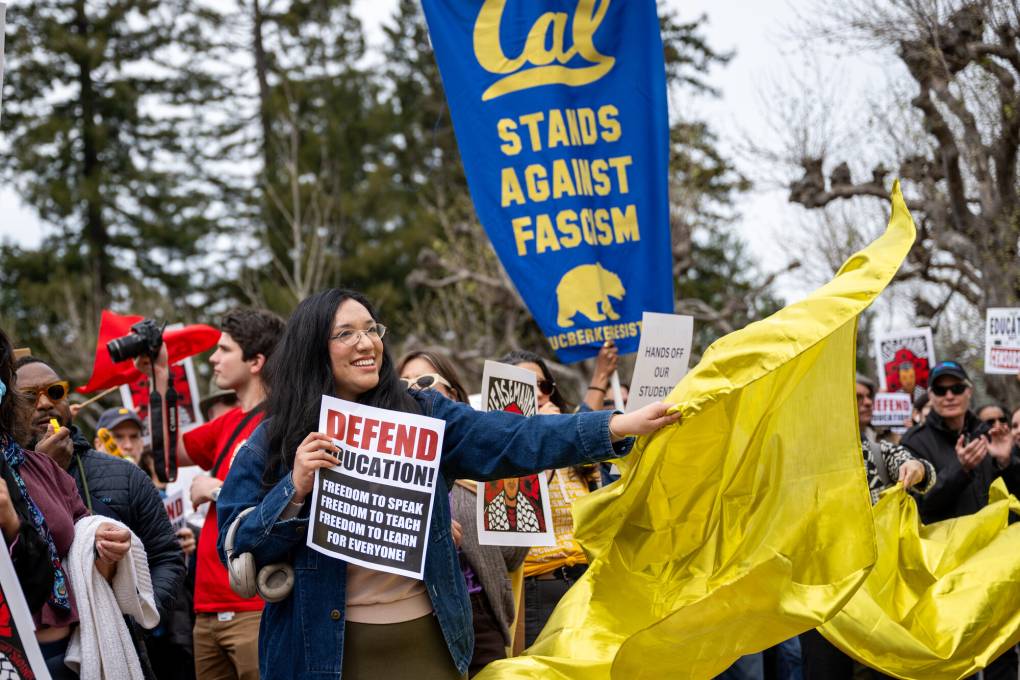
"caption": "Faculty, students and supporters gather in Sproul Plaza at UC Berkeley, on March 19, 2025, to protest the Trump administration's scrutiny of campus protests and curriculum nationwide. Anxiety continues to spread as the administration revoked over 1,000 student visas, including in the Bay Area. Many international learners fill jobs in science and technology.\r\n",
"credit": "Beth LaBerge/KQED",
"altTag": null,
"description": null,
"imgSizes": {
"medium": {
"file": "https://cdn.kqed.org/wp-content/uploads/sites/10/2025/04/250319-UCBerkeleyProtest-02-BL_qed-800x533.jpg",
"width": 800,
"height": 533,
"mimeType": "image/jpeg"
},
"large": {
"file": "https://cdn.kqed.org/wp-content/uploads/sites/10/2025/04/250319-UCBerkeleyProtest-02-BL_qed-1020x680.jpg",
"width": 1020,
"height": 680,
"mimeType": "image/jpeg"
},
"thumbnail": {
"file": "https://cdn.kqed.org/wp-content/uploads/sites/10/2025/04/250319-UCBerkeleyProtest-02-BL_qed-160x107.jpg",
"width": 160,
"height": 107,
"mimeType": "image/jpeg"
},
"1536x1536": {
"file": "https://cdn.kqed.org/wp-content/uploads/sites/10/2025/04/250319-UCBerkeleyProtest-02-BL_qed-1536x1024.jpg",
"width": 1536,
"height": 1024,
"mimeType": "image/jpeg"
},
"post-thumbnail": {
"file": "https://cdn.kqed.org/wp-content/uploads/sites/10/2025/04/250319-UCBerkeleyProtest-02-BL_qed-672x372.jpg",
"width": 672,
"height": 372,
"mimeType": "image/jpeg"
},
"twentyfourteen-full-width": {
"file": "https://cdn.kqed.org/wp-content/uploads/sites/10/2025/04/250319-UCBerkeleyProtest-02-BL_qed-1038x576.jpg",
"width": 1038,
"height": 576,
"mimeType": "image/jpeg"
},
"full-width": {
"file": "https://cdn.kqed.org/wp-content/uploads/sites/10/2025/04/250319-UCBerkeleyProtest-02-BL_qed-1920x1280.jpg",
"width": 1920,
"height": 1280,
"mimeType": "image/jpeg"
},
"kqedFullSize": {
"file": "https://cdn.kqed.org/wp-content/uploads/sites/10/2025/04/250319-UCBerkeleyProtest-02-BL_qed.jpg",
"width": 2000,
"height": 1333
}
},
"isLoading": false,
"fetchFailed": false
},
"news_12037008": {
"type": "attachments",
"id": "news_12037008",
"meta": {
"index": "attachments_1716263798",
"site": "news",
"id": "12037008",
"found": true
},
"title": "250421-SFUSDCentralCuts-11-BL_qed",
"publishDate": 1745274467,
"status": "inherit",
"parent": 12036914,
"modified": 1745274477,
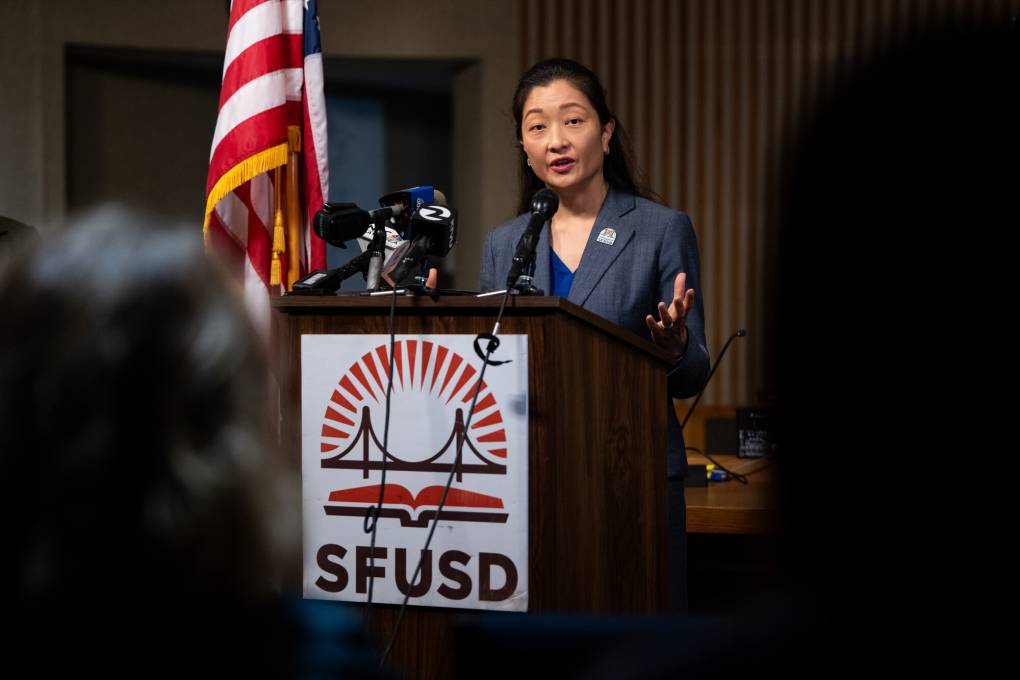
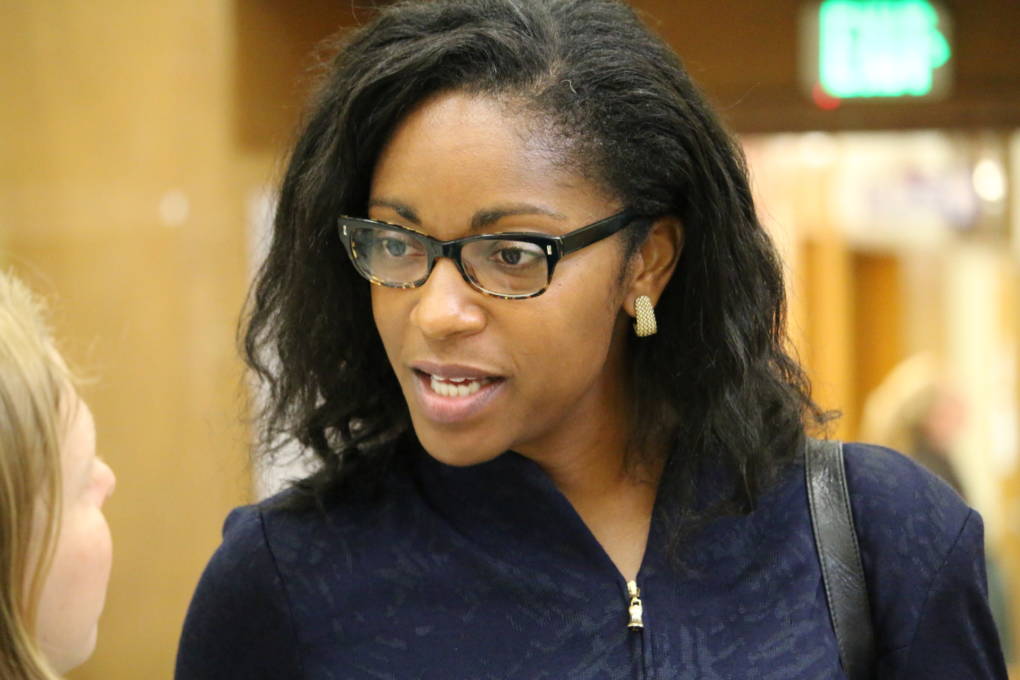
"caption": "San Francisco Unified School District Superintendent Dr. Maria Su speaks during a press conference at the school district offices in San Francisco on April 21, 2025.",
"credit": "Beth LaBerge/KQED",
"altTag": null,
"description": null,
"imgSizes": {
"medium": {
"file": "https://cdn.kqed.org/wp-content/uploads/sites/10/2025/04/250421-SFUSDCentralCuts-11-BL_qed-800x533.jpg",
"width": 800,
"height": 533,
"mimeType": "image/jpeg"
},
"large": {
"file": "https://cdn.kqed.org/wp-content/uploads/sites/10/2025/04/250421-SFUSDCentralCuts-11-BL_qed-1020x680.jpg",
"width": 1020,
"height": 680,
"mimeType": "image/jpeg"
},
"thumbnail": {
"file": "https://cdn.kqed.org/wp-content/uploads/sites/10/2025/04/250421-SFUSDCentralCuts-11-BL_qed-160x107.jpg",
"width": 160,
"height": 107,
"mimeType": "image/jpeg"
},
"1536x1536": {
"file": "https://cdn.kqed.org/wp-content/uploads/sites/10/2025/04/250421-SFUSDCentralCuts-11-BL_qed-1536x1024.jpg",
"width": 1536,
"height": 1024,
"mimeType": "image/jpeg"
},
"post-thumbnail": {
"file": "https://cdn.kqed.org/wp-content/uploads/sites/10/2025/04/250421-SFUSDCentralCuts-11-BL_qed-672x372.jpg",
"width": 672,
"height": 372,
"mimeType": "image/jpeg"
},
"twentyfourteen-full-width": {
"file": "https://cdn.kqed.org/wp-content/uploads/sites/10/2025/04/250421-SFUSDCentralCuts-11-BL_qed-1038x576.jpg",
"width": 1038,
"height": 576,
"mimeType": "image/jpeg"
},
"full-width": {
"file": "https://cdn.kqed.org/wp-content/uploads/sites/10/2025/04/250421-SFUSDCentralCuts-11-BL_qed-1920x1280.jpg",
"width": 1920,
"height": 1280,
"mimeType": "image/jpeg"
},
"kqedFullSize": {
"file": "https://cdn.kqed.org/wp-content/uploads/sites/10/2025/04/250421-SFUSDCentralCuts-11-BL_qed.jpg",
"width": 2000,
"height": 1333
}
},
"isLoading": false,
"fetchFailed": false
},
"news_12036506": {
"type": "attachments",
"id": "news_12036506",
"meta": {
"index": "attachments_1716263798",
"site": "news",
"id": "12036506",
"found": true
},
"title": "250417-HIGHEREDPROTESTS-08-BL-KQED",
"publishDate": 1744930148,
"status": "inherit",
"parent": 0,
"modified": 1744930309,
"caption": "San Francisco State University students, faculty and staff rally at Civic Center Plaza across from City Hall in San Francisco on April 17, 2025, to demand reinvestment in public higher education. The demonstration follows a day of organizing on campus led by the SFSU community in response to proposed budget cuts.",
"credit": "Beth LaBerge/KQED",
"altTag": null,
"description": null,
"imgSizes": {
"medium": {
"file": "https://cdn.kqed.org/wp-content/uploads/sites/10/2025/04/250417-HIGHEREDPROTESTS-08-BL-KQED-800x533.jpg",
"width": 800,
"height": 533,
"mimeType": "image/jpeg"
},
"large": {
"file": "https://cdn.kqed.org/wp-content/uploads/sites/10/2025/04/250417-HIGHEREDPROTESTS-08-BL-KQED-1020x680.jpg",
"width": 1020,
"height": 680,
"mimeType": "image/jpeg"
},
"thumbnail": {
"file": "https://cdn.kqed.org/wp-content/uploads/sites/10/2025/04/250417-HIGHEREDPROTESTS-08-BL-KQED-160x107.jpg",
"width": 160,
"height": 107,
"mimeType": "image/jpeg"
},
"1536x1536": {
"file": "https://cdn.kqed.org/wp-content/uploads/sites/10/2025/04/250417-HIGHEREDPROTESTS-08-BL-KQED-1536x1024.jpg",
"width": 1536,
"height": 1024,
"mimeType": "image/jpeg"
},
"post-thumbnail": {
"file": "https://cdn.kqed.org/wp-content/uploads/sites/10/2025/04/250417-HIGHEREDPROTESTS-08-BL-KQED-672x372.jpg",
"width": 672,
"height": 372,
"mimeType": "image/jpeg"
},
"twentyfourteen-full-width": {
"file": "https://cdn.kqed.org/wp-content/uploads/sites/10/2025/04/250417-HIGHEREDPROTESTS-08-BL-KQED-1038x576.jpg",
"width": 1038,
"height": 576,
"mimeType": "image/jpeg"
},
"full-width": {
"file": "https://cdn.kqed.org/wp-content/uploads/sites/10/2025/04/250417-HIGHEREDPROTESTS-08-BL-KQED-1920x1280.jpg",
"width": 1920,
"height": 1280,
"mimeType": "image/jpeg"
},
"kqedFullSize": {
"file": "https://cdn.kqed.org/wp-content/uploads/sites/10/2025/04/250417-HIGHEREDPROTESTS-08-BL-KQED.jpg",
"width": 2000,
"height": 1333
}
},
"isLoading": false,
"fetchFailed": false
},
"news_11727746": {
"type": "attachments",
"id": "news_11727746",
"meta": {
"index": "attachments_1716263798",
"site": "news",
"id": "11727746",
"found": true
},
"parent": 11727551,
"imgSizes": {
"twentyfourteen-full-width": {
"file": "https://ww2.kqed.org/app/uploads/sites/10/2019/02/Screen-Shot-2019-02-21-at-9.20.34-AM-1038x576.png",
"width": 1038,
"mimeType": "image/png",
"height": 576
},
"thumbnail": {
"file": "https://ww2.kqed.org/app/uploads/sites/10/2019/02/Screen-Shot-2019-02-21-at-9.20.34-AM-160x86.png",
"width": 160,
"mimeType": "image/png",
"height": 86
},
"post-thumbnail": {
"file": "https://ww2.kqed.org/app/uploads/sites/10/2019/02/Screen-Shot-2019-02-21-at-9.20.34-AM-672x372.png",
"width": 672,
"mimeType": "image/png",
"height": 372
},
"kqedFullSize": {
"file": "https://ww2.kqed.org/app/uploads/sites/10/2019/02/Screen-Shot-2019-02-21-at-9.20.34-AM-e1550769740649.png",
"width": 1920,
"height": 1035
},
"large": {
"file": "https://ww2.kqed.org/app/uploads/sites/10/2019/02/Screen-Shot-2019-02-21-at-9.20.34-AM-1020x550.png",
"width": 1020,
"mimeType": "image/png",
"height": 550
},
"complete_open_graph": {
"file": "https://ww2.kqed.org/app/uploads/sites/10/2019/02/Screen-Shot-2019-02-21-at-9.20.34-AM-1200x647.png",
"width": 1200,
"mimeType": "image/png",
"height": 647
},
"guest-author-50": {
"file": "https://ww2.kqed.org/app/uploads/sites/10/2019/02/Screen-Shot-2019-02-21-at-9.20.34-AM-50x50.png",
"width": 50,
"mimeType": "image/png",
"height": 50
},
"guest-author-96": {
"file": "https://ww2.kqed.org/app/uploads/sites/10/2019/02/Screen-Shot-2019-02-21-at-9.20.34-AM-96x96.png",
"width": 96,
"mimeType": "image/png",
"height": 96
},
"medium": {
"file": "https://ww2.kqed.org/app/uploads/sites/10/2019/02/Screen-Shot-2019-02-21-at-9.20.34-AM-800x431.png",
"width": 800,
"mimeType": "image/png",
"height": 431
},
"guest-author-64": {
"file": "https://ww2.kqed.org/app/uploads/sites/10/2019/02/Screen-Shot-2019-02-21-at-9.20.34-AM-64x64.png",
"width": 64,
"mimeType": "image/png",
"height": 64
},
"guest-author-32": {
"file": "https://ww2.kqed.org/app/uploads/sites/10/2019/02/Screen-Shot-2019-02-21-at-9.20.34-AM-32x32.png",
"width": 32,
"mimeType": "image/png",
"height": 32
},
"full-width": {
"file": "https://ww2.kqed.org/app/uploads/sites/10/2019/02/Screen-Shot-2019-02-21-at-9.20.34-AM-1920x1035.png",
"width": 1920,
"mimeType": "image/png",
"height": 1035
},
"detail": {
"file": "https://ww2.kqed.org/app/uploads/sites/10/2019/02/Screen-Shot-2019-02-21-at-9.20.34-AM-150x150.png",
"width": 150,
"mimeType": "image/png",
"height": 150
},
"guest-author-128": {
"file": "https://ww2.kqed.org/app/uploads/sites/10/2019/02/Screen-Shot-2019-02-21-at-9.20.34-AM-128x128.png",
"width": 128,
"mimeType": "image/png",
"height": 128
}
},
"publishDate": 1550769670,
"modified": 1550769793,
"caption": "Teachers strike outside of Oakland Technical High School on Feb. 21, 2019.",
"description": null,
"title": "Screen Shot 2019-02-21 at 9.20.34 AM",
"credit": "Stephanie Lister/KQED",
"status": "inherit",
"isLoading": false,
"fetchFailed": false
},
"news_12024024": {
"type": "attachments",
"id": "news_12024024",
"meta": {
"index": "attachments_1716263798",
"site": "news",
"id": "12024024",
"found": true
},
"title": "20250123_SonomaStateFile_GC-18",
"publishDate": 1737748648,
"status": "inherit",
"parent": 12023999,
"modified": 1744838149,
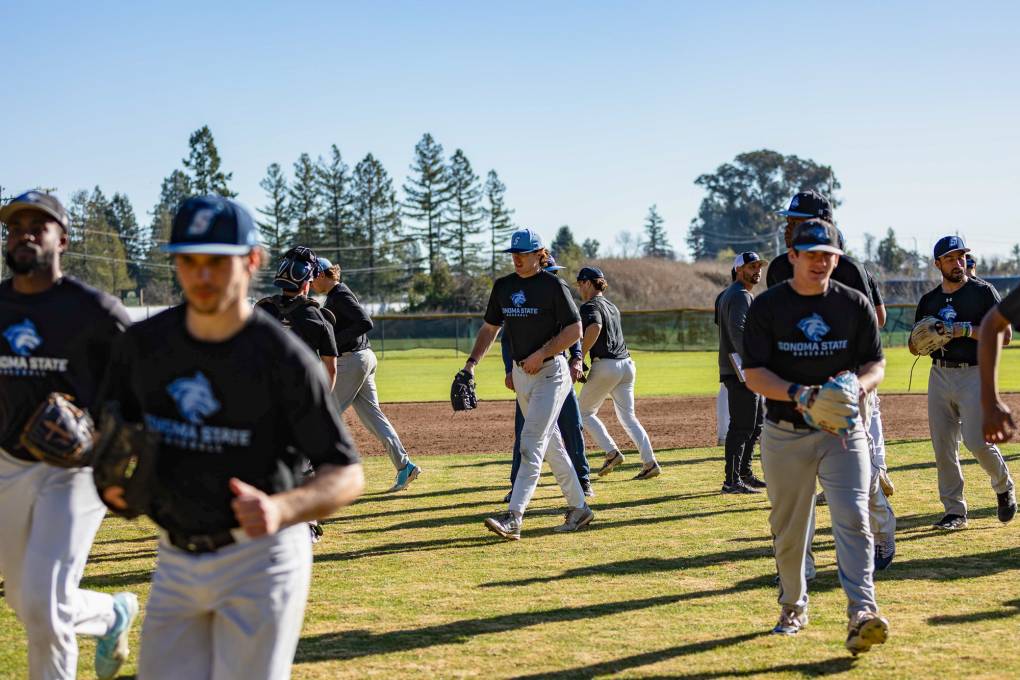
"caption": "The Sonoma State baseball team practices at Sonoma State University in Rohnert Park on Jan. 23, 2025. Sonoma State is cutting its entire Athletic Department to address a budget deficit.",
"credit": "Gina Castro/KQED",
"altTag": null,
"description": null,
"imgSizes": {
"medium": {
"file": "https://cdn.kqed.org/wp-content/uploads/sites/10/2025/01/20250123_SonomaStateFile_GC-18-800x533.jpg",
"width": 800,
"height": 533,
"mimeType": "image/jpeg"
},
"large": {
"file": "https://cdn.kqed.org/wp-content/uploads/sites/10/2025/01/20250123_SonomaStateFile_GC-18-1020x680.jpg",
"width": 1020,
"height": 680,
"mimeType": "image/jpeg"
},
"thumbnail": {
"file": "https://cdn.kqed.org/wp-content/uploads/sites/10/2025/01/20250123_SonomaStateFile_GC-18-160x107.jpg",
"width": 160,
"height": 107,
"mimeType": "image/jpeg"
},
"1536x1536": {
"file": "https://cdn.kqed.org/wp-content/uploads/sites/10/2025/01/20250123_SonomaStateFile_GC-18-1536x1024.jpg",
"width": 1536,
"height": 1024,
"mimeType": "image/jpeg"
},
"post-thumbnail": {
"file": "https://cdn.kqed.org/wp-content/uploads/sites/10/2025/01/20250123_SonomaStateFile_GC-18-672x372.jpg",
"width": 672,
"height": 372,
"mimeType": "image/jpeg"
},
"twentyfourteen-full-width": {
"file": "https://cdn.kqed.org/wp-content/uploads/sites/10/2025/01/20250123_SonomaStateFile_GC-18-1038x576.jpg",
"width": 1038,
"height": 576,
"mimeType": "image/jpeg"
},
"full-width": {
"file": "https://cdn.kqed.org/wp-content/uploads/sites/10/2025/01/20250123_SonomaStateFile_GC-18-1920x1280.jpg",
"width": 1920,
"height": 1280,
"mimeType": "image/jpeg"
},
"kqedFullSize": {
"file": "https://cdn.kqed.org/wp-content/uploads/sites/10/2025/01/20250123_SonomaStateFile_GC-18.jpg",
"width": 2000,
"height": 1333
}
},
"isLoading": false,
"fetchFailed": false
},
"news_12035947": {
"type": "attachments",
"id": "news_12035947",
"meta": {
"index": "attachments_1716263798",
"site": "news",
"id": "12035947",
"found": true
},
"title": "Birdie Winrow in San Leandro on April 14, 2025.",
"publishDate": 1744667393,
"status": "inherit",
"parent": 0,
"modified": 1744667407,
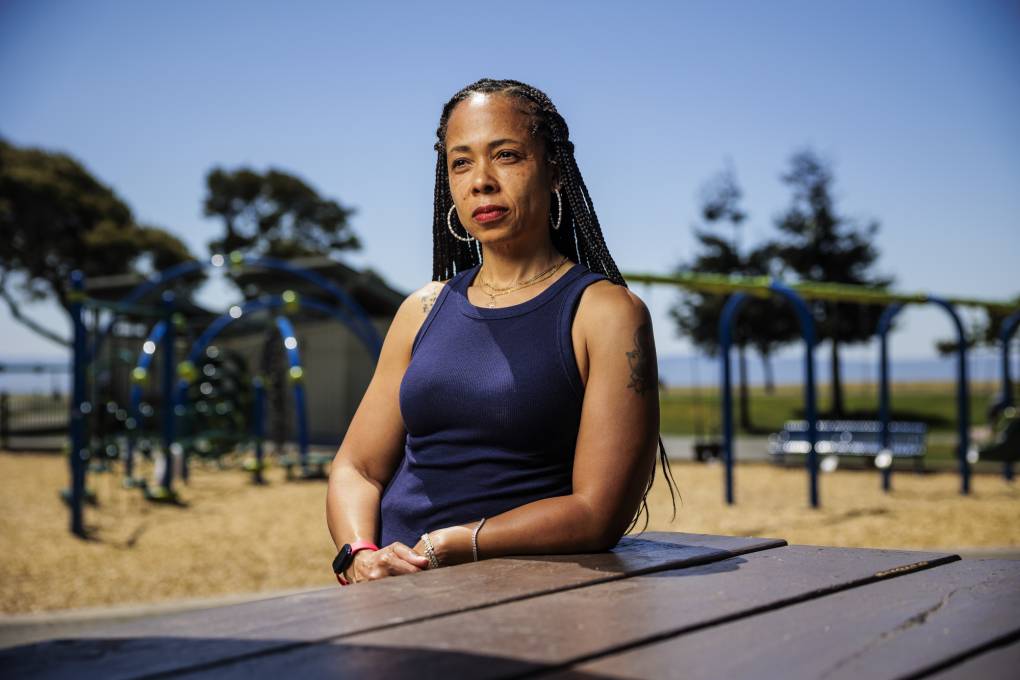
"caption": "Birdie Winrow in San Leandro on April 14, 2025.",
"credit": "Martin do Nascimento/KQED",
"altTag": null,
"description": null,
"imgSizes": {
"medium": {
"file": "https://cdn.kqed.org/wp-content/uploads/sites/10/2025/04/250414-HEAD-START-WORKER-LAID-OFF-MD-01-KQED-800x533.jpg",
"width": 800,
"height": 533,
"mimeType": "image/jpeg"
},
"large": {
"file": "https://cdn.kqed.org/wp-content/uploads/sites/10/2025/04/250414-HEAD-START-WORKER-LAID-OFF-MD-01-KQED-1020x680.jpg",
"width": 1020,
"height": 680,
"mimeType": "image/jpeg"
},
"thumbnail": {
"file": "https://cdn.kqed.org/wp-content/uploads/sites/10/2025/04/250414-HEAD-START-WORKER-LAID-OFF-MD-01-KQED-160x107.jpg",
"width": 160,
"height": 107,
"mimeType": "image/jpeg"
},
"1536x1536": {
"file": "https://cdn.kqed.org/wp-content/uploads/sites/10/2025/04/250414-HEAD-START-WORKER-LAID-OFF-MD-01-KQED-1536x1024.jpg",
"width": 1536,
"height": 1024,
"mimeType": "image/jpeg"
},
"post-thumbnail": {
"file": "https://cdn.kqed.org/wp-content/uploads/sites/10/2025/04/250414-HEAD-START-WORKER-LAID-OFF-MD-01-KQED-672x372.jpg",
"width": 672,
"height": 372,
"mimeType": "image/jpeg"
},
"twentyfourteen-full-width": {
"file": "https://cdn.kqed.org/wp-content/uploads/sites/10/2025/04/250414-HEAD-START-WORKER-LAID-OFF-MD-01-KQED-1038x576.jpg",
"width": 1038,
"height": 576,
"mimeType": "image/jpeg"
},
"full-width": {
"file": "https://cdn.kqed.org/wp-content/uploads/sites/10/2025/04/250414-HEAD-START-WORKER-LAID-OFF-MD-01-KQED-1920x1280.jpg",
"width": 1920,
"height": 1280,
"mimeType": "image/jpeg"
},
"kqedFullSize": {
"file": "https://cdn.kqed.org/wp-content/uploads/sites/10/2025/04/250414-HEAD-START-WORKER-LAID-OFF-MD-01-KQED.jpg",
"width": 2000,
"height": 1333
}
},
"isLoading": false,
"fetchFailed": false
},
"news_12008658": {
"type": "attachments",
"id": "news_12008658",
"meta": {
"index": "attachments_1716263798",
"site": "news",
"id": "12008658",
"found": true
},
"title": "241008-UCB CAMPUS WALKOUT-MD-04-KQED",
"publishDate": 1728431175,
"status": "inherit",
"parent": 0,
"modified": 1744673386,
"caption": "A pro-Israel student at UC Berkeley, counter-protests a walkout and rally for Gaza and Lebanon at the University of California, Berkeley on Oct. 8, 2024.",
"credit": "Martin do Nascimento/KQED",
"altTag": null,
"description": null,
"imgSizes": {
"medium": {
"file": "https://cdn.kqed.org/wp-content/uploads/sites/10/2024/10/241008-UCB-CAMPUS-WALKOUT-MD-04-KQED-800x533.jpg",
"width": 800,
"height": 533,
"mimeType": "image/jpeg"
},
"large": {
"file": "https://cdn.kqed.org/wp-content/uploads/sites/10/2024/10/241008-UCB-CAMPUS-WALKOUT-MD-04-KQED-1020x680.jpg",
"width": 1020,
"height": 680,
"mimeType": "image/jpeg"
},
"thumbnail": {
"file": "https://cdn.kqed.org/wp-content/uploads/sites/10/2024/10/241008-UCB-CAMPUS-WALKOUT-MD-04-KQED-160x107.jpg",
"width": 160,
"height": 107,
"mimeType": "image/jpeg"
},
"1536x1536": {
"file": "https://cdn.kqed.org/wp-content/uploads/sites/10/2024/10/241008-UCB-CAMPUS-WALKOUT-MD-04-KQED-1536x1024.jpg",
"width": 1536,
"height": 1024,
"mimeType": "image/jpeg"
},
"post-thumbnail": {
"file": "https://cdn.kqed.org/wp-content/uploads/sites/10/2024/10/241008-UCB-CAMPUS-WALKOUT-MD-04-KQED-672x372.jpg",
"width": 672,
"height": 372,
"mimeType": "image/jpeg"
},
"twentyfourteen-full-width": {
"file": "https://cdn.kqed.org/wp-content/uploads/sites/10/2024/10/241008-UCB-CAMPUS-WALKOUT-MD-04-KQED-1038x576.jpg",
"width": 1038,
"height": 576,
"mimeType": "image/jpeg"
},
"full-width": {
"file": "https://cdn.kqed.org/wp-content/uploads/sites/10/2024/10/241008-UCB-CAMPUS-WALKOUT-MD-04-KQED-1920x1280.jpg",
"width": 1920,
"height": 1280,
"mimeType": "image/jpeg"
},
"kqedFullSize": {
"file": "https://cdn.kqed.org/wp-content/uploads/sites/10/2024/10/241008-UCB-CAMPUS-WALKOUT-MD-04-KQED.jpg",
"width": 2000,
"height": 1333
}
},
"isLoading": false,
"fetchFailed": false
},
"news_12035840": {
"type": "attachments",
"id": "news_12035840",
"meta": {
"index": "attachments_1716263798",
"site": "news",
"id": "12035840",
"found": true
},
"title": "061121_SummerSchool_AW_CM_06",
"publishDate": 1744574510,
"status": "inherit",
"parent": 12035838,
"modified": 1746053532,
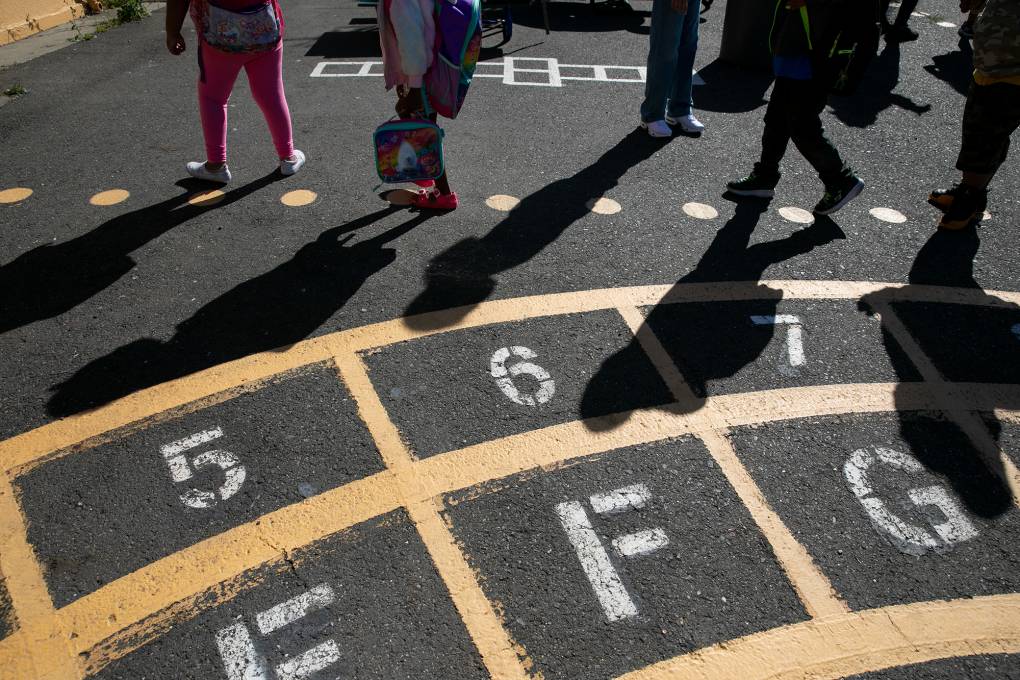
"caption": "Rising first graders walk to their classroom at the start of the day during summer session at Laurel Elementary in Oakland on June 11, 2021. ",
"credit": "Anne Wernikoff/CalMatters",
"altTag": "The bottom half of several children on a concrete playground with yellow chalk outlining numbers and letters is shown.",
"description": null,
"imgSizes": {
"medium": {
"file": "https://cdn.kqed.org/wp-content/uploads/sites/10/2025/04/061121_SummerSchool_AW_CM_06-800x533.jpg",
"width": 800,
"height": 533,
"mimeType": "image/jpeg"
},
"large": {
"file": "https://cdn.kqed.org/wp-content/uploads/sites/10/2025/04/061121_SummerSchool_AW_CM_06-1020x680.jpg",
"width": 1020,
"height": 680,
"mimeType": "image/jpeg"
},
"thumbnail": {
"file": "https://cdn.kqed.org/wp-content/uploads/sites/10/2025/04/061121_SummerSchool_AW_CM_06-160x107.jpg",
"width": 160,
"height": 107,
"mimeType": "image/jpeg"
},
"1536x1536": {
"file": "https://cdn.kqed.org/wp-content/uploads/sites/10/2025/04/061121_SummerSchool_AW_CM_06-1536x1024.jpg",
"width": 1536,
"height": 1024,
"mimeType": "image/jpeg"
},
"post-thumbnail": {
"file": "https://cdn.kqed.org/wp-content/uploads/sites/10/2025/04/061121_SummerSchool_AW_CM_06-672x372.jpg",
"width": 672,
"height": 372,
"mimeType": "image/jpeg"
},
"twentyfourteen-full-width": {
"file": "https://cdn.kqed.org/wp-content/uploads/sites/10/2025/04/061121_SummerSchool_AW_CM_06-1038x576.jpg",
"width": 1038,
"height": 576,
"mimeType": "image/jpeg"
},
"full-width": {
"file": "https://cdn.kqed.org/wp-content/uploads/sites/10/2025/04/061121_SummerSchool_AW_CM_06-1920x1280.jpg",
"width": 1920,
"height": 1280,
"mimeType": "image/jpeg"
},
"kqedFullSize": {
"file": "https://cdn.kqed.org/wp-content/uploads/sites/10/2025/04/061121_SummerSchool_AW_CM_06.jpg",
"width": 2000,
"height": 1333
}
},
"isLoading": false,
"fetchFailed": false
},
"news_11989124": {
"type": "attachments",
"id": "news_11989124",
"meta": {
"index": "attachments_1716263798",
"site": "news",
"id": "11989124",
"found": true
},
"title": "240605-STANFORD-JG-10-KQED",
"publishDate": 1717611523,
"status": "inherit",
"parent": 12058280,
"modified": 1759358920,
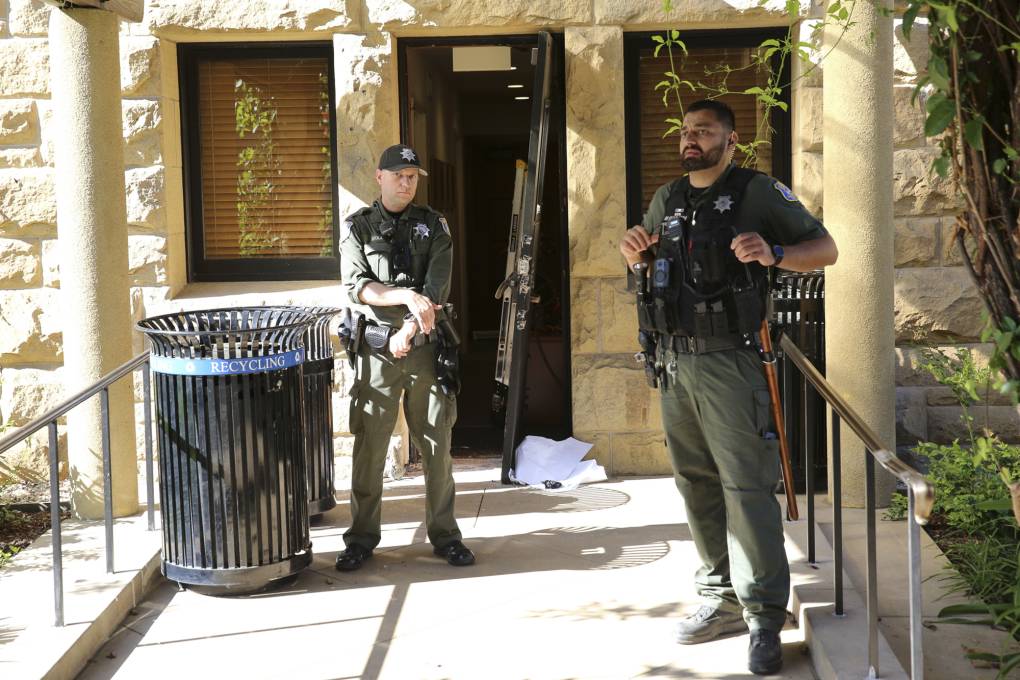
"caption": "Santa Clara County Sheriff's Office Deputies stand guard outside Building 10 at Stanford University, where pro-Palestinian protesters broke into the university president's office and occupied it before being arrested on June 5, 2024.",
"credit": "Joseph Geha/KQED",
"altTag": null,
"description": null,
"imgSizes": {
"medium": {
"file": "https://cdn.kqed.org/wp-content/uploads/sites/10/2024/06/240605-STANFORD-JG-10-KQED-800x533.jpg",
"width": 800,
"height": 533,
"mimeType": "image/jpeg"
},
"large": {
"file": "https://cdn.kqed.org/wp-content/uploads/sites/10/2024/06/240605-STANFORD-JG-10-KQED-1020x680.jpg",
"width": 1020,
"height": 680,
"mimeType": "image/jpeg"
},
"thumbnail": {
"file": "https://cdn.kqed.org/wp-content/uploads/sites/10/2024/06/240605-STANFORD-JG-10-KQED-160x107.jpg",
"width": 160,
"height": 107,
"mimeType": "image/jpeg"
},
"1536x1536": {
"file": "https://cdn.kqed.org/wp-content/uploads/sites/10/2024/06/240605-STANFORD-JG-10-KQED-1536x1024.jpg",
"width": 1536,
"height": 1024,
"mimeType": "image/jpeg"
},
"post-thumbnail": {
"file": "https://cdn.kqed.org/wp-content/uploads/sites/10/2024/06/240605-STANFORD-JG-10-KQED-672x372.jpg",
"width": 672,
"height": 372,
"mimeType": "image/jpeg"
},
"twentyfourteen-full-width": {
"file": "https://cdn.kqed.org/wp-content/uploads/sites/10/2024/06/240605-STANFORD-JG-10-KQED-1038x576.jpg",
"width": 1038,
"height": 576,
"mimeType": "image/jpeg"
},
"full-width": {
"file": "https://cdn.kqed.org/wp-content/uploads/sites/10/2024/06/240605-STANFORD-JG-10-KQED-1920x1280.jpg",
"width": 1920,
"height": 1280,
"mimeType": "image/jpeg"
},
"kqedFullSize": {
"file": "https://cdn.kqed.org/wp-content/uploads/sites/10/2024/06/240605-STANFORD-JG-10-KQED.jpg",
"width": 2000,
"height": 1333
}
},
"isLoading": false,
"fetchFailed": false
},
"news_12033001": {
"type": "attachments",
"id": "news_12033001",
"meta": {
"index": "attachments_1716263798",
"site": "news",
"id": "12033001",
"found": true
},
"title": "20250325_TEACHERS-FOR-TK_DMB_00048-KQED",
"publishDate": 1742939381,
"status": "inherit",
"parent": 0,
"modified": 1744242147,
"caption": "Angelica Cardenas, of Hayward, poses for a portrait with one of her favorite children's books in the library on the Cal State University East Bay campus in Hayward on March 25, 2025. Cardenas received her Master's degree in Early Childhood Education from Cal State East Bay.",
"credit": "David M. Barreda/KQED",
"altTag": null,
"description": null,
"imgSizes": {
"medium": {
"file": "https://cdn.kqed.org/wp-content/uploads/sites/10/2025/03/20250325_TEACHERS-FOR-TK_DMB_00048-KQED-800x533.jpg",
"width": 800,
"height": 533,
"mimeType": "image/jpeg"
},
"large": {
"file": "https://cdn.kqed.org/wp-content/uploads/sites/10/2025/03/20250325_TEACHERS-FOR-TK_DMB_00048-KQED-1020x680.jpg",
"width": 1020,
"height": 680,
"mimeType": "image/jpeg"
},
"thumbnail": {
"file": "https://cdn.kqed.org/wp-content/uploads/sites/10/2025/03/20250325_TEACHERS-FOR-TK_DMB_00048-KQED-160x107.jpg",
"width": 160,
"height": 107,
"mimeType": "image/jpeg"
},
"1536x1536": {
"file": "https://cdn.kqed.org/wp-content/uploads/sites/10/2025/03/20250325_TEACHERS-FOR-TK_DMB_00048-KQED-1536x1024.jpg",
"width": 1536,
"height": 1024,
"mimeType": "image/jpeg"
},
"post-thumbnail": {
"file": "https://cdn.kqed.org/wp-content/uploads/sites/10/2025/03/20250325_TEACHERS-FOR-TK_DMB_00048-KQED-672x372.jpg",
"width": 672,
"height": 372,
"mimeType": "image/jpeg"
},
"twentyfourteen-full-width": {
"file": "https://cdn.kqed.org/wp-content/uploads/sites/10/2025/03/20250325_TEACHERS-FOR-TK_DMB_00048-KQED-1038x576.jpg",
"width": 1038,
"height": 576,
"mimeType": "image/jpeg"
},
"full-width": {
"file": "https://cdn.kqed.org/wp-content/uploads/sites/10/2025/03/20250325_TEACHERS-FOR-TK_DMB_00048-KQED-1920x1280.jpg",
"width": 1920,
"height": 1280,
"mimeType": "image/jpeg"
},
"kqedFullSize": {
"file": "https://cdn.kqed.org/wp-content/uploads/sites/10/2025/03/20250325_TEACHERS-FOR-TK_DMB_00048-KQED.jpg",
"width": 2000,
"height": 1333
}
},
"isLoading": false,
"fetchFailed": false
},
"news_11635686": {
"type": "attachments",
"id": "news_11635686",
"meta": {
"index": "attachments_1716263798",
"site": "news",
"id": "11635686",
"found": true
},
"title": "RS26222_IMG_2896-qut",
"publishDate": 1512690025,
"status": "inherit",
"parent": 11635537,
"modified": 1744151791,
"caption": "OUSD Superintendent Kyla Johnson-Trammell attends a leadership event at La Escuelita Elementary School before the start of the 2017–2018 school year. She says millions of dollars in budget cuts are necessary for the district's fiscal solvency. ",
"credit": "Devin Katayama/KQED",
"altTag": null,
"description": null,
"imgSizes": {
"thumbnail": {
"file": "https://cdn.kqed.org/wp-content/uploads/sites/10/2017/12/RS26222_IMG_2896-qut-160x107.jpg",
"width": 160,
"height": 107,
"mimeType": "image/jpeg"
},
"medium": {
"file": "https://cdn.kqed.org/wp-content/uploads/sites/10/2017/12/RS26222_IMG_2896-qut-800x533.jpg",
"width": 800,
"height": 533,
"mimeType": "image/jpeg"
},
"large": {
"file": "https://cdn.kqed.org/wp-content/uploads/sites/10/2017/12/RS26222_IMG_2896-qut-1020x680.jpg",
"width": 1020,
"height": 680,
"mimeType": "image/jpeg"
},
"fd-lrg": {
"file": "https://cdn.kqed.org/wp-content/uploads/sites/10/2017/12/RS26222_IMG_2896-qut-1920x1280.jpg",
"width": 1920,
"height": 1280,
"mimeType": "image/jpeg"
},
"fd-med": {
"file": "https://cdn.kqed.org/wp-content/uploads/sites/10/2017/12/RS26222_IMG_2896-qut-1180x787.jpg",
"width": 1180,
"height": 787,
"mimeType": "image/jpeg"
},
"fd-sm": {
"file": "https://cdn.kqed.org/wp-content/uploads/sites/10/2017/12/RS26222_IMG_2896-qut-960x640.jpg",
"width": 960,
"height": 640,
"mimeType": "image/jpeg"
},
"post-thumbnail": {
"file": "https://cdn.kqed.org/wp-content/uploads/sites/10/2017/12/RS26222_IMG_2896-qut-672x372.jpg",
"width": 672,
"height": 372,
"mimeType": "image/jpeg"
},
"twentyfourteen-full-width": {
"file": "https://cdn.kqed.org/wp-content/uploads/sites/10/2017/12/RS26222_IMG_2896-qut-1038x576.jpg",
"width": 1038,
"height": 576,
"mimeType": "image/jpeg"
},
"xxsmall": {
"file": "https://cdn.kqed.org/wp-content/uploads/sites/10/2017/12/RS26222_IMG_2896-qut-240x160.jpg",
"width": 240,
"height": 160,
"mimeType": "image/jpeg"
},
"xsmall": {
"file": "https://cdn.kqed.org/wp-content/uploads/sites/10/2017/12/RS26222_IMG_2896-qut-375x250.jpg",
"width": 375,
"height": 250,
"mimeType": "image/jpeg"
},
"small": {
"file": "https://cdn.kqed.org/wp-content/uploads/sites/10/2017/12/RS26222_IMG_2896-qut-520x347.jpg",
"width": 520,
"height": 347,
"mimeType": "image/jpeg"
},
"xlarge": {
"file": "https://cdn.kqed.org/wp-content/uploads/sites/10/2017/12/RS26222_IMG_2896-qut-1180x787.jpg",
"width": 1180,
"height": 787,
"mimeType": "image/jpeg"
},
"full-width": {
"file": "https://cdn.kqed.org/wp-content/uploads/sites/10/2017/12/RS26222_IMG_2896-qut-1920x1280.jpg",
"width": 1920,
"height": 1280,
"mimeType": "image/jpeg"
},
"guest-author-32": {
"file": "https://cdn.kqed.org/wp-content/uploads/sites/10/2017/12/RS26222_IMG_2896-qut-32x32.jpg",
"width": 32,
"height": 32,
"mimeType": "image/jpeg"
},
"guest-author-50": {
"file": "https://cdn.kqed.org/wp-content/uploads/sites/10/2017/12/RS26222_IMG_2896-qut-50x50.jpg",
"width": 50,
"height": 50,
"mimeType": "image/jpeg"
},
"guest-author-64": {
"file": "https://cdn.kqed.org/wp-content/uploads/sites/10/2017/12/RS26222_IMG_2896-qut-64x64.jpg",
"width": 64,
"height": 64,
"mimeType": "image/jpeg"
},
"guest-author-96": {
"file": "https://cdn.kqed.org/wp-content/uploads/sites/10/2017/12/RS26222_IMG_2896-qut-96x96.jpg",
"width": 96,
"height": 96,
"mimeType": "image/jpeg"
},
"guest-author-128": {
"file": "https://cdn.kqed.org/wp-content/uploads/sites/10/2017/12/RS26222_IMG_2896-qut-128x128.jpg",
"width": 128,
"height": 128,
"mimeType": "image/jpeg"
},
"detail": {
"file": "https://cdn.kqed.org/wp-content/uploads/sites/10/2017/12/RS26222_IMG_2896-qut-150x150.jpg",
"width": 150,
"height": 150,
"mimeType": "image/jpeg"
},
"kqedFullSize": {
"file": "https://cdn.kqed.org/wp-content/uploads/sites/10/2017/12/RS26222_IMG_2896-qut.jpg",
"width": 1920,
"height": 1280
}
},
"isLoading": false,
"fetchFailed": false
},
"news_12024990": {
"type": "attachments",
"id": "news_12024990",
"meta": {
"index": "attachments_1716263798",
"site": "news",
"id": "12024990",
"found": true
},
"title": "20250130_SSUTownHall_GC-12",
"publishDate": 1738284655,
"status": "inherit",
"parent": 0,
"modified": 1744225932,
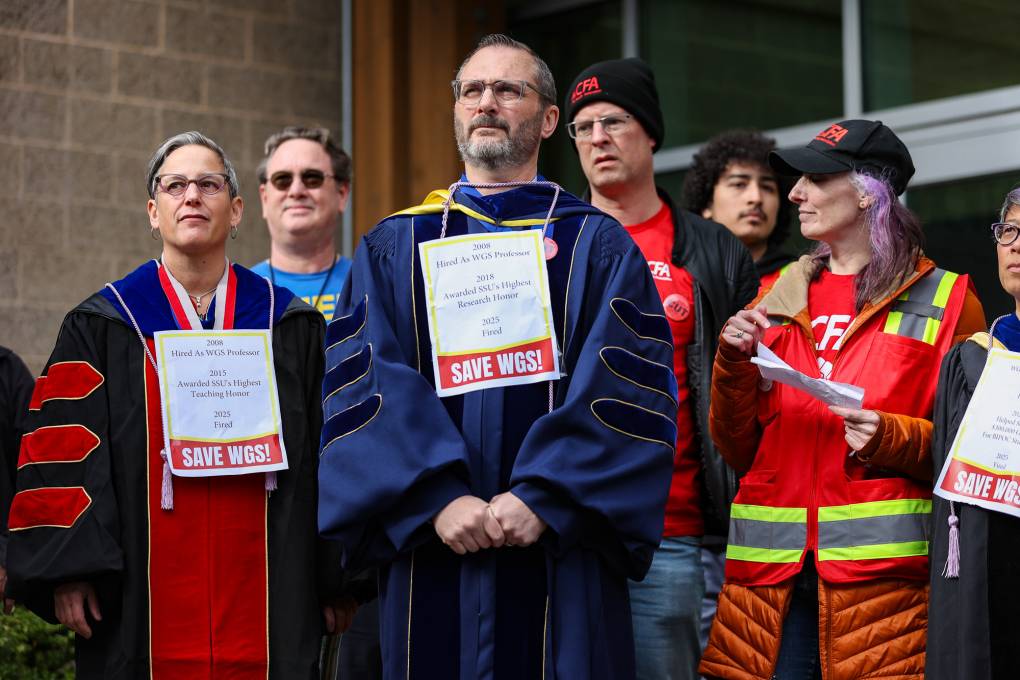
"caption": "Women and Gender Studies faculty, Lena McQuade, left, and Don Romesburg, center, attend a rally and virtual town hall wearing signs protesting the school’s budget cuts, at Sonoma State’s Seawolf Plaza in Rohnert Park, California, on Jan 30, 2025.",
"credit": "Gina Castro/KQED",
"altTag": null,
"description": null,
"imgSizes": {
"medium": {
"file": "https://cdn.kqed.org/wp-content/uploads/sites/10/2025/01/20250130_SSUTownHall_GC-12-800x533.jpg",
"width": 800,
"height": 533,
"mimeType": "image/jpeg"
},
"large": {
"file": "https://cdn.kqed.org/wp-content/uploads/sites/10/2025/01/20250130_SSUTownHall_GC-12-1020x680.jpg",
"width": 1020,
"height": 680,
"mimeType": "image/jpeg"
},
"thumbnail": {
"file": "https://cdn.kqed.org/wp-content/uploads/sites/10/2025/01/20250130_SSUTownHall_GC-12-160x107.jpg",
"width": 160,
"height": 107,
"mimeType": "image/jpeg"
},
"1536x1536": {
"file": "https://cdn.kqed.org/wp-content/uploads/sites/10/2025/01/20250130_SSUTownHall_GC-12-1536x1024.jpg",
"width": 1536,
"height": 1024,
"mimeType": "image/jpeg"
},
"post-thumbnail": {
"file": "https://cdn.kqed.org/wp-content/uploads/sites/10/2025/01/20250130_SSUTownHall_GC-12-672x372.jpg",
"width": 672,
"height": 372,
"mimeType": "image/jpeg"
},
"twentyfourteen-full-width": {
"file": "https://cdn.kqed.org/wp-content/uploads/sites/10/2025/01/20250130_SSUTownHall_GC-12-1038x576.jpg",
"width": 1038,
"height": 576,
"mimeType": "image/jpeg"
},
"full-width": {
"file": "https://cdn.kqed.org/wp-content/uploads/sites/10/2025/01/20250130_SSUTownHall_GC-12-1920x1280.jpg",
"width": 1920,
"height": 1280,
"mimeType": "image/jpeg"
},
"kqedFullSize": {
"file": "https://cdn.kqed.org/wp-content/uploads/sites/10/2025/01/20250130_SSUTownHall_GC-12.jpg",
"width": 2000,
"height": 1333
}
},
"isLoading": false,
"fetchFailed": false
}
},
"audioPlayerReducer": {
"postId": "stream_live",
"isPaused": true,
"isPlaying": false,
"pfsActive": false,
"pledgeModalIsOpen": true,
"playerDrawerIsOpen": false,
"liveAudioPlayStartedAt": 0,
"liveAudioPlayContext": ""
},
"authorsReducer": {
"byline_news_12037114": {
"type": "authors",
"id": "byline_news_12037114",
"meta": {
"override": true
},
"slug": "byline_news_12037114",
"name": "\u003ca href=\"https://www.marketplace.org/author/matt-levin\">Matt Levin\u003c/a>, Marketplace",
"isLoading": false
},
"byline_news_12035838": {
"type": "authors",
"id": "byline_news_12035838",
"meta": {
"override": true
},
"slug": "byline_news_12035838",
"name": "\u003ca href=\"https://calmatters.org/author/carolyn-jones/\">Carolyn Jones, \u003c/a>CalMatters",
"isLoading": false
},
"byline_news_12033209": {
"type": "authors",
"id": "byline_news_12033209",
"meta": {
"override": true
},
"slug": "byline_news_12033209",
"name": "\u003ca href=\"https://www.kqed.org/author/daisynguyen\" target=\"_blank\" rel=\"noopener noreferrer\">Daisy Nguyen\u003c/a> and \u003ca href=\"https://www.kqed.org/author/ellyyu\" target=\"_blank\" rel=\"noopener noreferrer\">Elly Yu\u003c/a>",
"isLoading": false
},
"matthewgreen": {
"type": "authors",
"id": "1263",
"meta": {
"index": "authors_1716337520",
"id": "1263",
"found": true
},
"name": "Matthew Green",
"firstName": "Matthew",
"lastName": "Green",
"slug": "matthewgreen",
"email": "mgreen@kqed.org",
"display_author_email": false,
"staff_mastheads": [],
"title": "KQED Editor/Reporter",
"bio": "Matthew Green is a digital media producer for KQED News. He previously produced \u003ca href=\"http://www.kqed.org/lowdown\">The Lowdown\u003c/a>, KQED’s multimedia news education blog. Matthew's written for numerous Bay Area publications, including the Oakland Tribune and San Francisco Chronicle. He also taught journalism classes at Fremont High School in East Oakland.\r\n\r\nEmail: mgreen@kqed.org; Twitter: @MGreenKQED",
"avatar": "https://secure.gravatar.com/avatar/3bf498d1267ca02c8494f33d8cfc575e?s=600&d=blank&r=g",
"twitter": "MGreenKQED",
"facebook": null,
"instagram": null,
"linkedin": null,
"sites": [
{
"site": "news",
"roles": []
},
{
"site": "lowdown",
"roles": []
},
{
"site": "science",
"roles": []
},
{
"site": "education",
"roles": []
},
{
"site": "quest",
"roles": []
},
{
"site": "liveblog",
"roles": []
}
],
"headData": {
"title": "Matthew Green | KQED",
"description": "KQED Editor/Reporter",
"ogImgSrc": "https://secure.gravatar.com/avatar/3bf498d1267ca02c8494f33d8cfc575e?s=600&d=blank&r=g",
"twImgSrc": "https://secure.gravatar.com/avatar/3bf498d1267ca02c8494f33d8cfc575e?s=600&d=blank&r=g"
},
"isLoading": false,
"link": "/author/matthewgreen"
},
"slewis": {
"type": "authors",
"id": "8676",
"meta": {
"index": "authors_1716337520",
"id": "8676",
"found": true
},
"name": "Sukey Lewis",
"firstName": "Sukey",
"lastName": "Lewis",
"slug": "slewis",
"email": "slewis@kqed.org",
"display_author_email": true,
"staff_mastheads": [
"news"
],
"title": "KQED Contributor",
"bio": "Sukey Lewis is a criminal justice reporter and host of \u003cem>On Our Watch\u003c/em>, a new podcast from NPR and KQED about the shadow world of police discipline. In 2018, she co-founded the California Reporting Project, a coalition of newsrooms across the state focused on obtaining previously sealed internal affairs records from law enforcement. In addition to her reporting on police accountability, Sukey has investigated the bail bonds industry, California's wildfires and the high cost of prison phone calls. Sukey earned a master's degree in journalism from the University of California at Berkeley. Send news tips to slewis@kqed.org.",
"avatar": "https://secure.gravatar.com/avatar/03fd6b21024f99d8b0a1966654586de7?s=600&d=blank&r=g",
"twitter": "SukeyLewis",
"facebook": null,
"instagram": null,
"linkedin": null,
"sites": [
{
"site": "news",
"roles": [
"author",
"edit_others_posts"
]
}
],
"headData": {
"title": "Sukey Lewis | KQED",
"description": "KQED Contributor",
"ogImgSrc": "https://secure.gravatar.com/avatar/03fd6b21024f99d8b0a1966654586de7?s=600&d=blank&r=g",
"twImgSrc": "https://secure.gravatar.com/avatar/03fd6b21024f99d8b0a1966654586de7?s=600&d=blank&r=g"
},
"isLoading": false,
"link": "/author/slewis"
},
"daisynguyen": {
"type": "authors",
"id": "11829",
"meta": {
"index": "authors_1716337520",
"id": "11829",
"found": true
},
"name": "Daisy Nguyen",
"firstName": "Daisy",
"lastName": "Nguyen",
"slug": "daisynguyen",
"email": "daisynguyen@kqed.org",
"display_author_email": true,
"staff_mastheads": [
"news"
],
"title": "KQED Contributor",
"bio": "I have covered early childhood education and child care for KQED since 2022. I focus on policies aimed at increasing access to early care and education and how they shape individual lives. I've been a journalist for more than two decades, with most of that time devoted to covering breaking news throughout California for The Associated Press. I grew up in San Francisco and studied at UC Davis and Columbia University's Graduate School of Journalism. I live in Oakland with my husband and two kids.",
"avatar": "https://secure.gravatar.com/avatar/2da2127c27f7143b53ebd419800fd55f?s=600&d=blank&r=g",
"twitter": null,
"facebook": null,
"instagram": null,
"linkedin": "https://www.linkedin.com/in/daisynguyen/",
"sites": [
{
"site": "news",
"roles": [
"author"
]
},
{
"site": "liveblog",
"roles": [
"author"
]
}
],
"headData": {
"title": "Daisy Nguyen | KQED",
"description": "KQED Contributor",
"ogImgSrc": "https://secure.gravatar.com/avatar/2da2127c27f7143b53ebd419800fd55f?s=600&d=blank&r=g",
"twImgSrc": "https://secure.gravatar.com/avatar/2da2127c27f7143b53ebd419800fd55f?s=600&d=blank&r=g"
},
"isLoading": false,
"link": "/author/daisynguyen"
},
"kdebenedetti": {
"type": "authors",
"id": "11913",
"meta": {
"index": "authors_1716337520",
"id": "11913",
"found": true
},
"name": "Katie DeBenedetti",
"firstName": "Katie",
"lastName": "DeBenedetti",
"slug": "kdebenedetti",
"email": "kdebenedetti@kqed.org",
"display_author_email": false,
"staff_mastheads": [
"news",
"science"
],
"title": "KQED Contributor",
"bio": "Katie DeBenedetti is a digital reporter covering daily news for the Express Desk. Prior to joining KQED as a culture reporting intern in January 2024, she covered education and city government for the Napa Valley Register.",
"avatar": "https://secure.gravatar.com/avatar/6e31073cb8f7e4214ab03f42771d0f45?s=600&d=blank&r=g",
"twitter": null,
"facebook": null,
"instagram": null,
"linkedin": null,
"sites": [
{
"site": "news",
"roles": [
"author"
]
},
{
"site": "science",
"roles": [
"author"
]
},
{
"site": "liveblog",
"roles": [
"author"
]
}
],
"headData": {
"title": "Katie DeBenedetti | KQED",
"description": "KQED Contributor",
"ogImgSrc": "https://secure.gravatar.com/avatar/6e31073cb8f7e4214ab03f42771d0f45?s=600&d=blank&r=g",
"twImgSrc": "https://secure.gravatar.com/avatar/6e31073cb8f7e4214ab03f42771d0f45?s=600&d=blank&r=g"
},
"isLoading": false,
"link": "/author/kdebenedetti"
}
},
"pagesReducer": {
"news_tag_education": {
"type": "terms",
"id": "news_20013",
"meta": {
"index": "terms_1716263798",
"site": "news",
"id": "20013",
"score": 6.970073
},
"featImg": null,
"name": "education",
"description": null,
"taxonomy": "tag",
"headData": {
"twImgId": null,
"twTitle": null,
"ogTitle": null,
"ogImgId": null,
"twDescription": null,
"description": null,
"title": "education Archives | KQED News",
"ogDescription": null
},
"ttid": 20030,
"slug": "education",
"isLoading": false,
"title": "education",
"pageMeta": {
"site": "news",
"WpPageTemplate": "page-topic-editorial",
"currentPage": 25
},
"blocks": [
{
"blockName": "kqed/post-list",
"attrs": {
"layout": "cardArticle2",
"query": "posts/news?tag=education",
"seeMore": false,
"paginated": true,
"page": 25
}
},
{
"blockName": "kqed/ad"
}
]
}
},
"pfsSessionReducer": {},
"postsReducer": {
"stream_live": {
"type": "live",
"id": "stream_live",
"audioUrl": "https://streams.kqed.org/kqedradio",
"title": "Live Stream",
"excerpt": "Live Stream information currently unavailable.",
"link": "/radio",
"featImg": "",
"label": {
"name": "KQED Live",
"link": "/"
}
},
"stream_kqedNewscast": {
"type": "posts",
"id": "stream_kqedNewscast",
"audioUrl": "https://www.kqed.org/.stream/anon/radio/RDnews/newscast.mp3?_=1",
"title": "KQED Newscast",
"featImg": "",
"label": {
"name": "88.5 FM",
"link": "/"
}
},
"news_12037114": {
"type": "posts",
"id": "news_12037114",
"meta": {
"index": "posts_1716263798",
"site": "news",
"id": "12037114",
"score": null,
"sort": [
1745352351000
]
},
"guestAuthors": [],
"slug": "student-visa-cancellations-uc-berkeley-beyond-could-hurt-us-innovation",
"title": "Student Visa Cancellations From UC Berkeley and Beyond Could Hurt US Innovation",
"publishDate": 1745352351,
"format": "standard",
"headTitle": "Student Visa Cancellations From UC Berkeley and Beyond Could Hurt US Innovation | KQED",
"labelTerm": {
"site": "news"
},
"content": "\u003cp>\u003cem>This story \u003c/em>\u003ca href=\"https://www.marketplace.org/story/2025/04/21/student-visa-cancellations-could-hurt-future-innovation\">\u003cem>originally aired on Marketplace\u003c/em>\u003c/a>\u003cem> on April 21.\u003c/em>\u003c/p>\n\u003cp>\u003ca href=\"https://apnews.com/article/international-student-f1-visa-revoked-college-f12320b435b6bf9cf723f1e8eb8c67ae\">According to the Associated Press\u003c/a>, over the past few weeks, the Donald Trump administration has revoked the visas or legal status of more than 1,000 international students, both undergraduate and graduate.\u003c/p>\n\u003cp>Some were involved in protests over the Israeli-Palestinian conflict. The rationale for canceling the visas of many others remains unclear. Colleges across the country say that they often receive no warning from the federal government before a visa is revoked.\u003c/p>\n\u003cp>Over 1 million international students studied in the U.S. last year. After earning their degree, many international students \u003ca href=\"https://www.marketplace.org/story/2024/11/19/international-students-contribute-record-amount-to-u-s-economy\">enter the U.S. labor force\u003c/a>, filling high-demand jobs in technology, business and engineering.\u003c/p>\n\u003cp>[ad fullwidth]\u003c/p>\n\u003cp>Outside International House, the dormitory for international students at the University of California, Berkeley, you could feel some of the anxiety. At least 23 of the university’s international students \u003ca href=\"https://www.dailycal.org/news/campus/live-visa-termination-count-continues-to-rise-at-uc-berkeley/article_111b0f5a-3aee-4189-97c7-23bd10002b64.html\">have had their legal status revoked\u003c/a>.\u003c/p>\n\u003cp>It was hard to get anyone to talk. An American stranger asking foreign students where they’re from and what they’re studying — nowadays, that raises eyebrows. One Chinese student asked if I was actually an undercover agent from the Immigration and Customs Enforcement agency.\u003c/p>\n\u003cfigure id=\"attachment_12030408\" class=\"wp-caption aligncenter\" style=\"max-width: 2000px\">\u003cimg loading=\"lazy\" decoding=\"async\" class=\"size-full wp-image-12030408\" src=\"https://cdn.kqed.org/wp-content/uploads/sites/10/2025/03/250307-BERKELEY-SCIENCE-PROTEST-MD-08-KQED.jpg\" alt=\"\" width=\"2000\" height=\"1333\" srcset=\"https://cdn.kqed.org/wp-content/uploads/sites/10/2025/03/250307-BERKELEY-SCIENCE-PROTEST-MD-08-KQED.jpg 2000w, https://cdn.kqed.org/wp-content/uploads/sites/10/2025/03/250307-BERKELEY-SCIENCE-PROTEST-MD-08-KQED-800x533.jpg 800w, https://cdn.kqed.org/wp-content/uploads/sites/10/2025/03/250307-BERKELEY-SCIENCE-PROTEST-MD-08-KQED-1020x680.jpg 1020w, https://cdn.kqed.org/wp-content/uploads/sites/10/2025/03/250307-BERKELEY-SCIENCE-PROTEST-MD-08-KQED-160x107.jpg 160w, https://cdn.kqed.org/wp-content/uploads/sites/10/2025/03/250307-BERKELEY-SCIENCE-PROTEST-MD-08-KQED-1536x1024.jpg 1536w, https://cdn.kqed.org/wp-content/uploads/sites/10/2025/03/250307-BERKELEY-SCIENCE-PROTEST-MD-08-KQED-1920x1280.jpg 1920w\" sizes=\"auto, (max-width: 2000px) 100vw, 2000px\">\u003cfigcaption class=\"wp-caption-text\">A march through the UC Berkeley campus in association with the national Stand Up for Science day of action in Berkeley on March 7, 2025. \u003ccite>(Martin do Nascimento/KQED)\u003c/cite>\u003c/figcaption>\u003c/figure>\n\u003cp>One current international student agreed to an interview. We’re not using his real name or where he’s from.\u003c/p>\n\u003cp>”You know, with all of these people disappearing and all of that jazz, like, if I say something bad, it feels like, in this country, like if you criticize the government, you disappear as a guest,” he said. “So I wouldn’t want my name to be on it.”\u003c/p>\n\u003cp>He’s getting his Ph.D. in chemistry. And because Berkeley has \u003ca href=\"https://chemistry.berkeley.edu/rankings\">the No. 1 chemistry graduate program in the country\u003c/a>, once he’s done, he’ll likely get plenty of lucrative offers from big American biotech companies.\u003c/p>\n\u003cp>But he’s not sure he wants to stay in the U.S. That’s partly because he just prefers home, but also because he’s not sure how welcome he is here.[aside postID=news_12036406 hero='https://cdn.kqed.org/wp-content/uploads/sites/10/2025/04/250417-HIGHEREDPROTESTS-08-BL-KQED-1020x680.jpg']”When you see an administration doing what they’re doing, and it’s like, yeah, then it’s like I’m not interested. If you don’t want me here, then I don’t want to be here,” he said.\u003c/p>\n\u003cp>Hany Farid, a UC Berkeley computer science and School of Information professor, worries about the chilling effect the visa cancellations may have on future international enrollment, especially in science and engineering.\u003c/p>\n\u003cp>“What we are doing in this country now is going to be a generational-long impact,” Farid said. “You are creating a multi-multi-multi-year impact on science and discovery and innovation that will cripple the U.S. 10 years, 20 years, 30 years down the line.”\u003c/p>\n\u003cp>\u003ca href=\"https://ncses.nsf.gov/pubs/nsb20223/international-s-e-higher-education\">According to the National Science Board\u003c/a>, student visa holders earn more than half of the Ph.D.s in computer science, engineering, math and statistics at U.S. universities.\u003c/p>\n\u003cp>Farid specializes in digital forensics. His graduate students work on technology to tell whether an image or video has been manipulated with artificial intelligence.\u003c/p>\n\u003cp>He said most of the graduate students he’s worked with come from abroad, and after completing the program, most work in the U.S. In the past, they would commonly be hired by the U.S. government.\u003c/p>\n\u003cp>“So now, under this administration, why would anybody go look at the government? I certainly wouldn’t recommend it,” Farid said. “The appetite will be zero.”\u003c/p>\n\u003cp>The Trump administration has said it is targeting international students who have disrupted universities during protests or engaged in illegal activity.\u003c/p>\n\u003cfigure id=\"attachment_12037133\" class=\"wp-caption aligncenter\" style=\"max-width: 2000px\">\u003cimg loading=\"lazy\" decoding=\"async\" class=\"wp-image-12037133 size-full\" src=\"https://cdn.kqed.org/wp-content/uploads/sites/10/2025/04/250319-UCBerkeleyProtest-03-BL_qed.jpg\" alt=\"\" width=\"2000\" height=\"1333\" srcset=\"https://cdn.kqed.org/wp-content/uploads/sites/10/2025/04/250319-UCBerkeleyProtest-03-BL_qed.jpg 2000w, https://cdn.kqed.org/wp-content/uploads/sites/10/2025/04/250319-UCBerkeleyProtest-03-BL_qed-800x533.jpg 800w, https://cdn.kqed.org/wp-content/uploads/sites/10/2025/04/250319-UCBerkeleyProtest-03-BL_qed-1020x680.jpg 1020w, https://cdn.kqed.org/wp-content/uploads/sites/10/2025/04/250319-UCBerkeleyProtest-03-BL_qed-160x107.jpg 160w, https://cdn.kqed.org/wp-content/uploads/sites/10/2025/04/250319-UCBerkeleyProtest-03-BL_qed-1536x1024.jpg 1536w, https://cdn.kqed.org/wp-content/uploads/sites/10/2025/04/250319-UCBerkeleyProtest-03-BL_qed-1920x1280.jpg 1920w\" sizes=\"auto, (max-width: 2000px) 100vw, 2000px\">\u003cfigcaption class=\"wp-caption-text\">Faculty, students and supporters gather in Sproul Plaza at UC Berkeley, on March 19, 2025, to protest the Trump administration’s scrutiny of campus protests and curriculum nationwide. \u003ccite>(Beth LaBerge/KQED)\u003c/cite>\u003c/figcaption>\u003c/figure>\n\u003cp>“No one’s entitled to a student visa,” Secretary of State Marco Rubio said this month at a press briefing after a Cabinet meeting. “The press covers student visas like they’re some sort of birthright. No. A student visa’s like me inviting you into my home. If you come into my home and put all types of crap on my couch, I’m going to kick you out of my house.”\u003c/p>\n\u003cp>Multiple lawsuits have been filed against the administration on behalf of affected international students, citing a lack of due process.\u003c/p>\n\u003cp>Back at UC Berkeley’s International House, that Ph.D. chemistry student said that beyond the visa cancellations, the U.S. just makes it tough for high-skilled immigrants to stay here and work.\u003c/p>\n\u003cp>“It’s very funny, right?” he said. “Because inherently, America is built on migration. A lot of the people who have come here and changed the game weren’t American beforehand. So why are we making it difficult for people to stay?\u003c/p>\n\u003cp>He said the money he might make in the U.S. will be hard to turn down. But he’s interested in how much Canadian companies would offer.\u003c/p>\n\u003cp>\u003c/p>\n",
"blocks": [],
"excerpt": "Anxiety spreads as the Trump administration revokes over 1,000 student visas, including in the Bay Area. Many international learners fill jobs in science and technology.\r\n",
"status": "publish",
"parent": 0,
"modified": 1745353283,
"stats": {
"hasAudio": false,
"hasVideo": false,
"hasChartOrMap": false,
"iframeSrcs": [],
"hasGoogleForm": false,
"hasGallery": false,
"hasHearkenModule": false,
"hasPolis": false,
"paragraphCount": 24,
"wordCount": 926
},
"headData": {
"title": "Student Visa Cancellations From UC Berkeley and Beyond Could Hurt US Innovation | KQED",
"description": "Anxiety spreads as the Trump administration revokes over 1,000 student visas, including in the Bay Area. Many international learners fill jobs in science and technology.\r\n",
"ogTitle": "",
"ogDescription": "",
"ogImgId": "",
"twTitle": "",
"twDescription": "",
"twImgId": "",
"schema": {
"@context": "https://schema.org",
"@type": "NewsArticle",
"headline": "Student Visa Cancellations From UC Berkeley and Beyond Could Hurt US Innovation",
"datePublished": "2025-04-22T13:05:51-07:00",
"dateModified": "2025-04-22T13:21:23-07:00",
"image": "https://cdn.kqed.org/wp-content/uploads/2020/02/KQED-OG-Image@1x.png",
"isAccessibleForFree": "True",
"publisher": {
"@type": "NewsMediaOrganization",
"@id": "https://www.kqed.org/#organization",
"name": "KQED",
"logo": "https://cdn.kqed.org/wp-content/uploads/2020/02/KQED-OG-Image@1x.png",
"url": "https://www.kqed.org",
"sameAs": [
"https://www.facebook.com/KQED",
"https://twitter.com/KQED",
"https://www.instagram.com/kqed/",
"https://www.tiktok.com/@kqedofficial",
"https://www.linkedin.com/company/kqed",
"https://www.youtube.com/channel/UCeC0IOo7i1P_61zVUWbJ4nw"
]
}
}
},
"audioUrl": "https://play.publicradio.org/web/o/marketplace/segments/2025/04/21/mp_20250421_seg_PM_International_Students_64.mp3",
"sticky": false,
"nprByline": "\u003ca href=\"https://www.marketplace.org/author/matt-levin\">Matt Levin\u003c/a>, Marketplace",
"nprStoryId": "kqed-12037114",
"templateType": "standard",
"featuredImageType": "standard",
"excludeFromSiteSearch": "Include",
"showOnAuthorArchivePages": "No",
"articleAge": "0",
"path": "/news/12037114/student-visa-cancellations-uc-berkeley-beyond-could-hurt-us-innovation",
"audioTrackLength": null,
"parsedContent": [
{
"type": "contentString",
"content": "\u003cdiv class=\"post-body\">\u003cp>\u003cp>\u003cem>This story \u003c/em>\u003ca href=\"https://www.marketplace.org/story/2025/04/21/student-visa-cancellations-could-hurt-future-innovation\">\u003cem>originally aired on Marketplace\u003c/em>\u003c/a>\u003cem> on April 21.\u003c/em>\u003c/p>\n\u003cp>\u003ca href=\"https://apnews.com/article/international-student-f1-visa-revoked-college-f12320b435b6bf9cf723f1e8eb8c67ae\">According to the Associated Press\u003c/a>, over the past few weeks, the Donald Trump administration has revoked the visas or legal status of more than 1,000 international students, both undergraduate and graduate.\u003c/p>\n\u003cp>Some were involved in protests over the Israeli-Palestinian conflict. The rationale for canceling the visas of many others remains unclear. Colleges across the country say that they often receive no warning from the federal government before a visa is revoked.\u003c/p>\n\u003cp>Over 1 million international students studied in the U.S. last year. After earning their degree, many international students \u003ca href=\"https://www.marketplace.org/story/2024/11/19/international-students-contribute-record-amount-to-u-s-economy\">enter the U.S. labor force\u003c/a>, filling high-demand jobs in technology, business and engineering.\u003c/p>\n\u003cp>\u003c/p>\u003c/div>",
"attributes": {
"named": {},
"numeric": []
}
},
{
"type": "component",
"content": "",
"name": "ad",
"attributes": {
"named": {
"label": "fullwidth"
},
"numeric": [
"fullwidth"
]
}
},
{
"type": "contentString",
"content": "\u003cdiv class=\"post-body\">\u003cp>\u003c/p>\n\u003cp>Outside International House, the dormitory for international students at the University of California, Berkeley, you could feel some of the anxiety. At least 23 of the university’s international students \u003ca href=\"https://www.dailycal.org/news/campus/live-visa-termination-count-continues-to-rise-at-uc-berkeley/article_111b0f5a-3aee-4189-97c7-23bd10002b64.html\">have had their legal status revoked\u003c/a>.\u003c/p>\n\u003cp>It was hard to get anyone to talk. An American stranger asking foreign students where they’re from and what they’re studying — nowadays, that raises eyebrows. One Chinese student asked if I was actually an undercover agent from the Immigration and Customs Enforcement agency.\u003c/p>\n\u003cfigure id=\"attachment_12030408\" class=\"wp-caption aligncenter\" style=\"max-width: 2000px\">\u003cimg loading=\"lazy\" decoding=\"async\" class=\"size-full wp-image-12030408\" src=\"https://cdn.kqed.org/wp-content/uploads/sites/10/2025/03/250307-BERKELEY-SCIENCE-PROTEST-MD-08-KQED.jpg\" alt=\"\" width=\"2000\" height=\"1333\" srcset=\"https://cdn.kqed.org/wp-content/uploads/sites/10/2025/03/250307-BERKELEY-SCIENCE-PROTEST-MD-08-KQED.jpg 2000w, https://cdn.kqed.org/wp-content/uploads/sites/10/2025/03/250307-BERKELEY-SCIENCE-PROTEST-MD-08-KQED-800x533.jpg 800w, https://cdn.kqed.org/wp-content/uploads/sites/10/2025/03/250307-BERKELEY-SCIENCE-PROTEST-MD-08-KQED-1020x680.jpg 1020w, https://cdn.kqed.org/wp-content/uploads/sites/10/2025/03/250307-BERKELEY-SCIENCE-PROTEST-MD-08-KQED-160x107.jpg 160w, https://cdn.kqed.org/wp-content/uploads/sites/10/2025/03/250307-BERKELEY-SCIENCE-PROTEST-MD-08-KQED-1536x1024.jpg 1536w, https://cdn.kqed.org/wp-content/uploads/sites/10/2025/03/250307-BERKELEY-SCIENCE-PROTEST-MD-08-KQED-1920x1280.jpg 1920w\" sizes=\"auto, (max-width: 2000px) 100vw, 2000px\">\u003cfigcaption class=\"wp-caption-text\">A march through the UC Berkeley campus in association with the national Stand Up for Science day of action in Berkeley on March 7, 2025. \u003ccite>(Martin do Nascimento/KQED)\u003c/cite>\u003c/figcaption>\u003c/figure>\n\u003cp>One current international student agreed to an interview. We’re not using his real name or where he’s from.\u003c/p>\n\u003cp>”You know, with all of these people disappearing and all of that jazz, like, if I say something bad, it feels like, in this country, like if you criticize the government, you disappear as a guest,” he said. “So I wouldn’t want my name to be on it.”\u003c/p>\n\u003cp>He’s getting his Ph.D. in chemistry. And because Berkeley has \u003ca href=\"https://chemistry.berkeley.edu/rankings\">the No. 1 chemistry graduate program in the country\u003c/a>, once he’s done, he’ll likely get plenty of lucrative offers from big American biotech companies.\u003c/p>\n\u003cp>But he’s not sure he wants to stay in the U.S. That’s partly because he just prefers home, but also because he’s not sure how welcome he is here.\u003c/p>\u003c/div>",
"attributes": {
"named": {},
"numeric": []
}
},
{
"type": "component",
"content": "",
"name": "aside",
"attributes": {
"named": {
"postid": "news_12036406",
"hero": "https://cdn.kqed.org/wp-content/uploads/sites/10/2025/04/250417-HIGHEREDPROTESTS-08-BL-KQED-1020x680.jpg",
"label": ""
},
"numeric": []
}
},
{
"type": "contentString",
"content": "\u003cdiv class=\"post-body\">\u003cp>”When you see an administration doing what they’re doing, and it’s like, yeah, then it’s like I’m not interested. If you don’t want me here, then I don’t want to be here,” he said.\u003c/p>\n\u003cp>Hany Farid, a UC Berkeley computer science and School of Information professor, worries about the chilling effect the visa cancellations may have on future international enrollment, especially in science and engineering.\u003c/p>\n\u003cp>“What we are doing in this country now is going to be a generational-long impact,” Farid said. “You are creating a multi-multi-multi-year impact on science and discovery and innovation that will cripple the U.S. 10 years, 20 years, 30 years down the line.”\u003c/p>\n\u003cp>\u003ca href=\"https://ncses.nsf.gov/pubs/nsb20223/international-s-e-higher-education\">According to the National Science Board\u003c/a>, student visa holders earn more than half of the Ph.D.s in computer science, engineering, math and statistics at U.S. universities.\u003c/p>\n\u003cp>Farid specializes in digital forensics. His graduate students work on technology to tell whether an image or video has been manipulated with artificial intelligence.\u003c/p>\n\u003cp>He said most of the graduate students he’s worked with come from abroad, and after completing the program, most work in the U.S. In the past, they would commonly be hired by the U.S. government.\u003c/p>\n\u003cp>“So now, under this administration, why would anybody go look at the government? I certainly wouldn’t recommend it,” Farid said. “The appetite will be zero.”\u003c/p>\n\u003cp>The Trump administration has said it is targeting international students who have disrupted universities during protests or engaged in illegal activity.\u003c/p>\n\u003cfigure id=\"attachment_12037133\" class=\"wp-caption aligncenter\" style=\"max-width: 2000px\">\u003cimg loading=\"lazy\" decoding=\"async\" class=\"wp-image-12037133 size-full\" src=\"https://cdn.kqed.org/wp-content/uploads/sites/10/2025/04/250319-UCBerkeleyProtest-03-BL_qed.jpg\" alt=\"\" width=\"2000\" height=\"1333\" srcset=\"https://cdn.kqed.org/wp-content/uploads/sites/10/2025/04/250319-UCBerkeleyProtest-03-BL_qed.jpg 2000w, https://cdn.kqed.org/wp-content/uploads/sites/10/2025/04/250319-UCBerkeleyProtest-03-BL_qed-800x533.jpg 800w, https://cdn.kqed.org/wp-content/uploads/sites/10/2025/04/250319-UCBerkeleyProtest-03-BL_qed-1020x680.jpg 1020w, https://cdn.kqed.org/wp-content/uploads/sites/10/2025/04/250319-UCBerkeleyProtest-03-BL_qed-160x107.jpg 160w, https://cdn.kqed.org/wp-content/uploads/sites/10/2025/04/250319-UCBerkeleyProtest-03-BL_qed-1536x1024.jpg 1536w, https://cdn.kqed.org/wp-content/uploads/sites/10/2025/04/250319-UCBerkeleyProtest-03-BL_qed-1920x1280.jpg 1920w\" sizes=\"auto, (max-width: 2000px) 100vw, 2000px\">\u003cfigcaption class=\"wp-caption-text\">Faculty, students and supporters gather in Sproul Plaza at UC Berkeley, on March 19, 2025, to protest the Trump administration’s scrutiny of campus protests and curriculum nationwide. \u003ccite>(Beth LaBerge/KQED)\u003c/cite>\u003c/figcaption>\u003c/figure>\n\u003cp>“No one’s entitled to a student visa,” Secretary of State Marco Rubio said this month at a press briefing after a Cabinet meeting. “The press covers student visas like they’re some sort of birthright. No. A student visa’s like me inviting you into my home. If you come into my home and put all types of crap on my couch, I’m going to kick you out of my house.”\u003c/p>\n\u003cp>Multiple lawsuits have been filed against the administration on behalf of affected international students, citing a lack of due process.\u003c/p>\n\u003cp>Back at UC Berkeley’s International House, that Ph.D. chemistry student said that beyond the visa cancellations, the U.S. just makes it tough for high-skilled immigrants to stay here and work.\u003c/p>\n\u003cp>“It’s very funny, right?” he said. “Because inherently, America is built on migration. A lot of the people who have come here and changed the game weren’t American beforehand. So why are we making it difficult for people to stay?\u003c/p>\n\u003cp>He said the money he might make in the U.S. will be hard to turn down. But he’s interested in how much Canadian companies would offer.\u003c/p>\n\u003cp>\u003c/p>\n\u003c/div>\u003c/p>",
"attributes": {
"named": {},
"numeric": []
}
}
],
"link": "/news/12037114/student-visa-cancellations-uc-berkeley-beyond-could-hurt-us-innovation",
"authors": [
"byline_news_12037114"
],
"categories": [
"news_31795",
"news_18540",
"news_8",
"news_13"
],
"tags": [
"news_1386",
"news_129",
"news_1323",
"news_20013",
"news_20466",
"news_34377",
"news_35247",
"news_4843",
"news_27924",
"news_17968",
"news_35257",
"news_17597",
"news_35290",
"news_33765"
],
"featImg": "news_12037132",
"label": "news"
},
"news_12036914": {
"type": "posts",
"id": "news_12036914",
"meta": {
"index": "posts_1716263798",
"site": "news",
"id": "12036914",
"score": null,
"sort": [
1745271605000
]
},
"guestAuthors": [],
"slug": "more-sfusd-layoffs-to-target-central-office-bringing-budget-gap-closer-to-zero",
"title": "More SFUSD Layoffs to Target Central Office, Bringing Budget Gap Closer to Zero",
"publishDate": 1745271605,
"format": "standard",
"headTitle": "More SFUSD Layoffs to Target Central Office, Bringing Budget Gap Closer to Zero | KQED",
"labelTerm": {
"site": "news"
},
"content": "\u003cp>\u003ca href=\"https://www.kqed.org/news/tag/sfusd\">San Francisco’s schools\u003c/a> superintendent said a plan to cut hundreds of positions in the district’s central office, while preserving classroom teacher roles, will bring the district within $10 million of bridging a hundred-million-dollar deficit by the end of the year.\u003c/p>\n\u003cp>Top administrative staffers will be included in the second round of employee cuts that Superintendent Maria Su is set to present to the Board of Education on Tuesday. In addition to \u003ca href=\"https://www.kqed.org/news/12031347/san-francisco-schools-may-cut-staff-face-backlash-over-new-hiring-limits\">counselor and paraeducator layoffs\u003c/a> announced earlier, Su said the reduction of 205 administrative roles is necessary to ensure that every classroom in the district has a certificated teacher next fall.\u003c/p>\n\u003cp>“There will be no layoffs to our teachers because we value and know how important it is to have a teacher in every single classroom,” Su told reporters on Monday. “But of course, this does mean that we still need to move forward with certain other positions. We will be laying off central office staff.”\u003c/p>\n\u003cp>[ad fullwidth]\u003c/p>\n\u003cp>About 100 staffers in the central office will be laid off, and 30 more roles will be eliminated after employees took the district’s \u003ca href=\"https://www.kqed.org/news/12017631/embattled-sf-school-district-offer-hundreds-buyouts-potential-layoffs\">early retirement buyout\u003c/a> earlier this year. Su said the district plans to promote internal employees to fill some of the roles left vacant by high-level retirements. The remaining 75 positions affected by the cuts are currently vacant and will not be filled. The district said the plan will save it $34 million a year.\u003c/p>\n\u003cp>Parents and union leaders have long called for cuts to what they say is a “bloated” and dysfunctional central office and accused the district of spending too much money on positions that don’t serve students. Su, who has led the district for six months, said that in the past, about 25% of district spending went toward the administrative arm.\u003c/p>\n\u003cfigure id=\"attachment_12036911\" class=\"wp-caption aligncenter\" style=\"max-width: 2000px\">\u003cimg loading=\"lazy\" decoding=\"async\" class=\"size-full wp-image-12036911\" src=\"https://cdn.kqed.org/wp-content/uploads/sites/10/2025/04/250418-SFUSD-06-BL-KQED.jpg\" alt=\"\" width=\"2000\" height=\"1333\" srcset=\"https://cdn.kqed.org/wp-content/uploads/sites/10/2025/04/250418-SFUSD-06-BL-KQED.jpg 2000w, https://cdn.kqed.org/wp-content/uploads/sites/10/2025/04/250418-SFUSD-06-BL-KQED-800x533.jpg 800w, https://cdn.kqed.org/wp-content/uploads/sites/10/2025/04/250418-SFUSD-06-BL-KQED-1020x680.jpg 1020w, https://cdn.kqed.org/wp-content/uploads/sites/10/2025/04/250418-SFUSD-06-BL-KQED-160x107.jpg 160w, https://cdn.kqed.org/wp-content/uploads/sites/10/2025/04/250418-SFUSD-06-BL-KQED-1536x1024.jpg 1536w, https://cdn.kqed.org/wp-content/uploads/sites/10/2025/04/250418-SFUSD-06-BL-KQED-1920x1280.jpg 1920w\" sizes=\"auto, (max-width: 2000px) 100vw, 2000px\">\u003cfigcaption class=\"wp-caption-text\">The San Francisco Unified School District Administrative Offices in San Francisco on April 18, 2025. \u003ccite>(Beth LaBerge/KQED)\u003c/cite>\u003c/figcaption>\u003c/figure>\n\u003cp>The cuts will reduce that to 16%.\u003c/p>\n\u003cp>“We are taking a thoughtful, multi-pronged approach, balancing the budget carefully while doing everything we can to minimize the impact on students and our staff,” Su said. “Everything we do is guided by our belief that every dollar should support student success and that strong systems create the foundation for thriving schools.”\u003c/p>\n\u003cp>Frank Lara, the vice president of the union representing SFUSD teachers, told KQED that the union is optimistic about her proposal.\u003c/p>\n\u003cp>“We think it’s about time that a superintendent took the matter seriously and is making the level of cuts that [she is] presenting to the board,” he said.\u003c/p>\n\u003cp>According to Lara, past central office cuts have overwhelmingly affected lower-level staff and union members, while Su’s plan consolidates more upper-management roles.[aside postID=news_12031802 hero='https://cdn.kqed.org/wp-content/uploads/sites/10/2024/10/241023-SFUSDSUPERINTENDENT-13-BL-KQED.jpg']“We can see that it’s actually coming out of where it should,” he said.\u003c/p>\n\u003cp>While Su has repeatedly said no classroom teachers will be laid off as part of the significant spending reduction, she noted that all 114 teachers currently on special assignments — usually district veterans who focus on specialized small group instruction, reading intervention, or other targeted services for struggling students — have been asked to return to the classroom.\u003c/p>\n\u003cp>Most of those special positions will be eliminated, or at least remain vacant until the district fills 92% of its base staffing needs.\u003c/p>\n\u003cp>Su’s plan for the central office also includes a new executive office structure meant to eliminate some of the “silos” she noticed between departments after taking over the superintendency last fall. Her plan shrinks her executive staff from eight to four positions and merges other high-ranking roles.\u003c/p>\n\u003cp>Two top business and operations positions will be combined, and four positions heading educational services for different grade levels will be merged into two. The largest number of central office positions being cut are in curriculum and instruction, student and family services\u003c/p>\n\u003cfigure id=\"attachment_12008939\" class=\"wp-caption aligncenter\" style=\"max-width: 2000px\">\u003cimg loading=\"lazy\" decoding=\"async\" class=\"size-full wp-image-12008939\" src=\"https://cdn.kqed.org/wp-content/uploads/sites/10/2024/10/241010-SFUSDClosures-11-BL_qed.jpg\" alt=\"\" width=\"2000\" height=\"1333\" srcset=\"https://cdn.kqed.org/wp-content/uploads/sites/10/2024/10/241010-SFUSDClosures-11-BL_qed.jpg 2000w, https://cdn.kqed.org/wp-content/uploads/sites/10/2024/10/241010-SFUSDClosures-11-BL_qed-800x533.jpg 800w, https://cdn.kqed.org/wp-content/uploads/sites/10/2024/10/241010-SFUSDClosures-11-BL_qed-1020x680.jpg 1020w, https://cdn.kqed.org/wp-content/uploads/sites/10/2024/10/241010-SFUSDClosures-11-BL_qed-160x107.jpg 160w, https://cdn.kqed.org/wp-content/uploads/sites/10/2024/10/241010-SFUSDClosures-11-BL_qed-1536x1024.jpg 1536w, https://cdn.kqed.org/wp-content/uploads/sites/10/2024/10/241010-SFUSDClosures-11-BL_qed-1920x1280.jpg 1920w\" sizes=\"auto, (max-width: 2000px) 100vw, 2000px\">\u003cfigcaption class=\"wp-caption-text\">Signs cover the fence in front of Spring Valley Science Elementary School in San Francisco during a press conference on Oct. 10, 2024, to push for city intervention in SFUSD’s school closure plans. \u003ccite>(Beth LaBerge/KQED)\u003c/cite>\u003c/figcaption>\u003c/figure>\n\u003cp>and technology. Human resources and early education will also lose more than a dozen roles.\u003c/p>\n\u003cp>While the district works to make $114 million in budget reductions, it is also shelling out nearly $30 million over four years to implement a new payroll system.\u003c/p>\n\u003cp>Though not ideal, Su said it’s a necessary expense after the district \u003ca href=\"https://www.kqed.org/news/11908196/sfusd-teachers-protest-missed-paychecks-and-payroll-glitches-at-headquarters-overnight-sfusd\">tried and failed\u003c/a> to implement a new system in 2022 and 2023, which left employees with missing or incorrect paychecks.\u003c/p>\n\u003cp>“That cannot happen under my watch. It will not happen,” Su said. “It is unconscionable that it did happen, and we cannot allow that to be the case moving forward.”\u003c/p>\n\u003cp>The fiasco \u003ca href=\"https://www.sfchronicle.com/bayarea/article/sfusd-payroll-scandal-empower-teacher-pay-18698224.php\">cost the district $34 million\u003c/a> and a lot of trust from staff and families. Last March, the district committed to pivoting to Frontline, a payroll system used by more than 60% of districts across California.\u003c/p>\n\u003cp>“It does take us a lot of money to stabilize the current system,” Su said. “However, when we do pivot to the new Frontline system, I believe that the amount will significantly reduce.”\u003c/p>\n\u003cp>The district is on track to present a balanced budget by the state’s deadline at the end of June, Su said, but the process will continue to require “lots of difficult decisions.”\u003c/p>\n\u003cp>“SFUSD is committed to ending our habit of deficit spending and avoiding future state oversight,” Su said Monday. “We have been living on a credit card and this cycle is not acceptable. Our students deserve better. Our staff deserves better.”\u003c/p>\n\u003cp>\u003c/p>\n",
"blocks": [],
"excerpt": "San Francisco’s schools superintendent is set to present a plan to cut 205 central office positions, including top administrative staffers, to the Board of Education on Tuesday.",
"status": "publish",
"parent": 0,
"modified": 1745275818,
"stats": {
"hasAudio": false,
"hasVideo": false,
"hasChartOrMap": false,
"iframeSrcs": [],
"hasGoogleForm": false,
"hasGallery": false,
"hasHearkenModule": false,
"hasPolis": false,
"paragraphCount": 24,
"wordCount": 989
},
"headData": {
"title": "More SFUSD Layoffs to Target Central Office, Bringing Budget Gap Closer to Zero | KQED",
"description": "San Francisco’s schools superintendent is set to present a plan to cut 205 central office positions, including top administrative staffers, to the Board of Education on Tuesday.",
"ogTitle": "",
"ogDescription": "",
"ogImgId": "",
"twTitle": "",
"twDescription": "",
"twImgId": "",
"schema": {
"@context": "https://schema.org",
"@type": "NewsArticle",
"headline": "More SFUSD Layoffs to Target Central Office, Bringing Budget Gap Closer to Zero",
"datePublished": "2025-04-21T14:40:05-07:00",
"dateModified": "2025-04-21T15:50:18-07:00",
"image": "https://cdn.kqed.org/wp-content/uploads/2020/02/KQED-OG-Image@1x.png",
"isAccessibleForFree": "True",
"publisher": {
"@type": "NewsMediaOrganization",
"@id": "https://www.kqed.org/#organization",
"name": "KQED",
"logo": "https://cdn.kqed.org/wp-content/uploads/2020/02/KQED-OG-Image@1x.png",
"url": "https://www.kqed.org",
"sameAs": [
"https://www.facebook.com/KQED",
"https://twitter.com/KQED",
"https://www.instagram.com/kqed/",
"https://www.tiktok.com/@kqedofficial",
"https://www.linkedin.com/company/kqed",
"https://www.youtube.com/channel/UCeC0IOo7i1P_61zVUWbJ4nw"
]
}
}
},
"sticky": false,
"nprStoryId": "kqed-12036914",
"templateType": "standard",
"featuredImageType": "standard",
"excludeFromSiteSearch": "Include",
"articleAge": "0",
"path": "/news/12036914/more-sfusd-layoffs-to-target-central-office-bringing-budget-gap-closer-to-zero",
"audioTrackLength": null,
"parsedContent": [
{
"type": "contentString",
"content": "\u003cdiv class=\"post-body\">\u003cp>\u003cp>\u003ca href=\"https://www.kqed.org/news/tag/sfusd\">San Francisco’s schools\u003c/a> superintendent said a plan to cut hundreds of positions in the district’s central office, while preserving classroom teacher roles, will bring the district within $10 million of bridging a hundred-million-dollar deficit by the end of the year.\u003c/p>\n\u003cp>Top administrative staffers will be included in the second round of employee cuts that Superintendent Maria Su is set to present to the Board of Education on Tuesday. In addition to \u003ca href=\"https://www.kqed.org/news/12031347/san-francisco-schools-may-cut-staff-face-backlash-over-new-hiring-limits\">counselor and paraeducator layoffs\u003c/a> announced earlier, Su said the reduction of 205 administrative roles is necessary to ensure that every classroom in the district has a certificated teacher next fall.\u003c/p>\n\u003cp>“There will be no layoffs to our teachers because we value and know how important it is to have a teacher in every single classroom,” Su told reporters on Monday. “But of course, this does mean that we still need to move forward with certain other positions. We will be laying off central office staff.”\u003c/p>\n\u003cp>\u003c/p>\u003c/div>",
"attributes": {
"named": {},
"numeric": []
}
},
{
"type": "component",
"content": "",
"name": "ad",
"attributes": {
"named": {
"label": "fullwidth"
},
"numeric": [
"fullwidth"
]
}
},
{
"type": "contentString",
"content": "\u003cdiv class=\"post-body\">\u003cp>\u003c/p>\n\u003cp>About 100 staffers in the central office will be laid off, and 30 more roles will be eliminated after employees took the district’s \u003ca href=\"https://www.kqed.org/news/12017631/embattled-sf-school-district-offer-hundreds-buyouts-potential-layoffs\">early retirement buyout\u003c/a> earlier this year. Su said the district plans to promote internal employees to fill some of the roles left vacant by high-level retirements. The remaining 75 positions affected by the cuts are currently vacant and will not be filled. The district said the plan will save it $34 million a year.\u003c/p>\n\u003cp>Parents and union leaders have long called for cuts to what they say is a “bloated” and dysfunctional central office and accused the district of spending too much money on positions that don’t serve students. Su, who has led the district for six months, said that in the past, about 25% of district spending went toward the administrative arm.\u003c/p>\n\u003cfigure id=\"attachment_12036911\" class=\"wp-caption aligncenter\" style=\"max-width: 2000px\">\u003cimg loading=\"lazy\" decoding=\"async\" class=\"size-full wp-image-12036911\" src=\"https://cdn.kqed.org/wp-content/uploads/sites/10/2025/04/250418-SFUSD-06-BL-KQED.jpg\" alt=\"\" width=\"2000\" height=\"1333\" srcset=\"https://cdn.kqed.org/wp-content/uploads/sites/10/2025/04/250418-SFUSD-06-BL-KQED.jpg 2000w, https://cdn.kqed.org/wp-content/uploads/sites/10/2025/04/250418-SFUSD-06-BL-KQED-800x533.jpg 800w, https://cdn.kqed.org/wp-content/uploads/sites/10/2025/04/250418-SFUSD-06-BL-KQED-1020x680.jpg 1020w, https://cdn.kqed.org/wp-content/uploads/sites/10/2025/04/250418-SFUSD-06-BL-KQED-160x107.jpg 160w, https://cdn.kqed.org/wp-content/uploads/sites/10/2025/04/250418-SFUSD-06-BL-KQED-1536x1024.jpg 1536w, https://cdn.kqed.org/wp-content/uploads/sites/10/2025/04/250418-SFUSD-06-BL-KQED-1920x1280.jpg 1920w\" sizes=\"auto, (max-width: 2000px) 100vw, 2000px\">\u003cfigcaption class=\"wp-caption-text\">The San Francisco Unified School District Administrative Offices in San Francisco on April 18, 2025. \u003ccite>(Beth LaBerge/KQED)\u003c/cite>\u003c/figcaption>\u003c/figure>\n\u003cp>The cuts will reduce that to 16%.\u003c/p>\n\u003cp>“We are taking a thoughtful, multi-pronged approach, balancing the budget carefully while doing everything we can to minimize the impact on students and our staff,” Su said. “Everything we do is guided by our belief that every dollar should support student success and that strong systems create the foundation for thriving schools.”\u003c/p>\n\u003cp>Frank Lara, the vice president of the union representing SFUSD teachers, told KQED that the union is optimistic about her proposal.\u003c/p>\n\u003cp>“We think it’s about time that a superintendent took the matter seriously and is making the level of cuts that [she is] presenting to the board,” he said.\u003c/p>\n\u003cp>According to Lara, past central office cuts have overwhelmingly affected lower-level staff and union members, while Su’s plan consolidates more upper-management roles.\u003c/p>\u003c/div>",
"attributes": {
"named": {},
"numeric": []
}
},
{
"type": "component",
"content": "",
"name": "aside",
"attributes": {
"named": {
"postid": "news_12031802",
"hero": "https://cdn.kqed.org/wp-content/uploads/sites/10/2024/10/241023-SFUSDSUPERINTENDENT-13-BL-KQED.jpg",
"label": ""
},
"numeric": []
}
},
{
"type": "contentString",
"content": "\u003cdiv class=\"post-body\">\u003cp>“We can see that it’s actually coming out of where it should,” he said.\u003c/p>\n\u003cp>While Su has repeatedly said no classroom teachers will be laid off as part of the significant spending reduction, she noted that all 114 teachers currently on special assignments — usually district veterans who focus on specialized small group instruction, reading intervention, or other targeted services for struggling students — have been asked to return to the classroom.\u003c/p>\n\u003cp>Most of those special positions will be eliminated, or at least remain vacant until the district fills 92% of its base staffing needs.\u003c/p>\n\u003cp>Su’s plan for the central office also includes a new executive office structure meant to eliminate some of the “silos” she noticed between departments after taking over the superintendency last fall. Her plan shrinks her executive staff from eight to four positions and merges other high-ranking roles.\u003c/p>\n\u003cp>Two top business and operations positions will be combined, and four positions heading educational services for different grade levels will be merged into two. The largest number of central office positions being cut are in curriculum and instruction, student and family services\u003c/p>\n\u003cfigure id=\"attachment_12008939\" class=\"wp-caption aligncenter\" style=\"max-width: 2000px\">\u003cimg loading=\"lazy\" decoding=\"async\" class=\"size-full wp-image-12008939\" src=\"https://cdn.kqed.org/wp-content/uploads/sites/10/2024/10/241010-SFUSDClosures-11-BL_qed.jpg\" alt=\"\" width=\"2000\" height=\"1333\" srcset=\"https://cdn.kqed.org/wp-content/uploads/sites/10/2024/10/241010-SFUSDClosures-11-BL_qed.jpg 2000w, https://cdn.kqed.org/wp-content/uploads/sites/10/2024/10/241010-SFUSDClosures-11-BL_qed-800x533.jpg 800w, https://cdn.kqed.org/wp-content/uploads/sites/10/2024/10/241010-SFUSDClosures-11-BL_qed-1020x680.jpg 1020w, https://cdn.kqed.org/wp-content/uploads/sites/10/2024/10/241010-SFUSDClosures-11-BL_qed-160x107.jpg 160w, https://cdn.kqed.org/wp-content/uploads/sites/10/2024/10/241010-SFUSDClosures-11-BL_qed-1536x1024.jpg 1536w, https://cdn.kqed.org/wp-content/uploads/sites/10/2024/10/241010-SFUSDClosures-11-BL_qed-1920x1280.jpg 1920w\" sizes=\"auto, (max-width: 2000px) 100vw, 2000px\">\u003cfigcaption class=\"wp-caption-text\">Signs cover the fence in front of Spring Valley Science Elementary School in San Francisco during a press conference on Oct. 10, 2024, to push for city intervention in SFUSD’s school closure plans. \u003ccite>(Beth LaBerge/KQED)\u003c/cite>\u003c/figcaption>\u003c/figure>\n\u003cp>and technology. Human resources and early education will also lose more than a dozen roles.\u003c/p>\n\u003cp>While the district works to make $114 million in budget reductions, it is also shelling out nearly $30 million over four years to implement a new payroll system.\u003c/p>\n\u003cp>Though not ideal, Su said it’s a necessary expense after the district \u003ca href=\"https://www.kqed.org/news/11908196/sfusd-teachers-protest-missed-paychecks-and-payroll-glitches-at-headquarters-overnight-sfusd\">tried and failed\u003c/a> to implement a new system in 2022 and 2023, which left employees with missing or incorrect paychecks.\u003c/p>\n\u003cp>“That cannot happen under my watch. It will not happen,” Su said. “It is unconscionable that it did happen, and we cannot allow that to be the case moving forward.”\u003c/p>\n\u003cp>The fiasco \u003ca href=\"https://www.sfchronicle.com/bayarea/article/sfusd-payroll-scandal-empower-teacher-pay-18698224.php\">cost the district $34 million\u003c/a> and a lot of trust from staff and families. Last March, the district committed to pivoting to Frontline, a payroll system used by more than 60% of districts across California.\u003c/p>\n\u003cp>“It does take us a lot of money to stabilize the current system,” Su said. “However, when we do pivot to the new Frontline system, I believe that the amount will significantly reduce.”\u003c/p>\n\u003cp>The district is on track to present a balanced budget by the state’s deadline at the end of June, Su said, but the process will continue to require “lots of difficult decisions.”\u003c/p>\n\u003cp>“SFUSD is committed to ending our habit of deficit spending and avoiding future state oversight,” Su said Monday. “We have been living on a credit card and this cycle is not acceptable. Our students deserve better. Our staff deserves better.”\u003c/p>\n\u003cp>\u003c/p>\n\u003c/div>\u003c/p>",
"attributes": {
"named": {},
"numeric": []
}
}
],
"link": "/news/12036914/more-sfusd-layoffs-to-target-central-office-bringing-budget-gap-closer-to-zero",
"authors": [
"11913"
],
"categories": [
"news_31795",
"news_18540",
"news_34551",
"news_28250",
"news_8"
],
"tags": [
"news_20013",
"news_19904",
"news_38",
"news_30812",
"news_33375",
"news_3946",
"news_1290"
],
"featImg": "news_12037008",
"label": "news"
},
"news_12036406": {
"type": "posts",
"id": "news_12036406",
"meta": {
"index": "posts_1716263798",
"site": "news",
"id": "12036406",
"score": null,
"sort": [
1744930855000
]
},
"guestAuthors": [],
"slug": "bay-area-students-faculty-rally-for-academic-freedom-and-funding",
"title": "Bay Area Students, Faculty Rally for Academic Freedom and Funding",
"publishDate": 1744930855,
"format": "standard",
"headTitle": "Bay Area Students, Faculty Rally for Academic Freedom and Funding | KQED",
"labelTerm": {
"site": "news"
},
"content": "\u003cp>Faculty and students at UC Berkeley and San Francisco State rallied on Thursday as part of a national day of action “to defend higher education,” amid the Trump administration’s attacks on academic freedoms.\u003c/p>\n\u003cp>The faculty-organized demonstrations come as the Trump administration, which has already slashed billions of dollars in federal funding for academic research programs across the country, threatens to withhold billions more from some of the nation’s top universities that refuse to comply with its political agenda.\u003c/p>\n\u003cp>“We came together because we felt like the administration needed both to be pressured and encouraged and supported … to stand up for the ongoing need for academic freedom,” Leslie Salzinger, chair of UC Berkeley’s Gender and Women’s Studies department, told KQED, as she stood among hundreds of colleagues and students at Sproul Plaza for the midday rally.\u003c/p>\n\u003cp>[ad fullwidth]\u003c/p>\n\u003cp>“That means the freedom to speak, to teach, to learn and to do research … without fear of reprisals,” said Salzinger, who helped organize Thursday’s action. “So our goal is to continue making sure that that’s possible.”\u003c/p>\n\u003cp>The Trump administration has not yet directly threatened to withhold federal funding from the University of California system, as it has with \u003ca href=\"https://www.npr.org/2025/04/14/nx-s1-5364829/trump-administration-freezes-funds-after-harvard-rejects-dei-demands\" data-stringify-link=\"https://www.npr.org/2025/04/14/nx-s1-5364829/trump-administration-freezes-funds-after-harvard-rejects-dei-demands\" data-sk=\"tooltip_parent\">Harvard\u003c/a>, \u003ca href=\"https://www.npr.org/2025/03/18/nx-s1-5327573/columbia-university-students-react-to-white-house-crackdown-on-protesters\" data-stringify-link=\"https://www.npr.org/2025/03/18/nx-s1-5327573/columbia-university-students-react-to-white-house-crackdown-on-protesters\" data-sk=\"tooltip_parent\">Columbia\u003c/a> and a growing number of other prestigious universities around the country. Unlike Columbia, Harvard rejected the administration’s demands to overhaul its hiring, admissions and curriculum policies, walking away from $2.2 billion in federal funding — with the Internal Revenue Service now reportedly considering \u003ca href=\"https://www.nytimes.com/2025/04/16/us/politics/trump-irs-harvard.html\" data-stringify-link=\"https://www.nytimes.com/2025/04/16/us/politics/trump-irs-harvard.html\" data-sk=\"tooltip_parent\">revoking the university’s tax-exempt status\u003c/a>.\u003c/p>\n\u003cfigure id=\"attachment_12036504\" class=\"wp-caption aligncenter\" style=\"max-width: 2000px\">\u003cimg loading=\"lazy\" decoding=\"async\" class=\"size-full wp-image-12036504\" src=\"https://cdn.kqed.org/wp-content/uploads/sites/10/2025/04/250417-HIGHEREDPROTESTS-01-BL-KQED.jpg\" alt=\"\" width=\"2000\" height=\"1333\" srcset=\"https://cdn.kqed.org/wp-content/uploads/sites/10/2025/04/250417-HIGHEREDPROTESTS-01-BL-KQED.jpg 2000w, https://cdn.kqed.org/wp-content/uploads/sites/10/2025/04/250417-HIGHEREDPROTESTS-01-BL-KQED-800x533.jpg 800w, https://cdn.kqed.org/wp-content/uploads/sites/10/2025/04/250417-HIGHEREDPROTESTS-01-BL-KQED-1020x680.jpg 1020w, https://cdn.kqed.org/wp-content/uploads/sites/10/2025/04/250417-HIGHEREDPROTESTS-01-BL-KQED-160x107.jpg 160w, https://cdn.kqed.org/wp-content/uploads/sites/10/2025/04/250417-HIGHEREDPROTESTS-01-BL-KQED-1536x1024.jpg 1536w, https://cdn.kqed.org/wp-content/uploads/sites/10/2025/04/250417-HIGHEREDPROTESTS-01-BL-KQED-1920x1280.jpg 1920w\" sizes=\"auto, (max-width: 2000px) 100vw, 2000px\">\u003cfigcaption class=\"wp-caption-text\">San Francisco State University students, faculty, and staff rally at Civic Center Plaza across from City Hall in San Francisco on April 17, 2025. \u003ccite>(Beth LaBerge/KQED)\u003c/cite>\u003c/figcaption>\u003c/figure>\n\u003cp>The U.S. Department of Justice is, however, \u003ca href=\"https://www.kqed.org/news/12034707/federal-antisemitism-investigations-california-higher-education-explained\">currently investigating claims\u003c/a> of antisemitism at at least 17 colleges in the state — including UC Berkeley.\u003c/p>\n\u003cp>But Salzinger thinks it won’t be long until UC Berkeley also finds itself at risk of losing its federal funding, and said this rally is intended to pressure university officials to strengthen their resolve.\u003c/p>\n\u003cp>“I think that there are many people who are frightened, especially for our many non-citizen colleagues and students,” she said, referring to the administration’s ongoing efforts to revoke the visas of immigrant students across the country who have participated in pro-Palestinian demonstrations.\u003c/p>\n\u003cp>[aside postID=news_12018149 hero='https://cdn.kqed.org/wp-content/uploads/sites/10/2024/12/241211-SFStateFacultyLosingJobs-13-BL-1020x679.jpg']\u003c/p>\n\u003cp>“There are many things [the UC Berkeley administration] could do better. Like, they should commit to funding students that get their visas revoked,” she said. “But I feel like they’re going in the right direction. So we just want them to keep that up.”\u003c/p>\n\u003cp>UC Berkeley English professor Poulomi Saha said they have already self-censored some of their teachings as a result of the Trump administration’s actions, and attended Thursday’s rally to form a united front against its onslaught of attacks on higher education.\u003c/p>\n\u003cp>Saha had recently been preparing a classroom presentation that referenced the Jan. 6, 2021, attack on the Capitol, but ended up deleting the slides.\u003c/p>\n\u003cp>“For the first time in my career, I stopped not just because I was worried about my students’ experience or discomfort around the material, but because I was worried about the surveillance of the federal government on what I do and teach,” they said.\u003c/p>\n\u003cp>Across the bay, at San Francisco State University, about 100 faculty and students gathered for a teach-in and demonstration on the campus’ Malcolm X Plaza. Part of the same day of action, the rally centered on recent state funding cuts to the university and other California State University schools, which have gutted various programs and departments.\u003c/p>\n\u003cfigure id=\"attachment_12036505\" class=\"wp-caption aligncenter\" style=\"max-width: 2000px\">\u003cimg loading=\"lazy\" decoding=\"async\" class=\"size-full wp-image-12036505\" src=\"https://cdn.kqed.org/wp-content/uploads/sites/10/2025/04/250417-HIGHEREDPROTESTS-06-BL-KQED.jpg\" alt=\"\" width=\"2000\" height=\"1333\" srcset=\"https://cdn.kqed.org/wp-content/uploads/sites/10/2025/04/250417-HIGHEREDPROTESTS-06-BL-KQED.jpg 2000w, https://cdn.kqed.org/wp-content/uploads/sites/10/2025/04/250417-HIGHEREDPROTESTS-06-BL-KQED-800x533.jpg 800w, https://cdn.kqed.org/wp-content/uploads/sites/10/2025/04/250417-HIGHEREDPROTESTS-06-BL-KQED-1020x680.jpg 1020w, https://cdn.kqed.org/wp-content/uploads/sites/10/2025/04/250417-HIGHEREDPROTESTS-06-BL-KQED-160x107.jpg 160w, https://cdn.kqed.org/wp-content/uploads/sites/10/2025/04/250417-HIGHEREDPROTESTS-06-BL-KQED-1536x1024.jpg 1536w, https://cdn.kqed.org/wp-content/uploads/sites/10/2025/04/250417-HIGHEREDPROTESTS-06-BL-KQED-1920x1280.jpg 1920w\" sizes=\"auto, (max-width: 2000px) 100vw, 2000px\">\u003cfigcaption class=\"wp-caption-text\">San Francisco State University students, faculty, and staff rally at Civic Center Plaza across from City Hall in San Francisco on April 17, 2025. \u003ccite>(Beth LaBerge/KQED)\u003c/cite>\u003c/figcaption>\u003c/figure>\n\u003cp>An SF State spokesperson said the school would likely have to make \u003ca href=\"https://goldengatexpress.org/110863/campus/sfsu-braces-for-budget-cuts-plans-for-less-severe-impact/\">nearly $25 million in reductions\u003c/a> next year due to declining enrollment and the prospect of a \u003ca href=\"https://calmatters.org/education/higher-education/2025/02/cal-state-budget-3/\">nearly 8% cut to the CSU budget\u003c/a> — roughly $375 million — if state lawmakers approve Gov. Gavin Newsom’s proposed budget.\u003c/p>\n\u003cp>That comes on top of previous budget cuts that have forced SFSU to cancel classes and sports programs, and “lay off nearly all faculty on year-to-year contracts,” the school said in a statement this week.\u003c/p>\n\u003cp>Sean Connolly, who attended Thursday’s rally, counts himself among the casualties of those cuts. A Humanities Department lecturer at SF State for 17 years, Connolly said his position was eliminated last year.\u003c/p>\n\u003cp>“It was gutting. I mean, it was like losing a friend. It was like a death,” he said. “We were just told that we were no longer needed and that was it.”\u003c/p>\n\u003cp>Connolly said he’s distressed that government officials, on both the federal and state levels, simply aren’t prioritizing funding for public education institutions.\u003c/p>\n\u003cp>“They think it’s too expensive,” he said. “And it’s immensely damaging to everybody. Not just to those who lose their jobs, not just to the students … but to the nation as a whole.”\u003c/p>\n\u003cp>Wendy Sanchez, an SF State communications student who also attended Thursday’s rally, said budget cuts have reduced course offerings and prevented her from being able to take the classes she needs to graduate — delaying her graduation by a semester.\u003c/p>\n\u003cp>“I felt like I had the rug pulled out from under me,” she said.\u003c/p>\n\u003cp>\u003cem>KQED’s Nisa Khan and Sara Hossaini contributed reporting.\u003c/em>\u003c/p>\n\u003cp>\u003c/p>\n",
"blocks": [],
"excerpt": "Demonstrations at UC Berkeley and San Francisco State University on Thursday were part of a national day of action ‘to defend higher education’ against the Trump administration’s assault on academic freedoms.",
"status": "publish",
"parent": 0,
"modified": 1744934975,
"stats": {
"hasAudio": false,
"hasVideo": false,
"hasChartOrMap": false,
"iframeSrcs": [],
"hasGoogleForm": false,
"hasGallery": false,
"hasHearkenModule": false,
"hasPolis": false,
"paragraphCount": 25,
"wordCount": 983
},
"headData": {
"title": "Bay Area Students, Faculty Rally for Academic Freedom and Funding | KQED",
"description": "Demonstrations at UC Berkeley and San Francisco State University on Thursday were part of a national day of action ‘to defend higher education’ against the Trump administration’s assault on academic freedoms.",
"ogTitle": "",
"ogDescription": "",
"ogImgId": "",
"twTitle": "",
"twDescription": "",
"twImgId": "",
"schema": {
"@context": "https://schema.org",
"@type": "NewsArticle",
"headline": "Bay Area Students, Faculty Rally for Academic Freedom and Funding",
"datePublished": "2025-04-17T16:00:55-07:00",
"dateModified": "2025-04-17T17:09:35-07:00",
"image": "https://cdn.kqed.org/wp-content/uploads/2020/02/KQED-OG-Image@1x.png",
"isAccessibleForFree": "True",
"publisher": {
"@type": "NewsMediaOrganization",
"@id": "https://www.kqed.org/#organization",
"name": "KQED",
"logo": "https://cdn.kqed.org/wp-content/uploads/2020/02/KQED-OG-Image@1x.png",
"url": "https://www.kqed.org",
"sameAs": [
"https://www.facebook.com/KQED",
"https://twitter.com/KQED",
"https://www.instagram.com/kqed/",
"https://www.tiktok.com/@kqedofficial",
"https://www.linkedin.com/company/kqed",
"https://www.youtube.com/channel/UCeC0IOo7i1P_61zVUWbJ4nw"
]
}
}
},
"sticky": false,
"nprStoryId": "kqed-12036406",
"templateType": "standard",
"featuredImageType": "standard",
"excludeFromSiteSearch": "Include",
"articleAge": "0",
"path": "/news/12036406/bay-area-students-faculty-rally-for-academic-freedom-and-funding",
"audioTrackLength": null,
"parsedContent": [
{
"type": "contentString",
"content": "\u003cdiv class=\"post-body\">\u003cp>\u003cp>Faculty and students at UC Berkeley and San Francisco State rallied on Thursday as part of a national day of action “to defend higher education,” amid the Trump administration’s attacks on academic freedoms.\u003c/p>\n\u003cp>The faculty-organized demonstrations come as the Trump administration, which has already slashed billions of dollars in federal funding for academic research programs across the country, threatens to withhold billions more from some of the nation’s top universities that refuse to comply with its political agenda.\u003c/p>\n\u003cp>“We came together because we felt like the administration needed both to be pressured and encouraged and supported … to stand up for the ongoing need for academic freedom,” Leslie Salzinger, chair of UC Berkeley’s Gender and Women’s Studies department, told KQED, as she stood among hundreds of colleagues and students at Sproul Plaza for the midday rally.\u003c/p>\n\u003cp>\u003c/p>\u003c/div>",
"attributes": {
"named": {},
"numeric": []
}
},
{
"type": "component",
"content": "",
"name": "ad",
"attributes": {
"named": {
"label": "fullwidth"
},
"numeric": [
"fullwidth"
]
}
},
{
"type": "contentString",
"content": "\u003cdiv class=\"post-body\">\u003cp>\u003c/p>\n\u003cp>“That means the freedom to speak, to teach, to learn and to do research … without fear of reprisals,” said Salzinger, who helped organize Thursday’s action. “So our goal is to continue making sure that that’s possible.”\u003c/p>\n\u003cp>The Trump administration has not yet directly threatened to withhold federal funding from the University of California system, as it has with \u003ca href=\"https://www.npr.org/2025/04/14/nx-s1-5364829/trump-administration-freezes-funds-after-harvard-rejects-dei-demands\" data-stringify-link=\"https://www.npr.org/2025/04/14/nx-s1-5364829/trump-administration-freezes-funds-after-harvard-rejects-dei-demands\" data-sk=\"tooltip_parent\">Harvard\u003c/a>, \u003ca href=\"https://www.npr.org/2025/03/18/nx-s1-5327573/columbia-university-students-react-to-white-house-crackdown-on-protesters\" data-stringify-link=\"https://www.npr.org/2025/03/18/nx-s1-5327573/columbia-university-students-react-to-white-house-crackdown-on-protesters\" data-sk=\"tooltip_parent\">Columbia\u003c/a> and a growing number of other prestigious universities around the country. Unlike Columbia, Harvard rejected the administration’s demands to overhaul its hiring, admissions and curriculum policies, walking away from $2.2 billion in federal funding — with the Internal Revenue Service now reportedly considering \u003ca href=\"https://www.nytimes.com/2025/04/16/us/politics/trump-irs-harvard.html\" data-stringify-link=\"https://www.nytimes.com/2025/04/16/us/politics/trump-irs-harvard.html\" data-sk=\"tooltip_parent\">revoking the university’s tax-exempt status\u003c/a>.\u003c/p>\n\u003cfigure id=\"attachment_12036504\" class=\"wp-caption aligncenter\" style=\"max-width: 2000px\">\u003cimg loading=\"lazy\" decoding=\"async\" class=\"size-full wp-image-12036504\" src=\"https://cdn.kqed.org/wp-content/uploads/sites/10/2025/04/250417-HIGHEREDPROTESTS-01-BL-KQED.jpg\" alt=\"\" width=\"2000\" height=\"1333\" srcset=\"https://cdn.kqed.org/wp-content/uploads/sites/10/2025/04/250417-HIGHEREDPROTESTS-01-BL-KQED.jpg 2000w, https://cdn.kqed.org/wp-content/uploads/sites/10/2025/04/250417-HIGHEREDPROTESTS-01-BL-KQED-800x533.jpg 800w, https://cdn.kqed.org/wp-content/uploads/sites/10/2025/04/250417-HIGHEREDPROTESTS-01-BL-KQED-1020x680.jpg 1020w, https://cdn.kqed.org/wp-content/uploads/sites/10/2025/04/250417-HIGHEREDPROTESTS-01-BL-KQED-160x107.jpg 160w, https://cdn.kqed.org/wp-content/uploads/sites/10/2025/04/250417-HIGHEREDPROTESTS-01-BL-KQED-1536x1024.jpg 1536w, https://cdn.kqed.org/wp-content/uploads/sites/10/2025/04/250417-HIGHEREDPROTESTS-01-BL-KQED-1920x1280.jpg 1920w\" sizes=\"auto, (max-width: 2000px) 100vw, 2000px\">\u003cfigcaption class=\"wp-caption-text\">San Francisco State University students, faculty, and staff rally at Civic Center Plaza across from City Hall in San Francisco on April 17, 2025. \u003ccite>(Beth LaBerge/KQED)\u003c/cite>\u003c/figcaption>\u003c/figure>\n\u003cp>The U.S. Department of Justice is, however, \u003ca href=\"https://www.kqed.org/news/12034707/federal-antisemitism-investigations-california-higher-education-explained\">currently investigating claims\u003c/a> of antisemitism at at least 17 colleges in the state — including UC Berkeley.\u003c/p>\n\u003cp>But Salzinger thinks it won’t be long until UC Berkeley also finds itself at risk of losing its federal funding, and said this rally is intended to pressure university officials to strengthen their resolve.\u003c/p>\n\u003cp>“I think that there are many people who are frightened, especially for our many non-citizen colleagues and students,” she said, referring to the administration’s ongoing efforts to revoke the visas of immigrant students across the country who have participated in pro-Palestinian demonstrations.\u003c/p>\n\u003cp>\u003c/p>\u003c/div>",
"attributes": {
"named": {},
"numeric": []
}
},
{
"type": "component",
"content": "",
"name": "aside",
"attributes": {
"named": {
"postid": "news_12018149",
"hero": "https://cdn.kqed.org/wp-content/uploads/sites/10/2024/12/241211-SFStateFacultyLosingJobs-13-BL-1020x679.jpg",
"label": ""
},
"numeric": []
}
},
{
"type": "contentString",
"content": "\u003cdiv class=\"post-body\">\u003cp>\u003c/p>\n\u003cp>“There are many things [the UC Berkeley administration] could do better. Like, they should commit to funding students that get their visas revoked,” she said. “But I feel like they’re going in the right direction. So we just want them to keep that up.”\u003c/p>\n\u003cp>UC Berkeley English professor Poulomi Saha said they have already self-censored some of their teachings as a result of the Trump administration’s actions, and attended Thursday’s rally to form a united front against its onslaught of attacks on higher education.\u003c/p>\n\u003cp>Saha had recently been preparing a classroom presentation that referenced the Jan. 6, 2021, attack on the Capitol, but ended up deleting the slides.\u003c/p>\n\u003cp>“For the first time in my career, I stopped not just because I was worried about my students’ experience or discomfort around the material, but because I was worried about the surveillance of the federal government on what I do and teach,” they said.\u003c/p>\n\u003cp>Across the bay, at San Francisco State University, about 100 faculty and students gathered for a teach-in and demonstration on the campus’ Malcolm X Plaza. Part of the same day of action, the rally centered on recent state funding cuts to the university and other California State University schools, which have gutted various programs and departments.\u003c/p>\n\u003cfigure id=\"attachment_12036505\" class=\"wp-caption aligncenter\" style=\"max-width: 2000px\">\u003cimg loading=\"lazy\" decoding=\"async\" class=\"size-full wp-image-12036505\" src=\"https://cdn.kqed.org/wp-content/uploads/sites/10/2025/04/250417-HIGHEREDPROTESTS-06-BL-KQED.jpg\" alt=\"\" width=\"2000\" height=\"1333\" srcset=\"https://cdn.kqed.org/wp-content/uploads/sites/10/2025/04/250417-HIGHEREDPROTESTS-06-BL-KQED.jpg 2000w, https://cdn.kqed.org/wp-content/uploads/sites/10/2025/04/250417-HIGHEREDPROTESTS-06-BL-KQED-800x533.jpg 800w, https://cdn.kqed.org/wp-content/uploads/sites/10/2025/04/250417-HIGHEREDPROTESTS-06-BL-KQED-1020x680.jpg 1020w, https://cdn.kqed.org/wp-content/uploads/sites/10/2025/04/250417-HIGHEREDPROTESTS-06-BL-KQED-160x107.jpg 160w, https://cdn.kqed.org/wp-content/uploads/sites/10/2025/04/250417-HIGHEREDPROTESTS-06-BL-KQED-1536x1024.jpg 1536w, https://cdn.kqed.org/wp-content/uploads/sites/10/2025/04/250417-HIGHEREDPROTESTS-06-BL-KQED-1920x1280.jpg 1920w\" sizes=\"auto, (max-width: 2000px) 100vw, 2000px\">\u003cfigcaption class=\"wp-caption-text\">San Francisco State University students, faculty, and staff rally at Civic Center Plaza across from City Hall in San Francisco on April 17, 2025. \u003ccite>(Beth LaBerge/KQED)\u003c/cite>\u003c/figcaption>\u003c/figure>\n\u003cp>An SF State spokesperson said the school would likely have to make \u003ca href=\"https://goldengatexpress.org/110863/campus/sfsu-braces-for-budget-cuts-plans-for-less-severe-impact/\">nearly $25 million in reductions\u003c/a> next year due to declining enrollment and the prospect of a \u003ca href=\"https://calmatters.org/education/higher-education/2025/02/cal-state-budget-3/\">nearly 8% cut to the CSU budget\u003c/a> — roughly $375 million — if state lawmakers approve Gov. Gavin Newsom’s proposed budget.\u003c/p>\n\u003cp>That comes on top of previous budget cuts that have forced SFSU to cancel classes and sports programs, and “lay off nearly all faculty on year-to-year contracts,” the school said in a statement this week.\u003c/p>\n\u003cp>Sean Connolly, who attended Thursday’s rally, counts himself among the casualties of those cuts. A Humanities Department lecturer at SF State for 17 years, Connolly said his position was eliminated last year.\u003c/p>\n\u003cp>“It was gutting. I mean, it was like losing a friend. It was like a death,” he said. “We were just told that we were no longer needed and that was it.”\u003c/p>\n\u003cp>Connolly said he’s distressed that government officials, on both the federal and state levels, simply aren’t prioritizing funding for public education institutions.\u003c/p>\n\u003cp>“They think it’s too expensive,” he said. “And it’s immensely damaging to everybody. Not just to those who lose their jobs, not just to the students … but to the nation as a whole.”\u003c/p>\n\u003cp>Wendy Sanchez, an SF State communications student who also attended Thursday’s rally, said budget cuts have reduced course offerings and prevented her from being able to take the classes she needs to graduate — delaying her graduation by a semester.\u003c/p>\n\u003cp>“I felt like I had the rug pulled out from under me,” she said.\u003c/p>\n\u003cp>\u003cem>KQED’s Nisa Khan and Sara Hossaini contributed reporting.\u003c/em>\u003c/p>\n\u003cp>\u003c/p>\n\u003c/div>\u003c/p>",
"attributes": {
"named": {},
"numeric": []
}
}
],
"link": "/news/12036406/bay-area-students-faculty-rally-for-academic-freedom-and-funding",
"authors": [
"1263"
],
"categories": [
"news_18540",
"news_8",
"news_13"
],
"tags": [
"news_1386",
"news_18538",
"news_32395",
"news_1323",
"news_20013",
"news_20466",
"news_27626",
"news_35063",
"news_4843",
"news_4691",
"news_1260",
"news_2200",
"news_35257"
],
"featImg": "news_12036506",
"label": "news"
},
"news_12036400": {
"type": "posts",
"id": "news_12036400",
"meta": {
"index": "posts_1716263798",
"site": "news",
"id": "12036400",
"score": null,
"sort": [
1744913582000
]
},
"guestAuthors": [],
"slug": "oakland-teachers-union-moves-one-step-closer-possible-strike",
"title": "Oakland Teachers Union Moves One Step Closer to a Possible Strike",
"publishDate": 1744913582,
"format": "standard",
"headTitle": "Oakland Teachers Union Moves One Step Closer to a Possible Strike | KQED",
"labelTerm": {
"site": "news"
},
"content": "\u003cp>\u003cem>Updated 4:20 p.m. Thursday\u003c/em>\u003c/p>\n\u003cp>Leaders of the union representing \u003ca href=\"https://www.kqed.org/news/tag/oakland-unified-school-district\">Oakland\u003c/a> teachers called for a strike authorization vote Wednesday, claiming the district has failed to provide transparent and timely \u003ca href=\"https://www.kqed.org/news/12023461/ousd-on-track-run-out-of-cash-after-avoiding-hard-decisions-scathing-letter-says\">financial information\u003c/a>.\u003c/p>\n\u003cp>If more than half of the union’s 3,000 members vote in favor, they will be authorized to hold a one-day walkout set for May 1.\u003c/p>\n\u003cp>The union is currently bargaining with Oakland Unified School District leadership after it triggered escalated fiscal oversight in December and\u003ca href=\"https://www.kqed.org/news/12029001/oakland-school-board-approves-over-100-layoffs-a-day-after-similar-vote-in-sf\"> voted \u003c/a>to approve layoffs to help address a\u003ca href=\"https://www.kqed.org/news/12023461/ousd-on-track-run-out-of-cash-after-avoiding-hard-decisions-scathing-letter-says\"> $95 million budget deficit\u003c/a> in February.\u003c/p>\n\u003cp>[ad fullwidth]\u003c/p>\n\u003cp>“We’ve attempted to gather information all year. OUSD’s response to those requests has been delayed,” union president Kampala Taiz-Rancifer said. “They have cut members’ jobs, and we have to … understand what are the resources in the school district, along with whether or not the job losses are actually necessary.”\u003c/p>\n\u003cp>She said that union leaders’ recent discussions with the county superintendent and OUSD’s chief business officer seeking answers to budget questions have been unproductive and contributed to the call for a strike authorization vote.\u003c/p>\n\u003cfigure id=\"attachment_12029338\" class=\"wp-caption aligncenter\" style=\"max-width: 2000px\">\u003cimg loading=\"lazy\" decoding=\"async\" class=\"size-full wp-image-12029338\" src=\"https://cdn.kqed.org/wp-content/uploads/sites/10/2025/02/20241211-OUSDMergerVote-JY-026_qed.jpg\" alt=\"\" width=\"2000\" height=\"1333\" srcset=\"https://cdn.kqed.org/wp-content/uploads/sites/10/2025/02/20241211-OUSDMergerVote-JY-026_qed.jpg 2000w, https://cdn.kqed.org/wp-content/uploads/sites/10/2025/02/20241211-OUSDMergerVote-JY-026_qed-800x533.jpg 800w, https://cdn.kqed.org/wp-content/uploads/sites/10/2025/02/20241211-OUSDMergerVote-JY-026_qed-1020x680.jpg 1020w, https://cdn.kqed.org/wp-content/uploads/sites/10/2025/02/20241211-OUSDMergerVote-JY-026_qed-160x107.jpg 160w, https://cdn.kqed.org/wp-content/uploads/sites/10/2025/02/20241211-OUSDMergerVote-JY-026_qed-1536x1024.jpg 1536w, https://cdn.kqed.org/wp-content/uploads/sites/10/2025/02/20241211-OUSDMergerVote-JY-026_qed-1920x1280.jpg 1920w\" sizes=\"auto, (max-width: 2000px) 100vw, 2000px\">\u003cfigcaption class=\"wp-caption-text\">The Oakland Unified School District Board listens to public comment during a meeting at La Escuelita Elementary School in Oakland, California, on Dec. 11, 2024. \u003ccite>(Juliana Yamada/KQED)\u003c/cite>\u003c/figcaption>\u003c/figure>\n\u003cp>After the meetings, Taiz-Rancifer said the union was given “data dumps” that were difficult to understand and parse through.\u003c/p>\n\u003cp>“Those are meant to confuse, meant to delay,” she told KQED.\u003c/p>\n\u003cp>The district said it is committed to transparency and open communication with the union.\u003c/p>\n\u003cp>“We are hopeful that we can work together to find solutions and ensure a strong finish to the school year for all Oakland students,” a spokesperson said in a statement.[aside postID=news_12035005 hero='https://cdn.kqed.org/wp-content/uploads/sites/10/2017/12/RS26222_IMG_2896-qut-1180x787.jpg']The move comes after Oakland’s school board certified a \u003ca href=\"https://www.kqed.org/news/12027158/how-oakland-and-sf-ended-up-among-7-ca-school-districts-who-cant-pay-their-bills\">negative budget\u003c/a> — meaning it doesn’t have the funds to pay its bills over the next two years — but quickly reversed course last month. The union has called the move misleading and accused the district of “manufacturing” a $95 million budget deficit.\u003c/p>\n\u003cp>“OUSD has a pattern of saying that they do not have resources, and then at the end of the school year, they are operating with a surplus,” Taiz-Rancifer said.\u003c/p>\n\u003cp>In its second interim report released last month, the district’s deficit shrank to $12 million, and it pulled back the negative status. The significant improvement followed the school board’s approval of a laundry list of “budget balancing solutions” in December and hundreds of \u003ca href=\"https://www.kqed.org/news/12029001/oakland-school-board-approves-over-100-layoffs-a-day-after-similar-vote-in-sf\">possible layoffs\u003c/a> in February, which could cost about 100 full-time positions and exclude some summer work for even more — resulting in a pay loss for many employees, according to union leaders.\u003c/p>\n\u003cp>If the union does strike, it will be the fourth time since 2019. Just two years ago, a \u003ca href=\"https://www.kqed.org/news/11949458/oakland-teachers-strike-ends-as-union-reaches-agreement-with-school-district\">work stoppage paused instruction\u003c/a> for more than a week, only ending after the district agreed to a retroactive 10% raise and continued salary increase between 11% and 23% for staffers.\u003c/p>\n\u003cfigure id=\"attachment_11726890\" class=\"wp-caption aligncenter\" style=\"max-width: 1920px\">\u003cimg loading=\"lazy\" decoding=\"async\" class=\"size-full wp-image-11726890\" src=\"https://cdn.kqed.org/wp-content/uploads/sites/10/2019/02/RS34714_20190118-30-qut.jpg\" alt=\"Oakland teachers march during an unsanctioned 'sick out' on Jan. 18, 2019. On Saturday, the teachers union announced that the teachers would go on strike starting Thursday, Jan. 21.\" width=\"1920\" height=\"1280\" srcset=\"https://cdn.kqed.org/wp-content/uploads/sites/10/2019/02/RS34714_20190118-30-qut.jpg 1920w, https://cdn.kqed.org/wp-content/uploads/sites/10/2019/02/RS34714_20190118-30-qut-160x107.jpg 160w, https://cdn.kqed.org/wp-content/uploads/sites/10/2019/02/RS34714_20190118-30-qut-800x533.jpg 800w, https://cdn.kqed.org/wp-content/uploads/sites/10/2019/02/RS34714_20190118-30-qut-1020x680.jpg 1020w, https://cdn.kqed.org/wp-content/uploads/sites/10/2019/02/RS34714_20190118-30-qut-1200x800.jpg 1200w\" sizes=\"auto, (max-width: 1920px) 100vw, 1920px\">\u003cfigcaption class=\"wp-caption-text\">Oakland teachers march during an unsanctioned “sickout” on Jan. 18, 2019. \u003ccite>(Monica Lam/KQED)\u003c/cite>\u003c/figcaption>\u003c/figure>\n\u003cp>In recent budget conversations, the district has cited those costs as part of the reason for its current financial struggle. The raises were paid for in part with one-time COVID-19 relief funds that have now dried up, and OUSD has been hesitant to make cuts elsewhere.\u003c/p>\n\u003cp>Separately, Oakland educators — \u003ca href=\"https://www.kqed.org/news/12025440/schools-face-cuts-california-teachers-unions-band-together-demands\">in alignment with unions across the state\u003c/a> — kicked off contract negotiations with the district in February, demanding smaller class sizes, more resources and better wages and benefits for teachers.\u003c/p>\n\u003cp>Union members will have until April 25 to vote on the strike authorization, after which the organization will decide whether to stage a walkout. Labor leaders say they are continuing to bargain with OUSD and hope to avoid a strike.\u003c/p>\n\u003cp>“That can only happen if there is a transparent and accountable relationship between the District and teachers, students, families, and our community,” Taiz-Rancifer said in a statement.\u003c/p>\n\u003cp>\u003c/p>\n",
"blocks": [],
"excerpt": "The Oakland Education Association says the Oakland Unified School District has not been transparent about its financial situation as the two parties negotiate.",
"status": "publish",
"parent": 0,
"modified": 1744932198,
"stats": {
"hasAudio": false,
"hasVideo": false,
"hasChartOrMap": false,
"iframeSrcs": [],
"hasGoogleForm": false,
"hasGallery": false,
"hasHearkenModule": false,
"hasPolis": false,
"paragraphCount": 19,
"wordCount": 710
},
"headData": {
"title": "Oakland Teachers Union Moves One Step Closer to a Possible Strike | KQED",
"description": "The Oakland Education Association says the Oakland Unified School District has not been transparent about its financial situation as the two parties negotiate.",
"ogTitle": "",
"ogDescription": "",
"ogImgId": "",
"twTitle": "",
"twDescription": "",
"twImgId": "",
"schema": {
"@context": "https://schema.org",
"@type": "NewsArticle",
"headline": "Oakland Teachers Union Moves One Step Closer to a Possible Strike",
"datePublished": "2025-04-17T11:13:02-07:00",
"dateModified": "2025-04-17T16:23:18-07:00",
"image": "https://cdn.kqed.org/wp-content/uploads/2020/02/KQED-OG-Image@1x.png",
"isAccessibleForFree": "True",
"publisher": {
"@type": "NewsMediaOrganization",
"@id": "https://www.kqed.org/#organization",
"name": "KQED",
"logo": "https://cdn.kqed.org/wp-content/uploads/2020/02/KQED-OG-Image@1x.png",
"url": "https://www.kqed.org",
"sameAs": [
"https://www.facebook.com/KQED",
"https://twitter.com/KQED",
"https://www.instagram.com/kqed/",
"https://www.tiktok.com/@kqedofficial",
"https://www.linkedin.com/company/kqed",
"https://www.youtube.com/channel/UCeC0IOo7i1P_61zVUWbJ4nw"
]
}
}
},
"sticky": false,
"nprStoryId": "kqed-12036400",
"templateType": "standard",
"featuredImageType": "standard",
"excludeFromSiteSearch": "Include",
"articleAge": "0",
"path": "/news/12036400/oakland-teachers-union-moves-one-step-closer-possible-strike",
"audioTrackLength": null,
"parsedContent": [
{
"type": "contentString",
"content": "\u003cdiv class=\"post-body\">\u003cp>\u003cp>\u003cem>Updated 4:20 p.m. Thursday\u003c/em>\u003c/p>\n\u003cp>Leaders of the union representing \u003ca href=\"https://www.kqed.org/news/tag/oakland-unified-school-district\">Oakland\u003c/a> teachers called for a strike authorization vote Wednesday, claiming the district has failed to provide transparent and timely \u003ca href=\"https://www.kqed.org/news/12023461/ousd-on-track-run-out-of-cash-after-avoiding-hard-decisions-scathing-letter-says\">financial information\u003c/a>.\u003c/p>\n\u003cp>If more than half of the union’s 3,000 members vote in favor, they will be authorized to hold a one-day walkout set for May 1.\u003c/p>\n\u003cp>The union is currently bargaining with Oakland Unified School District leadership after it triggered escalated fiscal oversight in December and\u003ca href=\"https://www.kqed.org/news/12029001/oakland-school-board-approves-over-100-layoffs-a-day-after-similar-vote-in-sf\"> voted \u003c/a>to approve layoffs to help address a\u003ca href=\"https://www.kqed.org/news/12023461/ousd-on-track-run-out-of-cash-after-avoiding-hard-decisions-scathing-letter-says\"> $95 million budget deficit\u003c/a> in February.\u003c/p>\n\u003cp>\u003c/p>\u003c/div>",
"attributes": {
"named": {},
"numeric": []
}
},
{
"type": "component",
"content": "",
"name": "ad",
"attributes": {
"named": {
"label": "fullwidth"
},
"numeric": [
"fullwidth"
]
}
},
{
"type": "contentString",
"content": "\u003cdiv class=\"post-body\">\u003cp>\u003c/p>\n\u003cp>“We’ve attempted to gather information all year. OUSD’s response to those requests has been delayed,” union president Kampala Taiz-Rancifer said. “They have cut members’ jobs, and we have to … understand what are the resources in the school district, along with whether or not the job losses are actually necessary.”\u003c/p>\n\u003cp>She said that union leaders’ recent discussions with the county superintendent and OUSD’s chief business officer seeking answers to budget questions have been unproductive and contributed to the call for a strike authorization vote.\u003c/p>\n\u003cfigure id=\"attachment_12029338\" class=\"wp-caption aligncenter\" style=\"max-width: 2000px\">\u003cimg loading=\"lazy\" decoding=\"async\" class=\"size-full wp-image-12029338\" src=\"https://cdn.kqed.org/wp-content/uploads/sites/10/2025/02/20241211-OUSDMergerVote-JY-026_qed.jpg\" alt=\"\" width=\"2000\" height=\"1333\" srcset=\"https://cdn.kqed.org/wp-content/uploads/sites/10/2025/02/20241211-OUSDMergerVote-JY-026_qed.jpg 2000w, https://cdn.kqed.org/wp-content/uploads/sites/10/2025/02/20241211-OUSDMergerVote-JY-026_qed-800x533.jpg 800w, https://cdn.kqed.org/wp-content/uploads/sites/10/2025/02/20241211-OUSDMergerVote-JY-026_qed-1020x680.jpg 1020w, https://cdn.kqed.org/wp-content/uploads/sites/10/2025/02/20241211-OUSDMergerVote-JY-026_qed-160x107.jpg 160w, https://cdn.kqed.org/wp-content/uploads/sites/10/2025/02/20241211-OUSDMergerVote-JY-026_qed-1536x1024.jpg 1536w, https://cdn.kqed.org/wp-content/uploads/sites/10/2025/02/20241211-OUSDMergerVote-JY-026_qed-1920x1280.jpg 1920w\" sizes=\"auto, (max-width: 2000px) 100vw, 2000px\">\u003cfigcaption class=\"wp-caption-text\">The Oakland Unified School District Board listens to public comment during a meeting at La Escuelita Elementary School in Oakland, California, on Dec. 11, 2024. \u003ccite>(Juliana Yamada/KQED)\u003c/cite>\u003c/figcaption>\u003c/figure>\n\u003cp>After the meetings, Taiz-Rancifer said the union was given “data dumps” that were difficult to understand and parse through.\u003c/p>\n\u003cp>“Those are meant to confuse, meant to delay,” she told KQED.\u003c/p>\n\u003cp>The district said it is committed to transparency and open communication with the union.\u003c/p>\n\u003cp>“We are hopeful that we can work together to find solutions and ensure a strong finish to the school year for all Oakland students,” a spokesperson said in a statement.\u003c/p>\u003c/div>",
"attributes": {
"named": {},
"numeric": []
}
},
{
"type": "component",
"content": "",
"name": "aside",
"attributes": {
"named": {
"postid": "news_12035005",
"hero": "https://cdn.kqed.org/wp-content/uploads/sites/10/2017/12/RS26222_IMG_2896-qut-1180x787.jpg",
"label": ""
},
"numeric": []
}
},
{
"type": "contentString",
"content": "\u003cdiv class=\"post-body\">\u003cp>The move comes after Oakland’s school board certified a \u003ca href=\"https://www.kqed.org/news/12027158/how-oakland-and-sf-ended-up-among-7-ca-school-districts-who-cant-pay-their-bills\">negative budget\u003c/a> — meaning it doesn’t have the funds to pay its bills over the next two years — but quickly reversed course last month. The union has called the move misleading and accused the district of “manufacturing” a $95 million budget deficit.\u003c/p>\n\u003cp>“OUSD has a pattern of saying that they do not have resources, and then at the end of the school year, they are operating with a surplus,” Taiz-Rancifer said.\u003c/p>\n\u003cp>In its second interim report released last month, the district’s deficit shrank to $12 million, and it pulled back the negative status. The significant improvement followed the school board’s approval of a laundry list of “budget balancing solutions” in December and hundreds of \u003ca href=\"https://www.kqed.org/news/12029001/oakland-school-board-approves-over-100-layoffs-a-day-after-similar-vote-in-sf\">possible layoffs\u003c/a> in February, which could cost about 100 full-time positions and exclude some summer work for even more — resulting in a pay loss for many employees, according to union leaders.\u003c/p>\n\u003cp>If the union does strike, it will be the fourth time since 2019. Just two years ago, a \u003ca href=\"https://www.kqed.org/news/11949458/oakland-teachers-strike-ends-as-union-reaches-agreement-with-school-district\">work stoppage paused instruction\u003c/a> for more than a week, only ending after the district agreed to a retroactive 10% raise and continued salary increase between 11% and 23% for staffers.\u003c/p>\n\u003cfigure id=\"attachment_11726890\" class=\"wp-caption aligncenter\" style=\"max-width: 1920px\">\u003cimg loading=\"lazy\" decoding=\"async\" class=\"size-full wp-image-11726890\" src=\"https://cdn.kqed.org/wp-content/uploads/sites/10/2019/02/RS34714_20190118-30-qut.jpg\" alt=\"Oakland teachers march during an unsanctioned 'sick out' on Jan. 18, 2019. On Saturday, the teachers union announced that the teachers would go on strike starting Thursday, Jan. 21.\" width=\"1920\" height=\"1280\" srcset=\"https://cdn.kqed.org/wp-content/uploads/sites/10/2019/02/RS34714_20190118-30-qut.jpg 1920w, https://cdn.kqed.org/wp-content/uploads/sites/10/2019/02/RS34714_20190118-30-qut-160x107.jpg 160w, https://cdn.kqed.org/wp-content/uploads/sites/10/2019/02/RS34714_20190118-30-qut-800x533.jpg 800w, https://cdn.kqed.org/wp-content/uploads/sites/10/2019/02/RS34714_20190118-30-qut-1020x680.jpg 1020w, https://cdn.kqed.org/wp-content/uploads/sites/10/2019/02/RS34714_20190118-30-qut-1200x800.jpg 1200w\" sizes=\"auto, (max-width: 1920px) 100vw, 1920px\">\u003cfigcaption class=\"wp-caption-text\">Oakland teachers march during an unsanctioned “sickout” on Jan. 18, 2019. \u003ccite>(Monica Lam/KQED)\u003c/cite>\u003c/figcaption>\u003c/figure>\n\u003cp>In recent budget conversations, the district has cited those costs as part of the reason for its current financial struggle. The raises were paid for in part with one-time COVID-19 relief funds that have now dried up, and OUSD has been hesitant to make cuts elsewhere.\u003c/p>\n\u003cp>Separately, Oakland educators — \u003ca href=\"https://www.kqed.org/news/12025440/schools-face-cuts-california-teachers-unions-band-together-demands\">in alignment with unions across the state\u003c/a> — kicked off contract negotiations with the district in February, demanding smaller class sizes, more resources and better wages and benefits for teachers.\u003c/p>\n\u003cp>Union members will have until April 25 to vote on the strike authorization, after which the organization will decide whether to stage a walkout. Labor leaders say they are continuing to bargain with OUSD and hope to avoid a strike.\u003c/p>\n\u003cp>“That can only happen if there is a transparent and accountable relationship between the District and teachers, students, families, and our community,” Taiz-Rancifer said in a statement.\u003c/p>\n\u003cp>\u003c/p>\n\u003c/div>\u003c/p>",
"attributes": {
"named": {},
"numeric": []
}
}
],
"link": "/news/12036400/oakland-teachers-union-moves-one-step-closer-possible-strike",
"authors": [
"11913"
],
"categories": [
"news_18540",
"news_28250",
"news_8"
],
"tags": [
"news_18352",
"news_20013",
"news_27626",
"news_19904",
"news_24590",
"news_34054",
"news_24851",
"news_31016",
"news_1826",
"news_3366",
"news_31988"
],
"featImg": "news_11727746",
"label": "news"
},
"news_12036250": {
"type": "posts",
"id": "news_12036250",
"meta": {
"index": "posts_1716263798",
"site": "news",
"id": "12036250",
"score": null,
"sort": [
1744837794000
]
},
"guestAuthors": [],
"slug": "sonoma-states-deep-cuts-are-paused-by-judge-leaving-students-and-faculty-in-limbo",
"title": "Sonoma State’s Deep Cuts Are Paused by Judge, Leaving Students and Faculty in Limbo",
"publishDate": 1744837794,
"format": "standard",
"headTitle": "Sonoma State’s Deep Cuts Are Paused by Judge, Leaving Students and Faculty in Limbo | KQED",
"labelTerm": {
"site": "news"
},
"content": "\u003cp>A judge has ordered \u003ca href=\"https://www.kqed.org/news/tag/sonoma-state\">Sonoma State University\u003c/a> to halt — for now — its plan to \u003ca href=\"https://www.kqed.org/news/12034888/sonoma-state-charts-path-forward-after-huge-cuts-some-staff-are-skeptical\">suspend more than 20 academic programs and departments\u003c/a> at the end of the year to cure a massive budget deficit.\u003c/p>\n\u003cp>The temporary restraining order issued Tuesday in Sonoma County Superior Court forces university leaders to pause the effort after student-athletes filed a petition alleging that its rollout violated campus policy. The order does not extend to athletics, despite the students’ related request to halt the elimination of the university’s \u003ca href=\"https://www.kqed.org/news/12024572/sonoma-state-coaches-call-federal-investigation-elimination-athletics\">entire NCAA Division II program\u003c/a>.\u003c/p>\n\u003cp>The order will be in place until May 1, when the case is scheduled for another hearing.\u003c/p>\n\u003cp>“Until that time, the school can take no further steps to eliminate or terminate the academic programs,” said attorney Ross Middlemiss, who is representing the student-athletes pro bono. “Finding and issuing a [temporary restraining order] really demonstrates the severity of the mistakes that have been made and continue to be made by the CSU and the Sonoma State administration. It’s very positive.”\u003c/p>\n\u003cp>[ad fullwidth]\u003c/p>\n\u003cp>Sonoma State administrators revealed their plans to cut 22 degree programs, six academic departments and all 11 NCAA teams through a university-wide email during the first week of the spring semester in January, citing a \u003ca href=\"https://www.kqed.org/news/12025961/sonoma-state-1st-csu-slash-programs-likely-wont-be-last\">$24 million budget deficit\u003c/a> brought on by declines in enrollment and state funding.\u003c/p>\n\u003cp>The move \u003ca href=\"https://www.kqed.org/news/12024772/angry-sonoma-state-university-community-protests-wide-cuts\">angered professors, coaches and affected students\u003c/a>, who received no forewarning and felt the timing hurt their chances to transfer or find new jobs before next fall.\u003c/p>\n\u003cfigure id=\"attachment_12024033\" class=\"wp-caption aligncenter\" style=\"max-width: 2000px\">\u003ca href=\"https://cdn.kqed.org/wp-content/uploads/sites/10/2025/01/20250123_SonomaStateFile_GC-44.jpg\">\u003cimg loading=\"lazy\" decoding=\"async\" class=\"size-full wp-image-12024033\" src=\"https://cdn.kqed.org/wp-content/uploads/sites/10/2025/01/20250123_SonomaStateFile_GC-44.jpg\" alt=\"\" width=\"2000\" height=\"1333\" srcset=\"https://cdn.kqed.org/wp-content/uploads/sites/10/2025/01/20250123_SonomaStateFile_GC-44.jpg 2000w, https://cdn.kqed.org/wp-content/uploads/sites/10/2025/01/20250123_SonomaStateFile_GC-44-800x533.jpg 800w, https://cdn.kqed.org/wp-content/uploads/sites/10/2025/01/20250123_SonomaStateFile_GC-44-1020x680.jpg 1020w, https://cdn.kqed.org/wp-content/uploads/sites/10/2025/01/20250123_SonomaStateFile_GC-44-160x107.jpg 160w, https://cdn.kqed.org/wp-content/uploads/sites/10/2025/01/20250123_SonomaStateFile_GC-44-1536x1024.jpg 1536w, https://cdn.kqed.org/wp-content/uploads/sites/10/2025/01/20250123_SonomaStateFile_GC-44-1920x1280.jpg 1920w\" sizes=\"auto, (max-width: 2000px) 100vw, 2000px\">\u003c/a>\u003cfigcaption class=\"wp-caption-text\">Abbey Healy, left, and Carson Warfield, right, practice soccer at the soccer fields at Sonoma State University in Rohnert Park on Jan. 23, 2025. Warfield, a junior, and Healy, a freshman, just transferred this semester to the university. \u003ccite>(Gina Castro/KQED)\u003c/cite>\u003c/figcaption>\u003c/figure>\n\u003cp>In response, seven student-athletes filed a lawsuit against the school and its leaders in March, alleging that the rollout also violated California State University policy on discontinuing academic programs, which requires holding academic senate hearings, “broad consultation with enrolled students” and specifying pathways for current students to complete their degrees.\u003c/p>\n\u003cp>“They have to show their work,” said Middlemiss, who was a four-year soccer athlete at Sonoma State in the 2000s. “These policies and regulations are in place to require that, and [the administrators] just blatantly ignored their own rules and went ahead and issued this really broad and harmful decision.”\u003c/p>\n\u003cp>In a statement, Sonoma State said that it followed established policies, including communicating with and considering feedback from programs affected by the proposed cuts.\u003c/p>\n\u003cp>[aside postID=news_12025961 hero='https://cdn.kqed.org/wp-content/uploads/sites/10/2025/01/20250130_SSUTownHall_GC-41-1020x680.jpg']\u003c/p>\n\u003cp>The “ruling set a later date when the court will more fully review the parties’ positions, including evidence from the university that SSU is complying with its academic discontinuation policy,” spokesperson Jeff Keating told KQED via email.\u003c/p>\n\u003cp>Middlemiss disagreed, saying the school is only now seeking out the required community engagement and laid out plans for students to finish their degrees or transfer after the fact. “They’re trying to backfill and go through those steps on the back end, which doesn’t really meet the nature and goal of these [requirements],” he said.\u003c/p>\n\u003cp>On Wednesday morning, interim Sonoma State President Emily Cutrer sent an email to the campus community asserting that the university had followed policy. Coming after the court order temporarily halting the cuts, the situation has been confusing, said technical theater student Sarah Sherod, whose program is on the chopping block.\u003c/p>\n\u003cp>“My thoughts kind of are, I don’t know what that [means]. We’re scared,” she said. “The students are kind of given false hope that the programs will be coming back, but my only plan is hoping that the programs do come back.”\u003c/p>\n\u003cp>Four of the seven students who signed onto the suit only enrolled at Sonoma State this spring, days before the cuts were announced.\u003c/p>\n\u003cp>According to the suit, Vincent Lencioni turned down another offer to play soccer at a school in Iowa because he was from Santa Rosa and used to attend Sonoma State games as a child.\u003c/p>\n\u003cp>University officials, the suit alleges, were aware that students like Lencioni and women’s soccer player Abbey Healy would have attended other schools \u003ca href=\"https://www.kqed.org/news/12023999/sonoma-state-players-coaches-blindsided-by-elimination-of-ncaa-athletics\">if they knew their sport would be eliminated\u003c/a>, and intentionally put off informing students “to ensure that students would not drop out of Sonoma State or transfer prior to paying tuition and fees for the spring semester.”\u003c/p>\n\u003cfigure id=\"attachment_12024035\" class=\"wp-caption aligncenter\" style=\"max-width: 2000px\">\u003ca href=\"https://cdn.kqed.org/wp-content/uploads/sites/10/2025/01/20250123_SonomaStateFile_GC-51.jpg\">\u003cimg loading=\"lazy\" decoding=\"async\" class=\"size-full wp-image-12024035\" src=\"https://cdn.kqed.org/wp-content/uploads/sites/10/2025/01/20250123_SonomaStateFile_GC-51.jpg\" alt=\"\" width=\"2000\" height=\"1333\" srcset=\"https://cdn.kqed.org/wp-content/uploads/sites/10/2025/01/20250123_SonomaStateFile_GC-51.jpg 2000w, https://cdn.kqed.org/wp-content/uploads/sites/10/2025/01/20250123_SonomaStateFile_GC-51-800x533.jpg 800w, https://cdn.kqed.org/wp-content/uploads/sites/10/2025/01/20250123_SonomaStateFile_GC-51-1020x680.jpg 1020w, https://cdn.kqed.org/wp-content/uploads/sites/10/2025/01/20250123_SonomaStateFile_GC-51-160x107.jpg 160w, https://cdn.kqed.org/wp-content/uploads/sites/10/2025/01/20250123_SonomaStateFile_GC-51-1536x1024.jpg 1536w, https://cdn.kqed.org/wp-content/uploads/sites/10/2025/01/20250123_SonomaStateFile_GC-51-1920x1280.jpg 1920w\" sizes=\"auto, (max-width: 2000px) 100vw, 2000px\">\u003c/a>\u003cfigcaption class=\"wp-caption-text\">Carson Warfield, left, and Abbey Healy, right, both athletes on Sonoma State’s soccer team, pose for a photo at the Sonoma State University soccer fields in Rohnert Park on Jan. 23, 2025. Warfield, a junior, and Healy, a freshman, just transferred this semester to the university. Sonoma State is cutting its entire Athletic Department, eliminating majors and laying off faculty to address a budget deficit. \u003ccite>(Gina Castro/KQED)\u003c/cite>\u003c/figcaption>\u003c/figure>\n\u003cp>Healy, a first-year student, transferred from Cal State Monterey Bay ahead of the spring semester after deciding to study philosophy, a program that Monterey Bay doesn’t have but Sonoma State does.\u003c/p>\n\u003cp>Since philosophy is one of the majors being discontinued at the end of the year, “Healy is now forced to transfer for a second time in her first year of college, because both of her passions were extinguished,” according to the lawsuit.\u003c/p>\n\u003cp>Although cuts to athletics programs don’t trigger the same community engagement requirements as academic cuts under Cal State policy, Middlemiss and lead counsel David Seidel — who were teammates at Sonoma State — argued they should also be stopped because of “fraudulent” justification by the university.\u003c/p>\n\u003cp>Sonoma State had estimated it would save $3.7 million by eliminating sports, a figure that Middlemiss called “bogus” and not backed by evidence.\u003c/p>\n\u003cp>[aside postID=news_12030322 hero='https://cdn.kqed.org/wp-content/uploads/sites/10/2025/03/20230822-SFSU-45-JY_qed-1020x680.jpg']\u003c/p>\n\u003cp>He said it was a good sign for the students’ case that Judge Kenneth English issued the temporary restraining order, adding that not having the same directive extended to athletics “was by no means an indication that we will not be able to prevail with a more fulsome evidentiary hearing.”\u003c/p>\n\u003cp>“What our lawsuit is going to ultimately demonstrate is that these decisions were absolutely erroneous and a change is needed at Sonoma State,” Middlemiss said.\u003c/p>\n\u003cp>On May 1, Cutrer, Cal State Chancellor Mildred García and the Cal State Board of Trustees are expected to appear in court for a larger hearing of the students’ argument in favor of a preliminary injunction, which would pause the discontinuation of academic or athletic cuts until the case is fully decided. Any opposition the school hopes to present will need to be filed by Monday.\u003c/p>\n\u003cp>Until then, the art history, economics, geology, philosophy, women and gender studies and theater and dance departments will remain intact, along with the 22 academic degrees \u003ca href=\"https://www.kqed.org/news/12023790/sonoma-state-is-reeling-after-huge-cuts-where-does-the-school-go-from-here\">slated for cuts\u003c/a> — many of which are in the liberal arts.\u003c/p>\n\u003cp>It’s not clear how the ruling will affect dozens of staff members whose contracts the university doesn’t plan to renew next fall. During the hearing on Tuesday, English told Sonoma State’s lawyers that employment negotiations with the school’s unions and staff were separate and not before his court.\u003c/p>\n\u003cp>[ad floatright]\u003c/p>\n",
"blocks": [],
"excerpt": "The court order will force Sonoma State University to halt — for now —- its plan to suspend more than 20 academic programs amid a huge budget deficit, but it doesn’t extend to sports.\r\n",
"status": "publish",
"parent": 0,
"modified": 1744839607,
"stats": {
"hasAudio": false,
"hasVideo": false,
"hasChartOrMap": false,
"iframeSrcs": [],
"hasGoogleForm": false,
"hasGallery": false,
"hasHearkenModule": false,
"hasPolis": false,
"paragraphCount": 29,
"wordCount": 1262
},
"headData": {
"title": "Sonoma State’s Deep Cuts Are Paused by Judge, Leaving Students and Faculty in Limbo | KQED",
"description": "The court order will force Sonoma State University to halt — for now —- its plan to suspend more than 20 academic programs amid a huge budget deficit, but it doesn’t extend to sports.\r\n",
"ogTitle": "",
"ogDescription": "",
"ogImgId": "",
"twTitle": "",
"twDescription": "",
"twImgId": "",
"schema": {
"@context": "https://schema.org",
"@type": "NewsArticle",
"headline": "Sonoma State’s Deep Cuts Are Paused by Judge, Leaving Students and Faculty in Limbo",
"datePublished": "2025-04-16T14:09:54-07:00",
"dateModified": "2025-04-16T14:40:07-07:00",
"image": "https://cdn.kqed.org/wp-content/uploads/2020/02/KQED-OG-Image@1x.png",
"isAccessibleForFree": "True",
"publisher": {
"@type": "NewsMediaOrganization",
"@id": "https://www.kqed.org/#organization",
"name": "KQED",
"logo": "https://cdn.kqed.org/wp-content/uploads/2020/02/KQED-OG-Image@1x.png",
"url": "https://www.kqed.org",
"sameAs": [
"https://www.facebook.com/KQED",
"https://twitter.com/KQED",
"https://www.instagram.com/kqed/",
"https://www.tiktok.com/@kqedofficial",
"https://www.linkedin.com/company/kqed",
"https://www.youtube.com/channel/UCeC0IOo7i1P_61zVUWbJ4nw"
]
}
}
},
"sticky": false,
"nprStoryId": "kqed-12036250",
"templateType": "standard",
"featuredImageType": "standard",
"excludeFromSiteSearch": "Include",
"articleAge": "0",
"path": "/news/12036250/sonoma-states-deep-cuts-are-paused-by-judge-leaving-students-and-faculty-in-limbo",
"audioTrackLength": null,
"parsedContent": [
{
"type": "contentString",
"content": "\u003cdiv class=\"post-body\">\u003cp>\u003cp>A judge has ordered \u003ca href=\"https://www.kqed.org/news/tag/sonoma-state\">Sonoma State University\u003c/a> to halt — for now — its plan to \u003ca href=\"https://www.kqed.org/news/12034888/sonoma-state-charts-path-forward-after-huge-cuts-some-staff-are-skeptical\">suspend more than 20 academic programs and departments\u003c/a> at the end of the year to cure a massive budget deficit.\u003c/p>\n\u003cp>The temporary restraining order issued Tuesday in Sonoma County Superior Court forces university leaders to pause the effort after student-athletes filed a petition alleging that its rollout violated campus policy. The order does not extend to athletics, despite the students’ related request to halt the elimination of the university’s \u003ca href=\"https://www.kqed.org/news/12024572/sonoma-state-coaches-call-federal-investigation-elimination-athletics\">entire NCAA Division II program\u003c/a>.\u003c/p>\n\u003cp>The order will be in place until May 1, when the case is scheduled for another hearing.\u003c/p>\n\u003cp>“Until that time, the school can take no further steps to eliminate or terminate the academic programs,” said attorney Ross Middlemiss, who is representing the student-athletes pro bono. “Finding and issuing a [temporary restraining order] really demonstrates the severity of the mistakes that have been made and continue to be made by the CSU and the Sonoma State administration. It’s very positive.”\u003c/p>\n\u003cp>\u003c/p>\u003c/div>",
"attributes": {
"named": {},
"numeric": []
}
},
{
"type": "component",
"content": "",
"name": "ad",
"attributes": {
"named": {
"label": "fullwidth"
},
"numeric": [
"fullwidth"
]
}
},
{
"type": "contentString",
"content": "\u003cdiv class=\"post-body\">\u003cp>\u003c/p>\n\u003cp>Sonoma State administrators revealed their plans to cut 22 degree programs, six academic departments and all 11 NCAA teams through a university-wide email during the first week of the spring semester in January, citing a \u003ca href=\"https://www.kqed.org/news/12025961/sonoma-state-1st-csu-slash-programs-likely-wont-be-last\">$24 million budget deficit\u003c/a> brought on by declines in enrollment and state funding.\u003c/p>\n\u003cp>The move \u003ca href=\"https://www.kqed.org/news/12024772/angry-sonoma-state-university-community-protests-wide-cuts\">angered professors, coaches and affected students\u003c/a>, who received no forewarning and felt the timing hurt their chances to transfer or find new jobs before next fall.\u003c/p>\n\u003cfigure id=\"attachment_12024033\" class=\"wp-caption aligncenter\" style=\"max-width: 2000px\">\u003ca href=\"https://cdn.kqed.org/wp-content/uploads/sites/10/2025/01/20250123_SonomaStateFile_GC-44.jpg\">\u003cimg loading=\"lazy\" decoding=\"async\" class=\"size-full wp-image-12024033\" src=\"https://cdn.kqed.org/wp-content/uploads/sites/10/2025/01/20250123_SonomaStateFile_GC-44.jpg\" alt=\"\" width=\"2000\" height=\"1333\" srcset=\"https://cdn.kqed.org/wp-content/uploads/sites/10/2025/01/20250123_SonomaStateFile_GC-44.jpg 2000w, https://cdn.kqed.org/wp-content/uploads/sites/10/2025/01/20250123_SonomaStateFile_GC-44-800x533.jpg 800w, https://cdn.kqed.org/wp-content/uploads/sites/10/2025/01/20250123_SonomaStateFile_GC-44-1020x680.jpg 1020w, https://cdn.kqed.org/wp-content/uploads/sites/10/2025/01/20250123_SonomaStateFile_GC-44-160x107.jpg 160w, https://cdn.kqed.org/wp-content/uploads/sites/10/2025/01/20250123_SonomaStateFile_GC-44-1536x1024.jpg 1536w, https://cdn.kqed.org/wp-content/uploads/sites/10/2025/01/20250123_SonomaStateFile_GC-44-1920x1280.jpg 1920w\" sizes=\"auto, (max-width: 2000px) 100vw, 2000px\">\u003c/a>\u003cfigcaption class=\"wp-caption-text\">Abbey Healy, left, and Carson Warfield, right, practice soccer at the soccer fields at Sonoma State University in Rohnert Park on Jan. 23, 2025. Warfield, a junior, and Healy, a freshman, just transferred this semester to the university. \u003ccite>(Gina Castro/KQED)\u003c/cite>\u003c/figcaption>\u003c/figure>\n\u003cp>In response, seven student-athletes filed a lawsuit against the school and its leaders in March, alleging that the rollout also violated California State University policy on discontinuing academic programs, which requires holding academic senate hearings, “broad consultation with enrolled students” and specifying pathways for current students to complete their degrees.\u003c/p>\n\u003cp>“They have to show their work,” said Middlemiss, who was a four-year soccer athlete at Sonoma State in the 2000s. “These policies and regulations are in place to require that, and [the administrators] just blatantly ignored their own rules and went ahead and issued this really broad and harmful decision.”\u003c/p>\n\u003cp>In a statement, Sonoma State said that it followed established policies, including communicating with and considering feedback from programs affected by the proposed cuts.\u003c/p>\n\u003cp>\u003c/p>\u003c/div>",
"attributes": {
"named": {},
"numeric": []
}
},
{
"type": "component",
"content": "",
"name": "aside",
"attributes": {
"named": {
"postid": "news_12025961",
"hero": "https://cdn.kqed.org/wp-content/uploads/sites/10/2025/01/20250130_SSUTownHall_GC-41-1020x680.jpg",
"label": ""
},
"numeric": []
}
},
{
"type": "contentString",
"content": "\u003cdiv class=\"post-body\">\u003cp>\u003c/p>\n\u003cp>The “ruling set a later date when the court will more fully review the parties’ positions, including evidence from the university that SSU is complying with its academic discontinuation policy,” spokesperson Jeff Keating told KQED via email.\u003c/p>\n\u003cp>Middlemiss disagreed, saying the school is only now seeking out the required community engagement and laid out plans for students to finish their degrees or transfer after the fact. “They’re trying to backfill and go through those steps on the back end, which doesn’t really meet the nature and goal of these [requirements],” he said.\u003c/p>\n\u003cp>On Wednesday morning, interim Sonoma State President Emily Cutrer sent an email to the campus community asserting that the university had followed policy. Coming after the court order temporarily halting the cuts, the situation has been confusing, said technical theater student Sarah Sherod, whose program is on the chopping block.\u003c/p>\n\u003cp>“My thoughts kind of are, I don’t know what that [means]. We’re scared,” she said. “The students are kind of given false hope that the programs will be coming back, but my only plan is hoping that the programs do come back.”\u003c/p>\n\u003cp>Four of the seven students who signed onto the suit only enrolled at Sonoma State this spring, days before the cuts were announced.\u003c/p>\n\u003cp>According to the suit, Vincent Lencioni turned down another offer to play soccer at a school in Iowa because he was from Santa Rosa and used to attend Sonoma State games as a child.\u003c/p>\n\u003cp>University officials, the suit alleges, were aware that students like Lencioni and women’s soccer player Abbey Healy would have attended other schools \u003ca href=\"https://www.kqed.org/news/12023999/sonoma-state-players-coaches-blindsided-by-elimination-of-ncaa-athletics\">if they knew their sport would be eliminated\u003c/a>, and intentionally put off informing students “to ensure that students would not drop out of Sonoma State or transfer prior to paying tuition and fees for the spring semester.”\u003c/p>\n\u003cfigure id=\"attachment_12024035\" class=\"wp-caption aligncenter\" style=\"max-width: 2000px\">\u003ca href=\"https://cdn.kqed.org/wp-content/uploads/sites/10/2025/01/20250123_SonomaStateFile_GC-51.jpg\">\u003cimg loading=\"lazy\" decoding=\"async\" class=\"size-full wp-image-12024035\" src=\"https://cdn.kqed.org/wp-content/uploads/sites/10/2025/01/20250123_SonomaStateFile_GC-51.jpg\" alt=\"\" width=\"2000\" height=\"1333\" srcset=\"https://cdn.kqed.org/wp-content/uploads/sites/10/2025/01/20250123_SonomaStateFile_GC-51.jpg 2000w, https://cdn.kqed.org/wp-content/uploads/sites/10/2025/01/20250123_SonomaStateFile_GC-51-800x533.jpg 800w, https://cdn.kqed.org/wp-content/uploads/sites/10/2025/01/20250123_SonomaStateFile_GC-51-1020x680.jpg 1020w, https://cdn.kqed.org/wp-content/uploads/sites/10/2025/01/20250123_SonomaStateFile_GC-51-160x107.jpg 160w, https://cdn.kqed.org/wp-content/uploads/sites/10/2025/01/20250123_SonomaStateFile_GC-51-1536x1024.jpg 1536w, https://cdn.kqed.org/wp-content/uploads/sites/10/2025/01/20250123_SonomaStateFile_GC-51-1920x1280.jpg 1920w\" sizes=\"auto, (max-width: 2000px) 100vw, 2000px\">\u003c/a>\u003cfigcaption class=\"wp-caption-text\">Carson Warfield, left, and Abbey Healy, right, both athletes on Sonoma State’s soccer team, pose for a photo at the Sonoma State University soccer fields in Rohnert Park on Jan. 23, 2025. Warfield, a junior, and Healy, a freshman, just transferred this semester to the university. Sonoma State is cutting its entire Athletic Department, eliminating majors and laying off faculty to address a budget deficit. \u003ccite>(Gina Castro/KQED)\u003c/cite>\u003c/figcaption>\u003c/figure>\n\u003cp>Healy, a first-year student, transferred from Cal State Monterey Bay ahead of the spring semester after deciding to study philosophy, a program that Monterey Bay doesn’t have but Sonoma State does.\u003c/p>\n\u003cp>Since philosophy is one of the majors being discontinued at the end of the year, “Healy is now forced to transfer for a second time in her first year of college, because both of her passions were extinguished,” according to the lawsuit.\u003c/p>\n\u003cp>Although cuts to athletics programs don’t trigger the same community engagement requirements as academic cuts under Cal State policy, Middlemiss and lead counsel David Seidel — who were teammates at Sonoma State — argued they should also be stopped because of “fraudulent” justification by the university.\u003c/p>\n\u003cp>Sonoma State had estimated it would save $3.7 million by eliminating sports, a figure that Middlemiss called “bogus” and not backed by evidence.\u003c/p>\n\u003cp>\u003c/p>\u003c/div>",
"attributes": {
"named": {},
"numeric": []
}
},
{
"type": "component",
"content": "",
"name": "aside",
"attributes": {
"named": {
"postid": "news_12030322",
"hero": "https://cdn.kqed.org/wp-content/uploads/sites/10/2025/03/20230822-SFSU-45-JY_qed-1020x680.jpg",
"label": ""
},
"numeric": []
}
},
{
"type": "contentString",
"content": "\u003cdiv class=\"post-body\">\u003cp>\u003c/p>\n\u003cp>He said it was a good sign for the students’ case that Judge Kenneth English issued the temporary restraining order, adding that not having the same directive extended to athletics “was by no means an indication that we will not be able to prevail with a more fulsome evidentiary hearing.”\u003c/p>\n\u003cp>“What our lawsuit is going to ultimately demonstrate is that these decisions were absolutely erroneous and a change is needed at Sonoma State,” Middlemiss said.\u003c/p>\n\u003cp>On May 1, Cutrer, Cal State Chancellor Mildred García and the Cal State Board of Trustees are expected to appear in court for a larger hearing of the students’ argument in favor of a preliminary injunction, which would pause the discontinuation of academic or athletic cuts until the case is fully decided. Any opposition the school hopes to present will need to be filed by Monday.\u003c/p>\n\u003cp>Until then, the art history, economics, geology, philosophy, women and gender studies and theater and dance departments will remain intact, along with the 22 academic degrees \u003ca href=\"https://www.kqed.org/news/12023790/sonoma-state-is-reeling-after-huge-cuts-where-does-the-school-go-from-here\">slated for cuts\u003c/a> — many of which are in the liberal arts.\u003c/p>\n\u003cp>It’s not clear how the ruling will affect dozens of staff members whose contracts the university doesn’t plan to renew next fall. During the hearing on Tuesday, English told Sonoma State’s lawyers that employment negotiations with the school’s unions and staff were separate and not before his court.\u003c/p>\n\u003cp>\u003c/p>\u003c/div>",
"attributes": {
"named": {},
"numeric": []
}
},
{
"type": "component",
"content": "",
"name": "ad",
"attributes": {
"named": {
"label": "floatright"
},
"numeric": [
"floatright"
]
}
},
{
"type": "contentString",
"content": "\u003cdiv class=\"post-body\">\u003cp>\u003c/p>\n\u003c/div>\u003c/p>",
"attributes": {
"named": {},
"numeric": []
}
}
],
"link": "/news/12036250/sonoma-states-deep-cuts-are-paused-by-judge-leaving-students-and-faculty-in-limbo",
"authors": [
"11913"
],
"categories": [
"news_31795",
"news_18540",
"news_8"
],
"tags": [
"news_18538",
"news_20013",
"news_21766",
"news_34058"
],
"featImg": "news_12024024",
"label": "news"
},
"news_12035966": {
"type": "posts",
"id": "news_12035966",
"meta": {
"index": "posts_1716263798",
"site": "news",
"id": "12035966",
"score": null,
"sort": [
1744812016000
]
},
"guestAuthors": [],
"slug": "i-know-the-power-of-head-start-laid-off-worker-fears-for-programs-future",
"title": "‘I Know the Power of Head Start’: Laid-Off Worker Fears for the Program’s Future",
"publishDate": 1744812016,
"format": "standard",
"headTitle": "‘I Know the Power of Head Start’: Laid-Off Worker Fears for the Program’s Future | KQED",
"labelTerm": {
"site": "news"
},
"content": "\u003cp>Birdie Winrow was on the verge of buying a home when the \u003ca href=\"https://www.kqed.org/news/tag/donald-trump\">Trump\u003c/a> administration began firing federal workers as part of its push to downsize the government.\u003c/p>\n\u003cp>Winrow, 48, had only been working at the Office of \u003ca href=\"https://www.kqed.org/news/tag/head-start\">Head Start\u003c/a>’s regional office in San Francisco for a month. Although she was spared in the first round of cuts, she sensed that more were on the way, prompting her to walk away from what she described as a sweet deal. The owner was willing to sell her the house in the East Bay city of Antioch below the asking price.\u003c/p>\n\u003cp>“I had been saving for three years to get to this point to buy a house, and so I was really sad about it,” she said.\u003c/p>\n\u003cp>[ad fullwidth]\u003c/p>\n\u003cp>It was a devastating loss for Winrow. The house would’ve been a dream realized through hard work, and with the help of Head Start.\u003c/p>\n\u003cp>She first heard about the federal program nearly 30 years ago, when she was a 19-year-old mom raising two kids in San Francisco. She relied on government assistance programs to get by but was ready to get off welfare and move on with her life. So she enrolled her 3-year-old son at a Head Start center in the Bayview-Hunter’s Point neighborhood so she could look for a job.\u003c/p>\n\u003cfigure id=\"attachment_12035957\" class=\"wp-caption aligncenter\" style=\"max-width: 2000px\">\u003cimg loading=\"lazy\" decoding=\"async\" class=\"size-full wp-image-12035957\" src=\"https://cdn.kqed.org/wp-content/uploads/sites/10/2025/04/250414-HEAD-START-WORKER-LAID-OFF-MD-07-KQED.jpg\" alt=\"\" width=\"2000\" height=\"1333\" srcset=\"https://cdn.kqed.org/wp-content/uploads/sites/10/2025/04/250414-HEAD-START-WORKER-LAID-OFF-MD-07-KQED.jpg 2000w, https://cdn.kqed.org/wp-content/uploads/sites/10/2025/04/250414-HEAD-START-WORKER-LAID-OFF-MD-07-KQED-800x533.jpg 800w, https://cdn.kqed.org/wp-content/uploads/sites/10/2025/04/250414-HEAD-START-WORKER-LAID-OFF-MD-07-KQED-1020x680.jpg 1020w, https://cdn.kqed.org/wp-content/uploads/sites/10/2025/04/250414-HEAD-START-WORKER-LAID-OFF-MD-07-KQED-160x107.jpg 160w, https://cdn.kqed.org/wp-content/uploads/sites/10/2025/04/250414-HEAD-START-WORKER-LAID-OFF-MD-07-KQED-1536x1024.jpg 1536w, https://cdn.kqed.org/wp-content/uploads/sites/10/2025/04/250414-HEAD-START-WORKER-LAID-OFF-MD-07-KQED-1920x1280.jpg 1920w\" sizes=\"auto, (max-width: 2000px) 100vw, 2000px\">\u003cfigcaption class=\"wp-caption-text\">Birdie Winrow in San Leandro on April 14, 2025. \u003ccite>(Martin do Nascimento/KQED)\u003c/cite>\u003c/figcaption>\u003c/figure>\n\u003cp>A worker at the Head Start center told Winrow her son had to undergo a dental exam as part of the enrollment process. That prompted Winrow to take her son to his first dental checkup and to improve her parenting skills.\u003c/p>\n\u003cp>“That was a really profound moment in my teenage mom life to say, ‘Oh, I need to actually brush my baby’s teeth every day, and I have to take him to the dentist,’” she said. “That was my beginning of loving Head Start.”\u003c/p>\n\u003cp>Child care enabled her to pursue work at the San Francisco school district and a drug rehab center. She went on to have two more children, earned college and graduate degrees in human services and human development and established a career in social work and early childhood education.[aside postID=news_12027906 hero='https://cdn.kqed.org/wp-content/uploads/sites/10/2025/02/250213-HEADSTARTFUNDINGINTERRUPTION-03-BL-KQED-1020x680.jpg']She also came back to Head Start to work in various roles, from teacher to manager of several programs in the East Bay.\u003c/p>\n\u003cp>She said her story is proof that Head Start works.\u003c/p>\n\u003cp>The federal program was founded 60 years ago to help America’s poorest families break the cycle of poverty by delivering meals, developmental screenings, and an early education for children from birth to 5 years old while helping their parents pursue financial security.\u003c/p>\n\u003cp>\u003cstrong>“\u003c/strong>I know the power of Head Start because I used the tools that Head Start gave me to be who I am today and have all of these opportunities that I’ve had,” she said.\u003c/p>\n\u003cp>Winrow said she took the job at the regional office because she wanted to make a bigger impact by serving as a federal liaison to local Head Start programs in California, Arizona, Nevada, Hawaii and U.S. territories in the Pacific.\u003c/p>\n\u003cp>But on April 1, she abruptly lost her job when the Department of Health and Human Services shuttered half of its regional offices.\u003c/p>\n\u003cfigure id=\"attachment_12036030\" class=\"wp-caption aligncenter\" style=\"max-width: 2000px\">\u003cimg loading=\"lazy\" decoding=\"async\" class=\"size-full wp-image-12036030\" src=\"https://cdn.kqed.org/wp-content/uploads/sites/10/2025/04/250213-HeadStartFundingInterruption-14-BL_qed.jpg\" alt=\"\" width=\"2000\" height=\"1333\" srcset=\"https://cdn.kqed.org/wp-content/uploads/sites/10/2025/04/250213-HeadStartFundingInterruption-14-BL_qed.jpg 2000w, https://cdn.kqed.org/wp-content/uploads/sites/10/2025/04/250213-HeadStartFundingInterruption-14-BL_qed-800x533.jpg 800w, https://cdn.kqed.org/wp-content/uploads/sites/10/2025/04/250213-HeadStartFundingInterruption-14-BL_qed-1020x680.jpg 1020w, https://cdn.kqed.org/wp-content/uploads/sites/10/2025/04/250213-HeadStartFundingInterruption-14-BL_qed-160x107.jpg 160w, https://cdn.kqed.org/wp-content/uploads/sites/10/2025/04/250213-HeadStartFundingInterruption-14-BL_qed-1536x1024.jpg 1536w, https://cdn.kqed.org/wp-content/uploads/sites/10/2025/04/250213-HeadStartFundingInterruption-14-BL_qed-1920x1280.jpg 1920w\" sizes=\"auto, (max-width: 2000px) 100vw, 2000px\">\u003cfigcaption class=\"wp-caption-text\">Children ride bicycles in the playground at a Head Start program in American Canyon, California, on Feb. 13, 2025. \u003ccite>(Beth LaBerge/KQED)\u003c/cite>\u003c/figcaption>\u003c/figure>\n\u003cp>Laurie Todd-Smith, deputy assistant secretary for Early Childhood Development at HHS, told Head Start providers by email that the government was consolidating 10 regional offices into five to save taxpayers’ money and that the move “will serve multiple goals without impacting critical services.”\u003c/p>\n\u003cp>However, Head Start providers, some of whom \u003ca href=\"https://www.kqed.org/news/12027906/local-head-start-program-scrambles-to-keep-supporting-kids-amid-trumps-funding-freezes\">had problems accessing their funding after Trump took office\u003c/a>, are worried the elimination of the regional offices will delay the release of funds and hinder their ability to serve children and families.\u003c/p>\n\u003cp>“That’s very worrisome, in particular to our small nonprofits who by law, cannot keep a lot of cash on hand and by their nature, don’t have a cash flow,” said Ed Condon, executive director of the Region 9 Head Start Association, which represents 160 agencies serving more than 130,000 Head Start children and families in the western U.S.\u003c/p>\n\u003cp>These nonprofits risk not being able to pay their staff or rent on time, he said.\u003c/p>\n\u003cfigure id=\"attachment_12036037\" class=\"wp-caption aligncenter\" style=\"max-width: 2000px\">\u003cimg loading=\"lazy\" decoding=\"async\" class=\"size-full wp-image-12036037\" src=\"https://cdn.kqed.org/wp-content/uploads/sites/10/2025/04/20240524_MobileHeadStart-50_qed.jpg\" alt=\"\" width=\"2000\" height=\"1333\" srcset=\"https://cdn.kqed.org/wp-content/uploads/sites/10/2025/04/20240524_MobileHeadStart-50_qed.jpg 2000w, https://cdn.kqed.org/wp-content/uploads/sites/10/2025/04/20240524_MobileHeadStart-50_qed-800x533.jpg 800w, https://cdn.kqed.org/wp-content/uploads/sites/10/2025/04/20240524_MobileHeadStart-50_qed-1020x680.jpg 1020w, https://cdn.kqed.org/wp-content/uploads/sites/10/2025/04/20240524_MobileHeadStart-50_qed-160x107.jpg 160w, https://cdn.kqed.org/wp-content/uploads/sites/10/2025/04/20240524_MobileHeadStart-50_qed-1536x1024.jpg 1536w, https://cdn.kqed.org/wp-content/uploads/sites/10/2025/04/20240524_MobileHeadStart-50_qed-1920x1280.jpg 1920w\" sizes=\"auto, (max-width: 2000px) 100vw, 2000px\">\u003cfigcaption class=\"wp-caption-text\">The Oakland Head Start mobile classroom at Lincoln Square Park in Oakland on Friday, May 24, 2024. Last year, the city of Oakland introduced its “Ready, Set, Go” vehicle, an RV converted into a Head Start classroom, which travels to homeless shelters, providing educational and social services to families experiencing housing instability. \u003ccite>(Gina Castro/KQED)\u003c/cite>\u003c/figcaption>\u003c/figure>\n\u003cp>Firing workers at these regional offices eliminates expertise that took decades to build up, he said.\u003c/p>\n\u003cp>Head Start providers have yet to receive a transition plan laying out who they should turn to for support. The email sent by Todd-Smith instructed them to submit urgent questions to an online system that the Office of Head Start staff would monitor.\u003c/p>\n\u003cp>In all, staffing at the Administration of Children and Families, which oversees Head Start and other childcare and child welfare programs, dropped by 40% in just three months, according to a memo by former ACF staffers.\u003c/p>\n\u003cp>They’re concerned the cuts are part of a bigger plan to get rid of Head Start, as outlined in Project 2025, a conservative policy blueprint led by Russel Vought, who Trump appointed to run the White House Office of Management and Budget.[aside postID=news_12031853 hero='https://cdn.kqed.org/wp-content/uploads/sites/10/2025/03/20250307_ALAMEDACHILDCARE_GC-16-KQED-1020x680.jpg']At the San Francisco regional office, Winrow reviewed grant applications to ensure local agencies were meeting Head Start’s quality standards.\u003c/p>\n\u003cp>She said her experiences at Head Start helped her understand the importance of targeting funds to serve the most vulnerable families, whether they’re experiencing homelessness or have a child with developmental delays.\u003c/p>\n\u003cp>“Federal workers are needed because they are directly connected to the recipients who serve our low-income families,” she said.\u003c/p>\n\u003cp>Besides the personal loss of her job and the home she hoped to buy, Winrow is concerned the latest cuts will weaken a program that has done so much for her and her family.\u003c/p>\n\u003cp>Six of her grandkids have gone through Head Start too.\u003c/p>\n\u003cp>She wonders if the children who come behind them will get the same benefits.\u003c/p>\n\u003cp>“I’m a living example of why Head Start matters and why Head Start is important — not only because I worked there, but a lot of times Head Start people … start off maybe as a child or they may start off as a parent, but in the end they give back,” she said.\u003c/p>\n\u003cp>[ad floatright]\u003c/p>\n",
"blocks": [],
"excerpt": "Head Start programs worry that the closure of a federal office in San Francisco could create delays in getting funding requests approved — and weaken their support system.",
"status": "publish",
"parent": 0,
"modified": 1745254903,
"stats": {
"hasAudio": false,
"hasVideo": false,
"hasChartOrMap": false,
"iframeSrcs": [],
"hasGoogleForm": false,
"hasGallery": false,
"hasHearkenModule": false,
"hasPolis": false,
"paragraphCount": 29,
"wordCount": 1188
},
"headData": {
"title": "‘I Know the Power of Head Start’: Laid-Off Worker Fears for the Program’s Future | KQED",
"description": "Head Start programs worry that the closure of a federal office in San Francisco could create delays in getting funding requests approved — and weaken their support system.",
"ogTitle": "",
"ogDescription": "",
"ogImgId": "",
"twTitle": "",
"twDescription": "",
"twImgId": "",
"schema": {
"@context": "https://schema.org",
"@type": "NewsArticle",
"headline": "‘I Know the Power of Head Start’: Laid-Off Worker Fears for the Program’s Future",
"datePublished": "2025-04-16T07:00:16-07:00",
"dateModified": "2025-04-21T10:01:43-07:00",
"image": "https://cdn.kqed.org/wp-content/uploads/2020/02/KQED-OG-Image@1x.png",
"isAccessibleForFree": "True",
"publisher": {
"@type": "NewsMediaOrganization",
"@id": "https://www.kqed.org/#organization",
"name": "KQED",
"logo": "https://cdn.kqed.org/wp-content/uploads/2020/02/KQED-OG-Image@1x.png",
"url": "https://www.kqed.org",
"sameAs": [
"https://www.facebook.com/KQED",
"https://twitter.com/KQED",
"https://www.instagram.com/kqed/",
"https://www.tiktok.com/@kqedofficial",
"https://www.linkedin.com/company/kqed",
"https://www.youtube.com/channel/UCeC0IOo7i1P_61zVUWbJ4nw"
]
}
}
},
"audioUrl": "https://traffic.omny.fm/d/clips/0af137ef-751e-4b19-a055-aaef00d2d578/ffca7e9f-6831-41c5-bcaf-aaef00f5a073/b6f0daab-f2d2-4d4f-8f1f-b2c601037e4b/audio.mp3",
"sticky": false,
"nprStoryId": "kqed-12035966",
"templateType": "standard",
"featuredImageType": "standard",
"excludeFromSiteSearch": "Include",
"articleAge": "0",
"path": "/news/12035966/i-know-the-power-of-head-start-laid-off-worker-fears-for-programs-future",
"audioTrackLength": null,
"parsedContent": [
{
"type": "contentString",
"content": "\u003cdiv class=\"post-body\">\u003cp>\u003cp>Birdie Winrow was on the verge of buying a home when the \u003ca href=\"https://www.kqed.org/news/tag/donald-trump\">Trump\u003c/a> administration began firing federal workers as part of its push to downsize the government.\u003c/p>\n\u003cp>Winrow, 48, had only been working at the Office of \u003ca href=\"https://www.kqed.org/news/tag/head-start\">Head Start\u003c/a>’s regional office in San Francisco for a month. Although she was spared in the first round of cuts, she sensed that more were on the way, prompting her to walk away from what she described as a sweet deal. The owner was willing to sell her the house in the East Bay city of Antioch below the asking price.\u003c/p>\n\u003cp>“I had been saving for three years to get to this point to buy a house, and so I was really sad about it,” she said.\u003c/p>\n\u003cp>\u003c/p>\u003c/div>",
"attributes": {
"named": {},
"numeric": []
}
},
{
"type": "component",
"content": "",
"name": "ad",
"attributes": {
"named": {
"label": "fullwidth"
},
"numeric": [
"fullwidth"
]
}
},
{
"type": "contentString",
"content": "\u003cdiv class=\"post-body\">\u003cp>\u003c/p>\n\u003cp>It was a devastating loss for Winrow. The house would’ve been a dream realized through hard work, and with the help of Head Start.\u003c/p>\n\u003cp>She first heard about the federal program nearly 30 years ago, when she was a 19-year-old mom raising two kids in San Francisco. She relied on government assistance programs to get by but was ready to get off welfare and move on with her life. So she enrolled her 3-year-old son at a Head Start center in the Bayview-Hunter’s Point neighborhood so she could look for a job.\u003c/p>\n\u003cfigure id=\"attachment_12035957\" class=\"wp-caption aligncenter\" style=\"max-width: 2000px\">\u003cimg loading=\"lazy\" decoding=\"async\" class=\"size-full wp-image-12035957\" src=\"https://cdn.kqed.org/wp-content/uploads/sites/10/2025/04/250414-HEAD-START-WORKER-LAID-OFF-MD-07-KQED.jpg\" alt=\"\" width=\"2000\" height=\"1333\" srcset=\"https://cdn.kqed.org/wp-content/uploads/sites/10/2025/04/250414-HEAD-START-WORKER-LAID-OFF-MD-07-KQED.jpg 2000w, https://cdn.kqed.org/wp-content/uploads/sites/10/2025/04/250414-HEAD-START-WORKER-LAID-OFF-MD-07-KQED-800x533.jpg 800w, https://cdn.kqed.org/wp-content/uploads/sites/10/2025/04/250414-HEAD-START-WORKER-LAID-OFF-MD-07-KQED-1020x680.jpg 1020w, https://cdn.kqed.org/wp-content/uploads/sites/10/2025/04/250414-HEAD-START-WORKER-LAID-OFF-MD-07-KQED-160x107.jpg 160w, https://cdn.kqed.org/wp-content/uploads/sites/10/2025/04/250414-HEAD-START-WORKER-LAID-OFF-MD-07-KQED-1536x1024.jpg 1536w, https://cdn.kqed.org/wp-content/uploads/sites/10/2025/04/250414-HEAD-START-WORKER-LAID-OFF-MD-07-KQED-1920x1280.jpg 1920w\" sizes=\"auto, (max-width: 2000px) 100vw, 2000px\">\u003cfigcaption class=\"wp-caption-text\">Birdie Winrow in San Leandro on April 14, 2025. \u003ccite>(Martin do Nascimento/KQED)\u003c/cite>\u003c/figcaption>\u003c/figure>\n\u003cp>A worker at the Head Start center told Winrow her son had to undergo a dental exam as part of the enrollment process. That prompted Winrow to take her son to his first dental checkup and to improve her parenting skills.\u003c/p>\n\u003cp>“That was a really profound moment in my teenage mom life to say, ‘Oh, I need to actually brush my baby’s teeth every day, and I have to take him to the dentist,’” she said. “That was my beginning of loving Head Start.”\u003c/p>\n\u003cp>Child care enabled her to pursue work at the San Francisco school district and a drug rehab center. She went on to have two more children, earned college and graduate degrees in human services and human development and established a career in social work and early childhood education.\u003c/p>\u003c/div>",
"attributes": {
"named": {},
"numeric": []
}
},
{
"type": "component",
"content": "",
"name": "aside",
"attributes": {
"named": {
"postid": "news_12027906",
"hero": "https://cdn.kqed.org/wp-content/uploads/sites/10/2025/02/250213-HEADSTARTFUNDINGINTERRUPTION-03-BL-KQED-1020x680.jpg",
"label": ""
},
"numeric": []
}
},
{
"type": "contentString",
"content": "\u003cdiv class=\"post-body\">\u003cp>She also came back to Head Start to work in various roles, from teacher to manager of several programs in the East Bay.\u003c/p>\n\u003cp>She said her story is proof that Head Start works.\u003c/p>\n\u003cp>The federal program was founded 60 years ago to help America’s poorest families break the cycle of poverty by delivering meals, developmental screenings, and an early education for children from birth to 5 years old while helping their parents pursue financial security.\u003c/p>\n\u003cp>\u003cstrong>“\u003c/strong>I know the power of Head Start because I used the tools that Head Start gave me to be who I am today and have all of these opportunities that I’ve had,” she said.\u003c/p>\n\u003cp>Winrow said she took the job at the regional office because she wanted to make a bigger impact by serving as a federal liaison to local Head Start programs in California, Arizona, Nevada, Hawaii and U.S. territories in the Pacific.\u003c/p>\n\u003cp>But on April 1, she abruptly lost her job when the Department of Health and Human Services shuttered half of its regional offices.\u003c/p>\n\u003cfigure id=\"attachment_12036030\" class=\"wp-caption aligncenter\" style=\"max-width: 2000px\">\u003cimg loading=\"lazy\" decoding=\"async\" class=\"size-full wp-image-12036030\" src=\"https://cdn.kqed.org/wp-content/uploads/sites/10/2025/04/250213-HeadStartFundingInterruption-14-BL_qed.jpg\" alt=\"\" width=\"2000\" height=\"1333\" srcset=\"https://cdn.kqed.org/wp-content/uploads/sites/10/2025/04/250213-HeadStartFundingInterruption-14-BL_qed.jpg 2000w, https://cdn.kqed.org/wp-content/uploads/sites/10/2025/04/250213-HeadStartFundingInterruption-14-BL_qed-800x533.jpg 800w, https://cdn.kqed.org/wp-content/uploads/sites/10/2025/04/250213-HeadStartFundingInterruption-14-BL_qed-1020x680.jpg 1020w, https://cdn.kqed.org/wp-content/uploads/sites/10/2025/04/250213-HeadStartFundingInterruption-14-BL_qed-160x107.jpg 160w, https://cdn.kqed.org/wp-content/uploads/sites/10/2025/04/250213-HeadStartFundingInterruption-14-BL_qed-1536x1024.jpg 1536w, https://cdn.kqed.org/wp-content/uploads/sites/10/2025/04/250213-HeadStartFundingInterruption-14-BL_qed-1920x1280.jpg 1920w\" sizes=\"auto, (max-width: 2000px) 100vw, 2000px\">\u003cfigcaption class=\"wp-caption-text\">Children ride bicycles in the playground at a Head Start program in American Canyon, California, on Feb. 13, 2025. \u003ccite>(Beth LaBerge/KQED)\u003c/cite>\u003c/figcaption>\u003c/figure>\n\u003cp>Laurie Todd-Smith, deputy assistant secretary for Early Childhood Development at HHS, told Head Start providers by email that the government was consolidating 10 regional offices into five to save taxpayers’ money and that the move “will serve multiple goals without impacting critical services.”\u003c/p>\n\u003cp>However, Head Start providers, some of whom \u003ca href=\"https://www.kqed.org/news/12027906/local-head-start-program-scrambles-to-keep-supporting-kids-amid-trumps-funding-freezes\">had problems accessing their funding after Trump took office\u003c/a>, are worried the elimination of the regional offices will delay the release of funds and hinder their ability to serve children and families.\u003c/p>\n\u003cp>“That’s very worrisome, in particular to our small nonprofits who by law, cannot keep a lot of cash on hand and by their nature, don’t have a cash flow,” said Ed Condon, executive director of the Region 9 Head Start Association, which represents 160 agencies serving more than 130,000 Head Start children and families in the western U.S.\u003c/p>\n\u003cp>These nonprofits risk not being able to pay their staff or rent on time, he said.\u003c/p>\n\u003cfigure id=\"attachment_12036037\" class=\"wp-caption aligncenter\" style=\"max-width: 2000px\">\u003cimg loading=\"lazy\" decoding=\"async\" class=\"size-full wp-image-12036037\" src=\"https://cdn.kqed.org/wp-content/uploads/sites/10/2025/04/20240524_MobileHeadStart-50_qed.jpg\" alt=\"\" width=\"2000\" height=\"1333\" srcset=\"https://cdn.kqed.org/wp-content/uploads/sites/10/2025/04/20240524_MobileHeadStart-50_qed.jpg 2000w, https://cdn.kqed.org/wp-content/uploads/sites/10/2025/04/20240524_MobileHeadStart-50_qed-800x533.jpg 800w, https://cdn.kqed.org/wp-content/uploads/sites/10/2025/04/20240524_MobileHeadStart-50_qed-1020x680.jpg 1020w, https://cdn.kqed.org/wp-content/uploads/sites/10/2025/04/20240524_MobileHeadStart-50_qed-160x107.jpg 160w, https://cdn.kqed.org/wp-content/uploads/sites/10/2025/04/20240524_MobileHeadStart-50_qed-1536x1024.jpg 1536w, https://cdn.kqed.org/wp-content/uploads/sites/10/2025/04/20240524_MobileHeadStart-50_qed-1920x1280.jpg 1920w\" sizes=\"auto, (max-width: 2000px) 100vw, 2000px\">\u003cfigcaption class=\"wp-caption-text\">The Oakland Head Start mobile classroom at Lincoln Square Park in Oakland on Friday, May 24, 2024. Last year, the city of Oakland introduced its “Ready, Set, Go” vehicle, an RV converted into a Head Start classroom, which travels to homeless shelters, providing educational and social services to families experiencing housing instability. \u003ccite>(Gina Castro/KQED)\u003c/cite>\u003c/figcaption>\u003c/figure>\n\u003cp>Firing workers at these regional offices eliminates expertise that took decades to build up, he said.\u003c/p>\n\u003cp>Head Start providers have yet to receive a transition plan laying out who they should turn to for support. The email sent by Todd-Smith instructed them to submit urgent questions to an online system that the Office of Head Start staff would monitor.\u003c/p>\n\u003cp>In all, staffing at the Administration of Children and Families, which oversees Head Start and other childcare and child welfare programs, dropped by 40% in just three months, according to a memo by former ACF staffers.\u003c/p>\n\u003cp>They’re concerned the cuts are part of a bigger plan to get rid of Head Start, as outlined in Project 2025, a conservative policy blueprint led by Russel Vought, who Trump appointed to run the White House Office of Management and Budget.\u003c/p>\u003c/div>",
"attributes": {
"named": {},
"numeric": []
}
},
{
"type": "component",
"content": "",
"name": "aside",
"attributes": {
"named": {
"postid": "news_12031853",
"hero": "https://cdn.kqed.org/wp-content/uploads/sites/10/2025/03/20250307_ALAMEDACHILDCARE_GC-16-KQED-1020x680.jpg",
"label": ""
},
"numeric": []
}
},
{
"type": "contentString",
"content": "\u003cdiv class=\"post-body\">\u003cp>At the San Francisco regional office, Winrow reviewed grant applications to ensure local agencies were meeting Head Start’s quality standards.\u003c/p>\n\u003cp>She said her experiences at Head Start helped her understand the importance of targeting funds to serve the most vulnerable families, whether they’re experiencing homelessness or have a child with developmental delays.\u003c/p>\n\u003cp>“Federal workers are needed because they are directly connected to the recipients who serve our low-income families,” she said.\u003c/p>\n\u003cp>Besides the personal loss of her job and the home she hoped to buy, Winrow is concerned the latest cuts will weaken a program that has done so much for her and her family.\u003c/p>\n\u003cp>Six of her grandkids have gone through Head Start too.\u003c/p>\n\u003cp>She wonders if the children who come behind them will get the same benefits.\u003c/p>\n\u003cp>“I’m a living example of why Head Start matters and why Head Start is important — not only because I worked there, but a lot of times Head Start people … start off maybe as a child or they may start off as a parent, but in the end they give back,” she said.\u003c/p>\n\u003cp>\u003c/p>\u003c/div>",
"attributes": {
"named": {},
"numeric": []
}
},
{
"type": "component",
"content": "",
"name": "ad",
"attributes": {
"named": {
"label": "floatright"
},
"numeric": [
"floatright"
]
}
},
{
"type": "contentString",
"content": "\u003cdiv class=\"post-body\">\u003cp>\u003c/p>\n\u003c/div>\u003c/p>",
"attributes": {
"named": {},
"numeric": []
}
}
],
"link": "/news/12035966/i-know-the-power-of-head-start-laid-off-worker-fears-for-programs-future",
"authors": [
"11829"
],
"categories": [
"news_34551",
"news_8",
"news_13"
],
"tags": [
"news_18538",
"news_20754",
"news_29886",
"news_1323",
"news_32102",
"news_32928",
"news_20013",
"news_20466",
"news_27626",
"news_33388",
"news_19904"
],
"featImg": "news_12035947",
"label": "news"
},
"news_12034707": {
"type": "posts",
"id": "news_12034707",
"meta": {
"index": "posts_1716263798",
"site": "news",
"id": "12034707",
"score": null,
"sort": [
1744673599000
]
},
"guestAuthors": [],
"slug": "federal-antisemitism-investigations-california-higher-education-explained",
"title": "Is Your California College Among 17 Under Federal Antisemitism Investigation?",
"publishDate": 1744673599,
"format": "standard",
"headTitle": "Is Your California College Among 17 Under Federal Antisemitism Investigation? | KQED",
"labelTerm": {
"site": "news"
},
"content": "\u003cp>Swastika graffiti in a campus bathroom, chants of “death to Jews,” Hamas Hello Kitty stickers and the physical assault of Jewish students. These are among the incidents detailed in discrimination complaints against \u003ca href=\"https://www.kqed.org/news/tag/california\">California\u003c/a> universities since the Hamas attacks on Oct. 7, 2023.\u003c/p>\n\u003cp>Now, at least 17 colleges in the state are in the crosshairs of multi-pronged federal investigations into antisemitism in higher education.\u003c/p>\n\u003cp>The U.S. Department of Justice is \u003ca href=\"https://www.kqed.org/news/12029887/trump-doj-investigate-university-california-over-antisemitism-allegations\">investigating\u003c/a> whether the University of California system has allowed antisemitism to create a hostile work environment for Jewish employees.\u003c/p>\n\u003cp>[ad fullwidth]\u003c/p>\n\u003cp>And the U.S. Department of Education’s Office of Civil Rights announced \u003ca href=\"https://www.ed.gov/about/news/press-release/us-department-of-educations-office-civil-rights-sends-letters-60-universities-under-investigation-antisemitic-discrimination-and-harassment\">investigations\u003c/a> into allegations that students of Jewish ancestry have been denied access to education at nearly a dozen schools in the state — including a handful of UCs, California State Universities at Sacramento and San Diego and private institutions such as the University of Southern California, Chapman University and Stanford University.\u003c/p>\n\u003cp>Across the country, President Donald Trump’s administration has gone even further by withholding federal funds from schools, including \u003ca href=\"https://www.ed.gov/about/news/press-release/doj-hhs-ed-and-gsa-announce-initial-cancelation-of-grants-and-contracts-columbia-university-worth-400-million\">Columbia\u003c/a>, \u003ca href=\"https://www.npr.org/2025/04/09/g-s1-59090/trump-officials-halt-1-billion-in-funding-for-cornell-790-million-for-northwestern\">Northwestern and Cornell\u003c/a>. Immigration agents have arrested international students like \u003ca href=\"https://apnews.com/article/tufts-student-detained-massachusetts-immigration-08d7f08e1daa899986b7131a1edab6d8\">Rumeysa Ozturk\u003c/a> and \u003ca href=\"https://apnews.com/article/columbia-university-mahmoud-khalil-ice-15014bcbb921f21a9f704d5acdcae7a8\">Mahmoud Khalil\u003c/a> for their actions in support of Palestine. The latest \u003ca href=\"https://www.uscis.gov/newsroom/news-releases/dhs-to-begin-screening-aliens-social-media-activity-for-antisemitism\">news\u003c/a> is that the U.S. Department of Homeland Security is now monitoring the social media feeds of immigrants for evidence of antisemitism and “terrorist sympathizers.”\u003c/p>\n\u003cp>\u003c!-- iframe plugin v.4.3 wordpress.org/plugins/iframe/ -->\u003cbr>\n\u003ciframe loading=\"lazy\" title=\"Federal Antisemitism Investigations in California Higher Ed\" aria-label=\"Map\" id=\"datawrapper-chart-P7BCl\" src=\"https://datawrapper.dwcdn.net/P7BCl/7/\" scrolling=\"no\" frameborder=\"0\" style=\"width: 0; min-width: 100% !important; border: none;\" height=\"794\" data-external=\"1\" width=\"100%\" class=\"iframe-class\">\u003c/iframe>\u003c/p>\n\u003cp>Some in civil rights law and academia warn that the extraordinary and even extralegal tactics and disregard for existing discrimination protections point to the administration’s true ambition: Not to create an inclusive campus climate for all, but to stir up fear and extract concessions from traditionally left-leaning centers of learning.\u003c/p>\n\u003cp>In the past month, \u003ca href=\"https://chancellor.ucla.edu/messages/initiative-to-combat-antisemitism\">UCLA\u003c/a> and \u003ca href=\"https://www.jpost.com/diaspora/antisemitism/article-848726\">UCSB\u003c/a> have announced new initiatives to address antisemitism, while some state \u003ca href=\"https://journaliststudio.google.com/pinpoint/document-view?collection=ac9da6d3c73d17a4&docid=fb2a1b12b6b3fe52_ac9da6d3c73d17a4&dapvm=1&highlight=e0218af7ac44146a&utm_source=highlight_deep_link\">lawmakers\u003c/a> and faculty groups have \u003ca href=\"https://www.kqed.org/news/12034221/trump-administration-subpoenas-uc-faculty-information-antisemitism-investigation\">called on\u003c/a> university leaders to stand up to the federal government in order to protect privacy and free speech rights. With billions of dollars in federal research funding on the line, there’s no easy path forward: Columbia, which largely capitulated to the administration’s demands, \u003ca href=\"https://communications.news.columbia.edu/news/statement-federal-funding\">still hasn’t seen\u003c/a> its funding restored.\u003c/p>\n\u003cp>“What we have from this new task force from the federal government is an unprecedented, unique, coalition of federal agencies and they’re operating absent law,” said Catherine Lhamon, assistant secretary for Civil Rights at the U.S. Department of Education under Biden and chair of the \u003ca href=\"https://en.wikipedia.org/wiki/United_States_Commission_on_Civil_Rights\">United States Commission on Civil Rights\u003c/a> between 2016 and 2021.\u003c/p>\n\u003cp>The federal actions announced since January have also largely ignored the fact that many of these universities were already under scrutiny — and in some cases, had strict compliance agreements with the federal government.\u003c/p>\n\u003cp>“It was theater for the current administration to list University of California schools as schools that are somehow newly under investigation [for antisemitism],” Lhamon said. “They’re already subject to federal monitoring.”\u003c/p>\n\u003ch2>Gutting the Office of Civil Rights\u003c/h2>\n\u003cp>After the Hamas attacks of Oct. 7, 2023, and Israel’s subsequent devastating war in Gaza, campuses across the country became freshly embroiled in widespread \u003ca href=\"https://www.kqed.org/news/11984636/violence-erupts-at-ucla-as-protests-over-israels-war-in-gaza-escalate-across-the-u-s\">protests\u003c/a>, labor \u003ca href=\"https://www.kqed.org/news/11987499/academic-workers-at-ucla-davis-are-next-to-strike-over-response-to-protests\">strikes\u003c/a> and \u003ca href=\"https://www.kqed.org/news/11984645/photos-campus-protests-grow-across-bay-area\">encampments\u003c/a>.\u003c/p>\n\u003cp>Lhamon said her office received “a huge influx of new cases” including antisemitic complaints like those listed above along with allegations that Palestinian and Muslim students had been doxxed, physically assaulted and greeted with signs reading “Hamas will kill and rape you all.”\u003c/p>\n\u003cfigure id=\"attachment_11993683\" class=\"wp-caption aligncenter\" style=\"max-width: 2000px\">\u003cimg loading=\"lazy\" decoding=\"async\" class=\"size-full wp-image-11993683\" src=\"https://cdn.kqed.org/wp-content/uploads/sites/10/2024/07/L1005168_qed.jpg\" alt=\"\" width=\"2000\" height=\"1333\" srcset=\"https://cdn.kqed.org/wp-content/uploads/sites/10/2024/07/L1005168_qed.jpg 2000w, https://cdn.kqed.org/wp-content/uploads/sites/10/2024/07/L1005168_qed-800x533.jpg 800w, https://cdn.kqed.org/wp-content/uploads/sites/10/2024/07/L1005168_qed-1020x680.jpg 1020w, https://cdn.kqed.org/wp-content/uploads/sites/10/2024/07/L1005168_qed-160x107.jpg 160w, https://cdn.kqed.org/wp-content/uploads/sites/10/2024/07/L1005168_qed-1536x1024.jpg 1536w, https://cdn.kqed.org/wp-content/uploads/sites/10/2024/07/L1005168_qed-1920x1280.jpg 1920w\" sizes=\"auto, (max-width: 2000px) 100vw, 2000px\">\u003cfigcaption class=\"wp-caption-text\">The UC Berkeley pro-Palestinian encampment outside of Sproul Hall in Berkeley, California, on May 11, 2024. \u003ccite>(Aryk Copley/KQED)\u003c/cite>\u003c/figcaption>\u003c/figure>\n\u003cp>In response, the OCR opened cases against more than a dozen higher education institutions in California, requesting voluminous responses including school policies, the names of witnesses and complainants and disciplinary actions taken by the schools. In those investigations, “what we saw, to my shock and horror, was that lots of schools in K–12 and in higher education had not understood their legal obligations under Title VI,” Lhamon said.\u003c/p>\n\u003cp>The OCR has jurisdiction under \u003ca href=\"https://www.justice.gov/crt/fcs/TitleVI\">Title VI\u003c/a> of the Civil Rights Act of 1964, which bars the use of federal funds for programs that discriminate on the basis of “race, color, or national origin.” But Lhamon said Title VI also requires there be a process for the university to come into compliance before federal funds can be withheld — unlike the Trump administration’s move to withhold $400 million from Columbia without a full investigation or any kind of compliance process.[aside postID=news_12034742 hero='https://cdn.kqed.org/wp-content/uploads/sites/10/2025/04/20250129_UCBerkeleyRally_GC-72_qed-1020x680.jpg']To that end, the UC reached a resolution \u003ca href=\"https://journaliststudio.google.com/pinpoint/document-view?collection=ac9da6d3c73d17a4&docid=12292ad5a6780a_ac9da6d3c73d17a4&page=1&dapvm=1&highlight=634e6ffe678dfce1&utm_source=highlight_deep_link\">agreement\u003c/a> with the Department of Education in December to address discrimination against students with “Jewish, Israeli, Palestinian, Arab, and Muslim ancestry” and close nine open Title VI cases. While a March 10, 2025, letter from the incoming head of the OCR called resolutions like this toothless, it includes extensive reporting requirements, campus police training, and individual redress for specific students, including reimbursement of tuition.\u003c/p>\n\u003cp>But now, Lhamon wonders who is actually monitoring the agreement. On March 11, half of the OCR employees in the country were terminated, and the Office of Civil Rights in San Francisco, which had spearheaded investigations in California schools, was closed.\u003c/p>\n\u003cp>“There’s not a single investigator in the state of California anymore in the Office of Civil Rights,” Lhamon said. “Not a single person who was involved in those cases is still involved in those cases.”\u003c/p>\n\u003cp>And many other cases investigating discrimination against students with disabilities, Black, Palestinian and Muslim students are also in limbo, court filings show. California is among the states \u003ca href=\"https://www.kqed.org/news/12031176/california-other-states-gear-up-fight-department-educations-dismantling\">suing\u003c/a> the department over the mass firings.\u003c/p>\n\u003cp>KQED reached out to OCR attorneys named in complaint documents posted on the DOE website, but none agreed to be interviewed. DOE officials did not respond to multiple requests for comment.\u003c/p>\n\u003cp>But Denise Katz-Prober of the Brandeis Center, a Jewish advocacy nonprofit based in Washington, D.C., which has filed numerous administrative complaints on behalf of students, said many resolution agreements haven’t gone far enough to address the “root causes” of antisemitism on campuses.\u003c/p>\n\u003cfigure id=\"attachment_12035691\" class=\"wp-caption aligncenter\" style=\"max-width: 2000px\">\u003cimg loading=\"lazy\" decoding=\"async\" class=\"size-full wp-image-12035691\" src=\"https://cdn.kqed.org/wp-content/uploads/sites/10/2025/04/ScrippsCollegeGetty.jpg\" alt=\"\" width=\"2000\" height=\"1409\" srcset=\"https://cdn.kqed.org/wp-content/uploads/sites/10/2025/04/ScrippsCollegeGetty.jpg 2000w, https://cdn.kqed.org/wp-content/uploads/sites/10/2025/04/ScrippsCollegeGetty-800x564.jpg 800w, https://cdn.kqed.org/wp-content/uploads/sites/10/2025/04/ScrippsCollegeGetty-1020x719.jpg 1020w, https://cdn.kqed.org/wp-content/uploads/sites/10/2025/04/ScrippsCollegeGetty-160x113.jpg 160w, https://cdn.kqed.org/wp-content/uploads/sites/10/2025/04/ScrippsCollegeGetty-1536x1082.jpg 1536w, https://cdn.kqed.org/wp-content/uploads/sites/10/2025/04/ScrippsCollegeGetty-1920x1353.jpg 1920w\" sizes=\"auto, (max-width: 2000px) 100vw, 2000px\">\u003cfigcaption class=\"wp-caption-text\">A building at Scripps College through a corridor of trees in Claremont, California, on Aug. 13, 2022. Scripps College is one of 17 California colleges and universities under federal investigation. \u003ccite>(Jim Brown/Getty Images)\u003c/cite>\u003c/figcaption>\u003c/figure>\n\u003cp>She said her group feels optimistic that the Trump administration is “ acting quite forcefully and vigorously to hold institutions, accountable.” So far, she doesn’t have concerns about the functioning of the OCR, which she said acted swiftly to open a new case after the center filed a complaint against Scripps College in February. Another case against Chapman, filed over a year ago, is still under investigation.\u003c/p>\n\u003cp>Santa Monica College, which has three pending complaints with the OCR, was among the 60 institutions that received letters from the Trump administration on March 10. A spokesperson said via email that the \u003ca href=\"https://admin.smc.edu/administration/campus-counsel/documents/OCR-3-10-2025.pdf\">letter\u003c/a> didn’t include any new information — or determination — about the three pending cases.\u003c/p>\n\u003cp>“If you actually care about kids, if you actually care about discrimination that’s occurring in school, you fully monitor the agreements that you have, and you look for the other places that need you,” Lhamon said.\u003c/p>\n\u003cp>So far, the Trump administration has made no mention of enforcing the parts of the agreement crafted to address discrimination complaints filed by Palestinian students.\u003c/p>\n\u003cfigure id=\"attachment_12035711\" class=\"wp-caption aligncenter\" style=\"max-width: 2000px\">\u003cimg loading=\"lazy\" decoding=\"async\" class=\"size-full wp-image-12035711\" src=\"https://cdn.kqed.org/wp-content/uploads/sites/10/2025/04/UCLAProtestGetty.jpg\" alt=\"\" width=\"2000\" height=\"1333\" srcset=\"https://cdn.kqed.org/wp-content/uploads/sites/10/2025/04/UCLAProtestGetty.jpg 2000w, https://cdn.kqed.org/wp-content/uploads/sites/10/2025/04/UCLAProtestGetty-800x533.jpg 800w, https://cdn.kqed.org/wp-content/uploads/sites/10/2025/04/UCLAProtestGetty-1020x680.jpg 1020w, https://cdn.kqed.org/wp-content/uploads/sites/10/2025/04/UCLAProtestGetty-160x107.jpg 160w, https://cdn.kqed.org/wp-content/uploads/sites/10/2025/04/UCLAProtestGetty-1536x1024.jpg 1536w, https://cdn.kqed.org/wp-content/uploads/sites/10/2025/04/UCLAProtestGetty-1920x1280.jpg 1920w\" sizes=\"auto, (max-width: 2000px) 100vw, 2000px\">\u003cfigcaption class=\"wp-caption-text\">Pro-Palestine protesters attempt to block a counter-protester with an Israeli flag at UCLA on Tuesday, March 11, 2025, in Los Angeles, California. Attendees rallied to protest ICE’s detainment of Mahmoud Khalil, a Palestinian activist who led protests at Columbia University last year. \u003ccite>(Juliana Yamada/Los Angeles Times via Getty Images)\u003c/cite>\u003c/figcaption>\u003c/figure>\n\u003cp>UCLA distinguished professor Sherene Razack chairs the Task Force on Anti-Palestinian, Anti-Arab and Anti-Muslim Racism, which has submitted three \u003ca href=\"https://uclaracismtaskforce.com/\">reports\u003c/a> to university leaders. Razack said the consequences of this bias to faculty and students can be severe.\u003c/p>\n\u003cp>“Medical residents who even mention anything to do with the genocide are getting seriously doxxed,” she said. The consequences of doxxing range from death threats to people “writing to you and saying, ‘You’ll never get a job,’” she added.\u003c/p>\n\u003cp>But Razack said the administration has largely \u003ca href=\"https://www.jadaliyya.com/Details/46594/Open-Letter-to-Chancellor-Julio-Frenk-From-the-Ucla-Task-Force-on-Anti-Palestinian,-Anti-Muslim-and-Anti-Arab-Racism\">ignored\u003c/a> her task force’s recommendation, instead adopting recommendations from the \u003ca href=\"https://newsroom.ucla.edu/ucla-announces-initiative-to-combat-antisemitism\">Antisemitism Task Force\u003c/a>, perhaps in “anticipatory compliance” to escape federal repercussions.\u003c/p>\n\u003cp>Distinguished Professor Stuart Gabriel of the UCLA Anderson School of Management — who has been tapped to lead the Initiative to Combat Antisemitism — did not respond to KQED’s emails requesting comment.\u003c/p>\n\u003ch2>‘False flag’\u003c/h2>\n\u003cp>The DOJ investigation brought under \u003ca href=\"https://www.eeoc.gov/statutes/title-vii-civil-rights-act-1964\">Title VII\u003c/a>, which prohibits workplace discrimination, has already begun contacting people, according to \u003ca href=\"https://www.politico.com/news/2025/04/10/trump-administration-begins-interviewing-uc-faculty-as-part-of-antisemitism-probe-00282965\">reporting\u003c/a> by \u003cem>Politico\u003c/em>. Faculty unions had urged the administration to fight \u003ca href=\"https://www.kqed.org/news/12034221/trump-administration-subpoenas-uc-faculty-information-antisemitism-investigation\">the subpoena of the names and contact information\u003c/a> of hundreds of UC employees who signed letters in the wake of the Oct. 7 attacks.\u003c/p>\n\u003cp>A letter to members from the University Council — American Federation of Teachers, the union that represents almost 7,000 UC teaching faculty and librarians, called on university leaders to protect “worker privacy and due process of law at every turn,” and encouraged workers and students to “resist participating in investigations that are clearly motivated by politics and the intent to silence debate, dissent, and disagreement.”\u003c/p>\n\u003cfigure id=\"attachment_12035694\" class=\"wp-caption aligncenter\" style=\"max-width: 2000px\">\u003cimg loading=\"lazy\" decoding=\"async\" class=\"size-full wp-image-12035694\" src=\"https://cdn.kqed.org/wp-content/uploads/sites/10/2025/04/231031-UCSFGazaPresser-25-BL_qed.jpg\" alt=\"\" width=\"2000\" height=\"1333\" srcset=\"https://cdn.kqed.org/wp-content/uploads/sites/10/2025/04/231031-UCSFGazaPresser-25-BL_qed.jpg 2000w, https://cdn.kqed.org/wp-content/uploads/sites/10/2025/04/231031-UCSFGazaPresser-25-BL_qed-800x533.jpg 800w, https://cdn.kqed.org/wp-content/uploads/sites/10/2025/04/231031-UCSFGazaPresser-25-BL_qed-1020x680.jpg 1020w, https://cdn.kqed.org/wp-content/uploads/sites/10/2025/04/231031-UCSFGazaPresser-25-BL_qed-160x107.jpg 160w, https://cdn.kqed.org/wp-content/uploads/sites/10/2025/04/231031-UCSFGazaPresser-25-BL_qed-1536x1024.jpg 1536w, https://cdn.kqed.org/wp-content/uploads/sites/10/2025/04/231031-UCSFGazaPresser-25-BL_qed-1920x1280.jpg 1920w\" sizes=\"auto, (max-width: 2000px) 100vw, 2000px\">\u003cfigcaption class=\"wp-caption-text\">Dr. Leigh Kimberg speaks during a press conference with UCSF medical professionals to call for a ceasefire in Gaza outside of the UCSF Helen Diller Medical Center at Parnassus Heights in San Francisco, California, on Oct. 31, 2023. \u003ccite>(Beth LaBerge/KQED)\u003c/cite>\u003c/figcaption>\u003c/figure>\n\u003cp>The UC Office of the President did not answer questions about the compliance agreement or the actions of the federal task force. In an email, a spokesperson said the institution “unequivocally condemns antisemitism in all forms” and ”is committed to responding to all inquiries in good faith as we continue to take important steps to foster a welcoming and safe environment for all.” A spokesperson for the DOJ declined to comment on the status of the workplace investigation.\u003c/p>\n\u003cp>But while some faculty members see a sharp divergence between the Biden administration’s approach to civil rights enforcement and the Trump administration’s, others, like Leigh Kimberg, a UCSF professor of medicine, feel this is merely a continuation of the ongoing suppression of legitimate protest and pro-Palestinian voices, which includes many Jewish voices.\u003c/p>\n\u003cp>“ I have spoken out saying that actually the liberation of the Jewish people and the Palestinian people are inextricable,” Kimberg said.[aside postID=news_12034703 hero='https://cdn.kqed.org/wp-content/uploads/sites/10/2025/04/250319-UCBerkeleyProtest-14-BL_qed-1020x680.jpg']As a result, she said she has been accused of antisemitism. After speaking about Palestine during a talk about trauma-informed care, she said she was banned from speaking in public courses.\u003c/p>\n\u003cp>Kimberg said students have shown incredible bravery even in the face of potential discipline, arrest and immigration enforcement actions. In the past month, dozens of students and faculty at California universities, including Stanford, UCLA and UCSB, have had their visas revoked by the State Department.\u003c/p>\n\u003cp>Katz-Prober said she’s not an immigration expert, but said the Brandeis Center appreciates the Trump administration taking antisemitism seriously and “that there are consequences.”\u003c/p>\n\u003cp>Poulomi Saha, a UC Berkeley associate professor of English who was faculty co-chair of an advisory committee on Muslim and Palestinian student life, sees these investigations as a “false flag mission” in an attempt by Trump to “control what happens on college campuses.”\u003c/p>\n\u003cp>“Today, it’s antisemitism. Tomorrow, it will be something else. This is an incursion into a project of free inquiry and free speech on college campuses,” they said.\u003c/p>\n\u003cp>Already, DOE has also \u003ca href=\"https://www.ed.gov/about/news/press-release/office-civil-rights-initiates-title-vi-investigations-institutions-of-higher-education-0\">set its sights\u003c/a> on diversity, equity and inclusion efforts at universities and K–12 schools. Cal-Poly Humboldt, California State University San Bernardino and UC Berkeley have received notice that the OCR is investigating “race-exclusionary” practices.\u003c/p>\n\u003cp>“The Department is working to reorient civil rights enforcement to ensure all students are protected from illegal discrimination,” wrote U.S. Secretary of Education Linda McMahon in a press release.\u003c/p>\n\u003cp>[ad floatright]\u003c/p>\n",
"blocks": [],
"excerpt": "At least 17 California colleges face federal probes into antisemitism, including a Department of Justice investigation of the UC system’s treatment of Jewish employees.",
"status": "publish",
"parent": 0,
"modified": 1744673638,
"stats": {
"hasAudio": false,
"hasVideo": false,
"hasChartOrMap": true,
"iframeSrcs": [
"https://datawrapper.dwcdn.net/P7BCl/7/"
],
"hasGoogleForm": false,
"hasGallery": false,
"hasHearkenModule": false,
"hasPolis": false,
"paragraphCount": 41,
"wordCount": 2085
},
"headData": {
"title": "Is Your California College Among 17 Under Federal Antisemitism Investigation? | KQED",
"description": "At least 17 California colleges face federal probes into antisemitism, including a Department of Justice investigation of the UC system’s treatment of Jewish employees.",
"ogTitle": "",
"ogDescription": "",
"ogImgId": "",
"twTitle": "",
"twDescription": "",
"twImgId": "",
"schema": {
"@context": "https://schema.org",
"@type": "NewsArticle",
"headline": "Is Your California College Among 17 Under Federal Antisemitism Investigation?",
"datePublished": "2025-04-14T16:33:19-07:00",
"dateModified": "2025-04-14T16:33:58-07:00",
"image": "https://cdn.kqed.org/wp-content/uploads/2020/02/KQED-OG-Image@1x.png",
"isAccessibleForFree": "True",
"publisher": {
"@type": "NewsMediaOrganization",
"@id": "https://www.kqed.org/#organization",
"name": "KQED",
"logo": "https://cdn.kqed.org/wp-content/uploads/2020/02/KQED-OG-Image@1x.png",
"url": "https://www.kqed.org",
"sameAs": [
"https://www.facebook.com/KQED",
"https://twitter.com/KQED",
"https://www.instagram.com/kqed/",
"https://www.tiktok.com/@kqedofficial",
"https://www.linkedin.com/company/kqed",
"https://www.youtube.com/channel/UCeC0IOo7i1P_61zVUWbJ4nw"
]
}
}
},
"sticky": false,
"nprStoryId": "kqed-12034707",
"templateType": "standard",
"featuredImageType": "standard",
"excludeFromSiteSearch": "Include",
"articleAge": "0",
"path": "/news/12034707/federal-antisemitism-investigations-california-higher-education-explained",
"audioTrackLength": null,
"parsedContent": [
{
"type": "contentString",
"content": "\u003cdiv class=\"post-body\">\u003cp>\u003cp>Swastika graffiti in a campus bathroom, chants of “death to Jews,” Hamas Hello Kitty stickers and the physical assault of Jewish students. These are among the incidents detailed in discrimination complaints against \u003ca href=\"https://www.kqed.org/news/tag/california\">California\u003c/a> universities since the Hamas attacks on Oct. 7, 2023.\u003c/p>\n\u003cp>Now, at least 17 colleges in the state are in the crosshairs of multi-pronged federal investigations into antisemitism in higher education.\u003c/p>\n\u003cp>The U.S. Department of Justice is \u003ca href=\"https://www.kqed.org/news/12029887/trump-doj-investigate-university-california-over-antisemitism-allegations\">investigating\u003c/a> whether the University of California system has allowed antisemitism to create a hostile work environment for Jewish employees.\u003c/p>\n\u003cp>\u003c/p>\u003c/div>",
"attributes": {
"named": {},
"numeric": []
}
},
{
"type": "component",
"content": "",
"name": "ad",
"attributes": {
"named": {
"label": "fullwidth"
},
"numeric": [
"fullwidth"
]
}
},
{
"type": "contentString",
"content": "\u003cdiv class=\"post-body\">\u003cp>\u003c/p>\n\u003cp>And the U.S. Department of Education’s Office of Civil Rights announced \u003ca href=\"https://www.ed.gov/about/news/press-release/us-department-of-educations-office-civil-rights-sends-letters-60-universities-under-investigation-antisemitic-discrimination-and-harassment\">investigations\u003c/a> into allegations that students of Jewish ancestry have been denied access to education at nearly a dozen schools in the state — including a handful of UCs, California State Universities at Sacramento and San Diego and private institutions such as the University of Southern California, Chapman University and Stanford University.\u003c/p>\n\u003cp>Across the country, President Donald Trump’s administration has gone even further by withholding federal funds from schools, including \u003ca href=\"https://www.ed.gov/about/news/press-release/doj-hhs-ed-and-gsa-announce-initial-cancelation-of-grants-and-contracts-columbia-university-worth-400-million\">Columbia\u003c/a>, \u003ca href=\"https://www.npr.org/2025/04/09/g-s1-59090/trump-officials-halt-1-billion-in-funding-for-cornell-790-million-for-northwestern\">Northwestern and Cornell\u003c/a>. Immigration agents have arrested international students like \u003ca href=\"https://apnews.com/article/tufts-student-detained-massachusetts-immigration-08d7f08e1daa899986b7131a1edab6d8\">Rumeysa Ozturk\u003c/a> and \u003ca href=\"https://apnews.com/article/columbia-university-mahmoud-khalil-ice-15014bcbb921f21a9f704d5acdcae7a8\">Mahmoud Khalil\u003c/a> for their actions in support of Palestine. The latest \u003ca href=\"https://www.uscis.gov/newsroom/news-releases/dhs-to-begin-screening-aliens-social-media-activity-for-antisemitism\">news\u003c/a> is that the U.S. Department of Homeland Security is now monitoring the social media feeds of immigrants for evidence of antisemitism and “terrorist sympathizers.”\u003c/p>\n\u003cp>\u003c!-- iframe plugin v.4.3 wordpress.org/plugins/iframe/ -->\u003cbr>\n\u003ciframe loading=\"lazy\" title=\"Federal Antisemitism Investigations in California Higher Ed\" aria-label=\"Map\" id=\"datawrapper-chart-P7BCl\" src=\"https://datawrapper.dwcdn.net/P7BCl/7/\" scrolling=\"no\" frameborder=\"0\" style=\"width: 0; min-width: 100% !important; border: none;\" height=\"794\" data-external=\"1\" width=\"100%\" class=\"iframe-class\">\u003c/iframe>\u003c/p>\n\u003cp>Some in civil rights law and academia warn that the extraordinary and even extralegal tactics and disregard for existing discrimination protections point to the administration’s true ambition: Not to create an inclusive campus climate for all, but to stir up fear and extract concessions from traditionally left-leaning centers of learning.\u003c/p>\n\u003cp>In the past month, \u003ca href=\"https://chancellor.ucla.edu/messages/initiative-to-combat-antisemitism\">UCLA\u003c/a> and \u003ca href=\"https://www.jpost.com/diaspora/antisemitism/article-848726\">UCSB\u003c/a> have announced new initiatives to address antisemitism, while some state \u003ca href=\"https://journaliststudio.google.com/pinpoint/document-view?collection=ac9da6d3c73d17a4&docid=fb2a1b12b6b3fe52_ac9da6d3c73d17a4&dapvm=1&highlight=e0218af7ac44146a&utm_source=highlight_deep_link\">lawmakers\u003c/a> and faculty groups have \u003ca href=\"https://www.kqed.org/news/12034221/trump-administration-subpoenas-uc-faculty-information-antisemitism-investigation\">called on\u003c/a> university leaders to stand up to the federal government in order to protect privacy and free speech rights. With billions of dollars in federal research funding on the line, there’s no easy path forward: Columbia, which largely capitulated to the administration’s demands, \u003ca href=\"https://communications.news.columbia.edu/news/statement-federal-funding\">still hasn’t seen\u003c/a> its funding restored.\u003c/p>\n\u003cp>“What we have from this new task force from the federal government is an unprecedented, unique, coalition of federal agencies and they’re operating absent law,” said Catherine Lhamon, assistant secretary for Civil Rights at the U.S. Department of Education under Biden and chair of the \u003ca href=\"https://en.wikipedia.org/wiki/United_States_Commission_on_Civil_Rights\">United States Commission on Civil Rights\u003c/a> between 2016 and 2021.\u003c/p>\n\u003cp>The federal actions announced since January have also largely ignored the fact that many of these universities were already under scrutiny — and in some cases, had strict compliance agreements with the federal government.\u003c/p>\n\u003cp>“It was theater for the current administration to list University of California schools as schools that are somehow newly under investigation [for antisemitism],” Lhamon said. “They’re already subject to federal monitoring.”\u003c/p>\n\u003ch2>Gutting the Office of Civil Rights\u003c/h2>\n\u003cp>After the Hamas attacks of Oct. 7, 2023, and Israel’s subsequent devastating war in Gaza, campuses across the country became freshly embroiled in widespread \u003ca href=\"https://www.kqed.org/news/11984636/violence-erupts-at-ucla-as-protests-over-israels-war-in-gaza-escalate-across-the-u-s\">protests\u003c/a>, labor \u003ca href=\"https://www.kqed.org/news/11987499/academic-workers-at-ucla-davis-are-next-to-strike-over-response-to-protests\">strikes\u003c/a> and \u003ca href=\"https://www.kqed.org/news/11984645/photos-campus-protests-grow-across-bay-area\">encampments\u003c/a>.\u003c/p>\n\u003cp>Lhamon said her office received “a huge influx of new cases” including antisemitic complaints like those listed above along with allegations that Palestinian and Muslim students had been doxxed, physically assaulted and greeted with signs reading “Hamas will kill and rape you all.”\u003c/p>\n\u003cfigure id=\"attachment_11993683\" class=\"wp-caption aligncenter\" style=\"max-width: 2000px\">\u003cimg loading=\"lazy\" decoding=\"async\" class=\"size-full wp-image-11993683\" src=\"https://cdn.kqed.org/wp-content/uploads/sites/10/2024/07/L1005168_qed.jpg\" alt=\"\" width=\"2000\" height=\"1333\" srcset=\"https://cdn.kqed.org/wp-content/uploads/sites/10/2024/07/L1005168_qed.jpg 2000w, https://cdn.kqed.org/wp-content/uploads/sites/10/2024/07/L1005168_qed-800x533.jpg 800w, https://cdn.kqed.org/wp-content/uploads/sites/10/2024/07/L1005168_qed-1020x680.jpg 1020w, https://cdn.kqed.org/wp-content/uploads/sites/10/2024/07/L1005168_qed-160x107.jpg 160w, https://cdn.kqed.org/wp-content/uploads/sites/10/2024/07/L1005168_qed-1536x1024.jpg 1536w, https://cdn.kqed.org/wp-content/uploads/sites/10/2024/07/L1005168_qed-1920x1280.jpg 1920w\" sizes=\"auto, (max-width: 2000px) 100vw, 2000px\">\u003cfigcaption class=\"wp-caption-text\">The UC Berkeley pro-Palestinian encampment outside of Sproul Hall in Berkeley, California, on May 11, 2024. \u003ccite>(Aryk Copley/KQED)\u003c/cite>\u003c/figcaption>\u003c/figure>\n\u003cp>In response, the OCR opened cases against more than a dozen higher education institutions in California, requesting voluminous responses including school policies, the names of witnesses and complainants and disciplinary actions taken by the schools. In those investigations, “what we saw, to my shock and horror, was that lots of schools in K–12 and in higher education had not understood their legal obligations under Title VI,” Lhamon said.\u003c/p>\n\u003cp>The OCR has jurisdiction under \u003ca href=\"https://www.justice.gov/crt/fcs/TitleVI\">Title VI\u003c/a> of the Civil Rights Act of 1964, which bars the use of federal funds for programs that discriminate on the basis of “race, color, or national origin.” But Lhamon said Title VI also requires there be a process for the university to come into compliance before federal funds can be withheld — unlike the Trump administration’s move to withhold $400 million from Columbia without a full investigation or any kind of compliance process.\u003c/p>\u003c/div>",
"attributes": {
"named": {},
"numeric": []
}
},
{
"type": "component",
"content": "",
"name": "aside",
"attributes": {
"named": {
"postid": "news_12034742",
"hero": "https://cdn.kqed.org/wp-content/uploads/sites/10/2025/04/20250129_UCBerkeleyRally_GC-72_qed-1020x680.jpg",
"label": ""
},
"numeric": []
}
},
{
"type": "contentString",
"content": "\u003cdiv class=\"post-body\">\u003cp>To that end, the UC reached a resolution \u003ca href=\"https://journaliststudio.google.com/pinpoint/document-view?collection=ac9da6d3c73d17a4&docid=12292ad5a6780a_ac9da6d3c73d17a4&page=1&dapvm=1&highlight=634e6ffe678dfce1&utm_source=highlight_deep_link\">agreement\u003c/a> with the Department of Education in December to address discrimination against students with “Jewish, Israeli, Palestinian, Arab, and Muslim ancestry” and close nine open Title VI cases. While a March 10, 2025, letter from the incoming head of the OCR called resolutions like this toothless, it includes extensive reporting requirements, campus police training, and individual redress for specific students, including reimbursement of tuition.\u003c/p>\n\u003cp>But now, Lhamon wonders who is actually monitoring the agreement. On March 11, half of the OCR employees in the country were terminated, and the Office of Civil Rights in San Francisco, which had spearheaded investigations in California schools, was closed.\u003c/p>\n\u003cp>“There’s not a single investigator in the state of California anymore in the Office of Civil Rights,” Lhamon said. “Not a single person who was involved in those cases is still involved in those cases.”\u003c/p>\n\u003cp>And many other cases investigating discrimination against students with disabilities, Black, Palestinian and Muslim students are also in limbo, court filings show. California is among the states \u003ca href=\"https://www.kqed.org/news/12031176/california-other-states-gear-up-fight-department-educations-dismantling\">suing\u003c/a> the department over the mass firings.\u003c/p>\n\u003cp>KQED reached out to OCR attorneys named in complaint documents posted on the DOE website, but none agreed to be interviewed. DOE officials did not respond to multiple requests for comment.\u003c/p>\n\u003cp>But Denise Katz-Prober of the Brandeis Center, a Jewish advocacy nonprofit based in Washington, D.C., which has filed numerous administrative complaints on behalf of students, said many resolution agreements haven’t gone far enough to address the “root causes” of antisemitism on campuses.\u003c/p>\n\u003cfigure id=\"attachment_12035691\" class=\"wp-caption aligncenter\" style=\"max-width: 2000px\">\u003cimg loading=\"lazy\" decoding=\"async\" class=\"size-full wp-image-12035691\" src=\"https://cdn.kqed.org/wp-content/uploads/sites/10/2025/04/ScrippsCollegeGetty.jpg\" alt=\"\" width=\"2000\" height=\"1409\" srcset=\"https://cdn.kqed.org/wp-content/uploads/sites/10/2025/04/ScrippsCollegeGetty.jpg 2000w, https://cdn.kqed.org/wp-content/uploads/sites/10/2025/04/ScrippsCollegeGetty-800x564.jpg 800w, https://cdn.kqed.org/wp-content/uploads/sites/10/2025/04/ScrippsCollegeGetty-1020x719.jpg 1020w, https://cdn.kqed.org/wp-content/uploads/sites/10/2025/04/ScrippsCollegeGetty-160x113.jpg 160w, https://cdn.kqed.org/wp-content/uploads/sites/10/2025/04/ScrippsCollegeGetty-1536x1082.jpg 1536w, https://cdn.kqed.org/wp-content/uploads/sites/10/2025/04/ScrippsCollegeGetty-1920x1353.jpg 1920w\" sizes=\"auto, (max-width: 2000px) 100vw, 2000px\">\u003cfigcaption class=\"wp-caption-text\">A building at Scripps College through a corridor of trees in Claremont, California, on Aug. 13, 2022. Scripps College is one of 17 California colleges and universities under federal investigation. \u003ccite>(Jim Brown/Getty Images)\u003c/cite>\u003c/figcaption>\u003c/figure>\n\u003cp>She said her group feels optimistic that the Trump administration is “ acting quite forcefully and vigorously to hold institutions, accountable.” So far, she doesn’t have concerns about the functioning of the OCR, which she said acted swiftly to open a new case after the center filed a complaint against Scripps College in February. Another case against Chapman, filed over a year ago, is still under investigation.\u003c/p>\n\u003cp>Santa Monica College, which has three pending complaints with the OCR, was among the 60 institutions that received letters from the Trump administration on March 10. A spokesperson said via email that the \u003ca href=\"https://admin.smc.edu/administration/campus-counsel/documents/OCR-3-10-2025.pdf\">letter\u003c/a> didn’t include any new information — or determination — about the three pending cases.\u003c/p>\n\u003cp>“If you actually care about kids, if you actually care about discrimination that’s occurring in school, you fully monitor the agreements that you have, and you look for the other places that need you,” Lhamon said.\u003c/p>\n\u003cp>So far, the Trump administration has made no mention of enforcing the parts of the agreement crafted to address discrimination complaints filed by Palestinian students.\u003c/p>\n\u003cfigure id=\"attachment_12035711\" class=\"wp-caption aligncenter\" style=\"max-width: 2000px\">\u003cimg loading=\"lazy\" decoding=\"async\" class=\"size-full wp-image-12035711\" src=\"https://cdn.kqed.org/wp-content/uploads/sites/10/2025/04/UCLAProtestGetty.jpg\" alt=\"\" width=\"2000\" height=\"1333\" srcset=\"https://cdn.kqed.org/wp-content/uploads/sites/10/2025/04/UCLAProtestGetty.jpg 2000w, https://cdn.kqed.org/wp-content/uploads/sites/10/2025/04/UCLAProtestGetty-800x533.jpg 800w, https://cdn.kqed.org/wp-content/uploads/sites/10/2025/04/UCLAProtestGetty-1020x680.jpg 1020w, https://cdn.kqed.org/wp-content/uploads/sites/10/2025/04/UCLAProtestGetty-160x107.jpg 160w, https://cdn.kqed.org/wp-content/uploads/sites/10/2025/04/UCLAProtestGetty-1536x1024.jpg 1536w, https://cdn.kqed.org/wp-content/uploads/sites/10/2025/04/UCLAProtestGetty-1920x1280.jpg 1920w\" sizes=\"auto, (max-width: 2000px) 100vw, 2000px\">\u003cfigcaption class=\"wp-caption-text\">Pro-Palestine protesters attempt to block a counter-protester with an Israeli flag at UCLA on Tuesday, March 11, 2025, in Los Angeles, California. Attendees rallied to protest ICE’s detainment of Mahmoud Khalil, a Palestinian activist who led protests at Columbia University last year. \u003ccite>(Juliana Yamada/Los Angeles Times via Getty Images)\u003c/cite>\u003c/figcaption>\u003c/figure>\n\u003cp>UCLA distinguished professor Sherene Razack chairs the Task Force on Anti-Palestinian, Anti-Arab and Anti-Muslim Racism, which has submitted three \u003ca href=\"https://uclaracismtaskforce.com/\">reports\u003c/a> to university leaders. Razack said the consequences of this bias to faculty and students can be severe.\u003c/p>\n\u003cp>“Medical residents who even mention anything to do with the genocide are getting seriously doxxed,” she said. The consequences of doxxing range from death threats to people “writing to you and saying, ‘You’ll never get a job,’” she added.\u003c/p>\n\u003cp>But Razack said the administration has largely \u003ca href=\"https://www.jadaliyya.com/Details/46594/Open-Letter-to-Chancellor-Julio-Frenk-From-the-Ucla-Task-Force-on-Anti-Palestinian,-Anti-Muslim-and-Anti-Arab-Racism\">ignored\u003c/a> her task force’s recommendation, instead adopting recommendations from the \u003ca href=\"https://newsroom.ucla.edu/ucla-announces-initiative-to-combat-antisemitism\">Antisemitism Task Force\u003c/a>, perhaps in “anticipatory compliance” to escape federal repercussions.\u003c/p>\n\u003cp>Distinguished Professor Stuart Gabriel of the UCLA Anderson School of Management — who has been tapped to lead the Initiative to Combat Antisemitism — did not respond to KQED’s emails requesting comment.\u003c/p>\n\u003ch2>‘False flag’\u003c/h2>\n\u003cp>The DOJ investigation brought under \u003ca href=\"https://www.eeoc.gov/statutes/title-vii-civil-rights-act-1964\">Title VII\u003c/a>, which prohibits workplace discrimination, has already begun contacting people, according to \u003ca href=\"https://www.politico.com/news/2025/04/10/trump-administration-begins-interviewing-uc-faculty-as-part-of-antisemitism-probe-00282965\">reporting\u003c/a> by \u003cem>Politico\u003c/em>. Faculty unions had urged the administration to fight \u003ca href=\"https://www.kqed.org/news/12034221/trump-administration-subpoenas-uc-faculty-information-antisemitism-investigation\">the subpoena of the names and contact information\u003c/a> of hundreds of UC employees who signed letters in the wake of the Oct. 7 attacks.\u003c/p>\n\u003cp>A letter to members from the University Council — American Federation of Teachers, the union that represents almost 7,000 UC teaching faculty and librarians, called on university leaders to protect “worker privacy and due process of law at every turn,” and encouraged workers and students to “resist participating in investigations that are clearly motivated by politics and the intent to silence debate, dissent, and disagreement.”\u003c/p>\n\u003cfigure id=\"attachment_12035694\" class=\"wp-caption aligncenter\" style=\"max-width: 2000px\">\u003cimg loading=\"lazy\" decoding=\"async\" class=\"size-full wp-image-12035694\" src=\"https://cdn.kqed.org/wp-content/uploads/sites/10/2025/04/231031-UCSFGazaPresser-25-BL_qed.jpg\" alt=\"\" width=\"2000\" height=\"1333\" srcset=\"https://cdn.kqed.org/wp-content/uploads/sites/10/2025/04/231031-UCSFGazaPresser-25-BL_qed.jpg 2000w, https://cdn.kqed.org/wp-content/uploads/sites/10/2025/04/231031-UCSFGazaPresser-25-BL_qed-800x533.jpg 800w, https://cdn.kqed.org/wp-content/uploads/sites/10/2025/04/231031-UCSFGazaPresser-25-BL_qed-1020x680.jpg 1020w, https://cdn.kqed.org/wp-content/uploads/sites/10/2025/04/231031-UCSFGazaPresser-25-BL_qed-160x107.jpg 160w, https://cdn.kqed.org/wp-content/uploads/sites/10/2025/04/231031-UCSFGazaPresser-25-BL_qed-1536x1024.jpg 1536w, https://cdn.kqed.org/wp-content/uploads/sites/10/2025/04/231031-UCSFGazaPresser-25-BL_qed-1920x1280.jpg 1920w\" sizes=\"auto, (max-width: 2000px) 100vw, 2000px\">\u003cfigcaption class=\"wp-caption-text\">Dr. Leigh Kimberg speaks during a press conference with UCSF medical professionals to call for a ceasefire in Gaza outside of the UCSF Helen Diller Medical Center at Parnassus Heights in San Francisco, California, on Oct. 31, 2023. \u003ccite>(Beth LaBerge/KQED)\u003c/cite>\u003c/figcaption>\u003c/figure>\n\u003cp>The UC Office of the President did not answer questions about the compliance agreement or the actions of the federal task force. In an email, a spokesperson said the institution “unequivocally condemns antisemitism in all forms” and ”is committed to responding to all inquiries in good faith as we continue to take important steps to foster a welcoming and safe environment for all.” A spokesperson for the DOJ declined to comment on the status of the workplace investigation.\u003c/p>\n\u003cp>But while some faculty members see a sharp divergence between the Biden administration’s approach to civil rights enforcement and the Trump administration’s, others, like Leigh Kimberg, a UCSF professor of medicine, feel this is merely a continuation of the ongoing suppression of legitimate protest and pro-Palestinian voices, which includes many Jewish voices.\u003c/p>\n\u003cp>“ I have spoken out saying that actually the liberation of the Jewish people and the Palestinian people are inextricable,” Kimberg said.\u003c/p>\u003c/div>",
"attributes": {
"named": {},
"numeric": []
}
},
{
"type": "component",
"content": "",
"name": "aside",
"attributes": {
"named": {
"postid": "news_12034703",
"hero": "https://cdn.kqed.org/wp-content/uploads/sites/10/2025/04/250319-UCBerkeleyProtest-14-BL_qed-1020x680.jpg",
"label": ""
},
"numeric": []
}
},
{
"type": "contentString",
"content": "\u003cdiv class=\"post-body\">\u003cp>As a result, she said she has been accused of antisemitism. After speaking about Palestine during a talk about trauma-informed care, she said she was banned from speaking in public courses.\u003c/p>\n\u003cp>Kimberg said students have shown incredible bravery even in the face of potential discipline, arrest and immigration enforcement actions. In the past month, dozens of students and faculty at California universities, including Stanford, UCLA and UCSB, have had their visas revoked by the State Department.\u003c/p>\n\u003cp>Katz-Prober said she’s not an immigration expert, but said the Brandeis Center appreciates the Trump administration taking antisemitism seriously and “that there are consequences.”\u003c/p>\n\u003cp>Poulomi Saha, a UC Berkeley associate professor of English who was faculty co-chair of an advisory committee on Muslim and Palestinian student life, sees these investigations as a “false flag mission” in an attempt by Trump to “control what happens on college campuses.”\u003c/p>\n\u003cp>“Today, it’s antisemitism. Tomorrow, it will be something else. This is an incursion into a project of free inquiry and free speech on college campuses,” they said.\u003c/p>\n\u003cp>Already, DOE has also \u003ca href=\"https://www.ed.gov/about/news/press-release/office-civil-rights-initiates-title-vi-investigations-institutions-of-higher-education-0\">set its sights\u003c/a> on diversity, equity and inclusion efforts at universities and K–12 schools. Cal-Poly Humboldt, California State University San Bernardino and UC Berkeley have received notice that the OCR is investigating “race-exclusionary” practices.\u003c/p>\n\u003cp>“The Department is working to reorient civil rights enforcement to ensure all students are protected from illegal discrimination,” wrote U.S. Secretary of Education Linda McMahon in a press release.\u003c/p>\n\u003cp>\u003c/p>\u003c/div>",
"attributes": {
"named": {},
"numeric": []
}
},
{
"type": "component",
"content": "",
"name": "ad",
"attributes": {
"named": {
"label": "floatright"
},
"numeric": [
"floatright"
]
}
},
{
"type": "contentString",
"content": "\u003cdiv class=\"post-body\">\u003cp>\u003c/p>\n\u003c/div>\u003c/p>",
"attributes": {
"named": {},
"numeric": []
}
}
],
"link": "/news/12034707/federal-antisemitism-investigations-california-higher-education-explained",
"authors": [
"8676"
],
"categories": [
"news_18540",
"news_8",
"news_13"
],
"tags": [
"news_24276",
"news_33638",
"news_221",
"news_4750",
"news_1323",
"news_20013",
"news_20466",
"news_34377",
"news_27924",
"news_20202",
"news_17968",
"news_38",
"news_1928",
"news_21567",
"news_20058",
"news_17597",
"news_697",
"news_2792",
"news_922",
"news_33765"
],
"featImg": "news_12008658",
"label": "news"
},
"news_12035838": {
"type": "posts",
"id": "news_12035838",
"meta": {
"index": "posts_1716263798",
"site": "news",
"id": "12035838",
"score": null,
"sort": [
1744579847000
]
},
"guestAuthors": [],
"slug": "trump-canceled-millions-in-california-school-grants-the-state-is-suing-to-reclaim-the-money",
"title": "Trump Canceled Millions in California School Grants. The State Is Suing to Reclaim the Money",
"publishDate": 1744579847,
"format": "standard",
"headTitle": "Trump Canceled Millions in California School Grants. The State Is Suing to Reclaim the Money | KQED",
"labelTerm": {
"term": 18481,
"site": "news"
},
"content": "\u003cp>The Trump administration overstepped its authority when it cut short pandemic relief grants for K–12 schools, a move that cost them hundreds of millions of dollars, according to a lawsuit filed today by California and a dozen other states.\u003c/p>\n\u003cp>The \u003ca href=\"https://oag.ca.gov/system/files/attachments/press-docs/1_0.pdf\">suit\u003c/a>, filed against the U.S. Department of Education in the Southern District of New York, is California Attorney General Rob Bonta’s 13th lawsuit against the Trump administration.\u003c/p>\n\u003cp>“When the president breaks the law, we sue. It’s that simple,” Bonta said. “And he’s broken the law again, unfortunately, this time harming children in the process.”\u003c/p>\n\u003cp>[ad fullwidth]\u003c/p>\n\u003cp>“Our students have congressionally appropriated funding coming their way post-pandemic to help with all the challenges,” Bonta added. “The funds had a rollout period of another year but (U.S. Secretary of Education Secretary Linda McMahon) cut them overnight, and she doesn’t have the authority to do that.”\u003c/p>\n\u003cp>The lawsuit stems from a March 28 letter McMahon sent to state education chiefs, saying that the government would no longer honor extensions of COVID relief grants. States can ask for new extensions for individual projects, but in general the government would no longer send out COVID-relief grant money.\u003c/p>\n\u003cp>“Extending deadlines for COVID-related grants, which are in fact taxpayer funds, years after the COVID pandemic ended is not consistent with the Department’s priorities and thus not a worthwhile exercise of its discretion,” McMahon wrote.\u003c/p>\n\u003cp>In California, schools would lose about $200 million, Bonta said.\u003c/p>\n\u003ch2>Tutoring and mental health\u003c/h2>\n\u003cp>During the pandemic, the federal government gave out \u003ca href=\"https://pandemicoversight.gov/data-interactive-tools/data-stories/states-received-1895-billion-relief-schools-heres-breakdown#:~:text=States%20received%20%24189.5%20billion%20in,Pandemic%20Oversight\">almost $200 billion\u003c/a> to K–12 schools to help students recover academically and emotionally from school closures related to COVID-19. Schools used the money for tablets, after-school programs, tutoring, summer school, mental health counseling and other initiatives. California schools received more than $13 billion through several rounds of grants.\u003c/p>\n\u003cp>Most of those grants expired last year, but the Biden administration extended the spending deadline until March 2026 for \u003ca href=\"https://calmatters.org/education/k-12-education/2024/09/pandemic-relief/\">districts that needed it\u003c/a>.[aside postID=news_12034707 hero='https://cdn.kqed.org/wp-content/uploads/sites/10/2024/12/230817-UC-BERKELEY-CAMPUS-MD-02_qed-1020x680.jpg']Bonta’s lawsuit argues that McMahon’s order is illegal because the money was approved by Congress and the Trump administration doesn’t have a right to slash it. The suit is asking that the Department of Education reinstate the original deadline of March 2026 and give schools the money they were originally allotted.\u003c/p>\n\u003cp>The pandemic had a \u003ca href=\"https://calmatters.org/education/k-12-education/2024/02/student-learning-loss/\">profound effect on schools\u003c/a>, as thousands closed their campuses for at least a year and switched to remote learning. Low-income students in particular fell behind academically, as they often lacked reliable Wi-Fi service or a quiet place to study. Many students also experienced depression and anxiety if a parent lost a job, a relative died, or they simply couldn’t see their friends.\u003c/p>\n\u003cp>Although test scores, discipline rates and attendance have all improved since 2020, most schools \u003ca href=\"https://calmatters.org/education/k-12-education/2024/10/test-scores/\">still lag behind\u003c/a> their pre-pandemic performance.\u003c/p>\n\u003cp>\u003c/p>\n",
"blocks": [],
"excerpt": "Schools had until March 2026 to spend remaining COVID relief money. The U.S. Department of Education cut those funds, amounting to about $200 million for California K–12 schools.",
"status": "publish",
"parent": 0,
"modified": 1744755446,
"stats": {
"hasAudio": false,
"hasVideo": false,
"hasChartOrMap": false,
"iframeSrcs": [],
"hasGoogleForm": false,
"hasGallery": false,
"hasHearkenModule": false,
"hasPolis": false,
"paragraphCount": 13,
"wordCount": 522
},
"headData": {
"title": "Trump Canceled Millions in California School Grants. The State Is Suing to Reclaim the Money | KQED",
"description": "Schools had until March 2026 to spend remaining COVID relief money. The U.S. Department of Education cut those funds, amounting to about $200 million for California K–12 schools.",
"ogTitle": "",
"ogDescription": "",
"ogImgId": "",
"twTitle": "",
"twDescription": "",
"twImgId": "",
"schema": {
"@context": "https://schema.org",
"@type": "NewsArticle",
"headline": "Trump Canceled Millions in California School Grants. The State Is Suing to Reclaim the Money",
"datePublished": "2025-04-13T14:30:47-07:00",
"dateModified": "2025-04-15T15:17:26-07:00",
"image": "https://cdn.kqed.org/wp-content/uploads/2020/02/KQED-OG-Image@1x.png",
"isAccessibleForFree": "True",
"publisher": {
"@type": "NewsMediaOrganization",
"@id": "https://www.kqed.org/#organization",
"name": "KQED",
"logo": "https://cdn.kqed.org/wp-content/uploads/2020/02/KQED-OG-Image@1x.png",
"url": "https://www.kqed.org",
"sameAs": [
"https://www.facebook.com/KQED",
"https://twitter.com/KQED",
"https://www.instagram.com/kqed/",
"https://www.tiktok.com/@kqedofficial",
"https://www.linkedin.com/company/kqed",
"https://www.youtube.com/channel/UCeC0IOo7i1P_61zVUWbJ4nw"
]
}
}
},
"sticky": false,
"nprByline": "\u003ca href=\"https://calmatters.org/author/carolyn-jones/\">Carolyn Jones, \u003c/a>CalMatters",
"nprStoryId": "kqed-12035838",
"templateType": "standard",
"featuredImageType": "standard",
"excludeFromSiteSearch": "Include",
"showOnAuthorArchivePages": "No",
"articleAge": "0",
"path": "/news/12035838/trump-canceled-millions-in-california-school-grants-the-state-is-suing-to-reclaim-the-money",
"audioTrackLength": null,
"parsedContent": [
{
"type": "contentString",
"content": "\u003cdiv class=\"post-body\">\u003cp>\u003cp>The Trump administration overstepped its authority when it cut short pandemic relief grants for K–12 schools, a move that cost them hundreds of millions of dollars, according to a lawsuit filed today by California and a dozen other states.\u003c/p>\n\u003cp>The \u003ca href=\"https://oag.ca.gov/system/files/attachments/press-docs/1_0.pdf\">suit\u003c/a>, filed against the U.S. Department of Education in the Southern District of New York, is California Attorney General Rob Bonta’s 13th lawsuit against the Trump administration.\u003c/p>\n\u003cp>“When the president breaks the law, we sue. It’s that simple,” Bonta said. “And he’s broken the law again, unfortunately, this time harming children in the process.”\u003c/p>\n\u003cp>\u003c/p>\u003c/div>",
"attributes": {
"named": {},
"numeric": []
}
},
{
"type": "component",
"content": "",
"name": "ad",
"attributes": {
"named": {
"label": "fullwidth"
},
"numeric": [
"fullwidth"
]
}
},
{
"type": "contentString",
"content": "\u003cdiv class=\"post-body\">\u003cp>\u003c/p>\n\u003cp>“Our students have congressionally appropriated funding coming their way post-pandemic to help with all the challenges,” Bonta added. “The funds had a rollout period of another year but (U.S. Secretary of Education Secretary Linda McMahon) cut them overnight, and she doesn’t have the authority to do that.”\u003c/p>\n\u003cp>The lawsuit stems from a March 28 letter McMahon sent to state education chiefs, saying that the government would no longer honor extensions of COVID relief grants. States can ask for new extensions for individual projects, but in general the government would no longer send out COVID-relief grant money.\u003c/p>\n\u003cp>“Extending deadlines for COVID-related grants, which are in fact taxpayer funds, years after the COVID pandemic ended is not consistent with the Department’s priorities and thus not a worthwhile exercise of its discretion,” McMahon wrote.\u003c/p>\n\u003cp>In California, schools would lose about $200 million, Bonta said.\u003c/p>\n\u003ch2>Tutoring and mental health\u003c/h2>\n\u003cp>During the pandemic, the federal government gave out \u003ca href=\"https://pandemicoversight.gov/data-interactive-tools/data-stories/states-received-1895-billion-relief-schools-heres-breakdown#:~:text=States%20received%20%24189.5%20billion%20in,Pandemic%20Oversight\">almost $200 billion\u003c/a> to K–12 schools to help students recover academically and emotionally from school closures related to COVID-19. Schools used the money for tablets, after-school programs, tutoring, summer school, mental health counseling and other initiatives. California schools received more than $13 billion through several rounds of grants.\u003c/p>\n\u003cp>Most of those grants expired last year, but the Biden administration extended the spending deadline until March 2026 for \u003ca href=\"https://calmatters.org/education/k-12-education/2024/09/pandemic-relief/\">districts that needed it\u003c/a>.\u003c/p>\u003c/div>",
"attributes": {
"named": {},
"numeric": []
}
},
{
"type": "component",
"content": "",
"name": "aside",
"attributes": {
"named": {
"postid": "news_12034707",
"hero": "https://cdn.kqed.org/wp-content/uploads/sites/10/2024/12/230817-UC-BERKELEY-CAMPUS-MD-02_qed-1020x680.jpg",
"label": ""
},
"numeric": []
}
},
{
"type": "contentString",
"content": "\u003cdiv class=\"post-body\">\u003cp>Bonta’s lawsuit argues that McMahon’s order is illegal because the money was approved by Congress and the Trump administration doesn’t have a right to slash it. The suit is asking that the Department of Education reinstate the original deadline of March 2026 and give schools the money they were originally allotted.\u003c/p>\n\u003cp>The pandemic had a \u003ca href=\"https://calmatters.org/education/k-12-education/2024/02/student-learning-loss/\">profound effect on schools\u003c/a>, as thousands closed their campuses for at least a year and switched to remote learning. Low-income students in particular fell behind academically, as they often lacked reliable Wi-Fi service or a quiet place to study. Many students also experienced depression and anxiety if a parent lost a job, a relative died, or they simply couldn’t see their friends.\u003c/p>\n\u003cp>Although test scores, discipline rates and attendance have all improved since 2020, most schools \u003ca href=\"https://calmatters.org/education/k-12-education/2024/10/test-scores/\">still lag behind\u003c/a> their pre-pandemic performance.\u003c/p>\n\u003cp>\u003c/p>\n\u003c/div>\u003c/p>",
"attributes": {
"named": {},
"numeric": []
}
}
],
"link": "/news/12035838/trump-canceled-millions-in-california-school-grants-the-state-is-suing-to-reclaim-the-money",
"authors": [
"byline_news_12035838"
],
"categories": [
"news_8"
],
"tags": [
"news_20013",
"news_31555",
"news_3674",
"news_35256"
],
"affiliates": [
"news_18481"
],
"featImg": "news_12035840",
"label": "news_18481"
},
"news_12035346": {
"type": "posts",
"id": "news_12035346",
"meta": {
"index": "posts_1716263798",
"site": "news",
"id": "12035346",
"score": null,
"sort": [
1744311272000
]
},
"guestAuthors": [],
"slug": "santa-clara-da-charges-12-pro-palestinian-protesters-took-over-stanford-university-presidents-office",
"title": "Pro-Palestinian Protesters Charged With Felonies for Takeover of Stanford President's Office",
"publishDate": 1744311272,
"format": "standard",
"headTitle": "Pro-Palestinian Protesters Charged With Felonies for Takeover of Stanford President’s Office | KQED",
"labelTerm": {
"site": "news"
},
"content": "\u003cp>\u003cem>Updated 3 p.m. Thursday\u003c/em>\u003c/p>\n\u003cp>The Santa Clara County district attorney is pursuing criminal charges against a dozen pro-Palestinian protesters who were arrested in June after\u003ca href=\"https://www.kqed.org/news/11989050/pro-palestinian-stanford-protesters-detained-after-occupying-presidents-office\"> barricading themselves inside the Stanford University president’s office\u003c/a>.\u003c/p>\n\u003cp>All 12 defendants, including eight current Stanford students, face felony charges of vandalism and conspiracy to trespass, among the most serious charges against demonstrators involved with \u003ca href=\"https://www.kqed.org/news/tag/pro-palestinian-protest\">pro-Palestinian campus protests\u003c/a> in California last spring.\u003c/p>\n\u003cp>Warrants have been issued, and the protesters will be arraigned later this month, District Attorney Jeff Rosen announced on Thursday.\u003c/p>\n\u003cp>[ad fullwidth]\u003c/p>\n\u003cp>“Dissent is American, vandalism is criminal,” he said during a press conference Thursday. “Today, I’m announcing charges against 12 people who intentionally crossed the clear and bright line between dissent and destruction.”\u003c/p>\n\u003cp>Wearing masks, the protesters forced their way into the building where the Stanford president’s office is located early in the morning of June 5. In a “highly organized and orchestrated manner,” they broke windows and furniture, splashed fake blood and disabled security cameras, causing an estimated $700,000 in damages, according to the DA.\u003c/p>\n\u003cp>[aside postID=news_12023600 hero='https://cdn.kqed.org/wp-content/uploads/sites/10/2025/01/StanfordUniversity-1020x764.jpg']\u003c/p>\n\u003cp>“This was not an anonymous space in a nondescript building,” Rosen said. “It was a working office of people dedicated to students.”\u003c/p>\n\u003cp>A public safety officer was also allegedly injured while attempting to remove the students.\u003c/p>\n\u003cp>In an \u003ca href=\"https://news.stanford.edu/stories/2024/06/this-morning-s-occupation-of-building-10\">open letter to campus\u003c/a> sent shortly after the incident, Richard Sallar, Stanford’s then-interim president, and Provost Jenny Martinez said they were “appalled and deeply saddened” by the protesters’ actions. Tools found in protesters’ backpacks included an electric grinder, hammers, crowbars, chisels, screwdrivers, goggles, numerous straps and cables, the DA said.\u003c/p>\n\u003cp>“We refuse to leave until Stanford administration and the Stanford Board of Trustees meet our demands and take action to address their role in enabling and profiting from the ongoing genocide in Gaza,” the protesters, identifying themselves as an “autonomous group of Stanford University students,” posted in a message on social media, shortly before police arrested them.\u003c/p>\n\u003cp>Rosen said the activists had been planning their action for days.\u003c/p>\n\u003cp>“They had operational plans. They had lookouts. They were scouting out the area to see what time either uniformed police officers or private security would be around,” he said. “They had multiple layers of clothing. They brought a lot of food with them. They planned to be there for a long time.”\u003c/p>\n\u003cfigure id=\"attachment_12035380\" class=\"wp-caption aligncenter\" style=\"max-width: 2000px\">\u003cimg loading=\"lazy\" decoding=\"async\" class=\"size-full wp-image-12035380\" src=\"https://cdn.kqed.org/wp-content/uploads/sites/10/2025/04/StanfordGaza1.jpg\" alt=\"\" width=\"2000\" height=\"1500\" srcset=\"https://cdn.kqed.org/wp-content/uploads/sites/10/2025/04/StanfordGaza1.jpg 2000w, https://cdn.kqed.org/wp-content/uploads/sites/10/2025/04/StanfordGaza1-800x600.jpg 800w, https://cdn.kqed.org/wp-content/uploads/sites/10/2025/04/StanfordGaza1-1020x765.jpg 1020w, https://cdn.kqed.org/wp-content/uploads/sites/10/2025/04/StanfordGaza1-160x120.jpg 160w, https://cdn.kqed.org/wp-content/uploads/sites/10/2025/04/StanfordGaza1-1536x1152.jpg 1536w, https://cdn.kqed.org/wp-content/uploads/sites/10/2025/04/StanfordGaza1-1920x1440.jpg 1920w\" sizes=\"auto, (max-width: 2000px) 100vw, 2000px\">\u003cfigcaption class=\"wp-caption-text\">Santa Clara County District Attorney Jeff Rosen presented a do-it-yourself guide, saying it closely matches what the students brought with them and how they broke in, suggesting they did some research beforehand. \u003ccite>(Gilare Zada/KQED)\u003c/cite>\u003c/figcaption>\u003c/figure>\n\u003cp>The action took place alongside larger campus demonstrations last spring aimed at pressuring the university to divest from companies that support Israel’s military offensive in Gaza.\u003c/p>\n\u003cp>The group also spray-painted graffiti on the facade of the office with messages praising “the martyrs,” threatening death to “pigs” and police and accusing Stanford of being complicit to genocide, according to the DA’s office.\u003c/p>\n\u003cp>As of Thursday morning, at least four of the suspects had self-surrendered to authorities for booking, Rosen said. He noted that if convicted of the charges, they could face a maximum sentence of nearly 4 years behind bars. But he said his office did not intend to pursue jail time.\u003c/p>\n\u003cp>\u003cstrong>“\u003c/strong>I don’t think this is a prison case. I would like these individuals to plead guilty, accept responsibility for what they did, make restitution to Stanford for the hundreds of thousands of dollars in damage they caused,” Rosen said. “I don’t know that it’s a case where I would want these individuals sitting in jail for these actions.”\u003c/p>\n\u003cp>“The way I see it, they damaged and destroyed all of this property and caused all this vandalism, and I think that their punishment should be cleaning things up,” he added.\u003c/p>\n\u003cp>The protesters, ranging in age from 19 to 32, are all U.S. citizens, Rosen said, a point of particular relevance given the Trump administration’s \u003ca href=\"https://www.mercurynews.com/2025/04/08/student-visa-cancellations-trump-administration-bay-area/\">zealous push\u003c/a> to revoke the visas of international students linked to the pro-Palestinian movement.\u003c/p>\n\u003cp>Thursday’s announcement comes a month after the DA’s office declined to \u003ca href=\"https://www.mercurynews.com/2025/03/06/stanford-student-journalist-will-not-face-charges-related-to-june-protest-arrest-da-says/\">charge a student journalist\u003c/a> who was arrested along with the protesters in the president’s office on June 5. The decision follows a lengthy investigation that found that \u003ca href=\"https://www.kqed.org/news/12023600/stanford-wont-discipline-student-journalist-arrested-during-pro-palestinian-protest\">\u003cem>Stanford Daily\u003c/em> reporter Dilan Gohill\u003c/a> was there to document the protest, not participate in it — an argument made by free speech groups, who for months demanded he be cleared of any criminal liability.\u003c/p>\n\u003cp>“This office supports a free press and recognizes that the law gives reporters latitude to do their jobs in keeping the public informed,” Santa Clara County District Attorney Jeff Rosen said in a statement last month announcing the decision. “We have no evidence that this student did anything other than cover this event as a journalist.”\u003c/p>\n\u003cp>Since the arrests, a number of Stanford student groups have rallied behind the 12 protesters, decrying the charges against them and slamming the university for considering such severe disciplinary action.\u003c/p>\n\u003cp>During one campus demonstration in October, nearly 50 students held a “people’s tribunal” to protest the disciplinary proceedings and condemn the Board of Trustees’ refusal to divest from companies tied to Israel.\u003c/p>\n\u003cp>James Wheaton, a journalism law professor at Stanford and UC Berkeley, who has advised Stanford Daily reporters on First Amendment-related issues, said today’s charging decision should come as no big surprise. \u003c/p>\n\u003cp>“It appears to be a pretty open and shut case of a trespass,” he said. “And if there was any damage done to the building, then it’s vandalism as well, neither of which is protected by the First Amendment right to peaceably assemble.”\u003c/p>\n\u003cp>The protesters chose to participate in an act of civil disobedience to fight against what they considered an injustice, Wheaton said. But it still means they broke the law, no matter how noble the cause. \u003c/p>\n\u003cp>“So, you break the law knowingly in order to make a point, and then you get arrested and charges may or may not be filed,” he said. “But you can’t complain about being charged.”\u003c/p>\n\u003cp>\u003cem>KQED’s \u003c/em>\u003ca href=\"https://www.kqed.org/author/gzada\">\u003cem>Gilare Zada\u003c/em>\u003c/a>\u003cem> contributed to this report.\u003c/em>\u003c/p>\n\u003cp>[ad floatright]\u003c/p>\n",
"blocks": [],
"excerpt": "Santa Clara County District Attorney Jeff Rosen announced charges against protesters, including eight Stanford students, who ‘intentionally crossed the clear and bright line between dissent and destruction’ when they occupied the university president’s offices.",
"status": "publish",
"parent": 0,
"modified": 1744347720,
"stats": {
"hasAudio": false,
"hasVideo": false,
"hasChartOrMap": false,
"iframeSrcs": [],
"hasGoogleForm": false,
"hasGallery": false,
"hasHearkenModule": false,
"hasPolis": false,
"paragraphCount": 30,
"wordCount": 1110
},
"headData": {
"title": "Pro-Palestinian Protesters Charged With Felonies for Takeover of Stanford President's Office | KQED",
"description": "Santa Clara County District Attorney Jeff Rosen announced charges against protesters, including eight Stanford students, who ‘intentionally crossed the clear and bright line between dissent and destruction’ when they occupied the university president’s offices.",
"ogTitle": "",
"ogDescription": "",
"ogImgId": "",
"twTitle": "",
"twDescription": "",
"twImgId": "",
"schema": {
"@context": "https://schema.org",
"@type": "NewsArticle",
"headline": "Pro-Palestinian Protesters Charged With Felonies for Takeover of Stanford President's Office",
"datePublished": "2025-04-10T11:54:32-07:00",
"dateModified": "2025-04-10T22:02:00-07:00",
"image": "https://cdn.kqed.org/wp-content/uploads/2020/02/KQED-OG-Image@1x.png",
"isAccessibleForFree": "True",
"publisher": {
"@type": "NewsMediaOrganization",
"@id": "https://www.kqed.org/#organization",
"name": "KQED",
"logo": "https://cdn.kqed.org/wp-content/uploads/2020/02/KQED-OG-Image@1x.png",
"url": "https://www.kqed.org",
"sameAs": [
"https://www.facebook.com/KQED",
"https://twitter.com/KQED",
"https://www.instagram.com/kqed/",
"https://www.tiktok.com/@kqedofficial",
"https://www.linkedin.com/company/kqed",
"https://www.youtube.com/channel/UCeC0IOo7i1P_61zVUWbJ4nw"
]
}
}
},
"sticky": false,
"nprStoryId": "kqed-12035346",
"templateType": "standard",
"featuredImageType": "standard",
"excludeFromSiteSearch": "Include",
"articleAge": "0",
"path": "/news/12035346/santa-clara-da-charges-12-pro-palestinian-protesters-took-over-stanford-university-presidents-office",
"audioTrackLength": null,
"parsedContent": [
{
"type": "contentString",
"content": "\u003cdiv class=\"post-body\">\u003cp>\u003cp>\u003cem>Updated 3 p.m. Thursday\u003c/em>\u003c/p>\n\u003cp>The Santa Clara County district attorney is pursuing criminal charges against a dozen pro-Palestinian protesters who were arrested in June after\u003ca href=\"https://www.kqed.org/news/11989050/pro-palestinian-stanford-protesters-detained-after-occupying-presidents-office\"> barricading themselves inside the Stanford University president’s office\u003c/a>.\u003c/p>\n\u003cp>All 12 defendants, including eight current Stanford students, face felony charges of vandalism and conspiracy to trespass, among the most serious charges against demonstrators involved with \u003ca href=\"https://www.kqed.org/news/tag/pro-palestinian-protest\">pro-Palestinian campus protests\u003c/a> in California last spring.\u003c/p>\n\u003cp>Warrants have been issued, and the protesters will be arraigned later this month, District Attorney Jeff Rosen announced on Thursday.\u003c/p>\n\u003cp>\u003c/p>\u003c/div>",
"attributes": {
"named": {},
"numeric": []
}
},
{
"type": "component",
"content": "",
"name": "ad",
"attributes": {
"named": {
"label": "fullwidth"
},
"numeric": [
"fullwidth"
]
}
},
{
"type": "contentString",
"content": "\u003cdiv class=\"post-body\">\u003cp>\u003c/p>\n\u003cp>“Dissent is American, vandalism is criminal,” he said during a press conference Thursday. “Today, I’m announcing charges against 12 people who intentionally crossed the clear and bright line between dissent and destruction.”\u003c/p>\n\u003cp>Wearing masks, the protesters forced their way into the building where the Stanford president’s office is located early in the morning of June 5. In a “highly organized and orchestrated manner,” they broke windows and furniture, splashed fake blood and disabled security cameras, causing an estimated $700,000 in damages, according to the DA.\u003c/p>\n\u003cp>\u003c/p>\u003c/div>",
"attributes": {
"named": {},
"numeric": []
}
},
{
"type": "component",
"content": "",
"name": "aside",
"attributes": {
"named": {
"postid": "news_12023600",
"hero": "https://cdn.kqed.org/wp-content/uploads/sites/10/2025/01/StanfordUniversity-1020x764.jpg",
"label": ""
},
"numeric": []
}
},
{
"type": "contentString",
"content": "\u003cdiv class=\"post-body\">\u003cp>\u003c/p>\n\u003cp>“This was not an anonymous space in a nondescript building,” Rosen said. “It was a working office of people dedicated to students.”\u003c/p>\n\u003cp>A public safety officer was also allegedly injured while attempting to remove the students.\u003c/p>\n\u003cp>In an \u003ca href=\"https://news.stanford.edu/stories/2024/06/this-morning-s-occupation-of-building-10\">open letter to campus\u003c/a> sent shortly after the incident, Richard Sallar, Stanford’s then-interim president, and Provost Jenny Martinez said they were “appalled and deeply saddened” by the protesters’ actions. Tools found in protesters’ backpacks included an electric grinder, hammers, crowbars, chisels, screwdrivers, goggles, numerous straps and cables, the DA said.\u003c/p>\n\u003cp>“We refuse to leave until Stanford administration and the Stanford Board of Trustees meet our demands and take action to address their role in enabling and profiting from the ongoing genocide in Gaza,” the protesters, identifying themselves as an “autonomous group of Stanford University students,” posted in a message on social media, shortly before police arrested them.\u003c/p>\n\u003cp>Rosen said the activists had been planning their action for days.\u003c/p>\n\u003cp>“They had operational plans. They had lookouts. They were scouting out the area to see what time either uniformed police officers or private security would be around,” he said. “They had multiple layers of clothing. They brought a lot of food with them. They planned to be there for a long time.”\u003c/p>\n\u003cfigure id=\"attachment_12035380\" class=\"wp-caption aligncenter\" style=\"max-width: 2000px\">\u003cimg loading=\"lazy\" decoding=\"async\" class=\"size-full wp-image-12035380\" src=\"https://cdn.kqed.org/wp-content/uploads/sites/10/2025/04/StanfordGaza1.jpg\" alt=\"\" width=\"2000\" height=\"1500\" srcset=\"https://cdn.kqed.org/wp-content/uploads/sites/10/2025/04/StanfordGaza1.jpg 2000w, https://cdn.kqed.org/wp-content/uploads/sites/10/2025/04/StanfordGaza1-800x600.jpg 800w, https://cdn.kqed.org/wp-content/uploads/sites/10/2025/04/StanfordGaza1-1020x765.jpg 1020w, https://cdn.kqed.org/wp-content/uploads/sites/10/2025/04/StanfordGaza1-160x120.jpg 160w, https://cdn.kqed.org/wp-content/uploads/sites/10/2025/04/StanfordGaza1-1536x1152.jpg 1536w, https://cdn.kqed.org/wp-content/uploads/sites/10/2025/04/StanfordGaza1-1920x1440.jpg 1920w\" sizes=\"auto, (max-width: 2000px) 100vw, 2000px\">\u003cfigcaption class=\"wp-caption-text\">Santa Clara County District Attorney Jeff Rosen presented a do-it-yourself guide, saying it closely matches what the students brought with them and how they broke in, suggesting they did some research beforehand. \u003ccite>(Gilare Zada/KQED)\u003c/cite>\u003c/figcaption>\u003c/figure>\n\u003cp>The action took place alongside larger campus demonstrations last spring aimed at pressuring the university to divest from companies that support Israel’s military offensive in Gaza.\u003c/p>\n\u003cp>The group also spray-painted graffiti on the facade of the office with messages praising “the martyrs,” threatening death to “pigs” and police and accusing Stanford of being complicit to genocide, according to the DA’s office.\u003c/p>\n\u003cp>As of Thursday morning, at least four of the suspects had self-surrendered to authorities for booking, Rosen said. He noted that if convicted of the charges, they could face a maximum sentence of nearly 4 years behind bars. But he said his office did not intend to pursue jail time.\u003c/p>\n\u003cp>\u003cstrong>“\u003c/strong>I don’t think this is a prison case. I would like these individuals to plead guilty, accept responsibility for what they did, make restitution to Stanford for the hundreds of thousands of dollars in damage they caused,” Rosen said. “I don’t know that it’s a case where I would want these individuals sitting in jail for these actions.”\u003c/p>\n\u003cp>“The way I see it, they damaged and destroyed all of this property and caused all this vandalism, and I think that their punishment should be cleaning things up,” he added.\u003c/p>\n\u003cp>The protesters, ranging in age from 19 to 32, are all U.S. citizens, Rosen said, a point of particular relevance given the Trump administration’s \u003ca href=\"https://www.mercurynews.com/2025/04/08/student-visa-cancellations-trump-administration-bay-area/\">zealous push\u003c/a> to revoke the visas of international students linked to the pro-Palestinian movement.\u003c/p>\n\u003cp>Thursday’s announcement comes a month after the DA’s office declined to \u003ca href=\"https://www.mercurynews.com/2025/03/06/stanford-student-journalist-will-not-face-charges-related-to-june-protest-arrest-da-says/\">charge a student journalist\u003c/a> who was arrested along with the protesters in the president’s office on June 5. The decision follows a lengthy investigation that found that \u003ca href=\"https://www.kqed.org/news/12023600/stanford-wont-discipline-student-journalist-arrested-during-pro-palestinian-protest\">\u003cem>Stanford Daily\u003c/em> reporter Dilan Gohill\u003c/a> was there to document the protest, not participate in it — an argument made by free speech groups, who for months demanded he be cleared of any criminal liability.\u003c/p>\n\u003cp>“This office supports a free press and recognizes that the law gives reporters latitude to do their jobs in keeping the public informed,” Santa Clara County District Attorney Jeff Rosen said in a statement last month announcing the decision. “We have no evidence that this student did anything other than cover this event as a journalist.”\u003c/p>\n\u003cp>Since the arrests, a number of Stanford student groups have rallied behind the 12 protesters, decrying the charges against them and slamming the university for considering such severe disciplinary action.\u003c/p>\n\u003cp>During one campus demonstration in October, nearly 50 students held a “people’s tribunal” to protest the disciplinary proceedings and condemn the Board of Trustees’ refusal to divest from companies tied to Israel.\u003c/p>\n\u003cp>James Wheaton, a journalism law professor at Stanford and UC Berkeley, who has advised Stanford Daily reporters on First Amendment-related issues, said today’s charging decision should come as no big surprise. \u003c/p>\n\u003cp>“It appears to be a pretty open and shut case of a trespass,” he said. “And if there was any damage done to the building, then it’s vandalism as well, neither of which is protected by the First Amendment right to peaceably assemble.”\u003c/p>\n\u003cp>The protesters chose to participate in an act of civil disobedience to fight against what they considered an injustice, Wheaton said. But it still means they broke the law, no matter how noble the cause. \u003c/p>\n\u003cp>“So, you break the law knowingly in order to make a point, and then you get arrested and charges may or may not be filed,” he said. “But you can’t complain about being charged.”\u003c/p>\n\u003cp>\u003cem>KQED’s \u003c/em>\u003ca href=\"https://www.kqed.org/author/gzada\">\u003cem>Gilare Zada\u003c/em>\u003c/a>\u003cem> contributed to this report.\u003c/em>\u003c/p>\n\u003cp>\u003c/p>\u003c/div>",
"attributes": {
"named": {},
"numeric": []
}
},
{
"type": "component",
"content": "",
"name": "ad",
"attributes": {
"named": {
"label": "floatright"
},
"numeric": [
"floatright"
]
}
},
{
"type": "contentString",
"content": "\u003cdiv class=\"post-body\">\u003cp>\u003c/p>\n\u003c/div>\u003c/p>",
"attributes": {
"named": {},
"numeric": []
}
}
],
"link": "/news/12035346/santa-clara-da-charges-12-pro-palestinian-protesters-took-over-stanford-university-presidents-office",
"authors": [
"1263"
],
"categories": [
"news_31795",
"news_8",
"news_13"
],
"tags": [
"news_20013",
"news_27626",
"news_34377",
"news_6631",
"news_33333",
"news_17968",
"news_33647",
"news_745",
"news_178",
"news_1928",
"news_22646"
],
"featImg": "news_11989124",
"label": "news"
},
"news_12033209": {
"type": "posts",
"id": "news_12033209",
"meta": {
"index": "posts_1716263798",
"site": "news",
"id": "12033209",
"score": null,
"sort": [
1744293651000
]
},
"guestAuthors": [],
"slug": "california-needs-transitional-kindergarten-teachers-preschool-teachers-want-in",
"title": "California Needs Transitional Kindergarten Teachers. Preschool Teachers Want in",
"publishDate": 1744293651,
"format": "standard",
"headTitle": "California Needs Transitional Kindergarten Teachers. Preschool Teachers Want in | KQED",
"labelTerm": {
"site": "news"
},
"content": "\u003cp>When Humberto Estratalán’s daughter started transitional kindergarten last fall in the Coachella Valley city of La Quinta, he was surprised to hear she’d be in a combination class with kindergartners — with only one teacher.\u003c/p>\n\u003cp>He said the classroom held about 30 kids but had no dedicated aide to help the teacher manage them. His daughter would come home, deflated.\u003c/p>\n\u003cp>“She was struggling emotionally. We could tell she was just a little, not herself, not as happy to be at school,” Estratalán said. “She said, ‘Who do I go to when [the teacher] is busy?’”\u003c/p>\n\u003cp>[ad fullwidth]\u003c/p>\n\u003cp>The most upsetting moment was when he picked her up from school one day and noticed her sweatpants were inside out. He said when he asked the school about it, he was told his daughter had an accident and had been sent to an office to change by herself.\u003c/p>\n\u003cp>“Here we have a 4-year-old in the office restroom, sitting on the floor, naked, changing herself,” he said. “That was the last straw.”\u003c/p>\n\u003cp>Estratalán, who is an education policy advocate for the nonprofit UNITE-LA, said he knew that state rules require an adult for every 12 transitional kindergarten students. He complained to the Desert Sands Unified School District, and within two months, the school reassigned teachers from other grades and hired more staff to open up a new transitional kindergarten class with a teacher and aide, where he said his daughter is thriving.\u003c/p>\n\u003cfigure id=\"attachment_12035275\" class=\"wp-caption aligncenter\" style=\"max-width: 1999px\">\u003cimg loading=\"lazy\" decoding=\"async\" class=\"wp-image-12035275 size-full\" src=\"https://cdn.kqed.org/wp-content/uploads/sites/10/2025/04/240517-TKBilingualLearners-125-BL_qed.jpg\" alt=\"\" width=\"1999\" height=\"1333\" srcset=\"https://cdn.kqed.org/wp-content/uploads/sites/10/2025/04/240517-TKBilingualLearners-125-BL_qed.jpg 1999w, https://cdn.kqed.org/wp-content/uploads/sites/10/2025/04/240517-TKBilingualLearners-125-BL_qed-800x533.jpg 800w, https://cdn.kqed.org/wp-content/uploads/sites/10/2025/04/240517-TKBilingualLearners-125-BL_qed-1020x680.jpg 1020w, https://cdn.kqed.org/wp-content/uploads/sites/10/2025/04/240517-TKBilingualLearners-125-BL_qed-160x107.jpg 160w, https://cdn.kqed.org/wp-content/uploads/sites/10/2025/04/240517-TKBilingualLearners-125-BL_qed-1536x1024.jpg 1536w, https://cdn.kqed.org/wp-content/uploads/sites/10/2025/04/240517-TKBilingualLearners-125-BL_qed-1920x1280.jpg 1920w\" sizes=\"auto, (max-width: 1999px) 100vw, 1999px\">\u003cfigcaption class=\"wp-caption-text\">Bilingual exercises hang on a wall in a transitional kindergarten classroom in Oakland, California, on May 17, 2024. Beginning this fall, all California children who turn 4 by Sept. 1 will be eligible for transitional kindergarten, marking the final phase of the state’s four-year rollout of the expanded grade level. \u003ccite>(Beth LaBerge/KQED)\u003c/cite>\u003c/figcaption>\u003c/figure>\n\u003cp>The rough start of the year, however, highlights the staffing challenges some school districts face as they try to keep up with California’s rapid expansion of transitional kindergarten. The state needs a lot more teachers and aides to fill TK classrooms, but advocates say early childhood educators who have the experience and desire to step into those jobs are being deterred by the state’s credentialing system.\u003c/p>\n\u003cp>Starting this fall, any child who turns 4 by Sept. 1 can enroll in TK, marking the final phase of California’s four-year rollout of the new grade. A lot is riding on the success of universal TK: supporters hope that a year of learning through play will \u003ca href=\"https://www.gov.ca.gov/2021/10/05/governor-newsom-signs-early-childhood-legislation-highlights-transformative-investments-in-early-learning/#:~:text=%E2%80%9CEvery%20child%20deserves%20access%20to,Rivas%2C%20author%20of%20AB%201363.\">help give a boost to young kids who may not otherwise have access to preschool.\u003c/a> Districts facing declining enrollment hope that a surge of new students will improve their financial outlook.\u003c/p>\n\u003cp>Gov. Gavin Newsom, who made universal TK a focus of his education policy, is proposing to spend \u003ca href=\"https://ebudget.ca.gov/2025-26/pdf/BudgetSummary/TK-12Education.pdf\">$3.9 billion in the 2025–26 budget \u003c/a>to fully implement the program. Part of that money would go toward lowering the student to teacher staffing ratio from 12-to-1 to 10-to-1. School districts that don’t comply could face a fine or risk losing funding.[aside postID=news_12031802 hero='https://cdn.kqed.org/wp-content/uploads/sites/10/2025/03/TKSF-1020x765.jpg']\u003ca href=\"https://learningpolicyinstitute.org/media/3724/download?inline&file=California_Transitional_Kindergarten_Workforce_REPORT.pdf\">Researchers estimate\u003c/a> that California schools will need 11,900 teachers and at least 16,000 aides to keep TK expansion on track. But amid a shortage of teachers at all levels of public education, some school districts struggle to hire or retain those who have the skills to support the physical, social-emotional, and cognitive development of 4-year-olds, said Naj Alikhan, a spokesman for the Association of California School Administrators.\u003c/p>\n\u003cp>Rural or smaller school districts have a hard time finding a qualified teacher from their local pool of candidates.\u003c/p>\n\u003cp>Desert Sands Unified, where Estratalán’s daughter is enrolled, has hosted job fairs and offered financial incentives to entice teachers.\u003c/p>\n\u003cp>“We don’t have, you know, five universities like the Bay Area right around all these school districts, and it’s difficult,” said Dennis Zink, senior director of certificated personnel at the district.\u003c/p>\n\u003cp>To grow the workforce, the state introduced a new credential for teachers who want to specialize in TK through third grade.\u003c/p>\n\u003cp>But Alikhan said he’s heard anecdotally that not enough people are pursuing the PK–3 credential, and one reason may be the credential’s \u003ca href=\"https://drive.google.com/file/d/17_-_qQGLGSU60cOR_RcZPPQrvEOc2Tk5/view\">stringent requirements\u003c/a>.\u003c/p>\n\u003cfigure id=\"attachment_12035266\" class=\"wp-caption aligncenter\" style=\"max-width: 2000px\">\u003cimg loading=\"lazy\" decoding=\"async\" class=\"size-full wp-image-12035266\" src=\"https://cdn.kqed.org/wp-content/uploads/sites/10/2025/04/ECED-CREDENTIALS-10.jpg\" alt=\"\" width=\"2000\" height=\"1333\" srcset=\"https://cdn.kqed.org/wp-content/uploads/sites/10/2025/04/ECED-CREDENTIALS-10.jpg 2000w, https://cdn.kqed.org/wp-content/uploads/sites/10/2025/04/ECED-CREDENTIALS-10-800x533.jpg 800w, https://cdn.kqed.org/wp-content/uploads/sites/10/2025/04/ECED-CREDENTIALS-10-1020x680.jpg 1020w, https://cdn.kqed.org/wp-content/uploads/sites/10/2025/04/ECED-CREDENTIALS-10-160x107.jpg 160w, https://cdn.kqed.org/wp-content/uploads/sites/10/2025/04/ECED-CREDENTIALS-10-1536x1024.jpg 1536w, https://cdn.kqed.org/wp-content/uploads/sites/10/2025/04/ECED-CREDENTIALS-10-1920x1280.jpg 1920w\" sizes=\"auto, (max-width: 2000px) 100vw, 2000px\">\u003cfigcaption class=\"wp-caption-text\">Students in the early education credential program make mini-lesson plans during their lecture at Cal State Dominguez Hills on April 8, 2025. \u003ccite>(Julie Leopo/LAist)\u003c/cite>\u003c/figcaption>\u003c/figure>\n\u003cp>\u003cstrong>“\u003c/strong>Teachers may want to do it, but it’s the investment of time and investment of money that’s preventing some from moving forward with it,” he said.\u003cstrong> \u003c/strong>\u003c/p>\n\u003cp>Candidates must hold a bachelor’s degree, complete coursework in child development or early childhood education, pass the state’s teacher performance assessment and undergo up to 600 hours of training in classrooms — typically without pay.\u003c/p>\n\u003cp>Critics say those are tough barriers for at least \u003ca href=\"https://cscce.berkeley.edu/publications/data-snapshot/double-or-nothing-potential-tk-wages-for-californias-early-educators/\">17,000 early educators who already teach young kids and have a bachelor’s degree \u003c/a>but aren’t part of the state’s K–12 school system.\u003c/p>\n\u003cp>Angelica Cardenas, who has a master’s degree in early childhood education and 13 years of experience teaching 2- to 5-year-olds in Head Start and state preschool programs in the Bay Area, would still need a credential to teach TK.\u003c/p>\n\u003cfigure id=\"attachment_12033002\" class=\"wp-caption aligncenter\" style=\"max-width: 2000px\">\u003cimg loading=\"lazy\" decoding=\"async\" class=\"wp-image-12033002 size-full\" src=\"https://cdn.kqed.org/wp-content/uploads/sites/10/2025/03/20250325_TEACHERS-FOR-TK_DMB_00058-KQED.jpg\" alt=\"\" width=\"2000\" height=\"1333\" srcset=\"https://cdn.kqed.org/wp-content/uploads/sites/10/2025/03/20250325_TEACHERS-FOR-TK_DMB_00058-KQED.jpg 2000w, https://cdn.kqed.org/wp-content/uploads/sites/10/2025/03/20250325_TEACHERS-FOR-TK_DMB_00058-KQED-800x533.jpg 800w, https://cdn.kqed.org/wp-content/uploads/sites/10/2025/03/20250325_TEACHERS-FOR-TK_DMB_00058-KQED-1020x680.jpg 1020w, https://cdn.kqed.org/wp-content/uploads/sites/10/2025/03/20250325_TEACHERS-FOR-TK_DMB_00058-KQED-160x107.jpg 160w, https://cdn.kqed.org/wp-content/uploads/sites/10/2025/03/20250325_TEACHERS-FOR-TK_DMB_00058-KQED-1536x1024.jpg 1536w, https://cdn.kqed.org/wp-content/uploads/sites/10/2025/03/20250325_TEACHERS-FOR-TK_DMB_00058-KQED-1920x1280.jpg 1920w\" sizes=\"auto, (max-width: 2000px) 100vw, 2000px\">\u003cfigcaption class=\"wp-caption-text\">Angelica Cardenas of Hayward poses for a portrait on the Cal State University East Bay campus in Hayward, March 25, 2025. \u003ccite>(David M. Barreda/KQED)\u003c/cite>\u003c/figcaption>\u003c/figure>\n\u003cp>“People tell me ‘I think you’d be a really good TK teacher,’ and I would love to, but right now, I don’t know if I have the energy to go back to school,” Cardenas said.\u003c/p>\n\u003cp>The state’s credentialing program would also require her to jump through more hoops than a K–12 teacher at a private or public school with no experience teaching 4-year-olds.\u003c/p>\n\u003cp>For example, a preschool teacher with a bachelor’s degree and five years of work experience would still have to undergo classroom training to earn the credential. Those 600 hours amount to at least $10,000 in lost wages, according to researchers at the Center for the Study of Child Care Employment (CSCCE) at UC Berkeley and the California Budget and Policy Center.\u003c/p>\n\u003cp>By comparison, \u003ca href=\"https://www.ctc.ca.gov/credentials/leaflets/Single-Multiple-Subject-Credentials-(CL-834)\">private school\u003c/a> teachers, who are not required to hold a state-issued credential, can shift to TK without additional training or any experience teaching 4-year-olds. State law only requires them and K–12 public school teachers to complete six to eight classes of early childhood education or development.\u003c/p>\n\u003cp>Lea Austin, executive director of the CSCCE, argues that the separate pathways are inequitable for early educators, the majority of whom are women of color. A preschool teacher earns on average $17.66 per hour, which is less than half the salary of an elementary school teacher, according to an analysis of the most recent labor data for California workers.\u003c/p>\n\u003cp>“You can’t use your existing experience and education as evidence that you are a qualified teacher in the same way that anybody teaching kindergarten or older has the opportunity to do that,” Austin said.\u003c/p>\n\u003cfigure id=\"attachment_12035265\" class=\"wp-caption aligncenter\" style=\"max-width: 2000px\">\u003cimg loading=\"lazy\" decoding=\"async\" class=\"size-full wp-image-12035265\" src=\"https://cdn.kqed.org/wp-content/uploads/sites/10/2025/04/ECED-CREDENTIALS-1.jpg\" alt=\"\" width=\"2000\" height=\"1333\" srcset=\"https://cdn.kqed.org/wp-content/uploads/sites/10/2025/04/ECED-CREDENTIALS-1.jpg 2000w, https://cdn.kqed.org/wp-content/uploads/sites/10/2025/04/ECED-CREDENTIALS-1-800x533.jpg 800w, https://cdn.kqed.org/wp-content/uploads/sites/10/2025/04/ECED-CREDENTIALS-1-1020x680.jpg 1020w, https://cdn.kqed.org/wp-content/uploads/sites/10/2025/04/ECED-CREDENTIALS-1-160x107.jpg 160w, https://cdn.kqed.org/wp-content/uploads/sites/10/2025/04/ECED-CREDENTIALS-1-1536x1024.jpg 1536w, https://cdn.kqed.org/wp-content/uploads/sites/10/2025/04/ECED-CREDENTIALS-1-1920x1280.jpg 1920w\" sizes=\"auto, (max-width: 2000px) 100vw, 2000px\">\u003cfigcaption class=\"wp-caption-text\">Assistant professor Yoonjin Esther Nam-Huh teaches early literacy and language trainings at Cal State Dominguez Hills on April 8, 2025. \u003ccite>(Julie Leopo/LAist)\u003c/cite>\u003c/figcaption>\u003c/figure>\n\u003cp>Austin and other advocates have called on the state’s Commission on Teacher Credentialing to offer early educators the same pathway to teaching TK as private school teachers. She said if the state doesn’t improve access, it risks losing a valuable workforce.\u003c/p>\n\u003cp>“It just feels sad and wrong to be losing such experienced educators when there’s a clear need for them and when there should be opportunities for them,” Austin said.\u003c/p>\n\u003cp>Mary Vixie Sandy, director of the Commission, said that policy for private school teachers existed long before the PK–3 credential came along. She urged patience as teacher preparation programs train the first cohorts of PK–3 credential candidates to figure out what worked and what didn’t and consider changes in the future.\u003c/p>\n\u003cp>“We’re not trying to keep a workforce out, not at all. We most certainly want the workforce in,” she said.[aside postID=news_12027906 hero='https://cdn.kqed.org/wp-content/uploads/sites/10/2025/02/250213-HEADSTARTFUNDINGINTERRUPTION-03-BL-KQED-1020x680.jpg']The CTC allows teacher training programs to waive up to 400 hours of training depending on a person’s preschool classroom experience, but requires 200 hours to prepare candidates to teach up to third grade.\u003c/p>\n\u003cp>“The knowledge of someone whose complete experience has been with 3- and 4-year-olds may not be sufficient to be assigned to a third-grade classroom,” she said. “And if they have a credential that authorizes them to serve in those places, we have a fundamental obligation to the public to make sure the people we credential are prepared to do so.”\u003c/p>\n\u003cp>Cardenas, 38, considers herself a lifelong learner and said she would be willing to undergo more professional training, but she can’t afford to take time off work to pursue a credential, at least not without a scholarship or grant.\u003c/p>\n\u003cp>It takes one to two years to complete a teacher preparation program, and the CTC is giving these programs some leeway to waive prior coursework in child development or early childhood education.\u003c/p>\n\u003cp>The state has awarded \u003ca href=\"https://www.lao.ca.gov/Publications/Report/5012#:~:text=Many%20Teacher%20Recruitment%20Grants%20Are%20Targeted%20to,are%20EL/LI%20is%2055%20percent%20or%20greater.\">millions of dollars in grants\u003c/a> to support aspiring TK teachers willing to work in classrooms as they earn their credential. California State University, Dominguez Hills, is \u003ca href=\"https://news.csudh.edu/ballmer-group-gift/\">offering up to $15,000 grants to students pursuing the credential\u003c/a> as part of an effort to increase the early childhood education workforce. It’s also trying to make returning to school easier for preschool teachers who have an associate’s degree by giving them three years to complete their bachelor’s degree and PK–3 credential if they attend full-time.\u003c/p>\n\u003cfigure id=\"attachment_12007557\" class=\"wp-caption aligncenter\" style=\"max-width: 2000px\">\u003cimg loading=\"lazy\" decoding=\"async\" class=\"size-full wp-image-12007557\" src=\"https://cdn.kqed.org/wp-content/uploads/sites/10/2024/10/SanJoseStateUniversityGetty1.jpg\" alt=\"\" width=\"2000\" height=\"1124\" srcset=\"https://cdn.kqed.org/wp-content/uploads/sites/10/2024/10/SanJoseStateUniversityGetty1.jpg 2000w, https://cdn.kqed.org/wp-content/uploads/sites/10/2024/10/SanJoseStateUniversityGetty1-800x450.jpg 800w, https://cdn.kqed.org/wp-content/uploads/sites/10/2024/10/SanJoseStateUniversityGetty1-1020x573.jpg 1020w, https://cdn.kqed.org/wp-content/uploads/sites/10/2024/10/SanJoseStateUniversityGetty1-160x90.jpg 160w, https://cdn.kqed.org/wp-content/uploads/sites/10/2024/10/SanJoseStateUniversityGetty1-1536x863.jpg 1536w, https://cdn.kqed.org/wp-content/uploads/sites/10/2024/10/SanJoseStateUniversityGetty1-1920x1079.jpg 1920w\" sizes=\"auto, (max-width: 2000px) 100vw, 2000px\">\u003cfigcaption class=\"wp-caption-text\">San José State University’s Washington Square Hall located in downtown San José. \u003ccite>(Sundry Photography via Getty Images)\u003c/cite>\u003c/figcaption>\u003c/figure>\n\u003cp>San Jose State University offered to cover the full cost of tuition for up to 28 early educators who enrolled in its PK-3 credentialing program by April 1st, according to Maria Fusaro, a child and adolescent development professor at the university.\u003c/p>\n\u003cp>Fusaro said going through the program takes “a big commitment,” but it’s up to early educators to decide whether the effort is worth the reward of working in a K–12 setting.\u003c/p>\n\u003cp>A single mom of two boys, Cardenas said she’s attracted to the good salary, benefits and summer breaks that come with teaching in public schools. She said she was excited by the prospect of teaching TK when the state began expanding the grade.\u003c/p>\n\u003cp>She knows she has what it takes to teach 4-year-olds — the patience to see them through the potty training and other foundational skills so they’re ready for the next stage of learning.\u003c/p>\n\u003cp>“It saddens me that after all the years of education that I have, all the years of experience, I wouldn’t be able to teach TK even though that’s my jam,” she said.\u003c/p>\n\u003cp>[ad floatright]\u003c/p>\n",
"blocks": [],
"excerpt": "California needs a lot more teachers and aides to fill transitional kindergarten classrooms, but advocates say early childhood educators who have the experience and desire to step into those jobs are deterred by the state’s credentialing system. ",
"status": "publish",
"parent": 0,
"modified": 1744911689,
"stats": {
"hasAudio": false,
"hasVideo": false,
"hasChartOrMap": false,
"iframeSrcs": [],
"hasGoogleForm": false,
"hasGallery": false,
"hasHearkenModule": false,
"hasPolis": false,
"paragraphCount": 39,
"wordCount": 1954
},
"headData": {
"title": "California Needs Transitional Kindergarten Teachers. Preschool Teachers Want in | KQED",
"description": "California needs a lot more teachers and aides to fill transitional kindergarten classrooms, but advocates say early childhood educators who have the experience and desire to step into those jobs are deterred by the state’s credentialing system. ",
"ogTitle": "",
"ogDescription": "",
"ogImgId": "",
"twTitle": "",
"twDescription": "",
"twImgId": "",
"schema": {
"@context": "https://schema.org",
"@type": "NewsArticle",
"headline": "California Needs Transitional Kindergarten Teachers. Preschool Teachers Want in",
"datePublished": "2025-04-10T07:00:51-07:00",
"dateModified": "2025-04-17T10:41:29-07:00",
"image": "https://cdn.kqed.org/wp-content/uploads/2020/02/KQED-OG-Image@1x.png",
"isAccessibleForFree": "True",
"publisher": {
"@type": "NewsMediaOrganization",
"@id": "https://www.kqed.org/#organization",
"name": "KQED",
"logo": "https://cdn.kqed.org/wp-content/uploads/2020/02/KQED-OG-Image@1x.png",
"url": "https://www.kqed.org",
"sameAs": [
"https://www.facebook.com/KQED",
"https://twitter.com/KQED",
"https://www.instagram.com/kqed/",
"https://www.tiktok.com/@kqedofficial",
"https://www.linkedin.com/company/kqed",
"https://www.youtube.com/channel/UCeC0IOo7i1P_61zVUWbJ4nw"
]
}
}
},
"sticky": false,
"nprByline": "\u003ca href=\"https://www.kqed.org/author/daisynguyen\" target=\"_blank\" rel=\"noopener noreferrer\">Daisy Nguyen\u003c/a> and \u003ca href=\"https://www.kqed.org/author/ellyyu\" target=\"_blank\" rel=\"noopener noreferrer\">Elly Yu\u003c/a>",
"nprStoryId": "kqed-12033209",
"templateType": "standard",
"featuredImageType": "standard",
"excludeFromSiteSearch": "Include",
"showOnAuthorArchivePages": "No",
"articleAge": "0",
"path": "/news/12033209/california-needs-transitional-kindergarten-teachers-preschool-teachers-want-in",
"audioTrackLength": null,
"parsedContent": [
{
"type": "contentString",
"content": "\u003cdiv class=\"post-body\">\u003cp>\u003cp>When Humberto Estratalán’s daughter started transitional kindergarten last fall in the Coachella Valley city of La Quinta, he was surprised to hear she’d be in a combination class with kindergartners — with only one teacher.\u003c/p>\n\u003cp>He said the classroom held about 30 kids but had no dedicated aide to help the teacher manage them. His daughter would come home, deflated.\u003c/p>\n\u003cp>“She was struggling emotionally. We could tell she was just a little, not herself, not as happy to be at school,” Estratalán said. “She said, ‘Who do I go to when [the teacher] is busy?’”\u003c/p>\n\u003cp>\u003c/p>\u003c/div>",
"attributes": {
"named": {},
"numeric": []
}
},
{
"type": "component",
"content": "",
"name": "ad",
"attributes": {
"named": {
"label": "fullwidth"
},
"numeric": [
"fullwidth"
]
}
},
{
"type": "contentString",
"content": "\u003cdiv class=\"post-body\">\u003cp>\u003c/p>\n\u003cp>The most upsetting moment was when he picked her up from school one day and noticed her sweatpants were inside out. He said when he asked the school about it, he was told his daughter had an accident and had been sent to an office to change by herself.\u003c/p>\n\u003cp>“Here we have a 4-year-old in the office restroom, sitting on the floor, naked, changing herself,” he said. “That was the last straw.”\u003c/p>\n\u003cp>Estratalán, who is an education policy advocate for the nonprofit UNITE-LA, said he knew that state rules require an adult for every 12 transitional kindergarten students. He complained to the Desert Sands Unified School District, and within two months, the school reassigned teachers from other grades and hired more staff to open up a new transitional kindergarten class with a teacher and aide, where he said his daughter is thriving.\u003c/p>\n\u003cfigure id=\"attachment_12035275\" class=\"wp-caption aligncenter\" style=\"max-width: 1999px\">\u003cimg loading=\"lazy\" decoding=\"async\" class=\"wp-image-12035275 size-full\" src=\"https://cdn.kqed.org/wp-content/uploads/sites/10/2025/04/240517-TKBilingualLearners-125-BL_qed.jpg\" alt=\"\" width=\"1999\" height=\"1333\" srcset=\"https://cdn.kqed.org/wp-content/uploads/sites/10/2025/04/240517-TKBilingualLearners-125-BL_qed.jpg 1999w, https://cdn.kqed.org/wp-content/uploads/sites/10/2025/04/240517-TKBilingualLearners-125-BL_qed-800x533.jpg 800w, https://cdn.kqed.org/wp-content/uploads/sites/10/2025/04/240517-TKBilingualLearners-125-BL_qed-1020x680.jpg 1020w, https://cdn.kqed.org/wp-content/uploads/sites/10/2025/04/240517-TKBilingualLearners-125-BL_qed-160x107.jpg 160w, https://cdn.kqed.org/wp-content/uploads/sites/10/2025/04/240517-TKBilingualLearners-125-BL_qed-1536x1024.jpg 1536w, https://cdn.kqed.org/wp-content/uploads/sites/10/2025/04/240517-TKBilingualLearners-125-BL_qed-1920x1280.jpg 1920w\" sizes=\"auto, (max-width: 1999px) 100vw, 1999px\">\u003cfigcaption class=\"wp-caption-text\">Bilingual exercises hang on a wall in a transitional kindergarten classroom in Oakland, California, on May 17, 2024. Beginning this fall, all California children who turn 4 by Sept. 1 will be eligible for transitional kindergarten, marking the final phase of the state’s four-year rollout of the expanded grade level. \u003ccite>(Beth LaBerge/KQED)\u003c/cite>\u003c/figcaption>\u003c/figure>\n\u003cp>The rough start of the year, however, highlights the staffing challenges some school districts face as they try to keep up with California’s rapid expansion of transitional kindergarten. The state needs a lot more teachers and aides to fill TK classrooms, but advocates say early childhood educators who have the experience and desire to step into those jobs are being deterred by the state’s credentialing system.\u003c/p>\n\u003cp>Starting this fall, any child who turns 4 by Sept. 1 can enroll in TK, marking the final phase of California’s four-year rollout of the new grade. A lot is riding on the success of universal TK: supporters hope that a year of learning through play will \u003ca href=\"https://www.gov.ca.gov/2021/10/05/governor-newsom-signs-early-childhood-legislation-highlights-transformative-investments-in-early-learning/#:~:text=%E2%80%9CEvery%20child%20deserves%20access%20to,Rivas%2C%20author%20of%20AB%201363.\">help give a boost to young kids who may not otherwise have access to preschool.\u003c/a> Districts facing declining enrollment hope that a surge of new students will improve their financial outlook.\u003c/p>\n\u003cp>Gov. Gavin Newsom, who made universal TK a focus of his education policy, is proposing to spend \u003ca href=\"https://ebudget.ca.gov/2025-26/pdf/BudgetSummary/TK-12Education.pdf\">$3.9 billion in the 2025–26 budget \u003c/a>to fully implement the program. Part of that money would go toward lowering the student to teacher staffing ratio from 12-to-1 to 10-to-1. School districts that don’t comply could face a fine or risk losing funding.\u003c/p>\u003c/div>",
"attributes": {
"named": {},
"numeric": []
}
},
{
"type": "component",
"content": "",
"name": "aside",
"attributes": {
"named": {
"postid": "news_12031802",
"hero": "https://cdn.kqed.org/wp-content/uploads/sites/10/2025/03/TKSF-1020x765.jpg",
"label": ""
},
"numeric": []
}
},
{
"type": "contentString",
"content": "\u003cdiv class=\"post-body\">\u003cp>\u003ca href=\"https://learningpolicyinstitute.org/media/3724/download?inline&file=California_Transitional_Kindergarten_Workforce_REPORT.pdf\">Researchers estimate\u003c/a> that California schools will need 11,900 teachers and at least 16,000 aides to keep TK expansion on track. But amid a shortage of teachers at all levels of public education, some school districts struggle to hire or retain those who have the skills to support the physical, social-emotional, and cognitive development of 4-year-olds, said Naj Alikhan, a spokesman for the Association of California School Administrators.\u003c/p>\n\u003cp>Rural or smaller school districts have a hard time finding a qualified teacher from their local pool of candidates.\u003c/p>\n\u003cp>Desert Sands Unified, where Estratalán’s daughter is enrolled, has hosted job fairs and offered financial incentives to entice teachers.\u003c/p>\n\u003cp>“We don’t have, you know, five universities like the Bay Area right around all these school districts, and it’s difficult,” said Dennis Zink, senior director of certificated personnel at the district.\u003c/p>\n\u003cp>To grow the workforce, the state introduced a new credential for teachers who want to specialize in TK through third grade.\u003c/p>\n\u003cp>But Alikhan said he’s heard anecdotally that not enough people are pursuing the PK–3 credential, and one reason may be the credential’s \u003ca href=\"https://drive.google.com/file/d/17_-_qQGLGSU60cOR_RcZPPQrvEOc2Tk5/view\">stringent requirements\u003c/a>.\u003c/p>\n\u003cfigure id=\"attachment_12035266\" class=\"wp-caption aligncenter\" style=\"max-width: 2000px\">\u003cimg loading=\"lazy\" decoding=\"async\" class=\"size-full wp-image-12035266\" src=\"https://cdn.kqed.org/wp-content/uploads/sites/10/2025/04/ECED-CREDENTIALS-10.jpg\" alt=\"\" width=\"2000\" height=\"1333\" srcset=\"https://cdn.kqed.org/wp-content/uploads/sites/10/2025/04/ECED-CREDENTIALS-10.jpg 2000w, https://cdn.kqed.org/wp-content/uploads/sites/10/2025/04/ECED-CREDENTIALS-10-800x533.jpg 800w, https://cdn.kqed.org/wp-content/uploads/sites/10/2025/04/ECED-CREDENTIALS-10-1020x680.jpg 1020w, https://cdn.kqed.org/wp-content/uploads/sites/10/2025/04/ECED-CREDENTIALS-10-160x107.jpg 160w, https://cdn.kqed.org/wp-content/uploads/sites/10/2025/04/ECED-CREDENTIALS-10-1536x1024.jpg 1536w, https://cdn.kqed.org/wp-content/uploads/sites/10/2025/04/ECED-CREDENTIALS-10-1920x1280.jpg 1920w\" sizes=\"auto, (max-width: 2000px) 100vw, 2000px\">\u003cfigcaption class=\"wp-caption-text\">Students in the early education credential program make mini-lesson plans during their lecture at Cal State Dominguez Hills on April 8, 2025. \u003ccite>(Julie Leopo/LAist)\u003c/cite>\u003c/figcaption>\u003c/figure>\n\u003cp>\u003cstrong>“\u003c/strong>Teachers may want to do it, but it’s the investment of time and investment of money that’s preventing some from moving forward with it,” he said.\u003cstrong> \u003c/strong>\u003c/p>\n\u003cp>Candidates must hold a bachelor’s degree, complete coursework in child development or early childhood education, pass the state’s teacher performance assessment and undergo up to 600 hours of training in classrooms — typically without pay.\u003c/p>\n\u003cp>Critics say those are tough barriers for at least \u003ca href=\"https://cscce.berkeley.edu/publications/data-snapshot/double-or-nothing-potential-tk-wages-for-californias-early-educators/\">17,000 early educators who already teach young kids and have a bachelor’s degree \u003c/a>but aren’t part of the state’s K–12 school system.\u003c/p>\n\u003cp>Angelica Cardenas, who has a master’s degree in early childhood education and 13 years of experience teaching 2- to 5-year-olds in Head Start and state preschool programs in the Bay Area, would still need a credential to teach TK.\u003c/p>\n\u003cfigure id=\"attachment_12033002\" class=\"wp-caption aligncenter\" style=\"max-width: 2000px\">\u003cimg loading=\"lazy\" decoding=\"async\" class=\"wp-image-12033002 size-full\" src=\"https://cdn.kqed.org/wp-content/uploads/sites/10/2025/03/20250325_TEACHERS-FOR-TK_DMB_00058-KQED.jpg\" alt=\"\" width=\"2000\" height=\"1333\" srcset=\"https://cdn.kqed.org/wp-content/uploads/sites/10/2025/03/20250325_TEACHERS-FOR-TK_DMB_00058-KQED.jpg 2000w, https://cdn.kqed.org/wp-content/uploads/sites/10/2025/03/20250325_TEACHERS-FOR-TK_DMB_00058-KQED-800x533.jpg 800w, https://cdn.kqed.org/wp-content/uploads/sites/10/2025/03/20250325_TEACHERS-FOR-TK_DMB_00058-KQED-1020x680.jpg 1020w, https://cdn.kqed.org/wp-content/uploads/sites/10/2025/03/20250325_TEACHERS-FOR-TK_DMB_00058-KQED-160x107.jpg 160w, https://cdn.kqed.org/wp-content/uploads/sites/10/2025/03/20250325_TEACHERS-FOR-TK_DMB_00058-KQED-1536x1024.jpg 1536w, https://cdn.kqed.org/wp-content/uploads/sites/10/2025/03/20250325_TEACHERS-FOR-TK_DMB_00058-KQED-1920x1280.jpg 1920w\" sizes=\"auto, (max-width: 2000px) 100vw, 2000px\">\u003cfigcaption class=\"wp-caption-text\">Angelica Cardenas of Hayward poses for a portrait on the Cal State University East Bay campus in Hayward, March 25, 2025. \u003ccite>(David M. Barreda/KQED)\u003c/cite>\u003c/figcaption>\u003c/figure>\n\u003cp>“People tell me ‘I think you’d be a really good TK teacher,’ and I would love to, but right now, I don’t know if I have the energy to go back to school,” Cardenas said.\u003c/p>\n\u003cp>The state’s credentialing program would also require her to jump through more hoops than a K–12 teacher at a private or public school with no experience teaching 4-year-olds.\u003c/p>\n\u003cp>For example, a preschool teacher with a bachelor’s degree and five years of work experience would still have to undergo classroom training to earn the credential. Those 600 hours amount to at least $10,000 in lost wages, according to researchers at the Center for the Study of Child Care Employment (CSCCE) at UC Berkeley and the California Budget and Policy Center.\u003c/p>\n\u003cp>By comparison, \u003ca href=\"https://www.ctc.ca.gov/credentials/leaflets/Single-Multiple-Subject-Credentials-(CL-834)\">private school\u003c/a> teachers, who are not required to hold a state-issued credential, can shift to TK without additional training or any experience teaching 4-year-olds. State law only requires them and K–12 public school teachers to complete six to eight classes of early childhood education or development.\u003c/p>\n\u003cp>Lea Austin, executive director of the CSCCE, argues that the separate pathways are inequitable for early educators, the majority of whom are women of color. A preschool teacher earns on average $17.66 per hour, which is less than half the salary of an elementary school teacher, according to an analysis of the most recent labor data for California workers.\u003c/p>\n\u003cp>“You can’t use your existing experience and education as evidence that you are a qualified teacher in the same way that anybody teaching kindergarten or older has the opportunity to do that,” Austin said.\u003c/p>\n\u003cfigure id=\"attachment_12035265\" class=\"wp-caption aligncenter\" style=\"max-width: 2000px\">\u003cimg loading=\"lazy\" decoding=\"async\" class=\"size-full wp-image-12035265\" src=\"https://cdn.kqed.org/wp-content/uploads/sites/10/2025/04/ECED-CREDENTIALS-1.jpg\" alt=\"\" width=\"2000\" height=\"1333\" srcset=\"https://cdn.kqed.org/wp-content/uploads/sites/10/2025/04/ECED-CREDENTIALS-1.jpg 2000w, https://cdn.kqed.org/wp-content/uploads/sites/10/2025/04/ECED-CREDENTIALS-1-800x533.jpg 800w, https://cdn.kqed.org/wp-content/uploads/sites/10/2025/04/ECED-CREDENTIALS-1-1020x680.jpg 1020w, https://cdn.kqed.org/wp-content/uploads/sites/10/2025/04/ECED-CREDENTIALS-1-160x107.jpg 160w, https://cdn.kqed.org/wp-content/uploads/sites/10/2025/04/ECED-CREDENTIALS-1-1536x1024.jpg 1536w, https://cdn.kqed.org/wp-content/uploads/sites/10/2025/04/ECED-CREDENTIALS-1-1920x1280.jpg 1920w\" sizes=\"auto, (max-width: 2000px) 100vw, 2000px\">\u003cfigcaption class=\"wp-caption-text\">Assistant professor Yoonjin Esther Nam-Huh teaches early literacy and language trainings at Cal State Dominguez Hills on April 8, 2025. \u003ccite>(Julie Leopo/LAist)\u003c/cite>\u003c/figcaption>\u003c/figure>\n\u003cp>Austin and other advocates have called on the state’s Commission on Teacher Credentialing to offer early educators the same pathway to teaching TK as private school teachers. She said if the state doesn’t improve access, it risks losing a valuable workforce.\u003c/p>\n\u003cp>“It just feels sad and wrong to be losing such experienced educators when there’s a clear need for them and when there should be opportunities for them,” Austin said.\u003c/p>\n\u003cp>Mary Vixie Sandy, director of the Commission, said that policy for private school teachers existed long before the PK–3 credential came along. She urged patience as teacher preparation programs train the first cohorts of PK–3 credential candidates to figure out what worked and what didn’t and consider changes in the future.\u003c/p>\n\u003cp>“We’re not trying to keep a workforce out, not at all. We most certainly want the workforce in,” she said.\u003c/p>\u003c/div>",
"attributes": {
"named": {},
"numeric": []
}
},
{
"type": "component",
"content": "",
"name": "aside",
"attributes": {
"named": {
"postid": "news_12027906",
"hero": "https://cdn.kqed.org/wp-content/uploads/sites/10/2025/02/250213-HEADSTARTFUNDINGINTERRUPTION-03-BL-KQED-1020x680.jpg",
"label": ""
},
"numeric": []
}
},
{
"type": "contentString",
"content": "\u003cdiv class=\"post-body\">\u003cp>The CTC allows teacher training programs to waive up to 400 hours of training depending on a person’s preschool classroom experience, but requires 200 hours to prepare candidates to teach up to third grade.\u003c/p>\n\u003cp>“The knowledge of someone whose complete experience has been with 3- and 4-year-olds may not be sufficient to be assigned to a third-grade classroom,” she said. “And if they have a credential that authorizes them to serve in those places, we have a fundamental obligation to the public to make sure the people we credential are prepared to do so.”\u003c/p>\n\u003cp>Cardenas, 38, considers herself a lifelong learner and said she would be willing to undergo more professional training, but she can’t afford to take time off work to pursue a credential, at least not without a scholarship or grant.\u003c/p>\n\u003cp>It takes one to two years to complete a teacher preparation program, and the CTC is giving these programs some leeway to waive prior coursework in child development or early childhood education.\u003c/p>\n\u003cp>The state has awarded \u003ca href=\"https://www.lao.ca.gov/Publications/Report/5012#:~:text=Many%20Teacher%20Recruitment%20Grants%20Are%20Targeted%20to,are%20EL/LI%20is%2055%20percent%20or%20greater.\">millions of dollars in grants\u003c/a> to support aspiring TK teachers willing to work in classrooms as they earn their credential. California State University, Dominguez Hills, is \u003ca href=\"https://news.csudh.edu/ballmer-group-gift/\">offering up to $15,000 grants to students pursuing the credential\u003c/a> as part of an effort to increase the early childhood education workforce. It’s also trying to make returning to school easier for preschool teachers who have an associate’s degree by giving them three years to complete their bachelor’s degree and PK–3 credential if they attend full-time.\u003c/p>\n\u003cfigure id=\"attachment_12007557\" class=\"wp-caption aligncenter\" style=\"max-width: 2000px\">\u003cimg loading=\"lazy\" decoding=\"async\" class=\"size-full wp-image-12007557\" src=\"https://cdn.kqed.org/wp-content/uploads/sites/10/2024/10/SanJoseStateUniversityGetty1.jpg\" alt=\"\" width=\"2000\" height=\"1124\" srcset=\"https://cdn.kqed.org/wp-content/uploads/sites/10/2024/10/SanJoseStateUniversityGetty1.jpg 2000w, https://cdn.kqed.org/wp-content/uploads/sites/10/2024/10/SanJoseStateUniversityGetty1-800x450.jpg 800w, https://cdn.kqed.org/wp-content/uploads/sites/10/2024/10/SanJoseStateUniversityGetty1-1020x573.jpg 1020w, https://cdn.kqed.org/wp-content/uploads/sites/10/2024/10/SanJoseStateUniversityGetty1-160x90.jpg 160w, https://cdn.kqed.org/wp-content/uploads/sites/10/2024/10/SanJoseStateUniversityGetty1-1536x863.jpg 1536w, https://cdn.kqed.org/wp-content/uploads/sites/10/2024/10/SanJoseStateUniversityGetty1-1920x1079.jpg 1920w\" sizes=\"auto, (max-width: 2000px) 100vw, 2000px\">\u003cfigcaption class=\"wp-caption-text\">San José State University’s Washington Square Hall located in downtown San José. \u003ccite>(Sundry Photography via Getty Images)\u003c/cite>\u003c/figcaption>\u003c/figure>\n\u003cp>San Jose State University offered to cover the full cost of tuition for up to 28 early educators who enrolled in its PK-3 credentialing program by April 1st, according to Maria Fusaro, a child and adolescent development professor at the university.\u003c/p>\n\u003cp>Fusaro said going through the program takes “a big commitment,” but it’s up to early educators to decide whether the effort is worth the reward of working in a K–12 setting.\u003c/p>\n\u003cp>A single mom of two boys, Cardenas said she’s attracted to the good salary, benefits and summer breaks that come with teaching in public schools. She said she was excited by the prospect of teaching TK when the state began expanding the grade.\u003c/p>\n\u003cp>She knows she has what it takes to teach 4-year-olds — the patience to see them through the potty training and other foundational skills so they’re ready for the next stage of learning.\u003c/p>\n\u003cp>“It saddens me that after all the years of education that I have, all the years of experience, I wouldn’t be able to teach TK even though that’s my jam,” she said.\u003c/p>\n\u003cp>\u003c/p>\u003c/div>",
"attributes": {
"named": {},
"numeric": []
}
},
{
"type": "component",
"content": "",
"name": "ad",
"attributes": {
"named": {
"label": "floatright"
},
"numeric": [
"floatright"
]
}
},
{
"type": "contentString",
"content": "\u003cdiv class=\"post-body\">\u003cp>\u003c/p>\n\u003c/div>\u003c/p>",
"attributes": {
"named": {},
"numeric": []
}
}
],
"link": "/news/12033209/california-needs-transitional-kindergarten-teachers-preschool-teachers-want-in",
"authors": [
"byline_news_12033209"
],
"categories": [
"news_31795",
"news_18540",
"news_8"
],
"tags": [
"news_18538",
"news_32102",
"news_32928",
"news_29460",
"news_20013",
"news_27626",
"news_16",
"news_19904",
"news_2044",
"news_2252"
],
"featImg": "news_12033001",
"label": "news"
},
"news_12035005": {
"type": "posts",
"id": "news_12035005",
"meta": {
"index": "posts_1716263798",
"site": "news",
"id": "12035005",
"score": null,
"sort": [
1744226346000
]
},
"guestAuthors": [],
"slug": "oakland-school-board-may-replace-superintendent-despite-contract-extension",
"title": "Oakland School Board Could Be Set to Push Longtime Superintendent Out Early",
"publishDate": 1744226346,
"format": "standard",
"headTitle": "Oakland School Board Could Be Set to Push Longtime Superintendent Out Early | KQED",
"labelTerm": {
"site": "news"
},
"content": "\u003cp>\u003ca href=\"https://www.kqed.org/news/tag/oakland-unified-school-district\">Oakland’s school board\u003c/a> could be considering a plan to hire a new interim superintendent at the end of the current school year, despite extending current Superintendent Kyla Johnson-Trammell’s contract through 2027 last August.\u003c/p>\n\u003cp>The move could push out Johnson-Trammell, according to board member Mike Hutchinson, who told KQED that during the board’s meeting Wednesday night, members plan to discuss changing the multi-year transition plan to make way for Johnson-Trammell’s successor.\u003c/p>\n\u003cp>“What the board now is trying to do is say, ‘Forget that plan, we want to try to bring in an outside interim superintendent starting on July 1,’” Hutchinson said.\u003c/p>\n\u003cp>[ad fullwidth]\u003c/p>\n\u003cp>Last August, OUSD gave Johnson-Trammell, whose tenure at the district is the longest in more than 50 years, a final three-year contract extension. It included one more year leading the district’s day-to-day operations, followed by two years during which she would begin transferring those duties to OUSD’s senior staff “to prepare for a transition to her successor.”\u003c/p>\n\u003cp>“The members of the district’s senior leadership team — a stable, strong group of leaders who know Oakland well — are expected to each take on additional responsibilities,” the contract reads.\u003c/p>\n\u003cfigure id=\"attachment_12029603\" class=\"wp-caption aligncenter\" style=\"max-width: 2000px\">\u003cimg loading=\"lazy\" decoding=\"async\" class=\"size-full wp-image-12029603\" src=\"https://cdn.kqed.org/wp-content/uploads/sites/10/2025/03/DSC06407_qed.jpg\" alt=\"\" width=\"2000\" height=\"1333\" srcset=\"https://cdn.kqed.org/wp-content/uploads/sites/10/2025/03/DSC06407_qed.jpg 2000w, https://cdn.kqed.org/wp-content/uploads/sites/10/2025/03/DSC06407_qed-800x533.jpg 800w, https://cdn.kqed.org/wp-content/uploads/sites/10/2025/03/DSC06407_qed-1020x680.jpg 1020w, https://cdn.kqed.org/wp-content/uploads/sites/10/2025/03/DSC06407_qed-160x107.jpg 160w, https://cdn.kqed.org/wp-content/uploads/sites/10/2025/03/DSC06407_qed-1536x1024.jpg 1536w, https://cdn.kqed.org/wp-content/uploads/sites/10/2025/03/DSC06407_qed-1920x1280.jpg 1920w\" sizes=\"auto, (max-width: 2000px) 100vw, 2000px\">\u003cfigcaption class=\"wp-caption-text\">Former Oakland School Board President Mike Hutchinson delivers a speech to the media with OUSD’s response to an ongoing teacher’s strike on May 4, 2023. \u003ccite>(Aryk Copley/KQED)\u003c/cite>\u003c/figcaption>\u003c/figure>\n\u003cp>Johnson-Trammell is expected to provide the board with an interim operations plan by August, outlining which members of her senior leadership team will take on specific tasks.\u003c/p>\n\u003cp>Hutchinson believes that hiring an interim superintendent would violate Johnson-Trammell’s contract and therefore allow her to leave the district while still being paid out. He called the move “disrespectful” and said it could have big financial and personnel costs.\u003c/p>\n\u003cp>“If our superintendent leaves, then also our chief business officer will leave and probably other senior staff,” he told KQED. “It would leave us in a situation with no leadership in place and probably no ability to bring in new leadership any time soon.”[aside postID=news_12034895 hero='https://cdn.kqed.org/wp-content/uploads/sites/10/2025/04/GettyImages-1321784533.jpg']The board’s closed session agenda for Wednesday’s meeting said it will be discussing a “public employment discipline/dismissal/release.”\u003c/p>\n\u003cp>Board President Jennifer Brouhard said she could not comment on what discussions were slated for closed session. Board member Rachel Latta declined to comment on specifics but said that the board would be “discussing the superintendent transition plan.” Other board members did not respond to requests for comment.\u003c/p>\n\u003cp>Johnson-Trammell could not be reached.\u003c/p>\n\u003cp>The Oakland NAACP released a statement Tuesday in advance of the meeting, saying it was “profoundly concerned and compelled to speak out” about the “potential premature removal of the current superintendent.”\u003c/p>\n\u003cp>The organization urged residents to contact Brouhard to voice support for Johnson-Trammell, saying any attempt to remove her would be “disruptive, unjust, and potentially politically motivated.”\u003c/p>\n\u003cp>The board and district leadership have been at odds over OUSD’s tenuous budget situation for much of the academic year. In December, Johnson-Trammell and Chief Business Officer Lisa Grant-Dawson warned that the board’s hesitance to make big cuts \u003ca href=\"https://www.kqed.org/news/12017719/oaklands-school-merger-plan-stalled-districts-huge-deficit-remains\">could be devastating financially\u003c/a>.\u003c/p>\n\u003cp>“We are a billion-dollar organization, which is why you have got to make billion-dollar organization decisions,” Grant-Dawson said at the board’s Dec. 11 meeting.\u003c/p>\n\u003cp>Still, the move to oust Johnson-Trammell appears to have come out of the blue. If the board does decide to take any action regarding her employment status at Wednesday’s meeting, it will be reported following a closed-door discussion.\u003c/p>\n\u003cp>\u003c/p>\n",
"blocks": [],
"excerpt": "Board member Mike Hutchinson told KQED that during the board’s meeting Wednesday night, members plan to discuss altering the transition plan for Superintendent Kyla Johnson-Trammell.",
"status": "publish",
"parent": 0,
"modified": 1744226384,
"stats": {
"hasAudio": false,
"hasVideo": false,
"hasChartOrMap": false,
"iframeSrcs": [],
"hasGoogleForm": false,
"hasGallery": false,
"hasHearkenModule": false,
"hasPolis": false,
"paragraphCount": 17,
"wordCount": 656
},
"headData": {
"title": "Oakland School Board Could Be Set to Push Longtime Superintendent Out Early | KQED",
"description": "Board member Mike Hutchinson told KQED that during the board’s meeting Wednesday night, members plan to discuss altering the transition plan for Superintendent Kyla Johnson-Trammell.",
"ogTitle": "",
"ogDescription": "",
"ogImgId": "",
"twTitle": "",
"twDescription": "",
"twImgId": "",
"schema": {
"@context": "https://schema.org",
"@type": "NewsArticle",
"headline": "Oakland School Board Could Be Set to Push Longtime Superintendent Out Early",
"datePublished": "2025-04-09T12:19:06-07:00",
"dateModified": "2025-04-09T12:19:44-07:00",
"image": "https://cdn.kqed.org/wp-content/uploads/2020/02/KQED-OG-Image@1x.png",
"isAccessibleForFree": "True",
"publisher": {
"@type": "NewsMediaOrganization",
"@id": "https://www.kqed.org/#organization",
"name": "KQED",
"logo": "https://cdn.kqed.org/wp-content/uploads/2020/02/KQED-OG-Image@1x.png",
"url": "https://www.kqed.org",
"sameAs": [
"https://www.facebook.com/KQED",
"https://twitter.com/KQED",
"https://www.instagram.com/kqed/",
"https://www.tiktok.com/@kqedofficial",
"https://www.linkedin.com/company/kqed",
"https://www.youtube.com/channel/UCeC0IOo7i1P_61zVUWbJ4nw"
]
}
}
},
"sticky": false,
"nprStoryId": "kqed-12035005",
"templateType": "standard",
"featuredImageType": "standard",
"excludeFromSiteSearch": "Include",
"articleAge": "0",
"path": "/news/12035005/oakland-school-board-may-replace-superintendent-despite-contract-extension",
"audioTrackLength": null,
"parsedContent": [
{
"type": "contentString",
"content": "\u003cdiv class=\"post-body\">\u003cp>\u003cp>\u003ca href=\"https://www.kqed.org/news/tag/oakland-unified-school-district\">Oakland’s school board\u003c/a> could be considering a plan to hire a new interim superintendent at the end of the current school year, despite extending current Superintendent Kyla Johnson-Trammell’s contract through 2027 last August.\u003c/p>\n\u003cp>The move could push out Johnson-Trammell, according to board member Mike Hutchinson, who told KQED that during the board’s meeting Wednesday night, members plan to discuss changing the multi-year transition plan to make way for Johnson-Trammell’s successor.\u003c/p>\n\u003cp>“What the board now is trying to do is say, ‘Forget that plan, we want to try to bring in an outside interim superintendent starting on July 1,’” Hutchinson said.\u003c/p>\n\u003cp>\u003c/p>\u003c/div>",
"attributes": {
"named": {},
"numeric": []
}
},
{
"type": "component",
"content": "",
"name": "ad",
"attributes": {
"named": {
"label": "fullwidth"
},
"numeric": [
"fullwidth"
]
}
},
{
"type": "contentString",
"content": "\u003cdiv class=\"post-body\">\u003cp>\u003c/p>\n\u003cp>Last August, OUSD gave Johnson-Trammell, whose tenure at the district is the longest in more than 50 years, a final three-year contract extension. It included one more year leading the district’s day-to-day operations, followed by two years during which she would begin transferring those duties to OUSD’s senior staff “to prepare for a transition to her successor.”\u003c/p>\n\u003cp>“The members of the district’s senior leadership team — a stable, strong group of leaders who know Oakland well — are expected to each take on additional responsibilities,” the contract reads.\u003c/p>\n\u003cfigure id=\"attachment_12029603\" class=\"wp-caption aligncenter\" style=\"max-width: 2000px\">\u003cimg loading=\"lazy\" decoding=\"async\" class=\"size-full wp-image-12029603\" src=\"https://cdn.kqed.org/wp-content/uploads/sites/10/2025/03/DSC06407_qed.jpg\" alt=\"\" width=\"2000\" height=\"1333\" srcset=\"https://cdn.kqed.org/wp-content/uploads/sites/10/2025/03/DSC06407_qed.jpg 2000w, https://cdn.kqed.org/wp-content/uploads/sites/10/2025/03/DSC06407_qed-800x533.jpg 800w, https://cdn.kqed.org/wp-content/uploads/sites/10/2025/03/DSC06407_qed-1020x680.jpg 1020w, https://cdn.kqed.org/wp-content/uploads/sites/10/2025/03/DSC06407_qed-160x107.jpg 160w, https://cdn.kqed.org/wp-content/uploads/sites/10/2025/03/DSC06407_qed-1536x1024.jpg 1536w, https://cdn.kqed.org/wp-content/uploads/sites/10/2025/03/DSC06407_qed-1920x1280.jpg 1920w\" sizes=\"auto, (max-width: 2000px) 100vw, 2000px\">\u003cfigcaption class=\"wp-caption-text\">Former Oakland School Board President Mike Hutchinson delivers a speech to the media with OUSD’s response to an ongoing teacher’s strike on May 4, 2023. \u003ccite>(Aryk Copley/KQED)\u003c/cite>\u003c/figcaption>\u003c/figure>\n\u003cp>Johnson-Trammell is expected to provide the board with an interim operations plan by August, outlining which members of her senior leadership team will take on specific tasks.\u003c/p>\n\u003cp>Hutchinson believes that hiring an interim superintendent would violate Johnson-Trammell’s contract and therefore allow her to leave the district while still being paid out. He called the move “disrespectful” and said it could have big financial and personnel costs.\u003c/p>\n\u003cp>“If our superintendent leaves, then also our chief business officer will leave and probably other senior staff,” he told KQED. “It would leave us in a situation with no leadership in place and probably no ability to bring in new leadership any time soon.”\u003c/p>\u003c/div>",
"attributes": {
"named": {},
"numeric": []
}
},
{
"type": "component",
"content": "",
"name": "aside",
"attributes": {
"named": {
"postid": "news_12034895",
"hero": "https://cdn.kqed.org/wp-content/uploads/sites/10/2025/04/GettyImages-1321784533.jpg",
"label": ""
},
"numeric": []
}
},
{
"type": "contentString",
"content": "\u003cdiv class=\"post-body\">\u003cp>The board’s closed session agenda for Wednesday’s meeting said it will be discussing a “public employment discipline/dismissal/release.”\u003c/p>\n\u003cp>Board President Jennifer Brouhard said she could not comment on what discussions were slated for closed session. Board member Rachel Latta declined to comment on specifics but said that the board would be “discussing the superintendent transition plan.” Other board members did not respond to requests for comment.\u003c/p>\n\u003cp>Johnson-Trammell could not be reached.\u003c/p>\n\u003cp>The Oakland NAACP released a statement Tuesday in advance of the meeting, saying it was “profoundly concerned and compelled to speak out” about the “potential premature removal of the current superintendent.”\u003c/p>\n\u003cp>The organization urged residents to contact Brouhard to voice support for Johnson-Trammell, saying any attempt to remove her would be “disruptive, unjust, and potentially politically motivated.”\u003c/p>\n\u003cp>The board and district leadership have been at odds over OUSD’s tenuous budget situation for much of the academic year. In December, Johnson-Trammell and Chief Business Officer Lisa Grant-Dawson warned that the board’s hesitance to make big cuts \u003ca href=\"https://www.kqed.org/news/12017719/oaklands-school-merger-plan-stalled-districts-huge-deficit-remains\">could be devastating financially\u003c/a>.\u003c/p>\n\u003cp>“We are a billion-dollar organization, which is why you have got to make billion-dollar organization decisions,” Grant-Dawson said at the board’s Dec. 11 meeting.\u003c/p>\n\u003cp>Still, the move to oust Johnson-Trammell appears to have come out of the blue. If the board does decide to take any action regarding her employment status at Wednesday’s meeting, it will be reported following a closed-door discussion.\u003c/p>\n\u003cp>\u003c/p>\n\u003c/div>\u003c/p>",
"attributes": {
"named": {},
"numeric": []
}
}
],
"link": "/news/12035005/oakland-school-board-may-replace-superintendent-despite-contract-extension",
"authors": [
"11913"
],
"categories": [
"news_31795",
"news_18540",
"news_8"
],
"tags": [
"news_1386",
"news_18538",
"news_18352",
"news_20013",
"news_27626",
"news_34054",
"news_3202",
"news_1826",
"news_3366"
],
"featImg": "news_11635686",
"label": "news"
},
"news_12034888": {
"type": "posts",
"id": "news_12034888",
"meta": {
"index": "posts_1716263798",
"site": "news",
"id": "12034888",
"score": null,
"sort": [
1744222264000
]
},
"guestAuthors": [],
"slug": "sonoma-state-charts-path-forward-after-huge-cuts-some-staff-are-skeptical",
"title": "Sonoma State Charts Its Path Forward After Huge Cuts. Some Staff Are Skeptical",
"publishDate": 1744222264,
"format": "standard",
"headTitle": "Sonoma State Charts Its Path Forward After Huge Cuts. Some Staff Are Skeptical | KQED",
"labelTerm": {
"site": "news"
},
"content": "\u003cp>Months after slashing dozens of academic and athletic programs, \u003ca href=\"https://www.kqed.org/news/tag/sonoma-state\">Sonoma State University\u003c/a> officials are planning to increase enrollment by shifting focus to what they call career-oriented degree tracks and emphasizing community engagement, but some staff say the proposal is at odds with the cuts the school made.\u003c/p>\n\u003cp>Sonoma State announced in January that it would cut all NCAA Division II athletics, more than 20 degree programs and six academic departments in the face of a $24 million budget deficit, prompting \u003ca href=\"https://www.kqed.org/news/12024772/angry-sonoma-state-university-community-protests-wide-cuts\">outrage from students and faculty\u003c/a>.\u003c/p>\n\u003cp>Interim President Emily Cutrer said at the time that the cuts, which will predominantly impact liberal arts departments, were necessary to offset declining enrollment and rising costs \u003ca href=\"https://www.kqed.org/news/12025961/sonoma-state-1st-csu-slash-programs-likely-wont-be-last\">across the CSU system\u003c/a>, which a reduction in state funding has exacerbated. Sonoma State’s enrollment has decreased by 38% since its peak in 2015, according to Cutrer.\u003c/p>\n\u003cp>[ad fullwidth]\u003c/p>\n\u003cp>“Our recent budget decisions now need to become investment decisions,” the school said in a statement outlining the new plan. “Those investments are going to help recruit students, retain them, prepare them for careers, connect them to on-campus and regional employment and business opportunities, and keep them in the North Bay.”\u003c/p>\n\u003cp>The new plan, dubbed “Bridge to the Future,” aims to increase enrollment by 20% in as few as five years, introduce four new career-oriented degree programs in the next three years and make huge gains in campus participation among students and surrounding neighborhoods.\u003c/p>\n\u003cfigure id=\"attachment_12034893\" class=\"wp-caption aligncenter\" style=\"max-width: 2000px\">\u003cimg loading=\"lazy\" decoding=\"async\" class=\"size-full wp-image-12034893\" src=\"https://cdn.kqed.org/wp-content/uploads/sites/10/2025/04/20250130_SSUTownHall_GC-38_qed.jpg\" alt=\"\" width=\"2000\" height=\"1333\" srcset=\"https://cdn.kqed.org/wp-content/uploads/sites/10/2025/04/20250130_SSUTownHall_GC-38_qed.jpg 2000w, https://cdn.kqed.org/wp-content/uploads/sites/10/2025/04/20250130_SSUTownHall_GC-38_qed-800x533.jpg 800w, https://cdn.kqed.org/wp-content/uploads/sites/10/2025/04/20250130_SSUTownHall_GC-38_qed-1020x680.jpg 1020w, https://cdn.kqed.org/wp-content/uploads/sites/10/2025/04/20250130_SSUTownHall_GC-38_qed-160x107.jpg 160w, https://cdn.kqed.org/wp-content/uploads/sites/10/2025/04/20250130_SSUTownHall_GC-38_qed-1536x1024.jpg 1536w, https://cdn.kqed.org/wp-content/uploads/sites/10/2025/04/20250130_SSUTownHall_GC-38_qed-1920x1280.jpg 1920w\" sizes=\"auto, (max-width: 2000px) 100vw, 2000px\">\u003cfigcaption class=\"wp-caption-text\">Hundreds of students, alumni and faculty gather for a rally and virtual town hall, protesting against the school’s budget cuts, at Sonoma State’s Seawolf Plaza, in Rohnert Park on Jan. 30, 2025. \u003ccite>(Gina Castro/KQED)\u003c/cite>\u003c/figcaption>\u003c/figure>\n\u003cp>The school said it plans to forge new dual and concurrent enrollment partnerships with high school districts and community colleges, create guaranteed and direct admissions pathways and increase marketing across the state.\u003c/p>\n\u003cp>It is also turning attention to the degree tracks that it offers, aiming to add at least four new “career-oriented” degree programs in the fields of health, clinical lab science, data science, computer engineering, business or social work.\u003c/p>\n\u003cp>Don Romesburg, the chair of the women and gender studies department, which is set to be cut, said that increasing trades-based degrees and cutting liberal arts ones doesn’t help \u003ca href=\"https://www.kqed.org/news/12025606/county-officials-urge-sonoma-state-to-rethink-huge-cuts-and-plan-for-universitys-future\">Sonoma State differentiate itself\u003c/a> with “unique” programs, as the plan states.[aside postID=news_12025961 hero='https://cdn.kqed.org/wp-content/uploads/sites/10/2025/01/20250130_SSUTownHall_GC-41-1020x680.jpg']“You could have basically picked these categories out of a hat of the buzzwords of careers today,” he said. “It’s very generic, this vision, and I don’t think it speaks to Sonoma State’s strengths, and I don’t think that it shows any particular innovative vision.”\u003c/p>\n\u003cp>He said that since finding out the women and gender studies department would be eliminated, alumni and professors have made a point to prove to the university that it is a career-focused program — especially for people who pursue social work in the region.\u003c/p>\n\u003cp>He believes this contributed to the university adding social work as a degree focus area, but is disappointed that women and gender studies courses won’t be a part of that program.\u003c/p>\n\u003cp>The campus plan is also focused on increasing school spirit and community “through a comprehensive array of clubs and organizations, campus events, club sports and recreational activities, artistic endeavors, and community service initiatives.”\u003c/p>\n\u003cp>Sonoma State said it will increase campus participation by 20% with an expanded weekly events calendar, revitalization work on its central outdoor plaza and development of a new outdoor park for working out and relaxing.\u003c/p>\n\u003cfigure id=\"attachment_12024031\" class=\"wp-caption aligncenter\" style=\"max-width: 2000px\">\u003cimg loading=\"lazy\" decoding=\"async\" class=\"size-full wp-image-12024031\" src=\"https://cdn.kqed.org/wp-content/uploads/sites/10/2025/01/20250123_SonomaStateFile_GC-42.jpg\" alt=\"\" width=\"2000\" height=\"1333\" srcset=\"https://cdn.kqed.org/wp-content/uploads/sites/10/2025/01/20250123_SonomaStateFile_GC-42.jpg 2000w, https://cdn.kqed.org/wp-content/uploads/sites/10/2025/01/20250123_SonomaStateFile_GC-42-800x533.jpg 800w, https://cdn.kqed.org/wp-content/uploads/sites/10/2025/01/20250123_SonomaStateFile_GC-42-1020x680.jpg 1020w, https://cdn.kqed.org/wp-content/uploads/sites/10/2025/01/20250123_SonomaStateFile_GC-42-160x107.jpg 160w, https://cdn.kqed.org/wp-content/uploads/sites/10/2025/01/20250123_SonomaStateFile_GC-42-1536x1024.jpg 1536w, https://cdn.kqed.org/wp-content/uploads/sites/10/2025/01/20250123_SonomaStateFile_GC-42-1920x1280.jpg 1920w\" sizes=\"auto, (max-width: 2000px) 100vw, 2000px\">\u003cfigcaption class=\"wp-caption-text\">The basketball courts, aka the Wolves Den, inside of Sonoma State’s gymnasium in Rohnert Park on Jan. 23, 2025. \u003ccite>(Gina Castro/KQED)\u003c/cite>\u003c/figcaption>\u003c/figure>\n\u003cp>Benjamin Ziemer, who heads “Save Seawolves Athletics,” a group launched in January to \u003ca href=\"https://www.kqed.org/news/12024572/sonoma-state-coaches-call-federal-investigation-elimination-athletics\">fight against the elimination of the school’s entire athletics department\u003c/a>, said the move will hurt efforts to improve community engagement.\u003c/p>\n\u003cp>“They’re going to cut [athletics], and then at the same time, they’re proposing a future plan that will build a campus environment, a college feel,” Ziemer told KQED. “It just doesn’t add up, and for us, it’s short-sighted. It’s reactive.”\u003c/p>\n\u003cp>The plan also hopes to increase revenue by renting out sporting fields and bringing back summer camps the school used to run for local kids. Ziemer said a lot of the student-athletes at the school worked those camps, and his brother Marcus, who is losing his job as the men’s head soccer coach, coordinated major tournaments.\u003c/p>\n\u003cfigure id=\"attachment_12024033\" class=\"wp-caption aligncenter\" style=\"max-width: 2000px\">\u003cimg loading=\"lazy\" decoding=\"async\" class=\"wp-image-12024033 size-full\" src=\"https://cdn.kqed.org/wp-content/uploads/sites/10/2025/01/20250123_SonomaStateFile_GC-44.jpg\" alt=\"\" width=\"2000\" height=\"1333\" srcset=\"https://cdn.kqed.org/wp-content/uploads/sites/10/2025/01/20250123_SonomaStateFile_GC-44.jpg 2000w, https://cdn.kqed.org/wp-content/uploads/sites/10/2025/01/20250123_SonomaStateFile_GC-44-800x533.jpg 800w, https://cdn.kqed.org/wp-content/uploads/sites/10/2025/01/20250123_SonomaStateFile_GC-44-1020x680.jpg 1020w, https://cdn.kqed.org/wp-content/uploads/sites/10/2025/01/20250123_SonomaStateFile_GC-44-160x107.jpg 160w, https://cdn.kqed.org/wp-content/uploads/sites/10/2025/01/20250123_SonomaStateFile_GC-44-1536x1024.jpg 1536w, https://cdn.kqed.org/wp-content/uploads/sites/10/2025/01/20250123_SonomaStateFile_GC-44-1920x1280.jpg 1920w\" sizes=\"auto, (max-width: 2000px) 100vw, 2000px\">\u003cfigcaption class=\"wp-caption-text\">Abbey Healy, left, and Carson Warfield, right, practice soccer at the soccer fields at Sonoma State University in Rohnert Park on Jan. 23, 2025. \u003ccite>(Gina Castro/KQED)\u003c/cite>\u003c/figcaption>\u003c/figure>\n\u003cp>“We had at one time one of the largest soccer tournaments, a six-a-side tournament, in the country,” Ziemer told KQED. “If you look at the camps and clinics, the number of players that come into the region to go to school and then stick around and get involved in coaching and mentoring and teaching — absolutely there’s a connection between the sporting community and athletics at Sonoma State.”\u003c/p>\n\u003cp>The “Bridge to the Future” plan also consolidates some administrative operations between Sonoma State, \u003ca href=\"https://www.kqed.org/news/12033333/as-cal-state-east-bay-slashes-budget-theater-students-push-to-save-their-program\">Cal State East Bay\u003c/a> and \u003ca href=\"https://www.kqed.org/news/12030322/sf-state-joins-wave-of-csu-campuses-making-deep-spending-cuts\">San Francisco State\u003c/a> to cut costs and reduce the cost per student on campus. But it comes with its own significant price tag: $10 million.\u003c/p>\n\u003cp>The school said some of that will be one-time money, but that “costs linked to the hiring of faculty and staff require recurring funding.”\u003c/p>\n\u003cp>“It’s hard to see this administration take an ax to so many programs that have worked incredibly well at Sonoma State, only to come around and say that now they need $10 million for these new ideas,” Romesburg said. “It seems like this administration has an agenda to remake the curriculum through its own priorities and not necessarily in consultation or consideration of what the faculty think.”\u003c/p>\n\u003cp>\u003c/p>\n",
"blocks": [],
"excerpt": "Sonoma State University officials hope to boost enrollment by focusing on “career-oriented” degree tracks and community engagement, but the proposal has drawn criticism.",
"status": "publish",
"parent": 0,
"modified": 1744226517,
"stats": {
"hasAudio": false,
"hasVideo": false,
"hasChartOrMap": false,
"iframeSrcs": [],
"hasGoogleForm": false,
"hasGallery": false,
"hasHearkenModule": false,
"hasPolis": false,
"paragraphCount": 21,
"wordCount": 1051
},
"headData": {
"title": "Sonoma State Charts Its Path Forward After Huge Cuts. Some Staff Are Skeptical | KQED",
"description": "Sonoma State University officials hope to boost enrollment by focusing on “career-oriented” degree tracks and community engagement, but the proposal has drawn criticism.",
"ogTitle": "",
"ogDescription": "",
"ogImgId": "",
"twTitle": "",
"twDescription": "",
"twImgId": "",
"schema": {
"@context": "https://schema.org",
"@type": "NewsArticle",
"headline": "Sonoma State Charts Its Path Forward After Huge Cuts. Some Staff Are Skeptical",
"datePublished": "2025-04-09T11:11:04-07:00",
"dateModified": "2025-04-09T12:21:57-07:00",
"image": "https://cdn.kqed.org/wp-content/uploads/2020/02/KQED-OG-Image@1x.png",
"isAccessibleForFree": "True",
"publisher": {
"@type": "NewsMediaOrganization",
"@id": "https://www.kqed.org/#organization",
"name": "KQED",
"logo": "https://cdn.kqed.org/wp-content/uploads/2020/02/KQED-OG-Image@1x.png",
"url": "https://www.kqed.org",
"sameAs": [
"https://www.facebook.com/KQED",
"https://twitter.com/KQED",
"https://www.instagram.com/kqed/",
"https://www.tiktok.com/@kqedofficial",
"https://www.linkedin.com/company/kqed",
"https://www.youtube.com/channel/UCeC0IOo7i1P_61zVUWbJ4nw"
]
}
}
},
"sticky": false,
"nprStoryId": "kqed-12034888",
"templateType": "standard",
"featuredImageType": "standard",
"excludeFromSiteSearch": "Include",
"articleAge": "0",
"path": "/news/12034888/sonoma-state-charts-path-forward-after-huge-cuts-some-staff-are-skeptical",
"audioTrackLength": null,
"parsedContent": [
{
"type": "contentString",
"content": "\u003cdiv class=\"post-body\">\u003cp>\u003cp>Months after slashing dozens of academic and athletic programs, \u003ca href=\"https://www.kqed.org/news/tag/sonoma-state\">Sonoma State University\u003c/a> officials are planning to increase enrollment by shifting focus to what they call career-oriented degree tracks and emphasizing community engagement, but some staff say the proposal is at odds with the cuts the school made.\u003c/p>\n\u003cp>Sonoma State announced in January that it would cut all NCAA Division II athletics, more than 20 degree programs and six academic departments in the face of a $24 million budget deficit, prompting \u003ca href=\"https://www.kqed.org/news/12024772/angry-sonoma-state-university-community-protests-wide-cuts\">outrage from students and faculty\u003c/a>.\u003c/p>\n\u003cp>Interim President Emily Cutrer said at the time that the cuts, which will predominantly impact liberal arts departments, were necessary to offset declining enrollment and rising costs \u003ca href=\"https://www.kqed.org/news/12025961/sonoma-state-1st-csu-slash-programs-likely-wont-be-last\">across the CSU system\u003c/a>, which a reduction in state funding has exacerbated. Sonoma State’s enrollment has decreased by 38% since its peak in 2015, according to Cutrer.\u003c/p>\n\u003cp>\u003c/p>\u003c/div>",
"attributes": {
"named": {},
"numeric": []
}
},
{
"type": "component",
"content": "",
"name": "ad",
"attributes": {
"named": {
"label": "fullwidth"
},
"numeric": [
"fullwidth"
]
}
},
{
"type": "contentString",
"content": "\u003cdiv class=\"post-body\">\u003cp>\u003c/p>\n\u003cp>“Our recent budget decisions now need to become investment decisions,” the school said in a statement outlining the new plan. “Those investments are going to help recruit students, retain them, prepare them for careers, connect them to on-campus and regional employment and business opportunities, and keep them in the North Bay.”\u003c/p>\n\u003cp>The new plan, dubbed “Bridge to the Future,” aims to increase enrollment by 20% in as few as five years, introduce four new career-oriented degree programs in the next three years and make huge gains in campus participation among students and surrounding neighborhoods.\u003c/p>\n\u003cfigure id=\"attachment_12034893\" class=\"wp-caption aligncenter\" style=\"max-width: 2000px\">\u003cimg loading=\"lazy\" decoding=\"async\" class=\"size-full wp-image-12034893\" src=\"https://cdn.kqed.org/wp-content/uploads/sites/10/2025/04/20250130_SSUTownHall_GC-38_qed.jpg\" alt=\"\" width=\"2000\" height=\"1333\" srcset=\"https://cdn.kqed.org/wp-content/uploads/sites/10/2025/04/20250130_SSUTownHall_GC-38_qed.jpg 2000w, https://cdn.kqed.org/wp-content/uploads/sites/10/2025/04/20250130_SSUTownHall_GC-38_qed-800x533.jpg 800w, https://cdn.kqed.org/wp-content/uploads/sites/10/2025/04/20250130_SSUTownHall_GC-38_qed-1020x680.jpg 1020w, https://cdn.kqed.org/wp-content/uploads/sites/10/2025/04/20250130_SSUTownHall_GC-38_qed-160x107.jpg 160w, https://cdn.kqed.org/wp-content/uploads/sites/10/2025/04/20250130_SSUTownHall_GC-38_qed-1536x1024.jpg 1536w, https://cdn.kqed.org/wp-content/uploads/sites/10/2025/04/20250130_SSUTownHall_GC-38_qed-1920x1280.jpg 1920w\" sizes=\"auto, (max-width: 2000px) 100vw, 2000px\">\u003cfigcaption class=\"wp-caption-text\">Hundreds of students, alumni and faculty gather for a rally and virtual town hall, protesting against the school’s budget cuts, at Sonoma State’s Seawolf Plaza, in Rohnert Park on Jan. 30, 2025. \u003ccite>(Gina Castro/KQED)\u003c/cite>\u003c/figcaption>\u003c/figure>\n\u003cp>The school said it plans to forge new dual and concurrent enrollment partnerships with high school districts and community colleges, create guaranteed and direct admissions pathways and increase marketing across the state.\u003c/p>\n\u003cp>It is also turning attention to the degree tracks that it offers, aiming to add at least four new “career-oriented” degree programs in the fields of health, clinical lab science, data science, computer engineering, business or social work.\u003c/p>\n\u003cp>Don Romesburg, the chair of the women and gender studies department, which is set to be cut, said that increasing trades-based degrees and cutting liberal arts ones doesn’t help \u003ca href=\"https://www.kqed.org/news/12025606/county-officials-urge-sonoma-state-to-rethink-huge-cuts-and-plan-for-universitys-future\">Sonoma State differentiate itself\u003c/a> with “unique” programs, as the plan states.\u003c/p>\u003c/div>",
"attributes": {
"named": {},
"numeric": []
}
},
{
"type": "component",
"content": "",
"name": "aside",
"attributes": {
"named": {
"postid": "news_12025961",
"hero": "https://cdn.kqed.org/wp-content/uploads/sites/10/2025/01/20250130_SSUTownHall_GC-41-1020x680.jpg",
"label": ""
},
"numeric": []
}
},
{
"type": "contentString",
"content": "\u003cdiv class=\"post-body\">\u003cp>“You could have basically picked these categories out of a hat of the buzzwords of careers today,” he said. “It’s very generic, this vision, and I don’t think it speaks to Sonoma State’s strengths, and I don’t think that it shows any particular innovative vision.”\u003c/p>\n\u003cp>He said that since finding out the women and gender studies department would be eliminated, alumni and professors have made a point to prove to the university that it is a career-focused program — especially for people who pursue social work in the region.\u003c/p>\n\u003cp>He believes this contributed to the university adding social work as a degree focus area, but is disappointed that women and gender studies courses won’t be a part of that program.\u003c/p>\n\u003cp>The campus plan is also focused on increasing school spirit and community “through a comprehensive array of clubs and organizations, campus events, club sports and recreational activities, artistic endeavors, and community service initiatives.”\u003c/p>\n\u003cp>Sonoma State said it will increase campus participation by 20% with an expanded weekly events calendar, revitalization work on its central outdoor plaza and development of a new outdoor park for working out and relaxing.\u003c/p>\n\u003cfigure id=\"attachment_12024031\" class=\"wp-caption aligncenter\" style=\"max-width: 2000px\">\u003cimg loading=\"lazy\" decoding=\"async\" class=\"size-full wp-image-12024031\" src=\"https://cdn.kqed.org/wp-content/uploads/sites/10/2025/01/20250123_SonomaStateFile_GC-42.jpg\" alt=\"\" width=\"2000\" height=\"1333\" srcset=\"https://cdn.kqed.org/wp-content/uploads/sites/10/2025/01/20250123_SonomaStateFile_GC-42.jpg 2000w, https://cdn.kqed.org/wp-content/uploads/sites/10/2025/01/20250123_SonomaStateFile_GC-42-800x533.jpg 800w, https://cdn.kqed.org/wp-content/uploads/sites/10/2025/01/20250123_SonomaStateFile_GC-42-1020x680.jpg 1020w, https://cdn.kqed.org/wp-content/uploads/sites/10/2025/01/20250123_SonomaStateFile_GC-42-160x107.jpg 160w, https://cdn.kqed.org/wp-content/uploads/sites/10/2025/01/20250123_SonomaStateFile_GC-42-1536x1024.jpg 1536w, https://cdn.kqed.org/wp-content/uploads/sites/10/2025/01/20250123_SonomaStateFile_GC-42-1920x1280.jpg 1920w\" sizes=\"auto, (max-width: 2000px) 100vw, 2000px\">\u003cfigcaption class=\"wp-caption-text\">The basketball courts, aka the Wolves Den, inside of Sonoma State’s gymnasium in Rohnert Park on Jan. 23, 2025. \u003ccite>(Gina Castro/KQED)\u003c/cite>\u003c/figcaption>\u003c/figure>\n\u003cp>Benjamin Ziemer, who heads “Save Seawolves Athletics,” a group launched in January to \u003ca href=\"https://www.kqed.org/news/12024572/sonoma-state-coaches-call-federal-investigation-elimination-athletics\">fight against the elimination of the school’s entire athletics department\u003c/a>, said the move will hurt efforts to improve community engagement.\u003c/p>\n\u003cp>“They’re going to cut [athletics], and then at the same time, they’re proposing a future plan that will build a campus environment, a college feel,” Ziemer told KQED. “It just doesn’t add up, and for us, it’s short-sighted. It’s reactive.”\u003c/p>\n\u003cp>The plan also hopes to increase revenue by renting out sporting fields and bringing back summer camps the school used to run for local kids. Ziemer said a lot of the student-athletes at the school worked those camps, and his brother Marcus, who is losing his job as the men’s head soccer coach, coordinated major tournaments.\u003c/p>\n\u003cfigure id=\"attachment_12024033\" class=\"wp-caption aligncenter\" style=\"max-width: 2000px\">\u003cimg loading=\"lazy\" decoding=\"async\" class=\"wp-image-12024033 size-full\" src=\"https://cdn.kqed.org/wp-content/uploads/sites/10/2025/01/20250123_SonomaStateFile_GC-44.jpg\" alt=\"\" width=\"2000\" height=\"1333\" srcset=\"https://cdn.kqed.org/wp-content/uploads/sites/10/2025/01/20250123_SonomaStateFile_GC-44.jpg 2000w, https://cdn.kqed.org/wp-content/uploads/sites/10/2025/01/20250123_SonomaStateFile_GC-44-800x533.jpg 800w, https://cdn.kqed.org/wp-content/uploads/sites/10/2025/01/20250123_SonomaStateFile_GC-44-1020x680.jpg 1020w, https://cdn.kqed.org/wp-content/uploads/sites/10/2025/01/20250123_SonomaStateFile_GC-44-160x107.jpg 160w, https://cdn.kqed.org/wp-content/uploads/sites/10/2025/01/20250123_SonomaStateFile_GC-44-1536x1024.jpg 1536w, https://cdn.kqed.org/wp-content/uploads/sites/10/2025/01/20250123_SonomaStateFile_GC-44-1920x1280.jpg 1920w\" sizes=\"auto, (max-width: 2000px) 100vw, 2000px\">\u003cfigcaption class=\"wp-caption-text\">Abbey Healy, left, and Carson Warfield, right, practice soccer at the soccer fields at Sonoma State University in Rohnert Park on Jan. 23, 2025. \u003ccite>(Gina Castro/KQED)\u003c/cite>\u003c/figcaption>\u003c/figure>\n\u003cp>“We had at one time one of the largest soccer tournaments, a six-a-side tournament, in the country,” Ziemer told KQED. “If you look at the camps and clinics, the number of players that come into the region to go to school and then stick around and get involved in coaching and mentoring and teaching — absolutely there’s a connection between the sporting community and athletics at Sonoma State.”\u003c/p>\n\u003cp>The “Bridge to the Future” plan also consolidates some administrative operations between Sonoma State, \u003ca href=\"https://www.kqed.org/news/12033333/as-cal-state-east-bay-slashes-budget-theater-students-push-to-save-their-program\">Cal State East Bay\u003c/a> and \u003ca href=\"https://www.kqed.org/news/12030322/sf-state-joins-wave-of-csu-campuses-making-deep-spending-cuts\">San Francisco State\u003c/a> to cut costs and reduce the cost per student on campus. But it comes with its own significant price tag: $10 million.\u003c/p>\n\u003cp>The school said some of that will be one-time money, but that “costs linked to the hiring of faculty and staff require recurring funding.”\u003c/p>\n\u003cp>“It’s hard to see this administration take an ax to so many programs that have worked incredibly well at Sonoma State, only to come around and say that now they need $10 million for these new ideas,” Romesburg said. “It seems like this administration has an agenda to remake the curriculum through its own priorities and not necessarily in consultation or consideration of what the faculty think.”\u003c/p>\n\u003cp>\u003c/p>\n\u003c/div>\u003c/p>",
"attributes": {
"named": {},
"numeric": []
}
}
],
"link": "/news/12034888/sonoma-state-charts-path-forward-after-huge-cuts-some-staff-are-skeptical",
"authors": [
"11913"
],
"categories": [
"news_18540",
"news_34551",
"news_8"
],
"tags": [
"news_1386",
"news_34186",
"news_18538",
"news_20013",
"news_6615",
"news_21766",
"news_4981",
"news_34058",
"news_34078",
"news_33765"
],
"featImg": "news_12024990",
"label": "news"
}
},
"podcastsReducer": {
"isFetching": false,
"fetchFailed": false,
"hasFetched": false,
"podcasts": {}
},
"radioProgramsReducer": {
"isFetching": false,
"fetchFailed": false,
"hasFetched": false,
"radioPrograms": {}
},
"radioSearchSegmentsReducer": {},
"programsReducer": {
"all-things-considered": {
"id": "all-things-considered",
"title": "All Things Considered",
"info": "Every weekday, \u003cem>All Things Considered\u003c/em> hosts Robert Siegel, Audie Cornish, Ari Shapiro, and Kelly McEvers present the program's trademark mix of news, interviews, commentaries, reviews, and offbeat features. Michel Martin hosts on the weekends.",
"airtime": "MON-FRI 1pm-2pm, 4:30pm-6:30pm\u003cbr />SAT-SUN 5pm-6pm",
"imageSrc": "https://cdn.kqed.org/wp-content/uploads/2024/04/All-Things-Considered-Podcast-Tile-360x360-1.jpg",
"officialWebsiteLink": "https://www.npr.org/programs/all-things-considered/",
"meta": {
"site": "news",
"source": "npr"
},
"link": "/radio/program/all-things-considered"
},
"american-suburb-podcast": {
"id": "american-suburb-podcast",
"title": "American Suburb: The Podcast",
"tagline": "The flip side of gentrification, told through one town",
"info": "Gentrification is changing cities across America, forcing people from neighborhoods they have long called home. Call them the displaced. Now those priced out of the Bay Area are looking for a better life in an unlikely place. American Suburb follows this migration to one California town along the Delta, 45 miles from San Francisco. But is this once sleepy suburb ready for them?",
"imageSrc": "https://cdn.kqed.org/wp-content/uploads/2024/04/American-Suburb-Podcast-Tile-703x703-1.jpg",
"officialWebsiteLink": "/news/series/american-suburb-podcast",
"meta": {
"site": "news",
"source": "kqed",
"order": 19
},
"link": "/news/series/american-suburb-podcast/",
"subscribe": {
"npr": "https://rpb3r.app.goo.gl/RBrW",
"apple": "https://itunes.apple.com/WebObjects/MZStore.woa/wa/viewPodcast?mt=2&id=1287748328",
"tuneIn": "https://tunein.com/radio/American-Suburb-p1086805/",
"rss": "https://ww2.kqed.org/news/series/american-suburb-podcast/feed/podcast",
"google": "https://podcasts.google.com/feed/aHR0cHM6Ly9mZWVkcy5tZWdhcGhvbmUuZm0vS1FJTkMzMDExODgxNjA5"
}
},
"baycurious": {
"id": "baycurious",
"title": "Bay Curious",
"tagline": "Exploring the Bay Area, one question at a time",
"info": "KQED’s new podcast, Bay Curious, gets to the bottom of the mysteries — both profound and peculiar — that give the Bay Area its unique identity. And we’ll do it with your help! You ask the questions. You decide what Bay Curious investigates. And you join us on the journey to find the answers.",
"imageSrc": "https://cdn.kqed.org/wp-content/uploads/2024/04/Bay-Curious-Podcast-Tile-703x703-1.jpg",
"imageAlt": "KQED Bay Curious",
"officialWebsiteLink": "/news/series/baycurious",
"meta": {
"site": "news",
"source": "kqed",
"order": 3
},
"link": "/podcasts/baycurious",
"subscribe": {
"apple": "https://podcasts.apple.com/us/podcast/bay-curious/id1172473406",
"npr": "https://www.npr.org/podcasts/500557090/bay-curious",
"rss": "https://ww2.kqed.org/news/category/bay-curious-podcast/feed/podcast",
"amazon": "https://music.amazon.com/podcasts/9a90d476-aa04-455d-9a4c-0871ed6216d4/bay-curious",
"stitcher": "https://www.stitcher.com/podcast/kqed/bay-curious",
"spotify": "https://open.spotify.com/show/6O76IdmhixfijmhTZLIJ8k"
}
},
"bbc-world-service": {
"id": "bbc-world-service",
"title": "BBC World Service",
"info": "The day's top stories from BBC News compiled twice daily in the week, once at weekends.",
"airtime": "MON-FRI 9pm-10pm, TUE-FRI 1am-2am",
"imageSrc": "https://cdn.kqed.org/wp-content/uploads/2024/04/BBC-World-Service-Podcast-Tile-360x360-1.jpg",
"officialWebsiteLink": "https://www.bbc.co.uk/sounds/play/live:bbc_world_service",
"meta": {
"site": "news",
"source": "BBC World Service"
},
"link": "/radio/program/bbc-world-service",
"subscribe": {
"apple": "https://itunes.apple.com/us/podcast/global-news-podcast/id135067274?mt=2",
"tuneIn": "https://tunein.com/radio/BBC-World-Service-p455581/",
"rss": "https://podcasts.files.bbci.co.uk/p02nq0gn.rss"
}
},
"californiareport": {
"id": "californiareport",
"title": "The California Report",
"tagline": "California, day by day",
"info": "KQED’s statewide radio news program providing daily coverage of issues, trends and public policy decisions.",
"imageSrc": "https://cdn.kqed.org/wp-content/uploads/2024/04/The-California-Report-Podcast-Tile-703x703-1.jpg",
"imageAlt": "KQED The California Report",
"officialWebsiteLink": "/californiareport",
"meta": {
"site": "news",
"source": "kqed",
"order": 8
},
"link": "/californiareport",
"subscribe": {
"apple": "https://podcasts.apple.com/us/podcast/kqeds-the-california-report/id79681292",
"amazon": "https://music.amazon.com/podcasts/26099305-72af-4542-9dde-ac1807fe36d5/kqed-s-the-california-report",
"npr": "https://www.npr.org/podcasts/432285393/the-california-report",
"stitcher": "https://www.stitcher.com/podcast/kqedfm-kqeds-the-california-report-podcast-8838",
"rss": "https://ww2.kqed.org/news/tag/tcram/feed/podcast"
}
},
"californiareportmagazine": {
"id": "californiareportmagazine",
"title": "The California Report Magazine",
"tagline": "Your state, your stories",
"info": "Every week, The California Report Magazine takes you on a road trip for the ears: to visit the places and meet the people who make California unique. The in-depth storytelling podcast from the California Report.",
"airtime": "FRI 4:30pm-5pm, 6:30pm-7pm, 11pm-11:30pm",
"imageSrc": "https://cdn.kqed.org/wp-content/uploads/2024/04/The-California-Report-Magazine-Podcast-Tile-703x703-1.jpg",
"imageAlt": "KQED The California Report Magazine",
"officialWebsiteLink": "/californiareportmagazine",
"meta": {
"site": "news",
"source": "kqed",
"order": 10
},
"link": "/californiareportmagazine",
"subscribe": {
"apple": "https://podcasts.apple.com/us/podcast/the-california-report-magazine/id1314750545",
"google": "https://podcasts.google.com/feed/aHR0cHM6Ly9mZWVkcy5tZWdhcGhvbmUuZm0vS1FJTkM3NjkwNjk1OTAz",
"npr": "https://www.npr.org/podcasts/564733126/the-california-report-magazine",
"stitcher": "https://www.stitcher.com/podcast/kqed/the-california-report-magazine",
"rss": "https://ww2.kqed.org/news/tag/tcrmag/feed/podcast"
}
},
"city-arts": {
"id": "city-arts",
"title": "City Arts & Lectures",
"info": "A one-hour radio program to hear celebrated writers, artists and thinkers address contemporary ideas and values, often discussing the creative process. Please note: tapes or transcripts are not available",
"imageSrc": "https://ww2.kqed.org/radio/wp-content/uploads/sites/50/2018/05/cityartsandlecture-300x300.jpg",
"officialWebsiteLink": "https://www.cityarts.net/",
"airtime": "SUN 1pm-2pm, TUE 10pm, WED 1am",
"meta": {
"site": "news",
"source": "City Arts & Lectures"
},
"link": "https://www.cityarts.net",
"subscribe": {
"tuneIn": "https://tunein.com/radio/City-Arts-and-Lectures-p692/",
"rss": "https://www.cityarts.net/feed/"
}
},
"closealltabs": {
"id": "closealltabs",
"title": "Close All Tabs",
"tagline": "Your irreverent guide to the trends redefining our world",
"info": "Close All Tabs breaks down how digital culture shapes our world through thoughtful insights and irreverent humor.",
"imageSrc": "https://cdn.kqed.org/wp-content/uploads/2025/02/CAT_2_Tile-scaled.jpg",
"imageAlt": "KQED Close All Tabs",
"officialWebsiteLink": "/podcasts/closealltabs",
"meta": {
"site": "news",
"source": "kqed",
"order": 1
},
"link": "/podcasts/closealltabs",
"subscribe": {
"apple": "https://podcasts.apple.com/us/podcast/close-all-tabs/id214663465",
"rss": "https://feeds.megaphone.fm/KQINC6993880386",
"amazon": "https://music.amazon.com/podcasts/92d9d4ac-67a3-4eed-b10a-fb45d45b1ef2/close-all-tabs",
"spotify": "https://open.spotify.com/show/6LAJFHnGK1pYXYzv6SIol6?si=deb0cae19813417c"
}
},
"code-switch-life-kit": {
"id": "code-switch-life-kit",
"title": "Code Switch / Life Kit",
"info": "\u003cem>Code Switch\u003c/em>, which listeners will hear in the first part of the hour, has fearless and much-needed conversations about race. Hosted by journalists of color, the show tackles the subject of race head-on, exploring how it impacts every part of society — from politics and pop culture to history, sports and more.\u003cbr />\u003cbr />\u003cem>Life Kit\u003c/em>, which will be in the second part of the hour, guides you through spaces and feelings no one prepares you for — from finances to mental health, from workplace microaggressions to imposter syndrome, from relationships to parenting. The show features experts with real world experience and shares their knowledge. Because everyone needs a little help being human.\u003cbr />\u003cbr />\u003ca href=\"https://www.npr.org/podcasts/510312/codeswitch\">\u003cem>Code Switch\u003c/em> offical site and podcast\u003c/a>\u003cbr />\u003ca href=\"https://www.npr.org/lifekit\">\u003cem>Life Kit\u003c/em> offical site and podcast\u003c/a>\u003cbr />",
"airtime": "SUN 9pm-10pm",
"imageSrc": "https://cdn.kqed.org/wp-content/uploads/2024/04/Code-Switch-Life-Kit-Podcast-Tile-360x360-1.jpg",
"meta": {
"site": "radio",
"source": "npr"
},
"link": "/radio/program/code-switch-life-kit",
"subscribe": {
"apple": "https://podcasts.apple.com/podcast/1112190608?mt=2&at=11l79Y&ct=nprdirectory",
"google": "https://podcasts.google.com/feed/aHR0cHM6Ly93d3cubnByLm9yZy9yc3MvcG9kY2FzdC5waHA_aWQ9NTEwMzEy",
"spotify": "https://open.spotify.com/show/3bExJ9JQpkwNhoHvaIIuyV",
"rss": "https://feeds.npr.org/510312/podcast.xml"
}
},
"commonwealth-club": {
"id": "commonwealth-club",
"title": "Commonwealth Club of California Podcast",
"info": "The Commonwealth Club of California is the nation's oldest and largest public affairs forum. As a non-partisan forum, The Club brings to the public airwaves diverse viewpoints on important topics. The Club's weekly radio broadcast - the oldest in the U.S., dating back to 1924 - is carried across the nation on public radio stations and is now podcasting. Our website archive features audio of our recent programs, as well as selected speeches from our long and distinguished history. This podcast feed is usually updated twice a week and is always un-edited.",
"airtime": "THU 10pm, FRI 1am",
"imageSrc": "https://cdn.kqed.org/wp-content/uploads/2024/04/Commonwealth-Club-Podcast-Tile-360x360-1.jpg",
"officialWebsiteLink": "https://www.commonwealthclub.org/podcasts",
"meta": {
"site": "news",
"source": "Commonwealth Club of California"
},
"link": "/radio/program/commonwealth-club",
"subscribe": {
"apple": "https://itunes.apple.com/us/podcast/commonwealth-club-of-california-podcast/id976334034?mt=2",
"google": "https://podcasts.google.com/feed/aHR0cDovL3d3dy5jb21tb253ZWFsdGhjbHViLm9yZy9hdWRpby9wb2RjYXN0L3dlZWtseS54bWw",
"tuneIn": "https://tunein.com/radio/Commonwealth-Club-of-California-p1060/"
}
},
"forum": {
"id": "forum",
"title": "Forum",
"tagline": "The conversation starts here",
"info": "KQED’s live call-in program discussing local, state, national and international issues, as well as in-depth interviews.",
"airtime": "MON-FRI 9am-11am, 10pm-11pm",
"imageSrc": "https://cdn.kqed.org/wp-content/uploads/2024/04/Forum-Podcast-Tile-703x703-1.jpg",
"imageAlt": "KQED Forum with Mina Kim and Alexis Madrigal",
"officialWebsiteLink": "/forum",
"meta": {
"site": "news",
"source": "kqed",
"order": 9
},
"link": "/forum",
"subscribe": {
"apple": "https://podcasts.apple.com/us/podcast/kqeds-forum/id73329719",
"google": "https://podcasts.google.com/feed/aHR0cHM6Ly9mZWVkcy5tZWdhcGhvbmUuZm0vS1FJTkM5NTU3MzgxNjMz",
"npr": "https://www.npr.org/podcasts/432307980/forum",
"stitcher": "https://www.stitcher.com/podcast/kqedfm-kqeds-forum-podcast",
"rss": "https://feeds.megaphone.fm/KQINC9557381633"
}
},
"freakonomics-radio": {
"id": "freakonomics-radio",
"title": "Freakonomics Radio",
"info": "Freakonomics Radio is a one-hour award-winning podcast and public-radio project hosted by Stephen Dubner, with co-author Steve Levitt as a regular guest. It is produced in partnership with WNYC.",
"imageSrc": "https://ww2.kqed.org/news/wp-content/uploads/sites/10/2018/05/freakonomicsRadio.png",
"officialWebsiteLink": "http://freakonomics.com/",
"airtime": "SUN 1am-2am, SAT 3pm-4pm",
"meta": {
"site": "radio",
"source": "WNYC"
},
"link": "/radio/program/freakonomics-radio",
"subscribe": {
"npr": "https://rpb3r.app.goo.gl/4s8b",
"apple": "https://itunes.apple.com/us/podcast/freakonomics-radio/id354668519",
"tuneIn": "https://tunein.com/podcasts/WNYC-Podcasts/Freakonomics-Radio-p272293/",
"rss": "https://feeds.feedburner.com/freakonomicsradio"
}
},
"fresh-air": {
"id": "fresh-air",
"title": "Fresh Air",
"info": "Hosted by Terry Gross, \u003cem>Fresh Air from WHYY\u003c/em> is the Peabody Award-winning weekday magazine of contemporary arts and issues. One of public radio's most popular programs, Fresh Air features intimate conversations with today's biggest luminaries.",
"airtime": "MON-FRI 7pm-8pm",
"imageSrc": "https://cdn.kqed.org/wp-content/uploads/2024/04/Fresh-Air-Podcast-Tile-360x360-1.jpg",
"officialWebsiteLink": "https://www.npr.org/programs/fresh-air/",
"meta": {
"site": "radio",
"source": "npr"
},
"link": "/radio/program/fresh-air",
"subscribe": {
"npr": "https://rpb3r.app.goo.gl/4s8b",
"apple": "https://itunes.apple.com/WebObjects/MZStore.woa/wa/viewPodcast?s=143441&mt=2&id=214089682&at=11l79Y&ct=nprdirectory",
"tuneIn": "https://tunein.com/radio/Fresh-Air-p17/",
"rss": "https://feeds.npr.org/381444908/podcast.xml"
}
},
"here-and-now": {
"id": "here-and-now",
"title": "Here & Now",
"info": "A live production of NPR and WBUR Boston, in collaboration with stations across the country, Here & Now reflects the fluid world of news as it's happening in the middle of the day, with timely, in-depth news, interviews and conversation. Hosted by Robin Young, Jeremy Hobson and Tonya Mosley.",
"airtime": "MON-THU 11am-12pm",
"imageSrc": "https://cdn.kqed.org/wp-content/uploads/2024/04/Here-And-Now-Podcast-Tile-360x360-1.jpg",
"officialWebsiteLink": "http://www.wbur.org/hereandnow",
"meta": {
"site": "news",
"source": "npr"
},
"link": "/radio/program/here-and-now",
"subsdcribe": {
"apple": "https://itunes.apple.com/WebObjects/MZStore.woa/wa/viewPodcast?mt=2&id=426698661",
"tuneIn": "https://tunein.com/radio/Here--Now-p211/",
"rss": "https://feeds.npr.org/510051/podcast.xml"
}
},
"hidden-brain": {
"id": "hidden-brain",
"title": "Hidden Brain",
"info": "Shankar Vedantam uses science and storytelling to reveal the unconscious patterns that drive human behavior, shape our choices and direct our relationships.",
"imageSrc": "https://ww2.kqed.org/radio/wp-content/uploads/sites/50/2018/05/hiddenbrain.jpg",
"officialWebsiteLink": "https://www.npr.org/series/423302056/hidden-brain",
"airtime": "SUN 7pm-8pm",
"meta": {
"site": "news",
"source": "NPR"
},
"link": "/radio/program/hidden-brain",
"subscribe": {
"apple": "https://itunes.apple.com/us/podcast/hidden-brain/id1028908750?mt=2",
"tuneIn": "https://tunein.com/podcasts/Science-Podcasts/Hidden-Brain-p787503/",
"rss": "https://feeds.npr.org/510308/podcast.xml"
}
},
"how-i-built-this": {
"id": "how-i-built-this",
"title": "How I Built This with Guy Raz",
"info": "Guy Raz dives into the stories behind some of the world's best known companies. How I Built This weaves a narrative journey about innovators, entrepreneurs and idealists—and the movements they built.",
"imageSrc": "https://ww2.kqed.org/news/wp-content/uploads/sites/10/2018/05/howIBuiltThis.png",
"officialWebsiteLink": "https://www.npr.org/podcasts/510313/how-i-built-this",
"airtime": "SUN 7:30pm-8pm",
"meta": {
"site": "news",
"source": "npr"
},
"link": "/radio/program/how-i-built-this",
"subscribe": {
"npr": "https://rpb3r.app.goo.gl/3zxy",
"apple": "https://itunes.apple.com/us/podcast/how-i-built-this-with-guy-raz/id1150510297?mt=2",
"tuneIn": "https://tunein.com/podcasts/Arts--Culture-Podcasts/How-I-Built-This-p910896/",
"rss": "https://feeds.npr.org/510313/podcast.xml"
}
},
"hyphenacion": {
"id": "hyphenacion",
"title": "Hyphenación",
"tagline": "Where conversation and cultura meet",
"info": "What kind of no sabo word is Hyphenación? For us, it’s about living within a hyphenation. Like being a third-gen Mexican-American from the Texas border now living that Bay Area Chicano life. Like Xorje! Each week we bring together a couple of hyphenated Latinos to talk all about personal life choices: family, careers, relationships, belonging … everything is on the table. ",
"imageSrc": "https://cdn.kqed.org/wp-content/uploads/2025/03/Hyphenacion_FinalAssets_PodcastTile.png",
"imageAlt": "KQED Hyphenación",
"officialWebsiteLink": "/podcasts/hyphenacion",
"meta": {
"site": "news",
"source": "kqed",
"order": 15
},
"link": "/podcasts/hyphenacion",
"subscribe": {
"apple": "https://podcasts.apple.com/us/podcast/hyphenaci%C3%B3n/id1191591838",
"spotify": "https://open.spotify.com/show/2p3Fifq96nw9BPcmFdIq0o?si=39209f7b25774f38",
"youtube": "https://www.youtube.com/c/kqedarts",
"amazon": "https://music.amazon.com/podcasts/6c3dd23c-93fb-4aab-97ba-1725fa6315f1/hyphenaci%C3%B3n",
"rss": "https://feeds.megaphone.fm/KQINC2275451163"
}
},
"jerrybrown": {
"id": "jerrybrown",
"title": "The Political Mind of Jerry Brown",
"tagline": "Lessons from a lifetime in politics",
"info": "The Political Mind of Jerry Brown brings listeners the wisdom of the former Governor, Mayor, and presidential candidate. Scott Shafer interviewed Brown for more than 40 hours, covering the former governor's life and half-century in the political game – and Brown has some lessons he'd like to share. ",
"imageSrc": "https://cdn.kqed.org/wp-content/uploads/2024/04/The-Political-Mind-of-Jerry-Brown-Podcast-Tile-703x703-1.jpg",
"imageAlt": "KQED The Political Mind of Jerry Brown",
"officialWebsiteLink": "/podcasts/jerrybrown",
"meta": {
"site": "news",
"source": "kqed",
"order": 18
},
"link": "/podcasts/jerrybrown",
"subscribe": {
"npr": "https://www.npr.org/podcasts/790253322/the-political-mind-of-jerry-brown",
"apple": "https://itunes.apple.com/us/podcast/id1492194549",
"rss": "https://ww2.kqed.org/news/series/jerrybrown/feed/podcast/",
"tuneIn": "http://tun.in/pjGcK",
"stitcher": "https://www.stitcher.com/podcast/kqed/the-political-mind-of-jerry-brown",
"spotify": "https://open.spotify.com/show/54C1dmuyFyKMFttY6X2j6r?si=K8SgRCoISNK6ZbjpXrX5-w",
"amazon": "https://music.amazon.com/podcasts/44420f75-3b0e-4301-ab3b-16da6b09e543/the-political-mind-of-jerry-brown"
}
},
"latino-usa": {
"id": "latino-usa",
"title": "Latino USA",
"airtime": "MON 1am-2am, SUN 6pm-7pm",
"info": "Latino USA, the radio journal of news and culture, is the only national, English-language radio program produced from a Latino perspective.",
"imageSrc": "https://ww2.kqed.org/radio/wp-content/uploads/sites/50/2018/04/latinoUsa.jpg",
"officialWebsiteLink": "http://latinousa.org/",
"meta": {
"site": "news",
"source": "npr"
},
"link": "/radio/program/latino-usa",
"subscribe": {
"npr": "https://rpb3r.app.goo.gl/xtTd",
"apple": "https://itunes.apple.com/WebObjects/MZStore.woa/wa/viewPodcast?s=143441&mt=2&id=79681317&at=11l79Y&ct=nprdirectory",
"tuneIn": "https://tunein.com/radio/Latino-USA-p621/",
"rss": "https://feeds.npr.org/510016/podcast.xml"
}
},
"marketplace": {
"id": "marketplace",
"title": "Marketplace",
"info": "Our flagship program, helmed by Kai Ryssdal, examines what the day in money delivered, through stories, conversations, newsworthy numbers and more. Updated Monday through Friday at about 3:30 p.m. PT.",
"airtime": "MON-FRI 4pm-4:30pm, MON-WED 6:30pm-7pm",
"imageSrc": "https://cdn.kqed.org/wp-content/uploads/2024/04/Marketplace-Podcast-Tile-360x360-1.jpg",
"officialWebsiteLink": "https://www.marketplace.org/",
"meta": {
"site": "news",
"source": "American Public Media"
},
"link": "/radio/program/marketplace",
"subscribe": {
"apple": "https://itunes.apple.com/WebObjects/MZStore.woa/wa/viewPodcast?s=143441&mt=2&id=201853034&at=11l79Y&ct=nprdirectory",
"tuneIn": "https://tunein.com/radio/APM-Marketplace-p88/",
"rss": "https://feeds.publicradio.org/public_feeds/marketplace-pm/rss/rss"
}
},
"masters-of-scale": {
"id": "masters-of-scale",
"title": "Masters of Scale",
"info": "Masters of Scale is an original podcast in which LinkedIn co-founder and Greylock Partner Reid Hoffman sets out to describe and prove theories that explain how great entrepreneurs take their companies from zero to a gazillion in ingenious fashion.",
"airtime": "Every other Wednesday June 12 through October 16 at 8pm (repeats Thursdays at 2am)",
"imageSrc": "https://cdn.kqed.org/wp-content/uploads/2024/04/Masters-of-Scale-Podcast-Tile-360x360-1.jpg",
"officialWebsiteLink": "https://mastersofscale.com/",
"meta": {
"site": "radio",
"source": "WaitWhat"
},
"link": "/radio/program/masters-of-scale",
"subscribe": {
"apple": "http://mastersofscale.app.link/",
"rss": "https://rss.art19.com/masters-of-scale"
}
},
"mindshift": {
"id": "mindshift",
"title": "MindShift",
"tagline": "A podcast about the future of learning and how we raise our kids",
"info": "The MindShift podcast explores the innovations in education that are shaping how kids learn. Hosts Ki Sung and Katrina Schwartz introduce listeners to educators, researchers, parents and students who are developing effective ways to improve how kids learn. We cover topics like how fed-up administrators are developing surprising tactics to deal with classroom disruptions; how listening to podcasts are helping kids develop reading skills; the consequences of overparenting; and why interdisciplinary learning can engage students on all ends of the traditional achievement spectrum. This podcast is part of the MindShift education site, a division of KQED News. KQED is an NPR/PBS member station based in San Francisco. You can also visit the MindShift website for episodes and supplemental blog posts or tweet us \u003ca href=\"https://twitter.com/MindShiftKQED\">@MindShiftKQED\u003c/a> or visit us at \u003ca href=\"/mindshift\">MindShift.KQED.org\u003c/a>",
"imageSrc": "https://cdn.kqed.org/wp-content/uploads/2024/04/Mindshift-Podcast-Tile-703x703-1.jpg",
"imageAlt": "KQED MindShift: How We Will Learn",
"officialWebsiteLink": "/mindshift/",
"meta": {
"site": "news",
"source": "kqed",
"order": 12
},
"link": "/podcasts/mindshift",
"subscribe": {
"apple": "https://podcasts.apple.com/us/podcast/mindshift-podcast/id1078765985",
"google": "https://podcasts.google.com/feed/aHR0cHM6Ly9mZWVkcy5tZWdhcGhvbmUuZm0vS1FJTkM1NzY0NjAwNDI5",
"npr": "https://www.npr.org/podcasts/464615685/mind-shift-podcast",
"stitcher": "https://www.stitcher.com/podcast/kqed/stories-teachers-share",
"spotify": "https://open.spotify.com/show/0MxSpNYZKNprFLCl7eEtyx"
}
},
"morning-edition": {
"id": "morning-edition",
"title": "Morning Edition",
"info": "\u003cem>Morning Edition\u003c/em> takes listeners around the country and the world with multi-faceted stories and commentaries every weekday. Hosts Steve Inskeep, David Greene and Rachel Martin bring you the latest breaking news and features to prepare you for the day.",
"airtime": "MON-FRI 3am-9am",
"imageSrc": "https://cdn.kqed.org/wp-content/uploads/2024/04/Morning-Edition-Podcast-Tile-360x360-1.jpg",
"officialWebsiteLink": "https://www.npr.org/programs/morning-edition/",
"meta": {
"site": "news",
"source": "npr"
},
"link": "/radio/program/morning-edition"
},
"onourwatch": {
"id": "onourwatch",
"title": "On Our Watch",
"tagline": "Deeply-reported investigative journalism",
"info": "For decades, the process for how police police themselves has been inconsistent – if not opaque. In some states, like California, these proceedings were completely hidden. After a new police transparency law unsealed scores of internal affairs files, our reporters set out to examine these cases and the shadow world of police discipline. On Our Watch brings listeners into the rooms where officers are questioned and witnesses are interrogated to find out who this system is really protecting. Is it the officers, or the public they've sworn to serve?",
"imageSrc": "https://cdn.kqed.org/wp-content/uploads/2024/04/On-Our-Watch-Podcast-Tile-703x703-1.jpg",
"imageAlt": "On Our Watch from NPR and KQED",
"officialWebsiteLink": "/podcasts/onourwatch",
"meta": {
"site": "news",
"source": "kqed",
"order": 11
},
"link": "/podcasts/onourwatch",
"subscribe": {
"apple": "https://podcasts.apple.com/podcast/id1567098962",
"google": "https://podcasts.google.com/feed/aHR0cHM6Ly9mZWVkcy5ucHIub3JnLzUxMDM2MC9wb2RjYXN0LnhtbD9zYz1nb29nbGVwb2RjYXN0cw",
"npr": "https://rpb3r.app.goo.gl/onourwatch",
"spotify": "https://open.spotify.com/show/0OLWoyizopu6tY1XiuX70x",
"tuneIn": "https://tunein.com/radio/On-Our-Watch-p1436229/",
"stitcher": "https://www.stitcher.com/show/on-our-watch",
"rss": "https://feeds.npr.org/510360/podcast.xml"
}
},
"on-the-media": {
"id": "on-the-media",
"title": "On The Media",
"info": "Our weekly podcast explores how the media 'sausage' is made, casts an incisive eye on fluctuations in the marketplace of ideas, and examines threats to the freedom of information and expression in America and abroad. For one hour a week, the show tries to lift the veil from the process of \"making media,\" especially news media, because it's through that lens that we see the world and the world sees us",
"airtime": "SUN 2pm-3pm, MON 12am-1am",
"imageSrc": "https://ww2.kqed.org/radio/wp-content/uploads/sites/50/2018/04/onTheMedia.png",
"officialWebsiteLink": "https://www.wnycstudios.org/shows/otm",
"meta": {
"site": "news",
"source": "wnyc"
},
"link": "/radio/program/on-the-media",
"subscribe": {
"apple": "https://itunes.apple.com/us/podcast/on-the-media/id73330715?mt=2",
"tuneIn": "https://tunein.com/radio/On-the-Media-p69/",
"rss": "http://feeds.wnyc.org/onthemedia"
}
},
"pbs-newshour": {
"id": "pbs-newshour",
"title": "PBS NewsHour",
"info": "Analysis, background reports and updates from the PBS NewsHour putting today's news in context.",
"airtime": "MON-FRI 3pm-4pm",
"imageSrc": "https://cdn.kqed.org/wp-content/uploads/2024/04/PBS-News-Hour-Podcast-Tile-360x360-1.jpg",
"officialWebsiteLink": "https://www.pbs.org/newshour/",
"meta": {
"site": "news",
"source": "pbs"
},
"link": "/radio/program/pbs-newshour",
"subscribe": {
"apple": "https://itunes.apple.com/us/podcast/pbs-newshour-full-show/id394432287?mt=2",
"tuneIn": "https://tunein.com/radio/PBS-NewsHour---Full-Show-p425698/",
"rss": "https://www.pbs.org/newshour/feeds/rss/podcasts/show"
}
},
"perspectives": {
"id": "perspectives",
"title": "Perspectives",
"tagline": "KQED's series of daily listener commentaries since 1991",
"info": "KQED's series of daily listener commentaries since 1991.",
"imageSrc": "https://cdn.kqed.org/wp-content/uploads/2025/01/Perspectives_Tile_Final.jpg",
"imageAlt": "KQED Perspectives",
"officialWebsiteLink": "/perspectives/",
"meta": {
"site": "radio",
"source": "kqed",
"order": 14
},
"link": "/perspectives",
"subscribe": {
"apple": "https://podcasts.apple.com/us/podcast/id73801135",
"npr": "https://www.npr.org/podcasts/432309616/perspectives",
"rss": "https://ww2.kqed.org/perspectives/category/perspectives/feed/",
"google": "https://podcasts.google.com/feed/aHR0cHM6Ly93dzIua3FlZC5vcmcvcGVyc3BlY3RpdmVzL2NhdGVnb3J5L3BlcnNwZWN0aXZlcy9mZWVkLw"
}
},
"planet-money": {
"id": "planet-money",
"title": "Planet Money",
"info": "The economy explained. Imagine you could call up a friend and say, Meet me at the bar and tell me what's going on with the economy. Now imagine that's actually a fun evening.",
"airtime": "SUN 3pm-4pm",
"imageSrc": "https://ww2.kqed.org/radio/wp-content/uploads/sites/50/2018/04/planetmoney.jpg",
"officialWebsiteLink": "https://www.npr.org/sections/money/",
"meta": {
"site": "news",
"source": "npr"
},
"link": "/radio/program/planet-money",
"subscribe": {
"npr": "https://rpb3r.app.goo.gl/M4f5",
"apple": "https://itunes.apple.com/us/podcast/planet-money/id290783428?mt=2",
"tuneIn": "https://tunein.com/podcasts/Business--Economics-Podcasts/Planet-Money-p164680/",
"rss": "https://feeds.npr.org/510289/podcast.xml"
}
},
"politicalbreakdown": {
"id": "politicalbreakdown",
"title": "Political Breakdown",
"tagline": "Politics from a personal perspective",
"info": "Political Breakdown is a new series that explores the political intersection of California and the nation. Each week hosts Scott Shafer and Marisa Lagos are joined with a new special guest to unpack politics -- with personality — and offer an insider’s glimpse at how politics happens.",
"airtime": "THU 6:30pm-7pm",
"imageSrc": "https://cdn.kqed.org/wp-content/uploads/2024/04/Political-Breakdown-2024-Podcast-Tile-703x703-1.jpg",
"imageAlt": "KQED Political Breakdown",
"officialWebsiteLink": "/podcasts/politicalbreakdown",
"meta": {
"site": "radio",
"source": "kqed",
"order": 5
},
"link": "/podcasts/politicalbreakdown",
"subscribe": {
"apple": "https://podcasts.apple.com/us/podcast/political-breakdown/id1327641087",
"amazon": "https://music.amazon.com/podcasts/e0c2d153-ad36-4c8d-901d-f1da6a724824/political-breakdown",
"npr": "https://www.npr.org/podcasts/572155894/political-breakdown",
"stitcher": "https://www.stitcher.com/podcast/kqed/political-breakdown",
"spotify": "https://open.spotify.com/show/07RVyIjIdk2WDuVehvBMoN",
"rss": "https://ww2.kqed.org/news/tag/political-breakdown/feed/podcast"
}
},
"possible": {
"id": "possible",
"title": "Possible",
"info": "Possible is hosted by entrepreneur Reid Hoffman and writer Aria Finger. Together in Possible, Hoffman and Finger lead enlightening discussions about building a brighter collective future. The show features interviews with visionary guests like Trevor Noah, Sam Altman and Janette Sadik-Khan. Possible paints an optimistic portrait of the world we can create through science, policy, business, art and our shared humanity. It asks: What if everything goes right for once? How can we get there? Each episode also includes a short fiction story generated by advanced AI GPT-4, serving as a thought-provoking springboard to speculate how humanity could leverage technology for good.",
"airtime": "SUN 2pm",
"imageSrc": "https://cdn.kqed.org/wp-content/uploads/2024/04/Possible-Podcast-Tile-360x360-1.jpg",
"officialWebsiteLink": "https://www.possible.fm/",
"meta": {
"site": "news",
"source": "Possible"
},
"link": "/radio/program/possible",
"subscribe": {
"apple": "https://podcasts.apple.com/us/podcast/possible/id1677184070",
"spotify": "https://open.spotify.com/show/730YpdUSNlMyPQwNnyjp4k"
}
},
"pri-the-world": {
"id": "pri-the-world",
"title": "PRI's The World: Latest Edition",
"info": "Each weekday, host Marco Werman and his team of producers bring you the world's most interesting stories in an hour of radio that reminds us just how small our planet really is.",
"airtime": "MON-FRI 2pm-3pm",
"imageSrc": "https://cdn.kqed.org/wp-content/uploads/2024/04/The-World-Podcast-Tile-360x360-1.jpg",
"officialWebsiteLink": "https://www.pri.org/programs/the-world",
"meta": {
"site": "news",
"source": "PRI"
},
"link": "/radio/program/pri-the-world",
"subscribe": {
"apple": "https://itunes.apple.com/us/podcast/pris-the-world-latest-edition/id278196007?mt=2",
"tuneIn": "https://tunein.com/podcasts/News--Politics-Podcasts/PRIs-The-World-p24/",
"rss": "http://feeds.feedburner.com/pri/theworld"
}
},
"radiolab": {
"id": "radiolab",
"title": "Radiolab",
"info": "A two-time Peabody Award-winner, Radiolab is an investigation told through sounds and stories, and centered around one big idea. In the Radiolab world, information sounds like music and science and culture collide. Hosted by Jad Abumrad and Robert Krulwich, the show is designed for listeners who demand skepticism, but appreciate wonder. WNYC Studios is the producer of other leading podcasts including Freakonomics Radio, Death, Sex & Money, On the Media and many more.",
"airtime": "SUN 12am-1am, SAT 2pm-3pm",
"imageSrc": "https://ww2.kqed.org/radio/wp-content/uploads/sites/50/2018/04/radiolab1400.png",
"officialWebsiteLink": "https://www.wnycstudios.org/shows/radiolab/",
"meta": {
"site": "science",
"source": "WNYC"
},
"link": "/radio/program/radiolab",
"subscribe": {
"apple": "https://itunes.apple.com/us/podcast/radiolab/id152249110?mt=2",
"tuneIn": "https://tunein.com/radio/RadioLab-p68032/",
"rss": "https://feeds.wnyc.org/radiolab"
}
},
"reveal": {
"id": "reveal",
"title": "Reveal",
"info": "Created by The Center for Investigative Reporting and PRX, Reveal is public radios first one-hour weekly radio show and podcast dedicated to investigative reporting. Credible, fact based and without a partisan agenda, Reveal combines the power and artistry of driveway moment storytelling with data-rich reporting on critically important issues. The result is stories that inform and inspire, arming our listeners with information to right injustices, hold the powerful accountable and improve lives.Reveal is hosted by Al Letson and showcases the award-winning work of CIR and newsrooms large and small across the nation. In a radio and podcast market crowded with choices, Reveal focuses on important and often surprising stories that illuminate the world for our listeners.",
"airtime": "SAT 4pm-5pm",
"imageSrc": "https://ww2.kqed.org/radio/wp-content/uploads/sites/50/2018/04/reveal300px.png",
"officialWebsiteLink": "https://www.revealnews.org/episodes/",
"meta": {
"site": "news",
"source": "npr"
},
"link": "/radio/program/reveal",
"subscribe": {
"apple": "https://itunes.apple.com/us/podcast/reveal/id886009669",
"tuneIn": "https://tunein.com/radio/Reveal-p679597/",
"rss": "http://feeds.revealradio.org/revealpodcast"
}
},
"rightnowish": {
"id": "rightnowish",
"title": "Rightnowish",
"tagline": "Art is where you find it",
"info": "Rightnowish digs into life in the Bay Area right now… ish. Journalist Pendarvis Harshaw takes us to galleries painted on the sides of liquor stores in West Oakland. We'll dance in warehouses in the Bayview, make smoothies with kids in South Berkeley, and listen to classical music in a 1984 Cutlass Supreme in Richmond. Every week, Pen talks to movers and shakers about how the Bay Area shapes what they create, and how they shape the place we call home.",
"imageSrc": "https://cdn.kqed.org/wp-content/uploads/2024/04/Rightnowish-Podcast-Tile-500x500-1.jpg",
"imageAlt": "KQED Rightnowish with Pendarvis Harshaw",
"officialWebsiteLink": "/podcasts/rightnowish",
"meta": {
"site": "arts",
"source": "kqed",
"order": 16
},
"link": "/podcasts/rightnowish",
"subscribe": {
"npr": "https://www.npr.org/podcasts/721590300/rightnowish",
"rss": "https://ww2.kqed.org/arts/programs/rightnowish/feed/podcast",
"apple": "https://podcasts.apple.com/us/podcast/rightnowish/id1482187648",
"stitcher": "https://www.stitcher.com/podcast/kqed/rightnowish",
"google": "https://podcasts.google.com/feed/aHR0cHM6Ly9mZWVkcy5tZWdhcGhvbmUuZm0vS1FJTkMxMjU5MTY3NDc4",
"spotify": "https://open.spotify.com/show/7kEJuafTzTVan7B78ttz1I"
}
},
"science-friday": {
"id": "science-friday",
"title": "Science Friday",
"info": "Science Friday is a weekly science talk show, broadcast live over public radio stations nationwide. Each week, the show focuses on science topics that are in the news and tries to bring an educated, balanced discussion to bear on the scientific issues at hand. Panels of expert guests join host Ira Flatow, a veteran science journalist, to discuss science and to take questions from listeners during the call-in portion of the program.",
"airtime": "FRI 11am-1pm",
"imageSrc": "https://cdn.kqed.org/wp-content/uploads/2024/04/Science-Friday-Podcast-Tile-360x360-1.jpg",
"officialWebsiteLink": "https://www.wnycstudios.org/shows/science-friday",
"meta": {
"site": "news",
"source": "npr"
},
"link": "/radio/program/science-friday",
"subscribe": {
"apple": "https://itunes.apple.com/WebObjects/MZStore.woa/wa/viewPodcast?s=143441&mt=2&id=73329284&at=11l79Y&ct=nprdirectory",
"tuneIn": "https://tunein.com/radio/Science-Friday-p394/",
"rss": "http://feeds.wnyc.org/science-friday"
}
},
"snap-judgment": {
"id": "snap-judgment",
"title": "Snap Judgment",
"tagline": "Real stories with killer beats",
"info": "The Snap Judgment radio show and podcast mixes real stories with killer beats to produce cinematic, dramatic radio. Snap's musical brand of storytelling dares listeners to see the world through the eyes of another. This is storytelling... with a BEAT!! Snap first aired on public radio stations nationwide in July 2010. Today, Snap Judgment airs on over 450 public radio stations and is brought to the airwaves by KQED & PRX.",
"airtime": "SAT 1pm-2pm, 9pm-10pm",
"imageSrc": "https://cdn.kqed.org/wp-content/uploads/2024/05/Snap-Judgment-Podcast-Tile-703x703-1.jpg",
"imageAlt": "KQED Snap Judgment",
"officialWebsiteLink": "https://snapjudgment.org",
"meta": {
"site": "arts",
"source": "kqed",
"order": 4
},
"link": "https://snapjudgment.org",
"subscribe": {
"apple": "https://podcasts.apple.com/us/podcast/snap-judgment/id283657561",
"npr": "https://www.npr.org/podcasts/449018144/snap-judgment",
"stitcher": "https://www.pandora.com/podcast/snap-judgment/PC:241?source=stitcher-sunset",
"spotify": "https://open.spotify.com/show/3Cct7ZWmxHNAtLgBTqjC5v",
"rss": "https://snap.feed.snapjudgment.org/"
}
},
"soldout": {
"id": "soldout",
"title": "SOLD OUT: Rethinking Housing in America",
"tagline": "A new future for housing",
"info": "Sold Out: Rethinking Housing in America",
"imageSrc": "https://cdn.kqed.org/wp-content/uploads/2024/04/Sold-Out-Podcast-Tile-703x703-1.jpg",
"imageAlt": "KQED Sold Out: Rethinking Housing in America",
"officialWebsiteLink": "/podcasts/soldout",
"meta": {
"site": "news",
"source": "kqed",
"order": 13
},
"link": "/podcasts/soldout",
"subscribe": {
"npr": "https://www.npr.org/podcasts/911586047/s-o-l-d-o-u-t-a-new-future-for-housing",
"apple": "https://podcasts.apple.com/us/podcast/introducing-sold-out-rethinking-housing-in-america/id1531354937",
"rss": "https://feeds.megaphone.fm/soldout",
"spotify": "https://open.spotify.com/show/38dTBSk2ISFoPiyYNoKn1X",
"stitcher": "https://www.stitcher.com/podcast/kqed/sold-out-rethinking-housing-in-america",
"tunein": "https://tunein.com/radio/SOLD-OUT-Rethinking-Housing-in-America-p1365871/"
}
},
"spooked": {
"id": "spooked",
"title": "Spooked",
"tagline": "True-life supernatural stories",
"info": "",
"imageSrc": "https://cdn.kqed.org/wp-content/uploads/2024/10/Spooked-Podcast-Tile-703x703-1.jpg",
"imageAlt": "KQED Spooked",
"officialWebsiteLink": "https://spookedpodcast.org/",
"meta": {
"site": "news",
"source": "kqed",
"order": 7
},
"link": "https://spookedpodcast.org/",
"subscribe": {
"apple": "https://podcasts.apple.com/us/podcast/spooked/id1279361017",
"npr": "https://www.npr.org/podcasts/549547848/snap-judgment-presents-spooked",
"spotify": "https://open.spotify.com/show/76571Rfl3m7PLJQZKQIGCT",
"rss": "https://feeds.simplecast.com/TBotaapn"
}
},
"tech-nation": {
"id": "tech-nation",
"title": "Tech Nation Radio Podcast",
"info": "Tech Nation is a weekly public radio program, hosted by Dr. Moira Gunn. Founded in 1993, it has grown from a simple interview show to a multi-faceted production, featuring conversations with noted technology and science leaders, and a weekly science and technology-related commentary.",
"airtime": "FRI 10pm",
"imageSrc": "https://cdn.kqed.org/wp-content/uploads/2024/04/Tech-Nation-Radio-Podcast-Tile-360x360-1.jpg",
"officialWebsiteLink": "http://technation.podomatic.com/",
"meta": {
"site": "science",
"source": "Tech Nation Media"
},
"link": "/radio/program/tech-nation",
"subscribe": {
"rss": "https://technation.podomatic.com/rss2.xml"
}
},
"ted-radio-hour": {
"id": "ted-radio-hour",
"title": "TED Radio Hour",
"info": "The TED Radio Hour is a journey through fascinating ideas, astonishing inventions, fresh approaches to old problems, and new ways to think and create.",
"airtime": "SUN 3pm-4pm, SAT 10pm-11pm",
"imageSrc": "https://ww2.kqed.org/radio/wp-content/uploads/sites/50/2018/04/tedRadioHour.jpg",
"officialWebsiteLink": "https://www.npr.org/programs/ted-radio-hour/?showDate=2018-06-22",
"meta": {
"site": "news",
"source": "npr"
},
"link": "/radio/program/ted-radio-hour",
"subscribe": {
"npr": "https://rpb3r.app.goo.gl/8vsS",
"apple": "https://itunes.apple.com/WebObjects/MZStore.woa/wa/viewPodcast?s=143441&mt=2&id=523121474&at=11l79Y&ct=nprdirectory",
"tuneIn": "https://tunein.com/radio/TED-Radio-Hour-p418021/",
"rss": "https://feeds.npr.org/510298/podcast.xml"
}
},
"thebay": {
"id": "thebay",
"title": "The Bay",
"tagline": "Local news to keep you rooted",
"info": "Host Devin Katayama walks you through the biggest story of the day with reporters and newsmakers.",
"imageSrc": "https://cdn.kqed.org/wp-content/uploads/2024/04/The-Bay-Podcast-Tile-703x703-1.jpg",
"imageAlt": "KQED The Bay",
"officialWebsiteLink": "/podcasts/thebay",
"meta": {
"site": "radio",
"source": "kqed",
"order": 2
},
"link": "/podcasts/thebay",
"subscribe": {
"apple": "https://podcasts.apple.com/us/podcast/the-bay/id1350043452",
"amazon": "https://music.amazon.com/podcasts/d800ea4c-7a2c-42f2-b861-edaf78a5db0b/the-bay",
"npr": "https://www.npr.org/podcasts/586725995/the-bay",
"stitcher": "https://www.stitcher.com/podcast/kqed/the-bay",
"spotify": "https://open.spotify.com/show/4BIKBKIujizLHlIlBNaAqQ",
"rss": "https://feeds.megaphone.fm/KQINC8259786327"
}
},
"thelatest": {
"id": "thelatest",
"title": "The Latest",
"tagline": "Trusted local news in real time",
"info": "",
"imageSrc": "https://cdn.kqed.org/wp-content/uploads/2025/05/The-Latest-2025-Podcast-Tile-703x703-1.jpg",
"imageAlt": "KQED The Latest",
"officialWebsiteLink": "/thelatest",
"meta": {
"site": "news",
"source": "kqed",
"order": 6
},
"link": "/thelatest",
"subscribe": {
"apple": "https://podcasts.apple.com/us/podcast/the-latest-from-kqed/id1197721799",
"npr": "https://www.npr.org/podcasts/1257949365/the-latest-from-k-q-e-d",
"spotify": "https://open.spotify.com/show/5KIIXMgM9GTi5AepwOYvIZ?si=bd3053fec7244dba",
"rss": "https://feeds.megaphone.fm/KQINC9137121918"
}
},
"theleap": {
"id": "theleap",
"title": "The Leap",
"tagline": "What if you closed your eyes, and jumped?",
"info": "Stories about people making dramatic, risky changes, told by award-winning public radio reporter Judy Campbell.",
"imageSrc": "https://cdn.kqed.org/wp-content/uploads/2024/04/The-Leap-Podcast-Tile-703x703-1.jpg",
"imageAlt": "KQED The Leap",
"officialWebsiteLink": "/podcasts/theleap",
"meta": {
"site": "news",
"source": "kqed",
"order": 17
},
"link": "/podcasts/theleap",
"subscribe": {
"apple": "https://podcasts.apple.com/us/podcast/the-leap/id1046668171",
"npr": "https://www.npr.org/podcasts/447248267/the-leap",
"stitcher": "https://www.stitcher.com/podcast/kqed/the-leap",
"spotify": "https://open.spotify.com/show/3sSlVHHzU0ytLwuGs1SD1U",
"rss": "https://ww2.kqed.org/news/programs/the-leap/feed/podcast"
}
},
"the-moth-radio-hour": {
"id": "the-moth-radio-hour",
"title": "The Moth Radio Hour",
"info": "Since its launch in 1997, The Moth has presented thousands of true stories, told live and without notes, to standing-room-only crowds worldwide. Moth storytellers stand alone, under a spotlight, with only a microphone and a roomful of strangers. The storyteller and the audience embark on a high-wire act of shared experience which is both terrifying and exhilarating. Since 2008, The Moth podcast has featured many of our favorite stories told live on Moth stages around the country. For information on all of our programs and live events, visit themoth.org.",
"airtime": "SAT 8pm-9pm and SUN 11am-12pm",
"imageSrc": "https://ww2.kqed.org/radio/wp-content/uploads/sites/50/2018/04/theMoth.jpg",
"officialWebsiteLink": "https://themoth.org/",
"meta": {
"site": "arts",
"source": "prx"
},
"link": "/radio/program/the-moth-radio-hour",
"subscribe": {
"apple": "https://itunes.apple.com/us/podcast/the-moth-podcast/id275699983?mt=2",
"tuneIn": "https://tunein.com/radio/The-Moth-p273888/",
"rss": "http://feeds.themoth.org/themothpodcast"
}
},
"the-new-yorker-radio-hour": {
"id": "the-new-yorker-radio-hour",
"title": "The New Yorker Radio Hour",
"info": "The New Yorker Radio Hour is a weekly program presented by the magazine's editor, David Remnick, and produced by WNYC Studios and The New Yorker. Each episode features a diverse mix of interviews, profiles, storytelling, and an occasional burst of humor inspired by the magazine, and shaped by its writers, artists, and editors. This isn't a radio version of a magazine, but something all its own, reflecting the rich possibilities of audio storytelling and conversation. Theme music for the show was composed and performed by Merrill Garbus of tUnE-YArDs.",
"airtime": "SAT 10am-11am",
"imageSrc": "https://cdn.kqed.org/wp-content/uploads/2024/04/The-New-Yorker-Podcast-Tile-360x360-1.jpg",
"officialWebsiteLink": "https://www.wnycstudios.org/shows/tnyradiohour",
"meta": {
"site": "arts",
"source": "WNYC"
},
"link": "/radio/program/the-new-yorker-radio-hour",
"subscribe": {
"apple": "https://itunes.apple.com/us/podcast/id1050430296",
"tuneIn": "https://tunein.com/podcasts/WNYC-Podcasts/New-Yorker-Radio-Hour-p803804/",
"rss": "https://feeds.feedburner.com/newyorkerradiohour"
}
},
"the-sam-sanders-show": {
"id": "the-sam-sanders-show",
"title": "The Sam Sanders Show",
"info": "One of public radio's most dynamic voices, Sam Sanders helped launch The NPR Politics Podcast and hosted NPR's hit show It's Been A Minute. Now, the award-winning host returns with something brand new, The Sam Sanders Show. Every week, Sam Sanders and friends dig into the culture that shapes our lives: what's driving the biggest trends, how artists really think, and even the memes you can't stop scrolling past. Sam is beloved for his way of unpacking the world and bringing you up close to fresh currents and engaging conversations. The Sam Sanders Show is smart, funny and always a good time.",
"airtime": "FRI 12-1pm AND SAT 11am-12pm",
"imageSrc": "https://cdn.kqed.org/wp-content/uploads/2025/11/The-Sam-Sanders-Show-Podcast-Tile-400x400-1.jpg",
"officialWebsiteLink": "https://www.kcrw.com/shows/the-sam-sanders-show/latest",
"meta": {
"site": "arts",
"source": "KCRW"
},
"link": "https://www.kcrw.com/shows/the-sam-sanders-show/latest",
"subscribe": {
"rss": "https://feed.cdnstream1.com/zjb/feed/download/ac/28/59/ac28594c-e1d0-4231-8728-61865cdc80e8.xml"
}
},
"the-splendid-table": {
"id": "the-splendid-table",
"title": "The Splendid Table",
"info": "\u003cem>The Splendid Table\u003c/em> hosts our nation's conversations about cooking, sustainability and food culture.",
"imageSrc": "https://cdn.kqed.org/wp-content/uploads/2024/04/The-Splendid-Table-Podcast-Tile-360x360-1.jpg",
"officialWebsiteLink": "https://www.splendidtable.org/",
"airtime": "SUN 10-11 pm",
"meta": {
"site": "radio",
"source": "npr"
},
"link": "/radio/program/the-splendid-table"
},
"this-american-life": {
"id": "this-american-life",
"title": "This American Life",
"info": "This American Life is a weekly public radio show, heard by 2.2 million people on more than 500 stations. Another 2.5 million people download the weekly podcast. It is hosted by Ira Glass, produced in collaboration with Chicago Public Media, delivered to stations by PRX The Public Radio Exchange, and has won all of the major broadcasting awards.",
"airtime": "SAT 12pm-1pm, 7pm-8pm",
"imageSrc": "https://ww2.kqed.org/radio/wp-content/uploads/sites/50/2018/04/thisAmericanLife.png",
"officialWebsiteLink": "https://www.thisamericanlife.org/",
"meta": {
"site": "news",
"source": "wbez"
},
"link": "/radio/program/this-american-life",
"subscribe": {
"apple": "https://itunes.apple.com/WebObjects/MZStore.woa/wa/viewPodcast?s=143441&mt=2&id=201671138&at=11l79Y&ct=nprdirectory",
"rss": "https://www.thisamericanlife.org/podcast/rss.xml"
}
},
"tinydeskradio": {
"id": "tinydeskradio",
"title": "Tiny Desk Radio",
"info": "We're bringing the best of Tiny Desk to the airwaves, only on public radio.",
"airtime": "SUN 8pm and SAT 9pm",
"imageSrc": "https://cdn.kqed.org/wp-content/uploads/2025/04/300x300-For-Member-Station-Logo-Tiny-Desk-Radio-@2x.png",
"officialWebsiteLink": "https://www.npr.org/series/g-s1-52030/tiny-desk-radio",
"meta": {
"site": "news",
"source": "npr"
},
"link": "/radio/program/tinydeskradio",
"subscribe": {
"rss": "https://feeds.npr.org/g-s1-52030/rss.xml"
}
},
"wait-wait-dont-tell-me": {
"id": "wait-wait-dont-tell-me",
"title": "Wait Wait... Don't Tell Me!",
"info": "Peter Sagal and Bill Kurtis host the weekly NPR News quiz show alongside some of the best and brightest news and entertainment personalities.",
"airtime": "SUN 10am-11am, SAT 11am-12pm, SAT 6pm-7pm",
"imageSrc": "https://cdn.kqed.org/wp-content/uploads/2024/04/Wait-Wait-Podcast-Tile-300x300-1.jpg",
"officialWebsiteLink": "https://www.npr.org/programs/wait-wait-dont-tell-me/",
"meta": {
"site": "news",
"source": "npr"
},
"link": "/radio/program/wait-wait-dont-tell-me",
"subscribe": {
"npr": "https://rpb3r.app.goo.gl/Xogv",
"apple": "https://itunes.apple.com/WebObjects/MZStore.woa/wa/viewPodcast?s=143441&mt=2&id=121493804&at=11l79Y&ct=nprdirectory",
"tuneIn": "https://tunein.com/radio/Wait-Wait-Dont-Tell-Me-p46/",
"rss": "https://feeds.npr.org/344098539/podcast.xml"
}
},
"weekend-edition-saturday": {
"id": "weekend-edition-saturday",
"title": "Weekend Edition Saturday",
"info": "Weekend Edition Saturday wraps up the week's news and offers a mix of analysis and features on a wide range of topics, including arts, sports, entertainment, and human interest stories. The two-hour program is hosted by NPR's Peabody Award-winning Scott Simon.",
"airtime": "SAT 5am-10am",
"imageSrc": "https://cdn.kqed.org/wp-content/uploads/2024/04/Weekend-Edition-Podcast-Tile-360x360-1.jpg",
"officialWebsiteLink": "https://www.npr.org/programs/weekend-edition-saturday/",
"meta": {
"site": "news",
"source": "npr"
},
"link": "/radio/program/weekend-edition-saturday"
},
"weekend-edition-sunday": {
"id": "weekend-edition-sunday",
"title": "Weekend Edition Sunday",
"info": "Weekend Edition Sunday features interviews with newsmakers, artists, scientists, politicians, musicians, writers, theologians and historians. The program has covered news events from Nelson Mandela's 1990 release from a South African prison to the capture of Saddam Hussein.",
"airtime": "SUN 5am-10am",
"imageSrc": "https://cdn.kqed.org/wp-content/uploads/2024/04/Weekend-Edition-Podcast-Tile-360x360-1.jpg",
"officialWebsiteLink": "https://www.npr.org/programs/weekend-edition-sunday/",
"meta": {
"site": "news",
"source": "npr"
},
"link": "/radio/program/weekend-edition-sunday"
}
},
"racesReducer": {},
"racesGenElectionReducer": {},
"racesGenElection2026Reducer": {},
"radioSchedulesReducer": {},
"listsReducer": {
"posts/news?tag=education": {
"isFetching": false,
"latestQuery": {
"from": 288,
"size": 12
},
"vitalsOnly": false,
"totalRequested": 12,
"isLoading": false,
"isLoadingMore": true,
"total": {
"value": 1523,
"relation": "eq"
},
"items": [
"news_12037114",
"news_12036914",
"news_12036406",
"news_12036400",
"news_12036250",
"news_12035966",
"news_12034707",
"news_12035838",
"news_12035346",
"news_12033209",
"news_12035005",
"news_12034888"
],
"complete": true
}
},
"recallGuideReducer": {
"intros": {},
"policy": {},
"candidates": {}
},
"savedArticleReducer": {
"articles": [],
"status": {}
},
"newslettersReducer": {
"isFetching": false,
"fetchFailed": false,
"hasFetched": false,
"newsletters": {},
"isSubscribing": false,
"isUnsubscribing": false,
"subscribedNewsletters": {}
},
"termsReducer": {
"about": {
"name": "About",
"type": "terms",
"id": "about",
"slug": "about",
"link": "/about",
"taxonomy": "site"
},
"arts": {
"name": "Arts & Culture",
"grouping": [
"arts",
"pop",
"trulyca"
],
"description": "KQED Arts provides daily in-depth coverage of the Bay Area's music, art, film, performing arts, literature and arts news, as well as cultural commentary and criticism.",
"type": "terms",
"id": "arts",
"slug": "arts",
"link": "/arts",
"taxonomy": "site"
},
"artschool": {
"name": "Art School",
"parent": "arts",
"type": "terms",
"id": "artschool",
"slug": "artschool",
"link": "/artschool",
"taxonomy": "site"
},
"bayareabites": {
"name": "KQED food",
"grouping": [
"food",
"bayareabites",
"checkplease"
],
"parent": "food",
"type": "terms",
"id": "bayareabites",
"slug": "bayareabites",
"link": "/food",
"taxonomy": "site"
},
"bayareahiphop": {
"name": "Bay Area Hiphop",
"type": "terms",
"id": "bayareahiphop",
"slug": "bayareahiphop",
"link": "/bayareahiphop",
"taxonomy": "site"
},
"campaign21": {
"name": "Campaign 21",
"type": "terms",
"id": "campaign21",
"slug": "campaign21",
"link": "/campaign21",
"taxonomy": "site"
},
"careers": {
"name": "Careers",
"type": "terms",
"id": "careers",
"slug": "careers",
"link": "/careers",
"taxonomy": "site"
},
"checkplease": {
"name": "KQED food",
"grouping": [
"food",
"bayareabites",
"checkplease"
],
"parent": "food",
"type": "terms",
"id": "checkplease",
"slug": "checkplease",
"link": "/food",
"taxonomy": "site"
},
"education": {
"name": "Education",
"grouping": [
"education"
],
"type": "terms",
"id": "education",
"slug": "education",
"link": "/education",
"taxonomy": "site"
},
"elections": {
"name": "Elections",
"type": "terms",
"id": "elections",
"slug": "elections",
"link": "/elections",
"taxonomy": "site"
},
"events": {
"name": "Events",
"type": "terms",
"id": "events",
"slug": "events",
"link": "/events",
"taxonomy": "site"
},
"event": {
"name": "Event",
"alias": "events",
"type": "terms",
"id": "event",
"slug": "event",
"link": "/event",
"taxonomy": "site"
},
"filmschoolshorts": {
"name": "Film School Shorts",
"type": "terms",
"id": "filmschoolshorts",
"slug": "filmschoolshorts",
"link": "/filmschoolshorts",
"taxonomy": "site"
},
"food": {
"name": "KQED food",
"grouping": [
"food",
"bayareabites",
"checkplease"
],
"type": "terms",
"id": "food",
"slug": "food",
"link": "/food",
"taxonomy": "site"
},
"forum": {
"name": "Forum",
"relatedContentQuery": "posts/forum?",
"parent": "news",
"type": "terms",
"id": "forum",
"slug": "forum",
"link": "/forum",
"taxonomy": "site"
},
"futureofyou": {
"name": "Future of You",
"grouping": [
"science",
"futureofyou"
],
"parent": "science",
"type": "terms",
"id": "futureofyou",
"slug": "futureofyou",
"link": "/futureofyou",
"taxonomy": "site"
},
"jpepinheart": {
"name": "KQED food",
"relatedContentQuery": "posts/food,bayareabites,checkplease",
"parent": "food",
"type": "terms",
"id": "jpepinheart",
"slug": "jpepinheart",
"link": "/food",
"taxonomy": "site"
},
"liveblog": {
"name": "Live Blog",
"type": "terms",
"id": "liveblog",
"slug": "liveblog",
"link": "/liveblog",
"taxonomy": "site"
},
"livetv": {
"name": "Live TV",
"parent": "tv",
"type": "terms",
"id": "livetv",
"slug": "livetv",
"link": "/livetv",
"taxonomy": "site"
},
"lowdown": {
"name": "The Lowdown",
"relatedContentQuery": "posts/lowdown?",
"parent": "news",
"type": "terms",
"id": "lowdown",
"slug": "lowdown",
"link": "/lowdown",
"taxonomy": "site"
},
"mindshift": {
"name": "Mindshift",
"parent": "news",
"description": "MindShift explores the future of education by highlighting the innovative – and sometimes counterintuitive – ways educators and parents are helping all children succeed.",
"type": "terms",
"id": "mindshift",
"slug": "mindshift",
"link": "/mindshift",
"taxonomy": "site"
},
"news": {
"name": "News",
"grouping": [
"news",
"forum"
],
"type": "terms",
"id": "news",
"slug": "news",
"link": "/news",
"taxonomy": "site"
},
"newsletters": {
"name": "newsletters",
"type": "terms",
"id": "newsletters",
"slug": "newsletters",
"link": "/newsletters",
"taxonomy": "site"
},
"perspectives": {
"name": "Perspectives",
"parent": "radio",
"type": "terms",
"id": "perspectives",
"slug": "perspectives",
"link": "/perspectives",
"taxonomy": "site"
},
"podcasts": {
"name": "Podcasts",
"type": "terms",
"id": "podcasts",
"slug": "podcasts",
"link": "/podcasts",
"taxonomy": "site"
},
"pop": {
"name": "Pop",
"parent": "arts",
"type": "terms",
"id": "pop",
"slug": "pop",
"link": "/pop",
"taxonomy": "site"
},
"pressroom": {
"name": "Pressroom",
"type": "terms",
"id": "pressroom",
"slug": "pressroom",
"link": "/pressroom",
"taxonomy": "site"
},
"quest": {
"name": "Quest",
"parent": "science",
"type": "terms",
"id": "quest",
"slug": "quest",
"link": "/quest",
"taxonomy": "site"
},
"radio": {
"name": "Radio",
"grouping": [
"forum",
"perspectives"
],
"description": "Listen to KQED Public Radio – home of Forum and The California Report – on 88.5 FM in San Francisco, 89.3 FM in Sacramento, 88.3 FM in Santa Rosa and 88.1 FM in Martinez.",
"type": "terms",
"id": "radio",
"slug": "radio",
"link": "/radio",
"taxonomy": "site"
},
"root": {
"name": "KQED",
"image": "https://ww2.kqed.org/app/uploads/2020/02/KQED-OG-Image@1x.png",
"imageWidth": 1200,
"imageHeight": 630,
"headData": {
"title": "KQED | News, Radio, Podcasts, TV | Public Media for Northern California",
"description": "KQED provides public radio, television, and independent reporting on issues that matter to the Bay Area. We’re the NPR and PBS member station for Northern California."
},
"type": "terms",
"id": "root",
"slug": "root",
"link": "/root",
"taxonomy": "site"
},
"science": {
"name": "Science",
"grouping": [
"science",
"futureofyou"
],
"description": "KQED Science brings you award-winning science and environment coverage from the Bay Area and beyond.",
"type": "terms",
"id": "science",
"slug": "science",
"link": "/science",
"taxonomy": "site"
},
"stateofhealth": {
"name": "State of Health",
"parent": "science",
"type": "terms",
"id": "stateofhealth",
"slug": "stateofhealth",
"link": "/stateofhealth",
"taxonomy": "site"
},
"support": {
"name": "Support",
"type": "terms",
"id": "support",
"slug": "support",
"link": "/support",
"taxonomy": "site"
},
"thedolist": {
"name": "The Do List",
"parent": "arts",
"type": "terms",
"id": "thedolist",
"slug": "thedolist",
"link": "/thedolist",
"taxonomy": "site"
},
"trulyca": {
"name": "Truly CA",
"grouping": [
"arts",
"pop",
"trulyca"
],
"parent": "arts",
"type": "terms",
"id": "trulyca",
"slug": "trulyca",
"link": "/trulyca",
"taxonomy": "site"
},
"tv": {
"name": "TV",
"type": "terms",
"id": "tv",
"slug": "tv",
"link": "/tv",
"taxonomy": "site"
},
"voterguide": {
"name": "Voter Guide",
"parent": "elections",
"alias": "elections",
"type": "terms",
"id": "voterguide",
"slug": "voterguide",
"link": "/voterguide",
"taxonomy": "site"
},
"guiaelectoral": {
"name": "Guia Electoral",
"parent": "elections",
"alias": "elections",
"type": "terms",
"id": "guiaelectoral",
"slug": "guiaelectoral",
"link": "/guiaelectoral",
"taxonomy": "site"
},
"news_tag_education": {
"isLoading": true
},
"news_20013": {
"type": "terms",
"id": "news_20013",
"meta": {
"index": "terms_1716263798",
"site": "news",
"id": "20013",
"found": true
},
"relationships": {},
"featImg": null,
"name": "education",
"description": null,
"taxonomy": "tag",
"headData": {
"twImgId": null,
"twTitle": null,
"ogTitle": null,
"ogImgId": null,
"twDescription": null,
"description": null,
"title": "education Archives | KQED News",
"ogDescription": null
},
"ttid": 20030,
"slug": "education",
"isLoading": false,
"link": "/news/tag/education"
},
"news_31795": {
"type": "terms",
"id": "news_31795",
"meta": {
"index": "terms_1716263798",
"site": "news",
"id": "31795",
"found": true
},
"relationships": {},
"featImg": null,
"name": "California",
"description": null,
"taxonomy": "category",
"headData": {
"twImgId": null,
"twTitle": null,
"ogTitle": null,
"ogImgId": null,
"twDescription": null,
"description": null,
"title": "California Archives | KQED News",
"ogDescription": null
},
"ttid": 31812,
"slug": "california",
"isLoading": false,
"link": "/news/category/california"
},
"news_18540": {
"type": "terms",
"id": "news_18540",
"meta": {
"index": "terms_1716263798",
"site": "news",
"id": "18540",
"found": true
},
"relationships": {},
"featImg": null,
"name": "Education",
"description": null,
"taxonomy": "category",
"headData": {
"twImgId": null,
"twTitle": null,
"ogTitle": null,
"ogImgId": null,
"twDescription": null,
"description": null,
"title": "Education Archives | KQED News",
"ogDescription": null
},
"ttid": 2595,
"slug": "education",
"isLoading": false,
"link": "/news/category/education"
},
"news_8": {
"type": "terms",
"id": "news_8",
"meta": {
"index": "terms_1716263798",
"site": "news",
"id": "8",
"found": true
},
"relationships": {},
"featImg": null,
"name": "News",
"description": null,
"taxonomy": "category",
"headData": {
"twImgId": null,
"twTitle": null,
"ogTitle": null,
"ogImgId": null,
"twDescription": null,
"description": null,
"title": "News Archives | KQED News",
"ogDescription": null
},
"ttid": 8,
"slug": "news",
"isLoading": false,
"link": "/news/category/news"
},
"news_13": {
"type": "terms",
"id": "news_13",
"meta": {
"index": "terms_1716263798",
"site": "news",
"id": "13",
"found": true
},
"relationships": {},
"name": "Politics",
"slug": "politics",
"taxonomy": "category",
"description": null,
"featImg": null,
"headData": {
"title": "Politics | KQED News",
"description": null,
"ogTitle": null,
"ogDescription": null,
"ogImgId": null,
"twTitle": null,
"twDescription": null,
"twImgId": null
},
"ttid": 13,
"isLoading": false,
"link": "/news/category/politics"
},
"news_1386": {
"type": "terms",
"id": "news_1386",
"meta": {
"index": "terms_1716263798",
"site": "news",
"id": "1386",
"found": true
},
"relationships": {},
"featImg": null,
"name": "Bay Area",
"description": null,
"taxonomy": "tag",
"headData": {
"twImgId": null,
"twTitle": null,
"ogTitle": null,
"ogImgId": null,
"twDescription": null,
"description": null,
"title": "Bay Area Archives | KQED News",
"ogDescription": null
},
"ttid": 1398,
"slug": "bay-area",
"isLoading": false,
"link": "/news/tag/bay-area"
},
"news_129": {
"type": "terms",
"id": "news_129",
"meta": {
"index": "terms_1716263798",
"site": "news",
"id": "129",
"found": true
},
"relationships": {},
"featImg": null,
"name": "Berkeley",
"description": null,
"taxonomy": "tag",
"headData": {
"twImgId": null,
"twTitle": null,
"ogTitle": null,
"ogImgId": null,
"twDescription": null,
"description": null,
"title": "Berkeley Archives | KQED News",
"ogDescription": null
},
"ttid": 133,
"slug": "berkeley",
"isLoading": false,
"link": "/news/tag/berkeley"
},
"news_1323": {
"type": "terms",
"id": "news_1323",
"meta": {
"index": "terms_1716263798",
"site": "news",
"id": "1323",
"found": true
},
"relationships": {},
"featImg": null,
"name": "Donald Trump",
"description": null,
"taxonomy": "tag",
"headData": {
"twImgId": null,
"twTitle": null,
"ogTitle": null,
"ogImgId": null,
"twDescription": null,
"description": null,
"title": "Donald Trump Archives | KQED News",
"ogDescription": null
},
"ttid": 1335,
"slug": "donald-trump",
"isLoading": false,
"link": "/news/tag/donald-trump"
},
"news_20466": {
"type": "terms",
"id": "news_20466",
"meta": {
"index": "terms_1716263798",
"site": "news",
"id": "20466",
"found": true
},
"relationships": {},
"featImg": null,
"name": "Executive Order",
"description": null,
"taxonomy": "tag",
"headData": {
"twImgId": null,
"twTitle": null,
"ogTitle": null,
"ogImgId": null,
"twDescription": null,
"description": null,
"title": "Executive Order Archives | KQED News",
"ogDescription": null
},
"ttid": 20483,
"slug": "executive-order",
"isLoading": false,
"link": "/news/tag/executive-order"
},
"news_34377": {
"type": "terms",
"id": "news_34377",
"meta": {
"index": "terms_1716263798",
"site": "news",
"id": "34377",
"found": true
},
"relationships": {},
"name": "featured-politics",
"slug": "featured-politics",
"taxonomy": "tag",
"description": null,
"featImg": null,
"headData": {
"title": "featured-politics Archives | KQED News",
"description": null,
"ogTitle": null,
"ogDescription": null,
"ogImgId": null,
"twTitle": null,
"twDescription": null,
"twImgId": null
},
"ttid": 34394,
"isLoading": false,
"link": "/news/tag/featured-politics"
},
"news_35247": {
"type": "terms",
"id": "news_35247",
"meta": {
"index": "terms_1716263798",
"site": "news",
"id": "35247",
"found": true
},
"relationships": {},
"name": "foreign students",
"slug": "foreign-students",
"taxonomy": "tag",
"description": null,
"featImg": null,
"headData": {
"title": "foreign students | KQED News",
"description": null,
"ogTitle": null,
"ogDescription": null,
"ogImgId": null,
"twTitle": null,
"twDescription": null,
"twImgId": null
},
"ttid": 35264,
"isLoading": false,
"link": "/news/tag/foreign-students"
},
"news_4843": {
"type": "terms",
"id": "news_4843",
"meta": {
"index": "terms_1716263798",
"site": "news",
"id": "4843",
"found": true
},
"relationships": {},
"featImg": null,
"name": "higher education",
"description": null,
"taxonomy": "tag",
"headData": {
"twImgId": null,
"twTitle": null,
"ogTitle": null,
"ogImgId": null,
"twDescription": null,
"description": null,
"title": "higher education Archives | KQED News",
"ogDescription": null
},
"ttid": 4862,
"slug": "higher-education",
"isLoading": false,
"link": "/news/tag/higher-education"
},
"news_27924": {
"type": "terms",
"id": "news_27924",
"meta": {
"index": "terms_1716263798",
"site": "news",
"id": "27924",
"found": true
},
"relationships": {},
"featImg": null,
"name": "immigrant students",
"description": null,
"taxonomy": "tag",
"headData": {
"twImgId": null,
"twTitle": null,
"ogTitle": null,
"ogImgId": null,
"twDescription": null,
"description": null,
"title": "immigrant students Archives | KQED News",
"ogDescription": null
},
"ttid": 27941,
"slug": "immigrant-students",
"isLoading": false,
"link": "/news/tag/immigrant-students"
},
"news_17968": {
"type": "terms",
"id": "news_17968",
"meta": {
"index": "terms_1716263798",
"site": "news",
"id": "17968",
"found": true
},
"relationships": {},
"name": "Politics",
"slug": "politics",
"taxonomy": "tag",
"description": null,
"featImg": null,
"headData": {
"title": "Politics | KQED News",
"description": null,
"ogTitle": null,
"ogDescription": null,
"ogImgId": null,
"twTitle": null,
"twDescription": null,
"twImgId": null
},
"ttid": 18002,
"isLoading": false,
"link": "/news/tag/politics"
},
"news_35257": {
"type": "terms",
"id": "news_35257",
"meta": {
"index": "terms_1716263798",
"site": "news",
"id": "35257",
"found": true
},
"relationships": {},
"name": "student visas",
"slug": "student-visas",
"taxonomy": "tag",
"description": null,
"featImg": null,
"headData": {
"title": "student visas | KQED News",
"description": null,
"ogTitle": null,
"ogDescription": null,
"ogImgId": null,
"twTitle": null,
"twDescription": null,
"twImgId": null
},
"ttid": 35274,
"isLoading": false,
"link": "/news/tag/student-visas"
},
"news_17597": {
"type": "terms",
"id": "news_17597",
"meta": {
"index": "terms_1716263798",
"site": "news",
"id": "17597",
"found": true
},
"relationships": {},
"featImg": null,
"name": "UC Berkeley",
"description": null,
"taxonomy": "tag",
"headData": {
"twImgId": null,
"twTitle": null,
"ogTitle": null,
"ogImgId": null,
"twDescription": null,
"description": null,
"title": "UC Berkeley Archives | KQED News",
"ogDescription": null
},
"ttid": 17631,
"slug": "uc-berkeley",
"isLoading": false,
"link": "/news/tag/uc-berkeley"
},
"news_35290": {
"type": "terms",
"id": "news_35290",
"meta": {
"index": "terms_1716263798",
"site": "news",
"id": "35290",
"found": true
},
"relationships": {},
"name": "UC Berkeley undocumented students",
"slug": "uc-berkeley-undocumented-students",
"taxonomy": "tag",
"description": null,
"featImg": null,
"headData": {
"title": "UC Berkeley undocumented students | KQED News",
"description": null,
"ogTitle": null,
"ogDescription": null,
"ogImgId": null,
"twTitle": null,
"twDescription": null,
"twImgId": null
},
"ttid": 35307,
"isLoading": false,
"link": "/news/tag/uc-berkeley-undocumented-students"
},
"news_33765": {
"type": "terms",
"id": "news_33765",
"meta": {
"index": "terms_1716263798",
"site": "news",
"id": "33765",
"found": true
},
"relationships": {},
"featImg": null,
"name": "universities",
"description": null,
"taxonomy": "tag",
"headData": {
"twImgId": null,
"twTitle": null,
"ogTitle": null,
"ogImgId": null,
"twDescription": null,
"description": null,
"title": "universities Archives | KQED News",
"ogDescription": null
},
"ttid": 33782,
"slug": "universities",
"isLoading": false,
"link": "/news/tag/universities"
},
"news_33738": {
"type": "terms",
"id": "news_33738",
"meta": {
"index": "terms_1716263798",
"site": "news",
"id": "33738",
"found": true
},
"relationships": {},
"featImg": null,
"name": "California",
"description": null,
"taxonomy": "interest",
"headData": {
"twImgId": null,
"twTitle": null,
"ogTitle": null,
"ogImgId": null,
"twDescription": null,
"description": null,
"title": "California Archives | KQED News",
"ogDescription": null
},
"ttid": 33755,
"slug": "california",
"isLoading": false,
"link": "/news/interest/california"
},
"news_33734": {
"type": "terms",
"id": "news_33734",
"meta": {
"index": "terms_1716263798",
"site": "news",
"id": "33734",
"found": true
},
"relationships": {},
"featImg": null,
"name": "Local Politics",
"description": null,
"taxonomy": "interest",
"headData": {
"twImgId": null,
"twTitle": null,
"ogTitle": null,
"ogImgId": null,
"twDescription": null,
"description": null,
"title": "Local Politics Archives | KQED News",
"ogDescription": null
},
"ttid": 33751,
"slug": "local-politics",
"isLoading": false,
"link": "/news/interest/local-politics"
},
"news_33733": {
"type": "terms",
"id": "news_33733",
"meta": {
"index": "terms_1716263798",
"site": "news",
"id": "33733",
"found": true
},
"relationships": {},
"featImg": null,
"name": "News",
"description": null,
"taxonomy": "interest",
"headData": {
"twImgId": null,
"twTitle": null,
"ogTitle": null,
"ogImgId": null,
"twDescription": null,
"description": null,
"title": "News Archives | KQED News",
"ogDescription": null
},
"ttid": 33750,
"slug": "news",
"isLoading": false,
"link": "/news/interest/news"
},
"news_34551": {
"type": "terms",
"id": "news_34551",
"meta": {
"index": "terms_1716263798",
"site": "news",
"id": "34551",
"found": true
},
"relationships": {},
"name": "Labor",
"slug": "labor",
"taxonomy": "category",
"description": "We examine worker safety, workplace regulation, employment trends and union organizing.",
"featImg": null,
"headData": {
"title": "Labor | KQED News",
"description": "We examine worker safety, workplace regulation, employment trends and union organizing.",
"ogTitle": null,
"ogDescription": null,
"ogImgId": null,
"twTitle": null,
"twDescription": null,
"twImgId": null
},
"ttid": 34568,
"isLoading": false,
"link": "/news/category/labor"
},
"news_28250": {
"type": "terms",
"id": "news_28250",
"meta": {
"index": "terms_1716263798",
"site": "news",
"id": "28250",
"found": true
},
"relationships": {},
"featImg": null,
"name": "Local",
"description": null,
"taxonomy": "category",
"headData": {
"twImgId": null,
"twTitle": null,
"ogTitle": null,
"ogImgId": null,
"twDescription": null,
"description": null,
"title": "Local Archives | KQED News",
"ogDescription": null
},
"ttid": 28267,
"slug": "local",
"isLoading": false,
"link": "/news/category/local"
},
"news_19904": {
"type": "terms",
"id": "news_19904",
"meta": {
"index": "terms_1716263798",
"site": "news",
"id": "19904",
"found": true
},
"relationships": {},
"name": "Labor",
"slug": "labor",
"taxonomy": "tag",
"description": null,
"featImg": null,
"headData": {
"title": "Labor | KQED News",
"description": null,
"ogTitle": null,
"ogDescription": null,
"ogImgId": null,
"twTitle": null,
"twDescription": null,
"twImgId": null
},
"ttid": 19921,
"isLoading": false,
"link": "/news/tag/labor"
},
"news_38": {
"type": "terms",
"id": "news_38",
"meta": {
"index": "terms_1716263798",
"site": "news",
"id": "38",
"found": true
},
"relationships": {},
"featImg": null,
"name": "San Francisco",
"description": null,
"taxonomy": "tag",
"headData": {
"twImgId": null,
"twTitle": null,
"ogTitle": null,
"ogImgId": null,
"twDescription": null,
"description": null,
"title": "San Francisco Archives | KQED News",
"ogDescription": null
},
"ttid": 58,
"slug": "san-francisco",
"isLoading": false,
"link": "/news/tag/san-francisco"
},
"news_30812": {
"type": "terms",
"id": "news_30812",
"meta": {
"index": "terms_1716263798",
"site": "news",
"id": "30812",
"found": true
},
"relationships": {},
"featImg": null,
"name": "san francisco teachers",
"description": null,
"taxonomy": "tag",
"headData": {
"twImgId": null,
"twTitle": null,
"ogTitle": null,
"ogImgId": null,
"twDescription": null,
"description": null,
"title": "san francisco teachers Archives | KQED News",
"ogDescription": null
},
"ttid": 30829,
"slug": "san-francisco-teachers",
"isLoading": false,
"link": "/news/tag/san-francisco-teachers"
},
"news_33375": {
"type": "terms",
"id": "news_33375",
"meta": {
"index": "terms_1716263798",
"site": "news",
"id": "33375",
"found": true
},
"relationships": {},
"featImg": null,
"name": "san francisco teachers' union",
"description": null,
"taxonomy": "tag",
"headData": {
"twImgId": null,
"twTitle": null,
"ogTitle": null,
"ogImgId": null,
"twDescription": null,
"description": null,
"title": "san francisco teachers' union Archives | KQED News",
"ogDescription": null
},
"ttid": 33392,
"slug": "san-francisco-teachers-union",
"isLoading": false,
"link": "/news/tag/san-francisco-teachers-union"
},
"news_3946": {
"type": "terms",
"id": "news_3946",
"meta": {
"index": "terms_1716263798",
"site": "news",
"id": "3946",
"found": true
},
"relationships": {},
"featImg": null,
"name": "San Francisco Unified School District",
"description": null,
"taxonomy": "tag",
"headData": {
"twImgId": null,
"twTitle": null,
"ogTitle": null,
"ogImgId": null,
"twDescription": null,
"description": null,
"title": "San Francisco Unified School District Archives | KQED News",
"ogDescription": null
},
"ttid": 3965,
"slug": "san-francisco-unified-school-district",
"isLoading": false,
"link": "/news/tag/san-francisco-unified-school-district"
},
"news_1290": {
"type": "terms",
"id": "news_1290",
"meta": {
"index": "terms_1716263798",
"site": "news",
"id": "1290",
"found": true
},
"relationships": {},
"featImg": null,
"name": "SFUSD",
"description": null,
"taxonomy": "tag",
"headData": {
"twImgId": null,
"twTitle": null,
"ogTitle": null,
"ogImgId": null,
"twDescription": null,
"description": null,
"title": "SFUSD Archives | KQED News",
"ogDescription": null
},
"ttid": 1302,
"slug": "sfusd",
"isLoading": false,
"link": "/news/tag/sfusd"
},
"news_33746": {
"type": "terms",
"id": "news_33746",
"meta": {
"index": "terms_1716263798",
"site": "news",
"id": "33746",
"found": true
},
"relationships": {},
"featImg": null,
"name": "Education",
"description": null,
"taxonomy": "interest",
"headData": {
"twImgId": null,
"twTitle": null,
"ogTitle": null,
"ogImgId": null,
"twDescription": null,
"description": null,
"title": "Education Archives | KQED News",
"ogDescription": null
},
"ttid": 33763,
"slug": "education",
"isLoading": false,
"link": "/news/interest/education"
},
"news_33729": {
"type": "terms",
"id": "news_33729",
"meta": {
"index": "terms_1716263798",
"site": "news",
"id": "33729",
"found": true
},
"relationships": {},
"featImg": null,
"name": "San Francisco",
"description": null,
"taxonomy": "interest",
"headData": {
"twImgId": null,
"twTitle": null,
"ogTitle": null,
"ogImgId": null,
"twDescription": null,
"description": null,
"title": "San Francisco Archives | KQED News",
"ogDescription": null
},
"ttid": 33746,
"slug": "san-francisco",
"isLoading": false,
"link": "/news/interest/san-francisco"
},
"news_18538": {
"type": "terms",
"id": "news_18538",
"meta": {
"index": "terms_1716263798",
"site": "news",
"id": "18538",
"found": true
},
"relationships": {},
"featImg": null,
"name": "California",
"description": null,
"taxonomy": "tag",
"headData": {
"twImgId": null,
"twTitle": null,
"ogTitle": null,
"ogImgId": null,
"twDescription": null,
"description": null,
"title": "California Archives | KQED News",
"ogDescription": null
},
"ttid": 31,
"slug": "california",
"isLoading": false,
"link": "/news/tag/california"
},
"news_32395": {
"type": "terms",
"id": "news_32395",
"meta": {
"index": "terms_1716263798",
"site": "news",
"id": "32395",
"found": true
},
"relationships": {},
"featImg": null,
"name": "DEI",
"description": null,
"taxonomy": "tag",
"headData": {
"twImgId": null,
"twTitle": null,
"ogTitle": null,
"ogImgId": null,
"twDescription": null,
"description": null,
"title": "DEI Archives | KQED News",
"ogDescription": null
},
"ttid": 32412,
"slug": "dei",
"isLoading": false,
"link": "/news/tag/dei"
},
"news_27626": {
"type": "terms",
"id": "news_27626",
"meta": {
"index": "terms_1716263798",
"site": "news",
"id": "27626",
"found": true
},
"relationships": {},
"featImg": null,
"name": "featured-news",
"description": null,
"taxonomy": "tag",
"headData": {
"twImgId": null,
"twTitle": null,
"ogTitle": null,
"ogImgId": null,
"twDescription": null,
"description": null,
"title": "featured-news Archives | KQED News",
"ogDescription": null
},
"ttid": 27643,
"slug": "featured-news",
"isLoading": false,
"link": "/news/tag/featured-news"
},
"news_35063": {
"type": "terms",
"id": "news_35063",
"meta": {
"index": "terms_1716263798",
"site": "news",
"id": "35063",
"found": true
},
"relationships": {},
"name": "federal funding",
"slug": "federal-funding",
"taxonomy": "tag",
"description": null,
"featImg": null,
"headData": {
"title": "federal funding | KQED News",
"description": null,
"ogTitle": null,
"ogDescription": null,
"ogImgId": null,
"twTitle": null,
"twDescription": null,
"twImgId": null
},
"ttid": 35080,
"isLoading": false,
"link": "/news/tag/federal-funding"
},
"news_4691": {
"type": "terms",
"id": "news_4691",
"meta": {
"index": "terms_1716263798",
"site": "news",
"id": "4691",
"found": true
},
"relationships": {},
"featImg": null,
"name": "human rights",
"description": null,
"taxonomy": "tag",
"headData": {
"twImgId": null,
"twTitle": null,
"ogTitle": null,
"ogImgId": null,
"twDescription": null,
"description": null,
"title": "human rights Archives | KQED News",
"ogDescription": null
},
"ttid": 4710,
"slug": "human-rights-2",
"isLoading": false,
"link": "/news/tag/human-rights-2"
},
"news_1260": {
"type": "terms",
"id": "news_1260",
"meta": {
"index": "terms_1716263798",
"site": "news",
"id": "1260",
"found": true
},
"relationships": {},
"featImg": null,
"name": "San Francisco State",
"description": null,
"taxonomy": "tag",
"headData": {
"twImgId": null,
"twTitle": null,
"ogTitle": null,
"ogImgId": null,
"twDescription": null,
"description": null,
"title": "San Francisco State Archives | KQED News",
"ogDescription": null
},
"ttid": 1272,
"slug": "san-francisco-state",
"isLoading": false,
"link": "/news/tag/san-francisco-state"
},
"news_2200": {
"type": "terms",
"id": "news_2200",
"meta": {
"index": "terms_1716263798",
"site": "news",
"id": "2200",
"found": true
},
"relationships": {},
"featImg": null,
"name": "San Francisco State University",
"description": null,
"taxonomy": "tag",
"headData": {
"twImgId": null,
"twTitle": null,
"ogTitle": null,
"ogImgId": null,
"twDescription": null,
"description": null,
"title": "San Francisco State University Archives | KQED News",
"ogDescription": null
},
"ttid": 2215,
"slug": "san-francisco-state-university",
"isLoading": false,
"link": "/news/tag/san-francisco-state-university"
},
"news_18352": {
"type": "terms",
"id": "news_18352",
"meta": {
"index": "terms_1716263798",
"site": "news",
"id": "18352",
"found": true
},
"relationships": {},
"featImg": null,
"name": "East Bay",
"description": null,
"taxonomy": "tag",
"headData": {
"twImgId": null,
"twTitle": null,
"ogTitle": null,
"ogImgId": null,
"twDescription": null,
"description": null,
"title": "East Bay Archives | KQED News",
"ogDescription": null
},
"ttid": 18386,
"slug": "east-bay",
"isLoading": false,
"link": "/news/tag/east-bay"
},
"news_24590": {
"type": "terms",
"id": "news_24590",
"meta": {
"index": "terms_1716263798",
"site": "news",
"id": "24590",
"found": true
},
"relationships": {},
"featImg": null,
"name": "labor strikes",
"description": null,
"taxonomy": "tag",
"headData": {
"twImgId": null,
"twTitle": null,
"ogTitle": null,
"ogImgId": null,
"twDescription": null,
"description": null,
"title": "labor strikes Archives | KQED News",
"ogDescription": null
},
"ttid": 24607,
"slug": "labor-strikes",
"isLoading": false,
"link": "/news/tag/labor-strikes"
},
"news_34054": {
"type": "terms",
"id": "news_34054",
"meta": {
"index": "terms_1716263798",
"site": "news",
"id": "34054",
"found": true
},
"relationships": {},
"featImg": null,
"name": "oakland",
"description": null,
"taxonomy": "tag",
"headData": {
"twImgId": null,
"twTitle": null,
"ogTitle": null,
"ogImgId": null,
"twDescription": null,
"description": null,
"title": "oakland Archives | KQED News",
"ogDescription": null
},
"ttid": 34071,
"slug": "oakland",
"isLoading": false,
"link": "/news/tag/oakland"
},
"news_24851": {
"type": "terms",
"id": "news_24851",
"meta": {
"index": "terms_1716263798",
"site": "news",
"id": "24851",
"found": true
},
"relationships": {},
"featImg": null,
"name": "Oakland teachers",
"description": null,
"taxonomy": "tag",
"headData": {
"twImgId": null,
"twTitle": null,
"ogTitle": null,
"ogImgId": null,
"twDescription": null,
"description": null,
"title": "Oakland teachers Archives | KQED News",
"ogDescription": null
},
"ttid": 24868,
"slug": "oakland-teachers",
"isLoading": false,
"link": "/news/tag/oakland-teachers"
},
"news_31016": {
"type": "terms",
"id": "news_31016",
"meta": {
"index": "terms_1716263798",
"site": "news",
"id": "31016",
"found": true
},
"relationships": {},
"featImg": null,
"name": "oakland teachers strike",
"description": null,
"taxonomy": "tag",
"headData": {
"twImgId": null,
"twTitle": null,
"ogTitle": null,
"ogImgId": null,
"twDescription": null,
"description": null,
"title": "oakland teachers strike Archives | KQED News",
"ogDescription": null
},
"ttid": 31033,
"slug": "oakland-teachers-strike",
"isLoading": false,
"link": "/news/tag/oakland-teachers-strike"
},
"news_1826": {
"type": "terms",
"id": "news_1826",
"meta": {
"index": "terms_1716263798",
"site": "news",
"id": "1826",
"found": true
},
"relationships": {},
"featImg": null,
"name": "Oakland Unified School District",
"description": null,
"taxonomy": "tag",
"headData": {
"twImgId": null,
"twTitle": null,
"ogTitle": null,
"ogImgId": null,
"twDescription": null,
"description": null,
"title": "Oakland Unified School District Archives | KQED News",
"ogDescription": null
},
"ttid": 1841,
"slug": "oakland-unified-school-district",
"isLoading": false,
"link": "/news/tag/oakland-unified-school-district"
},
"news_3366": {
"type": "terms",
"id": "news_3366",
"meta": {
"index": "terms_1716263798",
"site": "news",
"id": "3366",
"found": true
},
"relationships": {},
"featImg": null,
"name": "OUSD",
"description": null,
"taxonomy": "tag",
"headData": {
"twImgId": null,
"twTitle": null,
"ogTitle": null,
"ogImgId": null,
"twDescription": null,
"description": null,
"title": "OUSD Archives | KQED News",
"ogDescription": null
},
"ttid": 3384,
"slug": "ousd",
"isLoading": false,
"link": "/news/tag/ousd"
},
"news_31988": {
"type": "terms",
"id": "news_31988",
"meta": {
"index": "terms_1716263798",
"site": "news",
"id": "31988",
"found": true
},
"relationships": {},
"featImg": null,
"name": "teachers union",
"description": null,
"taxonomy": "tag",
"headData": {
"twImgId": null,
"twTitle": null,
"ogTitle": null,
"ogImgId": null,
"twDescription": null,
"description": null,
"title": "teachers union Archives | KQED News",
"ogDescription": null
},
"ttid": 32005,
"slug": "teachers-union",
"isLoading": false,
"link": "/news/tag/teachers-union"
},
"news_33730": {
"type": "terms",
"id": "news_33730",
"meta": {
"index": "terms_1716263798",
"site": "news",
"id": "33730",
"found": true
},
"relationships": {},
"featImg": null,
"name": "Oakland",
"description": null,
"taxonomy": "interest",
"headData": {
"twImgId": null,
"twTitle": null,
"ogTitle": null,
"ogImgId": null,
"twDescription": null,
"description": null,
"title": "Oakland Archives | KQED News",
"ogDescription": null
},
"ttid": 33747,
"slug": "oakland",
"isLoading": false,
"link": "/news/interest/oakland"
},
"news_21766": {
"type": "terms",
"id": "news_21766",
"meta": {
"index": "terms_1716263798",
"site": "news",
"id": "21766",
"found": true
},
"relationships": {},
"featImg": null,
"name": "Sonoma",
"description": null,
"taxonomy": "tag",
"headData": {
"twImgId": null,
"twTitle": null,
"ogTitle": null,
"ogImgId": null,
"twDescription": null,
"description": null,
"title": "Sonoma Archives | KQED News",
"ogDescription": null
},
"ttid": 21783,
"slug": "sonoma",
"isLoading": false,
"link": "/news/tag/sonoma"
},
"news_34058": {
"type": "terms",
"id": "news_34058",
"meta": {
"index": "terms_1716263798",
"site": "news",
"id": "34058",
"found": true
},
"relationships": {},
"featImg": null,
"name": "Sonoma State",
"description": null,
"taxonomy": "tag",
"headData": {
"twImgId": null,
"twTitle": null,
"ogTitle": null,
"ogImgId": null,
"twDescription": null,
"description": null,
"title": "Sonoma State Archives | KQED News",
"ogDescription": null
},
"ttid": 34075,
"slug": "sonoma-state",
"isLoading": false,
"link": "/news/tag/sonoma-state"
},
"news_20754": {
"type": "terms",
"id": "news_20754",
"meta": {
"index": "terms_1716263798",
"site": "news",
"id": "20754",
"found": true
},
"relationships": {},
"featImg": null,
"name": "child care",
"description": null,
"taxonomy": "tag",
"headData": {
"twImgId": null,
"twTitle": null,
"ogTitle": null,
"ogImgId": null,
"twDescription": null,
"description": null,
"title": "child care Archives | KQED News",
"ogDescription": null
},
"ttid": 20771,
"slug": "child-care",
"isLoading": false,
"link": "/news/tag/child-care"
},
"news_29886": {
"type": "terms",
"id": "news_29886",
"meta": {
"index": "terms_1716263798",
"site": "news",
"id": "29886",
"found": true
},
"relationships": {},
"featImg": null,
"name": "children's health",
"description": null,
"taxonomy": "tag",
"headData": {
"twImgId": null,
"twTitle": null,
"ogTitle": null,
"ogImgId": null,
"twDescription": null,
"description": null,
"title": "children's health Archives | KQED News",
"ogDescription": null
},
"ttid": 29903,
"slug": "childrens-health",
"isLoading": false,
"link": "/news/tag/childrens-health"
},
"news_32102": {
"type": "terms",
"id": "news_32102",
"meta": {
"index": "terms_1716263798",
"site": "news",
"id": "32102",
"found": true
},
"relationships": {},
"featImg": null,
"name": "early childhood education and care",
"description": null,
"taxonomy": "tag",
"headData": {
"twImgId": null,
"twTitle": null,
"ogTitle": null,
"ogImgId": null,
"twDescription": null,
"description": null,
"title": "early childhood education and care Archives | KQED News",
"ogDescription": null
},
"ttid": 32119,
"slug": "early-childhood-education-and-care",
"isLoading": false,
"link": "/news/tag/early-childhood-education-and-care"
},
"news_32928": {
"type": "terms",
"id": "news_32928",
"meta": {
"index": "terms_1716263798",
"site": "news",
"id": "32928",
"found": true
},
"relationships": {},
"featImg": null,
"name": "early childhood services",
"description": null,
"taxonomy": "tag",
"headData": {
"twImgId": null,
"twTitle": null,
"ogTitle": null,
"ogImgId": null,
"twDescription": null,
"description": null,
"title": "early childhood services Archives | KQED News",
"ogDescription": null
},
"ttid": 32945,
"slug": "early-childhood-services",
"isLoading": false,
"link": "/news/tag/early-childhood-services"
},
"news_33388": {
"type": "terms",
"id": "news_33388",
"meta": {
"index": "terms_1716263798",
"site": "news",
"id": "33388",
"found": true
},
"relationships": {},
"featImg": null,
"name": "Head Start",
"description": null,
"taxonomy": "tag",
"headData": {
"twImgId": null,
"twTitle": null,
"ogTitle": null,
"ogImgId": null,
"twDescription": null,
"description": null,
"title": "Head Start Archives | KQED News",
"ogDescription": null
},
"ttid": 33405,
"slug": "head-start",
"isLoading": false,
"link": "/news/tag/head-start"
},
"news_24276": {
"type": "terms",
"id": "news_24276",
"meta": {
"index": "terms_1716263798",
"site": "news",
"id": "24276",
"found": true
},
"relationships": {},
"featImg": null,
"name": "Anti-Semitism",
"description": null,
"taxonomy": "tag",
"headData": {
"twImgId": null,
"twTitle": null,
"ogTitle": null,
"ogImgId": null,
"twDescription": null,
"description": null,
"title": "Anti-Semitism Archives | KQED News",
"ogDescription": null
},
"ttid": 24293,
"slug": "anti-semitism",
"isLoading": false,
"link": "/news/tag/anti-semitism"
},
"news_33638": {
"type": "terms",
"id": "news_33638",
"meta": {
"index": "terms_1716263798",
"site": "news",
"id": "33638",
"found": true
},
"relationships": {},
"featImg": null,
"name": "california colleges",
"description": null,
"taxonomy": "tag",
"headData": {
"twImgId": null,
"twTitle": null,
"ogTitle": null,
"ogImgId": null,
"twDescription": null,
"description": null,
"title": "california colleges Archives | KQED News",
"ogDescription": null
},
"ttid": 33655,
"slug": "california-colleges",
"isLoading": false,
"link": "/news/tag/california-colleges"
},
"news_221": {
"type": "terms",
"id": "news_221",
"meta": {
"index": "terms_1716263798",
"site": "news",
"id": "221",
"found": true
},
"relationships": {},
"featImg": null,
"name": "California State University",
"description": null,
"taxonomy": "tag",
"headData": {
"twImgId": null,
"twTitle": null,
"ogTitle": null,
"ogImgId": null,
"twDescription": null,
"description": null,
"title": "California State University Archives | KQED News",
"ogDescription": null
},
"ttid": 229,
"slug": "california-state-university",
"isLoading": false,
"link": "/news/tag/california-state-university"
},
"news_4750": {
"type": "terms",
"id": "news_4750",
"meta": {
"index": "terms_1716263798",
"site": "news",
"id": "4750",
"found": true
},
"relationships": {},
"featImg": null,
"name": "civil rights",
"description": null,
"taxonomy": "tag",
"headData": {
"twImgId": null,
"twTitle": null,
"ogTitle": null,
"ogImgId": null,
"twDescription": null,
"description": null,
"title": "civil rights Archives | KQED News",
"ogDescription": null
},
"ttid": 4769,
"slug": "civil-rights",
"isLoading": false,
"link": "/news/tag/civil-rights"
},
"news_20202": {
"type": "terms",
"id": "news_20202",
"meta": {
"index": "terms_1716263798",
"site": "news",
"id": "20202",
"found": true
},
"relationships": {},
"featImg": null,
"name": "immigration",
"description": null,
"taxonomy": "tag",
"headData": {
"twImgId": null,
"twTitle": null,
"ogTitle": null,
"ogImgId": null,
"twDescription": null,
"description": null,
"title": "immigration Archives | KQED News",
"ogDescription": null
},
"ttid": 20219,
"slug": "immigration",
"isLoading": false,
"link": "/news/tag/immigration"
},
"news_1928": {
"type": "terms",
"id": "news_1928",
"meta": {
"index": "terms_1716263798",
"site": "news",
"id": "1928",
"found": true
},
"relationships": {},
"featImg": null,
"name": "Stanford University",
"description": null,
"taxonomy": "tag",
"headData": {
"twImgId": null,
"twTitle": null,
"ogTitle": null,
"ogImgId": null,
"twDescription": null,
"description": null,
"title": "Stanford University Archives | KQED News",
"ogDescription": null
},
"ttid": 1943,
"slug": "stanford-university",
"isLoading": false,
"link": "/news/tag/stanford-university"
},
"news_21567": {
"type": "terms",
"id": "news_21567",
"meta": {
"index": "terms_1716263798",
"site": "news",
"id": "21567",
"found": true
},
"relationships": {},
"featImg": null,
"name": "U.S. Department of Education",
"description": null,
"taxonomy": "tag",
"headData": {
"twImgId": null,
"twTitle": null,
"ogTitle": null,
"ogImgId": null,
"twDescription": null,
"description": null,
"title": "U.S. Department of Education Archives | KQED News",
"ogDescription": null
},
"ttid": 21584,
"slug": "u-s-department-of-education",
"isLoading": false,
"link": "/news/tag/u-s-department-of-education"
},
"news_20058": {
"type": "terms",
"id": "news_20058",
"meta": {
"index": "terms_1716263798",
"site": "news",
"id": "20058",
"found": true
},
"relationships": {},
"featImg": null,
"name": "U.S. Department of Justice",
"description": null,
"taxonomy": "tag",
"headData": {
"twImgId": null,
"twTitle": null,
"ogTitle": null,
"ogImgId": null,
"twDescription": null,
"description": null,
"title": "U.S. Department of Justice Archives | KQED News",
"ogDescription": null
},
"ttid": 20075,
"slug": "u-s-department-of-justice",
"isLoading": false,
"link": "/news/tag/u-s-department-of-justice"
},
"news_697": {
"type": "terms",
"id": "news_697",
"meta": {
"index": "terms_1716263798",
"site": "news",
"id": "697",
"found": true
},
"relationships": {},
"featImg": null,
"name": "UC Davis",
"description": null,
"taxonomy": "tag",
"headData": {
"twImgId": null,
"twTitle": null,
"ogTitle": null,
"ogImgId": null,
"twDescription": null,
"description": null,
"title": "UC Davis Archives | KQED News",
"ogDescription": null
},
"ttid": 706,
"slug": "uc-davis",
"isLoading": false,
"link": "/news/tag/uc-davis"
},
"news_2792": {
"type": "terms",
"id": "news_2792",
"meta": {
"index": "terms_1716263798",
"site": "news",
"id": "2792",
"found": true
},
"relationships": {},
"featImg": null,
"name": "UCLA",
"description": null,
"taxonomy": "tag",
"headData": {
"twImgId": null,
"twTitle": null,
"ogTitle": null,
"ogImgId": null,
"twDescription": null,
"description": null,
"title": "UCLA Archives | KQED News",
"ogDescription": null
},
"ttid": 2810,
"slug": "ucla",
"isLoading": false,
"link": "/news/tag/ucla"
},
"news_922": {
"type": "terms",
"id": "news_922",
"meta": {
"index": "terms_1716263798",
"site": "news",
"id": "922",
"found": true
},
"relationships": {},
"featImg": null,
"name": "ucsf",
"description": null,
"taxonomy": "tag",
"headData": {
"twImgId": null,
"twTitle": null,
"ogTitle": null,
"ogImgId": null,
"twDescription": null,
"description": null,
"title": "ucsf Archives | KQED News",
"ogDescription": null
},
"ttid": 932,
"slug": "ucsf",
"isLoading": false,
"link": "/news/tag/ucsf"
},
"news_31555": {
"type": "terms",
"id": "news_31555",
"meta": {
"index": "terms_1716263798",
"site": "news",
"id": "31555",
"found": true
},
"relationships": {},
"featImg": null,
"name": "pandemic relief funds",
"description": null,
"taxonomy": "tag",
"headData": {
"twImgId": null,
"twTitle": null,
"ogTitle": null,
"ogImgId": null,
"twDescription": null,
"description": null,
"title": "pandemic relief funds Archives | KQED News",
"ogDescription": null
},
"ttid": 31572,
"slug": "pandemic-relief-funds",
"isLoading": false,
"link": "/news/tag/pandemic-relief-funds"
},
"news_3674": {
"type": "terms",
"id": "news_3674",
"meta": {
"index": "terms_1716263798",
"site": "news",
"id": "3674",
"found": true
},
"relationships": {},
"featImg": null,
"name": "Rob Bonta",
"description": null,
"taxonomy": "tag",
"headData": {
"twImgId": null,
"twTitle": null,
"ogTitle": null,
"ogImgId": null,
"twDescription": null,
"description": null,
"title": "Rob Bonta Archives | KQED News",
"ogDescription": null
},
"ttid": 3692,
"slug": "rob-bonta",
"isLoading": false,
"link": "/news/tag/rob-bonta"
},
"news_35256": {
"type": "terms",
"id": "news_35256",
"meta": {
"index": "terms_1716263798",
"site": "news",
"id": "35256",
"found": true
},
"relationships": {},
"name": "Trump Administration",
"slug": "trump-administration",
"taxonomy": "tag",
"description": null,
"featImg": null,
"headData": {
"title": "Trump Administration | KQED News",
"description": null,
"ogTitle": null,
"ogDescription": null,
"ogImgId": null,
"twTitle": null,
"twDescription": null,
"twImgId": null
},
"ttid": 35273,
"isLoading": false,
"link": "/news/tag/trump-administration"
},
"news_18481": {
"type": "terms",
"id": "news_18481",
"meta": {
"index": "terms_1716263798",
"site": "news",
"id": "18481",
"found": true
},
"relationships": {},
"featImg": null,
"name": "CALmatters",
"description": null,
"taxonomy": "affiliate",
"headData": {
"twImgId": null,
"twTitle": null,
"ogTitle": null,
"ogImgId": null,
"twDescription": null,
"description": null,
"title": "CALmatters Archives | KQED Arts",
"ogDescription": null
},
"ttid": 18515,
"slug": "calmatters",
"isLoading": false,
"link": "/news/affiliate/calmatters"
},
"news_6631": {
"type": "terms",
"id": "news_6631",
"meta": {
"index": "terms_1716263798",
"site": "news",
"id": "6631",
"found": true
},
"relationships": {},
"featImg": null,
"name": "Gaza",
"description": null,
"taxonomy": "tag",
"headData": {
"twImgId": null,
"twTitle": null,
"ogTitle": null,
"ogImgId": null,
"twDescription": null,
"description": null,
"title": "Gaza Archives | KQED News",
"ogDescription": null
},
"ttid": 6655,
"slug": "gaza",
"isLoading": false,
"link": "/news/tag/gaza"
},
"news_33333": {
"type": "terms",
"id": "news_33333",
"meta": {
"index": "terms_1716263798",
"site": "news",
"id": "33333",
"found": true
},
"relationships": {},
"featImg": null,
"name": "Israel-Hamas War",
"description": null,
"taxonomy": "tag",
"headData": {
"twImgId": null,
"twTitle": null,
"ogTitle": null,
"ogImgId": null,
"twDescription": null,
"description": null,
"title": "Israel-Hamas War Archives | KQED News",
"ogDescription": null
},
"ttid": 33350,
"slug": "israel-hamas-war",
"isLoading": false,
"link": "/news/tag/israel-hamas-war"
},
"news_33647": {
"type": "terms",
"id": "news_33647",
"meta": {
"index": "terms_1716263798",
"site": "news",
"id": "33647",
"found": true
},
"relationships": {},
"featImg": null,
"name": "pro-palestinian protest",
"description": null,
"taxonomy": "tag",
"headData": {
"twImgId": null,
"twTitle": null,
"ogTitle": null,
"ogImgId": null,
"twDescription": null,
"description": null,
"title": "pro-palestinian protest Archives | KQED News",
"ogDescription": null
},
"ttid": 33664,
"slug": "pro-palestinian-protest",
"isLoading": false,
"link": "/news/tag/pro-palestinian-protest"
},
"news_745": {
"type": "terms",
"id": "news_745",
"meta": {
"index": "terms_1716263798",
"site": "news",
"id": "745",
"found": true
},
"relationships": {},
"featImg": null,
"name": "protests",
"description": null,
"taxonomy": "tag",
"headData": {
"twImgId": null,
"twTitle": null,
"ogTitle": null,
"ogImgId": null,
"twDescription": null,
"description": null,
"title": "protests Archives | KQED News",
"ogDescription": null
},
"ttid": 754,
"slug": "protests",
"isLoading": false,
"link": "/news/tag/protests"
},
"news_178": {
"type": "terms",
"id": "news_178",
"meta": {
"index": "terms_1716263798",
"site": "news",
"id": "178",
"found": true
},
"relationships": {},
"featImg": null,
"name": "Stanford",
"description": null,
"taxonomy": "tag",
"headData": {
"twImgId": null,
"twTitle": null,
"ogTitle": null,
"ogImgId": null,
"twDescription": null,
"description": null,
"title": "Stanford Archives | KQED News",
"ogDescription": null
},
"ttid": 185,
"slug": "stanford",
"isLoading": false,
"link": "/news/tag/stanford"
},
"news_22646": {
"type": "terms",
"id": "news_22646",
"meta": {
"index": "terms_1716263798",
"site": "news",
"id": "22646",
"found": true
},
"relationships": {},
"featImg": null,
"name": "student activism",
"description": null,
"taxonomy": "tag",
"headData": {
"twImgId": null,
"twTitle": null,
"ogTitle": null,
"ogImgId": null,
"twDescription": null,
"description": null,
"title": "student activism Archives | KQED News",
"ogDescription": null
},
"ttid": 22663,
"slug": "student-activism",
"isLoading": false,
"link": "/news/tag/student-activism"
},
"news_29460": {
"type": "terms",
"id": "news_29460",
"meta": {
"index": "terms_1716263798",
"site": "news",
"id": "29460",
"found": true
},
"relationships": {},
"featImg": null,
"name": "early education",
"description": null,
"taxonomy": "tag",
"headData": {
"twImgId": null,
"twTitle": null,
"ogTitle": null,
"ogImgId": null,
"twDescription": null,
"description": null,
"title": "early education Archives | KQED News",
"ogDescription": null
},
"ttid": 29477,
"slug": "early-education",
"isLoading": false,
"link": "/news/tag/early-education"
},
"news_16": {
"type": "terms",
"id": "news_16",
"meta": {
"index": "terms_1716263798",
"site": "news",
"id": "16",
"found": true
},
"relationships": {},
"featImg": null,
"name": "Gavin Newsom",
"description": null,
"taxonomy": "tag",
"headData": {
"twImgId": null,
"twTitle": null,
"ogTitle": null,
"ogImgId": null,
"twDescription": null,
"description": null,
"title": "Gavin Newsom Archives | KQED News",
"ogDescription": null
},
"ttid": 16,
"slug": "gavin-newsom",
"isLoading": false,
"link": "/news/tag/gavin-newsom"
},
"news_2044": {
"type": "terms",
"id": "news_2044",
"meta": {
"index": "terms_1716263798",
"site": "news",
"id": "2044",
"found": true
},
"relationships": {},
"featImg": null,
"name": "teachers",
"description": null,
"taxonomy": "tag",
"headData": {
"twImgId": null,
"twTitle": null,
"ogTitle": null,
"ogImgId": null,
"twDescription": null,
"description": null,
"title": "teachers Archives | KQED News",
"ogDescription": null
},
"ttid": 2059,
"slug": "teachers",
"isLoading": false,
"link": "/news/tag/teachers"
},
"news_2252": {
"type": "terms",
"id": "news_2252",
"meta": {
"index": "terms_1716263798",
"site": "news",
"id": "2252",
"found": true
},
"relationships": {},
"featImg": null,
"name": "transitional kindergarten",
"description": null,
"taxonomy": "tag",
"headData": {
"twImgId": null,
"twTitle": null,
"ogTitle": null,
"ogImgId": null,
"twDescription": null,
"description": null,
"title": "transitional kindergarten Archives | KQED News",
"ogDescription": null
},
"ttid": 2267,
"slug": "transitional-kindergarten",
"isLoading": false,
"link": "/news/tag/transitional-kindergarten"
},
"news_3202": {
"type": "terms",
"id": "news_3202",
"meta": {
"index": "terms_1716263798",
"site": "news",
"id": "3202",
"found": true
},
"relationships": {},
"featImg": null,
"name": "Oakland schools",
"description": null,
"taxonomy": "tag",
"headData": {
"twImgId": null,
"twTitle": null,
"ogTitle": null,
"ogImgId": null,
"twDescription": null,
"description": null,
"title": "Oakland schools Archives | KQED News",
"ogDescription": null
},
"ttid": 3220,
"slug": "oakland-schools",
"isLoading": false,
"link": "/news/tag/oakland-schools"
},
"news_34186": {
"type": "terms",
"id": "news_34186",
"meta": {
"index": "terms_1716263798",
"site": "news",
"id": "34186",
"found": true
},
"relationships": {},
"name": "budget deficit",
"slug": "budget-deficit",
"taxonomy": "tag",
"description": null,
"featImg": null,
"headData": {
"title": "budget deficit Archives | KQED News",
"description": null,
"ogTitle": null,
"ogDescription": null,
"ogImgId": null,
"twTitle": null,
"twDescription": null,
"twImgId": null
},
"ttid": 34203,
"isLoading": false,
"link": "/news/tag/budget-deficit"
},
"news_6615": {
"type": "terms",
"id": "news_6615",
"meta": {
"index": "terms_1716263798",
"site": "news",
"id": "6615",
"found": true
},
"relationships": {},
"featImg": null,
"name": "North Bay",
"description": null,
"taxonomy": "tag",
"headData": {
"twImgId": null,
"twTitle": null,
"ogTitle": null,
"ogImgId": null,
"twDescription": null,
"description": null,
"title": "North Bay Archives | KQED News",
"ogDescription": null
},
"ttid": 6639,
"slug": "north-bay",
"isLoading": false,
"link": "/news/tag/north-bay"
},
"news_4981": {
"type": "terms",
"id": "news_4981",
"meta": {
"index": "terms_1716263798",
"site": "news",
"id": "4981",
"found": true
},
"relationships": {},
"featImg": null,
"name": "Sonoma County",
"description": null,
"taxonomy": "tag",
"headData": {
"twImgId": null,
"twTitle": null,
"ogTitle": null,
"ogImgId": null,
"twDescription": null,
"description": null,
"title": "Sonoma County Archives | KQED News",
"ogDescription": null
},
"ttid": 5000,
"slug": "sonoma-county",
"isLoading": false,
"link": "/news/tag/sonoma-county"
},
"news_34078": {
"type": "terms",
"id": "news_34078",
"meta": {
"index": "terms_1716263798",
"site": "news",
"id": "34078",
"found": true
},
"relationships": {},
"featImg": null,
"name": "sports",
"description": null,
"taxonomy": "tag",
"headData": {
"twImgId": null,
"twTitle": null,
"ogTitle": null,
"ogImgId": null,
"twDescription": null,
"description": null,
"title": "sports Archives | KQED News",
"ogDescription": null
},
"ttid": 34095,
"slug": "sports",
"isLoading": false,
"link": "/news/tag/sports"
},
"news_33743": {
"type": "terms",
"id": "news_33743",
"meta": {
"index": "terms_1716263798",
"site": "news",
"id": "33743",
"found": true
},
"relationships": {},
"featImg": null,
"name": "North Bay",
"description": null,
"taxonomy": "interest",
"headData": {
"twImgId": null,
"twTitle": null,
"ogTitle": null,
"ogImgId": null,
"twDescription": null,
"description": null,
"title": "North Bay Archives | KQED News",
"ogDescription": null
},
"ttid": 33760,
"slug": "north-bay",
"isLoading": false,
"link": "/news/interest/north-bay"
}
},
"userPermissionsReducer": {
"wpLoggedIn": false
},
"eventsReducer": {},
"fssReducer": {},
"tvDailyScheduleReducer": {},
"tvWeeklyScheduleReducer": {},
"tvPrimetimeScheduleReducer": {},
"tvMonthlyScheduleReducer": {},
"userAccountReducer": {
"user": {
"email": null,
"emailStatus": "EMAIL_UNVALIDATED",
"loggedStatus": "LOGGED_OUT",
"loggingChecked": false,
"articles": [],
"firstName": null,
"lastName": null,
"phoneNumber": null,
"fetchingMembership": false,
"membershipError": false,
"memberships": [
{
"id": null,
"startDate": null,
"firstName": null,
"lastName": null,
"familyNumber": null,
"memberNumber": null,
"memberSince": null,
"expirationDate": null,
"pfsEligible": false,
"isSustaining": false,
"membershipLevel": "Prospect",
"membershipStatus": "Non Member",
"lastGiftDate": null,
"renewalDate": null,
"lastDonationAmount": null
}
]
},
"authModal": {
"isOpen": false,
"view": "LANDING_VIEW"
},
"error": null
},
"youthMediaReducer": {},
"checkPleaseReducer": {
"filterData": {
"region": {
"key": "Restaurant Region",
"filters": [
"Any Region"
]
},
"cuisine": {
"key": "Restaurant Cuisine",
"filters": [
"Any Cuisine"
]
}
},
"restaurantDataById": {},
"restaurantIdsSorted": [],
"error": null
},
"userAgentReducer": {
"userAgent": "Mozilla/5.0 AppleWebKit/537.36 (KHTML, like Gecko; compatible; ClaudeBot/1.0; +claudebot@anthropic.com)",
"isBot": true
},
"requestOutcomesReducer": {
"notFound": []
}
}