window.__IS_SSR__=true
window.__INITIAL_STATE__={
"attachmentsReducer": {
"audio_0": {
"type": "attachments",
"id": "audio_0",
"imgSizes": {
"kqedFullSize": {
"file": "https://ww2.kqed.org/news/wp-content/themes/KQED-unified/img/audio_bgs/background0.jpg"
}
}
},
"audio_1": {
"type": "attachments",
"id": "audio_1",
"imgSizes": {
"kqedFullSize": {
"file": "https://ww2.kqed.org/news/wp-content/themes/KQED-unified/img/audio_bgs/background1.jpg"
}
}
},
"audio_2": {
"type": "attachments",
"id": "audio_2",
"imgSizes": {
"kqedFullSize": {
"file": "https://ww2.kqed.org/news/wp-content/themes/KQED-unified/img/audio_bgs/background2.jpg"
}
}
},
"audio_3": {
"type": "attachments",
"id": "audio_3",
"imgSizes": {
"kqedFullSize": {
"file": "https://ww2.kqed.org/news/wp-content/themes/KQED-unified/img/audio_bgs/background3.jpg"
}
}
},
"audio_4": {
"type": "attachments",
"id": "audio_4",
"imgSizes": {
"kqedFullSize": {
"file": "https://ww2.kqed.org/news/wp-content/themes/KQED-unified/img/audio_bgs/background4.jpg"
}
}
},
"placeholder": {
"type": "attachments",
"id": "placeholder",
"imgSizes": {
"thumbnail": {
"file": "https://cdn.kqed.org/wp-content/uploads/2024/12/KQED-Default-Image-816638274-2000x1333-1-160x107.jpg",
"width": 160,
"height": 107,
"mimeType": "image/jpeg"
},
"medium": {
"file": "https://cdn.kqed.org/wp-content/uploads/2024/12/KQED-Default-Image-816638274-2000x1333-1-800x533.jpg",
"width": 800,
"height": 533,
"mimeType": "image/jpeg"
},
"medium_large": {
"file": "https://cdn.kqed.org/wp-content/uploads/2024/12/KQED-Default-Image-816638274-2000x1333-1-768x512.jpg",
"width": 768,
"height": 512,
"mimeType": "image/jpeg"
},
"large": {
"file": "https://cdn.kqed.org/wp-content/uploads/2024/12/KQED-Default-Image-816638274-2000x1333-1-1020x680.jpg",
"width": 1020,
"height": 680,
"mimeType": "image/jpeg"
},
"1536x1536": {
"file": "https://cdn.kqed.org/wp-content/uploads/2024/12/KQED-Default-Image-816638274-2000x1333-1-1536x1024.jpg",
"width": 1536,
"height": 1024,
"mimeType": "image/jpeg"
},
"fd-lrg": {
"file": "https://cdn.kqed.org/wp-content/uploads/2024/12/KQED-Default-Image-816638274-2000x1333-1-1536x1024.jpg",
"width": 1536,
"height": 1024,
"mimeType": "image/jpeg"
},
"fd-med": {
"file": "https://cdn.kqed.org/wp-content/uploads/2024/12/KQED-Default-Image-816638274-2000x1333-1-1020x680.jpg",
"width": 1020,
"height": 680,
"mimeType": "image/jpeg"
},
"fd-sm": {
"file": "https://cdn.kqed.org/wp-content/uploads/2024/12/KQED-Default-Image-816638274-2000x1333-1-800x533.jpg",
"width": 800,
"height": 533,
"mimeType": "image/jpeg"
},
"post-thumbnail": {
"file": "https://cdn.kqed.org/wp-content/uploads/2024/12/KQED-Default-Image-816638274-2000x1333-1-672x372.jpg",
"width": 672,
"height": 372,
"mimeType": "image/jpeg"
},
"twentyfourteen-full-width": {
"file": "https://cdn.kqed.org/wp-content/uploads/2024/12/KQED-Default-Image-816638274-2000x1333-1-1038x576.jpg",
"width": 1038,
"height": 576,
"mimeType": "image/jpeg"
},
"xxsmall": {
"file": "https://cdn.kqed.org/wp-content/uploads/2024/12/KQED-Default-Image-816638274-2000x1333-1-160x107.jpg",
"width": 160,
"height": 107,
"mimeType": "image/jpeg"
},
"xsmall": {
"file": "https://cdn.kqed.org/wp-content/uploads/2024/12/KQED-Default-Image-816638274-2000x1333-1-672x372.jpg",
"width": 672,
"height": 372,
"mimeType": "image/jpeg"
},
"small": {
"file": "https://cdn.kqed.org/wp-content/uploads/2024/12/KQED-Default-Image-816638274-2000x1333-1-672x372.jpg",
"width": 672,
"height": 372,
"mimeType": "image/jpeg"
},
"xlarge": {
"file": "https://cdn.kqed.org/wp-content/uploads/2024/12/KQED-Default-Image-816638274-2000x1333-1-1020x680.jpg",
"width": 1020,
"height": 680,
"mimeType": "image/jpeg"
},
"full-width": {
"file": "https://cdn.kqed.org/wp-content/uploads/2024/12/KQED-Default-Image-816638274-2000x1333-1-1920x1280.jpg",
"width": 1920,
"height": 1280,
"mimeType": "image/jpeg"
},
"guest-author-32": {
"file": "https://cdn.kqed.org/wp-content/uploads/2025/01/KQED-Default-Image-816638274-1333x1333-1-160x160.jpg",
"width": 32,
"height": 32,
"mimeType": "image/jpeg"
},
"guest-author-50": {
"file": "https://cdn.kqed.org/wp-content/uploads/2025/01/KQED-Default-Image-816638274-1333x1333-1-160x160.jpg",
"width": 50,
"height": 50,
"mimeType": "image/jpeg"
},
"guest-author-64": {
"file": "https://cdn.kqed.org/wp-content/uploads/2025/01/KQED-Default-Image-816638274-1333x1333-1-160x160.jpg",
"width": 64,
"height": 64,
"mimeType": "image/jpeg"
},
"guest-author-96": {
"file": "https://cdn.kqed.org/wp-content/uploads/2025/01/KQED-Default-Image-816638274-1333x1333-1-160x160.jpg",
"width": 96,
"height": 96,
"mimeType": "image/jpeg"
},
"guest-author-128": {
"file": "https://cdn.kqed.org/wp-content/uploads/2025/01/KQED-Default-Image-816638274-1333x1333-1-160x160.jpg",
"width": 128,
"height": 128,
"mimeType": "image/jpeg"
},
"detail": {
"file": "https://cdn.kqed.org/wp-content/uploads/2025/01/KQED-Default-Image-816638274-1333x1333-1-160x160.jpg",
"width": 160,
"height": 160,
"mimeType": "image/jpeg"
},
"kqedFullSize": {
"file": "https://cdn.kqed.org/wp-content/uploads/2024/12/KQED-Default-Image-816638274-2000x1333-1.jpg",
"width": 2000,
"height": 1333
}
}
},
"news_12029167": {
"type": "attachments",
"id": "news_12029167",
"meta": {
"index": "attachments_1716263798",
"site": "news",
"id": "12029167",
"found": true
},
"title": "IMG_1518",
"publishDate": 1740760465,
"status": "inherit",
"parent": 12029157,
"modified": 1740761932,
"caption": "Wine industry leaders, particularly grape growers, say California is still at a disadvantage when it comes to competing with the world’s other wine regions, like Spain, France, Italy, Chile and Argentina. (Saul Gonzalez/KQED)",
"credit": null,
"altTag": null,
"description": null,
"imgSizes": {
"medium": {
"file": "https://cdn.kqed.org/wp-content/uploads/sites/10/2025/02/IMG_1518-800x600.jpeg",
"width": 800,
"height": 600,
"mimeType": "image/jpeg"
},
"large": {
"file": "https://cdn.kqed.org/wp-content/uploads/sites/10/2025/02/IMG_1518-1020x765.jpeg",
"width": 1020,
"height": 765,
"mimeType": "image/jpeg"
},
"thumbnail": {
"file": "https://cdn.kqed.org/wp-content/uploads/sites/10/2025/02/IMG_1518-160x120.jpeg",
"width": 160,
"height": 120,
"mimeType": "image/jpeg"
},
"1536x1536": {
"file": "https://cdn.kqed.org/wp-content/uploads/sites/10/2025/02/IMG_1518-1536x1152.jpeg",
"width": 1536,
"height": 1152,
"mimeType": "image/jpeg"
},
"2048x2048": {
"file": "https://cdn.kqed.org/wp-content/uploads/sites/10/2025/02/IMG_1518-2048x1536.jpeg",
"width": 2048,
"height": 1536,
"mimeType": "image/jpeg"
},
"post-thumbnail": {
"file": "https://cdn.kqed.org/wp-content/uploads/sites/10/2025/02/IMG_1518-672x372.jpeg",
"width": 672,
"height": 372,
"mimeType": "image/jpeg"
},
"twentyfourteen-full-width": {
"file": "https://cdn.kqed.org/wp-content/uploads/sites/10/2025/02/IMG_1518-1038x576.jpeg",
"width": 1038,
"height": 576,
"mimeType": "image/jpeg"
},
"full-width": {
"file": "https://cdn.kqed.org/wp-content/uploads/sites/10/2025/02/IMG_1518-1920x1440.jpeg",
"width": 1920,
"height": 1440,
"mimeType": "image/jpeg"
},
"kqedFullSize": {
"file": "https://cdn.kqed.org/wp-content/uploads/sites/10/2025/02/IMG_1518-scaled-e1740760488516.jpeg",
"width": 1920,
"height": 1440
}
},
"isLoading": false,
"fetchFailed": false
},
"news_12029027": {
"type": "attachments",
"id": "news_12029027",
"meta": {
"index": "attachments_1716263798",
"site": "news",
"id": "12029027",
"found": true
},
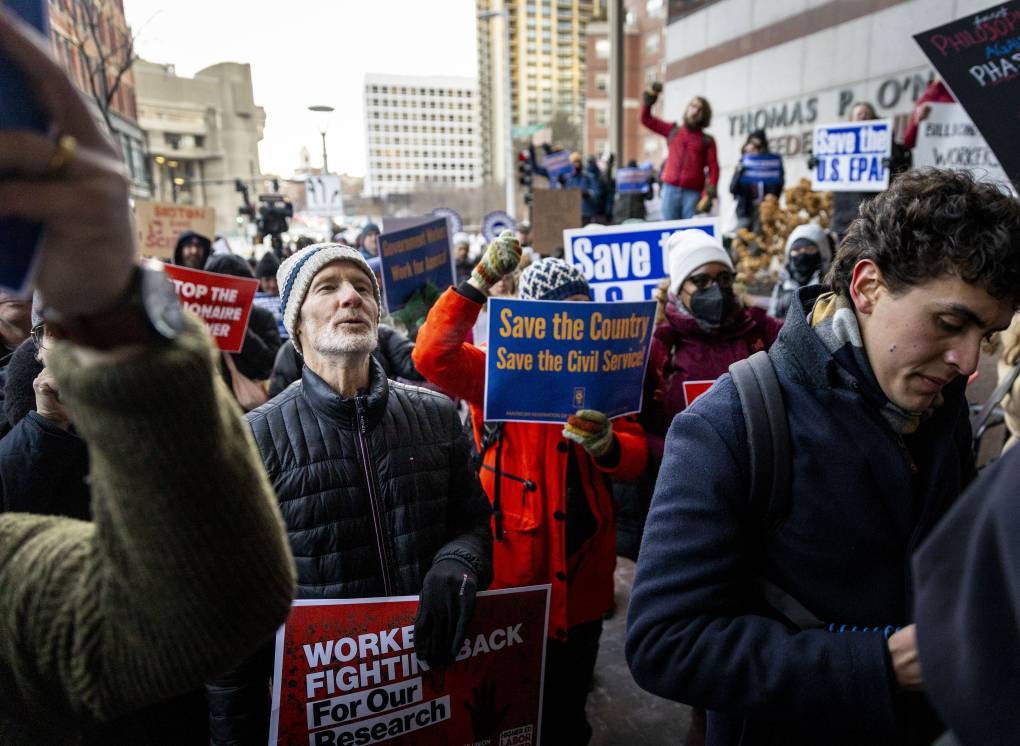
"title": "Federal workers rally in Boston against Trump administration's effort to cut federal research funding",
"publishDate": 1740688490,
"status": "inherit",
"parent": 12029015,
"modified": 1741888654,
"caption": "Federal workers gather outside a federal building in Boston to protest the Trump administration's mass layoffs and budget cuts on Feb. 19, 2025. Labor unions argued in front of a federal judge at a Thursday hearing in San Francisco that Trump officials lack the authority to order terminations of probationary federal employees and that notices to workers were premised on a lie of poor job performance.",
"credit": "Brett Phelps/The Boston Globe via Getty Images",
"altTag": null,
"description": null,
"imgSizes": {
"medium": {
"file": "https://cdn.kqed.org/wp-content/uploads/sites/10/2025/02/GettyImages-2200003760-800x585.jpg",
"width": 800,
"height": 585,
"mimeType": "image/jpeg"
},
"large": {
"file": "https://cdn.kqed.org/wp-content/uploads/sites/10/2025/02/GettyImages-2200003760-1020x746.jpg",
"width": 1020,
"height": 746,
"mimeType": "image/jpeg"
},
"thumbnail": {
"file": "https://cdn.kqed.org/wp-content/uploads/sites/10/2025/02/GettyImages-2200003760-160x117.jpg",
"width": 160,
"height": 117,
"mimeType": "image/jpeg"
},
"1536x1536": {
"file": "https://cdn.kqed.org/wp-content/uploads/sites/10/2025/02/GettyImages-2200003760-1536x1124.jpg",
"width": 1536,
"height": 1124,
"mimeType": "image/jpeg"
},
"2048x2048": {
"file": "https://cdn.kqed.org/wp-content/uploads/sites/10/2025/02/GettyImages-2200003760-2048x1498.jpg",
"width": 2048,
"height": 1498,
"mimeType": "image/jpeg"
},
"post-thumbnail": {
"file": "https://cdn.kqed.org/wp-content/uploads/sites/10/2025/02/GettyImages-2200003760-672x372.jpg",
"width": 672,
"height": 372,
"mimeType": "image/jpeg"
},
"twentyfourteen-full-width": {
"file": "https://cdn.kqed.org/wp-content/uploads/sites/10/2025/02/GettyImages-2200003760-1038x576.jpg",
"width": 1038,
"height": 576,
"mimeType": "image/jpeg"
},
"full-width": {
"file": "https://cdn.kqed.org/wp-content/uploads/sites/10/2025/02/GettyImages-2200003760-1920x1405.jpg",
"width": 1920,
"height": 1405,
"mimeType": "image/jpeg"
},
"kqedFullSize": {
"file": "https://cdn.kqed.org/wp-content/uploads/sites/10/2025/02/GettyImages-2200003760-scaled-e1741885776172.jpg",
"width": 2000,
"height": 1463
}
},
"isLoading": false,
"fetchFailed": false
},
"news_12014213": {
"type": "attachments",
"id": "news_12014213",
"meta": {
"index": "attachments_1716263798",
"site": "news",
"id": "12014213",
"found": true
},
"title": "Stanford campus on May 30, 2023.",
"publishDate": 1731521794,
"status": "inherit",
"parent": 0,
"modified": 1733786946,
"caption": "Stanford University campus on May 30, 2023.",
"credit": "Beth LaBerge/KQED",
"altTag": null,
"description": null,
"imgSizes": {
"medium": {
"file": "https://cdn.kqed.org/wp-content/uploads/sites/10/2024/11/005_KQED_StanfordGradUnion_05302023_qed-800x533.jpg",
"width": 800,
"height": 533,
"mimeType": "image/jpeg"
},
"large": {
"file": "https://cdn.kqed.org/wp-content/uploads/sites/10/2024/11/005_KQED_StanfordGradUnion_05302023_qed-1020x680.jpg",
"width": 1020,
"height": 680,
"mimeType": "image/jpeg"
},
"thumbnail": {
"file": "https://cdn.kqed.org/wp-content/uploads/sites/10/2024/11/005_KQED_StanfordGradUnion_05302023_qed-160x107.jpg",
"width": 160,
"height": 107,
"mimeType": "image/jpeg"
},
"1536x1536": {
"file": "https://cdn.kqed.org/wp-content/uploads/sites/10/2024/11/005_KQED_StanfordGradUnion_05302023_qed-1536x1024.jpg",
"width": 1536,
"height": 1024,
"mimeType": "image/jpeg"
},
"post-thumbnail": {
"file": "https://cdn.kqed.org/wp-content/uploads/sites/10/2024/11/005_KQED_StanfordGradUnion_05302023_qed-672x372.jpg",
"width": 672,
"height": 372,
"mimeType": "image/jpeg"
},
"twentyfourteen-full-width": {
"file": "https://cdn.kqed.org/wp-content/uploads/sites/10/2024/11/005_KQED_StanfordGradUnion_05302023_qed-1038x576.jpg",
"width": 1038,
"height": 576,
"mimeType": "image/jpeg"
},
"full-width": {
"file": "https://cdn.kqed.org/wp-content/uploads/sites/10/2024/11/005_KQED_StanfordGradUnion_05302023_qed-1920x1280.jpg",
"width": 1920,
"height": 1280,
"mimeType": "image/jpeg"
},
"kqedFullSize": {
"file": "https://cdn.kqed.org/wp-content/uploads/sites/10/2024/11/005_KQED_StanfordGradUnion_05302023_qed.jpg",
"width": 2000,
"height": 1333
}
},
"isLoading": false,
"fetchFailed": false
},
"news_12029064": {
"type": "attachments",
"id": "news_12029064",
"meta": {
"index": "attachments_1716263798",
"site": "news",
"id": "12029064",
"found": true
},
"title": "In this photo illustration, a Donald Trump meme coin $Trump",
"publishDate": 1740696347,
"status": "inherit",
"parent": 12029013,
"modified": 1740696399,
"caption": "A Donald Trump meme coin $Trump logo seen displayed on a smartphone.",
"credit": "Mateusz Slodkowski/SOPA Images/LightRocket via Getty Images",
"altTag": null,
"description": null,
"imgSizes": {
"medium": {
"file": "https://cdn.kqed.org/wp-content/uploads/sites/10/2025/02/GettyImages-2194283661-800x533.jpg",
"width": 800,
"height": 533,
"mimeType": "image/jpeg"
},
"large": {
"file": "https://cdn.kqed.org/wp-content/uploads/sites/10/2025/02/GettyImages-2194283661-1020x680.jpg",
"width": 1020,
"height": 680,
"mimeType": "image/jpeg"
},
"thumbnail": {
"file": "https://cdn.kqed.org/wp-content/uploads/sites/10/2025/02/GettyImages-2194283661-160x107.jpg",
"width": 160,
"height": 107,
"mimeType": "image/jpeg"
},
"1536x1536": {
"file": "https://cdn.kqed.org/wp-content/uploads/sites/10/2025/02/GettyImages-2194283661-1536x1024.jpg",
"width": 1536,
"height": 1024,
"mimeType": "image/jpeg"
},
"2048x2048": {
"file": "https://cdn.kqed.org/wp-content/uploads/sites/10/2025/02/GettyImages-2194283661-2048x1366.jpg",
"width": 2048,
"height": 1366,
"mimeType": "image/jpeg"
},
"post-thumbnail": {
"file": "https://cdn.kqed.org/wp-content/uploads/sites/10/2025/02/GettyImages-2194283661-672x372.jpg",
"width": 672,
"height": 372,
"mimeType": "image/jpeg"
},
"twentyfourteen-full-width": {
"file": "https://cdn.kqed.org/wp-content/uploads/sites/10/2025/02/GettyImages-2194283661-1038x576.jpg",
"width": 1038,
"height": 576,
"mimeType": "image/jpeg"
},
"full-width": {
"file": "https://cdn.kqed.org/wp-content/uploads/sites/10/2025/02/GettyImages-2194283661-1920x1280.jpg",
"width": 1920,
"height": 1280,
"mimeType": "image/jpeg"
},
"kqedFullSize": {
"file": "https://cdn.kqed.org/wp-content/uploads/sites/10/2025/02/GettyImages-2194283661-scaled.jpg",
"width": 2560,
"height": 1707
}
},
"isLoading": false,
"fetchFailed": false
},
"news_11890060": {
"type": "attachments",
"id": "news_11890060",
"meta": {
"index": "attachments_1716263798",
"site": "news",
"id": "11890060",
"found": true
},
"title": "US-POLITICS-IMMIGRATION-COURT",
"publishDate": 1632779004,
"status": "inherit",
"parent": 11890039,
"modified": 1779125894,
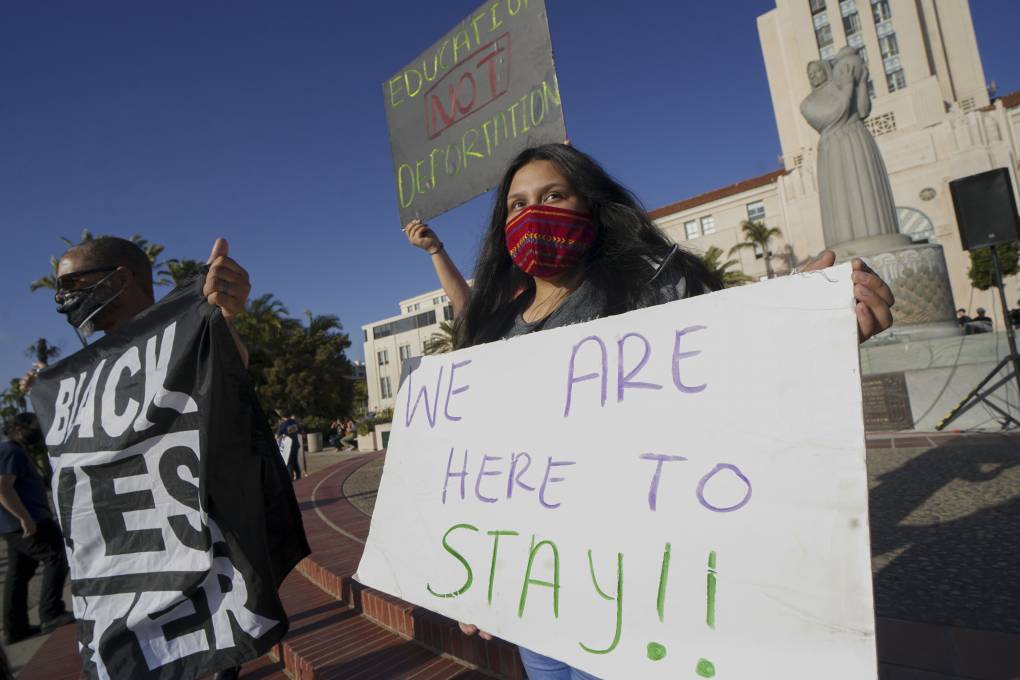
"caption": "People hold signs during a rally in support of the Supreme Court's ruling in favor of the Deferred Action for Childhood Arrivals (DACA) program in San Diego, California, June 18, 2020.",
"credit": "Sandy Huffaker/AFP via Getty Images",
"altTag": "Protesters hold signs saying, \"We are here to stay!\" \"Black Lives Matter\" and \"Education, Not Deportation.\"",
"description": "People hold signs during a rally in support of the Supreme Court's ruling in favor of the Deferred Action for Childhood Arrivals (DACA) program, in San Diego, California June 18, 2020.",
"imgSizes": {
"medium": {
"file": "https://cdn.kqed.org/wp-content/uploads/sites/10/2021/09/GettyImages-1221069312-800x534.jpg",
"width": 800,
"height": 534,
"mimeType": "image/jpeg"
},
"large": {
"file": "https://cdn.kqed.org/wp-content/uploads/sites/10/2021/09/GettyImages-1221069312-1020x680.jpg",
"width": 1020,
"height": 680,
"mimeType": "image/jpeg"
},
"thumbnail": {
"file": "https://cdn.kqed.org/wp-content/uploads/sites/10/2021/09/GettyImages-1221069312-160x107.jpg",
"width": 160,
"height": 107,
"mimeType": "image/jpeg"
},
"1536x1536": {
"file": "https://cdn.kqed.org/wp-content/uploads/sites/10/2021/09/GettyImages-1221069312-1536x1025.jpg",
"width": 1536,
"height": 1025,
"mimeType": "image/jpeg"
},
"2048x2048": {
"file": "https://cdn.kqed.org/wp-content/uploads/sites/10/2021/09/GettyImages-1221069312-2048x1366.jpg",
"width": 2048,
"height": 1366,
"mimeType": "image/jpeg"
},
"post-thumbnail": {
"file": "https://cdn.kqed.org/wp-content/uploads/sites/10/2021/09/GettyImages-1221069312-672x372.jpg",
"width": 672,
"height": 372,
"mimeType": "image/jpeg"
},
"twentyfourteen-full-width": {
"file": "https://cdn.kqed.org/wp-content/uploads/sites/10/2021/09/GettyImages-1221069312-1038x576.jpg",
"width": 1038,
"height": 576,
"mimeType": "image/jpeg"
},
"full-width": {
"file": "https://cdn.kqed.org/wp-content/uploads/sites/10/2021/09/GettyImages-1221069312-1920x1281.jpg",
"width": 1920,
"height": 1281,
"mimeType": "image/jpeg"
},
"kqedFullSize": {
"file": "https://cdn.kqed.org/wp-content/uploads/sites/10/2021/09/GettyImages-1221069312-scaled-e1740595603543.jpg",
"width": 2000,
"height": 1334
}
},
"isLoading": false,
"fetchFailed": false
},
"news_12028545": {
"type": "attachments",
"id": "news_12028545",
"meta": {
"index": "attachments_1716263798",
"site": "news",
"id": "12028545",
"found": true
},
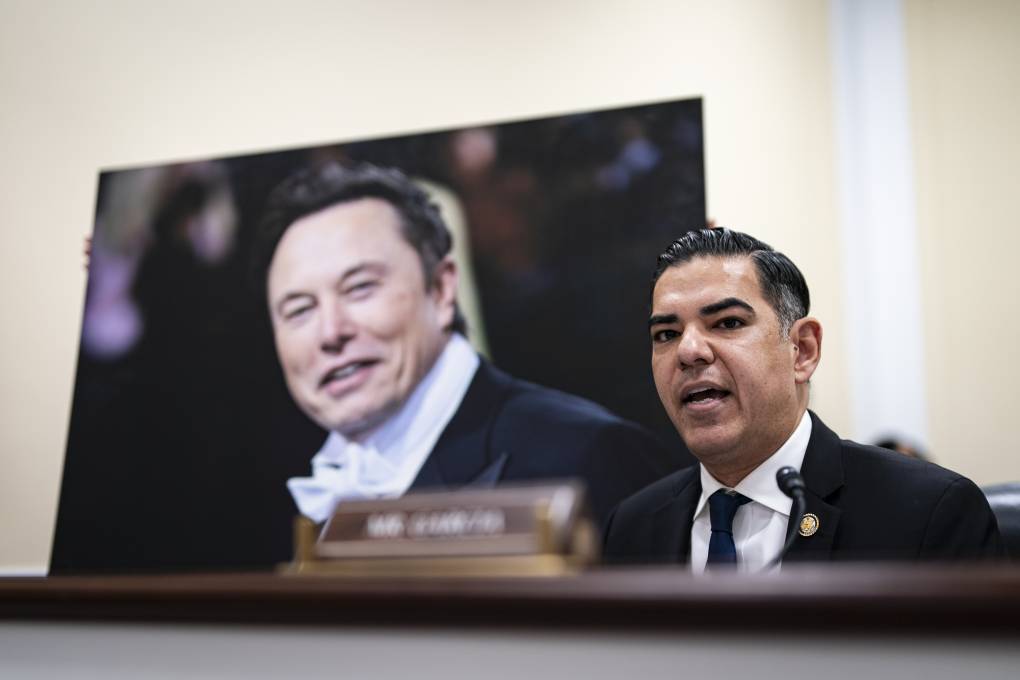
"title": "House Oversight Subcommittee For Delivering On Government Efficiency Holds Hearing On Waste",
"publishDate": 1740524689,
"status": "inherit",
"parent": 12028538,
"modified": 1740524689,
"caption": "WASHINGTON, DC - FEBRUARY 12: U.S. Rep. Robert Garcia (D-CA) speaks while displaying a photograph of Tesla and SpaceX CEO Elon Musk, during the House Oversight and Government Reform Subcommittee on Delivering on Government Efficiency in the Rayburn House Office Building on February 12, 2025 in Washington, DC. The subcommittee held a hearing titled \"The War on Waste: Stamping Out the Scourge of Improper Payments and Fraud.\" (Photo by Al Drago/Getty Images)",
"credit": null,
"altTag": null,
"description": null,
"imgSizes": {
"medium": {
"file": "https://cdn.kqed.org/wp-content/uploads/sites/10/2025/02/GettyImages-2198511583-800x533.jpg",
"width": 800,
"height": 533,
"mimeType": "image/jpeg"
},
"large": {
"file": "https://cdn.kqed.org/wp-content/uploads/sites/10/2025/02/GettyImages-2198511583-1020x680.jpg",
"width": 1020,
"height": 680,
"mimeType": "image/jpeg"
},
"thumbnail": {
"file": "https://cdn.kqed.org/wp-content/uploads/sites/10/2025/02/GettyImages-2198511583-160x107.jpg",
"width": 160,
"height": 107,
"mimeType": "image/jpeg"
},
"1536x1536": {
"file": "https://cdn.kqed.org/wp-content/uploads/sites/10/2025/02/GettyImages-2198511583-1536x1024.jpg",
"width": 1536,
"height": 1024,
"mimeType": "image/jpeg"
},
"2048x2048": {
"file": "https://cdn.kqed.org/wp-content/uploads/sites/10/2025/02/GettyImages-2198511583-2048x1365.jpg",
"width": 2048,
"height": 1365,
"mimeType": "image/jpeg"
},
"post-thumbnail": {
"file": "https://cdn.kqed.org/wp-content/uploads/sites/10/2025/02/GettyImages-2198511583-672x372.jpg",
"width": 672,
"height": 372,
"mimeType": "image/jpeg"
},
"twentyfourteen-full-width": {
"file": "https://cdn.kqed.org/wp-content/uploads/sites/10/2025/02/GettyImages-2198511583-1038x576.jpg",
"width": 1038,
"height": 576,
"mimeType": "image/jpeg"
},
"full-width": {
"file": "https://cdn.kqed.org/wp-content/uploads/sites/10/2025/02/GettyImages-2198511583-1920x1280.jpg",
"width": 1920,
"height": 1280,
"mimeType": "image/jpeg"
},
"kqedFullSize": {
"file": "https://cdn.kqed.org/wp-content/uploads/sites/10/2025/02/GettyImages-2198511583-scaled.jpg",
"width": 2560,
"height": 1707
}
},
"isLoading": false,
"fetchFailed": false
},
"news_12028302": {
"type": "attachments",
"id": "news_12028302",
"meta": {
"index": "attachments_1716263798",
"site": "news",
"id": "12028302",
"found": true
},
"title": "Trump Administration Seeks To Shrink Funding For The Presidio In San Francisco",
"publishDate": 1740418371,
"status": "inherit",
"parent": 12028300,
"modified": 1740446760,
"caption": "A jogger runs on Crissy Field at Presidio of San Francisco on Feb. 20, 2025, in San Francisco, California. President Donald Trump signed an executive order on Wednesday to eliminate the Presidio Trust, the federal agency that runs and protects the Presidio of San Francisco, a national historic landmark since 1962.",
"credit": "Justin Sullivan/Getty Images",
"altTag": null,
"description": null,
"imgSizes": {
"medium": {
"file": "https://cdn.kqed.org/wp-content/uploads/sites/10/2025/02/PresidioSFGetty-800x544.jpg",
"width": 800,
"height": 544,
"mimeType": "image/jpeg"
},
"large": {
"file": "https://cdn.kqed.org/wp-content/uploads/sites/10/2025/02/PresidioSFGetty-1020x693.jpg",
"width": 1020,
"height": 693,
"mimeType": "image/jpeg"
},
"thumbnail": {
"file": "https://cdn.kqed.org/wp-content/uploads/sites/10/2025/02/PresidioSFGetty-160x109.jpg",
"width": 160,
"height": 109,
"mimeType": "image/jpeg"
},
"1536x1536": {
"file": "https://cdn.kqed.org/wp-content/uploads/sites/10/2025/02/PresidioSFGetty-1536x1044.jpg",
"width": 1536,
"height": 1044,
"mimeType": "image/jpeg"
},
"post-thumbnail": {
"file": "https://cdn.kqed.org/wp-content/uploads/sites/10/2025/02/PresidioSFGetty-672x372.jpg",
"width": 672,
"height": 372,
"mimeType": "image/jpeg"
},
"twentyfourteen-full-width": {
"file": "https://cdn.kqed.org/wp-content/uploads/sites/10/2025/02/PresidioSFGetty-1038x576.jpg",
"width": 1038,
"height": 576,
"mimeType": "image/jpeg"
},
"full-width": {
"file": "https://cdn.kqed.org/wp-content/uploads/sites/10/2025/02/PresidioSFGetty-1920x1305.jpg",
"width": 1920,
"height": 1305,
"mimeType": "image/jpeg"
},
"kqedFullSize": {
"file": "https://cdn.kqed.org/wp-content/uploads/sites/10/2025/02/PresidioSFGetty.jpg",
"width": 2000,
"height": 1359
}
},
"isLoading": false,
"fetchFailed": false
},
"news_12028373": {
"type": "attachments",
"id": "news_12028373",
"meta": {
"index": "attachments_1716263798",
"site": "news",
"id": "12028373",
"found": true
},
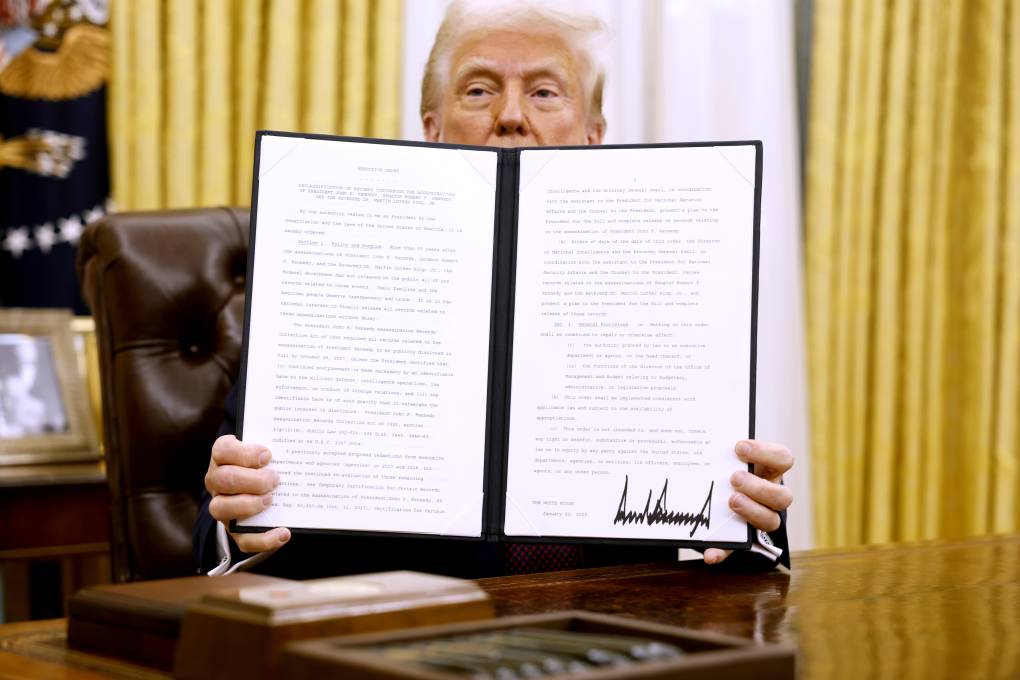
"title": "President Donald Trump Signs More Executive Orders",
"publishDate": 1740438380,
"status": "inherit",
"parent": 12028351,
"modified": 1740438467,
"caption": "President Donald Trump holds up a signed executive order in the Oval Office of the White House on Jan. 23.",
"credit": "Anna Moneymaker/Getty Images",
"altTag": null,
"description": null,
"imgSizes": {
"medium": {
"file": "https://cdn.kqed.org/wp-content/uploads/sites/10/2025/02/GettyImages-2195560285-800x533.jpg",
"width": 800,
"height": 533,
"mimeType": "image/jpeg"
},
"large": {
"file": "https://cdn.kqed.org/wp-content/uploads/sites/10/2025/02/GettyImages-2195560285-1020x680.jpg",
"width": 1020,
"height": 680,
"mimeType": "image/jpeg"
},
"thumbnail": {
"file": "https://cdn.kqed.org/wp-content/uploads/sites/10/2025/02/GettyImages-2195560285-160x107.jpg",
"width": 160,
"height": 107,
"mimeType": "image/jpeg"
},
"1536x1536": {
"file": "https://cdn.kqed.org/wp-content/uploads/sites/10/2025/02/GettyImages-2195560285-1536x1024.jpg",
"width": 1536,
"height": 1024,
"mimeType": "image/jpeg"
},
"2048x2048": {
"file": "https://cdn.kqed.org/wp-content/uploads/sites/10/2025/02/GettyImages-2195560285-2048x1365.jpg",
"width": 2048,
"height": 1365,
"mimeType": "image/jpeg"
},
"post-thumbnail": {
"file": "https://cdn.kqed.org/wp-content/uploads/sites/10/2025/02/GettyImages-2195560285-672x372.jpg",
"width": 672,
"height": 372,
"mimeType": "image/jpeg"
},
"twentyfourteen-full-width": {
"file": "https://cdn.kqed.org/wp-content/uploads/sites/10/2025/02/GettyImages-2195560285-1038x576.jpg",
"width": 1038,
"height": 576,
"mimeType": "image/jpeg"
},
"full-width": {
"file": "https://cdn.kqed.org/wp-content/uploads/sites/10/2025/02/GettyImages-2195560285-1920x1280.jpg",
"width": 1920,
"height": 1280,
"mimeType": "image/jpeg"
},
"kqedFullSize": {
"file": "https://cdn.kqed.org/wp-content/uploads/sites/10/2025/02/GettyImages-2195560285-scaled-e1745951058371.jpg",
"width": 2000,
"height": 1334
}
},
"isLoading": false,
"fetchFailed": false
},
"news_11861171": {
"type": "attachments",
"id": "news_11861171",
"meta": {
"index": "attachments_1716263798",
"site": "news",
"id": "11861171",
"found": true
},
"parent": 11861170,
"imgSizes": {
"apple_news_ca_landscape_5_5": {
"file": "https://ww2.kqed.org/app/uploads/sites/10/2021/02/ap20085537395007_custom-ecee50ce392cd8fa5d32a2063cb73d5bd1c02722-1044x783.jpg",
"width": 1044,
"mimeType": "image/jpeg",
"height": 783
},
"apple_news_ca_square_4_0": {
"file": "https://ww2.kqed.org/app/uploads/sites/10/2021/02/ap20085537395007_custom-ecee50ce392cd8fa5d32a2063cb73d5bd1c02722-470x470.jpg",
"width": 470,
"mimeType": "image/jpeg",
"height": 470
},
"twentyfourteen-full-width": {
"file": "https://ww2.kqed.org/app/uploads/sites/10/2021/02/ap20085537395007_custom-ecee50ce392cd8fa5d32a2063cb73d5bd1c02722-1038x576.jpg",
"width": 1038,
"mimeType": "image/jpeg",
"height": 576
},
"thumbnail": {
"file": "https://ww2.kqed.org/app/uploads/sites/10/2021/02/ap20085537395007_custom-ecee50ce392cd8fa5d32a2063cb73d5bd1c02722-160x107.jpg",
"width": 160,
"mimeType": "image/jpeg",
"height": 107
},
"post-thumbnail": {
"file": "https://ww2.kqed.org/app/uploads/sites/10/2021/02/ap20085537395007_custom-ecee50ce392cd8fa5d32a2063cb73d5bd1c02722-672x372.jpg",
"width": 672,
"mimeType": "image/jpeg",
"height": 372
},
"kqedFullSize": {
"file": "https://ww2.kqed.org/app/uploads/sites/10/2021/02/ap20085537395007_custom-ecee50ce392cd8fa5d32a2063cb73d5bd1c02722-scaled-e1613765453619.jpg",
"width": 1920,
"height": 1279
},
"2048x2048": {
"file": "https://ww2.kqed.org/app/uploads/sites/10/2021/02/ap20085537395007_custom-ecee50ce392cd8fa5d32a2063cb73d5bd1c02722-2048x1364.jpg",
"width": 2048,
"mimeType": "image/jpeg",
"height": 1364
},
"apple_news_ca_landscape_4_7": {
"file": "https://ww2.kqed.org/app/uploads/sites/10/2021/02/ap20085537395007_custom-ecee50ce392cd8fa5d32a2063cb73d5bd1c02722-632x474.jpg",
"width": 632,
"mimeType": "image/jpeg",
"height": 474
},
"large": {
"file": "https://ww2.kqed.org/app/uploads/sites/10/2021/02/ap20085537395007_custom-ecee50ce392cd8fa5d32a2063cb73d5bd1c02722-1020x679.jpg",
"width": 1020,
"mimeType": "image/jpeg",
"height": 679
},
"apple_news_ca_landscape_4_0": {
"file": "https://ww2.kqed.org/app/uploads/sites/10/2021/02/ap20085537395007_custom-ecee50ce392cd8fa5d32a2063cb73d5bd1c02722-536x402.jpg",
"width": 536,
"mimeType": "image/jpeg",
"height": 402
},
"apple_news_ca_portrait_12_9": {
"file": "https://ww2.kqed.org/app/uploads/sites/10/2021/02/ap20085537395007_custom-ecee50ce392cd8fa5d32a2063cb73d5bd1c02722-1122x1496.jpg",
"width": 1122,
"mimeType": "image/jpeg",
"height": 1496
},
"medium": {
"file": "https://ww2.kqed.org/app/uploads/sites/10/2021/02/ap20085537395007_custom-ecee50ce392cd8fa5d32a2063cb73d5bd1c02722-800x533.jpg",
"width": 800,
"mimeType": "image/jpeg",
"height": 533
},
"apple_news_ca_portrait_4_0": {
"file": "https://ww2.kqed.org/app/uploads/sites/10/2021/02/ap20085537395007_custom-ecee50ce392cd8fa5d32a2063cb73d5bd1c02722-354x472.jpg",
"width": 354,
"mimeType": "image/jpeg",
"height": 472
},
"apple_news_ca_portrait_9_7": {
"file": "https://ww2.kqed.org/app/uploads/sites/10/2021/02/ap20085537395007_custom-ecee50ce392cd8fa5d32a2063cb73d5bd1c02722-840x1120.jpg",
"width": 840,
"mimeType": "image/jpeg",
"height": 1120
},
"apple_news_ca_landscape_12_9": {
"file": "https://ww2.kqed.org/app/uploads/sites/10/2021/02/ap20085537395007_custom-ecee50ce392cd8fa5d32a2063cb73d5bd1c02722-1832x1374.jpg",
"width": 1832,
"mimeType": "image/jpeg",
"height": 1374
},
"apple_news_ca_square_9_7": {
"file": "https://ww2.kqed.org/app/uploads/sites/10/2021/02/ap20085537395007_custom-ecee50ce392cd8fa5d32a2063cb73d5bd1c02722-1104x1104.jpg",
"width": 1104,
"mimeType": "image/jpeg",
"height": 1104
},
"1536x1536": {
"file": "https://ww2.kqed.org/app/uploads/sites/10/2021/02/ap20085537395007_custom-ecee50ce392cd8fa5d32a2063cb73d5bd1c02722-1536x1023.jpg",
"width": 1536,
"mimeType": "image/jpeg",
"height": 1023
},
"apple_news_ca_portrait_4_7": {
"file": "https://ww2.kqed.org/app/uploads/sites/10/2021/02/ap20085537395007_custom-ecee50ce392cd8fa5d32a2063cb73d5bd1c02722-414x552.jpg",
"width": 414,
"mimeType": "image/jpeg",
"height": 552
},
"apple_news_ca_square_12_9": {
"file": "https://ww2.kqed.org/app/uploads/sites/10/2021/02/ap20085537395007_custom-ecee50ce392cd8fa5d32a2063cb73d5bd1c02722-1472x1472.jpg",
"width": 1472,
"mimeType": "image/jpeg",
"height": 1472
},
"apple_news_ca_portrait_5_5": {
"file": "https://ww2.kqed.org/app/uploads/sites/10/2021/02/ap20085537395007_custom-ecee50ce392cd8fa5d32a2063cb73d5bd1c02722-687x916.jpg",
"width": 687,
"mimeType": "image/jpeg",
"height": 916
},
"full-width": {
"file": "https://ww2.kqed.org/app/uploads/sites/10/2021/02/ap20085537395007_custom-ecee50ce392cd8fa5d32a2063cb73d5bd1c02722-1920x1279.jpg",
"width": 1920,
"mimeType": "image/jpeg",
"height": 1279
},
"apple_news_ca_square_4_7": {
"file": "https://ww2.kqed.org/app/uploads/sites/10/2021/02/ap20085537395007_custom-ecee50ce392cd8fa5d32a2063cb73d5bd1c02722-550x550.jpg",
"width": 550,
"mimeType": "image/jpeg",
"height": 550
},
"apple_news_ca_landscape_9_7": {
"file": "https://ww2.kqed.org/app/uploads/sites/10/2021/02/ap20085537395007_custom-ecee50ce392cd8fa5d32a2063cb73d5bd1c02722-1376x1032.jpg",
"width": 1376,
"mimeType": "image/jpeg",
"height": 1032
},
"apple_news_ca_square_5_5": {
"file": "https://ww2.kqed.org/app/uploads/sites/10/2021/02/ap20085537395007_custom-ecee50ce392cd8fa5d32a2063cb73d5bd1c02722-912x912.jpg",
"width": 912,
"mimeType": "image/jpeg",
"height": 912
}
},
"publishDate": 1613761514,
"modified": 1613766809,
"caption": "A U.S. Immigration and Customs Enforcement officer looks on during an operation in Escondido, California, in 2019. The Biden administration on Thursday announced new guidelines that are expected to sharply limit arrests and deportations carried out by ICE.",
"description": "A U.S. Immigration and Customs Enforcement officer looks on during an operation in Escondido, Calif., in 2019. The Biden administration on Thursday announced new guidelines that are expected to sharply limit arrests and deportations carried out by ICE.",
"title": "A U.S. Immigration and Customs Enforcement officer looks on during an operation in Escondido, Calif., in 2019. The Biden administration today announced new guidelines that are expected to sharply limit arrests and deportations carried out by ICE.",
"credit": "Gregory Bull/AP",
"status": "inherit",
"altTag": null,
"isLoading": false,
"fetchFailed": false
},
"news_12028336": {
"type": "attachments",
"id": "news_12028336",
"meta": {
"index": "attachments_1716263798",
"site": "news",
"id": "12028336",
"found": true
},
"title": "National-Conservative-Conference-2024",
"publishDate": 1740428120,
"status": "inherit",
"parent": 12028324,
"modified": 1740428619,
"caption": "The Heritage Foundation's Project 2025 booth at the National Conservative Conference in Washington, D.C., on July 8, 2024.",
"credit": "Dominic Gwinn/AFP via Getty Images",
"altTag": "A group of people stand behind a table with a 'Project 2025' banner behind them.",
"description": null,
"imgSizes": {
"medium": {
"file": "https://cdn.kqed.org/wp-content/uploads/sites/10/2025/02/GettyImages-2164096734-800x534.jpg",
"width": 800,
"height": 534,
"mimeType": "image/jpeg"
},
"large": {
"file": "https://cdn.kqed.org/wp-content/uploads/sites/10/2025/02/GettyImages-2164096734-1020x680.jpg",
"width": 1020,
"height": 680,
"mimeType": "image/jpeg"
},
"thumbnail": {
"file": "https://cdn.kqed.org/wp-content/uploads/sites/10/2025/02/GettyImages-2164096734-160x107.jpg",
"width": 160,
"height": 107,
"mimeType": "image/jpeg"
},
"post-thumbnail": {
"file": "https://cdn.kqed.org/wp-content/uploads/sites/10/2025/02/GettyImages-2164096734-672x372.jpg",
"width": 672,
"height": 372,
"mimeType": "image/jpeg"
},
"twentyfourteen-full-width": {
"file": "https://cdn.kqed.org/wp-content/uploads/sites/10/2025/02/GettyImages-2164096734-1024x576.jpg",
"width": 1024,
"height": 576,
"mimeType": "image/jpeg"
},
"kqedFullSize": {
"file": "https://cdn.kqed.org/wp-content/uploads/sites/10/2025/02/GettyImages-2164096734.jpg",
"width": 1024,
"height": 683
}
},
"isLoading": false,
"fetchFailed": false
},
"news_12024430": {
"type": "attachments",
"id": "news_12024430",
"meta": {
"index": "attachments_1716263798",
"site": "news",
"id": "12024430",
"found": true
},
"title": "250128-SFImmigration-08-BL",
"publishDate": 1738105102,
"status": "inherit",
"parent": 12024325,
"modified": 1742325555,
"caption": "A group of elected and public safety officials, labor leaders, and community members fill the steps in front of City Hall in San Francisco on Jan. 28, 2025, during a press conference to reaffirm San Francisco’s commitment to being a Sanctuary City.",
"credit": "Beth LaBerge/KQED",
"altTag": null,
"description": null,
"imgSizes": {
"medium": {
"file": "https://cdn.kqed.org/wp-content/uploads/sites/10/2025/01/250128-SFImmigration-08-BL-800x533.jpg",
"width": 800,
"height": 533,
"mimeType": "image/jpeg"
},
"large": {
"file": "https://cdn.kqed.org/wp-content/uploads/sites/10/2025/01/250128-SFImmigration-08-BL-1020x680.jpg",
"width": 1020,
"height": 680,
"mimeType": "image/jpeg"
},
"thumbnail": {
"file": "https://cdn.kqed.org/wp-content/uploads/sites/10/2025/01/250128-SFImmigration-08-BL-160x107.jpg",
"width": 160,
"height": 107,
"mimeType": "image/jpeg"
},
"1536x1536": {
"file": "https://cdn.kqed.org/wp-content/uploads/sites/10/2025/01/250128-SFImmigration-08-BL-1536x1024.jpg",
"width": 1536,
"height": 1024,
"mimeType": "image/jpeg"
},
"post-thumbnail": {
"file": "https://cdn.kqed.org/wp-content/uploads/sites/10/2025/01/250128-SFImmigration-08-BL-672x372.jpg",
"width": 672,
"height": 372,
"mimeType": "image/jpeg"
},
"twentyfourteen-full-width": {
"file": "https://cdn.kqed.org/wp-content/uploads/sites/10/2025/01/250128-SFImmigration-08-BL-1038x576.jpg",
"width": 1038,
"height": 576,
"mimeType": "image/jpeg"
},
"full-width": {
"file": "https://cdn.kqed.org/wp-content/uploads/sites/10/2025/01/250128-SFImmigration-08-BL-1920x1280.jpg",
"width": 1920,
"height": 1280,
"mimeType": "image/jpeg"
},
"kqedFullSize": {
"file": "https://cdn.kqed.org/wp-content/uploads/sites/10/2025/01/250128-SFImmigration-08-BL.jpg",
"width": 2000,
"height": 1333
}
},
"isLoading": false,
"fetchFailed": false
},
"news_12028077": {
"type": "attachments",
"id": "news_12028077",
"meta": {
"index": "attachments_1716263798",
"site": "news",
"id": "12028077",
"found": true
},
"title": "021125-ICE-Schools-Salinas-LV_27 copy",
"publishDate": 1740101066,
"status": "inherit",
"parent": 12028076,
"modified": 1740101230,
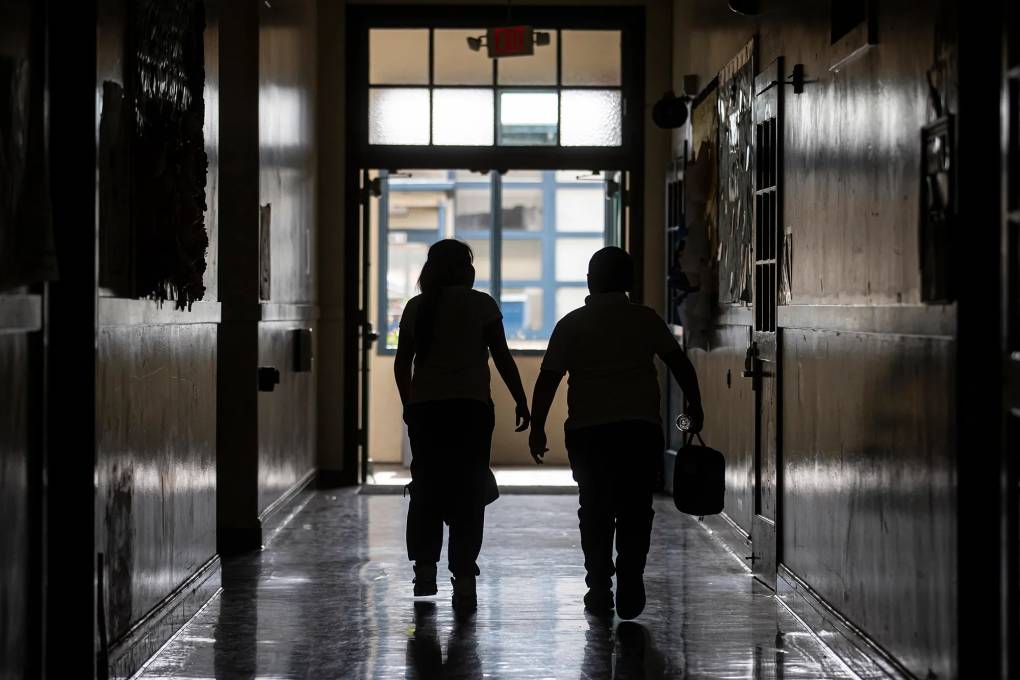
"caption": "Two students walk through the main building at Sherwood Elementary School in Salinas on Feb. 11, 2025. ",
"credit": "Larry Valenzuela/CalMatters/CatchLight Local",
"altTag": null,
"description": null,
"imgSizes": {
"medium": {
"file": "https://cdn.kqed.org/wp-content/uploads/sites/10/2025/02/021125-ICE-Schools-Salinas-LV_27-copy-800x533.jpg",
"width": 800,
"height": 533,
"mimeType": "image/jpeg"
},
"large": {
"file": "https://cdn.kqed.org/wp-content/uploads/sites/10/2025/02/021125-ICE-Schools-Salinas-LV_27-copy-1020x680.jpg",
"width": 1020,
"height": 680,
"mimeType": "image/jpeg"
},
"thumbnail": {
"file": "https://cdn.kqed.org/wp-content/uploads/sites/10/2025/02/021125-ICE-Schools-Salinas-LV_27-copy-160x107.jpg",
"width": 160,
"height": 107,
"mimeType": "image/jpeg"
},
"1536x1536": {
"file": "https://cdn.kqed.org/wp-content/uploads/sites/10/2025/02/021125-ICE-Schools-Salinas-LV_27-copy-1536x1024.jpg",
"width": 1536,
"height": 1024,
"mimeType": "image/jpeg"
},
"post-thumbnail": {
"file": "https://cdn.kqed.org/wp-content/uploads/sites/10/2025/02/021125-ICE-Schools-Salinas-LV_27-copy-672x372.jpg",
"width": 672,
"height": 372,
"mimeType": "image/jpeg"
},
"twentyfourteen-full-width": {
"file": "https://cdn.kqed.org/wp-content/uploads/sites/10/2025/02/021125-ICE-Schools-Salinas-LV_27-copy-1038x576.jpg",
"width": 1038,
"height": 576,
"mimeType": "image/jpeg"
},
"full-width": {
"file": "https://cdn.kqed.org/wp-content/uploads/sites/10/2025/02/021125-ICE-Schools-Salinas-LV_27-copy-1920x1280.jpg",
"width": 1920,
"height": 1280,
"mimeType": "image/jpeg"
},
"kqedFullSize": {
"file": "https://cdn.kqed.org/wp-content/uploads/sites/10/2025/02/021125-ICE-Schools-Salinas-LV_27-copy.jpg",
"width": 2000,
"height": 1333
}
},
"isLoading": false,
"fetchFailed": false
}
},
"audioPlayerReducer": {
"postId": "stream_live",
"isPaused": true,
"isPlaying": false,
"pfsActive": false,
"pledgeModalIsOpen": true,
"playerDrawerIsOpen": false,
"liveAudioPlayStartedAt": 0,
"liveAudioPlayContext": ""
},
"authorsReducer": {
"byline_news_12029015": {
"type": "authors",
"id": "byline_news_12029015",
"meta": {
"override": true
},
"slug": "byline_news_12029015",
"name": "Janie Har, The Associated Press",
"isLoading": false
},
"byline_news_12028324": {
"type": "authors",
"id": "byline_news_12028324",
"meta": {
"override": true
},
"slug": "byline_news_12028324",
"name": "\u003ca href=\"https://kffhealthnews.org/news/author/stephanie-armour/\">Stephanie Armour\u003c/a>, KFF Health News",
"isLoading": false
},
"byline_news_12028076": {
"type": "authors",
"id": "byline_news_12028076",
"meta": {
"override": true
},
"slug": "byline_news_12028076",
"name": "\u003ca href=\"https://calmatters.org/author/carolyn-jones/\">Carolyn Jones\u003c/a>, CalMatters",
"isLoading": false
},
"scottshafer": {
"type": "authors",
"id": "255",
"meta": {
"index": "authors_1716337520",
"id": "255",
"found": true
},
"name": "Scott Shafer",
"firstName": "Scott",
"lastName": "Shafer",
"slug": "scottshafer",
"email": "sshafer@kqed.org",
"display_author_email": false,
"staff_mastheads": [
"news"
],
"title": "KQED Contributor",
"bio": "Scott Shafer is a senior editor with the KQED Politics and Government desk. He is co-host of Political Breakdown, the award-winning radio show and podcast with a personal take on the world of politics. Scott came to KQED in 1998 to host the statewide\u003cem> California Report\u003c/em>. Prior to that he had extended stints in politics and government\u003cem>.\u003c/em> He uses that inside experience at KQED in his, reporting, hosting and analysis for the politics desk. Scott collaborated \u003cem>Political Breakdown a\u003c/em>nd on \u003cem>The Political Mind of Jerry Brown, \u003c/em>an eight-part series about the life and extraordinary political career of the former governor. For fun, he plays water polo with the San Francisco Tsunami.",
"avatar": "https://secure.gravatar.com/avatar/a62ebae45b79d7aed1a39a0e3bf68104?s=600&d=blank&r=g",
"twitter": "scottshafer",
"bluesky": null,
"facebook": null,
"instagram": null,
"linkedin": null,
"sites": [
{
"site": "news",
"roles": [
"editor"
]
},
{
"site": "stateofhealth",
"roles": [
"author"
]
},
{
"site": "science",
"roles": [
"author"
]
},
{
"site": "forum",
"roles": [
"subscriber"
]
},
{
"site": "liveblog",
"roles": [
"author"
]
}
],
"headData": {
"title": "Scott Shafer | KQED",
"description": "KQED Contributor",
"ogImgSrc": "https://secure.gravatar.com/avatar/a62ebae45b79d7aed1a39a0e3bf68104?s=600&d=blank&r=g",
"twImgSrc": "https://secure.gravatar.com/avatar/a62ebae45b79d7aed1a39a0e3bf68104?s=600&d=blank&r=g"
},
"isLoading": false,
"link": "/author/scottshafer"
},
"tychehendricks": {
"type": "authors",
"id": "259",
"meta": {
"index": "authors_1716337520",
"id": "259",
"found": true
},
"name": "Tyche Hendricks",
"firstName": "Tyche",
"lastName": "Hendricks",
"slug": "tychehendricks",
"email": "thendricks@kqed.org",
"display_author_email": true,
"staff_mastheads": [
"news"
],
"title": "KQED Senior Editor, Immigration",
"bio": "\u003cspan style=\"font-weight: 400;\">Tyche Hendricks is KQED’s senior editor for immigration, leading coverage of the policy and politics that affect California’s immigrant communities. Her work for KQED’s radio and online audiences is also carried on NPR and other national outlets. She has been recognized with awards from the Radio and Television News Directors Association, the Society for Professional Journalists; the Education Writers Association; the Best of the West and the National Federation of Community Broadcasters. Before joining KQED in 2010, Tyche spent more than a dozen years as a newspaper reporter, notably at the \u003c/span>\u003ci>\u003cspan style=\"font-weight: 400;\">San Francisco Chronicle\u003c/span>\u003c/i>\u003cspan style=\"font-weight: 400;\">. At different times she has covered criminal justice, government and politics and urban planning. Tyche has taught in the MFA Creative Writing program at the University of San Francisco and at UC Berkeley’s Graduate School of Journalism, where she was co-director of a national immigration symposium for professional journalists. She is the author of \u003c/span>\u003ci>\u003cspan style=\"font-weight: 400;\">The Wind Doesn't Need a Passport: Stories from the U.S.-Mexico Borderlands\u003c/span>\u003c/i>\u003cspan style=\"font-weight: 400;\"> (University of California Press). \u003c/span>",
"avatar": "https://secure.gravatar.com/avatar/b8ee458e2731c2d43df86882ce17267e?s=600&d=blank&r=g",
"twitter": "tychehendricks",
"facebook": null,
"instagram": null,
"linkedin": null,
"sites": [
{
"site": "news",
"roles": [
"editor"
]
},
{
"site": "stateofhealth",
"roles": [
"editor"
]
}
],
"headData": {
"title": "Tyche Hendricks | KQED",
"description": "KQED Senior Editor, Immigration",
"ogImgSrc": "https://secure.gravatar.com/avatar/b8ee458e2731c2d43df86882ce17267e?s=600&d=blank&r=g",
"twImgSrc": "https://secure.gravatar.com/avatar/b8ee458e2731c2d43df86882ce17267e?s=600&d=blank&r=g"
},
"isLoading": false,
"link": "/author/tychehendricks"
},
"mlagos": {
"type": "authors",
"id": "3239",
"meta": {
"index": "authors_1716337520",
"id": "3239",
"found": true
},
"name": "Marisa Lagos",
"firstName": "Marisa",
"lastName": "Lagos",
"slug": "mlagos",
"email": "mlagos@kqed.org",
"display_author_email": false,
"staff_mastheads": [
"news"
],
"title": "KQED Contributor",
"bio": "Marisa Lagos is a correspondent for KQED’s California Politics and Government Desk and co-hosts the award-winning show and podcast, Political Breakdown. At KQED, Lagos also conducts reporting, analysis and investigations into state, local and national politics for radio, TV, online and onstage. In 2022, she and co-host, Scott Shafer, moderated the only gubernatorial debate in California. In 2020, the \u003ci>Washington Post\u003c/i> named her one of the top political journalists in California; she was nominated for a Peabody and won several other awards for her work investigating the 2017 California wildfires. She has worked at the \u003ci>San Francisco Chronicle\u003c/i>, \u003ci>San Francisco Examiner\u003c/i> and \u003ci>Los Angeles Times\u003c/i>. A UC Santa Barbara graduate, she lives in San Francisco with her two sons and husband.",
"avatar": "https://secure.gravatar.com/avatar/a261a0d3696fc066871ef96b85b5e7d2?s=600&d=blank&r=g",
"twitter": "@mlagos",
"facebook": null,
"instagram": null,
"linkedin": null,
"sites": [
{
"site": "arts",
"roles": [
"author"
]
},
{
"site": "news",
"roles": [
"editor"
]
},
{
"site": "science",
"roles": [
"editor"
]
},
{
"site": "forum",
"roles": [
"author"
]
},
{
"site": "liveblog",
"roles": [
"author"
]
}
],
"headData": {
"title": "Marisa Lagos | KQED",
"description": "KQED Contributor",
"ogImgSrc": "https://secure.gravatar.com/avatar/a261a0d3696fc066871ef96b85b5e7d2?s=600&d=blank&r=g",
"twImgSrc": "https://secure.gravatar.com/avatar/a261a0d3696fc066871ef96b85b5e7d2?s=600&d=blank&r=g"
},
"isLoading": false,
"link": "/author/mlagos"
},
"ecruzguevarra": {
"type": "authors",
"id": "8654",
"meta": {
"index": "authors_1716337520",
"id": "8654",
"found": true
},
"name": "Ericka Cruz Guevarra",
"firstName": "Ericka",
"lastName": "Cruz Guevarra",
"slug": "ecruzguevarra",
"email": "ecruzguevarra@kqed.org",
"display_author_email": true,
"staff_mastheads": [
"news"
],
"title": "Producer, The Bay Podcast",
"bio": "Ericka Cruz Guevarra is host of \u003ca href=\"https://www.kqed.org/podcasts/thebay\">\u003cem>The Bay\u003c/em>\u003c/a> podcast at KQED. Before host, she was the show’s producer. Her work in that capacity includes a three-part reported series on policing in Vallejo, which won a 2020 excellence in journalism award from the Society of Professional Journalists. Ericka has worked as a breaking news reporter at Oregon Public Broadcasting, helped produce the Code Switch podcast, and was KQED’s inaugural Raul Ramirez Diversity Fund intern. She’s also an alumna of NPR’s Next Generation Radio program. Send her an email if you have strong feelings about whether Fairfield and Suisun City are the Bay. Ericka is represented by SAG-AFTRA.",
"avatar": "https://secure.gravatar.com/avatar/25e5ab8d3d53fad2dcc7bb2b5c506b1a?s=600&d=blank&r=g",
"twitter": "NotoriousECG",
"facebook": null,
"instagram": null,
"linkedin": null,
"sites": [
{
"site": "arts",
"roles": [
"subscriber"
]
},
{
"site": "news",
"roles": [
"editor",
"manage_categories"
]
},
{
"site": "futureofyou",
"roles": [
"subscriber"
]
},
{
"site": "stateofhealth",
"roles": [
"subscriber"
]
},
{
"site": "science",
"roles": [
"editor"
]
},
{
"site": "forum",
"roles": [
"subscriber"
]
}
],
"headData": {
"title": "Ericka Cruz Guevarra | KQED",
"description": "Producer, The Bay Podcast",
"ogImgSrc": "https://secure.gravatar.com/avatar/25e5ab8d3d53fad2dcc7bb2b5c506b1a?s=600&d=blank&r=g",
"twImgSrc": "https://secure.gravatar.com/avatar/25e5ab8d3d53fad2dcc7bb2b5c506b1a?s=600&d=blank&r=g"
},
"isLoading": false,
"link": "/author/ecruzguevarra"
},
"lsarah": {
"type": "authors",
"id": "11626",
"meta": {
"index": "authors_1716337520",
"id": "11626",
"found": true
},
"name": "Lakshmi Sarah",
"firstName": "Lakshmi",
"lastName": "Sarah",
"slug": "lsarah",
"email": "lsarah@kqed.org",
"display_author_email": false,
"staff_mastheads": [],
"title": "Digital Producer",
"bio": "Lakshmi Sarah is an educator, author and journalist with a focus on innovative storytelling. She has worked with newspapers, radio and magazines from Ahmedabad, India to Los Angeles, California. She has written and produced for Die Zeit, Global Voices, AJ+, KQED, Fusion Media Group and the New York Times.",
"avatar": "https://secure.gravatar.com/avatar/652dcaecd8b28826fc17a8b2d6bb4e93?s=600&d=blank&r=g",
"twitter": "lakitalki",
"facebook": null,
"instagram": "https://www.instagram.com/laki.talki/",
"linkedin": "https://www.linkedin.com/in/lakisarah/",
"sites": [
{
"site": "arts",
"roles": []
},
{
"site": "news",
"roles": []
},
{
"site": "bayareabites",
"roles": []
},
{
"site": "science",
"roles": []
}
],
"headData": {
"title": "Lakshmi Sarah | KQED",
"description": "Digital Producer",
"ogImgSrc": "https://secure.gravatar.com/avatar/652dcaecd8b28826fc17a8b2d6bb4e93?s=600&d=blank&r=g",
"twImgSrc": "https://secure.gravatar.com/avatar/652dcaecd8b28826fc17a8b2d6bb4e93?s=600&d=blank&r=g"
},
"isLoading": false,
"link": "/author/lsarah"
},
"ccabreralomeli": {
"type": "authors",
"id": "11708",
"meta": {
"index": "authors_1716337520",
"id": "11708",
"found": true
},
"name": "Carlos Cabrera-Lomelí",
"firstName": "Carlos",
"lastName": "Cabrera-Lomelí",
"slug": "ccabreralomeli",
"email": "ccabreralomeli@KQED.org",
"display_author_email": true,
"staff_mastheads": [
"news"
],
"title": "Community Reporter",
"bio": "Carlos Cabrera-Lomelí is a community reporter with KQED's digital engagement team. He also reports and co-produces for KQED's bilingual news hub KQED en Español. He grew up in San Francisco's Mission District and has previously worked with Univision, 48 Hills and REFORMA in Mexico City.",
"avatar": "https://secure.gravatar.com/avatar/c309be9665e484f887b818c89e273ecc673004f426f36b24d00a4d813a2e0518?s=600&d=blank&r=g",
"twitter": "@LomeliCabrera",
"bluesky": null,
"facebook": null,
"instagram": null,
"linkedin": null,
"sites": [
{
"site": "arts",
"roles": [
"editor"
]
},
{
"site": "news",
"roles": [
"editor"
]
},
{
"site": "about",
"roles": [
"editor"
]
},
{
"site": "science",
"roles": [
"editor"
]
},
{
"site": "perspectives",
"roles": [
"editor"
]
},
{
"site": "elections",
"roles": [
"editor"
]
},
{
"site": "liveblog",
"roles": [
"contributor"
]
}
],
"headData": {
"title": "Carlos Cabrera-Lomelí | KQED",
"description": "Community Reporter",
"ogImgSrc": "https://secure.gravatar.com/avatar/c309be9665e484f887b818c89e273ecc673004f426f36b24d00a4d813a2e0518?s=600&d=blank&r=g",
"twImgSrc": "https://secure.gravatar.com/avatar/c309be9665e484f887b818c89e273ecc673004f426f36b24d00a4d813a2e0518?s=600&d=blank&r=g"
},
"isLoading": false,
"link": "/author/ccabreralomeli"
},
"agonzalez": {
"type": "authors",
"id": "11724",
"meta": {
"index": "authors_1716337520",
"id": "11724",
"found": true
},
"name": "Alexander Gonzalez",
"firstName": "Alexander",
"lastName": "Gonzalez",
"slug": "agonzalez",
"email": "AlexanderGonzalez@KQED.org",
"display_author_email": false,
"staff_mastheads": [
"news"
],
"title": "KQED Contributor",
"bio": null,
"avatar": "https://secure.gravatar.com/avatar/9e291ed34e154df4c662edf858b641d70b4859939bfe40be478408f9dfd057d2?s=600&d=blank&r=g",
"twitter": null,
"bluesky": null,
"facebook": null,
"instagram": null,
"linkedin": null,
"sites": [
{
"site": "arts",
"roles": [
"editor"
]
},
{
"site": "news",
"roles": [
"editor"
]
},
{
"site": "science",
"roles": [
"editor"
]
}
],
"headData": {
"title": "Alexander Gonzalez | KQED",
"description": "KQED Contributor",
"ogImgSrc": "https://secure.gravatar.com/avatar/9e291ed34e154df4c662edf858b641d70b4859939bfe40be478408f9dfd057d2?s=600&d=blank&r=g",
"twImgSrc": "https://secure.gravatar.com/avatar/9e291ed34e154df4c662edf858b641d70b4859939bfe40be478408f9dfd057d2?s=600&d=blank&r=g"
},
"isLoading": false,
"link": "/author/agonzalez"
},
"jlara": {
"type": "authors",
"id": "11761",
"meta": {
"index": "authors_1716337520",
"id": "11761",
"found": true
},
"name": "Juan Carlos Lara",
"firstName": "Juan Carlos",
"lastName": "Lara",
"slug": "jlara",
"email": "jlara@kqed.org",
"display_author_email": false,
"staff_mastheads": [],
"title": "KQED Contributor",
"bio": null,
"avatar": "https://secure.gravatar.com/avatar/19e2052b9b05657c5ff2af2121846e9c?s=600&d=blank&r=g",
"twitter": null,
"facebook": null,
"instagram": null,
"linkedin": null,
"sites": [
{
"site": "arts",
"roles": [
"editor"
]
},
{
"site": "news",
"roles": [
"editor"
]
},
{
"site": "forum",
"roles": [
"editor"
]
},
{
"site": "liveblog",
"roles": [
"contributor"
]
}
],
"headData": {
"title": "Juan Carlos Lara | KQED",
"description": "KQED Contributor",
"ogImgSrc": "https://secure.gravatar.com/avatar/19e2052b9b05657c5ff2af2121846e9c?s=600&d=blank&r=g",
"twImgSrc": "https://secure.gravatar.com/avatar/19e2052b9b05657c5ff2af2121846e9c?s=600&d=blank&r=g"
},
"isLoading": false,
"link": "/author/jlara"
},
"adahlstromeckman": {
"type": "authors",
"id": "11785",
"meta": {
"index": "authors_1716337520",
"id": "11785",
"found": true
},
"name": "Azul Dahlstrom-Eckman",
"firstName": "Azul",
"lastName": "Dahlstrom-Eckman",
"slug": "adahlstromeckman",
"email": "adahlstrom-eckman@kqed.org",
"display_author_email": true,
"staff_mastheads": [],
"title": "Reporter",
"bio": "Azul is a reporter for KQED focusing on transportation and features. He joined KQED in 2021 as an alumna of KALW's Audio Academy radio journalism training program.",
"avatar": "https://secure.gravatar.com/avatar/9cb750298435add7815a777f55bf1f46845c1386bb8452555c60a7b820b5aba3?s=600&d=blank&r=g",
"twitter": "@zuliemann",
"bluesky": "@azul415.bsky.social",
"facebook": null,
"instagram": null,
"linkedin": null,
"sites": [
{
"site": "arts",
"roles": [
"editor"
]
},
{
"site": "news",
"roles": [
"editor"
]
},
{
"site": "science",
"roles": [
"editor"
]
},
{
"site": "liveblog",
"roles": [
"author"
]
}
],
"headData": {
"title": "Azul Dahlstrom-Eckman | KQED",
"description": "Reporter",
"ogImgSrc": "https://secure.gravatar.com/avatar/9cb750298435add7815a777f55bf1f46845c1386bb8452555c60a7b820b5aba3?s=600&d=blank&r=g",
"twImgSrc": "https://secure.gravatar.com/avatar/9cb750298435add7815a777f55bf1f46845c1386bb8452555c60a7b820b5aba3?s=600&d=blank&r=g"
},
"isLoading": false,
"link": "/author/adahlstromeckman"
},
"jessicakariisa": {
"type": "authors",
"id": "11831",
"meta": {
"index": "authors_1716337520",
"id": "11831",
"found": true
},
"name": "Jessica Kariisa",
"firstName": "Jessica",
"lastName": "Kariisa",
"slug": "jessicakariisa",
"email": "jkariisa@kqed.org",
"display_author_email": false,
"staff_mastheads": [],
"title": "Producer, The Bay",
"bio": "Jessica Kariisa is the producer of The Bay. She first joined KQED as an intern for The California Report Magazine, after which she became an on-call producer. She reported a Bay Curious episode on the use of rap lyrics in criminal trials which won a Society of Professional Journalists award in 2023 for Excellence in Features Journalism and the 2023 Signal Award for Best Conversation Starter. She’s worked on podcasts for Snap Judgment and American Public Media. Before embarking on her audio career, she was a music journalist.\r\n\r\nJessica Kariisa is represented by SAG-AFTRA.",
"avatar": "https://secure.gravatar.com/avatar/522e97b28ac0b3d411621c0fde8f3419c7b71ea2c5c262c57c4bb600963f328c?s=600&d=blank&r=g",
"twitter": null,
"bluesky": null,
"facebook": null,
"instagram": null,
"linkedin": null,
"sites": [
{
"site": "arts",
"roles": [
"author"
]
},
{
"site": "news",
"roles": [
"editor",
"manage_categories"
]
}
],
"headData": {
"title": "Jessica Kariisa | KQED",
"description": "Producer, The Bay",
"ogImgSrc": "https://secure.gravatar.com/avatar/522e97b28ac0b3d411621c0fde8f3419c7b71ea2c5c262c57c4bb600963f328c?s=600&d=blank&r=g",
"twImgSrc": "https://secure.gravatar.com/avatar/522e97b28ac0b3d411621c0fde8f3419c7b71ea2c5c262c57c4bb600963f328c?s=600&d=blank&r=g"
},
"isLoading": false,
"link": "/author/jessicakariisa"
},
"jgeha": {
"type": "authors",
"id": "11906",
"meta": {
"index": "authors_1716337520",
"id": "11906",
"found": true
},
"name": "Joseph Geha",
"firstName": "Joseph",
"lastName": "Geha",
"slug": "jgeha",
"email": "jgeha@kqed.org",
"display_author_email": false,
"staff_mastheads": [
"news",
"science"
],
"title": "KQED Contributor",
"bio": null,
"avatar": "https://secure.gravatar.com/avatar/ea84d2b6dd93d6369d453edf19dd583f117cd1759d2d9c9c92f9de77017354fe?s=600&d=blank&r=g",
"twitter": null,
"bluesky": null,
"facebook": null,
"instagram": null,
"linkedin": null,
"sites": [
{
"site": "news",
"roles": [
"editor"
]
},
{
"site": "liveblog",
"roles": [
"author"
]
}
],
"headData": {
"title": "Joseph Geha | KQED",
"description": "KQED Contributor",
"ogImgSrc": "https://secure.gravatar.com/avatar/ea84d2b6dd93d6369d453edf19dd583f117cd1759d2d9c9c92f9de77017354fe?s=600&d=blank&r=g",
"twImgSrc": "https://secure.gravatar.com/avatar/ea84d2b6dd93d6369d453edf19dd583f117cd1759d2d9c9c92f9de77017354fe?s=600&d=blank&r=g"
},
"isLoading": false,
"link": "/author/jgeha"
},
"kdebenedetti": {
"type": "authors",
"id": "11913",
"meta": {
"index": "authors_1716337520",
"id": "11913",
"found": true
},
"name": "Katie DeBenedetti",
"firstName": "Katie",
"lastName": "DeBenedetti",
"slug": "kdebenedetti",
"email": "kdebenedetti@kqed.org",
"display_author_email": false,
"staff_mastheads": [
"news",
"science"
],
"title": "KQED Contributor",
"bio": "Katie DeBenedetti is a digital reporter covering daily news for the Express Desk. Prior to joining KQED as a culture reporting intern in January 2024, she covered education and city government for the Napa Valley Register.",
"avatar": "https://secure.gravatar.com/avatar/6e31073cb8f7e4214ab03f42771d0f45?s=600&d=blank&r=g",
"twitter": null,
"facebook": null,
"instagram": null,
"linkedin": null,
"sites": [
{
"site": "news",
"roles": [
"author"
]
},
{
"site": "science",
"roles": [
"author"
]
},
{
"site": "liveblog",
"roles": [
"author"
]
}
],
"headData": {
"title": "Katie DeBenedetti | KQED",
"description": "KQED Contributor",
"ogImgSrc": "https://secure.gravatar.com/avatar/6e31073cb8f7e4214ab03f42771d0f45?s=600&d=blank&r=g",
"twImgSrc": "https://secure.gravatar.com/avatar/6e31073cb8f7e4214ab03f42771d0f45?s=600&d=blank&r=g"
},
"isLoading": false,
"link": "/author/kdebenedetti"
},
"slim": {
"type": "authors",
"id": "11920",
"meta": {
"index": "authors_1716337520",
"id": "11920",
"found": true
},
"name": "Samantha Lim",
"firstName": "Samantha",
"lastName": "Lim",
"slug": "slim",
"email": "slim@KQED.org",
"display_author_email": false,
"staff_mastheads": [],
"title": "KQED Contributor",
"bio": null,
"avatar": "https://secure.gravatar.com/avatar/82e592e6c15fe1a04d385e8ad0fb0b4e?s=600&d=blank&r=g",
"twitter": null,
"facebook": null,
"instagram": null,
"linkedin": null,
"sites": [
{
"site": "news",
"roles": []
}
],
"headData": {
"title": "Samantha Lim | KQED",
"description": "KQED Contributor",
"ogImgSrc": "https://secure.gravatar.com/avatar/82e592e6c15fe1a04d385e8ad0fb0b4e?s=600&d=blank&r=g",
"twImgSrc": "https://secure.gravatar.com/avatar/82e592e6c15fe1a04d385e8ad0fb0b4e?s=600&d=blank&r=g"
},
"isLoading": false,
"link": "/author/slim"
},
"mvelasquez": {
"type": "authors",
"id": "11939",
"meta": {
"index": "authors_1716337520",
"id": "11939",
"found": true
},
"name": "Mel Velasquez",
"firstName": "Mel",
"lastName": "Velasquez",
"slug": "mvelasquez",
"email": "mvelasquez@kqed.org",
"display_author_email": false,
"staff_mastheads": [],
"title": "KQED Contributor",
"bio": null,
"avatar": "https://secure.gravatar.com/avatar/409094312d56fab09fef4251e949ffa6?s=600&d=blank&r=g",
"twitter": null,
"facebook": null,
"instagram": null,
"linkedin": "www.linkedin.com/in/melanievelasquezz",
"sites": [
{
"site": "news",
"roles": [
"editor"
]
}
],
"headData": {
"title": "Mel Velasquez | KQED",
"description": "KQED Contributor",
"ogImgSrc": "https://secure.gravatar.com/avatar/409094312d56fab09fef4251e949ffa6?s=600&d=blank&r=g",
"twImgSrc": "https://secure.gravatar.com/avatar/409094312d56fab09fef4251e949ffa6?s=600&d=blank&r=g"
},
"isLoading": false,
"link": "/author/mvelasquez"
}
},
"pagesReducer": {
"news_tag_donald-trump": {
"type": "terms",
"id": "news_1323",
"meta": {
"index": "terms_1716263798",
"site": "news",
"id": "1323",
"score": 8.5546055
},
"featImg": null,
"name": "Donald Trump",
"description": null,
"taxonomy": "tag",
"headData": {
"twImgId": null,
"twTitle": null,
"ogTitle": null,
"ogImgId": null,
"twDescription": null,
"description": null,
"title": "Donald Trump Archives | KQED News",
"ogDescription": null
},
"ttid": 1335,
"slug": "donald-trump",
"isLoading": false,
"title": "Donald Trump",
"pageMeta": {
"site": "news",
"WpPageTemplate": "page-topic-editorial",
"currentPage": 50
},
"blocks": [
{
"blockName": "kqed/post-list",
"attrs": {
"layout": "cardArticle2",
"query": "posts/news?tag=donald-trump",
"seeMore": false,
"paginated": true,
"page": 50
}
},
{
"blockName": "kqed/ad"
}
]
}
},
"pfsSessionReducer": {},
"postsReducer": {
"stream_live": {
"type": "live",
"id": "stream_live",
"audioUrl": "https://streams.kqed.org/kqedradio",
"title": "Live Stream",
"excerpt": "Live Stream information currently unavailable.",
"link": "/radio",
"featImg": "",
"label": {
"name": "KQED Live",
"link": "/"
}
},
"stream_kqedNewscast": {
"type": "posts",
"id": "stream_kqedNewscast",
"audioUrl": "https://www.kqed.org/.stream/anon/radio/RDnews/newscast.mp3?_=1",
"title": "KQED Newscast",
"featImg": "",
"label": {
"name": "88.5 FM",
"link": "/"
}
},
"news_12029157": {
"type": "posts",
"id": "news_12029157",
"meta": {
"index": "posts_1716263798",
"site": "news",
"id": "12029157",
"score": null,
"sort": [
1740762267000
]
},
"guestAuthors": [],
"slug": "california-grape-growers-say-trumps-tariffs-could-level-the-playing-field",
"title": "California Grape Growers Say Trump's Tariffs Could 'Level the Playing Field'",
"publishDate": 1740762267,
"format": "audio",
"headTitle": "California Grape Growers Say Trump’s Tariffs Could ‘Level the Playing Field’ | KQED",
"labelTerm": {},
"content": "\u003cp>\u003cstrong>Here are the morning’s top stories on Friday, February 28, 2025…\u003c/strong>\u003c/p>\n\u003cul>\n\u003cli>President Trump’s plans to impose tariffs on imported goods have faced heavy criticism among some experts who warn that\u003ca href=\"https://www.npr.org/2025/02/05/nx-s1-5284991/trump-tariffs-higher-prices-inflation-mexico-canada-china\"> the move will raise prices for American consumers\u003c/a> and harm U.S. businesses that rely on imports. But the tariffs have also found support among one state industry: California grape growers.\u003c/li>\n\u003cli>A federal judge in San Francisco has temporarily blocked a Trump administration directive to \u003ca href=\"https://www.npr.org/2025/02/27/nx-s1-5311445/federal-employees-firing-court-judge\">mass terminate thousands of federal employees\u003c/a>. The ruling only covers some federal agencies, including Veterans Affairs and the Department of Defense.\u003c/li>\n\u003cli>San Diego may soon raise the minimum wage for workers in the city’s tourism industry to 25 dollars per hour. \u003ca href=\"https://www.kpbs.org/news/economy/2025/02/27/city-council-committee-advances-25-minimum-wage-for-san-diego-tourism-industry\">The proposal received a green light from a city council committee Thursday\u003c/a>, moving it one step closer to passage by the full council.\u003c/li>\n\u003c/ul>\n\u003ch2>Some in California’s Wine Industry Support Trump’s Tariff Plans\u003c/h2>\n\u003cp>\u003cspan style=\"font-weight: 400\">California is a global wine superpower, \u003c/span>\u003ca href=\"https://wineamerica.org/news/state-profile-california-wine-country/#:~:text=California%20spans%20two%2Dthirds%20of,%2454%2C8%20billion%20were%20sold\">\u003cspan style=\"font-weight: 400\">accounting for 80% of the U.S. wine industry and 95% of the country’s wine exports\u003c/span>\u003c/a>\u003cspan style=\"font-weight: 400\">. \u003c/span>\u003c/p>\n\u003cp>\u003cspan style=\"font-weight: 400\">But many industry leaders, particularly grape growers, say California is still at a disadvantage when it comes to competing with the world’s other wine regions, like Spain, France, Italy, Chile and Argentina. \u003c/span>\u003c/p>\n\u003cp>\u003cspan style=\"font-weight: 400\">Stuart Spencer, head of the Lodi Winegrape Commission, says some of the state’s largest wine producers are importing cheap bulk wines and blending them with domestic wines to create low-priced products, cutting into the demand for domestic wine grapes. That’s why Spencer favors President Trump’s plans to impose tariffs on productions from a variety of products, including wine. \u003c/span>\u003c/p>\n\u003cp>\u003cspan style=\"font-weight: 400\">“I think many of the growers in our communities see tariffs as a positive option in correcting some of these imbalances. Our growers here in California want to compete on a level playing field, and we don’t feel like we’re being treated fairly around the world,” Spencer said.\u003c/span>\u003c/p>\n\u003ch2>The Trump Administration’s Mass Firing Plan is On Hold After Temporary Restraining Order By San Francisco Judge\u003c/h2>\n\u003cp>U.S. District Judge William Alsup has ordered the U.S. Office of Personnel Management to rescind its directive instructing federal agencies to fire probationary workers, calling the order illegal.\u003cbr>\nAlsup’s temporary restraining order does not apply to all agencies, only those where the firings impacted civic groups currently suing the federal government,\u003ca href=\"https://www.npr.org/2025/02/27/nx-s1-5311445/federal-employees-firing-court-judge\"> according to NPR’s reporting.\u003c/a> Affected agencies include the Department of Veterans Affairs, the National Park Service, the Small Business Administration, the Bureau of Land Management, the National Science Foundation, and the Department of Defense.\u003c/p>\n\u003cp>[ad fullwidth]\u003c/p>\n\u003cp>Alsup agreed with the groups behind the lawsuit that OPM does not have the authority to make hiring and firing decisions for other agencies. But lawyers for the government pushed back by arguing that OPM asked rather than ordered those agencies to implement the firings. Alsup has scheduled another hearing on the matter in two weeks.\u003c/p>\n\u003ch2>San Diego Advances Proposal to Set $25 Minimum Wage for Tourism Industry Workers\u003c/h2>\n\u003cp>On Thursday, San Diego’s Select Committee on Addressing the Cost of Living voted to approve a proposal that would set a $25 per hour minimum wage for hotel workers, event center staff and janitors. Staffers for Councilmember Sean Elo-Rivera, who presented the proposal, will now create a draft of the ordinance and plan to bring it back to the committee in June.\u003c/p>\n\u003cp>Opponents of the idea in the business community say a $25 minimum wage would hurt San Diego’s tourism industry and workers by forcing businesses to cut employees and reduce remaining workers’ hours. Supporters say the wage hike is necessary so residents can afford to live in a high-cost city that relies on the tourism trade.\u003c/p>\n\u003cp>\u003c/p>\n\u003cp>Other California cities like Long Beach, Los Angeles, Anaheim, and San Francisco have passed wage increase ordinances that specifically target workers in tourism-dependent industries like hotels and airports.\u003c/p>\n\n",
"blocks": [],
"excerpt": "Some in California's wine industry say they're struggling to compete against cheap foreign imports.",
"status": "publish",
"parent": 0,
"modified": 1740777959,
"stats": {
"hasAudio": false,
"hasVideo": false,
"hasChartOrMap": false,
"iframeSrcs": [],
"hasGoogleForm": false,
"hasGallery": false,
"hasHearkenModule": false,
"hasPolis": false,
"paragraphCount": 12,
"wordCount": 676
},
"headData": {
"title": "California Grape Growers Say Trump's Tariffs Could 'Level the Playing Field' | KQED",
"description": "Some in California's wine industry say they're struggling to compete against cheap foreign imports.",
"ogTitle": "",
"ogDescription": "",
"ogImgId": "",
"twTitle": "",
"twDescription": "",
"twImgId": "",
"schema": {
"@context": "https://schema.org",
"@type": "NewsArticle",
"headline": "California Grape Growers Say Trump's Tariffs Could 'Level the Playing Field'",
"datePublished": "2025-02-28T09:04:27-08:00",
"dateModified": "2025-02-28T13:25:59-08:00",
"image": "https://cdn.kqed.org/wp-content/uploads/2020/02/KQED-OG-Image@1x.png",
"isAccessibleForFree": "True",
"publisher": {
"@type": "NewsMediaOrganization",
"@id": "https://www.kqed.org/#organization",
"name": "KQED",
"logo": "https://cdn.kqed.org/wp-content/uploads/2020/02/KQED-OG-Image@1x.png",
"url": "https://www.kqed.org",
"sameAs": [
"https://www.facebook.com/KQED",
"https://twitter.com/KQED",
"https://www.instagram.com/kqed/",
"https://www.tiktok.com/@kqedofficial",
"https://www.linkedin.com/company/kqed",
"https://www.youtube.com/channel/UCeC0IOo7i1P_61zVUWbJ4nw"
]
}
}
},
"source": "The California Report",
"sourceUrl": "https://www.kqed.org/californiareport",
"audioUrl": "https://www.podtrac.com/pts/redirect.mp3/chrt.fm/track/G6C7C3/traffic.megaphone.fm/KQINC7672186753.mp3?updated=1740761804",
"sticky": false,
"nprStoryId": "kqed-12029157",
"templateType": "standard",
"featuredImageType": "standard",
"excludeFromSiteSearch": "Include",
"articleAge": "0",
"path": "/news/12029157/california-grape-growers-say-trumps-tariffs-could-level-the-playing-field",
"audioTrackLength": null,
"parsedContent": [
{
"type": "contentString",
"content": "\u003cdiv class=\"post-body\">\u003cp>\u003cp>\u003cstrong>Here are the morning’s top stories on Friday, February 28, 2025…\u003c/strong>\u003c/p>\n\u003cul>\n\u003cli>President Trump’s plans to impose tariffs on imported goods have faced heavy criticism among some experts who warn that\u003ca href=\"https://www.npr.org/2025/02/05/nx-s1-5284991/trump-tariffs-higher-prices-inflation-mexico-canada-china\"> the move will raise prices for American consumers\u003c/a> and harm U.S. businesses that rely on imports. But the tariffs have also found support among one state industry: California grape growers.\u003c/li>\n\u003cli>A federal judge in San Francisco has temporarily blocked a Trump administration directive to \u003ca href=\"https://www.npr.org/2025/02/27/nx-s1-5311445/federal-employees-firing-court-judge\">mass terminate thousands of federal employees\u003c/a>. The ruling only covers some federal agencies, including Veterans Affairs and the Department of Defense.\u003c/li>\n\u003cli>San Diego may soon raise the minimum wage for workers in the city’s tourism industry to 25 dollars per hour. \u003ca href=\"https://www.kpbs.org/news/economy/2025/02/27/city-council-committee-advances-25-minimum-wage-for-san-diego-tourism-industry\">The proposal received a green light from a city council committee Thursday\u003c/a>, moving it one step closer to passage by the full council.\u003c/li>\n\u003c/ul>\n\u003ch2>Some in California’s Wine Industry Support Trump’s Tariff Plans\u003c/h2>\n\u003cp>\u003cspan style=\"font-weight: 400\">California is a global wine superpower, \u003c/span>\u003ca href=\"https://wineamerica.org/news/state-profile-california-wine-country/#:~:text=California%20spans%20two%2Dthirds%20of,%2454%2C8%20billion%20were%20sold\">\u003cspan style=\"font-weight: 400\">accounting for 80% of the U.S. wine industry and 95% of the country’s wine exports\u003c/span>\u003c/a>\u003cspan style=\"font-weight: 400\">. \u003c/span>\u003c/p>\n\u003cp>\u003cspan style=\"font-weight: 400\">But many industry leaders, particularly grape growers, say California is still at a disadvantage when it comes to competing with the world’s other wine regions, like Spain, France, Italy, Chile and Argentina. \u003c/span>\u003c/p>\n\u003cp>\u003cspan style=\"font-weight: 400\">Stuart Spencer, head of the Lodi Winegrape Commission, says some of the state’s largest wine producers are importing cheap bulk wines and blending them with domestic wines to create low-priced products, cutting into the demand for domestic wine grapes. That’s why Spencer favors President Trump’s plans to impose tariffs on productions from a variety of products, including wine. \u003c/span>\u003c/p>\n\u003cp>\u003cspan style=\"font-weight: 400\">“I think many of the growers in our communities see tariffs as a positive option in correcting some of these imbalances. Our growers here in California want to compete on a level playing field, and we don’t feel like we’re being treated fairly around the world,” Spencer said.\u003c/span>\u003c/p>\n\u003ch2>The Trump Administration’s Mass Firing Plan is On Hold After Temporary Restraining Order By San Francisco Judge\u003c/h2>\n\u003cp>U.S. District Judge William Alsup has ordered the U.S. Office of Personnel Management to rescind its directive instructing federal agencies to fire probationary workers, calling the order illegal.\u003cbr>\nAlsup’s temporary restraining order does not apply to all agencies, only those where the firings impacted civic groups currently suing the federal government,\u003ca href=\"https://www.npr.org/2025/02/27/nx-s1-5311445/federal-employees-firing-court-judge\"> according to NPR’s reporting.\u003c/a> Affected agencies include the Department of Veterans Affairs, the National Park Service, the Small Business Administration, the Bureau of Land Management, the National Science Foundation, and the Department of Defense.\u003c/p>\n\u003cp>\u003c/p>\u003c/div>",
"attributes": {
"named": {},
"numeric": []
}
},
{
"type": "component",
"content": "",
"name": "ad",
"attributes": {
"named": {
"label": "fullwidth"
},
"numeric": [
"fullwidth"
]
}
},
{
"type": "contentString",
"content": "\u003cdiv class=\"post-body\">\u003cp>\u003c/p>\n\u003cp>Alsup agreed with the groups behind the lawsuit that OPM does not have the authority to make hiring and firing decisions for other agencies. But lawyers for the government pushed back by arguing that OPM asked rather than ordered those agencies to implement the firings. Alsup has scheduled another hearing on the matter in two weeks.\u003c/p>\n\u003ch2>San Diego Advances Proposal to Set $25 Minimum Wage for Tourism Industry Workers\u003c/h2>\n\u003cp>On Thursday, San Diego’s Select Committee on Addressing the Cost of Living voted to approve a proposal that would set a $25 per hour minimum wage for hotel workers, event center staff and janitors. Staffers for Councilmember Sean Elo-Rivera, who presented the proposal, will now create a draft of the ordinance and plan to bring it back to the committee in June.\u003c/p>\n\u003cp>Opponents of the idea in the business community say a $25 minimum wage would hurt San Diego’s tourism industry and workers by forcing businesses to cut employees and reduce remaining workers’ hours. Supporters say the wage hike is necessary so residents can afford to live in a high-cost city that relies on the tourism trade.\u003c/p>\n\u003cp>\u003c/p>\n\u003cp>Other California cities like Long Beach, Los Angeles, Anaheim, and San Francisco have passed wage increase ordinances that specifically target workers in tourism-dependent industries like hotels and airports.\u003c/p>\n\n\u003c/div>\u003c/p>",
"attributes": {
"named": {},
"numeric": []
}
}
],
"link": "/news/12029157/california-grape-growers-say-trumps-tariffs-could-level-the-playing-field",
"authors": [
"11761"
],
"programs": [
"news_72"
],
"categories": [
"news_33520",
"news_34018"
],
"tags": [
"news_1323",
"news_2141",
"news_23908",
"news_21998",
"news_21268"
],
"featImg": "news_12029167",
"label": "source_news_12029157"
},
"news_12029015": {
"type": "posts",
"id": "news_12029015",
"meta": {
"index": "posts_1716263798",
"site": "news",
"id": "12029015",
"score": null,
"sort": [
1740701142000
]
},
"guestAuthors": [],
"slug": "us-judge-in-san-francisco-will-hear-union-request-to-halt-trump-mass-firings",
"title": "Judge Finds Mass Firings of Federal Probationary Workers to Likely Be Unlawful",
"publishDate": 1740701142,
"format": "standard",
"headTitle": "Judge Finds Mass Firings of Federal Probationary Workers to Likely Be Unlawful | KQED",
"labelTerm": {
"site": "news"
},
"content": "\u003cp>\u003cem>Updated 4 p.m. Thursday\u003c/em>\u003c/p>\n\u003cp>A federal judge in San Francisco on Thursday found that the mass firings of probationary employees were likely unlawful, granting some temporary relief to a coalition of labor unions and organizations that has sued to stop the \u003ca href=\"https://www.kqed.org/news/tag/donald-trump\">Trump administration’s\u003c/a> massive trimming of the federal workforce.\u003c/p>\n\u003cp>U.S. District Judge William Alsup ordered the Office of Personnel Management to inform certain federal agencies that it had no authority to order the firings of probationary employees, including the Department of Defense.\u003c/p>\n\u003cp>“OPM does not have any authority whatsoever, under any statute in the history of the universe,” to hire or fire any employees but its own, he said.\u003c/p>\n\u003cp>Alsup handed down the order on a temporary restraining order sought by labor unions and nonprofits in a lawsuit filed by the coalition filed last week.\u003c/p>\n\u003cp>[ad fullwidth]\u003c/p>\n\u003cp>The complaint \u003ca href=\"https://apnews.com/article/federal-employees-firing-lawsuit-trump-probation-unions-4a9384c21e408df85ca17dfac5b9dc93\">filed\u003c/a> by five labor unions and five nonprofit organizations is among multiple lawsuits pushing back on the administration’s efforts to vastly shrink the federal workforce, which Trump has called bloated and sloppy. Thousands of probationary employees \u003ca href=\"https://apnews.com/article/trump-federal-workers-layoffs-doge-406752da1614755b8fabe9c94e0c71a8\">have already been fired\u003c/a> and his administration is now \u003ca href=\"https://apnews.com/article/trump-elon-musk-federal-workers-layoffs-d295d4bb2cdd5023c27d9cb03754e81b\">aiming at career officials\u003c/a> with civil service protection.\u003c/p>\n\u003cp>The plaintiffs say the Office of Personnel Management had no authority to terminate the jobs of probationary workers who generally have less than a year on the job. They also say the firings were predicated on a lie of poor performance by the workers.\u003c/p>\n\u003cp>Lawyers for the government say the Office of Personnel Management did not direct the firings, but asked agencies to review and determine whether employees on probation were fit for continued employment. They also say that probationary employees are not guaranteed employment and that only the highest performing and mission-critical employees should be hired.\u003c/p>\n\u003cp>There are an estimated 200,000 probationary workers — generally employees who have less than a year on the job — across federal agencies. About 15,000 are employed in California, providing services ranging from fire prevention to veterans’ care, the complaint says.\u003c/p>\n\u003cp>[aside postID=news_12027914]Unions have recently struck out with two other federal judges in similar lawsuits attempting to stop the Trump administration’s goal of vastly reducing the federal workforce.\u003c/p>\n\u003cp>\u003c/p>\n\u003cp>Alsup, who was appointed by President Bill Clinton, a Democrat, has presided over many high-profile cases and is known for his blunt talk. He oversaw the criminal probation of Pacific Gas & Electric and has called the nation’s largest utility a “\u003ca href=\"https://apnews.com/article/wildfires-business-fires-crime-california-367cb44acf704920a0c2a72d60890bc5\">continuing menace\u003c/a> to California.”\u003c/p>\n\n",
"blocks": [],
"excerpt": "Thursday’s decision by a federal judge in San Francisco grants some temporary relief to a coalition of labor unions and organizations that has sued to stop the Trump administration’s massive trimming of the federal workforce. ",
"status": "publish",
"parent": 0,
"modified": 1740701393,
"stats": {
"hasAudio": false,
"hasVideo": false,
"hasChartOrMap": false,
"iframeSrcs": [],
"hasGoogleForm": false,
"hasGallery": false,
"hasHearkenModule": false,
"hasPolis": false,
"paragraphCount": 13,
"wordCount": 423
},
"headData": {
"title": "Judge Finds Mass Firings of Federal Probationary Workers to Likely Be Unlawful | KQED",
"description": "Thursday’s decision by a federal judge in San Francisco grants some temporary relief to a coalition of labor unions and organizations that has sued to stop the Trump administration’s massive trimming of the federal workforce. ",
"ogTitle": "",
"ogDescription": "",
"ogImgId": "",
"twTitle": "",
"twDescription": "",
"twImgId": "",
"schema": {
"@context": "https://schema.org",
"@type": "NewsArticle",
"headline": "Judge Finds Mass Firings of Federal Probationary Workers to Likely Be Unlawful",
"datePublished": "2025-02-27T16:05:42-08:00",
"dateModified": "2025-02-27T16:09:53-08:00",
"image": "https://cdn.kqed.org/wp-content/uploads/2020/02/KQED-OG-Image@1x.png",
"isAccessibleForFree": "True",
"publisher": {
"@type": "NewsMediaOrganization",
"@id": "https://www.kqed.org/#organization",
"name": "KQED",
"logo": "https://cdn.kqed.org/wp-content/uploads/2020/02/KQED-OG-Image@1x.png",
"url": "https://www.kqed.org",
"sameAs": [
"https://www.facebook.com/KQED",
"https://twitter.com/KQED",
"https://www.instagram.com/kqed/",
"https://www.tiktok.com/@kqedofficial",
"https://www.linkedin.com/company/kqed",
"https://www.youtube.com/channel/UCeC0IOo7i1P_61zVUWbJ4nw"
]
}
}
},
"sticky": false,
"nprByline": "Janie Har, The Associated Press",
"nprStoryId": "kqed-12029015",
"templateType": "standard",
"featuredImageType": "standard",
"excludeFromSiteSearch": "Include",
"showOnAuthorArchivePages": "No",
"articleAge": "0",
"path": "/news/12029015/us-judge-in-san-francisco-will-hear-union-request-to-halt-trump-mass-firings",
"audioTrackLength": null,
"parsedContent": [
{
"type": "contentString",
"content": "\u003cdiv class=\"post-body\">\u003cp>\u003cp>\u003cem>Updated 4 p.m. Thursday\u003c/em>\u003c/p>\n\u003cp>A federal judge in San Francisco on Thursday found that the mass firings of probationary employees were likely unlawful, granting some temporary relief to a coalition of labor unions and organizations that has sued to stop the \u003ca href=\"https://www.kqed.org/news/tag/donald-trump\">Trump administration’s\u003c/a> massive trimming of the federal workforce.\u003c/p>\n\u003cp>U.S. District Judge William Alsup ordered the Office of Personnel Management to inform certain federal agencies that it had no authority to order the firings of probationary employees, including the Department of Defense.\u003c/p>\n\u003cp>“OPM does not have any authority whatsoever, under any statute in the history of the universe,” to hire or fire any employees but its own, he said.\u003c/p>\n\u003cp>Alsup handed down the order on a temporary restraining order sought by labor unions and nonprofits in a lawsuit filed by the coalition filed last week.\u003c/p>\n\u003cp>\u003c/p>\u003c/div>",
"attributes": {
"named": {},
"numeric": []
}
},
{
"type": "component",
"content": "",
"name": "ad",
"attributes": {
"named": {
"label": "fullwidth"
},
"numeric": [
"fullwidth"
]
}
},
{
"type": "contentString",
"content": "\u003cdiv class=\"post-body\">\u003cp>\u003c/p>\n\u003cp>The complaint \u003ca href=\"https://apnews.com/article/federal-employees-firing-lawsuit-trump-probation-unions-4a9384c21e408df85ca17dfac5b9dc93\">filed\u003c/a> by five labor unions and five nonprofit organizations is among multiple lawsuits pushing back on the administration’s efforts to vastly shrink the federal workforce, which Trump has called bloated and sloppy. Thousands of probationary employees \u003ca href=\"https://apnews.com/article/trump-federal-workers-layoffs-doge-406752da1614755b8fabe9c94e0c71a8\">have already been fired\u003c/a> and his administration is now \u003ca href=\"https://apnews.com/article/trump-elon-musk-federal-workers-layoffs-d295d4bb2cdd5023c27d9cb03754e81b\">aiming at career officials\u003c/a> with civil service protection.\u003c/p>\n\u003cp>The plaintiffs say the Office of Personnel Management had no authority to terminate the jobs of probationary workers who generally have less than a year on the job. They also say the firings were predicated on a lie of poor performance by the workers.\u003c/p>\n\u003cp>Lawyers for the government say the Office of Personnel Management did not direct the firings, but asked agencies to review and determine whether employees on probation were fit for continued employment. They also say that probationary employees are not guaranteed employment and that only the highest performing and mission-critical employees should be hired.\u003c/p>\n\u003cp>There are an estimated 200,000 probationary workers — generally employees who have less than a year on the job — across federal agencies. About 15,000 are employed in California, providing services ranging from fire prevention to veterans’ care, the complaint says.\u003c/p>\n\u003cp>\u003c/p>\u003c/div>",
"attributes": {
"named": {},
"numeric": []
}
},
{
"type": "component",
"content": "",
"name": "aside",
"attributes": {
"named": {
"postid": "news_12027914",
"label": ""
},
"numeric": []
}
},
{
"type": "contentString",
"content": "\u003cdiv class=\"post-body\">\u003cp>Unions have recently struck out with two other federal judges in similar lawsuits attempting to stop the Trump administration’s goal of vastly reducing the federal workforce.\u003c/p>\n\u003cp>\u003c/p>\n\u003cp>Alsup, who was appointed by President Bill Clinton, a Democrat, has presided over many high-profile cases and is known for his blunt talk. He oversaw the criminal probation of Pacific Gas & Electric and has called the nation’s largest utility a “\u003ca href=\"https://apnews.com/article/wildfires-business-fires-crime-california-367cb44acf704920a0c2a72d60890bc5\">continuing menace\u003c/a> to California.”\u003c/p>\n\n\u003c/div>\u003c/p>",
"attributes": {
"named": {},
"numeric": []
}
}
],
"link": "/news/12029015/us-judge-in-san-francisco-will-hear-union-request-to-halt-trump-mass-firings",
"authors": [
"byline_news_12029015"
],
"categories": [
"news_31795",
"news_34551",
"news_6188",
"news_8",
"news_13"
],
"tags": [
"news_1323",
"news_19904",
"news_17968",
"news_794",
"news_24784"
],
"featImg": "news_12029027",
"label": "news"
},
"news_12029016": {
"type": "posts",
"id": "news_12029016",
"meta": {
"index": "posts_1716263798",
"site": "news",
"id": "12029016",
"score": null,
"sort": [
1740699204000
]
},
"guestAuthors": [],
"slug": "stanford-freezes-staff-hiring-as-it-braces-for-possible-federal-funding-cuts",
"title": "Stanford Freezes Staff Hiring as It Braces for Possible Federal Funding Cuts",
"publishDate": 1740699204,
"format": "standard",
"headTitle": "Stanford Freezes Staff Hiring as It Braces for Possible Federal Funding Cuts | KQED",
"labelTerm": {
"site": "news"
},
"content": "\u003cp>\u003ca href=\"https://www.kqed.org/news/tag/stanford-university\">Stanford University\u003c/a> will freeze staff hiring as colleges and research institutions across the U.S. brace themselves for possible cuts to federal funding by the Trump administration.\u003c/p>\n\u003cp>University President Jonathan Levin and Provost Jenny Martinez said in a letter to the campus community on Wednesday that Stanford hopes to preemptively mitigate potential “financial uncertainties” by taking initial steps to limit its spending.\u003c/p>\n\u003cp>The freeze will affect hiring for vacant \u003ca href=\"https://facts.stanford.edu/administration/staff/\">staff positions\u003c/a>, which could include service and maintenance roles. It will not, however, affect the hiring of faculty, contract workers or student employees. Hiring for positions that are fully funded through external research awards will also continue.\u003c/p>\n\u003cp>[ad fullwidth]\u003c/p>\n\u003cp>University officials cited an attempt by the National Institutes of Health to drastically slash research funding for schools and other institutions, as well as threats by congressional Republicans to increase the endowment tax for private universities that reach a certain annual investment threshold, which would include Stanford.\u003c/p>\n\u003cp>“Taken together, these are very significant risks to the university,” Levin and Martinez wrote in the letter. “Given uncertainty, we need to take prudent steps to limit spending and ensure that we have flexibility and resilience.”\u003c/p>\n\u003cfigure id=\"attachment_11975072\" class=\"wp-caption alignnone\" style=\"max-width: 2000px\">\u003ca href=\"https://cdn.kqed.org/wp-content/uploads/sites/10/2024/02/240129-SLAC-73-BL-KQED.jpg\">\u003cimg loading=\"lazy\" decoding=\"async\" class=\"size-full wp-image-11975072\" src=\"https://cdn.kqed.org/wp-content/uploads/sites/10/2024/02/240129-SLAC-73-BL-KQED.jpg\" alt=\"\" width=\"2000\" height=\"1333\" srcset=\"https://cdn.kqed.org/wp-content/uploads/sites/10/2024/02/240129-SLAC-73-BL-KQED.jpg 2000w, https://cdn.kqed.org/wp-content/uploads/sites/10/2024/02/240129-SLAC-73-BL-KQED-800x533.jpg 800w, https://cdn.kqed.org/wp-content/uploads/sites/10/2024/02/240129-SLAC-73-BL-KQED-1020x680.jpg 1020w, https://cdn.kqed.org/wp-content/uploads/sites/10/2024/02/240129-SLAC-73-BL-KQED-160x107.jpg 160w, https://cdn.kqed.org/wp-content/uploads/sites/10/2024/02/240129-SLAC-73-BL-KQED-1536x1024.jpg 1536w, https://cdn.kqed.org/wp-content/uploads/sites/10/2024/02/240129-SLAC-73-BL-KQED-1920x1280.jpg 1920w\" sizes=\"auto, (max-width: 2000px) 100vw, 2000px\">\u003c/a>\u003cfigcaption class=\"wp-caption-text\">Stanford student researchers work in a battery lab at the SLAC National Accelerator Laboratory, operated by Stanford University for the U.S. Department of Energy, in Menlo Park on Jan. 29, 2024. The university employs 1,912 staff at SLAC. \u003ccite>(Beth LaBerge/KQED)\u003c/cite>\u003c/figcaption>\u003c/figure>\n\u003cp>The NIH funding change, announced Feb. 7, would set a 15% limit on overhead reimbursements to research institutions, which several universities worry could lead to thousands of layoffs and programmatic closures that jeopardize crucial public health research. Those funds, also known as indirect cost reimbursements, are typically used to pay for non-research-related operating costs such as waste disposal and lab equipment.\u003c/p>\n\u003cp>A federal judge in Massachusetts \u003ca href=\"https://www.kqed.org/news/12026447/judge-blocks-trump-plan-cut-research-funding-after-california-other-states-sue\">temporarily blocked the policy change\u003c/a> the day it was set to take effect after California and several other states filed a lawsuit alleging that the proposed cuts violate grant regulations. The pause was extended last week, but it is uncertain whether the policy will ultimately take effect.\u003c/p>\n\u003cp>Still, Stanford leadership has previously said the university would lose $160 million in federal funding if the policy goes through, possibly affecting its ability to facilitate new research.\u003c/p>\n\u003cp>“A cut of this magnitude would potentially have deep impacts on medical care, human health, and America’s place in the world as the leader of biomedical research,” Stanford administrators said in a Feb. 8 statement.\u003c/p>\n\u003cp>[aside postID=news_12028300 hero='https://cdn.kqed.org/wp-content/uploads/sites/10/2025/02/PresidioSFGetty.jpg']\u003c/p>\n\u003cp>Other universities were similarly concerned after the policy was announced. The University of California, which received over $2 billion in contract and grant funding last year, said the change to indirect cost reimbursements could result in the loss of hundreds of millions of dollars a year.\u003c/p>\n\u003cp>However, the possible loss of federal funding is not the only issue facing major private universities. A stepped-up endowment tax would be a major hit for Stanford, which has the third-largest endowment of any school in the United States at $37.6 billion.\u003c/p>\n\u003cp>The current tax rate on university endowments is 1.4% for private schools with at least 500 students, but some Republican members of Congress are pushing to increase the tax rate. A bill introduced by Rep. Troy Nehls (R–Texas) would raise the endowment tax rate to 21%. Another one forwarded by Rep. Mike Lawler (R–New York) would bring it up to 10% but would lower the threshold to include more schools.\u003c/p>\n\u003cp>Stanford’s endowment pays for two-thirds of its budget for undergraduate and graduate financial aid. It also funds faculty salaries, research initiatives and other programs such as libraries and student services.\u003c/p>\n\u003cp>Other schools are also announcing hiring freezes in response to recent threats to funding. While a spokesperson for UC Berkeley said he is not aware of any discussions about a possible hiring freeze there, other UC campuses, including UC San Diego, have also paused hiring for staff and faculty positions.\u003c/p>\n\u003cp>\u003cem>KQED’s \u003c/em>\u003ca href=\"https://www.kqed.org/author/shossaini\">\u003cem>Sara Hossaini\u003c/em>\u003c/a>\u003cem> contributed to this report.\u003c/em>\u003c/p>\n\u003cp>\u003c/p>\n",
"blocks": [],
"excerpt": "University officials cited a Trump administration attempt to slash funding for research institutions as well as threats by congressional Republicans to increase the endowment tax.\r\n",
"status": "publish",
"parent": 0,
"modified": 1740768452,
"stats": {
"hasAudio": false,
"hasVideo": false,
"hasChartOrMap": false,
"iframeSrcs": [],
"hasGoogleForm": false,
"hasGallery": false,
"hasHearkenModule": false,
"hasPolis": false,
"paragraphCount": 18,
"wordCount": 697
},
"headData": {
"title": "Stanford Freezes Staff Hiring as It Braces for Possible Federal Funding Cuts | KQED",
"description": "University officials cited a Trump administration attempt to slash funding for research institutions as well as threats by congressional Republicans to increase the endowment tax.\r\n",
"ogTitle": "",
"ogDescription": "",
"ogImgId": "",
"twTitle": "",
"twDescription": "",
"twImgId": "",
"schema": {
"@context": "https://schema.org",
"@type": "NewsArticle",
"headline": "Stanford Freezes Staff Hiring as It Braces for Possible Federal Funding Cuts",
"datePublished": "2025-02-27T15:33:24-08:00",
"dateModified": "2025-02-28T10:47:32-08:00",
"image": "https://cdn.kqed.org/wp-content/uploads/2020/02/KQED-OG-Image@1x.png",
"isAccessibleForFree": "True",
"publisher": {
"@type": "NewsMediaOrganization",
"@id": "https://www.kqed.org/#organization",
"name": "KQED",
"logo": "https://cdn.kqed.org/wp-content/uploads/2020/02/KQED-OG-Image@1x.png",
"url": "https://www.kqed.org",
"sameAs": [
"https://www.facebook.com/KQED",
"https://twitter.com/KQED",
"https://www.instagram.com/kqed/",
"https://www.tiktok.com/@kqedofficial",
"https://www.linkedin.com/company/kqed",
"https://www.youtube.com/channel/UCeC0IOo7i1P_61zVUWbJ4nw"
]
}
}
},
"sticky": false,
"nprStoryId": "kqed-12029016",
"templateType": "standard",
"featuredImageType": "standard",
"excludeFromSiteSearch": "Include",
"articleAge": "0",
"path": "/news/12029016/stanford-freezes-staff-hiring-as-it-braces-for-possible-federal-funding-cuts",
"audioTrackLength": null,
"parsedContent": [
{
"type": "contentString",
"content": "\u003cdiv class=\"post-body\">\u003cp>\u003cp>\u003ca href=\"https://www.kqed.org/news/tag/stanford-university\">Stanford University\u003c/a> will freeze staff hiring as colleges and research institutions across the U.S. brace themselves for possible cuts to federal funding by the Trump administration.\u003c/p>\n\u003cp>University President Jonathan Levin and Provost Jenny Martinez said in a letter to the campus community on Wednesday that Stanford hopes to preemptively mitigate potential “financial uncertainties” by taking initial steps to limit its spending.\u003c/p>\n\u003cp>The freeze will affect hiring for vacant \u003ca href=\"https://facts.stanford.edu/administration/staff/\">staff positions\u003c/a>, which could include service and maintenance roles. It will not, however, affect the hiring of faculty, contract workers or student employees. Hiring for positions that are fully funded through external research awards will also continue.\u003c/p>\n\u003cp>\u003c/p>\u003c/div>",
"attributes": {
"named": {},
"numeric": []
}
},
{
"type": "component",
"content": "",
"name": "ad",
"attributes": {
"named": {
"label": "fullwidth"
},
"numeric": [
"fullwidth"
]
}
},
{
"type": "contentString",
"content": "\u003cdiv class=\"post-body\">\u003cp>\u003c/p>\n\u003cp>University officials cited an attempt by the National Institutes of Health to drastically slash research funding for schools and other institutions, as well as threats by congressional Republicans to increase the endowment tax for private universities that reach a certain annual investment threshold, which would include Stanford.\u003c/p>\n\u003cp>“Taken together, these are very significant risks to the university,” Levin and Martinez wrote in the letter. “Given uncertainty, we need to take prudent steps to limit spending and ensure that we have flexibility and resilience.”\u003c/p>\n\u003cfigure id=\"attachment_11975072\" class=\"wp-caption alignnone\" style=\"max-width: 2000px\">\u003ca href=\"https://cdn.kqed.org/wp-content/uploads/sites/10/2024/02/240129-SLAC-73-BL-KQED.jpg\">\u003cimg loading=\"lazy\" decoding=\"async\" class=\"size-full wp-image-11975072\" src=\"https://cdn.kqed.org/wp-content/uploads/sites/10/2024/02/240129-SLAC-73-BL-KQED.jpg\" alt=\"\" width=\"2000\" height=\"1333\" srcset=\"https://cdn.kqed.org/wp-content/uploads/sites/10/2024/02/240129-SLAC-73-BL-KQED.jpg 2000w, https://cdn.kqed.org/wp-content/uploads/sites/10/2024/02/240129-SLAC-73-BL-KQED-800x533.jpg 800w, https://cdn.kqed.org/wp-content/uploads/sites/10/2024/02/240129-SLAC-73-BL-KQED-1020x680.jpg 1020w, https://cdn.kqed.org/wp-content/uploads/sites/10/2024/02/240129-SLAC-73-BL-KQED-160x107.jpg 160w, https://cdn.kqed.org/wp-content/uploads/sites/10/2024/02/240129-SLAC-73-BL-KQED-1536x1024.jpg 1536w, https://cdn.kqed.org/wp-content/uploads/sites/10/2024/02/240129-SLAC-73-BL-KQED-1920x1280.jpg 1920w\" sizes=\"auto, (max-width: 2000px) 100vw, 2000px\">\u003c/a>\u003cfigcaption class=\"wp-caption-text\">Stanford student researchers work in a battery lab at the SLAC National Accelerator Laboratory, operated by Stanford University for the U.S. Department of Energy, in Menlo Park on Jan. 29, 2024. The university employs 1,912 staff at SLAC. \u003ccite>(Beth LaBerge/KQED)\u003c/cite>\u003c/figcaption>\u003c/figure>\n\u003cp>The NIH funding change, announced Feb. 7, would set a 15% limit on overhead reimbursements to research institutions, which several universities worry could lead to thousands of layoffs and programmatic closures that jeopardize crucial public health research. Those funds, also known as indirect cost reimbursements, are typically used to pay for non-research-related operating costs such as waste disposal and lab equipment.\u003c/p>\n\u003cp>A federal judge in Massachusetts \u003ca href=\"https://www.kqed.org/news/12026447/judge-blocks-trump-plan-cut-research-funding-after-california-other-states-sue\">temporarily blocked the policy change\u003c/a> the day it was set to take effect after California and several other states filed a lawsuit alleging that the proposed cuts violate grant regulations. The pause was extended last week, but it is uncertain whether the policy will ultimately take effect.\u003c/p>\n\u003cp>Still, Stanford leadership has previously said the university would lose $160 million in federal funding if the policy goes through, possibly affecting its ability to facilitate new research.\u003c/p>\n\u003cp>“A cut of this magnitude would potentially have deep impacts on medical care, human health, and America’s place in the world as the leader of biomedical research,” Stanford administrators said in a Feb. 8 statement.\u003c/p>\n\u003cp>\u003c/p>\u003c/div>",
"attributes": {
"named": {},
"numeric": []
}
},
{
"type": "component",
"content": "",
"name": "aside",
"attributes": {
"named": {
"postid": "news_12028300",
"hero": "https://cdn.kqed.org/wp-content/uploads/sites/10/2025/02/PresidioSFGetty.jpg",
"label": ""
},
"numeric": []
}
},
{
"type": "contentString",
"content": "\u003cdiv class=\"post-body\">\u003cp>\u003c/p>\n\u003cp>Other universities were similarly concerned after the policy was announced. The University of California, which received over $2 billion in contract and grant funding last year, said the change to indirect cost reimbursements could result in the loss of hundreds of millions of dollars a year.\u003c/p>\n\u003cp>However, the possible loss of federal funding is not the only issue facing major private universities. A stepped-up endowment tax would be a major hit for Stanford, which has the third-largest endowment of any school in the United States at $37.6 billion.\u003c/p>\n\u003cp>The current tax rate on university endowments is 1.4% for private schools with at least 500 students, but some Republican members of Congress are pushing to increase the tax rate. A bill introduced by Rep. Troy Nehls (R–Texas) would raise the endowment tax rate to 21%. Another one forwarded by Rep. Mike Lawler (R–New York) would bring it up to 10% but would lower the threshold to include more schools.\u003c/p>\n\u003cp>Stanford’s endowment pays for two-thirds of its budget for undergraduate and graduate financial aid. It also funds faculty salaries, research initiatives and other programs such as libraries and student services.\u003c/p>\n\u003cp>Other schools are also announcing hiring freezes in response to recent threats to funding. While a spokesperson for UC Berkeley said he is not aware of any discussions about a possible hiring freeze there, other UC campuses, including UC San Diego, have also paused hiring for staff and faculty positions.\u003c/p>\n\u003cp>\u003cem>KQED’s \u003c/em>\u003ca href=\"https://www.kqed.org/author/shossaini\">\u003cem>Sara Hossaini\u003c/em>\u003c/a>\u003cem> contributed to this report.\u003c/em>\u003c/p>\n\u003cp>\u003c/p>\n\u003c/div>\u003c/p>",
"attributes": {
"named": {},
"numeric": []
}
}
],
"link": "/news/12029016/stanford-freezes-staff-hiring-as-it-braces-for-possible-federal-funding-cuts",
"authors": [
"11920"
],
"categories": [
"news_31795",
"news_1758",
"news_8"
],
"tags": [
"news_18538",
"news_32395",
"news_1323",
"news_35113",
"news_352",
"news_17996",
"news_803",
"news_178"
],
"featImg": "news_12014213",
"label": "news"
},
"news_12029013": {
"type": "posts",
"id": "news_12029013",
"meta": {
"index": "posts_1716263798",
"site": "news",
"id": "12029013",
"score": null,
"sort": [
1740696932000
]
},
"guestAuthors": [],
"slug": "trump-meme-coin-spurs-silicon-valley-democrats-bill-to-make-corruption-criminal-again",
"title": "Trump Meme Coin Spurs Silicon Valley Democrat’s Bill to ‘Make Corruption Criminal Again’",
"publishDate": 1740696932,
"format": "standard",
"headTitle": "Trump Meme Coin Spurs Silicon Valley Democrat’s Bill to ‘Make Corruption Criminal Again’ | KQED",
"labelTerm": {
"site": "news"
},
"content": "\u003cp>In the days before \u003ca href=\"https://www.kqed.org/news/tag/donald-trump\">President Trump\u003c/a> took office, he did what no other president had done before.\u003c/p>\n\u003cp>He launched a meme coin.\u003c/p>\n\u003cp>It’s estimated that the entities behind the $TRUMP cryptocurrency coin, including one owned by Trump, accumulated \u003ca href=\"https://www.reuters.com/markets/currencies/trumps-meme-coin-made-nearly-100-million-trading-fees-small-traders-lost-money-2025-02-03/\">close to $100 million in trading fees in less than two weeks\u003c/a>.\u003c/p>\n\u003cp>To Silicon Valley’s \u003ca href=\"https://www.kqed.org/news/12019672/sam-liccardo-and-lateefah-simon-the-bay-areas-two-freshmen-members-of-congress\">freshman Rep. Sam Liccardo\u003c/a>, the president’s issuance and endorsement of a digital asset raises “glaring ethical concerns.”\u003c/p>\n\u003cp>“Because whatever the tool, it creates the same risk of self-dealing, of abuse of public office and the risk of foreign interests that may buy up those financial assets to influence decision-making,” Liccardo said.\u003c/p>\n\u003cp>[ad fullwidth]\u003c/p>\n\u003cp>That’s what led Liccardo on Thursday to introduce the Modern Emoluments and Malfeasance Enforcement Act, or MEME Act, as his first piece of legislation. The bill would prohibit the president, vice president, members of Congress, senior executive branch officials, and their spouses and dependent children from issuing, sponsoring or endorsing a security, future, commodity or digital asset. Liccardo said that’s needed to prevent public officials from using their office for personal gain, ensure investors aren’t able to influence elected officials and protect the general public.\u003c/p>\n\u003cp>Liccardo admitted that it was “ never my plan to be introducing a bill like this out of the gate,” but he said that as someone representing Silicon Valley, he is responding to “folks in the nascent industry that are very frustrated with the president over this.”\u003c/p>\n\u003cfigure id=\"attachment_12016376\" class=\"wp-caption alignnone\" style=\"max-width: 2000px\">\u003ca href=\"https://cdn.kqed.org/wp-content/uploads/sites/10/2024/12/241202-NewBayAreaCongressmembers-14-BL.jpg\">\u003cimg loading=\"lazy\" decoding=\"async\" class=\"size-full wp-image-12016376\" src=\"https://cdn.kqed.org/wp-content/uploads/sites/10/2024/12/241202-NewBayAreaCongressmembers-14-BL.jpg\" alt=\"\" width=\"2000\" height=\"1332\" srcset=\"https://cdn.kqed.org/wp-content/uploads/sites/10/2024/12/241202-NewBayAreaCongressmembers-14-BL.jpg 2000w, https://cdn.kqed.org/wp-content/uploads/sites/10/2024/12/241202-NewBayAreaCongressmembers-14-BL-800x533.jpg 800w, https://cdn.kqed.org/wp-content/uploads/sites/10/2024/12/241202-NewBayAreaCongressmembers-14-BL-1020x679.jpg 1020w, https://cdn.kqed.org/wp-content/uploads/sites/10/2024/12/241202-NewBayAreaCongressmembers-14-BL-160x107.jpg 160w, https://cdn.kqed.org/wp-content/uploads/sites/10/2024/12/241202-NewBayAreaCongressmembers-14-BL-1536x1023.jpg 1536w, https://cdn.kqed.org/wp-content/uploads/sites/10/2024/12/241202-NewBayAreaCongressmembers-14-BL-1920x1279.jpg 1920w\" sizes=\"auto, (max-width: 2000px) 100vw, 2000px\">\u003c/a>\u003cfigcaption class=\"wp-caption-text\">Rep. Sam Liccardo posed for a portrait at KQED’s offices in San Francisco on Dec. 2, 2024. The Silicon Valley politician said the president’s issuance and endorsement of a digital asset raises “glaring ethical concerns.” \u003ccite>(Beth LaBerge/KQED)\u003c/cite>\u003c/figcaption>\u003c/figure>\n\u003cp>“They don’t like how this paints their industry at a time when they’re \u003ca href=\"https://www.kqed.org/news/12017551/is-san-francisco-a-bellwether-for-cryptocurrency-influence-on-local-elections\">trying to get regulations\u003c/a> to ensure the legitimacy and legality of transactions in their industry,” Liccardo said.\u003c/p>\n\u003cp>His bill would also allow lawsuits from crypto speculators who lose money by investing in a meme coin sponsored by a public official. Some 800,000 retail investors lost at least $2 billion when early insider investors quickly sold their $TRUMP coin after its issuance, according to a press release from Liccardo’s office.\u003c/p>\n\u003cp>First Lady Melania Trump also issued a meme coin that rose and fell quickly in value in the days following Trump’s inauguration. A developer who said he was involved in its launch has also said he helped with $LIBRA, a separate meme coin that led to \u003ca href=\"https://apnews.com/article/argentina-milei-meme-coins-crypto-melania-e83b5ffd61b1dbc9e7c1272096d39aaa\">a corruption probe\u003c/a> into Argentine President Javier Milei after he promoted it ahead of its collapse in price.\u003c/p>\n\u003cp>With Republicans holding a \u003ca href=\"https://www.kqed.org/news/12014251/republicans-win-control-of-the-house-lifted-by-key-california-victories\">slim majority in the House of Representatives\u003c/a>, Liccardo said he “doesn’t expect the bill to make it out of committee next week.”\u003c/p>\n\u003cp>Despite that, Liccardo said the point of the bill is to “make corruption criminal again.” He said he hopes Republican lawmakers will “get a little more of a spine” and support the MEME Act if Trump’s approval rating declines.\u003c/p>\n\u003cp>“ We know that over time, the cult of Trump starts to degrade, and we’ll see more and more Republicans break away when it becomes so apparent that people in their districts or their states are being so horribly harmed by these policies,” Liccardo said. “And as those things start to happen, we can start to pull Republican support for a bill like this.”\u003c/p>\n\u003cp>\u003c/p>\n",
"blocks": [],
"excerpt": "The MEME Act from Rep. Sam Liccardo would make it illegal for the president, other government officials and their family members to sponsor or issue their own financial assets. ",
"status": "publish",
"parent": 0,
"modified": 1740701464,
"stats": {
"hasAudio": false,
"hasVideo": false,
"hasChartOrMap": false,
"iframeSrcs": [],
"hasGoogleForm": false,
"hasGallery": false,
"hasHearkenModule": false,
"hasPolis": false,
"paragraphCount": 15,
"wordCount": 606
},
"headData": {
"title": "Trump Meme Coin Spurs Silicon Valley Democrat’s Bill to ‘Make Corruption Criminal Again’ | KQED",
"description": "The MEME Act from Rep. Sam Liccardo would make it illegal for the president, other government officials and their family members to sponsor or issue their own financial assets. ",
"ogTitle": "",
"ogDescription": "",
"ogImgId": "",
"twTitle": "",
"twDescription": "",
"twImgId": "",
"schema": {
"@context": "https://schema.org",
"@type": "NewsArticle",
"headline": "Trump Meme Coin Spurs Silicon Valley Democrat’s Bill to ‘Make Corruption Criminal Again’",
"datePublished": "2025-02-27T14:55:32-08:00",
"dateModified": "2025-02-27T16:11:04-08:00",
"image": "https://cdn.kqed.org/wp-content/uploads/2020/02/KQED-OG-Image@1x.png",
"isAccessibleForFree": "True",
"publisher": {
"@type": "NewsMediaOrganization",
"@id": "https://www.kqed.org/#organization",
"name": "KQED",
"logo": "https://cdn.kqed.org/wp-content/uploads/2020/02/KQED-OG-Image@1x.png",
"url": "https://www.kqed.org",
"sameAs": [
"https://www.facebook.com/KQED",
"https://twitter.com/KQED",
"https://www.instagram.com/kqed/",
"https://www.tiktok.com/@kqedofficial",
"https://www.linkedin.com/company/kqed",
"https://www.youtube.com/channel/UCeC0IOo7i1P_61zVUWbJ4nw"
]
}
}
},
"sticky": false,
"nprStoryId": "kqed-12029013",
"templateType": "standard",
"featuredImageType": "standard",
"excludeFromSiteSearch": "Include",
"articleAge": "0",
"path": "/news/12029013/trump-meme-coin-spurs-silicon-valley-democrats-bill-to-make-corruption-criminal-again",
"audioTrackLength": null,
"parsedContent": [
{
"type": "contentString",
"content": "\u003cdiv class=\"post-body\">\u003cp>\u003cp>In the days before \u003ca href=\"https://www.kqed.org/news/tag/donald-trump\">President Trump\u003c/a> took office, he did what no other president had done before.\u003c/p>\n\u003cp>He launched a meme coin.\u003c/p>\n\u003cp>It’s estimated that the entities behind the $TRUMP cryptocurrency coin, including one owned by Trump, accumulated \u003ca href=\"https://www.reuters.com/markets/currencies/trumps-meme-coin-made-nearly-100-million-trading-fees-small-traders-lost-money-2025-02-03/\">close to $100 million in trading fees in less than two weeks\u003c/a>.\u003c/p>\n\u003cp>To Silicon Valley’s \u003ca href=\"https://www.kqed.org/news/12019672/sam-liccardo-and-lateefah-simon-the-bay-areas-two-freshmen-members-of-congress\">freshman Rep. Sam Liccardo\u003c/a>, the president’s issuance and endorsement of a digital asset raises “glaring ethical concerns.”\u003c/p>\n\u003cp>“Because whatever the tool, it creates the same risk of self-dealing, of abuse of public office and the risk of foreign interests that may buy up those financial assets to influence decision-making,” Liccardo said.\u003c/p>\n\u003cp>\u003c/p>\u003c/div>",
"attributes": {
"named": {},
"numeric": []
}
},
{
"type": "component",
"content": "",
"name": "ad",
"attributes": {
"named": {
"label": "fullwidth"
},
"numeric": [
"fullwidth"
]
}
},
{
"type": "contentString",
"content": "\u003cdiv class=\"post-body\">\u003cp>\u003c/p>\n\u003cp>That’s what led Liccardo on Thursday to introduce the Modern Emoluments and Malfeasance Enforcement Act, or MEME Act, as his first piece of legislation. The bill would prohibit the president, vice president, members of Congress, senior executive branch officials, and their spouses and dependent children from issuing, sponsoring or endorsing a security, future, commodity or digital asset. Liccardo said that’s needed to prevent public officials from using their office for personal gain, ensure investors aren’t able to influence elected officials and protect the general public.\u003c/p>\n\u003cp>Liccardo admitted that it was “ never my plan to be introducing a bill like this out of the gate,” but he said that as someone representing Silicon Valley, he is responding to “folks in the nascent industry that are very frustrated with the president over this.”\u003c/p>\n\u003cfigure id=\"attachment_12016376\" class=\"wp-caption alignnone\" style=\"max-width: 2000px\">\u003ca href=\"https://cdn.kqed.org/wp-content/uploads/sites/10/2024/12/241202-NewBayAreaCongressmembers-14-BL.jpg\">\u003cimg loading=\"lazy\" decoding=\"async\" class=\"size-full wp-image-12016376\" src=\"https://cdn.kqed.org/wp-content/uploads/sites/10/2024/12/241202-NewBayAreaCongressmembers-14-BL.jpg\" alt=\"\" width=\"2000\" height=\"1332\" srcset=\"https://cdn.kqed.org/wp-content/uploads/sites/10/2024/12/241202-NewBayAreaCongressmembers-14-BL.jpg 2000w, https://cdn.kqed.org/wp-content/uploads/sites/10/2024/12/241202-NewBayAreaCongressmembers-14-BL-800x533.jpg 800w, https://cdn.kqed.org/wp-content/uploads/sites/10/2024/12/241202-NewBayAreaCongressmembers-14-BL-1020x679.jpg 1020w, https://cdn.kqed.org/wp-content/uploads/sites/10/2024/12/241202-NewBayAreaCongressmembers-14-BL-160x107.jpg 160w, https://cdn.kqed.org/wp-content/uploads/sites/10/2024/12/241202-NewBayAreaCongressmembers-14-BL-1536x1023.jpg 1536w, https://cdn.kqed.org/wp-content/uploads/sites/10/2024/12/241202-NewBayAreaCongressmembers-14-BL-1920x1279.jpg 1920w\" sizes=\"auto, (max-width: 2000px) 100vw, 2000px\">\u003c/a>\u003cfigcaption class=\"wp-caption-text\">Rep. Sam Liccardo posed for a portrait at KQED’s offices in San Francisco on Dec. 2, 2024. The Silicon Valley politician said the president’s issuance and endorsement of a digital asset raises “glaring ethical concerns.” \u003ccite>(Beth LaBerge/KQED)\u003c/cite>\u003c/figcaption>\u003c/figure>\n\u003cp>“They don’t like how this paints their industry at a time when they’re \u003ca href=\"https://www.kqed.org/news/12017551/is-san-francisco-a-bellwether-for-cryptocurrency-influence-on-local-elections\">trying to get regulations\u003c/a> to ensure the legitimacy and legality of transactions in their industry,” Liccardo said.\u003c/p>\n\u003cp>His bill would also allow lawsuits from crypto speculators who lose money by investing in a meme coin sponsored by a public official. Some 800,000 retail investors lost at least $2 billion when early insider investors quickly sold their $TRUMP coin after its issuance, according to a press release from Liccardo’s office.\u003c/p>\n\u003cp>First Lady Melania Trump also issued a meme coin that rose and fell quickly in value in the days following Trump’s inauguration. A developer who said he was involved in its launch has also said he helped with $LIBRA, a separate meme coin that led to \u003ca href=\"https://apnews.com/article/argentina-milei-meme-coins-crypto-melania-e83b5ffd61b1dbc9e7c1272096d39aaa\">a corruption probe\u003c/a> into Argentine President Javier Milei after he promoted it ahead of its collapse in price.\u003c/p>\n\u003cp>With Republicans holding a \u003ca href=\"https://www.kqed.org/news/12014251/republicans-win-control-of-the-house-lifted-by-key-california-victories\">slim majority in the House of Representatives\u003c/a>, Liccardo said he “doesn’t expect the bill to make it out of committee next week.”\u003c/p>\n\u003cp>Despite that, Liccardo said the point of the bill is to “make corruption criminal again.” He said he hopes Republican lawmakers will “get a little more of a spine” and support the MEME Act if Trump’s approval rating declines.\u003c/p>\n\u003cp>“ We know that over time, the cult of Trump starts to degrade, and we’ll see more and more Republicans break away when it becomes so apparent that people in their districts or their states are being so horribly harmed by these policies,” Liccardo said. “And as those things start to happen, we can start to pull Republican support for a bill like this.”\u003c/p>\n\u003cp>\u003c/p>\n\u003c/div>\u003c/p>",
"attributes": {
"named": {},
"numeric": []
}
}
],
"link": "/news/12029013/trump-meme-coin-spurs-silicon-valley-democrats-bill-to-make-corruption-criminal-again",
"authors": [
"11785"
],
"categories": [
"news_31795",
"news_8"
],
"tags": [
"news_18538",
"news_35112",
"news_1323",
"news_27626",
"news_35111",
"news_17996",
"news_17968",
"news_6413"
],
"featImg": "news_12029064",
"label": "news"
},
"news_12028728": {
"type": "posts",
"id": "news_12028728",
"meta": {
"index": "posts_1716263798",
"site": "news",
"id": "12028728",
"score": null,
"sort": [
1740613731000
]
},
"guestAuthors": [],
"slug": "california-democrats-help-reintroduce-bill-give-dreamers-path-citizenship",
"title": "California Democrats Help Reintroduce Bill to Give ‘Dreamers’ a Path to Citizenship",
"publishDate": 1740613731,
"format": "standard",
"headTitle": "California Democrats Help Reintroduce Bill to Give ‘Dreamers’ a Path to Citizenship | KQED",
"labelTerm": {
"site": "news"
},
"content": "\u003cp>California Democrats were among 201 members of Congress to reintroduce a bill on Wednesday that would provide a path to citizenship for an estimated 2.7 million undocumented immigrants — most of them so-called Dreamers, who were \u003ca href=\"https://www.kqed.org/news/11917125/bay-area-daca-recipients-have-mixed-emotions-on-10-year-anniversary\">brought to the U.S. as children\u003c/a>.\u003c/p>\n\u003cp>The \u003ca href=\"https://sylviagarcia.house.gov/sites/evo-subsites/sylviagarcia.house.gov/files/evo-media-document/garctx_001_xml.pdf\">American Dream and Promise Act\u003c/a> would also offer that path to roughly 400,000 people with Temporary Protected Status who have been in the U.S. since 2017. The bill would exclude TPS holders who arrived more recently.\u003c/p>\n\u003cp>At a press conference on Wednesday on Capitol Hill, Rep. Pete Aguilar (D–Redlands) said the successes of the 800,000 Dreamers who have been able to work legally under the Obama-era Deferred Action for Childhood Arrivals program are evidence that immigrants who’ve come of age in the U.S. deserve the security of becoming fully American.\u003c/p>\n\u003cp>[ad fullwidth]\u003c/p>\n\u003cp>“They’re our friends, our neighbors. They’re teachers, doctors, nurses, essential workers, business owners, service members in our military and much more,” said Aguilar, who chairs the House Democratic Caucus. “They pay taxes, some of them own homes. And they have contributed $108 billion in our local economy. And yet, these are the same individuals who live in fear.”\u003c/p>\n\u003cp>There is overwhelming public support for establishing a path to citizenship for people who were brought to the U.S. illegally as children, but despite \u003ca href=\"https://www.americanimmigrationcouncil.org/research/dream-act-overview\">bipartisan backing\u003c/a>, several versions of such a bill have failed to become law over the last two decades since the original Development, Relief, and Education for Alien Minors (DREAM) Act was introduced in 2001.\u003c/p>\n\u003cfigure id=\"attachment_12026832\" class=\"wp-caption aligncenter\" style=\"max-width: 2000px\">\u003cimg loading=\"lazy\" decoding=\"async\" class=\"size-full wp-image-12026832\" src=\"https://cdn.kqed.org/wp-content/uploads/sites/10/2025/02/GettyImages-2197914000-scaled-e1740613370625.jpg\" alt=\"\" width=\"2000\" height=\"1334\">\u003cfigcaption class=\"wp-caption-text\">A protester waves the national flags of Mexico during a demonstration for immigrants’ rights outside of Los Angeles City Hall on Feb. 5, 2025. \u003ccite>(Qian Weizhong/VCG via Getty Images)\u003c/cite>\u003c/figcaption>\u003c/figure>\n\u003cp>A \u003ca href=\"https://news.gallup.com/poll/647123/sharply-americans-curb-immigration.aspx\">July 2024 Gallup poll\u003c/a> found that 55% of Americans wanted to curb immigration overall, a sharp increase from the year before. But the same poll showed that 70% favored allowing immigrants who entered the country illegally a chance to become U.S. citizens if they meet certain requirements over a period of time — and that figure jumped to 81% for those who were brought as children.\u003c/p>\n\u003cp>Rep. Sylvia Garcia (D–Texas), who introduced the current bill, said she anticipated being questioned about why she would do so when President Donald Trump and Republicans have been attacking immigrants as threats to the country and vowing mass deportations.\u003c/p>\n\u003cp>“Well, why not now? Now is the time to double down,” she said, adding that Trump is on record saying he supports Dreamers. “So Congress must act now and deliver this bill to the president’s desk.”\u003c/p>\n\u003cp>[aside postID=news_12028303 hero='https://ww2.kqed.org/app/uploads/sites/10/2021/02/ap20085537395007_custom-ecee50ce392cd8fa5d32a2063cb73d5bd1c02722-1020x679.jpg']\u003c/p>\n\u003cp>In a \u003ca href=\"https://www.nbcnews.com/politics/donald-trump/trump-interview-meet-press-kristen-welker-election-president-rcna182857\">December interview\u003c/a> with NBC “Meet the Press” moderator Kristen Welker, Trump said he wanted to allow Dreamers to stay in the U.S.\u003c/p>\n\u003cp>“We have to do something about the Dreamers because these are people that have been brought here at a very young age,” he told Welker. “I want to be able to work something out. … I think we can work with the Democrats and work something out.”\u003c/p>\n\u003cp>The bill currently has 201 cosponsors, comprising the vast majority of House Democrats — including the San Francisco Bay Area’s delegation — plus one Republican, Florida Rep. Maria Elvira Salazar.\u003c/p>\n\u003cp>\u003ca href=\"https://immigrationforum.org/article/american-dream-and-promise-act-of-2023-bill-summary/\">In 2023, the same bill had four Republican cosponsors\u003c/a>, but Republican leadership didn’t allow the bill to go to a vote. In 2021, the bill passed the House 228 to 197, with nine Republicans voting for it, including one Californian, Central Valley Rep. David Valadao.\u003c/p>\n\u003cp>Valadao’s office did not respond to a request for comment by press time on whether he currently supports the bill.\u003c/p>\n\u003cp>The \u003ca href=\"https://theimmigrationhub.org/wp-content/uploads/2025/02/Fact-Sheet-Dream-and-Promise-Act.pdf\">current bill\u003c/a> would create a “conditional permanent resident” status for eligible Dreamers who have not been convicted of certain crimes. While they have that, they would need to show they’ve completed at least two years of higher education or military service or have worked for at least three years. From there, they could obtain a green card as lawful permanent residents, which would make them eligible to apply for citizenship after five years.\u003c/p>\n\u003cfigure id=\"attachment_12015403\" class=\"wp-caption aligncenter\" style=\"max-width: 2000px\">\u003cimg loading=\"lazy\" decoding=\"async\" class=\"size-full wp-image-12015403\" src=\"https://cdn.kqed.org/wp-content/uploads/sites/10/2024/11/AP24319624163000-scaled-e1738263690738.jpg\" alt=\"\" width=\"2000\" height=\"1333\">\u003cfigcaption class=\"wp-caption-text\">The U.S. Capitol, including the House of Representatives, left, are seen on Thursday, Nov. 14, 2024, in Washington. \u003ccite>(AP Photo/Mariam Zuhaib)\u003c/cite>\u003c/figcaption>\u003c/figure>\n\u003cp>The bill would also cover TPS holders who can show they’ve been continuously in the country for three years and were eligible for or had TPS in 2017 and meet other requirements.\u003c/p>\n\u003cp>At the press conference for the bill outside the Capitol building, Orange County Rep. Lou Correa said he believes his district has more Dreamers than any other.\u003c/p>\n\u003cp>“Let me tell you who they are,” he said. “The local police department has police officers that are Dreamers. Does it make sense to deport them? Absolutely not.”\u003c/p>\n\u003cp>As supporters of the bill chanted “Si, se puede,” Garcia told the crowd that Dreamers should not be penalized for being in the country without lawful status because they came as children.\u003c/p>\n\u003cp>\u003cstrong>“\u003c/strong>Like any other child, they lived where their parents told them to live. Many of them were just 6 years old. Six-year-old children do not violate laws,” she said. “If an adult is pulled over for speeding, we don’t turn around and give the adult a ticket and then give a ticket to the child in the back seat. Doesn’t work that way.”\u003c/p>\n\u003cp>The bill is likely to be referred to the immigration subcommittee in the House Judiciary Committee. The subcommittee’s chair is California Rep. Tom McClintock, a Republican who voted against the bill in 2021. His office did not respond by press time as to whether he would allow the bill to go to a vote.\u003c/p>\n\u003cp>\u003c/p>\n",
"blocks": [],
"excerpt": "The bill, sponsored by 201 members of Congress, would also offer that path to certain people with Temporary Protected Status.",
"status": "publish",
"parent": 0,
"modified": 1740690609,
"stats": {
"hasAudio": false,
"hasVideo": false,
"hasChartOrMap": false,
"iframeSrcs": [],
"hasGoogleForm": false,
"hasGallery": false,
"hasHearkenModule": false,
"hasPolis": false,
"paragraphCount": 23,
"wordCount": 1008
},
"headData": {
"title": "California Democrats Help Reintroduce Bill to Give ‘Dreamers’ a Path to Citizenship | KQED",
"description": "The bill, sponsored by 201 members of Congress, would also offer that path to certain people with Temporary Protected Status.",
"ogTitle": "",
"ogDescription": "",
"ogImgId": "",
"twTitle": "",
"twDescription": "",
"twImgId": "",
"schema": {
"@context": "https://schema.org",
"@type": "NewsArticle",
"headline": "California Democrats Help Reintroduce Bill to Give ‘Dreamers’ a Path to Citizenship",
"datePublished": "2025-02-26T15:48:51-08:00",
"dateModified": "2025-02-27T13:10:09-08:00",
"image": "https://cdn.kqed.org/wp-content/uploads/2020/02/KQED-OG-Image@1x.png",
"isAccessibleForFree": "True",
"publisher": {
"@type": "NewsMediaOrganization",
"@id": "https://www.kqed.org/#organization",
"name": "KQED",
"logo": "https://cdn.kqed.org/wp-content/uploads/2020/02/KQED-OG-Image@1x.png",
"url": "https://www.kqed.org",
"sameAs": [
"https://www.facebook.com/KQED",
"https://twitter.com/KQED",
"https://www.instagram.com/kqed/",
"https://www.tiktok.com/@kqedofficial",
"https://www.linkedin.com/company/kqed",
"https://www.youtube.com/channel/UCeC0IOo7i1P_61zVUWbJ4nw"
]
}
}
},
"audioUrl": "https://traffic.omny.fm/d/clips/0af137ef-751e-4b19-a055-aaef00d2d578/ffca7e9f-6831-41c5-bcaf-aaef00f5a073/0f23685d-738b-4704-9800-b291014485fe/audio.mp3",
"sticky": false,
"nprStoryId": "kqed-12028728",
"excludeFromSiteSearch": "Include",
"articleAge": "0",
"path": "/news/12028728/california-democrats-help-reintroduce-bill-give-dreamers-path-citizenship",
"audioTrackLength": null,
"parsedContent": [
{
"type": "contentString",
"content": "\u003cdiv class=\"post-body\">\u003cp>\u003cp>California Democrats were among 201 members of Congress to reintroduce a bill on Wednesday that would provide a path to citizenship for an estimated 2.7 million undocumented immigrants — most of them so-called Dreamers, who were \u003ca href=\"https://www.kqed.org/news/11917125/bay-area-daca-recipients-have-mixed-emotions-on-10-year-anniversary\">brought to the U.S. as children\u003c/a>.\u003c/p>\n\u003cp>The \u003ca href=\"https://sylviagarcia.house.gov/sites/evo-subsites/sylviagarcia.house.gov/files/evo-media-document/garctx_001_xml.pdf\">American Dream and Promise Act\u003c/a> would also offer that path to roughly 400,000 people with Temporary Protected Status who have been in the U.S. since 2017. The bill would exclude TPS holders who arrived more recently.\u003c/p>\n\u003cp>At a press conference on Wednesday on Capitol Hill, Rep. Pete Aguilar (D–Redlands) said the successes of the 800,000 Dreamers who have been able to work legally under the Obama-era Deferred Action for Childhood Arrivals program are evidence that immigrants who’ve come of age in the U.S. deserve the security of becoming fully American.\u003c/p>\n\u003cp>\u003c/p>\u003c/div>",
"attributes": {
"named": {},
"numeric": []
}
},
{
"type": "component",
"content": "",
"name": "ad",
"attributes": {
"named": {
"label": "fullwidth"
},
"numeric": [
"fullwidth"
]
}
},
{
"type": "contentString",
"content": "\u003cdiv class=\"post-body\">\u003cp>\u003c/p>\n\u003cp>“They’re our friends, our neighbors. They’re teachers, doctors, nurses, essential workers, business owners, service members in our military and much more,” said Aguilar, who chairs the House Democratic Caucus. “They pay taxes, some of them own homes. And they have contributed $108 billion in our local economy. And yet, these are the same individuals who live in fear.”\u003c/p>\n\u003cp>There is overwhelming public support for establishing a path to citizenship for people who were brought to the U.S. illegally as children, but despite \u003ca href=\"https://www.americanimmigrationcouncil.org/research/dream-act-overview\">bipartisan backing\u003c/a>, several versions of such a bill have failed to become law over the last two decades since the original Development, Relief, and Education for Alien Minors (DREAM) Act was introduced in 2001.\u003c/p>\n\u003cfigure id=\"attachment_12026832\" class=\"wp-caption aligncenter\" style=\"max-width: 2000px\">\u003cimg loading=\"lazy\" decoding=\"async\" class=\"size-full wp-image-12026832\" src=\"https://cdn.kqed.org/wp-content/uploads/sites/10/2025/02/GettyImages-2197914000-scaled-e1740613370625.jpg\" alt=\"\" width=\"2000\" height=\"1334\">\u003cfigcaption class=\"wp-caption-text\">A protester waves the national flags of Mexico during a demonstration for immigrants’ rights outside of Los Angeles City Hall on Feb. 5, 2025. \u003ccite>(Qian Weizhong/VCG via Getty Images)\u003c/cite>\u003c/figcaption>\u003c/figure>\n\u003cp>A \u003ca href=\"https://news.gallup.com/poll/647123/sharply-americans-curb-immigration.aspx\">July 2024 Gallup poll\u003c/a> found that 55% of Americans wanted to curb immigration overall, a sharp increase from the year before. But the same poll showed that 70% favored allowing immigrants who entered the country illegally a chance to become U.S. citizens if they meet certain requirements over a period of time — and that figure jumped to 81% for those who were brought as children.\u003c/p>\n\u003cp>Rep. Sylvia Garcia (D–Texas), who introduced the current bill, said she anticipated being questioned about why she would do so when President Donald Trump and Republicans have been attacking immigrants as threats to the country and vowing mass deportations.\u003c/p>\n\u003cp>“Well, why not now? Now is the time to double down,” she said, adding that Trump is on record saying he supports Dreamers. “So Congress must act now and deliver this bill to the president’s desk.”\u003c/p>\n\u003cp>\u003c/p>\u003c/div>",
"attributes": {
"named": {},
"numeric": []
}
},
{
"type": "component",
"content": "",
"name": "aside",
"attributes": {
"named": {
"postid": "news_12028303",
"hero": "https://ww2.kqed.org/app/uploads/sites/10/2021/02/ap20085537395007_custom-ecee50ce392cd8fa5d32a2063cb73d5bd1c02722-1020x679.jpg",
"label": ""
},
"numeric": []
}
},
{
"type": "contentString",
"content": "\u003cdiv class=\"post-body\">\u003cp>\u003c/p>\n\u003cp>In a \u003ca href=\"https://www.nbcnews.com/politics/donald-trump/trump-interview-meet-press-kristen-welker-election-president-rcna182857\">December interview\u003c/a> with NBC “Meet the Press” moderator Kristen Welker, Trump said he wanted to allow Dreamers to stay in the U.S.\u003c/p>\n\u003cp>“We have to do something about the Dreamers because these are people that have been brought here at a very young age,” he told Welker. “I want to be able to work something out. … I think we can work with the Democrats and work something out.”\u003c/p>\n\u003cp>The bill currently has 201 cosponsors, comprising the vast majority of House Democrats — including the San Francisco Bay Area’s delegation — plus one Republican, Florida Rep. Maria Elvira Salazar.\u003c/p>\n\u003cp>\u003ca href=\"https://immigrationforum.org/article/american-dream-and-promise-act-of-2023-bill-summary/\">In 2023, the same bill had four Republican cosponsors\u003c/a>, but Republican leadership didn’t allow the bill to go to a vote. In 2021, the bill passed the House 228 to 197, with nine Republicans voting for it, including one Californian, Central Valley Rep. David Valadao.\u003c/p>\n\u003cp>Valadao’s office did not respond to a request for comment by press time on whether he currently supports the bill.\u003c/p>\n\u003cp>The \u003ca href=\"https://theimmigrationhub.org/wp-content/uploads/2025/02/Fact-Sheet-Dream-and-Promise-Act.pdf\">current bill\u003c/a> would create a “conditional permanent resident” status for eligible Dreamers who have not been convicted of certain crimes. While they have that, they would need to show they’ve completed at least two years of higher education or military service or have worked for at least three years. From there, they could obtain a green card as lawful permanent residents, which would make them eligible to apply for citizenship after five years.\u003c/p>\n\u003cfigure id=\"attachment_12015403\" class=\"wp-caption aligncenter\" style=\"max-width: 2000px\">\u003cimg loading=\"lazy\" decoding=\"async\" class=\"size-full wp-image-12015403\" src=\"https://cdn.kqed.org/wp-content/uploads/sites/10/2024/11/AP24319624163000-scaled-e1738263690738.jpg\" alt=\"\" width=\"2000\" height=\"1333\">\u003cfigcaption class=\"wp-caption-text\">The U.S. Capitol, including the House of Representatives, left, are seen on Thursday, Nov. 14, 2024, in Washington. \u003ccite>(AP Photo/Mariam Zuhaib)\u003c/cite>\u003c/figcaption>\u003c/figure>\n\u003cp>The bill would also cover TPS holders who can show they’ve been continuously in the country for three years and were eligible for or had TPS in 2017 and meet other requirements.\u003c/p>\n\u003cp>At the press conference for the bill outside the Capitol building, Orange County Rep. Lou Correa said he believes his district has more Dreamers than any other.\u003c/p>\n\u003cp>“Let me tell you who they are,” he said. “The local police department has police officers that are Dreamers. Does it make sense to deport them? Absolutely not.”\u003c/p>\n\u003cp>As supporters of the bill chanted “Si, se puede,” Garcia told the crowd that Dreamers should not be penalized for being in the country without lawful status because they came as children.\u003c/p>\n\u003cp>\u003cstrong>“\u003c/strong>Like any other child, they lived where their parents told them to live. Many of them were just 6 years old. Six-year-old children do not violate laws,” she said. “If an adult is pulled over for speeding, we don’t turn around and give the adult a ticket and then give a ticket to the child in the back seat. Doesn’t work that way.”\u003c/p>\n\u003cp>The bill is likely to be referred to the immigration subcommittee in the House Judiciary Committee. The subcommittee’s chair is California Rep. Tom McClintock, a Republican who voted against the bill in 2021. His office did not respond by press time as to whether he would allow the bill to go to a vote.\u003c/p>\n\u003cp>\u003c/p>\n\u003c/div>\u003c/p>",
"attributes": {
"named": {},
"numeric": []
}
}
],
"link": "/news/12028728/california-democrats-help-reintroduce-bill-give-dreamers-path-citizenship",
"authors": [
"259"
],
"categories": [
"news_31795",
"news_1169",
"news_8"
],
"tags": [
"news_34903",
"news_18538",
"news_22883",
"news_1323",
"news_20466",
"news_34377",
"news_20579",
"news_20202",
"news_17968",
"news_34896"
],
"featImg": "news_11890060",
"label": "news"
},
"news_12028538": {
"type": "posts",
"id": "news_12028538",
"meta": {
"index": "posts_1716263798",
"site": "news",
"id": "12028538",
"score": null,
"sort": [
1740530374000
]
},
"guestAuthors": [],
"slug": "why-democrats-are-undecided-on-the-best-message-to-counter-trump-and-musk",
"title": "Why Democrats Are Undecided on The Best Message to Counter Trump and Musk",
"publishDate": 1740530374,
"format": "audio",
"headTitle": "Why Democrats Are Undecided on The Best Message to Counter Trump and Musk | KQED",
"labelTerm": {},
"content": "\u003cp>\u003cspan style=\"font-weight: 400\">Democrats have been struggling to respond to President Trump and Elon Musk’s rampage through the federal government. But California Representative Robert Garcia has become a leading critic of Musk’s Department of Government Efficiency and an example of one strategy to push back. Scott talks to Garcia about his approach. \u003c/span>\u003c/p>\n\u003cp>Then, Scott is joined by Vox senior politics reporter Christian Paz to discuss the most effective messaging strategies. Should Democrats make a populist appeal aimed at middle class voters worried about their privacy and economic well-being? Or should they focus on a defense of the system and democratic norms?\u003c/p>\n\u003cp>[ad fullwidth]\u003c/p>\u003cp>\u003c/p>\n",
"blocks": [],
"excerpt": null,
"status": "publish",
"parent": 0,
"modified": 1740530374,
"stats": {
"hasAudio": false,
"hasVideo": false,
"hasChartOrMap": false,
"iframeSrcs": [],
"hasGoogleForm": false,
"hasGallery": false,
"hasHearkenModule": false,
"hasPolis": false,
"paragraphCount": 4,
"wordCount": 106
},
"headData": {
"title": "Why Democrats Are Undecided on The Best Message to Counter Trump and Musk | KQED",
"description": "Democrats have been struggling to respond to President Trump and Elon Musk’s rampage through the federal government. But California Representative Robert Garcia has become a leading critic of Musk’s Department of Government Efficiency and an example of one strategy to push back. Scott talks to Garcia about his approach. Then, Scott is joined by Vox senior politics reporter Christian Paz to discuss the most effective messaging strategies. Should Democrats make a populist appeal aimed at middle class voters worried about their privacy and economic well-being? Or should they focus on a defense of the system and democratic norms?",
"ogTitle": "",
"ogDescription": "",
"ogImgId": "",
"twTitle": "",
"twDescription": "",
"twImgId": "",
"schema": {
"@context": "https://schema.org",
"@type": "NewsArticle",
"headline": "Why Democrats Are Undecided on The Best Message to Counter Trump and Musk",
"datePublished": "2025-02-25T16:39:34-08:00",
"dateModified": "2025-02-25T16:39:34-08:00",
"image": "https://cdn.kqed.org/wp-content/uploads/2020/02/KQED-OG-Image@1x.png",
"isAccessibleForFree": "True",
"publisher": {
"@type": "NewsMediaOrganization",
"@id": "https://www.kqed.org/#organization",
"name": "KQED",
"logo": "https://cdn.kqed.org/wp-content/uploads/2020/02/KQED-OG-Image@1x.png",
"url": "https://www.kqed.org",
"sameAs": [
"https://www.facebook.com/KQED",
"https://twitter.com/KQED",
"https://www.instagram.com/kqed/",
"https://www.tiktok.com/@kqedofficial",
"https://www.linkedin.com/company/kqed",
"https://www.youtube.com/channel/UCeC0IOo7i1P_61zVUWbJ4nw"
]
}
}
},
"source": "Political Breakdown",
"audioUrl": "https://www.podtrac.com/pts/redirect.mp3/chrt.fm/track/G6C7C3/traffic.megaphone.fm/KQINC9122684344.mp3?updated=1740525383",
"sticky": false,
"nprStoryId": "kqed-12028538",
"excludeFromSiteSearch": "Include",
"articleAge": "0",
"path": "/news/12028538/why-democrats-are-undecided-on-the-best-message-to-counter-trump-and-musk",
"audioTrackLength": null,
"parsedContent": [
{
"type": "contentString",
"content": "\u003cdiv class=\"post-body\">\u003cp>\u003cp>\u003cspan style=\"font-weight: 400\">Democrats have been struggling to respond to President Trump and Elon Musk’s rampage through the federal government. But California Representative Robert Garcia has become a leading critic of Musk’s Department of Government Efficiency and an example of one strategy to push back. Scott talks to Garcia about his approach. \u003c/span>\u003c/p>\n\u003cp>Then, Scott is joined by Vox senior politics reporter Christian Paz to discuss the most effective messaging strategies. Should Democrats make a populist appeal aimed at middle class voters worried about their privacy and economic well-being? Or should they focus on a defense of the system and democratic norms?\u003c/p>\n\u003cp>\u003c/p>\u003c/div>",
"attributes": {
"named": {},
"numeric": []
}
},
{
"type": "component",
"content": "",
"name": "ad",
"attributes": {
"named": {
"label": "fullwidth"
},
"numeric": [
"fullwidth"
]
}
},
{
"type": "contentString",
"content": "\u003cdiv class=\"post-body\">\u003cp>\u003c/p>\u003cp>\u003c/p>\n\u003c/div>\u003c/p>",
"attributes": {
"named": {},
"numeric": []
}
}
],
"link": "/news/12028538/why-democrats-are-undecided-on-the-best-message-to-counter-trump-and-musk",
"authors": [
"255"
],
"programs": [
"news_33544"
],
"categories": [
"news_8"
],
"tags": [
"news_34975",
"news_1323",
"news_3897",
"news_22235",
"news_17968",
"news_34624",
"news_34231"
],
"featImg": "news_12028545",
"label": "source_news_12028538"
},
"news_12028300": {
"type": "posts",
"id": "news_12028300",
"meta": {
"index": "posts_1716263798",
"site": "news",
"id": "12028300",
"score": null,
"sort": [
1740492033000
]
},
"guestAuthors": [],
"slug": "trump-order-revives-fears-real-estate-push-san-franciscos-presidio",
"title": "Trump Order Revives Fears of Real Estate Push for San Francisco’s Presidio",
"publishDate": 1740492033,
"format": "standard",
"headTitle": "Trump Order Revives Fears of Real Estate Push for San Francisco’s Presidio | KQED",
"labelTerm": {
"site": "news"
},
"content": "\u003cp>\u003ca href=\"https://www.kqed.org/news/tag/donald-trump\">President Donald Trump’s\u003c/a> executive order \u003ca href=\"https://www.kqed.org/news/12027864/trump-moves-slash-presidio-trust-agency-runs-historic-sf-park\">targeting San Francisco’s Presidio\u003c/a> revived fears that the beloved public land could be eyed for a real estate grab.\u003c/p>\n\u003cp>It wouldn’t be the first time San Francisco’s bayside was targeted for upscale development — but, much like a failed proposal to build a coastal North Bay city, this project is unlikely to move forward due to legislation protecting the Presidio and the Golden Gate National Recreation Area.\u003c/p>\n\u003cp>In the 1960s, Pittsburgh real estate developer Thomas Frouge envisioned the Marin Headlands as a bustling oceanside metropolis — 30,000 residents living in apartment towers and single-family homes nestled into the North Bay hillsides, with an upscale hotel and a mile of shopping overlooking San Francisco Bay.\u003c/p>\n\u003cp>[ad fullwidth]\u003c/p>\n\u003cp>Plans for “Marincello,” as he called it, were greenlit by the Marin County Board of Supervisors but stalled after a six-year legal battle with environmental groups and federal legislation that established and protected the Golden Gate National Recreation Area in 1972.\u003c/p>\n\u003cp>“The statute was passed in response in part to fears that the Marin Headlands and other beautiful areas would get developed and wanting them to stay as public open space,” Dave Owen, a professor at UC Law San Francisco, said in an interview. “It particularly says … the Secretary [of the Interior] shall preserve the recreation area as far as possible in its natural setting and protect it from development and uses which would destroy the scenic beauty and natural character.”\u003c/p>\n\u003cfigure id=\"attachment_12028427\" class=\"wp-caption aligncenter\" style=\"max-width: 1999px\">\u003cimg loading=\"lazy\" decoding=\"async\" class=\"size-full wp-image-12028427\" src=\"https://cdn.kqed.org/wp-content/uploads/sites/10/2025/02/eucalyptusgrove6_qed.jpg\" alt=\"\" width=\"1999\" height=\"1333\" srcset=\"https://cdn.kqed.org/wp-content/uploads/sites/10/2025/02/eucalyptusgrove6_qed.jpg 1999w, https://cdn.kqed.org/wp-content/uploads/sites/10/2025/02/eucalyptusgrove6_qed-800x533.jpg 800w, https://cdn.kqed.org/wp-content/uploads/sites/10/2025/02/eucalyptusgrove6_qed-1020x680.jpg 1020w, https://cdn.kqed.org/wp-content/uploads/sites/10/2025/02/eucalyptusgrove6_qed-160x107.jpg 160w, https://cdn.kqed.org/wp-content/uploads/sites/10/2025/02/eucalyptusgrove6_qed-1536x1024.jpg 1536w, https://cdn.kqed.org/wp-content/uploads/sites/10/2025/02/eucalyptusgrove6_qed-1920x1280.jpg 1920w\" sizes=\"auto, (max-width: 1999px) 100vw, 1999px\">\u003cfigcaption class=\"wp-caption-text\">Andy Goldsworthy’s Wood Line slithers through the Presidio’s largest grove of eucalyptus trees, attracting hikers, runners photographers and tourists alike. \u003ccite>(Samantha Shanahan/KQED)\u003c/cite>\u003c/figcaption>\u003c/figure>\n\u003cp>That statute is embedded in the Presidio Trust Act, which created the federal agency overseeing the national park at San Francisco’s northern tip and sets strict conservation guidelines.\u003c/p>\n\u003cp>After Trump called for the Presidio Trust to eliminate its non-statutory operations “to the maximum extent consistent with applicable law,” the 1,500-acre park was quickly reconsidered as a potential site for a futuristic city based on a Trump campaign plan. In March 2023, he proposed hosting a competition to create 10 “freedom cities” on federal land that would jumpstart development and be a “quantum leap in the American standard of living.”\u003c/p>\n\u003cp>[aside postID=news_12027864 hero='https://cdn.kqed.org/wp-content/uploads/sites/10/2025/02/DSC_1576_qed-1-1020x676.jpg']\u003c/p>\n\u003cp>Last month, Mark Lutter and Jeffrey Mason of the Charter Cities Institute, an organization that advocates for independent cities with new governance systems, published an article in \u003cem>Palladium\u003c/em> magazine calling on the president to start work on the “Presidio Freedom City.”\u003c/p>\n\u003cp>“President Trump and Congress have the opportunity to turn the 1,500-acre Presidio into a Freedom City and compete with mismanaged San Francisco,” Lutter \u003ca href=\"https://x.com/MarkLutter/status/1892293775860408804\">posted on social media platform X\u003c/a> after the order was signed last week.\u003c/p>\n\u003cp>Venture capitalists and tech entrepreneurs have promoted it as a hub for AI and crypto headquarters, but legislators say the law protecting the space was designed to prevent such an “attack.”\u003c/p>\n\u003cp>“The [Presidio Trust Act] was written by all of us in a very careful way,” former Rep. Barbara Boxer said Monday on KQED’s\u003cem> Forum\u003c/em>. “We understood the jewel that this is, we understood the commercial value of this, and we understood that there might be people now and way into the future that might want to get their hands on it and make it a personal investment instead of a public investment.”\u003c/p>\n\u003cp>The law passed in 1996 includes two key provisions that make it nearly impossible for Trump — or anyone — to change the park’s footprint without changing the law, according to Owen. One is the inclusion of the Presidio in the Golden Gate National Recreation Area, which stopped the coast of the North Bay from becoming Marincello and “protects the Presidio from development.”\u003c/p>\n\u003cfigure id=\"attachment_12027868\" class=\"wp-caption aligncenter\" style=\"max-width: 2000px\">\u003cimg loading=\"lazy\" decoding=\"async\" class=\"size-full wp-image-12027868\" src=\"https://cdn.kqed.org/wp-content/uploads/sites/10/2025/02/015_KQED_SanFrancisco_Coronavirus_03132020_7090_qed.jpg\" alt=\"\" width=\"2000\" height=\"1333\" srcset=\"https://cdn.kqed.org/wp-content/uploads/sites/10/2025/02/015_KQED_SanFrancisco_Coronavirus_03132020_7090_qed.jpg 2000w, https://cdn.kqed.org/wp-content/uploads/sites/10/2025/02/015_KQED_SanFrancisco_Coronavirus_03132020_7090_qed-800x533.jpg 800w, https://cdn.kqed.org/wp-content/uploads/sites/10/2025/02/015_KQED_SanFrancisco_Coronavirus_03132020_7090_qed-1020x680.jpg 1020w, https://cdn.kqed.org/wp-content/uploads/sites/10/2025/02/015_KQED_SanFrancisco_Coronavirus_03132020_7090_qed-160x107.jpg 160w, https://cdn.kqed.org/wp-content/uploads/sites/10/2025/02/015_KQED_SanFrancisco_Coronavirus_03132020_7090_qed-1536x1024.jpg 1536w, https://cdn.kqed.org/wp-content/uploads/sites/10/2025/02/015_KQED_SanFrancisco_Coronavirus_03132020_7090_qed-1920x1280.jpg 1920w\" sizes=\"auto, (max-width: 2000px) 100vw, 2000px\">\u003cfigcaption class=\"wp-caption-text\">The lawn of the Main Parade Ground in front of the Walt Disney Museum in the Presidio of San Francisco, California, on March 13, 2020. \u003ccite>(Beth LaBerge/KQED)\u003c/cite>\u003c/figcaption>\u003c/figure>\n\u003cp>The Presidio Trust Act also has a specific provision that limits the minimal development within the park to the “replacement of existing structures of similar size in existing areas of development.”\u003c/p>\n\u003cp>“There’s no way that you could reconcile creating Shenzhen, China, with that provision,” Owen told KQED. “You can’t even reconcile that provision with building a new office building in what’s currently a meadow.”\u003c/p>\n\u003cp>Whether Trump will be able to make any changes to the Trust’s operations remains unclear. The agency first has to submit a report to the Department of Budget and Management detailing its operations and defending its statutory backing in the next two weeks. It has said all its functions are based in the law, and it will continue business as usual.\u003c/p>\n\u003cp>However, Trump could try to target the seven-member board that oversees the Trust. The president appoints six members, and while the law doesn’t explicitly give the president the power to remove any of the board members before their four-year terms are up, Owen said that so far, the Trump administration’s position has been to act as though it has removal authority of any executive branch official.\u003c/p>\n\u003cp>Ultimately, though, the courts will decide. Owen said they have not interpreted the Constitution as granting broad removal powers. He added that even if Trump replaced board members, they would still be bound by the Presidio Trust Act.\u003c/p>\n\u003cp>“The board is still going to have the same statutory mandate, which includes not developing in areas that aren’t already developed and acting in accordance with the mission of the Golden Gate National Recreation Area and its governing law,” he told KQED in an interview. “And so if the proposal is to do things like perhaps change, the amount of revenue brought in from leases or the maintenance schedules for the buildings, yeah, stuff like that can change. But there’s no authority to fundamentally change the way that the Presidio is managed.”\u003c/p>\n\u003cp>\u003c/p>\n",
"blocks": [],
"excerpt": "President Donald Trump’s order renews concerns over a real estate push in San Francisco’s Presidio, but legal protections may block development, much like past failed bayfront plans.",
"status": "publish",
"parent": 0,
"modified": 1740512908,
"stats": {
"hasAudio": false,
"hasVideo": false,
"hasChartOrMap": false,
"iframeSrcs": [],
"hasGoogleForm": false,
"hasGallery": false,
"hasHearkenModule": false,
"hasPolis": false,
"paragraphCount": 21,
"wordCount": 1054
},
"headData": {
"title": "Trump Order Revives Fears of Real Estate Push for San Francisco’s Presidio | KQED",
"description": "President Donald Trump’s order renews concerns over a real estate push in San Francisco’s Presidio, but legal protections may block development, much like past failed bayfront plans.",
"ogTitle": "",
"ogDescription": "",
"ogImgId": "",
"twTitle": "",
"twDescription": "",
"twImgId": "",
"schema": {
"@context": "https://schema.org",
"@type": "NewsArticle",
"headline": "Trump Order Revives Fears of Real Estate Push for San Francisco’s Presidio",
"datePublished": "2025-02-25T06:00:33-08:00",
"dateModified": "2025-02-25T11:48:28-08:00",
"image": "https://cdn.kqed.org/wp-content/uploads/2020/02/KQED-OG-Image@1x.png",
"isAccessibleForFree": "True",
"publisher": {
"@type": "NewsMediaOrganization",
"@id": "https://www.kqed.org/#organization",
"name": "KQED",
"logo": "https://cdn.kqed.org/wp-content/uploads/2020/02/KQED-OG-Image@1x.png",
"url": "https://www.kqed.org",
"sameAs": [
"https://www.facebook.com/KQED",
"https://twitter.com/KQED",
"https://www.instagram.com/kqed/",
"https://www.tiktok.com/@kqedofficial",
"https://www.linkedin.com/company/kqed",
"https://www.youtube.com/channel/UCeC0IOo7i1P_61zVUWbJ4nw"
]
}
}
},
"sticky": false,
"nprStoryId": "kqed-12028300",
"excludeFromSiteSearch": "Include",
"articleAge": "0",
"path": "/news/12028300/trump-order-revives-fears-real-estate-push-san-franciscos-presidio",
"audioTrackLength": null,
"parsedContent": [
{
"type": "contentString",
"content": "\u003cdiv class=\"post-body\">\u003cp>\u003cp>\u003ca href=\"https://www.kqed.org/news/tag/donald-trump\">President Donald Trump’s\u003c/a> executive order \u003ca href=\"https://www.kqed.org/news/12027864/trump-moves-slash-presidio-trust-agency-runs-historic-sf-park\">targeting San Francisco’s Presidio\u003c/a> revived fears that the beloved public land could be eyed for a real estate grab.\u003c/p>\n\u003cp>It wouldn’t be the first time San Francisco’s bayside was targeted for upscale development — but, much like a failed proposal to build a coastal North Bay city, this project is unlikely to move forward due to legislation protecting the Presidio and the Golden Gate National Recreation Area.\u003c/p>\n\u003cp>In the 1960s, Pittsburgh real estate developer Thomas Frouge envisioned the Marin Headlands as a bustling oceanside metropolis — 30,000 residents living in apartment towers and single-family homes nestled into the North Bay hillsides, with an upscale hotel and a mile of shopping overlooking San Francisco Bay.\u003c/p>\n\u003cp>\u003c/p>\u003c/div>",
"attributes": {
"named": {},
"numeric": []
}
},
{
"type": "component",
"content": "",
"name": "ad",
"attributes": {
"named": {
"label": "fullwidth"
},
"numeric": [
"fullwidth"
]
}
},
{
"type": "contentString",
"content": "\u003cdiv class=\"post-body\">\u003cp>\u003c/p>\n\u003cp>Plans for “Marincello,” as he called it, were greenlit by the Marin County Board of Supervisors but stalled after a six-year legal battle with environmental groups and federal legislation that established and protected the Golden Gate National Recreation Area in 1972.\u003c/p>\n\u003cp>“The statute was passed in response in part to fears that the Marin Headlands and other beautiful areas would get developed and wanting them to stay as public open space,” Dave Owen, a professor at UC Law San Francisco, said in an interview. “It particularly says … the Secretary [of the Interior] shall preserve the recreation area as far as possible in its natural setting and protect it from development and uses which would destroy the scenic beauty and natural character.”\u003c/p>\n\u003cfigure id=\"attachment_12028427\" class=\"wp-caption aligncenter\" style=\"max-width: 1999px\">\u003cimg loading=\"lazy\" decoding=\"async\" class=\"size-full wp-image-12028427\" src=\"https://cdn.kqed.org/wp-content/uploads/sites/10/2025/02/eucalyptusgrove6_qed.jpg\" alt=\"\" width=\"1999\" height=\"1333\" srcset=\"https://cdn.kqed.org/wp-content/uploads/sites/10/2025/02/eucalyptusgrove6_qed.jpg 1999w, https://cdn.kqed.org/wp-content/uploads/sites/10/2025/02/eucalyptusgrove6_qed-800x533.jpg 800w, https://cdn.kqed.org/wp-content/uploads/sites/10/2025/02/eucalyptusgrove6_qed-1020x680.jpg 1020w, https://cdn.kqed.org/wp-content/uploads/sites/10/2025/02/eucalyptusgrove6_qed-160x107.jpg 160w, https://cdn.kqed.org/wp-content/uploads/sites/10/2025/02/eucalyptusgrove6_qed-1536x1024.jpg 1536w, https://cdn.kqed.org/wp-content/uploads/sites/10/2025/02/eucalyptusgrove6_qed-1920x1280.jpg 1920w\" sizes=\"auto, (max-width: 1999px) 100vw, 1999px\">\u003cfigcaption class=\"wp-caption-text\">Andy Goldsworthy’s Wood Line slithers through the Presidio’s largest grove of eucalyptus trees, attracting hikers, runners photographers and tourists alike. \u003ccite>(Samantha Shanahan/KQED)\u003c/cite>\u003c/figcaption>\u003c/figure>\n\u003cp>That statute is embedded in the Presidio Trust Act, which created the federal agency overseeing the national park at San Francisco’s northern tip and sets strict conservation guidelines.\u003c/p>\n\u003cp>After Trump called for the Presidio Trust to eliminate its non-statutory operations “to the maximum extent consistent with applicable law,” the 1,500-acre park was quickly reconsidered as a potential site for a futuristic city based on a Trump campaign plan. In March 2023, he proposed hosting a competition to create 10 “freedom cities” on federal land that would jumpstart development and be a “quantum leap in the American standard of living.”\u003c/p>\n\u003cp>\u003c/p>\u003c/div>",
"attributes": {
"named": {},
"numeric": []
}
},
{
"type": "component",
"content": "",
"name": "aside",
"attributes": {
"named": {
"postid": "news_12027864",
"hero": "https://cdn.kqed.org/wp-content/uploads/sites/10/2025/02/DSC_1576_qed-1-1020x676.jpg",
"label": ""
},
"numeric": []
}
},
{
"type": "contentString",
"content": "\u003cdiv class=\"post-body\">\u003cp>\u003c/p>\n\u003cp>Last month, Mark Lutter and Jeffrey Mason of the Charter Cities Institute, an organization that advocates for independent cities with new governance systems, published an article in \u003cem>Palladium\u003c/em> magazine calling on the president to start work on the “Presidio Freedom City.”\u003c/p>\n\u003cp>“President Trump and Congress have the opportunity to turn the 1,500-acre Presidio into a Freedom City and compete with mismanaged San Francisco,” Lutter \u003ca href=\"https://x.com/MarkLutter/status/1892293775860408804\">posted on social media platform X\u003c/a> after the order was signed last week.\u003c/p>\n\u003cp>Venture capitalists and tech entrepreneurs have promoted it as a hub for AI and crypto headquarters, but legislators say the law protecting the space was designed to prevent such an “attack.”\u003c/p>\n\u003cp>“The [Presidio Trust Act] was written by all of us in a very careful way,” former Rep. Barbara Boxer said Monday on KQED’s\u003cem> Forum\u003c/em>. “We understood the jewel that this is, we understood the commercial value of this, and we understood that there might be people now and way into the future that might want to get their hands on it and make it a personal investment instead of a public investment.”\u003c/p>\n\u003cp>The law passed in 1996 includes two key provisions that make it nearly impossible for Trump — or anyone — to change the park’s footprint without changing the law, according to Owen. One is the inclusion of the Presidio in the Golden Gate National Recreation Area, which stopped the coast of the North Bay from becoming Marincello and “protects the Presidio from development.”\u003c/p>\n\u003cfigure id=\"attachment_12027868\" class=\"wp-caption aligncenter\" style=\"max-width: 2000px\">\u003cimg loading=\"lazy\" decoding=\"async\" class=\"size-full wp-image-12027868\" src=\"https://cdn.kqed.org/wp-content/uploads/sites/10/2025/02/015_KQED_SanFrancisco_Coronavirus_03132020_7090_qed.jpg\" alt=\"\" width=\"2000\" height=\"1333\" srcset=\"https://cdn.kqed.org/wp-content/uploads/sites/10/2025/02/015_KQED_SanFrancisco_Coronavirus_03132020_7090_qed.jpg 2000w, https://cdn.kqed.org/wp-content/uploads/sites/10/2025/02/015_KQED_SanFrancisco_Coronavirus_03132020_7090_qed-800x533.jpg 800w, https://cdn.kqed.org/wp-content/uploads/sites/10/2025/02/015_KQED_SanFrancisco_Coronavirus_03132020_7090_qed-1020x680.jpg 1020w, https://cdn.kqed.org/wp-content/uploads/sites/10/2025/02/015_KQED_SanFrancisco_Coronavirus_03132020_7090_qed-160x107.jpg 160w, https://cdn.kqed.org/wp-content/uploads/sites/10/2025/02/015_KQED_SanFrancisco_Coronavirus_03132020_7090_qed-1536x1024.jpg 1536w, https://cdn.kqed.org/wp-content/uploads/sites/10/2025/02/015_KQED_SanFrancisco_Coronavirus_03132020_7090_qed-1920x1280.jpg 1920w\" sizes=\"auto, (max-width: 2000px) 100vw, 2000px\">\u003cfigcaption class=\"wp-caption-text\">The lawn of the Main Parade Ground in front of the Walt Disney Museum in the Presidio of San Francisco, California, on March 13, 2020. \u003ccite>(Beth LaBerge/KQED)\u003c/cite>\u003c/figcaption>\u003c/figure>\n\u003cp>The Presidio Trust Act also has a specific provision that limits the minimal development within the park to the “replacement of existing structures of similar size in existing areas of development.”\u003c/p>\n\u003cp>“There’s no way that you could reconcile creating Shenzhen, China, with that provision,” Owen told KQED. “You can’t even reconcile that provision with building a new office building in what’s currently a meadow.”\u003c/p>\n\u003cp>Whether Trump will be able to make any changes to the Trust’s operations remains unclear. The agency first has to submit a report to the Department of Budget and Management detailing its operations and defending its statutory backing in the next two weeks. It has said all its functions are based in the law, and it will continue business as usual.\u003c/p>\n\u003cp>However, Trump could try to target the seven-member board that oversees the Trust. The president appoints six members, and while the law doesn’t explicitly give the president the power to remove any of the board members before their four-year terms are up, Owen said that so far, the Trump administration’s position has been to act as though it has removal authority of any executive branch official.\u003c/p>\n\u003cp>Ultimately, though, the courts will decide. Owen said they have not interpreted the Constitution as granting broad removal powers. He added that even if Trump replaced board members, they would still be bound by the Presidio Trust Act.\u003c/p>\n\u003cp>“The board is still going to have the same statutory mandate, which includes not developing in areas that aren’t already developed and acting in accordance with the mission of the Golden Gate National Recreation Area and its governing law,” he told KQED in an interview. “And so if the proposal is to do things like perhaps change, the amount of revenue brought in from leases or the maintenance schedules for the buildings, yeah, stuff like that can change. But there’s no authority to fundamentally change the way that the Presidio is managed.”\u003c/p>\n\u003cp>\u003c/p>\n\u003c/div>\u003c/p>",
"attributes": {
"named": {},
"numeric": []
}
}
],
"link": "/news/12028300/trump-order-revives-fears-real-estate-push-san-franciscos-presidio",
"authors": [
"11913"
],
"categories": [
"news_31795",
"news_8",
"news_13"
],
"tags": [
"news_18538",
"news_1323",
"news_20466",
"news_27626",
"news_34377",
"news_2715",
"news_17968",
"news_5663",
"news_38"
],
"featImg": "news_12028302",
"label": "news"
},
"news_12028351": {
"type": "posts",
"id": "news_12028351",
"meta": {
"index": "posts_1716263798",
"site": "news",
"id": "12028351",
"score": null,
"sort": [
1740484852000
]
},
"guestAuthors": [],
"slug": "what-happens-if-the-president-disobeys-the-courts-a-constitutional-crisis-experts-say",
"title": "What Happens If a President Defies the Courts?",
"publishDate": 1740484852,
"format": "standard",
"headTitle": "What Happens If a President Defies the Courts? | KQED",
"labelTerm": {
"site": "news"
},
"content": "\u003cp>[dropcap]I[/dropcap]n his first month back in the White House, \u003ca href=\"https://www.kqed.org/news/tag/donald-trump\">President Donald Trump and his allies\u003c/a> have intervened in almost every corner of the federal government.\u003c/p>\n\u003cp>As Trump has sought to \u003ca href=\"https://www.kqed.org/news/12026245/can-trump-actually-change-federal-funding-rules-through-executive-orders\">freeze billions of dollars in federal funding\u003c/a> through executive orders, billionaire Elon Musk — who \u003ca href=\"https://www.wired.com/story/doge-elon-musk-leadership-administrator/\">by all appearances has been tasked with leading the informal “Department of Government Efficiency”\u003c/a> — has \u003ca href=\"https://www.npr.org/2025/02/20/nx-s1-5304220/irs-job-cuts-doge-tax-season\">overseen thousands of layoffs at different government offices\u003c/a>. And newly appointed agency heads are scrubbing away federal initiatives \u003ca href=\"https://www.pbs.org/newshour/politics/6-ways-trumps-executive-orders-are-targeting-transgender-people\">related to transgender people\u003c/a>, \u003ca href=\"https://www.whitehouse.gov/presidential-actions/2025/01/unleashing-american-energy/\">climate justice\u003c/a> or \u003ca href=\"https://apnews.com/article/trump-dei-education-diversity-equity-inclusion-20cf8a2941f4f35e0b5b0e07c6347ebb\">diversity, equity and inclusion\u003c/a> (DEI).\u003c/p>\n\u003cp>In response, Democrat-led states and civil rights groups are pushing back against these sweeping moves by suing the administration.\u003c/p>\n\u003cp>In many of these lawsuits, the courts \u003ca href=\"https://www.kqed.org/news/12024387/california-22-other-states-sue-to-block-trumps-federal-funding-freeze\">are ruling against Trump\u003c/a>, arguing that his plans go against the Constitution of the United States — the 237-year-old document that establishes how the American government works and lays out the relationship between the president, Congress and the courts.\u003c/p>\n\u003cp>[ad fullwidth]\u003c/p>\n\u003cp>Several federal judges, for example, have already frozen \u003ca href=\"https://www.kqed.org/news/12024082/qa-what-to-know-about-birthright-citizenship\">Trump’s executive order that would end birthright citizenship\u003c/a> for children born in the U.S. to parents without a permanent immigration status on the grounds that \u003ca href=\"https://www.kqed.org/news/12015449/a-129-year-old-san-francisco-lawsuit-could-stop-trump-from-ending-birthright-citizenship\">it defies the Constitution’s Fourteenth Amendment\u003c/a>.\u003c/p>\n\u003ch2>A ‘constitutional crisis’?\u003c/h2>\n\u003cp>The White House has responded to unfavorable court decisions by attacking the authority of judges. “If a judge tried to tell a general how to conduct a military operation, that would be illegal,” Vice President J.D. Vance \u003ca href=\"https://x.com/JDVance/status/1888607143030391287\">said on social media platform X\u003c/a> earlier this month. “Judges aren’t allowed to control the executive’s legitimate power.”\u003c/p>\n\u003cp>And Trump himself has gone even further: “He who saves his Country does not violate any Law,” Trump \u003ca href=\"https://x.com/realDonaldTrump/status/1890831570535055759/\">posted on social media\u003c/a>, referencing a quote frequently attributed to Napoleon Bonaparte.\u003c/p>\n\u003cp>[aside postID=news_12024082]U.S. history is full of instances where one branch of government disagrees with another. However, both historians and legal experts note that when these disagreements happen, the branches do not question — or defy — the others’ authority. As the White House doubles down on its anti-court rhetoric, \u003ca href=\"https://www.washingtonpost.com/politics/2025/02/10/what-is-constitutional-crisis/\">more news outlets\u003c/a> and constitutional scholars have started to use the term “constitutional crisis” to emphasize the seriousness of the situation.\u003c/p>\n\u003cp>But what does this term actually mean? And what could happen in the coming weeks and months if the White House potentially defies the judicial branch altogether?\u003c/p>\n\u003ch2>How the Constitution allows the courts to challenge the other branches\u003c/h2>\n\u003cp>In 1787, dozens of men, including George Washington and Alexander Hamilton, gathered in Philadelphia \u003ca href=\"https://www.archives.gov/founding-docs/founding-fathers\">to design a new system of government for the United States\u003c/a>, then barely four years old with a \u003ca href=\"https://constitution.congress.gov/browse/essay/intro.5-2/ALDE_00000049/\">weak central government that was struggling to respond to the nation’s problems\u003c/a>. One question they faced was: how do you create a central government that possessed enough authority but could not abuse its power?\u003c/p>\n\u003cp>Their solution was \u003ca href=\"https://www.pbs.org/wgbh/americanexperience/features/duel-hamilton-and-us-constitution/\">splitting the power of the central government between three branches\u003c/a>: the executive, legislative and judicial. Each branch has tools to preserve its own authority and limit the actions of the other two, known as the \u003ca href=\"https://www.usa.gov/branches-of-government\">system of checks and balances\u003c/a>.\u003c/p>\n\u003cp>“Ambition must be made to counteract ambition,” future president James Madison (or Hamilton) said in a \u003ca href=\"https://guides.loc.gov/federalist-papers/text-51-60\">1788 essay\u003c/a> explaining the system of checks and balances. “It may be a reflection on human nature, that such devices should be necessary to control the abuses of government.”\u003c/p>\n\u003cp>A president can veto legislation from Congress; Congress can impeach and remove a president; a president can appoint judges; and Congress can remove them. But how would the judiciary, led by the Supreme Court, check the other two branches?\u003c/p>\n\u003cp>“Some of the framers called the judiciary the weakest branch because it wouldn’t be able to enforce its decisions other than through institutional respect for it,” said Bernadette Meyler, a professor at Stanford Law School who specializes in constitutional law and history.\u003c/p>\n\u003cp>However, soon after the Constitution was adopted as the “\u003ca href=\"https://constitution.congress.gov/constitution/article-6/\">supreme Law of the Land\u003c/a>,” the Supreme Court soon began to flex its muscles. In an \u003ca href=\"https://www.archives.gov/milestone-documents/marbury-v-madison\">1803 case\u003c/a>, the court affirmed — for the very first time — its power to review acts of Congress and \u003ca href=\"https://www.fjc.gov/history/cases/cases-that-shaped-the-federal-courts/marbury-v-madison\">strike down those acts it finds to be unconstitutional\u003c/a>. And in the 200 years since then, Congress has respected the court’s \u003ca href=\"https://www.supremecourt.gov/about/constitutional.aspx\">judicial review process\u003c/a>.\u003c/p>\n\u003cfigure id=\"attachment_11969070\" class=\"wp-caption aligncenter\" style=\"max-width: 911px\">\u003cimg loading=\"lazy\" decoding=\"async\" class=\"size-full wp-image-11969070\" src=\"https://cdn.kqed.org/wp-content/uploads/sites/10/2023/12/gettyimages-633210786-2-f2e67f6bee591088d738d2789ce8b8f23182b4e3.jpg\" alt=\"The front of the Supreme Court building with a blue sky in the background.\" width=\"911\" height=\"683\" srcset=\"https://cdn.kqed.org/wp-content/uploads/sites/10/2023/12/gettyimages-633210786-2-f2e67f6bee591088d738d2789ce8b8f23182b4e3.jpg 911w, https://cdn.kqed.org/wp-content/uploads/sites/10/2023/12/gettyimages-633210786-2-f2e67f6bee591088d738d2789ce8b8f23182b4e3-800x600.jpg 800w, https://cdn.kqed.org/wp-content/uploads/sites/10/2023/12/gettyimages-633210786-2-f2e67f6bee591088d738d2789ce8b8f23182b4e3-160x120.jpg 160w\" sizes=\"auto, (max-width: 911px) 100vw, 911px\">\u003cfigcaption class=\"wp-caption-text\">A view of the U.S. Supreme Court on Jan. 31, 2017, in Washington, DC. \u003ccite>(Drew Angerer/Getty Images)\u003c/cite>\u003c/figcaption>\u003c/figure>\n\u003cp>In the 20th Century, the court also began to check the president. In 1952, the Supreme Court ruled that it was unconstitutional for President Harry Truman to seize private steel mills for the Korean War effort, and despite disagreeing with the decision, Truman obeyed the court. Decades later, \u003ca href=\"https://constitutioncenter.org/blog/anniversary-of-united-states-v-nixon\">the Supreme Court successfully ordered President Richard Nixon\u003c/a> to hand over tapes of conversations with his associates, who were accused of being involved in the Watergate scandal.\u003c/p>\n\u003cp>But if the Supreme Court has no military or budget at its command, why do the other branches listen to it? Its authority comes from historical precedent, said Erwin Chemerinsky, dean of the School of Law at UC Berkeley.\u003c/p>\n\u003cp>“Throughout American history, presidents — Democrats and Republicans — adhered to court orders even when they disagreed with them,” Chemerinsky said.\u003c/p>\n\u003cp>If the president abandons this precedent and instead disobeys the courts, it would put the U.S. in completely uncharted territory, Chemerinsky said. “Then we really have a constitutional crisis unlike what we’ve seen before,” he said.\u003c/p>\n\u003ch2>What could happen if a president defies the courts\u003c/h2>\n\u003cp>A month into Trump’s second term, no case against his administration has been heard by the Supreme Court.\u003c/p>\n\u003cp>However, federal judges at the lower levels of the judiciary have already pushed back against the White House. Besides freezing Trump’s birthright citizenship order, judges across the country have halted orders that would have ended federal funding to medical institutions \u003ca href=\"https://www.atg.wa.gov/news/news-releases/wa-judge-temporarily-halts-unconstitutional-trump-order-targeting-gender#:~:text=WA%20judge%20temporarily%20halts%20unconstitutional%20Trump%20order%20targeting%20gender%20affirming%20care%20for%20youth,-FOR%20IMMEDIATE%20RELEASE&text=SEATTLE%20%E2%80%94%20A%20federal%20judge%20today,institutions%20providing%20gender%2Daffirming%20care.\">providing gender-affirming care for transgender youth\u003c/a>, rejected the White House’s plan to \u003ca href=\"https://www.nbcnews.com/science/science-news/trump-administration-sued-22-states-funding-cuts-research-projects-rcna191529\">freeze millions of dollars for scientific research\u003c/a> and prevented the administration from \u003ca href=\"https://www.npr.org/2025/02/14/nx-s1-5297870/cfpb-doge-trump-musk-federal-workforce\">firing officials at certain independent agencies\u003c/a>.\u003c/p>\n\u003cp>[aside postID=news_12026245]But what can the courts do if the White House, which insists its authority is being unfairly limited, ultimately disobeys their rulings? Then, the courts could “hold the government officials who carry out the president’s policies in contempt of court,” Chemerinsky said, adding that \u003ca href=\"https://www.supremecourt.gov/opinions/23pdf/23-939_e2pg.pdf\">it’s unlikely for a sitting president to be held in contempt\u003c/a>.\u003c/p>\n\u003cp>There are two different types of punishments for disobeying a court: \u003ca href=\"https://www.justice.gov/archives/jm/criminal-resource-manual-754-criminal-versus-civil-contempt\">civil contempt and criminal contempt\u003c/a>.\u003c/p>\n\u003cp>“In civil contempt, someone is fined or put in jail until they comply with the court order,” Chemerinsky said.\u003c/p>\n\u003cp>Criminal contempt, however, is a punishment \u003ca href=\"https://www.justice.gov/archives/jm/criminal-resource-manual-728-criminal-contempt\">that can also include either jail time or hefty fines\u003c/a>.\u003c/p>\n\u003cp>The president can pardon someone who has been convicted of criminal contempt but not civil contempt.\u003c/p>\n\u003cp>“The contempt power can theoretically be used to put [executive officials] in jail until they comply,” said Pamela Karlan, who teaches at Stanford Law School and helps lead the institution’s Supreme Court Litigation Clinic. “If it comes to that, we are going to be beyond the constitutional crisis. At that point, our government is falling apart.”\u003c/p>\n\u003cp>The courts also have the power to order “remedies,” Stanford Law’s Meyler said, actions to make up for the harm or unlawful action someone has experienced. One common example of this is when a judge finds that an employee \u003ca href=\"https://www.usa.gov/wrongful-termination\">was wrongfully terminated by their employer\u003c/a>, the court can either order that the employee get their job back or receive compensation for damages.\u003c/p>\n\u003cp>“If the court held that a removal of a particular officer was unconstitutional, there might be some way in which the courts, through their equitable power of crafting remedies, could have some effect,” Meyler said.\u003c/p>\n\u003ch2>How Trump has been able to enact his plans so far — even when legal experts say they’re unlawful\u003c/h2>\n\u003cp>Ahead of Trump’s inauguration, KQED \u003ca href=\"https://www.kqed.org/news/12015449/a-129-year-old-san-francisco-lawsuit-could-stop-trump-from-ending-birthright-citizenship\">spoke to multiple legal experts\u003c/a> to ask if his campaign promise to end birthright citizenship for the children of undocumented immigrants would go against established law. All of them said yes and went as far as to say that doing so would violate the Constitution and decades of judicial precedent.\u003c/p>\n\u003cp>But Trump still went ahead and, on his first day back in office, \u003ca href=\"https://www.kqed.org/news/12024082/qa-what-to-know-about-birthright-citizenship\">signed an executive order limiting birthright citizenship\u003c/a>.\u003c/p>\n\u003cp>When Trump enacts executive orders that go against established law or longstanding judicial decisions, Meyler said his ultimate intention could be to reopen these policy questions through court decisions. In other situations, she said, the White House may be getting its way for now — dismissing thousands of federal employees, for example — because the courts simply move slowly.\u003c/p>\n\u003cp>“There’s a gap in time between when the executive fails to comply with law and when the court’s finally adjudicated,” she said.\u003c/p>\n\u003cp>It’s also important to remember that in certain instances, the courts may actually side with Trump — even if their decisions run contrary to public opinion.\u003c/p>\n\u003cp>“A lot of people are counting on the courts to jump in and save us from this person that we elected, and our Constitution just may not be up to the task of doing that,” said Jodi Short, professor at UC Law San Francisco, who focuses on constitutional law.\u003c/p>\n\u003cfigure id=\"attachment_12028420\" class=\"wp-caption aligncenter\" style=\"max-width: 2560px\">\u003cimg loading=\"lazy\" decoding=\"async\" class=\"size-full wp-image-12028420\" src=\"https://cdn.kqed.org/wp-content/uploads/sites/10/2025/02/GettyImages-2199641030-scaled.jpg\" alt=\"\" width=\"2560\" height=\"1707\" srcset=\"https://cdn.kqed.org/wp-content/uploads/sites/10/2025/02/GettyImages-2199641030-scaled.jpg 2560w, https://cdn.kqed.org/wp-content/uploads/sites/10/2025/02/GettyImages-2199641030-800x533.jpg 800w, https://cdn.kqed.org/wp-content/uploads/sites/10/2025/02/GettyImages-2199641030-1020x680.jpg 1020w, https://cdn.kqed.org/wp-content/uploads/sites/10/2025/02/GettyImages-2199641030-160x107.jpg 160w, https://cdn.kqed.org/wp-content/uploads/sites/10/2025/02/GettyImages-2199641030-1536x1024.jpg 1536w, https://cdn.kqed.org/wp-content/uploads/sites/10/2025/02/GettyImages-2199641030-2048x1365.jpg 2048w, https://cdn.kqed.org/wp-content/uploads/sites/10/2025/02/GettyImages-2199641030-1920x1280.jpg 1920w\" sizes=\"auto, (max-width: 2560px) 100vw, 2560px\">\u003cfigcaption class=\"wp-caption-text\">People participate in a protest against the Trump administration’s mass firing of government workers and civil servants in front of the Capitol building in Washington D.C. on Presidents’ Day, Feb. 17, 2025. \u003ccite>(Dominic Gwinn / Middle East Images via AFP)\u003c/cite>\u003c/figcaption>\u003c/figure>\n\u003cp>Another reason Trump is able to further his agenda so quickly and forcefully in his first month: Congress, where Trump-friendly Republicans control both the House and the Senate, has so far shown little interest in reining in the White House.\u003c/p>\n\u003cp>Throughout the nation’s history, Congress has used a variety of tools — legislation, censures (a formal condemnation of an official) and even impeachment — to stop presidents who have acted against established law. But so far into this administration, Republican Congressional leaders have not utilized these tools.\u003c/p>\n\u003ch2>What the consequences of a constitutional crisis could look like\u003c/h2>\n\u003cp>For Chemerinsky, Trump’s threats against the courts signal the president’s belief that he is ultimately above the law.\u003c/p>\n\u003cp>“The core of the rule of law is that no one, not even the president, is above the law,” he said. But if the president doesn’t have to comply with the Constitution, federal laws and court orders, “then he’s truly above and outside the law,” said Chemerinsky.\u003c/p>\n\u003cp>“We call a ruler like that a dictator,” he said.\u003c/p>\n\u003cp>[aside label='Related Coverage' tag='donald-trump']When the framers of the Constitution headed back home from Philadelphia in 1787, many promised the public that the purpose of the document \u003ca href=\"https://guides.loc.gov/federalist-papers/text-51-60\">was to prevent one branch of government from reaching unlimited power\u003c/a>. Ultimately, the Constitution is a promise from the government to the American people of how it will behave and “envisions a system where our elected officials are also supposed to be acting within the bounds of the law,” UC Law’s Short said.\u003c/p>\n\u003cp>“When the government works, it often works in ways that are invisible,” she said, providing an example of how Americans expect to receive clean water when they turn on their taps. “That’s occurring because of layers and layers of government regulation, but you never think about it until it doesn’t work.”\u003c/p>\n\u003cp>In its search for government “waste,” the Trump administration has fired thousands of highly trained career officials who had direct roles in ensuring the safety of the public, including \u003ca href=\"https://apnews.com/article/faa-firings-trump-doge-safety-airlines-27390c6a7aac58063652302df5a243d3\">inspectors at the Federal Aviation Administration\u003c/a>, \u003ca href=\"https://www.npr.org/sections/shots-health-news/2025/02/17/nx-s1-5300052/federal-employees-layoffs-cdc-nih-fda\">researchers at the Centers for Disease Control and Prevention\u003c/a> and \u003ca href=\"https://www.npr.org/2025/02/20/nx-s1-5301150/trump-federal-employees-fired-veteran-food-agriculture\">pest control experts at the Department of Agriculture\u003c/a>, among many more.\u003c/p>\n\u003cp>“People love to focus on the way that the government intrudes into their lives in negative ways, but the government supports our ability to exist in a highly developed and privileged society,” Short said. “[When] the agencies supporting all of that get gutted and politicized, I think it’s a huge threat to our everyday standard of living.”\u003c/p>\n\u003cp>[ad floatright]\u003c/p>\n",
"blocks": [],
"excerpt": "What could happen in the coming weeks and months if the White House defies the judicial branch altogether?",
"status": "publish",
"parent": 0,
"modified": 1749134992,
"stats": {
"hasAudio": false,
"hasVideo": false,
"hasChartOrMap": false,
"iframeSrcs": [],
"hasGoogleForm": false,
"hasGallery": false,
"hasHearkenModule": false,
"hasPolis": false,
"paragraphCount": 46,
"wordCount": 2108
},
"headData": {
"title": "Could a President Defy the Courts | KQED",
"description": "Experts warn of a constitutional crisis if a president ignores court rulings. Here’s what could happen and why it matters for U.S. democracy.",
"ogTitle": "",
"ogDescription": "",
"ogImgId": "",
"twTitle": "",
"twDescription": "",
"twImgId": "",
"socialTitle": "Could a President Defy the Courts | KQED",
"socialDescription": "Experts warn of a constitutional crisis if a president ignores court rulings. Here’s what could happen and why it matters for U.S. democracy.",
"schema": {
"@context": "https://schema.org",
"@type": "NewsArticle",
"headline": "What Happens If a President Defies the Courts?",
"datePublished": "2025-02-25T04:00:52-08:00",
"dateModified": "2025-06-05T07:49:52-07:00",
"image": "https://cdn.kqed.org/wp-content/uploads/2020/02/KQED-OG-Image@1x.png",
"isAccessibleForFree": "True",
"publisher": {
"@type": "NewsMediaOrganization",
"@id": "https://www.kqed.org/#organization",
"name": "KQED",
"logo": "https://cdn.kqed.org/wp-content/uploads/2020/02/KQED-OG-Image@1x.png",
"url": "https://www.kqed.org",
"sameAs": [
"https://www.facebook.com/KQED",
"https://twitter.com/KQED",
"https://www.instagram.com/kqed/",
"https://www.tiktok.com/@kqedofficial",
"https://www.linkedin.com/company/kqed",
"https://www.youtube.com/channel/UCeC0IOo7i1P_61zVUWbJ4nw"
]
}
}
},
"sticky": false,
"nprStoryId": "kqed-12028351",
"templateType": "standard",
"featuredImageType": "standard",
"excludeFromSiteSearch": "Include",
"articleAge": "0",
"path": "/news/12028351/what-happens-if-the-president-disobeys-the-courts-a-constitutional-crisis-experts-say",
"audioTrackLength": null,
"parsedContent": [
{
"type": "contentString",
"content": "\u003cdiv class=\"post-body\">\u003cp>\u003cp>\u003c/p>\u003cp>\u003cspan class=\"utils-parseShortcode-shortcodes-__dropcapShortcode__dropcap\">I\u003c/span>\u003c/p>\u003cp>n his first month back in the White House, \u003ca href=\"https://www.kqed.org/news/tag/donald-trump\">President Donald Trump and his allies\u003c/a> have intervened in almost every corner of the federal government.\u003c/p>\n\u003cp>As Trump has sought to \u003ca href=\"https://www.kqed.org/news/12026245/can-trump-actually-change-federal-funding-rules-through-executive-orders\">freeze billions of dollars in federal funding\u003c/a> through executive orders, billionaire Elon Musk — who \u003ca href=\"https://www.wired.com/story/doge-elon-musk-leadership-administrator/\">by all appearances has been tasked with leading the informal “Department of Government Efficiency”\u003c/a> — has \u003ca href=\"https://www.npr.org/2025/02/20/nx-s1-5304220/irs-job-cuts-doge-tax-season\">overseen thousands of layoffs at different government offices\u003c/a>. And newly appointed agency heads are scrubbing away federal initiatives \u003ca href=\"https://www.pbs.org/newshour/politics/6-ways-trumps-executive-orders-are-targeting-transgender-people\">related to transgender people\u003c/a>, \u003ca href=\"https://www.whitehouse.gov/presidential-actions/2025/01/unleashing-american-energy/\">climate justice\u003c/a> or \u003ca href=\"https://apnews.com/article/trump-dei-education-diversity-equity-inclusion-20cf8a2941f4f35e0b5b0e07c6347ebb\">diversity, equity and inclusion\u003c/a> (DEI).\u003c/p>\n\u003cp>In response, Democrat-led states and civil rights groups are pushing back against these sweeping moves by suing the administration.\u003c/p>\n\u003cp>In many of these lawsuits, the courts \u003ca href=\"https://www.kqed.org/news/12024387/california-22-other-states-sue-to-block-trumps-federal-funding-freeze\">are ruling against Trump\u003c/a>, arguing that his plans go against the Constitution of the United States — the 237-year-old document that establishes how the American government works and lays out the relationship between the president, Congress and the courts.\u003c/p>\n\u003cp>\u003c/p>\u003c/div>",
"attributes": {
"named": {},
"numeric": []
}
},
{
"type": "component",
"content": "",
"name": "ad",
"attributes": {
"named": {
"label": "fullwidth"
},
"numeric": [
"fullwidth"
]
}
},
{
"type": "contentString",
"content": "\u003cdiv class=\"post-body\">\u003cp>\u003c/p>\n\u003cp>Several federal judges, for example, have already frozen \u003ca href=\"https://www.kqed.org/news/12024082/qa-what-to-know-about-birthright-citizenship\">Trump’s executive order that would end birthright citizenship\u003c/a> for children born in the U.S. to parents without a permanent immigration status on the grounds that \u003ca href=\"https://www.kqed.org/news/12015449/a-129-year-old-san-francisco-lawsuit-could-stop-trump-from-ending-birthright-citizenship\">it defies the Constitution’s Fourteenth Amendment\u003c/a>.\u003c/p>\n\u003ch2>A ‘constitutional crisis’?\u003c/h2>\n\u003cp>The White House has responded to unfavorable court decisions by attacking the authority of judges. “If a judge tried to tell a general how to conduct a military operation, that would be illegal,” Vice President J.D. Vance \u003ca href=\"https://x.com/JDVance/status/1888607143030391287\">said on social media platform X\u003c/a> earlier this month. “Judges aren’t allowed to control the executive’s legitimate power.”\u003c/p>\n\u003cp>And Trump himself has gone even further: “He who saves his Country does not violate any Law,” Trump \u003ca href=\"https://x.com/realDonaldTrump/status/1890831570535055759/\">posted on social media\u003c/a>, referencing a quote frequently attributed to Napoleon Bonaparte.\u003c/p>\n\u003cp>\u003c/p>\u003c/div>",
"attributes": {
"named": {},
"numeric": []
}
},
{
"type": "component",
"content": "",
"name": "aside",
"attributes": {
"named": {
"postid": "news_12024082",
"label": ""
},
"numeric": []
}
},
{
"type": "contentString",
"content": "\u003cdiv class=\"post-body\">\u003cp>U.S. history is full of instances where one branch of government disagrees with another. However, both historians and legal experts note that when these disagreements happen, the branches do not question — or defy — the others’ authority. As the White House doubles down on its anti-court rhetoric, \u003ca href=\"https://www.washingtonpost.com/politics/2025/02/10/what-is-constitutional-crisis/\">more news outlets\u003c/a> and constitutional scholars have started to use the term “constitutional crisis” to emphasize the seriousness of the situation.\u003c/p>\n\u003cp>But what does this term actually mean? And what could happen in the coming weeks and months if the White House potentially defies the judicial branch altogether?\u003c/p>\n\u003ch2>How the Constitution allows the courts to challenge the other branches\u003c/h2>\n\u003cp>In 1787, dozens of men, including George Washington and Alexander Hamilton, gathered in Philadelphia \u003ca href=\"https://www.archives.gov/founding-docs/founding-fathers\">to design a new system of government for the United States\u003c/a>, then barely four years old with a \u003ca href=\"https://constitution.congress.gov/browse/essay/intro.5-2/ALDE_00000049/\">weak central government that was struggling to respond to the nation’s problems\u003c/a>. One question they faced was: how do you create a central government that possessed enough authority but could not abuse its power?\u003c/p>\n\u003cp>Their solution was \u003ca href=\"https://www.pbs.org/wgbh/americanexperience/features/duel-hamilton-and-us-constitution/\">splitting the power of the central government between three branches\u003c/a>: the executive, legislative and judicial. Each branch has tools to preserve its own authority and limit the actions of the other two, known as the \u003ca href=\"https://www.usa.gov/branches-of-government\">system of checks and balances\u003c/a>.\u003c/p>\n\u003cp>“Ambition must be made to counteract ambition,” future president James Madison (or Hamilton) said in a \u003ca href=\"https://guides.loc.gov/federalist-papers/text-51-60\">1788 essay\u003c/a> explaining the system of checks and balances. “It may be a reflection on human nature, that such devices should be necessary to control the abuses of government.”\u003c/p>\n\u003cp>A president can veto legislation from Congress; Congress can impeach and remove a president; a president can appoint judges; and Congress can remove them. But how would the judiciary, led by the Supreme Court, check the other two branches?\u003c/p>\n\u003cp>“Some of the framers called the judiciary the weakest branch because it wouldn’t be able to enforce its decisions other than through institutional respect for it,” said Bernadette Meyler, a professor at Stanford Law School who specializes in constitutional law and history.\u003c/p>\n\u003cp>However, soon after the Constitution was adopted as the “\u003ca href=\"https://constitution.congress.gov/constitution/article-6/\">supreme Law of the Land\u003c/a>,” the Supreme Court soon began to flex its muscles. In an \u003ca href=\"https://www.archives.gov/milestone-documents/marbury-v-madison\">1803 case\u003c/a>, the court affirmed — for the very first time — its power to review acts of Congress and \u003ca href=\"https://www.fjc.gov/history/cases/cases-that-shaped-the-federal-courts/marbury-v-madison\">strike down those acts it finds to be unconstitutional\u003c/a>. And in the 200 years since then, Congress has respected the court’s \u003ca href=\"https://www.supremecourt.gov/about/constitutional.aspx\">judicial review process\u003c/a>.\u003c/p>\n\u003cfigure id=\"attachment_11969070\" class=\"wp-caption aligncenter\" style=\"max-width: 911px\">\u003cimg loading=\"lazy\" decoding=\"async\" class=\"size-full wp-image-11969070\" src=\"https://cdn.kqed.org/wp-content/uploads/sites/10/2023/12/gettyimages-633210786-2-f2e67f6bee591088d738d2789ce8b8f23182b4e3.jpg\" alt=\"The front of the Supreme Court building with a blue sky in the background.\" width=\"911\" height=\"683\" srcset=\"https://cdn.kqed.org/wp-content/uploads/sites/10/2023/12/gettyimages-633210786-2-f2e67f6bee591088d738d2789ce8b8f23182b4e3.jpg 911w, https://cdn.kqed.org/wp-content/uploads/sites/10/2023/12/gettyimages-633210786-2-f2e67f6bee591088d738d2789ce8b8f23182b4e3-800x600.jpg 800w, https://cdn.kqed.org/wp-content/uploads/sites/10/2023/12/gettyimages-633210786-2-f2e67f6bee591088d738d2789ce8b8f23182b4e3-160x120.jpg 160w\" sizes=\"auto, (max-width: 911px) 100vw, 911px\">\u003cfigcaption class=\"wp-caption-text\">A view of the U.S. Supreme Court on Jan. 31, 2017, in Washington, DC. \u003ccite>(Drew Angerer/Getty Images)\u003c/cite>\u003c/figcaption>\u003c/figure>\n\u003cp>In the 20th Century, the court also began to check the president. In 1952, the Supreme Court ruled that it was unconstitutional for President Harry Truman to seize private steel mills for the Korean War effort, and despite disagreeing with the decision, Truman obeyed the court. Decades later, \u003ca href=\"https://constitutioncenter.org/blog/anniversary-of-united-states-v-nixon\">the Supreme Court successfully ordered President Richard Nixon\u003c/a> to hand over tapes of conversations with his associates, who were accused of being involved in the Watergate scandal.\u003c/p>\n\u003cp>But if the Supreme Court has no military or budget at its command, why do the other branches listen to it? Its authority comes from historical precedent, said Erwin Chemerinsky, dean of the School of Law at UC Berkeley.\u003c/p>\n\u003cp>“Throughout American history, presidents — Democrats and Republicans — adhered to court orders even when they disagreed with them,” Chemerinsky said.\u003c/p>\n\u003cp>If the president abandons this precedent and instead disobeys the courts, it would put the U.S. in completely uncharted territory, Chemerinsky said. “Then we really have a constitutional crisis unlike what we’ve seen before,” he said.\u003c/p>\n\u003ch2>What could happen if a president defies the courts\u003c/h2>\n\u003cp>A month into Trump’s second term, no case against his administration has been heard by the Supreme Court.\u003c/p>\n\u003cp>However, federal judges at the lower levels of the judiciary have already pushed back against the White House. Besides freezing Trump’s birthright citizenship order, judges across the country have halted orders that would have ended federal funding to medical institutions \u003ca href=\"https://www.atg.wa.gov/news/news-releases/wa-judge-temporarily-halts-unconstitutional-trump-order-targeting-gender#:~:text=WA%20judge%20temporarily%20halts%20unconstitutional%20Trump%20order%20targeting%20gender%20affirming%20care%20for%20youth,-FOR%20IMMEDIATE%20RELEASE&text=SEATTLE%20%E2%80%94%20A%20federal%20judge%20today,institutions%20providing%20gender%2Daffirming%20care.\">providing gender-affirming care for transgender youth\u003c/a>, rejected the White House’s plan to \u003ca href=\"https://www.nbcnews.com/science/science-news/trump-administration-sued-22-states-funding-cuts-research-projects-rcna191529\">freeze millions of dollars for scientific research\u003c/a> and prevented the administration from \u003ca href=\"https://www.npr.org/2025/02/14/nx-s1-5297870/cfpb-doge-trump-musk-federal-workforce\">firing officials at certain independent agencies\u003c/a>.\u003c/p>\n\u003cp>\u003c/p>\u003c/div>",
"attributes": {
"named": {},
"numeric": []
}
},
{
"type": "component",
"content": "",
"name": "aside",
"attributes": {
"named": {
"postid": "news_12026245",
"label": ""
},
"numeric": []
}
},
{
"type": "contentString",
"content": "\u003cdiv class=\"post-body\">\u003cp>But what can the courts do if the White House, which insists its authority is being unfairly limited, ultimately disobeys their rulings? Then, the courts could “hold the government officials who carry out the president’s policies in contempt of court,” Chemerinsky said, adding that \u003ca href=\"https://www.supremecourt.gov/opinions/23pdf/23-939_e2pg.pdf\">it’s unlikely for a sitting president to be held in contempt\u003c/a>.\u003c/p>\n\u003cp>There are two different types of punishments for disobeying a court: \u003ca href=\"https://www.justice.gov/archives/jm/criminal-resource-manual-754-criminal-versus-civil-contempt\">civil contempt and criminal contempt\u003c/a>.\u003c/p>\n\u003cp>“In civil contempt, someone is fined or put in jail until they comply with the court order,” Chemerinsky said.\u003c/p>\n\u003cp>Criminal contempt, however, is a punishment \u003ca href=\"https://www.justice.gov/archives/jm/criminal-resource-manual-728-criminal-contempt\">that can also include either jail time or hefty fines\u003c/a>.\u003c/p>\n\u003cp>The president can pardon someone who has been convicted of criminal contempt but not civil contempt.\u003c/p>\n\u003cp>“The contempt power can theoretically be used to put [executive officials] in jail until they comply,” said Pamela Karlan, who teaches at Stanford Law School and helps lead the institution’s Supreme Court Litigation Clinic. “If it comes to that, we are going to be beyond the constitutional crisis. At that point, our government is falling apart.”\u003c/p>\n\u003cp>The courts also have the power to order “remedies,” Stanford Law’s Meyler said, actions to make up for the harm or unlawful action someone has experienced. One common example of this is when a judge finds that an employee \u003ca href=\"https://www.usa.gov/wrongful-termination\">was wrongfully terminated by their employer\u003c/a>, the court can either order that the employee get their job back or receive compensation for damages.\u003c/p>\n\u003cp>“If the court held that a removal of a particular officer was unconstitutional, there might be some way in which the courts, through their equitable power of crafting remedies, could have some effect,” Meyler said.\u003c/p>\n\u003ch2>How Trump has been able to enact his plans so far — even when legal experts say they’re unlawful\u003c/h2>\n\u003cp>Ahead of Trump’s inauguration, KQED \u003ca href=\"https://www.kqed.org/news/12015449/a-129-year-old-san-francisco-lawsuit-could-stop-trump-from-ending-birthright-citizenship\">spoke to multiple legal experts\u003c/a> to ask if his campaign promise to end birthright citizenship for the children of undocumented immigrants would go against established law. All of them said yes and went as far as to say that doing so would violate the Constitution and decades of judicial precedent.\u003c/p>\n\u003cp>But Trump still went ahead and, on his first day back in office, \u003ca href=\"https://www.kqed.org/news/12024082/qa-what-to-know-about-birthright-citizenship\">signed an executive order limiting birthright citizenship\u003c/a>.\u003c/p>\n\u003cp>When Trump enacts executive orders that go against established law or longstanding judicial decisions, Meyler said his ultimate intention could be to reopen these policy questions through court decisions. In other situations, she said, the White House may be getting its way for now — dismissing thousands of federal employees, for example — because the courts simply move slowly.\u003c/p>\n\u003cp>“There’s a gap in time between when the executive fails to comply with law and when the court’s finally adjudicated,” she said.\u003c/p>\n\u003cp>It’s also important to remember that in certain instances, the courts may actually side with Trump — even if their decisions run contrary to public opinion.\u003c/p>\n\u003cp>“A lot of people are counting on the courts to jump in and save us from this person that we elected, and our Constitution just may not be up to the task of doing that,” said Jodi Short, professor at UC Law San Francisco, who focuses on constitutional law.\u003c/p>\n\u003cfigure id=\"attachment_12028420\" class=\"wp-caption aligncenter\" style=\"max-width: 2560px\">\u003cimg loading=\"lazy\" decoding=\"async\" class=\"size-full wp-image-12028420\" src=\"https://cdn.kqed.org/wp-content/uploads/sites/10/2025/02/GettyImages-2199641030-scaled.jpg\" alt=\"\" width=\"2560\" height=\"1707\" srcset=\"https://cdn.kqed.org/wp-content/uploads/sites/10/2025/02/GettyImages-2199641030-scaled.jpg 2560w, https://cdn.kqed.org/wp-content/uploads/sites/10/2025/02/GettyImages-2199641030-800x533.jpg 800w, https://cdn.kqed.org/wp-content/uploads/sites/10/2025/02/GettyImages-2199641030-1020x680.jpg 1020w, https://cdn.kqed.org/wp-content/uploads/sites/10/2025/02/GettyImages-2199641030-160x107.jpg 160w, https://cdn.kqed.org/wp-content/uploads/sites/10/2025/02/GettyImages-2199641030-1536x1024.jpg 1536w, https://cdn.kqed.org/wp-content/uploads/sites/10/2025/02/GettyImages-2199641030-2048x1365.jpg 2048w, https://cdn.kqed.org/wp-content/uploads/sites/10/2025/02/GettyImages-2199641030-1920x1280.jpg 1920w\" sizes=\"auto, (max-width: 2560px) 100vw, 2560px\">\u003cfigcaption class=\"wp-caption-text\">People participate in a protest against the Trump administration’s mass firing of government workers and civil servants in front of the Capitol building in Washington D.C. on Presidents’ Day, Feb. 17, 2025. \u003ccite>(Dominic Gwinn / Middle East Images via AFP)\u003c/cite>\u003c/figcaption>\u003c/figure>\n\u003cp>Another reason Trump is able to further his agenda so quickly and forcefully in his first month: Congress, where Trump-friendly Republicans control both the House and the Senate, has so far shown little interest in reining in the White House.\u003c/p>\n\u003cp>Throughout the nation’s history, Congress has used a variety of tools — legislation, censures (a formal condemnation of an official) and even impeachment — to stop presidents who have acted against established law. But so far into this administration, Republican Congressional leaders have not utilized these tools.\u003c/p>\n\u003ch2>What the consequences of a constitutional crisis could look like\u003c/h2>\n\u003cp>For Chemerinsky, Trump’s threats against the courts signal the president’s belief that he is ultimately above the law.\u003c/p>\n\u003cp>“The core of the rule of law is that no one, not even the president, is above the law,” he said. But if the president doesn’t have to comply with the Constitution, federal laws and court orders, “then he’s truly above and outside the law,” said Chemerinsky.\u003c/p>\n\u003cp>“We call a ruler like that a dictator,” he said.\u003c/p>\n\u003cp>\u003c/p>\u003c/div>",
"attributes": {
"named": {},
"numeric": []
}
},
{
"type": "component",
"content": "",
"name": "aside",
"attributes": {
"named": {
"label": "Related Coverage ",
"tag": "donald-trump"
},
"numeric": []
}
},
{
"type": "contentString",
"content": "\u003cdiv class=\"post-body\">\u003cp>When the framers of the Constitution headed back home from Philadelphia in 1787, many promised the public that the purpose of the document \u003ca href=\"https://guides.loc.gov/federalist-papers/text-51-60\">was to prevent one branch of government from reaching unlimited power\u003c/a>. Ultimately, the Constitution is a promise from the government to the American people of how it will behave and “envisions a system where our elected officials are also supposed to be acting within the bounds of the law,” UC Law’s Short said.\u003c/p>\n\u003cp>“When the government works, it often works in ways that are invisible,” she said, providing an example of how Americans expect to receive clean water when they turn on their taps. “That’s occurring because of layers and layers of government regulation, but you never think about it until it doesn’t work.”\u003c/p>\n\u003cp>In its search for government “waste,” the Trump administration has fired thousands of highly trained career officials who had direct roles in ensuring the safety of the public, including \u003ca href=\"https://apnews.com/article/faa-firings-trump-doge-safety-airlines-27390c6a7aac58063652302df5a243d3\">inspectors at the Federal Aviation Administration\u003c/a>, \u003ca href=\"https://www.npr.org/sections/shots-health-news/2025/02/17/nx-s1-5300052/federal-employees-layoffs-cdc-nih-fda\">researchers at the Centers for Disease Control and Prevention\u003c/a> and \u003ca href=\"https://www.npr.org/2025/02/20/nx-s1-5301150/trump-federal-employees-fired-veteran-food-agriculture\">pest control experts at the Department of Agriculture\u003c/a>, among many more.\u003c/p>\n\u003cp>“People love to focus on the way that the government intrudes into their lives in negative ways, but the government supports our ability to exist in a highly developed and privileged society,” Short said. “[When] the agencies supporting all of that get gutted and politicized, I think it’s a huge threat to our everyday standard of living.”\u003c/p>\n\u003cp>\u003c/p>\u003c/div>",
"attributes": {
"named": {},
"numeric": []
}
},
{
"type": "component",
"content": "",
"name": "ad",
"attributes": {
"named": {
"label": "floatright"
},
"numeric": [
"floatright"
]
}
},
{
"type": "contentString",
"content": "\u003cdiv class=\"post-body\">\u003cp>\u003c/p>\n\u003c/div>\u003c/p>",
"attributes": {
"named": {},
"numeric": []
}
}
],
"link": "/news/12028351/what-happens-if-the-president-disobeys-the-courts-a-constitutional-crisis-experts-say",
"authors": [
"11708"
],
"categories": [
"news_34168",
"news_6188",
"news_8",
"news_13"
],
"tags": [
"news_32707",
"news_17825",
"news_1323",
"news_21442",
"news_17968"
],
"featImg": "news_12028373",
"label": "news"
},
"news_12028303": {
"type": "posts",
"id": "news_12028303",
"meta": {
"index": "posts_1716263798",
"site": "news",
"id": "12028303",
"score": null,
"sort": [
1740436965000
]
},
"guestAuthors": [],
"slug": "ice-arrest-left-bay-area-man-hospitalized-struggling-breathe-attorney-says",
"title": "ICE Arrest Left Bay Area Man Hospitalized and Struggling to Breathe, Attorney Says",
"publishDate": 1740436965,
"format": "standard",
"headTitle": "ICE Arrest Left Bay Area Man Hospitalized and Struggling to Breathe, Attorney Says | KQED",
"labelTerm": {
"site": "news"
},
"content": "\u003cp>\u003cem>Updated Tuesday, March 4\u003c/em>\u003c/p>\n\u003cp>The attorney for a South Bay man arrested by \u003ca href=\"https://www.kqed.org/news/tag/immigration-customs-and-enforcement\">Immigration and Customs Enforcement\u003c/a> last week said that the officers were violent and aggressive with him and violated his constitutional rights, however the agency has challenged much of that narrative.\u003c/p>\n\u003cp>Ulises Peña Lopez, a Sunnyvale resident, was arrested by ICE outside his home on Friday morning, according to his attorney, Elena Hodges.\u003c/p>\n\u003cp>When officers approached Peña Lopez, he was in his car and requested to \u003ca href=\"https://www.kqed.org/news/12025647/what-to-do-if-you-encounter-ice\">see a warrant and speak with an attorney\u003c/a>, Hodges said.\u003c/p>\n\u003cp>[ad fullwidth]\u003c/p>\n\u003cp>“And in response, ICE bashed in his car window and dragged him out,” Hodges said. Peña Lopez suffered a panic attack and was taken by ambulance to a hospital in Mountain View.\u003c/p>\n\u003cp>Hodges said the violent arrest and failure to show a warrant marked only the beginning of a series of concerning actions from the immigration agency. When she was eventually able to speak with Peña Lopez at the hospital, she said ICE agents refused to leave the room so they could speak privately.\u003c/p>\n\u003cp>Peña Lopez’s family alleges that he was mistreated in the hospital and that they were not allowed to see him for more than 24 hours after his arrest.\u003c/p>\n\u003cp>“They shackled him to his bed, prevented him from contacting his family, and kept him isolated from his loved ones,” the family \u003ca href=\"https://www.instagram.com/p/DGb7CE_STDA/?img_index=1\">said in a statement\u003c/a> on Sunday afternoon. “He shared that the ICE agents beat him up in an alley after taking him from the house.”\u003c/p>\n\u003cp>An ICE spokesperson said Thursday evening that Peña Lopez was not following commands from officers who could not see inside his car’s tinted windows, and they struck it three times until it cracked. Peña Lopez was not dragged from the car, ICE said, but rather “exited his vehicle unassisted and was fully cooperative as arresting officers took him into custody.”\u003c/p>\n\u003cp>The spokesperson also said the allegation that Peña Lopez was beaten by officers is “absolutely inaccurate.”\u003c/p>\n\u003cp>Peña Lopez was not shown a warrant while being arrested, ICE acknowledged, though the spokesperson claims it was not shown because shortly after exiting the car, Peña Lopez began experiencing a medical event and needed aid from the officers, followed by the paramedics. Once at the hospital, officers didn’t allow family or an attorney to visit with him until it was clear he was medically stable, ICE said.\u003c/p>\n\u003cp>The family said that Peña Lopez has health conditions, including a blood clot, heart issues, a spinal disorder and knee injuries, and that he collapsed and struggled to breathe after the arrest.\u003c/p>\n\u003cp>“This was not just an arrest; it was an assault on his dignity, his health, and his rights,” the statement said. “This violent act against him has left our entire family and community heartbroken and enraged.”\u003c/p>\n\u003cp>[aside postID=news_12027607 hero='https://cdn.kqed.org/wp-content/uploads/sites/10/2024/09/GettyImages-184795463-1020x680.jpg']\u003c/p>\n\u003cp>The agency has yet to produce records about his case, Hodges said.\u003c/p>\n\u003cp>“This feels really indicative of an environment politically that is empowering ICE to act with even more impunity, even more recklessness and cruelty than we’re accustomed to,” Hodges said.\u003c/p>\n\u003cp>An ICE spokesperson said Peña Lopez was previously deported from the U.S. in 2013, illegally re-entered at some point after that, and was targeted for arrest because of his criminal record.\u003c/p>\n\u003cp>Peña Lopez was previously convicted of disregarding safety and evading police in November 2016 in San Luis Obispo County, as well as assault with a deadly weapon with force in March 2020 in Santa Clara County, ICE said. He was also convicted of a DUI in September 2020 in Santa Clara County.\u003c/p>\n\u003cp>Peña Lopez has a wife and a 3-year-old daughter and has lived in Sunnyvale for about 13 years, his family and attorney said. Hodges said information about his immigration status or the reason he was arrested isn’t clear yet due to the lack of records from ICE.\u003c/p>\n\u003cp>“We want a full investigation of what happened to him that day,” said Jesus Ruiz, an organizer with the Rapid Response Network of Santa Clara County. “We are reaching out to local congresspeople to get the support to launch an investigation of what happened.”\u003c/p>\n\u003cp>On Saturday night, Peña Lopez was released from the hospital and was transferred overnight to the Golden State Annex Detention Center in McFarland, in the Central Valley, Hodges said.\u003c/p>\n\u003cp>On Sunday, Peña Lopez had another panic attack at the facility and was taken to a hospital, but he wasn’t told which one, Hodges said he told his family. After returning to the detention facility on Sunday night, he was denied access to medications and was not fed, Hodges said, adding that she and the family are worried about his health and well-being.\u003c/p>\n\u003cp>“We want justice for Ulises, and we will fight to ensure that no one else has to endure such brutality,” his family’s statement said.\u003c/p>\n\u003cp>Community members and supporters read the family’s statement at a vigil at the Mexican Heritage Plaza in East San José on Sunday for Jocelynn Rojo Carranza. The 11-year-old girl in Texas died by suicide this month after classmates had bullied her and threatened to call ICE to deport her parents, according to her mother.\u003c/p>\n\u003cp>“This whole narrative that this new administration is painting on the undocumented community, it carries consequences,” said Ruiz, the Rapid Response Network organizer, adding that it trickles down “to those enforcing immigration law and feeling that they can treat the undocumented community as less than humans.”\u003c/p>\n\u003cp>\u003cem>KQED’s \u003c/em>\u003ca href=\"https://www.kqed.org/author/calam\">\u003cem>Christopher Alam\u003c/em>\u003c/a>\u003cem> contributed to this report.\u003c/em>\u003c/p>\n\u003cp>\u003cem>This story has been updated to include a more detailed response from ICE than was available at the time of original publication.\u003c/em>\u003c/p>\n\u003cp>\u003c/p>\n",
"blocks": [],
"excerpt": "Ulises Peña Lopez, a Santa Clara County resident, was unlawfully and violently detained by Immigration and Customs Enforcement officers, according to his attorney, family and advocates.",
"status": "publish",
"parent": 0,
"modified": 1741140111,
"stats": {
"hasAudio": false,
"hasVideo": false,
"hasChartOrMap": false,
"iframeSrcs": [],
"hasGoogleForm": false,
"hasGallery": false,
"hasHearkenModule": false,
"hasPolis": false,
"paragraphCount": 29,
"wordCount": 1024
},
"headData": {
"title": "ICE Arrest Left Bay Area Man Hospitalized and Struggling to Breathe, Attorney Says | KQED",
"description": "Ulises Peña Lopez, a Santa Clara County resident, was unlawfully and violently detained by Immigration and Customs Enforcement officers, according to his attorney, family and advocates.",
"ogTitle": "",
"ogDescription": "",
"ogImgId": "",
"twTitle": "",
"twDescription": "",
"twImgId": "",
"schema": {
"@context": "https://schema.org",
"@type": "NewsArticle",
"headline": "ICE Arrest Left Bay Area Man Hospitalized and Struggling to Breathe, Attorney Says",
"datePublished": "2025-02-24T14:42:45-08:00",
"dateModified": "2025-03-04T18:01:51-08:00",
"image": "https://cdn.kqed.org/wp-content/uploads/2020/02/KQED-OG-Image@1x.png",
"isAccessibleForFree": "True",
"publisher": {
"@type": "NewsMediaOrganization",
"@id": "https://www.kqed.org/#organization",
"name": "KQED",
"logo": "https://cdn.kqed.org/wp-content/uploads/2020/02/KQED-OG-Image@1x.png",
"url": "https://www.kqed.org",
"sameAs": [
"https://www.facebook.com/KQED",
"https://twitter.com/KQED",
"https://www.instagram.com/kqed/",
"https://www.tiktok.com/@kqedofficial",
"https://www.linkedin.com/company/kqed",
"https://www.youtube.com/channel/UCeC0IOo7i1P_61zVUWbJ4nw"
]
}
}
},
"sticky": false,
"nprStoryId": "kqed-12028303",
"templateType": "standard",
"featuredImageType": "standard",
"excludeFromSiteSearch": "Include",
"articleAge": "0",
"path": "/news/12028303/ice-arrest-left-bay-area-man-hospitalized-struggling-breathe-attorney-says",
"audioTrackLength": null,
"parsedContent": [
{
"type": "contentString",
"content": "\u003cdiv class=\"post-body\">\u003cp>\u003cp>\u003cem>Updated Tuesday, March 4\u003c/em>\u003c/p>\n\u003cp>The attorney for a South Bay man arrested by \u003ca href=\"https://www.kqed.org/news/tag/immigration-customs-and-enforcement\">Immigration and Customs Enforcement\u003c/a> last week said that the officers were violent and aggressive with him and violated his constitutional rights, however the agency has challenged much of that narrative.\u003c/p>\n\u003cp>Ulises Peña Lopez, a Sunnyvale resident, was arrested by ICE outside his home on Friday morning, according to his attorney, Elena Hodges.\u003c/p>\n\u003cp>When officers approached Peña Lopez, he was in his car and requested to \u003ca href=\"https://www.kqed.org/news/12025647/what-to-do-if-you-encounter-ice\">see a warrant and speak with an attorney\u003c/a>, Hodges said.\u003c/p>\n\u003cp>\u003c/p>\u003c/div>",
"attributes": {
"named": {},
"numeric": []
}
},
{
"type": "component",
"content": "",
"name": "ad",
"attributes": {
"named": {
"label": "fullwidth"
},
"numeric": [
"fullwidth"
]
}
},
{
"type": "contentString",
"content": "\u003cdiv class=\"post-body\">\u003cp>\u003c/p>\n\u003cp>“And in response, ICE bashed in his car window and dragged him out,” Hodges said. Peña Lopez suffered a panic attack and was taken by ambulance to a hospital in Mountain View.\u003c/p>\n\u003cp>Hodges said the violent arrest and failure to show a warrant marked only the beginning of a series of concerning actions from the immigration agency. When she was eventually able to speak with Peña Lopez at the hospital, she said ICE agents refused to leave the room so they could speak privately.\u003c/p>\n\u003cp>Peña Lopez’s family alleges that he was mistreated in the hospital and that they were not allowed to see him for more than 24 hours after his arrest.\u003c/p>\n\u003cp>“They shackled him to his bed, prevented him from contacting his family, and kept him isolated from his loved ones,” the family \u003ca href=\"https://www.instagram.com/p/DGb7CE_STDA/?img_index=1\">said in a statement\u003c/a> on Sunday afternoon. “He shared that the ICE agents beat him up in an alley after taking him from the house.”\u003c/p>\n\u003cp>An ICE spokesperson said Thursday evening that Peña Lopez was not following commands from officers who could not see inside his car’s tinted windows, and they struck it three times until it cracked. Peña Lopez was not dragged from the car, ICE said, but rather “exited his vehicle unassisted and was fully cooperative as arresting officers took him into custody.”\u003c/p>\n\u003cp>The spokesperson also said the allegation that Peña Lopez was beaten by officers is “absolutely inaccurate.”\u003c/p>\n\u003cp>Peña Lopez was not shown a warrant while being arrested, ICE acknowledged, though the spokesperson claims it was not shown because shortly after exiting the car, Peña Lopez began experiencing a medical event and needed aid from the officers, followed by the paramedics. Once at the hospital, officers didn’t allow family or an attorney to visit with him until it was clear he was medically stable, ICE said.\u003c/p>\n\u003cp>The family said that Peña Lopez has health conditions, including a blood clot, heart issues, a spinal disorder and knee injuries, and that he collapsed and struggled to breathe after the arrest.\u003c/p>\n\u003cp>“This was not just an arrest; it was an assault on his dignity, his health, and his rights,” the statement said. “This violent act against him has left our entire family and community heartbroken and enraged.”\u003c/p>\n\u003cp>\u003c/p>\u003c/div>",
"attributes": {
"named": {},
"numeric": []
}
},
{
"type": "component",
"content": "",
"name": "aside",
"attributes": {
"named": {
"postid": "news_12027607",
"hero": "https://cdn.kqed.org/wp-content/uploads/sites/10/2024/09/GettyImages-184795463-1020x680.jpg",
"label": ""
},
"numeric": []
}
},
{
"type": "contentString",
"content": "\u003cdiv class=\"post-body\">\u003cp>\u003c/p>\n\u003cp>The agency has yet to produce records about his case, Hodges said.\u003c/p>\n\u003cp>“This feels really indicative of an environment politically that is empowering ICE to act with even more impunity, even more recklessness and cruelty than we’re accustomed to,” Hodges said.\u003c/p>\n\u003cp>An ICE spokesperson said Peña Lopez was previously deported from the U.S. in 2013, illegally re-entered at some point after that, and was targeted for arrest because of his criminal record.\u003c/p>\n\u003cp>Peña Lopez was previously convicted of disregarding safety and evading police in November 2016 in San Luis Obispo County, as well as assault with a deadly weapon with force in March 2020 in Santa Clara County, ICE said. He was also convicted of a DUI in September 2020 in Santa Clara County.\u003c/p>\n\u003cp>Peña Lopez has a wife and a 3-year-old daughter and has lived in Sunnyvale for about 13 years, his family and attorney said. Hodges said information about his immigration status or the reason he was arrested isn’t clear yet due to the lack of records from ICE.\u003c/p>\n\u003cp>“We want a full investigation of what happened to him that day,” said Jesus Ruiz, an organizer with the Rapid Response Network of Santa Clara County. “We are reaching out to local congresspeople to get the support to launch an investigation of what happened.”\u003c/p>\n\u003cp>On Saturday night, Peña Lopez was released from the hospital and was transferred overnight to the Golden State Annex Detention Center in McFarland, in the Central Valley, Hodges said.\u003c/p>\n\u003cp>On Sunday, Peña Lopez had another panic attack at the facility and was taken to a hospital, but he wasn’t told which one, Hodges said he told his family. After returning to the detention facility on Sunday night, he was denied access to medications and was not fed, Hodges said, adding that she and the family are worried about his health and well-being.\u003c/p>\n\u003cp>“We want justice for Ulises, and we will fight to ensure that no one else has to endure such brutality,” his family’s statement said.\u003c/p>\n\u003cp>Community members and supporters read the family’s statement at a vigil at the Mexican Heritage Plaza in East San José on Sunday for Jocelynn Rojo Carranza. The 11-year-old girl in Texas died by suicide this month after classmates had bullied her and threatened to call ICE to deport her parents, according to her mother.\u003c/p>\n\u003cp>“This whole narrative that this new administration is painting on the undocumented community, it carries consequences,” said Ruiz, the Rapid Response Network organizer, adding that it trickles down “to those enforcing immigration law and feeling that they can treat the undocumented community as less than humans.”\u003c/p>\n\u003cp>\u003cem>KQED’s \u003c/em>\u003ca href=\"https://www.kqed.org/author/calam\">\u003cem>Christopher Alam\u003c/em>\u003c/a>\u003cem> contributed to this report.\u003c/em>\u003c/p>\n\u003cp>\u003cem>This story has been updated to include a more detailed response from ICE than was available at the time of original publication.\u003c/em>\u003c/p>\n\u003cp>\u003c/p>\n\u003c/div>\u003c/p>",
"attributes": {
"named": {},
"numeric": []
}
}
],
"link": "/news/12028303/ice-arrest-left-bay-area-man-hospitalized-struggling-breathe-attorney-says",
"authors": [
"11906",
"11626"
],
"categories": [
"news_1169",
"news_8",
"news_13"
],
"tags": [
"news_1323",
"news_20466",
"news_27626",
"news_34377",
"news_20579",
"news_20202",
"news_17968",
"news_18188",
"news_21285",
"news_20529"
],
"featImg": "news_11861171",
"label": "news"
},
"news_12028324": {
"type": "posts",
"id": "news_12028324",
"meta": {
"index": "posts_1716263798",
"site": "news",
"id": "12028324",
"score": null,
"sort": [
1740430819000
]
},
"guestAuthors": [],
"slug": "trumps-health-care-plans-are-straight-out-of-the-project-2025-blueprint",
"title": "Trump’s Health Playbook Is Straight Out of Project 2025",
"publishDate": 1740430819,
"format": "standard",
"headTitle": "Trump’s Health Playbook Is Straight Out of Project 2025 | KQED",
"labelTerm": {
"site": "news"
},
"content": "\u003cp>Few voters likely expected President Donald Trump in the first weeks of his administration to slash billions of dollars from the nation’s premier federal cancer research agency.\u003c/p>\n\u003cp>However, funding cuts to the National Institutes of Health were presaged in Project 2025’s “\u003ca href=\"https://static.project2025.org/2025_MandateForLeadership_FULL.pdf\">Mandate for Leadership\u003c/a>,” a conservative plan for governing that Trump said he knew nothing about during his campaign. Now, his administration has embraced it.\u003c/p>\n\u003cp>The 922-page playbook compiled by the Heritage Foundation, a conservative research group in Washington, said “the NIH monopoly on directing research should be broken” and calls for capping payments to universities and their hospitals to “help reduce federal taxpayer subsidization of leftist agendas.”\u003c/p>\n\u003cp>Universities, now slated to face sweeping cuts in agency grants that cover these overhead costs, say the policy will destroy ongoing and future biomedical science. A federal judge temporarily halted the cuts to medical research \u003ca href=\"https://rollcall.com/2025/02/10/twenty-two-states-sue-trump-administration-over-nih-cuts/\">on Feb. 10\u003c/a> after they drew legal challenges from medical institutions and 22 states.\u003c/p>\n\u003ch2>\u003cstrong>Project 2025 as prologue\u003c/strong>\u003c/h2>\n\u003cp>The rapid-fire adoption of many of Project 2025’s objectives indicates that Trump acolytes — many of its contributors were veterans of his first term, and some have joined his second administration — have for years quietly laid the groundwork to disrupt the national health system. That runs counter to Trump’s insistence on the campaign trail, after Democrats made Project 2025 a potent attack line, that he was ignorant of the document.\u003c/p>\n\u003cp>[ad fullwidth]\u003c/p>\n\u003cp>“I have no idea what Project 2025 is,” Trump said Oct. 31 at a rally in Albuquerque, New Mexico, one of many times he disclaimed any knowledge of the plan. “I’ve never read it, and I never will.”\u003c/p>\n\u003cp>However, because his administration is hewing to the Heritage Foundation-compiled playbook so closely, opposition groups and some state Democratic leaders say they’re able to act swiftly to counter Trump’s moves in court.\u003c/p>\n\u003cp>They’re now preparing for Trump to act on Project 2025 recommendations for some of the nation’s largest and most important health programs, including Medicaid and Medicare, and for federal health agencies.\u003c/p>\n\u003cp>“There has been a lot of planning on the litigation side to challenge the executive orders and other early actions from a lot of different organizations,” said Noah Bookbinder, president of Citizens for Responsibility and Ethics in Washington, a watchdog group. “Project 2025 allowed for some preparation.”\u003c/p>\n\u003cp>The plan, for example, calls for state flexibility to impose premiums for some beneficiaries, work requirements, and \u003ca href=\"https://www.cbo.gov/budget-options/60896\">lifetime caps or time limits\u003c/a> on Medicaid coverage for some enrollees in the program for low-income and disabled Americans, which could lead to a surge in the number of uninsured after the Biden administration vastly expanded the program’s coverage.\u003c/p>\n\u003cp>“These proposals don’t directly alter eligibility for Medicaid or the benefits provided, but the ultimate effect would be fewer people with health coverage,” said Larry Levitt, executive vice president for health policy at KFF, a health information nonprofit that includes KFF Health News. “When you erect barriers to people enrolling in Medicaid, like premiums or documenting work status, you end up rationing coverage by complexity and ability to pay.”\u003c/p>\n\u003cp>[aside label=\"more Project 2025\" tag=\"project-2025\"]Congressional Republicans are contemplating a budget plan that could result in \u003ca href=\"https://www.politico.com/live-updates/2025/02/12/congress/house-budget-draft-00002390\">hundreds of billions of dollars\u003c/a> being trimmed from Medicaid over 10 years.\u003c/p>\n\u003cp>Project 2025 called for expanding access to \u003ca href=\"https://www.cbpp.org/research/health/key-flaws-of-short-term-health-plans-pose-risks-to-consumers\">health plans that don’t comply\u003c/a> with the Affordable Care Act’s strongest consumer protections. That may lead to more choice and lower monthly premiums for buyers, but unwitting consumers may face potentially massive out-of-pocket costs for care the plans won’t cover.\u003c/p>\n\u003cp>And Project 2025 called for halting Medicaid funding to Planned Parenthood affiliates. The organization, an important health care provider for women across the country, gets roughly $700 million annually from Medicaid and other government programs, based on \u003ca href=\"https://www.plannedparenthood.org/uploads/filer_public/bf/a3/bfa35e39-14e5-43c3-8192-de42ed9309f1/2024-ppfa-annualreport-c3-digital.pdf\">its 2022–23 report\u003c/a>. Abortion made up about 4% of services the organization provided to patients, the report said.\u003c/p>\n\u003cp>The administration’s steps to scrub words such as “equity” from federal documents, erase transgender identifiers, and \u003ca href=\"https://x.com/elonmusk/status/1886102414194835755\">curtail international medical aid\u003c/a> — all part of the Project 2025 wish list — have already had sweeping ramifications, hobbling access to health care and eviscerating international programs that aim to prevent disease and improve maternal health outcomes.\u003c/p>\n\u003cp>Under a \u003ca href=\"https://www.whitehouse.gov/presidential-actions/2025/01/memorandum-for-the-secretary-of-state-the-secretary-of-defense-the-secretary-of-health-and-human-services-the-administrator-of-the-united-states-for-international-development/\">memorandum issued in January\u003c/a>, for example, Trump reinstated and expanded a ban on federal funds to global organizations that provide legal information on abortions.\u003c/p>\n\u003cp>Studies have found that the ban, known as the “global gag rule” or “Mexico City Policy,” has stripped millions of dollars away from foreign aid groups that didn’t abide by it. It also had \u003ca href=\"https://ghrp.biomedcentral.com/articles/10.1186/s41256-019-0113-3\">a chilling effect\u003c/a>: In Zambia, one group removed information in brochures on contraception, and in Turkey, some providers stopped talking with patients about menstrual regulation as a form of family planning.\u003c/p>\n\u003cp>Project 2025 called on the next president to reinstate the gag rule, saying it “should be drafted broadly to apply to all foreign assistance.”\u003c/p>\n\u003cp>Trump also signed an executive order rolling back transgender rights by \u003ca href=\"https://www.whitehouse.gov/presidential-actions/2025/01/protecting-children-from-chemical-and-surgical-mutilation/\">banning federal funds\u003c/a> for transition-related care for people under age 19. \u003ca href=\"https://www.whitehouse.gov/presidential-actions/2025/01/defending-women-from-gender-ideology-extremism-and-restoring-biological-truth-to-the-federal-government/\">An order he signed\u003c/a> also directed the federal government to recognize only two sexes, male and female, and use the term “sex” instead of “gender.”\u003c/p>\n\u003cp>The Project 2025 document calls for deleting the term “gender identity” from federal rules, regulations, and grants and for unwinding policies and procedures that its authors say are used to advance a “radical redefinition of sex.” In addition, it states that Department of Health and Human Services programs should “protect children’s minds and bodies.”\u003c/p>\n\u003cp>“Radical actors inside and outside government are promoting harmful identity politics that replaces biological sex with subjective notions of ‘gender identity,’” the Project 2025 road map reads.\u003c/p>\n\u003cp>\u003c!-- iframe plugin v.4.3 wordpress.org/plugins/iframe/ -->\u003cbr>\n\u003ciframe loading=\"lazy\" src=\"https://flo.uri.sh/visualisation/21719665/embed?auto=1\" width=\"800\" height=\"1600\" scrolling=\"yes\" class=\"iframe-class\" frameborder=\"0\">\u003c/iframe>\u003c/p>\n\u003ch2>\u003cstrong>Data disappears\u003c/strong>\u003c/h2>\n\u003cp>As a result of Trump’s order on gender identity, health researchers say, the Centers for Disease Control and Prevention \u003ca href=\"https://www.cidrap.umn.edu/public-health/removal-pages-cdc-website-brings-confusion-dismay\">took down online information\u003c/a> about transgender health and removed data on LGBTQ+ health. A federal judge on Feb. 11 ordered that much of the information be restored; the administration complied but \u003ca href=\"https://www.cdc.gov/hiv/data-research/facts-stats/transgender-people.html\">added notices to some webpages\u003c/a> labeling them “extremely inaccurate” and claiming they don’t “reflect biological reality.”\u003c/p>\n\u003cp>The CDC also delayed the release of information and findings on bird flu in the agency’s Morbidity and Mortality Weekly Report. Federal workers have said they were told \u003ca href=\"https://healthexec.com/topics/healthcare-management/healthcare-policy/cdc-reportedly-instructed-ban-words-including-gender-and-transgender\">to retract papers\u003c/a> that contain words such as “nonbinary” or “transgender.” And some hospitals suspended gender-affirming care such as hormone therapy and puberty blockers for youths.\u003c/p>\n\u003cp>Advocacy groups say the orders discriminate and pose barriers to medically necessary care, and transgender children and their families have filed a number of court challenges.\u003c/p>\n\u003cp>Lawyers, advocates, and researchers say implementation of many of Project 2025’s health policy goals poses a threat.\u003c/p>\n\u003cp>“The playbook presents an antiscience, antidata and antimedicine agenda,” according to a \u003ca href=\"https://jamanetwork.com/journals/jama/fullarticle/2824058\">piece last year\u003c/a> by Boston University researchers in JAMA.\u003c/p>\n\u003cp>The Project 2025 blueprint sets out goals to curb access to medication abortion, restructure public health agencies, and weaken protections against sex-based discrimination. It would have seniors enroll by default in Medicare Advantage plans run by commercial insurers, in essence privatizing the health program for older Americans. And it calls for eliminating coverage requirements for Affordable Care Act plans that people buy without federal subsidies, which, insurance experts say, risks leaving people underinsured.\u003c/p>\n\u003cp>“It’s the agenda of the Trump administration,” said Robert Weissman, a co-president of Public Citizen, a progressive consumer rights advocacy group. “It’s to minimize access to care under the guise of strict work requirements in Medicaid, privatizing Medicare, and rolling back consumer protections and subsidies in the Affordable Care Act.”\u003c/p>\n\u003cp>The White House didn’t respond to a message seeking comment. Conservatives have said implementation of the project’s proposals would curb waste and fraud in federal health programs and free health systems from the clutches of a radical “woke” agenda.\u003c/p>\n\u003cp>“Americans are tired of their government being used against them,” Paul Dans, a lawyer and former director of Project 2025, \u003ca href=\"https://www.heritage.org/press/project-2025-reaches-100-coalition-partners-continues-grow-preparation-next-president\">said last year\u003c/a> in a statement. “The administrative state is, at best, completely out of touch with the American people and, at worst, is weaponized against them.”\u003c/p>\n\u003cp>Dans did not return messages seeking comment for this article.\u003c/p>\n\u003cp>The Heritage Foundation has sought to separate itself and Project 2025 from Trump’s executive orders and other initiatives on health.\u003c/p>\n\u003cp>“This isn’t about our recommendations in Project 2025 — something we’ve been doing for more than 40 years. This is about President Trump delivering on his promises to make America safer, stronger, and better than ever before, and he and his team deserve the credit,” Ellen Keenan, a spokesperson for Heritage, said in a statement.\u003c/p>\n\u003cp>\u003ca href=\"https://kffhealthnews.org/news/article/health-brief-project-2025-department-of-life-hhs/\">Versions of the document\u003c/a> have been produced roughly every four years since the 1980s and have influenced other GOP presidents. Former President Ronald Reagan adopted about two-thirds of the recommendations from an earlier Heritage guide, the group said.\u003c/p>\n\u003cp>In some instances, the Trump administration hasn’t just followed Project 2025’s proposals but has gone beyond them.\u003c/p>\n\u003cp>The document called on the next president to scale back and “deradicalize” the U.S. Agency for International Development, an independent federal agency that provides foreign aid and assistance, including for many international health programs. The administration hasn’t just scaled back USAID. Trump adviser Elon Musk bragged on his social media platform, X, that his “Department of Government Efficiency” fed the agency “\u003ca href=\"https://x.com/elonmusk/status/1886307316804263979?lang=en\">into the wood chipper\u003c/a>,” physically closing its offices and putting nearly all its staff on administrative leave while ending funding for its programs and disseminating misinformation about them.\u003c/p>\n\u003cp>However, the administration risks waning public support if it adopts the project’s goals to upend U.S. health care and health policy. Almost 60% of voters said they felt negatively about Project 2025 in a September \u003ca href=\"https://www.nbcnews.com/politics/2024-election/poll-project-2025-broadly-known-severely-unpopular-voters-rcna172660\">poll by NBC News\u003c/a>.\u003c/p>\n\u003cp>“Project 2025 was never a thought exercise; it was always a blueprint,” said Ally Boguhn, a spokesperson for Reproductive Freedom for All, an abortion rights group. “We’re only a few weeks into his presidency, and it’s setting the groundwork for even more.”\u003c/p>\n\u003cp>[ad floatright]\u003c/p>\n\u003cp>\u003cem>\u003ca href=\"https://kffhealthnews.org/about-us\">KFF Health News\u003c/a> is a national newsroom that produces in-depth journalism about health issues and is one of the core operating programs at KFF—an independent source of health policy research, polling, and journalism. Learn more about \u003ca href=\"https://www.kff.org/about-us\">KFF\u003c/a>.\u003c/em>\u003c/p>\n\n",
"blocks": [],
"excerpt": "During his presidential campaign, Donald Trump distanced himself from the conservative governing manifesto. But now, it’s increasingly viewed as a playbook for his administration’s plans to decimate federal health programs.",
"status": "publish",
"parent": 0,
"modified": 1740701899,
"stats": {
"hasAudio": false,
"hasVideo": false,
"hasChartOrMap": true,
"iframeSrcs": [
"https://flo.uri.sh/visualisation/21719665/embed"
],
"hasGoogleForm": false,
"hasGallery": false,
"hasHearkenModule": false,
"hasPolis": false,
"paragraphCount": 42,
"wordCount": 1866
},
"headData": {
"title": "Trump’s Health Playbook Is Straight Out of Project 2025 | KQED",
"description": "During his presidential campaign, Donald Trump distanced himself from the conservative governing manifesto. But now, it’s increasingly viewed as a playbook for his administration’s plans to decimate federal health programs.",
"ogTitle": "",
"ogDescription": "",
"ogImgId": "",
"twTitle": "",
"twDescription": "",
"twImgId": "",
"schema": {
"@context": "https://schema.org",
"@type": "NewsArticle",
"headline": "Trump’s Health Playbook Is Straight Out of Project 2025",
"datePublished": "2025-02-24T13:00:19-08:00",
"dateModified": "2025-02-27T16:18:19-08:00",
"image": "https://cdn.kqed.org/wp-content/uploads/2020/02/KQED-OG-Image@1x.png",
"isAccessibleForFree": "True",
"publisher": {
"@type": "NewsMediaOrganization",
"@id": "https://www.kqed.org/#organization",
"name": "KQED",
"logo": "https://cdn.kqed.org/wp-content/uploads/2020/02/KQED-OG-Image@1x.png",
"url": "https://www.kqed.org",
"sameAs": [
"https://www.facebook.com/KQED",
"https://twitter.com/KQED",
"https://www.instagram.com/kqed/",
"https://www.tiktok.com/@kqedofficial",
"https://www.linkedin.com/company/kqed",
"https://www.youtube.com/channel/UCeC0IOo7i1P_61zVUWbJ4nw"
]
}
}
},
"sticky": false,
"nprByline": "\u003ca href=\"https://kffhealthnews.org/news/author/stephanie-armour/\">Stephanie Armour\u003c/a>, KFF Health News",
"nprStoryId": "kqed-12028324",
"excludeFromSiteSearch": "Include",
"showOnAuthorArchivePages": "No",
"articleAge": "0",
"path": "/news/12028324/trumps-health-care-plans-are-straight-out-of-the-project-2025-blueprint",
"audioTrackLength": null,
"parsedContent": [
{
"type": "contentString",
"content": "\u003cdiv class=\"post-body\">\u003cp>\u003cp>Few voters likely expected President Donald Trump in the first weeks of his administration to slash billions of dollars from the nation’s premier federal cancer research agency.\u003c/p>\n\u003cp>However, funding cuts to the National Institutes of Health were presaged in Project 2025’s “\u003ca href=\"https://static.project2025.org/2025_MandateForLeadership_FULL.pdf\">Mandate for Leadership\u003c/a>,” a conservative plan for governing that Trump said he knew nothing about during his campaign. Now, his administration has embraced it.\u003c/p>\n\u003cp>The 922-page playbook compiled by the Heritage Foundation, a conservative research group in Washington, said “the NIH monopoly on directing research should be broken” and calls for capping payments to universities and their hospitals to “help reduce federal taxpayer subsidization of leftist agendas.”\u003c/p>\n\u003cp>Universities, now slated to face sweeping cuts in agency grants that cover these overhead costs, say the policy will destroy ongoing and future biomedical science. A federal judge temporarily halted the cuts to medical research \u003ca href=\"https://rollcall.com/2025/02/10/twenty-two-states-sue-trump-administration-over-nih-cuts/\">on Feb. 10\u003c/a> after they drew legal challenges from medical institutions and 22 states.\u003c/p>\n\u003ch2>\u003cstrong>Project 2025 as prologue\u003c/strong>\u003c/h2>\n\u003cp>The rapid-fire adoption of many of Project 2025’s objectives indicates that Trump acolytes — many of its contributors were veterans of his first term, and some have joined his second administration — have for years quietly laid the groundwork to disrupt the national health system. That runs counter to Trump’s insistence on the campaign trail, after Democrats made Project 2025 a potent attack line, that he was ignorant of the document.\u003c/p>\n\u003cp>\u003c/p>\u003c/div>",
"attributes": {
"named": {},
"numeric": []
}
},
{
"type": "component",
"content": "",
"name": "ad",
"attributes": {
"named": {
"label": "fullwidth"
},
"numeric": [
"fullwidth"
]
}
},
{
"type": "contentString",
"content": "\u003cdiv class=\"post-body\">\u003cp>\u003c/p>\n\u003cp>“I have no idea what Project 2025 is,” Trump said Oct. 31 at a rally in Albuquerque, New Mexico, one of many times he disclaimed any knowledge of the plan. “I’ve never read it, and I never will.”\u003c/p>\n\u003cp>However, because his administration is hewing to the Heritage Foundation-compiled playbook so closely, opposition groups and some state Democratic leaders say they’re able to act swiftly to counter Trump’s moves in court.\u003c/p>\n\u003cp>They’re now preparing for Trump to act on Project 2025 recommendations for some of the nation’s largest and most important health programs, including Medicaid and Medicare, and for federal health agencies.\u003c/p>\n\u003cp>“There has been a lot of planning on the litigation side to challenge the executive orders and other early actions from a lot of different organizations,” said Noah Bookbinder, president of Citizens for Responsibility and Ethics in Washington, a watchdog group. “Project 2025 allowed for some preparation.”\u003c/p>\n\u003cp>The plan, for example, calls for state flexibility to impose premiums for some beneficiaries, work requirements, and \u003ca href=\"https://www.cbo.gov/budget-options/60896\">lifetime caps or time limits\u003c/a> on Medicaid coverage for some enrollees in the program for low-income and disabled Americans, which could lead to a surge in the number of uninsured after the Biden administration vastly expanded the program’s coverage.\u003c/p>\n\u003cp>“These proposals don’t directly alter eligibility for Medicaid or the benefits provided, but the ultimate effect would be fewer people with health coverage,” said Larry Levitt, executive vice president for health policy at KFF, a health information nonprofit that includes KFF Health News. “When you erect barriers to people enrolling in Medicaid, like premiums or documenting work status, you end up rationing coverage by complexity and ability to pay.”\u003c/p>\n\u003cp>\u003c/p>\u003c/div>",
"attributes": {
"named": {},
"numeric": []
}
},
{
"type": "component",
"content": "",
"name": "aside",
"attributes": {
"named": {
"label": "more Project 2025 ",
"tag": "project-2025"
},
"numeric": []
}
},
{
"type": "contentString",
"content": "\u003cdiv class=\"post-body\">\u003cp>Congressional Republicans are contemplating a budget plan that could result in \u003ca href=\"https://www.politico.com/live-updates/2025/02/12/congress/house-budget-draft-00002390\">hundreds of billions of dollars\u003c/a> being trimmed from Medicaid over 10 years.\u003c/p>\n\u003cp>Project 2025 called for expanding access to \u003ca href=\"https://www.cbpp.org/research/health/key-flaws-of-short-term-health-plans-pose-risks-to-consumers\">health plans that don’t comply\u003c/a> with the Affordable Care Act’s strongest consumer protections. That may lead to more choice and lower monthly premiums for buyers, but unwitting consumers may face potentially massive out-of-pocket costs for care the plans won’t cover.\u003c/p>\n\u003cp>And Project 2025 called for halting Medicaid funding to Planned Parenthood affiliates. The organization, an important health care provider for women across the country, gets roughly $700 million annually from Medicaid and other government programs, based on \u003ca href=\"https://www.plannedparenthood.org/uploads/filer_public/bf/a3/bfa35e39-14e5-43c3-8192-de42ed9309f1/2024-ppfa-annualreport-c3-digital.pdf\">its 2022–23 report\u003c/a>. Abortion made up about 4% of services the organization provided to patients, the report said.\u003c/p>\n\u003cp>The administration’s steps to scrub words such as “equity” from federal documents, erase transgender identifiers, and \u003ca href=\"https://x.com/elonmusk/status/1886102414194835755\">curtail international medical aid\u003c/a> — all part of the Project 2025 wish list — have already had sweeping ramifications, hobbling access to health care and eviscerating international programs that aim to prevent disease and improve maternal health outcomes.\u003c/p>\n\u003cp>Under a \u003ca href=\"https://www.whitehouse.gov/presidential-actions/2025/01/memorandum-for-the-secretary-of-state-the-secretary-of-defense-the-secretary-of-health-and-human-services-the-administrator-of-the-united-states-for-international-development/\">memorandum issued in January\u003c/a>, for example, Trump reinstated and expanded a ban on federal funds to global organizations that provide legal information on abortions.\u003c/p>\n\u003cp>Studies have found that the ban, known as the “global gag rule” or “Mexico City Policy,” has stripped millions of dollars away from foreign aid groups that didn’t abide by it. It also had \u003ca href=\"https://ghrp.biomedcentral.com/articles/10.1186/s41256-019-0113-3\">a chilling effect\u003c/a>: In Zambia, one group removed information in brochures on contraception, and in Turkey, some providers stopped talking with patients about menstrual regulation as a form of family planning.\u003c/p>\n\u003cp>Project 2025 called on the next president to reinstate the gag rule, saying it “should be drafted broadly to apply to all foreign assistance.”\u003c/p>\n\u003cp>Trump also signed an executive order rolling back transgender rights by \u003ca href=\"https://www.whitehouse.gov/presidential-actions/2025/01/protecting-children-from-chemical-and-surgical-mutilation/\">banning federal funds\u003c/a> for transition-related care for people under age 19. \u003ca href=\"https://www.whitehouse.gov/presidential-actions/2025/01/defending-women-from-gender-ideology-extremism-and-restoring-biological-truth-to-the-federal-government/\">An order he signed\u003c/a> also directed the federal government to recognize only two sexes, male and female, and use the term “sex” instead of “gender.”\u003c/p>\n\u003cp>The Project 2025 document calls for deleting the term “gender identity” from federal rules, regulations, and grants and for unwinding policies and procedures that its authors say are used to advance a “radical redefinition of sex.” In addition, it states that Department of Health and Human Services programs should “protect children’s minds and bodies.”\u003c/p>\n\u003cp>“Radical actors inside and outside government are promoting harmful identity politics that replaces biological sex with subjective notions of ‘gender identity,’” the Project 2025 road map reads.\u003c/p>\n\u003cp>\u003c!-- iframe plugin v.4.3 wordpress.org/plugins/iframe/ -->\u003cbr>\n\u003ciframe loading=\"lazy\" src=\"https://flo.uri.sh/visualisation/21719665/embed?auto=1\" width=\"800\" height=\"1600\" scrolling=\"yes\" class=\"iframe-class\" frameborder=\"0\">\u003c/iframe>\u003c/p>\n\u003ch2>\u003cstrong>Data disappears\u003c/strong>\u003c/h2>\n\u003cp>As a result of Trump’s order on gender identity, health researchers say, the Centers for Disease Control and Prevention \u003ca href=\"https://www.cidrap.umn.edu/public-health/removal-pages-cdc-website-brings-confusion-dismay\">took down online information\u003c/a> about transgender health and removed data on LGBTQ+ health. A federal judge on Feb. 11 ordered that much of the information be restored; the administration complied but \u003ca href=\"https://www.cdc.gov/hiv/data-research/facts-stats/transgender-people.html\">added notices to some webpages\u003c/a> labeling them “extremely inaccurate” and claiming they don’t “reflect biological reality.”\u003c/p>\n\u003cp>The CDC also delayed the release of information and findings on bird flu in the agency’s Morbidity and Mortality Weekly Report. Federal workers have said they were told \u003ca href=\"https://healthexec.com/topics/healthcare-management/healthcare-policy/cdc-reportedly-instructed-ban-words-including-gender-and-transgender\">to retract papers\u003c/a> that contain words such as “nonbinary” or “transgender.” And some hospitals suspended gender-affirming care such as hormone therapy and puberty blockers for youths.\u003c/p>\n\u003cp>Advocacy groups say the orders discriminate and pose barriers to medically necessary care, and transgender children and their families have filed a number of court challenges.\u003c/p>\n\u003cp>Lawyers, advocates, and researchers say implementation of many of Project 2025’s health policy goals poses a threat.\u003c/p>\n\u003cp>“The playbook presents an antiscience, antidata and antimedicine agenda,” according to a \u003ca href=\"https://jamanetwork.com/journals/jama/fullarticle/2824058\">piece last year\u003c/a> by Boston University researchers in JAMA.\u003c/p>\n\u003cp>The Project 2025 blueprint sets out goals to curb access to medication abortion, restructure public health agencies, and weaken protections against sex-based discrimination. It would have seniors enroll by default in Medicare Advantage plans run by commercial insurers, in essence privatizing the health program for older Americans. And it calls for eliminating coverage requirements for Affordable Care Act plans that people buy without federal subsidies, which, insurance experts say, risks leaving people underinsured.\u003c/p>\n\u003cp>“It’s the agenda of the Trump administration,” said Robert Weissman, a co-president of Public Citizen, a progressive consumer rights advocacy group. “It’s to minimize access to care under the guise of strict work requirements in Medicaid, privatizing Medicare, and rolling back consumer protections and subsidies in the Affordable Care Act.”\u003c/p>\n\u003cp>The White House didn’t respond to a message seeking comment. Conservatives have said implementation of the project’s proposals would curb waste and fraud in federal health programs and free health systems from the clutches of a radical “woke” agenda.\u003c/p>\n\u003cp>“Americans are tired of their government being used against them,” Paul Dans, a lawyer and former director of Project 2025, \u003ca href=\"https://www.heritage.org/press/project-2025-reaches-100-coalition-partners-continues-grow-preparation-next-president\">said last year\u003c/a> in a statement. “The administrative state is, at best, completely out of touch with the American people and, at worst, is weaponized against them.”\u003c/p>\n\u003cp>Dans did not return messages seeking comment for this article.\u003c/p>\n\u003cp>The Heritage Foundation has sought to separate itself and Project 2025 from Trump’s executive orders and other initiatives on health.\u003c/p>\n\u003cp>“This isn’t about our recommendations in Project 2025 — something we’ve been doing for more than 40 years. This is about President Trump delivering on his promises to make America safer, stronger, and better than ever before, and he and his team deserve the credit,” Ellen Keenan, a spokesperson for Heritage, said in a statement.\u003c/p>\n\u003cp>\u003ca href=\"https://kffhealthnews.org/news/article/health-brief-project-2025-department-of-life-hhs/\">Versions of the document\u003c/a> have been produced roughly every four years since the 1980s and have influenced other GOP presidents. Former President Ronald Reagan adopted about two-thirds of the recommendations from an earlier Heritage guide, the group said.\u003c/p>\n\u003cp>In some instances, the Trump administration hasn’t just followed Project 2025’s proposals but has gone beyond them.\u003c/p>\n\u003cp>The document called on the next president to scale back and “deradicalize” the U.S. Agency for International Development, an independent federal agency that provides foreign aid and assistance, including for many international health programs. The administration hasn’t just scaled back USAID. Trump adviser Elon Musk bragged on his social media platform, X, that his “Department of Government Efficiency” fed the agency “\u003ca href=\"https://x.com/elonmusk/status/1886307316804263979?lang=en\">into the wood chipper\u003c/a>,” physically closing its offices and putting nearly all its staff on administrative leave while ending funding for its programs and disseminating misinformation about them.\u003c/p>\n\u003cp>However, the administration risks waning public support if it adopts the project’s goals to upend U.S. health care and health policy. Almost 60% of voters said they felt negatively about Project 2025 in a September \u003ca href=\"https://www.nbcnews.com/politics/2024-election/poll-project-2025-broadly-known-severely-unpopular-voters-rcna172660\">poll by NBC News\u003c/a>.\u003c/p>\n\u003cp>“Project 2025 was never a thought exercise; it was always a blueprint,” said Ally Boguhn, a spokesperson for Reproductive Freedom for All, an abortion rights group. “We’re only a few weeks into his presidency, and it’s setting the groundwork for even more.”\u003c/p>\n\u003cp>\u003c/p>\u003c/div>",
"attributes": {
"named": {},
"numeric": []
}
},
{
"type": "component",
"content": "",
"name": "ad",
"attributes": {
"named": {
"label": "floatright"
},
"numeric": [
"floatright"
]
}
},
{
"type": "contentString",
"content": "\u003cdiv class=\"post-body\">\u003cp>\u003c/p>\n\u003cp>\u003cem>\u003ca href=\"https://kffhealthnews.org/about-us\">KFF Health News\u003c/a> is a national newsroom that produces in-depth journalism about health issues and is one of the core operating programs at KFF—an independent source of health policy research, polling, and journalism. Learn more about \u003ca href=\"https://www.kff.org/about-us\">KFF\u003c/a>.\u003c/em>\u003c/p>\n\n\u003c/div>\u003c/p>",
"attributes": {
"named": {},
"numeric": []
}
}
],
"link": "/news/12028324/trumps-health-care-plans-are-straight-out-of-the-project-2025-blueprint",
"authors": [
"byline_news_12028324"
],
"categories": [
"news_457",
"news_8"
],
"tags": [
"news_1323",
"news_18543",
"news_35064",
"news_34224"
],
"featImg": "news_12028336",
"label": "news"
},
"news_12028154": {
"type": "posts",
"id": "news_12028154",
"meta": {
"index": "posts_1716263798",
"site": "news",
"id": "12028154",
"score": null,
"sort": [
1740394836000
]
},
"guestAuthors": [],
"slug": "sfs-history-with-sanctuary-laws-brings-renewed-challenges-under-trump",
"title": "SF’s History With Sanctuary Laws Brings Renewed Challenges Under Trump",
"publishDate": 1740394836,
"format": "audio",
"headTitle": "SF’s History With Sanctuary Laws Brings Renewed Challenges Under Trump | KQED",
"labelTerm": {},
"content": "\u003cp>\u003cspan style=\"font-weight: 400\">San Francisco’s sanctuary policies have been contested repeatedly since they were first enacted in the 1980s following an immigration raid at a Mission District dance club that left dozens of people detained for hours — some U.S. citizens. So what can the history of challenges against the city’s sanctuary policies tell us about President Donald Trump’s threats to it today?\u003c/span>\u003c/p>\n\u003cp>\u003cem>Some members of the KQED podcast team are represented by The Screen Actors Guild, American Federation of Television and Radio Artists. San Francisco Northern California Local.\u003c/em>\u003c/p>\n\u003cp>\u003c!-- iframe plugin v.4.3 wordpress.org/plugins/iframe/ -->\u003cbr>\n\u003ciframe loading=\"lazy\" frameborder=\"0\" height=\"200\" scrolling=\"no\" src=\"https://playlist.megaphone.fm?e=KQINC1834114881&light=true\" width=\"100%\" class=\"iframe-class\">\u003c/iframe>\u003c/p>\n\u003cp>\u003cem>This is a computer-generated transcript. While our team has reviewed it, there may be errors.\u003c/em>\u003c/p>\n\u003cp>\u003cstrong>Ericka Cruz Guevarra \u003c/strong>[00:00:57] I wonder if you could take us back to the 1980s before San Francisco was a sanctuary city. What was going on in the U .S. and abroad at that time?\u003c/p>\n\u003cp>[ad fullwidth]\u003c/p>\n\u003cp>\u003cstrong>Marisa Lagos \u003c/strong>[00:01:07] So in the 1980s, there was a number of Central American countries, Nicaragua, El Salvador, Guatemala, Honduras, who were wrapped up in civil wars. A lot of people were fleeing to the United States and seeking refugee status. The Reagan administration, Ronald Reagan was in the White House at the time, refused to recognize these folks as asylum seekers.\u003c/p>\n\u003cp>\u003cstrong>Ericka Cruz Guevarra \u003c/strong>[00:01:45] Was the city then at the time like openly collaborating with federal immigration agents like all the time?\u003c/p>\n\u003cp>\u003cstrong>Marisa Lagos \u003c/strong>[00:01:53] You know, it was normal for federal immigration officials to show up at the county jail, ask to just look through the records of who was there. From what I’ve talked to folks who were in the sheriff’s department and around during that time, it sounds like there was sort of this open door policy into the jails. And then there was a moment in 1989 that really sort of changed the entire dynamic here in San Francisco.\u003c/p>\n\u003cp>\u003cstrong>Ericka Cruz Guevarra \u003c/strong>[00:02:17] And that turning point moment was this immigration raid that happened at a dance club in the Mission known as Club Elegante. What was Club Elegante?\u003c/p>\n\u003cp>\u003cstrong>Marisa Lagos \u003c/strong>[00:02:28] So this was like a Latin dance club in the Mission. It was a super popular spot for folks to go on the weekends and blow off steam.\u003c/p>\n\u003cp>\u003cstrong>Tom Ammiano \u003c/strong>[00:02:36] You know, you get your paycheck on Friday and you want to go, you know, have a little fun or whatever.\u003c/p>\n\u003cp>\u003cstrong>Marisa Lagos \u003c/strong>[00:02:43] Tom Amiano was a longtime politician in San Francisco, and I spoke to him about what was going on in San Francisco in the 1980s, back in 2017.\u003c/p>\n\u003cp>\u003cstrong>Tom Ammiano \u003c/strong>[00:02:53] It was really a place where I think a lot of people were undocumented, you know, especially people maybe associated with the day laborers. And when it happened, you could hear the sirens and the activity, but one one really didn’t know what was it, you know, what was what was really happening.\u003c/p>\n\u003cp>\u003cstrong>Marisa Lagos \u003c/strong>[00:03:17] There was a joint raid between the federal government and local police in which they essentially came into this club on a busy weekend night and took, I think, most everyone there into custody.\u003c/p>\n\u003cp>\u003cstrong>Tom Ammiano \u003c/strong>[00:03:31] Our police, they went in there and they roughed up a lot of people. And I think they busted some people who were citizens. You know, it was obvious that this was a big snafu that should have never happened. And I think it was what ignited that sleeping giant.\u003c/p>\n\u003cp>\u003cstrong>Marisa Lagos \u003c/strong>[00:03:50] So it was a really huge moment in the city, and it was something that people were very much aware of. It made a lot of headlines and sparked a lot of anger.\u003c/p>\n\u003cp>\u003cstrong>Ericka Cruz Guevarra \u003c/strong>[00:04:00] I mean, I can’t even imagine something like that happening today in San Francisco. That would just be insane. And I guess how did we go from this raid at Club Elegante to city leaders starting to to really talk seriously about the sanctuary policies and what was their rationale at the time?\u003c/p>\n\u003cp>\u003cstrong>Marisa Lagos \u003c/strong>[00:04:29] Some of them actually came out of law enforcement. Like the police themselves were saying, hey, if we’re being deputized to essentially do the job of the federal government, we are undermining our ability to build trust with these immigrant communities.\u003c/p>\n\u003cp>\u003cstrong>Tom Ammiano \u003c/strong>[00:04:46] There were demands made on the mayor. And what are you going to do? What is the solution?\u003c/p>\n\u003cp>\u003cstrong>Marisa Lagos \u003c/strong>[00:04:51] When this Club Elegante raid happened and there was such huge outcry and fear in the immigrant community, it really created a lot of political momentum and pressure on City Hall and on the police chief, Frank Jordan, to figure out a way to kind of thread this needle. Because it’s not just about someone who’s undocumented being scared to come to the police, although certainly it’s that. But if you are a citizen or a legal resident, but your neighbor is not, or your uncle or your spouse, like a crime happens to you, are you going to be willing to go to the police if you know that they might actually call federal immigration enforcement? And so by the end of that year, they had written and passed the sanctuary policy.\u003c/p>\n\u003cp>\u003cstrong>Ericka Cruz Guevarra \u003c/strong>[00:05:42] What exactly do San Francisco’s first sanctuary policies look like? And I guess what was passed as a result of this raid?\u003c/p>\n\u003cp>\u003cstrong>Marisa Lagos \u003c/strong>[00:05:51] Yeah, the original sanctuary ordinance was really straightforward. It basically just said city employees may not use city funds or resources to help federal immigration enforcement. We won’t stand in the way because that would be illegal, but we’re not going to participate in immigration actions as a local police force.\u003c/p>\n\u003cp>\u003cstrong>Ericka Cruz Guevarra \u003c/strong>[00:06:20] It’s sort of interesting to think of sanctuary policies being really a result of pushes by local law enforcement.\u003c/p>\n\u003cp>\u003cstrong>Marisa Lagos \u003c/strong>[00:06:28] But I do think when you have people in law enforcement, I mean, who are part of, let’s be real, that political system and they’re hearing the same thing and they’re seeing the impact on their ability to investigate and solve crimes, which is the main sort of core function of a local police department. You know, I think often there are disagreements around the nuance and details of these things. But I think that over the years, there has been a fair amount of support within police agencies for these sorts of things.\u003c/p>\n\u003cp>\u003cstrong>Ericka Cruz Guevarra \u003c/strong>[00:07:20] I mean, for I guess as long as I’ve lived now, San Francisco has always been a sanctuary city, but has there always been support for this policy or these policies in San Francisco?\u003c/p>\n\u003cp>\u003cstrong>Marisa Lagos \u003c/strong>[00:07:33] Yeah, I mean, it’s interesting. I was not here in the 1990s, but that was an era where there was a lot of sort of backlash to immigration in California, right? This was an era when Prop 187 was passed statewide, which sought to take any public resources and benefits away from folks without legal status. But it really wasn’t until the 2000s that we saw some really high profile criminal cases that kind of brought the sanctuary policy back into the forefront in San Francisco.\u003c/p>\n\u003cp>\u003cstrong>Marisa Lagos \u003c/strong>[00:08:12] The first one was a really tragic triple murder. A man and his two sons were driving in San Francisco in June of 2008, and they were shot by a man who turned out was a gang member and an undocumented immigrant, and it was a case of mistaken identity. This was the first real example in recent years that we saw the right really seize on these policies and really go after San Francisco. The widow of the man, Tony Bologna, who died, you know, went on Fox News and was on Laura Ingraham talking about this. They really made a connection between these sanctuary policies and this murder because the accused shooter, Edwin Ramos, had been convicted of two violent felonies when he was a juvenile. The federal government knew exactly who this person was, Edwin Ramos. He had applied for legal status, so he was in their system. They knew where he lived and what he was doing. And there’s evidence that shows that they had actively sort of chosen not to deport him because they were trying to build a bigger gang case against him and other folks. But because under the current policy at the time, there was like no mechanism to hand over youths to immigration officials, it really sort of focused attention on the sanctuary policy, and at the time, now Governor Gavin Newsom was the mayor here in San Francisco, and ended up in a lot of pressure to try to figure out kind of how to answer this political firestorm.\u003c/p>\n\u003cp>\u003cstrong>Ericka Cruz Guevarra \u003c/strong>[00:10:06] Right. And he did respond to that pressure by actually making some changes to San Francisco sanctuary policy at the time.\u003c/p>\n\u003cp>\u003cstrong>Marisa Lagos \u003c/strong>[00:10:16] Yeah. And what we saw at the time was a sort of, I think maybe what some might argue, I don’t know, maybe even the governor was like maybe an overcorrection. He essentially kind of unilaterally, as the head official in the city, changed the policy so that any undocumented kid merely accused of a felony was handed over to immigration officials. And that in itself caused sort of a backlash. Within a year, the city turned over more than 100 young people to immigration and customs enforcement. And eventually, a year later, the board of supervisors came back to table and amended the city law to say, look, we’re not going to just turn people over who have been accused of felonies and are undocumented young people. So much of the attention, if you were here at the time, was focused on Newsom and Democrats and their policies. And very little attention was given to the mistakes that were, quite frankly, pretty obviously made by immigration officials. If you’re going to say, like, we could have, would have, should have, I don’t think you can only blame the city policies. I think you have to look at the actions of the feds as well.\u003c/p>\n\u003cp>\u003cstrong>Ericka Cruz Guevarra \u003c/strong>[00:11:23] Right. Although that’s that’s what usually happens is that it’s the local measures that get all the attention. Right. And I feel like another big case that really put San Francisco’s sanctuary policies in the spotlight again was, and I remember this case very vividly, the 2015 fatal shooting of Kate Steinle, which I just remember being just like all over national news at the time.\u003c/p>\n\u003cp>\u003cstrong>Marisa Lagos \u003c/strong>[00:11:52] Yeah. And that, again, was a horribly tragic event. This is a young woman, 32 years old, walking along the San Francisco waterfront on Embarcadero Pier and she is shot. The case was very complicated. The accused killer, Juan Francisco Lopez Sanchez, had stolen the gun used in this case from a federal park ranger who had left it unsecured in his car. Lopez Sanchez maintained throughout the entire trial it was an accidental firing of the gun. But, you know, at the core of this, again, was these questions over why he was still in the U .S. He had been deported five times before this. The shooting occurred right after he got out of San Francisco County jail. And again, that’s what a lot of folks seized on, especially critics of the sanctuary policy. Why didn’t San Francisco hand over this known felon to immigration officials?\u003c/p>\n\u003cp>\u003cstrong>Ericka Cruz Guevarra \u003c/strong>[00:12:51] So, Marisa, I mean, it’s pretty clear San Francisco’s sanctuary status has been challenged repeatedly since the 1980s. And of course, we’re talking about this now because we’re in another one of those moments with President Donald Trump, you know, really challenging California sanctuary status and the sanctuary statuses of other municipalities and states. Tell me a little bit more about what that current fight looks like now\u003c/p>\n\u003cp>\u003cstrong>Marisa Lagos \u003c/strong>[00:13:20] The first time Trump was president, his administration went after sanctuary cities threatening to withhold funding from them. They have essentially dusted off almost identical language and issued a series of executive orders and memos out of D .C. that seek to do exactly what they tried to do the first time, which is essentially say either drop these policies, help us with immigration enforcement, or we’re going to cut off federal funds. And so San Francisco and Santa Clara, along with some other jurisdictions around the nation, have sued. And I think, you know, we’re going to see this really play out in court. The city feels very strongly that they have the Constitution and the law on their side.\u003c/p>\n\u003cp>\u003cstrong>David Chiu \u003c/strong>[00:14:06] It’s not clear from the executive order what they mean by a sanctuary city.\u003c/p>\n\u003cp>\u003cstrong>Marisa Lagos \u003c/strong>[00:14:11] What David Chiu, the city attorney, says is that they are illegally asserting a right and commandeering local law enforcement for something that is not the city’s job.\u003c/p>\n\u003cp>\u003cstrong>David Chiu \u003c/strong>[00:14:23] One of the aspects of our lawsuit points out that you have to be clear when you lay out rules and it violates due process if you don’t have clarity. My hope is they would look at facts and the studies that show that building trust with communities help to reduce crime, to improve public safety. That is what this is about.\u003c/p>\n\u003cp>\u003cstrong>Ericka Cruz Guevarra \u003c/strong>[00:14:46] This is not the first time San Francisco is facing a challenge of its sanctuary status and policies. But why do you think that looking back at this long history and even the origins of San Francisco sanctuary policy is so important?\u003c/p>\n\u003cp>[ad floatright]\u003c/p>\n\u003cp>\u003cstrong>Marisa Lagos \u003c/strong>[00:15:04] I think it’s important to sort of know where we came from and to understand that a lot of these debates have been going on for decades, that they’re not new to this moment. You know, we tend to see these pendulum swings around public opinion on issues like immigration and criminal justice. It’s important to understand that, you know, there’s a reason cities like this did this, not something that David Chiu really underscored that, you know, the role of San Francisco Police Department or the Sheriff’s Department is to keep this community safe. And to them, that includes everyone in the community.\u003c/p>\n\n",
"blocks": [],
"excerpt": "Since they were first enacted in the late 1980s, San Francisco's sanctuary policies have been consistently challenged. ",
"status": "publish",
"parent": 0,
"modified": 1740701769,
"stats": {
"hasAudio": true,
"hasVideo": false,
"hasChartOrMap": false,
"iframeSrcs": [],
"hasGoogleForm": false,
"hasGallery": false,
"hasHearkenModule": false,
"hasPolis": false,
"paragraphCount": 40,
"wordCount": 2529
},
"headData": {
"title": "SF’s History With Sanctuary Laws Brings Renewed Challenges Under Trump | KQED",
"description": "Since they were first enacted in the late 1980s, San Francisco's sanctuary policies have been consistently challenged. ",
"ogTitle": "",
"ogDescription": "",
"ogImgId": "",
"twTitle": "",
"twDescription": "",
"twImgId": "",
"schema": {
"@context": "https://schema.org",
"@type": "NewsArticle",
"headline": "SF’s History With Sanctuary Laws Brings Renewed Challenges Under Trump",
"datePublished": "2025-02-24T03:00:36-08:00",
"dateModified": "2025-02-27T16:16:09-08:00",
"image": "https://cdn.kqed.org/wp-content/uploads/2020/02/KQED-OG-Image@1x.png",
"isAccessibleForFree": "True",
"publisher": {
"@type": "NewsMediaOrganization",
"@id": "https://www.kqed.org/#organization",
"name": "KQED",
"logo": "https://cdn.kqed.org/wp-content/uploads/2020/02/KQED-OG-Image@1x.png",
"url": "https://www.kqed.org",
"sameAs": [
"https://www.facebook.com/KQED",
"https://twitter.com/KQED",
"https://www.instagram.com/kqed/",
"https://www.tiktok.com/@kqedofficial",
"https://www.linkedin.com/company/kqed",
"https://www.youtube.com/channel/UCeC0IOo7i1P_61zVUWbJ4nw"
]
}
}
},
"source": "The Bay",
"sourceUrl": "https://www.kqed.org/podcasts/thebay",
"audioUrl": "https://www.podtrac.com/pts/redirect.mp3/chrt.fm/track/G6C7C3/traffic.megaphone.fm/KQINC1834114881.mp3?updated=1740176639",
"sticky": false,
"nprStoryId": "kqed-12028154",
"excludeFromSiteSearch": "Include",
"articleAge": "0",
"path": "/news/12028154/sfs-history-with-sanctuary-laws-brings-renewed-challenges-under-trump",
"audioTrackLength": null,
"parsedContent": [
{
"type": "contentString",
"content": "\u003cdiv class=\"post-body\">\u003cp>\u003cp>\u003cspan style=\"font-weight: 400\">San Francisco’s sanctuary policies have been contested repeatedly since they were first enacted in the 1980s following an immigration raid at a Mission District dance club that left dozens of people detained for hours — some U.S. citizens. So what can the history of challenges against the city’s sanctuary policies tell us about President Donald Trump’s threats to it today?\u003c/span>\u003c/p>\n\u003cp>\u003cem>Some members of the KQED podcast team are represented by The Screen Actors Guild, American Federation of Television and Radio Artists. San Francisco Northern California Local.\u003c/em>\u003c/p>\n\u003cp>\u003c!-- iframe plugin v.4.3 wordpress.org/plugins/iframe/ -->\u003cbr>\n\u003ciframe loading=\"lazy\" frameborder=\"0\" height=\"200\" scrolling=\"no\" src=\"https://playlist.megaphone.fm?e=KQINC1834114881&light=true\" width=\"100%\" class=\"iframe-class\">\u003c/iframe>\u003c/p>\n\u003cp>\u003cem>This is a computer-generated transcript. While our team has reviewed it, there may be errors.\u003c/em>\u003c/p>\n\u003cp>\u003cstrong>Ericka Cruz Guevarra \u003c/strong>[00:00:57] I wonder if you could take us back to the 1980s before San Francisco was a sanctuary city. What was going on in the U .S. and abroad at that time?\u003c/p>\n\u003cp>\u003c/p>\u003c/div>",
"attributes": {
"named": {},
"numeric": []
}
},
{
"type": "component",
"content": "",
"name": "ad",
"attributes": {
"named": {
"label": "fullwidth"
},
"numeric": [
"fullwidth"
]
}
},
{
"type": "contentString",
"content": "\u003cdiv class=\"post-body\">\u003cp>\u003c/p>\n\u003cp>\u003cstrong>Marisa Lagos \u003c/strong>[00:01:07] So in the 1980s, there was a number of Central American countries, Nicaragua, El Salvador, Guatemala, Honduras, who were wrapped up in civil wars. A lot of people were fleeing to the United States and seeking refugee status. The Reagan administration, Ronald Reagan was in the White House at the time, refused to recognize these folks as asylum seekers.\u003c/p>\n\u003cp>\u003cstrong>Ericka Cruz Guevarra \u003c/strong>[00:01:45] Was the city then at the time like openly collaborating with federal immigration agents like all the time?\u003c/p>\n\u003cp>\u003cstrong>Marisa Lagos \u003c/strong>[00:01:53] You know, it was normal for federal immigration officials to show up at the county jail, ask to just look through the records of who was there. From what I’ve talked to folks who were in the sheriff’s department and around during that time, it sounds like there was sort of this open door policy into the jails. And then there was a moment in 1989 that really sort of changed the entire dynamic here in San Francisco.\u003c/p>\n\u003cp>\u003cstrong>Ericka Cruz Guevarra \u003c/strong>[00:02:17] And that turning point moment was this immigration raid that happened at a dance club in the Mission known as Club Elegante. What was Club Elegante?\u003c/p>\n\u003cp>\u003cstrong>Marisa Lagos \u003c/strong>[00:02:28] So this was like a Latin dance club in the Mission. It was a super popular spot for folks to go on the weekends and blow off steam.\u003c/p>\n\u003cp>\u003cstrong>Tom Ammiano \u003c/strong>[00:02:36] You know, you get your paycheck on Friday and you want to go, you know, have a little fun or whatever.\u003c/p>\n\u003cp>\u003cstrong>Marisa Lagos \u003c/strong>[00:02:43] Tom Amiano was a longtime politician in San Francisco, and I spoke to him about what was going on in San Francisco in the 1980s, back in 2017.\u003c/p>\n\u003cp>\u003cstrong>Tom Ammiano \u003c/strong>[00:02:53] It was really a place where I think a lot of people were undocumented, you know, especially people maybe associated with the day laborers. And when it happened, you could hear the sirens and the activity, but one one really didn’t know what was it, you know, what was what was really happening.\u003c/p>\n\u003cp>\u003cstrong>Marisa Lagos \u003c/strong>[00:03:17] There was a joint raid between the federal government and local police in which they essentially came into this club on a busy weekend night and took, I think, most everyone there into custody.\u003c/p>\n\u003cp>\u003cstrong>Tom Ammiano \u003c/strong>[00:03:31] Our police, they went in there and they roughed up a lot of people. And I think they busted some people who were citizens. You know, it was obvious that this was a big snafu that should have never happened. And I think it was what ignited that sleeping giant.\u003c/p>\n\u003cp>\u003cstrong>Marisa Lagos \u003c/strong>[00:03:50] So it was a really huge moment in the city, and it was something that people were very much aware of. It made a lot of headlines and sparked a lot of anger.\u003c/p>\n\u003cp>\u003cstrong>Ericka Cruz Guevarra \u003c/strong>[00:04:00] I mean, I can’t even imagine something like that happening today in San Francisco. That would just be insane. And I guess how did we go from this raid at Club Elegante to city leaders starting to to really talk seriously about the sanctuary policies and what was their rationale at the time?\u003c/p>\n\u003cp>\u003cstrong>Marisa Lagos \u003c/strong>[00:04:29] Some of them actually came out of law enforcement. Like the police themselves were saying, hey, if we’re being deputized to essentially do the job of the federal government, we are undermining our ability to build trust with these immigrant communities.\u003c/p>\n\u003cp>\u003cstrong>Tom Ammiano \u003c/strong>[00:04:46] There were demands made on the mayor. And what are you going to do? What is the solution?\u003c/p>\n\u003cp>\u003cstrong>Marisa Lagos \u003c/strong>[00:04:51] When this Club Elegante raid happened and there was such huge outcry and fear in the immigrant community, it really created a lot of political momentum and pressure on City Hall and on the police chief, Frank Jordan, to figure out a way to kind of thread this needle. Because it’s not just about someone who’s undocumented being scared to come to the police, although certainly it’s that. But if you are a citizen or a legal resident, but your neighbor is not, or your uncle or your spouse, like a crime happens to you, are you going to be willing to go to the police if you know that they might actually call federal immigration enforcement? And so by the end of that year, they had written and passed the sanctuary policy.\u003c/p>\n\u003cp>\u003cstrong>Ericka Cruz Guevarra \u003c/strong>[00:05:42] What exactly do San Francisco’s first sanctuary policies look like? And I guess what was passed as a result of this raid?\u003c/p>\n\u003cp>\u003cstrong>Marisa Lagos \u003c/strong>[00:05:51] Yeah, the original sanctuary ordinance was really straightforward. It basically just said city employees may not use city funds or resources to help federal immigration enforcement. We won’t stand in the way because that would be illegal, but we’re not going to participate in immigration actions as a local police force.\u003c/p>\n\u003cp>\u003cstrong>Ericka Cruz Guevarra \u003c/strong>[00:06:20] It’s sort of interesting to think of sanctuary policies being really a result of pushes by local law enforcement.\u003c/p>\n\u003cp>\u003cstrong>Marisa Lagos \u003c/strong>[00:06:28] But I do think when you have people in law enforcement, I mean, who are part of, let’s be real, that political system and they’re hearing the same thing and they’re seeing the impact on their ability to investigate and solve crimes, which is the main sort of core function of a local police department. You know, I think often there are disagreements around the nuance and details of these things. But I think that over the years, there has been a fair amount of support within police agencies for these sorts of things.\u003c/p>\n\u003cp>\u003cstrong>Ericka Cruz Guevarra \u003c/strong>[00:07:20] I mean, for I guess as long as I’ve lived now, San Francisco has always been a sanctuary city, but has there always been support for this policy or these policies in San Francisco?\u003c/p>\n\u003cp>\u003cstrong>Marisa Lagos \u003c/strong>[00:07:33] Yeah, I mean, it’s interesting. I was not here in the 1990s, but that was an era where there was a lot of sort of backlash to immigration in California, right? This was an era when Prop 187 was passed statewide, which sought to take any public resources and benefits away from folks without legal status. But it really wasn’t until the 2000s that we saw some really high profile criminal cases that kind of brought the sanctuary policy back into the forefront in San Francisco.\u003c/p>\n\u003cp>\u003cstrong>Marisa Lagos \u003c/strong>[00:08:12] The first one was a really tragic triple murder. A man and his two sons were driving in San Francisco in June of 2008, and they were shot by a man who turned out was a gang member and an undocumented immigrant, and it was a case of mistaken identity. This was the first real example in recent years that we saw the right really seize on these policies and really go after San Francisco. The widow of the man, Tony Bologna, who died, you know, went on Fox News and was on Laura Ingraham talking about this. They really made a connection between these sanctuary policies and this murder because the accused shooter, Edwin Ramos, had been convicted of two violent felonies when he was a juvenile. The federal government knew exactly who this person was, Edwin Ramos. He had applied for legal status, so he was in their system. They knew where he lived and what he was doing. And there’s evidence that shows that they had actively sort of chosen not to deport him because they were trying to build a bigger gang case against him and other folks. But because under the current policy at the time, there was like no mechanism to hand over youths to immigration officials, it really sort of focused attention on the sanctuary policy, and at the time, now Governor Gavin Newsom was the mayor here in San Francisco, and ended up in a lot of pressure to try to figure out kind of how to answer this political firestorm.\u003c/p>\n\u003cp>\u003cstrong>Ericka Cruz Guevarra \u003c/strong>[00:10:06] Right. And he did respond to that pressure by actually making some changes to San Francisco sanctuary policy at the time.\u003c/p>\n\u003cp>\u003cstrong>Marisa Lagos \u003c/strong>[00:10:16] Yeah. And what we saw at the time was a sort of, I think maybe what some might argue, I don’t know, maybe even the governor was like maybe an overcorrection. He essentially kind of unilaterally, as the head official in the city, changed the policy so that any undocumented kid merely accused of a felony was handed over to immigration officials. And that in itself caused sort of a backlash. Within a year, the city turned over more than 100 young people to immigration and customs enforcement. And eventually, a year later, the board of supervisors came back to table and amended the city law to say, look, we’re not going to just turn people over who have been accused of felonies and are undocumented young people. So much of the attention, if you were here at the time, was focused on Newsom and Democrats and their policies. And very little attention was given to the mistakes that were, quite frankly, pretty obviously made by immigration officials. If you’re going to say, like, we could have, would have, should have, I don’t think you can only blame the city policies. I think you have to look at the actions of the feds as well.\u003c/p>\n\u003cp>\u003cstrong>Ericka Cruz Guevarra \u003c/strong>[00:11:23] Right. Although that’s that’s what usually happens is that it’s the local measures that get all the attention. Right. And I feel like another big case that really put San Francisco’s sanctuary policies in the spotlight again was, and I remember this case very vividly, the 2015 fatal shooting of Kate Steinle, which I just remember being just like all over national news at the time.\u003c/p>\n\u003cp>\u003cstrong>Marisa Lagos \u003c/strong>[00:11:52] Yeah. And that, again, was a horribly tragic event. This is a young woman, 32 years old, walking along the San Francisco waterfront on Embarcadero Pier and she is shot. The case was very complicated. The accused killer, Juan Francisco Lopez Sanchez, had stolen the gun used in this case from a federal park ranger who had left it unsecured in his car. Lopez Sanchez maintained throughout the entire trial it was an accidental firing of the gun. But, you know, at the core of this, again, was these questions over why he was still in the U .S. He had been deported five times before this. The shooting occurred right after he got out of San Francisco County jail. And again, that’s what a lot of folks seized on, especially critics of the sanctuary policy. Why didn’t San Francisco hand over this known felon to immigration officials?\u003c/p>\n\u003cp>\u003cstrong>Ericka Cruz Guevarra \u003c/strong>[00:12:51] So, Marisa, I mean, it’s pretty clear San Francisco’s sanctuary status has been challenged repeatedly since the 1980s. And of course, we’re talking about this now because we’re in another one of those moments with President Donald Trump, you know, really challenging California sanctuary status and the sanctuary statuses of other municipalities and states. Tell me a little bit more about what that current fight looks like now\u003c/p>\n\u003cp>\u003cstrong>Marisa Lagos \u003c/strong>[00:13:20] The first time Trump was president, his administration went after sanctuary cities threatening to withhold funding from them. They have essentially dusted off almost identical language and issued a series of executive orders and memos out of D .C. that seek to do exactly what they tried to do the first time, which is essentially say either drop these policies, help us with immigration enforcement, or we’re going to cut off federal funds. And so San Francisco and Santa Clara, along with some other jurisdictions around the nation, have sued. And I think, you know, we’re going to see this really play out in court. The city feels very strongly that they have the Constitution and the law on their side.\u003c/p>\n\u003cp>\u003cstrong>David Chiu \u003c/strong>[00:14:06] It’s not clear from the executive order what they mean by a sanctuary city.\u003c/p>\n\u003cp>\u003cstrong>Marisa Lagos \u003c/strong>[00:14:11] What David Chiu, the city attorney, says is that they are illegally asserting a right and commandeering local law enforcement for something that is not the city’s job.\u003c/p>\n\u003cp>\u003cstrong>David Chiu \u003c/strong>[00:14:23] One of the aspects of our lawsuit points out that you have to be clear when you lay out rules and it violates due process if you don’t have clarity. My hope is they would look at facts and the studies that show that building trust with communities help to reduce crime, to improve public safety. That is what this is about.\u003c/p>\n\u003cp>\u003cstrong>Ericka Cruz Guevarra \u003c/strong>[00:14:46] This is not the first time San Francisco is facing a challenge of its sanctuary status and policies. But why do you think that looking back at this long history and even the origins of San Francisco sanctuary policy is so important?\u003c/p>\n\u003cp>\u003c/p>\u003c/div>",
"attributes": {
"named": {},
"numeric": []
}
},
{
"type": "component",
"content": "",
"name": "ad",
"attributes": {
"named": {
"label": "floatright"
},
"numeric": [
"floatright"
]
}
},
{
"type": "contentString",
"content": "\u003cdiv class=\"post-body\">\u003cp>\u003c/p>\n\u003cp>\u003cstrong>Marisa Lagos \u003c/strong>[00:15:04] I think it’s important to sort of know where we came from and to understand that a lot of these debates have been going on for decades, that they’re not new to this moment. You know, we tend to see these pendulum swings around public opinion on issues like immigration and criminal justice. It’s important to understand that, you know, there’s a reason cities like this did this, not something that David Chiu really underscored that, you know, the role of San Francisco Police Department or the Sheriff’s Department is to keep this community safe. And to them, that includes everyone in the community.\u003c/p>\n\n\u003c/div>\u003c/p>",
"attributes": {
"named": {},
"numeric": []
}
}
],
"link": "/news/12028154/sfs-history-with-sanctuary-laws-brings-renewed-challenges-under-trump",
"authors": [
"8654",
"3239",
"11831",
"11724",
"11939"
],
"programs": [
"news_28779"
],
"categories": [
"news_31795",
"news_1169",
"news_33520",
"news_13"
],
"tags": [
"news_3631",
"news_1323",
"news_20202",
"news_33812",
"news_31420",
"news_5270",
"news_6627",
"news_20445",
"news_22719",
"news_22598"
],
"featImg": "news_12024430",
"label": "source_news_12028154"
},
"news_12028076": {
"type": "posts",
"id": "news_12028076",
"meta": {
"index": "posts_1716263798",
"site": "news",
"id": "12028076",
"score": null,
"sort": [
1740324627000
]
},
"guestAuthors": [],
"slug": "afraid-to-go-to-school-immigrant-families-in-the-salinas-valley-are-gripped-by-fear",
"title": "‘Afraid to Go to School’: Immigrant Families in the Salinas Valley Are Gripped by Fear",
"publishDate": 1740324627,
"format": "standard",
"headTitle": "‘Afraid to Go to School’: Immigrant Families in the Salinas Valley Are Gripped by Fear | KQED",
"labelTerm": {
"term": 18481,
"site": "news"
},
"content": "\u003cp>\u003cem>Lea esta historia en \u003ca href=\"https://calmatters.org/calmatters-en-espanol/2025/02/con-temor-de-ir-a-la-escuela-el-miedo-se-apodera-de-las-familias-inmigrantes-en-la-zona-central-de-california/\">Español.\u003c/a>\u003c/em>\u003c/p>\n\u003cp>E., a mother of three in Salinas, is extra careful when she takes her kids to school. She switches up her routes, leaves at different times, and is always on the lookout for immigration agents, especially during pick-ups and drop-offs.\u003c/p>\n\u003cp>President Donald Trump’s threat of mass deportations is never far from her mind, but it’s not her own welfare she’s concerned about.\u003c/p>\n\u003cp>“I’m not worried about going back to Mexico. I’m afraid of being separated from my kids,” said E., who asked not to be identified because she and her husband’s immigration status puts them at risk of being deported. “My worst fear is that my 6-year-old will end up in a camp. … I don’t know what I would do.”\u003c/p>\n\u003cp>Although there have been few, if any, reports of immigration arrests at or near schools recently, E. and countless other parents are gripped with fear that if they go to the store, work or school, they’ll never see their families again. The fear stems from Trump’s heated anti-immigrant rhetoric, as well as his recent removal of schools, hospitals, courts and other “sensitive locations” as safe zones for undocumented immigrants.\u003c/p>\n\u003cp>[ad fullwidth]\u003c/p>\n\u003cp>In Salinas, known as “the salad bowl of the world” for its rich agricultural fields, fear is everywhere. Although there have been no raids since the inauguration, rumors about ICE sweeps abound. At schools, there’s a heightened sense of awareness. Office staff know to ask immigration agents for judicial warrants and to immediately alert the superintendent. Volunteers walk students home from school, so parents don’t have to risk going outside.\u003c/p>\n\u003cp>“This is an immigrant city, and just the threat is enough to scare people,” said Mary Duan, spokesperson for Salinas City Elementary School District. “The specter of deportation is driving people underground.”\u003c/p>\n\u003cp>Salinas has one of the highest concentrations of immigrants in California. In 2023, \u003ca href=\"https://www.census.gov/quickfacts/fact/table/sandiegocitycalifornia,tularecitycalifornia,fresnocitycalifornia,mercedcitycalifornia,salinascitycalifornia/PST045223\">more than a third of the population\u003c/a> was born in another country, according to the U.S. Census, and more than 80% are Latino. Immigrants have been a part of Salinas for generations, and nearly everyone is related to someone who was foreign-born.\u003c/p>\n\u003cp>The district’s attendance has dropped steadily the past few months. In August, about 95% of the district’s 8,200 students showed up for class every day, but by mid-January the number had dropped to just over 91%, according to district data.\u003c/p>\n\u003ch2>Historic farming community\u003c/h2>\n\u003cp>The birthplace of John Steinbeck and the setting for his classic, \u003cem>East of Eden\u003c/em>, Salinas has long been a working-class farming community. It sits at the northern end of the Salinas Valley, flanked by mountains to the east and west, with ocean breezes wafting in from Monterey Bay ensuring mild temperatures almost year-round — perfect conditions for growing lettuce.\u003c/p>\n\u003cfigure id=\"attachment_12028078\" class=\"wp-caption aligncenter\" style=\"max-width: 1568px\">\u003cimg loading=\"lazy\" decoding=\"async\" class=\"size-full wp-image-12028078\" src=\"https://cdn.kqed.org/wp-content/uploads/sites/10/2025/02/021125-ICE-Schools-Salinas-LV_34-copy.jpg\" alt=\"\" width=\"1568\" height=\"1045\" srcset=\"https://cdn.kqed.org/wp-content/uploads/sites/10/2025/02/021125-ICE-Schools-Salinas-LV_34-copy.jpg 1568w, https://cdn.kqed.org/wp-content/uploads/sites/10/2025/02/021125-ICE-Schools-Salinas-LV_34-copy-800x533.jpg 800w, https://cdn.kqed.org/wp-content/uploads/sites/10/2025/02/021125-ICE-Schools-Salinas-LV_34-copy-1020x680.jpg 1020w, https://cdn.kqed.org/wp-content/uploads/sites/10/2025/02/021125-ICE-Schools-Salinas-LV_34-copy-160x107.jpg 160w, https://cdn.kqed.org/wp-content/uploads/sites/10/2025/02/021125-ICE-Schools-Salinas-LV_34-copy-1536x1024.jpg 1536w\" sizes=\"auto, (max-width: 1568px) 100vw, 1568px\">\u003cfigcaption class=\"wp-caption-text\">A person drives a tractor through a field of crops on farmland near Salinas on Feb. 11, 2025. \u003ccite>(Larry Valenzuela/CalMatters/CatchLight Local)\u003c/cite>\u003c/figcaption>\u003c/figure>\n\u003cp>Vegetable fields — tidy, bright green rows of lettuce, broccoli, spinach and other crops — stretch miles across the valley, from the outskirts of town to the foothills of the nearby Gabilan and Sierra de Salinas ranges. Packing plants and nurseries dot the edges of the city.\u003c/p>\n\u003cp>Schools have always played a central role in Salinas. But in the past few months, that role has expanded, as schools have reassured parents, provided information and comforted anxious children. The district has trained office staff to ask for judicial — not administrative — warrants from immigration agents if they come on campus. It’s considering expanding its virtual academies, like those that operated during COVID, for children whose parents feel safer keeping them home. And it’s been taking extra steps to make students feel welcome and safe on campus.\u003c/p>\n\u003cp>“We want our schools to be places of joy, connection and belonging,” said Superintendent Rebecca Andrade. “The unknown is what causes anxiety. So we try to stay focused on our role, which is educating and supporting students.”\u003c/p>\n\u003ch2>From the onion fields to the classroom\u003c/h2>\n\u003cp>It helps that many teachers, counselors and other school staff grew up in the area and themselves come from undocumented families. They know what it’s like to pick lettuce on chilly August mornings, hear the cries of “la migra” when immigration agents are nearby, and live with the constant knowledge that friends or family members could be deported.\u003c/p>\n\u003cp>Oscar Ramos, a second grade teacher at Sherwood Elementary, came from Jalisco, Mexico to Hollister, about 30 miles northwest of Salinas, when he was 4 years old with his family. By the time he was 8, he was picking onions and garlic with his family, working 10-hour days throughout the summers. He remembers when, in the 1980s, his babysitter was arrested at the labor camp where his family lived.\u003c/p>\n\u003cp>“There was a knock at the door, and they just took her. There was no warning,” Ramos recalled. “I was 6 years old. I never saw her again.”\u003c/p>\n\u003cp>His own parents were never arrested, but he knows all too well the fear children experience when they think they might not see their parents again. In his classroom, the topic comes up daily, despite his efforts to keep his students focused on schoolwork.\u003c/p>\n\u003cfigure id=\"attachment_12028080\" class=\"wp-caption aligncenter\" style=\"max-width: 1568px\">\u003cimg loading=\"lazy\" decoding=\"async\" class=\"size-full wp-image-12028080\" src=\"https://cdn.kqed.org/wp-content/uploads/sites/10/2025/02/021125-ICE-Schools-Salinas-LV_21-copy.jpg\" alt=\"\" width=\"1568\" height=\"1045\" srcset=\"https://cdn.kqed.org/wp-content/uploads/sites/10/2025/02/021125-ICE-Schools-Salinas-LV_21-copy.jpg 1568w, https://cdn.kqed.org/wp-content/uploads/sites/10/2025/02/021125-ICE-Schools-Salinas-LV_21-copy-800x533.jpg 800w, https://cdn.kqed.org/wp-content/uploads/sites/10/2025/02/021125-ICE-Schools-Salinas-LV_21-copy-1020x680.jpg 1020w, https://cdn.kqed.org/wp-content/uploads/sites/10/2025/02/021125-ICE-Schools-Salinas-LV_21-copy-160x107.jpg 160w, https://cdn.kqed.org/wp-content/uploads/sites/10/2025/02/021125-ICE-Schools-Salinas-LV_21-copy-1536x1024.jpg 1536w\" sizes=\"auto, (max-width: 1568px) 100vw, 1568px\">\u003cfigcaption class=\"wp-caption-text\">Teacher Oscar Ramos in his classroom at Sherwood Elementary School in Salinas on Feb. 11, 2025. \u003ccite>(Larry Valenzuela/CalMatters/CatchLight Local)\u003c/cite>\u003c/figcaption>\u003c/figure>\n\u003cp>“When I read them stories, they’d make random comments about their pets or their friends or what they’re doing this weekend,” Ramos said. “Now, they talk about ICE. ‘My parents said we can’t go to Walmart because that’s where they’ll pick you up.’ ‘I got sick but we couldn’t go to the hospital because immigration might be there.’ There’s just so much fear.”\u003c/p>\n\u003cp>Although immigration raids have always been part of life in Salinas, “this time feels different,” Ramos said. “The mood seems more hateful, unpredictable. How far will (Trump) go? How far will he push the limits? Will he send us back? Put us in giant prisons? Separate families? It seems like he doesn’t care. We see it and we feel it.”\u003c/p>\n\u003cp>That unpredictability has left even those with legal status on edge. Stories abound about citizens being caught in immigration sweeps and detained or sent to Mexico. People worry about losing their visas, or about loved ones getting wrongfully arrested.\u003c/p>\n\u003ch2>‘I could lose everything’\u003c/h2>\n\u003cp>Cecilia, 28, came to the U.S. from Mexico at age 2, with her mother and sister. She has legal status through the Deferred Action for Childhood Arrivals program and works in a family resource center for immigrants. When she can afford to, she takes classes at Hartnell Community College in hopes of earning a degree in accounting or business. With a knack for math, she hopes to someday work in a payroll office.\u003c/p>\n\u003cp>Everyone in her family has visas, but she now worries that those could be taken away.\u003c/p>\n\u003cp>“I never used to carry my DACA papers, but since the election I always do,” said Cecilia, who asked that her full name not be used because she fears her DACA status may be revoked. “If I lose my visa, I would lose my job, I could lose everything. I know other people have it way worse, but it’s still scary.”\u003c/p>\n\u003cfigure id=\"attachment_12028081\" class=\"wp-caption aligncenter\" style=\"max-width: 2500px\">\u003cimg loading=\"lazy\" decoding=\"async\" class=\"size-full wp-image-12028081\" src=\"https://cdn.kqed.org/wp-content/uploads/sites/10/2025/02/Copy-of-KQED-side-by-side-downpage-image-1.jpg\" alt=\"\" width=\"2500\" height=\"833\" srcset=\"https://cdn.kqed.org/wp-content/uploads/sites/10/2025/02/Copy-of-KQED-side-by-side-downpage-image-1.jpg 2500w, https://cdn.kqed.org/wp-content/uploads/sites/10/2025/02/Copy-of-KQED-side-by-side-downpage-image-1-800x267.jpg 800w, https://cdn.kqed.org/wp-content/uploads/sites/10/2025/02/Copy-of-KQED-side-by-side-downpage-image-1-1020x340.jpg 1020w, https://cdn.kqed.org/wp-content/uploads/sites/10/2025/02/Copy-of-KQED-side-by-side-downpage-image-1-160x53.jpg 160w, https://cdn.kqed.org/wp-content/uploads/sites/10/2025/02/Copy-of-KQED-side-by-side-downpage-image-1-1536x512.jpg 1536w, https://cdn.kqed.org/wp-content/uploads/sites/10/2025/02/Copy-of-KQED-side-by-side-downpage-image-1-2048x682.jpg 2048w, https://cdn.kqed.org/wp-content/uploads/sites/10/2025/02/Copy-of-KQED-side-by-side-downpage-image-1-1920x640.jpg 1920w\" sizes=\"auto, (max-width: 2500px) 100vw, 2500px\">\u003cfigcaption class=\"wp-caption-text\">Left: Campus counselor Ismael Del Real points at posters showing a range of emotions. Right: The Calming Room in the counselor’s office at Los Padres Elementary School in Salinas on Feb. 11, 2025. \u003ccite>(Larry Valenzuela/CalMatters/CatchLight Local)\u003c/cite>\u003c/figcaption>\u003c/figure>\n\u003cp>Ismael Del Real, a counselor at Los Padres Elementary School, is busy these days. There’s a steady stream of students who visit the “calming corner” in his office, seeking a moment’s escape from their anxiety. He tells them to take deep breaths, count to 10, draw, squeeze a stress ball, talk about their fears.\u003c/p>\n\u003cp>But mostly, he just listens.\u003c/p>\n\u003cp>“It’s not about having the perfect words, because there’s nothing perfect about any of this,” said Del Real, who grew up in Salinas and whose parents are immigrants from Mexico. “I just try to be there for them. I tell them, ‘You’re right, this is scary, and it makes sense to feel anxious.’”[aside label='Related Coverage' tag='immigration']Every day, teachers ask each of the school’s 680 students to pick an emoji to describe their mood. Until recently, nearly all the children picked “happy.” Now, an increasing number pick “sad” or “angry.” Del Real visits with these students personally and tries to offer comfort and coping strategies.\u003c/p>\n\u003cp>Sometimes, it’s parents who show up at his office, located in a tidy portable next to the school garden. The walls are adorned with inspirational slogans in Spanish, such as “\u003cem>No hay mal que bien no venga\u003c/em>,” or “Every cloud has a silver lining,” and the furniture is a cheerful bright blue.\u003c/p>\n\u003cp>He advises them to keep a supply of \u003ca href=\"https://www.ilrc.org/red-cards-tarjetas-rojas\">red cards\u003c/a> that outline their rights to immigration officials, go to community events to get reliable information about what’s happening and what resources are available, and have a plan. Decide who will pick up the children if the parent is arrested, and give the school that person’s phone number.\u003c/p>\n\u003cp>In some ways, the fear of deportation has brought families together, and motivated them to speak out — even anonymously. During a recent protest, more than 200 parents at Los Padres kept their children home from school as a show of solidarity. And they are quick to help each other and support those who need assistance, he said.\u003c/p>\n\u003cfigure id=\"attachment_12028082\" class=\"wp-caption aligncenter\" style=\"max-width: 1568px\">\u003cimg loading=\"lazy\" decoding=\"async\" class=\"size-full wp-image-12028082\" src=\"https://cdn.kqed.org/wp-content/uploads/sites/10/2025/02/021125-ICE-Schools-Salinas-LV_13-copy.jpg\" alt=\"\" width=\"1568\" height=\"1045\" srcset=\"https://cdn.kqed.org/wp-content/uploads/sites/10/2025/02/021125-ICE-Schools-Salinas-LV_13-copy.jpg 1568w, https://cdn.kqed.org/wp-content/uploads/sites/10/2025/02/021125-ICE-Schools-Salinas-LV_13-copy-800x533.jpg 800w, https://cdn.kqed.org/wp-content/uploads/sites/10/2025/02/021125-ICE-Schools-Salinas-LV_13-copy-1020x680.jpg 1020w, https://cdn.kqed.org/wp-content/uploads/sites/10/2025/02/021125-ICE-Schools-Salinas-LV_13-copy-160x107.jpg 160w, https://cdn.kqed.org/wp-content/uploads/sites/10/2025/02/021125-ICE-Schools-Salinas-LV_13-copy-1536x1024.jpg 1536w\" sizes=\"auto, (max-width: 1568px) 100vw, 1568px\">\u003cfigcaption class=\"wp-caption-text\">Two students walk to class at Los Padres Elementary School in Salinas on Feb. 11, 2025. \u003ccite>(Larry Valenzuela/CalMatters/CatchLight Local)\u003c/cite>\u003c/figcaption>\u003c/figure>\n\u003cp>“I can’t imagine what these parents are going through. These are humble people who work hard, and they just want what’s best for their kids,” Del Real said. “I just want them to have a sense of peace.”\u003c/p>\n\u003ch2>Help for families\u003c/h2>\n\u003cp>At Los Padres, well over half of the students are immigrants or the children of immigrants. Vice Principal Christina Perez, who grew up in Salinas, knows exactly the hardships those families face. Her parents were immigrants from Michoacan, Mexico, and her father, who didn’t have legal status in the U.S., was deported several times when Perez was a child.\u003c/p>\n\u003cp>Like all schools in the district, Los Padres offers a slew of resources for immigrant families. The district operates four centers for families to get food, clothing and other supplies, counseling, referrals for legal advice and other needs. Nearly 4,000 families visit the centers annually.\u003c/p>\n\u003cp>Perez adds a personal touch, reaching out directly to parents who are worried about being separated from their children. Her message is that the school will do everything in its power to protect students and ensure they feel safe and comfortable.\u003c/p>\n\u003cp>“I can imagine what these families are going through. It’s ugly to live in that fear. You’re afraid to go to work, afraid to go to school, you wonder how you’ll support your family,” she said. “That was my family, years ago. You think things are going to get better, but here we are.”\u003c/p>\n\u003cp>E., the Salinas mother of three, said she tries to protect her children from the news, but they overhear snippets and know that their parents are at risk. Her husband supports the family by working at a nursery, and she worries about their livelihood if he gets detained.\u003c/p>\n\u003cp>“I’m doing the best I can,” she said. “But right now it feels hopeless.”\u003c/p>\n\u003cp>[ad floatright]\u003c/p>\n",
"blocks": [],
"excerpt": "Threats of deportation have caused anxiety among immigrants, but schools in the Salinas Valley are helping comfort children and easing parents’ fears.",
"status": "publish",
"parent": 0,
"modified": 1740181548,
"stats": {
"hasAudio": false,
"hasVideo": false,
"hasChartOrMap": false,
"iframeSrcs": [],
"hasGoogleForm": false,
"hasGallery": false,
"hasHearkenModule": false,
"hasPolis": false,
"paragraphCount": 38,
"wordCount": 2068
},
"headData": {
"title": "‘Afraid to Go to School’: Immigrant Families in the Salinas Valley Are Gripped by Fear | KQED",
"description": "Threats of deportation have caused anxiety among immigrants, but schools in the Salinas Valley are helping comfort children and easing parents’ fears.",
"ogTitle": "",
"ogDescription": "",
"ogImgId": "",
"twTitle": "",
"twDescription": "",
"twImgId": "",
"schema": {
"@context": "https://schema.org",
"@type": "NewsArticle",
"headline": "‘Afraid to Go to School’: Immigrant Families in the Salinas Valley Are Gripped by Fear",
"datePublished": "2025-02-23T07:30:27-08:00",
"dateModified": "2025-02-21T15:45:48-08:00",
"image": "https://cdn.kqed.org/wp-content/uploads/2020/02/KQED-OG-Image@1x.png",
"isAccessibleForFree": "True",
"publisher": {
"@type": "NewsMediaOrganization",
"@id": "https://www.kqed.org/#organization",
"name": "KQED",
"logo": "https://cdn.kqed.org/wp-content/uploads/2020/02/KQED-OG-Image@1x.png",
"url": "https://www.kqed.org",
"sameAs": [
"https://www.facebook.com/KQED",
"https://twitter.com/KQED",
"https://www.instagram.com/kqed/",
"https://www.tiktok.com/@kqedofficial",
"https://www.linkedin.com/company/kqed",
"https://www.youtube.com/channel/UCeC0IOo7i1P_61zVUWbJ4nw"
]
}
}
},
"sticky": false,
"nprByline": "\u003ca href=\"https://calmatters.org/author/carolyn-jones/\">Carolyn Jones\u003c/a>, CalMatters",
"excludeFromSiteSearch": "Include",
"showOnAuthorArchivePages": "No",
"articleAge": "0",
"path": "/news/12028076/afraid-to-go-to-school-immigrant-families-in-the-salinas-valley-are-gripped-by-fear",
"audioTrackLength": null,
"parsedContent": [
{
"type": "contentString",
"content": "\u003cdiv class=\"post-body\">\u003cp>\u003cp>\u003cem>Lea esta historia en \u003ca href=\"https://calmatters.org/calmatters-en-espanol/2025/02/con-temor-de-ir-a-la-escuela-el-miedo-se-apodera-de-las-familias-inmigrantes-en-la-zona-central-de-california/\">Español.\u003c/a>\u003c/em>\u003c/p>\n\u003cp>E., a mother of three in Salinas, is extra careful when she takes her kids to school. She switches up her routes, leaves at different times, and is always on the lookout for immigration agents, especially during pick-ups and drop-offs.\u003c/p>\n\u003cp>President Donald Trump’s threat of mass deportations is never far from her mind, but it’s not her own welfare she’s concerned about.\u003c/p>\n\u003cp>“I’m not worried about going back to Mexico. I’m afraid of being separated from my kids,” said E., who asked not to be identified because she and her husband’s immigration status puts them at risk of being deported. “My worst fear is that my 6-year-old will end up in a camp. … I don’t know what I would do.”\u003c/p>\n\u003cp>Although there have been few, if any, reports of immigration arrests at or near schools recently, E. and countless other parents are gripped with fear that if they go to the store, work or school, they’ll never see their families again. The fear stems from Trump’s heated anti-immigrant rhetoric, as well as his recent removal of schools, hospitals, courts and other “sensitive locations” as safe zones for undocumented immigrants.\u003c/p>\n\u003cp>\u003c/p>\u003c/div>",
"attributes": {
"named": {},
"numeric": []
}
},
{
"type": "component",
"content": "",
"name": "ad",
"attributes": {
"named": {
"label": "fullwidth"
},
"numeric": [
"fullwidth"
]
}
},
{
"type": "contentString",
"content": "\u003cdiv class=\"post-body\">\u003cp>\u003c/p>\n\u003cp>In Salinas, known as “the salad bowl of the world” for its rich agricultural fields, fear is everywhere. Although there have been no raids since the inauguration, rumors about ICE sweeps abound. At schools, there’s a heightened sense of awareness. Office staff know to ask immigration agents for judicial warrants and to immediately alert the superintendent. Volunteers walk students home from school, so parents don’t have to risk going outside.\u003c/p>\n\u003cp>“This is an immigrant city, and just the threat is enough to scare people,” said Mary Duan, spokesperson for Salinas City Elementary School District. “The specter of deportation is driving people underground.”\u003c/p>\n\u003cp>Salinas has one of the highest concentrations of immigrants in California. In 2023, \u003ca href=\"https://www.census.gov/quickfacts/fact/table/sandiegocitycalifornia,tularecitycalifornia,fresnocitycalifornia,mercedcitycalifornia,salinascitycalifornia/PST045223\">more than a third of the population\u003c/a> was born in another country, according to the U.S. Census, and more than 80% are Latino. Immigrants have been a part of Salinas for generations, and nearly everyone is related to someone who was foreign-born.\u003c/p>\n\u003cp>The district’s attendance has dropped steadily the past few months. In August, about 95% of the district’s 8,200 students showed up for class every day, but by mid-January the number had dropped to just over 91%, according to district data.\u003c/p>\n\u003ch2>Historic farming community\u003c/h2>\n\u003cp>The birthplace of John Steinbeck and the setting for his classic, \u003cem>East of Eden\u003c/em>, Salinas has long been a working-class farming community. It sits at the northern end of the Salinas Valley, flanked by mountains to the east and west, with ocean breezes wafting in from Monterey Bay ensuring mild temperatures almost year-round — perfect conditions for growing lettuce.\u003c/p>\n\u003cfigure id=\"attachment_12028078\" class=\"wp-caption aligncenter\" style=\"max-width: 1568px\">\u003cimg loading=\"lazy\" decoding=\"async\" class=\"size-full wp-image-12028078\" src=\"https://cdn.kqed.org/wp-content/uploads/sites/10/2025/02/021125-ICE-Schools-Salinas-LV_34-copy.jpg\" alt=\"\" width=\"1568\" height=\"1045\" srcset=\"https://cdn.kqed.org/wp-content/uploads/sites/10/2025/02/021125-ICE-Schools-Salinas-LV_34-copy.jpg 1568w, https://cdn.kqed.org/wp-content/uploads/sites/10/2025/02/021125-ICE-Schools-Salinas-LV_34-copy-800x533.jpg 800w, https://cdn.kqed.org/wp-content/uploads/sites/10/2025/02/021125-ICE-Schools-Salinas-LV_34-copy-1020x680.jpg 1020w, https://cdn.kqed.org/wp-content/uploads/sites/10/2025/02/021125-ICE-Schools-Salinas-LV_34-copy-160x107.jpg 160w, https://cdn.kqed.org/wp-content/uploads/sites/10/2025/02/021125-ICE-Schools-Salinas-LV_34-copy-1536x1024.jpg 1536w\" sizes=\"auto, (max-width: 1568px) 100vw, 1568px\">\u003cfigcaption class=\"wp-caption-text\">A person drives a tractor through a field of crops on farmland near Salinas on Feb. 11, 2025. \u003ccite>(Larry Valenzuela/CalMatters/CatchLight Local)\u003c/cite>\u003c/figcaption>\u003c/figure>\n\u003cp>Vegetable fields — tidy, bright green rows of lettuce, broccoli, spinach and other crops — stretch miles across the valley, from the outskirts of town to the foothills of the nearby Gabilan and Sierra de Salinas ranges. Packing plants and nurseries dot the edges of the city.\u003c/p>\n\u003cp>Schools have always played a central role in Salinas. But in the past few months, that role has expanded, as schools have reassured parents, provided information and comforted anxious children. The district has trained office staff to ask for judicial — not administrative — warrants from immigration agents if they come on campus. It’s considering expanding its virtual academies, like those that operated during COVID, for children whose parents feel safer keeping them home. And it’s been taking extra steps to make students feel welcome and safe on campus.\u003c/p>\n\u003cp>“We want our schools to be places of joy, connection and belonging,” said Superintendent Rebecca Andrade. “The unknown is what causes anxiety. So we try to stay focused on our role, which is educating and supporting students.”\u003c/p>\n\u003ch2>From the onion fields to the classroom\u003c/h2>\n\u003cp>It helps that many teachers, counselors and other school staff grew up in the area and themselves come from undocumented families. They know what it’s like to pick lettuce on chilly August mornings, hear the cries of “la migra” when immigration agents are nearby, and live with the constant knowledge that friends or family members could be deported.\u003c/p>\n\u003cp>Oscar Ramos, a second grade teacher at Sherwood Elementary, came from Jalisco, Mexico to Hollister, about 30 miles northwest of Salinas, when he was 4 years old with his family. By the time he was 8, he was picking onions and garlic with his family, working 10-hour days throughout the summers. He remembers when, in the 1980s, his babysitter was arrested at the labor camp where his family lived.\u003c/p>\n\u003cp>“There was a knock at the door, and they just took her. There was no warning,” Ramos recalled. “I was 6 years old. I never saw her again.”\u003c/p>\n\u003cp>His own parents were never arrested, but he knows all too well the fear children experience when they think they might not see their parents again. In his classroom, the topic comes up daily, despite his efforts to keep his students focused on schoolwork.\u003c/p>\n\u003cfigure id=\"attachment_12028080\" class=\"wp-caption aligncenter\" style=\"max-width: 1568px\">\u003cimg loading=\"lazy\" decoding=\"async\" class=\"size-full wp-image-12028080\" src=\"https://cdn.kqed.org/wp-content/uploads/sites/10/2025/02/021125-ICE-Schools-Salinas-LV_21-copy.jpg\" alt=\"\" width=\"1568\" height=\"1045\" srcset=\"https://cdn.kqed.org/wp-content/uploads/sites/10/2025/02/021125-ICE-Schools-Salinas-LV_21-copy.jpg 1568w, https://cdn.kqed.org/wp-content/uploads/sites/10/2025/02/021125-ICE-Schools-Salinas-LV_21-copy-800x533.jpg 800w, https://cdn.kqed.org/wp-content/uploads/sites/10/2025/02/021125-ICE-Schools-Salinas-LV_21-copy-1020x680.jpg 1020w, https://cdn.kqed.org/wp-content/uploads/sites/10/2025/02/021125-ICE-Schools-Salinas-LV_21-copy-160x107.jpg 160w, https://cdn.kqed.org/wp-content/uploads/sites/10/2025/02/021125-ICE-Schools-Salinas-LV_21-copy-1536x1024.jpg 1536w\" sizes=\"auto, (max-width: 1568px) 100vw, 1568px\">\u003cfigcaption class=\"wp-caption-text\">Teacher Oscar Ramos in his classroom at Sherwood Elementary School in Salinas on Feb. 11, 2025. \u003ccite>(Larry Valenzuela/CalMatters/CatchLight Local)\u003c/cite>\u003c/figcaption>\u003c/figure>\n\u003cp>“When I read them stories, they’d make random comments about their pets or their friends or what they’re doing this weekend,” Ramos said. “Now, they talk about ICE. ‘My parents said we can’t go to Walmart because that’s where they’ll pick you up.’ ‘I got sick but we couldn’t go to the hospital because immigration might be there.’ There’s just so much fear.”\u003c/p>\n\u003cp>Although immigration raids have always been part of life in Salinas, “this time feels different,” Ramos said. “The mood seems more hateful, unpredictable. How far will (Trump) go? How far will he push the limits? Will he send us back? Put us in giant prisons? Separate families? It seems like he doesn’t care. We see it and we feel it.”\u003c/p>\n\u003cp>That unpredictability has left even those with legal status on edge. Stories abound about citizens being caught in immigration sweeps and detained or sent to Mexico. People worry about losing their visas, or about loved ones getting wrongfully arrested.\u003c/p>\n\u003ch2>‘I could lose everything’\u003c/h2>\n\u003cp>Cecilia, 28, came to the U.S. from Mexico at age 2, with her mother and sister. She has legal status through the Deferred Action for Childhood Arrivals program and works in a family resource center for immigrants. When she can afford to, she takes classes at Hartnell Community College in hopes of earning a degree in accounting or business. With a knack for math, she hopes to someday work in a payroll office.\u003c/p>\n\u003cp>Everyone in her family has visas, but she now worries that those could be taken away.\u003c/p>\n\u003cp>“I never used to carry my DACA papers, but since the election I always do,” said Cecilia, who asked that her full name not be used because she fears her DACA status may be revoked. “If I lose my visa, I would lose my job, I could lose everything. I know other people have it way worse, but it’s still scary.”\u003c/p>\n\u003cfigure id=\"attachment_12028081\" class=\"wp-caption aligncenter\" style=\"max-width: 2500px\">\u003cimg loading=\"lazy\" decoding=\"async\" class=\"size-full wp-image-12028081\" src=\"https://cdn.kqed.org/wp-content/uploads/sites/10/2025/02/Copy-of-KQED-side-by-side-downpage-image-1.jpg\" alt=\"\" width=\"2500\" height=\"833\" srcset=\"https://cdn.kqed.org/wp-content/uploads/sites/10/2025/02/Copy-of-KQED-side-by-side-downpage-image-1.jpg 2500w, https://cdn.kqed.org/wp-content/uploads/sites/10/2025/02/Copy-of-KQED-side-by-side-downpage-image-1-800x267.jpg 800w, https://cdn.kqed.org/wp-content/uploads/sites/10/2025/02/Copy-of-KQED-side-by-side-downpage-image-1-1020x340.jpg 1020w, https://cdn.kqed.org/wp-content/uploads/sites/10/2025/02/Copy-of-KQED-side-by-side-downpage-image-1-160x53.jpg 160w, https://cdn.kqed.org/wp-content/uploads/sites/10/2025/02/Copy-of-KQED-side-by-side-downpage-image-1-1536x512.jpg 1536w, https://cdn.kqed.org/wp-content/uploads/sites/10/2025/02/Copy-of-KQED-side-by-side-downpage-image-1-2048x682.jpg 2048w, https://cdn.kqed.org/wp-content/uploads/sites/10/2025/02/Copy-of-KQED-side-by-side-downpage-image-1-1920x640.jpg 1920w\" sizes=\"auto, (max-width: 2500px) 100vw, 2500px\">\u003cfigcaption class=\"wp-caption-text\">Left: Campus counselor Ismael Del Real points at posters showing a range of emotions. Right: The Calming Room in the counselor’s office at Los Padres Elementary School in Salinas on Feb. 11, 2025. \u003ccite>(Larry Valenzuela/CalMatters/CatchLight Local)\u003c/cite>\u003c/figcaption>\u003c/figure>\n\u003cp>Ismael Del Real, a counselor at Los Padres Elementary School, is busy these days. There’s a steady stream of students who visit the “calming corner” in his office, seeking a moment’s escape from their anxiety. He tells them to take deep breaths, count to 10, draw, squeeze a stress ball, talk about their fears.\u003c/p>\n\u003cp>But mostly, he just listens.\u003c/p>\n\u003cp>“It’s not about having the perfect words, because there’s nothing perfect about any of this,” said Del Real, who grew up in Salinas and whose parents are immigrants from Mexico. “I just try to be there for them. I tell them, ‘You’re right, this is scary, and it makes sense to feel anxious.’”\u003c/p>\u003c/div>",
"attributes": {
"named": {},
"numeric": []
}
},
{
"type": "component",
"content": "",
"name": "aside",
"attributes": {
"named": {
"label": "Related Coverage ",
"tag": "immigration"
},
"numeric": []
}
},
{
"type": "contentString",
"content": "\u003cdiv class=\"post-body\">\u003cp>Every day, teachers ask each of the school’s 680 students to pick an emoji to describe their mood. Until recently, nearly all the children picked “happy.” Now, an increasing number pick “sad” or “angry.” Del Real visits with these students personally and tries to offer comfort and coping strategies.\u003c/p>\n\u003cp>Sometimes, it’s parents who show up at his office, located in a tidy portable next to the school garden. The walls are adorned with inspirational slogans in Spanish, such as “\u003cem>No hay mal que bien no venga\u003c/em>,” or “Every cloud has a silver lining,” and the furniture is a cheerful bright blue.\u003c/p>\n\u003cp>He advises them to keep a supply of \u003ca href=\"https://www.ilrc.org/red-cards-tarjetas-rojas\">red cards\u003c/a> that outline their rights to immigration officials, go to community events to get reliable information about what’s happening and what resources are available, and have a plan. Decide who will pick up the children if the parent is arrested, and give the school that person’s phone number.\u003c/p>\n\u003cp>In some ways, the fear of deportation has brought families together, and motivated them to speak out — even anonymously. During a recent protest, more than 200 parents at Los Padres kept their children home from school as a show of solidarity. And they are quick to help each other and support those who need assistance, he said.\u003c/p>\n\u003cfigure id=\"attachment_12028082\" class=\"wp-caption aligncenter\" style=\"max-width: 1568px\">\u003cimg loading=\"lazy\" decoding=\"async\" class=\"size-full wp-image-12028082\" src=\"https://cdn.kqed.org/wp-content/uploads/sites/10/2025/02/021125-ICE-Schools-Salinas-LV_13-copy.jpg\" alt=\"\" width=\"1568\" height=\"1045\" srcset=\"https://cdn.kqed.org/wp-content/uploads/sites/10/2025/02/021125-ICE-Schools-Salinas-LV_13-copy.jpg 1568w, https://cdn.kqed.org/wp-content/uploads/sites/10/2025/02/021125-ICE-Schools-Salinas-LV_13-copy-800x533.jpg 800w, https://cdn.kqed.org/wp-content/uploads/sites/10/2025/02/021125-ICE-Schools-Salinas-LV_13-copy-1020x680.jpg 1020w, https://cdn.kqed.org/wp-content/uploads/sites/10/2025/02/021125-ICE-Schools-Salinas-LV_13-copy-160x107.jpg 160w, https://cdn.kqed.org/wp-content/uploads/sites/10/2025/02/021125-ICE-Schools-Salinas-LV_13-copy-1536x1024.jpg 1536w\" sizes=\"auto, (max-width: 1568px) 100vw, 1568px\">\u003cfigcaption class=\"wp-caption-text\">Two students walk to class at Los Padres Elementary School in Salinas on Feb. 11, 2025. \u003ccite>(Larry Valenzuela/CalMatters/CatchLight Local)\u003c/cite>\u003c/figcaption>\u003c/figure>\n\u003cp>“I can’t imagine what these parents are going through. These are humble people who work hard, and they just want what’s best for their kids,” Del Real said. “I just want them to have a sense of peace.”\u003c/p>\n\u003ch2>Help for families\u003c/h2>\n\u003cp>At Los Padres, well over half of the students are immigrants or the children of immigrants. Vice Principal Christina Perez, who grew up in Salinas, knows exactly the hardships those families face. Her parents were immigrants from Michoacan, Mexico, and her father, who didn’t have legal status in the U.S., was deported several times when Perez was a child.\u003c/p>\n\u003cp>Like all schools in the district, Los Padres offers a slew of resources for immigrant families. The district operates four centers for families to get food, clothing and other supplies, counseling, referrals for legal advice and other needs. Nearly 4,000 families visit the centers annually.\u003c/p>\n\u003cp>Perez adds a personal touch, reaching out directly to parents who are worried about being separated from their children. Her message is that the school will do everything in its power to protect students and ensure they feel safe and comfortable.\u003c/p>\n\u003cp>“I can imagine what these families are going through. It’s ugly to live in that fear. You’re afraid to go to work, afraid to go to school, you wonder how you’ll support your family,” she said. “That was my family, years ago. You think things are going to get better, but here we are.”\u003c/p>\n\u003cp>E., the Salinas mother of three, said she tries to protect her children from the news, but they overhear snippets and know that their parents are at risk. Her husband supports the family by working at a nursery, and she worries about their livelihood if he gets detained.\u003c/p>\n\u003cp>“I’m doing the best I can,” she said. “But right now it feels hopeless.”\u003c/p>\n\u003cp>\u003c/p>\u003c/div>",
"attributes": {
"named": {},
"numeric": []
}
},
{
"type": "component",
"content": "",
"name": "ad",
"attributes": {
"named": {
"label": "floatright"
},
"numeric": [
"floatright"
]
}
},
{
"type": "contentString",
"content": "\u003cdiv class=\"post-body\">\u003cp>\u003c/p>\n\u003c/div>\u003c/p>",
"attributes": {
"named": {},
"numeric": []
}
}
],
"link": "/news/12028076/afraid-to-go-to-school-immigrant-families-in-the-salinas-valley-are-gripped-by-fear",
"authors": [
"byline_news_12028076"
],
"categories": [
"news_18540",
"news_1169",
"news_6188",
"news_8",
"news_13"
],
"tags": [
"news_30911",
"news_1323",
"news_27626",
"news_20202",
"news_20857",
"news_23121",
"news_2403",
"news_4084",
"news_4889"
],
"affiliates": [
"news_18481"
],
"featImg": "news_12028077",
"label": "news_18481"
}
},
"podcastsReducer": {
"isFetching": false,
"fetchFailed": false,
"hasFetched": false,
"podcasts": {}
},
"radioProgramsReducer": {
"isFetching": false,
"fetchFailed": false,
"hasFetched": false,
"radioPrograms": {}
},
"programsReducer": {
"all-things-considered": {
"id": "all-things-considered",
"title": "All Things Considered",
"info": "Every weekday, \u003cem>All Things Considered\u003c/em> hosts Robert Siegel, Audie Cornish, Ari Shapiro, and Kelly McEvers present the program's trademark mix of news, interviews, commentaries, reviews, and offbeat features. Michel Martin hosts on the weekends.",
"airtime": "MON-FRI 1pm-2pm, 4:30pm-6:30pm\u003cbr />SAT-SUN 5pm-6pm",
"imageSrc": "https://cdn.kqed.org/wp-content/uploads/2024/04/All-Things-Considered-Podcast-Tile-360x360-1.jpg",
"officialWebsiteLink": "https://www.npr.org/programs/all-things-considered/",
"meta": {
"site": "news",
"source": "npr"
},
"link": "/radio/program/all-things-considered"
},
"american-suburb-podcast": {
"id": "american-suburb-podcast",
"title": "American Suburb: The Podcast",
"tagline": "The flip side of gentrification, told through one town",
"info": "Gentrification is changing cities across America, forcing people from neighborhoods they have long called home. Call them the displaced. Now those priced out of the Bay Area are looking for a better life in an unlikely place. American Suburb follows this migration to one California town along the Delta, 45 miles from San Francisco. But is this once sleepy suburb ready for them?",
"imageSrc": "https://cdn.kqed.org/wp-content/uploads/2024/04/American-Suburb-Podcast-Tile-703x703-1.jpg",
"officialWebsiteLink": "/news/series/american-suburb-podcast",
"meta": {
"site": "news",
"source": "kqed",
"order": 19
},
"link": "/news/series/american-suburb-podcast/",
"subscribe": {
"npr": "https://rpb3r.app.goo.gl/RBrW",
"apple": "https://itunes.apple.com/WebObjects/MZStore.woa/wa/viewPodcast?mt=2&id=1287748328",
"tuneIn": "https://tunein.com/radio/American-Suburb-p1086805/",
"rss": "https://ww2.kqed.org/news/series/american-suburb-podcast/feed/podcast",
"google": "https://podcasts.google.com/feed/aHR0cHM6Ly9mZWVkcy5tZWdhcGhvbmUuZm0vS1FJTkMzMDExODgxNjA5"
}
},
"baycurious": {
"id": "baycurious",
"title": "Bay Curious",
"tagline": "Exploring the Bay Area, one question at a time",
"info": "KQED’s new podcast, Bay Curious, gets to the bottom of the mysteries — both profound and peculiar — that give the Bay Area its unique identity. And we’ll do it with your help! You ask the questions. You decide what Bay Curious investigates. And you join us on the journey to find the answers.",
"imageSrc": "https://cdn.kqed.org/wp-content/uploads/2024/04/Bay-Curious-Podcast-Tile-703x703-1.jpg",
"imageAlt": "KQED Bay Curious",
"officialWebsiteLink": "/news/series/baycurious",
"meta": {
"site": "news",
"source": "kqed",
"order": 3
},
"link": "/podcasts/baycurious",
"subscribe": {
"apple": "https://podcasts.apple.com/us/podcast/bay-curious/id1172473406",
"npr": "https://www.npr.org/podcasts/500557090/bay-curious",
"rss": "https://ww2.kqed.org/news/category/bay-curious-podcast/feed/podcast",
"amazon": "https://music.amazon.com/podcasts/9a90d476-aa04-455d-9a4c-0871ed6216d4/bay-curious",
"stitcher": "https://www.stitcher.com/podcast/kqed/bay-curious",
"spotify": "https://open.spotify.com/show/6O76IdmhixfijmhTZLIJ8k"
}
},
"bbc-world-service": {
"id": "bbc-world-service",
"title": "BBC World Service",
"info": "The day's top stories from BBC News compiled twice daily in the week, once at weekends.",
"airtime": "MON-FRI 9pm-10pm, TUE-FRI 1am-2am",
"imageSrc": "https://cdn.kqed.org/wp-content/uploads/2024/04/BBC-World-Service-Podcast-Tile-360x360-1.jpg",
"officialWebsiteLink": "https://www.bbc.co.uk/sounds/play/live:bbc_world_service",
"meta": {
"site": "news",
"source": "BBC World Service"
},
"link": "/radio/program/bbc-world-service",
"subscribe": {
"apple": "https://itunes.apple.com/us/podcast/global-news-podcast/id135067274?mt=2",
"tuneIn": "https://tunein.com/radio/BBC-World-Service-p455581/",
"rss": "https://podcasts.files.bbci.co.uk/p02nq0gn.rss"
}
},
"californiareport": {
"id": "californiareport",
"title": "The California Report",
"tagline": "California, day by day",
"info": "KQED’s statewide radio news program providing daily coverage of issues, trends and public policy decisions.",
"imageSrc": "https://cdn.kqed.org/wp-content/uploads/2024/04/The-California-Report-Podcast-Tile-703x703-1.jpg",
"imageAlt": "KQED The California Report",
"officialWebsiteLink": "/californiareport",
"meta": {
"site": "news",
"source": "kqed",
"order": 8
},
"link": "/californiareport",
"subscribe": {
"apple": "https://podcasts.apple.com/us/podcast/kqeds-the-california-report/id79681292",
"amazon": "https://music.amazon.com/podcasts/26099305-72af-4542-9dde-ac1807fe36d5/kqed-s-the-california-report",
"npr": "https://www.npr.org/podcasts/432285393/the-california-report",
"stitcher": "https://www.stitcher.com/podcast/kqedfm-kqeds-the-california-report-podcast-8838",
"rss": "https://ww2.kqed.org/news/tag/tcram/feed/podcast"
}
},
"californiareportmagazine": {
"id": "californiareportmagazine",
"title": "The California Report Magazine",
"tagline": "Your state, your stories",
"info": "Every week, The California Report Magazine takes you on a road trip for the ears: to visit the places and meet the people who make California unique. The in-depth storytelling podcast from the California Report.",
"airtime": "FRI 4:30pm-5pm, 6:30pm-7pm, 11pm-11:30pm",
"imageSrc": "https://cdn.kqed.org/wp-content/uploads/2024/04/The-California-Report-Magazine-Podcast-Tile-703x703-1.jpg",
"imageAlt": "KQED The California Report Magazine",
"officialWebsiteLink": "/californiareportmagazine",
"meta": {
"site": "news",
"source": "kqed",
"order": 10
},
"link": "/californiareportmagazine",
"subscribe": {
"apple": "https://podcasts.apple.com/us/podcast/the-california-report-magazine/id1314750545",
"google": "https://podcasts.google.com/feed/aHR0cHM6Ly9mZWVkcy5tZWdhcGhvbmUuZm0vS1FJTkM3NjkwNjk1OTAz",
"npr": "https://www.npr.org/podcasts/564733126/the-california-report-magazine",
"stitcher": "https://www.stitcher.com/podcast/kqed/the-california-report-magazine",
"rss": "https://ww2.kqed.org/news/tag/tcrmag/feed/podcast"
}
},
"city-arts": {
"id": "city-arts",
"title": "City Arts & Lectures",
"info": "A one-hour radio program to hear celebrated writers, artists and thinkers address contemporary ideas and values, often discussing the creative process. Please note: tapes or transcripts are not available",
"imageSrc": "https://ww2.kqed.org/radio/wp-content/uploads/sites/50/2018/05/cityartsandlecture-300x300.jpg",
"officialWebsiteLink": "https://www.cityarts.net/",
"airtime": "SUN 1pm-2pm, TUE 10pm, WED 1am",
"meta": {
"site": "news",
"source": "City Arts & Lectures"
},
"link": "https://www.cityarts.net",
"subscribe": {
"tuneIn": "https://tunein.com/radio/City-Arts-and-Lectures-p692/",
"rss": "https://www.cityarts.net/feed/"
}
},
"closealltabs": {
"id": "closealltabs",
"title": "Close All Tabs",
"tagline": "Your irreverent guide to the trends redefining our world",
"info": "Close All Tabs breaks down how digital culture shapes our world through thoughtful insights and irreverent humor.",
"imageSrc": "https://cdn.kqed.org/wp-content/uploads/2025/02/CAT_2_Tile-scaled.jpg",
"imageAlt": "KQED Close All Tabs",
"officialWebsiteLink": "/podcasts/closealltabs",
"meta": {
"site": "news",
"source": "kqed",
"order": 1
},
"link": "/podcasts/closealltabs",
"subscribe": {
"apple": "https://podcasts.apple.com/us/podcast/close-all-tabs/id214663465",
"rss": "https://feeds.megaphone.fm/KQINC6993880386",
"amazon": "https://music.amazon.com/podcasts/92d9d4ac-67a3-4eed-b10a-fb45d45b1ef2/close-all-tabs",
"spotify": "https://open.spotify.com/show/6LAJFHnGK1pYXYzv6SIol6?si=deb0cae19813417c"
}
},
"code-switch-life-kit": {
"id": "code-switch-life-kit",
"title": "Code Switch / Life Kit",
"info": "\u003cem>Code Switch\u003c/em>, which listeners will hear in the first part of the hour, has fearless and much-needed conversations about race. Hosted by journalists of color, the show tackles the subject of race head-on, exploring how it impacts every part of society — from politics and pop culture to history, sports and more.\u003cbr />\u003cbr />\u003cem>Life Kit\u003c/em>, which will be in the second part of the hour, guides you through spaces and feelings no one prepares you for — from finances to mental health, from workplace microaggressions to imposter syndrome, from relationships to parenting. The show features experts with real world experience and shares their knowledge. Because everyone needs a little help being human.\u003cbr />\u003cbr />\u003ca href=\"https://www.npr.org/podcasts/510312/codeswitch\">\u003cem>Code Switch\u003c/em> offical site and podcast\u003c/a>\u003cbr />\u003ca href=\"https://www.npr.org/lifekit\">\u003cem>Life Kit\u003c/em> offical site and podcast\u003c/a>\u003cbr />",
"airtime": "SUN 9pm-10pm",
"imageSrc": "https://cdn.kqed.org/wp-content/uploads/2024/04/Code-Switch-Life-Kit-Podcast-Tile-360x360-1.jpg",
"meta": {
"site": "radio",
"source": "npr"
},
"link": "/radio/program/code-switch-life-kit",
"subscribe": {
"apple": "https://podcasts.apple.com/podcast/1112190608?mt=2&at=11l79Y&ct=nprdirectory",
"google": "https://podcasts.google.com/feed/aHR0cHM6Ly93d3cubnByLm9yZy9yc3MvcG9kY2FzdC5waHA_aWQ9NTEwMzEy",
"spotify": "https://open.spotify.com/show/3bExJ9JQpkwNhoHvaIIuyV",
"rss": "https://feeds.npr.org/510312/podcast.xml"
}
},
"commonwealth-club": {
"id": "commonwealth-club",
"title": "Commonwealth Club of California Podcast",
"info": "The Commonwealth Club of California is the nation's oldest and largest public affairs forum. As a non-partisan forum, The Club brings to the public airwaves diverse viewpoints on important topics. The Club's weekly radio broadcast - the oldest in the U.S., dating back to 1924 - is carried across the nation on public radio stations and is now podcasting. Our website archive features audio of our recent programs, as well as selected speeches from our long and distinguished history. This podcast feed is usually updated twice a week and is always un-edited.",
"airtime": "THU 10pm, FRI 1am",
"imageSrc": "https://cdn.kqed.org/wp-content/uploads/2024/04/Commonwealth-Club-Podcast-Tile-360x360-1.jpg",
"officialWebsiteLink": "https://www.commonwealthclub.org/podcasts",
"meta": {
"site": "news",
"source": "Commonwealth Club of California"
},
"link": "/radio/program/commonwealth-club",
"subscribe": {
"apple": "https://itunes.apple.com/us/podcast/commonwealth-club-of-california-podcast/id976334034?mt=2",
"google": "https://podcasts.google.com/feed/aHR0cDovL3d3dy5jb21tb253ZWFsdGhjbHViLm9yZy9hdWRpby9wb2RjYXN0L3dlZWtseS54bWw",
"tuneIn": "https://tunein.com/radio/Commonwealth-Club-of-California-p1060/"
}
},
"forum": {
"id": "forum",
"title": "Forum",
"tagline": "The conversation starts here",
"info": "KQED’s live call-in program discussing local, state, national and international issues, as well as in-depth interviews.",
"airtime": "MON-FRI 9am-11am, 10pm-11pm",
"imageSrc": "https://cdn.kqed.org/wp-content/uploads/2024/04/Forum-Podcast-Tile-703x703-1.jpg",
"imageAlt": "KQED Forum with Mina Kim and Alexis Madrigal",
"officialWebsiteLink": "/forum",
"meta": {
"site": "news",
"source": "kqed",
"order": 9
},
"link": "/forum",
"subscribe": {
"apple": "https://podcasts.apple.com/us/podcast/kqeds-forum/id73329719",
"google": "https://podcasts.google.com/feed/aHR0cHM6Ly9mZWVkcy5tZWdhcGhvbmUuZm0vS1FJTkM5NTU3MzgxNjMz",
"npr": "https://www.npr.org/podcasts/432307980/forum",
"stitcher": "https://www.stitcher.com/podcast/kqedfm-kqeds-forum-podcast",
"rss": "https://feeds.megaphone.fm/KQINC9557381633"
}
},
"freakonomics-radio": {
"id": "freakonomics-radio",
"title": "Freakonomics Radio",
"info": "Freakonomics Radio is a one-hour award-winning podcast and public-radio project hosted by Stephen Dubner, with co-author Steve Levitt as a regular guest. It is produced in partnership with WNYC.",
"imageSrc": "https://ww2.kqed.org/news/wp-content/uploads/sites/10/2018/05/freakonomicsRadio.png",
"officialWebsiteLink": "http://freakonomics.com/",
"airtime": "SUN 1am-2am, SAT 3pm-4pm",
"meta": {
"site": "radio",
"source": "WNYC"
},
"link": "/radio/program/freakonomics-radio",
"subscribe": {
"npr": "https://rpb3r.app.goo.gl/4s8b",
"apple": "https://itunes.apple.com/us/podcast/freakonomics-radio/id354668519",
"tuneIn": "https://tunein.com/podcasts/WNYC-Podcasts/Freakonomics-Radio-p272293/",
"rss": "https://feeds.feedburner.com/freakonomicsradio"
}
},
"fresh-air": {
"id": "fresh-air",
"title": "Fresh Air",
"info": "Hosted by Terry Gross, \u003cem>Fresh Air from WHYY\u003c/em> is the Peabody Award-winning weekday magazine of contemporary arts and issues. One of public radio's most popular programs, Fresh Air features intimate conversations with today's biggest luminaries.",
"airtime": "MON-FRI 7pm-8pm",
"imageSrc": "https://cdn.kqed.org/wp-content/uploads/2024/04/Fresh-Air-Podcast-Tile-360x360-1.jpg",
"officialWebsiteLink": "https://www.npr.org/programs/fresh-air/",
"meta": {
"site": "radio",
"source": "npr"
},
"link": "/radio/program/fresh-air",
"subscribe": {
"npr": "https://rpb3r.app.goo.gl/4s8b",
"apple": "https://itunes.apple.com/WebObjects/MZStore.woa/wa/viewPodcast?s=143441&mt=2&id=214089682&at=11l79Y&ct=nprdirectory",
"tuneIn": "https://tunein.com/radio/Fresh-Air-p17/",
"rss": "https://feeds.npr.org/381444908/podcast.xml"
}
},
"here-and-now": {
"id": "here-and-now",
"title": "Here & Now",
"info": "A live production of NPR and WBUR Boston, in collaboration with stations across the country, Here & Now reflects the fluid world of news as it's happening in the middle of the day, with timely, in-depth news, interviews and conversation. Hosted by Robin Young, Jeremy Hobson and Tonya Mosley.",
"airtime": "MON-THU 11am-12pm",
"imageSrc": "https://cdn.kqed.org/wp-content/uploads/2024/04/Here-And-Now-Podcast-Tile-360x360-1.jpg",
"officialWebsiteLink": "http://www.wbur.org/hereandnow",
"meta": {
"site": "news",
"source": "npr"
},
"link": "/radio/program/here-and-now",
"subsdcribe": {
"apple": "https://itunes.apple.com/WebObjects/MZStore.woa/wa/viewPodcast?mt=2&id=426698661",
"tuneIn": "https://tunein.com/radio/Here--Now-p211/",
"rss": "https://feeds.npr.org/510051/podcast.xml"
}
},
"hidden-brain": {
"id": "hidden-brain",
"title": "Hidden Brain",
"info": "Shankar Vedantam uses science and storytelling to reveal the unconscious patterns that drive human behavior, shape our choices and direct our relationships.",
"imageSrc": "https://ww2.kqed.org/radio/wp-content/uploads/sites/50/2018/05/hiddenbrain.jpg",
"officialWebsiteLink": "https://www.npr.org/series/423302056/hidden-brain",
"airtime": "SUN 7pm-8pm",
"meta": {
"site": "news",
"source": "NPR"
},
"link": "/radio/program/hidden-brain",
"subscribe": {
"apple": "https://itunes.apple.com/us/podcast/hidden-brain/id1028908750?mt=2",
"tuneIn": "https://tunein.com/podcasts/Science-Podcasts/Hidden-Brain-p787503/",
"rss": "https://feeds.npr.org/510308/podcast.xml"
}
},
"how-i-built-this": {
"id": "how-i-built-this",
"title": "How I Built This with Guy Raz",
"info": "Guy Raz dives into the stories behind some of the world's best known companies. How I Built This weaves a narrative journey about innovators, entrepreneurs and idealists—and the movements they built.",
"imageSrc": "https://ww2.kqed.org/news/wp-content/uploads/sites/10/2018/05/howIBuiltThis.png",
"officialWebsiteLink": "https://www.npr.org/podcasts/510313/how-i-built-this",
"airtime": "SUN 7:30pm-8pm",
"meta": {
"site": "news",
"source": "npr"
},
"link": "/radio/program/how-i-built-this",
"subscribe": {
"npr": "https://rpb3r.app.goo.gl/3zxy",
"apple": "https://itunes.apple.com/us/podcast/how-i-built-this-with-guy-raz/id1150510297?mt=2",
"tuneIn": "https://tunein.com/podcasts/Arts--Culture-Podcasts/How-I-Built-This-p910896/",
"rss": "https://feeds.npr.org/510313/podcast.xml"
}
},
"hyphenacion": {
"id": "hyphenacion",
"title": "Hyphenación",
"tagline": "Where conversation and cultura meet",
"info": "What kind of no sabo word is Hyphenación? For us, it’s about living within a hyphenation. Like being a third-gen Mexican-American from the Texas border now living that Bay Area Chicano life. Like Xorje! Each week we bring together a couple of hyphenated Latinos to talk all about personal life choices: family, careers, relationships, belonging … everything is on the table. ",
"imageSrc": "https://cdn.kqed.org/wp-content/uploads/2025/03/Hyphenacion_FinalAssets_PodcastTile.png",
"imageAlt": "KQED Hyphenación",
"officialWebsiteLink": "/podcasts/hyphenacion",
"meta": {
"site": "news",
"source": "kqed",
"order": 15
},
"link": "/podcasts/hyphenacion",
"subscribe": {
"apple": "https://podcasts.apple.com/us/podcast/hyphenaci%C3%B3n/id1191591838",
"spotify": "https://open.spotify.com/show/2p3Fifq96nw9BPcmFdIq0o?si=39209f7b25774f38",
"youtube": "https://www.youtube.com/c/kqedarts",
"amazon": "https://music.amazon.com/podcasts/6c3dd23c-93fb-4aab-97ba-1725fa6315f1/hyphenaci%C3%B3n",
"rss": "https://feeds.megaphone.fm/KQINC2275451163"
}
},
"jerrybrown": {
"id": "jerrybrown",
"title": "The Political Mind of Jerry Brown",
"tagline": "Lessons from a lifetime in politics",
"info": "The Political Mind of Jerry Brown brings listeners the wisdom of the former Governor, Mayor, and presidential candidate. Scott Shafer interviewed Brown for more than 40 hours, covering the former governor's life and half-century in the political game – and Brown has some lessons he'd like to share. ",
"imageSrc": "https://cdn.kqed.org/wp-content/uploads/2024/04/The-Political-Mind-of-Jerry-Brown-Podcast-Tile-703x703-1.jpg",
"imageAlt": "KQED The Political Mind of Jerry Brown",
"officialWebsiteLink": "/podcasts/jerrybrown",
"meta": {
"site": "news",
"source": "kqed",
"order": 18
},
"link": "/podcasts/jerrybrown",
"subscribe": {
"npr": "https://www.npr.org/podcasts/790253322/the-political-mind-of-jerry-brown",
"apple": "https://itunes.apple.com/us/podcast/id1492194549",
"rss": "https://ww2.kqed.org/news/series/jerrybrown/feed/podcast/",
"tuneIn": "http://tun.in/pjGcK",
"stitcher": "https://www.stitcher.com/podcast/kqed/the-political-mind-of-jerry-brown",
"spotify": "https://open.spotify.com/show/54C1dmuyFyKMFttY6X2j6r?si=K8SgRCoISNK6ZbjpXrX5-w",
"amazon": "https://music.amazon.com/podcasts/44420f75-3b0e-4301-ab3b-16da6b09e543/the-political-mind-of-jerry-brown"
}
},
"latino-usa": {
"id": "latino-usa",
"title": "Latino USA",
"airtime": "MON 1am-2am, SUN 6pm-7pm",
"info": "Latino USA, the radio journal of news and culture, is the only national, English-language radio program produced from a Latino perspective.",
"imageSrc": "https://ww2.kqed.org/radio/wp-content/uploads/sites/50/2018/04/latinoUsa.jpg",
"officialWebsiteLink": "http://latinousa.org/",
"meta": {
"site": "news",
"source": "npr"
},
"link": "/radio/program/latino-usa",
"subscribe": {
"npr": "https://rpb3r.app.goo.gl/xtTd",
"apple": "https://itunes.apple.com/WebObjects/MZStore.woa/wa/viewPodcast?s=143441&mt=2&id=79681317&at=11l79Y&ct=nprdirectory",
"tuneIn": "https://tunein.com/radio/Latino-USA-p621/",
"rss": "https://feeds.npr.org/510016/podcast.xml"
}
},
"marketplace": {
"id": "marketplace",
"title": "Marketplace",
"info": "Our flagship program, helmed by Kai Ryssdal, examines what the day in money delivered, through stories, conversations, newsworthy numbers and more. Updated Monday through Friday at about 3:30 p.m. PT.",
"airtime": "MON-FRI 4pm-4:30pm, MON-WED 6:30pm-7pm",
"imageSrc": "https://cdn.kqed.org/wp-content/uploads/2024/04/Marketplace-Podcast-Tile-360x360-1.jpg",
"officialWebsiteLink": "https://www.marketplace.org/",
"meta": {
"site": "news",
"source": "American Public Media"
},
"link": "/radio/program/marketplace",
"subscribe": {
"apple": "https://itunes.apple.com/WebObjects/MZStore.woa/wa/viewPodcast?s=143441&mt=2&id=201853034&at=11l79Y&ct=nprdirectory",
"tuneIn": "https://tunein.com/radio/APM-Marketplace-p88/",
"rss": "https://feeds.publicradio.org/public_feeds/marketplace-pm/rss/rss"
}
},
"masters-of-scale": {
"id": "masters-of-scale",
"title": "Masters of Scale",
"info": "Masters of Scale is an original podcast in which LinkedIn co-founder and Greylock Partner Reid Hoffman sets out to describe and prove theories that explain how great entrepreneurs take their companies from zero to a gazillion in ingenious fashion.",
"airtime": "Every other Wednesday June 12 through October 16 at 8pm (repeats Thursdays at 2am)",
"imageSrc": "https://cdn.kqed.org/wp-content/uploads/2024/04/Masters-of-Scale-Podcast-Tile-360x360-1.jpg",
"officialWebsiteLink": "https://mastersofscale.com/",
"meta": {
"site": "radio",
"source": "WaitWhat"
},
"link": "/radio/program/masters-of-scale",
"subscribe": {
"apple": "http://mastersofscale.app.link/",
"rss": "https://rss.art19.com/masters-of-scale"
}
},
"mindshift": {
"id": "mindshift",
"title": "MindShift",
"tagline": "A podcast about the future of learning and how we raise our kids",
"info": "The MindShift podcast explores the innovations in education that are shaping how kids learn. Hosts Ki Sung and Katrina Schwartz introduce listeners to educators, researchers, parents and students who are developing effective ways to improve how kids learn. We cover topics like how fed-up administrators are developing surprising tactics to deal with classroom disruptions; how listening to podcasts are helping kids develop reading skills; the consequences of overparenting; and why interdisciplinary learning can engage students on all ends of the traditional achievement spectrum. This podcast is part of the MindShift education site, a division of KQED News. KQED is an NPR/PBS member station based in San Francisco. You can also visit the MindShift website for episodes and supplemental blog posts or tweet us \u003ca href=\"https://twitter.com/MindShiftKQED\">@MindShiftKQED\u003c/a> or visit us at \u003ca href=\"/mindshift\">MindShift.KQED.org\u003c/a>",
"imageSrc": "https://cdn.kqed.org/wp-content/uploads/2024/04/Mindshift-Podcast-Tile-703x703-1.jpg",
"imageAlt": "KQED MindShift: How We Will Learn",
"officialWebsiteLink": "/mindshift/",
"meta": {
"site": "news",
"source": "kqed",
"order": 12
},
"link": "/podcasts/mindshift",
"subscribe": {
"apple": "https://podcasts.apple.com/us/podcast/mindshift-podcast/id1078765985",
"google": "https://podcasts.google.com/feed/aHR0cHM6Ly9mZWVkcy5tZWdhcGhvbmUuZm0vS1FJTkM1NzY0NjAwNDI5",
"npr": "https://www.npr.org/podcasts/464615685/mind-shift-podcast",
"stitcher": "https://www.stitcher.com/podcast/kqed/stories-teachers-share",
"spotify": "https://open.spotify.com/show/0MxSpNYZKNprFLCl7eEtyx"
}
},
"morning-edition": {
"id": "morning-edition",
"title": "Morning Edition",
"info": "\u003cem>Morning Edition\u003c/em> takes listeners around the country and the world with multi-faceted stories and commentaries every weekday. Hosts Steve Inskeep, David Greene and Rachel Martin bring you the latest breaking news and features to prepare you for the day.",
"airtime": "MON-FRI 3am-9am",
"imageSrc": "https://cdn.kqed.org/wp-content/uploads/2024/04/Morning-Edition-Podcast-Tile-360x360-1.jpg",
"officialWebsiteLink": "https://www.npr.org/programs/morning-edition/",
"meta": {
"site": "news",
"source": "npr"
},
"link": "/radio/program/morning-edition"
},
"onourwatch": {
"id": "onourwatch",
"title": "On Our Watch",
"tagline": "Deeply-reported investigative journalism",
"info": "For decades, the process for how police police themselves has been inconsistent – if not opaque. In some states, like California, these proceedings were completely hidden. After a new police transparency law unsealed scores of internal affairs files, our reporters set out to examine these cases and the shadow world of police discipline. On Our Watch brings listeners into the rooms where officers are questioned and witnesses are interrogated to find out who this system is really protecting. Is it the officers, or the public they've sworn to serve?",
"imageSrc": "https://cdn.kqed.org/wp-content/uploads/2024/04/On-Our-Watch-Podcast-Tile-703x703-1.jpg",
"imageAlt": "On Our Watch from NPR and KQED",
"officialWebsiteLink": "/podcasts/onourwatch",
"meta": {
"site": "news",
"source": "kqed",
"order": 11
},
"link": "/podcasts/onourwatch",
"subscribe": {
"apple": "https://podcasts.apple.com/podcast/id1567098962",
"google": "https://podcasts.google.com/feed/aHR0cHM6Ly9mZWVkcy5ucHIub3JnLzUxMDM2MC9wb2RjYXN0LnhtbD9zYz1nb29nbGVwb2RjYXN0cw",
"npr": "https://rpb3r.app.goo.gl/onourwatch",
"spotify": "https://open.spotify.com/show/0OLWoyizopu6tY1XiuX70x",
"tuneIn": "https://tunein.com/radio/On-Our-Watch-p1436229/",
"stitcher": "https://www.stitcher.com/show/on-our-watch",
"rss": "https://feeds.npr.org/510360/podcast.xml"
}
},
"on-the-media": {
"id": "on-the-media",
"title": "On The Media",
"info": "Our weekly podcast explores how the media 'sausage' is made, casts an incisive eye on fluctuations in the marketplace of ideas, and examines threats to the freedom of information and expression in America and abroad. For one hour a week, the show tries to lift the veil from the process of \"making media,\" especially news media, because it's through that lens that we see the world and the world sees us",
"airtime": "SUN 2pm-3pm, MON 12am-1am",
"imageSrc": "https://ww2.kqed.org/radio/wp-content/uploads/sites/50/2018/04/onTheMedia.png",
"officialWebsiteLink": "https://www.wnycstudios.org/shows/otm",
"meta": {
"site": "news",
"source": "wnyc"
},
"link": "/radio/program/on-the-media",
"subscribe": {
"apple": "https://itunes.apple.com/us/podcast/on-the-media/id73330715?mt=2",
"tuneIn": "https://tunein.com/radio/On-the-Media-p69/",
"rss": "http://feeds.wnyc.org/onthemedia"
}
},
"pbs-newshour": {
"id": "pbs-newshour",
"title": "PBS NewsHour",
"info": "Analysis, background reports and updates from the PBS NewsHour putting today's news in context.",
"airtime": "MON-FRI 3pm-4pm",
"imageSrc": "https://cdn.kqed.org/wp-content/uploads/2024/04/PBS-News-Hour-Podcast-Tile-360x360-1.jpg",
"officialWebsiteLink": "https://www.pbs.org/newshour/",
"meta": {
"site": "news",
"source": "pbs"
},
"link": "/radio/program/pbs-newshour",
"subscribe": {
"apple": "https://itunes.apple.com/us/podcast/pbs-newshour-full-show/id394432287?mt=2",
"tuneIn": "https://tunein.com/radio/PBS-NewsHour---Full-Show-p425698/",
"rss": "https://www.pbs.org/newshour/feeds/rss/podcasts/show"
}
},
"perspectives": {
"id": "perspectives",
"title": "Perspectives",
"tagline": "KQED's series of daily listener commentaries since 1991",
"info": "KQED's series of daily listener commentaries since 1991.",
"imageSrc": "https://cdn.kqed.org/wp-content/uploads/2025/01/Perspectives_Tile_Final.jpg",
"imageAlt": "KQED Perspectives",
"officialWebsiteLink": "/perspectives/",
"meta": {
"site": "radio",
"source": "kqed",
"order": 14
},
"link": "/perspectives",
"subscribe": {
"apple": "https://podcasts.apple.com/us/podcast/id73801135",
"npr": "https://www.npr.org/podcasts/432309616/perspectives",
"rss": "https://ww2.kqed.org/perspectives/category/perspectives/feed/",
"google": "https://podcasts.google.com/feed/aHR0cHM6Ly93dzIua3FlZC5vcmcvcGVyc3BlY3RpdmVzL2NhdGVnb3J5L3BlcnNwZWN0aXZlcy9mZWVkLw"
}
},
"planet-money": {
"id": "planet-money",
"title": "Planet Money",
"info": "The economy explained. Imagine you could call up a friend and say, Meet me at the bar and tell me what's going on with the economy. Now imagine that's actually a fun evening.",
"airtime": "SUN 3pm-4pm",
"imageSrc": "https://ww2.kqed.org/radio/wp-content/uploads/sites/50/2018/04/planetmoney.jpg",
"officialWebsiteLink": "https://www.npr.org/sections/money/",
"meta": {
"site": "news",
"source": "npr"
},
"link": "/radio/program/planet-money",
"subscribe": {
"npr": "https://rpb3r.app.goo.gl/M4f5",
"apple": "https://itunes.apple.com/us/podcast/planet-money/id290783428?mt=2",
"tuneIn": "https://tunein.com/podcasts/Business--Economics-Podcasts/Planet-Money-p164680/",
"rss": "https://feeds.npr.org/510289/podcast.xml"
}
},
"politicalbreakdown": {
"id": "politicalbreakdown",
"title": "Political Breakdown",
"tagline": "Politics from a personal perspective",
"info": "Political Breakdown is a new series that explores the political intersection of California and the nation. Each week hosts Scott Shafer and Marisa Lagos are joined with a new special guest to unpack politics -- with personality — and offer an insider’s glimpse at how politics happens.",
"airtime": "THU 6:30pm-7pm",
"imageSrc": "https://cdn.kqed.org/wp-content/uploads/2024/04/Political-Breakdown-2024-Podcast-Tile-703x703-1.jpg",
"imageAlt": "KQED Political Breakdown",
"officialWebsiteLink": "/podcasts/politicalbreakdown",
"meta": {
"site": "radio",
"source": "kqed",
"order": 5
},
"link": "/podcasts/politicalbreakdown",
"subscribe": {
"apple": "https://podcasts.apple.com/us/podcast/political-breakdown/id1327641087",
"amazon": "https://music.amazon.com/podcasts/e0c2d153-ad36-4c8d-901d-f1da6a724824/political-breakdown",
"npr": "https://www.npr.org/podcasts/572155894/political-breakdown",
"stitcher": "https://www.stitcher.com/podcast/kqed/political-breakdown",
"spotify": "https://open.spotify.com/show/07RVyIjIdk2WDuVehvBMoN",
"rss": "https://ww2.kqed.org/news/tag/political-breakdown/feed/podcast"
}
},
"possible": {
"id": "possible",
"title": "Possible",
"info": "Possible is hosted by entrepreneur Reid Hoffman and writer Aria Finger. Together in Possible, Hoffman and Finger lead enlightening discussions about building a brighter collective future. The show features interviews with visionary guests like Trevor Noah, Sam Altman and Janette Sadik-Khan. Possible paints an optimistic portrait of the world we can create through science, policy, business, art and our shared humanity. It asks: What if everything goes right for once? How can we get there? Each episode also includes a short fiction story generated by advanced AI GPT-4, serving as a thought-provoking springboard to speculate how humanity could leverage technology for good.",
"airtime": "SUN 2pm",
"imageSrc": "https://cdn.kqed.org/wp-content/uploads/2024/04/Possible-Podcast-Tile-360x360-1.jpg",
"officialWebsiteLink": "https://www.possible.fm/",
"meta": {
"site": "news",
"source": "Possible"
},
"link": "/radio/program/possible",
"subscribe": {
"apple": "https://podcasts.apple.com/us/podcast/possible/id1677184070",
"spotify": "https://open.spotify.com/show/730YpdUSNlMyPQwNnyjp4k"
}
},
"pri-the-world": {
"id": "pri-the-world",
"title": "PRI's The World: Latest Edition",
"info": "Each weekday, host Marco Werman and his team of producers bring you the world's most interesting stories in an hour of radio that reminds us just how small our planet really is.",
"airtime": "MON-FRI 2pm-3pm",
"imageSrc": "https://cdn.kqed.org/wp-content/uploads/2024/04/The-World-Podcast-Tile-360x360-1.jpg",
"officialWebsiteLink": "https://www.pri.org/programs/the-world",
"meta": {
"site": "news",
"source": "PRI"
},
"link": "/radio/program/pri-the-world",
"subscribe": {
"apple": "https://itunes.apple.com/us/podcast/pris-the-world-latest-edition/id278196007?mt=2",
"tuneIn": "https://tunein.com/podcasts/News--Politics-Podcasts/PRIs-The-World-p24/",
"rss": "http://feeds.feedburner.com/pri/theworld"
}
},
"radiolab": {
"id": "radiolab",
"title": "Radiolab",
"info": "A two-time Peabody Award-winner, Radiolab is an investigation told through sounds and stories, and centered around one big idea. In the Radiolab world, information sounds like music and science and culture collide. Hosted by Jad Abumrad and Robert Krulwich, the show is designed for listeners who demand skepticism, but appreciate wonder. WNYC Studios is the producer of other leading podcasts including Freakonomics Radio, Death, Sex & Money, On the Media and many more.",
"airtime": "SUN 12am-1am, SAT 2pm-3pm",
"imageSrc": "https://ww2.kqed.org/radio/wp-content/uploads/sites/50/2018/04/radiolab1400.png",
"officialWebsiteLink": "https://www.wnycstudios.org/shows/radiolab/",
"meta": {
"site": "science",
"source": "WNYC"
},
"link": "/radio/program/radiolab",
"subscribe": {
"apple": "https://itunes.apple.com/us/podcast/radiolab/id152249110?mt=2",
"tuneIn": "https://tunein.com/radio/RadioLab-p68032/",
"rss": "https://feeds.wnyc.org/radiolab"
}
},
"reveal": {
"id": "reveal",
"title": "Reveal",
"info": "Created by The Center for Investigative Reporting and PRX, Reveal is public radios first one-hour weekly radio show and podcast dedicated to investigative reporting. Credible, fact based and without a partisan agenda, Reveal combines the power and artistry of driveway moment storytelling with data-rich reporting on critically important issues. The result is stories that inform and inspire, arming our listeners with information to right injustices, hold the powerful accountable and improve lives.Reveal is hosted by Al Letson and showcases the award-winning work of CIR and newsrooms large and small across the nation. In a radio and podcast market crowded with choices, Reveal focuses on important and often surprising stories that illuminate the world for our listeners.",
"airtime": "SAT 4pm-5pm",
"imageSrc": "https://ww2.kqed.org/radio/wp-content/uploads/sites/50/2018/04/reveal300px.png",
"officialWebsiteLink": "https://www.revealnews.org/episodes/",
"meta": {
"site": "news",
"source": "npr"
},
"link": "/radio/program/reveal",
"subscribe": {
"apple": "https://itunes.apple.com/us/podcast/reveal/id886009669",
"tuneIn": "https://tunein.com/radio/Reveal-p679597/",
"rss": "http://feeds.revealradio.org/revealpodcast"
}
},
"rightnowish": {
"id": "rightnowish",
"title": "Rightnowish",
"tagline": "Art is where you find it",
"info": "Rightnowish digs into life in the Bay Area right now… ish. Journalist Pendarvis Harshaw takes us to galleries painted on the sides of liquor stores in West Oakland. We'll dance in warehouses in the Bayview, make smoothies with kids in South Berkeley, and listen to classical music in a 1984 Cutlass Supreme in Richmond. Every week, Pen talks to movers and shakers about how the Bay Area shapes what they create, and how they shape the place we call home.",
"imageSrc": "https://cdn.kqed.org/wp-content/uploads/2024/04/Rightnowish-Podcast-Tile-500x500-1.jpg",
"imageAlt": "KQED Rightnowish with Pendarvis Harshaw",
"officialWebsiteLink": "/podcasts/rightnowish",
"meta": {
"site": "arts",
"source": "kqed",
"order": 16
},
"link": "/podcasts/rightnowish",
"subscribe": {
"npr": "https://www.npr.org/podcasts/721590300/rightnowish",
"rss": "https://ww2.kqed.org/arts/programs/rightnowish/feed/podcast",
"apple": "https://podcasts.apple.com/us/podcast/rightnowish/id1482187648",
"stitcher": "https://www.stitcher.com/podcast/kqed/rightnowish",
"google": "https://podcasts.google.com/feed/aHR0cHM6Ly9mZWVkcy5tZWdhcGhvbmUuZm0vS1FJTkMxMjU5MTY3NDc4",
"spotify": "https://open.spotify.com/show/7kEJuafTzTVan7B78ttz1I"
}
},
"science-friday": {
"id": "science-friday",
"title": "Science Friday",
"info": "Science Friday is a weekly science talk show, broadcast live over public radio stations nationwide. Each week, the show focuses on science topics that are in the news and tries to bring an educated, balanced discussion to bear on the scientific issues at hand. Panels of expert guests join host Ira Flatow, a veteran science journalist, to discuss science and to take questions from listeners during the call-in portion of the program.",
"airtime": "FRI 11am-1pm",
"imageSrc": "https://cdn.kqed.org/wp-content/uploads/2024/04/Science-Friday-Podcast-Tile-360x360-1.jpg",
"officialWebsiteLink": "https://www.wnycstudios.org/shows/science-friday",
"meta": {
"site": "news",
"source": "npr"
},
"link": "/radio/program/science-friday",
"subscribe": {
"apple": "https://itunes.apple.com/WebObjects/MZStore.woa/wa/viewPodcast?s=143441&mt=2&id=73329284&at=11l79Y&ct=nprdirectory",
"tuneIn": "https://tunein.com/radio/Science-Friday-p394/",
"rss": "http://feeds.wnyc.org/science-friday"
}
},
"snap-judgment": {
"id": "snap-judgment",
"title": "Snap Judgment",
"tagline": "Real stories with killer beats",
"info": "The Snap Judgment radio show and podcast mixes real stories with killer beats to produce cinematic, dramatic radio. Snap's musical brand of storytelling dares listeners to see the world through the eyes of another. This is storytelling... with a BEAT!! Snap first aired on public radio stations nationwide in July 2010. Today, Snap Judgment airs on over 450 public radio stations and is brought to the airwaves by KQED & PRX.",
"airtime": "SAT 1pm-2pm, 9pm-10pm",
"imageSrc": "https://cdn.kqed.org/wp-content/uploads/2024/05/Snap-Judgment-Podcast-Tile-703x703-1.jpg",
"imageAlt": "KQED Snap Judgment",
"officialWebsiteLink": "https://snapjudgment.org",
"meta": {
"site": "arts",
"source": "kqed",
"order": 4
},
"link": "https://snapjudgment.org",
"subscribe": {
"apple": "https://podcasts.apple.com/us/podcast/snap-judgment/id283657561",
"npr": "https://www.npr.org/podcasts/449018144/snap-judgment",
"stitcher": "https://www.pandora.com/podcast/snap-judgment/PC:241?source=stitcher-sunset",
"spotify": "https://open.spotify.com/show/3Cct7ZWmxHNAtLgBTqjC5v",
"rss": "https://snap.feed.snapjudgment.org/"
}
},
"soldout": {
"id": "soldout",
"title": "SOLD OUT: Rethinking Housing in America",
"tagline": "A new future for housing",
"info": "Sold Out: Rethinking Housing in America",
"imageSrc": "https://cdn.kqed.org/wp-content/uploads/2024/04/Sold-Out-Podcast-Tile-703x703-1.jpg",
"imageAlt": "KQED Sold Out: Rethinking Housing in America",
"officialWebsiteLink": "/podcasts/soldout",
"meta": {
"site": "news",
"source": "kqed",
"order": 13
},
"link": "/podcasts/soldout",
"subscribe": {
"npr": "https://www.npr.org/podcasts/911586047/s-o-l-d-o-u-t-a-new-future-for-housing",
"apple": "https://podcasts.apple.com/us/podcast/introducing-sold-out-rethinking-housing-in-america/id1531354937",
"rss": "https://feeds.megaphone.fm/soldout",
"spotify": "https://open.spotify.com/show/38dTBSk2ISFoPiyYNoKn1X",
"stitcher": "https://www.stitcher.com/podcast/kqed/sold-out-rethinking-housing-in-america",
"tunein": "https://tunein.com/radio/SOLD-OUT-Rethinking-Housing-in-America-p1365871/"
}
},
"spooked": {
"id": "spooked",
"title": "Spooked",
"tagline": "True-life supernatural stories",
"info": "",
"imageSrc": "https://cdn.kqed.org/wp-content/uploads/2024/10/Spooked-Podcast-Tile-703x703-1.jpg",
"imageAlt": "KQED Spooked",
"officialWebsiteLink": "https://spookedpodcast.org/",
"meta": {
"site": "news",
"source": "kqed",
"order": 7
},
"link": "https://spookedpodcast.org/",
"subscribe": {
"apple": "https://podcasts.apple.com/us/podcast/spooked/id1279361017",
"npr": "https://www.npr.org/podcasts/549547848/snap-judgment-presents-spooked",
"spotify": "https://open.spotify.com/show/76571Rfl3m7PLJQZKQIGCT",
"rss": "https://feeds.simplecast.com/TBotaapn"
}
},
"tech-nation": {
"id": "tech-nation",
"title": "Tech Nation Radio Podcast",
"info": "Tech Nation is a weekly public radio program, hosted by Dr. Moira Gunn. Founded in 1993, it has grown from a simple interview show to a multi-faceted production, featuring conversations with noted technology and science leaders, and a weekly science and technology-related commentary.",
"airtime": "FRI 10pm",
"imageSrc": "https://cdn.kqed.org/wp-content/uploads/2024/04/Tech-Nation-Radio-Podcast-Tile-360x360-1.jpg",
"officialWebsiteLink": "http://technation.podomatic.com/",
"meta": {
"site": "science",
"source": "Tech Nation Media"
},
"link": "/radio/program/tech-nation",
"subscribe": {
"rss": "https://technation.podomatic.com/rss2.xml"
}
},
"ted-radio-hour": {
"id": "ted-radio-hour",
"title": "TED Radio Hour",
"info": "The TED Radio Hour is a journey through fascinating ideas, astonishing inventions, fresh approaches to old problems, and new ways to think and create.",
"airtime": "SUN 3pm-4pm, SAT 10pm-11pm",
"imageSrc": "https://ww2.kqed.org/radio/wp-content/uploads/sites/50/2018/04/tedRadioHour.jpg",
"officialWebsiteLink": "https://www.npr.org/programs/ted-radio-hour/?showDate=2018-06-22",
"meta": {
"site": "news",
"source": "npr"
},
"link": "/radio/program/ted-radio-hour",
"subscribe": {
"npr": "https://rpb3r.app.goo.gl/8vsS",
"apple": "https://itunes.apple.com/WebObjects/MZStore.woa/wa/viewPodcast?s=143441&mt=2&id=523121474&at=11l79Y&ct=nprdirectory",
"tuneIn": "https://tunein.com/radio/TED-Radio-Hour-p418021/",
"rss": "https://feeds.npr.org/510298/podcast.xml"
}
},
"thebay": {
"id": "thebay",
"title": "The Bay",
"tagline": "Local news to keep you rooted",
"info": "Host Devin Katayama walks you through the biggest story of the day with reporters and newsmakers.",
"imageSrc": "https://cdn.kqed.org/wp-content/uploads/2024/04/The-Bay-Podcast-Tile-703x703-1.jpg",
"imageAlt": "KQED The Bay",
"officialWebsiteLink": "/podcasts/thebay",
"meta": {
"site": "radio",
"source": "kqed",
"order": 2
},
"link": "/podcasts/thebay",
"subscribe": {
"apple": "https://podcasts.apple.com/us/podcast/the-bay/id1350043452",
"amazon": "https://music.amazon.com/podcasts/d800ea4c-7a2c-42f2-b861-edaf78a5db0b/the-bay",
"npr": "https://www.npr.org/podcasts/586725995/the-bay",
"stitcher": "https://www.stitcher.com/podcast/kqed/the-bay",
"spotify": "https://open.spotify.com/show/4BIKBKIujizLHlIlBNaAqQ",
"rss": "https://feeds.megaphone.fm/KQINC8259786327"
}
},
"thelatest": {
"id": "thelatest",
"title": "The Latest",
"tagline": "Trusted local news in real time",
"info": "",
"imageSrc": "https://cdn.kqed.org/wp-content/uploads/2025/05/The-Latest-2025-Podcast-Tile-703x703-1.jpg",
"imageAlt": "KQED The Latest",
"officialWebsiteLink": "/thelatest",
"meta": {
"site": "news",
"source": "kqed",
"order": 6
},
"link": "/thelatest",
"subscribe": {
"apple": "https://podcasts.apple.com/us/podcast/the-latest-from-kqed/id1197721799",
"npr": "https://www.npr.org/podcasts/1257949365/the-latest-from-k-q-e-d",
"spotify": "https://open.spotify.com/show/5KIIXMgM9GTi5AepwOYvIZ?si=bd3053fec7244dba",
"rss": "https://feeds.megaphone.fm/KQINC9137121918"
}
},
"theleap": {
"id": "theleap",
"title": "The Leap",
"tagline": "What if you closed your eyes, and jumped?",
"info": "Stories about people making dramatic, risky changes, told by award-winning public radio reporter Judy Campbell.",
"imageSrc": "https://cdn.kqed.org/wp-content/uploads/2024/04/The-Leap-Podcast-Tile-703x703-1.jpg",
"imageAlt": "KQED The Leap",
"officialWebsiteLink": "/podcasts/theleap",
"meta": {
"site": "news",
"source": "kqed",
"order": 17
},
"link": "/podcasts/theleap",
"subscribe": {
"apple": "https://podcasts.apple.com/us/podcast/the-leap/id1046668171",
"npr": "https://www.npr.org/podcasts/447248267/the-leap",
"stitcher": "https://www.stitcher.com/podcast/kqed/the-leap",
"spotify": "https://open.spotify.com/show/3sSlVHHzU0ytLwuGs1SD1U",
"rss": "https://ww2.kqed.org/news/programs/the-leap/feed/podcast"
}
},
"the-moth-radio-hour": {
"id": "the-moth-radio-hour",
"title": "The Moth Radio Hour",
"info": "Since its launch in 1997, The Moth has presented thousands of true stories, told live and without notes, to standing-room-only crowds worldwide. Moth storytellers stand alone, under a spotlight, with only a microphone and a roomful of strangers. The storyteller and the audience embark on a high-wire act of shared experience which is both terrifying and exhilarating. Since 2008, The Moth podcast has featured many of our favorite stories told live on Moth stages around the country. For information on all of our programs and live events, visit themoth.org.",
"airtime": "SAT 8pm-9pm and SUN 11am-12pm",
"imageSrc": "https://ww2.kqed.org/radio/wp-content/uploads/sites/50/2018/04/theMoth.jpg",
"officialWebsiteLink": "https://themoth.org/",
"meta": {
"site": "arts",
"source": "prx"
},
"link": "/radio/program/the-moth-radio-hour",
"subscribe": {
"apple": "https://itunes.apple.com/us/podcast/the-moth-podcast/id275699983?mt=2",
"tuneIn": "https://tunein.com/radio/The-Moth-p273888/",
"rss": "http://feeds.themoth.org/themothpodcast"
}
},
"the-new-yorker-radio-hour": {
"id": "the-new-yorker-radio-hour",
"title": "The New Yorker Radio Hour",
"info": "The New Yorker Radio Hour is a weekly program presented by the magazine's editor, David Remnick, and produced by WNYC Studios and The New Yorker. Each episode features a diverse mix of interviews, profiles, storytelling, and an occasional burst of humor inspired by the magazine, and shaped by its writers, artists, and editors. This isn't a radio version of a magazine, but something all its own, reflecting the rich possibilities of audio storytelling and conversation. Theme music for the show was composed and performed by Merrill Garbus of tUnE-YArDs.",
"airtime": "SAT 10am-11am",
"imageSrc": "https://cdn.kqed.org/wp-content/uploads/2024/04/The-New-Yorker-Podcast-Tile-360x360-1.jpg",
"officialWebsiteLink": "https://www.wnycstudios.org/shows/tnyradiohour",
"meta": {
"site": "arts",
"source": "WNYC"
},
"link": "/radio/program/the-new-yorker-radio-hour",
"subscribe": {
"apple": "https://itunes.apple.com/us/podcast/id1050430296",
"tuneIn": "https://tunein.com/podcasts/WNYC-Podcasts/New-Yorker-Radio-Hour-p803804/",
"rss": "https://feeds.feedburner.com/newyorkerradiohour"
}
},
"the-sam-sanders-show": {
"id": "the-sam-sanders-show",
"title": "The Sam Sanders Show",
"info": "One of public radio's most dynamic voices, Sam Sanders helped launch The NPR Politics Podcast and hosted NPR's hit show It's Been A Minute. Now, the award-winning host returns with something brand new, The Sam Sanders Show. Every week, Sam Sanders and friends dig into the culture that shapes our lives: what's driving the biggest trends, how artists really think, and even the memes you can't stop scrolling past. Sam is beloved for his way of unpacking the world and bringing you up close to fresh currents and engaging conversations. The Sam Sanders Show is smart, funny and always a good time.",
"airtime": "FRI 12-1pm AND SAT 11am-12pm",
"imageSrc": "https://cdn.kqed.org/wp-content/uploads/2025/11/The-Sam-Sanders-Show-Podcast-Tile-400x400-1.jpg",
"officialWebsiteLink": "https://www.kcrw.com/shows/the-sam-sanders-show/latest",
"meta": {
"site": "arts",
"source": "KCRW"
},
"link": "https://www.kcrw.com/shows/the-sam-sanders-show/latest",
"subscribe": {
"rss": "https://feed.cdnstream1.com/zjb/feed/download/ac/28/59/ac28594c-e1d0-4231-8728-61865cdc80e8.xml"
}
},
"the-splendid-table": {
"id": "the-splendid-table",
"title": "The Splendid Table",
"info": "\u003cem>The Splendid Table\u003c/em> hosts our nation's conversations about cooking, sustainability and food culture.",
"imageSrc": "https://cdn.kqed.org/wp-content/uploads/2024/04/The-Splendid-Table-Podcast-Tile-360x360-1.jpg",
"officialWebsiteLink": "https://www.splendidtable.org/",
"airtime": "SUN 10-11 pm",
"meta": {
"site": "radio",
"source": "npr"
},
"link": "/radio/program/the-splendid-table"
},
"this-american-life": {
"id": "this-american-life",
"title": "This American Life",
"info": "This American Life is a weekly public radio show, heard by 2.2 million people on more than 500 stations. Another 2.5 million people download the weekly podcast. It is hosted by Ira Glass, produced in collaboration with Chicago Public Media, delivered to stations by PRX The Public Radio Exchange, and has won all of the major broadcasting awards.",
"airtime": "SAT 12pm-1pm, 7pm-8pm",
"imageSrc": "https://ww2.kqed.org/radio/wp-content/uploads/sites/50/2018/04/thisAmericanLife.png",
"officialWebsiteLink": "https://www.thisamericanlife.org/",
"meta": {
"site": "news",
"source": "wbez"
},
"link": "/radio/program/this-american-life",
"subscribe": {
"apple": "https://itunes.apple.com/WebObjects/MZStore.woa/wa/viewPodcast?s=143441&mt=2&id=201671138&at=11l79Y&ct=nprdirectory",
"rss": "https://www.thisamericanlife.org/podcast/rss.xml"
}
},
"tinydeskradio": {
"id": "tinydeskradio",
"title": "Tiny Desk Radio",
"info": "We're bringing the best of Tiny Desk to the airwaves, only on public radio.",
"airtime": "SUN 8pm and SAT 9pm",
"imageSrc": "https://cdn.kqed.org/wp-content/uploads/2025/04/300x300-For-Member-Station-Logo-Tiny-Desk-Radio-@2x.png",
"officialWebsiteLink": "https://www.npr.org/series/g-s1-52030/tiny-desk-radio",
"meta": {
"site": "news",
"source": "npr"
},
"link": "/radio/program/tinydeskradio",
"subscribe": {
"rss": "https://feeds.npr.org/g-s1-52030/rss.xml"
}
},
"wait-wait-dont-tell-me": {
"id": "wait-wait-dont-tell-me",
"title": "Wait Wait... Don't Tell Me!",
"info": "Peter Sagal and Bill Kurtis host the weekly NPR News quiz show alongside some of the best and brightest news and entertainment personalities.",
"airtime": "SUN 10am-11am, SAT 11am-12pm, SAT 6pm-7pm",
"imageSrc": "https://cdn.kqed.org/wp-content/uploads/2024/04/Wait-Wait-Podcast-Tile-300x300-1.jpg",
"officialWebsiteLink": "https://www.npr.org/programs/wait-wait-dont-tell-me/",
"meta": {
"site": "news",
"source": "npr"
},
"link": "/radio/program/wait-wait-dont-tell-me",
"subscribe": {
"npr": "https://rpb3r.app.goo.gl/Xogv",
"apple": "https://itunes.apple.com/WebObjects/MZStore.woa/wa/viewPodcast?s=143441&mt=2&id=121493804&at=11l79Y&ct=nprdirectory",
"tuneIn": "https://tunein.com/radio/Wait-Wait-Dont-Tell-Me-p46/",
"rss": "https://feeds.npr.org/344098539/podcast.xml"
}
},
"weekend-edition-saturday": {
"id": "weekend-edition-saturday",
"title": "Weekend Edition Saturday",
"info": "Weekend Edition Saturday wraps up the week's news and offers a mix of analysis and features on a wide range of topics, including arts, sports, entertainment, and human interest stories. The two-hour program is hosted by NPR's Peabody Award-winning Scott Simon.",
"airtime": "SAT 5am-10am",
"imageSrc": "https://cdn.kqed.org/wp-content/uploads/2024/04/Weekend-Edition-Podcast-Tile-360x360-1.jpg",
"officialWebsiteLink": "https://www.npr.org/programs/weekend-edition-saturday/",
"meta": {
"site": "news",
"source": "npr"
},
"link": "/radio/program/weekend-edition-saturday"
},
"weekend-edition-sunday": {
"id": "weekend-edition-sunday",
"title": "Weekend Edition Sunday",
"info": "Weekend Edition Sunday features interviews with newsmakers, artists, scientists, politicians, musicians, writers, theologians and historians. The program has covered news events from Nelson Mandela's 1990 release from a South African prison to the capture of Saddam Hussein.",
"airtime": "SUN 5am-10am",
"imageSrc": "https://cdn.kqed.org/wp-content/uploads/2024/04/Weekend-Edition-Podcast-Tile-360x360-1.jpg",
"officialWebsiteLink": "https://www.npr.org/programs/weekend-edition-sunday/",
"meta": {
"site": "news",
"source": "npr"
},
"link": "/radio/program/weekend-edition-sunday"
}
},
"racesReducer": {},
"racesGenElectionReducer": {},
"racesGenElection2026Reducer": {},
"radioSchedulesReducer": {},
"listsReducer": {
"posts/news?tag=donald-trump": {
"isFetching": false,
"latestQuery": {
"from": 588,
"size": 12
},
"vitalsOnly": false,
"totalRequested": 12,
"isLoading": false,
"isLoadingMore": true,
"total": {
"value": 2273,
"relation": "eq"
},
"items": [
"news_12029157",
"news_12029015",
"news_12029016",
"news_12029013",
"news_12028728",
"news_12028538",
"news_12028300",
"news_12028351",
"news_12028303",
"news_12028324",
"news_12028154",
"news_12028076"
],
"complete": true
}
},
"recallGuideReducer": {
"intros": {},
"policy": {},
"candidates": {}
},
"savedArticleReducer": {
"articles": [],
"status": {}
},
"newslettersReducer": {
"isFetching": false,
"fetchFailed": false,
"hasFetched": false,
"newsletters": {},
"isSubscribing": false,
"isUnsubscribing": false,
"subscribedNewsletters": {}
},
"termsReducer": {
"about": {
"name": "About",
"type": "terms",
"id": "about",
"slug": "about",
"link": "/about",
"taxonomy": "site"
},
"arts": {
"name": "Arts & Culture",
"grouping": [
"arts",
"pop",
"trulyca"
],
"description": "KQED Arts provides daily in-depth coverage of the Bay Area's music, art, film, performing arts, literature and arts news, as well as cultural commentary and criticism.",
"type": "terms",
"id": "arts",
"slug": "arts",
"link": "/arts",
"taxonomy": "site"
},
"artschool": {
"name": "Art School",
"parent": "arts",
"type": "terms",
"id": "artschool",
"slug": "artschool",
"link": "/artschool",
"taxonomy": "site"
},
"bayareabites": {
"name": "KQED food",
"grouping": [
"food",
"bayareabites",
"checkplease"
],
"parent": "food",
"type": "terms",
"id": "bayareabites",
"slug": "bayareabites",
"link": "/food",
"taxonomy": "site"
},
"bayareahiphop": {
"name": "Bay Area Hiphop",
"type": "terms",
"id": "bayareahiphop",
"slug": "bayareahiphop",
"link": "/bayareahiphop",
"taxonomy": "site"
},
"campaign21": {
"name": "Campaign 21",
"type": "terms",
"id": "campaign21",
"slug": "campaign21",
"link": "/campaign21",
"taxonomy": "site"
},
"careers": {
"name": "Careers",
"type": "terms",
"id": "careers",
"slug": "careers",
"link": "/careers",
"taxonomy": "site"
},
"checkplease": {
"name": "KQED food",
"grouping": [
"food",
"bayareabites",
"checkplease"
],
"parent": "food",
"type": "terms",
"id": "checkplease",
"slug": "checkplease",
"link": "/food",
"taxonomy": "site"
},
"education": {
"name": "Education",
"grouping": [
"education"
],
"type": "terms",
"id": "education",
"slug": "education",
"link": "/education",
"taxonomy": "site"
},
"elections": {
"name": "Elections",
"type": "terms",
"id": "elections",
"slug": "elections",
"link": "/elections",
"taxonomy": "site"
},
"events": {
"name": "Events",
"type": "terms",
"id": "events",
"slug": "events",
"link": "/events",
"taxonomy": "site"
},
"event": {
"name": "Event",
"alias": "events",
"type": "terms",
"id": "event",
"slug": "event",
"link": "/event",
"taxonomy": "site"
},
"filmschoolshorts": {
"name": "Film School Shorts",
"type": "terms",
"id": "filmschoolshorts",
"slug": "filmschoolshorts",
"link": "/filmschoolshorts",
"taxonomy": "site"
},
"food": {
"name": "KQED food",
"grouping": [
"food",
"bayareabites",
"checkplease"
],
"type": "terms",
"id": "food",
"slug": "food",
"link": "/food",
"taxonomy": "site"
},
"forum": {
"name": "Forum",
"relatedContentQuery": "posts/forum?",
"parent": "news",
"type": "terms",
"id": "forum",
"slug": "forum",
"link": "/forum",
"taxonomy": "site"
},
"futureofyou": {
"name": "Future of You",
"grouping": [
"science",
"futureofyou"
],
"parent": "science",
"type": "terms",
"id": "futureofyou",
"slug": "futureofyou",
"link": "/futureofyou",
"taxonomy": "site"
},
"jpepinheart": {
"name": "KQED food",
"relatedContentQuery": "posts/food,bayareabites,checkplease",
"parent": "food",
"type": "terms",
"id": "jpepinheart",
"slug": "jpepinheart",
"link": "/food",
"taxonomy": "site"
},
"liveblog": {
"name": "Live Blog",
"type": "terms",
"id": "liveblog",
"slug": "liveblog",
"link": "/liveblog",
"taxonomy": "site"
},
"livetv": {
"name": "Live TV",
"parent": "tv",
"type": "terms",
"id": "livetv",
"slug": "livetv",
"link": "/livetv",
"taxonomy": "site"
},
"lowdown": {
"name": "The Lowdown",
"relatedContentQuery": "posts/lowdown?",
"parent": "news",
"type": "terms",
"id": "lowdown",
"slug": "lowdown",
"link": "/lowdown",
"taxonomy": "site"
},
"mindshift": {
"name": "Mindshift",
"parent": "news",
"description": "MindShift explores the future of education by highlighting the innovative – and sometimes counterintuitive – ways educators and parents are helping all children succeed.",
"type": "terms",
"id": "mindshift",
"slug": "mindshift",
"link": "/mindshift",
"taxonomy": "site"
},
"news": {
"name": "News",
"grouping": [
"news",
"forum"
],
"type": "terms",
"id": "news",
"slug": "news",
"link": "/news",
"taxonomy": "site"
},
"newsletters": {
"name": "newsletters",
"type": "terms",
"id": "newsletters",
"slug": "newsletters",
"link": "/newsletters",
"taxonomy": "site"
},
"perspectives": {
"name": "Perspectives",
"parent": "radio",
"type": "terms",
"id": "perspectives",
"slug": "perspectives",
"link": "/perspectives",
"taxonomy": "site"
},
"podcasts": {
"name": "Podcasts",
"type": "terms",
"id": "podcasts",
"slug": "podcasts",
"link": "/podcasts",
"taxonomy": "site"
},
"pop": {
"name": "Pop",
"parent": "arts",
"type": "terms",
"id": "pop",
"slug": "pop",
"link": "/pop",
"taxonomy": "site"
},
"pressroom": {
"name": "Pressroom",
"type": "terms",
"id": "pressroom",
"slug": "pressroom",
"link": "/pressroom",
"taxonomy": "site"
},
"quest": {
"name": "Quest",
"parent": "science",
"type": "terms",
"id": "quest",
"slug": "quest",
"link": "/quest",
"taxonomy": "site"
},
"radio": {
"name": "Radio",
"grouping": [
"forum",
"perspectives"
],
"description": "Listen to KQED Public Radio – home of Forum and The California Report – on 88.5 FM in San Francisco, 89.3 FM in Sacramento, 88.3 FM in Santa Rosa and 88.1 FM in Martinez.",
"type": "terms",
"id": "radio",
"slug": "radio",
"link": "/radio",
"taxonomy": "site"
},
"root": {
"name": "KQED",
"image": "https://ww2.kqed.org/app/uploads/2020/02/KQED-OG-Image@1x.png",
"imageWidth": 1200,
"imageHeight": 630,
"headData": {
"title": "KQED | News, Radio, Podcasts, TV | Public Media for Northern California",
"description": "KQED provides public radio, television, and independent reporting on issues that matter to the Bay Area. We’re the NPR and PBS member station for Northern California."
},
"type": "terms",
"id": "root",
"slug": "root",
"link": "/root",
"taxonomy": "site"
},
"science": {
"name": "Science",
"grouping": [
"science",
"futureofyou"
],
"description": "KQED Science brings you award-winning science and environment coverage from the Bay Area and beyond.",
"type": "terms",
"id": "science",
"slug": "science",
"link": "/science",
"taxonomy": "site"
},
"stateofhealth": {
"name": "State of Health",
"parent": "science",
"type": "terms",
"id": "stateofhealth",
"slug": "stateofhealth",
"link": "/stateofhealth",
"taxonomy": "site"
},
"support": {
"name": "Support",
"type": "terms",
"id": "support",
"slug": "support",
"link": "/support",
"taxonomy": "site"
},
"thedolist": {
"name": "The Do List",
"parent": "arts",
"type": "terms",
"id": "thedolist",
"slug": "thedolist",
"link": "/thedolist",
"taxonomy": "site"
},
"trulyca": {
"name": "Truly CA",
"grouping": [
"arts",
"pop",
"trulyca"
],
"parent": "arts",
"type": "terms",
"id": "trulyca",
"slug": "trulyca",
"link": "/trulyca",
"taxonomy": "site"
},
"tv": {
"name": "TV",
"type": "terms",
"id": "tv",
"slug": "tv",
"link": "/tv",
"taxonomy": "site"
},
"voterguide": {
"name": "Voter Guide",
"parent": "elections",
"alias": "elections",
"type": "terms",
"id": "voterguide",
"slug": "voterguide",
"link": "/voterguide",
"taxonomy": "site"
},
"guiaelectoral": {
"name": "Guia Electoral",
"parent": "elections",
"alias": "elections",
"type": "terms",
"id": "guiaelectoral",
"slug": "guiaelectoral",
"link": "/guiaelectoral",
"taxonomy": "site"
},
"news_tag_donald-trump": {
"isLoading": true
},
"news_1323": {
"type": "terms",
"id": "news_1323",
"meta": {
"index": "terms_1716263798",
"site": "news",
"id": "1323",
"found": true
},
"relationships": {},
"featImg": null,
"name": "Donald Trump",
"description": null,
"taxonomy": "tag",
"headData": {
"twImgId": null,
"twTitle": null,
"ogTitle": null,
"ogImgId": null,
"twDescription": null,
"description": null,
"title": "Donald Trump Archives | KQED News",
"ogDescription": null
},
"ttid": 1335,
"slug": "donald-trump",
"isLoading": false,
"link": "/news/tag/donald-trump"
},
"source_news_12029157": {
"type": "terms",
"id": "source_news_12029157",
"meta": {
"override": true
},
"name": "The California Report",
"link": "https://www.kqed.org/californiareport",
"isLoading": false
},
"source_news_12028538": {
"type": "terms",
"id": "source_news_12028538",
"meta": {
"override": true
},
"name": "Political Breakdown",
"isLoading": false
},
"source_news_12028154": {
"type": "terms",
"id": "source_news_12028154",
"meta": {
"override": true
},
"name": "The Bay",
"link": "https://www.kqed.org/podcasts/thebay",
"isLoading": false
},
"news_72": {
"type": "terms",
"id": "news_72",
"meta": {
"index": "terms_1716263798",
"site": "news",
"id": "72",
"found": true
},
"relationships": {},
"featImg": "https://ww2.kqed.org/app/uploads/sites/10/2014/10/TCR-2-Logo-Web-Banners-03.png",
"name": "The California Report",
"description": null,
"taxonomy": "program",
"headData": {
"twImgId": null,
"twTitle": null,
"ogTitle": null,
"ogImgId": null,
"twDescription": null,
"description": null,
"title": "The California Report Archives | KQED News",
"ogDescription": null
},
"ttid": 6969,
"slug": "the-california-report",
"isLoading": false,
"link": "/news/program/the-california-report"
},
"news_33520": {
"type": "terms",
"id": "news_33520",
"meta": {
"index": "terms_1716263798",
"site": "news",
"id": "33520",
"found": true
},
"relationships": {},
"featImg": null,
"name": "Podcast",
"description": null,
"taxonomy": "category",
"headData": {
"twImgId": null,
"twTitle": null,
"ogTitle": null,
"ogImgId": null,
"twDescription": null,
"description": null,
"title": "Podcast Archives | KQED News",
"ogDescription": null
},
"ttid": 33537,
"slug": "podcast",
"isLoading": false,
"link": "/news/category/podcast"
},
"news_34018": {
"type": "terms",
"id": "news_34018",
"meta": {
"index": "terms_1716263798",
"site": "news",
"id": "34018",
"found": true
},
"relationships": {},
"featImg": null,
"name": "tcr",
"description": null,
"taxonomy": "category",
"headData": {
"twImgId": null,
"twTitle": null,
"ogTitle": null,
"ogImgId": null,
"twDescription": null,
"description": null,
"title": "tcr Archives | KQED News",
"ogDescription": null
},
"ttid": 34035,
"slug": "tcr",
"isLoading": false,
"link": "/news/category/tcr"
},
"news_2141": {
"type": "terms",
"id": "news_2141",
"meta": {
"index": "terms_1716263798",
"site": "news",
"id": "2141",
"found": true
},
"relationships": {},
"featImg": null,
"name": "minimum wage",
"description": null,
"taxonomy": "tag",
"headData": {
"twImgId": null,
"twTitle": null,
"ogTitle": null,
"ogImgId": null,
"twDescription": null,
"description": null,
"title": "minimum wage Archives | KQED News",
"ogDescription": null
},
"ttid": 2156,
"slug": "minimum-wage",
"isLoading": false,
"link": "/news/tag/minimum-wage"
},
"news_23908": {
"type": "terms",
"id": "news_23908",
"meta": {
"index": "terms_1716263798",
"site": "news",
"id": "23908",
"found": true
},
"relationships": {},
"featImg": null,
"name": "tariffs",
"description": null,
"taxonomy": "tag",
"headData": {
"twImgId": null,
"twTitle": null,
"ogTitle": null,
"ogImgId": null,
"twDescription": null,
"description": null,
"title": "tariffs Archives | KQED News",
"ogDescription": null
},
"ttid": 23925,
"slug": "tariffs",
"isLoading": false,
"link": "/news/tag/tariffs"
},
"news_21998": {
"type": "terms",
"id": "news_21998",
"meta": {
"index": "terms_1716263798",
"site": "news",
"id": "21998",
"found": true
},
"relationships": {},
"featImg": null,
"name": "TCRAM",
"description": null,
"taxonomy": "tag",
"headData": {
"twImgId": null,
"twTitle": null,
"ogTitle": null,
"ogImgId": null,
"twDescription": null,
"description": null,
"title": "TCRAM Archives | KQED News",
"ogDescription": null
},
"ttid": 22015,
"slug": "tcram",
"isLoading": false,
"link": "/news/tag/tcram"
},
"news_21268": {
"type": "terms",
"id": "news_21268",
"meta": {
"index": "terms_1716263798",
"site": "news",
"id": "21268",
"found": true
},
"relationships": {},
"featImg": null,
"name": "tcrarchive",
"description": null,
"taxonomy": "tag",
"headData": {
"twImgId": null,
"twTitle": null,
"ogTitle": null,
"ogImgId": null,
"twDescription": null,
"description": null,
"title": "tcrarchive Archives | KQED News",
"ogDescription": null
},
"ttid": 21285,
"slug": "tcrarchive",
"isLoading": false,
"link": "/news/tag/tcrarchive"
},
"news_31795": {
"type": "terms",
"id": "news_31795",
"meta": {
"index": "terms_1716263798",
"site": "news",
"id": "31795",
"found": true
},
"relationships": {},
"featImg": null,
"name": "California",
"description": null,
"taxonomy": "category",
"headData": {
"twImgId": null,
"twTitle": null,
"ogTitle": null,
"ogImgId": null,
"twDescription": null,
"description": null,
"title": "California Archives | KQED News",
"ogDescription": null
},
"ttid": 31812,
"slug": "california",
"isLoading": false,
"link": "/news/category/california"
},
"news_34551": {
"type": "terms",
"id": "news_34551",
"meta": {
"index": "terms_1716263798",
"site": "news",
"id": "34551",
"found": true
},
"relationships": {},
"name": "Labor",
"slug": "labor",
"taxonomy": "category",
"description": "We examine worker safety, workplace regulation, employment trends and union organizing.",
"featImg": null,
"headData": {
"title": "Labor | KQED News",
"description": "We examine worker safety, workplace regulation, employment trends and union organizing.",
"ogTitle": null,
"ogDescription": null,
"ogImgId": null,
"twTitle": null,
"twDescription": null,
"twImgId": null
},
"ttid": 34568,
"isLoading": false,
"link": "/news/category/labor"
},
"news_6188": {
"type": "terms",
"id": "news_6188",
"meta": {
"index": "terms_1716263798",
"site": "news",
"id": "6188",
"found": true
},
"relationships": {},
"featImg": null,
"name": "Law and Justice",
"description": null,
"taxonomy": "category",
"headData": {
"twImgId": null,
"twTitle": null,
"ogTitle": null,
"ogImgId": null,
"twDescription": null,
"description": null,
"title": "Law and Justice Archives | KQED News",
"ogDescription": null
},
"ttid": 6212,
"slug": "law-and-justice",
"isLoading": false,
"link": "/news/category/law-and-justice"
},
"news_8": {
"type": "terms",
"id": "news_8",
"meta": {
"index": "terms_1716263798",
"site": "news",
"id": "8",
"found": true
},
"relationships": {},
"featImg": null,
"name": "News",
"description": null,
"taxonomy": "category",
"headData": {
"twImgId": null,
"twTitle": null,
"ogTitle": null,
"ogImgId": null,
"twDescription": null,
"description": null,
"title": "News Archives | KQED News",
"ogDescription": null
},
"ttid": 8,
"slug": "news",
"isLoading": false,
"link": "/news/category/news"
},
"news_13": {
"type": "terms",
"id": "news_13",
"meta": {
"index": "terms_1716263798",
"site": "news",
"id": "13",
"found": true
},
"relationships": {},
"name": "Politics",
"slug": "politics",
"taxonomy": "category",
"description": null,
"featImg": null,
"headData": {
"title": "Politics | KQED News",
"description": null,
"ogTitle": null,
"ogDescription": null,
"ogImgId": null,
"twTitle": null,
"twDescription": null,
"twImgId": null
},
"ttid": 13,
"isLoading": false,
"link": "/news/category/politics"
},
"news_19904": {
"type": "terms",
"id": "news_19904",
"meta": {
"index": "terms_1716263798",
"site": "news",
"id": "19904",
"found": true
},
"relationships": {},
"name": "Labor",
"slug": "labor",
"taxonomy": "tag",
"description": null,
"featImg": null,
"headData": {
"title": "Labor | KQED News",
"description": null,
"ogTitle": null,
"ogDescription": null,
"ogImgId": null,
"twTitle": null,
"twDescription": null,
"twImgId": null
},
"ttid": 19921,
"isLoading": false,
"link": "/news/tag/labor"
},
"news_17968": {
"type": "terms",
"id": "news_17968",
"meta": {
"index": "terms_1716263798",
"site": "news",
"id": "17968",
"found": true
},
"relationships": {},
"name": "Politics",
"slug": "politics",
"taxonomy": "tag",
"description": null,
"featImg": null,
"headData": {
"title": "Politics | KQED News",
"description": null,
"ogTitle": null,
"ogDescription": null,
"ogImgId": null,
"twTitle": null,
"twDescription": null,
"twImgId": null
},
"ttid": 18002,
"isLoading": false,
"link": "/news/tag/politics"
},
"news_794": {
"type": "terms",
"id": "news_794",
"meta": {
"index": "terms_1716263798",
"site": "news",
"id": "794",
"found": true
},
"relationships": {},
"name": "Unions",
"slug": "unions",
"taxonomy": "tag",
"description": null,
"featImg": null,
"headData": {
"title": "Unions | KQED News",
"description": null,
"ogTitle": null,
"ogDescription": null,
"ogImgId": null,
"twTitle": null,
"twDescription": null,
"twImgId": null
},
"ttid": 804,
"isLoading": false,
"link": "/news/tag/unions"
},
"news_24784": {
"type": "terms",
"id": "news_24784",
"meta": {
"index": "terms_1716263798",
"site": "news",
"id": "24784",
"found": true
},
"relationships": {},
"featImg": null,
"name": "William Alsup",
"description": null,
"taxonomy": "tag",
"headData": {
"twImgId": null,
"twTitle": null,
"ogTitle": null,
"ogImgId": null,
"twDescription": null,
"description": null,
"title": "William Alsup Archives | KQED News",
"ogDescription": null
},
"ttid": 24801,
"slug": "william-alsup",
"isLoading": false,
"link": "/news/tag/william-alsup"
},
"news_33738": {
"type": "terms",
"id": "news_33738",
"meta": {
"index": "terms_1716263798",
"site": "news",
"id": "33738",
"found": true
},
"relationships": {},
"featImg": null,
"name": "California",
"description": null,
"taxonomy": "interest",
"headData": {
"twImgId": null,
"twTitle": null,
"ogTitle": null,
"ogImgId": null,
"twDescription": null,
"description": null,
"title": "California Archives | KQED News",
"ogDescription": null
},
"ttid": 33755,
"slug": "california",
"isLoading": false,
"link": "/news/interest/california"
},
"news_33733": {
"type": "terms",
"id": "news_33733",
"meta": {
"index": "terms_1716263798",
"site": "news",
"id": "33733",
"found": true
},
"relationships": {},
"featImg": null,
"name": "News",
"description": null,
"taxonomy": "interest",
"headData": {
"twImgId": null,
"twTitle": null,
"ogTitle": null,
"ogImgId": null,
"twDescription": null,
"description": null,
"title": "News Archives | KQED News",
"ogDescription": null
},
"ttid": 33750,
"slug": "news",
"isLoading": false,
"link": "/news/interest/news"
},
"news_33729": {
"type": "terms",
"id": "news_33729",
"meta": {
"index": "terms_1716263798",
"site": "news",
"id": "33729",
"found": true
},
"relationships": {},
"featImg": null,
"name": "San Francisco",
"description": null,
"taxonomy": "interest",
"headData": {
"twImgId": null,
"twTitle": null,
"ogTitle": null,
"ogImgId": null,
"twDescription": null,
"description": null,
"title": "San Francisco Archives | KQED News",
"ogDescription": null
},
"ttid": 33746,
"slug": "san-francisco",
"isLoading": false,
"link": "/news/interest/san-francisco"
},
"news_1758": {
"type": "terms",
"id": "news_1758",
"meta": {
"index": "terms_1716263798",
"site": "news",
"id": "1758",
"found": true
},
"relationships": {},
"featImg": null,
"name": "Economy",
"description": null,
"taxonomy": "category",
"headData": {
"twImgId": null,
"twTitle": null,
"ogTitle": null,
"ogImgId": null,
"twDescription": null,
"description": "Full coverage of the economy",
"title": "Economy Archives | KQED News",
"ogDescription": null
},
"ttid": 2648,
"slug": "economy",
"isLoading": false,
"link": "/news/category/economy"
},
"news_18538": {
"type": "terms",
"id": "news_18538",
"meta": {
"index": "terms_1716263798",
"site": "news",
"id": "18538",
"found": true
},
"relationships": {},
"featImg": null,
"name": "California",
"description": null,
"taxonomy": "tag",
"headData": {
"twImgId": null,
"twTitle": null,
"ogTitle": null,
"ogImgId": null,
"twDescription": null,
"description": null,
"title": "California Archives | KQED News",
"ogDescription": null
},
"ttid": 31,
"slug": "california",
"isLoading": false,
"link": "/news/tag/california"
},
"news_32395": {
"type": "terms",
"id": "news_32395",
"meta": {
"index": "terms_1716263798",
"site": "news",
"id": "32395",
"found": true
},
"relationships": {},
"featImg": null,
"name": "DEI",
"description": null,
"taxonomy": "tag",
"headData": {
"twImgId": null,
"twTitle": null,
"ogTitle": null,
"ogImgId": null,
"twDescription": null,
"description": null,
"title": "DEI Archives | KQED News",
"ogDescription": null
},
"ttid": 32412,
"slug": "dei",
"isLoading": false,
"link": "/news/tag/dei"
},
"news_35113": {
"type": "terms",
"id": "news_35113",
"meta": {
"index": "terms_1716263798",
"site": "news",
"id": "35113",
"found": true
},
"relationships": {},
"name": "hiring freeze",
"slug": "hiring-freeze",
"taxonomy": "tag",
"description": null,
"featImg": null,
"headData": {
"title": "hiring freeze | KQED News",
"description": null,
"ogTitle": null,
"ogDescription": null,
"ogImgId": null,
"twTitle": null,
"twDescription": null,
"twImgId": null
},
"ttid": 35130,
"isLoading": false,
"link": "/news/tag/hiring-freeze"
},
"news_352": {
"type": "terms",
"id": "news_352",
"meta": {
"index": "terms_1716263798",
"site": "news",
"id": "352",
"found": true
},
"relationships": {},
"featImg": null,
"name": "layoffs",
"description": null,
"taxonomy": "tag",
"headData": {
"twImgId": null,
"twTitle": null,
"ogTitle": null,
"ogImgId": null,
"twDescription": null,
"description": null,
"title": "layoffs Archives | KQED News",
"ogDescription": null
},
"ttid": 360,
"slug": "layoffs",
"isLoading": false,
"link": "/news/tag/layoffs"
},
"news_17996": {
"type": "terms",
"id": "news_17996",
"meta": {
"index": "terms_1716263798",
"site": "news",
"id": "17996",
"found": true
},
"relationships": {},
"featImg": null,
"name": "News",
"description": null,
"taxonomy": "tag",
"headData": {
"twImgId": null,
"twTitle": null,
"ogTitle": null,
"ogImgId": null,
"twDescription": null,
"description": null,
"title": "News Archives | KQED News",
"ogDescription": null
},
"ttid": 18030,
"slug": "news",
"isLoading": false,
"link": "/news/tag/news"
},
"news_803": {
"type": "terms",
"id": "news_803",
"meta": {
"index": "terms_1716263798",
"site": "news",
"id": "803",
"found": true
},
"relationships": {},
"featImg": null,
"name": "Palo Alto",
"description": null,
"taxonomy": "tag",
"headData": {
"twImgId": null,
"twTitle": null,
"ogTitle": null,
"ogImgId": null,
"twDescription": null,
"description": null,
"title": "Palo Alto Archives | KQED News",
"ogDescription": null
},
"ttid": 813,
"slug": "palo-alto",
"isLoading": false,
"link": "/news/tag/palo-alto"
},
"news_178": {
"type": "terms",
"id": "news_178",
"meta": {
"index": "terms_1716263798",
"site": "news",
"id": "178",
"found": true
},
"relationships": {},
"featImg": null,
"name": "Stanford",
"description": null,
"taxonomy": "tag",
"headData": {
"twImgId": null,
"twTitle": null,
"ogTitle": null,
"ogImgId": null,
"twDescription": null,
"description": null,
"title": "Stanford Archives | KQED News",
"ogDescription": null
},
"ttid": 185,
"slug": "stanford",
"isLoading": false,
"link": "/news/tag/stanford"
},
"news_33744": {
"type": "terms",
"id": "news_33744",
"meta": {
"index": "terms_1716263798",
"site": "news",
"id": "33744",
"found": true
},
"relationships": {},
"featImg": null,
"name": "Peninsula",
"description": null,
"taxonomy": "interest",
"headData": {
"twImgId": null,
"twTitle": null,
"ogTitle": null,
"ogImgId": null,
"twDescription": null,
"description": null,
"title": "Peninsula Archives | KQED News",
"ogDescription": null
},
"ttid": 33761,
"slug": "peninsula",
"isLoading": false,
"link": "/news/interest/peninsula"
},
"news_33731": {
"type": "terms",
"id": "news_33731",
"meta": {
"index": "terms_1716263798",
"site": "news",
"id": "33731",
"found": true
},
"relationships": {},
"featImg": null,
"name": "South Bay",
"description": null,
"taxonomy": "interest",
"headData": {
"twImgId": null,
"twTitle": null,
"ogTitle": null,
"ogImgId": null,
"twDescription": null,
"description": null,
"title": "South Bay Archives | KQED News",
"ogDescription": null
},
"ttid": 33748,
"slug": "south-bay",
"isLoading": false,
"link": "/news/interest/south-bay"
},
"news_35112": {
"type": "terms",
"id": "news_35112",
"meta": {
"index": "terms_1716263798",
"site": "news",
"id": "35112",
"found": true
},
"relationships": {},
"name": "crypto",
"slug": "crypto",
"taxonomy": "tag",
"description": null,
"featImg": null,
"headData": {
"title": "crypto | KQED News",
"description": null,
"ogTitle": null,
"ogDescription": null,
"ogImgId": null,
"twTitle": null,
"twDescription": null,
"twImgId": null
},
"ttid": 35129,
"isLoading": false,
"link": "/news/tag/crypto"
},
"news_27626": {
"type": "terms",
"id": "news_27626",
"meta": {
"index": "terms_1716263798",
"site": "news",
"id": "27626",
"found": true
},
"relationships": {},
"featImg": null,
"name": "featured-news",
"description": null,
"taxonomy": "tag",
"headData": {
"twImgId": null,
"twTitle": null,
"ogTitle": null,
"ogImgId": null,
"twDescription": null,
"description": null,
"title": "featured-news Archives | KQED News",
"ogDescription": null
},
"ttid": 27643,
"slug": "featured-news",
"isLoading": false,
"link": "/news/tag/featured-news"
},
"news_35111": {
"type": "terms",
"id": "news_35111",
"meta": {
"index": "terms_1716263798",
"site": "news",
"id": "35111",
"found": true
},
"relationships": {},
"name": "meme",
"slug": "meme",
"taxonomy": "tag",
"description": null,
"featImg": null,
"headData": {
"title": "meme | KQED News",
"description": null,
"ogTitle": null,
"ogDescription": null,
"ogImgId": null,
"twTitle": null,
"twDescription": null,
"twImgId": null
},
"ttid": 35128,
"isLoading": false,
"link": "/news/tag/meme"
},
"news_6413": {
"type": "terms",
"id": "news_6413",
"meta": {
"index": "terms_1716263798",
"site": "news",
"id": "6413",
"found": true
},
"relationships": {},
"featImg": null,
"name": "Sam Liccardo",
"description": null,
"taxonomy": "tag",
"headData": {
"twImgId": null,
"twTitle": null,
"ogTitle": null,
"ogImgId": null,
"twDescription": null,
"description": null,
"title": "Sam Liccardo Archives | KQED News",
"ogDescription": null
},
"ttid": 6437,
"slug": "sam-liccardo",
"isLoading": false,
"link": "/news/tag/sam-liccardo"
},
"news_1169": {
"type": "terms",
"id": "news_1169",
"meta": {
"index": "terms_1716263798",
"site": "news",
"id": "1169",
"found": true
},
"relationships": {},
"featImg": null,
"name": "Immigration",
"description": null,
"taxonomy": "category",
"headData": {
"twImgId": null,
"twTitle": null,
"ogTitle": null,
"ogImgId": null,
"twDescription": null,
"description": null,
"title": "Immigration Archives | KQED News",
"ogDescription": null
},
"ttid": 1180,
"slug": "immigration",
"isLoading": false,
"link": "/news/category/immigration"
},
"news_34903": {
"type": "terms",
"id": "news_34903",
"meta": {
"index": "terms_1716263798",
"site": "news",
"id": "34903",
"found": true
},
"relationships": {},
"name": "birthright citizenship",
"slug": "birthright-citizenship",
"taxonomy": "tag",
"description": null,
"featImg": null,
"headData": {
"title": "birthright citizenship | KQED News",
"description": null,
"ogTitle": null,
"ogDescription": null,
"ogImgId": null,
"twTitle": null,
"twDescription": null,
"twImgId": null
},
"ttid": 34920,
"isLoading": false,
"link": "/news/tag/birthright-citizenship"
},
"news_22883": {
"type": "terms",
"id": "news_22883",
"meta": {
"index": "terms_1716263798",
"site": "news",
"id": "22883",
"found": true
},
"relationships": {},
"featImg": null,
"name": "citizenship",
"description": null,
"taxonomy": "tag",
"headData": {
"twImgId": null,
"twTitle": null,
"ogTitle": null,
"ogImgId": null,
"twDescription": null,
"description": null,
"title": "citizenship Archives | KQED News",
"ogDescription": null
},
"ttid": 22900,
"slug": "citizenship",
"isLoading": false,
"link": "/news/tag/citizenship"
},
"news_20466": {
"type": "terms",
"id": "news_20466",
"meta": {
"index": "terms_1716263798",
"site": "news",
"id": "20466",
"found": true
},
"relationships": {},
"featImg": null,
"name": "Executive Order",
"description": null,
"taxonomy": "tag",
"headData": {
"twImgId": null,
"twTitle": null,
"ogTitle": null,
"ogImgId": null,
"twDescription": null,
"description": null,
"title": "Executive Order Archives | KQED News",
"ogDescription": null
},
"ttid": 20483,
"slug": "executive-order",
"isLoading": false,
"link": "/news/tag/executive-order"
},
"news_34377": {
"type": "terms",
"id": "news_34377",
"meta": {
"index": "terms_1716263798",
"site": "news",
"id": "34377",
"found": true
},
"relationships": {},
"name": "featured-politics",
"slug": "featured-politics",
"taxonomy": "tag",
"description": null,
"featImg": null,
"headData": {
"title": "featured-politics Archives | KQED News",
"description": null,
"ogTitle": null,
"ogDescription": null,
"ogImgId": null,
"twTitle": null,
"twDescription": null,
"twImgId": null
},
"ttid": 34394,
"isLoading": false,
"link": "/news/tag/featured-politics"
},
"news_20579": {
"type": "terms",
"id": "news_20579",
"meta": {
"index": "terms_1716263798",
"site": "news",
"id": "20579",
"found": true
},
"relationships": {},
"featImg": null,
"name": "immigrant rights",
"description": null,
"taxonomy": "tag",
"headData": {
"twImgId": null,
"twTitle": null,
"ogTitle": null,
"ogImgId": null,
"twDescription": null,
"description": null,
"title": "immigrant rights Archives | KQED News",
"ogDescription": null
},
"ttid": 20596,
"slug": "immigrant-rights",
"isLoading": false,
"link": "/news/tag/immigrant-rights"
},
"news_20202": {
"type": "terms",
"id": "news_20202",
"meta": {
"index": "terms_1716263798",
"site": "news",
"id": "20202",
"found": true
},
"relationships": {},
"featImg": null,
"name": "immigration",
"description": null,
"taxonomy": "tag",
"headData": {
"twImgId": null,
"twTitle": null,
"ogTitle": null,
"ogImgId": null,
"twDescription": null,
"description": null,
"title": "immigration Archives | KQED News",
"ogDescription": null
},
"ttid": 20219,
"slug": "immigration",
"isLoading": false,
"link": "/news/tag/immigration"
},
"news_34896": {
"type": "terms",
"id": "news_34896",
"meta": {
"index": "terms_1716263798",
"site": "news",
"id": "34896",
"found": true
},
"relationships": {},
"name": "right to citizenship",
"slug": "right-to-citizenship",
"taxonomy": "tag",
"description": null,
"featImg": null,
"headData": {
"title": "right to citizenship | KQED News",
"description": null,
"ogTitle": null,
"ogDescription": null,
"ogImgId": null,
"twTitle": null,
"twDescription": null,
"twImgId": null
},
"ttid": 34913,
"isLoading": false,
"link": "/news/tag/right-to-citizenship"
},
"news_33748": {
"type": "terms",
"id": "news_33748",
"meta": {
"index": "terms_1716263798",
"site": "news",
"id": "33748",
"found": true
},
"relationships": {},
"featImg": null,
"name": "Immigration",
"description": null,
"taxonomy": "interest",
"headData": {
"twImgId": null,
"twTitle": null,
"ogTitle": null,
"ogImgId": null,
"twDescription": null,
"description": null,
"title": "Immigration Archives | KQED News",
"ogDescription": null
},
"ttid": 33765,
"slug": "immigration",
"isLoading": false,
"link": "/news/interest/immigration"
},
"news_33544": {
"type": "terms",
"id": "news_33544",
"meta": {
"index": "terms_1716263798",
"site": "news",
"id": "33544",
"found": true
},
"relationships": {},
"featImg": null,
"name": "Political Breakdown",
"description": null,
"taxonomy": "program",
"headData": {
"twImgId": null,
"twTitle": null,
"ogTitle": null,
"ogImgId": null,
"twDescription": null,
"description": null,
"title": "Political Breakdown Archives | KQED News",
"ogDescription": null
},
"ttid": 33561,
"slug": "political-breakdown",
"isLoading": false,
"link": "/news/program/political-breakdown"
},
"news_34975": {
"type": "terms",
"id": "news_34975",
"meta": {
"index": "terms_1716263798",
"site": "news",
"id": "34975",
"found": true
},
"relationships": {},
"name": "doge",
"slug": "doge",
"taxonomy": "tag",
"description": null,
"featImg": null,
"headData": {
"title": "doge | KQED News",
"description": null,
"ogTitle": null,
"ogDescription": null,
"ogImgId": null,
"twTitle": null,
"twDescription": null,
"twImgId": null
},
"ttid": 34992,
"isLoading": false,
"link": "/news/tag/doge"
},
"news_3897": {
"type": "terms",
"id": "news_3897",
"meta": {
"index": "terms_1716263798",
"site": "news",
"id": "3897",
"found": true
},
"relationships": {},
"featImg": null,
"name": "Elon Musk",
"description": null,
"taxonomy": "tag",
"headData": {
"twImgId": null,
"twTitle": null,
"ogTitle": null,
"ogImgId": null,
"twDescription": null,
"description": null,
"title": "Elon Musk Archives | KQED News",
"ogDescription": null
},
"ttid": 3916,
"slug": "elon-musk",
"isLoading": false,
"link": "/news/tag/elon-musk"
},
"news_22235": {
"type": "terms",
"id": "news_22235",
"meta": {
"index": "terms_1716263798",
"site": "news",
"id": "22235",
"found": true
},
"relationships": {},
"featImg": null,
"name": "Political Breakdown",
"description": "\u003cimg class=\"alignnone size-medium wp-image-11638190\" src=\"https://ww2.kqed.org/news/wp-content/uploads/sites/10/2018/01/PB-for-FB-links.png\" alt=\"\" />\r\n\r\nJoin hosts\u003cstrong> Scott Shafer\u003c/strong> and \u003cstrong>Marisa Lagos\u003c/strong> as they unpack the week in politics with a California perspective. Featuring interviews with reporters and other insiders involved in the craft of politics—including elected officials, candidates, pollsters, campaign managers, fundraisers, and other political players—\u003ci>Political Breakdown \u003c/i>pulls back the curtain to offer an insider’s glimpse at how politics works today.\r\n\r\n\u003ca href=\"https://itunes.apple.com/us/podcast/political-breakdown/id1327641087?mt=2\">\u003cimg src=\"https://ww2.kqed.org/news/wp-content/uploads/sites/10/2018/01/Listen_on_Apple_Podcasts_sRGB_US-e1515635079510.png\" />\u003c/a>",
"taxonomy": "tag",
"headData": {
"twImgId": null,
"twTitle": null,
"ogTitle": null,
"ogImgId": null,
"twDescription": null,
"description": "Join hosts Scott Shafer and Marisa Lagos as they unpack the week in politics with a California perspective. Featuring interviews with reporters and other insiders involved in the craft of politics—including elected officials, candidates, pollsters, campaign managers, fundraisers, and other political players—Political Breakdown pulls back the curtain to offer an insider’s glimpse at how politics works today.",
"title": "Political Breakdown Archives | KQED News",
"ogDescription": null
},
"ttid": 22252,
"slug": "political-breakdown",
"isLoading": false,
"link": "/news/tag/political-breakdown"
},
"news_34624": {
"type": "terms",
"id": "news_34624",
"meta": {
"index": "terms_1716263798",
"site": "news",
"id": "34624",
"found": true
},
"relationships": {},
"name": "politics featured",
"slug": "politics-featured",
"taxonomy": "tag",
"description": null,
"featImg": null,
"headData": {
"title": "politics featured | KQED News",
"description": null,
"ogTitle": null,
"ogDescription": null,
"ogImgId": null,
"twTitle": null,
"twDescription": null,
"twImgId": null
},
"ttid": 34641,
"isLoading": false,
"link": "/news/tag/politics-featured"
},
"news_34231": {
"type": "terms",
"id": "news_34231",
"meta": {
"index": "terms_1716263798",
"site": "news",
"id": "34231",
"found": true
},
"relationships": {},
"name": "robert garcia",
"slug": "robert-garcia",
"taxonomy": "tag",
"description": null,
"featImg": null,
"headData": {
"title": "robert garcia Archives | KQED News",
"description": null,
"ogTitle": null,
"ogDescription": null,
"ogImgId": null,
"twTitle": null,
"twDescription": null,
"twImgId": null
},
"ttid": 34248,
"isLoading": false,
"link": "/news/tag/robert-garcia"
},
"news_2715": {
"type": "terms",
"id": "news_2715",
"meta": {
"index": "terms_1716263798",
"site": "news",
"id": "2715",
"found": true
},
"relationships": {},
"featImg": null,
"name": "national parks",
"description": null,
"taxonomy": "tag",
"headData": {
"twImgId": null,
"twTitle": null,
"ogTitle": null,
"ogImgId": null,
"twDescription": null,
"description": null,
"title": "national parks Archives | KQED News",
"ogDescription": null
},
"ttid": 2733,
"slug": "national-parks",
"isLoading": false,
"link": "/news/tag/national-parks"
},
"news_5663": {
"type": "terms",
"id": "news_5663",
"meta": {
"index": "terms_1716263798",
"site": "news",
"id": "5663",
"found": true
},
"relationships": {},
"featImg": null,
"name": "Presidio",
"description": null,
"taxonomy": "tag",
"headData": {
"twImgId": null,
"twTitle": null,
"ogTitle": null,
"ogImgId": null,
"twDescription": null,
"description": null,
"title": "Presidio Archives | KQED News",
"ogDescription": null
},
"ttid": 5687,
"slug": "presidio",
"isLoading": false,
"link": "/news/tag/presidio"
},
"news_38": {
"type": "terms",
"id": "news_38",
"meta": {
"index": "terms_1716263798",
"site": "news",
"id": "38",
"found": true
},
"relationships": {},
"featImg": null,
"name": "San Francisco",
"description": null,
"taxonomy": "tag",
"headData": {
"twImgId": null,
"twTitle": null,
"ogTitle": null,
"ogImgId": null,
"twDescription": null,
"description": null,
"title": "San Francisco Archives | KQED News",
"ogDescription": null
},
"ttid": 58,
"slug": "san-francisco",
"isLoading": false,
"link": "/news/tag/san-francisco"
},
"news_33734": {
"type": "terms",
"id": "news_33734",
"meta": {
"index": "terms_1716263798",
"site": "news",
"id": "33734",
"found": true
},
"relationships": {},
"featImg": null,
"name": "Local Politics",
"description": null,
"taxonomy": "interest",
"headData": {
"twImgId": null,
"twTitle": null,
"ogTitle": null,
"ogImgId": null,
"twDescription": null,
"description": null,
"title": "Local Politics Archives | KQED News",
"ogDescription": null
},
"ttid": 33751,
"slug": "local-politics",
"isLoading": false,
"link": "/news/interest/local-politics"
},
"news_34168": {
"type": "terms",
"id": "news_34168",
"meta": {
"index": "terms_1716263798",
"site": "news",
"id": "34168",
"found": true
},
"relationships": {},
"name": "Guides and Explainers",
"slug": "guides-and-explainers",
"taxonomy": "category",
"description": null,
"featImg": null,
"headData": {
"title": "Guides and Explainers Archives | KQED News",
"description": null,
"ogTitle": null,
"ogDescription": null,
"ogImgId": null,
"twTitle": null,
"twDescription": null,
"twImgId": null
},
"ttid": 34185,
"isLoading": false,
"link": "/news/category/guides-and-explainers"
},
"news_32707": {
"type": "terms",
"id": "news_32707",
"meta": {
"index": "terms_1716263798",
"site": "news",
"id": "32707",
"found": true
},
"relationships": {},
"featImg": null,
"name": "audience-news",
"description": null,
"taxonomy": "tag",
"headData": {
"twImgId": null,
"twTitle": null,
"ogTitle": null,
"ogImgId": null,
"twDescription": null,
"description": null,
"title": "audience-news Archives | KQED News",
"ogDescription": null
},
"ttid": 32724,
"slug": "audience-news",
"isLoading": false,
"link": "/news/tag/audience-news"
},
"news_17825": {
"type": "terms",
"id": "news_17825",
"meta": {
"index": "terms_1716263798",
"site": "news",
"id": "17825",
"found": true
},
"relationships": {},
"featImg": null,
"name": "courts",
"description": null,
"taxonomy": "tag",
"headData": {
"twImgId": null,
"twTitle": null,
"ogTitle": null,
"ogImgId": null,
"twDescription": null,
"description": null,
"title": "courts Archives | KQED News",
"ogDescription": null
},
"ttid": 17859,
"slug": "courts",
"isLoading": false,
"link": "/news/tag/courts"
},
"news_21442": {
"type": "terms",
"id": "news_21442",
"meta": {
"index": "terms_1716263798",
"site": "news",
"id": "21442",
"found": true
},
"relationships": {},
"featImg": null,
"name": "law",
"description": null,
"taxonomy": "tag",
"headData": {
"twImgId": null,
"twTitle": null,
"ogTitle": null,
"ogImgId": null,
"twDescription": null,
"description": null,
"title": "law Archives | KQED News",
"ogDescription": null
},
"ttid": 21459,
"slug": "law",
"isLoading": false,
"link": "/news/tag/law"
},
"news_18188": {
"type": "terms",
"id": "news_18188",
"meta": {
"index": "terms_1716263798",
"site": "news",
"id": "18188",
"found": true
},
"relationships": {},
"featImg": null,
"name": "Santa Clara County",
"description": null,
"taxonomy": "tag",
"headData": {
"twImgId": null,
"twTitle": null,
"ogTitle": null,
"ogImgId": null,
"twDescription": null,
"description": null,
"title": "Santa Clara County Archives | KQED News",
"ogDescription": null
},
"ttid": 18222,
"slug": "santa-clara-county",
"isLoading": false,
"link": "/news/tag/santa-clara-county"
},
"news_21285": {
"type": "terms",
"id": "news_21285",
"meta": {
"index": "terms_1716263798",
"site": "news",
"id": "21285",
"found": true
},
"relationships": {},
"featImg": null,
"name": "South Bay",
"description": null,
"taxonomy": "tag",
"headData": {
"twImgId": null,
"twTitle": null,
"ogTitle": null,
"ogImgId": null,
"twDescription": null,
"description": null,
"title": "South Bay Archives | KQED News",
"ogDescription": null
},
"ttid": 21302,
"slug": "south-bay",
"isLoading": false,
"link": "/news/tag/south-bay"
},
"news_20529": {
"type": "terms",
"id": "news_20529",
"meta": {
"index": "terms_1716263798",
"site": "news",
"id": "20529",
"found": true
},
"relationships": {},
"featImg": null,
"name": "U.S. Immigration and Customs Enforcement",
"description": null,
"taxonomy": "tag",
"headData": {
"twImgId": null,
"twTitle": null,
"ogTitle": null,
"ogImgId": null,
"twDescription": null,
"description": null,
"title": "U.S. Immigration and Customs Enforcement Archives | KQED News",
"ogDescription": null
},
"ttid": 20546,
"slug": "u-s-immigration-and-customs-enforcement",
"isLoading": false,
"link": "/news/tag/u-s-immigration-and-customs-enforcement"
},
"news_457": {
"type": "terms",
"id": "news_457",
"meta": {
"index": "terms_1716263798",
"site": "news",
"id": "457",
"found": true
},
"relationships": {},
"featImg": null,
"name": "Health",
"description": null,
"taxonomy": "category",
"headData": {
"twImgId": null,
"twTitle": null,
"ogTitle": null,
"ogImgId": null,
"twDescription": null,
"description": null,
"title": "Health Archives | KQED News",
"ogDescription": null
},
"ttid": 16998,
"slug": "health",
"isLoading": false,
"link": "/news/category/health"
},
"news_18543": {
"type": "terms",
"id": "news_18543",
"meta": {
"index": "terms_1716263798",
"site": "news",
"id": "18543",
"found": true
},
"relationships": {},
"featImg": null,
"name": "Health",
"description": null,
"taxonomy": "tag",
"headData": {
"twImgId": null,
"twTitle": null,
"ogTitle": null,
"ogImgId": null,
"twDescription": null,
"description": null,
"title": "Health Archives | KQED News",
"ogDescription": null
},
"ttid": 466,
"slug": "health",
"isLoading": false,
"link": "/news/tag/health"
},
"news_35064": {
"type": "terms",
"id": "news_35064",
"meta": {
"index": "terms_1716263798",
"site": "news",
"id": "35064",
"found": true
},
"relationships": {},
"name": "nih",
"slug": "nih",
"taxonomy": "tag",
"description": null,
"featImg": null,
"headData": {
"title": "nih | KQED News",
"description": null,
"ogTitle": null,
"ogDescription": null,
"ogImgId": null,
"twTitle": null,
"twDescription": null,
"twImgId": null
},
"ttid": 35081,
"isLoading": false,
"link": "/news/tag/nih"
},
"news_34224": {
"type": "terms",
"id": "news_34224",
"meta": {
"index": "terms_1716263798",
"site": "news",
"id": "34224",
"found": true
},
"relationships": {},
"name": "project 2025",
"slug": "project-2025",
"taxonomy": "tag",
"description": null,
"featImg": null,
"headData": {
"title": "project 2025 Archives | KQED News",
"description": null,
"ogTitle": null,
"ogDescription": null,
"ogImgId": null,
"twTitle": null,
"twDescription": null,
"twImgId": null
},
"ttid": 34241,
"isLoading": false,
"link": "/news/tag/project-2025"
},
"news_33747": {
"type": "terms",
"id": "news_33747",
"meta": {
"index": "terms_1716263798",
"site": "news",
"id": "33747",
"found": true
},
"relationships": {},
"featImg": null,
"name": "Health",
"description": null,
"taxonomy": "interest",
"headData": {
"twImgId": null,
"twTitle": null,
"ogTitle": null,
"ogImgId": null,
"twDescription": null,
"description": null,
"title": "Health Archives | KQED News",
"ogDescription": null
},
"ttid": 33764,
"slug": "health",
"isLoading": false,
"link": "/news/interest/health"
},
"news_28779": {
"type": "terms",
"id": "news_28779",
"meta": {
"index": "terms_1716263798",
"site": "news",
"id": "28779",
"found": true
},
"relationships": {},
"featImg": null,
"name": "The Bay",
"description": null,
"taxonomy": "program",
"headData": {
"twImgId": null,
"twTitle": null,
"ogTitle": null,
"ogImgId": null,
"twDescription": null,
"description": "The Bay is a daily news and culture program from KQED that covers the latest headlines, trends, and stories that matter to the Bay Area.",
"title": "The Bay Area Archives | KQED",
"ogDescription": null
},
"ttid": 28796,
"slug": "the-bay",
"isLoading": false,
"link": "/news/program/the-bay"
},
"news_3631": {
"type": "terms",
"id": "news_3631",
"meta": {
"index": "terms_1716263798",
"site": "news",
"id": "3631",
"found": true
},
"relationships": {},
"featImg": null,
"name": "Bay Area History",
"description": null,
"taxonomy": "tag",
"headData": {
"twImgId": null,
"twTitle": null,
"ogTitle": null,
"ogImgId": null,
"twDescription": null,
"description": null,
"title": "Bay Area History Archives | KQED News",
"ogDescription": null
},
"ttid": 3649,
"slug": "bay-area-history",
"isLoading": false,
"link": "/news/tag/bay-area-history"
},
"news_33812": {
"type": "terms",
"id": "news_33812",
"meta": {
"index": "terms_1716263798",
"site": "news",
"id": "33812",
"found": true
},
"relationships": {},
"featImg": null,
"name": "Interests",
"description": null,
"taxonomy": "tag",
"headData": {
"twImgId": null,
"twTitle": null,
"ogTitle": null,
"ogImgId": null,
"twDescription": null,
"description": null,
"title": "Interests Archives | KQED News",
"ogDescription": null
},
"ttid": 33829,
"slug": "interests",
"isLoading": false,
"link": "/news/tag/interests"
},
"news_31420": {
"type": "terms",
"id": "news_31420",
"meta": {
"index": "terms_1716263798",
"site": "news",
"id": "31420",
"found": true
},
"relationships": {},
"featImg": null,
"name": "latino community",
"description": null,
"taxonomy": "tag",
"headData": {
"twImgId": null,
"twTitle": null,
"ogTitle": null,
"ogImgId": null,
"twDescription": null,
"description": null,
"title": "latino community Archives | KQED News",
"ogDescription": null
},
"ttid": 31437,
"slug": "latino-community",
"isLoading": false,
"link": "/news/tag/latino-community"
},
"news_5270": {
"type": "terms",
"id": "news_5270",
"meta": {
"index": "terms_1716263798",
"site": "news",
"id": "5270",
"found": true
},
"relationships": {},
"featImg": null,
"name": "Mission District",
"description": null,
"taxonomy": "tag",
"headData": {
"twImgId": null,
"twTitle": null,
"ogTitle": null,
"ogImgId": null,
"twDescription": null,
"description": null,
"title": "Mission District Archives | KQED News",
"ogDescription": null
},
"ttid": 5292,
"slug": "mission-district",
"isLoading": false,
"link": "/news/tag/mission-district"
},
"news_6627": {
"type": "terms",
"id": "news_6627",
"meta": {
"index": "terms_1716263798",
"site": "news",
"id": "6627",
"found": true
},
"relationships": {},
"featImg": null,
"name": "San Francisco history",
"description": null,
"taxonomy": "tag",
"headData": {
"twImgId": null,
"twTitle": null,
"ogTitle": null,
"ogImgId": null,
"twDescription": null,
"description": null,
"title": "San Francisco history Archives | KQED News",
"ogDescription": null
},
"ttid": 6651,
"slug": "san-francisco-history",
"isLoading": false,
"link": "/news/tag/san-francisco-history"
},
"news_20445": {
"type": "terms",
"id": "news_20445",
"meta": {
"index": "terms_1716263798",
"site": "news",
"id": "20445",
"found": true
},
"relationships": {},
"featImg": null,
"name": "Sanctuary Cities",
"description": null,
"taxonomy": "tag",
"headData": {
"twImgId": null,
"twTitle": null,
"ogTitle": null,
"ogImgId": null,
"twDescription": null,
"description": null,
"title": "Sanctuary Cities Archives | KQED News",
"ogDescription": null
},
"ttid": 20462,
"slug": "sanctuary-cities",
"isLoading": false,
"link": "/news/tag/sanctuary-cities"
},
"news_22719": {
"type": "terms",
"id": "news_22719",
"meta": {
"index": "terms_1716263798",
"site": "news",
"id": "22719",
"found": true
},
"relationships": {},
"featImg": null,
"name": "Sanctuary Policy",
"description": null,
"taxonomy": "tag",
"headData": {
"twImgId": null,
"twTitle": null,
"ogTitle": null,
"ogImgId": null,
"twDescription": null,
"description": null,
"title": "Sanctuary Policy Archives | KQED News",
"ogDescription": null
},
"ttid": 22736,
"slug": "sanctuary-policy",
"isLoading": false,
"link": "/news/tag/sanctuary-policy"
},
"news_22598": {
"type": "terms",
"id": "news_22598",
"meta": {
"index": "terms_1716263798",
"site": "news",
"id": "22598",
"found": true
},
"relationships": {},
"featImg": null,
"name": "The Bay",
"description": "\u003cimg class=\"alignnone size-medium wp-image-11638190\" src=\"https://ww2.kqed.org/news/wp-content/uploads/sites/10/2018/02/TheBay_1200x6301.png\" alt=\"\" />\r\n\u003cbr/>\r\n\r\nEvery good story starts local. So that’s where we start. \u003ci>The Bay\u003c/i> is storytelling for daily news. KQED host Devin Katayama talks with reporters to help us make sense of what’s happening in the Bay Area. One story. One conversation. One idea.\r\n\r\n\u003cstrong>Subscribe to The Bay:\u003c/strong>\r\n\r\n\u003ca href=\"https://itunes.apple.com/us/podcast/the-bay/id1350043452?mt=2\">\u003cimg src=\"https://ww2.kqed.org/news/wp-content/uploads/sites/10/2018/01/Listen_on_Apple_Podcasts_sRGB_US-e1515635079510.png\" />\u003c/a>",
"taxonomy": "tag",
"headData": {
"twImgId": null,
"twTitle": null,
"ogTitle": null,
"ogImgId": null,
"twDescription": null,
"description": "Every good story starts local. So that’s where we start. The Bay is storytelling for daily news. KQED host Devin Katayama talks with reporters to help us make sense of what’s happening in the Bay Area. One story. One conversation. One idea. Subscribe to The Bay:",
"title": "The Bay Archives | KQED News",
"ogDescription": null
},
"ttid": 22615,
"slug": "the-bay",
"isLoading": false,
"link": "/news/tag/the-bay"
},
"news_18540": {
"type": "terms",
"id": "news_18540",
"meta": {
"index": "terms_1716263798",
"site": "news",
"id": "18540",
"found": true
},
"relationships": {},
"featImg": null,
"name": "Education",
"description": null,
"taxonomy": "category",
"headData": {
"twImgId": null,
"twTitle": null,
"ogTitle": null,
"ogImgId": null,
"twDescription": null,
"description": null,
"title": "Education Archives | KQED News",
"ogDescription": null
},
"ttid": 2595,
"slug": "education",
"isLoading": false,
"link": "/news/category/education"
},
"news_30911": {
"type": "terms",
"id": "news_30911",
"meta": {
"index": "terms_1716263798",
"site": "news",
"id": "30911",
"found": true
},
"relationships": {},
"featImg": null,
"name": "california schools",
"description": null,
"taxonomy": "tag",
"headData": {
"twImgId": null,
"twTitle": null,
"ogTitle": null,
"ogImgId": null,
"twDescription": null,
"description": null,
"title": "california schools Archives | KQED News",
"ogDescription": null
},
"ttid": 30928,
"slug": "california-schools",
"isLoading": false,
"link": "/news/tag/california-schools"
},
"news_20857": {
"type": "terms",
"id": "news_20857",
"meta": {
"index": "terms_1716263798",
"site": "news",
"id": "20857",
"found": true
},
"relationships": {},
"featImg": null,
"name": "Immigration Customs and Enforcement",
"description": null,
"taxonomy": "tag",
"headData": {
"twImgId": null,
"twTitle": null,
"ogTitle": null,
"ogImgId": null,
"twDescription": null,
"description": null,
"title": "Immigration Customs and Enforcement Archives | KQED News",
"ogDescription": null
},
"ttid": 20874,
"slug": "immigration-customs-and-enforcement",
"isLoading": false,
"link": "/news/tag/immigration-customs-and-enforcement"
},
"news_23121": {
"type": "terms",
"id": "news_23121",
"meta": {
"index": "terms_1716263798",
"site": "news",
"id": "23121",
"found": true
},
"relationships": {},
"featImg": null,
"name": "Mexican Americans",
"description": null,
"taxonomy": "tag",
"headData": {
"twImgId": null,
"twTitle": null,
"ogTitle": null,
"ogImgId": null,
"twDescription": null,
"description": null,
"title": "Mexican Americans Archives | KQED News",
"ogDescription": null
},
"ttid": 23138,
"slug": "mexican-americans",
"isLoading": false,
"link": "/news/tag/mexican-americans"
},
"news_2403": {
"type": "terms",
"id": "news_2403",
"meta": {
"index": "terms_1716263798",
"site": "news",
"id": "2403",
"found": true
},
"relationships": {},
"featImg": null,
"name": "Mexico",
"description": null,
"taxonomy": "tag",
"headData": {
"twImgId": null,
"twTitle": null,
"ogTitle": null,
"ogImgId": null,
"twDescription": null,
"description": null,
"title": "Mexico Archives | KQED News",
"ogDescription": null
},
"ttid": 2418,
"slug": "mexico",
"isLoading": false,
"link": "/news/tag/mexico"
},
"news_4084": {
"type": "terms",
"id": "news_4084",
"meta": {
"index": "terms_1716263798",
"site": "news",
"id": "4084",
"found": true
},
"relationships": {},
"featImg": null,
"name": "Monterey County",
"description": null,
"taxonomy": "tag",
"headData": {
"twImgId": null,
"twTitle": null,
"ogTitle": null,
"ogImgId": null,
"twDescription": null,
"description": null,
"title": "Monterey County Archives | KQED News",
"ogDescription": null
},
"ttid": 4103,
"slug": "monterey-county",
"isLoading": false,
"link": "/news/tag/monterey-county"
},
"news_4889": {
"type": "terms",
"id": "news_4889",
"meta": {
"index": "terms_1716263798",
"site": "news",
"id": "4889",
"found": true
},
"relationships": {},
"featImg": null,
"name": "Salinas",
"description": null,
"taxonomy": "tag",
"headData": {
"twImgId": null,
"twTitle": null,
"ogTitle": null,
"ogImgId": null,
"twDescription": null,
"description": null,
"title": "Salinas Archives | KQED News",
"ogDescription": null
},
"ttid": 4908,
"slug": "salinas",
"isLoading": false,
"link": "/news/tag/salinas"
},
"news_18481": {
"type": "terms",
"id": "news_18481",
"meta": {
"index": "terms_1716263798",
"site": "news",
"id": "18481",
"found": true
},
"relationships": {},
"featImg": null,
"name": "CALmatters",
"description": null,
"taxonomy": "affiliate",
"headData": {
"twImgId": null,
"twTitle": null,
"ogTitle": null,
"ogImgId": null,
"twDescription": null,
"description": null,
"title": "CALmatters Archives | KQED Arts",
"ogDescription": null
},
"ttid": 18515,
"slug": "calmatters",
"isLoading": false,
"link": "/news/affiliate/calmatters"
},
"news_33746": {
"type": "terms",
"id": "news_33746",
"meta": {
"index": "terms_1716263798",
"site": "news",
"id": "33746",
"found": true
},
"relationships": {},
"featImg": null,
"name": "Education",
"description": null,
"taxonomy": "interest",
"headData": {
"twImgId": null,
"twTitle": null,
"ogTitle": null,
"ogImgId": null,
"twDescription": null,
"description": null,
"title": "Education Archives | KQED News",
"ogDescription": null
},
"ttid": 33763,
"slug": "education",
"isLoading": false,
"link": "/news/interest/education"
}
},
"userPermissionsReducer": {
"wpLoggedIn": false
},
"eventsReducer": {},
"fssReducer": {},
"tvDailyScheduleReducer": {},
"tvWeeklyScheduleReducer": {},
"tvPrimetimeScheduleReducer": {},
"tvMonthlyScheduleReducer": {},
"userAccountReducer": {
"user": {
"email": null,
"emailStatus": "EMAIL_UNVALIDATED",
"loggedStatus": "LOGGED_OUT",
"loggingChecked": false,
"articles": [],
"firstName": null,
"lastName": null,
"phoneNumber": null,
"fetchingMembership": false,
"membershipError": false,
"memberships": [
{
"id": null,
"startDate": null,
"firstName": null,
"lastName": null,
"familyNumber": null,
"memberNumber": null,
"memberSince": null,
"expirationDate": null,
"pfsEligible": false,
"isSustaining": false,
"membershipLevel": "Prospect",
"membershipStatus": "Non Member",
"lastGiftDate": null,
"renewalDate": null,
"lastDonationAmount": null
}
]
},
"authModal": {
"isOpen": false,
"view": "LANDING_VIEW"
},
"error": null
},
"youthMediaReducer": {},
"checkPleaseReducer": {
"filterData": {
"region": {
"key": "Restaurant Region",
"filters": [
"Any Region"
]
},
"cuisine": {
"key": "Restaurant Cuisine",
"filters": [
"Any Cuisine"
]
}
},
"restaurantDataById": {},
"restaurantIdsSorted": [],
"error": null
},
"userAgentReducer": {
"userAgent": "Mozilla/5.0 AppleWebKit/537.36 (KHTML, like Gecko; compatible; ClaudeBot/1.0; +claudebot@anthropic.com)",
"isBot": true
}
}