window.__IS_SSR__=true
window.__INITIAL_STATE__={
"attachmentsReducer": {
"audio_0": {
"type": "attachments",
"id": "audio_0",
"imgSizes": {
"kqedFullSize": {
"file": "https://ww2.kqed.org/news/wp-content/themes/KQED-unified/img/audio_bgs/background0.jpg"
}
}
},
"audio_1": {
"type": "attachments",
"id": "audio_1",
"imgSizes": {
"kqedFullSize": {
"file": "https://ww2.kqed.org/news/wp-content/themes/KQED-unified/img/audio_bgs/background1.jpg"
}
}
},
"audio_2": {
"type": "attachments",
"id": "audio_2",
"imgSizes": {
"kqedFullSize": {
"file": "https://ww2.kqed.org/news/wp-content/themes/KQED-unified/img/audio_bgs/background2.jpg"
}
}
},
"audio_3": {
"type": "attachments",
"id": "audio_3",
"imgSizes": {
"kqedFullSize": {
"file": "https://ww2.kqed.org/news/wp-content/themes/KQED-unified/img/audio_bgs/background3.jpg"
}
}
},
"audio_4": {
"type": "attachments",
"id": "audio_4",
"imgSizes": {
"kqedFullSize": {
"file": "https://ww2.kqed.org/news/wp-content/themes/KQED-unified/img/audio_bgs/background4.jpg"
}
}
},
"placeholder": {
"type": "attachments",
"id": "placeholder",
"imgSizes": {
"thumbnail": {
"file": "https://cdn.kqed.org/wp-content/uploads/2024/12/KQED-Default-Image-816638274-2000x1333-1-160x107.jpg",
"width": 160,
"height": 107,
"mimeType": "image/jpeg"
},
"medium": {
"file": "https://cdn.kqed.org/wp-content/uploads/2024/12/KQED-Default-Image-816638274-2000x1333-1-800x533.jpg",
"width": 800,
"height": 533,
"mimeType": "image/jpeg"
},
"medium_large": {
"file": "https://cdn.kqed.org/wp-content/uploads/2024/12/KQED-Default-Image-816638274-2000x1333-1-768x512.jpg",
"width": 768,
"height": 512,
"mimeType": "image/jpeg"
},
"large": {
"file": "https://cdn.kqed.org/wp-content/uploads/2024/12/KQED-Default-Image-816638274-2000x1333-1-1020x680.jpg",
"width": 1020,
"height": 680,
"mimeType": "image/jpeg"
},
"1536x1536": {
"file": "https://cdn.kqed.org/wp-content/uploads/2024/12/KQED-Default-Image-816638274-2000x1333-1-1536x1024.jpg",
"width": 1536,
"height": 1024,
"mimeType": "image/jpeg"
},
"fd-lrg": {
"file": "https://cdn.kqed.org/wp-content/uploads/2024/12/KQED-Default-Image-816638274-2000x1333-1-1536x1024.jpg",
"width": 1536,
"height": 1024,
"mimeType": "image/jpeg"
},
"fd-med": {
"file": "https://cdn.kqed.org/wp-content/uploads/2024/12/KQED-Default-Image-816638274-2000x1333-1-1020x680.jpg",
"width": 1020,
"height": 680,
"mimeType": "image/jpeg"
},
"fd-sm": {
"file": "https://cdn.kqed.org/wp-content/uploads/2024/12/KQED-Default-Image-816638274-2000x1333-1-800x533.jpg",
"width": 800,
"height": 533,
"mimeType": "image/jpeg"
},
"post-thumbnail": {
"file": "https://cdn.kqed.org/wp-content/uploads/2024/12/KQED-Default-Image-816638274-2000x1333-1-672x372.jpg",
"width": 672,
"height": 372,
"mimeType": "image/jpeg"
},
"twentyfourteen-full-width": {
"file": "https://cdn.kqed.org/wp-content/uploads/2024/12/KQED-Default-Image-816638274-2000x1333-1-1038x576.jpg",
"width": 1038,
"height": 576,
"mimeType": "image/jpeg"
},
"xxsmall": {
"file": "https://cdn.kqed.org/wp-content/uploads/2024/12/KQED-Default-Image-816638274-2000x1333-1-160x107.jpg",
"width": 160,
"height": 107,
"mimeType": "image/jpeg"
},
"xsmall": {
"file": "https://cdn.kqed.org/wp-content/uploads/2024/12/KQED-Default-Image-816638274-2000x1333-1-672x372.jpg",
"width": 672,
"height": 372,
"mimeType": "image/jpeg"
},
"small": {
"file": "https://cdn.kqed.org/wp-content/uploads/2024/12/KQED-Default-Image-816638274-2000x1333-1-672x372.jpg",
"width": 672,
"height": 372,
"mimeType": "image/jpeg"
},
"xlarge": {
"file": "https://cdn.kqed.org/wp-content/uploads/2024/12/KQED-Default-Image-816638274-2000x1333-1-1020x680.jpg",
"width": 1020,
"height": 680,
"mimeType": "image/jpeg"
},
"full-width": {
"file": "https://cdn.kqed.org/wp-content/uploads/2024/12/KQED-Default-Image-816638274-2000x1333-1-1920x1280.jpg",
"width": 1920,
"height": 1280,
"mimeType": "image/jpeg"
},
"guest-author-32": {
"file": "https://cdn.kqed.org/wp-content/uploads/2025/01/KQED-Default-Image-816638274-1333x1333-1-160x160.jpg",
"width": 32,
"height": 32,
"mimeType": "image/jpeg"
},
"guest-author-50": {
"file": "https://cdn.kqed.org/wp-content/uploads/2025/01/KQED-Default-Image-816638274-1333x1333-1-160x160.jpg",
"width": 50,
"height": 50,
"mimeType": "image/jpeg"
},
"guest-author-64": {
"file": "https://cdn.kqed.org/wp-content/uploads/2025/01/KQED-Default-Image-816638274-1333x1333-1-160x160.jpg",
"width": 64,
"height": 64,
"mimeType": "image/jpeg"
},
"guest-author-96": {
"file": "https://cdn.kqed.org/wp-content/uploads/2025/01/KQED-Default-Image-816638274-1333x1333-1-160x160.jpg",
"width": 96,
"height": 96,
"mimeType": "image/jpeg"
},
"guest-author-128": {
"file": "https://cdn.kqed.org/wp-content/uploads/2025/01/KQED-Default-Image-816638274-1333x1333-1-160x160.jpg",
"width": 128,
"height": 128,
"mimeType": "image/jpeg"
},
"detail": {
"file": "https://cdn.kqed.org/wp-content/uploads/2025/01/KQED-Default-Image-816638274-1333x1333-1-160x160.jpg",
"width": 160,
"height": 160,
"mimeType": "image/jpeg"
},
"kqedFullSize": {
"file": "https://cdn.kqed.org/wp-content/uploads/2024/12/KQED-Default-Image-816638274-2000x1333-1.jpg",
"width": 2000,
"height": 1333
}
}
},
"news_11717098": {
"type": "attachments",
"id": "news_11717098",
"meta": {
"index": "attachments_1716263798",
"site": "news",
"id": "11717098",
"found": true
},
"parent": 11717093,
"imgSizes": {
"twentyfourteen-full-width": {
"file": "https://ww2.kqed.org/app/uploads/sites/10/2019/01/RS34051_chaparral-FINAL-01-1038x576.jpg",
"width": 1038,
"mimeType": "image/jpeg",
"height": 576
},
"thumbnail": {
"file": "https://ww2.kqed.org/app/uploads/sites/10/2019/01/RS34051_chaparral-FINAL-01-160x106.jpg",
"width": 160,
"mimeType": "image/jpeg",
"height": 106
},
"post-thumbnail": {
"file": "https://ww2.kqed.org/app/uploads/sites/10/2019/01/RS34051_chaparral-FINAL-01-672x372.jpg",
"width": 672,
"mimeType": "image/jpeg",
"height": 372
},
"kqedFullSize": {
"file": "https://ww2.kqed.org/app/uploads/sites/10/2019/01/RS34051_chaparral-FINAL-01.jpg",
"width": 1800,
"height": 1198
},
"large": {
"file": "https://ww2.kqed.org/app/uploads/sites/10/2019/01/RS34051_chaparral-FINAL-01-1020x679.jpg",
"width": 1020,
"mimeType": "image/jpeg",
"height": 679
},
"complete_open_graph": {
"file": "https://ww2.kqed.org/app/uploads/sites/10/2019/01/RS34051_chaparral-FINAL-01-1200x799.jpg",
"width": 1200,
"mimeType": "image/jpeg",
"height": 799
},
"guest-author-50": {
"file": "https://ww2.kqed.org/app/uploads/sites/10/2019/01/RS34051_chaparral-FINAL-01-50x50.jpg",
"width": 50,
"mimeType": "image/jpeg",
"height": 50
},
"guest-author-96": {
"file": "https://ww2.kqed.org/app/uploads/sites/10/2019/01/RS34051_chaparral-FINAL-01-96x96.jpg",
"width": 96,
"mimeType": "image/jpeg",
"height": 96
},
"medium": {
"file": "https://ww2.kqed.org/app/uploads/sites/10/2019/01/RS34051_chaparral-FINAL-01-800x532.jpg",
"width": 800,
"mimeType": "image/jpeg",
"height": 532
},
"guest-author-64": {
"file": "https://ww2.kqed.org/app/uploads/sites/10/2019/01/RS34051_chaparral-FINAL-01-64x64.jpg",
"width": 64,
"mimeType": "image/jpeg",
"height": 64
},
"guest-author-32": {
"file": "https://ww2.kqed.org/app/uploads/sites/10/2019/01/RS34051_chaparral-FINAL-01-32x32.jpg",
"width": 32,
"mimeType": "image/jpeg",
"height": 32
},
"detail": {
"file": "https://ww2.kqed.org/app/uploads/sites/10/2019/01/RS34051_chaparral-FINAL-01-150x150.jpg",
"width": 150,
"mimeType": "image/jpeg",
"height": 150
},
"guest-author-128": {
"file": "https://ww2.kqed.org/app/uploads/sites/10/2019/01/RS34051_chaparral-FINAL-01-128x128.jpg",
"width": 128,
"mimeType": "image/jpeg",
"height": 128
}
},
"publishDate": 1547070232,
"modified": 1547167270,
"caption": "People listen as a volunteer calls out the names on a waiting list for asylum-seekers waiting to see U.S. authorities on Nov. 21, 2018. The list is being kept by asylum-seekers themselves to maintain order for those waiting and for those who have just arrived at the port of entry.",
"description": "People listen as a volunteer calls out the names on a waiting list for asylum-seekers waiting to see U.S. authorities on Nov. 21, 2018. The list is being kept by asylum-seekers themselves to maintain order for those waiting and for those who have just arrived at the port of entry.",
"title": "RS34051_chaparral FINAL 01",
"credit": "David Maung/KQED",
"status": "inherit",
"isLoading": false,
"fetchFailed": false
},
"news_11717467": {
"type": "attachments",
"id": "news_11717467",
"meta": {
"index": "attachments_1716263798",
"site": "news",
"id": "11717467",
"found": true
},
"parent": 11717438,
"imgSizes": {
"twentyfourteen-full-width": {
"file": "https://ww2.kqed.org/app/uploads/sites/10/2019/01/forests_011119_final-1038x576.jpg",
"width": 1038,
"mimeType": "image/jpeg",
"height": 576
},
"thumbnail": {
"file": "https://ww2.kqed.org/app/uploads/sites/10/2019/01/forests_011119_final-160x117.jpg",
"width": 160,
"mimeType": "image/jpeg",
"height": 117
},
"post-thumbnail": {
"file": "https://ww2.kqed.org/app/uploads/sites/10/2019/01/forests_011119_final-672x372.jpg",
"width": 672,
"mimeType": "image/jpeg",
"height": 372
},
"kqedFullSize": {
"file": "https://ww2.kqed.org/app/uploads/sites/10/2019/01/forests_011119_final.jpg",
"width": 1920,
"height": 1402
},
"large": {
"file": "https://ww2.kqed.org/app/uploads/sites/10/2019/01/forests_011119_final-1020x745.jpg",
"width": 1020,
"mimeType": "image/jpeg",
"height": 745
},
"complete_open_graph": {
"file": "https://ww2.kqed.org/app/uploads/sites/10/2019/01/forests_011119_final-1200x876.jpg",
"width": 1200,
"mimeType": "image/jpeg",
"height": 876
},
"guest-author-50": {
"file": "https://ww2.kqed.org/app/uploads/sites/10/2019/01/forests_011119_final-50x50.jpg",
"width": 50,
"mimeType": "image/jpeg",
"height": 50
},
"guest-author-96": {
"file": "https://ww2.kqed.org/app/uploads/sites/10/2019/01/forests_011119_final-96x96.jpg",
"width": 96,
"mimeType": "image/jpeg",
"height": 96
},
"medium": {
"file": "https://ww2.kqed.org/app/uploads/sites/10/2019/01/forests_011119_final-800x584.jpg",
"width": 800,
"mimeType": "image/jpeg",
"height": 584
},
"guest-author-64": {
"file": "https://ww2.kqed.org/app/uploads/sites/10/2019/01/forests_011119_final-64x64.jpg",
"width": 64,
"mimeType": "image/jpeg",
"height": 64
},
"guest-author-32": {
"file": "https://ww2.kqed.org/app/uploads/sites/10/2019/01/forests_011119_final-32x32.jpg",
"width": 32,
"mimeType": "image/jpeg",
"height": 32
},
"full-width": {
"file": "https://ww2.kqed.org/app/uploads/sites/10/2019/01/forests_011119_final-1920x1402.jpg",
"width": 1920,
"mimeType": "image/jpeg",
"height": 1402
},
"detail": {
"file": "https://ww2.kqed.org/app/uploads/sites/10/2019/01/forests_011119_final-150x150.jpg",
"width": 150,
"mimeType": "image/jpeg",
"height": 150
},
"guest-author-128": {
"file": "https://ww2.kqed.org/app/uploads/sites/10/2019/01/forests_011119_final-128x128.jpg",
"width": 128,
"mimeType": "image/jpeg",
"height": 128
}
},
"publishDate": 1547162132,
"modified": 1547162161,
"caption": null,
"description": null,
"title": "forests_011119_final",
"credit": null,
"status": "inherit",
"isLoading": false,
"fetchFailed": false
},
"news_11717172": {
"type": "attachments",
"id": "news_11717172",
"meta": {
"index": "attachments_1716263798",
"site": "news",
"id": "11717172",
"found": true
},
"parent": 11716907,
"imgSizes": {
"twentyfourteen-full-width": {
"file": "https://ww2.kqed.org/app/uploads/sites/10/2019/01/GettyImages-1079458750-e1547075245994-1038x576.jpg",
"width": 1038,
"mimeType": "image/jpeg",
"height": 576
},
"thumbnail": {
"file": "https://ww2.kqed.org/app/uploads/sites/10/2019/01/GettyImages-1079458750-e1547075245994-160x115.jpg",
"width": 160,
"mimeType": "image/jpeg",
"height": 115
},
"post-thumbnail": {
"file": "https://ww2.kqed.org/app/uploads/sites/10/2019/01/GettyImages-1079458750-e1547075245994-672x372.jpg",
"width": 672,
"mimeType": "image/jpeg",
"height": 372
},
"kqedFullSize": {
"file": "https://ww2.kqed.org/app/uploads/sites/10/2019/01/GettyImages-1079458750-e1547075245994.jpg",
"width": 1920,
"height": 1379
},
"large": {
"file": "https://ww2.kqed.org/app/uploads/sites/10/2019/01/GettyImages-1079458750-e1547075245994-1020x733.jpg",
"width": 1020,
"mimeType": "image/jpeg",
"height": 733
},
"complete_open_graph": {
"file": "https://ww2.kqed.org/app/uploads/sites/10/2019/01/GettyImages-1079458750-e1547075245994-1200x862.jpg",
"width": 1200,
"mimeType": "image/jpeg",
"height": 862
},
"guest-author-50": {
"file": "https://ww2.kqed.org/app/uploads/sites/10/2019/01/GettyImages-1079458750-e1547075245994-50x50.jpg",
"width": 50,
"mimeType": "image/jpeg",
"height": 50
},
"guest-author-96": {
"file": "https://ww2.kqed.org/app/uploads/sites/10/2019/01/GettyImages-1079458750-e1547075245994-96x96.jpg",
"width": 96,
"mimeType": "image/jpeg",
"height": 96
},
"medium": {
"file": "https://ww2.kqed.org/app/uploads/sites/10/2019/01/GettyImages-1079458750-e1547075245994-800x575.jpg",
"width": 800,
"mimeType": "image/jpeg",
"height": 575
},
"guest-author-64": {
"file": "https://ww2.kqed.org/app/uploads/sites/10/2019/01/GettyImages-1079458750-e1547075245994-64x64.jpg",
"width": 64,
"mimeType": "image/jpeg",
"height": 64
},
"guest-author-32": {
"file": "https://ww2.kqed.org/app/uploads/sites/10/2019/01/GettyImages-1079458750-e1547075245994-32x32.jpg",
"width": 32,
"mimeType": "image/jpeg",
"height": 32
},
"full-width": {
"file": "https://ww2.kqed.org/app/uploads/sites/10/2019/01/GettyImages-1079458750-e1547075245994-1920x1379.jpg",
"width": 1920,
"mimeType": "image/jpeg",
"height": 1379
},
"detail": {
"file": "https://ww2.kqed.org/app/uploads/sites/10/2019/01/GettyImages-1079458750-e1547075245994-150x150.jpg",
"width": 150,
"mimeType": "image/jpeg",
"height": 150
},
"guest-author-128": {
"file": "https://ww2.kqed.org/app/uploads/sites/10/2019/01/GettyImages-1079458750-e1547075245994-128x128.jpg",
"width": 128,
"mimeType": "image/jpeg",
"height": 128
}
},
"publishDate": 1547075187,
"modified": 1547079282,
"caption": "President Trump speaks to the nation in his first prime-time address from the Oval Office of the White House on Jan. 8, 2019, in Washington, D.C. ",
"description": null,
"title": "President Trump Addresses The Nation On Border Security From The Oval Office",
"credit": "Kevin Dietsch-Pool/Getty Images",
"status": "inherit",
"isLoading": false,
"fetchFailed": false
},
"news_11717146": {
"type": "attachments",
"id": "news_11717146",
"meta": {
"index": "attachments_1716263798",
"site": "news",
"id": "11717146",
"found": true
},
"parent": 11717145,
"imgSizes": {
"twentyfourteen-full-width": {
"file": "https://ww2.kqed.org/app/uploads/sites/10/2019/01/gettyimages-1091840438_custom-6ecea067f4c2452f63ff5be2e6601478e39ad2c3-e1547073407221-1038x576.jpg",
"width": 1038,
"mimeType": "image/jpeg",
"height": 576
},
"thumbnail": {
"file": "https://ww2.kqed.org/app/uploads/sites/10/2019/01/gettyimages-1091840438_custom-6ecea067f4c2452f63ff5be2e6601478e39ad2c3-e1547073407221-160x98.jpg",
"width": 160,
"mimeType": "image/jpeg",
"height": 98
},
"post-thumbnail": {
"file": "https://ww2.kqed.org/app/uploads/sites/10/2019/01/gettyimages-1091840438_custom-6ecea067f4c2452f63ff5be2e6601478e39ad2c3-e1547073407221-672x372.jpg",
"width": 672,
"mimeType": "image/jpeg",
"height": 372
},
"kqedFullSize": {
"file": "https://ww2.kqed.org/app/uploads/sites/10/2019/01/gettyimages-1091840438_custom-6ecea067f4c2452f63ff5be2e6601478e39ad2c3-e1547073407221.jpg",
"width": 1920,
"height": 1175
},
"large": {
"file": "https://ww2.kqed.org/app/uploads/sites/10/2019/01/gettyimages-1091840438_custom-6ecea067f4c2452f63ff5be2e6601478e39ad2c3-e1547073407221-1020x624.jpg",
"width": 1020,
"mimeType": "image/jpeg",
"height": 624
},
"complete_open_graph": {
"file": "https://ww2.kqed.org/app/uploads/sites/10/2019/01/gettyimages-1091840438_custom-6ecea067f4c2452f63ff5be2e6601478e39ad2c3-e1547073407221-1200x734.jpg",
"width": 1200,
"mimeType": "image/jpeg",
"height": 734
},
"guest-author-50": {
"file": "https://ww2.kqed.org/app/uploads/sites/10/2019/01/gettyimages-1091840438_custom-6ecea067f4c2452f63ff5be2e6601478e39ad2c3-e1547073407221-50x50.jpg",
"width": 50,
"mimeType": "image/jpeg",
"height": 50
},
"guest-author-96": {
"file": "https://ww2.kqed.org/app/uploads/sites/10/2019/01/gettyimages-1091840438_custom-6ecea067f4c2452f63ff5be2e6601478e39ad2c3-e1547073407221-96x96.jpg",
"width": 96,
"mimeType": "image/jpeg",
"height": 96
},
"medium": {
"file": "https://ww2.kqed.org/app/uploads/sites/10/2019/01/gettyimages-1091840438_custom-6ecea067f4c2452f63ff5be2e6601478e39ad2c3-e1547073407221-800x490.jpg",
"width": 800,
"mimeType": "image/jpeg",
"height": 490
},
"guest-author-64": {
"file": "https://ww2.kqed.org/app/uploads/sites/10/2019/01/gettyimages-1091840438_custom-6ecea067f4c2452f63ff5be2e6601478e39ad2c3-e1547073407221-64x64.jpg",
"width": 64,
"mimeType": "image/jpeg",
"height": 64
},
"guest-author-32": {
"file": "https://ww2.kqed.org/app/uploads/sites/10/2019/01/gettyimages-1091840438_custom-6ecea067f4c2452f63ff5be2e6601478e39ad2c3-e1547073407221-32x32.jpg",
"width": 32,
"mimeType": "image/jpeg",
"height": 32
},
"full-width": {
"file": "https://ww2.kqed.org/app/uploads/sites/10/2019/01/gettyimages-1091840438_custom-6ecea067f4c2452f63ff5be2e6601478e39ad2c3-e1547073407221-1920x1175.jpg",
"width": 1920,
"mimeType": "image/jpeg",
"height": 1175
},
"detail": {
"file": "https://ww2.kqed.org/app/uploads/sites/10/2019/01/gettyimages-1091840438_custom-6ecea067f4c2452f63ff5be2e6601478e39ad2c3-e1547073407221-150x150.jpg",
"width": 150,
"mimeType": "image/jpeg",
"height": 150
},
"guest-author-128": {
"file": "https://ww2.kqed.org/app/uploads/sites/10/2019/01/gettyimages-1091840438_custom-6ecea067f4c2452f63ff5be2e6601478e39ad2c3-e1547073407221-128x128.jpg",
"width": 128,
"mimeType": "image/jpeg",
"height": 128
}
},
"publishDate": 1547073281,
"modified": 1547073398,
"caption": "President Trump and Vice President Pence arrive at the U.S. Capitol to attend the weekly Republican Senate policy luncheon on Wednesday.",
"description": "President Trump and Vice President Pence arrive at the U.S. Capitol to attend the weekly Republican Senate policy luncheon on Wednesday",
"title": "President Trump and Vice President Pence arrive at the U.S. Capitol to attend the weekly Republican Senate policy luncheon on Wednesday.",
"credit": "Alex Wong/Getty Images",
"status": "inherit",
"isLoading": false,
"fetchFailed": false
},
"news_11717030": {
"type": "attachments",
"id": "news_11717030",
"meta": {
"index": "attachments_1716263798",
"site": "news",
"id": "11717030",
"found": true
},
"parent": 11717027,
"imgSizes": {
"twentyfourteen-full-width": {
"file": "https://ww2.kqed.org/app/uploads/sites/10/2019/01/GettyImages-1062916066-e1547059701108-1038x576.jpg",
"width": 1038,
"mimeType": "image/jpeg",
"height": 576
},
"thumbnail": {
"file": "https://ww2.kqed.org/app/uploads/sites/10/2019/01/GettyImages-1062916066-e1547059701108-160x99.jpg",
"width": 160,
"mimeType": "image/jpeg",
"height": 99
},
"post-thumbnail": {
"file": "https://ww2.kqed.org/app/uploads/sites/10/2019/01/GettyImages-1062916066-e1547059701108-672x372.jpg",
"width": 672,
"mimeType": "image/jpeg",
"height": 372
},
"kqedFullSize": {
"file": "https://ww2.kqed.org/app/uploads/sites/10/2019/01/GettyImages-1062916066-e1547059701108.jpg",
"width": 1920,
"height": 1183
},
"large": {
"file": "https://ww2.kqed.org/app/uploads/sites/10/2019/01/GettyImages-1062916066-e1547059701108-1020x628.jpg",
"width": 1020,
"mimeType": "image/jpeg",
"height": 628
},
"complete_open_graph": {
"file": "https://ww2.kqed.org/app/uploads/sites/10/2019/01/GettyImages-1062916066-e1547059701108-1200x739.jpg",
"width": 1200,
"mimeType": "image/jpeg",
"height": 739
},
"guest-author-50": {
"file": "https://ww2.kqed.org/app/uploads/sites/10/2019/01/GettyImages-1062916066-e1547059701108-50x50.jpg",
"width": 50,
"mimeType": "image/jpeg",
"height": 50
},
"guest-author-96": {
"file": "https://ww2.kqed.org/app/uploads/sites/10/2019/01/GettyImages-1062916066-e1547059701108-96x96.jpg",
"width": 96,
"mimeType": "image/jpeg",
"height": 96
},
"medium": {
"file": "https://ww2.kqed.org/app/uploads/sites/10/2019/01/GettyImages-1062916066-e1547059701108-800x493.jpg",
"width": 800,
"mimeType": "image/jpeg",
"height": 493
},
"guest-author-64": {
"file": "https://ww2.kqed.org/app/uploads/sites/10/2019/01/GettyImages-1062916066-e1547059701108-64x64.jpg",
"width": 64,
"mimeType": "image/jpeg",
"height": 64
},
"guest-author-32": {
"file": "https://ww2.kqed.org/app/uploads/sites/10/2019/01/GettyImages-1062916066-e1547059701108-32x32.jpg",
"width": 32,
"mimeType": "image/jpeg",
"height": 32
},
"full-width": {
"file": "https://ww2.kqed.org/app/uploads/sites/10/2019/01/GettyImages-1062916066-e1547059701108-1920x1183.jpg",
"width": 1920,
"mimeType": "image/jpeg",
"height": 1183
},
"detail": {
"file": "https://ww2.kqed.org/app/uploads/sites/10/2019/01/GettyImages-1062916066-e1547059701108-150x150.jpg",
"width": 150,
"mimeType": "image/jpeg",
"height": 150
},
"guest-author-128": {
"file": "https://ww2.kqed.org/app/uploads/sites/10/2019/01/GettyImages-1062916066-e1547059701108-128x128.jpg",
"width": 128,
"mimeType": "image/jpeg",
"height": 128
}
},
"publishDate": 1547059582,
"modified": 1553294432,
"caption": "President Trump looks on with then-Gov. Jerry Brown and then-Lt. Gov. Gavin Newsom, as they view damage from wildfires in the town of Paradise on Nov. 17, 2018.",
"description": "President Trump looks on with then-Gov. Jerry Brown and then-Lt. Gov. Gavin Newsom, as they view damage from wildfires in Paradise on Nov. 17, 2018.",
"title": "US-POLITICS-TRUMP-fires",
"credit": "Saul Loeb/AFP/Getty Images",
"status": "inherit",
"isLoading": false,
"fetchFailed": false
},
"news_11717005": {
"type": "attachments",
"id": "news_11717005",
"meta": {
"index": "attachments_1716263798",
"site": "news",
"id": "11717005",
"found": true
},
"parent": 11717004,
"imgSizes": {
"twentyfourteen-full-width": {
"file": "https://ww2.kqed.org/app/uploads/sites/10/2019/01/gettyimages-1079458526_custom-ebaa60d83e3b6015f89bb80f16ea4c651dd3cd32-e1547052585719-1038x576.jpg",
"width": 1038,
"mimeType": "image/jpeg",
"height": 576
},
"thumbnail": {
"file": "https://ww2.kqed.org/app/uploads/sites/10/2019/01/gettyimages-1079458526_custom-ebaa60d83e3b6015f89bb80f16ea4c651dd3cd32-e1547052585719-160x108.jpg",
"width": 160,
"mimeType": "image/jpeg",
"height": 108
},
"post-thumbnail": {
"file": "https://ww2.kqed.org/app/uploads/sites/10/2019/01/gettyimages-1079458526_custom-ebaa60d83e3b6015f89bb80f16ea4c651dd3cd32-e1547052585719-672x372.jpg",
"width": 672,
"mimeType": "image/jpeg",
"height": 372
},
"kqedFullSize": {
"file": "https://ww2.kqed.org/app/uploads/sites/10/2019/01/gettyimages-1079458526_custom-ebaa60d83e3b6015f89bb80f16ea4c651dd3cd32-e1547052585719.jpg",
"width": 1920,
"height": 1299
},
"large": {
"file": "https://ww2.kqed.org/app/uploads/sites/10/2019/01/gettyimages-1079458526_custom-ebaa60d83e3b6015f89bb80f16ea4c651dd3cd32-e1547052585719-1020x690.jpg",
"width": 1020,
"mimeType": "image/jpeg",
"height": 690
},
"complete_open_graph": {
"file": "https://ww2.kqed.org/app/uploads/sites/10/2019/01/gettyimages-1079458526_custom-ebaa60d83e3b6015f89bb80f16ea4c651dd3cd32-e1547052585719-1200x812.jpg",
"width": 1200,
"mimeType": "image/jpeg",
"height": 812
},
"guest-author-50": {
"file": "https://ww2.kqed.org/app/uploads/sites/10/2019/01/gettyimages-1079458526_custom-ebaa60d83e3b6015f89bb80f16ea4c651dd3cd32-e1547052585719-50x50.jpg",
"width": 50,
"mimeType": "image/jpeg",
"height": 50
},
"guest-author-96": {
"file": "https://ww2.kqed.org/app/uploads/sites/10/2019/01/gettyimages-1079458526_custom-ebaa60d83e3b6015f89bb80f16ea4c651dd3cd32-e1547052585719-96x96.jpg",
"width": 96,
"mimeType": "image/jpeg",
"height": 96
},
"medium": {
"file": "https://ww2.kqed.org/app/uploads/sites/10/2019/01/gettyimages-1079458526_custom-ebaa60d83e3b6015f89bb80f16ea4c651dd3cd32-e1547052585719-800x541.jpg",
"width": 800,
"mimeType": "image/jpeg",
"height": 541
},
"guest-author-64": {
"file": "https://ww2.kqed.org/app/uploads/sites/10/2019/01/gettyimages-1079458526_custom-ebaa60d83e3b6015f89bb80f16ea4c651dd3cd32-e1547052585719-64x64.jpg",
"width": 64,
"mimeType": "image/jpeg",
"height": 64
},
"guest-author-32": {
"file": "https://ww2.kqed.org/app/uploads/sites/10/2019/01/gettyimages-1079458526_custom-ebaa60d83e3b6015f89bb80f16ea4c651dd3cd32-e1547052585719-32x32.jpg",
"width": 32,
"mimeType": "image/jpeg",
"height": 32
},
"full-width": {
"file": "https://ww2.kqed.org/app/uploads/sites/10/2019/01/gettyimages-1079458526_custom-ebaa60d83e3b6015f89bb80f16ea4c651dd3cd32-e1547052585719-1920x1299.jpg",
"width": 1920,
"mimeType": "image/jpeg",
"height": 1299
},
"detail": {
"file": "https://ww2.kqed.org/app/uploads/sites/10/2019/01/gettyimages-1079458526_custom-ebaa60d83e3b6015f89bb80f16ea4c651dd3cd32-e1547052585719-150x150.jpg",
"width": 150,
"mimeType": "image/jpeg",
"height": 150
},
"guest-author-128": {
"file": "https://ww2.kqed.org/app/uploads/sites/10/2019/01/gettyimages-1079458526_custom-ebaa60d83e3b6015f89bb80f16ea4c651dd3cd32-e1547052585719-128x128.jpg",
"width": 128,
"mimeType": "image/jpeg",
"height": 128
}
},
"publishDate": 1547052474,
"modified": 1547052575,
"caption": "President Trump appears on a monitor in the Press Briefing Room of the White House on Tuesday.",
"description": "President Trump appears on a monitor in the Press Briefing Room of the White House on Tuesda",
"title": "President Trump appears on a monitor in the Press Briefing Room of the White House on Tuesday.",
"credit": "Saul Loeb/AFP/Getty Images",
"status": "inherit",
"isLoading": false,
"fetchFailed": false
},
"news_11716694": {
"type": "attachments",
"id": "news_11716694",
"meta": {
"index": "attachments_1716263798",
"site": "news",
"id": "11716694",
"found": true
},
"parent": 11716688,
"imgSizes": {
"twentyfourteen-full-width": {
"file": "https://ww2.kqed.org/app/uploads/sites/10/2019/01/TrumpWalls-1038x576.jpg",
"width": 1038,
"mimeType": "image/jpeg",
"height": 576
},
"thumbnail": {
"file": "https://ww2.kqed.org/app/uploads/sites/10/2019/01/TrumpWalls-160x106.jpg",
"width": 160,
"mimeType": "image/jpeg",
"height": 106
},
"post-thumbnail": {
"file": "https://ww2.kqed.org/app/uploads/sites/10/2019/01/TrumpWalls-672x372.jpg",
"width": 672,
"mimeType": "image/jpeg",
"height": 372
},
"kqedFullSize": {
"file": "https://ww2.kqed.org/app/uploads/sites/10/2019/01/TrumpWalls.jpg",
"width": 1920,
"height": 1269
},
"large": {
"file": "https://ww2.kqed.org/app/uploads/sites/10/2019/01/TrumpWalls-1020x674.jpg",
"width": 1020,
"mimeType": "image/jpeg",
"height": 674
},
"complete_open_graph": {
"file": "https://ww2.kqed.org/app/uploads/sites/10/2019/01/TrumpWalls-1200x793.jpg",
"width": 1200,
"mimeType": "image/jpeg",
"height": 793
},
"guest-author-50": {
"file": "https://ww2.kqed.org/app/uploads/sites/10/2019/01/TrumpWalls-50x50.jpg",
"width": 50,
"mimeType": "image/jpeg",
"height": 50
},
"guest-author-96": {
"file": "https://ww2.kqed.org/app/uploads/sites/10/2019/01/TrumpWalls-96x96.jpg",
"width": 96,
"mimeType": "image/jpeg",
"height": 96
},
"medium": {
"file": "https://ww2.kqed.org/app/uploads/sites/10/2019/01/TrumpWalls-800x529.jpg",
"width": 800,
"mimeType": "image/jpeg",
"height": 529
},
"guest-author-64": {
"file": "https://ww2.kqed.org/app/uploads/sites/10/2019/01/TrumpWalls-64x64.jpg",
"width": 64,
"mimeType": "image/jpeg",
"height": 64
},
"guest-author-32": {
"file": "https://ww2.kqed.org/app/uploads/sites/10/2019/01/TrumpWalls-32x32.jpg",
"width": 32,
"mimeType": "image/jpeg",
"height": 32
},
"full-width": {
"file": "https://ww2.kqed.org/app/uploads/sites/10/2019/01/TrumpWalls-1920x1269.jpg",
"width": 1920,
"mimeType": "image/jpeg",
"height": 1269
},
"detail": {
"file": "https://ww2.kqed.org/app/uploads/sites/10/2019/01/TrumpWalls-150x150.jpg",
"width": 150,
"mimeType": "image/jpeg",
"height": 150
},
"guest-author-128": {
"file": "https://ww2.kqed.org/app/uploads/sites/10/2019/01/TrumpWalls-128x128.jpg",
"width": 128,
"mimeType": "image/jpeg",
"height": 128
}
},
"publishDate": 1546975102,
"modified": 1546975137,
"caption": "President Trump inspects border wall prototypes in San Diego on March 13, 2018.",
"description": "President Trump inspects border wall prototypes in San Diego on March 13, 2018.",
"title": "TrumpWalls",
"credit": "MANDEL NGAN/AFP/Getty Images",
"status": "inherit",
"isLoading": false,
"fetchFailed": false
},
"news_11716394": {
"type": "attachments",
"id": "news_11716394",
"meta": {
"index": "attachments_1716263798",
"site": "news",
"id": "11716394",
"found": true
},
"parent": 11716366,
"imgSizes": {
"twentyfourteen-full-width": {
"file": "https://ww2.kqed.org/app/uploads/sites/10/2019/01/GettyImages-97843588-1-e1546892885146-1038x576.jpg",
"width": 1038,
"mimeType": "image/jpeg",
"height": 576
},
"thumbnail": {
"file": "https://ww2.kqed.org/app/uploads/sites/10/2019/01/GettyImages-97843588-1-e1546892885146-160x160.jpg",
"width": 160,
"mimeType": "image/jpeg",
"height": 160
},
"post-thumbnail": {
"file": "https://ww2.kqed.org/app/uploads/sites/10/2019/01/GettyImages-97843588-1-e1546892885146-672x372.jpg",
"width": 672,
"mimeType": "image/jpeg",
"height": 372
},
"kqedFullSize": {
"file": "https://ww2.kqed.org/app/uploads/sites/10/2019/01/GettyImages-97843588-1-e1546892885146.jpg",
"width": 1920,
"height": 1914
},
"large": {
"file": "https://ww2.kqed.org/app/uploads/sites/10/2019/01/GettyImages-97843588-1-e1546892885146-1020x1017.jpg",
"width": 1020,
"mimeType": "image/jpeg",
"height": 1017
},
"complete_open_graph": {
"file": "https://ww2.kqed.org/app/uploads/sites/10/2019/01/GettyImages-97843588-1-e1546892885146-1200x1196.jpg",
"width": 1200,
"mimeType": "image/jpeg",
"height": 1196
},
"guest-author-50": {
"file": "https://ww2.kqed.org/app/uploads/sites/10/2019/01/GettyImages-97843588-1-e1546892885146-50x50.jpg",
"width": 50,
"mimeType": "image/jpeg",
"height": 50
},
"guest-author-96": {
"file": "https://ww2.kqed.org/app/uploads/sites/10/2019/01/GettyImages-97843588-1-e1546892885146-96x96.jpg",
"width": 96,
"mimeType": "image/jpeg",
"height": 96
},
"medium": {
"file": "https://ww2.kqed.org/app/uploads/sites/10/2019/01/GettyImages-97843588-1-e1546892885146-800x798.jpg",
"width": 800,
"mimeType": "image/jpeg",
"height": 798
},
"guest-author-64": {
"file": "https://ww2.kqed.org/app/uploads/sites/10/2019/01/GettyImages-97843588-1-e1546892885146-64x64.jpg",
"width": 64,
"mimeType": "image/jpeg",
"height": 64
},
"guest-author-32": {
"file": "https://ww2.kqed.org/app/uploads/sites/10/2019/01/GettyImages-97843588-1-e1546892885146-32x32.jpg",
"width": 32,
"mimeType": "image/jpeg",
"height": 32
},
"full-width": {
"file": "https://ww2.kqed.org/app/uploads/sites/10/2019/01/GettyImages-97843588-1-e1546892885146-1920x1914.jpg",
"width": 1920,
"mimeType": "image/jpeg",
"height": 1914
},
"detail": {
"file": "https://ww2.kqed.org/app/uploads/sites/10/2019/01/GettyImages-97843588-1-e1546892885146-150x150.jpg",
"width": 150,
"mimeType": "image/jpeg",
"height": 150
},
"guest-author-128": {
"file": "https://ww2.kqed.org/app/uploads/sites/10/2019/01/GettyImages-97843588-1-e1546892885146-128x128.jpg",
"width": 128,
"mimeType": "image/jpeg",
"height": 128
}
},
"publishDate": 1546892734,
"modified": 1546898605,
"caption": "The official U.S. census form, pictured on March 18, 2010, in Washington, D.C.\n",
"description": "The official US Census form, pictured on March 18, 2010 in Washington, DC, is required to be filled out and returned to the US Government by April 1, 2010. The all-important US tally determines everything from the number of seats a district is entitled in the US Congress, to the amount of dollars jurisdictions are given for federal projects. The first census was taken in 1790, when the population of the country was less than the current population of Los Angeles -- around four million. ",
"title": "GettyImages-97843588-1",
"credit": "Paul J. Richards/AFP/Getty Images",
"status": "inherit",
"isLoading": false,
"fetchFailed": false
},
"news_11716369": {
"type": "attachments",
"id": "news_11716369",
"meta": {
"index": "attachments_1716263798",
"site": "news",
"id": "11716369",
"found": true
},
"parent": 11716368,
"imgSizes": {
"twentyfourteen-full-width": {
"file": "https://ww2.kqed.org/app/uploads/sites/10/2019/01/gettyimages-1078224596_custom-883705f44a27ed1e7f332f914068690f91314f93-e1546890051936-1038x576.jpg",
"width": 1038,
"mimeType": "image/jpeg",
"height": 576
},
"thumbnail": {
"file": "https://ww2.kqed.org/app/uploads/sites/10/2019/01/gettyimages-1078224596_custom-883705f44a27ed1e7f332f914068690f91314f93-e1546890051936-160x107.jpg",
"width": 160,
"mimeType": "image/jpeg",
"height": 107
},
"post-thumbnail": {
"file": "https://ww2.kqed.org/app/uploads/sites/10/2019/01/gettyimages-1078224596_custom-883705f44a27ed1e7f332f914068690f91314f93-e1546890051936-672x372.jpg",
"width": 672,
"mimeType": "image/jpeg",
"height": 372
},
"kqedFullSize": {
"file": "https://ww2.kqed.org/app/uploads/sites/10/2019/01/gettyimages-1078224596_custom-883705f44a27ed1e7f332f914068690f91314f93-e1546890051936.jpg",
"width": 1920,
"height": 1279
},
"large": {
"file": "https://ww2.kqed.org/app/uploads/sites/10/2019/01/gettyimages-1078224596_custom-883705f44a27ed1e7f332f914068690f91314f93-e1546890051936-1020x679.jpg",
"width": 1020,
"mimeType": "image/jpeg",
"height": 679
},
"complete_open_graph": {
"file": "https://ww2.kqed.org/app/uploads/sites/10/2019/01/gettyimages-1078224596_custom-883705f44a27ed1e7f332f914068690f91314f93-e1546890051936-1200x799.jpg",
"width": 1200,
"mimeType": "image/jpeg",
"height": 799
},
"guest-author-50": {
"file": "https://ww2.kqed.org/app/uploads/sites/10/2019/01/gettyimages-1078224596_custom-883705f44a27ed1e7f332f914068690f91314f93-e1546890051936-50x50.jpg",
"width": 50,
"mimeType": "image/jpeg",
"height": 50
},
"guest-author-96": {
"file": "https://ww2.kqed.org/app/uploads/sites/10/2019/01/gettyimages-1078224596_custom-883705f44a27ed1e7f332f914068690f91314f93-e1546890051936-96x96.jpg",
"width": 96,
"mimeType": "image/jpeg",
"height": 96
},
"medium": {
"file": "https://ww2.kqed.org/app/uploads/sites/10/2019/01/gettyimages-1078224596_custom-883705f44a27ed1e7f332f914068690f91314f93-e1546890051936-800x533.jpg",
"width": 800,
"mimeType": "image/jpeg",
"height": 533
},
"guest-author-64": {
"file": "https://ww2.kqed.org/app/uploads/sites/10/2019/01/gettyimages-1078224596_custom-883705f44a27ed1e7f332f914068690f91314f93-e1546890051936-64x64.jpg",
"width": 64,
"mimeType": "image/jpeg",
"height": 64
},
"guest-author-32": {
"file": "https://ww2.kqed.org/app/uploads/sites/10/2019/01/gettyimages-1078224596_custom-883705f44a27ed1e7f332f914068690f91314f93-e1546890051936-32x32.jpg",
"width": 32,
"mimeType": "image/jpeg",
"height": 32
},
"full-width": {
"file": "https://ww2.kqed.org/app/uploads/sites/10/2019/01/gettyimages-1078224596_custom-883705f44a27ed1e7f332f914068690f91314f93-e1546890051936-1920x1279.jpg",
"width": 1920,
"mimeType": "image/jpeg",
"height": 1279
},
"detail": {
"file": "https://ww2.kqed.org/app/uploads/sites/10/2019/01/gettyimages-1078224596_custom-883705f44a27ed1e7f332f914068690f91314f93-e1546890051936-150x150.jpg",
"width": 150,
"mimeType": "image/jpeg",
"height": 150
},
"guest-author-128": {
"file": "https://ww2.kqed.org/app/uploads/sites/10/2019/01/gettyimages-1078224596_custom-883705f44a27ed1e7f332f914068690f91314f93-e1546890051936-128x128.jpg",
"width": 128,
"mimeType": "image/jpeg",
"height": 128
}
},
"publishDate": 1546889977,
"modified": 1546901579,
"caption": "President Trump speaks as he leaves the White House for meetings at Camp David on Sunday, Jan. 6. Trump stood firm on his demand for billions of dollars to fund a border wall with Mexico, which has forced a shutdown of the government now entering its third week.",
"description": "President Trump speaks as he leaves the White House for meetings at Camp David on Sunday. Trump stood firm on his demand for billions of dollars to fund a border wall with Mexico, which has forced a shutdown of the government now entering its third week.",
"title": "President Trump speaks as he leaves the White House for meetings at Camp David on Sunday. Trump stood firm on his demand for billions of dollars to fund a border wall with Mexico, which has forced a shutdown of the government now entering its third week.",
"credit": "Jim Watson/AFP/Getty Images ",
"status": "inherit",
"isLoading": false,
"fetchFailed": false
},
"news_11716413": {
"type": "attachments",
"id": "news_11716413",
"meta": {
"index": "attachments_1716263798",
"site": "news",
"id": "11716413",
"found": true
},
"parent": 11716306,
"imgSizes": {
"twentyfourteen-full-width": {
"file": "https://ww2.kqed.org/app/uploads/sites/10/2019/01/NewsomInaug-1038x576.jpg",
"width": 1038,
"mimeType": "image/jpeg",
"height": 576
},
"thumbnail": {
"file": "https://ww2.kqed.org/app/uploads/sites/10/2019/01/NewsomInaug-160x106.jpg",
"width": 160,
"mimeType": "image/jpeg",
"height": 106
},
"post-thumbnail": {
"file": "https://ww2.kqed.org/app/uploads/sites/10/2019/01/NewsomInaug-672x372.jpg",
"width": 672,
"mimeType": "image/jpeg",
"height": 372
},
"kqedFullSize": {
"file": "https://ww2.kqed.org/app/uploads/sites/10/2019/01/NewsomInaug.jpg",
"width": 1920,
"height": 1266
},
"large": {
"file": "https://ww2.kqed.org/app/uploads/sites/10/2019/01/NewsomInaug-1020x673.jpg",
"width": 1020,
"mimeType": "image/jpeg",
"height": 673
},
"complete_open_graph": {
"file": "https://ww2.kqed.org/app/uploads/sites/10/2019/01/NewsomInaug-1200x791.jpg",
"width": 1200,
"mimeType": "image/jpeg",
"height": 791
},
"guest-author-50": {
"file": "https://ww2.kqed.org/app/uploads/sites/10/2019/01/NewsomInaug-50x50.jpg",
"width": 50,
"mimeType": "image/jpeg",
"height": 50
},
"guest-author-96": {
"file": "https://ww2.kqed.org/app/uploads/sites/10/2019/01/NewsomInaug-96x96.jpg",
"width": 96,
"mimeType": "image/jpeg",
"height": 96
},
"medium": {
"file": "https://ww2.kqed.org/app/uploads/sites/10/2019/01/NewsomInaug-800x528.jpg",
"width": 800,
"mimeType": "image/jpeg",
"height": 528
},
"guest-author-64": {
"file": "https://ww2.kqed.org/app/uploads/sites/10/2019/01/NewsomInaug-64x64.jpg",
"width": 64,
"mimeType": "image/jpeg",
"height": 64
},
"guest-author-32": {
"file": "https://ww2.kqed.org/app/uploads/sites/10/2019/01/NewsomInaug-32x32.jpg",
"width": 32,
"mimeType": "image/jpeg",
"height": 32
},
"full-width": {
"file": "https://ww2.kqed.org/app/uploads/sites/10/2019/01/NewsomInaug-1920x1266.jpg",
"width": 1920,
"mimeType": "image/jpeg",
"height": 1266
},
"detail": {
"file": "https://ww2.kqed.org/app/uploads/sites/10/2019/01/NewsomInaug-150x150.jpg",
"width": 150,
"mimeType": "image/jpeg",
"height": 150
},
"guest-author-128": {
"file": "https://ww2.kqed.org/app/uploads/sites/10/2019/01/NewsomInaug-128x128.jpg",
"width": 128,
"mimeType": "image/jpeg",
"height": 128
}
},
"publishDate": 1546895312,
"modified": 1546902431,
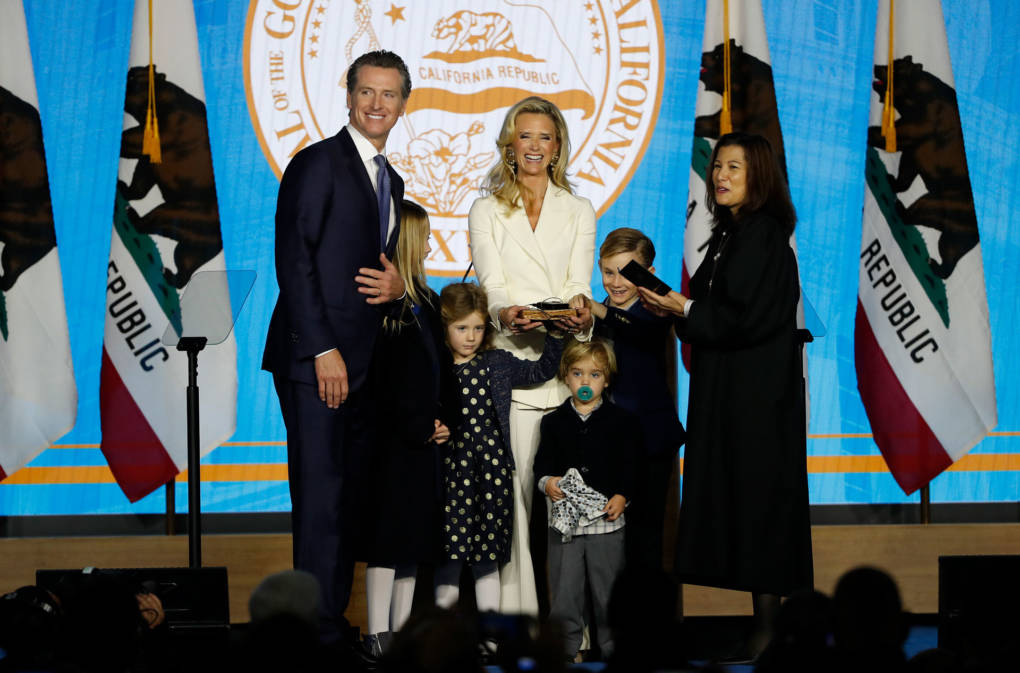
"caption": "Gavin Newsom is sworn in as governor of California by California Chief Justice Tani Cantil-Sakauye (R), as Newsom's wife, Jennifer Siebel Newsom (C), watches on Jan. 7, 2019, in Sacramento.",
"description": "Gavin Newsom is sworn in as governor of California by California Chief Justice Tani Cantil-Sakauye (R), as Newsom's wife, Jennifer Siebel Newsom (C), watches on January 7, 2019 in Sacramento.",
"title": "NewsomInaug",
"credit": "Stephen Lam/Getty Images",
"status": "inherit",
"isLoading": false,
"fetchFailed": false
},
"news_11716274": {
"type": "attachments",
"id": "news_11716274",
"meta": {
"index": "attachments_1716263798",
"site": "news",
"id": "11716274",
"found": true
},
"parent": 11716273,
"imgSizes": {
"twentyfourteen-full-width": {
"file": "https://ww2.kqed.org/app/uploads/sites/10/2019/01/gettyimages-1077345452_custom-c113baa9e2e44af4bad32d553cf5984dacc151d4-e1546833707832-1038x576.jpg",
"width": 1038,
"mimeType": "image/jpeg",
"height": 576
},
"thumbnail": {
"file": "https://ww2.kqed.org/app/uploads/sites/10/2019/01/gettyimages-1077345452_custom-c113baa9e2e44af4bad32d553cf5984dacc151d4-e1546833707832-160x98.jpg",
"width": 160,
"mimeType": "image/jpeg",
"height": 98
},
"post-thumbnail": {
"file": "https://ww2.kqed.org/app/uploads/sites/10/2019/01/gettyimages-1077345452_custom-c113baa9e2e44af4bad32d553cf5984dacc151d4-e1546833707832-672x372.jpg",
"width": 672,
"mimeType": "image/jpeg",
"height": 372
},
"kqedFullSize": {
"file": "https://ww2.kqed.org/app/uploads/sites/10/2019/01/gettyimages-1077345452_custom-c113baa9e2e44af4bad32d553cf5984dacc151d4-e1546833707832.jpg",
"width": 1920,
"height": 1177
},
"large": {
"file": "https://ww2.kqed.org/app/uploads/sites/10/2019/01/gettyimages-1077345452_custom-c113baa9e2e44af4bad32d553cf5984dacc151d4-e1546833707832-1020x625.jpg",
"width": 1020,
"mimeType": "image/jpeg",
"height": 625
},
"complete_open_graph": {
"file": "https://ww2.kqed.org/app/uploads/sites/10/2019/01/gettyimages-1077345452_custom-c113baa9e2e44af4bad32d553cf5984dacc151d4-e1546833707832-1200x736.jpg",
"width": 1200,
"mimeType": "image/jpeg",
"height": 736
},
"guest-author-50": {
"file": "https://ww2.kqed.org/app/uploads/sites/10/2019/01/gettyimages-1077345452_custom-c113baa9e2e44af4bad32d553cf5984dacc151d4-e1546833707832-50x50.jpg",
"width": 50,
"mimeType": "image/jpeg",
"height": 50
},
"guest-author-96": {
"file": "https://ww2.kqed.org/app/uploads/sites/10/2019/01/gettyimages-1077345452_custom-c113baa9e2e44af4bad32d553cf5984dacc151d4-e1546833707832-96x96.jpg",
"width": 96,
"mimeType": "image/jpeg",
"height": 96
},
"medium": {
"file": "https://ww2.kqed.org/app/uploads/sites/10/2019/01/gettyimages-1077345452_custom-c113baa9e2e44af4bad32d553cf5984dacc151d4-e1546833707832-800x490.jpg",
"width": 800,
"mimeType": "image/jpeg",
"height": 490
},
"guest-author-64": {
"file": "https://ww2.kqed.org/app/uploads/sites/10/2019/01/gettyimages-1077345452_custom-c113baa9e2e44af4bad32d553cf5984dacc151d4-e1546833707832-64x64.jpg",
"width": 64,
"mimeType": "image/jpeg",
"height": 64
},
"guest-author-32": {
"file": "https://ww2.kqed.org/app/uploads/sites/10/2019/01/gettyimages-1077345452_custom-c113baa9e2e44af4bad32d553cf5984dacc151d4-e1546833707832-32x32.jpg",
"width": 32,
"mimeType": "image/jpeg",
"height": 32
},
"full-width": {
"file": "https://ww2.kqed.org/app/uploads/sites/10/2019/01/gettyimages-1077345452_custom-c113baa9e2e44af4bad32d553cf5984dacc151d4-e1546833707832-1920x1177.jpg",
"width": 1920,
"mimeType": "image/jpeg",
"height": 1177
},
"detail": {
"file": "https://ww2.kqed.org/app/uploads/sites/10/2019/01/gettyimages-1077345452_custom-c113baa9e2e44af4bad32d553cf5984dacc151d4-e1546833707832-150x150.jpg",
"width": 150,
"mimeType": "image/jpeg",
"height": 150
},
"guest-author-128": {
"file": "https://ww2.kqed.org/app/uploads/sites/10/2019/01/gettyimages-1077345452_custom-c113baa9e2e44af4bad32d553cf5984dacc151d4-e1546833707832-128x128.jpg",
"width": 128,
"mimeType": "image/jpeg",
"height": 128
}
},
"publishDate": 1546832736,
"modified": 1546905369,
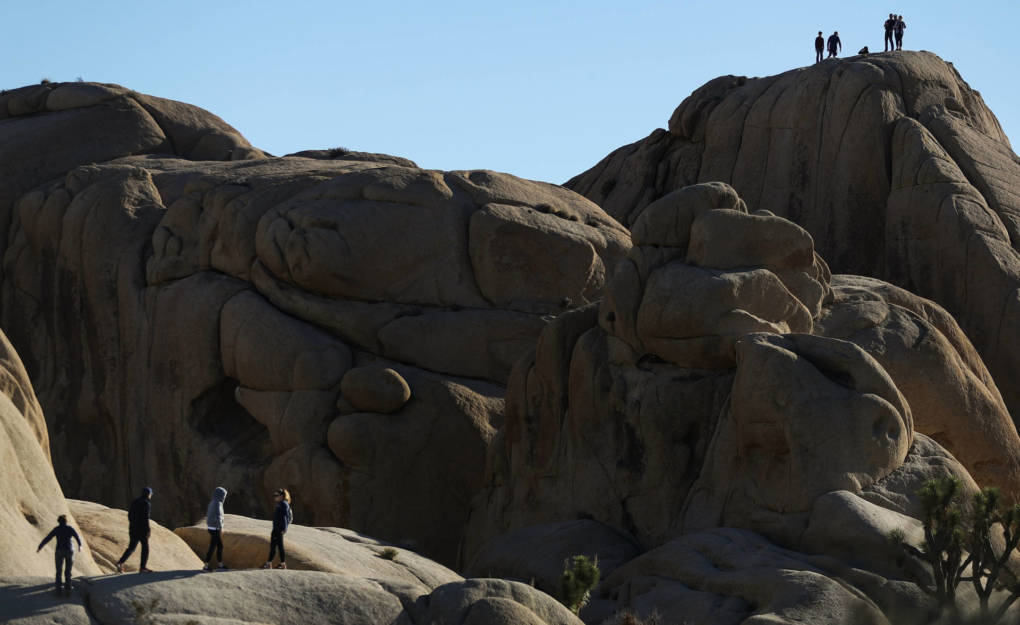
"caption": "During the shutdown, visitors walk and stand atop rock formations at Joshua Tree National Park.",
"description": "During the shutdown, visitors walk and stand atop rock formations at Joshua Tree National Park on Friday.",
"title": "During the shutdown, visitors walk and stand atop rock formations at Joshua Tree National Park on Friday.",
"credit": "Mario Tama/Getty Images",
"status": "inherit",
"isLoading": false,
"fetchFailed": false
},
"news_11715874": {
"type": "attachments",
"id": "news_11715874",
"meta": {
"index": "attachments_1716263798",
"site": "news",
"id": "11715874",
"found": true
},
"parent": 11715873,
"imgSizes": {
"twentyfourteen-full-width": {
"file": "https://ww2.kqed.org/app/uploads/sites/10/2019/01/ap_19004051675148_wide-5c27eb54a88f19cdde0a6420828a85ad13f57102-e1546622335429-1038x576.jpg",
"width": 1038,
"mimeType": "image/jpeg",
"height": 576
},
"thumbnail": {
"file": "https://ww2.kqed.org/app/uploads/sites/10/2019/01/ap_19004051675148_wide-5c27eb54a88f19cdde0a6420828a85ad13f57102-e1546622335429-160x90.jpg",
"width": 160,
"mimeType": "image/jpeg",
"height": 90
},
"post-thumbnail": {
"file": "https://ww2.kqed.org/app/uploads/sites/10/2019/01/ap_19004051675148_wide-5c27eb54a88f19cdde0a6420828a85ad13f57102-e1546622335429-672x372.jpg",
"width": 672,
"mimeType": "image/jpeg",
"height": 372
},
"kqedFullSize": {
"file": "https://ww2.kqed.org/app/uploads/sites/10/2019/01/ap_19004051675148_wide-5c27eb54a88f19cdde0a6420828a85ad13f57102-e1546622335429.jpg",
"width": 1920,
"height": 1080
},
"large": {
"file": "https://ww2.kqed.org/app/uploads/sites/10/2019/01/ap_19004051675148_wide-5c27eb54a88f19cdde0a6420828a85ad13f57102-e1546622335429-1020x574.jpg",
"width": 1020,
"mimeType": "image/jpeg",
"height": 574
},
"complete_open_graph": {
"file": "https://ww2.kqed.org/app/uploads/sites/10/2019/01/ap_19004051675148_wide-5c27eb54a88f19cdde0a6420828a85ad13f57102-e1546622335429-1200x675.jpg",
"width": 1200,
"mimeType": "image/jpeg",
"height": 675
},
"guest-author-50": {
"file": "https://ww2.kqed.org/app/uploads/sites/10/2019/01/ap_19004051675148_wide-5c27eb54a88f19cdde0a6420828a85ad13f57102-e1546622335429-50x50.jpg",
"width": 50,
"mimeType": "image/jpeg",
"height": 50
},
"guest-author-96": {
"file": "https://ww2.kqed.org/app/uploads/sites/10/2019/01/ap_19004051675148_wide-5c27eb54a88f19cdde0a6420828a85ad13f57102-e1546622335429-96x96.jpg",
"width": 96,
"mimeType": "image/jpeg",
"height": 96
},
"medium": {
"file": "https://ww2.kqed.org/app/uploads/sites/10/2019/01/ap_19004051675148_wide-5c27eb54a88f19cdde0a6420828a85ad13f57102-e1546622335429-800x450.jpg",
"width": 800,
"mimeType": "image/jpeg",
"height": 450
},
"guest-author-64": {
"file": "https://ww2.kqed.org/app/uploads/sites/10/2019/01/ap_19004051675148_wide-5c27eb54a88f19cdde0a6420828a85ad13f57102-e1546622335429-64x64.jpg",
"width": 64,
"mimeType": "image/jpeg",
"height": 64
},
"guest-author-32": {
"file": "https://ww2.kqed.org/app/uploads/sites/10/2019/01/ap_19004051675148_wide-5c27eb54a88f19cdde0a6420828a85ad13f57102-e1546622335429-32x32.jpg",
"width": 32,
"mimeType": "image/jpeg",
"height": 32
},
"full-width": {
"file": "https://ww2.kqed.org/app/uploads/sites/10/2019/01/ap_19004051675148_wide-5c27eb54a88f19cdde0a6420828a85ad13f57102-e1546622335429-1920x1080.jpg",
"width": 1920,
"mimeType": "image/jpeg",
"height": 1080
},
"detail": {
"file": "https://ww2.kqed.org/app/uploads/sites/10/2019/01/ap_19004051675148_wide-5c27eb54a88f19cdde0a6420828a85ad13f57102-e1546622335429-150x150.jpg",
"width": 150,
"mimeType": "image/jpeg",
"height": 150
},
"guest-author-128": {
"file": "https://ww2.kqed.org/app/uploads/sites/10/2019/01/ap_19004051675148_wide-5c27eb54a88f19cdde0a6420828a85ad13f57102-e1546622335429-128x128.jpg",
"width": 128,
"mimeType": "image/jpeg",
"height": 128
}
},
"publishDate": 1546622216,
"modified": 1546622324,
"caption": "\"We're not doing the wall,\" House Speaker Nancy Pelosi told reporters Thursday night. \"Does anybody have any doubt that we're not doing the wall?\"",
"description": "\"We're not doing the wall,\" House Speaker Nancy Pelosi told reporters Thursday night. \"Does anybody have any doubt that we're not doing the wall?\"",
"title": "\"We're not doing the wall,\" House Speaker Nancy Pelosi told reporters Thursday night. \"Does anybody have any doubt that we're not doing the wall?\"",
"credit": "J. Scott Applewhite/AP",
"status": "inherit",
"isLoading": false,
"fetchFailed": false
}
},
"audioPlayerReducer": {
"postId": "stream_live",
"isPaused": true,
"isPlaying": false,
"pfsActive": false,
"pledgeModalIsOpen": true,
"playerDrawerIsOpen": false,
"liveAudioPlayStartedAt": 0,
"liveAudioPlayContext": ""
},
"authorsReducer": {
"byline_news_11717093": {
"type": "authors",
"id": "byline_news_11717093",
"meta": {
"override": true
},
"slug": "byline_news_11717093",
"name": "Max Rivlin-Nadler",
"isLoading": false
},
"byline_news_11717145": {
"type": "authors",
"id": "byline_news_11717145",
"meta": {
"override": true
},
"slug": "byline_news_11717145",
"name": "Scott Horsley",
"isLoading": false
},
"byline_news_11717027": {
"type": "authors",
"id": "byline_news_11717027",
"meta": {
"override": true
},
"slug": "byline_news_11717027",
"name": "\u003cstrong>Kathleen Ronayne\u003cbr />Associated Press\u003c/strong>",
"isLoading": false
},
"byline_news_11717004": {
"type": "authors",
"id": "byline_news_11717004",
"meta": {
"override": true
},
"slug": "byline_news_11717004",
"name": "Jim Zarroli",
"isLoading": false
},
"byline_news_11716688": {
"type": "authors",
"id": "byline_news_11716688",
"meta": {
"override": true
},
"slug": "byline_news_11716688",
"name": "Scott Horsley",
"isLoading": false
},
"byline_news_11716368": {
"type": "authors",
"id": "byline_news_11716368",
"meta": {
"override": true
},
"slug": "byline_news_11716368",
"name": "Marie Andrusewicz",
"isLoading": false
},
"byline_news_11716273": {
"type": "authors",
"id": "byline_news_11716273",
"meta": {
"override": true
},
"slug": "byline_news_11716273",
"name": "Amanda Morris\u003c/br>NPR",
"isLoading": false
},
"byline_news_11715873": {
"type": "authors",
"id": "byline_news_11715873",
"meta": {
"override": true
},
"slug": "byline_news_11715873",
"name": "Brian Naylor",
"isLoading": false
},
"gmarzorati": {
"type": "authors",
"id": "227",
"meta": {
"index": "authors_1716337520",
"id": "227",
"found": true
},
"name": "Guy Marzorati",
"firstName": "Guy",
"lastName": "Marzorati",
"slug": "gmarzorati",
"email": "gmarzorati@KQED.org",
"display_author_email": true,
"staff_mastheads": [
"news"
],
"title": "Correspondent",
"bio": "Guy Marzorati is a correspondent on KQED's California Politics and Government Desk, based in San Jose. A graduate of Santa Clara University, Guy joined KQED in 2013. He reports on state and local politics and produces KQED's digital voter guide.",
"avatar": "https://secure.gravatar.com/avatar/e7038b8dbfd55b104369b76b1cd0b9de?s=600&d=blank&r=g",
"twitter": "guymarzorati",
"facebook": null,
"instagram": null,
"linkedin": null,
"sites": [
{
"site": "",
"roles": [
"editor"
]
},
{
"site": "news",
"roles": [
"editor"
]
},
{
"site": "science",
"roles": [
"editor"
]
},
{
"site": "forum",
"roles": [
"editor"
]
},
{
"site": "elections",
"roles": [
"editor"
]
},
{
"site": "liveblog",
"roles": [
"editor"
]
}
],
"headData": {
"title": "Guy Marzorati | KQED",
"description": "Correspondent",
"ogImgSrc": "https://secure.gravatar.com/avatar/e7038b8dbfd55b104369b76b1cd0b9de?s=600&d=blank&r=g",
"twImgSrc": "https://secure.gravatar.com/avatar/e7038b8dbfd55b104369b76b1cd0b9de?s=600&d=blank&r=g"
},
"isLoading": false,
"link": "/author/gmarzorati"
},
"kqednewsstaffandwires": {
"type": "authors",
"id": "237",
"meta": {
"index": "authors_1716337520",
"id": "237",
"found": true
},
"name": "KQED News Staff and Wires",
"firstName": "KQED News Staff and Wires",
"lastName": null,
"slug": "kqednewsstaffandwires",
"email": "onlinenewsstaff@kqed.org",
"display_author_email": false,
"staff_mastheads": [],
"title": null,
"bio": null,
"avatar": "https://secure.gravatar.com/avatar/72295af8ebbfbd19a4948f5271285664?s=600&d=blank&r=g",
"twitter": null,
"facebook": null,
"instagram": null,
"linkedin": null,
"sites": [
{
"site": "arts",
"roles": [
"contributor"
]
},
{
"site": "news",
"roles": [
"contributor"
]
},
{
"site": "lowdown",
"roles": [
"author"
]
},
{
"site": "stateofhealth",
"roles": [
"contributor"
]
},
{
"site": "food",
"roles": [
"author"
]
}
],
"headData": {
"title": "KQED News Staff and Wires | KQED",
"description": null,
"ogImgSrc": "https://secure.gravatar.com/avatar/72295af8ebbfbd19a4948f5271285664?s=600&d=blank&r=g",
"twImgSrc": "https://secure.gravatar.com/avatar/72295af8ebbfbd19a4948f5271285664?s=600&d=blank&r=g"
},
"isLoading": false,
"link": "/author/kqednewsstaffandwires"
},
"markfiore": {
"type": "authors",
"id": "3236",
"meta": {
"index": "authors_1716337520",
"id": "3236",
"found": true
},
"name": "Mark Fiore",
"firstName": "Mark",
"lastName": "Fiore",
"slug": "markfiore",
"email": "mark@markfiore.com",
"display_author_email": false,
"staff_mastheads": [
"news"
],
"title": "KQED News Cartoonist",
"bio": "\u003ca href=\"http://www.MarkFiore.com\">MarkFiore.com\u003c/a> | \u003ca href=\"https://twitter.com/markfiore\">Follow on Twitter\u003c/a> | \u003ca href=\"https://www.facebook.com/pages/Mark-Fiore-Animated-Political-Cartoons/94451707396?ref=bookmarks\">Facebook\u003c/a> | \u003ca href=\"mailto:mark@markfiore.com\">email\u003c/a>\r\n\r\nPulitzer Prize-winner, Mark Fiore, who the Wall Street Journal has called “the undisputed guru of the form,” creates animated political cartoons in San Francisco, where his work has been featured regularly on the San Francisco Chronicle’s web site, SFGate.com. His work has appeared on Newsweek.com, Slate.com, CBSNews.com, MotherJones.com, DailyKos.com and NPR’s web site. Fiore’s political animation has appeared on CNN, Frontline, Bill Moyers Journal, Salon.com and cable and broadcast outlets across the globe.\r\n\r\nBeginning his professional life by drawing traditional political cartoons for newspapers, Fiore’s work appeared in publications ranging from the Washington Post to the Los Angeles Times. In the late 1990s, he began to experiment with animating political cartoons and, after a short stint at the San Jose Mercury News as their staff cartoonist, Fiore devoted all his energies to animation.\r\nGrowing up in California, Fiore also spent a good portion of his life in the backwoods of Idaho. It was this combination that shaped him politically. Mark majored in political science at Colorado College, where, in a perfect send-off for a cartoonist, he received his diploma in 1991 as commencement speaker Dick Cheney smiled approvingly.\r\nMark Fiore was awarded the Pulitzer Prize for political cartooning in 2010, a Robert F. Kennedy Journalism Award in 2004 and has twice received an Online Journalism Award for commentary from the Online News Association (2002, 2008). Fiore has received two awards for his work in new media from the National Cartoonists Society (2001, 2002), and in 2006 received The James Madison Freedom of Information Award from The Society of Professional Journalists.",
"avatar": "https://secure.gravatar.com/avatar/fc4e2a612b15b67bad0c6f0e1db4ca9b?s=600&d=blank&r=g",
"twitter": "MarkFiore",
"facebook": null,
"instagram": "https://www.instagram.com/markfiore/?hl=en",
"linkedin": null,
"sites": [
{
"site": "arts",
"roles": [
"contributor"
]
},
{
"site": "news",
"roles": [
"editor"
]
},
{
"site": "futureofyou",
"roles": [
"editor"
]
},
{
"site": "science",
"roles": [
"editor"
]
}
],
"headData": {
"title": "Mark Fiore | KQED",
"description": "KQED News Cartoonist",
"ogImgSrc": "https://secure.gravatar.com/avatar/fc4e2a612b15b67bad0c6f0e1db4ca9b?s=600&d=blank&r=g",
"twImgSrc": "https://secure.gravatar.com/avatar/fc4e2a612b15b67bad0c6f0e1db4ca9b?s=600&d=blank&r=g"
},
"isLoading": false,
"link": "/author/markfiore"
},
"mlagos": {
"type": "authors",
"id": "3239",
"meta": {
"index": "authors_1716337520",
"id": "3239",
"found": true
},
"name": "Marisa Lagos",
"firstName": "Marisa",
"lastName": "Lagos",
"slug": "mlagos",
"email": "mlagos@kqed.org",
"display_author_email": false,
"staff_mastheads": [
"news"
],
"title": "KQED Contributor",
"bio": "Marisa Lagos is a correspondent for KQED’s California Politics and Government Desk and co-hosts the award-winning show and podcast, Political Breakdown. At KQED, Lagos also conducts reporting, analysis and investigations into state, local and national politics for radio, TV, online and onstage. In 2022, she and co-host, Scott Shafer, moderated the only gubernatorial debate in California. In 2020, the \u003ci>Washington Post\u003c/i> named her one of the top political journalists in California; she was nominated for a Peabody and won several other awards for her work investigating the 2017 California wildfires. She has worked at the \u003ci>San Francisco Chronicle\u003c/i>, \u003ci>San Francisco Examiner\u003c/i> and \u003ci>Los Angeles Times\u003c/i>. A UC Santa Barbara graduate, she lives in San Francisco with her two sons and husband.",
"avatar": "https://secure.gravatar.com/avatar/a261a0d3696fc066871ef96b85b5e7d2?s=600&d=blank&r=g",
"twitter": "@mlagos",
"facebook": null,
"instagram": null,
"linkedin": null,
"sites": [
{
"site": "arts",
"roles": [
"author"
]
},
{
"site": "news",
"roles": [
"editor"
]
},
{
"site": "science",
"roles": [
"editor"
]
},
{
"site": "forum",
"roles": [
"author"
]
},
{
"site": "liveblog",
"roles": [
"author"
]
}
],
"headData": {
"title": "Marisa Lagos | KQED",
"description": "KQED Contributor",
"ogImgSrc": "https://secure.gravatar.com/avatar/a261a0d3696fc066871ef96b85b5e7d2?s=600&d=blank&r=g",
"twImgSrc": "https://secure.gravatar.com/avatar/a261a0d3696fc066871ef96b85b5e7d2?s=600&d=blank&r=g"
},
"isLoading": false,
"link": "/author/mlagos"
},
"fjhabvala": {
"type": "authors",
"id": "8659",
"meta": {
"index": "authors_1716337520",
"id": "8659",
"found": true
},
"name": "Farida Jhabvala Romero",
"firstName": "Farida",
"lastName": "Jhabvala Romero",
"slug": "fjhabvala",
"email": "fjhabvala@kqed.org",
"display_author_email": true,
"staff_mastheads": [
"news"
],
"title": "KQED Contributor",
"bio": "Farida Jhabvala Romero is a Labor Correspondent for KQED. She previously covered immigration. Farida was \u003ca href=\"https://www.ccnma.org/2022-most-influential-latina-journalists\">named\u003c/a> one of the 10 Most Influential Latina Journalists in California in 2022 by the California Chicano News Media Association. Her work has won awards from the Society of Professional Journalists (Northern California), as well as a national and regional Edward M. Murrow Award for the collaborative reporting projects “Dangerous Air” and “Graying California.” Before joining KQED, Farida worked as a producer at Radio Bilingüe, a national public radio network. Farida earned her master’s degree in journalism from Stanford University.",
"avatar": "https://secure.gravatar.com/avatar/f9f022d4e2609741874222a1e9d41f48fea74011aa7c615eef91d9a50c944ebe?s=600&d=blank&r=g",
"twitter": "FaridaJhabvala",
"bluesky": null,
"facebook": null,
"instagram": null,
"linkedin": "https://www.linkedin.com/in/faridajhabvala/",
"sites": [
{
"site": "news",
"roles": [
"editor"
]
},
{
"site": "stateofhealth",
"roles": [
"author"
]
},
{
"site": "liveblog",
"roles": [
"author"
]
}
],
"headData": {
"title": "Farida Jhabvala Romero | KQED",
"description": "KQED Contributor",
"ogImgSrc": "https://secure.gravatar.com/avatar/f9f022d4e2609741874222a1e9d41f48fea74011aa7c615eef91d9a50c944ebe?s=600&d=blank&r=g",
"twImgSrc": "https://secure.gravatar.com/avatar/f9f022d4e2609741874222a1e9d41f48fea74011aa7c615eef91d9a50c944ebe?s=600&d=blank&r=g"
},
"isLoading": false,
"link": "/author/fjhabvala"
}
},
"pagesReducer": {
"news_tag_donald-trump": {
"type": "terms",
"id": "news_1323",
"meta": {
"index": "terms_1716263798",
"site": "news",
"id": "1323",
"score": 8.557362
},
"featImg": null,
"name": "Donald Trump",
"description": null,
"taxonomy": "tag",
"headData": {
"twImgId": null,
"twTitle": null,
"ogTitle": null,
"ogImgId": null,
"twDescription": null,
"description": null,
"title": "Donald Trump Archives | KQED News",
"ogDescription": null
},
"ttid": 1335,
"slug": "donald-trump",
"isLoading": false,
"title": "Donald Trump",
"pageMeta": {
"site": "news",
"WpPageTemplate": "page-topic-editorial",
"currentPage": 118
},
"blocks": [
{
"blockName": "kqed/post-list",
"attrs": {
"layout": "cardArticle2",
"query": "posts/news?tag=donald-trump",
"seeMore": false,
"paginated": true,
"page": 118
}
},
{
"blockName": "kqed/ad"
}
]
}
},
"pfsSessionReducer": {},
"postsReducer": {
"stream_live": {
"type": "live",
"id": "stream_live",
"audioUrl": "https://streams.kqed.org/kqedradio",
"title": "Live Stream",
"excerpt": "Live Stream information currently unavailable.",
"link": "/radio",
"featImg": "",
"label": {
"name": "KQED Live",
"link": "/"
}
},
"stream_kqedNewscast": {
"type": "posts",
"id": "stream_kqedNewscast",
"audioUrl": "https://www.kqed.org/.stream/anon/radio/RDnews/newscast.mp3?_=1",
"title": "KQED Newscast",
"featImg": "",
"label": {
"name": "88.5 FM",
"link": "/"
}
},
"news_11717093": {
"type": "posts",
"id": "news_11717093",
"meta": {
"index": "posts_1716263798",
"site": "news",
"id": "11717093",
"score": null,
"sort": [
1547164894000
]
},
"parent": 0,
"labelTerm": {
"site": "news",
"term": 72
},
"blocks": [],
"publishDate": 1547164894,
"format": "audio",
"disqusTitle": "Fewer Asylum-Seekers Checking Waitlist Status at U.S.-Mexico Border in Tijuana",
"title": "Fewer Asylum-Seekers Checking Waitlist Status at U.S.-Mexico Border in Tijuana",
"headTitle": "The California Report | KQED News",
"content": "\u003cp>Since late November, asylum-seeking migrants have been \u003ca href=\"https://www.kqed.org/news/11707927/long-waits-in-tijuana-for-migrants-seeking-u-s-refuge\">gathering regularly\u003c/a> in the early hours near the El Chaparral Plaza at the San Ysidro Port of Entry in Tijuana, hoping to hear their names read from a very, very long list.\u003c/p>\n\u003cp>The list, which still has nearly 4,000 names on it and is maintained by the asylum-seekers themselves, determines who may line up to legally enter the United States on a given day to apply for asylum.\u003c/p>\n\u003cp>Recently, the number of migrants turning up when their names are called has been thinning.\u003c/p>\n\u003cp>Many of the migrants are from the so-called migrant caravan of Central Americans, which arrived at the U.S.-Mexico border at the end of November. Some have been \u003ca href=\"https://www.kqed.org/news/11708380/with-thousands-of-migrants-reaching-border-the-waiting-list-for-asylum-grows\">waiting for weeks, even months,\u003c/a> for their names to be called.\u003c/p>\n\u003cp>Volunteers working to help asylum-seekers — many of whom are fleeing gang and domestic violence in their home countries — cited \u003ca href=\"https://www.kqed.org/news/11710164/caravan-migrants-settle-into-new-shelter-in-tijuana\">shelter shutdowns\u003c/a> and simply the \u003ca href=\"https://www.kqed.org/news/11708668/migrants-cope-with-close-quarters-squalid-conditions-at-border\">challenging state\u003c/a> the migrants were forced to wait in, as some of the reasons why migrants were not showing up in greater numbers.\u003c/p>\n\u003cp>Adelita Simone, who volunteers with the asylum-seekers, talked about the impact of shelter closures.\u003c/p>\n\u003cp>“They just shut down Benito Juarez, one of the shelters here close by, where people were staying,” she said. “They had to move people to different shelters. [Migrants] don’t know how to get here. They have to pay for transportation to get here.”\u003c/p>\n\u003cp>[ad fullwidth]\u003c/p>\n\u003cp>Simone has been helping coordinate travel for migrants between a large shelter on the east side of Tijuana and the San Ysidro Port of Entry.\u003c/p>\n\u003cp>If someone's number is called and they are not present, Simone and other volunteers have tried to locate that person so they can enter the next day.\u003c/p>\n\u003cp>“Sometimes they’ve gone as high as 400 names, and that was two days ago, in order for 40 people to pass,” said Rebecca Brogdon, a retired nurse from Santa Cruz volunteering to help asylum-seekers keep their place in line.\u003c/p>\n\u003cp>On Jan. 8, for example, 30 people who were not present previously were allowed to cross the U.S. border. A total of 60 people were allowed to enter the United States that day.\u003c/p>\n\u003cp>The list is read until all available slots being offered by the U.S. government that day are filled. Overall, the number of asylum-seekers processed each day has gone down since the fall.\u003c/p>\n\u003caside class=\"alignright\">\n\u003ch3>\u003ca href=\"https://www.kqed.org/news/11714240/new-policy-adds-to-complexity-for-migrants-in-mexico-seeking-u-s-asylum\">New Policy Adds to Complexity for Migrants in Mexico Seeking U.S. Asylum\u003c/a>\u003c/h3>\n\u003cfigure>\u003ca href=\"https://www.kqed.org/news/11714240/new-policy-adds-to-complexity-for-migrants-in-mexico-seeking-u-s-asylum\">\u003cimg src=\"https://ww2.kqed.org/news/wp-content/uploads/sites/10/2018/12/RS34155_Nolvia-Romero-FINAL-01-qut-1180x785.jpg\" alt=\"\">\u003c/a>\u003c/figure>\n\u003c/aside>\n\u003cp>Limiting the number of people who can enter each day was enacted under a policy dubbed “metering.” The slowdown in processing has forced asylum-seekers to study options other than waiting around for weeks and months to be processed in Tijuana.\u003c/p>\n\u003cp>“We know people who have taken all different types of migration strategies,” said Jillian White, another volunteer. “Some people who have truly found it uncomfortable here had to make very difficult decisions about going back to countries where they don’t feel safe.”\u003c/p>\n\u003cp>White also said there are people who aren't able to wait around to be called from the list, and “do whatever they can to access their legal right to ask for asylum.”\u003c/p>\n\u003cp>Families apprehended crossing the U.S. between ports of entry have risen every month since the Trump administration began its metering policy.\u003c/p>\n\u003cp>With almost 4,000 numbers still on the list, there are still enough people showing up every day to fill the slots that the U.S. government has made available, even as the crowd waiting in the plaza has begun to thin out.\u003c/p>\n\u003cp>“This week feels emptier than even last week, which feels a little emptier than a week before,” said White.\u003c/p>\n\u003cp>Due to the ongoing partial government shutdown, U.S. Customs and Border Protection did not respond to a request for comment.\u003c/p>\n\u003cp>\u003c/p>\n",
"disqusIdentifier": "11717093 https://ww2.kqed.org/news/?p=11717093",
"disqusUrl": "https://ww2.kqed.org/news/2019/01/10/fewer-asylum-seekers-checking-waitlist-status-at-u-s-mexico-border-in-tijuana/",
"stats": {
"hasVideo": false,
"hasChartOrMap": false,
"hasAudio": false,
"hasPolis": false,
"wordCount": 662,
"hasGoogleForm": false,
"hasGallery": false,
"hasHearkenModule": false,
"iframeSrcs": [],
"paragraphCount": 21
},
"modified": 1547167276,
"excerpt": "Trump administration’s policy of limiting number of migrants who may enter U.S. each day to apply for asylum has led many to explore other options instead of waiting weeks or months for their names to be called.",
"headData": {
"twImgId": "",
"twTitle": "",
"ogTitle": "",
"ogImgId": "",
"twDescription": "",
"description": "Trump administration’s policy of limiting number of migrants who may enter U.S. each day to apply for asylum has led many to explore other options instead of waiting weeks or months for their names to be called.",
"title": "Fewer Asylum-Seekers Checking Waitlist Status at U.S.-Mexico Border in Tijuana | KQED",
"ogDescription": "",
"schema": {
"@context": "https://schema.org",
"@type": "NewsArticle",
"headline": "Fewer Asylum-Seekers Checking Waitlist Status at U.S.-Mexico Border in Tijuana",
"datePublished": "2019-01-10T16:01:34-08:00",
"dateModified": "2019-01-10T16:41:16-08:00",
"image": "https://cdn.kqed.org/wp-content/uploads/2020/02/KQED-OG-Image@1x.png",
"isAccessibleForFree": "True",
"publisher": {
"@type": "NewsMediaOrganization",
"@id": "https://www.kqed.org/#organization",
"name": "KQED",
"logo": "https://cdn.kqed.org/wp-content/uploads/2020/02/KQED-OG-Image@1x.png",
"url": "https://www.kqed.org",
"sameAs": [
"https://www.facebook.com/KQED",
"https://twitter.com/KQED",
"https://www.instagram.com/kqed/",
"https://www.tiktok.com/@kqedofficial",
"https://www.linkedin.com/company/kqed",
"https://www.youtube.com/channel/UCeC0IOo7i1P_61zVUWbJ4nw"
]
}
}
},
"guestAuthors": [],
"slug": "fewer-asylum-seekers-checking-waitlist-status-at-u-s-mexico-border-in-tijuana",
"status": "publish",
"audioUrl": "https://www.kqed.org/.stream/anon/radio/tcr/2019/01/AsylumNoShowRivlinNadlertcram190109.mp3",
"nprByline": "Max Rivlin-Nadler",
"audioTrackLength": 149,
"path": "/news/11717093/fewer-asylum-seekers-checking-waitlist-status-at-u-s-mexico-border-in-tijuana",
"audioDuration": 151000,
"parsedContent": [
{
"type": "contentString",
"content": "\u003cdiv class=\"post-body\">\u003cp>\u003cp>Since late November, asylum-seeking migrants have been \u003ca href=\"https://www.kqed.org/news/11707927/long-waits-in-tijuana-for-migrants-seeking-u-s-refuge\">gathering regularly\u003c/a> in the early hours near the El Chaparral Plaza at the San Ysidro Port of Entry in Tijuana, hoping to hear their names read from a very, very long list.\u003c/p>\n\u003cp>The list, which still has nearly 4,000 names on it and is maintained by the asylum-seekers themselves, determines who may line up to legally enter the United States on a given day to apply for asylum.\u003c/p>\n\u003cp>Recently, the number of migrants turning up when their names are called has been thinning.\u003c/p>\n\u003cp>Many of the migrants are from the so-called migrant caravan of Central Americans, which arrived at the U.S.-Mexico border at the end of November. Some have been \u003ca href=\"https://www.kqed.org/news/11708380/with-thousands-of-migrants-reaching-border-the-waiting-list-for-asylum-grows\">waiting for weeks, even months,\u003c/a> for their names to be called.\u003c/p>\n\u003cp>Volunteers working to help asylum-seekers — many of whom are fleeing gang and domestic violence in their home countries — cited \u003ca href=\"https://www.kqed.org/news/11710164/caravan-migrants-settle-into-new-shelter-in-tijuana\">shelter shutdowns\u003c/a> and simply the \u003ca href=\"https://www.kqed.org/news/11708668/migrants-cope-with-close-quarters-squalid-conditions-at-border\">challenging state\u003c/a> the migrants were forced to wait in, as some of the reasons why migrants were not showing up in greater numbers.\u003c/p>\n\u003cp>Adelita Simone, who volunteers with the asylum-seekers, talked about the impact of shelter closures.\u003c/p>\n\u003cp>“They just shut down Benito Juarez, one of the shelters here close by, where people were staying,” she said. “They had to move people to different shelters. [Migrants] don’t know how to get here. They have to pay for transportation to get here.”\u003c/p>\n\u003cp>\u003c/p>\u003c/div>",
"attributes": {
"named": {},
"numeric": []
}
},
{
"type": "component",
"content": "",
"name": "ad",
"attributes": {
"named": {
"label": "fullwidth"
},
"numeric": [
"fullwidth"
]
}
},
{
"type": "contentString",
"content": "\u003cdiv class=\"post-body\">\u003cp>\u003c/p>\n\u003cp>Simone has been helping coordinate travel for migrants between a large shelter on the east side of Tijuana and the San Ysidro Port of Entry.\u003c/p>\n\u003cp>If someone's number is called and they are not present, Simone and other volunteers have tried to locate that person so they can enter the next day.\u003c/p>\n\u003cp>“Sometimes they’ve gone as high as 400 names, and that was two days ago, in order for 40 people to pass,” said Rebecca Brogdon, a retired nurse from Santa Cruz volunteering to help asylum-seekers keep their place in line.\u003c/p>\n\u003cp>On Jan. 8, for example, 30 people who were not present previously were allowed to cross the U.S. border. A total of 60 people were allowed to enter the United States that day.\u003c/p>\n\u003cp>The list is read until all available slots being offered by the U.S. government that day are filled. Overall, the number of asylum-seekers processed each day has gone down since the fall.\u003c/p>\n\u003caside class=\"alignright\">\n\u003ch3>\u003ca href=\"https://www.kqed.org/news/11714240/new-policy-adds-to-complexity-for-migrants-in-mexico-seeking-u-s-asylum\">New Policy Adds to Complexity for Migrants in Mexico Seeking U.S. Asylum\u003c/a>\u003c/h3>\n\u003cfigure>\u003ca href=\"https://www.kqed.org/news/11714240/new-policy-adds-to-complexity-for-migrants-in-mexico-seeking-u-s-asylum\">\u003cimg src=\"https://ww2.kqed.org/news/wp-content/uploads/sites/10/2018/12/RS34155_Nolvia-Romero-FINAL-01-qut-1180x785.jpg\" alt=\"\">\u003c/a>\u003c/figure>\n\u003c/aside>\n\u003cp>Limiting the number of people who can enter each day was enacted under a policy dubbed “metering.” The slowdown in processing has forced asylum-seekers to study options other than waiting around for weeks and months to be processed in Tijuana.\u003c/p>\n\u003cp>“We know people who have taken all different types of migration strategies,” said Jillian White, another volunteer. “Some people who have truly found it uncomfortable here had to make very difficult decisions about going back to countries where they don’t feel safe.”\u003c/p>\n\u003cp>White also said there are people who aren't able to wait around to be called from the list, and “do whatever they can to access their legal right to ask for asylum.”\u003c/p>\n\u003cp>Families apprehended crossing the U.S. between ports of entry have risen every month since the Trump administration began its metering policy.\u003c/p>\n\u003cp>With almost 4,000 numbers still on the list, there are still enough people showing up every day to fill the slots that the U.S. government has made available, even as the crowd waiting in the plaza has begun to thin out.\u003c/p>\n\u003cp>“This week feels emptier than even last week, which feels a little emptier than a week before,” said White.\u003c/p>\n\u003cp>Due to the ongoing partial government shutdown, U.S. Customs and Border Protection did not respond to a request for comment.\u003c/p>\n\u003cp>\u003c/p>\n\u003c/div>\u003c/p>",
"attributes": {
"named": {},
"numeric": []
}
}
],
"link": "/news/11717093/fewer-asylum-seekers-checking-waitlist-status-at-u-s-mexico-border-in-tijuana",
"authors": [
"byline_news_11717093"
],
"programs": [
"news_72"
],
"categories": [
"news_1169",
"news_8",
"news_13"
],
"tags": [
"news_23087",
"news_23653",
"news_1323",
"news_17708",
"news_23138",
"news_4486",
"news_18121"
],
"featImg": "news_11717098",
"label": "news_72"
},
"news_11717438": {
"type": "posts",
"id": "news_11717438",
"meta": {
"index": "posts_1716263798",
"site": "news",
"id": "11717438",
"score": null,
"sort": [
1547162707000
]
},
"guestAuthors": [],
"slug": "gaslighting-california",
"title": "Trump Slams California's Forest Management . . . Again",
"publishDate": 1547162707,
"format": "standard",
"headTitle": "Trump Slams California’s Forest Management . . . Again | KQED",
"labelTerm": {
"term": 18515,
"site": "news"
},
"content": "\u003cp>President Trump slammed California’s forest management practices again this week, \u003ca href=\"http://bit.ly/fioreforests\" target=\"_blank\" rel=\"noopener\">threatening to withhold FEMA money\u003c/a> for survivors of wildfires.\u003c/p>\n\u003cp>Trump \u003ca href=\"https://twitter.com/realDonaldTrump/status/1083022011574747137\" target=\"_blank\" rel=\"noopener\">tweeted\u003c/a> that “unless they get their act together, which is unlikely, I have ordered FEMA to send no more money.”\u003c/p>\n\u003cp>While Trump is suggesting that wildfires are caused by the state’s mismanagement of its forests, well over half of the forests in California are managed by the federal government — which has slashed the U.S. Forest Service budget by $2 billion in recent years.\u003c/p>\n\u003cp>The state plans to spend over $1 billion managing forests over the next five years.\u003c/p>\n\u003cp>In announcing his \u003ca href=\"https://www.kqed.org/news/11717355/gavin-newsom-looks-to-spend-and-save-in-first-budget-proposal\" target=\"_blank\" rel=\"noopener\">first budget proposal\u003c/a> on Thursday, Gov. Gavin Newsom dedicated hundreds of millions of additional dollars to emergency response and wildfire preparedness.\u003c/p>\n\u003cp>[ad fullwidth]\u003c/p>\u003cp>\u003c/p>\n",
"blocks": [],
"excerpt": "President Trump slammed California's forest management practices again this week, threatening to withhold FEMA money for survivors of wildfires.",
"status": "publish",
"parent": 0,
"modified": 1722640527,
"stats": {
"hasAudio": false,
"hasVideo": false,
"hasChartOrMap": false,
"iframeSrcs": [],
"hasGoogleForm": false,
"hasGallery": false,
"hasHearkenModule": false,
"hasPolis": false,
"paragraphCount": 7,
"wordCount": 132
},
"headData": {
"title": "Trump Slams California's Forest Management . . . Again | KQED",
"description": "President Trump slammed California's forest management practices again this week, threatening to withhold FEMA money for survivors of wildfires.",
"ogTitle": "",
"ogDescription": "",
"ogImgId": "",
"twTitle": "",
"twDescription": "",
"twImgId": "",
"schema": {
"@context": "https://schema.org",
"@type": "NewsArticle",
"headline": "Trump Slams California's Forest Management . . . Again",
"datePublished": "2019-01-10T15:25:07-08:00",
"dateModified": "2024-08-02T16:15:27-07:00",
"image": "https://cdn.kqed.org/wp-content/uploads/2020/02/KQED-OG-Image@1x.png",
"isAccessibleForFree": "True",
"publisher": {
"@type": "NewsMediaOrganization",
"@id": "https://www.kqed.org/#organization",
"name": "KQED",
"logo": "https://cdn.kqed.org/wp-content/uploads/2020/02/KQED-OG-Image@1x.png",
"url": "https://www.kqed.org",
"sameAs": [
"https://www.facebook.com/KQED",
"https://twitter.com/KQED",
"https://www.instagram.com/kqed/",
"https://www.tiktok.com/@kqedofficial",
"https://www.linkedin.com/company/kqed",
"https://www.youtube.com/channel/UCeC0IOo7i1P_61zVUWbJ4nw"
]
}
}
},
"sticky": false,
"path": "/news/11717438/gaslighting-california",
"audioTrackLength": null,
"parsedContent": [
{
"type": "contentString",
"content": "\u003cdiv class=\"post-body\">\u003cp>\u003cp>President Trump slammed California’s forest management practices again this week, \u003ca href=\"http://bit.ly/fioreforests\" target=\"_blank\" rel=\"noopener\">threatening to withhold FEMA money\u003c/a> for survivors of wildfires.\u003c/p>\n\u003cp>Trump \u003ca href=\"https://twitter.com/realDonaldTrump/status/1083022011574747137\" target=\"_blank\" rel=\"noopener\">tweeted\u003c/a> that “unless they get their act together, which is unlikely, I have ordered FEMA to send no more money.”\u003c/p>\n\u003cp>While Trump is suggesting that wildfires are caused by the state’s mismanagement of its forests, well over half of the forests in California are managed by the federal government — which has slashed the U.S. Forest Service budget by $2 billion in recent years.\u003c/p>\n\u003cp>The state plans to spend over $1 billion managing forests over the next five years.\u003c/p>\n\u003cp>In announcing his \u003ca href=\"https://www.kqed.org/news/11717355/gavin-newsom-looks-to-spend-and-save-in-first-budget-proposal\" target=\"_blank\" rel=\"noopener\">first budget proposal\u003c/a> on Thursday, Gov. Gavin Newsom dedicated hundreds of millions of additional dollars to emergency response and wildfire preparedness.\u003c/p>\n\u003cp>\u003c/p>\u003c/div>",
"attributes": {
"named": {},
"numeric": []
}
},
{
"type": "component",
"content": "",
"name": "ad",
"attributes": {
"named": {
"label": "fullwidth"
},
"numeric": [
"fullwidth"
]
}
},
{
"type": "contentString",
"content": "\u003cdiv class=\"post-body\">\u003cp>\u003c/p>\u003cp>\u003c/p>\n\u003c/div>\u003c/p>",
"attributes": {
"named": {},
"numeric": []
}
}
],
"link": "/news/11717438/gaslighting-california",
"authors": [
"3236"
],
"series": [
"news_18515"
],
"categories": [
"news_19906",
"news_8",
"news_13"
],
"tags": [
"news_1323",
"news_21917",
"news_23932",
"news_16",
"news_20949",
"news_4463"
],
"featImg": "news_11717467",
"label": "news_18515"
},
"news_11716907": {
"type": "posts",
"id": "news_11716907",
"meta": {
"index": "posts_1716263798",
"site": "news",
"id": "11716907",
"score": null,
"sort": [
1547079799000
]
},
"parent": 0,
"labelTerm": {
"site": "news",
"term": 72
},
"blocks": [],
"publishDate": 1547079799,
"format": "standard",
"disqusTitle": "Trump Uses Violent Crimes by Immigrants to Justify Border Wall",
"title": "Trump Uses Violent Crimes by Immigrants to Justify Border Wall",
"headTitle": "The California Report | KQED News",
"content": "\u003cp>President Trump described a handful of grisly murders allegedly committed by undocumented immigrants to make his case for building a southern border wall during his first prime-time address from the Oval Office Tuesday.\u003c/p>\n\u003cp>Among the examples, Trump described the Dec. 26 shooting death of Newman police Officer \u003ca href=\"https://www.kqed.org/news/11714829/manhunt-underway-for-suspect-in-killing-of-central-valley-police-officer\" target=\"_blank\" rel=\"noopener\">Ronil Singh\u003c/a>, near Modesto.\u003c/p>\n\u003cp>\"America's heart broke the day after Christmas when a young police officer in California was savagely murdered in cold blood by an illegal alien who just came across the border,\" Trump said during his speech. \"Day after day, precious lives are cut short by those who have violated our borders.\"\u003c/p>\n\u003cp>Trump's repeated demand for $5.7 billion to construct a barrier he called \"absolutely critical to border security\" comes as the government's partial shutdown enters its third week, and remains the key sticking point with Democrats.\u003c/p>\n\u003cp>Bill Hing, a law professor at the University of San Francisco, believes the president emphasized \"horror stories\" to scare Americans into backing the physical barrier.\u003c/p>\n\u003cp>[ad fullwidth]\u003c/p>\n\u003cp>\"Making it seem like every undocumented immigrant who comes to the United States is going to commit a crime. That's so misleading,\" said Hing, who directs the Immigration and Deportation Defense Clinic at USF. \"To me, that's the equivalent of hate-mongering and basically engaging in racism.\"\u003c/p>\n\u003cp>Most unauthorized immigrants trying to cross the border don’t have a prior criminal conviction, according to \u003ca href=\"https://www.cbp.gov/newsroom/stats/cbp-enforcement-statistics/criminal-alien-statistics\" target=\"_blank\" rel=\"noopener\">figures\u003c/a> from U.S. Customs and Border Protection.\u003c/p>\n\u003cp>Out of nearly 304,000 arrests by border patrol agents in fiscal year 2017, only 3 percent had a prior criminal conviction in the U.S. or abroad, and most of those criminal offenses were nonviolent, such as entering the U.S. without the necessary documents or driving under the influence, agency data shows.\u003c/p>\n\u003cp>Several studies have shown that immigrants are less likely to commit serious crimes than people born in the U.S., \u003ca href=\"http://immigrationimpact.com/2016/04/29/donald-trump-immigration-crime-facts/\" target=\"_blank\" rel=\"noopener\">according to\u003c/a> the American Immigration Council.\u003c/p>\n\u003cp>\u003cstrong>One Murder Too Many\u003c/strong>\u003c/p>\n\u003cp>John Eastman, a professor of law and community service at Chapman University in Orange County, defended the president's use of the gory murder cases, saying Trump was only \"highlighting what's going on.\"\u003c/p>\n\u003cp>\"Those are crimes that ought not to be committed because the people ought not to be here,\" Eastman said.\u003c/p>\n\u003cp>He believes greater border security, including a wall or steel barrier, would prevent violent crimes by significantly reducing all illegal immigration.\u003c/p>\n\u003cp>\"It's common sense. It's harder to illegally cross the border when there's a physical barrier in your way,\" he said.\u003c/p>\n\u003cp>\u003cstrong>Declines in Illegal Border Crossings \u003c/strong>\u003c/p>\n\u003cp>Hing said the president's plan to build a wall was \"shortsighted and superficial,\" and that it failed to recognize the main reasons people seek to come to the U.S.\u003c/p>\n\u003cp>\"Building a wall will not stop people if they are desperate, if they are fleeing persecution, or even if they are trying to feed their family,\" Hing said. \"Trying to understand why people are coming, that's the answer.\"\u003c/p>\n\u003cp>Unauthorized border crossings have consistently fallen since 2000, from a record of 1.6 million arrests to 400,000 in 2018.\u003c/p>\n\u003cp>Immigration experts say a big reason for the drop is that fewer Mexican nationals are attempting to cross into the U.S. without papers, as that country's middle class and economic opportunities grow.\u003c/p>\n\u003cp>The number of apprehended families with children and unaccompanied minors from Central America continues to grow.\u003c/p>\n\u003cp>Border patrol agents arrested more than \u003ca href=\"https://www.cbp.gov/newsroom/stats/sw-border-migration/fy-2018\" target=\"_blank\" rel=\"noopener\">107,000 family units\u003c/a> — which the agency describes as at least one parent and one child — along the border with Mexico in fiscal year 2018. Five years ago, just \u003ca href=\"https://www.cbp.gov/sites/default/files/assets/documents/2017-Dec/BP%20Total%20Monthly%20Family%20Units%20by%20Sector%2C%20FY13-FY17.pdf\" target=\"_blank\" rel=\"noopener\">14,800\u003c/a> were arrested.\u003c/p>\n\u003cp>\u003c/p>\n\u003cp>Those migrants often say they fled violence and repression in their home countries.\u003c/p>\n\n",
"disqusIdentifier": "11716907 https://ww2.kqed.org/news/?p=11716907",
"disqusUrl": "https://ww2.kqed.org/news/2019/01/09/trump-uses-violent-crimes-by-immigrants-to-justify-border-wall/",
"stats": {
"hasVideo": false,
"hasChartOrMap": false,
"hasAudio": false,
"hasPolis": false,
"wordCount": 636,
"hasGoogleForm": false,
"hasGallery": false,
"hasHearkenModule": false,
"iframeSrcs": [],
"paragraphCount": 24
},
"modified": 1547079799,
"excerpt": "Most unauthorized immigrants trying to cross the border don’t have a prior criminal conviction, according to figures by U.S. Customs and Border Protection.",
"headData": {
"twImgId": "",
"twTitle": "",
"ogTitle": "",
"ogImgId": "",
"twDescription": "",
"description": "Most unauthorized immigrants trying to cross the border don’t have a prior criminal conviction, according to figures by U.S. Customs and Border Protection.",
"title": "Trump Uses Violent Crimes by Immigrants to Justify Border Wall | KQED",
"ogDescription": "",
"schema": {
"@context": "https://schema.org",
"@type": "NewsArticle",
"headline": "Trump Uses Violent Crimes by Immigrants to Justify Border Wall",
"datePublished": "2019-01-09T16:23:19-08:00",
"dateModified": "2019-01-09T16:23:19-08:00",
"image": "https://cdn.kqed.org/wp-content/uploads/2020/02/KQED-OG-Image@1x.png",
"isAccessibleForFree": "True",
"publisher": {
"@type": "NewsMediaOrganization",
"@id": "https://www.kqed.org/#organization",
"name": "KQED",
"logo": "https://cdn.kqed.org/wp-content/uploads/2020/02/KQED-OG-Image@1x.png",
"url": "https://www.kqed.org",
"sameAs": [
"https://www.facebook.com/KQED",
"https://twitter.com/KQED",
"https://www.instagram.com/kqed/",
"https://www.tiktok.com/@kqedofficial",
"https://www.linkedin.com/company/kqed",
"https://www.youtube.com/channel/UCeC0IOo7i1P_61zVUWbJ4nw"
]
}
}
},
"guestAuthors": [],
"slug": "trump-uses-violent-crimes-by-immigrants-to-justify-border-wall",
"status": "publish",
"path": "/news/11716907/trump-uses-violent-crimes-by-immigrants-to-justify-border-wall",
"audioTrackLength": null,
"parsedContent": [
{
"type": "contentString",
"content": "\u003cdiv class=\"post-body\">\u003cp>\u003cp>President Trump described a handful of grisly murders allegedly committed by undocumented immigrants to make his case for building a southern border wall during his first prime-time address from the Oval Office Tuesday.\u003c/p>\n\u003cp>Among the examples, Trump described the Dec. 26 shooting death of Newman police Officer \u003ca href=\"https://www.kqed.org/news/11714829/manhunt-underway-for-suspect-in-killing-of-central-valley-police-officer\" target=\"_blank\" rel=\"noopener\">Ronil Singh\u003c/a>, near Modesto.\u003c/p>\n\u003cp>\"America's heart broke the day after Christmas when a young police officer in California was savagely murdered in cold blood by an illegal alien who just came across the border,\" Trump said during his speech. \"Day after day, precious lives are cut short by those who have violated our borders.\"\u003c/p>\n\u003cp>Trump's repeated demand for $5.7 billion to construct a barrier he called \"absolutely critical to border security\" comes as the government's partial shutdown enters its third week, and remains the key sticking point with Democrats.\u003c/p>\n\u003cp>Bill Hing, a law professor at the University of San Francisco, believes the president emphasized \"horror stories\" to scare Americans into backing the physical barrier.\u003c/p>\n\u003cp>\u003c/p>\u003c/div>",
"attributes": {
"named": {},
"numeric": []
}
},
{
"type": "component",
"content": "",
"name": "ad",
"attributes": {
"named": {
"label": "fullwidth"
},
"numeric": [
"fullwidth"
]
}
},
{
"type": "contentString",
"content": "\u003cdiv class=\"post-body\">\u003cp>\u003c/p>\n\u003cp>\"Making it seem like every undocumented immigrant who comes to the United States is going to commit a crime. That's so misleading,\" said Hing, who directs the Immigration and Deportation Defense Clinic at USF. \"To me, that's the equivalent of hate-mongering and basically engaging in racism.\"\u003c/p>\n\u003cp>Most unauthorized immigrants trying to cross the border don’t have a prior criminal conviction, according to \u003ca href=\"https://www.cbp.gov/newsroom/stats/cbp-enforcement-statistics/criminal-alien-statistics\" target=\"_blank\" rel=\"noopener\">figures\u003c/a> from U.S. Customs and Border Protection.\u003c/p>\n\u003cp>Out of nearly 304,000 arrests by border patrol agents in fiscal year 2017, only 3 percent had a prior criminal conviction in the U.S. or abroad, and most of those criminal offenses were nonviolent, such as entering the U.S. without the necessary documents or driving under the influence, agency data shows.\u003c/p>\n\u003cp>Several studies have shown that immigrants are less likely to commit serious crimes than people born in the U.S., \u003ca href=\"http://immigrationimpact.com/2016/04/29/donald-trump-immigration-crime-facts/\" target=\"_blank\" rel=\"noopener\">according to\u003c/a> the American Immigration Council.\u003c/p>\n\u003cp>\u003cstrong>One Murder Too Many\u003c/strong>\u003c/p>\n\u003cp>John Eastman, a professor of law and community service at Chapman University in Orange County, defended the president's use of the gory murder cases, saying Trump was only \"highlighting what's going on.\"\u003c/p>\n\u003cp>\"Those are crimes that ought not to be committed because the people ought not to be here,\" Eastman said.\u003c/p>\n\u003cp>He believes greater border security, including a wall or steel barrier, would prevent violent crimes by significantly reducing all illegal immigration.\u003c/p>\n\u003cp>\"It's common sense. It's harder to illegally cross the border when there's a physical barrier in your way,\" he said.\u003c/p>\n\u003cp>\u003cstrong>Declines in Illegal Border Crossings \u003c/strong>\u003c/p>\n\u003cp>Hing said the president's plan to build a wall was \"shortsighted and superficial,\" and that it failed to recognize the main reasons people seek to come to the U.S.\u003c/p>\n\u003cp>\"Building a wall will not stop people if they are desperate, if they are fleeing persecution, or even if they are trying to feed their family,\" Hing said. \"Trying to understand why people are coming, that's the answer.\"\u003c/p>\n\u003cp>Unauthorized border crossings have consistently fallen since 2000, from a record of 1.6 million arrests to 400,000 in 2018.\u003c/p>\n\u003cp>Immigration experts say a big reason for the drop is that fewer Mexican nationals are attempting to cross into the U.S. without papers, as that country's middle class and economic opportunities grow.\u003c/p>\n\u003cp>The number of apprehended families with children and unaccompanied minors from Central America continues to grow.\u003c/p>\n\u003cp>Border patrol agents arrested more than \u003ca href=\"https://www.cbp.gov/newsroom/stats/sw-border-migration/fy-2018\" target=\"_blank\" rel=\"noopener\">107,000 family units\u003c/a> — which the agency describes as at least one parent and one child — along the border with Mexico in fiscal year 2018. Five years ago, just \u003ca href=\"https://www.cbp.gov/sites/default/files/assets/documents/2017-Dec/BP%20Total%20Monthly%20Family%20Units%20by%20Sector%2C%20FY13-FY17.pdf\" target=\"_blank\" rel=\"noopener\">14,800\u003c/a> were arrested.\u003c/p>\n\u003cp>\u003c/p>\n\u003cp>Those migrants often say they fled violence and repression in their home countries.\u003c/p>\n\n\u003c/div>\u003c/p>",
"attributes": {
"named": {},
"numeric": []
}
}
],
"link": "/news/11716907/trump-uses-violent-crimes-by-immigrants-to-justify-border-wall",
"authors": [
"8659"
],
"programs": [
"news_72"
],
"categories": [
"news_1169",
"news_8",
"news_13"
],
"tags": [
"news_20446",
"news_1323"
],
"featImg": "news_11717172",
"label": "news_72"
},
"news_11717145": {
"type": "posts",
"id": "news_11717145",
"meta": {
"index": "posts_1716263798",
"site": "news",
"id": "11717145",
"score": null,
"sort": [
1547073718000
]
},
"parent": 0,
"labelTerm": {},
"blocks": [],
"publishDate": 1547073718,
"format": "standard",
"disqusTitle": "'Bye-Bye': Trump Walks Out of White House Meeting With Democrats About Shutdown",
"title": "'Bye-Bye': Trump Walks Out of White House Meeting With Democrats About Shutdown",
"headTitle": "The California Report | KQED News",
"content": "\u003cp>President Trump abruptly halted spending talks at the White House on Wednesday, after congressional Democrats again rejected his demand for a $5.7 billion border wall.\u003c/p>\n\u003cp>On Twitter, Trump dismissed the negotiations as a \"\u003ca href=\"https://twitter.com/realDonaldTrump/status/1083099784012091396\">total waste of time\u003c/a>,\" as a partial government shutdown stretched into its 19th day. He added, \"I said bye-bye, nothing else works!\"\u003c/p>\n\u003cp>https://twitter.com/realDonaldTrump/status/1083099784012091396\u003c/p>\n\u003cp>\"Our meeting did not last long,\" House Speaker Nancy Pelosi told reporters, standing in the chilly White House driveway. \"It's cold out here, and the temperature wasn't much warmer in the Situation Room.\"\u003c/p>\n\u003cp>\"Unfortunately, the president just got up and walked out,\" said Senate Minority Leader Chuck Schumer, D-N.Y., after Pelosi said the Democrats are unwilling to agree to wall funding.\u003c/p>\n\u003cp>[ad fullwidth]\u003c/p>\n\u003cp>\"We saw a temper tantrum,\" Schumer said.\u003c/p>\n\u003cp>Vice President Pence blamed Democrats for refusing to give ground on the wall.\u003c/p>\n\u003cp>\"In this brief meeting, we heard once again that Democratic leaders are unwilling to even negotiate to resolve this partial government shutdown or address the crisis at our Southern border,\" Pence said. \"What the president made clear today is he is going to stand firm to achieve his priorities: to build a wall, a steel barrier on the Southern border.\"\u003c/p>\n\u003cp>With the two sides at an impasse, some 800,000 federal employees are expected to miss their first paycheck, on Friday, since the shutdown began on Dec. 22.\u003c/p>\n\u003cp>\"The president seems to be insensitive to that,\" Pelosi said. \"He thinks maybe they could just ask their father for more money. But they can't.\"\u003c/p>\n\u003cp>Earlier, Trump met with GOP senators, urging his fellow Republicans not to waver in their demand for a border wall.\u003c/p>\n\u003cp>\"The Republicans are totally unified,\" Trump told reporters after that meeting. \"There was no discussion about anything other than solidarity.\"\u003c/p>\n\u003cfigure id=\"attachment_11717147\" class=\"wp-caption aligncenter\" style=\"max-width: 800px\">\u003cimg src=\"https://ww2.kqed.org/news/wp-content/uploads/sites/10/2019/01/gettyimages-1079805070_custom-a4ec84a1861d8b00ab4335722a58e93dae17454b-800x516.jpg\" alt=\"Senate Minority Leader Chuck Schumer and House Speaker Nancy Pelosi speak to the media following a meeting with President Trump about the partial government shutdown at the White House on Wednesday.\" width=\"800\" height=\"516\" class=\"size-medium wp-image-11717147\">\u003cfigcaption class=\"wp-caption-text\">Senate Minority Leader Chuck Schumer and House Speaker Nancy Pelosi speak to the media following a meeting with President Trump about the partial government shutdown at the White House on Wednesday. \u003ccite>(Saul Loeb/AFP/Getty Images)\u003c/cite>\u003c/figcaption>\u003c/figure>\n\u003cp>The president insisted that a compromise is still possible, but he also threatened to use \u003ca href=\"https://www.npr.org/2019/01/07/682965555/fact-check-can-trump-use-emergency-powers-to-build-the-wall\">emergency powers\u003c/a> if necessary to fund the wall.\u003c/p>\n\u003cp>\"I don't think we'll have to do that, but you never know,\" Trump told reporters. \"I really believe the Democrats and the Republicans are working together.\"\u003c/p>\n\u003cp>There was little evidence of that during the White House meeting or on Capitol Hill, where lawmakers from both parties traded barbs and blamed the shutdown on the other side's inflexibility.\u003c/p>\n\u003cp>Trump's prime-time address from the Oval Office on Tuesday appeared to have done little to change the terms of the debate.\u003c/p>\n\u003cp>Schumer dismissed the president's speech as \"little more than a rehash of spurious arguments and misleading statistics that the president has been using for weeks.\"\u003c/p>\n\u003cp>\"In no way did the president's speech last night make a persuasive or even a new case for an exorbitantly expensive border wall,\" Schumer said, noting that he is talking about \"a wall that the president guaranteed would be paid by Mexico.\"\u003c/p>\n\u003cp>Democrats accused the president of using the shutdown to gain political leverage, while forcing Transportation Security Administration officers, food safety inspectors and Border Patrol agents to work without pay.\u003c/p>\n\u003caside class=\"alignright\">\n\u003ch3>\u003ca href=\"https://www.kqed.org/news/11717004/fact-check-trumps-oval-office-pitch-for-a-border-wall\">FACT CHECK: Trump's Oval Office Pitch for a Border Wall\u003c/a>\u003c/h3>\n\u003cfigure>\u003ca href=\"https://www.kqed.org/news/11717004/fact-check-trumps-oval-office-pitch-for-a-border-wall\">\u003cimg src=\"https://ww2.kqed.org/news/wp-content/uploads/sites/10/2019/01/gettyimages-1079458526_custom-ebaa60d83e3b6015f89bb80f16ea4c651dd3cd32-1180x798.jpg\" alt=\"\">\u003c/a>\u003c/figure>\n\u003c/aside>\n\u003cp>A handful of GOP senators have broken with their party and voiced concern about the shutdown.\u003c/p>\n\u003cp>\"I don't like government shutdowns,\" said Sen. Lisa Murkowski, R-Alaska. \"I don't think they're a good way to govern, and we ought to be able to get our work done.\"\u003c/p>\n\u003cp>But Senate Majority Leader Mitch McConnell, R-Ky., has not budged.\u003c/p>\n\u003cp>McConnell described the president's wall proposal as \"imminently reasonable,\" and noted that Democrats have supported similar border barriers in the past.\u003c/p>\n\u003cp>\"Steel fencing was fine, even salutary, when President Obama was in the White House,\" McConnell complained. \"But it's 'immoral' when President Trump occupies the office.\"\u003c/p>\n\u003cp>McConnell blasted Schumer for holding up Senate votes on unrelated foreign policy measures during the budget impasse.\u003c/p>\n\u003cp>\"Do Democrats want to hold everything hostage?\" McConnell asked. \"I urge my Democratic colleagues more strongly to get past this purely partisan spite.\"\u003c/p>\n\u003cp>Congressional Democrats are equally dug in.\u003c/p>\n\u003cp>\"Democrats have consistently indicated that we are willing to substantially increase funding for border security,\" said House Democratic Caucus Chairman Hakeem Jeffries, D-N.Y. \"But we are not willing to waste taxpayer dollars on a medieval border wall that is a fifth century solution to a 21st century problem. And we are certainly not willing to reward a presidential temper tantrum that has shut down the government for 19 days.\"\u003c/p>\n\u003cp>Rep. Pramila Jayapal, D-Wash., added, \"I just think this is a situation where (Trump) is holding the American people hostage to a vanity wall fantasy. He should let that go. It's absolutely false that the border wall is the way to deal with any humanitarian crisis or national security.\"\u003c/p>\n\u003cp>Trump described the federal employees who have been furloughed or are working without pay as \"terrific patriots\" and has insisted without evidence that both government workers and the general public support his effort to secure funding for the wall.\u003c/p>\n\u003cp>\"The people out there want something to happen at our Southern border,\" Trump said. \"It's a very bad political issue for the Democrats. That I can tell you.\"\u003c/p>\n\u003cp>\u003c/p>\n\u003cp>A \u003ca href=\"https://www.reuters.com/article/us-usa-shutdown-poll/a-growing-number-of-americans-blame-trump-for-shutdown-reuters-ipsos-poll-idUSKCN1P223U\">Reuters/Ipsos poll\u003c/a> published Tuesday found only about 4 in 10 Americans support the idea of building additional barriers along the border, and support has fallen since 2015. The same poll found 51 percent of Americans say the president \"deserves most of the blame\" for the government shutdown — an increase of 4 percentage points since a poll taken just before Christmas. Among Republicans, however, support for the wall is much stronger, with 77 percent approving and 54 percent supporting the shutdown as a means to that end. \u003c/p>\n\u003cdiv class=\"fullattribution\">Copyright 2019 NPR. To see more, visit https://www.npr.org.\u003cimg src=\"https://www.google-analytics.com/__utm.gif?utmac=UA-5828686-4&utmdt=%27Bye-Bye%27%3A+Trump+Walks+Out+Of+White+House+Meeting+With+Democrats+About+Shutdown&utme=8(APIKey)9(MDAxOTAwOTE4MDEyMTkxMDAzNjczZDljZA004)\">\u003c/div>\n\n",
"disqusIdentifier": "11717145 https://ww2.kqed.org/news/?p=11717145",
"disqusUrl": "https://ww2.kqed.org/news/2019/01/09/bye-bye-trump-walks-out-of-white-house-meeting-with-democrats-about-shutdown/",
"stats": {
"hasVideo": false,
"hasChartOrMap": false,
"hasAudio": false,
"hasPolis": false,
"wordCount": 1000,
"hasGoogleForm": false,
"hasGallery": false,
"hasHearkenModule": false,
"iframeSrcs": [],
"paragraphCount": 33
},
"modified": 1547074172,
"excerpt": "The president abruptly ended spending talks Wednesday after congressional Democrats rejected his demand for a $5.7 billion border wall. A partial government shutdown stretched into its 19th day.",
"headData": {
"twImgId": "",
"twTitle": "",
"ogTitle": "",
"ogImgId": "",
"twDescription": "",
"description": "The president abruptly ended spending talks Wednesday after congressional Democrats rejected his demand for a $5.7 billion border wall. A partial government shutdown stretched into its 19th day.",
"title": "'Bye-Bye': Trump Walks Out of White House Meeting With Democrats About Shutdown | KQED",
"ogDescription": "",
"schema": {
"@context": "https://schema.org",
"@type": "NewsArticle",
"headline": "'Bye-Bye': Trump Walks Out of White House Meeting With Democrats About Shutdown",
"datePublished": "2019-01-09T14:41:58-08:00",
"dateModified": "2019-01-09T14:49:32-08:00",
"image": "https://cdn.kqed.org/wp-content/uploads/2020/02/KQED-OG-Image@1x.png",
"isAccessibleForFree": "True",
"publisher": {
"@type": "NewsMediaOrganization",
"@id": "https://www.kqed.org/#organization",
"name": "KQED",
"logo": "https://cdn.kqed.org/wp-content/uploads/2020/02/KQED-OG-Image@1x.png",
"url": "https://www.kqed.org",
"sameAs": [
"https://www.facebook.com/KQED",
"https://twitter.com/KQED",
"https://www.instagram.com/kqed/",
"https://www.tiktok.com/@kqedofficial",
"https://www.linkedin.com/company/kqed",
"https://www.youtube.com/channel/UCeC0IOo7i1P_61zVUWbJ4nw"
]
}
}
},
"guestAuthors": [],
"slug": "bye-bye-trump-walks-out-of-white-house-meeting-with-democrats-about-shutdown",
"status": "publish",
"nprApiLink": "http://api.npr.org/query?id=683646652&apiKey=MDAxOTAwOTE4MDEyMTkxMDAzNjczZDljZA004",
"nprStoryDate": "Wed, 09 Jan 2019 14:35:00 -0500",
"nprLastModifiedDate": "Wed, 09 Jan 2019 17:04:53 -0500",
"nprHtmlLink": "https://www.npr.org/2019/01/09/683646652/trump-heads-to-the-hill-to-shore-up-gop-support-in-border-wall-standoff?ft=nprml&f=683646652",
"nprAudio": "https://ondemand.npr.org/anon.npr-mp3/npr/atc/2019/01/20190109_atc_trumps_address_fails_to_move_government_closer_to_ending_shutdown.mp3?orgId=1&topicId=1014&d=264&p=2&story=683646652&ft=nprml&f=683646652",
"nprImageAgency": "Getty Images",
"source": "NPR",
"nprAudioM3u": "http://api.npr.org/m3u/1683735886-a11afa.m3u?orgId=1&topicId=1014&d=264&p=2&story=683646652&ft=nprml&f=683646652",
"nprStoryId": "683646652",
"sourceUrl": "https://www.npr.org/",
"nprByline": "Scott Horsley",
"audioTrackLength": 267,
"nprImageCredit": "Alex Wong",
"nprRetrievedStory": "1",
"nprPubDate": "Wed, 09 Jan 2019 17:04:00 -0500",
"path": "/news/11717145/bye-bye-trump-walks-out-of-white-house-meeting-with-democrats-about-shutdown",
"audioUrl": "https://ondemand.npr.org/anon.npr-mp3/npr/atc/2019/01/20190109_atc_trumps_address_fails_to_move_government_closer_to_ending_shutdown.mp3?orgId=1&topicId=1014&d=264&p=2&story=683646652&ft=nprml&f=683646652",
"parsedContent": [
{
"type": "contentString",
"content": "\u003cdiv class=\"post-body\">\u003cp>\u003cp>President Trump abruptly halted spending talks at the White House on Wednesday, after congressional Democrats again rejected his demand for a $5.7 billion border wall.\u003c/p>\n\u003cp>On Twitter, Trump dismissed the negotiations as a \"\u003ca href=\"https://twitter.com/realDonaldTrump/status/1083099784012091396\">total waste of time\u003c/a>,\" as a partial government shutdown stretched into its 19th day. He added, \"I said bye-bye, nothing else works!\"\u003c/p>\u003c/p>\u003c/div>",
"attributes": {
"named": {},
"numeric": []
}
},
{
"type": "component",
"content": "",
"name": "singleTwitterStatus",
"attributes": {
"named": {
"id": "1083099784012091396"
},
"numeric": []
}
},
{
"type": "contentString",
"content": "\u003cdiv class=\"post-body\">\u003cp>\n\u003cp>\"Our meeting did not last long,\" House Speaker Nancy Pelosi told reporters, standing in the chilly White House driveway. \"It's cold out here, and the temperature wasn't much warmer in the Situation Room.\"\u003c/p>\n\u003cp>\"Unfortunately, the president just got up and walked out,\" said Senate Minority Leader Chuck Schumer, D-N.Y., after Pelosi said the Democrats are unwilling to agree to wall funding.\u003c/p>\n\u003cp>\u003c/p>\u003c/div>",
"attributes": {
"named": {},
"numeric": []
}
},
{
"type": "component",
"content": "",
"name": "ad",
"attributes": {
"named": {
"label": "fullwidth"
},
"numeric": [
"fullwidth"
]
}
},
{
"type": "contentString",
"content": "\u003cdiv class=\"post-body\">\u003cp>\u003c/p>\n\u003cp>\"We saw a temper tantrum,\" Schumer said.\u003c/p>\n\u003cp>Vice President Pence blamed Democrats for refusing to give ground on the wall.\u003c/p>\n\u003cp>\"In this brief meeting, we heard once again that Democratic leaders are unwilling to even negotiate to resolve this partial government shutdown or address the crisis at our Southern border,\" Pence said. \"What the president made clear today is he is going to stand firm to achieve his priorities: to build a wall, a steel barrier on the Southern border.\"\u003c/p>\n\u003cp>With the two sides at an impasse, some 800,000 federal employees are expected to miss their first paycheck, on Friday, since the shutdown began on Dec. 22.\u003c/p>\n\u003cp>\"The president seems to be insensitive to that,\" Pelosi said. \"He thinks maybe they could just ask their father for more money. But they can't.\"\u003c/p>\n\u003cp>Earlier, Trump met with GOP senators, urging his fellow Republicans not to waver in their demand for a border wall.\u003c/p>\n\u003cp>\"The Republicans are totally unified,\" Trump told reporters after that meeting. \"There was no discussion about anything other than solidarity.\"\u003c/p>\n\u003cfigure id=\"attachment_11717147\" class=\"wp-caption aligncenter\" style=\"max-width: 800px\">\u003cimg src=\"https://ww2.kqed.org/news/wp-content/uploads/sites/10/2019/01/gettyimages-1079805070_custom-a4ec84a1861d8b00ab4335722a58e93dae17454b-800x516.jpg\" alt=\"Senate Minority Leader Chuck Schumer and House Speaker Nancy Pelosi speak to the media following a meeting with President Trump about the partial government shutdown at the White House on Wednesday.\" width=\"800\" height=\"516\" class=\"size-medium wp-image-11717147\">\u003cfigcaption class=\"wp-caption-text\">Senate Minority Leader Chuck Schumer and House Speaker Nancy Pelosi speak to the media following a meeting with President Trump about the partial government shutdown at the White House on Wednesday. \u003ccite>(Saul Loeb/AFP/Getty Images)\u003c/cite>\u003c/figcaption>\u003c/figure>\n\u003cp>The president insisted that a compromise is still possible, but he also threatened to use \u003ca href=\"https://www.npr.org/2019/01/07/682965555/fact-check-can-trump-use-emergency-powers-to-build-the-wall\">emergency powers\u003c/a> if necessary to fund the wall.\u003c/p>\n\u003cp>\"I don't think we'll have to do that, but you never know,\" Trump told reporters. \"I really believe the Democrats and the Republicans are working together.\"\u003c/p>\n\u003cp>There was little evidence of that during the White House meeting or on Capitol Hill, where lawmakers from both parties traded barbs and blamed the shutdown on the other side's inflexibility.\u003c/p>\n\u003cp>Trump's prime-time address from the Oval Office on Tuesday appeared to have done little to change the terms of the debate.\u003c/p>\n\u003cp>Schumer dismissed the president's speech as \"little more than a rehash of spurious arguments and misleading statistics that the president has been using for weeks.\"\u003c/p>\n\u003cp>\"In no way did the president's speech last night make a persuasive or even a new case for an exorbitantly expensive border wall,\" Schumer said, noting that he is talking about \"a wall that the president guaranteed would be paid by Mexico.\"\u003c/p>\n\u003cp>Democrats accused the president of using the shutdown to gain political leverage, while forcing Transportation Security Administration officers, food safety inspectors and Border Patrol agents to work without pay.\u003c/p>\n\u003caside class=\"alignright\">\n\u003ch3>\u003ca href=\"https://www.kqed.org/news/11717004/fact-check-trumps-oval-office-pitch-for-a-border-wall\">FACT CHECK: Trump's Oval Office Pitch for a Border Wall\u003c/a>\u003c/h3>\n\u003cfigure>\u003ca href=\"https://www.kqed.org/news/11717004/fact-check-trumps-oval-office-pitch-for-a-border-wall\">\u003cimg src=\"https://ww2.kqed.org/news/wp-content/uploads/sites/10/2019/01/gettyimages-1079458526_custom-ebaa60d83e3b6015f89bb80f16ea4c651dd3cd32-1180x798.jpg\" alt=\"\">\u003c/a>\u003c/figure>\n\u003c/aside>\n\u003cp>A handful of GOP senators have broken with their party and voiced concern about the shutdown.\u003c/p>\n\u003cp>\"I don't like government shutdowns,\" said Sen. Lisa Murkowski, R-Alaska. \"I don't think they're a good way to govern, and we ought to be able to get our work done.\"\u003c/p>\n\u003cp>But Senate Majority Leader Mitch McConnell, R-Ky., has not budged.\u003c/p>\n\u003cp>McConnell described the president's wall proposal as \"imminently reasonable,\" and noted that Democrats have supported similar border barriers in the past.\u003c/p>\n\u003cp>\"Steel fencing was fine, even salutary, when President Obama was in the White House,\" McConnell complained. \"But it's 'immoral' when President Trump occupies the office.\"\u003c/p>\n\u003cp>McConnell blasted Schumer for holding up Senate votes on unrelated foreign policy measures during the budget impasse.\u003c/p>\n\u003cp>\"Do Democrats want to hold everything hostage?\" McConnell asked. \"I urge my Democratic colleagues more strongly to get past this purely partisan spite.\"\u003c/p>\n\u003cp>Congressional Democrats are equally dug in.\u003c/p>\n\u003cp>\"Democrats have consistently indicated that we are willing to substantially increase funding for border security,\" said House Democratic Caucus Chairman Hakeem Jeffries, D-N.Y. \"But we are not willing to waste taxpayer dollars on a medieval border wall that is a fifth century solution to a 21st century problem. And we are certainly not willing to reward a presidential temper tantrum that has shut down the government for 19 days.\"\u003c/p>\n\u003cp>Rep. Pramila Jayapal, D-Wash., added, \"I just think this is a situation where (Trump) is holding the American people hostage to a vanity wall fantasy. He should let that go. It's absolutely false that the border wall is the way to deal with any humanitarian crisis or national security.\"\u003c/p>\n\u003cp>Trump described the federal employees who have been furloughed or are working without pay as \"terrific patriots\" and has insisted without evidence that both government workers and the general public support his effort to secure funding for the wall.\u003c/p>\n\u003cp>\"The people out there want something to happen at our Southern border,\" Trump said. \"It's a very bad political issue for the Democrats. That I can tell you.\"\u003c/p>\n\u003cp>\u003c/p>\n\u003cp>A \u003ca href=\"https://www.reuters.com/article/us-usa-shutdown-poll/a-growing-number-of-americans-blame-trump-for-shutdown-reuters-ipsos-poll-idUSKCN1P223U\">Reuters/Ipsos poll\u003c/a> published Tuesday found only about 4 in 10 Americans support the idea of building additional barriers along the border, and support has fallen since 2015. The same poll found 51 percent of Americans say the president \"deserves most of the blame\" for the government shutdown — an increase of 4 percentage points since a poll taken just before Christmas. Among Republicans, however, support for the wall is much stronger, with 77 percent approving and 54 percent supporting the shutdown as a means to that end. \u003c/p>\n\u003cdiv class=\"fullattribution\">Copyright 2019 NPR. To see more, visit https://www.npr.org.\u003cimg src=\"https://www.google-analytics.com/__utm.gif?utmac=UA-5828686-4&utmdt=%27Bye-Bye%27%3A+Trump+Walks+Out+Of+White+House+Meeting+With+Democrats+About+Shutdown&utme=8(APIKey)9(MDAxOTAwOTE4MDEyMTkxMDAzNjczZDljZA004)\">\u003c/div>\n\n\u003c/div>\u003c/p>",
"attributes": {
"named": {},
"numeric": []
}
}
],
"link": "/news/11717145/bye-bye-trump-walks-out-of-white-house-meeting-with-democrats-about-shutdown",
"authors": [
"byline_news_11717145"
],
"programs": [
"news_72"
],
"categories": [
"news_1169",
"news_6188",
"news_8",
"news_13"
],
"tags": [
"news_20446",
"news_1323",
"news_19542",
"news_1204",
"news_177"
],
"affiliates": [
"news_253"
],
"featImg": "news_11717146",
"label": "source_news_11717145"
},
"news_11717027": {
"type": "posts",
"id": "news_11717027",
"meta": {
"index": "posts_1716263798",
"site": "news",
"id": "11717027",
"score": null,
"sort": [
1547064190000
]
},
"parent": 0,
"labelTerm": {
"site": "news",
"term": 72
},
"blocks": [],
"publishDate": 1547064190,
"format": "standard",
"disqusTitle": "Trump, California Spar Over Money for Wildfire Relief Funds",
"title": "Trump, California Spar Over Money for Wildfire Relief Funds",
"headTitle": "The California Report | KQED News",
"content": "\u003cp>SACRAMENTO — President Trump threatened Wednesday to withhold money to help California cope with wildfires a day after new Gov. Gavin Newsom asked him \u003ca href=\"https://www.kqed.org/news/11716749/gov-gavin-newsom-pledges-money-technology-to-fight-states-wildfires\" rel=\"noopener\" target=\"_blank\">to double the federal investment in forest management\u003c/a>.\u003c/p>\n\u003cp>Trump once again suggested on Twitter that poor forest management is to blame for California's deadly wildfires and said he's ordered the Federal Emergency Management Agency to stop giving the state money \"unless they get their act together.\"\u003c/p>\n\u003cp>https://twitter.com/realDonaldTrump/status/1083022011574747137\u003c/p>\n\u003cp>FEMA could not immediately respond with a comment because of the government shutdown. \u003c/p>\n\u003cp>Trump has previously threatened to withhold wildfire payments but never followed through.\u003c/p>\n\u003cp>Newsom, a Democrat who took office Monday, said Californians affected by wildfires \"should not be victims to partisan bickering.\"\u003c/p>\n\u003cp>Newsom responded to Trump's tweet on Wednesday with his own, saying \"disasters and recovery are no time for politics.\"\u003c/p>\n\u003cp>https://twitter.com/GavinNewsom/status/1083026827285737472\u003c/p>\n\u003cp>[ad fullwidth]\u003c/p>\n\u003cp>Trump's tweet came a day after Newsom and Govs. Jay Inslee and Kate Brown of Washington and Oregon, respectively, sent a letter to the president asking him to double federal funding for forest management.\u003c/p>\n\u003cp>Newsom noted that California has pledged $1 billion over the next five years to ramp up its efforts, which include clearing dead trees that can serve as fuel.\u003c/p>\n\u003cp>More than half of California's forests are managed by the federal government, and the letter noted the U.S. Forest Service's budget has steadily decreased since 2016.\u003c/p>\n\u003caside class=\"alignright\">\n\u003ch3>\u003ca href=\"https://www.kqed.org/news/11716749/gov-gavin-newsom-pledges-money-technology-to-fight-states-wildfires\">Gov. Newsom Pledges Money, Technology to Fight State’s Wildfires\u003c/a>\u003c/h3>\n\u003cfigure>\u003ca href=\"https://www.kqed.org/news/11716749/gov-gavin-newsom-pledges-money-technology-to-fight-states-wildfires\">\u003cimg src=\"https://ww2.kqed.org/news/wp-content/uploads/sites/10/2019/01/NewsomAnnounce-1180x777.jpg\" alt=\"\">\u003c/a>\u003c/figure>\n\u003c/aside>\n\u003cp>\"Our significant state-level efforts will not be as effective without a similar commitment to increased wildland management by you, our federal partners,\" the letter read.\u003c/p>\n\u003cp>In a Tuesday event on wildfire safety, Newsom had praised Trump for always providing California with necessary disaster relief funds.\u003c/p>\n\u003cp>In November, the deadliest and most destructive U.S. wildfire in a century leveled the California town of Paradise, killing 86 people and destroying more than 14,000 homes. Trump toured the fire devastation with then-Lt. Gov. Newsom and then-Gov. Jerry Brown on Nov. 17.\u003c/p>\n\u003cp>Other California Democratic lawmakers condemned Trump's tweet. \u003c/p>\n\u003cp>House Speaker Nancy Pelosi responded, saying \"Trump's threat insults the memory of scores of Americans who perished in wildfires last year & thousands more who lost their homes.\"\u003c/p>\n\u003cp>https://twitter.com/SpeakerPelosi/status/1083030331798757382\u003c/p>\n\u003cp>California Sen. Dianne Feinstein also responded, saying \"It’s absolutely shocking for President Trump to suggest he would deny disaster assistance to the victims. This empty threat is based on groundless complaints, and candidly isn’t worth the time of day.\"\u003c/p>\n\u003cp>https://twitter.com/SenFeinstein/status/1083041063286333441\u003c/p>\n\u003cp>Sen. Kamala Harris blasted Trump, saying \"Californians endured the deadliest wildfire in our state’s history last year. We should work together to mitigate these fires by combating climate change, not play politics by threatening to withhold money from survivors of a deadly natural disaster.\"\u003c/p>\n\u003cp>https://twitter.com/KamalaHarris/status/1083022784895303680\u003c/p>\n\u003cp>\u003c/p>\n",
"disqusIdentifier": "11717027 https://ww2.kqed.org/news/?p=11717027",
"disqusUrl": "https://ww2.kqed.org/news/2019/01/09/trump-california-spar-over-money-for-wildfire-relief-funds/",
"stats": {
"hasVideo": false,
"hasChartOrMap": false,
"hasAudio": false,
"hasPolis": false,
"wordCount": 490,
"hasGoogleForm": false,
"hasGallery": false,
"hasHearkenModule": false,
"iframeSrcs": [],
"paragraphCount": 18
},
"modified": 1547073808,
"excerpt": "Trump once again suggested that poor forest management is to blame for California's deadly wildfires and said he's ordered FEMA to stop giving the state money 'unless they get their act together.'",
"headData": {
"twImgId": "",
"twTitle": "",
"ogTitle": "",
"ogImgId": "",
"twDescription": "",
"description": "Trump once again suggested that poor forest management is to blame for California's deadly wildfires and said he's ordered FEMA to stop giving the state money 'unless they get their act together.'",
"title": "Trump, California Spar Over Money for Wildfire Relief Funds | KQED",
"ogDescription": "",
"schema": {
"@context": "https://schema.org",
"@type": "NewsArticle",
"headline": "Trump, California Spar Over Money for Wildfire Relief Funds",
"datePublished": "2019-01-09T12:03:10-08:00",
"dateModified": "2019-01-09T14:43:28-08:00",
"image": "https://cdn.kqed.org/wp-content/uploads/2020/02/KQED-OG-Image@1x.png",
"isAccessibleForFree": "True",
"publisher": {
"@type": "NewsMediaOrganization",
"@id": "https://www.kqed.org/#organization",
"name": "KQED",
"logo": "https://cdn.kqed.org/wp-content/uploads/2020/02/KQED-OG-Image@1x.png",
"url": "https://www.kqed.org",
"sameAs": [
"https://www.facebook.com/KQED",
"https://twitter.com/KQED",
"https://www.instagram.com/kqed/",
"https://www.tiktok.com/@kqedofficial",
"https://www.linkedin.com/company/kqed",
"https://www.youtube.com/channel/UCeC0IOo7i1P_61zVUWbJ4nw"
]
}
}
},
"guestAuthors": [],
"slug": "trump-california-spar-over-money-for-wildfire-relief-funds",
"status": "publish",
"nprByline": "\u003cstrong>Kathleen Ronayne\u003cbr />Associated Press\u003c/strong>",
"WpOldSlug": "trump-california-spar-over-money-for-wildfire-relief-funds__trashed",
"path": "/news/11717027/trump-california-spar-over-money-for-wildfire-relief-funds",
"audioTrackLength": null,
"parsedContent": [
{
"type": "contentString",
"content": "\u003cdiv class=\"post-body\">\u003cp>\u003cp>SACRAMENTO — President Trump threatened Wednesday to withhold money to help California cope with wildfires a day after new Gov. Gavin Newsom asked him \u003ca href=\"https://www.kqed.org/news/11716749/gov-gavin-newsom-pledges-money-technology-to-fight-states-wildfires\" rel=\"noopener\" target=\"_blank\">to double the federal investment in forest management\u003c/a>.\u003c/p>\n\u003cp>Trump once again suggested on Twitter that poor forest management is to blame for California's deadly wildfires and said he's ordered the Federal Emergency Management Agency to stop giving the state money \"unless they get their act together.\"\u003c/p>\u003c/p>\u003c/div>",
"attributes": {
"named": {},
"numeric": []
}
},
{
"type": "component",
"content": "",
"name": "singleTwitterStatus",
"attributes": {
"named": {
"id": "1083022011574747137"
},
"numeric": []
}
},
{
"type": "contentString",
"content": "\u003cdiv class=\"post-body\">\u003cp>\n\u003cp>FEMA could not immediately respond with a comment because of the government shutdown. \u003c/p>\n\u003cp>Trump has previously threatened to withhold wildfire payments but never followed through.\u003c/p>\n\u003cp>Newsom, a Democrat who took office Monday, said Californians affected by wildfires \"should not be victims to partisan bickering.\"\u003c/p>\n\u003cp>Newsom responded to Trump's tweet on Wednesday with his own, saying \"disasters and recovery are no time for politics.\"\u003c/p>\u003c/p>\u003c/div>",
"attributes": {
"named": {},
"numeric": []
}
},
{
"type": "component",
"content": "",
"name": "singleTwitterStatus",
"attributes": {
"named": {
"id": "1083026827285737472"
},
"numeric": []
}
},
{
"type": "contentString",
"content": "\u003cdiv class=\"post-body\">\u003cp>\n\u003cp>\u003c/p>\u003c/div>",
"attributes": {
"named": {},
"numeric": []
}
},
{
"type": "component",
"content": "",
"name": "ad",
"attributes": {
"named": {
"label": "fullwidth"
},
"numeric": [
"fullwidth"
]
}
},
{
"type": "contentString",
"content": "\u003cdiv class=\"post-body\">\u003cp>\u003c/p>\n\u003cp>Trump's tweet came a day after Newsom and Govs. Jay Inslee and Kate Brown of Washington and Oregon, respectively, sent a letter to the president asking him to double federal funding for forest management.\u003c/p>\n\u003cp>Newsom noted that California has pledged $1 billion over the next five years to ramp up its efforts, which include clearing dead trees that can serve as fuel.\u003c/p>\n\u003cp>More than half of California's forests are managed by the federal government, and the letter noted the U.S. Forest Service's budget has steadily decreased since 2016.\u003c/p>\n\u003caside class=\"alignright\">\n\u003ch3>\u003ca href=\"https://www.kqed.org/news/11716749/gov-gavin-newsom-pledges-money-technology-to-fight-states-wildfires\">Gov. Newsom Pledges Money, Technology to Fight State’s Wildfires\u003c/a>\u003c/h3>\n\u003cfigure>\u003ca href=\"https://www.kqed.org/news/11716749/gov-gavin-newsom-pledges-money-technology-to-fight-states-wildfires\">\u003cimg src=\"https://ww2.kqed.org/news/wp-content/uploads/sites/10/2019/01/NewsomAnnounce-1180x777.jpg\" alt=\"\">\u003c/a>\u003c/figure>\n\u003c/aside>\n\u003cp>\"Our significant state-level efforts will not be as effective without a similar commitment to increased wildland management by you, our federal partners,\" the letter read.\u003c/p>\n\u003cp>In a Tuesday event on wildfire safety, Newsom had praised Trump for always providing California with necessary disaster relief funds.\u003c/p>\n\u003cp>In November, the deadliest and most destructive U.S. wildfire in a century leveled the California town of Paradise, killing 86 people and destroying more than 14,000 homes. Trump toured the fire devastation with then-Lt. Gov. Newsom and then-Gov. Jerry Brown on Nov. 17.\u003c/p>\n\u003cp>Other California Democratic lawmakers condemned Trump's tweet. \u003c/p>\n\u003cp>House Speaker Nancy Pelosi responded, saying \"Trump's threat insults the memory of scores of Americans who perished in wildfires last year & thousands more who lost their homes.\"\u003c/p>\u003c/p>\u003c/div>",
"attributes": {
"named": {},
"numeric": []
}
},
{
"type": "component",
"content": "",
"name": "singleTwitterStatus",
"attributes": {
"named": {
"id": "1083030331798757382"
},
"numeric": []
}
},
{
"type": "contentString",
"content": "\u003cdiv class=\"post-body\">\u003cp>\n\u003cp>California Sen. Dianne Feinstein also responded, saying \"It’s absolutely shocking for President Trump to suggest he would deny disaster assistance to the victims. This empty threat is based on groundless complaints, and candidly isn’t worth the time of day.\"\u003c/p>\u003c/p>\u003c/div>",
"attributes": {
"named": {},
"numeric": []
}
},
{
"type": "component",
"content": "",
"name": "singleTwitterStatus",
"attributes": {
"named": {
"id": "1083041063286333441"
},
"numeric": []
}
},
{
"type": "contentString",
"content": "\u003cdiv class=\"post-body\">\u003cp>\n\u003cp>Sen. Kamala Harris blasted Trump, saying \"Californians endured the deadliest wildfire in our state’s history last year. We should work together to mitigate these fires by combating climate change, not play politics by threatening to withhold money from survivors of a deadly natural disaster.\"\u003c/p>\u003c/p>\u003c/div>",
"attributes": {
"named": {},
"numeric": []
}
},
{
"type": "component",
"content": "",
"name": "singleTwitterStatus",
"attributes": {
"named": {
"id": "1083022784895303680"
},
"numeric": []
}
},
{
"type": "contentString",
"content": "\u003cdiv class=\"post-body\">\u003cp>\n\u003cp>\u003c/p>\n\u003c/div>\u003c/p>",
"attributes": {
"named": {},
"numeric": []
}
}
],
"link": "/news/11717027/trump-california-spar-over-money-for-wildfire-relief-funds",
"authors": [
"byline_news_11717027"
],
"programs": [
"news_72"
],
"categories": [
"news_19906",
"news_8",
"news_13",
"news_356"
],
"tags": [
"news_1323",
"news_19542",
"news_21917",
"news_23932",
"news_16",
"news_1204",
"news_17041",
"news_4463"
],
"featImg": "news_11717030",
"label": "news_72"
},
"news_11717004": {
"type": "posts",
"id": "news_11717004",
"meta": {
"index": "posts_1716263798",
"site": "news",
"id": "11717004",
"score": null,
"sort": [
1547052621000
]
},
"parent": 0,
"labelTerm": {},
"blocks": [],
"publishDate": 1547052621,
"format": "standard",
"disqusTitle": "FACT CHECK: Trump's Oval Office Pitch for a Border Wall",
"title": "FACT CHECK: Trump's Oval Office Pitch for a Border Wall",
"headTitle": "The California Report | KQED News",
"content": "\u003cp>President Trump used his first prime-time address from the Oval Office to make the case for his controversial border wall. The president's demand for $5.7 billion in wall funding — and Democrats' opposition — has led to a partial shutdown of the federal government.\u003c/p>\n\u003cp>Here we check some of the arguments made by the president and top Democrats in their response.\u003c/p>\n\u003ch3>\u003cstrong>Trump's Speech\u003c/strong>\u003c/h3>\n\u003cp>\u003cstrong>Claim 1: Humanitarian and security crisis\u003c/strong>\u003c/p>\n\u003cp>\u003cstrong>\"There is a growing humanitarian and security crisis at our Southern border.\"\u003c/strong>\u003c/p>\n\u003cp>\u003cstrong>Fact check: \u003c/strong>Illegal border crossings in the most recent fiscal year (ending in September 2018) were \u003ca href=\"https://www.cbp.gov/newsroom/stats/sw-border-migration\">actually lower than either 2016 or 2014\u003c/a> and much lower than at their peak around 2000. The number of unauthorized border-crossers is also dwarfed by the number of people who overstay their visas. But there has been a spike in crossings in the past few months, topping 60,000 in both October and November. And while illegal crossings are still well below the levels of a generation ago, the makeup of the traffic has changed. There are now many more children and families from Central America, who present different challenges than single adults from Mexico.\u003c/p>\n\u003cp>[ad fullwidth]\u003c/p>\n\u003cp>Many of the Central American migrants are seeking asylum, citing a fear of violence or persecution back home. While the majority of these asylum claims are ultimately rejected, assessing them can take months or years. In the past, asylum-seekers were typically released into the U.S. during this period, a practice the Trump administration criticizes as \"catch and release.\" The administration wants to detain migrants while their asylum claims are adjudicated. This has led to overcrowded detention centers. And under a \u003ca href=\"https://www.npr.org/2018/06/22/622678753/the-history-of-the-flores-settlement-and-its-effects-on-immigration\">court order\u003c/a>, young migrants generally cannot be detained for more than about 20 days. (The administration tried to get around that last year with its ill-fated and short-lived family separation policy, to allow indefinite detention of adults while children were turned over to the Health and Human Services Department or resettled with family members.) Importantly, most asylum-seekers turn themselves in to U.S. authorities, which they could do with or without a border wall.\u003c/p>\n\u003cp>\u003cstrong>Claim 2: Driving down jobs and wages\u003c/strong>\u003c/p>\n\u003cp>\u003cstrong>\"All Americans are hurt by uncontrolled illegal migration. It strains public resources and drives down jobs and wages.\"\u003c/strong>\u003c/p>\n\u003cp>\u003cstrong>Fact check: \u003c/strong>The effect of illegal immigration on wages has been studied extensively, and conclusions vary quite a bit. Because of the underground nature of the problem, hard evidence can be hard to come by. Some evidence exists that because illegal immigrants tend to be low-skilled, they compete with native-born workers and can lower wages for those at the bottom of the income scale. But they can also reduce the cost of production in some industries, which can mean lower prices for Americans as a whole. Indeed, many employers complain that in today's tight labor market, the shortage of immigrant labor is driving up their costs. As for the president's claim that illegal immigrants drain public resources, many studies have concluded that while illegal immigrants may drive up the cost of government services in some places, they also make up for it by paying taxes.\u003c/p>\n\u003cp>\u003cstrong>Claim 3: ICE arrests\u003c/strong>\u003c/p>\n\u003cp>\u003cstrong>\"In the last two years, ICE officers made 266,000 arrests of aliens with criminal records including those charged [with] or convicted of 100,000 assaults, 30,000 sex crimes and 4,000 violent killings. Over the years, thousands of Americans have been brutally killed by those who illegally entered our country.\" \u003c/strong>\u003c/p>\n\u003cp>\u003cstrong>Fact check: \u003c/strong>The president is right about the total number of arrests of immigrants with criminal records that ICE has arrested over the past two years. But that number alone is misleading, because many of those of immigrants have very likely committed immigration-related offenses rather than violent crimes as the president is suggesting.\u003c/p>\n\u003cp>Trump has frequently pointed to sympathetic crime victims to justify his crackdown on illegal immigration. But experts say the president's rhetoric overstates\u003ca href=\"https://www.cato.org/blog/white-houses-misleading-error-ridden-narrative-immigrants-crime\"> the threat posed by immigrants\u003c/a>, who tend to commit crime at lower rates than people who are born in the United States — including murder and other violent crimes.\u003c/p>\n\u003cp>\u003cstrong>Claim 4: Illegal drugs\u003c/strong>\u003c/p>\n\u003cp>\u003cstrong>\"Our Southern border is a pipeline for vast quantities of illegal drugs. ... My administration has presented Congress with a detailed proposal to secure the border and stop the criminal gangs, drug smugglers and human traffickers. It's a tremendous problem.\"\u003c/strong>\u003c/p>\n\u003cp>\u003cstrong>Fact check: \u003c/strong>According to the \u003ca href=\"https://www.dea.gov/sites/default/files/2018-11/DIR-032-18%202018%20NDTA%20final%20low%20resolution.pdf#page=31\">Drug Enforcement Administration\u003c/a>, most illegal drugs imported to the U.S. from Mexico are smuggled through legal ports of entry. Only a small fraction comes through parts of the border that would be covered by a wall.\u003c/p>\n\u003cp>\u003cstrong>Claim 5: Wall paid for by Mexico\u003c/strong>\u003c/p>\n\u003cp>\u003cstrong>\"The wall will also be paid for, indirectly, by the great new trade deal we have made with Mexico.\"\u003c/strong>\u003c/p>\n\u003cp>The president is referring to the United States-Mexico-Canada Agreement, which was signed by the leaders of the three countries on Nov. 30, 2018. In recent weeks, Trump has repeatedly claimed that the new pact would usher in huge economic benefits, essentially making up for the cost of the wall. The problem with that is twofold: First, the agreement has to be approved by Congress, and that's not a sure thing, so presumptions about how much money it will bring in are premature. Second, many economists say the new agreement is at best a modest reworking of the North American Free Trade Agreement and are skeptical about its economic benefits. Typical was Phil Levy of the Chicago Council on Global Affairs, \u003ca href=\"https://www.forbes.com/sites/phillevy/2018/12/18/can-the-new-nafta-pay-for-trumps-wall/#16b0b7c5ee10\">who wrote that\u003c/a> \"there is very little in the USMCA to suggest it will create an economic growth spurt in the United States.\"\u003c/p>\n\u003cp>\u003cstrong>Claim 6: $5.7 billion request\u003c/strong>\u003c/p>\n\u003cp>\u003cstrong>\"Law enforcement professionals have requested $5.7 billion for a physical barrier. At the request of Democrats it will be a steel barrier rather than a concrete wall. This barrier is absolutely critical to border security.\" \u003c/strong>\u003c/p>\n\u003cp>\u003cstrong>Fact check: \u003c/strong>The administration's \u003ca href=\"https://www.whitehouse.gov/briefings-statements/congress-must-do-more-to-address-the-border-crisis/?utm_source=twitter&utm_medium=social&utm_campaign=wh\">latest request\u003c/a> — presented to lawmakers over the weekend — seeks $5.7 billion for 234 miles of \"new physical barrier,\" which works out to about $24 million per mile. That's a shift from December, when Homeland Security said it wanted $5.7 billion to secure 215 miles of border but only 100 miles of that was expected to be a new barrier. The rest would go to restoring existing walls and fences. The switch from concrete to steel was not made at the request of Democrats.\u003c/p>\n\u003cp>In addition, the administration is seeking hundreds of millions of dollars for additional border guards, immigration judges, detention beds and \"to ensure the well-being of those taken into custody.\"\u003c/p>\n\u003ch3>\u003cstrong>Democrats' Response\u003c/strong>\u003c/h3>\n\u003cp>\u003cstrong>Claim: Democrats and the president want border security\u003c/strong>\u003c/p>\n\u003cp>\u003cstrong>Senate Minority Leader Chuck Schumer: \"Make no mistake. Democrats and the president both want stronger border security. However, we sharply disagree with the president about the most effective way to do it.\"\u003c/strong>\u003c/p>\n\u003cp>[ad floatright]\u003c/p>\n\u003cp>Last week, House Speaker Nancy Pelosi condemned the president's proposed border wall as costly, ineffective and immoral. \"We're not doing a wall,\" Pelosi said. \"A wall is an immorality between countries.\" Though, as the president noted, congressional Democrats including Schumer have at times \u003ca href=\"https://www.politifact.com/truth-o-meter/statements/2017/apr/23/mick-mulvaney/fact-check-did-top-democrats-vote-border-wall-2006/\">supported border barriers in the past\u003c/a>. Nearly 700 miles of wall and fencing \u003ca href=\"https://www.nytimes.com/interactive/2018/02/05/us/border-wall.html\">have already been built\u003c/a> along the U.S. border with Mexico since 2006. Some have argued that where walls make sense, they have already been built and where they haven't been built, they don't make sense. Each party is seeking to blame the other for the partial government shutdown. According to a new \u003ca href=\"https://www.reuters.com/article/us-usa-shutdown-poll/a-growing-number-of-americans-blame-trump-for-shutdown-reuters-ipsos-poll-idUSKCN1P223U\">Reuters/Ipsos Poll\u003c/a>, 51 percent blame the president, an increase of 4 points from a similar poll just before Christmas. The same poll found only about about 4 in 10 Americans support the idea of additional fencing along the border, and support has fallen since 2015. Among Republicans, however, support for the wall is stronger, with 77 percent supporting additional fencing and 54 percent approving of a shutdown as a means to that end. \u003c/p>\n\u003cdiv class=\"fullattribution\">Copyright 2019 NPR. To see more, visit https://www.npr.org.\u003cimg src=\"https://www.google-analytics.com/__utm.gif?utmac=UA-5828686-4&utmdt=FACT+CHECK%3A+Trump%27s+Oval+Office+Pitch+For+A+Border+Wall&utme=8(APIKey)9(MDAxOTAwOTE4MDEyMTkxMDAzNjczZDljZA004)\">\u003c/div>\n\n",
"disqusIdentifier": "11717004 https://ww2.kqed.org/news/?p=11717004",
"disqusUrl": "https://ww2.kqed.org/news/2019/01/09/fact-check-trumps-oval-office-pitch-for-a-border-wall/",
"stats": {
"hasVideo": false,
"hasChartOrMap": false,
"hasAudio": false,
"hasPolis": false,
"wordCount": 1359,
"hasGoogleForm": false,
"hasGallery": false,
"hasHearkenModule": false,
"iframeSrcs": [],
"paragraphCount": 28
},
"modified": 1547052621,
"excerpt": "President Trump used his first prime-time address from the Oval Office to make the case for a $5.7 billion border wall. That demand and Democrats' opposition has led to a partial government shutdown.",
"headData": {
"twImgId": "",
"twTitle": "",
"ogTitle": "",
"ogImgId": "",
"twDescription": "",
"description": "President Trump used his first prime-time address from the Oval Office to make the case for a $5.7 billion border wall. That demand and Democrats' opposition has led to a partial government shutdown.",
"title": "FACT CHECK: Trump's Oval Office Pitch for a Border Wall | KQED",
"ogDescription": "",
"schema": {
"@context": "https://schema.org",
"@type": "NewsArticle",
"headline": "FACT CHECK: Trump's Oval Office Pitch for a Border Wall",
"datePublished": "2019-01-09T08:50:21-08:00",
"dateModified": "2019-01-09T08:50:21-08:00",
"image": "https://cdn.kqed.org/wp-content/uploads/2020/02/KQED-OG-Image@1x.png",
"isAccessibleForFree": "True",
"publisher": {
"@type": "NewsMediaOrganization",
"@id": "https://www.kqed.org/#organization",
"name": "KQED",
"logo": "https://cdn.kqed.org/wp-content/uploads/2020/02/KQED-OG-Image@1x.png",
"url": "https://www.kqed.org",
"sameAs": [
"https://www.facebook.com/KQED",
"https://twitter.com/KQED",
"https://www.instagram.com/kqed/",
"https://www.tiktok.com/@kqedofficial",
"https://www.linkedin.com/company/kqed",
"https://www.youtube.com/channel/UCeC0IOo7i1P_61zVUWbJ4nw"
]
}
}
},
"guestAuthors": [],
"slug": "fact-check-trumps-oval-office-pitch-for-a-border-wall",
"status": "publish",
"nprApiLink": "http://api.npr.org/query?id=683205814&apiKey=MDAxOTAwOTE4MDEyMTkxMDAzNjczZDljZA004",
"nprStoryDate": "Tue, 08 Jan 2019 22:05:00 -0500",
"nprLastModifiedDate": "Wed, 09 Jan 2019 08:51:29 -0500",
"nprHtmlLink": "https://www.npr.org/2019/01/08/683205814/fact-check-trumps-oval-office-pitch-for-a-border-wall?ft=nprml&f=683205814",
"nprAudio": "https://ondemand.npr.org/anon.npr-mp3/npr/me/2019/01/20190109_me_fact_check_trumps_oval_office_pitch_for_a_border_wall.mp3?orgId=1&topicId=1014&aggIds=455779263&d=276&p=3&story=683205814&ft=nprml&f=683205814",
"nprImageAgency": "AFP/Getty Images",
"source": "NPR",
"nprAudioM3u": "http://api.npr.org/m3u/1683501495-9057cb.m3u?orgId=1&topicId=1014&aggIds=455779263&d=276&p=3&story=683205814&ft=nprml&f=683205814",
"nprStoryId": "683205814",
"sourceUrl": "https://www.npr.org/",
"nprByline": "Jim Zarroli",
"audioTrackLength": 277,
"nprImageCredit": "Saul Loeb",
"nprRetrievedStory": "1",
"nprPubDate": "Wed, 09 Jan 2019 11:02:00 -0500",
"path": "/news/11717004/fact-check-trumps-oval-office-pitch-for-a-border-wall",
"audioUrl": "https://ondemand.npr.org/anon.npr-mp3/npr/me/2019/01/20190109_me_fact_check_trumps_oval_office_pitch_for_a_border_wall.mp3?orgId=1&topicId=1014&aggIds=455779263&d=276&p=3&story=683205814&ft=nprml&f=683205814",
"parsedContent": [
{
"type": "contentString",
"content": "\u003cdiv class=\"post-body\">\u003cp>\u003cp>President Trump used his first prime-time address from the Oval Office to make the case for his controversial border wall. The president's demand for $5.7 billion in wall funding — and Democrats' opposition — has led to a partial shutdown of the federal government.\u003c/p>\n\u003cp>Here we check some of the arguments made by the president and top Democrats in their response.\u003c/p>\n\u003ch3>\u003cstrong>Trump's Speech\u003c/strong>\u003c/h3>\n\u003cp>\u003cstrong>Claim 1: Humanitarian and security crisis\u003c/strong>\u003c/p>\n\u003cp>\u003cstrong>\"There is a growing humanitarian and security crisis at our Southern border.\"\u003c/strong>\u003c/p>\n\u003cp>\u003cstrong>Fact check: \u003c/strong>Illegal border crossings in the most recent fiscal year (ending in September 2018) were \u003ca href=\"https://www.cbp.gov/newsroom/stats/sw-border-migration\">actually lower than either 2016 or 2014\u003c/a> and much lower than at their peak around 2000. The number of unauthorized border-crossers is also dwarfed by the number of people who overstay their visas. But there has been a spike in crossings in the past few months, topping 60,000 in both October and November. And while illegal crossings are still well below the levels of a generation ago, the makeup of the traffic has changed. There are now many more children and families from Central America, who present different challenges than single adults from Mexico.\u003c/p>\n\u003cp>\u003c/p>\u003c/div>",
"attributes": {
"named": {},
"numeric": []
}
},
{
"type": "component",
"content": "",
"name": "ad",
"attributes": {
"named": {
"label": "fullwidth"
},
"numeric": [
"fullwidth"
]
}
},
{
"type": "contentString",
"content": "\u003cdiv class=\"post-body\">\u003cp>\u003c/p>\n\u003cp>Many of the Central American migrants are seeking asylum, citing a fear of violence or persecution back home. While the majority of these asylum claims are ultimately rejected, assessing them can take months or years. In the past, asylum-seekers were typically released into the U.S. during this period, a practice the Trump administration criticizes as \"catch and release.\" The administration wants to detain migrants while their asylum claims are adjudicated. This has led to overcrowded detention centers. And under a \u003ca href=\"https://www.npr.org/2018/06/22/622678753/the-history-of-the-flores-settlement-and-its-effects-on-immigration\">court order\u003c/a>, young migrants generally cannot be detained for more than about 20 days. (The administration tried to get around that last year with its ill-fated and short-lived family separation policy, to allow indefinite detention of adults while children were turned over to the Health and Human Services Department or resettled with family members.) Importantly, most asylum-seekers turn themselves in to U.S. authorities, which they could do with or without a border wall.\u003c/p>\n\u003cp>\u003cstrong>Claim 2: Driving down jobs and wages\u003c/strong>\u003c/p>\n\u003cp>\u003cstrong>\"All Americans are hurt by uncontrolled illegal migration. It strains public resources and drives down jobs and wages.\"\u003c/strong>\u003c/p>\n\u003cp>\u003cstrong>Fact check: \u003c/strong>The effect of illegal immigration on wages has been studied extensively, and conclusions vary quite a bit. Because of the underground nature of the problem, hard evidence can be hard to come by. Some evidence exists that because illegal immigrants tend to be low-skilled, they compete with native-born workers and can lower wages for those at the bottom of the income scale. But they can also reduce the cost of production in some industries, which can mean lower prices for Americans as a whole. Indeed, many employers complain that in today's tight labor market, the shortage of immigrant labor is driving up their costs. As for the president's claim that illegal immigrants drain public resources, many studies have concluded that while illegal immigrants may drive up the cost of government services in some places, they also make up for it by paying taxes.\u003c/p>\n\u003cp>\u003cstrong>Claim 3: ICE arrests\u003c/strong>\u003c/p>\n\u003cp>\u003cstrong>\"In the last two years, ICE officers made 266,000 arrests of aliens with criminal records including those charged [with] or convicted of 100,000 assaults, 30,000 sex crimes and 4,000 violent killings. Over the years, thousands of Americans have been brutally killed by those who illegally entered our country.\" \u003c/strong>\u003c/p>\n\u003cp>\u003cstrong>Fact check: \u003c/strong>The president is right about the total number of arrests of immigrants with criminal records that ICE has arrested over the past two years. But that number alone is misleading, because many of those of immigrants have very likely committed immigration-related offenses rather than violent crimes as the president is suggesting.\u003c/p>\n\u003cp>Trump has frequently pointed to sympathetic crime victims to justify his crackdown on illegal immigration. But experts say the president's rhetoric overstates\u003ca href=\"https://www.cato.org/blog/white-houses-misleading-error-ridden-narrative-immigrants-crime\"> the threat posed by immigrants\u003c/a>, who tend to commit crime at lower rates than people who are born in the United States — including murder and other violent crimes.\u003c/p>\n\u003cp>\u003cstrong>Claim 4: Illegal drugs\u003c/strong>\u003c/p>\n\u003cp>\u003cstrong>\"Our Southern border is a pipeline for vast quantities of illegal drugs. ... My administration has presented Congress with a detailed proposal to secure the border and stop the criminal gangs, drug smugglers and human traffickers. It's a tremendous problem.\"\u003c/strong>\u003c/p>\n\u003cp>\u003cstrong>Fact check: \u003c/strong>According to the \u003ca href=\"https://www.dea.gov/sites/default/files/2018-11/DIR-032-18%202018%20NDTA%20final%20low%20resolution.pdf#page=31\">Drug Enforcement Administration\u003c/a>, most illegal drugs imported to the U.S. from Mexico are smuggled through legal ports of entry. Only a small fraction comes through parts of the border that would be covered by a wall.\u003c/p>\n\u003cp>\u003cstrong>Claim 5: Wall paid for by Mexico\u003c/strong>\u003c/p>\n\u003cp>\u003cstrong>\"The wall will also be paid for, indirectly, by the great new trade deal we have made with Mexico.\"\u003c/strong>\u003c/p>\n\u003cp>The president is referring to the United States-Mexico-Canada Agreement, which was signed by the leaders of the three countries on Nov. 30, 2018. In recent weeks, Trump has repeatedly claimed that the new pact would usher in huge economic benefits, essentially making up for the cost of the wall. The problem with that is twofold: First, the agreement has to be approved by Congress, and that's not a sure thing, so presumptions about how much money it will bring in are premature. Second, many economists say the new agreement is at best a modest reworking of the North American Free Trade Agreement and are skeptical about its economic benefits. Typical was Phil Levy of the Chicago Council on Global Affairs, \u003ca href=\"https://www.forbes.com/sites/phillevy/2018/12/18/can-the-new-nafta-pay-for-trumps-wall/#16b0b7c5ee10\">who wrote that\u003c/a> \"there is very little in the USMCA to suggest it will create an economic growth spurt in the United States.\"\u003c/p>\n\u003cp>\u003cstrong>Claim 6: $5.7 billion request\u003c/strong>\u003c/p>\n\u003cp>\u003cstrong>\"Law enforcement professionals have requested $5.7 billion for a physical barrier. At the request of Democrats it will be a steel barrier rather than a concrete wall. This barrier is absolutely critical to border security.\" \u003c/strong>\u003c/p>\n\u003cp>\u003cstrong>Fact check: \u003c/strong>The administration's \u003ca href=\"https://www.whitehouse.gov/briefings-statements/congress-must-do-more-to-address-the-border-crisis/?utm_source=twitter&utm_medium=social&utm_campaign=wh\">latest request\u003c/a> — presented to lawmakers over the weekend — seeks $5.7 billion for 234 miles of \"new physical barrier,\" which works out to about $24 million per mile. That's a shift from December, when Homeland Security said it wanted $5.7 billion to secure 215 miles of border but only 100 miles of that was expected to be a new barrier. The rest would go to restoring existing walls and fences. The switch from concrete to steel was not made at the request of Democrats.\u003c/p>\n\u003cp>In addition, the administration is seeking hundreds of millions of dollars for additional border guards, immigration judges, detention beds and \"to ensure the well-being of those taken into custody.\"\u003c/p>\n\u003ch3>\u003cstrong>Democrats' Response\u003c/strong>\u003c/h3>\n\u003cp>\u003cstrong>Claim: Democrats and the president want border security\u003c/strong>\u003c/p>\n\u003cp>\u003cstrong>Senate Minority Leader Chuck Schumer: \"Make no mistake. Democrats and the president both want stronger border security. However, we sharply disagree with the president about the most effective way to do it.\"\u003c/strong>\u003c/p>\n\u003cp>\u003c/p>\u003c/div>",
"attributes": {
"named": {},
"numeric": []
}
},
{
"type": "component",
"content": "",
"name": "ad",
"attributes": {
"named": {
"label": "floatright"
},
"numeric": [
"floatright"
]
}
},
{
"type": "contentString",
"content": "\u003cdiv class=\"post-body\">\u003cp>\u003c/p>\n\u003cp>Last week, House Speaker Nancy Pelosi condemned the president's proposed border wall as costly, ineffective and immoral. \"We're not doing a wall,\" Pelosi said. \"A wall is an immorality between countries.\" Though, as the president noted, congressional Democrats including Schumer have at times \u003ca href=\"https://www.politifact.com/truth-o-meter/statements/2017/apr/23/mick-mulvaney/fact-check-did-top-democrats-vote-border-wall-2006/\">supported border barriers in the past\u003c/a>. Nearly 700 miles of wall and fencing \u003ca href=\"https://www.nytimes.com/interactive/2018/02/05/us/border-wall.html\">have already been built\u003c/a> along the U.S. border with Mexico since 2006. Some have argued that where walls make sense, they have already been built and where they haven't been built, they don't make sense. Each party is seeking to blame the other for the partial government shutdown. According to a new \u003ca href=\"https://www.reuters.com/article/us-usa-shutdown-poll/a-growing-number-of-americans-blame-trump-for-shutdown-reuters-ipsos-poll-idUSKCN1P223U\">Reuters/Ipsos Poll\u003c/a>, 51 percent blame the president, an increase of 4 points from a similar poll just before Christmas. The same poll found only about about 4 in 10 Americans support the idea of additional fencing along the border, and support has fallen since 2015. Among Republicans, however, support for the wall is stronger, with 77 percent supporting additional fencing and 54 percent approving of a shutdown as a means to that end. \u003c/p>\n\u003cdiv class=\"fullattribution\">Copyright 2019 NPR. To see more, visit https://www.npr.org.\u003cimg src=\"https://www.google-analytics.com/__utm.gif?utmac=UA-5828686-4&utmdt=FACT+CHECK%3A+Trump%27s+Oval+Office+Pitch+For+A+Border+Wall&utme=8(APIKey)9(MDAxOTAwOTE4MDEyMTkxMDAzNjczZDljZA004)\">\u003c/div>\n\n\u003c/div>\u003c/p>",
"attributes": {
"named": {},
"numeric": []
}
}
],
"link": "/news/11717004/fact-check-trumps-oval-office-pitch-for-a-border-wall",
"authors": [
"byline_news_11717004"
],
"programs": [
"news_72"
],
"categories": [
"news_1169",
"news_6188",
"news_8",
"news_13"
],
"tags": [
"news_20446",
"news_1323",
"news_19542",
"news_1204",
"news_17041"
],
"affiliates": [
"news_253"
],
"featImg": "news_11717005",
"label": "source_news_11717004"
},
"news_11716688": {
"type": "posts",
"id": "news_11716688",
"meta": {
"index": "posts_1716263798",
"site": "news",
"id": "11716688",
"score": null,
"sort": [
1546975236000
]
},
"parent": 0,
"labelTerm": {},
"blocks": [],
"publishDate": 1546975236,
"format": "standard",
"disqusTitle": "FACT CHECK: Can Trump Use Emergency Powers to Build the Wall?",
"title": "FACT CHECK: Can Trump Use Emergency Powers to Build the Wall?",
"headTitle": "The California Report | KQED News",
"content": "\u003cp>President Trump has suggested that he might resort to using \"emergency\" powers to build his border wall if he is not able to reach agreement on funding with congressional Democrats. \u003c/p>\n\u003cp>\"We are looking at it very strongly,\" Trump told reporters on Sunday. \"We're looking at a national emergency, because we have a national emergency.\"\u003c/p>\n\u003cp>The president does have broad powers to act in a crisis situation, but those powers are not unlimited. And critics say Trump should be careful about invoking them in this instance. \u003c/p>\n\u003cp>As Trump \u003ca href=\"https://www.kqed.org/news/11716368/trump-will-address-nation-about-border-as-shutdown-drags-into-third-week\" rel=\"noopener\" target=\"_blank\">prepares to address the nation\u003c/a> Tuesday night, here are five facts about Trump's emergency powers and the border wall.\u003c/p>\n\u003cp>[ad fullwidth]\u003c/p>\n\u003cp>\u003cstrong>1. What are a president's emergency powers?\u003c/strong>\u003c/p>\n\u003cp>There are dozens of laws that give the president special powers to act in an emergency. For example, in an emergency, the president is allowed to divert money to military construction projects, which could conceivably include the border wall.\u003c/p>\n\u003cp>\"Declaring the emergency is pretty easy,\" said \u003ca href=\"https://www.theatlantic.com/magazine/archive/2019/01/presidential-emergency-powers/576418/\">Elizabeth Goitein\u003c/a>, co-director of the Liberty and National Security Program at the Brennan Center for Justice. \"There aren't a lot of legal limits on his ability to do that, frankly, even if there isn't a real emergency happening.\"\u003c/p>\n\u003cp>\u003cstrong>2. What say does Congress have?\u003c/strong>\u003c/p>\n\u003cp>In the mid-1970s, Congress passed a law designed to provide some check on the president's power while also preserving flexibility to act in an emergency. The \u003ca href=\"https://www.govinfo.gov/content/pkg/STATUTE-90/pdf/STATUTE-90-Pg1255.pdf\">National Emergencies Act\u003c/a> requires the president to notify Congress when an emergency is declared and to list the powers that are being invoked. The law requires the administration to provide regular updates to Congress, and allows lawmakers to terminate an emergency if both House and Senate vote to do so.\u003c/p>\n\u003cp>\u003cstrong>3. Would congressional critics have recourse if Trump invoked emergency powers?\u003c/strong>\u003c/p>\n\u003cp>Congress could reject the president's emergency declaration with a vote in both the House and Senate. But the Republican-controlled Senate seems unlikely to take that step. Instead, critics would very likely pursue a legal challenge.\u003c/p>\n\u003cp>\"I think the president would be wide open to a court challenge saying, 'Where's the emergency?' \" Rep. Adam Smith, D-Wash., chairman of the House Armed Services Committee, told ABC.\u003c/p>\n\u003cp>Goitein also cautioned that a resort to emergency powers in the current situation — in the midst of a standoff with lawmakers that has produced a partial government shutdown — could be considered an abuse of the president's power.\u003c/p>\n\u003cp>\"Emergency powers are intended to be used for emergencies, not to settle political disputes or to shortcut the political process,\" Goitein said.\u003c/p>\n\u003cp>\u003cstrong>4. What is the emergency? \u003c/strong>\u003c/p>\n\u003cp>The president has described the situation on the U.S.-Mexico border as both a humanitarian and national security crisis.\u003c/p>\n\u003cp>\"We have criminals coming in,\" Trump said Sunday. \"We have human traffickers coming in. We have drugs pouring in. We have things happening that you don't want to even know about.\"\u003c/p>\n\u003cp>The administration has also raised the specter of terrorists crossing the border, although \u003ca href=\"https://www.youtube.com/watch?v=Rf0cvSTMz_s&feature=youtu.be&t=337\">many of these claims are overblown\u003c/a>.\u003c/p>\n\u003cp>What has happened on the border in recent months is \u003ca href=\"https://www.cbp.gov/newsroom/stats/sw-border-migration\">a surge of Central American families seeking asylum\u003c/a>. U.S. law and and court orders make it difficult to quickly deport these families or detain them for an extended period while their asylum claims are adjudicated.\u003c/p>\n\u003cp>\u003cstrong>5. Would a wall help?\u003c/strong>\u003c/p>\n\u003cp>Trump has insisted since the 2016 campaign that a physical barrier along the U.S. border with Mexico is the solution to what he sees as a crisis.\u003c/p>\n\u003cp>\"Walls work,\" the president \u003ca href=\"https://www.whitehouse.gov/articles/president-trump-sends-letter-border-security/\">wrote in a letter to lawmakers\u003c/a> last week. \"That's why rich, powerful, and successful people build them around their homes. All Americans deserve the same protection.\"\u003c/p>\n\u003cp>Critics say the president's faith in a wall is misplaced.\u003c/p>\n\u003cp>\"It's a spectacularly bad idea, a complete waste of money,\" Smith told NPR. \"The only emergency we have on the border right now is people seeking asylum. And people seeking asylum are not trying to sneak in. They're turning themselves in and asking for a hearing.\"\u003c/p>\n\u003cp>\u003cem>NPR's Tamara Keith contributed to this report.\u003c/em> \u003c/p>\n\u003cdiv class=\"fullattribution\">Copyright 2019 NPR. To see more, visit https://www.npr.org.\u003cimg src=\"https://www.google-analytics.com/__utm.gif?utmac=UA-5828686-4&utmdt=FACT+CHECK%3A+Can+Trump+Use+Emergency+Powers+To+Build+The+Wall%3F&utme=8(APIKey)9(MDAxOTAwOTE4MDEyMTkxMDAzNjczZDljZA004)\">\u003c/div>\n\u003cp>\u003c/p>\n",
"disqusIdentifier": "11716688 https://ww2.kqed.org/news/?p=11716688",
"disqusUrl": "https://ww2.kqed.org/news/2019/01/08/fact-check-can-trump-use-emergency-powers-to-build-the-wall/",
"stats": {
"hasVideo": false,
"hasChartOrMap": false,
"hasAudio": false,
"hasPolis": false,
"wordCount": 694,
"hasGoogleForm": false,
"hasGallery": false,
"hasHearkenModule": false,
"iframeSrcs": [],
"paragraphCount": 27
},
"modified": 1546975236,
"excerpt": "President Trump has suggested that if he can't reach a compromise with congressional Democrats over funding for border security, he might invoke presidential powers instead. What could Congress do?",
"headData": {
"twImgId": "",
"twTitle": "",
"ogTitle": "",
"ogImgId": "",
"twDescription": "",
"description": "President Trump has suggested that if he can't reach a compromise with congressional Democrats over funding for border security, he might invoke presidential powers instead. What could Congress do?",
"title": "FACT CHECK: Can Trump Use Emergency Powers to Build the Wall? | KQED",
"ogDescription": "",
"schema": {
"@context": "https://schema.org",
"@type": "NewsArticle",
"headline": "FACT CHECK: Can Trump Use Emergency Powers to Build the Wall?",
"datePublished": "2019-01-08T11:20:36-08:00",
"dateModified": "2019-01-08T11:20:36-08:00",
"image": "https://cdn.kqed.org/wp-content/uploads/2020/02/KQED-OG-Image@1x.png",
"isAccessibleForFree": "True",
"publisher": {
"@type": "NewsMediaOrganization",
"@id": "https://www.kqed.org/#organization",
"name": "KQED",
"logo": "https://cdn.kqed.org/wp-content/uploads/2020/02/KQED-OG-Image@1x.png",
"url": "https://www.kqed.org",
"sameAs": [
"https://www.facebook.com/KQED",
"https://twitter.com/KQED",
"https://www.instagram.com/kqed/",
"https://www.tiktok.com/@kqedofficial",
"https://www.linkedin.com/company/kqed",
"https://www.youtube.com/channel/UCeC0IOo7i1P_61zVUWbJ4nw"
]
}
}
},
"guestAuthors": [],
"slug": "fact-check-can-trump-use-emergency-powers-to-build-the-wall",
"status": "publish",
"sourceUrl": "https://www.npr.org/",
"nprApiLink": "http://api.npr.org/query?id=682965555&apiKey=MDAxOTAwOTE4MDEyMTkxMDAzNjczZDljZA004",
"nprByline": "Scott Horsley",
"nprStoryDate": "Mon, 07 Jan 2019 16:51:09 -0500",
"nprLastModifiedDate": "Mon, 07 Jan 2019 17:44:16 -0500",
"nprHtmlLink": "https://www.npr.org/2019/01/07/682965555/fact-check-can-trump-use-emergency-powers-to-build-the-wall?ft=nprml&f=682965555",
"nprImageAgency": "AFP/Getty Images",
"nprImageCredit": "Guillermo Arias",
"source": "NPR",
"nprStoryId": "682965555",
"nprRetrievedStory": "1",
"nprPubDate": "Mon, 07 Jan 2019 17:39:00 -0500",
"path": "/news/11716688/fact-check-can-trump-use-emergency-powers-to-build-the-wall",
"audioTrackLength": null,
"parsedContent": [
{
"type": "contentString",
"content": "\u003cdiv class=\"post-body\">\u003cp>\u003cp>President Trump has suggested that he might resort to using \"emergency\" powers to build his border wall if he is not able to reach agreement on funding with congressional Democrats. \u003c/p>\n\u003cp>\"We are looking at it very strongly,\" Trump told reporters on Sunday. \"We're looking at a national emergency, because we have a national emergency.\"\u003c/p>\n\u003cp>The president does have broad powers to act in a crisis situation, but those powers are not unlimited. And critics say Trump should be careful about invoking them in this instance. \u003c/p>\n\u003cp>As Trump \u003ca href=\"https://www.kqed.org/news/11716368/trump-will-address-nation-about-border-as-shutdown-drags-into-third-week\" rel=\"noopener\" target=\"_blank\">prepares to address the nation\u003c/a> Tuesday night, here are five facts about Trump's emergency powers and the border wall.\u003c/p>\n\u003cp>\u003c/p>\u003c/div>",
"attributes": {
"named": {},
"numeric": []
}
},
{
"type": "component",
"content": "",
"name": "ad",
"attributes": {
"named": {
"label": "fullwidth"
},
"numeric": [
"fullwidth"
]
}
},
{
"type": "contentString",
"content": "\u003cdiv class=\"post-body\">\u003cp>\u003c/p>\n\u003cp>\u003cstrong>1. What are a president's emergency powers?\u003c/strong>\u003c/p>\n\u003cp>There are dozens of laws that give the president special powers to act in an emergency. For example, in an emergency, the president is allowed to divert money to military construction projects, which could conceivably include the border wall.\u003c/p>\n\u003cp>\"Declaring the emergency is pretty easy,\" said \u003ca href=\"https://www.theatlantic.com/magazine/archive/2019/01/presidential-emergency-powers/576418/\">Elizabeth Goitein\u003c/a>, co-director of the Liberty and National Security Program at the Brennan Center for Justice. \"There aren't a lot of legal limits on his ability to do that, frankly, even if there isn't a real emergency happening.\"\u003c/p>\n\u003cp>\u003cstrong>2. What say does Congress have?\u003c/strong>\u003c/p>\n\u003cp>In the mid-1970s, Congress passed a law designed to provide some check on the president's power while also preserving flexibility to act in an emergency. The \u003ca href=\"https://www.govinfo.gov/content/pkg/STATUTE-90/pdf/STATUTE-90-Pg1255.pdf\">National Emergencies Act\u003c/a> requires the president to notify Congress when an emergency is declared and to list the powers that are being invoked. The law requires the administration to provide regular updates to Congress, and allows lawmakers to terminate an emergency if both House and Senate vote to do so.\u003c/p>\n\u003cp>\u003cstrong>3. Would congressional critics have recourse if Trump invoked emergency powers?\u003c/strong>\u003c/p>\n\u003cp>Congress could reject the president's emergency declaration with a vote in both the House and Senate. But the Republican-controlled Senate seems unlikely to take that step. Instead, critics would very likely pursue a legal challenge.\u003c/p>\n\u003cp>\"I think the president would be wide open to a court challenge saying, 'Where's the emergency?' \" Rep. Adam Smith, D-Wash., chairman of the House Armed Services Committee, told ABC.\u003c/p>\n\u003cp>Goitein also cautioned that a resort to emergency powers in the current situation — in the midst of a standoff with lawmakers that has produced a partial government shutdown — could be considered an abuse of the president's power.\u003c/p>\n\u003cp>\"Emergency powers are intended to be used for emergencies, not to settle political disputes or to shortcut the political process,\" Goitein said.\u003c/p>\n\u003cp>\u003cstrong>4. What is the emergency? \u003c/strong>\u003c/p>\n\u003cp>The president has described the situation on the U.S.-Mexico border as both a humanitarian and national security crisis.\u003c/p>\n\u003cp>\"We have criminals coming in,\" Trump said Sunday. \"We have human traffickers coming in. We have drugs pouring in. We have things happening that you don't want to even know about.\"\u003c/p>\n\u003cp>The administration has also raised the specter of terrorists crossing the border, although \u003ca href=\"https://www.youtube.com/watch?v=Rf0cvSTMz_s&feature=youtu.be&t=337\">many of these claims are overblown\u003c/a>.\u003c/p>\n\u003cp>What has happened on the border in recent months is \u003ca href=\"https://www.cbp.gov/newsroom/stats/sw-border-migration\">a surge of Central American families seeking asylum\u003c/a>. U.S. law and and court orders make it difficult to quickly deport these families or detain them for an extended period while their asylum claims are adjudicated.\u003c/p>\n\u003cp>\u003cstrong>5. Would a wall help?\u003c/strong>\u003c/p>\n\u003cp>Trump has insisted since the 2016 campaign that a physical barrier along the U.S. border with Mexico is the solution to what he sees as a crisis.\u003c/p>\n\u003cp>\"Walls work,\" the president \u003ca href=\"https://www.whitehouse.gov/articles/president-trump-sends-letter-border-security/\">wrote in a letter to lawmakers\u003c/a> last week. \"That's why rich, powerful, and successful people build them around their homes. All Americans deserve the same protection.\"\u003c/p>\n\u003cp>Critics say the president's faith in a wall is misplaced.\u003c/p>\n\u003cp>\"It's a spectacularly bad idea, a complete waste of money,\" Smith told NPR. \"The only emergency we have on the border right now is people seeking asylum. And people seeking asylum are not trying to sneak in. They're turning themselves in and asking for a hearing.\"\u003c/p>\n\u003cp>\u003cem>NPR's Tamara Keith contributed to this report.\u003c/em> \u003c/p>\n\u003cdiv class=\"fullattribution\">Copyright 2019 NPR. To see more, visit https://www.npr.org.\u003cimg src=\"https://www.google-analytics.com/__utm.gif?utmac=UA-5828686-4&utmdt=FACT+CHECK%3A+Can+Trump+Use+Emergency+Powers+To+Build+The+Wall%3F&utme=8(APIKey)9(MDAxOTAwOTE4MDEyMTkxMDAzNjczZDljZA004)\">\u003c/div>\n\u003cp>\u003c/p>\n\u003c/div>\u003c/p>",
"attributes": {
"named": {},
"numeric": []
}
}
],
"link": "/news/11716688/fact-check-can-trump-use-emergency-powers-to-build-the-wall",
"authors": [
"byline_news_11716688"
],
"programs": [
"news_72"
],
"categories": [
"news_1169",
"news_6188",
"news_8",
"news_13"
],
"tags": [
"news_20446",
"news_1323",
"news_1204",
"news_23138",
"news_21038"
],
"affiliates": [
"news_253"
],
"featImg": "news_11716694",
"label": "source_news_11716688"
},
"news_11716366": {
"type": "posts",
"id": "news_11716366",
"meta": {
"index": "posts_1716263798",
"site": "news",
"id": "11716366",
"score": null,
"sort": [
1546902033000
]
},
"parent": 0,
"labelTerm": {
"site": "news",
"term": 72
},
"blocks": [],
"publishDate": 1546902033,
"format": "audio",
"disqusTitle": "Federal Trial Begins in San Francisco Over Census Citizenship Question",
"title": "Federal Trial Begins in San Francisco Over Census Citizenship Question",
"headTitle": "The California Report | KQED News",
"content": "\u003cp>A trial began Monday in federal court in San Francisco over the Trump administration's decision to add a citizenship question to the 2020 U.S. census.\u003c/p>\n\u003cp>Judge Richard Seeborg is scheduled to hear a week of testimony from experts and other witnesses. The judge will decide whether to allow the question.\u003c/p>\n\u003cp>Seeborg is presiding over lawsuits by California and numerous cities in the state that argue the citizenship question was politically motivated and would discourage immigrants and Latinos from participating in the census.\u003c/p>\n\u003caside class=\"alignright\">\n\u003ch3>\u003ca href=\"https://www.kqed.org/news/11684063/california-urges-resistance-to-census-citizenship-question\">California Urges Resistance to Census Citizenship Question\u003c/a>\u003c/h3>\n\u003cfigure>\u003ca href=\"https://www.kqed.org/news/11684063/california-urges-resistance-to-census-citizenship-question\">\u003cimg src=\"https://ww2.kqed.org/news/wp-content/uploads/sites/10/2018/07/GettyImages-962143826-1180x786.jpg\" alt=\"\">\u003c/a>\u003c/figure>\n\u003c/aside>\n\u003cp>The plaintiffs say that would result in an undercount that would jeopardize their federal funding and the state's representation in Congress. Data from the census are used to determine the distribution of congressional seats to states and billions of dollars in federal funding.\u003c/p>\n\u003cp>The plaintiffs sued the Department of Commerce and Commerce Secretary Wilber Ross, to keep the citizenship question off the census.\u003c/p>\n\u003cp>Ezra Rosenberg, an attorney representing San Jose and the Black Alliance for Just Immigration, said the plaintiffs' arguments are based on 13,000 pages of administrative records and Ross' own memos.\u003c/p>\n\u003cp>Rosenberg called the actions by the secretary to add the citizenship question \"arbitrary and capricious.\" He said it \"violates constitutional provisions including the enumeration clause, which requires that all persons be counted.\"\u003c/p>\n\u003cp>Rosenberg said the secretary's decision was politically motivated and made despite objections from census staff scientists.\u003c/p>\n\u003cp>He said San Jose's large immigrant population made the city vulnerable to losing its share of \"perhaps millions of dollars\" in federal funding. \u003c/p>\n\u003cp>The U.S. Department of Justice argues that census officials take steps to guard against an undercount, including making in-person follow-up visits so that the final numbers will be accurate. Households that skip the citizenship query but otherwise fill out a substantial portion of the questionnaire will still be counted, Justice Department attorneys said in court documents.\u003c/p>\n\u003cp>Seeborg is the second federal judge to hold a trial on the issue. A ruling in a trial in New York that ended in November is expected soon.\u003c/p>\n\u003cp>[ad fullwidth]\u003c/p>\n\u003cp>The Commerce Department announced the addition of a citizenship question in March, saying the Justice Department had requested it and it would improve enforcement of a 1965 law meant to protect minority voting rights. The move sparked an outcry from Democrats, who said it would disproportionately impact states that favor their party.\u003c/p>\n\u003cp>All households were last asked whether individuals were citizens of the U.S. or not in the 1950 census.\u003c/p>\n\u003cp>Documents unearthed as part of the litigation in New York appear to show that Commerce Secretary Wilbur Ross was pursuing the addition of the question well before the DOJ's request and spoke about it in spring 2017 with former senior White House adviser Steve Bannon and then-Attorney General Jeff Sessions.\u003c/p>\n\u003cp>There was enough evidence \"to infer that Secretary Ross was motivated to add the citizenship question for the partisan purpose of facilitating the exclusion of non-citizens from the population count for congressional apportionment,\" California and other plaintiffs told Seeborg in court documents.\u003c/p>\n\u003cp>They plan to use testimony from academics to support their claim that the citizenship question would result in a costly undercount. That would violate the constitutional requirement that the census include everyone in the U.S., even noncitizens, they argued.\u003c/p>\n\u003cp>\"This week we'll bring in witnesses, who will demonstrate just how critical an accurate 2020 Census count is for our state and people,\" California Attorney General Xavier Becerra said in a statement.\u003c/p>\n\u003cp>The DOJ plans to rely on its expert, Stuart Gurrea, to argue the citizenship question would cause no change in congressional apportionment in any state and only a negligible dip in the distribution of federal funds to California.\u003c/p>\n\u003cp>In a court filing, they said the plaintiffs had failed to show ulterior motives for the question. The request by Ross that his staff look into adding it to the census does not show he acted improperly nor does the fact that other officials might have supported it for different reasons, DOJ attorneys said.\u003c/p>\n\u003cp>\"It is unremarkable for an agency head to enter office with predispositions toward certain policy choices,\" they said.\u003c/p>\n\u003cp>\u003cem>Sudhin Thanawala from the Associated Press and KQED Reporter Raquel Maria Dillon contributed to this report.\u003c/em>\u003c/p>\n\u003cp>\u003c/p>\n",
"disqusIdentifier": "11716366 https://ww2.kqed.org/news/?p=11716366",
"disqusUrl": "https://ww2.kqed.org/news/2019/01/07/federal-trial-begins-in-san-francisco-over-census-citizenship-question/",
"stats": {
"hasVideo": false,
"hasChartOrMap": false,
"hasAudio": false,
"hasPolis": false,
"wordCount": 713,
"hasGoogleForm": false,
"hasGallery": false,
"hasHearkenModule": false,
"iframeSrcs": [],
"paragraphCount": 23
},
"modified": 1546983372,
"excerpt": "After Trump administration decided to add citizenship question to 2020 census, California and numerous cities sued, arguing the question is politically motivated and would discourage immigrants and Latinos from participating.",
"headData": {
"twImgId": "",
"twTitle": "",
"ogTitle": "",
"ogImgId": "",
"twDescription": "",
"description": "After Trump administration decided to add citizenship question to 2020 census, California and numerous cities sued, arguing the question is politically motivated and would discourage immigrants and Latinos from participating.",
"title": "Federal Trial Begins in San Francisco Over Census Citizenship Question | KQED",
"ogDescription": "",
"schema": {
"@context": "https://schema.org",
"@type": "NewsArticle",
"headline": "Federal Trial Begins in San Francisco Over Census Citizenship Question",
"datePublished": "2019-01-07T15:00:33-08:00",
"dateModified": "2019-01-08T13:36:12-08:00",
"image": "https://cdn.kqed.org/wp-content/uploads/2020/02/KQED-OG-Image@1x.png",
"isAccessibleForFree": "True",
"publisher": {
"@type": "NewsMediaOrganization",
"@id": "https://www.kqed.org/#organization",
"name": "KQED",
"logo": "https://cdn.kqed.org/wp-content/uploads/2020/02/KQED-OG-Image@1x.png",
"url": "https://www.kqed.org",
"sameAs": [
"https://www.facebook.com/KQED",
"https://twitter.com/KQED",
"https://www.instagram.com/kqed/",
"https://www.tiktok.com/@kqedofficial",
"https://www.linkedin.com/company/kqed",
"https://www.youtube.com/channel/UCeC0IOo7i1P_61zVUWbJ4nw"
]
}
}
},
"guestAuthors": [],
"slug": "federal-trial-begins-in-san-francisco-over-census-citizenship-question",
"status": "publish",
"audioUrl": "https://www.kqed.org/.stream/anon/radio/tcr/2019/01/DillonCensus.mp3",
"audioTrackLength": 68,
"path": "/news/11716366/federal-trial-begins-in-san-francisco-over-census-citizenship-question",
"audioDuration": 70000,
"parsedContent": [
{
"type": "contentString",
"content": "\u003cdiv class=\"post-body\">\u003cp>\u003cp>A trial began Monday in federal court in San Francisco over the Trump administration's decision to add a citizenship question to the 2020 U.S. census.\u003c/p>\n\u003cp>Judge Richard Seeborg is scheduled to hear a week of testimony from experts and other witnesses. The judge will decide whether to allow the question.\u003c/p>\n\u003cp>Seeborg is presiding over lawsuits by California and numerous cities in the state that argue the citizenship question was politically motivated and would discourage immigrants and Latinos from participating in the census.\u003c/p>\n\u003caside class=\"alignright\">\n\u003ch3>\u003ca href=\"https://www.kqed.org/news/11684063/california-urges-resistance-to-census-citizenship-question\">California Urges Resistance to Census Citizenship Question\u003c/a>\u003c/h3>\n\u003cfigure>\u003ca href=\"https://www.kqed.org/news/11684063/california-urges-resistance-to-census-citizenship-question\">\u003cimg src=\"https://ww2.kqed.org/news/wp-content/uploads/sites/10/2018/07/GettyImages-962143826-1180x786.jpg\" alt=\"\">\u003c/a>\u003c/figure>\n\u003c/aside>\n\u003cp>The plaintiffs say that would result in an undercount that would jeopardize their federal funding and the state's representation in Congress. Data from the census are used to determine the distribution of congressional seats to states and billions of dollars in federal funding.\u003c/p>\n\u003cp>The plaintiffs sued the Department of Commerce and Commerce Secretary Wilber Ross, to keep the citizenship question off the census.\u003c/p>\n\u003cp>Ezra Rosenberg, an attorney representing San Jose and the Black Alliance for Just Immigration, said the plaintiffs' arguments are based on 13,000 pages of administrative records and Ross' own memos.\u003c/p>\n\u003cp>Rosenberg called the actions by the secretary to add the citizenship question \"arbitrary and capricious.\" He said it \"violates constitutional provisions including the enumeration clause, which requires that all persons be counted.\"\u003c/p>\n\u003cp>Rosenberg said the secretary's decision was politically motivated and made despite objections from census staff scientists.\u003c/p>\n\u003cp>He said San Jose's large immigrant population made the city vulnerable to losing its share of \"perhaps millions of dollars\" in federal funding. \u003c/p>\n\u003cp>The U.S. Department of Justice argues that census officials take steps to guard against an undercount, including making in-person follow-up visits so that the final numbers will be accurate. Households that skip the citizenship query but otherwise fill out a substantial portion of the questionnaire will still be counted, Justice Department attorneys said in court documents.\u003c/p>\n\u003cp>Seeborg is the second federal judge to hold a trial on the issue. A ruling in a trial in New York that ended in November is expected soon.\u003c/p>\n\u003cp>\u003c/p>\u003c/div>",
"attributes": {
"named": {},
"numeric": []
}
},
{
"type": "component",
"content": "",
"name": "ad",
"attributes": {
"named": {
"label": "fullwidth"
},
"numeric": [
"fullwidth"
]
}
},
{
"type": "contentString",
"content": "\u003cdiv class=\"post-body\">\u003cp>\u003c/p>\n\u003cp>The Commerce Department announced the addition of a citizenship question in March, saying the Justice Department had requested it and it would improve enforcement of a 1965 law meant to protect minority voting rights. The move sparked an outcry from Democrats, who said it would disproportionately impact states that favor their party.\u003c/p>\n\u003cp>All households were last asked whether individuals were citizens of the U.S. or not in the 1950 census.\u003c/p>\n\u003cp>Documents unearthed as part of the litigation in New York appear to show that Commerce Secretary Wilbur Ross was pursuing the addition of the question well before the DOJ's request and spoke about it in spring 2017 with former senior White House adviser Steve Bannon and then-Attorney General Jeff Sessions.\u003c/p>\n\u003cp>There was enough evidence \"to infer that Secretary Ross was motivated to add the citizenship question for the partisan purpose of facilitating the exclusion of non-citizens from the population count for congressional apportionment,\" California and other plaintiffs told Seeborg in court documents.\u003c/p>\n\u003cp>They plan to use testimony from academics to support their claim that the citizenship question would result in a costly undercount. That would violate the constitutional requirement that the census include everyone in the U.S., even noncitizens, they argued.\u003c/p>\n\u003cp>\"This week we'll bring in witnesses, who will demonstrate just how critical an accurate 2020 Census count is for our state and people,\" California Attorney General Xavier Becerra said in a statement.\u003c/p>\n\u003cp>The DOJ plans to rely on its expert, Stuart Gurrea, to argue the citizenship question would cause no change in congressional apportionment in any state and only a negligible dip in the distribution of federal funds to California.\u003c/p>\n\u003cp>In a court filing, they said the plaintiffs had failed to show ulterior motives for the question. The request by Ross that his staff look into adding it to the census does not show he acted improperly nor does the fact that other officials might have supported it for different reasons, DOJ attorneys said.\u003c/p>\n\u003cp>\"It is unremarkable for an agency head to enter office with predispositions toward certain policy choices,\" they said.\u003c/p>\n\u003cp>\u003cem>Sudhin Thanawala from the Associated Press and KQED Reporter Raquel Maria Dillon contributed to this report.\u003c/em>\u003c/p>\n\u003cp>\u003c/p>\n\u003c/div>\u003c/p>",
"attributes": {
"named": {},
"numeric": []
}
}
],
"link": "/news/11716366/federal-trial-begins-in-san-francisco-over-census-citizenship-question",
"authors": [
"237"
],
"programs": [
"news_72"
],
"categories": [
"news_1169",
"news_8",
"news_13"
],
"tags": [
"news_22883",
"news_1323",
"news_994",
"news_244"
],
"featImg": "news_11716394",
"label": "news_72"
},
"news_11716368": {
"type": "posts",
"id": "news_11716368",
"meta": {
"index": "posts_1716263798",
"site": "news",
"id": "11716368",
"score": null,
"sort": [
1546900200000
]
},
"parent": 0,
"labelTerm": {},
"blocks": [],
"publishDate": 1546900200,
"format": "standard",
"disqusTitle": "Trump Will Address Nation About Border as Shutdown Drags Into 3rd Week",
"title": "Trump Will Address Nation About Border as Shutdown Drags Into 3rd Week",
"headTitle": "The California Report | KQED News",
"content": "\u003cp>\u003cstrong>Updated at 5:31 p.m. ET\u003c/strong>\u003c/p>\n\u003cp>The White House is planning a media blitz as President Trump pushes for a wall along the southern border, which congressional Democrats have repeatedly rebuffed. This week's events involving the president come as a partial shutdown of the federal government drags into its third week with no apparent end in sight to the impasse.\u003c/p>\n\u003cp>Trump tweeted he will \"Address the Nation on the Humanitarian and National Security crisis on our Southern Border\" on Tuesday night. It will be his first Oval Office address as president. White House press secretary Sarah Sanders \u003ca href=\"https://twitter.com/PressSec/status/1082319456246923267\">also announced\u003c/a> that Trump will travel to the border on Thursday \"to meet with those on the frontlines of the national security and humanitarian crisis.\"\u003c/p>\n\u003cp>https://twitter.com/realDonaldTrump/status/1082347305699889157\u003c/p>\n\u003cp>A wall on the southern border with Mexico was Trump's hallmark campaign promise, and he's under pressure from his base and conservative commentators to deliver. But, unable to obtain the funding he desired for it under a GOP-controlled Congress for the past two years, Trump last month said he would not sign any spending measure that did not contain sufficient funding for construction of the wall. As a result of the standoff, about a quarter of the government shut down on Dec. 22. In 2019, the president's now hitting even more resistance from the newly-installed Democratic House after a bruising midterm election cycle where Democrats won 40 House seats.\u003c/p>\n\u003cp>[ad fullwidth]\u003c/p>\n\u003cp>And it's an argument Trump and his allies have struggled to make since before they took office, but now they'll try to use his bully pulpit to move public opinion. \u003ca href=\"https://www.npr.org/2018/12/11/675334306/poll-americans-want-trump-to-compromise-on-border-wall-amid-possible-shutdown\">An NPR/PBS NewsHour/Marist Poll last month\u003c/a> found Americans — By a 21-point margin of 57 percent to 36 percent — wanted Trump to compromise on the wall instead of shutting down the government. Over two-thirds also said a wall shouldn't be an immediate priority for Congress.\u003c/p>\n\u003cp>Weekend talks to resolve the shutdown stalemate between Vice President Pence and congressional staffers produced no breakthrough. Although Trump characterized the talks as \"\u003ca href=\"https://twitter.com/realDonaldTrump/status/1082032550112047104\">productive\u003c/a>,\" Democrats said there was no progress.\u003c/p>\n\u003cp>Pence told reporters at the White House on Monday that Trump was \"considering\" declaring a national emergency — the option is being \"looked at and examined\" — which could allow him to begin construction of the wall.\u003c/p>\n\u003cp>Over the weekend, the White House did formalize its request for $5.7 billion to fund Trump's border wall — a number Pence said Monday Trump will not retreat from. In a letter to lawmakers, the administration said that sum would pay for 234 miles of new barrier — at a cost of roughly $24 million per mile. The material used would now be steel, not concrete.\u003c/p>\n\u003caside class=\"alignright\">\n\u003ch3>\u003ca href=\"https://www.kqed.org/news/11716115/locals-pick-up-the-slack-and-the-trash-as-government-shutdown-continues\">Locals Pick Up the Slack (and the Trash) as Government Shutdown Continues\u003c/a>\u003c/h3>\n\u003cfigure>\u003ca href=\"https://www.kqed.org/news/11716115/locals-pick-up-the-slack-and-the-trash-as-government-shutdown-continues\">\u003cimg src=\"https://ww2.kqed.org/news/wp-content/uploads/sites/10/2019/01/RS34624_10773544416_IMG_0235-qut-1038x576.jpg\" alt=\"\">\u003c/a>\u003c/figure>\n\u003c/aside>\n\u003cp>The administration is also seeking hundreds of millions of dollars for additional Border Patrol agents, immigration judges, detention beds, drug detection equipment and to address what it calls \"urgent humanitarian needs.\"\u003c/p>\n\u003cp>Pence argued that this approach represented a compromise on the White House's part, to go beyond just a wall and fund things Democrats want too. And he pushed back on criticism this was just a way to appeal to Trump's \"base.\u003cstrong>\" \u003c/strong>\u003c/p>\n\u003cp>\"This isn't about [the] base. This is about the American people. This is about human trafficking, this is about a humanitarian crisis, this is about the flow of illegal drugs, illegal immigrants and the president's determination to address that issue with action and with resources,\" Pence said.\u003c/p>\n\u003cp>Congressional Democrats are resisting the president's demand for wall funding. In an exercise in political messaging, the House is expected to begin voting Tuesday on a series of bills to reopen shuttered government agencies without additional money for a border barrier. Although a handful of Republican senators from swing states have expressed a desire to end the partial shutdown, Senate Majority Leader Mitch McConnell, R-Ky., is adamant that the Senate will not vote on funding bills that don't have support from the president.\u003c/p>\n\u003cp>Meanwhile, Senate Democrats say they will block even bringing up the start of legislative business this week. According to a senior Democratic aide, Minority Leader Chuck Schumer, D-N.Y., has notified the caucus he will vote against proceeding to the first bill of the session because Senate Republicans should instead be bringing up the Democratic-led House-passed bills to reopen the government.\u003c/p>\n\u003cp>Friday is a scheduled payday for federal workers. If the impasse is not resolved by then, some 800,000 federal employees will miss being paid for the first time during the shutdown.\u003c/p>\n\u003cp>If the standoff continues into the weekend, it will be the longest shutdown in recent history. It also has the potential to impact February food stamp benefits provided by the Supplemental Nutrition Assistance Program (SNAP). Upcoming tax refund checks might have been disrupted too, but the White House said Monday the IRS would issue refunds during the shutdown.\u003c/p>\n\u003cp>\u003c/p>\n\u003cp>\u003cem>NPR congressional correspondent Scott Detrow and NPR White House correspondent Tamara Keith contributed to this report.\u003c/em>\u003c/p>\n\u003cdiv class=\"fullattribution\">Copyright 2019 NPR. To see more, visit https://www.npr.org.\u003cimg src=\"https://www.google-analytics.com/__utm.gif?utmac=UA-5828686-4&utmdt=Trump+Will+Address+Nation+About+Border+As+Shutdown+Drags+Into+3rd+Week+&utme=8(APIKey)9(MDAxOTAwOTE4MDEyMTkxMDAzNjczZDljZA004)\">\u003c/div>\n\n",
"disqusIdentifier": "11716368 https://ww2.kqed.org/news/?p=11716368",
"disqusUrl": "https://ww2.kqed.org/news/2019/01/07/trump-will-address-nation-about-border-as-shutdown-drags-into-third-week/",
"stats": {
"hasVideo": false,
"hasChartOrMap": false,
"hasAudio": false,
"hasPolis": false,
"wordCount": 866,
"hasGoogleForm": false,
"hasGallery": false,
"hasHearkenModule": false,
"iframeSrcs": [],
"paragraphCount": 18
},
"modified": 1546906118,
"excerpt": "Trump announced that he will speak to the country Tuesday. He is also set to visit the southern border Thursday. Over the weekend, the administration sent its formal budget request to lawmakers.",
"headData": {
"twImgId": "",
"twTitle": "",
"ogTitle": "",
"ogImgId": "",
"twDescription": "",
"description": "Trump announced that he will speak to the country Tuesday. He is also set to visit the southern border Thursday. Over the weekend, the administration sent its formal budget request to lawmakers.",
"title": "Trump Will Address Nation About Border as Shutdown Drags Into 3rd Week | KQED",
"ogDescription": "",
"schema": {
"@context": "https://schema.org",
"@type": "NewsArticle",
"headline": "Trump Will Address Nation About Border as Shutdown Drags Into 3rd Week",
"datePublished": "2019-01-07T14:30:00-08:00",
"dateModified": "2019-01-07T16:08:38-08:00",
"image": "https://cdn.kqed.org/wp-content/uploads/2020/02/KQED-OG-Image@1x.png",
"isAccessibleForFree": "True",
"publisher": {
"@type": "NewsMediaOrganization",
"@id": "https://www.kqed.org/#organization",
"name": "KQED",
"logo": "https://cdn.kqed.org/wp-content/uploads/2020/02/KQED-OG-Image@1x.png",
"url": "https://www.kqed.org",
"sameAs": [
"https://www.facebook.com/KQED",
"https://twitter.com/KQED",
"https://www.instagram.com/kqed/",
"https://www.tiktok.com/@kqedofficial",
"https://www.linkedin.com/company/kqed",
"https://www.youtube.com/channel/UCeC0IOo7i1P_61zVUWbJ4nw"
]
}
}
},
"guestAuthors": [],
"slug": "trump-will-address-nation-about-border-as-shutdown-drags-into-third-week",
"status": "publish",
"nprApiLink": "http://api.npr.org/query?id=682806059&apiKey=MDAxOTAwOTE4MDEyMTkxMDAzNjczZDljZA004",
"nprByline": "Marie Andrusewicz",
"nprStoryDate": "Mon, 07 Jan 2019 04:15:00 -0500",
"nprLastModifiedDate": "Mon, 07 Jan 2019 17:32:05 -0500",
"nprHtmlLink": "https://www.npr.org/2019/01/07/682806059/white-house-adds-to-list-of-border-demands-as-shutdown-continues?ft=nprml&f=682806059",
"nprImageAgency": "AFP/Getty Images",
"nprImageCredit": "Jim Watson",
"source": "NPR",
"nprStoryId": "682806059",
"nprRetrievedStory": "1",
"nprPubDate": "Mon, 07 Jan 2019 17:32:00 -0500",
"path": "/news/11716368/trump-will-address-nation-about-border-as-shutdown-drags-into-third-week",
"audioTrackLength": null,
"parsedContent": [
{
"type": "contentString",
"content": "\u003cdiv class=\"post-body\">\u003cp>\u003cp>\u003cstrong>Updated at 5:31 p.m. ET\u003c/strong>\u003c/p>\n\u003cp>The White House is planning a media blitz as President Trump pushes for a wall along the southern border, which congressional Democrats have repeatedly rebuffed. This week's events involving the president come as a partial shutdown of the federal government drags into its third week with no apparent end in sight to the impasse.\u003c/p>\n\u003cp>Trump tweeted he will \"Address the Nation on the Humanitarian and National Security crisis on our Southern Border\" on Tuesday night. It will be his first Oval Office address as president. White House press secretary Sarah Sanders \u003ca href=\"https://twitter.com/PressSec/status/1082319456246923267\">also announced\u003c/a> that Trump will travel to the border on Thursday \"to meet with those on the frontlines of the national security and humanitarian crisis.\"\u003c/p>\u003c/p>\u003c/div>",
"attributes": {
"named": {},
"numeric": []
}
},
{
"type": "component",
"content": "",
"name": "singleTwitterStatus",
"attributes": {
"named": {
"id": "1082347305699889157"
},
"numeric": []
}
},
{
"type": "contentString",
"content": "\u003cdiv class=\"post-body\">\u003cp>\n\u003cp>A wall on the southern border with Mexico was Trump's hallmark campaign promise, and he's under pressure from his base and conservative commentators to deliver. But, unable to obtain the funding he desired for it under a GOP-controlled Congress for the past two years, Trump last month said he would not sign any spending measure that did not contain sufficient funding for construction of the wall. As a result of the standoff, about a quarter of the government shut down on Dec. 22. In 2019, the president's now hitting even more resistance from the newly-installed Democratic House after a bruising midterm election cycle where Democrats won 40 House seats.\u003c/p>\n\u003cp>\u003c/p>\u003c/div>",
"attributes": {
"named": {},
"numeric": []
}
},
{
"type": "component",
"content": "",
"name": "ad",
"attributes": {
"named": {
"label": "fullwidth"
},
"numeric": [
"fullwidth"
]
}
},
{
"type": "contentString",
"content": "\u003cdiv class=\"post-body\">\u003cp>\u003c/p>\n\u003cp>And it's an argument Trump and his allies have struggled to make since before they took office, but now they'll try to use his bully pulpit to move public opinion. \u003ca href=\"https://www.npr.org/2018/12/11/675334306/poll-americans-want-trump-to-compromise-on-border-wall-amid-possible-shutdown\">An NPR/PBS NewsHour/Marist Poll last month\u003c/a> found Americans — By a 21-point margin of 57 percent to 36 percent — wanted Trump to compromise on the wall instead of shutting down the government. Over two-thirds also said a wall shouldn't be an immediate priority for Congress.\u003c/p>\n\u003cp>Weekend talks to resolve the shutdown stalemate between Vice President Pence and congressional staffers produced no breakthrough. Although Trump characterized the talks as \"\u003ca href=\"https://twitter.com/realDonaldTrump/status/1082032550112047104\">productive\u003c/a>,\" Democrats said there was no progress.\u003c/p>\n\u003cp>Pence told reporters at the White House on Monday that Trump was \"considering\" declaring a national emergency — the option is being \"looked at and examined\" — which could allow him to begin construction of the wall.\u003c/p>\n\u003cp>Over the weekend, the White House did formalize its request for $5.7 billion to fund Trump's border wall — a number Pence said Monday Trump will not retreat from. In a letter to lawmakers, the administration said that sum would pay for 234 miles of new barrier — at a cost of roughly $24 million per mile. The material used would now be steel, not concrete.\u003c/p>\n\u003caside class=\"alignright\">\n\u003ch3>\u003ca href=\"https://www.kqed.org/news/11716115/locals-pick-up-the-slack-and-the-trash-as-government-shutdown-continues\">Locals Pick Up the Slack (and the Trash) as Government Shutdown Continues\u003c/a>\u003c/h3>\n\u003cfigure>\u003ca href=\"https://www.kqed.org/news/11716115/locals-pick-up-the-slack-and-the-trash-as-government-shutdown-continues\">\u003cimg src=\"https://ww2.kqed.org/news/wp-content/uploads/sites/10/2019/01/RS34624_10773544416_IMG_0235-qut-1038x576.jpg\" alt=\"\">\u003c/a>\u003c/figure>\n\u003c/aside>\n\u003cp>The administration is also seeking hundreds of millions of dollars for additional Border Patrol agents, immigration judges, detention beds, drug detection equipment and to address what it calls \"urgent humanitarian needs.\"\u003c/p>\n\u003cp>Pence argued that this approach represented a compromise on the White House's part, to go beyond just a wall and fund things Democrats want too. And he pushed back on criticism this was just a way to appeal to Trump's \"base.\u003cstrong>\" \u003c/strong>\u003c/p>\n\u003cp>\"This isn't about [the] base. This is about the American people. This is about human trafficking, this is about a humanitarian crisis, this is about the flow of illegal drugs, illegal immigrants and the president's determination to address that issue with action and with resources,\" Pence said.\u003c/p>\n\u003cp>Congressional Democrats are resisting the president's demand for wall funding. In an exercise in political messaging, the House is expected to begin voting Tuesday on a series of bills to reopen shuttered government agencies without additional money for a border barrier. Although a handful of Republican senators from swing states have expressed a desire to end the partial shutdown, Senate Majority Leader Mitch McConnell, R-Ky., is adamant that the Senate will not vote on funding bills that don't have support from the president.\u003c/p>\n\u003cp>Meanwhile, Senate Democrats say they will block even bringing up the start of legislative business this week. According to a senior Democratic aide, Minority Leader Chuck Schumer, D-N.Y., has notified the caucus he will vote against proceeding to the first bill of the session because Senate Republicans should instead be bringing up the Democratic-led House-passed bills to reopen the government.\u003c/p>\n\u003cp>Friday is a scheduled payday for federal workers. If the impasse is not resolved by then, some 800,000 federal employees will miss being paid for the first time during the shutdown.\u003c/p>\n\u003cp>If the standoff continues into the weekend, it will be the longest shutdown in recent history. It also has the potential to impact February food stamp benefits provided by the Supplemental Nutrition Assistance Program (SNAP). Upcoming tax refund checks might have been disrupted too, but the White House said Monday the IRS would issue refunds during the shutdown.\u003c/p>\n\u003cp>\u003c/p>\n\u003cp>\u003cem>NPR congressional correspondent Scott Detrow and NPR White House correspondent Tamara Keith contributed to this report.\u003c/em>\u003c/p>\n\u003cdiv class=\"fullattribution\">Copyright 2019 NPR. To see more, visit https://www.npr.org.\u003cimg src=\"https://www.google-analytics.com/__utm.gif?utmac=UA-5828686-4&utmdt=Trump+Will+Address+Nation+About+Border+As+Shutdown+Drags+Into+3rd+Week+&utme=8(APIKey)9(MDAxOTAwOTE4MDEyMTkxMDAzNjczZDljZA004)\">\u003c/div>\n\n\u003c/div>\u003c/p>",
"attributes": {
"named": {},
"numeric": []
}
}
],
"link": "/news/11716368/trump-will-address-nation-about-border-as-shutdown-drags-into-third-week",
"authors": [
"byline_news_11716368"
],
"programs": [
"news_72"
],
"categories": [
"news_1169",
"news_6188",
"news_8",
"news_13"
],
"tags": [
"news_23653",
"news_20446",
"news_1323",
"news_1204",
"news_23138",
"news_244"
],
"affiliates": [
"news_253"
],
"featImg": "news_11716369",
"label": "source_news_11716368"
},
"news_11716306": {
"type": "posts",
"id": "news_11716306",
"meta": {
"index": "posts_1716263798",
"site": "news",
"id": "11716306",
"score": null,
"sort": [
1546896650000
]
},
"parent": 0,
"labelTerm": {
"site": "news",
"term": 72
},
"blocks": [],
"publishDate": 1546896650,
"format": "image",
"disqusTitle": "A Family Affair as Gavin Newsom Becomes California's 40th Governor",
"title": "A Family Affair as Gavin Newsom Becomes California's 40th Governor",
"headTitle": "The California Report | KQED News",
"content": "\u003cp>Gavin Newsom was sworn into office as California's 40th governor Monday, marking the beginning of his tenure with a vividly personal inaugural address that previewed his administration's focus on children and on lifting California families out of poverty.\u003c/p>\n\u003cp>Newsom, a liberal Democrat from San Francisco, promised to govern for all Californians — even as he also pledged to defend the California Dream against political forces outside its borders.\u003c/p>\n\u003cp>But his speech was upstaged by the appearance of his 2-year-old son, Dutch, who toddled up onto the stage as Newsom announced his focus on early childhood care and education. Newsom rolled with the interruption — at one point picking Dutch up — but it also put into sharp focus the connection between Newsom's personal life as a father of four and his policy aspirations.\u003c/p>\n\u003cp>https://twitter.com/nbcbayarea/status/1082373705941032961\u003c/p>\n\u003cp>It was a marked departure from the tenure of Jerry Brown, who rarely ventured into the personal realm when discussing policy.\u003c/p>\n\u003cp>\"All kids — not just the children of a governor and filmmaker — should have a good life in California,\" Newsom said. \"They shouldn't be ripped away from their parents at the border, and nor should they be left left hungry when politicians seek to pour billions into a wall that should never be built.\"\u003c/p>\n\u003cp>Talking about childhood poverty, Newsom noted that his own single mom took in foster kids even as she worked three jobs. And he tied the challenge of governing to what he's seen on the campaign trail.\u003c/p>\n\u003cp>\"We have a homeless epidemic that should keep each and every one of us up at night. Too many children know the ache of chronic hunger,\" he said. \"These aren't merely policy problems — they are moral imperatives, and so long as they persist, each and every one of us is diminished.\"\u003c/p>\n\u003cp>[ad fullwidth]\u003c/p>\n\u003cp>Newsom referenced the Trump administration and its polar-opposite policies throughout his address — but he never mentioned the president by name. Instead, he offered a full-throated defense of California's priorities and values.\u003c/p>\n\u003cp>\"So deep does the California Dream run in the history and character of our state that it can feel as enduring as our primeval forests or our majestic mountain ranges,\" Newsom told a crowd of thousands who gathered inside of a tent, as clouds hovered over the state Capitol. \"It's up to us to renew the California Dream for a new generation.\"\u003c/p>\n\u003cp>In a nod to the disparities that exist within California — 26 mostly rural counties voted for Newsom's Republican opponent in November — the new governor pledged to \"represent all Californians, not only those that voted for me.\"\u003c/p>\n\u003cp>\"I recognize that many members of our rural communities feel that Sacramento doesn’t care about them — that we don't even really see them. Well, I see you. And I care about you. And I will represent you with pride,\" Newsom said.\u003c/p>\n\u003cp>Assembly Republican Leader Marie Waldron, R-Escondido, said her caucus looks forward to working with the new governor.\u003c/p>\n\u003cp>\"Our rural areas have been under-represented in Sacramento and I love the fact that he's willing to bring those issues to the forefront,\" Waldron said on KQED and Capital Public Radio's inauguration broadcast.\u003c/p>\n\u003cp>Newsom takes office after eight years of leadership by one of California's most experienced statesmen, Jerry Brown. He is joined in the state Capitol by a supermajority of Democratic lawmakers, and inherits a nearly $15 billion budget surplus.\u003c/p>\n\u003cp>But he tried to strike a balance in the speech between the ambitious, progressive policies he espoused on the campaign trail — universal health care, universal preschool — and the reality of budgeting in a state of nearly 40 million people.\u003c/p>\n\u003cp>\"We will prepare for uncertain times ahead. We will be prudent stewards of taxpayer dollars, paying down debt, and meet our future obligations. And we will build and safeguard the largest fiscal reserve of any state in American history,\" Newsom promised, adding: \"But I want to be clear: We will be bold.\"\u003c/p>\n\u003cp>That could be music to the ears of the Democratic supermajority in the Legislature, which occasionally clashed with Gov. Brown over pushes to increase state spending.\u003c/p>\n\u003cp>\"If you look at early childhood education, for example, Oklahoma is far ahead of California,\" said Assembly Speaker Anthony Rendon on the inauguration broadcast by KQED and Capital Public Radio. \"So if we want to think about programs that we need to institute, I think that's a good place to start.\"\u003c/p>\n\u003cp>\"There's a lot of things we've talked about as a state and haven't done, and we know that there are ways of getting the funds out there,\" Rendon added.\u003c/p>\n\u003cp>Looking beyond the state's borders, Newsom also promised to offer an alternative to what he called the \"corruption and incompetence\" in the White House.\u003c/p>\n\u003cp>\"Our government will be progressive, principled and always on the side of the people,\" he said. \"This will take courage. That’s a word that means different things to different people. To me, courage means doing what is right even when it is hard. That will be the mission of our administration.\"\u003c/p>\n\u003cp>And Newsom strove to connect his policy aspirations with the storied California Dream, citing the Gold Rush and Silicon Valley's success to argue for a more level playing field for all Californians.\u003c/p>\n\u003cp>\"You shouldn’t have to find gold or make it in the movies or create a billion-dollar startup to live the California Dream. It is for everyone,\" he said.\u003c/p>\n\u003cp>Throughout the morning, Newsom's family was front and center.\u003c/p>\n\u003cp>His oldest daughter, Montana, led the Pledge of Allegiance that kicked off the ceremony.\u003c/p>\n\u003cp>And the state's new \"first partner,\" Jennifer Siebel Newsom, read the crowd a poem by former state poet laureate Juan Felipe Herrera.\u003c/p>\n\u003cp>\"Herrera weaves together Spanish and English, reminding us of our common humanity,\" Siebel Newsom said of the poem. \"Reminding us that we are all one California family.\"\u003c/p>\n\u003cp>\u003c/p>\n",
"disqusIdentifier": "11716306 https://ww2.kqed.org/news/?p=11716306",
"disqusUrl": "https://ww2.kqed.org/news/2019/01/07/a-family-affair-as-gavin-newsom-becomes-californias-40th-governor/",
"stats": {
"hasVideo": false,
"hasChartOrMap": false,
"hasAudio": false,
"hasPolis": false,
"wordCount": 1011,
"hasGoogleForm": false,
"hasGallery": false,
"hasHearkenModule": false,
"iframeSrcs": [],
"paragraphCount": 29
},
"modified": 1546972627,
"excerpt": "Newsom was sworn into office on Monday, marking the beginning of his tenure with a vividly personal inaugural address that previewed his administration's focus on children and on lifting California families out of poverty.",
"headData": {
"twImgId": "",
"twTitle": "",
"ogTitle": "",
"ogImgId": "",
"twDescription": "",
"description": "Newsom was sworn into office on Monday, marking the beginning of his tenure with a vividly personal inaugural address that previewed his administration's focus on children and on lifting California families out of poverty.",
"title": "A Family Affair as Gavin Newsom Becomes California's 40th Governor | KQED",
"ogDescription": "",
"schema": {
"@context": "https://schema.org",
"@type": "NewsArticle",
"headline": "A Family Affair as Gavin Newsom Becomes California's 40th Governor",
"datePublished": "2019-01-07T13:30:50-08:00",
"dateModified": "2019-01-08T10:37:07-08:00",
"image": "https://cdn.kqed.org/wp-content/uploads/2020/02/KQED-OG-Image@1x.png",
"isAccessibleForFree": "True",
"publisher": {
"@type": "NewsMediaOrganization",
"@id": "https://www.kqed.org/#organization",
"name": "KQED",
"logo": "https://cdn.kqed.org/wp-content/uploads/2020/02/KQED-OG-Image@1x.png",
"url": "https://www.kqed.org",
"sameAs": [
"https://www.facebook.com/KQED",
"https://twitter.com/KQED",
"https://www.instagram.com/kqed/",
"https://www.tiktok.com/@kqedofficial",
"https://www.linkedin.com/company/kqed",
"https://www.youtube.com/channel/UCeC0IOo7i1P_61zVUWbJ4nw"
]
}
}
},
"guestAuthors": [],
"slug": "a-family-affair-as-gavin-newsom-becomes-californias-40th-governor",
"status": "publish",
"audioUrl": "https://www.kqed.org/.stream/anon/radio/tcr/2019/01/JamaliOrrInaguration2way.mp3",
"audioTrackLength": 224,
"path": "/news/11716306/a-family-affair-as-gavin-newsom-becomes-californias-40th-governor",
"audioDuration": 226000,
"parsedContent": [
{
"type": "contentString",
"content": "\u003cdiv class=\"post-body\">\u003cp>\u003cp>Gavin Newsom was sworn into office as California's 40th governor Monday, marking the beginning of his tenure with a vividly personal inaugural address that previewed his administration's focus on children and on lifting California families out of poverty.\u003c/p>\n\u003cp>Newsom, a liberal Democrat from San Francisco, promised to govern for all Californians — even as he also pledged to defend the California Dream against political forces outside its borders.\u003c/p>\n\u003cp>But his speech was upstaged by the appearance of his 2-year-old son, Dutch, who toddled up onto the stage as Newsom announced his focus on early childhood care and education. Newsom rolled with the interruption — at one point picking Dutch up — but it also put into sharp focus the connection between Newsom's personal life as a father of four and his policy aspirations.\u003c/p>\u003c/p>\u003c/div>",
"attributes": {
"named": {},
"numeric": []
}
},
{
"type": "component",
"content": "",
"name": "singleTwitterStatus",
"attributes": {
"named": {
"id": "1082373705941032961"
},
"numeric": []
}
},
{
"type": "contentString",
"content": "\u003cdiv class=\"post-body\">\u003cp>\n\u003cp>It was a marked departure from the tenure of Jerry Brown, who rarely ventured into the personal realm when discussing policy.\u003c/p>\n\u003cp>\"All kids — not just the children of a governor and filmmaker — should have a good life in California,\" Newsom said. \"They shouldn't be ripped away from their parents at the border, and nor should they be left left hungry when politicians seek to pour billions into a wall that should never be built.\"\u003c/p>\n\u003cp>Talking about childhood poverty, Newsom noted that his own single mom took in foster kids even as she worked three jobs. And he tied the challenge of governing to what he's seen on the campaign trail.\u003c/p>\n\u003cp>\"We have a homeless epidemic that should keep each and every one of us up at night. Too many children know the ache of chronic hunger,\" he said. \"These aren't merely policy problems — they are moral imperatives, and so long as they persist, each and every one of us is diminished.\"\u003c/p>\n\u003cp>\u003c/p>\u003c/div>",
"attributes": {
"named": {},
"numeric": []
}
},
{
"type": "component",
"content": "",
"name": "ad",
"attributes": {
"named": {
"label": "fullwidth"
},
"numeric": [
"fullwidth"
]
}
},
{
"type": "contentString",
"content": "\u003cdiv class=\"post-body\">\u003cp>\u003c/p>\n\u003cp>Newsom referenced the Trump administration and its polar-opposite policies throughout his address — but he never mentioned the president by name. Instead, he offered a full-throated defense of California's priorities and values.\u003c/p>\n\u003cp>\"So deep does the California Dream run in the history and character of our state that it can feel as enduring as our primeval forests or our majestic mountain ranges,\" Newsom told a crowd of thousands who gathered inside of a tent, as clouds hovered over the state Capitol. \"It's up to us to renew the California Dream for a new generation.\"\u003c/p>\n\u003cp>In a nod to the disparities that exist within California — 26 mostly rural counties voted for Newsom's Republican opponent in November — the new governor pledged to \"represent all Californians, not only those that voted for me.\"\u003c/p>\n\u003cp>\"I recognize that many members of our rural communities feel that Sacramento doesn’t care about them — that we don't even really see them. Well, I see you. And I care about you. And I will represent you with pride,\" Newsom said.\u003c/p>\n\u003cp>Assembly Republican Leader Marie Waldron, R-Escondido, said her caucus looks forward to working with the new governor.\u003c/p>\n\u003cp>\"Our rural areas have been under-represented in Sacramento and I love the fact that he's willing to bring those issues to the forefront,\" Waldron said on KQED and Capital Public Radio's inauguration broadcast.\u003c/p>\n\u003cp>Newsom takes office after eight years of leadership by one of California's most experienced statesmen, Jerry Brown. He is joined in the state Capitol by a supermajority of Democratic lawmakers, and inherits a nearly $15 billion budget surplus.\u003c/p>\n\u003cp>But he tried to strike a balance in the speech between the ambitious, progressive policies he espoused on the campaign trail — universal health care, universal preschool — and the reality of budgeting in a state of nearly 40 million people.\u003c/p>\n\u003cp>\"We will prepare for uncertain times ahead. We will be prudent stewards of taxpayer dollars, paying down debt, and meet our future obligations. And we will build and safeguard the largest fiscal reserve of any state in American history,\" Newsom promised, adding: \"But I want to be clear: We will be bold.\"\u003c/p>\n\u003cp>That could be music to the ears of the Democratic supermajority in the Legislature, which occasionally clashed with Gov. Brown over pushes to increase state spending.\u003c/p>\n\u003cp>\"If you look at early childhood education, for example, Oklahoma is far ahead of California,\" said Assembly Speaker Anthony Rendon on the inauguration broadcast by KQED and Capital Public Radio. \"So if we want to think about programs that we need to institute, I think that's a good place to start.\"\u003c/p>\n\u003cp>\"There's a lot of things we've talked about as a state and haven't done, and we know that there are ways of getting the funds out there,\" Rendon added.\u003c/p>\n\u003cp>Looking beyond the state's borders, Newsom also promised to offer an alternative to what he called the \"corruption and incompetence\" in the White House.\u003c/p>\n\u003cp>\"Our government will be progressive, principled and always on the side of the people,\" he said. \"This will take courage. That’s a word that means different things to different people. To me, courage means doing what is right even when it is hard. That will be the mission of our administration.\"\u003c/p>\n\u003cp>And Newsom strove to connect his policy aspirations with the storied California Dream, citing the Gold Rush and Silicon Valley's success to argue for a more level playing field for all Californians.\u003c/p>\n\u003cp>\"You shouldn’t have to find gold or make it in the movies or create a billion-dollar startup to live the California Dream. It is for everyone,\" he said.\u003c/p>\n\u003cp>Throughout the morning, Newsom's family was front and center.\u003c/p>\n\u003cp>His oldest daughter, Montana, led the Pledge of Allegiance that kicked off the ceremony.\u003c/p>\n\u003cp>And the state's new \"first partner,\" Jennifer Siebel Newsom, read the crowd a poem by former state poet laureate Juan Felipe Herrera.\u003c/p>\n\u003cp>\"Herrera weaves together Spanish and English, reminding us of our common humanity,\" Siebel Newsom said of the poem. \"Reminding us that we are all one California family.\"\u003c/p>\n\u003cp>\u003c/p>\n\u003c/div>\u003c/p>",
"attributes": {
"named": {},
"numeric": []
}
}
],
"link": "/news/11716306/a-family-affair-as-gavin-newsom-becomes-californias-40th-governor",
"authors": [
"227",
"3239"
],
"programs": [
"news_72"
],
"categories": [
"news_8",
"news_13"
],
"tags": [
"news_1323",
"news_16",
"news_24715",
"news_30",
"news_17041"
],
"featImg": "news_11716413",
"label": "news_72"
},
"news_11716273": {
"type": "posts",
"id": "news_11716273",
"meta": {
"index": "posts_1716263798",
"site": "news",
"id": "11716273",
"score": null,
"sort": [
1546834141000
]
},
"parent": 0,
"labelTerm": {},
"blocks": [],
"publishDate": 1546834141,
"format": "standard",
"disqusTitle": "National Park Service Plans to Expand Operations Amid Government Shutdown Degradation",
"title": "National Park Service Plans to Expand Operations Amid Government Shutdown Degradation",
"headTitle": "NPR | KQED News",
"content": "\u003cp>In an unprecedented move, the National Park Service has decided to dip into entrance fee funds to pay for expanded operations during a government shutdown that has furloughed many of its workers.\u003c/p>\n\u003cp>The decision comes after reports of degradation in the parks — trash thrown on the ground, human waste piling up and visitors behaving irresponsibly by letting their dogs off leash or even driving off-road to do doughnuts in the desert.\u003c/p>\n\u003caside class=\"alignright\">\n\u003ch3>\u003ca href=\"https://www.kqed.org/news/11715934/outgoing-us-interior-secretary-defends-legacy-as-he-leaves-tells-park-visitors-to-grab-a-trash-bag\" target=\"_blank\" rel=\"noopener\">Shutdown Delays Yosemite Death Probe, Spurs More National Park Closures\u003c/a>\u003c/h3>\n\u003cfigure>\u003ca href=\"https://www.kqed.org/news/11715934/outgoing-us-interior-secretary-defends-legacy-as-he-leaves-tells-park-visitors-to-grab-a-trash-bag\" target=\"_blank\" rel=\"noopener\">\u003cimg src=\"https://ww2.kqed.org/news/wp-content/uploads/sites/10/2019/01/Getty-151376605-Vernal-Falls.jpg\" alt=\"\">\u003c/a>\u003c/figure>\n\u003c/aside>\n\u003cp>The \u003ca href=\"https://assets.documentcloud.org/documents/5676134/National-Park-Service-s-Revised-Contingency-Plan.pdf\" target=\"_blank\" rel=\"noopener\">revised contingency plan\u003c/a>, obtained and \u003ca href=\"https://www.washingtonpost.com/energy-environment/2019/01/06/park-service-takes-extraordinary-step-dipping-into-entrance-fees-bolster-operations-popular-sites/?utm_term=.c61d5c50fef9\" target=\"_blank\" rel=\"noopener\">reported by\u003c/a> The Washington Post, did not specify how many agency employees would return to work, nor which parks would receive the additional staffing funds.\u003c/p>\n\u003cp>In a \u003ca href=\"https://www.nps.gov/orgs/1207/updatelapse.htm\" target=\"_blank\" rel=\"noopener\">press release\u003c/a> earlier Sunday, the National Park Service said the funds would not be able to fully open parks and that many of the smaller sites around the country will remain closed.\u003c/p>\n\u003cp>\"NPS will begin to use these funds to clean up trash that has built up at numerous parks, clean and maintain restrooms, bring additional law enforcement rangers into parks to patrol accessible areas, and to restore accessibility to areas that would typically be accessible this time of year,\" the agency wrote in the press release.\u003c/p>\n\u003cp>[ad fullwidth]\u003c/p>\n\u003cp>Only 115 of the agency's \u003ca href=\"https://www.nps.gov/aboutus/entrance-fee-prices.htm\" target=\"_blank\" rel=\"noopener\">418 park sites collect entrance fees\u003c/a>. The Washington Post \u003ca href=\"https://www.washingtonpost.com/energy-environment/2019/01/06/park-service-takes-extraordinary-step-dipping-into-entrance-fees-bolster-operations-popular-sites/?utm_term=.c61d5c50fef9\" target=\"_blank\" rel=\"noopener\">reported that\u003c/a> the Interior Department's acting secretary, David Bernhardt, asked for a list of parks that would expand their operations by using money from park fees and those that don't collect fees but have a demonstrated need for additional funds.\u003c/p>\n\u003cp>The National Park Service move may violate appropriations law since park fees collected under the Federal Lands Recreation Enhancement Act are designated toward visitor services, not toward operations and basic maintenance.\u003c/p>\n\u003cp>\u003cstrong>An Imperfect Solution\u003c/strong>\u003c/p>\n\u003cp>Some park advocates, like Sabra Purdy, co-owner of a \u003ca href=\"https://cliffhangerguides.com/about-us/\" target=\"_blank\" rel=\"noopener\">rock climbing guide service\u003c/a> that operates in Joshua Tree National Park, worry that dipping into the park fees would deplete the funds for future park services.\u003c/p>\n\u003caside class=\"alignright\">\n\u003ch3>\u003ca href=\"https://www.kqed.org/news/11715467/national-parks-dealing-with-vandals-human-waste-in-shutdown\" target=\"_blank\" rel=\"noopener\">National Parks Dealing With Vandals, Human Waste in Shutdown\u003c/a>\u003c/h3>\n\u003cfigure>\u003ca href=\"https://www.kqed.org/news/11715467/national-parks-dealing-with-vandals-human-waste-in-shutdown\" target=\"_blank\" rel=\"noopener\">\u003cimg src=\"https://ww2.kqed.org/news/wp-content/uploads/sites/10/2018/12/GettyImages-178312467-1180x787.jpg\" alt=\"\">\u003c/a>\u003c/figure>\n\u003c/aside>\n\u003cp>She said it was especially concerning given the fact that many of these parks have already lost a significant amount of park fee money — sometimes in the millions of dollars — by not collecting fees over the holiday season, when many of them have increased visitors.\u003c/p>\n\u003cp>\"If we allocate what fees have been collected before to this temporary stopgap emergency funding, we'll really be robbing Peter to pay Paul,\" she said. \"I don't think it's a great long-term solution, but I understand why people want to do it.\"\u003c/p>\n\u003cp>Ultimately, Purdy supports the move, although reluctantly, because she would like to see park workers get paid, and she thinks national parks could use the resources.\u003c/p>\n\u003cp>As national parks have remained open yet understaffed over the past two weeks, Purdy and dozens of others across the country have volunteered to fill in for the missing workers.\u003c/p>\n\u003cp>\"I've been masquerading as a park service janitor for the last 16 days along with many, many other people,\" she said.\u003c/p>\n\u003cp>Amid stories of heaps of human waste and garbage collecting in national parks, forcing some to close, these volunteers have kept some parks open and in pristine shape.\u003c/p>\n\u003cp>\u003cstrong>'Toilet Paper Angels' Cleaned Joshua Tree National Park\u003c/strong>\u003c/p>\n\u003cp>The first thing Purdy's husband and business co-owner, Seth Zaharias, did the morning after the partial government shutdown began on Dec. 22 was go to Walmart and spend $100 on toilet paper.\u003c/p>\n\u003cp>Zaharias knew that one of the first problems with not having park service workers around would be the bathrooms.\u003c/p>\n\u003cp>With no one to clean, empty and maintain the trash cans and bathrooms, Zaharias worried that trash — and human feces — would pile up and conditions would worsen to the point of shuttering the park. \"I knew a disaster was coming, and I wasn't going to let the federal government ruin my home,\" he said.\u003c/p>\n\u003cp>Purdy then \u003ca href=\"https://www.facebook.com/JoshuaTreeRockclimbing/posts/2180497112002487\" target=\"_blank\" rel=\"noopener\">posted on Facebook\u003c/a>, inviting others to join them in cleaning the park, and it quickly grew into a grassroots volunteer movement.\u003c/p>\n\u003caside class=\"alignright\">\n\u003ch3>\u003ca href=\"https://www.kqed.org/news/11716115/locals-pick-up-the-slack-and-the-trash-as-government-shutdown-continues\" target=\"_blank\" rel=\"noopener\">Locals Pick Up the Slack (and the Trash) as Government Shutdown Continues\u003c/a>\u003c/h3>\n\u003cfigure>\u003ca href=\"https://www.kqed.org/news/11716115/locals-pick-up-the-slack-and-the-trash-as-government-shutdown-continues\" target=\"_blank\" rel=\"noopener\">\u003cimg src=\"https://ww2.kqed.org/news/wp-content/uploads/sites/10/2019/01/RS34624_10773544416_IMG_0235-qut.jpg\" alt=\"\">\u003c/a>\u003c/figure>\n\u003c/aside>\n\u003cp>Now, the couple has an open meeting at their shop every morning where they organize the cleanup effort with anyone who shows up. On any given day, 10 to 50 people will show up. Last Saturday, 40 people came.\u003c/p>\n\u003cp>Dubbed the \"Toilet Paper Angels,\" the volunteers working with Purdy, Zaharias and two local nonprofits — Friends of Joshua Tree and the Joshua Tree Climber's Collective — are bringing in hundreds of rolls of toilet paper into the park every day.\u003c/p>\n\u003cp>The work they have to do in the bathrooms is far from divine.\u003c/p>\n\u003cp>\"I've seen multiple toilets covered in diarrhea,\" Zaharias said.\u003c/p>\n\u003cp>In addition to cleaning and restocking the bathrooms, volunteers are also using trucks and trailers to haul trash out of overflowing dumpsters.\u003c/p>\n\u003cp>\"The trash would have been overflowing and blowing across the desert if it wasn't for the volunteers,\" Purdy said.\u003c/p>\n\u003cp>In one day alone, Purdy said volunteers collectively hauled out about 4,000 pounds of trash.\u003c/p>\n\u003cp>\u003cstrong>Efforts to Clean the Park Are Not Sustainable\u003c/strong>\u003c/p>\n\u003cp>Cleaning the parks is hard, unglamorous work, but Zaharias said that volunteers at Joshua Tree National Park are committed to continuing every day until the shutdown ends.\u003c/p>\n\u003cp>\"Not only is this the place that puts food on our table, but it's a place we hold sacred,\" he said.\u003c/p>\n\u003cp>Realistically though, despite nearly $11,000 in donations to support their efforts, Zaharias estimated that volunteers can sustain the amount of time and resources that they are pouring in for only a few more weeks.\u003c/p>\n\u003cp>The news of the National Park Service's decision brought some relief to his wife. Purdy hopes that Joshua Tree National Park will be one of the ones chosen for additional staff resources.\u003c/p>\n\u003cp>If it is, she hopes that National Park Service janitors will be some of the first staffers to come back to work.\u003c/p>\n\u003cp>\u003c/p>\n\u003cp>Copyright 2019 NPR. To see more, visit https://www.npr.org.\u003c/p>\n\n",
"disqusIdentifier": "11716273 https://ww2.kqed.org/news/?p=11716273",
"disqusUrl": "https://ww2.kqed.org/news/2019/01/06/national-park-service-plans-to-expand-operations-amid-government-shutdown-degradation/",
"stats": {
"hasVideo": false,
"hasChartOrMap": false,
"hasAudio": false,
"hasPolis": false,
"wordCount": 1013,
"hasGoogleForm": false,
"hasGallery": false,
"hasHearkenModule": false,
"iframeSrcs": [],
"paragraphCount": 36
},
"modified": 1546905767,
"excerpt": "Volunteers and a skeletal staff have maintained sites in some parks. In others, the amount of damage and trash triggered an unprecedented move from the National Park Service to return more workers.",
"headData": {
"twImgId": "",
"twTitle": "",
"ogTitle": "",
"ogImgId": "",
"twDescription": "",
"description": "Volunteers and a skeletal staff have maintained sites in some parks. In others, the amount of damage and trash triggered an unprecedented move from the National Park Service to return more workers.",
"title": "National Park Service Plans to Expand Operations Amid Government Shutdown Degradation | KQED",
"ogDescription": "",
"schema": {
"@context": "https://schema.org",
"@type": "NewsArticle",
"headline": "National Park Service Plans to Expand Operations Amid Government Shutdown Degradation",
"datePublished": "2019-01-06T20:09:01-08:00",
"dateModified": "2019-01-07T16:02:47-08:00",
"image": "https://cdn.kqed.org/wp-content/uploads/2020/02/KQED-OG-Image@1x.png",
"isAccessibleForFree": "True",
"publisher": {
"@type": "NewsMediaOrganization",
"@id": "https://www.kqed.org/#organization",
"name": "KQED",
"logo": "https://cdn.kqed.org/wp-content/uploads/2020/02/KQED-OG-Image@1x.png",
"url": "https://www.kqed.org",
"sameAs": [
"https://www.facebook.com/KQED",
"https://twitter.com/KQED",
"https://www.instagram.com/kqed/",
"https://www.tiktok.com/@kqedofficial",
"https://www.linkedin.com/company/kqed",
"https://www.youtube.com/channel/UCeC0IOo7i1P_61zVUWbJ4nw"
]
}
}
},
"guestAuthors": [],
"slug": "national-park-service-plans-to-expand-operations-amid-government-shutdown-degradation",
"status": "publish",
"sourceUrl": "https://www.npr.org",
"nprApiLink": "http://api.npr.org/query?id=682686357&apiKey=MDAxOTAwOTE4MDEyMTkxMDAzNjczZDljZA004",
"nprByline": "Amanda Morris\u003c/br>NPR",
"nprStoryDate": "Sun, 06 Jan 2019 22:08:35 -0500",
"nprLastModifiedDate": "Sun, 06 Jan 2019 22:08:35 -0500",
"nprHtmlLink": "https://www.npr.org/2019/01/06/682686357/national-park-service-plans-to-expand-operations-amid-government-shutdown-degrad?ft=nprml&f=682686357",
"nprImageAgency": "Getty Images",
"nprImageCredit": "Mario Tama",
"source": "NPR",
"nprStoryId": "682686357",
"nprRetrievedStory": "1",
"nprPubDate": "Sun, 06 Jan 2019 22:08:00 -0500",
"path": "/news/11716273/national-park-service-plans-to-expand-operations-amid-government-shutdown-degradation",
"audioTrackLength": null,
"parsedContent": [
{
"type": "contentString",
"content": "\u003cdiv class=\"post-body\">\u003cp>\u003cp>In an unprecedented move, the National Park Service has decided to dip into entrance fee funds to pay for expanded operations during a government shutdown that has furloughed many of its workers.\u003c/p>\n\u003cp>The decision comes after reports of degradation in the parks — trash thrown on the ground, human waste piling up and visitors behaving irresponsibly by letting their dogs off leash or even driving off-road to do doughnuts in the desert.\u003c/p>\n\u003caside class=\"alignright\">\n\u003ch3>\u003ca href=\"https://www.kqed.org/news/11715934/outgoing-us-interior-secretary-defends-legacy-as-he-leaves-tells-park-visitors-to-grab-a-trash-bag\" target=\"_blank\" rel=\"noopener\">Shutdown Delays Yosemite Death Probe, Spurs More National Park Closures\u003c/a>\u003c/h3>\n\u003cfigure>\u003ca href=\"https://www.kqed.org/news/11715934/outgoing-us-interior-secretary-defends-legacy-as-he-leaves-tells-park-visitors-to-grab-a-trash-bag\" target=\"_blank\" rel=\"noopener\">\u003cimg src=\"https://ww2.kqed.org/news/wp-content/uploads/sites/10/2019/01/Getty-151376605-Vernal-Falls.jpg\" alt=\"\">\u003c/a>\u003c/figure>\n\u003c/aside>\n\u003cp>The \u003ca href=\"https://assets.documentcloud.org/documents/5676134/National-Park-Service-s-Revised-Contingency-Plan.pdf\" target=\"_blank\" rel=\"noopener\">revised contingency plan\u003c/a>, obtained and \u003ca href=\"https://www.washingtonpost.com/energy-environment/2019/01/06/park-service-takes-extraordinary-step-dipping-into-entrance-fees-bolster-operations-popular-sites/?utm_term=.c61d5c50fef9\" target=\"_blank\" rel=\"noopener\">reported by\u003c/a> The Washington Post, did not specify how many agency employees would return to work, nor which parks would receive the additional staffing funds.\u003c/p>\n\u003cp>In a \u003ca href=\"https://www.nps.gov/orgs/1207/updatelapse.htm\" target=\"_blank\" rel=\"noopener\">press release\u003c/a> earlier Sunday, the National Park Service said the funds would not be able to fully open parks and that many of the smaller sites around the country will remain closed.\u003c/p>\n\u003cp>\"NPS will begin to use these funds to clean up trash that has built up at numerous parks, clean and maintain restrooms, bring additional law enforcement rangers into parks to patrol accessible areas, and to restore accessibility to areas that would typically be accessible this time of year,\" the agency wrote in the press release.\u003c/p>\n\u003cp>\u003c/p>\u003c/div>",
"attributes": {
"named": {},
"numeric": []
}
},
{
"type": "component",
"content": "",
"name": "ad",
"attributes": {
"named": {
"label": "fullwidth"
},
"numeric": [
"fullwidth"
]
}
},
{
"type": "contentString",
"content": "\u003cdiv class=\"post-body\">\u003cp>\u003c/p>\n\u003cp>Only 115 of the agency's \u003ca href=\"https://www.nps.gov/aboutus/entrance-fee-prices.htm\" target=\"_blank\" rel=\"noopener\">418 park sites collect entrance fees\u003c/a>. The Washington Post \u003ca href=\"https://www.washingtonpost.com/energy-environment/2019/01/06/park-service-takes-extraordinary-step-dipping-into-entrance-fees-bolster-operations-popular-sites/?utm_term=.c61d5c50fef9\" target=\"_blank\" rel=\"noopener\">reported that\u003c/a> the Interior Department's acting secretary, David Bernhardt, asked for a list of parks that would expand their operations by using money from park fees and those that don't collect fees but have a demonstrated need for additional funds.\u003c/p>\n\u003cp>The National Park Service move may violate appropriations law since park fees collected under the Federal Lands Recreation Enhancement Act are designated toward visitor services, not toward operations and basic maintenance.\u003c/p>\n\u003cp>\u003cstrong>An Imperfect Solution\u003c/strong>\u003c/p>\n\u003cp>Some park advocates, like Sabra Purdy, co-owner of a \u003ca href=\"https://cliffhangerguides.com/about-us/\" target=\"_blank\" rel=\"noopener\">rock climbing guide service\u003c/a> that operates in Joshua Tree National Park, worry that dipping into the park fees would deplete the funds for future park services.\u003c/p>\n\u003caside class=\"alignright\">\n\u003ch3>\u003ca href=\"https://www.kqed.org/news/11715467/national-parks-dealing-with-vandals-human-waste-in-shutdown\" target=\"_blank\" rel=\"noopener\">National Parks Dealing With Vandals, Human Waste in Shutdown\u003c/a>\u003c/h3>\n\u003cfigure>\u003ca href=\"https://www.kqed.org/news/11715467/national-parks-dealing-with-vandals-human-waste-in-shutdown\" target=\"_blank\" rel=\"noopener\">\u003cimg src=\"https://ww2.kqed.org/news/wp-content/uploads/sites/10/2018/12/GettyImages-178312467-1180x787.jpg\" alt=\"\">\u003c/a>\u003c/figure>\n\u003c/aside>\n\u003cp>She said it was especially concerning given the fact that many of these parks have already lost a significant amount of park fee money — sometimes in the millions of dollars — by not collecting fees over the holiday season, when many of them have increased visitors.\u003c/p>\n\u003cp>\"If we allocate what fees have been collected before to this temporary stopgap emergency funding, we'll really be robbing Peter to pay Paul,\" she said. \"I don't think it's a great long-term solution, but I understand why people want to do it.\"\u003c/p>\n\u003cp>Ultimately, Purdy supports the move, although reluctantly, because she would like to see park workers get paid, and she thinks national parks could use the resources.\u003c/p>\n\u003cp>As national parks have remained open yet understaffed over the past two weeks, Purdy and dozens of others across the country have volunteered to fill in for the missing workers.\u003c/p>\n\u003cp>\"I've been masquerading as a park service janitor for the last 16 days along with many, many other people,\" she said.\u003c/p>\n\u003cp>Amid stories of heaps of human waste and garbage collecting in national parks, forcing some to close, these volunteers have kept some parks open and in pristine shape.\u003c/p>\n\u003cp>\u003cstrong>'Toilet Paper Angels' Cleaned Joshua Tree National Park\u003c/strong>\u003c/p>\n\u003cp>The first thing Purdy's husband and business co-owner, Seth Zaharias, did the morning after the partial government shutdown began on Dec. 22 was go to Walmart and spend $100 on toilet paper.\u003c/p>\n\u003cp>Zaharias knew that one of the first problems with not having park service workers around would be the bathrooms.\u003c/p>\n\u003cp>With no one to clean, empty and maintain the trash cans and bathrooms, Zaharias worried that trash — and human feces — would pile up and conditions would worsen to the point of shuttering the park. \"I knew a disaster was coming, and I wasn't going to let the federal government ruin my home,\" he said.\u003c/p>\n\u003cp>Purdy then \u003ca href=\"https://www.facebook.com/JoshuaTreeRockclimbing/posts/2180497112002487\" target=\"_blank\" rel=\"noopener\">posted on Facebook\u003c/a>, inviting others to join them in cleaning the park, and it quickly grew into a grassroots volunteer movement.\u003c/p>\n\u003caside class=\"alignright\">\n\u003ch3>\u003ca href=\"https://www.kqed.org/news/11716115/locals-pick-up-the-slack-and-the-trash-as-government-shutdown-continues\" target=\"_blank\" rel=\"noopener\">Locals Pick Up the Slack (and the Trash) as Government Shutdown Continues\u003c/a>\u003c/h3>\n\u003cfigure>\u003ca href=\"https://www.kqed.org/news/11716115/locals-pick-up-the-slack-and-the-trash-as-government-shutdown-continues\" target=\"_blank\" rel=\"noopener\">\u003cimg src=\"https://ww2.kqed.org/news/wp-content/uploads/sites/10/2019/01/RS34624_10773544416_IMG_0235-qut.jpg\" alt=\"\">\u003c/a>\u003c/figure>\n\u003c/aside>\n\u003cp>Now, the couple has an open meeting at their shop every morning where they organize the cleanup effort with anyone who shows up. On any given day, 10 to 50 people will show up. Last Saturday, 40 people came.\u003c/p>\n\u003cp>Dubbed the \"Toilet Paper Angels,\" the volunteers working with Purdy, Zaharias and two local nonprofits — Friends of Joshua Tree and the Joshua Tree Climber's Collective — are bringing in hundreds of rolls of toilet paper into the park every day.\u003c/p>\n\u003cp>The work they have to do in the bathrooms is far from divine.\u003c/p>\n\u003cp>\"I've seen multiple toilets covered in diarrhea,\" Zaharias said.\u003c/p>\n\u003cp>In addition to cleaning and restocking the bathrooms, volunteers are also using trucks and trailers to haul trash out of overflowing dumpsters.\u003c/p>\n\u003cp>\"The trash would have been overflowing and blowing across the desert if it wasn't for the volunteers,\" Purdy said.\u003c/p>\n\u003cp>In one day alone, Purdy said volunteers collectively hauled out about 4,000 pounds of trash.\u003c/p>\n\u003cp>\u003cstrong>Efforts to Clean the Park Are Not Sustainable\u003c/strong>\u003c/p>\n\u003cp>Cleaning the parks is hard, unglamorous work, but Zaharias said that volunteers at Joshua Tree National Park are committed to continuing every day until the shutdown ends.\u003c/p>\n\u003cp>\"Not only is this the place that puts food on our table, but it's a place we hold sacred,\" he said.\u003c/p>\n\u003cp>Realistically though, despite nearly $11,000 in donations to support their efforts, Zaharias estimated that volunteers can sustain the amount of time and resources that they are pouring in for only a few more weeks.\u003c/p>\n\u003cp>The news of the National Park Service's decision brought some relief to his wife. Purdy hopes that Joshua Tree National Park will be one of the ones chosen for additional staff resources.\u003c/p>\n\u003cp>If it is, she hopes that National Park Service janitors will be some of the first staffers to come back to work.\u003c/p>\n\u003cp>\u003c/p>\n\u003cp>Copyright 2019 NPR. To see more, visit https://www.npr.org.\u003c/p>\n\n\u003c/div>\u003c/p>",
"attributes": {
"named": {},
"numeric": []
}
}
],
"link": "/news/11716273/national-park-service-plans-to-expand-operations-amid-government-shutdown-degradation",
"authors": [
"byline_news_11716273"
],
"categories": [
"news_19906",
"news_8"
],
"tags": [
"news_1323",
"news_19542",
"news_1204",
"news_17898",
"news_2715",
"news_24748"
],
"affiliates": [
"news_253"
],
"featImg": "news_11716274",
"label": "source_news_11716273"
},
"news_11715873": {
"type": "posts",
"id": "news_11715873",
"meta": {
"index": "posts_1716263798",
"site": "news",
"id": "11715873",
"score": null,
"sort": [
1546633508000
]
},
"parent": 0,
"labelTerm": {},
"blocks": [],
"publishDate": 1546633508,
"format": "standard",
"disqusTitle": "No Deal Out of 'Contentious' Shutdown Meeting at the White House",
"title": "No Deal Out of 'Contentious' Shutdown Meeting at the White House",
"headTitle": "The California Report | KQED News",
"content": "\u003cp>\u003cstrong>Updated at 3:25 p.m. ET\u003c/strong>\u003c/p>\n\u003cp>President Trump and congressional leaders met at the White House on Friday in what House Speaker Nancy Pelosi called a \"lengthy and sometimes contentious\" session and in which the president threatened to keep the government shut down for months or years.\u003c/p>\n\u003cp>And at the end, the two sides seemed no closer to resolving their standoff over funding a border wall that has forced a partial government shutdown now hitting the two-week mark, with the possibility of lasting much longer.\u003c/p>\n\u003cp>Senate Minority Leader Chuck Schumer, D-N.Y., said Trump said he would \"keep the government closed for a very long period of time — months or even years.\"\u003c/p>\n\u003cp>Addressing reporters later, Trump confirmed his threat. \"Absolutely I said that,\" adding, \"I don't think it will\" last that long, \"but I'm prepared.\"\u003c/p>\n\u003cp>[ad fullwidth]\u003c/p>\n\u003cp>He also maintained that the two sides had a \"very, very productive meeting\" and that \"I think we've come a long, long way.\"\u003c/p>\n\u003cp>Vice President Mike Pence said he, White House adviser Jared Kushner and Homeland Security Secretary Kirstjen Nielsen would meet with congressional staffers over the weekend.\u003c/p>\n\u003cp>\"This is national security,\" Trump said in a sometimes rambling news conference in the Rose Garden on Friday. \"We're not playing games — we have to do it.\"\u003c/p>\n\u003cp>Trump remains dug in on his refusal to sign any funding bill that does not include $5 billion for a wall on the U.S.-Mexico border. Democrats remain insistent they will not provide the votes to give him that funding.\u003c/p>\n\u003cp>The president threatened that he could use emergency powers to bypass Congress to build the wall. \"We could call a national emergency and build it very quickly,\" Trump said, but added that \"if we can do it through a negotiated process, that's better.\"\u003c/p>\n\u003cp>Trump ruled out reopening other parts of the government while the two sides negotiate over the wall, saying he didn't want to do it piecemeal.\u003c/p>\n\u003cp>He was asked about the impact of the shutdown on the 800,000 federal workers who are furloughed or working without pay during the shutdown. \"This has a higher purpose than next week's pay,\" he said, and that many of those affected \"are the biggest fans,\" of his insistence on the wall.\u003c/p>\n\u003cp>Several Cabinet members and the vice president are scheduled to receive pay raises \u003ca href=\"https://www.washingtonpost.com/business/2019/01/04/while-federal-workers-go-without-pay-senior-trump-administration-officials-are-poised-get-raises/\">of up to $10,000 annually\u003c/a> under previous legislation. Trump said he \"may consider\" asking his Cabinet to forgo those raises for now.\u003c/p>\n\u003cp>Pelosi said Friday, \"We really cannot resolve this until we open up government, and we made that very clear to the president.\" On Thursday night, she said, \"We're not doing the wall. Does anybody have any doubt that we're not doing the wall?\"\u003c/p>\n\u003cp>Shortly after, Pence told Fox News, \"I think the president's made it very clear: no wall, no deal.\"\u003c/p>\n\u003cfigure id=\"attachment_11715930\" class=\"wp-caption aligncenter\" style=\"max-width: 800px\">\u003cimg class=\"size-medium wp-image-11715930\" src=\"https://ww2.kqed.org/news/wp-content/uploads/sites/10/2019/01/gettyimages-1077152352_custom-e33708c150ca3ace0f6e97ce8731d8c6e4d4e733-s1600-c85-800x469.jpg\" alt=\"Democratic congressional leaders speak to the media outside the White House on Friday. House Majority Leader Steny Hoyer (from left), Senate Minority Leader Chuck Schumer, Democratic Whip Sen. Dick Durbin and House Speaker Nancy Pelosi met with President Trump about the shutdown.\" width=\"800\" height=\"469\" srcset=\"https://ww2.kqed.org/app/uploads/sites/10/2019/01/gettyimages-1077152352_custom-e33708c150ca3ace0f6e97ce8731d8c6e4d4e733-s1600-c85-800x469.jpg 800w, https://ww2.kqed.org/app/uploads/sites/10/2019/01/gettyimages-1077152352_custom-e33708c150ca3ace0f6e97ce8731d8c6e4d4e733-s1600-c85-160x94.jpg 160w, https://ww2.kqed.org/app/uploads/sites/10/2019/01/gettyimages-1077152352_custom-e33708c150ca3ace0f6e97ce8731d8c6e4d4e733-s1600-c85-1020x597.jpg 1020w, https://ww2.kqed.org/app/uploads/sites/10/2019/01/gettyimages-1077152352_custom-e33708c150ca3ace0f6e97ce8731d8c6e4d4e733-s1600-c85-1200x703.jpg 1200w, https://ww2.kqed.org/app/uploads/sites/10/2019/01/gettyimages-1077152352_custom-e33708c150ca3ace0f6e97ce8731d8c6e4d4e733-s1600-c85.jpg 1600w\" sizes=\"(max-width: 800px) 100vw, 800px\">\u003cfigcaption class=\"wp-caption-text\">Democratic congressional leaders speak to the media outside the White House on Friday. House Majority Leader Steny Hoyer (from left), Senate Minority Leader Chuck Schumer, Democratic Whip Sen. Dick Durbin and House Speaker Nancy Pelosi met with President Trump about the shutdown. \u003ccite>(Alex Edelman/AFP/Getty Images)\u003c/cite>\u003c/figcaption>\u003c/figure>\n\u003cp>Democrats \u003ca href=\"https://www.npr.org/681727613\">took control of the House of Representatives\u003c/a> this week and elected Pelosi to a post she first held from 2007 to 2011. In one of the first acts of the new Congress, the House passed a short-term bill funding the Department of Homeland Security for about a month and a measure providing money for every other federal department or agency currently without funding through the rest of the fiscal year, which goes through September.\u003c/p>\n\u003cp>The Homeland Security bill does not include Trump's border wall demands. It passed on a 239-192 vote, with five House Republicans backing it. The broader bill passed 241-190, with seven GOP members voting for it.\u003c/p>\n\u003cp>Pelosi has framed the measures as a \"Republican\" solution to the impasse, because they mirror the spending bill the GOP-controlled Senate unanimously passed and sent to the House last month, before Trump reversed course and insisted any funding bill include wall money. Trump has issued a veto threat for the two bills. Senate Majority Leader Mitch McConnell, R-Ky., has said the Senate will not consider them, because he wants to call a vote only on a funding measure Trump would sign.\u003c/p>\n\u003cp>\u003c/p>\n\u003cp>Friday morning's White House meeting included Pelosi and the rest of the so-called Big 8: the top two leaders from all four House and Senate caucuses. Congressional leaders met with Trump on Wednesday, but also \u003ca href=\"https://www.npr.org/2019/01/02/681658834/congressional-leaders-get-briefing-on-border-as-impacts-of-partial-shutdown-grow\">left with little sign of progress\u003c/a>.\u003c/p>\n\u003cdiv class=\"fullattribution\">Copyright 2019 NPR. To see more, visit https://www.npr.org.\u003cimg src=\"https://www.google-analytics.com/__utm.gif?utmac=UA-5828686-4&utmdt=No+Deal+Out+Of+%27Contentious%27+Shutdown+Meeting+At+The+White+House&utme=8(APIKey)9(MDAxOTAwOTE4MDEyMTkxMDAzNjczZDljZA004)\">\u003c/div>\n\n",
"disqusIdentifier": "11715873 https://ww2.kqed.org/news/?p=11715873",
"disqusUrl": "https://ww2.kqed.org/news/2019/01/04/trump-and-congressional-leaders-to-meet-again-but-shutdown-deal-remains-unlikely/",
"stats": {
"hasVideo": false,
"hasChartOrMap": false,
"hasAudio": false,
"hasPolis": false,
"wordCount": 783,
"hasGoogleForm": false,
"hasGallery": false,
"hasHearkenModule": false,
"iframeSrcs": [],
"paragraphCount": 21
},
"modified": 1546640265,
"excerpt": "President Trump insisted the meeting with congressional leaders was \"productive,\" although he threatened that the government could be closed for a long time. Negotiations will continue this weekend.",
"headData": {
"twImgId": "",
"twTitle": "",
"ogTitle": "",
"ogImgId": "",
"twDescription": "",
"description": "President Trump insisted the meeting with congressional leaders was "productive," although he threatened that the government could be closed for a long time. Negotiations will continue this weekend.",
"title": "No Deal Out of 'Contentious' Shutdown Meeting at the White House | KQED",
"ogDescription": "",
"schema": {
"@context": "https://schema.org",
"@type": "NewsArticle",
"headline": "No Deal Out of 'Contentious' Shutdown Meeting at the White House",
"datePublished": "2019-01-04T12:25:08-08:00",
"dateModified": "2019-01-04T14:17:45-08:00",
"image": "https://cdn.kqed.org/wp-content/uploads/2020/02/KQED-OG-Image@1x.png",
"isAccessibleForFree": "True",
"publisher": {
"@type": "NewsMediaOrganization",
"@id": "https://www.kqed.org/#organization",
"name": "KQED",
"logo": "https://cdn.kqed.org/wp-content/uploads/2020/02/KQED-OG-Image@1x.png",
"url": "https://www.kqed.org",
"sameAs": [
"https://www.facebook.com/KQED",
"https://twitter.com/KQED",
"https://www.instagram.com/kqed/",
"https://www.tiktok.com/@kqedofficial",
"https://www.linkedin.com/company/kqed",
"https://www.youtube.com/channel/UCeC0IOo7i1P_61zVUWbJ4nw"
]
}
}
},
"guestAuthors": [],
"slug": "trump-and-congressional-leaders-to-meet-again-but-shutdown-deal-remains-unlikely",
"status": "publish",
"sourceUrl": "https://www.npr.org/",
"nprApiLink": "http://api.npr.org/query?id=682093425&apiKey=MDAxOTAwOTE4MDEyMTkxMDAzNjczZDljZA004",
"nprByline": "Brian Naylor",
"nprStoryDate": "Fri, 04 Jan 2019 05:01:08 -0500",
"nprLastModifiedDate": "Fri, 04 Jan 2019 15:42:35 -0500",
"nprHtmlLink": "https://www.npr.org/2019/01/04/682093425/trump-and-congressional-leaders-to-meet-again-but-shutdown-deal-remains-unlikely?ft=nprml&f=682093425",
"nprImageAgency": "AP",
"nprImageCredit": "J. Scott Applewhite",
"source": "NPR",
"nprStoryId": "682093425",
"nprRetrievedStory": "1",
"nprPubDate": "Fri, 04 Jan 2019 15:42:00 -0500",
"path": "/news/11715873/trump-and-congressional-leaders-to-meet-again-but-shutdown-deal-remains-unlikely",
"audioTrackLength": null,
"parsedContent": [
{
"type": "contentString",
"content": "\u003cdiv class=\"post-body\">\u003cp>\u003cp>\u003cstrong>Updated at 3:25 p.m. ET\u003c/strong>\u003c/p>\n\u003cp>President Trump and congressional leaders met at the White House on Friday in what House Speaker Nancy Pelosi called a \"lengthy and sometimes contentious\" session and in which the president threatened to keep the government shut down for months or years.\u003c/p>\n\u003cp>And at the end, the two sides seemed no closer to resolving their standoff over funding a border wall that has forced a partial government shutdown now hitting the two-week mark, with the possibility of lasting much longer.\u003c/p>\n\u003cp>Senate Minority Leader Chuck Schumer, D-N.Y., said Trump said he would \"keep the government closed for a very long period of time — months or even years.\"\u003c/p>\n\u003cp>Addressing reporters later, Trump confirmed his threat. \"Absolutely I said that,\" adding, \"I don't think it will\" last that long, \"but I'm prepared.\"\u003c/p>\n\u003cp>\u003c/p>\u003c/div>",
"attributes": {
"named": {},
"numeric": []
}
},
{
"type": "component",
"content": "",
"name": "ad",
"attributes": {
"named": {
"label": "fullwidth"
},
"numeric": [
"fullwidth"
]
}
},
{
"type": "contentString",
"content": "\u003cdiv class=\"post-body\">\u003cp>\u003c/p>\n\u003cp>He also maintained that the two sides had a \"very, very productive meeting\" and that \"I think we've come a long, long way.\"\u003c/p>\n\u003cp>Vice President Mike Pence said he, White House adviser Jared Kushner and Homeland Security Secretary Kirstjen Nielsen would meet with congressional staffers over the weekend.\u003c/p>\n\u003cp>\"This is national security,\" Trump said in a sometimes rambling news conference in the Rose Garden on Friday. \"We're not playing games — we have to do it.\"\u003c/p>\n\u003cp>Trump remains dug in on his refusal to sign any funding bill that does not include $5 billion for a wall on the U.S.-Mexico border. Democrats remain insistent they will not provide the votes to give him that funding.\u003c/p>\n\u003cp>The president threatened that he could use emergency powers to bypass Congress to build the wall. \"We could call a national emergency and build it very quickly,\" Trump said, but added that \"if we can do it through a negotiated process, that's better.\"\u003c/p>\n\u003cp>Trump ruled out reopening other parts of the government while the two sides negotiate over the wall, saying he didn't want to do it piecemeal.\u003c/p>\n\u003cp>He was asked about the impact of the shutdown on the 800,000 federal workers who are furloughed or working without pay during the shutdown. \"This has a higher purpose than next week's pay,\" he said, and that many of those affected \"are the biggest fans,\" of his insistence on the wall.\u003c/p>\n\u003cp>Several Cabinet members and the vice president are scheduled to receive pay raises \u003ca href=\"https://www.washingtonpost.com/business/2019/01/04/while-federal-workers-go-without-pay-senior-trump-administration-officials-are-poised-get-raises/\">of up to $10,000 annually\u003c/a> under previous legislation. Trump said he \"may consider\" asking his Cabinet to forgo those raises for now.\u003c/p>\n\u003cp>Pelosi said Friday, \"We really cannot resolve this until we open up government, and we made that very clear to the president.\" On Thursday night, she said, \"We're not doing the wall. Does anybody have any doubt that we're not doing the wall?\"\u003c/p>\n\u003cp>Shortly after, Pence told Fox News, \"I think the president's made it very clear: no wall, no deal.\"\u003c/p>\n\u003cfigure id=\"attachment_11715930\" class=\"wp-caption aligncenter\" style=\"max-width: 800px\">\u003cimg class=\"size-medium wp-image-11715930\" src=\"https://ww2.kqed.org/news/wp-content/uploads/sites/10/2019/01/gettyimages-1077152352_custom-e33708c150ca3ace0f6e97ce8731d8c6e4d4e733-s1600-c85-800x469.jpg\" alt=\"Democratic congressional leaders speak to the media outside the White House on Friday. House Majority Leader Steny Hoyer (from left), Senate Minority Leader Chuck Schumer, Democratic Whip Sen. Dick Durbin and House Speaker Nancy Pelosi met with President Trump about the shutdown.\" width=\"800\" height=\"469\" srcset=\"https://ww2.kqed.org/app/uploads/sites/10/2019/01/gettyimages-1077152352_custom-e33708c150ca3ace0f6e97ce8731d8c6e4d4e733-s1600-c85-800x469.jpg 800w, https://ww2.kqed.org/app/uploads/sites/10/2019/01/gettyimages-1077152352_custom-e33708c150ca3ace0f6e97ce8731d8c6e4d4e733-s1600-c85-160x94.jpg 160w, https://ww2.kqed.org/app/uploads/sites/10/2019/01/gettyimages-1077152352_custom-e33708c150ca3ace0f6e97ce8731d8c6e4d4e733-s1600-c85-1020x597.jpg 1020w, https://ww2.kqed.org/app/uploads/sites/10/2019/01/gettyimages-1077152352_custom-e33708c150ca3ace0f6e97ce8731d8c6e4d4e733-s1600-c85-1200x703.jpg 1200w, https://ww2.kqed.org/app/uploads/sites/10/2019/01/gettyimages-1077152352_custom-e33708c150ca3ace0f6e97ce8731d8c6e4d4e733-s1600-c85.jpg 1600w\" sizes=\"(max-width: 800px) 100vw, 800px\">\u003cfigcaption class=\"wp-caption-text\">Democratic congressional leaders speak to the media outside the White House on Friday. House Majority Leader Steny Hoyer (from left), Senate Minority Leader Chuck Schumer, Democratic Whip Sen. Dick Durbin and House Speaker Nancy Pelosi met with President Trump about the shutdown. \u003ccite>(Alex Edelman/AFP/Getty Images)\u003c/cite>\u003c/figcaption>\u003c/figure>\n\u003cp>Democrats \u003ca href=\"https://www.npr.org/681727613\">took control of the House of Representatives\u003c/a> this week and elected Pelosi to a post she first held from 2007 to 2011. In one of the first acts of the new Congress, the House passed a short-term bill funding the Department of Homeland Security for about a month and a measure providing money for every other federal department or agency currently without funding through the rest of the fiscal year, which goes through September.\u003c/p>\n\u003cp>The Homeland Security bill does not include Trump's border wall demands. It passed on a 239-192 vote, with five House Republicans backing it. The broader bill passed 241-190, with seven GOP members voting for it.\u003c/p>\n\u003cp>Pelosi has framed the measures as a \"Republican\" solution to the impasse, because they mirror the spending bill the GOP-controlled Senate unanimously passed and sent to the House last month, before Trump reversed course and insisted any funding bill include wall money. Trump has issued a veto threat for the two bills. Senate Majority Leader Mitch McConnell, R-Ky., has said the Senate will not consider them, because he wants to call a vote only on a funding measure Trump would sign.\u003c/p>\n\u003cp>\u003c/p>\n\u003cp>Friday morning's White House meeting included Pelosi and the rest of the so-called Big 8: the top two leaders from all four House and Senate caucuses. Congressional leaders met with Trump on Wednesday, but also \u003ca href=\"https://www.npr.org/2019/01/02/681658834/congressional-leaders-get-briefing-on-border-as-impacts-of-partial-shutdown-grow\">left with little sign of progress\u003c/a>.\u003c/p>\n\u003cdiv class=\"fullattribution\">Copyright 2019 NPR. To see more, visit https://www.npr.org.\u003cimg src=\"https://www.google-analytics.com/__utm.gif?utmac=UA-5828686-4&utmdt=No+Deal+Out+Of+%27Contentious%27+Shutdown+Meeting+At+The+White+House&utme=8(APIKey)9(MDAxOTAwOTE4MDEyMTkxMDAzNjczZDljZA004)\">\u003c/div>\n\n\u003c/div>\u003c/p>",
"attributes": {
"named": {},
"numeric": []
}
}
],
"link": "/news/11715873/trump-and-congressional-leaders-to-meet-again-but-shutdown-deal-remains-unlikely",
"authors": [
"byline_news_11715873"
],
"programs": [
"news_72"
],
"categories": [
"news_1169",
"news_8",
"news_13"
],
"tags": [
"news_20446",
"news_1323",
"news_19542",
"news_1204",
"news_177",
"news_387"
],
"affiliates": [
"news_253"
],
"featImg": "news_11715874",
"label": "source_news_11715873"
}
},
"podcastsReducer": {
"isFetching": false,
"fetchFailed": false,
"hasFetched": false,
"podcasts": {}
},
"radioProgramsReducer": {
"isFetching": false,
"fetchFailed": false,
"hasFetched": false,
"radioPrograms": {}
},
"radioSearchSegmentsReducer": {},
"programsReducer": {
"all-things-considered": {
"id": "all-things-considered",
"title": "All Things Considered",
"info": "Every weekday, \u003cem>All Things Considered\u003c/em> hosts Robert Siegel, Audie Cornish, Ari Shapiro, and Kelly McEvers present the program's trademark mix of news, interviews, commentaries, reviews, and offbeat features. Michel Martin hosts on the weekends.",
"airtime": "MON-FRI 1pm-2pm, 4:30pm-6:30pm\u003cbr />SAT-SUN 5pm-6pm",
"imageSrc": "https://cdn.kqed.org/wp-content/uploads/2024/04/All-Things-Considered-Podcast-Tile-360x360-1.jpg",
"officialWebsiteLink": "https://www.npr.org/programs/all-things-considered/",
"meta": {
"site": "news",
"source": "npr"
},
"link": "/radio/program/all-things-considered"
},
"american-suburb-podcast": {
"id": "american-suburb-podcast",
"title": "American Suburb: The Podcast",
"tagline": "The flip side of gentrification, told through one town",
"info": "Gentrification is changing cities across America, forcing people from neighborhoods they have long called home. Call them the displaced. Now those priced out of the Bay Area are looking for a better life in an unlikely place. American Suburb follows this migration to one California town along the Delta, 45 miles from San Francisco. But is this once sleepy suburb ready for them?",
"imageSrc": "https://cdn.kqed.org/wp-content/uploads/2024/04/American-Suburb-Podcast-Tile-703x703-1.jpg",
"officialWebsiteLink": "/news/series/american-suburb-podcast",
"meta": {
"site": "news",
"source": "kqed",
"order": 19
},
"link": "/news/series/american-suburb-podcast/",
"subscribe": {
"npr": "https://rpb3r.app.goo.gl/RBrW",
"apple": "https://itunes.apple.com/WebObjects/MZStore.woa/wa/viewPodcast?mt=2&id=1287748328",
"tuneIn": "https://tunein.com/radio/American-Suburb-p1086805/",
"rss": "https://ww2.kqed.org/news/series/american-suburb-podcast/feed/podcast",
"google": "https://podcasts.google.com/feed/aHR0cHM6Ly9mZWVkcy5tZWdhcGhvbmUuZm0vS1FJTkMzMDExODgxNjA5"
}
},
"baycurious": {
"id": "baycurious",
"title": "Bay Curious",
"tagline": "Exploring the Bay Area, one question at a time",
"info": "KQED’s new podcast, Bay Curious, gets to the bottom of the mysteries — both profound and peculiar — that give the Bay Area its unique identity. And we’ll do it with your help! You ask the questions. You decide what Bay Curious investigates. And you join us on the journey to find the answers.",
"imageSrc": "https://cdn.kqed.org/wp-content/uploads/2024/04/Bay-Curious-Podcast-Tile-703x703-1.jpg",
"imageAlt": "KQED Bay Curious",
"officialWebsiteLink": "/news/series/baycurious",
"meta": {
"site": "news",
"source": "kqed",
"order": 3
},
"link": "/podcasts/baycurious",
"subscribe": {
"apple": "https://podcasts.apple.com/us/podcast/bay-curious/id1172473406",
"npr": "https://www.npr.org/podcasts/500557090/bay-curious",
"rss": "https://ww2.kqed.org/news/category/bay-curious-podcast/feed/podcast",
"amazon": "https://music.amazon.com/podcasts/9a90d476-aa04-455d-9a4c-0871ed6216d4/bay-curious",
"stitcher": "https://www.stitcher.com/podcast/kqed/bay-curious",
"spotify": "https://open.spotify.com/show/6O76IdmhixfijmhTZLIJ8k"
}
},
"bbc-world-service": {
"id": "bbc-world-service",
"title": "BBC World Service",
"info": "The day's top stories from BBC News compiled twice daily in the week, once at weekends.",
"airtime": "MON-FRI 9pm-10pm, TUE-FRI 1am-2am",
"imageSrc": "https://cdn.kqed.org/wp-content/uploads/2024/04/BBC-World-Service-Podcast-Tile-360x360-1.jpg",
"officialWebsiteLink": "https://www.bbc.co.uk/sounds/play/live:bbc_world_service",
"meta": {
"site": "news",
"source": "BBC World Service"
},
"link": "/radio/program/bbc-world-service",
"subscribe": {
"apple": "https://itunes.apple.com/us/podcast/global-news-podcast/id135067274?mt=2",
"tuneIn": "https://tunein.com/radio/BBC-World-Service-p455581/",
"rss": "https://podcasts.files.bbci.co.uk/p02nq0gn.rss"
}
},
"californiareport": {
"id": "californiareport",
"title": "The California Report",
"tagline": "California, day by day",
"info": "KQED’s statewide radio news program providing daily coverage of issues, trends and public policy decisions.",
"imageSrc": "https://cdn.kqed.org/wp-content/uploads/2024/04/The-California-Report-Podcast-Tile-703x703-1.jpg",
"imageAlt": "KQED The California Report",
"officialWebsiteLink": "/californiareport",
"meta": {
"site": "news",
"source": "kqed",
"order": 8
},
"link": "/californiareport",
"subscribe": {
"apple": "https://podcasts.apple.com/us/podcast/kqeds-the-california-report/id79681292",
"amazon": "https://music.amazon.com/podcasts/26099305-72af-4542-9dde-ac1807fe36d5/kqed-s-the-california-report",
"npr": "https://www.npr.org/podcasts/432285393/the-california-report",
"stitcher": "https://www.stitcher.com/podcast/kqedfm-kqeds-the-california-report-podcast-8838",
"rss": "https://ww2.kqed.org/news/tag/tcram/feed/podcast"
}
},
"californiareportmagazine": {
"id": "californiareportmagazine",
"title": "The California Report Magazine",
"tagline": "Your state, your stories",
"info": "Every week, The California Report Magazine takes you on a road trip for the ears: to visit the places and meet the people who make California unique. The in-depth storytelling podcast from the California Report.",
"airtime": "FRI 4:30pm-5pm, 6:30pm-7pm, 11pm-11:30pm",
"imageSrc": "https://cdn.kqed.org/wp-content/uploads/2024/04/The-California-Report-Magazine-Podcast-Tile-703x703-1.jpg",
"imageAlt": "KQED The California Report Magazine",
"officialWebsiteLink": "/californiareportmagazine",
"meta": {
"site": "news",
"source": "kqed",
"order": 10
},
"link": "/californiareportmagazine",
"subscribe": {
"apple": "https://podcasts.apple.com/us/podcast/the-california-report-magazine/id1314750545",
"google": "https://podcasts.google.com/feed/aHR0cHM6Ly9mZWVkcy5tZWdhcGhvbmUuZm0vS1FJTkM3NjkwNjk1OTAz",
"npr": "https://www.npr.org/podcasts/564733126/the-california-report-magazine",
"stitcher": "https://www.stitcher.com/podcast/kqed/the-california-report-magazine",
"rss": "https://ww2.kqed.org/news/tag/tcrmag/feed/podcast"
}
},
"city-arts": {
"id": "city-arts",
"title": "City Arts & Lectures",
"info": "A one-hour radio program to hear celebrated writers, artists and thinkers address contemporary ideas and values, often discussing the creative process. Please note: tapes or transcripts are not available",
"imageSrc": "https://ww2.kqed.org/radio/wp-content/uploads/sites/50/2018/05/cityartsandlecture-300x300.jpg",
"officialWebsiteLink": "https://www.cityarts.net/",
"airtime": "SUN 1pm-2pm, TUE 10pm, WED 1am",
"meta": {
"site": "news",
"source": "City Arts & Lectures"
},
"link": "https://www.cityarts.net",
"subscribe": {
"tuneIn": "https://tunein.com/radio/City-Arts-and-Lectures-p692/",
"rss": "https://www.cityarts.net/feed/"
}
},
"closealltabs": {
"id": "closealltabs",
"title": "Close All Tabs",
"tagline": "Your irreverent guide to the trends redefining our world",
"info": "Close All Tabs breaks down how digital culture shapes our world through thoughtful insights and irreverent humor.",
"imageSrc": "https://cdn.kqed.org/wp-content/uploads/2025/02/CAT_2_Tile-scaled.jpg",
"imageAlt": "KQED Close All Tabs",
"officialWebsiteLink": "/podcasts/closealltabs",
"meta": {
"site": "news",
"source": "kqed",
"order": 1
},
"link": "/podcasts/closealltabs",
"subscribe": {
"apple": "https://podcasts.apple.com/us/podcast/close-all-tabs/id214663465",
"rss": "https://feeds.megaphone.fm/KQINC6993880386",
"amazon": "https://music.amazon.com/podcasts/92d9d4ac-67a3-4eed-b10a-fb45d45b1ef2/close-all-tabs",
"spotify": "https://open.spotify.com/show/6LAJFHnGK1pYXYzv6SIol6?si=deb0cae19813417c"
}
},
"code-switch-life-kit": {
"id": "code-switch-life-kit",
"title": "Code Switch / Life Kit",
"info": "\u003cem>Code Switch\u003c/em>, which listeners will hear in the first part of the hour, has fearless and much-needed conversations about race. Hosted by journalists of color, the show tackles the subject of race head-on, exploring how it impacts every part of society — from politics and pop culture to history, sports and more.\u003cbr />\u003cbr />\u003cem>Life Kit\u003c/em>, which will be in the second part of the hour, guides you through spaces and feelings no one prepares you for — from finances to mental health, from workplace microaggressions to imposter syndrome, from relationships to parenting. The show features experts with real world experience and shares their knowledge. Because everyone needs a little help being human.\u003cbr />\u003cbr />\u003ca href=\"https://www.npr.org/podcasts/510312/codeswitch\">\u003cem>Code Switch\u003c/em> offical site and podcast\u003c/a>\u003cbr />\u003ca href=\"https://www.npr.org/lifekit\">\u003cem>Life Kit\u003c/em> offical site and podcast\u003c/a>\u003cbr />",
"airtime": "SUN 9pm-10pm",
"imageSrc": "https://cdn.kqed.org/wp-content/uploads/2024/04/Code-Switch-Life-Kit-Podcast-Tile-360x360-1.jpg",
"meta": {
"site": "radio",
"source": "npr"
},
"link": "/radio/program/code-switch-life-kit",
"subscribe": {
"apple": "https://podcasts.apple.com/podcast/1112190608?mt=2&at=11l79Y&ct=nprdirectory",
"google": "https://podcasts.google.com/feed/aHR0cHM6Ly93d3cubnByLm9yZy9yc3MvcG9kY2FzdC5waHA_aWQ9NTEwMzEy",
"spotify": "https://open.spotify.com/show/3bExJ9JQpkwNhoHvaIIuyV",
"rss": "https://feeds.npr.org/510312/podcast.xml"
}
},
"commonwealth-club": {
"id": "commonwealth-club",
"title": "Commonwealth Club of California Podcast",
"info": "The Commonwealth Club of California is the nation's oldest and largest public affairs forum. As a non-partisan forum, The Club brings to the public airwaves diverse viewpoints on important topics. The Club's weekly radio broadcast - the oldest in the U.S., dating back to 1924 - is carried across the nation on public radio stations and is now podcasting. Our website archive features audio of our recent programs, as well as selected speeches from our long and distinguished history. This podcast feed is usually updated twice a week and is always un-edited.",
"airtime": "THU 10pm, FRI 1am",
"imageSrc": "https://cdn.kqed.org/wp-content/uploads/2024/04/Commonwealth-Club-Podcast-Tile-360x360-1.jpg",
"officialWebsiteLink": "https://www.commonwealthclub.org/podcasts",
"meta": {
"site": "news",
"source": "Commonwealth Club of California"
},
"link": "/radio/program/commonwealth-club",
"subscribe": {
"apple": "https://itunes.apple.com/us/podcast/commonwealth-club-of-california-podcast/id976334034?mt=2",
"google": "https://podcasts.google.com/feed/aHR0cDovL3d3dy5jb21tb253ZWFsdGhjbHViLm9yZy9hdWRpby9wb2RjYXN0L3dlZWtseS54bWw",
"tuneIn": "https://tunein.com/radio/Commonwealth-Club-of-California-p1060/"
}
},
"forum": {
"id": "forum",
"title": "Forum",
"tagline": "The conversation starts here",
"info": "KQED’s live call-in program discussing local, state, national and international issues, as well as in-depth interviews.",
"airtime": "MON-FRI 9am-11am, 10pm-11pm",
"imageSrc": "https://cdn.kqed.org/wp-content/uploads/2024/04/Forum-Podcast-Tile-703x703-1.jpg",
"imageAlt": "KQED Forum with Mina Kim and Alexis Madrigal",
"officialWebsiteLink": "/forum",
"meta": {
"site": "news",
"source": "kqed",
"order": 9
},
"link": "/forum",
"subscribe": {
"apple": "https://podcasts.apple.com/us/podcast/kqeds-forum/id73329719",
"google": "https://podcasts.google.com/feed/aHR0cHM6Ly9mZWVkcy5tZWdhcGhvbmUuZm0vS1FJTkM5NTU3MzgxNjMz",
"npr": "https://www.npr.org/podcasts/432307980/forum",
"stitcher": "https://www.stitcher.com/podcast/kqedfm-kqeds-forum-podcast",
"rss": "https://feeds.megaphone.fm/KQINC9557381633"
}
},
"freakonomics-radio": {
"id": "freakonomics-radio",
"title": "Freakonomics Radio",
"info": "Freakonomics Radio is a one-hour award-winning podcast and public-radio project hosted by Stephen Dubner, with co-author Steve Levitt as a regular guest. It is produced in partnership with WNYC.",
"imageSrc": "https://ww2.kqed.org/news/wp-content/uploads/sites/10/2018/05/freakonomicsRadio.png",
"officialWebsiteLink": "http://freakonomics.com/",
"airtime": "SUN 1am-2am, SAT 3pm-4pm",
"meta": {
"site": "radio",
"source": "WNYC"
},
"link": "/radio/program/freakonomics-radio",
"subscribe": {
"npr": "https://rpb3r.app.goo.gl/4s8b",
"apple": "https://itunes.apple.com/us/podcast/freakonomics-radio/id354668519",
"tuneIn": "https://tunein.com/podcasts/WNYC-Podcasts/Freakonomics-Radio-p272293/",
"rss": "https://feeds.feedburner.com/freakonomicsradio"
}
},
"fresh-air": {
"id": "fresh-air",
"title": "Fresh Air",
"info": "Hosted by Terry Gross, \u003cem>Fresh Air from WHYY\u003c/em> is the Peabody Award-winning weekday magazine of contemporary arts and issues. One of public radio's most popular programs, Fresh Air features intimate conversations with today's biggest luminaries.",
"airtime": "MON-FRI 7pm-8pm",
"imageSrc": "https://cdn.kqed.org/wp-content/uploads/2024/04/Fresh-Air-Podcast-Tile-360x360-1.jpg",
"officialWebsiteLink": "https://www.npr.org/programs/fresh-air/",
"meta": {
"site": "radio",
"source": "npr"
},
"link": "/radio/program/fresh-air",
"subscribe": {
"npr": "https://rpb3r.app.goo.gl/4s8b",
"apple": "https://itunes.apple.com/WebObjects/MZStore.woa/wa/viewPodcast?s=143441&mt=2&id=214089682&at=11l79Y&ct=nprdirectory",
"tuneIn": "https://tunein.com/radio/Fresh-Air-p17/",
"rss": "https://feeds.npr.org/381444908/podcast.xml"
}
},
"here-and-now": {
"id": "here-and-now",
"title": "Here & Now",
"info": "A live production of NPR and WBUR Boston, in collaboration with stations across the country, Here & Now reflects the fluid world of news as it's happening in the middle of the day, with timely, in-depth news, interviews and conversation. Hosted by Robin Young, Jeremy Hobson and Tonya Mosley.",
"airtime": "MON-THU 11am-12pm",
"imageSrc": "https://cdn.kqed.org/wp-content/uploads/2024/04/Here-And-Now-Podcast-Tile-360x360-1.jpg",
"officialWebsiteLink": "http://www.wbur.org/hereandnow",
"meta": {
"site": "news",
"source": "npr"
},
"link": "/radio/program/here-and-now",
"subsdcribe": {
"apple": "https://itunes.apple.com/WebObjects/MZStore.woa/wa/viewPodcast?mt=2&id=426698661",
"tuneIn": "https://tunein.com/radio/Here--Now-p211/",
"rss": "https://feeds.npr.org/510051/podcast.xml"
}
},
"hidden-brain": {
"id": "hidden-brain",
"title": "Hidden Brain",
"info": "Shankar Vedantam uses science and storytelling to reveal the unconscious patterns that drive human behavior, shape our choices and direct our relationships.",
"imageSrc": "https://ww2.kqed.org/radio/wp-content/uploads/sites/50/2018/05/hiddenbrain.jpg",
"officialWebsiteLink": "https://www.npr.org/series/423302056/hidden-brain",
"airtime": "SUN 7pm-8pm",
"meta": {
"site": "news",
"source": "NPR"
},
"link": "/radio/program/hidden-brain",
"subscribe": {
"apple": "https://itunes.apple.com/us/podcast/hidden-brain/id1028908750?mt=2",
"tuneIn": "https://tunein.com/podcasts/Science-Podcasts/Hidden-Brain-p787503/",
"rss": "https://feeds.npr.org/510308/podcast.xml"
}
},
"how-i-built-this": {
"id": "how-i-built-this",
"title": "How I Built This with Guy Raz",
"info": "Guy Raz dives into the stories behind some of the world's best known companies. How I Built This weaves a narrative journey about innovators, entrepreneurs and idealists—and the movements they built.",
"imageSrc": "https://ww2.kqed.org/news/wp-content/uploads/sites/10/2018/05/howIBuiltThis.png",
"officialWebsiteLink": "https://www.npr.org/podcasts/510313/how-i-built-this",
"airtime": "SUN 7:30pm-8pm",
"meta": {
"site": "news",
"source": "npr"
},
"link": "/radio/program/how-i-built-this",
"subscribe": {
"npr": "https://rpb3r.app.goo.gl/3zxy",
"apple": "https://itunes.apple.com/us/podcast/how-i-built-this-with-guy-raz/id1150510297?mt=2",
"tuneIn": "https://tunein.com/podcasts/Arts--Culture-Podcasts/How-I-Built-This-p910896/",
"rss": "https://feeds.npr.org/510313/podcast.xml"
}
},
"hyphenacion": {
"id": "hyphenacion",
"title": "Hyphenación",
"tagline": "Where conversation and cultura meet",
"info": "What kind of no sabo word is Hyphenación? For us, it’s about living within a hyphenation. Like being a third-gen Mexican-American from the Texas border now living that Bay Area Chicano life. Like Xorje! Each week we bring together a couple of hyphenated Latinos to talk all about personal life choices: family, careers, relationships, belonging … everything is on the table. ",
"imageSrc": "https://cdn.kqed.org/wp-content/uploads/2025/03/Hyphenacion_FinalAssets_PodcastTile.png",
"imageAlt": "KQED Hyphenación",
"officialWebsiteLink": "/podcasts/hyphenacion",
"meta": {
"site": "news",
"source": "kqed",
"order": 15
},
"link": "/podcasts/hyphenacion",
"subscribe": {
"apple": "https://podcasts.apple.com/us/podcast/hyphenaci%C3%B3n/id1191591838",
"spotify": "https://open.spotify.com/show/2p3Fifq96nw9BPcmFdIq0o?si=39209f7b25774f38",
"youtube": "https://www.youtube.com/c/kqedarts",
"amazon": "https://music.amazon.com/podcasts/6c3dd23c-93fb-4aab-97ba-1725fa6315f1/hyphenaci%C3%B3n",
"rss": "https://feeds.megaphone.fm/KQINC2275451163"
}
},
"jerrybrown": {
"id": "jerrybrown",
"title": "The Political Mind of Jerry Brown",
"tagline": "Lessons from a lifetime in politics",
"info": "The Political Mind of Jerry Brown brings listeners the wisdom of the former Governor, Mayor, and presidential candidate. Scott Shafer interviewed Brown for more than 40 hours, covering the former governor's life and half-century in the political game – and Brown has some lessons he'd like to share. ",
"imageSrc": "https://cdn.kqed.org/wp-content/uploads/2024/04/The-Political-Mind-of-Jerry-Brown-Podcast-Tile-703x703-1.jpg",
"imageAlt": "KQED The Political Mind of Jerry Brown",
"officialWebsiteLink": "/podcasts/jerrybrown",
"meta": {
"site": "news",
"source": "kqed",
"order": 18
},
"link": "/podcasts/jerrybrown",
"subscribe": {
"npr": "https://www.npr.org/podcasts/790253322/the-political-mind-of-jerry-brown",
"apple": "https://itunes.apple.com/us/podcast/id1492194549",
"rss": "https://ww2.kqed.org/news/series/jerrybrown/feed/podcast/",
"tuneIn": "http://tun.in/pjGcK",
"stitcher": "https://www.stitcher.com/podcast/kqed/the-political-mind-of-jerry-brown",
"spotify": "https://open.spotify.com/show/54C1dmuyFyKMFttY6X2j6r?si=K8SgRCoISNK6ZbjpXrX5-w",
"amazon": "https://music.amazon.com/podcasts/44420f75-3b0e-4301-ab3b-16da6b09e543/the-political-mind-of-jerry-brown"
}
},
"latino-usa": {
"id": "latino-usa",
"title": "Latino USA",
"airtime": "MON 1am-2am, SUN 6pm-7pm",
"info": "Latino USA, the radio journal of news and culture, is the only national, English-language radio program produced from a Latino perspective.",
"imageSrc": "https://ww2.kqed.org/radio/wp-content/uploads/sites/50/2018/04/latinoUsa.jpg",
"officialWebsiteLink": "http://latinousa.org/",
"meta": {
"site": "news",
"source": "npr"
},
"link": "/radio/program/latino-usa",
"subscribe": {
"npr": "https://rpb3r.app.goo.gl/xtTd",
"apple": "https://itunes.apple.com/WebObjects/MZStore.woa/wa/viewPodcast?s=143441&mt=2&id=79681317&at=11l79Y&ct=nprdirectory",
"tuneIn": "https://tunein.com/radio/Latino-USA-p621/",
"rss": "https://feeds.npr.org/510016/podcast.xml"
}
},
"marketplace": {
"id": "marketplace",
"title": "Marketplace",
"info": "Our flagship program, helmed by Kai Ryssdal, examines what the day in money delivered, through stories, conversations, newsworthy numbers and more. Updated Monday through Friday at about 3:30 p.m. PT.",
"airtime": "MON-FRI 4pm-4:30pm, MON-WED 6:30pm-7pm",
"imageSrc": "https://cdn.kqed.org/wp-content/uploads/2024/04/Marketplace-Podcast-Tile-360x360-1.jpg",
"officialWebsiteLink": "https://www.marketplace.org/",
"meta": {
"site": "news",
"source": "American Public Media"
},
"link": "/radio/program/marketplace",
"subscribe": {
"apple": "https://itunes.apple.com/WebObjects/MZStore.woa/wa/viewPodcast?s=143441&mt=2&id=201853034&at=11l79Y&ct=nprdirectory",
"tuneIn": "https://tunein.com/radio/APM-Marketplace-p88/",
"rss": "https://feeds.publicradio.org/public_feeds/marketplace-pm/rss/rss"
}
},
"masters-of-scale": {
"id": "masters-of-scale",
"title": "Masters of Scale",
"info": "Masters of Scale is an original podcast in which LinkedIn co-founder and Greylock Partner Reid Hoffman sets out to describe and prove theories that explain how great entrepreneurs take their companies from zero to a gazillion in ingenious fashion.",
"airtime": "Every other Wednesday June 12 through October 16 at 8pm (repeats Thursdays at 2am)",
"imageSrc": "https://cdn.kqed.org/wp-content/uploads/2024/04/Masters-of-Scale-Podcast-Tile-360x360-1.jpg",
"officialWebsiteLink": "https://mastersofscale.com/",
"meta": {
"site": "radio",
"source": "WaitWhat"
},
"link": "/radio/program/masters-of-scale",
"subscribe": {
"apple": "http://mastersofscale.app.link/",
"rss": "https://rss.art19.com/masters-of-scale"
}
},
"mindshift": {
"id": "mindshift",
"title": "MindShift",
"tagline": "A podcast about the future of learning and how we raise our kids",
"info": "The MindShift podcast explores the innovations in education that are shaping how kids learn. Hosts Ki Sung and Katrina Schwartz introduce listeners to educators, researchers, parents and students who are developing effective ways to improve how kids learn. We cover topics like how fed-up administrators are developing surprising tactics to deal with classroom disruptions; how listening to podcasts are helping kids develop reading skills; the consequences of overparenting; and why interdisciplinary learning can engage students on all ends of the traditional achievement spectrum. This podcast is part of the MindShift education site, a division of KQED News. KQED is an NPR/PBS member station based in San Francisco. You can also visit the MindShift website for episodes and supplemental blog posts or tweet us \u003ca href=\"https://twitter.com/MindShiftKQED\">@MindShiftKQED\u003c/a> or visit us at \u003ca href=\"/mindshift\">MindShift.KQED.org\u003c/a>",
"imageSrc": "https://cdn.kqed.org/wp-content/uploads/2024/04/Mindshift-Podcast-Tile-703x703-1.jpg",
"imageAlt": "KQED MindShift: How We Will Learn",
"officialWebsiteLink": "/mindshift/",
"meta": {
"site": "news",
"source": "kqed",
"order": 12
},
"link": "/podcasts/mindshift",
"subscribe": {
"apple": "https://podcasts.apple.com/us/podcast/mindshift-podcast/id1078765985",
"google": "https://podcasts.google.com/feed/aHR0cHM6Ly9mZWVkcy5tZWdhcGhvbmUuZm0vS1FJTkM1NzY0NjAwNDI5",
"npr": "https://www.npr.org/podcasts/464615685/mind-shift-podcast",
"stitcher": "https://www.stitcher.com/podcast/kqed/stories-teachers-share",
"spotify": "https://open.spotify.com/show/0MxSpNYZKNprFLCl7eEtyx"
}
},
"morning-edition": {
"id": "morning-edition",
"title": "Morning Edition",
"info": "\u003cem>Morning Edition\u003c/em> takes listeners around the country and the world with multi-faceted stories and commentaries every weekday. Hosts Steve Inskeep, David Greene and Rachel Martin bring you the latest breaking news and features to prepare you for the day.",
"airtime": "MON-FRI 3am-9am",
"imageSrc": "https://cdn.kqed.org/wp-content/uploads/2024/04/Morning-Edition-Podcast-Tile-360x360-1.jpg",
"officialWebsiteLink": "https://www.npr.org/programs/morning-edition/",
"meta": {
"site": "news",
"source": "npr"
},
"link": "/radio/program/morning-edition"
},
"onourwatch": {
"id": "onourwatch",
"title": "On Our Watch",
"tagline": "Deeply-reported investigative journalism",
"info": "For decades, the process for how police police themselves has been inconsistent – if not opaque. In some states, like California, these proceedings were completely hidden. After a new police transparency law unsealed scores of internal affairs files, our reporters set out to examine these cases and the shadow world of police discipline. On Our Watch brings listeners into the rooms where officers are questioned and witnesses are interrogated to find out who this system is really protecting. Is it the officers, or the public they've sworn to serve?",
"imageSrc": "https://cdn.kqed.org/wp-content/uploads/2024/04/On-Our-Watch-Podcast-Tile-703x703-1.jpg",
"imageAlt": "On Our Watch from NPR and KQED",
"officialWebsiteLink": "/podcasts/onourwatch",
"meta": {
"site": "news",
"source": "kqed",
"order": 11
},
"link": "/podcasts/onourwatch",
"subscribe": {
"apple": "https://podcasts.apple.com/podcast/id1567098962",
"google": "https://podcasts.google.com/feed/aHR0cHM6Ly9mZWVkcy5ucHIub3JnLzUxMDM2MC9wb2RjYXN0LnhtbD9zYz1nb29nbGVwb2RjYXN0cw",
"npr": "https://rpb3r.app.goo.gl/onourwatch",
"spotify": "https://open.spotify.com/show/0OLWoyizopu6tY1XiuX70x",
"tuneIn": "https://tunein.com/radio/On-Our-Watch-p1436229/",
"stitcher": "https://www.stitcher.com/show/on-our-watch",
"rss": "https://feeds.npr.org/510360/podcast.xml"
}
},
"on-the-media": {
"id": "on-the-media",
"title": "On The Media",
"info": "Our weekly podcast explores how the media 'sausage' is made, casts an incisive eye on fluctuations in the marketplace of ideas, and examines threats to the freedom of information and expression in America and abroad. For one hour a week, the show tries to lift the veil from the process of \"making media,\" especially news media, because it's through that lens that we see the world and the world sees us",
"airtime": "SUN 2pm-3pm, MON 12am-1am",
"imageSrc": "https://ww2.kqed.org/radio/wp-content/uploads/sites/50/2018/04/onTheMedia.png",
"officialWebsiteLink": "https://www.wnycstudios.org/shows/otm",
"meta": {
"site": "news",
"source": "wnyc"
},
"link": "/radio/program/on-the-media",
"subscribe": {
"apple": "https://itunes.apple.com/us/podcast/on-the-media/id73330715?mt=2",
"tuneIn": "https://tunein.com/radio/On-the-Media-p69/",
"rss": "http://feeds.wnyc.org/onthemedia"
}
},
"pbs-newshour": {
"id": "pbs-newshour",
"title": "PBS NewsHour",
"info": "Analysis, background reports and updates from the PBS NewsHour putting today's news in context.",
"airtime": "MON-FRI 3pm-4pm",
"imageSrc": "https://cdn.kqed.org/wp-content/uploads/2024/04/PBS-News-Hour-Podcast-Tile-360x360-1.jpg",
"officialWebsiteLink": "https://www.pbs.org/newshour/",
"meta": {
"site": "news",
"source": "pbs"
},
"link": "/radio/program/pbs-newshour",
"subscribe": {
"apple": "https://itunes.apple.com/us/podcast/pbs-newshour-full-show/id394432287?mt=2",
"tuneIn": "https://tunein.com/radio/PBS-NewsHour---Full-Show-p425698/",
"rss": "https://www.pbs.org/newshour/feeds/rss/podcasts/show"
}
},
"perspectives": {
"id": "perspectives",
"title": "Perspectives",
"tagline": "KQED's series of daily listener commentaries since 1991",
"info": "KQED's series of daily listener commentaries since 1991.",
"imageSrc": "https://cdn.kqed.org/wp-content/uploads/2025/01/Perspectives_Tile_Final.jpg",
"imageAlt": "KQED Perspectives",
"officialWebsiteLink": "/perspectives/",
"meta": {
"site": "radio",
"source": "kqed",
"order": 14
},
"link": "/perspectives",
"subscribe": {
"apple": "https://podcasts.apple.com/us/podcast/id73801135",
"npr": "https://www.npr.org/podcasts/432309616/perspectives",
"rss": "https://ww2.kqed.org/perspectives/category/perspectives/feed/",
"google": "https://podcasts.google.com/feed/aHR0cHM6Ly93dzIua3FlZC5vcmcvcGVyc3BlY3RpdmVzL2NhdGVnb3J5L3BlcnNwZWN0aXZlcy9mZWVkLw"
}
},
"planet-money": {
"id": "planet-money",
"title": "Planet Money",
"info": "The economy explained. Imagine you could call up a friend and say, Meet me at the bar and tell me what's going on with the economy. Now imagine that's actually a fun evening.",
"airtime": "SUN 3pm-4pm",
"imageSrc": "https://ww2.kqed.org/radio/wp-content/uploads/sites/50/2018/04/planetmoney.jpg",
"officialWebsiteLink": "https://www.npr.org/sections/money/",
"meta": {
"site": "news",
"source": "npr"
},
"link": "/radio/program/planet-money",
"subscribe": {
"npr": "https://rpb3r.app.goo.gl/M4f5",
"apple": "https://itunes.apple.com/us/podcast/planet-money/id290783428?mt=2",
"tuneIn": "https://tunein.com/podcasts/Business--Economics-Podcasts/Planet-Money-p164680/",
"rss": "https://feeds.npr.org/510289/podcast.xml"
}
},
"politicalbreakdown": {
"id": "politicalbreakdown",
"title": "Political Breakdown",
"tagline": "Politics from a personal perspective",
"info": "Political Breakdown is a new series that explores the political intersection of California and the nation. Each week hosts Scott Shafer and Marisa Lagos are joined with a new special guest to unpack politics -- with personality — and offer an insider’s glimpse at how politics happens.",
"airtime": "THU 6:30pm-7pm",
"imageSrc": "https://cdn.kqed.org/wp-content/uploads/2024/04/Political-Breakdown-2024-Podcast-Tile-703x703-1.jpg",
"imageAlt": "KQED Political Breakdown",
"officialWebsiteLink": "/podcasts/politicalbreakdown",
"meta": {
"site": "radio",
"source": "kqed",
"order": 5
},
"link": "/podcasts/politicalbreakdown",
"subscribe": {
"apple": "https://podcasts.apple.com/us/podcast/political-breakdown/id1327641087",
"amazon": "https://music.amazon.com/podcasts/e0c2d153-ad36-4c8d-901d-f1da6a724824/political-breakdown",
"npr": "https://www.npr.org/podcasts/572155894/political-breakdown",
"stitcher": "https://www.stitcher.com/podcast/kqed/political-breakdown",
"spotify": "https://open.spotify.com/show/07RVyIjIdk2WDuVehvBMoN",
"rss": "https://ww2.kqed.org/news/tag/political-breakdown/feed/podcast"
}
},
"possible": {
"id": "possible",
"title": "Possible",
"info": "Possible is hosted by entrepreneur Reid Hoffman and writer Aria Finger. Together in Possible, Hoffman and Finger lead enlightening discussions about building a brighter collective future. The show features interviews with visionary guests like Trevor Noah, Sam Altman and Janette Sadik-Khan. Possible paints an optimistic portrait of the world we can create through science, policy, business, art and our shared humanity. It asks: What if everything goes right for once? How can we get there? Each episode also includes a short fiction story generated by advanced AI GPT-4, serving as a thought-provoking springboard to speculate how humanity could leverage technology for good.",
"airtime": "SUN 2pm",
"imageSrc": "https://cdn.kqed.org/wp-content/uploads/2024/04/Possible-Podcast-Tile-360x360-1.jpg",
"officialWebsiteLink": "https://www.possible.fm/",
"meta": {
"site": "news",
"source": "Possible"
},
"link": "/radio/program/possible",
"subscribe": {
"apple": "https://podcasts.apple.com/us/podcast/possible/id1677184070",
"spotify": "https://open.spotify.com/show/730YpdUSNlMyPQwNnyjp4k"
}
},
"pri-the-world": {
"id": "pri-the-world",
"title": "PRI's The World: Latest Edition",
"info": "Each weekday, host Marco Werman and his team of producers bring you the world's most interesting stories in an hour of radio that reminds us just how small our planet really is.",
"airtime": "MON-FRI 2pm-3pm",
"imageSrc": "https://cdn.kqed.org/wp-content/uploads/2024/04/The-World-Podcast-Tile-360x360-1.jpg",
"officialWebsiteLink": "https://www.pri.org/programs/the-world",
"meta": {
"site": "news",
"source": "PRI"
},
"link": "/radio/program/pri-the-world",
"subscribe": {
"apple": "https://itunes.apple.com/us/podcast/pris-the-world-latest-edition/id278196007?mt=2",
"tuneIn": "https://tunein.com/podcasts/News--Politics-Podcasts/PRIs-The-World-p24/",
"rss": "http://feeds.feedburner.com/pri/theworld"
}
},
"radiolab": {
"id": "radiolab",
"title": "Radiolab",
"info": "A two-time Peabody Award-winner, Radiolab is an investigation told through sounds and stories, and centered around one big idea. In the Radiolab world, information sounds like music and science and culture collide. Hosted by Jad Abumrad and Robert Krulwich, the show is designed for listeners who demand skepticism, but appreciate wonder. WNYC Studios is the producer of other leading podcasts including Freakonomics Radio, Death, Sex & Money, On the Media and many more.",
"airtime": "SUN 12am-1am, SAT 2pm-3pm",
"imageSrc": "https://ww2.kqed.org/radio/wp-content/uploads/sites/50/2018/04/radiolab1400.png",
"officialWebsiteLink": "https://www.wnycstudios.org/shows/radiolab/",
"meta": {
"site": "science",
"source": "WNYC"
},
"link": "/radio/program/radiolab",
"subscribe": {
"apple": "https://itunes.apple.com/us/podcast/radiolab/id152249110?mt=2",
"tuneIn": "https://tunein.com/radio/RadioLab-p68032/",
"rss": "https://feeds.wnyc.org/radiolab"
}
},
"reveal": {
"id": "reveal",
"title": "Reveal",
"info": "Created by The Center for Investigative Reporting and PRX, Reveal is public radios first one-hour weekly radio show and podcast dedicated to investigative reporting. Credible, fact based and without a partisan agenda, Reveal combines the power and artistry of driveway moment storytelling with data-rich reporting on critically important issues. The result is stories that inform and inspire, arming our listeners with information to right injustices, hold the powerful accountable and improve lives.Reveal is hosted by Al Letson and showcases the award-winning work of CIR and newsrooms large and small across the nation. In a radio and podcast market crowded with choices, Reveal focuses on important and often surprising stories that illuminate the world for our listeners.",
"airtime": "SAT 4pm-5pm",
"imageSrc": "https://ww2.kqed.org/radio/wp-content/uploads/sites/50/2018/04/reveal300px.png",
"officialWebsiteLink": "https://www.revealnews.org/episodes/",
"meta": {
"site": "news",
"source": "npr"
},
"link": "/radio/program/reveal",
"subscribe": {
"apple": "https://itunes.apple.com/us/podcast/reveal/id886009669",
"tuneIn": "https://tunein.com/radio/Reveal-p679597/",
"rss": "http://feeds.revealradio.org/revealpodcast"
}
},
"rightnowish": {
"id": "rightnowish",
"title": "Rightnowish",
"tagline": "Art is where you find it",
"info": "Rightnowish digs into life in the Bay Area right now… ish. Journalist Pendarvis Harshaw takes us to galleries painted on the sides of liquor stores in West Oakland. We'll dance in warehouses in the Bayview, make smoothies with kids in South Berkeley, and listen to classical music in a 1984 Cutlass Supreme in Richmond. Every week, Pen talks to movers and shakers about how the Bay Area shapes what they create, and how they shape the place we call home.",
"imageSrc": "https://cdn.kqed.org/wp-content/uploads/2024/04/Rightnowish-Podcast-Tile-500x500-1.jpg",
"imageAlt": "KQED Rightnowish with Pendarvis Harshaw",
"officialWebsiteLink": "/podcasts/rightnowish",
"meta": {
"site": "arts",
"source": "kqed",
"order": 16
},
"link": "/podcasts/rightnowish",
"subscribe": {
"npr": "https://www.npr.org/podcasts/721590300/rightnowish",
"rss": "https://ww2.kqed.org/arts/programs/rightnowish/feed/podcast",
"apple": "https://podcasts.apple.com/us/podcast/rightnowish/id1482187648",
"stitcher": "https://www.stitcher.com/podcast/kqed/rightnowish",
"google": "https://podcasts.google.com/feed/aHR0cHM6Ly9mZWVkcy5tZWdhcGhvbmUuZm0vS1FJTkMxMjU5MTY3NDc4",
"spotify": "https://open.spotify.com/show/7kEJuafTzTVan7B78ttz1I"
}
},
"science-friday": {
"id": "science-friday",
"title": "Science Friday",
"info": "Science Friday is a weekly science talk show, broadcast live over public radio stations nationwide. Each week, the show focuses on science topics that are in the news and tries to bring an educated, balanced discussion to bear on the scientific issues at hand. Panels of expert guests join host Ira Flatow, a veteran science journalist, to discuss science and to take questions from listeners during the call-in portion of the program.",
"airtime": "FRI 11am-1pm",
"imageSrc": "https://cdn.kqed.org/wp-content/uploads/2024/04/Science-Friday-Podcast-Tile-360x360-1.jpg",
"officialWebsiteLink": "https://www.wnycstudios.org/shows/science-friday",
"meta": {
"site": "news",
"source": "npr"
},
"link": "/radio/program/science-friday",
"subscribe": {
"apple": "https://itunes.apple.com/WebObjects/MZStore.woa/wa/viewPodcast?s=143441&mt=2&id=73329284&at=11l79Y&ct=nprdirectory",
"tuneIn": "https://tunein.com/radio/Science-Friday-p394/",
"rss": "http://feeds.wnyc.org/science-friday"
}
},
"snap-judgment": {
"id": "snap-judgment",
"title": "Snap Judgment",
"tagline": "Real stories with killer beats",
"info": "The Snap Judgment radio show and podcast mixes real stories with killer beats to produce cinematic, dramatic radio. Snap's musical brand of storytelling dares listeners to see the world through the eyes of another. This is storytelling... with a BEAT!! Snap first aired on public radio stations nationwide in July 2010. Today, Snap Judgment airs on over 450 public radio stations and is brought to the airwaves by KQED & PRX.",
"airtime": "SAT 1pm-2pm, 9pm-10pm",
"imageSrc": "https://cdn.kqed.org/wp-content/uploads/2024/05/Snap-Judgment-Podcast-Tile-703x703-1.jpg",
"imageAlt": "KQED Snap Judgment",
"officialWebsiteLink": "https://snapjudgment.org",
"meta": {
"site": "arts",
"source": "kqed",
"order": 4
},
"link": "https://snapjudgment.org",
"subscribe": {
"apple": "https://podcasts.apple.com/us/podcast/snap-judgment/id283657561",
"npr": "https://www.npr.org/podcasts/449018144/snap-judgment",
"stitcher": "https://www.pandora.com/podcast/snap-judgment/PC:241?source=stitcher-sunset",
"spotify": "https://open.spotify.com/show/3Cct7ZWmxHNAtLgBTqjC5v",
"rss": "https://snap.feed.snapjudgment.org/"
}
},
"soldout": {
"id": "soldout",
"title": "SOLD OUT: Rethinking Housing in America",
"tagline": "A new future for housing",
"info": "Sold Out: Rethinking Housing in America",
"imageSrc": "https://cdn.kqed.org/wp-content/uploads/2024/04/Sold-Out-Podcast-Tile-703x703-1.jpg",
"imageAlt": "KQED Sold Out: Rethinking Housing in America",
"officialWebsiteLink": "/podcasts/soldout",
"meta": {
"site": "news",
"source": "kqed",
"order": 13
},
"link": "/podcasts/soldout",
"subscribe": {
"npr": "https://www.npr.org/podcasts/911586047/s-o-l-d-o-u-t-a-new-future-for-housing",
"apple": "https://podcasts.apple.com/us/podcast/introducing-sold-out-rethinking-housing-in-america/id1531354937",
"rss": "https://feeds.megaphone.fm/soldout",
"spotify": "https://open.spotify.com/show/38dTBSk2ISFoPiyYNoKn1X",
"stitcher": "https://www.stitcher.com/podcast/kqed/sold-out-rethinking-housing-in-america",
"tunein": "https://tunein.com/radio/SOLD-OUT-Rethinking-Housing-in-America-p1365871/"
}
},
"spooked": {
"id": "spooked",
"title": "Spooked",
"tagline": "True-life supernatural stories",
"info": "",
"imageSrc": "https://cdn.kqed.org/wp-content/uploads/2024/10/Spooked-Podcast-Tile-703x703-1.jpg",
"imageAlt": "KQED Spooked",
"officialWebsiteLink": "https://spookedpodcast.org/",
"meta": {
"site": "news",
"source": "kqed",
"order": 7
},
"link": "https://spookedpodcast.org/",
"subscribe": {
"apple": "https://podcasts.apple.com/us/podcast/spooked/id1279361017",
"npr": "https://www.npr.org/podcasts/549547848/snap-judgment-presents-spooked",
"spotify": "https://open.spotify.com/show/76571Rfl3m7PLJQZKQIGCT",
"rss": "https://feeds.simplecast.com/TBotaapn"
}
},
"tech-nation": {
"id": "tech-nation",
"title": "Tech Nation Radio Podcast",
"info": "Tech Nation is a weekly public radio program, hosted by Dr. Moira Gunn. Founded in 1993, it has grown from a simple interview show to a multi-faceted production, featuring conversations with noted technology and science leaders, and a weekly science and technology-related commentary.",
"airtime": "FRI 10pm",
"imageSrc": "https://cdn.kqed.org/wp-content/uploads/2024/04/Tech-Nation-Radio-Podcast-Tile-360x360-1.jpg",
"officialWebsiteLink": "http://technation.podomatic.com/",
"meta": {
"site": "science",
"source": "Tech Nation Media"
},
"link": "/radio/program/tech-nation",
"subscribe": {
"rss": "https://technation.podomatic.com/rss2.xml"
}
},
"ted-radio-hour": {
"id": "ted-radio-hour",
"title": "TED Radio Hour",
"info": "The TED Radio Hour is a journey through fascinating ideas, astonishing inventions, fresh approaches to old problems, and new ways to think and create.",
"airtime": "SUN 3pm-4pm, SAT 10pm-11pm",
"imageSrc": "https://ww2.kqed.org/radio/wp-content/uploads/sites/50/2018/04/tedRadioHour.jpg",
"officialWebsiteLink": "https://www.npr.org/programs/ted-radio-hour/?showDate=2018-06-22",
"meta": {
"site": "news",
"source": "npr"
},
"link": "/radio/program/ted-radio-hour",
"subscribe": {
"npr": "https://rpb3r.app.goo.gl/8vsS",
"apple": "https://itunes.apple.com/WebObjects/MZStore.woa/wa/viewPodcast?s=143441&mt=2&id=523121474&at=11l79Y&ct=nprdirectory",
"tuneIn": "https://tunein.com/radio/TED-Radio-Hour-p418021/",
"rss": "https://feeds.npr.org/510298/podcast.xml"
}
},
"thebay": {
"id": "thebay",
"title": "The Bay",
"tagline": "Local news to keep you rooted",
"info": "Host Devin Katayama walks you through the biggest story of the day with reporters and newsmakers.",
"imageSrc": "https://cdn.kqed.org/wp-content/uploads/2024/04/The-Bay-Podcast-Tile-703x703-1.jpg",
"imageAlt": "KQED The Bay",
"officialWebsiteLink": "/podcasts/thebay",
"meta": {
"site": "radio",
"source": "kqed",
"order": 2
},
"link": "/podcasts/thebay",
"subscribe": {
"apple": "https://podcasts.apple.com/us/podcast/the-bay/id1350043452",
"amazon": "https://music.amazon.com/podcasts/d800ea4c-7a2c-42f2-b861-edaf78a5db0b/the-bay",
"npr": "https://www.npr.org/podcasts/586725995/the-bay",
"stitcher": "https://www.stitcher.com/podcast/kqed/the-bay",
"spotify": "https://open.spotify.com/show/4BIKBKIujizLHlIlBNaAqQ",
"rss": "https://feeds.megaphone.fm/KQINC8259786327"
}
},
"thelatest": {
"id": "thelatest",
"title": "The Latest",
"tagline": "Trusted local news in real time",
"info": "",
"imageSrc": "https://cdn.kqed.org/wp-content/uploads/2025/05/The-Latest-2025-Podcast-Tile-703x703-1.jpg",
"imageAlt": "KQED The Latest",
"officialWebsiteLink": "/thelatest",
"meta": {
"site": "news",
"source": "kqed",
"order": 6
},
"link": "/thelatest",
"subscribe": {
"apple": "https://podcasts.apple.com/us/podcast/the-latest-from-kqed/id1197721799",
"npr": "https://www.npr.org/podcasts/1257949365/the-latest-from-k-q-e-d",
"spotify": "https://open.spotify.com/show/5KIIXMgM9GTi5AepwOYvIZ?si=bd3053fec7244dba",
"rss": "https://feeds.megaphone.fm/KQINC9137121918"
}
},
"theleap": {
"id": "theleap",
"title": "The Leap",
"tagline": "What if you closed your eyes, and jumped?",
"info": "Stories about people making dramatic, risky changes, told by award-winning public radio reporter Judy Campbell.",
"imageSrc": "https://cdn.kqed.org/wp-content/uploads/2024/04/The-Leap-Podcast-Tile-703x703-1.jpg",
"imageAlt": "KQED The Leap",
"officialWebsiteLink": "/podcasts/theleap",
"meta": {
"site": "news",
"source": "kqed",
"order": 17
},
"link": "/podcasts/theleap",
"subscribe": {
"apple": "https://podcasts.apple.com/us/podcast/the-leap/id1046668171",
"npr": "https://www.npr.org/podcasts/447248267/the-leap",
"stitcher": "https://www.stitcher.com/podcast/kqed/the-leap",
"spotify": "https://open.spotify.com/show/3sSlVHHzU0ytLwuGs1SD1U",
"rss": "https://ww2.kqed.org/news/programs/the-leap/feed/podcast"
}
},
"the-moth-radio-hour": {
"id": "the-moth-radio-hour",
"title": "The Moth Radio Hour",
"info": "Since its launch in 1997, The Moth has presented thousands of true stories, told live and without notes, to standing-room-only crowds worldwide. Moth storytellers stand alone, under a spotlight, with only a microphone and a roomful of strangers. The storyteller and the audience embark on a high-wire act of shared experience which is both terrifying and exhilarating. Since 2008, The Moth podcast has featured many of our favorite stories told live on Moth stages around the country. For information on all of our programs and live events, visit themoth.org.",
"airtime": "SAT 8pm-9pm and SUN 11am-12pm",
"imageSrc": "https://ww2.kqed.org/radio/wp-content/uploads/sites/50/2018/04/theMoth.jpg",
"officialWebsiteLink": "https://themoth.org/",
"meta": {
"site": "arts",
"source": "prx"
},
"link": "/radio/program/the-moth-radio-hour",
"subscribe": {
"apple": "https://itunes.apple.com/us/podcast/the-moth-podcast/id275699983?mt=2",
"tuneIn": "https://tunein.com/radio/The-Moth-p273888/",
"rss": "http://feeds.themoth.org/themothpodcast"
}
},
"the-new-yorker-radio-hour": {
"id": "the-new-yorker-radio-hour",
"title": "The New Yorker Radio Hour",
"info": "The New Yorker Radio Hour is a weekly program presented by the magazine's editor, David Remnick, and produced by WNYC Studios and The New Yorker. Each episode features a diverse mix of interviews, profiles, storytelling, and an occasional burst of humor inspired by the magazine, and shaped by its writers, artists, and editors. This isn't a radio version of a magazine, but something all its own, reflecting the rich possibilities of audio storytelling and conversation. Theme music for the show was composed and performed by Merrill Garbus of tUnE-YArDs.",
"airtime": "SAT 10am-11am",
"imageSrc": "https://cdn.kqed.org/wp-content/uploads/2024/04/The-New-Yorker-Podcast-Tile-360x360-1.jpg",
"officialWebsiteLink": "https://www.wnycstudios.org/shows/tnyradiohour",
"meta": {
"site": "arts",
"source": "WNYC"
},
"link": "/radio/program/the-new-yorker-radio-hour",
"subscribe": {
"apple": "https://itunes.apple.com/us/podcast/id1050430296",
"tuneIn": "https://tunein.com/podcasts/WNYC-Podcasts/New-Yorker-Radio-Hour-p803804/",
"rss": "https://feeds.feedburner.com/newyorkerradiohour"
}
},
"the-sam-sanders-show": {
"id": "the-sam-sanders-show",
"title": "The Sam Sanders Show",
"info": "One of public radio's most dynamic voices, Sam Sanders helped launch The NPR Politics Podcast and hosted NPR's hit show It's Been A Minute. Now, the award-winning host returns with something brand new, The Sam Sanders Show. Every week, Sam Sanders and friends dig into the culture that shapes our lives: what's driving the biggest trends, how artists really think, and even the memes you can't stop scrolling past. Sam is beloved for his way of unpacking the world and bringing you up close to fresh currents and engaging conversations. The Sam Sanders Show is smart, funny and always a good time.",
"airtime": "FRI 12-1pm AND SAT 11am-12pm",
"imageSrc": "https://cdn.kqed.org/wp-content/uploads/2025/11/The-Sam-Sanders-Show-Podcast-Tile-400x400-1.jpg",
"officialWebsiteLink": "https://www.kcrw.com/shows/the-sam-sanders-show/latest",
"meta": {
"site": "arts",
"source": "KCRW"
},
"link": "https://www.kcrw.com/shows/the-sam-sanders-show/latest",
"subscribe": {
"rss": "https://feed.cdnstream1.com/zjb/feed/download/ac/28/59/ac28594c-e1d0-4231-8728-61865cdc80e8.xml"
}
},
"the-splendid-table": {
"id": "the-splendid-table",
"title": "The Splendid Table",
"info": "\u003cem>The Splendid Table\u003c/em> hosts our nation's conversations about cooking, sustainability and food culture.",
"imageSrc": "https://cdn.kqed.org/wp-content/uploads/2024/04/The-Splendid-Table-Podcast-Tile-360x360-1.jpg",
"officialWebsiteLink": "https://www.splendidtable.org/",
"airtime": "SUN 10-11 pm",
"meta": {
"site": "radio",
"source": "npr"
},
"link": "/radio/program/the-splendid-table"
},
"this-american-life": {
"id": "this-american-life",
"title": "This American Life",
"info": "This American Life is a weekly public radio show, heard by 2.2 million people on more than 500 stations. Another 2.5 million people download the weekly podcast. It is hosted by Ira Glass, produced in collaboration with Chicago Public Media, delivered to stations by PRX The Public Radio Exchange, and has won all of the major broadcasting awards.",
"airtime": "SAT 12pm-1pm, 7pm-8pm",
"imageSrc": "https://ww2.kqed.org/radio/wp-content/uploads/sites/50/2018/04/thisAmericanLife.png",
"officialWebsiteLink": "https://www.thisamericanlife.org/",
"meta": {
"site": "news",
"source": "wbez"
},
"link": "/radio/program/this-american-life",
"subscribe": {
"apple": "https://itunes.apple.com/WebObjects/MZStore.woa/wa/viewPodcast?s=143441&mt=2&id=201671138&at=11l79Y&ct=nprdirectory",
"rss": "https://www.thisamericanlife.org/podcast/rss.xml"
}
},
"tinydeskradio": {
"id": "tinydeskradio",
"title": "Tiny Desk Radio",
"info": "We're bringing the best of Tiny Desk to the airwaves, only on public radio.",
"airtime": "SUN 8pm and SAT 9pm",
"imageSrc": "https://cdn.kqed.org/wp-content/uploads/2025/04/300x300-For-Member-Station-Logo-Tiny-Desk-Radio-@2x.png",
"officialWebsiteLink": "https://www.npr.org/series/g-s1-52030/tiny-desk-radio",
"meta": {
"site": "news",
"source": "npr"
},
"link": "/radio/program/tinydeskradio",
"subscribe": {
"rss": "https://feeds.npr.org/g-s1-52030/rss.xml"
}
},
"wait-wait-dont-tell-me": {
"id": "wait-wait-dont-tell-me",
"title": "Wait Wait... Don't Tell Me!",
"info": "Peter Sagal and Bill Kurtis host the weekly NPR News quiz show alongside some of the best and brightest news and entertainment personalities.",
"airtime": "SUN 10am-11am, SAT 11am-12pm, SAT 6pm-7pm",
"imageSrc": "https://cdn.kqed.org/wp-content/uploads/2024/04/Wait-Wait-Podcast-Tile-300x300-1.jpg",
"officialWebsiteLink": "https://www.npr.org/programs/wait-wait-dont-tell-me/",
"meta": {
"site": "news",
"source": "npr"
},
"link": "/radio/program/wait-wait-dont-tell-me",
"subscribe": {
"npr": "https://rpb3r.app.goo.gl/Xogv",
"apple": "https://itunes.apple.com/WebObjects/MZStore.woa/wa/viewPodcast?s=143441&mt=2&id=121493804&at=11l79Y&ct=nprdirectory",
"tuneIn": "https://tunein.com/radio/Wait-Wait-Dont-Tell-Me-p46/",
"rss": "https://feeds.npr.org/344098539/podcast.xml"
}
},
"weekend-edition-saturday": {
"id": "weekend-edition-saturday",
"title": "Weekend Edition Saturday",
"info": "Weekend Edition Saturday wraps up the week's news and offers a mix of analysis and features on a wide range of topics, including arts, sports, entertainment, and human interest stories. The two-hour program is hosted by NPR's Peabody Award-winning Scott Simon.",
"airtime": "SAT 5am-10am",
"imageSrc": "https://cdn.kqed.org/wp-content/uploads/2024/04/Weekend-Edition-Podcast-Tile-360x360-1.jpg",
"officialWebsiteLink": "https://www.npr.org/programs/weekend-edition-saturday/",
"meta": {
"site": "news",
"source": "npr"
},
"link": "/radio/program/weekend-edition-saturday"
},
"weekend-edition-sunday": {
"id": "weekend-edition-sunday",
"title": "Weekend Edition Sunday",
"info": "Weekend Edition Sunday features interviews with newsmakers, artists, scientists, politicians, musicians, writers, theologians and historians. The program has covered news events from Nelson Mandela's 1990 release from a South African prison to the capture of Saddam Hussein.",
"airtime": "SUN 5am-10am",
"imageSrc": "https://cdn.kqed.org/wp-content/uploads/2024/04/Weekend-Edition-Podcast-Tile-360x360-1.jpg",
"officialWebsiteLink": "https://www.npr.org/programs/weekend-edition-sunday/",
"meta": {
"site": "news",
"source": "npr"
},
"link": "/radio/program/weekend-edition-sunday"
}
},
"racesReducer": {},
"racesGenElectionReducer": {},
"racesGenElection2026Reducer": {},
"radioSchedulesReducer": {},
"listsReducer": {
"posts/news?tag=donald-trump": {
"isFetching": false,
"latestQuery": {
"from": 1404,
"size": 12
},
"vitalsOnly": false,
"totalRequested": 12,
"isLoading": false,
"isLoadingMore": true,
"total": {
"value": 2292,
"relation": "eq"
},
"items": [
"news_11717093",
"news_11717438",
"news_11716907",
"news_11717145",
"news_11717027",
"news_11717004",
"news_11716688",
"news_11716366",
"news_11716368",
"news_11716306",
"news_11716273",
"news_11715873"
],
"complete": true
}
},
"recallGuideReducer": {
"intros": {},
"policy": {},
"candidates": {}
},
"savedArticleReducer": {
"articles": [],
"status": {}
},
"newslettersReducer": {
"isFetching": false,
"fetchFailed": false,
"hasFetched": false,
"newsletters": {},
"isSubscribing": false,
"isUnsubscribing": false,
"subscribedNewsletters": {}
},
"termsReducer": {
"about": {
"name": "About",
"type": "terms",
"id": "about",
"slug": "about",
"link": "/about",
"taxonomy": "site"
},
"arts": {
"name": "Arts & Culture",
"grouping": [
"arts",
"pop",
"trulyca"
],
"description": "KQED Arts provides daily in-depth coverage of the Bay Area's music, art, film, performing arts, literature and arts news, as well as cultural commentary and criticism.",
"type": "terms",
"id": "arts",
"slug": "arts",
"link": "/arts",
"taxonomy": "site"
},
"artschool": {
"name": "Art School",
"parent": "arts",
"type": "terms",
"id": "artschool",
"slug": "artschool",
"link": "/artschool",
"taxonomy": "site"
},
"bayareabites": {
"name": "KQED food",
"grouping": [
"food",
"bayareabites",
"checkplease"
],
"parent": "food",
"type": "terms",
"id": "bayareabites",
"slug": "bayareabites",
"link": "/food",
"taxonomy": "site"
},
"bayareahiphop": {
"name": "Bay Area Hiphop",
"type": "terms",
"id": "bayareahiphop",
"slug": "bayareahiphop",
"link": "/bayareahiphop",
"taxonomy": "site"
},
"campaign21": {
"name": "Campaign 21",
"type": "terms",
"id": "campaign21",
"slug": "campaign21",
"link": "/campaign21",
"taxonomy": "site"
},
"careers": {
"name": "Careers",
"type": "terms",
"id": "careers",
"slug": "careers",
"link": "/careers",
"taxonomy": "site"
},
"checkplease": {
"name": "KQED food",
"grouping": [
"food",
"bayareabites",
"checkplease"
],
"parent": "food",
"type": "terms",
"id": "checkplease",
"slug": "checkplease",
"link": "/food",
"taxonomy": "site"
},
"education": {
"name": "Education",
"grouping": [
"education"
],
"type": "terms",
"id": "education",
"slug": "education",
"link": "/education",
"taxonomy": "site"
},
"elections": {
"name": "Elections",
"type": "terms",
"id": "elections",
"slug": "elections",
"link": "/elections",
"taxonomy": "site"
},
"events": {
"name": "Events",
"type": "terms",
"id": "events",
"slug": "events",
"link": "/events",
"taxonomy": "site"
},
"event": {
"name": "Event",
"alias": "events",
"type": "terms",
"id": "event",
"slug": "event",
"link": "/event",
"taxonomy": "site"
},
"filmschoolshorts": {
"name": "Film School Shorts",
"type": "terms",
"id": "filmschoolshorts",
"slug": "filmschoolshorts",
"link": "/filmschoolshorts",
"taxonomy": "site"
},
"food": {
"name": "KQED food",
"grouping": [
"food",
"bayareabites",
"checkplease"
],
"type": "terms",
"id": "food",
"slug": "food",
"link": "/food",
"taxonomy": "site"
},
"forum": {
"name": "Forum",
"relatedContentQuery": "posts/forum?",
"parent": "news",
"type": "terms",
"id": "forum",
"slug": "forum",
"link": "/forum",
"taxonomy": "site"
},
"futureofyou": {
"name": "Future of You",
"grouping": [
"science",
"futureofyou"
],
"parent": "science",
"type": "terms",
"id": "futureofyou",
"slug": "futureofyou",
"link": "/futureofyou",
"taxonomy": "site"
},
"jpepinheart": {
"name": "KQED food",
"relatedContentQuery": "posts/food,bayareabites,checkplease",
"parent": "food",
"type": "terms",
"id": "jpepinheart",
"slug": "jpepinheart",
"link": "/food",
"taxonomy": "site"
},
"liveblog": {
"name": "Live Blog",
"type": "terms",
"id": "liveblog",
"slug": "liveblog",
"link": "/liveblog",
"taxonomy": "site"
},
"livetv": {
"name": "Live TV",
"parent": "tv",
"type": "terms",
"id": "livetv",
"slug": "livetv",
"link": "/livetv",
"taxonomy": "site"
},
"lowdown": {
"name": "The Lowdown",
"relatedContentQuery": "posts/lowdown?",
"parent": "news",
"type": "terms",
"id": "lowdown",
"slug": "lowdown",
"link": "/lowdown",
"taxonomy": "site"
},
"mindshift": {
"name": "Mindshift",
"parent": "news",
"description": "MindShift explores the future of education by highlighting the innovative – and sometimes counterintuitive – ways educators and parents are helping all children succeed.",
"type": "terms",
"id": "mindshift",
"slug": "mindshift",
"link": "/mindshift",
"taxonomy": "site"
},
"news": {
"name": "News",
"grouping": [
"news",
"forum"
],
"type": "terms",
"id": "news",
"slug": "news",
"link": "/news",
"taxonomy": "site"
},
"newsletters": {
"name": "newsletters",
"type": "terms",
"id": "newsletters",
"slug": "newsletters",
"link": "/newsletters",
"taxonomy": "site"
},
"perspectives": {
"name": "Perspectives",
"parent": "radio",
"type": "terms",
"id": "perspectives",
"slug": "perspectives",
"link": "/perspectives",
"taxonomy": "site"
},
"podcasts": {
"name": "Podcasts",
"type": "terms",
"id": "podcasts",
"slug": "podcasts",
"link": "/podcasts",
"taxonomy": "site"
},
"pop": {
"name": "Pop",
"parent": "arts",
"type": "terms",
"id": "pop",
"slug": "pop",
"link": "/pop",
"taxonomy": "site"
},
"pressroom": {
"name": "Pressroom",
"type": "terms",
"id": "pressroom",
"slug": "pressroom",
"link": "/pressroom",
"taxonomy": "site"
},
"quest": {
"name": "Quest",
"parent": "science",
"type": "terms",
"id": "quest",
"slug": "quest",
"link": "/quest",
"taxonomy": "site"
},
"radio": {
"name": "Radio",
"grouping": [
"forum",
"perspectives"
],
"description": "Listen to KQED Public Radio – home of Forum and The California Report – on 88.5 FM in San Francisco, 89.3 FM in Sacramento, 88.3 FM in Santa Rosa and 88.1 FM in Martinez.",
"type": "terms",
"id": "radio",
"slug": "radio",
"link": "/radio",
"taxonomy": "site"
},
"root": {
"name": "KQED",
"image": "https://ww2.kqed.org/app/uploads/2020/02/KQED-OG-Image@1x.png",
"imageWidth": 1200,
"imageHeight": 630,
"headData": {
"title": "KQED | News, Radio, Podcasts, TV | Public Media for Northern California",
"description": "KQED provides public radio, television, and independent reporting on issues that matter to the Bay Area. We’re the NPR and PBS member station for Northern California."
},
"type": "terms",
"id": "root",
"slug": "root",
"link": "/root",
"taxonomy": "site"
},
"science": {
"name": "Science",
"grouping": [
"science",
"futureofyou"
],
"description": "KQED Science brings you award-winning science and environment coverage from the Bay Area and beyond.",
"type": "terms",
"id": "science",
"slug": "science",
"link": "/science",
"taxonomy": "site"
},
"stateofhealth": {
"name": "State of Health",
"parent": "science",
"type": "terms",
"id": "stateofhealth",
"slug": "stateofhealth",
"link": "/stateofhealth",
"taxonomy": "site"
},
"support": {
"name": "Support",
"type": "terms",
"id": "support",
"slug": "support",
"link": "/support",
"taxonomy": "site"
},
"thedolist": {
"name": "The Do List",
"parent": "arts",
"type": "terms",
"id": "thedolist",
"slug": "thedolist",
"link": "/thedolist",
"taxonomy": "site"
},
"trulyca": {
"name": "Truly CA",
"grouping": [
"arts",
"pop",
"trulyca"
],
"parent": "arts",
"type": "terms",
"id": "trulyca",
"slug": "trulyca",
"link": "/trulyca",
"taxonomy": "site"
},
"tv": {
"name": "TV",
"type": "terms",
"id": "tv",
"slug": "tv",
"link": "/tv",
"taxonomy": "site"
},
"voterguide": {
"name": "Voter Guide",
"parent": "elections",
"alias": "elections",
"type": "terms",
"id": "voterguide",
"slug": "voterguide",
"link": "/voterguide",
"taxonomy": "site"
},
"guiaelectoral": {
"name": "Guia Electoral",
"parent": "elections",
"alias": "elections",
"type": "terms",
"id": "guiaelectoral",
"slug": "guiaelectoral",
"link": "/guiaelectoral",
"taxonomy": "site"
},
"news_tag_donald-trump": {
"isLoading": true
},
"news_1323": {
"type": "terms",
"id": "news_1323",
"meta": {
"index": "terms_1716263798",
"site": "news",
"id": "1323",
"found": true
},
"relationships": {},
"featImg": null,
"name": "Donald Trump",
"description": null,
"taxonomy": "tag",
"headData": {
"twImgId": null,
"twTitle": null,
"ogTitle": null,
"ogImgId": null,
"twDescription": null,
"description": null,
"title": "Donald Trump Archives | KQED News",
"ogDescription": null
},
"ttid": 1335,
"slug": "donald-trump",
"isLoading": false,
"link": "/news/tag/donald-trump"
},
"source_news_11717145": {
"type": "terms",
"id": "source_news_11717145",
"meta": {
"override": true
},
"name": "NPR",
"link": "https://www.npr.org/",
"isLoading": false
},
"source_news_11717004": {
"type": "terms",
"id": "source_news_11717004",
"meta": {
"override": true
},
"name": "NPR",
"link": "https://www.npr.org/",
"isLoading": false
},
"source_news_11716688": {
"type": "terms",
"id": "source_news_11716688",
"meta": {
"override": true
},
"name": "NPR",
"link": "https://www.npr.org/",
"isLoading": false
},
"source_news_11716368": {
"type": "terms",
"id": "source_news_11716368",
"meta": {
"override": true
},
"name": "NPR",
"isLoading": false
},
"source_news_11716273": {
"type": "terms",
"id": "source_news_11716273",
"meta": {
"override": true
},
"name": "NPR",
"link": "https://www.npr.org",
"isLoading": false
},
"source_news_11715873": {
"type": "terms",
"id": "source_news_11715873",
"meta": {
"override": true
},
"name": "NPR",
"link": "https://www.npr.org/",
"isLoading": false
},
"news_72": {
"type": "terms",
"id": "news_72",
"meta": {
"index": "terms_1716263798",
"site": "news",
"id": "72",
"found": true
},
"relationships": {},
"featImg": "https://ww2.kqed.org/app/uploads/sites/10/2014/10/TCR-2-Logo-Web-Banners-03.png",
"name": "The California Report",
"description": null,
"taxonomy": "program",
"headData": {
"twImgId": null,
"twTitle": null,
"ogTitle": null,
"ogImgId": null,
"twDescription": null,
"description": null,
"title": "The California Report Archives | KQED News",
"ogDescription": null
},
"ttid": 6969,
"slug": "the-california-report",
"isLoading": false,
"link": "/news/program/the-california-report"
},
"news_1169": {
"type": "terms",
"id": "news_1169",
"meta": {
"index": "terms_1716263798",
"site": "news",
"id": "1169",
"found": true
},
"relationships": {},
"featImg": null,
"name": "Immigration",
"description": null,
"taxonomy": "category",
"headData": {
"twImgId": null,
"twTitle": null,
"ogTitle": null,
"ogImgId": null,
"twDescription": null,
"description": null,
"title": "Immigration Archives | KQED News",
"ogDescription": null
},
"ttid": 1180,
"slug": "immigration",
"isLoading": false,
"link": "/news/category/immigration"
},
"news_8": {
"type": "terms",
"id": "news_8",
"meta": {
"index": "terms_1716263798",
"site": "news",
"id": "8",
"found": true
},
"relationships": {},
"featImg": null,
"name": "News",
"description": null,
"taxonomy": "category",
"headData": {
"twImgId": null,
"twTitle": null,
"ogTitle": null,
"ogImgId": null,
"twDescription": null,
"description": null,
"title": "News Archives | KQED News",
"ogDescription": null
},
"ttid": 8,
"slug": "news",
"isLoading": false,
"link": "/news/category/news"
},
"news_13": {
"type": "terms",
"id": "news_13",
"meta": {
"index": "terms_1716263798",
"site": "news",
"id": "13",
"found": true
},
"relationships": {},
"name": "Politics",
"slug": "politics",
"taxonomy": "category",
"description": null,
"featImg": null,
"headData": {
"title": "Politics | KQED News",
"description": null,
"ogTitle": null,
"ogDescription": null,
"ogImgId": null,
"twTitle": null,
"twDescription": null,
"twImgId": null
},
"ttid": 13,
"isLoading": false,
"link": "/news/category/politics"
},
"news_23087": {
"type": "terms",
"id": "news_23087",
"meta": {
"index": "terms_1716263798",
"site": "news",
"id": "23087",
"found": true
},
"relationships": {},
"featImg": null,
"name": "Asylum",
"description": null,
"taxonomy": "tag",
"headData": {
"twImgId": null,
"twTitle": null,
"ogTitle": null,
"ogImgId": null,
"twDescription": null,
"description": null,
"title": "Asylum Archives | KQED News",
"ogDescription": null
},
"ttid": 23104,
"slug": "asylum",
"isLoading": false,
"link": "/news/tag/asylum"
},
"news_23653": {
"type": "terms",
"id": "news_23653",
"meta": {
"index": "terms_1716263798",
"site": "news",
"id": "23653",
"found": true
},
"relationships": {},
"featImg": null,
"name": "Asylum-seekers",
"description": null,
"taxonomy": "tag",
"headData": {
"twImgId": null,
"twTitle": null,
"ogTitle": null,
"ogImgId": null,
"twDescription": null,
"description": null,
"title": "Asylum-seekers Archives | KQED News",
"ogDescription": null
},
"ttid": 23670,
"slug": "asylum-seekers",
"isLoading": false,
"link": "/news/tag/asylum-seekers"
},
"news_17708": {
"type": "terms",
"id": "news_17708",
"meta": {
"index": "terms_1716263798",
"site": "news",
"id": "17708",
"found": true
},
"relationships": {},
"featImg": null,
"name": "immigrants",
"description": null,
"taxonomy": "tag",
"headData": {
"twImgId": null,
"twTitle": null,
"ogTitle": null,
"ogImgId": null,
"twDescription": null,
"description": null,
"title": "immigrants Archives | KQED News",
"ogDescription": null
},
"ttid": 17742,
"slug": "immigrants",
"isLoading": false,
"link": "/news/tag/immigrants"
},
"news_23138": {
"type": "terms",
"id": "news_23138",
"meta": {
"index": "terms_1716263798",
"site": "news",
"id": "23138",
"found": true
},
"relationships": {},
"featImg": null,
"name": "migrant caravan",
"description": null,
"taxonomy": "tag",
"headData": {
"twImgId": null,
"twTitle": null,
"ogTitle": null,
"ogImgId": null,
"twDescription": null,
"description": null,
"title": "migrant caravan Archives | KQED News",
"ogDescription": null
},
"ttid": 23155,
"slug": "migrant-caravan",
"isLoading": false,
"link": "/news/tag/migrant-caravan"
},
"news_4486": {
"type": "terms",
"id": "news_4486",
"meta": {
"index": "terms_1716263798",
"site": "news",
"id": "4486",
"found": true
},
"relationships": {},
"featImg": null,
"name": "San Diego",
"description": null,
"taxonomy": "tag",
"headData": {
"twImgId": null,
"twTitle": null,
"ogTitle": null,
"ogImgId": null,
"twDescription": null,
"description": null,
"title": "San Diego Archives | KQED News",
"ogDescription": null
},
"ttid": 4505,
"slug": "san-diego",
"isLoading": false,
"link": "/news/tag/san-diego"
},
"news_18121": {
"type": "terms",
"id": "news_18121",
"meta": {
"index": "terms_1716263798",
"site": "news",
"id": "18121",
"found": true
},
"relationships": {},
"featImg": null,
"name": "Tijuana",
"description": null,
"taxonomy": "tag",
"headData": {
"twImgId": null,
"twTitle": null,
"ogTitle": null,
"ogImgId": null,
"twDescription": null,
"description": null,
"title": "Tijuana Archives | KQED News",
"ogDescription": null
},
"ttid": 18155,
"slug": "tijuana",
"isLoading": false,
"link": "/news/tag/tijuana"
},
"news_18515": {
"type": "terms",
"id": "news_18515",
"meta": {
"index": "terms_1716263798",
"site": "news",
"id": "18515",
"found": true
},
"relationships": {},
"featImg": "https://ww2.kqed.org/app/uploads/sites/10/2015/09/DrawnBayHeader.jpg",
"name": "Mark Fiore: Drawn to the Bay",
"description": "\"Mark Fiore: Drawn to the Bay\" is a look at the Bay Area through the eyes of a longtime local cartoonist. Sometimes current, sometimes quirky, always interesting and engaging, you can find Drawn to the Bay here and on KQED’s Facebook, Twitter and Instagram feeds Monday through Friday. Mark Fiore is a Pulitzer Prize-winning political animator and cartoonist who hatched in California before the Intertubes were even invented.\r\n",
"taxonomy": "series",
"headData": {
"twImgId": null,
"twTitle": null,
"ogTitle": null,
"ogImgId": null,
"twDescription": null,
"description": "\"Mark Fiore: Drawn to the Bay\" is a look at the Bay Area through the eyes of a longtime local cartoonist. Sometimes current, sometimes quirky, always interesting and engaging, you can find Drawn to the Bay here and on KQED’s Facebook, Twitter and Instagram feeds Monday through Friday. Mark Fiore is a Pulitzer Prize-winning political animator and cartoonist who hatched in California before the Intertubes were even invented.",
"title": "Mark Fiore: Drawn to the Bay Archives | KQED News",
"ogDescription": null
},
"ttid": 18549,
"slug": "mark-fiore-drawn-to-the-bay",
"isLoading": false,
"link": "/news/series/mark-fiore-drawn-to-the-bay"
},
"news_19906": {
"type": "terms",
"id": "news_19906",
"meta": {
"index": "terms_1716263798",
"site": "news",
"id": "19906",
"found": true
},
"relationships": {},
"featImg": null,
"name": "Environment",
"description": null,
"taxonomy": "category",
"headData": {
"twImgId": null,
"twTitle": null,
"ogTitle": null,
"ogImgId": null,
"twDescription": null,
"description": null,
"title": "Environment Archives | KQED News",
"ogDescription": null
},
"ttid": 19923,
"slug": "environment",
"isLoading": false,
"link": "/news/category/environment"
},
"news_21917": {
"type": "terms",
"id": "news_21917",
"meta": {
"index": "terms_1716263798",
"site": "news",
"id": "21917",
"found": true
},
"relationships": {},
"featImg": null,
"name": "FEMA",
"description": null,
"taxonomy": "tag",
"headData": {
"twImgId": null,
"twTitle": null,
"ogTitle": null,
"ogImgId": null,
"twDescription": null,
"description": null,
"title": "FEMA Archives | KQED News",
"ogDescription": null
},
"ttid": 21934,
"slug": "fema",
"isLoading": false,
"link": "/news/tag/fema"
},
"news_23932": {
"type": "terms",
"id": "news_23932",
"meta": {
"index": "terms_1716263798",
"site": "news",
"id": "23932",
"found": true
},
"relationships": {},
"featImg": null,
"name": "forest management",
"description": null,
"taxonomy": "tag",
"headData": {
"twImgId": null,
"twTitle": null,
"ogTitle": null,
"ogImgId": null,
"twDescription": null,
"description": null,
"title": "forest management Archives | KQED News",
"ogDescription": null
},
"ttid": 23949,
"slug": "forest-management",
"isLoading": false,
"link": "/news/tag/forest-management"
},
"news_16": {
"type": "terms",
"id": "news_16",
"meta": {
"index": "terms_1716263798",
"site": "news",
"id": "16",
"found": true
},
"relationships": {},
"featImg": null,
"name": "Gavin Newsom",
"description": null,
"taxonomy": "tag",
"headData": {
"twImgId": null,
"twTitle": null,
"ogTitle": null,
"ogImgId": null,
"twDescription": null,
"description": null,
"title": "Gavin Newsom Archives | KQED News",
"ogDescription": null
},
"ttid": 16,
"slug": "gavin-newsom",
"isLoading": false,
"link": "/news/tag/gavin-newsom"
},
"news_20949": {
"type": "terms",
"id": "news_20949",
"meta": {
"index": "terms_1716263798",
"site": "news",
"id": "20949",
"found": true
},
"relationships": {},
"featImg": null,
"name": "mark-fiore-drawn-to-the-bay-featured",
"description": null,
"taxonomy": "tag",
"headData": {
"twImgId": null,
"twTitle": null,
"ogTitle": null,
"ogImgId": null,
"twDescription": null,
"description": null,
"title": "mark-fiore-drawn-to-the-bay-featured Archives | KQED News",
"ogDescription": null
},
"ttid": 20966,
"slug": "mark-fiore-drawn-to-the-bay-featured",
"isLoading": false,
"link": "/news/tag/mark-fiore-drawn-to-the-bay-featured"
},
"news_4463": {
"type": "terms",
"id": "news_4463",
"meta": {
"index": "terms_1716263798",
"site": "news",
"id": "4463",
"found": true
},
"relationships": {},
"featImg": null,
"name": "wildfires",
"description": null,
"taxonomy": "tag",
"headData": {
"twImgId": null,
"twTitle": null,
"ogTitle": null,
"ogImgId": null,
"twDescription": null,
"description": null,
"title": "wildfires Archives | KQED News",
"ogDescription": null
},
"ttid": 4482,
"slug": "wildfires",
"isLoading": false,
"link": "/news/tag/wildfires"
},
"news_20446": {
"type": "terms",
"id": "news_20446",
"meta": {
"index": "terms_1716263798",
"site": "news",
"id": "20446",
"found": true
},
"relationships": {},
"featImg": null,
"name": "Border Wall",
"description": null,
"taxonomy": "tag",
"headData": {
"twImgId": null,
"twTitle": null,
"ogTitle": null,
"ogImgId": null,
"twDescription": null,
"description": null,
"title": "Border Wall Archives | KQED News",
"ogDescription": null
},
"ttid": 20463,
"slug": "border-wall",
"isLoading": false,
"link": "/news/tag/border-wall"
},
"news_6188": {
"type": "terms",
"id": "news_6188",
"meta": {
"index": "terms_1716263798",
"site": "news",
"id": "6188",
"found": true
},
"relationships": {},
"featImg": null,
"name": "Law and Justice",
"description": null,
"taxonomy": "category",
"headData": {
"twImgId": null,
"twTitle": null,
"ogTitle": null,
"ogImgId": null,
"twDescription": null,
"description": null,
"title": "Law and Justice Archives | KQED News",
"ogDescription": null
},
"ttid": 6212,
"slug": "law-and-justice",
"isLoading": false,
"link": "/news/category/law-and-justice"
},
"news_19542": {
"type": "terms",
"id": "news_19542",
"meta": {
"index": "terms_1716263798",
"site": "news",
"id": "19542",
"found": true
},
"relationships": {},
"featImg": null,
"name": "featured",
"description": null,
"taxonomy": "tag",
"headData": {
"twImgId": null,
"twTitle": null,
"ogTitle": null,
"ogImgId": null,
"twDescription": null,
"description": null,
"title": "featured Archives | KQED News",
"ogDescription": null
},
"ttid": 19559,
"slug": "featured",
"isLoading": false,
"link": "/news/tag/featured"
},
"news_1204": {
"type": "terms",
"id": "news_1204",
"meta": {
"index": "terms_1716263798",
"site": "news",
"id": "1204",
"found": true
},
"relationships": {},
"featImg": null,
"name": "government shutdown",
"description": null,
"taxonomy": "tag",
"headData": {
"twImgId": null,
"twTitle": null,
"ogTitle": null,
"ogImgId": null,
"twDescription": null,
"description": null,
"title": "government shutdown Archives | KQED News",
"ogDescription": null
},
"ttid": 1216,
"slug": "government-shutdown",
"isLoading": false,
"link": "/news/tag/government-shutdown"
},
"news_177": {
"type": "terms",
"id": "news_177",
"meta": {
"index": "terms_1716263798",
"site": "news",
"id": "177",
"found": true
},
"relationships": {},
"featImg": null,
"name": "Nancy Pelosi",
"description": null,
"taxonomy": "tag",
"headData": {
"twImgId": null,
"twTitle": null,
"ogTitle": null,
"ogImgId": null,
"twDescription": null,
"description": null,
"title": "Nancy Pelosi Archives | KQED News",
"ogDescription": null
},
"ttid": 184,
"slug": "nancy-pelosi",
"isLoading": false,
"link": "/news/tag/nancy-pelosi"
},
"news_253": {
"type": "terms",
"id": "news_253",
"meta": {
"index": "terms_1716263798",
"site": "news",
"id": "253",
"found": true
},
"relationships": {},
"featImg": null,
"name": "NPR",
"description": null,
"taxonomy": "affiliate",
"headData": {
"twImgId": null,
"twTitle": null,
"ogTitle": null,
"ogImgId": null,
"twDescription": null,
"description": "KQED is the NPR station for the Bay Area, providing award-winning news, programming, and community engagement.",
"title": "NPR Archives - Get the Latest News and Reports from California | KQED",
"ogDescription": null
},
"ttid": 7083,
"slug": "npr",
"isLoading": false,
"link": "/news/affiliate/npr"
},
"news_356": {
"type": "terms",
"id": "news_356",
"meta": {
"index": "terms_1716263798",
"site": "news",
"id": "356",
"found": true
},
"relationships": {},
"featImg": null,
"name": "Science",
"description": null,
"taxonomy": "category",
"headData": {
"twImgId": null,
"twTitle": null,
"ogTitle": null,
"ogImgId": null,
"twDescription": null,
"description": null,
"title": "Science Archives | KQED News",
"ogDescription": null
},
"ttid": 364,
"slug": "science",
"isLoading": false,
"link": "/news/category/science"
},
"news_17041": {
"type": "terms",
"id": "news_17041",
"meta": {
"index": "terms_1716263798",
"site": "news",
"id": "17041",
"found": true
},
"relationships": {},
"featImg": null,
"name": "the-california-report-featured",
"description": null,
"taxonomy": "tag",
"headData": {
"twImgId": null,
"twTitle": null,
"ogTitle": null,
"ogImgId": null,
"twDescription": null,
"description": null,
"title": "the-california-report-featured Archives | KQED News",
"ogDescription": null
},
"ttid": 17067,
"slug": "the-california-report-featured",
"isLoading": false,
"link": "/news/tag/the-california-report-featured"
},
"news_21038": {
"type": "terms",
"id": "news_21038",
"meta": {
"index": "terms_1716263798",
"site": "news",
"id": "21038",
"found": true
},
"relationships": {},
"featImg": null,
"name": "U.S. Mexico border",
"description": null,
"taxonomy": "tag",
"headData": {
"twImgId": null,
"twTitle": null,
"ogTitle": null,
"ogImgId": null,
"twDescription": null,
"description": null,
"title": "U.S. Mexico border Archives | KQED News",
"ogDescription": null
},
"ttid": 21055,
"slug": "u-s-mexico-border",
"isLoading": false,
"link": "/news/tag/u-s-mexico-border"
},
"news_22883": {
"type": "terms",
"id": "news_22883",
"meta": {
"index": "terms_1716263798",
"site": "news",
"id": "22883",
"found": true
},
"relationships": {},
"featImg": null,
"name": "citizenship",
"description": null,
"taxonomy": "tag",
"headData": {
"twImgId": null,
"twTitle": null,
"ogTitle": null,
"ogImgId": null,
"twDescription": null,
"description": null,
"title": "citizenship Archives | KQED News",
"ogDescription": null
},
"ttid": 22900,
"slug": "citizenship",
"isLoading": false,
"link": "/news/tag/citizenship"
},
"news_994": {
"type": "terms",
"id": "news_994",
"meta": {
"index": "terms_1716263798",
"site": "news",
"id": "994",
"found": true
},
"relationships": {},
"featImg": null,
"name": "U.S. Census",
"description": null,
"taxonomy": "tag",
"headData": {
"twImgId": null,
"twTitle": null,
"ogTitle": null,
"ogImgId": null,
"twDescription": null,
"description": null,
"title": "U.S. Census Archives | KQED News",
"ogDescription": null
},
"ttid": 1004,
"slug": "u-s-census",
"isLoading": false,
"link": "/news/tag/u-s-census"
},
"news_244": {
"type": "terms",
"id": "news_244",
"meta": {
"index": "terms_1716263798",
"site": "news",
"id": "244",
"found": true
},
"relationships": {},
"featImg": null,
"name": "undocumented immigrants",
"description": null,
"taxonomy": "tag",
"headData": {
"twImgId": null,
"twTitle": null,
"ogTitle": null,
"ogImgId": null,
"twDescription": null,
"description": null,
"title": "undocumented immigrants Archives | KQED News",
"ogDescription": null
},
"ttid": 252,
"slug": "undocumented-immigrants",
"isLoading": false,
"link": "/news/tag/undocumented-immigrants"
},
"news_24715": {
"type": "terms",
"id": "news_24715",
"meta": {
"index": "terms_1716263798",
"site": "news",
"id": "24715",
"found": true
},
"relationships": {},
"featImg": null,
"name": "guvtransition",
"description": null,
"taxonomy": "tag",
"headData": {
"twImgId": null,
"twTitle": null,
"ogTitle": null,
"ogImgId": null,
"twDescription": null,
"description": null,
"title": "guvtransition Archives | KQED News",
"ogDescription": null
},
"ttid": 24732,
"slug": "guvtransition",
"isLoading": false,
"link": "/news/tag/guvtransition"
},
"news_30": {
"type": "terms",
"id": "news_30",
"meta": {
"index": "terms_1716263798",
"site": "news",
"id": "30",
"found": true
},
"relationships": {},
"featImg": null,
"name": "Jerry Brown",
"description": null,
"taxonomy": "tag",
"headData": {
"twImgId": null,
"twTitle": null,
"ogTitle": null,
"ogImgId": null,
"twDescription": null,
"description": null,
"title": "Jerry Brown Archives | KQED News",
"ogDescription": null
},
"ttid": 30,
"slug": "jerry-brown",
"isLoading": false,
"link": "/news/tag/jerry-brown"
},
"news_17898": {
"type": "terms",
"id": "news_17898",
"meta": {
"index": "terms_1716263798",
"site": "news",
"id": "17898",
"found": true
},
"relationships": {},
"featImg": null,
"name": "National Park Service",
"description": null,
"taxonomy": "tag",
"headData": {
"twImgId": null,
"twTitle": null,
"ogTitle": null,
"ogImgId": null,
"twDescription": null,
"description": null,
"title": "National Park Service Archives | KQED News",
"ogDescription": null
},
"ttid": 17932,
"slug": "national-park-service",
"isLoading": false,
"link": "/news/tag/national-park-service"
},
"news_2715": {
"type": "terms",
"id": "news_2715",
"meta": {
"index": "terms_1716263798",
"site": "news",
"id": "2715",
"found": true
},
"relationships": {},
"featImg": null,
"name": "national parks",
"description": null,
"taxonomy": "tag",
"headData": {
"twImgId": null,
"twTitle": null,
"ogTitle": null,
"ogImgId": null,
"twDescription": null,
"description": null,
"title": "national parks Archives | KQED News",
"ogDescription": null
},
"ttid": 2733,
"slug": "national-parks",
"isLoading": false,
"link": "/news/tag/national-parks"
},
"news_24748": {
"type": "terms",
"id": "news_24748",
"meta": {
"index": "terms_1716263798",
"site": "news",
"id": "24748",
"found": true
},
"relationships": {},
"featImg": null,
"name": "partial government shutdown",
"description": null,
"taxonomy": "tag",
"headData": {
"twImgId": null,
"twTitle": null,
"ogTitle": null,
"ogImgId": null,
"twDescription": null,
"description": null,
"title": "partial government shutdown Archives | KQED News",
"ogDescription": null
},
"ttid": 24765,
"slug": "partial-government-shutdown",
"isLoading": false,
"link": "/news/tag/partial-government-shutdown"
},
"news_387": {
"type": "terms",
"id": "news_387",
"meta": {
"index": "terms_1716263798",
"site": "news",
"id": "387",
"found": true
},
"relationships": {},
"featImg": null,
"name": "U.S. House of Representatives",
"description": null,
"taxonomy": "tag",
"headData": {
"twImgId": null,
"twTitle": null,
"ogTitle": null,
"ogImgId": null,
"twDescription": null,
"description": null,
"title": "U.S. House of Representatives Archives | KQED News",
"ogDescription": null
},
"ttid": 395,
"slug": "u-s-house-of-representatives",
"isLoading": false,
"link": "/news/tag/u-s-house-of-representatives"
}
},
"userPermissionsReducer": {
"wpLoggedIn": false
},
"eventsReducer": {},
"fssReducer": {},
"tvDailyScheduleReducer": {},
"tvWeeklyScheduleReducer": {},
"tvPrimetimeScheduleReducer": {},
"tvMonthlyScheduleReducer": {},
"userAccountReducer": {
"user": {
"email": null,
"emailStatus": "EMAIL_UNVALIDATED",
"loggedStatus": "LOGGED_OUT",
"loggingChecked": false,
"articles": [],
"firstName": null,
"lastName": null,
"phoneNumber": null,
"fetchingMembership": false,
"membershipError": false,
"memberships": [
{
"id": null,
"startDate": null,
"firstName": null,
"lastName": null,
"familyNumber": null,
"memberNumber": null,
"memberSince": null,
"expirationDate": null,
"pfsEligible": false,
"isSustaining": false,
"membershipLevel": "Prospect",
"membershipStatus": "Non Member",
"lastGiftDate": null,
"renewalDate": null,
"lastDonationAmount": null
}
]
},
"authModal": {
"isOpen": false,
"view": "LANDING_VIEW"
},
"error": null
},
"youthMediaReducer": {},
"checkPleaseReducer": {
"filterData": {
"region": {
"key": "Restaurant Region",
"filters": [
"Any Region"
]
},
"cuisine": {
"key": "Restaurant Cuisine",
"filters": [
"Any Cuisine"
]
}
},
"restaurantDataById": {},
"restaurantIdsSorted": [],
"error": null
},
"userAgentReducer": {
"userAgent": "Mozilla/5.0 AppleWebKit/537.36 (KHTML, like Gecko; compatible; ClaudeBot/1.0; +claudebot@anthropic.com)",
"isBot": true
},
"requestOutcomesReducer": {
"notFound": []
}
}