window.__IS_SSR__=true
window.__INITIAL_STATE__={
"attachmentsReducer": {
"audio_0": {
"type": "attachments",
"id": "audio_0",
"imgSizes": {
"kqedFullSize": {
"file": "https://ww2.kqed.org/news/wp-content/themes/KQED-unified/img/audio_bgs/background0.jpg"
}
}
},
"audio_1": {
"type": "attachments",
"id": "audio_1",
"imgSizes": {
"kqedFullSize": {
"file": "https://ww2.kqed.org/news/wp-content/themes/KQED-unified/img/audio_bgs/background1.jpg"
}
}
},
"audio_2": {
"type": "attachments",
"id": "audio_2",
"imgSizes": {
"kqedFullSize": {
"file": "https://ww2.kqed.org/news/wp-content/themes/KQED-unified/img/audio_bgs/background2.jpg"
}
}
},
"audio_3": {
"type": "attachments",
"id": "audio_3",
"imgSizes": {
"kqedFullSize": {
"file": "https://ww2.kqed.org/news/wp-content/themes/KQED-unified/img/audio_bgs/background3.jpg"
}
}
},
"audio_4": {
"type": "attachments",
"id": "audio_4",
"imgSizes": {
"kqedFullSize": {
"file": "https://ww2.kqed.org/news/wp-content/themes/KQED-unified/img/audio_bgs/background4.jpg"
}
}
},
"placeholder": {
"type": "attachments",
"id": "placeholder",
"imgSizes": {
"thumbnail": {
"file": "https://cdn.kqed.org/wp-content/uploads/2024/12/KQED-Default-Image-816638274-2000x1333-1-160x107.jpg",
"width": 160,
"height": 107,
"mimeType": "image/jpeg"
},
"medium": {
"file": "https://cdn.kqed.org/wp-content/uploads/2024/12/KQED-Default-Image-816638274-2000x1333-1-800x533.jpg",
"width": 800,
"height": 533,
"mimeType": "image/jpeg"
},
"medium_large": {
"file": "https://cdn.kqed.org/wp-content/uploads/2024/12/KQED-Default-Image-816638274-2000x1333-1-768x512.jpg",
"width": 768,
"height": 512,
"mimeType": "image/jpeg"
},
"large": {
"file": "https://cdn.kqed.org/wp-content/uploads/2024/12/KQED-Default-Image-816638274-2000x1333-1-1020x680.jpg",
"width": 1020,
"height": 680,
"mimeType": "image/jpeg"
},
"1536x1536": {
"file": "https://cdn.kqed.org/wp-content/uploads/2024/12/KQED-Default-Image-816638274-2000x1333-1-1536x1024.jpg",
"width": 1536,
"height": 1024,
"mimeType": "image/jpeg"
},
"fd-lrg": {
"file": "https://cdn.kqed.org/wp-content/uploads/2024/12/KQED-Default-Image-816638274-2000x1333-1-1536x1024.jpg",
"width": 1536,
"height": 1024,
"mimeType": "image/jpeg"
},
"fd-med": {
"file": "https://cdn.kqed.org/wp-content/uploads/2024/12/KQED-Default-Image-816638274-2000x1333-1-1020x680.jpg",
"width": 1020,
"height": 680,
"mimeType": "image/jpeg"
},
"fd-sm": {
"file": "https://cdn.kqed.org/wp-content/uploads/2024/12/KQED-Default-Image-816638274-2000x1333-1-800x533.jpg",
"width": 800,
"height": 533,
"mimeType": "image/jpeg"
},
"post-thumbnail": {
"file": "https://cdn.kqed.org/wp-content/uploads/2024/12/KQED-Default-Image-816638274-2000x1333-1-672x372.jpg",
"width": 672,
"height": 372,
"mimeType": "image/jpeg"
},
"twentyfourteen-full-width": {
"file": "https://cdn.kqed.org/wp-content/uploads/2024/12/KQED-Default-Image-816638274-2000x1333-1-1038x576.jpg",
"width": 1038,
"height": 576,
"mimeType": "image/jpeg"
},
"xxsmall": {
"file": "https://cdn.kqed.org/wp-content/uploads/2024/12/KQED-Default-Image-816638274-2000x1333-1-160x107.jpg",
"width": 160,
"height": 107,
"mimeType": "image/jpeg"
},
"xsmall": {
"file": "https://cdn.kqed.org/wp-content/uploads/2024/12/KQED-Default-Image-816638274-2000x1333-1-672x372.jpg",
"width": 672,
"height": 372,
"mimeType": "image/jpeg"
},
"small": {
"file": "https://cdn.kqed.org/wp-content/uploads/2024/12/KQED-Default-Image-816638274-2000x1333-1-672x372.jpg",
"width": 672,
"height": 372,
"mimeType": "image/jpeg"
},
"xlarge": {
"file": "https://cdn.kqed.org/wp-content/uploads/2024/12/KQED-Default-Image-816638274-2000x1333-1-1020x680.jpg",
"width": 1020,
"height": 680,
"mimeType": "image/jpeg"
},
"full-width": {
"file": "https://cdn.kqed.org/wp-content/uploads/2024/12/KQED-Default-Image-816638274-2000x1333-1-1920x1280.jpg",
"width": 1920,
"height": 1280,
"mimeType": "image/jpeg"
},
"guest-author-32": {
"file": "https://cdn.kqed.org/wp-content/uploads/2025/01/KQED-Default-Image-816638274-1333x1333-1-160x160.jpg",
"width": 32,
"height": 32,
"mimeType": "image/jpeg"
},
"guest-author-50": {
"file": "https://cdn.kqed.org/wp-content/uploads/2025/01/KQED-Default-Image-816638274-1333x1333-1-160x160.jpg",
"width": 50,
"height": 50,
"mimeType": "image/jpeg"
},
"guest-author-64": {
"file": "https://cdn.kqed.org/wp-content/uploads/2025/01/KQED-Default-Image-816638274-1333x1333-1-160x160.jpg",
"width": 64,
"height": 64,
"mimeType": "image/jpeg"
},
"guest-author-96": {
"file": "https://cdn.kqed.org/wp-content/uploads/2025/01/KQED-Default-Image-816638274-1333x1333-1-160x160.jpg",
"width": 96,
"height": 96,
"mimeType": "image/jpeg"
},
"guest-author-128": {
"file": "https://cdn.kqed.org/wp-content/uploads/2025/01/KQED-Default-Image-816638274-1333x1333-1-160x160.jpg",
"width": 128,
"height": 128,
"mimeType": "image/jpeg"
},
"detail": {
"file": "https://cdn.kqed.org/wp-content/uploads/2025/01/KQED-Default-Image-816638274-1333x1333-1-160x160.jpg",
"width": 160,
"height": 160,
"mimeType": "image/jpeg"
},
"kqedFullSize": {
"file": "https://cdn.kqed.org/wp-content/uploads/2024/12/KQED-Default-Image-816638274-2000x1333-1.jpg",
"width": 2000,
"height": 1333
}
}
},
"news_12081645": {
"type": "attachments",
"id": "news_12081645",
"meta": {
"index": "attachments_1716263798",
"site": "news",
"id": "12081645",
"found": true
},
"title": "260428-TRANSITRIDERSHIPREBOUND00197_TV-KQED",
"publishDate": 1777410513,
"status": "inherit",
"parent": 12081663,
"modified": 1777419805,
"caption": "Trains are stationed at the Caltrain station on King Street and 4th Street in San Francisco on April 27, 2026.",
"credit": "Tâm Vũ/KQED",
"altTag": null,
"description": null,
"imgSizes": {
"thumbnail": {
"file": "https://cdn.kqed.org/wp-content/uploads/sites/10/2026/04/260428-TRANSITRIDERSHIPREBOUND00197_TV-KQED-160x107.jpg",
"width": 160,
"height": 107,
"mimeType": "image/jpeg"
},
"1536x1536": {
"file": "https://cdn.kqed.org/wp-content/uploads/sites/10/2026/04/260428-TRANSITRIDERSHIPREBOUND00197_TV-KQED-1536x1024.jpg",
"width": 1536,
"height": 1024,
"mimeType": "image/jpeg"
},
"post-thumbnail": {
"file": "https://cdn.kqed.org/wp-content/uploads/sites/10/2026/04/260428-TRANSITRIDERSHIPREBOUND00197_TV-KQED-672x372.jpg",
"width": 672,
"height": 372,
"mimeType": "image/jpeg"
},
"twentyfourteen-full-width": {
"file": "https://cdn.kqed.org/wp-content/uploads/sites/10/2026/04/260428-TRANSITRIDERSHIPREBOUND00197_TV-KQED-1038x576.jpg",
"width": 1038,
"height": 576,
"mimeType": "image/jpeg"
},
"npr-cds-wide": {
"file": "https://cdn.kqed.org/wp-content/uploads/sites/10/2026/04/260428-TRANSITRIDERSHIPREBOUND00197_TV-KQED-1200x675.jpg",
"width": 1200,
"height": 675,
"mimeType": "image/jpeg"
},
"npr-cds-square": {
"file": "https://cdn.kqed.org/wp-content/uploads/sites/10/2026/04/260428-TRANSITRIDERSHIPREBOUND00197_TV-KQED-600x600.jpg",
"width": 600,
"height": 600,
"mimeType": "image/jpeg"
},
"kqedFullSize": {
"file": "https://cdn.kqed.org/wp-content/uploads/sites/10/2026/04/260428-TRANSITRIDERSHIPREBOUND00197_TV-KQED.jpg",
"width": 2000,
"height": 1333
}
},
"isLoading": false,
"fetchFailed": false
},
"news_12082018": {
"type": "attachments",
"id": "news_12082018",
"meta": {
"index": "attachments_1716263798",
"site": "news",
"id": "12082018",
"found": true
},
"title": "260430-WEREWOLF OF ALTADENA-SC-01-KQED",
"publishDate": 1777593016,
"status": "inherit",
"parent": 12082092,
"modified": 1778863465,
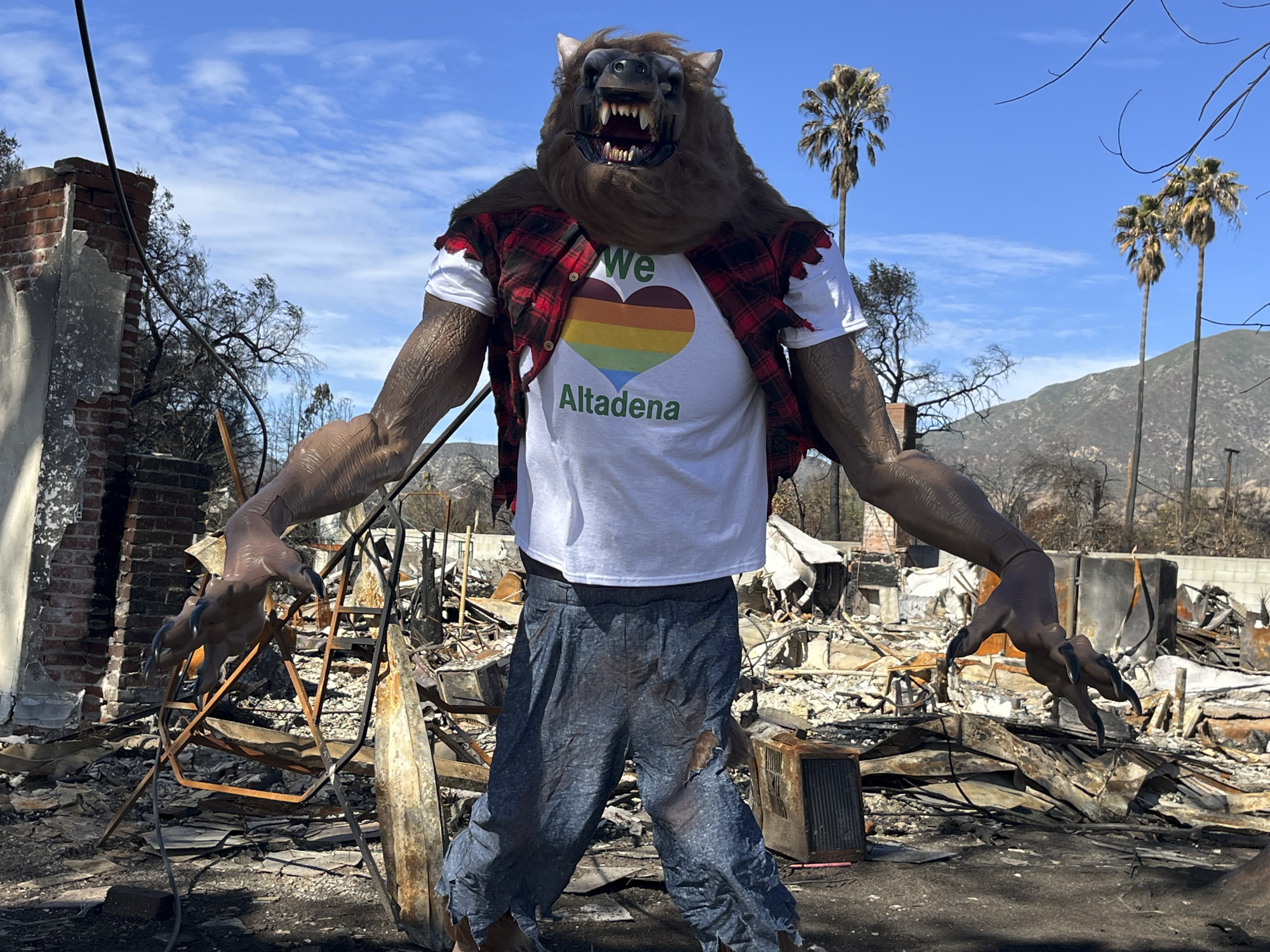
"caption": "Norman Jr., an 8-foot prop werewolf, was erected by Pastor Tim Hartley on the scorched lot of a sobering living house in West Altadena operated by the Episcopalian Diocese of Los Angeles. ",
"credit": "Steven Cuevas for KQED",
"altTag": null,
"description": null,
"imgSizes": {
"thumbnail": {
"file": "https://cdn.kqed.org/wp-content/uploads/sites/10/2026/04/260430-WEREWOLF-OF-ALTADENA-SC-01-KQED-160x120.jpg",
"width": 160,
"height": 120,
"mimeType": "image/jpeg"
},
"1536x1536": {
"file": "https://cdn.kqed.org/wp-content/uploads/sites/10/2026/04/260430-WEREWOLF-OF-ALTADENA-SC-01-KQED-1536x1152.jpg",
"width": 1536,
"height": 1152,
"mimeType": "image/jpeg"
},
"post-thumbnail": {
"file": "https://cdn.kqed.org/wp-content/uploads/sites/10/2026/04/260430-WEREWOLF-OF-ALTADENA-SC-01-KQED-672x372.jpg",
"width": 672,
"height": 372,
"mimeType": "image/jpeg"
},
"twentyfourteen-full-width": {
"file": "https://cdn.kqed.org/wp-content/uploads/sites/10/2026/04/260430-WEREWOLF-OF-ALTADENA-SC-01-KQED-1038x576.jpg",
"width": 1038,
"height": 576,
"mimeType": "image/jpeg"
},
"npr-cds-wide": {
"file": "https://cdn.kqed.org/wp-content/uploads/sites/10/2026/04/260430-WEREWOLF-OF-ALTADENA-SC-01-KQED-1200x675.jpg",
"width": 1200,
"height": 675,
"mimeType": "image/jpeg"
},
"npr-cds-square": {
"file": "https://cdn.kqed.org/wp-content/uploads/sites/10/2026/04/260430-WEREWOLF-OF-ALTADENA-SC-01-KQED-600x600.jpg",
"width": 600,
"height": 600,
"mimeType": "image/jpeg"
},
"kqedFullSize": {
"file": "https://cdn.kqed.org/wp-content/uploads/sites/10/2026/04/260430-WEREWOLF-OF-ALTADENA-SC-01-KQED.jpg",
"width": 2000,
"height": 1500
}
},
"isLoading": false,
"fetchFailed": false
},
"news_12084890": {
"type": "attachments",
"id": "news_12084890",
"meta": {
"index": "attachments_1716263798",
"site": "news",
"id": "12084890",
"found": true
},
"title": "260324-ProPublica-CATeacherDiscipline-19-BL_qed",
"publishDate": 1779461080,
"status": "inherit",
"parent": 12084681,
"modified": 1779470739,
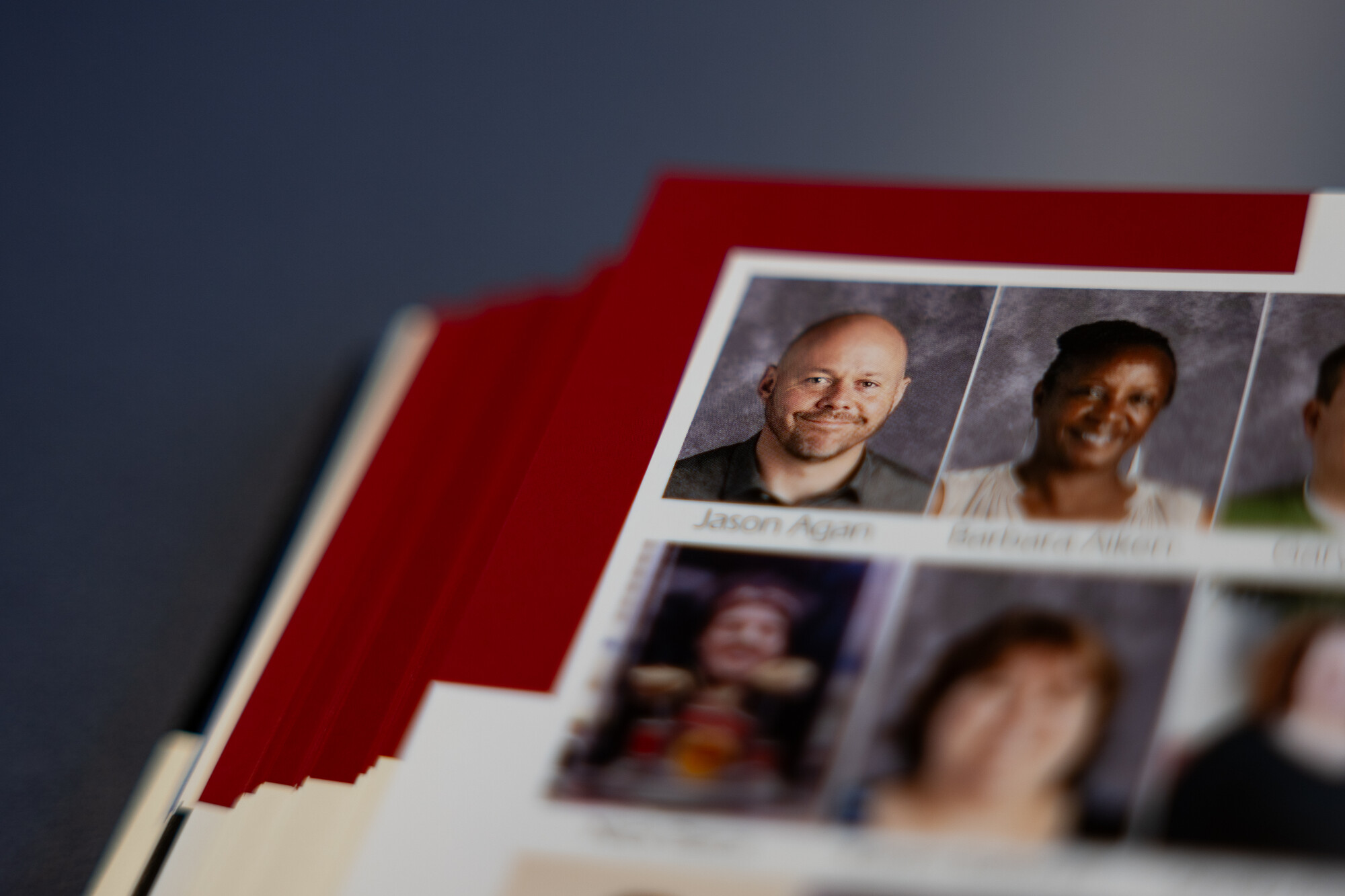
"caption": "A photo of teacher Jason Agan in the Rodriguez High School yearbook from 2017 at the Fairfield Civic Center Library in Fairfield, California, on March 24, 2026. Only for use in the ProPublica KQED collaboration California Teacher Discipline.",
"credit": null,
"altTag": null,
"description": null,
"imgSizes": {
"thumbnail": {
"file": "https://cdn.kqed.org/wp-content/uploads/sites/10/2026/05/260324-ProPublica-CATeacherDiscipline-19-BL_qed-160x107.jpg",
"width": 160,
"height": 107,
"mimeType": "image/jpeg"
},
"1536x1536": {
"file": "https://cdn.kqed.org/wp-content/uploads/sites/10/2026/05/260324-ProPublica-CATeacherDiscipline-19-BL_qed-1536x1024.jpg",
"width": 1536,
"height": 1024,
"mimeType": "image/jpeg"
},
"post-thumbnail": {
"file": "https://cdn.kqed.org/wp-content/uploads/sites/10/2026/05/260324-ProPublica-CATeacherDiscipline-19-BL_qed-672x372.jpg",
"width": 672,
"height": 372,
"mimeType": "image/jpeg"
},
"twentyfourteen-full-width": {
"file": "https://cdn.kqed.org/wp-content/uploads/sites/10/2026/05/260324-ProPublica-CATeacherDiscipline-19-BL_qed-1038x576.jpg",
"width": 1038,
"height": 576,
"mimeType": "image/jpeg"
},
"npr-cds-wide": {
"file": "https://cdn.kqed.org/wp-content/uploads/sites/10/2026/05/260324-ProPublica-CATeacherDiscipline-19-BL_qed-1200x675.jpg",
"width": 1200,
"height": 675,
"mimeType": "image/jpeg"
},
"npr-cds-square": {
"file": "https://cdn.kqed.org/wp-content/uploads/sites/10/2026/05/260324-ProPublica-CATeacherDiscipline-19-BL_qed-600x600.jpg",
"width": 600,
"height": 600,
"mimeType": "image/jpeg"
},
"kqedFullSize": {
"file": "https://cdn.kqed.org/wp-content/uploads/sites/10/2026/05/260324-ProPublica-CATeacherDiscipline-19-BL_qed.jpg",
"width": 2000,
"height": 1333
}
},
"isLoading": false,
"fetchFailed": false
},
"news_12084638": {
"type": "attachments",
"id": "news_12084638",
"meta": {
"index": "attachments_1716263798",
"site": "news",
"id": "12084638",
"found": true
},
"title": "003_KQED_SanFrancisco_Election2020_TanyaYule_10092020_qed",
"publishDate": 1779383026,
"status": "inherit",
"parent": 12084631,
"modified": 1779383050,
"caption": "Tanya Yule looks over a voting guide at her home in San Francisco on Oct. 9, 2020.",
"credit": "Beth LaBerge/KQED",
"altTag": null,
"description": null,
"imgSizes": {
"thumbnail": {
"file": "https://cdn.kqed.org/wp-content/uploads/sites/10/2026/05/003_KQED_SanFrancisco_Election2020_TanyaYule_10092020_qed-160x107.jpg",
"width": 160,
"height": 107,
"mimeType": "image/jpeg"
},
"1536x1536": {
"file": "https://cdn.kqed.org/wp-content/uploads/sites/10/2026/05/003_KQED_SanFrancisco_Election2020_TanyaYule_10092020_qed-1536x1024.jpg",
"width": 1536,
"height": 1024,
"mimeType": "image/jpeg"
},
"post-thumbnail": {
"file": "https://cdn.kqed.org/wp-content/uploads/sites/10/2026/05/003_KQED_SanFrancisco_Election2020_TanyaYule_10092020_qed-672x372.jpg",
"width": 672,
"height": 372,
"mimeType": "image/jpeg"
},
"twentyfourteen-full-width": {
"file": "https://cdn.kqed.org/wp-content/uploads/sites/10/2026/05/003_KQED_SanFrancisco_Election2020_TanyaYule_10092020_qed-1038x576.jpg",
"width": 1038,
"height": 576,
"mimeType": "image/jpeg"
},
"npr-cds-wide": {
"file": "https://cdn.kqed.org/wp-content/uploads/sites/10/2026/05/003_KQED_SanFrancisco_Election2020_TanyaYule_10092020_qed-1200x675.jpg",
"width": 1200,
"height": 675,
"mimeType": "image/jpeg"
},
"npr-cds-square": {
"file": "https://cdn.kqed.org/wp-content/uploads/sites/10/2026/05/003_KQED_SanFrancisco_Election2020_TanyaYule_10092020_qed-600x600.jpg",
"width": 600,
"height": 600,
"mimeType": "image/jpeg"
},
"kqedFullSize": {
"file": "https://cdn.kqed.org/wp-content/uploads/sites/10/2026/05/003_KQED_SanFrancisco_Election2020_TanyaYule_10092020_qed.jpg",
"width": 1999,
"height": 1333
}
},
"isLoading": false,
"fetchFailed": false
},
"news_12084670": {
"type": "attachments",
"id": "news_12084670",
"meta": {
"index": "attachments_1716263798",
"site": "news",
"id": "12084670",
"found": true
},
"title": "California Budget",
"publishDate": 1779388606,
"status": "inherit",
"parent": 12084655,
"modified": 1781098669,
"caption": "California Gov. Gavin Newsom speaks about his state budget proposal on Thursday, May 14, 2026, in Sacramento, California. ",
"credit": "Jeff Chiu/AP ",
"altTag": null,
"description": null,
"imgSizes": {
"thumbnail": {
"file": "https://cdn.kqed.org/wp-content/uploads/sites/10/2026/05/GavinNewsomAP-160x107.jpg",
"width": 160,
"height": 107,
"mimeType": "image/jpeg"
},
"1536x1536": {
"file": "https://cdn.kqed.org/wp-content/uploads/sites/10/2026/05/GavinNewsomAP-1536x1024.jpg",
"width": 1536,
"height": 1024,
"mimeType": "image/jpeg"
},
"post-thumbnail": {
"file": "https://cdn.kqed.org/wp-content/uploads/sites/10/2026/05/GavinNewsomAP-672x372.jpg",
"width": 672,
"height": 372,
"mimeType": "image/jpeg"
},
"twentyfourteen-full-width": {
"file": "https://cdn.kqed.org/wp-content/uploads/sites/10/2026/05/GavinNewsomAP-1038x576.jpg",
"width": 1038,
"height": 576,
"mimeType": "image/jpeg"
},
"npr-cds-wide": {
"file": "https://cdn.kqed.org/wp-content/uploads/sites/10/2026/05/GavinNewsomAP-1200x675.jpg",
"width": 1200,
"height": 675,
"mimeType": "image/jpeg"
},
"npr-cds-square": {
"file": "https://cdn.kqed.org/wp-content/uploads/sites/10/2026/05/GavinNewsomAP-600x600.jpg",
"width": 600,
"height": 600,
"mimeType": "image/jpeg"
},
"kqedFullSize": {
"file": "https://cdn.kqed.org/wp-content/uploads/sites/10/2026/05/GavinNewsomAP.jpg",
"width": 2000,
"height": 1333
}
},
"isLoading": false,
"fetchFailed": false
},
"news_12084649": {
"type": "attachments",
"id": "news_12084649",
"meta": {
"index": "attachments_1716263798",
"site": "news",
"id": "12084649",
"found": true
},
"title": "Global Sumud Flotilla is ready to set sail from Marmaris to Gaza with 54 boats",
"publishDate": 1779384243,
"status": "inherit",
"parent": 12084628,
"modified": 1779398589,
"caption": "Global Sumud Flotilla, formed to break the Israeli blockade, ready to set sail for Gaza into the Mediterranean from Marmaris with its 54 vessels in Mugla, Turkiye, on May 14, 2026. ",
"credit": "Orhan Cicek/Anadolu via Getty Images",
"altTag": null,
"description": null,
"imgSizes": {
"medium": {
"file": "https://cdn.kqed.org/wp-content/uploads/sites/10/2026/05/GlobalSumudFlotillaGetty-2000x1125.jpg",
"width": 2000,
"height": 1125,
"mimeType": "image/jpeg"
},
"large": {
"file": "https://cdn.kqed.org/wp-content/uploads/sites/10/2026/05/GlobalSumudFlotillaGetty-2000x1125.jpg",
"width": 2000,
"height": 1125,
"mimeType": "image/jpeg"
},
"thumbnail": {
"file": "https://cdn.kqed.org/wp-content/uploads/sites/10/2026/05/GlobalSumudFlotillaGetty-160x90.jpg",
"width": 160,
"height": 90,
"mimeType": "image/jpeg"
},
"1536x1536": {
"file": "https://cdn.kqed.org/wp-content/uploads/sites/10/2026/05/GlobalSumudFlotillaGetty-1536x864.jpg",
"width": 1536,
"height": 864,
"mimeType": "image/jpeg"
},
"2048x2048": {
"file": "https://cdn.kqed.org/wp-content/uploads/sites/10/2026/05/GlobalSumudFlotillaGetty-2048x1152.jpg",
"width": 2048,
"height": 1152,
"mimeType": "image/jpeg"
},
"post-thumbnail": {
"file": "https://cdn.kqed.org/wp-content/uploads/sites/10/2026/05/GlobalSumudFlotillaGetty-672x372.jpg",
"width": 672,
"height": 372,
"mimeType": "image/jpeg"
},
"twentyfourteen-full-width": {
"file": "https://cdn.kqed.org/wp-content/uploads/sites/10/2026/05/GlobalSumudFlotillaGetty-1038x576.jpg",
"width": 1038,
"height": 576,
"mimeType": "image/jpeg"
},
"full-width": {
"file": "https://cdn.kqed.org/wp-content/uploads/sites/10/2026/05/GlobalSumudFlotillaGetty-2000x1125.jpg",
"width": 2000,
"height": 1125,
"mimeType": "image/jpeg"
},
"npr-cds-wide": {
"file": "https://cdn.kqed.org/wp-content/uploads/sites/10/2026/05/GlobalSumudFlotillaGetty-1200x675.jpg",
"width": 1200,
"height": 675,
"mimeType": "image/jpeg"
},
"npr-cds-square": {
"file": "https://cdn.kqed.org/wp-content/uploads/sites/10/2026/05/GlobalSumudFlotillaGetty-600x600.jpg",
"width": 600,
"height": 600,
"mimeType": "image/jpeg"
},
"kqedFullSize": {
"file": "https://cdn.kqed.org/wp-content/uploads/sites/10/2026/05/GlobalSumudFlotillaGetty-scaled.jpg",
"width": 2560,
"height": 1440
}
},
"isLoading": false,
"fetchFailed": false
},
"news_11798944": {
"type": "attachments",
"id": "news_11798944",
"meta": {
"index": "attachments_1716263798",
"site": "news",
"id": "11798944",
"found": true
},
"parent": 11798901,
"imgSizes": {
"apple_news_ca_landscape_5_5": {
"file": "https://ww2.kqed.org/app/uploads/sites/10/2020/01/RS38685_alt_982-1044x783.jpg",
"width": 1044,
"mimeType": "image/jpeg",
"height": 783
},
"apple_news_ca_square_4_0": {
"file": "https://ww2.kqed.org/app/uploads/sites/10/2020/01/RS38685_alt_982-470x470.jpg",
"width": 470,
"mimeType": "image/jpeg",
"height": 470
},
"twentyfourteen-full-width": {
"file": "https://ww2.kqed.org/app/uploads/sites/10/2020/01/RS38685_alt_982-1038x576.jpg",
"width": 1038,
"mimeType": "image/jpeg",
"height": 576
},
"thumbnail": {
"file": "https://ww2.kqed.org/app/uploads/sites/10/2020/01/RS38685_alt_982-160x120.jpg",
"width": 160,
"mimeType": "image/jpeg",
"height": 120
},
"post-thumbnail": {
"file": "https://ww2.kqed.org/app/uploads/sites/10/2020/01/RS38685_alt_982-672x372.jpg",
"width": 672,
"mimeType": "image/jpeg",
"height": 372
},
"kqedFullSize": {
"file": "https://ww2.kqed.org/app/uploads/sites/10/2020/01/RS38685_alt_982.jpg",
"width": 1920,
"height": 1442
},
"apple_news_ca_landscape_4_7": {
"file": "https://ww2.kqed.org/app/uploads/sites/10/2020/01/RS38685_alt_982-632x474.jpg",
"width": 632,
"mimeType": "image/jpeg",
"height": 474
},
"large": {
"file": "https://ww2.kqed.org/app/uploads/sites/10/2020/01/RS38685_alt_982-1020x766.jpg",
"width": 1020,
"mimeType": "image/jpeg",
"height": 766
},
"apple_news_ca_landscape_4_0": {
"file": "https://ww2.kqed.org/app/uploads/sites/10/2020/01/RS38685_alt_982-536x402.jpg",
"width": 536,
"mimeType": "image/jpeg",
"height": 402
},
"apple_news_ca_portrait_12_9": {
"file": "https://ww2.kqed.org/app/uploads/sites/10/2020/01/RS38685_alt_982-1122x1442.jpg",
"width": 1122,
"mimeType": "image/jpeg",
"height": 1442
},
"medium": {
"file": "https://ww2.kqed.org/app/uploads/sites/10/2020/01/RS38685_alt_982-800x601.jpg",
"width": 800,
"mimeType": "image/jpeg",
"height": 601
},
"apple_news_ca_portrait_4_0": {
"file": "https://ww2.kqed.org/app/uploads/sites/10/2020/01/RS38685_alt_982-354x472.jpg",
"width": 354,
"mimeType": "image/jpeg",
"height": 472
},
"apple_news_ca_portrait_9_7": {
"file": "https://ww2.kqed.org/app/uploads/sites/10/2020/01/RS38685_alt_982-840x1120.jpg",
"width": 840,
"mimeType": "image/jpeg",
"height": 1120
},
"apple_news_ca_landscape_12_9": {
"file": "https://ww2.kqed.org/app/uploads/sites/10/2020/01/RS38685_alt_982-1832x1374.jpg",
"width": 1832,
"mimeType": "image/jpeg",
"height": 1374
},
"apple_news_ca_square_9_7": {
"file": "https://ww2.kqed.org/app/uploads/sites/10/2020/01/RS38685_alt_982-1104x1104.jpg",
"width": 1104,
"mimeType": "image/jpeg",
"height": 1104
},
"apple_news_ca_portrait_4_7": {
"file": "https://ww2.kqed.org/app/uploads/sites/10/2020/01/RS38685_alt_982-414x552.jpg",
"width": 414,
"mimeType": "image/jpeg",
"height": 552
},
"apple_news_ca_square_12_9": {
"file": "https://ww2.kqed.org/app/uploads/sites/10/2020/01/RS38685_alt_982-1472x1442.jpg",
"width": 1472,
"mimeType": "image/jpeg",
"height": 1442
},
"apple_news_ca_portrait_5_5": {
"file": "https://ww2.kqed.org/app/uploads/sites/10/2020/01/RS38685_alt_982-687x916.jpg",
"width": 687,
"mimeType": "image/jpeg",
"height": 916
},
"full-width": {
"file": "https://ww2.kqed.org/app/uploads/sites/10/2020/01/RS38685_alt_982-1920x1442.jpg",
"width": 1920,
"mimeType": "image/jpeg",
"height": 1442
},
"apple_news_ca_square_4_7": {
"file": "https://ww2.kqed.org/app/uploads/sites/10/2020/01/RS38685_alt_982-550x550.jpg",
"width": 550,
"mimeType": "image/jpeg",
"height": 550
},
"apple_news_ca_landscape_9_7": {
"file": "https://ww2.kqed.org/app/uploads/sites/10/2020/01/RS38685_alt_982-1376x1032.jpg",
"width": 1376,
"mimeType": "image/jpeg",
"height": 1032
},
"apple_news_ca_square_5_5": {
"file": "https://ww2.kqed.org/app/uploads/sites/10/2020/01/RS38685_alt_982-912x912.jpg",
"width": 912,
"mimeType": "image/jpeg",
"height": 912
}
},
"publishDate": 1580351370,
"modified": 1580351531,
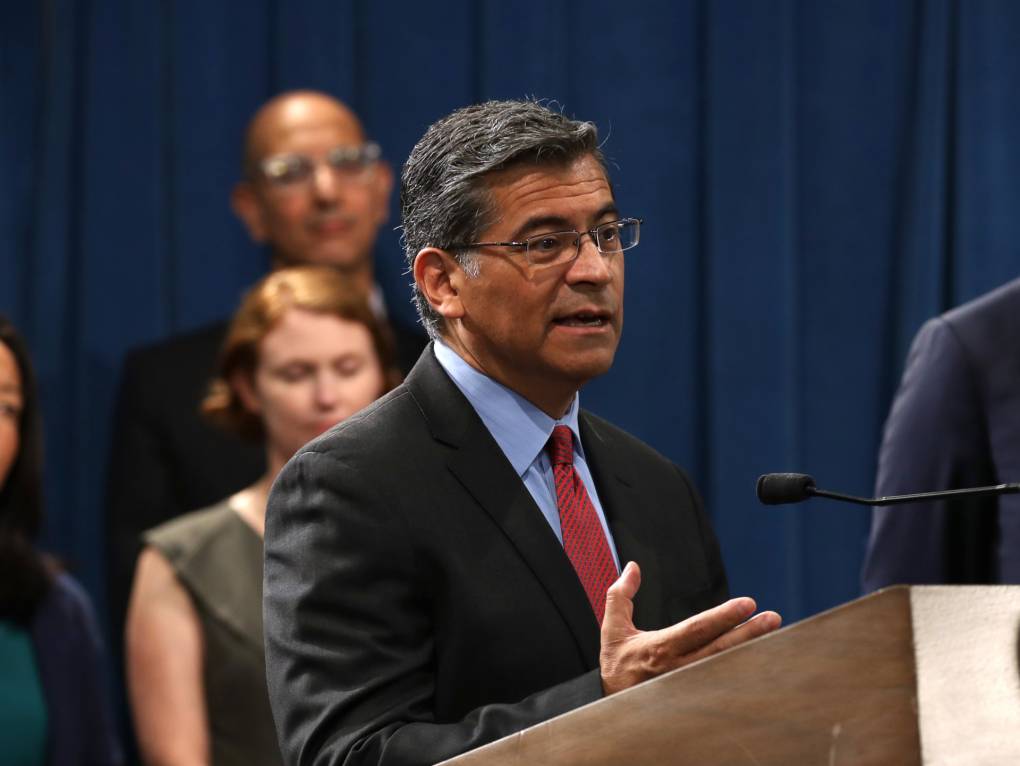
"caption": "A state appeals court has ruled that state Attorney General Xavier Becerra must release files about police misconduct and shootings held by the state Department of Justice, including those created by local law enforcement agencies.",
"description": "A state appeals court has ruled that state Attorney General Xavier Becerra must release files about police misconduct and shootings held by the state Department of Justice, including those created by local law enforcement agencies.",
"title": "California Governor Gavin Newsom And Attorney General Becerra Announce Legal Action On Immigration",
"credit": "Justin Sullivan/Getty Images",
"status": "inherit",
"isLoading": false,
"fetchFailed": false
},
"news_12075048": {
"type": "attachments",
"id": "news_12075048",
"meta": {
"index": "attachments_1716263798",
"site": "news",
"id": "12075048",
"found": true
},
"title": "251007-sacramentomiddlehousing_00077_TV_qed",
"publishDate": 1772473800,
"status": "inherit",
"parent": 0,
"modified": 1772473904,
"caption": "A construction worker operates machinery to move dirt at the site of new middle housing units in Sacramento, California, on Oct. 7, 2025. ",
"credit": "Tâm Vũ/KQED",
"altTag": null,
"description": null,
"imgSizes": {
"thumbnail": {
"file": "https://cdn.kqed.org/wp-content/uploads/sites/10/2026/03/251007-sacramentomiddlehousing_00077_TV_qed-160x107.jpg",
"width": 160,
"height": 107,
"mimeType": "image/jpeg"
},
"1536x1536": {
"file": "https://cdn.kqed.org/wp-content/uploads/sites/10/2026/03/251007-sacramentomiddlehousing_00077_TV_qed-1536x1024.jpg",
"width": 1536,
"height": 1024,
"mimeType": "image/jpeg"
},
"post-thumbnail": {
"file": "https://cdn.kqed.org/wp-content/uploads/sites/10/2026/03/251007-sacramentomiddlehousing_00077_TV_qed-672x372.jpg",
"width": 672,
"height": 372,
"mimeType": "image/jpeg"
},
"twentyfourteen-full-width": {
"file": "https://cdn.kqed.org/wp-content/uploads/sites/10/2026/03/251007-sacramentomiddlehousing_00077_TV_qed-1038x576.jpg",
"width": 1038,
"height": 576,
"mimeType": "image/jpeg"
},
"npr-cds-wide": {
"file": "https://cdn.kqed.org/wp-content/uploads/sites/10/2026/03/251007-sacramentomiddlehousing_00077_TV_qed-1200x675.jpg",
"width": 1200,
"height": 675,
"mimeType": "image/jpeg"
},
"kqedFullSize": {
"file": "https://cdn.kqed.org/wp-content/uploads/sites/10/2026/03/251007-sacramentomiddlehousing_00077_TV_qed.jpg",
"width": 1999,
"height": 1333
}
},
"isLoading": false,
"fetchFailed": false
},
"news_12079093": {
"type": "attachments",
"id": "news_12079093",
"meta": {
"index": "attachments_1716263798",
"site": "news",
"id": "12079093",
"found": true
},
"title": "HistoryofWetsuit",
"publishDate": 1775667962,
"status": "inherit",
"parent": 0,
"modified": 1775668137,
"caption": "Left and right: John S. Foster modeling early wet suit design around 1951. ",
"credit": "UC San Diego Library",
"altTag": null,
"description": null,
"imgSizes": {
"thumbnail": {
"file": "https://cdn.kqed.org/wp-content/uploads/sites/10/2026/04/HistoryofWetsuit-160x107.jpg",
"width": 160,
"height": 107,
"mimeType": "image/jpeg"
},
"1536x1536": {
"file": "https://cdn.kqed.org/wp-content/uploads/sites/10/2026/04/HistoryofWetsuit-1536x1024.jpg",
"width": 1536,
"height": 1024,
"mimeType": "image/jpeg"
},
"post-thumbnail": {
"file": "https://cdn.kqed.org/wp-content/uploads/sites/10/2026/04/HistoryofWetsuit-672x372.jpg",
"width": 672,
"height": 372,
"mimeType": "image/jpeg"
},
"twentyfourteen-full-width": {
"file": "https://cdn.kqed.org/wp-content/uploads/sites/10/2026/04/HistoryofWetsuit-1038x576.jpg",
"width": 1038,
"height": 576,
"mimeType": "image/jpeg"
},
"npr-cds-wide": {
"file": "https://cdn.kqed.org/wp-content/uploads/sites/10/2026/04/HistoryofWetsuit-1200x675.jpg",
"width": 1200,
"height": 675,
"mimeType": "image/jpeg"
},
"npr-cds-square": {
"file": "https://cdn.kqed.org/wp-content/uploads/sites/10/2026/04/HistoryofWetsuit-600x600.jpg",
"width": 600,
"height": 600,
"mimeType": "image/jpeg"
},
"kqedFullSize": {
"file": "https://cdn.kqed.org/wp-content/uploads/sites/10/2026/04/HistoryofWetsuit.jpg",
"width": 2000,
"height": 1333
}
},
"isLoading": false,
"fetchFailed": false
},
"news_12075899": {
"type": "attachments",
"id": "news_12075899",
"meta": {
"index": "attachments_1716263798",
"site": "news",
"id": "12075899",
"found": true
},
"title": "250418-SFPDFile-02-BL_qed",
"publishDate": 1773159338,
"status": "inherit",
"parent": 12075894,
"modified": 1773159352,
"caption": "San Francisco Police Department headquarters in San Francisco on April 18, 2025.",
"credit": "Beth LaBerge/KQED",
"altTag": null,
"description": null,
"imgSizes": {
"thumbnail": {
"file": "https://cdn.kqed.org/wp-content/uploads/sites/10/2026/03/250418-SFPDFile-02-BL_qed-160x107.jpg",
"width": 160,
"height": 107,
"mimeType": "image/jpeg"
},
"1536x1536": {
"file": "https://cdn.kqed.org/wp-content/uploads/sites/10/2026/03/250418-SFPDFile-02-BL_qed-1536x1024.jpg",
"width": 1536,
"height": 1024,
"mimeType": "image/jpeg"
},
"post-thumbnail": {
"file": "https://cdn.kqed.org/wp-content/uploads/sites/10/2026/03/250418-SFPDFile-02-BL_qed-672x372.jpg",
"width": 672,
"height": 372,
"mimeType": "image/jpeg"
},
"twentyfourteen-full-width": {
"file": "https://cdn.kqed.org/wp-content/uploads/sites/10/2026/03/250418-SFPDFile-02-BL_qed-1038x576.jpg",
"width": 1038,
"height": 576,
"mimeType": "image/jpeg"
},
"npr-cds-wide": {
"file": "https://cdn.kqed.org/wp-content/uploads/sites/10/2026/03/250418-SFPDFile-02-BL_qed-1200x675.jpg",
"width": 1200,
"height": 675,
"mimeType": "image/jpeg"
},
"kqedFullSize": {
"file": "https://cdn.kqed.org/wp-content/uploads/sites/10/2026/03/250418-SFPDFile-02-BL_qed.jpg",
"width": 2000,
"height": 1333
}
},
"isLoading": false,
"fetchFailed": false
},
"news_12082333": {
"type": "attachments",
"id": "news_12082333",
"meta": {
"index": "attachments_1716263798",
"site": "news",
"id": "12082333",
"found": true
},
"title": "043006TOMSTEYER_GH_013-KQED",
"publishDate": 1777935054,
"status": "inherit",
"parent": 0,
"modified": 1779231878,
"caption": "Democratic gubernatorial candidate Tom Steyer speaks during a small press availability before a town hall event on April 30, 2026, in San José.",
"credit": "Gustavo Hernandez/KQED",
"altTag": null,
"description": null,
"imgSizes": {
"thumbnail": {
"file": "https://cdn.kqed.org/wp-content/uploads/sites/10/2026/05/043006TOMSTEYER_GH_013-KQED-160x107.jpg",
"width": 160,
"height": 107,
"mimeType": "image/jpeg"
},
"1536x1536": {
"file": "https://cdn.kqed.org/wp-content/uploads/sites/10/2026/05/043006TOMSTEYER_GH_013-KQED-1536x1024.jpg",
"width": 1536,
"height": 1024,
"mimeType": "image/jpeg"
},
"post-thumbnail": {
"file": "https://cdn.kqed.org/wp-content/uploads/sites/10/2026/05/043006TOMSTEYER_GH_013-KQED-672x372.jpg",
"width": 672,
"height": 372,
"mimeType": "image/jpeg"
},
"twentyfourteen-full-width": {
"file": "https://cdn.kqed.org/wp-content/uploads/sites/10/2026/05/043006TOMSTEYER_GH_013-KQED-1038x576.jpg",
"width": 1038,
"height": 576,
"mimeType": "image/jpeg"
},
"npr-cds-wide": {
"file": "https://cdn.kqed.org/wp-content/uploads/sites/10/2026/05/043006TOMSTEYER_GH_013-KQED-1200x675.jpg",
"width": 1200,
"height": 675,
"mimeType": "image/jpeg"
},
"npr-cds-square": {
"file": "https://cdn.kqed.org/wp-content/uploads/sites/10/2026/05/043006TOMSTEYER_GH_013-KQED-600x600.jpg",
"width": 600,
"height": 600,
"mimeType": "image/jpeg"
},
"kqedFullSize": {
"file": "https://cdn.kqed.org/wp-content/uploads/sites/10/2026/05/043006TOMSTEYER_GH_013-KQED.jpg",
"width": 2000,
"height": 1333
}
},
"isLoading": false,
"fetchFailed": false
},
"news_12084040": {
"type": "attachments",
"id": "news_12084040",
"meta": {
"index": "attachments_1716263798",
"site": "news",
"id": "12084040",
"found": true
},
"title": "ELEAZAR-RESENDIZ-CORTES- KQED-LEOPO-2026-1438-KQED",
"publishDate": 1779122991,
"status": "inherit",
"parent": 0,
"modified": 1779149363,
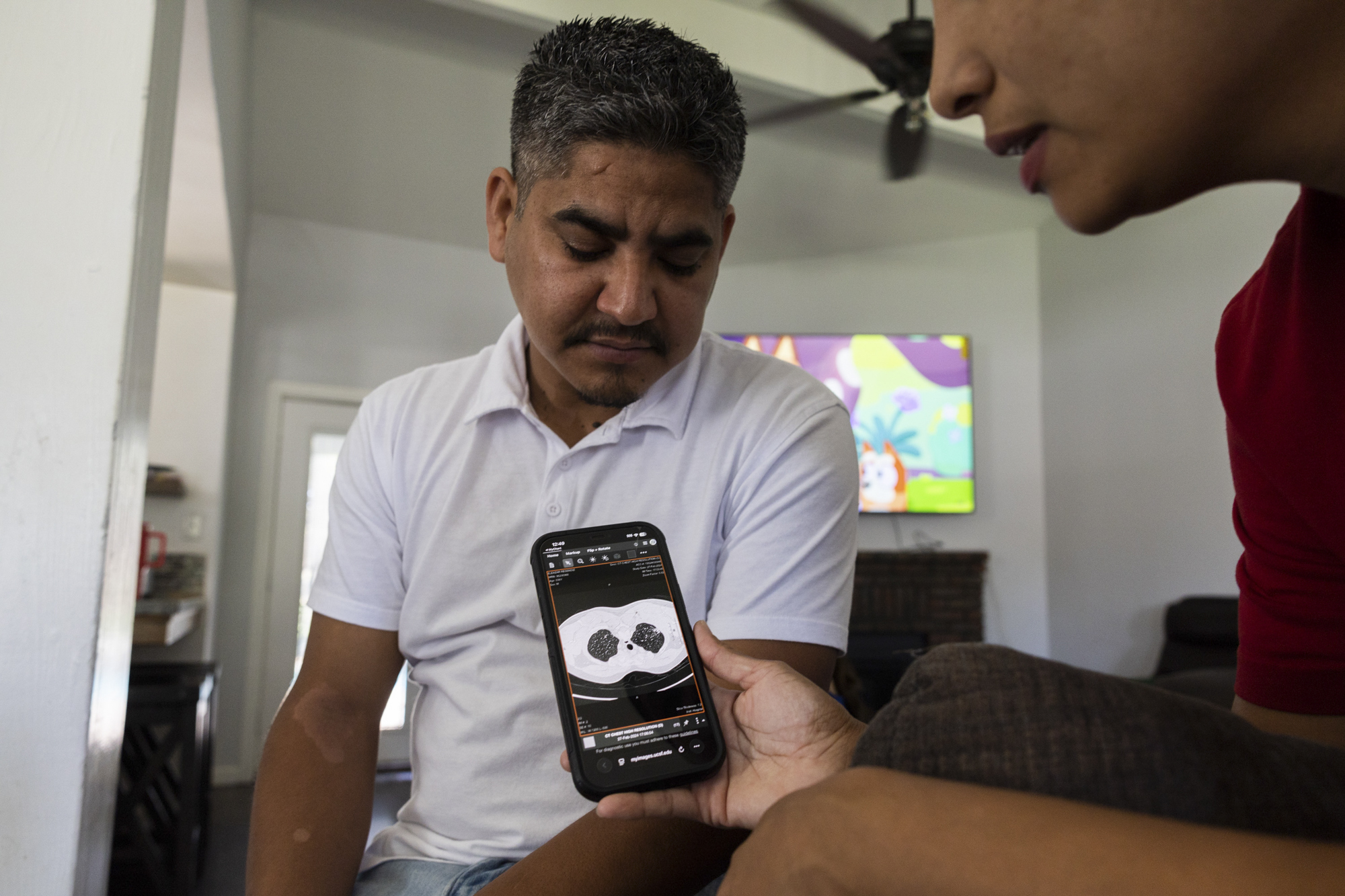
"caption": "Eleazar Resendiz Cortes’ wife shows scans of his chest in their home on Thursday, May 14, 2026, in Bakersfield, California, that revealed particles around his lungs linked to his silicosis diagnosis. Cortes, a former stone worker, says the disease has left him unable to work.",
"credit": "Julie Leopo for KQED",
"altTag": null,
"description": null,
"imgSizes": {
"thumbnail": {
"file": "https://cdn.kqed.org/wp-content/uploads/sites/10/2026/05/ELEAZAR-RESENDIZ-CORTES-KQED-LEOPO-2026-1438-KQED-160x107.jpg",
"width": 160,
"height": 107,
"mimeType": "image/jpeg"
},
"1536x1536": {
"file": "https://cdn.kqed.org/wp-content/uploads/sites/10/2026/05/ELEAZAR-RESENDIZ-CORTES-KQED-LEOPO-2026-1438-KQED-1536x1024.jpg",
"width": 1536,
"height": 1024,
"mimeType": "image/jpeg"
},
"post-thumbnail": {
"file": "https://cdn.kqed.org/wp-content/uploads/sites/10/2026/05/ELEAZAR-RESENDIZ-CORTES-KQED-LEOPO-2026-1438-KQED-672x372.jpg",
"width": 672,
"height": 372,
"mimeType": "image/jpeg"
},
"twentyfourteen-full-width": {
"file": "https://cdn.kqed.org/wp-content/uploads/sites/10/2026/05/ELEAZAR-RESENDIZ-CORTES-KQED-LEOPO-2026-1438-KQED-1038x576.jpg",
"width": 1038,
"height": 576,
"mimeType": "image/jpeg"
},
"npr-cds-wide": {
"file": "https://cdn.kqed.org/wp-content/uploads/sites/10/2026/05/ELEAZAR-RESENDIZ-CORTES-KQED-LEOPO-2026-1438-KQED-1200x675.jpg",
"width": 1200,
"height": 675,
"mimeType": "image/jpeg"
},
"npr-cds-square": {
"file": "https://cdn.kqed.org/wp-content/uploads/sites/10/2026/05/ELEAZAR-RESENDIZ-CORTES-KQED-LEOPO-2026-1438-KQED-600x600.jpg",
"width": 600,
"height": 600,
"mimeType": "image/jpeg"
},
"kqedFullSize": {
"file": "https://cdn.kqed.org/wp-content/uploads/sites/10/2026/05/ELEAZAR-RESENDIZ-CORTES-KQED-LEOPO-2026-1438-KQED.jpg",
"width": 2000,
"height": 1333
}
},
"isLoading": false,
"fetchFailed": false
}
},
"audioPlayerReducer": {
"postId": "stream_live",
"isPaused": true,
"isPlaying": false,
"pfsActive": false,
"pledgeModalIsOpen": true,
"playerDrawerIsOpen": false,
"liveAudioPlayStartedAt": 0,
"liveAudioPlayContext": ""
},
"authorsReducer": {
"gmarzorati": {
"type": "authors",
"id": "227",
"meta": {
"index": "authors_1716337520",
"id": "227",
"found": true
},
"name": "Guy Marzorati",
"firstName": "Guy",
"lastName": "Marzorati",
"slug": "gmarzorati",
"email": "gmarzorati@KQED.org",
"display_author_email": true,
"staff_mastheads": [
"news"
],
"title": "Correspondent",
"bio": "Guy Marzorati is a correspondent on KQED's California Politics and Government Desk, based in San Jose. A graduate of Santa Clara University, Guy joined KQED in 2013. He reports on state and local politics and produces KQED's digital voter guide.",
"avatar": "https://secure.gravatar.com/avatar/e7038b8dbfd55b104369b76b1cd0b9de?s=600&d=blank&r=g",
"twitter": "guymarzorati",
"facebook": null,
"instagram": null,
"linkedin": null,
"sites": [
{
"site": "",
"roles": [
"editor"
]
},
{
"site": "news",
"roles": [
"editor"
]
},
{
"site": "science",
"roles": [
"editor"
]
},
{
"site": "forum",
"roles": [
"editor"
]
},
{
"site": "elections",
"roles": [
"editor"
]
},
{
"site": "liveblog",
"roles": [
"editor"
]
}
],
"headData": {
"title": "Guy Marzorati | KQED",
"description": "Correspondent",
"ogImgSrc": "https://secure.gravatar.com/avatar/e7038b8dbfd55b104369b76b1cd0b9de?s=600&d=blank&r=g",
"twImgSrc": "https://secure.gravatar.com/avatar/e7038b8dbfd55b104369b76b1cd0b9de?s=600&d=blank&r=g"
},
"isLoading": false,
"link": "/author/gmarzorati"
},
"rachael-myrow": {
"type": "authors",
"id": "251",
"meta": {
"index": "authors_1716337520",
"id": "251",
"found": true
},
"name": "Rachael Myrow",
"firstName": "Rachael",
"lastName": "Myrow",
"slug": "rachael-myrow",
"email": "rmyrow@kqed.org",
"display_author_email": true,
"staff_mastheads": [
"news"
],
"title": "Senior Editor of KQED's Silicon Valley News Desk",
"bio": "• I write and edit stories about how Silicon Valley power and policies shape everyday life in California. I’m also passionate about making Bay Area history and culture more accessible to a broad public. • I’ve been a journalist for most of my life, starting in high school with The Franklin Press in Los Angeles, where I grew up. While earning my first degree in English at UC Berkeley, I got my start in public radio at KALX-FM. After completing a second degree in journalism at Cal, I landed my first professional job at Marketplace, then moved on to KPCC (now LAist), and then KQED, where I hosted The California Report for more than seven years. • My reporting has appeared on NPR, The World, WBUR’s \u003ci>Here & Now\u003c/i>, and the BBC. I also guest host for KQED’s \u003ci>Forum\u003c/i>, as well as the Commonwealth Club in San Francisco. • I speak periodically on media, democracy and technology issues, and do voiceover work for documentaries and educational video projects. • Outside of the studio, you'll find me hiking Bay Area trails and whipping up Insta-ready meals in my kitchen. • I do not accept gifts, money, or favors from anyone connected to my reporting, I don't pay people for information, and I do not support or donate to political causes. • I strive to treat the people I report on with fairness, honesty, and respect. I also recognize there are often multiple sides to a story and work to verify information through multiple sources and documentation. If I get something wrong, I correct it.",
"avatar": "https://secure.gravatar.com/avatar/3ed8a3c5f26025e4a805ba634cda8cd764906b97438a6d9ce216b044e340da4e?s=600&d=blank&r=g",
"twitter": "rachaelmyrow",
"bluesky": null,
"facebook": null,
"instagram": null,
"linkedin": "https://www.linkedin.com/in/rachaelmyrow/",
"sites": [
{
"site": "arts",
"roles": [
"administrator"
]
},
{
"site": "news",
"roles": [
"edit_others_posts",
"editor"
]
},
{
"site": "futureofyou",
"roles": [
"editor"
]
},
{
"site": "bayareabites",
"roles": [
"editor"
]
},
{
"site": "stateofhealth",
"roles": [
"editor"
]
},
{
"site": "science",
"roles": [
"editor"
]
},
{
"site": "food",
"roles": [
"editor"
]
},
{
"site": "forum",
"roles": [
"editor"
]
},
{
"site": "liveblog",
"roles": [
"author"
]
}
],
"headData": {
"title": "Rachael Myrow | KQED",
"description": "Senior Editor of KQED's Silicon Valley News Desk",
"ogImgSrc": "https://secure.gravatar.com/avatar/3ed8a3c5f26025e4a805ba634cda8cd764906b97438a6d9ce216b044e340da4e?s=600&d=blank&r=g",
"twImgSrc": "https://secure.gravatar.com/avatar/3ed8a3c5f26025e4a805ba634cda8cd764906b97438a6d9ce216b044e340da4e?s=600&d=blank&r=g"
},
"isLoading": false,
"link": "/author/rachael-myrow"
},
"scuevas": {
"type": "authors",
"id": "2600",
"meta": {
"index": "authors_1716337520",
"id": "2600",
"found": true
},
"name": "Steven Cuevas",
"firstName": "Steven",
"lastName": "Cuevas",
"slug": "scuevas",
"email": "scuevas@kqed.org",
"display_author_email": false,
"staff_mastheads": [],
"title": "KQED Contributor",
"bio": "Steven is a former Los Angeles bureau chief for The California Report.\r\n\r\nHe reports on an array of issues across the Southland, from immigration and regional politics to religion, the performing arts and pop culture.\r\n\r\nPrior to joining KQED in 2012, Steven covered Inland southern California for KPCC in Pasadena. He also helped establish the first newsroom at \u003ca href=\"http://kut.org/\">KUT\u003c/a> in Austin, Texas where he was a general assignment reporter.\r\n\r\nSteven has received numerous awards for his reporting including an RTNDA Edward R. Murrow Award for investigative reporting in addition to awards from the LA Press Club, the Associated Press and the Society for Professional Journalists.\r\n\r\nSteven grew up in and around San Francisco and now lives in Pasadena just a short jog from the foot of the San Gabriel Mountains.",
"avatar": "https://secure.gravatar.com/avatar/2d253580794f8e026100fae05cfabbbd4889b4fe15146146cacb82a01974c538?s=600&d=blank&r=g",
"twitter": null,
"bluesky": null,
"facebook": null,
"instagram": null,
"linkedin": null,
"sites": [
{
"site": "news",
"roles": [
"subscriber"
]
}
],
"headData": {
"title": "Steven Cuevas | KQED",
"description": "KQED Contributor",
"ogImgSrc": "https://secure.gravatar.com/avatar/2d253580794f8e026100fae05cfabbbd4889b4fe15146146cacb82a01974c538?s=600&d=blank&r=g",
"twImgSrc": "https://secure.gravatar.com/avatar/2d253580794f8e026100fae05cfabbbd4889b4fe15146146cacb82a01974c538?s=600&d=blank&r=g"
},
"isLoading": false,
"link": "/author/scuevas"
},
"mlagos": {
"type": "authors",
"id": "3239",
"meta": {
"index": "authors_1716337520",
"id": "3239",
"found": true
},
"name": "Marisa Lagos",
"firstName": "Marisa",
"lastName": "Lagos",
"slug": "mlagos",
"email": "mlagos@kqed.org",
"display_author_email": false,
"staff_mastheads": [
"news"
],
"title": "KQED Contributor",
"bio": "Marisa Lagos is a correspondent for KQED’s California Politics and Government Desk and co-hosts the award-winning show and podcast, Political Breakdown. At KQED, Lagos also conducts reporting, analysis and investigations into state, local and national politics for radio, TV, online and onstage. In 2022, she and co-host, Scott Shafer, moderated the only gubernatorial debate in California. In 2020, the \u003ci>Washington Post\u003c/i> named her one of the top political journalists in California; she was nominated for a Peabody and won several other awards for her work investigating the 2017 California wildfires. She has worked at the \u003ci>San Francisco Chronicle\u003c/i>, \u003ci>San Francisco Examiner\u003c/i> and \u003ci>Los Angeles Times\u003c/i>. A UC Santa Barbara graduate, she lives in San Francisco with her two sons and husband.",
"avatar": "https://secure.gravatar.com/avatar/a261a0d3696fc066871ef96b85b5e7d2?s=600&d=blank&r=g",
"twitter": "@mlagos",
"facebook": null,
"instagram": null,
"linkedin": null,
"sites": [
{
"site": "arts",
"roles": [
"author"
]
},
{
"site": "news",
"roles": [
"editor"
]
},
{
"site": "science",
"roles": [
"editor"
]
},
{
"site": "forum",
"roles": [
"author"
]
},
{
"site": "liveblog",
"roles": [
"author"
]
}
],
"headData": {
"title": "Marisa Lagos | KQED",
"description": "KQED Contributor",
"ogImgSrc": "https://secure.gravatar.com/avatar/a261a0d3696fc066871ef96b85b5e7d2?s=600&d=blank&r=g",
"twImgSrc": "https://secure.gravatar.com/avatar/a261a0d3696fc066871ef96b85b5e7d2?s=600&d=blank&r=g"
},
"isLoading": false,
"link": "/author/mlagos"
},
"carlysevern": {
"type": "authors",
"id": "3243",
"meta": {
"index": "authors_1716337520",
"id": "3243",
"found": true
},
"name": "Carly Severn",
"firstName": "Carly",
"lastName": "Severn",
"slug": "carlysevern",
"email": "csevern@kqed.org",
"display_author_email": false,
"staff_mastheads": [
"news"
],
"title": "Senior Editor, Audience News ",
"bio": "Carly is KQED's Senior Editor of Audience News on the Digital News team, and has reported for the California Report Magazine, Bay Curious and KQED Arts. She's formerly the host of \u003ca href=\"http://ww2.kqed.org/pop/category/the-cooler/\" rel=\"noopener noreferrer\">The Cooler\u003c/a> podcast.",
"avatar": "https://secure.gravatar.com/avatar/54037bf5c128fe678f0ef26cec97a93f2e7f220a22d7285703328f12c42c1b1d?s=600&d=blank&r=g",
"twitter": "teacupinthebay",
"bluesky": null,
"facebook": null,
"instagram": null,
"linkedin": null,
"sites": [
{
"site": "",
"roles": [
"editor"
]
},
{
"site": "arts",
"roles": [
"editor"
]
},
{
"site": "news",
"roles": [
"administrator"
]
},
{
"site": "pop",
"roles": [
"editor"
]
},
{
"site": "futureofyou",
"roles": [
"editor"
]
},
{
"site": "about",
"roles": [
"administrator"
]
},
{
"site": "mindshift",
"roles": [
"editor"
]
},
{
"site": "bayareabites",
"roles": [
"editor"
]
},
{
"site": "stateofhealth",
"roles": [
"editor"
]
},
{
"site": "science",
"roles": [
"editor"
]
},
{
"site": "food",
"roles": [
"contributor"
]
},
{
"site": "forum",
"roles": [
"editor"
]
},
{
"site": "perspectives",
"roles": [
"administrator"
]
},
{
"site": "liveblog",
"roles": [
"editor"
]
}
],
"headData": {
"title": "Carly Severn | KQED",
"description": "Senior Editor, Audience News ",
"ogImgSrc": "https://secure.gravatar.com/avatar/54037bf5c128fe678f0ef26cec97a93f2e7f220a22d7285703328f12c42c1b1d?s=600&d=blank&r=g",
"twImgSrc": "https://secure.gravatar.com/avatar/54037bf5c128fe678f0ef26cec97a93f2e7f220a22d7285703328f12c42c1b1d?s=600&d=blank&r=g"
},
"isLoading": false,
"link": "/author/carlysevern"
},
"fjhabvala": {
"type": "authors",
"id": "8659",
"meta": {
"index": "authors_1716337520",
"id": "8659",
"found": true
},
"name": "Farida Jhabvala Romero",
"firstName": "Farida",
"lastName": "Jhabvala Romero",
"slug": "fjhabvala",
"email": "fjhabvala@kqed.org",
"display_author_email": true,
"staff_mastheads": [
"news"
],
"title": "KQED Contributor",
"bio": "Farida Jhabvala Romero is a Labor Correspondent for KQED. She previously covered immigration. Farida was \u003ca href=\"https://www.ccnma.org/2022-most-influential-latina-journalists\">named\u003c/a> one of the 10 Most Influential Latina Journalists in California in 2022 by the California Chicano News Media Association. Her work has won awards from the Society of Professional Journalists (Northern California), as well as a national and regional Edward M. Murrow Award for the collaborative reporting projects “Dangerous Air” and “Graying California.” Before joining KQED, Farida worked as a producer at Radio Bilingüe, a national public radio network. Farida earned her master’s degree in journalism from Stanford University.",
"avatar": "https://secure.gravatar.com/avatar/f9f022d4e2609741874222a1e9d41f48fea74011aa7c615eef91d9a50c944ebe?s=600&d=blank&r=g",
"twitter": "FaridaJhabvala",
"bluesky": null,
"facebook": null,
"instagram": null,
"linkedin": "https://www.linkedin.com/in/faridajhabvala/",
"sites": [
{
"site": "news",
"roles": [
"editor"
]
},
{
"site": "stateofhealth",
"roles": [
"author"
]
},
{
"site": "liveblog",
"roles": [
"author"
]
}
],
"headData": {
"title": "Farida Jhabvala Romero | KQED",
"description": "KQED Contributor",
"ogImgSrc": "https://secure.gravatar.com/avatar/f9f022d4e2609741874222a1e9d41f48fea74011aa7c615eef91d9a50c944ebe?s=600&d=blank&r=g",
"twImgSrc": "https://secure.gravatar.com/avatar/f9f022d4e2609741874222a1e9d41f48fea74011aa7c615eef91d9a50c944ebe?s=600&d=blank&r=g"
},
"isLoading": false,
"link": "/author/fjhabvala"
},
"hmcdede": {
"type": "authors",
"id": "11635",
"meta": {
"index": "authors_1716337520",
"id": "11635",
"found": true
},
"name": "Holly McDede",
"firstName": "Holly",
"lastName": "McDede",
"slug": "hmcdede",
"email": "hmcdede@KQED.org",
"display_author_email": false,
"staff_mastheads": [],
"title": "KQED Contributor",
"bio": null,
"avatar": "https://secure.gravatar.com/avatar/999d9bf31bb3a2f0511932d99526cb3e?s=600&d=blank&r=g",
"twitter": null,
"facebook": null,
"instagram": null,
"linkedin": null,
"sites": [
{
"site": "arts",
"roles": [
"editor"
]
},
{
"site": "news",
"roles": [
"edit_others_posts",
"editor"
]
},
{
"site": "science",
"roles": [
"editor"
]
},
{
"site": "forum",
"roles": [
"editor"
]
},
{
"site": "perspectives",
"roles": [
"administrator"
]
}
],
"headData": {
"title": "Holly McDede | KQED",
"description": "KQED Contributor",
"ogImgSrc": "https://secure.gravatar.com/avatar/999d9bf31bb3a2f0511932d99526cb3e?s=600&d=blank&r=g",
"twImgSrc": "https://secure.gravatar.com/avatar/999d9bf31bb3a2f0511932d99526cb3e?s=600&d=blank&r=g"
},
"isLoading": false,
"link": "/author/hmcdede"
},
"abandlamudi": {
"type": "authors",
"id": "11672",
"meta": {
"index": "authors_1716337520",
"id": "11672",
"found": true
},
"name": "Adhiti Bandlamudi",
"firstName": "Adhiti",
"lastName": "Bandlamudi",
"slug": "abandlamudi",
"email": "abandlamudi@kqed.org",
"display_author_email": false,
"staff_mastheads": [
"news"
],
"title": "KQED Housing Reporter",
"bio": "Adhiti Bandlamudi reports for KQED's Housing desk. She focuses on how housing gets built across the Bay Area. Before joining KQED in 2020, she reported for WUNC in Durham, North Carolina, WABE in Atlanta, Georgia and Capital Public Radio in Sacramento. In 2017, she was awarded a Kroc Fellowship at NPR where she reported on everything from sprinkles to the Golden State Killer's arrest. When she's not reporting, she's baking new recipes in her kitchen or watching movies with friends and family. She's originally from Georgia and has strong opinions about Great British Bake Off.",
"avatar": "https://secure.gravatar.com/avatar/868129c8b257bb99a3500e2c86a65400?s=600&d=mm&r=g",
"twitter": "oddity_adhiti",
"facebook": null,
"instagram": null,
"linkedin": null,
"sites": [
{
"site": "arts",
"roles": [
"author"
]
},
{
"site": "news",
"roles": [
"editor"
]
},
{
"site": "liveblog",
"roles": [
"author"
]
}
],
"headData": {
"title": "Adhiti Bandlamudi | KQED",
"description": "KQED Housing Reporter",
"ogImgSrc": "https://secure.gravatar.com/avatar/868129c8b257bb99a3500e2c86a65400?s=600&d=mm&r=g",
"twImgSrc": "https://secure.gravatar.com/avatar/868129c8b257bb99a3500e2c86a65400?s=600&d=mm&r=g"
},
"isLoading": false,
"link": "/author/abandlamudi"
},
"kdebenedetti": {
"type": "authors",
"id": "11913",
"meta": {
"index": "authors_1716337520",
"id": "11913",
"found": true
},
"name": "Katie DeBenedetti",
"firstName": "Katie",
"lastName": "DeBenedetti",
"slug": "kdebenedetti",
"email": "kdebenedetti@kqed.org",
"display_author_email": false,
"staff_mastheads": [
"news",
"science"
],
"title": "KQED Contributor",
"bio": "Katie DeBenedetti is a digital reporter covering daily news for the Express Desk. Prior to joining KQED as a culture reporting intern in January 2024, she covered education and city government for the Napa Valley Register.",
"avatar": "https://secure.gravatar.com/avatar/6e31073cb8f7e4214ab03f42771d0f45?s=600&d=blank&r=g",
"twitter": null,
"facebook": null,
"instagram": null,
"linkedin": null,
"sites": [
{
"site": "news",
"roles": [
"author"
]
},
{
"site": "science",
"roles": [
"author"
]
},
{
"site": "liveblog",
"roles": [
"author"
]
}
],
"headData": {
"title": "Katie DeBenedetti | KQED",
"description": "KQED Contributor",
"ogImgSrc": "https://secure.gravatar.com/avatar/6e31073cb8f7e4214ab03f42771d0f45?s=600&d=blank&r=g",
"twImgSrc": "https://secure.gravatar.com/avatar/6e31073cb8f7e4214ab03f42771d0f45?s=600&d=blank&r=g"
},
"isLoading": false,
"link": "/author/kdebenedetti"
},
"gglueck": {
"type": "authors",
"id": "11946",
"meta": {
"index": "authors_1716337520",
"id": "11946",
"found": true
},
"name": "Gabriela Glueck",
"firstName": "Gabriela",
"lastName": "Glueck",
"slug": "gglueck",
"email": "gglueck@kqed.org",
"display_author_email": false,
"staff_mastheads": [
"news"
],
"title": "KQED Contributor",
"bio": null,
"avatar": "https://secure.gravatar.com/avatar/ec62b7e3f7727ce1070cc7046dde80271d1e63cf2178d6194f68bb8d1440f841?s=600&d=blank&r=g",
"twitter": null,
"bluesky": null,
"facebook": null,
"instagram": null,
"linkedin": null,
"sites": [
{
"site": "news",
"roles": [
"editor"
]
}
],
"headData": {
"title": "Gabriela Glueck | KQED",
"description": "KQED Contributor",
"ogImgSrc": "https://secure.gravatar.com/avatar/ec62b7e3f7727ce1070cc7046dde80271d1e63cf2178d6194f68bb8d1440f841?s=600&d=blank&r=g",
"twImgSrc": "https://secure.gravatar.com/avatar/ec62b7e3f7727ce1070cc7046dde80271d1e63cf2178d6194f68bb8d1440f841?s=600&d=blank&r=g"
},
"isLoading": false,
"link": "/author/gglueck"
},
"ejackson": {
"type": "authors",
"id": "12003",
"meta": {
"index": "authors_1716337520",
"id": "12003",
"found": true
},
"name": "Ella Jackson",
"firstName": "Ella",
"lastName": "Jackson",
"slug": "ejackson",
"email": "ejackson@kqed.org",
"display_author_email": false,
"staff_mastheads": [],
"title": "KQED Contributor",
"bio": null,
"avatar": "https://secure.gravatar.com/avatar/3c688edc62aec1dcae096e1475956d245f72bde99cff316455871c9b22a7205b?s=600&d=blank&r=g",
"twitter": null,
"bluesky": null,
"facebook": null,
"instagram": null,
"linkedin": null,
"sites": [
{
"site": "news",
"roles": [
"author"
]
},
{
"site": "science",
"roles": [
"author"
]
}
],
"headData": {
"title": "Ella Jackson | KQED",
"description": "KQED Contributor",
"ogImgSrc": "https://secure.gravatar.com/avatar/3c688edc62aec1dcae096e1475956d245f72bde99cff316455871c9b22a7205b?s=600&d=blank&r=g",
"twImgSrc": "https://secure.gravatar.com/avatar/3c688edc62aec1dcae096e1475956d245f72bde99cff316455871c9b22a7205b?s=600&d=blank&r=g"
},
"isLoading": false,
"link": "/author/ejackson"
}
},
"pagesReducer": {
"news_tag_california": {
"type": "terms",
"id": "news_18538",
"meta": {
"index": "terms_1716263798",
"site": "news",
"id": "18538",
"score": 6.847839
},
"featImg": null,
"name": "California",
"description": null,
"taxonomy": "tag",
"headData": {
"twImgId": null,
"twTitle": null,
"ogTitle": null,
"ogImgId": null,
"twDescription": null,
"description": null,
"title": "California Archives | KQED News",
"ogDescription": null
},
"ttid": 31,
"slug": "california",
"isLoading": false,
"title": "California",
"pageMeta": {
"site": "news",
"WpPageTemplate": "page-topic-editorial",
"currentPage": 20
},
"blocks": [
{
"blockName": "kqed/post-list",
"attrs": {
"layout": "cardArticle2",
"query": "posts/news?tag=california",
"seeMore": false,
"paginated": true,
"page": 20
}
},
{
"blockName": "kqed/ad"
}
]
}
},
"pfsSessionReducer": {},
"postsReducer": {
"stream_live": {
"type": "live",
"id": "stream_live",
"audioUrl": "https://streams.kqed.org/kqedradio",
"title": "Live Stream",
"excerpt": "Live Stream information currently unavailable.",
"link": "/radio",
"featImg": "",
"label": {
"name": "KQED Live",
"link": "/"
}
},
"stream_kqedNewscast": {
"type": "posts",
"id": "stream_kqedNewscast",
"audioUrl": "https://www.kqed.org/.stream/anon/radio/RDnews/newscast.mp3?_=1",
"title": "KQED Newscast",
"featImg": "",
"label": {
"name": "88.5 FM",
"link": "/"
}
},
"news_12084766": {
"type": "posts",
"id": "news_12084766",
"meta": {
"index": "posts_1716263798",
"site": "news",
"id": "12084766",
"score": null,
"sort": [
1779473442000
]
},
"guestAuthors": [],
"slug": "bay-area-transit-agencies-saved-1-billion-since-2020-can-they-sustain-those-savings",
"title": "Bay Area Transit Agencies Saved $1 Billion Since 2020. Can They Sustain Those Savings?",
"publishDate": 1779473442,
"format": "standard",
"headTitle": "Bay Area Transit Agencies Saved $1 Billion Since 2020. Can They Sustain Those Savings? | KQED",
"labelTerm": {
"site": "news"
},
"content": "\u003cp>The \u003ca href=\"https://www.kqed.org/news/tag/bay-area\">Bay Area’s \u003c/a>four major\u003ca href=\"https://www.kqed.org/news/tag/public-transit\"> public transit\u003c/a> agencies — BART, Muni, Caltrain and AC Transit — collectively saved more than $1 billion since 2020 as they responded to changes in travel patterns during and after the pandemic, according to a new report.\u003c/p>\n\u003cp>“BART has really dialed back on spending and doing [service] increases at a time of great unknown, while also wanting to keep a nice quality of service running so that we can continue to attract riders,” BART spokesperson Alicia Trost said.\u003c/p>\n\u003cp>The state-required financial \u003ca href=\"https://cdn.kqed.org/wp-content/uploads/sites/10/2026/05/4a_26-0635_3_Attachment_B_Phase_One_FER_Proposed_Final_Report.pdf\" target=\"_blank\" rel=\"noopener\">efficiency review report\u003c/a>, released Friday, credits the operating cost savings to temporary service reductions, wage and hiring freezes and scaling back or deferring new projects. For BART, that meant $516 million in savings, for SFMTA, nearly $300 million, for AC transit, $200 million and for Caltrain, $76 million.\u003c/p>\n\u003cp>[ad fullwidth]\u003c/p>\n\u003cp>It comes as the four transit operators, which collectively represent 80% of public transit ridership in the region, stare down a fiscal cliff. Operators hope \u003ca href=\"https://www.kqed.org/news/12070685/campaign-to-avert-bay-area-public-transit-death-spiral-gets-underway\">a funding measure\u003c/a> making its way to the November ballot, which could generate $1 billion annually, comes to the rescue.\u003c/p>\n\u003cp>But critics argue the measure could reward bad behavior by bailing out fiscally irresponsible agencies.\u003c/p>\n\u003cp>Steve Glazer, a former state senator who represented most of Contra Costa County and parts of Alameda County, has been a vocal critic of BART’s financial management and argued the regional agency hasn’t understood where long-term service reductions need to be made and cut operations accordingly.\u003c/p>\n\u003cfigure id=\"attachment_11997867\" class=\"wp-caption aligncenter\" style=\"max-width: 2000px\">\u003cimg loading=\"lazy\" decoding=\"async\" class=\"wp-image-11997867 size-full\" src=\"https://cdn.kqed.org/wp-content/uploads/sites/10/2024/07/007_KQED_PublicTransit_03102020_6511_qed.jpg\" alt=\"\" width=\"2000\" height=\"1333\" srcset=\"https://cdn.kqed.org/wp-content/uploads/sites/10/2024/07/007_KQED_PublicTransit_03102020_6511_qed.jpg 2000w, https://cdn.kqed.org/wp-content/uploads/sites/10/2024/07/007_KQED_PublicTransit_03102020_6511_qed-800x533.jpg 800w, https://cdn.kqed.org/wp-content/uploads/sites/10/2024/07/007_KQED_PublicTransit_03102020_6511_qed-1020x680.jpg 1020w, https://cdn.kqed.org/wp-content/uploads/sites/10/2024/07/007_KQED_PublicTransit_03102020_6511_qed-160x107.jpg 160w, https://cdn.kqed.org/wp-content/uploads/sites/10/2024/07/007_KQED_PublicTransit_03102020_6511_qed-1536x1024.jpg 1536w, https://cdn.kqed.org/wp-content/uploads/sites/10/2024/07/007_KQED_PublicTransit_03102020_6511_qed-1920x1280.jpg 1920w\" sizes=\"auto, (max-width: 2000px) 100vw, 2000px\">\u003cfigcaption class=\"wp-caption-text\">A new financial efficiency report comes as a measure makes its way to the November ballot, aiming to prevent the region’s public transportation from falling off a fiscal cliff. \u003ccite>(Beth LaBerge/KQED)\u003c/cite>\u003c/figcaption>\u003c/figure>\n\u003cp>“They’ve had four years to anticipate this fiscal cliff that they claim they’re going over and yet have taken none of the more substantial steps necessary to financially right-size the system, so that the revenues are matching the expenditure[s],” Glazer said.\u003c/p>\n\u003cp>Trost pushed back, arguing that cutting service before allowing voters to decide on the measure would lead to a decrease in ridership and could send BART down a deeper financial spiral.\u003c/p>\n\u003cp>“We don’t believe cutting service is going to serve the Bay Area … the Bay Area relies on the service level we’re providing now,” she said. “Right now, if you come from Dublin, you’re waiting 20 minutes for a train… [state] Sen. Glazer is saying that people should be waiting more, and we disagree.”\u003c/p>\n\u003cp>Earlier this year, Gov. Gavin Newsom authorized a \u003ca href=\"https://www.kqed.org/news/12073891/newsom-signs-590-million-loan-to-avert-drastic-bay-area-transit-cuts\">$590 million emergency bridge loan\u003c/a> to prevent Bay Area agencies from shuttering stations and slashing service. Trost said BART officials predicted they would run out of those funds next month.[aside postID=news_12074874 hero='https://cdn.kqed.org/wp-content/uploads/sites/10/2026/03/260303-MUNIFUNDINGKICKOFF-14-BL-KQED.jpg']“But because of all of these efficiency measures, we’ve been able to carry that money over into fiscal year [20]27, which is going to help us reduce our deficit,” she told KQED.\u003c/p>\n\u003cp>Before the pandemic, regional population and job growth led transit agencies to expand service and make large capital investments, the report states. But the pandemic disrupted that trend and forced agencies to cut back service, freeze hiring and hold back on investing in new lines and schedules.\u003c/p>\n\u003cp>Even as riders have returned, commuting patterns have changed for the foreseeable future.\u003c/p>\n\u003cp>The report also details ways transit agencies could improve ridership and customer experience without incurring new costs. BART and Muni, for example, could improve fare compliance and enforcement and implement demand-based pricing for parking at their stations.\u003c/p>\n\u003cp>Parisa Safarzadeh, a San Francisco Municipal Transit Agency spokesperson, said that while many of the cuts detailed in the report represented one-time cost savings, they also illustrate how the agency managed its finances with precision in a time of uncertainty.\u003c/p>\n\u003cp>“We understand it’s not enough to rely on one-time sources or stop-gap cuts as a sustainable way to address our financial challenges,” she said to KQED in an emailed statement. “We appreciate how this review underscores the need to establish a ‘new normal’ in how we continue the hard work to build on this momentum.”\u003c/p>\n\u003cp>Last October, \u003ca href=\"https://www.kqed.org/news/12039394/last-ditch-effort-fund-bay-area-transit-tries-pick-up-support\">Newsom signed a bill\u003c/a> that allowed advocates to start fundraising and gathering signatures for the measure to appear on the November ballot. \u003ca href=\"https://leginfo.legislature.ca.gov/faces/billTextClient.xhtml?bill_id=202520260SB63\">SB 63\u003c/a> also required a third party to conduct a two-phase financial efficiency review. This report marks the first phase of that process. If voters approve the measure in November, a second review would be required to evaluate further cost-saving strategies and financial sustainability.\u003c/p>\n\u003cp>The law also requires the agencies to adopt some of the recommendations to improve service and ridership experience by July 1. BART’s Board is expected to vote on it during its first meeting in June.\u003c/p>\n\u003cp>\u003c/p>\n",
"blocks": [],
"excerpt": "A new financial efficiency report comes as a measure makes its way to the November ballot, aiming to prevent the region’s public transportation from falling off a fiscal cliff. ",
"status": "publish",
"parent": 0,
"modified": 1779478472,
"stats": {
"hasAudio": false,
"hasVideo": false,
"hasChartOrMap": false,
"iframeSrcs": [],
"hasGoogleForm": false,
"hasGallery": false,
"hasHearkenModule": false,
"hasPolis": false,
"paragraphCount": 19,
"wordCount": 838
},
"headData": {
"title": "Bay Area Transit Agencies Saved $1 Billion Since 2020. Can They Sustain Those Savings? | KQED",
"description": "A new financial efficiency report comes as a measure makes its way to the November ballot, aiming to prevent the region’s public transportation from falling off a fiscal cliff. ",
"ogTitle": "",
"ogDescription": "",
"ogImgId": "",
"twTitle": "",
"twDescription": "",
"twImgId": "",
"schema": {
"@context": "https://schema.org",
"@type": "NewsArticle",
"headline": "Bay Area Transit Agencies Saved $1 Billion Since 2020. Can They Sustain Those Savings?",
"datePublished": "2026-05-22T11:10:42-07:00",
"dateModified": "2026-05-22T12:34:32-07:00",
"image": "https://cdn.kqed.org/wp-content/uploads/2020/02/KQED-OG-Image@1x.png",
"isAccessibleForFree": "True",
"publisher": {
"@type": "NewsMediaOrganization",
"@id": "https://www.kqed.org/#organization",
"name": "KQED",
"logo": "https://cdn.kqed.org/wp-content/uploads/2020/02/KQED-OG-Image@1x.png",
"url": "https://www.kqed.org",
"sameAs": [
"https://www.facebook.com/KQED",
"https://twitter.com/KQED",
"https://www.instagram.com/kqed/",
"https://www.tiktok.com/@kqedofficial",
"https://www.linkedin.com/company/kqed",
"https://www.youtube.com/channel/UCeC0IOo7i1P_61zVUWbJ4nw"
]
}
}
},
"primaryCategory": {
"termId": 1397,
"slug": "transportation",
"name": "Transportation"
},
"sticky": false,
"nprStoryId": "kqed-12084766",
"templateType": "standard",
"featuredImageType": "standard",
"excludeFromSiteSearch": "Include",
"articleAge": "0",
"path": "/news/12084766/bay-area-transit-agencies-saved-1-billion-since-2020-can-they-sustain-those-savings",
"audioTrackLength": null,
"parsedContent": [
{
"type": "contentString",
"content": "\u003cdiv class=\"post-body\">\u003cp>\u003cp>The \u003ca href=\"https://www.kqed.org/news/tag/bay-area\">Bay Area’s \u003c/a>four major\u003ca href=\"https://www.kqed.org/news/tag/public-transit\"> public transit\u003c/a> agencies — BART, Muni, Caltrain and AC Transit — collectively saved more than $1 billion since 2020 as they responded to changes in travel patterns during and after the pandemic, according to a new report.\u003c/p>\n\u003cp>“BART has really dialed back on spending and doing [service] increases at a time of great unknown, while also wanting to keep a nice quality of service running so that we can continue to attract riders,” BART spokesperson Alicia Trost said.\u003c/p>\n\u003cp>The state-required financial \u003ca href=\"https://cdn.kqed.org/wp-content/uploads/sites/10/2026/05/4a_26-0635_3_Attachment_B_Phase_One_FER_Proposed_Final_Report.pdf\" target=\"_blank\" rel=\"noopener\">efficiency review report\u003c/a>, released Friday, credits the operating cost savings to temporary service reductions, wage and hiring freezes and scaling back or deferring new projects. For BART, that meant $516 million in savings, for SFMTA, nearly $300 million, for AC transit, $200 million and for Caltrain, $76 million.\u003c/p>\n\u003cp>\u003c/p>\u003c/div>",
"attributes": {
"named": {},
"numeric": []
}
},
{
"type": "component",
"content": "",
"name": "ad",
"attributes": {
"named": {
"label": "fullwidth"
},
"numeric": [
"fullwidth"
]
}
},
{
"type": "contentString",
"content": "\u003cdiv class=\"post-body\">\u003cp>\u003c/p>\n\u003cp>It comes as the four transit operators, which collectively represent 80% of public transit ridership in the region, stare down a fiscal cliff. Operators hope \u003ca href=\"https://www.kqed.org/news/12070685/campaign-to-avert-bay-area-public-transit-death-spiral-gets-underway\">a funding measure\u003c/a> making its way to the November ballot, which could generate $1 billion annually, comes to the rescue.\u003c/p>\n\u003cp>But critics argue the measure could reward bad behavior by bailing out fiscally irresponsible agencies.\u003c/p>\n\u003cp>Steve Glazer, a former state senator who represented most of Contra Costa County and parts of Alameda County, has been a vocal critic of BART’s financial management and argued the regional agency hasn’t understood where long-term service reductions need to be made and cut operations accordingly.\u003c/p>\n\u003cfigure id=\"attachment_11997867\" class=\"wp-caption aligncenter\" style=\"max-width: 2000px\">\u003cimg loading=\"lazy\" decoding=\"async\" class=\"wp-image-11997867 size-full\" src=\"https://cdn.kqed.org/wp-content/uploads/sites/10/2024/07/007_KQED_PublicTransit_03102020_6511_qed.jpg\" alt=\"\" width=\"2000\" height=\"1333\" srcset=\"https://cdn.kqed.org/wp-content/uploads/sites/10/2024/07/007_KQED_PublicTransit_03102020_6511_qed.jpg 2000w, https://cdn.kqed.org/wp-content/uploads/sites/10/2024/07/007_KQED_PublicTransit_03102020_6511_qed-800x533.jpg 800w, https://cdn.kqed.org/wp-content/uploads/sites/10/2024/07/007_KQED_PublicTransit_03102020_6511_qed-1020x680.jpg 1020w, https://cdn.kqed.org/wp-content/uploads/sites/10/2024/07/007_KQED_PublicTransit_03102020_6511_qed-160x107.jpg 160w, https://cdn.kqed.org/wp-content/uploads/sites/10/2024/07/007_KQED_PublicTransit_03102020_6511_qed-1536x1024.jpg 1536w, https://cdn.kqed.org/wp-content/uploads/sites/10/2024/07/007_KQED_PublicTransit_03102020_6511_qed-1920x1280.jpg 1920w\" sizes=\"auto, (max-width: 2000px) 100vw, 2000px\">\u003cfigcaption class=\"wp-caption-text\">A new financial efficiency report comes as a measure makes its way to the November ballot, aiming to prevent the region’s public transportation from falling off a fiscal cliff. \u003ccite>(Beth LaBerge/KQED)\u003c/cite>\u003c/figcaption>\u003c/figure>\n\u003cp>“They’ve had four years to anticipate this fiscal cliff that they claim they’re going over and yet have taken none of the more substantial steps necessary to financially right-size the system, so that the revenues are matching the expenditure[s],” Glazer said.\u003c/p>\n\u003cp>Trost pushed back, arguing that cutting service before allowing voters to decide on the measure would lead to a decrease in ridership and could send BART down a deeper financial spiral.\u003c/p>\n\u003cp>“We don’t believe cutting service is going to serve the Bay Area … the Bay Area relies on the service level we’re providing now,” she said. “Right now, if you come from Dublin, you’re waiting 20 minutes for a train… [state] Sen. Glazer is saying that people should be waiting more, and we disagree.”\u003c/p>\n\u003cp>Earlier this year, Gov. Gavin Newsom authorized a \u003ca href=\"https://www.kqed.org/news/12073891/newsom-signs-590-million-loan-to-avert-drastic-bay-area-transit-cuts\">$590 million emergency bridge loan\u003c/a> to prevent Bay Area agencies from shuttering stations and slashing service. Trost said BART officials predicted they would run out of those funds next month.\u003c/p>\u003c/div>",
"attributes": {
"named": {},
"numeric": []
}
},
{
"type": "component",
"content": "",
"name": "aside",
"attributes": {
"named": {
"postid": "news_12074874",
"hero": "https://cdn.kqed.org/wp-content/uploads/sites/10/2026/03/260303-MUNIFUNDINGKICKOFF-14-BL-KQED.jpg",
"label": ""
},
"numeric": []
}
},
{
"type": "contentString",
"content": "\u003cdiv class=\"post-body\">\u003cp>“But because of all of these efficiency measures, we’ve been able to carry that money over into fiscal year [20]27, which is going to help us reduce our deficit,” she told KQED.\u003c/p>\n\u003cp>Before the pandemic, regional population and job growth led transit agencies to expand service and make large capital investments, the report states. But the pandemic disrupted that trend and forced agencies to cut back service, freeze hiring and hold back on investing in new lines and schedules.\u003c/p>\n\u003cp>Even as riders have returned, commuting patterns have changed for the foreseeable future.\u003c/p>\n\u003cp>The report also details ways transit agencies could improve ridership and customer experience without incurring new costs. BART and Muni, for example, could improve fare compliance and enforcement and implement demand-based pricing for parking at their stations.\u003c/p>\n\u003cp>Parisa Safarzadeh, a San Francisco Municipal Transit Agency spokesperson, said that while many of the cuts detailed in the report represented one-time cost savings, they also illustrate how the agency managed its finances with precision in a time of uncertainty.\u003c/p>\n\u003cp>“We understand it’s not enough to rely on one-time sources or stop-gap cuts as a sustainable way to address our financial challenges,” she said to KQED in an emailed statement. “We appreciate how this review underscores the need to establish a ‘new normal’ in how we continue the hard work to build on this momentum.”\u003c/p>\n\u003cp>Last October, \u003ca href=\"https://www.kqed.org/news/12039394/last-ditch-effort-fund-bay-area-transit-tries-pick-up-support\">Newsom signed a bill\u003c/a> that allowed advocates to start fundraising and gathering signatures for the measure to appear on the November ballot. \u003ca href=\"https://leginfo.legislature.ca.gov/faces/billTextClient.xhtml?bill_id=202520260SB63\">SB 63\u003c/a> also required a third party to conduct a two-phase financial efficiency review. This report marks the first phase of that process. If voters approve the measure in November, a second review would be required to evaluate further cost-saving strategies and financial sustainability.\u003c/p>\n\u003cp>The law also requires the agencies to adopt some of the recommendations to improve service and ridership experience by July 1. BART’s Board is expected to vote on it during its first meeting in June.\u003c/p>\n\u003cp>\u003c/p>\n\u003c/div>\u003c/p>",
"attributes": {
"named": {},
"numeric": []
}
}
],
"link": "/news/12084766/bay-area-transit-agencies-saved-1-billion-since-2020-can-they-sustain-those-savings",
"authors": [
"11672"
],
"categories": [
"news_28250",
"news_8",
"news_1397"
],
"tags": [
"news_2505",
"news_269",
"news_1386",
"news_1759",
"news_18538",
"news_510",
"news_17768",
"news_16",
"news_320",
"news_1764",
"news_1533",
"news_20517"
],
"featImg": "news_12081645",
"label": "news"
},
"news_12082092": {
"type": "posts",
"id": "news_12082092",
"meta": {
"index": "posts_1716263798",
"site": "news",
"id": "12082092",
"score": null,
"sort": [
1779465649000
]
},
"guestAuthors": [],
"slug": "an-american-werewolf-in-altadena-how-a-local-monster-sparked-community-tensions",
"title": "An American Werewolf in Altadena? How a Local Monster Sparked Community Tensions",
"publishDate": 1779465649,
"format": "standard",
"headTitle": "An American Werewolf in Altadena? How a Local Monster Sparked Community Tensions | KQED",
"labelTerm": {},
"content": "\u003cp>After the \u003ca href=\"https://www.kqed.org/news/tag/eaton-fire\">Eaton Fire\u003c/a> burned across Altadena a year and half ago, an unusual sight reappeared up amid the ashes and debris: a giant werewolf wearing a large T-shirt, with a big rainbow-colored heart that said, “I love Altadena.”\u003c/p>\n\u003cp>“Where he sits on that hill, the sun behind him when we were there in the evening, the sun was setting and the clouds were perfect. It was just such a weirdly hopeful thing,” said Taylor Jennings, who was visiting from Fresno last summer when he saw Norman standing over the fire-torn intersection of Lincoln Avenue and Mariposa Street.\u003c/p>\n\u003cp>“All around there’s devastation, and there’s an 8-foot [tall] werewolf. At that point, I realized how Altadena is feral, and he just seemed like the perfect mascot,” Jennings said.\u003c/p>\n\u003cp>[ad fullwidth]\u003c/p>\n\u003cp>Norman Jr., as the werewolf is affectionately known, appeared on this burned-out corner lot in West Altadena just days after the fire, replacing a previous werewolf that popped up on the property a few years earlier.\u003c/p>\n\u003cp>Both belong to Jubilee House, a large sober living home for men operated by the Episcopal Diocese of Los Angeles. One of the residents bought the original werewolf just in time for Halloween a few years ago and named him Norman — a nod to the home’s eerie resemblance to Norman Bates’ house in the 1960 classic slasher film \u003cem>Psycho\u003c/em>.\u003c/p>\n\u003cfigure id=\"attachment_12082021\" class=\"wp-caption aligncenter\" style=\"max-width: 2000px\">\u003cimg loading=\"lazy\" decoding=\"async\" class=\"size-full wp-image-12082021\" src=\"https://cdn.kqed.org/wp-content/uploads/sites/10/2026/04/260430-WEREWOLF-OF-ALTADENA-SC-04-KQED.jpg\" alt=\"\" width=\"2000\" height=\"1500\" srcset=\"https://cdn.kqed.org/wp-content/uploads/sites/10/2026/04/260430-WEREWOLF-OF-ALTADENA-SC-04-KQED.jpg 2000w, https://cdn.kqed.org/wp-content/uploads/sites/10/2026/04/260430-WEREWOLF-OF-ALTADENA-SC-04-KQED-160x120.jpg 160w, https://cdn.kqed.org/wp-content/uploads/sites/10/2026/04/260430-WEREWOLF-OF-ALTADENA-SC-04-KQED-1536x1152.jpg 1536w\" sizes=\"auto, (max-width: 2000px) 100vw, 2000px\">\u003cfigcaption class=\"wp-caption-text\">Courage Escamilla hams it up with Norman Jr. on a recent weekday afternoon. \u003ccite>(Steven Cuevas for KQED)\u003c/cite>\u003c/figcaption>\u003c/figure>\n\u003cp>House manager Brian Woodruff said trick-or-treaters would never stop by the house.\u003c/p>\n\u003cp>“Every year I bought candy, every year,” Woodruff said, laughing, as he stood on the cleared lot near Norman Jr. “And I always ended up being the one eating all the candy!”\u003c/p>\n\u003cp>That changed after Norman appeared on the front lawn. The trick-or-treaters came in droves, lured by the werewolf’s grinning fangs and gnarled outstretched arms. They’d stop and take pictures with Norman and leave gifts and thank you notes. So, the guys at the house decided to keep him up year-round and started creating new outfits for Norman to mark the changing of the seasons.\u003c/p>\n\u003cp>“Summer was coming up, we can get the Big-and-Tall catalog, we can order him a tank top,” Woodruff recalled. “And then I went online, and I found some oversized sunglasses,” he said, chuckling at the memory.[aside postID=news_12071233 hero='https://cdn.kqed.org/wp-content/uploads/sites/10/2026/01/260107-Altadena-Anniversary-003-JB.jpg']Then came the fire. All ten residents of Jubilee House got out safely, but the place burned to the ground. Among the debris lay the mangled pieces of Norman’s metal limbs.\u003c/p>\n\u003cp>“The first time I came up, I didn’t expect to be so disoriented, you probably experienced this, too,” said Pastor Tim Hartley, the director of the Jubilee House program. “I didn’t know where I was.”\u003c/p>\n\u003cp>A few weeks later, hoping to boost morale, Hartley started shopping for and found a replacement: Norman Jr.\u003c/p>\n\u003cp>“Once we put up that werewolf, it became this landmark [after the fire] that people could use for where they were in Altadena, as well as this source of hope for people,” Hartley said.\u003c/p>\n\u003cp>That’s what Norman Jr. came to symbolize for longtime Altadena resident Courage Escamilla.\u003c/p>\n\u003cp>“He’s kind of a symbol for people in town who for their whole life have struggled to ever feel like they fit in because they’re eccentric or different or stand out,” Escamilla said.\u003c/p>\n\u003cfigure id=\"attachment_12082025\" class=\"wp-caption aligncenter\" style=\"max-width: 2000px\">\u003cimg loading=\"lazy\" decoding=\"async\" class=\"size-full wp-image-12082025\" src=\"https://cdn.kqed.org/wp-content/uploads/sites/10/2026/04/260430-WEREWOLF-OF-ALTADENA-SC-07-KQED.jpg\" alt=\"\" width=\"2000\" height=\"1500\" srcset=\"https://cdn.kqed.org/wp-content/uploads/sites/10/2026/04/260430-WEREWOLF-OF-ALTADENA-SC-07-KQED.jpg 2000w, https://cdn.kqed.org/wp-content/uploads/sites/10/2026/04/260430-WEREWOLF-OF-ALTADENA-SC-07-KQED-160x120.jpg 160w, https://cdn.kqed.org/wp-content/uploads/sites/10/2026/04/260430-WEREWOLF-OF-ALTADENA-SC-07-KQED-1536x1152.jpg 1536w\" sizes=\"auto, (max-width: 2000px) 100vw, 2000px\">\u003cfigcaption class=\"wp-caption-text\">Rigoberto Gonzales runs through the extensive menu of his Mexican food truck. \u003ccite>(Steven Cuevas for KQED)\u003c/cite>\u003c/figcaption>\u003c/figure>\n\u003cp>After the fire, he became an advocate and community booster, helping to organize rallies and fundraisers. Escamilla’s hard to miss, usually pulling up to community events on his motorcycle, sporting a red durag, with a raccoon tail dangling from the back of his waistband.\u003c/p>\n\u003cp>“You feel like you’re now in a community that embraces the weird, the unusual, and so for me, Norman represents the message that we embrace and appreciate the strange and unusual in this town,” Escamilla said.\u003c/p>\n\u003cp>After all, he said, fictional “monsters” are often just misunderstood.\u003c/p>\n\u003cp>“They’re often unfairly targeted, and I always felt like I related to that on some subconscious level and have always loved monsters for the fact that they can be loved,” Escamilla said.[aside postID=news_12038756 hero='https://cdn.kqed.org/wp-content/uploads/sites/10/2025/04/METTE.LAMPCOV.CHURCH.BELL-22-KQED-1020x680.jpg']“Symbols of things that were previously seen as repugnant are now seen as something that represents love and acceptance, and I find that rather special.”\u003c/p>\n\u003cp>Norman Jr.’s main character was another Altadena resident who lost her home. She stepped up to the task, creating new seasonal outfits and making sure he stayed upright when it was stormy.\u003c/p>\n\u003cp>On a spring day, she draped the werewolf’s plastic and metal body and articulated limbs in a form-fitting fake fur suit with a big red heart on its chest, hand-stitched for his frame.\u003c/p>\n\u003cp>With everyone from the sober living home scattered to new locations, Hartley welcomed her help.\u003c/p>\n\u003cp>“She honored this space in a way that I just appreciated,” Hartley said. “And then she’d say, he’s a little rickety, so I’m going to put out the word to have people come help me secure him, and these strangers would all gather to help, which I just loved.”\u003c/p>\n\u003cp>Norman Jr.’s caretaker declined to be interviewed and asked that we not use her name. But she did explain how Norman’s corner became a refuge for her after losing her home in the fire.\u003c/p>\n\u003cfigure id=\"attachment_12082022\" class=\"wp-caption aligncenter\" style=\"max-width: 2000px\">\u003cimg loading=\"lazy\" decoding=\"async\" class=\"size-full wp-image-12082022\" src=\"https://cdn.kqed.org/wp-content/uploads/sites/10/2026/04/260430-WEREWOLF-OF-ALTADENA-SC-05-KQED.jpg\" alt=\"\" width=\"2000\" height=\"1500\" srcset=\"https://cdn.kqed.org/wp-content/uploads/sites/10/2026/04/260430-WEREWOLF-OF-ALTADENA-SC-05-KQED.jpg 2000w, https://cdn.kqed.org/wp-content/uploads/sites/10/2026/04/260430-WEREWOLF-OF-ALTADENA-SC-05-KQED-160x120.jpg 160w, https://cdn.kqed.org/wp-content/uploads/sites/10/2026/04/260430-WEREWOLF-OF-ALTADENA-SC-05-KQED-1536x1152.jpg 1536w\" sizes=\"auto, (max-width: 2000px) 100vw, 2000px\">\u003cfigcaption class=\"wp-caption-text\">Pastor Tim Hartley shows off a Norman Jr. T-shirt, hand-screened by a local artist, to commemorate the Eaton Fire. \u003ccite>(Steven Cuevas for KQED)\u003c/cite>\u003c/figcaption>\u003c/figure>\n\u003cp>Photos of the wolfman wearing the outfits she created started blowing up on social media, and life started returning to the neighborhood, with the pace of rebuilding picking up speed.\u003c/p>\n\u003cp>That’s when the little green taco truck from the San Fernando Valley appeared.\u003c/p>\n\u003cp>Behind the wheel was Rigoberto Gonzales. Also, a plumber who moonlights doing work on home rebuilds around town, Gonzales saw a need for food options that could appeal to the growing army of construction workers.\u003c/p>\n\u003cp>Knowing nothing about Norman’s story, he parked his lime green truck beneath the giant oak tree that shares the same corner. Norman’s caretaker was not happy. She asked Gonzales to move, even though his vehicle didn’t disturb or block access to the werewolf.\u003c/p>\n\u003cp>“Every time I see her, she was so mad, for no reason,” Gonzales said, as he took a break from the truck on a recent afternoon.\u003c/p>\n\u003cp>“Then she later tells me what’s the reason. She just doesn’t want me to be here.”\u003c/p>\n\u003cp>The conflict simmered for weeks. Gonzales said he felt unfairly targeted. He said he asked her why he needed to move.\u003c/p>\n\u003cp>“I mean, give me the reason [why] I have to move? And she only walked away,” he said.\u003c/p>\n\u003cfigure id=\"attachment_12082027\" class=\"wp-caption alignleft\" style=\"max-width: 1500px\">\u003cimg loading=\"lazy\" decoding=\"async\" class=\"size-full wp-image-12082027\" src=\"https://cdn.kqed.org/wp-content/uploads/sites/10/2026/04/260430-WEREWOLF-OF-ALTADENA-SC-09-KQED.jpg\" alt=\"\" width=\"1500\" height=\"2000\" srcset=\"https://cdn.kqed.org/wp-content/uploads/sites/10/2026/04/260430-WEREWOLF-OF-ALTADENA-SC-09-KQED.jpg 1500w, https://cdn.kqed.org/wp-content/uploads/sites/10/2026/04/260430-WEREWOLF-OF-ALTADENA-SC-09-KQED-160x213.jpg 160w, https://cdn.kqed.org/wp-content/uploads/sites/10/2026/04/260430-WEREWOLF-OF-ALTADENA-SC-09-KQED-1152x1536.jpg 1152w\" sizes=\"auto, (max-width: 1500px) 100vw, 1500px\">\u003cfigcaption class=\"wp-caption-text\">Melissa Lopez found so much comfort and inspiration in Norman Jr. after the fire that she decided to have him tattooed on her leg. \u003ccite>(Courtesy of Melissa Lopez)\u003c/cite>\u003c/figcaption>\u003c/figure>\n\u003cp>The caretaker quit caring for Norman, claiming she felt unsafe. Gonzales insisted that not he, nor any of his staff or customers, ever harassed the caretaker in any way.\u003c/p>\n\u003cp>Then, a group of fire survivors, who never bothered talking to Gonzales or the property managers, rallied behind the caretaker. They accused Gonzales of exploiting a vulnerable, traumatized community and ruining the sacredness of Norman Jr.’s corner.\u003c/p>\n\u003cp>Then, it escalated. A disgruntled resident posted Gonzales’ license plate on social media.\u003c/p>\n\u003cp>Others threatened to call the Los Angeles County Sheriff’s Department or LA County Public Health. In a community forum on Facebook, one person “joked” about putting nails under his tires. Another person suggested setting off “stink bombs.”\u003c/p>\n\u003cp>Local therapist and activist Melissa Lopez said a few people tied to that same Facebook group later showed up to hassle Gonzales in person. After that confrontation, they appeared to have backed off.\u003c/p>\n\u003cp>“That hurts, to see some of these violent reactions, to say they were going to bring a truck and wall off the area to him,” Lopez said. “People are gathering up pitchforks, and [it’s] scary.”\u003c/p>\n\u003cp>Things eventually cooled down, but not without some sore feelings. Norman’s caretaker still hasn’t returned.\u003c/p>\n\u003cp>But Norman Jr. continues to be looked after by his community of admirers — including Lopez, who just got a colorful Norman Jr. tattoo on her calf.\u003c/p>\n\u003cp>Lopez said she found some similarity between the friction over Norman Jr. and a recent monster movie, director Guillermo del Toro’s 2025 \u003cem>Frankenstein\u003c/em> film. In the adaptation, she said, the scientist gives Frankenstein’s creature a voice, and the creature tells his story.\u003c/p>\n\u003cp>“It’s so beautiful because of that, because you get to see that he’s been dehumanized, that we created a monster,” Lopez said.” And I think that’s so true of society. We create the monsters, and how quickly we go to ostracize, to condemn people.”\u003c/p>\n\u003cp>[ad floatright]\u003c/p>\n",
"blocks": [],
"excerpt": "A prop werewolf put up for Halloween by Altadena residents became a symbol of pride after the Eaton Fire. It's also divided the community.",
"status": "publish",
"parent": 0,
"modified": 1780531467,
"stats": {
"hasAudio": false,
"hasVideo": false,
"hasChartOrMap": false,
"iframeSrcs": [],
"hasGoogleForm": false,
"hasGallery": false,
"hasHearkenModule": false,
"hasPolis": false,
"paragraphCount": 43,
"wordCount": 1631
},
"headData": {
"title": "An American Werewolf in Altadena? How a Local Monster Sparked Community Tensions | KQED",
"description": "A prop werewolf put up for Halloween by Altadena residents became a symbol of pride after the Eaton Fire. It's also divided the community.",
"ogTitle": "",
"ogDescription": "",
"ogImgId": "",
"twTitle": "",
"twDescription": "",
"twImgId": "",
"schema": {
"@context": "https://schema.org",
"@type": "NewsArticle",
"headline": "An American Werewolf in Altadena? How a Local Monster Sparked Community Tensions",
"datePublished": "2026-05-22T09:00:49-07:00",
"dateModified": "2026-06-03T17:04:27-07:00",
"image": "https://cdn.kqed.org/wp-content/uploads/2020/02/KQED-OG-Image@1x.png",
"isAccessibleForFree": "True",
"publisher": {
"@type": "NewsMediaOrganization",
"@id": "https://www.kqed.org/#organization",
"name": "KQED",
"logo": "https://cdn.kqed.org/wp-content/uploads/2020/02/KQED-OG-Image@1x.png",
"url": "https://www.kqed.org",
"sameAs": [
"https://www.facebook.com/KQED",
"https://twitter.com/KQED",
"https://www.instagram.com/kqed/",
"https://www.tiktok.com/@kqedofficial",
"https://www.linkedin.com/company/kqed",
"https://www.youtube.com/channel/UCeC0IOo7i1P_61zVUWbJ4nw"
]
}
}
},
"primaryCategory": {
"termId": 34165,
"slug": "climate",
"name": "Climate"
},
"source": "The California Report Magazine",
"sourceUrl": "https://www.kqed.org/californiareportmagazine",
"audioUrl": "https://traffic.omny.fm/d/clips/0af137ef-751e-4b19-a055-aaef00d2d578/ffca7e9f-6831-4[…]f-aaef00f5a073/dbe72652-2b83-4889-a06a-b44f01431d02/audio.mp3",
"sticky": false,
"nprStoryId": "kqed-12082092",
"templateType": "standard",
"featuredImageType": "standard",
"excludeFromSiteSearch": "Include",
"showOnAuthorArchivePages": "No",
"articleAge": "0",
"path": "/news/12082092/an-american-werewolf-in-altadena-how-a-local-monster-sparked-community-tensions",
"audioTrackLength": null,
"parsedContent": [
{
"type": "contentString",
"content": "\u003cdiv class=\"post-body\">\u003cp>\u003cp>After the \u003ca href=\"https://www.kqed.org/news/tag/eaton-fire\">Eaton Fire\u003c/a> burned across Altadena a year and half ago, an unusual sight reappeared up amid the ashes and debris: a giant werewolf wearing a large T-shirt, with a big rainbow-colored heart that said, “I love Altadena.”\u003c/p>\n\u003cp>“Where he sits on that hill, the sun behind him when we were there in the evening, the sun was setting and the clouds were perfect. It was just such a weirdly hopeful thing,” said Taylor Jennings, who was visiting from Fresno last summer when he saw Norman standing over the fire-torn intersection of Lincoln Avenue and Mariposa Street.\u003c/p>\n\u003cp>“All around there’s devastation, and there’s an 8-foot [tall] werewolf. At that point, I realized how Altadena is feral, and he just seemed like the perfect mascot,” Jennings said.\u003c/p>\n\u003cp>\u003c/p>\u003c/div>",
"attributes": {
"named": {},
"numeric": []
}
},
{
"type": "component",
"content": "",
"name": "ad",
"attributes": {
"named": {
"label": "fullwidth"
},
"numeric": [
"fullwidth"
]
}
},
{
"type": "contentString",
"content": "\u003cdiv class=\"post-body\">\u003cp>\u003c/p>\n\u003cp>Norman Jr., as the werewolf is affectionately known, appeared on this burned-out corner lot in West Altadena just days after the fire, replacing a previous werewolf that popped up on the property a few years earlier.\u003c/p>\n\u003cp>Both belong to Jubilee House, a large sober living home for men operated by the Episcopal Diocese of Los Angeles. One of the residents bought the original werewolf just in time for Halloween a few years ago and named him Norman — a nod to the home’s eerie resemblance to Norman Bates’ house in the 1960 classic slasher film \u003cem>Psycho\u003c/em>.\u003c/p>\n\u003cfigure id=\"attachment_12082021\" class=\"wp-caption aligncenter\" style=\"max-width: 2000px\">\u003cimg loading=\"lazy\" decoding=\"async\" class=\"size-full wp-image-12082021\" src=\"https://cdn.kqed.org/wp-content/uploads/sites/10/2026/04/260430-WEREWOLF-OF-ALTADENA-SC-04-KQED.jpg\" alt=\"\" width=\"2000\" height=\"1500\" srcset=\"https://cdn.kqed.org/wp-content/uploads/sites/10/2026/04/260430-WEREWOLF-OF-ALTADENA-SC-04-KQED.jpg 2000w, https://cdn.kqed.org/wp-content/uploads/sites/10/2026/04/260430-WEREWOLF-OF-ALTADENA-SC-04-KQED-160x120.jpg 160w, https://cdn.kqed.org/wp-content/uploads/sites/10/2026/04/260430-WEREWOLF-OF-ALTADENA-SC-04-KQED-1536x1152.jpg 1536w\" sizes=\"auto, (max-width: 2000px) 100vw, 2000px\">\u003cfigcaption class=\"wp-caption-text\">Courage Escamilla hams it up with Norman Jr. on a recent weekday afternoon. \u003ccite>(Steven Cuevas for KQED)\u003c/cite>\u003c/figcaption>\u003c/figure>\n\u003cp>House manager Brian Woodruff said trick-or-treaters would never stop by the house.\u003c/p>\n\u003cp>“Every year I bought candy, every year,” Woodruff said, laughing, as he stood on the cleared lot near Norman Jr. “And I always ended up being the one eating all the candy!”\u003c/p>\n\u003cp>That changed after Norman appeared on the front lawn. The trick-or-treaters came in droves, lured by the werewolf’s grinning fangs and gnarled outstretched arms. They’d stop and take pictures with Norman and leave gifts and thank you notes. So, the guys at the house decided to keep him up year-round and started creating new outfits for Norman to mark the changing of the seasons.\u003c/p>\n\u003cp>“Summer was coming up, we can get the Big-and-Tall catalog, we can order him a tank top,” Woodruff recalled. “And then I went online, and I found some oversized sunglasses,” he said, chuckling at the memory.\u003c/p>\u003c/div>",
"attributes": {
"named": {},
"numeric": []
}
},
{
"type": "component",
"content": "",
"name": "aside",
"attributes": {
"named": {
"postid": "news_12071233",
"hero": "https://cdn.kqed.org/wp-content/uploads/sites/10/2026/01/260107-Altadena-Anniversary-003-JB.jpg",
"label": ""
},
"numeric": []
}
},
{
"type": "contentString",
"content": "\u003cdiv class=\"post-body\">\u003cp>Then came the fire. All ten residents of Jubilee House got out safely, but the place burned to the ground. Among the debris lay the mangled pieces of Norman’s metal limbs.\u003c/p>\n\u003cp>“The first time I came up, I didn’t expect to be so disoriented, you probably experienced this, too,” said Pastor Tim Hartley, the director of the Jubilee House program. “I didn’t know where I was.”\u003c/p>\n\u003cp>A few weeks later, hoping to boost morale, Hartley started shopping for and found a replacement: Norman Jr.\u003c/p>\n\u003cp>“Once we put up that werewolf, it became this landmark [after the fire] that people could use for where they were in Altadena, as well as this source of hope for people,” Hartley said.\u003c/p>\n\u003cp>That’s what Norman Jr. came to symbolize for longtime Altadena resident Courage Escamilla.\u003c/p>\n\u003cp>“He’s kind of a symbol for people in town who for their whole life have struggled to ever feel like they fit in because they’re eccentric or different or stand out,” Escamilla said.\u003c/p>\n\u003cfigure id=\"attachment_12082025\" class=\"wp-caption aligncenter\" style=\"max-width: 2000px\">\u003cimg loading=\"lazy\" decoding=\"async\" class=\"size-full wp-image-12082025\" src=\"https://cdn.kqed.org/wp-content/uploads/sites/10/2026/04/260430-WEREWOLF-OF-ALTADENA-SC-07-KQED.jpg\" alt=\"\" width=\"2000\" height=\"1500\" srcset=\"https://cdn.kqed.org/wp-content/uploads/sites/10/2026/04/260430-WEREWOLF-OF-ALTADENA-SC-07-KQED.jpg 2000w, https://cdn.kqed.org/wp-content/uploads/sites/10/2026/04/260430-WEREWOLF-OF-ALTADENA-SC-07-KQED-160x120.jpg 160w, https://cdn.kqed.org/wp-content/uploads/sites/10/2026/04/260430-WEREWOLF-OF-ALTADENA-SC-07-KQED-1536x1152.jpg 1536w\" sizes=\"auto, (max-width: 2000px) 100vw, 2000px\">\u003cfigcaption class=\"wp-caption-text\">Rigoberto Gonzales runs through the extensive menu of his Mexican food truck. \u003ccite>(Steven Cuevas for KQED)\u003c/cite>\u003c/figcaption>\u003c/figure>\n\u003cp>After the fire, he became an advocate and community booster, helping to organize rallies and fundraisers. Escamilla’s hard to miss, usually pulling up to community events on his motorcycle, sporting a red durag, with a raccoon tail dangling from the back of his waistband.\u003c/p>\n\u003cp>“You feel like you’re now in a community that embraces the weird, the unusual, and so for me, Norman represents the message that we embrace and appreciate the strange and unusual in this town,” Escamilla said.\u003c/p>\n\u003cp>After all, he said, fictional “monsters” are often just misunderstood.\u003c/p>\n\u003cp>“They’re often unfairly targeted, and I always felt like I related to that on some subconscious level and have always loved monsters for the fact that they can be loved,” Escamilla said.\u003c/p>\u003c/div>",
"attributes": {
"named": {},
"numeric": []
}
},
{
"type": "component",
"content": "",
"name": "aside",
"attributes": {
"named": {
"postid": "news_12038756",
"hero": "https://cdn.kqed.org/wp-content/uploads/sites/10/2025/04/METTE.LAMPCOV.CHURCH.BELL-22-KQED-1020x680.jpg",
"label": ""
},
"numeric": []
}
},
{
"type": "contentString",
"content": "\u003cdiv class=\"post-body\">\u003cp>“Symbols of things that were previously seen as repugnant are now seen as something that represents love and acceptance, and I find that rather special.”\u003c/p>\n\u003cp>Norman Jr.’s main character was another Altadena resident who lost her home. She stepped up to the task, creating new seasonal outfits and making sure he stayed upright when it was stormy.\u003c/p>\n\u003cp>On a spring day, she draped the werewolf’s plastic and metal body and articulated limbs in a form-fitting fake fur suit with a big red heart on its chest, hand-stitched for his frame.\u003c/p>\n\u003cp>With everyone from the sober living home scattered to new locations, Hartley welcomed her help.\u003c/p>\n\u003cp>“She honored this space in a way that I just appreciated,” Hartley said. “And then she’d say, he’s a little rickety, so I’m going to put out the word to have people come help me secure him, and these strangers would all gather to help, which I just loved.”\u003c/p>\n\u003cp>Norman Jr.’s caretaker declined to be interviewed and asked that we not use her name. But she did explain how Norman’s corner became a refuge for her after losing her home in the fire.\u003c/p>\n\u003cfigure id=\"attachment_12082022\" class=\"wp-caption aligncenter\" style=\"max-width: 2000px\">\u003cimg loading=\"lazy\" decoding=\"async\" class=\"size-full wp-image-12082022\" src=\"https://cdn.kqed.org/wp-content/uploads/sites/10/2026/04/260430-WEREWOLF-OF-ALTADENA-SC-05-KQED.jpg\" alt=\"\" width=\"2000\" height=\"1500\" srcset=\"https://cdn.kqed.org/wp-content/uploads/sites/10/2026/04/260430-WEREWOLF-OF-ALTADENA-SC-05-KQED.jpg 2000w, https://cdn.kqed.org/wp-content/uploads/sites/10/2026/04/260430-WEREWOLF-OF-ALTADENA-SC-05-KQED-160x120.jpg 160w, https://cdn.kqed.org/wp-content/uploads/sites/10/2026/04/260430-WEREWOLF-OF-ALTADENA-SC-05-KQED-1536x1152.jpg 1536w\" sizes=\"auto, (max-width: 2000px) 100vw, 2000px\">\u003cfigcaption class=\"wp-caption-text\">Pastor Tim Hartley shows off a Norman Jr. T-shirt, hand-screened by a local artist, to commemorate the Eaton Fire. \u003ccite>(Steven Cuevas for KQED)\u003c/cite>\u003c/figcaption>\u003c/figure>\n\u003cp>Photos of the wolfman wearing the outfits she created started blowing up on social media, and life started returning to the neighborhood, with the pace of rebuilding picking up speed.\u003c/p>\n\u003cp>That’s when the little green taco truck from the San Fernando Valley appeared.\u003c/p>\n\u003cp>Behind the wheel was Rigoberto Gonzales. Also, a plumber who moonlights doing work on home rebuilds around town, Gonzales saw a need for food options that could appeal to the growing army of construction workers.\u003c/p>\n\u003cp>Knowing nothing about Norman’s story, he parked his lime green truck beneath the giant oak tree that shares the same corner. Norman’s caretaker was not happy. She asked Gonzales to move, even though his vehicle didn’t disturb or block access to the werewolf.\u003c/p>\n\u003cp>“Every time I see her, she was so mad, for no reason,” Gonzales said, as he took a break from the truck on a recent afternoon.\u003c/p>\n\u003cp>“Then she later tells me what’s the reason. She just doesn’t want me to be here.”\u003c/p>\n\u003cp>The conflict simmered for weeks. Gonzales said he felt unfairly targeted. He said he asked her why he needed to move.\u003c/p>\n\u003cp>“I mean, give me the reason [why] I have to move? And she only walked away,” he said.\u003c/p>\n\u003cfigure id=\"attachment_12082027\" class=\"wp-caption alignleft\" style=\"max-width: 1500px\">\u003cimg loading=\"lazy\" decoding=\"async\" class=\"size-full wp-image-12082027\" src=\"https://cdn.kqed.org/wp-content/uploads/sites/10/2026/04/260430-WEREWOLF-OF-ALTADENA-SC-09-KQED.jpg\" alt=\"\" width=\"1500\" height=\"2000\" srcset=\"https://cdn.kqed.org/wp-content/uploads/sites/10/2026/04/260430-WEREWOLF-OF-ALTADENA-SC-09-KQED.jpg 1500w, https://cdn.kqed.org/wp-content/uploads/sites/10/2026/04/260430-WEREWOLF-OF-ALTADENA-SC-09-KQED-160x213.jpg 160w, https://cdn.kqed.org/wp-content/uploads/sites/10/2026/04/260430-WEREWOLF-OF-ALTADENA-SC-09-KQED-1152x1536.jpg 1152w\" sizes=\"auto, (max-width: 1500px) 100vw, 1500px\">\u003cfigcaption class=\"wp-caption-text\">Melissa Lopez found so much comfort and inspiration in Norman Jr. after the fire that she decided to have him tattooed on her leg. \u003ccite>(Courtesy of Melissa Lopez)\u003c/cite>\u003c/figcaption>\u003c/figure>\n\u003cp>The caretaker quit caring for Norman, claiming she felt unsafe. Gonzales insisted that not he, nor any of his staff or customers, ever harassed the caretaker in any way.\u003c/p>\n\u003cp>Then, a group of fire survivors, who never bothered talking to Gonzales or the property managers, rallied behind the caretaker. They accused Gonzales of exploiting a vulnerable, traumatized community and ruining the sacredness of Norman Jr.’s corner.\u003c/p>\n\u003cp>Then, it escalated. A disgruntled resident posted Gonzales’ license plate on social media.\u003c/p>\n\u003cp>Others threatened to call the Los Angeles County Sheriff’s Department or LA County Public Health. In a community forum on Facebook, one person “joked” about putting nails under his tires. Another person suggested setting off “stink bombs.”\u003c/p>\n\u003cp>Local therapist and activist Melissa Lopez said a few people tied to that same Facebook group later showed up to hassle Gonzales in person. After that confrontation, they appeared to have backed off.\u003c/p>\n\u003cp>“That hurts, to see some of these violent reactions, to say they were going to bring a truck and wall off the area to him,” Lopez said. “People are gathering up pitchforks, and [it’s] scary.”\u003c/p>\n\u003cp>Things eventually cooled down, but not without some sore feelings. Norman’s caretaker still hasn’t returned.\u003c/p>\n\u003cp>But Norman Jr. continues to be looked after by his community of admirers — including Lopez, who just got a colorful Norman Jr. tattoo on her calf.\u003c/p>\n\u003cp>Lopez said she found some similarity between the friction over Norman Jr. and a recent monster movie, director Guillermo del Toro’s 2025 \u003cem>Frankenstein\u003c/em> film. In the adaptation, she said, the scientist gives Frankenstein’s creature a voice, and the creature tells his story.\u003c/p>\n\u003cp>“It’s so beautiful because of that, because you get to see that he’s been dehumanized, that we created a monster,” Lopez said.” And I think that’s so true of society. We create the monsters, and how quickly we go to ostracize, to condemn people.”\u003c/p>\n\u003cp>\u003c/p>\u003c/div>",
"attributes": {
"named": {},
"numeric": []
}
},
{
"type": "component",
"content": "",
"name": "ad",
"attributes": {
"named": {
"label": "floatright"
},
"numeric": [
"floatright"
]
}
},
{
"type": "contentString",
"content": "\u003cdiv class=\"post-body\">\u003cp>\u003c/p>\n\u003c/div>\u003c/p>",
"attributes": {
"named": {},
"numeric": []
}
}
],
"link": "/news/12082092/an-american-werewolf-in-altadena-how-a-local-monster-sparked-community-tensions",
"authors": [
"2600"
],
"programs": [
"news_72",
"news_26731"
],
"categories": [
"news_31795",
"news_34165",
"news_19906",
"news_8",
"news_34018"
],
"tags": [
"news_18538",
"news_34878",
"news_27626",
"news_4",
"news_21238",
"news_17996",
"news_4463"
],
"featImg": "news_12082018",
"label": "source_news_12082092"
},
"news_12084681": {
"type": "posts",
"id": "news_12084681",
"meta": {
"index": "posts_1716263798",
"site": "news",
"id": "12084681",
"score": null,
"sort": [
1779461809000
]
},
"guestAuthors": [],
"slug": "california-teacher-previously-fired-for-sexual-harassment-is-no-longer-in-the-classroom-after-new-complaints",
"title": "California Teacher Previously Fired for Sexual Harassment Is No Longer in the Classroom After New Complaints",
"publishDate": 1779461809,
"format": "standard",
"headTitle": "California Teacher Previously Fired for Sexual Harassment Is No Longer in the Classroom After New Complaints | KQED",
"labelTerm": {},
"content": "\u003cp>\u003cem>This article was produced for \u003ca href=\"https://www.propublica.org/local-reporting-network\">ProPublica’s Local Reporting Network\u003c/a> in partnership with KQED. \u003ca href=\"https://www.propublica.org/newsletters/dispatches\">Sign up for Dispatches\u003c/a> to get stories like this one as soon as they are published. \u003c/em>\u003c/p>\n\u003cp>A San Francisco Bay Area school district has replaced a middle school math teacher for the remainder of the academic year following an \u003ca href=\"https://www.kqed.org/news/12082980/california-fired-teacher-sexual-harassment\">investigation by KQED and \u003cem>ProPublica\u003c/em>\u003c/a> that showed he had been accused of inappropriately touching students at two previous jobs.\u003c/p>\n\u003cp>The Redwood City School District has received at least two new complaints against Jason Agan, according to the parents who filed the complaints, as well as emails from the district to the parents saying it is investigating both.\u003c/p>\n\u003cp>The news outlets found that the state teacher licensing agency allowed Agan to keep his credentials following his 2019 firing from a high school in the Fairfield-Suisun Unified School District for what district officials characterized as sexual harassment of female students. At least 11 students and one parent at Angelo Rodriguez High School submitted written complaints about Agan’s behavior to school administrators, drawing at least two warnings to stop, KQED and \u003cem>ProPublica’s\u003c/em> investigation found.\u003c/p>\n\u003cp>Students in that district testified during Agan’s dismissal hearing that he made them uncomfortable by massaging their necks or shoulders as well as commenting on female students’ clothing, prompting an independent panel to deem him “unfit to teach,” according to records obtained by the news outlets.\u003c/p>\n\u003cp>The Commission on Teacher Credentialing, the agency responsible for educators’ licenses, suspended Agan’s teaching license for seven days in 2021, after he had already gotten another job teaching math at Ephraim Williams College Prep Middle School in the Fortune network of charter schools in Sacramento, an hour away from his first school.\u003c/p>\n\u003cp>The discipline — along with a red flag icon — is noted in the state’s public database of credentialed educators, but no specific reason is given for the sanction. Anyone searching his name in the database would see he still held credentials indicating he was legally fit to teach.\u003c/p>\n\u003cp>[ad fullwidth]\u003c/p>\n\u003cp>At Ephraim Williams, Agan’s second school, he drew another complaint of unwanted touching, prompting a written warning from Fortune’s human resources consultant. He left the school in June 2022 and started teaching math at Clifford School, a prekindergarten through eighth grade school in Redwood City, that August. That is where he was teaching when the investigation was published.\u003c/p>\n\u003cp>David Weekly, president of the school board in Redwood City, told KQED and ProPublica on Saturday that the board plans to review the district’s hiring process after Clifford parents, in a \u003ca href=\"https://docs.google.com/forms/d/e/1FAIpQLSdEQ0ENCKoPfmKBvr096qhLho3DF2DWW02P2DWu_jnr_InRmQ/viewform\">public letter\u003c/a>, called for such a review and for a third-party investigation into whether district officials were aware of prior complaints against Agan.\u003c/p>\n\u003cp>“Parents deserve to know their kids are safe and to know that the district is doing a good job carefully vetting those who will be working closely with their children,” Weekly said in a written statement to the news outlets.[aside postID=news_12082980 hero='https://cdn.kqed.org/wp-content/uploads/sites/10/2026/05/CA-Teacher-Discipline-Agan-final.jpg']Redwood City School District Superintendent John Baker told the Clifford School community on Thursday that the district has enlisted a third-party investigator to review its hiring practices and procedures, according to a letter that the district spokesperson shared with the news outlets.\u003c/p>\n\u003cp>Deputy superintendent Wendy Kelly previously told KQED and \u003cem>ProPublica\u003c/em> that the district, when hiring, typically calls candidates’ immediate supervisors and checks the database of licensed educators. She declined to answer questions about Agan’s hiring or say whether the school district was aware he had been accused of misconduct at two previous schools.\u003c/p>\n\u003cp>Clifford principal Kristy Jackson emailed parents in the hours after the story was published to outline the district’s hiring policies and said that while she could not discuss confidential personnel matters, “To date, I have not had any concerns about this employee related to student safety.”\u003c/p>\n\u003cp>Agan, who has not been accused of a crime, did not respond to requests for comment about the new complaints after he was removed from the school. Nor did he previously respond to questions sent via email and certified mail to his home about students’ accusations and his job history. He has denied any sexual motivation in touching students, stating during his dismissal hearing from the Fairfield-Suisun Unified School District that he touched students’ shoulders to offer them support and encouragement, but that he did not massage them.\u003c/p>\n\u003cp>More than a dozen parents showed up at Clifford the morning after the story published last week to express concern about Agan’s employment to the principal, according to two parents who were there. Just before noon that same day, Jackson and Baker emailed the Clifford School community saying that the district would “soon be welcoming a substitute teacher to support students in Mr. Agan’s classroom.”\u003c/p>\n\u003cp>A Redwood City school district spokesperson said a substitute was brought in to teach Agan’s classes starting May 13, but declined to comment on his employment status. The spokesperson did not answer a question about the new complaints.\u003c/p>\n\u003cp>Parents expressed “profound alarm and outrage” and also demanded Agan’s immediate resignation or removal from any position involving contact with students, according to their letter to the Clifford principal, school board, state lawmakers, California State Superintendent Tony Thurmond and the teacher licensing agency. More than 170 people signed the letter, according to a parent involved in organizing the petition.\u003c/p>\n\u003cfigure id=\"attachment_12082861\" class=\"wp-caption aligncenter\" style=\"max-width: 2000px\">\u003cimg loading=\"lazy\" decoding=\"async\" class=\"size-full wp-image-12082861\" src=\"https://cdn.kqed.org/wp-content/uploads/sites/10/2026/05/260417-ProPublica-CATeacherDiscipline-02.jpg\" alt=\"A school building with a sign in front of it that reads, “Clifford School”\" width=\"2000\" height=\"1333\" srcset=\"https://cdn.kqed.org/wp-content/uploads/sites/10/2026/05/260417-ProPublica-CATeacherDiscipline-02.jpg 2000w, https://cdn.kqed.org/wp-content/uploads/sites/10/2026/05/260417-ProPublica-CATeacherDiscipline-02-160x107.jpg 160w, https://cdn.kqed.org/wp-content/uploads/sites/10/2026/05/260417-ProPublica-CATeacherDiscipline-02-1536x1024.jpg 1536w\" sizes=\"auto, (max-width: 2000px) 100vw, 2000px\">\u003cfigcaption class=\"wp-caption-text\">Agan started teaching at Clifford School in 2022. \u003ccite>(Beth LaBerge/KQED)\u003c/cite>\u003c/figcaption>\u003c/figure>\n\u003cp>“We recognize the seriousness of these matters and believe that transparency, accountability, and student safety must take precedence over institutional reputation or liability concerns,” the parents wrote. “Children deserve learning environments where they are safe, respected, and protected. Parents and guardians deserve honesty and accountability from the institutions entrusted with their children’s care.”\u003c/p>\n\u003cp>Brie Hanni, a parent who signed the letter, said she broke down after learning about Agan’s disciplinary history and pulled her seventh grade daughter, who was in Agan’s class, out of school the day KQED and \u003cem>ProPublica\u003c/em> published the story.\u003c/p>\n\u003cp>Hanni said Agan’s case illustrates a systemic gap in transparency, and the state should specify the reasons educators are disciplined.\u003c/p>\n\u003cp>The licensing bodies governing dozens of other professions in California, including doctors, nurses, police officers and lawyers, make the reasons that disciplinary actions were imposed easily accessible on their websites. And at least 12 states, including Oregon, Washington and Florida, do the same for teachers.\u003c/p>\n\u003cp>“I think a statewide, if not nationwide, question is: What do you do with these teachers who are ‘unfit to teach’?” Hanni said.\u003c/p>\n\u003cp>Thurmond, who is running for governor, told KQED and \u003cem>ProPublica\u003c/em> that any teacher who “abuses or harasses students should never teach again.” Thurmond said that as governor, he would propose legislation to automatically revoke licenses for educators found by schools or independent panels to have committed sexual harassment. A spokesperson for his campaign said the legislation would be retroactive.\u003c/p>\n\u003cp>Xavier Becerra, the former U.S. health and human services secretary, former state attorney general and a leading candidate for California governor, “believes California should have a system that acts swiftly, prioritizes the protection of students, and gives parents and schools confidence that serious misconduct is being handled appropriately and transparently,” said Jonathan Underland, Becerra’s campaign spokesperson, in a statement.\u003c/p>\n\u003cp>“Student safety has to come first,” Underland said. “The allegations described in this reporting are deeply disturbing, and no student or family should ever feel unsafe at school.”\u003c/p>\n\u003cp>Gov. Gavin Newsom’s spokespeople did not respond to requests for comment on Agan’s case and the state’s disciplinary process for educators. Neither did six other gubernatorial candidates seeking to replace him.\u003c/p>\n\u003cp>State Sen. Josh Becker, who represents Redwood City, shared \u003cem>ProPublica\u003c/em> and KQED’s investigation on social media and \u003ca href=\"https://www.threads.com/@josh.becker.ca/post/DYSD6aJFGDL\">wrote\u003c/a>: “Completely unacceptable. What is going on here? The legislature needs to dig into this which includes me.”\u003c/p>\n\u003cp>A spokesperson for Becker said he was not available for comment this week.\u003c/p>\n\u003cp>During a Redwood City school board meeting last week, Clifford parent Josh Levinson said he had submitted a Title IX complaint against Agan to the district after reading the article and speaking with his seventh grade son. Title IX is the federal law that prohibits sex-based discrimination and harassment in schools.\u003c/p>\n\u003cp>“What I’ve heard from my son is that this pattern hasn’t changed,” Levinson said at the board meeting, referencing Agan’s history of misconduct claims. “When someone’s deemed unfit to teach, that should be a massive red flag, not something brushed aside because the database says they’re technically employable.”\u003c/p>\n\u003cp>Levinson declined to speak about the specifics of his complaint.\u003c/p>\n\u003cp>Another Clifford parent, who spoke on the condition of anonymity to protect his child’s identity, told the news outlets that he also filed a complaint against Agan after reading the article and speaking with his child. The parent said his child reported seeing Agan touch students’ shoulders and yell during class.\u003c/p>\n\u003cp>In his job application to Redwood City that the district shared with KQED and \u003cem>ProPublica\u003c/em>, Agan did not disclose that he had been fired from Rodriguez High; instead, he wrote that he left because he “wanted to explore new challenges and opportunities.” He also checked a “Please don’t contact” box under Rodriguez High.\u003c/p>\n\u003cp>Kelly, the Redwood City deputy superintendent, said in a previous interview that the district contacts prior employers even when candidates instruct them not to. She also said that school districts trust the Commission on Teacher Credentialing to vet teachers, and those whose credentials are valid are considered employable.\u003c/p>\n\u003cp>In his earlier application to teach at Ephraim Williams, Agan did acknowledge that he had been fired from Rodriguez High after being “accused of inappropriately touching students on the shoulders during class.” He wrote that he disagreed with the dismissal and explained that he would often place his hands on students’ shoulders while helping them.\u003c/p>\n\u003cp>A spokesperson for the state’s teacher licensing agency, Anita Fitzhugh, has emphasized that state law limits what information the agency can share. Only after the agency recommends that educators be disciplined can it release its findings, which include a summary of the case, to prospective employers. But that information is released only if a school requests it within five years of when the discipline was recommended. In Agan’s case, that window passed earlier this year.\u003c/p>\n\u003cp>Redwood City did not ask for such findings before hiring Agan in 2022, according to logs of requests made during that time that the teacher licensing agency provided to KQED and \u003cem>ProPublica\u003c/em>.\u003c/p>\n\u003cp>Kelly previously confirmed that the school had not requested the findings, saying that she discovered only last year that it could do so.\u003c/p>\n\u003cp>Agan is one of at least 67 educators for whom the state has not revoked professional licenses after school districts determined they had sexually harassed students or committed other types of misconduct of a sexual nature, according to a review of available records from 2019 through 2025 obtained by the news outlets.\u003c/p>\n\u003ch2>Help us report on teacher misconduct in California\u003c/h2>\n\u003cp>If you have experience with the state’s opaque teacher disciplinary process, KQED and \u003cem>ProPublica\u003c/em> want to hear from you.\u003c/p>\n\u003cp>You can fill out a brief form or contact KQED reporter Holly McDede on Signal at hollymcdede.68 or via email at \u003ca href=\"mailto:hmcdede@kqed.org\">hmcdede@kqed.org\u003c/a>.\u003cbr>\n\u003ca href=\"https://airtable.com/app0AkyDo9b8r1mFR/pagLr7CSAR8lvPhQz/form\">Share Your Experience\u003c/a>\u003c/p>\n\u003cp>***\u003c/p>\n\u003cp>\u003cem>\u003ca href=\"https://www.propublica.org/people/mollie-simon\">ProPublica’s Mollie Simon\u003c/a> contributed research.\u003c/em>\u003c/p>\n\u003cp>\u003cem>\u003ca href=\"https://california-newsroom.beehiiv.com/\">The California Newsroom\u003c/a> is a statewide public media collaboration that includes NPR, CalMatters, KQED in San Francisco, LAist and KCRW in Los Angeles, KPBS in San Diego and other partner stations across California.\u003c/em>\u003c/p>\n\u003cp>[ad floatright]\u003c/p>\n",
"blocks": [],
"excerpt": "A KQED-ProPublica report revealed how Redwood City teacher Jason Agan was allowed to keep his credentials despite being deemed “unfit to teach.” Now he’s been replaced by a substitute for the remainder of the school year. ",
"status": "publish",
"parent": 0,
"modified": 1779471479,
"stats": {
"hasAudio": false,
"hasVideo": false,
"hasChartOrMap": false,
"iframeSrcs": [],
"hasGoogleForm": false,
"hasGallery": false,
"hasHearkenModule": false,
"hasPolis": false,
"paragraphCount": 45,
"wordCount": 2026
},
"headData": {
"title": "California Teacher Previously Fired for Sexual Harassment Is No Longer in the Classroom After New Complaints | KQED",
"description": "A KQED-ProPublica report revealed how Redwood City teacher Jason Agan was allowed to keep his credentials despite being deemed “unfit to teach.” Now he’s been replaced by a substitute for the remainder of the school year. ",
"ogTitle": "",
"ogDescription": "",
"ogImgId": "",
"twTitle": "",
"twDescription": "",
"twImgId": "",
"schema": {
"@context": "https://schema.org",
"@type": "NewsArticle",
"headline": "California Teacher Previously Fired for Sexual Harassment Is No Longer in the Classroom After New Complaints",
"datePublished": "2026-05-22T07:56:49-07:00",
"dateModified": "2026-05-22T10:37:59-07:00",
"image": "https://cdn.kqed.org/wp-content/uploads/2020/02/KQED-OG-Image@1x.png",
"isAccessibleForFree": "True",
"publisher": {
"@type": "NewsMediaOrganization",
"@id": "https://www.kqed.org/#organization",
"name": "KQED",
"logo": "https://cdn.kqed.org/wp-content/uploads/2020/02/KQED-OG-Image@1x.png",
"url": "https://www.kqed.org",
"sameAs": [
"https://www.facebook.com/KQED",
"https://twitter.com/KQED",
"https://www.instagram.com/kqed/",
"https://www.tiktok.com/@kqedofficial",
"https://www.linkedin.com/company/kqed",
"https://www.youtube.com/channel/UCeC0IOo7i1P_61zVUWbJ4nw"
]
}
}
},
"primaryCategory": {
"termId": 18540,
"slug": "education",
"name": "Education"
},
"source": "The California Newsroom",
"sourceUrl": "https://california-newsroom.beehiiv.com/",
"sticky": false,
"nprStoryId": "kqed-12084681",
"templateType": "standard",
"featuredImageType": "standard",
"excludeFromSiteSearch": "Include",
"articleAge": "0",
"path": "/news/12084681/california-teacher-previously-fired-for-sexual-harassment-is-no-longer-in-the-classroom-after-new-complaints",
"audioTrackLength": null,
"parsedContent": [
{
"type": "contentString",
"content": "\u003cdiv class=\"post-body\">\u003cp>\u003cp>\u003cem>This article was produced for \u003ca href=\"https://www.propublica.org/local-reporting-network\">ProPublica’s Local Reporting Network\u003c/a> in partnership with KQED. \u003ca href=\"https://www.propublica.org/newsletters/dispatches\">Sign up for Dispatches\u003c/a> to get stories like this one as soon as they are published. \u003c/em>\u003c/p>\n\u003cp>A San Francisco Bay Area school district has replaced a middle school math teacher for the remainder of the academic year following an \u003ca href=\"https://www.kqed.org/news/12082980/california-fired-teacher-sexual-harassment\">investigation by KQED and \u003cem>ProPublica\u003c/em>\u003c/a> that showed he had been accused of inappropriately touching students at two previous jobs.\u003c/p>\n\u003cp>The Redwood City School District has received at least two new complaints against Jason Agan, according to the parents who filed the complaints, as well as emails from the district to the parents saying it is investigating both.\u003c/p>\n\u003cp>The news outlets found that the state teacher licensing agency allowed Agan to keep his credentials following his 2019 firing from a high school in the Fairfield-Suisun Unified School District for what district officials characterized as sexual harassment of female students. At least 11 students and one parent at Angelo Rodriguez High School submitted written complaints about Agan’s behavior to school administrators, drawing at least two warnings to stop, KQED and \u003cem>ProPublica’s\u003c/em> investigation found.\u003c/p>\n\u003cp>Students in that district testified during Agan’s dismissal hearing that he made them uncomfortable by massaging their necks or shoulders as well as commenting on female students’ clothing, prompting an independent panel to deem him “unfit to teach,” according to records obtained by the news outlets.\u003c/p>\n\u003cp>The Commission on Teacher Credentialing, the agency responsible for educators’ licenses, suspended Agan’s teaching license for seven days in 2021, after he had already gotten another job teaching math at Ephraim Williams College Prep Middle School in the Fortune network of charter schools in Sacramento, an hour away from his first school.\u003c/p>\n\u003cp>The discipline — along with a red flag icon — is noted in the state’s public database of credentialed educators, but no specific reason is given for the sanction. Anyone searching his name in the database would see he still held credentials indicating he was legally fit to teach.\u003c/p>\n\u003cp>\u003c/p>\u003c/div>",
"attributes": {
"named": {},
"numeric": []
}
},
{
"type": "component",
"content": "",
"name": "ad",
"attributes": {
"named": {
"label": "fullwidth"
},
"numeric": [
"fullwidth"
]
}
},
{
"type": "contentString",
"content": "\u003cdiv class=\"post-body\">\u003cp>\u003c/p>\n\u003cp>At Ephraim Williams, Agan’s second school, he drew another complaint of unwanted touching, prompting a written warning from Fortune’s human resources consultant. He left the school in June 2022 and started teaching math at Clifford School, a prekindergarten through eighth grade school in Redwood City, that August. That is where he was teaching when the investigation was published.\u003c/p>\n\u003cp>David Weekly, president of the school board in Redwood City, told KQED and ProPublica on Saturday that the board plans to review the district’s hiring process after Clifford parents, in a \u003ca href=\"https://docs.google.com/forms/d/e/1FAIpQLSdEQ0ENCKoPfmKBvr096qhLho3DF2DWW02P2DWu_jnr_InRmQ/viewform\">public letter\u003c/a>, called for such a review and for a third-party investigation into whether district officials were aware of prior complaints against Agan.\u003c/p>\n\u003cp>“Parents deserve to know their kids are safe and to know that the district is doing a good job carefully vetting those who will be working closely with their children,” Weekly said in a written statement to the news outlets.\u003c/p>\u003c/div>",
"attributes": {
"named": {},
"numeric": []
}
},
{
"type": "component",
"content": "",
"name": "aside",
"attributes": {
"named": {
"postid": "news_12082980",
"hero": "https://cdn.kqed.org/wp-content/uploads/sites/10/2026/05/CA-Teacher-Discipline-Agan-final.jpg",
"label": ""
},
"numeric": []
}
},
{
"type": "contentString",
"content": "\u003cdiv class=\"post-body\">\u003cp>Redwood City School District Superintendent John Baker told the Clifford School community on Thursday that the district has enlisted a third-party investigator to review its hiring practices and procedures, according to a letter that the district spokesperson shared with the news outlets.\u003c/p>\n\u003cp>Deputy superintendent Wendy Kelly previously told KQED and \u003cem>ProPublica\u003c/em> that the district, when hiring, typically calls candidates’ immediate supervisors and checks the database of licensed educators. She declined to answer questions about Agan’s hiring or say whether the school district was aware he had been accused of misconduct at two previous schools.\u003c/p>\n\u003cp>Clifford principal Kristy Jackson emailed parents in the hours after the story was published to outline the district’s hiring policies and said that while she could not discuss confidential personnel matters, “To date, I have not had any concerns about this employee related to student safety.”\u003c/p>\n\u003cp>Agan, who has not been accused of a crime, did not respond to requests for comment about the new complaints after he was removed from the school. Nor did he previously respond to questions sent via email and certified mail to his home about students’ accusations and his job history. He has denied any sexual motivation in touching students, stating during his dismissal hearing from the Fairfield-Suisun Unified School District that he touched students’ shoulders to offer them support and encouragement, but that he did not massage them.\u003c/p>\n\u003cp>More than a dozen parents showed up at Clifford the morning after the story published last week to express concern about Agan’s employment to the principal, according to two parents who were there. Just before noon that same day, Jackson and Baker emailed the Clifford School community saying that the district would “soon be welcoming a substitute teacher to support students in Mr. Agan’s classroom.”\u003c/p>\n\u003cp>A Redwood City school district spokesperson said a substitute was brought in to teach Agan’s classes starting May 13, but declined to comment on his employment status. The spokesperson did not answer a question about the new complaints.\u003c/p>\n\u003cp>Parents expressed “profound alarm and outrage” and also demanded Agan’s immediate resignation or removal from any position involving contact with students, according to their letter to the Clifford principal, school board, state lawmakers, California State Superintendent Tony Thurmond and the teacher licensing agency. More than 170 people signed the letter, according to a parent involved in organizing the petition.\u003c/p>\n\u003cfigure id=\"attachment_12082861\" class=\"wp-caption aligncenter\" style=\"max-width: 2000px\">\u003cimg loading=\"lazy\" decoding=\"async\" class=\"size-full wp-image-12082861\" src=\"https://cdn.kqed.org/wp-content/uploads/sites/10/2026/05/260417-ProPublica-CATeacherDiscipline-02.jpg\" alt=\"A school building with a sign in front of it that reads, “Clifford School”\" width=\"2000\" height=\"1333\" srcset=\"https://cdn.kqed.org/wp-content/uploads/sites/10/2026/05/260417-ProPublica-CATeacherDiscipline-02.jpg 2000w, https://cdn.kqed.org/wp-content/uploads/sites/10/2026/05/260417-ProPublica-CATeacherDiscipline-02-160x107.jpg 160w, https://cdn.kqed.org/wp-content/uploads/sites/10/2026/05/260417-ProPublica-CATeacherDiscipline-02-1536x1024.jpg 1536w\" sizes=\"auto, (max-width: 2000px) 100vw, 2000px\">\u003cfigcaption class=\"wp-caption-text\">Agan started teaching at Clifford School in 2022. \u003ccite>(Beth LaBerge/KQED)\u003c/cite>\u003c/figcaption>\u003c/figure>\n\u003cp>“We recognize the seriousness of these matters and believe that transparency, accountability, and student safety must take precedence over institutional reputation or liability concerns,” the parents wrote. “Children deserve learning environments where they are safe, respected, and protected. Parents and guardians deserve honesty and accountability from the institutions entrusted with their children’s care.”\u003c/p>\n\u003cp>Brie Hanni, a parent who signed the letter, said she broke down after learning about Agan’s disciplinary history and pulled her seventh grade daughter, who was in Agan’s class, out of school the day KQED and \u003cem>ProPublica\u003c/em> published the story.\u003c/p>\n\u003cp>Hanni said Agan’s case illustrates a systemic gap in transparency, and the state should specify the reasons educators are disciplined.\u003c/p>\n\u003cp>The licensing bodies governing dozens of other professions in California, including doctors, nurses, police officers and lawyers, make the reasons that disciplinary actions were imposed easily accessible on their websites. And at least 12 states, including Oregon, Washington and Florida, do the same for teachers.\u003c/p>\n\u003cp>“I think a statewide, if not nationwide, question is: What do you do with these teachers who are ‘unfit to teach’?” Hanni said.\u003c/p>\n\u003cp>Thurmond, who is running for governor, told KQED and \u003cem>ProPublica\u003c/em> that any teacher who “abuses or harasses students should never teach again.” Thurmond said that as governor, he would propose legislation to automatically revoke licenses for educators found by schools or independent panels to have committed sexual harassment. A spokesperson for his campaign said the legislation would be retroactive.\u003c/p>\n\u003cp>Xavier Becerra, the former U.S. health and human services secretary, former state attorney general and a leading candidate for California governor, “believes California should have a system that acts swiftly, prioritizes the protection of students, and gives parents and schools confidence that serious misconduct is being handled appropriately and transparently,” said Jonathan Underland, Becerra’s campaign spokesperson, in a statement.\u003c/p>\n\u003cp>“Student safety has to come first,” Underland said. “The allegations described in this reporting are deeply disturbing, and no student or family should ever feel unsafe at school.”\u003c/p>\n\u003cp>Gov. Gavin Newsom’s spokespeople did not respond to requests for comment on Agan’s case and the state’s disciplinary process for educators. Neither did six other gubernatorial candidates seeking to replace him.\u003c/p>\n\u003cp>State Sen. Josh Becker, who represents Redwood City, shared \u003cem>ProPublica\u003c/em> and KQED’s investigation on social media and \u003ca href=\"https://www.threads.com/@josh.becker.ca/post/DYSD6aJFGDL\">wrote\u003c/a>: “Completely unacceptable. What is going on here? The legislature needs to dig into this which includes me.”\u003c/p>\n\u003cp>A spokesperson for Becker said he was not available for comment this week.\u003c/p>\n\u003cp>During a Redwood City school board meeting last week, Clifford parent Josh Levinson said he had submitted a Title IX complaint against Agan to the district after reading the article and speaking with his seventh grade son. Title IX is the federal law that prohibits sex-based discrimination and harassment in schools.\u003c/p>\n\u003cp>“What I’ve heard from my son is that this pattern hasn’t changed,” Levinson said at the board meeting, referencing Agan’s history of misconduct claims. “When someone’s deemed unfit to teach, that should be a massive red flag, not something brushed aside because the database says they’re technically employable.”\u003c/p>\n\u003cp>Levinson declined to speak about the specifics of his complaint.\u003c/p>\n\u003cp>Another Clifford parent, who spoke on the condition of anonymity to protect his child’s identity, told the news outlets that he also filed a complaint against Agan after reading the article and speaking with his child. The parent said his child reported seeing Agan touch students’ shoulders and yell during class.\u003c/p>\n\u003cp>In his job application to Redwood City that the district shared with KQED and \u003cem>ProPublica\u003c/em>, Agan did not disclose that he had been fired from Rodriguez High; instead, he wrote that he left because he “wanted to explore new challenges and opportunities.” He also checked a “Please don’t contact” box under Rodriguez High.\u003c/p>\n\u003cp>Kelly, the Redwood City deputy superintendent, said in a previous interview that the district contacts prior employers even when candidates instruct them not to. She also said that school districts trust the Commission on Teacher Credentialing to vet teachers, and those whose credentials are valid are considered employable.\u003c/p>\n\u003cp>In his earlier application to teach at Ephraim Williams, Agan did acknowledge that he had been fired from Rodriguez High after being “accused of inappropriately touching students on the shoulders during class.” He wrote that he disagreed with the dismissal and explained that he would often place his hands on students’ shoulders while helping them.\u003c/p>\n\u003cp>A spokesperson for the state’s teacher licensing agency, Anita Fitzhugh, has emphasized that state law limits what information the agency can share. Only after the agency recommends that educators be disciplined can it release its findings, which include a summary of the case, to prospective employers. But that information is released only if a school requests it within five years of when the discipline was recommended. In Agan’s case, that window passed earlier this year.\u003c/p>\n\u003cp>Redwood City did not ask for such findings before hiring Agan in 2022, according to logs of requests made during that time that the teacher licensing agency provided to KQED and \u003cem>ProPublica\u003c/em>.\u003c/p>\n\u003cp>Kelly previously confirmed that the school had not requested the findings, saying that she discovered only last year that it could do so.\u003c/p>\n\u003cp>Agan is one of at least 67 educators for whom the state has not revoked professional licenses after school districts determined they had sexually harassed students or committed other types of misconduct of a sexual nature, according to a review of available records from 2019 through 2025 obtained by the news outlets.\u003c/p>\n\u003ch2>Help us report on teacher misconduct in California\u003c/h2>\n\u003cp>If you have experience with the state’s opaque teacher disciplinary process, KQED and \u003cem>ProPublica\u003c/em> want to hear from you.\u003c/p>\n\u003cp>You can fill out a brief form or contact KQED reporter Holly McDede on Signal at hollymcdede.68 or via email at \u003ca href=\"mailto:hmcdede@kqed.org\">hmcdede@kqed.org\u003c/a>.\u003cbr>\n\u003ca href=\"https://airtable.com/app0AkyDo9b8r1mFR/pagLr7CSAR8lvPhQz/form\">Share Your Experience\u003c/a>\u003c/p>\n\u003cp>***\u003c/p>\n\u003cp>\u003cem>\u003ca href=\"https://www.propublica.org/people/mollie-simon\">ProPublica’s Mollie Simon\u003c/a> contributed research.\u003c/em>\u003c/p>\n\u003cp>\u003cem>\u003ca href=\"https://california-newsroom.beehiiv.com/\">The California Newsroom\u003c/a> is a statewide public media collaboration that includes NPR, CalMatters, KQED in San Francisco, LAist and KCRW in Los Angeles, KPBS in San Diego and other partner stations across California.\u003c/em>\u003c/p>\n\u003cp>\u003c/p>\u003c/div>",
"attributes": {
"named": {},
"numeric": []
}
},
{
"type": "component",
"content": "",
"name": "ad",
"attributes": {
"named": {
"label": "floatright"
},
"numeric": [
"floatright"
]
}
},
{
"type": "contentString",
"content": "\u003cdiv class=\"post-body\">\u003cp>\u003c/p>\n\u003c/div>\u003c/p>",
"attributes": {
"named": {},
"numeric": []
}
}
],
"link": "/news/12084681/california-teacher-previously-fired-for-sexual-harassment-is-no-longer-in-the-classroom-after-new-complaints",
"authors": [
"11635"
],
"categories": [
"news_34167",
"news_18540",
"news_8"
],
"tags": [
"news_18538",
"news_17725",
"news_20013",
"news_17867",
"news_2700",
"news_2838",
"news_20618"
],
"featImg": "news_12084890",
"label": "source_news_12084681"
},
"news_12084631": {
"type": "posts",
"id": "news_12084631",
"meta": {
"index": "posts_1716263798",
"site": "news",
"id": "12084631",
"score": null,
"sort": [
1779447632000
]
},
"guestAuthors": [],
"slug": "wheres-my-ballot-primary-california-2026-need-replacement-election-ballot-vote-for-governor",
"title": "My Ballot Never Showed Up. How Can I Still Vote in the 2026 California Primary?",
"publishDate": 1779447632,
"format": "standard",
"headTitle": "My Ballot Never Showed Up. How Can I Still Vote in the 2026 California Primary? | KQED",
"labelTerm": {
"site": "news"
},
"content": "\u003cp>Election Day — your last day to\u003ca href=\"https://www.kqed.org/voterguide/california\"> vote\u003c/a> — is less than two weeks away, on Tuesday, June 2. And every registered California voter will receive a mail-in ballot.\u003c/p>\n\u003cp>But what if your ballot still hasn’t shown up yet?\u003c/p>\n\u003cp>The deadline for Bay Area counties to start mailing out their ballots was May 4, so if you’re registered to vote, your ballot should have shown up by now.\u003c/p>\n\u003cp>[ad fullwidth]\u003c/p>\n\u003cp>But don’t worry: You have time — and several options — to fix things and make sure you get to cast your vote by the time polls close at 8 p.m. on June 2.\u003c/p>\n\u003cp>Looking for information about what’s on your ballot instead?\u003ca href=\"https://www.kqed.org/voterguide\"> Take a look at KQED’s Voter Guide\u003c/a>, including information about \u003ca href=\"https://www.kqed.org/voterguide/california/governor\">California’s governor race. \u003c/a>\u003c/p>\n\u003cp>And if you’ve made a mistake on your ballot, we also have a guide to\u003ca href=\"https://www.kqed.org/news/12082075/california-primary-elections-2026-faq-governors-race-vote-ballot-signature-how-to-correct-mistake\"> how to address different kinds of ballot — and signature — goofs.\u003c/a>\u003c/p>\n\u003cul>\n\u003cli>\u003cstrong>Jump straight to: \u003ca href=\"#Whatsthequickestwaytogetareplacementballot\">What’s the quickest way to get a replacement ballot?\u003c/a>\u003c/strong>\u003c/li>\n\u003c/ul>\n\u003ch2>First, check if your voter registration is correct — and if your ballot was actually sent out\u003c/h2>\n\u003cp>\u003ca href=\"https://voterstatus.sos.ca.gov/\">Input your details on the Secretary of State’s voter status page\u003c/a> to check your registration status.\u003c/p>\n\u003cp>This site will show whether you’re correctly registered to vote and to which address. It should also show whether your ballot was mailed out.\u003ca href=\"https://www.kqed.org/news/12058837/election-2025-am-i-registered-to-vote-check-voter-registration-prop-50\"> Read our guide to making sure you’re correctly registered to vote.\u003c/a>\u003c/p>\n\u003cp>You can also use \u003ca href=\"https://california.ballottrax.net/voter/\">the Where’s My Ballot? Tool\u003c/a> to check whether your ballot has been sent.\u003c/p>\n\u003cp>Finding out if your voter registration is correct will help you determine next steps in getting your ballot:\u003c/p>\n\u003cp>\u003cstrong>If your ballot was sent to the wrong address\u003c/strong>\u003c/p>\n\u003cp>If it turns out your ballot was missing because your voter registration wasn’t updated, don’t feel bad — people move all the time and forget to update their registrations accordingly.\u003c/p>\n\u003cp>The deadline to update your voter registration online using\u003ca href=\"https://voterstatus.sos.ca.gov/\"> the secretary of state’s voter status page\u003c/a> was May 18. But if you missed that date, you can still\u003ca href=\"https://www.kqed.org/news/12058837/election-2025-am-i-registered-to-vote-check-voter-registration-prop-50\"> reregister with your new address in person through Same Day Registration (also called “conditional registration”). \u003c/a>You can do this in person right up until when polls close on 8 p.m. on Election Day, June 2.\u003c/p>\n\u003cfigure id=\"attachment_12084656\" class=\"wp-caption aligncenter\" style=\"max-width: 2000px\">\u003cimg loading=\"lazy\" decoding=\"async\" class=\"size-full wp-image-12084656\" src=\"https://cdn.kqed.org/wp-content/uploads/sites/10/2026/05/004_KQED_SanFrancisco_Election2020_MailinBallot_10122020_qed.jpg\" alt=\"\" width=\"2000\" height=\"1333\" srcset=\"https://cdn.kqed.org/wp-content/uploads/sites/10/2026/05/004_KQED_SanFrancisco_Election2020_MailinBallot_10122020_qed.jpg 2000w, https://cdn.kqed.org/wp-content/uploads/sites/10/2026/05/004_KQED_SanFrancisco_Election2020_MailinBallot_10122020_qed-160x107.jpg 160w, https://cdn.kqed.org/wp-content/uploads/sites/10/2026/05/004_KQED_SanFrancisco_Election2020_MailinBallot_10122020_qed-1536x1024.jpg 1536w\" sizes=\"auto, (max-width: 2000px) 100vw, 2000px\">\u003cfigcaption class=\"wp-caption-text\">A San Francisco official mail-in ballot for the Nov. 3, 2020, election. \u003ccite>(Beth LaBerge/KQED)\u003c/cite>\u003c/figcaption>\u003c/figure>\n\u003cp>You can reregister to vote at\u003ca href=\"https://www.kqed.org/news/12058837/election-2025-am-i-registered-to-vote-check-voter-registration-prop-50\"> your county elections office during business hours\u003c/a>, which is now open for early voting. You can also ask for Same Day Registration at an open voting location near you. \u003ca href=\"https://www.sos.ca.gov/elections/upcoming-elections/primary-election-june-2-2026\">The first vote centers open \u003c/a>May 23 in certain counties, with more early voting locations opening May 30.\u003c/p>\n\u003cp>When you do this, your county will cancel the ballot that went to your old address and give you a new one to vote with.\u003c/p>\n\u003cp>\u003ca href=\"https://www.kqed.org/news/12082074/california-primary-2026-dropbox-near-me-san-francisco-bay-area-find-my-polling-place-election-day-voter-guide\">Read more about registering (or reregistering) to vote in person.\u003c/a>\u003c/p>\n\u003cp>\u003cstrong>\u003ca id=\"Whatsthequickestwaytogetareplacementballot\">\u003c/a>If your voter registration address was correct, but your ballot never showed up\u003c/strong>\u003c/p>\n\u003cp>If it’s more than six days before Election Day, you can just\u003ca href=\"https://www.sos.ca.gov/elections/voting-resources/county-elections-offices\"> call your county elections office \u003c/a>and ask them to send a new ballot. Scroll to the bottom of this story to find your Bay Area county elections office.\u003c/p>\n\u003cp>Your county elections office won’t mail you a ballot six days or less before Election Day because it can’t be sure the ballot will reach you in time. So, if you’re trying to get a ballot in the immediate run-up to Election Day, go to your county elections office in person and request one at the counter.\u003c/p>\n\u003cfigure id=\"attachment_11978435\" class=\"wp-caption aligncenter\" style=\"max-width: 1990px\">\u003cimg loading=\"lazy\" decoding=\"async\" class=\"wp-image-11978435 size-full\" src=\"https://cdn.kqed.org/wp-content/uploads/sites/10/2024/03/GETTYIMAGES-2053492564-KQED-e1729796821581.jpg\" alt=\"\" width=\"1990\" height=\"1333\" srcset=\"https://cdn.kqed.org/wp-content/uploads/sites/10/2024/03/GETTYIMAGES-2053492564-KQED-e1729796821581.jpg 1990w, https://cdn.kqed.org/wp-content/uploads/sites/10/2024/03/GETTYIMAGES-2053492564-KQED-e1729796821581-800x536.jpg 800w, https://cdn.kqed.org/wp-content/uploads/sites/10/2024/03/GETTYIMAGES-2053492564-KQED-e1729796821581-1020x683.jpg 1020w, https://cdn.kqed.org/wp-content/uploads/sites/10/2024/03/GETTYIMAGES-2053492564-KQED-e1729796821581-160x107.jpg 160w, https://cdn.kqed.org/wp-content/uploads/sites/10/2024/03/GETTYIMAGES-2053492564-KQED-e1729796821581-1536x1029.jpg 1536w, https://cdn.kqed.org/wp-content/uploads/sites/10/2024/03/GETTYIMAGES-2053492564-KQED-e1729796821581-1920x1286.jpg 1920w\" sizes=\"auto, (max-width: 1990px) 100vw, 1990px\">\u003cfigcaption class=\"wp-caption-text\">‘I Voted’ stickers at the ready atop a table at the Allen Temple Voting Center on March 5, 2024, in Oakland. \u003ccite>(Philip Pacheco/Getty Images)\u003c/cite>\u003c/figcaption>\u003c/figure>\n\u003cp>Your county elections office is also already open for early voting through Election Day, so you could also go there and vote in person at the same time.\u003ca href=\"https://caearlyvoting.sos.ca.gov/\"> More early voting locations will be opening throughout May.\u003c/a>\u003c/p>\n\u003cp>And remember, if you’re \u003cem>not\u003c/em> actually registered to vote or need to reregister to update details like your address or your legal name, you always have the option of\u003ca href=\"https://www.sos.ca.gov/elections/voter-registration/same-day-reg\"> Same Day Registration\u003c/a> at an open voting location, where you can then fill out and submit your ballot, too.\u003c/p>\n\u003cp>\u003cstrong>If your ballot showed up, but it has your former name on it\u003c/strong>\u003c/p>\n\u003cp>If you’ve legally changed your name since you last voted in California, you’ll need to reregister to vote with your current (new) name.[aside postID=news_12082074 hero='https://cdn.kqed.org/wp-content/uploads/sites/10/2026/05/007_Oakland_ItzelDiazandFamily_09092021_qed.jpg']The deadline to update your voter registration online using\u003ca href=\"https://voterstatus.sos.ca.gov/\"> the Secretary of State’s voter status page\u003c/a> was May 18, and if you missed that date, you’ll need to\u003ca href=\"https://www.kqed.org/news/12083100/am-i-registered-to-vote-california-primary-2026-voting-for-governor-check-voter-registration\"> reregister with your new address in person through Same Day Registration (also called “conditional registration”).\u003c/a> You can do this in person right up until polls close at 8 p.m. on Election Day.\u003c/p>\n\u003cp>You can reregister to vote at\u003ca href=\"https://www.kqed.org/news/12058837/election-2025-am-i-registered-to-vote-check-voter-registration-prop-50\"> your county elections office during business hours\u003c/a>, which is now open for early voting. You can also ask for Same Day Registration at an open voting location near you when many early voting locations open around the Bay Area on May 23.\u003ca href=\"https://www.kqed.org/news/12082074/california-primary-2026-dropbox-near-me-san-francisco-bay-area-find-my-polling-place-election-day-voter-guide\"> Read more about how to find your closest voting location.\u003c/a>\u003c/p>\n\u003cp>When you do this, your county will cancel the ballot that went to your old address and give you a new one to vote with.\u003c/p>\n\u003cp>\u003ca href=\"https://www.kqed.org/news/12082074/california-primary-2026-dropbox-near-me-san-francisco-bay-area-find-my-polling-place-election-day-voter-guide\">Read more about registering (or reregistering) to vote in person.\u003c/a>\u003c/p>\n\u003ch2>\u003cstrong>How to contact your county directly about voting\u003c/strong>\u003c/h2>\n\u003cp>Across the Bay Area, elections officials are encouraging voters to reach out — early — with any questions or concerns. Here’s the contact information for your county:\u003c/p>\n\u003cul>\n\u003cli>\u003ca href=\"https://acvote.alamedacountyca.gov/index\">\u003cstrong>Alameda\u003c/strong>\u003c/a>: For information about voting by mail, registration and polling place lookup, call 510-267-8683.\u003c/li>\n\u003c/ul>\n\u003cul>\n\u003cli>\u003ca href=\"https://www.contracostavote.gov/elections/\">\u003cstrong>Contra Costa\u003c/strong>\u003c/a>: Call 925-335-7800 or email voter.services@vote.cccounty.us.\u003c/li>\n\u003c/ul>\n\u003cul>\n\u003cli>\u003ca href=\"https://www.marincounty.org/depts/rv\">\u003cstrong>Marin\u003c/strong>\u003c/a>: Call 415-473-6456 or go to the Marin County elections webpage to\u003ca href=\"https://www.marincounty.org/depts/rv/contact-us\"> send a form email\u003c/a>.\u003c/li>\n\u003c/ul>\n\u003cul>\n\u003cli>\u003ca href=\"https://www.countyofnapa.org/396/Elections\">\u003cstrong>Napa\u003c/strong>\u003c/a>: Call 707-253-4321 or email the elections office at elections@countyofnapa.org.\u003c/li>\n\u003c/ul>\n\u003cul>\n\u003cli>\u003ca href=\"https://sfelections.sfgov.org/\">\u003cstrong>San Francisco\u003c/strong>\u003c/a>: Call 415-554-4375 or email sfvote@sfgov.org.\u003c/li>\n\u003c/ul>\n\u003cul>\n\u003cli>\u003ca href=\"https://www.smcacre.org/elections\">\u003cstrong>San Mateo\u003c/strong>\u003c/a>: Call 888-762-8683 or email registrar@smcacre.org.\u003c/li>\n\u003c/ul>\n\u003cul>\n\u003cli>\u003ca href=\"https://www.sccgov.org/sites/rov/Pages/Registrar-of-Voters.aspx\">\u003cstrong>Santa Clara\u003c/strong>\u003c/a>: Call toll-free at 866-430-VOTE (8683) or email registrar@rov.sccgov.org.\u003c/li>\n\u003c/ul>\n\u003cul>\n\u003cli>\u003ca href=\"https://www.solanocounty.com/depts/rov/default.asp\">\u003cstrong>Solano\u003c/strong>\u003c/a>\u003cstrong>: \u003c/strong>Call 707-784-6675 or 888-933-VOTE (8683). You can also email elections@solanocounty.com.\u003c/li>\n\u003cli>\u003ca href=\"https://sonomacounty.ca.gov/CRA/Registrar-of-Voters/\">\u003cstrong>Sonoma\u003c/strong>\u003c/a>: Call 707-565-6800 or toll-free at 800-750-8683.\u003c/li>\n\u003c/ul>\n\u003cp>The state also has a full list of \u003ca href=\"https://www.sos.ca.gov/elections/voting-resources/county-elections-offices/\">every county elections office in California\u003c/a>.\u003c/p>\n\u003cp>[ad floatright]\u003c/p>\n",
"blocks": [],
"excerpt": "If your election ballot never showed up, here’s how registered voters can get a new one ahead of Election Day on June 2.",
"status": "publish",
"parent": 0,
"modified": 1779466412,
"stats": {
"hasAudio": false,
"hasVideo": false,
"hasChartOrMap": false,
"iframeSrcs": [],
"hasGoogleForm": false,
"hasGallery": false,
"hasHearkenModule": false,
"hasPolis": false,
"paragraphCount": 30,
"wordCount": 1144
},
"headData": {
"title": "My Ballot Never Showed Up. How Can I Still Vote in the 2026 California Primary? | KQED",
"description": "If your election ballot never showed up, here’s how registered voters can get a new one ahead of Election Day on June 2.",
"ogTitle": "",
"ogDescription": "",
"ogImgId": "",
"twTitle": "",
"twDescription": "",
"twImgId": "",
"schema": {
"@context": "https://schema.org",
"@type": "NewsArticle",
"headline": "My Ballot Never Showed Up. How Can I Still Vote in the 2026 California Primary?",
"datePublished": "2026-05-22T04:00:32-07:00",
"dateModified": "2026-05-22T09:13:32-07:00",
"image": "https://cdn.kqed.org/wp-content/uploads/2020/02/KQED-OG-Image@1x.png",
"isAccessibleForFree": "True",
"publisher": {
"@type": "NewsMediaOrganization",
"@id": "https://www.kqed.org/#organization",
"name": "KQED",
"logo": "https://cdn.kqed.org/wp-content/uploads/2020/02/KQED-OG-Image@1x.png",
"url": "https://www.kqed.org",
"sameAs": [
"https://www.facebook.com/KQED",
"https://twitter.com/KQED",
"https://www.instagram.com/kqed/",
"https://www.tiktok.com/@kqedofficial",
"https://www.linkedin.com/company/kqed",
"https://www.youtube.com/channel/UCeC0IOo7i1P_61zVUWbJ4nw"
]
}
}
},
"primaryCategory": {
"termId": 34168,
"slug": "guides-and-explainers",
"name": "Guides and Explainers"
},
"sticky": false,
"nprStoryId": "kqed-12084631",
"templateType": "standard",
"featuredImageType": "standard",
"excludeFromSiteSearch": "Include",
"articleAge": "0",
"path": "/news/12084631/wheres-my-ballot-primary-california-2026-need-replacement-election-ballot-vote-for-governor",
"audioTrackLength": null,
"parsedContent": [
{
"type": "contentString",
"content": "\u003cdiv class=\"post-body\">\u003cp>\u003cp>Election Day — your last day to\u003ca href=\"https://www.kqed.org/voterguide/california\"> vote\u003c/a> — is less than two weeks away, on Tuesday, June 2. And every registered California voter will receive a mail-in ballot.\u003c/p>\n\u003cp>But what if your ballot still hasn’t shown up yet?\u003c/p>\n\u003cp>The deadline for Bay Area counties to start mailing out their ballots was May 4, so if you’re registered to vote, your ballot should have shown up by now.\u003c/p>\n\u003cp>\u003c/p>\u003c/div>",
"attributes": {
"named": {},
"numeric": []
}
},
{
"type": "component",
"content": "",
"name": "ad",
"attributes": {
"named": {
"label": "fullwidth"
},
"numeric": [
"fullwidth"
]
}
},
{
"type": "contentString",
"content": "\u003cdiv class=\"post-body\">\u003cp>\u003c/p>\n\u003cp>But don’t worry: You have time — and several options — to fix things and make sure you get to cast your vote by the time polls close at 8 p.m. on June 2.\u003c/p>\n\u003cp>Looking for information about what’s on your ballot instead?\u003ca href=\"https://www.kqed.org/voterguide\"> Take a look at KQED’s Voter Guide\u003c/a>, including information about \u003ca href=\"https://www.kqed.org/voterguide/california/governor\">California’s governor race. \u003c/a>\u003c/p>\n\u003cp>And if you’ve made a mistake on your ballot, we also have a guide to\u003ca href=\"https://www.kqed.org/news/12082075/california-primary-elections-2026-faq-governors-race-vote-ballot-signature-how-to-correct-mistake\"> how to address different kinds of ballot — and signature — goofs.\u003c/a>\u003c/p>\n\u003cul>\n\u003cli>\u003cstrong>Jump straight to: \u003ca href=\"#Whatsthequickestwaytogetareplacementballot\">What’s the quickest way to get a replacement ballot?\u003c/a>\u003c/strong>\u003c/li>\n\u003c/ul>\n\u003ch2>First, check if your voter registration is correct — and if your ballot was actually sent out\u003c/h2>\n\u003cp>\u003ca href=\"https://voterstatus.sos.ca.gov/\">Input your details on the Secretary of State’s voter status page\u003c/a> to check your registration status.\u003c/p>\n\u003cp>This site will show whether you’re correctly registered to vote and to which address. It should also show whether your ballot was mailed out.\u003ca href=\"https://www.kqed.org/news/12058837/election-2025-am-i-registered-to-vote-check-voter-registration-prop-50\"> Read our guide to making sure you’re correctly registered to vote.\u003c/a>\u003c/p>\n\u003cp>You can also use \u003ca href=\"https://california.ballottrax.net/voter/\">the Where’s My Ballot? Tool\u003c/a> to check whether your ballot has been sent.\u003c/p>\n\u003cp>Finding out if your voter registration is correct will help you determine next steps in getting your ballot:\u003c/p>\n\u003cp>\u003cstrong>If your ballot was sent to the wrong address\u003c/strong>\u003c/p>\n\u003cp>If it turns out your ballot was missing because your voter registration wasn’t updated, don’t feel bad — people move all the time and forget to update their registrations accordingly.\u003c/p>\n\u003cp>The deadline to update your voter registration online using\u003ca href=\"https://voterstatus.sos.ca.gov/\"> the secretary of state’s voter status page\u003c/a> was May 18. But if you missed that date, you can still\u003ca href=\"https://www.kqed.org/news/12058837/election-2025-am-i-registered-to-vote-check-voter-registration-prop-50\"> reregister with your new address in person through Same Day Registration (also called “conditional registration”). \u003c/a>You can do this in person right up until when polls close on 8 p.m. on Election Day, June 2.\u003c/p>\n\u003cfigure id=\"attachment_12084656\" class=\"wp-caption aligncenter\" style=\"max-width: 2000px\">\u003cimg loading=\"lazy\" decoding=\"async\" class=\"size-full wp-image-12084656\" src=\"https://cdn.kqed.org/wp-content/uploads/sites/10/2026/05/004_KQED_SanFrancisco_Election2020_MailinBallot_10122020_qed.jpg\" alt=\"\" width=\"2000\" height=\"1333\" srcset=\"https://cdn.kqed.org/wp-content/uploads/sites/10/2026/05/004_KQED_SanFrancisco_Election2020_MailinBallot_10122020_qed.jpg 2000w, https://cdn.kqed.org/wp-content/uploads/sites/10/2026/05/004_KQED_SanFrancisco_Election2020_MailinBallot_10122020_qed-160x107.jpg 160w, https://cdn.kqed.org/wp-content/uploads/sites/10/2026/05/004_KQED_SanFrancisco_Election2020_MailinBallot_10122020_qed-1536x1024.jpg 1536w\" sizes=\"auto, (max-width: 2000px) 100vw, 2000px\">\u003cfigcaption class=\"wp-caption-text\">A San Francisco official mail-in ballot for the Nov. 3, 2020, election. \u003ccite>(Beth LaBerge/KQED)\u003c/cite>\u003c/figcaption>\u003c/figure>\n\u003cp>You can reregister to vote at\u003ca href=\"https://www.kqed.org/news/12058837/election-2025-am-i-registered-to-vote-check-voter-registration-prop-50\"> your county elections office during business hours\u003c/a>, which is now open for early voting. You can also ask for Same Day Registration at an open voting location near you. \u003ca href=\"https://www.sos.ca.gov/elections/upcoming-elections/primary-election-june-2-2026\">The first vote centers open \u003c/a>May 23 in certain counties, with more early voting locations opening May 30.\u003c/p>\n\u003cp>When you do this, your county will cancel the ballot that went to your old address and give you a new one to vote with.\u003c/p>\n\u003cp>\u003ca href=\"https://www.kqed.org/news/12082074/california-primary-2026-dropbox-near-me-san-francisco-bay-area-find-my-polling-place-election-day-voter-guide\">Read more about registering (or reregistering) to vote in person.\u003c/a>\u003c/p>\n\u003cp>\u003cstrong>\u003ca id=\"Whatsthequickestwaytogetareplacementballot\">\u003c/a>If your voter registration address was correct, but your ballot never showed up\u003c/strong>\u003c/p>\n\u003cp>If it’s more than six days before Election Day, you can just\u003ca href=\"https://www.sos.ca.gov/elections/voting-resources/county-elections-offices\"> call your county elections office \u003c/a>and ask them to send a new ballot. Scroll to the bottom of this story to find your Bay Area county elections office.\u003c/p>\n\u003cp>Your county elections office won’t mail you a ballot six days or less before Election Day because it can’t be sure the ballot will reach you in time. So, if you’re trying to get a ballot in the immediate run-up to Election Day, go to your county elections office in person and request one at the counter.\u003c/p>\n\u003cfigure id=\"attachment_11978435\" class=\"wp-caption aligncenter\" style=\"max-width: 1990px\">\u003cimg loading=\"lazy\" decoding=\"async\" class=\"wp-image-11978435 size-full\" src=\"https://cdn.kqed.org/wp-content/uploads/sites/10/2024/03/GETTYIMAGES-2053492564-KQED-e1729796821581.jpg\" alt=\"\" width=\"1990\" height=\"1333\" srcset=\"https://cdn.kqed.org/wp-content/uploads/sites/10/2024/03/GETTYIMAGES-2053492564-KQED-e1729796821581.jpg 1990w, https://cdn.kqed.org/wp-content/uploads/sites/10/2024/03/GETTYIMAGES-2053492564-KQED-e1729796821581-800x536.jpg 800w, https://cdn.kqed.org/wp-content/uploads/sites/10/2024/03/GETTYIMAGES-2053492564-KQED-e1729796821581-1020x683.jpg 1020w, https://cdn.kqed.org/wp-content/uploads/sites/10/2024/03/GETTYIMAGES-2053492564-KQED-e1729796821581-160x107.jpg 160w, https://cdn.kqed.org/wp-content/uploads/sites/10/2024/03/GETTYIMAGES-2053492564-KQED-e1729796821581-1536x1029.jpg 1536w, https://cdn.kqed.org/wp-content/uploads/sites/10/2024/03/GETTYIMAGES-2053492564-KQED-e1729796821581-1920x1286.jpg 1920w\" sizes=\"auto, (max-width: 1990px) 100vw, 1990px\">\u003cfigcaption class=\"wp-caption-text\">‘I Voted’ stickers at the ready atop a table at the Allen Temple Voting Center on March 5, 2024, in Oakland. \u003ccite>(Philip Pacheco/Getty Images)\u003c/cite>\u003c/figcaption>\u003c/figure>\n\u003cp>Your county elections office is also already open for early voting through Election Day, so you could also go there and vote in person at the same time.\u003ca href=\"https://caearlyvoting.sos.ca.gov/\"> More early voting locations will be opening throughout May.\u003c/a>\u003c/p>\n\u003cp>And remember, if you’re \u003cem>not\u003c/em> actually registered to vote or need to reregister to update details like your address or your legal name, you always have the option of\u003ca href=\"https://www.sos.ca.gov/elections/voter-registration/same-day-reg\"> Same Day Registration\u003c/a> at an open voting location, where you can then fill out and submit your ballot, too.\u003c/p>\n\u003cp>\u003cstrong>If your ballot showed up, but it has your former name on it\u003c/strong>\u003c/p>\n\u003cp>If you’ve legally changed your name since you last voted in California, you’ll need to reregister to vote with your current (new) name.\u003c/p>\u003c/div>",
"attributes": {
"named": {},
"numeric": []
}
},
{
"type": "component",
"content": "",
"name": "aside",
"attributes": {
"named": {
"postid": "news_12082074",
"hero": "https://cdn.kqed.org/wp-content/uploads/sites/10/2026/05/007_Oakland_ItzelDiazandFamily_09092021_qed.jpg",
"label": ""
},
"numeric": []
}
},
{
"type": "contentString",
"content": "\u003cdiv class=\"post-body\">\u003cp>The deadline to update your voter registration online using\u003ca href=\"https://voterstatus.sos.ca.gov/\"> the Secretary of State’s voter status page\u003c/a> was May 18, and if you missed that date, you’ll need to\u003ca href=\"https://www.kqed.org/news/12083100/am-i-registered-to-vote-california-primary-2026-voting-for-governor-check-voter-registration\"> reregister with your new address in person through Same Day Registration (also called “conditional registration”).\u003c/a> You can do this in person right up until polls close at 8 p.m. on Election Day.\u003c/p>\n\u003cp>You can reregister to vote at\u003ca href=\"https://www.kqed.org/news/12058837/election-2025-am-i-registered-to-vote-check-voter-registration-prop-50\"> your county elections office during business hours\u003c/a>, which is now open for early voting. You can also ask for Same Day Registration at an open voting location near you when many early voting locations open around the Bay Area on May 23.\u003ca href=\"https://www.kqed.org/news/12082074/california-primary-2026-dropbox-near-me-san-francisco-bay-area-find-my-polling-place-election-day-voter-guide\"> Read more about how to find your closest voting location.\u003c/a>\u003c/p>\n\u003cp>When you do this, your county will cancel the ballot that went to your old address and give you a new one to vote with.\u003c/p>\n\u003cp>\u003ca href=\"https://www.kqed.org/news/12082074/california-primary-2026-dropbox-near-me-san-francisco-bay-area-find-my-polling-place-election-day-voter-guide\">Read more about registering (or reregistering) to vote in person.\u003c/a>\u003c/p>\n\u003ch2>\u003cstrong>How to contact your county directly about voting\u003c/strong>\u003c/h2>\n\u003cp>Across the Bay Area, elections officials are encouraging voters to reach out — early — with any questions or concerns. Here’s the contact information for your county:\u003c/p>\n\u003cul>\n\u003cli>\u003ca href=\"https://acvote.alamedacountyca.gov/index\">\u003cstrong>Alameda\u003c/strong>\u003c/a>: For information about voting by mail, registration and polling place lookup, call 510-267-8683.\u003c/li>\n\u003c/ul>\n\u003cul>\n\u003cli>\u003ca href=\"https://www.contracostavote.gov/elections/\">\u003cstrong>Contra Costa\u003c/strong>\u003c/a>: Call 925-335-7800 or email voter.services@vote.cccounty.us.\u003c/li>\n\u003c/ul>\n\u003cul>\n\u003cli>\u003ca href=\"https://www.marincounty.org/depts/rv\">\u003cstrong>Marin\u003c/strong>\u003c/a>: Call 415-473-6456 or go to the Marin County elections webpage to\u003ca href=\"https://www.marincounty.org/depts/rv/contact-us\"> send a form email\u003c/a>.\u003c/li>\n\u003c/ul>\n\u003cul>\n\u003cli>\u003ca href=\"https://www.countyofnapa.org/396/Elections\">\u003cstrong>Napa\u003c/strong>\u003c/a>: Call 707-253-4321 or email the elections office at elections@countyofnapa.org.\u003c/li>\n\u003c/ul>\n\u003cul>\n\u003cli>\u003ca href=\"https://sfelections.sfgov.org/\">\u003cstrong>San Francisco\u003c/strong>\u003c/a>: Call 415-554-4375 or email sfvote@sfgov.org.\u003c/li>\n\u003c/ul>\n\u003cul>\n\u003cli>\u003ca href=\"https://www.smcacre.org/elections\">\u003cstrong>San Mateo\u003c/strong>\u003c/a>: Call 888-762-8683 or email registrar@smcacre.org.\u003c/li>\n\u003c/ul>\n\u003cul>\n\u003cli>\u003ca href=\"https://www.sccgov.org/sites/rov/Pages/Registrar-of-Voters.aspx\">\u003cstrong>Santa Clara\u003c/strong>\u003c/a>: Call toll-free at 866-430-VOTE (8683) or email registrar@rov.sccgov.org.\u003c/li>\n\u003c/ul>\n\u003cul>\n\u003cli>\u003ca href=\"https://www.solanocounty.com/depts/rov/default.asp\">\u003cstrong>Solano\u003c/strong>\u003c/a>\u003cstrong>: \u003c/strong>Call 707-784-6675 or 888-933-VOTE (8683). You can also email elections@solanocounty.com.\u003c/li>\n\u003cli>\u003ca href=\"https://sonomacounty.ca.gov/CRA/Registrar-of-Voters/\">\u003cstrong>Sonoma\u003c/strong>\u003c/a>: Call 707-565-6800 or toll-free at 800-750-8683.\u003c/li>\n\u003c/ul>\n\u003cp>The state also has a full list of \u003ca href=\"https://www.sos.ca.gov/elections/voting-resources/county-elections-offices/\">every county elections office in California\u003c/a>.\u003c/p>\n\u003cp>\u003c/p>\u003c/div>",
"attributes": {
"named": {},
"numeric": []
}
},
{
"type": "component",
"content": "",
"name": "ad",
"attributes": {
"named": {
"label": "floatright"
},
"numeric": [
"floatright"
]
}
},
{
"type": "contentString",
"content": "\u003cdiv class=\"post-body\">\u003cp>\u003c/p>\n\u003c/div>\u003c/p>",
"attributes": {
"named": {},
"numeric": []
}
}
],
"link": "/news/12084631/wheres-my-ballot-primary-california-2026-need-replacement-election-ballot-vote-for-governor",
"authors": [
"3243",
"227"
],
"categories": [
"news_31795",
"news_34168",
"news_8",
"news_13"
],
"tags": [
"news_32707",
"news_1386",
"news_18538",
"news_6317",
"news_36336",
"news_28639",
"news_35888",
"news_27626",
"news_34377",
"news_28404",
"news_17968",
"news_2027"
],
"featImg": "news_12084638",
"label": "news"
},
"news_12084655": {
"type": "posts",
"id": "news_12084655",
"meta": {
"index": "posts_1716263798",
"site": "news",
"id": "12084655",
"score": null,
"sort": [
1779398365000
]
},
"guestAuthors": [],
"slug": "after-meta-layoffs-newsom-signs-ai-order-to-protect-workers-and-jobs",
"title": "After Meta Layoffs, Newsom Signs AI Order to ‘Protect Workers’ and Jobs",
"publishDate": 1779398365,
"format": "standard",
"headTitle": "After Meta Layoffs, Newsom Signs AI Order to ‘Protect Workers’ and Jobs | KQED",
"labelTerm": {
"site": "news"
},
"content": "\u003cp>\u003ca href=\"https://www.kqed.org/news/tag/gov-gavin-newsom\">Gov. Gavin Newsom\u003c/a> issued on Thursday what his office called a “first-of-its-kind”\u003ca href=\"https://www.gov.ca.gov/wp-content/uploads/2026/05/5.21.26-AI-Workforce-EO-FINAL-SIGNED.pdf\"> executive order\u003c/a> directing state agencies to prepare workers and businesses for artificial intelligence-driven workforce disruption.\u003c/p>\n\u003cp>“California has never sat back and watched as the future happened to us — and we won’t start now,” Newsom said, in a statement accompanying the order. “We have taken the lead on advancing innovation, safety, and transparency. But we must think bigger. This moment demands that we reimagine the entire system — how we work, how we govern, how we prepare people for the future.”\u003c/p>\n\u003cp>The order mandates agencies to explore a range of policy options, including severance standards, expanded unemployment insurance, job retraining programs aimed specifically at white-collar workers, worker ownership models and a concept the governor called “universal basic capital,” giving all residents a stake in assets such as corporate stocks, bonds or wealth funds.\u003c/p>\n\u003cp>[ad fullwidth]\u003c/p>\n\u003cp>The move reflects \u003ca href=\"https://www.kqed.org/news/12079472/stanford-study-ai-experts-are-optimistic-about-ai-the-rest-of-us-not-so-much\">growing tension among Americans\u003c/a> over how AI is disrupting their \u003ca href=\"https://www.kqed.org/news/12034490/ai-companions-seductive-risk-teens-senators-want-more-guardrails\">personal lives\u003c/a> and \u003ca href=\"https://www.kqed.org/news/12076726/ai-is-changing-tech-work-heres-why-it-matters-for-the-rest-of-us\">jobs\u003c/a>, even as many business leaders continue to express optimism about the technology’s capabilities. Layoffs tied to AI are snowballing across many sectors of the economy, including Silicon Valley, and labor leaders are growing increasingly impatient with the governor’s cautious approach to regulating the industry.\u003c/p>\n\u003cp>Earlier this week, Meta announced it was laying off roughly 8,000 workers, about 10% of its workforce, as the company accelerates its shift toward AI. Intel, Cisco, Amazon and other tech giants have also dramatically reduced their headcounts in recent months, citing the need to shift spending to AI-focused employees and data center construction.\u003c/p>\n\u003cp>Anthropic co-founder Dario Amodei has predicted that roughly half of all white-collar jobs could disappear within five years. Most other tech leaders disagree with the specific timeline but broadly agree that AI will displace white-collar workers in engineering, communications and law in the near future.\u003c/p>\n\u003cfigure id=\"attachment_12055158\" class=\"wp-caption aligncenter\" style=\"max-width: 2000px\">\u003cimg loading=\"lazy\" decoding=\"async\" class=\"size-full wp-image-12055158\" src=\"https://cdn.kqed.org/wp-content/uploads/sites/10/2025/09/AnthropicAIGetty.jpg\" alt=\"\" width=\"2000\" height=\"1333\" srcset=\"https://cdn.kqed.org/wp-content/uploads/sites/10/2025/09/AnthropicAIGetty.jpg 2000w, https://cdn.kqed.org/wp-content/uploads/sites/10/2025/09/AnthropicAIGetty-160x107.jpg 160w, https://cdn.kqed.org/wp-content/uploads/sites/10/2025/09/AnthropicAIGetty-1536x1024.jpg 1536w\" sizes=\"auto, (max-width: 2000px) 100vw, 2000px\">\u003cfigcaption class=\"wp-caption-text\">From left to right: Anthropic CEO Dario Amodei, Chief Product Officer Mike Krieger and Head of Communications Sasha de Marigny give a press conference during Anthropic’s first developer conference in San Francisco, California, on May 22, 2025. \u003ccite>(Julie Jammot/AFP via Getty Images)\u003c/cite>\u003c/figcaption>\u003c/figure>\n\u003cp>The economic logic driving those cuts has alarmed policymakers.\u003c/p>\n\u003cp>Newsom\u003ca href=\"https://x.com/CAgovernor/status/2057507319139750057\"> posted to the social media platform X\u003c/a> shortly after signing: “California will pursue new policies that make sure working Californians — not just Big Tech — benefit from the wealth and breakthroughs coming out of this space.”\u003c/p>\n\u003cp>Newsom telegraphed Thursday’s order earlier this week, when he appeared at the Center for American Progress IDEAS Conference in Washington. “Businesses are going to make a fortune, and that’s why you cannot continue to have a payroll tax system that taxes jobs and then subsidizes automation,” Newsom said.\u003c/p>\n\u003cp>Tom Kemp, executive director of the California Privacy Protection Agency, applauded the fact that the order named data privacy as a consumer protection concern and highlighted the CPPA’s automated decision-making technology regulations, which he called “the nation’s most comprehensive.”[aside postID=news_12084499 hero='https://cdn.kqed.org/wp-content/uploads/sites/10/2026/05/TeenagersMetaSocialMediaGetty.jpg']Others are more skeptical. “\u003cspan style=\"font-weight: 400\">Catastrophic job loss from AI is not inevitable, it’s a political choice\u003c/span>,” Lorena Gonzalez, president of the California Federation of Labor Unions, AFL-CIO, wrote in a statement.\u003c/p>\n\u003cp>However, Gonzalez noted one area of genuine agreement: the order’s emphasis on collective bargaining as a tool for protecting workers from AI displacement.\u003c/p>\n\u003cp>“That database of AI provisions in collective bargaining agreements exists, and we have introduced bills that mirror those protections over the past few years,” she wrote, going on to chide the governor for vetoing a number of them.\u003c/p>\n\u003cp>According to \u003ca href=\"https://www.kqed.org/news/12079472/stanford-study-ai-experts-are-optimistic-about-ai-the-rest-of-us-not-so-much\">Stanford HAI’s 2026 AI Index\u003c/a>, software developers ages 22 to 25 are among those most likely to see their skills made redundant earliest. This year, U.S. employment fell nearly 20% from 2024, even as headcount for older developers continued to grow.\u003c/p>\n\u003cp>Following the job cuts announced at Meta, a union of Alphabet workers in the U.S. and Canada released a statement that suggests Silicon Valley’s own labor force may seek to organize.\u003c/p>\n\u003cp>“As Big Tech companies attempt to nudge ahead of each other in the AI race, our daily work lives are shifting,” Alphabet Workers Union-CWA Local 9009 said in a statement. “It’s undeniable that our whole industry is being transformed by the corporate push to adopt new AI tools. It’s hard not to feel anxiety and fear when we can see more and more tech companies cutting huge portions of their workforce both in anticipation of replacing them with AI, and to fund their multi-billion-dollar bets on AI as the future of the industry.”\u003c/p>\n\u003cfigure id=\"attachment_12036125\" class=\"wp-caption aligncenter\" style=\"max-width: 2000px\">\u003cimg loading=\"lazy\" decoding=\"async\" class=\"size-full wp-image-12036125\" src=\"https://cdn.kqed.org/wp-content/uploads/sites/10/2025/04/MetaGetty2.jpg\" alt=\"\" width=\"2000\" height=\"1333\" srcset=\"https://cdn.kqed.org/wp-content/uploads/sites/10/2025/04/MetaGetty2.jpg 2000w, https://cdn.kqed.org/wp-content/uploads/sites/10/2025/04/MetaGetty2-800x533.jpg 800w, https://cdn.kqed.org/wp-content/uploads/sites/10/2025/04/MetaGetty2-1020x680.jpg 1020w, https://cdn.kqed.org/wp-content/uploads/sites/10/2025/04/MetaGetty2-160x107.jpg 160w, https://cdn.kqed.org/wp-content/uploads/sites/10/2025/04/MetaGetty2-1536x1024.jpg 1536w, https://cdn.kqed.org/wp-content/uploads/sites/10/2025/04/MetaGetty2-1920x1280.jpg 1920w\" sizes=\"auto, (max-width: 2000px) 100vw, 2000px\">\u003cfigcaption class=\"wp-caption-text\">The Meta, Facebook, Instagram, WhatsApp, Messenger and Threads logos are screened on a mobile phone on Jan. 25, 2025. \u003ccite>(Beata Zawrzel/NurPhoto via Getty Images)\u003c/cite>\u003c/figcaption>\u003c/figure>\n\u003cp>Meta declined to comment, and Anthropic, OpenAI, DeepMind and Amazon did not respond in time for this report.\u003c/p>\n\u003cp>In February, AFL-CIO President Liz Shuler and Gonzalez delivered what amounted to an ultimatum to Newsom: regulate AI or lose labor’s support for any future presidential run. Shuler called a potential AI-driven economic collapse a coming “crisis.”\u003c/p>\n\u003cp>In August 2025, Newsom announced a\u003ca href=\"https://www.kqed.org/news/12051433/california-teams-with-google-microsoft-ibm-adobe-to-prepare-students-for-ai-era\"> partnership with Google, Microsoft, IBM and Adobe\u003c/a> to expand AI education in California schools and community colleges, a workforce preparation push that now looks like a precursor to Thursday’s more sweeping order.\u003c/p>\n\u003cp>Newsom also announced the statewide expansion of Engaged California, a digital platform originally launched to help coordinate recovery after the 2025 Los Angeles wildfires, which will now be used to gather public input on AI’s impact on the workforce.\u003c/p>\n\u003ch2>A backdrop of federal inaction\u003c/h2>\n\u003cp>Newsom’s order comes as President Donald Trump on Thursday announced he was postponing signing a long-anticipated AI executive order, telling reporters, “I didn’t like what I was seeing.”\u003c/p>\n\u003cp>The planned federal order would have created a system for the government to vet powerful new AI models before public release, a process the administration had been negotiating with Anthropic, OpenAI, Google and xAI.\u003c/p>\n\u003cfigure id=\"attachment_12074482\" class=\"wp-caption aligncenter\" style=\"max-width: 2000px\">\u003cimg loading=\"lazy\" decoding=\"async\" class=\"size-full wp-image-12074482\" src=\"https://cdn.kqed.org/wp-content/uploads/sites/10/2026/02/GettyImages-2262729717-scaled-e1773182284895.jpg\" alt=\"\" width=\"2000\" height=\"1413\">\u003cfigcaption class=\"wp-caption-text\">President Donald Trump speaks during a press briefing at the White House on Feb. 20, 2026, in Washington, D.C. \u003ccite>(Chen Mengtong/China News Service/VCG via Getty Images)\u003c/cite>\u003c/figcaption>\u003c/figure>\n\u003cp>Trump has argued that aggressive AI oversight could hobble the United States in its technology competition with China, calling AI “a critical engine of the economy.” He told reporters he discussed AI safeguards with Chinese President Xi Jinping during a recent trip to China.\u003c/p>\n\u003cp>But it remains unclear whether the federal administration will allow California and other states to take dramatic action as AI reshapes the American labor force.\u003c/p>\n\u003cp>In December 2025, Trump faced\u003ca href=\"https://www.kqed.org/news/12066910/trumps-ai-order-provokes-pushback-from-california-officials-and-consumer-advocates\"> backlash\u003c/a> from California officials and consumer advocates after he issued an executive order curtailing states’ ability to regulate AI, though the order didn’t directly preempt state AI laws.\u003c/p>\n\u003cp>[ad floatright]\u003c/p>\n",
"blocks": [],
"excerpt": "The wide-ranging order directs California to explore new protections for workers displaced by artificial intelligence. ",
"status": "publish",
"parent": 0,
"modified": 1779412988,
"stats": {
"hasAudio": false,
"hasVideo": false,
"hasChartOrMap": false,
"iframeSrcs": [],
"hasGoogleForm": false,
"hasGallery": false,
"hasHearkenModule": false,
"hasPolis": false,
"paragraphCount": 26,
"wordCount": 1206
},
"headData": {
"title": "After Meta Layoffs, Newsom Signs AI Order to ‘Protect Workers’ and Jobs | KQED",
"description": "The wide-ranging order directs California to explore new protections for workers displaced by artificial intelligence. ",
"ogTitle": "",
"ogDescription": "",
"ogImgId": "",
"twTitle": "",
"twDescription": "",
"twImgId": "",
"schema": {
"@context": "https://schema.org",
"@type": "NewsArticle",
"headline": "After Meta Layoffs, Newsom Signs AI Order to ‘Protect Workers’ and Jobs",
"datePublished": "2026-05-21T14:19:25-07:00",
"dateModified": "2026-05-21T18:23:08-07:00",
"image": "https://cdn.kqed.org/wp-content/uploads/2020/02/KQED-OG-Image@1x.png",
"isAccessibleForFree": "True",
"publisher": {
"@type": "NewsMediaOrganization",
"@id": "https://www.kqed.org/#organization",
"name": "KQED",
"logo": "https://cdn.kqed.org/wp-content/uploads/2020/02/KQED-OG-Image@1x.png",
"url": "https://www.kqed.org",
"sameAs": [
"https://www.facebook.com/KQED",
"https://twitter.com/KQED",
"https://www.instagram.com/kqed/",
"https://www.tiktok.com/@kqedofficial",
"https://www.linkedin.com/company/kqed",
"https://www.youtube.com/channel/UCeC0IOo7i1P_61zVUWbJ4nw"
]
}
}
},
"primaryCategory": {
"termId": 248,
"slug": "technology",
"name": "Technology"
},
"sticky": false,
"nprStoryId": "kqed-12084655",
"templateType": "standard",
"featuredImageType": "standard",
"excludeFromSiteSearch": "Include",
"articleAge": "0",
"path": "/news/12084655/after-meta-layoffs-newsom-signs-ai-order-to-protect-workers-and-jobs",
"audioTrackLength": null,
"parsedContent": [
{
"type": "contentString",
"content": "\u003cdiv class=\"post-body\">\u003cp>\u003cp>\u003ca href=\"https://www.kqed.org/news/tag/gov-gavin-newsom\">Gov. Gavin Newsom\u003c/a> issued on Thursday what his office called a “first-of-its-kind”\u003ca href=\"https://www.gov.ca.gov/wp-content/uploads/2026/05/5.21.26-AI-Workforce-EO-FINAL-SIGNED.pdf\"> executive order\u003c/a> directing state agencies to prepare workers and businesses for artificial intelligence-driven workforce disruption.\u003c/p>\n\u003cp>“California has never sat back and watched as the future happened to us — and we won’t start now,” Newsom said, in a statement accompanying the order. “We have taken the lead on advancing innovation, safety, and transparency. But we must think bigger. This moment demands that we reimagine the entire system — how we work, how we govern, how we prepare people for the future.”\u003c/p>\n\u003cp>The order mandates agencies to explore a range of policy options, including severance standards, expanded unemployment insurance, job retraining programs aimed specifically at white-collar workers, worker ownership models and a concept the governor called “universal basic capital,” giving all residents a stake in assets such as corporate stocks, bonds or wealth funds.\u003c/p>\n\u003cp>\u003c/p>\u003c/div>",
"attributes": {
"named": {},
"numeric": []
}
},
{
"type": "component",
"content": "",
"name": "ad",
"attributes": {
"named": {
"label": "fullwidth"
},
"numeric": [
"fullwidth"
]
}
},
{
"type": "contentString",
"content": "\u003cdiv class=\"post-body\">\u003cp>\u003c/p>\n\u003cp>The move reflects \u003ca href=\"https://www.kqed.org/news/12079472/stanford-study-ai-experts-are-optimistic-about-ai-the-rest-of-us-not-so-much\">growing tension among Americans\u003c/a> over how AI is disrupting their \u003ca href=\"https://www.kqed.org/news/12034490/ai-companions-seductive-risk-teens-senators-want-more-guardrails\">personal lives\u003c/a> and \u003ca href=\"https://www.kqed.org/news/12076726/ai-is-changing-tech-work-heres-why-it-matters-for-the-rest-of-us\">jobs\u003c/a>, even as many business leaders continue to express optimism about the technology’s capabilities. Layoffs tied to AI are snowballing across many sectors of the economy, including Silicon Valley, and labor leaders are growing increasingly impatient with the governor’s cautious approach to regulating the industry.\u003c/p>\n\u003cp>Earlier this week, Meta announced it was laying off roughly 8,000 workers, about 10% of its workforce, as the company accelerates its shift toward AI. Intel, Cisco, Amazon and other tech giants have also dramatically reduced their headcounts in recent months, citing the need to shift spending to AI-focused employees and data center construction.\u003c/p>\n\u003cp>Anthropic co-founder Dario Amodei has predicted that roughly half of all white-collar jobs could disappear within five years. Most other tech leaders disagree with the specific timeline but broadly agree that AI will displace white-collar workers in engineering, communications and law in the near future.\u003c/p>\n\u003cfigure id=\"attachment_12055158\" class=\"wp-caption aligncenter\" style=\"max-width: 2000px\">\u003cimg loading=\"lazy\" decoding=\"async\" class=\"size-full wp-image-12055158\" src=\"https://cdn.kqed.org/wp-content/uploads/sites/10/2025/09/AnthropicAIGetty.jpg\" alt=\"\" width=\"2000\" height=\"1333\" srcset=\"https://cdn.kqed.org/wp-content/uploads/sites/10/2025/09/AnthropicAIGetty.jpg 2000w, https://cdn.kqed.org/wp-content/uploads/sites/10/2025/09/AnthropicAIGetty-160x107.jpg 160w, https://cdn.kqed.org/wp-content/uploads/sites/10/2025/09/AnthropicAIGetty-1536x1024.jpg 1536w\" sizes=\"auto, (max-width: 2000px) 100vw, 2000px\">\u003cfigcaption class=\"wp-caption-text\">From left to right: Anthropic CEO Dario Amodei, Chief Product Officer Mike Krieger and Head of Communications Sasha de Marigny give a press conference during Anthropic’s first developer conference in San Francisco, California, on May 22, 2025. \u003ccite>(Julie Jammot/AFP via Getty Images)\u003c/cite>\u003c/figcaption>\u003c/figure>\n\u003cp>The economic logic driving those cuts has alarmed policymakers.\u003c/p>\n\u003cp>Newsom\u003ca href=\"https://x.com/CAgovernor/status/2057507319139750057\"> posted to the social media platform X\u003c/a> shortly after signing: “California will pursue new policies that make sure working Californians — not just Big Tech — benefit from the wealth and breakthroughs coming out of this space.”\u003c/p>\n\u003cp>Newsom telegraphed Thursday’s order earlier this week, when he appeared at the Center for American Progress IDEAS Conference in Washington. “Businesses are going to make a fortune, and that’s why you cannot continue to have a payroll tax system that taxes jobs and then subsidizes automation,” Newsom said.\u003c/p>\n\u003cp>Tom Kemp, executive director of the California Privacy Protection Agency, applauded the fact that the order named data privacy as a consumer protection concern and highlighted the CPPA’s automated decision-making technology regulations, which he called “the nation’s most comprehensive.”\u003c/p>\u003c/div>",
"attributes": {
"named": {},
"numeric": []
}
},
{
"type": "component",
"content": "",
"name": "aside",
"attributes": {
"named": {
"postid": "news_12084499",
"hero": "https://cdn.kqed.org/wp-content/uploads/sites/10/2026/05/TeenagersMetaSocialMediaGetty.jpg",
"label": ""
},
"numeric": []
}
},
{
"type": "contentString",
"content": "\u003cdiv class=\"post-body\">\u003cp>Others are more skeptical. “\u003cspan style=\"font-weight: 400\">Catastrophic job loss from AI is not inevitable, it’s a political choice\u003c/span>,” Lorena Gonzalez, president of the California Federation of Labor Unions, AFL-CIO, wrote in a statement.\u003c/p>\n\u003cp>However, Gonzalez noted one area of genuine agreement: the order’s emphasis on collective bargaining as a tool for protecting workers from AI displacement.\u003c/p>\n\u003cp>“That database of AI provisions in collective bargaining agreements exists, and we have introduced bills that mirror those protections over the past few years,” she wrote, going on to chide the governor for vetoing a number of them.\u003c/p>\n\u003cp>According to \u003ca href=\"https://www.kqed.org/news/12079472/stanford-study-ai-experts-are-optimistic-about-ai-the-rest-of-us-not-so-much\">Stanford HAI’s 2026 AI Index\u003c/a>, software developers ages 22 to 25 are among those most likely to see their skills made redundant earliest. This year, U.S. employment fell nearly 20% from 2024, even as headcount for older developers continued to grow.\u003c/p>\n\u003cp>Following the job cuts announced at Meta, a union of Alphabet workers in the U.S. and Canada released a statement that suggests Silicon Valley’s own labor force may seek to organize.\u003c/p>\n\u003cp>“As Big Tech companies attempt to nudge ahead of each other in the AI race, our daily work lives are shifting,” Alphabet Workers Union-CWA Local 9009 said in a statement. “It’s undeniable that our whole industry is being transformed by the corporate push to adopt new AI tools. It’s hard not to feel anxiety and fear when we can see more and more tech companies cutting huge portions of their workforce both in anticipation of replacing them with AI, and to fund their multi-billion-dollar bets on AI as the future of the industry.”\u003c/p>\n\u003cfigure id=\"attachment_12036125\" class=\"wp-caption aligncenter\" style=\"max-width: 2000px\">\u003cimg loading=\"lazy\" decoding=\"async\" class=\"size-full wp-image-12036125\" src=\"https://cdn.kqed.org/wp-content/uploads/sites/10/2025/04/MetaGetty2.jpg\" alt=\"\" width=\"2000\" height=\"1333\" srcset=\"https://cdn.kqed.org/wp-content/uploads/sites/10/2025/04/MetaGetty2.jpg 2000w, https://cdn.kqed.org/wp-content/uploads/sites/10/2025/04/MetaGetty2-800x533.jpg 800w, https://cdn.kqed.org/wp-content/uploads/sites/10/2025/04/MetaGetty2-1020x680.jpg 1020w, https://cdn.kqed.org/wp-content/uploads/sites/10/2025/04/MetaGetty2-160x107.jpg 160w, https://cdn.kqed.org/wp-content/uploads/sites/10/2025/04/MetaGetty2-1536x1024.jpg 1536w, https://cdn.kqed.org/wp-content/uploads/sites/10/2025/04/MetaGetty2-1920x1280.jpg 1920w\" sizes=\"auto, (max-width: 2000px) 100vw, 2000px\">\u003cfigcaption class=\"wp-caption-text\">The Meta, Facebook, Instagram, WhatsApp, Messenger and Threads logos are screened on a mobile phone on Jan. 25, 2025. \u003ccite>(Beata Zawrzel/NurPhoto via Getty Images)\u003c/cite>\u003c/figcaption>\u003c/figure>\n\u003cp>Meta declined to comment, and Anthropic, OpenAI, DeepMind and Amazon did not respond in time for this report.\u003c/p>\n\u003cp>In February, AFL-CIO President Liz Shuler and Gonzalez delivered what amounted to an ultimatum to Newsom: regulate AI or lose labor’s support for any future presidential run. Shuler called a potential AI-driven economic collapse a coming “crisis.”\u003c/p>\n\u003cp>In August 2025, Newsom announced a\u003ca href=\"https://www.kqed.org/news/12051433/california-teams-with-google-microsoft-ibm-adobe-to-prepare-students-for-ai-era\"> partnership with Google, Microsoft, IBM and Adobe\u003c/a> to expand AI education in California schools and community colleges, a workforce preparation push that now looks like a precursor to Thursday’s more sweeping order.\u003c/p>\n\u003cp>Newsom also announced the statewide expansion of Engaged California, a digital platform originally launched to help coordinate recovery after the 2025 Los Angeles wildfires, which will now be used to gather public input on AI’s impact on the workforce.\u003c/p>\n\u003ch2>A backdrop of federal inaction\u003c/h2>\n\u003cp>Newsom’s order comes as President Donald Trump on Thursday announced he was postponing signing a long-anticipated AI executive order, telling reporters, “I didn’t like what I was seeing.”\u003c/p>\n\u003cp>The planned federal order would have created a system for the government to vet powerful new AI models before public release, a process the administration had been negotiating with Anthropic, OpenAI, Google and xAI.\u003c/p>\n\u003cfigure id=\"attachment_12074482\" class=\"wp-caption aligncenter\" style=\"max-width: 2000px\">\u003cimg loading=\"lazy\" decoding=\"async\" class=\"size-full wp-image-12074482\" src=\"https://cdn.kqed.org/wp-content/uploads/sites/10/2026/02/GettyImages-2262729717-scaled-e1773182284895.jpg\" alt=\"\" width=\"2000\" height=\"1413\">\u003cfigcaption class=\"wp-caption-text\">President Donald Trump speaks during a press briefing at the White House on Feb. 20, 2026, in Washington, D.C. \u003ccite>(Chen Mengtong/China News Service/VCG via Getty Images)\u003c/cite>\u003c/figcaption>\u003c/figure>\n\u003cp>Trump has argued that aggressive AI oversight could hobble the United States in its technology competition with China, calling AI “a critical engine of the economy.” He told reporters he discussed AI safeguards with Chinese President Xi Jinping during a recent trip to China.\u003c/p>\n\u003cp>But it remains unclear whether the federal administration will allow California and other states to take dramatic action as AI reshapes the American labor force.\u003c/p>\n\u003cp>In December 2025, Trump faced\u003ca href=\"https://www.kqed.org/news/12066910/trumps-ai-order-provokes-pushback-from-california-officials-and-consumer-advocates\"> backlash\u003c/a> from California officials and consumer advocates after he issued an executive order curtailing states’ ability to regulate AI, though the order didn’t directly preempt state AI laws.\u003c/p>\n\u003cp>\u003c/p>\u003c/div>",
"attributes": {
"named": {},
"numeric": []
}
},
{
"type": "component",
"content": "",
"name": "ad",
"attributes": {
"named": {
"label": "floatright"
},
"numeric": [
"floatright"
]
}
},
{
"type": "contentString",
"content": "\u003cdiv class=\"post-body\">\u003cp>\u003c/p>\n\u003c/div>\u003c/p>",
"attributes": {
"named": {},
"numeric": []
}
}
],
"link": "/news/12084655/after-meta-layoffs-newsom-signs-ai-order-to-protect-workers-and-jobs",
"authors": [
"251"
],
"categories": [
"news_31795",
"news_34551",
"news_8",
"news_13",
"news_248"
],
"tags": [
"news_34755",
"news_18538",
"news_22844",
"news_1323",
"news_16",
"news_19904",
"news_20482",
"news_2125",
"news_33542",
"news_34586",
"news_27734",
"news_1631"
],
"featImg": "news_12084670",
"label": "news"
},
"news_12084628": {
"type": "posts",
"id": "news_12084628",
"meta": {
"index": "posts_1716263798",
"site": "news",
"id": "12084628",
"score": null,
"sort": [
1779396353000
]
},
"guestAuthors": [],
"slug": "bay-area-residents-among-the-hundreds-detained-on-flotilla-deported-to-istanbul",
"title": "Bay Area Residents Among the Hundreds Detained on Flotilla, Deported to Istanbul",
"publishDate": 1779396353,
"format": "standard",
"headTitle": "Bay Area Residents Among the Hundreds Detained on Flotilla, Deported to Istanbul | KQED",
"labelTerm": {
"site": "news"
},
"content": "\u003cp>Multiple \u003ca href=\"https://www.kqed.org/news/tag/bay-area\">Bay Area\u003c/a> residents detained by the Israeli military aboard an aid flotilla to Gaza have been deported to Istanbul, according to family members.\u003c/p>\n\u003cp>At least three North Bay residents and a San Francisco native who now resides in Arizona were among more than 400 people who were detained early this week in international waters, more than 100 miles from Gaza’s coastline.\u003c/p>\n\u003cp>The detainees were part of a Global Sumud Flotilla that first departed from Barcelona on April 12, carrying humanitarian aid workers, food and supplies. Israeli forces intercepted about half of the original fleet of ships at the end of April, and those activists were taken to Greece.\u003c/p>\n\u003cp>[ad fullwidth]\u003c/p>\n\u003cp>Last week, another 20 or so ships joined the fleet for the final leg of the journey in Turkey. But Israeli forces on Monday intercepted all of the remaining ships in international waters off Cyprus, according to the global flotilla.\u003c/p>\n\u003cp>The activists were deported Thursday morning amid international outrage after the office of Israel’s National Security Minister Itamar Ben-Gvir released \u003ca href=\"https://x.com/itamarbengvir/status/2057046925417824697\">video footage\u003c/a> on social media showing the far-right leader taunting detained activists.\u003c/p>\n\u003cp>One video featured a woman who yelled “Free Palestine” being pushed to the ground as Ben-Gvir walked past, while another showed dozens of activists with their hands tied behind their backs and their faces pressed to the ground in what appears to be a makeshift detention space.\u003c/p>\n\u003cfigure id=\"attachment_12080621\" class=\"wp-caption aligncenter\" style=\"max-width: 2000px\">\u003cimg loading=\"lazy\" decoding=\"async\" class=\"wp-image-12080621 size-full\" src=\"https://cdn.kqed.org/wp-content/uploads/sites/10/2026/04/260420-GAZA-FLOTILLA-04-KQED.jpg\" alt=\"\" width=\"2000\" height=\"1333\" srcset=\"https://cdn.kqed.org/wp-content/uploads/sites/10/2026/04/260420-GAZA-FLOTILLA-04-KQED.jpg 2000w, https://cdn.kqed.org/wp-content/uploads/sites/10/2026/04/260420-GAZA-FLOTILLA-04-KQED-160x107.jpg 160w, https://cdn.kqed.org/wp-content/uploads/sites/10/2026/04/260420-GAZA-FLOTILLA-04-KQED-1536x1024.jpg 1536w\" sizes=\"auto, (max-width: 2000px) 100vw, 2000px\">\u003cfigcaption class=\"wp-caption-text\">The Shireen and other boats docked in Augusta, Sicily, on April 18, 2026, as part of the Global Sumud Flotilla. The mission included around 70 vessels and nearly 1,000 participants from 70 countries, making it significantly larger than a previous mission in September 2025, with 42 boats and 462 participants. \u003ccite>(Courtesy of Chad Ashby)\u003c/cite>\u003c/figcaption>\u003c/figure>\n\u003cp>In the footage, Ben-Gvir said, “Welcome to Israel, we are the landlords,” while waving an Israeli flag. He also said he told Prime Minister Benjamin Netanyahu to “give them a long, long time, give them to us for the terrorist prisons.”\u003c/p>\n\u003cp>Logan Hollarsmith, one of the flotilla participants, grew up in San Francisco’s Noe Valley neighborhood.\u003c/p>\n\u003cp>“The Israelis kidnapped these people in international waters,” his mother, Sidney Hollar, told KQED.\u003c/p>\n\u003cp>At least six of the more than a thousand flotilla participants had ties to California, and at least four with Bay Area connections — Hollarsmith, 34, and North Bay residents Kelly Riggle, Gregory Elias Terry and Silas Beaver, were among the most recent detainees.[aside postID=news_12080402 hero='https://cdn.kqed.org/wp-content/uploads/sites/10/2026/04/041526_CHADASHBY_9485-KQED.jpg']“I’m calling on Secretary Rubio and the State Department to ensure their safety and fair treatment,” North Bay Rep. Jared Huffman said in a statement on Thursday. “The U.S. has an obligation to protect Americans abroad, and my team and I are working to safely get them home.”\u003c/p>\n\u003cp>U.S. ambassador to Israel Mike Huckabee said Ben-Gvir’s treatment of the activists “betrayed dignity of his nation,” while globally, the prime ministers of Spain and Italy, along with the president of the European Council, condemned the behavior.\u003c/p>\n\u003cp>Netanyahu also made a rare condemnation of Ben-Gvir’s behavior, releasing a statement that it was “not in line with Israel’s values and norms” and demanding that the participants be deported as soon as possible.\u003c/p>\n\u003cp>Hollar said that the detainees were initially held in a makeshift detention area on a military cargo ship, before they were taken through the city of Ashdod, to the maximum security prison Ktzi’ot, where they were held briefly before being deported to Istanbul.\u003c/p>\n\u003cp>She said that upon their arrival in Turkey, many detainees were taken to receive medical care via stretchers, and others appeared barely able to walk.\u003c/p>\n\u003cp>“It was really, really disconcerting, the torture that these people experienced,” Hollar said. She added that she had spoken to Hollarsmith, who said he was not tortured.\u003c/p>\n\u003cfigure id=\"attachment_12080620\" class=\"wp-caption aligncenter\" style=\"max-width: 2000px\">\u003cimg loading=\"lazy\" decoding=\"async\" class=\"size-full wp-image-12080620\" src=\"https://cdn.kqed.org/wp-content/uploads/sites/10/2026/04/260420-GAZA-FLOTILLA-03-KQED.jpg\" alt=\"\" width=\"2000\" height=\"1333\" srcset=\"https://cdn.kqed.org/wp-content/uploads/sites/10/2026/04/260420-GAZA-FLOTILLA-03-KQED.jpg 2000w, https://cdn.kqed.org/wp-content/uploads/sites/10/2026/04/260420-GAZA-FLOTILLA-03-KQED-160x107.jpg 160w, https://cdn.kqed.org/wp-content/uploads/sites/10/2026/04/260420-GAZA-FLOTILLA-03-KQED-1536x1024.jpg 1536w\" sizes=\"auto, (max-width: 2000px) 100vw, 2000px\">\u003cfigcaption class=\"wp-caption-text\">Members of the crew of the Shireen, a legal support boat, look out from the port of Augusta, Sicily, on April 18, 2026. The Global Sumud Flotilla includes around 70 vessels and nearly 1,000 participants from 70 countries, making it significantly larger than a previous mission in September 2025, which included 42 boats and 462 participants.\u003c/figcaption>\u003c/figure>\n\u003cp>Hollar said that while her son was detained in Ashdod, she and others tried calling the U.S. Embassy in Jerusalem to ask for welfare checks on him, but were either hung up on or “cross-examined” when they mentioned the flotilla.\u003c/p>\n\u003cp>Hollar said she was told that the flotilla was a “terrorist organization connected with Hamas.”\u003c/p>\n\u003cp>The activists will likely remain in Turkey for a few days to receive medical care and meet with a legal team before flying home.\u003c/p>\n\u003cp>“While I’m super glad he’s coming home, the focus should remain on the need to stop the genocide,” Hollar told KQED. “That’s where the focus of everything should be, the point of what their mission was.”\u003c/p>\n\u003cp>\u003c/p>\n",
"blocks": [],
"excerpt": "The deportation and treatment of the flotilla participants surfaced in social media videos posted by the office of Israel’s National Security Minister, sparking global outrage.",
"status": "publish",
"parent": 0,
"modified": 1779405730,
"stats": {
"hasAudio": false,
"hasVideo": false,
"hasChartOrMap": false,
"iframeSrcs": [],
"hasGoogleForm": false,
"hasGallery": false,
"hasHearkenModule": false,
"hasPolis": false,
"paragraphCount": 21,
"wordCount": 861
},
"headData": {
"title": "Bay Area Residents Among the Hundreds Detained on Flotilla, Deported to Istanbul | KQED",
"description": "The deportation and treatment of the flotilla participants surfaced in social media videos posted by the office of Israel’s National Security Minister, sparking global outrage.",
"ogTitle": "",
"ogDescription": "",
"ogImgId": "",
"twTitle": "",
"twDescription": "",
"twImgId": "",
"schema": {
"@context": "https://schema.org",
"@type": "NewsArticle",
"headline": "Bay Area Residents Among the Hundreds Detained on Flotilla, Deported to Istanbul",
"datePublished": "2026-05-21T13:45:53-07:00",
"dateModified": "2026-05-21T16:22:10-07:00",
"image": "https://cdn.kqed.org/wp-content/uploads/2020/02/KQED-OG-Image@1x.png",
"isAccessibleForFree": "True",
"publisher": {
"@type": "NewsMediaOrganization",
"@id": "https://www.kqed.org/#organization",
"name": "KQED",
"logo": "https://cdn.kqed.org/wp-content/uploads/2020/02/KQED-OG-Image@1x.png",
"url": "https://www.kqed.org",
"sameAs": [
"https://www.facebook.com/KQED",
"https://twitter.com/KQED",
"https://www.instagram.com/kqed/",
"https://www.tiktok.com/@kqedofficial",
"https://www.linkedin.com/company/kqed",
"https://www.youtube.com/channel/UCeC0IOo7i1P_61zVUWbJ4nw"
]
}
}
},
"primaryCategory": {
"termId": 13,
"slug": "politics",
"name": "Politics"
},
"sticky": false,
"nprStoryId": "kqed-12084628",
"templateType": "standard",
"featuredImageType": "standard",
"excludeFromSiteSearch": "Include",
"articleAge": "0",
"path": "/news/12084628/bay-area-residents-among-the-hundreds-detained-on-flotilla-deported-to-istanbul",
"audioTrackLength": null,
"parsedContent": [
{
"type": "contentString",
"content": "\u003cdiv class=\"post-body\">\u003cp>\u003cp>Multiple \u003ca href=\"https://www.kqed.org/news/tag/bay-area\">Bay Area\u003c/a> residents detained by the Israeli military aboard an aid flotilla to Gaza have been deported to Istanbul, according to family members.\u003c/p>\n\u003cp>At least three North Bay residents and a San Francisco native who now resides in Arizona were among more than 400 people who were detained early this week in international waters, more than 100 miles from Gaza’s coastline.\u003c/p>\n\u003cp>The detainees were part of a Global Sumud Flotilla that first departed from Barcelona on April 12, carrying humanitarian aid workers, food and supplies. Israeli forces intercepted about half of the original fleet of ships at the end of April, and those activists were taken to Greece.\u003c/p>\n\u003cp>\u003c/p>\u003c/div>",
"attributes": {
"named": {},
"numeric": []
}
},
{
"type": "component",
"content": "",
"name": "ad",
"attributes": {
"named": {
"label": "fullwidth"
},
"numeric": [
"fullwidth"
]
}
},
{
"type": "contentString",
"content": "\u003cdiv class=\"post-body\">\u003cp>\u003c/p>\n\u003cp>Last week, another 20 or so ships joined the fleet for the final leg of the journey in Turkey. But Israeli forces on Monday intercepted all of the remaining ships in international waters off Cyprus, according to the global flotilla.\u003c/p>\n\u003cp>The activists were deported Thursday morning amid international outrage after the office of Israel’s National Security Minister Itamar Ben-Gvir released \u003ca href=\"https://x.com/itamarbengvir/status/2057046925417824697\">video footage\u003c/a> on social media showing the far-right leader taunting detained activists.\u003c/p>\n\u003cp>One video featured a woman who yelled “Free Palestine” being pushed to the ground as Ben-Gvir walked past, while another showed dozens of activists with their hands tied behind their backs and their faces pressed to the ground in what appears to be a makeshift detention space.\u003c/p>\n\u003cfigure id=\"attachment_12080621\" class=\"wp-caption aligncenter\" style=\"max-width: 2000px\">\u003cimg loading=\"lazy\" decoding=\"async\" class=\"wp-image-12080621 size-full\" src=\"https://cdn.kqed.org/wp-content/uploads/sites/10/2026/04/260420-GAZA-FLOTILLA-04-KQED.jpg\" alt=\"\" width=\"2000\" height=\"1333\" srcset=\"https://cdn.kqed.org/wp-content/uploads/sites/10/2026/04/260420-GAZA-FLOTILLA-04-KQED.jpg 2000w, https://cdn.kqed.org/wp-content/uploads/sites/10/2026/04/260420-GAZA-FLOTILLA-04-KQED-160x107.jpg 160w, https://cdn.kqed.org/wp-content/uploads/sites/10/2026/04/260420-GAZA-FLOTILLA-04-KQED-1536x1024.jpg 1536w\" sizes=\"auto, (max-width: 2000px) 100vw, 2000px\">\u003cfigcaption class=\"wp-caption-text\">The Shireen and other boats docked in Augusta, Sicily, on April 18, 2026, as part of the Global Sumud Flotilla. The mission included around 70 vessels and nearly 1,000 participants from 70 countries, making it significantly larger than a previous mission in September 2025, with 42 boats and 462 participants. \u003ccite>(Courtesy of Chad Ashby)\u003c/cite>\u003c/figcaption>\u003c/figure>\n\u003cp>In the footage, Ben-Gvir said, “Welcome to Israel, we are the landlords,” while waving an Israeli flag. He also said he told Prime Minister Benjamin Netanyahu to “give them a long, long time, give them to us for the terrorist prisons.”\u003c/p>\n\u003cp>Logan Hollarsmith, one of the flotilla participants, grew up in San Francisco’s Noe Valley neighborhood.\u003c/p>\n\u003cp>“The Israelis kidnapped these people in international waters,” his mother, Sidney Hollar, told KQED.\u003c/p>\n\u003cp>At least six of the more than a thousand flotilla participants had ties to California, and at least four with Bay Area connections — Hollarsmith, 34, and North Bay residents Kelly Riggle, Gregory Elias Terry and Silas Beaver, were among the most recent detainees.\u003c/p>\u003c/div>",
"attributes": {
"named": {},
"numeric": []
}
},
{
"type": "component",
"content": "",
"name": "aside",
"attributes": {
"named": {
"postid": "news_12080402",
"hero": "https://cdn.kqed.org/wp-content/uploads/sites/10/2026/04/041526_CHADASHBY_9485-KQED.jpg",
"label": ""
},
"numeric": []
}
},
{
"type": "contentString",
"content": "\u003cdiv class=\"post-body\">\u003cp>“I’m calling on Secretary Rubio and the State Department to ensure their safety and fair treatment,” North Bay Rep. Jared Huffman said in a statement on Thursday. “The U.S. has an obligation to protect Americans abroad, and my team and I are working to safely get them home.”\u003c/p>\n\u003cp>U.S. ambassador to Israel Mike Huckabee said Ben-Gvir’s treatment of the activists “betrayed dignity of his nation,” while globally, the prime ministers of Spain and Italy, along with the president of the European Council, condemned the behavior.\u003c/p>\n\u003cp>Netanyahu also made a rare condemnation of Ben-Gvir’s behavior, releasing a statement that it was “not in line with Israel’s values and norms” and demanding that the participants be deported as soon as possible.\u003c/p>\n\u003cp>Hollar said that the detainees were initially held in a makeshift detention area on a military cargo ship, before they were taken through the city of Ashdod, to the maximum security prison Ktzi’ot, where they were held briefly before being deported to Istanbul.\u003c/p>\n\u003cp>She said that upon their arrival in Turkey, many detainees were taken to receive medical care via stretchers, and others appeared barely able to walk.\u003c/p>\n\u003cp>“It was really, really disconcerting, the torture that these people experienced,” Hollar said. She added that she had spoken to Hollarsmith, who said he was not tortured.\u003c/p>\n\u003cfigure id=\"attachment_12080620\" class=\"wp-caption aligncenter\" style=\"max-width: 2000px\">\u003cimg loading=\"lazy\" decoding=\"async\" class=\"size-full wp-image-12080620\" src=\"https://cdn.kqed.org/wp-content/uploads/sites/10/2026/04/260420-GAZA-FLOTILLA-03-KQED.jpg\" alt=\"\" width=\"2000\" height=\"1333\" srcset=\"https://cdn.kqed.org/wp-content/uploads/sites/10/2026/04/260420-GAZA-FLOTILLA-03-KQED.jpg 2000w, https://cdn.kqed.org/wp-content/uploads/sites/10/2026/04/260420-GAZA-FLOTILLA-03-KQED-160x107.jpg 160w, https://cdn.kqed.org/wp-content/uploads/sites/10/2026/04/260420-GAZA-FLOTILLA-03-KQED-1536x1024.jpg 1536w\" sizes=\"auto, (max-width: 2000px) 100vw, 2000px\">\u003cfigcaption class=\"wp-caption-text\">Members of the crew of the Shireen, a legal support boat, look out from the port of Augusta, Sicily, on April 18, 2026. The Global Sumud Flotilla includes around 70 vessels and nearly 1,000 participants from 70 countries, making it significantly larger than a previous mission in September 2025, which included 42 boats and 462 participants.\u003c/figcaption>\u003c/figure>\n\u003cp>Hollar said that while her son was detained in Ashdod, she and others tried calling the U.S. Embassy in Jerusalem to ask for welfare checks on him, but were either hung up on or “cross-examined” when they mentioned the flotilla.\u003c/p>\n\u003cp>Hollar said she was told that the flotilla was a “terrorist organization connected with Hamas.”\u003c/p>\n\u003cp>The activists will likely remain in Turkey for a few days to receive medical care and meet with a legal team before flying home.\u003c/p>\n\u003cp>“While I’m super glad he’s coming home, the focus should remain on the need to stop the genocide,” Hollar told KQED. “That’s where the focus of everything should be, the point of what their mission was.”\u003c/p>\n\u003cp>\u003c/p>\n\u003c/div>\u003c/p>",
"attributes": {
"named": {},
"numeric": []
}
}
],
"link": "/news/12084628/bay-area-residents-among-the-hundreds-detained-on-flotilla-deported-to-istanbul",
"authors": [
"11913"
],
"categories": [
"news_28250",
"news_8",
"news_13"
],
"tags": [
"news_1386",
"news_18538",
"news_4750",
"news_27626",
"news_6631",
"news_1741",
"news_33333",
"news_33440",
"news_17968",
"news_33647"
],
"featImg": "news_12084649",
"label": "news"
},
"news_12084594": {
"type": "posts",
"id": "news_12084594",
"meta": {
"index": "posts_1716263798",
"site": "news",
"id": "12084594",
"score": null,
"sort": [
1779372054000
]
},
"guestAuthors": [],
"slug": "what-ag-xavier-becerra-reveals-about-a-possible-gov-becerra",
"title": "What AG Xavier Becerra Reveals About a Possible Gov. Becerra",
"publishDate": 1779372054,
"format": "standard",
"headTitle": "What AG Xavier Becerra Reveals About a Possible Gov. Becerra | KQED",
"labelTerm": {},
"content": "\u003cp>\u003cem>\u003cstrong>[This column was reported for Political Breakdown, a bi-monthly newsletter offering analysis and context on Bay Area and California political news. \u003ca href=\"https://www.kqed.org/newsletters/political-breakdown\">Click here to subscribe\u003c/a>.]\u003c/strong>\u003c/em>\u003c/p>\n\u003cp>Becerra surprised pretty much everyone when he started surging in the polls last month, following the spectacular exit of former Rep. Eric Swalwell amid sexual assault allegations.\u003c/p>\n\u003cp>The late jump invited late scrutiny of his record as well.\u003c/p>\n\u003cp>His most recent job as Health and Human Services secretary has provided \u003ca href=\"https://www.politico.com/newsletters/california-playbook/2026/05/06/the-xavier-becerra-pile-on-is-here-00907655\">fodder\u003c/a> for opponents and \u003ca href=\"https://www.nytimes.com/2026/05/14/us/politics/xavier-becerra-migrant-children.html\">journalists\u003c/a> — and for good reason, as we \u003ca href=\"https://www.kqed.org/news/12084357/the-journalist-who-investigated-the-migrant-child-crisis-weighs-in-on-becerras-record\">discussed on Political Breakdown\u003c/a> with Pulitzer Prize-winning \u003cem>New York Times\u003c/em> reporter Hannah Dreier.\u003c/p>\n\u003cp>[ad fullwidth]\u003c/p>\n\u003cp>But I was more interested in what we could learn from Becerra’s time as attorney general. The job is often a launching pad for gubernatorial campaigns, and Becerra’s record of standing up to President Donald Trump is central to his \u003ca href=\"https://www.instagram.com/reels/DYVyKUfi4v3/\">pitch to voters\u003c/a>: He filed 120 lawsuits against the first Trump administration when he was attorney general.\u003c/p>\n\u003cp>So I dug in. Below are some of my main takeaways. You can read the full piece \u003ca href=\"https://www.kqed.org/news/12083992/xavier-becerra-says-he-will-fight-for-california-who-did-he-fight-for-as-ag\">here\u003c/a>.\u003c/p>\n\u003ch2>Those who worked for Becerra as attorney general generally like him.\u003c/h2>\n\u003cp>I spoke with a number of people who worked for Becerra, both on and off the record, and one thing was clear: Becerra does his homework, has high standards and works hard.\u003c/p>\n\u003cp>Melanie Fontes Rainer, an assistant attorney general under Becerra who focused on health care policy before following him to HHS, described a boss who gets into the weeds on policy and expects you to be right there with him.\u003c/p>\n\u003cp>“He expects you to work your ass off, because he works his ass off,” she said.\u003c/p>\n\u003cp>Amanda Renteria, who served as Becerra’s chief operating officer for his first year as attorney general, said his time in Congress prepared him well for his many battles against the first Trump administration.\u003c/p>\n\u003cp>“Not everyone was aggressive in those early days [of Trump],” she said. “He really was like, nope, we know what’s coming at us and we’re gonna be ready.”\u003c/p>\n\u003ch2>His fight to keep police records secret is controversial and puzzling.\u003c/h2>\n\u003cp>When Democratic lawmakers passed a landmark police transparency bill in 2018, no one expected the Democratic attorney general to be its biggest hurdle. But Becerra went to court repeatedly to fight that law, which allows for the release of disciplinary records of police officers accused of sexual assault, excessive use of force and other serious misconduct.[aside label=\"2026 California Voter Guide\" link1='https://www.kqed.org/voterguide,Learn everything you need to cast an informed ballot for the 2026 primary election' hero=https://cdn.kqed.org/wp-content/uploads/sites/80/2026/04/Aside-California-Voter-Guide-2026-Primary-Election-1200x1200@2x.png]Even his own staff seemed perplexed by the fight. Becerra first refused to release records created before the law took effect in 2019, then continued to withhold the documents even after an appeals court said the law was retroactive to pre-2019.\u003c/p>\n\u003cp>Perhaps most surprising was his aggressive response to two journalists who obtained a list of police officers convicted of crimes. His office provided that list — then threatened the reporters with criminal prosecution, claiming it was mistakenly provided and illegal to even have. The threats fly in the face of First Amendment protections afforded journalists, experts said.\u003c/p>\n\u003cp>“It’s either clear ignorance of a core First Amendment principle or its willful disregard of it. Neither of those, I think, reflect very well,” said David Snyder, executive director of the First Amendment Coalition, which successfully sued Becerra and other police agencies, along with media organizations including KQED.\u003c/p>\n\u003cp>Becerra has continued to defend how he handled the law and its implementation, saying he simply wanted to make sure of the law’s limitations before releasing information into the world.\u003c/p>\n\u003ch2>His record on the fossil fuels industry will continue to dog him.\u003c/h2>\n\u003cp>Becerra filed a number of lawsuits as attorney general that were aimed at protecting the environment, but in this race he has been repeatedly attacked for being too close to Big Oil.\u003c/p>\n\u003cp>He accepted the maximum allowable donation from Chevron, something he defended when my colleague, Scott Shafer, interviewed him recently. That’s provided \u003ca href=\"https://x.com/TomSteyer/status/2055397055800262790\">fodder\u003c/a> to fellow Democrat Tom Steyer and his \u003ca href=\"https://www.instagram.com/reels/DXre7j2F7Is/\">allies\u003c/a>, who have been running ads highlighting Becerra’s answer.\u003c/p>\n\u003cp>The oil money continues to flow in Becerra’s direction: Last week, the oil drilling company California Resources Corporation \u003ca href=\"https://cal-access.sos.ca.gov/Campaign/Committees/Detail.aspx?id=1490885&view=late1\">contributed $500,000\u003c/a> to an independent expenditure committee that is supporting Becerra.\u003c/p>\n\u003cp>Environmental activists don’t paint Becerra as an all-out ally of oil, but they have concerns, particularly in light of his apparent reluctance to pursue some litigation against oil companies when he was attorney general.\u003c/p>\n\u003cp>“His time as attorney general was a story of what he didn’t do,” said Kassie Siegel, climate political director at the Center for Biological Diversity Action Fund.\u003c/p>\n\u003ch2>Housing is not his strongest policy area.\u003c/h2>\n\u003cp>Becerra has appeared unsteady when pressed on housing policy, including at a \u003ca href=\"https://www.nytimes.com/2026/05/08/opinion/ezra-klein-podcast-housing-forum.html\">recent forum\u003c/a> hosted by Ezra Klein of the \u003cem>New York Times\u003c/em>. In his first answer, he pivoted to blaming Trump for high housing prices — a problem, Klein pointed out, that clearly predates the current administration.\u003c/p>\n\u003cp>Advocates for building more housing told me that it felt like Becerra was more interested in blocking bad developments than ensuring good market-rate ones got built. And they said he focused a lot of energy on making sure that cities and counties moved forward with affordable housing, to the exclusion of enforcing other housing mandates.\u003c/p>\n\u003cp>But Laura Foote, executive director of the pro-development group YIMBY Action, said she thinks Becerra has come a long way. She gave him credit for appearing more interested in the issue as a candidate for governor, a shift that matches the state’s overall political evolution.\u003c/p>\n\u003cp>“I think that now there’s sort of a greater recognition that the overall housing shortage is damaging everyone, not just low-income people. He has made that pivot,” she said.\u003c/p>\n\u003ch2>The upshot?\u003c/h2>\n\u003cp>My takeaway after talking to more than a dozen people who worked for Becerra or on issues he handled as attorney general?\u003c/p>\n\u003cp>He’s unafraid of taking on Trump and Republicans, but he has been a bit more wary of picking fights with special interest groups closer to home. He can be cautious, but he is clearly willing to change his mind if presented with reasons to do so. He expects a lot from the people around him, but from himself as well.\u003c/p>\n\u003cp>And unlike many of his opponents, he has a long record to pick through — experience that’s proving to be both an asset and a liability.\u003c/p>\n\u003cp>\u003ca href=\"https://www.kqed.org/news/12083992/xavier-becerra-says-he-will-fight-for-california-who-did-he-fight-for-as-ag\">Read my full story here\u003c/a>.\u003c/p>\n\u003cp>[ad floatright]\u003c/p>\n",
"blocks": [],
"excerpt": "Becerra’s late surge in the governor’s race has sparked new scrutiny of his record, from his tenure as HHS secretary to his aggressive lawsuits against the Trump administration and controversial decisions as California attorney general.",
"status": "publish",
"parent": 0,
"modified": 1779390243,
"stats": {
"hasAudio": false,
"hasVideo": false,
"hasChartOrMap": false,
"iframeSrcs": [],
"hasGoogleForm": false,
"hasGallery": false,
"hasHearkenModule": false,
"hasPolis": false,
"paragraphCount": 30,
"wordCount": 1152
},
"headData": {
"title": "What AG Xavier Becerra Reveals About a Possible Gov. Becerra | KQED",
"description": "Becerra’s late surge in the governor’s race has sparked new scrutiny of his record, from his tenure as HHS secretary to his aggressive lawsuits against the Trump administration and controversial decisions as California attorney general.",
"ogTitle": "",
"ogDescription": "",
"ogImgId": "",
"twTitle": "",
"twDescription": "",
"twImgId": "",
"schema": {
"@context": "https://schema.org",
"@type": "NewsArticle",
"headline": "What AG Xavier Becerra Reveals About a Possible Gov. Becerra",
"datePublished": "2026-05-21T07:00:54-07:00",
"dateModified": "2026-05-21T12:04:03-07:00",
"image": "https://cdn.kqed.org/wp-content/uploads/2020/02/KQED-OG-Image@1x.png",
"isAccessibleForFree": "True",
"publisher": {
"@type": "NewsMediaOrganization",
"@id": "https://www.kqed.org/#organization",
"name": "KQED",
"logo": "https://cdn.kqed.org/wp-content/uploads/2020/02/KQED-OG-Image@1x.png",
"url": "https://www.kqed.org",
"sameAs": [
"https://www.facebook.com/KQED",
"https://twitter.com/KQED",
"https://www.instagram.com/kqed/",
"https://www.tiktok.com/@kqedofficial",
"https://www.linkedin.com/company/kqed",
"https://www.youtube.com/channel/UCeC0IOo7i1P_61zVUWbJ4nw"
]
}
}
},
"primaryCategory": {
"termId": 13,
"slug": "politics",
"name": "Politics"
},
"source": "Political Breakdown",
"sourceUrl": "https://www.kqed.org/podcasts/politicalbreakdown",
"sticky": false,
"nprStoryId": "kqed-12084594",
"templateType": "standard",
"featuredImageType": "standard",
"excludeFromSiteSearch": "Include",
"articleAge": "0",
"path": "/news/12084594/what-ag-xavier-becerra-reveals-about-a-possible-gov-becerra",
"audioTrackLength": null,
"parsedContent": [
{
"type": "contentString",
"content": "\u003cdiv class=\"post-body\">\u003cp>\u003cp>\u003cem>\u003cstrong>[This column was reported for Political Breakdown, a bi-monthly newsletter offering analysis and context on Bay Area and California political news. \u003ca href=\"https://www.kqed.org/newsletters/political-breakdown\">Click here to subscribe\u003c/a>.]\u003c/strong>\u003c/em>\u003c/p>\n\u003cp>Becerra surprised pretty much everyone when he started surging in the polls last month, following the spectacular exit of former Rep. Eric Swalwell amid sexual assault allegations.\u003c/p>\n\u003cp>The late jump invited late scrutiny of his record as well.\u003c/p>\n\u003cp>His most recent job as Health and Human Services secretary has provided \u003ca href=\"https://www.politico.com/newsletters/california-playbook/2026/05/06/the-xavier-becerra-pile-on-is-here-00907655\">fodder\u003c/a> for opponents and \u003ca href=\"https://www.nytimes.com/2026/05/14/us/politics/xavier-becerra-migrant-children.html\">journalists\u003c/a> — and for good reason, as we \u003ca href=\"https://www.kqed.org/news/12084357/the-journalist-who-investigated-the-migrant-child-crisis-weighs-in-on-becerras-record\">discussed on Political Breakdown\u003c/a> with Pulitzer Prize-winning \u003cem>New York Times\u003c/em> reporter Hannah Dreier.\u003c/p>\n\u003cp>\u003c/p>\u003c/div>",
"attributes": {
"named": {},
"numeric": []
}
},
{
"type": "component",
"content": "",
"name": "ad",
"attributes": {
"named": {
"label": "fullwidth"
},
"numeric": [
"fullwidth"
]
}
},
{
"type": "contentString",
"content": "\u003cdiv class=\"post-body\">\u003cp>\u003c/p>\n\u003cp>But I was more interested in what we could learn from Becerra’s time as attorney general. The job is often a launching pad for gubernatorial campaigns, and Becerra’s record of standing up to President Donald Trump is central to his \u003ca href=\"https://www.instagram.com/reels/DYVyKUfi4v3/\">pitch to voters\u003c/a>: He filed 120 lawsuits against the first Trump administration when he was attorney general.\u003c/p>\n\u003cp>So I dug in. Below are some of my main takeaways. You can read the full piece \u003ca href=\"https://www.kqed.org/news/12083992/xavier-becerra-says-he-will-fight-for-california-who-did-he-fight-for-as-ag\">here\u003c/a>.\u003c/p>\n\u003ch2>Those who worked for Becerra as attorney general generally like him.\u003c/h2>\n\u003cp>I spoke with a number of people who worked for Becerra, both on and off the record, and one thing was clear: Becerra does his homework, has high standards and works hard.\u003c/p>\n\u003cp>Melanie Fontes Rainer, an assistant attorney general under Becerra who focused on health care policy before following him to HHS, described a boss who gets into the weeds on policy and expects you to be right there with him.\u003c/p>\n\u003cp>“He expects you to work your ass off, because he works his ass off,” she said.\u003c/p>\n\u003cp>Amanda Renteria, who served as Becerra’s chief operating officer for his first year as attorney general, said his time in Congress prepared him well for his many battles against the first Trump administration.\u003c/p>\n\u003cp>“Not everyone was aggressive in those early days [of Trump],” she said. “He really was like, nope, we know what’s coming at us and we’re gonna be ready.”\u003c/p>\n\u003ch2>His fight to keep police records secret is controversial and puzzling.\u003c/h2>\n\u003cp>When Democratic lawmakers passed a landmark police transparency bill in 2018, no one expected the Democratic attorney general to be its biggest hurdle. But Becerra went to court repeatedly to fight that law, which allows for the release of disciplinary records of police officers accused of sexual assault, excessive use of force and other serious misconduct.\u003c/p>\u003c/div>",
"attributes": {
"named": {},
"numeric": []
}
},
{
"type": "component",
"content": "",
"name": "aside",
"attributes": {
"named": {
"label": "2026 California Voter Guide ",
"link1": "https://www.kqed.org/voterguide,Learn everything you need to cast an informed ballot for the 2026 primary election",
"hero": "https://cdn.kqed.org/wp-content/uploads/sites/80/2026/04/Aside-California-Voter-Guide-2026-Primary-Election-1200x1200@2x.png"
},
"numeric": []
}
},
{
"type": "contentString",
"content": "\u003cdiv class=\"post-body\">\u003cp>Even his own staff seemed perplexed by the fight. Becerra first refused to release records created before the law took effect in 2019, then continued to withhold the documents even after an appeals court said the law was retroactive to pre-2019.\u003c/p>\n\u003cp>Perhaps most surprising was his aggressive response to two journalists who obtained a list of police officers convicted of crimes. His office provided that list — then threatened the reporters with criminal prosecution, claiming it was mistakenly provided and illegal to even have. The threats fly in the face of First Amendment protections afforded journalists, experts said.\u003c/p>\n\u003cp>“It’s either clear ignorance of a core First Amendment principle or its willful disregard of it. Neither of those, I think, reflect very well,” said David Snyder, executive director of the First Amendment Coalition, which successfully sued Becerra and other police agencies, along with media organizations including KQED.\u003c/p>\n\u003cp>Becerra has continued to defend how he handled the law and its implementation, saying he simply wanted to make sure of the law’s limitations before releasing information into the world.\u003c/p>\n\u003ch2>His record on the fossil fuels industry will continue to dog him.\u003c/h2>\n\u003cp>Becerra filed a number of lawsuits as attorney general that were aimed at protecting the environment, but in this race he has been repeatedly attacked for being too close to Big Oil.\u003c/p>\n\u003cp>He accepted the maximum allowable donation from Chevron, something he defended when my colleague, Scott Shafer, interviewed him recently. That’s provided \u003ca href=\"https://x.com/TomSteyer/status/2055397055800262790\">fodder\u003c/a> to fellow Democrat Tom Steyer and his \u003ca href=\"https://www.instagram.com/reels/DXre7j2F7Is/\">allies\u003c/a>, who have been running ads highlighting Becerra’s answer.\u003c/p>\n\u003cp>The oil money continues to flow in Becerra’s direction: Last week, the oil drilling company California Resources Corporation \u003ca href=\"https://cal-access.sos.ca.gov/Campaign/Committees/Detail.aspx?id=1490885&view=late1\">contributed $500,000\u003c/a> to an independent expenditure committee that is supporting Becerra.\u003c/p>\n\u003cp>Environmental activists don’t paint Becerra as an all-out ally of oil, but they have concerns, particularly in light of his apparent reluctance to pursue some litigation against oil companies when he was attorney general.\u003c/p>\n\u003cp>“His time as attorney general was a story of what he didn’t do,” said Kassie Siegel, climate political director at the Center for Biological Diversity Action Fund.\u003c/p>\n\u003ch2>Housing is not his strongest policy area.\u003c/h2>\n\u003cp>Becerra has appeared unsteady when pressed on housing policy, including at a \u003ca href=\"https://www.nytimes.com/2026/05/08/opinion/ezra-klein-podcast-housing-forum.html\">recent forum\u003c/a> hosted by Ezra Klein of the \u003cem>New York Times\u003c/em>. In his first answer, he pivoted to blaming Trump for high housing prices — a problem, Klein pointed out, that clearly predates the current administration.\u003c/p>\n\u003cp>Advocates for building more housing told me that it felt like Becerra was more interested in blocking bad developments than ensuring good market-rate ones got built. And they said he focused a lot of energy on making sure that cities and counties moved forward with affordable housing, to the exclusion of enforcing other housing mandates.\u003c/p>\n\u003cp>But Laura Foote, executive director of the pro-development group YIMBY Action, said she thinks Becerra has come a long way. She gave him credit for appearing more interested in the issue as a candidate for governor, a shift that matches the state’s overall political evolution.\u003c/p>\n\u003cp>“I think that now there’s sort of a greater recognition that the overall housing shortage is damaging everyone, not just low-income people. He has made that pivot,” she said.\u003c/p>\n\u003ch2>The upshot?\u003c/h2>\n\u003cp>My takeaway after talking to more than a dozen people who worked for Becerra or on issues he handled as attorney general?\u003c/p>\n\u003cp>He’s unafraid of taking on Trump and Republicans, but he has been a bit more wary of picking fights with special interest groups closer to home. He can be cautious, but he is clearly willing to change his mind if presented with reasons to do so. He expects a lot from the people around him, but from himself as well.\u003c/p>\n\u003cp>And unlike many of his opponents, he has a long record to pick through — experience that’s proving to be both an asset and a liability.\u003c/p>\n\u003cp>\u003ca href=\"https://www.kqed.org/news/12083992/xavier-becerra-says-he-will-fight-for-california-who-did-he-fight-for-as-ag\">Read my full story here\u003c/a>.\u003c/p>\n\u003cp>\u003c/p>\u003c/div>",
"attributes": {
"named": {},
"numeric": []
}
},
{
"type": "component",
"content": "",
"name": "ad",
"attributes": {
"named": {
"label": "floatright"
},
"numeric": [
"floatright"
]
}
},
{
"type": "contentString",
"content": "\u003cdiv class=\"post-body\">\u003cp>\u003c/p>\n\u003c/div>\u003c/p>",
"attributes": {
"named": {},
"numeric": []
}
}
],
"link": "/news/12084594/what-ag-xavier-becerra-reveals-about-a-possible-gov-becerra",
"authors": [
"3239"
],
"categories": [
"news_31795",
"news_8",
"news_13"
],
"tags": [
"news_35700",
"news_18538",
"news_34377",
"news_20378"
],
"featImg": "news_11798944",
"label": "source_news_12084594"
},
"news_12084487": {
"type": "posts",
"id": "news_12084487",
"meta": {
"index": "posts_1716263798",
"site": "news",
"id": "12084487",
"score": null,
"sort": [
1779372020000
]
},
"guestAuthors": [],
"slug": "how-californias-next-governor-would-tackle-rent-insurance-and-housing-costs",
"title": "How California’s Next Governor Would Tackle Rent, Insurance and Housing Costs",
"publishDate": 1779372020,
"format": "standard",
"headTitle": "How California’s Next Governor Would Tackle Rent, Insurance and Housing Costs | KQED",
"labelTerm": {
"site": "news"
},
"content": "\u003cp>When it comes to affording rent or a home mortgage in \u003ca href=\"https://www.kqed.org/news/tag/california\">California\u003c/a>, every candidate in the race for governor seems to have a personal stake.\u003c/p>\n\u003cp>Katie Porter wants her three teenage children to eventually move off her couch. Antonio Villaraigosa wants reliable home insurance. Matt Mahan doesn’t want to fight with his wife over their mortgage, as his parents did.\u003c/p>\n\u003cp>As the affordability crisis literally drives \u003ca href=\"https://www.kqed.org/news/12078787/grass-is-really-greener-for-many-californians-leaving-the-state\">residents out\u003c/a> of the state, the candidates have made housing a central point of their campaigns. That’s a sea change from previous elections, said Laura Foote, executive director for YIMBY Action.\u003c/p>\n\u003cp>[ad fullwidth]\u003c/p>\n\u003cp>“Everybody up there was expected to have a plan and demonstrate how they were going to execute on delivering more affordable housing in California,” she said. “That’s a crazily different place than we were eight years ago, 10 years ago.”\u003c/p>\n\u003cp>Each candidate is trying to stand out in the \u003ca href=\"https://www.kqed.org/news/12082125/inside-californias-billionaire-tax-fight-and-the-wide-open-governors-race\">most competitive primary\u003c/a> for California governor in two decades. But many are hitting the same broad talking points: lower the cost of construction, make homeownership more accessible and reduce homelessness. Where they differ is in the details of how they’ll get there. Meanwhile, some voters feel discouraged by key issues they say are missing.\u003c/p>\n\u003cp>Katherine Peoples-McGill drove to Oakland from Altadena earlier this month to attend a debate sponsored by the Housing Action Coalition and other housing nonprofits. She runs the Rebuild Center for Altadenans, which assists survivors of the \u003ca href=\"https://www.kqed.org/news/tag/la-fires\">2025 Los Angeles wildfires\u003c/a>. She was disappointed none of the candidates had visited her center, much less mentioned wildfires in their comments.\u003c/p>\n\u003cfigure id=\"attachment_12037128\" class=\"wp-caption aligncenter\" style=\"max-width: 2000px\">\u003cimg loading=\"lazy\" decoding=\"async\" class=\"wp-image-12037128 size-full\" src=\"https://cdn.kqed.org/wp-content/uploads/sites/10/2025/04/METTE.LAMPCOV.CHURCH.BELL-29-KQED.jpg\" alt=\"\" width=\"2000\" height=\"1334\" srcset=\"https://cdn.kqed.org/wp-content/uploads/sites/10/2025/04/METTE.LAMPCOV.CHURCH.BELL-29-KQED.jpg 2000w, https://cdn.kqed.org/wp-content/uploads/sites/10/2025/04/METTE.LAMPCOV.CHURCH.BELL-29-KQED-800x534.jpg 800w, https://cdn.kqed.org/wp-content/uploads/sites/10/2025/04/METTE.LAMPCOV.CHURCH.BELL-29-KQED-1020x680.jpg 1020w, https://cdn.kqed.org/wp-content/uploads/sites/10/2025/04/METTE.LAMPCOV.CHURCH.BELL-29-KQED-160x107.jpg 160w, https://cdn.kqed.org/wp-content/uploads/sites/10/2025/04/METTE.LAMPCOV.CHURCH.BELL-29-KQED-1536x1025.jpg 1536w, https://cdn.kqed.org/wp-content/uploads/sites/10/2025/04/METTE.LAMPCOV.CHURCH.BELL-29-KQED-1920x1281.jpg 1920w\" sizes=\"auto, (max-width: 2000px) 100vw, 2000px\">\u003cfigcaption class=\"wp-caption-text\">The burnt remains of St. Mark’s Church in Altadena, California, on April 20, 2025. \u003ccite>(Mette Lampcov for KQED)\u003c/cite>\u003c/figcaption>\u003c/figure>\n\u003cp>“Altadena can happen anywhere in this country, anywhere in the state of California,” she said, “and for [the candidates] to really not be involved in that was a little shattering.”\u003c/p>\n\u003cp>There have, however, been plenty of proposals about how to reform the state’s home insurance industry. As top insurance companies, including Allstate, State Farm and American International Group (AIG) have \u003ca href=\"https://www.kqed.org/science/1985175/insurance-in-california-is-changing-heres-how-it-may-affect-you\">left the state\u003c/a> or pulled back from offering new policies, more Californians are seeking coverage through the state’s FAIR Plan, a self-proclaimed “insurer of last resort.”\u003c/p>\n\u003cp>As of March, more than 684,000 homes and businesses across the state have policies under the FAIR Plan, \u003ca href=\"https://www.cfpnet.com/key-statistics-data/\">according to the insurer\u003c/a>. That’s a 152% increase in active policies compared to September 2022.\u003c/p>\n\u003cp>But insurance experts say it’s a dangerous sign. Last year, private insurance companies gave the FAIR Plan\u003ca href=\"https://www.kqed.org/news/12026808/fair-plan-bailout-from-insurance-companies-policyholders-following-la-fires\"> $1 billion\u003c/a> to stay solvent and help pay customer claims from the Los Angeles fires. Industry observers told KQED that a large fire could wipe out the FAIR Plan’s reserves.[aside postID=news_12082915 hero='https://cdn.kqed.org/wp-content/uploads/sites/10/2026/05/20260423_-XAVIERBECERRA_EG_039-KQED.jpg']“I’m on the un-FAIR plan,” former Los Angeles Mayor Antonio Villaraigosa said at a forum held by the California Association of Realtors in March. “If my house [burns] down, I won’t be able to get a fraction rebuilding that house.”\u003c/p>\n\u003cp>If homeowners do need to rebuild — the need to do it faster and cheaper, as well as to create new housing — is one issue candidates across the aisle agree upon. A \u003ca href=\"https://www.rand.org/pubs/research_reports/RRA3743-1.html\">study published\u003c/a> last year by the research group RAND showed California is the most expensive state to construct apartments. Candidates repeatedly mentioned that finding as an argument to bring down the cost to build market-rate and subsidized homes.\u003c/p>\n\u003cp>It’s also an issue that’s received interest from the California Legislature, as well as Congress. A \u003ca href=\"https://www.kqed.org/news/12076687/how-federal-housing-reform-could-impact-californians\">federal bill\u003c/a> with bipartisan support is slowly making its way to the White House, which would incentivize manufactured housing projects across the country. In California, lawmakers are working on a \u003ca href=\"https://www.kqed.org/news/12075043/its-expensive-to-build-housing-california-lawmakers-say-factory-built-is-the-future\">package of bills\u003c/a> that would support the industry locally.\u003c/p>\n\u003cp>Oakland Assemblymember Buffy Wicks is spearheading California’s bill package, which focuses on making it easier to get factory-built housing off the ground. The Democrat said it’s an innovation that hasn’t been widely successful because there hasn’t been steady support from the building industry.\u003c/p>\n\u003cp>“These fights are so hard politically,” she said. “I want someone, in terms of my next governor, who has the spine of steel to take those fights head on and to prioritize housing as where they are going to spend their political capital.”\u003c/p>\n\u003cp>Wick hasn’t endorsed any candidate in the race so far. But Democratic candidates Katie Porter, billionaire Tom Steyer and former state attorney general Xavier Becerra have all argued that modular and factory-built construction could hasten building timelines and streamline the process.\u003c/p>\n\u003cfigure id=\"attachment_12081061\" class=\"wp-caption aligncenter\" style=\"max-width: 1999px\">\u003cimg loading=\"lazy\" decoding=\"async\" class=\"size-full wp-image-12081061\" src=\"https://cdn.kqed.org/wp-content/uploads/sites/10/2026/04/FTP_9P3A3948_1_qed.jpg\" alt=\"\" width=\"1999\" height=\"1333\" srcset=\"https://cdn.kqed.org/wp-content/uploads/sites/10/2026/04/FTP_9P3A3948_1_qed.jpg 1999w, https://cdn.kqed.org/wp-content/uploads/sites/10/2026/04/FTP_9P3A3948_1_qed-160x107.jpg 160w, https://cdn.kqed.org/wp-content/uploads/sites/10/2026/04/FTP_9P3A3948_1_qed-1536x1024.jpg 1536w\" sizes=\"auto, (max-width: 1999px) 100vw, 1999px\">\u003cfigcaption class=\"wp-caption-text\">Tom Steyer, Democratic gubernatorial candidate for California, left, and Katie Porter, Democratic gubernatorial candidate for California, during a gubernatorial debate at KRON Studios in San Francisco, California, on April 22, 2026. California will hold its primary election on June 2, where the top two finishers advance to the general election in November regardless of party affiliation. \u003ccite>(Jason Henry/Nexstar via Bloomberg)\u003c/cite>\u003c/figcaption>\u003c/figure>\n\u003cp>Other candidates are focusing on what the state can do now to incentivize and ease the path of traditional building methods.\u003c/p>\n\u003cp>State Superintendent Tony Thurmond has campaigned on building 2 million affordable homes on school district-owned surplus property. Riverside County Sheriff Chad Bianco wants to end the “over-regulation of our building industry.”\u003c/p>\n\u003cp>British American political commentator Steve Hilton and Mahan, mayor of San Jose, have both talked about capping fees that cities often impose on developers to offset the impact of new development. A recent \u003ca href=\"https://ternercenter.berkeley.edu/wp-content/uploads/2026/01/LIHTCImpactFees2026.pdf\">study from UC Berkeley’s Terner Center for Housing Innovation\u003c/a> found that these “impact” fees contribute to less than 5% of total development costs, but can nonetheless deter it.\u003c/p>\n\u003cp>In recent years, the \u003ca href=\"https://www.kqed.org/news/12070650/these-fees-make-affordable-housing-more-expensive-developers-want-to-slash-them\">state legislature\u003c/a> has passed modest reforms, but Hilton has argued for a more straightforward fix: capping fees at 3% of a project’s construction costs.\u003c/p>\n\u003cp>“We’ve had hundreds of bills on this in the past few years, and it’s barely moved the needle,” Hilton said at a March forum. “A secret exemption here and a little incentive there, and it just makes it more and more complicated, more and more bureaucratic.”\u003c/p>\n\u003cfigure id=\"attachment_12072284\" class=\"wp-caption aligncenter\" style=\"max-width: 2000px\">\u003cimg loading=\"lazy\" decoding=\"async\" class=\"size-full wp-image-12072284\" src=\"https://cdn.kqed.org/wp-content/uploads/sites/10/2026/02/CAGovDebateAP2.jpg\" alt=\"\" width=\"2000\" height=\"1333\" srcset=\"https://cdn.kqed.org/wp-content/uploads/sites/10/2026/02/CAGovDebateAP2.jpg 2000w, https://cdn.kqed.org/wp-content/uploads/sites/10/2026/02/CAGovDebateAP2-160x107.jpg 160w, https://cdn.kqed.org/wp-content/uploads/sites/10/2026/02/CAGovDebateAP2-1536x1024.jpg 1536w\" sizes=\"auto, (max-width: 2000px) 100vw, 2000px\">\u003cfigcaption class=\"wp-caption-text\">Steve Hilton and Matt Mahan participate in the California gubernatorial candidate debate on Feb. 3, 2026, in San Francisco. \u003ccite>(Laure Andrillon/AP Photo)\u003c/cite>\u003c/figcaption>\u003c/figure>\n\u003cp>Bringing down the cost of construction may be critical in a state where it is now \u003ca href=\"https://www.lendingtree.com/home/mortgage/comparing-rent-vs-owning-a-home-in-nations-largest-metros/\">more expensive\u003c/a> to own than rent in many cities. Several of the gubernatorial candidates shared support for a $25 billion bond headed to the November ballot that would support more middle-class homeownership. Thurmond has supported existing state-sponsored down-payment assistance programs, including the California Dream For All program and CalHome, and talked about expanding funding for those programs — something \u003ca href=\"https://www.kqed.org/news/12066291/this-program-helps-californians-buy-affordable-homes-advocates-want-more-funding\">advocates have been calling for\u003c/a>.\u003c/p>\n\u003cp>But when it comes to protecting the interests of renters, the candidates are divided on the best course. Steyer, Becerra, Villaraigosa and Thurmond have said they are in favor of some form of government-imposed rent caps, including extending and enforcing the \u003ca href=\"https://www.kqed.org/news/12069513/tenants-crushed-after-california-renter-protections-bill-stalls-in-the-legislature\">Tenant Protections Act\u003c/a>, a 2019 law that limits annual rent increases and restricts evictions. It’s set to expire in 2030, within the next governor’s term.\u003c/p>\n\u003cp>But Porter, a former state representative, has bucked that trend. In a \u003ca href=\"https://www.youtube.com/watch?v=9XO676pq-gg\">KQED Town Hall\u003c/a>, Porter said that she opposes rent control. And while she said she supports the Tenant Protection Act, she argued that it can slow down construction and force people to stay put, regardless of whether moving would benefit their family or lifestyle.\u003c/p>\n\u003cp>“If you have a rent-controlled unit, it works really, really well for you — now, you’re stuck there,” she said. “Decide to have a couple kids, better get bunk beds because you can’t leave it, right?”[aside label=\"From the 2026 Voter Guide\" link1='https://www.kqed.org/voterguide/california/governor,Learn about the California Governor Election' hero=https://cdn.kqed.org/wp-content/uploads/sites/80/2026/04/Aside-California-Governor-2026-Primary-Election-1200x1200@2x.png]Zach Murray, statewide campaign coordinator for the tenants rights group, Alliance of Californians for Community Empowerment (ACCE), said he was unsatisfied with the conversation around the expiring Tenant Protection Act and how renters could be affected.\u003c/p>\n\u003cp>“Democrats are not seriously addressing the concrete [affordability] needs, the needs for affordable housing, the needs for utilities, the needs for greater cost reductions across the board,” he said. “When we get legislators and a governor who takes those needs seriously, then I think we’ll begin to see change in our state.”\u003c/p>\n\u003cp>Tenant advocates have argued that measures that limit evictions can also help prevent homelessness — an area where the state has recently been making strides. Unsheltered homelessness \u003ca href=\"https://www.gov.ca.gov/2026/01/16/following-9-drop-in-unsheltered-homelessness-governor-newsom-announces-new-investments-to-create-more-shelter-and-services-with-stronger-accountability/\">fell 9% last year,\u003c/a> according to preliminary data from the governor’s office.\u003c/p>\n\u003cp>A 2024 audit from the \u003ca href=\"https://information.auditor.ca.gov/reports/2023-102.1/index.html#section1\">Legislative Analyst’s Office\u003c/a> found that Gov. Gavin Newsom spent about $24 billion to address homelessness and housing during the previous five fiscal years. On \u003ca href=\"https://www.youtube.com/watch?v=KygOFVgDmPU&t=2s\">KQED’s Political Breakdown podcast\u003c/a>, Bianco said the current administration threw money at homelessness but didn’t show consistent results.\u003c/p>\n\u003cp>“[Newsom thinks] he’s so great because he gave more money than any other person in history to the homeless,” the Republican candidate said. “The amount of money means absolutely nothing. I’m going to measure [solving homelessness] by fewer tents on our sidewalks. That’s how you judge whether or not you’re doing something right.”\u003c/p>\n\u003cp>Bianco, Steyer, Mahan and Villaraigosa have advocated for emergency interim shelters as a more cost-effective way to get people off the streets. During the Housing Action Coalition’s forum in May, Mahan spoke about his experience as mayor, creating 23 interim housing sites with “no-encampment zones” surrounding the sites.\u003c/p>\n\u003cp>“Not everybody loves the idea of a no-encampment zone, but that’s how we got community buy-in,” he said. “When we built interim housing and got people stabilized indoors and connected to case management, calls for service for crime — 911 — for blight — 311— plummeted.”\u003c/p>\n\u003cfigure id=\"attachment_12073370\" class=\"wp-caption aligncenter\" style=\"max-width: 2000px\">\u003cimg loading=\"lazy\" decoding=\"async\" class=\"size-full wp-image-12073370\" src=\"https://cdn.kqed.org/wp-content/uploads/sites/10/2026/02/250519-AffordableHousingFile-04-BL_qed.jpg\" alt=\"\" width=\"2000\" height=\"1333\" srcset=\"https://cdn.kqed.org/wp-content/uploads/sites/10/2026/02/250519-AffordableHousingFile-04-BL_qed.jpg 2000w, https://cdn.kqed.org/wp-content/uploads/sites/10/2026/02/250519-AffordableHousingFile-04-BL_qed-160x107.jpg 160w, https://cdn.kqed.org/wp-content/uploads/sites/10/2026/02/250519-AffordableHousingFile-04-BL_qed-1536x1024.jpg 1536w\" sizes=\"auto, (max-width: 2000px) 100vw, 2000px\">\u003cfigcaption class=\"wp-caption-text\">Construction is underway on an affordable housing apartment building at 2550 Irving St. in San Francisco’s Sunset District on May 19, 2025. \u003ccite>(Beth LaBerge/KQED)\u003c/cite>\u003c/figcaption>\u003c/figure>\n\u003cp>To get more permanently affordable homes built, several candidates have proposed streamlining applications for state funding, so developers aren’t piecing together financing from various sources and can cut down construction costs by getting homes built faster.\u003c/p>\n\u003cp>That desire could come at an opportune time as the state prepares to consolidate its myriad agencies overseeing housing and homelessness programs into one department, called the California Housing and Homelessness Agency. It is set to open this summer.\u003c/p>\n\u003cp>At the Housing Action Coalition’s May forum in Oakland, land use expert Alex Schafran said he was amazed to see a governor’s debate focused exclusively on housing. However, it also struck him that there was consensus onstage and among many attendees, “including people who used to not get along 10 years ago and are now starting to find ways to work together.”\u003c/p>\n\u003cp>That will be critical, Shafran said, because the eventual governor will likely still need to work alongside his or her former rivals.\u003c/p>\n\u003cp>“Whoever wins still has a lot of work to do in a really difficult and expensive environment,” he said. “Now the hard part really begins.”\u003c/p>\n\u003cp>[ad floatright]\u003c/p>\n",
"blocks": [],
"excerpt": "Amid a crowded field, candidates for California’s next governor are trying to distinguish themselves on one of the biggest issues facing voters: the cost of housing.",
"status": "publish",
"parent": 0,
"modified": 1779309950,
"stats": {
"hasAudio": false,
"hasVideo": false,
"hasChartOrMap": false,
"iframeSrcs": [],
"hasGoogleForm": false,
"hasGallery": false,
"hasHearkenModule": false,
"hasPolis": false,
"paragraphCount": 37,
"wordCount": 1992
},
"headData": {
"title": "How California’s Next Governor Would Tackle Rent, Insurance and Housing Costs | KQED",
"description": "Amid a crowded field, candidates for California’s next governor are trying to distinguish themselves on one of the biggest issues facing voters: the cost of housing.",
"ogTitle": "",
"ogDescription": "",
"ogImgId": "",
"twTitle": "",
"twDescription": "",
"twImgId": "",
"schema": {
"@context": "https://schema.org",
"@type": "NewsArticle",
"headline": "How California’s Next Governor Would Tackle Rent, Insurance and Housing Costs",
"datePublished": "2026-05-21T07:00:20-07:00",
"dateModified": "2026-05-20T13:45:50-07:00",
"image": "https://cdn.kqed.org/wp-content/uploads/2020/02/KQED-OG-Image@1x.png",
"isAccessibleForFree": "True",
"publisher": {
"@type": "NewsMediaOrganization",
"@id": "https://www.kqed.org/#organization",
"name": "KQED",
"logo": "https://cdn.kqed.org/wp-content/uploads/2020/02/KQED-OG-Image@1x.png",
"url": "https://www.kqed.org",
"sameAs": [
"https://www.facebook.com/KQED",
"https://twitter.com/KQED",
"https://www.instagram.com/kqed/",
"https://www.tiktok.com/@kqedofficial",
"https://www.linkedin.com/company/kqed",
"https://www.youtube.com/channel/UCeC0IOo7i1P_61zVUWbJ4nw"
]
}
}
},
"primaryCategory": {
"termId": 6266,
"slug": "housing",
"name": "Housing"
},
"sticky": false,
"templateType": "standard",
"featuredImageType": "standard",
"excludeFromSiteSearch": "Include",
"articleAge": "0",
"path": "/news/12084487/how-californias-next-governor-would-tackle-rent-insurance-and-housing-costs",
"audioTrackLength": null,
"parsedContent": [
{
"type": "contentString",
"content": "\u003cdiv class=\"post-body\">\u003cp>\u003cp>When it comes to affording rent or a home mortgage in \u003ca href=\"https://www.kqed.org/news/tag/california\">California\u003c/a>, every candidate in the race for governor seems to have a personal stake.\u003c/p>\n\u003cp>Katie Porter wants her three teenage children to eventually move off her couch. Antonio Villaraigosa wants reliable home insurance. Matt Mahan doesn’t want to fight with his wife over their mortgage, as his parents did.\u003c/p>\n\u003cp>As the affordability crisis literally drives \u003ca href=\"https://www.kqed.org/news/12078787/grass-is-really-greener-for-many-californians-leaving-the-state\">residents out\u003c/a> of the state, the candidates have made housing a central point of their campaigns. That’s a sea change from previous elections, said Laura Foote, executive director for YIMBY Action.\u003c/p>\n\u003cp>\u003c/p>\u003c/div>",
"attributes": {
"named": {},
"numeric": []
}
},
{
"type": "component",
"content": "",
"name": "ad",
"attributes": {
"named": {
"label": "fullwidth"
},
"numeric": [
"fullwidth"
]
}
},
{
"type": "contentString",
"content": "\u003cdiv class=\"post-body\">\u003cp>\u003c/p>\n\u003cp>“Everybody up there was expected to have a plan and demonstrate how they were going to execute on delivering more affordable housing in California,” she said. “That’s a crazily different place than we were eight years ago, 10 years ago.”\u003c/p>\n\u003cp>Each candidate is trying to stand out in the \u003ca href=\"https://www.kqed.org/news/12082125/inside-californias-billionaire-tax-fight-and-the-wide-open-governors-race\">most competitive primary\u003c/a> for California governor in two decades. But many are hitting the same broad talking points: lower the cost of construction, make homeownership more accessible and reduce homelessness. Where they differ is in the details of how they’ll get there. Meanwhile, some voters feel discouraged by key issues they say are missing.\u003c/p>\n\u003cp>Katherine Peoples-McGill drove to Oakland from Altadena earlier this month to attend a debate sponsored by the Housing Action Coalition and other housing nonprofits. She runs the Rebuild Center for Altadenans, which assists survivors of the \u003ca href=\"https://www.kqed.org/news/tag/la-fires\">2025 Los Angeles wildfires\u003c/a>. She was disappointed none of the candidates had visited her center, much less mentioned wildfires in their comments.\u003c/p>\n\u003cfigure id=\"attachment_12037128\" class=\"wp-caption aligncenter\" style=\"max-width: 2000px\">\u003cimg loading=\"lazy\" decoding=\"async\" class=\"wp-image-12037128 size-full\" src=\"https://cdn.kqed.org/wp-content/uploads/sites/10/2025/04/METTE.LAMPCOV.CHURCH.BELL-29-KQED.jpg\" alt=\"\" width=\"2000\" height=\"1334\" srcset=\"https://cdn.kqed.org/wp-content/uploads/sites/10/2025/04/METTE.LAMPCOV.CHURCH.BELL-29-KQED.jpg 2000w, https://cdn.kqed.org/wp-content/uploads/sites/10/2025/04/METTE.LAMPCOV.CHURCH.BELL-29-KQED-800x534.jpg 800w, https://cdn.kqed.org/wp-content/uploads/sites/10/2025/04/METTE.LAMPCOV.CHURCH.BELL-29-KQED-1020x680.jpg 1020w, https://cdn.kqed.org/wp-content/uploads/sites/10/2025/04/METTE.LAMPCOV.CHURCH.BELL-29-KQED-160x107.jpg 160w, https://cdn.kqed.org/wp-content/uploads/sites/10/2025/04/METTE.LAMPCOV.CHURCH.BELL-29-KQED-1536x1025.jpg 1536w, https://cdn.kqed.org/wp-content/uploads/sites/10/2025/04/METTE.LAMPCOV.CHURCH.BELL-29-KQED-1920x1281.jpg 1920w\" sizes=\"auto, (max-width: 2000px) 100vw, 2000px\">\u003cfigcaption class=\"wp-caption-text\">The burnt remains of St. Mark’s Church in Altadena, California, on April 20, 2025. \u003ccite>(Mette Lampcov for KQED)\u003c/cite>\u003c/figcaption>\u003c/figure>\n\u003cp>“Altadena can happen anywhere in this country, anywhere in the state of California,” she said, “and for [the candidates] to really not be involved in that was a little shattering.”\u003c/p>\n\u003cp>There have, however, been plenty of proposals about how to reform the state’s home insurance industry. As top insurance companies, including Allstate, State Farm and American International Group (AIG) have \u003ca href=\"https://www.kqed.org/science/1985175/insurance-in-california-is-changing-heres-how-it-may-affect-you\">left the state\u003c/a> or pulled back from offering new policies, more Californians are seeking coverage through the state’s FAIR Plan, a self-proclaimed “insurer of last resort.”\u003c/p>\n\u003cp>As of March, more than 684,000 homes and businesses across the state have policies under the FAIR Plan, \u003ca href=\"https://www.cfpnet.com/key-statistics-data/\">according to the insurer\u003c/a>. That’s a 152% increase in active policies compared to September 2022.\u003c/p>\n\u003cp>But insurance experts say it’s a dangerous sign. Last year, private insurance companies gave the FAIR Plan\u003ca href=\"https://www.kqed.org/news/12026808/fair-plan-bailout-from-insurance-companies-policyholders-following-la-fires\"> $1 billion\u003c/a> to stay solvent and help pay customer claims from the Los Angeles fires. Industry observers told KQED that a large fire could wipe out the FAIR Plan’s reserves.\u003c/p>\u003c/div>",
"attributes": {
"named": {},
"numeric": []
}
},
{
"type": "component",
"content": "",
"name": "aside",
"attributes": {
"named": {
"postid": "news_12082915",
"hero": "https://cdn.kqed.org/wp-content/uploads/sites/10/2026/05/20260423_-XAVIERBECERRA_EG_039-KQED.jpg",
"label": ""
},
"numeric": []
}
},
{
"type": "contentString",
"content": "\u003cdiv class=\"post-body\">\u003cp>“I’m on the un-FAIR plan,” former Los Angeles Mayor Antonio Villaraigosa said at a forum held by the California Association of Realtors in March. “If my house [burns] down, I won’t be able to get a fraction rebuilding that house.”\u003c/p>\n\u003cp>If homeowners do need to rebuild — the need to do it faster and cheaper, as well as to create new housing — is one issue candidates across the aisle agree upon. A \u003ca href=\"https://www.rand.org/pubs/research_reports/RRA3743-1.html\">study published\u003c/a> last year by the research group RAND showed California is the most expensive state to construct apartments. Candidates repeatedly mentioned that finding as an argument to bring down the cost to build market-rate and subsidized homes.\u003c/p>\n\u003cp>It’s also an issue that’s received interest from the California Legislature, as well as Congress. A \u003ca href=\"https://www.kqed.org/news/12076687/how-federal-housing-reform-could-impact-californians\">federal bill\u003c/a> with bipartisan support is slowly making its way to the White House, which would incentivize manufactured housing projects across the country. In California, lawmakers are working on a \u003ca href=\"https://www.kqed.org/news/12075043/its-expensive-to-build-housing-california-lawmakers-say-factory-built-is-the-future\">package of bills\u003c/a> that would support the industry locally.\u003c/p>\n\u003cp>Oakland Assemblymember Buffy Wicks is spearheading California’s bill package, which focuses on making it easier to get factory-built housing off the ground. The Democrat said it’s an innovation that hasn’t been widely successful because there hasn’t been steady support from the building industry.\u003c/p>\n\u003cp>“These fights are so hard politically,” she said. “I want someone, in terms of my next governor, who has the spine of steel to take those fights head on and to prioritize housing as where they are going to spend their political capital.”\u003c/p>\n\u003cp>Wick hasn’t endorsed any candidate in the race so far. But Democratic candidates Katie Porter, billionaire Tom Steyer and former state attorney general Xavier Becerra have all argued that modular and factory-built construction could hasten building timelines and streamline the process.\u003c/p>\n\u003cfigure id=\"attachment_12081061\" class=\"wp-caption aligncenter\" style=\"max-width: 1999px\">\u003cimg loading=\"lazy\" decoding=\"async\" class=\"size-full wp-image-12081061\" src=\"https://cdn.kqed.org/wp-content/uploads/sites/10/2026/04/FTP_9P3A3948_1_qed.jpg\" alt=\"\" width=\"1999\" height=\"1333\" srcset=\"https://cdn.kqed.org/wp-content/uploads/sites/10/2026/04/FTP_9P3A3948_1_qed.jpg 1999w, https://cdn.kqed.org/wp-content/uploads/sites/10/2026/04/FTP_9P3A3948_1_qed-160x107.jpg 160w, https://cdn.kqed.org/wp-content/uploads/sites/10/2026/04/FTP_9P3A3948_1_qed-1536x1024.jpg 1536w\" sizes=\"auto, (max-width: 1999px) 100vw, 1999px\">\u003cfigcaption class=\"wp-caption-text\">Tom Steyer, Democratic gubernatorial candidate for California, left, and Katie Porter, Democratic gubernatorial candidate for California, during a gubernatorial debate at KRON Studios in San Francisco, California, on April 22, 2026. California will hold its primary election on June 2, where the top two finishers advance to the general election in November regardless of party affiliation. \u003ccite>(Jason Henry/Nexstar via Bloomberg)\u003c/cite>\u003c/figcaption>\u003c/figure>\n\u003cp>Other candidates are focusing on what the state can do now to incentivize and ease the path of traditional building methods.\u003c/p>\n\u003cp>State Superintendent Tony Thurmond has campaigned on building 2 million affordable homes on school district-owned surplus property. Riverside County Sheriff Chad Bianco wants to end the “over-regulation of our building industry.”\u003c/p>\n\u003cp>British American political commentator Steve Hilton and Mahan, mayor of San Jose, have both talked about capping fees that cities often impose on developers to offset the impact of new development. A recent \u003ca href=\"https://ternercenter.berkeley.edu/wp-content/uploads/2026/01/LIHTCImpactFees2026.pdf\">study from UC Berkeley’s Terner Center for Housing Innovation\u003c/a> found that these “impact” fees contribute to less than 5% of total development costs, but can nonetheless deter it.\u003c/p>\n\u003cp>In recent years, the \u003ca href=\"https://www.kqed.org/news/12070650/these-fees-make-affordable-housing-more-expensive-developers-want-to-slash-them\">state legislature\u003c/a> has passed modest reforms, but Hilton has argued for a more straightforward fix: capping fees at 3% of a project’s construction costs.\u003c/p>\n\u003cp>“We’ve had hundreds of bills on this in the past few years, and it’s barely moved the needle,” Hilton said at a March forum. “A secret exemption here and a little incentive there, and it just makes it more and more complicated, more and more bureaucratic.”\u003c/p>\n\u003cfigure id=\"attachment_12072284\" class=\"wp-caption aligncenter\" style=\"max-width: 2000px\">\u003cimg loading=\"lazy\" decoding=\"async\" class=\"size-full wp-image-12072284\" src=\"https://cdn.kqed.org/wp-content/uploads/sites/10/2026/02/CAGovDebateAP2.jpg\" alt=\"\" width=\"2000\" height=\"1333\" srcset=\"https://cdn.kqed.org/wp-content/uploads/sites/10/2026/02/CAGovDebateAP2.jpg 2000w, https://cdn.kqed.org/wp-content/uploads/sites/10/2026/02/CAGovDebateAP2-160x107.jpg 160w, https://cdn.kqed.org/wp-content/uploads/sites/10/2026/02/CAGovDebateAP2-1536x1024.jpg 1536w\" sizes=\"auto, (max-width: 2000px) 100vw, 2000px\">\u003cfigcaption class=\"wp-caption-text\">Steve Hilton and Matt Mahan participate in the California gubernatorial candidate debate on Feb. 3, 2026, in San Francisco. \u003ccite>(Laure Andrillon/AP Photo)\u003c/cite>\u003c/figcaption>\u003c/figure>\n\u003cp>Bringing down the cost of construction may be critical in a state where it is now \u003ca href=\"https://www.lendingtree.com/home/mortgage/comparing-rent-vs-owning-a-home-in-nations-largest-metros/\">more expensive\u003c/a> to own than rent in many cities. Several of the gubernatorial candidates shared support for a $25 billion bond headed to the November ballot that would support more middle-class homeownership. Thurmond has supported existing state-sponsored down-payment assistance programs, including the California Dream For All program and CalHome, and talked about expanding funding for those programs — something \u003ca href=\"https://www.kqed.org/news/12066291/this-program-helps-californians-buy-affordable-homes-advocates-want-more-funding\">advocates have been calling for\u003c/a>.\u003c/p>\n\u003cp>But when it comes to protecting the interests of renters, the candidates are divided on the best course. Steyer, Becerra, Villaraigosa and Thurmond have said they are in favor of some form of government-imposed rent caps, including extending and enforcing the \u003ca href=\"https://www.kqed.org/news/12069513/tenants-crushed-after-california-renter-protections-bill-stalls-in-the-legislature\">Tenant Protections Act\u003c/a>, a 2019 law that limits annual rent increases and restricts evictions. It’s set to expire in 2030, within the next governor’s term.\u003c/p>\n\u003cp>But Porter, a former state representative, has bucked that trend. In a \u003ca href=\"https://www.youtube.com/watch?v=9XO676pq-gg\">KQED Town Hall\u003c/a>, Porter said that she opposes rent control. And while she said she supports the Tenant Protection Act, she argued that it can slow down construction and force people to stay put, regardless of whether moving would benefit their family or lifestyle.\u003c/p>\n\u003cp>“If you have a rent-controlled unit, it works really, really well for you — now, you’re stuck there,” she said. “Decide to have a couple kids, better get bunk beds because you can’t leave it, right?”\u003c/p>\u003c/div>",
"attributes": {
"named": {},
"numeric": []
}
},
{
"type": "component",
"content": "",
"name": "aside",
"attributes": {
"named": {
"label": "From the 2026 Voter Guide ",
"link1": "https://www.kqed.org/voterguide/california/governor,Learn about the California Governor Election",
"hero": "https://cdn.kqed.org/wp-content/uploads/sites/80/2026/04/Aside-California-Governor-2026-Primary-Election-1200x1200@2x.png"
},
"numeric": []
}
},
{
"type": "contentString",
"content": "\u003cdiv class=\"post-body\">\u003cp>Zach Murray, statewide campaign coordinator for the tenants rights group, Alliance of Californians for Community Empowerment (ACCE), said he was unsatisfied with the conversation around the expiring Tenant Protection Act and how renters could be affected.\u003c/p>\n\u003cp>“Democrats are not seriously addressing the concrete [affordability] needs, the needs for affordable housing, the needs for utilities, the needs for greater cost reductions across the board,” he said. “When we get legislators and a governor who takes those needs seriously, then I think we’ll begin to see change in our state.”\u003c/p>\n\u003cp>Tenant advocates have argued that measures that limit evictions can also help prevent homelessness — an area where the state has recently been making strides. Unsheltered homelessness \u003ca href=\"https://www.gov.ca.gov/2026/01/16/following-9-drop-in-unsheltered-homelessness-governor-newsom-announces-new-investments-to-create-more-shelter-and-services-with-stronger-accountability/\">fell 9% last year,\u003c/a> according to preliminary data from the governor’s office.\u003c/p>\n\u003cp>A 2024 audit from the \u003ca href=\"https://information.auditor.ca.gov/reports/2023-102.1/index.html#section1\">Legislative Analyst’s Office\u003c/a> found that Gov. Gavin Newsom spent about $24 billion to address homelessness and housing during the previous five fiscal years. On \u003ca href=\"https://www.youtube.com/watch?v=KygOFVgDmPU&t=2s\">KQED’s Political Breakdown podcast\u003c/a>, Bianco said the current administration threw money at homelessness but didn’t show consistent results.\u003c/p>\n\u003cp>“[Newsom thinks] he’s so great because he gave more money than any other person in history to the homeless,” the Republican candidate said. “The amount of money means absolutely nothing. I’m going to measure [solving homelessness] by fewer tents on our sidewalks. That’s how you judge whether or not you’re doing something right.”\u003c/p>\n\u003cp>Bianco, Steyer, Mahan and Villaraigosa have advocated for emergency interim shelters as a more cost-effective way to get people off the streets. During the Housing Action Coalition’s forum in May, Mahan spoke about his experience as mayor, creating 23 interim housing sites with “no-encampment zones” surrounding the sites.\u003c/p>\n\u003cp>“Not everybody loves the idea of a no-encampment zone, but that’s how we got community buy-in,” he said. “When we built interim housing and got people stabilized indoors and connected to case management, calls for service for crime — 911 — for blight — 311— plummeted.”\u003c/p>\n\u003cfigure id=\"attachment_12073370\" class=\"wp-caption aligncenter\" style=\"max-width: 2000px\">\u003cimg loading=\"lazy\" decoding=\"async\" class=\"size-full wp-image-12073370\" src=\"https://cdn.kqed.org/wp-content/uploads/sites/10/2026/02/250519-AffordableHousingFile-04-BL_qed.jpg\" alt=\"\" width=\"2000\" height=\"1333\" srcset=\"https://cdn.kqed.org/wp-content/uploads/sites/10/2026/02/250519-AffordableHousingFile-04-BL_qed.jpg 2000w, https://cdn.kqed.org/wp-content/uploads/sites/10/2026/02/250519-AffordableHousingFile-04-BL_qed-160x107.jpg 160w, https://cdn.kqed.org/wp-content/uploads/sites/10/2026/02/250519-AffordableHousingFile-04-BL_qed-1536x1024.jpg 1536w\" sizes=\"auto, (max-width: 2000px) 100vw, 2000px\">\u003cfigcaption class=\"wp-caption-text\">Construction is underway on an affordable housing apartment building at 2550 Irving St. in San Francisco’s Sunset District on May 19, 2025. \u003ccite>(Beth LaBerge/KQED)\u003c/cite>\u003c/figcaption>\u003c/figure>\n\u003cp>To get more permanently affordable homes built, several candidates have proposed streamlining applications for state funding, so developers aren’t piecing together financing from various sources and can cut down construction costs by getting homes built faster.\u003c/p>\n\u003cp>That desire could come at an opportune time as the state prepares to consolidate its myriad agencies overseeing housing and homelessness programs into one department, called the California Housing and Homelessness Agency. It is set to open this summer.\u003c/p>\n\u003cp>At the Housing Action Coalition’s May forum in Oakland, land use expert Alex Schafran said he was amazed to see a governor’s debate focused exclusively on housing. However, it also struck him that there was consensus onstage and among many attendees, “including people who used to not get along 10 years ago and are now starting to find ways to work together.”\u003c/p>\n\u003cp>That will be critical, Shafran said, because the eventual governor will likely still need to work alongside his or her former rivals.\u003c/p>\n\u003cp>“Whoever wins still has a lot of work to do in a really difficult and expensive environment,” he said. “Now the hard part really begins.”\u003c/p>\n\u003cp>\u003c/p>\u003c/div>",
"attributes": {
"named": {},
"numeric": []
}
},
{
"type": "component",
"content": "",
"name": "ad",
"attributes": {
"named": {
"label": "floatright"
},
"numeric": [
"floatright"
]
}
},
{
"type": "contentString",
"content": "\u003cdiv class=\"post-body\">\u003cp>\u003c/p>\n\u003c/div>\u003c/p>",
"attributes": {
"named": {},
"numeric": []
}
}
],
"link": "/news/12084487/how-californias-next-governor-would-tackle-rent-insurance-and-housing-costs",
"authors": [
"11672"
],
"categories": [
"news_31795",
"news_6266",
"news_8",
"news_13"
],
"tags": [
"news_35700",
"news_3921",
"news_18538",
"news_35699",
"news_36336",
"news_27626",
"news_36335",
"news_1775",
"news_17968"
],
"featImg": "news_12075048",
"label": "news"
},
"news_12084476": {
"type": "posts",
"id": "news_12084476",
"meta": {
"index": "posts_1716263798",
"site": "news",
"id": "12084476",
"score": null,
"sort": [
1779357628000
]
},
"guestAuthors": [],
"slug": "the-wetsuit-changed-surfing-weve-got-a-berkeley-physicist-to-thank-for-it",
"title": "The Wetsuit Changed Surfing — We’ve Got a Berkeley Physicist to Thank for It",
"publishDate": 1779357628,
"format": "standard",
"headTitle": "The Wetsuit Changed Surfing — We’ve Got a Berkeley Physicist to Thank for It | KQED",
"labelTerm": {},
"content": "\u003cp>\u003cem>\u003ca href=\"#Viewthefullepisodetranscript\">View the full episode transcript.\u003c/a>\u003c/em>\u003c/p>\n\u003cp>Kelly’s Cove is located at the northernmost curve of \u003ca href=\"https://www.kqed.org/news/tag/san-francisco\">San Francisco\u003c/a>’s Ocean Beach. Tucked right below the Cliff House, it was one of the earliest surfing spots in the city.\u003c/p>\n\u003cp>The now quintessential California sport was late to arrive in San Francisco, only coming into its own in the 1940s. If you’ve ever dipped your toes in the ocean here, you’ll know why.\u003c/p>\n\u003cp>It’s cold.\u003c/p>\n\u003cp>“The water temperatures would creep below 50 degrees at times,” longtime surfer Jim Gallagher said.\u003c/p>\n\u003cp>[ad fullwidth]\u003c/p>\n\u003cp>Gallagher was part of the Kelly’s Cove community. They were a select group, willing to brave frigid waters for the chance at the perfect wave. And in the early days, they did it without wetsuits.\u003c/p>\n\u003cp>Before neoprene suits were invented, surfers like Gallagher had to rely on their senses to keep them safe. “We became experts in hypothermia,” Gallagher said. Surfers kept sessions short and experimented with creative ways to stay warm.\u003c/p>\n\u003cp>“Guys tried almost everything,” Gallagher said. People surfed in wool sweaters, covered their bodies in petroleum jelly or tried warming up from the inside with brandy.\u003c/p>\n\u003cfigure id=\"attachment_12079528\" class=\"wp-caption aligncenter\" style=\"max-width: 2000px\">\u003cimg loading=\"lazy\" decoding=\"async\" class=\"size-full wp-image-12079528\" src=\"https://cdn.kqed.org/wp-content/uploads/sites/10/2026/04/O_Neill-14ARP_edited-1-3-1.jpg\" alt=\"\" width=\"2000\" height=\"1333\" srcset=\"https://cdn.kqed.org/wp-content/uploads/sites/10/2026/04/O_Neill-14ARP_edited-1-3-1.jpg 2000w, https://cdn.kqed.org/wp-content/uploads/sites/10/2026/04/O_Neill-14ARP_edited-1-3-1-160x107.jpg 160w, https://cdn.kqed.org/wp-content/uploads/sites/10/2026/04/O_Neill-14ARP_edited-1-3-1-1536x1024.jpg 1536w\" sizes=\"auto, (max-width: 2000px) 100vw, 2000px\">\u003cfigcaption class=\"wp-caption-text\">Surfers near Ocean Beach in San Francisco in an undated photograph believed to date to the late 1960s or early 1970s. Photographer unknown. The image is from a collection of photo negatives belonging to Dennis O’Rorke. \u003ccite>(Courtesy of Dennis O'Rorke)\u003c/cite>\u003c/figcaption>\u003c/figure>\n\u003cfigure id=\"attachment_12079525\" class=\"wp-caption aligncenter\" style=\"max-width: 2560px\">\u003cimg loading=\"lazy\" decoding=\"async\" class=\"wp-image-12079525 size-full\" src=\"https://cdn.kqed.org/wp-content/uploads/sites/10/2026/04/South-1AAANC-9-scaled.jpg\" alt=\"\" width=\"2560\" height=\"850\" srcset=\"https://cdn.kqed.org/wp-content/uploads/sites/10/2026/04/South-1AAANC-9-scaled.jpg 2560w, https://cdn.kqed.org/wp-content/uploads/sites/10/2026/04/South-1AAANC-9-2000x664.jpg 2000w, https://cdn.kqed.org/wp-content/uploads/sites/10/2026/04/South-1AAANC-9-160x53.jpg 160w, https://cdn.kqed.org/wp-content/uploads/sites/10/2026/04/South-1AAANC-9-1536x510.jpg 1536w, https://cdn.kqed.org/wp-content/uploads/sites/10/2026/04/South-1AAANC-9-2048x680.jpg 2048w\" sizes=\"auto, (max-width: 2560px) 100vw, 2560px\">\u003cfigcaption class=\"wp-caption-text\">Left: Surfers check out a wetsuit at Kelly’s Cove on Ocean Beach, circa 1970s. Right: Beach goers lie out to enjoy a warm day at Ocean Beach, San Francisco, circa 1970s. \u003ccite>(Courtesy of Dennis O'Rorke)\u003c/cite>\u003c/figcaption>\u003c/figure>\n\u003cp>“There was a theory that two or three of them started by wearing your mother’s underwear, which was nylon and close-fit, you would have less cloth,” he said.\u003c/p>\n\u003cp>That particular hypothesis was debunked quickly.\u003c/p>\n\u003cp>Bonfires were the most reliable way to warm up.\u003c/p>\n\u003cfigure id=\"attachment_12084172\" class=\"wp-caption aligncenter\" style=\"max-width: 1999px\">\u003cimg loading=\"lazy\" decoding=\"async\" class=\"size-full wp-image-12084172\" src=\"https://cdn.kqed.org/wp-content/uploads/sites/10/2026/05/250210-SurferSewage-05-BL_qed.jpg\" alt=\"\" width=\"1999\" height=\"1333\" srcset=\"https://cdn.kqed.org/wp-content/uploads/sites/10/2026/05/250210-SurferSewage-05-BL_qed.jpg 1999w, https://cdn.kqed.org/wp-content/uploads/sites/10/2026/05/250210-SurferSewage-05-BL_qed-160x107.jpg 160w, https://cdn.kqed.org/wp-content/uploads/sites/10/2026/05/250210-SurferSewage-05-BL_qed-1536x1024.jpg 1536w\" sizes=\"auto, (max-width: 1999px) 100vw, 1999px\">\u003cfigcaption class=\"wp-caption-text\">A surfer walks in the water to surf at Ocean Beach in San Francisco on Feb. 10, 2025. \u003ccite>(Beth LaBerge/KQED)\u003c/cite>\u003c/figcaption>\u003c/figure>\n\u003cp>“Typically, somebody would bring down old tires because tires really hold the heat,” Gallagher said. “It didn’t smell too good, but it was better than freezing to death.”\u003c/p>\n\u003cp>Nearly 75 years later, everyone at Ocean Beach is wearing a wetsuit, not to mention neoprene hoods, gloves, and booties.\u003c/p>\n\u003cp>How that happened has roots in Kelly’s Cove and a whole lot to do with a Berkeley physicist.\u003c/p>\n\u003ch2>Designing a suit for the military man\u003c/h2>\n\u003cp>One of the major challenges for Allied forces during World War II was figuring out how to land ships and soldiers on enemy coasts. The shorelines were heavily fortified, rigged with concrete, metal and wood obstacles that could only be dismantled by soldiers in the water.\u003c/p>\n\u003cp>On D-Day in 1944, Naval Combat Demolition Units — better known as frogmen — deployed to Omaha Beach.\u003c/p>\n\u003cp>“They’re just wearing wool sweaters and things like that,” historian Peter Westwick said. “And they suffered terribly; their casualty rate was like 50%.”\u003c/p>\n\u003cfigure id=\"attachment_12084194\" class=\"wp-caption aligncenter\" style=\"max-width: 2000px\">\u003cimg loading=\"lazy\" decoding=\"async\" class=\"size-full wp-image-12084194\" src=\"https://cdn.kqed.org/wp-content/uploads/sites/10/2026/05/HughBradner.jpg\" alt=\"\" width=\"2000\" height=\"901\" srcset=\"https://cdn.kqed.org/wp-content/uploads/sites/10/2026/05/HughBradner.jpg 2000w, https://cdn.kqed.org/wp-content/uploads/sites/10/2026/05/HughBradner-160x72.jpg 160w, https://cdn.kqed.org/wp-content/uploads/sites/10/2026/05/HughBradner-1536x692.jpg 1536w\" sizes=\"auto, (max-width: 2000px) 100vw, 2000px\">\u003cfigcaption class=\"wp-caption-text\">Left: Hugh Bradner at the California Institute of Technology around 1941. Right: Hugh Bradner at his desk at the California Institute of Technology around 1941. \u003ccite>(Courtesy of UC San Diego Library)\u003c/cite>\u003c/figcaption>\u003c/figure>\n\u003cp>The soldiers were left exposed to enemy fire, doing precision work in cold water for a long time. For the U.S., it was part of a larger wake-up call.\u003c/p>\n\u003cp>“The U.S. Navy [is] quickly realizing the equipment that these divers are wearing really is going to make a difference,” Westwick said. “So the Navy started thinking more about how we can improve these things.”\u003c/p>\n\u003cp>Post-war, the Navy turned to the \u003ca href=\"https://www.nasonline.org/\">National Academy of Sciences\u003c/a> for help. They convened a panel to tackle the problem and tapped Berkeley physicist Hugh Bradner to join the group.\u003c/p>\n\u003cp>After completing his PhD at Caltech, Bradner had worked on the \u003ca href=\"https://www.kqed.org/news/11956611/from-berkeley-to-the-bomb-oppenheimer-before-los-alamos\">Manhattan Project\u003c/a>, helping the United States develop the atomic bomb. Perhaps more importantly, he was an avid diver and waterman.[aside postID=news_12082529 hero='https://cdn.kqed.org/wp-content/uploads/sites/10/2026/04/042506CORASANTOSBELOY_GH_004-KQED.jpg']One of his first projects with the panel was trying to design a suit to help divers survive underwater explosions. But he soon realized the foam materials he was working with could help tackle the cold water problem, too.\u003c/p>\n\u003cp>It was then, Westwick said, that Bradner came up with his fundamental contribution.\u003c/p>\n\u003cp>\u003cem>You don’t have to stay dry to stay warm.\u003c/em>\u003c/p>\n\u003cp>It was a concept that flew in the face of accepted knowledge at the time, when the best option for watermen was a dry suit. Dry suits, as the name suggests, keep divers warm by keeping them dry. They’d bundle up in wool underlayers and step into a bulky rubber shell.\u003c/p>\n\u003cp>“You stayed relatively warm, but they’re really hard to move around [in],” Westwick said. Bradner’s “wetsuit” idea wouldn’t depend on layers of wool underwear.\u003c/p>\n\u003cp>“You let the water in and then let [the divers’] body warm them up,” Westwick said. “The [suit] material acts not as a barrier, but rather as an insulator. So this is really his crucial insight.”\u003c/p>\n\u003cp>In a letter dated June 21, 1951, Bradner shared his revolutionary idea with a colleague. It’s the earliest known documentation for what would later come to be known as the wetsuit.\u003c/p>\n\u003cp>The other innovation in Bradner’s design was the use of neoprene, a synthetic rubber that became widely available during World War II.\u003c/p>\n\u003cfigure id=\"attachment_12084195\" class=\"wp-caption aligncenter\" style=\"max-width: 2000px\">\u003cimg loading=\"lazy\" decoding=\"async\" class=\"size-full wp-image-12084195\" src=\"https://cdn.kqed.org/wp-content/uploads/sites/10/2026/05/HistoryoftheWetsuit3.jpg\" alt=\"\" width=\"2000\" height=\"1211\" srcset=\"https://cdn.kqed.org/wp-content/uploads/sites/10/2026/05/HistoryoftheWetsuit3.jpg 2000w, https://cdn.kqed.org/wp-content/uploads/sites/10/2026/05/HistoryoftheWetsuit3-160x97.jpg 160w, https://cdn.kqed.org/wp-content/uploads/sites/10/2026/05/HistoryoftheWetsuit3-1536x930.jpg 1536w\" sizes=\"auto, (max-width: 2000px) 100vw, 2000px\">\u003cfigcaption class=\"wp-caption-text\">Left: Two men in diving gear with small, round raft. These diving suits predate the neoprene wetsuit. Right: John S. Foster modeling wet suit designed by Hugh Bradner around 1953. \u003ccite>(Courtesy of UC San Diego Library)\u003c/cite>\u003c/figcaption>\u003c/figure>\n\u003cp>Westwick said Bradner started testing his neoprene suit in 1951. “He tests them in swimming pools. He tests them in Lake Tahoe, and they seem to work.”\u003c/p>\n\u003cp>It was a novel idea and a patentable invention. But Bradner wasn’t interested in becoming a businessman.\u003c/p>\n\u003cp>“He says, ‘No, no, I want to preserve my objectivity here,’” Westwick said. “‘I don’t want to be tainted with commercial bias or the perception of commercial bias … I just want to be available to advise the Navy if they want to call on me.’”\u003c/p>\n\u003cp>In the end, Bradner never patented his design. “‘Let’s just throw it out there,” Westwick paraphrased, “and let people run with it.’”\u003c/p>\n\u003cp>That’s exactly what happened.\u003c/p>\n\u003ch2>The wetsuit goes mainstream\u003c/h2>\n\u003cp>On the other side of San Francisco Bay — back on foggy Ocean Beach — a local surfer and tinkerer at Kelly’s Cove was working on his own suit. After experimenting with other materials, Jack O’Neill also stumbled across neoprene.\u003c/p>\n\u003cp>Jim Gallagher, the guy who used to warm up by tire fires on Ocean Beach, was friends with O’Neill. “He was a guy that was a salesman and did a bunch of different things,” Gallagher said. “But he was a really curious sort of guy.”\u003c/p>\n\u003cfigure id=\"attachment_12084191\" class=\"wp-caption aligncenter\" style=\"max-width: 2000px\">\u003cimg loading=\"lazy\" decoding=\"async\" class=\"size-full wp-image-12084191\" src=\"https://cdn.kqed.org/wp-content/uploads/sites/10/2026/05/JackONeill_SFPL.jpg\" alt=\"\" width=\"2000\" height=\"1021\" srcset=\"https://cdn.kqed.org/wp-content/uploads/sites/10/2026/05/JackONeill_SFPL.jpg 2000w, https://cdn.kqed.org/wp-content/uploads/sites/10/2026/05/JackONeill_SFPL-160x82.jpg 160w, https://cdn.kqed.org/wp-content/uploads/sites/10/2026/05/JackONeill_SFPL-1536x784.jpg 1536w\" sizes=\"auto, (max-width: 2000px) 100vw, 2000px\">\u003cfigcaption class=\"wp-caption-text\">Left: Jack O’Neill as a young man wearing a pre-wetsuit in the 1950s. Right: Jack O’Neill and sons Pat and Mike demonstrating Jack’s supersuit he invented between 1970 and 1979. \u003ccite>(Courtesy of Shades of San Francisco, San Francisco Public Library)\u003c/cite>\u003c/figcaption>\u003c/figure>\n\u003cp>O’Neill has long been considered one of the fathers of the wetsuit, along with the Southern California company Body Glove, a distinction both were happy to cultivate. But this line on the \u003ca href=\"https://eu.oneill.com/blogs/all/who-was-jack-oneill\">O’Neill company blog\u003c/a> raises questions about those claims: “Seeing the successful experiments of UC Berkeley physicist Hugh Bradner in the early 1950s, Jack O’Neill switched to neoprene.”\u003c/p>\n\u003cp>I reached out to the O’Neill company to get a better understanding of the degree to which O’Neill was aware of Bradner’s discovery, but the company did not respond to my request for comment.\u003c/p>\n\u003cp>Jenna Meistrell, the granddaughter of one of Body Glove’s founders, said the family does not believe the founders knew of Hugh Bradner, and that the company credits itself with the first commercially viable wetsuit.\u003c/p>\n\u003cp>Gallagher said the O’Neill suit was a game-changer for surfers at Kelly’s Cove. When they saw the inventor in his neoprene suit, “[they] said, ‘Well, how do I get one?’ He said, ‘Well, I’ll make you one.’”\u003c/p>\n\u003cp>Gallagher was lucky enough to get one of the early models. It was custom in every sense of the word, carefully measured and tailored to his body.\u003c/p>\n\u003cfigure id=\"attachment_12080309\" class=\"wp-caption aligncenter\" style=\"max-width: 2000px\">\u003cimg loading=\"lazy\" decoding=\"async\" class=\"size-full wp-image-12080309\" src=\"https://cdn.kqed.org/wp-content/uploads/sites/10/2026/04/260414-BAYCURIOUSINVENTIONOFWETSUIT-09-BL-KQED.jpg\" alt=\"\" width=\"2000\" height=\"1333\" srcset=\"https://cdn.kqed.org/wp-content/uploads/sites/10/2026/04/260414-BAYCURIOUSINVENTIONOFWETSUIT-09-BL-KQED.jpg 2000w, https://cdn.kqed.org/wp-content/uploads/sites/10/2026/04/260414-BAYCURIOUSINVENTIONOFWETSUIT-09-BL-KQED-160x107.jpg 160w, https://cdn.kqed.org/wp-content/uploads/sites/10/2026/04/260414-BAYCURIOUSINVENTIONOFWETSUIT-09-BL-KQED-1536x1024.jpg 1536w\" sizes=\"auto, (max-width: 2000px) 100vw, 2000px\">\u003cfigcaption class=\"wp-caption-text\">Gary Silberstein sits in the back of his car next to his surfboard at his home in Santa Cruz on April 14, 2026, before heading out to surf. \u003ccite>(Beth LaBerge/KQED)\u003c/cite>\u003c/figcaption>\u003c/figure>\n\u003cfigure id=\"attachment_12084192\" class=\"wp-caption aligncenter\" style=\"max-width: 2000px\">\u003cimg loading=\"lazy\" decoding=\"async\" class=\"size-full wp-image-12084192\" src=\"https://cdn.kqed.org/wp-content/uploads/sites/10/2026/05/260414-HistoryoftheWetsuit-30-BL.jpg\" alt=\"\" width=\"2000\" height=\"820\" srcset=\"https://cdn.kqed.org/wp-content/uploads/sites/10/2026/05/260414-HistoryoftheWetsuit-30-BL.jpg 2000w, https://cdn.kqed.org/wp-content/uploads/sites/10/2026/05/260414-HistoryoftheWetsuit-30-BL-160x66.jpg 160w, https://cdn.kqed.org/wp-content/uploads/sites/10/2026/05/260414-HistoryoftheWetsuit-30-BL-1536x630.jpg 1536w\" sizes=\"auto, (max-width: 2000px) 100vw, 2000px\">\u003cfigcaption class=\"wp-caption-text\">Left: Gary Silberstein holds a Jack O’Neill wetsuit he has owned since the 1960s. Right: Silberstein surfing at Ocean Beach in the 1960s. \u003ccite>(Left: Beth LaBerge/KQED. Right: Courtesy of Gary Silberstein)\u003c/cite>\u003c/figcaption>\u003c/figure>\n\u003cp>These early suits weren’t lined. Surfers like Kelly’s Cove local Gary Silberstein used cornstarch or talc to help them slip on.\u003c/p>\n\u003cp>Silberstein has held on to one of O’Neill’s later models. The neoprene is thick and inflexible by today’s standards, but it still looks warmer than a wool sweater.\u003c/p>\n\u003cp>Over the years, Silberstein has put the suit through the wringer. “The wetsuit has 18 holes; it’s real leaky and cold,” he said, pointing out the tears. “You can see this has been repaired, but this would still be a functional wetsuit 50 years in.”\u003c/p>\n\u003cfigure id=\"attachment_12080277\" class=\"wp-caption aligncenter\" style=\"max-width: 2000px\">\u003cimg loading=\"lazy\" decoding=\"async\" class=\"size-full wp-image-12080277\" src=\"https://cdn.kqed.org/wp-content/uploads/sites/10/2026/04/Untitled-1.jpg\" alt=\"\" width=\"2000\" height=\"1333\" srcset=\"https://cdn.kqed.org/wp-content/uploads/sites/10/2026/04/Untitled-1.jpg 2000w, https://cdn.kqed.org/wp-content/uploads/sites/10/2026/04/Untitled-1-160x107.jpg 160w, https://cdn.kqed.org/wp-content/uploads/sites/10/2026/04/Untitled-1-1536x1024.jpg 1536w\" sizes=\"auto, (max-width: 2000px) 100vw, 2000px\">\u003cfigcaption class=\"wp-caption-text\">Left: Jack O’Neill’s first surf shop on Wawona Street in San Francisco with Jack’s children, Cathy, Mike and Pat, standing in front of shop in 1957. Right: The site of the first Jack O’Neill surf shop on Wawona Street in San Francisco on April 14, 2026. The shop opened in the early 1950s and later moved to Santa Cruz in the late 1950s. \u003ccite>(Left: Courtesy of Shades of San Francisco, San Francisco Public Library. Right: Beth LaBerge/KQED)\u003c/cite>\u003c/figcaption>\u003c/figure>\n\u003cfigure id=\"attachment_12084402\" class=\"wp-caption aligncenter\" style=\"max-width: 2000px\">\u003cimg loading=\"lazy\" decoding=\"async\" class=\"size-full wp-image-12084402\" src=\"https://cdn.kqed.org/wp-content/uploads/sites/10/2026/05/1972-Dennis.jpeg\" alt=\"\" width=\"2000\" height=\"1278\" srcset=\"https://cdn.kqed.org/wp-content/uploads/sites/10/2026/05/1972-Dennis.jpeg 2000w, https://cdn.kqed.org/wp-content/uploads/sites/10/2026/05/1972-Dennis-160x102.jpeg 160w, https://cdn.kqed.org/wp-content/uploads/sites/10/2026/05/1972-Dennis-1536x982.jpeg 1536w\" sizes=\"auto, (max-width: 2000px) 100vw, 2000px\">\u003cfigcaption class=\"wp-caption-text\">A surfer stands at Ocean Beach in San Francisco in 1972. \u003ccite>(Courtesy of Dennis O'Rorke)\u003c/cite>\u003c/figcaption>\u003c/figure>\n\u003cp>As demand for his surf gear grew, O’Neill opened up a store near Ocean Beach, often thought of as one of America’s first surf shops. He continued refining his wetsuit, rolling out new styles and diving headfirst into marketing. Today, O’Neill is one of the biggest surf companies out there.\u003c/p>\n\u003cp>That’s why you might know his name, while Bradner has largely been left out of the popular retelling.\u003c/p>\n\u003ch2>How the wetsuit changed surfing\u003c/h2>\n\u003cp>These days, people are surfing in Iceland, British Columbia, the Great Lakes in the middle of winter, and of course at Ocean Beach.\u003c/p>\n\u003cp>“You think of the product, and it really was the foundation of the explosion of winter surfing sports all over the world,” Silberstein said.\u003c/p>\n\u003cp>When he goes out to surf on his home waves in Santa Cruz, it’s pretty much guaranteed to be packed. “I can go out here on a good day and see over 100 people in the water,” despite the cold.\u003c/p>\n\u003cp>As Jack O’Neill used to say, “When you’re wearing a wetsuit, it’s always summer on the inside.”\u003c/p>\n\u003cp>[baycuriousquestion]\u003c/p>\n\u003ch2>\u003ca id=\"Viewthefullepisodetranscript\">\u003c/a>Episode transcript\u003c/h2>\n\u003cp>\u003cstrong>Olivia Allen-Price:\u003c/strong> It’s a foggy day at San Francisco’s Ocean Beach … just like so many before it.\u003c/p>\n\u003cp>Everything’s gray … cold and windy … but familiar landmarks stick out in the fog … seal rock … the Cliff House …\u003c/p>\n\u003cp>It’s the early 1950s … and the waves are roaring.\u003c/p>\n\u003cp>\u003cem>Waves crashing\u003c/em>\u003c/p>\n\u003cp>\u003cstrong>Olivia Allen-Price:\u003c/strong> There are a few surfers paddling out. They’re wearing … shorts.\u003c/p>\n\u003cp>Just shorts.\u003c/p>\n\u003cp>\u003cstrong>Jim Gallagher: \u003c/strong>When you first went in the water, your fingers would sting and your toes would sting, and that stinging would begin to increase a little bit up your arms and so forth.\u003c/p>\n\u003cp>\u003cstrong>Olivia Allen-Price:\u003c/strong> Jim Gallagher was part of a group of surfers who braved Northern California’s frigid waters in the early days of surfing here. A place where ocean temperature stays in the \u003ca href=\"https://www.ncei.noaa.gov/access/coastal-water-temperature-guide/all_table.html\">50s\u003c/a> for \u003ca href=\"https://www.surf-forecast.com/breaks/Ocean-Beach/seatemp\">most\u003c/a> of the year.\u003c/p>\n\u003cp>\u003cstrong>Jim Gallagher:\u003c/strong> And then after an hour or so, that stinging would abate, and you start feeling good, well, you’re about to die, so you better get out of the water fast.\u003c/p>\n\u003cp>\u003cstrong>Olivia Allen-Price:\u003c/strong> At Ocean Beach, surfers found community and creative ways to keep warm.\u003c/p>\n\u003cp>\u003cstrong>Jim Gallagher:\u003c/strong> We became experts on hypothermia …\u003c/p>\n\u003cp>\u003cstrong>Olivia Allen-Price:\u003c/strong> Bay Curious reporter Gabriela Glueck takes it from here.\u003c/p>\n\u003cp>\u003cu>\u003c/u>\u003cstrong>Gabriela Glueck: \u003c/strong>Jim got into body surfing as a kid and soon found a community of surfers at Kelly’s Cove, at the north end of Ocean Beach. It was one of the earliest board and body surfing spots in the city.\u003c/p>\n\u003cp>\u003cstrong>Jim Gallagher: \u003c/strong>A myth went out that somebody named Kelly died on the beach. There was a competing story that was a Foster & Kleiser sign, a big advertisement for Kelly’s tires. So people had been saying, where’s the beach, or go down to see the Kelly sign …\u003c/p>\n\u003cp>\u003cstrong>Gabriela Glueck: \u003c/strong>In the early days of the sport, people surfed in wool sweaters, covered their bodies in petroleum jelly, or tried warming up from the inside with brandy.\u003c/p>\n\u003cp>\u003cstrong>Jim Gallagher:\u003c/strong> Guys tried almost everything. There was a theory, two or three of them started by wearing your mother’s underwear was nylon and close fit, you would get have less cloth. And that got debunked pretty quick.\u003c/p>\n\u003cp>\u003cstrong>Gabriela Glueck: \u003c/strong>The solution was quick surf sessions, maybe ride a few waves and come running back to the beach, to the bonfires.\u003c/p>\n\u003cp>\u003cstrong>Jim Gallagher: \u003c/strong>Typically, somebody would bring down old tires, and because tires really hold the heat. And so you could be standing 5 and 6 feet away from the fire and be quite warmed by that fire. It didn’t smell too good, but it was better than freezing to death.\u003c/p>\n\u003cp>\u003cstrong>Gabriela Glueck: \u003c/strong>While Kelly’s Cove surfers were doing their best to outsmart the ocean … thousands of miles away, another group was having trouble with cold water too.\u003c/p>\n\u003cp>During World War II, the U.S. military learned the hard way that a soldier’s capacity to function in cold water could make or break an invasion.\u003c/p>\n\u003cp>\u003cem>World War II music\u003c/em>\u003c/p>\n\u003cp>\u003cstrong>Gabriela Glueck: \u003c/strong>For the Allied forces, one of the major challenges of the war was figuring out how to land ships and soldiers on heavily fortified enemy coasts\u003c/p>\n\u003cp>The concrete, metal and wood obstacles could only really be dealt with by soldiers in the water.\u003c/p>\n\u003cp>\u003cstrong>War tape\u003c/strong>\u003ca href=\"https://www.youtube.com/watch?v=8UDv5BUUm2A\">\u003cstrong>:\u003c/strong>\u003c/a> The story of the United States Navy’s frogmen is a story of adventure, of brave men against the enemy and against the sea.\u003c/p>\n\u003cp>\u003cstrong>Gabriela Glueck: \u003c/strong>So-called “frogmen” trained in warm-weather Florida, in mild surf … not the kind of conditions you typically find off the coast of France.\u003c/p>\n\u003cp>\u003cstrong>War tape\u003c/strong>\u003ca href=\"https://www.youtube.com/watch?v=8UDv5BUUm2A\">\u003cstrong>:\u003c/strong>\u003c/a> The weather is none too good, but the little ships are plugging onto the beaches, bringing enormous support of manpower and weapons.\u003c/p>\n\u003cp>\u003cstrong>Gabriela Glueck: \u003c/strong>On D-Day, they deployed to Omaha Beach. And as historian Peter Westwick tells it, they were pretty poorly equipped.\u003c/p>\n\u003cp>\u003cstrong>Peter Westwick: \u003c/strong>And basically, they’re just wearing kind of like wool sweaters and things like that. And they suffered terribly. Their casualty rate was like 50%.\u003c/p>\n\u003cp>\u003cstrong>Gabriela Glueck: \u003c/strong>The soldiers were left exposed to enemy fire … doing precision work in cold water for a long time.\u003c/p>\n\u003cp>For the US military, the whole war was one big wake-up call.\u003c/p>\n\u003cp>\u003cstrong>Peter Westwick: \u003c/strong>The US Navy is quickly realizing, OK, the equipment that these divers are wearing really is going to make a difference. So the Navy started thinking more about how we can improve these things.\u003c/p>\n\u003cp>\u003cstrong>Gabriela Glueck: \u003c/strong>At the time, if you wanted to stay warm underwater … dry suits were the answer.\u003c/p>\n\u003cp>\u003cstrong>Peter Westwick: \u003c/strong>And what the dry suit basically did was, as its name suggests, was it kept you dry.\u003c/p>\n\u003cp>\u003cstrong>Gabriela Glueck: \u003c/strong>The suits were bulky. You’d bundle up in wool layers and then step into a watertight rubber shell.\u003c/p>\n\u003cp>Even today, many scuba divers use a more advanced version of this technology.\u003c/p>\n\u003cp>While Americans sometimes used drysuits during the war, they weren’t perfect.\u003c/p>\n\u003cp>\u003cstrong>Peter Westwick: \u003c/strong>The downside was, you know, you stayed relatively warm, but they’re really hard to move around.\u003c/p>\n\u003cp>\u003cstrong>Gabriela Glueck: \u003c/strong>“Suit squeeze” was common, pinching watermen in sensitive places at the most inopportune times.\u003c/p>\n\u003cp>Imagine trying to disarm a bomb underwater while wearing 20 leather jackets stacked on each other. Not exactly practical combat gear.\u003c/p>\n\u003cp>So, what’s a Navy to do?\u003c/p>\n\u003cp>After the war, the Navy turned to scientists for help. One man in particular seemed like a good bet — Hugh Bradner.\u003c/p>\n\u003cp>\u003cstrong>Peter Westwick: \u003c/strong>Bradner likes to dive, and has dived in cold water regions before.\u003c/p>\n\u003cp>\u003cstrong>Gabriela Glueck: \u003c/strong>Bradner got his PhD in physics from Caltech. During World War II, he worked on the Manhattan Project… helping the United States develop the atomic bomb.\u003c/p>\n\u003cp>After that, he got a job as a professor at UC Berkeley.\u003c/p>\n\u003cp>\u003cstrong>Peter Westwick: \u003c/strong>He’s diving, swimming and playing water polo around the Bay Area. So avid kind of waterman, as we would call it now, but also a top-notch physicist.\u003c/p>\n\u003cp>\u003cstrong>Gabriela Glueck: \u003c/strong>Bradner joined the project … working first on a different problem … a suit to protect divers from underwater explosions.\u003c/p>\n\u003cp>He’s tinkering with these foam materials, using them like shock absorbers … and starts wondering if the foam could also help keep divers warm.\u003c/p>\n\u003cp>\u003cstrong>Peter Westwick: \u003c/strong>And then he comes in and ends up with the really fundamental contribution to this whole, this whole enterprise.\u003c/p>\n\u003cp>\u003cstrong>Gabriela Glueck: \u003c/strong>You don’t have to stay dry to stay warm.\u003c/p>\n\u003cp>In a letter dated June 21, 1951, Bradner shared his revolutionary idea with a colleague …\u003c/p>\n\u003cp>\u003cstrong>Voice over for Hugh Bradner: \u003c/strong>Actually, I do not think it is necessary to have a waterproof suit. It should be possible to obtain adequate warmth by use of a “dead water” space from a furry type of porous material …\u003c/p>\n\u003cp>\u003cstrong>Peter Westwick: \u003c/strong>There’s this really kind of central, counterintuitive insight there, before the whole assumption was that if you’re in cold water, the way you keep from getting cold is to keep the water out. The water is cold. If you keep the water out, you will stay warm. Bradner says you let the water in.\u003c/p>\n\u003cp>\u003cstrong>Gabriela Glueck: \u003c/strong>Let the water in, he thought, and your body would warm it up naturally.\u003cu> \u003c/u>\u003c/p>\n\u003cp>\u003cstrong>Peter Westwick: \u003c/strong>And the material acts not as a barrier, but rather as an insulator. So this is really his crucial insight.\u003c/p>\n\u003cp>\u003cstrong>Gabriela Glueck: \u003c/strong>His other big breakthrough was identifying the kind of material needed to make that happen.\u003c/p>\n\u003cp>\u003cstrong>Peter Westwick: \u003c/strong>When he’s looking around for materials to test, here is this material right at hand that the chemical industry is cranking out in great quantities, especially for the U.S. military.\u003c/p>\n\u003cp>\u003cstrong>Gabriela Glueck: \u003c/strong>Neoprene.\u003c/p>\n\u003cp>The synthetic rubber was invented in the 1930s by chemists at DuPont.\u003c/p>\n\u003cp>During World War II, it became an important substitute for rubber, which was hard to come by. Inventors improved on the material, making it better and more widely available … just in time for Bradner to prototype his wetsuit.\u003c/p>\n\u003cp>\u003cstrong>Peter Westwick: \u003c/strong>He begins testing this in 195. And he tests them in swimming pools. He tests them in Lake Tahoe, and they seem to work.\u003c/p>\n\u003cp>\u003cstrong>Gabriela Glueck: \u003c/strong>It was a novel idea and a patentable invention. Bradner’s 1951 letter describing his idea is the earliest known documentation for what would later come to be known as the wetsuit.\u003c/p>\n\u003cp>But chances are, unless you’re a physicist or history nerd, you probably haven’t heard of Hugh Bradner. That’s because he never patented his design.\u003c/p>\n\u003cp>\u003cstrong>Peter Westwick: \u003c/strong>So he says, no, no, I want to preserve my kind of objectivity here. I don’t want to be tainted with commercial bias or the perception of commercial bias … I just want to be available to advise the Navy if they want to call on me.\u003c/p>\n\u003cp>\u003cstrong>Gabriela Glueck: \u003c/strong>He was a science guy … not a businessman. And as the thinking went, diving and surfing were destined to remain small niches, not places to make real money.\u003c/p>\n\u003cp>\u003cstrong>Peter Westwick: \u003c/strong>And it’s funny, because some of the other panel members are actually writing Bradner at this time, saying, like, Dude, you’re blowing it. Like you can do both … you can be a businessman. And Brander says, like, no, no… forget it. I’m not going to patent it, and let’s just make it. Let’s just throw it out there and let people run with it, which is what happens.\u003c/p>\n\u003cp>\u003cstrong>Olivia Allen-Price:\u003c/strong> Bradner had no idea that the suit he’d invented would forever change the world of surfing and water sports. More on that when we return.\u003c/p>\n\u003cp>If you’re enjoying stories like this one, consider becoming a member of KQED. We can’t do this work without listener donations, so consider joining the hundreds of thousands of your Bay Area neighbors today. \u003ca href=\"http://kqed.org/donate\">KQED.org/donate\u003c/a> is the place to do it.\u003c/p>\n\u003cp>\u003cem>Sponsor messages\u003c/em>\u003c/p>\n\u003cp>\u003cstrong>Olivia Allen-Price:\u003c/strong> We’re talking about the invention of the wetsuit, and its Bay Area connection. Berkeley physicist Hugh Bradner came up with the idea in 1951, but he never had it patented.\u003c/p>\n\u003cp>It didn’t take long for the novel concept to go mainstream, thanks in part to the ingenuity and marketing prowess of a few California surfing legends.\u003c/p>\n\u003cp>Here’s Bay Curious reporter Gabriela Glueck again.\u003c/p>\n\u003cp>\u003cstrong>Gabriela Glueck: \u003c/strong>Just a short time after Bradner comes up with his wetsuit, a local tinkerer at Kelly’s Cove stumbled upon a similar idea.\u003c/p>\n\u003cp>Jim Gallagher — the guy who used to warm up by tire fires on Ocean Beach — he was friends with him: a man named Jack O’Neill.\u003c/p>\n\u003cp>\u003cstrong>Jim Gallagher: \u003c/strong>He was a guy that was a salesman and did a bunch of different things, but he was a really curious sort of guy.\u003c/p>\n\u003cp>\u003cstrong>Gabriela Glueck: \u003c/strong>Legend has it that O’Neill experimented with all kinds of interesting suit solutions. But nothing really worked. Until he, like Bradner, came across neoprene.\u003c/p>\n\u003cp>\u003cstrong>Jim Gallagher: \u003c/strong>He made the neoprene suit, and he made one for himself, went out and came back, and people saw that, and he said, Well, how did I get one? He said, Well, I’ll make you one.\u003c/p>\n\u003cp>\u003cstrong>Gabriela Glueck: \u003c/strong>Unlike the mainstream wetsuits of today, Jack’s suits were always custom.\u003c/p>\n\u003cp>\u003cstrong>Jim Gallagher: \u003c/strong>And I remember when I went down to get mine, I went to his home. He was still living on Wawona, and his brother Bob was there. He was working for Jack, and you went in and he measured you like a tailor would … almost you know, the length of from your elbow midpoint to your wrist and up to your shoulders, around your waist or chest, arm length, legs, the whole body, and he might make a template and then cut the neoprene to that template and glue it together. And that’s how the first ones were made.\u003c/p>\n\u003cp>\u003cstrong>Gabriela Glueck: \u003c/strong>As demand for his surf gear grew, O’Neill opened up a store near Ocean Beach, often thought of as one of America’s first surf shops.\u003c/p>\n\u003cp>He continued refining his wetsuit, rolling out new styles … and dove headfirst into marketing. At a 1956 San Francisco trade show, for instance, he dressed up his six kids in little wetsuits and threw them into tubs of ice water.\u003c/p>\n\u003cp>Kelly’s Cove surfer Gary Silberstein remembers this time well, when the early wetsuit was gaining traction, rudimentary as they were.\u003c/p>\n\u003cp>\u003cstrong>Gary Silberstein:\u003c/strong> They weren’t lined, okay, with any fabric. And … use cornstarch to or talc, something to make them slip on.\u003c/p>\n\u003cp>\u003cstrong>Gabriela Glueck: \u003c/strong>When I met up with Gary at his Santa Cruz home, he pulled an old O’Neill suit out to show me … like most early wetsuits, it’s just a jacket, nothing covering the legs.\u003c/p>\n\u003cp>\u003cstrong>Gary Silberstein:\u003c/strong> You are looking at Jack O’Neill. This is his logo, which is now all kind of etched away from years and years of surfing. And it’s a jacket. It’s simply a long sleeved, long sleeve jacket, pretty heavy neoprene.\u003c/p>\n\u003cp>\u003cstrong>Gabriela Glueck: \u003c/strong>The neoprene was rough … and cracked in places …\u003c/p>\n\u003cp>\u003cstrong>Gary Silberstein: \u003c/strong>You can see that the stitches hold the arm pieces. These are all pieces of neoprene that had to be cut before they’re stitched together.\u003c/p>\n\u003cp>\u003cstrong>Gabriela Glueck in scene: \u003c/strong>And do you remember how much they cost back in\u003c/p>\n\u003cp>the day?\u003c/p>\n\u003cp>\u003cstrong>Gary Silberstein: \u003c/strong>I’m guessing everything’s so much cheaper, probably 35-40 bucks.\u003c/p>\n\u003cp>\u003cstrong>Gabriela Glueck: \u003c/strong>I wouldn’t be surprised if Gary’s old O’Neill suit ended up in a museum one day. It’s well-preserved evidence of an invention that changed surfing.\u003c/p>\n\u003cp>\u003cstrong>Gary Silberstein:\u003c/strong> You think of the product, and it really was the foundation of the explosion of winter surfing sports all over the world.\u003c/p>\n\u003cp>\u003cstrong>Gabriela Glueck: \u003c/strong>These days, people are surfing in Iceland, British Columbia, the Great Lakes in the middle of winter… and of course, at Ocean Beach.\u003c/p>\n\u003cp>\u003cstrong>Gary Silberstein:\u003c/strong> And so the whole culture, the whole availability of equipment, improved enormously over those years, from, let’s say, 58 to 65 or 64 when I left Kelly’s Cove … Wet suits became very inexpensive and available, and surfboards made of foam were mass produced.\u003c/p>\n\u003cp>\u003cstrong>Gabriela Glueck: \u003c/strong>When Gary goes out to surf on his home waves in Santa Cruz, it’s pretty much guaranteed to be packed\u003c/p>\n\u003cp>\u003cstrong>Gary Silberstein:\u003c/strong> I can go out here on a good day and see over 100 people in the water.\u003c/p>\n\u003cp>\u003cstrong>Gabriela Glueck: \u003c/strong>Due to his commercial success, O’Neill came to be known as one of the “fathers of the wetsuit.” Body Glove, an early SoCal surf and dive company, is often also given that accolade.\u003c/p>\n\u003cp>Bradner, though, was largely left out of the popular retelling.\u003c/p>\n\u003cp>But about 40 years after walking away from wetsuit development, Bradner began writing letters to try to clarify the history.\u003c/p>\n\u003cp>\u003cstrong>Voice Over for Hugh Bradner: \u003c/strong>Dear Jack, You have lately been getting much well-deserved publicity for your invention of the surfing wetsuit. You perhaps recall that I was early in the wetsuit too, but not for surfers.\u003c/p>\n\u003cp>\u003cstrong>Gabriela Glueck: \u003c/strong>One letter recipient? Jack O’Neill.\u003c/p>\n\u003cp>\u003cstrong>Voice Over for Hugh Bradner: \u003c/strong>The enclosed xerox of my June 21, 1951, letter to Larry Marshall has the disclosure that I believe \u003cu>may\u003c/u> (underlined) have been the beginning of it all. I’d be interested to learn whether your wetsuit predates it.\u003c/p>\n\u003cp>Sincerely,\u003c/p>\n\u003cp>Hugh Bradner\u003c/p>\n\u003cp>\u003cstrong>Gabriela Glueck: \u003c/strong>Bradner’s copy of O’Neill’s reply, if one existed, isn’t in the archive.\u003c/p>\n\u003cp>But there are a lot of other letters. All following a similar thread.\u003c/p>\n\u003cp>\u003cstrong>Voice Over for Hugh Bradner: \u003c/strong>Dear Bill, I am enjoying very much your latest book … There is one experience in which I did participate: the wetsuit … We have there an important question of timing.”\u003c/p>\n\u003cp>I consider this very important because if your work predates June 21, 1951, I must set about recanting my claim and fame by contacting significant people and widely read publications.\u003c/p>\n\u003cp>Please set my mind at rest as soon as you can.\u003c/p>\n\u003cp>\u003cstrong>Gabriela Glueck: \u003c/strong>The letter recipients, all in all, seem to have been less concerned than Bradner about clearing up the timeline.\u003c/p>\n\u003cp>\u003cstrong>Voice Over Willard Bascom: \u003c/strong>“Dear Hugh … History is what we remember (including you).\u003c/p>\n\u003cp>My suggestion is that you let all statements stand …\u003c/p>\n\u003cp>Relax and have a merry Christmas. Kindest, Willard”\u003c/p>\n\u003cp>\u003cstrong>Gabriela Glueck: \u003c/strong>Like Hugh Bradner, I did some of my own due diligence … and reached out to O’Neill and Body Glove for comment.\u003c/p>\n\u003cp>Jenna Meistrell, the granddaughter of one of Body Glove’s founders, told me the family does not believe the founders knew of Hugh Bradner, and that the company credits itself with the first commercially viable wetsuit.\u003c/p>\n\u003cp>The O’Neill company didn’t respond to my request for comment … But they’ve got this line on their company blog.\u003c/p>\n\u003cp>\u003cstrong>Voice Over: \u003c/strong>Seeing the successful experiments of UC Berkeley physicist Hugh Bradner in the early 1950s, Jack O’Neill switched to neoprene.\u003c/p>\n\u003cp>\u003cstrong>Gabriela Glueck: \u003c/strong>Versions of this neoprene suit are everywhere these days. Now complete with gloves, booties, and a hood for the cold-weather rider. It’s a combination early Ocean Beach surfers could have only dreamed of.\u003c/p>\n\u003cp>Because, as Jack O’Neill would say, when you’re wearing a wetsuit, it’s always summer on the inside.\u003c/p>\n\u003cp>\u003cstrong>Olivia Allen-Price: \u003c/strong>That was Bay Curious reporter Gabriela Glueck.\u003c/p>\n\u003cp>I want to let you all in on something we’ve been working on behind the scenes for the last few months! A historically-themed gaming experience at San Francisco’s Conservatory of Flowers. It’s like nothing Bay Curious had done before … and now, it’s time to invite you to join us! Come out on June 20 and 21st and explore the history of the Conservatory and the people who created it. Tickets on sale at \u003ca href=\"http://kqed.org/live\">KQED.org/live\u003c/a>.\u003c/p>\n\u003cp>There will be no episode dropping next week because of the Memorial Day holiday. We’ll be back with the freshy fresh on June 4.\u003c/p>\n\u003cp>Bay Curious is made by Katrina Schwartz, Christopher Beale and me Olivia Allen-Price.\u003c/p>\n\u003cp>We get extra support from Maha Sanad, Katie Sprenger, Jen Chien, Ethan Toven-Lindsey and everyone on Team KQED.\u003c/p>\n\u003cp>Some members of the KQED podcast team are represented by The Screen Actors Guild, American Federation of Television and Radio Artists, San Francisco Northern California Local.\u003c/p>\n\u003cp>I’m Olivia Allen-Price. Have a wonderful week.\u003c/p>\n\u003cp>[ad floatright]\u003c/p>\n",
"blocks": [],
"excerpt": "Despite its cold ocean water, the Bay Area played a big role in the invention of the wetsuit. Ocean Beach surfers and a UC Berkeley physicist had a part to play.",
"status": "publish",
"parent": 0,
"modified": 1779734103,
"stats": {
"hasAudio": false,
"hasVideo": false,
"hasChartOrMap": false,
"iframeSrcs": [],
"hasGoogleForm": false,
"hasGallery": false,
"hasHearkenModule": true,
"hasPolis": false,
"paragraphCount": 177,
"wordCount": 5186
},
"headData": {
"title": "The Wetsuit Changed Surfing — We’ve Got a Berkeley Physicist to Thank for It | KQED",
"description": "Despite its cold ocean water, the Bay Area played a big role in the invention of the wetsuit. Ocean Beach surfers and a UC Berkeley physicist had a part to play.",
"ogTitle": "",
"ogDescription": "",
"ogImgId": "",
"twTitle": "",
"twDescription": "",
"twImgId": "",
"schema": {
"@context": "https://schema.org",
"@type": "NewsArticle",
"headline": "The Wetsuit Changed Surfing — We’ve Got a Berkeley Physicist to Thank for It",
"datePublished": "2026-05-21T03:00:28-07:00",
"dateModified": "2026-05-25T11:35:03-07:00",
"image": "https://cdn.kqed.org/wp-content/uploads/2020/02/KQED-OG-Image@1x.png",
"isAccessibleForFree": "True",
"publisher": {
"@type": "NewsMediaOrganization",
"@id": "https://www.kqed.org/#organization",
"name": "KQED",
"logo": "https://cdn.kqed.org/wp-content/uploads/2020/02/KQED-OG-Image@1x.png",
"url": "https://www.kqed.org",
"sameAs": [
"https://www.facebook.com/KQED",
"https://twitter.com/KQED",
"https://www.instagram.com/kqed/",
"https://www.tiktok.com/@kqedofficial",
"https://www.linkedin.com/company/kqed",
"https://www.youtube.com/channel/UCeC0IOo7i1P_61zVUWbJ4nw"
]
}
}
},
"primaryCategory": {
"termId": 33520,
"slug": "podcast",
"name": "Podcast"
},
"source": "Bay Curious",
"sourceUrl": "https://www.kqed.org/podcasts/baycurious",
"audioUrl": "https://dcs-spotify.megaphone.fm/KQINC8082480685.mp3?key=adb2f43969218d1af4c6ec28762e2983&request_event_id=01e74475-0bb6-445c-b368-b67566d9c608&session_id=01e74475-0bb6-445c-b368-b67566d9c608&timetoken=1779306301_E0A5E3AB55794D8390269C10B0CCF8C0",
"sticky": false,
"nprStoryId": "kqed-12084476",
"templateType": "standard",
"featuredImageType": "standard",
"excludeFromSiteSearch": "Include",
"articleAge": "0",
"path": "/news/12084476/the-wetsuit-changed-surfing-weve-got-a-berkeley-physicist-to-thank-for-it",
"audioTrackLength": null,
"parsedContent": [
{
"type": "contentString",
"content": "\u003cdiv class=\"post-body\">\u003cp>\u003cp>\u003cem>\u003ca href=\"#Viewthefullepisodetranscript\">View the full episode transcript.\u003c/a>\u003c/em>\u003c/p>\n\u003cp>Kelly’s Cove is located at the northernmost curve of \u003ca href=\"https://www.kqed.org/news/tag/san-francisco\">San Francisco\u003c/a>’s Ocean Beach. Tucked right below the Cliff House, it was one of the earliest surfing spots in the city.\u003c/p>\n\u003cp>The now quintessential California sport was late to arrive in San Francisco, only coming into its own in the 1940s. If you’ve ever dipped your toes in the ocean here, you’ll know why.\u003c/p>\n\u003cp>It’s cold.\u003c/p>\n\u003cp>“The water temperatures would creep below 50 degrees at times,” longtime surfer Jim Gallagher said.\u003c/p>\n\u003cp>\u003c/p>\u003c/div>",
"attributes": {
"named": {},
"numeric": []
}
},
{
"type": "component",
"content": "",
"name": "ad",
"attributes": {
"named": {
"label": "fullwidth"
},
"numeric": [
"fullwidth"
]
}
},
{
"type": "contentString",
"content": "\u003cdiv class=\"post-body\">\u003cp>\u003c/p>\n\u003cp>Gallagher was part of the Kelly’s Cove community. They were a select group, willing to brave frigid waters for the chance at the perfect wave. And in the early days, they did it without wetsuits.\u003c/p>\n\u003cp>Before neoprene suits were invented, surfers like Gallagher had to rely on their senses to keep them safe. “We became experts in hypothermia,” Gallagher said. Surfers kept sessions short and experimented with creative ways to stay warm.\u003c/p>\n\u003cp>“Guys tried almost everything,” Gallagher said. People surfed in wool sweaters, covered their bodies in petroleum jelly or tried warming up from the inside with brandy.\u003c/p>\n\u003cfigure id=\"attachment_12079528\" class=\"wp-caption aligncenter\" style=\"max-width: 2000px\">\u003cimg loading=\"lazy\" decoding=\"async\" class=\"size-full wp-image-12079528\" src=\"https://cdn.kqed.org/wp-content/uploads/sites/10/2026/04/O_Neill-14ARP_edited-1-3-1.jpg\" alt=\"\" width=\"2000\" height=\"1333\" srcset=\"https://cdn.kqed.org/wp-content/uploads/sites/10/2026/04/O_Neill-14ARP_edited-1-3-1.jpg 2000w, https://cdn.kqed.org/wp-content/uploads/sites/10/2026/04/O_Neill-14ARP_edited-1-3-1-160x107.jpg 160w, https://cdn.kqed.org/wp-content/uploads/sites/10/2026/04/O_Neill-14ARP_edited-1-3-1-1536x1024.jpg 1536w\" sizes=\"auto, (max-width: 2000px) 100vw, 2000px\">\u003cfigcaption class=\"wp-caption-text\">Surfers near Ocean Beach in San Francisco in an undated photograph believed to date to the late 1960s or early 1970s. Photographer unknown. The image is from a collection of photo negatives belonging to Dennis O’Rorke. \u003ccite>(Courtesy of Dennis O'Rorke)\u003c/cite>\u003c/figcaption>\u003c/figure>\n\u003cfigure id=\"attachment_12079525\" class=\"wp-caption aligncenter\" style=\"max-width: 2560px\">\u003cimg loading=\"lazy\" decoding=\"async\" class=\"wp-image-12079525 size-full\" src=\"https://cdn.kqed.org/wp-content/uploads/sites/10/2026/04/South-1AAANC-9-scaled.jpg\" alt=\"\" width=\"2560\" height=\"850\" srcset=\"https://cdn.kqed.org/wp-content/uploads/sites/10/2026/04/South-1AAANC-9-scaled.jpg 2560w, https://cdn.kqed.org/wp-content/uploads/sites/10/2026/04/South-1AAANC-9-2000x664.jpg 2000w, https://cdn.kqed.org/wp-content/uploads/sites/10/2026/04/South-1AAANC-9-160x53.jpg 160w, https://cdn.kqed.org/wp-content/uploads/sites/10/2026/04/South-1AAANC-9-1536x510.jpg 1536w, https://cdn.kqed.org/wp-content/uploads/sites/10/2026/04/South-1AAANC-9-2048x680.jpg 2048w\" sizes=\"auto, (max-width: 2560px) 100vw, 2560px\">\u003cfigcaption class=\"wp-caption-text\">Left: Surfers check out a wetsuit at Kelly’s Cove on Ocean Beach, circa 1970s. Right: Beach goers lie out to enjoy a warm day at Ocean Beach, San Francisco, circa 1970s. \u003ccite>(Courtesy of Dennis O'Rorke)\u003c/cite>\u003c/figcaption>\u003c/figure>\n\u003cp>“There was a theory that two or three of them started by wearing your mother’s underwear, which was nylon and close-fit, you would have less cloth,” he said.\u003c/p>\n\u003cp>That particular hypothesis was debunked quickly.\u003c/p>\n\u003cp>Bonfires were the most reliable way to warm up.\u003c/p>\n\u003cfigure id=\"attachment_12084172\" class=\"wp-caption aligncenter\" style=\"max-width: 1999px\">\u003cimg loading=\"lazy\" decoding=\"async\" class=\"size-full wp-image-12084172\" src=\"https://cdn.kqed.org/wp-content/uploads/sites/10/2026/05/250210-SurferSewage-05-BL_qed.jpg\" alt=\"\" width=\"1999\" height=\"1333\" srcset=\"https://cdn.kqed.org/wp-content/uploads/sites/10/2026/05/250210-SurferSewage-05-BL_qed.jpg 1999w, https://cdn.kqed.org/wp-content/uploads/sites/10/2026/05/250210-SurferSewage-05-BL_qed-160x107.jpg 160w, https://cdn.kqed.org/wp-content/uploads/sites/10/2026/05/250210-SurferSewage-05-BL_qed-1536x1024.jpg 1536w\" sizes=\"auto, (max-width: 1999px) 100vw, 1999px\">\u003cfigcaption class=\"wp-caption-text\">A surfer walks in the water to surf at Ocean Beach in San Francisco on Feb. 10, 2025. \u003ccite>(Beth LaBerge/KQED)\u003c/cite>\u003c/figcaption>\u003c/figure>\n\u003cp>“Typically, somebody would bring down old tires because tires really hold the heat,” Gallagher said. “It didn’t smell too good, but it was better than freezing to death.”\u003c/p>\n\u003cp>Nearly 75 years later, everyone at Ocean Beach is wearing a wetsuit, not to mention neoprene hoods, gloves, and booties.\u003c/p>\n\u003cp>How that happened has roots in Kelly’s Cove and a whole lot to do with a Berkeley physicist.\u003c/p>\n\u003ch2>Designing a suit for the military man\u003c/h2>\n\u003cp>One of the major challenges for Allied forces during World War II was figuring out how to land ships and soldiers on enemy coasts. The shorelines were heavily fortified, rigged with concrete, metal and wood obstacles that could only be dismantled by soldiers in the water.\u003c/p>\n\u003cp>On D-Day in 1944, Naval Combat Demolition Units — better known as frogmen — deployed to Omaha Beach.\u003c/p>\n\u003cp>“They’re just wearing wool sweaters and things like that,” historian Peter Westwick said. “And they suffered terribly; their casualty rate was like 50%.”\u003c/p>\n\u003cfigure id=\"attachment_12084194\" class=\"wp-caption aligncenter\" style=\"max-width: 2000px\">\u003cimg loading=\"lazy\" decoding=\"async\" class=\"size-full wp-image-12084194\" src=\"https://cdn.kqed.org/wp-content/uploads/sites/10/2026/05/HughBradner.jpg\" alt=\"\" width=\"2000\" height=\"901\" srcset=\"https://cdn.kqed.org/wp-content/uploads/sites/10/2026/05/HughBradner.jpg 2000w, https://cdn.kqed.org/wp-content/uploads/sites/10/2026/05/HughBradner-160x72.jpg 160w, https://cdn.kqed.org/wp-content/uploads/sites/10/2026/05/HughBradner-1536x692.jpg 1536w\" sizes=\"auto, (max-width: 2000px) 100vw, 2000px\">\u003cfigcaption class=\"wp-caption-text\">Left: Hugh Bradner at the California Institute of Technology around 1941. Right: Hugh Bradner at his desk at the California Institute of Technology around 1941. \u003ccite>(Courtesy of UC San Diego Library)\u003c/cite>\u003c/figcaption>\u003c/figure>\n\u003cp>The soldiers were left exposed to enemy fire, doing precision work in cold water for a long time. For the U.S., it was part of a larger wake-up call.\u003c/p>\n\u003cp>“The U.S. Navy [is] quickly realizing the equipment that these divers are wearing really is going to make a difference,” Westwick said. “So the Navy started thinking more about how we can improve these things.”\u003c/p>\n\u003cp>Post-war, the Navy turned to the \u003ca href=\"https://www.nasonline.org/\">National Academy of Sciences\u003c/a> for help. They convened a panel to tackle the problem and tapped Berkeley physicist Hugh Bradner to join the group.\u003c/p>\n\u003cp>After completing his PhD at Caltech, Bradner had worked on the \u003ca href=\"https://www.kqed.org/news/11956611/from-berkeley-to-the-bomb-oppenheimer-before-los-alamos\">Manhattan Project\u003c/a>, helping the United States develop the atomic bomb. Perhaps more importantly, he was an avid diver and waterman.\u003c/p>\u003c/div>",
"attributes": {
"named": {},
"numeric": []
}
},
{
"type": "component",
"content": "",
"name": "aside",
"attributes": {
"named": {
"postid": "news_12082529",
"hero": "https://cdn.kqed.org/wp-content/uploads/sites/10/2026/04/042506CORASANTOSBELOY_GH_004-KQED.jpg",
"label": ""
},
"numeric": []
}
},
{
"type": "contentString",
"content": "\u003cdiv class=\"post-body\">\u003cp>One of his first projects with the panel was trying to design a suit to help divers survive underwater explosions. But he soon realized the foam materials he was working with could help tackle the cold water problem, too.\u003c/p>\n\u003cp>It was then, Westwick said, that Bradner came up with his fundamental contribution.\u003c/p>\n\u003cp>\u003cem>You don’t have to stay dry to stay warm.\u003c/em>\u003c/p>\n\u003cp>It was a concept that flew in the face of accepted knowledge at the time, when the best option for watermen was a dry suit. Dry suits, as the name suggests, keep divers warm by keeping them dry. They’d bundle up in wool underlayers and step into a bulky rubber shell.\u003c/p>\n\u003cp>“You stayed relatively warm, but they’re really hard to move around [in],” Westwick said. Bradner’s “wetsuit” idea wouldn’t depend on layers of wool underwear.\u003c/p>\n\u003cp>“You let the water in and then let [the divers’] body warm them up,” Westwick said. “The [suit] material acts not as a barrier, but rather as an insulator. So this is really his crucial insight.”\u003c/p>\n\u003cp>In a letter dated June 21, 1951, Bradner shared his revolutionary idea with a colleague. It’s the earliest known documentation for what would later come to be known as the wetsuit.\u003c/p>\n\u003cp>The other innovation in Bradner’s design was the use of neoprene, a synthetic rubber that became widely available during World War II.\u003c/p>\n\u003cfigure id=\"attachment_12084195\" class=\"wp-caption aligncenter\" style=\"max-width: 2000px\">\u003cimg loading=\"lazy\" decoding=\"async\" class=\"size-full wp-image-12084195\" src=\"https://cdn.kqed.org/wp-content/uploads/sites/10/2026/05/HistoryoftheWetsuit3.jpg\" alt=\"\" width=\"2000\" height=\"1211\" srcset=\"https://cdn.kqed.org/wp-content/uploads/sites/10/2026/05/HistoryoftheWetsuit3.jpg 2000w, https://cdn.kqed.org/wp-content/uploads/sites/10/2026/05/HistoryoftheWetsuit3-160x97.jpg 160w, https://cdn.kqed.org/wp-content/uploads/sites/10/2026/05/HistoryoftheWetsuit3-1536x930.jpg 1536w\" sizes=\"auto, (max-width: 2000px) 100vw, 2000px\">\u003cfigcaption class=\"wp-caption-text\">Left: Two men in diving gear with small, round raft. These diving suits predate the neoprene wetsuit. Right: John S. Foster modeling wet suit designed by Hugh Bradner around 1953. \u003ccite>(Courtesy of UC San Diego Library)\u003c/cite>\u003c/figcaption>\u003c/figure>\n\u003cp>Westwick said Bradner started testing his neoprene suit in 1951. “He tests them in swimming pools. He tests them in Lake Tahoe, and they seem to work.”\u003c/p>\n\u003cp>It was a novel idea and a patentable invention. But Bradner wasn’t interested in becoming a businessman.\u003c/p>\n\u003cp>“He says, ‘No, no, I want to preserve my objectivity here,’” Westwick said. “‘I don’t want to be tainted with commercial bias or the perception of commercial bias … I just want to be available to advise the Navy if they want to call on me.’”\u003c/p>\n\u003cp>In the end, Bradner never patented his design. “‘Let’s just throw it out there,” Westwick paraphrased, “and let people run with it.’”\u003c/p>\n\u003cp>That’s exactly what happened.\u003c/p>\n\u003ch2>The wetsuit goes mainstream\u003c/h2>\n\u003cp>On the other side of San Francisco Bay — back on foggy Ocean Beach — a local surfer and tinkerer at Kelly’s Cove was working on his own suit. After experimenting with other materials, Jack O’Neill also stumbled across neoprene.\u003c/p>\n\u003cp>Jim Gallagher, the guy who used to warm up by tire fires on Ocean Beach, was friends with O’Neill. “He was a guy that was a salesman and did a bunch of different things,” Gallagher said. “But he was a really curious sort of guy.”\u003c/p>\n\u003cfigure id=\"attachment_12084191\" class=\"wp-caption aligncenter\" style=\"max-width: 2000px\">\u003cimg loading=\"lazy\" decoding=\"async\" class=\"size-full wp-image-12084191\" src=\"https://cdn.kqed.org/wp-content/uploads/sites/10/2026/05/JackONeill_SFPL.jpg\" alt=\"\" width=\"2000\" height=\"1021\" srcset=\"https://cdn.kqed.org/wp-content/uploads/sites/10/2026/05/JackONeill_SFPL.jpg 2000w, https://cdn.kqed.org/wp-content/uploads/sites/10/2026/05/JackONeill_SFPL-160x82.jpg 160w, https://cdn.kqed.org/wp-content/uploads/sites/10/2026/05/JackONeill_SFPL-1536x784.jpg 1536w\" sizes=\"auto, (max-width: 2000px) 100vw, 2000px\">\u003cfigcaption class=\"wp-caption-text\">Left: Jack O’Neill as a young man wearing a pre-wetsuit in the 1950s. Right: Jack O’Neill and sons Pat and Mike demonstrating Jack’s supersuit he invented between 1970 and 1979. \u003ccite>(Courtesy of Shades of San Francisco, San Francisco Public Library)\u003c/cite>\u003c/figcaption>\u003c/figure>\n\u003cp>O’Neill has long been considered one of the fathers of the wetsuit, along with the Southern California company Body Glove, a distinction both were happy to cultivate. But this line on the \u003ca href=\"https://eu.oneill.com/blogs/all/who-was-jack-oneill\">O’Neill company blog\u003c/a> raises questions about those claims: “Seeing the successful experiments of UC Berkeley physicist Hugh Bradner in the early 1950s, Jack O’Neill switched to neoprene.”\u003c/p>\n\u003cp>I reached out to the O’Neill company to get a better understanding of the degree to which O’Neill was aware of Bradner’s discovery, but the company did not respond to my request for comment.\u003c/p>\n\u003cp>Jenna Meistrell, the granddaughter of one of Body Glove’s founders, said the family does not believe the founders knew of Hugh Bradner, and that the company credits itself with the first commercially viable wetsuit.\u003c/p>\n\u003cp>Gallagher said the O’Neill suit was a game-changer for surfers at Kelly’s Cove. When they saw the inventor in his neoprene suit, “[they] said, ‘Well, how do I get one?’ He said, ‘Well, I’ll make you one.’”\u003c/p>\n\u003cp>Gallagher was lucky enough to get one of the early models. It was custom in every sense of the word, carefully measured and tailored to his body.\u003c/p>\n\u003cfigure id=\"attachment_12080309\" class=\"wp-caption aligncenter\" style=\"max-width: 2000px\">\u003cimg loading=\"lazy\" decoding=\"async\" class=\"size-full wp-image-12080309\" src=\"https://cdn.kqed.org/wp-content/uploads/sites/10/2026/04/260414-BAYCURIOUSINVENTIONOFWETSUIT-09-BL-KQED.jpg\" alt=\"\" width=\"2000\" height=\"1333\" srcset=\"https://cdn.kqed.org/wp-content/uploads/sites/10/2026/04/260414-BAYCURIOUSINVENTIONOFWETSUIT-09-BL-KQED.jpg 2000w, https://cdn.kqed.org/wp-content/uploads/sites/10/2026/04/260414-BAYCURIOUSINVENTIONOFWETSUIT-09-BL-KQED-160x107.jpg 160w, https://cdn.kqed.org/wp-content/uploads/sites/10/2026/04/260414-BAYCURIOUSINVENTIONOFWETSUIT-09-BL-KQED-1536x1024.jpg 1536w\" sizes=\"auto, (max-width: 2000px) 100vw, 2000px\">\u003cfigcaption class=\"wp-caption-text\">Gary Silberstein sits in the back of his car next to his surfboard at his home in Santa Cruz on April 14, 2026, before heading out to surf. \u003ccite>(Beth LaBerge/KQED)\u003c/cite>\u003c/figcaption>\u003c/figure>\n\u003cfigure id=\"attachment_12084192\" class=\"wp-caption aligncenter\" style=\"max-width: 2000px\">\u003cimg loading=\"lazy\" decoding=\"async\" class=\"size-full wp-image-12084192\" src=\"https://cdn.kqed.org/wp-content/uploads/sites/10/2026/05/260414-HistoryoftheWetsuit-30-BL.jpg\" alt=\"\" width=\"2000\" height=\"820\" srcset=\"https://cdn.kqed.org/wp-content/uploads/sites/10/2026/05/260414-HistoryoftheWetsuit-30-BL.jpg 2000w, https://cdn.kqed.org/wp-content/uploads/sites/10/2026/05/260414-HistoryoftheWetsuit-30-BL-160x66.jpg 160w, https://cdn.kqed.org/wp-content/uploads/sites/10/2026/05/260414-HistoryoftheWetsuit-30-BL-1536x630.jpg 1536w\" sizes=\"auto, (max-width: 2000px) 100vw, 2000px\">\u003cfigcaption class=\"wp-caption-text\">Left: Gary Silberstein holds a Jack O’Neill wetsuit he has owned since the 1960s. Right: Silberstein surfing at Ocean Beach in the 1960s. \u003ccite>(Left: Beth LaBerge/KQED. Right: Courtesy of Gary Silberstein)\u003c/cite>\u003c/figcaption>\u003c/figure>\n\u003cp>These early suits weren’t lined. Surfers like Kelly’s Cove local Gary Silberstein used cornstarch or talc to help them slip on.\u003c/p>\n\u003cp>Silberstein has held on to one of O’Neill’s later models. The neoprene is thick and inflexible by today’s standards, but it still looks warmer than a wool sweater.\u003c/p>\n\u003cp>Over the years, Silberstein has put the suit through the wringer. “The wetsuit has 18 holes; it’s real leaky and cold,” he said, pointing out the tears. “You can see this has been repaired, but this would still be a functional wetsuit 50 years in.”\u003c/p>\n\u003cfigure id=\"attachment_12080277\" class=\"wp-caption aligncenter\" style=\"max-width: 2000px\">\u003cimg loading=\"lazy\" decoding=\"async\" class=\"size-full wp-image-12080277\" src=\"https://cdn.kqed.org/wp-content/uploads/sites/10/2026/04/Untitled-1.jpg\" alt=\"\" width=\"2000\" height=\"1333\" srcset=\"https://cdn.kqed.org/wp-content/uploads/sites/10/2026/04/Untitled-1.jpg 2000w, https://cdn.kqed.org/wp-content/uploads/sites/10/2026/04/Untitled-1-160x107.jpg 160w, https://cdn.kqed.org/wp-content/uploads/sites/10/2026/04/Untitled-1-1536x1024.jpg 1536w\" sizes=\"auto, (max-width: 2000px) 100vw, 2000px\">\u003cfigcaption class=\"wp-caption-text\">Left: Jack O’Neill’s first surf shop on Wawona Street in San Francisco with Jack’s children, Cathy, Mike and Pat, standing in front of shop in 1957. Right: The site of the first Jack O’Neill surf shop on Wawona Street in San Francisco on April 14, 2026. The shop opened in the early 1950s and later moved to Santa Cruz in the late 1950s. \u003ccite>(Left: Courtesy of Shades of San Francisco, San Francisco Public Library. Right: Beth LaBerge/KQED)\u003c/cite>\u003c/figcaption>\u003c/figure>\n\u003cfigure id=\"attachment_12084402\" class=\"wp-caption aligncenter\" style=\"max-width: 2000px\">\u003cimg loading=\"lazy\" decoding=\"async\" class=\"size-full wp-image-12084402\" src=\"https://cdn.kqed.org/wp-content/uploads/sites/10/2026/05/1972-Dennis.jpeg\" alt=\"\" width=\"2000\" height=\"1278\" srcset=\"https://cdn.kqed.org/wp-content/uploads/sites/10/2026/05/1972-Dennis.jpeg 2000w, https://cdn.kqed.org/wp-content/uploads/sites/10/2026/05/1972-Dennis-160x102.jpeg 160w, https://cdn.kqed.org/wp-content/uploads/sites/10/2026/05/1972-Dennis-1536x982.jpeg 1536w\" sizes=\"auto, (max-width: 2000px) 100vw, 2000px\">\u003cfigcaption class=\"wp-caption-text\">A surfer stands at Ocean Beach in San Francisco in 1972. \u003ccite>(Courtesy of Dennis O'Rorke)\u003c/cite>\u003c/figcaption>\u003c/figure>\n\u003cp>As demand for his surf gear grew, O’Neill opened up a store near Ocean Beach, often thought of as one of America’s first surf shops. He continued refining his wetsuit, rolling out new styles and diving headfirst into marketing. Today, O’Neill is one of the biggest surf companies out there.\u003c/p>\n\u003cp>That’s why you might know his name, while Bradner has largely been left out of the popular retelling.\u003c/p>\n\u003ch2>How the wetsuit changed surfing\u003c/h2>\n\u003cp>These days, people are surfing in Iceland, British Columbia, the Great Lakes in the middle of winter, and of course at Ocean Beach.\u003c/p>\n\u003cp>“You think of the product, and it really was the foundation of the explosion of winter surfing sports all over the world,” Silberstein said.\u003c/p>\n\u003cp>When he goes out to surf on his home waves in Santa Cruz, it’s pretty much guaranteed to be packed. “I can go out here on a good day and see over 100 people in the water,” despite the cold.\u003c/p>\n\u003cp>As Jack O’Neill used to say, “When you’re wearing a wetsuit, it’s always summer on the inside.”\u003c/p>\n\u003cp>\u003c/p>\u003c/div>",
"attributes": {
"named": {},
"numeric": []
}
},
{
"type": "component",
"content": "",
"name": "baycuriousquestion",
"attributes": {
"named": {
"label": ""
},
"numeric": []
}
},
{
"type": "contentString",
"content": "\u003cdiv class=\"post-body\">\u003cp>\u003c/p>\n\u003ch2>\u003ca id=\"Viewthefullepisodetranscript\">\u003c/a>Episode transcript\u003c/h2>\n\u003cp>\u003cstrong>Olivia Allen-Price:\u003c/strong> It’s a foggy day at San Francisco’s Ocean Beach … just like so many before it.\u003c/p>\n\u003cp>Everything’s gray … cold and windy … but familiar landmarks stick out in the fog … seal rock … the Cliff House …\u003c/p>\n\u003cp>It’s the early 1950s … and the waves are roaring.\u003c/p>\n\u003cp>\u003cem>Waves crashing\u003c/em>\u003c/p>\n\u003cp>\u003cstrong>Olivia Allen-Price:\u003c/strong> There are a few surfers paddling out. They’re wearing … shorts.\u003c/p>\n\u003cp>Just shorts.\u003c/p>\n\u003cp>\u003cstrong>Jim Gallagher: \u003c/strong>When you first went in the water, your fingers would sting and your toes would sting, and that stinging would begin to increase a little bit up your arms and so forth.\u003c/p>\n\u003cp>\u003cstrong>Olivia Allen-Price:\u003c/strong> Jim Gallagher was part of a group of surfers who braved Northern California’s frigid waters in the early days of surfing here. A place where ocean temperature stays in the \u003ca href=\"https://www.ncei.noaa.gov/access/coastal-water-temperature-guide/all_table.html\">50s\u003c/a> for \u003ca href=\"https://www.surf-forecast.com/breaks/Ocean-Beach/seatemp\">most\u003c/a> of the year.\u003c/p>\n\u003cp>\u003cstrong>Jim Gallagher:\u003c/strong> And then after an hour or so, that stinging would abate, and you start feeling good, well, you’re about to die, so you better get out of the water fast.\u003c/p>\n\u003cp>\u003cstrong>Olivia Allen-Price:\u003c/strong> At Ocean Beach, surfers found community and creative ways to keep warm.\u003c/p>\n\u003cp>\u003cstrong>Jim Gallagher:\u003c/strong> We became experts on hypothermia …\u003c/p>\n\u003cp>\u003cstrong>Olivia Allen-Price:\u003c/strong> Bay Curious reporter Gabriela Glueck takes it from here.\u003c/p>\n\u003cp>\u003cu>\u003c/u>\u003cstrong>Gabriela Glueck: \u003c/strong>Jim got into body surfing as a kid and soon found a community of surfers at Kelly’s Cove, at the north end of Ocean Beach. It was one of the earliest board and body surfing spots in the city.\u003c/p>\n\u003cp>\u003cstrong>Jim Gallagher: \u003c/strong>A myth went out that somebody named Kelly died on the beach. There was a competing story that was a Foster & Kleiser sign, a big advertisement for Kelly’s tires. So people had been saying, where’s the beach, or go down to see the Kelly sign …\u003c/p>\n\u003cp>\u003cstrong>Gabriela Glueck: \u003c/strong>In the early days of the sport, people surfed in wool sweaters, covered their bodies in petroleum jelly, or tried warming up from the inside with brandy.\u003c/p>\n\u003cp>\u003cstrong>Jim Gallagher:\u003c/strong> Guys tried almost everything. There was a theory, two or three of them started by wearing your mother’s underwear was nylon and close fit, you would get have less cloth. And that got debunked pretty quick.\u003c/p>\n\u003cp>\u003cstrong>Gabriela Glueck: \u003c/strong>The solution was quick surf sessions, maybe ride a few waves and come running back to the beach, to the bonfires.\u003c/p>\n\u003cp>\u003cstrong>Jim Gallagher: \u003c/strong>Typically, somebody would bring down old tires, and because tires really hold the heat. And so you could be standing 5 and 6 feet away from the fire and be quite warmed by that fire. It didn’t smell too good, but it was better than freezing to death.\u003c/p>\n\u003cp>\u003cstrong>Gabriela Glueck: \u003c/strong>While Kelly’s Cove surfers were doing their best to outsmart the ocean … thousands of miles away, another group was having trouble with cold water too.\u003c/p>\n\u003cp>During World War II, the U.S. military learned the hard way that a soldier’s capacity to function in cold water could make or break an invasion.\u003c/p>\n\u003cp>\u003cem>World War II music\u003c/em>\u003c/p>\n\u003cp>\u003cstrong>Gabriela Glueck: \u003c/strong>For the Allied forces, one of the major challenges of the war was figuring out how to land ships and soldiers on heavily fortified enemy coasts\u003c/p>\n\u003cp>The concrete, metal and wood obstacles could only really be dealt with by soldiers in the water.\u003c/p>\n\u003cp>\u003cstrong>War tape\u003c/strong>\u003ca href=\"https://www.youtube.com/watch?v=8UDv5BUUm2A\">\u003cstrong>:\u003c/strong>\u003c/a> The story of the United States Navy’s frogmen is a story of adventure, of brave men against the enemy and against the sea.\u003c/p>\n\u003cp>\u003cstrong>Gabriela Glueck: \u003c/strong>So-called “frogmen” trained in warm-weather Florida, in mild surf … not the kind of conditions you typically find off the coast of France.\u003c/p>\n\u003cp>\u003cstrong>War tape\u003c/strong>\u003ca href=\"https://www.youtube.com/watch?v=8UDv5BUUm2A\">\u003cstrong>:\u003c/strong>\u003c/a> The weather is none too good, but the little ships are plugging onto the beaches, bringing enormous support of manpower and weapons.\u003c/p>\n\u003cp>\u003cstrong>Gabriela Glueck: \u003c/strong>On D-Day, they deployed to Omaha Beach. And as historian Peter Westwick tells it, they were pretty poorly equipped.\u003c/p>\n\u003cp>\u003cstrong>Peter Westwick: \u003c/strong>And basically, they’re just wearing kind of like wool sweaters and things like that. And they suffered terribly. Their casualty rate was like 50%.\u003c/p>\n\u003cp>\u003cstrong>Gabriela Glueck: \u003c/strong>The soldiers were left exposed to enemy fire … doing precision work in cold water for a long time.\u003c/p>\n\u003cp>For the US military, the whole war was one big wake-up call.\u003c/p>\n\u003cp>\u003cstrong>Peter Westwick: \u003c/strong>The US Navy is quickly realizing, OK, the equipment that these divers are wearing really is going to make a difference. So the Navy started thinking more about how we can improve these things.\u003c/p>\n\u003cp>\u003cstrong>Gabriela Glueck: \u003c/strong>At the time, if you wanted to stay warm underwater … dry suits were the answer.\u003c/p>\n\u003cp>\u003cstrong>Peter Westwick: \u003c/strong>And what the dry suit basically did was, as its name suggests, was it kept you dry.\u003c/p>\n\u003cp>\u003cstrong>Gabriela Glueck: \u003c/strong>The suits were bulky. You’d bundle up in wool layers and then step into a watertight rubber shell.\u003c/p>\n\u003cp>Even today, many scuba divers use a more advanced version of this technology.\u003c/p>\n\u003cp>While Americans sometimes used drysuits during the war, they weren’t perfect.\u003c/p>\n\u003cp>\u003cstrong>Peter Westwick: \u003c/strong>The downside was, you know, you stayed relatively warm, but they’re really hard to move around.\u003c/p>\n\u003cp>\u003cstrong>Gabriela Glueck: \u003c/strong>“Suit squeeze” was common, pinching watermen in sensitive places at the most inopportune times.\u003c/p>\n\u003cp>Imagine trying to disarm a bomb underwater while wearing 20 leather jackets stacked on each other. Not exactly practical combat gear.\u003c/p>\n\u003cp>So, what’s a Navy to do?\u003c/p>\n\u003cp>After the war, the Navy turned to scientists for help. One man in particular seemed like a good bet — Hugh Bradner.\u003c/p>\n\u003cp>\u003cstrong>Peter Westwick: \u003c/strong>Bradner likes to dive, and has dived in cold water regions before.\u003c/p>\n\u003cp>\u003cstrong>Gabriela Glueck: \u003c/strong>Bradner got his PhD in physics from Caltech. During World War II, he worked on the Manhattan Project… helping the United States develop the atomic bomb.\u003c/p>\n\u003cp>After that, he got a job as a professor at UC Berkeley.\u003c/p>\n\u003cp>\u003cstrong>Peter Westwick: \u003c/strong>He’s diving, swimming and playing water polo around the Bay Area. So avid kind of waterman, as we would call it now, but also a top-notch physicist.\u003c/p>\n\u003cp>\u003cstrong>Gabriela Glueck: \u003c/strong>Bradner joined the project … working first on a different problem … a suit to protect divers from underwater explosions.\u003c/p>\n\u003cp>He’s tinkering with these foam materials, using them like shock absorbers … and starts wondering if the foam could also help keep divers warm.\u003c/p>\n\u003cp>\u003cstrong>Peter Westwick: \u003c/strong>And then he comes in and ends up with the really fundamental contribution to this whole, this whole enterprise.\u003c/p>\n\u003cp>\u003cstrong>Gabriela Glueck: \u003c/strong>You don’t have to stay dry to stay warm.\u003c/p>\n\u003cp>In a letter dated June 21, 1951, Bradner shared his revolutionary idea with a colleague …\u003c/p>\n\u003cp>\u003cstrong>Voice over for Hugh Bradner: \u003c/strong>Actually, I do not think it is necessary to have a waterproof suit. It should be possible to obtain adequate warmth by use of a “dead water” space from a furry type of porous material …\u003c/p>\n\u003cp>\u003cstrong>Peter Westwick: \u003c/strong>There’s this really kind of central, counterintuitive insight there, before the whole assumption was that if you’re in cold water, the way you keep from getting cold is to keep the water out. The water is cold. If you keep the water out, you will stay warm. Bradner says you let the water in.\u003c/p>\n\u003cp>\u003cstrong>Gabriela Glueck: \u003c/strong>Let the water in, he thought, and your body would warm it up naturally.\u003cu> \u003c/u>\u003c/p>\n\u003cp>\u003cstrong>Peter Westwick: \u003c/strong>And the material acts not as a barrier, but rather as an insulator. So this is really his crucial insight.\u003c/p>\n\u003cp>\u003cstrong>Gabriela Glueck: \u003c/strong>His other big breakthrough was identifying the kind of material needed to make that happen.\u003c/p>\n\u003cp>\u003cstrong>Peter Westwick: \u003c/strong>When he’s looking around for materials to test, here is this material right at hand that the chemical industry is cranking out in great quantities, especially for the U.S. military.\u003c/p>\n\u003cp>\u003cstrong>Gabriela Glueck: \u003c/strong>Neoprene.\u003c/p>\n\u003cp>The synthetic rubber was invented in the 1930s by chemists at DuPont.\u003c/p>\n\u003cp>During World War II, it became an important substitute for rubber, which was hard to come by. Inventors improved on the material, making it better and more widely available … just in time for Bradner to prototype his wetsuit.\u003c/p>\n\u003cp>\u003cstrong>Peter Westwick: \u003c/strong>He begins testing this in 195. And he tests them in swimming pools. He tests them in Lake Tahoe, and they seem to work.\u003c/p>\n\u003cp>\u003cstrong>Gabriela Glueck: \u003c/strong>It was a novel idea and a patentable invention. Bradner’s 1951 letter describing his idea is the earliest known documentation for what would later come to be known as the wetsuit.\u003c/p>\n\u003cp>But chances are, unless you’re a physicist or history nerd, you probably haven’t heard of Hugh Bradner. That’s because he never patented his design.\u003c/p>\n\u003cp>\u003cstrong>Peter Westwick: \u003c/strong>So he says, no, no, I want to preserve my kind of objectivity here. I don’t want to be tainted with commercial bias or the perception of commercial bias … I just want to be available to advise the Navy if they want to call on me.\u003c/p>\n\u003cp>\u003cstrong>Gabriela Glueck: \u003c/strong>He was a science guy … not a businessman. And as the thinking went, diving and surfing were destined to remain small niches, not places to make real money.\u003c/p>\n\u003cp>\u003cstrong>Peter Westwick: \u003c/strong>And it’s funny, because some of the other panel members are actually writing Bradner at this time, saying, like, Dude, you’re blowing it. Like you can do both … you can be a businessman. And Brander says, like, no, no… forget it. I’m not going to patent it, and let’s just make it. Let’s just throw it out there and let people run with it, which is what happens.\u003c/p>\n\u003cp>\u003cstrong>Olivia Allen-Price:\u003c/strong> Bradner had no idea that the suit he’d invented would forever change the world of surfing and water sports. More on that when we return.\u003c/p>\n\u003cp>If you’re enjoying stories like this one, consider becoming a member of KQED. We can’t do this work without listener donations, so consider joining the hundreds of thousands of your Bay Area neighbors today. \u003ca href=\"http://kqed.org/donate\">KQED.org/donate\u003c/a> is the place to do it.\u003c/p>\n\u003cp>\u003cem>Sponsor messages\u003c/em>\u003c/p>\n\u003cp>\u003cstrong>Olivia Allen-Price:\u003c/strong> We’re talking about the invention of the wetsuit, and its Bay Area connection. Berkeley physicist Hugh Bradner came up with the idea in 1951, but he never had it patented.\u003c/p>\n\u003cp>It didn’t take long for the novel concept to go mainstream, thanks in part to the ingenuity and marketing prowess of a few California surfing legends.\u003c/p>\n\u003cp>Here’s Bay Curious reporter Gabriela Glueck again.\u003c/p>\n\u003cp>\u003cstrong>Gabriela Glueck: \u003c/strong>Just a short time after Bradner comes up with his wetsuit, a local tinkerer at Kelly’s Cove stumbled upon a similar idea.\u003c/p>\n\u003cp>Jim Gallagher — the guy who used to warm up by tire fires on Ocean Beach — he was friends with him: a man named Jack O’Neill.\u003c/p>\n\u003cp>\u003cstrong>Jim Gallagher: \u003c/strong>He was a guy that was a salesman and did a bunch of different things, but he was a really curious sort of guy.\u003c/p>\n\u003cp>\u003cstrong>Gabriela Glueck: \u003c/strong>Legend has it that O’Neill experimented with all kinds of interesting suit solutions. But nothing really worked. Until he, like Bradner, came across neoprene.\u003c/p>\n\u003cp>\u003cstrong>Jim Gallagher: \u003c/strong>He made the neoprene suit, and he made one for himself, went out and came back, and people saw that, and he said, Well, how did I get one? He said, Well, I’ll make you one.\u003c/p>\n\u003cp>\u003cstrong>Gabriela Glueck: \u003c/strong>Unlike the mainstream wetsuits of today, Jack’s suits were always custom.\u003c/p>\n\u003cp>\u003cstrong>Jim Gallagher: \u003c/strong>And I remember when I went down to get mine, I went to his home. He was still living on Wawona, and his brother Bob was there. He was working for Jack, and you went in and he measured you like a tailor would … almost you know, the length of from your elbow midpoint to your wrist and up to your shoulders, around your waist or chest, arm length, legs, the whole body, and he might make a template and then cut the neoprene to that template and glue it together. And that’s how the first ones were made.\u003c/p>\n\u003cp>\u003cstrong>Gabriela Glueck: \u003c/strong>As demand for his surf gear grew, O’Neill opened up a store near Ocean Beach, often thought of as one of America’s first surf shops.\u003c/p>\n\u003cp>He continued refining his wetsuit, rolling out new styles … and dove headfirst into marketing. At a 1956 San Francisco trade show, for instance, he dressed up his six kids in little wetsuits and threw them into tubs of ice water.\u003c/p>\n\u003cp>Kelly’s Cove surfer Gary Silberstein remembers this time well, when the early wetsuit was gaining traction, rudimentary as they were.\u003c/p>\n\u003cp>\u003cstrong>Gary Silberstein:\u003c/strong> They weren’t lined, okay, with any fabric. And … use cornstarch to or talc, something to make them slip on.\u003c/p>\n\u003cp>\u003cstrong>Gabriela Glueck: \u003c/strong>When I met up with Gary at his Santa Cruz home, he pulled an old O’Neill suit out to show me … like most early wetsuits, it’s just a jacket, nothing covering the legs.\u003c/p>\n\u003cp>\u003cstrong>Gary Silberstein:\u003c/strong> You are looking at Jack O’Neill. This is his logo, which is now all kind of etched away from years and years of surfing. And it’s a jacket. It’s simply a long sleeved, long sleeve jacket, pretty heavy neoprene.\u003c/p>\n\u003cp>\u003cstrong>Gabriela Glueck: \u003c/strong>The neoprene was rough … and cracked in places …\u003c/p>\n\u003cp>\u003cstrong>Gary Silberstein: \u003c/strong>You can see that the stitches hold the arm pieces. These are all pieces of neoprene that had to be cut before they’re stitched together.\u003c/p>\n\u003cp>\u003cstrong>Gabriela Glueck in scene: \u003c/strong>And do you remember how much they cost back in\u003c/p>\n\u003cp>the day?\u003c/p>\n\u003cp>\u003cstrong>Gary Silberstein: \u003c/strong>I’m guessing everything’s so much cheaper, probably 35-40 bucks.\u003c/p>\n\u003cp>\u003cstrong>Gabriela Glueck: \u003c/strong>I wouldn’t be surprised if Gary’s old O’Neill suit ended up in a museum one day. It’s well-preserved evidence of an invention that changed surfing.\u003c/p>\n\u003cp>\u003cstrong>Gary Silberstein:\u003c/strong> You think of the product, and it really was the foundation of the explosion of winter surfing sports all over the world.\u003c/p>\n\u003cp>\u003cstrong>Gabriela Glueck: \u003c/strong>These days, people are surfing in Iceland, British Columbia, the Great Lakes in the middle of winter… and of course, at Ocean Beach.\u003c/p>\n\u003cp>\u003cstrong>Gary Silberstein:\u003c/strong> And so the whole culture, the whole availability of equipment, improved enormously over those years, from, let’s say, 58 to 65 or 64 when I left Kelly’s Cove … Wet suits became very inexpensive and available, and surfboards made of foam were mass produced.\u003c/p>\n\u003cp>\u003cstrong>Gabriela Glueck: \u003c/strong>When Gary goes out to surf on his home waves in Santa Cruz, it’s pretty much guaranteed to be packed\u003c/p>\n\u003cp>\u003cstrong>Gary Silberstein:\u003c/strong> I can go out here on a good day and see over 100 people in the water.\u003c/p>\n\u003cp>\u003cstrong>Gabriela Glueck: \u003c/strong>Due to his commercial success, O’Neill came to be known as one of the “fathers of the wetsuit.” Body Glove, an early SoCal surf and dive company, is often also given that accolade.\u003c/p>\n\u003cp>Bradner, though, was largely left out of the popular retelling.\u003c/p>\n\u003cp>But about 40 years after walking away from wetsuit development, Bradner began writing letters to try to clarify the history.\u003c/p>\n\u003cp>\u003cstrong>Voice Over for Hugh Bradner: \u003c/strong>Dear Jack, You have lately been getting much well-deserved publicity for your invention of the surfing wetsuit. You perhaps recall that I was early in the wetsuit too, but not for surfers.\u003c/p>\n\u003cp>\u003cstrong>Gabriela Glueck: \u003c/strong>One letter recipient? Jack O’Neill.\u003c/p>\n\u003cp>\u003cstrong>Voice Over for Hugh Bradner: \u003c/strong>The enclosed xerox of my June 21, 1951, letter to Larry Marshall has the disclosure that I believe \u003cu>may\u003c/u> (underlined) have been the beginning of it all. I’d be interested to learn whether your wetsuit predates it.\u003c/p>\n\u003cp>Sincerely,\u003c/p>\n\u003cp>Hugh Bradner\u003c/p>\n\u003cp>\u003cstrong>Gabriela Glueck: \u003c/strong>Bradner’s copy of O’Neill’s reply, if one existed, isn’t in the archive.\u003c/p>\n\u003cp>But there are a lot of other letters. All following a similar thread.\u003c/p>\n\u003cp>\u003cstrong>Voice Over for Hugh Bradner: \u003c/strong>Dear Bill, I am enjoying very much your latest book … There is one experience in which I did participate: the wetsuit … We have there an important question of timing.”\u003c/p>\n\u003cp>I consider this very important because if your work predates June 21, 1951, I must set about recanting my claim and fame by contacting significant people and widely read publications.\u003c/p>\n\u003cp>Please set my mind at rest as soon as you can.\u003c/p>\n\u003cp>\u003cstrong>Gabriela Glueck: \u003c/strong>The letter recipients, all in all, seem to have been less concerned than Bradner about clearing up the timeline.\u003c/p>\n\u003cp>\u003cstrong>Voice Over Willard Bascom: \u003c/strong>“Dear Hugh … History is what we remember (including you).\u003c/p>\n\u003cp>My suggestion is that you let all statements stand …\u003c/p>\n\u003cp>Relax and have a merry Christmas. Kindest, Willard”\u003c/p>\n\u003cp>\u003cstrong>Gabriela Glueck: \u003c/strong>Like Hugh Bradner, I did some of my own due diligence … and reached out to O’Neill and Body Glove for comment.\u003c/p>\n\u003cp>Jenna Meistrell, the granddaughter of one of Body Glove’s founders, told me the family does not believe the founders knew of Hugh Bradner, and that the company credits itself with the first commercially viable wetsuit.\u003c/p>\n\u003cp>The O’Neill company didn’t respond to my request for comment … But they’ve got this line on their company blog.\u003c/p>\n\u003cp>\u003cstrong>Voice Over: \u003c/strong>Seeing the successful experiments of UC Berkeley physicist Hugh Bradner in the early 1950s, Jack O’Neill switched to neoprene.\u003c/p>\n\u003cp>\u003cstrong>Gabriela Glueck: \u003c/strong>Versions of this neoprene suit are everywhere these days. Now complete with gloves, booties, and a hood for the cold-weather rider. It’s a combination early Ocean Beach surfers could have only dreamed of.\u003c/p>\n\u003cp>Because, as Jack O’Neill would say, when you’re wearing a wetsuit, it’s always summer on the inside.\u003c/p>\n\u003cp>\u003cstrong>Olivia Allen-Price: \u003c/strong>That was Bay Curious reporter Gabriela Glueck.\u003c/p>\n\u003cp>I want to let you all in on something we’ve been working on behind the scenes for the last few months! A historically-themed gaming experience at San Francisco’s Conservatory of Flowers. It’s like nothing Bay Curious had done before … and now, it’s time to invite you to join us! Come out on June 20 and 21st and explore the history of the Conservatory and the people who created it. Tickets on sale at \u003ca href=\"http://kqed.org/live\">KQED.org/live\u003c/a>.\u003c/p>\n\u003cp>There will be no episode dropping next week because of the Memorial Day holiday. We’ll be back with the freshy fresh on June 4.\u003c/p>\n\u003cp>Bay Curious is made by Katrina Schwartz, Christopher Beale and me Olivia Allen-Price.\u003c/p>\n\u003cp>We get extra support from Maha Sanad, Katie Sprenger, Jen Chien, Ethan Toven-Lindsey and everyone on Team KQED.\u003c/p>\n\u003cp>Some members of the KQED podcast team are represented by The Screen Actors Guild, American Federation of Television and Radio Artists, San Francisco Northern California Local.\u003c/p>\n\u003cp>I’m Olivia Allen-Price. Have a wonderful week.\u003c/p>\n\u003cp>\u003c/p>\u003c/div>",
"attributes": {
"named": {},
"numeric": []
}
},
{
"type": "component",
"content": "",
"name": "ad",
"attributes": {
"named": {
"label": "floatright"
},
"numeric": [
"floatright"
]
}
},
{
"type": "contentString",
"content": "\u003cdiv class=\"post-body\">\u003cp>\u003c/p>\n\u003c/div>\u003c/p>",
"attributes": {
"named": {},
"numeric": []
}
}
],
"link": "/news/12084476/the-wetsuit-changed-surfing-weve-got-a-berkeley-physicist-to-thank-for-it",
"authors": [
"11946"
],
"programs": [
"news_33523",
"news_34552"
],
"series": [
"news_17986"
],
"categories": [
"news_31795",
"news_28250",
"news_8",
"news_33520"
],
"tags": [
"news_3631",
"news_18426",
"news_3242",
"news_129",
"news_18538",
"news_20397",
"news_22973",
"news_27626",
"news_240",
"news_1071",
"news_18383",
"news_17597"
],
"featImg": "news_12079093",
"label": "source_news_12084476"
},
"news_12084267": {
"type": "posts",
"id": "news_12084267",
"meta": {
"index": "posts_1716263798",
"site": "news",
"id": "12084267",
"score": null,
"sort": [
1779232898000
]
},
"guestAuthors": [],
"slug": "california-police-forces-are-becoming-more-diverse-but-wages-have-declined",
"title": "California Police Forces Are Becoming More Diverse. But Wages Have Declined",
"publishDate": 1779232898,
"format": "standard",
"headTitle": "California Police Forces Are Becoming More Diverse. But Wages Have Declined | KQED",
"labelTerm": {
"site": "news"
},
"content": "\u003cp>Police forces across \u003ca href=\"https://www.kqed.org/news/tag/california\">California\u003c/a> are becoming more diverse, but overall officer salaries are falling — with strained staffing levels contributing to officer burnout.\u003c/p>\n\u003cp>A recent \u003ca href=\"https://www.ppic.org/publication/understanding-trends-in-law-enforcement-staffing/\">report\u003c/a> on law enforcement staffing from the Public Policy Institute of California, a nonprofit, nonpartisan think tank, found that California police force demographics have been steadily shifting over the last 20 years.\u003c/p>\n\u003cp>Between 2005 and 2024, the percentage of female officers jumped from 12.8% to 15.3%, with Latino officers also seeing a rise, increasing from 22% to 40% over the same time period.\u003c/p>\n\u003cp>[ad fullwidth]\u003c/p>\n\u003cp>As for what has been driving these changes, PPIC’s report pointed to the national “30×30” campaign — a program focused on increasing female recruits to 30% by 2030 — and cited “changing demographics” as the engine behind the growth in Latino officers.\u003c/p>\n\u003cp>But as diversity steadily increases, the report found that salaries have been tumbling. It said that between 2011 and 2023, the average “base pay” for a California police officer declined from $116,000 to $110,000 — after adjusting for inflation. Although significantly higher pay than the national average for police officers, the report noted that salaries are still not keeping pace with California’s steep cost of living.\u003c/p>\n\u003cp>Conversely, overtime pay grew from $10,000 to $25,000 per officer. One of the report’s authors and a senior research associate at PPIC, Brandon Martin, said at an event on Tuesday that this contrast likely comes from departments’ attempts to cover staffing shortages.[aside postID=news_12070600 hero='https://cdn.kqed.org/wp-content/uploads/sites/10/2025/07/250702-JOSEPHHUFFAKERTRIAL-11-BL-KQED.jpg']“While there is research out there that shows a relationship between hiring additional officers and a reduction in crime, there’s not research out there that shows what the optimal level of staffing might be,” Martin said. “That might vary for a number of reasons across communities.”\u003c/p>\n\u003cp>San Francisco has been making a concerted effort to boost police numbers. Evan Sernoffsky, a spokesperson for the San Francisco Police Department, identified several reasons for low headcount, saying that the “COVID pandemic coupled with the climate generally around policing in the United States made for very difficult recruiting and retention for us.”\u003c/p>\n\u003cp>But from where Sernoffsky is sitting, that trend “has turned around completely.”\u003c/p>\n\u003cp>“Support from the public has been at the highest we’ve seen in probably a decade,” he said.\u003c/p>\n\u003cp>San Francisco’s last four police academies have met their 50 cadet capacity. In 2025, they saw their first net positive increase in officers since the pandemic, and in early May, the police union signed a new contract that offered increased pay and bonuses.\u003c/p>\n\u003cp>San Francisco still needs to hire over 650 more officers to meet the levels recommended by Proposition E, which voters in 2020 approved to enact regular evaluations of police presence and community needs.\u003c/p>\n\u003cp>“All of our patrol is being supplemented with overtime, so that’s leading to officer burnout: working conditions that are not sustainable for a staff of our size,” Sernoffsky said.\u003c/p>\n\u003cp>\u003c/p>\n",
"blocks": [],
"excerpt": "A new analysis found that law enforcement in California is seeing salaries decline and officer burnout on the rise.",
"status": "publish",
"parent": 0,
"modified": 1783641303,
"stats": {
"hasAudio": false,
"hasVideo": false,
"hasChartOrMap": false,
"iframeSrcs": [],
"hasGoogleForm": false,
"hasGallery": false,
"hasHearkenModule": false,
"hasPolis": false,
"paragraphCount": 14,
"wordCount": 535
},
"headData": {
"title": "California Police Forces Are Becoming More Diverse. But Wages Have Declined | KQED",
"description": "A new analysis found that law enforcement in California is seeing salaries decline and officer burnout on the rise.",
"ogTitle": "",
"ogDescription": "",
"ogImgId": "",
"twTitle": "",
"twDescription": "",
"twImgId": "",
"schema": {
"@context": "https://schema.org",
"@type": "NewsArticle",
"headline": "California Police Forces Are Becoming More Diverse. But Wages Have Declined",
"datePublished": "2026-05-19T16:21:38-07:00",
"dateModified": "2026-07-09T16:55:03-07:00",
"image": "https://cdn.kqed.org/wp-content/uploads/2020/02/KQED-OG-Image@1x.png",
"isAccessibleForFree": "True",
"publisher": {
"@type": "NewsMediaOrganization",
"@id": "https://www.kqed.org/#organization",
"name": "KQED",
"logo": "https://cdn.kqed.org/wp-content/uploads/2020/02/KQED-OG-Image@1x.png",
"url": "https://www.kqed.org",
"sameAs": [
"https://www.facebook.com/KQED",
"https://twitter.com/KQED",
"https://www.instagram.com/kqed/",
"https://www.tiktok.com/@kqedofficial",
"https://www.linkedin.com/company/kqed",
"https://www.youtube.com/channel/UCeC0IOo7i1P_61zVUWbJ4nw"
]
}
}
},
"primaryCategory": {
"termId": 6188,
"slug": "law-and-justice",
"name": "Law and Justice"
},
"sticky": false,
"nprStoryId": "kqed-12084267",
"templateType": "standard",
"featuredImageType": "standard",
"excludeFromSiteSearch": "Include",
"showOnAuthorArchivePages": "No",
"articleAge": "0",
"path": "/news/12084267/california-police-forces-are-becoming-more-diverse-but-wages-have-declined",
"audioTrackLength": null,
"parsedContent": [
{
"type": "contentString",
"content": "\u003cdiv class=\"post-body\">\u003cp>\u003cp>Police forces across \u003ca href=\"https://www.kqed.org/news/tag/california\">California\u003c/a> are becoming more diverse, but overall officer salaries are falling — with strained staffing levels contributing to officer burnout.\u003c/p>\n\u003cp>A recent \u003ca href=\"https://www.ppic.org/publication/understanding-trends-in-law-enforcement-staffing/\">report\u003c/a> on law enforcement staffing from the Public Policy Institute of California, a nonprofit, nonpartisan think tank, found that California police force demographics have been steadily shifting over the last 20 years.\u003c/p>\n\u003cp>Between 2005 and 2024, the percentage of female officers jumped from 12.8% to 15.3%, with Latino officers also seeing a rise, increasing from 22% to 40% over the same time period.\u003c/p>\n\u003cp>\u003c/p>\u003c/div>",
"attributes": {
"named": {},
"numeric": []
}
},
{
"type": "component",
"content": "",
"name": "ad",
"attributes": {
"named": {
"label": "fullwidth"
},
"numeric": [
"fullwidth"
]
}
},
{
"type": "contentString",
"content": "\u003cdiv class=\"post-body\">\u003cp>\u003c/p>\n\u003cp>As for what has been driving these changes, PPIC’s report pointed to the national “30×30” campaign — a program focused on increasing female recruits to 30% by 2030 — and cited “changing demographics” as the engine behind the growth in Latino officers.\u003c/p>\n\u003cp>But as diversity steadily increases, the report found that salaries have been tumbling. It said that between 2011 and 2023, the average “base pay” for a California police officer declined from $116,000 to $110,000 — after adjusting for inflation. Although significantly higher pay than the national average for police officers, the report noted that salaries are still not keeping pace with California’s steep cost of living.\u003c/p>\n\u003cp>Conversely, overtime pay grew from $10,000 to $25,000 per officer. One of the report’s authors and a senior research associate at PPIC, Brandon Martin, said at an event on Tuesday that this contrast likely comes from departments’ attempts to cover staffing shortages.\u003c/p>\u003c/div>",
"attributes": {
"named": {},
"numeric": []
}
},
{
"type": "component",
"content": "",
"name": "aside",
"attributes": {
"named": {
"postid": "news_12070600",
"hero": "https://cdn.kqed.org/wp-content/uploads/sites/10/2025/07/250702-JOSEPHHUFFAKERTRIAL-11-BL-KQED.jpg",
"label": ""
},
"numeric": []
}
},
{
"type": "contentString",
"content": "\u003cdiv class=\"post-body\">\u003cp>“While there is research out there that shows a relationship between hiring additional officers and a reduction in crime, there’s not research out there that shows what the optimal level of staffing might be,” Martin said. “That might vary for a number of reasons across communities.”\u003c/p>\n\u003cp>San Francisco has been making a concerted effort to boost police numbers. Evan Sernoffsky, a spokesperson for the San Francisco Police Department, identified several reasons for low headcount, saying that the “COVID pandemic coupled with the climate generally around policing in the United States made for very difficult recruiting and retention for us.”\u003c/p>\n\u003cp>But from where Sernoffsky is sitting, that trend “has turned around completely.”\u003c/p>\n\u003cp>“Support from the public has been at the highest we’ve seen in probably a decade,” he said.\u003c/p>\n\u003cp>San Francisco’s last four police academies have met their 50 cadet capacity. In 2025, they saw their first net positive increase in officers since the pandemic, and in early May, the police union signed a new contract that offered increased pay and bonuses.\u003c/p>\n\u003cp>San Francisco still needs to hire over 650 more officers to meet the levels recommended by Proposition E, which voters in 2020 approved to enact regular evaluations of police presence and community needs.\u003c/p>\n\u003cp>“All of our patrol is being supplemented with overtime, so that’s leading to officer burnout: working conditions that are not sustainable for a staff of our size,” Sernoffsky said.\u003c/p>\n\u003cp>\u003c/p>\n\u003c/div>\u003c/p>",
"attributes": {
"named": {},
"numeric": []
}
}
],
"link": "/news/12084267/california-police-forces-are-becoming-more-diverse-but-wages-have-declined",
"authors": [
"12003"
],
"categories": [
"news_6188",
"news_28250",
"news_8"
],
"tags": [
"news_18538",
"news_18545",
"news_19903",
"news_27660",
"news_116"
],
"featImg": "news_12075899",
"label": "news"
},
"news_12083747": {
"type": "posts",
"id": "news_12083747",
"meta": {
"index": "posts_1716263798",
"site": "news",
"id": "12083747",
"score": null,
"sort": [
1779210028000
]
},
"guestAuthors": [],
"slug": "pge-spends-millions-against-tom-steyer-whats-behind-clash",
"title": "PG&E Spends Millions Against Tom Steyer. What’s Behind the Clash?",
"publishDate": 1779210028,
"format": "standard",
"headTitle": "PG&E Spends Millions Against Tom Steyer. What’s Behind the Clash? | KQED",
"labelTerm": {
"site": "news"
},
"content": "\u003cp>\u003ca href=\"https://www.kqed.org/news/12075769/tom-steyer-lays-out-vision-for-a-more-affordable-california-in-run-for-governor\">Tom Steyer\u003c/a> is smashing self-funding records with an unprecedented $193 million poured into his own campaign as he tries to advance past California’s \u003ca href=\"https://www.kqed.org/voterguide/california/governor\">wide-open primary\u003c/a> for governor.\u003c/p>\n\u003cp>The race’s second-largest donor is trying to prevent that from happening.\u003c/p>\n\u003cp>PG&E, the Oakland-based utility giant, has shelled out more than $12 million to oppose the Democratic investor, a historic level of spending for the utility in a governor’s race.\u003c/p>\n\u003cp>The campaign to sink Steyer’s chances (and \u003ca href=\"https://x.com/AdImpact_Pol/status/2055295439365103930?s=20\">recently\u003c/a>, boost former Health and Human Services Secretary Xavier Becerra), whose ads target Steyer’s career as a hedge-fund manager, reasons that an investor with no government experience is ill-suited to manage the difficult tradeoffs that come with the state’s top job.\u003c/p>\n\u003cp>[ad fullwidth]\u003c/p>\n\u003cp>But central to the conflict between the progressive billionaire and the power behemoth, experts say, is Steyer’s ambitious plan to cut electricity bills. That platform is built on a pledge to wield the governor’s power over appointments to install regulators who will reduce the utilities’ guaranteed profits.\u003c/p>\n\u003cp>“That is a material threat to utility investors,” said Michael Wara, director of the Climate and Energy Policy Program at Stanford University.\u003c/p>\n\u003cp>Few areas offer as vexing a challenge for the governor as the oversight of investor-owned utilities in the midst of California’s \u003ca href=\"https://www.kqed.org/science/1998536/newsom-signs-climate-energy-bills-charting-state-course-through-perilous-mid-transition\">energy transition\u003c/a> away from fossil fuels. Outside observers are divided over the impact that Steyer could have in a policy area that has thwarted the ambitions (and even \u003ca href=\"https://www.latimes.com/archives/la-xpm-2000-dec-31-mn-6834-story.html\">careers\u003c/a>) of previous governors.[aside label=\"From the 2026 Voter Guide\" link1='https://www.kqed.org/voterguide/governor,Learn about the California Governor Election' hero=https://cdn.kqed.org/wp-content/uploads/sites/80/2026/04/Aside-California-Governor-2026-Primary-Election-1200x1200@2x.png]But Steyer is relishing the clash, arguing that the utility’s big-dollar effort to stop him is proof of the power it holds — and the change he vows to bring.\u003c/p>\n\u003cp>He has cast the state’s three investor-owned utilities — PG&E, Southern California Edison and San Diego Gas & Electric — as bogeymen standing in the way of a more affordable life in California.\u003c/p>\n\u003cp>“I’ve said that we are going to regulate them differently and introduce local competition,” Steyer told KQED. “And they clearly think it’s worth $10 million as a bet to try and defeat me because they want to preserve their monopoly. I think that’s corrupt.”\u003c/p>\n\u003cp>Californians pay the \u003ca href=\"https://www.eia.gov/electricity/monthly/epm_table_grapher.php?t=epmt_5_6_a\">second-highest\u003c/a> electricity rates in the country after Hawaii, and those rates have grown much faster than the national average this decade. At the heart of the price spike are wildfire-related costs that the utilities have passed along in part to customers.\u003c/p>\n\u003cp>In response, Steyer is proposing to appoint reform-minded regulators to oversee the utilities. He promises that those appointees will cut utility profits, more closely examine the cost-effectiveness of wildfire spending and promote small-scale power generation, such as rooftop solar and microgrids.\u003c/p>\n\u003cp>To Steyer’s supporters, the politics of a utility crusade are undeniably positive. Voter antipathy toward the state’s large power providers cuts across urban progressives wary of monopoly power, rural residents anxious about utility-sparked fires and suburban solar customers furious about utility efforts to claw back rooftop benefits.\u003c/p>\n\u003cp>“This is an issue that is felt by not just the progressives but the moderates who also try to fight utility costs,” said Assemblymember Alex Lee, a progressive Democrat from San José who has endorsed Steyer. “We are all lamenting together that utilities have way too much power.”\u003c/p>\n\u003ch2>PG&E spends big\u003c/h2>\n\u003cp>Steyer is leading with a bold promise: a 25% drop in electricity rates. He has paraded that vow in town halls, candidate debates and unceasing television advertisements. On Valentine’s Day, Steyer \u003ca href=\"https://www.youtube.com/watch?v=KGv3mhkKRPQ\">released\u003c/a> a “break-up message” video outside a PG&E substation in San Francisco in which he called out the company’s CEO, Patti Poppe.\u003c/p>\n\u003cp>Steyer’s broadsides against the electric giants caught the eye of utility leadership — particularly after former Rep. Eric Swalwell’s campaign imploded \u003ca href=\"https://www.kqed.org/news/12079502/rep-eric-swalwell-candidate-for-california-governor-is-accused-of-sexual-assault\">amid sexual assault allegations\u003c/a>, making the possibility of a Steyer victory more realistic.\u003c/p>\n\u003cp>Pedro Pizarro, the CEO of SoCal Edison’s parent company, said on an April earnings call that he did not see any “fact basis” to Steyer’s promise of a 25% rate cut.\u003c/p>\n\u003cfigure id=\"attachment_11943199\" class=\"wp-caption aligncenter\" style=\"max-width: 1920px\">\u003cimg loading=\"lazy\" decoding=\"async\" class=\"size-full wp-image-11943199\" src=\"https://cdn.kqed.org/wp-content/uploads/sites/10/2023/03/RS34908_P1100952-qut.jpg\" alt=\"Blue trucks with 'pg and e' logo on them sit parked in a lot with the white and black blurry pattern of a fence in the foreground\" width=\"1920\" height=\"1280\" srcset=\"https://cdn.kqed.org/wp-content/uploads/sites/10/2023/03/RS34908_P1100952-qut.jpg 1920w, https://cdn.kqed.org/wp-content/uploads/sites/10/2023/03/RS34908_P1100952-qut-800x533.jpg 800w, https://cdn.kqed.org/wp-content/uploads/sites/10/2023/03/RS34908_P1100952-qut-1020x680.jpg 1020w, https://cdn.kqed.org/wp-content/uploads/sites/10/2023/03/RS34908_P1100952-qut-160x107.jpg 160w, https://cdn.kqed.org/wp-content/uploads/sites/10/2023/03/RS34908_P1100952-qut-1536x1024.jpg 1536w\" sizes=\"auto, (max-width: 1920px) 100vw, 1920px\">\u003cfigcaption class=\"wp-caption-text\">PG&E trucks sit inside a Mission District facility owned by the utility. \u003ccite>(Sheraz Sadiq/KQED)\u003c/cite>\u003c/figcaption>\u003c/figure>\n\u003cp>“We have been very pointed about taking on things that are not connected to fact like those, and being outspoken about them,” he said.\u003c/p>\n\u003cp>PG&E has gone further — emerging as the top anti-Steyer spender in the closing weeks ahead of the June 2 primary.\u003c/p>\n\u003cp>The utility has contributed $12.6 million to a committee named Californians for Resilient and Affordable Energy, No on Steyer for Governor 2026. That committee has sent $12.5 million to an anti-Steyer independent expenditure committee, called California is Not for Sale.\u003c/p>\n\u003cp>The California Chamber of Commerce’s political arm, JOBSPAC, sent over $7.7 million to California is Not for Sale — after receiving roughly $2 million from each of the state’s investor-owned utilities in April. A spokesperson for the Chamber said decisions on campaign spending are made by JOBSPAC leadership, not individual donors.\u003c/p>\n\u003cfigure id=\"attachment_11725572\" class=\"wp-caption aligncenter\" style=\"max-width: 1920px\">\u003cimg loading=\"lazy\" decoding=\"async\" class=\"wp-image-11725572 size-full\" src=\"https://cdn.kqed.org/wp-content/uploads/sites/10/2019/02/ap_19032839240667-c3ea9c8607ab8c46c7dcbc486a7c0f917e3d5a08-e1549984154270.jpg\" alt=\"\" width=\"1920\" height=\"1438\">\u003cfigcaption class=\"wp-caption-text\">A man walks past a PG&E sign. \u003ccite>(Jeff Chiu/AP)\u003c/cite>\u003c/figcaption>\u003c/figure>\n\u003cp>The anti-Steyer super PAC has also drawn contributions from groups representing realtors, homebuilders and correctional officers.\u003c/p>\n\u003cp>The television ads funded by California is Not for Sale make no mention of Steyer’s electricity plan. Instead, they take aim at investments made by Steyer’s former hedge fund in private prison companies and fossil fuel projects. Steyer left the firm, Farallon Capital Management, in 2012.\u003c/p>\n\u003cp>Steyer’s campaign filed a complaint with the California Fair Political Practices Commission earlier this month, arguing that PG&E is deliberately obscuring its role as the top funder of the ads by donating to the Resilient and Affordable Energy group instead of directly to California is Not for Sale.\u003c/p>\n\u003cp>PG&E referred a request for an interview for this story to a spokesperson for the super PAC.\u003c/p>\n\u003ch2>Super PAC: Opposition ‘bigger than any one policy’\u003c/h2>\n\u003cp>California is Not for Sale spokesperson Amelia Matier said the group’s spending is not being driven by PG&E — or by opposition to any specific proposal from Steyer.\u003c/p>\n\u003cp>“This is bigger than any one policy,” she said.\u003c/p>\n\u003cp>Matier argued the connective thread between the businesses spending against Steyer is a shared lack of faith that someone without any government experience could govern the world’s fourth-largest economy.\u003c/p>\n\u003cfigure id=\"attachment_12075623\" class=\"wp-caption aligncenter\" style=\"max-width: 2000px\">\u003cimg loading=\"lazy\" decoding=\"async\" class=\"wp-image-12075623 size-full\" src=\"https://cdn.kqed.org/wp-content/uploads/sites/10/2026/03/260306-TOM-STEYER-ON-PB-MD-03-KQED.jpg\" alt=\"\" width=\"2000\" height=\"1334\" srcset=\"https://cdn.kqed.org/wp-content/uploads/sites/10/2026/03/260306-TOM-STEYER-ON-PB-MD-03-KQED.jpg 2000w, https://cdn.kqed.org/wp-content/uploads/sites/10/2026/03/260306-TOM-STEYER-ON-PB-MD-03-KQED-160x107.jpg 160w, https://cdn.kqed.org/wp-content/uploads/sites/10/2026/03/260306-TOM-STEYER-ON-PB-MD-03-KQED-1536x1025.jpg 1536w\" sizes=\"auto, (max-width: 2000px) 100vw, 2000px\">\u003cfigcaption class=\"wp-caption-text\">Tom Steyer speaks with Scott Shafer and Marisa Lagos on Political Breakdown at KQED in San Francisco on March 6, 2026. \u003ccite>(Martin do Nascimento/KQED)\u003c/cite>\u003c/figcaption>\u003c/figure>\n\u003cp>“The group of people behind the IE just don’t think he’d be a good governor,” she said. “He doesn’t have the experience and know-how, and he wants to make everybody else the big corporate bogeyman — but the reality is that’s him.”\u003c/p>\n\u003cp>The $12.6 million PG&E has spent against Steyer is hardly a financial avalanche in the context of costly California campaigns. The utility spent over $46 million to support a single initiative, Proposition 16, a failed 2010 measure that would have made it harder for cities and counties to create local power providers.\u003c/p>\n\u003cp>But the anti-Steyer spending marks PG&E’s largest such outlay in a governor’s race, according to \u003ca href=\"https://cal-access.sos.ca.gov/Campaign/Committees/Detail.aspx?id=1007836&view=contributions&session=1999\">online filings\u003c/a> with the California secretary of state’s office, which date back to 1999.\u003c/p>\n\u003cp>In splashy television ads, Steyer has declared that he will “bust” the utilities and “break up” their power. But he is not proposing to end California’s current structure of electricity regulation, in which power companies are traded on Wall Street and entitled to a guaranteed rate of return on capital investments.\u003c/p>\n\u003cp>“I’m happy to have investor-owned,” Steyer said during \u003ca href=\"https://www.kqed.org/news/12075769/tom-steyer-lays-out-vision-for-a-more-affordable-california-in-run-for-governor\">an interview\u003c/a> on KQED’s Political Breakdown. “My issue is we are not regulating them right.”\u003c/p>\n\u003ch2>A plan to ‘stop their gravy trains’\u003c/h2>\n\u003cp>Much of Steyer’s electricity agenda is built on appointments he is eyeing for the five-member California Public Utilities Commission. The next governor will appoint two commissioners in January and replace three others over the course of their first term.\u003c/p>\n\u003cp>The CPUC has been at the center of bitter fights between utilities and ratepayer advocates over \u003ca href=\"https://www.kqed.org/forum/2010101910175/california-rooftop-solar-is-at-a-crossroads\">rooftop solar\u003c/a> benefits, the \u003ca href=\"https://www.kqed.org/science/1992639/california-regulators-approve-adding-24-fixed-fee-to-utility-bills\">structure of electricity bills\u003c/a> and wildfire-related spending.\u003c/p>\n\u003cp>Former CPUC President Loretta Lynch, a frequent agency critic, said regulators have not properly scrutinized utility spending, which has resulted in higher bills for customers. Steyer could bring the first change to that dynamic in decades, she said.\u003c/p>\n\u003cfigure id=\"attachment_12033400\" class=\"wp-caption aligncenter\" style=\"max-width: 2000px\">\u003cimg loading=\"lazy\" decoding=\"async\" class=\"size-full wp-image-12033400\" src=\"https://cdn.kqed.org/wp-content/uploads/sites/10/2025/03/P1100970_qed.jpg\" alt=\"\" width=\"2000\" height=\"1333\" srcset=\"https://cdn.kqed.org/wp-content/uploads/sites/10/2025/03/P1100970_qed.jpg 2000w, https://cdn.kqed.org/wp-content/uploads/sites/10/2025/03/P1100970_qed-800x533.jpg 800w, https://cdn.kqed.org/wp-content/uploads/sites/10/2025/03/P1100970_qed-1020x680.jpg 1020w, https://cdn.kqed.org/wp-content/uploads/sites/10/2025/03/P1100970_qed-160x107.jpg 160w, https://cdn.kqed.org/wp-content/uploads/sites/10/2025/03/P1100970_qed-1536x1024.jpg 1536w, https://cdn.kqed.org/wp-content/uploads/sites/10/2025/03/P1100970_qed-1920x1280.jpg 1920w\" sizes=\"auto, (max-width: 2000px) 100vw, 2000px\">\u003cfigcaption class=\"wp-caption-text\">PG&E utility poles in the Mission District on Jan. 27, 2019. \u003ccite>(Sheraz Sadiq/KQED)\u003c/cite>\u003c/figcaption>\u003c/figure>\n\u003cp>“It’s not surprising if you look at it that way that the utilities are going all out to fight the candidates who are going to stop their gravy trains,” she added.\u003c/p>\n\u003cp>Steyer said he will appoint commissioners who push the utilities to more quickly connect new customers to the grid (spreading the system’s fixed costs more broadly) and incentivize the power providers to spend on solar and battery storage, instead of building expensive new transmission lines and substations.\u003c/p>\n\u003cp>But the most threatening proposal for California power companies is Steyer’s call for a cut in utility profits, said Wara.\u003c/p>\n\u003cp>The return on equity, set by the CPUC, \u003ca href=\"https://www.cpuc.ca.gov/industries-and-topics/electrical-energy/electric-costs/cost-of-capital\">currently sits\u003c/a> at roughly 10% for PG&E, SoCal Edison and SDG&E. The rate represents the profit that utilities are authorized to earn — and collect from ratepayers — on shareholder-funded infrastructure investments.[aside postID=news_12082915 hero='https://cdn.kqed.org/wp-content/uploads/sites/10/2026/05/20260423_-XAVIERBECERRA_EG_039-KQED.jpg']Utilities argue that a healthy return on equity is necessary to attract capital and fairly compensate shareholders for the risk of owning power companies that could face massive liability and even bankruptcy if their equipment sparks a wildfire.\u003c/p>\n\u003cp>But those guaranteed profit rates have remained steady even at times when borrowing costs across the economy have declined. Utility critics point to research showing that elevated rates \u003ca href=\"https://haas.berkeley.edu/wp-content/uploads/archive/WP329.pdf\">create a perverse incentive\u003c/a> for electric companies to pursue costly investments in order to recoup the highest return — all at inflated cost to the customer.\u003c/p>\n\u003cp>A former economist for the parent company of SDG&E \u003ca href=\"https://www.latimes.com/environment/story/2025-12-18/state-regulators-vote-to-keep-utility-profits-high-angering-customers\">estimated\u003c/a> that reducing the return on equity to 6% would save customers $6.1 billion annually.\u003c/p>\n\u003cp>Steyer has floated the idea of reducing the rate of return by 2 percentage points.\u003c/p>\n\u003cp>“If that could be accomplished, there is a significant potential savings for California electricity customers,” Wara said. “Of course [utilities] object to that — it would be crazy if they didn’t.”\u003c/p>\n\u003cp>But Wara cautioned that a cut to utility profits is not without risk. If California lowers its rate of return and other states do not, shareholders could decide to invest in utilities in parts of the country offering higher profits without wildfire risk. With less cash on hand, California utilities could face higher borrowing costs that, in turn, would raise bills for ratepayers.\u003c/p>\n\u003cp>“The question is how investors in that market respond,” Wara said. “Do they take their money elsewhere? Or do they think these three [California utility] stocks are too big not to have in their utility portfolio?”\u003c/p>\n\u003ch2>Difficult tradeoffs\u003c/h2>\n\u003cp>Others see an imperiousness in Steyer’s broadsides against the utilities — a belief that complex reforms can be pushed through without compromise or tradeoffs.\u003c/p>\n\u003cp>Bill Dodd, a former state senator who worked extensively on utility legislation, has had a recurring question as he’s watched Steyer’s ads promising lower electricity rates: “How the hell is he going to do that?”\u003c/p>\n\u003cp>Dodd argued that many of the cost pressures facing utilities and their ratepayers are a result of climate change, as hotter temperatures and shorter windows of precipitation have lengthened California’s fire season. No matter who is governor, power companies will need to spend money to trim trees and bury power lines, while setting aside billions of dollars to pay claims arising from future wildfires caused by their equipment.\u003c/p>\n\u003cfigure id=\"attachment_12082332\" class=\"wp-caption aligncenter\" style=\"max-width: 2000px\">\u003cimg loading=\"lazy\" decoding=\"async\" class=\"size-full wp-image-12082332\" src=\"https://cdn.kqed.org/wp-content/uploads/sites/10/2026/05/043006TOMSTEYER_GH_009-KQED.jpg\" alt=\"\" width=\"2000\" height=\"1333\" srcset=\"https://cdn.kqed.org/wp-content/uploads/sites/10/2026/05/043006TOMSTEYER_GH_009-KQED.jpg 2000w, https://cdn.kqed.org/wp-content/uploads/sites/10/2026/05/043006TOMSTEYER_GH_009-KQED-160x107.jpg 160w, https://cdn.kqed.org/wp-content/uploads/sites/10/2026/05/043006TOMSTEYER_GH_009-KQED-1536x1024.jpg 1536w\" sizes=\"auto, (max-width: 2000px) 100vw, 2000px\">\u003cfigcaption class=\"wp-caption-text\">Democratic gubernatorial candidate Tom Steyer speaks during a town hall event on April 30, 2026, in San José. \u003ccite>(Gustavo Hernandez/KQED)\u003c/cite>\u003c/figcaption>\u003c/figure>\n\u003cp>And while governors typically enjoy great sway over state agencies, the commissioners Steyer appoints to the CPUC will still be bound by state law requiring utility rates to be “just and reasonable” — balancing affordability with the need to attract shareholder investment.\u003c/p>\n\u003cp>“The bottom line is even when you appoint members of the CPUC, they are still taking an oath to the state of California,” Dodd said. “So I don’t think it’s as easy to get done as just [saying] ‘I’m going to replace everybody.’”\u003c/p>\n\u003cp>Steyer’s campaign said he will look for commissioners with a shared vision for regulating the state’s investor-owned utilities.[aside label=\"2026 Bay Area Voter Guide\" link1='https://www.kqed.org/voterguide/bayarea,Learn about every single race and measure across the nine Bay Area counties' hero=https://cdn.kqed.org/wp-content/uploads/sites/80/2026/04/Aside-Bay-Area-Voter-Guide-2026-Primary-Election-1200x1200@2x.png]Complicating matters, Californians’ desire for rate relief exists alongside their expectations of reliable service and wildfire safety. Steyer’s electricity plan promises to “strengthen safety, bolster reliability, and lower prices.”\u003c/p>\n\u003cp>“It’s hard for me to imagine that we can achieve all of those three things at once,” said Meredith Fowlie, faculty director at UC Berkeley’s Energy Institute at Haas.\u003c/p>\n\u003cp>Ongoing utility investments to prevent wildfires are likely to keep electricity prices elevated: The CPUC is \u003ca href=\"https://www.cpuc.ca.gov/-/media/cpuc-website/divisions/office-of-governmental-affairs-division/reports/2025/2025-sb-695-report_093025.pdf\">projecting\u003c/a> rate increases through 2028 of roughly 6% for PG&E and SDG&E and around 7% for SoCal Edison, compared with an assumed inflation rate of 2.6%.\u003c/p>\n\u003cp>But lowering bills by reducing spending on wildfire mitigation could require the state to accept a higher tolerance for catastrophic blazes. And while strategies such as planned \u003ca href=\"https://www.kqed.org/news/11891810/pge-power-shutoffs-are-affecting-thousands-again-heres-when-they-can-expect-to-get-it-back\">power outages\u003c/a> could help avoid those fires at a relatively low cost, they bring disruption to the daily lives of Californians.\u003c/p>\n\u003cp>“If we decide to focus on reducing rates, I think we’re going to have to trade off reliability and tolerate more wildfire risk,” Fowlie said.\u003c/p>\n\u003cp>Gov. Gavin Newsom and members of the Legislature have spent much of the last year weighing those tradeoffs. In some ways, Steyer would be showing up in the second act.\u003c/p>\n\u003cp>Legislation moving through the Senate this year would \u003ca href=\"https://leginfo.legislature.ca.gov/faces/billNavClient.xhtml?bill_id=202520260SB905\">reduce\u003c/a> utility profits and tap the state budget to pay for certain investments currently funded by ratepayers. And a \u003ca href=\"https://www.cawildfirefund.com/sb-254-natural-catastrophe-resilience-study\">state report\u003c/a> on resilience to natural catastrophes released last month could serve as the starting point for negotiations this summer around reforms to wildfire liability and California’s home insurance market.\u003c/p>\n\u003cp>“So I think if I was a utility, I would see [Steyer] as signaling that he will continue along this path,” Fowlie said. “And continuing along that path could have implications for how they’re able to conduct their business.”\u003c/p>\n\u003cp>[ad floatright]\u003c/p>\n",
"blocks": [],
"excerpt": "Tom Steyer’s crusade against California’s electric utilities, including a plan to slash rates and lower profits, may explain why PG&E is spending a record amount in a governor’s race.",
"status": "publish",
"parent": 0,
"modified": 1779232077,
"stats": {
"hasAudio": false,
"hasVideo": false,
"hasChartOrMap": false,
"iframeSrcs": [],
"hasGoogleForm": false,
"hasGallery": false,
"hasHearkenModule": false,
"hasPolis": false,
"paragraphCount": 60,
"wordCount": 2675
},
"headData": {
"title": "PG&E Spends Millions Against Tom Steyer. What’s Behind the Clash? | KQED",
"description": "Tom Steyer’s crusade against California’s electric utilities, including a plan to slash rates and lower profits, may explain why PG&E is spending a record amount in a governor’s race.",
"ogTitle": "",
"ogDescription": "",
"ogImgId": "",
"twTitle": "",
"twDescription": "",
"twImgId": "",
"schema": {
"@context": "https://schema.org",
"@type": "NewsArticle",
"headline": "PG&E Spends Millions Against Tom Steyer. What’s Behind the Clash?",
"datePublished": "2026-05-19T10:00:28-07:00",
"dateModified": "2026-05-19T16:07:57-07:00",
"image": "https://cdn.kqed.org/wp-content/uploads/2020/02/KQED-OG-Image@1x.png",
"isAccessibleForFree": "True",
"publisher": {
"@type": "NewsMediaOrganization",
"@id": "https://www.kqed.org/#organization",
"name": "KQED",
"logo": "https://cdn.kqed.org/wp-content/uploads/2020/02/KQED-OG-Image@1x.png",
"url": "https://www.kqed.org",
"sameAs": [
"https://www.facebook.com/KQED",
"https://twitter.com/KQED",
"https://www.instagram.com/kqed/",
"https://www.tiktok.com/@kqedofficial",
"https://www.linkedin.com/company/kqed",
"https://www.youtube.com/channel/UCeC0IOo7i1P_61zVUWbJ4nw"
]
}
}
},
"primaryCategory": {
"termId": 13,
"slug": "politics",
"name": "Politics"
},
"audioUrl": "https://traffic.omny.fm/d/clips/0af137ef-751e-4b19-a055-aaef00d2d578/ffca7e9f-6831-41c5-bcaf-aaef00f5a073/fee4954e-0011-430a-9968-b44f01112a46/audio.mp3",
"sticky": false,
"WpOldSlug": "pge-is-spending-millions-against-steyer-he-says-thats-a-good-sign",
"nprStoryId": "kqed-12083747",
"templateType": "standard",
"featuredImageType": "standard",
"excludeFromSiteSearch": "Include",
"articleAge": "0",
"path": "/news/12083747/pge-spends-millions-against-tom-steyer-whats-behind-clash",
"audioTrackLength": null,
"parsedContent": [
{
"type": "contentString",
"content": "\u003cdiv class=\"post-body\">\u003cp>\u003cp>\u003ca href=\"https://www.kqed.org/news/12075769/tom-steyer-lays-out-vision-for-a-more-affordable-california-in-run-for-governor\">Tom Steyer\u003c/a> is smashing self-funding records with an unprecedented $193 million poured into his own campaign as he tries to advance past California’s \u003ca href=\"https://www.kqed.org/voterguide/california/governor\">wide-open primary\u003c/a> for governor.\u003c/p>\n\u003cp>The race’s second-largest donor is trying to prevent that from happening.\u003c/p>\n\u003cp>PG&E, the Oakland-based utility giant, has shelled out more than $12 million to oppose the Democratic investor, a historic level of spending for the utility in a governor’s race.\u003c/p>\n\u003cp>The campaign to sink Steyer’s chances (and \u003ca href=\"https://x.com/AdImpact_Pol/status/2055295439365103930?s=20\">recently\u003c/a>, boost former Health and Human Services Secretary Xavier Becerra), whose ads target Steyer’s career as a hedge-fund manager, reasons that an investor with no government experience is ill-suited to manage the difficult tradeoffs that come with the state’s top job.\u003c/p>\n\u003cp>\u003c/p>\u003c/div>",
"attributes": {
"named": {},
"numeric": []
}
},
{
"type": "component",
"content": "",
"name": "ad",
"attributes": {
"named": {
"label": "fullwidth"
},
"numeric": [
"fullwidth"
]
}
},
{
"type": "contentString",
"content": "\u003cdiv class=\"post-body\">\u003cp>\u003c/p>\n\u003cp>But central to the conflict between the progressive billionaire and the power behemoth, experts say, is Steyer’s ambitious plan to cut electricity bills. That platform is built on a pledge to wield the governor’s power over appointments to install regulators who will reduce the utilities’ guaranteed profits.\u003c/p>\n\u003cp>“That is a material threat to utility investors,” said Michael Wara, director of the Climate and Energy Policy Program at Stanford University.\u003c/p>\n\u003cp>Few areas offer as vexing a challenge for the governor as the oversight of investor-owned utilities in the midst of California’s \u003ca href=\"https://www.kqed.org/science/1998536/newsom-signs-climate-energy-bills-charting-state-course-through-perilous-mid-transition\">energy transition\u003c/a> away from fossil fuels. Outside observers are divided over the impact that Steyer could have in a policy area that has thwarted the ambitions (and even \u003ca href=\"https://www.latimes.com/archives/la-xpm-2000-dec-31-mn-6834-story.html\">careers\u003c/a>) of previous governors.\u003c/p>\u003c/div>",
"attributes": {
"named": {},
"numeric": []
}
},
{
"type": "component",
"content": "",
"name": "aside",
"attributes": {
"named": {
"label": "From the 2026 Voter Guide ",
"link1": "https://www.kqed.org/voterguide/governor,Learn about the California Governor Election",
"hero": "https://cdn.kqed.org/wp-content/uploads/sites/80/2026/04/Aside-California-Governor-2026-Primary-Election-1200x1200@2x.png"
},
"numeric": []
}
},
{
"type": "contentString",
"content": "\u003cdiv class=\"post-body\">\u003cp>But Steyer is relishing the clash, arguing that the utility’s big-dollar effort to stop him is proof of the power it holds — and the change he vows to bring.\u003c/p>\n\u003cp>He has cast the state’s three investor-owned utilities — PG&E, Southern California Edison and San Diego Gas & Electric — as bogeymen standing in the way of a more affordable life in California.\u003c/p>\n\u003cp>“I’ve said that we are going to regulate them differently and introduce local competition,” Steyer told KQED. “And they clearly think it’s worth $10 million as a bet to try and defeat me because they want to preserve their monopoly. I think that’s corrupt.”\u003c/p>\n\u003cp>Californians pay the \u003ca href=\"https://www.eia.gov/electricity/monthly/epm_table_grapher.php?t=epmt_5_6_a\">second-highest\u003c/a> electricity rates in the country after Hawaii, and those rates have grown much faster than the national average this decade. At the heart of the price spike are wildfire-related costs that the utilities have passed along in part to customers.\u003c/p>\n\u003cp>In response, Steyer is proposing to appoint reform-minded regulators to oversee the utilities. He promises that those appointees will cut utility profits, more closely examine the cost-effectiveness of wildfire spending and promote small-scale power generation, such as rooftop solar and microgrids.\u003c/p>\n\u003cp>To Steyer’s supporters, the politics of a utility crusade are undeniably positive. Voter antipathy toward the state’s large power providers cuts across urban progressives wary of monopoly power, rural residents anxious about utility-sparked fires and suburban solar customers furious about utility efforts to claw back rooftop benefits.\u003c/p>\n\u003cp>“This is an issue that is felt by not just the progressives but the moderates who also try to fight utility costs,” said Assemblymember Alex Lee, a progressive Democrat from San José who has endorsed Steyer. “We are all lamenting together that utilities have way too much power.”\u003c/p>\n\u003ch2>PG&E spends big\u003c/h2>\n\u003cp>Steyer is leading with a bold promise: a 25% drop in electricity rates. He has paraded that vow in town halls, candidate debates and unceasing television advertisements. On Valentine’s Day, Steyer \u003ca href=\"https://www.youtube.com/watch?v=KGv3mhkKRPQ\">released\u003c/a> a “break-up message” video outside a PG&E substation in San Francisco in which he called out the company’s CEO, Patti Poppe.\u003c/p>\n\u003cp>Steyer’s broadsides against the electric giants caught the eye of utility leadership — particularly after former Rep. Eric Swalwell’s campaign imploded \u003ca href=\"https://www.kqed.org/news/12079502/rep-eric-swalwell-candidate-for-california-governor-is-accused-of-sexual-assault\">amid sexual assault allegations\u003c/a>, making the possibility of a Steyer victory more realistic.\u003c/p>\n\u003cp>Pedro Pizarro, the CEO of SoCal Edison’s parent company, said on an April earnings call that he did not see any “fact basis” to Steyer’s promise of a 25% rate cut.\u003c/p>\n\u003cfigure id=\"attachment_11943199\" class=\"wp-caption aligncenter\" style=\"max-width: 1920px\">\u003cimg loading=\"lazy\" decoding=\"async\" class=\"size-full wp-image-11943199\" src=\"https://cdn.kqed.org/wp-content/uploads/sites/10/2023/03/RS34908_P1100952-qut.jpg\" alt=\"Blue trucks with 'pg and e' logo on them sit parked in a lot with the white and black blurry pattern of a fence in the foreground\" width=\"1920\" height=\"1280\" srcset=\"https://cdn.kqed.org/wp-content/uploads/sites/10/2023/03/RS34908_P1100952-qut.jpg 1920w, https://cdn.kqed.org/wp-content/uploads/sites/10/2023/03/RS34908_P1100952-qut-800x533.jpg 800w, https://cdn.kqed.org/wp-content/uploads/sites/10/2023/03/RS34908_P1100952-qut-1020x680.jpg 1020w, https://cdn.kqed.org/wp-content/uploads/sites/10/2023/03/RS34908_P1100952-qut-160x107.jpg 160w, https://cdn.kqed.org/wp-content/uploads/sites/10/2023/03/RS34908_P1100952-qut-1536x1024.jpg 1536w\" sizes=\"auto, (max-width: 1920px) 100vw, 1920px\">\u003cfigcaption class=\"wp-caption-text\">PG&E trucks sit inside a Mission District facility owned by the utility. \u003ccite>(Sheraz Sadiq/KQED)\u003c/cite>\u003c/figcaption>\u003c/figure>\n\u003cp>“We have been very pointed about taking on things that are not connected to fact like those, and being outspoken about them,” he said.\u003c/p>\n\u003cp>PG&E has gone further — emerging as the top anti-Steyer spender in the closing weeks ahead of the June 2 primary.\u003c/p>\n\u003cp>The utility has contributed $12.6 million to a committee named Californians for Resilient and Affordable Energy, No on Steyer for Governor 2026. That committee has sent $12.5 million to an anti-Steyer independent expenditure committee, called California is Not for Sale.\u003c/p>\n\u003cp>The California Chamber of Commerce’s political arm, JOBSPAC, sent over $7.7 million to California is Not for Sale — after receiving roughly $2 million from each of the state’s investor-owned utilities in April. A spokesperson for the Chamber said decisions on campaign spending are made by JOBSPAC leadership, not individual donors.\u003c/p>\n\u003cfigure id=\"attachment_11725572\" class=\"wp-caption aligncenter\" style=\"max-width: 1920px\">\u003cimg loading=\"lazy\" decoding=\"async\" class=\"wp-image-11725572 size-full\" src=\"https://cdn.kqed.org/wp-content/uploads/sites/10/2019/02/ap_19032839240667-c3ea9c8607ab8c46c7dcbc486a7c0f917e3d5a08-e1549984154270.jpg\" alt=\"\" width=\"1920\" height=\"1438\">\u003cfigcaption class=\"wp-caption-text\">A man walks past a PG&E sign. \u003ccite>(Jeff Chiu/AP)\u003c/cite>\u003c/figcaption>\u003c/figure>\n\u003cp>The anti-Steyer super PAC has also drawn contributions from groups representing realtors, homebuilders and correctional officers.\u003c/p>\n\u003cp>The television ads funded by California is Not for Sale make no mention of Steyer’s electricity plan. Instead, they take aim at investments made by Steyer’s former hedge fund in private prison companies and fossil fuel projects. Steyer left the firm, Farallon Capital Management, in 2012.\u003c/p>\n\u003cp>Steyer’s campaign filed a complaint with the California Fair Political Practices Commission earlier this month, arguing that PG&E is deliberately obscuring its role as the top funder of the ads by donating to the Resilient and Affordable Energy group instead of directly to California is Not for Sale.\u003c/p>\n\u003cp>PG&E referred a request for an interview for this story to a spokesperson for the super PAC.\u003c/p>\n\u003ch2>Super PAC: Opposition ‘bigger than any one policy’\u003c/h2>\n\u003cp>California is Not for Sale spokesperson Amelia Matier said the group’s spending is not being driven by PG&E — or by opposition to any specific proposal from Steyer.\u003c/p>\n\u003cp>“This is bigger than any one policy,” she said.\u003c/p>\n\u003cp>Matier argued the connective thread between the businesses spending against Steyer is a shared lack of faith that someone without any government experience could govern the world’s fourth-largest economy.\u003c/p>\n\u003cfigure id=\"attachment_12075623\" class=\"wp-caption aligncenter\" style=\"max-width: 2000px\">\u003cimg loading=\"lazy\" decoding=\"async\" class=\"wp-image-12075623 size-full\" src=\"https://cdn.kqed.org/wp-content/uploads/sites/10/2026/03/260306-TOM-STEYER-ON-PB-MD-03-KQED.jpg\" alt=\"\" width=\"2000\" height=\"1334\" srcset=\"https://cdn.kqed.org/wp-content/uploads/sites/10/2026/03/260306-TOM-STEYER-ON-PB-MD-03-KQED.jpg 2000w, https://cdn.kqed.org/wp-content/uploads/sites/10/2026/03/260306-TOM-STEYER-ON-PB-MD-03-KQED-160x107.jpg 160w, https://cdn.kqed.org/wp-content/uploads/sites/10/2026/03/260306-TOM-STEYER-ON-PB-MD-03-KQED-1536x1025.jpg 1536w\" sizes=\"auto, (max-width: 2000px) 100vw, 2000px\">\u003cfigcaption class=\"wp-caption-text\">Tom Steyer speaks with Scott Shafer and Marisa Lagos on Political Breakdown at KQED in San Francisco on March 6, 2026. \u003ccite>(Martin do Nascimento/KQED)\u003c/cite>\u003c/figcaption>\u003c/figure>\n\u003cp>“The group of people behind the IE just don’t think he’d be a good governor,” she said. “He doesn’t have the experience and know-how, and he wants to make everybody else the big corporate bogeyman — but the reality is that’s him.”\u003c/p>\n\u003cp>The $12.6 million PG&E has spent against Steyer is hardly a financial avalanche in the context of costly California campaigns. The utility spent over $46 million to support a single initiative, Proposition 16, a failed 2010 measure that would have made it harder for cities and counties to create local power providers.\u003c/p>\n\u003cp>But the anti-Steyer spending marks PG&E’s largest such outlay in a governor’s race, according to \u003ca href=\"https://cal-access.sos.ca.gov/Campaign/Committees/Detail.aspx?id=1007836&view=contributions&session=1999\">online filings\u003c/a> with the California secretary of state’s office, which date back to 1999.\u003c/p>\n\u003cp>In splashy television ads, Steyer has declared that he will “bust” the utilities and “break up” their power. But he is not proposing to end California’s current structure of electricity regulation, in which power companies are traded on Wall Street and entitled to a guaranteed rate of return on capital investments.\u003c/p>\n\u003cp>“I’m happy to have investor-owned,” Steyer said during \u003ca href=\"https://www.kqed.org/news/12075769/tom-steyer-lays-out-vision-for-a-more-affordable-california-in-run-for-governor\">an interview\u003c/a> on KQED’s Political Breakdown. “My issue is we are not regulating them right.”\u003c/p>\n\u003ch2>A plan to ‘stop their gravy trains’\u003c/h2>\n\u003cp>Much of Steyer’s electricity agenda is built on appointments he is eyeing for the five-member California Public Utilities Commission. The next governor will appoint two commissioners in January and replace three others over the course of their first term.\u003c/p>\n\u003cp>The CPUC has been at the center of bitter fights between utilities and ratepayer advocates over \u003ca href=\"https://www.kqed.org/forum/2010101910175/california-rooftop-solar-is-at-a-crossroads\">rooftop solar\u003c/a> benefits, the \u003ca href=\"https://www.kqed.org/science/1992639/california-regulators-approve-adding-24-fixed-fee-to-utility-bills\">structure of electricity bills\u003c/a> and wildfire-related spending.\u003c/p>\n\u003cp>Former CPUC President Loretta Lynch, a frequent agency critic, said regulators have not properly scrutinized utility spending, which has resulted in higher bills for customers. Steyer could bring the first change to that dynamic in decades, she said.\u003c/p>\n\u003cfigure id=\"attachment_12033400\" class=\"wp-caption aligncenter\" style=\"max-width: 2000px\">\u003cimg loading=\"lazy\" decoding=\"async\" class=\"size-full wp-image-12033400\" src=\"https://cdn.kqed.org/wp-content/uploads/sites/10/2025/03/P1100970_qed.jpg\" alt=\"\" width=\"2000\" height=\"1333\" srcset=\"https://cdn.kqed.org/wp-content/uploads/sites/10/2025/03/P1100970_qed.jpg 2000w, https://cdn.kqed.org/wp-content/uploads/sites/10/2025/03/P1100970_qed-800x533.jpg 800w, https://cdn.kqed.org/wp-content/uploads/sites/10/2025/03/P1100970_qed-1020x680.jpg 1020w, https://cdn.kqed.org/wp-content/uploads/sites/10/2025/03/P1100970_qed-160x107.jpg 160w, https://cdn.kqed.org/wp-content/uploads/sites/10/2025/03/P1100970_qed-1536x1024.jpg 1536w, https://cdn.kqed.org/wp-content/uploads/sites/10/2025/03/P1100970_qed-1920x1280.jpg 1920w\" sizes=\"auto, (max-width: 2000px) 100vw, 2000px\">\u003cfigcaption class=\"wp-caption-text\">PG&E utility poles in the Mission District on Jan. 27, 2019. \u003ccite>(Sheraz Sadiq/KQED)\u003c/cite>\u003c/figcaption>\u003c/figure>\n\u003cp>“It’s not surprising if you look at it that way that the utilities are going all out to fight the candidates who are going to stop their gravy trains,” she added.\u003c/p>\n\u003cp>Steyer said he will appoint commissioners who push the utilities to more quickly connect new customers to the grid (spreading the system’s fixed costs more broadly) and incentivize the power providers to spend on solar and battery storage, instead of building expensive new transmission lines and substations.\u003c/p>\n\u003cp>But the most threatening proposal for California power companies is Steyer’s call for a cut in utility profits, said Wara.\u003c/p>\n\u003cp>The return on equity, set by the CPUC, \u003ca href=\"https://www.cpuc.ca.gov/industries-and-topics/electrical-energy/electric-costs/cost-of-capital\">currently sits\u003c/a> at roughly 10% for PG&E, SoCal Edison and SDG&E. The rate represents the profit that utilities are authorized to earn — and collect from ratepayers — on shareholder-funded infrastructure investments.\u003c/p>\u003c/div>",
"attributes": {
"named": {},
"numeric": []
}
},
{
"type": "component",
"content": "",
"name": "aside",
"attributes": {
"named": {
"postid": "news_12082915",
"hero": "https://cdn.kqed.org/wp-content/uploads/sites/10/2026/05/20260423_-XAVIERBECERRA_EG_039-KQED.jpg",
"label": ""
},
"numeric": []
}
},
{
"type": "contentString",
"content": "\u003cdiv class=\"post-body\">\u003cp>Utilities argue that a healthy return on equity is necessary to attract capital and fairly compensate shareholders for the risk of owning power companies that could face massive liability and even bankruptcy if their equipment sparks a wildfire.\u003c/p>\n\u003cp>But those guaranteed profit rates have remained steady even at times when borrowing costs across the economy have declined. Utility critics point to research showing that elevated rates \u003ca href=\"https://haas.berkeley.edu/wp-content/uploads/archive/WP329.pdf\">create a perverse incentive\u003c/a> for electric companies to pursue costly investments in order to recoup the highest return — all at inflated cost to the customer.\u003c/p>\n\u003cp>A former economist for the parent company of SDG&E \u003ca href=\"https://www.latimes.com/environment/story/2025-12-18/state-regulators-vote-to-keep-utility-profits-high-angering-customers\">estimated\u003c/a> that reducing the return on equity to 6% would save customers $6.1 billion annually.\u003c/p>\n\u003cp>Steyer has floated the idea of reducing the rate of return by 2 percentage points.\u003c/p>\n\u003cp>“If that could be accomplished, there is a significant potential savings for California electricity customers,” Wara said. “Of course [utilities] object to that — it would be crazy if they didn’t.”\u003c/p>\n\u003cp>But Wara cautioned that a cut to utility profits is not without risk. If California lowers its rate of return and other states do not, shareholders could decide to invest in utilities in parts of the country offering higher profits without wildfire risk. With less cash on hand, California utilities could face higher borrowing costs that, in turn, would raise bills for ratepayers.\u003c/p>\n\u003cp>“The question is how investors in that market respond,” Wara said. “Do they take their money elsewhere? Or do they think these three [California utility] stocks are too big not to have in their utility portfolio?”\u003c/p>\n\u003ch2>Difficult tradeoffs\u003c/h2>\n\u003cp>Others see an imperiousness in Steyer’s broadsides against the utilities — a belief that complex reforms can be pushed through without compromise or tradeoffs.\u003c/p>\n\u003cp>Bill Dodd, a former state senator who worked extensively on utility legislation, has had a recurring question as he’s watched Steyer’s ads promising lower electricity rates: “How the hell is he going to do that?”\u003c/p>\n\u003cp>Dodd argued that many of the cost pressures facing utilities and their ratepayers are a result of climate change, as hotter temperatures and shorter windows of precipitation have lengthened California’s fire season. No matter who is governor, power companies will need to spend money to trim trees and bury power lines, while setting aside billions of dollars to pay claims arising from future wildfires caused by their equipment.\u003c/p>\n\u003cfigure id=\"attachment_12082332\" class=\"wp-caption aligncenter\" style=\"max-width: 2000px\">\u003cimg loading=\"lazy\" decoding=\"async\" class=\"size-full wp-image-12082332\" src=\"https://cdn.kqed.org/wp-content/uploads/sites/10/2026/05/043006TOMSTEYER_GH_009-KQED.jpg\" alt=\"\" width=\"2000\" height=\"1333\" srcset=\"https://cdn.kqed.org/wp-content/uploads/sites/10/2026/05/043006TOMSTEYER_GH_009-KQED.jpg 2000w, https://cdn.kqed.org/wp-content/uploads/sites/10/2026/05/043006TOMSTEYER_GH_009-KQED-160x107.jpg 160w, https://cdn.kqed.org/wp-content/uploads/sites/10/2026/05/043006TOMSTEYER_GH_009-KQED-1536x1024.jpg 1536w\" sizes=\"auto, (max-width: 2000px) 100vw, 2000px\">\u003cfigcaption class=\"wp-caption-text\">Democratic gubernatorial candidate Tom Steyer speaks during a town hall event on April 30, 2026, in San José. \u003ccite>(Gustavo Hernandez/KQED)\u003c/cite>\u003c/figcaption>\u003c/figure>\n\u003cp>And while governors typically enjoy great sway over state agencies, the commissioners Steyer appoints to the CPUC will still be bound by state law requiring utility rates to be “just and reasonable” — balancing affordability with the need to attract shareholder investment.\u003c/p>\n\u003cp>“The bottom line is even when you appoint members of the CPUC, they are still taking an oath to the state of California,” Dodd said. “So I don’t think it’s as easy to get done as just [saying] ‘I’m going to replace everybody.’”\u003c/p>\n\u003cp>Steyer’s campaign said he will look for commissioners with a shared vision for regulating the state’s investor-owned utilities.\u003c/p>\u003c/div>",
"attributes": {
"named": {},
"numeric": []
}
},
{
"type": "component",
"content": "",
"name": "aside",
"attributes": {
"named": {
"label": "2026 Bay Area Voter Guide ",
"link1": "https://www.kqed.org/voterguide/bayarea,Learn about every single race and measure across the nine Bay Area counties",
"hero": "https://cdn.kqed.org/wp-content/uploads/sites/80/2026/04/Aside-Bay-Area-Voter-Guide-2026-Primary-Election-1200x1200@2x.png"
},
"numeric": []
}
},
{
"type": "contentString",
"content": "\u003cdiv class=\"post-body\">\u003cp>Complicating matters, Californians’ desire for rate relief exists alongside their expectations of reliable service and wildfire safety. Steyer’s electricity plan promises to “strengthen safety, bolster reliability, and lower prices.”\u003c/p>\n\u003cp>“It’s hard for me to imagine that we can achieve all of those three things at once,” said Meredith Fowlie, faculty director at UC Berkeley’s Energy Institute at Haas.\u003c/p>\n\u003cp>Ongoing utility investments to prevent wildfires are likely to keep electricity prices elevated: The CPUC is \u003ca href=\"https://www.cpuc.ca.gov/-/media/cpuc-website/divisions/office-of-governmental-affairs-division/reports/2025/2025-sb-695-report_093025.pdf\">projecting\u003c/a> rate increases through 2028 of roughly 6% for PG&E and SDG&E and around 7% for SoCal Edison, compared with an assumed inflation rate of 2.6%.\u003c/p>\n\u003cp>But lowering bills by reducing spending on wildfire mitigation could require the state to accept a higher tolerance for catastrophic blazes. And while strategies such as planned \u003ca href=\"https://www.kqed.org/news/11891810/pge-power-shutoffs-are-affecting-thousands-again-heres-when-they-can-expect-to-get-it-back\">power outages\u003c/a> could help avoid those fires at a relatively low cost, they bring disruption to the daily lives of Californians.\u003c/p>\n\u003cp>“If we decide to focus on reducing rates, I think we’re going to have to trade off reliability and tolerate more wildfire risk,” Fowlie said.\u003c/p>\n\u003cp>Gov. Gavin Newsom and members of the Legislature have spent much of the last year weighing those tradeoffs. In some ways, Steyer would be showing up in the second act.\u003c/p>\n\u003cp>Legislation moving through the Senate this year would \u003ca href=\"https://leginfo.legislature.ca.gov/faces/billNavClient.xhtml?bill_id=202520260SB905\">reduce\u003c/a> utility profits and tap the state budget to pay for certain investments currently funded by ratepayers. And a \u003ca href=\"https://www.cawildfirefund.com/sb-254-natural-catastrophe-resilience-study\">state report\u003c/a> on resilience to natural catastrophes released last month could serve as the starting point for negotiations this summer around reforms to wildfire liability and California’s home insurance market.\u003c/p>\n\u003cp>“So I think if I was a utility, I would see [Steyer] as signaling that he will continue along this path,” Fowlie said. “And continuing along that path could have implications for how they’re able to conduct their business.”\u003c/p>\n\u003cp>\u003c/p>\u003c/div>",
"attributes": {
"named": {},
"numeric": []
}
},
{
"type": "component",
"content": "",
"name": "ad",
"attributes": {
"named": {
"label": "floatright"
},
"numeric": [
"floatright"
]
}
},
{
"type": "contentString",
"content": "\u003cdiv class=\"post-body\">\u003cp>\u003c/p>\n\u003c/div>\u003c/p>",
"attributes": {
"named": {},
"numeric": []
}
}
],
"link": "/news/12083747/pge-spends-millions-against-tom-steyer-whats-behind-clash",
"authors": [
"227"
],
"categories": [
"news_34165",
"news_8",
"news_13"
],
"tags": [
"news_35700",
"news_18538",
"news_35272",
"news_36336",
"news_27626",
"news_34377",
"news_36335",
"news_140",
"news_17968",
"news_19930"
],
"featImg": "news_12082333",
"label": "news"
},
"news_12084053": {
"type": "posts",
"id": "news_12084053",
"meta": {
"index": "posts_1716263798",
"site": "news",
"id": "12084053",
"score": null,
"sort": [
1779206447000
]
},
"guestAuthors": [],
"slug": "california-stoneworkers-with-silicosis-struggle-to-get-workers-comp",
"title": "California Stoneworkers With Silicosis Struggle to Get Workers’ Comp",
"publishDate": 1779206447,
"format": "standard",
"headTitle": "California Stoneworkers With Silicosis Struggle to Get Workers’ Comp | KQED",
"labelTerm": {
"site": "news"
},
"content": "\u003cp>Eleazar Resendiz Cortes has seen an \u003ca href=\"https://www.kqed.org/news/12064693/california-doctors-urge-ban-on-engineered-stone-as-silicosis-cases-surge\">incurable job-related lung disease\u003c/a> disable six of his coworkers in the countertop fabrication industry. Two of the men in their 50s needed oxygen machines to breathe before they had lung transplants, he said.\u003c/p>\n\u003cp>Resendiz Cortes, who was diagnosed with silicosis in 2024, fears a similar fate. The 38-year-old can no longer work. He pursued workers’ compensation insurance benefits that are meant to support people injured on the job, but has received no payment after two years.\u003c/p>\n\u003cp>“Things are really hard,” Resendiz Cortes, a Bakersfield resident who ran out of savings and has no income, told KQED in Spanish. “It’s terrible. As a worker, one wants to improve oneself. But then you are the one who gets sick, you are the one who ends up suffering and struggling.”\u003c/p>\n\u003cp>California’s silicosis epidemic is exposing deep failures in the state’s \u003ca href=\"https://www.dir.ca.gov/dwc/WCFaqIW.html\">workers’ compensation\u003c/a> system. As hundreds of countertop fabrication workers become gravely ill from inhaling dust generated by a factory-made stone, many say insurers are delaying or denying benefits meant to cover lost wages and medical care. The disputes are leaving some workers destitute while taxpayers shoulder the cost of expensive treatments, including lung transplants, even as state regulators consider restricting the material linked to the disease’s spread.\u003c/p>\n\u003cp>[ad fullwidth]\u003c/p>\n\u003cp>Occupational doctors are simultaneously \u003ca href=\"https://www.kqed.org/news/12067166/health-emergency-california-doctors-urge-ban-of-countertop-material-linked-to-deadly-disease\">pressing California regulators\u003c/a> to restrict engineered stone, the countertop material many physicians believe is driving the surge in silicosis cases, a claim disputed by manufacturers of the popular product in a multibillion-dollar industry.\u003c/p>\n\u003cp>The companies \u003ca href=\"https://www.kqed.org/news/12070138/stone-industry-proposes-self-policing-as-california-weighs-artificial-stone-ban\">oppose\u003c/a> the move to limit engineered stone, also known as quartz or artificial stone, arguing that it’s not their product that’s causing the problem, but fabrication shops that fail to follow proper safety measures.\u003c/p>\n\u003cp>Taxpayers are bearing the cost of lifesaving medical treatment for many sick stoneworkers, including lung transplants estimated at more than $1 million each. Medi-Cal, the state’s public health insurance program, was the main payer — not workers’ compensation — even though the disease is occupational, according to \u003ca href=\"https://academic.oup.com/ajrccm/article/211/Supplement_1/A6310/8338415#google_vignette\">a study\u003c/a> published last year.\u003c/p>\n\u003cfigure id=\"attachment_12084041\" class=\"wp-caption aligncenter\" style=\"max-width: 2000px\">\u003cimg loading=\"lazy\" decoding=\"async\" class=\"wp-image-12084041 size-full\" src=\"https://cdn.kqed.org/wp-content/uploads/sites/10/2026/05/ELEAZAR-RESENDIZ-CORTES-KQED-LEOPO-2026-1826-KQED.jpg\" alt=\"\" width=\"2000\" height=\"1333\" srcset=\"https://cdn.kqed.org/wp-content/uploads/sites/10/2026/05/ELEAZAR-RESENDIZ-CORTES-KQED-LEOPO-2026-1826-KQED.jpg 2000w, https://cdn.kqed.org/wp-content/uploads/sites/10/2026/05/ELEAZAR-RESENDIZ-CORTES-KQED-LEOPO-2026-1826-KQED-160x107.jpg 160w, https://cdn.kqed.org/wp-content/uploads/sites/10/2026/05/ELEAZAR-RESENDIZ-CORTES-KQED-LEOPO-2026-1826-KQED-1536x1024.jpg 1536w\" sizes=\"auto, (max-width: 2000px) 100vw, 2000px\">\u003cfigcaption class=\"wp-caption-text\">Eleazar Resendiz Cortes and his wife prepare lunch with ingredients from his garden on Thursday, May 14, 2026, in Bakersfield, California. Cortes says the garden has helped keep him busy after he could no longer work. \u003ccite>(Julie Leopo for KQED)\u003c/cite>\u003c/figcaption>\u003c/figure>\n\u003cp>“Ultimately, workers’ comp should be paying for these patients’ medical care, especially if they do not have some other form of insurance, because that is the goal of workers’ comp,” said Dr. Sheiphali Gandhi, a pulmonologist at UCSF, who co-authored the report. “Silicosis, there’s no other cause other than work exposure.”\u003c/p>\n\u003cp>The California Department of Insurance, which oversees insurer behavior and the workers’ compensation market, did not respond to multiple requests for comment. In 2024, Insurance Commissioner Ricardo Lara requested a \u003ca href=\"https://www.insurance.ca.gov/0400-news/0100-press-releases/2024/release030-2024.cfm\">detailed \u003c/a>analysis on silicosis claims to “ensure that affected workers receive the benefits they are entitled to.” But it’s unclear what the outcome was.\u003c/p>\n\u003cp>Lara called for an evaluation shortly after a \u003cem>Los Angeles Times\u003c/em> \u003ca href=\"https://www.latimes.com/california/story/2024-07-11/his-lungs-failed-doctors-blame-work-had-to-fight-workers-comp\">story\u003c/a> detailed the struggles of a lung transplant patient to get workers’ compensation from AmTrust North America, the same insurer that continues to deny Resendiz Cortes’ claim.\u003c/p>\n\u003cp>Mounting scientific evidence shows people get sick from inhaling toxic crystalline silica particles generated when cutting or polishing artificial stone, even when safety precautions are followed. The silica dust released by engineered stone is much more dangerous than that of granite and other natural stones, doctors say.[aside postID=news_12064693 hero='https://cdn.kqed.org/wp-content/uploads/sites/10/2025/11/251115-DEADLY-LUNG-DISEASE-MD-01-KQED-1.jpg']The Occupational Safety and Health Standards Board plans \u003ca href=\"https://www.dir.ca.gov/oshsb/documents/agendaMay2026.pdf\">to vote\u003c/a> Thursday on whether to advance a medical association’s petition to ban the fabrication and installation of artificial stone with more than 1% crystalline silica. In an \u003ca href=\"https://www.dir.ca.gov/oshsb/documents/petition-609-staffeval.pdf\">analysis\u003c/a> disclosed last week, the board’s staff concluded a prohibition may be the quickest and most cost-effective way to stem the industry’s silicosis epidemic.\u003c/p>\n\u003cp>“Why are we keeping a toxic product in our state that is costing taxpayers millions of dollars?” said Gandhi, who cares for dozens of silicosis patients. “It’s not benefiting the California population other than just the way people’s countertops look.”\u003c/p>\n\u003cp>Silicosis is an ancient illness afflicting stonemasons, sandblasters and miners that has resurfaced in the U.S. as artificial stone became the top countertop material. The global market for engineered stone, valued at $26.5 billion in 2025, is estimated to reach $45 billion by 2033.\u003c/p>\n\u003cp>Consumers prefer it to natural stones because it’s often cheaper, stain-resistant and available in beautiful designs and colors. But many ignore the risks the material brings to the workers who make and install their kitchen and bathroom countertops.\u003c/p>\n\u003cp>Australia became the first country to ban artificial stone in 2024, and some manufacturers have developed alternatives with lower crystalline silica.\u003c/p>\n\u003cp>In California, the only state \u003ca href=\"https://www.cdph.ca.gov/Programs/CCDPHP/DEODC/OHB/Pages/essdashboard.aspx\">actively tracking\u003c/a> silicosis linked to the material, 31 stoneworkers have died, and nearly 60 have undergone lung transplants since 2019. At least 560 people have been diagnosed with the disease, a figure that’s expected to balloon. Most of these cases, 75%, were confirmed over the last three years.\u003c/p>\n\u003cfigure id=\"attachment_12084036\" class=\"wp-caption aligncenter\" style=\"max-width: 2000px\">\u003cimg loading=\"lazy\" decoding=\"async\" class=\"size-full wp-image-12084036\" src=\"https://cdn.kqed.org/wp-content/uploads/sites/10/2026/05/ELEAZAR-RESENDIZ-CORTES-KQED-LEOPO-2026-0636-KQED.jpg\" alt=\"\" width=\"2000\" height=\"1333\" srcset=\"https://cdn.kqed.org/wp-content/uploads/sites/10/2026/05/ELEAZAR-RESENDIZ-CORTES-KQED-LEOPO-2026-0636-KQED.jpg 2000w, https://cdn.kqed.org/wp-content/uploads/sites/10/2026/05/ELEAZAR-RESENDIZ-CORTES-KQED-LEOPO-2026-0636-KQED-160x107.jpg 160w, https://cdn.kqed.org/wp-content/uploads/sites/10/2026/05/ELEAZAR-RESENDIZ-CORTES-KQED-LEOPO-2026-0636-KQED-1536x1024.jpg 1536w\" sizes=\"auto, (max-width: 2000px) 100vw, 2000px\">\u003cfigcaption class=\"wp-caption-text\">Eleazar Resendiz Cortes, 38, points to countertops in his Bakersfield, California, home made from artificial stone leftover from his previous jobs on Thursday, May 14, 2026. Cortes says the material serves as a harsh reminder of his silicosis diagnosis. \u003ccite>(Julie Leopo for KQED)\u003c/cite>\u003c/figcaption>\u003c/figure>\n\u003cp>Nearly all of those sick statewide are low-income Latino immigrants who didn’t know about the dangers of inhaling engineered stone dust until they or coworkers got sick.\u003c/p>\n\u003cp>Resendiz Cortes worked in countertop fabrication shops for a decade, first in the San Fernando Valley, which has become the U.S. silicosis epicenter, and then in Bakersfield. The father of three girls said a back injury, which he attributes to lifting heavy stone slabs on the job, also prevents him from returning to work.\u003c/p>\n\u003cp>He received state disability benefits for the maximum period of one year. His family now relies on help from relatives to survive. Resendiz Cortes worries about their economic uncertainty as well as the worsening shortness of breath that keeps him from biking or swimming with his children as he used to. He mourns that his entire life was transformed.\u003c/p>\n\u003cp>“I don’t see anything positive. Just negative things, and that doesn’t help much,” said Resendiz Cortes, who doesn’t leave his house most days. “What I want is for someone to take responsibility. In this case, the insurance companies.”\u003c/p>\n\u003cp>In California, all employers with more than one employee are required to have workers’ compensation insurance. Workers who suffer an injury or illness on the job should be technically eligible to receive compensation to cover medical care and long-term disability, but the system often does not function well for ill laborers.\u003c/p>\n\u003cfigure id=\"attachment_12084039\" class=\"wp-caption aligncenter\" style=\"max-width: 2000px\">\u003cimg loading=\"lazy\" decoding=\"async\" class=\"size-full wp-image-12084039\" src=\"https://cdn.kqed.org/wp-content/uploads/sites/10/2026/05/ELEAZAR-RESENDIZ-CORTES-KQED-LEOPO-2026-1289-KQED.jpg\" alt=\"\" width=\"2000\" height=\"1333\" srcset=\"https://cdn.kqed.org/wp-content/uploads/sites/10/2026/05/ELEAZAR-RESENDIZ-CORTES-KQED-LEOPO-2026-1289-KQED.jpg 2000w, https://cdn.kqed.org/wp-content/uploads/sites/10/2026/05/ELEAZAR-RESENDIZ-CORTES-KQED-LEOPO-2026-1289-KQED-160x107.jpg 160w, https://cdn.kqed.org/wp-content/uploads/sites/10/2026/05/ELEAZAR-RESENDIZ-CORTES-KQED-LEOPO-2026-1289-KQED-1536x1024.jpg 1536w\" sizes=\"auto, (max-width: 2000px) 100vw, 2000px\">\u003cfigcaption class=\"wp-caption-text\">Eleazar Resendiz Cortes’ wife shows scans of his chest in their home on Thursday, May 14, 2026, in Bakersfield, California, that revealed particles around his lungs linked to his silicosis diagnosis. \u003ccite>(Julie Leopo for KQED)\u003c/cite>\u003c/figcaption>\u003c/figure>\n\u003cp>AmTrust North America denied all liability in Resendiz Cortes’ case in an August 2024 letter viewed by KQED, citing “no substantial medical, legal or factual evidence to support the cumulative trauma claim.” The Cleveland, Ohio-based company did not respond to requests for comment.\u003c/p>\n\u003cp>A top executive for a second insurer, Omaha National, said the company could not comment on the specifics of Resendiz Cortes’ case but is investigating.\u003c/p>\n\u003cp>“We remain committed to handling every claim fairly and in accordance with policy terms and established processes,” said Chris LaMantia, Omaha National’s chief sales and marketing officer, in a statement.\u003c/p>\n\u003cp>Resendiz Cortes said his last place of employment, Custom Stone Interiors, dry-cut artificial stone slabs, and also used wet methods to tamp the dust down. Although he wore a filter respirator when polishing and cutting countertops, he said, he still found white dust over his face and nostrils at the end of the day. He would blow the dust out of his nose.\u003c/p>\n\u003cp>Custom Stone Interiors declined to comment.\u003c/p>\n\u003cfigure id=\"attachment_12084038\" class=\"wp-caption aligncenter\" style=\"max-width: 2000px\">\u003cimg loading=\"lazy\" decoding=\"async\" class=\"size-full wp-image-12084038\" src=\"https://cdn.kqed.org/wp-content/uploads/sites/10/2026/05/ELEAZAR-RESENDIZ-CORTES-KQED-LEOPO-2026-1088-KQED.jpg\" alt=\"\" width=\"2000\" height=\"1333\" srcset=\"https://cdn.kqed.org/wp-content/uploads/sites/10/2026/05/ELEAZAR-RESENDIZ-CORTES-KQED-LEOPO-2026-1088-KQED.jpg 2000w, https://cdn.kqed.org/wp-content/uploads/sites/10/2026/05/ELEAZAR-RESENDIZ-CORTES-KQED-LEOPO-2026-1088-KQED-160x107.jpg 160w, https://cdn.kqed.org/wp-content/uploads/sites/10/2026/05/ELEAZAR-RESENDIZ-CORTES-KQED-LEOPO-2026-1088-KQED-1536x1024.jpg 1536w\" sizes=\"auto, (max-width: 2000px) 100vw, 2000px\">\u003cfigcaption class=\"wp-caption-text\">Eleazar Resendiz Cortes, 38, stands in his garden on Thursday, May 14, 2026, in Bakersfield, California. Cortes started gardening after he could no longer work and now grows fresh vegetables for his family. \u003ccite>(Julie Leopo for KQED)\u003c/cite>\u003c/figcaption>\u003c/figure>\n\u003cp>“We saw your email but are not interested in a comment,” a company representative said when reached by phone before hanging up.\u003c/p>\n\u003cp>Statewide, at least 80 other sick stonecutters remain without workers’ comp payment after fighting for a year or longer for the benefits, according to Barry Rodich, whose L.A. law firm represents them and Resendiz Cortes. Insurers have an economic incentive to deny or delay the expensive claims, he said.\u003c/p>\n\u003cp>“They will always try to say, ‘Well, there’s a latency period, and it’s not my client that’s responsible. It’s somebody before us,’” said Rodich, whose firm specializes in silicosis cases. “These delays by the insurance company just make my clients worse.”\u003c/p>\n\u003cp>Laborers can challenge insurance denials at the state Division of Workers’ Compensation and the Workers’ Compensation Appeals Board, but obtaining a resolution can take months or years. About 460 cases were awaiting a judge’s decision at the appeals board last month, a smaller backlog than in recent years, according to the Department of Industrial Relations, which oversees the agencies.[aside postID=news_12070138 hero='https://cdn.kqed.org/wp-content/uploads/sites/10/2026/01/StoneWorkerGetty2.jpg']“Penalties related to unreasonable delays or refusals are addressed through the adjudication process on a case-by-case basis and depend on the facts and circumstances of each individual matter,” the spokesperson said in a statement.\u003c/p>\n\u003cp>Most of the hundreds of California stonecutters with silicosis don’t seek workers’ compensation benefits because they are self-employed or past workplaces lack the insurance. Others decline to apply for benefits that will likely increase costs for their former employers, according to Rodich.\u003c/p>\n\u003cp>“There’s a lot of loyalty,” he said. “Some of these individuals feel like they have an allegiance to these employers. And the reason why is because they helped get them a job, they may have helped them in other ways… And so when they find out that their insurance premiums could potentially be affected in the following year, they don’t want to do anything.”\u003cstrong> \u003c/strong>\u003c/p>\n\u003cp>Rodich’s firm has settled a handful of silicosis cases for amounts ranging between $1.5 million and $3 million each, usually when the workers’ disease is so advanced that a lung transplant is required, he said.\u003c/p>\n\u003cp>The high price tag likely elicits extra scrutiny from insurers, which aim to weed out any fraudulent claims. Insurers’ investigations aim to determine whether their client employer indeed hired the injured worker and is liable for illness.\u003c/p>\n\u003cp>But in the countertop fabrication industry, workers often have multiple employers over their careers, and job records might be missing, said Yvonne Lang, who has represented insurers on silicosis claims and helped settle one case recently.\u003c/p>\n\u003cfigure id=\"attachment_12084035\" class=\"wp-caption aligncenter\" style=\"max-width: 2000px\">\u003cimg loading=\"lazy\" decoding=\"async\" class=\"size-full wp-image-12084035\" src=\"https://cdn.kqed.org/wp-content/uploads/sites/10/2026/05/ELEAZAR-RESENDIZ-CORTES-KQED-LEOPO-2026-0557-KQED.jpg\" alt=\"\" width=\"2000\" height=\"1333\" srcset=\"https://cdn.kqed.org/wp-content/uploads/sites/10/2026/05/ELEAZAR-RESENDIZ-CORTES-KQED-LEOPO-2026-0557-KQED.jpg 2000w, https://cdn.kqed.org/wp-content/uploads/sites/10/2026/05/ELEAZAR-RESENDIZ-CORTES-KQED-LEOPO-2026-0557-KQED-160x107.jpg 160w, https://cdn.kqed.org/wp-content/uploads/sites/10/2026/05/ELEAZAR-RESENDIZ-CORTES-KQED-LEOPO-2026-0557-KQED-1536x1024.jpg 1536w\" sizes=\"auto, (max-width: 2000px) 100vw, 2000px\">\u003cfigcaption class=\"wp-caption-text\">Eleazar Resendiz Cortes, 38, points to countertops in his Bakersfield, California, home made from artificial stone leftover from his previous jobs on Thursday, May 14, 2026. \u003ccite>(Julie Leopo for KQED)\u003c/cite>\u003c/figcaption>\u003c/figure>\n\u003cp>“When there’s multiple employers, the employers are going to point the fingers at each other,” said Lang, a former president of the California Workers’ Compensation Defense Attorneys Association. “And if the employers are pointing the fingers at each other, the [insurance] carriers are going to point the fingers at each other.”\u003c/p>\n\u003cp>Insurance companies are more likely to deny claims for illnesses developed over time, when compared to physical injuries linked to a single accident, such as a ladder fall, according to experts. To fight the insurer’s denial, workers must often enlist an attorney willing to help on time-consuming and costly cases, which is another barrier.\u003c/p>\n\u003cp>Sick workers’ struggle to get compensation benefits has led the federal government to intervene and create separate programs to support some of them, such as for Virginia coal miners with black lung disease, and nuclear plant workers with cancer from radiation, said Glenn Shor, a retired public policy and research analyst with the California Department of Industrial Relations, Cal/OSHA, and Division of Workers’ Compensation.\u003c/p>\n\u003cp>For insurers, “denial is often the first step because they think some of those cases will go away,” said Shor. “If they’re denied, some people will contact a lawyer, but some people just say, I shouldn’t have worked at that place or I should have worn a mask more.”\u003c/p>\n\u003cp>[ad floatright]\u003c/p>\n",
"blocks": [],
"excerpt": "Many California countertop workers diagnosed with silicosis from engineered stone are struggling to obtain workers’ compensation benefits as insurers deny claims and taxpayers fund costly lung transplants through Medi-Cal.",
"status": "publish",
"parent": 0,
"modified": 1779151714,
"stats": {
"hasAudio": false,
"hasVideo": false,
"hasChartOrMap": false,
"iframeSrcs": [],
"hasGoogleForm": false,
"hasGallery": false,
"hasHearkenModule": false,
"hasPolis": false,
"paragraphCount": 41,
"wordCount": 2203
},
"headData": {
"title": "California Stoneworkers With Silicosis Struggle to Get Workers’ Comp | KQED",
"description": "Many California countertop workers diagnosed with silicosis from engineered stone are struggling to obtain workers’ compensation benefits as insurers deny claims and taxpayers fund costly lung transplants through Medi-Cal.",
"ogTitle": "",
"ogDescription": "",
"ogImgId": "",
"twTitle": "",
"twDescription": "",
"twImgId": "",
"schema": {
"@context": "https://schema.org",
"@type": "NewsArticle",
"headline": "California Stoneworkers With Silicosis Struggle to Get Workers’ Comp",
"datePublished": "2026-05-19T09:00:47-07:00",
"dateModified": "2026-05-18T17:48:34-07:00",
"image": "https://cdn.kqed.org/wp-content/uploads/2020/02/KQED-OG-Image@1x.png",
"isAccessibleForFree": "True",
"publisher": {
"@type": "NewsMediaOrganization",
"@id": "https://www.kqed.org/#organization",
"name": "KQED",
"logo": "https://cdn.kqed.org/wp-content/uploads/2020/02/KQED-OG-Image@1x.png",
"url": "https://www.kqed.org",
"sameAs": [
"https://www.facebook.com/KQED",
"https://twitter.com/KQED",
"https://www.instagram.com/kqed/",
"https://www.tiktok.com/@kqedofficial",
"https://www.linkedin.com/company/kqed",
"https://www.youtube.com/channel/UCeC0IOo7i1P_61zVUWbJ4nw"
]
}
}
},
"primaryCategory": {
"termId": 34551,
"slug": "labor",
"name": "Labor"
},
"audioUrl": "https://traffic.omny.fm/d/clips/0af137ef-751e-4b19-a055-aaef00d2d578/ffca7e9f-6831-41c5-bcaf-aaef00f5a073/9ce73d52-038e-4fa7-bc57-b44a01485cf3/audio.mp3",
"sticky": false,
"templateType": "standard",
"featuredImageType": "standard",
"excludeFromSiteSearch": "Include",
"articleAge": "0",
"path": "/news/12084053/california-stoneworkers-with-silicosis-struggle-to-get-workers-comp",
"audioTrackLength": null,
"parsedContent": [
{
"type": "contentString",
"content": "\u003cdiv class=\"post-body\">\u003cp>\u003cp>Eleazar Resendiz Cortes has seen an \u003ca href=\"https://www.kqed.org/news/12064693/california-doctors-urge-ban-on-engineered-stone-as-silicosis-cases-surge\">incurable job-related lung disease\u003c/a> disable six of his coworkers in the countertop fabrication industry. Two of the men in their 50s needed oxygen machines to breathe before they had lung transplants, he said.\u003c/p>\n\u003cp>Resendiz Cortes, who was diagnosed with silicosis in 2024, fears a similar fate. The 38-year-old can no longer work. He pursued workers’ compensation insurance benefits that are meant to support people injured on the job, but has received no payment after two years.\u003c/p>\n\u003cp>“Things are really hard,” Resendiz Cortes, a Bakersfield resident who ran out of savings and has no income, told KQED in Spanish. “It’s terrible. As a worker, one wants to improve oneself. But then you are the one who gets sick, you are the one who ends up suffering and struggling.”\u003c/p>\n\u003cp>California’s silicosis epidemic is exposing deep failures in the state’s \u003ca href=\"https://www.dir.ca.gov/dwc/WCFaqIW.html\">workers’ compensation\u003c/a> system. As hundreds of countertop fabrication workers become gravely ill from inhaling dust generated by a factory-made stone, many say insurers are delaying or denying benefits meant to cover lost wages and medical care. The disputes are leaving some workers destitute while taxpayers shoulder the cost of expensive treatments, including lung transplants, even as state regulators consider restricting the material linked to the disease’s spread.\u003c/p>\n\u003cp>\u003c/p>\u003c/div>",
"attributes": {
"named": {},
"numeric": []
}
},
{
"type": "component",
"content": "",
"name": "ad",
"attributes": {
"named": {
"label": "fullwidth"
},
"numeric": [
"fullwidth"
]
}
},
{
"type": "contentString",
"content": "\u003cdiv class=\"post-body\">\u003cp>\u003c/p>\n\u003cp>Occupational doctors are simultaneously \u003ca href=\"https://www.kqed.org/news/12067166/health-emergency-california-doctors-urge-ban-of-countertop-material-linked-to-deadly-disease\">pressing California regulators\u003c/a> to restrict engineered stone, the countertop material many physicians believe is driving the surge in silicosis cases, a claim disputed by manufacturers of the popular product in a multibillion-dollar industry.\u003c/p>\n\u003cp>The companies \u003ca href=\"https://www.kqed.org/news/12070138/stone-industry-proposes-self-policing-as-california-weighs-artificial-stone-ban\">oppose\u003c/a> the move to limit engineered stone, also known as quartz or artificial stone, arguing that it’s not their product that’s causing the problem, but fabrication shops that fail to follow proper safety measures.\u003c/p>\n\u003cp>Taxpayers are bearing the cost of lifesaving medical treatment for many sick stoneworkers, including lung transplants estimated at more than $1 million each. Medi-Cal, the state’s public health insurance program, was the main payer — not workers’ compensation — even though the disease is occupational, according to \u003ca href=\"https://academic.oup.com/ajrccm/article/211/Supplement_1/A6310/8338415#google_vignette\">a study\u003c/a> published last year.\u003c/p>\n\u003cfigure id=\"attachment_12084041\" class=\"wp-caption aligncenter\" style=\"max-width: 2000px\">\u003cimg loading=\"lazy\" decoding=\"async\" class=\"wp-image-12084041 size-full\" src=\"https://cdn.kqed.org/wp-content/uploads/sites/10/2026/05/ELEAZAR-RESENDIZ-CORTES-KQED-LEOPO-2026-1826-KQED.jpg\" alt=\"\" width=\"2000\" height=\"1333\" srcset=\"https://cdn.kqed.org/wp-content/uploads/sites/10/2026/05/ELEAZAR-RESENDIZ-CORTES-KQED-LEOPO-2026-1826-KQED.jpg 2000w, https://cdn.kqed.org/wp-content/uploads/sites/10/2026/05/ELEAZAR-RESENDIZ-CORTES-KQED-LEOPO-2026-1826-KQED-160x107.jpg 160w, https://cdn.kqed.org/wp-content/uploads/sites/10/2026/05/ELEAZAR-RESENDIZ-CORTES-KQED-LEOPO-2026-1826-KQED-1536x1024.jpg 1536w\" sizes=\"auto, (max-width: 2000px) 100vw, 2000px\">\u003cfigcaption class=\"wp-caption-text\">Eleazar Resendiz Cortes and his wife prepare lunch with ingredients from his garden on Thursday, May 14, 2026, in Bakersfield, California. Cortes says the garden has helped keep him busy after he could no longer work. \u003ccite>(Julie Leopo for KQED)\u003c/cite>\u003c/figcaption>\u003c/figure>\n\u003cp>“Ultimately, workers’ comp should be paying for these patients’ medical care, especially if they do not have some other form of insurance, because that is the goal of workers’ comp,” said Dr. Sheiphali Gandhi, a pulmonologist at UCSF, who co-authored the report. “Silicosis, there’s no other cause other than work exposure.”\u003c/p>\n\u003cp>The California Department of Insurance, which oversees insurer behavior and the workers’ compensation market, did not respond to multiple requests for comment. In 2024, Insurance Commissioner Ricardo Lara requested a \u003ca href=\"https://www.insurance.ca.gov/0400-news/0100-press-releases/2024/release030-2024.cfm\">detailed \u003c/a>analysis on silicosis claims to “ensure that affected workers receive the benefits they are entitled to.” But it’s unclear what the outcome was.\u003c/p>\n\u003cp>Lara called for an evaluation shortly after a \u003cem>Los Angeles Times\u003c/em> \u003ca href=\"https://www.latimes.com/california/story/2024-07-11/his-lungs-failed-doctors-blame-work-had-to-fight-workers-comp\">story\u003c/a> detailed the struggles of a lung transplant patient to get workers’ compensation from AmTrust North America, the same insurer that continues to deny Resendiz Cortes’ claim.\u003c/p>\n\u003cp>Mounting scientific evidence shows people get sick from inhaling toxic crystalline silica particles generated when cutting or polishing artificial stone, even when safety precautions are followed. The silica dust released by engineered stone is much more dangerous than that of granite and other natural stones, doctors say.\u003c/p>\u003c/div>",
"attributes": {
"named": {},
"numeric": []
}
},
{
"type": "component",
"content": "",
"name": "aside",
"attributes": {
"named": {
"postid": "news_12064693",
"hero": "https://cdn.kqed.org/wp-content/uploads/sites/10/2025/11/251115-DEADLY-LUNG-DISEASE-MD-01-KQED-1.jpg",
"label": ""
},
"numeric": []
}
},
{
"type": "contentString",
"content": "\u003cdiv class=\"post-body\">\u003cp>The Occupational Safety and Health Standards Board plans \u003ca href=\"https://www.dir.ca.gov/oshsb/documents/agendaMay2026.pdf\">to vote\u003c/a> Thursday on whether to advance a medical association’s petition to ban the fabrication and installation of artificial stone with more than 1% crystalline silica. In an \u003ca href=\"https://www.dir.ca.gov/oshsb/documents/petition-609-staffeval.pdf\">analysis\u003c/a> disclosed last week, the board’s staff concluded a prohibition may be the quickest and most cost-effective way to stem the industry’s silicosis epidemic.\u003c/p>\n\u003cp>“Why are we keeping a toxic product in our state that is costing taxpayers millions of dollars?” said Gandhi, who cares for dozens of silicosis patients. “It’s not benefiting the California population other than just the way people’s countertops look.”\u003c/p>\n\u003cp>Silicosis is an ancient illness afflicting stonemasons, sandblasters and miners that has resurfaced in the U.S. as artificial stone became the top countertop material. The global market for engineered stone, valued at $26.5 billion in 2025, is estimated to reach $45 billion by 2033.\u003c/p>\n\u003cp>Consumers prefer it to natural stones because it’s often cheaper, stain-resistant and available in beautiful designs and colors. But many ignore the risks the material brings to the workers who make and install their kitchen and bathroom countertops.\u003c/p>\n\u003cp>Australia became the first country to ban artificial stone in 2024, and some manufacturers have developed alternatives with lower crystalline silica.\u003c/p>\n\u003cp>In California, the only state \u003ca href=\"https://www.cdph.ca.gov/Programs/CCDPHP/DEODC/OHB/Pages/essdashboard.aspx\">actively tracking\u003c/a> silicosis linked to the material, 31 stoneworkers have died, and nearly 60 have undergone lung transplants since 2019. At least 560 people have been diagnosed with the disease, a figure that’s expected to balloon. Most of these cases, 75%, were confirmed over the last three years.\u003c/p>\n\u003cfigure id=\"attachment_12084036\" class=\"wp-caption aligncenter\" style=\"max-width: 2000px\">\u003cimg loading=\"lazy\" decoding=\"async\" class=\"size-full wp-image-12084036\" src=\"https://cdn.kqed.org/wp-content/uploads/sites/10/2026/05/ELEAZAR-RESENDIZ-CORTES-KQED-LEOPO-2026-0636-KQED.jpg\" alt=\"\" width=\"2000\" height=\"1333\" srcset=\"https://cdn.kqed.org/wp-content/uploads/sites/10/2026/05/ELEAZAR-RESENDIZ-CORTES-KQED-LEOPO-2026-0636-KQED.jpg 2000w, https://cdn.kqed.org/wp-content/uploads/sites/10/2026/05/ELEAZAR-RESENDIZ-CORTES-KQED-LEOPO-2026-0636-KQED-160x107.jpg 160w, https://cdn.kqed.org/wp-content/uploads/sites/10/2026/05/ELEAZAR-RESENDIZ-CORTES-KQED-LEOPO-2026-0636-KQED-1536x1024.jpg 1536w\" sizes=\"auto, (max-width: 2000px) 100vw, 2000px\">\u003cfigcaption class=\"wp-caption-text\">Eleazar Resendiz Cortes, 38, points to countertops in his Bakersfield, California, home made from artificial stone leftover from his previous jobs on Thursday, May 14, 2026. Cortes says the material serves as a harsh reminder of his silicosis diagnosis. \u003ccite>(Julie Leopo for KQED)\u003c/cite>\u003c/figcaption>\u003c/figure>\n\u003cp>Nearly all of those sick statewide are low-income Latino immigrants who didn’t know about the dangers of inhaling engineered stone dust until they or coworkers got sick.\u003c/p>\n\u003cp>Resendiz Cortes worked in countertop fabrication shops for a decade, first in the San Fernando Valley, which has become the U.S. silicosis epicenter, and then in Bakersfield. The father of three girls said a back injury, which he attributes to lifting heavy stone slabs on the job, also prevents him from returning to work.\u003c/p>\n\u003cp>He received state disability benefits for the maximum period of one year. His family now relies on help from relatives to survive. Resendiz Cortes worries about their economic uncertainty as well as the worsening shortness of breath that keeps him from biking or swimming with his children as he used to. He mourns that his entire life was transformed.\u003c/p>\n\u003cp>“I don’t see anything positive. Just negative things, and that doesn’t help much,” said Resendiz Cortes, who doesn’t leave his house most days. “What I want is for someone to take responsibility. In this case, the insurance companies.”\u003c/p>\n\u003cp>In California, all employers with more than one employee are required to have workers’ compensation insurance. Workers who suffer an injury or illness on the job should be technically eligible to receive compensation to cover medical care and long-term disability, but the system often does not function well for ill laborers.\u003c/p>\n\u003cfigure id=\"attachment_12084039\" class=\"wp-caption aligncenter\" style=\"max-width: 2000px\">\u003cimg loading=\"lazy\" decoding=\"async\" class=\"size-full wp-image-12084039\" src=\"https://cdn.kqed.org/wp-content/uploads/sites/10/2026/05/ELEAZAR-RESENDIZ-CORTES-KQED-LEOPO-2026-1289-KQED.jpg\" alt=\"\" width=\"2000\" height=\"1333\" srcset=\"https://cdn.kqed.org/wp-content/uploads/sites/10/2026/05/ELEAZAR-RESENDIZ-CORTES-KQED-LEOPO-2026-1289-KQED.jpg 2000w, https://cdn.kqed.org/wp-content/uploads/sites/10/2026/05/ELEAZAR-RESENDIZ-CORTES-KQED-LEOPO-2026-1289-KQED-160x107.jpg 160w, https://cdn.kqed.org/wp-content/uploads/sites/10/2026/05/ELEAZAR-RESENDIZ-CORTES-KQED-LEOPO-2026-1289-KQED-1536x1024.jpg 1536w\" sizes=\"auto, (max-width: 2000px) 100vw, 2000px\">\u003cfigcaption class=\"wp-caption-text\">Eleazar Resendiz Cortes’ wife shows scans of his chest in their home on Thursday, May 14, 2026, in Bakersfield, California, that revealed particles around his lungs linked to his silicosis diagnosis. \u003ccite>(Julie Leopo for KQED)\u003c/cite>\u003c/figcaption>\u003c/figure>\n\u003cp>AmTrust North America denied all liability in Resendiz Cortes’ case in an August 2024 letter viewed by KQED, citing “no substantial medical, legal or factual evidence to support the cumulative trauma claim.” The Cleveland, Ohio-based company did not respond to requests for comment.\u003c/p>\n\u003cp>A top executive for a second insurer, Omaha National, said the company could not comment on the specifics of Resendiz Cortes’ case but is investigating.\u003c/p>\n\u003cp>“We remain committed to handling every claim fairly and in accordance with policy terms and established processes,” said Chris LaMantia, Omaha National’s chief sales and marketing officer, in a statement.\u003c/p>\n\u003cp>Resendiz Cortes said his last place of employment, Custom Stone Interiors, dry-cut artificial stone slabs, and also used wet methods to tamp the dust down. Although he wore a filter respirator when polishing and cutting countertops, he said, he still found white dust over his face and nostrils at the end of the day. He would blow the dust out of his nose.\u003c/p>\n\u003cp>Custom Stone Interiors declined to comment.\u003c/p>\n\u003cfigure id=\"attachment_12084038\" class=\"wp-caption aligncenter\" style=\"max-width: 2000px\">\u003cimg loading=\"lazy\" decoding=\"async\" class=\"size-full wp-image-12084038\" src=\"https://cdn.kqed.org/wp-content/uploads/sites/10/2026/05/ELEAZAR-RESENDIZ-CORTES-KQED-LEOPO-2026-1088-KQED.jpg\" alt=\"\" width=\"2000\" height=\"1333\" srcset=\"https://cdn.kqed.org/wp-content/uploads/sites/10/2026/05/ELEAZAR-RESENDIZ-CORTES-KQED-LEOPO-2026-1088-KQED.jpg 2000w, https://cdn.kqed.org/wp-content/uploads/sites/10/2026/05/ELEAZAR-RESENDIZ-CORTES-KQED-LEOPO-2026-1088-KQED-160x107.jpg 160w, https://cdn.kqed.org/wp-content/uploads/sites/10/2026/05/ELEAZAR-RESENDIZ-CORTES-KQED-LEOPO-2026-1088-KQED-1536x1024.jpg 1536w\" sizes=\"auto, (max-width: 2000px) 100vw, 2000px\">\u003cfigcaption class=\"wp-caption-text\">Eleazar Resendiz Cortes, 38, stands in his garden on Thursday, May 14, 2026, in Bakersfield, California. Cortes started gardening after he could no longer work and now grows fresh vegetables for his family. \u003ccite>(Julie Leopo for KQED)\u003c/cite>\u003c/figcaption>\u003c/figure>\n\u003cp>“We saw your email but are not interested in a comment,” a company representative said when reached by phone before hanging up.\u003c/p>\n\u003cp>Statewide, at least 80 other sick stonecutters remain without workers’ comp payment after fighting for a year or longer for the benefits, according to Barry Rodich, whose L.A. law firm represents them and Resendiz Cortes. Insurers have an economic incentive to deny or delay the expensive claims, he said.\u003c/p>\n\u003cp>“They will always try to say, ‘Well, there’s a latency period, and it’s not my client that’s responsible. It’s somebody before us,’” said Rodich, whose firm specializes in silicosis cases. “These delays by the insurance company just make my clients worse.”\u003c/p>\n\u003cp>Laborers can challenge insurance denials at the state Division of Workers’ Compensation and the Workers’ Compensation Appeals Board, but obtaining a resolution can take months or years. About 460 cases were awaiting a judge’s decision at the appeals board last month, a smaller backlog than in recent years, according to the Department of Industrial Relations, which oversees the agencies.\u003c/p>\u003c/div>",
"attributes": {
"named": {},
"numeric": []
}
},
{
"type": "component",
"content": "",
"name": "aside",
"attributes": {
"named": {
"postid": "news_12070138",
"hero": "https://cdn.kqed.org/wp-content/uploads/sites/10/2026/01/StoneWorkerGetty2.jpg",
"label": ""
},
"numeric": []
}
},
{
"type": "contentString",
"content": "\u003cdiv class=\"post-body\">\u003cp>“Penalties related to unreasonable delays or refusals are addressed through the adjudication process on a case-by-case basis and depend on the facts and circumstances of each individual matter,” the spokesperson said in a statement.\u003c/p>\n\u003cp>Most of the hundreds of California stonecutters with silicosis don’t seek workers’ compensation benefits because they are self-employed or past workplaces lack the insurance. Others decline to apply for benefits that will likely increase costs for their former employers, according to Rodich.\u003c/p>\n\u003cp>“There’s a lot of loyalty,” he said. “Some of these individuals feel like they have an allegiance to these employers. And the reason why is because they helped get them a job, they may have helped them in other ways… And so when they find out that their insurance premiums could potentially be affected in the following year, they don’t want to do anything.”\u003cstrong> \u003c/strong>\u003c/p>\n\u003cp>Rodich’s firm has settled a handful of silicosis cases for amounts ranging between $1.5 million and $3 million each, usually when the workers’ disease is so advanced that a lung transplant is required, he said.\u003c/p>\n\u003cp>The high price tag likely elicits extra scrutiny from insurers, which aim to weed out any fraudulent claims. Insurers’ investigations aim to determine whether their client employer indeed hired the injured worker and is liable for illness.\u003c/p>\n\u003cp>But in the countertop fabrication industry, workers often have multiple employers over their careers, and job records might be missing, said Yvonne Lang, who has represented insurers on silicosis claims and helped settle one case recently.\u003c/p>\n\u003cfigure id=\"attachment_12084035\" class=\"wp-caption aligncenter\" style=\"max-width: 2000px\">\u003cimg loading=\"lazy\" decoding=\"async\" class=\"size-full wp-image-12084035\" src=\"https://cdn.kqed.org/wp-content/uploads/sites/10/2026/05/ELEAZAR-RESENDIZ-CORTES-KQED-LEOPO-2026-0557-KQED.jpg\" alt=\"\" width=\"2000\" height=\"1333\" srcset=\"https://cdn.kqed.org/wp-content/uploads/sites/10/2026/05/ELEAZAR-RESENDIZ-CORTES-KQED-LEOPO-2026-0557-KQED.jpg 2000w, https://cdn.kqed.org/wp-content/uploads/sites/10/2026/05/ELEAZAR-RESENDIZ-CORTES-KQED-LEOPO-2026-0557-KQED-160x107.jpg 160w, https://cdn.kqed.org/wp-content/uploads/sites/10/2026/05/ELEAZAR-RESENDIZ-CORTES-KQED-LEOPO-2026-0557-KQED-1536x1024.jpg 1536w\" sizes=\"auto, (max-width: 2000px) 100vw, 2000px\">\u003cfigcaption class=\"wp-caption-text\">Eleazar Resendiz Cortes, 38, points to countertops in his Bakersfield, California, home made from artificial stone leftover from his previous jobs on Thursday, May 14, 2026. \u003ccite>(Julie Leopo for KQED)\u003c/cite>\u003c/figcaption>\u003c/figure>\n\u003cp>“When there’s multiple employers, the employers are going to point the fingers at each other,” said Lang, a former president of the California Workers’ Compensation Defense Attorneys Association. “And if the employers are pointing the fingers at each other, the [insurance] carriers are going to point the fingers at each other.”\u003c/p>\n\u003cp>Insurance companies are more likely to deny claims for illnesses developed over time, when compared to physical injuries linked to a single accident, such as a ladder fall, according to experts. To fight the insurer’s denial, workers must often enlist an attorney willing to help on time-consuming and costly cases, which is another barrier.\u003c/p>\n\u003cp>Sick workers’ struggle to get compensation benefits has led the federal government to intervene and create separate programs to support some of them, such as for Virginia coal miners with black lung disease, and nuclear plant workers with cancer from radiation, said Glenn Shor, a retired public policy and research analyst with the California Department of Industrial Relations, Cal/OSHA, and Division of Workers’ Compensation.\u003c/p>\n\u003cp>For insurers, “denial is often the first step because they think some of those cases will go away,” said Shor. “If they’re denied, some people will contact a lawyer, but some people just say, I shouldn’t have worked at that place or I should have worn a mask more.”\u003c/p>\n\u003cp>\u003c/p>\u003c/div>",
"attributes": {
"named": {},
"numeric": []
}
},
{
"type": "component",
"content": "",
"name": "ad",
"attributes": {
"named": {
"label": "floatright"
},
"numeric": [
"floatright"
]
}
},
{
"type": "contentString",
"content": "\u003cdiv class=\"post-body\">\u003cp>\u003c/p>\n\u003c/div>\u003c/p>",
"attributes": {
"named": {},
"numeric": []
}
}
],
"link": "/news/12084053/california-stoneworkers-with-silicosis-struggle-to-get-workers-comp",
"authors": [
"8659"
],
"categories": [
"news_31795",
"news_457",
"news_34551",
"news_8"
],
"tags": [
"news_5563",
"news_6145",
"news_18538",
"news_5043",
"news_17617",
"news_36138",
"news_27626",
"news_18543",
"news_19904",
"news_36127",
"news_32943",
"news_36842",
"news_36128",
"news_19377",
"news_35754",
"news_23063"
],
"featImg": "news_12084040",
"label": "news"
}
},
"podcastsReducer": {
"isFetching": false,
"fetchFailed": false,
"hasFetched": false,
"podcasts": {}
},
"radioProgramsReducer": {
"isFetching": false,
"fetchFailed": false,
"hasFetched": false,
"radioPrograms": {}
},
"radioSearchSegmentsReducer": {},
"programsReducer": {
"all-things-considered": {
"id": "all-things-considered",
"title": "All Things Considered",
"info": "Every weekday, \u003cem>All Things Considered\u003c/em> hosts Robert Siegel, Audie Cornish, Ari Shapiro, and Kelly McEvers present the program's trademark mix of news, interviews, commentaries, reviews, and offbeat features. Michel Martin hosts on the weekends.",
"airtime": "MON-FRI 1pm-2pm, 4:30pm-6:30pm\u003cbr />SAT-SUN 5pm-6pm",
"imageSrc": "https://cdn.kqed.org/wp-content/uploads/2024/04/All-Things-Considered-Podcast-Tile-360x360-1.jpg",
"officialWebsiteLink": "https://www.npr.org/programs/all-things-considered/",
"meta": {
"site": "news",
"source": "npr"
},
"link": "/radio/program/all-things-considered"
},
"american-suburb-podcast": {
"id": "american-suburb-podcast",
"title": "American Suburb: The Podcast",
"tagline": "The flip side of gentrification, told through one town",
"info": "Gentrification is changing cities across America, forcing people from neighborhoods they have long called home. Call them the displaced. Now those priced out of the Bay Area are looking for a better life in an unlikely place. American Suburb follows this migration to one California town along the Delta, 45 miles from San Francisco. But is this once sleepy suburb ready for them?",
"imageSrc": "https://cdn.kqed.org/wp-content/uploads/2024/04/American-Suburb-Podcast-Tile-703x703-1.jpg",
"officialWebsiteLink": "/news/series/american-suburb-podcast",
"meta": {
"site": "news",
"source": "kqed",
"order": 19
},
"link": "/news/series/american-suburb-podcast/",
"subscribe": {
"npr": "https://rpb3r.app.goo.gl/RBrW",
"apple": "https://itunes.apple.com/WebObjects/MZStore.woa/wa/viewPodcast?mt=2&id=1287748328",
"tuneIn": "https://tunein.com/radio/American-Suburb-p1086805/",
"rss": "https://ww2.kqed.org/news/series/american-suburb-podcast/feed/podcast",
"google": "https://podcasts.google.com/feed/aHR0cHM6Ly9mZWVkcy5tZWdhcGhvbmUuZm0vS1FJTkMzMDExODgxNjA5"
}
},
"baycurious": {
"id": "baycurious",
"title": "Bay Curious",
"tagline": "Exploring the Bay Area, one question at a time",
"info": "KQED’s new podcast, Bay Curious, gets to the bottom of the mysteries — both profound and peculiar — that give the Bay Area its unique identity. And we’ll do it with your help! You ask the questions. You decide what Bay Curious investigates. And you join us on the journey to find the answers.",
"imageSrc": "https://cdn.kqed.org/wp-content/uploads/2024/04/Bay-Curious-Podcast-Tile-703x703-1.jpg",
"imageAlt": "KQED Bay Curious",
"officialWebsiteLink": "/news/series/baycurious",
"meta": {
"site": "news",
"source": "kqed",
"order": 3
},
"link": "/podcasts/baycurious",
"subscribe": {
"apple": "https://podcasts.apple.com/us/podcast/bay-curious/id1172473406",
"npr": "https://www.npr.org/podcasts/500557090/bay-curious",
"rss": "https://ww2.kqed.org/news/category/bay-curious-podcast/feed/podcast",
"amazon": "https://music.amazon.com/podcasts/9a90d476-aa04-455d-9a4c-0871ed6216d4/bay-curious",
"stitcher": "https://www.stitcher.com/podcast/kqed/bay-curious",
"spotify": "https://open.spotify.com/show/6O76IdmhixfijmhTZLIJ8k"
}
},
"bbc-world-service": {
"id": "bbc-world-service",
"title": "BBC World Service",
"info": "The day's top stories from BBC News compiled twice daily in the week, once at weekends.",
"airtime": "MON-FRI 9pm-10pm, TUE-FRI 1am-2am",
"imageSrc": "https://cdn.kqed.org/wp-content/uploads/2024/04/BBC-World-Service-Podcast-Tile-360x360-1.jpg",
"officialWebsiteLink": "https://www.bbc.co.uk/sounds/play/live:bbc_world_service",
"meta": {
"site": "news",
"source": "BBC World Service"
},
"link": "/radio/program/bbc-world-service",
"subscribe": {
"apple": "https://itunes.apple.com/us/podcast/global-news-podcast/id135067274?mt=2",
"tuneIn": "https://tunein.com/radio/BBC-World-Service-p455581/",
"rss": "https://podcasts.files.bbci.co.uk/p02nq0gn.rss"
}
},
"californiareport": {
"id": "californiareport",
"title": "The California Report",
"tagline": "California, day by day",
"info": "KQED’s statewide radio news program providing daily coverage of issues, trends and public policy decisions.",
"imageSrc": "https://cdn.kqed.org/wp-content/uploads/2024/04/The-California-Report-Podcast-Tile-703x703-1.jpg",
"imageAlt": "KQED The California Report",
"officialWebsiteLink": "/californiareport",
"meta": {
"site": "news",
"source": "kqed",
"order": 8
},
"link": "/californiareport",
"subscribe": {
"apple": "https://podcasts.apple.com/us/podcast/kqeds-the-california-report/id79681292",
"amazon": "https://music.amazon.com/podcasts/26099305-72af-4542-9dde-ac1807fe36d5/kqed-s-the-california-report",
"npr": "https://www.npr.org/podcasts/432285393/the-california-report",
"stitcher": "https://www.stitcher.com/podcast/kqedfm-kqeds-the-california-report-podcast-8838",
"rss": "https://ww2.kqed.org/news/tag/tcram/feed/podcast"
}
},
"californiareportmagazine": {
"id": "californiareportmagazine",
"title": "The California Report Magazine",
"tagline": "Your state, your stories",
"info": "Every week, The California Report Magazine takes you on a road trip for the ears: to visit the places and meet the people who make California unique. The in-depth storytelling podcast from the California Report.",
"airtime": "FRI 4:30pm-5pm, 6:30pm-7pm, 11pm-11:30pm",
"imageSrc": "https://cdn.kqed.org/wp-content/uploads/2024/04/The-California-Report-Magazine-Podcast-Tile-703x703-1.jpg",
"imageAlt": "KQED The California Report Magazine",
"officialWebsiteLink": "/californiareportmagazine",
"meta": {
"site": "news",
"source": "kqed",
"order": 10
},
"link": "/californiareportmagazine",
"subscribe": {
"apple": "https://podcasts.apple.com/us/podcast/the-california-report-magazine/id1314750545",
"google": "https://podcasts.google.com/feed/aHR0cHM6Ly9mZWVkcy5tZWdhcGhvbmUuZm0vS1FJTkM3NjkwNjk1OTAz",
"npr": "https://www.npr.org/podcasts/564733126/the-california-report-magazine",
"stitcher": "https://www.stitcher.com/podcast/kqed/the-california-report-magazine",
"rss": "https://ww2.kqed.org/news/tag/tcrmag/feed/podcast"
}
},
"city-arts": {
"id": "city-arts",
"title": "City Arts & Lectures",
"info": "A one-hour radio program to hear celebrated writers, artists and thinkers address contemporary ideas and values, often discussing the creative process. Please note: tapes or transcripts are not available",
"imageSrc": "https://ww2.kqed.org/radio/wp-content/uploads/sites/50/2018/05/cityartsandlecture-300x300.jpg",
"officialWebsiteLink": "https://www.cityarts.net/",
"airtime": "SUN 1pm-2pm, TUE 10pm, WED 1am",
"meta": {
"site": "news",
"source": "City Arts & Lectures"
},
"link": "https://www.cityarts.net",
"subscribe": {
"tuneIn": "https://tunein.com/radio/City-Arts-and-Lectures-p692/",
"rss": "https://www.cityarts.net/feed/"
}
},
"closealltabs": {
"id": "closealltabs",
"title": "Close All Tabs",
"tagline": "Your irreverent guide to the trends redefining our world",
"info": "Close All Tabs breaks down how digital culture shapes our world through thoughtful insights and irreverent humor.",
"imageSrc": "https://cdn.kqed.org/wp-content/uploads/2025/02/CAT_2_Tile-scaled.jpg",
"imageAlt": "KQED Close All Tabs",
"officialWebsiteLink": "/podcasts/closealltabs",
"meta": {
"site": "news",
"source": "kqed",
"order": 1
},
"link": "/podcasts/closealltabs",
"subscribe": {
"apple": "https://podcasts.apple.com/us/podcast/close-all-tabs/id214663465",
"rss": "https://feeds.megaphone.fm/KQINC6993880386",
"amazon": "https://music.amazon.com/podcasts/92d9d4ac-67a3-4eed-b10a-fb45d45b1ef2/close-all-tabs",
"spotify": "https://open.spotify.com/show/6LAJFHnGK1pYXYzv6SIol6?si=deb0cae19813417c"
}
},
"code-switch-life-kit": {
"id": "code-switch-life-kit",
"title": "Code Switch / Life Kit",
"info": "\u003cem>Code Switch\u003c/em>, which listeners will hear in the first part of the hour, has fearless and much-needed conversations about race. Hosted by journalists of color, the show tackles the subject of race head-on, exploring how it impacts every part of society — from politics and pop culture to history, sports and more.\u003cbr />\u003cbr />\u003cem>Life Kit\u003c/em>, which will be in the second part of the hour, guides you through spaces and feelings no one prepares you for — from finances to mental health, from workplace microaggressions to imposter syndrome, from relationships to parenting. The show features experts with real world experience and shares their knowledge. Because everyone needs a little help being human.\u003cbr />\u003cbr />\u003ca href=\"https://www.npr.org/podcasts/510312/codeswitch\">\u003cem>Code Switch\u003c/em> offical site and podcast\u003c/a>\u003cbr />\u003ca href=\"https://www.npr.org/lifekit\">\u003cem>Life Kit\u003c/em> offical site and podcast\u003c/a>\u003cbr />",
"airtime": "SUN 9pm-10pm",
"imageSrc": "https://cdn.kqed.org/wp-content/uploads/2024/04/Code-Switch-Life-Kit-Podcast-Tile-360x360-1.jpg",
"meta": {
"site": "radio",
"source": "npr"
},
"link": "/radio/program/code-switch-life-kit",
"subscribe": {
"apple": "https://podcasts.apple.com/podcast/1112190608?mt=2&at=11l79Y&ct=nprdirectory",
"google": "https://podcasts.google.com/feed/aHR0cHM6Ly93d3cubnByLm9yZy9yc3MvcG9kY2FzdC5waHA_aWQ9NTEwMzEy",
"spotify": "https://open.spotify.com/show/3bExJ9JQpkwNhoHvaIIuyV",
"rss": "https://feeds.npr.org/510312/podcast.xml"
}
},
"commonwealth-club": {
"id": "commonwealth-club",
"title": "Commonwealth Club of California Podcast",
"info": "The Commonwealth Club of California is the nation's oldest and largest public affairs forum. As a non-partisan forum, The Club brings to the public airwaves diverse viewpoints on important topics. The Club's weekly radio broadcast - the oldest in the U.S., dating back to 1924 - is carried across the nation on public radio stations and is now podcasting. Our website archive features audio of our recent programs, as well as selected speeches from our long and distinguished history. This podcast feed is usually updated twice a week and is always un-edited.",
"airtime": "THU 10pm, FRI 1am",
"imageSrc": "https://cdn.kqed.org/wp-content/uploads/2024/04/Commonwealth-Club-Podcast-Tile-360x360-1.jpg",
"officialWebsiteLink": "https://www.commonwealthclub.org/podcasts",
"meta": {
"site": "news",
"source": "Commonwealth Club of California"
},
"link": "/radio/program/commonwealth-club",
"subscribe": {
"apple": "https://itunes.apple.com/us/podcast/commonwealth-club-of-california-podcast/id976334034?mt=2",
"google": "https://podcasts.google.com/feed/aHR0cDovL3d3dy5jb21tb253ZWFsdGhjbHViLm9yZy9hdWRpby9wb2RjYXN0L3dlZWtseS54bWw",
"tuneIn": "https://tunein.com/radio/Commonwealth-Club-of-California-p1060/"
}
},
"forum": {
"id": "forum",
"title": "Forum",
"tagline": "The conversation starts here",
"info": "KQED’s live call-in program discussing local, state, national and international issues, as well as in-depth interviews.",
"airtime": "MON-FRI 9am-11am, 10pm-11pm",
"imageSrc": "https://cdn.kqed.org/wp-content/uploads/2024/04/Forum-Podcast-Tile-703x703-1.jpg",
"imageAlt": "KQED Forum with Mina Kim and Alexis Madrigal",
"officialWebsiteLink": "/forum",
"meta": {
"site": "news",
"source": "kqed",
"order": 9
},
"link": "/forum",
"subscribe": {
"apple": "https://podcasts.apple.com/us/podcast/kqeds-forum/id73329719",
"google": "https://podcasts.google.com/feed/aHR0cHM6Ly9mZWVkcy5tZWdhcGhvbmUuZm0vS1FJTkM5NTU3MzgxNjMz",
"npr": "https://www.npr.org/podcasts/432307980/forum",
"stitcher": "https://www.stitcher.com/podcast/kqedfm-kqeds-forum-podcast",
"rss": "https://feeds.megaphone.fm/KQINC9557381633"
}
},
"freakonomics-radio": {
"id": "freakonomics-radio",
"title": "Freakonomics Radio",
"info": "Freakonomics Radio is a one-hour award-winning podcast and public-radio project hosted by Stephen Dubner, with co-author Steve Levitt as a regular guest. It is produced in partnership with WNYC.",
"imageSrc": "https://ww2.kqed.org/news/wp-content/uploads/sites/10/2018/05/freakonomicsRadio.png",
"officialWebsiteLink": "http://freakonomics.com/",
"airtime": "SUN 1am-2am, SAT 3pm-4pm",
"meta": {
"site": "radio",
"source": "WNYC"
},
"link": "/radio/program/freakonomics-radio",
"subscribe": {
"npr": "https://rpb3r.app.goo.gl/4s8b",
"apple": "https://itunes.apple.com/us/podcast/freakonomics-radio/id354668519",
"tuneIn": "https://tunein.com/podcasts/WNYC-Podcasts/Freakonomics-Radio-p272293/",
"rss": "https://feeds.feedburner.com/freakonomicsradio"
}
},
"fresh-air": {
"id": "fresh-air",
"title": "Fresh Air",
"info": "Hosted by Terry Gross, \u003cem>Fresh Air from WHYY\u003c/em> is the Peabody Award-winning weekday magazine of contemporary arts and issues. One of public radio's most popular programs, Fresh Air features intimate conversations with today's biggest luminaries.",
"airtime": "MON-FRI 7pm-8pm",
"imageSrc": "https://cdn.kqed.org/wp-content/uploads/2024/04/Fresh-Air-Podcast-Tile-360x360-1.jpg",
"officialWebsiteLink": "https://www.npr.org/programs/fresh-air/",
"meta": {
"site": "radio",
"source": "npr"
},
"link": "/radio/program/fresh-air",
"subscribe": {
"npr": "https://rpb3r.app.goo.gl/4s8b",
"apple": "https://itunes.apple.com/WebObjects/MZStore.woa/wa/viewPodcast?s=143441&mt=2&id=214089682&at=11l79Y&ct=nprdirectory",
"tuneIn": "https://tunein.com/radio/Fresh-Air-p17/",
"rss": "https://feeds.npr.org/381444908/podcast.xml"
}
},
"here-and-now": {
"id": "here-and-now",
"title": "Here & Now",
"info": "A live production of NPR and WBUR Boston, in collaboration with stations across the country, Here & Now reflects the fluid world of news as it's happening in the middle of the day, with timely, in-depth news, interviews and conversation. Hosted by Robin Young, Jeremy Hobson and Tonya Mosley.",
"airtime": "MON-THU 11am-12pm",
"imageSrc": "https://cdn.kqed.org/wp-content/uploads/2024/04/Here-And-Now-Podcast-Tile-360x360-1.jpg",
"officialWebsiteLink": "http://www.wbur.org/hereandnow",
"meta": {
"site": "news",
"source": "npr"
},
"link": "/radio/program/here-and-now",
"subsdcribe": {
"apple": "https://itunes.apple.com/WebObjects/MZStore.woa/wa/viewPodcast?mt=2&id=426698661",
"tuneIn": "https://tunein.com/radio/Here--Now-p211/",
"rss": "https://feeds.npr.org/510051/podcast.xml"
}
},
"hidden-brain": {
"id": "hidden-brain",
"title": "Hidden Brain",
"info": "Shankar Vedantam uses science and storytelling to reveal the unconscious patterns that drive human behavior, shape our choices and direct our relationships.",
"imageSrc": "https://ww2.kqed.org/radio/wp-content/uploads/sites/50/2018/05/hiddenbrain.jpg",
"officialWebsiteLink": "https://www.npr.org/series/423302056/hidden-brain",
"airtime": "SUN 7pm-8pm",
"meta": {
"site": "news",
"source": "NPR"
},
"link": "/radio/program/hidden-brain",
"subscribe": {
"apple": "https://itunes.apple.com/us/podcast/hidden-brain/id1028908750?mt=2",
"tuneIn": "https://tunein.com/podcasts/Science-Podcasts/Hidden-Brain-p787503/",
"rss": "https://feeds.npr.org/510308/podcast.xml"
}
},
"how-i-built-this": {
"id": "how-i-built-this",
"title": "How I Built This with Guy Raz",
"info": "Guy Raz dives into the stories behind some of the world's best known companies. How I Built This weaves a narrative journey about innovators, entrepreneurs and idealists—and the movements they built.",
"imageSrc": "https://ww2.kqed.org/news/wp-content/uploads/sites/10/2018/05/howIBuiltThis.png",
"officialWebsiteLink": "https://www.npr.org/podcasts/510313/how-i-built-this",
"airtime": "SUN 7:30pm-8pm",
"meta": {
"site": "news",
"source": "npr"
},
"link": "/radio/program/how-i-built-this",
"subscribe": {
"npr": "https://rpb3r.app.goo.gl/3zxy",
"apple": "https://itunes.apple.com/us/podcast/how-i-built-this-with-guy-raz/id1150510297?mt=2",
"tuneIn": "https://tunein.com/podcasts/Arts--Culture-Podcasts/How-I-Built-This-p910896/",
"rss": "https://feeds.npr.org/510313/podcast.xml"
}
},
"hyphenacion": {
"id": "hyphenacion",
"title": "Hyphenación",
"tagline": "Where conversation and cultura meet",
"info": "What kind of no sabo word is Hyphenación? For us, it’s about living within a hyphenation. Like being a third-gen Mexican-American from the Texas border now living that Bay Area Chicano life. Like Xorje! Each week we bring together a couple of hyphenated Latinos to talk all about personal life choices: family, careers, relationships, belonging … everything is on the table. ",
"imageSrc": "https://cdn.kqed.org/wp-content/uploads/2025/03/Hyphenacion_FinalAssets_PodcastTile.png",
"imageAlt": "KQED Hyphenación",
"officialWebsiteLink": "/podcasts/hyphenacion",
"meta": {
"site": "news",
"source": "kqed",
"order": 15
},
"link": "/podcasts/hyphenacion",
"subscribe": {
"apple": "https://podcasts.apple.com/us/podcast/hyphenaci%C3%B3n/id1191591838",
"spotify": "https://open.spotify.com/show/2p3Fifq96nw9BPcmFdIq0o?si=39209f7b25774f38",
"youtube": "https://www.youtube.com/c/kqedarts",
"amazon": "https://music.amazon.com/podcasts/6c3dd23c-93fb-4aab-97ba-1725fa6315f1/hyphenaci%C3%B3n",
"rss": "https://feeds.megaphone.fm/KQINC2275451163"
}
},
"jerrybrown": {
"id": "jerrybrown",
"title": "The Political Mind of Jerry Brown",
"tagline": "Lessons from a lifetime in politics",
"info": "The Political Mind of Jerry Brown brings listeners the wisdom of the former Governor, Mayor, and presidential candidate. Scott Shafer interviewed Brown for more than 40 hours, covering the former governor's life and half-century in the political game – and Brown has some lessons he'd like to share. ",
"imageSrc": "https://cdn.kqed.org/wp-content/uploads/2024/04/The-Political-Mind-of-Jerry-Brown-Podcast-Tile-703x703-1.jpg",
"imageAlt": "KQED The Political Mind of Jerry Brown",
"officialWebsiteLink": "/podcasts/jerrybrown",
"meta": {
"site": "news",
"source": "kqed",
"order": 18
},
"link": "/podcasts/jerrybrown",
"subscribe": {
"npr": "https://www.npr.org/podcasts/790253322/the-political-mind-of-jerry-brown",
"apple": "https://itunes.apple.com/us/podcast/id1492194549",
"rss": "https://ww2.kqed.org/news/series/jerrybrown/feed/podcast/",
"tuneIn": "http://tun.in/pjGcK",
"stitcher": "https://www.stitcher.com/podcast/kqed/the-political-mind-of-jerry-brown",
"spotify": "https://open.spotify.com/show/54C1dmuyFyKMFttY6X2j6r?si=K8SgRCoISNK6ZbjpXrX5-w",
"amazon": "https://music.amazon.com/podcasts/44420f75-3b0e-4301-ab3b-16da6b09e543/the-political-mind-of-jerry-brown"
}
},
"latino-usa": {
"id": "latino-usa",
"title": "Latino USA",
"airtime": "MON 1am-2am, SUN 6pm-7pm",
"info": "Latino USA, the radio journal of news and culture, is the only national, English-language radio program produced from a Latino perspective.",
"imageSrc": "https://ww2.kqed.org/radio/wp-content/uploads/sites/50/2018/04/latinoUsa.jpg",
"officialWebsiteLink": "http://latinousa.org/",
"meta": {
"site": "news",
"source": "npr"
},
"link": "/radio/program/latino-usa",
"subscribe": {
"npr": "https://rpb3r.app.goo.gl/xtTd",
"apple": "https://itunes.apple.com/WebObjects/MZStore.woa/wa/viewPodcast?s=143441&mt=2&id=79681317&at=11l79Y&ct=nprdirectory",
"tuneIn": "https://tunein.com/radio/Latino-USA-p621/",
"rss": "https://feeds.npr.org/510016/podcast.xml"
}
},
"marketplace": {
"id": "marketplace",
"title": "Marketplace",
"info": "Our flagship program, helmed by Kai Ryssdal, examines what the day in money delivered, through stories, conversations, newsworthy numbers and more. Updated Monday through Friday at about 3:30 p.m. PT.",
"airtime": "MON-FRI 4pm-4:30pm, MON-WED 6:30pm-7pm",
"imageSrc": "https://cdn.kqed.org/wp-content/uploads/2024/04/Marketplace-Podcast-Tile-360x360-1.jpg",
"officialWebsiteLink": "https://www.marketplace.org/",
"meta": {
"site": "news",
"source": "American Public Media"
},
"link": "/radio/program/marketplace",
"subscribe": {
"apple": "https://itunes.apple.com/WebObjects/MZStore.woa/wa/viewPodcast?s=143441&mt=2&id=201853034&at=11l79Y&ct=nprdirectory",
"tuneIn": "https://tunein.com/radio/APM-Marketplace-p88/",
"rss": "https://feeds.publicradio.org/public_feeds/marketplace-pm/rss/rss"
}
},
"masters-of-scale": {
"id": "masters-of-scale",
"title": "Masters of Scale",
"info": "Masters of Scale is an original podcast in which LinkedIn co-founder and Greylock Partner Reid Hoffman sets out to describe and prove theories that explain how great entrepreneurs take their companies from zero to a gazillion in ingenious fashion.",
"airtime": "Every other Wednesday June 12 through October 16 at 8pm (repeats Thursdays at 2am)",
"imageSrc": "https://cdn.kqed.org/wp-content/uploads/2024/04/Masters-of-Scale-Podcast-Tile-360x360-1.jpg",
"officialWebsiteLink": "https://mastersofscale.com/",
"meta": {
"site": "radio",
"source": "WaitWhat"
},
"link": "/radio/program/masters-of-scale",
"subscribe": {
"apple": "http://mastersofscale.app.link/",
"rss": "https://rss.art19.com/masters-of-scale"
}
},
"mindshift": {
"id": "mindshift",
"title": "MindShift",
"tagline": "A podcast about the future of learning and how we raise our kids",
"info": "The MindShift podcast explores the innovations in education that are shaping how kids learn. Hosts Ki Sung and Katrina Schwartz introduce listeners to educators, researchers, parents and students who are developing effective ways to improve how kids learn. We cover topics like how fed-up administrators are developing surprising tactics to deal with classroom disruptions; how listening to podcasts are helping kids develop reading skills; the consequences of overparenting; and why interdisciplinary learning can engage students on all ends of the traditional achievement spectrum. This podcast is part of the MindShift education site, a division of KQED News. KQED is an NPR/PBS member station based in San Francisco. You can also visit the MindShift website for episodes and supplemental blog posts or tweet us \u003ca href=\"https://twitter.com/MindShiftKQED\">@MindShiftKQED\u003c/a> or visit us at \u003ca href=\"/mindshift\">MindShift.KQED.org\u003c/a>",
"imageSrc": "https://cdn.kqed.org/wp-content/uploads/2024/04/Mindshift-Podcast-Tile-703x703-1.jpg",
"imageAlt": "KQED MindShift: How We Will Learn",
"officialWebsiteLink": "/mindshift/",
"meta": {
"site": "news",
"source": "kqed",
"order": 12
},
"link": "/podcasts/mindshift",
"subscribe": {
"apple": "https://podcasts.apple.com/us/podcast/mindshift-podcast/id1078765985",
"google": "https://podcasts.google.com/feed/aHR0cHM6Ly9mZWVkcy5tZWdhcGhvbmUuZm0vS1FJTkM1NzY0NjAwNDI5",
"npr": "https://www.npr.org/podcasts/464615685/mind-shift-podcast",
"stitcher": "https://www.stitcher.com/podcast/kqed/stories-teachers-share",
"spotify": "https://open.spotify.com/show/0MxSpNYZKNprFLCl7eEtyx"
}
},
"morning-edition": {
"id": "morning-edition",
"title": "Morning Edition",
"info": "\u003cem>Morning Edition\u003c/em> takes listeners around the country and the world with multi-faceted stories and commentaries every weekday. Hosts Steve Inskeep, David Greene and Rachel Martin bring you the latest breaking news and features to prepare you for the day.",
"airtime": "MON-FRI 3am-9am",
"imageSrc": "https://cdn.kqed.org/wp-content/uploads/2024/04/Morning-Edition-Podcast-Tile-360x360-1.jpg",
"officialWebsiteLink": "https://www.npr.org/programs/morning-edition/",
"meta": {
"site": "news",
"source": "npr"
},
"link": "/radio/program/morning-edition"
},
"onourwatch": {
"id": "onourwatch",
"title": "On Our Watch",
"tagline": "Deeply-reported investigative journalism",
"info": "For decades, the process for how police police themselves has been inconsistent – if not opaque. In some states, like California, these proceedings were completely hidden. After a new police transparency law unsealed scores of internal affairs files, our reporters set out to examine these cases and the shadow world of police discipline. On Our Watch brings listeners into the rooms where officers are questioned and witnesses are interrogated to find out who this system is really protecting. Is it the officers, or the public they've sworn to serve?",
"imageSrc": "https://cdn.kqed.org/wp-content/uploads/2024/04/On-Our-Watch-Podcast-Tile-703x703-1.jpg",
"imageAlt": "On Our Watch from NPR and KQED",
"officialWebsiteLink": "/podcasts/onourwatch",
"meta": {
"site": "news",
"source": "kqed",
"order": 11
},
"link": "/podcasts/onourwatch",
"subscribe": {
"apple": "https://podcasts.apple.com/podcast/id1567098962",
"google": "https://podcasts.google.com/feed/aHR0cHM6Ly9mZWVkcy5ucHIub3JnLzUxMDM2MC9wb2RjYXN0LnhtbD9zYz1nb29nbGVwb2RjYXN0cw",
"npr": "https://rpb3r.app.goo.gl/onourwatch",
"spotify": "https://open.spotify.com/show/0OLWoyizopu6tY1XiuX70x",
"tuneIn": "https://tunein.com/radio/On-Our-Watch-p1436229/",
"stitcher": "https://www.stitcher.com/show/on-our-watch",
"rss": "https://feeds.npr.org/510360/podcast.xml"
}
},
"on-the-media": {
"id": "on-the-media",
"title": "On The Media",
"info": "Our weekly podcast explores how the media 'sausage' is made, casts an incisive eye on fluctuations in the marketplace of ideas, and examines threats to the freedom of information and expression in America and abroad. For one hour a week, the show tries to lift the veil from the process of \"making media,\" especially news media, because it's through that lens that we see the world and the world sees us",
"airtime": "SUN 2pm-3pm, MON 12am-1am",
"imageSrc": "https://ww2.kqed.org/radio/wp-content/uploads/sites/50/2018/04/onTheMedia.png",
"officialWebsiteLink": "https://www.wnycstudios.org/shows/otm",
"meta": {
"site": "news",
"source": "wnyc"
},
"link": "/radio/program/on-the-media",
"subscribe": {
"apple": "https://itunes.apple.com/us/podcast/on-the-media/id73330715?mt=2",
"tuneIn": "https://tunein.com/radio/On-the-Media-p69/",
"rss": "http://feeds.wnyc.org/onthemedia"
}
},
"pbs-newshour": {
"id": "pbs-newshour",
"title": "PBS NewsHour",
"info": "Analysis, background reports and updates from the PBS NewsHour putting today's news in context.",
"airtime": "MON-FRI 3pm-4pm",
"imageSrc": "https://cdn.kqed.org/wp-content/uploads/2024/04/PBS-News-Hour-Podcast-Tile-360x360-1.jpg",
"officialWebsiteLink": "https://www.pbs.org/newshour/",
"meta": {
"site": "news",
"source": "pbs"
},
"link": "/radio/program/pbs-newshour",
"subscribe": {
"apple": "https://itunes.apple.com/us/podcast/pbs-newshour-full-show/id394432287?mt=2",
"tuneIn": "https://tunein.com/radio/PBS-NewsHour---Full-Show-p425698/",
"rss": "https://www.pbs.org/newshour/feeds/rss/podcasts/show"
}
},
"perspectives": {
"id": "perspectives",
"title": "Perspectives",
"tagline": "KQED's series of daily listener commentaries since 1991",
"info": "KQED's series of daily listener commentaries since 1991.",
"imageSrc": "https://cdn.kqed.org/wp-content/uploads/2025/01/Perspectives_Tile_Final.jpg",
"imageAlt": "KQED Perspectives",
"officialWebsiteLink": "/perspectives/",
"meta": {
"site": "radio",
"source": "kqed",
"order": 14
},
"link": "/perspectives",
"subscribe": {
"apple": "https://podcasts.apple.com/us/podcast/id73801135",
"npr": "https://www.npr.org/podcasts/432309616/perspectives",
"rss": "https://ww2.kqed.org/perspectives/category/perspectives/feed/",
"google": "https://podcasts.google.com/feed/aHR0cHM6Ly93dzIua3FlZC5vcmcvcGVyc3BlY3RpdmVzL2NhdGVnb3J5L3BlcnNwZWN0aXZlcy9mZWVkLw"
}
},
"planet-money": {
"id": "planet-money",
"title": "Planet Money",
"info": "The economy explained. Imagine you could call up a friend and say, Meet me at the bar and tell me what's going on with the economy. Now imagine that's actually a fun evening.",
"airtime": "SUN 3pm-4pm",
"imageSrc": "https://ww2.kqed.org/radio/wp-content/uploads/sites/50/2018/04/planetmoney.jpg",
"officialWebsiteLink": "https://www.npr.org/sections/money/",
"meta": {
"site": "news",
"source": "npr"
},
"link": "/radio/program/planet-money",
"subscribe": {
"npr": "https://rpb3r.app.goo.gl/M4f5",
"apple": "https://itunes.apple.com/us/podcast/planet-money/id290783428?mt=2",
"tuneIn": "https://tunein.com/podcasts/Business--Economics-Podcasts/Planet-Money-p164680/",
"rss": "https://feeds.npr.org/510289/podcast.xml"
}
},
"politicalbreakdown": {
"id": "politicalbreakdown",
"title": "Political Breakdown",
"tagline": "Politics from a personal perspective",
"info": "Political Breakdown is a new series that explores the political intersection of California and the nation. Each week hosts Scott Shafer and Marisa Lagos are joined with a new special guest to unpack politics -- with personality — and offer an insider’s glimpse at how politics happens.",
"airtime": "THU 6:30pm-7pm",
"imageSrc": "https://cdn.kqed.org/wp-content/uploads/2024/04/Political-Breakdown-2024-Podcast-Tile-703x703-1.jpg",
"imageAlt": "KQED Political Breakdown",
"officialWebsiteLink": "/podcasts/politicalbreakdown",
"meta": {
"site": "radio",
"source": "kqed",
"order": 5
},
"link": "/podcasts/politicalbreakdown",
"subscribe": {
"apple": "https://podcasts.apple.com/us/podcast/political-breakdown/id1327641087",
"amazon": "https://music.amazon.com/podcasts/e0c2d153-ad36-4c8d-901d-f1da6a724824/political-breakdown",
"npr": "https://www.npr.org/podcasts/572155894/political-breakdown",
"stitcher": "https://www.stitcher.com/podcast/kqed/political-breakdown",
"spotify": "https://open.spotify.com/show/07RVyIjIdk2WDuVehvBMoN",
"rss": "https://ww2.kqed.org/news/tag/political-breakdown/feed/podcast"
}
},
"possible": {
"id": "possible",
"title": "Possible",
"info": "Possible is hosted by entrepreneur Reid Hoffman and writer Aria Finger. Together in Possible, Hoffman and Finger lead enlightening discussions about building a brighter collective future. The show features interviews with visionary guests like Trevor Noah, Sam Altman and Janette Sadik-Khan. Possible paints an optimistic portrait of the world we can create through science, policy, business, art and our shared humanity. It asks: What if everything goes right for once? How can we get there? Each episode also includes a short fiction story generated by advanced AI GPT-4, serving as a thought-provoking springboard to speculate how humanity could leverage technology for good.",
"airtime": "SUN 2pm",
"imageSrc": "https://cdn.kqed.org/wp-content/uploads/2024/04/Possible-Podcast-Tile-360x360-1.jpg",
"officialWebsiteLink": "https://www.possible.fm/",
"meta": {
"site": "news",
"source": "Possible"
},
"link": "/radio/program/possible",
"subscribe": {
"apple": "https://podcasts.apple.com/us/podcast/possible/id1677184070",
"spotify": "https://open.spotify.com/show/730YpdUSNlMyPQwNnyjp4k"
}
},
"pri-the-world": {
"id": "pri-the-world",
"title": "PRI's The World: Latest Edition",
"info": "Each weekday, host Marco Werman and his team of producers bring you the world's most interesting stories in an hour of radio that reminds us just how small our planet really is.",
"airtime": "MON-FRI 2pm-3pm",
"imageSrc": "https://cdn.kqed.org/wp-content/uploads/2024/04/The-World-Podcast-Tile-360x360-1.jpg",
"officialWebsiteLink": "https://www.pri.org/programs/the-world",
"meta": {
"site": "news",
"source": "PRI"
},
"link": "/radio/program/pri-the-world",
"subscribe": {
"apple": "https://itunes.apple.com/us/podcast/pris-the-world-latest-edition/id278196007?mt=2",
"tuneIn": "https://tunein.com/podcasts/News--Politics-Podcasts/PRIs-The-World-p24/",
"rss": "http://feeds.feedburner.com/pri/theworld"
}
},
"radiolab": {
"id": "radiolab",
"title": "Radiolab",
"info": "A two-time Peabody Award-winner, Radiolab is an investigation told through sounds and stories, and centered around one big idea. In the Radiolab world, information sounds like music and science and culture collide. Hosted by Jad Abumrad and Robert Krulwich, the show is designed for listeners who demand skepticism, but appreciate wonder. WNYC Studios is the producer of other leading podcasts including Freakonomics Radio, Death, Sex & Money, On the Media and many more.",
"airtime": "SUN 12am-1am, SAT 2pm-3pm",
"imageSrc": "https://ww2.kqed.org/radio/wp-content/uploads/sites/50/2018/04/radiolab1400.png",
"officialWebsiteLink": "https://www.wnycstudios.org/shows/radiolab/",
"meta": {
"site": "science",
"source": "WNYC"
},
"link": "/radio/program/radiolab",
"subscribe": {
"apple": "https://itunes.apple.com/us/podcast/radiolab/id152249110?mt=2",
"tuneIn": "https://tunein.com/radio/RadioLab-p68032/",
"rss": "https://feeds.wnyc.org/radiolab"
}
},
"reveal": {
"id": "reveal",
"title": "Reveal",
"info": "Created by The Center for Investigative Reporting and PRX, Reveal is public radios first one-hour weekly radio show and podcast dedicated to investigative reporting. Credible, fact based and without a partisan agenda, Reveal combines the power and artistry of driveway moment storytelling with data-rich reporting on critically important issues. The result is stories that inform and inspire, arming our listeners with information to right injustices, hold the powerful accountable and improve lives.Reveal is hosted by Al Letson and showcases the award-winning work of CIR and newsrooms large and small across the nation. In a radio and podcast market crowded with choices, Reveal focuses on important and often surprising stories that illuminate the world for our listeners.",
"airtime": "SAT 4pm-5pm",
"imageSrc": "https://ww2.kqed.org/radio/wp-content/uploads/sites/50/2018/04/reveal300px.png",
"officialWebsiteLink": "https://www.revealnews.org/episodes/",
"meta": {
"site": "news",
"source": "npr"
},
"link": "/radio/program/reveal",
"subscribe": {
"apple": "https://itunes.apple.com/us/podcast/reveal/id886009669",
"tuneIn": "https://tunein.com/radio/Reveal-p679597/",
"rss": "http://feeds.revealradio.org/revealpodcast"
}
},
"rightnowish": {
"id": "rightnowish",
"title": "Rightnowish",
"tagline": "Art is where you find it",
"info": "Rightnowish digs into life in the Bay Area right now… ish. Journalist Pendarvis Harshaw takes us to galleries painted on the sides of liquor stores in West Oakland. We'll dance in warehouses in the Bayview, make smoothies with kids in South Berkeley, and listen to classical music in a 1984 Cutlass Supreme in Richmond. Every week, Pen talks to movers and shakers about how the Bay Area shapes what they create, and how they shape the place we call home.",
"imageSrc": "https://cdn.kqed.org/wp-content/uploads/2024/04/Rightnowish-Podcast-Tile-500x500-1.jpg",
"imageAlt": "KQED Rightnowish with Pendarvis Harshaw",
"officialWebsiteLink": "/podcasts/rightnowish",
"meta": {
"site": "arts",
"source": "kqed",
"order": 16
},
"link": "/podcasts/rightnowish",
"subscribe": {
"npr": "https://www.npr.org/podcasts/721590300/rightnowish",
"rss": "https://ww2.kqed.org/arts/programs/rightnowish/feed/podcast",
"apple": "https://podcasts.apple.com/us/podcast/rightnowish/id1482187648",
"stitcher": "https://www.stitcher.com/podcast/kqed/rightnowish",
"google": "https://podcasts.google.com/feed/aHR0cHM6Ly9mZWVkcy5tZWdhcGhvbmUuZm0vS1FJTkMxMjU5MTY3NDc4",
"spotify": "https://open.spotify.com/show/7kEJuafTzTVan7B78ttz1I"
}
},
"science-friday": {
"id": "science-friday",
"title": "Science Friday",
"info": "Science Friday is a weekly science talk show, broadcast live over public radio stations nationwide. Each week, the show focuses on science topics that are in the news and tries to bring an educated, balanced discussion to bear on the scientific issues at hand. Panels of expert guests join host Ira Flatow, a veteran science journalist, to discuss science and to take questions from listeners during the call-in portion of the program.",
"airtime": "FRI 11am-1pm",
"imageSrc": "https://cdn.kqed.org/wp-content/uploads/2024/04/Science-Friday-Podcast-Tile-360x360-1.jpg",
"officialWebsiteLink": "https://www.wnycstudios.org/shows/science-friday",
"meta": {
"site": "news",
"source": "npr"
},
"link": "/radio/program/science-friday",
"subscribe": {
"apple": "https://itunes.apple.com/WebObjects/MZStore.woa/wa/viewPodcast?s=143441&mt=2&id=73329284&at=11l79Y&ct=nprdirectory",
"tuneIn": "https://tunein.com/radio/Science-Friday-p394/",
"rss": "http://feeds.wnyc.org/science-friday"
}
},
"snap-judgment": {
"id": "snap-judgment",
"title": "Snap Judgment",
"tagline": "Real stories with killer beats",
"info": "The Snap Judgment radio show and podcast mixes real stories with killer beats to produce cinematic, dramatic radio. Snap's musical brand of storytelling dares listeners to see the world through the eyes of another. This is storytelling... with a BEAT!! Snap first aired on public radio stations nationwide in July 2010. Today, Snap Judgment airs on over 450 public radio stations and is brought to the airwaves by KQED & PRX.",
"airtime": "SAT 1pm-2pm, 9pm-10pm",
"imageSrc": "https://cdn.kqed.org/wp-content/uploads/2024/05/Snap-Judgment-Podcast-Tile-703x703-1.jpg",
"imageAlt": "KQED Snap Judgment",
"officialWebsiteLink": "https://snapjudgment.org",
"meta": {
"site": "arts",
"source": "kqed",
"order": 4
},
"link": "https://snapjudgment.org",
"subscribe": {
"apple": "https://podcasts.apple.com/us/podcast/snap-judgment/id283657561",
"npr": "https://www.npr.org/podcasts/449018144/snap-judgment",
"stitcher": "https://www.pandora.com/podcast/snap-judgment/PC:241?source=stitcher-sunset",
"spotify": "https://open.spotify.com/show/3Cct7ZWmxHNAtLgBTqjC5v",
"rss": "https://snap.feed.snapjudgment.org/"
}
},
"soldout": {
"id": "soldout",
"title": "SOLD OUT: Rethinking Housing in America",
"tagline": "A new future for housing",
"info": "Sold Out: Rethinking Housing in America",
"imageSrc": "https://cdn.kqed.org/wp-content/uploads/2024/04/Sold-Out-Podcast-Tile-703x703-1.jpg",
"imageAlt": "KQED Sold Out: Rethinking Housing in America",
"officialWebsiteLink": "/podcasts/soldout",
"meta": {
"site": "news",
"source": "kqed",
"order": 13
},
"link": "/podcasts/soldout",
"subscribe": {
"npr": "https://www.npr.org/podcasts/911586047/s-o-l-d-o-u-t-a-new-future-for-housing",
"apple": "https://podcasts.apple.com/us/podcast/introducing-sold-out-rethinking-housing-in-america/id1531354937",
"rss": "https://feeds.megaphone.fm/soldout",
"spotify": "https://open.spotify.com/show/38dTBSk2ISFoPiyYNoKn1X",
"stitcher": "https://www.stitcher.com/podcast/kqed/sold-out-rethinking-housing-in-america",
"tunein": "https://tunein.com/radio/SOLD-OUT-Rethinking-Housing-in-America-p1365871/"
}
},
"spooked": {
"id": "spooked",
"title": "Spooked",
"tagline": "True-life supernatural stories",
"info": "",
"imageSrc": "https://cdn.kqed.org/wp-content/uploads/2024/10/Spooked-Podcast-Tile-703x703-1.jpg",
"imageAlt": "KQED Spooked",
"officialWebsiteLink": "https://spookedpodcast.org/",
"meta": {
"site": "news",
"source": "kqed",
"order": 7
},
"link": "https://spookedpodcast.org/",
"subscribe": {
"apple": "https://podcasts.apple.com/us/podcast/spooked/id1279361017",
"npr": "https://www.npr.org/podcasts/549547848/snap-judgment-presents-spooked",
"spotify": "https://open.spotify.com/show/76571Rfl3m7PLJQZKQIGCT",
"rss": "https://feeds.simplecast.com/TBotaapn"
}
},
"tech-nation": {
"id": "tech-nation",
"title": "Tech Nation Radio Podcast",
"info": "Tech Nation is a weekly public radio program, hosted by Dr. Moira Gunn. Founded in 1993, it has grown from a simple interview show to a multi-faceted production, featuring conversations with noted technology and science leaders, and a weekly science and technology-related commentary.",
"airtime": "FRI 10pm",
"imageSrc": "https://cdn.kqed.org/wp-content/uploads/2024/04/Tech-Nation-Radio-Podcast-Tile-360x360-1.jpg",
"officialWebsiteLink": "http://technation.podomatic.com/",
"meta": {
"site": "science",
"source": "Tech Nation Media"
},
"link": "/radio/program/tech-nation",
"subscribe": {
"rss": "https://technation.podomatic.com/rss2.xml"
}
},
"ted-radio-hour": {
"id": "ted-radio-hour",
"title": "TED Radio Hour",
"info": "The TED Radio Hour is a journey through fascinating ideas, astonishing inventions, fresh approaches to old problems, and new ways to think and create.",
"airtime": "SUN 3pm-4pm, SAT 10pm-11pm",
"imageSrc": "https://ww2.kqed.org/radio/wp-content/uploads/sites/50/2018/04/tedRadioHour.jpg",
"officialWebsiteLink": "https://www.npr.org/programs/ted-radio-hour/?showDate=2018-06-22",
"meta": {
"site": "news",
"source": "npr"
},
"link": "/radio/program/ted-radio-hour",
"subscribe": {
"npr": "https://rpb3r.app.goo.gl/8vsS",
"apple": "https://itunes.apple.com/WebObjects/MZStore.woa/wa/viewPodcast?s=143441&mt=2&id=523121474&at=11l79Y&ct=nprdirectory",
"tuneIn": "https://tunein.com/radio/TED-Radio-Hour-p418021/",
"rss": "https://feeds.npr.org/510298/podcast.xml"
}
},
"thebay": {
"id": "thebay",
"title": "The Bay",
"tagline": "Local news to keep you rooted",
"info": "Host Devin Katayama walks you through the biggest story of the day with reporters and newsmakers.",
"imageSrc": "https://cdn.kqed.org/wp-content/uploads/2024/04/The-Bay-Podcast-Tile-703x703-1.jpg",
"imageAlt": "KQED The Bay",
"officialWebsiteLink": "/podcasts/thebay",
"meta": {
"site": "radio",
"source": "kqed",
"order": 2
},
"link": "/podcasts/thebay",
"subscribe": {
"apple": "https://podcasts.apple.com/us/podcast/the-bay/id1350043452",
"amazon": "https://music.amazon.com/podcasts/d800ea4c-7a2c-42f2-b861-edaf78a5db0b/the-bay",
"npr": "https://www.npr.org/podcasts/586725995/the-bay",
"stitcher": "https://www.stitcher.com/podcast/kqed/the-bay",
"spotify": "https://open.spotify.com/show/4BIKBKIujizLHlIlBNaAqQ",
"rss": "https://feeds.megaphone.fm/KQINC8259786327"
}
},
"thelatest": {
"id": "thelatest",
"title": "The Latest",
"tagline": "Trusted local news in real time",
"info": "",
"imageSrc": "https://cdn.kqed.org/wp-content/uploads/2025/05/The-Latest-2025-Podcast-Tile-703x703-1.jpg",
"imageAlt": "KQED The Latest",
"officialWebsiteLink": "/thelatest",
"meta": {
"site": "news",
"source": "kqed",
"order": 6
},
"link": "/thelatest",
"subscribe": {
"apple": "https://podcasts.apple.com/us/podcast/the-latest-from-kqed/id1197721799",
"npr": "https://www.npr.org/podcasts/1257949365/the-latest-from-k-q-e-d",
"spotify": "https://open.spotify.com/show/5KIIXMgM9GTi5AepwOYvIZ?si=bd3053fec7244dba",
"rss": "https://feeds.megaphone.fm/KQINC9137121918"
}
},
"theleap": {
"id": "theleap",
"title": "The Leap",
"tagline": "What if you closed your eyes, and jumped?",
"info": "Stories about people making dramatic, risky changes, told by award-winning public radio reporter Judy Campbell.",
"imageSrc": "https://cdn.kqed.org/wp-content/uploads/2024/04/The-Leap-Podcast-Tile-703x703-1.jpg",
"imageAlt": "KQED The Leap",
"officialWebsiteLink": "/podcasts/theleap",
"meta": {
"site": "news",
"source": "kqed",
"order": 17
},
"link": "/podcasts/theleap",
"subscribe": {
"apple": "https://podcasts.apple.com/us/podcast/the-leap/id1046668171",
"npr": "https://www.npr.org/podcasts/447248267/the-leap",
"stitcher": "https://www.stitcher.com/podcast/kqed/the-leap",
"spotify": "https://open.spotify.com/show/3sSlVHHzU0ytLwuGs1SD1U",
"rss": "https://ww2.kqed.org/news/programs/the-leap/feed/podcast"
}
},
"the-moth-radio-hour": {
"id": "the-moth-radio-hour",
"title": "The Moth Radio Hour",
"info": "Since its launch in 1997, The Moth has presented thousands of true stories, told live and without notes, to standing-room-only crowds worldwide. Moth storytellers stand alone, under a spotlight, with only a microphone and a roomful of strangers. The storyteller and the audience embark on a high-wire act of shared experience which is both terrifying and exhilarating. Since 2008, The Moth podcast has featured many of our favorite stories told live on Moth stages around the country. For information on all of our programs and live events, visit themoth.org.",
"airtime": "SAT 8pm-9pm and SUN 11am-12pm",
"imageSrc": "https://ww2.kqed.org/radio/wp-content/uploads/sites/50/2018/04/theMoth.jpg",
"officialWebsiteLink": "https://themoth.org/",
"meta": {
"site": "arts",
"source": "prx"
},
"link": "/radio/program/the-moth-radio-hour",
"subscribe": {
"apple": "https://itunes.apple.com/us/podcast/the-moth-podcast/id275699983?mt=2",
"tuneIn": "https://tunein.com/radio/The-Moth-p273888/",
"rss": "http://feeds.themoth.org/themothpodcast"
}
},
"the-new-yorker-radio-hour": {
"id": "the-new-yorker-radio-hour",
"title": "The New Yorker Radio Hour",
"info": "The New Yorker Radio Hour is a weekly program presented by the magazine's editor, David Remnick, and produced by WNYC Studios and The New Yorker. Each episode features a diverse mix of interviews, profiles, storytelling, and an occasional burst of humor inspired by the magazine, and shaped by its writers, artists, and editors. This isn't a radio version of a magazine, but something all its own, reflecting the rich possibilities of audio storytelling and conversation. Theme music for the show was composed and performed by Merrill Garbus of tUnE-YArDs.",
"airtime": "SAT 10am-11am",
"imageSrc": "https://cdn.kqed.org/wp-content/uploads/2024/04/The-New-Yorker-Podcast-Tile-360x360-1.jpg",
"officialWebsiteLink": "https://www.wnycstudios.org/shows/tnyradiohour",
"meta": {
"site": "arts",
"source": "WNYC"
},
"link": "/radio/program/the-new-yorker-radio-hour",
"subscribe": {
"apple": "https://itunes.apple.com/us/podcast/id1050430296",
"tuneIn": "https://tunein.com/podcasts/WNYC-Podcasts/New-Yorker-Radio-Hour-p803804/",
"rss": "https://feeds.feedburner.com/newyorkerradiohour"
}
},
"the-sam-sanders-show": {
"id": "the-sam-sanders-show",
"title": "The Sam Sanders Show",
"info": "One of public radio's most dynamic voices, Sam Sanders helped launch The NPR Politics Podcast and hosted NPR's hit show It's Been A Minute. Now, the award-winning host returns with something brand new, The Sam Sanders Show. Every week, Sam Sanders and friends dig into the culture that shapes our lives: what's driving the biggest trends, how artists really think, and even the memes you can't stop scrolling past. Sam is beloved for his way of unpacking the world and bringing you up close to fresh currents and engaging conversations. The Sam Sanders Show is smart, funny and always a good time.",
"airtime": "FRI 12-1pm AND SAT 11am-12pm",
"imageSrc": "https://cdn.kqed.org/wp-content/uploads/2025/11/The-Sam-Sanders-Show-Podcast-Tile-400x400-1.jpg",
"officialWebsiteLink": "https://www.kcrw.com/shows/the-sam-sanders-show/latest",
"meta": {
"site": "arts",
"source": "KCRW"
},
"link": "https://www.kcrw.com/shows/the-sam-sanders-show/latest",
"subscribe": {
"rss": "https://feed.cdnstream1.com/zjb/feed/download/ac/28/59/ac28594c-e1d0-4231-8728-61865cdc80e8.xml"
}
},
"the-splendid-table": {
"id": "the-splendid-table",
"title": "The Splendid Table",
"info": "\u003cem>The Splendid Table\u003c/em> hosts our nation's conversations about cooking, sustainability and food culture.",
"imageSrc": "https://cdn.kqed.org/wp-content/uploads/2024/04/The-Splendid-Table-Podcast-Tile-360x360-1.jpg",
"officialWebsiteLink": "https://www.splendidtable.org/",
"airtime": "SUN 10-11 pm",
"meta": {
"site": "radio",
"source": "npr"
},
"link": "/radio/program/the-splendid-table"
},
"this-american-life": {
"id": "this-american-life",
"title": "This American Life",
"info": "This American Life is a weekly public radio show, heard by 2.2 million people on more than 500 stations. Another 2.5 million people download the weekly podcast. It is hosted by Ira Glass, produced in collaboration with Chicago Public Media, delivered to stations by PRX The Public Radio Exchange, and has won all of the major broadcasting awards.",
"airtime": "SAT 12pm-1pm, 7pm-8pm",
"imageSrc": "https://ww2.kqed.org/radio/wp-content/uploads/sites/50/2018/04/thisAmericanLife.png",
"officialWebsiteLink": "https://www.thisamericanlife.org/",
"meta": {
"site": "news",
"source": "wbez"
},
"link": "/radio/program/this-american-life",
"subscribe": {
"apple": "https://itunes.apple.com/WebObjects/MZStore.woa/wa/viewPodcast?s=143441&mt=2&id=201671138&at=11l79Y&ct=nprdirectory",
"rss": "https://www.thisamericanlife.org/podcast/rss.xml"
}
},
"tinydeskradio": {
"id": "tinydeskradio",
"title": "Tiny Desk Radio",
"info": "We're bringing the best of Tiny Desk to the airwaves, only on public radio.",
"airtime": "SUN 8pm and SAT 9pm",
"imageSrc": "https://cdn.kqed.org/wp-content/uploads/2025/04/300x300-For-Member-Station-Logo-Tiny-Desk-Radio-@2x.png",
"officialWebsiteLink": "https://www.npr.org/series/g-s1-52030/tiny-desk-radio",
"meta": {
"site": "news",
"source": "npr"
},
"link": "/radio/program/tinydeskradio",
"subscribe": {
"rss": "https://feeds.npr.org/g-s1-52030/rss.xml"
}
},
"wait-wait-dont-tell-me": {
"id": "wait-wait-dont-tell-me",
"title": "Wait Wait... Don't Tell Me!",
"info": "Peter Sagal and Bill Kurtis host the weekly NPR News quiz show alongside some of the best and brightest news and entertainment personalities.",
"airtime": "SUN 10am-11am, SAT 11am-12pm, SAT 6pm-7pm",
"imageSrc": "https://cdn.kqed.org/wp-content/uploads/2024/04/Wait-Wait-Podcast-Tile-300x300-1.jpg",
"officialWebsiteLink": "https://www.npr.org/programs/wait-wait-dont-tell-me/",
"meta": {
"site": "news",
"source": "npr"
},
"link": "/radio/program/wait-wait-dont-tell-me",
"subscribe": {
"npr": "https://rpb3r.app.goo.gl/Xogv",
"apple": "https://itunes.apple.com/WebObjects/MZStore.woa/wa/viewPodcast?s=143441&mt=2&id=121493804&at=11l79Y&ct=nprdirectory",
"tuneIn": "https://tunein.com/radio/Wait-Wait-Dont-Tell-Me-p46/",
"rss": "https://feeds.npr.org/344098539/podcast.xml"
}
},
"weekend-edition-saturday": {
"id": "weekend-edition-saturday",
"title": "Weekend Edition Saturday",
"info": "Weekend Edition Saturday wraps up the week's news and offers a mix of analysis and features on a wide range of topics, including arts, sports, entertainment, and human interest stories. The two-hour program is hosted by NPR's Peabody Award-winning Scott Simon.",
"airtime": "SAT 5am-10am",
"imageSrc": "https://cdn.kqed.org/wp-content/uploads/2024/04/Weekend-Edition-Podcast-Tile-360x360-1.jpg",
"officialWebsiteLink": "https://www.npr.org/programs/weekend-edition-saturday/",
"meta": {
"site": "news",
"source": "npr"
},
"link": "/radio/program/weekend-edition-saturday"
},
"weekend-edition-sunday": {
"id": "weekend-edition-sunday",
"title": "Weekend Edition Sunday",
"info": "Weekend Edition Sunday features interviews with newsmakers, artists, scientists, politicians, musicians, writers, theologians and historians. The program has covered news events from Nelson Mandela's 1990 release from a South African prison to the capture of Saddam Hussein.",
"airtime": "SUN 5am-10am",
"imageSrc": "https://cdn.kqed.org/wp-content/uploads/2024/04/Weekend-Edition-Podcast-Tile-360x360-1.jpg",
"officialWebsiteLink": "https://www.npr.org/programs/weekend-edition-sunday/",
"meta": {
"site": "news",
"source": "npr"
},
"link": "/radio/program/weekend-edition-sunday"
}
},
"racesReducer": {},
"racesGenElectionReducer": {},
"racesGenElection2026Reducer": {},
"radioSchedulesReducer": {},
"listsReducer": {
"posts/news?tag=california": {
"isFetching": false,
"latestQuery": {
"from": 228,
"size": 12
},
"vitalsOnly": false,
"totalRequested": 12,
"isLoading": false,
"isLoadingMore": true,
"total": {
"value": 2892,
"relation": "eq"
},
"items": [
"news_12084766",
"news_12082092",
"news_12084681",
"news_12084631",
"news_12084655",
"news_12084628",
"news_12084594",
"news_12084487",
"news_12084476",
"news_12084267",
"news_12083747",
"news_12084053"
],
"complete": true
}
},
"recallGuideReducer": {
"intros": {},
"policy": {},
"candidates": {}
},
"savedArticleReducer": {
"articles": [],
"status": {}
},
"newslettersReducer": {
"isFetching": false,
"fetchFailed": false,
"hasFetched": false,
"newsletters": {},
"isSubscribing": false,
"isUnsubscribing": false,
"subscribedNewsletters": {}
},
"termsReducer": {
"about": {
"name": "About",
"type": "terms",
"id": "about",
"slug": "about",
"link": "/about",
"taxonomy": "site"
},
"arts": {
"name": "Arts & Culture",
"grouping": [
"arts",
"pop",
"trulyca"
],
"description": "KQED Arts provides daily in-depth coverage of the Bay Area's music, art, film, performing arts, literature and arts news, as well as cultural commentary and criticism.",
"type": "terms",
"id": "arts",
"slug": "arts",
"link": "/arts",
"taxonomy": "site"
},
"artschool": {
"name": "Art School",
"parent": "arts",
"type": "terms",
"id": "artschool",
"slug": "artschool",
"link": "/artschool",
"taxonomy": "site"
},
"bayareabites": {
"name": "KQED food",
"grouping": [
"food",
"bayareabites",
"checkplease"
],
"parent": "food",
"type": "terms",
"id": "bayareabites",
"slug": "bayareabites",
"link": "/food",
"taxonomy": "site"
},
"bayareahiphop": {
"name": "Bay Area Hiphop",
"type": "terms",
"id": "bayareahiphop",
"slug": "bayareahiphop",
"link": "/bayareahiphop",
"taxonomy": "site"
},
"campaign21": {
"name": "Campaign 21",
"type": "terms",
"id": "campaign21",
"slug": "campaign21",
"link": "/campaign21",
"taxonomy": "site"
},
"careers": {
"name": "Careers",
"type": "terms",
"id": "careers",
"slug": "careers",
"link": "/careers",
"taxonomy": "site"
},
"checkplease": {
"name": "KQED food",
"grouping": [
"food",
"bayareabites",
"checkplease"
],
"parent": "food",
"type": "terms",
"id": "checkplease",
"slug": "checkplease",
"link": "/food",
"taxonomy": "site"
},
"education": {
"name": "Education",
"grouping": [
"education"
],
"type": "terms",
"id": "education",
"slug": "education",
"link": "/education",
"taxonomy": "site"
},
"elections": {
"name": "Elections",
"type": "terms",
"id": "elections",
"slug": "elections",
"link": "/elections",
"taxonomy": "site"
},
"events": {
"name": "Events",
"type": "terms",
"id": "events",
"slug": "events",
"link": "/events",
"taxonomy": "site"
},
"event": {
"name": "Event",
"alias": "events",
"type": "terms",
"id": "event",
"slug": "event",
"link": "/event",
"taxonomy": "site"
},
"filmschoolshorts": {
"name": "Film School Shorts",
"type": "terms",
"id": "filmschoolshorts",
"slug": "filmschoolshorts",
"link": "/filmschoolshorts",
"taxonomy": "site"
},
"food": {
"name": "KQED food",
"grouping": [
"food",
"bayareabites",
"checkplease"
],
"type": "terms",
"id": "food",
"slug": "food",
"link": "/food",
"taxonomy": "site"
},
"forum": {
"name": "Forum",
"relatedContentQuery": "posts/forum?",
"parent": "news",
"type": "terms",
"id": "forum",
"slug": "forum",
"link": "/forum",
"taxonomy": "site"
},
"futureofyou": {
"name": "Future of You",
"grouping": [
"science",
"futureofyou"
],
"parent": "science",
"type": "terms",
"id": "futureofyou",
"slug": "futureofyou",
"link": "/futureofyou",
"taxonomy": "site"
},
"jpepinheart": {
"name": "KQED food",
"relatedContentQuery": "posts/food,bayareabites,checkplease",
"parent": "food",
"type": "terms",
"id": "jpepinheart",
"slug": "jpepinheart",
"link": "/food",
"taxonomy": "site"
},
"liveblog": {
"name": "Live Blog",
"type": "terms",
"id": "liveblog",
"slug": "liveblog",
"link": "/liveblog",
"taxonomy": "site"
},
"livetv": {
"name": "Live TV",
"parent": "tv",
"type": "terms",
"id": "livetv",
"slug": "livetv",
"link": "/livetv",
"taxonomy": "site"
},
"lowdown": {
"name": "The Lowdown",
"relatedContentQuery": "posts/lowdown?",
"parent": "news",
"type": "terms",
"id": "lowdown",
"slug": "lowdown",
"link": "/lowdown",
"taxonomy": "site"
},
"mindshift": {
"name": "Mindshift",
"parent": "news",
"description": "MindShift explores the future of education by highlighting the innovative – and sometimes counterintuitive – ways educators and parents are helping all children succeed.",
"type": "terms",
"id": "mindshift",
"slug": "mindshift",
"link": "/mindshift",
"taxonomy": "site"
},
"news": {
"name": "News",
"grouping": [
"news",
"forum"
],
"type": "terms",
"id": "news",
"slug": "news",
"link": "/news",
"taxonomy": "site"
},
"newsletters": {
"name": "newsletters",
"type": "terms",
"id": "newsletters",
"slug": "newsletters",
"link": "/newsletters",
"taxonomy": "site"
},
"perspectives": {
"name": "Perspectives",
"parent": "radio",
"type": "terms",
"id": "perspectives",
"slug": "perspectives",
"link": "/perspectives",
"taxonomy": "site"
},
"podcasts": {
"name": "Podcasts",
"type": "terms",
"id": "podcasts",
"slug": "podcasts",
"link": "/podcasts",
"taxonomy": "site"
},
"pop": {
"name": "Pop",
"parent": "arts",
"type": "terms",
"id": "pop",
"slug": "pop",
"link": "/pop",
"taxonomy": "site"
},
"pressroom": {
"name": "Pressroom",
"type": "terms",
"id": "pressroom",
"slug": "pressroom",
"link": "/pressroom",
"taxonomy": "site"
},
"quest": {
"name": "Quest",
"parent": "science",
"type": "terms",
"id": "quest",
"slug": "quest",
"link": "/quest",
"taxonomy": "site"
},
"radio": {
"name": "Radio",
"grouping": [
"forum",
"perspectives"
],
"description": "Listen to KQED Public Radio – home of Forum and The California Report – on 88.5 FM in San Francisco, 89.3 FM in Sacramento, 88.3 FM in Santa Rosa and 88.1 FM in Martinez.",
"type": "terms",
"id": "radio",
"slug": "radio",
"link": "/radio",
"taxonomy": "site"
},
"root": {
"name": "KQED",
"image": "https://ww2.kqed.org/app/uploads/2020/02/KQED-OG-Image@1x.png",
"imageWidth": 1200,
"imageHeight": 630,
"headData": {
"title": "KQED | News, Radio, Podcasts, TV | Public Media for Northern California",
"description": "KQED provides public radio, television, and independent reporting on issues that matter to the Bay Area. We’re the NPR and PBS member station for Northern California."
},
"type": "terms",
"id": "root",
"slug": "root",
"link": "/root",
"taxonomy": "site"
},
"science": {
"name": "Science",
"grouping": [
"science",
"futureofyou"
],
"description": "KQED Science brings you award-winning science and environment coverage from the Bay Area and beyond.",
"type": "terms",
"id": "science",
"slug": "science",
"link": "/science",
"taxonomy": "site"
},
"stateofhealth": {
"name": "State of Health",
"parent": "science",
"type": "terms",
"id": "stateofhealth",
"slug": "stateofhealth",
"link": "/stateofhealth",
"taxonomy": "site"
},
"support": {
"name": "Support",
"type": "terms",
"id": "support",
"slug": "support",
"link": "/support",
"taxonomy": "site"
},
"thedolist": {
"name": "The Do List",
"parent": "arts",
"type": "terms",
"id": "thedolist",
"slug": "thedolist",
"link": "/thedolist",
"taxonomy": "site"
},
"trulyca": {
"name": "Truly CA",
"grouping": [
"arts",
"pop",
"trulyca"
],
"parent": "arts",
"type": "terms",
"id": "trulyca",
"slug": "trulyca",
"link": "/trulyca",
"taxonomy": "site"
},
"tv": {
"name": "TV",
"type": "terms",
"id": "tv",
"slug": "tv",
"link": "/tv",
"taxonomy": "site"
},
"voterguide": {
"name": "Voter Guide",
"parent": "elections",
"alias": "elections",
"type": "terms",
"id": "voterguide",
"slug": "voterguide",
"link": "/voterguide",
"taxonomy": "site"
},
"guiaelectoral": {
"name": "Guia Electoral",
"parent": "elections",
"alias": "elections",
"type": "terms",
"id": "guiaelectoral",
"slug": "guiaelectoral",
"link": "/guiaelectoral",
"taxonomy": "site"
},
"news_tag_california": {
"isLoading": true
},
"news_18538": {
"type": "terms",
"id": "news_18538",
"meta": {
"index": "terms_1716263798",
"site": "news",
"id": "18538",
"found": true
},
"relationships": {},
"featImg": null,
"name": "California",
"description": null,
"taxonomy": "tag",
"headData": {
"twImgId": null,
"twTitle": null,
"ogTitle": null,
"ogImgId": null,
"twDescription": null,
"description": null,
"title": "California Archives | KQED News",
"ogDescription": null
},
"ttid": 31,
"slug": "california",
"isLoading": false,
"link": "/news/tag/california"
},
"source_news_12082092": {
"type": "terms",
"id": "source_news_12082092",
"meta": {
"override": true
},
"name": "The California Report Magazine",
"link": "https://www.kqed.org/californiareportmagazine",
"isLoading": false
},
"source_news_12084681": {
"type": "terms",
"id": "source_news_12084681",
"meta": {
"override": true
},
"name": "The California Newsroom",
"link": "https://california-newsroom.beehiiv.com/",
"isLoading": false
},
"source_news_12084594": {
"type": "terms",
"id": "source_news_12084594",
"meta": {
"override": true
},
"name": "Political Breakdown",
"link": "https://www.kqed.org/podcasts/politicalbreakdown",
"isLoading": false
},
"source_news_12084476": {
"type": "terms",
"id": "source_news_12084476",
"meta": {
"override": true
},
"name": "Bay Curious",
"link": "https://www.kqed.org/podcasts/baycurious",
"isLoading": false
},
"news_28250": {
"type": "terms",
"id": "news_28250",
"meta": {
"index": "terms_1716263798",
"site": "news",
"id": "28250",
"found": true
},
"relationships": {},
"featImg": null,
"name": "Local",
"description": null,
"taxonomy": "category",
"headData": {
"twImgId": null,
"twTitle": null,
"ogTitle": null,
"ogImgId": null,
"twDescription": null,
"description": null,
"title": "Local Archives | KQED News",
"ogDescription": null
},
"ttid": 28267,
"slug": "local",
"isLoading": false,
"link": "/news/category/local"
},
"news_8": {
"type": "terms",
"id": "news_8",
"meta": {
"index": "terms_1716263798",
"site": "news",
"id": "8",
"found": true
},
"relationships": {},
"featImg": null,
"name": "News",
"description": null,
"taxonomy": "category",
"headData": {
"twImgId": null,
"twTitle": null,
"ogTitle": null,
"ogImgId": null,
"twDescription": null,
"description": null,
"title": "News Archives | KQED News",
"ogDescription": null
},
"ttid": 8,
"slug": "news",
"isLoading": false,
"link": "/news/category/news"
},
"news_1397": {
"type": "terms",
"id": "news_1397",
"meta": {
"index": "terms_1716263798",
"site": "news",
"id": "1397",
"found": true
},
"relationships": {},
"featImg": null,
"name": "Transportation",
"description": null,
"taxonomy": "category",
"headData": {
"twImgId": null,
"twTitle": null,
"ogTitle": null,
"ogImgId": null,
"twDescription": null,
"description": null,
"title": "Transportation Archives | KQED News",
"ogDescription": null
},
"ttid": 1409,
"slug": "transportation",
"isLoading": false,
"link": "/news/category/transportation"
},
"news_2505": {
"type": "terms",
"id": "news_2505",
"meta": {
"index": "terms_1716263798",
"site": "news",
"id": "2505",
"found": true
},
"relationships": {},
"featImg": null,
"name": "AC Transit",
"description": null,
"taxonomy": "tag",
"headData": {
"twImgId": null,
"twTitle": null,
"ogTitle": null,
"ogImgId": null,
"twDescription": null,
"description": null,
"title": "AC Transit Archives | KQED News",
"ogDescription": null
},
"ttid": 2520,
"slug": "ac-transit",
"isLoading": false,
"link": "/news/tag/ac-transit"
},
"news_269": {
"type": "terms",
"id": "news_269",
"meta": {
"index": "terms_1716263798",
"site": "news",
"id": "269",
"found": true
},
"relationships": {},
"featImg": null,
"name": "BART",
"description": null,
"taxonomy": "tag",
"headData": {
"twImgId": null,
"twTitle": null,
"ogTitle": null,
"ogImgId": null,
"twDescription": null,
"description": null,
"title": "BART Archives | KQED News",
"ogDescription": null
},
"ttid": 277,
"slug": "bart",
"isLoading": false,
"link": "/news/tag/bart"
},
"news_1386": {
"type": "terms",
"id": "news_1386",
"meta": {
"index": "terms_1716263798",
"site": "news",
"id": "1386",
"found": true
},
"relationships": {},
"featImg": null,
"name": "Bay Area",
"description": null,
"taxonomy": "tag",
"headData": {
"twImgId": null,
"twTitle": null,
"ogTitle": null,
"ogImgId": null,
"twDescription": null,
"description": null,
"title": "Bay Area Archives | KQED News",
"ogDescription": null
},
"ttid": 1398,
"slug": "bay-area",
"isLoading": false,
"link": "/news/tag/bay-area"
},
"news_1759": {
"type": "terms",
"id": "news_1759",
"meta": {
"index": "terms_1716263798",
"site": "news",
"id": "1759",
"found": true
},
"relationships": {},
"featImg": null,
"name": "budget",
"description": null,
"taxonomy": "tag",
"headData": {
"twImgId": null,
"twTitle": null,
"ogTitle": null,
"ogImgId": null,
"twDescription": null,
"description": null,
"title": "budget Archives | KQED News",
"ogDescription": null
},
"ttid": 1772,
"slug": "budget",
"isLoading": false,
"link": "/news/tag/budget"
},
"news_510": {
"type": "terms",
"id": "news_510",
"meta": {
"index": "terms_1716263798",
"site": "news",
"id": "510",
"found": true
},
"relationships": {},
"featImg": null,
"name": "Caltrain",
"description": null,
"taxonomy": "tag",
"headData": {
"twImgId": null,
"twTitle": null,
"ogTitle": null,
"ogImgId": null,
"twDescription": null,
"description": null,
"title": "Caltrain Archives | KQED News",
"ogDescription": null
},
"ttid": 519,
"slug": "caltrain",
"isLoading": false,
"link": "/news/tag/caltrain"
},
"news_17768": {
"type": "terms",
"id": "news_17768",
"meta": {
"index": "terms_1716263798",
"site": "news",
"id": "17768",
"found": true
},
"relationships": {},
"featImg": null,
"name": "commuting",
"description": null,
"taxonomy": "tag",
"headData": {
"twImgId": null,
"twTitle": null,
"ogTitle": null,
"ogImgId": null,
"twDescription": null,
"description": null,
"title": "commuting Archives | KQED News",
"ogDescription": null
},
"ttid": 17802,
"slug": "commuting",
"isLoading": false,
"link": "/news/tag/commuting"
},
"news_16": {
"type": "terms",
"id": "news_16",
"meta": {
"index": "terms_1716263798",
"site": "news",
"id": "16",
"found": true
},
"relationships": {},
"featImg": null,
"name": "Gavin Newsom",
"description": null,
"taxonomy": "tag",
"headData": {
"twImgId": null,
"twTitle": null,
"ogTitle": null,
"ogImgId": null,
"twDescription": null,
"description": null,
"title": "Gavin Newsom Archives | KQED News",
"ogDescription": null
},
"ttid": 16,
"slug": "gavin-newsom",
"isLoading": false,
"link": "/news/tag/gavin-newsom"
},
"news_320": {
"type": "terms",
"id": "news_320",
"meta": {
"index": "terms_1716263798",
"site": "news",
"id": "320",
"found": true
},
"relationships": {},
"featImg": null,
"name": "Muni",
"description": null,
"taxonomy": "tag",
"headData": {
"twImgId": null,
"twTitle": null,
"ogTitle": null,
"ogImgId": null,
"twDescription": null,
"description": null,
"title": "Muni Archives | KQED News",
"ogDescription": null
},
"ttid": 328,
"slug": "muni",
"isLoading": false,
"link": "/news/tag/muni"
},
"news_1764": {
"type": "terms",
"id": "news_1764",
"meta": {
"index": "terms_1716263798",
"site": "news",
"id": "1764",
"found": true
},
"relationships": {},
"featImg": null,
"name": "public transit",
"description": null,
"taxonomy": "tag",
"headData": {
"twImgId": null,
"twTitle": null,
"ogTitle": null,
"ogImgId": null,
"twDescription": null,
"description": null,
"title": "public transit Archives | KQED News",
"ogDescription": null
},
"ttid": 1777,
"slug": "public-transit",
"isLoading": false,
"link": "/news/tag/public-transit"
},
"news_1533": {
"type": "terms",
"id": "news_1533",
"meta": {
"index": "terms_1716263798",
"site": "news",
"id": "1533",
"found": true
},
"relationships": {},
"featImg": null,
"name": "public transportation",
"description": null,
"taxonomy": "tag",
"headData": {
"twImgId": null,
"twTitle": null,
"ogTitle": null,
"ogImgId": null,
"twDescription": null,
"description": null,
"title": "public transportation Archives | KQED News",
"ogDescription": null
},
"ttid": 1545,
"slug": "public-transportation",
"isLoading": false,
"link": "/news/tag/public-transportation"
},
"news_20517": {
"type": "terms",
"id": "news_20517",
"meta": {
"index": "terms_1716263798",
"site": "news",
"id": "20517",
"found": true
},
"relationships": {},
"featImg": null,
"name": "transportation",
"description": null,
"taxonomy": "tag",
"headData": {
"twImgId": null,
"twTitle": null,
"ogTitle": null,
"ogImgId": null,
"twDescription": null,
"description": null,
"title": "transportation Archives | KQED News",
"ogDescription": null
},
"ttid": 20534,
"slug": "transportation",
"isLoading": false,
"link": "/news/tag/transportation"
},
"news_33738": {
"type": "terms",
"id": "news_33738",
"meta": {
"index": "terms_1716263798",
"site": "news",
"id": "33738",
"found": true
},
"relationships": {},
"featImg": null,
"name": "California",
"description": null,
"taxonomy": "interest",
"headData": {
"twImgId": null,
"twTitle": null,
"ogTitle": null,
"ogImgId": null,
"twDescription": null,
"description": null,
"title": "California Archives | KQED News",
"ogDescription": null
},
"ttid": 33755,
"slug": "california",
"isLoading": false,
"link": "/news/interest/california"
},
"news_33741": {
"type": "terms",
"id": "news_33741",
"meta": {
"index": "terms_1716263798",
"site": "news",
"id": "33741",
"found": true
},
"relationships": {},
"featImg": null,
"name": "East Bay",
"description": null,
"taxonomy": "interest",
"headData": {
"twImgId": null,
"twTitle": null,
"ogTitle": null,
"ogImgId": null,
"twDescription": null,
"description": null,
"title": "East Bay Archives | KQED News",
"ogDescription": null
},
"ttid": 33758,
"slug": "east-bay",
"isLoading": false,
"link": "/news/interest/east-bay"
},
"news_33729": {
"type": "terms",
"id": "news_33729",
"meta": {
"index": "terms_1716263798",
"site": "news",
"id": "33729",
"found": true
},
"relationships": {},
"featImg": null,
"name": "San Francisco",
"description": null,
"taxonomy": "interest",
"headData": {
"twImgId": null,
"twTitle": null,
"ogTitle": null,
"ogImgId": null,
"twDescription": null,
"description": null,
"title": "San Francisco Archives | KQED News",
"ogDescription": null
},
"ttid": 33746,
"slug": "san-francisco",
"isLoading": false,
"link": "/news/interest/san-francisco"
},
"news_72": {
"type": "terms",
"id": "news_72",
"meta": {
"index": "terms_1716263798",
"site": "news",
"id": "72",
"found": true
},
"relationships": {},
"featImg": "https://ww2.kqed.org/app/uploads/sites/10/2014/10/TCR-2-Logo-Web-Banners-03.png",
"name": "The California Report",
"description": null,
"taxonomy": "program",
"headData": {
"twImgId": null,
"twTitle": null,
"ogTitle": null,
"ogImgId": null,
"twDescription": null,
"description": null,
"title": "The California Report Archives | KQED News",
"ogDescription": null
},
"ttid": 6969,
"slug": "the-california-report",
"isLoading": false,
"link": "/news/program/the-california-report"
},
"news_26731": {
"type": "terms",
"id": "news_26731",
"meta": {
"index": "terms_1716263798",
"site": "news",
"id": "26731",
"found": true
},
"relationships": {},
"featImg": null,
"name": "The California Report Magazine",
"description": null,
"taxonomy": "program",
"headData": {
"twImgId": null,
"twTitle": null,
"ogTitle": null,
"ogImgId": null,
"twDescription": null,
"description": null,
"title": "The California Report Magazine Archives | KQED News",
"ogDescription": null
},
"ttid": 26748,
"slug": "the-california-report-magazine",
"isLoading": false,
"link": "/news/program/the-california-report-magazine"
},
"news_31795": {
"type": "terms",
"id": "news_31795",
"meta": {
"index": "terms_1716263798",
"site": "news",
"id": "31795",
"found": true
},
"relationships": {},
"featImg": null,
"name": "California",
"description": null,
"taxonomy": "category",
"headData": {
"twImgId": null,
"twTitle": null,
"ogTitle": null,
"ogImgId": null,
"twDescription": null,
"description": null,
"title": "California Archives | KQED News",
"ogDescription": null
},
"ttid": 31812,
"slug": "california",
"isLoading": false,
"link": "/news/category/california"
},
"news_34165": {
"type": "terms",
"id": "news_34165",
"meta": {
"index": "terms_1716263798",
"site": "news",
"id": "34165",
"found": true
},
"relationships": {},
"name": "Climate",
"slug": "climate",
"taxonomy": "category",
"description": null,
"featImg": null,
"headData": {
"title": "Climate Archives | KQED News",
"description": null,
"ogTitle": null,
"ogDescription": null,
"ogImgId": null,
"twTitle": null,
"twDescription": null,
"twImgId": null
},
"ttid": 34182,
"isLoading": false,
"link": "/news/category/climate"
},
"news_19906": {
"type": "terms",
"id": "news_19906",
"meta": {
"index": "terms_1716263798",
"site": "news",
"id": "19906",
"found": true
},
"relationships": {},
"featImg": null,
"name": "Environment",
"description": null,
"taxonomy": "category",
"headData": {
"twImgId": null,
"twTitle": null,
"ogTitle": null,
"ogImgId": null,
"twDescription": null,
"description": null,
"title": "Environment Archives | KQED News",
"ogDescription": null
},
"ttid": 19923,
"slug": "environment",
"isLoading": false,
"link": "/news/category/environment"
},
"news_34018": {
"type": "terms",
"id": "news_34018",
"meta": {
"index": "terms_1716263798",
"site": "news",
"id": "34018",
"found": true
},
"relationships": {},
"featImg": null,
"name": "tcr",
"description": null,
"taxonomy": "category",
"headData": {
"twImgId": null,
"twTitle": null,
"ogTitle": null,
"ogImgId": null,
"twDescription": null,
"description": null,
"title": "tcr Archives | KQED News",
"ogDescription": null
},
"ttid": 34035,
"slug": "tcr",
"isLoading": false,
"link": "/news/category/tcr"
},
"news_34878": {
"type": "terms",
"id": "news_34878",
"meta": {
"index": "terms_1716263798",
"site": "news",
"id": "34878",
"found": true
},
"relationships": {},
"name": "Eaton Fire",
"slug": "eaton-fire",
"taxonomy": "tag",
"description": null,
"featImg": null,
"headData": {
"title": "Eaton Fire | KQED News",
"description": null,
"ogTitle": null,
"ogDescription": null,
"ogImgId": null,
"twTitle": null,
"twDescription": null,
"twImgId": null
},
"ttid": 34895,
"isLoading": false,
"link": "/news/tag/eaton-fire"
},
"news_27626": {
"type": "terms",
"id": "news_27626",
"meta": {
"index": "terms_1716263798",
"site": "news",
"id": "27626",
"found": true
},
"relationships": {},
"featImg": null,
"name": "featured-news",
"description": null,
"taxonomy": "tag",
"headData": {
"twImgId": null,
"twTitle": null,
"ogTitle": null,
"ogImgId": null,
"twDescription": null,
"description": null,
"title": "featured-news Archives | KQED News",
"ogDescription": null
},
"ttid": 27643,
"slug": "featured-news",
"isLoading": false,
"link": "/news/tag/featured-news"
},
"news_4": {
"type": "terms",
"id": "news_4",
"meta": {
"index": "terms_1716263798",
"site": "news",
"id": "4",
"found": true
},
"relationships": {},
"featImg": null,
"name": "los angeles",
"description": null,
"taxonomy": "tag",
"headData": {
"twImgId": null,
"twTitle": null,
"ogTitle": null,
"ogImgId": null,
"twDescription": null,
"description": null,
"title": "los angeles Archives | KQED News",
"ogDescription": null
},
"ttid": 4,
"slug": "los-angeles",
"isLoading": false,
"link": "/news/tag/los-angeles"
},
"news_21238": {
"type": "terms",
"id": "news_21238",
"meta": {
"index": "terms_1716263798",
"site": "news",
"id": "21238",
"found": true
},
"relationships": {},
"featImg": null,
"name": "Los Angeles County",
"description": null,
"taxonomy": "tag",
"headData": {
"twImgId": null,
"twTitle": null,
"ogTitle": null,
"ogImgId": null,
"twDescription": null,
"description": null,
"title": "Los Angeles County Archives | KQED News",
"ogDescription": null
},
"ttid": 21255,
"slug": "los-angeles-county",
"isLoading": false,
"link": "/news/tag/los-angeles-county"
},
"news_17996": {
"type": "terms",
"id": "news_17996",
"meta": {
"index": "terms_1716263798",
"site": "news",
"id": "17996",
"found": true
},
"relationships": {},
"featImg": null,
"name": "News",
"description": null,
"taxonomy": "tag",
"headData": {
"twImgId": null,
"twTitle": null,
"ogTitle": null,
"ogImgId": null,
"twDescription": null,
"description": null,
"title": "News Archives | KQED News",
"ogDescription": null
},
"ttid": 18030,
"slug": "news",
"isLoading": false,
"link": "/news/tag/news"
},
"news_4463": {
"type": "terms",
"id": "news_4463",
"meta": {
"index": "terms_1716263798",
"site": "news",
"id": "4463",
"found": true
},
"relationships": {},
"featImg": null,
"name": "wildfires",
"description": null,
"taxonomy": "tag",
"headData": {
"twImgId": null,
"twTitle": null,
"ogTitle": null,
"ogImgId": null,
"twDescription": null,
"description": null,
"title": "wildfires Archives | KQED News",
"ogDescription": null
},
"ttid": 4482,
"slug": "wildfires",
"isLoading": false,
"link": "/news/tag/wildfires"
},
"news_33733": {
"type": "terms",
"id": "news_33733",
"meta": {
"index": "terms_1716263798",
"site": "news",
"id": "33733",
"found": true
},
"relationships": {},
"featImg": null,
"name": "News",
"description": null,
"taxonomy": "interest",
"headData": {
"twImgId": null,
"twTitle": null,
"ogTitle": null,
"ogImgId": null,
"twDescription": null,
"description": null,
"title": "News Archives | KQED News",
"ogDescription": null
},
"ttid": 33750,
"slug": "news",
"isLoading": false,
"link": "/news/interest/news"
},
"news_34167": {
"type": "terms",
"id": "news_34167",
"meta": {
"index": "terms_1716263798",
"site": "news",
"id": "34167",
"found": true
},
"relationships": {},
"name": "Criminal Justice",
"slug": "criminal-justice",
"taxonomy": "category",
"description": null,
"featImg": null,
"headData": {
"title": "Criminal Justice Archives | KQED News",
"description": null,
"ogTitle": null,
"ogDescription": null,
"ogImgId": null,
"twTitle": null,
"twDescription": null,
"twImgId": null
},
"ttid": 34184,
"isLoading": false,
"link": "/news/category/criminal-justice"
},
"news_18540": {
"type": "terms",
"id": "news_18540",
"meta": {
"index": "terms_1716263798",
"site": "news",
"id": "18540",
"found": true
},
"relationships": {},
"featImg": null,
"name": "Education",
"description": null,
"taxonomy": "category",
"headData": {
"twImgId": null,
"twTitle": null,
"ogTitle": null,
"ogImgId": null,
"twDescription": null,
"description": null,
"title": "Education Archives | KQED News",
"ogDescription": null
},
"ttid": 2595,
"slug": "education",
"isLoading": false,
"link": "/news/category/education"
},
"news_17725": {
"type": "terms",
"id": "news_17725",
"meta": {
"index": "terms_1716263798",
"site": "news",
"id": "17725",
"found": true
},
"relationships": {},
"featImg": null,
"name": "criminal justice",
"description": null,
"taxonomy": "tag",
"headData": {
"twImgId": null,
"twTitle": null,
"ogTitle": null,
"ogImgId": null,
"twDescription": null,
"description": null,
"title": "criminal justice Archives | KQED News",
"ogDescription": null
},
"ttid": 17759,
"slug": "criminal-justice",
"isLoading": false,
"link": "/news/tag/criminal-justice"
},
"news_20013": {
"type": "terms",
"id": "news_20013",
"meta": {
"index": "terms_1716263798",
"site": "news",
"id": "20013",
"found": true
},
"relationships": {},
"featImg": null,
"name": "education",
"description": null,
"taxonomy": "tag",
"headData": {
"twImgId": null,
"twTitle": null,
"ogTitle": null,
"ogImgId": null,
"twDescription": null,
"description": null,
"title": "education Archives | KQED News",
"ogDescription": null
},
"ttid": 20030,
"slug": "education",
"isLoading": false,
"link": "/news/tag/education"
},
"news_17867": {
"type": "terms",
"id": "news_17867",
"meta": {
"index": "terms_1716263798",
"site": "news",
"id": "17867",
"found": true
},
"relationships": {},
"featImg": null,
"name": "Redwood City",
"description": null,
"taxonomy": "tag",
"headData": {
"twImgId": null,
"twTitle": null,
"ogTitle": null,
"ogImgId": null,
"twDescription": null,
"description": null,
"title": "Redwood City Archives | KQED News",
"ogDescription": null
},
"ttid": 17901,
"slug": "redwood-city",
"isLoading": false,
"link": "/news/tag/redwood-city"
},
"news_2700": {
"type": "terms",
"id": "news_2700",
"meta": {
"index": "terms_1716263798",
"site": "news",
"id": "2700",
"found": true
},
"relationships": {},
"featImg": null,
"name": "sexual abuse",
"description": null,
"taxonomy": "tag",
"headData": {
"twImgId": null,
"twTitle": null,
"ogTitle": null,
"ogImgId": null,
"twDescription": null,
"description": null,
"title": "sexual abuse Archives | KQED News",
"ogDescription": null
},
"ttid": 2718,
"slug": "sexual-abuse",
"isLoading": false,
"link": "/news/tag/sexual-abuse"
},
"news_2838": {
"type": "terms",
"id": "news_2838",
"meta": {
"index": "terms_1716263798",
"site": "news",
"id": "2838",
"found": true
},
"relationships": {},
"featImg": null,
"name": "sexual harassment",
"description": null,
"taxonomy": "tag",
"headData": {
"twImgId": null,
"twTitle": null,
"ogTitle": null,
"ogImgId": null,
"twDescription": null,
"description": null,
"title": "sexual harassment Archives | KQED News",
"ogDescription": null
},
"ttid": 2856,
"slug": "sexual-harassment",
"isLoading": false,
"link": "/news/tag/sexual-harassment"
},
"news_20618": {
"type": "terms",
"id": "news_20618",
"meta": {
"index": "terms_1716263798",
"site": "news",
"id": "20618",
"found": true
},
"relationships": {},
"featImg": null,
"name": "sexual misconduct",
"description": null,
"taxonomy": "tag",
"headData": {
"twImgId": null,
"twTitle": null,
"ogTitle": null,
"ogImgId": null,
"twDescription": null,
"description": null,
"title": "sexual misconduct Archives | KQED News",
"ogDescription": null
},
"ttid": 20635,
"slug": "sexual-misconduct",
"isLoading": false,
"link": "/news/tag/sexual-misconduct"
},
"news_33745": {
"type": "terms",
"id": "news_33745",
"meta": {
"index": "terms_1716263798",
"site": "news",
"id": "33745",
"found": true
},
"relationships": {},
"featImg": null,
"name": "Criminal Justice",
"description": null,
"taxonomy": "interest",
"headData": {
"twImgId": null,
"twTitle": null,
"ogTitle": null,
"ogImgId": null,
"twDescription": null,
"description": null,
"title": "Criminal Justice Archives | KQED News",
"ogDescription": null
},
"ttid": 33762,
"slug": "criminal-justice",
"isLoading": false,
"link": "/news/interest/criminal-justice"
},
"news_33746": {
"type": "terms",
"id": "news_33746",
"meta": {
"index": "terms_1716263798",
"site": "news",
"id": "33746",
"found": true
},
"relationships": {},
"featImg": null,
"name": "Education",
"description": null,
"taxonomy": "interest",
"headData": {
"twImgId": null,
"twTitle": null,
"ogTitle": null,
"ogImgId": null,
"twDescription": null,
"description": null,
"title": "Education Archives | KQED News",
"ogDescription": null
},
"ttid": 33763,
"slug": "education",
"isLoading": false,
"link": "/news/interest/education"
},
"news_34168": {
"type": "terms",
"id": "news_34168",
"meta": {
"index": "terms_1716263798",
"site": "news",
"id": "34168",
"found": true
},
"relationships": {},
"name": "Guides and Explainers",
"slug": "guides-and-explainers",
"taxonomy": "category",
"description": null,
"featImg": null,
"headData": {
"title": "Guides and Explainers Archives | KQED News",
"description": null,
"ogTitle": null,
"ogDescription": null,
"ogImgId": null,
"twTitle": null,
"twDescription": null,
"twImgId": null
},
"ttid": 34185,
"isLoading": false,
"link": "/news/category/guides-and-explainers"
},
"news_13": {
"type": "terms",
"id": "news_13",
"meta": {
"index": "terms_1716263798",
"site": "news",
"id": "13",
"found": true
},
"relationships": {},
"name": "Politics",
"slug": "politics",
"taxonomy": "category",
"description": null,
"featImg": null,
"headData": {
"title": "Politics | KQED News",
"description": null,
"ogTitle": null,
"ogDescription": null,
"ogImgId": null,
"twTitle": null,
"twDescription": null,
"twImgId": null
},
"ttid": 13,
"isLoading": false,
"link": "/news/category/politics"
},
"news_32707": {
"type": "terms",
"id": "news_32707",
"meta": {
"index": "terms_1716263798",
"site": "news",
"id": "32707",
"found": true
},
"relationships": {},
"featImg": null,
"name": "audience-news",
"description": null,
"taxonomy": "tag",
"headData": {
"twImgId": null,
"twTitle": null,
"ogTitle": null,
"ogImgId": null,
"twDescription": null,
"description": null,
"title": "audience-news Archives | KQED News",
"ogDescription": null
},
"ttid": 32724,
"slug": "audience-news",
"isLoading": false,
"link": "/news/tag/audience-news"
},
"news_6317": {
"type": "terms",
"id": "news_6317",
"meta": {
"index": "terms_1716263798",
"site": "news",
"id": "6317",
"found": true
},
"relationships": {},
"featImg": null,
"name": "California primary",
"description": null,
"taxonomy": "tag",
"headData": {
"twImgId": null,
"twTitle": null,
"ogTitle": null,
"ogImgId": null,
"twDescription": null,
"description": null,
"title": "California primary Archives | KQED News",
"ogDescription": null
},
"ttid": 6341,
"slug": "california-primary",
"isLoading": false,
"link": "/news/tag/california-primary"
},
"news_36336": {
"type": "terms",
"id": "news_36336",
"meta": {
"index": "terms_1716263798",
"site": "news",
"id": "36336",
"found": true
},
"relationships": {},
"name": "Election 2026",
"slug": "election-2026",
"taxonomy": "tag",
"description": null,
"featImg": null,
"headData": {
"title": "Election 2026 | KQED News",
"description": null,
"ogTitle": null,
"ogDescription": null,
"ogImgId": null,
"twTitle": null,
"twDescription": null,
"twImgId": null
},
"ttid": 36353,
"isLoading": false,
"link": "/news/tag/election-2026"
},
"news_28639": {
"type": "terms",
"id": "news_28639",
"meta": {
"index": "terms_1716263798",
"site": "news",
"id": "28639",
"found": true
},
"relationships": {},
"featImg": null,
"name": "Election Explainers",
"description": null,
"taxonomy": "tag",
"headData": {
"twImgId": null,
"twTitle": null,
"ogTitle": null,
"ogImgId": null,
"twDescription": null,
"description": null,
"title": "Election Explainers Archives | KQED News",
"ogDescription": null
},
"ttid": 28656,
"slug": "election-explainers",
"isLoading": false,
"link": "/news/tag/election-explainers"
},
"news_35888": {
"type": "terms",
"id": "news_35888",
"meta": {
"index": "terms_1716263798",
"site": "news",
"id": "35888",
"found": true
},
"relationships": {},
"name": "featured-audience-news",
"slug": "featured-audience-news",
"taxonomy": "tag",
"description": null,
"featImg": null,
"headData": {
"title": "featured-audience-news | KQED News",
"description": null,
"ogTitle": null,
"ogDescription": null,
"ogImgId": null,
"twTitle": null,
"twDescription": null,
"twImgId": null
},
"ttid": 35905,
"isLoading": false,
"link": "/news/tag/featured-audience-news"
},
"news_34377": {
"type": "terms",
"id": "news_34377",
"meta": {
"index": "terms_1716263798",
"site": "news",
"id": "34377",
"found": true
},
"relationships": {},
"name": "featured-politics",
"slug": "featured-politics",
"taxonomy": "tag",
"description": null,
"featImg": null,
"headData": {
"title": "featured-politics Archives | KQED News",
"description": null,
"ogTitle": null,
"ogDescription": null,
"ogImgId": null,
"twTitle": null,
"twDescription": null,
"twImgId": null
},
"ttid": 34394,
"isLoading": false,
"link": "/news/tag/featured-politics"
},
"news_28404": {
"type": "terms",
"id": "news_28404",
"meta": {
"index": "terms_1716263798",
"site": "news",
"id": "28404",
"found": true
},
"relationships": {},
"featImg": null,
"name": "mail-in ballots",
"description": null,
"taxonomy": "tag",
"headData": {
"twImgId": null,
"twTitle": null,
"ogTitle": null,
"ogImgId": null,
"twDescription": null,
"description": null,
"title": "mail-in ballots Archives | KQED News",
"ogDescription": null
},
"ttid": 28421,
"slug": "mail-in-ballots",
"isLoading": false,
"link": "/news/tag/mail-in-ballots"
},
"news_17968": {
"type": "terms",
"id": "news_17968",
"meta": {
"index": "terms_1716263798",
"site": "news",
"id": "17968",
"found": true
},
"relationships": {},
"name": "Politics",
"slug": "politics",
"taxonomy": "tag",
"description": null,
"featImg": null,
"headData": {
"title": "Politics | KQED News",
"description": null,
"ogTitle": null,
"ogDescription": null,
"ogImgId": null,
"twTitle": null,
"twDescription": null,
"twImgId": null
},
"ttid": 18002,
"isLoading": false,
"link": "/news/tag/politics"
},
"news_2027": {
"type": "terms",
"id": "news_2027",
"meta": {
"index": "terms_1716263798",
"site": "news",
"id": "2027",
"found": true
},
"relationships": {},
"featImg": null,
"name": "voting",
"description": null,
"taxonomy": "tag",
"headData": {
"twImgId": null,
"twTitle": null,
"ogTitle": null,
"ogImgId": null,
"twDescription": null,
"description": null,
"title": "voting Archives | KQED News",
"ogDescription": null
},
"ttid": 2042,
"slug": "voting",
"isLoading": false,
"link": "/news/tag/voting"
},
"news_33734": {
"type": "terms",
"id": "news_33734",
"meta": {
"index": "terms_1716263798",
"site": "news",
"id": "33734",
"found": true
},
"relationships": {},
"featImg": null,
"name": "Local Politics",
"description": null,
"taxonomy": "interest",
"headData": {
"twImgId": null,
"twTitle": null,
"ogTitle": null,
"ogImgId": null,
"twDescription": null,
"description": null,
"title": "Local Politics Archives | KQED News",
"ogDescription": null
},
"ttid": 33751,
"slug": "local-politics",
"isLoading": false,
"link": "/news/interest/local-politics"
},
"news_34551": {
"type": "terms",
"id": "news_34551",
"meta": {
"index": "terms_1716263798",
"site": "news",
"id": "34551",
"found": true
},
"relationships": {},
"name": "Labor",
"slug": "labor",
"taxonomy": "category",
"description": "We examine worker safety, workplace regulation, employment trends and union organizing.",
"featImg": null,
"headData": {
"title": "Labor | KQED News",
"description": "We examine worker safety, workplace regulation, employment trends and union organizing.",
"ogTitle": null,
"ogDescription": null,
"ogImgId": null,
"twTitle": null,
"twDescription": null,
"twImgId": null
},
"ttid": 34568,
"isLoading": false,
"link": "/news/category/labor"
},
"news_248": {
"type": "terms",
"id": "news_248",
"meta": {
"index": "terms_1716263798",
"site": "news",
"id": "248",
"found": true
},
"relationships": {},
"featImg": null,
"name": "Technology",
"description": null,
"taxonomy": "category",
"headData": {
"twImgId": null,
"twTitle": null,
"ogTitle": null,
"ogImgId": null,
"twDescription": null,
"description": null,
"title": "Technology Archives | KQED News",
"ogDescription": null
},
"ttid": 256,
"slug": "technology",
"isLoading": false,
"link": "/news/category/technology"
},
"news_34755": {
"type": "terms",
"id": "news_34755",
"meta": {
"index": "terms_1716263798",
"site": "news",
"id": "34755",
"found": true
},
"relationships": {},
"name": "artificial intelligence",
"slug": "artificial-intelligence",
"taxonomy": "tag",
"description": null,
"featImg": null,
"headData": {
"title": "artificial intelligence | KQED News",
"description": null,
"ogTitle": null,
"ogDescription": null,
"ogImgId": null,
"twTitle": null,
"twDescription": null,
"twImgId": null
},
"ttid": 34772,
"isLoading": false,
"link": "/news/tag/artificial-intelligence"
},
"news_22844": {
"type": "terms",
"id": "news_22844",
"meta": {
"index": "terms_1716263798",
"site": "news",
"id": "22844",
"found": true
},
"relationships": {},
"featImg": null,
"name": "Data Privacy",
"description": null,
"taxonomy": "tag",
"headData": {
"twImgId": null,
"twTitle": null,
"ogTitle": null,
"ogImgId": null,
"twDescription": null,
"description": null,
"title": "Data Privacy Archives | KQED News",
"ogDescription": null
},
"ttid": 22861,
"slug": "data-privacy",
"isLoading": false,
"link": "/news/tag/data-privacy"
},
"news_1323": {
"type": "terms",
"id": "news_1323",
"meta": {
"index": "terms_1716263798",
"site": "news",
"id": "1323",
"found": true
},
"relationships": {},
"featImg": null,
"name": "Donald Trump",
"description": null,
"taxonomy": "tag",
"headData": {
"twImgId": null,
"twTitle": null,
"ogTitle": null,
"ogImgId": null,
"twDescription": null,
"description": null,
"title": "Donald Trump Archives | KQED News",
"ogDescription": null
},
"ttid": 1335,
"slug": "donald-trump",
"isLoading": false,
"link": "/news/tag/donald-trump"
},
"news_19904": {
"type": "terms",
"id": "news_19904",
"meta": {
"index": "terms_1716263798",
"site": "news",
"id": "19904",
"found": true
},
"relationships": {},
"name": "Labor",
"slug": "labor",
"taxonomy": "tag",
"description": null,
"featImg": null,
"headData": {
"title": "Labor | KQED News",
"description": null,
"ogTitle": null,
"ogDescription": null,
"ogImgId": null,
"twTitle": null,
"twDescription": null,
"twImgId": null
},
"ttid": 19921,
"isLoading": false,
"link": "/news/tag/labor"
},
"news_20482": {
"type": "terms",
"id": "news_20482",
"meta": {
"index": "terms_1716263798",
"site": "news",
"id": "20482",
"found": true
},
"relationships": {},
"featImg": null,
"name": "labor unions",
"description": null,
"taxonomy": "tag",
"headData": {
"twImgId": null,
"twTitle": null,
"ogTitle": null,
"ogImgId": null,
"twDescription": null,
"description": null,
"title": "labor unions Archives | KQED News",
"ogDescription": null
},
"ttid": 20499,
"slug": "labor-unions",
"isLoading": false,
"link": "/news/tag/labor-unions"
},
"news_2125": {
"type": "terms",
"id": "news_2125",
"meta": {
"index": "terms_1716263798",
"site": "news",
"id": "2125",
"found": true
},
"relationships": {},
"featImg": null,
"name": "online privacy",
"description": null,
"taxonomy": "tag",
"headData": {
"twImgId": null,
"twTitle": null,
"ogTitle": null,
"ogImgId": null,
"twDescription": null,
"description": null,
"title": "online privacy Archives | KQED News",
"ogDescription": null
},
"ttid": 2140,
"slug": "online-privacy",
"isLoading": false,
"link": "/news/tag/online-privacy"
},
"news_33542": {
"type": "terms",
"id": "news_33542",
"meta": {
"index": "terms_1716263798",
"site": "news",
"id": "33542",
"found": true
},
"relationships": {},
"featImg": null,
"name": "OpenAI",
"description": null,
"taxonomy": "tag",
"headData": {
"twImgId": null,
"twTitle": null,
"ogTitle": null,
"ogImgId": null,
"twDescription": null,
"description": null,
"title": "OpenAI Archives | KQED News",
"ogDescription": null
},
"ttid": 33559,
"slug": "openai",
"isLoading": false,
"link": "/news/tag/openai"
},
"news_34586": {
"type": "terms",
"id": "news_34586",
"meta": {
"index": "terms_1716263798",
"site": "news",
"id": "34586",
"found": true
},
"relationships": {},
"name": "Silicon Valley",
"slug": "silicon-valley",
"taxonomy": "tag",
"description": null,
"featImg": null,
"headData": {
"title": "Silicon Valley | KQED News",
"description": null,
"ogTitle": null,
"ogDescription": null,
"ogImgId": null,
"twTitle": null,
"twDescription": null,
"twImgId": null
},
"ttid": 34603,
"isLoading": false,
"link": "/news/tag/silicon-valley"
},
"news_27734": {
"type": "terms",
"id": "news_27734",
"meta": {
"index": "terms_1716263798",
"site": "news",
"id": "27734",
"found": true
},
"relationships": {},
"featImg": null,
"name": "small businesses",
"description": null,
"taxonomy": "tag",
"headData": {
"twImgId": null,
"twTitle": null,
"ogTitle": null,
"ogImgId": null,
"twDescription": null,
"description": null,
"title": "small businesses Archives | KQED News",
"ogDescription": null
},
"ttid": 27751,
"slug": "small-businesses",
"isLoading": false,
"link": "/news/tag/small-businesses"
},
"news_1631": {
"type": "terms",
"id": "news_1631",
"meta": {
"index": "terms_1716263798",
"site": "news",
"id": "1631",
"found": true
},
"relationships": {},
"name": "Technology",
"slug": "technology",
"taxonomy": "tag",
"description": null,
"featImg": null,
"headData": {
"title": "Technology | KQED News",
"description": null,
"ogTitle": null,
"ogDescription": null,
"ogImgId": null,
"twTitle": null,
"twDescription": null,
"twImgId": null
},
"ttid": 1643,
"isLoading": false,
"link": "/news/tag/technology"
},
"news_33732": {
"type": "terms",
"id": "news_33732",
"meta": {
"index": "terms_1716263798",
"site": "news",
"id": "33732",
"found": true
},
"relationships": {},
"featImg": null,
"name": "Technology",
"description": null,
"taxonomy": "interest",
"headData": {
"twImgId": null,
"twTitle": null,
"ogTitle": null,
"ogImgId": null,
"twDescription": null,
"description": null,
"title": "Technology Archives | KQED News",
"ogDescription": null
},
"ttid": 33749,
"slug": "technology",
"isLoading": false,
"link": "/news/interest/technology"
},
"news_4750": {
"type": "terms",
"id": "news_4750",
"meta": {
"index": "terms_1716263798",
"site": "news",
"id": "4750",
"found": true
},
"relationships": {},
"featImg": null,
"name": "civil rights",
"description": null,
"taxonomy": "tag",
"headData": {
"twImgId": null,
"twTitle": null,
"ogTitle": null,
"ogImgId": null,
"twDescription": null,
"description": null,
"title": "civil rights Archives | KQED News",
"ogDescription": null
},
"ttid": 4769,
"slug": "civil-rights",
"isLoading": false,
"link": "/news/tag/civil-rights"
},
"news_6631": {
"type": "terms",
"id": "news_6631",
"meta": {
"index": "terms_1716263798",
"site": "news",
"id": "6631",
"found": true
},
"relationships": {},
"featImg": null,
"name": "Gaza",
"description": null,
"taxonomy": "tag",
"headData": {
"twImgId": null,
"twTitle": null,
"ogTitle": null,
"ogImgId": null,
"twDescription": null,
"description": null,
"title": "Gaza Archives | KQED News",
"ogDescription": null
},
"ttid": 6655,
"slug": "gaza",
"isLoading": false,
"link": "/news/tag/gaza"
},
"news_1741": {
"type": "terms",
"id": "news_1741",
"meta": {
"index": "terms_1716263798",
"site": "news",
"id": "1741",
"found": true
},
"relationships": {},
"featImg": null,
"name": "Israel",
"description": null,
"taxonomy": "tag",
"headData": {
"twImgId": null,
"twTitle": null,
"ogTitle": null,
"ogImgId": null,
"twDescription": null,
"description": null,
"title": "Israel Archives | KQED News",
"ogDescription": null
},
"ttid": 1753,
"slug": "israel",
"isLoading": false,
"link": "/news/tag/israel"
},
"news_33333": {
"type": "terms",
"id": "news_33333",
"meta": {
"index": "terms_1716263798",
"site": "news",
"id": "33333",
"found": true
},
"relationships": {},
"featImg": null,
"name": "Israel-Hamas War",
"description": null,
"taxonomy": "tag",
"headData": {
"twImgId": null,
"twTitle": null,
"ogTitle": null,
"ogImgId": null,
"twDescription": null,
"description": null,
"title": "Israel-Hamas War Archives | KQED News",
"ogDescription": null
},
"ttid": 33350,
"slug": "israel-hamas-war",
"isLoading": false,
"link": "/news/tag/israel-hamas-war"
},
"news_33440": {
"type": "terms",
"id": "news_33440",
"meta": {
"index": "terms_1716263798",
"site": "news",
"id": "33440",
"found": true
},
"relationships": {},
"featImg": null,
"name": "Palestinians",
"description": null,
"taxonomy": "tag",
"headData": {
"twImgId": null,
"twTitle": null,
"ogTitle": null,
"ogImgId": null,
"twDescription": null,
"description": null,
"title": "Palestinians Archives | KQED News",
"ogDescription": null
},
"ttid": 33457,
"slug": "palestinians",
"isLoading": false,
"link": "/news/tag/palestinians"
},
"news_33647": {
"type": "terms",
"id": "news_33647",
"meta": {
"index": "terms_1716263798",
"site": "news",
"id": "33647",
"found": true
},
"relationships": {},
"featImg": null,
"name": "pro-palestinian protest",
"description": null,
"taxonomy": "tag",
"headData": {
"twImgId": null,
"twTitle": null,
"ogTitle": null,
"ogImgId": null,
"twDescription": null,
"description": null,
"title": "pro-palestinian protest Archives | KQED News",
"ogDescription": null
},
"ttid": 33664,
"slug": "pro-palestinian-protest",
"isLoading": false,
"link": "/news/tag/pro-palestinian-protest"
},
"news_35700": {
"type": "terms",
"id": "news_35700",
"meta": {
"index": "terms_1716263798",
"site": "news",
"id": "35700",
"found": true
},
"relationships": {},
"name": "2026 governor's race",
"slug": "2026-governors-race",
"taxonomy": "tag",
"description": null,
"featImg": null,
"headData": {
"title": "2026 governor's race | KQED News",
"description": null,
"ogTitle": null,
"ogDescription": null,
"ogImgId": null,
"twTitle": null,
"twDescription": null,
"twImgId": null
},
"ttid": 35717,
"isLoading": false,
"link": "/news/tag/2026-governors-race"
},
"news_20378": {
"type": "terms",
"id": "news_20378",
"meta": {
"index": "terms_1716263798",
"site": "news",
"id": "20378",
"found": true
},
"relationships": {},
"featImg": null,
"name": "Xavier Becerra",
"description": null,
"taxonomy": "tag",
"headData": {
"twImgId": null,
"twTitle": null,
"ogTitle": null,
"ogImgId": null,
"twDescription": null,
"description": null,
"title": "Xavier Becerra Archives | KQED News",
"ogDescription": null
},
"ttid": 20395,
"slug": "xavier-becerra",
"isLoading": false,
"link": "/news/tag/xavier-becerra"
},
"news_33739": {
"type": "terms",
"id": "news_33739",
"meta": {
"index": "terms_1716263798",
"site": "news",
"id": "33739",
"found": true
},
"relationships": {},
"featImg": null,
"name": "Housing",
"description": null,
"taxonomy": "interest",
"headData": {
"twImgId": null,
"twTitle": null,
"ogTitle": null,
"ogImgId": null,
"twDescription": null,
"description": null,
"title": "Housing Archives | KQED News",
"ogDescription": null
},
"ttid": 33756,
"slug": "housing",
"isLoading": false,
"link": "/news/interest/housing"
},
"news_6266": {
"type": "terms",
"id": "news_6266",
"meta": {
"index": "terms_1716263798",
"site": "news",
"id": "6266",
"found": true
},
"relationships": {},
"featImg": null,
"name": "Housing",
"description": null,
"taxonomy": "category",
"headData": {
"twImgId": null,
"twTitle": null,
"ogTitle": null,
"ogImgId": null,
"twDescription": null,
"description": null,
"title": "Housing Archives | KQED News",
"ogDescription": null
},
"ttid": 6290,
"slug": "housing",
"isLoading": false,
"link": "/news/category/housing"
},
"news_3921": {
"type": "terms",
"id": "news_3921",
"meta": {
"index": "terms_1716263798",
"site": "news",
"id": "3921",
"found": true
},
"relationships": {},
"featImg": null,
"name": "affordable housing",
"description": null,
"taxonomy": "tag",
"headData": {
"twImgId": null,
"twTitle": null,
"ogTitle": null,
"ogImgId": null,
"twDescription": null,
"description": null,
"title": "affordable housing Archives | KQED News",
"ogDescription": null
},
"ttid": 3940,
"slug": "affordable-housing",
"isLoading": false,
"link": "/news/tag/affordable-housing"
},
"news_35699": {
"type": "terms",
"id": "news_35699",
"meta": {
"index": "terms_1716263798",
"site": "news",
"id": "35699",
"found": true
},
"relationships": {},
"name": "california governor's race",
"slug": "california-governors-race",
"taxonomy": "tag",
"description": null,
"featImg": null,
"headData": {
"title": "california governor's race | KQED News",
"description": null,
"ogTitle": null,
"ogDescription": null,
"ogImgId": null,
"twTitle": null,
"twDescription": null,
"twImgId": null
},
"ttid": 35716,
"isLoading": false,
"link": "/news/tag/california-governors-race"
},
"news_36335": {
"type": "terms",
"id": "news_36335",
"meta": {
"index": "terms_1716263798",
"site": "news",
"id": "36335",
"found": true
},
"relationships": {},
"name": "Governor 2026",
"slug": "governor-2026",
"taxonomy": "tag",
"description": null,
"featImg": null,
"headData": {
"title": "Governor 2026 | KQED News",
"description": null,
"ogTitle": null,
"ogDescription": null,
"ogImgId": null,
"twTitle": null,
"twDescription": null,
"twImgId": null
},
"ttid": 36352,
"isLoading": false,
"link": "/news/tag/governor-2026"
},
"news_1775": {
"type": "terms",
"id": "news_1775",
"meta": {
"index": "terms_1716263798",
"site": "news",
"id": "1775",
"found": true
},
"relationships": {},
"featImg": null,
"name": "housing",
"description": null,
"taxonomy": "tag",
"headData": {
"twImgId": null,
"twTitle": null,
"ogTitle": null,
"ogImgId": null,
"twDescription": null,
"description": null,
"title": "housing Archives | KQED News",
"ogDescription": null
},
"ttid": 1790,
"slug": "housing",
"isLoading": false,
"link": "/news/tag/housing"
},
"news_33523": {
"type": "terms",
"id": "news_33523",
"meta": {
"index": "terms_1716263798",
"site": "news",
"id": "33523",
"found": true
},
"relationships": {},
"featImg": null,
"name": "Bay Curious",
"description": null,
"taxonomy": "program",
"headData": {
"twImgId": null,
"twTitle": null,
"ogTitle": null,
"ogImgId": null,
"twDescription": null,
"description": null,
"title": "Bay Curious Archives | KQED News",
"ogDescription": null
},
"ttid": 33540,
"slug": "bay-curious",
"isLoading": false,
"link": "/news/program/bay-curious"
},
"news_34552": {
"type": "terms",
"id": "news_34552",
"meta": {
"index": "terms_1716263798",
"site": "news",
"id": "34552",
"found": true
},
"relationships": {},
"name": "baycurious",
"slug": "baycurious",
"taxonomy": "program",
"description": null,
"featImg": null,
"headData": {
"title": "baycurious | KQED News",
"description": null,
"ogTitle": null,
"ogDescription": null,
"ogImgId": null,
"twTitle": null,
"twDescription": null,
"twImgId": null
},
"ttid": 34569,
"isLoading": false,
"link": "/news/program/baycurious"
},
"news_17986": {
"type": "terms",
"id": "news_17986",
"meta": {
"index": "terms_1716263798",
"site": "news",
"id": "17986",
"found": true
},
"relationships": {},
"featImg": "https://ww2.kqed.org/app/uploads/sites/10/2016/11/BayCuriousLogoFinal01-e1493662037229.png",
"name": "Bay Curious",
"description": "\u003ch2>A podcast exploring the Bay Area one question at a time\u003c/h2>\r\n\r\n\u003caside>\r\n\u003cdiv style=\"width: 100%; padding-right: 20px;\">\r\n\r\nKQED’s \u003cstrong>Bay Curious\u003c/strong> gets to the bottom of the mysteries — both profound and peculiar — that give the Bay Area its unique identity. And we’ll do it with your help! You ask the questions. You decide what Bay Curious investigates. And you join us on the journey to find the answers.\r\n\u003cbr />\r\n\u003cspan class=\"alignleft\">\u003ca href=\"https://itunes.apple.com/us/podcast/id1172473406\">\u003cimg width=\"75px\" src=\"https://ww2.kqed.org/news/wp-content/uploads/sites/10/2016/11/DownloadOniTunes_100x100.png\">\u003c/a> \u003ca href=\"https://goo.gl/app/playmusic?ibi=com.google.PlayMusic&isi=691797987&ius=googleplaymusic&link=https://play.google.com/music/m/Ipi2mc5aqfen4nr2daayiziiyuy?t%3DBay_Curious\">\u003cimg width=\"75px\" src=\"https://ww2.kqed.org/news/wp-content/uploads/sites/10/2016/11/Google_Play_100x100.png\">\u003c/a>\u003c/span>\u003c/div>\r\n\u003c/aside> \r\n\u003ch2>What's your question?\u003c/h2>\r\n\u003cdiv id=\"huxq6\" class=\"curiosity-module\" data-pym-src=\"//modules.wearehearken.com/kqed/curiosity_modules/133\">\u003c/div>\r\n\u003cscript src=\"//assets.wearehearken.com/production/thirdparty/p.m.js\">\u003c/script>\r\n\u003ch2>Bay Curious monthly newsletter\u003c/h2>\r\nWe're launching it soon! \u003ca href=\"https://docs.google.com/forms/d/e/1FAIpQLSdEtzbyNbSQkRHCCAkKhoGiAl3Bd0zWxhk0ZseJ1KH_o_ZDjQ/viewform\" target=\"_blank\">Sign up\u003c/a> so you don't miss it when it drops.\r\n",
"taxonomy": "series",
"headData": {
"twImgId": null,
"twTitle": null,
"ogTitle": null,
"ogImgId": null,
"twDescription": null,
"description": "A podcast exploring the Bay Area one question at a time KQED’s Bay Curious gets to the bottom of the mysteries — both profound and peculiar — that give the Bay Area its unique identity. And we’ll do it with your help! You ask the questions. You decide what Bay Curious investigates. And you join us on the journey to find the answers. What's your question? Bay Curious monthly newsletter We're launching it soon! Sign up so you don't miss it when it drops.",
"title": "Bay Curious Archives | KQED News",
"ogDescription": null
},
"ttid": 18020,
"slug": "baycurious",
"isLoading": false,
"link": "/news/series/baycurious"
},
"news_33520": {
"type": "terms",
"id": "news_33520",
"meta": {
"index": "terms_1716263798",
"site": "news",
"id": "33520",
"found": true
},
"relationships": {},
"featImg": null,
"name": "Podcast",
"description": null,
"taxonomy": "category",
"headData": {
"twImgId": null,
"twTitle": null,
"ogTitle": null,
"ogImgId": null,
"twDescription": null,
"description": null,
"title": "Podcast Archives | KQED News",
"ogDescription": null
},
"ttid": 33537,
"slug": "podcast",
"isLoading": false,
"link": "/news/category/podcast"
},
"news_3631": {
"type": "terms",
"id": "news_3631",
"meta": {
"index": "terms_1716263798",
"site": "news",
"id": "3631",
"found": true
},
"relationships": {},
"featImg": null,
"name": "Bay Area History",
"description": null,
"taxonomy": "tag",
"headData": {
"twImgId": null,
"twTitle": null,
"ogTitle": null,
"ogImgId": null,
"twDescription": null,
"description": null,
"title": "Bay Area History Archives | KQED News",
"ogDescription": null
},
"ttid": 3649,
"slug": "bay-area-history",
"isLoading": false,
"link": "/news/tag/bay-area-history"
},
"news_18426": {
"type": "terms",
"id": "news_18426",
"meta": {
"index": "terms_1716263798",
"site": "news",
"id": "18426",
"found": true
},
"relationships": {},
"featImg": null,
"name": "Bay Curious",
"description": null,
"taxonomy": "tag",
"headData": {
"twImgId": null,
"twTitle": null,
"ogTitle": null,
"ogImgId": null,
"twDescription": null,
"description": null,
"title": "Bay Curious Archives | KQED News",
"ogDescription": null
},
"ttid": 18460,
"slug": "bay-curious",
"isLoading": false,
"link": "/news/tag/bay-curious"
},
"news_3242": {
"type": "terms",
"id": "news_3242",
"meta": {
"index": "terms_1716263798",
"site": "news",
"id": "3242",
"found": true
},
"relationships": {},
"featImg": null,
"name": "beaches",
"description": null,
"taxonomy": "tag",
"headData": {
"twImgId": null,
"twTitle": null,
"ogTitle": null,
"ogImgId": null,
"twDescription": null,
"description": null,
"title": "beaches Archives | KQED News",
"ogDescription": null
},
"ttid": 3260,
"slug": "beaches",
"isLoading": false,
"link": "/news/tag/beaches"
},
"news_129": {
"type": "terms",
"id": "news_129",
"meta": {
"index": "terms_1716263798",
"site": "news",
"id": "129",
"found": true
},
"relationships": {},
"featImg": null,
"name": "Berkeley",
"description": null,
"taxonomy": "tag",
"headData": {
"twImgId": null,
"twTitle": null,
"ogTitle": null,
"ogImgId": null,
"twDescription": null,
"description": null,
"title": "Berkeley Archives | KQED News",
"ogDescription": null
},
"ttid": 133,
"slug": "berkeley",
"isLoading": false,
"link": "/news/tag/berkeley"
},
"news_20397": {
"type": "terms",
"id": "news_20397",
"meta": {
"index": "terms_1716263798",
"site": "news",
"id": "20397",
"found": true
},
"relationships": {},
"featImg": null,
"name": "California history",
"description": null,
"taxonomy": "tag",
"headData": {
"twImgId": null,
"twTitle": null,
"ogTitle": null,
"ogImgId": null,
"twDescription": null,
"description": null,
"title": "California history Archives | KQED News",
"ogDescription": null
},
"ttid": 20414,
"slug": "california-history",
"isLoading": false,
"link": "/news/tag/california-history"
},
"news_22973": {
"type": "terms",
"id": "news_22973",
"meta": {
"index": "terms_1716263798",
"site": "news",
"id": "22973",
"found": true
},
"relationships": {},
"featImg": null,
"name": "culture",
"description": null,
"taxonomy": "tag",
"headData": {
"twImgId": null,
"twTitle": null,
"ogTitle": null,
"ogImgId": null,
"twDescription": null,
"description": null,
"title": "culture Archives | KQED News",
"ogDescription": null
},
"ttid": 22990,
"slug": "culture",
"isLoading": false,
"link": "/news/tag/culture"
},
"news_240": {
"type": "terms",
"id": "news_240",
"meta": {
"index": "terms_1716263798",
"site": "news",
"id": "240",
"found": true
},
"relationships": {},
"featImg": null,
"name": "Ocean Beach",
"description": null,
"taxonomy": "tag",
"headData": {
"twImgId": null,
"twTitle": null,
"ogTitle": null,
"ogImgId": null,
"twDescription": null,
"description": null,
"title": "Ocean Beach Archives | KQED News",
"ogDescription": null
},
"ttid": 248,
"slug": "ocean-beach",
"isLoading": false,
"link": "/news/tag/ocean-beach"
},
"news_1071": {
"type": "terms",
"id": "news_1071",
"meta": {
"index": "terms_1716263798",
"site": "news",
"id": "1071",
"found": true
},
"relationships": {},
"featImg": null,
"name": "surfing",
"description": null,
"taxonomy": "tag",
"headData": {
"twImgId": null,
"twTitle": null,
"ogTitle": null,
"ogImgId": null,
"twDescription": null,
"description": null,
"title": "surfing Archives | KQED News",
"ogDescription": null
},
"ttid": 1082,
"slug": "surfing",
"isLoading": false,
"link": "/news/tag/surfing"
},
"news_18383": {
"type": "terms",
"id": "news_18383",
"meta": {
"index": "terms_1716263798",
"site": "news",
"id": "18383",
"found": true
},
"relationships": {},
"featImg": null,
"name": "swimming",
"description": null,
"taxonomy": "tag",
"headData": {
"twImgId": null,
"twTitle": null,
"ogTitle": null,
"ogImgId": null,
"twDescription": null,
"description": null,
"title": "swimming Archives | KQED News",
"ogDescription": null
},
"ttid": 18417,
"slug": "swimming",
"isLoading": false,
"link": "/news/tag/swimming"
},
"news_17597": {
"type": "terms",
"id": "news_17597",
"meta": {
"index": "terms_1716263798",
"site": "news",
"id": "17597",
"found": true
},
"relationships": {},
"featImg": null,
"name": "UC Berkeley",
"description": null,
"taxonomy": "tag",
"headData": {
"twImgId": null,
"twTitle": null,
"ogTitle": null,
"ogImgId": null,
"twDescription": null,
"description": null,
"title": "UC Berkeley Archives | KQED News",
"ogDescription": null
},
"ttid": 17631,
"slug": "uc-berkeley",
"isLoading": false,
"link": "/news/tag/uc-berkeley"
},
"news_33742": {
"type": "terms",
"id": "news_33742",
"meta": {
"index": "terms_1716263798",
"site": "news",
"id": "33742",
"found": true
},
"relationships": {},
"featImg": null,
"name": "Berkeley",
"description": null,
"taxonomy": "interest",
"headData": {
"twImgId": null,
"twTitle": null,
"ogTitle": null,
"ogImgId": null,
"twDescription": null,
"description": null,
"title": "Berkeley Archives | KQED News",
"ogDescription": null
},
"ttid": 33759,
"slug": "berkeley",
"isLoading": false,
"link": "/news/interest/berkeley"
},
"news_6188": {
"type": "terms",
"id": "news_6188",
"meta": {
"index": "terms_1716263798",
"site": "news",
"id": "6188",
"found": true
},
"relationships": {},
"featImg": null,
"name": "Law and Justice",
"description": null,
"taxonomy": "category",
"headData": {
"twImgId": null,
"twTitle": null,
"ogTitle": null,
"ogImgId": null,
"twDescription": null,
"description": null,
"title": "Law and Justice Archives | KQED News",
"ogDescription": null
},
"ttid": 6212,
"slug": "law-and-justice",
"isLoading": false,
"link": "/news/category/law-and-justice"
},
"news_18545": {
"type": "terms",
"id": "news_18545",
"meta": {
"index": "terms_1716263798",
"site": "news",
"id": "18545",
"found": true
},
"relationships": {},
"featImg": null,
"name": "Economy",
"description": null,
"taxonomy": "tag",
"headData": {
"twImgId": null,
"twTitle": null,
"ogTitle": null,
"ogImgId": null,
"twDescription": null,
"description": null,
"title": "Economy Archives | KQED News",
"ogDescription": null
},
"ttid": 1771,
"slug": "economy",
"isLoading": false,
"link": "/news/tag/economy"
},
"news_19903": {
"type": "terms",
"id": "news_19903",
"meta": {
"index": "terms_1716263798",
"site": "news",
"id": "19903",
"found": true
},
"relationships": {},
"featImg": null,
"name": "law enforcement",
"description": null,
"taxonomy": "tag",
"headData": {
"twImgId": null,
"twTitle": null,
"ogTitle": null,
"ogImgId": null,
"twDescription": null,
"description": null,
"title": "law enforcement Archives | KQED News",
"ogDescription": null
},
"ttid": 19920,
"slug": "law-enforcement",
"isLoading": false,
"link": "/news/tag/law-enforcement"
},
"news_27660": {
"type": "terms",
"id": "news_27660",
"meta": {
"index": "terms_1716263798",
"site": "news",
"id": "27660",
"found": true
},
"relationships": {},
"featImg": null,
"name": "pandemic",
"description": null,
"taxonomy": "tag",
"headData": {
"twImgId": null,
"twTitle": null,
"ogTitle": null,
"ogImgId": null,
"twDescription": null,
"description": null,
"title": "pandemic Archives | KQED News",
"ogDescription": null
},
"ttid": 27677,
"slug": "pandemic",
"isLoading": false,
"link": "/news/tag/pandemic"
},
"news_116": {
"type": "terms",
"id": "news_116",
"meta": {
"index": "terms_1716263798",
"site": "news",
"id": "116",
"found": true
},
"relationships": {},
"featImg": null,
"name": "police",
"description": null,
"taxonomy": "tag",
"headData": {
"twImgId": null,
"twTitle": null,
"ogTitle": null,
"ogImgId": null,
"twDescription": null,
"description": null,
"title": "police Archives | KQED News",
"ogDescription": null
},
"ttid": 120,
"slug": "police",
"isLoading": false,
"link": "/news/tag/police"
},
"news_35272": {
"type": "terms",
"id": "news_35272",
"meta": {
"index": "terms_1716263798",
"site": "news",
"id": "35272",
"found": true
},
"relationships": {},
"name": "Carbon Neutral",
"slug": "carbon-neutral",
"taxonomy": "tag",
"description": null,
"featImg": null,
"headData": {
"title": "Carbon Neutral | KQED News",
"description": null,
"ogTitle": null,
"ogDescription": null,
"ogImgId": null,
"twTitle": null,
"twDescription": null,
"twImgId": null
},
"ttid": 35289,
"isLoading": false,
"link": "/news/tag/carbon-neutral"
},
"news_140": {
"type": "terms",
"id": "news_140",
"meta": {
"index": "terms_1716263798",
"site": "news",
"id": "140",
"found": true
},
"relationships": {},
"featImg": null,
"name": "PG&E",
"description": null,
"taxonomy": "tag",
"headData": {
"twImgId": null,
"twTitle": null,
"ogTitle": null,
"ogImgId": null,
"twDescription": null,
"description": null,
"title": "PG&E Archives | KQED News",
"ogDescription": null
},
"ttid": 144,
"slug": "pge",
"isLoading": false,
"link": "/news/tag/pge"
},
"news_19930": {
"type": "terms",
"id": "news_19930",
"meta": {
"index": "terms_1716263798",
"site": "news",
"id": "19930",
"found": true
},
"relationships": {},
"featImg": null,
"name": "Tom Steyer",
"description": null,
"taxonomy": "tag",
"headData": {
"twImgId": null,
"twTitle": null,
"ogTitle": null,
"ogImgId": null,
"twDescription": null,
"description": null,
"title": "Tom Steyer Archives | KQED News",
"ogDescription": null
},
"ttid": 19947,
"slug": "tom-steyer",
"isLoading": false,
"link": "/news/tag/tom-steyer"
},
"news_457": {
"type": "terms",
"id": "news_457",
"meta": {
"index": "terms_1716263798",
"site": "news",
"id": "457",
"found": true
},
"relationships": {},
"featImg": null,
"name": "Health",
"description": null,
"taxonomy": "category",
"headData": {
"twImgId": null,
"twTitle": null,
"ogTitle": null,
"ogImgId": null,
"twDescription": null,
"description": null,
"title": "Health Archives | KQED News",
"ogDescription": null
},
"ttid": 16998,
"slug": "health",
"isLoading": false,
"link": "/news/category/health"
},
"news_5563": {
"type": "terms",
"id": "news_5563",
"meta": {
"index": "terms_1716263798",
"site": "news",
"id": "5563",
"found": true
},
"relationships": {},
"featImg": null,
"name": "Bakersfield",
"description": null,
"taxonomy": "tag",
"headData": {
"twImgId": null,
"twTitle": null,
"ogTitle": null,
"ogImgId": null,
"twDescription": null,
"description": null,
"title": "Bakersfield Archives | KQED News",
"ogDescription": null
},
"ttid": 5587,
"slug": "bakersfield",
"isLoading": false,
"link": "/news/tag/bakersfield"
},
"news_6145": {
"type": "terms",
"id": "news_6145",
"meta": {
"index": "terms_1716263798",
"site": "news",
"id": "6145",
"found": true
},
"relationships": {},
"featImg": null,
"name": "Cal-OSHA",
"description": null,
"taxonomy": "tag",
"headData": {
"twImgId": null,
"twTitle": null,
"ogTitle": null,
"ogImgId": null,
"twDescription": null,
"description": null,
"title": "Cal-OSHA Archives | KQED News",
"ogDescription": null
},
"ttid": 6169,
"slug": "cal-osha",
"isLoading": false,
"link": "/news/tag/cal-osha"
},
"news_5043": {
"type": "terms",
"id": "news_5043",
"meta": {
"index": "terms_1716263798",
"site": "news",
"id": "5043",
"found": true
},
"relationships": {},
"featImg": null,
"name": "CalOSHA",
"description": null,
"taxonomy": "tag",
"headData": {
"twImgId": null,
"twTitle": null,
"ogTitle": null,
"ogImgId": null,
"twDescription": null,
"description": null,
"title": "CalOSHA Archives | KQED News",
"ogDescription": null
},
"ttid": 5063,
"slug": "calosha",
"isLoading": false,
"link": "/news/tag/calosha"
},
"news_17617": {
"type": "terms",
"id": "news_17617",
"meta": {
"index": "terms_1716263798",
"site": "news",
"id": "17617",
"found": true
},
"relationships": {},
"featImg": null,
"name": "cancer",
"description": null,
"taxonomy": "tag",
"headData": {
"twImgId": null,
"twTitle": null,
"ogTitle": null,
"ogImgId": null,
"twDescription": null,
"description": null,
"title": "cancer Archives | KQED News",
"ogDescription": null
},
"ttid": 17651,
"slug": "cancer",
"isLoading": false,
"link": "/news/tag/cancer"
},
"news_36138": {
"type": "terms",
"id": "news_36138",
"meta": {
"index": "terms_1716263798",
"site": "news",
"id": "36138",
"found": true
},
"relationships": {},
"name": "engineered stone",
"slug": "engineered-stone",
"taxonomy": "tag",
"description": null,
"featImg": null,
"headData": {
"title": "engineered stone | KQED News",
"description": null,
"ogTitle": null,
"ogDescription": null,
"ogImgId": null,
"twTitle": null,
"twDescription": null,
"twImgId": null
},
"ttid": 36155,
"isLoading": false,
"link": "/news/tag/engineered-stone"
},
"news_18543": {
"type": "terms",
"id": "news_18543",
"meta": {
"index": "terms_1716263798",
"site": "news",
"id": "18543",
"found": true
},
"relationships": {},
"featImg": null,
"name": "Health",
"description": null,
"taxonomy": "tag",
"headData": {
"twImgId": null,
"twTitle": null,
"ogTitle": null,
"ogImgId": null,
"twDescription": null,
"description": null,
"title": "Health Archives | KQED News",
"ogDescription": null
},
"ttid": 466,
"slug": "health",
"isLoading": false,
"link": "/news/tag/health"
},
"news_36127": {
"type": "terms",
"id": "news_36127",
"meta": {
"index": "terms_1716263798",
"site": "news",
"id": "36127",
"found": true
},
"relationships": {},
"name": "lung disease",
"slug": "lung-disease",
"taxonomy": "tag",
"description": null,
"featImg": null,
"headData": {
"title": "lung disease | KQED News",
"description": null,
"ogTitle": null,
"ogDescription": null,
"ogImgId": null,
"twTitle": null,
"twDescription": null,
"twImgId": null
},
"ttid": 36144,
"isLoading": false,
"link": "/news/tag/lung-disease"
},
"news_32943": {
"type": "terms",
"id": "news_32943",
"meta": {
"index": "terms_1716263798",
"site": "news",
"id": "32943",
"found": true
},
"relationships": {},
"featImg": null,
"name": "silicosis",
"description": null,
"taxonomy": "tag",
"headData": {
"twImgId": null,
"twTitle": null,
"ogTitle": null,
"ogImgId": null,
"twDescription": null,
"description": null,
"title": "silicosis Archives | KQED News",
"ogDescription": null
},
"ttid": 32960,
"slug": "silicosis",
"isLoading": false,
"link": "/news/tag/silicosis"
},
"news_36842": {
"type": "terms",
"id": "news_36842",
"meta": {
"index": "terms_1716263798",
"site": "news",
"id": "36842",
"found": true
},
"relationships": {},
"name": "stonecutters",
"slug": "stonecutters",
"taxonomy": "tag",
"description": null,
"featImg": null,
"headData": {
"title": "stonecutters | KQED News",
"description": null,
"ogTitle": null,
"ogDescription": null,
"ogImgId": null,
"twTitle": null,
"twDescription": null,
"twImgId": null
},
"ttid": 36859,
"isLoading": false,
"link": "/news/tag/stonecutters"
},
"news_36128": {
"type": "terms",
"id": "news_36128",
"meta": {
"index": "terms_1716263798",
"site": "news",
"id": "36128",
"found": true
},
"relationships": {},
"name": "stoneworkers",
"slug": "stoneworkers",
"taxonomy": "tag",
"description": null,
"featImg": null,
"headData": {
"title": "stoneworkers | KQED News",
"description": null,
"ogTitle": null,
"ogDescription": null,
"ogImgId": null,
"twTitle": null,
"twDescription": null,
"twImgId": null
},
"ttid": 36145,
"isLoading": false,
"link": "/news/tag/stoneworkers"
},
"news_19377": {
"type": "terms",
"id": "news_19377",
"meta": {
"index": "terms_1716263798",
"site": "news",
"id": "19377",
"found": true
},
"relationships": {},
"featImg": null,
"name": "workers comp",
"description": null,
"taxonomy": "tag",
"headData": {
"twImgId": null,
"twTitle": null,
"ogTitle": null,
"ogImgId": null,
"twDescription": null,
"description": null,
"title": "workers comp Archives | KQED News",
"ogDescription": null
},
"ttid": 19394,
"slug": "workers-comp",
"isLoading": false,
"link": "/news/tag/workers-comp"
},
"news_35754": {
"type": "terms",
"id": "news_35754",
"meta": {
"index": "terms_1716263798",
"site": "news",
"id": "35754",
"found": true
},
"relationships": {},
"name": "workplace protections",
"slug": "workplace-protections",
"taxonomy": "tag",
"description": null,
"featImg": null,
"headData": {
"title": "workplace protections | KQED News",
"description": null,
"ogTitle": null,
"ogDescription": null,
"ogImgId": null,
"twTitle": null,
"twDescription": null,
"twImgId": null
},
"ttid": 35771,
"isLoading": false,
"link": "/news/tag/workplace-protections"
},
"news_23063": {
"type": "terms",
"id": "news_23063",
"meta": {
"index": "terms_1716263798",
"site": "news",
"id": "23063",
"found": true
},
"relationships": {},
"featImg": null,
"name": "workplace safety",
"description": null,
"taxonomy": "tag",
"headData": {
"twImgId": null,
"twTitle": null,
"ogTitle": null,
"ogImgId": null,
"twDescription": null,
"description": null,
"title": "workplace safety Archives | KQED News",
"ogDescription": null
},
"ttid": 23080,
"slug": "workplace-safety",
"isLoading": false,
"link": "/news/tag/workplace-safety"
},
"news_33747": {
"type": "terms",
"id": "news_33747",
"meta": {
"index": "terms_1716263798",
"site": "news",
"id": "33747",
"found": true
},
"relationships": {},
"featImg": null,
"name": "Health",
"description": null,
"taxonomy": "interest",
"headData": {
"twImgId": null,
"twTitle": null,
"ogTitle": null,
"ogImgId": null,
"twDescription": null,
"description": null,
"title": "Health Archives | KQED News",
"ogDescription": null
},
"ttid": 33764,
"slug": "health",
"isLoading": false,
"link": "/news/interest/health"
}
},
"userPermissionsReducer": {
"wpLoggedIn": false
},
"eventsReducer": {},
"fssReducer": {},
"tvDailyScheduleReducer": {},
"tvWeeklyScheduleReducer": {},
"tvPrimetimeScheduleReducer": {},
"tvMonthlyScheduleReducer": {},
"userAccountReducer": {
"user": {
"email": null,
"emailStatus": "EMAIL_UNVALIDATED",
"loggedStatus": "LOGGED_OUT",
"loggingChecked": false,
"articles": [],
"firstName": null,
"lastName": null,
"phoneNumber": null,
"fetchingMembership": false,
"membershipError": false,
"memberships": [
{
"id": null,
"startDate": null,
"firstName": null,
"lastName": null,
"familyNumber": null,
"memberNumber": null,
"memberSince": null,
"expirationDate": null,
"pfsEligible": false,
"isSustaining": false,
"membershipLevel": "Prospect",
"membershipStatus": "Non Member",
"lastGiftDate": null,
"renewalDate": null,
"lastDonationAmount": null
}
]
},
"authModal": {
"isOpen": false,
"view": "LANDING_VIEW"
},
"error": null
},
"youthMediaReducer": {},
"checkPleaseReducer": {
"filterData": {
"region": {
"key": "Restaurant Region",
"filters": [
"Any Region"
]
},
"cuisine": {
"key": "Restaurant Cuisine",
"filters": [
"Any Cuisine"
]
}
},
"restaurantDataById": {},
"restaurantIdsSorted": [],
"error": null
},
"userAgentReducer": {
"userAgent": "Mozilla/5.0 AppleWebKit/537.36 (KHTML, like Gecko; compatible; ClaudeBot/1.0; +claudebot@anthropic.com)",
"isBot": true
},
"requestOutcomesReducer": {
"notFound": []
}
}