window.__IS_SSR__=true
window.__INITIAL_STATE__={
"attachmentsReducer": {
"audio_0": {
"type": "attachments",
"id": "audio_0",
"imgSizes": {
"kqedFullSize": {
"file": "https://ww2.kqed.org/news/wp-content/themes/KQED-unified/img/audio_bgs/background0.jpg"
}
}
},
"audio_1": {
"type": "attachments",
"id": "audio_1",
"imgSizes": {
"kqedFullSize": {
"file": "https://ww2.kqed.org/news/wp-content/themes/KQED-unified/img/audio_bgs/background1.jpg"
}
}
},
"audio_2": {
"type": "attachments",
"id": "audio_2",
"imgSizes": {
"kqedFullSize": {
"file": "https://ww2.kqed.org/news/wp-content/themes/KQED-unified/img/audio_bgs/background2.jpg"
}
}
},
"audio_3": {
"type": "attachments",
"id": "audio_3",
"imgSizes": {
"kqedFullSize": {
"file": "https://ww2.kqed.org/news/wp-content/themes/KQED-unified/img/audio_bgs/background3.jpg"
}
}
},
"audio_4": {
"type": "attachments",
"id": "audio_4",
"imgSizes": {
"kqedFullSize": {
"file": "https://ww2.kqed.org/news/wp-content/themes/KQED-unified/img/audio_bgs/background4.jpg"
}
}
},
"placeholder": {
"type": "attachments",
"id": "placeholder",
"imgSizes": {
"thumbnail": {
"file": "https://cdn.kqed.org/wp-content/uploads/2024/12/KQED-Default-Image-816638274-2000x1333-1-160x107.jpg",
"width": 160,
"height": 107,
"mimeType": "image/jpeg"
},
"medium": {
"file": "https://cdn.kqed.org/wp-content/uploads/2024/12/KQED-Default-Image-816638274-2000x1333-1-800x533.jpg",
"width": 800,
"height": 533,
"mimeType": "image/jpeg"
},
"medium_large": {
"file": "https://cdn.kqed.org/wp-content/uploads/2024/12/KQED-Default-Image-816638274-2000x1333-1-768x512.jpg",
"width": 768,
"height": 512,
"mimeType": "image/jpeg"
},
"large": {
"file": "https://cdn.kqed.org/wp-content/uploads/2024/12/KQED-Default-Image-816638274-2000x1333-1-1020x680.jpg",
"width": 1020,
"height": 680,
"mimeType": "image/jpeg"
},
"1536x1536": {
"file": "https://cdn.kqed.org/wp-content/uploads/2024/12/KQED-Default-Image-816638274-2000x1333-1-1536x1024.jpg",
"width": 1536,
"height": 1024,
"mimeType": "image/jpeg"
},
"fd-lrg": {
"file": "https://cdn.kqed.org/wp-content/uploads/2024/12/KQED-Default-Image-816638274-2000x1333-1-1536x1024.jpg",
"width": 1536,
"height": 1024,
"mimeType": "image/jpeg"
},
"fd-med": {
"file": "https://cdn.kqed.org/wp-content/uploads/2024/12/KQED-Default-Image-816638274-2000x1333-1-1020x680.jpg",
"width": 1020,
"height": 680,
"mimeType": "image/jpeg"
},
"fd-sm": {
"file": "https://cdn.kqed.org/wp-content/uploads/2024/12/KQED-Default-Image-816638274-2000x1333-1-800x533.jpg",
"width": 800,
"height": 533,
"mimeType": "image/jpeg"
},
"post-thumbnail": {
"file": "https://cdn.kqed.org/wp-content/uploads/2024/12/KQED-Default-Image-816638274-2000x1333-1-672x372.jpg",
"width": 672,
"height": 372,
"mimeType": "image/jpeg"
},
"twentyfourteen-full-width": {
"file": "https://cdn.kqed.org/wp-content/uploads/2024/12/KQED-Default-Image-816638274-2000x1333-1-1038x576.jpg",
"width": 1038,
"height": 576,
"mimeType": "image/jpeg"
},
"xxsmall": {
"file": "https://cdn.kqed.org/wp-content/uploads/2024/12/KQED-Default-Image-816638274-2000x1333-1-160x107.jpg",
"width": 160,
"height": 107,
"mimeType": "image/jpeg"
},
"xsmall": {
"file": "https://cdn.kqed.org/wp-content/uploads/2024/12/KQED-Default-Image-816638274-2000x1333-1-672x372.jpg",
"width": 672,
"height": 372,
"mimeType": "image/jpeg"
},
"small": {
"file": "https://cdn.kqed.org/wp-content/uploads/2024/12/KQED-Default-Image-816638274-2000x1333-1-672x372.jpg",
"width": 672,
"height": 372,
"mimeType": "image/jpeg"
},
"xlarge": {
"file": "https://cdn.kqed.org/wp-content/uploads/2024/12/KQED-Default-Image-816638274-2000x1333-1-1020x680.jpg",
"width": 1020,
"height": 680,
"mimeType": "image/jpeg"
},
"full-width": {
"file": "https://cdn.kqed.org/wp-content/uploads/2024/12/KQED-Default-Image-816638274-2000x1333-1-1920x1280.jpg",
"width": 1920,
"height": 1280,
"mimeType": "image/jpeg"
},
"guest-author-32": {
"file": "https://cdn.kqed.org/wp-content/uploads/2025/01/KQED-Default-Image-816638274-1333x1333-1-160x160.jpg",
"width": 32,
"height": 32,
"mimeType": "image/jpeg"
},
"guest-author-50": {
"file": "https://cdn.kqed.org/wp-content/uploads/2025/01/KQED-Default-Image-816638274-1333x1333-1-160x160.jpg",
"width": 50,
"height": 50,
"mimeType": "image/jpeg"
},
"guest-author-64": {
"file": "https://cdn.kqed.org/wp-content/uploads/2025/01/KQED-Default-Image-816638274-1333x1333-1-160x160.jpg",
"width": 64,
"height": 64,
"mimeType": "image/jpeg"
},
"guest-author-96": {
"file": "https://cdn.kqed.org/wp-content/uploads/2025/01/KQED-Default-Image-816638274-1333x1333-1-160x160.jpg",
"width": 96,
"height": 96,
"mimeType": "image/jpeg"
},
"guest-author-128": {
"file": "https://cdn.kqed.org/wp-content/uploads/2025/01/KQED-Default-Image-816638274-1333x1333-1-160x160.jpg",
"width": 128,
"height": 128,
"mimeType": "image/jpeg"
},
"detail": {
"file": "https://cdn.kqed.org/wp-content/uploads/2025/01/KQED-Default-Image-816638274-1333x1333-1-160x160.jpg",
"width": 160,
"height": 160,
"mimeType": "image/jpeg"
},
"kqedFullSize": {
"file": "https://cdn.kqed.org/wp-content/uploads/2024/12/KQED-Default-Image-816638274-2000x1333-1.jpg",
"width": 2000,
"height": 1333
}
}
},
"news_12067062": {
"type": "attachments",
"id": "news_12067062",
"meta": {
"index": "attachments_1716263798",
"site": "news",
"id": "12067062",
"found": true
},
"title": "251210-SFOEATING-87-BL-KQED",
"publishDate": 1765586622,
"status": "inherit",
"parent": 12072458,
"modified": 1770325149,
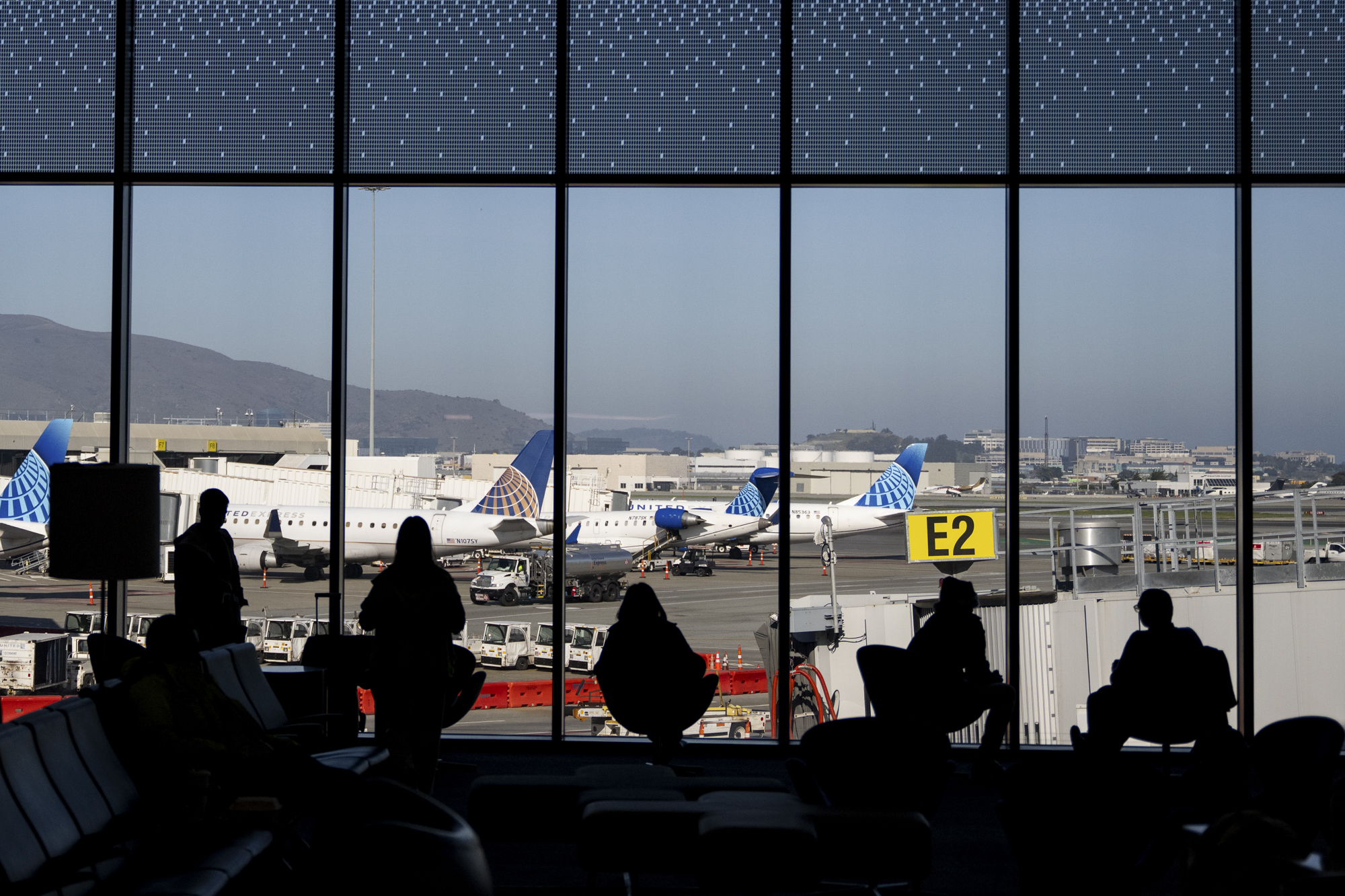
"caption": "Passengers wait for their flight at San Francisco International Airport on Dec. 10, 2025.",
"credit": "Beth LaBerge/KQED",
"altTag": null,
"description": null,
"imgSizes": {
"thumbnail": {
"file": "https://cdn.kqed.org/wp-content/uploads/sites/10/2025/12/251210-SFOEATING-87-BL-KQED-160x107.jpg",
"width": 160,
"height": 107,
"mimeType": "image/jpeg"
},
"1536x1536": {
"file": "https://cdn.kqed.org/wp-content/uploads/sites/10/2025/12/251210-SFOEATING-87-BL-KQED-1536x1024.jpg",
"width": 1536,
"height": 1024,
"mimeType": "image/jpeg"
},
"post-thumbnail": {
"file": "https://cdn.kqed.org/wp-content/uploads/sites/10/2025/12/251210-SFOEATING-87-BL-KQED-672x372.jpg",
"width": 672,
"height": 372,
"mimeType": "image/jpeg"
},
"twentyfourteen-full-width": {
"file": "https://cdn.kqed.org/wp-content/uploads/sites/10/2025/12/251210-SFOEATING-87-BL-KQED-1038x576.jpg",
"width": 1038,
"height": 576,
"mimeType": "image/jpeg"
},
"npr-cds-wide": {
"file": "https://cdn.kqed.org/wp-content/uploads/sites/10/2025/12/251210-SFOEATING-87-BL-KQED-1200x675.jpg",
"width": 1200,
"height": 675,
"mimeType": "image/jpeg"
},
"kqedFullSize": {
"file": "https://cdn.kqed.org/wp-content/uploads/sites/10/2025/12/251210-SFOEATING-87-BL-KQED.jpg",
"width": 2000,
"height": 1333
}
},
"isLoading": false,
"fetchFailed": false
},
"news_12005684": {
"type": "attachments",
"id": "news_12005684",
"meta": {
"index": "attachments_1716263798",
"site": "news",
"id": "12005684",
"found": true
},
"title": "US passports",
"publishDate": 1726861630,
"status": "inherit",
"parent": 12005679,
"modified": 1764793132,
"caption": "A U.S. passport enables travel to more than 180 countries without needing a visa beforehand.",
"credit": "Douglas Sacha/Getty Images",
"altTag": null,
"description": null,
"imgSizes": {
"medium": {
"file": "https://cdn.kqed.org/wp-content/uploads/sites/10/2024/09/GettyImages-1277623147-800x533.jpg",
"width": 800,
"height": 533,
"mimeType": "image/jpeg"
},
"large": {
"file": "https://cdn.kqed.org/wp-content/uploads/sites/10/2024/09/GettyImages-1277623147-1020x680.jpg",
"width": 1020,
"height": 680,
"mimeType": "image/jpeg"
},
"thumbnail": {
"file": "https://cdn.kqed.org/wp-content/uploads/sites/10/2024/09/GettyImages-1277623147-160x107.jpg",
"width": 160,
"height": 107,
"mimeType": "image/jpeg"
},
"1536x1536": {
"file": "https://cdn.kqed.org/wp-content/uploads/sites/10/2024/09/GettyImages-1277623147-1536x1023.jpg",
"width": 1536,
"height": 1023,
"mimeType": "image/jpeg"
},
"2048x2048": {
"file": "https://cdn.kqed.org/wp-content/uploads/sites/10/2024/09/GettyImages-1277623147-2048x1364.jpg",
"width": 2048,
"height": 1364,
"mimeType": "image/jpeg"
},
"post-thumbnail": {
"file": "https://cdn.kqed.org/wp-content/uploads/sites/10/2024/09/GettyImages-1277623147-672x372.jpg",
"width": 672,
"height": 372,
"mimeType": "image/jpeg"
},
"twentyfourteen-full-width": {
"file": "https://cdn.kqed.org/wp-content/uploads/sites/10/2024/09/GettyImages-1277623147-1038x576.jpg",
"width": 1038,
"height": 576,
"mimeType": "image/jpeg"
},
"full-width": {
"file": "https://cdn.kqed.org/wp-content/uploads/sites/10/2024/09/GettyImages-1277623147-1920x1279.jpg",
"width": 1920,
"height": 1279,
"mimeType": "image/jpeg"
},
"kqedFullSize": {
"file": "https://cdn.kqed.org/wp-content/uploads/sites/10/2024/09/GettyImages-1277623147.jpg",
"width": 2121,
"height": 1413
}
},
"isLoading": false,
"fetchFailed": false
},
"news_12055163": {
"type": "attachments",
"id": "news_12055163",
"meta": {
"index": "attachments_1716263798",
"site": "news",
"id": "12055163",
"found": true
},
"title": "Golden Gate bridge as seen from Angel Island, California",
"publishDate": 1757360536,
"status": "inherit",
"parent": 12055137,
"modified": 1763407041,
"caption": "The Golden Gate Bridge as seen from Angel Island, California, on March 8, 2019.",
"credit": "Sundry Photography/Getty Images",
"altTag": null,
"description": null,
"imgSizes": {
"thumbnail": {
"file": "https://cdn.kqed.org/wp-content/uploads/sites/10/2025/09/AngelIslandGGBridgeGetty-160x107.jpg",
"width": 160,
"height": 107,
"mimeType": "image/jpeg"
},
"1536x1536": {
"file": "https://cdn.kqed.org/wp-content/uploads/sites/10/2025/09/AngelIslandGGBridgeGetty-1536x1024.jpg",
"width": 1536,
"height": 1024,
"mimeType": "image/jpeg"
},
"post-thumbnail": {
"file": "https://cdn.kqed.org/wp-content/uploads/sites/10/2025/09/AngelIslandGGBridgeGetty-672x372.jpg",
"width": 672,
"height": 372,
"mimeType": "image/jpeg"
},
"twentyfourteen-full-width": {
"file": "https://cdn.kqed.org/wp-content/uploads/sites/10/2025/09/AngelIslandGGBridgeGetty-1038x576.jpg",
"width": 1038,
"height": 576,
"mimeType": "image/jpeg"
},
"kqedFullSize": {
"file": "https://cdn.kqed.org/wp-content/uploads/sites/10/2025/09/AngelIslandGGBridgeGetty.jpg",
"width": 2000,
"height": 1333
}
},
"isLoading": false,
"fetchFailed": false
},
"news_12065084": {
"type": "attachments",
"id": "news_12065084",
"meta": {
"index": "attachments_1716263798",
"site": "news",
"id": "12065084",
"found": true
},
"title": "wmn-afrofuturism-gallery-03",
"publishDate": 1763755144,
"status": "inherit",
"parent": 12065083,
"modified": 1763755185,
"caption": null,
"credit": "Courtesy of SFO Museum",
"altTag": null,
"description": null,
"imgSizes": {
"medium": {
"file": "https://cdn.kqed.org/wp-content/uploads/sites/10/2025/11/wmn-afrofuturism-gallery-03-2000x1337.jpg",
"width": 2000,
"height": 1337,
"mimeType": "image/jpeg"
},
"large": {
"file": "https://cdn.kqed.org/wp-content/uploads/sites/10/2025/11/wmn-afrofuturism-gallery-03-2000x1337.jpg",
"width": 2000,
"height": 1337,
"mimeType": "image/jpeg"
},
"thumbnail": {
"file": "https://cdn.kqed.org/wp-content/uploads/sites/10/2025/11/wmn-afrofuturism-gallery-03-160x107.jpg",
"width": 160,
"height": 107,
"mimeType": "image/jpeg"
},
"1536x1536": {
"file": "https://cdn.kqed.org/wp-content/uploads/sites/10/2025/11/wmn-afrofuturism-gallery-03-1536x1027.jpg",
"width": 1536,
"height": 1027,
"mimeType": "image/jpeg"
},
"2048x2048": {
"file": "https://cdn.kqed.org/wp-content/uploads/sites/10/2025/11/wmn-afrofuturism-gallery-03-2048x1369.jpg",
"width": 2048,
"height": 1369,
"mimeType": "image/jpeg"
},
"post-thumbnail": {
"file": "https://cdn.kqed.org/wp-content/uploads/sites/10/2025/11/wmn-afrofuturism-gallery-03-672x372.jpg",
"width": 672,
"height": 372,
"mimeType": "image/jpeg"
},
"twentyfourteen-full-width": {
"file": "https://cdn.kqed.org/wp-content/uploads/sites/10/2025/11/wmn-afrofuturism-gallery-03-1038x576.jpg",
"width": 1038,
"height": 576,
"mimeType": "image/jpeg"
},
"full-width": {
"file": "https://cdn.kqed.org/wp-content/uploads/sites/10/2025/11/wmn-afrofuturism-gallery-03-2000x1337.jpg",
"width": 2000,
"height": 1337,
"mimeType": "image/jpeg"
},
"npr-cds-wide": {
"file": "https://cdn.kqed.org/wp-content/uploads/sites/10/2025/11/wmn-afrofuturism-gallery-03-1200x675.jpg",
"width": 1200,
"height": 675,
"mimeType": "image/jpeg"
},
"kqedFullSize": {
"file": "https://cdn.kqed.org/wp-content/uploads/sites/10/2025/11/wmn-afrofuturism-gallery-03-scaled-e1763755167409.jpg",
"width": 1600,
"height": 1069
}
},
"isLoading": false,
"fetchFailed": false
},
"news_12065092": {
"type": "attachments",
"id": "news_12065092",
"meta": {
"index": "attachments_1716263798",
"site": "news",
"id": "12065092",
"found": true
},
"title": "Oakland City Officials Approve Name Change Of Airport To San Francisco Bay Oakland International Airport",
"publishDate": 1763757186,
"status": "inherit",
"parent": 12065087,
"modified": 1763757227,
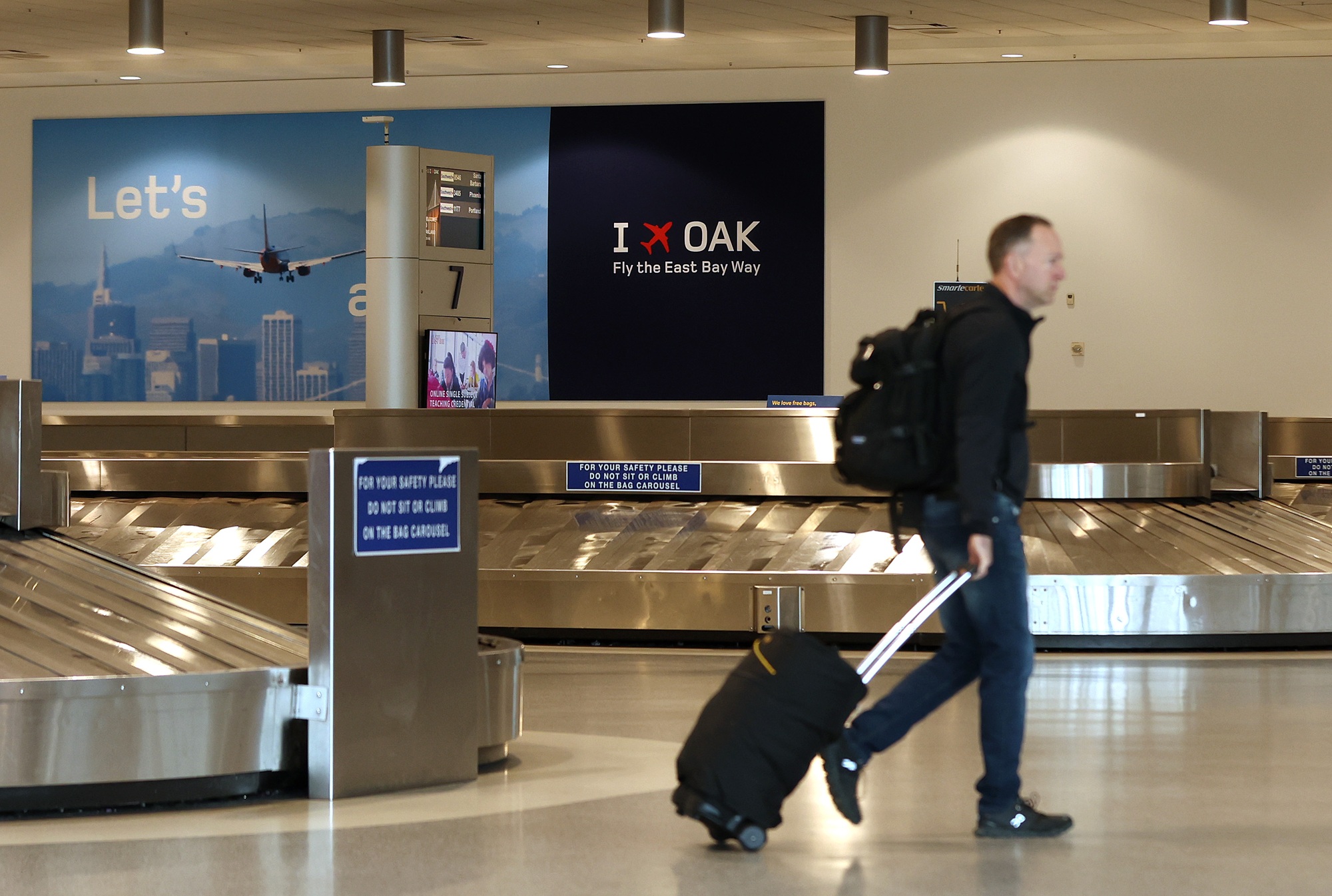
"caption": "A traveler walks through baggage claim in Terminal 2 at Oakland International Airport on April 12, 2024, in Oakland, California. ",
"credit": "Justin Sullivan/Getty Images",
"altTag": null,
"description": null,
"imgSizes": {
"thumbnail": {
"file": "https://cdn.kqed.org/wp-content/uploads/sites/10/2025/11/OaklandAirportGetty-160x108.jpg",
"width": 160,
"height": 108,
"mimeType": "image/jpeg"
},
"1536x1536": {
"file": "https://cdn.kqed.org/wp-content/uploads/sites/10/2025/11/OaklandAirportGetty-1536x1034.jpg",
"width": 1536,
"height": 1034,
"mimeType": "image/jpeg"
},
"post-thumbnail": {
"file": "https://cdn.kqed.org/wp-content/uploads/sites/10/2025/11/OaklandAirportGetty-672x372.jpg",
"width": 672,
"height": 372,
"mimeType": "image/jpeg"
},
"twentyfourteen-full-width": {
"file": "https://cdn.kqed.org/wp-content/uploads/sites/10/2025/11/OaklandAirportGetty-1038x576.jpg",
"width": 1038,
"height": 576,
"mimeType": "image/jpeg"
},
"npr-cds-wide": {
"file": "https://cdn.kqed.org/wp-content/uploads/sites/10/2025/11/OaklandAirportGetty-1200x675.jpg",
"width": 1200,
"height": 675,
"mimeType": "image/jpeg"
},
"kqedFullSize": {
"file": "https://cdn.kqed.org/wp-content/uploads/sites/10/2025/11/OaklandAirportGetty.jpg",
"width": 2000,
"height": 1346
}
},
"isLoading": false,
"fetchFailed": false
},
"news_12063251": {
"type": "attachments",
"id": "news_12063251",
"meta": {
"index": "attachments_1716263798",
"site": "news",
"id": "12063251",
"found": true
},
"title": "Passengers sleep while waiting for their flight at Terminal 3 of San Francisco International Airport on Thursday, July 20, 2017 in San Francisco, Calif.",
"publishDate": 1762461164,
"status": "inherit",
"parent": 12063192,
"modified": 1762461205,
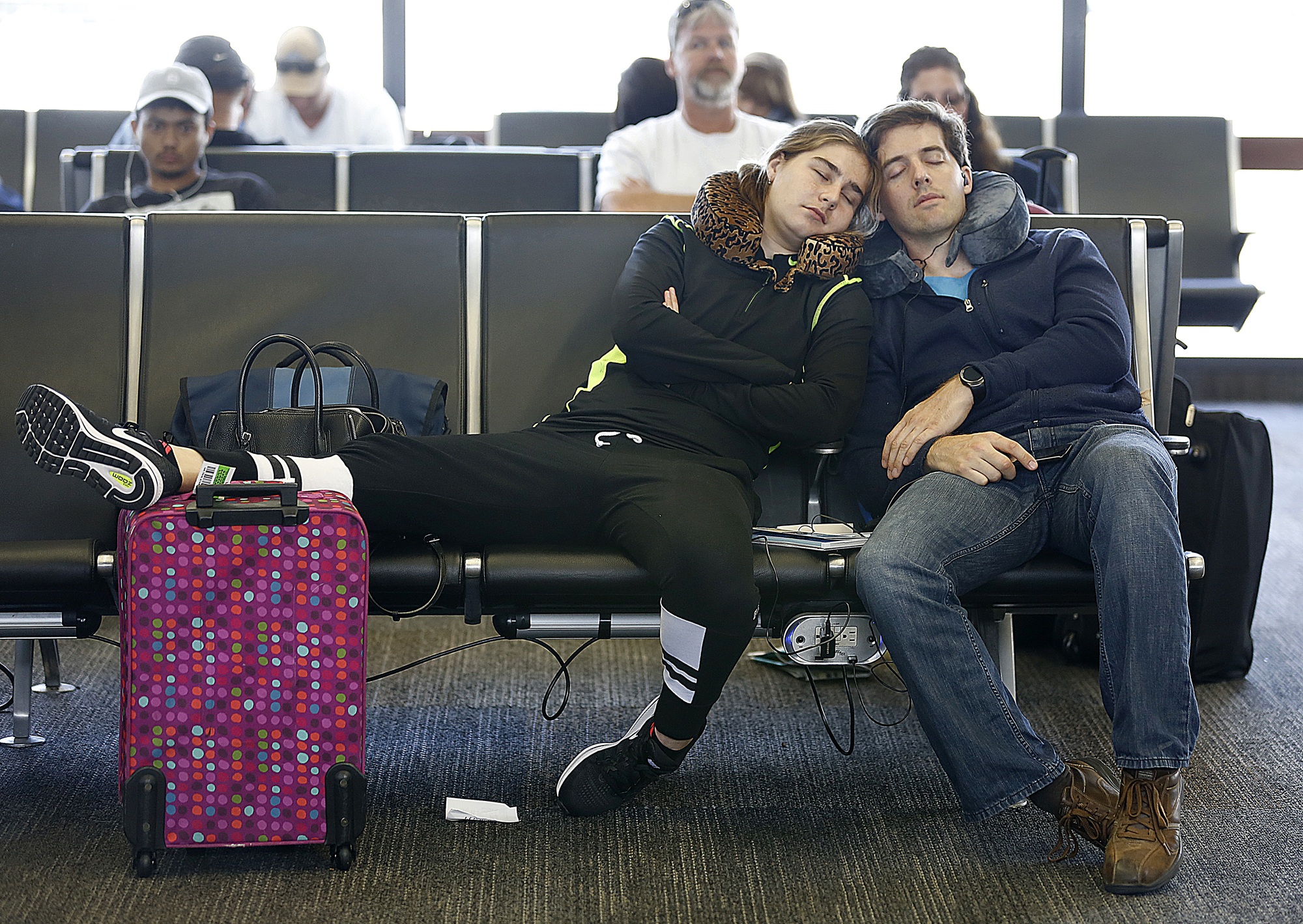
"caption": "Passengers sleep while waiting for their flight at Terminal 3 of San Francisco International Airport on July 20, 2017, in San Francisco, California.",
"credit": "Liz Hafalia/The San Francisco Chronicle via Getty Images",
"altTag": null,
"description": null,
"imgSizes": {
"thumbnail": {
"file": "https://cdn.kqed.org/wp-content/uploads/sites/10/2025/11/SFODelaysGetty2-160x114.jpg",
"width": 160,
"height": 114,
"mimeType": "image/jpeg"
},
"1536x1536": {
"file": "https://cdn.kqed.org/wp-content/uploads/sites/10/2025/11/SFODelaysGetty2-1536x1090.jpg",
"width": 1536,
"height": 1090,
"mimeType": "image/jpeg"
},
"post-thumbnail": {
"file": "https://cdn.kqed.org/wp-content/uploads/sites/10/2025/11/SFODelaysGetty2-672x372.jpg",
"width": 672,
"height": 372,
"mimeType": "image/jpeg"
},
"twentyfourteen-full-width": {
"file": "https://cdn.kqed.org/wp-content/uploads/sites/10/2025/11/SFODelaysGetty2-1038x576.jpg",
"width": 1038,
"height": 576,
"mimeType": "image/jpeg"
},
"npr-cds-wide": {
"file": "https://cdn.kqed.org/wp-content/uploads/sites/10/2025/11/SFODelaysGetty2-1200x675.jpg",
"width": 1200,
"height": 675,
"mimeType": "image/jpeg"
},
"kqedFullSize": {
"file": "https://cdn.kqed.org/wp-content/uploads/sites/10/2025/11/SFODelaysGetty2.jpg",
"width": 2000,
"height": 1419
}
},
"isLoading": false,
"fetchFailed": false
},
"news_12063252": {
"type": "attachments",
"id": "news_12063252",
"meta": {
"index": "attachments_1716263798",
"site": "news",
"id": "12063252",
"found": true
},
"title": "Delays And Cancellations Continue To Plague Airline Industry Heading Into Holiday Weekend",
"publishDate": 1762461535,
"status": "inherit",
"parent": 12063192,
"modified": 1762461575,
"caption": "Travelers line up to check in for United Airlines flights at San Francisco International Airport on July 1, 2022 ,in San Francisco, California. ",
"credit": "Justin Sullivan/Getty Images",
"altTag": null,
"description": null,
"imgSizes": {
"thumbnail": {
"file": "https://cdn.kqed.org/wp-content/uploads/sites/10/2025/11/SFODelaysGetty3-160x107.jpg",
"width": 160,
"height": 107,
"mimeType": "image/jpeg"
},
"1536x1536": {
"file": "https://cdn.kqed.org/wp-content/uploads/sites/10/2025/11/SFODelaysGetty3-1536x1024.jpg",
"width": 1536,
"height": 1024,
"mimeType": "image/jpeg"
},
"post-thumbnail": {
"file": "https://cdn.kqed.org/wp-content/uploads/sites/10/2025/11/SFODelaysGetty3-672x372.jpg",
"width": 672,
"height": 372,
"mimeType": "image/jpeg"
},
"twentyfourteen-full-width": {
"file": "https://cdn.kqed.org/wp-content/uploads/sites/10/2025/11/SFODelaysGetty3-1038x576.jpg",
"width": 1038,
"height": 576,
"mimeType": "image/jpeg"
},
"npr-cds-wide": {
"file": "https://cdn.kqed.org/wp-content/uploads/sites/10/2025/11/SFODelaysGetty3-1200x675.jpg",
"width": 1200,
"height": 675,
"mimeType": "image/jpeg"
},
"kqedFullSize": {
"file": "https://cdn.kqed.org/wp-content/uploads/sites/10/2025/11/SFODelaysGetty3.jpg",
"width": 2000,
"height": 1333
}
},
"isLoading": false,
"fetchFailed": false
},
"news_12063201": {
"type": "attachments",
"id": "news_12063201",
"meta": {
"index": "attachments_1716263798",
"site": "news",
"id": "12063201",
"found": true
},
"title": "Delays And Cancellations Continue To Plague Airline Industry Heading Into Holiday Weekend",
"publishDate": 1762451503,
"status": "inherit",
"parent": 12063196,
"modified": 1762452703,
"caption": "Travelers walk with their luggage at San Francisco International Airport on July 1, 2022, in San Francisco, California. ",
"credit": "Justin Sullivan/Getty Images",
"altTag": null,
"description": null,
"imgSizes": {
"thumbnail": {
"file": "https://cdn.kqed.org/wp-content/uploads/sites/10/2025/11/SFODelaysGetty-160x107.jpg",
"width": 160,
"height": 107,
"mimeType": "image/jpeg"
},
"1536x1536": {
"file": "https://cdn.kqed.org/wp-content/uploads/sites/10/2025/11/SFODelaysGetty-1536x1026.jpg",
"width": 1536,
"height": 1026,
"mimeType": "image/jpeg"
},
"post-thumbnail": {
"file": "https://cdn.kqed.org/wp-content/uploads/sites/10/2025/11/SFODelaysGetty-672x372.jpg",
"width": 672,
"height": 372,
"mimeType": "image/jpeg"
},
"twentyfourteen-full-width": {
"file": "https://cdn.kqed.org/wp-content/uploads/sites/10/2025/11/SFODelaysGetty-1038x576.jpg",
"width": 1038,
"height": 576,
"mimeType": "image/jpeg"
},
"npr-cds-wide": {
"file": "https://cdn.kqed.org/wp-content/uploads/sites/10/2025/11/SFODelaysGetty-1200x675.jpg",
"width": 1200,
"height": 675,
"mimeType": "image/jpeg"
},
"kqedFullSize": {
"file": "https://cdn.kqed.org/wp-content/uploads/sites/10/2025/11/SFODelaysGetty.jpg",
"width": 2000,
"height": 1336
}
},
"isLoading": false,
"fetchFailed": false
},
"news_11773994": {
"type": "attachments",
"id": "news_11773994",
"meta": {
"index": "attachments_1716263798",
"site": "news",
"id": "11773994",
"found": true
},
"title": "Hundreds Of Flights In And Out Of San Francisco International Airport Delayed, As The Airport Works To Update Its Busiest Runway",
"publishDate": 1568327990,
"status": "inherit",
"parent": 11773957,
"modified": 1759883272,
"caption": "A United Airlines customer talks to a ticket agent at San Francisco International Airport on Sept. 9, 2019, in San Francisco, California.",
"credit": "Justin Sullivan/Getty Images",
"altTag": null,
"description": null,
"imgSizes": {
"thumbnail": {
"file": "https://cdn.kqed.org/wp-content/uploads/sites/10/2019/09/GettyImages-1173446702-1-160x107.jpg",
"width": 160,
"height": 107,
"mimeType": "image/jpeg"
},
"medium": {
"file": "https://cdn.kqed.org/wp-content/uploads/sites/10/2019/09/GettyImages-1173446702-1-800x537.jpg",
"width": 800,
"height": 537,
"mimeType": "image/jpeg"
},
"large": {
"file": "https://cdn.kqed.org/wp-content/uploads/sites/10/2019/09/GettyImages-1173446702-1-1020x685.jpg",
"width": 1020,
"height": 685,
"mimeType": "image/jpeg"
},
"complete_open_graph": {
"file": "https://cdn.kqed.org/wp-content/uploads/sites/10/2019/09/GettyImages-1173446702-1-1200x805.jpg",
"width": 1200,
"height": 805,
"mimeType": "image/jpeg"
},
"post-thumbnail": {
"file": "https://cdn.kqed.org/wp-content/uploads/sites/10/2019/09/GettyImages-1173446702-1-672x372.jpg",
"width": 672,
"height": 372,
"mimeType": "image/jpeg"
},
"twentyfourteen-full-width": {
"file": "https://cdn.kqed.org/wp-content/uploads/sites/10/2019/09/GettyImages-1173446702-1-1038x576.jpg",
"width": 1038,
"height": 576,
"mimeType": "image/jpeg"
},
"full-width": {
"file": "https://cdn.kqed.org/wp-content/uploads/sites/10/2019/09/GettyImages-1173446702-1-1920x1289.jpg",
"width": 1920,
"height": 1289,
"mimeType": "image/jpeg"
},
"apple_news_ca_landscape_12_9": {
"file": "https://cdn.kqed.org/wp-content/uploads/sites/10/2019/09/GettyImages-1173446702-1-1832x1374.jpg",
"width": 1832,
"height": 1374,
"mimeType": "image/jpeg"
},
"apple_news_ca_landscape_9_7": {
"file": "https://cdn.kqed.org/wp-content/uploads/sites/10/2019/09/GettyImages-1173446702-1-1376x1032.jpg",
"width": 1376,
"height": 1032,
"mimeType": "image/jpeg"
},
"apple_news_ca_landscape_5_5": {
"file": "https://cdn.kqed.org/wp-content/uploads/sites/10/2019/09/GettyImages-1173446702-1-1044x783.jpg",
"width": 1044,
"height": 783,
"mimeType": "image/jpeg"
},
"apple_news_ca_landscape_4_7": {
"file": "https://cdn.kqed.org/wp-content/uploads/sites/10/2019/09/GettyImages-1173446702-1-632x474.jpg",
"width": 632,
"height": 474,
"mimeType": "image/jpeg"
},
"apple_news_ca_landscape_4_0": {
"file": "https://cdn.kqed.org/wp-content/uploads/sites/10/2019/09/GettyImages-1173446702-1-536x402.jpg",
"width": 536,
"height": 402,
"mimeType": "image/jpeg"
},
"apple_news_ca_portrait_12_9": {
"file": "https://cdn.kqed.org/wp-content/uploads/sites/10/2019/09/GettyImages-1173446702-1-1122x1496.jpg",
"width": 1122,
"height": 1496,
"mimeType": "image/jpeg"
},
"apple_news_ca_portrait_9_7": {
"file": "https://cdn.kqed.org/wp-content/uploads/sites/10/2019/09/GettyImages-1173446702-1-840x1120.jpg",
"width": 840,
"height": 1120,
"mimeType": "image/jpeg"
},
"apple_news_ca_portrait_5_5": {
"file": "https://cdn.kqed.org/wp-content/uploads/sites/10/2019/09/GettyImages-1173446702-1-687x916.jpg",
"width": 687,
"height": 916,
"mimeType": "image/jpeg"
},
"apple_news_ca_portrait_4_7": {
"file": "https://cdn.kqed.org/wp-content/uploads/sites/10/2019/09/GettyImages-1173446702-1-414x552.jpg",
"width": 414,
"height": 552,
"mimeType": "image/jpeg"
},
"apple_news_ca_portrait_4_0": {
"file": "https://cdn.kqed.org/wp-content/uploads/sites/10/2019/09/GettyImages-1173446702-1-354x472.jpg",
"width": 354,
"height": 472,
"mimeType": "image/jpeg"
},
"apple_news_ca_square_12_9": {
"file": "https://cdn.kqed.org/wp-content/uploads/sites/10/2019/09/GettyImages-1173446702-1-1472x1472.jpg",
"width": 1472,
"height": 1472,
"mimeType": "image/jpeg"
},
"apple_news_ca_square_9_7": {
"file": "https://cdn.kqed.org/wp-content/uploads/sites/10/2019/09/GettyImages-1173446702-1-1104x1104.jpg",
"width": 1104,
"height": 1104,
"mimeType": "image/jpeg"
},
"apple_news_ca_square_5_5": {
"file": "https://cdn.kqed.org/wp-content/uploads/sites/10/2019/09/GettyImages-1173446702-1-912x912.jpg",
"width": 912,
"height": 912,
"mimeType": "image/jpeg"
},
"apple_news_ca_square_4_7": {
"file": "https://cdn.kqed.org/wp-content/uploads/sites/10/2019/09/GettyImages-1173446702-1-550x550.jpg",
"width": 550,
"height": 550,
"mimeType": "image/jpeg"
},
"apple_news_ca_square_4_0": {
"file": "https://cdn.kqed.org/wp-content/uploads/sites/10/2019/09/GettyImages-1173446702-1-470x470.jpg",
"width": 470,
"height": 470,
"mimeType": "image/jpeg"
},
"kqedFullSize": {
"file": "https://cdn.kqed.org/wp-content/uploads/sites/10/2019/09/GettyImages-1173446702-1-e1568328016889.jpg",
"width": 1920,
"height": 1289
}
},
"isLoading": false,
"fetchFailed": false
},
"news_12058324": {
"type": "attachments",
"id": "news_12058324",
"meta": {
"index": "attachments_1716263798",
"site": "news",
"id": "12058324",
"found": true
},
"title": "Government Shutdown Looms As House And Senate Disagree On Funding Bill",
"publishDate": 1759362335,
"status": "inherit",
"parent": 12058294,
"modified": 1759363906,
"caption": "A view of the U.S. Capitol as the sun sets on Sept. 29, 2025, in Washington, D.C. House and Senate leadership met with President Donald Trump earlier in the day at the White House to try to avoid a government shutdown at midnight on Sept. 30.",
"credit": "Photo by Anna Moneymaker/Getty Images",
"altTag": null,
"description": null,
"imgSizes": {
"medium": {
"file": "https://cdn.kqed.org/wp-content/uploads/sites/10/2025/10/GettyImages-2238183191-2000x1334.jpg",
"width": 2000,
"height": 1334,
"mimeType": "image/jpeg"
},
"large": {
"file": "https://cdn.kqed.org/wp-content/uploads/sites/10/2025/10/GettyImages-2238183191-2000x1334.jpg",
"width": 2000,
"height": 1334,
"mimeType": "image/jpeg"
},
"thumbnail": {
"file": "https://cdn.kqed.org/wp-content/uploads/sites/10/2025/10/GettyImages-2238183191-160x107.jpg",
"width": 160,
"height": 107,
"mimeType": "image/jpeg"
},
"1536x1536": {
"file": "https://cdn.kqed.org/wp-content/uploads/sites/10/2025/10/GettyImages-2238183191-1536x1024.jpg",
"width": 1536,
"height": 1024,
"mimeType": "image/jpeg"
},
"2048x2048": {
"file": "https://cdn.kqed.org/wp-content/uploads/sites/10/2025/10/GettyImages-2238183191-2048x1366.jpg",
"width": 2048,
"height": 1366,
"mimeType": "image/jpeg"
},
"post-thumbnail": {
"file": "https://cdn.kqed.org/wp-content/uploads/sites/10/2025/10/GettyImages-2238183191-672x372.jpg",
"width": 672,
"height": 372,
"mimeType": "image/jpeg"
},
"twentyfourteen-full-width": {
"file": "https://cdn.kqed.org/wp-content/uploads/sites/10/2025/10/GettyImages-2238183191-1038x576.jpg",
"width": 1038,
"height": 576,
"mimeType": "image/jpeg"
},
"full-width": {
"file": "https://cdn.kqed.org/wp-content/uploads/sites/10/2025/10/GettyImages-2238183191-2000x1334.jpg",
"width": 2000,
"height": 1334,
"mimeType": "image/jpeg"
},
"kqedFullSize": {
"file": "https://cdn.kqed.org/wp-content/uploads/sites/10/2025/10/GettyImages-2238183191-scaled.jpg",
"width": 2560,
"height": 1707
}
},
"isLoading": false,
"fetchFailed": false
},
"news_12057927": {
"type": "attachments",
"id": "news_12057927",
"meta": {
"index": "attachments_1716263798",
"site": "news",
"id": "12057927",
"found": true
},
"title": "The United States Capitol building",
"publishDate": 1759163172,
"status": "inherit",
"parent": 12057777,
"modified": 1759165647,
"caption": "The United States Capitol building in Washington, D.C., on Sept. 24, 2025.",
"credit": "Yasin Ozturk/Anadolu via Getty Images",
"altTag": null,
"description": null,
"imgSizes": {
"thumbnail": {
"file": "https://cdn.kqed.org/wp-content/uploads/sites/10/2025/09/GETTYIMAGES-2236770685-KQED_1-160x107.jpg",
"width": 160,
"height": 107,
"mimeType": "image/jpeg"
},
"1536x1536": {
"file": "https://cdn.kqed.org/wp-content/uploads/sites/10/2025/09/GETTYIMAGES-2236770685-KQED_1-1536x1024.jpg",
"width": 1536,
"height": 1024,
"mimeType": "image/jpeg"
},
"post-thumbnail": {
"file": "https://cdn.kqed.org/wp-content/uploads/sites/10/2025/09/GETTYIMAGES-2236770685-KQED_1-672x372.jpg",
"width": 672,
"height": 372,
"mimeType": "image/jpeg"
},
"twentyfourteen-full-width": {
"file": "https://cdn.kqed.org/wp-content/uploads/sites/10/2025/09/GETTYIMAGES-2236770685-KQED_1-1038x576.jpg",
"width": 1038,
"height": 576,
"mimeType": "image/jpeg"
},
"kqedFullSize": {
"file": "https://cdn.kqed.org/wp-content/uploads/sites/10/2025/09/GETTYIMAGES-2236770685-KQED_1.jpg",
"width": 2000,
"height": 1333
}
},
"isLoading": false,
"fetchFailed": false
},
"news_12048869": {
"type": "attachments",
"id": "news_12048869",
"meta": {
"index": "attachments_1716263798",
"site": "news",
"id": "12048869",
"found": true
},
"title": "npr.brightspotcdn copy",
"publishDate": 1752873669,
"status": "inherit",
"parent": 12048860,
"modified": 1752873692,
"caption": "While air traffic controllers welcome an infusion of more than $12 billion to modernize their equipment, some controllers say they are under pressure due to other issues, such as grueling schedules, mandatory overtime and stagnating pay.",
"credit": "Glenn Harvey for NPR",
"altTag": null,
"description": null,
"imgSizes": {
"medium": {
"file": "https://cdn.kqed.org/wp-content/uploads/sites/10/2025/07/npr.brightspotcdn-copy-14-2000x1333.jpg",
"width": 2000,
"height": 1333,
"mimeType": "image/jpeg"
},
"large": {
"file": "https://cdn.kqed.org/wp-content/uploads/sites/10/2025/07/npr.brightspotcdn-copy-14-2000x1333.jpg",
"width": 2000,
"height": 1333,
"mimeType": "image/jpeg"
},
"thumbnail": {
"file": "https://cdn.kqed.org/wp-content/uploads/sites/10/2025/07/npr.brightspotcdn-copy-14-160x107.jpg",
"width": 160,
"height": 107,
"mimeType": "image/jpeg"
},
"1536x1536": {
"file": "https://cdn.kqed.org/wp-content/uploads/sites/10/2025/07/npr.brightspotcdn-copy-14-1536x1024.jpg",
"width": 1536,
"height": 1024,
"mimeType": "image/jpeg"
},
"2048x2048": {
"file": "https://cdn.kqed.org/wp-content/uploads/sites/10/2025/07/npr.brightspotcdn-copy-14-2048x1365.jpg",
"width": 2048,
"height": 1365,
"mimeType": "image/jpeg"
},
"post-thumbnail": {
"file": "https://cdn.kqed.org/wp-content/uploads/sites/10/2025/07/npr.brightspotcdn-copy-14-672x372.jpg",
"width": 672,
"height": 372,
"mimeType": "image/jpeg"
},
"twentyfourteen-full-width": {
"file": "https://cdn.kqed.org/wp-content/uploads/sites/10/2025/07/npr.brightspotcdn-copy-14-1038x576.jpg",
"width": 1038,
"height": 576,
"mimeType": "image/jpeg"
},
"full-width": {
"file": "https://cdn.kqed.org/wp-content/uploads/sites/10/2025/07/npr.brightspotcdn-copy-14-2000x1333.jpg",
"width": 2000,
"height": 1333,
"mimeType": "image/jpeg"
},
"kqedFullSize": {
"file": "https://cdn.kqed.org/wp-content/uploads/sites/10/2025/07/npr.brightspotcdn-copy-14.jpg",
"width": 2400,
"height": 1600
}
},
"isLoading": false,
"fetchFailed": false
}
},
"audioPlayerReducer": {
"postId": "stream_live",
"isPaused": true,
"isPlaying": false,
"pfsActive": false,
"pledgeModalIsOpen": true,
"playerDrawerIsOpen": false,
"liveAudioPlayStartedAt": 0,
"liveAudioPlayContext": ""
},
"authorsReducer": {
"byline_news_12048860": {
"type": "authors",
"id": "byline_news_12048860",
"meta": {
"override": true
},
"slug": "byline_news_12048860",
"name": "Joe Hernandez and Joel Rose, NPR",
"isLoading": false
},
"carlysevern": {
"type": "authors",
"id": "3243",
"meta": {
"index": "authors_1716337520",
"id": "3243",
"found": true
},
"name": "Carly Severn",
"firstName": "Carly",
"lastName": "Severn",
"slug": "carlysevern",
"email": "csevern@kqed.org",
"display_author_email": false,
"staff_mastheads": [
"news"
],
"title": "Senior Editor, Audience News ",
"bio": "Carly is KQED's Senior Editor of Audience News on the Digital News team, and has reported for the California Report Magazine, Bay Curious and KQED Arts. She's formerly the host of \u003ca href=\"http://ww2.kqed.org/pop/category/the-cooler/\" rel=\"noopener noreferrer\">The Cooler\u003c/a> podcast.",
"avatar": "https://secure.gravatar.com/avatar/2d8d6765f186e64c798cf7f0c8088a41?s=600&d=blank&r=g",
"twitter": "teacupinthebay",
"facebook": null,
"instagram": null,
"linkedin": null,
"sites": [
{
"site": "",
"roles": [
"editor"
]
},
{
"site": "arts",
"roles": [
"editor"
]
},
{
"site": "news",
"roles": [
"administrator"
]
},
{
"site": "pop",
"roles": [
"editor"
]
},
{
"site": "futureofyou",
"roles": [
"editor"
]
},
{
"site": "about",
"roles": [
"administrator"
]
},
{
"site": "mindshift",
"roles": [
"editor"
]
},
{
"site": "bayareabites",
"roles": [
"editor"
]
},
{
"site": "stateofhealth",
"roles": [
"editor"
]
},
{
"site": "science",
"roles": [
"editor"
]
},
{
"site": "food",
"roles": [
"contributor"
]
},
{
"site": "forum",
"roles": [
"editor"
]
},
{
"site": "perspectives",
"roles": [
"administrator"
]
},
{
"site": "liveblog",
"roles": [
"editor"
]
}
],
"headData": {
"title": "Carly Severn | KQED",
"description": "Senior Editor, Audience News ",
"ogImgSrc": "https://secure.gravatar.com/avatar/2d8d6765f186e64c798cf7f0c8088a41?s=600&d=blank&r=g",
"twImgSrc": "https://secure.gravatar.com/avatar/2d8d6765f186e64c798cf7f0c8088a41?s=600&d=blank&r=g"
},
"isLoading": false,
"link": "/author/carlysevern"
},
"ecruzguevarra": {
"type": "authors",
"id": "8654",
"meta": {
"index": "authors_1716337520",
"id": "8654",
"found": true
},
"name": "Ericka Cruz Guevarra",
"firstName": "Ericka",
"lastName": "Cruz Guevarra",
"slug": "ecruzguevarra",
"email": "ecruzguevarra@kqed.org",
"display_author_email": true,
"staff_mastheads": [
"news"
],
"title": "Producer, The Bay Podcast",
"bio": "Ericka Cruz Guevarra is host of \u003ca href=\"https://www.kqed.org/podcasts/thebay\">\u003cem>The Bay\u003c/em>\u003c/a> podcast at KQED. Before host, she was the show’s producer. Her work in that capacity includes a three-part reported series on policing in Vallejo, which won a 2020 excellence in journalism award from the Society of Professional Journalists. Ericka has worked as a breaking news reporter at Oregon Public Broadcasting, helped produce the Code Switch podcast, and was KQED’s inaugural Raul Ramirez Diversity Fund intern. She’s also an alumna of NPR’s Next Generation Radio program. Send her an email if you have strong feelings about whether Fairfield and Suisun City are the Bay. Ericka is represented by SAG-AFTRA.",
"avatar": "https://secure.gravatar.com/avatar/25e5ab8d3d53fad2dcc7bb2b5c506b1a?s=600&d=blank&r=g",
"twitter": "NotoriousECG",
"facebook": null,
"instagram": null,
"linkedin": null,
"sites": [
{
"site": "arts",
"roles": [
"subscriber"
]
},
{
"site": "news",
"roles": [
"editor",
"manage_categories"
]
},
{
"site": "futureofyou",
"roles": [
"subscriber"
]
},
{
"site": "stateofhealth",
"roles": [
"subscriber"
]
},
{
"site": "science",
"roles": [
"editor"
]
},
{
"site": "forum",
"roles": [
"subscriber"
]
}
],
"headData": {
"title": "Ericka Cruz Guevarra | KQED",
"description": "Producer, The Bay Podcast",
"ogImgSrc": "https://secure.gravatar.com/avatar/25e5ab8d3d53fad2dcc7bb2b5c506b1a?s=600&d=blank&r=g",
"twImgSrc": "https://secure.gravatar.com/avatar/25e5ab8d3d53fad2dcc7bb2b5c506b1a?s=600&d=blank&r=g"
},
"isLoading": false,
"link": "/author/ecruzguevarra"
},
"amontecillo": {
"type": "authors",
"id": "11649",
"meta": {
"index": "authors_1716337520",
"id": "11649",
"found": true
},
"name": "Alan Montecillo",
"firstName": "Alan",
"lastName": "Montecillo",
"slug": "amontecillo",
"email": "amontecillo@kqed.org",
"display_author_email": false,
"staff_mastheads": [
"news"
],
"title": "KQED Contributor",
"bio": "Alan Montecillo is the senior editor of \u003cem>\u003ca href=\"http://kqed.org/thebay\">The Bay\u003c/a>, \u003c/em> KQED's local news podcast. Before moving to the Bay Area, he worked as a senior talk show producer for WILL in Champaign-Urbana, Illinois and at Oregon Public Broadcasting in Portland, Oregon. He has won journalism awards from the Society of Professional Journalists Northern California, the Public Media Journalists Association, The Signal Awards, and has also received a regional Edward R. Murrow award. Alan is a Filipino American from Hong Kong and a graduate of Reed College.",
"avatar": "https://secure.gravatar.com/avatar/d5e4e7a76481969ccba76f4e2b5ccabc?s=600&d=blank&r=g",
"twitter": "alanmontecillo",
"facebook": null,
"instagram": null,
"linkedin": null,
"sites": [
{
"site": "",
"roles": [
"editor"
]
},
{
"site": "news",
"roles": [
"editor",
"manage_categories"
]
}
],
"headData": {
"title": "Alan Montecillo | KQED",
"description": "KQED Contributor",
"ogImgSrc": "https://secure.gravatar.com/avatar/d5e4e7a76481969ccba76f4e2b5ccabc?s=600&d=blank&r=g",
"twImgSrc": "https://secure.gravatar.com/avatar/d5e4e7a76481969ccba76f4e2b5ccabc?s=600&d=blank&r=g"
},
"isLoading": false,
"link": "/author/amontecillo"
},
"abandlamudi": {
"type": "authors",
"id": "11672",
"meta": {
"index": "authors_1716337520",
"id": "11672",
"found": true
},
"name": "Adhiti Bandlamudi",
"firstName": "Adhiti",
"lastName": "Bandlamudi",
"slug": "abandlamudi",
"email": "abandlamudi@kqed.org",
"display_author_email": false,
"staff_mastheads": [
"news"
],
"title": "KQED Housing Reporter",
"bio": "Adhiti Bandlamudi reports for KQED's Housing desk. She focuses on how housing gets built across the Bay Area. Before joining KQED in 2020, she reported for WUNC in Durham, North Carolina, WABE in Atlanta, Georgia and Capital Public Radio in Sacramento. In 2017, she was awarded a Kroc Fellowship at NPR where she reported on everything from sprinkles to the Golden State Killer's arrest. When she's not reporting, she's baking new recipes in her kitchen or watching movies with friends and family. She's originally from Georgia and has strong opinions about Great British Bake Off.",
"avatar": "https://secure.gravatar.com/avatar/868129c8b257bb99a3500e2c86a65400?s=600&d=mm&r=g",
"twitter": "oddity_adhiti",
"facebook": null,
"instagram": null,
"linkedin": null,
"sites": [
{
"site": "arts",
"roles": [
"author"
]
},
{
"site": "news",
"roles": [
"editor"
]
},
{
"site": "liveblog",
"roles": [
"author"
]
}
],
"headData": {
"title": "Adhiti Bandlamudi | KQED",
"description": "KQED Housing Reporter",
"ogImgSrc": "https://secure.gravatar.com/avatar/868129c8b257bb99a3500e2c86a65400?s=600&d=mm&r=g",
"twImgSrc": "https://secure.gravatar.com/avatar/868129c8b257bb99a3500e2c86a65400?s=600&d=mm&r=g"
},
"isLoading": false,
"link": "/author/abandlamudi"
},
"jessicakariisa": {
"type": "authors",
"id": "11831",
"meta": {
"index": "authors_1716337520",
"id": "11831",
"found": true
},
"name": "Jessica Kariisa",
"firstName": "Jessica",
"lastName": "Kariisa",
"slug": "jessicakariisa",
"email": "jkariisa@kqed.org",
"display_author_email": false,
"staff_mastheads": [],
"title": "Producer, The Bay",
"bio": "Jessica Kariisa is the producer of The Bay. She first joined KQED as an intern for The California Report Magazine, after which she became an on-call producer. She reported a Bay Curious episode on the use of rap lyrics in criminal trials which won a Society of Professional Journalists award in 2023 for Excellence in Features Journalism and the 2023 Signal Award for Best Conversation Starter. She’s worked on podcasts for Snap Judgment and American Public Media. Before embarking on her audio career, she was a music journalist.\r\n\r\nJessica Kariisa is represented by SAG-AFTRA.",
"avatar": "https://secure.gravatar.com/avatar/522e97b28ac0b3d411621c0fde8f3419c7b71ea2c5c262c57c4bb600963f328c?s=600&d=blank&r=g",
"twitter": null,
"bluesky": null,
"facebook": null,
"instagram": null,
"linkedin": null,
"sites": [
{
"site": "arts",
"roles": [
"author"
]
},
{
"site": "news",
"roles": [
"editor",
"manage_categories"
]
}
],
"headData": {
"title": "Jessica Kariisa | KQED",
"description": "Producer, The Bay",
"ogImgSrc": "https://secure.gravatar.com/avatar/522e97b28ac0b3d411621c0fde8f3419c7b71ea2c5c262c57c4bb600963f328c?s=600&d=blank&r=g",
"twImgSrc": "https://secure.gravatar.com/avatar/522e97b28ac0b3d411621c0fde8f3419c7b71ea2c5c262c57c4bb600963f328c?s=600&d=blank&r=g"
},
"isLoading": false,
"link": "/author/jessicakariisa"
},
"nkhan": {
"type": "authors",
"id": "11867",
"meta": {
"index": "authors_1716337520",
"id": "11867",
"found": true
},
"name": "Nisa Khan",
"firstName": "Nisa",
"lastName": "Khan",
"slug": "nkhan",
"email": "nkhan@kqed.org",
"display_author_email": false,
"staff_mastheads": [],
"title": "KQED Contributor",
"bio": "Nisa Khan is a reporter for KQED's Audience News Desk. She was formerly a data reporter at Michigan Radio. She earned a Bachelor of Science in Information from the University of Michigan and a Master of Arts in Communication from Stanford University.",
"avatar": "https://secure.gravatar.com/avatar/a3bf1efcfbe7658d13a434cc54d0b2e3?s=600&d=blank&r=g",
"twitter": "mnisakhan",
"bluesky": null,
"facebook": null,
"instagram": null,
"linkedin": null,
"sites": [
{
"site": "arts",
"roles": [
"editor"
]
},
{
"site": "news",
"roles": [
"editor"
]
},
{
"site": "science",
"roles": [
"editor",
"author"
]
},
{
"site": "forum",
"roles": [
"editor"
]
},
{
"site": "liveblog",
"roles": [
"contributor"
]
}
],
"headData": {
"title": "Nisa Khan | KQED",
"description": "KQED Contributor",
"ogImgSrc": "https://secure.gravatar.com/avatar/a3bf1efcfbe7658d13a434cc54d0b2e3?s=600&d=blank&r=g",
"twImgSrc": "https://secure.gravatar.com/avatar/a3bf1efcfbe7658d13a434cc54d0b2e3?s=600&d=blank&r=g"
},
"isLoading": false,
"link": "/author/nkhan"
},
"kdebenedetti": {
"type": "authors",
"id": "11913",
"meta": {
"index": "authors_1716337520",
"id": "11913",
"found": true
},
"name": "Katie DeBenedetti",
"firstName": "Katie",
"lastName": "DeBenedetti",
"slug": "kdebenedetti",
"email": "kdebenedetti@kqed.org",
"display_author_email": false,
"staff_mastheads": [
"news",
"science"
],
"title": "KQED Contributor",
"bio": "Katie DeBenedetti is a digital reporter covering daily news for the Express Desk. Prior to joining KQED as a culture reporting intern in January 2024, she covered education and city government for the Napa Valley Register.",
"avatar": "https://secure.gravatar.com/avatar/6e31073cb8f7e4214ab03f42771d0f45?s=600&d=blank&r=g",
"twitter": null,
"facebook": null,
"instagram": null,
"linkedin": null,
"sites": [
{
"site": "news",
"roles": [
"author"
]
},
{
"site": "science",
"roles": [
"author"
]
},
{
"site": "liveblog",
"roles": [
"author"
]
}
],
"headData": {
"title": "Katie DeBenedetti | KQED",
"description": "KQED Contributor",
"ogImgSrc": "https://secure.gravatar.com/avatar/6e31073cb8f7e4214ab03f42771d0f45?s=600&d=blank&r=g",
"twImgSrc": "https://secure.gravatar.com/avatar/6e31073cb8f7e4214ab03f42771d0f45?s=600&d=blank&r=g"
},
"isLoading": false,
"link": "/author/kdebenedetti"
},
"sarahwright": {
"type": "authors",
"id": "11956",
"meta": {
"index": "authors_1716337520",
"id": "11956",
"found": true
},
"name": "Sarah Wright",
"firstName": "Sarah",
"lastName": "Wright",
"slug": "sarahwright",
"email": "swright@kqed.org",
"display_author_email": true,
"staff_mastheads": [],
"title": "Outdoors Engagement Reporter",
"bio": "Sarah Wright is KQED's Outdoors Engagement Reporter. Originally from Lake Tahoe, she completed a thru-hike of the Pacific Crest Trail in 2019 and was a U.S. Fulbright Program grantee to Argentina in 2023. Her journalism has appeared in The Guardian, The San Francisco Standard, The Palo Alto Weekly and the Half Moon Bay Review.",
"avatar": "https://secure.gravatar.com/avatar/c161a3d6441865cba25e6db4fa561099ad665799e9432e34da2b84d7e371524c?s=600&d=blank&r=g",
"twitter": null,
"bluesky": null,
"facebook": null,
"instagram": null,
"linkedin": null,
"sites": [
{
"site": "arts",
"roles": [
"editor"
]
},
{
"site": "news",
"roles": [
"editor"
]
},
{
"site": "science",
"roles": [
"contributor",
"author"
]
},
{
"site": "forum",
"roles": [
"editor"
]
}
],
"headData": {
"title": "Sarah Wright | KQED",
"description": "Outdoors Engagement Reporter",
"ogImgSrc": "https://secure.gravatar.com/avatar/c161a3d6441865cba25e6db4fa561099ad665799e9432e34da2b84d7e371524c?s=600&d=blank&r=g",
"twImgSrc": "https://secure.gravatar.com/avatar/c161a3d6441865cba25e6db4fa561099ad665799e9432e34da2b84d7e371524c?s=600&d=blank&r=g"
},
"isLoading": false,
"link": "/author/sarahwright"
},
"epeppel": {
"type": "authors",
"id": "11989",
"meta": {
"index": "authors_1716337520",
"id": "11989",
"found": true
},
"name": "Eliza Peppel",
"firstName": "Eliza",
"lastName": "Peppel",
"slug": "epeppel",
"email": "epeppel@kqed.org",
"display_author_email": false,
"staff_mastheads": [],
"title": null,
"bio": "Eliza is an award-winning journalist living in Oakland. She was previously a reporting fellow at KALW, where she reported daily news and long-form radio features. Eliza studied journalism at Fordham University in The Bronx during the COVID-19 pandemic. She grew up mainly in California and spent a few childhood years in Aix en Provence, France.",
"avatar": "https://secure.gravatar.com/avatar/20d9e17a06ee787c11052e6096319dd583b6376233d02383dab5eaeb874d5f56?s=600&d=blank&r=g",
"twitter": null,
"bluesky": null,
"facebook": null,
"instagram": null,
"linkedin": null,
"sites": [
{
"site": "news",
"roles": [
"subscriber"
]
},
{
"site": "science",
"roles": [
"subscriber"
]
}
],
"headData": {
"title": "Eliza Peppel | KQED",
"description": null,
"ogImgSrc": "https://secure.gravatar.com/avatar/20d9e17a06ee787c11052e6096319dd583b6376233d02383dab5eaeb874d5f56?s=600&d=blank&r=g",
"twImgSrc": "https://secure.gravatar.com/avatar/20d9e17a06ee787c11052e6096319dd583b6376233d02383dab5eaeb874d5f56?s=600&d=blank&r=g"
},
"isLoading": false,
"link": "/author/epeppel"
}
},
"pagesReducer": {
"news_tag_air-travel": {
"type": "terms",
"id": "news_20281",
"meta": {
"index": "terms_1716263798",
"site": "news",
"id": "20281",
"score": 10.400451
},
"featImg": null,
"name": "air travel",
"description": null,
"taxonomy": "tag",
"headData": {
"twImgId": null,
"twTitle": null,
"ogTitle": null,
"ogImgId": null,
"twDescription": null,
"description": null,
"title": "air travel Archives | KQED News",
"ogDescription": null
},
"ttid": 20298,
"slug": "air-travel",
"isLoading": false,
"title": "air travel",
"pageMeta": {
"site": "news",
"WpPageTemplate": "page-topic-editorial",
"currentPage": 2
},
"blocks": [
{
"blockName": "kqed/post-list",
"attrs": {
"layout": "cardArticle2",
"query": "posts/news?tag=air-travel",
"seeMore": false,
"paginated": true,
"page": 2
}
},
{
"blockName": "kqed/ad"
}
]
}
},
"pfsSessionReducer": {},
"postsReducer": {
"stream_live": {
"type": "live",
"id": "stream_live",
"audioUrl": "https://streams.kqed.org/kqedradio",
"title": "Live Stream",
"excerpt": "Live Stream information currently unavailable.",
"link": "/radio",
"featImg": "",
"label": {
"name": "KQED Live",
"link": "/"
}
},
"stream_kqedNewscast": {
"type": "posts",
"id": "stream_kqedNewscast",
"audioUrl": "https://www.kqed.org/.stream/anon/radio/RDnews/newscast.mp3?_=1",
"title": "KQED Newscast",
"featImg": "",
"label": {
"name": "88.5 FM",
"link": "/"
}
},
"news_12067167": {
"type": "posts",
"id": "news_12067167",
"meta": {
"index": "posts_1716263798",
"site": "news",
"id": "12067167",
"score": null,
"sort": [
1765900807000
]
},
"guestAuthors": [],
"slug": "sfo-airport-security-food-terminals-hacks-tips-san-francisco-international-service-animals",
"title": "SFO Hacks: Here’s How to Navigate San Francisco’s Airport Like a Pro this Holiday",
"publishDate": 1765900807,
"format": "standard",
"headTitle": "SFO Hacks: Here’s How to Navigate San Francisco’s Airport Like a Pro this Holiday | KQED",
"labelTerm": {
"site": "news"
},
"content": "\u003cp>Between \u003ca href=\"https://www.kqed.org/news/12065087/bay-area-airports-brace-for-record-breaking-travel-numbers-this-holiday-season\">the crowds, the security line and the anticipation\u003c/a> of being in a flying metal tube for multiple hours, the airport isn’t always this reporter’s favorite place — and perhaps you feel the same way.\u003c/p>\n\u003cp>And speaking of crowds, the upcoming winter holiday travel season will make \u003ca href=\"https://www.kqed.org/news/tag/san-francisco-international-airport\">San Francisco International Airport\u003c/a> even busier.\u003c/p>\n\u003cp>All of which means that it’s a good time to learn about several of SFO’s more hidden or low-key aspects that could make your next flight out (or in) much more relaxed — enjoyable, even.\u003c/p>\n\u003cp>[ad fullwidth]\u003c/p>\n\u003cp>From the shortest walkways to where to find some serenity post-security, keep reading on for the SFO hacks that even seasoned travelers might not be aware of yet, recommended by airport experts.\u003c/p>\n\u003cp>(Want even more SFO tips? We have thorough guides to \u003ca href=\"https://www.kqed.org/news/12065518/flying-home-after-thanksgiving-where-to-eat-at-sfo-airport\">the best restaurants at the airport\u003c/a> and \u003ca href=\"https://www.kqed.org/news/11970450/sfo-layover-things-to-do-in-san-francisco\">where to visit in San Francisco if you have a long layover\u003c/a> and feel adventurous enough to take public transportation.)\u003c/p>\n\u003ch2>Time to explore? Travel between SFO terminals post-security\u003c/h2>\n\u003cp>Once you are through security, you actually can walk between terminals using the several connected corridors at the airport. (SFO’s \u003ca href=\"https://www.flysfo.com/passengers/ground-transportation/getting-around-sfo\">free Airtrain\u003c/a> connects the terminals pre-security.)\u003c/p>\n\u003cp>“If you’re trying to be adventurous, you should wander around these different terminals,” said Francis Tsang, from SFO’s communications team. “There’s something for everyone.”\u003c/p>\n\u003cfigure id=\"attachment_12067054\" class=\"wp-caption aligncenter\" style=\"max-width: 2000px\">\u003ca href=\"https://cdn.kqed.org/wp-content/uploads/sites/10/2025/12/251210-SFOEATING-62-BL-KQED.jpg\">\u003cimg loading=\"lazy\" decoding=\"async\" class=\"size-full wp-image-12067054\" src=\"https://cdn.kqed.org/wp-content/uploads/sites/10/2025/12/251210-SFOEATING-62-BL-KQED.jpg\" alt=\"\" width=\"2000\" height=\"1333\" srcset=\"https://cdn.kqed.org/wp-content/uploads/sites/10/2025/12/251210-SFOEATING-62-BL-KQED.jpg 2000w, https://cdn.kqed.org/wp-content/uploads/sites/10/2025/12/251210-SFOEATING-62-BL-KQED-160x107.jpg 160w, https://cdn.kqed.org/wp-content/uploads/sites/10/2025/12/251210-SFOEATING-62-BL-KQED-1536x1024.jpg 1536w\" sizes=\"auto, (max-width: 2000px) 100vw, 2000px\">\u003c/a>\u003cfigcaption class=\"wp-caption-text\">Art by Yayoi Kusama in Harvey Milk Terminal 1 at San Francisco International Airport on Dec. 10, 2025. \u003ccite>(Beth LaBerge/KQED)\u003c/cite>\u003c/figcaption>\u003c/figure>\n\u003cp>Tsang said people may want to check out \u003ca href=\"https://www.kqed.org/news/12065518/flying-home-after-thanksgiving-where-to-eat-at-sfo-airport\">a specific local restaurant\u003c/a>, go shopping or \u003ca href=\"https://www.kqed.org/news/12065083/traveling-through-sfo-airport-check-out-the-art-museum\">view the rotating art displays across the entire airport\u003c/a>, which include both pre-and post-security installations. In fact, the SFO Museum is the only airport museum accredited by the American Alliance of Museums.\u003c/p>\n\u003cp>You may also want to check out the architecture at Harvey Milk Terminal 1, which has recently received international\u003ca href=\"https://www.globenewswire.com/news-release/2025/12/10/3203100/0/en/Harvey-Milk-Terminal-1-at-San-Francisco-International-Airport-Wins-Prix-Versailles-World-Title.html\"> recognition\u003c/a> for its sustainable design.\u003c/p>\n\u003cp>“Just make sure that you have time so that you don’t miss your flight,” Tsang added. And to be sure of how long you’ll actually need to stroll between terminals — and get back to your gate before boarding ends — this reporter visited SFO to time out the walk for you:\u003c/p>\n\u003cul>\n\u003cli>\u003cstrong>From Terminal 1 to Terminal 2: \u003c/strong>Around a 3-minute walk\u003c/li>\n\u003cli>\u003cstrong>From Terminal 1 to International Terminal A: \u003c/strong>Less than a minute walk\u003c/li>\n\u003cli>\u003cstrong>From Terminal 2 to Terminal 3: \u003c/strong>Around a 2-minute walk\u003c/li>\n\u003cli>\u003cstrong>From Terminal 3 to International Terminal G: \u003c/strong>Around 6 minutes walk (by far the longest stretch, and it does feel like a bit of a trek.)\u003c/li>\n\u003c/ul>\n\u003cfigure id=\"attachment_12067044\" class=\"wp-caption aligncenter\" style=\"max-width: 2000px\">\u003ca href=\"https://cdn.kqed.org/wp-content/uploads/sites/10/2025/12/251210-SFOEATING-27-BL-KQED.jpg\">\u003cimg loading=\"lazy\" decoding=\"async\" class=\"size-full wp-image-12067044\" src=\"https://cdn.kqed.org/wp-content/uploads/sites/10/2025/12/251210-SFOEATING-27-BL-KQED.jpg\" alt=\"\" width=\"2000\" height=\"1333\" srcset=\"https://cdn.kqed.org/wp-content/uploads/sites/10/2025/12/251210-SFOEATING-27-BL-KQED.jpg 2000w, https://cdn.kqed.org/wp-content/uploads/sites/10/2025/12/251210-SFOEATING-27-BL-KQED-160x107.jpg 160w, https://cdn.kqed.org/wp-content/uploads/sites/10/2025/12/251210-SFOEATING-27-BL-KQED-1536x1024.jpg 1536w\" sizes=\"auto, (max-width: 2000px) 100vw, 2000px\">\u003c/a>\u003cfigcaption class=\"wp-caption-text\">A passenger orders pizza from Tony’s Pizza Napoletana in Terminal 1 at San Francisco International Airport on Dec. 10, 2025. \u003ccite>(Beth LaBerge/KQED)\u003c/cite>\u003c/figcaption>\u003c/figure>\n\u003cp>If you have a long layover and want to do some wandering, be prepared to do some walking. According to Tsang, Terminal 1 itself is as long as San Francisco’s \u003ca href=\"https://salesforcetower.com/\">Salesforce Tower\u003c/a> is tall: “About three and a half football fields.”\u003c/p>\n\u003cp>Before going exploring, check out the airport’s own \u003ca href=\"https://www.flysfo.com/passengers/ground-transportation/getting-around-sfo\">guide to navigating its terminals first\u003c/a>, and make very sure you don’t accidentally exit security.\u003c/p>\n\u003ch2>Find extra support for neurodivergent travelers\u003cstrong> \u003c/strong>\u003c/h2>\n\u003cp>Even though SFO has a quiet airport policy, there is a fairly large “\u003ca href=\"https://www.flysfo.com/passengers/services/sensory-room\">sensory room\u003c/a>” located in the Harvey Milk Terminal 1.\u003c/p>\n\u003cp>While open to all passengers, this space was designed especially for neurodivergent travelers and their families. The room features comfy seats, a mock-up of an airplane cabin where travelers can practice being in a flight environment and several interactive wall displays. (This reporter got a real kick out of the room’s installation of lights that follow your body’s movements.)[aside postID=news_11970450 hero='https://cdn.kqed.org/wp-content/uploads/sites/10/2023/12/230925-TaxiDriver-001-BL-qut.jpg']There are also \u003ca href=\"https://www.flysfo.com/passengers/shop-dine-relax/yoga-room\">yoga and meditation rooms\u003c/a> located around the airport, including Terminal 1, 2 and 3 post-security.\u003c/p>\n\u003cp>You can also request extra support \u003ca href=\"https://www.tsa.gov/contact-center/form/cares\">online\u003c/a> from TSA to get through security. Filling out the TSA Cares form can get you access to extra assistance during screening for situations including:\u003c/p>\n\u003cul>\n\u003cli>Difficulty following instructions due to a disability or medical condition\u003c/li>\n\u003cli>Mobility limitations, including difficulty standing, walking or lifting my arms\u003c/li>\n\u003cli>Mobility aids or support devices\u003c/li>\n\u003cli>Traveling with medically necessary liquids, gels, aerosols over 3.4oz\u003c/li>\n\u003cli>Traveling with a child who has a disability or medical condition\u003c/li>\n\u003cli>Traveling with a service animal\u003c/li>\n\u003cli>Difficulty understanding and communicating in English.\u003c/li>\n\u003c/ul>\n\u003cp>If your flight is within 72 hours, you should go ahead and call (855) 787-2227.\u003c/p>\n\u003ch2>Paws and fur-get about airport stress with SFO’s support animals\u003c/h2>\n\u003cp>SFO has a program called the “\u003ca href=\"https://www.flysfo.com/passengers/services/wag-brigade-0\">Wag Brigade\u003c/a>,” where trained animals wander the terminals post-security, accompanied by their humans, for any travelers to approach, pet or cuddle before or after their flight. Tsang said you’re most likely to spot these animals mid-afternoon at SFO at Terminal 3, departures level.\u003c/p>\n\u003cp>The animals — including golden retrievers, rabbits and sometimes even a pig named LiLou — will be wearing vests that explicitly encourage visitors to pet them (but of course, be sure you are not confusing a Wag Brigade animal with another traveler’s service animal).\u003c/p>\n\u003cfigure id=\"attachment_12067043\" class=\"wp-caption aligncenter\" style=\"max-width: 2000px\">\u003ca href=\"https://cdn.kqed.org/wp-content/uploads/sites/10/2025/12/251210-SFOEATING-25-BL-KQED.jpg\">\u003cimg loading=\"lazy\" decoding=\"async\" class=\"size-full wp-image-12067043\" src=\"https://cdn.kqed.org/wp-content/uploads/sites/10/2025/12/251210-SFOEATING-25-BL-KQED.jpg\" alt=\"\" width=\"2000\" height=\"1333\" srcset=\"https://cdn.kqed.org/wp-content/uploads/sites/10/2025/12/251210-SFOEATING-25-BL-KQED.jpg 2000w, https://cdn.kqed.org/wp-content/uploads/sites/10/2025/12/251210-SFOEATING-25-BL-KQED-160x107.jpg 160w, https://cdn.kqed.org/wp-content/uploads/sites/10/2025/12/251210-SFOEATING-25-BL-KQED-1536x1024.jpg 1536w\" sizes=\"auto, (max-width: 2000px) 100vw, 2000px\">\u003c/a>\u003cfigcaption class=\"wp-caption-text\">Lia, part of SFO’s Wag Brigade animal-assisted therapy program, sits near passengers at San Francisco International Airport on Dec. 10, 2025. \u003ccite>(Beth LaBerge/KQED)\u003c/cite>\u003c/figcaption>\u003c/figure>\n\u003cp>The animal’s human may even have a card about their pet to hand out to you — that you can collect like a Pokémon card.\u003c/p>\n\u003cp>This reporter got to meet \u003ca href=\"https://www.instagram.com/corgi.lia/\">a sweetheart corgi named Lia\u003c/a>, who already had two other passengers fawning over her. If I saw Lia before a flight, I would probably have to restrain myself from taking her with me.\u003c/p>\n\u003ch2>If you have an early morning flight, download and monitor your airline’s app\u003c/h2>\n\u003cp>This tip actually comes from \u003ca href=\"https://www.kqed.org/author/blaberge\">KQED photographer Beth LaBerge,\u003c/a> whose work you’ll see in this story, and who previously worked for years as a customer service agent for Delta Airlines — primarily at SFO.\u003c/p>\n\u003cp>LaBerge said that the airport is \u003ca href=\"https://www.sfchronicle.com/travel/article/sfo-ground-delay-low-clouds-21230684.php\">known\u003c/a> for what’s called \u003ca href=\"https://avgeekery.com/why-is-my-flight-delayed-at-san-francisco-international/\">“flow control delay.”\u003c/a>\u003c/p>\n\u003cfigure id=\"attachment_12067210\" class=\"wp-caption aligncenter\" style=\"max-width: 2000px\">\u003ca href=\"https://cdn.kqed.org/wp-content/uploads/sites/10/2025/12/251210-SFOEating-86-BL_qed.jpg\">\u003cimg loading=\"lazy\" decoding=\"async\" class=\"size-full wp-image-12067210\" src=\"https://cdn.kqed.org/wp-content/uploads/sites/10/2025/12/251210-SFOEating-86-BL_qed.jpg\" alt=\"\" width=\"2000\" height=\"1333\" srcset=\"https://cdn.kqed.org/wp-content/uploads/sites/10/2025/12/251210-SFOEating-86-BL_qed.jpg 2000w, https://cdn.kqed.org/wp-content/uploads/sites/10/2025/12/251210-SFOEating-86-BL_qed-160x107.jpg 160w, https://cdn.kqed.org/wp-content/uploads/sites/10/2025/12/251210-SFOEating-86-BL_qed-1536x1024.jpg 1536w\" sizes=\"auto, (max-width: 2000px) 100vw, 2000px\">\u003c/a>\u003cfigcaption class=\"wp-caption-text\">Passengers wait for their flight at San Francisco International Airport on Dec. 10, 2025.\u003c/figcaption>\u003c/figure>\n\u003cp>SFO has two main landing runways, \u003ca href=\"https://www.flysfo.com/about/airport-operations/policies-regulations/weather-impact#:~:text=SFO's%20runways%20are%20only%20750,aircraft%20must%20arrive%20single%2Dfile\">about 750 feet apart\u003c/a>. Planes can land side-by-side on a clear day. But during foggy conditions — common here in the Bay — it’s a different story.\u003c/p>\n\u003cp>When\u003ca href=\"https://www.kqed.org/science/1997579/bay-area-hikes-views-clouds-marine-inversion-layer\"> the marine layer \u003c/a>comes in and visibility out on those runways drops, “SFO \u003ca href=\"https://www.flysfo.com/about/airport-operations/policies-regulations/weather-impact#:~:text=SFO's%20runways%20are%20only%20750,aircraft%20must%20arrive%20single%2Dfile\">can’t\u003c/a> have dual arrivals because the runways are too close together,” LaBerge said. In these cases, air traffic control shuts down one runway and arrivals “basically get cut in half.”\u003c/p>\n\u003cp>These occurrences primarily impact shorter, domestic flights in the morning — and when delays happen, it could potentially spill into the rest of the day. While there is no “surefire trick” to avoid delays on foggy days, LaBerge noticed that early flights, around 5 a.m. or 6 a.m., are sometimes able to sneak out before the fog settles.\u003c/p>\n\u003cp>“Being proactive is one of the biggest things that I recommend to anyone flying from anywhere,” LaBerge said. She recommended that you download your airline’s app and turn on alerts, which “will give you updates about delays, gate changes [and] cancellations, and just help you stay ahead of those surprises.”\u003c/p>\n\u003cp>[ad floatright]\u003c/p>\n",
"blocks": [],
"excerpt": "Ahead of the holiday travel period, here are tips and tricks that even seasoned travelers out of San Francisco International Airport might not know.",
"status": "publish",
"parent": 0,
"modified": 1765835031,
"stats": {
"hasAudio": false,
"hasVideo": false,
"hasChartOrMap": false,
"iframeSrcs": [],
"hasGoogleForm": false,
"hasGallery": false,
"hasHearkenModule": false,
"hasPolis": false,
"paragraphCount": 28,
"wordCount": 1286
},
"headData": {
"title": "SFO Hacks: Here’s How to Navigate San Francisco’s Airport Like a Pro this Holiday | KQED",
"description": "Ahead of the holiday travel period, here are tips and tricks that even seasoned travelers out of San Francisco International Airport might not know.",
"ogTitle": "",
"ogDescription": "",
"ogImgId": "",
"twTitle": "",
"twDescription": "",
"twImgId": "",
"schema": {
"@context": "https://schema.org",
"@type": "NewsArticle",
"headline": "SFO Hacks: Here’s How to Navigate San Francisco’s Airport Like a Pro this Holiday",
"datePublished": "2025-12-16T08:00:07-08:00",
"dateModified": "2025-12-15T13:43:51-08:00",
"image": "https://cdn.kqed.org/wp-content/uploads/2020/02/KQED-OG-Image@1x.png",
"isAccessibleForFree": "True",
"publisher": {
"@type": "NewsMediaOrganization",
"@id": "https://www.kqed.org/#organization",
"name": "KQED",
"logo": "https://cdn.kqed.org/wp-content/uploads/2020/02/KQED-OG-Image@1x.png",
"url": "https://www.kqed.org",
"sameAs": [
"https://www.facebook.com/KQED",
"https://twitter.com/KQED",
"https://www.instagram.com/kqed/",
"https://www.tiktok.com/@kqedofficial",
"https://www.linkedin.com/company/kqed",
"https://www.youtube.com/channel/UCeC0IOo7i1P_61zVUWbJ4nw"
]
}
}
},
"primaryCategory": {
"termId": 1397,
"slug": "transportation",
"name": "Transportation"
},
"sticky": false,
"templateType": "standard",
"featuredImageType": "standard",
"excludeFromSiteSearch": "Include",
"articleAge": "0",
"path": "/news/12067167/sfo-airport-security-food-terminals-hacks-tips-san-francisco-international-service-animals",
"audioTrackLength": null,
"parsedContent": [
{
"type": "contentString",
"content": "\u003cdiv class=\"post-body\">\u003cp>\u003cp>Between \u003ca href=\"https://www.kqed.org/news/12065087/bay-area-airports-brace-for-record-breaking-travel-numbers-this-holiday-season\">the crowds, the security line and the anticipation\u003c/a> of being in a flying metal tube for multiple hours, the airport isn’t always this reporter’s favorite place — and perhaps you feel the same way.\u003c/p>\n\u003cp>And speaking of crowds, the upcoming winter holiday travel season will make \u003ca href=\"https://www.kqed.org/news/tag/san-francisco-international-airport\">San Francisco International Airport\u003c/a> even busier.\u003c/p>\n\u003cp>All of which means that it’s a good time to learn about several of SFO’s more hidden or low-key aspects that could make your next flight out (or in) much more relaxed — enjoyable, even.\u003c/p>\n\u003cp>\u003c/p>\u003c/div>",
"attributes": {
"named": {},
"numeric": []
}
},
{
"type": "component",
"content": "",
"name": "ad",
"attributes": {
"named": {
"label": "fullwidth"
},
"numeric": [
"fullwidth"
]
}
},
{
"type": "contentString",
"content": "\u003cdiv class=\"post-body\">\u003cp>\u003c/p>\n\u003cp>From the shortest walkways to where to find some serenity post-security, keep reading on for the SFO hacks that even seasoned travelers might not be aware of yet, recommended by airport experts.\u003c/p>\n\u003cp>(Want even more SFO tips? We have thorough guides to \u003ca href=\"https://www.kqed.org/news/12065518/flying-home-after-thanksgiving-where-to-eat-at-sfo-airport\">the best restaurants at the airport\u003c/a> and \u003ca href=\"https://www.kqed.org/news/11970450/sfo-layover-things-to-do-in-san-francisco\">where to visit in San Francisco if you have a long layover\u003c/a> and feel adventurous enough to take public transportation.)\u003c/p>\n\u003ch2>Time to explore? Travel between SFO terminals post-security\u003c/h2>\n\u003cp>Once you are through security, you actually can walk between terminals using the several connected corridors at the airport. (SFO’s \u003ca href=\"https://www.flysfo.com/passengers/ground-transportation/getting-around-sfo\">free Airtrain\u003c/a> connects the terminals pre-security.)\u003c/p>\n\u003cp>“If you’re trying to be adventurous, you should wander around these different terminals,” said Francis Tsang, from SFO’s communications team. “There’s something for everyone.”\u003c/p>\n\u003cfigure id=\"attachment_12067054\" class=\"wp-caption aligncenter\" style=\"max-width: 2000px\">\u003ca href=\"https://cdn.kqed.org/wp-content/uploads/sites/10/2025/12/251210-SFOEATING-62-BL-KQED.jpg\">\u003cimg loading=\"lazy\" decoding=\"async\" class=\"size-full wp-image-12067054\" src=\"https://cdn.kqed.org/wp-content/uploads/sites/10/2025/12/251210-SFOEATING-62-BL-KQED.jpg\" alt=\"\" width=\"2000\" height=\"1333\" srcset=\"https://cdn.kqed.org/wp-content/uploads/sites/10/2025/12/251210-SFOEATING-62-BL-KQED.jpg 2000w, https://cdn.kqed.org/wp-content/uploads/sites/10/2025/12/251210-SFOEATING-62-BL-KQED-160x107.jpg 160w, https://cdn.kqed.org/wp-content/uploads/sites/10/2025/12/251210-SFOEATING-62-BL-KQED-1536x1024.jpg 1536w\" sizes=\"auto, (max-width: 2000px) 100vw, 2000px\">\u003c/a>\u003cfigcaption class=\"wp-caption-text\">Art by Yayoi Kusama in Harvey Milk Terminal 1 at San Francisco International Airport on Dec. 10, 2025. \u003ccite>(Beth LaBerge/KQED)\u003c/cite>\u003c/figcaption>\u003c/figure>\n\u003cp>Tsang said people may want to check out \u003ca href=\"https://www.kqed.org/news/12065518/flying-home-after-thanksgiving-where-to-eat-at-sfo-airport\">a specific local restaurant\u003c/a>, go shopping or \u003ca href=\"https://www.kqed.org/news/12065083/traveling-through-sfo-airport-check-out-the-art-museum\">view the rotating art displays across the entire airport\u003c/a>, which include both pre-and post-security installations. In fact, the SFO Museum is the only airport museum accredited by the American Alliance of Museums.\u003c/p>\n\u003cp>You may also want to check out the architecture at Harvey Milk Terminal 1, which has recently received international\u003ca href=\"https://www.globenewswire.com/news-release/2025/12/10/3203100/0/en/Harvey-Milk-Terminal-1-at-San-Francisco-International-Airport-Wins-Prix-Versailles-World-Title.html\"> recognition\u003c/a> for its sustainable design.\u003c/p>\n\u003cp>“Just make sure that you have time so that you don’t miss your flight,” Tsang added. And to be sure of how long you’ll actually need to stroll between terminals — and get back to your gate before boarding ends — this reporter visited SFO to time out the walk for you:\u003c/p>\n\u003cul>\n\u003cli>\u003cstrong>From Terminal 1 to Terminal 2: \u003c/strong>Around a 3-minute walk\u003c/li>\n\u003cli>\u003cstrong>From Terminal 1 to International Terminal A: \u003c/strong>Less than a minute walk\u003c/li>\n\u003cli>\u003cstrong>From Terminal 2 to Terminal 3: \u003c/strong>Around a 2-minute walk\u003c/li>\n\u003cli>\u003cstrong>From Terminal 3 to International Terminal G: \u003c/strong>Around 6 minutes walk (by far the longest stretch, and it does feel like a bit of a trek.)\u003c/li>\n\u003c/ul>\n\u003cfigure id=\"attachment_12067044\" class=\"wp-caption aligncenter\" style=\"max-width: 2000px\">\u003ca href=\"https://cdn.kqed.org/wp-content/uploads/sites/10/2025/12/251210-SFOEATING-27-BL-KQED.jpg\">\u003cimg loading=\"lazy\" decoding=\"async\" class=\"size-full wp-image-12067044\" src=\"https://cdn.kqed.org/wp-content/uploads/sites/10/2025/12/251210-SFOEATING-27-BL-KQED.jpg\" alt=\"\" width=\"2000\" height=\"1333\" srcset=\"https://cdn.kqed.org/wp-content/uploads/sites/10/2025/12/251210-SFOEATING-27-BL-KQED.jpg 2000w, https://cdn.kqed.org/wp-content/uploads/sites/10/2025/12/251210-SFOEATING-27-BL-KQED-160x107.jpg 160w, https://cdn.kqed.org/wp-content/uploads/sites/10/2025/12/251210-SFOEATING-27-BL-KQED-1536x1024.jpg 1536w\" sizes=\"auto, (max-width: 2000px) 100vw, 2000px\">\u003c/a>\u003cfigcaption class=\"wp-caption-text\">A passenger orders pizza from Tony’s Pizza Napoletana in Terminal 1 at San Francisco International Airport on Dec. 10, 2025. \u003ccite>(Beth LaBerge/KQED)\u003c/cite>\u003c/figcaption>\u003c/figure>\n\u003cp>If you have a long layover and want to do some wandering, be prepared to do some walking. According to Tsang, Terminal 1 itself is as long as San Francisco’s \u003ca href=\"https://salesforcetower.com/\">Salesforce Tower\u003c/a> is tall: “About three and a half football fields.”\u003c/p>\n\u003cp>Before going exploring, check out the airport’s own \u003ca href=\"https://www.flysfo.com/passengers/ground-transportation/getting-around-sfo\">guide to navigating its terminals first\u003c/a>, and make very sure you don’t accidentally exit security.\u003c/p>\n\u003ch2>Find extra support for neurodivergent travelers\u003cstrong> \u003c/strong>\u003c/h2>\n\u003cp>Even though SFO has a quiet airport policy, there is a fairly large “\u003ca href=\"https://www.flysfo.com/passengers/services/sensory-room\">sensory room\u003c/a>” located in the Harvey Milk Terminal 1.\u003c/p>\n\u003cp>While open to all passengers, this space was designed especially for neurodivergent travelers and their families. The room features comfy seats, a mock-up of an airplane cabin where travelers can practice being in a flight environment and several interactive wall displays. (This reporter got a real kick out of the room’s installation of lights that follow your body’s movements.)\u003c/p>\u003c/div>",
"attributes": {
"named": {},
"numeric": []
}
},
{
"type": "component",
"content": "",
"name": "aside",
"attributes": {
"named": {
"postid": "news_11970450",
"hero": "https://cdn.kqed.org/wp-content/uploads/sites/10/2023/12/230925-TaxiDriver-001-BL-qut.jpg",
"label": ""
},
"numeric": []
}
},
{
"type": "contentString",
"content": "\u003cdiv class=\"post-body\">\u003cp>There are also \u003ca href=\"https://www.flysfo.com/passengers/shop-dine-relax/yoga-room\">yoga and meditation rooms\u003c/a> located around the airport, including Terminal 1, 2 and 3 post-security.\u003c/p>\n\u003cp>You can also request extra support \u003ca href=\"https://www.tsa.gov/contact-center/form/cares\">online\u003c/a> from TSA to get through security. Filling out the TSA Cares form can get you access to extra assistance during screening for situations including:\u003c/p>\n\u003cul>\n\u003cli>Difficulty following instructions due to a disability or medical condition\u003c/li>\n\u003cli>Mobility limitations, including difficulty standing, walking or lifting my arms\u003c/li>\n\u003cli>Mobility aids or support devices\u003c/li>\n\u003cli>Traveling with medically necessary liquids, gels, aerosols over 3.4oz\u003c/li>\n\u003cli>Traveling with a child who has a disability or medical condition\u003c/li>\n\u003cli>Traveling with a service animal\u003c/li>\n\u003cli>Difficulty understanding and communicating in English.\u003c/li>\n\u003c/ul>\n\u003cp>If your flight is within 72 hours, you should go ahead and call (855) 787-2227.\u003c/p>\n\u003ch2>Paws and fur-get about airport stress with SFO’s support animals\u003c/h2>\n\u003cp>SFO has a program called the “\u003ca href=\"https://www.flysfo.com/passengers/services/wag-brigade-0\">Wag Brigade\u003c/a>,” where trained animals wander the terminals post-security, accompanied by their humans, for any travelers to approach, pet or cuddle before or after their flight. Tsang said you’re most likely to spot these animals mid-afternoon at SFO at Terminal 3, departures level.\u003c/p>\n\u003cp>The animals — including golden retrievers, rabbits and sometimes even a pig named LiLou — will be wearing vests that explicitly encourage visitors to pet them (but of course, be sure you are not confusing a Wag Brigade animal with another traveler’s service animal).\u003c/p>\n\u003cfigure id=\"attachment_12067043\" class=\"wp-caption aligncenter\" style=\"max-width: 2000px\">\u003ca href=\"https://cdn.kqed.org/wp-content/uploads/sites/10/2025/12/251210-SFOEATING-25-BL-KQED.jpg\">\u003cimg loading=\"lazy\" decoding=\"async\" class=\"size-full wp-image-12067043\" src=\"https://cdn.kqed.org/wp-content/uploads/sites/10/2025/12/251210-SFOEATING-25-BL-KQED.jpg\" alt=\"\" width=\"2000\" height=\"1333\" srcset=\"https://cdn.kqed.org/wp-content/uploads/sites/10/2025/12/251210-SFOEATING-25-BL-KQED.jpg 2000w, https://cdn.kqed.org/wp-content/uploads/sites/10/2025/12/251210-SFOEATING-25-BL-KQED-160x107.jpg 160w, https://cdn.kqed.org/wp-content/uploads/sites/10/2025/12/251210-SFOEATING-25-BL-KQED-1536x1024.jpg 1536w\" sizes=\"auto, (max-width: 2000px) 100vw, 2000px\">\u003c/a>\u003cfigcaption class=\"wp-caption-text\">Lia, part of SFO’s Wag Brigade animal-assisted therapy program, sits near passengers at San Francisco International Airport on Dec. 10, 2025. \u003ccite>(Beth LaBerge/KQED)\u003c/cite>\u003c/figcaption>\u003c/figure>\n\u003cp>The animal’s human may even have a card about their pet to hand out to you — that you can collect like a Pokémon card.\u003c/p>\n\u003cp>This reporter got to meet \u003ca href=\"https://www.instagram.com/corgi.lia/\">a sweetheart corgi named Lia\u003c/a>, who already had two other passengers fawning over her. If I saw Lia before a flight, I would probably have to restrain myself from taking her with me.\u003c/p>\n\u003ch2>If you have an early morning flight, download and monitor your airline’s app\u003c/h2>\n\u003cp>This tip actually comes from \u003ca href=\"https://www.kqed.org/author/blaberge\">KQED photographer Beth LaBerge,\u003c/a> whose work you’ll see in this story, and who previously worked for years as a customer service agent for Delta Airlines — primarily at SFO.\u003c/p>\n\u003cp>LaBerge said that the airport is \u003ca href=\"https://www.sfchronicle.com/travel/article/sfo-ground-delay-low-clouds-21230684.php\">known\u003c/a> for what’s called \u003ca href=\"https://avgeekery.com/why-is-my-flight-delayed-at-san-francisco-international/\">“flow control delay.”\u003c/a>\u003c/p>\n\u003cfigure id=\"attachment_12067210\" class=\"wp-caption aligncenter\" style=\"max-width: 2000px\">\u003ca href=\"https://cdn.kqed.org/wp-content/uploads/sites/10/2025/12/251210-SFOEating-86-BL_qed.jpg\">\u003cimg loading=\"lazy\" decoding=\"async\" class=\"size-full wp-image-12067210\" src=\"https://cdn.kqed.org/wp-content/uploads/sites/10/2025/12/251210-SFOEating-86-BL_qed.jpg\" alt=\"\" width=\"2000\" height=\"1333\" srcset=\"https://cdn.kqed.org/wp-content/uploads/sites/10/2025/12/251210-SFOEating-86-BL_qed.jpg 2000w, https://cdn.kqed.org/wp-content/uploads/sites/10/2025/12/251210-SFOEating-86-BL_qed-160x107.jpg 160w, https://cdn.kqed.org/wp-content/uploads/sites/10/2025/12/251210-SFOEating-86-BL_qed-1536x1024.jpg 1536w\" sizes=\"auto, (max-width: 2000px) 100vw, 2000px\">\u003c/a>\u003cfigcaption class=\"wp-caption-text\">Passengers wait for their flight at San Francisco International Airport on Dec. 10, 2025.\u003c/figcaption>\u003c/figure>\n\u003cp>SFO has two main landing runways, \u003ca href=\"https://www.flysfo.com/about/airport-operations/policies-regulations/weather-impact#:~:text=SFO's%20runways%20are%20only%20750,aircraft%20must%20arrive%20single%2Dfile\">about 750 feet apart\u003c/a>. Planes can land side-by-side on a clear day. But during foggy conditions — common here in the Bay — it’s a different story.\u003c/p>\n\u003cp>When\u003ca href=\"https://www.kqed.org/science/1997579/bay-area-hikes-views-clouds-marine-inversion-layer\"> the marine layer \u003c/a>comes in and visibility out on those runways drops, “SFO \u003ca href=\"https://www.flysfo.com/about/airport-operations/policies-regulations/weather-impact#:~:text=SFO's%20runways%20are%20only%20750,aircraft%20must%20arrive%20single%2Dfile\">can’t\u003c/a> have dual arrivals because the runways are too close together,” LaBerge said. In these cases, air traffic control shuts down one runway and arrivals “basically get cut in half.”\u003c/p>\n\u003cp>These occurrences primarily impact shorter, domestic flights in the morning — and when delays happen, it could potentially spill into the rest of the day. While there is no “surefire trick” to avoid delays on foggy days, LaBerge noticed that early flights, around 5 a.m. or 6 a.m., are sometimes able to sneak out before the fog settles.\u003c/p>\n\u003cp>“Being proactive is one of the biggest things that I recommend to anyone flying from anywhere,” LaBerge said. She recommended that you download your airline’s app and turn on alerts, which “will give you updates about delays, gate changes [and] cancellations, and just help you stay ahead of those surprises.”\u003c/p>\n\u003cp>\u003c/p>\u003c/div>",
"attributes": {
"named": {},
"numeric": []
}
},
{
"type": "component",
"content": "",
"name": "ad",
"attributes": {
"named": {
"label": "floatright"
},
"numeric": [
"floatright"
]
}
},
{
"type": "contentString",
"content": "\u003cdiv class=\"post-body\">\u003cp>\u003c/p>\n\u003c/div>\u003c/p>",
"attributes": {
"named": {},
"numeric": []
}
}
],
"link": "/news/12067167/sfo-airport-security-food-terminals-hacks-tips-san-francisco-international-service-animals",
"authors": [
"11867"
],
"categories": [
"news_31795",
"news_34168",
"news_8",
"news_1397"
],
"tags": [
"news_20281",
"news_32707",
"news_35888",
"news_20138",
"news_38",
"news_451",
"news_1855"
],
"featImg": "news_12067062",
"label": "news"
},
"news_12065885": {
"type": "posts",
"id": "news_12065885",
"meta": {
"index": "posts_1716263798",
"site": "news",
"id": "12065885",
"score": null,
"sort": [
1764849630000
]
},
"guestAuthors": [],
"slug": "ice-immigration-us-citizens-detained-carry-passports-documentation-green-card",
"title": "Should US Citizens Carry Their Passports?",
"publishDate": 1764849630,
"format": "standard",
"headTitle": "Should US Citizens Carry Their Passports? | KQED",
"labelTerm": {
"site": "news"
},
"content": "\u003cp>\u003ca href=\"https://www.propublica.org/article/immigration-dhs-american-citizens-arrested-detained-against-will\">More than 170 American citizens\u003c/a> have been detained during raids by U.S. Immigration and Customs Enforcement, as well as during protests, according to an October investigation by \u003cem>ProPublica\u003c/em>.\u003c/p>\n\u003cp>Among the detained were nearly 20 children. In some cases, citizens have been held for 24 hours without being able to call a lawyer or a loved one.\u003c/p>\n\u003cp>Regardless of potential legal recourse, the threat of mistakenly being taken into ICE detention — and \u003ca href=\"https://www.kqed.org/news/12047506/searching-for-a-loved-one-in-ice-custody-heres-what-you-need-to-know\">potentially disappearing into labyrinthine immigration custody\u003c/a> — has \u003ca href=\"https://www.reddit.com/r/AskUS/comments/1m0w113/how_many_of_you_are_carrying_your_us_passport/\">some\u003c/a> \u003ca href=\"https://www.tiktok.com/@imalawyerinreallife/video/7463630715998162222\">U.S. citizens\u003c/a> \u003ca href=\"https://www.cnn.com/2019/08/16/us/immigration-citizens-carrying-passports\">wondering\u003c/a> \u003ca href=\"https://www.reddit.com/r/immigration/comments/1i8n698/lpt_us_citizens_who_are_brown_should_carry_their/\">online\u003c/a> if they should carry their passport or other documents with them to prove their citizenship.\u003c/p>\n\u003cp>[ad fullwidth]\u003c/p>\n\u003cp>Of \u003ca href=\"https://www.propublica.org/article/immigration-dhs-american-citizens-arrested-detained-against-will\">the 50 American citizens \u003cem>ProPublica\u003c/em> found who were held \u003cem>after\u003c/em> immigration agents questioned their citizenship\u003c/a>, almost all were Latino. This fall, a Supreme Court decision allows \u003ca href=\"https://www.supremecourt.gov/opinions/24pdf/25a169_5h25.pdf\">immigration agents to consider race\u003c/a> during sweeps in Los Angeles.\u003c/p>\n\u003cp>So amid the efforts of President Donald Trump’s administration to \u003ca href=\"https://www.kqed.org/news/12060135/families-once-torn-apart-at-border-face-renewed-threat-of-separation\">ramp up\u003c/a> \u003ca href=\"https://www.kqed.org/news/12058936/masking-bill-fuels-california-legal-battle-over-federal-immigration-agents\">immigration enforcement\u003c/a> \u003ca href=\"https://www.msnbc.com/opinion/msnbc-opinion/ice-memo-deportation-due-process-six-hours-rcna218745\">across the country\u003c/a> this year, what do legal experts and advocates say about how U.S. citizens can protect themselves — and whether carrying proof of citizenship is a good idea?\u003c/p>\n\u003ch2>Do U.S. citizens have to carry their documents?\u003c/h2>\n\u003cp>Richard Boswell, law professor at UC Law School, San Francisco, called it “most troubling” that U.S. citizens should be considering carrying proof of citizenship in this context, and that “there is no reason why government officers can or should be questioning people about their citizenship without any reason to suspect that they are non-citizens who are here unlawfully.”\u003c/p>\n\u003cp>“At the same time, I understand the practical warning about carrying the original of one’s passport as a way of making it less likely that you will be arrested,” Boswell said.\u003c/p>\n\u003cfigure id=\"attachment_12054806\" class=\"wp-caption aligncenter\" style=\"max-width: 2000px\">\u003cimg loading=\"lazy\" decoding=\"async\" class=\"size-full wp-image-12054806\" src=\"https://cdn.kqed.org/wp-content/uploads/sites/10/2025/09/GettyImages-1243312873_NEWS.jpg\" alt=\"\" width=\"2000\" height=\"1333\" srcset=\"https://cdn.kqed.org/wp-content/uploads/sites/10/2025/09/GettyImages-1243312873_NEWS.jpg 2000w, https://cdn.kqed.org/wp-content/uploads/sites/10/2025/09/GettyImages-1243312873_NEWS-160x107.jpg 160w, https://cdn.kqed.org/wp-content/uploads/sites/10/2025/09/GettyImages-1243312873_NEWS-1536x1024.jpg 1536w\" sizes=\"auto, (max-width: 2000px) 100vw, 2000px\">\u003cfigcaption class=\"wp-caption-text\">Thomas Giles, Field Office Director, center, talks to a raiding party agent after a raid to arrest an illegal immigrant with a criminal record on Thursday, Sept. 8, 2022, in Los Angeles. \u003ccite>(Irfan Khan/Los Angeles Times/ Getty Images)\u003c/cite>\u003c/figcaption>\u003c/figure>\n\u003cp>But “if they have evidence that I have broken the law or that I am a non-citizen in the US in violation, the law places the burden on [an immigration officer] to have that evidence before they arrest me,” Boswell said. “I don’t have the legal obligation to give them that information in advance.”\u003c/p>\n\u003cp>This very question — of whether U.S. citizens should need to prove their status — highlights the gulf between what \u003cem>should \u003c/em>happen according to the law and what’s actually happening on the ground, said Bree Bernwanger, a senior attorney at ACLU NorCal.[aside postID=news_12025647 hero='https://cdn.kqed.org/wp-content/uploads/sites/10/2018/09/CBPSanYsidro-1180x787.jpg']“There is no legal requirement that U.S. citizens carry papers or have proof of their citizenship on them,” Bernwanger said. “There shouldn’t be a reason to have to carry your papers, because immigration agents aren’t supposed to stop people or detain them,” unless they have reasonable suspicion that the individual is unlawfully in the U.S., she said.\u003c/p>\n\u003cp>Nonetheless, citizens may choose to make practical decisions around carrying documentation anyway, Bernwanger said, because of “our immigration agencies that are violating the law here and that are causing this anxiety and concern and confusion.”\u003c/p>\n\u003cp>“People just kind of have to make their own decisions about what they’re comfortable with in the face of this lawless enforcement,” Bernwanger said. “And that’s not fair.”\u003c/p>\n\u003cp>Saira Hussain, a senior staff attorney at the Electronic Frontier Foundation, told \u003ca href=\"https://www.huffpost.com/entry/proof-of-citizenship-trump-deportations_l_680675f2e4b066a6887ab2f0\">the Huffington Post\u003c/a> that U.S. citizens picked up by ICE “have a very strong civil rights suit because of \u003ca href=\"https://www.americanimmigrationcouncil.org/blog/supreme-courts-decision-racial-profiling-immigration-raids/\">the racial profiling\u003c/a> involved and the detention that would be involved.”\u003c/p>\n\u003cp>The Department of Homeland Security did not respond to KQED’s request for comment. When contacted for comment by the reporters of October’s \u003ca href=\"https://www.propublica.org/article/immigration-dhs-american-citizens-arrested-detained-against-will\">\u003cem>ProPublica\u003c/em> investigation\u003c/a>, DHS claimed that agents do not racially profile or target Americans.\u003c/p>\n\u003cp>“We have said it a million times: ICE does NOT arrest or deport U.S. citizens,” Assistant Secretary Tricia McLaughlin said \u003ca href=\"https://www.dhs.gov/news/2025/10/01/dhs-debunks-new-york-times-false-reporting-dhs-does-not-deport-us-citizens\">in response\u003c/a> to \u003ca href=\"https://www.nytimes.com/2025/09/29/us/trump-immigration-agents-us-citizens.html\">a \u003cem>New York Times\u003c/em>\u003c/a> that featured stories of detained Americans.\u003c/p>\n\u003ch2>What kind of documentation could someone potentially use to prove their citizenship?\u003c/h2>\n\u003cp>Proof of \u003ca href=\"https://travel.state.gov/content/travel/en/passports/how-apply/citizenship-evidence.html\">citizenship documents\u003c/a> include:\u003c/p>\n\u003cul>\n\u003cli>U.S. passport\u003c/li>\n\u003cli>\u003ca href=\"https://travel.state.gov/content/travel/en/passports/need-passport/card.html\">U.S. passport card\u003c/a>\u003c/li>\n\u003cli>\u003ca href=\"https://www.cdc.gov/nchs/w2w/index.htm\">U.S. birth certificate\u003c/a> that has been issued by the city, county, or state of birth\u003c/li>\n\u003cli>\u003ca href=\"https://travel.state.gov/en/international-travel/living-abroad/birth.html\">Consular Report of Birth Abroad\u003c/a>\u003c/li>\n\u003cli>\u003ca href=\"https://www.usa.gov/certificate-citizenship-naturalization\">Certificate of Naturalization\u003c/a>\u003c/li>\n\u003cli>\u003ca href=\"https://www.usa.gov/certificate-citizenship-naturalization\">Certificate of Citizenship\u003c/a>\u003c/li>\n\u003c/ul>\n\u003cp>A Real ID does not prove citizenship, but it does prove your identity, and \u003ca href=\"https://www.dmv.ca.gov/portal/driver-licenses-identification-cards/real-id/what-is-real-id/real-id-info-non-u-s-citizens/\">only immigrants with legal status in the U.S. can obtain one\u003c/a>. However, there have been \u003ca href=\"https://www.msnbc.com/opinion/msnbc-opinion/ice-detained-us-citizen-immigration-crackdown-lawsuit-rcna238744\">reports of ICE agents refusing to accept\u003c/a> this form of ID.\u003c/p>\n\u003cp>If a person does decide to carry their actual, original documentation with them — like a passport — Bernwanger warned there’s a risk that ICE or CBP officers may confiscate it, or that your document could be otherwise lost in the confusion.\u003c/p>\n\u003cp>“There is a real risk that if you are stopped, if you’re detained, if you were arrested — even if it’s unlawful — that your documents will be held,” she said.\u003c/p>\n\u003cfigure id=\"attachment_11848802\" class=\"wp-caption aligncenter\" style=\"max-width: 1920px\">\u003cimg loading=\"lazy\" decoding=\"async\" class=\"size-full wp-image-11848802\" src=\"https://cdn.kqed.org/wp-content/uploads/sites/10/2020/11/iStock-1130785257_1_1920x.jpg\" alt=\"Biometric passport with visa stamp for United States\" width=\"1920\" height=\"1281\" srcset=\"https://cdn.kqed.org/wp-content/uploads/sites/10/2020/11/iStock-1130785257_1_1920x.jpg 1920w, https://cdn.kqed.org/wp-content/uploads/sites/10/2020/11/iStock-1130785257_1_1920x-800x534.jpg 800w, https://cdn.kqed.org/wp-content/uploads/sites/10/2020/11/iStock-1130785257_1_1920x-1020x681.jpg 1020w, https://cdn.kqed.org/wp-content/uploads/sites/10/2020/11/iStock-1130785257_1_1920x-160x107.jpg 160w, https://cdn.kqed.org/wp-content/uploads/sites/10/2020/11/iStock-1130785257_1_1920x-1536x1025.jpg 1536w\" sizes=\"auto, (max-width: 1920px) 100vw, 1920px\">\u003cfigcaption class=\"wp-caption-text\">An H1B visa issued Nov. 25, 2020. KQED’s Forum spoke to experts about how H-1B visa holders in the Bay Area are reacting to the latest White House order. \u003ccite>(iStock)\u003c/cite>\u003c/figcaption>\u003c/figure>\n\u003cp>An \u003ca href=\"https://www.facebook.com/mario.smith.549/videos/4124931194388551/\">alternative that’s being discussed\u003c/a> online could be carrying a legible copy of your passport or other proof of citizenship. Even a black and white photocopy of your passport’s photo page or \u003ca href=\"https://travel.state.gov/content/travel/en/passports/need-passport/card.html\">your passport card\u003c/a> should be able to accomplish that, Bernwanger said.\u003c/p>\n\u003cp>What about having a photo of your documentation on your phone, to potentially show an immigration officer? Again, Boswell stressed the need for that officer to have evidence that a person is unlawfully present in the U.S. — and cautioned that even just unlocking your phone to show your proof of citizenship “could be viewed as permission [for an officer] to go rummaging through it in search of other things.”\u003c/p>\n\u003ch2>Do non-citizens have to carry documentation with them?\u003c/h2>\n\u003cp>Unlike citizens, U.S. law said that non-citizen immigrants \u003cem>should \u003c/em>actually carry documentation of their legal status in the country with them at all times.\u003c/p>\n\u003cp>Immigrants with work authorization should carry documentation like a green card or an I-94 with them — and this should be their actual, original documentation, Bernwanger said.\u003c/p>\n\u003ch2>Should I have multiple copies of my documentation anyway?\u003c/h2>\n\u003cp>Given what Bernwanger called the “real risk that documents will be confiscated during encounters with immigration agents just based on what we’ve seen elsewhere,” she recommended that citizens and non-citizens alike should make multiple, clear copies of their immigration documentation and store them securely at home in a place they can be quickly located.\u003c/p>\n\u003cp>Bernwanger also advised you to “leave copies with your trusted family members,” who could then provide them in the event that you are detained by immigration enforcement.\u003c/p>\n\u003cp>\u003cem>This story has been updated to reflect that of the 50 American citizens \u003c/em>ProPublica \u003cem>found who were held after immigration agents questioned their citizenship, almost all were Latino.\u003c/em>\u003c/p>\n\u003cp>[ad floatright]\u003c/p>\n",
"blocks": [],
"excerpt": "As immigration raids continue across the state, some U.S. citizens have wondered if they should carry documentation to avoid being detained. Here’s what experts and advocates say.",
"status": "publish",
"parent": 0,
"modified": 1764963692,
"stats": {
"hasAudio": false,
"hasVideo": false,
"hasChartOrMap": false,
"iframeSrcs": [],
"hasGoogleForm": false,
"hasGallery": false,
"hasHearkenModule": false,
"hasPolis": false,
"paragraphCount": 27,
"wordCount": 1235
},
"headData": {
"title": "Should US Citizens Carry Their Passports? | KQED",
"description": "As immigration raids continue across the state, some U.S. citizens have wondered if they should carry documentation to avoid being detained. Here’s what experts and advocates say.",
"ogTitle": "",
"ogDescription": "",
"ogImgId": "",
"twTitle": "",
"twDescription": "",
"twImgId": "",
"schema": {
"@context": "https://schema.org",
"@type": "NewsArticle",
"headline": "Should US Citizens Carry Their Passports?",
"datePublished": "2025-12-04T04:00:30-08:00",
"dateModified": "2025-12-05T11:41:32-08:00",
"image": "https://cdn.kqed.org/wp-content/uploads/2020/02/KQED-OG-Image@1x.png",
"isAccessibleForFree": "True",
"publisher": {
"@type": "NewsMediaOrganization",
"@id": "https://www.kqed.org/#organization",
"name": "KQED",
"logo": "https://cdn.kqed.org/wp-content/uploads/2020/02/KQED-OG-Image@1x.png",
"url": "https://www.kqed.org",
"sameAs": [
"https://www.facebook.com/KQED",
"https://twitter.com/KQED",
"https://www.instagram.com/kqed/",
"https://www.tiktok.com/@kqedofficial",
"https://www.linkedin.com/company/kqed",
"https://www.youtube.com/channel/UCeC0IOo7i1P_61zVUWbJ4nw"
]
}
}
},
"primaryCategory": {
"termId": 34168,
"slug": "guides-and-explainers",
"name": "Guides and Explainers"
},
"sticky": false,
"nprStoryId": "kqed-12065885",
"templateType": "standard",
"featuredImageType": "standard",
"excludeFromSiteSearch": "Include",
"articleAge": "0",
"path": "/news/12065885/ice-immigration-us-citizens-detained-carry-passports-documentation-green-card",
"audioTrackLength": null,
"parsedContent": [
{
"type": "contentString",
"content": "\u003cdiv class=\"post-body\">\u003cp>\u003cp>\u003ca href=\"https://www.propublica.org/article/immigration-dhs-american-citizens-arrested-detained-against-will\">More than 170 American citizens\u003c/a> have been detained during raids by U.S. Immigration and Customs Enforcement, as well as during protests, according to an October investigation by \u003cem>ProPublica\u003c/em>.\u003c/p>\n\u003cp>Among the detained were nearly 20 children. In some cases, citizens have been held for 24 hours without being able to call a lawyer or a loved one.\u003c/p>\n\u003cp>Regardless of potential legal recourse, the threat of mistakenly being taken into ICE detention — and \u003ca href=\"https://www.kqed.org/news/12047506/searching-for-a-loved-one-in-ice-custody-heres-what-you-need-to-know\">potentially disappearing into labyrinthine immigration custody\u003c/a> — has \u003ca href=\"https://www.reddit.com/r/AskUS/comments/1m0w113/how_many_of_you_are_carrying_your_us_passport/\">some\u003c/a> \u003ca href=\"https://www.tiktok.com/@imalawyerinreallife/video/7463630715998162222\">U.S. citizens\u003c/a> \u003ca href=\"https://www.cnn.com/2019/08/16/us/immigration-citizens-carrying-passports\">wondering\u003c/a> \u003ca href=\"https://www.reddit.com/r/immigration/comments/1i8n698/lpt_us_citizens_who_are_brown_should_carry_their/\">online\u003c/a> if they should carry their passport or other documents with them to prove their citizenship.\u003c/p>\n\u003cp>\u003c/p>\u003c/div>",
"attributes": {
"named": {},
"numeric": []
}
},
{
"type": "component",
"content": "",
"name": "ad",
"attributes": {
"named": {
"label": "fullwidth"
},
"numeric": [
"fullwidth"
]
}
},
{
"type": "contentString",
"content": "\u003cdiv class=\"post-body\">\u003cp>\u003c/p>\n\u003cp>Of \u003ca href=\"https://www.propublica.org/article/immigration-dhs-american-citizens-arrested-detained-against-will\">the 50 American citizens \u003cem>ProPublica\u003c/em> found who were held \u003cem>after\u003c/em> immigration agents questioned their citizenship\u003c/a>, almost all were Latino. This fall, a Supreme Court decision allows \u003ca href=\"https://www.supremecourt.gov/opinions/24pdf/25a169_5h25.pdf\">immigration agents to consider race\u003c/a> during sweeps in Los Angeles.\u003c/p>\n\u003cp>So amid the efforts of President Donald Trump’s administration to \u003ca href=\"https://www.kqed.org/news/12060135/families-once-torn-apart-at-border-face-renewed-threat-of-separation\">ramp up\u003c/a> \u003ca href=\"https://www.kqed.org/news/12058936/masking-bill-fuels-california-legal-battle-over-federal-immigration-agents\">immigration enforcement\u003c/a> \u003ca href=\"https://www.msnbc.com/opinion/msnbc-opinion/ice-memo-deportation-due-process-six-hours-rcna218745\">across the country\u003c/a> this year, what do legal experts and advocates say about how U.S. citizens can protect themselves — and whether carrying proof of citizenship is a good idea?\u003c/p>\n\u003ch2>Do U.S. citizens have to carry their documents?\u003c/h2>\n\u003cp>Richard Boswell, law professor at UC Law School, San Francisco, called it “most troubling” that U.S. citizens should be considering carrying proof of citizenship in this context, and that “there is no reason why government officers can or should be questioning people about their citizenship without any reason to suspect that they are non-citizens who are here unlawfully.”\u003c/p>\n\u003cp>“At the same time, I understand the practical warning about carrying the original of one’s passport as a way of making it less likely that you will be arrested,” Boswell said.\u003c/p>\n\u003cfigure id=\"attachment_12054806\" class=\"wp-caption aligncenter\" style=\"max-width: 2000px\">\u003cimg loading=\"lazy\" decoding=\"async\" class=\"size-full wp-image-12054806\" src=\"https://cdn.kqed.org/wp-content/uploads/sites/10/2025/09/GettyImages-1243312873_NEWS.jpg\" alt=\"\" width=\"2000\" height=\"1333\" srcset=\"https://cdn.kqed.org/wp-content/uploads/sites/10/2025/09/GettyImages-1243312873_NEWS.jpg 2000w, https://cdn.kqed.org/wp-content/uploads/sites/10/2025/09/GettyImages-1243312873_NEWS-160x107.jpg 160w, https://cdn.kqed.org/wp-content/uploads/sites/10/2025/09/GettyImages-1243312873_NEWS-1536x1024.jpg 1536w\" sizes=\"auto, (max-width: 2000px) 100vw, 2000px\">\u003cfigcaption class=\"wp-caption-text\">Thomas Giles, Field Office Director, center, talks to a raiding party agent after a raid to arrest an illegal immigrant with a criminal record on Thursday, Sept. 8, 2022, in Los Angeles. \u003ccite>(Irfan Khan/Los Angeles Times/ Getty Images)\u003c/cite>\u003c/figcaption>\u003c/figure>\n\u003cp>But “if they have evidence that I have broken the law or that I am a non-citizen in the US in violation, the law places the burden on [an immigration officer] to have that evidence before they arrest me,” Boswell said. “I don’t have the legal obligation to give them that information in advance.”\u003c/p>\n\u003cp>This very question — of whether U.S. citizens should need to prove their status — highlights the gulf between what \u003cem>should \u003c/em>happen according to the law and what’s actually happening on the ground, said Bree Bernwanger, a senior attorney at ACLU NorCal.\u003c/p>\u003c/div>",
"attributes": {
"named": {},
"numeric": []
}
},
{
"type": "component",
"content": "",
"name": "aside",
"attributes": {
"named": {
"postid": "news_12025647",
"hero": "https://cdn.kqed.org/wp-content/uploads/sites/10/2018/09/CBPSanYsidro-1180x787.jpg",
"label": ""
},
"numeric": []
}
},
{
"type": "contentString",
"content": "\u003cdiv class=\"post-body\">\u003cp>“There is no legal requirement that U.S. citizens carry papers or have proof of their citizenship on them,” Bernwanger said. “There shouldn’t be a reason to have to carry your papers, because immigration agents aren’t supposed to stop people or detain them,” unless they have reasonable suspicion that the individual is unlawfully in the U.S., she said.\u003c/p>\n\u003cp>Nonetheless, citizens may choose to make practical decisions around carrying documentation anyway, Bernwanger said, because of “our immigration agencies that are violating the law here and that are causing this anxiety and concern and confusion.”\u003c/p>\n\u003cp>“People just kind of have to make their own decisions about what they’re comfortable with in the face of this lawless enforcement,” Bernwanger said. “And that’s not fair.”\u003c/p>\n\u003cp>Saira Hussain, a senior staff attorney at the Electronic Frontier Foundation, told \u003ca href=\"https://www.huffpost.com/entry/proof-of-citizenship-trump-deportations_l_680675f2e4b066a6887ab2f0\">the Huffington Post\u003c/a> that U.S. citizens picked up by ICE “have a very strong civil rights suit because of \u003ca href=\"https://www.americanimmigrationcouncil.org/blog/supreme-courts-decision-racial-profiling-immigration-raids/\">the racial profiling\u003c/a> involved and the detention that would be involved.”\u003c/p>\n\u003cp>The Department of Homeland Security did not respond to KQED’s request for comment. When contacted for comment by the reporters of October’s \u003ca href=\"https://www.propublica.org/article/immigration-dhs-american-citizens-arrested-detained-against-will\">\u003cem>ProPublica\u003c/em> investigation\u003c/a>, DHS claimed that agents do not racially profile or target Americans.\u003c/p>\n\u003cp>“We have said it a million times: ICE does NOT arrest or deport U.S. citizens,” Assistant Secretary Tricia McLaughlin said \u003ca href=\"https://www.dhs.gov/news/2025/10/01/dhs-debunks-new-york-times-false-reporting-dhs-does-not-deport-us-citizens\">in response\u003c/a> to \u003ca href=\"https://www.nytimes.com/2025/09/29/us/trump-immigration-agents-us-citizens.html\">a \u003cem>New York Times\u003c/em>\u003c/a> that featured stories of detained Americans.\u003c/p>\n\u003ch2>What kind of documentation could someone potentially use to prove their citizenship?\u003c/h2>\n\u003cp>Proof of \u003ca href=\"https://travel.state.gov/content/travel/en/passports/how-apply/citizenship-evidence.html\">citizenship documents\u003c/a> include:\u003c/p>\n\u003cul>\n\u003cli>U.S. passport\u003c/li>\n\u003cli>\u003ca href=\"https://travel.state.gov/content/travel/en/passports/need-passport/card.html\">U.S. passport card\u003c/a>\u003c/li>\n\u003cli>\u003ca href=\"https://www.cdc.gov/nchs/w2w/index.htm\">U.S. birth certificate\u003c/a> that has been issued by the city, county, or state of birth\u003c/li>\n\u003cli>\u003ca href=\"https://travel.state.gov/en/international-travel/living-abroad/birth.html\">Consular Report of Birth Abroad\u003c/a>\u003c/li>\n\u003cli>\u003ca href=\"https://www.usa.gov/certificate-citizenship-naturalization\">Certificate of Naturalization\u003c/a>\u003c/li>\n\u003cli>\u003ca href=\"https://www.usa.gov/certificate-citizenship-naturalization\">Certificate of Citizenship\u003c/a>\u003c/li>\n\u003c/ul>\n\u003cp>A Real ID does not prove citizenship, but it does prove your identity, and \u003ca href=\"https://www.dmv.ca.gov/portal/driver-licenses-identification-cards/real-id/what-is-real-id/real-id-info-non-u-s-citizens/\">only immigrants with legal status in the U.S. can obtain one\u003c/a>. However, there have been \u003ca href=\"https://www.msnbc.com/opinion/msnbc-opinion/ice-detained-us-citizen-immigration-crackdown-lawsuit-rcna238744\">reports of ICE agents refusing to accept\u003c/a> this form of ID.\u003c/p>\n\u003cp>If a person does decide to carry their actual, original documentation with them — like a passport — Bernwanger warned there’s a risk that ICE or CBP officers may confiscate it, or that your document could be otherwise lost in the confusion.\u003c/p>\n\u003cp>“There is a real risk that if you are stopped, if you’re detained, if you were arrested — even if it’s unlawful — that your documents will be held,” she said.\u003c/p>\n\u003cfigure id=\"attachment_11848802\" class=\"wp-caption aligncenter\" style=\"max-width: 1920px\">\u003cimg loading=\"lazy\" decoding=\"async\" class=\"size-full wp-image-11848802\" src=\"https://cdn.kqed.org/wp-content/uploads/sites/10/2020/11/iStock-1130785257_1_1920x.jpg\" alt=\"Biometric passport with visa stamp for United States\" width=\"1920\" height=\"1281\" srcset=\"https://cdn.kqed.org/wp-content/uploads/sites/10/2020/11/iStock-1130785257_1_1920x.jpg 1920w, https://cdn.kqed.org/wp-content/uploads/sites/10/2020/11/iStock-1130785257_1_1920x-800x534.jpg 800w, https://cdn.kqed.org/wp-content/uploads/sites/10/2020/11/iStock-1130785257_1_1920x-1020x681.jpg 1020w, https://cdn.kqed.org/wp-content/uploads/sites/10/2020/11/iStock-1130785257_1_1920x-160x107.jpg 160w, https://cdn.kqed.org/wp-content/uploads/sites/10/2020/11/iStock-1130785257_1_1920x-1536x1025.jpg 1536w\" sizes=\"auto, (max-width: 1920px) 100vw, 1920px\">\u003cfigcaption class=\"wp-caption-text\">An H1B visa issued Nov. 25, 2020. KQED’s Forum spoke to experts about how H-1B visa holders in the Bay Area are reacting to the latest White House order. \u003ccite>(iStock)\u003c/cite>\u003c/figcaption>\u003c/figure>\n\u003cp>An \u003ca href=\"https://www.facebook.com/mario.smith.549/videos/4124931194388551/\">alternative that’s being discussed\u003c/a> online could be carrying a legible copy of your passport or other proof of citizenship. Even a black and white photocopy of your passport’s photo page or \u003ca href=\"https://travel.state.gov/content/travel/en/passports/need-passport/card.html\">your passport card\u003c/a> should be able to accomplish that, Bernwanger said.\u003c/p>\n\u003cp>What about having a photo of your documentation on your phone, to potentially show an immigration officer? Again, Boswell stressed the need for that officer to have evidence that a person is unlawfully present in the U.S. — and cautioned that even just unlocking your phone to show your proof of citizenship “could be viewed as permission [for an officer] to go rummaging through it in search of other things.”\u003c/p>\n\u003ch2>Do non-citizens have to carry documentation with them?\u003c/h2>\n\u003cp>Unlike citizens, U.S. law said that non-citizen immigrants \u003cem>should \u003c/em>actually carry documentation of their legal status in the country with them at all times.\u003c/p>\n\u003cp>Immigrants with work authorization should carry documentation like a green card or an I-94 with them — and this should be their actual, original documentation, Bernwanger said.\u003c/p>\n\u003ch2>Should I have multiple copies of my documentation anyway?\u003c/h2>\n\u003cp>Given what Bernwanger called the “real risk that documents will be confiscated during encounters with immigration agents just based on what we’ve seen elsewhere,” she recommended that citizens and non-citizens alike should make multiple, clear copies of their immigration documentation and store them securely at home in a place they can be quickly located.\u003c/p>\n\u003cp>Bernwanger also advised you to “leave copies with your trusted family members,” who could then provide them in the event that you are detained by immigration enforcement.\u003c/p>\n\u003cp>\u003cem>This story has been updated to reflect that of the 50 American citizens \u003c/em>ProPublica \u003cem>found who were held after immigration agents questioned their citizenship, almost all were Latino.\u003c/em>\u003c/p>\n\u003cp>\u003c/p>\u003c/div>",
"attributes": {
"named": {},
"numeric": []
}
},
{
"type": "component",
"content": "",
"name": "ad",
"attributes": {
"named": {
"label": "floatright"
},
"numeric": [
"floatright"
]
}
},
{
"type": "contentString",
"content": "\u003cdiv class=\"post-body\">\u003cp>\u003c/p>\n\u003c/div>\u003c/p>",
"attributes": {
"named": {},
"numeric": []
}
}
],
"link": "/news/12065885/ice-immigration-us-citizens-detained-carry-passports-documentation-green-card",
"authors": [
"11867"
],
"categories": [
"news_34168",
"news_1169",
"news_8",
"news_1397"
],
"tags": [
"news_20281",
"news_32707",
"news_4750",
"news_35888",
"news_27626",
"news_20579",
"news_20202",
"news_34515",
"news_34550",
"news_17968",
"news_22530"
],
"featImg": "news_12005684",
"label": "news"
},
"news_12064296": {
"type": "posts",
"id": "news_12064296",
"meta": {
"index": "posts_1716263798",
"site": "news",
"id": "12064296",
"score": null,
"sort": [
1764347141000
]
},
"guestAuthors": [],
"slug": "san-francisco-bay-area-holiday-hikes-things-to-do-thanksgiving-where-take-guests-holidays",
"title": "Hosting for the Holidays? Crowd-Pleasing Places to Take Visitors in the Bay Area",
"publishDate": 1764347141,
"format": "standard",
"headTitle": "Hosting for the Holidays? Crowd-Pleasing Places to Take Visitors in the Bay Area | KQED",
"labelTerm": {
"site": "news"
},
"content": "\u003cp>Playing tour guide can be the best — or the worst — part of living in a world-class place like the Bay Area.\u003c/p>\n\u003cp>Everyone wants to visit, but weekends spent entertaining family and friends can soon tend to rehash the same sightseeing itinerary over and over again. As host, you might even find yourself running out of ideas for where to take your guests.\u003c/p>\n\u003cp>So with the holidays here, we’ve drawn together Bay Area outdoor ideas from the experts at KQED to inspire you and your visitors — whether it’s their first time here or their fourth. And most importantly, you’ll have fun doing these too (and might even make some new discoveries yourself.)\u003c/p>\n\u003cul>\n\u003cli>\u003cstrong>Jump straight to: \u003ca href=\"#Impressvisitors\">Bay Area spots to impress visitors who have done the basics \u003c/a>\u003c/strong>\u003c/li>\n\u003c/ul>\n\u003cp>[ad fullwidth]\u003c/p>\n\u003ch2>The classics: Where to take first-time visitors to the Bay Area\u003c/h2>\n\u003cp>If you’re hosting someone’s first visit to the Bay Area, scan the recommendations below for one that might suit their interests. (And even your own, given \u003ca href=\"https://www.kqed.org/news/11748038/the-iconic-bay-area-spots-that-locals-dont-visit-according-to-you\">the number of tourist spots\u003c/a> that \u003ca href=\"https://www.kqed.org/forum/2010101911288/how-to-be-a-tourist-in-your-own-town\">Bay locals never visit themselves\u003c/a>.)\u003c/p>\n\u003cp>\u003cstrong>Twin Peaks\u003c/strong>\u003c/p>\n\u003cp>The view atop \u003ca href=\"https://sfrecpark.org/facilities/facility/details/twin-peaks-384\">San Francisco’s Twin Peaks\u003c/a> truly never gets old — and it’s also a great way to orient locals and tourists alike on the layout of the city from above.\u003c/p>\n\u003cp>Yes, you can always drive up the hill, but for the more adventurous, consider renting an ebike up \u003ca href=\"https://www.sfmta.com/projects/twin-peaks-all\">the section of road that’s closed to cars\u003c/a>, to fully take in the views. Even better: for a multi-hour outing, start with a morning coffee in Glen Park, wind your way on foot through Glen Canyon, and \u003ca href=\"https://www.alltrails.com/trail/us/california/creeks-to-peaks-trail\">continue all the way to the top.\u003c/a> Just remember: If you do drive, \u003ca href=\"https://www.kqed.org/news/11959799/how-to-avoid-a-car-break-in-bay-area\">don’t leave anything valuable in your car\u003c/a> — \u003ca href=\"https://www.kqed.org/news/11959477/car-break-ins-bay-area-glass-repair-what-to-do\">break-ins here, like so many other iconic tourist spots\u003c/a>, are sadly common.\u003c/p>\n\u003cfigure id=\"attachment_12064318\" class=\"wp-caption aligncenter\" style=\"max-width: 1777px\">\u003ca href=\"https://cdn.kqed.org/wp-content/uploads/sites/10/2025/11/photo_qed.jpg\">\u003cimg loading=\"lazy\" decoding=\"async\" class=\"size-full wp-image-12064318\" src=\"https://cdn.kqed.org/wp-content/uploads/sites/10/2025/11/photo_qed.jpg\" alt=\"\" width=\"1777\" height=\"1333\" srcset=\"https://cdn.kqed.org/wp-content/uploads/sites/10/2025/11/photo_qed.jpg 1777w, https://cdn.kqed.org/wp-content/uploads/sites/10/2025/11/photo_qed-160x120.jpg 160w, https://cdn.kqed.org/wp-content/uploads/sites/10/2025/11/photo_qed-1536x1152.jpg 1536w\" sizes=\"auto, (max-width: 1777px) 100vw, 1777px\">\u003c/a>\u003cfigcaption class=\"wp-caption-text\">A view of downtown San Francisco from the top of Twin Peaks. \u003ccite>(Olivia Hubert-Allen/KQED)\u003c/cite>\u003c/figcaption>\u003c/figure>\n\u003cp>\u003cstrong>Napa and Sonoma\u003c/strong>\u003c/p>\n\u003cp>While you can’t go wrong with almost any day out in the world-famous wine country, there are so many options that you might consider planning your visitor’s experience around key aspects you think they’ll appreciate most.\u003c/p>\n\u003cp>For unbeatable food and endless boutique wineries, try Sonoma County’s \u003ca href=\"https://www.sonomacounty.com/cities/healdsburg/\">Healdsburg\u003c/a>. For the cutest downtown wine bars and beautiful plaza for picnicking, the small city of \u003ca href=\"https://www.sonomacity.org/visitors/\">Sonoma\u003c/a> itself might be your best bet. Or for a more secluded getaway, head to Napa Valley’s \u003ca href=\"https://visitcalistoga.com/\">Calistoga,\u003c/a> where you can rent bikes for a self-guided wine biking tour). No matter what you choose, use the drive to take in the sights and stop at local farmstands for the freshest California produce.\u003c/p>\n\u003cp>\u003cstrong>Berkeley Rose Garden\u003c/strong>\u003c/p>\n\u003cp>[aside postID=news_12056776 hero='https://cdn.kqed.org/wp-content/uploads/sites/10/2025/09/holt_286_4870-2000x1333.jpg']Classic for a reason, the \u003ca href=\"https://berkeleyca.gov/community-recreation/parks-recreation/parks/berkeley-rose-garden-park\">Berkeley Rose Garden\u003c/a> is a scenic — albeit somewhat steep and strenuous — 30-minute stroll from the Downtown Berkeley BART station. First, stop in North Berkeley for a bite to eat, like the slice of the day at \u003ca href=\"https://cheeseboardcollective.coop/home/pizza/\">the Cheeseboard Pizza Collective,\u003c/a> before trekking up to the amphitheater to admire the 1,500 rose bushes that showcase 250 varieties of flowers.\u003c/p>\n\u003cp>Tucked away in the hills, you can also bring a picnic to \u003ca href=\"https://berkeleyca.gov/community-recreation/parks-recreation/parks/codornices-park\">Codornices Park\u003c/a> next door and let kids loose on the winding concrete slides and wooded trails.\u003c/p>\n\u003cp>\u003cstrong>Alcatraz Island\u003c/strong>\u003c/p>\n\u003cp>Yes, some might say \u003ca href=\"https://www.kqed.org/news/11748038/the-iconic-bay-area-spots-that-locals-dont-visit-according-to-you\">visiting Alcatraz is basic\u003c/a>. But it’s worth braving the crowds and reservation system to make the trip to San Francisco’s famed \u003ca href=\"https://www.nps.gov/alca/index.htm\">Alcatraz Island\u003c/a>, to discover its historic journey from a fort to a prison, which then became \u003ca href=\"https://www.kqed.org/news/11788540/a-look-back-at-the-occupation-of-alcatraz-50-years-later\">a pivotal site in the fight for Native American civil rights.\u003c/a>\u003c/p>\n\u003cp>The ferry trip will give you a chance to soak in the sights of the Bay, and once you’re there, the self-guided audio tour is included in your boat ticket. While the daytime views of the city from the island are worth it alone, some recommend a night tour for a different perspective. Remember: make a ferry reservation ahead of time as they often sell out.\u003c/p>\n\u003cfigure id=\"attachment_12058601\" class=\"wp-caption aligncenter\" style=\"max-width: 1999px\">\u003ca href=\"https://cdn.kqed.org/wp-content/uploads/sites/10/2025/10/015_Alcatraz_IncarcerationExhibit_10282021_qed.jpg\">\u003cimg loading=\"lazy\" decoding=\"async\" class=\"size-full wp-image-12058601\" src=\"https://cdn.kqed.org/wp-content/uploads/sites/10/2025/10/015_Alcatraz_IncarcerationExhibit_10282021_qed.jpg\" alt=\"\" width=\"1999\" height=\"1333\" srcset=\"https://cdn.kqed.org/wp-content/uploads/sites/10/2025/10/015_Alcatraz_IncarcerationExhibit_10282021_qed.jpg 1999w, https://cdn.kqed.org/wp-content/uploads/sites/10/2025/10/015_Alcatraz_IncarcerationExhibit_10282021_qed-160x107.jpg 160w, https://cdn.kqed.org/wp-content/uploads/sites/10/2025/10/015_Alcatraz_IncarcerationExhibit_10282021_qed-1536x1024.jpg 1536w\" sizes=\"auto, (max-width: 1999px) 100vw, 1999px\">\u003c/a>\u003cfigcaption class=\"wp-caption-text\">A view of Alcatraz from a ferry in the San Francisco Bay on Oct. 28, 2021. \u003ccite>(Beth LaBerge/KQED)\u003c/cite>\u003c/figcaption>\u003c/figure>\n\u003cp>\u003cstrong>Mount Tamalpais and Muir Woods\u003c/strong>\u003c/p>\n\u003cp>Rising above Marin County is Mount Tamalpais State Park, with its endless trails to wander and a peak — Mount Tam itself — that’s easily accessible from roads.\u003c/p>\n\u003cp>For a hike that gives you the full Marin experience, take on the famed \u003ca href=\"https://www.alltrails.com/trail/us/california/dipsea-trail--2\">Dipsea Trail\u003c/a>, known for a trail race that happens there each year. This route will take you and your visitors from the towering redwoods at Muir Woods National Monument all the way to Stinson Beach, where you can relax, get a bite to eat and rejoice in your accomplishment. It’s a long trail (around 10 miles one way), but you can take \u003ca href=\"https://marintransit.org/routes/61\">Marin Transit bus route 61\u003c/a> back to your car at the Dipsea trailhead.\u003c/p>\n\u003cp>\u003cstrong>Golden Gate Park and Ocean Beach\u003c/strong>\u003c/p>\n\u003cp>You could spend an entire day exploring these two San Francisco parks and still never see every nook and cranny. (Yes, \u003ca href=\"https://www.nps.gov/goga/planyourvisit/oceanbeach.htm\">Ocean Beach is actually a national park \u003c/a>within the city.)\u003c/p>\n\u003cp>In Golden Gate Park, take a walk down car-free \u003ca href=\"https://sfrecpark.org/1538/JFK-Promenade\">JFK Promenade\u003c/a> and hit any of the city’s three iconic floral destinations — the SF Botanical Gardens, Conservatory of Flowers or the Japanese Tea Garden. Get pleasantly lost strolling Blue Heron Lake and Strawberry Hill, and don’t miss\u003ca href=\"https://www.kqed.org/news/11495697/whats-with-the-bison-in-golden-gate-park\"> the world-famous bison paddock\u003c/a>.\u003c/p>\n\u003cfigure id=\"attachment_12046160\" class=\"wp-caption aligncenter\" style=\"max-width: 2000px\">\u003ca href=\"https://cdn.kqed.org/wp-content/uploads/sites/10/2025/06/250624-PARKFILE-25-BL-KQED.jpg\">\u003cimg loading=\"lazy\" decoding=\"async\" class=\"size-full wp-image-12046160\" src=\"https://cdn.kqed.org/wp-content/uploads/sites/10/2025/06/250624-PARKFILE-25-BL-KQED.jpg\" alt=\"\" width=\"2000\" height=\"1333\" srcset=\"https://cdn.kqed.org/wp-content/uploads/sites/10/2025/06/250624-PARKFILE-25-BL-KQED.jpg 2000w, https://cdn.kqed.org/wp-content/uploads/sites/10/2025/06/250624-PARKFILE-25-BL-KQED-160x107.jpg 160w, https://cdn.kqed.org/wp-content/uploads/sites/10/2025/06/250624-PARKFILE-25-BL-KQED-1536x1024.jpg 1536w\" sizes=\"auto, (max-width: 2000px) 100vw, 2000px\">\u003c/a>\u003cfigcaption class=\"wp-caption-text\">People row on a rental boat on Blue Heron Lake in Golden Gate Park in San Francisco on June 24, 2025. \u003ccite>(Beth LaBerge/KQED)\u003c/cite>\u003c/figcaption>\u003c/figure>\n\u003cp>Continue the adventure by renting a bike and riding all the way to \u003ca href=\"https://sfrecpark.org/1555/Sunset-Dunes\">Sunset Dunes\u003c/a> park at Ocean Beach to catch the sunset.\u003c/p>\n\u003ch2>For return visitors:\u003ca id=\"Impressvisitors\">\u003c/a> More under-the-radar Bay Area days out (to impress even the most jaded guests)\u003c/h2>\n\u003cp>Already checked off all of the classic sightseeing options for visitors? Don’t worry: we have even more recommendations below for the second, third and fourth visits from loved ones — broken down by region, so you can customize your itinerary any way you like.\u003c/p>\n\u003cp>\u003cstrong>Next-level sightseeing in San Francisco\u003c/strong>\u003c/p>\n\u003cp>Head to \u003ca href=\"https://www.parks.ca.gov/?page_id=468\">Angel Island\u003c/a> by boat from the Ferry Building for a tranquil hike, bike ride or \u003ca href=\"https://www.kqed.org/news/11821133/the-little-known-history-of-japanese-internment-on-angel-island\">history lesson on California immigration\u003c/a>. You’ll also give your visitors a very different view of the Bay Area from the water, and even if you don’t plan to hike a great deal, the ferry ride there is worth it alone.[aside postID=news_12054079 hero='https://cdn.kqed.org/wp-content/uploads/sites/10/2025/09/250904-PRESIDIOHIKES-11-BL-KQED.jpg']Stroll from the Presidio’s \u003ca href=\"https://presidio.gov/explore/attractions/golden-gate-promenade-bay-trail\">Tunnel Tops to Fort Point\u003c/a> on a clear day and get the city at its best — unobstructed views of the Golden Gate Bridge and endless people watching.\u003c/p>\n\u003cp>Starting at Sutro Baths, hike the \u003ca href=\"https://www.alltrails.com/trail/us/california/lands-end-trail\">Lands End Trail\u003c/a>, getting lost along the coastline with increasingly great views of the Golden Gate Bridge and Pacific Ocean below.\u003c/p>\n\u003cp>Climb the \u003ca href=\"https://www.kqed.org/news/11907457/how-the-filbert-steps-came-to-be-an-oasis-in-san-francisco\">Filbert Street Steps to Coit Tower\u003c/a> and gawk at all the hidden homes and pathways, rich in both foliage and history — while challenging your visitors to\u003ca href=\"https://www.kqed.org/news/11185731/where-did-the-wild-parrots-of-san-francisco-come-from\"> spot the infamous wild parrots of Telegraph Hill.\u003c/a>\u003c/p>\n\u003cp>Watch a multitude of hang-gliders float mid-air at San Francisco’s \u003ca href=\"https://www.nps.gov/goga/planyourvisit/fortfunston.htm\">Fort Funston\u003c/a> (but be advised: if your guest doesn’t love dogs, they should steer clear of this spot, where seemingly every owner in the city can be found walking their pups.)\u003c/p>\n\u003cp>\u003cstrong>Next-level sightseeing in North Bay\u003c/strong>\u003c/p>\n\u003cp>For the engineering or geography nerds: Check out \u003ca href=\"https://www.spn.usace.army.mil/Missions/Recreation/Bay-Model-Visitor-Center/\">Sausalito’s Bay Model\u003c/a> (a completely free and fully to-scale functional hydraulic replica of the San Francisco Bay and Delta) and rent kayaks to float through the \u003ca href=\"https://www.kqed.org/forum/201207171000/sausalitos-floating-homes\">historic houseboats\u003c/a>.\u003c/p>\n\u003cp>Any trail in the \u003ca href=\"https://www.nps.gov/goga/marin-headlands.htm\">Marin Headlands\u003c/a> or \u003ca href=\"https://www.nps.gov/goga/planyourvisit/tennessee_valley.htm\">Tennessee Valley\u003c/a> is worth the trip, but the \u003ca href=\"https://www.alltrails.com/trail/us/california/fort-baker-trail--2\">Fort Baker Trail\u003c/a> gets special mention for its tranquil marina, plus spectacular views of the Golden Gate Bridge and San Francisco.\u003c/p>\n\u003cfigure id=\"attachment_11936864\" class=\"wp-caption aligncenter\" style=\"max-width: 1920px\">\u003ca href=\"https://cdn.kqed.org/wp-content/uploads/sites/10/2023/01/DSC5101-scaled-e1672874259984.jpg\">\u003cimg loading=\"lazy\" decoding=\"async\" class=\"size-full wp-image-11936864\" src=\"https://cdn.kqed.org/wp-content/uploads/sites/10/2023/01/DSC5101-scaled-e1672874259984.jpg\" alt=\"A group of female Tule elk lounge on a green hillside. The rugged California coastline and ocean are visible in the background.\" width=\"1920\" height=\"1326\">\u003c/a>\u003cfigcaption class=\"wp-caption-text\">In the 1970s, the Parks Service designated the northern tip of Point Reyes as an elk preserve. \u003ccite>(Amanda Font/KQED)\u003c/cite>\u003c/figcaption>\u003c/figure>\n\u003cp>Cruise up to \u003ca href=\"https://pointreyes.org/point-reyes-station-marin-county-california/\">Point Reyes Station\u003c/a> for pastries and cheese before hitting all the \u003ca href=\"https://www.nps.gov/pore/index.htm\">National Seashore\u003c/a> has to offer…\u003c/p>\n\u003cp>… or head up the east shore of Tomales Bay and to a spot like \u003ca href=\"https://themarshallstore.com/\">The Marshall Store\u003c/a> or \u003ca href=\"https://hogislandoysters.com/restaurants/tonysseafood/\">Tony’s Seafood Restaurant\u003c/a> for fresh oysters.\u003c/p>\n\u003cp>Take a scenic drive further up Hwy 1 to the \u003ca href=\"https://www.parks.ca.gov/?page_id=451\">Sonoma Coast State Park\u003c/a>, and discover one of its beautiful trails: the \u003ca href=\"https://www.alltrails.com/trail/us/california/kortum-trail--2\">Kortum Trail\u003c/a> to Goat Rock is a favorite. Then, stop for food at quaint \u003ca href=\"https://www.sonomacounty.com/cities/guerneville/\">Guerneville\u003c/a> along the way.\u003c/p>\n\u003cp>\u003cstrong>Next-level sightseeing in the East Bay\u003c/strong>\u003c/p>\n\u003cp>Some of the best views from the East Bay are up \u003ca href=\"https://www.alltrails.com/trail/us/california/grizzly-peak-trail-from-golf-course-drive\">Grizzly Peak\u003c/a>, even if parking may be scarce.[aside postID=news_12050823 hero='https://cdn.kqed.org/wp-content/uploads/sites/10/2025/08/Armstrong-Redwoods-1.png']Take your younger visitors to the decked-out \u003ca href=\"https://www.ebparks.org/parks/venues/steam-train\">Tilden Steam Train\u003c/a> this holiday season.\u003c/p>\n\u003cp>Take a leisurely stroll around natural saltwater \u003ca href=\"https://www.visitoakland.com/things-to-do/neighborhoods/lake-merritt/?svap=9428&svat=cl&gad_source=1&gad_campaignid=596799039&gbraid=0AAAAADcL6eSwjpgcJVssnivFIpRTxx-oO&gclid=CjwKCAjwxrLHBhA2EiwAu9EdMx5UCZCha8G9peNf8h4cirjNEMLl3WilHUgkQcsXLClZyXj35nPi9xoCkCQQAvD_BwE\">Lake Merritt\u003c/a> and don’t miss the its \u003ca href=\"https://gardensatlakemerritt.org/\">7-acre gardens\u003c/a> with their seasonal decor.\u003c/p>\n\u003cp>Even for adults, the iconic \u003ca href=\"https://www.oaklandzoo.org/\">Oakland Zoo\u003c/a> makes a great outing, with more than 850 animals including bears, lions and giraffes (as well as \u003ca href=\"https://www.oaklandzoo.org/programs-and-events/glowfari\">an illuminated lantern festival over the holidays season\u003c/a>.)\u003c/p>\n\u003cp>Get lost looking for \u003ca href=\"https://www.amazon.com/Secret-Stairs-Historic-Staircases-Berkeley/dp/1595800638\">Berkeley’s secret stairs\u003c/a>….\u003c/p>\n\u003cp>…. then head to \u003ca href=\"https://berkeleyca.gov/community-recreation/parks-recreation/parks/indian-rock-park\">Indian Rock\u003c/a> for sunset.\u003c/p>\n\u003cp>\u003cstrong>Next-level sightseeing on the Peninsula\u003c/strong>\u003c/p>\n\u003cp>Hike toward \u003ca href=\"https://www.alltrails.com/trail/us/california/mussel-rock-trail\">Mussel Rock\u003c/a> in Pacifica for top-tier whale watching, or jump in the water yourself at \u003ca href=\"https://www.parks.ca.gov/?page_id=524\">Pacifica State Beach\u003c/a>.\u003c/p>\n\u003cp>For those guests who want a challenge and a big reward, lead them on a hike up Fremont’s \u003ca href=\"https://www.ebparks.org/parks/mission-peak\">Mission Peak\u003c/a>. Just remember to bring a \u003cem>lot \u003c/em>of water, and don’t hesitate to turn around whenever you want — there are views on offer the whole way up.)\u003c/p>\n\u003cfigure id=\"attachment_12040906\" class=\"wp-caption aligncenter\" style=\"max-width: 2000px\">\u003ca href=\"https://cdn.kqed.org/wp-content/uploads/sites/10/2025/05/25April2025MissionPeakSarahWright3.jpg\">\u003cimg loading=\"lazy\" decoding=\"async\" class=\"size-full wp-image-12040906\" src=\"https://cdn.kqed.org/wp-content/uploads/sites/10/2025/05/25April2025MissionPeakSarahWright3.jpg\" alt=\"\" width=\"2000\" height=\"1500\" srcset=\"https://cdn.kqed.org/wp-content/uploads/sites/10/2025/05/25April2025MissionPeakSarahWright3.jpg 2000w, https://cdn.kqed.org/wp-content/uploads/sites/10/2025/05/25April2025MissionPeakSarahWright3-800x600.jpg 800w, https://cdn.kqed.org/wp-content/uploads/sites/10/2025/05/25April2025MissionPeakSarahWright3-1020x765.jpg 1020w, https://cdn.kqed.org/wp-content/uploads/sites/10/2025/05/25April2025MissionPeakSarahWright3-160x120.jpg 160w, https://cdn.kqed.org/wp-content/uploads/sites/10/2025/05/25April2025MissionPeakSarahWright3-1536x1152.jpg 1536w, https://cdn.kqed.org/wp-content/uploads/sites/10/2025/05/25April2025MissionPeakSarahWright3-1920x1440.jpg 1920w\" sizes=\"auto, (max-width: 2000px) 100vw, 2000px\">\u003c/a>\u003cfigcaption class=\"wp-caption-text\">A bench sits around halfway up the strenuous 3-mile hike up Mission Peak in Fremont, California, on April 25, 2025. \u003ccite>(Sarah Wright/KQED)\u003c/cite>\u003c/figcaption>\u003c/figure>\n\u003cp>The entrance fee to \u003ca href=\"https://filoli.org/\">Filoli Gardens\u003c/a> in Woodside isn’t super-cheap, but it’s more than worth it, with a large historic house and botanic gardens that feel like a fairyland.\u003c/p>\n\u003cp>Hike \u003ca href=\"https://www.smcgov.org/parks/devils-slide-trail\">Devil’s Slide Trail\u003c/a> along the old Pacific Coast Highway route for stunning ocean views — albeit with terrifyingly sheer cliffs.\u003c/p>\n\u003cp>For visitors who have “done” Muir Woods, take them to \u003ca href=\"https://www.openspace.org/preserves/purisima-creek-redwoods\">Purisima Creek Redwoods\u003c/a> to immerse themselves in the forest and spot some banana slugs (then top it off with a sweet slice at nearby \u003ca href=\"https://www.pieranch.org/\">Pie Ranch\u003c/a>).\u003c/p>\n\u003cp>Visit the tidepools and catch a glimpse of ocean creatures at \u003ca href=\"https://www.smcgov.org/parks/fitzgerald-marine-reserve\">Fitzgerald Marine Reserve\u003c/a> near Half Moon Bay.\u003c/p>\n\u003cp>Famous for more than just its garlic, take visiting kids to \u003ca href=\"https://www.gilroygardens.org/holiday/\">Gilroy Gardens\u003c/a>, which even has holiday-themed decorations for the season.\u003c/p>\n\u003cp>\u003cem>KQED’s Alicia Aschauer, Emma Yee, Michael Kadel, Bonnie Zeng Chin, Janelle Kim, Julia Hughes, Lilly Payne, Ericka Cruz Guevarra, Mary Poppingo, Almetria Vaba, Becca Bright, Sam Shaw, Katie Reed, Jen Chien, Mark Jones and Michelle Parker all contributed to this report.\u003c/em>\u003c/p>\n\u003cp>[ad floatright]\u003c/p>\n",
"blocks": [],
"excerpt": "If you’re welcoming guests, here are the sure-fire spots to take them — whether it’s their first time in the Bay or their fifth.\r\n",
"status": "publish",
"parent": 0,
"modified": 1764965962,
"stats": {
"hasAudio": false,
"hasVideo": false,
"hasChartOrMap": false,
"iframeSrcs": [],
"hasGoogleForm": false,
"hasGallery": false,
"hasHearkenModule": false,
"hasPolis": false,
"paragraphCount": 52,
"wordCount": 1896
},
"headData": {
"title": "Hosting for the Holidays? Crowd-Pleasing Places to Take Visitors in the Bay Area | KQED",
"description": "If you’re welcoming guests, here are the sure-fire spots to take them — whether it’s their first time in the Bay or their fifth.\r\n",
"ogTitle": "",
"ogDescription": "",
"ogImgId": "",
"twTitle": "",
"twDescription": "",
"twImgId": "",
"schema": {
"@context": "https://schema.org",
"@type": "NewsArticle",
"headline": "Hosting for the Holidays? Crowd-Pleasing Places to Take Visitors in the Bay Area",
"datePublished": "2025-11-28T08:25:41-08:00",
"dateModified": "2025-12-05T12:19:22-08:00",
"image": "https://cdn.kqed.org/wp-content/uploads/2020/02/KQED-OG-Image@1x.png",
"isAccessibleForFree": "True",
"publisher": {
"@type": "NewsMediaOrganization",
"@id": "https://www.kqed.org/#organization",
"name": "KQED",
"logo": "https://cdn.kqed.org/wp-content/uploads/2020/02/KQED-OG-Image@1x.png",
"url": "https://www.kqed.org",
"sameAs": [
"https://www.facebook.com/KQED",
"https://twitter.com/KQED",
"https://www.instagram.com/kqed/",
"https://www.tiktok.com/@kqedofficial",
"https://www.linkedin.com/company/kqed",
"https://www.youtube.com/channel/UCeC0IOo7i1P_61zVUWbJ4nw"
]
}
}
},
"primaryCategory": {
"termId": 34168,
"slug": "guides-and-explainers",
"name": "Guides and Explainers"
},
"sticky": false,
"nprStoryId": "kqed-12064296",
"templateType": "standard",
"featuredImageType": "standard",
"excludeFromSiteSearch": "Include",
"articleAge": "0",
"path": "/news/12064296/san-francisco-bay-area-holiday-hikes-things-to-do-thanksgiving-where-take-guests-holidays",
"audioTrackLength": null,
"parsedContent": [
{
"type": "contentString",
"content": "\u003cdiv class=\"post-body\">\u003cp>\u003cp>Playing tour guide can be the best — or the worst — part of living in a world-class place like the Bay Area.\u003c/p>\n\u003cp>Everyone wants to visit, but weekends spent entertaining family and friends can soon tend to rehash the same sightseeing itinerary over and over again. As host, you might even find yourself running out of ideas for where to take your guests.\u003c/p>\n\u003cp>So with the holidays here, we’ve drawn together Bay Area outdoor ideas from the experts at KQED to inspire you and your visitors — whether it’s their first time here or their fourth. And most importantly, you’ll have fun doing these too (and might even make some new discoveries yourself.)\u003c/p>\n\u003cul>\n\u003cli>\u003cstrong>Jump straight to: \u003ca href=\"#Impressvisitors\">Bay Area spots to impress visitors who have done the basics \u003c/a>\u003c/strong>\u003c/li>\n\u003c/ul>\n\u003cp>\u003c/p>\u003c/div>",
"attributes": {
"named": {},
"numeric": []
}
},
{
"type": "component",
"content": "",
"name": "ad",
"attributes": {
"named": {
"label": "fullwidth"
},
"numeric": [
"fullwidth"
]
}
},
{
"type": "contentString",
"content": "\u003cdiv class=\"post-body\">\u003cp>\u003c/p>\n\u003ch2>The classics: Where to take first-time visitors to the Bay Area\u003c/h2>\n\u003cp>If you’re hosting someone’s first visit to the Bay Area, scan the recommendations below for one that might suit their interests. (And even your own, given \u003ca href=\"https://www.kqed.org/news/11748038/the-iconic-bay-area-spots-that-locals-dont-visit-according-to-you\">the number of tourist spots\u003c/a> that \u003ca href=\"https://www.kqed.org/forum/2010101911288/how-to-be-a-tourist-in-your-own-town\">Bay locals never visit themselves\u003c/a>.)\u003c/p>\n\u003cp>\u003cstrong>Twin Peaks\u003c/strong>\u003c/p>\n\u003cp>The view atop \u003ca href=\"https://sfrecpark.org/facilities/facility/details/twin-peaks-384\">San Francisco’s Twin Peaks\u003c/a> truly never gets old — and it’s also a great way to orient locals and tourists alike on the layout of the city from above.\u003c/p>\n\u003cp>Yes, you can always drive up the hill, but for the more adventurous, consider renting an ebike up \u003ca href=\"https://www.sfmta.com/projects/twin-peaks-all\">the section of road that’s closed to cars\u003c/a>, to fully take in the views. Even better: for a multi-hour outing, start with a morning coffee in Glen Park, wind your way on foot through Glen Canyon, and \u003ca href=\"https://www.alltrails.com/trail/us/california/creeks-to-peaks-trail\">continue all the way to the top.\u003c/a> Just remember: If you do drive, \u003ca href=\"https://www.kqed.org/news/11959799/how-to-avoid-a-car-break-in-bay-area\">don’t leave anything valuable in your car\u003c/a> — \u003ca href=\"https://www.kqed.org/news/11959477/car-break-ins-bay-area-glass-repair-what-to-do\">break-ins here, like so many other iconic tourist spots\u003c/a>, are sadly common.\u003c/p>\n\u003cfigure id=\"attachment_12064318\" class=\"wp-caption aligncenter\" style=\"max-width: 1777px\">\u003ca href=\"https://cdn.kqed.org/wp-content/uploads/sites/10/2025/11/photo_qed.jpg\">\u003cimg loading=\"lazy\" decoding=\"async\" class=\"size-full wp-image-12064318\" src=\"https://cdn.kqed.org/wp-content/uploads/sites/10/2025/11/photo_qed.jpg\" alt=\"\" width=\"1777\" height=\"1333\" srcset=\"https://cdn.kqed.org/wp-content/uploads/sites/10/2025/11/photo_qed.jpg 1777w, https://cdn.kqed.org/wp-content/uploads/sites/10/2025/11/photo_qed-160x120.jpg 160w, https://cdn.kqed.org/wp-content/uploads/sites/10/2025/11/photo_qed-1536x1152.jpg 1536w\" sizes=\"auto, (max-width: 1777px) 100vw, 1777px\">\u003c/a>\u003cfigcaption class=\"wp-caption-text\">A view of downtown San Francisco from the top of Twin Peaks. \u003ccite>(Olivia Hubert-Allen/KQED)\u003c/cite>\u003c/figcaption>\u003c/figure>\n\u003cp>\u003cstrong>Napa and Sonoma\u003c/strong>\u003c/p>\n\u003cp>While you can’t go wrong with almost any day out in the world-famous wine country, there are so many options that you might consider planning your visitor’s experience around key aspects you think they’ll appreciate most.\u003c/p>\n\u003cp>For unbeatable food and endless boutique wineries, try Sonoma County’s \u003ca href=\"https://www.sonomacounty.com/cities/healdsburg/\">Healdsburg\u003c/a>. For the cutest downtown wine bars and beautiful plaza for picnicking, the small city of \u003ca href=\"https://www.sonomacity.org/visitors/\">Sonoma\u003c/a> itself might be your best bet. Or for a more secluded getaway, head to Napa Valley’s \u003ca href=\"https://visitcalistoga.com/\">Calistoga,\u003c/a> where you can rent bikes for a self-guided wine biking tour). No matter what you choose, use the drive to take in the sights and stop at local farmstands for the freshest California produce.\u003c/p>\n\u003cp>\u003cstrong>Berkeley Rose Garden\u003c/strong>\u003c/p>\n\u003cp>\u003c/p>\u003c/div>",
"attributes": {
"named": {},
"numeric": []
}
},
{
"type": "component",
"content": "",
"name": "aside",
"attributes": {
"named": {
"postid": "news_12056776",
"hero": "https://cdn.kqed.org/wp-content/uploads/sites/10/2025/09/holt_286_4870-2000x1333.jpg",
"label": ""
},
"numeric": []
}
},
{
"type": "contentString",
"content": "\u003cdiv class=\"post-body\">\u003cp>Classic for a reason, the \u003ca href=\"https://berkeleyca.gov/community-recreation/parks-recreation/parks/berkeley-rose-garden-park\">Berkeley Rose Garden\u003c/a> is a scenic — albeit somewhat steep and strenuous — 30-minute stroll from the Downtown Berkeley BART station. First, stop in North Berkeley for a bite to eat, like the slice of the day at \u003ca href=\"https://cheeseboardcollective.coop/home/pizza/\">the Cheeseboard Pizza Collective,\u003c/a> before trekking up to the amphitheater to admire the 1,500 rose bushes that showcase 250 varieties of flowers.\u003c/p>\n\u003cp>Tucked away in the hills, you can also bring a picnic to \u003ca href=\"https://berkeleyca.gov/community-recreation/parks-recreation/parks/codornices-park\">Codornices Park\u003c/a> next door and let kids loose on the winding concrete slides and wooded trails.\u003c/p>\n\u003cp>\u003cstrong>Alcatraz Island\u003c/strong>\u003c/p>\n\u003cp>Yes, some might say \u003ca href=\"https://www.kqed.org/news/11748038/the-iconic-bay-area-spots-that-locals-dont-visit-according-to-you\">visiting Alcatraz is basic\u003c/a>. But it’s worth braving the crowds and reservation system to make the trip to San Francisco’s famed \u003ca href=\"https://www.nps.gov/alca/index.htm\">Alcatraz Island\u003c/a>, to discover its historic journey from a fort to a prison, which then became \u003ca href=\"https://www.kqed.org/news/11788540/a-look-back-at-the-occupation-of-alcatraz-50-years-later\">a pivotal site in the fight for Native American civil rights.\u003c/a>\u003c/p>\n\u003cp>The ferry trip will give you a chance to soak in the sights of the Bay, and once you’re there, the self-guided audio tour is included in your boat ticket. While the daytime views of the city from the island are worth it alone, some recommend a night tour for a different perspective. Remember: make a ferry reservation ahead of time as they often sell out.\u003c/p>\n\u003cfigure id=\"attachment_12058601\" class=\"wp-caption aligncenter\" style=\"max-width: 1999px\">\u003ca href=\"https://cdn.kqed.org/wp-content/uploads/sites/10/2025/10/015_Alcatraz_IncarcerationExhibit_10282021_qed.jpg\">\u003cimg loading=\"lazy\" decoding=\"async\" class=\"size-full wp-image-12058601\" src=\"https://cdn.kqed.org/wp-content/uploads/sites/10/2025/10/015_Alcatraz_IncarcerationExhibit_10282021_qed.jpg\" alt=\"\" width=\"1999\" height=\"1333\" srcset=\"https://cdn.kqed.org/wp-content/uploads/sites/10/2025/10/015_Alcatraz_IncarcerationExhibit_10282021_qed.jpg 1999w, https://cdn.kqed.org/wp-content/uploads/sites/10/2025/10/015_Alcatraz_IncarcerationExhibit_10282021_qed-160x107.jpg 160w, https://cdn.kqed.org/wp-content/uploads/sites/10/2025/10/015_Alcatraz_IncarcerationExhibit_10282021_qed-1536x1024.jpg 1536w\" sizes=\"auto, (max-width: 1999px) 100vw, 1999px\">\u003c/a>\u003cfigcaption class=\"wp-caption-text\">A view of Alcatraz from a ferry in the San Francisco Bay on Oct. 28, 2021. \u003ccite>(Beth LaBerge/KQED)\u003c/cite>\u003c/figcaption>\u003c/figure>\n\u003cp>\u003cstrong>Mount Tamalpais and Muir Woods\u003c/strong>\u003c/p>\n\u003cp>Rising above Marin County is Mount Tamalpais State Park, with its endless trails to wander and a peak — Mount Tam itself — that’s easily accessible from roads.\u003c/p>\n\u003cp>For a hike that gives you the full Marin experience, take on the famed \u003ca href=\"https://www.alltrails.com/trail/us/california/dipsea-trail--2\">Dipsea Trail\u003c/a>, known for a trail race that happens there each year. This route will take you and your visitors from the towering redwoods at Muir Woods National Monument all the way to Stinson Beach, where you can relax, get a bite to eat and rejoice in your accomplishment. It’s a long trail (around 10 miles one way), but you can take \u003ca href=\"https://marintransit.org/routes/61\">Marin Transit bus route 61\u003c/a> back to your car at the Dipsea trailhead.\u003c/p>\n\u003cp>\u003cstrong>Golden Gate Park and Ocean Beach\u003c/strong>\u003c/p>\n\u003cp>You could spend an entire day exploring these two San Francisco parks and still never see every nook and cranny. (Yes, \u003ca href=\"https://www.nps.gov/goga/planyourvisit/oceanbeach.htm\">Ocean Beach is actually a national park \u003c/a>within the city.)\u003c/p>\n\u003cp>In Golden Gate Park, take a walk down car-free \u003ca href=\"https://sfrecpark.org/1538/JFK-Promenade\">JFK Promenade\u003c/a> and hit any of the city’s three iconic floral destinations — the SF Botanical Gardens, Conservatory of Flowers or the Japanese Tea Garden. Get pleasantly lost strolling Blue Heron Lake and Strawberry Hill, and don’t miss\u003ca href=\"https://www.kqed.org/news/11495697/whats-with-the-bison-in-golden-gate-park\"> the world-famous bison paddock\u003c/a>.\u003c/p>\n\u003cfigure id=\"attachment_12046160\" class=\"wp-caption aligncenter\" style=\"max-width: 2000px\">\u003ca href=\"https://cdn.kqed.org/wp-content/uploads/sites/10/2025/06/250624-PARKFILE-25-BL-KQED.jpg\">\u003cimg loading=\"lazy\" decoding=\"async\" class=\"size-full wp-image-12046160\" src=\"https://cdn.kqed.org/wp-content/uploads/sites/10/2025/06/250624-PARKFILE-25-BL-KQED.jpg\" alt=\"\" width=\"2000\" height=\"1333\" srcset=\"https://cdn.kqed.org/wp-content/uploads/sites/10/2025/06/250624-PARKFILE-25-BL-KQED.jpg 2000w, https://cdn.kqed.org/wp-content/uploads/sites/10/2025/06/250624-PARKFILE-25-BL-KQED-160x107.jpg 160w, https://cdn.kqed.org/wp-content/uploads/sites/10/2025/06/250624-PARKFILE-25-BL-KQED-1536x1024.jpg 1536w\" sizes=\"auto, (max-width: 2000px) 100vw, 2000px\">\u003c/a>\u003cfigcaption class=\"wp-caption-text\">People row on a rental boat on Blue Heron Lake in Golden Gate Park in San Francisco on June 24, 2025. \u003ccite>(Beth LaBerge/KQED)\u003c/cite>\u003c/figcaption>\u003c/figure>\n\u003cp>Continue the adventure by renting a bike and riding all the way to \u003ca href=\"https://sfrecpark.org/1555/Sunset-Dunes\">Sunset Dunes\u003c/a> park at Ocean Beach to catch the sunset.\u003c/p>\n\u003ch2>For return visitors:\u003ca id=\"Impressvisitors\">\u003c/a> More under-the-radar Bay Area days out (to impress even the most jaded guests)\u003c/h2>\n\u003cp>Already checked off all of the classic sightseeing options for visitors? Don’t worry: we have even more recommendations below for the second, third and fourth visits from loved ones — broken down by region, so you can customize your itinerary any way you like.\u003c/p>\n\u003cp>\u003cstrong>Next-level sightseeing in San Francisco\u003c/strong>\u003c/p>\n\u003cp>Head to \u003ca href=\"https://www.parks.ca.gov/?page_id=468\">Angel Island\u003c/a> by boat from the Ferry Building for a tranquil hike, bike ride or \u003ca href=\"https://www.kqed.org/news/11821133/the-little-known-history-of-japanese-internment-on-angel-island\">history lesson on California immigration\u003c/a>. You’ll also give your visitors a very different view of the Bay Area from the water, and even if you don’t plan to hike a great deal, the ferry ride there is worth it alone.\u003c/p>\u003c/div>",
"attributes": {
"named": {},
"numeric": []
}
},
{
"type": "component",
"content": "",
"name": "aside",
"attributes": {
"named": {
"postid": "news_12054079",
"hero": "https://cdn.kqed.org/wp-content/uploads/sites/10/2025/09/250904-PRESIDIOHIKES-11-BL-KQED.jpg",
"label": ""
},
"numeric": []
}
},
{
"type": "contentString",
"content": "\u003cdiv class=\"post-body\">\u003cp>Stroll from the Presidio’s \u003ca href=\"https://presidio.gov/explore/attractions/golden-gate-promenade-bay-trail\">Tunnel Tops to Fort Point\u003c/a> on a clear day and get the city at its best — unobstructed views of the Golden Gate Bridge and endless people watching.\u003c/p>\n\u003cp>Starting at Sutro Baths, hike the \u003ca href=\"https://www.alltrails.com/trail/us/california/lands-end-trail\">Lands End Trail\u003c/a>, getting lost along the coastline with increasingly great views of the Golden Gate Bridge and Pacific Ocean below.\u003c/p>\n\u003cp>Climb the \u003ca href=\"https://www.kqed.org/news/11907457/how-the-filbert-steps-came-to-be-an-oasis-in-san-francisco\">Filbert Street Steps to Coit Tower\u003c/a> and gawk at all the hidden homes and pathways, rich in both foliage and history — while challenging your visitors to\u003ca href=\"https://www.kqed.org/news/11185731/where-did-the-wild-parrots-of-san-francisco-come-from\"> spot the infamous wild parrots of Telegraph Hill.\u003c/a>\u003c/p>\n\u003cp>Watch a multitude of hang-gliders float mid-air at San Francisco’s \u003ca href=\"https://www.nps.gov/goga/planyourvisit/fortfunston.htm\">Fort Funston\u003c/a> (but be advised: if your guest doesn’t love dogs, they should steer clear of this spot, where seemingly every owner in the city can be found walking their pups.)\u003c/p>\n\u003cp>\u003cstrong>Next-level sightseeing in North Bay\u003c/strong>\u003c/p>\n\u003cp>For the engineering or geography nerds: Check out \u003ca href=\"https://www.spn.usace.army.mil/Missions/Recreation/Bay-Model-Visitor-Center/\">Sausalito’s Bay Model\u003c/a> (a completely free and fully to-scale functional hydraulic replica of the San Francisco Bay and Delta) and rent kayaks to float through the \u003ca href=\"https://www.kqed.org/forum/201207171000/sausalitos-floating-homes\">historic houseboats\u003c/a>.\u003c/p>\n\u003cp>Any trail in the \u003ca href=\"https://www.nps.gov/goga/marin-headlands.htm\">Marin Headlands\u003c/a> or \u003ca href=\"https://www.nps.gov/goga/planyourvisit/tennessee_valley.htm\">Tennessee Valley\u003c/a> is worth the trip, but the \u003ca href=\"https://www.alltrails.com/trail/us/california/fort-baker-trail--2\">Fort Baker Trail\u003c/a> gets special mention for its tranquil marina, plus spectacular views of the Golden Gate Bridge and San Francisco.\u003c/p>\n\u003cfigure id=\"attachment_11936864\" class=\"wp-caption aligncenter\" style=\"max-width: 1920px\">\u003ca href=\"https://cdn.kqed.org/wp-content/uploads/sites/10/2023/01/DSC5101-scaled-e1672874259984.jpg\">\u003cimg loading=\"lazy\" decoding=\"async\" class=\"size-full wp-image-11936864\" src=\"https://cdn.kqed.org/wp-content/uploads/sites/10/2023/01/DSC5101-scaled-e1672874259984.jpg\" alt=\"A group of female Tule elk lounge on a green hillside. The rugged California coastline and ocean are visible in the background.\" width=\"1920\" height=\"1326\">\u003c/a>\u003cfigcaption class=\"wp-caption-text\">In the 1970s, the Parks Service designated the northern tip of Point Reyes as an elk preserve. \u003ccite>(Amanda Font/KQED)\u003c/cite>\u003c/figcaption>\u003c/figure>\n\u003cp>Cruise up to \u003ca href=\"https://pointreyes.org/point-reyes-station-marin-county-california/\">Point Reyes Station\u003c/a> for pastries and cheese before hitting all the \u003ca href=\"https://www.nps.gov/pore/index.htm\">National Seashore\u003c/a> has to offer…\u003c/p>\n\u003cp>… or head up the east shore of Tomales Bay and to a spot like \u003ca href=\"https://themarshallstore.com/\">The Marshall Store\u003c/a> or \u003ca href=\"https://hogislandoysters.com/restaurants/tonysseafood/\">Tony’s Seafood Restaurant\u003c/a> for fresh oysters.\u003c/p>\n\u003cp>Take a scenic drive further up Hwy 1 to the \u003ca href=\"https://www.parks.ca.gov/?page_id=451\">Sonoma Coast State Park\u003c/a>, and discover one of its beautiful trails: the \u003ca href=\"https://www.alltrails.com/trail/us/california/kortum-trail--2\">Kortum Trail\u003c/a> to Goat Rock is a favorite. Then, stop for food at quaint \u003ca href=\"https://www.sonomacounty.com/cities/guerneville/\">Guerneville\u003c/a> along the way.\u003c/p>\n\u003cp>\u003cstrong>Next-level sightseeing in the East Bay\u003c/strong>\u003c/p>\n\u003cp>Some of the best views from the East Bay are up \u003ca href=\"https://www.alltrails.com/trail/us/california/grizzly-peak-trail-from-golf-course-drive\">Grizzly Peak\u003c/a>, even if parking may be scarce.\u003c/p>\u003c/div>",
"attributes": {
"named": {},
"numeric": []
}
},
{
"type": "component",
"content": "",
"name": "aside",
"attributes": {
"named": {
"postid": "news_12050823",
"hero": "https://cdn.kqed.org/wp-content/uploads/sites/10/2025/08/Armstrong-Redwoods-1.png",
"label": ""
},
"numeric": []
}
},
{
"type": "contentString",
"content": "\u003cdiv class=\"post-body\">\u003cp>Take your younger visitors to the decked-out \u003ca href=\"https://www.ebparks.org/parks/venues/steam-train\">Tilden Steam Train\u003c/a> this holiday season.\u003c/p>\n\u003cp>Take a leisurely stroll around natural saltwater \u003ca href=\"https://www.visitoakland.com/things-to-do/neighborhoods/lake-merritt/?svap=9428&svat=cl&gad_source=1&gad_campaignid=596799039&gbraid=0AAAAADcL6eSwjpgcJVssnivFIpRTxx-oO&gclid=CjwKCAjwxrLHBhA2EiwAu9EdMx5UCZCha8G9peNf8h4cirjNEMLl3WilHUgkQcsXLClZyXj35nPi9xoCkCQQAvD_BwE\">Lake Merritt\u003c/a> and don’t miss the its \u003ca href=\"https://gardensatlakemerritt.org/\">7-acre gardens\u003c/a> with their seasonal decor.\u003c/p>\n\u003cp>Even for adults, the iconic \u003ca href=\"https://www.oaklandzoo.org/\">Oakland Zoo\u003c/a> makes a great outing, with more than 850 animals including bears, lions and giraffes (as well as \u003ca href=\"https://www.oaklandzoo.org/programs-and-events/glowfari\">an illuminated lantern festival over the holidays season\u003c/a>.)\u003c/p>\n\u003cp>Get lost looking for \u003ca href=\"https://www.amazon.com/Secret-Stairs-Historic-Staircases-Berkeley/dp/1595800638\">Berkeley’s secret stairs\u003c/a>….\u003c/p>\n\u003cp>…. then head to \u003ca href=\"https://berkeleyca.gov/community-recreation/parks-recreation/parks/indian-rock-park\">Indian Rock\u003c/a> for sunset.\u003c/p>\n\u003cp>\u003cstrong>Next-level sightseeing on the Peninsula\u003c/strong>\u003c/p>\n\u003cp>Hike toward \u003ca href=\"https://www.alltrails.com/trail/us/california/mussel-rock-trail\">Mussel Rock\u003c/a> in Pacifica for top-tier whale watching, or jump in the water yourself at \u003ca href=\"https://www.parks.ca.gov/?page_id=524\">Pacifica State Beach\u003c/a>.\u003c/p>\n\u003cp>For those guests who want a challenge and a big reward, lead them on a hike up Fremont’s \u003ca href=\"https://www.ebparks.org/parks/mission-peak\">Mission Peak\u003c/a>. Just remember to bring a \u003cem>lot \u003c/em>of water, and don’t hesitate to turn around whenever you want — there are views on offer the whole way up.)\u003c/p>\n\u003cfigure id=\"attachment_12040906\" class=\"wp-caption aligncenter\" style=\"max-width: 2000px\">\u003ca href=\"https://cdn.kqed.org/wp-content/uploads/sites/10/2025/05/25April2025MissionPeakSarahWright3.jpg\">\u003cimg loading=\"lazy\" decoding=\"async\" class=\"size-full wp-image-12040906\" src=\"https://cdn.kqed.org/wp-content/uploads/sites/10/2025/05/25April2025MissionPeakSarahWright3.jpg\" alt=\"\" width=\"2000\" height=\"1500\" srcset=\"https://cdn.kqed.org/wp-content/uploads/sites/10/2025/05/25April2025MissionPeakSarahWright3.jpg 2000w, https://cdn.kqed.org/wp-content/uploads/sites/10/2025/05/25April2025MissionPeakSarahWright3-800x600.jpg 800w, https://cdn.kqed.org/wp-content/uploads/sites/10/2025/05/25April2025MissionPeakSarahWright3-1020x765.jpg 1020w, https://cdn.kqed.org/wp-content/uploads/sites/10/2025/05/25April2025MissionPeakSarahWright3-160x120.jpg 160w, https://cdn.kqed.org/wp-content/uploads/sites/10/2025/05/25April2025MissionPeakSarahWright3-1536x1152.jpg 1536w, https://cdn.kqed.org/wp-content/uploads/sites/10/2025/05/25April2025MissionPeakSarahWright3-1920x1440.jpg 1920w\" sizes=\"auto, (max-width: 2000px) 100vw, 2000px\">\u003c/a>\u003cfigcaption class=\"wp-caption-text\">A bench sits around halfway up the strenuous 3-mile hike up Mission Peak in Fremont, California, on April 25, 2025. \u003ccite>(Sarah Wright/KQED)\u003c/cite>\u003c/figcaption>\u003c/figure>\n\u003cp>The entrance fee to \u003ca href=\"https://filoli.org/\">Filoli Gardens\u003c/a> in Woodside isn’t super-cheap, but it’s more than worth it, with a large historic house and botanic gardens that feel like a fairyland.\u003c/p>\n\u003cp>Hike \u003ca href=\"https://www.smcgov.org/parks/devils-slide-trail\">Devil’s Slide Trail\u003c/a> along the old Pacific Coast Highway route for stunning ocean views — albeit with terrifyingly sheer cliffs.\u003c/p>\n\u003cp>For visitors who have “done” Muir Woods, take them to \u003ca href=\"https://www.openspace.org/preserves/purisima-creek-redwoods\">Purisima Creek Redwoods\u003c/a> to immerse themselves in the forest and spot some banana slugs (then top it off with a sweet slice at nearby \u003ca href=\"https://www.pieranch.org/\">Pie Ranch\u003c/a>).\u003c/p>\n\u003cp>Visit the tidepools and catch a glimpse of ocean creatures at \u003ca href=\"https://www.smcgov.org/parks/fitzgerald-marine-reserve\">Fitzgerald Marine Reserve\u003c/a> near Half Moon Bay.\u003c/p>\n\u003cp>Famous for more than just its garlic, take visiting kids to \u003ca href=\"https://www.gilroygardens.org/holiday/\">Gilroy Gardens\u003c/a>, which even has holiday-themed decorations for the season.\u003c/p>\n\u003cp>\u003cem>KQED’s Alicia Aschauer, Emma Yee, Michael Kadel, Bonnie Zeng Chin, Janelle Kim, Julia Hughes, Lilly Payne, Ericka Cruz Guevarra, Mary Poppingo, Almetria Vaba, Becca Bright, Sam Shaw, Katie Reed, Jen Chien, Mark Jones and Michelle Parker all contributed to this report.\u003c/em>\u003c/p>\n\u003cp>\u003c/p>\u003c/div>",
"attributes": {
"named": {},
"numeric": []
}
},
{
"type": "component",
"content": "",
"name": "ad",
"attributes": {
"named": {
"label": "floatright"
},
"numeric": [
"floatright"
]
}
},
{
"type": "contentString",
"content": "\u003cdiv class=\"post-body\">\u003cp>\u003c/p>\n\u003c/div>\u003c/p>",
"attributes": {
"named": {},
"numeric": []
}
}
],
"link": "/news/12064296/san-francisco-bay-area-holiday-hikes-things-to-do-thanksgiving-where-take-guests-holidays",
"authors": [
"11956"
],
"categories": [
"news_31795",
"news_34168",
"news_8",
"news_13"
],
"tags": [
"news_20281",
"news_32707",
"news_1386",
"news_129",
"news_34081",
"news_35888",
"news_20138",
"news_6615",
"news_34054",
"news_1259",
"news_38",
"news_566",
"news_1855"
],
"featImg": "news_12055163",
"label": "news"
},
"news_12065083": {
"type": "posts",
"id": "news_12065083",
"meta": {
"index": "posts_1716263798",
"site": "news",
"id": "12065083",
"score": null,
"sort": [
1763982020000
]
},
"guestAuthors": [],
"slug": "traveling-through-sfo-airport-check-out-the-art-museum",
"title": "Traveling Through SFO Airport? Check Out the Art Museum",
"publishDate": 1763982020,
"format": "audio",
"headTitle": "Traveling Through SFO Airport? Check Out the Art Museum | KQED",
"labelTerm": {},
"content": "\u003cp>An estimated 6.3 million travelers are expected to pass through San Francisco International Airport between Thanksgiving and New Year’s. If you’re one of them, you can spend some time visiting the SFO Museum, the only airport museum accredited by the American Alliance of Museums. Today, we take you on a tour of some of the exhibits and meet the curators behind them.\u003c/p>\n\u003cp>\u003cb>Links:\u003c/b>\u003c/p>\n\u003cul>\n\u003cli>If you’re interested in scheduling a free tour of SFO Museum, whether or not you’re flying, email \u003ca href=\"mailto:curator@flysfo.com\">curator@flysfo.com\u003c/a>\u003c/li>\n\u003c/ul>\n\u003cp>\u003c!-- iframe plugin v.4.3 wordpress.org/plugins/iframe/ -->\u003cbr>\n\u003ciframe loading=\"lazy\" frameborder=\"0\" height=\"200\" scrolling=\"no\" src=\"https://playlist.megaphone.fm?e=KQINC8701699800\" width=\"100%\" class=\"iframe-class\">\u003c/iframe>\u003c/p>\n\u003cp>\u003ci>Some members of the KQED podcast team are represented by The Screen Actors Guild, American Federation of Television and Radio Artists, San Francisco-Northern California Local.\u003c/i>\u003c/p>\n\u003cp>\u003cem>This transcript is computer-generated. While our team has reviewed it, there may be errors.\u003c/em>\u003c/p>\n\u003cp>[ad fullwidth]\u003c/p>\n\u003cp>\u003cstrong>Ericka Cruz Guevarra \u003c/strong>[00:00:00] I’m Ericka Cruz Guevarra and welcome to The Bay, local news to keep you rooted. So earlier this month, me and the rest of the Bay team were at San Francisco International Airport. But we weren’t flying anywhere. We were there to check out all the really cool art exhibits at the airport.\u003c/p>\n\u003cp>\u003cstrong>Bao Li \u003c/strong>[00:00:22] So we are now in Harvey Milk Terminal 1, and SFO Museum does have a permanent installation dedicated to the life of Harvey Milk.\u003c/p>\n\u003cp>\u003cstrong>Ericka Cruz Guevarra \u003c/strong>[00:00:31] Past the security gates, there’s a wall of archival photos of Harvey Milk’s time and work in San Francisco. There are also newspaper clippings and speech drafts.\u003c/p>\n\u003cp>\u003cstrong>Bao Li \u003c/strong>[00:00:44] I think we are the first and only terminal in the world that has a terminal dedicated to an LGBT activist, which is important because we are celebrating San Francisco history.\u003c/p>\n\u003cp>\u003cstrong>Ericka Cruz Guevarra \u003c/strong>[00:00:54] Yeah, makes sense.\u003c/p>\n\u003cp>\u003cstrong>Ericka Cruz Guevarra \u003c/strong>[00:00:59] The Harvey Milk exhibit is just one of several exhibits at SFO, which also happens to be the only airport museum accredited by the American Alliance of Museums. And if you’ll be one of the 6.3 million passengers expected to move through SFO between Thanksgiving and New Year’s, the curators of the SFO Museum hope to showcase work that gets you to look up from your phone. And stay a while.\u003c/p>\n\u003cp>\u003cstrong>Daniel Calderon \u003c/strong>[00:01:32] We want to try to catch people’s attention, maybe get them to peel off for a few minutes and take some of the exhibitions in, read a little bit. Hopefully not so much that they miss their flight. I’m sure that’s happened. Exhibitions are that good.\u003c/p>\n\u003cp>\u003cstrong>Ericka Cruz Guevarra \u003c/strong>[00:01:47] Today we take you to the SFO Art Museum and meet its carriers. I’m here at San Francisco International Airport in front of the Aviation Museum and Library.\u003c/p>\n\u003cp>\u003cstrong>Ericka Cruz Guevarra \u003c/strong>[00:02:19] Daniel, can you introduce yourself for me and tell me what you do here?\u003c/p>\n\u003cp>\u003cstrong>Daniel Calderon \u003c/strong>[00:02:22] Sure, Daniel Calderon, one of the exhibition curators at SFO Museum.\u003c/p>\n\u003cp>\u003cstrong>Ericka Cruz Guevarra \u003c/strong>[00:02:28] And I’m also here with Nicole. Nicole, would you mind introducing yourself as well?\u003c/p>\n\u003cp>\u003cstrong>Nicole Mullen \u003c/strong>[00:02:32] My name is Nicole Mullen and I’m curator in charge of exhibitions at SFO Museum at the San Francisco International Airport.\u003c/p>\n\u003cp>\u003cstrong>Ericka Cruz Guevarra \u003c/strong>[00:02:41] Can you talk a little bit more maybe, Daniel, about the specific work that you do as a curator for an airport?\u003c/p>\n\u003cp>\u003cstrong>Daniel Calderon \u003c/strong>[00:02:48] Sure. Currently we have 25 sites throughout the airport terminals. Nicole and I are among an excess of 30 to 40 full-time staff here at SFO Museum, involved in all aspects of production. And our role is to really drive the content of these exhibitions. So not having a real permanent collection to draw from, Nicole and are always on out for exciting, engaging collections, things to represent at SFO Museum. You know, we do have exhibitions that are pre-security, but with some advanced notice we can accommodate tours post-security like we’ll do today.\u003c/p>\n\u003cp>\u003cstrong>Nicole Mullen \u003c/strong>[00:03:29] Our program was created in 1980. We are the only museum in an airport accredited by the American Alliance of Museums. So everything from vintage telephones to women in Afrofuturism to Chinese ceramics and Chinese basketry you can see right now on display.\u003c/p>\n\u003cp>\u003cstrong>Ericka Cruz Guevarra \u003c/strong>[00:03:53] Well, Daniel, I know you’re going to take us over to the first exhibition that we’re going to look at, and I believe it’s the one that you curated, right? Can you tell us a little bit about where we’re heading and what we’re about to go check out?\u003c/p>\n\u003cp>\u003cstrong>Daniel Calderon \u003c/strong>[00:04:07] Sure, we’re in the International Terminal main hall. We’re going to walk along the back of the main hall to the middle of the hall. We have the AIDS Memorial Quilt installed there.\u003c/p>\n\u003cp>\u003cstrong>Ericka Cruz Guevarra \u003c/strong>[00:04:17] Great, let’s go ahead and take a look.\u003c/p>\n\u003cp>\u003cstrong>Ericka Cruz Guevarra \u003c/strong>[00:04:27] I was actually traveling earlier this year, Daniel, and I stopped by this area, the AIDS Memorial Quilt exhibition. Can you tell us a little bit about what’s in here?\u003c/p>\n\u003cp>\u003cstrong>Daniel Calderon \u003c/strong>[00:04:43] We have these two huge galleries, about 50 feet long each. The quilt was born in 1987 here in San Francisco. Only six blocks of the quilt are on display out of more than 6,000 that actually make up the quilt. Each block is 12 foot square, 12 foot by 12 foot, made from panels that are three by six feet. And the three by 6 foot dimension was decided upon… Because that was the approximate size of human grave. At that point the federal government had decided essentially to turn a blind eye on the AIDS epidemic and you can imagine living in San Francisco then, you know, seeing your friends and family members dying all around you. Cleve Jones, Gert McMullin, other members of the NAMES project were just, they were fed up, they’re frustrated, they are angry. And in 1987, starting in the spring… And working up to October of that year, they created 1,920 panels that were sewn into these 12-foot blocks. They all piled in a van that somebody donated into a box truck, and they drove to D.C. And they covered a good portion of the National Mall in protest. There are more than 50,000 panels in the quilt now, and over 6,000 blocks, 110,000 names are represented. It’s just a drop in the bucket, the millions of people who have died from HIV and AIDS-related illness.\u003c/p>\n\u003cp>\u003cstrong>Ericka Cruz Guevarra \u003c/strong>[00:06:28] Sort of a range, like some of them are really intricate, like this one that we’re looking at right here has painted hands, I mean like paint all over it, but also some really intricate stitching, and I mean this one here has names spelled out with like individual buttons.\u003c/p>\n\u003cp>\u003cstrong>Daniel Calderon \u003c/strong>[00:06:48] With buttons. So now, you know, now we’re at a panel that was made in 1993 and by this time the quilt has grown. So now you’re seeing that. You’re seeing traditional quilt making techniques in addition to the buttons that you noticed. And that is one panel that we have some information on. It was made for Margaret Janet Emmett by her daughter. And she recalled her mother as being… Someone who was very, very eccentric in a good way. She took the family to museums, she loved to craft, she loved make things, and her daughter wrote that she felt rendering her names in buttons sort of conveyed, at least to her, that eccentricity in a very positive way.\u003c/p>\n\u003cp>\u003cstrong>Ericka Cruz Guevarra \u003c/strong>[00:07:38] There’s a nice variety of buttons sort of represented there. And then it also says 1931 to 1985, my mother, my friend, I love you forever. You mentioned earlier, Daniel, that one of the things that you aim to do when you’re picking what you curate for the museum is you want things to be very colorful. And I feel like this exhibition is definitely representative of that. There’s lot of really bright. Beautiful color, very eye-catching in this otherwise very gray building. What do you want people to feel when they see this and come across this?\u003c/p>\n\u003cp>\u003cstrong>Daniel Calderon \u003c/strong>[00:08:17] I hope that being so visually beautiful, I hope they would be drawn in. Younger people now don’t even know what the AIDS Memorial Quilt is, having that distance from the onset of the epidemic, right? But as they read and they learn, potentially draw an inspiration from that. So, it’s a very important exhibition.\u003c/p>\n\u003cp>\u003cstrong>Daniel Calderon \u003c/strong>[00:08:41] We’re currently walking past the AIDS Memorial Quilt Exhibition in the International Terminal Main Hall towards the A Gates, International Terminals A Gates on the departures level. So that we can go through the security checkpoint there to view an exhibition in Harvey Milk Terminal One on women of Afrofuturism.\u003c/p>\n\u003cp>\u003cstrong>Bao Li \u003c/strong>[00:09:05] So we’re going to go through security, we’re gonna go through security just like any normal passenger would. My name is Bao Li, I’m the associate curator of public engagement at SFO Museum. I run tours for the post security exhibitions at SFO Museum. We have scheduled tours once a week, however we do have unscheduled tours if people can’t make the time that the scheduled tours occur. They are free, although they do require a bit of paperwork. And so there is a bit of a process that you need to go through to be able to come through TSA security without a valid flight ticket.\u003c/p>\n\u003cp>\u003cstrong>Bao Li \u003c/strong>[00:09:45] Everything goes in the gray bin, you do not need to take off your shoes anymore. What we will do is that this first person in line will just want to see that you have a badge, so just show them your badge. The second person at the security line will ask for both your badge and your ID. They will look at your badge, look at you ID, look your face, scan your badge look at the ID, your face and then scan your bag a second time. After that, we’ll go to the place with the gray bins. Everything goes in the gray bin except for your badge. Keep your badge on at all times. Okay, perfect.\u003c/p>\n\u003cp>\u003cstrong>Bao Li \u003c/strong>[00:10:25] In the fiscal year of June 2024 to June 2025, the airport had 54 million passengers arrive and depart from the airport. And the other thing is that the airport is never not open, so we are open 24 hours a day, seven days a week, which means that pieces of art are actually blasted with light levels. 24 hours day, 7 days a weak, and they are potentially touched by 54 million of passengers. We have a lot of mosaics because they are very robust, they are resilient, they are easy to clean. Much more than paintings or anything like that and so we actually are going to have more public art in the new Terminal 3 and what has been pitched has been a lot more mosaics because they are very easy to clean.\u003c/p>\n\u003cp>\u003cstrong>Ericka Cruz Guevarra \u003c/strong>[00:11:10] Now we are walking past security to see the Women in Afrofuturism exhibit that Nicole curated.\u003c/p>\n\u003cp>\u003cstrong>Nicole Mullen \u003c/strong>[00:11:20] Just past security and Harvey Milk Terminal 1, we are standing outside of Green Apple Books and Ritual Coffee. And in between those two vendors, you have a beautiful, intimate space where we’re currently featuring women of Afrofuturism.\u003c/p>\n\u003cp>\u003cstrong>Ericka Cruz Guevarra \u003c/strong>[00:11:44] It is nice to know that there are these little corners of the airport that you can escape to after a stressful walk through security.\u003c/p>\n\u003cp>\u003cstrong>Nicole Mullen \u003c/strong>[00:11:54] Absolutely. You know, when we opened the space we were worried that people would just pass right by, but really people are intrigued and they’re lured into the space. And this is really fun because when you first step into the exhibition you see local Oakland Bay area based artist, Celia C. Peters, who is a filmmaker and artist. So we’re showing her proof-of-concept godspeed, you and see that. Animation and you can also interact with her lenticular print.\u003c/p>\n\u003cp>\u003cstrong>Ericka Cruz Guevarra \u003c/strong>[00:12:29] And it’s this, like, woman who’s sort of looking over her shoulder, she’s sort of blue in color, has blue lipstick, and is wearing very, like futuristic, like aluminum sort of-looking clothing.\u003c/p>\n\u003cp>\u003cstrong>Nicole Mullen \u003c/strong>[00:12:43] And very confident and welcoming you into the space. So it’s a special print made on plastic and it has three changes. So if you start here, you see the woman with her eyes open and if you look a little further, she turns green and gold with a pink background. So it changes a little bit. Yes, and then step again and you’ll see her. With a little bit of a smile now, and she suggested the idea to start the show like this with this strong woman in space.\u003c/p>\n\u003cp>\u003cstrong>Ericka Cruz Guevarra \u003c/strong>[00:13:25] Maybe Nicole, if you could explain this specific corner of the exhibition.\u003c/p>\n\u003cp>\u003cstrong>Nicole Mullen \u003c/strong>[00:13:31] Right now we’re looking at futuristic fashion design in the last bay of the exhibition and what you’re seeing here is work done by Afatasi The Artist. She is a local San Francisco based artist, born and raised here. She currently resides in Bayview. She’s created these kind of space helmets in a way, but you’re looking really bright red and yellow flowers that she’s created into a space helmet.\u003c/p>\n\u003cp>\u003cstrong>Ericka Cruz Guevarra \u003c/strong>[00:13:59] I wonder as the person who curated this exhibit, why was it important for you to really show and highlight Afrofuturism at SFO?\u003c/p>\n\u003cp>\u003cstrong>Nicole Mullen \u003c/strong>[00:14:10] Well, I really thought it would be wonderful for our audience. You know, when you’re talking about Afrofuturism, this is a social, political, and artistic movement. It examines the past. It questions the present. And it looks at how we can re-sculpt futures, both real and imagined. And I think doing that through the eyes of black women, especially, and their role in the movement, as Ingrid LaFleur had said, it really is like a warm hug. You know, when you come in here and you get to celebrate all these women.\u003c/p>\n\u003cp>\u003cstrong>Ericka Cruz Guevarra \u003c/strong>[00:14:44] And as we’re walking through here, it’s, I mean, a pretty short-ish, I feel like it takes you from one end of the airport to another end of the airport. You see people, some people just sort of walking through. But you also see, I see someone who’s stopping and really looking at the stuff. What is it like for you when you see people coming into this hallway and looking at the things you’ve curated?\u003c/p>\n\u003cp>\u003cstrong>Nicole Mullen \u003c/strong>[00:15:10] It’s really amazing and it’s really an honor to be able to bring this type of material to the public. We have a QR code to a visitor survey and so we get responses from the public all the time and a lot of people have been very moved by this exhibition and you don’t have to know a lot about the subject matter. You don’t need to pay a ticket to go see a museum exhibition and a lotta times people. You know, they may have not thought about it and they stumble upon our exhibition and they feel drawn to it or excited by it. And so being able to reach that vast general audience is what I really love about the job.\u003c/p>\n\u003cp>\u003cstrong>Ericka Cruz Guevarra \u003c/strong>[00:15:58] Well, Daniel, Nicole, and Bao, thank you so much for for walking us through this. This is really fun.\u003c/p>\n\u003cp>\u003cstrong>Daniel Calderon \u003c/strong>[00:16:05] You’re so welcome. Glad to have you.\u003c/p>\n\u003cp>\u003cstrong>Nicole Mullen \u003c/strong>[00:16:08] Thank you so much for coming out.\u003c/p>\n\u003cp>[ad floatright]\u003c/p>\n\u003cp>\u003cstrong>Bao Li \u003c/strong>[00:16:09] Thank you for featuring us.\u003c/p>\n\n",
"blocks": [],
"excerpt": "Today, we take you on a tour the SFO Museum and meet the curators.",
"status": "publish",
"parent": 0,
"modified": 1764014345,
"stats": {
"hasAudio": true,
"hasVideo": false,
"hasChartOrMap": false,
"iframeSrcs": [],
"hasGoogleForm": false,
"hasGallery": false,
"hasHearkenModule": false,
"hasPolis": false,
"paragraphCount": 51,
"wordCount": 2830
},
"headData": {
"title": "Traveling Through SFO Airport? Check Out the Art Museum | KQED",
"description": "Today, we take you on a tour the SFO Museum and meet the curators.",
"ogTitle": "",
"ogDescription": "",
"ogImgId": "",
"twTitle": "",
"twDescription": "",
"twImgId": "",
"schema": {
"@context": "https://schema.org",
"@type": "NewsArticle",
"headline": "Traveling Through SFO Airport? Check Out the Art Museum",
"datePublished": "2025-11-24T03:00:20-08:00",
"dateModified": "2025-11-24T11:59:05-08:00",
"image": "https://cdn.kqed.org/wp-content/uploads/2020/02/KQED-OG-Image@1x.png",
"isAccessibleForFree": "True",
"publisher": {
"@type": "NewsMediaOrganization",
"@id": "https://www.kqed.org/#organization",
"name": "KQED",
"logo": "https://cdn.kqed.org/wp-content/uploads/2020/02/KQED-OG-Image@1x.png",
"url": "https://www.kqed.org",
"sameAs": [
"https://www.facebook.com/KQED",
"https://twitter.com/KQED",
"https://www.instagram.com/kqed/",
"https://www.tiktok.com/@kqedofficial",
"https://www.linkedin.com/company/kqed",
"https://www.youtube.com/channel/UCeC0IOo7i1P_61zVUWbJ4nw"
]
}
}
},
"primaryCategory": {
"termId": 8,
"slug": "news",
"name": "News"
},
"source": "The Bay",
"sourceUrl": "https://www.kqed.org/podcasts/thebay",
"audioUrl": "https://www.podtrac.com/pts/redirect.mp3/chrt.fm/track/G6C7C3/traffic.megaphone.fm/KQINC8701699800.mp3",
"sticky": false,
"nprStoryId": "kqed-12065083",
"templateType": "standard",
"featuredImageType": "standard",
"excludeFromSiteSearch": "Include",
"articleAge": "0",
"path": "/news/12065083/traveling-through-sfo-airport-check-out-the-art-museum",
"audioTrackLength": null,
"parsedContent": [
{
"type": "contentString",
"content": "\u003cdiv class=\"post-body\">\u003cp>\u003cp>An estimated 6.3 million travelers are expected to pass through San Francisco International Airport between Thanksgiving and New Year’s. If you’re one of them, you can spend some time visiting the SFO Museum, the only airport museum accredited by the American Alliance of Museums. Today, we take you on a tour of some of the exhibits and meet the curators behind them.\u003c/p>\n\u003cp>\u003cb>Links:\u003c/b>\u003c/p>\n\u003cul>\n\u003cli>If you’re interested in scheduling a free tour of SFO Museum, whether or not you’re flying, email \u003ca href=\"mailto:curator@flysfo.com\">curator@flysfo.com\u003c/a>\u003c/li>\n\u003c/ul>\n\u003cp>\u003c!-- iframe plugin v.4.3 wordpress.org/plugins/iframe/ -->\u003cbr>\n\u003ciframe loading=\"lazy\" frameborder=\"0\" height=\"200\" scrolling=\"no\" src=\"https://playlist.megaphone.fm?e=KQINC8701699800\" width=\"100%\" class=\"iframe-class\">\u003c/iframe>\u003c/p>\n\u003cp>\u003ci>Some members of the KQED podcast team are represented by The Screen Actors Guild, American Federation of Television and Radio Artists, San Francisco-Northern California Local.\u003c/i>\u003c/p>\n\u003cp>\u003cem>This transcript is computer-generated. While our team has reviewed it, there may be errors.\u003c/em>\u003c/p>\n\u003cp>\u003c/p>\u003c/div>",
"attributes": {
"named": {},
"numeric": []
}
},
{
"type": "component",
"content": "",
"name": "ad",
"attributes": {
"named": {
"label": "fullwidth"
},
"numeric": [
"fullwidth"
]
}
},
{
"type": "contentString",
"content": "\u003cdiv class=\"post-body\">\u003cp>\u003c/p>\n\u003cp>\u003cstrong>Ericka Cruz Guevarra \u003c/strong>[00:00:00] I’m Ericka Cruz Guevarra and welcome to The Bay, local news to keep you rooted. So earlier this month, me and the rest of the Bay team were at San Francisco International Airport. But we weren’t flying anywhere. We were there to check out all the really cool art exhibits at the airport.\u003c/p>\n\u003cp>\u003cstrong>Bao Li \u003c/strong>[00:00:22] So we are now in Harvey Milk Terminal 1, and SFO Museum does have a permanent installation dedicated to the life of Harvey Milk.\u003c/p>\n\u003cp>\u003cstrong>Ericka Cruz Guevarra \u003c/strong>[00:00:31] Past the security gates, there’s a wall of archival photos of Harvey Milk’s time and work in San Francisco. There are also newspaper clippings and speech drafts.\u003c/p>\n\u003cp>\u003cstrong>Bao Li \u003c/strong>[00:00:44] I think we are the first and only terminal in the world that has a terminal dedicated to an LGBT activist, which is important because we are celebrating San Francisco history.\u003c/p>\n\u003cp>\u003cstrong>Ericka Cruz Guevarra \u003c/strong>[00:00:54] Yeah, makes sense.\u003c/p>\n\u003cp>\u003cstrong>Ericka Cruz Guevarra \u003c/strong>[00:00:59] The Harvey Milk exhibit is just one of several exhibits at SFO, which also happens to be the only airport museum accredited by the American Alliance of Museums. And if you’ll be one of the 6.3 million passengers expected to move through SFO between Thanksgiving and New Year’s, the curators of the SFO Museum hope to showcase work that gets you to look up from your phone. And stay a while.\u003c/p>\n\u003cp>\u003cstrong>Daniel Calderon \u003c/strong>[00:01:32] We want to try to catch people’s attention, maybe get them to peel off for a few minutes and take some of the exhibitions in, read a little bit. Hopefully not so much that they miss their flight. I’m sure that’s happened. Exhibitions are that good.\u003c/p>\n\u003cp>\u003cstrong>Ericka Cruz Guevarra \u003c/strong>[00:01:47] Today we take you to the SFO Art Museum and meet its carriers. I’m here at San Francisco International Airport in front of the Aviation Museum and Library.\u003c/p>\n\u003cp>\u003cstrong>Ericka Cruz Guevarra \u003c/strong>[00:02:19] Daniel, can you introduce yourself for me and tell me what you do here?\u003c/p>\n\u003cp>\u003cstrong>Daniel Calderon \u003c/strong>[00:02:22] Sure, Daniel Calderon, one of the exhibition curators at SFO Museum.\u003c/p>\n\u003cp>\u003cstrong>Ericka Cruz Guevarra \u003c/strong>[00:02:28] And I’m also here with Nicole. Nicole, would you mind introducing yourself as well?\u003c/p>\n\u003cp>\u003cstrong>Nicole Mullen \u003c/strong>[00:02:32] My name is Nicole Mullen and I’m curator in charge of exhibitions at SFO Museum at the San Francisco International Airport.\u003c/p>\n\u003cp>\u003cstrong>Ericka Cruz Guevarra \u003c/strong>[00:02:41] Can you talk a little bit more maybe, Daniel, about the specific work that you do as a curator for an airport?\u003c/p>\n\u003cp>\u003cstrong>Daniel Calderon \u003c/strong>[00:02:48] Sure. Currently we have 25 sites throughout the airport terminals. Nicole and I are among an excess of 30 to 40 full-time staff here at SFO Museum, involved in all aspects of production. And our role is to really drive the content of these exhibitions. So not having a real permanent collection to draw from, Nicole and are always on out for exciting, engaging collections, things to represent at SFO Museum. You know, we do have exhibitions that are pre-security, but with some advanced notice we can accommodate tours post-security like we’ll do today.\u003c/p>\n\u003cp>\u003cstrong>Nicole Mullen \u003c/strong>[00:03:29] Our program was created in 1980. We are the only museum in an airport accredited by the American Alliance of Museums. So everything from vintage telephones to women in Afrofuturism to Chinese ceramics and Chinese basketry you can see right now on display.\u003c/p>\n\u003cp>\u003cstrong>Ericka Cruz Guevarra \u003c/strong>[00:03:53] Well, Daniel, I know you’re going to take us over to the first exhibition that we’re going to look at, and I believe it’s the one that you curated, right? Can you tell us a little bit about where we’re heading and what we’re about to go check out?\u003c/p>\n\u003cp>\u003cstrong>Daniel Calderon \u003c/strong>[00:04:07] Sure, we’re in the International Terminal main hall. We’re going to walk along the back of the main hall to the middle of the hall. We have the AIDS Memorial Quilt installed there.\u003c/p>\n\u003cp>\u003cstrong>Ericka Cruz Guevarra \u003c/strong>[00:04:17] Great, let’s go ahead and take a look.\u003c/p>\n\u003cp>\u003cstrong>Ericka Cruz Guevarra \u003c/strong>[00:04:27] I was actually traveling earlier this year, Daniel, and I stopped by this area, the AIDS Memorial Quilt exhibition. Can you tell us a little bit about what’s in here?\u003c/p>\n\u003cp>\u003cstrong>Daniel Calderon \u003c/strong>[00:04:43] We have these two huge galleries, about 50 feet long each. The quilt was born in 1987 here in San Francisco. Only six blocks of the quilt are on display out of more than 6,000 that actually make up the quilt. Each block is 12 foot square, 12 foot by 12 foot, made from panels that are three by six feet. And the three by 6 foot dimension was decided upon… Because that was the approximate size of human grave. At that point the federal government had decided essentially to turn a blind eye on the AIDS epidemic and you can imagine living in San Francisco then, you know, seeing your friends and family members dying all around you. Cleve Jones, Gert McMullin, other members of the NAMES project were just, they were fed up, they’re frustrated, they are angry. And in 1987, starting in the spring… And working up to October of that year, they created 1,920 panels that were sewn into these 12-foot blocks. They all piled in a van that somebody donated into a box truck, and they drove to D.C. And they covered a good portion of the National Mall in protest. There are more than 50,000 panels in the quilt now, and over 6,000 blocks, 110,000 names are represented. It’s just a drop in the bucket, the millions of people who have died from HIV and AIDS-related illness.\u003c/p>\n\u003cp>\u003cstrong>Ericka Cruz Guevarra \u003c/strong>[00:06:28] Sort of a range, like some of them are really intricate, like this one that we’re looking at right here has painted hands, I mean like paint all over it, but also some really intricate stitching, and I mean this one here has names spelled out with like individual buttons.\u003c/p>\n\u003cp>\u003cstrong>Daniel Calderon \u003c/strong>[00:06:48] With buttons. So now, you know, now we’re at a panel that was made in 1993 and by this time the quilt has grown. So now you’re seeing that. You’re seeing traditional quilt making techniques in addition to the buttons that you noticed. And that is one panel that we have some information on. It was made for Margaret Janet Emmett by her daughter. And she recalled her mother as being… Someone who was very, very eccentric in a good way. She took the family to museums, she loved to craft, she loved make things, and her daughter wrote that she felt rendering her names in buttons sort of conveyed, at least to her, that eccentricity in a very positive way.\u003c/p>\n\u003cp>\u003cstrong>Ericka Cruz Guevarra \u003c/strong>[00:07:38] There’s a nice variety of buttons sort of represented there. And then it also says 1931 to 1985, my mother, my friend, I love you forever. You mentioned earlier, Daniel, that one of the things that you aim to do when you’re picking what you curate for the museum is you want things to be very colorful. And I feel like this exhibition is definitely representative of that. There’s lot of really bright. Beautiful color, very eye-catching in this otherwise very gray building. What do you want people to feel when they see this and come across this?\u003c/p>\n\u003cp>\u003cstrong>Daniel Calderon \u003c/strong>[00:08:17] I hope that being so visually beautiful, I hope they would be drawn in. Younger people now don’t even know what the AIDS Memorial Quilt is, having that distance from the onset of the epidemic, right? But as they read and they learn, potentially draw an inspiration from that. So, it’s a very important exhibition.\u003c/p>\n\u003cp>\u003cstrong>Daniel Calderon \u003c/strong>[00:08:41] We’re currently walking past the AIDS Memorial Quilt Exhibition in the International Terminal Main Hall towards the A Gates, International Terminals A Gates on the departures level. So that we can go through the security checkpoint there to view an exhibition in Harvey Milk Terminal One on women of Afrofuturism.\u003c/p>\n\u003cp>\u003cstrong>Bao Li \u003c/strong>[00:09:05] So we’re going to go through security, we’re gonna go through security just like any normal passenger would. My name is Bao Li, I’m the associate curator of public engagement at SFO Museum. I run tours for the post security exhibitions at SFO Museum. We have scheduled tours once a week, however we do have unscheduled tours if people can’t make the time that the scheduled tours occur. They are free, although they do require a bit of paperwork. And so there is a bit of a process that you need to go through to be able to come through TSA security without a valid flight ticket.\u003c/p>\n\u003cp>\u003cstrong>Bao Li \u003c/strong>[00:09:45] Everything goes in the gray bin, you do not need to take off your shoes anymore. What we will do is that this first person in line will just want to see that you have a badge, so just show them your badge. The second person at the security line will ask for both your badge and your ID. They will look at your badge, look at you ID, look your face, scan your badge look at the ID, your face and then scan your bag a second time. After that, we’ll go to the place with the gray bins. Everything goes in the gray bin except for your badge. Keep your badge on at all times. Okay, perfect.\u003c/p>\n\u003cp>\u003cstrong>Bao Li \u003c/strong>[00:10:25] In the fiscal year of June 2024 to June 2025, the airport had 54 million passengers arrive and depart from the airport. And the other thing is that the airport is never not open, so we are open 24 hours a day, seven days a week, which means that pieces of art are actually blasted with light levels. 24 hours day, 7 days a weak, and they are potentially touched by 54 million of passengers. We have a lot of mosaics because they are very robust, they are resilient, they are easy to clean. Much more than paintings or anything like that and so we actually are going to have more public art in the new Terminal 3 and what has been pitched has been a lot more mosaics because they are very easy to clean.\u003c/p>\n\u003cp>\u003cstrong>Ericka Cruz Guevarra \u003c/strong>[00:11:10] Now we are walking past security to see the Women in Afrofuturism exhibit that Nicole curated.\u003c/p>\n\u003cp>\u003cstrong>Nicole Mullen \u003c/strong>[00:11:20] Just past security and Harvey Milk Terminal 1, we are standing outside of Green Apple Books and Ritual Coffee. And in between those two vendors, you have a beautiful, intimate space where we’re currently featuring women of Afrofuturism.\u003c/p>\n\u003cp>\u003cstrong>Ericka Cruz Guevarra \u003c/strong>[00:11:44] It is nice to know that there are these little corners of the airport that you can escape to after a stressful walk through security.\u003c/p>\n\u003cp>\u003cstrong>Nicole Mullen \u003c/strong>[00:11:54] Absolutely. You know, when we opened the space we were worried that people would just pass right by, but really people are intrigued and they’re lured into the space. And this is really fun because when you first step into the exhibition you see local Oakland Bay area based artist, Celia C. Peters, who is a filmmaker and artist. So we’re showing her proof-of-concept godspeed, you and see that. Animation and you can also interact with her lenticular print.\u003c/p>\n\u003cp>\u003cstrong>Ericka Cruz Guevarra \u003c/strong>[00:12:29] And it’s this, like, woman who’s sort of looking over her shoulder, she’s sort of blue in color, has blue lipstick, and is wearing very, like futuristic, like aluminum sort of-looking clothing.\u003c/p>\n\u003cp>\u003cstrong>Nicole Mullen \u003c/strong>[00:12:43] And very confident and welcoming you into the space. So it’s a special print made on plastic and it has three changes. So if you start here, you see the woman with her eyes open and if you look a little further, she turns green and gold with a pink background. So it changes a little bit. Yes, and then step again and you’ll see her. With a little bit of a smile now, and she suggested the idea to start the show like this with this strong woman in space.\u003c/p>\n\u003cp>\u003cstrong>Ericka Cruz Guevarra \u003c/strong>[00:13:25] Maybe Nicole, if you could explain this specific corner of the exhibition.\u003c/p>\n\u003cp>\u003cstrong>Nicole Mullen \u003c/strong>[00:13:31] Right now we’re looking at futuristic fashion design in the last bay of the exhibition and what you’re seeing here is work done by Afatasi The Artist. She is a local San Francisco based artist, born and raised here. She currently resides in Bayview. She’s created these kind of space helmets in a way, but you’re looking really bright red and yellow flowers that she’s created into a space helmet.\u003c/p>\n\u003cp>\u003cstrong>Ericka Cruz Guevarra \u003c/strong>[00:13:59] I wonder as the person who curated this exhibit, why was it important for you to really show and highlight Afrofuturism at SFO?\u003c/p>\n\u003cp>\u003cstrong>Nicole Mullen \u003c/strong>[00:14:10] Well, I really thought it would be wonderful for our audience. You know, when you’re talking about Afrofuturism, this is a social, political, and artistic movement. It examines the past. It questions the present. And it looks at how we can re-sculpt futures, both real and imagined. And I think doing that through the eyes of black women, especially, and their role in the movement, as Ingrid LaFleur had said, it really is like a warm hug. You know, when you come in here and you get to celebrate all these women.\u003c/p>\n\u003cp>\u003cstrong>Ericka Cruz Guevarra \u003c/strong>[00:14:44] And as we’re walking through here, it’s, I mean, a pretty short-ish, I feel like it takes you from one end of the airport to another end of the airport. You see people, some people just sort of walking through. But you also see, I see someone who’s stopping and really looking at the stuff. What is it like for you when you see people coming into this hallway and looking at the things you’ve curated?\u003c/p>\n\u003cp>\u003cstrong>Nicole Mullen \u003c/strong>[00:15:10] It’s really amazing and it’s really an honor to be able to bring this type of material to the public. We have a QR code to a visitor survey and so we get responses from the public all the time and a lot of people have been very moved by this exhibition and you don’t have to know a lot about the subject matter. You don’t need to pay a ticket to go see a museum exhibition and a lotta times people. You know, they may have not thought about it and they stumble upon our exhibition and they feel drawn to it or excited by it. And so being able to reach that vast general audience is what I really love about the job.\u003c/p>\n\u003cp>\u003cstrong>Ericka Cruz Guevarra \u003c/strong>[00:15:58] Well, Daniel, Nicole, and Bao, thank you so much for for walking us through this. This is really fun.\u003c/p>\n\u003cp>\u003cstrong>Daniel Calderon \u003c/strong>[00:16:05] You’re so welcome. Glad to have you.\u003c/p>\n\u003cp>\u003cstrong>Nicole Mullen \u003c/strong>[00:16:08] Thank you so much for coming out.\u003c/p>\n\u003cp>\u003c/p>\u003c/div>",
"attributes": {
"named": {},
"numeric": []
}
},
{
"type": "component",
"content": "",
"name": "ad",
"attributes": {
"named": {
"label": "floatright"
},
"numeric": [
"floatright"
]
}
},
{
"type": "contentString",
"content": "\u003cdiv class=\"post-body\">\u003cp>\u003c/p>\n\u003cp>\u003cstrong>Bao Li \u003c/strong>[00:16:09] Thank you for featuring us.\u003c/p>\n\n\u003c/div>\u003c/p>",
"attributes": {
"named": {},
"numeric": []
}
}
],
"link": "/news/12065083/traveling-through-sfo-airport-check-out-the-art-museum",
"authors": [
"8654",
"11831",
"11649"
],
"categories": [
"news_29992",
"news_8"
],
"tags": [
"news_20281",
"news_32662",
"news_33812",
"news_639",
"news_2767",
"news_451",
"news_22598",
"news_20517"
],
"featImg": "news_12065084",
"label": "source_news_12065083"
},
"news_12065087": {
"type": "posts",
"id": "news_12065087",
"meta": {
"index": "posts_1716263798",
"site": "news",
"id": "12065087",
"score": null,
"sort": [
1763917248000
]
},
"guestAuthors": [],
"slug": "bay-area-airports-brace-for-record-breaking-travel-numbers-this-holiday-season",
"title": "Bay Area Airports Brace for Record-Breaking Travel Numbers This Holiday Season",
"publishDate": 1763917248,
"format": "standard",
"headTitle": "Bay Area Airports Brace for Record-Breaking Travel Numbers This Holiday Season | KQED",
"labelTerm": {
"site": "news"
},
"content": "\u003cp>Days after the end of the longest government shutdown in U.S. history, \u003ca href=\"https://www.kqed.org/news/tag/san-francisco-airport\">San Francisco \u003c/a>and \u003ca href=\"https://www.kqed.org/news/tag/oakland-airport\">Oakland’s\u003c/a> airports are gearing up for record-breaking travel numbers over the holiday season.\u003c/p>\n\u003cp>Nearly 82 million Americans are projected to travel at least 50 miles over Thanksgiving, according to data gathered from \u003ca href=\"https://newsroom.aaa.com/2025/11/aaa-thanksgiving-travel-forecast-2025/\">AAA\u003c/a>. That includes around 11 million Californians — about 300,000 more than last year.\u003c/p>\n\u003cp>While 90% of U.S. travelers will go by car, Bay Area airports are bracing for packed terminals, with San Francisco International Airport projecting 6.3 million passengers between Thanksgiving and New Year’s Day.\u003c/p>\n\u003cp>[ad fullwidth]\u003c/p>\n\u003cp>Doug Johnson, spokesperson from AAA Northern California, attributed the eye-popping numbers to loosening COVID travel restrictions.\u003c/p>\n\u003cp>“People are just more confident to travel now, people want to go see their relatives and they’re taking advantage of the time off work to go do it.”[aside postID=news_11970450 hero='https://cdn.kqed.org/wp-content/uploads/sites/10/2023/12/230925-TaxiDriver-001-BL-qut-672x372.jpg']On Friday morning, Oakland International Airport was bustling yet calm this morning — the first hours of an especially busy stretch that will end on Nov. 30. The airport is expecting nearly a quarter of a million passengers to pass through in the next nine days, according to Kaley Skantz, a spokesperson for OAK.\u003c/p>\n\u003cp>Norlan Rosales Ramos, who had his first shift as a wheelchair services employee at OAK, said the airport upped staffing for the influx of passengers — with extra pay for employees who work on holidays.\u003c/p>\n\u003cp>“I’m not nervous, I’m just excited about how busy it’s going to get,” Rosales Ramos said.\u003c/p>\n\u003cp>On Sunday, the Federal Aviation Administration \u003ca href=\"https://www.kqed.org/news/12063196/sfo-delays-could-worsen-under-trump-plans-to-cut-air-traffic-in-us-by-10\">lifted the emergency order \u003c/a>limiting flights and restricting U.S. airspace was lifted on Sunday, after Congress passed the funding bill that ended the government shutdown. While OAK dodged the worst of the government shutdown chaos, Skantz said passengers flying on peak days should plan ahead.\u003c/p>\n\u003cp>“We do expect our terminals to be very busy,” Skantz said.“We highly recommend that passengers arrive early — at least two hours prior to departure for domestic travel and three hours prior for international travel.”\u003c/p>\n\u003cp>\u003c/p>\n",
"blocks": [],
"excerpt": "According to new data, 11 million Californians will travel at least 50 miles this holiday season, around 300,000 more than last year. ",
"status": "publish",
"parent": 0,
"modified": 1768601614,
"stats": {
"hasAudio": false,
"hasVideo": false,
"hasChartOrMap": false,
"iframeSrcs": [],
"hasGoogleForm": false,
"hasGallery": false,
"hasHearkenModule": false,
"hasPolis": false,
"paragraphCount": 11,
"wordCount": 380
},
"headData": {
"title": "Bay Area Airports Brace for Record-Breaking Travel Numbers This Holiday Season | KQED",
"description": "According to new data, 11 million Californians will travel at least 50 miles this holiday season, around 300,000 more than last year. ",
"ogTitle": "",
"ogDescription": "",
"ogImgId": "",
"twTitle": "",
"twDescription": "",
"twImgId": "",
"schema": {
"@context": "https://schema.org",
"@type": "NewsArticle",
"headline": "Bay Area Airports Brace for Record-Breaking Travel Numbers This Holiday Season",
"datePublished": "2025-11-23T09:00:48-08:00",
"dateModified": "2026-01-16T14:13:34-08:00",
"image": "https://cdn.kqed.org/wp-content/uploads/2020/02/KQED-OG-Image@1x.png",
"isAccessibleForFree": "True",
"publisher": {
"@type": "NewsMediaOrganization",
"@id": "https://www.kqed.org/#organization",
"name": "KQED",
"logo": "https://cdn.kqed.org/wp-content/uploads/2020/02/KQED-OG-Image@1x.png",
"url": "https://www.kqed.org",
"sameAs": [
"https://www.facebook.com/KQED",
"https://twitter.com/KQED",
"https://www.instagram.com/kqed/",
"https://www.tiktok.com/@kqedofficial",
"https://www.linkedin.com/company/kqed",
"https://www.youtube.com/channel/UCeC0IOo7i1P_61zVUWbJ4nw"
]
}
}
},
"primaryCategory": {
"termId": 1397,
"slug": "transportation",
"name": "Transportation"
},
"sticky": false,
"nprStoryId": "kqed-12065087",
"templateType": "standard",
"featuredImageType": "standard",
"excludeFromSiteSearch": "Include",
"showOnAuthorArchivePages": "No",
"articleAge": "0",
"path": "/news/12065087/bay-area-airports-brace-for-record-breaking-travel-numbers-this-holiday-season",
"audioTrackLength": null,
"parsedContent": [
{
"type": "contentString",
"content": "\u003cdiv class=\"post-body\">\u003cp>\u003cp>Days after the end of the longest government shutdown in U.S. history, \u003ca href=\"https://www.kqed.org/news/tag/san-francisco-airport\">San Francisco \u003c/a>and \u003ca href=\"https://www.kqed.org/news/tag/oakland-airport\">Oakland’s\u003c/a> airports are gearing up for record-breaking travel numbers over the holiday season.\u003c/p>\n\u003cp>Nearly 82 million Americans are projected to travel at least 50 miles over Thanksgiving, according to data gathered from \u003ca href=\"https://newsroom.aaa.com/2025/11/aaa-thanksgiving-travel-forecast-2025/\">AAA\u003c/a>. That includes around 11 million Californians — about 300,000 more than last year.\u003c/p>\n\u003cp>While 90% of U.S. travelers will go by car, Bay Area airports are bracing for packed terminals, with San Francisco International Airport projecting 6.3 million passengers between Thanksgiving and New Year’s Day.\u003c/p>\n\u003cp>\u003c/p>\u003c/div>",
"attributes": {
"named": {},
"numeric": []
}
},
{
"type": "component",
"content": "",
"name": "ad",
"attributes": {
"named": {
"label": "fullwidth"
},
"numeric": [
"fullwidth"
]
}
},
{
"type": "contentString",
"content": "\u003cdiv class=\"post-body\">\u003cp>\u003c/p>\n\u003cp>Doug Johnson, spokesperson from AAA Northern California, attributed the eye-popping numbers to loosening COVID travel restrictions.\u003c/p>\n\u003cp>“People are just more confident to travel now, people want to go see their relatives and they’re taking advantage of the time off work to go do it.”\u003c/p>\u003c/div>",
"attributes": {
"named": {},
"numeric": []
}
},
{
"type": "component",
"content": "",
"name": "aside",
"attributes": {
"named": {
"postid": "news_11970450",
"hero": "https://cdn.kqed.org/wp-content/uploads/sites/10/2023/12/230925-TaxiDriver-001-BL-qut-672x372.jpg",
"label": ""
},
"numeric": []
}
},
{
"type": "contentString",
"content": "\u003cdiv class=\"post-body\">\u003cp>On Friday morning, Oakland International Airport was bustling yet calm this morning — the first hours of an especially busy stretch that will end on Nov. 30. The airport is expecting nearly a quarter of a million passengers to pass through in the next nine days, according to Kaley Skantz, a spokesperson for OAK.\u003c/p>\n\u003cp>Norlan Rosales Ramos, who had his first shift as a wheelchair services employee at OAK, said the airport upped staffing for the influx of passengers — with extra pay for employees who work on holidays.\u003c/p>\n\u003cp>“I’m not nervous, I’m just excited about how busy it’s going to get,” Rosales Ramos said.\u003c/p>\n\u003cp>On Sunday, the Federal Aviation Administration \u003ca href=\"https://www.kqed.org/news/12063196/sfo-delays-could-worsen-under-trump-plans-to-cut-air-traffic-in-us-by-10\">lifted the emergency order \u003c/a>limiting flights and restricting U.S. airspace was lifted on Sunday, after Congress passed the funding bill that ended the government shutdown. While OAK dodged the worst of the government shutdown chaos, Skantz said passengers flying on peak days should plan ahead.\u003c/p>\n\u003cp>“We do expect our terminals to be very busy,” Skantz said.“We highly recommend that passengers arrive early — at least two hours prior to departure for domestic travel and three hours prior for international travel.”\u003c/p>\n\u003cp>\u003c/p>\n\u003c/div>\u003c/p>",
"attributes": {
"named": {},
"numeric": []
}
}
],
"link": "/news/12065087/bay-area-airports-brace-for-record-breaking-travel-numbers-this-holiday-season",
"authors": [
"11989"
],
"categories": [
"news_28250",
"news_8",
"news_1397"
],
"tags": [
"news_20281",
"news_1386",
"news_27626",
"news_20138",
"news_33915",
"news_293",
"news_20517",
"news_1855"
],
"featImg": "news_12065092",
"label": "news"
},
"news_12063451": {
"type": "posts",
"id": "news_12063451",
"meta": {
"index": "posts_1716263798",
"site": "news",
"id": "12063451",
"score": null,
"sort": [
1762548476000
]
},
"guestAuthors": [],
"slug": "flight-cuts-hit-bay-area-airports-with-more-to-come-over-the-next-week",
"title": "Flight Cuts Hit Bay Area Airports, With More to Come Over the Next Week",
"publishDate": 1762548476,
"format": "standard",
"headTitle": "Flight Cuts Hit Bay Area Airports, With More to Come Over the Next Week | KQED",
"labelTerm": {
"site": "news"
},
"content": "\u003cp>Flight cuts began to hit the Bay Area on Friday after the Federal Aviation Administration ordered airlines this week to \u003ca href=\"https://www.kqed.org/news/12063196/sfo-delays-could-worsen-under-trump-plans-to-cut-air-traffic-in-us-by-10\">reduce travel through major U.S. airports\u003c/a> as they deal with growing workforce strains amid the federal government shutdown.\u003c/p>\n\u003cp>Nearly 40 flights out of San Francisco International Airport have been canceled, along with nine through Oakland San Francisco Bay Airport, according to the airports’ spokespeople. That number could grow as airlines increase cuts from 4% Friday to 10% by the end of next week, in line with the FAA’s demand.\u003c/p>\n\u003cp>While travelers \u003ca href=\"https://www.kqed.org/news/12063192/faa-reducing-cutting-flights-cancellations-sfo-oak-delays-government-shutdown-refund-check-flight-status\">looking ahead to end-of-year trips\u003c/a> will almost certainly still reach their destinations, the economic impact of holiday flight cuts could put pressure on lawmakers to reopen the federal government, said Philip Mann, an adjunct professor at Embry-Riddle Aeronautical University.\u003c/p>\n\u003cp>[ad fullwidth]\u003c/p>\n\u003cp>“All the various economic factors that are tied to aviation travel, such as the tourism money and the money going to different cities — I think that’s where the biggest impact from this will show up: the reduction in holiday travel money getting into the economy,” he told KQED.\u003c/p>\n\u003cp>While the 2018–19 federal shutdown also led to major disruptions to air travel, which pressured the Trump administration to make a deal with congressional leaders to reopen the government after a little over a month, Mann said the holiday travel season was largely spared.\u003c/p>\n\u003cp>That funding lapse began the week of Christmas, so airport employees required to work without pay weren’t yet as fatigued.\u003c/p>\n\u003cfigure id=\"attachment_12063306\" class=\"wp-caption aligncenter\" style=\"max-width: 2000px\">\u003cimg loading=\"lazy\" decoding=\"async\" class=\"size-full wp-image-12063306\" src=\"https://cdn.kqed.org/wp-content/uploads/sites/10/2025/11/GETTYIMAGES-2239993360-KQED.jpg\" alt=\"\" width=\"2000\" height=\"1297\" srcset=\"https://cdn.kqed.org/wp-content/uploads/sites/10/2025/11/GETTYIMAGES-2239993360-KQED.jpg 2000w, https://cdn.kqed.org/wp-content/uploads/sites/10/2025/11/GETTYIMAGES-2239993360-KQED-160x104.jpg 160w, https://cdn.kqed.org/wp-content/uploads/sites/10/2025/11/GETTYIMAGES-2239993360-KQED-1536x996.jpg 1536w\" sizes=\"auto, (max-width: 2000px) 100vw, 2000px\">\u003cfigcaption class=\"wp-caption-text\">Planes line up on the runway to depart from San Francisco International Airport in San Francisco on Oct. 8, 2025. \u003ccite>(Justin Sullivan/Getty Images)\u003c/cite>\u003c/figcaption>\u003c/figure>\n\u003cp>“[When] controllers went into Christmas, they were still on a relatively normal schedule, relatively normal stress load,” Mann said.\u003c/p>\n\u003cp>Now, they’ve gone two paycheck cycles — more than a month — without any pay. “They’ve been at the edge of it for a while … so we’re going to see the effects of the compounded stress into the holidays,” Mann said.\u003c/p>\n\u003cp>Transportation Secretary Sean Duffy said Wednesday that as the shutdown drags into a sixth week, the specialized workers are increasingly calling out sick and missing shifts. Flight reductions, he told reporters, are necessary to prioritize safety with a limited workforce.\u003c/p>\n\u003cp>If the shutdown lasts until the full 10% air traffic cut takes effect next week, Mann said that could affect anywhere from 2,000 to 3,000 flights on a normal day, and up to 3,500 during the holiday season.[aside postID=news_12063192 hero='https://cdn.kqed.org/wp-content/uploads/sites/10/2025/11/SFODelaysGetty3.jpg']“Whether that is sufficient to get the airlines and the airports and the cities to call their senators, call their congressmen, and get them to start moving? I don’t know,” he said. But it’s what he thinks would be necessary for air travel interruptions to be the harbinger of ending the lapse in appropriations.\u003c/p>\n\u003cp>“In the current political climate, I think it’ll be more the airlines and the people that make their business in air travel that are going to be able to push it over the hill and get things actually moving,” he said.\u003c/p>\n\u003cp>In the meantime, most fliers should still be able to reach their destinations, though they might have to deal with delays of a few hours or longer at security checkpoint lines.\u003c/p>\n\u003cp>Since flights are being pre-emptively canceled, airlines should be able to rebook travelers onto others and mitigate the rippling effects of canceling flights last minute, like during major weather events.\u003c/p>\n\u003cp>“What people will see is kind of like [what] I’ve seen because I’m traveling over the holidays. … I actually got rebooked on a different flight, but to me, it just means I just have an hour difference in my flight, it’s not like I’m not flying,” Mann said.\u003c/p>\n\u003cp>Those with tight schedules might want to think about cutting their travel short or waiting until uncertainty dies down.\u003c/p>\n\u003cp>“If somebody’s on a super, super, super tight schedule, they might want to push that holiday trip off until maybe after the shutdown’s over,” Mann said. “Or they may want to … drive if they can, or get there some other way, versus trying to get into the system with an absolutely desperate schedule. That’s just not going to be a good time for anybody.”\u003c/p>\n\u003cp>\u003c/p>\n",
"blocks": [],
"excerpt": "Dozens of flights out of San Francisco and Oakland airports have been canceled for Friday, and the Trump administration has ordered cuts to ramp up by the end of next week.",
"status": "publish",
"parent": 0,
"modified": 1762552830,
"stats": {
"hasAudio": false,
"hasVideo": false,
"hasChartOrMap": false,
"iframeSrcs": [],
"hasGoogleForm": false,
"hasGallery": false,
"hasHearkenModule": false,
"hasPolis": false,
"paragraphCount": 18,
"wordCount": 773
},
"headData": {
"title": "Flight Cuts Hit Bay Area Airports, With More to Come Over the Next Week | KQED",
"description": "Dozens of flights out of San Francisco and Oakland airports have been canceled for Friday, and the Trump administration has ordered cuts to ramp up by the end of next week.",
"ogTitle": "",
"ogDescription": "",
"ogImgId": "",
"twTitle": "",
"twDescription": "",
"twImgId": "",
"schema": {
"@context": "https://schema.org",
"@type": "NewsArticle",
"headline": "Flight Cuts Hit Bay Area Airports, With More to Come Over the Next Week",
"datePublished": "2025-11-07T12:47:56-08:00",
"dateModified": "2025-11-07T14:00:30-08:00",
"image": "https://cdn.kqed.org/wp-content/uploads/2020/02/KQED-OG-Image@1x.png",
"isAccessibleForFree": "True",
"publisher": {
"@type": "NewsMediaOrganization",
"@id": "https://www.kqed.org/#organization",
"name": "KQED",
"logo": "https://cdn.kqed.org/wp-content/uploads/2020/02/KQED-OG-Image@1x.png",
"url": "https://www.kqed.org",
"sameAs": [
"https://www.facebook.com/KQED",
"https://twitter.com/KQED",
"https://www.instagram.com/kqed/",
"https://www.tiktok.com/@kqedofficial",
"https://www.linkedin.com/company/kqed",
"https://www.youtube.com/channel/UCeC0IOo7i1P_61zVUWbJ4nw"
]
}
}
},
"primaryCategory": {
"termId": 1397,
"slug": "transportation",
"name": "Transportation"
},
"sticky": false,
"nprStoryId": "kqed-12063451",
"templateType": "standard",
"featuredImageType": "standard",
"excludeFromSiteSearch": "Include",
"articleAge": "0",
"path": "/news/12063451/flight-cuts-hit-bay-area-airports-with-more-to-come-over-the-next-week",
"audioTrackLength": null,
"parsedContent": [
{
"type": "contentString",
"content": "\u003cdiv class=\"post-body\">\u003cp>\u003cp>Flight cuts began to hit the Bay Area on Friday after the Federal Aviation Administration ordered airlines this week to \u003ca href=\"https://www.kqed.org/news/12063196/sfo-delays-could-worsen-under-trump-plans-to-cut-air-traffic-in-us-by-10\">reduce travel through major U.S. airports\u003c/a> as they deal with growing workforce strains amid the federal government shutdown.\u003c/p>\n\u003cp>Nearly 40 flights out of San Francisco International Airport have been canceled, along with nine through Oakland San Francisco Bay Airport, according to the airports’ spokespeople. That number could grow as airlines increase cuts from 4% Friday to 10% by the end of next week, in line with the FAA’s demand.\u003c/p>\n\u003cp>While travelers \u003ca href=\"https://www.kqed.org/news/12063192/faa-reducing-cutting-flights-cancellations-sfo-oak-delays-government-shutdown-refund-check-flight-status\">looking ahead to end-of-year trips\u003c/a> will almost certainly still reach their destinations, the economic impact of holiday flight cuts could put pressure on lawmakers to reopen the federal government, said Philip Mann, an adjunct professor at Embry-Riddle Aeronautical University.\u003c/p>\n\u003cp>\u003c/p>\u003c/div>",
"attributes": {
"named": {},
"numeric": []
}
},
{
"type": "component",
"content": "",
"name": "ad",
"attributes": {
"named": {
"label": "fullwidth"
},
"numeric": [
"fullwidth"
]
}
},
{
"type": "contentString",
"content": "\u003cdiv class=\"post-body\">\u003cp>\u003c/p>\n\u003cp>“All the various economic factors that are tied to aviation travel, such as the tourism money and the money going to different cities — I think that’s where the biggest impact from this will show up: the reduction in holiday travel money getting into the economy,” he told KQED.\u003c/p>\n\u003cp>While the 2018–19 federal shutdown also led to major disruptions to air travel, which pressured the Trump administration to make a deal with congressional leaders to reopen the government after a little over a month, Mann said the holiday travel season was largely spared.\u003c/p>\n\u003cp>That funding lapse began the week of Christmas, so airport employees required to work without pay weren’t yet as fatigued.\u003c/p>\n\u003cfigure id=\"attachment_12063306\" class=\"wp-caption aligncenter\" style=\"max-width: 2000px\">\u003cimg loading=\"lazy\" decoding=\"async\" class=\"size-full wp-image-12063306\" src=\"https://cdn.kqed.org/wp-content/uploads/sites/10/2025/11/GETTYIMAGES-2239993360-KQED.jpg\" alt=\"\" width=\"2000\" height=\"1297\" srcset=\"https://cdn.kqed.org/wp-content/uploads/sites/10/2025/11/GETTYIMAGES-2239993360-KQED.jpg 2000w, https://cdn.kqed.org/wp-content/uploads/sites/10/2025/11/GETTYIMAGES-2239993360-KQED-160x104.jpg 160w, https://cdn.kqed.org/wp-content/uploads/sites/10/2025/11/GETTYIMAGES-2239993360-KQED-1536x996.jpg 1536w\" sizes=\"auto, (max-width: 2000px) 100vw, 2000px\">\u003cfigcaption class=\"wp-caption-text\">Planes line up on the runway to depart from San Francisco International Airport in San Francisco on Oct. 8, 2025. \u003ccite>(Justin Sullivan/Getty Images)\u003c/cite>\u003c/figcaption>\u003c/figure>\n\u003cp>“[When] controllers went into Christmas, they were still on a relatively normal schedule, relatively normal stress load,” Mann said.\u003c/p>\n\u003cp>Now, they’ve gone two paycheck cycles — more than a month — without any pay. “They’ve been at the edge of it for a while … so we’re going to see the effects of the compounded stress into the holidays,” Mann said.\u003c/p>\n\u003cp>Transportation Secretary Sean Duffy said Wednesday that as the shutdown drags into a sixth week, the specialized workers are increasingly calling out sick and missing shifts. Flight reductions, he told reporters, are necessary to prioritize safety with a limited workforce.\u003c/p>\n\u003cp>If the shutdown lasts until the full 10% air traffic cut takes effect next week, Mann said that could affect anywhere from 2,000 to 3,000 flights on a normal day, and up to 3,500 during the holiday season.\u003c/p>\u003c/div>",
"attributes": {
"named": {},
"numeric": []
}
},
{
"type": "component",
"content": "",
"name": "aside",
"attributes": {
"named": {
"postid": "news_12063192",
"hero": "https://cdn.kqed.org/wp-content/uploads/sites/10/2025/11/SFODelaysGetty3.jpg",
"label": ""
},
"numeric": []
}
},
{
"type": "contentString",
"content": "\u003cdiv class=\"post-body\">\u003cp>“Whether that is sufficient to get the airlines and the airports and the cities to call their senators, call their congressmen, and get them to start moving? I don’t know,” he said. But it’s what he thinks would be necessary for air travel interruptions to be the harbinger of ending the lapse in appropriations.\u003c/p>\n\u003cp>“In the current political climate, I think it’ll be more the airlines and the people that make their business in air travel that are going to be able to push it over the hill and get things actually moving,” he said.\u003c/p>\n\u003cp>In the meantime, most fliers should still be able to reach their destinations, though they might have to deal with delays of a few hours or longer at security checkpoint lines.\u003c/p>\n\u003cp>Since flights are being pre-emptively canceled, airlines should be able to rebook travelers onto others and mitigate the rippling effects of canceling flights last minute, like during major weather events.\u003c/p>\n\u003cp>“What people will see is kind of like [what] I’ve seen because I’m traveling over the holidays. … I actually got rebooked on a different flight, but to me, it just means I just have an hour difference in my flight, it’s not like I’m not flying,” Mann said.\u003c/p>\n\u003cp>Those with tight schedules might want to think about cutting their travel short or waiting until uncertainty dies down.\u003c/p>\n\u003cp>“If somebody’s on a super, super, super tight schedule, they might want to push that holiday trip off until maybe after the shutdown’s over,” Mann said. “Or they may want to … drive if they can, or get there some other way, versus trying to get into the system with an absolutely desperate schedule. That’s just not going to be a good time for anybody.”\u003c/p>\n\u003cp>\u003c/p>\n\u003c/div>\u003c/p>",
"attributes": {
"named": {},
"numeric": []
}
}
],
"link": "/news/12063451/flight-cuts-hit-bay-area-airports-with-more-to-come-over-the-next-week",
"authors": [
"11913"
],
"categories": [
"news_31795",
"news_34551",
"news_28250",
"news_8",
"news_13",
"news_1397"
],
"tags": [
"news_20281",
"news_1386",
"news_18538",
"news_1323",
"news_5647",
"news_1204",
"news_33915",
"news_508",
"news_2767",
"news_20517",
"news_1855"
],
"featImg": "news_12063251",
"label": "news"
},
"news_12063192": {
"type": "posts",
"id": "news_12063192",
"meta": {
"index": "posts_1716263798",
"site": "news",
"id": "12063192",
"score": null,
"sort": [
1762464174000
]
},
"guestAuthors": [],
"slug": "faa-reducing-cutting-flights-cancellations-sfo-oak-delays-government-shutdown-refund-check-flight-status",
"title": "Flying Soon? What to Know About Shutdown Flight Cancellations",
"publishDate": 1762464174,
"format": "standard",
"headTitle": "Flying Soon? What to Know About Shutdown Flight Cancellations | KQED",
"labelTerm": {
"site": "news"
},
"content": "\u003cp>\u003ca href=\"https://www.kqed.org/news/12063196/sfo-delays-could-worsen-under-trump-plans-to-cut-air-traffic-in-us-by-10\">President Donald Trump’s plan to reduce air traffic by 10%\u003c/a> across the country starting Friday is already impacting Bay Area airports — and a total of 40 major airports nationwide.\u003c/p>\n\u003cp>Flight cancellations have already begun after the Federal Aviation Administration announced on Wednesday its intention to cut flights across “high-volume” markets to relieve pressure on air traffic controllers who are working without pay during \u003ca href=\"https://www.kqed.org/news/tag/government-shutdown\">the government shutdown\u003c/a>, and who’ve been increasingly calling off work. The move also comes as the Trump administration is ramping up pressure on Democrats in Congress to end the shutdown.\u003c/p>\n\u003cp>Ahead of the Veterans Day holiday weekend, dozens of flights out of both San Francisco International and Oakland San Francisco Bay International have already been canceled, according to the airports, and those numbers are likely to grow.\u003c/p>\n\u003cp>[ad fullwidth]\u003c/p>\n\u003cp>So if you’re planning to fly soon out of the Bay Area, what should you know — especially as the busy Thanksgiving travel period approaches?\u003c/p>\n\u003cp>Keep reading for what we know right now about flight cancellations during the federal government shutdown.\u003c/p>\n\u003cp>\u003cstrong>Jump straight to: \u003c/strong>\u003c/p>\n\u003cul>\n\u003cli>\u003cstrong>\u003ca href=\"#HowcanIfindoutifmyflightisaffected\">How can I find out if my flight is affected?\u003c/a>\u003cbr>\n\u003c/strong>\u003c/li>\n\u003cli>\u003cstrong>\u003ca href=\"#ShouldIbeworriedaboutThanksgivingtravelatthisstage\">Should I be worried about Thanksgiving travel at this stage?\u003c/a>\u003c/strong>\u003c/li>\n\u003c/ul>\n\u003ch2>Which airports will be affected?\u003c/h2>\n\u003cp>\u003ca href=\"https://apnews.com/article/faa-government-shutdown-flight-cuts-airports-list-a11237fe6d6e14bed0935930dffed72e\">According to a list distributed to airlines\u003c/a> by the FAA and seen by the Associated Press, 40 of the busiest airports around the U.S. would be subject to flight cancellations.\u003c/p>\n\u003cp>In the Bay Area, this would include San Francisco International Airport (SFO) and Oakland San Francisco Bay Airport (OAK).\u003c/p>\n\u003cfigure id=\"attachment_11985763\" class=\"wp-caption aligncenter\" style=\"max-width: 1920px\">\u003cimg loading=\"lazy\" decoding=\"async\" class=\"size-full wp-image-11985763\" src=\"https://cdn.kqed.org/wp-content/uploads/sites/10/2024/05/240412-OAKAirport-011-BL_qut.jpg\" alt=\"\" width=\"1920\" height=\"1280\" srcset=\"https://cdn.kqed.org/wp-content/uploads/sites/10/2024/05/240412-OAKAirport-011-BL_qut.jpg 1920w, https://cdn.kqed.org/wp-content/uploads/sites/10/2024/05/240412-OAKAirport-011-BL_qut-800x533.jpg 800w, https://cdn.kqed.org/wp-content/uploads/sites/10/2024/05/240412-OAKAirport-011-BL_qut-1020x680.jpg 1020w, https://cdn.kqed.org/wp-content/uploads/sites/10/2024/05/240412-OAKAirport-011-BL_qut-160x107.jpg 160w, https://cdn.kqed.org/wp-content/uploads/sites/10/2024/05/240412-OAKAirport-011-BL_qut-1536x1024.jpg 1536w\" sizes=\"auto, (max-width: 1920px) 100vw, 1920px\">\u003cfigcaption class=\"wp-caption-text\">Passengers walk into Oakland International Airport in Oakland on April 12, 2024. \u003ccite>(Beth LaBerge/KQED)\u003c/cite>\u003c/figcaption>\u003c/figure>\n\u003cp>The other California airports affected would be:\u003c/p>\n\u003cul>\n\u003cli>Los Angeles International Airport (LAX)\u003c/li>\n\u003cli>Ontario International Airport (ONT)\u003c/li>\n\u003cli>San Diego International Airport (SAN)\u003c/li>\n\u003c/ul>\n\u003ch2>Which kinds of flights will be canceled?\u003c/h2>\n\u003cp>\u003ca href=\"https://abcnews.go.com/US/flight-capacity-reduced-10-40-major-airports-faa/story?id=127235525\">According to an anonymous source who spoke to ABC News\u003c/a>, only domestic flights will be subject to cancellations, and international routes will be unaffected.\u003c/p>\n\u003cp>Airlines may handle the reduction in flights differently. On Wednesday, \u003ca href=\"https://www.united.com/en/us/newsroom/announcements/cision-125419\">United CEO Scott Kirby confirmed the airline would maintain international flights\u003c/a>, as well as \u003ca href=\"https://www.oag.com/blog/what-are-airport-hubs-and-what-is-their-significance-in-the-travel-industry-today\">“hub-to-hub” routes\u003c/a> between high-volume major airports, and\u003ca href=\"https://apnews.com/article/government-shutdown-travel-delays-canceled-flights-38bd3f9d066b064b5f2aa248864fe13b\"> focus the cuts on smaller regional routes \u003c/a>that use smaller planes like 737s.\u003c/p>\n\u003cp>“\u003ca href=\"https://news.delta.com/delta-cares-customers-reduces-flights-beginning-nov-7-compliance-faa-directive\">Delta expects to operate the vast majority of our flights as scheduled\u003c/a>, including all long-haul international service, and will work to minimize customer impact while keeping safety our top priority,” according to a statement by the airline.\u003c/p>\n\u003ch2>\u003ca id=\"HowcanIfindoutifmyflightisaffected\">\u003c/a>How can I find out if my flight is affected?\u003c/h2>\n\u003cp>Passengers should start to be notified about cancellations on Thursday. Airlines said they would try to minimize the impact on customers, some of whom will see weekend travel plans disrupted with little notice.[aside postID=news_12063196 hero='https://cdn.kqed.org/wp-content/uploads/sites/10/2025/11/SFODelaysGetty.jpg']SFO spokesperson Doug Yakel said that airlines would be handling the administration’s order to reduce flight traffic individually, and suggested passengers reach out directly to their airlines for information.\u003c/p>\n\u003cp>In its statement,\u003ca href=\"https://news.delta.com/delta-cares-customers-reduces-flights-beginning-nov-7-compliance-faa-directive\"> Delta said the airline would provide additional flexibility \u003c/a>for travelers to cancel or refund their flights when flying through impacted airports.\u003c/p>\n\u003cp>Make sure you’re signed up for email and text alerts from your airline if you’re traveling soon, so you can stay up-to-date with any cancellations — and be sure to check your flight status long before you leave for the airport.\u003c/p>\n\u003cp>You can also use tools like \u003ca href=\"https://www.flightaware.com/\">FlightAware.com\u003c/a> to track cancelations, as well as the FAA’s \u003ca href=\"https://nasstatus.faa.gov/\">National Airspace System Status\u003c/a> site which allows passengers to see “active airport events” that might affect their flight — including staffing issues and weather.\u003c/p>\n\u003ch2>What should I do if my flight is canceled?\u003c/h2>\n\u003cp>If you are already at the airport, it is time to find another flight.\u003c/p>\n\u003cp>Airlines will rebook you on a later flight for no additional charge. You can ask to be booked on another airline, but airlines aren’t required to put you on another carrier’s flight.\u003c/p>\n\u003cp>This process is, unfortunately, often hit or miss — but you might consider also asking if there are any alternative flight options at different, nearby airports.\u003c/p>\n\u003ch2>Will I be refunded or get compensation?\u003c/h2>\n\u003cp>If your flight is canceled and you no longer want to take the trip, or have found another way of getting to your destination, the airline is legally required to refund your money, even if you bought a nonrefundable ticket.\u003c/p>\n\u003cfigure id=\"attachment_12063251\" class=\"wp-caption aligncenter\" style=\"max-width: 2000px\">\u003cimg loading=\"lazy\" decoding=\"async\" class=\"size-full wp-image-12063251\" src=\"https://cdn.kqed.org/wp-content/uploads/sites/10/2025/11/SFODelaysGetty2.jpg\" alt=\"\" width=\"2000\" height=\"1419\" srcset=\"https://cdn.kqed.org/wp-content/uploads/sites/10/2025/11/SFODelaysGetty2.jpg 2000w, https://cdn.kqed.org/wp-content/uploads/sites/10/2025/11/SFODelaysGetty2-160x114.jpg 160w, https://cdn.kqed.org/wp-content/uploads/sites/10/2025/11/SFODelaysGetty2-1536x1090.jpg 1536w\" sizes=\"auto, (max-width: 2000px) 100vw, 2000px\">\u003cfigcaption class=\"wp-caption-text\">Passengers sleep while waiting for their flight at Terminal 3 of San Francisco International Airport on July 20, 2017, in San Francisco, California. \u003ccite>(Liz Hafalia/The San Francisco Chronicle via Getty Images)\u003c/cite>\u003c/figcaption>\u003c/figure>\n\u003cp>United, Delta Air Lines and American Airlines have said they will offer refunds to passengers who opt not to fly — even if they purchased tickets that aren’t normally refundable.\u003c/p>\n\u003cp>U.S. airlines are not required to pay additional cash compensation and cover lodging and meals for passengers who are stranded, even if a flight cancellation or a severe delay is the airline’s fault.\u003c/p>\n\u003ch2>Even if my flight isn’t canceled, what should I know about flying right now?\u003c/h2>\n\u003cp>Over the last month, the government shutdown has caused delays due to staffing issues at airports across the country.\u003c/p>\n\u003cfigure id=\"attachment_12050041\" class=\"wp-caption aligncenter\" style=\"max-width: 2000px\">\u003cimg loading=\"lazy\" decoding=\"async\" class=\"size-full wp-image-12050041\" src=\"https://cdn.kqed.org/wp-content/uploads/sites/10/2025/07/DeltaSFOGetty.jpg\" alt=\"\" width=\"2000\" height=\"1332\" srcset=\"https://cdn.kqed.org/wp-content/uploads/sites/10/2025/07/DeltaSFOGetty.jpg 2000w, https://cdn.kqed.org/wp-content/uploads/sites/10/2025/07/DeltaSFOGetty-160x107.jpg 160w, https://cdn.kqed.org/wp-content/uploads/sites/10/2025/07/DeltaSFOGetty-1536x1023.jpg 1536w\" sizes=\"auto, (max-width: 2000px) 100vw, 2000px\">\u003cfigcaption class=\"wp-caption-text\">A Delta Airlines plane lands at San Francisco International Airport (SFO) in San Francisco, California, on July 24, 2025. \u003ccite>(Tayfun Coskun/Anadolu via Getty Images)\u003c/cite>\u003c/figcaption>\u003c/figure>\n\u003cp>Transportation Security Administration staff are federal workers — except at SFO, where they’re private contractors working for TSA, who are still being paid during the shutdown — so you should plan for potentially long security lines and give yourself extra time to make your flight, as a rule.\u003c/p>\n\u003cp>Read our guide on\u003ca href=\"https://www.kqed.org/news/12058887/flight-delays-government-shutdown-air-traffic-controllers-sfo-oak-sjc\"> how to check for staffing-related flight delays during the shutdown.\u003c/a>\u003c/p>\n\u003ch2>How long could this go on? \u003ca id=\"ShouldIbeworriedaboutThanksgivingtravelatthisstage\">\u003c/a>Should I be worried about Thanksgiving travel?\u003c/h2>\n\u003cp>\u003ca href=\"https://www.npr.org/2025/11/06/nx-s1-5599582/government-shutdown-airport-thanksgiving-travel\">Aviation and travel experts told \u003cem>NPR\u003c/em>\u003c/a> that travelers can expect more delays and cancellations — as well as longer TSA lines — if the shutdown does not end before Thanksgiving.[aside postID=news_12058887 hero='https://cdn.kqed.org/wp-content/uploads/sites/10/2019/09/GettyImages-1173446702-1-1020x685.jpg']“During one of the busiest times of the year, an awful lot of folks are gonna get stranded,” said William J. McGee, a senior fellow for aviation and travel at anti-monopoly group the American Economic Liberties Project.\u003c/p>\n\u003cp>The days around Thanksgiving are some of the busiest times to travel, with the Sunday after Thanksgiving 2024 setting \u003ca href=\"https://www.facebook.com/watch/?v=942921390529380\">a record of nearly 3.09 million passengers screened by TSA.\u003c/a>\u003c/p>\n\u003cp>Katy Nastro, a representative of flight deals app Going, told NPR that anyone who hasn’t yet purchased their Thanksgiving flights should \u003ca href=\"https://www.npr.org/2025/11/06/nx-s1-5599582/government-shutdown-airport-thanksgiving-travel\">choose tickets that offer flight credits.\u003c/a>\u003c/p>\n\u003cp>Travelers should also consider opting for nonstop flights and early departures to minimize possible disruption, she said.\u003c/p>\n\u003ch2>Has something like this ever happened before?\u003c/h2>\n\u003cp>“I’m not aware in my 35-year history in the aviation market where we’ve had a situation where we’re taking these kinds of measures,” FAA administrator Bryan Bedford said Wednesday. “We’re in new territory in terms of government shutdowns.”\u003c/p>\n\u003cp>Until this week, the 2018–19 government shutdown was the longest in history. Disruptions to air travel have been widely credited as the impetus to finally end that shutdown, with Trump backing a stopgap spending bill to end that shutdown after \u003ca href=\"https://www.cnn.com/2019/02/06/politics/ten-air-traffic-controllers-shutdown\">air traffic controllers coordinated a sickout \u003c/a>that paused travel through LaGuardia Airport in New York and impacted several major airports.\u003c/p>\n\u003cp>\u003cem>This story contains reporting from KQED’s \u003ca href=\"https://www.kqed.org/author/kdebenedetti\">Katie DeBenedetti\u003c/a> and \u003ca href=\"https://apnews.com/\">The Associated Press\u003c/a>. \u003c/em>\u003c/p>\n\u003cp>\u003cem>Nov. 7: A previous version of this story said more than 700 flights were canceled at the San Francisco and Oakland airports Friday. That figure represents the total number of cancellations across the country. So far on Friday, San Francisco and Oakland have seen about 50 canceled flights.\u003c/em>\u003c/p>\n\u003cp>[ad floatright]\u003c/p>\n",
"blocks": [],
"excerpt": "As airlines plan to cancel flights to reduce air traffic across the country, here’s what to find out if your flight is canceled — and what to do about it.",
"status": "publish",
"parent": 0,
"modified": 1762541572,
"stats": {
"hasAudio": false,
"hasVideo": false,
"hasChartOrMap": false,
"iframeSrcs": [],
"hasGoogleForm": false,
"hasGallery": false,
"hasHearkenModule": false,
"hasPolis": false,
"paragraphCount": 35,
"wordCount": 1345
},
"headData": {
"title": "Flying Soon? What to Know About Shutdown Flight Cancellations | KQED",
"description": "As airlines plan to cancel flights to reduce air traffic across the country, here’s what to find out if your flight is canceled — and what to do about it.",
"ogTitle": "",
"ogDescription": "",
"ogImgId": "",
"twTitle": "",
"twDescription": "",
"twImgId": "",
"schema": {
"@context": "https://schema.org",
"@type": "NewsArticle",
"headline": "Flying Soon? What to Know About Shutdown Flight Cancellations",
"datePublished": "2025-11-06T13:22:54-08:00",
"dateModified": "2025-11-07T10:52:52-08:00",
"image": "https://cdn.kqed.org/wp-content/uploads/2020/02/KQED-OG-Image@1x.png",
"isAccessibleForFree": "True",
"publisher": {
"@type": "NewsMediaOrganization",
"@id": "https://www.kqed.org/#organization",
"name": "KQED",
"logo": "https://cdn.kqed.org/wp-content/uploads/2020/02/KQED-OG-Image@1x.png",
"url": "https://www.kqed.org",
"sameAs": [
"https://www.facebook.com/KQED",
"https://twitter.com/KQED",
"https://www.instagram.com/kqed/",
"https://www.tiktok.com/@kqedofficial",
"https://www.linkedin.com/company/kqed",
"https://www.youtube.com/channel/UCeC0IOo7i1P_61zVUWbJ4nw"
]
}
}
},
"primaryCategory": {
"termId": 34168,
"slug": "guides-and-explainers",
"name": "Guides and Explainers"
},
"sticky": false,
"nprStoryId": "kqed-12063192",
"templateType": "standard",
"featuredImageType": "standard",
"excludeFromSiteSearch": "Include",
"articleAge": "0",
"path": "/news/12063192/faa-reducing-cutting-flights-cancellations-sfo-oak-delays-government-shutdown-refund-check-flight-status",
"audioTrackLength": null,
"parsedContent": [
{
"type": "contentString",
"content": "\u003cdiv class=\"post-body\">\u003cp>\u003cp>\u003ca href=\"https://www.kqed.org/news/12063196/sfo-delays-could-worsen-under-trump-plans-to-cut-air-traffic-in-us-by-10\">President Donald Trump’s plan to reduce air traffic by 10%\u003c/a> across the country starting Friday is already impacting Bay Area airports — and a total of 40 major airports nationwide.\u003c/p>\n\u003cp>Flight cancellations have already begun after the Federal Aviation Administration announced on Wednesday its intention to cut flights across “high-volume” markets to relieve pressure on air traffic controllers who are working without pay during \u003ca href=\"https://www.kqed.org/news/tag/government-shutdown\">the government shutdown\u003c/a>, and who’ve been increasingly calling off work. The move also comes as the Trump administration is ramping up pressure on Democrats in Congress to end the shutdown.\u003c/p>\n\u003cp>Ahead of the Veterans Day holiday weekend, dozens of flights out of both San Francisco International and Oakland San Francisco Bay International have already been canceled, according to the airports, and those numbers are likely to grow.\u003c/p>\n\u003cp>\u003c/p>\u003c/div>",
"attributes": {
"named": {},
"numeric": []
}
},
{
"type": "component",
"content": "",
"name": "ad",
"attributes": {
"named": {
"label": "fullwidth"
},
"numeric": [
"fullwidth"
]
}
},
{
"type": "contentString",
"content": "\u003cdiv class=\"post-body\">\u003cp>\u003c/p>\n\u003cp>So if you’re planning to fly soon out of the Bay Area, what should you know — especially as the busy Thanksgiving travel period approaches?\u003c/p>\n\u003cp>Keep reading for what we know right now about flight cancellations during the federal government shutdown.\u003c/p>\n\u003cp>\u003cstrong>Jump straight to: \u003c/strong>\u003c/p>\n\u003cul>\n\u003cli>\u003cstrong>\u003ca href=\"#HowcanIfindoutifmyflightisaffected\">How can I find out if my flight is affected?\u003c/a>\u003cbr>\n\u003c/strong>\u003c/li>\n\u003cli>\u003cstrong>\u003ca href=\"#ShouldIbeworriedaboutThanksgivingtravelatthisstage\">Should I be worried about Thanksgiving travel at this stage?\u003c/a>\u003c/strong>\u003c/li>\n\u003c/ul>\n\u003ch2>Which airports will be affected?\u003c/h2>\n\u003cp>\u003ca href=\"https://apnews.com/article/faa-government-shutdown-flight-cuts-airports-list-a11237fe6d6e14bed0935930dffed72e\">According to a list distributed to airlines\u003c/a> by the FAA and seen by the Associated Press, 40 of the busiest airports around the U.S. would be subject to flight cancellations.\u003c/p>\n\u003cp>In the Bay Area, this would include San Francisco International Airport (SFO) and Oakland San Francisco Bay Airport (OAK).\u003c/p>\n\u003cfigure id=\"attachment_11985763\" class=\"wp-caption aligncenter\" style=\"max-width: 1920px\">\u003cimg loading=\"lazy\" decoding=\"async\" class=\"size-full wp-image-11985763\" src=\"https://cdn.kqed.org/wp-content/uploads/sites/10/2024/05/240412-OAKAirport-011-BL_qut.jpg\" alt=\"\" width=\"1920\" height=\"1280\" srcset=\"https://cdn.kqed.org/wp-content/uploads/sites/10/2024/05/240412-OAKAirport-011-BL_qut.jpg 1920w, https://cdn.kqed.org/wp-content/uploads/sites/10/2024/05/240412-OAKAirport-011-BL_qut-800x533.jpg 800w, https://cdn.kqed.org/wp-content/uploads/sites/10/2024/05/240412-OAKAirport-011-BL_qut-1020x680.jpg 1020w, https://cdn.kqed.org/wp-content/uploads/sites/10/2024/05/240412-OAKAirport-011-BL_qut-160x107.jpg 160w, https://cdn.kqed.org/wp-content/uploads/sites/10/2024/05/240412-OAKAirport-011-BL_qut-1536x1024.jpg 1536w\" sizes=\"auto, (max-width: 1920px) 100vw, 1920px\">\u003cfigcaption class=\"wp-caption-text\">Passengers walk into Oakland International Airport in Oakland on April 12, 2024. \u003ccite>(Beth LaBerge/KQED)\u003c/cite>\u003c/figcaption>\u003c/figure>\n\u003cp>The other California airports affected would be:\u003c/p>\n\u003cul>\n\u003cli>Los Angeles International Airport (LAX)\u003c/li>\n\u003cli>Ontario International Airport (ONT)\u003c/li>\n\u003cli>San Diego International Airport (SAN)\u003c/li>\n\u003c/ul>\n\u003ch2>Which kinds of flights will be canceled?\u003c/h2>\n\u003cp>\u003ca href=\"https://abcnews.go.com/US/flight-capacity-reduced-10-40-major-airports-faa/story?id=127235525\">According to an anonymous source who spoke to ABC News\u003c/a>, only domestic flights will be subject to cancellations, and international routes will be unaffected.\u003c/p>\n\u003cp>Airlines may handle the reduction in flights differently. On Wednesday, \u003ca href=\"https://www.united.com/en/us/newsroom/announcements/cision-125419\">United CEO Scott Kirby confirmed the airline would maintain international flights\u003c/a>, as well as \u003ca href=\"https://www.oag.com/blog/what-are-airport-hubs-and-what-is-their-significance-in-the-travel-industry-today\">“hub-to-hub” routes\u003c/a> between high-volume major airports, and\u003ca href=\"https://apnews.com/article/government-shutdown-travel-delays-canceled-flights-38bd3f9d066b064b5f2aa248864fe13b\"> focus the cuts on smaller regional routes \u003c/a>that use smaller planes like 737s.\u003c/p>\n\u003cp>“\u003ca href=\"https://news.delta.com/delta-cares-customers-reduces-flights-beginning-nov-7-compliance-faa-directive\">Delta expects to operate the vast majority of our flights as scheduled\u003c/a>, including all long-haul international service, and will work to minimize customer impact while keeping safety our top priority,” according to a statement by the airline.\u003c/p>\n\u003ch2>\u003ca id=\"HowcanIfindoutifmyflightisaffected\">\u003c/a>How can I find out if my flight is affected?\u003c/h2>\n\u003cp>Passengers should start to be notified about cancellations on Thursday. Airlines said they would try to minimize the impact on customers, some of whom will see weekend travel plans disrupted with little notice.\u003c/p>\u003c/div>",
"attributes": {
"named": {},
"numeric": []
}
},
{
"type": "component",
"content": "",
"name": "aside",
"attributes": {
"named": {
"postid": "news_12063196",
"hero": "https://cdn.kqed.org/wp-content/uploads/sites/10/2025/11/SFODelaysGetty.jpg",
"label": ""
},
"numeric": []
}
},
{
"type": "contentString",
"content": "\u003cdiv class=\"post-body\">\u003cp>SFO spokesperson Doug Yakel said that airlines would be handling the administration’s order to reduce flight traffic individually, and suggested passengers reach out directly to their airlines for information.\u003c/p>\n\u003cp>In its statement,\u003ca href=\"https://news.delta.com/delta-cares-customers-reduces-flights-beginning-nov-7-compliance-faa-directive\"> Delta said the airline would provide additional flexibility \u003c/a>for travelers to cancel or refund their flights when flying through impacted airports.\u003c/p>\n\u003cp>Make sure you’re signed up for email and text alerts from your airline if you’re traveling soon, so you can stay up-to-date with any cancellations — and be sure to check your flight status long before you leave for the airport.\u003c/p>\n\u003cp>You can also use tools like \u003ca href=\"https://www.flightaware.com/\">FlightAware.com\u003c/a> to track cancelations, as well as the FAA’s \u003ca href=\"https://nasstatus.faa.gov/\">National Airspace System Status\u003c/a> site which allows passengers to see “active airport events” that might affect their flight — including staffing issues and weather.\u003c/p>\n\u003ch2>What should I do if my flight is canceled?\u003c/h2>\n\u003cp>If you are already at the airport, it is time to find another flight.\u003c/p>\n\u003cp>Airlines will rebook you on a later flight for no additional charge. You can ask to be booked on another airline, but airlines aren’t required to put you on another carrier’s flight.\u003c/p>\n\u003cp>This process is, unfortunately, often hit or miss — but you might consider also asking if there are any alternative flight options at different, nearby airports.\u003c/p>\n\u003ch2>Will I be refunded or get compensation?\u003c/h2>\n\u003cp>If your flight is canceled and you no longer want to take the trip, or have found another way of getting to your destination, the airline is legally required to refund your money, even if you bought a nonrefundable ticket.\u003c/p>\n\u003cfigure id=\"attachment_12063251\" class=\"wp-caption aligncenter\" style=\"max-width: 2000px\">\u003cimg loading=\"lazy\" decoding=\"async\" class=\"size-full wp-image-12063251\" src=\"https://cdn.kqed.org/wp-content/uploads/sites/10/2025/11/SFODelaysGetty2.jpg\" alt=\"\" width=\"2000\" height=\"1419\" srcset=\"https://cdn.kqed.org/wp-content/uploads/sites/10/2025/11/SFODelaysGetty2.jpg 2000w, https://cdn.kqed.org/wp-content/uploads/sites/10/2025/11/SFODelaysGetty2-160x114.jpg 160w, https://cdn.kqed.org/wp-content/uploads/sites/10/2025/11/SFODelaysGetty2-1536x1090.jpg 1536w\" sizes=\"auto, (max-width: 2000px) 100vw, 2000px\">\u003cfigcaption class=\"wp-caption-text\">Passengers sleep while waiting for their flight at Terminal 3 of San Francisco International Airport on July 20, 2017, in San Francisco, California. \u003ccite>(Liz Hafalia/The San Francisco Chronicle via Getty Images)\u003c/cite>\u003c/figcaption>\u003c/figure>\n\u003cp>United, Delta Air Lines and American Airlines have said they will offer refunds to passengers who opt not to fly — even if they purchased tickets that aren’t normally refundable.\u003c/p>\n\u003cp>U.S. airlines are not required to pay additional cash compensation and cover lodging and meals for passengers who are stranded, even if a flight cancellation or a severe delay is the airline’s fault.\u003c/p>\n\u003ch2>Even if my flight isn’t canceled, what should I know about flying right now?\u003c/h2>\n\u003cp>Over the last month, the government shutdown has caused delays due to staffing issues at airports across the country.\u003c/p>\n\u003cfigure id=\"attachment_12050041\" class=\"wp-caption aligncenter\" style=\"max-width: 2000px\">\u003cimg loading=\"lazy\" decoding=\"async\" class=\"size-full wp-image-12050041\" src=\"https://cdn.kqed.org/wp-content/uploads/sites/10/2025/07/DeltaSFOGetty.jpg\" alt=\"\" width=\"2000\" height=\"1332\" srcset=\"https://cdn.kqed.org/wp-content/uploads/sites/10/2025/07/DeltaSFOGetty.jpg 2000w, https://cdn.kqed.org/wp-content/uploads/sites/10/2025/07/DeltaSFOGetty-160x107.jpg 160w, https://cdn.kqed.org/wp-content/uploads/sites/10/2025/07/DeltaSFOGetty-1536x1023.jpg 1536w\" sizes=\"auto, (max-width: 2000px) 100vw, 2000px\">\u003cfigcaption class=\"wp-caption-text\">A Delta Airlines plane lands at San Francisco International Airport (SFO) in San Francisco, California, on July 24, 2025. \u003ccite>(Tayfun Coskun/Anadolu via Getty Images)\u003c/cite>\u003c/figcaption>\u003c/figure>\n\u003cp>Transportation Security Administration staff are federal workers — except at SFO, where they’re private contractors working for TSA, who are still being paid during the shutdown — so you should plan for potentially long security lines and give yourself extra time to make your flight, as a rule.\u003c/p>\n\u003cp>Read our guide on\u003ca href=\"https://www.kqed.org/news/12058887/flight-delays-government-shutdown-air-traffic-controllers-sfo-oak-sjc\"> how to check for staffing-related flight delays during the shutdown.\u003c/a>\u003c/p>\n\u003ch2>How long could this go on? \u003ca id=\"ShouldIbeworriedaboutThanksgivingtravelatthisstage\">\u003c/a>Should I be worried about Thanksgiving travel?\u003c/h2>\n\u003cp>\u003ca href=\"https://www.npr.org/2025/11/06/nx-s1-5599582/government-shutdown-airport-thanksgiving-travel\">Aviation and travel experts told \u003cem>NPR\u003c/em>\u003c/a> that travelers can expect more delays and cancellations — as well as longer TSA lines — if the shutdown does not end before Thanksgiving.\u003c/p>\u003c/div>",
"attributes": {
"named": {},
"numeric": []
}
},
{
"type": "component",
"content": "",
"name": "aside",
"attributes": {
"named": {
"postid": "news_12058887",
"hero": "https://cdn.kqed.org/wp-content/uploads/sites/10/2019/09/GettyImages-1173446702-1-1020x685.jpg",
"label": ""
},
"numeric": []
}
},
{
"type": "contentString",
"content": "\u003cdiv class=\"post-body\">\u003cp>“During one of the busiest times of the year, an awful lot of folks are gonna get stranded,” said William J. McGee, a senior fellow for aviation and travel at anti-monopoly group the American Economic Liberties Project.\u003c/p>\n\u003cp>The days around Thanksgiving are some of the busiest times to travel, with the Sunday after Thanksgiving 2024 setting \u003ca href=\"https://www.facebook.com/watch/?v=942921390529380\">a record of nearly 3.09 million passengers screened by TSA.\u003c/a>\u003c/p>\n\u003cp>Katy Nastro, a representative of flight deals app Going, told NPR that anyone who hasn’t yet purchased their Thanksgiving flights should \u003ca href=\"https://www.npr.org/2025/11/06/nx-s1-5599582/government-shutdown-airport-thanksgiving-travel\">choose tickets that offer flight credits.\u003c/a>\u003c/p>\n\u003cp>Travelers should also consider opting for nonstop flights and early departures to minimize possible disruption, she said.\u003c/p>\n\u003ch2>Has something like this ever happened before?\u003c/h2>\n\u003cp>“I’m not aware in my 35-year history in the aviation market where we’ve had a situation where we’re taking these kinds of measures,” FAA administrator Bryan Bedford said Wednesday. “We’re in new territory in terms of government shutdowns.”\u003c/p>\n\u003cp>Until this week, the 2018–19 government shutdown was the longest in history. Disruptions to air travel have been widely credited as the impetus to finally end that shutdown, with Trump backing a stopgap spending bill to end that shutdown after \u003ca href=\"https://www.cnn.com/2019/02/06/politics/ten-air-traffic-controllers-shutdown\">air traffic controllers coordinated a sickout \u003c/a>that paused travel through LaGuardia Airport in New York and impacted several major airports.\u003c/p>\n\u003cp>\u003cem>This story contains reporting from KQED’s \u003ca href=\"https://www.kqed.org/author/kdebenedetti\">Katie DeBenedetti\u003c/a> and \u003ca href=\"https://apnews.com/\">The Associated Press\u003c/a>. \u003c/em>\u003c/p>\n\u003cp>\u003cem>Nov. 7: A previous version of this story said more than 700 flights were canceled at the San Francisco and Oakland airports Friday. That figure represents the total number of cancellations across the country. So far on Friday, San Francisco and Oakland have seen about 50 canceled flights.\u003c/em>\u003c/p>\n\u003cp>\u003c/p>\u003c/div>",
"attributes": {
"named": {},
"numeric": []
}
},
{
"type": "component",
"content": "",
"name": "ad",
"attributes": {
"named": {
"label": "floatright"
},
"numeric": [
"floatright"
]
}
},
{
"type": "contentString",
"content": "\u003cdiv class=\"post-body\">\u003cp>\u003c/p>\n\u003c/div>\u003c/p>",
"attributes": {
"named": {},
"numeric": []
}
}
],
"link": "/news/12063192/faa-reducing-cutting-flights-cancellations-sfo-oak-delays-government-shutdown-refund-check-flight-status",
"authors": [
"3243"
],
"categories": [
"news_31795",
"news_34168",
"news_28250",
"news_8",
"news_13",
"news_1397"
],
"tags": [
"news_20281",
"news_32707",
"news_36020",
"news_1386",
"news_18538",
"news_1323",
"news_35888",
"news_1204",
"news_17968",
"news_22456",
"news_38",
"news_2767",
"news_451",
"news_20517",
"news_1855"
],
"featImg": "news_12063252",
"label": "news"
},
"news_12063196": {
"type": "posts",
"id": "news_12063196",
"meta": {
"index": "posts_1716263798",
"site": "news",
"id": "12063196",
"score": null,
"sort": [
1762452123000
]
},
"guestAuthors": [],
"slug": "sfo-delays-could-worsen-under-trump-plans-to-cut-air-traffic-in-us-by-10",
"title": "Dozens of Flights Through Bay Area Canceled Ahead of Holiday Weekend After FAA Cuts",
"publishDate": 1762452123,
"format": "standard",
"headTitle": "Dozens of Flights Through Bay Area Canceled Ahead of Holiday Weekend After FAA Cuts | KQED",
"labelTerm": {
"site": "news"
},
"content": "\u003cp>Dozens of flights through \u003ca href=\"https://www.kqed.org/news/tag/san-francisco\">San Francisco\u003c/a> and \u003ca href=\"https://www.kqed.org/news/tag/oakland\">Oakland\u003c/a>’s airports have been canceled after the Federal Aviation Administration ordered airlines to reduce air traffic by 10% across the country beginning Friday amid the ongoing government shutdown.\u003c/p>\n\u003cp>San Francisco International spokesperson Doug Yakel said 39 flights have been canceled Friday, which he said are likely all related to the order. Oakland had five canceled arrivals and four canceled departures.\u003c/p>\n\u003cp>Those numbers are likely to grow, as airlines have been given orders to gradually decrease air traffic at 40 major U.S. airports incrementally over the next week. The order from the FAA requires them to nix 4% of flights Friday, increasing to 10% by Nov. 14.\u003c/p>\n\u003cp>[ad fullwidth]\u003c/p>\n\u003cp>The cuts, which will also affect Los Angeles International Airport, along with major airports in New York, Washington, D.C., and Philadelphia, according to the list obtained by \u003ca href=\"https://apnews.com/article/government-shutdown-reduced-flights-a082a6817d960101968a923f7dfd8ef0\">\u003cem>The\u003c/em> \u003cem>Associated Press\u003c/em>\u003c/a>\u003cem>, \u003c/em>come as airports deal with air traffic control staffing shortages exacerbated by the lapse in federal funding.\u003c/p>\n\u003cp>“Those who travel will see that we’ve had more delays, we’ve had more cancellations,” U.S. Transportation Secretary Sean Duffy told reporters Wednesday. “We don’t want that, but our number one priority is to make sure when you travel, you travel safely.”\u003c/p>\n\u003cp>SFO, Oakland San Francisco Bay and San José Mineta International Airports all told KQED on Thursday that they hadn’t received any formal communication from the FAA about impacts at their sites.\u003c/p>\n\u003cfigure id=\"attachment_12063307\" class=\"wp-caption aligncenter\" style=\"max-width: 2000px\">\u003cimg loading=\"lazy\" decoding=\"async\" class=\"wp-image-12063307 size-full\" src=\"https://cdn.kqed.org/wp-content/uploads/sites/10/2025/11/GETTYIMAGES-2244764792-KQED.jpg\" alt=\"\" width=\"2000\" height=\"1332\" srcset=\"https://cdn.kqed.org/wp-content/uploads/sites/10/2025/11/GETTYIMAGES-2244764792-KQED.jpg 2000w, https://cdn.kqed.org/wp-content/uploads/sites/10/2025/11/GETTYIMAGES-2244764792-KQED-160x107.jpg 160w, https://cdn.kqed.org/wp-content/uploads/sites/10/2025/11/GETTYIMAGES-2244764792-KQED-1536x1023.jpg 1536w\" sizes=\"auto, (max-width: 2000px) 100vw, 2000px\">\u003cfigcaption class=\"wp-caption-text\">A United Airlines plane takes off from the San Francisco International Airport (SFO) in San Francisco on November 5, 2025. \u003ccite>(Tayfun Coskun/Anadolu via Getty Images)\u003c/cite>\u003c/figcaption>\u003c/figure>\n\u003cp>Yakel, SFO’s public information officer, said the order to reduce traffic will be handled individually by each airline and suggested passengers reach out to their carrier directly for more information.\u003c/p>\n\u003cp>Travelers at SFO on Thursday were already receiving updates that their travel might be affected. Howard Robinson, who’s flying to Jamaica to help his mom recover after Hurricane Melissa, received an email from American Airlines early Thursday warning that flights could be canceled as soon as Friday.\u003c/p>\n\u003cp>“We have one to Kingston on Saturday and we’re hoping it’s not one of the 10%,” he told KQED. “That’s from Miami Airport.”\u003c/p>\n\u003cp>While Robinson said he’s already avoiding layovers because of the increased chance of a delay or cancellation, he’s stopping in Miami to pick up his aunt and mother, who were able to leave Jamaica before the storm hit.[aside postID=news_12063192 hero='https://cdn.kqed.org/wp-content/uploads/sites/10/2025/11/SFODelaysGetty3.jpg']“Real life goes on, government shutdown or not,” he said. “I wonder if it’s worth it to affect all these people and change all these lives and have all this worry … I wish they would just figure it out and let us get on with our normal lives too.”\u003c/p>\n\u003cp>Other airlines have also confirmed that some of their flights could be impacted and announced looser cancellation and flight change policies while air traffic is reduced.\u003c/p>\n\u003cp>In \u003ca href=\"https://news.delta.com/delta-cares-customers-reduces-flights-beginning-nov-7-compliance-faa-directive\">a statement\u003c/a>, Delta said it would provide additional flexibility to customers traveling through impacted markets to cancel or refund their flights, and was prioritizing international flights. United CEO Scott Kirby said the airline would also maintain \u003ca href=\"https://www.united.com/en/us/newsroom/announcements/cision-125419\">hub-to-hub flights\u003c/a>.\u003c/p>\n\u003cp>The shutdown has already led to flight delays and cancellations at a number of airports across the country, including SFO, as many of the specialized workers miss shifts or call out sick. Even before the shutdown, airports were facing \u003ca href=\"https://www.kqed.org/news/12033338/bay-area-air-traffic-control-is-down-to-1-meteorologist-after-trumps-hiring-freeze\">a shortage of air traffic control workers\u003c/a>, which Duffy said has now been exacerbated.\u003c/p>\n\u003cp>During the government shutdown in 2019 — which was the longest in history before this week — air travel disruptions were widely credited as the impetus to finally re-opening the government.\u003c/p>\n\u003cp>Not long after air traffic controllers \u003ca href=\"https://www.cnn.com/2019/02/06/politics/ten-air-traffic-controllers-shutdown\">coordinated\u003c/a> a sickout in February 2019, temporarily pausing travel through LaGuardia and causing rippling delays at dozens of major airports, President Donald Trump backed a stopgap spending bill amid mounting pressure.\u003c/p>\n\u003cfigure id=\"attachment_12057833\" class=\"wp-caption aligncenter\" style=\"max-width: 1999px\">\u003cimg loading=\"lazy\" decoding=\"async\" class=\"size-full wp-image-12057833\" src=\"https://cdn.kqed.org/wp-content/uploads/sites/10/2025/09/240412-OAKAirport-027-BL_qed.jpg\" alt=\"\" width=\"1999\" height=\"1333\" srcset=\"https://cdn.kqed.org/wp-content/uploads/sites/10/2025/09/240412-OAKAirport-027-BL_qed.jpg 1999w, https://cdn.kqed.org/wp-content/uploads/sites/10/2025/09/240412-OAKAirport-027-BL_qed-160x107.jpg 160w, https://cdn.kqed.org/wp-content/uploads/sites/10/2025/09/240412-OAKAirport-027-BL_qed-1536x1024.jpg 1536w\" sizes=\"auto, (max-width: 1999px) 100vw, 1999px\">\u003cfigcaption class=\"wp-caption-text\">Passengers walk in to the Oakland International Airport in Oakland on April 12, 2024. \u003ccite>(Beth LaBerge/KQED)\u003c/cite>\u003c/figcaption>\u003c/figure>\n\u003cp>It’s unclear how the air travel disruption will play out this time. So far, the Trump administration appears to be following the strategy it has employed since the beginning of the shutdown, blaming Democrats for withholding votes on a Republican-led spending plan in the Senate.\u003c/p>\n\u003cp>“I don’t have access to money to pay air traffic controllers during this shutdown. Congress has said there is no money. I’d love to pay them, but I can’t,” Duffy \u003ca href=\"https://x.com/SecDuffy\">posted on X\u003c/a> Thursday. “My message to Democrats is to sit down, figure it out, and not hold the American people hostage- especially when they want to travel.”\u003c/p>\n\u003cp>While Bay Area airports were largely spared from disruptions in 2019, in part because San Francisco’s security workers are not federal employees, some flights through SFO have already been canceled.[aside postID=news_12058887 hero='https://cdn.kqed.org/wp-content/uploads/sites/10/2019/09/GettyImages-1173446702-1-1020x685.jpg']Even before the FAA order took effect, Debbie Mizer’s trip to Dallas was among 160 delayed at SFO on Thursday.\u003c/p>\n\u003cp>She’s trying to make a brief connection before her flight home to Bloomington, Indiana, after a month in the Bay Area, visiting her daughter and newborn baby.\u003c/p>\n\u003cp>She said when she came out here a month ago, she wasn’t as worried about flight impacts due to the shutdown.\u003c/p>\n\u003cp>“I didn’t know how it would be coming home,” she said, adding that regardless, she would have made the trip. “This is what family does.”\u003c/p>\n\u003cp>Mizer said she was staying positive, since her flight was only running an hour late. She said air traffic controllers working without pay and others with longer delays or cancelled flights are facing harder circumstances.\u003c/p>\n\u003cp>“I brought a good book and I’ll sit and read until the time comes,” she said. “Then they’ll delay it more and [I’ll have] been here for five hours — but I’m not looking at it that way.”\u003c/p>\n\u003cp>\u003cem>KQED’s \u003c/em>\u003ca href=\"https://www.kqed.org/author/adahlstromeckman\">\u003cem>Azul Dahlstrom-Eckman\u003c/em>\u003c/a>\u003cem> contributed to this report.\u003c/em>\u003c/p>\n\u003cp>\u003cem>A previous version of this story and its headline said more than 700 flights were canceled at the San Francisco and Oakland airports Friday. That figure represents the total number of cancellations across the country. So far on Friday, San Francisco and Oakland have seen about 50 canceled flights.\u003c/em>\u003c/p>\n\u003cp>[ad floatright]\u003c/p>\n",
"blocks": [],
"excerpt": "The plan could force the cancellation of thousands of flights across the country as the Trump administration ramps up pressure on Democrats in Congress to end the government shutdown.",
"status": "publish",
"parent": 0,
"modified": 1762538492,
"stats": {
"hasAudio": false,
"hasVideo": false,
"hasChartOrMap": false,
"iframeSrcs": [],
"hasGoogleForm": false,
"hasGallery": false,
"hasHearkenModule": false,
"hasPolis": false,
"paragraphCount": 27,
"wordCount": 1134
},
"headData": {
"title": "Dozens of Flights Through Bay Area Canceled Ahead of Holiday Weekend After FAA Cuts | KQED",
"description": "The plan could force the cancellation of thousands of flights across the country as the Trump administration ramps up pressure on Democrats in Congress to end the government shutdown.",
"ogTitle": "",
"ogDescription": "",
"ogImgId": "",
"twTitle": "",
"twDescription": "",
"twImgId": "",
"schema": {
"@context": "https://schema.org",
"@type": "NewsArticle",
"headline": "Dozens of Flights Through Bay Area Canceled Ahead of Holiday Weekend After FAA Cuts",
"datePublished": "2025-11-06T10:02:03-08:00",
"dateModified": "2025-11-07T10:01:32-08:00",
"image": "https://cdn.kqed.org/wp-content/uploads/2020/02/KQED-OG-Image@1x.png",
"isAccessibleForFree": "True",
"publisher": {
"@type": "NewsMediaOrganization",
"@id": "https://www.kqed.org/#organization",
"name": "KQED",
"logo": "https://cdn.kqed.org/wp-content/uploads/2020/02/KQED-OG-Image@1x.png",
"url": "https://www.kqed.org",
"sameAs": [
"https://www.facebook.com/KQED",
"https://twitter.com/KQED",
"https://www.instagram.com/kqed/",
"https://www.tiktok.com/@kqedofficial",
"https://www.linkedin.com/company/kqed",
"https://www.youtube.com/channel/UCeC0IOo7i1P_61zVUWbJ4nw"
]
}
}
},
"primaryCategory": {
"termId": 1397,
"slug": "transportation",
"name": "Transportation"
},
"sticky": false,
"nprStoryId": "kqed-12063196",
"templateType": "standard",
"featuredImageType": "standard",
"excludeFromSiteSearch": "Include",
"articleAge": "0",
"path": "/news/12063196/sfo-delays-could-worsen-under-trump-plans-to-cut-air-traffic-in-us-by-10",
"audioTrackLength": null,
"parsedContent": [
{
"type": "contentString",
"content": "\u003cdiv class=\"post-body\">\u003cp>\u003cp>Dozens of flights through \u003ca href=\"https://www.kqed.org/news/tag/san-francisco\">San Francisco\u003c/a> and \u003ca href=\"https://www.kqed.org/news/tag/oakland\">Oakland\u003c/a>’s airports have been canceled after the Federal Aviation Administration ordered airlines to reduce air traffic by 10% across the country beginning Friday amid the ongoing government shutdown.\u003c/p>\n\u003cp>San Francisco International spokesperson Doug Yakel said 39 flights have been canceled Friday, which he said are likely all related to the order. Oakland had five canceled arrivals and four canceled departures.\u003c/p>\n\u003cp>Those numbers are likely to grow, as airlines have been given orders to gradually decrease air traffic at 40 major U.S. airports incrementally over the next week. The order from the FAA requires them to nix 4% of flights Friday, increasing to 10% by Nov. 14.\u003c/p>\n\u003cp>\u003c/p>\u003c/div>",
"attributes": {
"named": {},
"numeric": []
}
},
{
"type": "component",
"content": "",
"name": "ad",
"attributes": {
"named": {
"label": "fullwidth"
},
"numeric": [
"fullwidth"
]
}
},
{
"type": "contentString",
"content": "\u003cdiv class=\"post-body\">\u003cp>\u003c/p>\n\u003cp>The cuts, which will also affect Los Angeles International Airport, along with major airports in New York, Washington, D.C., and Philadelphia, according to the list obtained by \u003ca href=\"https://apnews.com/article/government-shutdown-reduced-flights-a082a6817d960101968a923f7dfd8ef0\">\u003cem>The\u003c/em> \u003cem>Associated Press\u003c/em>\u003c/a>\u003cem>, \u003c/em>come as airports deal with air traffic control staffing shortages exacerbated by the lapse in federal funding.\u003c/p>\n\u003cp>“Those who travel will see that we’ve had more delays, we’ve had more cancellations,” U.S. Transportation Secretary Sean Duffy told reporters Wednesday. “We don’t want that, but our number one priority is to make sure when you travel, you travel safely.”\u003c/p>\n\u003cp>SFO, Oakland San Francisco Bay and San José Mineta International Airports all told KQED on Thursday that they hadn’t received any formal communication from the FAA about impacts at their sites.\u003c/p>\n\u003cfigure id=\"attachment_12063307\" class=\"wp-caption aligncenter\" style=\"max-width: 2000px\">\u003cimg loading=\"lazy\" decoding=\"async\" class=\"wp-image-12063307 size-full\" src=\"https://cdn.kqed.org/wp-content/uploads/sites/10/2025/11/GETTYIMAGES-2244764792-KQED.jpg\" alt=\"\" width=\"2000\" height=\"1332\" srcset=\"https://cdn.kqed.org/wp-content/uploads/sites/10/2025/11/GETTYIMAGES-2244764792-KQED.jpg 2000w, https://cdn.kqed.org/wp-content/uploads/sites/10/2025/11/GETTYIMAGES-2244764792-KQED-160x107.jpg 160w, https://cdn.kqed.org/wp-content/uploads/sites/10/2025/11/GETTYIMAGES-2244764792-KQED-1536x1023.jpg 1536w\" sizes=\"auto, (max-width: 2000px) 100vw, 2000px\">\u003cfigcaption class=\"wp-caption-text\">A United Airlines plane takes off from the San Francisco International Airport (SFO) in San Francisco on November 5, 2025. \u003ccite>(Tayfun Coskun/Anadolu via Getty Images)\u003c/cite>\u003c/figcaption>\u003c/figure>\n\u003cp>Yakel, SFO’s public information officer, said the order to reduce traffic will be handled individually by each airline and suggested passengers reach out to their carrier directly for more information.\u003c/p>\n\u003cp>Travelers at SFO on Thursday were already receiving updates that their travel might be affected. Howard Robinson, who’s flying to Jamaica to help his mom recover after Hurricane Melissa, received an email from American Airlines early Thursday warning that flights could be canceled as soon as Friday.\u003c/p>\n\u003cp>“We have one to Kingston on Saturday and we’re hoping it’s not one of the 10%,” he told KQED. “That’s from Miami Airport.”\u003c/p>\n\u003cp>While Robinson said he’s already avoiding layovers because of the increased chance of a delay or cancellation, he’s stopping in Miami to pick up his aunt and mother, who were able to leave Jamaica before the storm hit.\u003c/p>\u003c/div>",
"attributes": {
"named": {},
"numeric": []
}
},
{
"type": "component",
"content": "",
"name": "aside",
"attributes": {
"named": {
"postid": "news_12063192",
"hero": "https://cdn.kqed.org/wp-content/uploads/sites/10/2025/11/SFODelaysGetty3.jpg",
"label": ""
},
"numeric": []
}
},
{
"type": "contentString",
"content": "\u003cdiv class=\"post-body\">\u003cp>“Real life goes on, government shutdown or not,” he said. “I wonder if it’s worth it to affect all these people and change all these lives and have all this worry … I wish they would just figure it out and let us get on with our normal lives too.”\u003c/p>\n\u003cp>Other airlines have also confirmed that some of their flights could be impacted and announced looser cancellation and flight change policies while air traffic is reduced.\u003c/p>\n\u003cp>In \u003ca href=\"https://news.delta.com/delta-cares-customers-reduces-flights-beginning-nov-7-compliance-faa-directive\">a statement\u003c/a>, Delta said it would provide additional flexibility to customers traveling through impacted markets to cancel or refund their flights, and was prioritizing international flights. United CEO Scott Kirby said the airline would also maintain \u003ca href=\"https://www.united.com/en/us/newsroom/announcements/cision-125419\">hub-to-hub flights\u003c/a>.\u003c/p>\n\u003cp>The shutdown has already led to flight delays and cancellations at a number of airports across the country, including SFO, as many of the specialized workers miss shifts or call out sick. Even before the shutdown, airports were facing \u003ca href=\"https://www.kqed.org/news/12033338/bay-area-air-traffic-control-is-down-to-1-meteorologist-after-trumps-hiring-freeze\">a shortage of air traffic control workers\u003c/a>, which Duffy said has now been exacerbated.\u003c/p>\n\u003cp>During the government shutdown in 2019 — which was the longest in history before this week — air travel disruptions were widely credited as the impetus to finally re-opening the government.\u003c/p>\n\u003cp>Not long after air traffic controllers \u003ca href=\"https://www.cnn.com/2019/02/06/politics/ten-air-traffic-controllers-shutdown\">coordinated\u003c/a> a sickout in February 2019, temporarily pausing travel through LaGuardia and causing rippling delays at dozens of major airports, President Donald Trump backed a stopgap spending bill amid mounting pressure.\u003c/p>\n\u003cfigure id=\"attachment_12057833\" class=\"wp-caption aligncenter\" style=\"max-width: 1999px\">\u003cimg loading=\"lazy\" decoding=\"async\" class=\"size-full wp-image-12057833\" src=\"https://cdn.kqed.org/wp-content/uploads/sites/10/2025/09/240412-OAKAirport-027-BL_qed.jpg\" alt=\"\" width=\"1999\" height=\"1333\" srcset=\"https://cdn.kqed.org/wp-content/uploads/sites/10/2025/09/240412-OAKAirport-027-BL_qed.jpg 1999w, https://cdn.kqed.org/wp-content/uploads/sites/10/2025/09/240412-OAKAirport-027-BL_qed-160x107.jpg 160w, https://cdn.kqed.org/wp-content/uploads/sites/10/2025/09/240412-OAKAirport-027-BL_qed-1536x1024.jpg 1536w\" sizes=\"auto, (max-width: 1999px) 100vw, 1999px\">\u003cfigcaption class=\"wp-caption-text\">Passengers walk in to the Oakland International Airport in Oakland on April 12, 2024. \u003ccite>(Beth LaBerge/KQED)\u003c/cite>\u003c/figcaption>\u003c/figure>\n\u003cp>It’s unclear how the air travel disruption will play out this time. So far, the Trump administration appears to be following the strategy it has employed since the beginning of the shutdown, blaming Democrats for withholding votes on a Republican-led spending plan in the Senate.\u003c/p>\n\u003cp>“I don’t have access to money to pay air traffic controllers during this shutdown. Congress has said there is no money. I’d love to pay them, but I can’t,” Duffy \u003ca href=\"https://x.com/SecDuffy\">posted on X\u003c/a> Thursday. “My message to Democrats is to sit down, figure it out, and not hold the American people hostage- especially when they want to travel.”\u003c/p>\n\u003cp>While Bay Area airports were largely spared from disruptions in 2019, in part because San Francisco’s security workers are not federal employees, some flights through SFO have already been canceled.\u003c/p>\u003c/div>",
"attributes": {
"named": {},
"numeric": []
}
},
{
"type": "component",
"content": "",
"name": "aside",
"attributes": {
"named": {
"postid": "news_12058887",
"hero": "https://cdn.kqed.org/wp-content/uploads/sites/10/2019/09/GettyImages-1173446702-1-1020x685.jpg",
"label": ""
},
"numeric": []
}
},
{
"type": "contentString",
"content": "\u003cdiv class=\"post-body\">\u003cp>Even before the FAA order took effect, Debbie Mizer’s trip to Dallas was among 160 delayed at SFO on Thursday.\u003c/p>\n\u003cp>She’s trying to make a brief connection before her flight home to Bloomington, Indiana, after a month in the Bay Area, visiting her daughter and newborn baby.\u003c/p>\n\u003cp>She said when she came out here a month ago, she wasn’t as worried about flight impacts due to the shutdown.\u003c/p>\n\u003cp>“I didn’t know how it would be coming home,” she said, adding that regardless, she would have made the trip. “This is what family does.”\u003c/p>\n\u003cp>Mizer said she was staying positive, since her flight was only running an hour late. She said air traffic controllers working without pay and others with longer delays or cancelled flights are facing harder circumstances.\u003c/p>\n\u003cp>“I brought a good book and I’ll sit and read until the time comes,” she said. “Then they’ll delay it more and [I’ll have] been here for five hours — but I’m not looking at it that way.”\u003c/p>\n\u003cp>\u003cem>KQED’s \u003c/em>\u003ca href=\"https://www.kqed.org/author/adahlstromeckman\">\u003cem>Azul Dahlstrom-Eckman\u003c/em>\u003c/a>\u003cem> contributed to this report.\u003c/em>\u003c/p>\n\u003cp>\u003cem>A previous version of this story and its headline said more than 700 flights were canceled at the San Francisco and Oakland airports Friday. That figure represents the total number of cancellations across the country. So far on Friday, San Francisco and Oakland have seen about 50 canceled flights.\u003c/em>\u003c/p>\n\u003cp>\u003c/p>\u003c/div>",
"attributes": {
"named": {},
"numeric": []
}
},
{
"type": "component",
"content": "",
"name": "ad",
"attributes": {
"named": {
"label": "floatright"
},
"numeric": [
"floatright"
]
}
},
{
"type": "contentString",
"content": "\u003cdiv class=\"post-body\">\u003cp>\u003c/p>\n\u003c/div>\u003c/p>",
"attributes": {
"named": {},
"numeric": []
}
}
],
"link": "/news/12063196/sfo-delays-could-worsen-under-trump-plans-to-cut-air-traffic-in-us-by-10",
"authors": [
"11913"
],
"categories": [
"news_31795",
"news_28250",
"news_8",
"news_13",
"news_1397"
],
"tags": [
"news_20281",
"news_1323",
"news_34957",
"news_34974",
"news_1204",
"news_19904",
"news_33915",
"news_17968",
"news_22456",
"news_34040",
"news_2767",
"news_20517"
],
"featImg": "news_12063201",
"label": "news"
},
"news_12058887": {
"type": "posts",
"id": "news_12058887",
"meta": {
"index": "posts_1716263798",
"site": "news",
"id": "12058887",
"score": null,
"sort": [
1759887057000
]
},
"guestAuthors": [],
"slug": "flight-delays-government-shutdown-air-traffic-controllers-sfo-oak-sjc",
"title": "Will My Flight Be Delayed During the Shutdown? Here's How to Check",
"publishDate": 1759887057,
"format": "standard",
"headTitle": "Will My Flight Be Delayed During the Shutdown? Here’s How to Check | KQED",
"labelTerm": {
"site": "news"
},
"content": "\u003cp>Travelers across the U.S. are feeling the effects \u003ca href=\"https://www.kqed.org/news/12057777/with-a-government-shutdown-looming-heres-how-the-bay-area-could-be-affected\">of the government shutdown\u003c/a> as air traffic controllers are calling out sick, said the nation’s top transportation official.\u003c/p>\n\u003cp>At a Monday press conference, Transportation Secretary Sean Duffy said there has already been a small uptick in controllers — essential federal employees who are required to work without pay throughout the shutdown — calling out sick in a few places.\u003c/p>\n\u003cp>Hollywood Burbank Airport’s air traffic control tower sat empty on Monday evening, \u003ca href=\"https://www.nytimes.com/2025/10/06/us/politics/flight-delays-faa-shutdown.html\">reported the \u003cem>New York Times\u003c/em>\u003c/a>. Flight management at Burbank was instead performed by workers at the Southern California Terminal Radar Approach Control in San Diego, resulting in average incoming delays of around two and a half hours.\u003c/p>\n\u003cp>On Tuesday, the Federal Aviation Administration reported more staffing issues at airports in Nashville, Boston, Dallas, Chicago and Philadelphia, and at its air traffic control centers in Atlanta, Houston and the Dallas-Fort Worth area.\u003c/p>\n\u003cp>[ad fullwidth]\u003c/p>\n\u003cp>“Is our airspace unsafe? No, but if we think there’s issues with the airspace, we will shut it down – we will close it down, we will delay,” Duffy said.\u003c/p>\n\u003cul>\n\u003cli>\u003cstrong>Jump straight to: \u003ca href=\"#Howtocheckwhatshappeningatyourairport\">How to check what’s happening at your airport\u003c/a>\u003c/strong>\u003c/li>\n\u003c/ul>\n\u003cp>An FAA spokesperson confirmed “increased staffing shortages across the system” to KQED. In this event, “the FAA slows traffic into some airports to ensure safe operations.”\u003c/p>\n\u003cfigure id=\"attachment_12057833\" class=\"wp-caption aligncenter\" style=\"max-width: 1999px\">\u003cimg loading=\"lazy\" decoding=\"async\" class=\"size-full wp-image-12057833\" src=\"https://cdn.kqed.org/wp-content/uploads/sites/10/2025/09/240412-OAKAirport-027-BL_qed.jpg\" alt=\"\" width=\"1999\" height=\"1333\" srcset=\"https://cdn.kqed.org/wp-content/uploads/sites/10/2025/09/240412-OAKAirport-027-BL_qed.jpg 1999w, https://cdn.kqed.org/wp-content/uploads/sites/10/2025/09/240412-OAKAirport-027-BL_qed-160x107.jpg 160w, https://cdn.kqed.org/wp-content/uploads/sites/10/2025/09/240412-OAKAirport-027-BL_qed-1536x1024.jpg 1536w\" sizes=\"auto, (max-width: 1999px) 100vw, 1999px\">\u003cfigcaption class=\"wp-caption-text\">Passengers walk into the Oakland International Airport in Oakland on April 12, 2024. \u003ccite>(Beth LaBerge/KQED)\u003c/cite>\u003c/figcaption>\u003c/figure>\n\u003cp>During the last government shutdown in 2018 and 2019, \u003ca href=\"https://www.youtube.com/watch?v=d8rLnDwqO2k\">air traffic controllers calling in sick \u003c/a>caused \u003ca href=\"https://www.cnn.com/2019/02/06/politics/ten-air-traffic-controllers-shutdown\">widespread flight delays and cancellations\u003c/a>.\u003c/p>\n\u003cp>This hasn’t played out in major Bay Area airports yet. On Monday, a spokesperson for San Francisco International Airport said it hadn’t “received any such reports locally” when it came to staffing issues. The spokesperson also attributed \u003ca href=\"https://nasstatus.faa.gov/\">any delays seen at SFO on Wednesday\u003c/a> to weather.\u003c/p>\n\u003cp>An Oakland San Francisco Bay Airport spokesperson told KQED Monday the airport didn’t expect “any screening or air traffic control services to be interrupted” due to the shutdown. At San José Mineta International Airport, “it’s business as usual,” a spokesperson said.\u003c/p>\n\u003cp>Keep reading for how to make sure you’re aware of any flight delays that might affect your upcoming journey — at either your point of departure or your destination — during the government shutdown.\u003c/p>\n\u003ch2>\u003ca id=\"Howtocheckwhatshappeningatyourairport\">\u003c/a>Check your airport with the FAA’s National Airspace System Status tool\u003c/h2>\n\u003cp>The FAA’s \u003ca href=\"https://nasstatus.faa.gov/\">National Airspace System Status\u003c/a> site allows passengers to see “active airport events” that might affect their flight — including staffing issues and weather.\u003c/p>\n\u003cfigure id=\"attachment_12050041\" class=\"wp-caption aligncenter\" style=\"max-width: 2000px\">\u003cimg loading=\"lazy\" decoding=\"async\" class=\"size-full wp-image-12050041\" src=\"https://cdn.kqed.org/wp-content/uploads/sites/10/2025/07/DeltaSFOGetty.jpg\" alt=\"\" width=\"2000\" height=\"1332\" srcset=\"https://cdn.kqed.org/wp-content/uploads/sites/10/2025/07/DeltaSFOGetty.jpg 2000w, https://cdn.kqed.org/wp-content/uploads/sites/10/2025/07/DeltaSFOGetty-160x107.jpg 160w, https://cdn.kqed.org/wp-content/uploads/sites/10/2025/07/DeltaSFOGetty-1536x1023.jpg 1536w\" sizes=\"auto, (max-width: 2000px) 100vw, 2000px\">\u003cfigcaption class=\"wp-caption-text\">A Delta Airlines plane lands at San Francisco International Airport (SFO) in San Francisco, California, on July 24, 2025. \u003ccite>(Tayfun Coskun/Anadolu via Getty Images)\u003c/cite>\u003c/figcaption>\u003c/figure>\n\u003cp>The tool only uses three-letter airport codes, so make sure you know the code for the airport you’re departing and arriving from (i.e., “SFO” for San Francisco International Airport).\u003c/p>\n\u003cp>You can also use\u003ca href=\"https://nasstatus.faa.gov/map\"> the FAA’s map view\u003c/a> of affected airports.\u003c/p>\n\u003ch2>Keep a watchful eye on your flight’s status\u003c/h2>\n\u003cp>If you haven’t already, sign up for email or text alerts direct from your airline so you’re informed about possible delays or cancellations as soon as possible.\u003c/p>\n\u003cp>You can also check the status of your flight on each airport’s website. In the Bay Area, use:\u003c/p>\n\u003cul>\n\u003cli>\u003ca href=\"https://www.flysfo.com/passengers/flight-info/flight-status\">SFO Flight Status \u003c/a>\u003c/li>\n\u003cli>\u003ca href=\"https://www.iflyoak.com/fly/flight-status/\">OAK Flight Status\u003c/a>\u003c/li>\n\u003cli>\u003ca href=\"https://www.flysanjose.com/flight-status\">SJC Flight Status\u003c/a>\u003c/li>\n\u003c/ul>\n\u003cp>Googling your flight number — for example, “UA246” for United flight 246 — will also show you a live flight tracker, using data from flight data company \u003ca href=\"http://oag.com\">OAG\u003c/a>.\u003c/p>\n\u003ch2>Check live TSA wait times (where you can)\u003c/h2>\n\u003cp>TSA employees are federal workers who, like air traffic controllers, are generally working without pay through the shutdown. A TSA spokesperson told KQED last week that around 61,000 of the agency’s 64,000 employees are considered essential, “and TSA will continue operations to keep the traveling public safe” — with the agency’s remaining employees temporarily furloughed.[aside postID=news_12058508 hero='https://cdn.kqed.org/wp-content/uploads/sites/10/2025/10/YosemiteGetty.jpg']“While TSA is prepared to continue screening about 2.5M passengers a day, an extended shutdown could mean longer wait times at airports,” warned the spokesperson. \u003ca href=\"https://www.kqed.org/news/11962810/government-shutdown-from-national-parks-and-air-travel-to-immigration-how-california-could-be-affected\">As KQED has reported during previous shutdown threats\u003c/a>, this does raise the possibility that these staff may call in sick, potentially causing delays.\u003c/p>\n\u003cp>\u003ca href=\"https://www.tsa.gov/mobile\">The TSA’s own MyTSA app \u003c/a>usually tracks wait times at airports around the United States. However, a message on the app’s homepage said that “this website will not be actively managed” during the shutdown.\u003c/p>\n\u003cp>While SFO, OAK and SJC don’t publish security wait times on their sites, some other airports do — for example, like \u003ca href=\"https://www.jfkairport.com/\">JFK International Airport\u003c/a> — so it’s worth checking your departure airport’s website before you fly.\u003c/p>\n\u003cp>(And a reminder that if you’re flying out of SFO, any long security lines you find yourself in won’t actually be due to the shutdown — because a\u003ca href=\"https://www.flysfo.com/about/airport-operations/safety-security#:~:text=Security%20Screening,website%20for%20helpful%20travel%20tips.\"> private company under contract with TSA does SFO’s bagging and screening\u003c/a>, and these workers will continue to be paid during the shutdown.)\u003c/p>\n\u003ch2>Using small rural airports? Be especially vigilant for delays\u003c/h2>\n\u003cp>Many small rural airports around the U.S. are subsidized by \u003ca href=\"https://www.transportation.gov/policy/aviation-policy/small-community-rural-air-service/essential-air-service\">the Essential Air Service program\u003c/a>, which supports airline service to small communities.\u003c/p>\n\u003cp>But if the shutdown continues, “that money runs out this Sunday,” warned Secretary Duffy on Tuesday.\u003c/p>\n\u003cfigure id=\"attachment_12048867\" class=\"wp-caption aligncenter\" style=\"max-width: 1800px\">\u003cimg loading=\"lazy\" decoding=\"async\" class=\"size-full wp-image-12048867\" src=\"https://cdn.kqed.org/wp-content/uploads/sites/10/2025/07/npr.brightspotcdn-5-copy.jpg\" alt=\"\" width=\"1800\" height=\"1200\" srcset=\"https://cdn.kqed.org/wp-content/uploads/sites/10/2025/07/npr.brightspotcdn-5-copy.jpg 1800w, https://cdn.kqed.org/wp-content/uploads/sites/10/2025/07/npr.brightspotcdn-5-copy-160x107.jpg 160w, https://cdn.kqed.org/wp-content/uploads/sites/10/2025/07/npr.brightspotcdn-5-copy-1536x1024.jpg 1536w\" sizes=\"auto, (max-width: 1800px) 100vw, 1800px\">\u003cfigcaption class=\"wp-caption-text\">Planes are parked at Newark Liberty International Airport. \u003ccite>(Andres Kudacki/Getty Images)\u003c/cite>\u003c/figcaption>\u003c/figure>\n\u003cp>The program is especially important in Alaska, where flying is the only way to travel between many communities. In California,\u003ca href=\"https://www.transportation.gov/sites/dot.gov/files/2022-01/Current%20list%20of%20EAS-Eligible%20communities%20excl%20AK%20%20HI_Dec2021_0.pdf\"> these small airports include\u003c/a> Crescent City, El Centro and Merced.\u003c/p>\n\u003cp>If your journey relies on connections between smaller airports, be especially on the lookout for delays or cancellations.\u003c/p>\n\u003cp>\u003cem>This story contains reporting from The Associated Press and KQED’s Ted Goldberg.\u003c/em>\u003c/p>\n\u003cp>\u003c/p>\n",
"blocks": [],
"excerpt": "With aviation staff starting to call in sick, travelers throughout the U.S. can check if their flights will be delayed by staffing shortages during the government shutdown.",
"status": "publish",
"parent": 0,
"modified": 1761760555,
"stats": {
"hasAudio": false,
"hasVideo": false,
"hasChartOrMap": false,
"iframeSrcs": [],
"hasGoogleForm": false,
"hasGallery": false,
"hasHearkenModule": false,
"hasPolis": false,
"paragraphCount": 27,
"wordCount": 1028
},
"headData": {
"title": "Will My Flight Be Delayed During the Shutdown? Here's How to Check | KQED",
"description": "With aviation staff starting to call in sick, travelers throughout the U.S. can check if their flights will be delayed by staffing shortages during the government shutdown.",
"ogTitle": "",
"ogDescription": "",
"ogImgId": "",
"twTitle": "",
"twDescription": "",
"twImgId": "",
"schema": {
"@context": "https://schema.org",
"@type": "NewsArticle",
"headline": "Will My Flight Be Delayed During the Shutdown? Here's How to Check",
"datePublished": "2025-10-07T18:30:57-07:00",
"dateModified": "2025-10-29T10:55:55-07:00",
"image": "https://cdn.kqed.org/wp-content/uploads/2020/02/KQED-OG-Image@1x.png",
"isAccessibleForFree": "True",
"publisher": {
"@type": "NewsMediaOrganization",
"@id": "https://www.kqed.org/#organization",
"name": "KQED",
"logo": "https://cdn.kqed.org/wp-content/uploads/2020/02/KQED-OG-Image@1x.png",
"url": "https://www.kqed.org",
"sameAs": [
"https://www.facebook.com/KQED",
"https://twitter.com/KQED",
"https://www.instagram.com/kqed/",
"https://www.tiktok.com/@kqedofficial",
"https://www.linkedin.com/company/kqed",
"https://www.youtube.com/channel/UCeC0IOo7i1P_61zVUWbJ4nw"
]
}
}
},
"primaryCategory": {
"termId": 34168,
"slug": "guides-and-explainers",
"name": "Guides and Explainers"
},
"sticky": false,
"nprStoryId": "kqed-12058887",
"templateType": "standard",
"featuredImageType": "standard",
"excludeFromSiteSearch": "Include",
"articleAge": "0",
"path": "/news/12058887/flight-delays-government-shutdown-air-traffic-controllers-sfo-oak-sjc",
"audioTrackLength": null,
"parsedContent": [
{
"type": "contentString",
"content": "\u003cdiv class=\"post-body\">\u003cp>\u003cp>Travelers across the U.S. are feeling the effects \u003ca href=\"https://www.kqed.org/news/12057777/with-a-government-shutdown-looming-heres-how-the-bay-area-could-be-affected\">of the government shutdown\u003c/a> as air traffic controllers are calling out sick, said the nation’s top transportation official.\u003c/p>\n\u003cp>At a Monday press conference, Transportation Secretary Sean Duffy said there has already been a small uptick in controllers — essential federal employees who are required to work without pay throughout the shutdown — calling out sick in a few places.\u003c/p>\n\u003cp>Hollywood Burbank Airport’s air traffic control tower sat empty on Monday evening, \u003ca href=\"https://www.nytimes.com/2025/10/06/us/politics/flight-delays-faa-shutdown.html\">reported the \u003cem>New York Times\u003c/em>\u003c/a>. Flight management at Burbank was instead performed by workers at the Southern California Terminal Radar Approach Control in San Diego, resulting in average incoming delays of around two and a half hours.\u003c/p>\n\u003cp>On Tuesday, the Federal Aviation Administration reported more staffing issues at airports in Nashville, Boston, Dallas, Chicago and Philadelphia, and at its air traffic control centers in Atlanta, Houston and the Dallas-Fort Worth area.\u003c/p>\n\u003cp>\u003c/p>\u003c/div>",
"attributes": {
"named": {},
"numeric": []
}
},
{
"type": "component",
"content": "",
"name": "ad",
"attributes": {
"named": {
"label": "fullwidth"
},
"numeric": [
"fullwidth"
]
}
},
{
"type": "contentString",
"content": "\u003cdiv class=\"post-body\">\u003cp>\u003c/p>\n\u003cp>“Is our airspace unsafe? No, but if we think there’s issues with the airspace, we will shut it down – we will close it down, we will delay,” Duffy said.\u003c/p>\n\u003cul>\n\u003cli>\u003cstrong>Jump straight to: \u003ca href=\"#Howtocheckwhatshappeningatyourairport\">How to check what’s happening at your airport\u003c/a>\u003c/strong>\u003c/li>\n\u003c/ul>\n\u003cp>An FAA spokesperson confirmed “increased staffing shortages across the system” to KQED. In this event, “the FAA slows traffic into some airports to ensure safe operations.”\u003c/p>\n\u003cfigure id=\"attachment_12057833\" class=\"wp-caption aligncenter\" style=\"max-width: 1999px\">\u003cimg loading=\"lazy\" decoding=\"async\" class=\"size-full wp-image-12057833\" src=\"https://cdn.kqed.org/wp-content/uploads/sites/10/2025/09/240412-OAKAirport-027-BL_qed.jpg\" alt=\"\" width=\"1999\" height=\"1333\" srcset=\"https://cdn.kqed.org/wp-content/uploads/sites/10/2025/09/240412-OAKAirport-027-BL_qed.jpg 1999w, https://cdn.kqed.org/wp-content/uploads/sites/10/2025/09/240412-OAKAirport-027-BL_qed-160x107.jpg 160w, https://cdn.kqed.org/wp-content/uploads/sites/10/2025/09/240412-OAKAirport-027-BL_qed-1536x1024.jpg 1536w\" sizes=\"auto, (max-width: 1999px) 100vw, 1999px\">\u003cfigcaption class=\"wp-caption-text\">Passengers walk into the Oakland International Airport in Oakland on April 12, 2024. \u003ccite>(Beth LaBerge/KQED)\u003c/cite>\u003c/figcaption>\u003c/figure>\n\u003cp>During the last government shutdown in 2018 and 2019, \u003ca href=\"https://www.youtube.com/watch?v=d8rLnDwqO2k\">air traffic controllers calling in sick \u003c/a>caused \u003ca href=\"https://www.cnn.com/2019/02/06/politics/ten-air-traffic-controllers-shutdown\">widespread flight delays and cancellations\u003c/a>.\u003c/p>\n\u003cp>This hasn’t played out in major Bay Area airports yet. On Monday, a spokesperson for San Francisco International Airport said it hadn’t “received any such reports locally” when it came to staffing issues. The spokesperson also attributed \u003ca href=\"https://nasstatus.faa.gov/\">any delays seen at SFO on Wednesday\u003c/a> to weather.\u003c/p>\n\u003cp>An Oakland San Francisco Bay Airport spokesperson told KQED Monday the airport didn’t expect “any screening or air traffic control services to be interrupted” due to the shutdown. At San José Mineta International Airport, “it’s business as usual,” a spokesperson said.\u003c/p>\n\u003cp>Keep reading for how to make sure you’re aware of any flight delays that might affect your upcoming journey — at either your point of departure or your destination — during the government shutdown.\u003c/p>\n\u003ch2>\u003ca id=\"Howtocheckwhatshappeningatyourairport\">\u003c/a>Check your airport with the FAA’s National Airspace System Status tool\u003c/h2>\n\u003cp>The FAA’s \u003ca href=\"https://nasstatus.faa.gov/\">National Airspace System Status\u003c/a> site allows passengers to see “active airport events” that might affect their flight — including staffing issues and weather.\u003c/p>\n\u003cfigure id=\"attachment_12050041\" class=\"wp-caption aligncenter\" style=\"max-width: 2000px\">\u003cimg loading=\"lazy\" decoding=\"async\" class=\"size-full wp-image-12050041\" src=\"https://cdn.kqed.org/wp-content/uploads/sites/10/2025/07/DeltaSFOGetty.jpg\" alt=\"\" width=\"2000\" height=\"1332\" srcset=\"https://cdn.kqed.org/wp-content/uploads/sites/10/2025/07/DeltaSFOGetty.jpg 2000w, https://cdn.kqed.org/wp-content/uploads/sites/10/2025/07/DeltaSFOGetty-160x107.jpg 160w, https://cdn.kqed.org/wp-content/uploads/sites/10/2025/07/DeltaSFOGetty-1536x1023.jpg 1536w\" sizes=\"auto, (max-width: 2000px) 100vw, 2000px\">\u003cfigcaption class=\"wp-caption-text\">A Delta Airlines plane lands at San Francisco International Airport (SFO) in San Francisco, California, on July 24, 2025. \u003ccite>(Tayfun Coskun/Anadolu via Getty Images)\u003c/cite>\u003c/figcaption>\u003c/figure>\n\u003cp>The tool only uses three-letter airport codes, so make sure you know the code for the airport you’re departing and arriving from (i.e., “SFO” for San Francisco International Airport).\u003c/p>\n\u003cp>You can also use\u003ca href=\"https://nasstatus.faa.gov/map\"> the FAA’s map view\u003c/a> of affected airports.\u003c/p>\n\u003ch2>Keep a watchful eye on your flight’s status\u003c/h2>\n\u003cp>If you haven’t already, sign up for email or text alerts direct from your airline so you’re informed about possible delays or cancellations as soon as possible.\u003c/p>\n\u003cp>You can also check the status of your flight on each airport’s website. In the Bay Area, use:\u003c/p>\n\u003cul>\n\u003cli>\u003ca href=\"https://www.flysfo.com/passengers/flight-info/flight-status\">SFO Flight Status \u003c/a>\u003c/li>\n\u003cli>\u003ca href=\"https://www.iflyoak.com/fly/flight-status/\">OAK Flight Status\u003c/a>\u003c/li>\n\u003cli>\u003ca href=\"https://www.flysanjose.com/flight-status\">SJC Flight Status\u003c/a>\u003c/li>\n\u003c/ul>\n\u003cp>Googling your flight number — for example, “UA246” for United flight 246 — will also show you a live flight tracker, using data from flight data company \u003ca href=\"http://oag.com\">OAG\u003c/a>.\u003c/p>\n\u003ch2>Check live TSA wait times (where you can)\u003c/h2>\n\u003cp>TSA employees are federal workers who, like air traffic controllers, are generally working without pay through the shutdown. A TSA spokesperson told KQED last week that around 61,000 of the agency’s 64,000 employees are considered essential, “and TSA will continue operations to keep the traveling public safe” — with the agency’s remaining employees temporarily furloughed.\u003c/p>\u003c/div>",
"attributes": {
"named": {},
"numeric": []
}
},
{
"type": "component",
"content": "",
"name": "aside",
"attributes": {
"named": {
"postid": "news_12058508",
"hero": "https://cdn.kqed.org/wp-content/uploads/sites/10/2025/10/YosemiteGetty.jpg",
"label": ""
},
"numeric": []
}
},
{
"type": "contentString",
"content": "\u003cdiv class=\"post-body\">\u003cp>“While TSA is prepared to continue screening about 2.5M passengers a day, an extended shutdown could mean longer wait times at airports,” warned the spokesperson. \u003ca href=\"https://www.kqed.org/news/11962810/government-shutdown-from-national-parks-and-air-travel-to-immigration-how-california-could-be-affected\">As KQED has reported during previous shutdown threats\u003c/a>, this does raise the possibility that these staff may call in sick, potentially causing delays.\u003c/p>\n\u003cp>\u003ca href=\"https://www.tsa.gov/mobile\">The TSA’s own MyTSA app \u003c/a>usually tracks wait times at airports around the United States. However, a message on the app’s homepage said that “this website will not be actively managed” during the shutdown.\u003c/p>\n\u003cp>While SFO, OAK and SJC don’t publish security wait times on their sites, some other airports do — for example, like \u003ca href=\"https://www.jfkairport.com/\">JFK International Airport\u003c/a> — so it’s worth checking your departure airport’s website before you fly.\u003c/p>\n\u003cp>(And a reminder that if you’re flying out of SFO, any long security lines you find yourself in won’t actually be due to the shutdown — because a\u003ca href=\"https://www.flysfo.com/about/airport-operations/safety-security#:~:text=Security%20Screening,website%20for%20helpful%20travel%20tips.\"> private company under contract with TSA does SFO’s bagging and screening\u003c/a>, and these workers will continue to be paid during the shutdown.)\u003c/p>\n\u003ch2>Using small rural airports? Be especially vigilant for delays\u003c/h2>\n\u003cp>Many small rural airports around the U.S. are subsidized by \u003ca href=\"https://www.transportation.gov/policy/aviation-policy/small-community-rural-air-service/essential-air-service\">the Essential Air Service program\u003c/a>, which supports airline service to small communities.\u003c/p>\n\u003cp>But if the shutdown continues, “that money runs out this Sunday,” warned Secretary Duffy on Tuesday.\u003c/p>\n\u003cfigure id=\"attachment_12048867\" class=\"wp-caption aligncenter\" style=\"max-width: 1800px\">\u003cimg loading=\"lazy\" decoding=\"async\" class=\"size-full wp-image-12048867\" src=\"https://cdn.kqed.org/wp-content/uploads/sites/10/2025/07/npr.brightspotcdn-5-copy.jpg\" alt=\"\" width=\"1800\" height=\"1200\" srcset=\"https://cdn.kqed.org/wp-content/uploads/sites/10/2025/07/npr.brightspotcdn-5-copy.jpg 1800w, https://cdn.kqed.org/wp-content/uploads/sites/10/2025/07/npr.brightspotcdn-5-copy-160x107.jpg 160w, https://cdn.kqed.org/wp-content/uploads/sites/10/2025/07/npr.brightspotcdn-5-copy-1536x1024.jpg 1536w\" sizes=\"auto, (max-width: 1800px) 100vw, 1800px\">\u003cfigcaption class=\"wp-caption-text\">Planes are parked at Newark Liberty International Airport. \u003ccite>(Andres Kudacki/Getty Images)\u003c/cite>\u003c/figcaption>\u003c/figure>\n\u003cp>The program is especially important in Alaska, where flying is the only way to travel between many communities. In California,\u003ca href=\"https://www.transportation.gov/sites/dot.gov/files/2022-01/Current%20list%20of%20EAS-Eligible%20communities%20excl%20AK%20%20HI_Dec2021_0.pdf\"> these small airports include\u003c/a> Crescent City, El Centro and Merced.\u003c/p>\n\u003cp>If your journey relies on connections between smaller airports, be especially on the lookout for delays or cancellations.\u003c/p>\n\u003cp>\u003cem>This story contains reporting from The Associated Press and KQED’s Ted Goldberg.\u003c/em>\u003c/p>\n\u003cp>\u003c/p>\n\u003c/div>\u003c/p>",
"attributes": {
"named": {},
"numeric": []
}
}
],
"link": "/news/12058887/flight-delays-government-shutdown-air-traffic-controllers-sfo-oak-sjc",
"authors": [
"3243"
],
"categories": [
"news_31795",
"news_34168",
"news_28250",
"news_8",
"news_13",
"news_1397"
],
"tags": [
"news_20281",
"news_32707",
"news_36020",
"news_18538",
"news_1323",
"news_35888",
"news_27626",
"news_1204",
"news_33915",
"news_17968",
"news_508",
"news_2767",
"news_20517",
"news_1855"
],
"featImg": "news_11773994",
"label": "news"
},
"news_12058294": {
"type": "posts",
"id": "news_12058294",
"meta": {
"index": "posts_1716263798",
"site": "news",
"id": "12058294",
"score": null,
"sort": [
1759361718000
]
},
"guestAuthors": [],
"slug": "its-going-to-be-painful-day-one-of-government-shutdown-hits-the-bay-area",
"title": "‘It’s Going to Be Painful’: Day 1 of Government Shutdown Hits the Bay Area",
"publishDate": 1759361718,
"format": "standard",
"headTitle": "‘It’s Going to Be Painful’: Day 1 of Government Shutdown Hits the Bay Area | KQED",
"labelTerm": {
"site": "news"
},
"content": "\u003cp>Many in the Bay Area woke up Wednesday bracing for what could be an extended \u003ca href=\"https://www.kqed.org/news/12057777/\">government shutdown\u003c/a> that began overnight, spurred by a deadlock on spending bills in the Senate.\u003c/p>\n\u003cp>Already, the effects are being felt.\u003c/p>\n\u003cp>When the shutdown started at 12:01 a.m., thousands of the region’s federal workers were furloughed and many government services ground to a halt.\u003c/p>\n\u003cp>[ad fullwidth]\u003c/p>\n\u003cp>MT Snyder, a San Francisco-based federal worker and member of the city’s union chapter representing employees at the National Labor Relations Board, woke up suspended from her job, per the board’s shutdown contingency plan. After going into work to set an out-of-office email response and cancel all upcoming appointments on her calendar, she said, she was no longer permitted to work.\u003c/p>\n\u003cp>For the NLRB, which ensures that private sector workers are able to unionize in line with the National Labor Relations Act, the shutdown means all pending votes and negotiations for workers going through the unionization process in San Francisco will be put on hold.\u003c/p>\n\u003cfigure id=\"attachment_12058315\" class=\"wp-caption aligncenter\" style=\"max-width: 2560px\">\u003ca href=\"https://cdn.kqed.org/wp-content/uploads/sites/10/2025/10/GettyImages-2238026667-scaled.jpg\">\u003cimg loading=\"lazy\" decoding=\"async\" class=\"size-full wp-image-12058315\" src=\"https://cdn.kqed.org/wp-content/uploads/sites/10/2025/10/GettyImages-2238026667-scaled.jpg\" alt=\"\" width=\"2560\" height=\"1706\" srcset=\"https://cdn.kqed.org/wp-content/uploads/sites/10/2025/10/GettyImages-2238026667-scaled.jpg 2560w, https://cdn.kqed.org/wp-content/uploads/sites/10/2025/10/GettyImages-2238026667-2000x1333.jpg 2000w, https://cdn.kqed.org/wp-content/uploads/sites/10/2025/10/GettyImages-2238026667-160x107.jpg 160w, https://cdn.kqed.org/wp-content/uploads/sites/10/2025/10/GettyImages-2238026667-1536x1024.jpg 1536w, https://cdn.kqed.org/wp-content/uploads/sites/10/2025/10/GettyImages-2238026667-2048x1365.jpg 2048w\" sizes=\"auto, (max-width: 2560px) 100vw, 2560px\">\u003c/a>\u003cfigcaption class=\"wp-caption-text\">Maintenance workers are seen just after midnight at the U.S. Capitol on Oct. 1, 2025, in Washington, D.C. The government shut down early Wednesday after Congress failed to reach a funding deal. \u003ccite>(Photo by Kent Nishimura/Getty Images)\u003c/cite>\u003c/figcaption>\u003c/figure>\n\u003cp>“All of the workers right now who have come to the National Labor Relations Board and said, ‘Hey, we want to have an election, we want to vote on whether or not to have the union’ — none of those elections can happen,” she told KQED.\u003c/p>\n\u003cp>Additionally, any local workers who believe that their employer has violated the NLRA won’t be able to request an investigation and support from the board.\u003c/p>\n\u003cp>“If a worker says, ‘I was fired for unionizing,’ they come to us … they file a complaint and then the board investigates and can get a remedy for them, can ensure that their rights are upheld,” she said. “There is no other place for them to go if we’re shut down.”\u003c/p>\n\u003cp>Many other agencies halted operations that weren’t deemed “essential,” in line with contingency plans they all have for lapses in federal appropriations.\u003c/p>\n\u003cp>Across the Bay Area, \u003ca href=\"https://www.kqed.org/news/12058137/government-shutdown-2025-national-parks-planning-memo\">national parks\u003c/a> that can be blocked from public access, such as Muir Woods, are closed, and 9,000 parks employees have been furloughed.\u003c/p>\n\u003cp>Alcatraz and Fort Point are open, while some bathrooms are locked. Ocean, Stinson and Muir beaches — all part of the Golden Gate National Recreation Area — are accessible and have open bathrooms, but their public parking lots are shuttered.[aside postID=news_12019327 hero='https://cdn.kqed.org/wp-content/uploads/sites/10/2024/12/Government-ShutdownAP-1020x679.jpg']NASA’s Ames Research Center in Mountain View has also ceased most operations, according to Jonas Dino, president of the Ames Federal Employees Union, though certain employees are exempt and will continue working, including those in safety, cybersecurity and any mission-critical operations.\u003c/p>\n\u003cp>“We are trying to provide our members with as much [information] for resources like shutdown assistance loans with the SRI Federal Credit Union and union activities,” he said.\u003c/p>\n\u003cp>The Air National Guard facility at Moffett Field remains open and “fully operational,” according to Jeffrey Nelan, deputy communications director for the California Military Department. He noted that personnel continue to carry out duties.\u003c/p>\n\u003cp>Although the Moffett Field Museum is privately funded and also remains open, confusion over the government shutdown is likely to hurt business, executive director Jeff Wasel said. In previous shutdowns, people have assumed the museum was closed, he said.\u003c/p>\n\u003cp>“Shutdowns [are] kind of double-edged swords in that sense,” he said. “We do, at the beginning, suffer a little bit of a downturn, but sometimes that downturn [has been] made up by government employees that have spare time to come in and visit the museum.”\u003c/p>\n\u003cp>He is expecting a 20% to 30% decline in revenues while the shutdown is in effect.\u003c/p>\n\u003cfigure id=\"attachment_12029189\" class=\"wp-caption aligncenter\" style=\"max-width: 2000px\">\u003ca href=\"https://cdn.kqed.org/wp-content/uploads/sites/10/2025/02/NOAAGetty.jpg\">\u003cimg loading=\"lazy\" decoding=\"async\" class=\"size-full wp-image-12029189\" src=\"https://cdn.kqed.org/wp-content/uploads/sites/10/2025/02/NOAAGetty.jpg\" alt=\"\" width=\"2000\" height=\"1333\" srcset=\"https://cdn.kqed.org/wp-content/uploads/sites/10/2025/02/NOAAGetty.jpg 2000w, https://cdn.kqed.org/wp-content/uploads/sites/10/2025/02/NOAAGetty-800x533.jpg 800w, https://cdn.kqed.org/wp-content/uploads/sites/10/2025/02/NOAAGetty-1020x680.jpg 1020w, https://cdn.kqed.org/wp-content/uploads/sites/10/2025/02/NOAAGetty-160x107.jpg 160w, https://cdn.kqed.org/wp-content/uploads/sites/10/2025/02/NOAAGetty-1536x1024.jpg 1536w, https://cdn.kqed.org/wp-content/uploads/sites/10/2025/02/NOAAGetty-1920x1280.jpg 1920w\" sizes=\"auto, (max-width: 2000px) 100vw, 2000px\">\u003c/a>\u003cfigcaption class=\"wp-caption-text\">National Oceanic & Atmospheric Administration Earth System Research Laboratory in Boulder, Colorado. \u003ccite>(Byunghwan Lim/Getty Images)\u003c/cite>\u003c/figcaption>\u003c/figure>\n\u003cp>The National Oceanic and Atmospheric Administration and the National Weather Service will continue weather forecasting, emergency responses and some satellite operations, but tours, most research and other services deemed unessential, like fishery monitoring, survey work and stock assessment, will cease.\u003c/p>\n\u003cp>NOAA said it also won’t regularly update its social media pages, which people often check during weather emergencies.\u003c/p>\n\u003cp>“NOAA is unable to respond to emails or voicemails that are not mission-critical,” the communications office said Wednesday.\u003c/p>\n\u003cp>The \u003ca href=\"https://www.epa.gov/system/files/documents/2025-09/epa-contingency-plan-9_29_25.pdf\">Environmental Protection Agency is operating similarly\u003c/a>, pausing most research and issuance of new grants, permits, guidance and regulations.\u003c/p>\n\u003cp>While the effects of paused “non-essential” work might not be felt right away, they could become more obvious if the shutdown drags on, which Rep. Mark DeSaulnier said is likely.[aside postID=news_12058260 hero='https://cdn.kqed.org/wp-content/uploads/sites/10/2025/10/GettyImages-903911876-2000x1333.jpg']Speaking on KQED’s \u003cem>Forum\u003c/em> on Wednesday morning, the East Bay Democrat said he was\u003ca href=\"https://www.kqed.org/forum/2010101911415/federal-government-shutdown-looms-large-ahead-of-midnight-deadline\"> prepared for a shutdown that rivaled\u003c/a> the record 35-day lapse in appropriations during President Trump’s first term.\u003c/p>\n\u003cp>“It’s going to be painful,” he said.\u003c/p>\n\u003cp>Depending on just how long it lasts, more services that are still operating as of Oct. 1 could also face disruptions.\u003c/p>\n\u003cp>CalFresh, California’s iteration of the federal Supplemental Nutrition Assistance Program, has enough funding to continue providing food stamps to residents who qualify for about a month, according to DeSaulnier.\u003c/p>\n\u003cp>Federal courts have enough money to continue paying for operations for \u003ca href=\"https://www.uscourts.gov/data-news/judiciary-news/2025/10/01/judiciary-still-operating-shutdown-starts\">a little over two weeks\u003c/a>, according to the judiciary. After that, they will continue to operate under the Anti-Deficiency Act, but like all federal employees deemed “essential,” court workers won’t be paid until the shutdown ends.\u003c/p>\n\u003cp>If the shutdown drags on, government agencies that remain open under the Anti-Deficiency Act — including the U.S. Postal Service, the Transportation Security Administration and the Federal Aviation Administration — could fall into chaos.\u003c/p>\n\u003cp>In 2019, travel at LaGuardia Airport in New York \u003ca href=\"https://www.cnn.com/2019/02/06/politics/ten-air-traffic-controllers-shutdown\">was temporarily paused\u003c/a> and other major airports experienced significant delays after unpaid air traffic controllers called in sick to work on the 35th day of that federal shutdown. \u003cem>SFGate\u003c/em> reported at the time that Bay Area airports \u003ca href=\"https://www.sfgate.com/travel/article/California-airports-unaffected-by-government-13533315.php\">were largely unaffected\u003c/a>. TSA workers at SFO are not federal employees.\u003c/p>\n\u003cfigure id=\"attachment_12058317\" class=\"wp-caption aligncenter\" style=\"max-width: 2560px\">\u003ca href=\"https://cdn.kqed.org/wp-content/uploads/sites/10/2025/10/GettyImages-2238159587-scaled.jpg\">\u003cimg loading=\"lazy\" decoding=\"async\" class=\"size-full wp-image-12058317\" src=\"https://cdn.kqed.org/wp-content/uploads/sites/10/2025/10/GettyImages-2238159587-scaled.jpg\" alt=\"\" width=\"2560\" height=\"1765\" srcset=\"https://cdn.kqed.org/wp-content/uploads/sites/10/2025/10/GettyImages-2238159587-scaled.jpg 2560w, https://cdn.kqed.org/wp-content/uploads/sites/10/2025/10/GettyImages-2238159587-2000x1379.jpg 2000w, https://cdn.kqed.org/wp-content/uploads/sites/10/2025/10/GettyImages-2238159587-160x110.jpg 160w, https://cdn.kqed.org/wp-content/uploads/sites/10/2025/10/GettyImages-2238159587-1536x1059.jpg 1536w, https://cdn.kqed.org/wp-content/uploads/sites/10/2025/10/GettyImages-2238159587-2048x1412.jpg 2048w\" sizes=\"auto, (max-width: 2560px) 100vw, 2560px\">\u003c/a>\u003cfigcaption class=\"wp-caption-text\">U.S. House Minority Leader Hakeem Jeffries, D-NY, (L) and Senate Minority Leader Charles Schumer, D-NY, deliver remarks following a meeting with U.S. President Donald Trump at the White House on Sept. 29, 2025, in Washington, D.C. The Democratic leaders met with President Trump to negotiate funding legislation to avoid a government shutdown. \u003ccite>(Photo by Win McNamee/Getty Images)\u003c/cite>\u003c/figcaption>\u003c/figure>\n\u003cp>Not long after the air traffic controllers’ sickout, Trump backed a stopgap spending bill to end that shutdown amid mounting pressure. It’s hard to know how long this one could last.\u003c/p>\n\u003cp>Despite Republican control of Congress and the White House, federal agency websites are blaming Democrats for the disruption. On the Department of Housing and Urban Development’s homepage, a banner reads: “The Radical Left in Congress shut down the government. HUD will use available resources to help Americans in need.”\u003c/p>\n\u003cp>Democrats refused to sign a Republican-led spending plan for the new fiscal year beginning Oct. 1 in order to try to force the restoration of health care subsidies through the Affordable Care Act, which are set to expire at the end of the year.\u003c/p>\n\u003cp>On Tuesday, both Democrat and Republican-based stopgap funding plans \u003ca href=\"https://www.npr.org/2025/09/30/g-s1-91217/government-shutdown-midnight\">failed in the Senate\u003c/a>, and DeSaulnier said last-ditch negotiations in the House were unproductive after Republican members didn’t show up to negotiate.\u003c/p>\n\u003cp>It’s unclear if and when that might change.\u003c/p>\n\u003cp>“They’re not talking to us. They’re being told by the president not to talk to us,” DeSaulnier said.\u003c/p>\n\u003cp>In March, Senate Minority Leader Chuck Schumer and a handful of other Democrats broke with the party to pass a Republican spending bill and avoid a government shutdown — inviting\u003ca href=\"https://www.nytimes.com/2025/03/16/us/politics/absolutely-ridiculous-democrats-seethe-at-schumer-for-backing-gop-spending-bill.html\"> pushback from leaders\u003c/a> like Speaker Emerita Nancy Pelosi and House Minority Leader Hakeem Jeffries (D–N.Y.).\u003c/p>\n\u003cp>But it appears that now, the party is more united behind the idea that a shutdown is a rare bargaining chip with the Trump administration.\u003c/p>\n\u003cp>“This is the way [Trump] negotiates,” DeSaulnier said Wednesday. “And we’re not having it because every time we try, he wants more. The cost is to the American public and in this instance to the health of this country.”\u003c/p>\n\u003cp>\u003cem>KQED’s \u003c/em>\u003ca href=\"https://www.kqed.org/author/abandlamudi\">\u003cem>Adhiti Bandlamudi\u003c/em>\u003c/a>\u003cem> and \u003c/em>\u003ca href=\"https://www.kqed.org/author/bwatt\">\u003cem>Brian Watt\u003c/em>\u003c/a>\u003cem> contributed to this report. \u003c/em>\u003c/p>\n\u003cp>[ad floatright]\u003c/p>\n",
"blocks": [],
"excerpt": "When the government shutdown started at 12:01 a.m., thousands of the region’s federal workers were furloughed and many services ground to a halt.",
"status": "publish",
"parent": 0,
"modified": 1759423380,
"stats": {
"hasAudio": false,
"hasVideo": false,
"hasChartOrMap": false,
"iframeSrcs": [],
"hasGoogleForm": false,
"hasGallery": false,
"hasHearkenModule": false,
"hasPolis": false,
"paragraphCount": 39,
"wordCount": 1490
},
"headData": {
"title": "‘It’s Going to Be Painful’: Day 1 of Government Shutdown Hits the Bay Area | KQED",
"description": "When the government shutdown started at 12:01 a.m., thousands of the region’s federal workers were furloughed and many services ground to a halt.",
"ogTitle": "",
"ogDescription": "",
"ogImgId": "",
"twTitle": "",
"twDescription": "",
"twImgId": "",
"schema": {
"@context": "https://schema.org",
"@type": "NewsArticle",
"headline": "‘It’s Going to Be Painful’: Day 1 of Government Shutdown Hits the Bay Area",
"datePublished": "2025-10-01T16:35:18-07:00",
"dateModified": "2025-10-02T09:43:00-07:00",
"image": "https://cdn.kqed.org/wp-content/uploads/2020/02/KQED-OG-Image@1x.png",
"isAccessibleForFree": "True",
"publisher": {
"@type": "NewsMediaOrganization",
"@id": "https://www.kqed.org/#organization",
"name": "KQED",
"logo": "https://cdn.kqed.org/wp-content/uploads/2020/02/KQED-OG-Image@1x.png",
"url": "https://www.kqed.org",
"sameAs": [
"https://www.facebook.com/KQED",
"https://twitter.com/KQED",
"https://www.instagram.com/kqed/",
"https://www.tiktok.com/@kqedofficial",
"https://www.linkedin.com/company/kqed",
"https://www.youtube.com/channel/UCeC0IOo7i1P_61zVUWbJ4nw"
]
}
}
},
"primaryCategory": {
"termId": 13,
"slug": "politics",
"name": "Politics"
},
"audioUrl": "https://traffic.omny.fm/d/clips/0af137ef-751e-4b19-a055-aaef00d2d578/ffca7e9f-6831-41c5-bcaf-aaef00f5a073/2e9ea018-b3cb-4eaa-98b4-b36a010ce8e7/audio.mp3",
"sticky": false,
"WpOldSlug": "with-a-government-shutdown-looming-heres-how-the-bay-area-could-be-affected",
"nprStoryId": "kqed-12058294",
"templateType": "standard",
"featuredImageType": "standard",
"excludeFromSiteSearch": "Include",
"articleAge": "0",
"path": "/news/12058294/its-going-to-be-painful-day-one-of-government-shutdown-hits-the-bay-area",
"audioTrackLength": null,
"parsedContent": [
{
"type": "contentString",
"content": "\u003cdiv class=\"post-body\">\u003cp>\u003cp>Many in the Bay Area woke up Wednesday bracing for what could be an extended \u003ca href=\"https://www.kqed.org/news/12057777/\">government shutdown\u003c/a> that began overnight, spurred by a deadlock on spending bills in the Senate.\u003c/p>\n\u003cp>Already, the effects are being felt.\u003c/p>\n\u003cp>When the shutdown started at 12:01 a.m., thousands of the region’s federal workers were furloughed and many government services ground to a halt.\u003c/p>\n\u003cp>\u003c/p>\u003c/div>",
"attributes": {
"named": {},
"numeric": []
}
},
{
"type": "component",
"content": "",
"name": "ad",
"attributes": {
"named": {
"label": "fullwidth"
},
"numeric": [
"fullwidth"
]
}
},
{
"type": "contentString",
"content": "\u003cdiv class=\"post-body\">\u003cp>\u003c/p>\n\u003cp>MT Snyder, a San Francisco-based federal worker and member of the city’s union chapter representing employees at the National Labor Relations Board, woke up suspended from her job, per the board’s shutdown contingency plan. After going into work to set an out-of-office email response and cancel all upcoming appointments on her calendar, she said, she was no longer permitted to work.\u003c/p>\n\u003cp>For the NLRB, which ensures that private sector workers are able to unionize in line with the National Labor Relations Act, the shutdown means all pending votes and negotiations for workers going through the unionization process in San Francisco will be put on hold.\u003c/p>\n\u003cfigure id=\"attachment_12058315\" class=\"wp-caption aligncenter\" style=\"max-width: 2560px\">\u003ca href=\"https://cdn.kqed.org/wp-content/uploads/sites/10/2025/10/GettyImages-2238026667-scaled.jpg\">\u003cimg loading=\"lazy\" decoding=\"async\" class=\"size-full wp-image-12058315\" src=\"https://cdn.kqed.org/wp-content/uploads/sites/10/2025/10/GettyImages-2238026667-scaled.jpg\" alt=\"\" width=\"2560\" height=\"1706\" srcset=\"https://cdn.kqed.org/wp-content/uploads/sites/10/2025/10/GettyImages-2238026667-scaled.jpg 2560w, https://cdn.kqed.org/wp-content/uploads/sites/10/2025/10/GettyImages-2238026667-2000x1333.jpg 2000w, https://cdn.kqed.org/wp-content/uploads/sites/10/2025/10/GettyImages-2238026667-160x107.jpg 160w, https://cdn.kqed.org/wp-content/uploads/sites/10/2025/10/GettyImages-2238026667-1536x1024.jpg 1536w, https://cdn.kqed.org/wp-content/uploads/sites/10/2025/10/GettyImages-2238026667-2048x1365.jpg 2048w\" sizes=\"auto, (max-width: 2560px) 100vw, 2560px\">\u003c/a>\u003cfigcaption class=\"wp-caption-text\">Maintenance workers are seen just after midnight at the U.S. Capitol on Oct. 1, 2025, in Washington, D.C. The government shut down early Wednesday after Congress failed to reach a funding deal. \u003ccite>(Photo by Kent Nishimura/Getty Images)\u003c/cite>\u003c/figcaption>\u003c/figure>\n\u003cp>“All of the workers right now who have come to the National Labor Relations Board and said, ‘Hey, we want to have an election, we want to vote on whether or not to have the union’ — none of those elections can happen,” she told KQED.\u003c/p>\n\u003cp>Additionally, any local workers who believe that their employer has violated the NLRA won’t be able to request an investigation and support from the board.\u003c/p>\n\u003cp>“If a worker says, ‘I was fired for unionizing,’ they come to us … they file a complaint and then the board investigates and can get a remedy for them, can ensure that their rights are upheld,” she said. “There is no other place for them to go if we’re shut down.”\u003c/p>\n\u003cp>Many other agencies halted operations that weren’t deemed “essential,” in line with contingency plans they all have for lapses in federal appropriations.\u003c/p>\n\u003cp>Across the Bay Area, \u003ca href=\"https://www.kqed.org/news/12058137/government-shutdown-2025-national-parks-planning-memo\">national parks\u003c/a> that can be blocked from public access, such as Muir Woods, are closed, and 9,000 parks employees have been furloughed.\u003c/p>\n\u003cp>Alcatraz and Fort Point are open, while some bathrooms are locked. Ocean, Stinson and Muir beaches — all part of the Golden Gate National Recreation Area — are accessible and have open bathrooms, but their public parking lots are shuttered.\u003c/p>\u003c/div>",
"attributes": {
"named": {},
"numeric": []
}
},
{
"type": "component",
"content": "",
"name": "aside",
"attributes": {
"named": {
"postid": "news_12019327",
"hero": "https://cdn.kqed.org/wp-content/uploads/sites/10/2024/12/Government-ShutdownAP-1020x679.jpg",
"label": ""
},
"numeric": []
}
},
{
"type": "contentString",
"content": "\u003cdiv class=\"post-body\">\u003cp>NASA’s Ames Research Center in Mountain View has also ceased most operations, according to Jonas Dino, president of the Ames Federal Employees Union, though certain employees are exempt and will continue working, including those in safety, cybersecurity and any mission-critical operations.\u003c/p>\n\u003cp>“We are trying to provide our members with as much [information] for resources like shutdown assistance loans with the SRI Federal Credit Union and union activities,” he said.\u003c/p>\n\u003cp>The Air National Guard facility at Moffett Field remains open and “fully operational,” according to Jeffrey Nelan, deputy communications director for the California Military Department. He noted that personnel continue to carry out duties.\u003c/p>\n\u003cp>Although the Moffett Field Museum is privately funded and also remains open, confusion over the government shutdown is likely to hurt business, executive director Jeff Wasel said. In previous shutdowns, people have assumed the museum was closed, he said.\u003c/p>\n\u003cp>“Shutdowns [are] kind of double-edged swords in that sense,” he said. “We do, at the beginning, suffer a little bit of a downturn, but sometimes that downturn [has been] made up by government employees that have spare time to come in and visit the museum.”\u003c/p>\n\u003cp>He is expecting a 20% to 30% decline in revenues while the shutdown is in effect.\u003c/p>\n\u003cfigure id=\"attachment_12029189\" class=\"wp-caption aligncenter\" style=\"max-width: 2000px\">\u003ca href=\"https://cdn.kqed.org/wp-content/uploads/sites/10/2025/02/NOAAGetty.jpg\">\u003cimg loading=\"lazy\" decoding=\"async\" class=\"size-full wp-image-12029189\" src=\"https://cdn.kqed.org/wp-content/uploads/sites/10/2025/02/NOAAGetty.jpg\" alt=\"\" width=\"2000\" height=\"1333\" srcset=\"https://cdn.kqed.org/wp-content/uploads/sites/10/2025/02/NOAAGetty.jpg 2000w, https://cdn.kqed.org/wp-content/uploads/sites/10/2025/02/NOAAGetty-800x533.jpg 800w, https://cdn.kqed.org/wp-content/uploads/sites/10/2025/02/NOAAGetty-1020x680.jpg 1020w, https://cdn.kqed.org/wp-content/uploads/sites/10/2025/02/NOAAGetty-160x107.jpg 160w, https://cdn.kqed.org/wp-content/uploads/sites/10/2025/02/NOAAGetty-1536x1024.jpg 1536w, https://cdn.kqed.org/wp-content/uploads/sites/10/2025/02/NOAAGetty-1920x1280.jpg 1920w\" sizes=\"auto, (max-width: 2000px) 100vw, 2000px\">\u003c/a>\u003cfigcaption class=\"wp-caption-text\">National Oceanic & Atmospheric Administration Earth System Research Laboratory in Boulder, Colorado. \u003ccite>(Byunghwan Lim/Getty Images)\u003c/cite>\u003c/figcaption>\u003c/figure>\n\u003cp>The National Oceanic and Atmospheric Administration and the National Weather Service will continue weather forecasting, emergency responses and some satellite operations, but tours, most research and other services deemed unessential, like fishery monitoring, survey work and stock assessment, will cease.\u003c/p>\n\u003cp>NOAA said it also won’t regularly update its social media pages, which people often check during weather emergencies.\u003c/p>\n\u003cp>“NOAA is unable to respond to emails or voicemails that are not mission-critical,” the communications office said Wednesday.\u003c/p>\n\u003cp>The \u003ca href=\"https://www.epa.gov/system/files/documents/2025-09/epa-contingency-plan-9_29_25.pdf\">Environmental Protection Agency is operating similarly\u003c/a>, pausing most research and issuance of new grants, permits, guidance and regulations.\u003c/p>\n\u003cp>While the effects of paused “non-essential” work might not be felt right away, they could become more obvious if the shutdown drags on, which Rep. Mark DeSaulnier said is likely.\u003c/p>\u003c/div>",
"attributes": {
"named": {},
"numeric": []
}
},
{
"type": "component",
"content": "",
"name": "aside",
"attributes": {
"named": {
"postid": "news_12058260",
"hero": "https://cdn.kqed.org/wp-content/uploads/sites/10/2025/10/GettyImages-903911876-2000x1333.jpg",
"label": ""
},
"numeric": []
}
},
{
"type": "contentString",
"content": "\u003cdiv class=\"post-body\">\u003cp>Speaking on KQED’s \u003cem>Forum\u003c/em> on Wednesday morning, the East Bay Democrat said he was\u003ca href=\"https://www.kqed.org/forum/2010101911415/federal-government-shutdown-looms-large-ahead-of-midnight-deadline\"> prepared for a shutdown that rivaled\u003c/a> the record 35-day lapse in appropriations during President Trump’s first term.\u003c/p>\n\u003cp>“It’s going to be painful,” he said.\u003c/p>\n\u003cp>Depending on just how long it lasts, more services that are still operating as of Oct. 1 could also face disruptions.\u003c/p>\n\u003cp>CalFresh, California’s iteration of the federal Supplemental Nutrition Assistance Program, has enough funding to continue providing food stamps to residents who qualify for about a month, according to DeSaulnier.\u003c/p>\n\u003cp>Federal courts have enough money to continue paying for operations for \u003ca href=\"https://www.uscourts.gov/data-news/judiciary-news/2025/10/01/judiciary-still-operating-shutdown-starts\">a little over two weeks\u003c/a>, according to the judiciary. After that, they will continue to operate under the Anti-Deficiency Act, but like all federal employees deemed “essential,” court workers won’t be paid until the shutdown ends.\u003c/p>\n\u003cp>If the shutdown drags on, government agencies that remain open under the Anti-Deficiency Act — including the U.S. Postal Service, the Transportation Security Administration and the Federal Aviation Administration — could fall into chaos.\u003c/p>\n\u003cp>In 2019, travel at LaGuardia Airport in New York \u003ca href=\"https://www.cnn.com/2019/02/06/politics/ten-air-traffic-controllers-shutdown\">was temporarily paused\u003c/a> and other major airports experienced significant delays after unpaid air traffic controllers called in sick to work on the 35th day of that federal shutdown. \u003cem>SFGate\u003c/em> reported at the time that Bay Area airports \u003ca href=\"https://www.sfgate.com/travel/article/California-airports-unaffected-by-government-13533315.php\">were largely unaffected\u003c/a>. TSA workers at SFO are not federal employees.\u003c/p>\n\u003cfigure id=\"attachment_12058317\" class=\"wp-caption aligncenter\" style=\"max-width: 2560px\">\u003ca href=\"https://cdn.kqed.org/wp-content/uploads/sites/10/2025/10/GettyImages-2238159587-scaled.jpg\">\u003cimg loading=\"lazy\" decoding=\"async\" class=\"size-full wp-image-12058317\" src=\"https://cdn.kqed.org/wp-content/uploads/sites/10/2025/10/GettyImages-2238159587-scaled.jpg\" alt=\"\" width=\"2560\" height=\"1765\" srcset=\"https://cdn.kqed.org/wp-content/uploads/sites/10/2025/10/GettyImages-2238159587-scaled.jpg 2560w, https://cdn.kqed.org/wp-content/uploads/sites/10/2025/10/GettyImages-2238159587-2000x1379.jpg 2000w, https://cdn.kqed.org/wp-content/uploads/sites/10/2025/10/GettyImages-2238159587-160x110.jpg 160w, https://cdn.kqed.org/wp-content/uploads/sites/10/2025/10/GettyImages-2238159587-1536x1059.jpg 1536w, https://cdn.kqed.org/wp-content/uploads/sites/10/2025/10/GettyImages-2238159587-2048x1412.jpg 2048w\" sizes=\"auto, (max-width: 2560px) 100vw, 2560px\">\u003c/a>\u003cfigcaption class=\"wp-caption-text\">U.S. House Minority Leader Hakeem Jeffries, D-NY, (L) and Senate Minority Leader Charles Schumer, D-NY, deliver remarks following a meeting with U.S. President Donald Trump at the White House on Sept. 29, 2025, in Washington, D.C. The Democratic leaders met with President Trump to negotiate funding legislation to avoid a government shutdown. \u003ccite>(Photo by Win McNamee/Getty Images)\u003c/cite>\u003c/figcaption>\u003c/figure>\n\u003cp>Not long after the air traffic controllers’ sickout, Trump backed a stopgap spending bill to end that shutdown amid mounting pressure. It’s hard to know how long this one could last.\u003c/p>\n\u003cp>Despite Republican control of Congress and the White House, federal agency websites are blaming Democrats for the disruption. On the Department of Housing and Urban Development’s homepage, a banner reads: “The Radical Left in Congress shut down the government. HUD will use available resources to help Americans in need.”\u003c/p>\n\u003cp>Democrats refused to sign a Republican-led spending plan for the new fiscal year beginning Oct. 1 in order to try to force the restoration of health care subsidies through the Affordable Care Act, which are set to expire at the end of the year.\u003c/p>\n\u003cp>On Tuesday, both Democrat and Republican-based stopgap funding plans \u003ca href=\"https://www.npr.org/2025/09/30/g-s1-91217/government-shutdown-midnight\">failed in the Senate\u003c/a>, and DeSaulnier said last-ditch negotiations in the House were unproductive after Republican members didn’t show up to negotiate.\u003c/p>\n\u003cp>It’s unclear if and when that might change.\u003c/p>\n\u003cp>“They’re not talking to us. They’re being told by the president not to talk to us,” DeSaulnier said.\u003c/p>\n\u003cp>In March, Senate Minority Leader Chuck Schumer and a handful of other Democrats broke with the party to pass a Republican spending bill and avoid a government shutdown — inviting\u003ca href=\"https://www.nytimes.com/2025/03/16/us/politics/absolutely-ridiculous-democrats-seethe-at-schumer-for-backing-gop-spending-bill.html\"> pushback from leaders\u003c/a> like Speaker Emerita Nancy Pelosi and House Minority Leader Hakeem Jeffries (D–N.Y.).\u003c/p>\n\u003cp>But it appears that now, the party is more united behind the idea that a shutdown is a rare bargaining chip with the Trump administration.\u003c/p>\n\u003cp>“This is the way [Trump] negotiates,” DeSaulnier said Wednesday. “And we’re not having it because every time we try, he wants more. The cost is to the American public and in this instance to the health of this country.”\u003c/p>\n\u003cp>\u003cem>KQED’s \u003c/em>\u003ca href=\"https://www.kqed.org/author/abandlamudi\">\u003cem>Adhiti Bandlamudi\u003c/em>\u003c/a>\u003cem> and \u003c/em>\u003ca href=\"https://www.kqed.org/author/bwatt\">\u003cem>Brian Watt\u003c/em>\u003c/a>\u003cem> contributed to this report. \u003c/em>\u003c/p>\n\u003cp>\u003c/p>\u003c/div>",
"attributes": {
"named": {},
"numeric": []
}
},
{
"type": "component",
"content": "",
"name": "ad",
"attributes": {
"named": {
"label": "floatright"
},
"numeric": [
"floatright"
]
}
},
{
"type": "contentString",
"content": "\u003cdiv class=\"post-body\">\u003cp>\u003c/p>\n\u003c/div>\u003c/p>",
"attributes": {
"named": {},
"numeric": []
}
}
],
"link": "/news/12058294/its-going-to-be-painful-day-one-of-government-shutdown-hits-the-bay-area",
"authors": [
"11913"
],
"categories": [
"news_34165",
"news_34168",
"news_34551",
"news_8",
"news_13"
],
"tags": [
"news_20281",
"news_32707",
"news_1386",
"news_18538",
"news_1323",
"news_34974",
"news_1204",
"news_19904",
"news_355",
"news_17996",
"news_2905",
"news_17968"
],
"featImg": "news_12058324",
"label": "news"
},
"news_12057777": {
"type": "posts",
"id": "news_12057777",
"meta": {
"index": "posts_1716263798",
"site": "news",
"id": "12057777",
"score": null,
"sort": [
1759335651000
]
},
"guestAuthors": [],
"slug": "government-shutdown-who-affected-bay-area-california-social-security-airports-national-parks-courts-fleet-week-sf",
"title": "A Government Shutdown is Here. How Will the Bay Area Be Affected?",
"publishDate": 1759335651,
"format": "standard",
"headTitle": "A Government Shutdown is Here. How Will the Bay Area Be Affected? | KQED",
"labelTerm": {
"site": "news"
},
"content": "\u003cp>It’s official: \u003ca href=\"https://www.kqed.org/forum/2010101911415/federal-government-shutdown-looms-large-ahead-of-midnight-deadline\">The federal government shut down\u003c/a> at 12:01 a.m. Wednesday after Congress failed to pass a \u003ca href=\"https://www.kqed.org/news/tag/government-shutdown\">stopgap funding bill\u003c/a> by Tuesday’s deadline.\u003c/p>\n\u003cp>Keep reading for how we know local agencies were preparing for the shutdown — and how life in the Bay Area could be impacted this week. We’ll keep updating this guide with more information when we have it.\u003c/p>\n\u003cp>\u003cstrong>Jump straight to how a shutdown will affect:\u003c/strong>\u003c/p>\n\u003cul>\n\u003cli>\u003cstrong>\u003ca href=\"#Social\">Social services\u003c/a>\u003c/strong>\u003c/li>\n\u003cli>\u003cstrong>\u003ca href=\"#Air\">Air travel\u003c/a>\u003c/strong>\u003c/li>\n\u003cli>\u003cstrong>\u003ca href=\"#Parks\">National parks\u003c/a>\u003c/strong>\u003c/li>\n\u003cli>\u003cstrong>\u003ca href=\"#government-shutdown-courts\">Court dates\u003c/a>\u003c/strong>\u003c/li>\n\u003cli>\u003cstrong>\u003ca href=\"#government-shutdown-fleet-week-sf\">Fleet Week\u003c/a>\u003c/strong>\u003c/li>\n\u003c/ul>\n\u003cp>[ad fullwidth]\u003c/p>\n\u003ch2>\u003cstrong>The impact on federal workers in California and the Bay Area\u003c/strong>\u003c/h2>\n\u003cp>A report based on 2024 estimates by the \u003ca href=\"https://democrats-budget.house.gov/legislation/MAGAshutdown\">House Budget Committee\u003c/a> found that the federal government employs more than 187,000 Californians, making up about 1% of the state’s total workforce.\u003c/p>\n\u003cp>That ratio is roughly the same in the Bay Area, said Jeff Bellisario, executive director for the Bay Area Council Economic Institute. “The federal government’s reach into the state of California is one that’s already relatively limited,” he said. “I don’t necessarily see this [shutdown] as being a huge impact there.”\u003c/p>\n\u003cp>According to other experts, the scale of a shutdown’s impact will rely heavily on how President Donald Trump’s administration handles the shutdown.\u003c/p>\n\u003cp>[aside postID=news_12019327 hero='https://cdn.kqed.org/wp-content/uploads/sites/10/2024/12/Government-ShutdownAP-1020x679.jpg']\u003c/p>\n\u003cp>The government decides which federal workers are designated essential — “which means they are expected to continue to work at their job despite the fact that they’re not going to get paid,” said Christopher Thornberg, the founding partner of economic research firm Beacon Economics. “Much of it depends on exactly what [jobs] Trump decides to call essential versus non-essential.”\u003c/p>\n\u003cp>Usually, the U.S. Office of Management and Budget determines that distinction. Last week, OMB Director Russell Vought released a \u003ca href=\"https://www.politico.com/f/?id=00000199-7e8f-ddde-a199-fedf6c5d0000\">memo\u003c/a> threatening mass layoffs for federal employees working in programs that are “not consistent with the president’s priorities,” should a shutdown occur.\u003c/p>\n\u003cp>And when it comes to federal workers who \u003cem>aren’t \u003c/em>laid off but who still have their paychecks stopped, many families around the state will be financially affected.\u003c/p>\n\u003ch2>\u003cstrong>\u003ca id=\"Social\">\u003c/a>Social services during a shutdown\u003c/strong>\u003c/h2>\n\u003cp>According to the \u003ca href=\"https://endhomelessness.org/blog/potential-government-shutdown-what-you-need-to-know/\">National Alliance to End Homelessness\u003c/a>, people receiving health care coverage through Medicaid, Medicare and the Affordable Care Act can expect regular service, even during a shutdown. Social Security payments will likely still be issued. And those awarded homeless assistance grants through the Department of Housing and Urban Development can expect to continue receiving assistance.\u003c/p>\n\u003cp>But other programs could be in jeopardy, depending on how long the shutdown lasts. Steve Berg, the nonprofit’s chief policy officer, said any other social service programs that require attention from federal officials might be impacted.\u003c/p>\n\u003cp>If nonprofits are trying to get grants or yearly contracts renewed while the government is shut down, those programs could also be halted, said Berg.\u003c/p>\n\u003cp>“If the people who you go back and forth with about doing that aren’t in the office,” he said, an organization’s funding “could be delayed as a result of the shutdown.”\u003c/p>\n\u003cfigure id=\"attachment_12057897\" class=\"wp-caption aligncenter\" style=\"max-width: 1998px\">\u003cimg loading=\"lazy\" decoding=\"async\" class=\"size-full wp-image-12057897\" src=\"https://cdn.kqed.org/wp-content/uploads/sites/10/2025/09/image3.jpg\" alt=\"\" width=\"1998\" height=\"1332\" srcset=\"https://cdn.kqed.org/wp-content/uploads/sites/10/2025/09/image3.jpg 1998w, https://cdn.kqed.org/wp-content/uploads/sites/10/2025/09/image3-160x107.jpg 160w, https://cdn.kqed.org/wp-content/uploads/sites/10/2025/09/image3-1536x1024.jpg 1536w\" sizes=\"auto, (max-width: 1998px) 100vw, 1998px\">\u003cfigcaption class=\"wp-caption-text\">Lester Johnson (left), a restaurant owner in Richmond, Virginia, stands next to a sign that reads “Affordable Care Act Premiums Will Rise More Than 75%” during a news conference to call on Republicans to pass Affordable Care Act tax breaks on Capitol Hill on Sept. 16, 2025 in Washington, DC. \u003ccite>(Andrew Harnik/Getty Images)\u003c/cite>\u003c/figcaption>\u003c/figure>\n\u003cp>During the first Trump administration, the United States experienced the longest government shutdown in history, clocking in at 35 days. Officials working for Congressman Mark DeSaulnier (D-10) told KQED that in the event of another shutdown of this length, 5 million Californians who are beneficiaries of the Supplemental Nutrition Assistance Program (SNAP) could eventually lose access to their funds. WIC, another nutrition program geared toward women, infants and children — which serves more than 972,400 Californians — could also be impacted in that scenario.\u003c/p>\n\u003cp>Berg said that if you’re receiving assistance from federal programs, you should reach out to your local office for more clarity on what to expect.\u003c/p>\n\u003ch2>\u003ca id=\"government-shutdown-courts\">\u003c/a>Court dates during a possible shutdown\u003c/h2>\n\u003cp>According to a \u003ca href=\"https://fingfx.thomsonreuters.com/gfx/legaldocs/gkvlaeeydpb/09242025shutdown.pdf\">memo\u003c/a> released last week by Judge Robert Conrad, director of the Administrative Office of the U.S. Courts, the Judiciary could sustain operations only through Friday, relying on fee balances and appropriations.\u003c/p>\n\u003cfigure id=\"attachment_11720740\" class=\"wp-caption aligncenter\" style=\"max-width: 1920px\">\u003cimg loading=\"lazy\" decoding=\"async\" class=\"size-full wp-image-11720740\" src=\"https://cdn.kqed.org/wp-content/uploads/sites/10/2019/01/RS13793_Waiting-at-Court-e1548365526566.png\" alt=\"Young immigrants wait to enter a San Francisco courtroom for a hearing in 2014.\" width=\"1920\" height=\"1080\">\u003cfigcaption class=\"wp-caption-text\">Young immigrants wait to enter a San Francisco courtroom for a hearing in 2014. \u003ccite>(Jeremy Raff/KQED)\u003c/cite>\u003c/figcaption>\u003c/figure>\n\u003cp>In previous shutdowns, the \u003ca href=\"https://www.aila.org/library/government-shuts-down\">American Immigration Lawyers Association\u003c/a> has encouraged people to check with local lawyers and legal groups, particularly regarding ICE enforcement, hearings and removal operations.\u003c/p>\n\u003cp>KQED has previously reported that \u003ca href=\"https://www.kqed.org/news/11962810/government-shutdown-from-national-parks-and-air-travel-to-immigration-how-california-could-be-affected\">courts already have a backlog\u003c/a> of immigration cases nationally. When case hearings have to be rescheduled, it only furthers that backlog and could impact an immigrant’s ability to mount a successful defense against deportation.\u003c/p>\n\u003ch2>\u003cstrong>\u003ca id=\"Air\">\u003c/a>Air travel during a possible shutdown\u003c/strong>\u003c/h2>\n\u003cp>A TSA spokesperson told KQED Wednesday that around around 61,000 of the agency’s 64,000 employees “are considered excepted or exempt and TSA will continue operations to keep the travelling public safe” — with the agency’s remaining employees temporarily furloughed.\u003c/p>\n\u003cp>“While TSA is prepared to continue screening about 2.5M passengers a day, an extended shutdown could mean longer wait times at airports,” warned the spokesperson.\u003c/p>\n\u003cp>Officials at the Bay Area’s major airports said they are relying on distinctions made during previous shutdowns. Doug Yakel, a spokesperson for the San Francisco International Airport (SFO), told KQED last week that federal workers within the airport like air traffic controllers and customs agents — as well as health workers with the Centers for Disease Control and Prevention and agents with the Federal Bureau of Investigation — would be considered “essential” and would have to continue working without pay.\u003c/p>\n\u003cp>As KQED has \u003ca href=\"https://www.kqed.org/news/11962810/government-shutdown-from-national-parks-and-air-travel-to-immigration-how-california-could-be-affected\">reported during previous shutdown threats\u003c/a>, this does raise the possibility that these staff may call in sick, potentially causing delays.\u003c/p>\n\u003cfigure id=\"attachment_12057833\" class=\"wp-caption aligncenter\" style=\"max-width: 1999px\">\u003cimg loading=\"lazy\" decoding=\"async\" class=\"size-full wp-image-12057833\" src=\"https://cdn.kqed.org/wp-content/uploads/sites/10/2025/09/240412-OAKAirport-027-BL_qed.jpg\" alt=\"\" width=\"1999\" height=\"1333\" srcset=\"https://cdn.kqed.org/wp-content/uploads/sites/10/2025/09/240412-OAKAirport-027-BL_qed.jpg 1999w, https://cdn.kqed.org/wp-content/uploads/sites/10/2025/09/240412-OAKAirport-027-BL_qed-160x107.jpg 160w, https://cdn.kqed.org/wp-content/uploads/sites/10/2025/09/240412-OAKAirport-027-BL_qed-1536x1024.jpg 1536w\" sizes=\"auto, (max-width: 1999px) 100vw, 1999px\">\u003cfigcaption class=\"wp-caption-text\">Passengers walk in to the Oakland International Airport in Oakland on April 12, 2024. \u003ccite>(Beth LaBerge/KQED)\u003c/cite>\u003c/figcaption>\u003c/figure>\n\u003cp>Because SFO’s bagging and screening is done by \u003ca href=\"https://www.flysfo.com/about/airport-operations/safety-security#:~:text=Security%20Screening,website%20for%20helpful%20travel%20tips.\">a private company under contract with TSA, \u003c/a>those workers will continue to be paid during the shutdown.\u003c/p>\n\u003cp>The Oakland San Francisco Bay Airport (OAK) is following similar guidelines. “We don’t expect any screening or air traffic control services to be interrupted,” OAK spokesperson David DeWitt said.\u003c/p>\n\u003cp>San José Mineta International Airport (SJC) spokesperson Julie Jarrett told KQED that the airport currently had “no information indicating that SJC will be impacted by a potential government shutdown,” but that staff were “staying in close contact with our local partners and monitoring the situation closely as it unfolds.”\u003c/p>\n\u003cp>According to the Federal Aviation Agency, field training of air traffic controllers, random drug testing, financial operations and other activities would halt during a government shutdown.\u003c/p>\n\u003ch2>\u003cstrong>\u003ca id=\"Parks\">\u003c/a>Visiting national parks during a shutdown\u003c/strong>\u003c/h2>\n\u003cp>On Tuesday, hours ahead of a possible shutdown, \u003ca href=\"https://www.kqed.org/news/12058137/government-shutdown-2025-national-parks-planning-memo\">the National Park Service informed staff of its contingency plans\u003c/a>.\u003c/p>\n\u003cp>According to an internal NPS memo by email obtained by KQED, national park sites that \u003cem>can\u003c/em> be made physically inaccessible to the public will be closed, while sites with roads and trails that are accessible to the public will remain open.\u003c/p>\n\u003cp>\u003ca href=\"https://www.doi.gov/sites/default/files/documents/2025-09/doi-nps-lapse-plan2025930508.pdf\">An expanded version of the NPS plan\u003c/a> posted online Tuesday estimated more than 9,000 of the agency’s 14,500 employees are expected to be furloughed in the event of a shutdown.\u003c/p>\n\u003cp>The Golden Gate National Recreation Area, which manages many of the Bay Area’s national park sites, has released a list of \u003ca href=\"https://www.nps.gov/goga/planyourvisit/park-status-during-2025-lapse.htm\">which parks are closed as of Wednesday and which will remain open.\u003c/a> They include:\u003c/p>\n\u003cul>\n\u003cli>Muir Woods National Monument: Closed\u003c/li>\n\u003cli>Alcatraz Island: Temporarily closed Wednesday but “reopening for its regular schedule on October 2 with all facilities OPEN”\u003c/li>\n\u003cli>Fort Point: Interior, parking lot and Long Avenue and Marine Drive closed, with restrooms open\u003c/li>\n\u003cli>China Beach: Closed\u003c/li>\n\u003cli>Ocean Beach: Sloat Blvd parking lot closed, with bathrooms open\u003c/li>\n\u003cli>Stinson Beach: Parking lot closed, with bathrooms open\u003c/li>\n\u003cli>Muir Beach and Muir Beach Overlook: Parking lot closed, with bathrooms open.\u003c/li>\n\u003c/ul>\n\u003cp>Point Reyes National Seashore is open but with \u003ca href=\"https://www.nps.gov/pore/planyourvisit/conditions.htm\">certain bathroom closures\u003c/a>.\u003c/p>\n\u003cp>A spokesperson for the Presidio, which is financially independent from NPS, said that site would remain fully open to the public.\u003c/p>\n\u003cp>Advocates for America’s national parks have expressed alarm at the last-minute nature of this planning for park closures. Superintendents were only informed during a meeting late Tuesday afternoon about which sites would remain open — followed by the email memo shortly after — according to Jesse Chakrin, executive director of the Fund for People in Parks, an advocacy group that works with small or lesser-known parks in the West.\u003c/p>\n\u003cp>Chakrin said this is the tightest turnaround for shutdown planning he’s seen by a large margin. “They’re asking for each park unit to make a plan, including staffing numbers and associated costs for a shutdown, which is happening in hours,” he said.\u003c/p>\n\u003cfigure id=\"attachment_12057891\" class=\"wp-caption aligncenter\" style=\"max-width: 1998px\">\u003cimg loading=\"lazy\" decoding=\"async\" class=\"size-full wp-image-12057891\" src=\"https://cdn.kqed.org/wp-content/uploads/sites/10/2025/09/image1.jpg\" alt=\"\" width=\"1998\" height=\"1329\" srcset=\"https://cdn.kqed.org/wp-content/uploads/sites/10/2025/09/image1.jpg 1998w, https://cdn.kqed.org/wp-content/uploads/sites/10/2025/09/image1-160x106.jpg 160w, https://cdn.kqed.org/wp-content/uploads/sites/10/2025/09/image1-1536x1022.jpg 1536w\" sizes=\"auto, (max-width: 1998px) 100vw, 1998px\">\u003cfigcaption class=\"wp-caption-text\">US Park Rangers stand at the closed gate to Joshua Tree National Park, in Joshua Tree, California, on Oct. 2, 2013, the second day of a US government shutdown. \u003ccite>(Robyn Beck/AFP via Getty Images)\u003c/cite>\u003c/figcaption>\u003c/figure>\n\u003cp>Emily Thompson, executive director of the \u003ca href=\"https://protectnps.org/\">Coalition to Protect America’s National Parks\u003c/a>, said she and other advocates were concerned the Trump administration would try to keep all parks open through any 2025 shutdown. That prompted the group to \u003ca href=\"https://protectnps.org/2025/09/25/former-nps-superintendents-urge-secretary-burgum-to-close-national-parks-if-government-shuts-down/\">author a letter,\u003c/a> signed by 40 former National Park superintendents, calling for parks to be closed.[aside postID=news_12019327 hero='https://cdn.kqed.org/wp-content/uploads/sites/10/2024/12/Government-ShutdownAP-1020x679.jpg']“Leaving national parks open without National Park staff to help protect visitors and resources is not only irresponsible — it’s dangerous,” Thompson wrote in a statement to KQED. “We don’t leave museums open without curators, or airports without air traffic controllers and we should not leave our National Parks open without NPS employees.”\u003c/p>\n\u003cp>“Without adequate staff, if somebody gets in trouble in the backcountry, for instance, it’s going to take a lot longer to get to them and deal with it,” said Bill Wade, executive director of the Association of National Park Rangers.\u003c/p>\n\u003cp>With NPS \u003ca href=\"https://www.nytimes.com/2025/08/27/us/politics/trump-cuts-national-parks.html?unlocked_article_code=1.hU8.ZRdY.Ld_Yk_s1WCA6&smid=url-share\">staffing already down by an estimated 24% at parks\u003c/a>, the likelihood of poaching and vandalism would rise even further in the event of an unstaffed shutdown, said Wade, pointing to \u003ca href=\"https://www.nytimes.com/2019/01/29/us/joshua-tree-shutdown.html\">destruction of trees at Joshua Tree National Park\u003c/a> during the 2019 shutdown. Wade said he’s also worried that parks staff won’t just get furloughed, but are also at risk of being fired outright, after Trump directed agencies to\u003ca href=\"https://www.politico.com/news/2025/09/24/white-house-firings-shutdown-00579909\"> prepare for mass firings\u003c/a> should the shutdown occur.\u003c/p>\n\u003ch2>\u003ca id=\"government-shutdown-fleet-week-sf\">\u003c/a>Attending Fleet Week during a shutdown\u003c/h2>\n\u003cp>\u003ca href=\"https://www.kqed.org/news/12058113/government-shutdown-could-stop-blue-angels-from-flying-in-sf-fleet-week\">San Francisco’s Fleet Week celebration — scheduled to start Sunday — will go on during the shutdown\u003c/a>. But it could lose some of its premier guests: the Blue Angels, as well as visiting Navy and Marine Corps officers.\u003c/p>\n\u003cp>If the shutdown continues into the weekend, military participation in the annual event would be paused according to the U.S. Navy, which was supposed to celebrate its 250th anniversary at Fleet Week.\u003c/p>\n\u003cp>San Francisco Mayor Daniel Lurie said his office is “monitoring” the shutdown and remains in contact with federal leaders on any updates.\u003c/p>\n\u003cp>If the shutdown is quickly resolved, the Navy said its service members might still make the event. But otherwise, officers, aircraft and ships will not be allowed to participate in Fleet Week or make any other public appearances.\u003c/p>\n\u003cp>“Our Sailors and Marines look forward to participating in the unparalleled training and outreach events Fleet Week provides,” the Navy said in a statement, adding that the branch of the armed forces would be disappointed if it has to sit out the event.\u003c/p>\n\u003cp>“Our hope is for a swift decision on a funding bill.”\u003c/p>\n\u003cp>\u003cem>KQED’s \u003ca href=\"https://www.kqed.org/author/carlysevern\">Carly Severn\u003c/a>, \u003ca href=\"https://www.kqed.org/author/scottshafer\">Scott Shafer\u003c/a> and \u003ca href=\"https://www.kqed.org/author/mlagos\">Marisa Lagos\u003c/a> contributed reporting to this story.\u003c/em>\u003c/p>\n\u003cp>[ad floatright]\u003c/p>\n",
"blocks": [],
"excerpt": "Now the federal government shutdown is here, what can the Bay Area expect? From social services and courts to national parks and Fleet Week, here's what we know.",
"status": "publish",
"parent": 0,
"modified": 1761760780,
"stats": {
"hasAudio": false,
"hasVideo": false,
"hasChartOrMap": false,
"iframeSrcs": [],
"hasGoogleForm": false,
"hasGallery": false,
"hasHearkenModule": false,
"hasPolis": false,
"paragraphCount": 47,
"wordCount": 2061
},
"headData": {
"title": "A Government Shutdown is Here. How Will the Bay Area Be Affected? | KQED",
"description": "Now the federal government shutdown is here, what can the Bay Area expect? From social services and courts to national parks and Fleet Week, here's what we know.",
"ogTitle": "",
"ogDescription": "",
"ogImgId": "",
"twTitle": "",
"twDescription": "",
"twImgId": "",
"schema": {
"@context": "https://schema.org",
"@type": "NewsArticle",
"headline": "A Government Shutdown is Here. How Will the Bay Area Be Affected?",
"datePublished": "2025-10-01T09:20:51-07:00",
"dateModified": "2025-10-29T10:59:40-07:00",
"image": "https://cdn.kqed.org/wp-content/uploads/2020/02/KQED-OG-Image@1x.png",
"isAccessibleForFree": "True",
"publisher": {
"@type": "NewsMediaOrganization",
"@id": "https://www.kqed.org/#organization",
"name": "KQED",
"logo": "https://cdn.kqed.org/wp-content/uploads/2020/02/KQED-OG-Image@1x.png",
"url": "https://www.kqed.org",
"sameAs": [
"https://www.facebook.com/KQED",
"https://twitter.com/KQED",
"https://www.instagram.com/kqed/",
"https://www.tiktok.com/@kqedofficial",
"https://www.linkedin.com/company/kqed",
"https://www.youtube.com/channel/UCeC0IOo7i1P_61zVUWbJ4nw"
]
}
}
},
"primaryCategory": {
"termId": 8,
"slug": "news",
"name": "News"
},
"sticky": false,
"WpOldSlug": "with-a-government-shutdown-looming-heres-how-the-bay-area-could-be-affected",
"nprStoryId": "kqed-12057777",
"templateType": "standard",
"featuredImageType": "standard",
"excludeFromSiteSearch": "Include",
"articleAge": "0",
"path": "/news/12057777/government-shutdown-who-affected-bay-area-california-social-security-airports-national-parks-courts-fleet-week-sf",
"audioTrackLength": null,
"parsedContent": [
{
"type": "contentString",
"content": "\u003cdiv class=\"post-body\">\u003cp>\u003cp>It’s official: \u003ca href=\"https://www.kqed.org/forum/2010101911415/federal-government-shutdown-looms-large-ahead-of-midnight-deadline\">The federal government shut down\u003c/a> at 12:01 a.m. Wednesday after Congress failed to pass a \u003ca href=\"https://www.kqed.org/news/tag/government-shutdown\">stopgap funding bill\u003c/a> by Tuesday’s deadline.\u003c/p>\n\u003cp>Keep reading for how we know local agencies were preparing for the shutdown — and how life in the Bay Area could be impacted this week. We’ll keep updating this guide with more information when we have it.\u003c/p>\n\u003cp>\u003cstrong>Jump straight to how a shutdown will affect:\u003c/strong>\u003c/p>\n\u003cul>\n\u003cli>\u003cstrong>\u003ca href=\"#Social\">Social services\u003c/a>\u003c/strong>\u003c/li>\n\u003cli>\u003cstrong>\u003ca href=\"#Air\">Air travel\u003c/a>\u003c/strong>\u003c/li>\n\u003cli>\u003cstrong>\u003ca href=\"#Parks\">National parks\u003c/a>\u003c/strong>\u003c/li>\n\u003cli>\u003cstrong>\u003ca href=\"#government-shutdown-courts\">Court dates\u003c/a>\u003c/strong>\u003c/li>\n\u003cli>\u003cstrong>\u003ca href=\"#government-shutdown-fleet-week-sf\">Fleet Week\u003c/a>\u003c/strong>\u003c/li>\n\u003c/ul>\n\u003cp>\u003c/p>\u003c/div>",
"attributes": {
"named": {},
"numeric": []
}
},
{
"type": "component",
"content": "",
"name": "ad",
"attributes": {
"named": {
"label": "fullwidth"
},
"numeric": [
"fullwidth"
]
}
},
{
"type": "contentString",
"content": "\u003cdiv class=\"post-body\">\u003cp>\u003c/p>\n\u003ch2>\u003cstrong>The impact on federal workers in California and the Bay Area\u003c/strong>\u003c/h2>\n\u003cp>A report based on 2024 estimates by the \u003ca href=\"https://democrats-budget.house.gov/legislation/MAGAshutdown\">House Budget Committee\u003c/a> found that the federal government employs more than 187,000 Californians, making up about 1% of the state’s total workforce.\u003c/p>\n\u003cp>That ratio is roughly the same in the Bay Area, said Jeff Bellisario, executive director for the Bay Area Council Economic Institute. “The federal government’s reach into the state of California is one that’s already relatively limited,” he said. “I don’t necessarily see this [shutdown] as being a huge impact there.”\u003c/p>\n\u003cp>According to other experts, the scale of a shutdown’s impact will rely heavily on how President Donald Trump’s administration handles the shutdown.\u003c/p>\n\u003cp>\u003c/p>\u003c/div>",
"attributes": {
"named": {},
"numeric": []
}
},
{
"type": "component",
"content": "",
"name": "aside",
"attributes": {
"named": {
"postid": "news_12019327",
"hero": "https://cdn.kqed.org/wp-content/uploads/sites/10/2024/12/Government-ShutdownAP-1020x679.jpg",
"label": ""
},
"numeric": []
}
},
{
"type": "contentString",
"content": "\u003cdiv class=\"post-body\">\u003cp>\u003c/p>\n\u003cp>The government decides which federal workers are designated essential — “which means they are expected to continue to work at their job despite the fact that they’re not going to get paid,” said Christopher Thornberg, the founding partner of economic research firm Beacon Economics. “Much of it depends on exactly what [jobs] Trump decides to call essential versus non-essential.”\u003c/p>\n\u003cp>Usually, the U.S. Office of Management and Budget determines that distinction. Last week, OMB Director Russell Vought released a \u003ca href=\"https://www.politico.com/f/?id=00000199-7e8f-ddde-a199-fedf6c5d0000\">memo\u003c/a> threatening mass layoffs for federal employees working in programs that are “not consistent with the president’s priorities,” should a shutdown occur.\u003c/p>\n\u003cp>And when it comes to federal workers who \u003cem>aren’t \u003c/em>laid off but who still have their paychecks stopped, many families around the state will be financially affected.\u003c/p>\n\u003ch2>\u003cstrong>\u003ca id=\"Social\">\u003c/a>Social services during a shutdown\u003c/strong>\u003c/h2>\n\u003cp>According to the \u003ca href=\"https://endhomelessness.org/blog/potential-government-shutdown-what-you-need-to-know/\">National Alliance to End Homelessness\u003c/a>, people receiving health care coverage through Medicaid, Medicare and the Affordable Care Act can expect regular service, even during a shutdown. Social Security payments will likely still be issued. And those awarded homeless assistance grants through the Department of Housing and Urban Development can expect to continue receiving assistance.\u003c/p>\n\u003cp>But other programs could be in jeopardy, depending on how long the shutdown lasts. Steve Berg, the nonprofit’s chief policy officer, said any other social service programs that require attention from federal officials might be impacted.\u003c/p>\n\u003cp>If nonprofits are trying to get grants or yearly contracts renewed while the government is shut down, those programs could also be halted, said Berg.\u003c/p>\n\u003cp>“If the people who you go back and forth with about doing that aren’t in the office,” he said, an organization’s funding “could be delayed as a result of the shutdown.”\u003c/p>\n\u003cfigure id=\"attachment_12057897\" class=\"wp-caption aligncenter\" style=\"max-width: 1998px\">\u003cimg loading=\"lazy\" decoding=\"async\" class=\"size-full wp-image-12057897\" src=\"https://cdn.kqed.org/wp-content/uploads/sites/10/2025/09/image3.jpg\" alt=\"\" width=\"1998\" height=\"1332\" srcset=\"https://cdn.kqed.org/wp-content/uploads/sites/10/2025/09/image3.jpg 1998w, https://cdn.kqed.org/wp-content/uploads/sites/10/2025/09/image3-160x107.jpg 160w, https://cdn.kqed.org/wp-content/uploads/sites/10/2025/09/image3-1536x1024.jpg 1536w\" sizes=\"auto, (max-width: 1998px) 100vw, 1998px\">\u003cfigcaption class=\"wp-caption-text\">Lester Johnson (left), a restaurant owner in Richmond, Virginia, stands next to a sign that reads “Affordable Care Act Premiums Will Rise More Than 75%” during a news conference to call on Republicans to pass Affordable Care Act tax breaks on Capitol Hill on Sept. 16, 2025 in Washington, DC. \u003ccite>(Andrew Harnik/Getty Images)\u003c/cite>\u003c/figcaption>\u003c/figure>\n\u003cp>During the first Trump administration, the United States experienced the longest government shutdown in history, clocking in at 35 days. Officials working for Congressman Mark DeSaulnier (D-10) told KQED that in the event of another shutdown of this length, 5 million Californians who are beneficiaries of the Supplemental Nutrition Assistance Program (SNAP) could eventually lose access to their funds. WIC, another nutrition program geared toward women, infants and children — which serves more than 972,400 Californians — could also be impacted in that scenario.\u003c/p>\n\u003cp>Berg said that if you’re receiving assistance from federal programs, you should reach out to your local office for more clarity on what to expect.\u003c/p>\n\u003ch2>\u003ca id=\"government-shutdown-courts\">\u003c/a>Court dates during a possible shutdown\u003c/h2>\n\u003cp>According to a \u003ca href=\"https://fingfx.thomsonreuters.com/gfx/legaldocs/gkvlaeeydpb/09242025shutdown.pdf\">memo\u003c/a> released last week by Judge Robert Conrad, director of the Administrative Office of the U.S. Courts, the Judiciary could sustain operations only through Friday, relying on fee balances and appropriations.\u003c/p>\n\u003cfigure id=\"attachment_11720740\" class=\"wp-caption aligncenter\" style=\"max-width: 1920px\">\u003cimg loading=\"lazy\" decoding=\"async\" class=\"size-full wp-image-11720740\" src=\"https://cdn.kqed.org/wp-content/uploads/sites/10/2019/01/RS13793_Waiting-at-Court-e1548365526566.png\" alt=\"Young immigrants wait to enter a San Francisco courtroom for a hearing in 2014.\" width=\"1920\" height=\"1080\">\u003cfigcaption class=\"wp-caption-text\">Young immigrants wait to enter a San Francisco courtroom for a hearing in 2014. \u003ccite>(Jeremy Raff/KQED)\u003c/cite>\u003c/figcaption>\u003c/figure>\n\u003cp>In previous shutdowns, the \u003ca href=\"https://www.aila.org/library/government-shuts-down\">American Immigration Lawyers Association\u003c/a> has encouraged people to check with local lawyers and legal groups, particularly regarding ICE enforcement, hearings and removal operations.\u003c/p>\n\u003cp>KQED has previously reported that \u003ca href=\"https://www.kqed.org/news/11962810/government-shutdown-from-national-parks-and-air-travel-to-immigration-how-california-could-be-affected\">courts already have a backlog\u003c/a> of immigration cases nationally. When case hearings have to be rescheduled, it only furthers that backlog and could impact an immigrant’s ability to mount a successful defense against deportation.\u003c/p>\n\u003ch2>\u003cstrong>\u003ca id=\"Air\">\u003c/a>Air travel during a possible shutdown\u003c/strong>\u003c/h2>\n\u003cp>A TSA spokesperson told KQED Wednesday that around around 61,000 of the agency’s 64,000 employees “are considered excepted or exempt and TSA will continue operations to keep the travelling public safe” — with the agency’s remaining employees temporarily furloughed.\u003c/p>\n\u003cp>“While TSA is prepared to continue screening about 2.5M passengers a day, an extended shutdown could mean longer wait times at airports,” warned the spokesperson.\u003c/p>\n\u003cp>Officials at the Bay Area’s major airports said they are relying on distinctions made during previous shutdowns. Doug Yakel, a spokesperson for the San Francisco International Airport (SFO), told KQED last week that federal workers within the airport like air traffic controllers and customs agents — as well as health workers with the Centers for Disease Control and Prevention and agents with the Federal Bureau of Investigation — would be considered “essential” and would have to continue working without pay.\u003c/p>\n\u003cp>As KQED has \u003ca href=\"https://www.kqed.org/news/11962810/government-shutdown-from-national-parks-and-air-travel-to-immigration-how-california-could-be-affected\">reported during previous shutdown threats\u003c/a>, this does raise the possibility that these staff may call in sick, potentially causing delays.\u003c/p>\n\u003cfigure id=\"attachment_12057833\" class=\"wp-caption aligncenter\" style=\"max-width: 1999px\">\u003cimg loading=\"lazy\" decoding=\"async\" class=\"size-full wp-image-12057833\" src=\"https://cdn.kqed.org/wp-content/uploads/sites/10/2025/09/240412-OAKAirport-027-BL_qed.jpg\" alt=\"\" width=\"1999\" height=\"1333\" srcset=\"https://cdn.kqed.org/wp-content/uploads/sites/10/2025/09/240412-OAKAirport-027-BL_qed.jpg 1999w, https://cdn.kqed.org/wp-content/uploads/sites/10/2025/09/240412-OAKAirport-027-BL_qed-160x107.jpg 160w, https://cdn.kqed.org/wp-content/uploads/sites/10/2025/09/240412-OAKAirport-027-BL_qed-1536x1024.jpg 1536w\" sizes=\"auto, (max-width: 1999px) 100vw, 1999px\">\u003cfigcaption class=\"wp-caption-text\">Passengers walk in to the Oakland International Airport in Oakland on April 12, 2024. \u003ccite>(Beth LaBerge/KQED)\u003c/cite>\u003c/figcaption>\u003c/figure>\n\u003cp>Because SFO’s bagging and screening is done by \u003ca href=\"https://www.flysfo.com/about/airport-operations/safety-security#:~:text=Security%20Screening,website%20for%20helpful%20travel%20tips.\">a private company under contract with TSA, \u003c/a>those workers will continue to be paid during the shutdown.\u003c/p>\n\u003cp>The Oakland San Francisco Bay Airport (OAK) is following similar guidelines. “We don’t expect any screening or air traffic control services to be interrupted,” OAK spokesperson David DeWitt said.\u003c/p>\n\u003cp>San José Mineta International Airport (SJC) spokesperson Julie Jarrett told KQED that the airport currently had “no information indicating that SJC will be impacted by a potential government shutdown,” but that staff were “staying in close contact with our local partners and monitoring the situation closely as it unfolds.”\u003c/p>\n\u003cp>According to the Federal Aviation Agency, field training of air traffic controllers, random drug testing, financial operations and other activities would halt during a government shutdown.\u003c/p>\n\u003ch2>\u003cstrong>\u003ca id=\"Parks\">\u003c/a>Visiting national parks during a shutdown\u003c/strong>\u003c/h2>\n\u003cp>On Tuesday, hours ahead of a possible shutdown, \u003ca href=\"https://www.kqed.org/news/12058137/government-shutdown-2025-national-parks-planning-memo\">the National Park Service informed staff of its contingency plans\u003c/a>.\u003c/p>\n\u003cp>According to an internal NPS memo by email obtained by KQED, national park sites that \u003cem>can\u003c/em> be made physically inaccessible to the public will be closed, while sites with roads and trails that are accessible to the public will remain open.\u003c/p>\n\u003cp>\u003ca href=\"https://www.doi.gov/sites/default/files/documents/2025-09/doi-nps-lapse-plan2025930508.pdf\">An expanded version of the NPS plan\u003c/a> posted online Tuesday estimated more than 9,000 of the agency’s 14,500 employees are expected to be furloughed in the event of a shutdown.\u003c/p>\n\u003cp>The Golden Gate National Recreation Area, which manages many of the Bay Area’s national park sites, has released a list of \u003ca href=\"https://www.nps.gov/goga/planyourvisit/park-status-during-2025-lapse.htm\">which parks are closed as of Wednesday and which will remain open.\u003c/a> They include:\u003c/p>\n\u003cul>\n\u003cli>Muir Woods National Monument: Closed\u003c/li>\n\u003cli>Alcatraz Island: Temporarily closed Wednesday but “reopening for its regular schedule on October 2 with all facilities OPEN”\u003c/li>\n\u003cli>Fort Point: Interior, parking lot and Long Avenue and Marine Drive closed, with restrooms open\u003c/li>\n\u003cli>China Beach: Closed\u003c/li>\n\u003cli>Ocean Beach: Sloat Blvd parking lot closed, with bathrooms open\u003c/li>\n\u003cli>Stinson Beach: Parking lot closed, with bathrooms open\u003c/li>\n\u003cli>Muir Beach and Muir Beach Overlook: Parking lot closed, with bathrooms open.\u003c/li>\n\u003c/ul>\n\u003cp>Point Reyes National Seashore is open but with \u003ca href=\"https://www.nps.gov/pore/planyourvisit/conditions.htm\">certain bathroom closures\u003c/a>.\u003c/p>\n\u003cp>A spokesperson for the Presidio, which is financially independent from NPS, said that site would remain fully open to the public.\u003c/p>\n\u003cp>Advocates for America’s national parks have expressed alarm at the last-minute nature of this planning for park closures. Superintendents were only informed during a meeting late Tuesday afternoon about which sites would remain open — followed by the email memo shortly after — according to Jesse Chakrin, executive director of the Fund for People in Parks, an advocacy group that works with small or lesser-known parks in the West.\u003c/p>\n\u003cp>Chakrin said this is the tightest turnaround for shutdown planning he’s seen by a large margin. “They’re asking for each park unit to make a plan, including staffing numbers and associated costs for a shutdown, which is happening in hours,” he said.\u003c/p>\n\u003cfigure id=\"attachment_12057891\" class=\"wp-caption aligncenter\" style=\"max-width: 1998px\">\u003cimg loading=\"lazy\" decoding=\"async\" class=\"size-full wp-image-12057891\" src=\"https://cdn.kqed.org/wp-content/uploads/sites/10/2025/09/image1.jpg\" alt=\"\" width=\"1998\" height=\"1329\" srcset=\"https://cdn.kqed.org/wp-content/uploads/sites/10/2025/09/image1.jpg 1998w, https://cdn.kqed.org/wp-content/uploads/sites/10/2025/09/image1-160x106.jpg 160w, https://cdn.kqed.org/wp-content/uploads/sites/10/2025/09/image1-1536x1022.jpg 1536w\" sizes=\"auto, (max-width: 1998px) 100vw, 1998px\">\u003cfigcaption class=\"wp-caption-text\">US Park Rangers stand at the closed gate to Joshua Tree National Park, in Joshua Tree, California, on Oct. 2, 2013, the second day of a US government shutdown. \u003ccite>(Robyn Beck/AFP via Getty Images)\u003c/cite>\u003c/figcaption>\u003c/figure>\n\u003cp>Emily Thompson, executive director of the \u003ca href=\"https://protectnps.org/\">Coalition to Protect America’s National Parks\u003c/a>, said she and other advocates were concerned the Trump administration would try to keep all parks open through any 2025 shutdown. That prompted the group to \u003ca href=\"https://protectnps.org/2025/09/25/former-nps-superintendents-urge-secretary-burgum-to-close-national-parks-if-government-shuts-down/\">author a letter,\u003c/a> signed by 40 former National Park superintendents, calling for parks to be closed.\u003c/p>\u003c/div>",
"attributes": {
"named": {},
"numeric": []
}
},
{
"type": "component",
"content": "",
"name": "aside",
"attributes": {
"named": {
"postid": "news_12019327",
"hero": "https://cdn.kqed.org/wp-content/uploads/sites/10/2024/12/Government-ShutdownAP-1020x679.jpg",
"label": ""
},
"numeric": []
}
},
{
"type": "contentString",
"content": "\u003cdiv class=\"post-body\">\u003cp>“Leaving national parks open without National Park staff to help protect visitors and resources is not only irresponsible — it’s dangerous,” Thompson wrote in a statement to KQED. “We don’t leave museums open without curators, or airports without air traffic controllers and we should not leave our National Parks open without NPS employees.”\u003c/p>\n\u003cp>“Without adequate staff, if somebody gets in trouble in the backcountry, for instance, it’s going to take a lot longer to get to them and deal with it,” said Bill Wade, executive director of the Association of National Park Rangers.\u003c/p>\n\u003cp>With NPS \u003ca href=\"https://www.nytimes.com/2025/08/27/us/politics/trump-cuts-national-parks.html?unlocked_article_code=1.hU8.ZRdY.Ld_Yk_s1WCA6&smid=url-share\">staffing already down by an estimated 24% at parks\u003c/a>, the likelihood of poaching and vandalism would rise even further in the event of an unstaffed shutdown, said Wade, pointing to \u003ca href=\"https://www.nytimes.com/2019/01/29/us/joshua-tree-shutdown.html\">destruction of trees at Joshua Tree National Park\u003c/a> during the 2019 shutdown. Wade said he’s also worried that parks staff won’t just get furloughed, but are also at risk of being fired outright, after Trump directed agencies to\u003ca href=\"https://www.politico.com/news/2025/09/24/white-house-firings-shutdown-00579909\"> prepare for mass firings\u003c/a> should the shutdown occur.\u003c/p>\n\u003ch2>\u003ca id=\"government-shutdown-fleet-week-sf\">\u003c/a>Attending Fleet Week during a shutdown\u003c/h2>\n\u003cp>\u003ca href=\"https://www.kqed.org/news/12058113/government-shutdown-could-stop-blue-angels-from-flying-in-sf-fleet-week\">San Francisco’s Fleet Week celebration — scheduled to start Sunday — will go on during the shutdown\u003c/a>. But it could lose some of its premier guests: the Blue Angels, as well as visiting Navy and Marine Corps officers.\u003c/p>\n\u003cp>If the shutdown continues into the weekend, military participation in the annual event would be paused according to the U.S. Navy, which was supposed to celebrate its 250th anniversary at Fleet Week.\u003c/p>\n\u003cp>San Francisco Mayor Daniel Lurie said his office is “monitoring” the shutdown and remains in contact with federal leaders on any updates.\u003c/p>\n\u003cp>If the shutdown is quickly resolved, the Navy said its service members might still make the event. But otherwise, officers, aircraft and ships will not be allowed to participate in Fleet Week or make any other public appearances.\u003c/p>\n\u003cp>“Our Sailors and Marines look forward to participating in the unparalleled training and outreach events Fleet Week provides,” the Navy said in a statement, adding that the branch of the armed forces would be disappointed if it has to sit out the event.\u003c/p>\n\u003cp>“Our hope is for a swift decision on a funding bill.”\u003c/p>\n\u003cp>\u003cem>KQED’s \u003ca href=\"https://www.kqed.org/author/carlysevern\">Carly Severn\u003c/a>, \u003ca href=\"https://www.kqed.org/author/scottshafer\">Scott Shafer\u003c/a> and \u003ca href=\"https://www.kqed.org/author/mlagos\">Marisa Lagos\u003c/a> contributed reporting to this story.\u003c/em>\u003c/p>\n\u003cp>\u003c/p>\u003c/div>",
"attributes": {
"named": {},
"numeric": []
}
},
{
"type": "component",
"content": "",
"name": "ad",
"attributes": {
"named": {
"label": "floatright"
},
"numeric": [
"floatright"
]
}
},
{
"type": "contentString",
"content": "\u003cdiv class=\"post-body\">\u003cp>\u003c/p>\n\u003c/div>\u003c/p>",
"attributes": {
"named": {},
"numeric": []
}
}
],
"link": "/news/12057777/government-shutdown-who-affected-bay-area-california-social-security-airports-national-parks-courts-fleet-week-sf",
"authors": [
"11672",
"11956",
"11913"
],
"categories": [
"news_34165",
"news_34168",
"news_34551",
"news_8",
"news_13"
],
"tags": [
"news_20281",
"news_32707",
"news_36020",
"news_1386",
"news_34974",
"news_1204",
"news_17996",
"news_2905"
],
"featImg": "news_12057927",
"label": "news"
},
"news_12048860": {
"type": "posts",
"id": "news_12048860",
"meta": {
"index": "posts_1716263798",
"site": "news",
"id": "12048860",
"score": null,
"sort": [
1753030816000
]
},
"guestAuthors": [],
"slug": "air-traffic-controllers-say-a-push-to-modernize-equipment-wont-fix-deeper-problems",
"title": "Air Traffic Controllers Say a Push to Modernize Equipment Won't Fix Deeper Problems",
"publishDate": 1753030816,
"format": "standard",
"headTitle": "Air Traffic Controllers Say a Push to Modernize Equipment Won’t Fix Deeper Problems | KQED",
"labelTerm": {
"term": 253,
"site": "news"
},
"content": "\u003cp>When a \u003ca href=\"https://www.npr.org/2025/03/11/nx-s1-5324543/ntsb-dca-mid-air-collision-american-black-hawk\">midair collision\u003c/a> and a \u003ca href=\"https://www.npr.org/2025/05/22/g-s1-68333/newark-air-traffic-controller-atc\">series of radar outages\u003c/a> captured attention in the United States this year, some air traffic controllers thought it might finally lead to solutions for a nationwide staffing shortage and other longstanding problems at the country’s air traffic facilities.\u003c/p>\n\u003cp>“Everybody’s talking about us,” said one controller who works at a facility in the Midwest that handles high-altitude traffic. “You have that one moment of like, ‘oh, some hope. Hey, they see us out here.'”\u003c/p>\n\u003cp>But that controller watched with growing dismay as the response from federal officials and union leaders coalesced around an effort to upgrade equipment and ramp up hiring. The plan failed to address some other long-held concerns of many air traffic controllers, such as grueling schedules, stagnating pay and an onerous process for taking paid time off, the controller said.\u003c/p>\n\u003cp>[ad fullwidth]\u003c/p>\n\u003cp>“The morale just really plummets at that point,” said the controller, who asked NPR not to use their name because they’re not authorized to speak publicly and are worried about retaliation from the Federal Aviation Administration.\u003c/p>\n\u003cp>“Not a word of it is about anything that’s going to actually help controllers in the not even just short term, but the mid-term,” they said. “Honestly, it’s more demoralizing than if they weren’t talking about us at all.”\u003c/p>\n\u003cfigure id=\"attachment_12048863\" class=\"wp-caption aligncenter\" style=\"max-width: 1800px\">\u003cimg loading=\"lazy\" decoding=\"async\" class=\"size-full wp-image-12048863\" src=\"https://cdn.kqed.org/wp-content/uploads/sites/10/2025/07/npr.brightspotcdn-1-copy.jpg\" alt=\"\" width=\"1800\" height=\"1201\" srcset=\"https://cdn.kqed.org/wp-content/uploads/sites/10/2025/07/npr.brightspotcdn-1-copy.jpg 1800w, https://cdn.kqed.org/wp-content/uploads/sites/10/2025/07/npr.brightspotcdn-1-copy-160x107.jpg 160w, https://cdn.kqed.org/wp-content/uploads/sites/10/2025/07/npr.brightspotcdn-1-copy-1536x1025.jpg 1536w\" sizes=\"auto, (max-width: 1800px) 100vw, 1800px\">\u003cfigcaption class=\"wp-caption-text\">Transportation Secretary Sean Duffy holds a news conference at Newark Liberty International Airport, where he announced the reopening of a major runway at the airport, nearly 2 weeks ahead of schedule in Newark, N.J., on June 2.\u003c/figcaption>\u003c/figure>\n\u003cp>U.S. Transportation Secretary Sean Duffy has made rebuilding the national air traffic control system a priority in his first few months on the job. He’s vowed to “supercharge” the hiring of new controllers, and the Trump administration is also seeking to \u003ca href=\"https://www.npr.org/2025/05/08/nx-s1-5391297/air-traffic-control-system-overhaul-modernization\">completely overhaul the technology\u003c/a> used in air traffic facilities across the country, including radar and telecommunications equipment.\u003c/p>\n\u003cp>This month, Congress approved $12.5 billion for that purpose in the budget reconciliation law.\u003cstrong> \u003c/strong>Duffy called that funding an important “down payment,” though he said it would ultimately take a total of roughly $31 billion to finish the job.\u003c/p>\n\u003cp>[aside postID=news_12033338 hero='https://cdn.kqed.org/wp-content/uploads/sites/10/2025/03/GettyImages-1243270396-1-1020x680.jpg']\u003c/p>\n\u003cp>“Our goal is to make air travel not just safer, but also more efficient,” Duffy said Wednesday during \u003ca href=\"https://transportation.house.gov/calendar/eventsingle.aspx?EventID=408886\">a hearing\u003c/a> of the House Transportation and Infrastructure Committee. “State of the art, gold-plated, best in the world.”\u003c/p>\n\u003cp>Still, many air traffic controllers say problems with the U.S. air traffic system run deeper than outdated equipment. Some have vented their frustrations anonymously on social media platforms \u003ca href=\"https://www.tiktok.com/@doaviation/video/7506983705282596142\">like TikTok\u003c/a>, and \u003ca href=\"https://www.reddit.com/r/atc2/\">Reddit\u003c/a>.\u003c/p>\n\u003cp>NPR spoke to five current and former air traffic controllers for this story. (Most requested anonymity because they are also worried about retaliation from the FAA.) While several controllers welcomed the additional investment in modernized equipment, they were also skeptical that the Trump administration could achieve its goals as quickly as promised. All of them said the FAA is overlooking\u003cstrong> \u003c/strong>critical quality-of-life concerns among controllers.\u003c/p>\n\u003cp>Meanwhile, they say they’re expected to work under stressful conditions each day to keep the complex U.S. air travel system operating, in part by working mandatory overtime and six-day workweeks.\u003c/p>\n\u003cp>“[Passengers] get to go where they want to go because controllers are showing up to work six days a week. And they’re tired, they’re exhausted,” said the controller who works in the Midwest center. “But they’re still showing up and doing an amazing job.”\u003c/p>\n\u003ch2>Staffing shortages squeeze controllers\u003c/h2>\n\u003cfigure id=\"attachment_12048864\" class=\"wp-caption aligncenter\" style=\"max-width: 1800px\">\u003cimg loading=\"lazy\" decoding=\"async\" class=\"size-full wp-image-12048864\" src=\"https://cdn.kqed.org/wp-content/uploads/sites/10/2025/07/npr.brightspotcdn-2-copy.jpg\" alt=\"\" width=\"1800\" height=\"1201\" srcset=\"https://cdn.kqed.org/wp-content/uploads/sites/10/2025/07/npr.brightspotcdn-2-copy.jpg 1800w, https://cdn.kqed.org/wp-content/uploads/sites/10/2025/07/npr.brightspotcdn-2-copy-160x107.jpg 160w, https://cdn.kqed.org/wp-content/uploads/sites/10/2025/07/npr.brightspotcdn-2-copy-1536x1025.jpg 1536w\" sizes=\"auto, (max-width: 1800px) 100vw, 1800px\">\u003cfigcaption class=\"wp-caption-text\">The air traffic control tower at Ronald Reagan Washington National Airport in Arlington, Va., several days after an American Airlines jet collided in midair with a military Black Hawk helicopter, killing 67 people. \u003ccite>(Kayla Bartkowski/Getty Images)\u003c/cite>\u003c/figcaption>\u003c/figure>\n\u003cp>Problems in the nation’s air traffic system were well known within the aviation industry. But they burst into public view in January, when an American Airlines regional jet and an U.S. Army Black Hawk helicopter \u003ca href=\"https://www.npr.org/2025/01/30/nx-s1-5280403/map-plane-helicopter-crash-washington-dc\">collided in midair\u003c/a> near Ronald Reagan Washington National Airport.\u003c/p>\n\u003cp>According to \u003ca href=\"https://www.ntsb.gov/investigations/Documents/DCA25MA108%20Prelim.pdf\" target=\"_blank\" rel=\"noopener\">a preliminary report\u003c/a> from the National Transportation Safety Board, the duties of several air traffic controllers in the local control tower had been combined at the time of the incident, though it’s not clear if that played any role in the collision. Still, the accident focused national attention on the controller staffing shortages.\u003c/p>\n\u003cp>Then the facility that handles traffic around Newark Liberty International Airport in New Jersey suffered \u003ca href=\"https://www.npr.org/2025/05/22/g-s1-68333/newark-air-traffic-controller-atc\">a series of radar and telecommunication outages\u003c/a> in April and May, forcing thousands of delays, diversions and cancellations at one of the nation’s busiest airports. When some controllers took trauma leave to recover from the impact of those outages, that only \u003ca href=\"https://www.npr.org/2025/05/13/nx-s1-5396838/newark-airport-three-radar-controllers-monitored-airspace-faa\">exacerbated the staffing shortage\u003c/a>.[aside postID=news_12027050 hero='https://cdn.kqed.org/wp-content/uploads/sites/10/2025/05/GettyImages-1940010763-1-1020x680.jpg']The roots of the air traffic controller shortage go all the way back to 1981, when then-President Ronald Reagan \u003ca href=\"https://www.npr.org/2021/08/05/1025018833/looking-back-on-when-president-reagan-fired-air-traffic-controllers\">fired more than 11,000 controllers\u003c/a> who had gone on strike to protest what they considered to be unfair wages and long work hours.\u003c/p>\n\u003cp>That set off a scramble to hire and train thousands of new air traffic controllers. In some areas, the effort succeeded, but facilities that handle some of the busiest and most complex airspace in the world have always been difficult to staff.\u003c/p>\n\u003cp>Over the past decade, the FAA has struggled to hire enough controllers to keep pace with retirements — hiring only two-thirds of the controllers called for by its own staffing models, \u003ca href=\"https://nap.nationalacademies.org/catalog/29112/the-air-traffic-controller-workforce-imperative-staffing-models-and-their\">according to a recent study\u003c/a> by the National Academies of Sciences, Engineering, and Medicine. The problem was made more acute by the COVID-19 pandemic, which disrupted in-person training at the FAA’s academy in Oklahoma.\u003c/p>\n\u003cp>The FAA currently has \u003ca href=\"https://www.faa.gov/about/office_org/headquarters_offices/afn/offices/finance/offices/office-financial-labor-analysis/plans/controller-workforce\">fewer than 11,000 certified controllers\u003c/a>, more than 3,000 short of its nationwide target. As a result, many are regularly assigned to work a sixth workday. \u003ca href=\"https://www.natca.org/2025/06/18/national-academies-of-sciences-report-doubles-down-on-failed-controller-staffing-model/\">According to the National Air Traffic Controllers Association\u003c/a>, over 41% of certified air traffic controllers work “10-hour days, six days a week.”\u003c/p>\n\u003cp>That’s in addition to the taxing schedules many controllers already work, including weekend, overnight and rotating shifts. An \u003ca href=\"https://www.faa.gov/newsroom/media/Fatigue_Report.pdf\" target=\"_blank\" rel=\"noopener\">independent report\u003c/a> commissioned by the FAA found last year that a common controller schedule known as the “rattler” can create “known fatigue risks” and should be eliminated.\u003c/p>\n\u003cfigure id=\"attachment_12048865\" class=\"wp-caption aligncenter\" style=\"max-width: 1800px\">\u003cimg loading=\"lazy\" decoding=\"async\" class=\"size-full wp-image-12048865\" src=\"https://cdn.kqed.org/wp-content/uploads/sites/10/2025/07/npr.brightspotcdn-3-copy.jpg\" alt=\"\" width=\"1800\" height=\"1200\" srcset=\"https://cdn.kqed.org/wp-content/uploads/sites/10/2025/07/npr.brightspotcdn-3-copy.jpg 1800w, https://cdn.kqed.org/wp-content/uploads/sites/10/2025/07/npr.brightspotcdn-3-copy-160x107.jpg 160w, https://cdn.kqed.org/wp-content/uploads/sites/10/2025/07/npr.brightspotcdn-3-copy-1536x1024.jpg 1536w\" sizes=\"auto, (max-width: 1800px) 100vw, 1800px\">\u003cfigcaption class=\"wp-caption-text\">People wait in line at Newark Liberty International Airport in Newark, N.J. Air traffic control outages, runway construction and staffing shortages contributed to hundreds of delays and cancellations. \u003ccite>(Spencer Platt/Getty Images)\u003c/cite>\u003c/figcaption>\u003c/figure>\n\u003cp>Staying alert at work is critical for controllers tasked with ensuring planes don’t collide and sequencing them for takeoff and landing, said one current air traffic controller at a terminal radar approach control facility (or TRACON) in the central U.S.\u003c/p>\n\u003cp>“We can’t have an off day. We can’t have a day where we come in and say, ‘oh, I’m just kind of not feeling it today. I’m just going to, you know, kind of cruise through the day.’ We don’t get that chance,” they said. “You walk into work and you have to be 100% mistake-free essentially in your entire career or, you know, people die.”[aside postID=news_12033814 hero='https://cdn.kqed.org/wp-content/uploads/sites/10/2025/03/250211-SkyDaddy-08-BL_qed-1020x680.jpg']Controllers also report that it can be difficult to take paid time off. They “bid” for leave in the fall for the following year based on seniority, and requests for time off on shorter notice — what’s known as “spot leave” — may be denied due to a lack of staffing.\u003c/p>\n\u003cp>“It became harder and harder to take leave, to plan family vacations, to even get spot leave if you needed time off for your kid’s baseball game or soccer game,” said one retired air traffic controller.\u003c/p>\n\u003cp>“It just became more of a shift towards spot leave being denied and feeling like, ‘OK, I need this time off because family is important, so I’m going to take sick leave now,'” they said.\u003c/p>\n\u003cp>The head of the union that represents controllers across the country said he understands how hard they’re being pushed.\u003c/p>\n\u003cp>“We are asking the world of them right now,” said Nick Daniels, president of the National Air Traffic Controllers Association, in an NPR interview. “Every single person has a right to be frustrated right now. When you are extremely short-staffed, you don’t have working equipment.”\u003c/p>\n\u003cp>In a statement, the FAA said it was making it a priority to bolster the air traffic controller ranks by “taking a multi-pronged approach to recruit new controllers, improve training success rates and reduce overall training times.”\u003c/p>\n\u003cp>The FAA is expanding academy training by nearly 30%, shortening the hiring process by five months and partnering with colleges and universities to prepare more students for careers in air traffic control, the agency said.\u003c/p>\n\u003ch2>‘Nobody’s talking about pay’\u003c/h2>\n\u003cp>Still, some controllers argue they should be paid more to compensate for the grueling working conditions.\u003c/p>\n\u003cp>“We’re missing huge chunks of the prime time of our lives with our families to keep airplanes moving,” said the controller who works high-altitude traffic. “We love our job. But, you know, I want to be paid fairly.”\u003c/p>\n\u003cp>Daniels said he has heard that message, too. “I go visit facilities every single week,” said the union president. “One of the main topics is pay.”\u003c/p>\n\u003cfigure id=\"attachment_12048866\" class=\"wp-caption aligncenter\" style=\"max-width: 1800px\">\u003cimg loading=\"lazy\" decoding=\"async\" class=\"size-full wp-image-12048866\" src=\"https://cdn.kqed.org/wp-content/uploads/sites/10/2025/07/npr.brightspotcdn-4-copy.jpg\" alt=\"\" width=\"1800\" height=\"1201\" srcset=\"https://cdn.kqed.org/wp-content/uploads/sites/10/2025/07/npr.brightspotcdn-4-copy.jpg 1800w, https://cdn.kqed.org/wp-content/uploads/sites/10/2025/07/npr.brightspotcdn-4-copy-160x107.jpg 160w, https://cdn.kqed.org/wp-content/uploads/sites/10/2025/07/npr.brightspotcdn-4-copy-1536x1025.jpg 1536w\" sizes=\"auto, (max-width: 1800px) 100vw, 1800px\">\u003cfigcaption class=\"wp-caption-text\">Nick Daniels, the president of the National Air Traffic Controllers Association, speaks at a news conference at the U.S. Department of Transportation headquarters in Washington, D.C., on May 1. \u003ccite>(Chip Somodevilla/Getty Images)\u003c/cite>\u003c/figcaption>\u003c/figure>\n\u003cp>With the Trump administration slashing staffing across the federal government, the union has not pushed publicly for a raise. Still, Daniels said the union is looking to find areas of agreement with the administration, which is why the union has supported the effort to modernize equipment and hire more staff.\u003c/p>\n\u003cp>“The equipment has to be addressed,” Daniels said. “12 and a half billion dollars is a good start to where we need to go.”\u003c/p>\n\u003cp>Daniels said he expects that the administration’s push to hire more controllers will yield tangible results, possibly ending the staffing shortage within four to five years. “Those things will start to reduce the stresses and pressures of the mandatory overtime,” he said.\u003c/p>\n\u003cp>But at least one union member said that does little to ease the pressure on controllers right now — even as many in the government and the general public praise them for doing a critical job.\u003c/p>\n\u003cp>“All you’re hearing in the news is staffing [and] equipment, staffing [and] equipment, staffing [and] equipment. Nobody’s talking about pay,” said the high-altitude controller. “The union should be out here every single day talking about pay.”\u003c/p>\n\u003cp>FAA air traffic controllers have been working under the same contract since 2016. It’s been extended twice since then — once in 2021 and again \u003ca href=\"https://www.natca.org/wp-content/uploads/2024/12/NATCA_MOU_Executed_121824.pdf\" target=\"_blank\" rel=\"noopener\">last December\u003c/a> — which means their salary ranges haven’t been renegotiated in nearly a decade and won’t be again for at least four more years.\u003c/p>\n\u003cp>That’s not to say that air traffic controller pay hasn’t gone up. \u003ca href=\"https://www.natca.org/wp-content/uploads/2016/05/2016NATCACBABookmarks.pdf\" target=\"_blank\" rel=\"noopener\">Their contract\u003c/a> gives controllers a 1.6% “length of service adjustment” each June. They also receive the \u003ca href=\"https://www.federalpay.org/gs/raises\">raises given to most federal employees\u003c/a> at the beginning of each year at the discretion of the president and Congress. President Trump \u003ca href=\"https://www.fedweek.com/fedweek/trump-proposes-no-2026-raise-for-employees-cuts-in-non-defense-agencies/\">has proposed no raise\u003c/a> for federal workers next year.\u003c/p>\n\u003cp>Certified controllers receive a starting salary between $70,876 and $152,426 or higher, based on the facility where they work. In the last fiscal year, the average certified controller earned a salary of about $155,000, according to the FAA, plus overtime and other premiums that push the total cash compensation to an average of $193,000.\u003c/p>\n\u003cp>But a pay raise would help compensate for rising inflation and the added pressures of the job, controllers say, and give a much-needed boost to controllers working at lower-level facilities in high-cost-of-living areas.\u003c/p>\n\u003cp>When he was running for NATCA president last summer, \u003ca href=\"https://www.youtube.com/watch?v=-cgtyKrFAc0\">Daniels said\u003c/a> he would work to reset controllers’ pay bands “in 2026 when we go to the negotiating table,” but as president he extended the contract to 2029.\u003c/p>\n\u003cp>In an interview, Daniels said circumstances had changed since the Trump administration came to power and began slashing the federal workforce. The union stood to lose more than it would gain from reopening the contract, Daniels said. So it’s taking a more cautious approach.\u003c/p>\n\u003cp>“It has to be very strategic, and it has to be in conjunction with this administration and the direction that they’re going to go,” he said. “You can’t be short-sighted when you’re talking about 15,000 peoples’ lives. And just screaming pay to scream pay is short-sighted.”\u003c/p>\n\u003cp>The union could also push for other financial benefits besides raises, such as premium pay for working Saturdays and changes to overtime pay, the controller added.\u003c/p>\n\u003ch2>What’s next for U.S. air traffic controllers\u003c/h2>\n\u003cfigure id=\"attachment_12048867\" class=\"wp-caption aligncenter\" style=\"max-width: 1800px\">\u003cimg loading=\"lazy\" decoding=\"async\" class=\"size-full wp-image-12048867\" src=\"https://cdn.kqed.org/wp-content/uploads/sites/10/2025/07/npr.brightspotcdn-5-copy.jpg\" alt=\"\" width=\"1800\" height=\"1200\" srcset=\"https://cdn.kqed.org/wp-content/uploads/sites/10/2025/07/npr.brightspotcdn-5-copy.jpg 1800w, https://cdn.kqed.org/wp-content/uploads/sites/10/2025/07/npr.brightspotcdn-5-copy-160x107.jpg 160w, https://cdn.kqed.org/wp-content/uploads/sites/10/2025/07/npr.brightspotcdn-5-copy-1536x1024.jpg 1536w\" sizes=\"auto, (max-width: 1800px) 100vw, 1800px\">\u003cfigcaption class=\"wp-caption-text\">Planes are parked at Newark Liberty International Airport on May 6. Hundreds of flights were delayed or canceled because of equipment malfunctions at the facility that handles traffic around the airport. \u003ccite>(Andres Kudacki/Getty Images)\u003c/cite>\u003c/figcaption>\u003c/figure>\n\u003cp>Controllers who spoke to NPR offered mixed reviews of the steps being taken by the Trump administration to address problems at U.S. air traffic control facilities.\u003c/p>\n\u003cp>Part of Transportation Secretary \u003ca href=\"https://www.faa.gov/newsroom/us-transportation-secretary-sean-p-duffy-unveils-new-package-boost-air-traffic-controller\">Duffy’s plan to staff up\u003c/a> the workforce includes $5,000 bonuses for recent academy graduates and lump sum payments to encourage controllers eligible for retirement to stay on the job longer.\u003c/p>\n\u003cp>“There’s not one silver bullet to shoot on air traffic control,” Duffy told lawmakers on Wednesday. “We have to take all of these multiple steps to move as quickly as possible, to get more young people into the business of air traffic control, and keep more of those experienced controllers on the payroll.”\u003c/p>\n\u003cp>But controllers lament that no similar incentives are being offered to the rest of the air traffic controller workforce, the career employees responsible for the day-to-day task of maintaining order in U.S. skies.\u003c/p>\n\u003cp>“I am happy for them. I’m glad they’re getting it. They deserve every penny of it,” the TRACON controller said of academy graduates and those eligible for retirement. “But it should’ve been for the entire workforce.”\u003c/p>\n\u003cp>On the equipment upgrades, one controller said they were glad the FAA was finally replacing faulty and outdated gear, while another criticized the decision to pay for new technology before wage increases. The retired controller questioned the wisdom of swapping the paper strips controllers use to sequence planes with a digital alternative. “It’s a great system. It doesn’t need to be fixed,” they said. “If it’s not broke, why fix it? It’s not broke at all.”\u003c/p>\n\u003cp>The FAA said in a statement that the new air traffic control system will “enhance safety in the sky, reduce delays, and unlock the future of air travel” and would also ensure that “hard-working air traffic controllers have a system they can rely on and one they deserve.”\u003c/p>\n\u003cp>For some controllers, though, the long-standing problems at the FAA have pushed them to look for work elsewhere.\u003c/p>\n\u003cp>Former U.S. air traffic controller Chris Dickinson recently left the FAA after feeling burnt out at the agency. He found a job with Airservices Australia, and he and his family moved to the country in May.\u003c/p>\n\u003cp>Dickinson said he understands the stresses facing his friends and former colleagues back in the U.S. “I hope it changes for them, because it’s a fantastic job, a wonderful, wonderful career,” he said. “But it just sucks right now because there’s no staffing, morale’s crap.”\u003c/p>\n\u003cp>It was after a family vacation to Sydney two years ago that Dickinson began to consider the move. While on the trip, he told several Australian air traffic controllers he met that he had never had weekends off during his career except for a few holidays.\u003c/p>\n\u003cp>“They were just completely blown away at the fact that anyone could go, like, more than six months without having weekends off, let alone 12 and a half years at that point,” Dickinson said. “And it really made me kind of look back and go, ‘What is it that I’m willing to accept in my short amount of time on this Earth?'”\u003c/p>\n\u003cp>[ad floatright]\u003c/p>\n",
"blocks": [],
"excerpt": "While there have been efforts to upgrade equipment and ramp up hiring, grueling schedules, stagnating pay and an onerous process for taking paid time off have also been concerns for air traffic controllers.",
"status": "publish",
"parent": 0,
"modified": 1752874700,
"stats": {
"hasAudio": false,
"hasVideo": false,
"hasChartOrMap": false,
"iframeSrcs": [],
"hasGoogleForm": false,
"hasGallery": false,
"hasHearkenModule": false,
"hasPolis": false,
"paragraphCount": 58,
"wordCount": 2976
},
"headData": {
"title": "Air Traffic Controllers Say a Push to Modernize Equipment Won't Fix Deeper Problems | KQED",
"description": "While there have been efforts to upgrade equipment and ramp up hiring, grueling schedules, stagnating pay and an onerous process for taking paid time off have also been concerns for air traffic controllers.",
"ogTitle": "",
"ogDescription": "",
"ogImgId": "",
"twTitle": "",
"twDescription": "",
"twImgId": "",
"schema": {
"@context": "https://schema.org",
"@type": "NewsArticle",
"headline": "Air Traffic Controllers Say a Push to Modernize Equipment Won't Fix Deeper Problems",
"datePublished": "2025-07-20T10:00:16-07:00",
"dateModified": "2025-07-18T14:38:20-07:00",
"image": "https://cdn.kqed.org/wp-content/uploads/2020/02/KQED-OG-Image@1x.png",
"isAccessibleForFree": "True",
"publisher": {
"@type": "NewsMediaOrganization",
"@id": "https://www.kqed.org/#organization",
"name": "KQED",
"logo": "https://cdn.kqed.org/wp-content/uploads/2020/02/KQED-OG-Image@1x.png",
"url": "https://www.kqed.org",
"sameAs": [
"https://www.facebook.com/KQED",
"https://twitter.com/KQED",
"https://www.instagram.com/kqed/",
"https://www.tiktok.com/@kqedofficial",
"https://www.linkedin.com/company/kqed",
"https://www.youtube.com/channel/UCeC0IOo7i1P_61zVUWbJ4nw"
]
}
}
},
"primaryCategory": {
"termId": 8,
"slug": "news",
"name": "News"
},
"sticky": false,
"nprByline": "Joe Hernandez and Joel Rose, NPR",
"templateType": "standard",
"featuredImageType": "standard",
"excludeFromSiteSearch": "Include",
"showOnAuthorArchivePages": "No",
"articleAge": "0",
"path": "/news/12048860/air-traffic-controllers-say-a-push-to-modernize-equipment-wont-fix-deeper-problems",
"audioTrackLength": null,
"parsedContent": [
{
"type": "contentString",
"content": "\u003cdiv class=\"post-body\">\u003cp>\u003cp>When a \u003ca href=\"https://www.npr.org/2025/03/11/nx-s1-5324543/ntsb-dca-mid-air-collision-american-black-hawk\">midair collision\u003c/a> and a \u003ca href=\"https://www.npr.org/2025/05/22/g-s1-68333/newark-air-traffic-controller-atc\">series of radar outages\u003c/a> captured attention in the United States this year, some air traffic controllers thought it might finally lead to solutions for a nationwide staffing shortage and other longstanding problems at the country’s air traffic facilities.\u003c/p>\n\u003cp>“Everybody’s talking about us,” said one controller who works at a facility in the Midwest that handles high-altitude traffic. “You have that one moment of like, ‘oh, some hope. Hey, they see us out here.'”\u003c/p>\n\u003cp>But that controller watched with growing dismay as the response from federal officials and union leaders coalesced around an effort to upgrade equipment and ramp up hiring. The plan failed to address some other long-held concerns of many air traffic controllers, such as grueling schedules, stagnating pay and an onerous process for taking paid time off, the controller said.\u003c/p>\n\u003cp>\u003c/p>\u003c/div>",
"attributes": {
"named": {},
"numeric": []
}
},
{
"type": "component",
"content": "",
"name": "ad",
"attributes": {
"named": {
"label": "fullwidth"
},
"numeric": [
"fullwidth"
]
}
},
{
"type": "contentString",
"content": "\u003cdiv class=\"post-body\">\u003cp>\u003c/p>\n\u003cp>“The morale just really plummets at that point,” said the controller, who asked NPR not to use their name because they’re not authorized to speak publicly and are worried about retaliation from the Federal Aviation Administration.\u003c/p>\n\u003cp>“Not a word of it is about anything that’s going to actually help controllers in the not even just short term, but the mid-term,” they said. “Honestly, it’s more demoralizing than if they weren’t talking about us at all.”\u003c/p>\n\u003cfigure id=\"attachment_12048863\" class=\"wp-caption aligncenter\" style=\"max-width: 1800px\">\u003cimg loading=\"lazy\" decoding=\"async\" class=\"size-full wp-image-12048863\" src=\"https://cdn.kqed.org/wp-content/uploads/sites/10/2025/07/npr.brightspotcdn-1-copy.jpg\" alt=\"\" width=\"1800\" height=\"1201\" srcset=\"https://cdn.kqed.org/wp-content/uploads/sites/10/2025/07/npr.brightspotcdn-1-copy.jpg 1800w, https://cdn.kqed.org/wp-content/uploads/sites/10/2025/07/npr.brightspotcdn-1-copy-160x107.jpg 160w, https://cdn.kqed.org/wp-content/uploads/sites/10/2025/07/npr.brightspotcdn-1-copy-1536x1025.jpg 1536w\" sizes=\"auto, (max-width: 1800px) 100vw, 1800px\">\u003cfigcaption class=\"wp-caption-text\">Transportation Secretary Sean Duffy holds a news conference at Newark Liberty International Airport, where he announced the reopening of a major runway at the airport, nearly 2 weeks ahead of schedule in Newark, N.J., on June 2.\u003c/figcaption>\u003c/figure>\n\u003cp>U.S. Transportation Secretary Sean Duffy has made rebuilding the national air traffic control system a priority in his first few months on the job. He’s vowed to “supercharge” the hiring of new controllers, and the Trump administration is also seeking to \u003ca href=\"https://www.npr.org/2025/05/08/nx-s1-5391297/air-traffic-control-system-overhaul-modernization\">completely overhaul the technology\u003c/a> used in air traffic facilities across the country, including radar and telecommunications equipment.\u003c/p>\n\u003cp>This month, Congress approved $12.5 billion for that purpose in the budget reconciliation law.\u003cstrong> \u003c/strong>Duffy called that funding an important “down payment,” though he said it would ultimately take a total of roughly $31 billion to finish the job.\u003c/p>\n\u003cp>\u003c/p>\u003c/div>",
"attributes": {
"named": {},
"numeric": []
}
},
{
"type": "component",
"content": "",
"name": "aside",
"attributes": {
"named": {
"postid": "news_12033338",
"hero": "https://cdn.kqed.org/wp-content/uploads/sites/10/2025/03/GettyImages-1243270396-1-1020x680.jpg",
"label": ""
},
"numeric": []
}
},
{
"type": "contentString",
"content": "\u003cdiv class=\"post-body\">\u003cp>\u003c/p>\n\u003cp>“Our goal is to make air travel not just safer, but also more efficient,” Duffy said Wednesday during \u003ca href=\"https://transportation.house.gov/calendar/eventsingle.aspx?EventID=408886\">a hearing\u003c/a> of the House Transportation and Infrastructure Committee. “State of the art, gold-plated, best in the world.”\u003c/p>\n\u003cp>Still, many air traffic controllers say problems with the U.S. air traffic system run deeper than outdated equipment. Some have vented their frustrations anonymously on social media platforms \u003ca href=\"https://www.tiktok.com/@doaviation/video/7506983705282596142\">like TikTok\u003c/a>, and \u003ca href=\"https://www.reddit.com/r/atc2/\">Reddit\u003c/a>.\u003c/p>\n\u003cp>NPR spoke to five current and former air traffic controllers for this story. (Most requested anonymity because they are also worried about retaliation from the FAA.) While several controllers welcomed the additional investment in modernized equipment, they were also skeptical that the Trump administration could achieve its goals as quickly as promised. All of them said the FAA is overlooking\u003cstrong> \u003c/strong>critical quality-of-life concerns among controllers.\u003c/p>\n\u003cp>Meanwhile, they say they’re expected to work under stressful conditions each day to keep the complex U.S. air travel system operating, in part by working mandatory overtime and six-day workweeks.\u003c/p>\n\u003cp>“[Passengers] get to go where they want to go because controllers are showing up to work six days a week. And they’re tired, they’re exhausted,” said the controller who works in the Midwest center. “But they’re still showing up and doing an amazing job.”\u003c/p>\n\u003ch2>Staffing shortages squeeze controllers\u003c/h2>\n\u003cfigure id=\"attachment_12048864\" class=\"wp-caption aligncenter\" style=\"max-width: 1800px\">\u003cimg loading=\"lazy\" decoding=\"async\" class=\"size-full wp-image-12048864\" src=\"https://cdn.kqed.org/wp-content/uploads/sites/10/2025/07/npr.brightspotcdn-2-copy.jpg\" alt=\"\" width=\"1800\" height=\"1201\" srcset=\"https://cdn.kqed.org/wp-content/uploads/sites/10/2025/07/npr.brightspotcdn-2-copy.jpg 1800w, https://cdn.kqed.org/wp-content/uploads/sites/10/2025/07/npr.brightspotcdn-2-copy-160x107.jpg 160w, https://cdn.kqed.org/wp-content/uploads/sites/10/2025/07/npr.brightspotcdn-2-copy-1536x1025.jpg 1536w\" sizes=\"auto, (max-width: 1800px) 100vw, 1800px\">\u003cfigcaption class=\"wp-caption-text\">The air traffic control tower at Ronald Reagan Washington National Airport in Arlington, Va., several days after an American Airlines jet collided in midair with a military Black Hawk helicopter, killing 67 people. \u003ccite>(Kayla Bartkowski/Getty Images)\u003c/cite>\u003c/figcaption>\u003c/figure>\n\u003cp>Problems in the nation’s air traffic system were well known within the aviation industry. But they burst into public view in January, when an American Airlines regional jet and an U.S. Army Black Hawk helicopter \u003ca href=\"https://www.npr.org/2025/01/30/nx-s1-5280403/map-plane-helicopter-crash-washington-dc\">collided in midair\u003c/a> near Ronald Reagan Washington National Airport.\u003c/p>\n\u003cp>According to \u003ca href=\"https://www.ntsb.gov/investigations/Documents/DCA25MA108%20Prelim.pdf\" target=\"_blank\" rel=\"noopener\">a preliminary report\u003c/a> from the National Transportation Safety Board, the duties of several air traffic controllers in the local control tower had been combined at the time of the incident, though it’s not clear if that played any role in the collision. Still, the accident focused national attention on the controller staffing shortages.\u003c/p>\n\u003cp>Then the facility that handles traffic around Newark Liberty International Airport in New Jersey suffered \u003ca href=\"https://www.npr.org/2025/05/22/g-s1-68333/newark-air-traffic-controller-atc\">a series of radar and telecommunication outages\u003c/a> in April and May, forcing thousands of delays, diversions and cancellations at one of the nation’s busiest airports. When some controllers took trauma leave to recover from the impact of those outages, that only \u003ca href=\"https://www.npr.org/2025/05/13/nx-s1-5396838/newark-airport-three-radar-controllers-monitored-airspace-faa\">exacerbated the staffing shortage\u003c/a>.\u003c/p>\u003c/div>",
"attributes": {
"named": {},
"numeric": []
}
},
{
"type": "component",
"content": "",
"name": "aside",
"attributes": {
"named": {
"postid": "news_12027050",
"hero": "https://cdn.kqed.org/wp-content/uploads/sites/10/2025/05/GettyImages-1940010763-1-1020x680.jpg",
"label": ""
},
"numeric": []
}
},
{
"type": "contentString",
"content": "\u003cdiv class=\"post-body\">\u003cp>The roots of the air traffic controller shortage go all the way back to 1981, when then-President Ronald Reagan \u003ca href=\"https://www.npr.org/2021/08/05/1025018833/looking-back-on-when-president-reagan-fired-air-traffic-controllers\">fired more than 11,000 controllers\u003c/a> who had gone on strike to protest what they considered to be unfair wages and long work hours.\u003c/p>\n\u003cp>That set off a scramble to hire and train thousands of new air traffic controllers. In some areas, the effort succeeded, but facilities that handle some of the busiest and most complex airspace in the world have always been difficult to staff.\u003c/p>\n\u003cp>Over the past decade, the FAA has struggled to hire enough controllers to keep pace with retirements — hiring only two-thirds of the controllers called for by its own staffing models, \u003ca href=\"https://nap.nationalacademies.org/catalog/29112/the-air-traffic-controller-workforce-imperative-staffing-models-and-their\">according to a recent study\u003c/a> by the National Academies of Sciences, Engineering, and Medicine. The problem was made more acute by the COVID-19 pandemic, which disrupted in-person training at the FAA’s academy in Oklahoma.\u003c/p>\n\u003cp>The FAA currently has \u003ca href=\"https://www.faa.gov/about/office_org/headquarters_offices/afn/offices/finance/offices/office-financial-labor-analysis/plans/controller-workforce\">fewer than 11,000 certified controllers\u003c/a>, more than 3,000 short of its nationwide target. As a result, many are regularly assigned to work a sixth workday. \u003ca href=\"https://www.natca.org/2025/06/18/national-academies-of-sciences-report-doubles-down-on-failed-controller-staffing-model/\">According to the National Air Traffic Controllers Association\u003c/a>, over 41% of certified air traffic controllers work “10-hour days, six days a week.”\u003c/p>\n\u003cp>That’s in addition to the taxing schedules many controllers already work, including weekend, overnight and rotating shifts. An \u003ca href=\"https://www.faa.gov/newsroom/media/Fatigue_Report.pdf\" target=\"_blank\" rel=\"noopener\">independent report\u003c/a> commissioned by the FAA found last year that a common controller schedule known as the “rattler” can create “known fatigue risks” and should be eliminated.\u003c/p>\n\u003cfigure id=\"attachment_12048865\" class=\"wp-caption aligncenter\" style=\"max-width: 1800px\">\u003cimg loading=\"lazy\" decoding=\"async\" class=\"size-full wp-image-12048865\" src=\"https://cdn.kqed.org/wp-content/uploads/sites/10/2025/07/npr.brightspotcdn-3-copy.jpg\" alt=\"\" width=\"1800\" height=\"1200\" srcset=\"https://cdn.kqed.org/wp-content/uploads/sites/10/2025/07/npr.brightspotcdn-3-copy.jpg 1800w, https://cdn.kqed.org/wp-content/uploads/sites/10/2025/07/npr.brightspotcdn-3-copy-160x107.jpg 160w, https://cdn.kqed.org/wp-content/uploads/sites/10/2025/07/npr.brightspotcdn-3-copy-1536x1024.jpg 1536w\" sizes=\"auto, (max-width: 1800px) 100vw, 1800px\">\u003cfigcaption class=\"wp-caption-text\">People wait in line at Newark Liberty International Airport in Newark, N.J. Air traffic control outages, runway construction and staffing shortages contributed to hundreds of delays and cancellations. \u003ccite>(Spencer Platt/Getty Images)\u003c/cite>\u003c/figcaption>\u003c/figure>\n\u003cp>Staying alert at work is critical for controllers tasked with ensuring planes don’t collide and sequencing them for takeoff and landing, said one current air traffic controller at a terminal radar approach control facility (or TRACON) in the central U.S.\u003c/p>\n\u003cp>“We can’t have an off day. We can’t have a day where we come in and say, ‘oh, I’m just kind of not feeling it today. I’m just going to, you know, kind of cruise through the day.’ We don’t get that chance,” they said. “You walk into work and you have to be 100% mistake-free essentially in your entire career or, you know, people die.”\u003c/p>\u003c/div>",
"attributes": {
"named": {},
"numeric": []
}
},
{
"type": "component",
"content": "",
"name": "aside",
"attributes": {
"named": {
"postid": "news_12033814",
"hero": "https://cdn.kqed.org/wp-content/uploads/sites/10/2025/03/250211-SkyDaddy-08-BL_qed-1020x680.jpg",
"label": ""
},
"numeric": []
}
},
{
"type": "contentString",
"content": "\u003cdiv class=\"post-body\">\u003cp>Controllers also report that it can be difficult to take paid time off. They “bid” for leave in the fall for the following year based on seniority, and requests for time off on shorter notice — what’s known as “spot leave” — may be denied due to a lack of staffing.\u003c/p>\n\u003cp>“It became harder and harder to take leave, to plan family vacations, to even get spot leave if you needed time off for your kid’s baseball game or soccer game,” said one retired air traffic controller.\u003c/p>\n\u003cp>“It just became more of a shift towards spot leave being denied and feeling like, ‘OK, I need this time off because family is important, so I’m going to take sick leave now,'” they said.\u003c/p>\n\u003cp>The head of the union that represents controllers across the country said he understands how hard they’re being pushed.\u003c/p>\n\u003cp>“We are asking the world of them right now,” said Nick Daniels, president of the National Air Traffic Controllers Association, in an NPR interview. “Every single person has a right to be frustrated right now. When you are extremely short-staffed, you don’t have working equipment.”\u003c/p>\n\u003cp>In a statement, the FAA said it was making it a priority to bolster the air traffic controller ranks by “taking a multi-pronged approach to recruit new controllers, improve training success rates and reduce overall training times.”\u003c/p>\n\u003cp>The FAA is expanding academy training by nearly 30%, shortening the hiring process by five months and partnering with colleges and universities to prepare more students for careers in air traffic control, the agency said.\u003c/p>\n\u003ch2>‘Nobody’s talking about pay’\u003c/h2>\n\u003cp>Still, some controllers argue they should be paid more to compensate for the grueling working conditions.\u003c/p>\n\u003cp>“We’re missing huge chunks of the prime time of our lives with our families to keep airplanes moving,” said the controller who works high-altitude traffic. “We love our job. But, you know, I want to be paid fairly.”\u003c/p>\n\u003cp>Daniels said he has heard that message, too. “I go visit facilities every single week,” said the union president. “One of the main topics is pay.”\u003c/p>\n\u003cfigure id=\"attachment_12048866\" class=\"wp-caption aligncenter\" style=\"max-width: 1800px\">\u003cimg loading=\"lazy\" decoding=\"async\" class=\"size-full wp-image-12048866\" src=\"https://cdn.kqed.org/wp-content/uploads/sites/10/2025/07/npr.brightspotcdn-4-copy.jpg\" alt=\"\" width=\"1800\" height=\"1201\" srcset=\"https://cdn.kqed.org/wp-content/uploads/sites/10/2025/07/npr.brightspotcdn-4-copy.jpg 1800w, https://cdn.kqed.org/wp-content/uploads/sites/10/2025/07/npr.brightspotcdn-4-copy-160x107.jpg 160w, https://cdn.kqed.org/wp-content/uploads/sites/10/2025/07/npr.brightspotcdn-4-copy-1536x1025.jpg 1536w\" sizes=\"auto, (max-width: 1800px) 100vw, 1800px\">\u003cfigcaption class=\"wp-caption-text\">Nick Daniels, the president of the National Air Traffic Controllers Association, speaks at a news conference at the U.S. Department of Transportation headquarters in Washington, D.C., on May 1. \u003ccite>(Chip Somodevilla/Getty Images)\u003c/cite>\u003c/figcaption>\u003c/figure>\n\u003cp>With the Trump administration slashing staffing across the federal government, the union has not pushed publicly for a raise. Still, Daniels said the union is looking to find areas of agreement with the administration, which is why the union has supported the effort to modernize equipment and hire more staff.\u003c/p>\n\u003cp>“The equipment has to be addressed,” Daniels said. “12 and a half billion dollars is a good start to where we need to go.”\u003c/p>\n\u003cp>Daniels said he expects that the administration’s push to hire more controllers will yield tangible results, possibly ending the staffing shortage within four to five years. “Those things will start to reduce the stresses and pressures of the mandatory overtime,” he said.\u003c/p>\n\u003cp>But at least one union member said that does little to ease the pressure on controllers right now — even as many in the government and the general public praise them for doing a critical job.\u003c/p>\n\u003cp>“All you’re hearing in the news is staffing [and] equipment, staffing [and] equipment, staffing [and] equipment. Nobody’s talking about pay,” said the high-altitude controller. “The union should be out here every single day talking about pay.”\u003c/p>\n\u003cp>FAA air traffic controllers have been working under the same contract since 2016. It’s been extended twice since then — once in 2021 and again \u003ca href=\"https://www.natca.org/wp-content/uploads/2024/12/NATCA_MOU_Executed_121824.pdf\" target=\"_blank\" rel=\"noopener\">last December\u003c/a> — which means their salary ranges haven’t been renegotiated in nearly a decade and won’t be again for at least four more years.\u003c/p>\n\u003cp>That’s not to say that air traffic controller pay hasn’t gone up. \u003ca href=\"https://www.natca.org/wp-content/uploads/2016/05/2016NATCACBABookmarks.pdf\" target=\"_blank\" rel=\"noopener\">Their contract\u003c/a> gives controllers a 1.6% “length of service adjustment” each June. They also receive the \u003ca href=\"https://www.federalpay.org/gs/raises\">raises given to most federal employees\u003c/a> at the beginning of each year at the discretion of the president and Congress. President Trump \u003ca href=\"https://www.fedweek.com/fedweek/trump-proposes-no-2026-raise-for-employees-cuts-in-non-defense-agencies/\">has proposed no raise\u003c/a> for federal workers next year.\u003c/p>\n\u003cp>Certified controllers receive a starting salary between $70,876 and $152,426 or higher, based on the facility where they work. In the last fiscal year, the average certified controller earned a salary of about $155,000, according to the FAA, plus overtime and other premiums that push the total cash compensation to an average of $193,000.\u003c/p>\n\u003cp>But a pay raise would help compensate for rising inflation and the added pressures of the job, controllers say, and give a much-needed boost to controllers working at lower-level facilities in high-cost-of-living areas.\u003c/p>\n\u003cp>When he was running for NATCA president last summer, \u003ca href=\"https://www.youtube.com/watch?v=-cgtyKrFAc0\">Daniels said\u003c/a> he would work to reset controllers’ pay bands “in 2026 when we go to the negotiating table,” but as president he extended the contract to 2029.\u003c/p>\n\u003cp>In an interview, Daniels said circumstances had changed since the Trump administration came to power and began slashing the federal workforce. The union stood to lose more than it would gain from reopening the contract, Daniels said. So it’s taking a more cautious approach.\u003c/p>\n\u003cp>“It has to be very strategic, and it has to be in conjunction with this administration and the direction that they’re going to go,” he said. “You can’t be short-sighted when you’re talking about 15,000 peoples’ lives. And just screaming pay to scream pay is short-sighted.”\u003c/p>\n\u003cp>The union could also push for other financial benefits besides raises, such as premium pay for working Saturdays and changes to overtime pay, the controller added.\u003c/p>\n\u003ch2>What’s next for U.S. air traffic controllers\u003c/h2>\n\u003cfigure id=\"attachment_12048867\" class=\"wp-caption aligncenter\" style=\"max-width: 1800px\">\u003cimg loading=\"lazy\" decoding=\"async\" class=\"size-full wp-image-12048867\" src=\"https://cdn.kqed.org/wp-content/uploads/sites/10/2025/07/npr.brightspotcdn-5-copy.jpg\" alt=\"\" width=\"1800\" height=\"1200\" srcset=\"https://cdn.kqed.org/wp-content/uploads/sites/10/2025/07/npr.brightspotcdn-5-copy.jpg 1800w, https://cdn.kqed.org/wp-content/uploads/sites/10/2025/07/npr.brightspotcdn-5-copy-160x107.jpg 160w, https://cdn.kqed.org/wp-content/uploads/sites/10/2025/07/npr.brightspotcdn-5-copy-1536x1024.jpg 1536w\" sizes=\"auto, (max-width: 1800px) 100vw, 1800px\">\u003cfigcaption class=\"wp-caption-text\">Planes are parked at Newark Liberty International Airport on May 6. Hundreds of flights were delayed or canceled because of equipment malfunctions at the facility that handles traffic around the airport. \u003ccite>(Andres Kudacki/Getty Images)\u003c/cite>\u003c/figcaption>\u003c/figure>\n\u003cp>Controllers who spoke to NPR offered mixed reviews of the steps being taken by the Trump administration to address problems at U.S. air traffic control facilities.\u003c/p>\n\u003cp>Part of Transportation Secretary \u003ca href=\"https://www.faa.gov/newsroom/us-transportation-secretary-sean-p-duffy-unveils-new-package-boost-air-traffic-controller\">Duffy’s plan to staff up\u003c/a> the workforce includes $5,000 bonuses for recent academy graduates and lump sum payments to encourage controllers eligible for retirement to stay on the job longer.\u003c/p>\n\u003cp>“There’s not one silver bullet to shoot on air traffic control,” Duffy told lawmakers on Wednesday. “We have to take all of these multiple steps to move as quickly as possible, to get more young people into the business of air traffic control, and keep more of those experienced controllers on the payroll.”\u003c/p>\n\u003cp>But controllers lament that no similar incentives are being offered to the rest of the air traffic controller workforce, the career employees responsible for the day-to-day task of maintaining order in U.S. skies.\u003c/p>\n\u003cp>“I am happy for them. I’m glad they’re getting it. They deserve every penny of it,” the TRACON controller said of academy graduates and those eligible for retirement. “But it should’ve been for the entire workforce.”\u003c/p>\n\u003cp>On the equipment upgrades, one controller said they were glad the FAA was finally replacing faulty and outdated gear, while another criticized the decision to pay for new technology before wage increases. The retired controller questioned the wisdom of swapping the paper strips controllers use to sequence planes with a digital alternative. “It’s a great system. It doesn’t need to be fixed,” they said. “If it’s not broke, why fix it? It’s not broke at all.”\u003c/p>\n\u003cp>The FAA said in a statement that the new air traffic control system will “enhance safety in the sky, reduce delays, and unlock the future of air travel” and would also ensure that “hard-working air traffic controllers have a system they can rely on and one they deserve.”\u003c/p>\n\u003cp>For some controllers, though, the long-standing problems at the FAA have pushed them to look for work elsewhere.\u003c/p>\n\u003cp>Former U.S. air traffic controller Chris Dickinson recently left the FAA after feeling burnt out at the agency. He found a job with Airservices Australia, and he and his family moved to the country in May.\u003c/p>\n\u003cp>Dickinson said he understands the stresses facing his friends and former colleagues back in the U.S. “I hope it changes for them, because it’s a fantastic job, a wonderful, wonderful career,” he said. “But it just sucks right now because there’s no staffing, morale’s crap.”\u003c/p>\n\u003cp>It was after a family vacation to Sydney two years ago that Dickinson began to consider the move. While on the trip, he told several Australian air traffic controllers he met that he had never had weekends off during his career except for a few holidays.\u003c/p>\n\u003cp>“They were just completely blown away at the fact that anyone could go, like, more than six months without having weekends off, let alone 12 and a half years at that point,” Dickinson said. “And it really made me kind of look back and go, ‘What is it that I’m willing to accept in my short amount of time on this Earth?'”\u003c/p>\n\u003cp>\u003c/p>\u003c/div>",
"attributes": {
"named": {},
"numeric": []
}
},
{
"type": "component",
"content": "",
"name": "ad",
"attributes": {
"named": {
"label": "floatright"
},
"numeric": [
"floatright"
]
}
},
{
"type": "contentString",
"content": "\u003cdiv class=\"post-body\">\u003cp>\u003c/p>\n\u003c/div>\u003c/p>",
"attributes": {
"named": {},
"numeric": []
}
}
],
"link": "/news/12048860/air-traffic-controllers-say-a-push-to-modernize-equipment-wont-fix-deeper-problems",
"authors": [
"byline_news_12048860"
],
"categories": [
"news_34551",
"news_8",
"news_1397"
],
"tags": [
"news_20281",
"news_949",
"news_22456",
"news_20517"
],
"affiliates": [
"news_253"
],
"featImg": "news_12048869",
"label": "news_253"
}
},
"podcastsReducer": {
"isFetching": false,
"fetchFailed": false,
"hasFetched": false,
"podcasts": {}
},
"radioProgramsReducer": {
"isFetching": false,
"fetchFailed": false,
"hasFetched": false,
"radioPrograms": {}
},
"programsReducer": {
"all-things-considered": {
"id": "all-things-considered",
"title": "All Things Considered",
"info": "Every weekday, \u003cem>All Things Considered\u003c/em> hosts Robert Siegel, Audie Cornish, Ari Shapiro, and Kelly McEvers present the program's trademark mix of news, interviews, commentaries, reviews, and offbeat features. Michel Martin hosts on the weekends.",
"airtime": "MON-FRI 1pm-2pm, 4:30pm-6:30pm\u003cbr />SAT-SUN 5pm-6pm",
"imageSrc": "https://cdn.kqed.org/wp-content/uploads/2024/04/All-Things-Considered-Podcast-Tile-360x360-1.jpg",
"officialWebsiteLink": "https://www.npr.org/programs/all-things-considered/",
"meta": {
"site": "news",
"source": "npr"
},
"link": "/radio/program/all-things-considered"
},
"american-suburb-podcast": {
"id": "american-suburb-podcast",
"title": "American Suburb: The Podcast",
"tagline": "The flip side of gentrification, told through one town",
"info": "Gentrification is changing cities across America, forcing people from neighborhoods they have long called home. Call them the displaced. Now those priced out of the Bay Area are looking for a better life in an unlikely place. American Suburb follows this migration to one California town along the Delta, 45 miles from San Francisco. But is this once sleepy suburb ready for them?",
"imageSrc": "https://cdn.kqed.org/wp-content/uploads/2024/04/American-Suburb-Podcast-Tile-703x703-1.jpg",
"officialWebsiteLink": "/news/series/american-suburb-podcast",
"meta": {
"site": "news",
"source": "kqed",
"order": 19
},
"link": "/news/series/american-suburb-podcast/",
"subscribe": {
"npr": "https://rpb3r.app.goo.gl/RBrW",
"apple": "https://itunes.apple.com/WebObjects/MZStore.woa/wa/viewPodcast?mt=2&id=1287748328",
"tuneIn": "https://tunein.com/radio/American-Suburb-p1086805/",
"rss": "https://ww2.kqed.org/news/series/american-suburb-podcast/feed/podcast",
"google": "https://podcasts.google.com/feed/aHR0cHM6Ly9mZWVkcy5tZWdhcGhvbmUuZm0vS1FJTkMzMDExODgxNjA5"
}
},
"baycurious": {
"id": "baycurious",
"title": "Bay Curious",
"tagline": "Exploring the Bay Area, one question at a time",
"info": "KQED’s new podcast, Bay Curious, gets to the bottom of the mysteries — both profound and peculiar — that give the Bay Area its unique identity. And we’ll do it with your help! You ask the questions. You decide what Bay Curious investigates. And you join us on the journey to find the answers.",
"imageSrc": "https://cdn.kqed.org/wp-content/uploads/2024/04/Bay-Curious-Podcast-Tile-703x703-1.jpg",
"imageAlt": "KQED Bay Curious",
"officialWebsiteLink": "/news/series/baycurious",
"meta": {
"site": "news",
"source": "kqed",
"order": 3
},
"link": "/podcasts/baycurious",
"subscribe": {
"apple": "https://podcasts.apple.com/us/podcast/bay-curious/id1172473406",
"npr": "https://www.npr.org/podcasts/500557090/bay-curious",
"rss": "https://ww2.kqed.org/news/category/bay-curious-podcast/feed/podcast",
"amazon": "https://music.amazon.com/podcasts/9a90d476-aa04-455d-9a4c-0871ed6216d4/bay-curious",
"stitcher": "https://www.stitcher.com/podcast/kqed/bay-curious",
"spotify": "https://open.spotify.com/show/6O76IdmhixfijmhTZLIJ8k"
}
},
"bbc-world-service": {
"id": "bbc-world-service",
"title": "BBC World Service",
"info": "The day's top stories from BBC News compiled twice daily in the week, once at weekends.",
"airtime": "MON-FRI 9pm-10pm, TUE-FRI 1am-2am",
"imageSrc": "https://cdn.kqed.org/wp-content/uploads/2024/04/BBC-World-Service-Podcast-Tile-360x360-1.jpg",
"officialWebsiteLink": "https://www.bbc.co.uk/sounds/play/live:bbc_world_service",
"meta": {
"site": "news",
"source": "BBC World Service"
},
"link": "/radio/program/bbc-world-service",
"subscribe": {
"apple": "https://itunes.apple.com/us/podcast/global-news-podcast/id135067274?mt=2",
"tuneIn": "https://tunein.com/radio/BBC-World-Service-p455581/",
"rss": "https://podcasts.files.bbci.co.uk/p02nq0gn.rss"
}
},
"californiareport": {
"id": "californiareport",
"title": "The California Report",
"tagline": "California, day by day",
"info": "KQED’s statewide radio news program providing daily coverage of issues, trends and public policy decisions.",
"imageSrc": "https://cdn.kqed.org/wp-content/uploads/2024/04/The-California-Report-Podcast-Tile-703x703-1.jpg",
"imageAlt": "KQED The California Report",
"officialWebsiteLink": "/californiareport",
"meta": {
"site": "news",
"source": "kqed",
"order": 8
},
"link": "/californiareport",
"subscribe": {
"apple": "https://podcasts.apple.com/us/podcast/kqeds-the-california-report/id79681292",
"amazon": "https://music.amazon.com/podcasts/26099305-72af-4542-9dde-ac1807fe36d5/kqed-s-the-california-report",
"npr": "https://www.npr.org/podcasts/432285393/the-california-report",
"stitcher": "https://www.stitcher.com/podcast/kqedfm-kqeds-the-california-report-podcast-8838",
"rss": "https://ww2.kqed.org/news/tag/tcram/feed/podcast"
}
},
"californiareportmagazine": {
"id": "californiareportmagazine",
"title": "The California Report Magazine",
"tagline": "Your state, your stories",
"info": "Every week, The California Report Magazine takes you on a road trip for the ears: to visit the places and meet the people who make California unique. The in-depth storytelling podcast from the California Report.",
"airtime": "FRI 4:30pm-5pm, 6:30pm-7pm, 11pm-11:30pm",
"imageSrc": "https://cdn.kqed.org/wp-content/uploads/2024/04/The-California-Report-Magazine-Podcast-Tile-703x703-1.jpg",
"imageAlt": "KQED The California Report Magazine",
"officialWebsiteLink": "/californiareportmagazine",
"meta": {
"site": "news",
"source": "kqed",
"order": 10
},
"link": "/californiareportmagazine",
"subscribe": {
"apple": "https://podcasts.apple.com/us/podcast/the-california-report-magazine/id1314750545",
"google": "https://podcasts.google.com/feed/aHR0cHM6Ly9mZWVkcy5tZWdhcGhvbmUuZm0vS1FJTkM3NjkwNjk1OTAz",
"npr": "https://www.npr.org/podcasts/564733126/the-california-report-magazine",
"stitcher": "https://www.stitcher.com/podcast/kqed/the-california-report-magazine",
"rss": "https://ww2.kqed.org/news/tag/tcrmag/feed/podcast"
}
},
"city-arts": {
"id": "city-arts",
"title": "City Arts & Lectures",
"info": "A one-hour radio program to hear celebrated writers, artists and thinkers address contemporary ideas and values, often discussing the creative process. Please note: tapes or transcripts are not available",
"imageSrc": "https://ww2.kqed.org/radio/wp-content/uploads/sites/50/2018/05/cityartsandlecture-300x300.jpg",
"officialWebsiteLink": "https://www.cityarts.net/",
"airtime": "SUN 1pm-2pm, TUE 10pm, WED 1am",
"meta": {
"site": "news",
"source": "City Arts & Lectures"
},
"link": "https://www.cityarts.net",
"subscribe": {
"tuneIn": "https://tunein.com/radio/City-Arts-and-Lectures-p692/",
"rss": "https://www.cityarts.net/feed/"
}
},
"closealltabs": {
"id": "closealltabs",
"title": "Close All Tabs",
"tagline": "Your irreverent guide to the trends redefining our world",
"info": "Close All Tabs breaks down how digital culture shapes our world through thoughtful insights and irreverent humor.",
"imageSrc": "https://cdn.kqed.org/wp-content/uploads/2025/02/CAT_2_Tile-scaled.jpg",
"imageAlt": "KQED Close All Tabs",
"officialWebsiteLink": "/podcasts/closealltabs",
"meta": {
"site": "news",
"source": "kqed",
"order": 1
},
"link": "/podcasts/closealltabs",
"subscribe": {
"apple": "https://podcasts.apple.com/us/podcast/close-all-tabs/id214663465",
"rss": "https://feeds.megaphone.fm/KQINC6993880386",
"amazon": "https://music.amazon.com/podcasts/92d9d4ac-67a3-4eed-b10a-fb45d45b1ef2/close-all-tabs",
"spotify": "https://open.spotify.com/show/6LAJFHnGK1pYXYzv6SIol6?si=deb0cae19813417c"
}
},
"code-switch-life-kit": {
"id": "code-switch-life-kit",
"title": "Code Switch / Life Kit",
"info": "\u003cem>Code Switch\u003c/em>, which listeners will hear in the first part of the hour, has fearless and much-needed conversations about race. Hosted by journalists of color, the show tackles the subject of race head-on, exploring how it impacts every part of society — from politics and pop culture to history, sports and more.\u003cbr />\u003cbr />\u003cem>Life Kit\u003c/em>, which will be in the second part of the hour, guides you through spaces and feelings no one prepares you for — from finances to mental health, from workplace microaggressions to imposter syndrome, from relationships to parenting. The show features experts with real world experience and shares their knowledge. Because everyone needs a little help being human.\u003cbr />\u003cbr />\u003ca href=\"https://www.npr.org/podcasts/510312/codeswitch\">\u003cem>Code Switch\u003c/em> offical site and podcast\u003c/a>\u003cbr />\u003ca href=\"https://www.npr.org/lifekit\">\u003cem>Life Kit\u003c/em> offical site and podcast\u003c/a>\u003cbr />",
"airtime": "SUN 9pm-10pm",
"imageSrc": "https://cdn.kqed.org/wp-content/uploads/2024/04/Code-Switch-Life-Kit-Podcast-Tile-360x360-1.jpg",
"meta": {
"site": "radio",
"source": "npr"
},
"link": "/radio/program/code-switch-life-kit",
"subscribe": {
"apple": "https://podcasts.apple.com/podcast/1112190608?mt=2&at=11l79Y&ct=nprdirectory",
"google": "https://podcasts.google.com/feed/aHR0cHM6Ly93d3cubnByLm9yZy9yc3MvcG9kY2FzdC5waHA_aWQ9NTEwMzEy",
"spotify": "https://open.spotify.com/show/3bExJ9JQpkwNhoHvaIIuyV",
"rss": "https://feeds.npr.org/510312/podcast.xml"
}
},
"commonwealth-club": {
"id": "commonwealth-club",
"title": "Commonwealth Club of California Podcast",
"info": "The Commonwealth Club of California is the nation's oldest and largest public affairs forum. As a non-partisan forum, The Club brings to the public airwaves diverse viewpoints on important topics. The Club's weekly radio broadcast - the oldest in the U.S., dating back to 1924 - is carried across the nation on public radio stations and is now podcasting. Our website archive features audio of our recent programs, as well as selected speeches from our long and distinguished history. This podcast feed is usually updated twice a week and is always un-edited.",
"airtime": "THU 10pm, FRI 1am",
"imageSrc": "https://cdn.kqed.org/wp-content/uploads/2024/04/Commonwealth-Club-Podcast-Tile-360x360-1.jpg",
"officialWebsiteLink": "https://www.commonwealthclub.org/podcasts",
"meta": {
"site": "news",
"source": "Commonwealth Club of California"
},
"link": "/radio/program/commonwealth-club",
"subscribe": {
"apple": "https://itunes.apple.com/us/podcast/commonwealth-club-of-california-podcast/id976334034?mt=2",
"google": "https://podcasts.google.com/feed/aHR0cDovL3d3dy5jb21tb253ZWFsdGhjbHViLm9yZy9hdWRpby9wb2RjYXN0L3dlZWtseS54bWw",
"tuneIn": "https://tunein.com/radio/Commonwealth-Club-of-California-p1060/"
}
},
"forum": {
"id": "forum",
"title": "Forum",
"tagline": "The conversation starts here",
"info": "KQED’s live call-in program discussing local, state, national and international issues, as well as in-depth interviews.",
"airtime": "MON-FRI 9am-11am, 10pm-11pm",
"imageSrc": "https://cdn.kqed.org/wp-content/uploads/2024/04/Forum-Podcast-Tile-703x703-1.jpg",
"imageAlt": "KQED Forum with Mina Kim and Alexis Madrigal",
"officialWebsiteLink": "/forum",
"meta": {
"site": "news",
"source": "kqed",
"order": 9
},
"link": "/forum",
"subscribe": {
"apple": "https://podcasts.apple.com/us/podcast/kqeds-forum/id73329719",
"google": "https://podcasts.google.com/feed/aHR0cHM6Ly9mZWVkcy5tZWdhcGhvbmUuZm0vS1FJTkM5NTU3MzgxNjMz",
"npr": "https://www.npr.org/podcasts/432307980/forum",
"stitcher": "https://www.stitcher.com/podcast/kqedfm-kqeds-forum-podcast",
"rss": "https://feeds.megaphone.fm/KQINC9557381633"
}
},
"freakonomics-radio": {
"id": "freakonomics-radio",
"title": "Freakonomics Radio",
"info": "Freakonomics Radio is a one-hour award-winning podcast and public-radio project hosted by Stephen Dubner, with co-author Steve Levitt as a regular guest. It is produced in partnership with WNYC.",
"imageSrc": "https://ww2.kqed.org/news/wp-content/uploads/sites/10/2018/05/freakonomicsRadio.png",
"officialWebsiteLink": "http://freakonomics.com/",
"airtime": "SUN 1am-2am, SAT 3pm-4pm",
"meta": {
"site": "radio",
"source": "WNYC"
},
"link": "/radio/program/freakonomics-radio",
"subscribe": {
"npr": "https://rpb3r.app.goo.gl/4s8b",
"apple": "https://itunes.apple.com/us/podcast/freakonomics-radio/id354668519",
"tuneIn": "https://tunein.com/podcasts/WNYC-Podcasts/Freakonomics-Radio-p272293/",
"rss": "https://feeds.feedburner.com/freakonomicsradio"
}
},
"fresh-air": {
"id": "fresh-air",
"title": "Fresh Air",
"info": "Hosted by Terry Gross, \u003cem>Fresh Air from WHYY\u003c/em> is the Peabody Award-winning weekday magazine of contemporary arts and issues. One of public radio's most popular programs, Fresh Air features intimate conversations with today's biggest luminaries.",
"airtime": "MON-FRI 7pm-8pm",
"imageSrc": "https://cdn.kqed.org/wp-content/uploads/2024/04/Fresh-Air-Podcast-Tile-360x360-1.jpg",
"officialWebsiteLink": "https://www.npr.org/programs/fresh-air/",
"meta": {
"site": "radio",
"source": "npr"
},
"link": "/radio/program/fresh-air",
"subscribe": {
"npr": "https://rpb3r.app.goo.gl/4s8b",
"apple": "https://itunes.apple.com/WebObjects/MZStore.woa/wa/viewPodcast?s=143441&mt=2&id=214089682&at=11l79Y&ct=nprdirectory",
"tuneIn": "https://tunein.com/radio/Fresh-Air-p17/",
"rss": "https://feeds.npr.org/381444908/podcast.xml"
}
},
"here-and-now": {
"id": "here-and-now",
"title": "Here & Now",
"info": "A live production of NPR and WBUR Boston, in collaboration with stations across the country, Here & Now reflects the fluid world of news as it's happening in the middle of the day, with timely, in-depth news, interviews and conversation. Hosted by Robin Young, Jeremy Hobson and Tonya Mosley.",
"airtime": "MON-THU 11am-12pm",
"imageSrc": "https://cdn.kqed.org/wp-content/uploads/2024/04/Here-And-Now-Podcast-Tile-360x360-1.jpg",
"officialWebsiteLink": "http://www.wbur.org/hereandnow",
"meta": {
"site": "news",
"source": "npr"
},
"link": "/radio/program/here-and-now",
"subsdcribe": {
"apple": "https://itunes.apple.com/WebObjects/MZStore.woa/wa/viewPodcast?mt=2&id=426698661",
"tuneIn": "https://tunein.com/radio/Here--Now-p211/",
"rss": "https://feeds.npr.org/510051/podcast.xml"
}
},
"hidden-brain": {
"id": "hidden-brain",
"title": "Hidden Brain",
"info": "Shankar Vedantam uses science and storytelling to reveal the unconscious patterns that drive human behavior, shape our choices and direct our relationships.",
"imageSrc": "https://ww2.kqed.org/radio/wp-content/uploads/sites/50/2018/05/hiddenbrain.jpg",
"officialWebsiteLink": "https://www.npr.org/series/423302056/hidden-brain",
"airtime": "SUN 7pm-8pm",
"meta": {
"site": "news",
"source": "NPR"
},
"link": "/radio/program/hidden-brain",
"subscribe": {
"apple": "https://itunes.apple.com/us/podcast/hidden-brain/id1028908750?mt=2",
"tuneIn": "https://tunein.com/podcasts/Science-Podcasts/Hidden-Brain-p787503/",
"rss": "https://feeds.npr.org/510308/podcast.xml"
}
},
"how-i-built-this": {
"id": "how-i-built-this",
"title": "How I Built This with Guy Raz",
"info": "Guy Raz dives into the stories behind some of the world's best known companies. How I Built This weaves a narrative journey about innovators, entrepreneurs and idealists—and the movements they built.",
"imageSrc": "https://ww2.kqed.org/news/wp-content/uploads/sites/10/2018/05/howIBuiltThis.png",
"officialWebsiteLink": "https://www.npr.org/podcasts/510313/how-i-built-this",
"airtime": "SUN 7:30pm-8pm",
"meta": {
"site": "news",
"source": "npr"
},
"link": "/radio/program/how-i-built-this",
"subscribe": {
"npr": "https://rpb3r.app.goo.gl/3zxy",
"apple": "https://itunes.apple.com/us/podcast/how-i-built-this-with-guy-raz/id1150510297?mt=2",
"tuneIn": "https://tunein.com/podcasts/Arts--Culture-Podcasts/How-I-Built-This-p910896/",
"rss": "https://feeds.npr.org/510313/podcast.xml"
}
},
"hyphenacion": {
"id": "hyphenacion",
"title": "Hyphenación",
"tagline": "Where conversation and cultura meet",
"info": "What kind of no sabo word is Hyphenación? For us, it’s about living within a hyphenation. Like being a third-gen Mexican-American from the Texas border now living that Bay Area Chicano life. Like Xorje! Each week we bring together a couple of hyphenated Latinos to talk all about personal life choices: family, careers, relationships, belonging … everything is on the table. ",
"imageSrc": "https://cdn.kqed.org/wp-content/uploads/2025/03/Hyphenacion_FinalAssets_PodcastTile.png",
"imageAlt": "KQED Hyphenación",
"officialWebsiteLink": "/podcasts/hyphenacion",
"meta": {
"site": "news",
"source": "kqed",
"order": 15
},
"link": "/podcasts/hyphenacion",
"subscribe": {
"apple": "https://podcasts.apple.com/us/podcast/hyphenaci%C3%B3n/id1191591838",
"spotify": "https://open.spotify.com/show/2p3Fifq96nw9BPcmFdIq0o?si=39209f7b25774f38",
"youtube": "https://www.youtube.com/c/kqedarts",
"amazon": "https://music.amazon.com/podcasts/6c3dd23c-93fb-4aab-97ba-1725fa6315f1/hyphenaci%C3%B3n",
"rss": "https://feeds.megaphone.fm/KQINC2275451163"
}
},
"jerrybrown": {
"id": "jerrybrown",
"title": "The Political Mind of Jerry Brown",
"tagline": "Lessons from a lifetime in politics",
"info": "The Political Mind of Jerry Brown brings listeners the wisdom of the former Governor, Mayor, and presidential candidate. Scott Shafer interviewed Brown for more than 40 hours, covering the former governor's life and half-century in the political game – and Brown has some lessons he'd like to share. ",
"imageSrc": "https://cdn.kqed.org/wp-content/uploads/2024/04/The-Political-Mind-of-Jerry-Brown-Podcast-Tile-703x703-1.jpg",
"imageAlt": "KQED The Political Mind of Jerry Brown",
"officialWebsiteLink": "/podcasts/jerrybrown",
"meta": {
"site": "news",
"source": "kqed",
"order": 18
},
"link": "/podcasts/jerrybrown",
"subscribe": {
"npr": "https://www.npr.org/podcasts/790253322/the-political-mind-of-jerry-brown",
"apple": "https://itunes.apple.com/us/podcast/id1492194549",
"rss": "https://ww2.kqed.org/news/series/jerrybrown/feed/podcast/",
"tuneIn": "http://tun.in/pjGcK",
"stitcher": "https://www.stitcher.com/podcast/kqed/the-political-mind-of-jerry-brown",
"spotify": "https://open.spotify.com/show/54C1dmuyFyKMFttY6X2j6r?si=K8SgRCoISNK6ZbjpXrX5-w",
"amazon": "https://music.amazon.com/podcasts/44420f75-3b0e-4301-ab3b-16da6b09e543/the-political-mind-of-jerry-brown"
}
},
"latino-usa": {
"id": "latino-usa",
"title": "Latino USA",
"airtime": "MON 1am-2am, SUN 6pm-7pm",
"info": "Latino USA, the radio journal of news and culture, is the only national, English-language radio program produced from a Latino perspective.",
"imageSrc": "https://ww2.kqed.org/radio/wp-content/uploads/sites/50/2018/04/latinoUsa.jpg",
"officialWebsiteLink": "http://latinousa.org/",
"meta": {
"site": "news",
"source": "npr"
},
"link": "/radio/program/latino-usa",
"subscribe": {
"npr": "https://rpb3r.app.goo.gl/xtTd",
"apple": "https://itunes.apple.com/WebObjects/MZStore.woa/wa/viewPodcast?s=143441&mt=2&id=79681317&at=11l79Y&ct=nprdirectory",
"tuneIn": "https://tunein.com/radio/Latino-USA-p621/",
"rss": "https://feeds.npr.org/510016/podcast.xml"
}
},
"marketplace": {
"id": "marketplace",
"title": "Marketplace",
"info": "Our flagship program, helmed by Kai Ryssdal, examines what the day in money delivered, through stories, conversations, newsworthy numbers and more. Updated Monday through Friday at about 3:30 p.m. PT.",
"airtime": "MON-FRI 4pm-4:30pm, MON-WED 6:30pm-7pm",
"imageSrc": "https://cdn.kqed.org/wp-content/uploads/2024/04/Marketplace-Podcast-Tile-360x360-1.jpg",
"officialWebsiteLink": "https://www.marketplace.org/",
"meta": {
"site": "news",
"source": "American Public Media"
},
"link": "/radio/program/marketplace",
"subscribe": {
"apple": "https://itunes.apple.com/WebObjects/MZStore.woa/wa/viewPodcast?s=143441&mt=2&id=201853034&at=11l79Y&ct=nprdirectory",
"tuneIn": "https://tunein.com/radio/APM-Marketplace-p88/",
"rss": "https://feeds.publicradio.org/public_feeds/marketplace-pm/rss/rss"
}
},
"masters-of-scale": {
"id": "masters-of-scale",
"title": "Masters of Scale",
"info": "Masters of Scale is an original podcast in which LinkedIn co-founder and Greylock Partner Reid Hoffman sets out to describe and prove theories that explain how great entrepreneurs take their companies from zero to a gazillion in ingenious fashion.",
"airtime": "Every other Wednesday June 12 through October 16 at 8pm (repeats Thursdays at 2am)",
"imageSrc": "https://cdn.kqed.org/wp-content/uploads/2024/04/Masters-of-Scale-Podcast-Tile-360x360-1.jpg",
"officialWebsiteLink": "https://mastersofscale.com/",
"meta": {
"site": "radio",
"source": "WaitWhat"
},
"link": "/radio/program/masters-of-scale",
"subscribe": {
"apple": "http://mastersofscale.app.link/",
"rss": "https://rss.art19.com/masters-of-scale"
}
},
"mindshift": {
"id": "mindshift",
"title": "MindShift",
"tagline": "A podcast about the future of learning and how we raise our kids",
"info": "The MindShift podcast explores the innovations in education that are shaping how kids learn. Hosts Ki Sung and Katrina Schwartz introduce listeners to educators, researchers, parents and students who are developing effective ways to improve how kids learn. We cover topics like how fed-up administrators are developing surprising tactics to deal with classroom disruptions; how listening to podcasts are helping kids develop reading skills; the consequences of overparenting; and why interdisciplinary learning can engage students on all ends of the traditional achievement spectrum. This podcast is part of the MindShift education site, a division of KQED News. KQED is an NPR/PBS member station based in San Francisco. You can also visit the MindShift website for episodes and supplemental blog posts or tweet us \u003ca href=\"https://twitter.com/MindShiftKQED\">@MindShiftKQED\u003c/a> or visit us at \u003ca href=\"/mindshift\">MindShift.KQED.org\u003c/a>",
"imageSrc": "https://cdn.kqed.org/wp-content/uploads/2024/04/Mindshift-Podcast-Tile-703x703-1.jpg",
"imageAlt": "KQED MindShift: How We Will Learn",
"officialWebsiteLink": "/mindshift/",
"meta": {
"site": "news",
"source": "kqed",
"order": 12
},
"link": "/podcasts/mindshift",
"subscribe": {
"apple": "https://podcasts.apple.com/us/podcast/mindshift-podcast/id1078765985",
"google": "https://podcasts.google.com/feed/aHR0cHM6Ly9mZWVkcy5tZWdhcGhvbmUuZm0vS1FJTkM1NzY0NjAwNDI5",
"npr": "https://www.npr.org/podcasts/464615685/mind-shift-podcast",
"stitcher": "https://www.stitcher.com/podcast/kqed/stories-teachers-share",
"spotify": "https://open.spotify.com/show/0MxSpNYZKNprFLCl7eEtyx"
}
},
"morning-edition": {
"id": "morning-edition",
"title": "Morning Edition",
"info": "\u003cem>Morning Edition\u003c/em> takes listeners around the country and the world with multi-faceted stories and commentaries every weekday. Hosts Steve Inskeep, David Greene and Rachel Martin bring you the latest breaking news and features to prepare you for the day.",
"airtime": "MON-FRI 3am-9am",
"imageSrc": "https://cdn.kqed.org/wp-content/uploads/2024/04/Morning-Edition-Podcast-Tile-360x360-1.jpg",
"officialWebsiteLink": "https://www.npr.org/programs/morning-edition/",
"meta": {
"site": "news",
"source": "npr"
},
"link": "/radio/program/morning-edition"
},
"onourwatch": {
"id": "onourwatch",
"title": "On Our Watch",
"tagline": "Deeply-reported investigative journalism",
"info": "For decades, the process for how police police themselves has been inconsistent – if not opaque. In some states, like California, these proceedings were completely hidden. After a new police transparency law unsealed scores of internal affairs files, our reporters set out to examine these cases and the shadow world of police discipline. On Our Watch brings listeners into the rooms where officers are questioned and witnesses are interrogated to find out who this system is really protecting. Is it the officers, or the public they've sworn to serve?",
"imageSrc": "https://cdn.kqed.org/wp-content/uploads/2024/04/On-Our-Watch-Podcast-Tile-703x703-1.jpg",
"imageAlt": "On Our Watch from NPR and KQED",
"officialWebsiteLink": "/podcasts/onourwatch",
"meta": {
"site": "news",
"source": "kqed",
"order": 11
},
"link": "/podcasts/onourwatch",
"subscribe": {
"apple": "https://podcasts.apple.com/podcast/id1567098962",
"google": "https://podcasts.google.com/feed/aHR0cHM6Ly9mZWVkcy5ucHIub3JnLzUxMDM2MC9wb2RjYXN0LnhtbD9zYz1nb29nbGVwb2RjYXN0cw",
"npr": "https://rpb3r.app.goo.gl/onourwatch",
"spotify": "https://open.spotify.com/show/0OLWoyizopu6tY1XiuX70x",
"tuneIn": "https://tunein.com/radio/On-Our-Watch-p1436229/",
"stitcher": "https://www.stitcher.com/show/on-our-watch",
"rss": "https://feeds.npr.org/510360/podcast.xml"
}
},
"on-the-media": {
"id": "on-the-media",
"title": "On The Media",
"info": "Our weekly podcast explores how the media 'sausage' is made, casts an incisive eye on fluctuations in the marketplace of ideas, and examines threats to the freedom of information and expression in America and abroad. For one hour a week, the show tries to lift the veil from the process of \"making media,\" especially news media, because it's through that lens that we see the world and the world sees us",
"airtime": "SUN 2pm-3pm, MON 12am-1am",
"imageSrc": "https://ww2.kqed.org/radio/wp-content/uploads/sites/50/2018/04/onTheMedia.png",
"officialWebsiteLink": "https://www.wnycstudios.org/shows/otm",
"meta": {
"site": "news",
"source": "wnyc"
},
"link": "/radio/program/on-the-media",
"subscribe": {
"apple": "https://itunes.apple.com/us/podcast/on-the-media/id73330715?mt=2",
"tuneIn": "https://tunein.com/radio/On-the-Media-p69/",
"rss": "http://feeds.wnyc.org/onthemedia"
}
},
"pbs-newshour": {
"id": "pbs-newshour",
"title": "PBS NewsHour",
"info": "Analysis, background reports and updates from the PBS NewsHour putting today's news in context.",
"airtime": "MON-FRI 3pm-4pm",
"imageSrc": "https://cdn.kqed.org/wp-content/uploads/2024/04/PBS-News-Hour-Podcast-Tile-360x360-1.jpg",
"officialWebsiteLink": "https://www.pbs.org/newshour/",
"meta": {
"site": "news",
"source": "pbs"
},
"link": "/radio/program/pbs-newshour",
"subscribe": {
"apple": "https://itunes.apple.com/us/podcast/pbs-newshour-full-show/id394432287?mt=2",
"tuneIn": "https://tunein.com/radio/PBS-NewsHour---Full-Show-p425698/",
"rss": "https://www.pbs.org/newshour/feeds/rss/podcasts/show"
}
},
"perspectives": {
"id": "perspectives",
"title": "Perspectives",
"tagline": "KQED's series of daily listener commentaries since 1991",
"info": "KQED's series of daily listener commentaries since 1991.",
"imageSrc": "https://cdn.kqed.org/wp-content/uploads/2025/01/Perspectives_Tile_Final.jpg",
"imageAlt": "KQED Perspectives",
"officialWebsiteLink": "/perspectives/",
"meta": {
"site": "radio",
"source": "kqed",
"order": 14
},
"link": "/perspectives",
"subscribe": {
"apple": "https://podcasts.apple.com/us/podcast/id73801135",
"npr": "https://www.npr.org/podcasts/432309616/perspectives",
"rss": "https://ww2.kqed.org/perspectives/category/perspectives/feed/",
"google": "https://podcasts.google.com/feed/aHR0cHM6Ly93dzIua3FlZC5vcmcvcGVyc3BlY3RpdmVzL2NhdGVnb3J5L3BlcnNwZWN0aXZlcy9mZWVkLw"
}
},
"planet-money": {
"id": "planet-money",
"title": "Planet Money",
"info": "The economy explained. Imagine you could call up a friend and say, Meet me at the bar and tell me what's going on with the economy. Now imagine that's actually a fun evening.",
"airtime": "SUN 3pm-4pm",
"imageSrc": "https://ww2.kqed.org/radio/wp-content/uploads/sites/50/2018/04/planetmoney.jpg",
"officialWebsiteLink": "https://www.npr.org/sections/money/",
"meta": {
"site": "news",
"source": "npr"
},
"link": "/radio/program/planet-money",
"subscribe": {
"npr": "https://rpb3r.app.goo.gl/M4f5",
"apple": "https://itunes.apple.com/us/podcast/planet-money/id290783428?mt=2",
"tuneIn": "https://tunein.com/podcasts/Business--Economics-Podcasts/Planet-Money-p164680/",
"rss": "https://feeds.npr.org/510289/podcast.xml"
}
},
"politicalbreakdown": {
"id": "politicalbreakdown",
"title": "Political Breakdown",
"tagline": "Politics from a personal perspective",
"info": "Political Breakdown is a new series that explores the political intersection of California and the nation. Each week hosts Scott Shafer and Marisa Lagos are joined with a new special guest to unpack politics -- with personality — and offer an insider’s glimpse at how politics happens.",
"airtime": "THU 6:30pm-7pm",
"imageSrc": "https://cdn.kqed.org/wp-content/uploads/2024/04/Political-Breakdown-2024-Podcast-Tile-703x703-1.jpg",
"imageAlt": "KQED Political Breakdown",
"officialWebsiteLink": "/podcasts/politicalbreakdown",
"meta": {
"site": "radio",
"source": "kqed",
"order": 5
},
"link": "/podcasts/politicalbreakdown",
"subscribe": {
"apple": "https://podcasts.apple.com/us/podcast/political-breakdown/id1327641087",
"amazon": "https://music.amazon.com/podcasts/e0c2d153-ad36-4c8d-901d-f1da6a724824/political-breakdown",
"npr": "https://www.npr.org/podcasts/572155894/political-breakdown",
"stitcher": "https://www.stitcher.com/podcast/kqed/political-breakdown",
"spotify": "https://open.spotify.com/show/07RVyIjIdk2WDuVehvBMoN",
"rss": "https://ww2.kqed.org/news/tag/political-breakdown/feed/podcast"
}
},
"possible": {
"id": "possible",
"title": "Possible",
"info": "Possible is hosted by entrepreneur Reid Hoffman and writer Aria Finger. Together in Possible, Hoffman and Finger lead enlightening discussions about building a brighter collective future. The show features interviews with visionary guests like Trevor Noah, Sam Altman and Janette Sadik-Khan. Possible paints an optimistic portrait of the world we can create through science, policy, business, art and our shared humanity. It asks: What if everything goes right for once? How can we get there? Each episode also includes a short fiction story generated by advanced AI GPT-4, serving as a thought-provoking springboard to speculate how humanity could leverage technology for good.",
"airtime": "SUN 2pm",
"imageSrc": "https://cdn.kqed.org/wp-content/uploads/2024/04/Possible-Podcast-Tile-360x360-1.jpg",
"officialWebsiteLink": "https://www.possible.fm/",
"meta": {
"site": "news",
"source": "Possible"
},
"link": "/radio/program/possible",
"subscribe": {
"apple": "https://podcasts.apple.com/us/podcast/possible/id1677184070",
"spotify": "https://open.spotify.com/show/730YpdUSNlMyPQwNnyjp4k"
}
},
"pri-the-world": {
"id": "pri-the-world",
"title": "PRI's The World: Latest Edition",
"info": "Each weekday, host Marco Werman and his team of producers bring you the world's most interesting stories in an hour of radio that reminds us just how small our planet really is.",
"airtime": "MON-FRI 2pm-3pm",
"imageSrc": "https://cdn.kqed.org/wp-content/uploads/2024/04/The-World-Podcast-Tile-360x360-1.jpg",
"officialWebsiteLink": "https://www.pri.org/programs/the-world",
"meta": {
"site": "news",
"source": "PRI"
},
"link": "/radio/program/pri-the-world",
"subscribe": {
"apple": "https://itunes.apple.com/us/podcast/pris-the-world-latest-edition/id278196007?mt=2",
"tuneIn": "https://tunein.com/podcasts/News--Politics-Podcasts/PRIs-The-World-p24/",
"rss": "http://feeds.feedburner.com/pri/theworld"
}
},
"radiolab": {
"id": "radiolab",
"title": "Radiolab",
"info": "A two-time Peabody Award-winner, Radiolab is an investigation told through sounds and stories, and centered around one big idea. In the Radiolab world, information sounds like music and science and culture collide. Hosted by Jad Abumrad and Robert Krulwich, the show is designed for listeners who demand skepticism, but appreciate wonder. WNYC Studios is the producer of other leading podcasts including Freakonomics Radio, Death, Sex & Money, On the Media and many more.",
"airtime": "SUN 12am-1am, SAT 2pm-3pm",
"imageSrc": "https://ww2.kqed.org/radio/wp-content/uploads/sites/50/2018/04/radiolab1400.png",
"officialWebsiteLink": "https://www.wnycstudios.org/shows/radiolab/",
"meta": {
"site": "science",
"source": "WNYC"
},
"link": "/radio/program/radiolab",
"subscribe": {
"apple": "https://itunes.apple.com/us/podcast/radiolab/id152249110?mt=2",
"tuneIn": "https://tunein.com/radio/RadioLab-p68032/",
"rss": "https://feeds.wnyc.org/radiolab"
}
},
"reveal": {
"id": "reveal",
"title": "Reveal",
"info": "Created by The Center for Investigative Reporting and PRX, Reveal is public radios first one-hour weekly radio show and podcast dedicated to investigative reporting. Credible, fact based and without a partisan agenda, Reveal combines the power and artistry of driveway moment storytelling with data-rich reporting on critically important issues. The result is stories that inform and inspire, arming our listeners with information to right injustices, hold the powerful accountable and improve lives.Reveal is hosted by Al Letson and showcases the award-winning work of CIR and newsrooms large and small across the nation. In a radio and podcast market crowded with choices, Reveal focuses on important and often surprising stories that illuminate the world for our listeners.",
"airtime": "SAT 4pm-5pm",
"imageSrc": "https://ww2.kqed.org/radio/wp-content/uploads/sites/50/2018/04/reveal300px.png",
"officialWebsiteLink": "https://www.revealnews.org/episodes/",
"meta": {
"site": "news",
"source": "npr"
},
"link": "/radio/program/reveal",
"subscribe": {
"apple": "https://itunes.apple.com/us/podcast/reveal/id886009669",
"tuneIn": "https://tunein.com/radio/Reveal-p679597/",
"rss": "http://feeds.revealradio.org/revealpodcast"
}
},
"rightnowish": {
"id": "rightnowish",
"title": "Rightnowish",
"tagline": "Art is where you find it",
"info": "Rightnowish digs into life in the Bay Area right now… ish. Journalist Pendarvis Harshaw takes us to galleries painted on the sides of liquor stores in West Oakland. We'll dance in warehouses in the Bayview, make smoothies with kids in South Berkeley, and listen to classical music in a 1984 Cutlass Supreme in Richmond. Every week, Pen talks to movers and shakers about how the Bay Area shapes what they create, and how they shape the place we call home.",
"imageSrc": "https://cdn.kqed.org/wp-content/uploads/2024/04/Rightnowish-Podcast-Tile-500x500-1.jpg",
"imageAlt": "KQED Rightnowish with Pendarvis Harshaw",
"officialWebsiteLink": "/podcasts/rightnowish",
"meta": {
"site": "arts",
"source": "kqed",
"order": 16
},
"link": "/podcasts/rightnowish",
"subscribe": {
"npr": "https://www.npr.org/podcasts/721590300/rightnowish",
"rss": "https://ww2.kqed.org/arts/programs/rightnowish/feed/podcast",
"apple": "https://podcasts.apple.com/us/podcast/rightnowish/id1482187648",
"stitcher": "https://www.stitcher.com/podcast/kqed/rightnowish",
"google": "https://podcasts.google.com/feed/aHR0cHM6Ly9mZWVkcy5tZWdhcGhvbmUuZm0vS1FJTkMxMjU5MTY3NDc4",
"spotify": "https://open.spotify.com/show/7kEJuafTzTVan7B78ttz1I"
}
},
"science-friday": {
"id": "science-friday",
"title": "Science Friday",
"info": "Science Friday is a weekly science talk show, broadcast live over public radio stations nationwide. Each week, the show focuses on science topics that are in the news and tries to bring an educated, balanced discussion to bear on the scientific issues at hand. Panels of expert guests join host Ira Flatow, a veteran science journalist, to discuss science and to take questions from listeners during the call-in portion of the program.",
"airtime": "FRI 11am-1pm",
"imageSrc": "https://cdn.kqed.org/wp-content/uploads/2024/04/Science-Friday-Podcast-Tile-360x360-1.jpg",
"officialWebsiteLink": "https://www.wnycstudios.org/shows/science-friday",
"meta": {
"site": "news",
"source": "npr"
},
"link": "/radio/program/science-friday",
"subscribe": {
"apple": "https://itunes.apple.com/WebObjects/MZStore.woa/wa/viewPodcast?s=143441&mt=2&id=73329284&at=11l79Y&ct=nprdirectory",
"tuneIn": "https://tunein.com/radio/Science-Friday-p394/",
"rss": "http://feeds.wnyc.org/science-friday"
}
},
"snap-judgment": {
"id": "snap-judgment",
"title": "Snap Judgment",
"tagline": "Real stories with killer beats",
"info": "The Snap Judgment radio show and podcast mixes real stories with killer beats to produce cinematic, dramatic radio. Snap's musical brand of storytelling dares listeners to see the world through the eyes of another. This is storytelling... with a BEAT!! Snap first aired on public radio stations nationwide in July 2010. Today, Snap Judgment airs on over 450 public radio stations and is brought to the airwaves by KQED & PRX.",
"airtime": "SAT 1pm-2pm, 9pm-10pm",
"imageSrc": "https://cdn.kqed.org/wp-content/uploads/2024/05/Snap-Judgment-Podcast-Tile-703x703-1.jpg",
"imageAlt": "KQED Snap Judgment",
"officialWebsiteLink": "https://snapjudgment.org",
"meta": {
"site": "arts",
"source": "kqed",
"order": 4
},
"link": "https://snapjudgment.org",
"subscribe": {
"apple": "https://podcasts.apple.com/us/podcast/snap-judgment/id283657561",
"npr": "https://www.npr.org/podcasts/449018144/snap-judgment",
"stitcher": "https://www.pandora.com/podcast/snap-judgment/PC:241?source=stitcher-sunset",
"spotify": "https://open.spotify.com/show/3Cct7ZWmxHNAtLgBTqjC5v",
"rss": "https://snap.feed.snapjudgment.org/"
}
},
"soldout": {
"id": "soldout",
"title": "SOLD OUT: Rethinking Housing in America",
"tagline": "A new future for housing",
"info": "Sold Out: Rethinking Housing in America",
"imageSrc": "https://cdn.kqed.org/wp-content/uploads/2024/04/Sold-Out-Podcast-Tile-703x703-1.jpg",
"imageAlt": "KQED Sold Out: Rethinking Housing in America",
"officialWebsiteLink": "/podcasts/soldout",
"meta": {
"site": "news",
"source": "kqed",
"order": 13
},
"link": "/podcasts/soldout",
"subscribe": {
"npr": "https://www.npr.org/podcasts/911586047/s-o-l-d-o-u-t-a-new-future-for-housing",
"apple": "https://podcasts.apple.com/us/podcast/introducing-sold-out-rethinking-housing-in-america/id1531354937",
"rss": "https://feeds.megaphone.fm/soldout",
"spotify": "https://open.spotify.com/show/38dTBSk2ISFoPiyYNoKn1X",
"stitcher": "https://www.stitcher.com/podcast/kqed/sold-out-rethinking-housing-in-america",
"tunein": "https://tunein.com/radio/SOLD-OUT-Rethinking-Housing-in-America-p1365871/"
}
},
"spooked": {
"id": "spooked",
"title": "Spooked",
"tagline": "True-life supernatural stories",
"info": "",
"imageSrc": "https://cdn.kqed.org/wp-content/uploads/2024/10/Spooked-Podcast-Tile-703x703-1.jpg",
"imageAlt": "KQED Spooked",
"officialWebsiteLink": "https://spookedpodcast.org/",
"meta": {
"site": "news",
"source": "kqed",
"order": 7
},
"link": "https://spookedpodcast.org/",
"subscribe": {
"apple": "https://podcasts.apple.com/us/podcast/spooked/id1279361017",
"npr": "https://www.npr.org/podcasts/549547848/snap-judgment-presents-spooked",
"spotify": "https://open.spotify.com/show/76571Rfl3m7PLJQZKQIGCT",
"rss": "https://feeds.simplecast.com/TBotaapn"
}
},
"tech-nation": {
"id": "tech-nation",
"title": "Tech Nation Radio Podcast",
"info": "Tech Nation is a weekly public radio program, hosted by Dr. Moira Gunn. Founded in 1993, it has grown from a simple interview show to a multi-faceted production, featuring conversations with noted technology and science leaders, and a weekly science and technology-related commentary.",
"airtime": "FRI 10pm",
"imageSrc": "https://cdn.kqed.org/wp-content/uploads/2024/04/Tech-Nation-Radio-Podcast-Tile-360x360-1.jpg",
"officialWebsiteLink": "http://technation.podomatic.com/",
"meta": {
"site": "science",
"source": "Tech Nation Media"
},
"link": "/radio/program/tech-nation",
"subscribe": {
"rss": "https://technation.podomatic.com/rss2.xml"
}
},
"ted-radio-hour": {
"id": "ted-radio-hour",
"title": "TED Radio Hour",
"info": "The TED Radio Hour is a journey through fascinating ideas, astonishing inventions, fresh approaches to old problems, and new ways to think and create.",
"airtime": "SUN 3pm-4pm, SAT 10pm-11pm",
"imageSrc": "https://ww2.kqed.org/radio/wp-content/uploads/sites/50/2018/04/tedRadioHour.jpg",
"officialWebsiteLink": "https://www.npr.org/programs/ted-radio-hour/?showDate=2018-06-22",
"meta": {
"site": "news",
"source": "npr"
},
"link": "/radio/program/ted-radio-hour",
"subscribe": {
"npr": "https://rpb3r.app.goo.gl/8vsS",
"apple": "https://itunes.apple.com/WebObjects/MZStore.woa/wa/viewPodcast?s=143441&mt=2&id=523121474&at=11l79Y&ct=nprdirectory",
"tuneIn": "https://tunein.com/radio/TED-Radio-Hour-p418021/",
"rss": "https://feeds.npr.org/510298/podcast.xml"
}
},
"thebay": {
"id": "thebay",
"title": "The Bay",
"tagline": "Local news to keep you rooted",
"info": "Host Devin Katayama walks you through the biggest story of the day with reporters and newsmakers.",
"imageSrc": "https://cdn.kqed.org/wp-content/uploads/2024/04/The-Bay-Podcast-Tile-703x703-1.jpg",
"imageAlt": "KQED The Bay",
"officialWebsiteLink": "/podcasts/thebay",
"meta": {
"site": "radio",
"source": "kqed",
"order": 2
},
"link": "/podcasts/thebay",
"subscribe": {
"apple": "https://podcasts.apple.com/us/podcast/the-bay/id1350043452",
"amazon": "https://music.amazon.com/podcasts/d800ea4c-7a2c-42f2-b861-edaf78a5db0b/the-bay",
"npr": "https://www.npr.org/podcasts/586725995/the-bay",
"stitcher": "https://www.stitcher.com/podcast/kqed/the-bay",
"spotify": "https://open.spotify.com/show/4BIKBKIujizLHlIlBNaAqQ",
"rss": "https://feeds.megaphone.fm/KQINC8259786327"
}
},
"thelatest": {
"id": "thelatest",
"title": "The Latest",
"tagline": "Trusted local news in real time",
"info": "",
"imageSrc": "https://cdn.kqed.org/wp-content/uploads/2025/05/The-Latest-2025-Podcast-Tile-703x703-1.jpg",
"imageAlt": "KQED The Latest",
"officialWebsiteLink": "/thelatest",
"meta": {
"site": "news",
"source": "kqed",
"order": 6
},
"link": "/thelatest",
"subscribe": {
"apple": "https://podcasts.apple.com/us/podcast/the-latest-from-kqed/id1197721799",
"npr": "https://www.npr.org/podcasts/1257949365/the-latest-from-k-q-e-d",
"spotify": "https://open.spotify.com/show/5KIIXMgM9GTi5AepwOYvIZ?si=bd3053fec7244dba",
"rss": "https://feeds.megaphone.fm/KQINC9137121918"
}
},
"theleap": {
"id": "theleap",
"title": "The Leap",
"tagline": "What if you closed your eyes, and jumped?",
"info": "Stories about people making dramatic, risky changes, told by award-winning public radio reporter Judy Campbell.",
"imageSrc": "https://cdn.kqed.org/wp-content/uploads/2024/04/The-Leap-Podcast-Tile-703x703-1.jpg",
"imageAlt": "KQED The Leap",
"officialWebsiteLink": "/podcasts/theleap",
"meta": {
"site": "news",
"source": "kqed",
"order": 17
},
"link": "/podcasts/theleap",
"subscribe": {
"apple": "https://podcasts.apple.com/us/podcast/the-leap/id1046668171",
"npr": "https://www.npr.org/podcasts/447248267/the-leap",
"stitcher": "https://www.stitcher.com/podcast/kqed/the-leap",
"spotify": "https://open.spotify.com/show/3sSlVHHzU0ytLwuGs1SD1U",
"rss": "https://ww2.kqed.org/news/programs/the-leap/feed/podcast"
}
},
"the-moth-radio-hour": {
"id": "the-moth-radio-hour",
"title": "The Moth Radio Hour",
"info": "Since its launch in 1997, The Moth has presented thousands of true stories, told live and without notes, to standing-room-only crowds worldwide. Moth storytellers stand alone, under a spotlight, with only a microphone and a roomful of strangers. The storyteller and the audience embark on a high-wire act of shared experience which is both terrifying and exhilarating. Since 2008, The Moth podcast has featured many of our favorite stories told live on Moth stages around the country. For information on all of our programs and live events, visit themoth.org.",
"airtime": "SAT 8pm-9pm and SUN 11am-12pm",
"imageSrc": "https://ww2.kqed.org/radio/wp-content/uploads/sites/50/2018/04/theMoth.jpg",
"officialWebsiteLink": "https://themoth.org/",
"meta": {
"site": "arts",
"source": "prx"
},
"link": "/radio/program/the-moth-radio-hour",
"subscribe": {
"apple": "https://itunes.apple.com/us/podcast/the-moth-podcast/id275699983?mt=2",
"tuneIn": "https://tunein.com/radio/The-Moth-p273888/",
"rss": "http://feeds.themoth.org/themothpodcast"
}
},
"the-new-yorker-radio-hour": {
"id": "the-new-yorker-radio-hour",
"title": "The New Yorker Radio Hour",
"info": "The New Yorker Radio Hour is a weekly program presented by the magazine's editor, David Remnick, and produced by WNYC Studios and The New Yorker. Each episode features a diverse mix of interviews, profiles, storytelling, and an occasional burst of humor inspired by the magazine, and shaped by its writers, artists, and editors. This isn't a radio version of a magazine, but something all its own, reflecting the rich possibilities of audio storytelling and conversation. Theme music for the show was composed and performed by Merrill Garbus of tUnE-YArDs.",
"airtime": "SAT 10am-11am",
"imageSrc": "https://cdn.kqed.org/wp-content/uploads/2024/04/The-New-Yorker-Podcast-Tile-360x360-1.jpg",
"officialWebsiteLink": "https://www.wnycstudios.org/shows/tnyradiohour",
"meta": {
"site": "arts",
"source": "WNYC"
},
"link": "/radio/program/the-new-yorker-radio-hour",
"subscribe": {
"apple": "https://itunes.apple.com/us/podcast/id1050430296",
"tuneIn": "https://tunein.com/podcasts/WNYC-Podcasts/New-Yorker-Radio-Hour-p803804/",
"rss": "https://feeds.feedburner.com/newyorkerradiohour"
}
},
"the-sam-sanders-show": {
"id": "the-sam-sanders-show",
"title": "The Sam Sanders Show",
"info": "One of public radio's most dynamic voices, Sam Sanders helped launch The NPR Politics Podcast and hosted NPR's hit show It's Been A Minute. Now, the award-winning host returns with something brand new, The Sam Sanders Show. Every week, Sam Sanders and friends dig into the culture that shapes our lives: what's driving the biggest trends, how artists really think, and even the memes you can't stop scrolling past. Sam is beloved for his way of unpacking the world and bringing you up close to fresh currents and engaging conversations. The Sam Sanders Show is smart, funny and always a good time.",
"airtime": "FRI 12-1pm AND SAT 11am-12pm",
"imageSrc": "https://cdn.kqed.org/wp-content/uploads/2025/11/The-Sam-Sanders-Show-Podcast-Tile-400x400-1.jpg",
"officialWebsiteLink": "https://www.kcrw.com/shows/the-sam-sanders-show/latest",
"meta": {
"site": "arts",
"source": "KCRW"
},
"link": "https://www.kcrw.com/shows/the-sam-sanders-show/latest",
"subscribe": {
"rss": "https://feed.cdnstream1.com/zjb/feed/download/ac/28/59/ac28594c-e1d0-4231-8728-61865cdc80e8.xml"
}
},
"the-splendid-table": {
"id": "the-splendid-table",
"title": "The Splendid Table",
"info": "\u003cem>The Splendid Table\u003c/em> hosts our nation's conversations about cooking, sustainability and food culture.",
"imageSrc": "https://cdn.kqed.org/wp-content/uploads/2024/04/The-Splendid-Table-Podcast-Tile-360x360-1.jpg",
"officialWebsiteLink": "https://www.splendidtable.org/",
"airtime": "SUN 10-11 pm",
"meta": {
"site": "radio",
"source": "npr"
},
"link": "/radio/program/the-splendid-table"
},
"this-american-life": {
"id": "this-american-life",
"title": "This American Life",
"info": "This American Life is a weekly public radio show, heard by 2.2 million people on more than 500 stations. Another 2.5 million people download the weekly podcast. It is hosted by Ira Glass, produced in collaboration with Chicago Public Media, delivered to stations by PRX The Public Radio Exchange, and has won all of the major broadcasting awards.",
"airtime": "SAT 12pm-1pm, 7pm-8pm",
"imageSrc": "https://ww2.kqed.org/radio/wp-content/uploads/sites/50/2018/04/thisAmericanLife.png",
"officialWebsiteLink": "https://www.thisamericanlife.org/",
"meta": {
"site": "news",
"source": "wbez"
},
"link": "/radio/program/this-american-life",
"subscribe": {
"apple": "https://itunes.apple.com/WebObjects/MZStore.woa/wa/viewPodcast?s=143441&mt=2&id=201671138&at=11l79Y&ct=nprdirectory",
"rss": "https://www.thisamericanlife.org/podcast/rss.xml"
}
},
"tinydeskradio": {
"id": "tinydeskradio",
"title": "Tiny Desk Radio",
"info": "We're bringing the best of Tiny Desk to the airwaves, only on public radio.",
"airtime": "SUN 8pm and SAT 9pm",
"imageSrc": "https://cdn.kqed.org/wp-content/uploads/2025/04/300x300-For-Member-Station-Logo-Tiny-Desk-Radio-@2x.png",
"officialWebsiteLink": "https://www.npr.org/series/g-s1-52030/tiny-desk-radio",
"meta": {
"site": "news",
"source": "npr"
},
"link": "/radio/program/tinydeskradio",
"subscribe": {
"rss": "https://feeds.npr.org/g-s1-52030/rss.xml"
}
},
"wait-wait-dont-tell-me": {
"id": "wait-wait-dont-tell-me",
"title": "Wait Wait... Don't Tell Me!",
"info": "Peter Sagal and Bill Kurtis host the weekly NPR News quiz show alongside some of the best and brightest news and entertainment personalities.",
"airtime": "SUN 10am-11am, SAT 11am-12pm, SAT 6pm-7pm",
"imageSrc": "https://cdn.kqed.org/wp-content/uploads/2024/04/Wait-Wait-Podcast-Tile-300x300-1.jpg",
"officialWebsiteLink": "https://www.npr.org/programs/wait-wait-dont-tell-me/",
"meta": {
"site": "news",
"source": "npr"
},
"link": "/radio/program/wait-wait-dont-tell-me",
"subscribe": {
"npr": "https://rpb3r.app.goo.gl/Xogv",
"apple": "https://itunes.apple.com/WebObjects/MZStore.woa/wa/viewPodcast?s=143441&mt=2&id=121493804&at=11l79Y&ct=nprdirectory",
"tuneIn": "https://tunein.com/radio/Wait-Wait-Dont-Tell-Me-p46/",
"rss": "https://feeds.npr.org/344098539/podcast.xml"
}
},
"weekend-edition-saturday": {
"id": "weekend-edition-saturday",
"title": "Weekend Edition Saturday",
"info": "Weekend Edition Saturday wraps up the week's news and offers a mix of analysis and features on a wide range of topics, including arts, sports, entertainment, and human interest stories. The two-hour program is hosted by NPR's Peabody Award-winning Scott Simon.",
"airtime": "SAT 5am-10am",
"imageSrc": "https://cdn.kqed.org/wp-content/uploads/2024/04/Weekend-Edition-Podcast-Tile-360x360-1.jpg",
"officialWebsiteLink": "https://www.npr.org/programs/weekend-edition-saturday/",
"meta": {
"site": "news",
"source": "npr"
},
"link": "/radio/program/weekend-edition-saturday"
},
"weekend-edition-sunday": {
"id": "weekend-edition-sunday",
"title": "Weekend Edition Sunday",
"info": "Weekend Edition Sunday features interviews with newsmakers, artists, scientists, politicians, musicians, writers, theologians and historians. The program has covered news events from Nelson Mandela's 1990 release from a South African prison to the capture of Saddam Hussein.",
"airtime": "SUN 5am-10am",
"imageSrc": "https://cdn.kqed.org/wp-content/uploads/2024/04/Weekend-Edition-Podcast-Tile-360x360-1.jpg",
"officialWebsiteLink": "https://www.npr.org/programs/weekend-edition-sunday/",
"meta": {
"site": "news",
"source": "npr"
},
"link": "/radio/program/weekend-edition-sunday"
}
},
"racesReducer": {},
"racesGenElectionReducer": {},
"racesGenElection2026Reducer": {},
"radioSchedulesReducer": {},
"listsReducer": {
"posts/news?tag=air-travel": {
"isFetching": false,
"latestQuery": {
"from": 12,
"size": 12
},
"vitalsOnly": false,
"totalRequested": 12,
"isLoading": false,
"isLoadingMore": true,
"total": {
"value": 45,
"relation": "eq"
},
"items": [
"news_12067167",
"news_12065885",
"news_12064296",
"news_12065083",
"news_12065087",
"news_12063451",
"news_12063192",
"news_12063196",
"news_12058887",
"news_12058294",
"news_12057777",
"news_12048860"
],
"complete": true
}
},
"recallGuideReducer": {
"intros": {},
"policy": {},
"candidates": {}
},
"savedArticleReducer": {
"articles": [],
"status": {}
},
"newslettersReducer": {
"isFetching": false,
"fetchFailed": false,
"hasFetched": false,
"newsletters": {},
"isSubscribing": false,
"isUnsubscribing": false,
"subscribedNewsletters": {}
},
"termsReducer": {
"about": {
"name": "About",
"type": "terms",
"id": "about",
"slug": "about",
"link": "/about",
"taxonomy": "site"
},
"arts": {
"name": "Arts & Culture",
"grouping": [
"arts",
"pop",
"trulyca"
],
"description": "KQED Arts provides daily in-depth coverage of the Bay Area's music, art, film, performing arts, literature and arts news, as well as cultural commentary and criticism.",
"type": "terms",
"id": "arts",
"slug": "arts",
"link": "/arts",
"taxonomy": "site"
},
"artschool": {
"name": "Art School",
"parent": "arts",
"type": "terms",
"id": "artschool",
"slug": "artschool",
"link": "/artschool",
"taxonomy": "site"
},
"bayareabites": {
"name": "KQED food",
"grouping": [
"food",
"bayareabites",
"checkplease"
],
"parent": "food",
"type": "terms",
"id": "bayareabites",
"slug": "bayareabites",
"link": "/food",
"taxonomy": "site"
},
"bayareahiphop": {
"name": "Bay Area Hiphop",
"type": "terms",
"id": "bayareahiphop",
"slug": "bayareahiphop",
"link": "/bayareahiphop",
"taxonomy": "site"
},
"campaign21": {
"name": "Campaign 21",
"type": "terms",
"id": "campaign21",
"slug": "campaign21",
"link": "/campaign21",
"taxonomy": "site"
},
"careers": {
"name": "Careers",
"type": "terms",
"id": "careers",
"slug": "careers",
"link": "/careers",
"taxonomy": "site"
},
"checkplease": {
"name": "KQED food",
"grouping": [
"food",
"bayareabites",
"checkplease"
],
"parent": "food",
"type": "terms",
"id": "checkplease",
"slug": "checkplease",
"link": "/food",
"taxonomy": "site"
},
"education": {
"name": "Education",
"grouping": [
"education"
],
"type": "terms",
"id": "education",
"slug": "education",
"link": "/education",
"taxonomy": "site"
},
"elections": {
"name": "Elections",
"type": "terms",
"id": "elections",
"slug": "elections",
"link": "/elections",
"taxonomy": "site"
},
"events": {
"name": "Events",
"type": "terms",
"id": "events",
"slug": "events",
"link": "/events",
"taxonomy": "site"
},
"event": {
"name": "Event",
"alias": "events",
"type": "terms",
"id": "event",
"slug": "event",
"link": "/event",
"taxonomy": "site"
},
"filmschoolshorts": {
"name": "Film School Shorts",
"type": "terms",
"id": "filmschoolshorts",
"slug": "filmschoolshorts",
"link": "/filmschoolshorts",
"taxonomy": "site"
},
"food": {
"name": "KQED food",
"grouping": [
"food",
"bayareabites",
"checkplease"
],
"type": "terms",
"id": "food",
"slug": "food",
"link": "/food",
"taxonomy": "site"
},
"forum": {
"name": "Forum",
"relatedContentQuery": "posts/forum?",
"parent": "news",
"type": "terms",
"id": "forum",
"slug": "forum",
"link": "/forum",
"taxonomy": "site"
},
"futureofyou": {
"name": "Future of You",
"grouping": [
"science",
"futureofyou"
],
"parent": "science",
"type": "terms",
"id": "futureofyou",
"slug": "futureofyou",
"link": "/futureofyou",
"taxonomy": "site"
},
"jpepinheart": {
"name": "KQED food",
"relatedContentQuery": "posts/food,bayareabites,checkplease",
"parent": "food",
"type": "terms",
"id": "jpepinheart",
"slug": "jpepinheart",
"link": "/food",
"taxonomy": "site"
},
"liveblog": {
"name": "Live Blog",
"type": "terms",
"id": "liveblog",
"slug": "liveblog",
"link": "/liveblog",
"taxonomy": "site"
},
"livetv": {
"name": "Live TV",
"parent": "tv",
"type": "terms",
"id": "livetv",
"slug": "livetv",
"link": "/livetv",
"taxonomy": "site"
},
"lowdown": {
"name": "The Lowdown",
"relatedContentQuery": "posts/lowdown?",
"parent": "news",
"type": "terms",
"id": "lowdown",
"slug": "lowdown",
"link": "/lowdown",
"taxonomy": "site"
},
"mindshift": {
"name": "Mindshift",
"parent": "news",
"description": "MindShift explores the future of education by highlighting the innovative – and sometimes counterintuitive – ways educators and parents are helping all children succeed.",
"type": "terms",
"id": "mindshift",
"slug": "mindshift",
"link": "/mindshift",
"taxonomy": "site"
},
"news": {
"name": "News",
"grouping": [
"news",
"forum"
],
"type": "terms",
"id": "news",
"slug": "news",
"link": "/news",
"taxonomy": "site"
},
"newsletters": {
"name": "newsletters",
"type": "terms",
"id": "newsletters",
"slug": "newsletters",
"link": "/newsletters",
"taxonomy": "site"
},
"perspectives": {
"name": "Perspectives",
"parent": "radio",
"type": "terms",
"id": "perspectives",
"slug": "perspectives",
"link": "/perspectives",
"taxonomy": "site"
},
"podcasts": {
"name": "Podcasts",
"type": "terms",
"id": "podcasts",
"slug": "podcasts",
"link": "/podcasts",
"taxonomy": "site"
},
"pop": {
"name": "Pop",
"parent": "arts",
"type": "terms",
"id": "pop",
"slug": "pop",
"link": "/pop",
"taxonomy": "site"
},
"pressroom": {
"name": "Pressroom",
"type": "terms",
"id": "pressroom",
"slug": "pressroom",
"link": "/pressroom",
"taxonomy": "site"
},
"quest": {
"name": "Quest",
"parent": "science",
"type": "terms",
"id": "quest",
"slug": "quest",
"link": "/quest",
"taxonomy": "site"
},
"radio": {
"name": "Radio",
"grouping": [
"forum",
"perspectives"
],
"description": "Listen to KQED Public Radio – home of Forum and The California Report – on 88.5 FM in San Francisco, 89.3 FM in Sacramento, 88.3 FM in Santa Rosa and 88.1 FM in Martinez.",
"type": "terms",
"id": "radio",
"slug": "radio",
"link": "/radio",
"taxonomy": "site"
},
"root": {
"name": "KQED",
"image": "https://ww2.kqed.org/app/uploads/2020/02/KQED-OG-Image@1x.png",
"imageWidth": 1200,
"imageHeight": 630,
"headData": {
"title": "KQED | News, Radio, Podcasts, TV | Public Media for Northern California",
"description": "KQED provides public radio, television, and independent reporting on issues that matter to the Bay Area. We’re the NPR and PBS member station for Northern California."
},
"type": "terms",
"id": "root",
"slug": "root",
"link": "/root",
"taxonomy": "site"
},
"science": {
"name": "Science",
"grouping": [
"science",
"futureofyou"
],
"description": "KQED Science brings you award-winning science and environment coverage from the Bay Area and beyond.",
"type": "terms",
"id": "science",
"slug": "science",
"link": "/science",
"taxonomy": "site"
},
"stateofhealth": {
"name": "State of Health",
"parent": "science",
"type": "terms",
"id": "stateofhealth",
"slug": "stateofhealth",
"link": "/stateofhealth",
"taxonomy": "site"
},
"support": {
"name": "Support",
"type": "terms",
"id": "support",
"slug": "support",
"link": "/support",
"taxonomy": "site"
},
"thedolist": {
"name": "The Do List",
"parent": "arts",
"type": "terms",
"id": "thedolist",
"slug": "thedolist",
"link": "/thedolist",
"taxonomy": "site"
},
"trulyca": {
"name": "Truly CA",
"grouping": [
"arts",
"pop",
"trulyca"
],
"parent": "arts",
"type": "terms",
"id": "trulyca",
"slug": "trulyca",
"link": "/trulyca",
"taxonomy": "site"
},
"tv": {
"name": "TV",
"type": "terms",
"id": "tv",
"slug": "tv",
"link": "/tv",
"taxonomy": "site"
},
"voterguide": {
"name": "Voter Guide",
"parent": "elections",
"alias": "elections",
"type": "terms",
"id": "voterguide",
"slug": "voterguide",
"link": "/voterguide",
"taxonomy": "site"
},
"guiaelectoral": {
"name": "Guia Electoral",
"parent": "elections",
"alias": "elections",
"type": "terms",
"id": "guiaelectoral",
"slug": "guiaelectoral",
"link": "/guiaelectoral",
"taxonomy": "site"
},
"news_tag_air-travel": {
"isLoading": true
},
"news_20281": {
"type": "terms",
"id": "news_20281",
"meta": {
"index": "terms_1716263798",
"site": "news",
"id": "20281",
"found": true
},
"relationships": {},
"featImg": null,
"name": "air travel",
"description": null,
"taxonomy": "tag",
"headData": {
"twImgId": null,
"twTitle": null,
"ogTitle": null,
"ogImgId": null,
"twDescription": null,
"description": null,
"title": "air travel Archives | KQED News",
"ogDescription": null
},
"ttid": 20298,
"slug": "air-travel",
"isLoading": false,
"link": "/news/tag/air-travel"
},
"source_news_12065083": {
"type": "terms",
"id": "source_news_12065083",
"meta": {
"override": true
},
"name": "The Bay",
"link": "https://www.kqed.org/podcasts/thebay",
"isLoading": false
},
"news_31795": {
"type": "terms",
"id": "news_31795",
"meta": {
"index": "terms_1716263798",
"site": "news",
"id": "31795",
"found": true
},
"relationships": {},
"featImg": null,
"name": "California",
"description": null,
"taxonomy": "category",
"headData": {
"twImgId": null,
"twTitle": null,
"ogTitle": null,
"ogImgId": null,
"twDescription": null,
"description": null,
"title": "California Archives | KQED News",
"ogDescription": null
},
"ttid": 31812,
"slug": "california",
"isLoading": false,
"link": "/news/category/california"
},
"news_34168": {
"type": "terms",
"id": "news_34168",
"meta": {
"index": "terms_1716263798",
"site": "news",
"id": "34168",
"found": true
},
"relationships": {},
"name": "Guides and Explainers",
"slug": "guides-and-explainers",
"taxonomy": "category",
"description": null,
"featImg": null,
"headData": {
"title": "Guides and Explainers Archives | KQED News",
"description": null,
"ogTitle": null,
"ogDescription": null,
"ogImgId": null,
"twTitle": null,
"twDescription": null,
"twImgId": null
},
"ttid": 34185,
"isLoading": false,
"link": "/news/category/guides-and-explainers"
},
"news_8": {
"type": "terms",
"id": "news_8",
"meta": {
"index": "terms_1716263798",
"site": "news",
"id": "8",
"found": true
},
"relationships": {},
"featImg": null,
"name": "News",
"description": null,
"taxonomy": "category",
"headData": {
"twImgId": null,
"twTitle": null,
"ogTitle": null,
"ogImgId": null,
"twDescription": null,
"description": null,
"title": "News Archives | KQED News",
"ogDescription": null
},
"ttid": 8,
"slug": "news",
"isLoading": false,
"link": "/news/category/news"
},
"news_1397": {
"type": "terms",
"id": "news_1397",
"meta": {
"index": "terms_1716263798",
"site": "news",
"id": "1397",
"found": true
},
"relationships": {},
"featImg": null,
"name": "Transportation",
"description": null,
"taxonomy": "category",
"headData": {
"twImgId": null,
"twTitle": null,
"ogTitle": null,
"ogImgId": null,
"twDescription": null,
"description": null,
"title": "Transportation Archives | KQED News",
"ogDescription": null
},
"ttid": 1409,
"slug": "transportation",
"isLoading": false,
"link": "/news/category/transportation"
},
"news_32707": {
"type": "terms",
"id": "news_32707",
"meta": {
"index": "terms_1716263798",
"site": "news",
"id": "32707",
"found": true
},
"relationships": {},
"featImg": null,
"name": "audience-news",
"description": null,
"taxonomy": "tag",
"headData": {
"twImgId": null,
"twTitle": null,
"ogTitle": null,
"ogImgId": null,
"twDescription": null,
"description": null,
"title": "audience-news Archives | KQED News",
"ogDescription": null
},
"ttid": 32724,
"slug": "audience-news",
"isLoading": false,
"link": "/news/tag/audience-news"
},
"news_35888": {
"type": "terms",
"id": "news_35888",
"meta": {
"index": "terms_1716263798",
"site": "news",
"id": "35888",
"found": true
},
"relationships": {},
"name": "featured-audience-news",
"slug": "featured-audience-news",
"taxonomy": "tag",
"description": null,
"featImg": null,
"headData": {
"title": "featured-audience-news | KQED News",
"description": null,
"ogTitle": null,
"ogDescription": null,
"ogImgId": null,
"twTitle": null,
"twDescription": null,
"twImgId": null
},
"ttid": 35905,
"isLoading": false,
"link": "/news/tag/featured-audience-news"
},
"news_20138": {
"type": "terms",
"id": "news_20138",
"meta": {
"index": "terms_1716263798",
"site": "news",
"id": "20138",
"found": true
},
"relationships": {},
"featImg": null,
"name": "holidays",
"description": null,
"taxonomy": "tag",
"headData": {
"twImgId": null,
"twTitle": null,
"ogTitle": null,
"ogImgId": null,
"twDescription": null,
"description": null,
"title": "holidays Archives | KQED News",
"ogDescription": null
},
"ttid": 20155,
"slug": "holidays",
"isLoading": false,
"link": "/news/tag/holidays"
},
"news_38": {
"type": "terms",
"id": "news_38",
"meta": {
"index": "terms_1716263798",
"site": "news",
"id": "38",
"found": true
},
"relationships": {},
"featImg": null,
"name": "San Francisco",
"description": null,
"taxonomy": "tag",
"headData": {
"twImgId": null,
"twTitle": null,
"ogTitle": null,
"ogImgId": null,
"twDescription": null,
"description": null,
"title": "San Francisco Archives | KQED News",
"ogDescription": null
},
"ttid": 58,
"slug": "san-francisco",
"isLoading": false,
"link": "/news/tag/san-francisco"
},
"news_451": {
"type": "terms",
"id": "news_451",
"meta": {
"index": "terms_1716263798",
"site": "news",
"id": "451",
"found": true
},
"relationships": {},
"featImg": null,
"name": "SFO",
"description": null,
"taxonomy": "tag",
"headData": {
"twImgId": null,
"twTitle": null,
"ogTitle": null,
"ogImgId": null,
"twDescription": null,
"description": null,
"title": "SFO Archives | KQED News",
"ogDescription": null
},
"ttid": 460,
"slug": "sfo",
"isLoading": false,
"link": "/news/tag/sfo"
},
"news_1855": {
"type": "terms",
"id": "news_1855",
"meta": {
"index": "terms_1716263798",
"site": "news",
"id": "1855",
"found": true
},
"relationships": {},
"featImg": null,
"name": "travel",
"description": null,
"taxonomy": "tag",
"headData": {
"twImgId": null,
"twTitle": null,
"ogTitle": null,
"ogImgId": null,
"twDescription": null,
"description": null,
"title": "travel Archives | KQED News",
"ogDescription": null
},
"ttid": 1870,
"slug": "travel",
"isLoading": false,
"link": "/news/tag/travel"
},
"news_33738": {
"type": "terms",
"id": "news_33738",
"meta": {
"index": "terms_1716263798",
"site": "news",
"id": "33738",
"found": true
},
"relationships": {},
"featImg": null,
"name": "California",
"description": null,
"taxonomy": "interest",
"headData": {
"twImgId": null,
"twTitle": null,
"ogTitle": null,
"ogImgId": null,
"twDescription": null,
"description": null,
"title": "California Archives | KQED News",
"ogDescription": null
},
"ttid": 33755,
"slug": "california",
"isLoading": false,
"link": "/news/interest/california"
},
"news_33733": {
"type": "terms",
"id": "news_33733",
"meta": {
"index": "terms_1716263798",
"site": "news",
"id": "33733",
"found": true
},
"relationships": {},
"featImg": null,
"name": "News",
"description": null,
"taxonomy": "interest",
"headData": {
"twImgId": null,
"twTitle": null,
"ogTitle": null,
"ogImgId": null,
"twDescription": null,
"description": null,
"title": "News Archives | KQED News",
"ogDescription": null
},
"ttid": 33750,
"slug": "news",
"isLoading": false,
"link": "/news/interest/news"
},
"news_33729": {
"type": "terms",
"id": "news_33729",
"meta": {
"index": "terms_1716263798",
"site": "news",
"id": "33729",
"found": true
},
"relationships": {},
"featImg": null,
"name": "San Francisco",
"description": null,
"taxonomy": "interest",
"headData": {
"twImgId": null,
"twTitle": null,
"ogTitle": null,
"ogImgId": null,
"twDescription": null,
"description": null,
"title": "San Francisco Archives | KQED News",
"ogDescription": null
},
"ttid": 33746,
"slug": "san-francisco",
"isLoading": false,
"link": "/news/interest/san-francisco"
},
"news_1169": {
"type": "terms",
"id": "news_1169",
"meta": {
"index": "terms_1716263798",
"site": "news",
"id": "1169",
"found": true
},
"relationships": {},
"featImg": null,
"name": "Immigration",
"description": null,
"taxonomy": "category",
"headData": {
"twImgId": null,
"twTitle": null,
"ogTitle": null,
"ogImgId": null,
"twDescription": null,
"description": null,
"title": "Immigration Archives | KQED News",
"ogDescription": null
},
"ttid": 1180,
"slug": "immigration",
"isLoading": false,
"link": "/news/category/immigration"
},
"news_4750": {
"type": "terms",
"id": "news_4750",
"meta": {
"index": "terms_1716263798",
"site": "news",
"id": "4750",
"found": true
},
"relationships": {},
"featImg": null,
"name": "civil rights",
"description": null,
"taxonomy": "tag",
"headData": {
"twImgId": null,
"twTitle": null,
"ogTitle": null,
"ogImgId": null,
"twDescription": null,
"description": null,
"title": "civil rights Archives | KQED News",
"ogDescription": null
},
"ttid": 4769,
"slug": "civil-rights",
"isLoading": false,
"link": "/news/tag/civil-rights"
},
"news_27626": {
"type": "terms",
"id": "news_27626",
"meta": {
"index": "terms_1716263798",
"site": "news",
"id": "27626",
"found": true
},
"relationships": {},
"featImg": null,
"name": "featured-news",
"description": null,
"taxonomy": "tag",
"headData": {
"twImgId": null,
"twTitle": null,
"ogTitle": null,
"ogImgId": null,
"twDescription": null,
"description": null,
"title": "featured-news Archives | KQED News",
"ogDescription": null
},
"ttid": 27643,
"slug": "featured-news",
"isLoading": false,
"link": "/news/tag/featured-news"
},
"news_20579": {
"type": "terms",
"id": "news_20579",
"meta": {
"index": "terms_1716263798",
"site": "news",
"id": "20579",
"found": true
},
"relationships": {},
"featImg": null,
"name": "immigrant rights",
"description": null,
"taxonomy": "tag",
"headData": {
"twImgId": null,
"twTitle": null,
"ogTitle": null,
"ogImgId": null,
"twDescription": null,
"description": null,
"title": "immigrant rights Archives | KQED News",
"ogDescription": null
},
"ttid": 20596,
"slug": "immigrant-rights",
"isLoading": false,
"link": "/news/tag/immigrant-rights"
},
"news_20202": {
"type": "terms",
"id": "news_20202",
"meta": {
"index": "terms_1716263798",
"site": "news",
"id": "20202",
"found": true
},
"relationships": {},
"featImg": null,
"name": "immigration",
"description": null,
"taxonomy": "tag",
"headData": {
"twImgId": null,
"twTitle": null,
"ogTitle": null,
"ogImgId": null,
"twDescription": null,
"description": null,
"title": "immigration Archives | KQED News",
"ogDescription": null
},
"ttid": 20219,
"slug": "immigration",
"isLoading": false,
"link": "/news/tag/immigration"
},
"news_34515": {
"type": "terms",
"id": "news_34515",
"meta": {
"index": "terms_1716263798",
"site": "news",
"id": "34515",
"found": true
},
"relationships": {},
"name": "non-citizens",
"slug": "non-citizens",
"taxonomy": "tag",
"description": null,
"featImg": null,
"headData": {
"title": "non-citizens | KQED News",
"description": null,
"ogTitle": null,
"ogDescription": null,
"ogImgId": null,
"twTitle": null,
"twDescription": null,
"twImgId": null,
"metaRobotsNoIndex": "noindex"
},
"ttid": 34532,
"isLoading": false,
"link": "/news/tag/non-citizens"
},
"news_34550": {
"type": "terms",
"id": "news_34550",
"meta": {
"index": "terms_1716263798",
"site": "news",
"id": "34550",
"found": true
},
"relationships": {},
"name": "passport",
"slug": "passport",
"taxonomy": "tag",
"description": null,
"featImg": null,
"headData": {
"title": "passport | KQED News",
"description": null,
"ogTitle": null,
"ogDescription": null,
"ogImgId": null,
"twTitle": null,
"twDescription": null,
"twImgId": null
},
"ttid": 34567,
"isLoading": false,
"link": "/news/tag/passport"
},
"news_17968": {
"type": "terms",
"id": "news_17968",
"meta": {
"index": "terms_1716263798",
"site": "news",
"id": "17968",
"found": true
},
"relationships": {},
"name": "Politics",
"slug": "politics",
"taxonomy": "tag",
"description": null,
"featImg": null,
"headData": {
"title": "Politics | KQED News",
"description": null,
"ogTitle": null,
"ogDescription": null,
"ogImgId": null,
"twTitle": null,
"twDescription": null,
"twImgId": null
},
"ttid": 18002,
"isLoading": false,
"link": "/news/tag/politics"
},
"news_22530": {
"type": "terms",
"id": "news_22530",
"meta": {
"index": "terms_1716263798",
"site": "news",
"id": "22530",
"found": true
},
"relationships": {},
"featImg": null,
"name": "U.S.Citizenship and Immigration Services",
"description": null,
"taxonomy": "tag",
"headData": {
"twImgId": null,
"twTitle": null,
"ogTitle": null,
"ogImgId": null,
"twDescription": null,
"description": null,
"title": "U.S.Citizenship and Immigration Services Archives | KQED News",
"ogDescription": null
},
"ttid": 22547,
"slug": "u-s-citizenship-and-immigration-services",
"isLoading": false,
"link": "/news/tag/u-s-citizenship-and-immigration-services"
},
"news_33748": {
"type": "terms",
"id": "news_33748",
"meta": {
"index": "terms_1716263798",
"site": "news",
"id": "33748",
"found": true
},
"relationships": {},
"featImg": null,
"name": "Immigration",
"description": null,
"taxonomy": "interest",
"headData": {
"twImgId": null,
"twTitle": null,
"ogTitle": null,
"ogImgId": null,
"twDescription": null,
"description": null,
"title": "Immigration Archives | KQED News",
"ogDescription": null
},
"ttid": 33765,
"slug": "immigration",
"isLoading": false,
"link": "/news/interest/immigration"
},
"news_13": {
"type": "terms",
"id": "news_13",
"meta": {
"index": "terms_1716263798",
"site": "news",
"id": "13",
"found": true
},
"relationships": {},
"name": "Politics",
"slug": "politics",
"taxonomy": "category",
"description": null,
"featImg": null,
"headData": {
"title": "Politics | KQED News",
"description": null,
"ogTitle": null,
"ogDescription": null,
"ogImgId": null,
"twTitle": null,
"twDescription": null,
"twImgId": null
},
"ttid": 13,
"isLoading": false,
"link": "/news/category/politics"
},
"news_1386": {
"type": "terms",
"id": "news_1386",
"meta": {
"index": "terms_1716263798",
"site": "news",
"id": "1386",
"found": true
},
"relationships": {},
"featImg": null,
"name": "Bay Area",
"description": null,
"taxonomy": "tag",
"headData": {
"twImgId": null,
"twTitle": null,
"ogTitle": null,
"ogImgId": null,
"twDescription": null,
"description": null,
"title": "Bay Area Archives | KQED News",
"ogDescription": null
},
"ttid": 1398,
"slug": "bay-area",
"isLoading": false,
"link": "/news/tag/bay-area"
},
"news_129": {
"type": "terms",
"id": "news_129",
"meta": {
"index": "terms_1716263798",
"site": "news",
"id": "129",
"found": true
},
"relationships": {},
"featImg": null,
"name": "Berkeley",
"description": null,
"taxonomy": "tag",
"headData": {
"twImgId": null,
"twTitle": null,
"ogTitle": null,
"ogImgId": null,
"twDescription": null,
"description": null,
"title": "Berkeley Archives | KQED News",
"ogDescription": null
},
"ttid": 133,
"slug": "berkeley",
"isLoading": false,
"link": "/news/tag/berkeley"
},
"news_34081": {
"type": "terms",
"id": "news_34081",
"meta": {
"index": "terms_1716263798",
"site": "news",
"id": "34081",
"found": true
},
"relationships": {},
"featImg": null,
"name": "events",
"description": null,
"taxonomy": "tag",
"headData": {
"twImgId": null,
"twTitle": null,
"ogTitle": null,
"ogImgId": null,
"twDescription": null,
"description": null,
"title": "events Archives | KQED News",
"ogDescription": null
},
"ttid": 34098,
"slug": "events",
"isLoading": false,
"link": "/news/tag/events"
},
"news_6615": {
"type": "terms",
"id": "news_6615",
"meta": {
"index": "terms_1716263798",
"site": "news",
"id": "6615",
"found": true
},
"relationships": {},
"featImg": null,
"name": "North Bay",
"description": null,
"taxonomy": "tag",
"headData": {
"twImgId": null,
"twTitle": null,
"ogTitle": null,
"ogImgId": null,
"twDescription": null,
"description": null,
"title": "North Bay Archives | KQED News",
"ogDescription": null
},
"ttid": 6639,
"slug": "north-bay",
"isLoading": false,
"link": "/news/tag/north-bay"
},
"news_34054": {
"type": "terms",
"id": "news_34054",
"meta": {
"index": "terms_1716263798",
"site": "news",
"id": "34054",
"found": true
},
"relationships": {},
"featImg": null,
"name": "oakland",
"description": null,
"taxonomy": "tag",
"headData": {
"twImgId": null,
"twTitle": null,
"ogTitle": null,
"ogImgId": null,
"twDescription": null,
"description": null,
"title": "oakland Archives | KQED News",
"ogDescription": null
},
"ttid": 34071,
"slug": "oakland",
"isLoading": false,
"link": "/news/tag/oakland"
},
"news_1259": {
"type": "terms",
"id": "news_1259",
"meta": {
"index": "terms_1716263798",
"site": "news",
"id": "1259",
"found": true
},
"relationships": {},
"featImg": null,
"name": "Peninsula",
"description": null,
"taxonomy": "tag",
"headData": {
"twImgId": null,
"twTitle": null,
"ogTitle": null,
"ogImgId": null,
"twDescription": null,
"description": null,
"title": "Peninsula Archives | KQED News",
"ogDescription": null
},
"ttid": 1271,
"slug": "peninsula",
"isLoading": false,
"link": "/news/tag/peninsula"
},
"news_566": {
"type": "terms",
"id": "news_566",
"meta": {
"index": "terms_1716263798",
"site": "news",
"id": "566",
"found": true
},
"relationships": {},
"featImg": null,
"name": "Tourism",
"description": null,
"taxonomy": "tag",
"headData": {
"twImgId": null,
"twTitle": null,
"ogTitle": null,
"ogImgId": null,
"twDescription": null,
"description": null,
"title": "Tourism Archives | KQED News",
"ogDescription": null
},
"ttid": 575,
"slug": "tourism",
"isLoading": false,
"link": "/news/tag/tourism"
},
"news_33734": {
"type": "terms",
"id": "news_33734",
"meta": {
"index": "terms_1716263798",
"site": "news",
"id": "33734",
"found": true
},
"relationships": {},
"featImg": null,
"name": "Local Politics",
"description": null,
"taxonomy": "interest",
"headData": {
"twImgId": null,
"twTitle": null,
"ogTitle": null,
"ogImgId": null,
"twDescription": null,
"description": null,
"title": "Local Politics Archives | KQED News",
"ogDescription": null
},
"ttid": 33751,
"slug": "local-politics",
"isLoading": false,
"link": "/news/interest/local-politics"
},
"news_29992": {
"type": "terms",
"id": "news_29992",
"meta": {
"index": "terms_1716263798",
"site": "news",
"id": "29992",
"found": true
},
"relationships": {},
"featImg": null,
"name": "Arts",
"description": null,
"taxonomy": "category",
"headData": {
"twImgId": null,
"twTitle": null,
"ogTitle": null,
"ogImgId": null,
"twDescription": null,
"description": null,
"title": "Arts Archives | KQED News",
"ogDescription": null
},
"ttid": 30009,
"slug": "arts",
"isLoading": false,
"link": "/news/category/arts"
},
"news_32662": {
"type": "terms",
"id": "news_32662",
"meta": {
"index": "terms_1716263798",
"site": "news",
"id": "32662",
"found": true
},
"relationships": {},
"featImg": null,
"name": "arts and culture",
"description": null,
"taxonomy": "tag",
"headData": {
"twImgId": null,
"twTitle": null,
"ogTitle": null,
"ogImgId": null,
"twDescription": null,
"description": null,
"title": "arts and culture Archives | KQED News",
"ogDescription": null
},
"ttid": 32679,
"slug": "arts-and-culture",
"isLoading": false,
"link": "/news/tag/arts-and-culture"
},
"news_33812": {
"type": "terms",
"id": "news_33812",
"meta": {
"index": "terms_1716263798",
"site": "news",
"id": "33812",
"found": true
},
"relationships": {},
"featImg": null,
"name": "Interests",
"description": null,
"taxonomy": "tag",
"headData": {
"twImgId": null,
"twTitle": null,
"ogTitle": null,
"ogImgId": null,
"twDescription": null,
"description": null,
"title": "Interests Archives | KQED News",
"ogDescription": null
},
"ttid": 33829,
"slug": "interests",
"isLoading": false,
"link": "/news/tag/interests"
},
"news_639": {
"type": "terms",
"id": "news_639",
"meta": {
"index": "terms_1716263798",
"site": "news",
"id": "639",
"found": true
},
"relationships": {},
"featImg": null,
"name": "museums",
"description": null,
"taxonomy": "tag",
"headData": {
"twImgId": null,
"twTitle": null,
"ogTitle": null,
"ogImgId": null,
"twDescription": null,
"description": null,
"title": "museums Archives | KQED News",
"ogDescription": null
},
"ttid": 648,
"slug": "museums",
"isLoading": false,
"link": "/news/tag/museums"
},
"news_2767": {
"type": "terms",
"id": "news_2767",
"meta": {
"index": "terms_1716263798",
"site": "news",
"id": "2767",
"found": true
},
"relationships": {},
"featImg": null,
"name": "San Francisco international Airport",
"description": null,
"taxonomy": "tag",
"headData": {
"twImgId": null,
"twTitle": null,
"ogTitle": null,
"ogImgId": null,
"twDescription": null,
"description": null,
"title": "San Francisco international Airport Archives | KQED News",
"ogDescription": null
},
"ttid": 2785,
"slug": "san-francisco-international-airport",
"isLoading": false,
"link": "/news/tag/san-francisco-international-airport"
},
"news_22598": {
"type": "terms",
"id": "news_22598",
"meta": {
"index": "terms_1716263798",
"site": "news",
"id": "22598",
"found": true
},
"relationships": {},
"featImg": null,
"name": "The Bay",
"description": "\u003cimg class=\"alignnone size-medium wp-image-11638190\" src=\"https://ww2.kqed.org/news/wp-content/uploads/sites/10/2018/02/TheBay_1200x6301.png\" alt=\"\" />\r\n\u003cbr/>\r\n\r\nEvery good story starts local. So that’s where we start. \u003ci>The Bay\u003c/i> is storytelling for daily news. KQED host Devin Katayama talks with reporters to help us make sense of what’s happening in the Bay Area. One story. One conversation. One idea.\r\n\r\n\u003cstrong>Subscribe to The Bay:\u003c/strong>\r\n\r\n\u003ca href=\"https://itunes.apple.com/us/podcast/the-bay/id1350043452?mt=2\">\u003cimg src=\"https://ww2.kqed.org/news/wp-content/uploads/sites/10/2018/01/Listen_on_Apple_Podcasts_sRGB_US-e1515635079510.png\" />\u003c/a>",
"taxonomy": "tag",
"headData": {
"twImgId": null,
"twTitle": null,
"ogTitle": null,
"ogImgId": null,
"twDescription": null,
"description": "Every good story starts local. So that’s where we start. The Bay is storytelling for daily news. KQED host Devin Katayama talks with reporters to help us make sense of what’s happening in the Bay Area. One story. One conversation. One idea. Subscribe to The Bay:",
"title": "The Bay Archives | KQED News",
"ogDescription": null
},
"ttid": 22615,
"slug": "the-bay",
"isLoading": false,
"link": "/news/tag/the-bay"
},
"news_20517": {
"type": "terms",
"id": "news_20517",
"meta": {
"index": "terms_1716263798",
"site": "news",
"id": "20517",
"found": true
},
"relationships": {},
"featImg": null,
"name": "transportation",
"description": null,
"taxonomy": "tag",
"headData": {
"twImgId": null,
"twTitle": null,
"ogTitle": null,
"ogImgId": null,
"twDescription": null,
"description": null,
"title": "transportation Archives | KQED News",
"ogDescription": null
},
"ttid": 20534,
"slug": "transportation",
"isLoading": false,
"link": "/news/tag/transportation"
},
"news_28250": {
"type": "terms",
"id": "news_28250",
"meta": {
"index": "terms_1716263798",
"site": "news",
"id": "28250",
"found": true
},
"relationships": {},
"featImg": null,
"name": "Local",
"description": null,
"taxonomy": "category",
"headData": {
"twImgId": null,
"twTitle": null,
"ogTitle": null,
"ogImgId": null,
"twDescription": null,
"description": null,
"title": "Local Archives | KQED News",
"ogDescription": null
},
"ttid": 28267,
"slug": "local",
"isLoading": false,
"link": "/news/category/local"
},
"news_33915": {
"type": "terms",
"id": "news_33915",
"meta": {
"index": "terms_1716263798",
"site": "news",
"id": "33915",
"found": true
},
"relationships": {},
"featImg": null,
"name": "Oakland Airport",
"description": null,
"taxonomy": "tag",
"headData": {
"twImgId": null,
"twTitle": null,
"ogTitle": null,
"ogImgId": null,
"twDescription": null,
"description": null,
"title": "Oakland Airport Archives | KQED News",
"ogDescription": null
},
"ttid": 33932,
"slug": "oakland-airport",
"isLoading": false,
"link": "/news/tag/oakland-airport"
},
"news_293": {
"type": "terms",
"id": "news_293",
"meta": {
"index": "terms_1716263798",
"site": "news",
"id": "293",
"found": true
},
"relationships": {},
"featImg": null,
"name": "Thanksgiving",
"description": null,
"taxonomy": "tag",
"headData": {
"twImgId": null,
"twTitle": null,
"ogTitle": null,
"ogImgId": null,
"twDescription": null,
"description": null,
"title": "Thanksgiving Archives | KQED News",
"ogDescription": null
},
"ttid": 301,
"slug": "thanksgiving",
"isLoading": false,
"link": "/news/tag/thanksgiving"
},
"news_33730": {
"type": "terms",
"id": "news_33730",
"meta": {
"index": "terms_1716263798",
"site": "news",
"id": "33730",
"found": true
},
"relationships": {},
"featImg": null,
"name": "Oakland",
"description": null,
"taxonomy": "interest",
"headData": {
"twImgId": null,
"twTitle": null,
"ogTitle": null,
"ogImgId": null,
"twDescription": null,
"description": null,
"title": "Oakland Archives | KQED News",
"ogDescription": null
},
"ttid": 33747,
"slug": "oakland",
"isLoading": false,
"link": "/news/interest/oakland"
},
"news_34551": {
"type": "terms",
"id": "news_34551",
"meta": {
"index": "terms_1716263798",
"site": "news",
"id": "34551",
"found": true
},
"relationships": {},
"name": "Labor",
"slug": "labor",
"taxonomy": "category",
"description": "We examine worker safety, workplace regulation, employment trends and union organizing.",
"featImg": null,
"headData": {
"title": "Labor | KQED News",
"description": "We examine worker safety, workplace regulation, employment trends and union organizing.",
"ogTitle": null,
"ogDescription": null,
"ogImgId": null,
"twTitle": null,
"twDescription": null,
"twImgId": null
},
"ttid": 34568,
"isLoading": false,
"link": "/news/category/labor"
},
"news_18538": {
"type": "terms",
"id": "news_18538",
"meta": {
"index": "terms_1716263798",
"site": "news",
"id": "18538",
"found": true
},
"relationships": {},
"featImg": null,
"name": "California",
"description": null,
"taxonomy": "tag",
"headData": {
"twImgId": null,
"twTitle": null,
"ogTitle": null,
"ogImgId": null,
"twDescription": null,
"description": null,
"title": "California Archives | KQED News",
"ogDescription": null
},
"ttid": 31,
"slug": "california",
"isLoading": false,
"link": "/news/tag/california"
},
"news_1323": {
"type": "terms",
"id": "news_1323",
"meta": {
"index": "terms_1716263798",
"site": "news",
"id": "1323",
"found": true
},
"relationships": {},
"featImg": null,
"name": "Donald Trump",
"description": null,
"taxonomy": "tag",
"headData": {
"twImgId": null,
"twTitle": null,
"ogTitle": null,
"ogImgId": null,
"twDescription": null,
"description": null,
"title": "Donald Trump Archives | KQED News",
"ogDescription": null
},
"ttid": 1335,
"slug": "donald-trump",
"isLoading": false,
"link": "/news/tag/donald-trump"
},
"news_5647": {
"type": "terms",
"id": "news_5647",
"meta": {
"index": "terms_1716263798",
"site": "news",
"id": "5647",
"found": true
},
"relationships": {},
"featImg": null,
"name": "FAA",
"description": null,
"taxonomy": "tag",
"headData": {
"twImgId": null,
"twTitle": null,
"ogTitle": null,
"ogImgId": null,
"twDescription": null,
"description": null,
"title": "FAA Archives | KQED News",
"ogDescription": null
},
"ttid": 5671,
"slug": "faa",
"isLoading": false,
"link": "/news/tag/faa"
},
"news_1204": {
"type": "terms",
"id": "news_1204",
"meta": {
"index": "terms_1716263798",
"site": "news",
"id": "1204",
"found": true
},
"relationships": {},
"featImg": null,
"name": "government shutdown",
"description": null,
"taxonomy": "tag",
"headData": {
"twImgId": null,
"twTitle": null,
"ogTitle": null,
"ogImgId": null,
"twDescription": null,
"description": null,
"title": "government shutdown Archives | KQED News",
"ogDescription": null
},
"ttid": 1216,
"slug": "government-shutdown",
"isLoading": false,
"link": "/news/tag/government-shutdown"
},
"news_508": {
"type": "terms",
"id": "news_508",
"meta": {
"index": "terms_1716263798",
"site": "news",
"id": "508",
"found": true
},
"relationships": {},
"featImg": null,
"name": "San Francisco Airport",
"description": null,
"taxonomy": "tag",
"headData": {
"twImgId": null,
"twTitle": null,
"ogTitle": null,
"ogImgId": null,
"twDescription": null,
"description": null,
"title": "San Francisco Airport Archives | KQED News",
"ogDescription": null
},
"ttid": 517,
"slug": "san-francisco-airport",
"isLoading": false,
"link": "/news/tag/san-francisco-airport"
},
"news_36020": {
"type": "terms",
"id": "news_36020",
"meta": {
"index": "terms_1716263798",
"site": "news",
"id": "36020",
"found": true
},
"relationships": {},
"name": "audience-shutdown",
"slug": "audience-shutdown",
"taxonomy": "tag",
"description": null,
"featImg": null,
"headData": {
"title": "audience-shutdown | KQED News",
"description": null,
"ogTitle": null,
"ogDescription": null,
"ogImgId": null,
"twTitle": null,
"twDescription": null,
"twImgId": null
},
"ttid": 36037,
"isLoading": false,
"link": "/news/tag/audience-shutdown"
},
"news_22456": {
"type": "terms",
"id": "news_22456",
"meta": {
"index": "terms_1716263798",
"site": "news",
"id": "22456",
"found": true
},
"relationships": {},
"featImg": null,
"name": "public safety",
"description": null,
"taxonomy": "tag",
"headData": {
"twImgId": null,
"twTitle": null,
"ogTitle": null,
"ogImgId": null,
"twDescription": null,
"description": null,
"title": "public safety Archives | KQED News",
"ogDescription": null
},
"ttid": 22473,
"slug": "public-safety",
"isLoading": false,
"link": "/news/tag/public-safety"
},
"news_34957": {
"type": "terms",
"id": "news_34957",
"meta": {
"index": "terms_1716263798",
"site": "news",
"id": "34957",
"found": true
},
"relationships": {},
"name": "federal employees",
"slug": "federal-employees",
"taxonomy": "tag",
"description": null,
"featImg": null,
"headData": {
"title": "federal employees | KQED News",
"description": null,
"ogTitle": null,
"ogDescription": null,
"ogImgId": null,
"twTitle": null,
"twDescription": null,
"twImgId": null
},
"ttid": 34974,
"isLoading": false,
"link": "/news/tag/federal-employees"
},
"news_34974": {
"type": "terms",
"id": "news_34974",
"meta": {
"index": "terms_1716263798",
"site": "news",
"id": "34974",
"found": true
},
"relationships": {},
"name": "federal workers",
"slug": "federal-workers",
"taxonomy": "tag",
"description": null,
"featImg": null,
"headData": {
"title": "federal workers | KQED News",
"description": null,
"ogTitle": null,
"ogDescription": null,
"ogImgId": null,
"twTitle": null,
"twDescription": null,
"twImgId": null
},
"ttid": 34991,
"isLoading": false,
"link": "/news/tag/federal-workers"
},
"news_19904": {
"type": "terms",
"id": "news_19904",
"meta": {
"index": "terms_1716263798",
"site": "news",
"id": "19904",
"found": true
},
"relationships": {},
"name": "Labor",
"slug": "labor",
"taxonomy": "tag",
"description": null,
"featImg": null,
"headData": {
"title": "Labor | KQED News",
"description": null,
"ogTitle": null,
"ogDescription": null,
"ogImgId": null,
"twTitle": null,
"twDescription": null,
"twImgId": null
},
"ttid": 19921,
"isLoading": false,
"link": "/news/tag/labor"
},
"news_34040": {
"type": "terms",
"id": "news_34040",
"meta": {
"index": "terms_1716263798",
"site": "news",
"id": "34040",
"found": true
},
"relationships": {},
"featImg": null,
"name": "San Francisco Bay Oakland International Airport",
"description": null,
"taxonomy": "tag",
"headData": {
"twImgId": null,
"twTitle": null,
"ogTitle": null,
"ogImgId": null,
"twDescription": null,
"description": null,
"title": "San Francisco Bay Oakland International Airport Archives | KQED News",
"ogDescription": null
},
"ttid": 34057,
"slug": "san-francisco-bay-oakland-international-airport",
"isLoading": false,
"link": "/news/tag/san-francisco-bay-oakland-international-airport"
},
"news_34165": {
"type": "terms",
"id": "news_34165",
"meta": {
"index": "terms_1716263798",
"site": "news",
"id": "34165",
"found": true
},
"relationships": {},
"name": "Climate",
"slug": "climate",
"taxonomy": "category",
"description": null,
"featImg": null,
"headData": {
"title": "Climate Archives | KQED News",
"description": null,
"ogTitle": null,
"ogDescription": null,
"ogImgId": null,
"twTitle": null,
"twDescription": null,
"twImgId": null
},
"ttid": 34182,
"isLoading": false,
"link": "/news/category/climate"
},
"news_355": {
"type": "terms",
"id": "news_355",
"meta": {
"index": "terms_1716263798",
"site": "news",
"id": "355",
"found": true
},
"relationships": {},
"featImg": null,
"name": "NASA",
"description": null,
"taxonomy": "tag",
"headData": {
"twImgId": null,
"twTitle": null,
"ogTitle": null,
"ogImgId": null,
"twDescription": null,
"description": null,
"title": "NASA Archives | KQED News",
"ogDescription": null
},
"ttid": 363,
"slug": "nasa",
"isLoading": false,
"link": "/news/tag/nasa"
},
"news_17996": {
"type": "terms",
"id": "news_17996",
"meta": {
"index": "terms_1716263798",
"site": "news",
"id": "17996",
"found": true
},
"relationships": {},
"featImg": null,
"name": "News",
"description": null,
"taxonomy": "tag",
"headData": {
"twImgId": null,
"twTitle": null,
"ogTitle": null,
"ogImgId": null,
"twDescription": null,
"description": null,
"title": "News Archives | KQED News",
"ogDescription": null
},
"ttid": 18030,
"slug": "news",
"isLoading": false,
"link": "/news/tag/news"
},
"news_2905": {
"type": "terms",
"id": "news_2905",
"meta": {
"index": "terms_1716263798",
"site": "news",
"id": "2905",
"found": true
},
"relationships": {},
"featImg": null,
"name": "parks",
"description": null,
"taxonomy": "tag",
"headData": {
"twImgId": null,
"twTitle": null,
"ogTitle": null,
"ogImgId": null,
"twDescription": null,
"description": null,
"title": "parks Archives | KQED News",
"ogDescription": null
},
"ttid": 2923,
"slug": "parks",
"isLoading": false,
"link": "/news/tag/parks"
},
"news_33750": {
"type": "terms",
"id": "news_33750",
"meta": {
"index": "terms_1716263798",
"site": "news",
"id": "33750",
"found": true
},
"relationships": {},
"featImg": null,
"name": "Climate",
"description": null,
"taxonomy": "interest",
"headData": {
"twImgId": null,
"twTitle": null,
"ogTitle": null,
"ogImgId": null,
"twDescription": null,
"description": null,
"title": "Climate Archives | KQED News",
"ogDescription": null
},
"ttid": 33767,
"slug": "climate",
"isLoading": false,
"link": "/news/interest/climate"
},
"news_949": {
"type": "terms",
"id": "news_949",
"meta": {
"index": "terms_1716263798",
"site": "news",
"id": "949",
"found": true
},
"relationships": {},
"featImg": null,
"name": "National Transportation Safety Board",
"description": null,
"taxonomy": "tag",
"headData": {
"twImgId": null,
"twTitle": null,
"ogTitle": null,
"ogImgId": null,
"twDescription": null,
"description": null,
"title": "National Transportation Safety Board Archives | KQED News",
"ogDescription": null
},
"ttid": 959,
"slug": "national-transportation-safety-board",
"isLoading": false,
"link": "/news/tag/national-transportation-safety-board"
},
"news_253": {
"type": "terms",
"id": "news_253",
"meta": {
"index": "terms_1716263798",
"site": "news",
"id": "253",
"found": true
},
"relationships": {},
"featImg": null,
"name": "NPR",
"description": null,
"taxonomy": "affiliate",
"headData": {
"twImgId": null,
"twTitle": null,
"ogTitle": null,
"ogImgId": null,
"twDescription": null,
"description": "KQED is the NPR station for the Bay Area, providing award-winning news, programming, and community engagement.",
"title": "NPR Archives - Get the Latest News and Reports from California | KQED",
"ogDescription": null
},
"ttid": 7083,
"slug": "npr",
"isLoading": false,
"link": "/news/affiliate/npr"
}
},
"userPermissionsReducer": {
"wpLoggedIn": false
},
"eventsReducer": {},
"fssReducer": {},
"tvDailyScheduleReducer": {},
"tvWeeklyScheduleReducer": {},
"tvPrimetimeScheduleReducer": {},
"tvMonthlyScheduleReducer": {},
"userAccountReducer": {
"user": {
"email": null,
"emailStatus": "EMAIL_UNVALIDATED",
"loggedStatus": "LOGGED_OUT",
"loggingChecked": false,
"articles": [],
"firstName": null,
"lastName": null,
"phoneNumber": null,
"fetchingMembership": false,
"membershipError": false,
"memberships": [
{
"id": null,
"startDate": null,
"firstName": null,
"lastName": null,
"familyNumber": null,
"memberNumber": null,
"memberSince": null,
"expirationDate": null,
"pfsEligible": false,
"isSustaining": false,
"membershipLevel": "Prospect",
"membershipStatus": "Non Member",
"lastGiftDate": null,
"renewalDate": null,
"lastDonationAmount": null
}
]
},
"authModal": {
"isOpen": false,
"view": "LANDING_VIEW"
},
"error": null
},
"youthMediaReducer": {},
"checkPleaseReducer": {
"filterData": {
"region": {
"key": "Restaurant Region",
"filters": [
"Any Region"
]
},
"cuisine": {
"key": "Restaurant Cuisine",
"filters": [
"Any Cuisine"
]
}
},
"restaurantDataById": {},
"restaurantIdsSorted": [],
"error": null
},
"userAgentReducer": {
"userAgent": "Mozilla/5.0 AppleWebKit/537.36 (KHTML, like Gecko; compatible; ClaudeBot/1.0; +claudebot@anthropic.com)",
"isBot": true
}
}