window.__IS_SSR__=true
window.__INITIAL_STATE__={
"attachmentsReducer": {
"audio_0": {
"type": "attachments",
"id": "audio_0",
"imgSizes": {
"kqedFullSize": {
"file": "https://ww2.kqed.org/news/wp-content/themes/KQED-unified/img/audio_bgs/background0.jpg"
}
}
},
"audio_1": {
"type": "attachments",
"id": "audio_1",
"imgSizes": {
"kqedFullSize": {
"file": "https://ww2.kqed.org/news/wp-content/themes/KQED-unified/img/audio_bgs/background1.jpg"
}
}
},
"audio_2": {
"type": "attachments",
"id": "audio_2",
"imgSizes": {
"kqedFullSize": {
"file": "https://ww2.kqed.org/news/wp-content/themes/KQED-unified/img/audio_bgs/background2.jpg"
}
}
},
"audio_3": {
"type": "attachments",
"id": "audio_3",
"imgSizes": {
"kqedFullSize": {
"file": "https://ww2.kqed.org/news/wp-content/themes/KQED-unified/img/audio_bgs/background3.jpg"
}
}
},
"audio_4": {
"type": "attachments",
"id": "audio_4",
"imgSizes": {
"kqedFullSize": {
"file": "https://ww2.kqed.org/news/wp-content/themes/KQED-unified/img/audio_bgs/background4.jpg"
}
}
},
"placeholder": {
"type": "attachments",
"id": "placeholder",
"imgSizes": {
"thumbnail": {
"file": "https://cdn.kqed.org/wp-content/uploads/2024/12/KQED-Default-Image-816638274-2000x1333-1-160x107.jpg",
"width": 160,
"height": 107,
"mimeType": "image/jpeg"
},
"medium": {
"file": "https://cdn.kqed.org/wp-content/uploads/2024/12/KQED-Default-Image-816638274-2000x1333-1-800x533.jpg",
"width": 800,
"height": 533,
"mimeType": "image/jpeg"
},
"medium_large": {
"file": "https://cdn.kqed.org/wp-content/uploads/2024/12/KQED-Default-Image-816638274-2000x1333-1-768x512.jpg",
"width": 768,
"height": 512,
"mimeType": "image/jpeg"
},
"large": {
"file": "https://cdn.kqed.org/wp-content/uploads/2024/12/KQED-Default-Image-816638274-2000x1333-1-1020x680.jpg",
"width": 1020,
"height": 680,
"mimeType": "image/jpeg"
},
"1536x1536": {
"file": "https://cdn.kqed.org/wp-content/uploads/2024/12/KQED-Default-Image-816638274-2000x1333-1-1536x1024.jpg",
"width": 1536,
"height": 1024,
"mimeType": "image/jpeg"
},
"fd-lrg": {
"file": "https://cdn.kqed.org/wp-content/uploads/2024/12/KQED-Default-Image-816638274-2000x1333-1-1536x1024.jpg",
"width": 1536,
"height": 1024,
"mimeType": "image/jpeg"
},
"fd-med": {
"file": "https://cdn.kqed.org/wp-content/uploads/2024/12/KQED-Default-Image-816638274-2000x1333-1-1020x680.jpg",
"width": 1020,
"height": 680,
"mimeType": "image/jpeg"
},
"fd-sm": {
"file": "https://cdn.kqed.org/wp-content/uploads/2024/12/KQED-Default-Image-816638274-2000x1333-1-800x533.jpg",
"width": 800,
"height": 533,
"mimeType": "image/jpeg"
},
"post-thumbnail": {
"file": "https://cdn.kqed.org/wp-content/uploads/2024/12/KQED-Default-Image-816638274-2000x1333-1-672x372.jpg",
"width": 672,
"height": 372,
"mimeType": "image/jpeg"
},
"twentyfourteen-full-width": {
"file": "https://cdn.kqed.org/wp-content/uploads/2024/12/KQED-Default-Image-816638274-2000x1333-1-1038x576.jpg",
"width": 1038,
"height": 576,
"mimeType": "image/jpeg"
},
"xxsmall": {
"file": "https://cdn.kqed.org/wp-content/uploads/2024/12/KQED-Default-Image-816638274-2000x1333-1-160x107.jpg",
"width": 160,
"height": 107,
"mimeType": "image/jpeg"
},
"xsmall": {
"file": "https://cdn.kqed.org/wp-content/uploads/2024/12/KQED-Default-Image-816638274-2000x1333-1-672x372.jpg",
"width": 672,
"height": 372,
"mimeType": "image/jpeg"
},
"small": {
"file": "https://cdn.kqed.org/wp-content/uploads/2024/12/KQED-Default-Image-816638274-2000x1333-1-672x372.jpg",
"width": 672,
"height": 372,
"mimeType": "image/jpeg"
},
"xlarge": {
"file": "https://cdn.kqed.org/wp-content/uploads/2024/12/KQED-Default-Image-816638274-2000x1333-1-1020x680.jpg",
"width": 1020,
"height": 680,
"mimeType": "image/jpeg"
},
"full-width": {
"file": "https://cdn.kqed.org/wp-content/uploads/2024/12/KQED-Default-Image-816638274-2000x1333-1-1920x1280.jpg",
"width": 1920,
"height": 1280,
"mimeType": "image/jpeg"
},
"guest-author-32": {
"file": "https://cdn.kqed.org/wp-content/uploads/2025/01/KQED-Default-Image-816638274-1333x1333-1-160x160.jpg",
"width": 32,
"height": 32,
"mimeType": "image/jpeg"
},
"guest-author-50": {
"file": "https://cdn.kqed.org/wp-content/uploads/2025/01/KQED-Default-Image-816638274-1333x1333-1-160x160.jpg",
"width": 50,
"height": 50,
"mimeType": "image/jpeg"
},
"guest-author-64": {
"file": "https://cdn.kqed.org/wp-content/uploads/2025/01/KQED-Default-Image-816638274-1333x1333-1-160x160.jpg",
"width": 64,
"height": 64,
"mimeType": "image/jpeg"
},
"guest-author-96": {
"file": "https://cdn.kqed.org/wp-content/uploads/2025/01/KQED-Default-Image-816638274-1333x1333-1-160x160.jpg",
"width": 96,
"height": 96,
"mimeType": "image/jpeg"
},
"guest-author-128": {
"file": "https://cdn.kqed.org/wp-content/uploads/2025/01/KQED-Default-Image-816638274-1333x1333-1-160x160.jpg",
"width": 128,
"height": 128,
"mimeType": "image/jpeg"
},
"detail": {
"file": "https://cdn.kqed.org/wp-content/uploads/2025/01/KQED-Default-Image-816638274-1333x1333-1-160x160.jpg",
"width": 160,
"height": 160,
"mimeType": "image/jpeg"
},
"kqedFullSize": {
"file": "https://cdn.kqed.org/wp-content/uploads/2024/12/KQED-Default-Image-816638274-2000x1333-1.jpg",
"width": 2000,
"height": 1333
}
}
},
"news_11625989": {
"type": "attachments",
"id": "news_11625989",
"meta": {
"index": "attachments_1716263798",
"site": "news",
"id": "11625989",
"found": true
},
"title": "IMG_2943",
"publishDate": 1508967483,
"status": "inherit",
"parent": 11625944,
"modified": 1509056856,
"caption": "After the Berkeley City Council took no action on a resolution decrying the criminalization of homelessness, advocates are questioning how progressive their city really is. ",
"credit": "Devin Katayama/KQED",
"altTag": null,
"description": null,
"imgSizes": {
"thumbnail": {
"file": "https://cdn.kqed.org/wp-content/uploads/sites/10/2017/10/IMG_2943-160x107.jpg",
"width": 160,
"height": 107,
"mimeType": "image/jpeg"
},
"medium": {
"file": "https://cdn.kqed.org/wp-content/uploads/sites/10/2017/10/IMG_2943-800x533.jpg",
"width": 800,
"height": 533,
"mimeType": "image/jpeg"
},
"large": {
"file": "https://cdn.kqed.org/wp-content/uploads/sites/10/2017/10/IMG_2943-1020x680.jpg",
"width": 1020,
"height": 680,
"mimeType": "image/jpeg"
},
"fd-lrg": {
"file": "https://cdn.kqed.org/wp-content/uploads/sites/10/2017/10/IMG_2943-1920x1280.jpg",
"width": 1920,
"height": 1280,
"mimeType": "image/jpeg"
},
"fd-med": {
"file": "https://cdn.kqed.org/wp-content/uploads/sites/10/2017/10/IMG_2943-1180x787.jpg",
"width": 1180,
"height": 787,
"mimeType": "image/jpeg"
},
"fd-sm": {
"file": "https://cdn.kqed.org/wp-content/uploads/sites/10/2017/10/IMG_2943-960x640.jpg",
"width": 960,
"height": 640,
"mimeType": "image/jpeg"
},
"post-thumbnail": {
"file": "https://cdn.kqed.org/wp-content/uploads/sites/10/2017/10/IMG_2943-672x372.jpg",
"width": 672,
"height": 372,
"mimeType": "image/jpeg"
},
"twentyfourteen-full-width": {
"file": "https://cdn.kqed.org/wp-content/uploads/sites/10/2017/10/IMG_2943-1038x576.jpg",
"width": 1038,
"height": 576,
"mimeType": "image/jpeg"
},
"xxsmall": {
"file": "https://cdn.kqed.org/wp-content/uploads/sites/10/2017/10/IMG_2943-240x160.jpg",
"width": 240,
"height": 160,
"mimeType": "image/jpeg"
},
"xsmall": {
"file": "https://cdn.kqed.org/wp-content/uploads/sites/10/2017/10/IMG_2943-375x250.jpg",
"width": 375,
"height": 250,
"mimeType": "image/jpeg"
},
"small": {
"file": "https://cdn.kqed.org/wp-content/uploads/sites/10/2017/10/IMG_2943-520x347.jpg",
"width": 520,
"height": 347,
"mimeType": "image/jpeg"
},
"xlarge": {
"file": "https://cdn.kqed.org/wp-content/uploads/sites/10/2017/10/IMG_2943-1180x787.jpg",
"width": 1180,
"height": 787,
"mimeType": "image/jpeg"
},
"full-width": {
"file": "https://cdn.kqed.org/wp-content/uploads/sites/10/2017/10/IMG_2943-1920x1280.jpg",
"width": 1920,
"height": 1280,
"mimeType": "image/jpeg"
},
"guest-author-32": {
"file": "https://cdn.kqed.org/wp-content/uploads/sites/10/2017/10/IMG_2943-32x32.jpg",
"width": 32,
"height": 32,
"mimeType": "image/jpeg"
},
"guest-author-50": {
"file": "https://cdn.kqed.org/wp-content/uploads/sites/10/2017/10/IMG_2943-50x50.jpg",
"width": 50,
"height": 50,
"mimeType": "image/jpeg"
},
"guest-author-64": {
"file": "https://cdn.kqed.org/wp-content/uploads/sites/10/2017/10/IMG_2943-64x64.jpg",
"width": 64,
"height": 64,
"mimeType": "image/jpeg"
},
"guest-author-96": {
"file": "https://cdn.kqed.org/wp-content/uploads/sites/10/2017/10/IMG_2943-96x96.jpg",
"width": 96,
"height": 96,
"mimeType": "image/jpeg"
},
"guest-author-128": {
"file": "https://cdn.kqed.org/wp-content/uploads/sites/10/2017/10/IMG_2943-128x128.jpg",
"width": 128,
"height": 128,
"mimeType": "image/jpeg"
},
"detail": {
"file": "https://cdn.kqed.org/wp-content/uploads/sites/10/2017/10/IMG_2943-150x150.jpg",
"width": 150,
"height": 150,
"mimeType": "image/jpeg"
},
"kqedFullSize": {
"file": "https://cdn.kqed.org/wp-content/uploads/sites/10/2017/10/IMG_2943-e1731527667984.jpg",
"width": 2000,
"height": 1333
}
},
"isLoading": false,
"fetchFailed": false
},
"news_11971001": {
"type": "attachments",
"id": "news_11971001",
"meta": {
"index": "attachments_1716263798",
"site": "news",
"id": "11971001",
"found": true
},
"parent": 11970993,
"imgSizes": {
"twentyfourteen-full-width": {
"file": "https://cdn.kqed.org/wp-content/uploads/sites/10/2023/12/002_KQED_Housing_MountainView_02192020_3308-qut-1038x576.jpg",
"width": 1038,
"mimeType": "image/jpeg",
"height": 576
},
"thumbnail": {
"file": "https://cdn.kqed.org/wp-content/uploads/sites/10/2023/12/002_KQED_Housing_MountainView_02192020_3308-qut-160x107.jpg",
"width": 160,
"mimeType": "image/jpeg",
"height": 107
},
"post-thumbnail": {
"file": "https://cdn.kqed.org/wp-content/uploads/sites/10/2023/12/002_KQED_Housing_MountainView_02192020_3308-qut-672x372.jpg",
"width": 672,
"mimeType": "image/jpeg",
"height": 372
},
"kqedFullSize": {
"file": "https://cdn.kqed.org/wp-content/uploads/sites/10/2023/12/002_KQED_Housing_MountainView_02192020_3308-qut.jpg",
"width": 1920,
"height": 1280
},
"large": {
"file": "https://cdn.kqed.org/wp-content/uploads/sites/10/2023/12/002_KQED_Housing_MountainView_02192020_3308-qut-1020x680.jpg",
"width": 1020,
"mimeType": "image/jpeg",
"height": 680
},
"1536x1536": {
"file": "https://cdn.kqed.org/wp-content/uploads/sites/10/2023/12/002_KQED_Housing_MountainView_02192020_3308-qut-1536x1024.jpg",
"width": 1536,
"mimeType": "image/jpeg",
"height": 1024
},
"medium": {
"file": "https://cdn.kqed.org/wp-content/uploads/sites/10/2023/12/002_KQED_Housing_MountainView_02192020_3308-qut-800x533.jpg",
"width": 800,
"mimeType": "image/jpeg",
"height": 533
}
},
"publishDate": 1703706845,
"modified": 1703706994,
"caption": "Apartment construction in Mountain View on Feb. 19, 2020.",
"description": null,
"title": "002_KQED_Housing_MountainView_02192020_3308-qut",
"credit": "Beth LaBerge/KQED",
"status": "inherit",
"altTag": "A house under construction.",
"isLoading": false,
"fetchFailed": false
},
"news_12010730": {
"type": "attachments",
"id": "news_12010730",
"meta": {
"index": "attachments_1716263798",
"site": "news",
"id": "12010730",
"found": true
},
"title": "20241022_SCHOOLDISTRICTHOUSING_GC-10-KQED",
"publishDate": 1729710279,
"status": "inherit",
"parent": 0,
"modified": 1729882204,
"caption": "Renata Sanchez, president of the San José Teachers Association, poses for a photo at an employee parking lot, the proposed site for educator housing, in San José on Oct. 22.",
"credit": "Gina Castro/KQED",
"altTag": null,
"description": null,
"imgSizes": {
"medium": {
"file": "https://cdn.kqed.org/wp-content/uploads/sites/10/2024/10/20241022_SCHOOLDISTRICTHOUSING_GC-10-KQED-800x533.jpg",
"width": 800,
"height": 533,
"mimeType": "image/jpeg"
},
"large": {
"file": "https://cdn.kqed.org/wp-content/uploads/sites/10/2024/10/20241022_SCHOOLDISTRICTHOUSING_GC-10-KQED-1020x680.jpg",
"width": 1020,
"height": 680,
"mimeType": "image/jpeg"
},
"thumbnail": {
"file": "https://cdn.kqed.org/wp-content/uploads/sites/10/2024/10/20241022_SCHOOLDISTRICTHOUSING_GC-10-KQED-160x107.jpg",
"width": 160,
"height": 107,
"mimeType": "image/jpeg"
},
"1536x1536": {
"file": "https://cdn.kqed.org/wp-content/uploads/sites/10/2024/10/20241022_SCHOOLDISTRICTHOUSING_GC-10-KQED-1536x1024.jpg",
"width": 1536,
"height": 1024,
"mimeType": "image/jpeg"
},
"post-thumbnail": {
"file": "https://cdn.kqed.org/wp-content/uploads/sites/10/2024/10/20241022_SCHOOLDISTRICTHOUSING_GC-10-KQED-672x372.jpg",
"width": 672,
"height": 372,
"mimeType": "image/jpeg"
},
"twentyfourteen-full-width": {
"file": "https://cdn.kqed.org/wp-content/uploads/sites/10/2024/10/20241022_SCHOOLDISTRICTHOUSING_GC-10-KQED-1038x576.jpg",
"width": 1038,
"height": 576,
"mimeType": "image/jpeg"
},
"full-width": {
"file": "https://cdn.kqed.org/wp-content/uploads/sites/10/2024/10/20241022_SCHOOLDISTRICTHOUSING_GC-10-KQED-1920x1280.jpg",
"width": 1920,
"height": 1280,
"mimeType": "image/jpeg"
},
"kqedFullSize": {
"file": "https://cdn.kqed.org/wp-content/uploads/sites/10/2024/10/20241022_SCHOOLDISTRICTHOUSING_GC-10-KQED.jpg",
"width": 2000,
"height": 1333
}
},
"isLoading": false,
"fetchFailed": false
},
"news_12008449": {
"type": "attachments",
"id": "news_12008449",
"meta": {
"index": "attachments_1716263798",
"site": "news",
"id": "12008449",
"found": true
},
"title": "Newsom",
"publishDate": 1728408466,
"status": "inherit",
"parent": 12007818,
"modified": 1728416870,
"caption": "Gov. Gavin Newsom speaks during a press conference in Los Angeles on Wednesday, Sept. 25, 2024.",
"credit": "Eric Thayer/AP Photo",
"altTag": null,
"description": null,
"imgSizes": {
"medium": {
"file": "https://cdn.kqed.org/wp-content/uploads/sites/10/2024/10/GavinNewsomAP3-800x533.jpg",
"width": 800,
"height": 533,
"mimeType": "image/jpeg"
},
"large": {
"file": "https://cdn.kqed.org/wp-content/uploads/sites/10/2024/10/GavinNewsomAP3-1020x680.jpg",
"width": 1020,
"height": 680,
"mimeType": "image/jpeg"
},
"thumbnail": {
"file": "https://cdn.kqed.org/wp-content/uploads/sites/10/2024/10/GavinNewsomAP3-160x107.jpg",
"width": 160,
"height": 107,
"mimeType": "image/jpeg"
},
"1536x1536": {
"file": "https://cdn.kqed.org/wp-content/uploads/sites/10/2024/10/GavinNewsomAP3-1536x1024.jpg",
"width": 1536,
"height": 1024,
"mimeType": "image/jpeg"
},
"post-thumbnail": {
"file": "https://cdn.kqed.org/wp-content/uploads/sites/10/2024/10/GavinNewsomAP3-672x372.jpg",
"width": 672,
"height": 372,
"mimeType": "image/jpeg"
},
"twentyfourteen-full-width": {
"file": "https://cdn.kqed.org/wp-content/uploads/sites/10/2024/10/GavinNewsomAP3-1038x576.jpg",
"width": 1038,
"height": 576,
"mimeType": "image/jpeg"
},
"full-width": {
"file": "https://cdn.kqed.org/wp-content/uploads/sites/10/2024/10/GavinNewsomAP3-1920x1280.jpg",
"width": 1920,
"height": 1280,
"mimeType": "image/jpeg"
},
"kqedFullSize": {
"file": "https://cdn.kqed.org/wp-content/uploads/sites/10/2024/10/GavinNewsomAP3.jpg",
"width": 2000,
"height": 1333
}
},
"isLoading": false,
"fetchFailed": false
},
"news_12000524": {
"type": "attachments",
"id": "news_12000524",
"meta": {
"index": "attachments_1716263798",
"site": "news",
"id": "12000524",
"found": true
},
"title": "California-Homeless",
"publishDate": 1723830664,
"status": "inherit",
"parent": 12000513,
"modified": 1723833367,
"caption": "California Gov. Gavin Newsom greets people on July 8, 2024, near the Common Man Roadside Market and Deli in Hooksett, New Hampshire. Newsom issued an executive order Thursday, July 25, to remove homeless encampments in his state.",
"credit": "Steven Senne/AP Photo",
"altTag": null,
"description": null,
"imgSizes": {
"medium": {
"file": "https://cdn.kqed.org/wp-content/uploads/sites/10/2024/08/AP24207558088069-800x533.jpg",
"width": 800,
"height": 533,
"mimeType": "image/jpeg"
},
"large": {
"file": "https://cdn.kqed.org/wp-content/uploads/sites/10/2024/08/AP24207558088069-1020x680.jpg",
"width": 1020,
"height": 680,
"mimeType": "image/jpeg"
},
"thumbnail": {
"file": "https://cdn.kqed.org/wp-content/uploads/sites/10/2024/08/AP24207558088069-160x107.jpg",
"width": 160,
"height": 107,
"mimeType": "image/jpeg"
},
"1536x1536": {
"file": "https://cdn.kqed.org/wp-content/uploads/sites/10/2024/08/AP24207558088069-1536x1024.jpg",
"width": 1536,
"height": 1024,
"mimeType": "image/jpeg"
},
"post-thumbnail": {
"file": "https://cdn.kqed.org/wp-content/uploads/sites/10/2024/08/AP24207558088069-672x372.jpg",
"width": 672,
"height": 372,
"mimeType": "image/jpeg"
},
"twentyfourteen-full-width": {
"file": "https://cdn.kqed.org/wp-content/uploads/sites/10/2024/08/AP24207558088069-1038x576.jpg",
"width": 1038,
"height": 576,
"mimeType": "image/jpeg"
},
"full-width": {
"file": "https://cdn.kqed.org/wp-content/uploads/sites/10/2024/08/AP24207558088069-1920x1280.jpg",
"width": 1920,
"height": 1280,
"mimeType": "image/jpeg"
},
"kqedFullSize": {
"file": "https://cdn.kqed.org/wp-content/uploads/sites/10/2024/08/AP24207558088069.jpg",
"width": 2000,
"height": 1333
}
},
"isLoading": false,
"fetchFailed": false
},
"news_12007353": {
"type": "attachments",
"id": "news_12007353",
"meta": {
"index": "attachments_1716263798",
"site": "news",
"id": "12007353",
"found": true
},
"title": "row of multicolored houses with construction rafters",
"publishDate": 1727815398,
"status": "inherit",
"parent": 12007340,
"modified": 1727818988,
"caption": "Many affordable housing advocates support passing Prop 5 so that cities can raise more money to build or update badly-needed housing and infrastructure.",
"credit": "Aaron Finn via iStock/Getty Images Plus",
"altTag": "A row of multicolored houses with construction rafters in sun midday in a city aerial shot.",
"description": null,
"imgSizes": {
"medium": {
"file": "https://cdn.kqed.org/wp-content/uploads/sites/10/2024/10/GettyImages-1446576799-800x534.jpg",
"width": 800,
"height": 534,
"mimeType": "image/jpeg"
},
"large": {
"file": "https://cdn.kqed.org/wp-content/uploads/sites/10/2024/10/GettyImages-1446576799-1020x680.jpg",
"width": 1020,
"height": 680,
"mimeType": "image/jpeg"
},
"thumbnail": {
"file": "https://cdn.kqed.org/wp-content/uploads/sites/10/2024/10/GettyImages-1446576799-160x107.jpg",
"width": 160,
"height": 107,
"mimeType": "image/jpeg"
},
"1536x1536": {
"file": "https://cdn.kqed.org/wp-content/uploads/sites/10/2024/10/GettyImages-1446576799-1536x1024.jpg",
"width": 1536,
"height": 1024,
"mimeType": "image/jpeg"
},
"2048x2048": {
"file": "https://cdn.kqed.org/wp-content/uploads/sites/10/2024/10/GettyImages-1446576799-2048x1366.jpg",
"width": 2048,
"height": 1366,
"mimeType": "image/jpeg"
},
"post-thumbnail": {
"file": "https://cdn.kqed.org/wp-content/uploads/sites/10/2024/10/GettyImages-1446576799-672x372.jpg",
"width": 672,
"height": 372,
"mimeType": "image/jpeg"
},
"twentyfourteen-full-width": {
"file": "https://cdn.kqed.org/wp-content/uploads/sites/10/2024/10/GettyImages-1446576799-1038x576.jpg",
"width": 1038,
"height": 576,
"mimeType": "image/jpeg"
},
"full-width": {
"file": "https://cdn.kqed.org/wp-content/uploads/sites/10/2024/10/GettyImages-1446576799-1920x1281.jpg",
"width": 1920,
"height": 1281,
"mimeType": "image/jpeg"
},
"kqedFullSize": {
"file": "https://cdn.kqed.org/wp-content/uploads/sites/10/2024/10/GettyImages-1446576799.jpg",
"width": 2120,
"height": 1414
}
},
"isLoading": false,
"fetchFailed": false
},
"news_12007185": {
"type": "attachments",
"id": "news_12007185",
"meta": {
"index": "attachments_1716263798",
"site": "news",
"id": "12007185",
"found": true
},
"title": "240917-CARECourt-13-BL_qed",
"publishDate": 1727725996,
"status": "inherit",
"parent": 12007175,
"modified": 1727726054,
"caption": "Judge Michael Begert, presiding over CARE Court, stands in the San Francisco Superior Court in San Francisco on Sept. 17, 2024.",
"credit": "Beth LaBerge/KQED",
"altTag": "A white man wearing a blue dress suit sits at a table inside a courtroom.",
"description": null,
"imgSizes": {
"medium": {
"file": "https://cdn.kqed.org/wp-content/uploads/sites/10/2024/09/240917-CARECourt-13-BL_qed-800x533.jpg",
"width": 800,
"height": 533,
"mimeType": "image/jpeg"
},
"large": {
"file": "https://cdn.kqed.org/wp-content/uploads/sites/10/2024/09/240917-CARECourt-13-BL_qed-1020x680.jpg",
"width": 1020,
"height": 680,
"mimeType": "image/jpeg"
},
"thumbnail": {
"file": "https://cdn.kqed.org/wp-content/uploads/sites/10/2024/09/240917-CARECourt-13-BL_qed-160x107.jpg",
"width": 160,
"height": 107,
"mimeType": "image/jpeg"
},
"1536x1536": {
"file": "https://cdn.kqed.org/wp-content/uploads/sites/10/2024/09/240917-CARECourt-13-BL_qed-1536x1024.jpg",
"width": 1536,
"height": 1024,
"mimeType": "image/jpeg"
},
"post-thumbnail": {
"file": "https://cdn.kqed.org/wp-content/uploads/sites/10/2024/09/240917-CARECourt-13-BL_qed-672x372.jpg",
"width": 672,
"height": 372,
"mimeType": "image/jpeg"
},
"twentyfourteen-full-width": {
"file": "https://cdn.kqed.org/wp-content/uploads/sites/10/2024/09/240917-CARECourt-13-BL_qed-1038x576.jpg",
"width": 1038,
"height": 576,
"mimeType": "image/jpeg"
},
"full-width": {
"file": "https://cdn.kqed.org/wp-content/uploads/sites/10/2024/09/240917-CARECourt-13-BL_qed-1920x1280.jpg",
"width": 1920,
"height": 1280,
"mimeType": "image/jpeg"
},
"kqedFullSize": {
"file": "https://cdn.kqed.org/wp-content/uploads/sites/10/2024/09/240917-CARECourt-13-BL_qed.jpg",
"width": 1999,
"height": 1333
}
},
"isLoading": false,
"fetchFailed": false
},
"news_12006965": {
"type": "attachments",
"id": "news_12006965",
"meta": {
"index": "attachments_1716263798",
"site": "news",
"id": "12006965",
"found": true
},
"title": "080924_Arizona-Kamala-Rally-LV_CM_23 copy",
"publishDate": 1727479642,
"status": "inherit",
"parent": 12006964,
"modified": 1727479676,
"caption": "Vice President Kamala Harris speaks to the crowd during her presidential campaign rally at the Desert Diamond Arena in Glendale, Ariz., on Aug. 9, 2024. ",
"credit": "Larry Valenzuela/CalMatters/CatchLight Local",
"altTag": null,
"description": null,
"imgSizes": {
"medium": {
"file": "https://cdn.kqed.org/wp-content/uploads/sites/10/2024/09/080924_Arizona-Kamala-Rally-LV_CM_23-copy-800x533.jpg",
"width": 800,
"height": 533,
"mimeType": "image/jpeg"
},
"large": {
"file": "https://cdn.kqed.org/wp-content/uploads/sites/10/2024/09/080924_Arizona-Kamala-Rally-LV_CM_23-copy-1020x680.jpg",
"width": 1020,
"height": 680,
"mimeType": "image/jpeg"
},
"thumbnail": {
"file": "https://cdn.kqed.org/wp-content/uploads/sites/10/2024/09/080924_Arizona-Kamala-Rally-LV_CM_23-copy-160x107.jpg",
"width": 160,
"height": 107,
"mimeType": "image/jpeg"
},
"1536x1536": {
"file": "https://cdn.kqed.org/wp-content/uploads/sites/10/2024/09/080924_Arizona-Kamala-Rally-LV_CM_23-copy-1536x1024.jpg",
"width": 1536,
"height": 1024,
"mimeType": "image/jpeg"
},
"post-thumbnail": {
"file": "https://cdn.kqed.org/wp-content/uploads/sites/10/2024/09/080924_Arizona-Kamala-Rally-LV_CM_23-copy-672x372.jpg",
"width": 672,
"height": 372,
"mimeType": "image/jpeg"
},
"twentyfourteen-full-width": {
"file": "https://cdn.kqed.org/wp-content/uploads/sites/10/2024/09/080924_Arizona-Kamala-Rally-LV_CM_23-copy-1038x576.jpg",
"width": 1038,
"height": 576,
"mimeType": "image/jpeg"
},
"full-width": {
"file": "https://cdn.kqed.org/wp-content/uploads/sites/10/2024/09/080924_Arizona-Kamala-Rally-LV_CM_23-copy-1920x1280.jpg",
"width": 1920,
"height": 1280,
"mimeType": "image/jpeg"
},
"kqedFullSize": {
"file": "https://cdn.kqed.org/wp-content/uploads/sites/10/2024/09/080924_Arizona-Kamala-Rally-LV_CM_23-copy.jpg",
"width": 2000,
"height": 1333
}
},
"isLoading": false,
"fetchFailed": false
},
"news_12006180": {
"type": "attachments",
"id": "news_12006180",
"meta": {
"index": "attachments_1716263798",
"site": "news",
"id": "12006180",
"found": true
},
"title": "A home in San Leandro on Oct. 22, 2021.",
"publishDate": 1727204963,
"status": "inherit",
"parent": 12006174,
"modified": 1727204997,
"caption": "A home in San Leandro on Oct. 22, 2021. Invitation Homes has agreed to pay $48 million to settle an FTC complaint alleging the company deceived renters with hidden fees, failed to inspect homes, and unfairly withheld security deposits, the agency announced Tuesday.",
"credit": "Beth LaBerge/KQED",
"altTag": null,
"description": null,
"imgSizes": {
"medium": {
"file": "https://cdn.kqed.org/wp-content/uploads/sites/10/2024/09/005_SanLeandro_Houses_10222021_qed-800x533.jpg",
"width": 800,
"height": 533,
"mimeType": "image/jpeg"
},
"large": {
"file": "https://cdn.kqed.org/wp-content/uploads/sites/10/2024/09/005_SanLeandro_Houses_10222021_qed-1020x680.jpg",
"width": 1020,
"height": 680,
"mimeType": "image/jpeg"
},
"thumbnail": {
"file": "https://cdn.kqed.org/wp-content/uploads/sites/10/2024/09/005_SanLeandro_Houses_10222021_qed-160x107.jpg",
"width": 160,
"height": 107,
"mimeType": "image/jpeg"
},
"1536x1536": {
"file": "https://cdn.kqed.org/wp-content/uploads/sites/10/2024/09/005_SanLeandro_Houses_10222021_qed-1536x1024.jpg",
"width": 1536,
"height": 1024,
"mimeType": "image/jpeg"
},
"post-thumbnail": {
"file": "https://cdn.kqed.org/wp-content/uploads/sites/10/2024/09/005_SanLeandro_Houses_10222021_qed-672x372.jpg",
"width": 672,
"height": 372,
"mimeType": "image/jpeg"
},
"twentyfourteen-full-width": {
"file": "https://cdn.kqed.org/wp-content/uploads/sites/10/2024/09/005_SanLeandro_Houses_10222021_qed-1038x576.jpg",
"width": 1038,
"height": 576,
"mimeType": "image/jpeg"
},
"full-width": {
"file": "https://cdn.kqed.org/wp-content/uploads/sites/10/2024/09/005_SanLeandro_Houses_10222021_qed-1920x1280.jpg",
"width": 1920,
"height": 1280,
"mimeType": "image/jpeg"
},
"kqedFullSize": {
"file": "https://cdn.kqed.org/wp-content/uploads/sites/10/2024/09/005_SanLeandro_Houses_10222021_qed.jpg",
"width": 2000,
"height": 1333
}
},
"isLoading": false,
"fetchFailed": false
},
"news_11954906": {
"type": "attachments",
"id": "news_11954906",
"meta": {
"index": "attachments_1716263798",
"site": "news",
"id": "11954906",
"found": true
},
"parent": 11970332,
"imgSizes": {
"twentyfourteen-full-width": {
"file": "https://cdn.kqed.org/wp-content/uploads/sites/10/2023/07/230701-FRESNO-UNHOUSED-HEAT-MHN-01-KQED-1038x576.jpg",
"width": 1038,
"mimeType": "image/jpeg",
"height": 576
},
"thumbnail": {
"file": "https://cdn.kqed.org/wp-content/uploads/sites/10/2023/07/230701-FRESNO-UNHOUSED-HEAT-MHN-01-KQED-160x107.jpg",
"width": 160,
"mimeType": "image/jpeg",
"height": 107
},
"post-thumbnail": {
"file": "https://cdn.kqed.org/wp-content/uploads/sites/10/2023/07/230701-FRESNO-UNHOUSED-HEAT-MHN-01-KQED-672x372.jpg",
"width": 672,
"mimeType": "image/jpeg",
"height": 372
},
"kqedFullSize": {
"file": "https://cdn.kqed.org/wp-content/uploads/sites/10/2023/07/230701-FRESNO-UNHOUSED-HEAT-MHN-01-KQED.jpg",
"width": 2000,
"height": 1333
},
"large": {
"file": "https://cdn.kqed.org/wp-content/uploads/sites/10/2023/07/230701-FRESNO-UNHOUSED-HEAT-MHN-01-KQED-1020x680.jpg",
"width": 1020,
"mimeType": "image/jpeg",
"height": 680
},
"1536x1536": {
"file": "https://cdn.kqed.org/wp-content/uploads/sites/10/2023/07/230701-FRESNO-UNHOUSED-HEAT-MHN-01-KQED-1536x1024.jpg",
"width": 1536,
"mimeType": "image/jpeg",
"height": 1024
},
"full-width": {
"file": "https://cdn.kqed.org/wp-content/uploads/sites/10/2023/07/230701-FRESNO-UNHOUSED-HEAT-MHN-01-KQED-1920x1280.jpg",
"width": 1920,
"mimeType": "image/jpeg",
"height": 1280
},
"medium": {
"file": "https://cdn.kqed.org/wp-content/uploads/sites/10/2023/07/230701-FRESNO-UNHOUSED-HEAT-MHN-01-KQED-800x533.jpg",
"width": 800,
"mimeType": "image/jpeg",
"height": 533
}
},
"publishDate": 1688399236,
"modified": 1702936552,
"caption": "A man pushes a cart near downtown Fresno on a 108-degree day. Officials estimate about 1,700 people are currently living on Fresno’s streets. ",
"description": null,
"title": "The Tower District in Fresno on July 1, 2023.",
"credit": "Martin do Nascimento/KQED",
"status": "inherit",
"altTag": "A man in a baseball cap pulls a shopping cart up a sidewalk.",
"isLoading": false,
"fetchFailed": false
},
"news_12000331": {
"type": "attachments",
"id": "news_12000331",
"meta": {
"index": "attachments_1716263798",
"site": "news",
"id": "12000331",
"found": true
},
"title": "240808-ENCAMPMENT SWEEP-MD-12-KQED",
"publishDate": 1723742479,
"status": "inherit",
"parent": 12000606,
"modified": 1723852028,
"caption": "MacGyver relocates the belongings he’s able to move in a shopping cart.",
"credit": "Martin do Nascimento/KQED",
"altTag": null,
"description": null,
"imgSizes": {
"medium": {
"file": "https://cdn.kqed.org/wp-content/uploads/sites/10/2024/08/240808-ENCAMPMENT-SWEEP-MD-12-KQED-800x533.jpg",
"width": 800,
"height": 533,
"mimeType": "image/jpeg"
},
"large": {
"file": "https://cdn.kqed.org/wp-content/uploads/sites/10/2024/08/240808-ENCAMPMENT-SWEEP-MD-12-KQED-1020x680.jpg",
"width": 1020,
"height": 680,
"mimeType": "image/jpeg"
},
"thumbnail": {
"file": "https://cdn.kqed.org/wp-content/uploads/sites/10/2024/08/240808-ENCAMPMENT-SWEEP-MD-12-KQED-160x107.jpg",
"width": 160,
"height": 107,
"mimeType": "image/jpeg"
},
"1536x1536": {
"file": "https://cdn.kqed.org/wp-content/uploads/sites/10/2024/08/240808-ENCAMPMENT-SWEEP-MD-12-KQED-1536x1024.jpg",
"width": 1536,
"height": 1024,
"mimeType": "image/jpeg"
},
"post-thumbnail": {
"file": "https://cdn.kqed.org/wp-content/uploads/sites/10/2024/08/240808-ENCAMPMENT-SWEEP-MD-12-KQED-672x372.jpg",
"width": 672,
"height": 372,
"mimeType": "image/jpeg"
},
"twentyfourteen-full-width": {
"file": "https://cdn.kqed.org/wp-content/uploads/sites/10/2024/08/240808-ENCAMPMENT-SWEEP-MD-12-KQED-1038x576.jpg",
"width": 1038,
"height": 576,
"mimeType": "image/jpeg"
},
"full-width": {
"file": "https://cdn.kqed.org/wp-content/uploads/sites/10/2024/08/240808-ENCAMPMENT-SWEEP-MD-12-KQED-1920x1280.jpg",
"width": 1920,
"height": 1280,
"mimeType": "image/jpeg"
},
"kqedFullSize": {
"file": "https://cdn.kqed.org/wp-content/uploads/sites/10/2024/08/240808-ENCAMPMENT-SWEEP-MD-12-KQED.jpg",
"width": 2000,
"height": 1333
}
},
"isLoading": false,
"fetchFailed": false
},
"news_11968714": {
"type": "attachments",
"id": "news_11968714",
"meta": {
"index": "attachments_1716263798",
"site": "news",
"id": "11968714",
"found": true
},
"title": "Structures Destroyed By California Wine Country Wildfires Rises To 8400",
"publishDate": 1701380180,
"status": "inherit",
"parent": 11968643,
"modified": 1726607111,
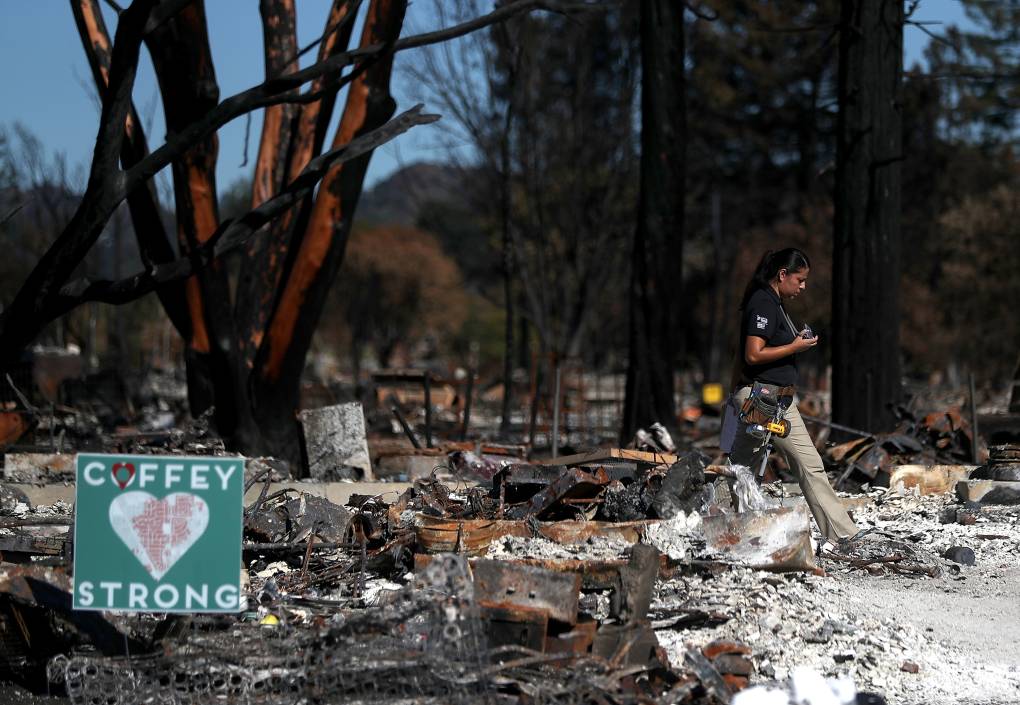
"caption": "An insurance adjuster walks through a Coffey Park home destroyed by the Tubbs Fire on Oct. 23, 2017, in Santa Rosa, California. Residents returned to their homes after a fast-moving and deadly wildfire destroyed 8,400 structures and claimed the lives of at least 42 people.",
"credit": "Justin Sullivan/Getty Images",
"altTag": null,
"description": null,
"imgSizes": {
"medium": {
"file": "https://cdn.kqed.org/wp-content/uploads/sites/10/2023/11/Coffey-Park-Insurance-800x553.jpg",
"width": 800,
"height": 553,
"mimeType": "image/jpeg"
},
"large": {
"file": "https://cdn.kqed.org/wp-content/uploads/sites/10/2023/11/Coffey-Park-Insurance-1020x705.jpg",
"width": 1020,
"height": 705,
"mimeType": "image/jpeg"
},
"thumbnail": {
"file": "https://cdn.kqed.org/wp-content/uploads/sites/10/2023/11/Coffey-Park-Insurance-160x111.jpg",
"width": 160,
"height": 111,
"mimeType": "image/jpeg"
},
"1536x1536": {
"file": "https://cdn.kqed.org/wp-content/uploads/sites/10/2023/11/Coffey-Park-Insurance-1536x1062.jpg",
"width": 1536,
"height": 1062,
"mimeType": "image/jpeg"
},
"2048x2048": {
"file": "https://cdn.kqed.org/wp-content/uploads/sites/10/2023/11/Coffey-Park-Insurance-2048x1416.jpg",
"width": 2048,
"height": 1416,
"mimeType": "image/jpeg"
},
"post-thumbnail": {
"file": "https://cdn.kqed.org/wp-content/uploads/sites/10/2023/11/Coffey-Park-Insurance-672x372.jpg",
"width": 672,
"height": 372,
"mimeType": "image/jpeg"
},
"twentyfourteen-full-width": {
"file": "https://cdn.kqed.org/wp-content/uploads/sites/10/2023/11/Coffey-Park-Insurance-1038x576.jpg",
"width": 1038,
"height": 576,
"mimeType": "image/jpeg"
},
"full-width": {
"file": "https://cdn.kqed.org/wp-content/uploads/sites/10/2023/11/Coffey-Park-Insurance-1920x1327.jpg",
"width": 1920,
"height": 1327,
"mimeType": "image/jpeg"
},
"kqedFullSize": {
"file": "https://cdn.kqed.org/wp-content/uploads/sites/10/2023/11/Coffey-Park-Insurance-scaled.jpg",
"width": 2560,
"height": 1770
}
},
"isLoading": false,
"fetchFailed": false
}
},
"audioPlayerReducer": {
"postId": "stream_live",
"isPaused": true,
"isPlaying": false,
"pfsActive": false,
"pledgeModalIsOpen": true,
"playerDrawerIsOpen": false,
"liveAudioPlayStartedAt": 0,
"liveAudioPlayContext": ""
},
"authorsReducer": {
"byline_news_12006964": {
"type": "authors",
"id": "byline_news_12006964",
"meta": {
"override": true
},
"slug": "byline_news_12006964",
"name": "\u003ca href=\"https://calmatters.org/author/alexei-koseff/\">Alexei Koseff\u003c/a>, CalMatters",
"isLoading": false
},
"vrancano": {
"type": "authors",
"id": "11276",
"meta": {
"index": "authors_1716337520",
"id": "11276",
"found": true
},
"name": "Vanessa Rancaño",
"firstName": "Vanessa",
"lastName": "Rancaño",
"slug": "vrancano",
"email": "vrancano@kqed.org",
"display_author_email": false,
"staff_mastheads": [
"news"
],
"title": "Reporter",
"bio": "Vanessa Rancaño is a features reporter for KQED. She’s also covered homelessness and education for the station and reported from the Central Valley. Her work has aired across public radio, from flagship national news shows to longform narrative podcasts. Before taking up a mic, she worked as a freelance print journalist. She’s been recognized with a number of national and regional awards. Vanessa grew up in California's Central Valley. She's a former NPR Kroc Fellow, and a graduate of the UC Berkeley Graduate School of Journalism.",
"avatar": "https://secure.gravatar.com/avatar/b3a383dfb0e7ee1c17568f2cf067904ab654d6e3de9743fc661f3c788ade1bed?s=600&d=blank&r=g",
"twitter": "vanessarancano",
"bluesky": null,
"facebook": null,
"instagram": null,
"linkedin": null,
"sites": [
{
"site": "arts",
"roles": [
"editor"
]
},
{
"site": "news",
"roles": [
"editor"
]
},
{
"site": "liveblog",
"roles": [
"contributor"
]
}
],
"headData": {
"title": "Vanessa Rancaño | KQED",
"description": "Reporter",
"ogImgSrc": "https://secure.gravatar.com/avatar/b3a383dfb0e7ee1c17568f2cf067904ab654d6e3de9743fc661f3c788ade1bed?s=600&d=blank&r=g",
"twImgSrc": "https://secure.gravatar.com/avatar/b3a383dfb0e7ee1c17568f2cf067904ab654d6e3de9743fc661f3c788ade1bed?s=600&d=blank&r=g"
},
"isLoading": false,
"link": "/author/vrancano"
},
"ebaldassari": {
"type": "authors",
"id": "11652",
"meta": {
"index": "authors_1716337520",
"id": "11652",
"found": true
},
"name": "Erin Baldassari",
"firstName": "Erin",
"lastName": "Baldassari",
"slug": "ebaldassari",
"email": "ebaldassari@KQED.org",
"display_author_email": true,
"staff_mastheads": [
"news"
],
"title": "Staff Writer",
"bio": "Erin Baldassari covers housing for KQED. She's a former print journalist and most recently worked as the transportation reporter for the \u003cem>Mercury News\u003c/em> and \u003cem>East Bay Times. \u003c/em>There, she focused on how the Bay Area’s housing shortage has changed the way people move around the region. She also served on the \u003cem>East Bay Times\u003c/em>’ 2017 Pulitzer Prize-winning team for coverage of the Ghost Ship Fire in Oakland. Prior to that, Erin worked as a breaking news and general assignment reporter for a variety of outlets in the Bay Area and the greater Boston area. A Tufts University alumna, Erin grew up in the foothills of the Sierra Nevada mountains and in Sonoma County. She is a life-long KQED listener.",
"avatar": "https://secure.gravatar.com/avatar/5e95cad64a8ca08288082212e199d2b0cbeb4fd8e8ef5339395f361032bbe005?s=600&d=blank&r=g",
"twitter": "e_baldi",
"bluesky": null,
"facebook": null,
"instagram": null,
"linkedin": null,
"sites": [
{
"site": "news",
"roles": [
"edit_others_posts",
"editor"
]
},
{
"site": "science",
"roles": [
"editor"
]
},
{
"site": "liveblog",
"roles": [
"editor"
]
}
],
"headData": {
"title": "Erin Baldassari | KQED",
"description": "Staff Writer",
"ogImgSrc": "https://secure.gravatar.com/avatar/5e95cad64a8ca08288082212e199d2b0cbeb4fd8e8ef5339395f361032bbe005?s=600&d=blank&r=g",
"twImgSrc": "https://secure.gravatar.com/avatar/5e95cad64a8ca08288082212e199d2b0cbeb4fd8e8ef5339395f361032bbe005?s=600&d=blank&r=g"
},
"isLoading": false,
"link": "/author/ebaldassari"
},
"abandlamudi": {
"type": "authors",
"id": "11672",
"meta": {
"index": "authors_1716337520",
"id": "11672",
"found": true
},
"name": "Adhiti Bandlamudi",
"firstName": "Adhiti",
"lastName": "Bandlamudi",
"slug": "abandlamudi",
"email": "abandlamudi@kqed.org",
"display_author_email": false,
"staff_mastheads": [
"news"
],
"title": "KQED Housing Reporter",
"bio": "Adhiti Bandlamudi reports for KQED's Housing desk. She focuses on how housing gets built across the Bay Area. Before joining KQED in 2020, she reported for WUNC in Durham, North Carolina, WABE in Atlanta, Georgia and Capital Public Radio in Sacramento. In 2017, she was awarded a Kroc Fellowship at NPR where she reported on everything from sprinkles to the Golden State Killer's arrest. When she's not reporting, she's baking new recipes in her kitchen or watching movies with friends and family. She's originally from Georgia and has strong opinions about Great British Bake Off.",
"avatar": "https://secure.gravatar.com/avatar/868129c8b257bb99a3500e2c86a65400?s=600&d=mm&r=g",
"twitter": "oddity_adhiti",
"facebook": null,
"instagram": null,
"linkedin": null,
"sites": [
{
"site": "arts",
"roles": [
"author"
]
},
{
"site": "news",
"roles": [
"editor"
]
},
{
"site": "liveblog",
"roles": [
"author"
]
}
],
"headData": {
"title": "Adhiti Bandlamudi | KQED",
"description": "KQED Housing Reporter",
"ogImgSrc": "https://secure.gravatar.com/avatar/868129c8b257bb99a3500e2c86a65400?s=600&d=mm&r=g",
"twImgSrc": "https://secure.gravatar.com/avatar/868129c8b257bb99a3500e2c86a65400?s=600&d=mm&r=g"
},
"isLoading": false,
"link": "/author/abandlamudi"
}
},
"pagesReducer": {
"news_tag_affordable-housing": {
"type": "terms",
"id": "news_3921",
"meta": {
"index": "terms_1716263798",
"site": "news",
"id": "3921",
"score": 9.304556
},
"featImg": null,
"name": "affordable housing",
"description": null,
"taxonomy": "tag",
"headData": {
"twImgId": null,
"twTitle": null,
"ogTitle": null,
"ogImgId": null,
"twDescription": null,
"description": null,
"title": "affordable housing Archives | KQED News",
"ogDescription": null
},
"ttid": 3940,
"slug": "affordable-housing",
"isLoading": false,
"title": "affordable housing",
"pageMeta": {
"site": "news",
"WpPageTemplate": "page-topic-editorial",
"currentPage": 17
},
"blocks": [
{
"blockName": "kqed/post-list",
"attrs": {
"layout": "cardArticle2",
"query": "posts/news?tag=affordable-housing",
"seeMore": false,
"paginated": true,
"page": 17
}
},
{
"blockName": "kqed/ad"
}
]
}
},
"pfsSessionReducer": {},
"postsReducer": {
"stream_live": {
"type": "live",
"id": "stream_live",
"audioUrl": "https://streams.kqed.org/kqedradio",
"title": "Live Stream",
"excerpt": "Live Stream information currently unavailable.",
"link": "/radio",
"featImg": "",
"label": {
"name": "KQED Live",
"link": "/"
}
},
"stream_kqedNewscast": {
"type": "posts",
"id": "stream_kqedNewscast",
"audioUrl": "https://www.kqed.org/.stream/anon/radio/RDnews/newscast.mp3?_=1",
"title": "KQED Newscast",
"featImg": "",
"label": {
"name": "88.5 FM",
"link": "/"
}
},
"news_12014227": {
"type": "posts",
"id": "news_12014227",
"meta": {
"index": "posts_1716263798",
"site": "news",
"id": "12014227",
"score": null,
"sort": [
1731529125000
]
},
"guestAuthors": [],
"slug": "progressive-berkeley-new-tough-stance-homeless-encampments",
"title": "Still Progressive? Berkeley Sticks to New Tough Stance on Homeless Encampments",
"publishDate": 1731529125,
"format": "standard",
"headTitle": "Still Progressive? Berkeley Sticks to New Tough Stance on Homeless Encampments | KQED",
"labelTerm": {
"site": "news"
},
"content": "\u003cp>Advocates for unhoused residents in \u003ca href=\"https://www.kqed.org/news/tag/berkeley\">Berkeley\u003c/a> are reckoning with the limits of their famously progressive city’s liberalism after council members Tuesday night dismissed a resolution to oppose the “criminalization of poverty and homelessness.”\u003c/p>\n\u003cp>The resolution from the city’s Peace and Justice Commission called on Berkeley to rebuke both Gov. Gavin Newsom’s \u003ca href=\"https://www.gov.ca.gov/wp-content/uploads/2024/07/2024-Encampments-EO-7-24.pdf\">July executive order\u003c/a> urging cities to clear encampments and a \u003ca href=\"https://www.kqed.org/news/11991340/supreme-court-says-laws-criminalizing-homeless-camping-do-not-violate-constitution\">June Supreme Court decision\u003c/a> that granted cities greater power to police homelessness.\u003c/p>\n\u003cp>Champions of the measure said it would have reined in Berkeley’s \u003ca href=\"https://www.kqed.org/news/12004348/berkeley-moves-to-expand-homeless-encampment-sweeps-in-more-aggressive-approach\">newly aggressive approach\u003c/a> to policing homelessness, though city officials disagreed with their assessment, \u003ca href=\"https://berkeleyca.gov/sites/default/files/documents/2024-11-12%20Item%2018b%20Companion%20Report%20Resolution%20Opposing.pdf\">arguing existing policy is already consistent with this approach\u003c/a>.\u003c/p>\n\u003cp>[ad fullwidth]\u003c/p>\n\u003cp>The council took no action on the resolution, marking the second time in five months that Berkeley leaders opted not to take a stand against punitive strategies to address homelessness. It followed a resolution this summer from \u003ca href=\"https://berkeleyca.gov/sites/default/files/documents/UrgentItem-GrantsPass.pdf\">Councilmember Cecilia Lunaparra\u003c/a> calling for a similar action that was also scuttled.\u003c/p>\n\u003cp>For advocates, however, Tuesday’s decision took on new meaning after the election of former President Donald Trump, as several invoked what they expected to be a \u003ca href=\"https://www.kqed.org/news/12013983/how-another-trump-presidency-could-impact-housing-in-california\">draconian federal homelessness agenda\u003c/a>.\u003c/p>\n\u003cfigure id=\"attachment_12003055\" class=\"wp-caption aligncenter\" style=\"max-width: 2000px\">\u003cimg loading=\"lazy\" decoding=\"async\" class=\"size-full wp-image-12003055\" src=\"https://cdn.kqed.org/wp-content/uploads/sites/10/2024/09/011_KQED_Berkeley_Homelessness_03192020_9408_qed.jpg\" alt=\"\" width=\"2000\" height=\"1333\" srcset=\"https://cdn.kqed.org/wp-content/uploads/sites/10/2024/09/011_KQED_Berkeley_Homelessness_03192020_9408_qed.jpg 2000w, https://cdn.kqed.org/wp-content/uploads/sites/10/2024/09/011_KQED_Berkeley_Homelessness_03192020_9408_qed-800x533.jpg 800w, https://cdn.kqed.org/wp-content/uploads/sites/10/2024/09/011_KQED_Berkeley_Homelessness_03192020_9408_qed-1020x680.jpg 1020w, https://cdn.kqed.org/wp-content/uploads/sites/10/2024/09/011_KQED_Berkeley_Homelessness_03192020_9408_qed-160x107.jpg 160w, https://cdn.kqed.org/wp-content/uploads/sites/10/2024/09/011_KQED_Berkeley_Homelessness_03192020_9408_qed-1536x1024.jpg 1536w, https://cdn.kqed.org/wp-content/uploads/sites/10/2024/09/011_KQED_Berkeley_Homelessness_03192020_9408_qed-1920x1280.jpg 1920w\" sizes=\"auto, (max-width: 2000px) 100vw, 2000px\">\u003cfigcaption class=\"wp-caption-text\">A tent encampment under a freeway overpass in Berkeley on March 19, 2020. \u003ccite>(Beth LaBerge/KQED)\u003c/cite>\u003c/figcaption>\u003c/figure>\n\u003cp>George Lippman, vice chair of the Peace and Justice Commission, which advises the City Council on social justice issues, said the resolution was a “referendum on who we are and our values,” adding the city “should take a moral stance of upholding a stronger standard.”\u003c/p>\n\u003cp>“That doesn’t end after Election Day,” he said.\u003c/p>\n\u003cp>In September, Berkeley surprised observers \u003ca href=\"https://www.kqed.org/news/12004348/berkeley-moves-to-expand-homeless-encampment-sweeps-in-more-aggressive-approach\">by joining the growing list\u003c/a> of cities embracing stronger enforcement tools to crack down on encampments in the wake of the Supreme Court’s ruling. Some two dozen cities and counties across the state have enacted or begun enforcing anti-camping laws, including \u003ca href=\"https://www.kqed.org/news/12006541/sfs-homeless-sweeps-have-cleared-over-1200-tents-where-are-people-going\">San Francisco\u003c/a> and \u003ca href=\"https://oaklandside.org/2024/09/23/sheng-thao-homeless-camps-order-grants-pass/\">Oakland\u003c/a>.\u003c/p>\n\u003cp>Under \u003ca href=\"https://www.documentcloud.org/documents/25291291-9_10_2024-clk-resolution-city-council-71513-encampment-policy-resolution-to-promote-healthy-and-safe-neighborhoods?responsive=1&title=1\">Berkeley’s new policy\u003c/a>, workers will continue to offer shelter “whenever practicable” before closing encampments, but there are now several exceptions. City workers can clear tents and cite and arrest unhoused people if an encampment is determined to be a health or fire hazard, public nuisance, too close to traffic or near a construction zone.\u003c/p>\n\u003cp>Peter Radu, assistant to the city manager, emphasized that \u003ca href=\"https://berkeleyca.gov/sites/default/files/documents/2024-10-7%20Implementation%20of%20Berkeley%E2%80%99s%20New%20Encampment%20Policy.pdf\">the policy’s exceptions are narrow\u003c/a>.\u003c/p>\n\u003cp>[aside postID=news_12013983 hero='https://cdn.kqed.org/wp-content/uploads/sites/10/2024/11/GettyImages-2176495054-1020x574.jpg']\u003c/p>\n\u003cp>“It’s a high bar,” he said. “We need to get them out of a dangerous situation now, or we need to accommodate some urgent operations or construction schedule now. And sometimes it’s just as simple as asking them and working with them to move across the street to accommodate that while we continue the hard work of getting them connected to resources that will end their homelessness.”\u003c/p>\n\u003cp>So far, Radu said, the city has twice taken advantage of its new authority to ask people to move without offering shelter: to clear Civic Center Park for a construction project and to remove someone encamped on a center median on University Avenue.\u003c/p>\n\u003cp>Radu, who manages the division that oversees the city’s homeless response team, said no one was cited or arrested during the operations.\u003c/p>\n\u003cp>“We’re not interested in criminalizing homelessness,” he said. “We want to end it.”\u003c/p>\n\u003cp>However, advocates like attorney Andrea Henson argue that the policy’s exceptions are overly broad.\u003c/p>\n\u003cp>“They’re not narrow exceptions,” she said. “To be in proximity to traffic — every homeless encampment is in proximity to traffic.”\u003c/p>\n\u003cp>Henson said unhoused residents are rattled by the shift toward more aggressive enforcement at the state and local level, and Trump’s election has only exacerbated that.\u003c/p>\n\u003cp>“People are really scared,” she said. “They’re very scared because of what’s happening, because of the election, because of the language that they’re hearing.”\u003c/p>\n\u003cp>She was among those who invoked the incoming federal administration at the City Council meeting and urged leaders to take a stand against it.\u003c/p>\n\u003cp>“We have a decision to make here in Berkeley, and it’s the same decision that people need to make in this country,” she said. “Either you’re with our new government, which is quickly becoming very fascist … or you take a firm stand. Because the line has been drawn.”\u003c/p>\n\u003cp>\u003c/p>\n",
"blocks": [],
"excerpt": "After the Berkeley City Council took no action on a resolution decrying the criminalization of homelessness, advocates are questioning how progressive their city really is. ",
"status": "publish",
"parent": 0,
"modified": 1740527412,
"stats": {
"hasAudio": false,
"hasVideo": false,
"hasChartOrMap": false,
"iframeSrcs": [],
"hasGoogleForm": false,
"hasGallery": false,
"hasHearkenModule": false,
"hasPolis": false,
"paragraphCount": 23,
"wordCount": 770
},
"headData": {
"title": "Still Progressive? Berkeley Sticks to New Tough Stance on Homeless Encampments | KQED",
"description": "After the Berkeley City Council took no action on a resolution decrying the criminalization of homelessness, advocates are questioning how progressive their city really is. ",
"ogTitle": "",
"ogDescription": "",
"ogImgId": "",
"twTitle": "",
"twDescription": "",
"twImgId": "",
"schema": {
"@context": "https://schema.org",
"@type": "NewsArticle",
"headline": "Still Progressive? Berkeley Sticks to New Tough Stance on Homeless Encampments",
"datePublished": "2024-11-13T12:18:45-08:00",
"dateModified": "2025-02-25T15:50:12-08:00",
"image": "https://cdn.kqed.org/wp-content/uploads/2020/02/KQED-OG-Image@1x.png",
"isAccessibleForFree": "True",
"publisher": {
"@type": "NewsMediaOrganization",
"@id": "https://www.kqed.org/#organization",
"name": "KQED",
"logo": "https://cdn.kqed.org/wp-content/uploads/2020/02/KQED-OG-Image@1x.png",
"url": "https://www.kqed.org",
"sameAs": [
"https://www.facebook.com/KQED",
"https://twitter.com/KQED",
"https://www.instagram.com/kqed/",
"https://www.tiktok.com/@kqedofficial",
"https://www.linkedin.com/company/kqed",
"https://www.youtube.com/channel/UCeC0IOo7i1P_61zVUWbJ4nw"
]
}
}
},
"sticky": false,
"nprStoryId": "kqed-12014227",
"excludeFromSiteSearch": "Include",
"articleAge": "0",
"path": "/news/12014227/progressive-berkeley-new-tough-stance-homeless-encampments",
"audioTrackLength": null,
"parsedContent": [
{
"type": "contentString",
"content": "\u003cdiv class=\"post-body\">\u003cp>\u003cp>Advocates for unhoused residents in \u003ca href=\"https://www.kqed.org/news/tag/berkeley\">Berkeley\u003c/a> are reckoning with the limits of their famously progressive city’s liberalism after council members Tuesday night dismissed a resolution to oppose the “criminalization of poverty and homelessness.”\u003c/p>\n\u003cp>The resolution from the city’s Peace and Justice Commission called on Berkeley to rebuke both Gov. Gavin Newsom’s \u003ca href=\"https://www.gov.ca.gov/wp-content/uploads/2024/07/2024-Encampments-EO-7-24.pdf\">July executive order\u003c/a> urging cities to clear encampments and a \u003ca href=\"https://www.kqed.org/news/11991340/supreme-court-says-laws-criminalizing-homeless-camping-do-not-violate-constitution\">June Supreme Court decision\u003c/a> that granted cities greater power to police homelessness.\u003c/p>\n\u003cp>Champions of the measure said it would have reined in Berkeley’s \u003ca href=\"https://www.kqed.org/news/12004348/berkeley-moves-to-expand-homeless-encampment-sweeps-in-more-aggressive-approach\">newly aggressive approach\u003c/a> to policing homelessness, though city officials disagreed with their assessment, \u003ca href=\"https://berkeleyca.gov/sites/default/files/documents/2024-11-12%20Item%2018b%20Companion%20Report%20Resolution%20Opposing.pdf\">arguing existing policy is already consistent with this approach\u003c/a>.\u003c/p>\n\u003cp>\u003c/p>\u003c/div>",
"attributes": {
"named": {},
"numeric": []
}
},
{
"type": "component",
"content": "",
"name": "ad",
"attributes": {
"named": {
"label": "fullwidth"
},
"numeric": [
"fullwidth"
]
}
},
{
"type": "contentString",
"content": "\u003cdiv class=\"post-body\">\u003cp>\u003c/p>\n\u003cp>The council took no action on the resolution, marking the second time in five months that Berkeley leaders opted not to take a stand against punitive strategies to address homelessness. It followed a resolution this summer from \u003ca href=\"https://berkeleyca.gov/sites/default/files/documents/UrgentItem-GrantsPass.pdf\">Councilmember Cecilia Lunaparra\u003c/a> calling for a similar action that was also scuttled.\u003c/p>\n\u003cp>For advocates, however, Tuesday’s decision took on new meaning after the election of former President Donald Trump, as several invoked what they expected to be a \u003ca href=\"https://www.kqed.org/news/12013983/how-another-trump-presidency-could-impact-housing-in-california\">draconian federal homelessness agenda\u003c/a>.\u003c/p>\n\u003cfigure id=\"attachment_12003055\" class=\"wp-caption aligncenter\" style=\"max-width: 2000px\">\u003cimg loading=\"lazy\" decoding=\"async\" class=\"size-full wp-image-12003055\" src=\"https://cdn.kqed.org/wp-content/uploads/sites/10/2024/09/011_KQED_Berkeley_Homelessness_03192020_9408_qed.jpg\" alt=\"\" width=\"2000\" height=\"1333\" srcset=\"https://cdn.kqed.org/wp-content/uploads/sites/10/2024/09/011_KQED_Berkeley_Homelessness_03192020_9408_qed.jpg 2000w, https://cdn.kqed.org/wp-content/uploads/sites/10/2024/09/011_KQED_Berkeley_Homelessness_03192020_9408_qed-800x533.jpg 800w, https://cdn.kqed.org/wp-content/uploads/sites/10/2024/09/011_KQED_Berkeley_Homelessness_03192020_9408_qed-1020x680.jpg 1020w, https://cdn.kqed.org/wp-content/uploads/sites/10/2024/09/011_KQED_Berkeley_Homelessness_03192020_9408_qed-160x107.jpg 160w, https://cdn.kqed.org/wp-content/uploads/sites/10/2024/09/011_KQED_Berkeley_Homelessness_03192020_9408_qed-1536x1024.jpg 1536w, https://cdn.kqed.org/wp-content/uploads/sites/10/2024/09/011_KQED_Berkeley_Homelessness_03192020_9408_qed-1920x1280.jpg 1920w\" sizes=\"auto, (max-width: 2000px) 100vw, 2000px\">\u003cfigcaption class=\"wp-caption-text\">A tent encampment under a freeway overpass in Berkeley on March 19, 2020. \u003ccite>(Beth LaBerge/KQED)\u003c/cite>\u003c/figcaption>\u003c/figure>\n\u003cp>George Lippman, vice chair of the Peace and Justice Commission, which advises the City Council on social justice issues, said the resolution was a “referendum on who we are and our values,” adding the city “should take a moral stance of upholding a stronger standard.”\u003c/p>\n\u003cp>“That doesn’t end after Election Day,” he said.\u003c/p>\n\u003cp>In September, Berkeley surprised observers \u003ca href=\"https://www.kqed.org/news/12004348/berkeley-moves-to-expand-homeless-encampment-sweeps-in-more-aggressive-approach\">by joining the growing list\u003c/a> of cities embracing stronger enforcement tools to crack down on encampments in the wake of the Supreme Court’s ruling. Some two dozen cities and counties across the state have enacted or begun enforcing anti-camping laws, including \u003ca href=\"https://www.kqed.org/news/12006541/sfs-homeless-sweeps-have-cleared-over-1200-tents-where-are-people-going\">San Francisco\u003c/a> and \u003ca href=\"https://oaklandside.org/2024/09/23/sheng-thao-homeless-camps-order-grants-pass/\">Oakland\u003c/a>.\u003c/p>\n\u003cp>Under \u003ca href=\"https://www.documentcloud.org/documents/25291291-9_10_2024-clk-resolution-city-council-71513-encampment-policy-resolution-to-promote-healthy-and-safe-neighborhoods?responsive=1&title=1\">Berkeley’s new policy\u003c/a>, workers will continue to offer shelter “whenever practicable” before closing encampments, but there are now several exceptions. City workers can clear tents and cite and arrest unhoused people if an encampment is determined to be a health or fire hazard, public nuisance, too close to traffic or near a construction zone.\u003c/p>\n\u003cp>Peter Radu, assistant to the city manager, emphasized that \u003ca href=\"https://berkeleyca.gov/sites/default/files/documents/2024-10-7%20Implementation%20of%20Berkeley%E2%80%99s%20New%20Encampment%20Policy.pdf\">the policy’s exceptions are narrow\u003c/a>.\u003c/p>\n\u003cp>\u003c/p>\u003c/div>",
"attributes": {
"named": {},
"numeric": []
}
},
{
"type": "component",
"content": "",
"name": "aside",
"attributes": {
"named": {
"postid": "news_12013983",
"hero": "https://cdn.kqed.org/wp-content/uploads/sites/10/2024/11/GettyImages-2176495054-1020x574.jpg",
"label": ""
},
"numeric": []
}
},
{
"type": "contentString",
"content": "\u003cdiv class=\"post-body\">\u003cp>\u003c/p>\n\u003cp>“It’s a high bar,” he said. “We need to get them out of a dangerous situation now, or we need to accommodate some urgent operations or construction schedule now. And sometimes it’s just as simple as asking them and working with them to move across the street to accommodate that while we continue the hard work of getting them connected to resources that will end their homelessness.”\u003c/p>\n\u003cp>So far, Radu said, the city has twice taken advantage of its new authority to ask people to move without offering shelter: to clear Civic Center Park for a construction project and to remove someone encamped on a center median on University Avenue.\u003c/p>\n\u003cp>Radu, who manages the division that oversees the city’s homeless response team, said no one was cited or arrested during the operations.\u003c/p>\n\u003cp>“We’re not interested in criminalizing homelessness,” he said. “We want to end it.”\u003c/p>\n\u003cp>However, advocates like attorney Andrea Henson argue that the policy’s exceptions are overly broad.\u003c/p>\n\u003cp>“They’re not narrow exceptions,” she said. “To be in proximity to traffic — every homeless encampment is in proximity to traffic.”\u003c/p>\n\u003cp>Henson said unhoused residents are rattled by the shift toward more aggressive enforcement at the state and local level, and Trump’s election has only exacerbated that.\u003c/p>\n\u003cp>“People are really scared,” she said. “They’re very scared because of what’s happening, because of the election, because of the language that they’re hearing.”\u003c/p>\n\u003cp>She was among those who invoked the incoming federal administration at the City Council meeting and urged leaders to take a stand against it.\u003c/p>\n\u003cp>“We have a decision to make here in Berkeley, and it’s the same decision that people need to make in this country,” she said. “Either you’re with our new government, which is quickly becoming very fascist … or you take a firm stand. Because the line has been drawn.”\u003c/p>\n\u003cp>\u003c/p>\n\u003c/div>\u003c/p>",
"attributes": {
"named": {},
"numeric": []
}
}
],
"link": "/news/12014227/progressive-berkeley-new-tough-stance-homeless-encampments",
"authors": [
"11276"
],
"categories": [
"news_31795",
"news_6266",
"news_8"
],
"tags": [
"news_3921",
"news_1386",
"news_129",
"news_673",
"news_18538",
"news_27626",
"news_21214",
"news_4020",
"news_1775"
],
"featImg": "news_11625989",
"label": "news"
},
"news_12012489": {
"type": "posts",
"id": "news_12012489",
"meta": {
"index": "posts_1716263798",
"site": "news",
"id": "12012489",
"score": null,
"sort": [
1730874916000
]
},
"guestAuthors": [],
"slug": "voters-turn-down-prop-5-but-some-local-bond-measures-may-pass-anyway",
"title": "Voters Turn Down Proposition 5, but Some Local Bond Measures May Pass Anyway",
"publishDate": 1730874916,
"format": "standard",
"headTitle": "Voters Turn Down Proposition 5, but Some Local Bond Measures May Pass Anyway | KQED",
"labelTerm": {
"site": "news"
},
"content": "\u003cp>\u003ca href=\"https://www.kqed.org/liveblog/election-2024\" target=\"_blank\" rel=\"noopener\">\u003cem>\u003cstrong>Follow KQED’s live blog for the latest election updates\u003c/strong>\u003c/em>\u003c/a>\u003c/p>\n\u003cp>Proposition 5, which could have opened up local funding for affordable housing and public infrastructure projects, is trailing in early returns.\u003c/p>\n\u003cp>“I’m happy that voters are paying attention,” said Johnny Khamis, an opponent of the ballot measure and former San José City Council member. “Prop. 5 would have caused huge problems with the cost of living and future generations being able to afford to live in California. We don’t want to reduce the voter threshold for passing new taxes.”\u003c/p>\n\u003cp>Proposition 5 would make it easier for local governments to pass bond measures that specifically fund affordable housing and public infrastructure projects by lowering the percentage of votes required to pass from 66.67% to 55%.\u003c/p>\n\u003cp>[ad fullwidth]\u003c/p>\n\u003cp>While several bond measures on county and city ballots could be impacted if the proposition passes, a few bonds appear to have the support needed to pass anyway, including \u003ca href=\"https://www.kqed.org/voterguide/sanfrancisco/propositions#proposition-b\" target=\"_blank\" rel=\"noopener\">San Francisco’s Proposition B\u003c/a>, which would pass a $390 million bond to fund repairs and retrofits to health care centers and hospitals, as well as build homeless shelters. \u003ca href=\"https://www.kqed.org/voterguide/sanmateo/measures#measure-q\" target=\"_blank\" rel=\"noopener\">San Bruno’s Measure Q\u003c/a> and \u003ca href=\"https://www.kqed.org/voterguide/santaclara/measures#measure-i\" target=\"_blank\" rel=\"noopener\">Santa Clara’s Measure I\u003c/a> also have more than a supermajority of voters favoring the bonds. Both measures pass money to fix or renovate local infrastructure. Measures in \u003ca href=\"https://www.kqed.org/voterguide/marin/measures#measure-j\" target=\"_blank\" rel=\"noopener\">Fairfax\u003c/a> and \u003ca href=\"https://www.kqed.org/voterguide/santaclara/measures#measure-e\" target=\"_blank\" rel=\"noopener\">Sunnyvale\u003c/a> do not have appear to have enough votes to surpass the existing voter threshold.\u003c/p>\n\u003cp>[aside label=\"Live 2024 Election Results\" link1='https://www.kqed.org/elections/results/california,Learn about the results of the California Propositions' hero=https://cdn.kqed.org/wp-content/uploads/sites/80/2024/09/Aside-California-Propositions-2024-General-Election-1200x1200-1.png]Proposition 5 was designed to change some of the provisions Proposition 13 has held in place for decades. That initiative, which was overwhelmingly approved by voters in 1978, tied property taxes to the property’s value when it was purchased. To further ensure property taxes remained low, a two-thirds supermajority (66.67%) vote was required for any local bond measures to pass.\u003c/p>\n\u003cp>This incentivized people who bought homes in the 1970s and earlier to hold onto those properties instead of putting them back on the market. Because local governments were receiving less in property taxes than before, many municipalities had to rely on state funding to pay for schools, affordable housing and public infrastructure.\u003c/p>\n\u003cp>Under Proposition 13’s two-thirds supermajority rule, many affordable housing and public infrastructure bonds have failed despite receiving more than 55% of votes in favor. Affordable housing advocates argue that Proposition 5 could have opened the door for more local funding, which could address the unique needs of each city.[aside label='More Election Coverage' tag='election-2024']But opponents worry the deluge of new property taxes could impact homeowners, particularly elderly ones or those living on fixed incomes. Since the voter threshold was lowered for school bonds by Proposition 39 in 2000, Californians have voted on almost 1,150 local school bond measures and have approved 911 of them, according to the California Policy Center, a libertarian-conservative think-tank.\u003c/p>\n\u003cp>Most Bay Area residents will have encountered a bond measure on their ballot, which could have passed more easily if Proposition 5 was approved.\u003c/p>\n\u003cp>\u003c/p>\n",
"blocks": [],
"excerpt": "Proposition 5 was designed to change some of the provisions of Proposition 13, which ties property taxes to the property’s value when it was purchased.",
"status": "publish",
"parent": 0,
"modified": 1730876334,
"stats": {
"hasAudio": false,
"hasVideo": false,
"hasChartOrMap": false,
"iframeSrcs": [],
"hasGoogleForm": false,
"hasGallery": false,
"hasHearkenModule": false,
"hasPolis": false,
"paragraphCount": 11,
"wordCount": 555
},
"headData": {
"title": "Voters Turn Down Proposition 5, but Some Local Bond Measures May Pass Anyway | KQED",
"description": "Proposition 5 was designed to change some of the provisions of Proposition 13, which ties property taxes to the property’s value when it was purchased.",
"ogTitle": "",
"ogDescription": "",
"ogImgId": "",
"twTitle": "",
"twDescription": "",
"twImgId": "",
"schema": {
"@context": "https://schema.org",
"@type": "NewsArticle",
"headline": "Voters Turn Down Proposition 5, but Some Local Bond Measures May Pass Anyway",
"datePublished": "2024-11-05T22:35:16-08:00",
"dateModified": "2024-11-05T22:58:54-08:00",
"image": "https://cdn.kqed.org/wp-content/uploads/2020/02/KQED-OG-Image@1x.png",
"isAccessibleForFree": "True",
"publisher": {
"@type": "NewsMediaOrganization",
"@id": "https://www.kqed.org/#organization",
"name": "KQED",
"logo": "https://cdn.kqed.org/wp-content/uploads/2020/02/KQED-OG-Image@1x.png",
"url": "https://www.kqed.org",
"sameAs": [
"https://www.facebook.com/KQED",
"https://twitter.com/KQED",
"https://www.instagram.com/kqed/",
"https://www.tiktok.com/@kqedofficial",
"https://www.linkedin.com/company/kqed",
"https://www.youtube.com/channel/UCeC0IOo7i1P_61zVUWbJ4nw"
]
}
}
},
"sticky": false,
"nprStoryId": "kqed-12012489",
"excludeFromSiteSearch": "Include",
"articleAge": "0",
"path": "/news/12012489/voters-turn-down-prop-5-but-some-local-bond-measures-may-pass-anyway",
"audioTrackLength": null,
"parsedContent": [
{
"type": "contentString",
"content": "\u003cdiv class=\"post-body\">\u003cp>\u003cp>\u003ca href=\"https://www.kqed.org/liveblog/election-2024\" target=\"_blank\" rel=\"noopener\">\u003cem>\u003cstrong>Follow KQED’s live blog for the latest election updates\u003c/strong>\u003c/em>\u003c/a>\u003c/p>\n\u003cp>Proposition 5, which could have opened up local funding for affordable housing and public infrastructure projects, is trailing in early returns.\u003c/p>\n\u003cp>“I’m happy that voters are paying attention,” said Johnny Khamis, an opponent of the ballot measure and former San José City Council member. “Prop. 5 would have caused huge problems with the cost of living and future generations being able to afford to live in California. We don’t want to reduce the voter threshold for passing new taxes.”\u003c/p>\n\u003cp>Proposition 5 would make it easier for local governments to pass bond measures that specifically fund affordable housing and public infrastructure projects by lowering the percentage of votes required to pass from 66.67% to 55%.\u003c/p>\n\u003cp>\u003c/p>\u003c/div>",
"attributes": {
"named": {},
"numeric": []
}
},
{
"type": "component",
"content": "",
"name": "ad",
"attributes": {
"named": {
"label": "fullwidth"
},
"numeric": [
"fullwidth"
]
}
},
{
"type": "contentString",
"content": "\u003cdiv class=\"post-body\">\u003cp>\u003c/p>\n\u003cp>While several bond measures on county and city ballots could be impacted if the proposition passes, a few bonds appear to have the support needed to pass anyway, including \u003ca href=\"https://www.kqed.org/voterguide/sanfrancisco/propositions#proposition-b\" target=\"_blank\" rel=\"noopener\">San Francisco’s Proposition B\u003c/a>, which would pass a $390 million bond to fund repairs and retrofits to health care centers and hospitals, as well as build homeless shelters. \u003ca href=\"https://www.kqed.org/voterguide/sanmateo/measures#measure-q\" target=\"_blank\" rel=\"noopener\">San Bruno’s Measure Q\u003c/a> and \u003ca href=\"https://www.kqed.org/voterguide/santaclara/measures#measure-i\" target=\"_blank\" rel=\"noopener\">Santa Clara’s Measure I\u003c/a> also have more than a supermajority of voters favoring the bonds. Both measures pass money to fix or renovate local infrastructure. Measures in \u003ca href=\"https://www.kqed.org/voterguide/marin/measures#measure-j\" target=\"_blank\" rel=\"noopener\">Fairfax\u003c/a> and \u003ca href=\"https://www.kqed.org/voterguide/santaclara/measures#measure-e\" target=\"_blank\" rel=\"noopener\">Sunnyvale\u003c/a> do not have appear to have enough votes to surpass the existing voter threshold.\u003c/p>\n\u003cp>\u003c/p>\u003c/div>",
"attributes": {
"named": {},
"numeric": []
}
},
{
"type": "component",
"content": "",
"name": "aside",
"attributes": {
"named": {
"label": "Live 2024 Election Results ",
"link1": "https://www.kqed.org/elections/results/california,Learn about the results of the California Propositions",
"hero": "https://cdn.kqed.org/wp-content/uploads/sites/80/2024/09/Aside-California-Propositions-2024-General-Election-1200x1200-1.png"
},
"numeric": []
}
},
{
"type": "contentString",
"content": "\u003cdiv class=\"post-body\">\u003cp>Proposition 5 was designed to change some of the provisions Proposition 13 has held in place for decades. That initiative, which was overwhelmingly approved by voters in 1978, tied property taxes to the property’s value when it was purchased. To further ensure property taxes remained low, a two-thirds supermajority (66.67%) vote was required for any local bond measures to pass.\u003c/p>\n\u003cp>This incentivized people who bought homes in the 1970s and earlier to hold onto those properties instead of putting them back on the market. Because local governments were receiving less in property taxes than before, many municipalities had to rely on state funding to pay for schools, affordable housing and public infrastructure.\u003c/p>\n\u003cp>Under Proposition 13’s two-thirds supermajority rule, many affordable housing and public infrastructure bonds have failed despite receiving more than 55% of votes in favor. Affordable housing advocates argue that Proposition 5 could have opened the door for more local funding, which could address the unique needs of each city.\u003c/p>\u003c/div>",
"attributes": {
"named": {},
"numeric": []
}
},
{
"type": "component",
"content": "",
"name": "aside",
"attributes": {
"named": {
"label": "More Election Coverage ",
"tag": "election-2024"
},
"numeric": []
}
},
{
"type": "contentString",
"content": "\u003cdiv class=\"post-body\">\u003cp>But opponents worry the deluge of new property taxes could impact homeowners, particularly elderly ones or those living on fixed incomes. Since the voter threshold was lowered for school bonds by Proposition 39 in 2000, Californians have voted on almost 1,150 local school bond measures and have approved 911 of them, according to the California Policy Center, a libertarian-conservative think-tank.\u003c/p>\n\u003cp>Most Bay Area residents will have encountered a bond measure on their ballot, which could have passed more easily if Proposition 5 was approved.\u003c/p>\n\u003cp>\u003c/p>\n\u003c/div>\u003c/p>",
"attributes": {
"named": {},
"numeric": []
}
}
],
"link": "/news/12012489/voters-turn-down-prop-5-but-some-local-bond-measures-may-pass-anyway",
"authors": [
"11672"
],
"categories": [
"news_6266",
"news_8",
"news_13"
],
"tags": [
"news_3921",
"news_28778",
"news_32839",
"news_1775"
],
"featImg": "news_11971001",
"label": "news"
},
"news_12011125": {
"type": "posts",
"id": "news_12011125",
"meta": {
"index": "posts_1716263798",
"site": "news",
"id": "12011125",
"score": null,
"sort": [
1730113328000
]
},
"guestAuthors": [],
"slug": "these-2-bay-area-school-bonds-could-help-build-teacher-housing",
"title": "These 2 Bay Area School Bonds Could Help Build Teacher Housing",
"publishDate": 1730113328,
"format": "standard",
"headTitle": "These 2 Bay Area School Bonds Could Help Build Teacher Housing | KQED",
"labelTerm": {
"site": "news"
},
"content": "\u003cp>For \u003ca href=\"https://www.npr.org/sections/ed/2016/03/24/470710747/more-teachers-cant-afford-to-live-where-they-teach\">years\u003c/a>, Bay Area teachers have said one of their biggest concerns is finding affordable housing close to where they work. For some teachers, the fact that their salaries \u003ca href=\"https://www.edweek.org/teaching-learning/better-pay-would-keep-teachers-from-quitting-but-theres-more-to-it/2022/07\">can’t keep up with the increased cost of living\u003c/a> has some considering leaving the profession altogether.\u003c/p>\n\u003cp>Now, more school districts across California are taking matters into their own hands by getting into the business of building housing for their teachers and staff on empty parking lots, unused office buildings and other excess land. And, in the Bay Area, two districts are turning to bond measures to help pay for it.\u003c/p>\n\u003cp>Those two bonds — \u003ca href=\"https://www.kqed.org/voterguide/santaclara/measures#measure-r\">Measure R in Santa Clara County\u003c/a> and \u003ca href=\"https://www.kqed.org/voterguide/sanmateo/measures#measure-k\">Measure K in San Mateo County\u003c/a> — would raise $1.15 billion and $153 million, respectively, to pay for upgrades to school district facilities. Both measures include building affordable housing for teachers and staff in their descriptions for what the bond could fund.\u003c/p>\n\u003cp>[ad fullwidth]\u003c/p>\n\u003cp>The measures come as state leaders ask voters to consider a \u003ca href=\"https://www.kqed.org/voterguide/california/proposition-2\">$10 billion bond measure\u003c/a> to upgrade school facilities across California. And, as state leaders are faced with a lofty goal to plan for 2.5 million new homes statewide by 2030, \u003ca href=\"https://www.kqed.org/news/11997949/california-schools-keep-losing-teachers-the-state-wants-to-help-build-homes-for-them\">they are encouraging school districts to be more proactive\u003c/a> about building housing for their staff.\u003c/p>\n\u003cp>In San Mateo County, a group of parents and teachers at the Cabrillo Unified School District saw other school districts develop housing for their employees and were inspired to campaign to get Measure K on the ballot. If approved by voters, most of the $153 million will be used to fix classrooms, according to members of the board. Some of the money can also be used to construct educator housing.\u003c/p>\n\u003cp>San José Unified School District’s Measure R anticipates dedicating approximately $283 million of the total $1.15 billion bond to build housing for staff.\u003c/p>\n\u003cfigure id=\"attachment_12010731\" class=\"wp-caption aligncenter\" style=\"max-width: 2000px\">\u003cimg loading=\"lazy\" decoding=\"async\" class=\"size-full wp-image-12010731\" src=\"https://cdn.kqed.org/wp-content/uploads/sites/10/2024/10/20241022_SCHOOLDISTRICTHOUSING_GC-12-KQED.jpg\" alt=\"\" width=\"2000\" height=\"1333\" srcset=\"https://cdn.kqed.org/wp-content/uploads/sites/10/2024/10/20241022_SCHOOLDISTRICTHOUSING_GC-12-KQED.jpg 2000w, https://cdn.kqed.org/wp-content/uploads/sites/10/2024/10/20241022_SCHOOLDISTRICTHOUSING_GC-12-KQED-800x533.jpg 800w, https://cdn.kqed.org/wp-content/uploads/sites/10/2024/10/20241022_SCHOOLDISTRICTHOUSING_GC-12-KQED-1020x680.jpg 1020w, https://cdn.kqed.org/wp-content/uploads/sites/10/2024/10/20241022_SCHOOLDISTRICTHOUSING_GC-12-KQED-160x107.jpg 160w, https://cdn.kqed.org/wp-content/uploads/sites/10/2024/10/20241022_SCHOOLDISTRICTHOUSING_GC-12-KQED-1536x1024.jpg 1536w, https://cdn.kqed.org/wp-content/uploads/sites/10/2024/10/20241022_SCHOOLDISTRICTHOUSING_GC-12-KQED-1920x1280.jpg 1920w\" sizes=\"(max-width: 2000px) 100vw, 2000px\">\u003cfigcaption class=\"wp-caption-text\">A brochure supporting Measure R In San José. \u003ccite>(Gina Castro/KQED)\u003c/cite>\u003c/figcaption>\u003c/figure>\n\u003cp>Renata Sanchez, president of the San José Teachers Union, said the district has seen employee vacancy rates rise, especially among instructional associates, the staff who support special education teachers, and who are often paid less than teachers. She said the bond could help keep those associates from leaving the district.\u003c/p>\n\u003cp>“Nobody here wants to be in the business of developing land for housing,” Sanchez said. “We just feel that we’re cornered into it. We have to do something because nobody else is.”\u003c/p>\n\u003cp>However, opponents of local bond measures say school districts should focus on educating their students, and that bond measures are often proposed too lightly, without thought to how they will impact future residents who have to pay back the debt.\u003c/p>\n\u003cp>“Anybody who owns a home is going to pay more for that home every year,” said Mark Hinkle, president of the Silicon Valley Taxpayers Association, which is opposed to both measures R and K. “And even if you’re a renter, guess where the landlord gets the money to pay these taxes?”\u003c/p>\n\u003cp>[aside label=\"2024 Bay Area Voter Guide\" link1='https://www.kqed.org/voterguide/bayarea,Learn about every single race and measure across the nine Bay Area counties' hero=https://cdn.kqed.org/wp-content/uploads/sites/80/2024/02/Aside-Bay-Area-Voter-Guide-2024-Primary-Election-1200x1200-1.png]\u003c/p>\n\u003cp>So far, only a handful of school districts across the state have successfully completed construction on new workforce housing. Santa Clara Unified School District was the first district to build housing for its staff, according to the California School Board Association. The apartment complex, \u003ca href=\"https://www.santaclarausd.org/about-us/departments/facility-development-and-planning/teacher-housing-foundation\">named Casa Del Maestro\u003c/a>, opened in 2002 and has 70 one- and two-bedroom apartments.\u003c/p>\n\u003cp>This summer, the \u003ca href=\"https://www.kqed.org/news/11997949/california-schools-keep-losing-teachers-the-state-wants-to-help-build-homes-for-them\">Department of Education announced an initiative\u003c/a> to help schools navigate the muddy waters of housing development.\u003c/p>\n\u003cp>In August, the California School Board Association hosted a summit with school district staff, affordable housing advocates and researchers to look into how schools can more effectively build housing. According to Scott Roark, a spokesperson for the Department of Education, more than 150 districts across the state are now in “some stage of developing housing on district property.”\u003c/p>\n\u003cp>Troy Flint, a spokesperson for the California School Board Association, said districts are well-positioned to develop housing because they already own the land. And he argued such projects tend to have a shorter timeline than traditional affordable housing projects.\u003c/p>\n\u003cp>“The land or the buildings that the school districts own — that is under their control, and they have a lot of autonomy,” he said. “You can get from concept to people moving into housing in as little as five years.”\u003c/p>\n\u003cp>Sanchez and others in the San José Unified School District have concrete plans for where they would build the new housing if their bond passes.\u003c/p>\n\u003cp>One project would turn an empty parking lot into 75 studio and one-bedroom apartments with parking underground. Another would move a magnet school to a larger campus and use the existing land to build approximately 120 apartments and townhomes. Their third site would build educator housing on what is currently a special education school.\u003c/p>\n\u003cfigure id=\"attachment_12010729\" class=\"wp-caption aligncenter\" style=\"max-width: 2000px\">\u003cimg loading=\"lazy\" decoding=\"async\" class=\"size-full wp-image-12010729\" src=\"https://cdn.kqed.org/wp-content/uploads/sites/10/2024/10/20241022_SCHOOLDISTRICTHOUSING_GC-4-KQED.jpg\" alt=\"\" width=\"2000\" height=\"1333\" srcset=\"https://cdn.kqed.org/wp-content/uploads/sites/10/2024/10/20241022_SCHOOLDISTRICTHOUSING_GC-4-KQED.jpg 2000w, https://cdn.kqed.org/wp-content/uploads/sites/10/2024/10/20241022_SCHOOLDISTRICTHOUSING_GC-4-KQED-800x533.jpg 800w, https://cdn.kqed.org/wp-content/uploads/sites/10/2024/10/20241022_SCHOOLDISTRICTHOUSING_GC-4-KQED-1020x680.jpg 1020w, https://cdn.kqed.org/wp-content/uploads/sites/10/2024/10/20241022_SCHOOLDISTRICTHOUSING_GC-4-KQED-160x107.jpg 160w, https://cdn.kqed.org/wp-content/uploads/sites/10/2024/10/20241022_SCHOOLDISTRICTHOUSING_GC-4-KQED-1536x1024.jpg 1536w, https://cdn.kqed.org/wp-content/uploads/sites/10/2024/10/20241022_SCHOOLDISTRICTHOUSING_GC-4-KQED-1920x1280.jpg 1920w\" sizes=\"(max-width: 2000px) 100vw, 2000px\">\u003cfigcaption class=\"wp-caption-text\">The proposed site for educator housing on Lenzen Avenue, currently used as an employee parking lot for the San José Unified School District in San José. If approved, the project would create 75 studio and one-bedroom units. \u003ccite>(Gina Castro/KQED)\u003c/cite>\u003c/figcaption>\u003c/figure>\n\u003cp>The biggest project would transform an open field on a technical education campus into an estimated 300 two-bedroom apartments and townhomes. Sanchez said funds from Measure R could fund two of the smaller projects or the one with 300 units.\u003c/p>\n\u003cp>But even if the bond measures are approved, the projects will have to go through each city’s complicated and often costly permitting process.\u003c/p>\n\u003cp>And, in Half Moon Bay, the proposed housing has already caused consternation amongst neighbors who worry the new development could be “out of character” with the existing homes. Mike Alifano, a Half Moon Bay resident and member of previous school bond oversight committees, said this is the district’s first bond measure to mention teacher housing.\u003c/p>\n\u003cp>“We’re a community that doesn’t like a lot of change, and it’s because we want to keep this look and feel of the way things are right now,” he said. “There were other areas [the district] was looking at in different communities, and we had a bit of pushback in those communities.”\u003c/p>\n\u003cp>Sanchez said there have been plans to develop teacher housing in San José since 2020, but once the pandemic hit, the district had to put the projects on hold. But she said she didn’t want to wait any longer.\u003c/p>\n\u003cp>“We are losing teachers across the state, but in this area, at an alarming rate,” she said. “Our kids will suffer if we don’t do something soon.”\u003c/p>\n\u003cp>\u003cem>What housing questions do you have for KQED? \u003ca href=\"https://docs.google.com/forms/d/e/1FAIpQLSfZ-ZKtuSHdeWqxooQwfEcr-oiOpdpJcf2RLZInU7aqjjQlRQ/viewform?embedded=true\">Let us know\u003c/a>:\u003c/em>\u003cbr>\nhttps://docs.google.com/forms/d/e/1FAIpQLSfZ-ZKtuSHdeWqxooQwfEcr-oiOpdpJcf2RLZInU7aqjjQlRQ/viewform?embedded=true\u003c/p>\n\u003cp>[ad floatright]\u003c/p>\n",
"blocks": [],
"excerpt": "Two Bay Area school districts are proposing bond measures that would fund teacher housing. However, developing housing is tough work, especially for schools that are fighting for funding.",
"status": "publish",
"parent": 0,
"modified": 1730307277,
"stats": {
"hasAudio": false,
"hasVideo": false,
"hasChartOrMap": false,
"iframeSrcs": [],
"hasGoogleForm": false,
"hasGallery": false,
"hasHearkenModule": false,
"hasPolis": false,
"paragraphCount": 27,
"wordCount": 1194
},
"headData": {
"title": "These 2 Bay Area School Bonds Could Help Build Teacher Housing | KQED",
"description": "Two Bay Area school districts are proposing bond measures that would fund teacher housing. However, developing housing is tough work, especially for schools that are fighting for funding.",
"ogTitle": "",
"ogDescription": "",
"ogImgId": "",
"twTitle": "",
"twDescription": "",
"twImgId": "",
"schema": {
"@context": "https://schema.org",
"@type": "NewsArticle",
"headline": "These 2 Bay Area School Bonds Could Help Build Teacher Housing",
"datePublished": "2024-10-28T04:02:08-07:00",
"dateModified": "2024-10-30T09:54:37-07:00",
"image": "https://cdn.kqed.org/wp-content/uploads/2020/02/KQED-OG-Image@1x.png",
"isAccessibleForFree": "True",
"publisher": {
"@type": "NewsMediaOrganization",
"@id": "https://www.kqed.org/#organization",
"name": "KQED",
"logo": "https://cdn.kqed.org/wp-content/uploads/2020/02/KQED-OG-Image@1x.png",
"url": "https://www.kqed.org",
"sameAs": [
"https://www.facebook.com/KQED",
"https://twitter.com/KQED",
"https://www.instagram.com/kqed/",
"https://www.tiktok.com/@kqedofficial",
"https://www.linkedin.com/company/kqed",
"https://www.youtube.com/channel/UCeC0IOo7i1P_61zVUWbJ4nw"
]
}
}
},
"audioUrl": "https://traffic.omny.fm/d/clips/0af137ef-751e-4b19-a055-aaef00d2d578/ffca7e9f-6831-41c5-bcaf-aaef00f5a073/afb813d5-d0b7-4286-b82d-b218010ebe7e/audio.mp3",
"sticky": false,
"nprStoryId": "kqed-12011125",
"excludeFromSiteSearch": "Include",
"articleAge": "0",
"path": "/news/12011125/these-2-bay-area-school-bonds-could-help-build-teacher-housing",
"audioTrackLength": null,
"parsedContent": [
{
"type": "contentString",
"content": "\u003cdiv class=\"post-body\">\u003cp>\u003cp>For \u003ca href=\"https://www.npr.org/sections/ed/2016/03/24/470710747/more-teachers-cant-afford-to-live-where-they-teach\">years\u003c/a>, Bay Area teachers have said one of their biggest concerns is finding affordable housing close to where they work. For some teachers, the fact that their salaries \u003ca href=\"https://www.edweek.org/teaching-learning/better-pay-would-keep-teachers-from-quitting-but-theres-more-to-it/2022/07\">can’t keep up with the increased cost of living\u003c/a> has some considering leaving the profession altogether.\u003c/p>\n\u003cp>Now, more school districts across California are taking matters into their own hands by getting into the business of building housing for their teachers and staff on empty parking lots, unused office buildings and other excess land. And, in the Bay Area, two districts are turning to bond measures to help pay for it.\u003c/p>\n\u003cp>Those two bonds — \u003ca href=\"https://www.kqed.org/voterguide/santaclara/measures#measure-r\">Measure R in Santa Clara County\u003c/a> and \u003ca href=\"https://www.kqed.org/voterguide/sanmateo/measures#measure-k\">Measure K in San Mateo County\u003c/a> — would raise $1.15 billion and $153 million, respectively, to pay for upgrades to school district facilities. Both measures include building affordable housing for teachers and staff in their descriptions for what the bond could fund.\u003c/p>\n\u003cp>\u003c/p>\u003c/div>",
"attributes": {
"named": {},
"numeric": []
}
},
{
"type": "component",
"content": "",
"name": "ad",
"attributes": {
"named": {
"label": "fullwidth"
},
"numeric": [
"fullwidth"
]
}
},
{
"type": "contentString",
"content": "\u003cdiv class=\"post-body\">\u003cp>\u003c/p>\n\u003cp>The measures come as state leaders ask voters to consider a \u003ca href=\"https://www.kqed.org/voterguide/california/proposition-2\">$10 billion bond measure\u003c/a> to upgrade school facilities across California. And, as state leaders are faced with a lofty goal to plan for 2.5 million new homes statewide by 2030, \u003ca href=\"https://www.kqed.org/news/11997949/california-schools-keep-losing-teachers-the-state-wants-to-help-build-homes-for-them\">they are encouraging school districts to be more proactive\u003c/a> about building housing for their staff.\u003c/p>\n\u003cp>In San Mateo County, a group of parents and teachers at the Cabrillo Unified School District saw other school districts develop housing for their employees and were inspired to campaign to get Measure K on the ballot. If approved by voters, most of the $153 million will be used to fix classrooms, according to members of the board. Some of the money can also be used to construct educator housing.\u003c/p>\n\u003cp>San José Unified School District’s Measure R anticipates dedicating approximately $283 million of the total $1.15 billion bond to build housing for staff.\u003c/p>\n\u003cfigure id=\"attachment_12010731\" class=\"wp-caption aligncenter\" style=\"max-width: 2000px\">\u003cimg loading=\"lazy\" decoding=\"async\" class=\"size-full wp-image-12010731\" src=\"https://cdn.kqed.org/wp-content/uploads/sites/10/2024/10/20241022_SCHOOLDISTRICTHOUSING_GC-12-KQED.jpg\" alt=\"\" width=\"2000\" height=\"1333\" srcset=\"https://cdn.kqed.org/wp-content/uploads/sites/10/2024/10/20241022_SCHOOLDISTRICTHOUSING_GC-12-KQED.jpg 2000w, https://cdn.kqed.org/wp-content/uploads/sites/10/2024/10/20241022_SCHOOLDISTRICTHOUSING_GC-12-KQED-800x533.jpg 800w, https://cdn.kqed.org/wp-content/uploads/sites/10/2024/10/20241022_SCHOOLDISTRICTHOUSING_GC-12-KQED-1020x680.jpg 1020w, https://cdn.kqed.org/wp-content/uploads/sites/10/2024/10/20241022_SCHOOLDISTRICTHOUSING_GC-12-KQED-160x107.jpg 160w, https://cdn.kqed.org/wp-content/uploads/sites/10/2024/10/20241022_SCHOOLDISTRICTHOUSING_GC-12-KQED-1536x1024.jpg 1536w, https://cdn.kqed.org/wp-content/uploads/sites/10/2024/10/20241022_SCHOOLDISTRICTHOUSING_GC-12-KQED-1920x1280.jpg 1920w\" sizes=\"(max-width: 2000px) 100vw, 2000px\">\u003cfigcaption class=\"wp-caption-text\">A brochure supporting Measure R In San José. \u003ccite>(Gina Castro/KQED)\u003c/cite>\u003c/figcaption>\u003c/figure>\n\u003cp>Renata Sanchez, president of the San José Teachers Union, said the district has seen employee vacancy rates rise, especially among instructional associates, the staff who support special education teachers, and who are often paid less than teachers. She said the bond could help keep those associates from leaving the district.\u003c/p>\n\u003cp>“Nobody here wants to be in the business of developing land for housing,” Sanchez said. “We just feel that we’re cornered into it. We have to do something because nobody else is.”\u003c/p>\n\u003cp>However, opponents of local bond measures say school districts should focus on educating their students, and that bond measures are often proposed too lightly, without thought to how they will impact future residents who have to pay back the debt.\u003c/p>\n\u003cp>“Anybody who owns a home is going to pay more for that home every year,” said Mark Hinkle, president of the Silicon Valley Taxpayers Association, which is opposed to both measures R and K. “And even if you’re a renter, guess where the landlord gets the money to pay these taxes?”\u003c/p>\n\u003cp>\u003c/p>\u003c/div>",
"attributes": {
"named": {},
"numeric": []
}
},
{
"type": "component",
"content": "",
"name": "aside",
"attributes": {
"named": {
"label": "2024 Bay Area Voter Guide ",
"link1": "https://www.kqed.org/voterguide/bayarea,Learn about every single race and measure across the nine Bay Area counties",
"hero": "https://cdn.kqed.org/wp-content/uploads/sites/80/2024/02/Aside-Bay-Area-Voter-Guide-2024-Primary-Election-1200x1200-1.png"
},
"numeric": []
}
},
{
"type": "contentString",
"content": "\u003cdiv class=\"post-body\">\u003cp>\u003c/p>\n\u003cp>So far, only a handful of school districts across the state have successfully completed construction on new workforce housing. Santa Clara Unified School District was the first district to build housing for its staff, according to the California School Board Association. The apartment complex, \u003ca href=\"https://www.santaclarausd.org/about-us/departments/facility-development-and-planning/teacher-housing-foundation\">named Casa Del Maestro\u003c/a>, opened in 2002 and has 70 one- and two-bedroom apartments.\u003c/p>\n\u003cp>This summer, the \u003ca href=\"https://www.kqed.org/news/11997949/california-schools-keep-losing-teachers-the-state-wants-to-help-build-homes-for-them\">Department of Education announced an initiative\u003c/a> to help schools navigate the muddy waters of housing development.\u003c/p>\n\u003cp>In August, the California School Board Association hosted a summit with school district staff, affordable housing advocates and researchers to look into how schools can more effectively build housing. According to Scott Roark, a spokesperson for the Department of Education, more than 150 districts across the state are now in “some stage of developing housing on district property.”\u003c/p>\n\u003cp>Troy Flint, a spokesperson for the California School Board Association, said districts are well-positioned to develop housing because they already own the land. And he argued such projects tend to have a shorter timeline than traditional affordable housing projects.\u003c/p>\n\u003cp>“The land or the buildings that the school districts own — that is under their control, and they have a lot of autonomy,” he said. “You can get from concept to people moving into housing in as little as five years.”\u003c/p>\n\u003cp>Sanchez and others in the San José Unified School District have concrete plans for where they would build the new housing if their bond passes.\u003c/p>\n\u003cp>One project would turn an empty parking lot into 75 studio and one-bedroom apartments with parking underground. Another would move a magnet school to a larger campus and use the existing land to build approximately 120 apartments and townhomes. Their third site would build educator housing on what is currently a special education school.\u003c/p>\n\u003cfigure id=\"attachment_12010729\" class=\"wp-caption aligncenter\" style=\"max-width: 2000px\">\u003cimg loading=\"lazy\" decoding=\"async\" class=\"size-full wp-image-12010729\" src=\"https://cdn.kqed.org/wp-content/uploads/sites/10/2024/10/20241022_SCHOOLDISTRICTHOUSING_GC-4-KQED.jpg\" alt=\"\" width=\"2000\" height=\"1333\" srcset=\"https://cdn.kqed.org/wp-content/uploads/sites/10/2024/10/20241022_SCHOOLDISTRICTHOUSING_GC-4-KQED.jpg 2000w, https://cdn.kqed.org/wp-content/uploads/sites/10/2024/10/20241022_SCHOOLDISTRICTHOUSING_GC-4-KQED-800x533.jpg 800w, https://cdn.kqed.org/wp-content/uploads/sites/10/2024/10/20241022_SCHOOLDISTRICTHOUSING_GC-4-KQED-1020x680.jpg 1020w, https://cdn.kqed.org/wp-content/uploads/sites/10/2024/10/20241022_SCHOOLDISTRICTHOUSING_GC-4-KQED-160x107.jpg 160w, https://cdn.kqed.org/wp-content/uploads/sites/10/2024/10/20241022_SCHOOLDISTRICTHOUSING_GC-4-KQED-1536x1024.jpg 1536w, https://cdn.kqed.org/wp-content/uploads/sites/10/2024/10/20241022_SCHOOLDISTRICTHOUSING_GC-4-KQED-1920x1280.jpg 1920w\" sizes=\"(max-width: 2000px) 100vw, 2000px\">\u003cfigcaption class=\"wp-caption-text\">The proposed site for educator housing on Lenzen Avenue, currently used as an employee parking lot for the San José Unified School District in San José. If approved, the project would create 75 studio and one-bedroom units. \u003ccite>(Gina Castro/KQED)\u003c/cite>\u003c/figcaption>\u003c/figure>\n\u003cp>The biggest project would transform an open field on a technical education campus into an estimated 300 two-bedroom apartments and townhomes. Sanchez said funds from Measure R could fund two of the smaller projects or the one with 300 units.\u003c/p>\n\u003cp>But even if the bond measures are approved, the projects will have to go through each city’s complicated and often costly permitting process.\u003c/p>\n\u003cp>And, in Half Moon Bay, the proposed housing has already caused consternation amongst neighbors who worry the new development could be “out of character” with the existing homes. Mike Alifano, a Half Moon Bay resident and member of previous school bond oversight committees, said this is the district’s first bond measure to mention teacher housing.\u003c/p>\n\u003cp>“We’re a community that doesn’t like a lot of change, and it’s because we want to keep this look and feel of the way things are right now,” he said. “There were other areas [the district] was looking at in different communities, and we had a bit of pushback in those communities.”\u003c/p>\n\u003cp>Sanchez said there have been plans to develop teacher housing in San José since 2020, but once the pandemic hit, the district had to put the projects on hold. But she said she didn’t want to wait any longer.\u003c/p>\n\u003cp>“We are losing teachers across the state, but in this area, at an alarming rate,” she said. “Our kids will suffer if we don’t do something soon.”\u003c/p>\n\u003cp>\u003cem>What housing questions do you have for KQED? \u003ca href=\"https://docs.google.com/forms/d/e/1FAIpQLSfZ-ZKtuSHdeWqxooQwfEcr-oiOpdpJcf2RLZInU7aqjjQlRQ/viewform?embedded=true\">Let us know\u003c/a>:\u003c/em>\u003cbr>\u003c/p>\u003cp>\u003cdiv class='utils-parseShortcode-shortcodes-__shortcodes__shortcodeWrapper'>\n \u003ciframe\n src='https://docs.google.com/forms/d/e/1FAIpQLSfZ-ZKtuSHdeWqxooQwfEcr-oiOpdpJcf2RLZInU7aqjjQlRQ/viewform?embedded=true?embedded=true'\n title='https://docs.google.com/forms/d/e/1FAIpQLSfZ-ZKtuSHdeWqxooQwfEcr-oiOpdpJcf2RLZInU7aqjjQlRQ/viewform?embedded=true'\n width='760' height='500'\n frameborder='0'\n marginheight='0' marginwidth='0'>\u003c/iframe>\u003c/div>\u003c/p>\u003cp>\u003cp>\u003c/p>\u003c/div>",
"attributes": {
"named": {},
"numeric": []
}
},
{
"type": "component",
"content": "",
"name": "ad",
"attributes": {
"named": {
"label": "floatright"
},
"numeric": [
"floatright"
]
}
},
{
"type": "contentString",
"content": "\u003cdiv class=\"post-body\">\u003cp>\u003c/p>\n\u003c/div>\u003c/p>",
"attributes": {
"named": {},
"numeric": []
}
}
],
"link": "/news/12011125/these-2-bay-area-school-bonds-could-help-build-teacher-housing",
"authors": [
"11672"
],
"categories": [
"news_18540",
"news_6266",
"news_28250",
"news_8",
"news_13"
],
"tags": [
"news_3921",
"news_20013",
"news_32839",
"news_27626",
"news_1775",
"news_18541",
"news_551",
"news_18188",
"news_21285"
],
"featImg": "news_12010730",
"label": "news"
},
"news_12007818": {
"type": "posts",
"id": "news_12007818",
"meta": {
"index": "posts_1716263798",
"site": "news",
"id": "12007818",
"score": null,
"sort": [
1728415421000
]
},
"guestAuthors": [],
"slug": "newsom-vowed-to-build-housing-on-surplus-state-property-99-of-the-land-will-stay-vacant",
"title": "Newsom Vowed to Build Housing on Excess State Property. Here's How It's Going.",
"publishDate": 1728415421,
"format": "standard",
"headTitle": "Newsom Vowed to Build Housing on Excess State Property. Here’s How It’s Going. | KQED",
"labelTerm": {
"site": "news"
},
"content": "\u003cp>\u003cem>Oct. 10: An earlier version of the headline for this story incorrectly identified the percentage of state-owned excess land that would stay vacant. The actual percentage is unknown. The headline has been edited. The story was also edited to clarify that the Department of General Services analyzed 44,000 parcels, which includes all state-owned land.\u003c/em>\u003c/p>\n\u003cp>Before \u003ca href=\"https://www.kqed.org/news/tag/gavin-newsom\">Gavin Newsom\u003c/a> became governor of California, \u003ca href=\"https://www.hklaw.com/en/insights/publications/2019/09/new-california-surplus-lands-maps-and-legislation\">he campaigned\u003c/a> on a promise to make excess state-owned land available for affordable housing.\u003c/p>\n\u003cp>Shortly after he entered office, he made good on that promise, \u003ca href=\"https://www.gov.ca.gov/wp-content/uploads/2019/01/EO-N-06-19.pdf\">issuing an executive order\u003c/a> that directed state agencies to assess more than \u003ca href=\"https://www.dgs.ca.gov/RESD/Projects/Page-Content/Projects-List-Folder/Executive-Order-N-06-19-Affordable-Housing-Development#@ViewBag.JumpTo\">44,000 parcels to determine their suitability for development\u003c/a>.\u003c/p>\n\u003cp>The order reads, in part, that “state agencies own thousands of parcels of land throughout the state, some of which exceed those agencies’ foreseeable needs,” and that “state land is often located in or near urban areas where the need for new housing is acute.”\u003c/p>\n\u003cp>But as it turned out, only 46 of those 44,000 parcels, which represent all of the state’s land, were found to be both in excess of the state’s needs and suitable for housing.\u003c/p>\n\u003cp>[ad fullwidth]\u003c/p>\n\u003cp>Of those, 19\u003ca href=\"https://www.dgs.ca.gov/RESD/Projects/Page-Content/Projects-List-Folder/Executive-Order-N-06-19-Affordable-Housing-Development#@ViewBag.JumpTo\"> have concrete plans\u003c/a> for development, and one has finished construction. Last week, Newsom announced the most recent project under his executive order: a 372-unit apartment building that will be built on top of an \u003ca href=\"https://www.hcd.ca.gov/about-hcd/newsroom/outdated-san-francisco-dmv-will-soon-become-site-over-370-new-homes\">outdated San Francisco DMV office\u003c/a>. Once construction is complete, the DMV office will be renovated and will continue to operate as it did before, but with tenants living above.\u003c/p>\n\u003cp>Together, the properties propose adding an estimated 4,200 units of new housing — a not insignificant amount that is nonetheless dwarfed by the state’s goal of planning for some \u003ca href=\"https://statewide-housing-plan-cahcd.hub.arcgis.com/\">2.5 million new homes\u003c/a> by 2031.\u003c/p>\n\u003cp>\u003c!-- iframe plugin v.4.3 wordpress.org/plugins/iframe/ -->\u003cbr>\n\u003ciframe loading=\"lazy\" title=\"Affordable Housing\" aria-label=\"Interactive area chart\" id=\"datawrapper-chart-NJdtu\" src=\"https://experience.arcgis.com/experience/f9b1ccf48e864ac8af8014cbb89371b8/\" scrolling=\"no\" frameborder=\"0\" style=\"width: 2000; min-width: 100% !important; border: none;\" height=\"1000\" data-external=\"1\" width=\"100%\" class=\"iframe-class\">\u003c/iframe>\u003cbr>\n \u003cem>A map of \u003ca href=\"https://experience.arcgis.com/experience/f9b1ccf48e864ac8af8014cbb89371b8/\">California’s excess sites\u003c/a>. (California Department of General Services)\u003c/em>\u003c/p>\n\u003cp>The vast majority of the state’s excess land was disqualified for housing because it’s located in forests, on beaches or far from cities and existing infrastructure required for people to live there.\u003c/p>\n\u003cp>“Where you have ‘vacant land’ that folks refer to, that land is not [actually] available,” said Ana Lasso, director of California’s Department of General Services. “It doesn’t have the utilities or the infrastructure to accept housing.”\u003c/p>\n\u003cp>For affordable housing developers, the dearth of buildable excess land underscores a point they’ve long argued with state leaders: Quick-fix solutions to the housing crisis are usually neither quick nor a real fix.\u003c/p>\n\u003cp>JT Harechmak, policy director of the Non-Profit Housing Association of Northern California, said finding available land is only one part of the problem. The bigger issue is getting the funding to construct housing on it. While the state has invested an estimated \u003ca href=\"https://www.gov.ca.gov/2024/08/23/governor-newsom-awards-more-than-789-million-to-build-thousands-of-sustainable-homes-for-californians/#:~:text=Since%20taking%20office%2C%20Governor%20Newsom,%2427%20billion%20to%20address%20homelessness.\">$40 billion\u003c/a> in affordable housing, most of that funding represents one-time allocations as opposed to ongoing support.\u003c/p>\n\u003cp>“Many of our developers have a backlog of projects — many of them are shovel-ready and ready to go,” he said. “They just lack the final amount of funding that they need to cross the finish line.”\u003c/p>\n\u003cfigure id=\"attachment_12008493\" class=\"wp-caption aligncenter\" style=\"max-width: 1200px\">\u003cimg loading=\"lazy\" decoding=\"async\" class=\"size-full wp-image-12008493\" src=\"https://cdn.kqed.org/wp-content/uploads/sites/10/2024/10/StateSurplusLand1.jpg\" alt=\"\" width=\"1200\" height=\"800\" srcset=\"https://cdn.kqed.org/wp-content/uploads/sites/10/2024/10/StateSurplusLand1.jpg 1200w, https://cdn.kqed.org/wp-content/uploads/sites/10/2024/10/StateSurplusLand1-800x533.jpg 800w, https://cdn.kqed.org/wp-content/uploads/sites/10/2024/10/StateSurplusLand1-1020x680.jpg 1020w, https://cdn.kqed.org/wp-content/uploads/sites/10/2024/10/StateSurplusLand1-160x107.jpg 160w\" sizes=\"(max-width: 1200px) 100vw, 1200px\">\u003cfigcaption class=\"wp-caption-text\">The Sonrisa, a 58-unit building in downtown Sacramento that provides affordable housing for individuals earning up to $56,000 annually. Completed under Gov. Gavin Newsom’s 2019 executive order, the project broke ground in June 2021, with tenants moving in last year. \u003ccite>(Courtesy Sonrisa Studio Apartments)\u003c/cite>\u003c/figcaption>\u003c/figure>\n\u003cp>\u003ca href=\"https://www.sonrisadowntown.com/\">Sonrisa\u003c/a>, a 58-unit apartment building in downtown Sacramento, is the first project to be completed under Newsom’s 2019 executive order and offers housing to people earning up to $56,000 annually. The project broke ground in June 2021, and tenants moved in last year.\u003c/p>\n\u003cp>Danielle Foster, executive director of the Capitol Area Development Authority (CADA), said Newsom’s executive order helped speed construction. By allowing CADA to lease the land for practically pennies, the state helped her organization reduce construction costs.\u003c/p>\n\u003cp>“It’s a great help to have parcels that are primed for affordable housing development,” she said.\u003c/p>\n\u003cp>The property, located on just a quarter of an acre of land, also forced her organization to think more creatively about building infill housing — new homes and apartments built within an existing city — so CADA sought to maximize the number of units it could build.\u003c/p>\n\u003cfigure id=\"attachment_12008492\" class=\"wp-caption aligncenter\" style=\"max-width: 1000px\">\u003cimg loading=\"lazy\" decoding=\"async\" class=\"size-full wp-image-12008492\" src=\"https://cdn.kqed.org/wp-content/uploads/sites/10/2024/10/SonrisaInterior1.jpg\" alt=\"\" width=\"1000\" height=\"667\" srcset=\"https://cdn.kqed.org/wp-content/uploads/sites/10/2024/10/SonrisaInterior1.jpg 1000w, https://cdn.kqed.org/wp-content/uploads/sites/10/2024/10/SonrisaInterior1-800x534.jpg 800w, https://cdn.kqed.org/wp-content/uploads/sites/10/2024/10/SonrisaInterior1-160x107.jpg 160w\" sizes=\"(max-width: 1000px) 100vw, 1000px\">\u003cfigcaption class=\"wp-caption-text\">The interior of an apartment at Sonrisa, a 58-unit building in downtown Sacramento. \u003ccite>(Courtesy Sonrisa Studio Apartments)\u003c/cite>\u003c/figcaption>\u003c/figure>\n\u003cp>Sonrisa’s 58 apartments are micro-units: small studio apartments that fit within 267 square feet. Each unit has a small kitchenette with a stove and fridge and an area that doubles as both a living room and bedroom. A Murphy bed folds into the wall so tenants can prop a couch against the wall during the day. Tenants receive a free local transit pass and access to onsite bike storage.\u003c/p>\n\u003cp>“We showed how we could create livability in small spaces,” Foster said. “We have private developers also building like this now. It’s fun to see how this work contributes to the affordable housing stock.”\u003c/p>\n\u003cp>State Sen. Scott Wiener said projects like these are not a silver bullet for the housing crisis but rather one piece of the puzzle.\u003c/p>\n\u003cp>[aside postID=news_12007934 hero='https://cdn.kqed.org/wp-content/uploads/sites/10/2024/08/AP24207558088069-1020x680.jpg']\u003c/p>\n\u003cp>“Historically, we’ve not had nearly enough money, and many cities have made it impossible to zone for and approve this kind of housing, so we’ve been methodically resolving permitting and zoning issues,” he said.\u003c/p>\n\u003cp>But he reiterated affordable housing developers’ concerns that freeing up excess state land isn’t the biggest piece of that puzzle: “The funding issue remains.”\u003c/p>\n\u003cp>Some housing experts have likened the budget for an affordable housing project to a lasagna, with many layers often overlapping to hold up the project. Developers have long complained that without a permanent statewide source of funding, financing affordable housing will continue to be convoluted and inefficient.\u003c/p>\n\u003cp>Many affordable housing developers relied on two multibillion-dollar bond measures to fund their projects — a \u003ca href=\"https://www.kqed.org/news/12000157/bay-areas-20-billion-housing-bond-pulled-from-ballots-leaving-advocates-heartbroken\">$20 billion Bay Area-wide bond\u003c/a> and a \u003ca href=\"https://www.kqed.org/news/11993185/why-a-10-billion-california-housing-bond-wont-be-on-novembers-ballot\">$10 billion statewide bond\u003c/a>. Both failed to make it to the voters this November. \u003ca href=\"https://www.kqed.org/news/12007340/how-prop-5-would-impact-affordable-housing-and-property-taxes\">Proposition 5\u003c/a>, which would make it easier for local governments to pass bond measures for affordable housing and public infrastructure, is seen by some developers as the best bet to secure future funding.\u003c/p>\n\u003cp>Welton Jordan, chief real estate development officer for affordable housing developer EAH Housing, said his company has submitted a proposal for one project on an excess state-owned site. Though EAH’s proposal was not ultimately chosen, the nonprofit is interested in submitting proposals for other sites in the future.\u003c/p>\n\u003cp>But as construction costs soar and demand grows, it only becomes more expensive to build, Jordan said. He hopes the state can dedicate more subsidies to actually build affordable housing.\u003c/p>\n\u003cp>“It’s never enough,” Jordan said. “While every little bit helps, and you don’t want to sound ungrateful, you really need a permanent source at the state level for affordable housing, and that hasn’t happened quite yet.”\u003c/p>\n\u003cp>There are 26 excess sites the state identified as suitable for housing that have not yet been offered to developers. Some are in high-fire risk zones, regulatory floodways, or on steep slopes. Others are within a quarter-mile of hazardous waste sites.\u003c/p>\n\u003cp>Tara Gallegos, a spokesperson for the governor’s office, said all of those parcels are “gearing up for development.”\u003c/p>\n\u003cp>https://docs.google.com/forms/d/e/1FAIpQLSfZ-ZKtuSHdeWqxooQwfEcr-oiOpdpJcf2RLZInU7aqjjQlRQ/viewform?embedded=true\u003c/p>\n\u003cp>[ad floatright]\u003c/p>\n",
"blocks": [],
"excerpt": "A push to put affordable housing on excess land owned by California, like a project at an outdated San Francisco DMV office, faces obstacles, including infrastructure and funding issues.",
"status": "publish",
"parent": 0,
"modified": 1728605732,
"stats": {
"hasAudio": false,
"hasVideo": false,
"hasChartOrMap": true,
"iframeSrcs": [
"https://experience.arcgis.com/experience/f9b1ccf48e864ac8af8014cbb89371b8/"
],
"hasGoogleForm": true,
"hasGallery": false,
"hasHearkenModule": false,
"hasPolis": false,
"paragraphCount": 32,
"wordCount": 1309
},
"headData": {
"title": "Newsom Vowed to Build Housing on Excess State Property. Here's How It's Going. | KQED",
"description": "A push to put affordable housing on excess land owned by California, like a project at an outdated San Francisco DMV office, faces obstacles, including infrastructure and funding issues.",
"ogTitle": "",
"ogDescription": "",
"ogImgId": "",
"twTitle": "",
"twDescription": "",
"twImgId": "",
"schema": {
"@context": "https://schema.org",
"@type": "NewsArticle",
"headline": "Newsom Vowed to Build Housing on Excess State Property. Here's How It's Going.",
"datePublished": "2024-10-08T12:23:41-07:00",
"dateModified": "2024-10-10T17:15:32-07:00",
"image": "https://cdn.kqed.org/wp-content/uploads/2020/02/KQED-OG-Image@1x.png",
"isAccessibleForFree": "True",
"publisher": {
"@type": "NewsMediaOrganization",
"@id": "https://www.kqed.org/#organization",
"name": "KQED",
"logo": "https://cdn.kqed.org/wp-content/uploads/2020/02/KQED-OG-Image@1x.png",
"url": "https://www.kqed.org",
"sameAs": [
"https://www.facebook.com/KQED",
"https://twitter.com/KQED",
"https://www.instagram.com/kqed/",
"https://www.tiktok.com/@kqedofficial",
"https://www.linkedin.com/company/kqed",
"https://www.youtube.com/channel/UCeC0IOo7i1P_61zVUWbJ4nw"
]
}
}
},
"sticky": false,
"WpOldSlug": "newsom-vowed-to-build-housing-on-state-property-99-of-the-land-will-stay-vacant",
"nprStoryId": "kqed-12007818",
"excludeFromSiteSearch": "Include",
"articleAge": "0",
"path": "/news/12007818/newsom-vowed-to-build-housing-on-surplus-state-property-99-of-the-land-will-stay-vacant",
"audioTrackLength": null,
"parsedContent": [
{
"type": "contentString",
"content": "\u003cdiv class=\"post-body\">\u003cp>\u003cp>\u003cem>Oct. 10: An earlier version of the headline for this story incorrectly identified the percentage of state-owned excess land that would stay vacant. The actual percentage is unknown. The headline has been edited. The story was also edited to clarify that the Department of General Services analyzed 44,000 parcels, which includes all state-owned land.\u003c/em>\u003c/p>\n\u003cp>Before \u003ca href=\"https://www.kqed.org/news/tag/gavin-newsom\">Gavin Newsom\u003c/a> became governor of California, \u003ca href=\"https://www.hklaw.com/en/insights/publications/2019/09/new-california-surplus-lands-maps-and-legislation\">he campaigned\u003c/a> on a promise to make excess state-owned land available for affordable housing.\u003c/p>\n\u003cp>Shortly after he entered office, he made good on that promise, \u003ca href=\"https://www.gov.ca.gov/wp-content/uploads/2019/01/EO-N-06-19.pdf\">issuing an executive order\u003c/a> that directed state agencies to assess more than \u003ca href=\"https://www.dgs.ca.gov/RESD/Projects/Page-Content/Projects-List-Folder/Executive-Order-N-06-19-Affordable-Housing-Development#@ViewBag.JumpTo\">44,000 parcels to determine their suitability for development\u003c/a>.\u003c/p>\n\u003cp>The order reads, in part, that “state agencies own thousands of parcels of land throughout the state, some of which exceed those agencies’ foreseeable needs,” and that “state land is often located in or near urban areas where the need for new housing is acute.”\u003c/p>\n\u003cp>But as it turned out, only 46 of those 44,000 parcels, which represent all of the state’s land, were found to be both in excess of the state’s needs and suitable for housing.\u003c/p>\n\u003cp>\u003c/p>\u003c/div>",
"attributes": {
"named": {},
"numeric": []
}
},
{
"type": "component",
"content": "",
"name": "ad",
"attributes": {
"named": {
"label": "fullwidth"
},
"numeric": [
"fullwidth"
]
}
},
{
"type": "contentString",
"content": "\u003cdiv class=\"post-body\">\u003cp>\u003c/p>\n\u003cp>Of those, 19\u003ca href=\"https://www.dgs.ca.gov/RESD/Projects/Page-Content/Projects-List-Folder/Executive-Order-N-06-19-Affordable-Housing-Development#@ViewBag.JumpTo\"> have concrete plans\u003c/a> for development, and one has finished construction. Last week, Newsom announced the most recent project under his executive order: a 372-unit apartment building that will be built on top of an \u003ca href=\"https://www.hcd.ca.gov/about-hcd/newsroom/outdated-san-francisco-dmv-will-soon-become-site-over-370-new-homes\">outdated San Francisco DMV office\u003c/a>. Once construction is complete, the DMV office will be renovated and will continue to operate as it did before, but with tenants living above.\u003c/p>\n\u003cp>Together, the properties propose adding an estimated 4,200 units of new housing — a not insignificant amount that is nonetheless dwarfed by the state’s goal of planning for some \u003ca href=\"https://statewide-housing-plan-cahcd.hub.arcgis.com/\">2.5 million new homes\u003c/a> by 2031.\u003c/p>\n\u003cp>\u003c!-- iframe plugin v.4.3 wordpress.org/plugins/iframe/ -->\u003cbr>\n\u003ciframe loading=\"lazy\" title=\"Affordable Housing\" aria-label=\"Interactive area chart\" id=\"datawrapper-chart-NJdtu\" src=\"https://experience.arcgis.com/experience/f9b1ccf48e864ac8af8014cbb89371b8/\" scrolling=\"no\" frameborder=\"0\" style=\"width: 2000; min-width: 100% !important; border: none;\" height=\"1000\" data-external=\"1\" width=\"100%\" class=\"iframe-class\">\u003c/iframe>\u003cbr>\n \u003cem>A map of \u003ca href=\"https://experience.arcgis.com/experience/f9b1ccf48e864ac8af8014cbb89371b8/\">California’s excess sites\u003c/a>. (California Department of General Services)\u003c/em>\u003c/p>\n\u003cp>The vast majority of the state’s excess land was disqualified for housing because it’s located in forests, on beaches or far from cities and existing infrastructure required for people to live there.\u003c/p>\n\u003cp>“Where you have ‘vacant land’ that folks refer to, that land is not [actually] available,” said Ana Lasso, director of California’s Department of General Services. “It doesn’t have the utilities or the infrastructure to accept housing.”\u003c/p>\n\u003cp>For affordable housing developers, the dearth of buildable excess land underscores a point they’ve long argued with state leaders: Quick-fix solutions to the housing crisis are usually neither quick nor a real fix.\u003c/p>\n\u003cp>JT Harechmak, policy director of the Non-Profit Housing Association of Northern California, said finding available land is only one part of the problem. The bigger issue is getting the funding to construct housing on it. While the state has invested an estimated \u003ca href=\"https://www.gov.ca.gov/2024/08/23/governor-newsom-awards-more-than-789-million-to-build-thousands-of-sustainable-homes-for-californians/#:~:text=Since%20taking%20office%2C%20Governor%20Newsom,%2427%20billion%20to%20address%20homelessness.\">$40 billion\u003c/a> in affordable housing, most of that funding represents one-time allocations as opposed to ongoing support.\u003c/p>\n\u003cp>“Many of our developers have a backlog of projects — many of them are shovel-ready and ready to go,” he said. “They just lack the final amount of funding that they need to cross the finish line.”\u003c/p>\n\u003cfigure id=\"attachment_12008493\" class=\"wp-caption aligncenter\" style=\"max-width: 1200px\">\u003cimg loading=\"lazy\" decoding=\"async\" class=\"size-full wp-image-12008493\" src=\"https://cdn.kqed.org/wp-content/uploads/sites/10/2024/10/StateSurplusLand1.jpg\" alt=\"\" width=\"1200\" height=\"800\" srcset=\"https://cdn.kqed.org/wp-content/uploads/sites/10/2024/10/StateSurplusLand1.jpg 1200w, https://cdn.kqed.org/wp-content/uploads/sites/10/2024/10/StateSurplusLand1-800x533.jpg 800w, https://cdn.kqed.org/wp-content/uploads/sites/10/2024/10/StateSurplusLand1-1020x680.jpg 1020w, https://cdn.kqed.org/wp-content/uploads/sites/10/2024/10/StateSurplusLand1-160x107.jpg 160w\" sizes=\"(max-width: 1200px) 100vw, 1200px\">\u003cfigcaption class=\"wp-caption-text\">The Sonrisa, a 58-unit building in downtown Sacramento that provides affordable housing for individuals earning up to $56,000 annually. Completed under Gov. Gavin Newsom’s 2019 executive order, the project broke ground in June 2021, with tenants moving in last year. \u003ccite>(Courtesy Sonrisa Studio Apartments)\u003c/cite>\u003c/figcaption>\u003c/figure>\n\u003cp>\u003ca href=\"https://www.sonrisadowntown.com/\">Sonrisa\u003c/a>, a 58-unit apartment building in downtown Sacramento, is the first project to be completed under Newsom’s 2019 executive order and offers housing to people earning up to $56,000 annually. The project broke ground in June 2021, and tenants moved in last year.\u003c/p>\n\u003cp>Danielle Foster, executive director of the Capitol Area Development Authority (CADA), said Newsom’s executive order helped speed construction. By allowing CADA to lease the land for practically pennies, the state helped her organization reduce construction costs.\u003c/p>\n\u003cp>“It’s a great help to have parcels that are primed for affordable housing development,” she said.\u003c/p>\n\u003cp>The property, located on just a quarter of an acre of land, also forced her organization to think more creatively about building infill housing — new homes and apartments built within an existing city — so CADA sought to maximize the number of units it could build.\u003c/p>\n\u003cfigure id=\"attachment_12008492\" class=\"wp-caption aligncenter\" style=\"max-width: 1000px\">\u003cimg loading=\"lazy\" decoding=\"async\" class=\"size-full wp-image-12008492\" src=\"https://cdn.kqed.org/wp-content/uploads/sites/10/2024/10/SonrisaInterior1.jpg\" alt=\"\" width=\"1000\" height=\"667\" srcset=\"https://cdn.kqed.org/wp-content/uploads/sites/10/2024/10/SonrisaInterior1.jpg 1000w, https://cdn.kqed.org/wp-content/uploads/sites/10/2024/10/SonrisaInterior1-800x534.jpg 800w, https://cdn.kqed.org/wp-content/uploads/sites/10/2024/10/SonrisaInterior1-160x107.jpg 160w\" sizes=\"(max-width: 1000px) 100vw, 1000px\">\u003cfigcaption class=\"wp-caption-text\">The interior of an apartment at Sonrisa, a 58-unit building in downtown Sacramento. \u003ccite>(Courtesy Sonrisa Studio Apartments)\u003c/cite>\u003c/figcaption>\u003c/figure>\n\u003cp>Sonrisa’s 58 apartments are micro-units: small studio apartments that fit within 267 square feet. Each unit has a small kitchenette with a stove and fridge and an area that doubles as both a living room and bedroom. A Murphy bed folds into the wall so tenants can prop a couch against the wall during the day. Tenants receive a free local transit pass and access to onsite bike storage.\u003c/p>\n\u003cp>“We showed how we could create livability in small spaces,” Foster said. “We have private developers also building like this now. It’s fun to see how this work contributes to the affordable housing stock.”\u003c/p>\n\u003cp>State Sen. Scott Wiener said projects like these are not a silver bullet for the housing crisis but rather one piece of the puzzle.\u003c/p>\n\u003cp>\u003c/p>\u003c/div>",
"attributes": {
"named": {},
"numeric": []
}
},
{
"type": "component",
"content": "",
"name": "aside",
"attributes": {
"named": {
"postid": "news_12007934",
"hero": "https://cdn.kqed.org/wp-content/uploads/sites/10/2024/08/AP24207558088069-1020x680.jpg",
"label": ""
},
"numeric": []
}
},
{
"type": "contentString",
"content": "\u003cdiv class=\"post-body\">\u003cp>\u003c/p>\n\u003cp>“Historically, we’ve not had nearly enough money, and many cities have made it impossible to zone for and approve this kind of housing, so we’ve been methodically resolving permitting and zoning issues,” he said.\u003c/p>\n\u003cp>But he reiterated affordable housing developers’ concerns that freeing up excess state land isn’t the biggest piece of that puzzle: “The funding issue remains.”\u003c/p>\n\u003cp>Some housing experts have likened the budget for an affordable housing project to a lasagna, with many layers often overlapping to hold up the project. Developers have long complained that without a permanent statewide source of funding, financing affordable housing will continue to be convoluted and inefficient.\u003c/p>\n\u003cp>Many affordable housing developers relied on two multibillion-dollar bond measures to fund their projects — a \u003ca href=\"https://www.kqed.org/news/12000157/bay-areas-20-billion-housing-bond-pulled-from-ballots-leaving-advocates-heartbroken\">$20 billion Bay Area-wide bond\u003c/a> and a \u003ca href=\"https://www.kqed.org/news/11993185/why-a-10-billion-california-housing-bond-wont-be-on-novembers-ballot\">$10 billion statewide bond\u003c/a>. Both failed to make it to the voters this November. \u003ca href=\"https://www.kqed.org/news/12007340/how-prop-5-would-impact-affordable-housing-and-property-taxes\">Proposition 5\u003c/a>, which would make it easier for local governments to pass bond measures for affordable housing and public infrastructure, is seen by some developers as the best bet to secure future funding.\u003c/p>\n\u003cp>Welton Jordan, chief real estate development officer for affordable housing developer EAH Housing, said his company has submitted a proposal for one project on an excess state-owned site. Though EAH’s proposal was not ultimately chosen, the nonprofit is interested in submitting proposals for other sites in the future.\u003c/p>\n\u003cp>But as construction costs soar and demand grows, it only becomes more expensive to build, Jordan said. He hopes the state can dedicate more subsidies to actually build affordable housing.\u003c/p>\n\u003cp>“It’s never enough,” Jordan said. “While every little bit helps, and you don’t want to sound ungrateful, you really need a permanent source at the state level for affordable housing, and that hasn’t happened quite yet.”\u003c/p>\n\u003cp>There are 26 excess sites the state identified as suitable for housing that have not yet been offered to developers. Some are in high-fire risk zones, regulatory floodways, or on steep slopes. Others are within a quarter-mile of hazardous waste sites.\u003c/p>\n\u003cp>Tara Gallegos, a spokesperson for the governor’s office, said all of those parcels are “gearing up for development.”\u003c/p>\u003c/p>\u003cp>\u003cdiv class='utils-parseShortcode-shortcodes-__shortcodes__shortcodeWrapper'>\n \u003ciframe\n src='https://docs.google.com/forms/d/e/1FAIpQLSfZ-ZKtuSHdeWqxooQwfEcr-oiOpdpJcf2RLZInU7aqjjQlRQ/viewform?embedded=true?embedded=true'\n title='https://docs.google.com/forms/d/e/1FAIpQLSfZ-ZKtuSHdeWqxooQwfEcr-oiOpdpJcf2RLZInU7aqjjQlRQ/viewform?embedded=true'\n width='760' height='500'\n frameborder='0'\n marginheight='0' marginwidth='0'>\u003c/iframe>\u003c/div>\u003c/p>\u003cp>\u003cp>\u003c/p>\u003c/div>",
"attributes": {
"named": {},
"numeric": []
}
},
{
"type": "component",
"content": "",
"name": "ad",
"attributes": {
"named": {
"label": "floatright"
},
"numeric": [
"floatright"
]
}
},
{
"type": "contentString",
"content": "\u003cdiv class=\"post-body\">\u003cp>\u003c/p>\n\u003c/div>\u003c/p>",
"attributes": {
"named": {},
"numeric": []
}
}
],
"link": "/news/12007818/newsom-vowed-to-build-housing-on-surplus-state-property-99-of-the-land-will-stay-vacant",
"authors": [
"11672"
],
"categories": [
"news_31795",
"news_6266",
"news_8"
],
"tags": [
"news_3921",
"news_24805",
"news_18538",
"news_20472",
"news_27626",
"news_16",
"news_1775",
"news_95"
],
"featImg": "news_12008449",
"label": "news"
},
"news_12007934": {
"type": "posts",
"id": "news_12007934",
"meta": {
"index": "posts_1716263798",
"site": "news",
"id": "12007934",
"score": null,
"sort": [
1728077210000
]
},
"guestAuthors": [],
"slug": "california-homelessness-funds-come-with-a-catch-cities-must-follow-housing-laws",
"title": "California Homelessness Funds Come With a Catch: Cities Must Follow Housing Laws",
"publishDate": 1728077210,
"format": "standard",
"headTitle": "California Homelessness Funds Come With a Catch: Cities Must Follow Housing Laws | KQED",
"labelTerm": {
"site": "news"
},
"content": "\u003cp>Gov. Gavin Newsom on Friday dangled a new carrot in front of cities looking to \u003ca href=\"https://www.kqed.org/news/tag/encampment-sweeps\">clean up homeless encampments\u003c/a>: money in exchange for compliance with state housing laws.\u003c/p>\n\u003cp>Newsom said the $131 million in new \u003ca href=\"https://www.hcd.ca.gov/grants-and-funding/programs-active/encampment-resolution-funding-program\">Encampment Resolution Funding Program\u003c/a> dollars would be available to 18 cities and counties across the state, including seven in the Bay Area, representing a nearly $50 million investment in the region.\u003c/p>\n\u003cp>But the money comes with new conditions, including that local governments maintain a compliant housing element — a state-mandated document detailing where cities propose to permit new housing — and follow all state housing laws. If they fail to do so, the state could revoke the grants.\u003c/p>\n\u003cp>“We want to provide carrots, not just sticks,” Newsom said. But, he warned, “We will claw back funds. … If you’re out of compliance, we’re no longer interested in funding failure.”\u003c/p>\n\u003cp>[ad fullwidth]\u003c/p>\n\u003cp>The announcement comes after Newsom on Thursday said the city of Norwalk, southeast of Los Angeles, was far behind on its housing element and violated state law by imposing a shelter moratorium, making it ineligible for state housing and homelessness funds.\u003c/p>\n\u003cp>The governor has increased pressure on cities to clear encampments following a \u003ca href=\"https://www.kqed.org/news/11991340/supreme-court-says-laws-criminalizing-homeless-camping-do-not-violate-constitution\">Supreme Court decision\u003c/a> in June that gave them the green light to enforce camping bans by citing and arresting people, whether or not there are shelter beds available. In a \u003ca href=\"https://www.kqed.org/news/11997352/newsom-orders-state-agencies-to-dismantle-homeless-encampments-across-california\">July executive order\u003c/a>, he directed state agencies to dismantle camps on their land and urged cities to follow suit.\u003c/p>\n\u003cfigure id=\"attachment_11959131\" class=\"wp-caption aligncenter\" style=\"max-width: 1920px\">\u003cimg loading=\"lazy\" decoding=\"async\" class=\"size-full wp-image-11959131\" src=\"https://cdn.kqed.org/wp-content/uploads/sites/10/2023/08/RS43040_011_KQED_SanFrancisco_TentEncampments_05052020-qut.jpg\" alt=\"a row of tents in a plaza in front of city hall\" width=\"1920\" height=\"1280\" srcset=\"https://cdn.kqed.org/wp-content/uploads/sites/10/2023/08/RS43040_011_KQED_SanFrancisco_TentEncampments_05052020-qut.jpg 1920w, https://cdn.kqed.org/wp-content/uploads/sites/10/2023/08/RS43040_011_KQED_SanFrancisco_TentEncampments_05052020-qut-800x533.jpg 800w, https://cdn.kqed.org/wp-content/uploads/sites/10/2023/08/RS43040_011_KQED_SanFrancisco_TentEncampments_05052020-qut-1020x680.jpg 1020w, https://cdn.kqed.org/wp-content/uploads/sites/10/2023/08/RS43040_011_KQED_SanFrancisco_TentEncampments_05052020-qut-160x107.jpg 160w, https://cdn.kqed.org/wp-content/uploads/sites/10/2023/08/RS43040_011_KQED_SanFrancisco_TentEncampments_05052020-qut-1536x1024.jpg 1536w\" sizes=\"auto, (max-width: 1920px) 100vw, 1920px\">\u003cfigcaption class=\"wp-caption-text\">Tents line Fulton Street near San Francisco City Hall in 2020. \u003ccite>(Beth LaBerge/KQED)\u003c/cite>\u003c/figcaption>\u003c/figure>\n\u003cp>Since then, at least 18 jurisdictions around the state have enacted anti-camping laws, according to a tally maintained by the National Homelessness Law Center.\u003c/p>\n\u003cp>Meanwhile, Newsom said that since the beginning of July, California has cleared 991 encampments and 18,771 cubic yards of debris on state-owned land, while 12,200 camps have been removed since 2021.\u003c/p>\n\u003cp>President and CEO Jim Wunderman of Bay Area Council, a business-backed advocacy organization, said he was encouraged to see the governor maintain a focus on clearing encampments and provide “real money to cities to make that possible.”\u003c/p>\n\u003cp>He said there’s been tremendous frustration in the business community in recent years over the lack of progress on homelessness. “Now,” he said, “we’re seeing that happen,” thanks to the opening provided by the Supreme Court. “It really enables cities now to take control of their destiny.”\u003c/p>\n\u003cfigure id=\"attachment_12000360\" class=\"wp-caption aligncenter\" style=\"max-width: 2000px\">\u003cimg loading=\"lazy\" decoding=\"async\" class=\"size-full wp-image-12000360\" src=\"https://cdn.kqed.org/wp-content/uploads/sites/10/2024/08/240814-ENCAMPMENTSWEEP-45-BL-KQED.jpg\" alt=\"\" width=\"2000\" height=\"1333\" srcset=\"https://cdn.kqed.org/wp-content/uploads/sites/10/2024/08/240814-ENCAMPMENTSWEEP-45-BL-KQED.jpg 2000w, https://cdn.kqed.org/wp-content/uploads/sites/10/2024/08/240814-ENCAMPMENTSWEEP-45-BL-KQED-800x533.jpg 800w, https://cdn.kqed.org/wp-content/uploads/sites/10/2024/08/240814-ENCAMPMENTSWEEP-45-BL-KQED-1020x680.jpg 1020w, https://cdn.kqed.org/wp-content/uploads/sites/10/2024/08/240814-ENCAMPMENTSWEEP-45-BL-KQED-160x107.jpg 160w, https://cdn.kqed.org/wp-content/uploads/sites/10/2024/08/240814-ENCAMPMENTSWEEP-45-BL-KQED-1536x1024.jpg 1536w, https://cdn.kqed.org/wp-content/uploads/sites/10/2024/08/240814-ENCAMPMENTSWEEP-45-BL-KQED-1920x1280.jpg 1920w\" sizes=\"auto, (max-width: 2000px) 100vw, 2000px\">\u003cfigcaption class=\"wp-caption-text\">Public Works employees clear debris left under Highway 101 near Cesar Chavez Street. \u003ccite>(Beth LaBerge/KQED)\u003c/cite>\u003c/figcaption>\u003c/figure>\n\u003cp>The governor also announced a new effort to streamline encampment sweeps by allowing local communities to get reimbursed by the state for clearing encampments on state-owned land in their jurisdictions.\u003c/p>\n\u003cp>Alex Visotzky, senior California policy fellow for the National Alliance to End Homelessness, welcomed that emphasis on shared responsibility.\u003c/p>\n\u003cp>“Communities can only address homelessness when all levels of government are working together and leveraging each other’s resources,” he said.\u003c/p>\n\u003cp>[aside postID=news_12007425 hero='https://cdn.kqed.org/wp-content/uploads/sites/10/2023/10/231017-LakeMercedRVs-023-BL-KQED-1020x680.jpg']\u003c/p>\n\u003cp>This marked a change in tone for the governor, who’s struck a more combative note in the recent past, blaming cities for making excuses and not doing enough to address the crisis. “He talked about sharing responsibility with cities, which felt important,” Visotzky said. “He was stepping away from some of the finger-pointing.”\u003c/p>\n\u003cp>Since Newsom took office in 2019, the state has funneled more than $27 billion toward the homelessness crisis. Despite that, the number of homeless Californians has risen nearly 20% in that time, \u003ca href=\"https://www.huduser.gov/portal/sites/default/files/pdf/2023-ahar-part-1.Pdf\">surpassing 180,000 at last count\u003c/a> — with nearly 70% of those unsheltered.\u003c/p>\n\u003cp>While the state’s investment is unprecedented, researchers at the policy nonprofit All Home said it doesn’t come close to what’s needed. The organization \u003ca href=\"https://www.kqed.org/news/11991834/slashing-bay-area-homelessness-would-cost-9-5-billion-report-says\">estimates\u003c/a> that slashing homelessness in the Bay Area alone would require an additional $9.5 billion on top of current spending.\u003c/p>\n\u003cp>The state has disbursed $737 million through the Encampment Resolution Funding Program since 2021, according to Newsom’s office.\u003c/p>\n\u003cp>\u003cstrong>Here’s a list of the latest Encampment Resolution Fund recipients:\u003c/strong>\u003c/p>\n\u003cul>\n\u003cli>City of Antioch: $6,812,686\u003c/li>\n\u003cli>City of Berkeley: $5,395,637\u003c/li>\n\u003cli>City of Carlsbad: $2,994,225\u003c/li>\n\u003cli>City of Los Angeles: $11,351,281\u003c/li>\n\u003cli>City of Palm Springs: $5,106,731\u003c/li>\n\u003cli>City of Petaluma: $8,098,978\u003c/li>\n\u003cli>City of Redlands: $5,341,800\u003c/li>\n\u003cli>City of Richmond: $9,336,746\u003c/li>\n\u003cli>City of Sacramento: $18,199,661\u003c/li>\n\u003cli>City of San José: $4,821,083\u003c/li>\n\u003cli>City of Victorville: $6,365,070\u003c/li>\n\u003cli>City of Visalia: $3,000,000\u003c/li>\n\u003cli>County of Contra Costa: $5,708,516\u003c/li>\n\u003cli>County of Riverside: $12,612,779\u003c/li>\n\u003cli>County of San Bernardino: $11,000,000\u003c/li>\n\u003cli>City and County of San Francisco: $7,975,486\u003c/li>\n\u003cli>Humboldt County — Continuum of Care: $3,784,294\u003c/li>\n\u003cli>Pasadena — Continuum of Care: $2,772,801\u003c/li>\n\u003c/ul>\n\u003cp>\u003c/p>\n",
"blocks": [],
"excerpt": "Gov. Gavin Newsom said the $131 million to clean up homeless encampments can be clawed back if cities fail to comply with state law, including standards on planning for new housing.",
"status": "publish",
"parent": 0,
"modified": 1740527422,
"stats": {
"hasAudio": false,
"hasVideo": false,
"hasChartOrMap": false,
"iframeSrcs": [],
"hasGoogleForm": false,
"hasGallery": false,
"hasHearkenModule": false,
"hasPolis": false,
"paragraphCount": 21,
"wordCount": 848
},
"headData": {
"title": "California Homelessness Funds Come With a Catch: Cities Must Follow Housing Laws | KQED",
"description": "Gov. Gavin Newsom said the $131 million to clean up homeless encampments can be clawed back if cities fail to comply with state law, including standards on planning for new housing.",
"ogTitle": "",
"ogDescription": "",
"ogImgId": "",
"twTitle": "",
"twDescription": "",
"twImgId": "",
"schema": {
"@context": "https://schema.org",
"@type": "NewsArticle",
"headline": "California Homelessness Funds Come With a Catch: Cities Must Follow Housing Laws",
"datePublished": "2024-10-04T14:26:50-07:00",
"dateModified": "2025-02-25T15:50:22-08:00",
"image": "https://cdn.kqed.org/wp-content/uploads/2020/02/KQED-OG-Image@1x.png",
"isAccessibleForFree": "True",
"publisher": {
"@type": "NewsMediaOrganization",
"@id": "https://www.kqed.org/#organization",
"name": "KQED",
"logo": "https://cdn.kqed.org/wp-content/uploads/2020/02/KQED-OG-Image@1x.png",
"url": "https://www.kqed.org",
"sameAs": [
"https://www.facebook.com/KQED",
"https://twitter.com/KQED",
"https://www.instagram.com/kqed/",
"https://www.tiktok.com/@kqedofficial",
"https://www.linkedin.com/company/kqed",
"https://www.youtube.com/channel/UCeC0IOo7i1P_61zVUWbJ4nw"
]
}
}
},
"sticky": false,
"nprStoryId": "kqed-12007934",
"excludeFromSiteSearch": "Include",
"articleAge": "0",
"path": "/news/12007934/california-homelessness-funds-come-with-a-catch-cities-must-follow-housing-laws",
"audioTrackLength": null,
"parsedContent": [
{
"type": "contentString",
"content": "\u003cdiv class=\"post-body\">\u003cp>\u003cp>Gov. Gavin Newsom on Friday dangled a new carrot in front of cities looking to \u003ca href=\"https://www.kqed.org/news/tag/encampment-sweeps\">clean up homeless encampments\u003c/a>: money in exchange for compliance with state housing laws.\u003c/p>\n\u003cp>Newsom said the $131 million in new \u003ca href=\"https://www.hcd.ca.gov/grants-and-funding/programs-active/encampment-resolution-funding-program\">Encampment Resolution Funding Program\u003c/a> dollars would be available to 18 cities and counties across the state, including seven in the Bay Area, representing a nearly $50 million investment in the region.\u003c/p>\n\u003cp>But the money comes with new conditions, including that local governments maintain a compliant housing element — a state-mandated document detailing where cities propose to permit new housing — and follow all state housing laws. If they fail to do so, the state could revoke the grants.\u003c/p>\n\u003cp>“We want to provide carrots, not just sticks,” Newsom said. But, he warned, “We will claw back funds. … If you’re out of compliance, we’re no longer interested in funding failure.”\u003c/p>\n\u003cp>\u003c/p>\u003c/div>",
"attributes": {
"named": {},
"numeric": []
}
},
{
"type": "component",
"content": "",
"name": "ad",
"attributes": {
"named": {
"label": "fullwidth"
},
"numeric": [
"fullwidth"
]
}
},
{
"type": "contentString",
"content": "\u003cdiv class=\"post-body\">\u003cp>\u003c/p>\n\u003cp>The announcement comes after Newsom on Thursday said the city of Norwalk, southeast of Los Angeles, was far behind on its housing element and violated state law by imposing a shelter moratorium, making it ineligible for state housing and homelessness funds.\u003c/p>\n\u003cp>The governor has increased pressure on cities to clear encampments following a \u003ca href=\"https://www.kqed.org/news/11991340/supreme-court-says-laws-criminalizing-homeless-camping-do-not-violate-constitution\">Supreme Court decision\u003c/a> in June that gave them the green light to enforce camping bans by citing and arresting people, whether or not there are shelter beds available. In a \u003ca href=\"https://www.kqed.org/news/11997352/newsom-orders-state-agencies-to-dismantle-homeless-encampments-across-california\">July executive order\u003c/a>, he directed state agencies to dismantle camps on their land and urged cities to follow suit.\u003c/p>\n\u003cfigure id=\"attachment_11959131\" class=\"wp-caption aligncenter\" style=\"max-width: 1920px\">\u003cimg loading=\"lazy\" decoding=\"async\" class=\"size-full wp-image-11959131\" src=\"https://cdn.kqed.org/wp-content/uploads/sites/10/2023/08/RS43040_011_KQED_SanFrancisco_TentEncampments_05052020-qut.jpg\" alt=\"a row of tents in a plaza in front of city hall\" width=\"1920\" height=\"1280\" srcset=\"https://cdn.kqed.org/wp-content/uploads/sites/10/2023/08/RS43040_011_KQED_SanFrancisco_TentEncampments_05052020-qut.jpg 1920w, https://cdn.kqed.org/wp-content/uploads/sites/10/2023/08/RS43040_011_KQED_SanFrancisco_TentEncampments_05052020-qut-800x533.jpg 800w, https://cdn.kqed.org/wp-content/uploads/sites/10/2023/08/RS43040_011_KQED_SanFrancisco_TentEncampments_05052020-qut-1020x680.jpg 1020w, https://cdn.kqed.org/wp-content/uploads/sites/10/2023/08/RS43040_011_KQED_SanFrancisco_TentEncampments_05052020-qut-160x107.jpg 160w, https://cdn.kqed.org/wp-content/uploads/sites/10/2023/08/RS43040_011_KQED_SanFrancisco_TentEncampments_05052020-qut-1536x1024.jpg 1536w\" sizes=\"auto, (max-width: 1920px) 100vw, 1920px\">\u003cfigcaption class=\"wp-caption-text\">Tents line Fulton Street near San Francisco City Hall in 2020. \u003ccite>(Beth LaBerge/KQED)\u003c/cite>\u003c/figcaption>\u003c/figure>\n\u003cp>Since then, at least 18 jurisdictions around the state have enacted anti-camping laws, according to a tally maintained by the National Homelessness Law Center.\u003c/p>\n\u003cp>Meanwhile, Newsom said that since the beginning of July, California has cleared 991 encampments and 18,771 cubic yards of debris on state-owned land, while 12,200 camps have been removed since 2021.\u003c/p>\n\u003cp>President and CEO Jim Wunderman of Bay Area Council, a business-backed advocacy organization, said he was encouraged to see the governor maintain a focus on clearing encampments and provide “real money to cities to make that possible.”\u003c/p>\n\u003cp>He said there’s been tremendous frustration in the business community in recent years over the lack of progress on homelessness. “Now,” he said, “we’re seeing that happen,” thanks to the opening provided by the Supreme Court. “It really enables cities now to take control of their destiny.”\u003c/p>\n\u003cfigure id=\"attachment_12000360\" class=\"wp-caption aligncenter\" style=\"max-width: 2000px\">\u003cimg loading=\"lazy\" decoding=\"async\" class=\"size-full wp-image-12000360\" src=\"https://cdn.kqed.org/wp-content/uploads/sites/10/2024/08/240814-ENCAMPMENTSWEEP-45-BL-KQED.jpg\" alt=\"\" width=\"2000\" height=\"1333\" srcset=\"https://cdn.kqed.org/wp-content/uploads/sites/10/2024/08/240814-ENCAMPMENTSWEEP-45-BL-KQED.jpg 2000w, https://cdn.kqed.org/wp-content/uploads/sites/10/2024/08/240814-ENCAMPMENTSWEEP-45-BL-KQED-800x533.jpg 800w, https://cdn.kqed.org/wp-content/uploads/sites/10/2024/08/240814-ENCAMPMENTSWEEP-45-BL-KQED-1020x680.jpg 1020w, https://cdn.kqed.org/wp-content/uploads/sites/10/2024/08/240814-ENCAMPMENTSWEEP-45-BL-KQED-160x107.jpg 160w, https://cdn.kqed.org/wp-content/uploads/sites/10/2024/08/240814-ENCAMPMENTSWEEP-45-BL-KQED-1536x1024.jpg 1536w, https://cdn.kqed.org/wp-content/uploads/sites/10/2024/08/240814-ENCAMPMENTSWEEP-45-BL-KQED-1920x1280.jpg 1920w\" sizes=\"auto, (max-width: 2000px) 100vw, 2000px\">\u003cfigcaption class=\"wp-caption-text\">Public Works employees clear debris left under Highway 101 near Cesar Chavez Street. \u003ccite>(Beth LaBerge/KQED)\u003c/cite>\u003c/figcaption>\u003c/figure>\n\u003cp>The governor also announced a new effort to streamline encampment sweeps by allowing local communities to get reimbursed by the state for clearing encampments on state-owned land in their jurisdictions.\u003c/p>\n\u003cp>Alex Visotzky, senior California policy fellow for the National Alliance to End Homelessness, welcomed that emphasis on shared responsibility.\u003c/p>\n\u003cp>“Communities can only address homelessness when all levels of government are working together and leveraging each other’s resources,” he said.\u003c/p>\n\u003cp>\u003c/p>\u003c/div>",
"attributes": {
"named": {},
"numeric": []
}
},
{
"type": "component",
"content": "",
"name": "aside",
"attributes": {
"named": {
"postid": "news_12007425",
"hero": "https://cdn.kqed.org/wp-content/uploads/sites/10/2023/10/231017-LakeMercedRVs-023-BL-KQED-1020x680.jpg",
"label": ""
},
"numeric": []
}
},
{
"type": "contentString",
"content": "\u003cdiv class=\"post-body\">\u003cp>\u003c/p>\n\u003cp>This marked a change in tone for the governor, who’s struck a more combative note in the recent past, blaming cities for making excuses and not doing enough to address the crisis. “He talked about sharing responsibility with cities, which felt important,” Visotzky said. “He was stepping away from some of the finger-pointing.”\u003c/p>\n\u003cp>Since Newsom took office in 2019, the state has funneled more than $27 billion toward the homelessness crisis. Despite that, the number of homeless Californians has risen nearly 20% in that time, \u003ca href=\"https://www.huduser.gov/portal/sites/default/files/pdf/2023-ahar-part-1.Pdf\">surpassing 180,000 at last count\u003c/a> — with nearly 70% of those unsheltered.\u003c/p>\n\u003cp>While the state’s investment is unprecedented, researchers at the policy nonprofit All Home said it doesn’t come close to what’s needed. The organization \u003ca href=\"https://www.kqed.org/news/11991834/slashing-bay-area-homelessness-would-cost-9-5-billion-report-says\">estimates\u003c/a> that slashing homelessness in the Bay Area alone would require an additional $9.5 billion on top of current spending.\u003c/p>\n\u003cp>The state has disbursed $737 million through the Encampment Resolution Funding Program since 2021, according to Newsom’s office.\u003c/p>\n\u003cp>\u003cstrong>Here’s a list of the latest Encampment Resolution Fund recipients:\u003c/strong>\u003c/p>\n\u003cul>\n\u003cli>City of Antioch: $6,812,686\u003c/li>\n\u003cli>City of Berkeley: $5,395,637\u003c/li>\n\u003cli>City of Carlsbad: $2,994,225\u003c/li>\n\u003cli>City of Los Angeles: $11,351,281\u003c/li>\n\u003cli>City of Palm Springs: $5,106,731\u003c/li>\n\u003cli>City of Petaluma: $8,098,978\u003c/li>\n\u003cli>City of Redlands: $5,341,800\u003c/li>\n\u003cli>City of Richmond: $9,336,746\u003c/li>\n\u003cli>City of Sacramento: $18,199,661\u003c/li>\n\u003cli>City of San José: $4,821,083\u003c/li>\n\u003cli>City of Victorville: $6,365,070\u003c/li>\n\u003cli>City of Visalia: $3,000,000\u003c/li>\n\u003cli>County of Contra Costa: $5,708,516\u003c/li>\n\u003cli>County of Riverside: $12,612,779\u003c/li>\n\u003cli>County of San Bernardino: $11,000,000\u003c/li>\n\u003cli>City and County of San Francisco: $7,975,486\u003c/li>\n\u003cli>Humboldt County — Continuum of Care: $3,784,294\u003c/li>\n\u003cli>Pasadena — Continuum of Care: $2,772,801\u003c/li>\n\u003c/ul>\n\u003cp>\u003c/p>\n\u003c/div>\u003c/p>",
"attributes": {
"named": {},
"numeric": []
}
}
],
"link": "/news/12007934/california-homelessness-funds-come-with-a-catch-cities-must-follow-housing-laws",
"authors": [
"11276"
],
"categories": [
"news_31795",
"news_6266",
"news_8"
],
"tags": [
"news_3921",
"news_18538",
"news_16",
"news_21214",
"news_4020",
"news_1775"
],
"featImg": "news_12000524",
"label": "news"
},
"news_12007340": {
"type": "posts",
"id": "news_12007340",
"meta": {
"index": "posts_1716263798",
"site": "news",
"id": "12007340",
"score": null,
"sort": [
1727866839000
]
},
"guestAuthors": [],
"slug": "how-prop-5-would-impact-affordable-housing-and-property-taxes",
"title": "How Proposition 5 Would Impact Affordable Housing and Property Taxes",
"publishDate": 1727866839,
"format": "standard",
"headTitle": "How Proposition 5 Would Impact Affordable Housing and Property Taxes | KQED",
"labelTerm": {
"site": "news"
},
"content": "\u003cp>Proposition 5 is not the flashiest measure Californians will see in November, but both opponents and supporters say its impact shouldn’t be understated.\u003c/p>\n\u003cp>Right now, most bond measures need a two-thirds supermajority, or 66.67%, of voter approval to pass. Proposition 5 would lower that threshold to 55% for bond measures that are earmarked for affordable housing and public infrastructure projects.\u003c/p>\n\u003cp>Proponents argue money unlocked through Proposition 5 could launch local governments into a future of fiscal agency, with voters able to approve funding more easily for much-needed affordable housing and public infrastructure projects.\u003c/p>\n\u003cp>Opponents, however, caution it will throw the state back to the bad old days of rapidly rising property taxes that once threatened to oust owners from their homes.\u003c/p>\n\u003ch2>What are proponents saying?\u003c/h2>\n\u003cp>Many affordable housing advocates want this proposition to pass so cities can raise more money to build or update badly needed housing and infrastructure. They point to past efforts that fell short despite earning more than 50% of the vote.\u003c/p>\n\u003cp>[ad fullwidth]\u003c/p>\n\u003cp>Amie Fishman, Director of the Nonprofit Housing Association of Northern California, said cities often have to rely on state funding because bond measures are hard to get approved at the local level.\u003c/p>\n\u003cp>“Prop. 5 is a crucial step to empowering local communities to address local affordable housing and infrastructure needs,” she said. “It allows local communities to take control.”\u003c/p>\n\u003cp>The measure would mirror a similar one that California voters approved in 2000, which lowered the voter threshold needed to pass school bonds.\u003c/p>\n\u003ch2>What are critics saying?\u003c/h2>\n\u003cp>Critics of Proposition 5 worry that voters could be confused by the text of the measure, which reads, “Allows local bonds for affordable housing and public infrastructure with 55% voter approval.”\u003c/p>\n\u003cp>They say it lacks context because it doesn’t specify the current threshold for approval, which is 66.67%, and voters may think they are being asked to increase the threshold from 50% to 55%.\u003c/p>\n\u003cp>Opponents, like former San Jose City Councilmember Johnny Khamis, are also concerned about the potential increase in property taxes if the proposition passes and it becomes easier to pass bond measures.\u003c/p>\n\u003cp>While he agreed that cities need to plan for more affordable housing and infrastructure, the burden to pay for that could fall on people like his mother, who is retired and living on a fixed income.\u003c/p>\n\u003cp>“This could open the floodgates to new propositions and taxes and make it much harder for seniors like my mother to live in the area,” he said. “It actually reverses a lot of the protections we had under Prop. 13.”\u003c/p>\n\u003ch2>What is Proposition 13?\u003c/h2>\n\u003cp>Voters passed Proposition 13 in 1978 after property taxes rose so sharply that some people were priced out of their homes. Proposition 13 \u003ca href=\"https://www.boe.ca.gov/proptaxes/pdf/pub29.pdf\">amended California’s Constitution\u003c/a>, limiting the tax rate to 1% of the property’s assessed value and capping the yearly increase to no more than 2%.\u003c/p>\n\u003cp>The amendment also required a two-thirds supermajority to approve any local “special taxes,” which means taxes devoted specifically for one purpose, including the debt service needed to pay for bonds that can fund anything from homelessness services to infrastructure or schools.[aside postID='elections_1915' label='2024 Voter Guide: California Propositions' hero='https://cdn.kqed.org/wp-content/uploads/sites/80/2024/09/Aside-California-Propositions-2024-General-Election-1200x1200-1.png' herolink='https://www.kqed.org/voterguide/california']\u003c/p>\n\u003ch2>How is Proposition 5 related to Proposition 13?\u003c/h2>\n\u003cp>Proposition 5 would remove that two-thirds supermajority requirement for bond measures specifically dealing with affordable housing and public infrastructure. However, ballot measures that chip away at Proposition 13 protections can be a hard sell for some voters.\u003c/p>\n\u003cp>More than 40 years after Proposition 13 passed, 65% of Californians still support it, according to a \u003ca href=\"https://www.ppic.org/publication/proposition-13-40-years-later/\">2018 study from the Public Policy Institute of California\u003c/a>. That same study found that 56% of likely voters oppose lowering the two-thirds threshold.\u003c/p>\n\u003cp>Mark Baldassare, the author of that study, said it can be hard to convince people that something that was approved a long time ago, like Proposition 13, needs to be changed.\u003c/p>\n\u003cp>“It’s a hurdle, particularly when it may impact their own taxes and ultimately the cost of living at a time when people are sensitive to their rising costs of living in California,” he said. “At the end of the day, it’s the arguments around needing to do more locally about affordable housing and infrastructure that will convince people that it’s important to make an exception in these two cases.”\u003c/p>\n\u003ch2>What other housing questions do you have for KQED?\u003c/h2>\n\u003cp>Housing is one of the most crucial — and contentious — issues in the Bay Area, and here at KQED, we have a whole team dedicated to exploring \u003ca href=\"https://www.kqed.org/housing\">stories about housing affordability\u003c/a>.\u003c/p>\n\u003cp>As part of our work, we also want to bring you explainers and guides about housing in the region, offering practical advice and insight for renters, homeowners and unhoused folks on a wide range of housing situations. We also want you to send us your story ideas and tips, share your personal experience with housing in the Bay Area or volunteer to be one of the KQED readers and listeners we consult about housing stories.\u003c/p>\n\u003ch2>So tell us: What housing question should we answer next?\u003c/h2>\n\u003cp>You can use the comment box below to submit your question about housing in the Bay Area or California more widely. Or, maybe there’s a housing program you want explained or investigated. Whatever’s on your mind, use the Google Form below to talk to us. The information you provide here will be shared with the folks who work on KQED’s housing coverage, and we may follow up with you directly through the contact details you provide. (We’ll never share your information outside of KQED without your permission.) We won’t be able to reply to everyone who submits a question, but what you tell us will make our reporting stronger on KQED.org, KQED Public Radio and our social media channels.\u003c/p>\n\u003cp>\u003c/p>\n\u003cp>https://docs.google.com/forms/d/e/1FAIpQLSfZ-ZKtuSHdeWqxooQwfEcr-oiOpdpJcf2RLZInU7aqjjQlRQ/viewform?embedded=true\u003c/p>\n\n",
"blocks": [],
"excerpt": "The ballot measure lowers the number of votes needed to pass local bond measures. Affordable housing activists are behind it, but anti-tax advocates worry it could strip away protections Proposition 13 put in place.",
"status": "publish",
"parent": 0,
"modified": 1727820761,
"stats": {
"hasAudio": false,
"hasVideo": false,
"hasChartOrMap": false,
"iframeSrcs": [],
"hasGoogleForm": true,
"hasGallery": false,
"hasHearkenModule": false,
"hasPolis": false,
"paragraphCount": 24,
"wordCount": 1044
},
"headData": {
"title": "How Proposition 5 Would Impact Affordable Housing and Property Taxes | KQED",
"description": "The ballot measure lowers the number of votes needed to pass local bond measures. Affordable housing activists are behind it, but anti-tax advocates worry it could strip away protections Proposition 13 put in place.",
"ogTitle": "",
"ogDescription": "",
"ogImgId": "",
"twTitle": "",
"twDescription": "",
"twImgId": "",
"schema": {
"@context": "https://schema.org",
"@type": "NewsArticle",
"headline": "How Proposition 5 Would Impact Affordable Housing and Property Taxes",
"datePublished": "2024-10-02T04:00:39-07:00",
"dateModified": "2024-10-01T15:12:41-07:00",
"image": "https://cdn.kqed.org/wp-content/uploads/2020/02/KQED-OG-Image@1x.png",
"isAccessibleForFree": "True",
"publisher": {
"@type": "NewsMediaOrganization",
"@id": "https://www.kqed.org/#organization",
"name": "KQED",
"logo": "https://cdn.kqed.org/wp-content/uploads/2020/02/KQED-OG-Image@1x.png",
"url": "https://www.kqed.org",
"sameAs": [
"https://www.facebook.com/KQED",
"https://twitter.com/KQED",
"https://www.instagram.com/kqed/",
"https://www.tiktok.com/@kqedofficial",
"https://www.linkedin.com/company/kqed",
"https://www.youtube.com/channel/UCeC0IOo7i1P_61zVUWbJ4nw"
]
}
}
},
"sticky": false,
"excludeFromSiteSearch": "Include",
"articleAge": "0",
"path": "/news/12007340/how-prop-5-would-impact-affordable-housing-and-property-taxes",
"audioTrackLength": null,
"parsedContent": [
{
"type": "contentString",
"content": "\u003cdiv class=\"post-body\">\u003cp>\u003cp>Proposition 5 is not the flashiest measure Californians will see in November, but both opponents and supporters say its impact shouldn’t be understated.\u003c/p>\n\u003cp>Right now, most bond measures need a two-thirds supermajority, or 66.67%, of voter approval to pass. Proposition 5 would lower that threshold to 55% for bond measures that are earmarked for affordable housing and public infrastructure projects.\u003c/p>\n\u003cp>Proponents argue money unlocked through Proposition 5 could launch local governments into a future of fiscal agency, with voters able to approve funding more easily for much-needed affordable housing and public infrastructure projects.\u003c/p>\n\u003cp>Opponents, however, caution it will throw the state back to the bad old days of rapidly rising property taxes that once threatened to oust owners from their homes.\u003c/p>\n\u003ch2>What are proponents saying?\u003c/h2>\n\u003cp>Many affordable housing advocates want this proposition to pass so cities can raise more money to build or update badly needed housing and infrastructure. They point to past efforts that fell short despite earning more than 50% of the vote.\u003c/p>\n\u003cp>\u003c/p>\u003c/div>",
"attributes": {
"named": {},
"numeric": []
}
},
{
"type": "component",
"content": "",
"name": "ad",
"attributes": {
"named": {
"label": "fullwidth"
},
"numeric": [
"fullwidth"
]
}
},
{
"type": "contentString",
"content": "\u003cdiv class=\"post-body\">\u003cp>\u003c/p>\n\u003cp>Amie Fishman, Director of the Nonprofit Housing Association of Northern California, said cities often have to rely on state funding because bond measures are hard to get approved at the local level.\u003c/p>\n\u003cp>“Prop. 5 is a crucial step to empowering local communities to address local affordable housing and infrastructure needs,” she said. “It allows local communities to take control.”\u003c/p>\n\u003cp>The measure would mirror a similar one that California voters approved in 2000, which lowered the voter threshold needed to pass school bonds.\u003c/p>\n\u003ch2>What are critics saying?\u003c/h2>\n\u003cp>Critics of Proposition 5 worry that voters could be confused by the text of the measure, which reads, “Allows local bonds for affordable housing and public infrastructure with 55% voter approval.”\u003c/p>\n\u003cp>They say it lacks context because it doesn’t specify the current threshold for approval, which is 66.67%, and voters may think they are being asked to increase the threshold from 50% to 55%.\u003c/p>\n\u003cp>Opponents, like former San Jose City Councilmember Johnny Khamis, are also concerned about the potential increase in property taxes if the proposition passes and it becomes easier to pass bond measures.\u003c/p>\n\u003cp>While he agreed that cities need to plan for more affordable housing and infrastructure, the burden to pay for that could fall on people like his mother, who is retired and living on a fixed income.\u003c/p>\n\u003cp>“This could open the floodgates to new propositions and taxes and make it much harder for seniors like my mother to live in the area,” he said. “It actually reverses a lot of the protections we had under Prop. 13.”\u003c/p>\n\u003ch2>What is Proposition 13?\u003c/h2>\n\u003cp>Voters passed Proposition 13 in 1978 after property taxes rose so sharply that some people were priced out of their homes. Proposition 13 \u003ca href=\"https://www.boe.ca.gov/proptaxes/pdf/pub29.pdf\">amended California’s Constitution\u003c/a>, limiting the tax rate to 1% of the property’s assessed value and capping the yearly increase to no more than 2%.\u003c/p>\n\u003cp>The amendment also required a two-thirds supermajority to approve any local “special taxes,” which means taxes devoted specifically for one purpose, including the debt service needed to pay for bonds that can fund anything from homelessness services to infrastructure or schools.\u003c/p>\u003c/div>",
"attributes": {
"named": {},
"numeric": []
}
},
{
"type": "component",
"content": "",
"name": "aside",
"attributes": {
"named": {
"postid": "elections_1915",
"label": "2024 Voter Guide: California Propositions ",
"hero": "https://cdn.kqed.org/wp-content/uploads/sites/80/2024/09/Aside-California-Propositions-2024-General-Election-1200x1200-1.png",
"herolink": "https://www.kqed.org/voterguide/california"
},
"numeric": []
}
},
{
"type": "contentString",
"content": "\u003cdiv class=\"post-body\">\u003cp>\u003c/p>\n\u003ch2>How is Proposition 5 related to Proposition 13?\u003c/h2>\n\u003cp>Proposition 5 would remove that two-thirds supermajority requirement for bond measures specifically dealing with affordable housing and public infrastructure. However, ballot measures that chip away at Proposition 13 protections can be a hard sell for some voters.\u003c/p>\n\u003cp>More than 40 years after Proposition 13 passed, 65% of Californians still support it, according to a \u003ca href=\"https://www.ppic.org/publication/proposition-13-40-years-later/\">2018 study from the Public Policy Institute of California\u003c/a>. That same study found that 56% of likely voters oppose lowering the two-thirds threshold.\u003c/p>\n\u003cp>Mark Baldassare, the author of that study, said it can be hard to convince people that something that was approved a long time ago, like Proposition 13, needs to be changed.\u003c/p>\n\u003cp>“It’s a hurdle, particularly when it may impact their own taxes and ultimately the cost of living at a time when people are sensitive to their rising costs of living in California,” he said. “At the end of the day, it’s the arguments around needing to do more locally about affordable housing and infrastructure that will convince people that it’s important to make an exception in these two cases.”\u003c/p>\n\u003ch2>What other housing questions do you have for KQED?\u003c/h2>\n\u003cp>Housing is one of the most crucial — and contentious — issues in the Bay Area, and here at KQED, we have a whole team dedicated to exploring \u003ca href=\"https://www.kqed.org/housing\">stories about housing affordability\u003c/a>.\u003c/p>\n\u003cp>As part of our work, we also want to bring you explainers and guides about housing in the region, offering practical advice and insight for renters, homeowners and unhoused folks on a wide range of housing situations. We also want you to send us your story ideas and tips, share your personal experience with housing in the Bay Area or volunteer to be one of the KQED readers and listeners we consult about housing stories.\u003c/p>\n\u003ch2>So tell us: What housing question should we answer next?\u003c/h2>\n\u003cp>You can use the comment box below to submit your question about housing in the Bay Area or California more widely. Or, maybe there’s a housing program you want explained or investigated. Whatever’s on your mind, use the Google Form below to talk to us. The information you provide here will be shared with the folks who work on KQED’s housing coverage, and we may follow up with you directly through the contact details you provide. (We’ll never share your information outside of KQED without your permission.) We won’t be able to reply to everyone who submits a question, but what you tell us will make our reporting stronger on KQED.org, KQED Public Radio and our social media channels.\u003c/p>\n\u003cp>\u003c/p>\u003c/p>\u003cp>\u003cdiv class='utils-parseShortcode-shortcodes-__shortcodes__shortcodeWrapper'>\n \u003ciframe\n src='https://docs.google.com/forms/d/e/1FAIpQLSfZ-ZKtuSHdeWqxooQwfEcr-oiOpdpJcf2RLZInU7aqjjQlRQ/viewform?embedded=true?embedded=true'\n title='https://docs.google.com/forms/d/e/1FAIpQLSfZ-ZKtuSHdeWqxooQwfEcr-oiOpdpJcf2RLZInU7aqjjQlRQ/viewform?embedded=true'\n width='760' height='500'\n frameborder='0'\n marginheight='0' marginwidth='0'>\u003c/iframe>\u003c/div>\u003c/p>\u003cp>\n\u003c/div>\u003c/p>",
"attributes": {
"named": {},
"numeric": []
}
}
],
"link": "/news/12007340/how-prop-5-would-impact-affordable-housing-and-property-taxes",
"authors": [
"11672"
],
"categories": [
"news_6266",
"news_8"
],
"tags": [
"news_3921",
"news_34590",
"news_32839",
"news_27626",
"news_423",
"news_2027"
],
"featImg": "news_12007353",
"label": "news"
},
"news_12007175": {
"type": "posts",
"id": "news_12007175",
"meta": {
"index": "posts_1716263798",
"site": "news",
"id": "12007175",
"score": null,
"sort": [
1727780448000
]
},
"guestAuthors": [],
"slug": "care-court-was-supposed-to-help-those-hardest-to-treat-heres-how-its-going",
"title": "CARE Court Was Supposed to Help Those Hardest to Treat. Here's How It's Going",
"publishDate": 1727780448,
"format": "standard",
"headTitle": "CARE Court Was Supposed to Help Those Hardest to Treat. Here’s How It’s Going | KQED",
"labelTerm": {
"term": 72,
"site": "news"
},
"content": "\u003cp>[dropcap]W[/dropcap]hen it rolled out last year in eight counties, CARE Court took aim at one of the state’s most vexing challenges: how to treat people whose illness often makes them believe they are not sick and who, if left untreated, can oscillate between jails, hospitals and homelessness.\u003c/p>\n\u003cp>Using the weight of a judge’s black robe to nudge county health departments’ doctors in white coats to provide an array of services, the program sought to reach the hardest-to-treat cases.\u003c/p>\n\u003cp>Now, a year after the program went live in seven counties — San Francisco, Glenn, Tuolumne, Stanislaus, Orange, Riverside, and San Diego — and ten months after it launched in Los Angeles County, petitions appear to be trickling in slower than expected and treatment plans are taking longer to put in place.\u003c/p>\n\u003cp>And, while Gov. Gavin Newsom, who first \u003ca href=\"https://www.gov.ca.gov/2022/03/03/governor-newsom-launches-new-plan-to-help-californians-struggling-with-mental-health-challenges-homelessness/\">introduced the initiative in March 2022\u003c/a>, initially said it would target those “living on our streets with severe mental health and substance use disorders,” the number of unhoused people going through the program varies widely from county to county.\u003c/p>\n\u003cfigure id=\"attachment_12005914\" class=\"wp-caption aligncenter\" style=\"max-width: 2000px\">\u003ca href=\"https://cdn.kqed.org/wp-content/uploads/sites/10/2024/09/092024-Senate-Judiciary-FG-05.jpg\">\u003cimg loading=\"lazy\" decoding=\"async\" class=\"size-full wp-image-12005914\" src=\"https://cdn.kqed.org/wp-content/uploads/sites/10/2024/09/092024-Senate-Judiciary-FG-05.jpg\" alt=\"A white man wearing a suit stands at a podium with a microphone.\" width=\"2000\" height=\"1355\" srcset=\"https://cdn.kqed.org/wp-content/uploads/sites/10/2024/09/092024-Senate-Judiciary-FG-05.jpg 2000w, https://cdn.kqed.org/wp-content/uploads/sites/10/2024/09/092024-Senate-Judiciary-FG-05-800x542.jpg 800w, https://cdn.kqed.org/wp-content/uploads/sites/10/2024/09/092024-Senate-Judiciary-FG-05-1020x691.jpg 1020w, https://cdn.kqed.org/wp-content/uploads/sites/10/2024/09/092024-Senate-Judiciary-FG-05-160x108.jpg 160w, https://cdn.kqed.org/wp-content/uploads/sites/10/2024/09/092024-Senate-Judiciary-FG-05-1536x1041.jpg 1536w, https://cdn.kqed.org/wp-content/uploads/sites/10/2024/09/092024-Senate-Judiciary-FG-05-1920x1301.jpg 1920w\" sizes=\"auto, (max-width: 2000px) 100vw, 2000px\">\u003c/a>\u003cfigcaption class=\"wp-caption-text\">California State Senator Thomas Umberg speaks before the Senate Judiciary Committee about SB1338, the Community Assistance, Recovery, and Empowerment (CARE) Court Program, on April 26, 2022, in Sacramento. \u003ccite>(Fred Greaves/CalMatters)\u003c/cite>\u003c/figcaption>\u003c/figure>\n\u003cp>State Sen. Tom Umberg, who co-authored the \u003ca href=\"https://leginfo.legislature.ca.gov/faces/billTextClient.xhtml?bill_id=202120220SB1338\">legislation\u003c/a> that implemented CARE Court, said the gradual rollout hasn’t come as a complete surprise.\u003c/p>\n\u003cp>[ad fullwidth]\u003c/p>\n\u003cp>“We’re changing the culture here,” he said. “So, that takes a little time.”\u003c/p>\n\u003cp>As of mid-September, at least 692 petitions had been filed across seven of the counties in the first cohort, excluding San Francisco, according to data provided by superior court and county health officials. Of those petitions, a little more than a third, or 245, have been dismissed. And nearly one in five, or 121 petitions, have resulted in a CARE Agreement, an official document that details a voluntary treatment regime. There have been six court-ordered, or involuntary, CARE Plans issued.\u003c/p>\n\u003cp>San Francisco has so far received 42 petitions, said Melanie Kushnir, director of the Collaborative Justice Programs at the San Francisco Superior Courts. Of those, she said roughly half are active, meaning the participant is attending hearings and working toward or enrolled in a CARE Agreement. Citing privacy concerns, Kushnir declined to provide data on the exact number of dismissals or CARE Agreements reached but said there had been no CARE Plans issued.\u003c/p>\n\u003cp>The state had initially estimated that between 7,000 and 12,000 people would qualify for CARE Court each year once the program was fully implemented. But even accounting for the small number of counties that launched last year, court and public health officials agree the number of petitions is far fewer than expected — prompting opponents to argue the program is wasting taxpayers’ dollars.\u003c/p>\n\u003cp>According to the California Department of Finance, the state has already allocated $72 million to counties for start-up costs, along with $12 million for ongoing operations in fiscal year 2024–25, which will increase to $47 million in fiscal year 2026–27.\u003c/p>\n\u003cp>“We feel like the program has already failed,” said Samuel Jain, a senior mental health policy attorney at Disability Rights California, which is among the groups that advocated against CARE Court from the start. “The law doesn’t provide any new services and instead directs the limited resources we have to these expensive court processes.”\u003c/p>\n\u003cp>But supporters say it’s too early to pass judgment on a program that has yet to be fully implemented. The remaining 50 counties are due to open their own programs by Dec. 1.\u003c/p>\n\u003cp>“To really make some grand statement about its efficacy in the first 12 months of it rolling out, I think, is a leap for a state with 40 million people,” Dr. Mark Ghaly, the outgoing Secretary of California’s Health and Human Services Agency, told KQED. “But I do think that’s exactly the question that we have to keep in mind.”\u003c/p>\n\u003ch3>The number of petitions varies widely\u003c/h3>\n\u003cp>In Glenn County, with a population of \u003ca href=\"https://data.census.gov/profile/Glenn_County,_California?g=050XX00US06021\">around 29,000\u003c/a>, just one petition has been filed as of Sept. 12, and it was ultimately dismissed, said Chris Ruhl, executive officer of the Glenn County Superior Court. Ruhl expects one or two more may be submitted soon and that more will follow as word of the program spreads.\u003c/p>\n\u003cp>“We generally anticipate there will be an increase in the number of petitions and filings, but we don’t know that for sure,” he said. “We’ll be watching very closely.”\u003c/p>\n\u003cfigure id=\"attachment_12007228\" class=\"wp-caption aligncenter\" style=\"max-width: 2000px\">\u003ca href=\"https://cdn.kqed.org/wp-content/uploads/sites/10/2024/10/240917-CARECourt-12-BL_qed.jpg\">\u003cimg loading=\"lazy\" decoding=\"async\" class=\"size-full wp-image-12007228\" src=\"https://cdn.kqed.org/wp-content/uploads/sites/10/2024/10/240917-CARECourt-12-BL_qed.jpg\" alt=\"A white man wearing a blue dress suit leans against a wooden divider in a court room.\" width=\"2000\" height=\"1333\" srcset=\"https://cdn.kqed.org/wp-content/uploads/sites/10/2024/10/240917-CARECourt-12-BL_qed.jpg 2000w, https://cdn.kqed.org/wp-content/uploads/sites/10/2024/10/240917-CARECourt-12-BL_qed-800x533.jpg 800w, https://cdn.kqed.org/wp-content/uploads/sites/10/2024/10/240917-CARECourt-12-BL_qed-1020x680.jpg 1020w, https://cdn.kqed.org/wp-content/uploads/sites/10/2024/10/240917-CARECourt-12-BL_qed-160x107.jpg 160w, https://cdn.kqed.org/wp-content/uploads/sites/10/2024/10/240917-CARECourt-12-BL_qed-1536x1024.jpg 1536w, https://cdn.kqed.org/wp-content/uploads/sites/10/2024/10/240917-CARECourt-12-BL_qed-1920x1280.jpg 1920w\" sizes=\"auto, (max-width: 2000px) 100vw, 2000px\">\u003c/a>\u003cfigcaption class=\"wp-caption-text\">Judge Michael Begert, presiding over CARE Court, stands in the San Francisco Superior Court in San Francisco on Sept. 17, 2024. \u003ccite>(Beth LaBerge/KQED)\u003c/cite>\u003c/figcaption>\u003c/figure>\n\u003cp>At the other end of the spectrum is Los Angeles County, which, with a population of around \u003ca href=\"https://data.census.gov/profile/Los_Angeles_County,_California?g=050XX00US06037\">10 million\u003c/a>, has seen the most petitions: 268 as of Sept. 18. There, the number of petitions has been steadily increasing, Los Angeles Superior Court Judge Scott Herin said.\u003c/p>\n\u003cp>“I don’t think it started off like everybody expected, which was an overwhelming flood of cases,” Herin said, adding that the gradual ramp-up was perhaps “more healthy.”\u003c/p>\n\u003cp>That’s allowed some county behavioral health agencies to reappropriate staff assigned to CARE Court to other needs. In Stanislaus County, which has received 47 petitions, 19 of which have been dismissed, Behavioral Health & Recovery Services Director Tony Vartan said some of his CARE Court staff spent the first four to five months doing outreach with police and sheriff departments, hospital workers and others to build awareness.\u003c/p>\n\u003cp>“But as we saw that trend of those petitions, we pulled back some of our staff, and we assigned them to areas that needed more work,” he said. “Our staff emphasize where the cases are, regardless of what program we manage. That way, we make sure that the staff are working and they’ve got cases.”\u003c/p>\n\u003ch3>Cases dismissed\u003c/h3>\n\u003cp>Despite the lower-than-expected number of petitions, county behavioral health and court staff say they weren’t surprised to see that more than a third have been dismissed. Dismissal rates vary across the counties, from just over 90% in Tuolumne County, where 10 of 11 cases were dismissed, to a low of 26% in both Riverside and Los Angeles counties.\u003c/p>\n\u003cp>To be eligible, San Francisco Superior Court Judge Michael Begert said participants need to not only be diagnosed with schizophrenia or another psychotic disorder, but they also must be likely to benefit from services, can’t already be enrolled in services, and must be unlikely to survive without additional support.\u003c/p>\n\u003cp>“And that’s a small eye in a needle to thread,” Begert said.\u003c/p>\n\u003cp>Algenib Collin is trying to thread that needle as she looks for any program that might help for her daughter.\u003c/p>\n\u003cp>Collin applied for CARE Court the day it opened, she said, “I was so desperate.”\u003c/p>\n\u003cp>For roughly 18 months prior, she had seen her daughter, now 27, rapidly deteriorate on San Francisco’s streets. Collin said she would receive a call from the hospital nearly every other week, reporting her daughter had been placed on a 5150, or a temporary mental health hold, only to be rereleased back into homelessness and addiction.\u003c/p>\n\u003cfigure id=\"attachment_11955160\" class=\"wp-caption aligncenter\" style=\"max-width: 2000px\">\u003ca href=\"https://cdn.kqed.org/wp-content/uploads/sites/10/2023/07/230707-ORANGE-COUNTY-CARE-COURT-AD-02-KQED.jpg\">\u003cimg loading=\"lazy\" decoding=\"async\" class=\"size-full wp-image-11955160\" src=\"https://cdn.kqed.org/wp-content/uploads/sites/10/2023/07/230707-ORANGE-COUNTY-CARE-COURT-AD-02-KQED.jpg\" alt=\"A large multi-story building and a driveway alongside it.\" width=\"2000\" height=\"1333\" srcset=\"https://cdn.kqed.org/wp-content/uploads/sites/10/2023/07/230707-ORANGE-COUNTY-CARE-COURT-AD-02-KQED.jpg 2000w, https://cdn.kqed.org/wp-content/uploads/sites/10/2023/07/230707-ORANGE-COUNTY-CARE-COURT-AD-02-KQED-800x533.jpg 800w, https://cdn.kqed.org/wp-content/uploads/sites/10/2023/07/230707-ORANGE-COUNTY-CARE-COURT-AD-02-KQED-1020x680.jpg 1020w, https://cdn.kqed.org/wp-content/uploads/sites/10/2023/07/230707-ORANGE-COUNTY-CARE-COURT-AD-02-KQED-160x107.jpg 160w, https://cdn.kqed.org/wp-content/uploads/sites/10/2023/07/230707-ORANGE-COUNTY-CARE-COURT-AD-02-KQED-1536x1024.jpg 1536w, https://cdn.kqed.org/wp-content/uploads/sites/10/2023/07/230707-ORANGE-COUNTY-CARE-COURT-AD-02-KQED-1920x1280.jpg 1920w\" sizes=\"auto, (max-width: 2000px) 100vw, 2000px\">\u003c/a>\u003cfigcaption class=\"wp-caption-text\">Orange County Superior Court will technically house the local CARE Court, though judges say they will more likely hold meetings with patients at a more neutral site, like a conference room at the county health office. \u003ccite>(April Dembosky/KQED)\u003c/cite>\u003c/figcaption>\u003c/figure>\n\u003cp>High on fentanyl and possibly other drugs, Collin said her daughter would bang her head against the sidewalk or speak to herself in a language only she could understand.\u003c/p>\n\u003cp>“My daughter will die if she doesn’t get help,” Collin said. “Believe me.”\u003c/p>\n\u003cp>However, when it came to determining whether she qualified for CARE Court, the petition was rejected. Collin doesn’t know why, and she may never know. Privacy laws prohibit her from accessing her daughter’s medical records, so she isn’t sure whether her daughter has been formally diagnosed with a psychotic disorder.\u003c/p>\n\u003cp>The legislation doesn’t include any provision that gives petitioners the right to appeal a judge’s denial, though Ghaly said she could potentially refile the case.\u003c/p>\n\u003cp>“It’s frustrating,” Collin said. “I don’t want my daughter to die.”\u003c/p>\n\u003cp>Representatives from the San Francisco Public Health Department declined to be interviewed. Begert said he couldn’t comment on individual cases.\u003c/p>\n\u003cp>Ultimately, it’s up to the judge to hold public health departments accountable for providing appropriate care, Ghaly said, sharing an anecdote about how officials in San Diego frame the program: “They share with clients that CARE is an approach for the individual to … really get the black robe effect to hold the county accountable. And that’s exactly the way that we had hoped.”\u003c/p>\n\u003ch3>Breaking the pattern\u003c/h3>\n\u003cp>Collin’s experience, however, highlights a disconnect between the way the program was initially described — to, in Newsom’s words from 2022, “break the pattern that leaves people without hope and cycling repeatedly through homelessness and incarceration” — and what was actually written into legislation.\u003c/p>\n\u003cp>In the first year of the program’s rollout, success rates of getting people who are also experiencing homelessness into the program have varied. In Stanislaus County, for instance, Vartan said roughly 70% of the participants were unhoused before enrolling.\u003c/p>\n\u003cp>The opposite is true in Los Angeles and Riverside counties, where 30% and 20%–25% of enrollees are experiencing homelessness, respectively, health officials said. In Orange County, the figure is closer to 15%, according to Dr. Veronica Kelley, Director of the Orange County Health Care Agency.\u003c/p>\n\u003cfigure id=\"attachment_12007229\" class=\"wp-caption aligncenter\" style=\"max-width: 1024px\">\u003ca href=\"https://cdn.kqed.org/wp-content/uploads/sites/10/2024/10/GettyImages-1612098398.jpg\">\u003cimg loading=\"lazy\" decoding=\"async\" class=\"size-full wp-image-12007229\" src=\"https://cdn.kqed.org/wp-content/uploads/sites/10/2024/10/GettyImages-1612098398.jpg\" alt=\"A man sits next to three women at a table as he points to something.\" width=\"1024\" height=\"694\" srcset=\"https://cdn.kqed.org/wp-content/uploads/sites/10/2024/10/GettyImages-1612098398.jpg 1024w, https://cdn.kqed.org/wp-content/uploads/sites/10/2024/10/GettyImages-1612098398-800x542.jpg 800w, https://cdn.kqed.org/wp-content/uploads/sites/10/2024/10/GettyImages-1612098398-1020x691.jpg 1020w, https://cdn.kqed.org/wp-content/uploads/sites/10/2024/10/GettyImages-1612098398-160x108.jpg 160w\" sizes=\"auto, (max-width: 1024px) 100vw, 1024px\">\u003c/a>\u003cfigcaption class=\"wp-caption-text\">Dr. Veronica Kelley, director of Behavioral Health Services for Orange County, right, listens as Orange County Superior Judge Ebrahim Baytieh speaks during a CARE court information session at Behavioral Health Training Center on Aug. 16, 2023, in Orange. The county’s behavioral health department and a representative from the public defender’s office is meeting with the public to explain what the CARE Act is. \u003ccite>(Gina Ferazzi / Los Angeles Times via Getty Images)\u003c/cite>\u003c/figcaption>\u003c/figure>\n\u003cp>In the former two counties, the majority of petitions have come from family members, health officials said. In Orange County, Kelley said the figure is closer to 40%.\u003c/p>\n\u003cp>Rather than view this as a failure to reach people who are living outside, Ghaly said he’s actually pleased to see the higher levels of petitions coming from family members on behalf of people who have housing, emphasizing that the goal was not to solve homelessness but to solve the problem of untreated mental illness “upstream.”\u003c/p>\n\u003cp>“It means that we’re getting to meet them earlier,” he said. “Almost anyone with severe schizophrenia or a psychotic disorder may be at risk of homelessness.”\u003c/p>\n\u003cp>But, Ghaly acknowledged that because eligibility is narrowly tailored, it may also mean, “We might not see the kind of outcomes that we wanted to see.”\u003c/p>\n\u003cp>Under the legislation, people whose primary diagnosis is a psychotic disorder are eligible for CARE Court, but those whose psychosis is primarily the result of using drugs are not. Asked whether the state would consider expanding eligibility to include cases of drug-induced psychosis, Ghaly said the question is a “fraught” one.\u003c/p>\n\u003cp>“If you ask most psychiatrists who take care of patients with these diagnoses and in largely these social circumstances, it’s really hard to tell what came first,” he said. “Was it the substance-use disorder that drove the psychosis? Or, were there underlying psychotic features to some disorder — maybe diagnosed, maybe not — that then drove the substance-use disorder?”\u003c/p>\n\u003cp>He continued, “Where the state lands at the moment is, there may be a very important population of people who have significant substance-use disorders and these other mental health conditions, who could benefit from CARE. And as we engage with our county partners and the practitioners who are in CARE, we’re asking exactly this question.”\u003c/p>\n\u003cp>But, even if someone doesn’t end up in CARE Court, health officials say they’re often referred to other programs within the county. And in Orange County, Kelley said 41 out of 95 petitions were dismissed because the client was already receiving services.\u003c/p>\n\u003cp>“And it would be unethical to remove them from that treatment and stick them over here in court and hope that that works better,” she said.\u003c/p>\n\u003cp>Ultimately, Ghaly said, that is also part of the point.\u003c/p>\n\u003cp>“It really is a group of people who didn’t go all the way down the CARE path, but because the CARE pathway was a potential, they got served and supported,” he said.\u003c/p>\n\u003ch3>Building trust\u003c/h3>\n\u003cp>For those who do qualify for CARE Court, the process to reach a voluntary treatment plan or CARE Agreement can be challenging, judges and health officials said. Just building enough trust to get someone to come into court can itself sometimes take two months, Kelley said.\u003c/p>\n\u003cp>“None of us would be open to a stranger coming up to us and telling us, ‘Come with me to court. I can help you,’” she said. “So, to believe that someone who’s severely impacted by a mental illness would be open to that doesn’t make any sense.” [aside postID=\"news_11955211,news_11952228,news_11924117\" label=\"Related Stories\"]\u003c/p>\n\u003cp>Kaitlyn Willison, an attorney with Legal Assistance to the Elderly in San Francisco who represents CARE Court participants, said the first step might involve combing the streets to search for people, which takes time. Once the person is found, the next hurdle is building trust.\u003c/p>\n\u003cp>“That means I need to see them two, three, four times before they go to court,” Willison said. “And the timelines just aren’t set up in a way that allows us as respondents’ counsel enough time to build that really precious trust that we need to best advocate for our clients.”\u003c/p>\n\u003cp>Umberg said he’s looking into further legislation or possible rule changes within the court system to address the challenges Willison and others have experienced so far.\u003c/p>\n\u003cp>But Jain, with Disability Rights California, is skeptical. One of those challenges is baked into the nature of the program itself, he said: that it has the potential to veer away from voluntary agreements and into coerced care.\u003c/p>\n\u003cp>“The bottom line is that the court is a coercive program,” he said.\u003c/p>\n\u003cfigure id=\"attachment_12007227\" class=\"wp-caption aligncenter\" style=\"max-width: 2000px\">\u003ca href=\"https://cdn.kqed.org/wp-content/uploads/sites/10/2024/10/240917-CARECourt-04-BL_qed.jpg\">\u003cimg loading=\"lazy\" decoding=\"async\" class=\"size-full wp-image-12007227\" src=\"https://cdn.kqed.org/wp-content/uploads/sites/10/2024/10/240917-CARECourt-04-BL_qed.jpg\" alt=\"A white man wearing a blue dress suit rests his hand on his face with a calendar in the background.\" width=\"2000\" height=\"1333\" srcset=\"https://cdn.kqed.org/wp-content/uploads/sites/10/2024/10/240917-CARECourt-04-BL_qed.jpg 2000w, https://cdn.kqed.org/wp-content/uploads/sites/10/2024/10/240917-CARECourt-04-BL_qed-800x533.jpg 800w, https://cdn.kqed.org/wp-content/uploads/sites/10/2024/10/240917-CARECourt-04-BL_qed-1020x680.jpg 1020w, https://cdn.kqed.org/wp-content/uploads/sites/10/2024/10/240917-CARECourt-04-BL_qed-160x107.jpg 160w, https://cdn.kqed.org/wp-content/uploads/sites/10/2024/10/240917-CARECourt-04-BL_qed-1536x1024.jpg 1536w, https://cdn.kqed.org/wp-content/uploads/sites/10/2024/10/240917-CARECourt-04-BL_qed-1920x1280.jpg 1920w\" sizes=\"auto, (max-width: 2000px) 100vw, 2000px\">\u003c/a>\u003cfigcaption class=\"wp-caption-text\">Judge Michael Begert, presiding over CARE Court, sits in the San Francisco Superior Court in San Francisco on Sept. 17, 2024. \u003ccite>(Beth LaBerge/KQED)\u003c/cite>\u003c/figcaption>\u003c/figure>\n\u003cp>For Judge Begert in San Francisco, coerced treatment is very much “what we’re trying to avoid.” But, he acknowledged that changing the cultures of both the court system and the mental health care system is no easy task.\u003c/p>\n\u003cp>[ad floatright]\u003c/p>\n\u003cp>“Getting people to change their mindset in a culture that’s very well-formed and static is a hard thing to do,” he said. “You bring the healthcare system into the criminal justice system — or the justice system in general — it starts to act like the justice system. So, that’s always a challenge.”\u003c/p>\n\n",
"blocks": [],
"excerpt": "The California program is marking one year since it first rolled out in seven counties. It was billed as a way to get people with untreated schizophrenia and associated disorders — particularly those experiencing street homelessness — into services and housing.",
"status": "publish",
"parent": 0,
"modified": 1738185287,
"stats": {
"hasAudio": false,
"hasVideo": false,
"hasChartOrMap": false,
"iframeSrcs": [],
"hasGoogleForm": false,
"hasGallery": false,
"hasHearkenModule": false,
"hasPolis": false,
"paragraphCount": 57,
"wordCount": 2630
},
"headData": {
"title": "CARE Court Was Supposed to Help Those Hardest to Treat. Here's How It's Going | KQED",
"description": "The California program is marking one year since it first rolled out in seven counties. It was billed as a way to get people with untreated schizophrenia and associated disorders — particularly those experiencing street homelessness — into services and housing.",
"ogTitle": "",
"ogDescription": "",
"ogImgId": "",
"twTitle": "",
"twDescription": "",
"twImgId": "",
"schema": {
"@context": "https://schema.org",
"@type": "NewsArticle",
"headline": "CARE Court Was Supposed to Help Those Hardest to Treat. Here's How It's Going",
"datePublished": "2024-10-01T04:00:48-07:00",
"dateModified": "2025-01-29T13:14:47-08:00",
"image": "https://cdn.kqed.org/wp-content/uploads/2020/02/KQED-OG-Image@1x.png",
"isAccessibleForFree": "True",
"publisher": {
"@type": "NewsMediaOrganization",
"@id": "https://www.kqed.org/#organization",
"name": "KQED",
"logo": "https://cdn.kqed.org/wp-content/uploads/2020/02/KQED-OG-Image@1x.png",
"url": "https://www.kqed.org",
"sameAs": [
"https://www.facebook.com/KQED",
"https://twitter.com/KQED",
"https://www.instagram.com/kqed/",
"https://www.tiktok.com/@kqedofficial",
"https://www.linkedin.com/company/kqed",
"https://www.youtube.com/channel/UCeC0IOo7i1P_61zVUWbJ4nw"
]
}
}
},
"audioUrl": "https://traffic.omny.fm/d/clips/0af137ef-751e-4b19-a055-aaef00d2d578/ffca7e9f-6831-41c5-bcaf-aaef00f5a073/3fdd3b1e-16f1-4c13-9fbd-b1fd0104900f/audio.mp3",
"sticky": false,
"nprStoryId": "kqed-12007175",
"excludeFromSiteSearch": "Include",
"articleAge": "0",
"path": "/news/12007175/care-court-was-supposed-to-help-those-hardest-to-treat-heres-how-its-going",
"audioTrackLength": null,
"parsedContent": [
{
"type": "contentString",
"content": "\u003cdiv class=\"post-body\">\u003cp>\u003cp>\u003c/p>\u003cp>\u003cspan class=\"utils-parseShortcode-shortcodes-__dropcapShortcode__dropcap\">W\u003c/span>\u003c/p>\u003cp>hen it rolled out last year in eight counties, CARE Court took aim at one of the state’s most vexing challenges: how to treat people whose illness often makes them believe they are not sick and who, if left untreated, can oscillate between jails, hospitals and homelessness.\u003c/p>\n\u003cp>Using the weight of a judge’s black robe to nudge county health departments’ doctors in white coats to provide an array of services, the program sought to reach the hardest-to-treat cases.\u003c/p>\n\u003cp>Now, a year after the program went live in seven counties — San Francisco, Glenn, Tuolumne, Stanislaus, Orange, Riverside, and San Diego — and ten months after it launched in Los Angeles County, petitions appear to be trickling in slower than expected and treatment plans are taking longer to put in place.\u003c/p>\n\u003cp>And, while Gov. Gavin Newsom, who first \u003ca href=\"https://www.gov.ca.gov/2022/03/03/governor-newsom-launches-new-plan-to-help-californians-struggling-with-mental-health-challenges-homelessness/\">introduced the initiative in March 2022\u003c/a>, initially said it would target those “living on our streets with severe mental health and substance use disorders,” the number of unhoused people going through the program varies widely from county to county.\u003c/p>\n\u003cfigure id=\"attachment_12005914\" class=\"wp-caption aligncenter\" style=\"max-width: 2000px\">\u003ca href=\"https://cdn.kqed.org/wp-content/uploads/sites/10/2024/09/092024-Senate-Judiciary-FG-05.jpg\">\u003cimg loading=\"lazy\" decoding=\"async\" class=\"size-full wp-image-12005914\" src=\"https://cdn.kqed.org/wp-content/uploads/sites/10/2024/09/092024-Senate-Judiciary-FG-05.jpg\" alt=\"A white man wearing a suit stands at a podium with a microphone.\" width=\"2000\" height=\"1355\" srcset=\"https://cdn.kqed.org/wp-content/uploads/sites/10/2024/09/092024-Senate-Judiciary-FG-05.jpg 2000w, https://cdn.kqed.org/wp-content/uploads/sites/10/2024/09/092024-Senate-Judiciary-FG-05-800x542.jpg 800w, https://cdn.kqed.org/wp-content/uploads/sites/10/2024/09/092024-Senate-Judiciary-FG-05-1020x691.jpg 1020w, https://cdn.kqed.org/wp-content/uploads/sites/10/2024/09/092024-Senate-Judiciary-FG-05-160x108.jpg 160w, https://cdn.kqed.org/wp-content/uploads/sites/10/2024/09/092024-Senate-Judiciary-FG-05-1536x1041.jpg 1536w, https://cdn.kqed.org/wp-content/uploads/sites/10/2024/09/092024-Senate-Judiciary-FG-05-1920x1301.jpg 1920w\" sizes=\"auto, (max-width: 2000px) 100vw, 2000px\">\u003c/a>\u003cfigcaption class=\"wp-caption-text\">California State Senator Thomas Umberg speaks before the Senate Judiciary Committee about SB1338, the Community Assistance, Recovery, and Empowerment (CARE) Court Program, on April 26, 2022, in Sacramento. \u003ccite>(Fred Greaves/CalMatters)\u003c/cite>\u003c/figcaption>\u003c/figure>\n\u003cp>State Sen. Tom Umberg, who co-authored the \u003ca href=\"https://leginfo.legislature.ca.gov/faces/billTextClient.xhtml?bill_id=202120220SB1338\">legislation\u003c/a> that implemented CARE Court, said the gradual rollout hasn’t come as a complete surprise.\u003c/p>\n\u003cp>\u003c/p>\u003c/div>",
"attributes": {
"named": {},
"numeric": []
}
},
{
"type": "component",
"content": "",
"name": "ad",
"attributes": {
"named": {
"label": "fullwidth"
},
"numeric": [
"fullwidth"
]
}
},
{
"type": "contentString",
"content": "\u003cdiv class=\"post-body\">\u003cp>\u003c/p>\n\u003cp>“We’re changing the culture here,” he said. “So, that takes a little time.”\u003c/p>\n\u003cp>As of mid-September, at least 692 petitions had been filed across seven of the counties in the first cohort, excluding San Francisco, according to data provided by superior court and county health officials. Of those petitions, a little more than a third, or 245, have been dismissed. And nearly one in five, or 121 petitions, have resulted in a CARE Agreement, an official document that details a voluntary treatment regime. There have been six court-ordered, or involuntary, CARE Plans issued.\u003c/p>\n\u003cp>San Francisco has so far received 42 petitions, said Melanie Kushnir, director of the Collaborative Justice Programs at the San Francisco Superior Courts. Of those, she said roughly half are active, meaning the participant is attending hearings and working toward or enrolled in a CARE Agreement. Citing privacy concerns, Kushnir declined to provide data on the exact number of dismissals or CARE Agreements reached but said there had been no CARE Plans issued.\u003c/p>\n\u003cp>The state had initially estimated that between 7,000 and 12,000 people would qualify for CARE Court each year once the program was fully implemented. But even accounting for the small number of counties that launched last year, court and public health officials agree the number of petitions is far fewer than expected — prompting opponents to argue the program is wasting taxpayers’ dollars.\u003c/p>\n\u003cp>According to the California Department of Finance, the state has already allocated $72 million to counties for start-up costs, along with $12 million for ongoing operations in fiscal year 2024–25, which will increase to $47 million in fiscal year 2026–27.\u003c/p>\n\u003cp>“We feel like the program has already failed,” said Samuel Jain, a senior mental health policy attorney at Disability Rights California, which is among the groups that advocated against CARE Court from the start. “The law doesn’t provide any new services and instead directs the limited resources we have to these expensive court processes.”\u003c/p>\n\u003cp>But supporters say it’s too early to pass judgment on a program that has yet to be fully implemented. The remaining 50 counties are due to open their own programs by Dec. 1.\u003c/p>\n\u003cp>“To really make some grand statement about its efficacy in the first 12 months of it rolling out, I think, is a leap for a state with 40 million people,” Dr. Mark Ghaly, the outgoing Secretary of California’s Health and Human Services Agency, told KQED. “But I do think that’s exactly the question that we have to keep in mind.”\u003c/p>\n\u003ch3>The number of petitions varies widely\u003c/h3>\n\u003cp>In Glenn County, with a population of \u003ca href=\"https://data.census.gov/profile/Glenn_County,_California?g=050XX00US06021\">around 29,000\u003c/a>, just one petition has been filed as of Sept. 12, and it was ultimately dismissed, said Chris Ruhl, executive officer of the Glenn County Superior Court. Ruhl expects one or two more may be submitted soon and that more will follow as word of the program spreads.\u003c/p>\n\u003cp>“We generally anticipate there will be an increase in the number of petitions and filings, but we don’t know that for sure,” he said. “We’ll be watching very closely.”\u003c/p>\n\u003cfigure id=\"attachment_12007228\" class=\"wp-caption aligncenter\" style=\"max-width: 2000px\">\u003ca href=\"https://cdn.kqed.org/wp-content/uploads/sites/10/2024/10/240917-CARECourt-12-BL_qed.jpg\">\u003cimg loading=\"lazy\" decoding=\"async\" class=\"size-full wp-image-12007228\" src=\"https://cdn.kqed.org/wp-content/uploads/sites/10/2024/10/240917-CARECourt-12-BL_qed.jpg\" alt=\"A white man wearing a blue dress suit leans against a wooden divider in a court room.\" width=\"2000\" height=\"1333\" srcset=\"https://cdn.kqed.org/wp-content/uploads/sites/10/2024/10/240917-CARECourt-12-BL_qed.jpg 2000w, https://cdn.kqed.org/wp-content/uploads/sites/10/2024/10/240917-CARECourt-12-BL_qed-800x533.jpg 800w, https://cdn.kqed.org/wp-content/uploads/sites/10/2024/10/240917-CARECourt-12-BL_qed-1020x680.jpg 1020w, https://cdn.kqed.org/wp-content/uploads/sites/10/2024/10/240917-CARECourt-12-BL_qed-160x107.jpg 160w, https://cdn.kqed.org/wp-content/uploads/sites/10/2024/10/240917-CARECourt-12-BL_qed-1536x1024.jpg 1536w, https://cdn.kqed.org/wp-content/uploads/sites/10/2024/10/240917-CARECourt-12-BL_qed-1920x1280.jpg 1920w\" sizes=\"auto, (max-width: 2000px) 100vw, 2000px\">\u003c/a>\u003cfigcaption class=\"wp-caption-text\">Judge Michael Begert, presiding over CARE Court, stands in the San Francisco Superior Court in San Francisco on Sept. 17, 2024. \u003ccite>(Beth LaBerge/KQED)\u003c/cite>\u003c/figcaption>\u003c/figure>\n\u003cp>At the other end of the spectrum is Los Angeles County, which, with a population of around \u003ca href=\"https://data.census.gov/profile/Los_Angeles_County,_California?g=050XX00US06037\">10 million\u003c/a>, has seen the most petitions: 268 as of Sept. 18. There, the number of petitions has been steadily increasing, Los Angeles Superior Court Judge Scott Herin said.\u003c/p>\n\u003cp>“I don’t think it started off like everybody expected, which was an overwhelming flood of cases,” Herin said, adding that the gradual ramp-up was perhaps “more healthy.”\u003c/p>\n\u003cp>That’s allowed some county behavioral health agencies to reappropriate staff assigned to CARE Court to other needs. In Stanislaus County, which has received 47 petitions, 19 of which have been dismissed, Behavioral Health & Recovery Services Director Tony Vartan said some of his CARE Court staff spent the first four to five months doing outreach with police and sheriff departments, hospital workers and others to build awareness.\u003c/p>\n\u003cp>“But as we saw that trend of those petitions, we pulled back some of our staff, and we assigned them to areas that needed more work,” he said. “Our staff emphasize where the cases are, regardless of what program we manage. That way, we make sure that the staff are working and they’ve got cases.”\u003c/p>\n\u003ch3>Cases dismissed\u003c/h3>\n\u003cp>Despite the lower-than-expected number of petitions, county behavioral health and court staff say they weren’t surprised to see that more than a third have been dismissed. Dismissal rates vary across the counties, from just over 90% in Tuolumne County, where 10 of 11 cases were dismissed, to a low of 26% in both Riverside and Los Angeles counties.\u003c/p>\n\u003cp>To be eligible, San Francisco Superior Court Judge Michael Begert said participants need to not only be diagnosed with schizophrenia or another psychotic disorder, but they also must be likely to benefit from services, can’t already be enrolled in services, and must be unlikely to survive without additional support.\u003c/p>\n\u003cp>“And that’s a small eye in a needle to thread,” Begert said.\u003c/p>\n\u003cp>Algenib Collin is trying to thread that needle as she looks for any program that might help for her daughter.\u003c/p>\n\u003cp>Collin applied for CARE Court the day it opened, she said, “I was so desperate.”\u003c/p>\n\u003cp>For roughly 18 months prior, she had seen her daughter, now 27, rapidly deteriorate on San Francisco’s streets. Collin said she would receive a call from the hospital nearly every other week, reporting her daughter had been placed on a 5150, or a temporary mental health hold, only to be rereleased back into homelessness and addiction.\u003c/p>\n\u003cfigure id=\"attachment_11955160\" class=\"wp-caption aligncenter\" style=\"max-width: 2000px\">\u003ca href=\"https://cdn.kqed.org/wp-content/uploads/sites/10/2023/07/230707-ORANGE-COUNTY-CARE-COURT-AD-02-KQED.jpg\">\u003cimg loading=\"lazy\" decoding=\"async\" class=\"size-full wp-image-11955160\" src=\"https://cdn.kqed.org/wp-content/uploads/sites/10/2023/07/230707-ORANGE-COUNTY-CARE-COURT-AD-02-KQED.jpg\" alt=\"A large multi-story building and a driveway alongside it.\" width=\"2000\" height=\"1333\" srcset=\"https://cdn.kqed.org/wp-content/uploads/sites/10/2023/07/230707-ORANGE-COUNTY-CARE-COURT-AD-02-KQED.jpg 2000w, https://cdn.kqed.org/wp-content/uploads/sites/10/2023/07/230707-ORANGE-COUNTY-CARE-COURT-AD-02-KQED-800x533.jpg 800w, https://cdn.kqed.org/wp-content/uploads/sites/10/2023/07/230707-ORANGE-COUNTY-CARE-COURT-AD-02-KQED-1020x680.jpg 1020w, https://cdn.kqed.org/wp-content/uploads/sites/10/2023/07/230707-ORANGE-COUNTY-CARE-COURT-AD-02-KQED-160x107.jpg 160w, https://cdn.kqed.org/wp-content/uploads/sites/10/2023/07/230707-ORANGE-COUNTY-CARE-COURT-AD-02-KQED-1536x1024.jpg 1536w, https://cdn.kqed.org/wp-content/uploads/sites/10/2023/07/230707-ORANGE-COUNTY-CARE-COURT-AD-02-KQED-1920x1280.jpg 1920w\" sizes=\"auto, (max-width: 2000px) 100vw, 2000px\">\u003c/a>\u003cfigcaption class=\"wp-caption-text\">Orange County Superior Court will technically house the local CARE Court, though judges say they will more likely hold meetings with patients at a more neutral site, like a conference room at the county health office. \u003ccite>(April Dembosky/KQED)\u003c/cite>\u003c/figcaption>\u003c/figure>\n\u003cp>High on fentanyl and possibly other drugs, Collin said her daughter would bang her head against the sidewalk or speak to herself in a language only she could understand.\u003c/p>\n\u003cp>“My daughter will die if she doesn’t get help,” Collin said. “Believe me.”\u003c/p>\n\u003cp>However, when it came to determining whether she qualified for CARE Court, the petition was rejected. Collin doesn’t know why, and she may never know. Privacy laws prohibit her from accessing her daughter’s medical records, so she isn’t sure whether her daughter has been formally diagnosed with a psychotic disorder.\u003c/p>\n\u003cp>The legislation doesn’t include any provision that gives petitioners the right to appeal a judge’s denial, though Ghaly said she could potentially refile the case.\u003c/p>\n\u003cp>“It’s frustrating,” Collin said. “I don’t want my daughter to die.”\u003c/p>\n\u003cp>Representatives from the San Francisco Public Health Department declined to be interviewed. Begert said he couldn’t comment on individual cases.\u003c/p>\n\u003cp>Ultimately, it’s up to the judge to hold public health departments accountable for providing appropriate care, Ghaly said, sharing an anecdote about how officials in San Diego frame the program: “They share with clients that CARE is an approach for the individual to … really get the black robe effect to hold the county accountable. And that’s exactly the way that we had hoped.”\u003c/p>\n\u003ch3>Breaking the pattern\u003c/h3>\n\u003cp>Collin’s experience, however, highlights a disconnect between the way the program was initially described — to, in Newsom’s words from 2022, “break the pattern that leaves people without hope and cycling repeatedly through homelessness and incarceration” — and what was actually written into legislation.\u003c/p>\n\u003cp>In the first year of the program’s rollout, success rates of getting people who are also experiencing homelessness into the program have varied. In Stanislaus County, for instance, Vartan said roughly 70% of the participants were unhoused before enrolling.\u003c/p>\n\u003cp>The opposite is true in Los Angeles and Riverside counties, where 30% and 20%–25% of enrollees are experiencing homelessness, respectively, health officials said. In Orange County, the figure is closer to 15%, according to Dr. Veronica Kelley, Director of the Orange County Health Care Agency.\u003c/p>\n\u003cfigure id=\"attachment_12007229\" class=\"wp-caption aligncenter\" style=\"max-width: 1024px\">\u003ca href=\"https://cdn.kqed.org/wp-content/uploads/sites/10/2024/10/GettyImages-1612098398.jpg\">\u003cimg loading=\"lazy\" decoding=\"async\" class=\"size-full wp-image-12007229\" src=\"https://cdn.kqed.org/wp-content/uploads/sites/10/2024/10/GettyImages-1612098398.jpg\" alt=\"A man sits next to three women at a table as he points to something.\" width=\"1024\" height=\"694\" srcset=\"https://cdn.kqed.org/wp-content/uploads/sites/10/2024/10/GettyImages-1612098398.jpg 1024w, https://cdn.kqed.org/wp-content/uploads/sites/10/2024/10/GettyImages-1612098398-800x542.jpg 800w, https://cdn.kqed.org/wp-content/uploads/sites/10/2024/10/GettyImages-1612098398-1020x691.jpg 1020w, https://cdn.kqed.org/wp-content/uploads/sites/10/2024/10/GettyImages-1612098398-160x108.jpg 160w\" sizes=\"auto, (max-width: 1024px) 100vw, 1024px\">\u003c/a>\u003cfigcaption class=\"wp-caption-text\">Dr. Veronica Kelley, director of Behavioral Health Services for Orange County, right, listens as Orange County Superior Judge Ebrahim Baytieh speaks during a CARE court information session at Behavioral Health Training Center on Aug. 16, 2023, in Orange. The county’s behavioral health department and a representative from the public defender’s office is meeting with the public to explain what the CARE Act is. \u003ccite>(Gina Ferazzi / Los Angeles Times via Getty Images)\u003c/cite>\u003c/figcaption>\u003c/figure>\n\u003cp>In the former two counties, the majority of petitions have come from family members, health officials said. In Orange County, Kelley said the figure is closer to 40%.\u003c/p>\n\u003cp>Rather than view this as a failure to reach people who are living outside, Ghaly said he’s actually pleased to see the higher levels of petitions coming from family members on behalf of people who have housing, emphasizing that the goal was not to solve homelessness but to solve the problem of untreated mental illness “upstream.”\u003c/p>\n\u003cp>“It means that we’re getting to meet them earlier,” he said. “Almost anyone with severe schizophrenia or a psychotic disorder may be at risk of homelessness.”\u003c/p>\n\u003cp>But, Ghaly acknowledged that because eligibility is narrowly tailored, it may also mean, “We might not see the kind of outcomes that we wanted to see.”\u003c/p>\n\u003cp>Under the legislation, people whose primary diagnosis is a psychotic disorder are eligible for CARE Court, but those whose psychosis is primarily the result of using drugs are not. Asked whether the state would consider expanding eligibility to include cases of drug-induced psychosis, Ghaly said the question is a “fraught” one.\u003c/p>\n\u003cp>“If you ask most psychiatrists who take care of patients with these diagnoses and in largely these social circumstances, it’s really hard to tell what came first,” he said. “Was it the substance-use disorder that drove the psychosis? Or, were there underlying psychotic features to some disorder — maybe diagnosed, maybe not — that then drove the substance-use disorder?”\u003c/p>\n\u003cp>He continued, “Where the state lands at the moment is, there may be a very important population of people who have significant substance-use disorders and these other mental health conditions, who could benefit from CARE. And as we engage with our county partners and the practitioners who are in CARE, we’re asking exactly this question.”\u003c/p>\n\u003cp>But, even if someone doesn’t end up in CARE Court, health officials say they’re often referred to other programs within the county. And in Orange County, Kelley said 41 out of 95 petitions were dismissed because the client was already receiving services.\u003c/p>\n\u003cp>“And it would be unethical to remove them from that treatment and stick them over here in court and hope that that works better,” she said.\u003c/p>\n\u003cp>Ultimately, Ghaly said, that is also part of the point.\u003c/p>\n\u003cp>“It really is a group of people who didn’t go all the way down the CARE path, but because the CARE pathway was a potential, they got served and supported,” he said.\u003c/p>\n\u003ch3>Building trust\u003c/h3>\n\u003cp>For those who do qualify for CARE Court, the process to reach a voluntary treatment plan or CARE Agreement can be challenging, judges and health officials said. Just building enough trust to get someone to come into court can itself sometimes take two months, Kelley said.\u003c/p>\n\u003cp>“None of us would be open to a stranger coming up to us and telling us, ‘Come with me to court. I can help you,’” she said. “So, to believe that someone who’s severely impacted by a mental illness would be open to that doesn’t make any sense.” \u003c/p>\u003c/div>",
"attributes": {
"named": {},
"numeric": []
}
},
{
"type": "component",
"content": "",
"name": "aside",
"attributes": {
"named": {
"postid": "news_11955211,news_11952228,news_11924117",
"label": "Related Stories "
},
"numeric": []
}
},
{
"type": "contentString",
"content": "\u003cdiv class=\"post-body\">\u003cp>\u003c/p>\n\u003cp>Kaitlyn Willison, an attorney with Legal Assistance to the Elderly in San Francisco who represents CARE Court participants, said the first step might involve combing the streets to search for people, which takes time. Once the person is found, the next hurdle is building trust.\u003c/p>\n\u003cp>“That means I need to see them two, three, four times before they go to court,” Willison said. “And the timelines just aren’t set up in a way that allows us as respondents’ counsel enough time to build that really precious trust that we need to best advocate for our clients.”\u003c/p>\n\u003cp>Umberg said he’s looking into further legislation or possible rule changes within the court system to address the challenges Willison and others have experienced so far.\u003c/p>\n\u003cp>But Jain, with Disability Rights California, is skeptical. One of those challenges is baked into the nature of the program itself, he said: that it has the potential to veer away from voluntary agreements and into coerced care.\u003c/p>\n\u003cp>“The bottom line is that the court is a coercive program,” he said.\u003c/p>\n\u003cfigure id=\"attachment_12007227\" class=\"wp-caption aligncenter\" style=\"max-width: 2000px\">\u003ca href=\"https://cdn.kqed.org/wp-content/uploads/sites/10/2024/10/240917-CARECourt-04-BL_qed.jpg\">\u003cimg loading=\"lazy\" decoding=\"async\" class=\"size-full wp-image-12007227\" src=\"https://cdn.kqed.org/wp-content/uploads/sites/10/2024/10/240917-CARECourt-04-BL_qed.jpg\" alt=\"A white man wearing a blue dress suit rests his hand on his face with a calendar in the background.\" width=\"2000\" height=\"1333\" srcset=\"https://cdn.kqed.org/wp-content/uploads/sites/10/2024/10/240917-CARECourt-04-BL_qed.jpg 2000w, https://cdn.kqed.org/wp-content/uploads/sites/10/2024/10/240917-CARECourt-04-BL_qed-800x533.jpg 800w, https://cdn.kqed.org/wp-content/uploads/sites/10/2024/10/240917-CARECourt-04-BL_qed-1020x680.jpg 1020w, https://cdn.kqed.org/wp-content/uploads/sites/10/2024/10/240917-CARECourt-04-BL_qed-160x107.jpg 160w, https://cdn.kqed.org/wp-content/uploads/sites/10/2024/10/240917-CARECourt-04-BL_qed-1536x1024.jpg 1536w, https://cdn.kqed.org/wp-content/uploads/sites/10/2024/10/240917-CARECourt-04-BL_qed-1920x1280.jpg 1920w\" sizes=\"auto, (max-width: 2000px) 100vw, 2000px\">\u003c/a>\u003cfigcaption class=\"wp-caption-text\">Judge Michael Begert, presiding over CARE Court, sits in the San Francisco Superior Court in San Francisco on Sept. 17, 2024. \u003ccite>(Beth LaBerge/KQED)\u003c/cite>\u003c/figcaption>\u003c/figure>\n\u003cp>For Judge Begert in San Francisco, coerced treatment is very much “what we’re trying to avoid.” But, he acknowledged that changing the cultures of both the court system and the mental health care system is no easy task.\u003c/p>\n\u003cp>\u003c/p>\u003c/div>",
"attributes": {
"named": {},
"numeric": []
}
},
{
"type": "component",
"content": "",
"name": "ad",
"attributes": {
"named": {
"label": "floatright"
},
"numeric": [
"floatright"
]
}
},
{
"type": "contentString",
"content": "\u003cdiv class=\"post-body\">\u003cp>\u003c/p>\n\u003cp>“Getting people to change their mindset in a culture that’s very well-formed and static is a hard thing to do,” he said. “You bring the healthcare system into the criminal justice system — or the justice system in general — it starts to act like the justice system. So, that’s always a challenge.”\u003c/p>\n\n\u003c/div>\u003c/p>",
"attributes": {
"named": {},
"numeric": []
}
}
],
"link": "/news/12007175/care-court-was-supposed-to-help-those-hardest-to-treat-heres-how-its-going",
"authors": [
"11652"
],
"programs": [
"news_72"
],
"categories": [
"news_457",
"news_6266",
"news_6188",
"news_8"
],
"tags": [
"news_3921",
"news_31336",
"news_2587",
"news_27626",
"news_18543",
"news_4020",
"news_2109"
],
"featImg": "news_12007185",
"label": "news_72"
},
"news_12006964": {
"type": "posts",
"id": "news_12006964",
"meta": {
"index": "posts_1716263798",
"site": "news",
"id": "12006964",
"score": null,
"sort": [
1727636453000
]
},
"guestAuthors": [],
"slug": "newsom-has-not-solved-californias-housing-crisis-3-lessons-for-kamala-harris",
"title": "Newsom Has Not Solved California's Housing Crisis. 3 Lessons for Kamala Harris",
"publishDate": 1727636453,
"format": "standard",
"headTitle": "Newsom Has Not Solved California’s Housing Crisis. 3 Lessons for Kamala Harris | KQED",
"labelTerm": {
"term": 18481,
"site": "news"
},
"content": "\u003cp>For California political observers, the housing plan that Kamala Harris recently unveiled may have caused a twinge of familiarity.\u003c/p>\n\u003cp>As a \u003ca href=\"https://mailchi.mp/press.kamalaharris.com/vice-president-harris-lays-out-agenda-to-lower-costs-for-american-families\">central plank of her agenda\u003c/a> to “lower costs for American families,” the Democratic presidential nominee pledged in August to build 3 million additional affordable homes and rentals over the next four years to address “a serious housing shortage across America” — echoing Gov. Gavin Newsom’s platform during his first gubernatorial campaign in 2018, when he called for California to add 3.5 million housing units by 2025.\u003c/p>\n\u003cp>Housing policy experts are enthusiastic about many of the ideas that \u003ca href=\"https://calmatters.org/tag/Kamala-Harris/\">Harris\u003c/a> floated to promote production, which include creating a new tax incentive for developers who build starter homes for first-time homebuyers, expanding a tax incentive for affordable rental housing projects and establishing a $40 billion “innovation fund” to finance construction, as well as repurposing some federal land for housing and streamlining the permitting processes for projects.\u003c/p>\n\u003cp>[ad fullwidth]\u003c/p>\n\u003cp>Michael Lens, a professor of urban planning and public policy at UCLA, called it a wonk’s wish list: “This is all of the stuff we talk about at dorky academic conferences.”\u003c/p>\n\u003cp>But transforming the housing market from the top is difficult, as Newsom’s experience has demonstrated.\u003c/p>\n\u003cp>While California has increased production during his time in office — about 112,000 units were completed last year, \u003ca href=\"https://www.hcd.ca.gov/planning-and-community-development/housing-open-data-tools/housing-element-implementation-and-apr-dashboard\">according to the Department of Housing and Community Development\u003c/a>, compared to about 70,000 in 2018 — it is still only building at a fifth of the rate necessary to meet his original target.\u003c/p>\n\u003cp>The governor has since acknowledged that 3.5 million units “was always a stretch goal” and scaled back. His office declined an interview request for this story.\u003c/p>\n\u003cp>Even with new policy priorities in place, high construction costs, onerous regulations, lack of public funding and community resistance remain major hurdles to supercharging homebuilding in California — offering lessons for a potential Harris administration.\u003c/p>\n\u003cp>“You’re going to be limited in your ability to change things on the ground,” said Ben Metcalf, a former state and federal housing official who is now managing director of the Terner Center for Housing Innovation at UC Berkeley. “Even when you are trying to move carrots and sticks, you find years later, what do you have to show?”\u003c/p>\n\u003ch2 id=\"h-set-manageable-goals\" class=\"wp-block-heading\">Set manageable goals\u003c/h2>\n\u003cp>The high cost of housing has long been a top concern for Californians, but the problem is \u003ca href=\"https://www.nytimes.com/2024/08/22/business/economy/housing-crisis-kalamazoo-michigan.html\">spreading across the nation\u003c/a>. Industry data indicates that home prices \u003ca href=\"https://www.washingtonpost.com/business/interactive/2024/housing-market-price-trends-zip-code-map/\">exploded over the past five years\u003c/a>, up more than 50% since 2019, while rent \u003ca href=\"https://www.cbsnews.com/news/rent-cost-us-2024-housing-national/\">surged by about a third\u003c/a> during that time, outstripping raises.\u003c/p>\n\u003cp>People moving \u003ca href=\"https://calmatters.org/housing/2023/07/cheap-places-to-live-california/\">from expensive cities to outlying areas\u003c/a> for more affordable housing or moving into bigger homes during the coronavirus pandemic has driven up demand in new places, while even many recent pro-growth boom towns are becoming strained by the natural limits of expansion or a dimming taste for development.\u003c/p>\n\u003cp>“There is plenty of reason to think that it could get worse, in the sense that California is a bellwether,” Lens said.\u003c/p>\n\u003cp>Construction is constrained in California by pricey land, local zoning limits and fees, lengthy permitting processes and the threat of litigation, all of which \u003ca href=\"https://calmatters.org/explainers/housing-costs-high-california/\">drive up the cost of building\u003c/a> and make it difficult for many projects to pencil out financially.\u003c/p>\n\u003cp>It’s unclear where the Harris campaign came up with its goal of 3 million housing units over the next four years — or how exactly it would measure success, given the emphasis on affordability. A campaign spokesperson did not respond to questions seeking a more detailed explanation, though he did clarify that this would be above current production.\u003c/p>\n\u003cp>That would require a President Harris to immediately boost construction nationwide by 50%, to levels not seen since before the housing market crashed during the 2008 financial crisis. The country built about 1.45 million new homes last year, according to the \u003ca href=\"https://www.census.gov/construction/nrc/data/series.html\">U.S. Census Bureau\u003c/a>.\u003c/p>\n\u003cp>The strategy carries some political risk. Newsom set an ambitious housing goal as a candidate for governor, which would have required California to build 500,000 new homes per year, and then \u003ca href=\"https://calmatters.org/housing/2022/10/newsom-california-housing-crisis/\">faced criticism for falling short\u003c/a>.\u003c/p>\n\u003cfigure id=\"attachment_12006967\" class=\"wp-caption aligncenter\" style=\"max-width: 1536px\">\u003cimg loading=\"lazy\" decoding=\"async\" class=\"size-full wp-image-12006967\" src=\"https://cdn.kqed.org/wp-content/uploads/sites/10/2024/09/092623_Newsom-Gun-Bill-Signing_MG_CM_11-copy.jpg\" alt=\"\" width=\"1536\" height=\"1024\" srcset=\"https://cdn.kqed.org/wp-content/uploads/sites/10/2024/09/092623_Newsom-Gun-Bill-Signing_MG_CM_11-copy.jpg 1536w, https://cdn.kqed.org/wp-content/uploads/sites/10/2024/09/092623_Newsom-Gun-Bill-Signing_MG_CM_11-copy-800x533.jpg 800w, https://cdn.kqed.org/wp-content/uploads/sites/10/2024/09/092623_Newsom-Gun-Bill-Signing_MG_CM_11-copy-1020x680.jpg 1020w, https://cdn.kqed.org/wp-content/uploads/sites/10/2024/09/092623_Newsom-Gun-Bill-Signing_MG_CM_11-copy-160x107.jpg 160w\" sizes=\"(max-width: 1536px) 100vw, 1536px\">\u003cfigcaption class=\"wp-caption-text\">Gov. Gavin Newsom during a press conference where he signed new gun legislation into law at the Capitol Annex Swing Space in Sacramento on Sept. 26, 2023. \u003ccite>(Miguel Gutierrez Jr./CalMatters)\u003c/cite>\u003c/figcaption>\u003c/figure>\n\u003cp>Metcalf noted that Harris’ plan for 3 million homes is more aggressive than the 2 million figure that President Joe Biden was campaigning on before he dropped out of the race this summer, but far below the \u003ca href=\"https://www.hud.gov/sites/documents/LEGS_CHRON_JUNE2014.PDF\">Housing and Urban Development Act of 1968 (PDF)\u003c/a>, which targeted the construction or rehabilitation of 26 million units over the next decade, including six million for low- and moderate-income families.\u003c/p>\n\u003cp>“The last time we saw an incoming president really putting a big, bold number on the board was that,” Metcalf said. “She wants to be able to campaign for a second term saying, ‘Hey, we did it.’”\u003c/p>\n\u003ch2 id=\"h-clear-regulatory-hurdles\" class=\"wp-block-heading\">Clear regulatory hurdles\u003c/h2>\n\u003cp>California officials are undertaking a serious push to make it easier to build housing. Over the past several years, they have passed major legislation that allows landowners to \u003ca href=\"https://calmatters.org/housing/2021/08/california-housing-crisis-zoning-bill/\">add additional units on single-family lots\u003c/a> in residential neighborhoods, streamlines the process for \u003ca href=\"https://calmatters.org/housing/2022/08/california-housing-crisis-labor-deal/\">turning empty commercial properties into housing\u003c/a>, shields certain affordable projects \u003ca href=\"https://calmatters.org/housing/2023/09/affordable-housing-california/\">from lengthy environmental reviews and legal challenges\u003c/a>, opens up \u003ca href=\"https://calmatters.org/housing/2024/01/california-housing-laws-2024/\">land owned by religious institutions and colleges\u003c/a> for construction, and gives developers \u003ca href=\"https://calmatters.org/housing/2024/04/builders-remedy-bills/\">more tools to speed up permitting\u003c/a> in uncooperative cities and counties.\u003c/p>\n\u003cp>Advocates projected these policies could unlock millions of new homes across the state, but the impact so far has been significantly more modest.\u003c/p>\n\u003cp>“That’s a precursor to making a lot of these things work,” Lens said. “We have to make housing more allowable in more places.”\u003c/p>\n\u003cfigure id=\"attachment_12006974\" class=\"wp-caption aligncenter\" style=\"max-width: 1536px\">\u003cimg loading=\"lazy\" decoding=\"async\" class=\"size-full wp-image-12006974\" src=\"https://cdn.kqed.org/wp-content/uploads/sites/10/2024/09/070822_Housing_Elk-Grove_RL_CM_08-copy.jpg\" alt=\"\" width=\"1536\" height=\"1024\" srcset=\"https://cdn.kqed.org/wp-content/uploads/sites/10/2024/09/070822_Housing_Elk-Grove_RL_CM_08-copy.jpg 1536w, https://cdn.kqed.org/wp-content/uploads/sites/10/2024/09/070822_Housing_Elk-Grove_RL_CM_08-copy-800x533.jpg 800w, https://cdn.kqed.org/wp-content/uploads/sites/10/2024/09/070822_Housing_Elk-Grove_RL_CM_08-copy-1020x680.jpg 1020w, https://cdn.kqed.org/wp-content/uploads/sites/10/2024/09/070822_Housing_Elk-Grove_RL_CM_08-copy-160x107.jpg 160w\" sizes=\"(max-width: 1536px) 100vw, 1536px\">\u003cfigcaption class=\"wp-caption-text\">New housing construction in Elk Grove on July 8, 2022. \u003ccite>(Rahul Lal/CalMatters)\u003c/cite>\u003c/figcaption>\u003c/figure>\n\u003cp>A series of laws to encourage more “accessory dwelling units” has been a promising exception, according to Chris Elmendorf, a UC Davis law professor with an expertise in land use and housing law. Since California forced local governments to waive fees and affordability requirements and grant faster approval for backyard cottages and other secondary units, the state \u003ca href=\"https://calmatters.org/housing/2023/11/adu-san-diego/\">has seen a boom of ADU construction\u003c/a>.\u003c/p>\n\u003cp>Elmendorf said Harris’ proposed tax incentive for starter homes — which is not an official category, but generally refers to more modest housing that provides a cheaper entry point into the market — could similarly provide a quick jolt to the housing supply.\u003c/p>\n\u003cp>“If the goal is to promote small, inexpensive, market-rate homes, that’s really different than what California has been doing,” Elmendorf said. “California has been able to pass a lot of laws, but it hasn’t been able to pass many laws that make housing economically feasible.”\u003c/p>\n\u003cp>Experts argue that California has not been able to maximize the effectiveness of its new pro-housing laws because it is prioritizing so many other goals — demands to use union labor, requirements for more deed-restricted affordable units to reduce gentrification, environmental considerations to discourage sprawl and climate risks — that it’s still too expensive to build here.\u003c/p>\n\u003cp>[aside label=\"Related Stories\" postID=\"news_12002010,forum_2010101906781,forum_2010101906944\"]\u003c/p>\n\u003cp>The high costs for workers, materials and local regulations have been compounded lately by elevated interest rates, which drive up the price tag to finance projects and may actually be \u003ca href=\"https://www.latimes.com/california/story/2024-04-02/california-is-building-fewer-homes-the-state-could-get-even-more-expensive\">reversing California’s progress on construction\u003c/a>. Metcalf compared it to a straw breaking the camel’s back for the building industry.\u003c/p>\n\u003cp>“That’s something that we’ve made almost no progress on as a state,” he said. “Once you have the table set, if the costs are too high, then nothing gets built.”\u003c/p>\n\u003cp>It’s of particular concern for affordable housing developers, who rely heavily on public funding. Chione Lucina Muñoz Flegal, executive director of the affordable housing advocacy group Housing California, said that despite state laws that have made it easier to plan projects, developers continue to struggle to pull together enough money to get them over the finish line.\u003c/p>\n\u003cp>She is hopeful about a surge in financial support — through the tax incentives and innovation fund in Harris’ plan — that has been unavailable from state or local governments, which she said have not generally prioritized money for affordable housing because constituents do not understand the benefits.\u003c/p>\n\u003cp>“There’s a narrative challenge that we’re grappling with that often translates into a political challenge,” Flegal said. “That’s a way the federal government could be impactful in a way the state could never be.”\u003c/p>\n\u003ch2 id=\"h-use-sticks-as-well-as-carrots\" class=\"wp-block-heading\">Use sticks as well as carrots\u003c/h2>\n\u003cp>Though Newsom made clear his desire to boost housing production in California, not everyone has been on board with his approach.\u003c/p>\n\u003cp>Some cities, particularly wealthy or coastal suburbs, have vigorously fought to restrict additional development in their own communities, resisting a \u003ca href=\"https://www.mercurynews.com/2022/03/03/state-plan-calls-for-2-5-million-new-homes-by-2030/\">state mandate to plan for far more housing\u003c/a> and \u003ca href=\"https://calmatters.org/housing/2024/06/california-housing-law-charter-city/\">suing to exempt themselves\u003c/a> or overturn new laws that make it easier to build more densely. They contend these policies would destroy the character of their communities.\u003c/p>\n\u003cp>Newsom, who argues that everyone must do their part to solve the crisis, has cracked down by \u003ca href=\"https://calmatters.org/housing/2021/10/california-housing-podcast-enforcement/\">creating a new enforcement unit\u003c/a> within the state housing department and \u003ca href=\"https://www.latimes.com/socal/daily-pilot/news/story/2023-04-11/state-of-california-goes-after-huntington-beach-following-housing-plan-rejection\">suing the most intransigent cities\u003c/a> for failing to approve housing plans or \u003ca href=\"https://www.sacbee.com/community/elk-grove/article291934245.html\">even specific projects\u003c/a>.\u003c/p>\n\u003cfigure id=\"attachment_12006975\" class=\"wp-caption aligncenter\" style=\"max-width: 1536px\">\u003cimg loading=\"lazy\" decoding=\"async\" class=\"size-full wp-image-12006975\" src=\"https://cdn.kqed.org/wp-content/uploads/sites/10/2024/09/020624_No-Place-Like-Home_CC_CM_29-copy.jpg\" alt=\"\" width=\"1536\" height=\"1024\" srcset=\"https://cdn.kqed.org/wp-content/uploads/sites/10/2024/09/020624_No-Place-Like-Home_CC_CM_29-copy.jpg 1536w, https://cdn.kqed.org/wp-content/uploads/sites/10/2024/09/020624_No-Place-Like-Home_CC_CM_29-copy-800x533.jpg 800w, https://cdn.kqed.org/wp-content/uploads/sites/10/2024/09/020624_No-Place-Like-Home_CC_CM_29-copy-1020x680.jpg 1020w, https://cdn.kqed.org/wp-content/uploads/sites/10/2024/09/020624_No-Place-Like-Home_CC_CM_29-copy-160x107.jpg 160w\" sizes=\"(max-width: 1536px) 100vw, 1536px\">\u003cfigcaption class=\"wp-caption-text\">A framer works to build the Ruby Street apartments in Castro Valley on Feb. 6, 2024. The construction project is funded by the No Place Like Home bond, which passed in 2018 to create affordable housing for homeless residents experiencing mental health issues. \u003ccite>(Camille Cohen for CalMatters)\u003c/cite>\u003c/figcaption>\u003c/figure>\n\u003cp>But the federal government does not have the same legal authority that California has given itself to demand local communities build more housing, and there’s no guarantee that Congress would be willing to step in to play more of a role in what has traditionally been a local matter in most states.\u003c/p>\n\u003cp>“Plans don’t translate into outcomes if people don’t want to build housing,” Elmendorf said.\u003c/p>\n\u003cp>So to reach her goal of 3 million new homes, Harris would have to rely more on the proposed incentives, such as the tax breaks for starter homes and affordable rentals and the innovation fund, for voluntary compliance.\u003c/p>\n\u003cp>Experts believe she has a good political opportunity to actually get her plan passed. Congress will be under pressure next year to extend a series of tax cuts made under former President Donald Trump that are \u003ca href=\"https://www.cnbc.com/2024/05/18/trump-tcja-tax-cuts-are-slated-to-expire-after-next-year.html\">set to expire at the end of 2025\u003c/a>, which could be used as a bargaining chip for Harris’ housing proposals.\u003c/p>\n\u003cp>The federal government also has the power of the purse on a scale well beyond California, which it could amplify through regulations — such as tying transportation dollars to building more housing — that make supporting development the more desirable option.\u003c/p>\n\u003cp>California has tried this type of regulatory incentive, encouraging local governments to remove obstacles to construction with grant money and creating a “\u003ca href=\"https://www.hcd.ca.gov/planning-and-community-development/prohousing-designation-program\">pro-housing designation\u003c/a>” for cities that adopt streamlined development policies, which gives them privileged access to state funds.\u003c/p>\n\u003cp>“Unfortunately, that pro-housing designation is not based on outcomes. So that’s a fundamental problem,” Elmendorf said. “That’s something Harris will have to figure out.”\u003c/p>\n\u003cp>[ad floatright]\u003c/p>\n",
"blocks": [],
"excerpt": "Kamala Harris pledges to build 3 million affordable homes and apartments in her first term as president, but Gov. Newsom has fallen short on a similar campaign promise in California. What lessons can she learn?",
"status": "publish",
"parent": 0,
"modified": 1727481491,
"stats": {
"hasAudio": false,
"hasVideo": false,
"hasChartOrMap": false,
"iframeSrcs": [],
"hasGoogleForm": false,
"hasGallery": false,
"hasHearkenModule": false,
"hasPolis": false,
"paragraphCount": 43,
"wordCount": 1981
},
"headData": {
"title": "Newsom Has Not Solved California's Housing Crisis. 3 Lessons for Kamala Harris | KQED",
"description": "Kamala Harris pledges to build 3 million affordable homes and apartments in her first term as president, but Gov. Newsom has fallen short on a similar campaign promise in California. What lessons can she learn?",
"ogTitle": "",
"ogDescription": "",
"ogImgId": "",
"twTitle": "",
"twDescription": "",
"twImgId": "",
"schema": {
"@context": "https://schema.org",
"@type": "NewsArticle",
"headline": "Newsom Has Not Solved California's Housing Crisis. 3 Lessons for Kamala Harris",
"datePublished": "2024-09-29T12:00:53-07:00",
"dateModified": "2024-09-27T16:58:11-07:00",
"image": "https://cdn.kqed.org/wp-content/uploads/2020/02/KQED-OG-Image@1x.png",
"isAccessibleForFree": "True",
"publisher": {
"@type": "NewsMediaOrganization",
"@id": "https://www.kqed.org/#organization",
"name": "KQED",
"logo": "https://cdn.kqed.org/wp-content/uploads/2020/02/KQED-OG-Image@1x.png",
"url": "https://www.kqed.org",
"sameAs": [
"https://www.facebook.com/KQED",
"https://twitter.com/KQED",
"https://www.instagram.com/kqed/",
"https://www.tiktok.com/@kqedofficial",
"https://www.linkedin.com/company/kqed",
"https://www.youtube.com/channel/UCeC0IOo7i1P_61zVUWbJ4nw"
]
}
}
},
"sticky": false,
"nprByline": "\u003ca href=\"https://calmatters.org/author/alexei-koseff/\">Alexei Koseff\u003c/a>, CalMatters",
"excludeFromSiteSearch": "Include",
"showOnAuthorArchivePages": "No",
"articleAge": "0",
"path": "/news/12006964/newsom-has-not-solved-californias-housing-crisis-3-lessons-for-kamala-harris",
"audioTrackLength": null,
"parsedContent": [
{
"type": "contentString",
"content": "\u003cdiv class=\"post-body\">\u003cp>\u003cp>For California political observers, the housing plan that Kamala Harris recently unveiled may have caused a twinge of familiarity.\u003c/p>\n\u003cp>As a \u003ca href=\"https://mailchi.mp/press.kamalaharris.com/vice-president-harris-lays-out-agenda-to-lower-costs-for-american-families\">central plank of her agenda\u003c/a> to “lower costs for American families,” the Democratic presidential nominee pledged in August to build 3 million additional affordable homes and rentals over the next four years to address “a serious housing shortage across America” — echoing Gov. Gavin Newsom’s platform during his first gubernatorial campaign in 2018, when he called for California to add 3.5 million housing units by 2025.\u003c/p>\n\u003cp>Housing policy experts are enthusiastic about many of the ideas that \u003ca href=\"https://calmatters.org/tag/Kamala-Harris/\">Harris\u003c/a> floated to promote production, which include creating a new tax incentive for developers who build starter homes for first-time homebuyers, expanding a tax incentive for affordable rental housing projects and establishing a $40 billion “innovation fund” to finance construction, as well as repurposing some federal land for housing and streamlining the permitting processes for projects.\u003c/p>\n\u003cp>\u003c/p>\u003c/div>",
"attributes": {
"named": {},
"numeric": []
}
},
{
"type": "component",
"content": "",
"name": "ad",
"attributes": {
"named": {
"label": "fullwidth"
},
"numeric": [
"fullwidth"
]
}
},
{
"type": "contentString",
"content": "\u003cdiv class=\"post-body\">\u003cp>\u003c/p>\n\u003cp>Michael Lens, a professor of urban planning and public policy at UCLA, called it a wonk’s wish list: “This is all of the stuff we talk about at dorky academic conferences.”\u003c/p>\n\u003cp>But transforming the housing market from the top is difficult, as Newsom’s experience has demonstrated.\u003c/p>\n\u003cp>While California has increased production during his time in office — about 112,000 units were completed last year, \u003ca href=\"https://www.hcd.ca.gov/planning-and-community-development/housing-open-data-tools/housing-element-implementation-and-apr-dashboard\">according to the Department of Housing and Community Development\u003c/a>, compared to about 70,000 in 2018 — it is still only building at a fifth of the rate necessary to meet his original target.\u003c/p>\n\u003cp>The governor has since acknowledged that 3.5 million units “was always a stretch goal” and scaled back. His office declined an interview request for this story.\u003c/p>\n\u003cp>Even with new policy priorities in place, high construction costs, onerous regulations, lack of public funding and community resistance remain major hurdles to supercharging homebuilding in California — offering lessons for a potential Harris administration.\u003c/p>\n\u003cp>“You’re going to be limited in your ability to change things on the ground,” said Ben Metcalf, a former state and federal housing official who is now managing director of the Terner Center for Housing Innovation at UC Berkeley. “Even when you are trying to move carrots and sticks, you find years later, what do you have to show?”\u003c/p>\n\u003ch2 id=\"h-set-manageable-goals\" class=\"wp-block-heading\">Set manageable goals\u003c/h2>\n\u003cp>The high cost of housing has long been a top concern for Californians, but the problem is \u003ca href=\"https://www.nytimes.com/2024/08/22/business/economy/housing-crisis-kalamazoo-michigan.html\">spreading across the nation\u003c/a>. Industry data indicates that home prices \u003ca href=\"https://www.washingtonpost.com/business/interactive/2024/housing-market-price-trends-zip-code-map/\">exploded over the past five years\u003c/a>, up more than 50% since 2019, while rent \u003ca href=\"https://www.cbsnews.com/news/rent-cost-us-2024-housing-national/\">surged by about a third\u003c/a> during that time, outstripping raises.\u003c/p>\n\u003cp>People moving \u003ca href=\"https://calmatters.org/housing/2023/07/cheap-places-to-live-california/\">from expensive cities to outlying areas\u003c/a> for more affordable housing or moving into bigger homes during the coronavirus pandemic has driven up demand in new places, while even many recent pro-growth boom towns are becoming strained by the natural limits of expansion or a dimming taste for development.\u003c/p>\n\u003cp>“There is plenty of reason to think that it could get worse, in the sense that California is a bellwether,” Lens said.\u003c/p>\n\u003cp>Construction is constrained in California by pricey land, local zoning limits and fees, lengthy permitting processes and the threat of litigation, all of which \u003ca href=\"https://calmatters.org/explainers/housing-costs-high-california/\">drive up the cost of building\u003c/a> and make it difficult for many projects to pencil out financially.\u003c/p>\n\u003cp>It’s unclear where the Harris campaign came up with its goal of 3 million housing units over the next four years — or how exactly it would measure success, given the emphasis on affordability. A campaign spokesperson did not respond to questions seeking a more detailed explanation, though he did clarify that this would be above current production.\u003c/p>\n\u003cp>That would require a President Harris to immediately boost construction nationwide by 50%, to levels not seen since before the housing market crashed during the 2008 financial crisis. The country built about 1.45 million new homes last year, according to the \u003ca href=\"https://www.census.gov/construction/nrc/data/series.html\">U.S. Census Bureau\u003c/a>.\u003c/p>\n\u003cp>The strategy carries some political risk. Newsom set an ambitious housing goal as a candidate for governor, which would have required California to build 500,000 new homes per year, and then \u003ca href=\"https://calmatters.org/housing/2022/10/newsom-california-housing-crisis/\">faced criticism for falling short\u003c/a>.\u003c/p>\n\u003cfigure id=\"attachment_12006967\" class=\"wp-caption aligncenter\" style=\"max-width: 1536px\">\u003cimg loading=\"lazy\" decoding=\"async\" class=\"size-full wp-image-12006967\" src=\"https://cdn.kqed.org/wp-content/uploads/sites/10/2024/09/092623_Newsom-Gun-Bill-Signing_MG_CM_11-copy.jpg\" alt=\"\" width=\"1536\" height=\"1024\" srcset=\"https://cdn.kqed.org/wp-content/uploads/sites/10/2024/09/092623_Newsom-Gun-Bill-Signing_MG_CM_11-copy.jpg 1536w, https://cdn.kqed.org/wp-content/uploads/sites/10/2024/09/092623_Newsom-Gun-Bill-Signing_MG_CM_11-copy-800x533.jpg 800w, https://cdn.kqed.org/wp-content/uploads/sites/10/2024/09/092623_Newsom-Gun-Bill-Signing_MG_CM_11-copy-1020x680.jpg 1020w, https://cdn.kqed.org/wp-content/uploads/sites/10/2024/09/092623_Newsom-Gun-Bill-Signing_MG_CM_11-copy-160x107.jpg 160w\" sizes=\"(max-width: 1536px) 100vw, 1536px\">\u003cfigcaption class=\"wp-caption-text\">Gov. Gavin Newsom during a press conference where he signed new gun legislation into law at the Capitol Annex Swing Space in Sacramento on Sept. 26, 2023. \u003ccite>(Miguel Gutierrez Jr./CalMatters)\u003c/cite>\u003c/figcaption>\u003c/figure>\n\u003cp>Metcalf noted that Harris’ plan for 3 million homes is more aggressive than the 2 million figure that President Joe Biden was campaigning on before he dropped out of the race this summer, but far below the \u003ca href=\"https://www.hud.gov/sites/documents/LEGS_CHRON_JUNE2014.PDF\">Housing and Urban Development Act of 1968 (PDF)\u003c/a>, which targeted the construction or rehabilitation of 26 million units over the next decade, including six million for low- and moderate-income families.\u003c/p>\n\u003cp>“The last time we saw an incoming president really putting a big, bold number on the board was that,” Metcalf said. “She wants to be able to campaign for a second term saying, ‘Hey, we did it.’”\u003c/p>\n\u003ch2 id=\"h-clear-regulatory-hurdles\" class=\"wp-block-heading\">Clear regulatory hurdles\u003c/h2>\n\u003cp>California officials are undertaking a serious push to make it easier to build housing. Over the past several years, they have passed major legislation that allows landowners to \u003ca href=\"https://calmatters.org/housing/2021/08/california-housing-crisis-zoning-bill/\">add additional units on single-family lots\u003c/a> in residential neighborhoods, streamlines the process for \u003ca href=\"https://calmatters.org/housing/2022/08/california-housing-crisis-labor-deal/\">turning empty commercial properties into housing\u003c/a>, shields certain affordable projects \u003ca href=\"https://calmatters.org/housing/2023/09/affordable-housing-california/\">from lengthy environmental reviews and legal challenges\u003c/a>, opens up \u003ca href=\"https://calmatters.org/housing/2024/01/california-housing-laws-2024/\">land owned by religious institutions and colleges\u003c/a> for construction, and gives developers \u003ca href=\"https://calmatters.org/housing/2024/04/builders-remedy-bills/\">more tools to speed up permitting\u003c/a> in uncooperative cities and counties.\u003c/p>\n\u003cp>Advocates projected these policies could unlock millions of new homes across the state, but the impact so far has been significantly more modest.\u003c/p>\n\u003cp>“That’s a precursor to making a lot of these things work,” Lens said. “We have to make housing more allowable in more places.”\u003c/p>\n\u003cfigure id=\"attachment_12006974\" class=\"wp-caption aligncenter\" style=\"max-width: 1536px\">\u003cimg loading=\"lazy\" decoding=\"async\" class=\"size-full wp-image-12006974\" src=\"https://cdn.kqed.org/wp-content/uploads/sites/10/2024/09/070822_Housing_Elk-Grove_RL_CM_08-copy.jpg\" alt=\"\" width=\"1536\" height=\"1024\" srcset=\"https://cdn.kqed.org/wp-content/uploads/sites/10/2024/09/070822_Housing_Elk-Grove_RL_CM_08-copy.jpg 1536w, https://cdn.kqed.org/wp-content/uploads/sites/10/2024/09/070822_Housing_Elk-Grove_RL_CM_08-copy-800x533.jpg 800w, https://cdn.kqed.org/wp-content/uploads/sites/10/2024/09/070822_Housing_Elk-Grove_RL_CM_08-copy-1020x680.jpg 1020w, https://cdn.kqed.org/wp-content/uploads/sites/10/2024/09/070822_Housing_Elk-Grove_RL_CM_08-copy-160x107.jpg 160w\" sizes=\"(max-width: 1536px) 100vw, 1536px\">\u003cfigcaption class=\"wp-caption-text\">New housing construction in Elk Grove on July 8, 2022. \u003ccite>(Rahul Lal/CalMatters)\u003c/cite>\u003c/figcaption>\u003c/figure>\n\u003cp>A series of laws to encourage more “accessory dwelling units” has been a promising exception, according to Chris Elmendorf, a UC Davis law professor with an expertise in land use and housing law. Since California forced local governments to waive fees and affordability requirements and grant faster approval for backyard cottages and other secondary units, the state \u003ca href=\"https://calmatters.org/housing/2023/11/adu-san-diego/\">has seen a boom of ADU construction\u003c/a>.\u003c/p>\n\u003cp>Elmendorf said Harris’ proposed tax incentive for starter homes — which is not an official category, but generally refers to more modest housing that provides a cheaper entry point into the market — could similarly provide a quick jolt to the housing supply.\u003c/p>\n\u003cp>“If the goal is to promote small, inexpensive, market-rate homes, that’s really different than what California has been doing,” Elmendorf said. “California has been able to pass a lot of laws, but it hasn’t been able to pass many laws that make housing economically feasible.”\u003c/p>\n\u003cp>Experts argue that California has not been able to maximize the effectiveness of its new pro-housing laws because it is prioritizing so many other goals — demands to use union labor, requirements for more deed-restricted affordable units to reduce gentrification, environmental considerations to discourage sprawl and climate risks — that it’s still too expensive to build here.\u003c/p>\n\u003cp>\u003c/p>\u003c/div>",
"attributes": {
"named": {},
"numeric": []
}
},
{
"type": "component",
"content": "",
"name": "aside",
"attributes": {
"named": {
"label": "Related Stories ",
"postid": "news_12002010,forum_2010101906781,forum_2010101906944"
},
"numeric": []
}
},
{
"type": "contentString",
"content": "\u003cdiv class=\"post-body\">\u003cp>\u003c/p>\n\u003cp>The high costs for workers, materials and local regulations have been compounded lately by elevated interest rates, which drive up the price tag to finance projects and may actually be \u003ca href=\"https://www.latimes.com/california/story/2024-04-02/california-is-building-fewer-homes-the-state-could-get-even-more-expensive\">reversing California’s progress on construction\u003c/a>. Metcalf compared it to a straw breaking the camel’s back for the building industry.\u003c/p>\n\u003cp>“That’s something that we’ve made almost no progress on as a state,” he said. “Once you have the table set, if the costs are too high, then nothing gets built.”\u003c/p>\n\u003cp>It’s of particular concern for affordable housing developers, who rely heavily on public funding. Chione Lucina Muñoz Flegal, executive director of the affordable housing advocacy group Housing California, said that despite state laws that have made it easier to plan projects, developers continue to struggle to pull together enough money to get them over the finish line.\u003c/p>\n\u003cp>She is hopeful about a surge in financial support — through the tax incentives and innovation fund in Harris’ plan — that has been unavailable from state or local governments, which she said have not generally prioritized money for affordable housing because constituents do not understand the benefits.\u003c/p>\n\u003cp>“There’s a narrative challenge that we’re grappling with that often translates into a political challenge,” Flegal said. “That’s a way the federal government could be impactful in a way the state could never be.”\u003c/p>\n\u003ch2 id=\"h-use-sticks-as-well-as-carrots\" class=\"wp-block-heading\">Use sticks as well as carrots\u003c/h2>\n\u003cp>Though Newsom made clear his desire to boost housing production in California, not everyone has been on board with his approach.\u003c/p>\n\u003cp>Some cities, particularly wealthy or coastal suburbs, have vigorously fought to restrict additional development in their own communities, resisting a \u003ca href=\"https://www.mercurynews.com/2022/03/03/state-plan-calls-for-2-5-million-new-homes-by-2030/\">state mandate to plan for far more housing\u003c/a> and \u003ca href=\"https://calmatters.org/housing/2024/06/california-housing-law-charter-city/\">suing to exempt themselves\u003c/a> or overturn new laws that make it easier to build more densely. They contend these policies would destroy the character of their communities.\u003c/p>\n\u003cp>Newsom, who argues that everyone must do their part to solve the crisis, has cracked down by \u003ca href=\"https://calmatters.org/housing/2021/10/california-housing-podcast-enforcement/\">creating a new enforcement unit\u003c/a> within the state housing department and \u003ca href=\"https://www.latimes.com/socal/daily-pilot/news/story/2023-04-11/state-of-california-goes-after-huntington-beach-following-housing-plan-rejection\">suing the most intransigent cities\u003c/a> for failing to approve housing plans or \u003ca href=\"https://www.sacbee.com/community/elk-grove/article291934245.html\">even specific projects\u003c/a>.\u003c/p>\n\u003cfigure id=\"attachment_12006975\" class=\"wp-caption aligncenter\" style=\"max-width: 1536px\">\u003cimg loading=\"lazy\" decoding=\"async\" class=\"size-full wp-image-12006975\" src=\"https://cdn.kqed.org/wp-content/uploads/sites/10/2024/09/020624_No-Place-Like-Home_CC_CM_29-copy.jpg\" alt=\"\" width=\"1536\" height=\"1024\" srcset=\"https://cdn.kqed.org/wp-content/uploads/sites/10/2024/09/020624_No-Place-Like-Home_CC_CM_29-copy.jpg 1536w, https://cdn.kqed.org/wp-content/uploads/sites/10/2024/09/020624_No-Place-Like-Home_CC_CM_29-copy-800x533.jpg 800w, https://cdn.kqed.org/wp-content/uploads/sites/10/2024/09/020624_No-Place-Like-Home_CC_CM_29-copy-1020x680.jpg 1020w, https://cdn.kqed.org/wp-content/uploads/sites/10/2024/09/020624_No-Place-Like-Home_CC_CM_29-copy-160x107.jpg 160w\" sizes=\"(max-width: 1536px) 100vw, 1536px\">\u003cfigcaption class=\"wp-caption-text\">A framer works to build the Ruby Street apartments in Castro Valley on Feb. 6, 2024. The construction project is funded by the No Place Like Home bond, which passed in 2018 to create affordable housing for homeless residents experiencing mental health issues. \u003ccite>(Camille Cohen for CalMatters)\u003c/cite>\u003c/figcaption>\u003c/figure>\n\u003cp>But the federal government does not have the same legal authority that California has given itself to demand local communities build more housing, and there’s no guarantee that Congress would be willing to step in to play more of a role in what has traditionally been a local matter in most states.\u003c/p>\n\u003cp>“Plans don’t translate into outcomes if people don’t want to build housing,” Elmendorf said.\u003c/p>\n\u003cp>So to reach her goal of 3 million new homes, Harris would have to rely more on the proposed incentives, such as the tax breaks for starter homes and affordable rentals and the innovation fund, for voluntary compliance.\u003c/p>\n\u003cp>Experts believe she has a good political opportunity to actually get her plan passed. Congress will be under pressure next year to extend a series of tax cuts made under former President Donald Trump that are \u003ca href=\"https://www.cnbc.com/2024/05/18/trump-tcja-tax-cuts-are-slated-to-expire-after-next-year.html\">set to expire at the end of 2025\u003c/a>, which could be used as a bargaining chip for Harris’ housing proposals.\u003c/p>\n\u003cp>The federal government also has the power of the purse on a scale well beyond California, which it could amplify through regulations — such as tying transportation dollars to building more housing — that make supporting development the more desirable option.\u003c/p>\n\u003cp>California has tried this type of regulatory incentive, encouraging local governments to remove obstacles to construction with grant money and creating a “\u003ca href=\"https://www.hcd.ca.gov/planning-and-community-development/prohousing-designation-program\">pro-housing designation\u003c/a>” for cities that adopt streamlined development policies, which gives them privileged access to state funds.\u003c/p>\n\u003cp>“Unfortunately, that pro-housing designation is not based on outcomes. So that’s a fundamental problem,” Elmendorf said. “That’s something Harris will have to figure out.”\u003c/p>\n\u003cp>\u003c/p>\u003c/div>",
"attributes": {
"named": {},
"numeric": []
}
},
{
"type": "component",
"content": "",
"name": "ad",
"attributes": {
"named": {
"label": "floatright"
},
"numeric": [
"floatright"
]
}
},
{
"type": "contentString",
"content": "\u003cdiv class=\"post-body\">\u003cp>\u003c/p>\n\u003c/div>\u003c/p>",
"attributes": {
"named": {},
"numeric": []
}
}
],
"link": "/news/12006964/newsom-has-not-solved-californias-housing-crisis-3-lessons-for-kamala-harris",
"authors": [
"byline_news_12006964"
],
"categories": [
"news_31795",
"news_6266",
"news_8",
"news_13"
],
"tags": [
"news_3921",
"news_4020",
"news_1775"
],
"affiliates": [
"news_18481"
],
"featImg": "news_12006965",
"label": "news_18481"
},
"news_12006174": {
"type": "posts",
"id": "news_12006174",
"meta": {
"index": "posts_1716263798",
"site": "news",
"id": "12006174",
"score": null,
"sort": [
1727213863000
]
},
"guestAuthors": [],
"slug": "the-feds-sued-a-major-corporate-landlord-heres-what-it-means-for-renters",
"title": "The Feds Sued a Major Corporate Landlord. Here’s What It Means for Renters",
"publishDate": 1727213863,
"format": "standard",
"headTitle": "The Feds Sued a Major Corporate Landlord. Here’s What It Means for Renters | KQED",
"labelTerm": {
"site": "news"
},
"content": "\u003cp>The country’s largest corporate landlord for single-family homes has agreed to pay $48 million to settle claims that it illegally charged tenants junk fees, failed to inspect homes before residents moved in and withheld security deposits after they moved out.\u003c/p>\n\u003cp>The deal with Invitation Homes was announced Tuesday by the Federal Trade Commission, which a spokesperson said is becoming increasingly concerned about \u003ca href=\"https://www.kqed.org/news/12001652/california-joins-doj-antitrust-lawsuit-alleges-price-fixing-software-drives-up-rent\">corporate landlords\u003c/a> and the risk of consolidation, forming companies that are “too big to care” if they engage in abusive tactics that feed their bottom line.\u003c/p>\n\u003cp>“Corporate landlords should not engage in abusive and deceptive practices that essentially steal money from hardworking Americans who are just trying to make rent,” said Douglas Farrar, director of the FTC’s Office of Public Affairs.\u003c/p>\n\u003cp>The money paid by Invitation Homes will go to affected tenants, according to the deal.\u003c/p>\n\u003cp>[ad fullwidth]\u003c/p>\n\u003cp>The company, which did not admit to any wrongdoing as part of the settlement agreement, \u003ca href=\"https://www.invh.com/news-events/news/news-details/2024/Invitation-Homes-Reaches-Agreement-with-Federal-Trade-Commission/default.aspx\">said in a statement\u003c/a> that it “remains committed to providing a high-quality living experience for individuals and families who want flexibility and choice in housing.”\u003c/p>\n\u003cp>Invitation Homes owns roughly 80,000 homes across the country, \u003ca href=\"https://s28.q4cdn.com/264003623/files/doc_financials/2023/ar/2023_ar_print_bmk.pdf\">including nearly 12,000 in California\u003c/a>, of which about a third are located in Northern California. The company, founded in 2012, rose to prominence in the wake of the 2008 foreclosure crisis,\u003ca href=\"https://calmatters.org/housing/2024/03/institutional-investors-corporate-landlords/\"> as private investors bought foreclosed homes for cheap and then rented them out.\u003c/a>\u003c/p>\n\u003cp>As a landlord, Invitation Homes took advantage of its tenants in numerous ways, the FTC alleged. The company, for example, would advertise monthly rental rates without including mandatory fees, which the FTC described as “junk” fees — including fees for rental applications, fees to reserve the units and pet fees — that could total almost $2,000 annually.\u003c/p>\n\u003cp>Residents would learn about these fees only after they received a copy of their lease and sometimes after they signed it, the FTC alleged. The agency’s investigation also found that since 2019, Invitation Homes has made more than $18 million in application fees alone.\u003c/p>\n\u003cp>The suit alleges many renters also had to pay for “smart home technology,” which allows the company to manage utilities and access to the rental.\u003c/p>\n\u003cp>Desiree Fields, an associate professor at UC Berkeley who focuses on the behaviors of corporate landlords, said companies often advertise “smart home technology” as beneficial for the tenant, but in reality, it’s good for the property owner.\u003c/p>\n\u003cp>“It helps them manage their costs when properties are vacant,” she said. “Then they can also charge a monthly fee for that ‘smart home technology.’”\u003c/p>\n\u003cp>[aside postID=news_12005287 hero='https://cdn.kqed.org/wp-content/uploads/sites/10/2024/09/GettyImages-1454882740-1020x680.jpg']\u003c/p>\n\u003cp>Invitation Homes didn’t adequately prepare homes for residents to move in and didn’t respond quickly to complaints from tenants, according to the complaint. The investigation found renters often moved into homes that were dirty or had broken appliances.\u003c/p>\n\u003cp>In a particularly harrowing report, Farrar said the heat was not fixed for several days at a home that a pregnant woman moved into during winter.\u003c/p>\n\u003cp>“The company promises 24-hour, seven-day-a-week emergency services,” Farrar said. “But clearly, they were not delivering on those promises.”\u003c/p>\n\u003cp>Farrar said while this lawsuit is rare, it reflects a change in the marketplace as more large investors purchase single-family homes and rent them out.\u003c/p>\n\u003cp>Invitation Homes also allegedly \u003ca href=\"https://www.kqed.org/news/12005287/landlord-security-deposit-california-renters-law-notice\">withheld security deposits\u003c/a> from 65% of its tenants and only returned them if tenants complained to the company.\u003c/p>\n\u003cp>During the pandemic, Invitation Homes’ customer service agents were instructed to steer residents away from filing for protection under the federal eviction moratorium and instead pushed them to fill out the company’s “hardship affidavits,” which had no legal effect and allowed the company to evict people during the moratorium period, according to the complaint.\u003c/p>\n\u003cp>As part of the settlement agreement, which a federal judge must approve, the company agreed to advertise accurate rental prices, accurately represent the condition of properties and overhaul its security deposit practices.\u003c/p>\n\u003cp>Leah Simon-Weisberg, executive director of the California Center for Movement Legal Services, said the FTC’s actions against Invitation Homes represent an important step in the right direction.\u003c/p>\n\u003cp>“It’s really important that we not think that the private market is going to solve the housing affordability crisis,” she said. “The government needs to really center tenants in their approaches to fixing the housing crisis.”\u003c/p>\n\u003cp>California legislators have tried to stifle corporate landlords’ ability to purchase single-family homes in bulk and rent them out like Invitation Homes has done across the country.\u003c/p>\n\u003cp>All of those bills introduced this year failed to \u003ca href=\"https://www.kqed.org/news/12002905/it-was-a-sleepy-year-for-housing-legislation-here-are-some-that-made-it-through\">make it to Gov. Gavin Newsom’s desk\u003c/a>, but even if they had, it’s “hard to put the genie back in the bottle at this point” after corporate landlords have spent years buying up homes, said Fields, the UC Berkeley professor.\u003c/p>\n\u003cp>Instead, she said, policies like rent control “that are about really targeting the effects of these business practices on renters and tenants are more apt.”\u003c/p>\n\u003cp>\u003c/p>\n",
"blocks": [],
"excerpt": "Invitation Homes will pay renters $48 million to settle the Federal Trade Commission’s claims that it illegally charged tenants and withheld security deposits.",
"status": "publish",
"parent": 0,
"modified": 1727216608,
"stats": {
"hasAudio": false,
"hasVideo": false,
"hasChartOrMap": false,
"iframeSrcs": [],
"hasGoogleForm": false,
"hasGallery": false,
"hasHearkenModule": false,
"hasPolis": false,
"paragraphCount": 26,
"wordCount": 887
},
"headData": {
"title": "The Feds Sued a Major Corporate Landlord. Here’s What It Means for Renters | KQED",
"description": "Invitation Homes will pay renters $48 million to settle the Federal Trade Commission’s claims that it illegally charged tenants and withheld security deposits.",
"ogTitle": "",
"ogDescription": "",
"ogImgId": "",
"twTitle": "",
"twDescription": "",
"twImgId": "",
"schema": {
"@context": "https://schema.org",
"@type": "NewsArticle",
"headline": "The Feds Sued a Major Corporate Landlord. Here’s What It Means for Renters",
"datePublished": "2024-09-24T14:37:43-07:00",
"dateModified": "2024-09-24T15:23:28-07:00",
"image": "https://cdn.kqed.org/wp-content/uploads/2020/02/KQED-OG-Image@1x.png",
"isAccessibleForFree": "True",
"publisher": {
"@type": "NewsMediaOrganization",
"@id": "https://www.kqed.org/#organization",
"name": "KQED",
"logo": "https://cdn.kqed.org/wp-content/uploads/2020/02/KQED-OG-Image@1x.png",
"url": "https://www.kqed.org",
"sameAs": [
"https://www.facebook.com/KQED",
"https://twitter.com/KQED",
"https://www.instagram.com/kqed/",
"https://www.tiktok.com/@kqedofficial",
"https://www.linkedin.com/company/kqed",
"https://www.youtube.com/channel/UCeC0IOo7i1P_61zVUWbJ4nw"
]
}
}
},
"sticky": false,
"nprStoryId": "kqed-12006174",
"excludeFromSiteSearch": "Include",
"articleAge": "0",
"path": "/news/12006174/the-feds-sued-a-major-corporate-landlord-heres-what-it-means-for-renters",
"audioTrackLength": null,
"parsedContent": [
{
"type": "contentString",
"content": "\u003cdiv class=\"post-body\">\u003cp>\u003cp>The country’s largest corporate landlord for single-family homes has agreed to pay $48 million to settle claims that it illegally charged tenants junk fees, failed to inspect homes before residents moved in and withheld security deposits after they moved out.\u003c/p>\n\u003cp>The deal with Invitation Homes was announced Tuesday by the Federal Trade Commission, which a spokesperson said is becoming increasingly concerned about \u003ca href=\"https://www.kqed.org/news/12001652/california-joins-doj-antitrust-lawsuit-alleges-price-fixing-software-drives-up-rent\">corporate landlords\u003c/a> and the risk of consolidation, forming companies that are “too big to care” if they engage in abusive tactics that feed their bottom line.\u003c/p>\n\u003cp>“Corporate landlords should not engage in abusive and deceptive practices that essentially steal money from hardworking Americans who are just trying to make rent,” said Douglas Farrar, director of the FTC’s Office of Public Affairs.\u003c/p>\n\u003cp>The money paid by Invitation Homes will go to affected tenants, according to the deal.\u003c/p>\n\u003cp>\u003c/p>\u003c/div>",
"attributes": {
"named": {},
"numeric": []
}
},
{
"type": "component",
"content": "",
"name": "ad",
"attributes": {
"named": {
"label": "fullwidth"
},
"numeric": [
"fullwidth"
]
}
},
{
"type": "contentString",
"content": "\u003cdiv class=\"post-body\">\u003cp>\u003c/p>\n\u003cp>The company, which did not admit to any wrongdoing as part of the settlement agreement, \u003ca href=\"https://www.invh.com/news-events/news/news-details/2024/Invitation-Homes-Reaches-Agreement-with-Federal-Trade-Commission/default.aspx\">said in a statement\u003c/a> that it “remains committed to providing a high-quality living experience for individuals and families who want flexibility and choice in housing.”\u003c/p>\n\u003cp>Invitation Homes owns roughly 80,000 homes across the country, \u003ca href=\"https://s28.q4cdn.com/264003623/files/doc_financials/2023/ar/2023_ar_print_bmk.pdf\">including nearly 12,000 in California\u003c/a>, of which about a third are located in Northern California. The company, founded in 2012, rose to prominence in the wake of the 2008 foreclosure crisis,\u003ca href=\"https://calmatters.org/housing/2024/03/institutional-investors-corporate-landlords/\"> as private investors bought foreclosed homes for cheap and then rented them out.\u003c/a>\u003c/p>\n\u003cp>As a landlord, Invitation Homes took advantage of its tenants in numerous ways, the FTC alleged. The company, for example, would advertise monthly rental rates without including mandatory fees, which the FTC described as “junk” fees — including fees for rental applications, fees to reserve the units and pet fees — that could total almost $2,000 annually.\u003c/p>\n\u003cp>Residents would learn about these fees only after they received a copy of their lease and sometimes after they signed it, the FTC alleged. The agency’s investigation also found that since 2019, Invitation Homes has made more than $18 million in application fees alone.\u003c/p>\n\u003cp>The suit alleges many renters also had to pay for “smart home technology,” which allows the company to manage utilities and access to the rental.\u003c/p>\n\u003cp>Desiree Fields, an associate professor at UC Berkeley who focuses on the behaviors of corporate landlords, said companies often advertise “smart home technology” as beneficial for the tenant, but in reality, it’s good for the property owner.\u003c/p>\n\u003cp>“It helps them manage their costs when properties are vacant,” she said. “Then they can also charge a monthly fee for that ‘smart home technology.’”\u003c/p>\n\u003cp>\u003c/p>\u003c/div>",
"attributes": {
"named": {},
"numeric": []
}
},
{
"type": "component",
"content": "",
"name": "aside",
"attributes": {
"named": {
"postid": "news_12005287",
"hero": "https://cdn.kqed.org/wp-content/uploads/sites/10/2024/09/GettyImages-1454882740-1020x680.jpg",
"label": ""
},
"numeric": []
}
},
{
"type": "contentString",
"content": "\u003cdiv class=\"post-body\">\u003cp>\u003c/p>\n\u003cp>Invitation Homes didn’t adequately prepare homes for residents to move in and didn’t respond quickly to complaints from tenants, according to the complaint. The investigation found renters often moved into homes that were dirty or had broken appliances.\u003c/p>\n\u003cp>In a particularly harrowing report, Farrar said the heat was not fixed for several days at a home that a pregnant woman moved into during winter.\u003c/p>\n\u003cp>“The company promises 24-hour, seven-day-a-week emergency services,” Farrar said. “But clearly, they were not delivering on those promises.”\u003c/p>\n\u003cp>Farrar said while this lawsuit is rare, it reflects a change in the marketplace as more large investors purchase single-family homes and rent them out.\u003c/p>\n\u003cp>Invitation Homes also allegedly \u003ca href=\"https://www.kqed.org/news/12005287/landlord-security-deposit-california-renters-law-notice\">withheld security deposits\u003c/a> from 65% of its tenants and only returned them if tenants complained to the company.\u003c/p>\n\u003cp>During the pandemic, Invitation Homes’ customer service agents were instructed to steer residents away from filing for protection under the federal eviction moratorium and instead pushed them to fill out the company’s “hardship affidavits,” which had no legal effect and allowed the company to evict people during the moratorium period, according to the complaint.\u003c/p>\n\u003cp>As part of the settlement agreement, which a federal judge must approve, the company agreed to advertise accurate rental prices, accurately represent the condition of properties and overhaul its security deposit practices.\u003c/p>\n\u003cp>Leah Simon-Weisberg, executive director of the California Center for Movement Legal Services, said the FTC’s actions against Invitation Homes represent an important step in the right direction.\u003c/p>\n\u003cp>“It’s really important that we not think that the private market is going to solve the housing affordability crisis,” she said. “The government needs to really center tenants in their approaches to fixing the housing crisis.”\u003c/p>\n\u003cp>California legislators have tried to stifle corporate landlords’ ability to purchase single-family homes in bulk and rent them out like Invitation Homes has done across the country.\u003c/p>\n\u003cp>All of those bills introduced this year failed to \u003ca href=\"https://www.kqed.org/news/12002905/it-was-a-sleepy-year-for-housing-legislation-here-are-some-that-made-it-through\">make it to Gov. Gavin Newsom’s desk\u003c/a>, but even if they had, it’s “hard to put the genie back in the bottle at this point” after corporate landlords have spent years buying up homes, said Fields, the UC Berkeley professor.\u003c/p>\n\u003cp>Instead, she said, policies like rent control “that are about really targeting the effects of these business practices on renters and tenants are more apt.”\u003c/p>\n\u003cp>\u003c/p>\n\u003c/div>\u003c/p>",
"attributes": {
"named": {},
"numeric": []
}
}
],
"link": "/news/12006174/the-feds-sued-a-major-corporate-landlord-heres-what-it-means-for-renters",
"authors": [
"11672"
],
"categories": [
"news_31795",
"news_6266",
"news_8"
],
"tags": [
"news_3921",
"news_18538",
"news_27626",
"news_1775",
"news_20199"
],
"featImg": "news_12006180",
"label": "news"
},
"news_12005898": {
"type": "posts",
"id": "news_12005898",
"meta": {
"index": "posts_1716263798",
"site": "news",
"id": "12005898",
"score": null,
"sort": [
1727133151000
]
},
"guestAuthors": [],
"slug": "fresno-rolls-out-one-of-californias-most-aggressive-camping-bans",
"title": "Fresno Rolls Out One of California’s Most Aggressive Camping Bans",
"publishDate": 1727133151,
"format": "standard",
"headTitle": "Fresno Rolls Out One of California’s Most Aggressive Camping Bans | KQED",
"labelTerm": {
"site": "news"
},
"content": "\u003cp>Fresno city leaders on Monday laid out plans for enforcing one of the state’s harshest crackdowns on homeless encampments, which bans public camping anywhere, anytime.\u003c/p>\n\u003cp>The new law, which went into effect Monday, doesn’t specifically mention homelessness but makes public camping, sitting or lying a misdemeanor punishable with up to a year in jail, a fine of up to $1,000 or both.\u003c/p>\n\u003cp>“There are times when people have to get uncomfortable before they can get comfortable,” Mayor Jerry Dyer said at a press conference at City Hall. Dyer said that in his 40 years with the Fresno Police Department, including 18 years as chief of police, people he’d arrested later thanked him because the jail time kickstarted their rehabilitation.\u003c/p>\n\u003cp>“We want to help people,” he said.\u003c/p>\n\u003cp>[ad fullwidth]\u003c/p>\n\u003cp>Since \u003ca href=\"https://www.kqed.org/news/11991340/supreme-court-says-laws-criminalizing-homeless-camping-do-not-violate-constitution\">the Supreme Court in June \u003c/a>empowered cities to crack down on homeless encampments, and Gov. Gavin Newsom seized on the opening to \u003ca href=\"https://www.kqed.org/news/11997352/newsom-orders-state-agencies-to-dismantle-homeless-encampments-across-california\">push for ramped-up sweeps\u003c/a>, at least 18 jurisdictions around the state have put in place new camping bans — the most of any state, according to a tally maintained by the National Homelessness Law Center.\u003c/p>\n\u003cp>Even liberal strongholds like Berkeley \u003ca href=\"https://www.kqed.org/news/12004348/berkeley-moves-to-expand-homeless-encampment-sweeps-in-more-aggressive-approach\">have toughened their policies\u003c/a>. And Oakland Mayor Sheng Thao on Monday issued an \u003ca href=\"https://oaklandside.org/wp-content/uploads/2024/09/Executive-Order-2024.pdf\">executive order\u003c/a> directing all city departments to “fully enforce” its encampment management policies and laws protecting city infrastructure.\u003c/p>\n\u003cp>“Being unhoused is not a crime in Oakland, but it does not give anyone the right to break other laws,” \u003ca href=\"https://x.com/MayorShengThao/status/1838273205892788400\">she wrote on X\u003c/a>. “We must return public spaces to the public.”\u003c/p>\n\u003cp>The Fresno law is a coup for exasperated business owners and residents who say unchecked encampments create health and safety concerns and impinge on their access to public spaces. Dyer said the overall intent of the law is to protect small businesses and housed people and get people living with serious mental health illnesses and addiction into treatment.\u003c/p>\n\u003cp>[aside postID=news_12005474 hero='https://cdn.kqed.org/wp-content/uploads/sites/10/2024/08/240808-ENCAMPMENT-SWEEP-MD-12-KQED-1020x680.jpg']\u003c/p>\n\u003cp>Rather than help, though, advocates for people experiencing homelessness warn it will push unhoused people further to the margins as they cycle in and out of jail and rack up debt, making it harder to get off the streets.\u003c/p>\n\u003cp>“Criminalizing homelessness has long proven to be a total destabilizing factor in their lives. It increases the chances of being homeless on the streets again, and it’s not a resolution,” local activist Bob McCloskey said.\u003c/p>\n\u003cp>The city council passed the law in mid-August over loud complaints from McCloskey and other advocates. It builds on a similar 2018 ordinance that wasn’t carried out because it included a provision that allowed for enforcement only if there were enough shelter beds for the city’s entire unhoused population, said Fresno City Attorney Andrew Janz, a policy that was in keeping with standing legal precedent at the time.\u003c/p>\n\u003cp>Then, the Supreme Court’s decision opened the door for local law enforcement to cite and arrest unhoused people regardless of whether a city has shelter beds to offer. Since then, 46 jurisdictions across the country have enacted new policies or, as in Fresno’s case, amended existing policies, according to Eric Tars, legal director of the National Homelessness Law Center. In one of the most extreme cases, he said, a Tennessee state law that makes public camping a felony punishable by up to six years in prison is \u003ca href=\"https://nashvillebanner.com/2024/07/18/supreme-court-ruling-tennessee-homelessness-law/#:~:text=Camping%20was%20already%20a%20felony,already%20existed%20here%20in%20Tennessee.\">now being enforced\u003c/a>.\u003c/p>\n\u003cp>“None of these laws are actually helping anyone end their homelessness in any way except by incarcerating them, which is the most expensive way to house a person,” Tars said, noting that in many places, people could be housed for a month for the cost of a week in jail.\u003c/p>\n\u003cp>“Nobody chooses to be homeless and to have to urinate or defecate or use drugs outdoors,” he said. “That choice has been made for them by the elected officials who have known for years that we have an affordable housing crisis and have chosen to not fix it and now are redirecting the blame onto the very victims of that failure.”\u003c/p>\n\u003cp>Fresno’s ordinance encourages judges and attorneys to consider diversion or probation in lieu of a fine or jail time, contingent on completion of a rehabilitation program.\u003c/p>\n\u003cp>Janz, whose office will oversee prosecutions under the law, said he would direct his prosecutors to prioritize plea deals that involve enrollment in mental health or treatment programs rather than jail time or fines.\u003c/p>\n\u003cp>“This is a new area of law for us,” he said, “so we’ll see what the courts do.”\u003c/p>\n\u003cp>He said the police chief will need to guide police officers about when to cite and arrest suspected violators under the new law.\u003c/p>\n\u003cp>Interim Police Chief Mindy Castro said officers would get training on how to offer services and when to make arrests, in addition to eight hours of crisis intervention training. When it comes to people living in vehicles, Castro said officers would make case-by-case determinations.\u003c/p>\n\u003cp>“There has been a reluctance to take people into custody,” she said. “This helps them have the confidence to make a lawful arrest when the circumstances are proper.”\u003c/p>\n\u003cp>The mayor said Monday that police would prioritize enforcement in sensitive areas, such as near schools, and continue offering shelter and services first. If unhoused residents turn them down, the police will ask them to move.\u003c/p>\n\u003cp>“However, if they are habitual offenders of the ordinance, then we’ll use a different approach,” Dyer said. Neither he nor Castro provided clarity on what defines a “habitual offender.”\u003c/p>\n\u003cp>After issuing a citation, Dyer said officers would then have the option to take people to a treatment facility if a bed is available and they’re willing. If they complete the program, he said the police report wouldn’t be filed.\u003c/p>\n\u003cp>But after the press conference ended, Dez Martinez, a longtime homeless advocate, had a different scenario in mind: “Where do we go if we say ‘yes’ and there’s no bed?”\u003c/p>\n\u003cp>Standing next to her, Corina Cruz, who said she’d been unhoused in Fresno for seven years, said she had accepted a spot at a shelter that provides mental health services, Sierra Sunrise, and wound up back on the streets when her time there was up.\u003c/p>\n\u003cp>“I went into the programs, and they didn’t help me,” Cruz said.\u003c/p>\n\u003cp>“She’s a product of what they’re talking about,” Martinez said of the new law. “It’s not gonna work.”\u003c/p>\n\u003cp>Martinez and other activists have been handing out information cards that instruct anyone under threat of arrest to tell police they are “traveling” rather than sitting, sleeping, lying or camping.\u003c/p>\n\u003cp>[ad floatright]\u003c/p>\n",
"blocks": [],
"excerpt": "Since the Supreme Court's June decision allowing cities to crack down on homeless encampments, Gov. Gavin Newsom has pushed for more aggressive sweeps, leading at least 18 jurisdictions statewide to implement new camping bans.",
"status": "publish",
"parent": 0,
"modified": 1740527435,
"stats": {
"hasAudio": false,
"hasVideo": false,
"hasChartOrMap": false,
"iframeSrcs": [],
"hasGoogleForm": false,
"hasGallery": false,
"hasHearkenModule": false,
"hasPolis": false,
"paragraphCount": 31,
"wordCount": 1178
},
"headData": {
"title": "Fresno Rolls Out One of California’s Most Aggressive Camping Bans | KQED",
"description": "Since the Supreme Court's June decision allowing cities to crack down on homeless encampments, Gov. Gavin Newsom has pushed for more aggressive sweeps, leading at least 18 jurisdictions statewide to implement new camping bans.",
"ogTitle": "",
"ogDescription": "",
"ogImgId": "",
"twTitle": "",
"twDescription": "",
"twImgId": "",
"schema": {
"@context": "https://schema.org",
"@type": "NewsArticle",
"headline": "Fresno Rolls Out One of California’s Most Aggressive Camping Bans",
"datePublished": "2024-09-23T16:12:31-07:00",
"dateModified": "2025-02-25T15:50:35-08:00",
"image": "https://cdn.kqed.org/wp-content/uploads/2020/02/KQED-OG-Image@1x.png",
"isAccessibleForFree": "True",
"publisher": {
"@type": "NewsMediaOrganization",
"@id": "https://www.kqed.org/#organization",
"name": "KQED",
"logo": "https://cdn.kqed.org/wp-content/uploads/2020/02/KQED-OG-Image@1x.png",
"url": "https://www.kqed.org",
"sameAs": [
"https://www.facebook.com/KQED",
"https://twitter.com/KQED",
"https://www.instagram.com/kqed/",
"https://www.tiktok.com/@kqedofficial",
"https://www.linkedin.com/company/kqed",
"https://www.youtube.com/channel/UCeC0IOo7i1P_61zVUWbJ4nw"
]
}
}
},
"sticky": false,
"nprStoryId": "kqed-12005898",
"excludeFromSiteSearch": "Include",
"articleAge": "0",
"path": "/news/12005898/fresno-rolls-out-one-of-californias-most-aggressive-camping-bans",
"audioTrackLength": null,
"parsedContent": [
{
"type": "contentString",
"content": "\u003cdiv class=\"post-body\">\u003cp>\u003cp>Fresno city leaders on Monday laid out plans for enforcing one of the state’s harshest crackdowns on homeless encampments, which bans public camping anywhere, anytime.\u003c/p>\n\u003cp>The new law, which went into effect Monday, doesn’t specifically mention homelessness but makes public camping, sitting or lying a misdemeanor punishable with up to a year in jail, a fine of up to $1,000 or both.\u003c/p>\n\u003cp>“There are times when people have to get uncomfortable before they can get comfortable,” Mayor Jerry Dyer said at a press conference at City Hall. Dyer said that in his 40 years with the Fresno Police Department, including 18 years as chief of police, people he’d arrested later thanked him because the jail time kickstarted their rehabilitation.\u003c/p>\n\u003cp>“We want to help people,” he said.\u003c/p>\n\u003cp>\u003c/p>\u003c/div>",
"attributes": {
"named": {},
"numeric": []
}
},
{
"type": "component",
"content": "",
"name": "ad",
"attributes": {
"named": {
"label": "fullwidth"
},
"numeric": [
"fullwidth"
]
}
},
{
"type": "contentString",
"content": "\u003cdiv class=\"post-body\">\u003cp>\u003c/p>\n\u003cp>Since \u003ca href=\"https://www.kqed.org/news/11991340/supreme-court-says-laws-criminalizing-homeless-camping-do-not-violate-constitution\">the Supreme Court in June \u003c/a>empowered cities to crack down on homeless encampments, and Gov. Gavin Newsom seized on the opening to \u003ca href=\"https://www.kqed.org/news/11997352/newsom-orders-state-agencies-to-dismantle-homeless-encampments-across-california\">push for ramped-up sweeps\u003c/a>, at least 18 jurisdictions around the state have put in place new camping bans — the most of any state, according to a tally maintained by the National Homelessness Law Center.\u003c/p>\n\u003cp>Even liberal strongholds like Berkeley \u003ca href=\"https://www.kqed.org/news/12004348/berkeley-moves-to-expand-homeless-encampment-sweeps-in-more-aggressive-approach\">have toughened their policies\u003c/a>. And Oakland Mayor Sheng Thao on Monday issued an \u003ca href=\"https://oaklandside.org/wp-content/uploads/2024/09/Executive-Order-2024.pdf\">executive order\u003c/a> directing all city departments to “fully enforce” its encampment management policies and laws protecting city infrastructure.\u003c/p>\n\u003cp>“Being unhoused is not a crime in Oakland, but it does not give anyone the right to break other laws,” \u003ca href=\"https://x.com/MayorShengThao/status/1838273205892788400\">she wrote on X\u003c/a>. “We must return public spaces to the public.”\u003c/p>\n\u003cp>The Fresno law is a coup for exasperated business owners and residents who say unchecked encampments create health and safety concerns and impinge on their access to public spaces. Dyer said the overall intent of the law is to protect small businesses and housed people and get people living with serious mental health illnesses and addiction into treatment.\u003c/p>\n\u003cp>\u003c/p>\u003c/div>",
"attributes": {
"named": {},
"numeric": []
}
},
{
"type": "component",
"content": "",
"name": "aside",
"attributes": {
"named": {
"postid": "news_12005474",
"hero": "https://cdn.kqed.org/wp-content/uploads/sites/10/2024/08/240808-ENCAMPMENT-SWEEP-MD-12-KQED-1020x680.jpg",
"label": ""
},
"numeric": []
}
},
{
"type": "contentString",
"content": "\u003cdiv class=\"post-body\">\u003cp>\u003c/p>\n\u003cp>Rather than help, though, advocates for people experiencing homelessness warn it will push unhoused people further to the margins as they cycle in and out of jail and rack up debt, making it harder to get off the streets.\u003c/p>\n\u003cp>“Criminalizing homelessness has long proven to be a total destabilizing factor in their lives. It increases the chances of being homeless on the streets again, and it’s not a resolution,” local activist Bob McCloskey said.\u003c/p>\n\u003cp>The city council passed the law in mid-August over loud complaints from McCloskey and other advocates. It builds on a similar 2018 ordinance that wasn’t carried out because it included a provision that allowed for enforcement only if there were enough shelter beds for the city’s entire unhoused population, said Fresno City Attorney Andrew Janz, a policy that was in keeping with standing legal precedent at the time.\u003c/p>\n\u003cp>Then, the Supreme Court’s decision opened the door for local law enforcement to cite and arrest unhoused people regardless of whether a city has shelter beds to offer. Since then, 46 jurisdictions across the country have enacted new policies or, as in Fresno’s case, amended existing policies, according to Eric Tars, legal director of the National Homelessness Law Center. In one of the most extreme cases, he said, a Tennessee state law that makes public camping a felony punishable by up to six years in prison is \u003ca href=\"https://nashvillebanner.com/2024/07/18/supreme-court-ruling-tennessee-homelessness-law/#:~:text=Camping%20was%20already%20a%20felony,already%20existed%20here%20in%20Tennessee.\">now being enforced\u003c/a>.\u003c/p>\n\u003cp>“None of these laws are actually helping anyone end their homelessness in any way except by incarcerating them, which is the most expensive way to house a person,” Tars said, noting that in many places, people could be housed for a month for the cost of a week in jail.\u003c/p>\n\u003cp>“Nobody chooses to be homeless and to have to urinate or defecate or use drugs outdoors,” he said. “That choice has been made for them by the elected officials who have known for years that we have an affordable housing crisis and have chosen to not fix it and now are redirecting the blame onto the very victims of that failure.”\u003c/p>\n\u003cp>Fresno’s ordinance encourages judges and attorneys to consider diversion or probation in lieu of a fine or jail time, contingent on completion of a rehabilitation program.\u003c/p>\n\u003cp>Janz, whose office will oversee prosecutions under the law, said he would direct his prosecutors to prioritize plea deals that involve enrollment in mental health or treatment programs rather than jail time or fines.\u003c/p>\n\u003cp>“This is a new area of law for us,” he said, “so we’ll see what the courts do.”\u003c/p>\n\u003cp>He said the police chief will need to guide police officers about when to cite and arrest suspected violators under the new law.\u003c/p>\n\u003cp>Interim Police Chief Mindy Castro said officers would get training on how to offer services and when to make arrests, in addition to eight hours of crisis intervention training. When it comes to people living in vehicles, Castro said officers would make case-by-case determinations.\u003c/p>\n\u003cp>“There has been a reluctance to take people into custody,” she said. “This helps them have the confidence to make a lawful arrest when the circumstances are proper.”\u003c/p>\n\u003cp>The mayor said Monday that police would prioritize enforcement in sensitive areas, such as near schools, and continue offering shelter and services first. If unhoused residents turn them down, the police will ask them to move.\u003c/p>\n\u003cp>“However, if they are habitual offenders of the ordinance, then we’ll use a different approach,” Dyer said. Neither he nor Castro provided clarity on what defines a “habitual offender.”\u003c/p>\n\u003cp>After issuing a citation, Dyer said officers would then have the option to take people to a treatment facility if a bed is available and they’re willing. If they complete the program, he said the police report wouldn’t be filed.\u003c/p>\n\u003cp>But after the press conference ended, Dez Martinez, a longtime homeless advocate, had a different scenario in mind: “Where do we go if we say ‘yes’ and there’s no bed?”\u003c/p>\n\u003cp>Standing next to her, Corina Cruz, who said she’d been unhoused in Fresno for seven years, said she had accepted a spot at a shelter that provides mental health services, Sierra Sunrise, and wound up back on the streets when her time there was up.\u003c/p>\n\u003cp>“I went into the programs, and they didn’t help me,” Cruz said.\u003c/p>\n\u003cp>“She’s a product of what they’re talking about,” Martinez said of the new law. “It’s not gonna work.”\u003c/p>\n\u003cp>Martinez and other activists have been handing out information cards that instruct anyone under threat of arrest to tell police they are “traveling” rather than sitting, sleeping, lying or camping.\u003c/p>\n\u003cp>\u003c/p>\u003c/div>",
"attributes": {
"named": {},
"numeric": []
}
},
{
"type": "component",
"content": "",
"name": "ad",
"attributes": {
"named": {
"label": "floatright"
},
"numeric": [
"floatright"
]
}
},
{
"type": "contentString",
"content": "\u003cdiv class=\"post-body\">\u003cp>\u003c/p>\n\u003c/div>\u003c/p>",
"attributes": {
"named": {},
"numeric": []
}
}
],
"link": "/news/12005898/fresno-rolls-out-one-of-californias-most-aggressive-camping-bans",
"authors": [
"11276"
],
"categories": [
"news_31795",
"news_6266",
"news_8"
],
"tags": [
"news_3921",
"news_18538",
"news_30069",
"news_37",
"news_21214",
"news_1775"
],
"featImg": "news_11954906",
"label": "news"
},
"news_12005474": {
"type": "posts",
"id": "news_12005474",
"meta": {
"index": "posts_1716263798",
"site": "news",
"id": "12005474",
"score": null,
"sort": [
1726785544000
]
},
"guestAuthors": [],
"slug": "were-turning-up-the-heat-newsom-signs-slate-of-housing-homelessness-bills",
"title": "‘We’re Turning Up the Heat’ Newsom Signs Slate of Housing, Homelessness Bills",
"publishDate": 1726785544,
"format": "standard",
"headTitle": "‘We’re Turning Up the Heat’ Newsom Signs Slate of Housing, Homelessness Bills | KQED",
"labelTerm": {
"site": "news"
},
"content": "\u003cp>Gov. Gavin Newsom on Thursday signed a package of \u003ca href=\"https://www.kqed.org/news/tag/housing\">housing\u003c/a> bills aimed at fast-tracking construction, addressing homelessness and holding cities accountable to the state’s housing laws.\u003c/p>\n\u003cp>The legislation strengthens reporting requirements on cities’ progress in permitting housing, toughens penalties for localities that resist new development and requires cities and counties to take into account the needs of their lowest-income and homeless residents when they develop long-range housing plans.\u003c/p>\n\u003cp>“The original sin in this state is affordability,” Newsom said at a press conference in San Francisco with state and local leaders. “That’s the challenge we are trying to address here today.”\u003c/p>\n\u003cp>[ad fullwidth]\u003c/p>\n\u003cp>Newsom also announced $2.2 billion in new funding from Proposition 1, which voters \u003ca href=\"https://www.kqed.org/news/11980254/proposition-1-narrowly-approved-by-voters\">narrowly approved in March\u003c/a>, that will be available this summer to build permanent supportive housing for veterans and people with mental health or substance use issues, who also are at risk of becoming homeless.\u003c/p>\n\u003cp>The new program, dubbed \u003ca href=\"https://www.hcd.ca.gov/grants-and-funding/homekey-plus\">Homekey+\u003c/a>, builds on the existing \u003ca href=\"https://www.kqed.org/news/11877000/californias-homekey-is-revolutionizing-homeless-housing-but-can-it-last\">Homekey motel-conversion\u003c/a> model developed during the pandemic. Like its namesake, the new program will channel funding to cities and counties to buy or rehabilitate buildings, such as motels, that can be swiftly transformed into permanent affordable housing.\u003c/p>\n\u003cp>\u003cstrong>\u003cem>Do you have questions about housing? Or a tip or story you’d like to share with housing reporters at KQED? \u003c/em>\u003c/strong>\u003ca href=\"https://docs.google.com/forms/d/e/1FAIpQLSfZ-ZKtuSHdeWqxooQwfEcr-oiOpdpJcf2RLZInU7aqjjQlRQ/viewform?usp=sf_link\">\u003cstrong>\u003cem>Submit those questions, tips and more here. \u003c/em>\u003c/strong>\u003c/a>\u003c/p>\n\u003cp>According to the governor’s office, HomeKey+ will create more than 4,000 new permanent housing units, plus supportive services. Half of these homes will be reserved for veterans with behavioral health needs.\u003c/p>\n\u003cp>[aside postID=news_12002010 hero='https://cdn.kqed.org/wp-content/uploads/sites/10/2024/08/014_Richmond_JeanStanley_07152021_qed-1020x680.jpg']\u003c/p>\n\u003cp>Newsom singled out the city of Huntington Beach for its ongoing efforts to stymie new housing production, saying he’d use a newly signed law, SB 1037, to enforce steep fines of up to $50,000 a month against it.\u003c/p>\n\u003cp>“For those who turn their backs on this crisis, we’re turning up the heat,” Newsom said.\u003c/p>\n\u003cp>The bill gives the attorney general more power to seek penalties against local governments that refuse to adopt a compliant housing element or break housing law, money that would go toward developing affordable housing within the community where the violation occurred.\u003c/p>\n\u003cp>It’s one of two bills Attorney General Rob Bonta sponsored. Together, the legislation provides greater incentives, encouragement and clarity to help locals meet their housing obligations, he said.\u003c/p>\n\u003cp>“We believe that all of our incredible, good faith-acting cities … will help us get to where we need to go when it comes to creating what we all know we need — an affordable California,” he said.\u003c/p>\n\u003cp>Oakland Assemblymember Buffy Wicks authored a bill that updates the state’s “builder’s remedy” provision, in place since 1990, that gets triggered when a local government fails to pass a housing plan that meets state requirements and limits local government’s ability to reject certain affordable housing projects.\u003c/p>\n\u003cp>Wicks’ legislation, AB 1893, makes more projects eligible for that streamlined approval and gives city planners clarity about the application requirements.\u003c/p>\n\u003cp>“Inertia and the status quo are no longer acceptable in California,” Wicks said.\u003c/p>\n\u003cp>Newsom said over 70 housing-related bills made it to his desk this year. He signed 32 today. Here are some of them:\u003c/p>\n\u003ch2>Preventing and ending homelessness\u003c/h2>\n\u003cul>\n\u003cli>AB 799 by Assemblymember Luz Rivas: Aims to enhance the coordination and transparency of efforts to address homelessness in California.\u003c/li>\n\u003cli>SB 1395 by Sen. Josh Becker: Encourages the construction of \u003ca href=\"https://www.kqed.org/news/11988728/should-california-double-down-on-building-tiny-homes-for-people-experiencing-homelessness\">tiny homes and other interim housing\u003c/a> by streamlining zoning and CEQA requirements.\u003c/li>\n\u003c/ul>\n\u003ch2>Accountability\u003c/h2>\n\u003cul>\n\u003cli>AB 1893 by Assemblymember Wicks: Updates the original \u003ca href=\"https://www.kqed.org/news/11945744/california-building-boom-a-new-law-promised-big-but-has-yet-to-deliver-in-the-bay-area\">Builder’s Remedy law\u003c/a> to reduce the amount of affordable housing required, among other changes.\u003c/li>\n\u003cli>SB 1037 by Sen. Scott Wiener: Gives the attorney general more power to seek penalties of up to $50,000 per violation, per month, against local governments that refuse to adopt a compliant housing element or break housing laws. Money collected through the fines would go toward developing affordable housing within the community that violated the law.\u003c/li>\n\u003cli>SB 450 by Sen. Toni Atkins: \u003ca href=\"https://www.kqed.org/news/11980785/these-california-companies-want-to-buy-your-backyard-and-build-a-house\">Updates SB 9\u003c/a>, which allows property owners to subdivide parcels zoned for single-family homes in most urban neighborhoods and build up to two duplexes.\u003c/li>\n\u003c/ul>\n\u003ch2>Housing streamlining and production\u003c/h2>\n\u003cul>\n\u003cli>AB 2243 by Assemblymember Wicks: Simplifies and adjusts the approval process for affordable and mixed-income housing developments in California.\u003c/li>\n\u003cli>AB 2488 by Assemblymember Phil Ting: Allows for the conversion of commercial buildings into residential units through a special financing district in downtown San Francisco.\u003c/li>\n\u003cli>SB 312 by Sen. Wiener: This is clean-up legislation from an earlier law, SB 886. The original law, which \u003ca href=\"https://leginfo.legislature.ca.gov/faces/billHistoryClient.xhtml?bill_id=202120220SB886\">went into effect in 2023\u003c/a>, streamlined the construction of student and faculty housing.\u003c/li>\n\u003cli>SB 1123 by Sen. Anna Caballero: Eases land subdivision regulations for small housing projects to boost affordable housing.\u003c/li>\n\u003cli>SB 1211 by Sen. Nancy Skinner: Increases the number of detached granny flats allowed on multifamily properties so they can be approved more quickly and avoid long permitting times.\u003c/li>\n\u003c/ul>\n\u003ch2>Transparency and efficiency\u003c/h2>\n\u003cul>\n\u003cli>AB 2553 by Assemblymember Laura Friedman: Limits local impact fees by extending the definition of what constitutes housing near transit, allowing more housing developments to pay lower local vehicular traffic impact fees, reflecting lower rates of car trips from those buildings.\u003c/li>\n\u003cli>AB 2663 by Assemblymember Timothy S. Grayson: Requires local governments to annually post online the amount of inclusionary housing fees collected in the previous year and whether those fees are intended to be used for a project, if any.\u003c/li>\n\u003cli>SB 937 by Sen. Wiener: This bill would allow developers to pay hefty development fees, imposed by cities, after people have moved into the new housing. Right now, those fees are often due at the start of or during construction — before developers have had a chance to collect rents.\u003c/li>\n\u003c/ul>\n\u003ch2>Housing protections\u003c/h2>\n\u003cul>\n\u003cli>AB 2801 by Assemblymember Friedman: Prevents landlords from \u003ca href=\"https://www.kqed.org/news/11989419/renters-could-get-help-building-credit-under-proposed-law-why-are-tenant-advocates-wary\">keeping a tenant’s security deposit\u003c/a> to pay for cleaning, as long as the tenant leaves the home as clean as they found it. — Tenancy: security deposits\u003c/li>\n\u003c/ul>\n\u003cul>\n\u003cli>AB 2747 by Assemblymember Matt Haney: Requires landlords to \u003ca href=\"https://www.kqed.org/news/11989419/renters-could-get-help-building-credit-under-proposed-law-why-are-tenant-advocates-wary\">give tenants the option to opt into\u003c/a> reporting their positive rent payments to a credit bureau agency, which could help boost their credit score. The law only applies to buildings with more than 15 units and allows landlords to collect a fee to cover the cost of reporting tenants’ rent payments.\u003c/li>\n\u003c/ul>\n\u003cp>[ad floatright]\u003c/p>\n",
"blocks": [],
"excerpt": "The 32 new bills add to the growing list of measures passed in recent years to address the state’s housing affordability crisis.",
"status": "publish",
"parent": 0,
"modified": 1726791791,
"stats": {
"hasAudio": false,
"hasVideo": false,
"hasChartOrMap": false,
"iframeSrcs": [],
"hasGoogleForm": false,
"hasGallery": false,
"hasHearkenModule": false,
"hasPolis": false,
"paragraphCount": 19,
"wordCount": 1101
},
"headData": {
"title": "‘We’re Turning Up the Heat’ Newsom Signs Slate of Housing, Homelessness Bills | KQED",
"description": "The 32 new bills add to the growing list of measures passed in recent years to address the state’s housing affordability crisis.",
"ogTitle": "",
"ogDescription": "",
"ogImgId": "",
"twTitle": "",
"twDescription": "",
"twImgId": "",
"schema": {
"@context": "https://schema.org",
"@type": "NewsArticle",
"headline": "‘We’re Turning Up the Heat’ Newsom Signs Slate of Housing, Homelessness Bills",
"datePublished": "2024-09-19T15:39:04-07:00",
"dateModified": "2024-09-19T17:23:11-07:00",
"image": "https://cdn.kqed.org/wp-content/uploads/2020/02/KQED-OG-Image@1x.png",
"isAccessibleForFree": "True",
"publisher": {
"@type": "NewsMediaOrganization",
"@id": "https://www.kqed.org/#organization",
"name": "KQED",
"logo": "https://cdn.kqed.org/wp-content/uploads/2020/02/KQED-OG-Image@1x.png",
"url": "https://www.kqed.org",
"sameAs": [
"https://www.facebook.com/KQED",
"https://twitter.com/KQED",
"https://www.instagram.com/kqed/",
"https://www.tiktok.com/@kqedofficial",
"https://www.linkedin.com/company/kqed",
"https://www.youtube.com/channel/UCeC0IOo7i1P_61zVUWbJ4nw"
]
}
}
},
"sticky": false,
"nprStoryId": "kqed-12005474",
"excludeFromSiteSearch": "Include",
"articleAge": "0",
"path": "/news/12005474/were-turning-up-the-heat-newsom-signs-slate-of-housing-homelessness-bills",
"audioTrackLength": null,
"parsedContent": [
{
"type": "contentString",
"content": "\u003cdiv class=\"post-body\">\u003cp>\u003cp>Gov. Gavin Newsom on Thursday signed a package of \u003ca href=\"https://www.kqed.org/news/tag/housing\">housing\u003c/a> bills aimed at fast-tracking construction, addressing homelessness and holding cities accountable to the state’s housing laws.\u003c/p>\n\u003cp>The legislation strengthens reporting requirements on cities’ progress in permitting housing, toughens penalties for localities that resist new development and requires cities and counties to take into account the needs of their lowest-income and homeless residents when they develop long-range housing plans.\u003c/p>\n\u003cp>“The original sin in this state is affordability,” Newsom said at a press conference in San Francisco with state and local leaders. “That’s the challenge we are trying to address here today.”\u003c/p>\n\u003cp>\u003c/p>\u003c/div>",
"attributes": {
"named": {},
"numeric": []
}
},
{
"type": "component",
"content": "",
"name": "ad",
"attributes": {
"named": {
"label": "fullwidth"
},
"numeric": [
"fullwidth"
]
}
},
{
"type": "contentString",
"content": "\u003cdiv class=\"post-body\">\u003cp>\u003c/p>\n\u003cp>Newsom also announced $2.2 billion in new funding from Proposition 1, which voters \u003ca href=\"https://www.kqed.org/news/11980254/proposition-1-narrowly-approved-by-voters\">narrowly approved in March\u003c/a>, that will be available this summer to build permanent supportive housing for veterans and people with mental health or substance use issues, who also are at risk of becoming homeless.\u003c/p>\n\u003cp>The new program, dubbed \u003ca href=\"https://www.hcd.ca.gov/grants-and-funding/homekey-plus\">Homekey+\u003c/a>, builds on the existing \u003ca href=\"https://www.kqed.org/news/11877000/californias-homekey-is-revolutionizing-homeless-housing-but-can-it-last\">Homekey motel-conversion\u003c/a> model developed during the pandemic. Like its namesake, the new program will channel funding to cities and counties to buy or rehabilitate buildings, such as motels, that can be swiftly transformed into permanent affordable housing.\u003c/p>\n\u003cp>\u003cstrong>\u003cem>Do you have questions about housing? Or a tip or story you’d like to share with housing reporters at KQED? \u003c/em>\u003c/strong>\u003ca href=\"https://docs.google.com/forms/d/e/1FAIpQLSfZ-ZKtuSHdeWqxooQwfEcr-oiOpdpJcf2RLZInU7aqjjQlRQ/viewform?usp=sf_link\">\u003cstrong>\u003cem>Submit those questions, tips and more here. \u003c/em>\u003c/strong>\u003c/a>\u003c/p>\n\u003cp>According to the governor’s office, HomeKey+ will create more than 4,000 new permanent housing units, plus supportive services. Half of these homes will be reserved for veterans with behavioral health needs.\u003c/p>\n\u003cp>\u003c/p>\u003c/div>",
"attributes": {
"named": {},
"numeric": []
}
},
{
"type": "component",
"content": "",
"name": "aside",
"attributes": {
"named": {
"postid": "news_12002010",
"hero": "https://cdn.kqed.org/wp-content/uploads/sites/10/2024/08/014_Richmond_JeanStanley_07152021_qed-1020x680.jpg",
"label": ""
},
"numeric": []
}
},
{
"type": "contentString",
"content": "\u003cdiv class=\"post-body\">\u003cp>\u003c/p>\n\u003cp>Newsom singled out the city of Huntington Beach for its ongoing efforts to stymie new housing production, saying he’d use a newly signed law, SB 1037, to enforce steep fines of up to $50,000 a month against it.\u003c/p>\n\u003cp>“For those who turn their backs on this crisis, we’re turning up the heat,” Newsom said.\u003c/p>\n\u003cp>The bill gives the attorney general more power to seek penalties against local governments that refuse to adopt a compliant housing element or break housing law, money that would go toward developing affordable housing within the community where the violation occurred.\u003c/p>\n\u003cp>It’s one of two bills Attorney General Rob Bonta sponsored. Together, the legislation provides greater incentives, encouragement and clarity to help locals meet their housing obligations, he said.\u003c/p>\n\u003cp>“We believe that all of our incredible, good faith-acting cities … will help us get to where we need to go when it comes to creating what we all know we need — an affordable California,” he said.\u003c/p>\n\u003cp>Oakland Assemblymember Buffy Wicks authored a bill that updates the state’s “builder’s remedy” provision, in place since 1990, that gets triggered when a local government fails to pass a housing plan that meets state requirements and limits local government’s ability to reject certain affordable housing projects.\u003c/p>\n\u003cp>Wicks’ legislation, AB 1893, makes more projects eligible for that streamlined approval and gives city planners clarity about the application requirements.\u003c/p>\n\u003cp>“Inertia and the status quo are no longer acceptable in California,” Wicks said.\u003c/p>\n\u003cp>Newsom said over 70 housing-related bills made it to his desk this year. He signed 32 today. Here are some of them:\u003c/p>\n\u003ch2>Preventing and ending homelessness\u003c/h2>\n\u003cul>\n\u003cli>AB 799 by Assemblymember Luz Rivas: Aims to enhance the coordination and transparency of efforts to address homelessness in California.\u003c/li>\n\u003cli>SB 1395 by Sen. Josh Becker: Encourages the construction of \u003ca href=\"https://www.kqed.org/news/11988728/should-california-double-down-on-building-tiny-homes-for-people-experiencing-homelessness\">tiny homes and other interim housing\u003c/a> by streamlining zoning and CEQA requirements.\u003c/li>\n\u003c/ul>\n\u003ch2>Accountability\u003c/h2>\n\u003cul>\n\u003cli>AB 1893 by Assemblymember Wicks: Updates the original \u003ca href=\"https://www.kqed.org/news/11945744/california-building-boom-a-new-law-promised-big-but-has-yet-to-deliver-in-the-bay-area\">Builder’s Remedy law\u003c/a> to reduce the amount of affordable housing required, among other changes.\u003c/li>\n\u003cli>SB 1037 by Sen. Scott Wiener: Gives the attorney general more power to seek penalties of up to $50,000 per violation, per month, against local governments that refuse to adopt a compliant housing element or break housing laws. Money collected through the fines would go toward developing affordable housing within the community that violated the law.\u003c/li>\n\u003cli>SB 450 by Sen. Toni Atkins: \u003ca href=\"https://www.kqed.org/news/11980785/these-california-companies-want-to-buy-your-backyard-and-build-a-house\">Updates SB 9\u003c/a>, which allows property owners to subdivide parcels zoned for single-family homes in most urban neighborhoods and build up to two duplexes.\u003c/li>\n\u003c/ul>\n\u003ch2>Housing streamlining and production\u003c/h2>\n\u003cul>\n\u003cli>AB 2243 by Assemblymember Wicks: Simplifies and adjusts the approval process for affordable and mixed-income housing developments in California.\u003c/li>\n\u003cli>AB 2488 by Assemblymember Phil Ting: Allows for the conversion of commercial buildings into residential units through a special financing district in downtown San Francisco.\u003c/li>\n\u003cli>SB 312 by Sen. Wiener: This is clean-up legislation from an earlier law, SB 886. The original law, which \u003ca href=\"https://leginfo.legislature.ca.gov/faces/billHistoryClient.xhtml?bill_id=202120220SB886\">went into effect in 2023\u003c/a>, streamlined the construction of student and faculty housing.\u003c/li>\n\u003cli>SB 1123 by Sen. Anna Caballero: Eases land subdivision regulations for small housing projects to boost affordable housing.\u003c/li>\n\u003cli>SB 1211 by Sen. Nancy Skinner: Increases the number of detached granny flats allowed on multifamily properties so they can be approved more quickly and avoid long permitting times.\u003c/li>\n\u003c/ul>\n\u003ch2>Transparency and efficiency\u003c/h2>\n\u003cul>\n\u003cli>AB 2553 by Assemblymember Laura Friedman: Limits local impact fees by extending the definition of what constitutes housing near transit, allowing more housing developments to pay lower local vehicular traffic impact fees, reflecting lower rates of car trips from those buildings.\u003c/li>\n\u003cli>AB 2663 by Assemblymember Timothy S. Grayson: Requires local governments to annually post online the amount of inclusionary housing fees collected in the previous year and whether those fees are intended to be used for a project, if any.\u003c/li>\n\u003cli>SB 937 by Sen. Wiener: This bill would allow developers to pay hefty development fees, imposed by cities, after people have moved into the new housing. Right now, those fees are often due at the start of or during construction — before developers have had a chance to collect rents.\u003c/li>\n\u003c/ul>\n\u003ch2>Housing protections\u003c/h2>\n\u003cul>\n\u003cli>AB 2801 by Assemblymember Friedman: Prevents landlords from \u003ca href=\"https://www.kqed.org/news/11989419/renters-could-get-help-building-credit-under-proposed-law-why-are-tenant-advocates-wary\">keeping a tenant’s security deposit\u003c/a> to pay for cleaning, as long as the tenant leaves the home as clean as they found it. — Tenancy: security deposits\u003c/li>\n\u003c/ul>\n\u003cul>\n\u003cli>AB 2747 by Assemblymember Matt Haney: Requires landlords to \u003ca href=\"https://www.kqed.org/news/11989419/renters-could-get-help-building-credit-under-proposed-law-why-are-tenant-advocates-wary\">give tenants the option to opt into\u003c/a> reporting their positive rent payments to a credit bureau agency, which could help boost their credit score. The law only applies to buildings with more than 15 units and allows landlords to collect a fee to cover the cost of reporting tenants’ rent payments.\u003c/li>\n\u003c/ul>\n\u003cp>\u003c/p>\u003c/div>",
"attributes": {
"named": {},
"numeric": []
}
},
{
"type": "component",
"content": "",
"name": "ad",
"attributes": {
"named": {
"label": "floatright"
},
"numeric": [
"floatright"
]
}
},
{
"type": "contentString",
"content": "\u003cdiv class=\"post-body\">\u003cp>\u003c/p>\n\u003c/div>\u003c/p>",
"attributes": {
"named": {},
"numeric": []
}
}
],
"link": "/news/12005474/were-turning-up-the-heat-newsom-signs-slate-of-housing-homelessness-bills",
"authors": [
"11276"
],
"categories": [
"news_31795",
"news_6266",
"news_8"
],
"tags": [
"news_3921",
"news_18538",
"news_30069",
"news_16",
"news_4020",
"news_1775",
"news_21358",
"news_2960"
],
"featImg": "news_12000331",
"label": "news"
},
"news_12005034": {
"type": "posts",
"id": "news_12005034",
"meta": {
"index": "posts_1716263798",
"site": "news",
"id": "12005034",
"score": null,
"sort": [
1726606701000
]
},
"guestAuthors": [],
"slug": "this-bay-area-county-approved-sweeping-protections-for-disaster-affected-tenants",
"title": "This Bay Area County Approved Sweeping Protections for Disaster-Affected Tenants",
"publishDate": 1726606701,
"format": "standard",
"headTitle": "This Bay Area County Approved Sweeping Protections for Disaster-Affected Tenants | KQED",
"labelTerm": {
"site": "news"
},
"content": "\u003cp>Nearly seven years after the \u003ca href=\"https://www.kqed.org/news/tag/tubbs-fire\">Tubbs Fire\u003c/a> tore through Northern California wine country, displacing thousands of people, the Sonoma County Board of Supervisors on Tuesday approved stronger tenant protections triggered during natural disasters as part of a wider package of rental laws.\u003c/p>\n\u003cp>Under the new ordinances, when county officials declare a state of emergency, landlords must accept late rent payments and can only evict in a more limited set of circumstances. The package also expands tenant protections when there is no emergency, widening the pool of tenants eligible for “just cause” eviction protections, among other provisions.\u003c/p>\n\u003cp>“We’ve learned from Sonoma County’s history of disasters that we can’t afford to wait until the next disaster hits, especially for our undocumented community members, who are among the most marginalized,” said Beatrice Camacho, director of local mutual aid organization UndocuFund.\u003c/p>\n\u003cp>[ad fullwidth]\u003c/p>\n\u003cp>Advocates and tenant activists said the \u003ca href=\"https://www.fire.ca.gov/incidents/2017/10/8/tubbs-fire-central-lnu-complex/\">2017 Tubbs Fire\u003c/a>, along with the COVID-19 pandemic, shaped their “first-in-the-nation” proposal. The fire scorched nearly 37,000 acres across Sonoma and Napa counties, destroyed nearly 5,700 homes and damaged more than 300 others.\u003c/p>\n\u003cp>Under the new rules, a landlord wanting to evict their tenant during a declared disaster must permanently remove the property from the rental market or demonstrate the tenant poses a health or safety threat.\u003c/p>\n\u003cp>Tenants also have more leeway if they can’t pay their rent on time. Landlords must wait at least 30 days before deeming it late, as long as tenants can demonstrate they experienced a substantial loss of income or had to pay out-of-pocket expenses associated with the disaster.\u003c/p>\n\u003cp>However, some landlords took issue with the new rules during the board meeting.\u003c/p>\n\u003cp>“What that does is that leaves the property owner subject to penalty fees and paying their mortgage late, especially if they depend on that rental income to support their mortgage,” said Jill DeProto, a member of local property management company D&G Equity. “There’s got to be a balance between tenant protection laws and for landlords and property owners.”\u003c/p>\n\u003cp>[aside postID=news_12001666 hero='https://cdn.kqed.org/wp-content/uploads/sites/10/2024/08/RussianRiverTreesGetty-1020x687.jpg']\u003c/p>\n\u003cp>In Sonoma County, renters make up almost 40% of households, according to tenants rights organization North Bay Organizing Project. Statewide, \u003ca href=\"https://www.ppic.org/blog/californias-renters/#:~:text=Renters%20make%20up%20a%20much,according%20to%20the%20US%20Census.\">renters make up 44% of households\u003c/a>, a larger share than other states across the country. More cities, including \u003ca href=\"https://www.antiochca.gov/fc/administration/tenant-protection/tpo-notice-of-tenant-rights.pdf\" target=\"_blank\" rel=\"noopener\">Antioch\u003c/a>, \u003ca href=\"https://www.kqed.org/news/11930792/richmond-considers-stronger-rent-caps-as-inflation-soars\" target=\"_blank\" rel=\"noopener\">Richmond\u003c/a>, \u003ca href=\"https://www.petaluma360.com/article/news/new-tenant-protection-ordinance-approved/\" target=\"_blank\" rel=\"noopener\">Petaluma\u003c/a> and \u003ca href=\"https://www.kqed.org/news/12001167/salinas-is-set-to-cap-rent-hikes-a-historic-step-for-monterey-county-and-farmworker-towns\" target=\"_blank\" rel=\"noopener\">Salinas,\u003c/a> have passed renter protections in recent years.\u003c/p>\n\u003cp>In 2019, the California Tenant Protection Act set statewide standards establishing certain “just-cause” eviction protections and limits on rent increases for most multifamily properties built more than 15 years ago, along with some single-family rentals. Those protections limit the reasons landlords can evict tenants, such as late rent payments, public health or safety reasons and violations of the lease.\u003c/p>\n\u003cp>Under Sonoma County’s new protections, every property rented out has to offer just cause eviction protections. If a landlord decides to evict a tenant without just cause, they have to pay one month’s fair-market rent to relocate the tenant. And renters are also allowed to pay their rent late twice in a year before facing the threat of eviction.\u003c/p>\n\u003cp>Finally, if a landlord wants to evict a renter during an emergency or otherwise, they have to provide tenants information in both English and Spanish.\u003c/p>\n\u003cp>“These strong eviction protections transform the immediate crises Sonoma County’s undocumented neighbors face into forward-thinking policies that ensure our government takes responsibility for everyone’s dignity and self-determination in future disasters,” Camacho said. “Because we refuse to let those most impacted be left behind.”\u003c/p>\n\u003cp>The rules will take effect 30 days after the supervisors’ Tuesday vote.\u003c/p>\n\u003cp>\u003c/p>\n",
"blocks": [],
"excerpt": "Sonoma County’s Board of Supervisors approved a package of tenant protections that could minimize displacement during disasters.",
"status": "publish",
"parent": 0,
"modified": 1738784522,
"stats": {
"hasAudio": false,
"hasVideo": false,
"hasChartOrMap": false,
"iframeSrcs": [],
"hasGoogleForm": false,
"hasGallery": false,
"hasHearkenModule": false,
"hasPolis": false,
"paragraphCount": 17,
"wordCount": 651
},
"headData": {
"title": "This Bay Area County Approved Sweeping Protections for Disaster-Affected Tenants | KQED",
"description": "Sonoma County’s Board of Supervisors approved a package of tenant protections that could minimize displacement during disasters.",
"ogTitle": "",
"ogDescription": "",
"ogImgId": "",
"twTitle": "",
"twDescription": "",
"twImgId": "",
"schema": {
"@context": "https://schema.org",
"@type": "NewsArticle",
"headline": "This Bay Area County Approved Sweeping Protections for Disaster-Affected Tenants",
"datePublished": "2024-09-17T13:58:21-07:00",
"dateModified": "2025-02-05T11:42:02-08:00",
"image": "https://cdn.kqed.org/wp-content/uploads/2020/02/KQED-OG-Image@1x.png",
"isAccessibleForFree": "True",
"publisher": {
"@type": "NewsMediaOrganization",
"@id": "https://www.kqed.org/#organization",
"name": "KQED",
"logo": "https://cdn.kqed.org/wp-content/uploads/2020/02/KQED-OG-Image@1x.png",
"url": "https://www.kqed.org",
"sameAs": [
"https://www.facebook.com/KQED",
"https://twitter.com/KQED",
"https://www.instagram.com/kqed/",
"https://www.tiktok.com/@kqedofficial",
"https://www.linkedin.com/company/kqed",
"https://www.youtube.com/channel/UCeC0IOo7i1P_61zVUWbJ4nw"
]
}
}
},
"sticky": false,
"nprStoryId": "kqed-12005034",
"excludeFromSiteSearch": "Include",
"articleAge": "0",
"path": "/news/12005034/this-bay-area-county-approved-sweeping-protections-for-disaster-affected-tenants",
"audioTrackLength": null,
"parsedContent": [
{
"type": "contentString",
"content": "\u003cdiv class=\"post-body\">\u003cp>\u003cp>Nearly seven years after the \u003ca href=\"https://www.kqed.org/news/tag/tubbs-fire\">Tubbs Fire\u003c/a> tore through Northern California wine country, displacing thousands of people, the Sonoma County Board of Supervisors on Tuesday approved stronger tenant protections triggered during natural disasters as part of a wider package of rental laws.\u003c/p>\n\u003cp>Under the new ordinances, when county officials declare a state of emergency, landlords must accept late rent payments and can only evict in a more limited set of circumstances. The package also expands tenant protections when there is no emergency, widening the pool of tenants eligible for “just cause” eviction protections, among other provisions.\u003c/p>\n\u003cp>“We’ve learned from Sonoma County’s history of disasters that we can’t afford to wait until the next disaster hits, especially for our undocumented community members, who are among the most marginalized,” said Beatrice Camacho, director of local mutual aid organization UndocuFund.\u003c/p>\n\u003cp>\u003c/p>\u003c/div>",
"attributes": {
"named": {},
"numeric": []
}
},
{
"type": "component",
"content": "",
"name": "ad",
"attributes": {
"named": {
"label": "fullwidth"
},
"numeric": [
"fullwidth"
]
}
},
{
"type": "contentString",
"content": "\u003cdiv class=\"post-body\">\u003cp>\u003c/p>\n\u003cp>Advocates and tenant activists said the \u003ca href=\"https://www.fire.ca.gov/incidents/2017/10/8/tubbs-fire-central-lnu-complex/\">2017 Tubbs Fire\u003c/a>, along with the COVID-19 pandemic, shaped their “first-in-the-nation” proposal. The fire scorched nearly 37,000 acres across Sonoma and Napa counties, destroyed nearly 5,700 homes and damaged more than 300 others.\u003c/p>\n\u003cp>Under the new rules, a landlord wanting to evict their tenant during a declared disaster must permanently remove the property from the rental market or demonstrate the tenant poses a health or safety threat.\u003c/p>\n\u003cp>Tenants also have more leeway if they can’t pay their rent on time. Landlords must wait at least 30 days before deeming it late, as long as tenants can demonstrate they experienced a substantial loss of income or had to pay out-of-pocket expenses associated with the disaster.\u003c/p>\n\u003cp>However, some landlords took issue with the new rules during the board meeting.\u003c/p>\n\u003cp>“What that does is that leaves the property owner subject to penalty fees and paying their mortgage late, especially if they depend on that rental income to support their mortgage,” said Jill DeProto, a member of local property management company D&G Equity. “There’s got to be a balance between tenant protection laws and for landlords and property owners.”\u003c/p>\n\u003cp>\u003c/p>\u003c/div>",
"attributes": {
"named": {},
"numeric": []
}
},
{
"type": "component",
"content": "",
"name": "aside",
"attributes": {
"named": {
"postid": "news_12001666",
"hero": "https://cdn.kqed.org/wp-content/uploads/sites/10/2024/08/RussianRiverTreesGetty-1020x687.jpg",
"label": ""
},
"numeric": []
}
},
{
"type": "contentString",
"content": "\u003cdiv class=\"post-body\">\u003cp>\u003c/p>\n\u003cp>In Sonoma County, renters make up almost 40% of households, according to tenants rights organization North Bay Organizing Project. Statewide, \u003ca href=\"https://www.ppic.org/blog/californias-renters/#:~:text=Renters%20make%20up%20a%20much,according%20to%20the%20US%20Census.\">renters make up 44% of households\u003c/a>, a larger share than other states across the country. More cities, including \u003ca href=\"https://www.antiochca.gov/fc/administration/tenant-protection/tpo-notice-of-tenant-rights.pdf\" target=\"_blank\" rel=\"noopener\">Antioch\u003c/a>, \u003ca href=\"https://www.kqed.org/news/11930792/richmond-considers-stronger-rent-caps-as-inflation-soars\" target=\"_blank\" rel=\"noopener\">Richmond\u003c/a>, \u003ca href=\"https://www.petaluma360.com/article/news/new-tenant-protection-ordinance-approved/\" target=\"_blank\" rel=\"noopener\">Petaluma\u003c/a> and \u003ca href=\"https://www.kqed.org/news/12001167/salinas-is-set-to-cap-rent-hikes-a-historic-step-for-monterey-county-and-farmworker-towns\" target=\"_blank\" rel=\"noopener\">Salinas,\u003c/a> have passed renter protections in recent years.\u003c/p>\n\u003cp>In 2019, the California Tenant Protection Act set statewide standards establishing certain “just-cause” eviction protections and limits on rent increases for most multifamily properties built more than 15 years ago, along with some single-family rentals. Those protections limit the reasons landlords can evict tenants, such as late rent payments, public health or safety reasons and violations of the lease.\u003c/p>\n\u003cp>Under Sonoma County’s new protections, every property rented out has to offer just cause eviction protections. If a landlord decides to evict a tenant without just cause, they have to pay one month’s fair-market rent to relocate the tenant. And renters are also allowed to pay their rent late twice in a year before facing the threat of eviction.\u003c/p>\n\u003cp>Finally, if a landlord wants to evict a renter during an emergency or otherwise, they have to provide tenants information in both English and Spanish.\u003c/p>\n\u003cp>“These strong eviction protections transform the immediate crises Sonoma County’s undocumented neighbors face into forward-thinking policies that ensure our government takes responsibility for everyone’s dignity and self-determination in future disasters,” Camacho said. “Because we refuse to let those most impacted be left behind.”\u003c/p>\n\u003cp>The rules will take effect 30 days after the supervisors’ Tuesday vote.\u003c/p>\n\u003cp>\u003c/p>\n\u003c/div>\u003c/p>",
"attributes": {
"named": {},
"numeric": []
}
}
],
"link": "/news/12005034/this-bay-area-county-approved-sweeping-protections-for-disaster-affected-tenants",
"authors": [
"11672"
],
"categories": [
"news_31795",
"news_6266",
"news_8"
],
"tags": [
"news_3921",
"news_18538",
"news_1775",
"news_881",
"news_21766",
"news_4981",
"news_27707",
"news_21760",
"news_4463"
],
"featImg": "news_11968714",
"label": "news"
}
},
"podcastsReducer": {
"isFetching": false,
"fetchFailed": false,
"hasFetched": false,
"podcasts": {}
},
"radioProgramsReducer": {
"isFetching": false,
"fetchFailed": false,
"hasFetched": false,
"radioPrograms": {}
},
"radioSearchSegmentsReducer": {},
"programsReducer": {
"all-things-considered": {
"id": "all-things-considered",
"title": "All Things Considered",
"info": "Every weekday, \u003cem>All Things Considered\u003c/em> hosts Robert Siegel, Audie Cornish, Ari Shapiro, and Kelly McEvers present the program's trademark mix of news, interviews, commentaries, reviews, and offbeat features. Michel Martin hosts on the weekends.",
"airtime": "MON-FRI 1pm-2pm, 4:30pm-6:30pm\u003cbr />SAT-SUN 5pm-6pm",
"imageSrc": "https://cdn.kqed.org/wp-content/uploads/2024/04/All-Things-Considered-Podcast-Tile-360x360-1.jpg",
"officialWebsiteLink": "https://www.npr.org/programs/all-things-considered/",
"meta": {
"site": "news",
"source": "npr"
},
"link": "/radio/program/all-things-considered"
},
"american-suburb-podcast": {
"id": "american-suburb-podcast",
"title": "American Suburb: The Podcast",
"tagline": "The flip side of gentrification, told through one town",
"info": "Gentrification is changing cities across America, forcing people from neighborhoods they have long called home. Call them the displaced. Now those priced out of the Bay Area are looking for a better life in an unlikely place. American Suburb follows this migration to one California town along the Delta, 45 miles from San Francisco. But is this once sleepy suburb ready for them?",
"imageSrc": "https://cdn.kqed.org/wp-content/uploads/2024/04/American-Suburb-Podcast-Tile-703x703-1.jpg",
"officialWebsiteLink": "/news/series/american-suburb-podcast",
"meta": {
"site": "news",
"source": "kqed",
"order": 19
},
"link": "/news/series/american-suburb-podcast/",
"subscribe": {
"npr": "https://rpb3r.app.goo.gl/RBrW",
"apple": "https://itunes.apple.com/WebObjects/MZStore.woa/wa/viewPodcast?mt=2&id=1287748328",
"tuneIn": "https://tunein.com/radio/American-Suburb-p1086805/",
"rss": "https://ww2.kqed.org/news/series/american-suburb-podcast/feed/podcast",
"google": "https://podcasts.google.com/feed/aHR0cHM6Ly9mZWVkcy5tZWdhcGhvbmUuZm0vS1FJTkMzMDExODgxNjA5"
}
},
"baycurious": {
"id": "baycurious",
"title": "Bay Curious",
"tagline": "Exploring the Bay Area, one question at a time",
"info": "KQED’s new podcast, Bay Curious, gets to the bottom of the mysteries — both profound and peculiar — that give the Bay Area its unique identity. And we’ll do it with your help! You ask the questions. You decide what Bay Curious investigates. And you join us on the journey to find the answers.",
"imageSrc": "https://cdn.kqed.org/wp-content/uploads/2024/04/Bay-Curious-Podcast-Tile-703x703-1.jpg",
"imageAlt": "KQED Bay Curious",
"officialWebsiteLink": "/news/series/baycurious",
"meta": {
"site": "news",
"source": "kqed",
"order": 3
},
"link": "/podcasts/baycurious",
"subscribe": {
"apple": "https://podcasts.apple.com/us/podcast/bay-curious/id1172473406",
"npr": "https://www.npr.org/podcasts/500557090/bay-curious",
"rss": "https://ww2.kqed.org/news/category/bay-curious-podcast/feed/podcast",
"amazon": "https://music.amazon.com/podcasts/9a90d476-aa04-455d-9a4c-0871ed6216d4/bay-curious",
"stitcher": "https://www.stitcher.com/podcast/kqed/bay-curious",
"spotify": "https://open.spotify.com/show/6O76IdmhixfijmhTZLIJ8k"
}
},
"bbc-world-service": {
"id": "bbc-world-service",
"title": "BBC World Service",
"info": "The day's top stories from BBC News compiled twice daily in the week, once at weekends.",
"airtime": "MON-FRI 9pm-10pm, TUE-FRI 1am-2am",
"imageSrc": "https://cdn.kqed.org/wp-content/uploads/2024/04/BBC-World-Service-Podcast-Tile-360x360-1.jpg",
"officialWebsiteLink": "https://www.bbc.co.uk/sounds/play/live:bbc_world_service",
"meta": {
"site": "news",
"source": "BBC World Service"
},
"link": "/radio/program/bbc-world-service",
"subscribe": {
"apple": "https://itunes.apple.com/us/podcast/global-news-podcast/id135067274?mt=2",
"tuneIn": "https://tunein.com/radio/BBC-World-Service-p455581/",
"rss": "https://podcasts.files.bbci.co.uk/p02nq0gn.rss"
}
},
"californiareport": {
"id": "californiareport",
"title": "The California Report",
"tagline": "California, day by day",
"info": "KQED’s statewide radio news program providing daily coverage of issues, trends and public policy decisions.",
"imageSrc": "https://cdn.kqed.org/wp-content/uploads/2024/04/The-California-Report-Podcast-Tile-703x703-1.jpg",
"imageAlt": "KQED The California Report",
"officialWebsiteLink": "/californiareport",
"meta": {
"site": "news",
"source": "kqed",
"order": 8
},
"link": "/californiareport",
"subscribe": {
"apple": "https://podcasts.apple.com/us/podcast/kqeds-the-california-report/id79681292",
"amazon": "https://music.amazon.com/podcasts/26099305-72af-4542-9dde-ac1807fe36d5/kqed-s-the-california-report",
"npr": "https://www.npr.org/podcasts/432285393/the-california-report",
"stitcher": "https://www.stitcher.com/podcast/kqedfm-kqeds-the-california-report-podcast-8838",
"rss": "https://ww2.kqed.org/news/tag/tcram/feed/podcast"
}
},
"californiareportmagazine": {
"id": "californiareportmagazine",
"title": "The California Report Magazine",
"tagline": "Your state, your stories",
"info": "Every week, The California Report Magazine takes you on a road trip for the ears: to visit the places and meet the people who make California unique. The in-depth storytelling podcast from the California Report.",
"airtime": "FRI 4:30pm-5pm, 6:30pm-7pm, 11pm-11:30pm",
"imageSrc": "https://cdn.kqed.org/wp-content/uploads/2024/04/The-California-Report-Magazine-Podcast-Tile-703x703-1.jpg",
"imageAlt": "KQED The California Report Magazine",
"officialWebsiteLink": "/californiareportmagazine",
"meta": {
"site": "news",
"source": "kqed",
"order": 10
},
"link": "/californiareportmagazine",
"subscribe": {
"apple": "https://podcasts.apple.com/us/podcast/the-california-report-magazine/id1314750545",
"google": "https://podcasts.google.com/feed/aHR0cHM6Ly9mZWVkcy5tZWdhcGhvbmUuZm0vS1FJTkM3NjkwNjk1OTAz",
"npr": "https://www.npr.org/podcasts/564733126/the-california-report-magazine",
"stitcher": "https://www.stitcher.com/podcast/kqed/the-california-report-magazine",
"rss": "https://ww2.kqed.org/news/tag/tcrmag/feed/podcast"
}
},
"city-arts": {
"id": "city-arts",
"title": "City Arts & Lectures",
"info": "A one-hour radio program to hear celebrated writers, artists and thinkers address contemporary ideas and values, often discussing the creative process. Please note: tapes or transcripts are not available",
"imageSrc": "https://ww2.kqed.org/radio/wp-content/uploads/sites/50/2018/05/cityartsandlecture-300x300.jpg",
"officialWebsiteLink": "https://www.cityarts.net/",
"airtime": "SUN 1pm-2pm, TUE 10pm, WED 1am",
"meta": {
"site": "news",
"source": "City Arts & Lectures"
},
"link": "https://www.cityarts.net",
"subscribe": {
"tuneIn": "https://tunein.com/radio/City-Arts-and-Lectures-p692/",
"rss": "https://www.cityarts.net/feed/"
}
},
"closealltabs": {
"id": "closealltabs",
"title": "Close All Tabs",
"tagline": "Your irreverent guide to the trends redefining our world",
"info": "Close All Tabs breaks down how digital culture shapes our world through thoughtful insights and irreverent humor.",
"imageSrc": "https://cdn.kqed.org/wp-content/uploads/2025/02/CAT_2_Tile-scaled.jpg",
"imageAlt": "KQED Close All Tabs",
"officialWebsiteLink": "/podcasts/closealltabs",
"meta": {
"site": "news",
"source": "kqed",
"order": 1
},
"link": "/podcasts/closealltabs",
"subscribe": {
"apple": "https://podcasts.apple.com/us/podcast/close-all-tabs/id214663465",
"rss": "https://feeds.megaphone.fm/KQINC6993880386",
"amazon": "https://music.amazon.com/podcasts/92d9d4ac-67a3-4eed-b10a-fb45d45b1ef2/close-all-tabs",
"spotify": "https://open.spotify.com/show/6LAJFHnGK1pYXYzv6SIol6?si=deb0cae19813417c"
}
},
"code-switch-life-kit": {
"id": "code-switch-life-kit",
"title": "Code Switch / Life Kit",
"info": "\u003cem>Code Switch\u003c/em>, which listeners will hear in the first part of the hour, has fearless and much-needed conversations about race. Hosted by journalists of color, the show tackles the subject of race head-on, exploring how it impacts every part of society — from politics and pop culture to history, sports and more.\u003cbr />\u003cbr />\u003cem>Life Kit\u003c/em>, which will be in the second part of the hour, guides you through spaces and feelings no one prepares you for — from finances to mental health, from workplace microaggressions to imposter syndrome, from relationships to parenting. The show features experts with real world experience and shares their knowledge. Because everyone needs a little help being human.\u003cbr />\u003cbr />\u003ca href=\"https://www.npr.org/podcasts/510312/codeswitch\">\u003cem>Code Switch\u003c/em> offical site and podcast\u003c/a>\u003cbr />\u003ca href=\"https://www.npr.org/lifekit\">\u003cem>Life Kit\u003c/em> offical site and podcast\u003c/a>\u003cbr />",
"airtime": "SUN 9pm-10pm",
"imageSrc": "https://cdn.kqed.org/wp-content/uploads/2024/04/Code-Switch-Life-Kit-Podcast-Tile-360x360-1.jpg",
"meta": {
"site": "radio",
"source": "npr"
},
"link": "/radio/program/code-switch-life-kit",
"subscribe": {
"apple": "https://podcasts.apple.com/podcast/1112190608?mt=2&at=11l79Y&ct=nprdirectory",
"google": "https://podcasts.google.com/feed/aHR0cHM6Ly93d3cubnByLm9yZy9yc3MvcG9kY2FzdC5waHA_aWQ9NTEwMzEy",
"spotify": "https://open.spotify.com/show/3bExJ9JQpkwNhoHvaIIuyV",
"rss": "https://feeds.npr.org/510312/podcast.xml"
}
},
"commonwealth-club": {
"id": "commonwealth-club",
"title": "Commonwealth Club of California Podcast",
"info": "The Commonwealth Club of California is the nation's oldest and largest public affairs forum. As a non-partisan forum, The Club brings to the public airwaves diverse viewpoints on important topics. The Club's weekly radio broadcast - the oldest in the U.S., dating back to 1924 - is carried across the nation on public radio stations and is now podcasting. Our website archive features audio of our recent programs, as well as selected speeches from our long and distinguished history. This podcast feed is usually updated twice a week and is always un-edited.",
"airtime": "THU 10pm, FRI 1am",
"imageSrc": "https://cdn.kqed.org/wp-content/uploads/2024/04/Commonwealth-Club-Podcast-Tile-360x360-1.jpg",
"officialWebsiteLink": "https://www.commonwealthclub.org/podcasts",
"meta": {
"site": "news",
"source": "Commonwealth Club of California"
},
"link": "/radio/program/commonwealth-club",
"subscribe": {
"apple": "https://itunes.apple.com/us/podcast/commonwealth-club-of-california-podcast/id976334034?mt=2",
"google": "https://podcasts.google.com/feed/aHR0cDovL3d3dy5jb21tb253ZWFsdGhjbHViLm9yZy9hdWRpby9wb2RjYXN0L3dlZWtseS54bWw",
"tuneIn": "https://tunein.com/radio/Commonwealth-Club-of-California-p1060/"
}
},
"forum": {
"id": "forum",
"title": "Forum",
"tagline": "The conversation starts here",
"info": "KQED’s live call-in program discussing local, state, national and international issues, as well as in-depth interviews.",
"airtime": "MON-FRI 9am-11am, 10pm-11pm",
"imageSrc": "https://cdn.kqed.org/wp-content/uploads/2024/04/Forum-Podcast-Tile-703x703-1.jpg",
"imageAlt": "KQED Forum with Mina Kim and Alexis Madrigal",
"officialWebsiteLink": "/forum",
"meta": {
"site": "news",
"source": "kqed",
"order": 9
},
"link": "/forum",
"subscribe": {
"apple": "https://podcasts.apple.com/us/podcast/kqeds-forum/id73329719",
"google": "https://podcasts.google.com/feed/aHR0cHM6Ly9mZWVkcy5tZWdhcGhvbmUuZm0vS1FJTkM5NTU3MzgxNjMz",
"npr": "https://www.npr.org/podcasts/432307980/forum",
"stitcher": "https://www.stitcher.com/podcast/kqedfm-kqeds-forum-podcast",
"rss": "https://feeds.megaphone.fm/KQINC9557381633"
}
},
"freakonomics-radio": {
"id": "freakonomics-radio",
"title": "Freakonomics Radio",
"info": "Freakonomics Radio is a one-hour award-winning podcast and public-radio project hosted by Stephen Dubner, with co-author Steve Levitt as a regular guest. It is produced in partnership with WNYC.",
"imageSrc": "https://ww2.kqed.org/news/wp-content/uploads/sites/10/2018/05/freakonomicsRadio.png",
"officialWebsiteLink": "http://freakonomics.com/",
"airtime": "SUN 1am-2am, SAT 3pm-4pm",
"meta": {
"site": "radio",
"source": "WNYC"
},
"link": "/radio/program/freakonomics-radio",
"subscribe": {
"npr": "https://rpb3r.app.goo.gl/4s8b",
"apple": "https://itunes.apple.com/us/podcast/freakonomics-radio/id354668519",
"tuneIn": "https://tunein.com/podcasts/WNYC-Podcasts/Freakonomics-Radio-p272293/",
"rss": "https://feeds.feedburner.com/freakonomicsradio"
}
},
"fresh-air": {
"id": "fresh-air",
"title": "Fresh Air",
"info": "Hosted by Terry Gross, \u003cem>Fresh Air from WHYY\u003c/em> is the Peabody Award-winning weekday magazine of contemporary arts and issues. One of public radio's most popular programs, Fresh Air features intimate conversations with today's biggest luminaries.",
"airtime": "MON-FRI 7pm-8pm",
"imageSrc": "https://cdn.kqed.org/wp-content/uploads/2024/04/Fresh-Air-Podcast-Tile-360x360-1.jpg",
"officialWebsiteLink": "https://www.npr.org/programs/fresh-air/",
"meta": {
"site": "radio",
"source": "npr"
},
"link": "/radio/program/fresh-air",
"subscribe": {
"npr": "https://rpb3r.app.goo.gl/4s8b",
"apple": "https://itunes.apple.com/WebObjects/MZStore.woa/wa/viewPodcast?s=143441&mt=2&id=214089682&at=11l79Y&ct=nprdirectory",
"tuneIn": "https://tunein.com/radio/Fresh-Air-p17/",
"rss": "https://feeds.npr.org/381444908/podcast.xml"
}
},
"here-and-now": {
"id": "here-and-now",
"title": "Here & Now",
"info": "A live production of NPR and WBUR Boston, in collaboration with stations across the country, Here & Now reflects the fluid world of news as it's happening in the middle of the day, with timely, in-depth news, interviews and conversation. Hosted by Robin Young, Jeremy Hobson and Tonya Mosley.",
"airtime": "MON-THU 11am-12pm",
"imageSrc": "https://cdn.kqed.org/wp-content/uploads/2024/04/Here-And-Now-Podcast-Tile-360x360-1.jpg",
"officialWebsiteLink": "http://www.wbur.org/hereandnow",
"meta": {
"site": "news",
"source": "npr"
},
"link": "/radio/program/here-and-now",
"subsdcribe": {
"apple": "https://itunes.apple.com/WebObjects/MZStore.woa/wa/viewPodcast?mt=2&id=426698661",
"tuneIn": "https://tunein.com/radio/Here--Now-p211/",
"rss": "https://feeds.npr.org/510051/podcast.xml"
}
},
"hidden-brain": {
"id": "hidden-brain",
"title": "Hidden Brain",
"info": "Shankar Vedantam uses science and storytelling to reveal the unconscious patterns that drive human behavior, shape our choices and direct our relationships.",
"imageSrc": "https://ww2.kqed.org/radio/wp-content/uploads/sites/50/2018/05/hiddenbrain.jpg",
"officialWebsiteLink": "https://www.npr.org/series/423302056/hidden-brain",
"airtime": "SUN 7pm-8pm",
"meta": {
"site": "news",
"source": "NPR"
},
"link": "/radio/program/hidden-brain",
"subscribe": {
"apple": "https://itunes.apple.com/us/podcast/hidden-brain/id1028908750?mt=2",
"tuneIn": "https://tunein.com/podcasts/Science-Podcasts/Hidden-Brain-p787503/",
"rss": "https://feeds.npr.org/510308/podcast.xml"
}
},
"how-i-built-this": {
"id": "how-i-built-this",
"title": "How I Built This with Guy Raz",
"info": "Guy Raz dives into the stories behind some of the world's best known companies. How I Built This weaves a narrative journey about innovators, entrepreneurs and idealists—and the movements they built.",
"imageSrc": "https://ww2.kqed.org/news/wp-content/uploads/sites/10/2018/05/howIBuiltThis.png",
"officialWebsiteLink": "https://www.npr.org/podcasts/510313/how-i-built-this",
"airtime": "SUN 7:30pm-8pm",
"meta": {
"site": "news",
"source": "npr"
},
"link": "/radio/program/how-i-built-this",
"subscribe": {
"npr": "https://rpb3r.app.goo.gl/3zxy",
"apple": "https://itunes.apple.com/us/podcast/how-i-built-this-with-guy-raz/id1150510297?mt=2",
"tuneIn": "https://tunein.com/podcasts/Arts--Culture-Podcasts/How-I-Built-This-p910896/",
"rss": "https://feeds.npr.org/510313/podcast.xml"
}
},
"hyphenacion": {
"id": "hyphenacion",
"title": "Hyphenación",
"tagline": "Where conversation and cultura meet",
"info": "What kind of no sabo word is Hyphenación? For us, it’s about living within a hyphenation. Like being a third-gen Mexican-American from the Texas border now living that Bay Area Chicano life. Like Xorje! Each week we bring together a couple of hyphenated Latinos to talk all about personal life choices: family, careers, relationships, belonging … everything is on the table. ",
"imageSrc": "https://cdn.kqed.org/wp-content/uploads/2025/03/Hyphenacion_FinalAssets_PodcastTile.png",
"imageAlt": "KQED Hyphenación",
"officialWebsiteLink": "/podcasts/hyphenacion",
"meta": {
"site": "news",
"source": "kqed",
"order": 15
},
"link": "/podcasts/hyphenacion",
"subscribe": {
"apple": "https://podcasts.apple.com/us/podcast/hyphenaci%C3%B3n/id1191591838",
"spotify": "https://open.spotify.com/show/2p3Fifq96nw9BPcmFdIq0o?si=39209f7b25774f38",
"youtube": "https://www.youtube.com/c/kqedarts",
"amazon": "https://music.amazon.com/podcasts/6c3dd23c-93fb-4aab-97ba-1725fa6315f1/hyphenaci%C3%B3n",
"rss": "https://feeds.megaphone.fm/KQINC2275451163"
}
},
"jerrybrown": {
"id": "jerrybrown",
"title": "The Political Mind of Jerry Brown",
"tagline": "Lessons from a lifetime in politics",
"info": "The Political Mind of Jerry Brown brings listeners the wisdom of the former Governor, Mayor, and presidential candidate. Scott Shafer interviewed Brown for more than 40 hours, covering the former governor's life and half-century in the political game – and Brown has some lessons he'd like to share. ",
"imageSrc": "https://cdn.kqed.org/wp-content/uploads/2024/04/The-Political-Mind-of-Jerry-Brown-Podcast-Tile-703x703-1.jpg",
"imageAlt": "KQED The Political Mind of Jerry Brown",
"officialWebsiteLink": "/podcasts/jerrybrown",
"meta": {
"site": "news",
"source": "kqed",
"order": 18
},
"link": "/podcasts/jerrybrown",
"subscribe": {
"npr": "https://www.npr.org/podcasts/790253322/the-political-mind-of-jerry-brown",
"apple": "https://itunes.apple.com/us/podcast/id1492194549",
"rss": "https://ww2.kqed.org/news/series/jerrybrown/feed/podcast/",
"tuneIn": "http://tun.in/pjGcK",
"stitcher": "https://www.stitcher.com/podcast/kqed/the-political-mind-of-jerry-brown",
"spotify": "https://open.spotify.com/show/54C1dmuyFyKMFttY6X2j6r?si=K8SgRCoISNK6ZbjpXrX5-w",
"amazon": "https://music.amazon.com/podcasts/44420f75-3b0e-4301-ab3b-16da6b09e543/the-political-mind-of-jerry-brown"
}
},
"latino-usa": {
"id": "latino-usa",
"title": "Latino USA",
"airtime": "MON 1am-2am, SUN 6pm-7pm",
"info": "Latino USA, the radio journal of news and culture, is the only national, English-language radio program produced from a Latino perspective.",
"imageSrc": "https://ww2.kqed.org/radio/wp-content/uploads/sites/50/2018/04/latinoUsa.jpg",
"officialWebsiteLink": "http://latinousa.org/",
"meta": {
"site": "news",
"source": "npr"
},
"link": "/radio/program/latino-usa",
"subscribe": {
"npr": "https://rpb3r.app.goo.gl/xtTd",
"apple": "https://itunes.apple.com/WebObjects/MZStore.woa/wa/viewPodcast?s=143441&mt=2&id=79681317&at=11l79Y&ct=nprdirectory",
"tuneIn": "https://tunein.com/radio/Latino-USA-p621/",
"rss": "https://feeds.npr.org/510016/podcast.xml"
}
},
"marketplace": {
"id": "marketplace",
"title": "Marketplace",
"info": "Our flagship program, helmed by Kai Ryssdal, examines what the day in money delivered, through stories, conversations, newsworthy numbers and more. Updated Monday through Friday at about 3:30 p.m. PT.",
"airtime": "MON-FRI 4pm-4:30pm, MON-WED 6:30pm-7pm",
"imageSrc": "https://cdn.kqed.org/wp-content/uploads/2024/04/Marketplace-Podcast-Tile-360x360-1.jpg",
"officialWebsiteLink": "https://www.marketplace.org/",
"meta": {
"site": "news",
"source": "American Public Media"
},
"link": "/radio/program/marketplace",
"subscribe": {
"apple": "https://itunes.apple.com/WebObjects/MZStore.woa/wa/viewPodcast?s=143441&mt=2&id=201853034&at=11l79Y&ct=nprdirectory",
"tuneIn": "https://tunein.com/radio/APM-Marketplace-p88/",
"rss": "https://feeds.publicradio.org/public_feeds/marketplace-pm/rss/rss"
}
},
"masters-of-scale": {
"id": "masters-of-scale",
"title": "Masters of Scale",
"info": "Masters of Scale is an original podcast in which LinkedIn co-founder and Greylock Partner Reid Hoffman sets out to describe and prove theories that explain how great entrepreneurs take their companies from zero to a gazillion in ingenious fashion.",
"airtime": "Every other Wednesday June 12 through October 16 at 8pm (repeats Thursdays at 2am)",
"imageSrc": "https://cdn.kqed.org/wp-content/uploads/2024/04/Masters-of-Scale-Podcast-Tile-360x360-1.jpg",
"officialWebsiteLink": "https://mastersofscale.com/",
"meta": {
"site": "radio",
"source": "WaitWhat"
},
"link": "/radio/program/masters-of-scale",
"subscribe": {
"apple": "http://mastersofscale.app.link/",
"rss": "https://rss.art19.com/masters-of-scale"
}
},
"mindshift": {
"id": "mindshift",
"title": "MindShift",
"tagline": "A podcast about the future of learning and how we raise our kids",
"info": "The MindShift podcast explores the innovations in education that are shaping how kids learn. Hosts Ki Sung and Katrina Schwartz introduce listeners to educators, researchers, parents and students who are developing effective ways to improve how kids learn. We cover topics like how fed-up administrators are developing surprising tactics to deal with classroom disruptions; how listening to podcasts are helping kids develop reading skills; the consequences of overparenting; and why interdisciplinary learning can engage students on all ends of the traditional achievement spectrum. This podcast is part of the MindShift education site, a division of KQED News. KQED is an NPR/PBS member station based in San Francisco. You can also visit the MindShift website for episodes and supplemental blog posts or tweet us \u003ca href=\"https://twitter.com/MindShiftKQED\">@MindShiftKQED\u003c/a> or visit us at \u003ca href=\"/mindshift\">MindShift.KQED.org\u003c/a>",
"imageSrc": "https://cdn.kqed.org/wp-content/uploads/2024/04/Mindshift-Podcast-Tile-703x703-1.jpg",
"imageAlt": "KQED MindShift: How We Will Learn",
"officialWebsiteLink": "/mindshift/",
"meta": {
"site": "news",
"source": "kqed",
"order": 12
},
"link": "/podcasts/mindshift",
"subscribe": {
"apple": "https://podcasts.apple.com/us/podcast/mindshift-podcast/id1078765985",
"google": "https://podcasts.google.com/feed/aHR0cHM6Ly9mZWVkcy5tZWdhcGhvbmUuZm0vS1FJTkM1NzY0NjAwNDI5",
"npr": "https://www.npr.org/podcasts/464615685/mind-shift-podcast",
"stitcher": "https://www.stitcher.com/podcast/kqed/stories-teachers-share",
"spotify": "https://open.spotify.com/show/0MxSpNYZKNprFLCl7eEtyx"
}
},
"morning-edition": {
"id": "morning-edition",
"title": "Morning Edition",
"info": "\u003cem>Morning Edition\u003c/em> takes listeners around the country and the world with multi-faceted stories and commentaries every weekday. Hosts Steve Inskeep, David Greene and Rachel Martin bring you the latest breaking news and features to prepare you for the day.",
"airtime": "MON-FRI 3am-9am",
"imageSrc": "https://cdn.kqed.org/wp-content/uploads/2024/04/Morning-Edition-Podcast-Tile-360x360-1.jpg",
"officialWebsiteLink": "https://www.npr.org/programs/morning-edition/",
"meta": {
"site": "news",
"source": "npr"
},
"link": "/radio/program/morning-edition"
},
"onourwatch": {
"id": "onourwatch",
"title": "On Our Watch",
"tagline": "Deeply-reported investigative journalism",
"info": "For decades, the process for how police police themselves has been inconsistent – if not opaque. In some states, like California, these proceedings were completely hidden. After a new police transparency law unsealed scores of internal affairs files, our reporters set out to examine these cases and the shadow world of police discipline. On Our Watch brings listeners into the rooms where officers are questioned and witnesses are interrogated to find out who this system is really protecting. Is it the officers, or the public they've sworn to serve?",
"imageSrc": "https://cdn.kqed.org/wp-content/uploads/2024/04/On-Our-Watch-Podcast-Tile-703x703-1.jpg",
"imageAlt": "On Our Watch from NPR and KQED",
"officialWebsiteLink": "/podcasts/onourwatch",
"meta": {
"site": "news",
"source": "kqed",
"order": 11
},
"link": "/podcasts/onourwatch",
"subscribe": {
"apple": "https://podcasts.apple.com/podcast/id1567098962",
"google": "https://podcasts.google.com/feed/aHR0cHM6Ly9mZWVkcy5ucHIub3JnLzUxMDM2MC9wb2RjYXN0LnhtbD9zYz1nb29nbGVwb2RjYXN0cw",
"npr": "https://rpb3r.app.goo.gl/onourwatch",
"spotify": "https://open.spotify.com/show/0OLWoyizopu6tY1XiuX70x",
"tuneIn": "https://tunein.com/radio/On-Our-Watch-p1436229/",
"stitcher": "https://www.stitcher.com/show/on-our-watch",
"rss": "https://feeds.npr.org/510360/podcast.xml"
}
},
"on-the-media": {
"id": "on-the-media",
"title": "On The Media",
"info": "Our weekly podcast explores how the media 'sausage' is made, casts an incisive eye on fluctuations in the marketplace of ideas, and examines threats to the freedom of information and expression in America and abroad. For one hour a week, the show tries to lift the veil from the process of \"making media,\" especially news media, because it's through that lens that we see the world and the world sees us",
"airtime": "SUN 2pm-3pm, MON 12am-1am",
"imageSrc": "https://ww2.kqed.org/radio/wp-content/uploads/sites/50/2018/04/onTheMedia.png",
"officialWebsiteLink": "https://www.wnycstudios.org/shows/otm",
"meta": {
"site": "news",
"source": "wnyc"
},
"link": "/radio/program/on-the-media",
"subscribe": {
"apple": "https://itunes.apple.com/us/podcast/on-the-media/id73330715?mt=2",
"tuneIn": "https://tunein.com/radio/On-the-Media-p69/",
"rss": "http://feeds.wnyc.org/onthemedia"
}
},
"pbs-newshour": {
"id": "pbs-newshour",
"title": "PBS NewsHour",
"info": "Analysis, background reports and updates from the PBS NewsHour putting today's news in context.",
"airtime": "MON-FRI 3pm-4pm",
"imageSrc": "https://cdn.kqed.org/wp-content/uploads/2024/04/PBS-News-Hour-Podcast-Tile-360x360-1.jpg",
"officialWebsiteLink": "https://www.pbs.org/newshour/",
"meta": {
"site": "news",
"source": "pbs"
},
"link": "/radio/program/pbs-newshour",
"subscribe": {
"apple": "https://itunes.apple.com/us/podcast/pbs-newshour-full-show/id394432287?mt=2",
"tuneIn": "https://tunein.com/radio/PBS-NewsHour---Full-Show-p425698/",
"rss": "https://www.pbs.org/newshour/feeds/rss/podcasts/show"
}
},
"perspectives": {
"id": "perspectives",
"title": "Perspectives",
"tagline": "KQED's series of daily listener commentaries since 1991",
"info": "KQED's series of daily listener commentaries since 1991.",
"imageSrc": "https://cdn.kqed.org/wp-content/uploads/2025/01/Perspectives_Tile_Final.jpg",
"imageAlt": "KQED Perspectives",
"officialWebsiteLink": "/perspectives/",
"meta": {
"site": "radio",
"source": "kqed",
"order": 14
},
"link": "/perspectives",
"subscribe": {
"apple": "https://podcasts.apple.com/us/podcast/id73801135",
"npr": "https://www.npr.org/podcasts/432309616/perspectives",
"rss": "https://ww2.kqed.org/perspectives/category/perspectives/feed/",
"google": "https://podcasts.google.com/feed/aHR0cHM6Ly93dzIua3FlZC5vcmcvcGVyc3BlY3RpdmVzL2NhdGVnb3J5L3BlcnNwZWN0aXZlcy9mZWVkLw"
}
},
"planet-money": {
"id": "planet-money",
"title": "Planet Money",
"info": "The economy explained. Imagine you could call up a friend and say, Meet me at the bar and tell me what's going on with the economy. Now imagine that's actually a fun evening.",
"airtime": "SUN 3pm-4pm",
"imageSrc": "https://ww2.kqed.org/radio/wp-content/uploads/sites/50/2018/04/planetmoney.jpg",
"officialWebsiteLink": "https://www.npr.org/sections/money/",
"meta": {
"site": "news",
"source": "npr"
},
"link": "/radio/program/planet-money",
"subscribe": {
"npr": "https://rpb3r.app.goo.gl/M4f5",
"apple": "https://itunes.apple.com/us/podcast/planet-money/id290783428?mt=2",
"tuneIn": "https://tunein.com/podcasts/Business--Economics-Podcasts/Planet-Money-p164680/",
"rss": "https://feeds.npr.org/510289/podcast.xml"
}
},
"politicalbreakdown": {
"id": "politicalbreakdown",
"title": "Political Breakdown",
"tagline": "Politics from a personal perspective",
"info": "Political Breakdown is a new series that explores the political intersection of California and the nation. Each week hosts Scott Shafer and Marisa Lagos are joined with a new special guest to unpack politics -- with personality — and offer an insider’s glimpse at how politics happens.",
"airtime": "THU 6:30pm-7pm",
"imageSrc": "https://cdn.kqed.org/wp-content/uploads/2024/04/Political-Breakdown-2024-Podcast-Tile-703x703-1.jpg",
"imageAlt": "KQED Political Breakdown",
"officialWebsiteLink": "/podcasts/politicalbreakdown",
"meta": {
"site": "radio",
"source": "kqed",
"order": 5
},
"link": "/podcasts/politicalbreakdown",
"subscribe": {
"apple": "https://podcasts.apple.com/us/podcast/political-breakdown/id1327641087",
"amazon": "https://music.amazon.com/podcasts/e0c2d153-ad36-4c8d-901d-f1da6a724824/political-breakdown",
"npr": "https://www.npr.org/podcasts/572155894/political-breakdown",
"stitcher": "https://www.stitcher.com/podcast/kqed/political-breakdown",
"spotify": "https://open.spotify.com/show/07RVyIjIdk2WDuVehvBMoN",
"rss": "https://ww2.kqed.org/news/tag/political-breakdown/feed/podcast"
}
},
"possible": {
"id": "possible",
"title": "Possible",
"info": "Possible is hosted by entrepreneur Reid Hoffman and writer Aria Finger. Together in Possible, Hoffman and Finger lead enlightening discussions about building a brighter collective future. The show features interviews with visionary guests like Trevor Noah, Sam Altman and Janette Sadik-Khan. Possible paints an optimistic portrait of the world we can create through science, policy, business, art and our shared humanity. It asks: What if everything goes right for once? How can we get there? Each episode also includes a short fiction story generated by advanced AI GPT-4, serving as a thought-provoking springboard to speculate how humanity could leverage technology for good.",
"airtime": "SUN 2pm",
"imageSrc": "https://cdn.kqed.org/wp-content/uploads/2024/04/Possible-Podcast-Tile-360x360-1.jpg",
"officialWebsiteLink": "https://www.possible.fm/",
"meta": {
"site": "news",
"source": "Possible"
},
"link": "/radio/program/possible",
"subscribe": {
"apple": "https://podcasts.apple.com/us/podcast/possible/id1677184070",
"spotify": "https://open.spotify.com/show/730YpdUSNlMyPQwNnyjp4k"
}
},
"pri-the-world": {
"id": "pri-the-world",
"title": "PRI's The World: Latest Edition",
"info": "Each weekday, host Marco Werman and his team of producers bring you the world's most interesting stories in an hour of radio that reminds us just how small our planet really is.",
"airtime": "MON-FRI 2pm-3pm",
"imageSrc": "https://cdn.kqed.org/wp-content/uploads/2024/04/The-World-Podcast-Tile-360x360-1.jpg",
"officialWebsiteLink": "https://www.pri.org/programs/the-world",
"meta": {
"site": "news",
"source": "PRI"
},
"link": "/radio/program/pri-the-world",
"subscribe": {
"apple": "https://itunes.apple.com/us/podcast/pris-the-world-latest-edition/id278196007?mt=2",
"tuneIn": "https://tunein.com/podcasts/News--Politics-Podcasts/PRIs-The-World-p24/",
"rss": "http://feeds.feedburner.com/pri/theworld"
}
},
"radiolab": {
"id": "radiolab",
"title": "Radiolab",
"info": "A two-time Peabody Award-winner, Radiolab is an investigation told through sounds and stories, and centered around one big idea. In the Radiolab world, information sounds like music and science and culture collide. Hosted by Jad Abumrad and Robert Krulwich, the show is designed for listeners who demand skepticism, but appreciate wonder. WNYC Studios is the producer of other leading podcasts including Freakonomics Radio, Death, Sex & Money, On the Media and many more.",
"airtime": "SUN 12am-1am, SAT 2pm-3pm",
"imageSrc": "https://ww2.kqed.org/radio/wp-content/uploads/sites/50/2018/04/radiolab1400.png",
"officialWebsiteLink": "https://www.wnycstudios.org/shows/radiolab/",
"meta": {
"site": "science",
"source": "WNYC"
},
"link": "/radio/program/radiolab",
"subscribe": {
"apple": "https://itunes.apple.com/us/podcast/radiolab/id152249110?mt=2",
"tuneIn": "https://tunein.com/radio/RadioLab-p68032/",
"rss": "https://feeds.wnyc.org/radiolab"
}
},
"reveal": {
"id": "reveal",
"title": "Reveal",
"info": "Created by The Center for Investigative Reporting and PRX, Reveal is public radios first one-hour weekly radio show and podcast dedicated to investigative reporting. Credible, fact based and without a partisan agenda, Reveal combines the power and artistry of driveway moment storytelling with data-rich reporting on critically important issues. The result is stories that inform and inspire, arming our listeners with information to right injustices, hold the powerful accountable and improve lives.Reveal is hosted by Al Letson and showcases the award-winning work of CIR and newsrooms large and small across the nation. In a radio and podcast market crowded with choices, Reveal focuses on important and often surprising stories that illuminate the world for our listeners.",
"airtime": "SAT 4pm-5pm",
"imageSrc": "https://ww2.kqed.org/radio/wp-content/uploads/sites/50/2018/04/reveal300px.png",
"officialWebsiteLink": "https://www.revealnews.org/episodes/",
"meta": {
"site": "news",
"source": "npr"
},
"link": "/radio/program/reveal",
"subscribe": {
"apple": "https://itunes.apple.com/us/podcast/reveal/id886009669",
"tuneIn": "https://tunein.com/radio/Reveal-p679597/",
"rss": "http://feeds.revealradio.org/revealpodcast"
}
},
"rightnowish": {
"id": "rightnowish",
"title": "Rightnowish",
"tagline": "Art is where you find it",
"info": "Rightnowish digs into life in the Bay Area right now… ish. Journalist Pendarvis Harshaw takes us to galleries painted on the sides of liquor stores in West Oakland. We'll dance in warehouses in the Bayview, make smoothies with kids in South Berkeley, and listen to classical music in a 1984 Cutlass Supreme in Richmond. Every week, Pen talks to movers and shakers about how the Bay Area shapes what they create, and how they shape the place we call home.",
"imageSrc": "https://cdn.kqed.org/wp-content/uploads/2024/04/Rightnowish-Podcast-Tile-500x500-1.jpg",
"imageAlt": "KQED Rightnowish with Pendarvis Harshaw",
"officialWebsiteLink": "/podcasts/rightnowish",
"meta": {
"site": "arts",
"source": "kqed",
"order": 16
},
"link": "/podcasts/rightnowish",
"subscribe": {
"npr": "https://www.npr.org/podcasts/721590300/rightnowish",
"rss": "https://ww2.kqed.org/arts/programs/rightnowish/feed/podcast",
"apple": "https://podcasts.apple.com/us/podcast/rightnowish/id1482187648",
"stitcher": "https://www.stitcher.com/podcast/kqed/rightnowish",
"google": "https://podcasts.google.com/feed/aHR0cHM6Ly9mZWVkcy5tZWdhcGhvbmUuZm0vS1FJTkMxMjU5MTY3NDc4",
"spotify": "https://open.spotify.com/show/7kEJuafTzTVan7B78ttz1I"
}
},
"science-friday": {
"id": "science-friday",
"title": "Science Friday",
"info": "Science Friday is a weekly science talk show, broadcast live over public radio stations nationwide. Each week, the show focuses on science topics that are in the news and tries to bring an educated, balanced discussion to bear on the scientific issues at hand. Panels of expert guests join host Ira Flatow, a veteran science journalist, to discuss science and to take questions from listeners during the call-in portion of the program.",
"airtime": "FRI 11am-1pm",
"imageSrc": "https://cdn.kqed.org/wp-content/uploads/2024/04/Science-Friday-Podcast-Tile-360x360-1.jpg",
"officialWebsiteLink": "https://www.wnycstudios.org/shows/science-friday",
"meta": {
"site": "news",
"source": "npr"
},
"link": "/radio/program/science-friday",
"subscribe": {
"apple": "https://itunes.apple.com/WebObjects/MZStore.woa/wa/viewPodcast?s=143441&mt=2&id=73329284&at=11l79Y&ct=nprdirectory",
"tuneIn": "https://tunein.com/radio/Science-Friday-p394/",
"rss": "http://feeds.wnyc.org/science-friday"
}
},
"snap-judgment": {
"id": "snap-judgment",
"title": "Snap Judgment",
"tagline": "Real stories with killer beats",
"info": "The Snap Judgment radio show and podcast mixes real stories with killer beats to produce cinematic, dramatic radio. Snap's musical brand of storytelling dares listeners to see the world through the eyes of another. This is storytelling... with a BEAT!! Snap first aired on public radio stations nationwide in July 2010. Today, Snap Judgment airs on over 450 public radio stations and is brought to the airwaves by KQED & PRX.",
"airtime": "SAT 1pm-2pm, 9pm-10pm",
"imageSrc": "https://cdn.kqed.org/wp-content/uploads/2024/05/Snap-Judgment-Podcast-Tile-703x703-1.jpg",
"imageAlt": "KQED Snap Judgment",
"officialWebsiteLink": "https://snapjudgment.org",
"meta": {
"site": "arts",
"source": "kqed",
"order": 4
},
"link": "https://snapjudgment.org",
"subscribe": {
"apple": "https://podcasts.apple.com/us/podcast/snap-judgment/id283657561",
"npr": "https://www.npr.org/podcasts/449018144/snap-judgment",
"stitcher": "https://www.pandora.com/podcast/snap-judgment/PC:241?source=stitcher-sunset",
"spotify": "https://open.spotify.com/show/3Cct7ZWmxHNAtLgBTqjC5v",
"rss": "https://snap.feed.snapjudgment.org/"
}
},
"soldout": {
"id": "soldout",
"title": "SOLD OUT: Rethinking Housing in America",
"tagline": "A new future for housing",
"info": "Sold Out: Rethinking Housing in America",
"imageSrc": "https://cdn.kqed.org/wp-content/uploads/2024/04/Sold-Out-Podcast-Tile-703x703-1.jpg",
"imageAlt": "KQED Sold Out: Rethinking Housing in America",
"officialWebsiteLink": "/podcasts/soldout",
"meta": {
"site": "news",
"source": "kqed",
"order": 13
},
"link": "/podcasts/soldout",
"subscribe": {
"npr": "https://www.npr.org/podcasts/911586047/s-o-l-d-o-u-t-a-new-future-for-housing",
"apple": "https://podcasts.apple.com/us/podcast/introducing-sold-out-rethinking-housing-in-america/id1531354937",
"rss": "https://feeds.megaphone.fm/soldout",
"spotify": "https://open.spotify.com/show/38dTBSk2ISFoPiyYNoKn1X",
"stitcher": "https://www.stitcher.com/podcast/kqed/sold-out-rethinking-housing-in-america",
"tunein": "https://tunein.com/radio/SOLD-OUT-Rethinking-Housing-in-America-p1365871/"
}
},
"spooked": {
"id": "spooked",
"title": "Spooked",
"tagline": "True-life supernatural stories",
"info": "",
"imageSrc": "https://cdn.kqed.org/wp-content/uploads/2024/10/Spooked-Podcast-Tile-703x703-1.jpg",
"imageAlt": "KQED Spooked",
"officialWebsiteLink": "https://spookedpodcast.org/",
"meta": {
"site": "news",
"source": "kqed",
"order": 7
},
"link": "https://spookedpodcast.org/",
"subscribe": {
"apple": "https://podcasts.apple.com/us/podcast/spooked/id1279361017",
"npr": "https://www.npr.org/podcasts/549547848/snap-judgment-presents-spooked",
"spotify": "https://open.spotify.com/show/76571Rfl3m7PLJQZKQIGCT",
"rss": "https://feeds.simplecast.com/TBotaapn"
}
},
"tech-nation": {
"id": "tech-nation",
"title": "Tech Nation Radio Podcast",
"info": "Tech Nation is a weekly public radio program, hosted by Dr. Moira Gunn. Founded in 1993, it has grown from a simple interview show to a multi-faceted production, featuring conversations with noted technology and science leaders, and a weekly science and technology-related commentary.",
"airtime": "FRI 10pm",
"imageSrc": "https://cdn.kqed.org/wp-content/uploads/2024/04/Tech-Nation-Radio-Podcast-Tile-360x360-1.jpg",
"officialWebsiteLink": "http://technation.podomatic.com/",
"meta": {
"site": "science",
"source": "Tech Nation Media"
},
"link": "/radio/program/tech-nation",
"subscribe": {
"rss": "https://technation.podomatic.com/rss2.xml"
}
},
"ted-radio-hour": {
"id": "ted-radio-hour",
"title": "TED Radio Hour",
"info": "The TED Radio Hour is a journey through fascinating ideas, astonishing inventions, fresh approaches to old problems, and new ways to think and create.",
"airtime": "SUN 3pm-4pm, SAT 10pm-11pm",
"imageSrc": "https://ww2.kqed.org/radio/wp-content/uploads/sites/50/2018/04/tedRadioHour.jpg",
"officialWebsiteLink": "https://www.npr.org/programs/ted-radio-hour/?showDate=2018-06-22",
"meta": {
"site": "news",
"source": "npr"
},
"link": "/radio/program/ted-radio-hour",
"subscribe": {
"npr": "https://rpb3r.app.goo.gl/8vsS",
"apple": "https://itunes.apple.com/WebObjects/MZStore.woa/wa/viewPodcast?s=143441&mt=2&id=523121474&at=11l79Y&ct=nprdirectory",
"tuneIn": "https://tunein.com/radio/TED-Radio-Hour-p418021/",
"rss": "https://feeds.npr.org/510298/podcast.xml"
}
},
"thebay": {
"id": "thebay",
"title": "The Bay",
"tagline": "Local news to keep you rooted",
"info": "Host Devin Katayama walks you through the biggest story of the day with reporters and newsmakers.",
"imageSrc": "https://cdn.kqed.org/wp-content/uploads/2024/04/The-Bay-Podcast-Tile-703x703-1.jpg",
"imageAlt": "KQED The Bay",
"officialWebsiteLink": "/podcasts/thebay",
"meta": {
"site": "radio",
"source": "kqed",
"order": 2
},
"link": "/podcasts/thebay",
"subscribe": {
"apple": "https://podcasts.apple.com/us/podcast/the-bay/id1350043452",
"amazon": "https://music.amazon.com/podcasts/d800ea4c-7a2c-42f2-b861-edaf78a5db0b/the-bay",
"npr": "https://www.npr.org/podcasts/586725995/the-bay",
"stitcher": "https://www.stitcher.com/podcast/kqed/the-bay",
"spotify": "https://open.spotify.com/show/4BIKBKIujizLHlIlBNaAqQ",
"rss": "https://feeds.megaphone.fm/KQINC8259786327"
}
},
"thelatest": {
"id": "thelatest",
"title": "The Latest",
"tagline": "Trusted local news in real time",
"info": "",
"imageSrc": "https://cdn.kqed.org/wp-content/uploads/2025/05/The-Latest-2025-Podcast-Tile-703x703-1.jpg",
"imageAlt": "KQED The Latest",
"officialWebsiteLink": "/thelatest",
"meta": {
"site": "news",
"source": "kqed",
"order": 6
},
"link": "/thelatest",
"subscribe": {
"apple": "https://podcasts.apple.com/us/podcast/the-latest-from-kqed/id1197721799",
"npr": "https://www.npr.org/podcasts/1257949365/the-latest-from-k-q-e-d",
"spotify": "https://open.spotify.com/show/5KIIXMgM9GTi5AepwOYvIZ?si=bd3053fec7244dba",
"rss": "https://feeds.megaphone.fm/KQINC9137121918"
}
},
"theleap": {
"id": "theleap",
"title": "The Leap",
"tagline": "What if you closed your eyes, and jumped?",
"info": "Stories about people making dramatic, risky changes, told by award-winning public radio reporter Judy Campbell.",
"imageSrc": "https://cdn.kqed.org/wp-content/uploads/2024/04/The-Leap-Podcast-Tile-703x703-1.jpg",
"imageAlt": "KQED The Leap",
"officialWebsiteLink": "/podcasts/theleap",
"meta": {
"site": "news",
"source": "kqed",
"order": 17
},
"link": "/podcasts/theleap",
"subscribe": {
"apple": "https://podcasts.apple.com/us/podcast/the-leap/id1046668171",
"npr": "https://www.npr.org/podcasts/447248267/the-leap",
"stitcher": "https://www.stitcher.com/podcast/kqed/the-leap",
"spotify": "https://open.spotify.com/show/3sSlVHHzU0ytLwuGs1SD1U",
"rss": "https://ww2.kqed.org/news/programs/the-leap/feed/podcast"
}
},
"the-moth-radio-hour": {
"id": "the-moth-radio-hour",
"title": "The Moth Radio Hour",
"info": "Since its launch in 1997, The Moth has presented thousands of true stories, told live and without notes, to standing-room-only crowds worldwide. Moth storytellers stand alone, under a spotlight, with only a microphone and a roomful of strangers. The storyteller and the audience embark on a high-wire act of shared experience which is both terrifying and exhilarating. Since 2008, The Moth podcast has featured many of our favorite stories told live on Moth stages around the country. For information on all of our programs and live events, visit themoth.org.",
"airtime": "SAT 8pm-9pm and SUN 11am-12pm",
"imageSrc": "https://ww2.kqed.org/radio/wp-content/uploads/sites/50/2018/04/theMoth.jpg",
"officialWebsiteLink": "https://themoth.org/",
"meta": {
"site": "arts",
"source": "prx"
},
"link": "/radio/program/the-moth-radio-hour",
"subscribe": {
"apple": "https://itunes.apple.com/us/podcast/the-moth-podcast/id275699983?mt=2",
"tuneIn": "https://tunein.com/radio/The-Moth-p273888/",
"rss": "http://feeds.themoth.org/themothpodcast"
}
},
"the-new-yorker-radio-hour": {
"id": "the-new-yorker-radio-hour",
"title": "The New Yorker Radio Hour",
"info": "The New Yorker Radio Hour is a weekly program presented by the magazine's editor, David Remnick, and produced by WNYC Studios and The New Yorker. Each episode features a diverse mix of interviews, profiles, storytelling, and an occasional burst of humor inspired by the magazine, and shaped by its writers, artists, and editors. This isn't a radio version of a magazine, but something all its own, reflecting the rich possibilities of audio storytelling and conversation. Theme music for the show was composed and performed by Merrill Garbus of tUnE-YArDs.",
"airtime": "SAT 10am-11am",
"imageSrc": "https://cdn.kqed.org/wp-content/uploads/2024/04/The-New-Yorker-Podcast-Tile-360x360-1.jpg",
"officialWebsiteLink": "https://www.wnycstudios.org/shows/tnyradiohour",
"meta": {
"site": "arts",
"source": "WNYC"
},
"link": "/radio/program/the-new-yorker-radio-hour",
"subscribe": {
"apple": "https://itunes.apple.com/us/podcast/id1050430296",
"tuneIn": "https://tunein.com/podcasts/WNYC-Podcasts/New-Yorker-Radio-Hour-p803804/",
"rss": "https://feeds.feedburner.com/newyorkerradiohour"
}
},
"the-sam-sanders-show": {
"id": "the-sam-sanders-show",
"title": "The Sam Sanders Show",
"info": "One of public radio's most dynamic voices, Sam Sanders helped launch The NPR Politics Podcast and hosted NPR's hit show It's Been A Minute. Now, the award-winning host returns with something brand new, The Sam Sanders Show. Every week, Sam Sanders and friends dig into the culture that shapes our lives: what's driving the biggest trends, how artists really think, and even the memes you can't stop scrolling past. Sam is beloved for his way of unpacking the world and bringing you up close to fresh currents and engaging conversations. The Sam Sanders Show is smart, funny and always a good time.",
"airtime": "FRI 12-1pm AND SAT 11am-12pm",
"imageSrc": "https://cdn.kqed.org/wp-content/uploads/2025/11/The-Sam-Sanders-Show-Podcast-Tile-400x400-1.jpg",
"officialWebsiteLink": "https://www.kcrw.com/shows/the-sam-sanders-show/latest",
"meta": {
"site": "arts",
"source": "KCRW"
},
"link": "https://www.kcrw.com/shows/the-sam-sanders-show/latest",
"subscribe": {
"rss": "https://feed.cdnstream1.com/zjb/feed/download/ac/28/59/ac28594c-e1d0-4231-8728-61865cdc80e8.xml"
}
},
"the-splendid-table": {
"id": "the-splendid-table",
"title": "The Splendid Table",
"info": "\u003cem>The Splendid Table\u003c/em> hosts our nation's conversations about cooking, sustainability and food culture.",
"imageSrc": "https://cdn.kqed.org/wp-content/uploads/2024/04/The-Splendid-Table-Podcast-Tile-360x360-1.jpg",
"officialWebsiteLink": "https://www.splendidtable.org/",
"airtime": "SUN 10-11 pm",
"meta": {
"site": "radio",
"source": "npr"
},
"link": "/radio/program/the-splendid-table"
},
"this-american-life": {
"id": "this-american-life",
"title": "This American Life",
"info": "This American Life is a weekly public radio show, heard by 2.2 million people on more than 500 stations. Another 2.5 million people download the weekly podcast. It is hosted by Ira Glass, produced in collaboration with Chicago Public Media, delivered to stations by PRX The Public Radio Exchange, and has won all of the major broadcasting awards.",
"airtime": "SAT 12pm-1pm, 7pm-8pm",
"imageSrc": "https://ww2.kqed.org/radio/wp-content/uploads/sites/50/2018/04/thisAmericanLife.png",
"officialWebsiteLink": "https://www.thisamericanlife.org/",
"meta": {
"site": "news",
"source": "wbez"
},
"link": "/radio/program/this-american-life",
"subscribe": {
"apple": "https://itunes.apple.com/WebObjects/MZStore.woa/wa/viewPodcast?s=143441&mt=2&id=201671138&at=11l79Y&ct=nprdirectory",
"rss": "https://www.thisamericanlife.org/podcast/rss.xml"
}
},
"tinydeskradio": {
"id": "tinydeskradio",
"title": "Tiny Desk Radio",
"info": "We're bringing the best of Tiny Desk to the airwaves, only on public radio.",
"airtime": "SUN 8pm and SAT 9pm",
"imageSrc": "https://cdn.kqed.org/wp-content/uploads/2025/04/300x300-For-Member-Station-Logo-Tiny-Desk-Radio-@2x.png",
"officialWebsiteLink": "https://www.npr.org/series/g-s1-52030/tiny-desk-radio",
"meta": {
"site": "news",
"source": "npr"
},
"link": "/radio/program/tinydeskradio",
"subscribe": {
"rss": "https://feeds.npr.org/g-s1-52030/rss.xml"
}
},
"wait-wait-dont-tell-me": {
"id": "wait-wait-dont-tell-me",
"title": "Wait Wait... Don't Tell Me!",
"info": "Peter Sagal and Bill Kurtis host the weekly NPR News quiz show alongside some of the best and brightest news and entertainment personalities.",
"airtime": "SUN 10am-11am, SAT 11am-12pm, SAT 6pm-7pm",
"imageSrc": "https://cdn.kqed.org/wp-content/uploads/2024/04/Wait-Wait-Podcast-Tile-300x300-1.jpg",
"officialWebsiteLink": "https://www.npr.org/programs/wait-wait-dont-tell-me/",
"meta": {
"site": "news",
"source": "npr"
},
"link": "/radio/program/wait-wait-dont-tell-me",
"subscribe": {
"npr": "https://rpb3r.app.goo.gl/Xogv",
"apple": "https://itunes.apple.com/WebObjects/MZStore.woa/wa/viewPodcast?s=143441&mt=2&id=121493804&at=11l79Y&ct=nprdirectory",
"tuneIn": "https://tunein.com/radio/Wait-Wait-Dont-Tell-Me-p46/",
"rss": "https://feeds.npr.org/344098539/podcast.xml"
}
},
"weekend-edition-saturday": {
"id": "weekend-edition-saturday",
"title": "Weekend Edition Saturday",
"info": "Weekend Edition Saturday wraps up the week's news and offers a mix of analysis and features on a wide range of topics, including arts, sports, entertainment, and human interest stories. The two-hour program is hosted by NPR's Peabody Award-winning Scott Simon.",
"airtime": "SAT 5am-10am",
"imageSrc": "https://cdn.kqed.org/wp-content/uploads/2024/04/Weekend-Edition-Podcast-Tile-360x360-1.jpg",
"officialWebsiteLink": "https://www.npr.org/programs/weekend-edition-saturday/",
"meta": {
"site": "news",
"source": "npr"
},
"link": "/radio/program/weekend-edition-saturday"
},
"weekend-edition-sunday": {
"id": "weekend-edition-sunday",
"title": "Weekend Edition Sunday",
"info": "Weekend Edition Sunday features interviews with newsmakers, artists, scientists, politicians, musicians, writers, theologians and historians. The program has covered news events from Nelson Mandela's 1990 release from a South African prison to the capture of Saddam Hussein.",
"airtime": "SUN 5am-10am",
"imageSrc": "https://cdn.kqed.org/wp-content/uploads/2024/04/Weekend-Edition-Podcast-Tile-360x360-1.jpg",
"officialWebsiteLink": "https://www.npr.org/programs/weekend-edition-sunday/",
"meta": {
"site": "news",
"source": "npr"
},
"link": "/radio/program/weekend-edition-sunday"
}
},
"racesReducer": {},
"racesGenElectionReducer": {},
"racesGenElection2026Reducer": {},
"radioSchedulesReducer": {},
"listsReducer": {
"posts/news?tag=affordable-housing": {
"isFetching": false,
"latestQuery": {
"from": 192,
"size": 12
},
"vitalsOnly": false,
"totalRequested": 12,
"isLoading": false,
"isLoadingMore": true,
"total": {
"value": 645,
"relation": "eq"
},
"items": [
"news_12014227",
"news_12012489",
"news_12011125",
"news_12007818",
"news_12007934",
"news_12007340",
"news_12007175",
"news_12006964",
"news_12006174",
"news_12005898",
"news_12005474",
"news_12005034"
],
"complete": true
}
},
"recallGuideReducer": {
"intros": {},
"policy": {},
"candidates": {}
},
"savedArticleReducer": {
"articles": [],
"status": {}
},
"newslettersReducer": {
"isFetching": false,
"fetchFailed": false,
"hasFetched": false,
"newsletters": {},
"isSubscribing": false,
"isUnsubscribing": false,
"subscribedNewsletters": {}
},
"termsReducer": {
"about": {
"name": "About",
"type": "terms",
"id": "about",
"slug": "about",
"link": "/about",
"taxonomy": "site"
},
"arts": {
"name": "Arts & Culture",
"grouping": [
"arts",
"pop",
"trulyca"
],
"description": "KQED Arts provides daily in-depth coverage of the Bay Area's music, art, film, performing arts, literature and arts news, as well as cultural commentary and criticism.",
"type": "terms",
"id": "arts",
"slug": "arts",
"link": "/arts",
"taxonomy": "site"
},
"artschool": {
"name": "Art School",
"parent": "arts",
"type": "terms",
"id": "artschool",
"slug": "artschool",
"link": "/artschool",
"taxonomy": "site"
},
"bayareabites": {
"name": "KQED food",
"grouping": [
"food",
"bayareabites",
"checkplease"
],
"parent": "food",
"type": "terms",
"id": "bayareabites",
"slug": "bayareabites",
"link": "/food",
"taxonomy": "site"
},
"bayareahiphop": {
"name": "Bay Area Hiphop",
"type": "terms",
"id": "bayareahiphop",
"slug": "bayareahiphop",
"link": "/bayareahiphop",
"taxonomy": "site"
},
"campaign21": {
"name": "Campaign 21",
"type": "terms",
"id": "campaign21",
"slug": "campaign21",
"link": "/campaign21",
"taxonomy": "site"
},
"careers": {
"name": "Careers",
"type": "terms",
"id": "careers",
"slug": "careers",
"link": "/careers",
"taxonomy": "site"
},
"checkplease": {
"name": "KQED food",
"grouping": [
"food",
"bayareabites",
"checkplease"
],
"parent": "food",
"type": "terms",
"id": "checkplease",
"slug": "checkplease",
"link": "/food",
"taxonomy": "site"
},
"education": {
"name": "Education",
"grouping": [
"education"
],
"type": "terms",
"id": "education",
"slug": "education",
"link": "/education",
"taxonomy": "site"
},
"elections": {
"name": "Elections",
"type": "terms",
"id": "elections",
"slug": "elections",
"link": "/elections",
"taxonomy": "site"
},
"events": {
"name": "Events",
"type": "terms",
"id": "events",
"slug": "events",
"link": "/events",
"taxonomy": "site"
},
"event": {
"name": "Event",
"alias": "events",
"type": "terms",
"id": "event",
"slug": "event",
"link": "/event",
"taxonomy": "site"
},
"filmschoolshorts": {
"name": "Film School Shorts",
"type": "terms",
"id": "filmschoolshorts",
"slug": "filmschoolshorts",
"link": "/filmschoolshorts",
"taxonomy": "site"
},
"food": {
"name": "KQED food",
"grouping": [
"food",
"bayareabites",
"checkplease"
],
"type": "terms",
"id": "food",
"slug": "food",
"link": "/food",
"taxonomy": "site"
},
"forum": {
"name": "Forum",
"relatedContentQuery": "posts/forum?",
"parent": "news",
"type": "terms",
"id": "forum",
"slug": "forum",
"link": "/forum",
"taxonomy": "site"
},
"futureofyou": {
"name": "Future of You",
"grouping": [
"science",
"futureofyou"
],
"parent": "science",
"type": "terms",
"id": "futureofyou",
"slug": "futureofyou",
"link": "/futureofyou",
"taxonomy": "site"
},
"jpepinheart": {
"name": "KQED food",
"relatedContentQuery": "posts/food,bayareabites,checkplease",
"parent": "food",
"type": "terms",
"id": "jpepinheart",
"slug": "jpepinheart",
"link": "/food",
"taxonomy": "site"
},
"liveblog": {
"name": "Live Blog",
"type": "terms",
"id": "liveblog",
"slug": "liveblog",
"link": "/liveblog",
"taxonomy": "site"
},
"livetv": {
"name": "Live TV",
"parent": "tv",
"type": "terms",
"id": "livetv",
"slug": "livetv",
"link": "/livetv",
"taxonomy": "site"
},
"lowdown": {
"name": "The Lowdown",
"relatedContentQuery": "posts/lowdown?",
"parent": "news",
"type": "terms",
"id": "lowdown",
"slug": "lowdown",
"link": "/lowdown",
"taxonomy": "site"
},
"mindshift": {
"name": "Mindshift",
"parent": "news",
"description": "MindShift explores the future of education by highlighting the innovative – and sometimes counterintuitive – ways educators and parents are helping all children succeed.",
"type": "terms",
"id": "mindshift",
"slug": "mindshift",
"link": "/mindshift",
"taxonomy": "site"
},
"news": {
"name": "News",
"grouping": [
"news",
"forum"
],
"type": "terms",
"id": "news",
"slug": "news",
"link": "/news",
"taxonomy": "site"
},
"newsletters": {
"name": "newsletters",
"type": "terms",
"id": "newsletters",
"slug": "newsletters",
"link": "/newsletters",
"taxonomy": "site"
},
"perspectives": {
"name": "Perspectives",
"parent": "radio",
"type": "terms",
"id": "perspectives",
"slug": "perspectives",
"link": "/perspectives",
"taxonomy": "site"
},
"podcasts": {
"name": "Podcasts",
"type": "terms",
"id": "podcasts",
"slug": "podcasts",
"link": "/podcasts",
"taxonomy": "site"
},
"pop": {
"name": "Pop",
"parent": "arts",
"type": "terms",
"id": "pop",
"slug": "pop",
"link": "/pop",
"taxonomy": "site"
},
"pressroom": {
"name": "Pressroom",
"type": "terms",
"id": "pressroom",
"slug": "pressroom",
"link": "/pressroom",
"taxonomy": "site"
},
"quest": {
"name": "Quest",
"parent": "science",
"type": "terms",
"id": "quest",
"slug": "quest",
"link": "/quest",
"taxonomy": "site"
},
"radio": {
"name": "Radio",
"grouping": [
"forum",
"perspectives"
],
"description": "Listen to KQED Public Radio – home of Forum and The California Report – on 88.5 FM in San Francisco, 89.3 FM in Sacramento, 88.3 FM in Santa Rosa and 88.1 FM in Martinez.",
"type": "terms",
"id": "radio",
"slug": "radio",
"link": "/radio",
"taxonomy": "site"
},
"root": {
"name": "KQED",
"image": "https://ww2.kqed.org/app/uploads/2020/02/KQED-OG-Image@1x.png",
"imageWidth": 1200,
"imageHeight": 630,
"headData": {
"title": "KQED | News, Radio, Podcasts, TV | Public Media for Northern California",
"description": "KQED provides public radio, television, and independent reporting on issues that matter to the Bay Area. We’re the NPR and PBS member station for Northern California."
},
"type": "terms",
"id": "root",
"slug": "root",
"link": "/root",
"taxonomy": "site"
},
"science": {
"name": "Science",
"grouping": [
"science",
"futureofyou"
],
"description": "KQED Science brings you award-winning science and environment coverage from the Bay Area and beyond.",
"type": "terms",
"id": "science",
"slug": "science",
"link": "/science",
"taxonomy": "site"
},
"stateofhealth": {
"name": "State of Health",
"parent": "science",
"type": "terms",
"id": "stateofhealth",
"slug": "stateofhealth",
"link": "/stateofhealth",
"taxonomy": "site"
},
"support": {
"name": "Support",
"type": "terms",
"id": "support",
"slug": "support",
"link": "/support",
"taxonomy": "site"
},
"thedolist": {
"name": "The Do List",
"parent": "arts",
"type": "terms",
"id": "thedolist",
"slug": "thedolist",
"link": "/thedolist",
"taxonomy": "site"
},
"trulyca": {
"name": "Truly CA",
"grouping": [
"arts",
"pop",
"trulyca"
],
"parent": "arts",
"type": "terms",
"id": "trulyca",
"slug": "trulyca",
"link": "/trulyca",
"taxonomy": "site"
},
"tv": {
"name": "TV",
"type": "terms",
"id": "tv",
"slug": "tv",
"link": "/tv",
"taxonomy": "site"
},
"voterguide": {
"name": "Voter Guide",
"parent": "elections",
"alias": "elections",
"type": "terms",
"id": "voterguide",
"slug": "voterguide",
"link": "/voterguide",
"taxonomy": "site"
},
"guiaelectoral": {
"name": "Guia Electoral",
"parent": "elections",
"alias": "elections",
"type": "terms",
"id": "guiaelectoral",
"slug": "guiaelectoral",
"link": "/guiaelectoral",
"taxonomy": "site"
},
"news_tag_affordable-housing": {
"isLoading": true
},
"news_3921": {
"type": "terms",
"id": "news_3921",
"meta": {
"index": "terms_1716263798",
"site": "news",
"id": "3921",
"found": true
},
"relationships": {},
"featImg": null,
"name": "affordable housing",
"description": null,
"taxonomy": "tag",
"headData": {
"twImgId": null,
"twTitle": null,
"ogTitle": null,
"ogImgId": null,
"twDescription": null,
"description": null,
"title": "affordable housing Archives | KQED News",
"ogDescription": null
},
"ttid": 3940,
"slug": "affordable-housing",
"isLoading": false,
"link": "/news/tag/affordable-housing"
},
"news_31795": {
"type": "terms",
"id": "news_31795",
"meta": {
"index": "terms_1716263798",
"site": "news",
"id": "31795",
"found": true
},
"relationships": {},
"featImg": null,
"name": "California",
"description": null,
"taxonomy": "category",
"headData": {
"twImgId": null,
"twTitle": null,
"ogTitle": null,
"ogImgId": null,
"twDescription": null,
"description": null,
"title": "California Archives | KQED News",
"ogDescription": null
},
"ttid": 31812,
"slug": "california",
"isLoading": false,
"link": "/news/category/california"
},
"news_6266": {
"type": "terms",
"id": "news_6266",
"meta": {
"index": "terms_1716263798",
"site": "news",
"id": "6266",
"found": true
},
"relationships": {},
"featImg": null,
"name": "Housing",
"description": null,
"taxonomy": "category",
"headData": {
"twImgId": null,
"twTitle": null,
"ogTitle": null,
"ogImgId": null,
"twDescription": null,
"description": null,
"title": "Housing Archives | KQED News",
"ogDescription": null
},
"ttid": 6290,
"slug": "housing",
"isLoading": false,
"link": "/news/category/housing"
},
"news_8": {
"type": "terms",
"id": "news_8",
"meta": {
"index": "terms_1716263798",
"site": "news",
"id": "8",
"found": true
},
"relationships": {},
"featImg": null,
"name": "News",
"description": null,
"taxonomy": "category",
"headData": {
"twImgId": null,
"twTitle": null,
"ogTitle": null,
"ogImgId": null,
"twDescription": null,
"description": null,
"title": "News Archives | KQED News",
"ogDescription": null
},
"ttid": 8,
"slug": "news",
"isLoading": false,
"link": "/news/category/news"
},
"news_1386": {
"type": "terms",
"id": "news_1386",
"meta": {
"index": "terms_1716263798",
"site": "news",
"id": "1386",
"found": true
},
"relationships": {},
"featImg": null,
"name": "Bay Area",
"description": null,
"taxonomy": "tag",
"headData": {
"twImgId": null,
"twTitle": null,
"ogTitle": null,
"ogImgId": null,
"twDescription": null,
"description": null,
"title": "Bay Area Archives | KQED News",
"ogDescription": null
},
"ttid": 1398,
"slug": "bay-area",
"isLoading": false,
"link": "/news/tag/bay-area"
},
"news_129": {
"type": "terms",
"id": "news_129",
"meta": {
"index": "terms_1716263798",
"site": "news",
"id": "129",
"found": true
},
"relationships": {},
"featImg": null,
"name": "Berkeley",
"description": null,
"taxonomy": "tag",
"headData": {
"twImgId": null,
"twTitle": null,
"ogTitle": null,
"ogImgId": null,
"twDescription": null,
"description": null,
"title": "Berkeley Archives | KQED News",
"ogDescription": null
},
"ttid": 133,
"slug": "berkeley",
"isLoading": false,
"link": "/news/tag/berkeley"
},
"news_673": {
"type": "terms",
"id": "news_673",
"meta": {
"index": "terms_1716263798",
"site": "news",
"id": "673",
"found": true
},
"relationships": {},
"featImg": null,
"name": "Berkeley City Council",
"description": null,
"taxonomy": "tag",
"headData": {
"twImgId": null,
"twTitle": null,
"ogTitle": null,
"ogImgId": null,
"twDescription": null,
"description": null,
"title": "Berkeley City Council Archives | KQED News",
"ogDescription": null
},
"ttid": 682,
"slug": "berkeley-city-council",
"isLoading": false,
"link": "/news/tag/berkeley-city-council"
},
"news_18538": {
"type": "terms",
"id": "news_18538",
"meta": {
"index": "terms_1716263798",
"site": "news",
"id": "18538",
"found": true
},
"relationships": {},
"featImg": null,
"name": "California",
"description": null,
"taxonomy": "tag",
"headData": {
"twImgId": null,
"twTitle": null,
"ogTitle": null,
"ogImgId": null,
"twDescription": null,
"description": null,
"title": "California Archives | KQED News",
"ogDescription": null
},
"ttid": 31,
"slug": "california",
"isLoading": false,
"link": "/news/tag/california"
},
"news_27626": {
"type": "terms",
"id": "news_27626",
"meta": {
"index": "terms_1716263798",
"site": "news",
"id": "27626",
"found": true
},
"relationships": {},
"featImg": null,
"name": "featured-news",
"description": null,
"taxonomy": "tag",
"headData": {
"twImgId": null,
"twTitle": null,
"ogTitle": null,
"ogImgId": null,
"twDescription": null,
"description": null,
"title": "featured-news Archives | KQED News",
"ogDescription": null
},
"ttid": 27643,
"slug": "featured-news",
"isLoading": false,
"link": "/news/tag/featured-news"
},
"news_21214": {
"type": "terms",
"id": "news_21214",
"meta": {
"index": "terms_1716263798",
"site": "news",
"id": "21214",
"found": true
},
"relationships": {},
"featImg": null,
"name": "homeless encampments",
"description": null,
"taxonomy": "tag",
"headData": {
"twImgId": null,
"twTitle": null,
"ogTitle": null,
"ogImgId": null,
"twDescription": null,
"description": null,
"title": "homeless encampments Archives | KQED News",
"ogDescription": null
},
"ttid": 21231,
"slug": "homeless-encampments",
"isLoading": false,
"link": "/news/tag/homeless-encampments"
},
"news_4020": {
"type": "terms",
"id": "news_4020",
"meta": {
"index": "terms_1716263798",
"site": "news",
"id": "4020",
"found": true
},
"relationships": {},
"name": "Homelessness",
"slug": "homelessness",
"taxonomy": "tag",
"description": null,
"featImg": null,
"headData": {
"title": "Homelessness | KQED News",
"description": null,
"ogTitle": null,
"ogDescription": null,
"ogImgId": null,
"twTitle": null,
"twDescription": null,
"twImgId": null,
"metaRobotsNoIndex": "index"
},
"ttid": 4039,
"isLoading": false,
"link": "/news/tag/homelessness"
},
"news_1775": {
"type": "terms",
"id": "news_1775",
"meta": {
"index": "terms_1716263798",
"site": "news",
"id": "1775",
"found": true
},
"relationships": {},
"featImg": null,
"name": "housing",
"description": null,
"taxonomy": "tag",
"headData": {
"twImgId": null,
"twTitle": null,
"ogTitle": null,
"ogImgId": null,
"twDescription": null,
"description": null,
"title": "housing Archives | KQED News",
"ogDescription": null
},
"ttid": 1790,
"slug": "housing",
"isLoading": false,
"link": "/news/tag/housing"
},
"news_33742": {
"type": "terms",
"id": "news_33742",
"meta": {
"index": "terms_1716263798",
"site": "news",
"id": "33742",
"found": true
},
"relationships": {},
"featImg": null,
"name": "Berkeley",
"description": null,
"taxonomy": "interest",
"headData": {
"twImgId": null,
"twTitle": null,
"ogTitle": null,
"ogImgId": null,
"twDescription": null,
"description": null,
"title": "Berkeley Archives | KQED News",
"ogDescription": null
},
"ttid": 33759,
"slug": "berkeley",
"isLoading": false,
"link": "/news/interest/berkeley"
},
"news_33739": {
"type": "terms",
"id": "news_33739",
"meta": {
"index": "terms_1716263798",
"site": "news",
"id": "33739",
"found": true
},
"relationships": {},
"featImg": null,
"name": "Housing",
"description": null,
"taxonomy": "interest",
"headData": {
"twImgId": null,
"twTitle": null,
"ogTitle": null,
"ogImgId": null,
"twDescription": null,
"description": null,
"title": "Housing Archives | KQED News",
"ogDescription": null
},
"ttid": 33756,
"slug": "housing",
"isLoading": false,
"link": "/news/interest/housing"
},
"news_33733": {
"type": "terms",
"id": "news_33733",
"meta": {
"index": "terms_1716263798",
"site": "news",
"id": "33733",
"found": true
},
"relationships": {},
"featImg": null,
"name": "News",
"description": null,
"taxonomy": "interest",
"headData": {
"twImgId": null,
"twTitle": null,
"ogTitle": null,
"ogImgId": null,
"twDescription": null,
"description": null,
"title": "News Archives | KQED News",
"ogDescription": null
},
"ttid": 33750,
"slug": "news",
"isLoading": false,
"link": "/news/interest/news"
},
"news_13": {
"type": "terms",
"id": "news_13",
"meta": {
"index": "terms_1716263798",
"site": "news",
"id": "13",
"found": true
},
"relationships": {},
"name": "Politics",
"slug": "politics",
"taxonomy": "category",
"description": null,
"featImg": null,
"headData": {
"title": "Politics | KQED News",
"description": null,
"ogTitle": null,
"ogDescription": null,
"ogImgId": null,
"twTitle": null,
"twDescription": null,
"twImgId": null
},
"ttid": 13,
"isLoading": false,
"link": "/news/category/politics"
},
"news_28778": {
"type": "terms",
"id": "news_28778",
"meta": {
"index": "terms_1716263798",
"site": "news",
"id": "28778",
"found": true
},
"relationships": {},
"featImg": null,
"name": "california propositions",
"description": null,
"taxonomy": "tag",
"headData": {
"twImgId": null,
"twTitle": null,
"ogTitle": null,
"ogImgId": null,
"twDescription": null,
"description": null,
"title": "california propositions Archives | KQED News",
"ogDescription": null
},
"ttid": 28795,
"slug": "california-propositions",
"isLoading": false,
"link": "/news/tag/california-propositions"
},
"news_32839": {
"type": "terms",
"id": "news_32839",
"meta": {
"index": "terms_1716263798",
"site": "news",
"id": "32839",
"found": true
},
"relationships": {},
"featImg": null,
"name": "Election 2024",
"description": null,
"taxonomy": "tag",
"headData": {
"twImgId": null,
"twTitle": null,
"ogTitle": null,
"ogImgId": null,
"twDescription": null,
"description": null,
"title": "Election 2024 Archives | KQED News",
"ogDescription": null
},
"ttid": 32856,
"slug": "election-2024",
"isLoading": false,
"link": "/news/tag/election-2024"
},
"news_18540": {
"type": "terms",
"id": "news_18540",
"meta": {
"index": "terms_1716263798",
"site": "news",
"id": "18540",
"found": true
},
"relationships": {},
"featImg": null,
"name": "Education",
"description": null,
"taxonomy": "category",
"headData": {
"twImgId": null,
"twTitle": null,
"ogTitle": null,
"ogImgId": null,
"twDescription": null,
"description": null,
"title": "Education Archives | KQED News",
"ogDescription": null
},
"ttid": 2595,
"slug": "education",
"isLoading": false,
"link": "/news/category/education"
},
"news_28250": {
"type": "terms",
"id": "news_28250",
"meta": {
"index": "terms_1716263798",
"site": "news",
"id": "28250",
"found": true
},
"relationships": {},
"featImg": null,
"name": "Local",
"description": null,
"taxonomy": "category",
"headData": {
"twImgId": null,
"twTitle": null,
"ogTitle": null,
"ogImgId": null,
"twDescription": null,
"description": null,
"title": "Local Archives | KQED News",
"ogDescription": null
},
"ttid": 28267,
"slug": "local",
"isLoading": false,
"link": "/news/category/local"
},
"news_20013": {
"type": "terms",
"id": "news_20013",
"meta": {
"index": "terms_1716263798",
"site": "news",
"id": "20013",
"found": true
},
"relationships": {},
"featImg": null,
"name": "education",
"description": null,
"taxonomy": "tag",
"headData": {
"twImgId": null,
"twTitle": null,
"ogTitle": null,
"ogImgId": null,
"twDescription": null,
"description": null,
"title": "education Archives | KQED News",
"ogDescription": null
},
"ttid": 20030,
"slug": "education",
"isLoading": false,
"link": "/news/tag/education"
},
"news_18541": {
"type": "terms",
"id": "news_18541",
"meta": {
"index": "terms_1716263798",
"site": "news",
"id": "18541",
"found": true
},
"relationships": {},
"featImg": null,
"name": "San Jose",
"description": null,
"taxonomy": "tag",
"headData": {
"twImgId": null,
"twTitle": null,
"ogTitle": null,
"ogImgId": null,
"twDescription": null,
"description": null,
"title": "San Jose Archives | KQED News",
"ogDescription": null
},
"ttid": 91,
"slug": "san-jose",
"isLoading": false,
"link": "/news/tag/san-jose"
},
"news_551": {
"type": "terms",
"id": "news_551",
"meta": {
"index": "terms_1716263798",
"site": "news",
"id": "551",
"found": true
},
"relationships": {},
"featImg": null,
"name": "San Mateo County",
"description": null,
"taxonomy": "tag",
"headData": {
"twImgId": null,
"twTitle": null,
"ogTitle": null,
"ogImgId": null,
"twDescription": null,
"description": null,
"title": "San Mateo County Archives | KQED News",
"ogDescription": null
},
"ttid": 560,
"slug": "san-mateo-county",
"isLoading": false,
"link": "/news/tag/san-mateo-county"
},
"news_18188": {
"type": "terms",
"id": "news_18188",
"meta": {
"index": "terms_1716263798",
"site": "news",
"id": "18188",
"found": true
},
"relationships": {},
"featImg": null,
"name": "Santa Clara County",
"description": null,
"taxonomy": "tag",
"headData": {
"twImgId": null,
"twTitle": null,
"ogTitle": null,
"ogImgId": null,
"twDescription": null,
"description": null,
"title": "Santa Clara County Archives | KQED News",
"ogDescription": null
},
"ttid": 18222,
"slug": "santa-clara-county",
"isLoading": false,
"link": "/news/tag/santa-clara-county"
},
"news_21285": {
"type": "terms",
"id": "news_21285",
"meta": {
"index": "terms_1716263798",
"site": "news",
"id": "21285",
"found": true
},
"relationships": {},
"featImg": null,
"name": "South Bay",
"description": null,
"taxonomy": "tag",
"headData": {
"twImgId": null,
"twTitle": null,
"ogTitle": null,
"ogImgId": null,
"twDescription": null,
"description": null,
"title": "South Bay Archives | KQED News",
"ogDescription": null
},
"ttid": 21302,
"slug": "south-bay",
"isLoading": false,
"link": "/news/tag/south-bay"
},
"news_33734": {
"type": "terms",
"id": "news_33734",
"meta": {
"index": "terms_1716263798",
"site": "news",
"id": "33734",
"found": true
},
"relationships": {},
"featImg": null,
"name": "Local Politics",
"description": null,
"taxonomy": "interest",
"headData": {
"twImgId": null,
"twTitle": null,
"ogTitle": null,
"ogImgId": null,
"twDescription": null,
"description": null,
"title": "Local Politics Archives | KQED News",
"ogDescription": null
},
"ttid": 33751,
"slug": "local-politics",
"isLoading": false,
"link": "/news/interest/local-politics"
},
"news_33731": {
"type": "terms",
"id": "news_33731",
"meta": {
"index": "terms_1716263798",
"site": "news",
"id": "33731",
"found": true
},
"relationships": {},
"featImg": null,
"name": "South Bay",
"description": null,
"taxonomy": "interest",
"headData": {
"twImgId": null,
"twTitle": null,
"ogTitle": null,
"ogImgId": null,
"twDescription": null,
"description": null,
"title": "South Bay Archives | KQED News",
"ogDescription": null
},
"ttid": 33748,
"slug": "south-bay",
"isLoading": false,
"link": "/news/interest/south-bay"
},
"news_24805": {
"type": "terms",
"id": "news_24805",
"meta": {
"index": "terms_1716263798",
"site": "news",
"id": "24805",
"found": true
},
"relationships": {},
"featImg": null,
"name": "affordable housing crisis",
"description": null,
"taxonomy": "tag",
"headData": {
"twImgId": null,
"twTitle": null,
"ogTitle": null,
"ogImgId": null,
"twDescription": null,
"description": null,
"title": "affordable housing crisis Archives | KQED News",
"ogDescription": null
},
"ttid": 24822,
"slug": "affordable-housing-crisis",
"isLoading": false,
"link": "/news/tag/affordable-housing-crisis"
},
"news_20472": {
"type": "terms",
"id": "news_20472",
"meta": {
"index": "terms_1716263798",
"site": "news",
"id": "20472",
"found": true
},
"relationships": {},
"featImg": null,
"name": "california housing",
"description": null,
"taxonomy": "tag",
"headData": {
"twImgId": null,
"twTitle": null,
"ogTitle": null,
"ogImgId": null,
"twDescription": null,
"description": null,
"title": "california housing Archives | KQED News",
"ogDescription": null
},
"ttid": 20489,
"slug": "california-housing",
"isLoading": false,
"link": "/news/tag/california-housing"
},
"news_16": {
"type": "terms",
"id": "news_16",
"meta": {
"index": "terms_1716263798",
"site": "news",
"id": "16",
"found": true
},
"relationships": {},
"featImg": null,
"name": "Gavin Newsom",
"description": null,
"taxonomy": "tag",
"headData": {
"twImgId": null,
"twTitle": null,
"ogTitle": null,
"ogImgId": null,
"twDescription": null,
"description": null,
"title": "Gavin Newsom Archives | KQED News",
"ogDescription": null
},
"ttid": 16,
"slug": "gavin-newsom",
"isLoading": false,
"link": "/news/tag/gavin-newsom"
},
"news_95": {
"type": "terms",
"id": "news_95",
"meta": {
"index": "terms_1716263798",
"site": "news",
"id": "95",
"found": true
},
"relationships": {},
"featImg": null,
"name": "Sacramento",
"description": null,
"taxonomy": "tag",
"headData": {
"twImgId": null,
"twTitle": null,
"ogTitle": null,
"ogImgId": null,
"twDescription": null,
"description": null,
"title": "Sacramento Archives | KQED News",
"ogDescription": null
},
"ttid": 411,
"slug": "sacramento",
"isLoading": false,
"link": "/news/tag/sacramento"
},
"news_33738": {
"type": "terms",
"id": "news_33738",
"meta": {
"index": "terms_1716263798",
"site": "news",
"id": "33738",
"found": true
},
"relationships": {},
"featImg": null,
"name": "California",
"description": null,
"taxonomy": "interest",
"headData": {
"twImgId": null,
"twTitle": null,
"ogTitle": null,
"ogImgId": null,
"twDescription": null,
"description": null,
"title": "California Archives | KQED News",
"ogDescription": null
},
"ttid": 33755,
"slug": "california",
"isLoading": false,
"link": "/news/interest/california"
},
"news_34590": {
"type": "terms",
"id": "news_34590",
"meta": {
"index": "terms_1716263798",
"site": "news",
"id": "34590",
"found": true
},
"relationships": {},
"name": "bond measures",
"slug": "bond-measures",
"taxonomy": "tag",
"description": null,
"featImg": null,
"headData": {
"title": "bond measures | KQED News",
"description": null,
"ogTitle": null,
"ogDescription": null,
"ogImgId": null,
"twTitle": null,
"twDescription": null,
"twImgId": null,
"metaRobotsNoIndex": "noindex"
},
"ttid": 34607,
"isLoading": false,
"link": "/news/tag/bond-measures"
},
"news_423": {
"type": "terms",
"id": "news_423",
"meta": {
"index": "terms_1716263798",
"site": "news",
"id": "423",
"found": true
},
"relationships": {},
"featImg": null,
"name": "taxes",
"description": null,
"taxonomy": "tag",
"headData": {
"twImgId": null,
"twTitle": null,
"ogTitle": null,
"ogImgId": null,
"twDescription": null,
"description": null,
"title": "taxes Archives | KQED News",
"ogDescription": null
},
"ttid": 432,
"slug": "taxes",
"isLoading": false,
"link": "/news/tag/taxes"
},
"news_2027": {
"type": "terms",
"id": "news_2027",
"meta": {
"index": "terms_1716263798",
"site": "news",
"id": "2027",
"found": true
},
"relationships": {},
"featImg": null,
"name": "voting",
"description": null,
"taxonomy": "tag",
"headData": {
"twImgId": null,
"twTitle": null,
"ogTitle": null,
"ogImgId": null,
"twDescription": null,
"description": null,
"title": "voting Archives | KQED News",
"ogDescription": null
},
"ttid": 2042,
"slug": "voting",
"isLoading": false,
"link": "/news/tag/voting"
},
"news_72": {
"type": "terms",
"id": "news_72",
"meta": {
"index": "terms_1716263798",
"site": "news",
"id": "72",
"found": true
},
"relationships": {},
"featImg": "https://ww2.kqed.org/app/uploads/sites/10/2014/10/TCR-2-Logo-Web-Banners-03.png",
"name": "The California Report",
"description": null,
"taxonomy": "program",
"headData": {
"twImgId": null,
"twTitle": null,
"ogTitle": null,
"ogImgId": null,
"twDescription": null,
"description": null,
"title": "The California Report Archives | KQED News",
"ogDescription": null
},
"ttid": 6969,
"slug": "the-california-report",
"isLoading": false,
"link": "/news/program/the-california-report"
},
"news_457": {
"type": "terms",
"id": "news_457",
"meta": {
"index": "terms_1716263798",
"site": "news",
"id": "457",
"found": true
},
"relationships": {},
"featImg": null,
"name": "Health",
"description": null,
"taxonomy": "category",
"headData": {
"twImgId": null,
"twTitle": null,
"ogTitle": null,
"ogImgId": null,
"twDescription": null,
"description": null,
"title": "Health Archives | KQED News",
"ogDescription": null
},
"ttid": 16998,
"slug": "health",
"isLoading": false,
"link": "/news/category/health"
},
"news_6188": {
"type": "terms",
"id": "news_6188",
"meta": {
"index": "terms_1716263798",
"site": "news",
"id": "6188",
"found": true
},
"relationships": {},
"featImg": null,
"name": "Law and Justice",
"description": null,
"taxonomy": "category",
"headData": {
"twImgId": null,
"twTitle": null,
"ogTitle": null,
"ogImgId": null,
"twDescription": null,
"description": null,
"title": "Law and Justice Archives | KQED News",
"ogDescription": null
},
"ttid": 6212,
"slug": "law-and-justice",
"isLoading": false,
"link": "/news/category/law-and-justice"
},
"news_31336": {
"type": "terms",
"id": "news_31336",
"meta": {
"index": "terms_1716263798",
"site": "news",
"id": "31336",
"found": true
},
"relationships": {},
"featImg": null,
"name": "CARE court",
"description": null,
"taxonomy": "tag",
"headData": {
"twImgId": null,
"twTitle": null,
"ogTitle": null,
"ogImgId": null,
"twDescription": null,
"description": null,
"title": "CARE court Archives | KQED News",
"ogDescription": null
},
"ttid": 31353,
"slug": "care-court",
"isLoading": false,
"link": "/news/tag/care-court"
},
"news_2587": {
"type": "terms",
"id": "news_2587",
"meta": {
"index": "terms_1716263798",
"site": "news",
"id": "2587",
"found": true
},
"relationships": {},
"featImg": null,
"name": "drugs",
"description": null,
"taxonomy": "tag",
"headData": {
"twImgId": null,
"twTitle": null,
"ogTitle": null,
"ogImgId": null,
"twDescription": null,
"description": null,
"title": "drugs Archives | KQED News",
"ogDescription": null
},
"ttid": 2603,
"slug": "drugs",
"isLoading": false,
"link": "/news/tag/drugs"
},
"news_18543": {
"type": "terms",
"id": "news_18543",
"meta": {
"index": "terms_1716263798",
"site": "news",
"id": "18543",
"found": true
},
"relationships": {},
"featImg": null,
"name": "Health",
"description": null,
"taxonomy": "tag",
"headData": {
"twImgId": null,
"twTitle": null,
"ogTitle": null,
"ogImgId": null,
"twDescription": null,
"description": null,
"title": "Health Archives | KQED News",
"ogDescription": null
},
"ttid": 466,
"slug": "health",
"isLoading": false,
"link": "/news/tag/health"
},
"news_2109": {
"type": "terms",
"id": "news_2109",
"meta": {
"index": "terms_1716263798",
"site": "news",
"id": "2109",
"found": true
},
"relationships": {},
"featImg": null,
"name": "mental health",
"description": null,
"taxonomy": "tag",
"headData": {
"twImgId": null,
"twTitle": null,
"ogTitle": null,
"ogImgId": null,
"twDescription": null,
"description": null,
"title": "mental health Archives | KQED News",
"ogDescription": null
},
"ttid": 2124,
"slug": "mental-health",
"isLoading": false,
"link": "/news/tag/mental-health"
},
"news_33747": {
"type": "terms",
"id": "news_33747",
"meta": {
"index": "terms_1716263798",
"site": "news",
"id": "33747",
"found": true
},
"relationships": {},
"featImg": null,
"name": "Health",
"description": null,
"taxonomy": "interest",
"headData": {
"twImgId": null,
"twTitle": null,
"ogTitle": null,
"ogImgId": null,
"twDescription": null,
"description": null,
"title": "Health Archives | KQED News",
"ogDescription": null
},
"ttid": 33764,
"slug": "health",
"isLoading": false,
"link": "/news/interest/health"
},
"news_18481": {
"type": "terms",
"id": "news_18481",
"meta": {
"index": "terms_1716263798",
"site": "news",
"id": "18481",
"found": true
},
"relationships": {},
"featImg": null,
"name": "CALmatters",
"description": null,
"taxonomy": "affiliate",
"headData": {
"twImgId": null,
"twTitle": null,
"ogTitle": null,
"ogImgId": null,
"twDescription": null,
"description": null,
"title": "CALmatters Archives | KQED Arts",
"ogDescription": null
},
"ttid": 18515,
"slug": "calmatters",
"isLoading": false,
"link": "/news/affiliate/calmatters"
},
"news_20199": {
"type": "terms",
"id": "news_20199",
"meta": {
"index": "terms_1716263798",
"site": "news",
"id": "20199",
"found": true
},
"relationships": {},
"featImg": null,
"name": "lawsuit",
"description": null,
"taxonomy": "tag",
"headData": {
"twImgId": null,
"twTitle": null,
"ogTitle": null,
"ogImgId": null,
"twDescription": null,
"description": null,
"title": "lawsuit Archives | KQED News",
"ogDescription": null
},
"ttid": 20216,
"slug": "lawsuit",
"isLoading": false,
"link": "/news/tag/lawsuit"
},
"news_30069": {
"type": "terms",
"id": "news_30069",
"meta": {
"index": "terms_1716263798",
"site": "news",
"id": "30069",
"found": true
},
"relationships": {},
"featImg": null,
"name": "california law",
"description": null,
"taxonomy": "tag",
"headData": {
"twImgId": null,
"twTitle": null,
"ogTitle": null,
"ogImgId": null,
"twDescription": null,
"description": null,
"title": "california law Archives | KQED News",
"ogDescription": null
},
"ttid": 30086,
"slug": "california-law",
"isLoading": false,
"link": "/news/tag/california-law"
},
"news_37": {
"type": "terms",
"id": "news_37",
"meta": {
"index": "terms_1716263798",
"site": "news",
"id": "37",
"found": true
},
"relationships": {},
"featImg": null,
"name": "Fresno",
"description": null,
"taxonomy": "tag",
"headData": {
"twImgId": null,
"twTitle": null,
"ogTitle": null,
"ogImgId": null,
"twDescription": null,
"description": null,
"title": "Fresno Archives | KQED News",
"ogDescription": null
},
"ttid": 37,
"slug": "fresno",
"isLoading": false,
"link": "/news/tag/fresno"
},
"news_21358": {
"type": "terms",
"id": "news_21358",
"meta": {
"index": "terms_1716263798",
"site": "news",
"id": "21358",
"found": true
},
"relationships": {},
"featImg": null,
"name": "housing crisis",
"description": null,
"taxonomy": "tag",
"headData": {
"twImgId": null,
"twTitle": null,
"ogTitle": null,
"ogImgId": null,
"twDescription": null,
"description": null,
"title": "housing crisis Archives | KQED News",
"ogDescription": null
},
"ttid": 21375,
"slug": "housing-crisis",
"isLoading": false,
"link": "/news/tag/housing-crisis"
},
"news_2960": {
"type": "terms",
"id": "news_2960",
"meta": {
"index": "terms_1716263798",
"site": "news",
"id": "2960",
"found": true
},
"relationships": {},
"featImg": null,
"name": "legislation",
"description": null,
"taxonomy": "tag",
"headData": {
"twImgId": null,
"twTitle": null,
"ogTitle": null,
"ogImgId": null,
"twDescription": null,
"description": null,
"title": "legislation Archives | KQED News",
"ogDescription": null
},
"ttid": 2978,
"slug": "legislation",
"isLoading": false,
"link": "/news/tag/legislation"
},
"news_881": {
"type": "terms",
"id": "news_881",
"meta": {
"index": "terms_1716263798",
"site": "news",
"id": "881",
"found": true
},
"relationships": {},
"featImg": null,
"name": "Natural Disasters",
"description": null,
"taxonomy": "tag",
"headData": {
"twImgId": null,
"twTitle": null,
"ogTitle": null,
"ogImgId": null,
"twDescription": null,
"description": null,
"title": "Natural Disasters Archives | KQED News",
"ogDescription": null
},
"ttid": 891,
"slug": "natural-disasters",
"isLoading": false,
"link": "/news/tag/natural-disasters"
},
"news_21766": {
"type": "terms",
"id": "news_21766",
"meta": {
"index": "terms_1716263798",
"site": "news",
"id": "21766",
"found": true
},
"relationships": {},
"featImg": null,
"name": "Sonoma",
"description": null,
"taxonomy": "tag",
"headData": {
"twImgId": null,
"twTitle": null,
"ogTitle": null,
"ogImgId": null,
"twDescription": null,
"description": null,
"title": "Sonoma Archives | KQED News",
"ogDescription": null
},
"ttid": 21783,
"slug": "sonoma",
"isLoading": false,
"link": "/news/tag/sonoma"
},
"news_4981": {
"type": "terms",
"id": "news_4981",
"meta": {
"index": "terms_1716263798",
"site": "news",
"id": "4981",
"found": true
},
"relationships": {},
"featImg": null,
"name": "Sonoma County",
"description": null,
"taxonomy": "tag",
"headData": {
"twImgId": null,
"twTitle": null,
"ogTitle": null,
"ogImgId": null,
"twDescription": null,
"description": null,
"title": "Sonoma County Archives | KQED News",
"ogDescription": null
},
"ttid": 5000,
"slug": "sonoma-county",
"isLoading": false,
"link": "/news/tag/sonoma-county"
},
"news_27707": {
"type": "terms",
"id": "news_27707",
"meta": {
"index": "terms_1716263798",
"site": "news",
"id": "27707",
"found": true
},
"relationships": {},
"featImg": null,
"name": "tenants",
"description": null,
"taxonomy": "tag",
"headData": {
"twImgId": null,
"twTitle": null,
"ogTitle": null,
"ogImgId": null,
"twDescription": null,
"description": null,
"title": "tenants Archives | KQED News",
"ogDescription": null
},
"ttid": 27724,
"slug": "tenants",
"isLoading": false,
"link": "/news/tag/tenants"
},
"news_21760": {
"type": "terms",
"id": "news_21760",
"meta": {
"index": "terms_1716263798",
"site": "news",
"id": "21760",
"found": true
},
"relationships": {},
"featImg": null,
"name": "Tubbs Fire",
"description": null,
"taxonomy": "tag",
"headData": {
"twImgId": null,
"twTitle": null,
"ogTitle": null,
"ogImgId": null,
"twDescription": null,
"description": null,
"title": "Tubbs Fire Archives | KQED News",
"ogDescription": null
},
"ttid": 21777,
"slug": "tubbs-fire",
"isLoading": false,
"link": "/news/tag/tubbs-fire"
},
"news_4463": {
"type": "terms",
"id": "news_4463",
"meta": {
"index": "terms_1716263798",
"site": "news",
"id": "4463",
"found": true
},
"relationships": {},
"featImg": null,
"name": "wildfires",
"description": null,
"taxonomy": "tag",
"headData": {
"twImgId": null,
"twTitle": null,
"ogTitle": null,
"ogImgId": null,
"twDescription": null,
"description": null,
"title": "wildfires Archives | KQED News",
"ogDescription": null
},
"ttid": 4482,
"slug": "wildfires",
"isLoading": false,
"link": "/news/tag/wildfires"
}
},
"userPermissionsReducer": {
"wpLoggedIn": false
},
"eventsReducer": {},
"fssReducer": {},
"tvDailyScheduleReducer": {},
"tvWeeklyScheduleReducer": {},
"tvPrimetimeScheduleReducer": {},
"tvMonthlyScheduleReducer": {},
"userAccountReducer": {
"user": {
"email": null,
"emailStatus": "EMAIL_UNVALIDATED",
"loggedStatus": "LOGGED_OUT",
"loggingChecked": false,
"articles": [],
"firstName": null,
"lastName": null,
"phoneNumber": null,
"fetchingMembership": false,
"membershipError": false,
"memberships": [
{
"id": null,
"startDate": null,
"firstName": null,
"lastName": null,
"familyNumber": null,
"memberNumber": null,
"memberSince": null,
"expirationDate": null,
"pfsEligible": false,
"isSustaining": false,
"membershipLevel": "Prospect",
"membershipStatus": "Non Member",
"lastGiftDate": null,
"renewalDate": null,
"lastDonationAmount": null
}
]
},
"authModal": {
"isOpen": false,
"view": "LANDING_VIEW"
},
"error": null
},
"youthMediaReducer": {},
"checkPleaseReducer": {
"filterData": {
"region": {
"key": "Restaurant Region",
"filters": [
"Any Region"
]
},
"cuisine": {
"key": "Restaurant Cuisine",
"filters": [
"Any Cuisine"
]
}
},
"restaurantDataById": {},
"restaurantIdsSorted": [],
"error": null
},
"userAgentReducer": {
"userAgent": "Mozilla/5.0 AppleWebKit/537.36 (KHTML, like Gecko; compatible; ClaudeBot/1.0; +claudebot@anthropic.com)",
"isBot": true
},
"requestOutcomesReducer": {
"notFound": []
}
}