window.__IS_SSR__=true
window.__INITIAL_STATE__={
"attachmentsReducer": {
"audio_0": {
"type": "attachments",
"id": "audio_0",
"imgSizes": {
"kqedFullSize": {
"file": "https://ww2.kqed.org/news/wp-content/themes/KQED-unified/img/audio_bgs/background0.jpg"
}
}
},
"audio_1": {
"type": "attachments",
"id": "audio_1",
"imgSizes": {
"kqedFullSize": {
"file": "https://ww2.kqed.org/news/wp-content/themes/KQED-unified/img/audio_bgs/background1.jpg"
}
}
},
"audio_2": {
"type": "attachments",
"id": "audio_2",
"imgSizes": {
"kqedFullSize": {
"file": "https://ww2.kqed.org/news/wp-content/themes/KQED-unified/img/audio_bgs/background2.jpg"
}
}
},
"audio_3": {
"type": "attachments",
"id": "audio_3",
"imgSizes": {
"kqedFullSize": {
"file": "https://ww2.kqed.org/news/wp-content/themes/KQED-unified/img/audio_bgs/background3.jpg"
}
}
},
"audio_4": {
"type": "attachments",
"id": "audio_4",
"imgSizes": {
"kqedFullSize": {
"file": "https://ww2.kqed.org/news/wp-content/themes/KQED-unified/img/audio_bgs/background4.jpg"
}
}
},
"placeholder": {
"type": "attachments",
"id": "placeholder",
"imgSizes": {
"thumbnail": {
"file": "https://cdn.kqed.org/wp-content/uploads/2024/12/KQED-Default-Image-816638274-2000x1333-1-160x107.jpg",
"width": 160,
"height": 107,
"mimeType": "image/jpeg"
},
"medium": {
"file": "https://cdn.kqed.org/wp-content/uploads/2024/12/KQED-Default-Image-816638274-2000x1333-1-800x533.jpg",
"width": 800,
"height": 533,
"mimeType": "image/jpeg"
},
"medium_large": {
"file": "https://cdn.kqed.org/wp-content/uploads/2024/12/KQED-Default-Image-816638274-2000x1333-1-768x512.jpg",
"width": 768,
"height": 512,
"mimeType": "image/jpeg"
},
"large": {
"file": "https://cdn.kqed.org/wp-content/uploads/2024/12/KQED-Default-Image-816638274-2000x1333-1-1020x680.jpg",
"width": 1020,
"height": 680,
"mimeType": "image/jpeg"
},
"1536x1536": {
"file": "https://cdn.kqed.org/wp-content/uploads/2024/12/KQED-Default-Image-816638274-2000x1333-1-1536x1024.jpg",
"width": 1536,
"height": 1024,
"mimeType": "image/jpeg"
},
"fd-lrg": {
"file": "https://cdn.kqed.org/wp-content/uploads/2024/12/KQED-Default-Image-816638274-2000x1333-1-1536x1024.jpg",
"width": 1536,
"height": 1024,
"mimeType": "image/jpeg"
},
"fd-med": {
"file": "https://cdn.kqed.org/wp-content/uploads/2024/12/KQED-Default-Image-816638274-2000x1333-1-1020x680.jpg",
"width": 1020,
"height": 680,
"mimeType": "image/jpeg"
},
"fd-sm": {
"file": "https://cdn.kqed.org/wp-content/uploads/2024/12/KQED-Default-Image-816638274-2000x1333-1-800x533.jpg",
"width": 800,
"height": 533,
"mimeType": "image/jpeg"
},
"post-thumbnail": {
"file": "https://cdn.kqed.org/wp-content/uploads/2024/12/KQED-Default-Image-816638274-2000x1333-1-672x372.jpg",
"width": 672,
"height": 372,
"mimeType": "image/jpeg"
},
"twentyfourteen-full-width": {
"file": "https://cdn.kqed.org/wp-content/uploads/2024/12/KQED-Default-Image-816638274-2000x1333-1-1038x576.jpg",
"width": 1038,
"height": 576,
"mimeType": "image/jpeg"
},
"xxsmall": {
"file": "https://cdn.kqed.org/wp-content/uploads/2024/12/KQED-Default-Image-816638274-2000x1333-1-160x107.jpg",
"width": 160,
"height": 107,
"mimeType": "image/jpeg"
},
"xsmall": {
"file": "https://cdn.kqed.org/wp-content/uploads/2024/12/KQED-Default-Image-816638274-2000x1333-1-672x372.jpg",
"width": 672,
"height": 372,
"mimeType": "image/jpeg"
},
"small": {
"file": "https://cdn.kqed.org/wp-content/uploads/2024/12/KQED-Default-Image-816638274-2000x1333-1-672x372.jpg",
"width": 672,
"height": 372,
"mimeType": "image/jpeg"
},
"xlarge": {
"file": "https://cdn.kqed.org/wp-content/uploads/2024/12/KQED-Default-Image-816638274-2000x1333-1-1020x680.jpg",
"width": 1020,
"height": 680,
"mimeType": "image/jpeg"
},
"full-width": {
"file": "https://cdn.kqed.org/wp-content/uploads/2024/12/KQED-Default-Image-816638274-2000x1333-1-1920x1280.jpg",
"width": 1920,
"height": 1280,
"mimeType": "image/jpeg"
},
"guest-author-32": {
"file": "https://cdn.kqed.org/wp-content/uploads/2025/01/KQED-Default-Image-816638274-1333x1333-1-160x160.jpg",
"width": 32,
"height": 32,
"mimeType": "image/jpeg"
},
"guest-author-50": {
"file": "https://cdn.kqed.org/wp-content/uploads/2025/01/KQED-Default-Image-816638274-1333x1333-1-160x160.jpg",
"width": 50,
"height": 50,
"mimeType": "image/jpeg"
},
"guest-author-64": {
"file": "https://cdn.kqed.org/wp-content/uploads/2025/01/KQED-Default-Image-816638274-1333x1333-1-160x160.jpg",
"width": 64,
"height": 64,
"mimeType": "image/jpeg"
},
"guest-author-96": {
"file": "https://cdn.kqed.org/wp-content/uploads/2025/01/KQED-Default-Image-816638274-1333x1333-1-160x160.jpg",
"width": 96,
"height": 96,
"mimeType": "image/jpeg"
},
"guest-author-128": {
"file": "https://cdn.kqed.org/wp-content/uploads/2025/01/KQED-Default-Image-816638274-1333x1333-1-160x160.jpg",
"width": 128,
"height": 128,
"mimeType": "image/jpeg"
},
"detail": {
"file": "https://cdn.kqed.org/wp-content/uploads/2025/01/KQED-Default-Image-816638274-1333x1333-1-160x160.jpg",
"width": 160,
"height": 160,
"mimeType": "image/jpeg"
},
"kqedFullSize": {
"file": "https://cdn.kqed.org/wp-content/uploads/2024/12/KQED-Default-Image-816638274-2000x1333-1.jpg",
"width": 2000,
"height": 1333
}
}
},
"news_11980662": {
"type": "attachments",
"id": "news_11980662",
"meta": {
"index": "attachments_1716263798",
"site": "news",
"id": "11980662",
"found": true
},
"parent": 11980661,
"imgSizes": {
"twentyfourteen-full-width": {
"file": "https://cdn.kqed.org/wp-content/uploads/sites/10/2024/03/016_KQED_LondonBreedQA_05232023_qut-1038x576.jpg",
"width": 1038,
"mimeType": "image/jpeg",
"height": 576
},
"thumbnail": {
"file": "https://cdn.kqed.org/wp-content/uploads/sites/10/2024/03/016_KQED_LondonBreedQA_05232023_qut-160x107.jpg",
"width": 160,
"mimeType": "image/jpeg",
"height": 107
},
"post-thumbnail": {
"file": "https://cdn.kqed.org/wp-content/uploads/sites/10/2024/03/016_KQED_LondonBreedQA_05232023_qut-672x372.jpg",
"width": 672,
"mimeType": "image/jpeg",
"height": 372
},
"kqedFullSize": {
"file": "https://cdn.kqed.org/wp-content/uploads/sites/10/2024/03/016_KQED_LondonBreedQA_05232023_qut.jpg",
"width": 1920,
"height": 1280
},
"large": {
"file": "https://cdn.kqed.org/wp-content/uploads/sites/10/2024/03/016_KQED_LondonBreedQA_05232023_qut-1020x680.jpg",
"width": 1020,
"mimeType": "image/jpeg",
"height": 680
},
"1536x1536": {
"file": "https://cdn.kqed.org/wp-content/uploads/sites/10/2024/03/016_KQED_LondonBreedQA_05232023_qut-1536x1024.jpg",
"width": 1536,
"mimeType": "image/jpeg",
"height": 1024
},
"medium": {
"file": "https://cdn.kqed.org/wp-content/uploads/sites/10/2024/03/016_KQED_LondonBreedQA_05232023_qut-800x533.jpg",
"width": 800,
"mimeType": "image/jpeg",
"height": 533
}
},
"publishDate": 1711390809,
"modified": 1711390846,
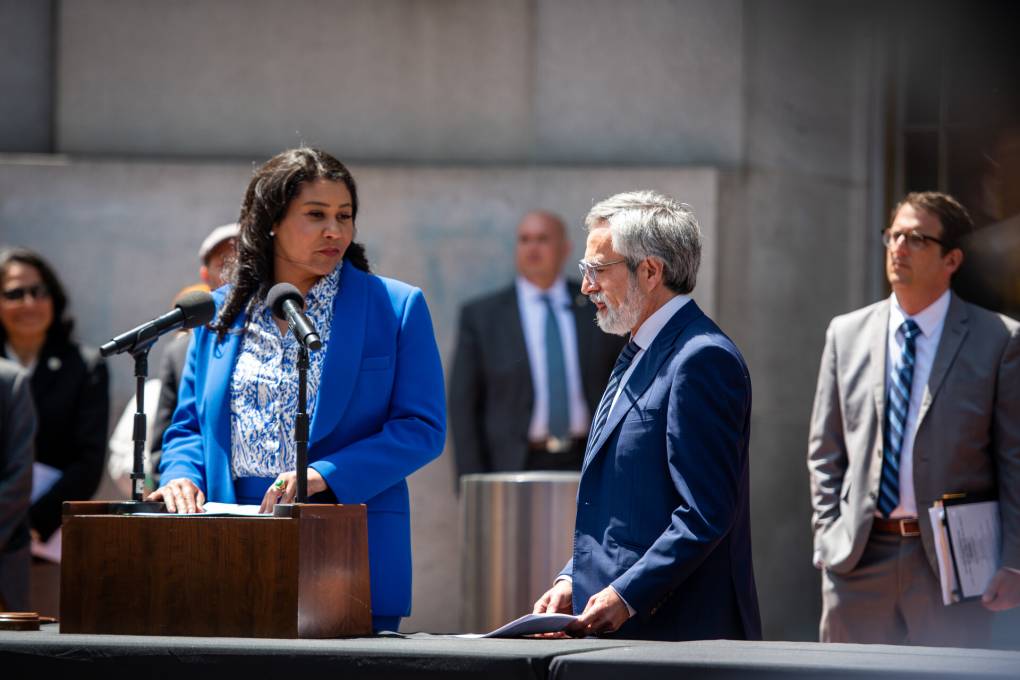
"caption": "San Francisco Mayor London Breed and San Francisco Board of Supervisors President Aaron Peskin speak with a crowd gathered for a Q&A about the fentanyl drug crisis in San Francisco at UN Plaza on May 23, 2023.",
"description": null,
"title": "016_KQED_LondonBreedQA_05232023_qut",
"credit": "Beth LaBerge/KQED",
"status": "inherit",
"altTag": null,
"isLoading": false,
"fetchFailed": false
},
"news_11979880": {
"type": "attachments",
"id": "news_11979880",
"meta": {
"index": "attachments_1716263798",
"site": "news",
"id": "11979880",
"found": true
},
"parent": 11979849,
"imgSizes": {
"twentyfourteen-full-width": {
"file": "https://cdn.kqed.org/wp-content/uploads/sites/10/2024/03/007_KQED_LondonBreedQA_05232023_qut-1038x576.jpg",
"width": 1038,
"mimeType": "image/jpeg",
"height": 576
},
"thumbnail": {
"file": "https://cdn.kqed.org/wp-content/uploads/sites/10/2024/03/007_KQED_LondonBreedQA_05232023_qut-160x107.jpg",
"width": 160,
"mimeType": "image/jpeg",
"height": 107
},
"post-thumbnail": {
"file": "https://cdn.kqed.org/wp-content/uploads/sites/10/2024/03/007_KQED_LondonBreedQA_05232023_qut-672x372.jpg",
"width": 672,
"mimeType": "image/jpeg",
"height": 372
},
"kqedFullSize": {
"file": "https://cdn.kqed.org/wp-content/uploads/sites/10/2024/03/007_KQED_LondonBreedQA_05232023_qut.jpg",
"width": 1920,
"height": 1280
},
"large": {
"file": "https://cdn.kqed.org/wp-content/uploads/sites/10/2024/03/007_KQED_LondonBreedQA_05232023_qut-1020x680.jpg",
"width": 1020,
"mimeType": "image/jpeg",
"height": 680
},
"1536x1536": {
"file": "https://cdn.kqed.org/wp-content/uploads/sites/10/2024/03/007_KQED_LondonBreedQA_05232023_qut-1536x1024.jpg",
"width": 1536,
"mimeType": "image/jpeg",
"height": 1024
},
"medium": {
"file": "https://cdn.kqed.org/wp-content/uploads/sites/10/2024/03/007_KQED_LondonBreedQA_05232023_qut-800x533.jpg",
"width": 800,
"mimeType": "image/jpeg",
"height": 533
}
},
"publishDate": 1710806010,
"modified": 1710806059,
"caption": "San Francisco Board of Supervisors President Aaron Peskin and San Francisco Mayor London Breed speak with a crowd gathered for a Q&A about the fentanyl drug crisis in San Francisco at UN Plaza on May 23, 2023.",
"description": null,
"title": "007_KQED_LondonBreedQA_05232023_qut",
"credit": "Beth LaBerge/KQED",
"status": "inherit",
"altTag": null,
"isLoading": false,
"fetchFailed": false
},
"news_11692911": {
"type": "attachments",
"id": "news_11692911",
"meta": {
"index": "attachments_1716263798",
"site": "news",
"id": "11692911",
"found": true
},
"parent": 11692906,
"imgSizes": {
"small": {
"file": "https://cdn.kqed.org/wp-content/uploads/sites/10/2018/09/GettyImages-998366012-520x367.jpg",
"width": 520,
"mimeType": "image/jpeg",
"height": 367
},
"twentyfourteen-full-width": {
"file": "https://cdn.kqed.org/wp-content/uploads/sites/10/2018/09/GettyImages-998366012-1038x576.jpg",
"width": 1038,
"mimeType": "image/jpeg",
"height": 576
},
"thumbnail": {
"file": "https://cdn.kqed.org/wp-content/uploads/sites/10/2018/09/GettyImages-998366012-160x113.jpg",
"width": 160,
"mimeType": "image/jpeg",
"height": 113
},
"fd-sm": {
"file": "https://cdn.kqed.org/wp-content/uploads/sites/10/2018/09/GettyImages-998366012-960x678.jpg",
"width": 960,
"mimeType": "image/jpeg",
"height": 678
},
"post-thumbnail": {
"file": "https://cdn.kqed.org/wp-content/uploads/sites/10/2018/09/GettyImages-998366012-672x372.jpg",
"width": 672,
"mimeType": "image/jpeg",
"height": 372
},
"xsmall": {
"file": "https://cdn.kqed.org/wp-content/uploads/sites/10/2018/09/GettyImages-998366012-375x265.jpg",
"width": 375,
"mimeType": "image/jpeg",
"height": 265
},
"kqedFullSize": {
"file": "https://cdn.kqed.org/wp-content/uploads/sites/10/2018/09/GettyImages-998366012-e1537167179316.jpg",
"width": 1920,
"height": 1356
},
"large": {
"file": "https://cdn.kqed.org/wp-content/uploads/sites/10/2018/09/GettyImages-998366012-1020x721.jpg",
"width": 1020,
"mimeType": "image/jpeg",
"height": 721
},
"xlarge": {
"file": "https://cdn.kqed.org/wp-content/uploads/sites/10/2018/09/GettyImages-998366012-1180x834.jpg",
"width": 1180,
"mimeType": "image/jpeg",
"height": 834
},
"complete_open_graph": {
"file": "https://cdn.kqed.org/wp-content/uploads/sites/10/2018/09/GettyImages-998366012-1200x848.jpg",
"width": 1200,
"mimeType": "image/jpeg",
"height": 848
},
"guest-author-50": {
"file": "https://cdn.kqed.org/wp-content/uploads/sites/10/2018/09/GettyImages-998366012-50x50.jpg",
"width": 50,
"mimeType": "image/jpeg",
"height": 50
},
"guest-author-96": {
"file": "https://cdn.kqed.org/wp-content/uploads/sites/10/2018/09/GettyImages-998366012-96x96.jpg",
"width": 96,
"mimeType": "image/jpeg",
"height": 96
},
"medium": {
"file": "https://cdn.kqed.org/wp-content/uploads/sites/10/2018/09/GettyImages-998366012-800x565.jpg",
"width": 800,
"mimeType": "image/jpeg",
"height": 565
},
"guest-author-64": {
"file": "https://cdn.kqed.org/wp-content/uploads/sites/10/2018/09/GettyImages-998366012-64x64.jpg",
"width": 64,
"mimeType": "image/jpeg",
"height": 64
},
"guest-author-32": {
"file": "https://cdn.kqed.org/wp-content/uploads/sites/10/2018/09/GettyImages-998366012-32x32.jpg",
"width": 32,
"mimeType": "image/jpeg",
"height": 32
},
"fd-lrg": {
"file": "https://cdn.kqed.org/wp-content/uploads/sites/10/2018/09/GettyImages-998366012-1920x1356.jpg",
"width": 1920,
"mimeType": "image/jpeg",
"height": 1356
},
"fd-med": {
"file": "https://cdn.kqed.org/wp-content/uploads/sites/10/2018/09/GettyImages-998366012-1180x834.jpg",
"width": 1180,
"mimeType": "image/jpeg",
"height": 834
},
"full-width": {
"file": "https://cdn.kqed.org/wp-content/uploads/sites/10/2018/09/GettyImages-998366012-1920x1356.jpg",
"width": 1920,
"mimeType": "image/jpeg",
"height": 1356
},
"detail": {
"file": "https://cdn.kqed.org/wp-content/uploads/sites/10/2018/09/GettyImages-998366012-150x150.jpg",
"width": 150,
"mimeType": "image/jpeg",
"height": 150
},
"guest-author-128": {
"file": "https://cdn.kqed.org/wp-content/uploads/sites/10/2018/09/GettyImages-998366012-128x128.jpg",
"width": 128,
"mimeType": "image/jpeg",
"height": 128
},
"xxsmall": {
"file": "https://cdn.kqed.org/wp-content/uploads/sites/10/2018/09/GettyImages-998366012-240x170.jpg",
"width": 240,
"mimeType": "image/jpeg",
"height": 170
}
},
"publishDate": 1537167029,
"modified": 1710182256,
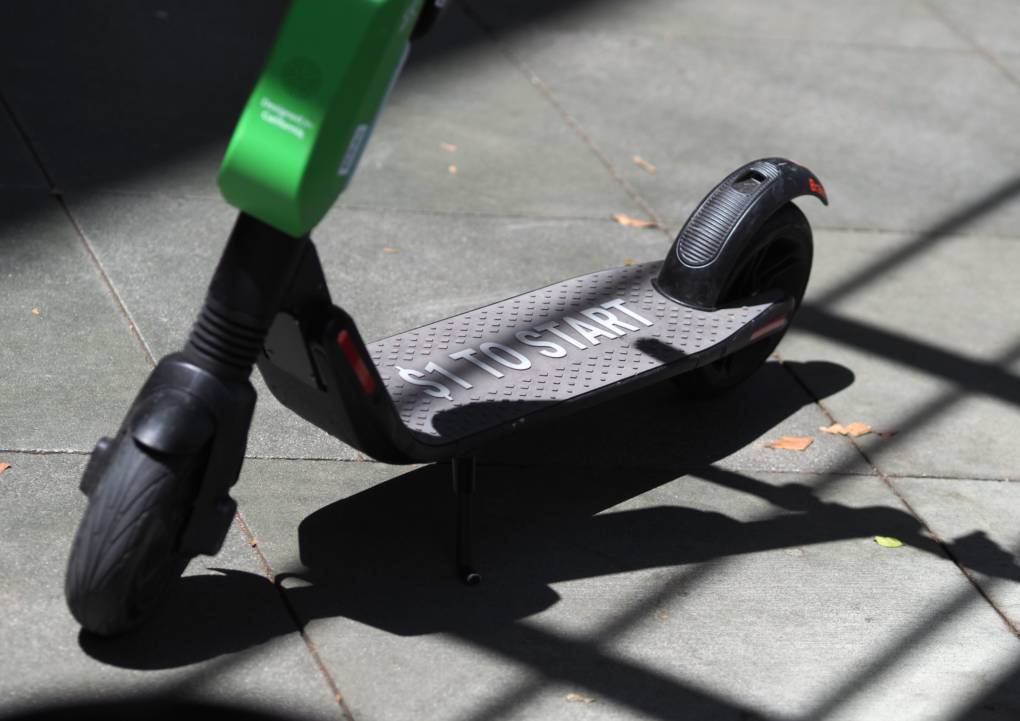
"caption": "San Francisco fire officials say there’s been a dramatic increase in fires associated with lithium-ion batteries found in electric scooters and bicycles.",
"description": null,
"title": "Lime Scooter",
"credit": "Robyn Beck/AFP-Getty Images",
"status": "inherit",
"altTag": null,
"isLoading": false,
"fetchFailed": false
},
"news_11977233": {
"type": "attachments",
"id": "news_11977233",
"meta": {
"index": "attachments_1716263798",
"site": "news",
"id": "11977233",
"found": true
},
"parent": 11977217,
"imgSizes": {
"twentyfourteen-full-width": {
"file": "https://cdn.kqed.org/wp-content/uploads/sites/10/2024/02/GettyImages-1292520931-1-1024x576.jpg",
"width": 1024,
"mimeType": "image/jpeg",
"height": 576
},
"thumbnail": {
"file": "https://cdn.kqed.org/wp-content/uploads/sites/10/2024/02/GettyImages-1292520931-1-160x107.jpg",
"width": 160,
"mimeType": "image/jpeg",
"height": 107
},
"post-thumbnail": {
"file": "https://cdn.kqed.org/wp-content/uploads/sites/10/2024/02/GettyImages-1292520931-1-672x372.jpg",
"width": 672,
"mimeType": "image/jpeg",
"height": 372
},
"kqedFullSize": {
"file": "https://cdn.kqed.org/wp-content/uploads/sites/10/2024/02/GettyImages-1292520931-1.jpg",
"width": 1024,
"height": 683
},
"large": {
"file": "https://cdn.kqed.org/wp-content/uploads/sites/10/2024/02/GettyImages-1292520931-1-1020x680.jpg",
"width": 1020,
"mimeType": "image/jpeg",
"height": 680
},
"medium": {
"file": "https://cdn.kqed.org/wp-content/uploads/sites/10/2024/02/GettyImages-1292520931-1-800x534.jpg",
"width": 800,
"mimeType": "image/jpeg",
"height": 534
}
},
"publishDate": 1709063089,
"modified": 1709063156,
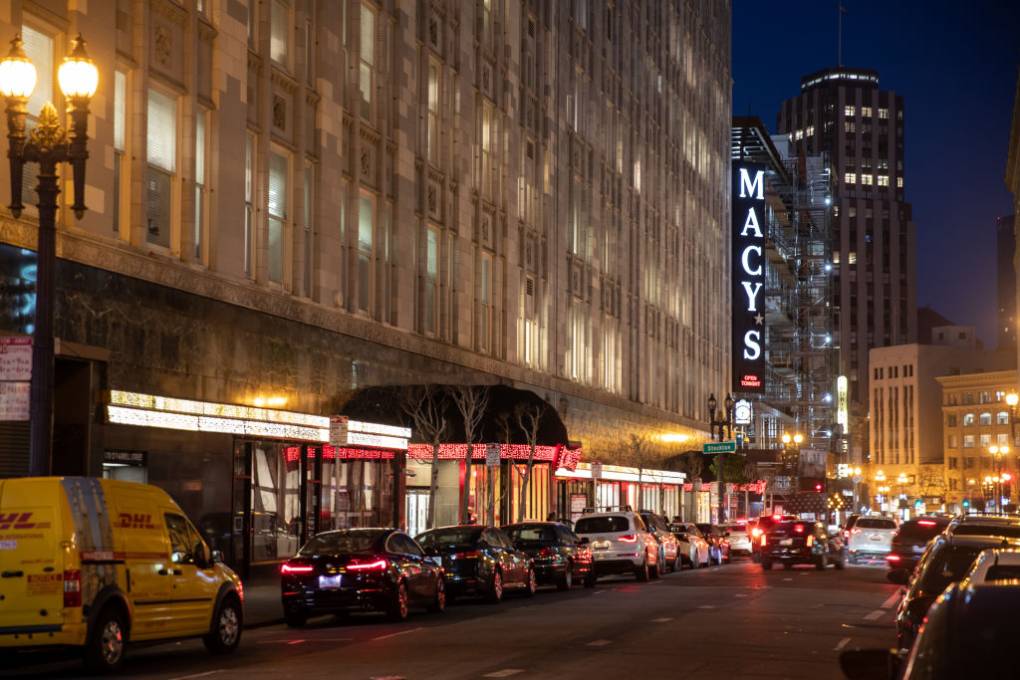
"caption": "A view of Macy's exterior on Dec. 21, 2020 in San Francisco.",
"description": null,
"title": "San Francisco Celebrates The Holiday Season",
"credit": "Miikka Skaffari/Getty Images",
"status": "inherit",
"altTag": "A nighttime shot of the vertical Macy's sign in San Francisco.",
"isLoading": false,
"fetchFailed": false
},
"news_11976031": {
"type": "attachments",
"id": "news_11976031",
"meta": {
"index": "attachments_1716263798",
"site": "news",
"id": "11976031",
"found": true
},
"parent": 0,
"imgSizes": {
"twentyfourteen-full-width": {
"file": "https://cdn.kqed.org/wp-content/uploads/sites/10/2024/02/240214-NONCITIZENVOTING-12-BL-KQED-1038x576.jpg",
"width": 1038,
"mimeType": "image/jpeg",
"height": 576
},
"thumbnail": {
"file": "https://cdn.kqed.org/wp-content/uploads/sites/10/2024/02/240214-NONCITIZENVOTING-12-BL-KQED-160x107.jpg",
"width": 160,
"mimeType": "image/jpeg",
"height": 107
},
"post-thumbnail": {
"file": "https://cdn.kqed.org/wp-content/uploads/sites/10/2024/02/240214-NONCITIZENVOTING-12-BL-KQED-672x372.jpg",
"width": 672,
"mimeType": "image/jpeg",
"height": 372
},
"kqedFullSize": {
"file": "https://cdn.kqed.org/wp-content/uploads/sites/10/2024/02/240214-NONCITIZENVOTING-12-BL-KQED.jpg",
"width": 2000,
"height": 1333
},
"large": {
"file": "https://cdn.kqed.org/wp-content/uploads/sites/10/2024/02/240214-NONCITIZENVOTING-12-BL-KQED-1020x680.jpg",
"width": 1020,
"mimeType": "image/jpeg",
"height": 680
},
"1536x1536": {
"file": "https://cdn.kqed.org/wp-content/uploads/sites/10/2024/02/240214-NONCITIZENVOTING-12-BL-KQED-1536x1024.jpg",
"width": 1536,
"mimeType": "image/jpeg",
"height": 1024
},
"full-width": {
"file": "https://cdn.kqed.org/wp-content/uploads/sites/10/2024/02/240214-NONCITIZENVOTING-12-BL-KQED-1920x1280.jpg",
"width": 1920,
"mimeType": "image/jpeg",
"height": 1280
},
"medium": {
"file": "https://cdn.kqed.org/wp-content/uploads/sites/10/2024/02/240214-NONCITIZENVOTING-12-BL-KQED-800x533.jpg",
"width": 800,
"mimeType": "image/jpeg",
"height": 533
}
},
"publishDate": 1708018370,
"modified": 1708029051,
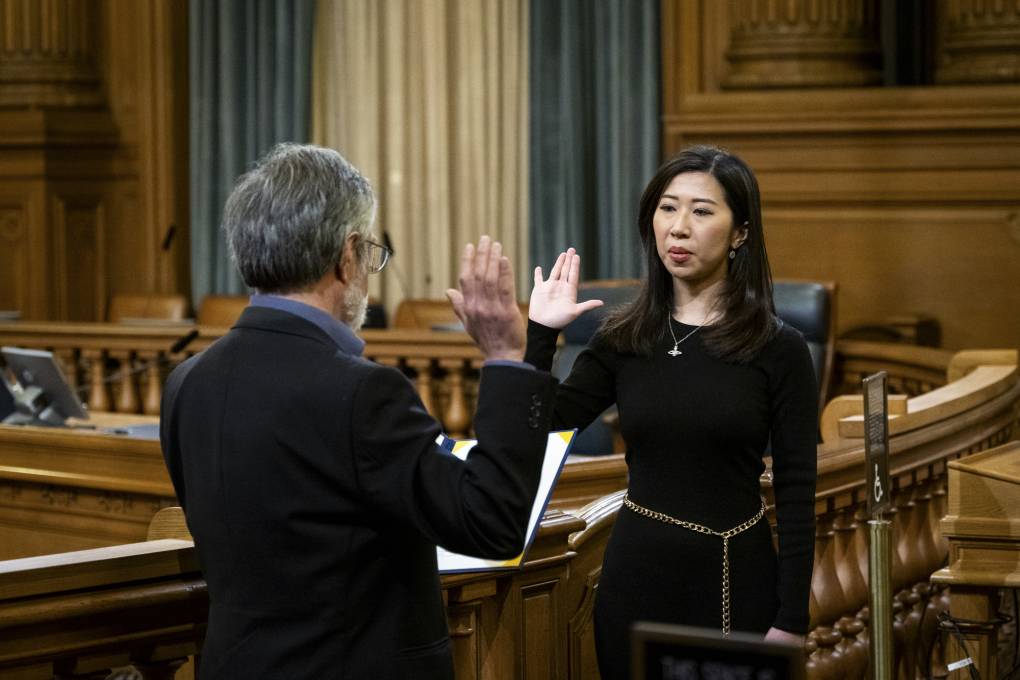
"caption": "Aaron Peskin, President of the Board of Supervisors, swears in appointee Kelly Wong to the San Francisco Elections Commission at City Hall in San Francisco on Feb. 14, 2024.",
"description": null,
"title": "240214-NONCITIZENVOTING-12-BL-KQED",
"credit": "Beth LaBerge/KQED",
"status": "inherit",
"altTag": "An Asian woman wearing a black dress raises her right hand in front of a man wearing a black suit who is also raising his and holding a document inside a building.",
"isLoading": false,
"fetchFailed": false
},
"news_11956080": {
"type": "attachments",
"id": "news_11956080",
"meta": {
"index": "attachments_1716263798",
"site": "news",
"id": "11956080",
"found": true
},
"parent": 11956110,
"imgSizes": {
"twentyfourteen-full-width": {
"file": "https://ww2.kqed.org/app/uploads/sites/10/2023/07/RS67115_20230719-cityhallrally-10-JY-KQED-1038x576.jpg",
"width": 1038,
"mimeType": "image/jpeg",
"height": 576
},
"thumbnail": {
"file": "https://ww2.kqed.org/app/uploads/sites/10/2023/07/RS67115_20230719-cityhallrally-10-JY-KQED-160x107.jpg",
"width": 160,
"mimeType": "image/jpeg",
"height": 107
},
"post-thumbnail": {
"file": "https://ww2.kqed.org/app/uploads/sites/10/2023/07/RS67115_20230719-cityhallrally-10-JY-KQED-672x372.jpg",
"width": 672,
"mimeType": "image/jpeg",
"height": 372
},
"kqedFullSize": {
"file": "https://ww2.kqed.org/app/uploads/sites/10/2023/07/RS67115_20230719-cityhallrally-10-JY-KQED.jpg",
"width": 2000,
"height": 1334
},
"large": {
"file": "https://ww2.kqed.org/app/uploads/sites/10/2023/07/RS67115_20230719-cityhallrally-10-JY-KQED-1020x680.jpg",
"width": 1020,
"mimeType": "image/jpeg",
"height": 680
},
"1536x1536": {
"file": "https://ww2.kqed.org/app/uploads/sites/10/2023/07/RS67115_20230719-cityhallrally-10-JY-KQED-1536x1025.jpg",
"width": 1536,
"mimeType": "image/jpeg",
"height": 1025
},
"full-width": {
"file": "https://ww2.kqed.org/app/uploads/sites/10/2023/07/RS67115_20230719-cityhallrally-10-JY-KQED-1920x1281.jpg",
"width": 1920,
"mimeType": "image/jpeg",
"height": 1281
},
"medium": {
"file": "https://ww2.kqed.org/app/uploads/sites/10/2023/07/RS67115_20230719-cityhallrally-10-JY-KQED-800x534.jpg",
"width": 800,
"mimeType": "image/jpeg",
"height": 534
}
},
"publishDate": 1689868590,
"modified": 1697071565,
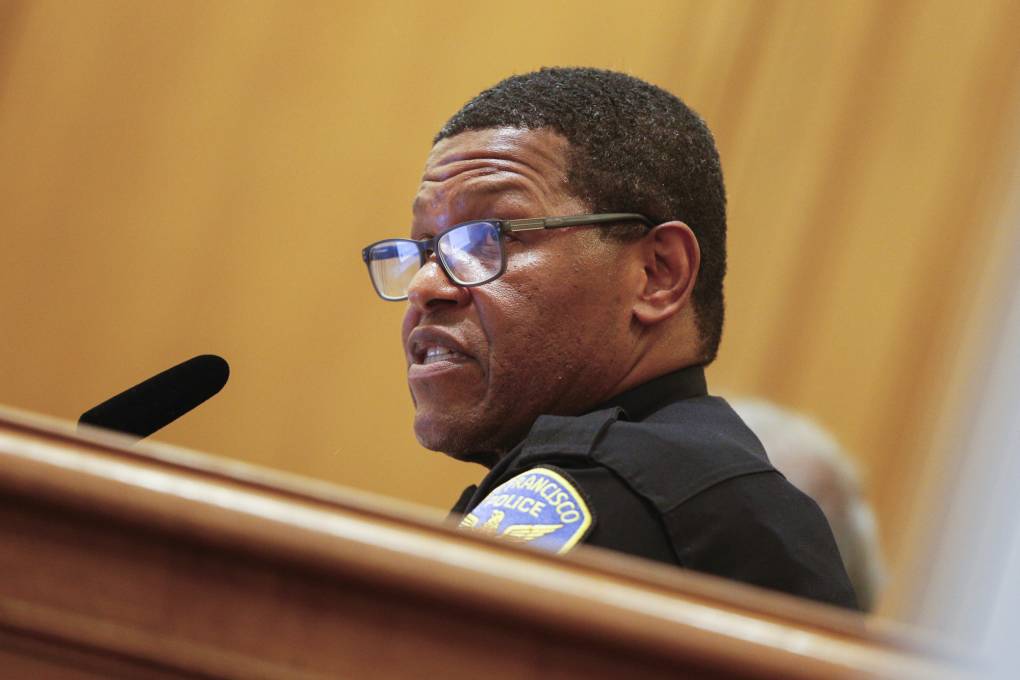
"caption": "Police Chief William Scott speaks during a Police Commission meeting at City Hall in San Francisco on Wednesday, July 19, 2023.",
"description": null,
"title": "RS67115_20230719-cityhallrally-10-JY-KQED",
"credit": "Juliana Yamada/KQED",
"status": "inherit",
"altTag": "A man with glasses and wearing a police uniform speaks into a microphone.",
"isLoading": false,
"fetchFailed": false
},
"news_11961411": {
"type": "attachments",
"id": "news_11961411",
"meta": {
"index": "attachments_1716263798",
"site": "news",
"id": "11961411",
"found": true
},
"title": "230913-SFPDStaff-011-BL-KQED",
"publishDate": 1694810146,
"status": "inherit",
"parent": 12063157,
"modified": 1762466664,
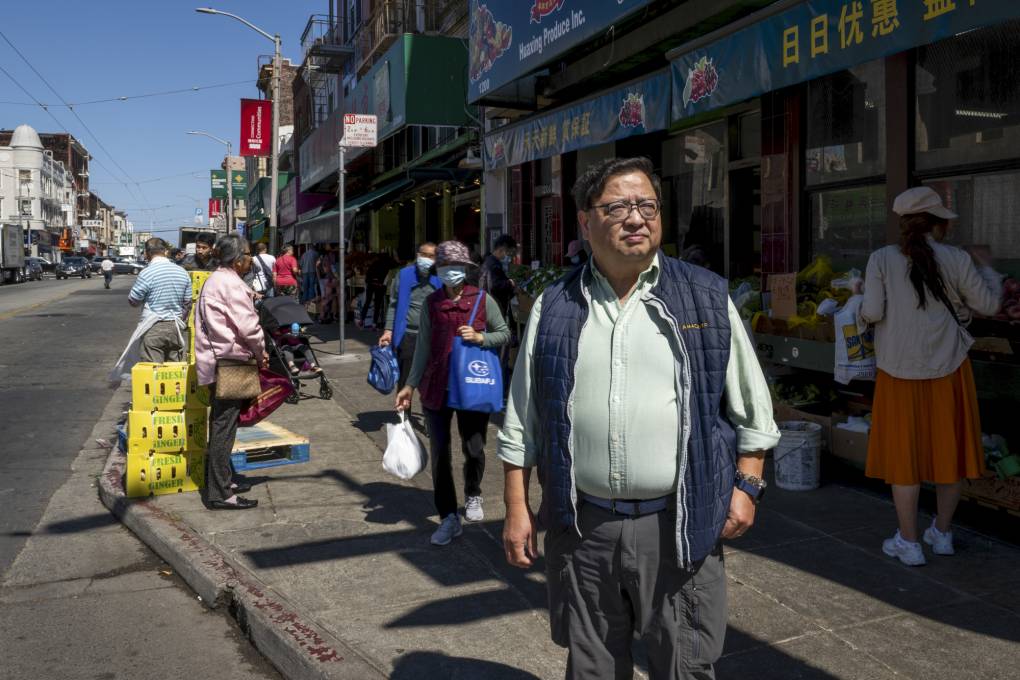
"caption": "Edward Siu, president of the Chinatown Merchants United Association, stands on a busy corner of Stockton Street in San Francisco's Chinatown neighborhood on Sept. 13, 2023. He says SFPD command turnover is so fast that he can't remember all the names of the police leaders he's given community tours to.",
"credit": "Beth LaBerge/KQED",
"altTag": "A person with glasses is photographed as other people pass on a busy city sidewalk.",
"description": null,
"imgSizes": {
"medium": {
"file": "https://cdn.kqed.org/wp-content/uploads/sites/10/2023/09/230913-SFPDStaff-011-BL-KQED-800x533.jpg",
"width": 800,
"height": 533,
"mimeType": "image/jpeg"
},
"large": {
"file": "https://cdn.kqed.org/wp-content/uploads/sites/10/2023/09/230913-SFPDStaff-011-BL-KQED-1020x680.jpg",
"width": 1020,
"height": 680,
"mimeType": "image/jpeg"
},
"thumbnail": {
"file": "https://cdn.kqed.org/wp-content/uploads/sites/10/2023/09/230913-SFPDStaff-011-BL-KQED-160x107.jpg",
"width": 160,
"height": 107,
"mimeType": "image/jpeg"
},
"1536x1536": {
"file": "https://cdn.kqed.org/wp-content/uploads/sites/10/2023/09/230913-SFPDStaff-011-BL-KQED-1536x1024.jpg",
"width": 1536,
"height": 1024,
"mimeType": "image/jpeg"
},
"post-thumbnail": {
"file": "https://cdn.kqed.org/wp-content/uploads/sites/10/2023/09/230913-SFPDStaff-011-BL-KQED-672x372.jpg",
"width": 672,
"height": 372,
"mimeType": "image/jpeg"
},
"twentyfourteen-full-width": {
"file": "https://cdn.kqed.org/wp-content/uploads/sites/10/2023/09/230913-SFPDStaff-011-BL-KQED-1038x576.jpg",
"width": 1038,
"height": 576,
"mimeType": "image/jpeg"
},
"full-width": {
"file": "https://cdn.kqed.org/wp-content/uploads/sites/10/2023/09/230913-SFPDStaff-011-BL-KQED-1920x1280.jpg",
"width": 1920,
"height": 1280,
"mimeType": "image/jpeg"
},
"kqedFullSize": {
"file": "https://cdn.kqed.org/wp-content/uploads/sites/10/2023/09/230913-SFPDStaff-011-BL-KQED.jpg",
"width": 2000,
"height": 1333
}
},
"isLoading": false,
"fetchFailed": false
},
"news_11934365": {
"type": "attachments",
"id": "news_11934365",
"meta": {
"index": "attachments_1716263798",
"site": "news",
"id": "11934365",
"found": true
},
"parent": 11934343,
"imgSizes": {
"twentyfourteen-full-width": {
"file": "https://ww2.kqed.org/app/uploads/sites/10/2022/12/GettyImages-1321971276-1024x576.jpg",
"width": 1024,
"mimeType": "image/jpeg",
"height": 576
},
"thumbnail": {
"file": "https://ww2.kqed.org/app/uploads/sites/10/2022/12/GettyImages-1321971276-160x95.jpg",
"width": 160,
"mimeType": "image/jpeg",
"height": 95
},
"post-thumbnail": {
"file": "https://ww2.kqed.org/app/uploads/sites/10/2022/12/GettyImages-1321971276-672x372.jpg",
"width": 672,
"mimeType": "image/jpeg",
"height": 372
},
"kqedFullSize": {
"file": "https://ww2.kqed.org/app/uploads/sites/10/2022/12/GettyImages-1321971276.jpg",
"width": 1024,
"height": 610
},
"large": {
"file": "https://ww2.kqed.org/app/uploads/sites/10/2022/12/GettyImages-1321971276-1020x608.jpg",
"width": 1020,
"mimeType": "image/jpeg",
"height": 608
},
"medium": {
"file": "https://ww2.kqed.org/app/uploads/sites/10/2022/12/GettyImages-1321971276-800x477.jpg",
"width": 800,
"mimeType": "image/jpeg",
"height": 477
}
},
"publishDate": 1670370595,
"modified": 1670392054,
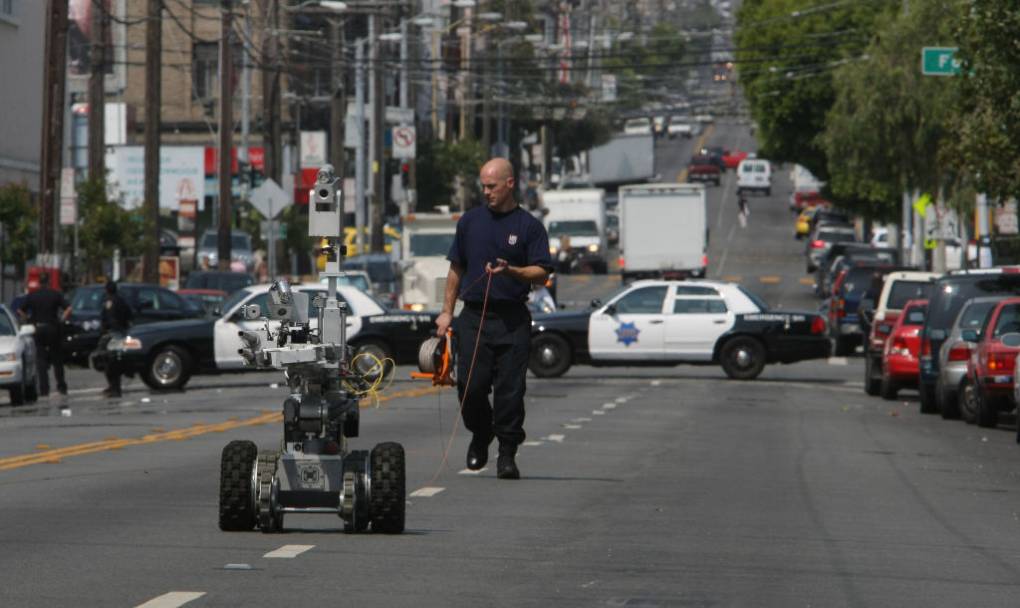
"caption": "The San Francisco Police Department's bomb-investigating robot returns from down 16th Street after looking over a device. The San Francisco police bomb squad closed off 16th Street between Folsom and Harrison streets in San Francisco after a report of a suspicious cart tied to a tree, on Friday, July 25, 2008.",
"description": null,
"title": "The San Francisco Police, bomb investigating robot, returns from down 16th street after looking over the device. The San Francsico Police bomb squard closed of 16th street between Folson and Harrison Streets, in San Francsico, Calif., after a report of",
"credit": "Michael Macor/The San Francisco Chronicle via Getty Images",
"status": "inherit",
"altTag": "A man dressed in a police uniform holds a device that is attached to a robot in the middle of the street with police cars in the background.",
"isLoading": false,
"fetchFailed": false
},
"news_11933420": {
"type": "attachments",
"id": "news_11933420",
"meta": {
"index": "attachments_1716263798",
"site": "news",
"id": "11933420",
"found": true
},
"parent": 11933419,
"imgSizes": {
"twentyfourteen-full-width": {
"file": "https://ww2.kqed.org/app/uploads/sites/10/2022/11/gettyimages-1052941302_wide-37077caffed7442eab4c5ec804c483c2a86e0ca0-1038x576.jpg",
"width": 1038,
"mimeType": "image/jpeg",
"height": 576
},
"thumbnail": {
"file": "https://ww2.kqed.org/app/uploads/sites/10/2022/11/gettyimages-1052941302_wide-37077caffed7442eab4c5ec804c483c2a86e0ca0-160x90.jpg",
"width": 160,
"mimeType": "image/jpeg",
"height": 90
},
"post-thumbnail": {
"file": "https://ww2.kqed.org/app/uploads/sites/10/2022/11/gettyimages-1052941302_wide-37077caffed7442eab4c5ec804c483c2a86e0ca0-672x372.jpg",
"width": 672,
"mimeType": "image/jpeg",
"height": 372
},
"kqedFullSize": {
"file": "https://ww2.kqed.org/app/uploads/sites/10/2022/11/gettyimages-1052941302_wide-37077caffed7442eab4c5ec804c483c2a86e0ca0-scaled.jpg",
"width": 2560,
"height": 1440
},
"2048x2048": {
"file": "https://ww2.kqed.org/app/uploads/sites/10/2022/11/gettyimages-1052941302_wide-37077caffed7442eab4c5ec804c483c2a86e0ca0-2048x1152.jpg",
"width": 2048,
"mimeType": "image/jpeg",
"height": 1152
},
"large": {
"file": "https://ww2.kqed.org/app/uploads/sites/10/2022/11/gettyimages-1052941302_wide-37077caffed7442eab4c5ec804c483c2a86e0ca0-1020x574.jpg",
"width": 1020,
"mimeType": "image/jpeg",
"height": 574
},
"1536x1536": {
"file": "https://ww2.kqed.org/app/uploads/sites/10/2022/11/gettyimages-1052941302_wide-37077caffed7442eab4c5ec804c483c2a86e0ca0-1536x864.jpg",
"width": 1536,
"mimeType": "image/jpeg",
"height": 864
},
"full-width": {
"file": "https://ww2.kqed.org/app/uploads/sites/10/2022/11/gettyimages-1052941302_wide-37077caffed7442eab4c5ec804c483c2a86e0ca0-1920x1080.jpg",
"width": 1920,
"mimeType": "image/jpeg",
"height": 1080
},
"medium": {
"file": "https://ww2.kqed.org/app/uploads/sites/10/2022/11/gettyimages-1052941302_wide-37077caffed7442eab4c5ec804c483c2a86e0ca0-800x450.jpg",
"width": 800,
"mimeType": "image/jpeg",
"height": 450
}
},
"publishDate": 1669751822,
"modified": 1669752032,
"caption": "The Broward Sheriff's Office bomb squad deploys a robotic vehicle to investigate a suspicious package in the building where Rep. Debbie Wasserman Schultz (D-FL) has an offce on October 24, 2018 in Sunrise, Florida. A number of suspicious packages arrived in the mail today intended for former President Barack Obama, Democratic presidential nominee Hillary Clinton and the New York office of CNN.",
"description": "SUNRISE, FL - OCTOBER 24: The Broward Sheriff's Office bomb squad deploys a robotic vehicle to investigate a suspicious package in the building where Rep. Debbie Wasserman Schultz (D-FL) has an offce on October 24, 2018 in Sunrise, Florida. A number of suspicious packages arrived in the mail today intended for former President Barack Obama, Democratic presidential nominee Hillary Clinton and the New York office of CNN. (Photo by Joe Raedle/Getty Images)",
"title": "Law enforcement has used robots to investigate suspicious packages. Now, the San Francisco Board of Supervisors is considering a policy proposal that would allow SFPD's robots to use deadly force against a suspect.",
"credit": "Joe Raedle/Getty Images",
"status": "inherit",
"altTag": "A walks dressed in a law enforcement uniform walks past a robot in the street.",
"isLoading": false,
"fetchFailed": false
},
"news_11896929": {
"type": "attachments",
"id": "news_11896929",
"meta": {
"index": "attachments_1716263798",
"site": "news",
"id": "11896929",
"found": true
},
"parent": 11896762,
"imgSizes": {
"twentyfourteen-full-width": {
"file": "https://ww2.kqed.org/app/uploads/sites/10/2021/11/GettyImages-1323764102-1-1038x576.jpg",
"width": 1038,
"mimeType": "image/jpeg",
"height": 576
},
"thumbnail": {
"file": "https://ww2.kqed.org/app/uploads/sites/10/2021/11/GettyImages-1323764102-1-160x104.jpg",
"width": 160,
"mimeType": "image/jpeg",
"height": 104
},
"post-thumbnail": {
"file": "https://ww2.kqed.org/app/uploads/sites/10/2021/11/GettyImages-1323764102-1-672x372.jpg",
"width": 672,
"mimeType": "image/jpeg",
"height": 372
},
"kqedFullSize": {
"file": "https://ww2.kqed.org/app/uploads/sites/10/2021/11/GettyImages-1323764102-1.jpg",
"width": 1920,
"height": 1250
},
"large": {
"file": "https://ww2.kqed.org/app/uploads/sites/10/2021/11/GettyImages-1323764102-1-1020x664.jpg",
"width": 1020,
"mimeType": "image/jpeg",
"height": 664
},
"1536x1536": {
"file": "https://ww2.kqed.org/app/uploads/sites/10/2021/11/GettyImages-1323764102-1-1536x1000.jpg",
"width": 1536,
"mimeType": "image/jpeg",
"height": 1000
},
"medium": {
"file": "https://ww2.kqed.org/app/uploads/sites/10/2021/11/GettyImages-1323764102-1-800x521.jpg",
"width": 800,
"mimeType": "image/jpeg",
"height": 521
}
},
"publishDate": 1637364274,
"modified": 1637805057,
"caption": "In an aerial view, the SkyStar Wheel in the Music Concourse carries riders at Golden Gate Park on June 14, 2021, in San Francisco.",
"description": null,
"title": "GettyImages-1323764102 (1)",
"credit": "Justin Sullivan/Getty Images",
"status": "inherit",
"altTag": "A white ferris wheel seen from above, with Golden Gate Park's concourse in the background -- green shrubberies and grass with benches and fountains.",
"isLoading": false,
"fetchFailed": false
},
"news_11866067": {
"type": "attachments",
"id": "news_11866067",
"meta": {
"index": "attachments_1716263798",
"site": "news",
"id": "11866067",
"found": true
},
"parent": 11866033,
"imgSizes": {
"twentyfourteen-full-width": {
"file": "https://ww2.kqed.org/app/uploads/sites/10/2021/03/7c93f304-1-1038x576.jpg",
"width": 1038,
"mimeType": "image/jpeg",
"height": 576
},
"thumbnail": {
"file": "https://ww2.kqed.org/app/uploads/sites/10/2021/03/7c93f304-1-160x131.jpg",
"width": 160,
"mimeType": "image/jpeg",
"height": 131
},
"post-thumbnail": {
"file": "https://ww2.kqed.org/app/uploads/sites/10/2021/03/7c93f304-1-672x372.jpg",
"width": 672,
"mimeType": "image/jpeg",
"height": 372
},
"kqedFullSize": {
"file": "https://ww2.kqed.org/app/uploads/sites/10/2021/03/7c93f304-1.jpg",
"width": 1920,
"height": 1570
},
"large": {
"file": "https://ww2.kqed.org/app/uploads/sites/10/2021/03/7c93f304-1-1020x834.jpg",
"width": 1020,
"mimeType": "image/jpeg",
"height": 834
},
"1536x1536": {
"file": "https://ww2.kqed.org/app/uploads/sites/10/2021/03/7c93f304-1-1536x1256.jpg",
"width": 1536,
"mimeType": "image/jpeg",
"height": 1256
},
"medium": {
"file": "https://ww2.kqed.org/app/uploads/sites/10/2021/03/7c93f304-1-800x654.jpg",
"width": 800,
"mimeType": "image/jpeg",
"height": 654
}
},
"publishDate": 1616538273,
"modified": 1630427189,
"caption": "Residents of single-room occupancy hotels fear they have little ability to quarantine due to living in close quarters, with shared bathrooms and kitchens. Seen here, residents of an SRO building on Clayton Street in San Francisco pose for a photo in May 2020. ",
"description": "Residents of single room occupancy hotels fear they have little ability to quarantine due to living in close quarters, with shared bathrooms and kitchens. Seen here, residents of an SRO building on Clayton Street in San Francisco pose for a photo in May, 2020. ",
"title": "7c93f304- (1)",
"credit": "Photo courtesy Chinatown Community Development Center",
"status": "inherit",
"altTag": "Long, spare, clean hallway with older Chinese residents standing in their doorways",
"isLoading": false,
"fetchFailed": false
},
"news_11846803": {
"type": "attachments",
"id": "news_11846803",
"meta": {
"index": "attachments_1716263798",
"site": "news",
"id": "11846803",
"found": true
},
"parent": 11846796,
"imgSizes": {
"apple_news_ca_landscape_5_5": {
"file": "https://ww2.kqed.org/app/uploads/sites/10/2020/11/RS44777_060_KQED_Japantown_Businesses_09022020-1044x783.jpg",
"width": 1044,
"mimeType": "image/jpeg",
"height": 783
},
"apple_news_ca_square_4_0": {
"file": "https://ww2.kqed.org/app/uploads/sites/10/2020/11/RS44777_060_KQED_Japantown_Businesses_09022020-470x470.jpg",
"width": 470,
"mimeType": "image/jpeg",
"height": 470
},
"twentyfourteen-full-width": {
"file": "https://ww2.kqed.org/app/uploads/sites/10/2020/11/RS44777_060_KQED_Japantown_Businesses_09022020-1038x576.jpg",
"width": 1038,
"mimeType": "image/jpeg",
"height": 576
},
"thumbnail": {
"file": "https://ww2.kqed.org/app/uploads/sites/10/2020/11/RS44777_060_KQED_Japantown_Businesses_09022020-160x107.jpg",
"width": 160,
"mimeType": "image/jpeg",
"height": 107
},
"post-thumbnail": {
"file": "https://ww2.kqed.org/app/uploads/sites/10/2020/11/RS44777_060_KQED_Japantown_Businesses_09022020-672x372.jpg",
"width": 672,
"mimeType": "image/jpeg",
"height": 372
},
"kqedFullSize": {
"file": "https://ww2.kqed.org/app/uploads/sites/10/2020/11/RS44777_060_KQED_Japantown_Businesses_09022020-scaled.jpg",
"width": 2560,
"height": 1707
},
"2048x2048": {
"file": "https://ww2.kqed.org/app/uploads/sites/10/2020/11/RS44777_060_KQED_Japantown_Businesses_09022020-2048x1365.jpg",
"width": 2048,
"mimeType": "image/jpeg",
"height": 1365
},
"apple_news_ca_landscape_4_7": {
"file": "https://ww2.kqed.org/app/uploads/sites/10/2020/11/RS44777_060_KQED_Japantown_Businesses_09022020-632x474.jpg",
"width": 632,
"mimeType": "image/jpeg",
"height": 474
},
"large": {
"file": "https://ww2.kqed.org/app/uploads/sites/10/2020/11/RS44777_060_KQED_Japantown_Businesses_09022020-1020x680.jpg",
"width": 1020,
"mimeType": "image/jpeg",
"height": 680
},
"apple_news_ca_landscape_4_0": {
"file": "https://ww2.kqed.org/app/uploads/sites/10/2020/11/RS44777_060_KQED_Japantown_Businesses_09022020-536x402.jpg",
"width": 536,
"mimeType": "image/jpeg",
"height": 402
},
"apple_news_ca_portrait_12_9": {
"file": "https://ww2.kqed.org/app/uploads/sites/10/2020/11/RS44777_060_KQED_Japantown_Businesses_09022020-1122x1496.jpg",
"width": 1122,
"mimeType": "image/jpeg",
"height": 1496
},
"medium": {
"file": "https://ww2.kqed.org/app/uploads/sites/10/2020/11/RS44777_060_KQED_Japantown_Businesses_09022020-800x533.jpg",
"width": 800,
"mimeType": "image/jpeg",
"height": 533
},
"apple_news_ca_portrait_4_0": {
"file": "https://ww2.kqed.org/app/uploads/sites/10/2020/11/RS44777_060_KQED_Japantown_Businesses_09022020-354x472.jpg",
"width": 354,
"mimeType": "image/jpeg",
"height": 472
},
"apple_news_ca_portrait_9_7": {
"file": "https://ww2.kqed.org/app/uploads/sites/10/2020/11/RS44777_060_KQED_Japantown_Businesses_09022020-840x1120.jpg",
"width": 840,
"mimeType": "image/jpeg",
"height": 1120
},
"apple_news_ca_landscape_12_9": {
"file": "https://ww2.kqed.org/app/uploads/sites/10/2020/11/RS44777_060_KQED_Japantown_Businesses_09022020-1832x1374.jpg",
"width": 1832,
"mimeType": "image/jpeg",
"height": 1374
},
"apple_news_ca_square_9_7": {
"file": "https://ww2.kqed.org/app/uploads/sites/10/2020/11/RS44777_060_KQED_Japantown_Businesses_09022020-1104x1104.jpg",
"width": 1104,
"mimeType": "image/jpeg",
"height": 1104
},
"1536x1536": {
"file": "https://ww2.kqed.org/app/uploads/sites/10/2020/11/RS44777_060_KQED_Japantown_Businesses_09022020-1536x1024.jpg",
"width": 1536,
"mimeType": "image/jpeg",
"height": 1024
},
"apple_news_ca_portrait_4_7": {
"file": "https://ww2.kqed.org/app/uploads/sites/10/2020/11/RS44777_060_KQED_Japantown_Businesses_09022020-414x552.jpg",
"width": 414,
"mimeType": "image/jpeg",
"height": 552
},
"apple_news_ca_square_12_9": {
"file": "https://ww2.kqed.org/app/uploads/sites/10/2020/11/RS44777_060_KQED_Japantown_Businesses_09022020-1472x1472.jpg",
"width": 1472,
"mimeType": "image/jpeg",
"height": 1472
},
"apple_news_ca_portrait_5_5": {
"file": "https://ww2.kqed.org/app/uploads/sites/10/2020/11/RS44777_060_KQED_Japantown_Businesses_09022020-687x916.jpg",
"width": 687,
"mimeType": "image/jpeg",
"height": 916
},
"full-width": {
"file": "https://ww2.kqed.org/app/uploads/sites/10/2020/11/RS44777_060_KQED_Japantown_Businesses_09022020-1920x1280.jpg",
"width": 1920,
"mimeType": "image/jpeg",
"height": 1280
},
"apple_news_ca_square_4_7": {
"file": "https://ww2.kqed.org/app/uploads/sites/10/2020/11/RS44777_060_KQED_Japantown_Businesses_09022020-550x550.jpg",
"width": 550,
"mimeType": "image/jpeg",
"height": 550
},
"apple_news_ca_landscape_9_7": {
"file": "https://ww2.kqed.org/app/uploads/sites/10/2020/11/RS44777_060_KQED_Japantown_Businesses_09022020-1376x1032.jpg",
"width": 1376,
"mimeType": "image/jpeg",
"height": 1032
},
"apple_news_ca_square_5_5": {
"file": "https://ww2.kqed.org/app/uploads/sites/10/2020/11/RS44777_060_KQED_Japantown_Businesses_09022020-912x912.jpg",
"width": 912,
"mimeType": "image/jpeg",
"height": 912
}
},
"publishDate": 1604990491,
"modified": 1605029801,
"caption": "Xiao Feng brings out an order at the Matcha Cafe Maiko at the Japan Center West Mall on Sep. 2, 2020.",
"description": "Xiao Feng brings out an order at the Matcha Cafe Maiko at the Japan Center West Mall on Sep. 2, 2020.",
"title": "RS44777_060_KQED_Japantown_Businesses_09022020",
"credit": "Beth LaBerge/KQED",
"status": "inherit",
"isLoading": false,
"fetchFailed": false
}
},
"audioPlayerReducer": {
"postId": "stream_live",
"isPaused": true,
"isPlaying": false,
"pfsActive": false,
"pledgeModalIsOpen": true,
"playerDrawerIsOpen": false,
"liveAudioPlayStartedAt": 0,
"liveAudioPlayContext": ""
},
"authorsReducer": {
"byline_news_11933419": {
"type": "authors",
"id": "byline_news_11933419",
"meta": {
"override": true
},
"slug": "byline_news_11933419",
"name": "Brianna Scott",
"isLoading": false
},
"matthewgreen": {
"type": "authors",
"id": "1263",
"meta": {
"index": "authors_1716337520",
"id": "1263",
"found": true
},
"name": "Matthew Green",
"firstName": "Matthew",
"lastName": "Green",
"slug": "matthewgreen",
"email": "mgreen@kqed.org",
"display_author_email": false,
"staff_mastheads": [],
"title": "KQED Editor/Reporter",
"bio": "Matthew Green is a digital media producer for KQED News. He previously produced \u003ca href=\"http://www.kqed.org/lowdown\">The Lowdown\u003c/a>, KQED’s multimedia news education blog. Matthew's written for numerous Bay Area publications, including the Oakland Tribune and San Francisco Chronicle. He also taught journalism classes at Fremont High School in East Oakland.\r\n\r\nEmail: mgreen@kqed.org; Twitter: @MGreenKQED",
"avatar": "https://secure.gravatar.com/avatar/3bf498d1267ca02c8494f33d8cfc575e?s=600&d=blank&r=g",
"twitter": "MGreenKQED",
"facebook": null,
"instagram": null,
"linkedin": null,
"sites": [
{
"site": "news",
"roles": []
},
{
"site": "lowdown",
"roles": []
},
{
"site": "science",
"roles": []
},
{
"site": "education",
"roles": []
},
{
"site": "quest",
"roles": []
},
{
"site": "liveblog",
"roles": []
}
],
"headData": {
"title": "Matthew Green | KQED",
"description": "KQED Editor/Reporter",
"ogImgSrc": "https://secure.gravatar.com/avatar/3bf498d1267ca02c8494f33d8cfc575e?s=600&d=blank&r=g",
"twImgSrc": "https://secure.gravatar.com/avatar/3bf498d1267ca02c8494f33d8cfc575e?s=600&d=blank&r=g"
},
"isLoading": false,
"link": "/author/matthewgreen"
},
"clei": {
"type": "authors",
"id": "8617",
"meta": {
"index": "authors_1716337520",
"id": "8617",
"found": true
},
"name": "Cecilia Lei",
"firstName": "Cecilia",
"lastName": "Lei",
"slug": "clei",
"email": "clei@KQED.org",
"display_author_email": false,
"staff_mastheads": [],
"title": "KQED Contributor",
"bio": "Cecilia Lei is an on-call host and producer for KQED News and Podcasts. Previously, she was the executive producer and host of the San Francisco Chronicle's daily news podcast, 'Fifth and Mission'. Cecilia is a graduate of UC Berkeley’s Graduate School of Journalism and the former president of the Asian American Journalists Association San Francisco Bay Area chapter.",
"avatar": "https://secure.gravatar.com/avatar/40975f1f88fccf628ee537bf6ffc2af8?s=600&d=blank&r=g",
"twitter": null,
"facebook": null,
"instagram": null,
"linkedin": null,
"sites": [
{
"site": "arts",
"roles": [
"contributor"
]
},
{
"site": "news",
"roles": [
"author",
"read_private_posts"
]
},
{
"site": "about",
"roles": [
"editor"
]
}
],
"headData": {
"title": "Cecilia Lei | KQED",
"description": "KQED Contributor",
"ogImgSrc": "https://secure.gravatar.com/avatar/40975f1f88fccf628ee537bf6ffc2af8?s=600&d=blank&r=g",
"twImgSrc": "https://secure.gravatar.com/avatar/40975f1f88fccf628ee537bf6ffc2af8?s=600&d=blank&r=g"
},
"isLoading": false,
"link": "/author/clei"
},
"jrodriguez": {
"type": "authors",
"id": "11690",
"meta": {
"index": "authors_1716337520",
"id": "11690",
"found": true
},
"name": "Joe Fitzgerald Rodriguez",
"firstName": "Joe",
"lastName": "Fitzgerald Rodriguez",
"slug": "jrodriguez",
"email": "jrodriguez@kqed.org",
"display_author_email": true,
"staff_mastheads": [
"news"
],
"title": "Reporter and Producer",
"bio": "Joe Fitzgerald Rodriguez is a reporter and digital producer for KQED covering politics. Joe most recently wrote for the \u003cem>San Francisco Examiner\u003c/em> as a political columnist covering The City. He was raised in San Francisco and has spent his reporting career in his beloved, foggy, city by the bay. Joe was 12-years-old when he conducted his first interview in journalism, grilling former San Francisco Mayor Willie Brown for the Marina Middle School newspaper, \u003cem>The Penguin Press, \u003c/em>and he continues to report on the San Francisco Bay Area to this day.",
"avatar": "https://secure.gravatar.com/avatar/2247beb0564c1e9c62228d5649d2edac?s=600&d=blank&r=g",
"twitter": "FitztheReporter",
"facebook": null,
"instagram": "https://www.instagram.com/fitzthereporter/",
"linkedin": null,
"sites": [
{
"site": "",
"roles": [
"editor"
]
},
{
"site": "arts",
"roles": [
"editor"
]
},
{
"site": "news",
"roles": [
"editor"
]
},
{
"site": "science",
"roles": [
"editor"
]
},
{
"site": "elections",
"roles": [
"editor"
]
},
{
"site": "liveblog",
"roles": [
"editor"
]
}
],
"headData": {
"title": "Joe Fitzgerald Rodriguez | KQED",
"description": "Reporter and Producer",
"ogImgSrc": "https://secure.gravatar.com/avatar/2247beb0564c1e9c62228d5649d2edac?s=600&d=blank&r=g",
"twImgSrc": "https://secure.gravatar.com/avatar/2247beb0564c1e9c62228d5649d2edac?s=600&d=blank&r=g"
},
"isLoading": false,
"link": "/author/jrodriguez"
},
"adahlstromeckman": {
"type": "authors",
"id": "11785",
"meta": {
"index": "authors_1716337520",
"id": "11785",
"found": true
},
"name": "Azul Dahlstrom-Eckman",
"firstName": "Azul",
"lastName": "Dahlstrom-Eckman",
"slug": "adahlstromeckman",
"email": "adahlstrom-eckman@kqed.org",
"display_author_email": true,
"staff_mastheads": [],
"title": "Reporter",
"bio": "Azul is a reporter for KQED focusing on transportation and features. He joined KQED in 2021 as an alumna of KALW's Audio Academy radio journalism training program.",
"avatar": "https://secure.gravatar.com/avatar/9cb750298435add7815a777f55bf1f46845c1386bb8452555c60a7b820b5aba3?s=600&d=blank&r=g",
"twitter": "@zuliemann",
"bluesky": "@azul415.bsky.social",
"facebook": null,
"instagram": null,
"linkedin": null,
"sites": [
{
"site": "arts",
"roles": [
"editor"
]
},
{
"site": "news",
"roles": [
"editor"
]
},
{
"site": "science",
"roles": [
"editor"
]
},
{
"site": "liveblog",
"roles": [
"author"
]
}
],
"headData": {
"title": "Azul Dahlstrom-Eckman | KQED",
"description": "Reporter",
"ogImgSrc": "https://secure.gravatar.com/avatar/9cb750298435add7815a777f55bf1f46845c1386bb8452555c60a7b820b5aba3?s=600&d=blank&r=g",
"twImgSrc": "https://secure.gravatar.com/avatar/9cb750298435add7815a777f55bf1f46845c1386bb8452555c60a7b820b5aba3?s=600&d=blank&r=g"
},
"isLoading": false,
"link": "/author/adahlstromeckman"
},
"opalma": {
"type": "authors",
"id": "11897",
"meta": {
"index": "authors_1716337520",
"id": "11897",
"found": true
},
"name": "Oscar Palma",
"firstName": "Oscar",
"lastName": "Palma",
"slug": "opalma",
"email": "opalma@kqed.org",
"display_author_email": false,
"staff_mastheads": [],
"title": "KQED Contributor",
"bio": "Oscar Palma is a newscast intern at KQED, a freelance reporter and former Spanish editor for Golden Gate Xpress. Oscar is interested in environmental and community journalism. Some of his personal interests are bicycles, film, and Latin American literature and punk, his work has previously appeared in El Tecolote, KQED and The Frisc.",
"avatar": "https://secure.gravatar.com/avatar/d488e9b9f94b80f7b78e2896064827ab?s=600&d=blank&r=g",
"twitter": null,
"facebook": null,
"instagram": null,
"linkedin": null,
"sites": [
{
"site": "news",
"roles": [
"author"
]
}
],
"headData": {
"title": "Oscar Palma | KQED",
"description": "KQED Contributor",
"ogImgSrc": "https://secure.gravatar.com/avatar/d488e9b9f94b80f7b78e2896064827ab?s=600&d=blank&r=g",
"twImgSrc": "https://secure.gravatar.com/avatar/d488e9b9f94b80f7b78e2896064827ab?s=600&d=blank&r=g"
},
"isLoading": false,
"link": "/author/opalma"
}
},
"pagesReducer": {
"news_tag_aaron-peskin": {
"type": "terms",
"id": "news_195",
"meta": {
"index": "terms_1716263798",
"site": "news",
"id": "195",
"score": 9.555889
},
"featImg": null,
"name": "Aaron Peskin",
"description": null,
"taxonomy": "tag",
"headData": {
"twImgId": null,
"twTitle": null,
"ogTitle": null,
"ogImgId": null,
"twDescription": null,
"description": null,
"title": "Aaron Peskin Archives | KQED News",
"ogDescription": null
},
"ttid": 203,
"slug": "aaron-peskin",
"isLoading": false,
"title": "Aaron Peskin",
"pageMeta": {
"site": "news",
"WpPageTemplate": "page-topic-editorial",
"currentPage": 4
},
"blocks": [
{
"blockName": "kqed/post-list",
"attrs": {
"layout": "cardArticle2",
"query": "posts/news?tag=aaron-peskin",
"seeMore": false,
"paginated": true,
"page": 4
}
},
{
"blockName": "kqed/ad"
}
]
}
},
"pfsSessionReducer": {},
"postsReducer": {
"stream_live": {
"type": "live",
"id": "stream_live",
"audioUrl": "https://streams.kqed.org/kqedradio",
"title": "Live Stream",
"excerpt": "Live Stream information currently unavailable.",
"link": "/radio",
"featImg": "",
"label": {
"name": "KQED Live",
"link": "/"
}
},
"stream_kqedNewscast": {
"type": "posts",
"id": "stream_kqedNewscast",
"audioUrl": "https://www.kqed.org/.stream/anon/radio/RDnews/newscast.mp3?_=1",
"title": "KQED Newscast",
"featImg": "",
"label": {
"name": "88.5 FM",
"link": "/"
}
},
"news_11980661": {
"type": "posts",
"id": "news_11980661",
"meta": {
"index": "posts_1716263798",
"site": "news",
"id": "11980661",
"score": null,
"sort": [
1711393156000
]
},
"guestAuthors": [],
"slug": "sf-supervisors-vote-on-overturning-breed-veto-peskins-housing-density-law",
"title": "SF Supervisors to Vote on Overturning Breed Veto of Peskin’s Housing Density Law",
"publishDate": 1711393156,
"format": "standard",
"headTitle": "SF Supervisors to Vote on Overturning Breed Veto of Peskin’s Housing Density Law | KQED",
"labelTerm": {
"site": "news"
},
"content": "\u003cp>On Tuesday, the San Francisco Board of Supervisors will consider rejecting Mayor London Breed’s veto of legislation introduced by Aaron Peskin that restricts housing density on the city’s northeast waterfront. The legislation impacts the height of buildings in the Jackson Square Historic District and nearby neighborhoods.[pullquote size=\"medium\" align=\"right\" citation=\"San Francisco Board of Supervisors President Aaron Peskin\"]‘The override of the veto on Tuesday is really going to create precedent as to whether or not San Francisco is going to have sensible planning in the future.’[/pullquote]Breed and Peskin’s sparring on housing is an early salvo in a possible election matchup. Breed is running to retain her seat, and Peskin has said he’s considering joining the race. He would be the only politician from San Francisco’s progressive Democrat wing to run.\u003c/p>\n\u003cp>“The override of the veto on Tuesday is really going to create precedent as to whether or not San Francisco is going to have sensible planning in the future,” Peskin told KQED.\u003c/p>\n\u003cp>\u003cstrong>Catch up fast: \u003c/strong>The current law allows unrestricted construction in the Jackson Square Historic District and Northeast Waterfront Historic District. Peskin’s legislation passed on March 5. A supermajority — 8 out of 11 supervisors — is the threshold to override the veto. If every member of the Board of Supervisors who voted to approve the height limit also votes to overturn Breed’s veto, the legislation will survive.\u003c/p>\n\u003cp>Some Telegraph Hill residents fear recently proposed housing projects will change the character of their neighborhoods. Frances Schreiberg, a neighbor who lives on Vallejo Street, wrote in a February letter to the Board of Supervisors that the community would resemble Miami Beach with a wall of expensive high rises built along the Embarcadero if Peskin’s legislation did not pass.\u003c/p>\n\u003cp>[ad fullwidth]\u003c/p>\n\u003cp>\u003cstrong>The opposing view: \u003c/strong>Breed vetoed Peskin’s legislation on March 14. In a letter to the Board of Supervisors, she said taller and denser housing construction is needed for San Francisco to reach the state’s mandated goal of building 82,000 housing units by 2031.[pullquote size=\"medium\" align=\"right\" citation=\"San Francisco Mayor London Breed\"]‘Many areas of San Francisco, including eastern neighborhoods like the South of Market, Potrero Hill, and the Mission, have also already removed density limits to encourage new housing.’[/pullquote]“Many areas of San Francisco, including eastern neighborhoods like the South of Market, Potrero Hill, and the Mission, have also already removed density limits to encourage new housing,” Breed wrote in the letter.\u003cu> \u003c/u>\u003c/p>\n\u003cp>\u003cstrong>The context: \u003c/strong>The legislation and Breed’s veto clearly stake out \u003ca href=\"https://www.kqed.org/news/11979849/peskins-rumored-mayor-run-has-same-strength-and-weakness-housing\">the two lawmakers’ positions on the future of housing development in San Francisco\u003c/a>. Breed is for building housing in an unrestricted fashion across the city, and Peskin favors building in selective neighborhoods depending on the needs of existing tenants and homeowners.[aside postID=news_11979849 hero='https://cdn.kqed.org/wp-content/uploads/sites/10/2024/03/007_KQED_LondonBreedQA_05232023_qut-1020x680.jpg']Breed said she would veto any “anti-housing” legislation that crossed her desk in her State of the City speech earlier this month. Peskin argued Breed’s housing policies threaten San Francisco’s iconic nature.\u003c/p>\n\u003cp>“San Francisco is the envy of great cities around the world because it is a beautiful place, surrounded by water on three sides and has had a history of smart, careful planning,” he said. “All of that is now in jeopardy, as the mayor has pushed a series of laws to allow high-rise development along San Francisco’s waterfront, which is really a very special zone that needs to be treated with the utmost care.”\u003c/p>\n\u003cp>\u003cstrong>What we are watching: \u003c/strong>Win or lose, Breed and Peskin will be able to use this housing battle on mailers to San Francisco voters to argue their philosophy on new development.\u003c/p>\n\u003cp>\u003c/p>\n",
"blocks": [],
"excerpt": "Mayor London Breed’s veto of legislation introduced by Supervisor Aaron Peskin, which impacts the height of buildings in the Jackson Square Historic District and nearby neighborhoods, reveals a clash between the two over the future of housing development in San Francisco. ",
"status": "publish",
"parent": 0,
"modified": 1725922104,
"stats": {
"hasAudio": false,
"hasVideo": false,
"hasChartOrMap": false,
"iframeSrcs": [],
"hasGoogleForm": false,
"hasGallery": false,
"hasHearkenModule": false,
"hasPolis": false,
"paragraphCount": 10,
"wordCount": 664
},
"headData": {
"title": "SF Supervisors to Vote on Overturning Breed Veto of Peskin’s Housing Density Law | KQED",
"description": "Mayor London Breed’s veto of legislation introduced by Supervisor Aaron Peskin, which impacts the height of buildings in the Jackson Square Historic District and nearby neighborhoods, reveals a clash between the two over the future of housing development in San Francisco. ",
"ogTitle": "",
"ogDescription": "",
"ogImgId": "",
"twTitle": "",
"twDescription": "",
"twImgId": "",
"schema": {
"@context": "https://schema.org",
"@type": "NewsArticle",
"headline": "SF Supervisors to Vote on Overturning Breed Veto of Peskin’s Housing Density Law",
"datePublished": "2024-03-25T11:59:16-07:00",
"dateModified": "2024-09-09T15:48:24-07:00",
"image": "https://cdn.kqed.org/wp-content/uploads/2020/02/KQED-OG-Image@1x.png",
"isAccessibleForFree": "True",
"publisher": {
"@type": "NewsMediaOrganization",
"@id": "https://www.kqed.org/#organization",
"name": "KQED",
"logo": "https://cdn.kqed.org/wp-content/uploads/2020/02/KQED-OG-Image@1x.png",
"url": "https://www.kqed.org",
"sameAs": [
"https://www.facebook.com/KQED",
"https://twitter.com/KQED",
"https://www.instagram.com/kqed/",
"https://www.tiktok.com/@kqedofficial",
"https://www.linkedin.com/company/kqed",
"https://www.youtube.com/channel/UCeC0IOo7i1P_61zVUWbJ4nw"
]
}
}
},
"sticky": false,
"excludeFromSiteSearch": "Include",
"articleAge": "0",
"path": "/news/11980661/sf-supervisors-vote-on-overturning-breed-veto-peskins-housing-density-law",
"audioTrackLength": null,
"parsedContent": [
{
"type": "contentString",
"content": "\u003cdiv class=\"post-body\">\u003cp>\u003cp>On Tuesday, the San Francisco Board of Supervisors will consider rejecting Mayor London Breed’s veto of legislation introduced by Aaron Peskin that restricts housing density on the city’s northeast waterfront. The legislation impacts the height of buildings in the Jackson Square Historic District and nearby neighborhoods.\u003c/p>\u003c/div>",
"attributes": {
"named": {},
"numeric": []
}
},
{
"type": "component",
"content": "‘The override of the veto on Tuesday is really going to create precedent as to whether or not San Francisco is going to have sensible planning in the future.’",
"name": "pullquote",
"attributes": {
"named": {
"size": "medium",
"align": "right",
"citation": "San Francisco Board of Supervisors President Aaron Peskin",
"label": ""
},
"numeric": []
}
},
{
"type": "contentString",
"content": "\u003cdiv class=\"post-body\">\u003cp>Breed and Peskin’s sparring on housing is an early salvo in a possible election matchup. Breed is running to retain her seat, and Peskin has said he’s considering joining the race. He would be the only politician from San Francisco’s progressive Democrat wing to run.\u003c/p>\n\u003cp>“The override of the veto on Tuesday is really going to create precedent as to whether or not San Francisco is going to have sensible planning in the future,” Peskin told KQED.\u003c/p>\n\u003cp>\u003cstrong>Catch up fast: \u003c/strong>The current law allows unrestricted construction in the Jackson Square Historic District and Northeast Waterfront Historic District. Peskin’s legislation passed on March 5. A supermajority — 8 out of 11 supervisors — is the threshold to override the veto. If every member of the Board of Supervisors who voted to approve the height limit also votes to overturn Breed’s veto, the legislation will survive.\u003c/p>\n\u003cp>Some Telegraph Hill residents fear recently proposed housing projects will change the character of their neighborhoods. Frances Schreiberg, a neighbor who lives on Vallejo Street, wrote in a February letter to the Board of Supervisors that the community would resemble Miami Beach with a wall of expensive high rises built along the Embarcadero if Peskin’s legislation did not pass.\u003c/p>\n\u003cp>\u003c/p>\u003c/div>",
"attributes": {
"named": {},
"numeric": []
}
},
{
"type": "component",
"content": "",
"name": "ad",
"attributes": {
"named": {
"label": "fullwidth"
},
"numeric": [
"fullwidth"
]
}
},
{
"type": "contentString",
"content": "\u003cdiv class=\"post-body\">\u003cp>\u003c/p>\n\u003cp>\u003cstrong>The opposing view: \u003c/strong>Breed vetoed Peskin’s legislation on March 14. In a letter to the Board of Supervisors, she said taller and denser housing construction is needed for San Francisco to reach the state’s mandated goal of building 82,000 housing units by 2031.\u003c/p>\u003c/div>",
"attributes": {
"named": {},
"numeric": []
}
},
{
"type": "component",
"content": "‘Many areas of San Francisco, including eastern neighborhoods like the South of Market, Potrero Hill, and the Mission, have also already removed density limits to encourage new housing.’",
"name": "pullquote",
"attributes": {
"named": {
"size": "medium",
"align": "right",
"citation": "San Francisco Mayor London Breed",
"label": ""
},
"numeric": []
}
},
{
"type": "contentString",
"content": "\u003cdiv class=\"post-body\">\u003cp>“Many areas of San Francisco, including eastern neighborhoods like the South of Market, Potrero Hill, and the Mission, have also already removed density limits to encourage new housing,” Breed wrote in the letter.\u003cu> \u003c/u>\u003c/p>\n\u003cp>\u003cstrong>The context: \u003c/strong>The legislation and Breed’s veto clearly stake out \u003ca href=\"https://www.kqed.org/news/11979849/peskins-rumored-mayor-run-has-same-strength-and-weakness-housing\">the two lawmakers’ positions on the future of housing development in San Francisco\u003c/a>. Breed is for building housing in an unrestricted fashion across the city, and Peskin favors building in selective neighborhoods depending on the needs of existing tenants and homeowners.\u003c/p>\u003c/div>",
"attributes": {
"named": {},
"numeric": []
}
},
{
"type": "component",
"content": "",
"name": "aside",
"attributes": {
"named": {
"postid": "news_11979849",
"hero": "https://cdn.kqed.org/wp-content/uploads/sites/10/2024/03/007_KQED_LondonBreedQA_05232023_qut-1020x680.jpg",
"label": ""
},
"numeric": []
}
},
{
"type": "contentString",
"content": "\u003cdiv class=\"post-body\">\u003cp>Breed said she would veto any “anti-housing” legislation that crossed her desk in her State of the City speech earlier this month. Peskin argued Breed’s housing policies threaten San Francisco’s iconic nature.\u003c/p>\n\u003cp>“San Francisco is the envy of great cities around the world because it is a beautiful place, surrounded by water on three sides and has had a history of smart, careful planning,” he said. “All of that is now in jeopardy, as the mayor has pushed a series of laws to allow high-rise development along San Francisco’s waterfront, which is really a very special zone that needs to be treated with the utmost care.”\u003c/p>\n\u003cp>\u003cstrong>What we are watching: \u003c/strong>Win or lose, Breed and Peskin will be able to use this housing battle on mailers to San Francisco voters to argue their philosophy on new development.\u003c/p>\n\u003cp>\u003c/p>\n\u003c/div>\u003c/p>",
"attributes": {
"named": {},
"numeric": []
}
}
],
"link": "/news/11980661/sf-supervisors-vote-on-overturning-breed-veto-peskins-housing-density-law",
"authors": [
"11690"
],
"categories": [
"news_6266",
"news_8"
],
"tags": [
"news_195",
"news_27626",
"news_1775",
"news_6931",
"news_17968",
"news_38",
"news_33177"
],
"featImg": "news_11980662",
"label": "news"
},
"news_11979849": {
"type": "posts",
"id": "news_11979849",
"meta": {
"index": "posts_1716263798",
"site": "news",
"id": "11979849",
"score": null,
"sort": [
1710856855000
]
},
"parent": 0,
"labelTerm": {
"site": "news"
},
"blocks": [],
"publishDate": 1710856855,
"format": "standard",
"title": "Aaron Peskin's Rumored Run for SF Mayor Has Same Strength and Weakness: Housing",
"headTitle": "Aaron Peskin’s Rumored Run for SF Mayor Has Same Strength and Weakness: Housing | KQED",
"content": "\u003cp>As Board of Supervisors President Aaron Peskin mulls a run for mayor, how people view his opposition to market-rate housing would be both a strength and a vulnerability should he jump in the race.\u003c/p>\n\u003cp>That’s particularly true in San Francisco’s west side, a neighborhood replete with single-family homes where people have rallied against state laws that would allow more multi-story housing to be built. Peskin is sometimes viewed as a champion of saving neighborhood character from what residents consider to be outsize new construction. [pullquote size=\"medium\" align=\"right\" citation=\"George Wooding, neighborhood activist who lives west of Twin Peaks\"]‘That’s going to be one of the turning points of the mayor’s race on the west side. Anybody with a brain running for mayor is going to start attacking the density programs.”[/pullquote] George Wooding, a neighborhood activist who lives just west of Twin Peaks, said neighbors are angry about Mayor London Breed’s “Housing for All Plan,” which would incentivize building taller, denser housing. He said they worry there isn’t enough parking or infrastructure to support the plan.\u003c/p>\n\u003cp>“That’s going to be one of the turning points of the mayor’s race on the west side,” Wooding said. “Anybody with a brain running for mayor is going to start attacking the density programs.”\u003c/p>\n\u003cp>San Francisco’s next mayor will steer the city’s future approach to housing.\u003c/p>\n\u003cp>Peskin is on one side of a divide in development philosophy between moderate and progressive Democrats in San Francisco. The moderates want the city to build, build, build to bring housing costs down. Progressives want the city to focus on building affordable housing while fiercely defending tenant protections.\u003c/p>\n\u003cp>“Government has a role to play. And a progressive mayor, I think, can do so much more to protect and enhance our existing residents and our existing small businesses,” Peskin said.\u003c/p>\n\u003cp>[ad fullwidth]\u003c/p>\n\u003cp>He has not declared that he will run for mayor, but he has spoken openly about considering it. Breed is facing a re-election challenge mostly from more conservative Democrats, including former Supervisor Mark Farrell and philanthropist and nonprofit CEO Daniel Lurie. Another candidate, Supervisor Ahsha Safai, has generally been considered a moderate.\u003c/p>\n\u003cp>Peskin, whose housing views are more mixed than his supporters or opponents assert, would be running to the left of the aforementioned candidates. But because of his voting record, groups supporting unrestricted construction of market-rate housing are already lining up to stop him from winning the election. [aside label='More on London Breed' tag='london-breed']Breed is a frequent ally of those groups, and courted them in her State of the City speech last week when she promised to veto any “anti-housing” legislation that crosses her desk.\u003c/p>\n\u003cp>She followed through on that pledge Thursday, vetoing legislation brought by Peskin to limit dense housing construction in the Jackson Square Historic District, east of Columbus Street. Supervisors can reject the veto with a supermajority of eight votes.\u003c/p>\n\u003cp>“This ordinance passes off anti-housing policy in the guise of historic protections,” Breed wrote in her veto letter to the board. “Existing rules already protect against impacts to historic resources.”\u003c/p>\n\u003cp>Peskin countered, in a statement, “Instead of outsourcing housing decisions to developers so they can maximize profit, as the Mayor is doing, we need to build housing our working families can afford while improving the neighborhoods they live in. We don’t have to destroy San Francisco to save it.”\u003c/p>\n\u003cp>Peskin was first elected to represent North Beach, Chinatown, Fisherman’s Wharf and other nearby neighborhoods in 2000. In recent years, he’s sponsored a flurry of resolutions opposing state legislation that would lead to building market-rate housing more freely in San Francisco:\u003c/p>\n\u003cul>\n\u003cli>2018: Senate Bill 827 would have incentivized housing construction near transit lines\u003c/li>\n\u003cli>2019: State Assembly Bill 68 would streamline housing approvals near transit\u003c/li>\n\u003cli>2020: Senate Bill 1085 would strip away some local control against awarding incentives for building denser housing\u003c/li>\n\u003c/ul>\n\u003cp>Peskin’s pushback against state regulation doesn’t paint the full picture of Peskin’s housing record. In 2008, as president of the Board of Supervisors, \u003ca href=\"https://www.sfgate.com/bayarea/article/supes-ok-plan-for-thousands-of-new-homes-3260117.php\">Peskin played a central role in approving the Eastern Neighborhoods Plan\u003c/a>, legislation aimed at allowing the construction of 10,000 new housing units in the Mission, South of Market and Central Waterfront.\u003c/p>\n\u003cp>It’s arguably one of San Francisco’s most transformative rezoning efforts.\u003c/p>\n\u003cp>Last year, he co-authored Proposition A with Breed, which was approved by voters in the March primary. \u003ca href=\"https://www.kqed.org/news/11976959/proposition-a-why-sf-is-asking-voters-for-a-300-million-affordable-housing-bond\">That measure will deliver a $300 million bond\u003c/a> toward the construction of affordable housing. It was written in concert with companion legislation Peskin introduced \u003ca href=\"https://www.cbsnews.com/sanfrancisco/news/sf-breed-signs-housing-stimulus-fee-reform-plan-housing-crisis/\">that would defer development impact fees and winnow inclusionary housing requirements on new construction\u003c/a>. The deferral is estimated to spur the creation of roughly 8,000 housing units, a boon for San Francisco’s state-mandated goal to build 82,000 housing units by 2031. [pullquote size=\"medium\" align=\"right\" citation=\"Sachin Agarwal, co-founder, GrowSF\"]‘I believe that Aaron Peskin is going to announce that he’s running. And I think our priority as GrowSF is going to be anybody by Peskin.’[/pullquote]At an election party for moderate-aligned Democrats at Anina bar two weeks ago, GrowSF co-founder Sachin Agarwal said Peskin would be bad for San Francisco.\u003c/p>\n\u003cp>“I believe that Aaron Peskin is going to announce that he’s running. And I think our priority as GrowSF is going to be anybody by Peskin,” Agarwal said. “He is a huge NIMBY and has blocked an incredible amount of housing during the 20 years that he’s been in some form of San Francisco politics.”\u003c/p>\n\u003cp>GrowSF is one of a coalition of tech billionaire-funded groups that have raised millions of dollars to recall school board members and former District Attorney Chesa Boudin, while also promoting Democrats aligned with their conservative values on public safety. Outsized funding from these groups has tipped the scales in recent elections and now an avalanche of cash threatens to bury Peskin. [aside postID=news_11976026 hero='https://cdn.kqed.org/wp-content/uploads/sites/10/2024/02/240214-NONCITIZENVOTING-12-BL-KQED-1020x680.jpg']GrowSF isn’t the only roadblock to the housing strategies of the progressive camp. Annie Fryman, director of special projects at urbanist think tank SPUR, said any candidate opposing dense housing construction in San Francisco may clash with state regulators, \u003ca href=\"https://generalplan.sfplanning.org/I1_Housing.htm\">who have mandated the city to build those 82,000 housing units by 2031\u003c/a>.\u003c/p>\n\u003cp>“That leader will also eventually be accountable to disqualifying us from hundreds of millions of dollars of state affordable housing funding,” Fryman said. “That is a consequence of messing with the housing element.”\u003c/p>\n\u003cp>Corey Smith, executive director of the Housing Action Coalition, a pro-density group that has endorsed Breed, said there are pockets of voters he called old-guard “anti-housing voices” all over the city, particularly in North Beach, the Haight Ashbury and the west side of San Francisco. According to Smith, those constituents hold a Not In My Backyard ethos and oppose housing at every turn. [pullquote size=\"medium\" align=\"right\" citation=\"Corey Smith, executive director, Housing Action Coalition, a pro-density group that endorsed Breed\"]‘I think when you actually think of NIMBYism as it is, I don’t think it’s a big portion of the electorate. I do think there’s a lane for President Peskin in this race.’[/pullquote]“I think when you actually think of NIMBYism as it is, I don’t think it’s a big portion of the electorate,” Smith said. But as part of a coalition, “I do think there’s a lane for President Peskin in this race.”\u003c/p>\n\u003cp>Eileen Boken, a west side advocate who frequently attends City Hall meetings, said her neighbors were “blindsided” by state Sen. Scott Wiener’s proposal to wrest housing approval control of Ocean Beach away from the California Coastal Commission.\u003c/p>\n\u003cp>Wiener said it would unlock more housing construction along the waterfront. The Board of Supervisors approved Peskin’s\u003ca href=\"https://www.kqed.org/science/1991442/battle-over-san-franciscos-coastal-development-sparks-statewide-concerns\"> resolution that opposed Wiener’s coastal plan\u003c/a> in February. The resolution reflected the concerns of people like Boken who worry tall apartment buildings will block views for some while allowing urban skylines to encroach on the beach experience.\u003c/p>\n\u003cp>“Is Ocean Beach going to become Miami Beach?” she said.\u003c/p>\n\u003cp>[ad floatright]\u003c/p>\n",
"stats": {
"hasVideo": false,
"hasChartOrMap": false,
"hasAudio": false,
"hasPolis": false,
"wordCount": 1461,
"hasGoogleForm": false,
"hasGallery": false,
"hasHearkenModule": false,
"iframeSrcs": [],
"paragraphCount": 24
},
"modified": 1710872413,
"excerpt": "As Board of Supervisors President Aaron Peskin mulls a run for mayor, how people view his opposition to market-rate housing would be both a strength and a vulnerability should he jump in the race against Mayor London Breed.",
"headData": {
"twImgId": "",
"twTitle": "",
"ogTitle": "",
"ogImgId": "",
"twDescription": "",
"description": "As Board of Supervisors President Aaron Peskin mulls a run for mayor, how people view his opposition to market-rate housing would be both a strength and a vulnerability should he jump in the race against Mayor London Breed.",
"title": "Aaron Peskin's Rumored Run for SF Mayor Has Same Strength and Weakness: Housing | KQED",
"ogDescription": "",
"schema": {
"@context": "https://schema.org",
"@type": "NewsArticle",
"headline": "Aaron Peskin's Rumored Run for SF Mayor Has Same Strength and Weakness: Housing",
"datePublished": "2024-03-19T07:00:55-07:00",
"dateModified": "2024-03-19T11:20:13-07:00",
"image": "https://cdn.kqed.org/wp-content/uploads/2020/02/KQED-OG-Image@1x.png",
"isAccessibleForFree": "True",
"publisher": {
"@type": "NewsMediaOrganization",
"@id": "https://www.kqed.org/#organization",
"name": "KQED",
"logo": "https://cdn.kqed.org/wp-content/uploads/2020/02/KQED-OG-Image@1x.png",
"url": "https://www.kqed.org",
"sameAs": [
"https://www.facebook.com/KQED",
"https://twitter.com/KQED",
"https://www.instagram.com/kqed/",
"https://www.tiktok.com/@kqedofficial",
"https://www.linkedin.com/company/kqed",
"https://www.youtube.com/channel/UCeC0IOo7i1P_61zVUWbJ4nw"
]
}
}
},
"guestAuthors": [],
"slug": "peskins-rumored-mayor-run-has-same-strength-and-weakness-housing",
"status": "publish",
"excludeFromSiteSearch": "Include",
"sticky": false,
"articleAge": "0",
"path": "/news/11979849/peskins-rumored-mayor-run-has-same-strength-and-weakness-housing",
"audioTrackLength": null,
"parsedContent": [
{
"type": "contentString",
"content": "\u003cdiv class=\"post-body\">\u003cp>\u003cp>As Board of Supervisors President Aaron Peskin mulls a run for mayor, how people view his opposition to market-rate housing would be both a strength and a vulnerability should he jump in the race.\u003c/p>\n\u003cp>That’s particularly true in San Francisco’s west side, a neighborhood replete with single-family homes where people have rallied against state laws that would allow more multi-story housing to be built. Peskin is sometimes viewed as a champion of saving neighborhood character from what residents consider to be outsize new construction. \u003c/p>\u003c/div>",
"attributes": {
"named": {},
"numeric": []
}
},
{
"type": "component",
"content": "‘That’s going to be one of the turning points of the mayor’s race on the west side. Anybody with a brain running for mayor is going to start attacking the density programs.”",
"name": "pullquote",
"attributes": {
"named": {
"size": "medium",
"align": "right",
"citation": "George Wooding, neighborhood activist who lives west of Twin Peaks",
"label": ""
},
"numeric": []
}
},
{
"type": "contentString",
"content": "\u003cdiv class=\"post-body\">\u003cp> George Wooding, a neighborhood activist who lives just west of Twin Peaks, said neighbors are angry about Mayor London Breed’s “Housing for All Plan,” which would incentivize building taller, denser housing. He said they worry there isn’t enough parking or infrastructure to support the plan.\u003c/p>\n\u003cp>“That’s going to be one of the turning points of the mayor’s race on the west side,” Wooding said. “Anybody with a brain running for mayor is going to start attacking the density programs.”\u003c/p>\n\u003cp>San Francisco’s next mayor will steer the city’s future approach to housing.\u003c/p>\n\u003cp>Peskin is on one side of a divide in development philosophy between moderate and progressive Democrats in San Francisco. The moderates want the city to build, build, build to bring housing costs down. Progressives want the city to focus on building affordable housing while fiercely defending tenant protections.\u003c/p>\n\u003cp>“Government has a role to play. And a progressive mayor, I think, can do so much more to protect and enhance our existing residents and our existing small businesses,” Peskin said.\u003c/p>\n\u003cp>\u003c/p>\u003c/div>",
"attributes": {
"named": {},
"numeric": []
}
},
{
"type": "component",
"content": "",
"name": "ad",
"attributes": {
"named": {
"label": "fullwidth"
},
"numeric": [
"fullwidth"
]
}
},
{
"type": "contentString",
"content": "\u003cdiv class=\"post-body\">\u003cp>\u003c/p>\n\u003cp>He has not declared that he will run for mayor, but he has spoken openly about considering it. Breed is facing a re-election challenge mostly from more conservative Democrats, including former Supervisor Mark Farrell and philanthropist and nonprofit CEO Daniel Lurie. Another candidate, Supervisor Ahsha Safai, has generally been considered a moderate.\u003c/p>\n\u003cp>Peskin, whose housing views are more mixed than his supporters or opponents assert, would be running to the left of the aforementioned candidates. But because of his voting record, groups supporting unrestricted construction of market-rate housing are already lining up to stop him from winning the election. \u003c/p>\u003c/div>",
"attributes": {
"named": {},
"numeric": []
}
},
{
"type": "component",
"content": "",
"name": "aside",
"attributes": {
"named": {
"label": "More on London Breed ",
"tag": "london-breed"
},
"numeric": []
}
},
{
"type": "contentString",
"content": "\u003cdiv class=\"post-body\">\u003cp>Breed is a frequent ally of those groups, and courted them in her State of the City speech last week when she promised to veto any “anti-housing” legislation that crosses her desk.\u003c/p>\n\u003cp>She followed through on that pledge Thursday, vetoing legislation brought by Peskin to limit dense housing construction in the Jackson Square Historic District, east of Columbus Street. Supervisors can reject the veto with a supermajority of eight votes.\u003c/p>\n\u003cp>“This ordinance passes off anti-housing policy in the guise of historic protections,” Breed wrote in her veto letter to the board. “Existing rules already protect against impacts to historic resources.”\u003c/p>\n\u003cp>Peskin countered, in a statement, “Instead of outsourcing housing decisions to developers so they can maximize profit, as the Mayor is doing, we need to build housing our working families can afford while improving the neighborhoods they live in. We don’t have to destroy San Francisco to save it.”\u003c/p>\n\u003cp>Peskin was first elected to represent North Beach, Chinatown, Fisherman’s Wharf and other nearby neighborhoods in 2000. In recent years, he’s sponsored a flurry of resolutions opposing state legislation that would lead to building market-rate housing more freely in San Francisco:\u003c/p>\n\u003cul>\n\u003cli>2018: Senate Bill 827 would have incentivized housing construction near transit lines\u003c/li>\n\u003cli>2019: State Assembly Bill 68 would streamline housing approvals near transit\u003c/li>\n\u003cli>2020: Senate Bill 1085 would strip away some local control against awarding incentives for building denser housing\u003c/li>\n\u003c/ul>\n\u003cp>Peskin’s pushback against state regulation doesn’t paint the full picture of Peskin’s housing record. In 2008, as president of the Board of Supervisors, \u003ca href=\"https://www.sfgate.com/bayarea/article/supes-ok-plan-for-thousands-of-new-homes-3260117.php\">Peskin played a central role in approving the Eastern Neighborhoods Plan\u003c/a>, legislation aimed at allowing the construction of 10,000 new housing units in the Mission, South of Market and Central Waterfront.\u003c/p>\n\u003cp>It’s arguably one of San Francisco’s most transformative rezoning efforts.\u003c/p>\n\u003cp>Last year, he co-authored Proposition A with Breed, which was approved by voters in the March primary. \u003ca href=\"https://www.kqed.org/news/11976959/proposition-a-why-sf-is-asking-voters-for-a-300-million-affordable-housing-bond\">That measure will deliver a $300 million bond\u003c/a> toward the construction of affordable housing. It was written in concert with companion legislation Peskin introduced \u003ca href=\"https://www.cbsnews.com/sanfrancisco/news/sf-breed-signs-housing-stimulus-fee-reform-plan-housing-crisis/\">that would defer development impact fees and winnow inclusionary housing requirements on new construction\u003c/a>. The deferral is estimated to spur the creation of roughly 8,000 housing units, a boon for San Francisco’s state-mandated goal to build 82,000 housing units by 2031. \u003c/p>\u003c/div>",
"attributes": {
"named": {},
"numeric": []
}
},
{
"type": "component",
"content": "‘I believe that Aaron Peskin is going to announce that he’s running. And I think our priority as GrowSF is going to be anybody by Peskin.’",
"name": "pullquote",
"attributes": {
"named": {
"size": "medium",
"align": "right",
"citation": "Sachin Agarwal, co-founder, GrowSF",
"label": ""
},
"numeric": []
}
},
{
"type": "contentString",
"content": "\u003cdiv class=\"post-body\">\u003cp>At an election party for moderate-aligned Democrats at Anina bar two weeks ago, GrowSF co-founder Sachin Agarwal said Peskin would be bad for San Francisco.\u003c/p>\n\u003cp>“I believe that Aaron Peskin is going to announce that he’s running. And I think our priority as GrowSF is going to be anybody by Peskin,” Agarwal said. “He is a huge NIMBY and has blocked an incredible amount of housing during the 20 years that he’s been in some form of San Francisco politics.”\u003c/p>\n\u003cp>GrowSF is one of a coalition of tech billionaire-funded groups that have raised millions of dollars to recall school board members and former District Attorney Chesa Boudin, while also promoting Democrats aligned with their conservative values on public safety. Outsized funding from these groups has tipped the scales in recent elections and now an avalanche of cash threatens to bury Peskin. \u003c/p>\u003c/div>",
"attributes": {
"named": {},
"numeric": []
}
},
{
"type": "component",
"content": "",
"name": "aside",
"attributes": {
"named": {
"postid": "news_11976026",
"hero": "https://cdn.kqed.org/wp-content/uploads/sites/10/2024/02/240214-NONCITIZENVOTING-12-BL-KQED-1020x680.jpg",
"label": ""
},
"numeric": []
}
},
{
"type": "contentString",
"content": "\u003cdiv class=\"post-body\">\u003cp>GrowSF isn’t the only roadblock to the housing strategies of the progressive camp. Annie Fryman, director of special projects at urbanist think tank SPUR, said any candidate opposing dense housing construction in San Francisco may clash with state regulators, \u003ca href=\"https://generalplan.sfplanning.org/I1_Housing.htm\">who have mandated the city to build those 82,000 housing units by 2031\u003c/a>.\u003c/p>\n\u003cp>“That leader will also eventually be accountable to disqualifying us from hundreds of millions of dollars of state affordable housing funding,” Fryman said. “That is a consequence of messing with the housing element.”\u003c/p>\n\u003cp>Corey Smith, executive director of the Housing Action Coalition, a pro-density group that has endorsed Breed, said there are pockets of voters he called old-guard “anti-housing voices” all over the city, particularly in North Beach, the Haight Ashbury and the west side of San Francisco. According to Smith, those constituents hold a Not In My Backyard ethos and oppose housing at every turn. \u003c/p>\u003c/div>",
"attributes": {
"named": {},
"numeric": []
}
},
{
"type": "component",
"content": "‘I think when you actually think of NIMBYism as it is, I don’t think it’s a big portion of the electorate. I do think there’s a lane for President Peskin in this race.’",
"name": "pullquote",
"attributes": {
"named": {
"size": "medium",
"align": "right",
"citation": "Corey Smith, executive director, Housing Action Coalition, a pro-density group that endorsed Breed",
"label": ""
},
"numeric": []
}
},
{
"type": "contentString",
"content": "\u003cdiv class=\"post-body\">\u003cp>“I think when you actually think of NIMBYism as it is, I don’t think it’s a big portion of the electorate,” Smith said. But as part of a coalition, “I do think there’s a lane for President Peskin in this race.”\u003c/p>\n\u003cp>Eileen Boken, a west side advocate who frequently attends City Hall meetings, said her neighbors were “blindsided” by state Sen. Scott Wiener’s proposal to wrest housing approval control of Ocean Beach away from the California Coastal Commission.\u003c/p>\n\u003cp>Wiener said it would unlock more housing construction along the waterfront. The Board of Supervisors approved Peskin’s\u003ca href=\"https://www.kqed.org/science/1991442/battle-over-san-franciscos-coastal-development-sparks-statewide-concerns\"> resolution that opposed Wiener’s coastal plan\u003c/a> in February. The resolution reflected the concerns of people like Boken who worry tall apartment buildings will block views for some while allowing urban skylines to encroach on the beach experience.\u003c/p>\n\u003cp>“Is Ocean Beach going to become Miami Beach?” she said.\u003c/p>\n\u003cp>\u003c/p>\u003c/div>",
"attributes": {
"named": {},
"numeric": []
}
},
{
"type": "component",
"content": "",
"name": "ad",
"attributes": {
"named": {
"label": "floatright"
},
"numeric": [
"floatright"
]
}
},
{
"type": "contentString",
"content": "\u003cdiv class=\"post-body\">\u003cp>\u003c/p>\n\u003c/div>\u003c/p>",
"attributes": {
"named": {},
"numeric": []
}
}
],
"link": "/news/11979849/peskins-rumored-mayor-run-has-same-strength-and-weakness-housing",
"authors": [
"11690"
],
"categories": [
"news_8",
"news_13"
],
"tags": [
"news_195",
"news_6931",
"news_17968",
"news_18536",
"news_38"
],
"featImg": "news_11979880",
"label": "news"
},
"news_11978862": {
"type": "posts",
"id": "news_11978862",
"meta": {
"index": "posts_1716263798",
"site": "news",
"id": "11978862",
"score": null,
"sort": [
1710190840000
]
},
"guestAuthors": [],
"slug": "sf-enforces-stricter-rules-for-batteries-in-electric-bikes-scooters-amid-rising-fire-concerns",
"title": "SF Enforces Stricter Rules for Batteries in Electric Bikes, Scooters Amid Rising Fire Concerns",
"publishDate": 1710190840,
"format": "standard",
"headTitle": "SF Enforces Stricter Rules for Batteries in Electric Bikes, Scooters Amid Rising Fire Concerns | KQED",
"labelTerm": {
"site": "news"
},
"content": "\u003cp>San Francisco Board of Supervisors President Aaron Peskin still remembers the night he visited a \u003ca href=\"https://www.sfchronicle.com/bayarea/article/2-injured-as-fire-erupts-on-balcony-of-S-F-high-15741803.php\">fire at the Golden Gateway\u003c/a>, an apartment complex near the Embarcadero, which is part of the district he represents. Peskin said the fire was started by the lithium-ion battery in one of the five e-scooters a person in the building was charging. People living in the 15-unit building were displaced for a long period.\u003c/p>\n\u003cp>Peskin said, at this point, he realized these batteries could be dangerous and that something had to be done. [pullquote size=\"medium\" align=\"right\" citation=\"San Francisco Board of Supervisors President Aaron Peskin\"]‘The federal government is not regulating the inflow of inferior, poorly made devices that have been exploding and bursting into flames.’[/pullquote] Last month, the city’s Board of Supervisors unanimously voted to approve the legislation, which Supervisor Peskin introduced last November in an attempt to curb the number of such incidents.\u003c/p>\n\u003cp>Since then, between 2020 and 2023, the San Francisco Fire Department has recorded 65 incidents related to rechargeable batteries. In addition, these numbers have steadily increased every year since 2017 — another reason why Peskin introduced the legislation. He said that at least one person had already died in San Francisco from one of these incidents. In New York, \u003ca href=\"https://www.nytimes.com/2024/02/28/nyregion/fazil-khan-fire-lithium-ion-battery.html#:~:text=ion%2Dbattery.html-,E%2DBike%20Battery%20Caused%20Fire%20That%20Killed%20Young%20Journalist%2C%20Officials,of%20justice%2C%20his%20friends%20said.\">a journalist died\u003c/a> in February when a fire sparked by one of these batteries.\u003c/p>\n\u003cp>“Unfortunately, lithium-ion batteries, which are subject to … very hot, fast-moving fires, have increased in number exponentially over the last several years, not only in San Francisco but around the country,” Peskin said. “The federal government is not regulating the inflow of inferior, poorly made devices that have been exploding and bursting into flames. So now that happens, it looks like, every week in San Francisco, and with our dense, mostly wooden-framed building environment, it poses serious risks to the lives and homes of San Franciscans.” [aside postID=news_11978707 hero='https://cdn.kqed.org/wp-content/uploads/sites/10/2024/03/240305-ELECTIONFILESF-117-BL-KQED-1020x680.jpg']San Francisco Fire Department Capt. Justin Schorr said that many of these fires are caused by batteries that run popular power-mobility devices such as electric bikes, scooters, hoverboards and skateboards. He said that these fires are difficult to fight because of the incredible heat they emit when they burn.\u003c/p>\n\u003cp>“What we’re seeing is that not everyone is reading the owner’s manual and the users’ instructions when it comes to storage and charging of the devices, so it’s leading to some unsafe situations,” Schorr said. “These batteries can have such an incredible amount of energy released that it is described as fireworks or small explosions from folks that have seen these batteries fail.”\u003c/p>\n\u003cp>The new regulations say that single housing units can only store and charge a limit of four batteries, and for those units with more, additional measures such as sprinklers, a smoke detection system and a minimum space of 3 feet between batteries are required. [pullquote size=\"medium\" align=\"right\" citation=\"San Francisco Fire Department Capt. Justin Schorr\"]‘What we’re seeing is that not everyone is reading the owner’s manual and the users’ instructions when it comes to storage and charging of the devices, so it’s leading to some unsafe situations.’[/pullquote]The legislation also says that every battery must be plugged directly into a wall outlet, avoiding extension cords and power strips, and that users must follow the instructions provided by manufacturers never to use a battery that is damaged or reassembled.\u003c/p>\n\u003cp>Schorr said that San Franciscans can take other steps to ensure they can always stay safe while charging.\u003c/p>\n\u003cp>“We want to make sure that people keep those devices away from exit routes. Make sure you set a timer and never let it charge overnight or when you’re not there. These steps, if taken, will decrease the risk of injury and fatality from fires from these batteries., Schorr said.\u003c/p>\n\u003cp>[ad fullwidth]\u003c/p>\n\u003cp>\u003c/p>\n",
"blocks": [],
"excerpt": "San Francisco’s fire code now mandates new rules for safe lithium-ion battery storage and charging, prompted by a surge in fires caused by batteries in electric bikes and scooters.",
"status": "publish",
"parent": 0,
"modified": 1721132817,
"stats": {
"hasAudio": false,
"hasVideo": false,
"hasChartOrMap": false,
"iframeSrcs": [],
"hasGoogleForm": false,
"hasGallery": false,
"hasHearkenModule": false,
"hasPolis": false,
"paragraphCount": 10,
"wordCount": 686
},
"headData": {
"title": "SF Enforces Stricter Rules for Batteries in Electric Bikes, Scooters Amid Rising Fire Concerns | KQED",
"description": "San Francisco’s fire code now mandates new rules for safe lithium-ion battery storage and charging, prompted by a surge in fires caused by batteries in electric bikes and scooters.",
"ogTitle": "",
"ogDescription": "",
"ogImgId": "",
"twTitle": "",
"twDescription": "",
"twImgId": "",
"schema": {
"@context": "https://schema.org",
"@type": "NewsArticle",
"headline": "SF Enforces Stricter Rules for Batteries in Electric Bikes, Scooters Amid Rising Fire Concerns",
"datePublished": "2024-03-11T14:00:40-07:00",
"dateModified": "2024-07-16T05:26:57-07:00",
"image": "https://cdn.kqed.org/wp-content/uploads/2020/02/KQED-OG-Image@1x.png",
"isAccessibleForFree": "True",
"publisher": {
"@type": "NewsMediaOrganization",
"@id": "https://www.kqed.org/#organization",
"name": "KQED",
"logo": "https://cdn.kqed.org/wp-content/uploads/2020/02/KQED-OG-Image@1x.png",
"url": "https://www.kqed.org",
"sameAs": [
"https://www.facebook.com/KQED",
"https://twitter.com/KQED",
"https://www.instagram.com/kqed/",
"https://www.tiktok.com/@kqedofficial",
"https://www.linkedin.com/company/kqed",
"https://www.youtube.com/channel/UCeC0IOo7i1P_61zVUWbJ4nw"
]
}
}
},
"sticky": false,
"excludeFromSiteSearch": "Include",
"articleAge": "0",
"path": "/news/11978862/sf-enforces-stricter-rules-for-batteries-in-electric-bikes-scooters-amid-rising-fire-concerns",
"audioTrackLength": null,
"parsedContent": [
{
"type": "contentString",
"content": "\u003cdiv class=\"post-body\">\u003cp>\u003cp>San Francisco Board of Supervisors President Aaron Peskin still remembers the night he visited a \u003ca href=\"https://www.sfchronicle.com/bayarea/article/2-injured-as-fire-erupts-on-balcony-of-S-F-high-15741803.php\">fire at the Golden Gateway\u003c/a>, an apartment complex near the Embarcadero, which is part of the district he represents. Peskin said the fire was started by the lithium-ion battery in one of the five e-scooters a person in the building was charging. People living in the 15-unit building were displaced for a long period.\u003c/p>\n\u003cp>Peskin said, at this point, he realized these batteries could be dangerous and that something had to be done. \u003c/p>\u003c/div>",
"attributes": {
"named": {},
"numeric": []
}
},
{
"type": "component",
"content": "‘The federal government is not regulating the inflow of inferior, poorly made devices that have been exploding and bursting into flames.’",
"name": "pullquote",
"attributes": {
"named": {
"size": "medium",
"align": "right",
"citation": "San Francisco Board of Supervisors President Aaron Peskin",
"label": ""
},
"numeric": []
}
},
{
"type": "contentString",
"content": "\u003cdiv class=\"post-body\">\u003cp> Last month, the city’s Board of Supervisors unanimously voted to approve the legislation, which Supervisor Peskin introduced last November in an attempt to curb the number of such incidents.\u003c/p>\n\u003cp>Since then, between 2020 and 2023, the San Francisco Fire Department has recorded 65 incidents related to rechargeable batteries. In addition, these numbers have steadily increased every year since 2017 — another reason why Peskin introduced the legislation. He said that at least one person had already died in San Francisco from one of these incidents. In New York, \u003ca href=\"https://www.nytimes.com/2024/02/28/nyregion/fazil-khan-fire-lithium-ion-battery.html#:~:text=ion%2Dbattery.html-,E%2DBike%20Battery%20Caused%20Fire%20That%20Killed%20Young%20Journalist%2C%20Officials,of%20justice%2C%20his%20friends%20said.\">a journalist died\u003c/a> in February when a fire sparked by one of these batteries.\u003c/p>\n\u003cp>“Unfortunately, lithium-ion batteries, which are subject to … very hot, fast-moving fires, have increased in number exponentially over the last several years, not only in San Francisco but around the country,” Peskin said. “The federal government is not regulating the inflow of inferior, poorly made devices that have been exploding and bursting into flames. So now that happens, it looks like, every week in San Francisco, and with our dense, mostly wooden-framed building environment, it poses serious risks to the lives and homes of San Franciscans.” \u003c/p>\u003c/div>",
"attributes": {
"named": {},
"numeric": []
}
},
{
"type": "component",
"content": "",
"name": "aside",
"attributes": {
"named": {
"postid": "news_11978707",
"hero": "https://cdn.kqed.org/wp-content/uploads/sites/10/2024/03/240305-ELECTIONFILESF-117-BL-KQED-1020x680.jpg",
"label": ""
},
"numeric": []
}
},
{
"type": "contentString",
"content": "\u003cdiv class=\"post-body\">\u003cp>San Francisco Fire Department Capt. Justin Schorr said that many of these fires are caused by batteries that run popular power-mobility devices such as electric bikes, scooters, hoverboards and skateboards. He said that these fires are difficult to fight because of the incredible heat they emit when they burn.\u003c/p>\n\u003cp>“What we’re seeing is that not everyone is reading the owner’s manual and the users’ instructions when it comes to storage and charging of the devices, so it’s leading to some unsafe situations,” Schorr said. “These batteries can have such an incredible amount of energy released that it is described as fireworks or small explosions from folks that have seen these batteries fail.”\u003c/p>\n\u003cp>The new regulations say that single housing units can only store and charge a limit of four batteries, and for those units with more, additional measures such as sprinklers, a smoke detection system and a minimum space of 3 feet between batteries are required. \u003c/p>\u003c/div>",
"attributes": {
"named": {},
"numeric": []
}
},
{
"type": "component",
"content": "‘What we’re seeing is that not everyone is reading the owner’s manual and the users’ instructions when it comes to storage and charging of the devices, so it’s leading to some unsafe situations.’",
"name": "pullquote",
"attributes": {
"named": {
"size": "medium",
"align": "right",
"citation": "San Francisco Fire Department Capt. Justin Schorr",
"label": ""
},
"numeric": []
}
},
{
"type": "contentString",
"content": "\u003cdiv class=\"post-body\">\u003cp>The legislation also says that every battery must be plugged directly into a wall outlet, avoiding extension cords and power strips, and that users must follow the instructions provided by manufacturers never to use a battery that is damaged or reassembled.\u003c/p>\n\u003cp>Schorr said that San Franciscans can take other steps to ensure they can always stay safe while charging.\u003c/p>\n\u003cp>“We want to make sure that people keep those devices away from exit routes. Make sure you set a timer and never let it charge overnight or when you’re not there. These steps, if taken, will decrease the risk of injury and fatality from fires from these batteries., Schorr said.\u003c/p>\n\u003cp>\u003c/p>\u003c/div>",
"attributes": {
"named": {},
"numeric": []
}
},
{
"type": "component",
"content": "",
"name": "ad",
"attributes": {
"named": {
"label": "fullwidth"
},
"numeric": [
"fullwidth"
]
}
},
{
"type": "contentString",
"content": "\u003cdiv class=\"post-body\">\u003cp>\u003c/p>\n\u003cp>\u003c/p>\n\u003c/div>\u003c/p>",
"attributes": {
"named": {},
"numeric": []
}
}
],
"link": "/news/11978862/sf-enforces-stricter-rules-for-batteries-in-electric-bikes-scooters-amid-rising-fire-concerns",
"authors": [
"11897"
],
"categories": [
"news_8"
],
"tags": [
"news_195",
"news_18555",
"news_38",
"news_196",
"news_1513",
"news_30889",
"news_20517"
],
"featImg": "news_11692911",
"label": "news"
},
"news_11977217": {
"type": "posts",
"id": "news_11977217",
"meta": {
"index": "posts_1716263798",
"site": "news",
"id": "11977217",
"score": null,
"sort": [
1709079166000
]
},
"guestAuthors": [],
"slug": "macys-to-close-flagship-san-francisco-union-square-store",
"title": "Macy's to Close Flagship San Francisco Union Square Store",
"publishDate": 1709079166,
"format": "standard",
"headTitle": "Macy’s to Close Flagship San Francisco Union Square Store | KQED",
"labelTerm": {
"site": "news"
},
"content": "\u003cp>Macy’s plans to shutter its massive flagship store in San Francisco’s Union Square, in a major blow to the city’s already sluggish downtown recovery efforts, city officials said.\u003c/p>\n\u003cp>The 700,000-square-foot location is among the roughly 150 “underproductive stores” across the country that the retailer has \u003ca href=\"https://apnews.com/article/macys-fourthquarter-tony-spring-investor-adb135fab8bf9ddf6d01119bfcbffb83\">slated for closure through 2026\u003c/a>, including 50 by the end of the year, Macy’s announced Tuesday after posting a fourth-quarter loss and declining sales.\u003c/p>\n\u003cp>Mayor London Breed confirmed that Macy’s, which owns the property, intends to sell it within the next few years but said the company assured her that the location is not part of the first wave of closures and that the store would remain open until at least the end of the year.\u003c/p>\n\u003cp>“It will remain open until whatever decision happens around the sale and transition,” Breed said at a press conference. “We do believe this could be still an opportunity for San Francisco. I mean, this is an iconic location.”\u003c/p>\n\u003cp>[ad fullwidth]\u003c/p>\n\u003cp>Breed stressed that the retailer’s move to close the department store was strictly a business decision and not based on other issues like crime, which she said had significantly declined in recent months.\u003c/p>\n\u003cp>“We know this has nothing to do with that decision,” said Breed, who \u003ca href=\"https://www.sfchronicle.com/sf/article/mayor-london-breed-election-18678601.php\">faces a tough reelection bid,\u003c/a> as voters express concerns about safety, homelessness and economic development, particularly downtown. “It’s really a larger business decision that Macy’s has made.”\u003c/p>\n\u003cp>The 150 stores on the chopping block account for less than 10% of Macy’s total sales, the company said.\u003c/p>\n\u003cp>“Our new strategy is designed to create a more modern Macy’s, Inc. and enhance the customer experience,” the company told KQED in an email, noting that it also aims to \u003ca href=\"https://apnews.com/article/macys-smallformat-stores-retail-8e2c4fc2ea5a66e3ebd6ff4b83d93667\">expand its line of boutique stores\u003c/a> over the next year. “We intend to close approximately 150 Macy’s stores while further investing in our 350 go-forward fleet over the next three years.”\u003c/p>\n\u003cp>[aside label=\"related coverage\" tag=\"london-breed\"]The Union Square location, which Macy’s has operated since 1947, stretches almost an entire city block and employs at least 400 people, according to the United Food and Commercial Workers Local 5, the union representing its workers.\u003c/p>\n\u003cp>The store’s imminent demise will be among the largest single retail closures in San Francisco’s history. It comes amid an ongoing exodus of major retailers from the city’s downtown, which has struggled to recover from the pandemic.\u003c/p>\n\u003cp>Last June, \u003ca href=\"https://www.cnn.com/2023/06/12/business/westfield-giving-up-sf-mall/index.html#:~:text=The%20mall%20operator's%20decision%20to,%2C%20retailers%2C%20and%20employees.%E2%80%9D\">Westfield announced plans \u003c/a>to give up its nearby San Francisco Centre mall on Market Street, the city’s largest indoor shopping center. And just over two months later, the city’s last remaining Nordstrom store, located inside the mall, \u003ca href=\"https://www.sfgate.com/local/article/nordstrom-closure-sf-centre-mall-18336862.php\">closed its doors\u003c/a>.\u003c/p>\n\u003cp>Breed waved aside concerns about other major retailers leaving the city, emphasizing that Neiman Marcus, also in Union Square, is committed to staying here and has “no plans to make any decisions around exiting San Francisco.”\u003c/p>\n\u003cp>“So many of our luxury retailers are doing really well in Union Square,” she said.\u003c/p>\n\u003cp>The Union Square Alliance, a collective of business owners in the neighborhood’s 27-block radius, said in a statement that the store “could still be open for years to come” as Macy’s looks for a buyer.\u003c/p>\n\u003cp>“In all likelihood, there will be a holiday shopping season and Macy’s great tree in 2024,” said Marisa Rodriguez, the group’s CEO. “Having said that, the situation is fluid, and there is no getting around the fact that this announcement hurts. For generations, Macy’s has been synonymous with Union Square.”\u003c/p>\n\u003cp>[pullquote align=\"right\" size=\"medium\" citation=\"Aaron Peskin, president, SF Board of Supervisors\"]‘Macy’s was one of the last holdouts against the national trend of retail closures and consolidations. … but as with every seeming blow to our downtown recovery, I see a potential opportunity.’[/pullquote]Rodriguez urged the city to negotiate with Macy’s to keep the store open.\u003c/p>\n\u003cp>“However, if that does not come to pass, our expectation is that a new owner for this iconic site will come forward to continue a fresh and vibrant vision at this critical location,” she said.\u003c/p>\n\u003cp>San Francisco Board of Supervisors President Aaron Peskin, whose district includes Union Square, said he was “devastated” to hear the news and urged the city to aggressively invest in the neighborhood ahead of the store’s closure. The location had “potential for mixed-use, food & beverage and residential on the upper floors,” Peskin said in a statement.\u003c/p>\n\u003cp>“Macy’s was one of the last holdouts against the national trend of retail closures and consolidations,” he added, “but as with every seeming blow to our downtown recovery, I see a potential opportunity.”\u003c/p>\n\u003cp>Breed acknowledged that the closure is emblematic of the dramatic change that downtown San Francisco is experiencing and pledged to continue working with Macy’s and any future owner to develop the site in a way that best served the city.\u003c/p>\n\u003cp>“We are going to see a bit of a shift downtown,” she said. “Instead of penalizing and focusing on fees and taxes and other things, our goal is to focus on how do we incentivize? How do we get people excited about investing in downtown for the possibilities of university soccer stadiums, day spas and other opportunities that we know people have an interest in?”\u003c/p>\n\u003cp>But Breed admitted that the closure announcement still comes as a major disappointment.\u003c/p>\n\u003cp>“Macy’s has always meant a lot to the people of this city,” she said in an earlier statement. “It’s where families came to shop for the holidays. It’s where many people from my community got their first jobs or even held jobs for decades. It’s hard to think of Macy’s not being part of our city anymore.”\u003c/p>\n\u003cp>\u003c/p>\n",
"blocks": [],
"excerpt": "The 700,000-square-foot location is among the roughly 150 'underproductive stores' across the country that the retailer has slated for closure through 2026.",
"status": "publish",
"parent": 0,
"modified": 1721155732,
"stats": {
"hasAudio": false,
"hasVideo": false,
"hasChartOrMap": false,
"iframeSrcs": [],
"hasGoogleForm": false,
"hasGallery": false,
"hasHearkenModule": false,
"hasPolis": false,
"paragraphCount": 25,
"wordCount": 1046
},
"headData": {
"title": "Macy's to Close Flagship San Francisco Union Square Store | KQED",
"description": "The 700,000-square-foot location is among the roughly 150 'underproductive stores' across the country that the retailer has slated for closure through 2026.",
"ogTitle": "",
"ogDescription": "",
"ogImgId": "",
"twTitle": "",
"twDescription": "",
"twImgId": "",
"schema": {
"@context": "https://schema.org",
"@type": "NewsArticle",
"headline": "Macy's to Close Flagship San Francisco Union Square Store",
"datePublished": "2024-02-27T16:12:46-08:00",
"dateModified": "2024-07-16T11:48:52-07:00",
"image": "https://cdn.kqed.org/wp-content/uploads/2020/02/KQED-OG-Image@1x.png",
"isAccessibleForFree": "True",
"publisher": {
"@type": "NewsMediaOrganization",
"@id": "https://www.kqed.org/#organization",
"name": "KQED",
"logo": "https://cdn.kqed.org/wp-content/uploads/2020/02/KQED-OG-Image@1x.png",
"url": "https://www.kqed.org",
"sameAs": [
"https://www.facebook.com/KQED",
"https://twitter.com/KQED",
"https://www.instagram.com/kqed/",
"https://www.tiktok.com/@kqedofficial",
"https://www.linkedin.com/company/kqed",
"https://www.youtube.com/channel/UCeC0IOo7i1P_61zVUWbJ4nw"
]
}
}
},
"sticky": false,
"excludeFromSiteSearch": "Include",
"articleAge": "0",
"path": "/news/11977217/macys-to-close-flagship-san-francisco-union-square-store",
"audioTrackLength": null,
"parsedContent": [
{
"type": "contentString",
"content": "\u003cdiv class=\"post-body\">\u003cp>\u003cp>Macy’s plans to shutter its massive flagship store in San Francisco’s Union Square, in a major blow to the city’s already sluggish downtown recovery efforts, city officials said.\u003c/p>\n\u003cp>The 700,000-square-foot location is among the roughly 150 “underproductive stores” across the country that the retailer has \u003ca href=\"https://apnews.com/article/macys-fourthquarter-tony-spring-investor-adb135fab8bf9ddf6d01119bfcbffb83\">slated for closure through 2026\u003c/a>, including 50 by the end of the year, Macy’s announced Tuesday after posting a fourth-quarter loss and declining sales.\u003c/p>\n\u003cp>Mayor London Breed confirmed that Macy’s, which owns the property, intends to sell it within the next few years but said the company assured her that the location is not part of the first wave of closures and that the store would remain open until at least the end of the year.\u003c/p>\n\u003cp>“It will remain open until whatever decision happens around the sale and transition,” Breed said at a press conference. “We do believe this could be still an opportunity for San Francisco. I mean, this is an iconic location.”\u003c/p>\n\u003cp>\u003c/p>\u003c/div>",
"attributes": {
"named": {},
"numeric": []
}
},
{
"type": "component",
"content": "",
"name": "ad",
"attributes": {
"named": {
"label": "fullwidth"
},
"numeric": [
"fullwidth"
]
}
},
{
"type": "contentString",
"content": "\u003cdiv class=\"post-body\">\u003cp>\u003c/p>\n\u003cp>Breed stressed that the retailer’s move to close the department store was strictly a business decision and not based on other issues like crime, which she said had significantly declined in recent months.\u003c/p>\n\u003cp>“We know this has nothing to do with that decision,” said Breed, who \u003ca href=\"https://www.sfchronicle.com/sf/article/mayor-london-breed-election-18678601.php\">faces a tough reelection bid,\u003c/a> as voters express concerns about safety, homelessness and economic development, particularly downtown. “It’s really a larger business decision that Macy’s has made.”\u003c/p>\n\u003cp>The 150 stores on the chopping block account for less than 10% of Macy’s total sales, the company said.\u003c/p>\n\u003cp>“Our new strategy is designed to create a more modern Macy’s, Inc. and enhance the customer experience,” the company told KQED in an email, noting that it also aims to \u003ca href=\"https://apnews.com/article/macys-smallformat-stores-retail-8e2c4fc2ea5a66e3ebd6ff4b83d93667\">expand its line of boutique stores\u003c/a> over the next year. “We intend to close approximately 150 Macy’s stores while further investing in our 350 go-forward fleet over the next three years.”\u003c/p>\n\u003cp>\u003c/p>\u003c/div>",
"attributes": {
"named": {},
"numeric": []
}
},
{
"type": "component",
"content": "",
"name": "aside",
"attributes": {
"named": {
"label": "related coverage ",
"tag": "london-breed"
},
"numeric": []
}
},
{
"type": "contentString",
"content": "\u003cdiv class=\"post-body\">\u003cp>The Union Square location, which Macy’s has operated since 1947, stretches almost an entire city block and employs at least 400 people, according to the United Food and Commercial Workers Local 5, the union representing its workers.\u003c/p>\n\u003cp>The store’s imminent demise will be among the largest single retail closures in San Francisco’s history. It comes amid an ongoing exodus of major retailers from the city’s downtown, which has struggled to recover from the pandemic.\u003c/p>\n\u003cp>Last June, \u003ca href=\"https://www.cnn.com/2023/06/12/business/westfield-giving-up-sf-mall/index.html#:~:text=The%20mall%20operator's%20decision%20to,%2C%20retailers%2C%20and%20employees.%E2%80%9D\">Westfield announced plans \u003c/a>to give up its nearby San Francisco Centre mall on Market Street, the city’s largest indoor shopping center. And just over two months later, the city’s last remaining Nordstrom store, located inside the mall, \u003ca href=\"https://www.sfgate.com/local/article/nordstrom-closure-sf-centre-mall-18336862.php\">closed its doors\u003c/a>.\u003c/p>\n\u003cp>Breed waved aside concerns about other major retailers leaving the city, emphasizing that Neiman Marcus, also in Union Square, is committed to staying here and has “no plans to make any decisions around exiting San Francisco.”\u003c/p>\n\u003cp>“So many of our luxury retailers are doing really well in Union Square,” she said.\u003c/p>\n\u003cp>The Union Square Alliance, a collective of business owners in the neighborhood’s 27-block radius, said in a statement that the store “could still be open for years to come” as Macy’s looks for a buyer.\u003c/p>\n\u003cp>“In all likelihood, there will be a holiday shopping season and Macy’s great tree in 2024,” said Marisa Rodriguez, the group’s CEO. “Having said that, the situation is fluid, and there is no getting around the fact that this announcement hurts. For generations, Macy’s has been synonymous with Union Square.”\u003c/p>\n\u003cp>\u003c/p>\u003c/div>",
"attributes": {
"named": {},
"numeric": []
}
},
{
"type": "component",
"content": "‘Macy’s was one of the last holdouts against the national trend of retail closures and consolidations. … but as with every seeming blow to our downtown recovery, I see a potential opportunity.’",
"name": "pullquote",
"attributes": {
"named": {
"align": "right",
"size": "medium",
"citation": "Aaron Peskin, president, SF Board of Supervisors",
"label": ""
},
"numeric": []
}
},
{
"type": "contentString",
"content": "\u003cdiv class=\"post-body\">\u003cp>Rodriguez urged the city to negotiate with Macy’s to keep the store open.\u003c/p>\n\u003cp>“However, if that does not come to pass, our expectation is that a new owner for this iconic site will come forward to continue a fresh and vibrant vision at this critical location,” she said.\u003c/p>\n\u003cp>San Francisco Board of Supervisors President Aaron Peskin, whose district includes Union Square, said he was “devastated” to hear the news and urged the city to aggressively invest in the neighborhood ahead of the store’s closure. The location had “potential for mixed-use, food & beverage and residential on the upper floors,” Peskin said in a statement.\u003c/p>\n\u003cp>“Macy’s was one of the last holdouts against the national trend of retail closures and consolidations,” he added, “but as with every seeming blow to our downtown recovery, I see a potential opportunity.”\u003c/p>\n\u003cp>Breed acknowledged that the closure is emblematic of the dramatic change that downtown San Francisco is experiencing and pledged to continue working with Macy’s and any future owner to develop the site in a way that best served the city.\u003c/p>\n\u003cp>“We are going to see a bit of a shift downtown,” she said. “Instead of penalizing and focusing on fees and taxes and other things, our goal is to focus on how do we incentivize? How do we get people excited about investing in downtown for the possibilities of university soccer stadiums, day spas and other opportunities that we know people have an interest in?”\u003c/p>\n\u003cp>But Breed admitted that the closure announcement still comes as a major disappointment.\u003c/p>\n\u003cp>“Macy’s has always meant a lot to the people of this city,” she said in an earlier statement. “It’s where families came to shop for the holidays. It’s where many people from my community got their first jobs or even held jobs for decades. It’s hard to think of Macy’s not being part of our city anymore.”\u003c/p>\n\u003cp>\u003c/p>\n\u003c/div>\u003c/p>",
"attributes": {
"named": {},
"numeric": []
}
}
],
"link": "/news/11977217/macys-to-close-flagship-san-francisco-union-square-store",
"authors": [
"1263"
],
"categories": [
"news_8"
],
"tags": [
"news_195",
"news_6931",
"news_38",
"news_18881"
],
"featImg": "news_11977233",
"label": "news"
},
"news_11976026": {
"type": "posts",
"id": "news_11976026",
"meta": {
"index": "posts_1716263798",
"site": "news",
"id": "11976026",
"score": null,
"sort": [
1708027208000
]
},
"guestAuthors": [],
"slug": "san-francisco-appoints-first-non-citizen-to-serve-on-elections-commission",
"title": "San Francisco Appoints First Noncitizen to Serve on Elections Commission",
"publishDate": 1708027208,
"format": "standard",
"headTitle": "San Francisco Appoints First Noncitizen to Serve on Elections Commission | KQED",
"labelTerm": {
"site": "news"
},
"content": "\u003cp>The newest member of the San Francisco Elections Commission, a seven-member civilian body that oversees and creates policy for the city’s Department of Elections, isn’t legally allowed to vote.\u003c/p>\n\u003cp>Kelly Wong, an immigrant rights advocate, is believed to be the first noncitizen appointed to the commission. At a swearing-in ceremony administered by Board of Supervisors President Aaron Peskin on Wednesday at San Francisco City Hall, dozens of people gathered to commemorate the occasion.\u003c/p>\n\u003cp>Wong said she hopes her appointment is a beacon of hope for other immigrants living in the city.\u003c/p>\n\u003cp>[pullquote size=\"medium\" align=\"right\" citation=\"Kelly Wong, member, San Francisco Elections Commission\"]‘I’ve seen how language and cultural barriers prevent immigrants with limited English proficiency from fully exercising their right to vote.’[/pullquote]“There are always voices inside my head. Like, ‘You can’t do it. You’re not competent. You’re an immigrant. This is not your country.’ That’s not true,” said Wong, who immigrated to the U.S. in 2019 from Hong Kong to pursue graduate studies. “If I can do it, you can do it.”\u003c/p>\n\u003cp>Wong’s appointment is the result of a 2020 voter-approved measure that removed the citizenship requirement to serve on San Francisco boards, commissions and advisory bodies. Each of the commission’s seven members is appointed by a different city official, such as the mayor, city attorney or district attorney. The Board of Supervisors voted unanimously to appoint Wong.\u003c/p>\n\u003cfigure id=\"attachment_11976030\" class=\"wp-caption aligncenter\" style=\"max-width: 2000px\">\u003ca href=\"https://cdn.kqed.org/wp-content/uploads/sites/10/2024/02/240214-NONCITIZENVOTING-03-BL-KQED.jpg\">\u003cimg loading=\"lazy\" decoding=\"async\" class=\"size-full wp-image-11976030\" src=\"https://cdn.kqed.org/wp-content/uploads/sites/10/2024/02/240214-NONCITIZENVOTING-03-BL-KQED.jpg\" alt=\"A man wearing glasses and a business suit faces a group of people seated in a court room.\" width=\"2000\" height=\"1333\" srcset=\"https://cdn.kqed.org/wp-content/uploads/sites/10/2024/02/240214-NONCITIZENVOTING-03-BL-KQED.jpg 2000w, https://cdn.kqed.org/wp-content/uploads/sites/10/2024/02/240214-NONCITIZENVOTING-03-BL-KQED-800x533.jpg 800w, https://cdn.kqed.org/wp-content/uploads/sites/10/2024/02/240214-NONCITIZENVOTING-03-BL-KQED-1020x680.jpg 1020w, https://cdn.kqed.org/wp-content/uploads/sites/10/2024/02/240214-NONCITIZENVOTING-03-BL-KQED-160x107.jpg 160w, https://cdn.kqed.org/wp-content/uploads/sites/10/2024/02/240214-NONCITIZENVOTING-03-BL-KQED-1536x1024.jpg 1536w, https://cdn.kqed.org/wp-content/uploads/sites/10/2024/02/240214-NONCITIZENVOTING-03-BL-KQED-1920x1280.jpg 1920w\" sizes=\"(max-width: 2000px) 100vw, 2000px\">\u003c/a>\u003cfigcaption class=\"wp-caption-text\">Board of Supervisors President Aaron Peskin begins the swearing-in ceremony for appointee Kelly Wong to San Francisco’s Elections Commission at City Hall on Feb. 14, 2024. \u003ccite>(Beth LaBerge/KQED)\u003c/cite>\u003c/figcaption>\u003c/figure>\n\u003cp>“I’m very impressed by her commitment to enfranchising people who rarely vote, to educating people about the voting process, and to bring in noncitizens and get them the tools they need as they become citizens,” Peskin said.\u003c/p>\n\u003cp>[ad fullwidth]\u003c/p>\n\u003cp>Drawing on her lived experience, Wong said she wants to increase engagement among the city’s immigrant and non-English speaking communities. Anyone who has delved into San Francisco’s ballot knows it can be just as confusing for native English speakers to decipher the myriad propositions, their arguments, and the city’s ranked-choice voting system.\u003c/p>\n\u003cp>“Even though I’m fluent in English, I still encounter challenges in navigating a new system, let alone participating in political conversation and activities,” Wong said in an interview with KQED before Wednesday’s swearing-in ceremony.\u003c/p>\n\u003cp>One of Wong’s priorities is to ensure that voter materials are translated in a way that people can understand – she pointed out, for example, that there isn’t an equivalent term for the word “reparations” in Cantonese or Mandarin.\u003c/p>\n\u003cp>“I’ve seen how language and cultural barriers prevent immigrants with limited English proficiency from fully exercising their right to vote,” Wong said. “Is there a way to do voter outreach that is not just about translation but can touch on political education while maintaining neutrality and impartiality in elections?”\u003c/p>\n\u003cp>Since 2022, Wong has done this kind of work as an immigrant rights advocate at Chinese for Affirmative Action, a civil rights group in San Francisco that focuses on the city’s Chinese community. Since commissioners are unpaid, Wong will continue her work as an advocate, helping people like Christina Ouyang, who immigrated here from China 13 years ago.\u003c/p>\n\u003cp>“Whenever I experience a language barrier or difficulties around access, I can come to Kelly for help,” Ouyang said in Cantonese. (She spoke to KQED through an interpreter.)\u003c/p>\n\u003cfigure id=\"attachment_11976032\" class=\"wp-caption aligncenter\" style=\"max-width: 2000px\">\u003ca href=\"https://cdn.kqed.org/wp-content/uploads/sites/10/2024/02/240214-NONCITIZENVOTING-26-BL-KQED.jpg\">\u003cimg loading=\"lazy\" decoding=\"async\" class=\"size-full wp-image-11976032\" src=\"https://cdn.kqed.org/wp-content/uploads/sites/10/2024/02/240214-NONCITIZENVOTING-26-BL-KQED.jpg\" alt=\"A group of people with some wearing masks, applaud in a room.\" width=\"2000\" height=\"1333\" srcset=\"https://cdn.kqed.org/wp-content/uploads/sites/10/2024/02/240214-NONCITIZENVOTING-26-BL-KQED.jpg 2000w, https://cdn.kqed.org/wp-content/uploads/sites/10/2024/02/240214-NONCITIZENVOTING-26-BL-KQED-800x533.jpg 800w, https://cdn.kqed.org/wp-content/uploads/sites/10/2024/02/240214-NONCITIZENVOTING-26-BL-KQED-1020x680.jpg 1020w, https://cdn.kqed.org/wp-content/uploads/sites/10/2024/02/240214-NONCITIZENVOTING-26-BL-KQED-160x107.jpg 160w, https://cdn.kqed.org/wp-content/uploads/sites/10/2024/02/240214-NONCITIZENVOTING-26-BL-KQED-1536x1024.jpg 1536w, https://cdn.kqed.org/wp-content/uploads/sites/10/2024/02/240214-NONCITIZENVOTING-26-BL-KQED-1920x1280.jpg 1920w\" sizes=\"(max-width: 2000px) 100vw, 2000px\">\u003c/a>\u003cfigcaption class=\"wp-caption-text\">A crowd claps after appointee Kelly Wong is sworn in to San Francisco’s Elections Commission at City Hall. \u003ccite>(Beth LaBerge/KQED)\u003c/cite>\u003c/figcaption>\u003c/figure>\n\u003cp>Noncitizens aren’t totally barred from voting in San Francisco. In 2016, after multiple attempts in previous years to pass a similar measure, voters approved Proposition N, which allowed San Francisco noncitizens to vote in school board elections if they had a child who went to school in the district. In 2022, a state Superior Court judge \u003ca href=\"https://www.kqed.org/news/11923048/a-fight-is-brewing-over-local-noncitizen-voting\">struck down\u003c/a> the law in a case brought by the United States Justice Foundation, a conservative nonprofit. The California Court of Appeal ultimately reversed the ruling.\u003c/p>\n\u003cp>“I think that we have to go beyond, ‘Are we doing the bare minimum to how we can get everyone fully involved?’” said Vincent Pan, co-executive director of Chinese for Affirmative Action.\u003c/p>\n\u003cp>He hopes that Wong’s appointment reasserts the commitment of recent measures to get more San Franciscans civically involved.\u003c/p>\n\u003cp>\u003c/p>\n\u003cp>“I’m hoping there will be a day where it won’t be as newsworthy that you have someone who’s an immigrant and a noncitizen involved in helping make the city run better, especially in a city where such a large percentage of the community is immigrants,” Pan said.\u003c/p>\n\n",
"blocks": [],
"excerpt": "Kelly Wong's appointment is the result of a 2020 voter-approved measure that removed the citizenship requirement to serve on San Francisco boards, commissions and advisory bodies.",
"status": "publish",
"parent": 0,
"modified": 1728429663,
"stats": {
"hasAudio": false,
"hasVideo": false,
"hasChartOrMap": false,
"iframeSrcs": [],
"hasGoogleForm": false,
"hasGallery": false,
"hasHearkenModule": false,
"hasPolis": false,
"paragraphCount": 18,
"wordCount": 847
},
"headData": {
"title": "San Francisco Appoints First Noncitizen to Serve on Elections Commission | KQED",
"description": "Kelly Wong's appointment is the result of a 2020 voter-approved measure that removed the citizenship requirement to serve on San Francisco boards, commissions and advisory bodies.",
"ogTitle": "",
"ogDescription": "",
"ogImgId": "",
"twTitle": "",
"twDescription": "",
"twImgId": "",
"schema": {
"@context": "https://schema.org",
"@type": "NewsArticle",
"headline": "San Francisco Appoints First Noncitizen to Serve on Elections Commission",
"datePublished": "2024-02-15T12:00:08-08:00",
"dateModified": "2024-10-08T16:21:03-07:00",
"image": "https://cdn.kqed.org/wp-content/uploads/2020/02/KQED-OG-Image@1x.png",
"isAccessibleForFree": "True",
"publisher": {
"@type": "NewsMediaOrganization",
"@id": "https://www.kqed.org/#organization",
"name": "KQED",
"logo": "https://cdn.kqed.org/wp-content/uploads/2020/02/KQED-OG-Image@1x.png",
"url": "https://www.kqed.org",
"sameAs": [
"https://www.facebook.com/KQED",
"https://twitter.com/KQED",
"https://www.instagram.com/kqed/",
"https://www.tiktok.com/@kqedofficial",
"https://www.linkedin.com/company/kqed",
"https://www.youtube.com/channel/UCeC0IOo7i1P_61zVUWbJ4nw"
]
}
}
},
"audioUrl": "https://traffic.omny.fm/d/clips/0af137ef-751e-4b19-a055-aaef00d2d578/ffca7e9f-6831-41c5-bcaf-aaef00f5a073/9aa9b6cb-d187-467a-aadf-b116011b9005/audio.mp3",
"sticky": false,
"excludeFromSiteSearch": "Include",
"articleAge": "0",
"path": "/news/11976026/san-francisco-appoints-first-non-citizen-to-serve-on-elections-commission",
"audioTrackLength": null,
"parsedContent": [
{
"type": "contentString",
"content": "\u003cdiv class=\"post-body\">\u003cp>\u003cp>The newest member of the San Francisco Elections Commission, a seven-member civilian body that oversees and creates policy for the city’s Department of Elections, isn’t legally allowed to vote.\u003c/p>\n\u003cp>Kelly Wong, an immigrant rights advocate, is believed to be the first noncitizen appointed to the commission. At a swearing-in ceremony administered by Board of Supervisors President Aaron Peskin on Wednesday at San Francisco City Hall, dozens of people gathered to commemorate the occasion.\u003c/p>\n\u003cp>Wong said she hopes her appointment is a beacon of hope for other immigrants living in the city.\u003c/p>\n\u003cp>\u003c/p>\u003c/div>",
"attributes": {
"named": {},
"numeric": []
}
},
{
"type": "component",
"content": "‘I’ve seen how language and cultural barriers prevent immigrants with limited English proficiency from fully exercising their right to vote.’",
"name": "pullquote",
"attributes": {
"named": {
"size": "medium",
"align": "right",
"citation": "Kelly Wong, member, San Francisco Elections Commission",
"label": ""
},
"numeric": []
}
},
{
"type": "contentString",
"content": "\u003cdiv class=\"post-body\">\u003cp>“There are always voices inside my head. Like, ‘You can’t do it. You’re not competent. You’re an immigrant. This is not your country.’ That’s not true,” said Wong, who immigrated to the U.S. in 2019 from Hong Kong to pursue graduate studies. “If I can do it, you can do it.”\u003c/p>\n\u003cp>Wong’s appointment is the result of a 2020 voter-approved measure that removed the citizenship requirement to serve on San Francisco boards, commissions and advisory bodies. Each of the commission’s seven members is appointed by a different city official, such as the mayor, city attorney or district attorney. The Board of Supervisors voted unanimously to appoint Wong.\u003c/p>\n\u003cfigure id=\"attachment_11976030\" class=\"wp-caption aligncenter\" style=\"max-width: 2000px\">\u003ca href=\"https://cdn.kqed.org/wp-content/uploads/sites/10/2024/02/240214-NONCITIZENVOTING-03-BL-KQED.jpg\">\u003cimg loading=\"lazy\" decoding=\"async\" class=\"size-full wp-image-11976030\" src=\"https://cdn.kqed.org/wp-content/uploads/sites/10/2024/02/240214-NONCITIZENVOTING-03-BL-KQED.jpg\" alt=\"A man wearing glasses and a business suit faces a group of people seated in a court room.\" width=\"2000\" height=\"1333\" srcset=\"https://cdn.kqed.org/wp-content/uploads/sites/10/2024/02/240214-NONCITIZENVOTING-03-BL-KQED.jpg 2000w, https://cdn.kqed.org/wp-content/uploads/sites/10/2024/02/240214-NONCITIZENVOTING-03-BL-KQED-800x533.jpg 800w, https://cdn.kqed.org/wp-content/uploads/sites/10/2024/02/240214-NONCITIZENVOTING-03-BL-KQED-1020x680.jpg 1020w, https://cdn.kqed.org/wp-content/uploads/sites/10/2024/02/240214-NONCITIZENVOTING-03-BL-KQED-160x107.jpg 160w, https://cdn.kqed.org/wp-content/uploads/sites/10/2024/02/240214-NONCITIZENVOTING-03-BL-KQED-1536x1024.jpg 1536w, https://cdn.kqed.org/wp-content/uploads/sites/10/2024/02/240214-NONCITIZENVOTING-03-BL-KQED-1920x1280.jpg 1920w\" sizes=\"(max-width: 2000px) 100vw, 2000px\">\u003c/a>\u003cfigcaption class=\"wp-caption-text\">Board of Supervisors President Aaron Peskin begins the swearing-in ceremony for appointee Kelly Wong to San Francisco’s Elections Commission at City Hall on Feb. 14, 2024. \u003ccite>(Beth LaBerge/KQED)\u003c/cite>\u003c/figcaption>\u003c/figure>\n\u003cp>“I’m very impressed by her commitment to enfranchising people who rarely vote, to educating people about the voting process, and to bring in noncitizens and get them the tools they need as they become citizens,” Peskin said.\u003c/p>\n\u003cp>\u003c/p>\u003c/div>",
"attributes": {
"named": {},
"numeric": []
}
},
{
"type": "component",
"content": "",
"name": "ad",
"attributes": {
"named": {
"label": "fullwidth"
},
"numeric": [
"fullwidth"
]
}
},
{
"type": "contentString",
"content": "\u003cdiv class=\"post-body\">\u003cp>\u003c/p>\n\u003cp>Drawing on her lived experience, Wong said she wants to increase engagement among the city’s immigrant and non-English speaking communities. Anyone who has delved into San Francisco’s ballot knows it can be just as confusing for native English speakers to decipher the myriad propositions, their arguments, and the city’s ranked-choice voting system.\u003c/p>\n\u003cp>“Even though I’m fluent in English, I still encounter challenges in navigating a new system, let alone participating in political conversation and activities,” Wong said in an interview with KQED before Wednesday’s swearing-in ceremony.\u003c/p>\n\u003cp>One of Wong’s priorities is to ensure that voter materials are translated in a way that people can understand – she pointed out, for example, that there isn’t an equivalent term for the word “reparations” in Cantonese or Mandarin.\u003c/p>\n\u003cp>“I’ve seen how language and cultural barriers prevent immigrants with limited English proficiency from fully exercising their right to vote,” Wong said. “Is there a way to do voter outreach that is not just about translation but can touch on political education while maintaining neutrality and impartiality in elections?”\u003c/p>\n\u003cp>Since 2022, Wong has done this kind of work as an immigrant rights advocate at Chinese for Affirmative Action, a civil rights group in San Francisco that focuses on the city’s Chinese community. Since commissioners are unpaid, Wong will continue her work as an advocate, helping people like Christina Ouyang, who immigrated here from China 13 years ago.\u003c/p>\n\u003cp>“Whenever I experience a language barrier or difficulties around access, I can come to Kelly for help,” Ouyang said in Cantonese. (She spoke to KQED through an interpreter.)\u003c/p>\n\u003cfigure id=\"attachment_11976032\" class=\"wp-caption aligncenter\" style=\"max-width: 2000px\">\u003ca href=\"https://cdn.kqed.org/wp-content/uploads/sites/10/2024/02/240214-NONCITIZENVOTING-26-BL-KQED.jpg\">\u003cimg loading=\"lazy\" decoding=\"async\" class=\"size-full wp-image-11976032\" src=\"https://cdn.kqed.org/wp-content/uploads/sites/10/2024/02/240214-NONCITIZENVOTING-26-BL-KQED.jpg\" alt=\"A group of people with some wearing masks, applaud in a room.\" width=\"2000\" height=\"1333\" srcset=\"https://cdn.kqed.org/wp-content/uploads/sites/10/2024/02/240214-NONCITIZENVOTING-26-BL-KQED.jpg 2000w, https://cdn.kqed.org/wp-content/uploads/sites/10/2024/02/240214-NONCITIZENVOTING-26-BL-KQED-800x533.jpg 800w, https://cdn.kqed.org/wp-content/uploads/sites/10/2024/02/240214-NONCITIZENVOTING-26-BL-KQED-1020x680.jpg 1020w, https://cdn.kqed.org/wp-content/uploads/sites/10/2024/02/240214-NONCITIZENVOTING-26-BL-KQED-160x107.jpg 160w, https://cdn.kqed.org/wp-content/uploads/sites/10/2024/02/240214-NONCITIZENVOTING-26-BL-KQED-1536x1024.jpg 1536w, https://cdn.kqed.org/wp-content/uploads/sites/10/2024/02/240214-NONCITIZENVOTING-26-BL-KQED-1920x1280.jpg 1920w\" sizes=\"(max-width: 2000px) 100vw, 2000px\">\u003c/a>\u003cfigcaption class=\"wp-caption-text\">A crowd claps after appointee Kelly Wong is sworn in to San Francisco’s Elections Commission at City Hall. \u003ccite>(Beth LaBerge/KQED)\u003c/cite>\u003c/figcaption>\u003c/figure>\n\u003cp>Noncitizens aren’t totally barred from voting in San Francisco. In 2016, after multiple attempts in previous years to pass a similar measure, voters approved Proposition N, which allowed San Francisco noncitizens to vote in school board elections if they had a child who went to school in the district. In 2022, a state Superior Court judge \u003ca href=\"https://www.kqed.org/news/11923048/a-fight-is-brewing-over-local-noncitizen-voting\">struck down\u003c/a> the law in a case brought by the United States Justice Foundation, a conservative nonprofit. The California Court of Appeal ultimately reversed the ruling.\u003c/p>\n\u003cp>“I think that we have to go beyond, ‘Are we doing the bare minimum to how we can get everyone fully involved?’” said Vincent Pan, co-executive director of Chinese for Affirmative Action.\u003c/p>\n\u003cp>He hopes that Wong’s appointment reasserts the commitment of recent measures to get more San Franciscans civically involved.\u003c/p>\n\u003cp>\u003c/p>\n\u003cp>“I’m hoping there will be a day where it won’t be as newsworthy that you have someone who’s an immigrant and a noncitizen involved in helping make the city run better, especially in a city where such a large percentage of the community is immigrants,” Pan said.\u003c/p>\n\n\u003c/div>\u003c/p>",
"attributes": {
"named": {},
"numeric": []
}
}
],
"link": "/news/11976026/san-francisco-appoints-first-non-citizen-to-serve-on-elections-commission",
"authors": [
"11785"
],
"categories": [
"news_8"
],
"tags": [
"news_195",
"news_32839",
"news_27626",
"news_20611",
"news_20579",
"news_38",
"news_2027"
],
"featImg": "news_11976031",
"label": "news"
},
"news_11964200": {
"type": "posts",
"id": "news_11964200",
"meta": {
"index": "posts_1716263798",
"site": "news",
"id": "11964200",
"score": null,
"sort": [
1697072597000
]
},
"guestAuthors": [],
"slug": "sf-supervisors-advance-plan-to-shrink-top-brass-by-cutting-2-command-staff-positions",
"title": "SF Supervisors Advance Plan to Thin the Ranks of Police Department Top Brass",
"publishDate": 1697072597,
"format": "standard",
"headTitle": "SF Supervisors Advance Plan to Thin the Ranks of Police Department Top Brass | KQED",
"labelTerm": {
"site": "news"
},
"content": "\u003cp>Two top-brass positions in the San Francisco Police Department may soon be eliminated in a bid to thin the department’s highest-paid administrative ranks, and slow the revolving door of station captains who abandon their posts to climb the ladder.\u003c/p>\n\u003cp>Legislation to cut the department’s command staff from 16 to 14 was approved by the Board of Supervisors Budget and Finance Committee on Wednesday, and now heads to the full board for a final vote.\u003c/p>\n\u003cp>There are currently 16 sworn members of SFPD’s command staff, including the chief, two assistant chiefs, five deputy chiefs and eight commanders. The proposal, introduced by board President Aaron Peskin, would eliminate an assistant chief and a commander position.\u003c/p>\n\u003cp>Speaking at Wednesday’s committee hearing, Peskin said the move was a “step in the right direction.”\u003c/p>\n\u003cp>“The emphasis here also is on trying to retain district captains at the captain level for longer periods of time,” he said.\u003c/p>\n\u003cp>[ad fullwidth]\u003c/p>\n\u003cp>Peskin had initially called for the elimination of four command staff positions, but that target was later halved as part of a compromise with Police Chief Bill Scott, who opposed the cuts. Additionally, under the current proposal, the positions would be cut only after two of the current command staff retire.\u003c/p>\n\u003cp>The eventual savings from those cuts would then be reallocated to fund four additional police officer positions.\u003c/p>\n\u003cp>[aside label=\"related coverage\" tag=\"sfpd\"]Police captains are a vital link to the neighborhoods and communities they serve, Peskin said. But the department’s large command staff, which Peskin said has doubled since he first took office in 2001, has created ample opportunities for advancement, increasingly luring police captains away from their districts, he said.\u003c/p>\n\u003cp>Peskin points to Central Station, which serves the Chinatown and North Beach neighborhoods in his district, and which he said has had eight different captains in the last 11 years, making it challenging for communities to \u003ca href=\"https://www.kqed.org/news/11961640/will-a-plan-to-cut-sfpd-command-staff-stop-revolving-door-of-top-brass-aaron-peskin\">form strong bonds with the station’s leadership\u003c/a>.\u003c/p>\n\u003cp>Supervisor Ahsha Safaí underscored that concern during a hearing on the issue last month, arguing that such turnover “undermines confidence” communities have in the police.\u003c/p>\n\u003cp>“I’ve had some great captains over the course of time,” he said. “But the fact that they stay for a very short period of time doesn’t allow for there to be consistency.”\u003c/p>\n\u003cp>And as the department’s command staff has grown, \u003ca href=\"https://sfgov.legistar.com/View.ashx?M=F&ID=12310528&GUID=F1655421-C7E4-4207-9EE1-D842C51F8004\">so too has its pension liabilities\u003c/a>. According to SFPD data, the command staff’s total salary was just over $3 million in 2016, but is projected to grow to $7.5 million by 2025. Eliminating two of those positions would save the city as much as $8 million in pension liability over time, according to the board’s \u003ca href=\"https://sfgov.legistar.com/View.ashx?M=F&ID=12350582&GUID=F4835C18-50B5-4314-A1C0-381910A31BD4\">Budget and Legislative Analyst\u003c/a>.\u003c/p>\n\u003cp>Peskin on Wednesday told KQED that the move to trim from the top “sets the tone and gives policy direction to the mayor and Board of Supervisors going forward as we enter a period of more fiscal stringency.”\u003c/p>\n\u003cp>But Chief Scott has argued that cutting too many command staff members will impede the department’s ability to institute comprehensive police reforms\u003ca href=\"https://www.sanfranciscopolice.org/sites/default/files/2018-11/DOJ_COPS%20CRI_SFPD%20OCT%202016%20Assessment.pdf\"> called for by the U.S. Department of Justice (PDF)\u003c/a>, and to effectively manage the burgeoning fentanyl crisis.\u003c/p>\n\u003cp>“I know a lot has been said on costs and pensions and all that, but we have to talk about the work that has been thrust upon this department, and we are glad to do it. But we need the people to do it,” Scott said at last month’s hearing.\u003c/p>\n\u003cp>Speaking to those concerns, Diana Oliva-Aroche, SFPD’s policy and public affairs director, told the budget committee on Wednesday that having additional time to prepare for the cuts, as this current proposal offers, will make for a smoother transition.\u003c/p>\n\u003cp>\u003c/p>\n\u003cp>“Those are two large positions that end up carrying a lot of responsibilities,” she said. “And so the time will allow us to be able to figure out the duties and responsibilities in a responsible way for the organization.”\u003c/p>\n\n",
"blocks": [],
"excerpt": "Board President Aaron Peskin initially sought to eliminate 4 of 16 command staff positions, but that target was later reduced by half. The proposal now heads to the full board for a final vote.",
"status": "publish",
"parent": 0,
"modified": 1721125454,
"stats": {
"hasAudio": false,
"hasVideo": false,
"hasChartOrMap": false,
"iframeSrcs": [],
"hasGoogleForm": false,
"hasGallery": false,
"hasHearkenModule": false,
"hasPolis": false,
"paragraphCount": 19,
"wordCount": 699
},
"headData": {
"title": "SF Supervisors Advance Plan to Thin the Ranks of Police Department Top Brass | KQED",
"description": "Board President Aaron Peskin initially sought to eliminate 4 of 16 command staff positions, but that target was later reduced by half. The proposal now heads to the full board for a final vote.",
"ogTitle": "",
"ogDescription": "",
"ogImgId": "",
"twTitle": "",
"twDescription": "",
"twImgId": "",
"schema": {
"@context": "https://schema.org",
"@type": "NewsArticle",
"headline": "SF Supervisors Advance Plan to Thin the Ranks of Police Department Top Brass",
"datePublished": "2023-10-11T18:03:17-07:00",
"dateModified": "2024-07-16T03:24:14-07:00",
"image": "https://cdn.kqed.org/wp-content/uploads/2020/02/KQED-OG-Image@1x.png",
"isAccessibleForFree": "True",
"publisher": {
"@type": "NewsMediaOrganization",
"@id": "https://www.kqed.org/#organization",
"name": "KQED",
"logo": "https://cdn.kqed.org/wp-content/uploads/2020/02/KQED-OG-Image@1x.png",
"url": "https://www.kqed.org",
"sameAs": [
"https://www.facebook.com/KQED",
"https://twitter.com/KQED",
"https://www.instagram.com/kqed/",
"https://www.tiktok.com/@kqedofficial",
"https://www.linkedin.com/company/kqed",
"https://www.youtube.com/channel/UCeC0IOo7i1P_61zVUWbJ4nw"
]
}
}
},
"sticky": false,
"excludeFromSiteSearch": "Include",
"articleAge": "0",
"path": "/news/11964200/sf-supervisors-advance-plan-to-shrink-top-brass-by-cutting-2-command-staff-positions",
"audioTrackLength": null,
"parsedContent": [
{
"type": "contentString",
"content": "\u003cdiv class=\"post-body\">\u003cp>\u003cp>Two top-brass positions in the San Francisco Police Department may soon be eliminated in a bid to thin the department’s highest-paid administrative ranks, and slow the revolving door of station captains who abandon their posts to climb the ladder.\u003c/p>\n\u003cp>Legislation to cut the department’s command staff from 16 to 14 was approved by the Board of Supervisors Budget and Finance Committee on Wednesday, and now heads to the full board for a final vote.\u003c/p>\n\u003cp>There are currently 16 sworn members of SFPD’s command staff, including the chief, two assistant chiefs, five deputy chiefs and eight commanders. The proposal, introduced by board President Aaron Peskin, would eliminate an assistant chief and a commander position.\u003c/p>\n\u003cp>Speaking at Wednesday’s committee hearing, Peskin said the move was a “step in the right direction.”\u003c/p>\n\u003cp>“The emphasis here also is on trying to retain district captains at the captain level for longer periods of time,” he said.\u003c/p>\n\u003cp>\u003c/p>\u003c/div>",
"attributes": {
"named": {},
"numeric": []
}
},
{
"type": "component",
"content": "",
"name": "ad",
"attributes": {
"named": {
"label": "fullwidth"
},
"numeric": [
"fullwidth"
]
}
},
{
"type": "contentString",
"content": "\u003cdiv class=\"post-body\">\u003cp>\u003c/p>\n\u003cp>Peskin had initially called for the elimination of four command staff positions, but that target was later halved as part of a compromise with Police Chief Bill Scott, who opposed the cuts. Additionally, under the current proposal, the positions would be cut only after two of the current command staff retire.\u003c/p>\n\u003cp>The eventual savings from those cuts would then be reallocated to fund four additional police officer positions.\u003c/p>\n\u003cp>\u003c/p>\u003c/div>",
"attributes": {
"named": {},
"numeric": []
}
},
{
"type": "component",
"content": "",
"name": "aside",
"attributes": {
"named": {
"label": "related coverage ",
"tag": "sfpd"
},
"numeric": []
}
},
{
"type": "contentString",
"content": "\u003cdiv class=\"post-body\">\u003cp>Police captains are a vital link to the neighborhoods and communities they serve, Peskin said. But the department’s large command staff, which Peskin said has doubled since he first took office in 2001, has created ample opportunities for advancement, increasingly luring police captains away from their districts, he said.\u003c/p>\n\u003cp>Peskin points to Central Station, which serves the Chinatown and North Beach neighborhoods in his district, and which he said has had eight different captains in the last 11 years, making it challenging for communities to \u003ca href=\"https://www.kqed.org/news/11961640/will-a-plan-to-cut-sfpd-command-staff-stop-revolving-door-of-top-brass-aaron-peskin\">form strong bonds with the station’s leadership\u003c/a>.\u003c/p>\n\u003cp>Supervisor Ahsha Safaí underscored that concern during a hearing on the issue last month, arguing that such turnover “undermines confidence” communities have in the police.\u003c/p>\n\u003cp>“I’ve had some great captains over the course of time,” he said. “But the fact that they stay for a very short period of time doesn’t allow for there to be consistency.”\u003c/p>\n\u003cp>And as the department’s command staff has grown, \u003ca href=\"https://sfgov.legistar.com/View.ashx?M=F&ID=12310528&GUID=F1655421-C7E4-4207-9EE1-D842C51F8004\">so too has its pension liabilities\u003c/a>. According to SFPD data, the command staff’s total salary was just over $3 million in 2016, but is projected to grow to $7.5 million by 2025. Eliminating two of those positions would save the city as much as $8 million in pension liability over time, according to the board’s \u003ca href=\"https://sfgov.legistar.com/View.ashx?M=F&ID=12350582&GUID=F4835C18-50B5-4314-A1C0-381910A31BD4\">Budget and Legislative Analyst\u003c/a>.\u003c/p>\n\u003cp>Peskin on Wednesday told KQED that the move to trim from the top “sets the tone and gives policy direction to the mayor and Board of Supervisors going forward as we enter a period of more fiscal stringency.”\u003c/p>\n\u003cp>But Chief Scott has argued that cutting too many command staff members will impede the department’s ability to institute comprehensive police reforms\u003ca href=\"https://www.sanfranciscopolice.org/sites/default/files/2018-11/DOJ_COPS%20CRI_SFPD%20OCT%202016%20Assessment.pdf\"> called for by the U.S. Department of Justice (PDF)\u003c/a>, and to effectively manage the burgeoning fentanyl crisis.\u003c/p>\n\u003cp>“I know a lot has been said on costs and pensions and all that, but we have to talk about the work that has been thrust upon this department, and we are glad to do it. But we need the people to do it,” Scott said at last month’s hearing.\u003c/p>\n\u003cp>Speaking to those concerns, Diana Oliva-Aroche, SFPD’s policy and public affairs director, told the budget committee on Wednesday that having additional time to prepare for the cuts, as this current proposal offers, will make for a smoother transition.\u003c/p>\n\u003cp>\u003c/p>\n\u003cp>“Those are two large positions that end up carrying a lot of responsibilities,” she said. “And so the time will allow us to be able to figure out the duties and responsibilities in a responsible way for the organization.”\u003c/p>\n\n\u003c/div>\u003c/p>",
"attributes": {
"named": {},
"numeric": []
}
}
],
"link": "/news/11964200/sf-supervisors-advance-plan-to-shrink-top-brass-by-cutting-2-command-staff-positions",
"authors": [
"11690"
],
"categories": [
"news_8"
],
"tags": [
"news_195",
"news_25782",
"news_27626",
"news_116",
"news_196",
"news_20331"
],
"featImg": "news_11956080",
"label": "news"
},
"news_11961640": {
"type": "posts",
"id": "news_11961640",
"meta": {
"index": "posts_1716263798",
"site": "news",
"id": "11961640",
"score": null,
"sort": [
1695121308000
]
},
"guestAuthors": [],
"slug": "will-a-plan-to-cut-sfpd-command-staff-stop-revolving-door-of-top-brass-aaron-peskin",
"title": "Will a Plan to Cut SFPD Command Staff Stop 'Revolving Door' of Top Brass?",
"publishDate": 1695121308,
"format": "standard",
"headTitle": "Will a Plan to Cut SFPD Command Staff Stop ‘Revolving Door’ of Top Brass? | KQED",
"labelTerm": {
"site": "news"
},
"content": "\u003cp>Ed Siu is a pro at giving Central Station police captains tours of Chinatown.\u003c/p>\n\u003cp>But at this point, the chairman of the \u003ca href=\"https://www.cmuasf.org/%E9%97%9C%E6%96%BC-about-us\">Chinatown Merchants United Association of San Francisco\u003c/a> thinks he’s given too many.\u003c/p>\n\u003cp>In San Francisco, district police captains serve as public figures and tacticians for clusters of neighborhoods. Central Station, a six-story gray slab at the edge of North Beach, oversees Chinatown as well as the Financial District, Fisherman’s Wharf, Telegraph Hill, Nob Hill and Russian Hill.\u003c/p>\n\u003cp>Hoping to ensure captains learn the safety needs of Chinatown merchants, Siu will walk them down bustling Stockton Street, jockeying between thick crowds of shoppers to arrive at the door of New Golden Daisy, one of those restaurants with ducks hanging in the window.\u003c/p>\n\u003cp>[ad fullwidth]\u003c/p>\n\u003cp>Siu and the captain may amble over to the Sweetheart Florist, \u003ca href=\"https://sweetheartfloristsf.com/collections/blanketofferings\">which also offers traditional Chinese silk blankets\u003c/a>, before going down to Kearny Street, the heart of the neighborhood’s tourist offerings, to Hon’s Wun-Tun House for soup.\u003c/p>\n\u003cp>[pullquote size=\"medium\" align=\"right\" citation=\"Ed Siu, chairman, Chinatown Merchants United Association of San Francisco\"]‘I mention it to the captains, the turnover is too fast. They should help us by knowing about Chinatown and the district.’[/pullquote]Siu has led tours for so many new police leaders that he can’t remember all of their names. The expansion of the San Francisco Police Department’s command staff has led to high turnover among captains.\u003c/p>\n\u003cp>“I mention it to the captains, the turnover is too fast,” said Siu, who has owned a Chinatown travel agency for more than four decades. “They should help us by knowing about Chinatown and the district.”\u003c/p>\n\u003cp>It’s not just a Central Station dilemma. Anecdotally, some San Francisco supervisors have long complained of turnover among station police captains, saying that as soon as they’ve got good footing in a neighborhood they’re already out the door, oftentimes by way of promotion.\u003c/p>\n\u003cp>Eight captains have led Central Station in the past 11 years, an average of just over a year per captain. The swelling of SFPD’s leadership has also led to the swelling of salaries and pensions. According to SFPD data, the command staff’s total salary was just over $3 million in 2016, but is projected to grow to $7.5 million by 2025.\u003c/p>\n\u003cfigure id=\"attachment_11961412\" class=\"wp-caption aligncenter\" style=\"max-width: 2000px\">\u003cimg loading=\"lazy\" decoding=\"async\" class=\"wp-image-11961412 size-full\" src=\"https://ww2.kqed.org/app/uploads/sites/10/2023/09/230913-SFPDStaff-022-BL-KQED.jpg\" alt=\"People cross the street at a city intersection.\" width=\"2000\" height=\"1333\" srcset=\"https://cdn.kqed.org/wp-content/uploads/sites/10/2023/09/230913-SFPDStaff-022-BL-KQED.jpg 2000w, https://cdn.kqed.org/wp-content/uploads/sites/10/2023/09/230913-SFPDStaff-022-BL-KQED-800x533.jpg 800w, https://cdn.kqed.org/wp-content/uploads/sites/10/2023/09/230913-SFPDStaff-022-BL-KQED-1020x680.jpg 1020w, https://cdn.kqed.org/wp-content/uploads/sites/10/2023/09/230913-SFPDStaff-022-BL-KQED-160x107.jpg 160w, https://cdn.kqed.org/wp-content/uploads/sites/10/2023/09/230913-SFPDStaff-022-BL-KQED-1536x1024.jpg 1536w, https://cdn.kqed.org/wp-content/uploads/sites/10/2023/09/230913-SFPDStaff-022-BL-KQED-1920x1280.jpg 1920w\" sizes=\"(max-width: 2000px) 100vw, 2000px\">\u003cfigcaption class=\"wp-caption-text\">People cross Stockton Street in San Francisco’s Chinatown neighborhood on Sept. 13, 2023. \u003ccite>(Beth LaBerge/KQED)\u003c/cite>\u003c/figcaption>\u003c/figure>\n\u003cp>Board of Supervisors President Aaron Peskin, who represents neighborhoods served by Central Station, wants to stop the speedy promotions by eliminating four positions in the upper echelons of SFPD, \u003ca href=\"https://www.sanfranciscopolice.org/your-sfpd/leadership\">winnowing its size\u003c/a> and redirecting funds to pay for eight police officers to walk city beats. Peskin’s budget adjustment is set to be considered at a \u003ca href=\"https://sfbos.org/committees\">Board of Supervisors Budget & Appropriations Committee hearing\u003c/a> on Wednesday.\u003c/p>\n\u003cp>“A top-heavy, bloated command staff has grown exponentially in recent years,” Peskin told KQED. “This is something that I think makes policy sense. It makes economic sense and will lead to better policing in San Francisco.”\u003c/p>\n\u003cp>While the move sounds like a simple budget cut, it may significantly hamper police reform efforts in San Francisco, Chief Bill Scott said at an August Board of Supervisors meeting. He admitted SFPD had staffing problems, but said the force needs administrative support as it balances the competing demands of reform and public safety concerns in the Tenderloin and surrounding neighborhoods.\u003c/p>\n\u003cp>[pullquote size=\"medium\" align=\"right\" citation=\"San Francisco Board of Supervisors President Aaron Peskin\"]‘A top-heavy, bloated command staff has grown exponentially in recent years. This is something that I think makes policy sense. It makes economic sense and will lead to better policing in San Francisco.’[/pullquote]One of the more recently minted commander positions, for instance, coordinates the rollout of information to the public when an officer shoots a person. That transparency is a key part of the \u003ca href=\"https://www.sanfranciscopolice.org/your-sfpd/police-reform/cri-current-status\">U.S. Department of Justice’s reform recommendations to SFPD\u003c/a> in 2016, Scott said.\u003c/p>\n\u003cp>He also said that goes for many of the newer command staff roles, arguing to Peskin that the department can’t just lop off a swath of commanders without consequences to that work.\u003c/p>\n\u003cp>Decades ago, there were only a handful of people who reported directly to the chief, according to Jim Wunderman, the \u003ca href=\"https://www.bayareacouncil.org/staff/jim-wunderman/\">CEO of the Bay Area Council\u003c/a>, a nonprofit representing business interests across the region. Wunderman served in a number of roles in then-Mayor Dianne Feinstein’s administration and as chief of staff for Mayor Frank Jordan, a former chief of police.\u003c/p>\n\u003cp>Back in the late 1970s and early 1980s, many police captains stayed at that rank longer, even until retirement. But Wunderman recalled when Feinstein was first urged to expand the command.\u003c/p>\n\u003cp>“Dianne’s first reaction to it was pretty negative,” he said. “Why do we want to add more administrative staff? Don’t we want to put more cops out in the stations where crime actually occurs?”\u003c/p>\n\u003cp>Eventually, Feinstein was convinced. Jordan was promoted in 1978 from lieutenant to a newly created commander position. Three decades later, there are 16 sworn members of SFPD’s command staff: two assistant chiefs, five deputy chiefs and nine commanders.\u003c/p>\n\u003cfigure id=\"attachment_11961410\" class=\"wp-caption aligncenter\" style=\"max-width: 2000px\">\u003cimg loading=\"lazy\" decoding=\"async\" class=\"wp-image-11961410 size-full\" src=\"https://ww2.kqed.org/app/uploads/sites/10/2023/09/230913-SFPDStaff-005-BL-KQED.jpg\" alt=\"A person with glasses speaks to someone with long hair inside a store.\" width=\"2000\" height=\"1333\" srcset=\"https://cdn.kqed.org/wp-content/uploads/sites/10/2023/09/230913-SFPDStaff-005-BL-KQED.jpg 2000w, https://cdn.kqed.org/wp-content/uploads/sites/10/2023/09/230913-SFPDStaff-005-BL-KQED-800x533.jpg 800w, https://cdn.kqed.org/wp-content/uploads/sites/10/2023/09/230913-SFPDStaff-005-BL-KQED-1020x680.jpg 1020w, https://cdn.kqed.org/wp-content/uploads/sites/10/2023/09/230913-SFPDStaff-005-BL-KQED-160x107.jpg 160w, https://cdn.kqed.org/wp-content/uploads/sites/10/2023/09/230913-SFPDStaff-005-BL-KQED-1536x1024.jpg 1536w, https://cdn.kqed.org/wp-content/uploads/sites/10/2023/09/230913-SFPDStaff-005-BL-KQED-1920x1280.jpg 1920w\" sizes=\"(max-width: 2000px) 100vw, 2000px\">\u003cfigcaption class=\"wp-caption-text\">Store owner Tracy Liu (left) speaks with Edward Siu, president of the Chinatown Merchants United Association, at her shop in San Francisco’s Chinatown neighborhood on Sept. 13, 2023. Liu worries about the safety of tourists affecting business at her shop. \u003ccite>(Beth LaBerge/KQED)\u003c/cite>\u003c/figcaption>\u003c/figure>\n\u003cp>Wunderman said that when there’s leadership bloat “in any organization, whether it’s business or government for that matter, you end up with a loss of accountability. There’s too many people trying to talk to too many people and nothing gets done.”\u003c/p>\n\u003cp>Some former Central Station captains include David Lazar, who now serves as an assistant chief and Julian Ng, who is now a deputy chief. Paul Yep is commander of the administration bureau and Garret Tom, who was the Central Station captain 10 years ago, is retired.\u003c/p>\n\u003cp>“I can tell you as a district supervisor for most of the last quarter century that my go-to person on virtually a daily basis is the captain of Central Station,” Peskin said. “And we haven’t had a captain at all for two months, until last week, and had an acting captain for almost two years before that because of the misplaced priorities of the leadership of the department.”\u003c/p>\n\u003cp>[aside label='More on San Francsisco Police Department' tag='san-francisco-police-department']And just like station captains, most command staff don’t stay in their roles for long, either. Data shows they don’t spend longer than three years in the positions before they’re promoted or retire. San Francisco’s pension liability for SFPD command staff has grown from under $100,000 a month in 2017 to a monthly cost of nearly $500,000 just this year.\u003c/p>\n\u003cp>“You don’t want a revolving door” of top staff, Peskin said. “A revolving door is pension spiking, and yes, there is some of that.”\u003c/p>\n\u003cp>Lily Lo, the founder of \u003ca href=\"https://bechinatown.com/\">BeChinatown\u003c/a>, a group that helps small businesses in the neighborhood, would like to see funding redirected to beat cops in Chinatown and other neighborhoods.\u003c/p>\n\u003cp>“It’s good to have more police patrolling,” she said.\u003c/p>\n\u003cp>As for Chief Scott’s concerns over implementing hard-won police reforms, retired Judge LaDoris Cordell wonders if some roles could be taken on by less-expensive civilian staff. From 2010-2015, Cordell served as an independent police auditor for San José, a civilian position. That police auditor’s job was to make recommendations to the chief, like creating a new policy on chokeholds. In 2015, she served on the Blue Ribbon Panel that made reform recommendations to SFPD \u003ca href=\"https://www.kqed.org/news/10454955/racist-texts-prompt-sfpd-internal-investigation\">after its racist texting scandal.\u003c/a>\u003c/p>\n\u003cp>While implementing reforms is important, a strong part of creating better bonds between police and Black and brown communities is true community policing, Cordell said. A key recommendation to SFPD by the Department of Justice was to craft a strategic plan for community policing. SFPD’s website shows this goal is still “in progress.”\u003c/p>\n\u003cp>[pullquote size=\"medium\" align=\"right\" citation=\"California Superior Court Judge LaDoris Cordell, retired\"]‘I don’t know that any of these are contradictory. They can all be done. But it’s hard to do it in a system that says your best reward is being promoted and moving up as fast as you can.’[/pullquote]That was also a recommendation of the Blue Ribbon Panel Cordell served on, which \u003ca href=\"https://www.sfdistrictattorney.org/wp-content/uploads/2020/08/BRP_report.pdf\">noted that community members desired (PDF)\u003c/a> police to serve “long-term assignments in a community to get to know and build trust with residents.”\u003c/p>\n\u003cp>People “get to know them, then they get to trust them,” Cordell said. “And then, when issues come up regarding crime, they’re willing to go and talk to these officers because the officers have gotten to know them. And that is the key.”\u003c/p>\n\u003cp>According to Cordell, it’s not impossible for a police force to balance promotions and to provide longevity for neighborhoods. Cordell said SFPD may need to think more creatively, like offering incentive pay or other benefits if police stay in communities longer.\u003c/p>\n\u003cp>“I don’t know that any of these are contradictory. They can all be done,” she said. “But it’s hard to do it in a system that says your best reward is being promoted and moving up as fast as you can.”\u003c/p>\n\u003cp>[ad floatright]\u003c/p>\n",
"blocks": [],
"excerpt": "Sup. Aaron Peskin's effort to axe 4 SFPD top-brass positions aims to slow the pace of promotions and keep station captains in neighborhoods longer.",
"status": "publish",
"parent": 0,
"modified": 1721125459,
"stats": {
"hasAudio": false,
"hasVideo": false,
"hasChartOrMap": false,
"iframeSrcs": [],
"hasGoogleForm": false,
"hasGallery": false,
"hasHearkenModule": false,
"hasPolis": false,
"paragraphCount": 33,
"wordCount": 1659
},
"headData": {
"title": "Will a Plan to Cut SFPD Command Staff Stop 'Revolving Door' of Top Brass? | KQED",
"description": "Sup. Aaron Peskin's effort to axe 4 SFPD top-brass positions aims to slow the pace of promotions and keep station captains in neighborhoods longer.",
"ogTitle": "",
"ogDescription": "",
"ogImgId": "",
"twTitle": "",
"twDescription": "",
"twImgId": "",
"schema": {
"@context": "https://schema.org",
"@type": "NewsArticle",
"headline": "Will a Plan to Cut SFPD Command Staff Stop 'Revolving Door' of Top Brass?",
"datePublished": "2023-09-19T04:01:48-07:00",
"dateModified": "2024-07-16T03:24:19-07:00",
"image": "https://cdn.kqed.org/wp-content/uploads/2020/02/KQED-OG-Image@1x.png",
"isAccessibleForFree": "True",
"publisher": {
"@type": "NewsMediaOrganization",
"@id": "https://www.kqed.org/#organization",
"name": "KQED",
"logo": "https://cdn.kqed.org/wp-content/uploads/2020/02/KQED-OG-Image@1x.png",
"url": "https://www.kqed.org",
"sameAs": [
"https://www.facebook.com/KQED",
"https://twitter.com/KQED",
"https://www.instagram.com/kqed/",
"https://www.tiktok.com/@kqedofficial",
"https://www.linkedin.com/company/kqed",
"https://www.youtube.com/channel/UCeC0IOo7i1P_61zVUWbJ4nw"
]
}
}
},
"sticky": false,
"excludeFromSiteSearch": "Include",
"articleAge": "0",
"path": "/news/11961640/will-a-plan-to-cut-sfpd-command-staff-stop-revolving-door-of-top-brass-aaron-peskin",
"audioTrackLength": null,
"parsedContent": [
{
"type": "contentString",
"content": "\u003cdiv class=\"post-body\">\u003cp>\u003cp>Ed Siu is a pro at giving Central Station police captains tours of Chinatown.\u003c/p>\n\u003cp>But at this point, the chairman of the \u003ca href=\"https://www.cmuasf.org/%E9%97%9C%E6%96%BC-about-us\">Chinatown Merchants United Association of San Francisco\u003c/a> thinks he’s given too many.\u003c/p>\n\u003cp>In San Francisco, district police captains serve as public figures and tacticians for clusters of neighborhoods. Central Station, a six-story gray slab at the edge of North Beach, oversees Chinatown as well as the Financial District, Fisherman’s Wharf, Telegraph Hill, Nob Hill and Russian Hill.\u003c/p>\n\u003cp>Hoping to ensure captains learn the safety needs of Chinatown merchants, Siu will walk them down bustling Stockton Street, jockeying between thick crowds of shoppers to arrive at the door of New Golden Daisy, one of those restaurants with ducks hanging in the window.\u003c/p>\n\u003cp>\u003c/p>\u003c/div>",
"attributes": {
"named": {},
"numeric": []
}
},
{
"type": "component",
"content": "",
"name": "ad",
"attributes": {
"named": {
"label": "fullwidth"
},
"numeric": [
"fullwidth"
]
}
},
{
"type": "contentString",
"content": "\u003cdiv class=\"post-body\">\u003cp>\u003c/p>\n\u003cp>Siu and the captain may amble over to the Sweetheart Florist, \u003ca href=\"https://sweetheartfloristsf.com/collections/blanketofferings\">which also offers traditional Chinese silk blankets\u003c/a>, before going down to Kearny Street, the heart of the neighborhood’s tourist offerings, to Hon’s Wun-Tun House for soup.\u003c/p>\n\u003cp>\u003c/p>\u003c/div>",
"attributes": {
"named": {},
"numeric": []
}
},
{
"type": "component",
"content": "‘I mention it to the captains, the turnover is too fast. They should help us by knowing about Chinatown and the district.’",
"name": "pullquote",
"attributes": {
"named": {
"size": "medium",
"align": "right",
"citation": "Ed Siu, chairman, Chinatown Merchants United Association of San Francisco",
"label": ""
},
"numeric": []
}
},
{
"type": "contentString",
"content": "\u003cdiv class=\"post-body\">\u003cp>Siu has led tours for so many new police leaders that he can’t remember all of their names. The expansion of the San Francisco Police Department’s command staff has led to high turnover among captains.\u003c/p>\n\u003cp>“I mention it to the captains, the turnover is too fast,” said Siu, who has owned a Chinatown travel agency for more than four decades. “They should help us by knowing about Chinatown and the district.”\u003c/p>\n\u003cp>It’s not just a Central Station dilemma. Anecdotally, some San Francisco supervisors have long complained of turnover among station police captains, saying that as soon as they’ve got good footing in a neighborhood they’re already out the door, oftentimes by way of promotion.\u003c/p>\n\u003cp>Eight captains have led Central Station in the past 11 years, an average of just over a year per captain. The swelling of SFPD’s leadership has also led to the swelling of salaries and pensions. According to SFPD data, the command staff’s total salary was just over $3 million in 2016, but is projected to grow to $7.5 million by 2025.\u003c/p>\n\u003cfigure id=\"attachment_11961412\" class=\"wp-caption aligncenter\" style=\"max-width: 2000px\">\u003cimg loading=\"lazy\" decoding=\"async\" class=\"wp-image-11961412 size-full\" src=\"https://ww2.kqed.org/app/uploads/sites/10/2023/09/230913-SFPDStaff-022-BL-KQED.jpg\" alt=\"People cross the street at a city intersection.\" width=\"2000\" height=\"1333\" srcset=\"https://cdn.kqed.org/wp-content/uploads/sites/10/2023/09/230913-SFPDStaff-022-BL-KQED.jpg 2000w, https://cdn.kqed.org/wp-content/uploads/sites/10/2023/09/230913-SFPDStaff-022-BL-KQED-800x533.jpg 800w, https://cdn.kqed.org/wp-content/uploads/sites/10/2023/09/230913-SFPDStaff-022-BL-KQED-1020x680.jpg 1020w, https://cdn.kqed.org/wp-content/uploads/sites/10/2023/09/230913-SFPDStaff-022-BL-KQED-160x107.jpg 160w, https://cdn.kqed.org/wp-content/uploads/sites/10/2023/09/230913-SFPDStaff-022-BL-KQED-1536x1024.jpg 1536w, https://cdn.kqed.org/wp-content/uploads/sites/10/2023/09/230913-SFPDStaff-022-BL-KQED-1920x1280.jpg 1920w\" sizes=\"(max-width: 2000px) 100vw, 2000px\">\u003cfigcaption class=\"wp-caption-text\">People cross Stockton Street in San Francisco’s Chinatown neighborhood on Sept. 13, 2023. \u003ccite>(Beth LaBerge/KQED)\u003c/cite>\u003c/figcaption>\u003c/figure>\n\u003cp>Board of Supervisors President Aaron Peskin, who represents neighborhoods served by Central Station, wants to stop the speedy promotions by eliminating four positions in the upper echelons of SFPD, \u003ca href=\"https://www.sanfranciscopolice.org/your-sfpd/leadership\">winnowing its size\u003c/a> and redirecting funds to pay for eight police officers to walk city beats. Peskin’s budget adjustment is set to be considered at a \u003ca href=\"https://sfbos.org/committees\">Board of Supervisors Budget & Appropriations Committee hearing\u003c/a> on Wednesday.\u003c/p>\n\u003cp>“A top-heavy, bloated command staff has grown exponentially in recent years,” Peskin told KQED. “This is something that I think makes policy sense. It makes economic sense and will lead to better policing in San Francisco.”\u003c/p>\n\u003cp>While the move sounds like a simple budget cut, it may significantly hamper police reform efforts in San Francisco, Chief Bill Scott said at an August Board of Supervisors meeting. He admitted SFPD had staffing problems, but said the force needs administrative support as it balances the competing demands of reform and public safety concerns in the Tenderloin and surrounding neighborhoods.\u003c/p>\n\u003cp>\u003c/p>\u003c/div>",
"attributes": {
"named": {},
"numeric": []
}
},
{
"type": "component",
"content": "‘A top-heavy, bloated command staff has grown exponentially in recent years. This is something that I think makes policy sense. It makes economic sense and will lead to better policing in San Francisco.’",
"name": "pullquote",
"attributes": {
"named": {
"size": "medium",
"align": "right",
"citation": "San Francisco Board of Supervisors President Aaron Peskin",
"label": ""
},
"numeric": []
}
},
{
"type": "contentString",
"content": "\u003cdiv class=\"post-body\">\u003cp>One of the more recently minted commander positions, for instance, coordinates the rollout of information to the public when an officer shoots a person. That transparency is a key part of the \u003ca href=\"https://www.sanfranciscopolice.org/your-sfpd/police-reform/cri-current-status\">U.S. Department of Justice’s reform recommendations to SFPD\u003c/a> in 2016, Scott said.\u003c/p>\n\u003cp>He also said that goes for many of the newer command staff roles, arguing to Peskin that the department can’t just lop off a swath of commanders without consequences to that work.\u003c/p>\n\u003cp>Decades ago, there were only a handful of people who reported directly to the chief, according to Jim Wunderman, the \u003ca href=\"https://www.bayareacouncil.org/staff/jim-wunderman/\">CEO of the Bay Area Council\u003c/a>, a nonprofit representing business interests across the region. Wunderman served in a number of roles in then-Mayor Dianne Feinstein’s administration and as chief of staff for Mayor Frank Jordan, a former chief of police.\u003c/p>\n\u003cp>Back in the late 1970s and early 1980s, many police captains stayed at that rank longer, even until retirement. But Wunderman recalled when Feinstein was first urged to expand the command.\u003c/p>\n\u003cp>“Dianne’s first reaction to it was pretty negative,” he said. “Why do we want to add more administrative staff? Don’t we want to put more cops out in the stations where crime actually occurs?”\u003c/p>\n\u003cp>Eventually, Feinstein was convinced. Jordan was promoted in 1978 from lieutenant to a newly created commander position. Three decades later, there are 16 sworn members of SFPD’s command staff: two assistant chiefs, five deputy chiefs and nine commanders.\u003c/p>\n\u003cfigure id=\"attachment_11961410\" class=\"wp-caption aligncenter\" style=\"max-width: 2000px\">\u003cimg loading=\"lazy\" decoding=\"async\" class=\"wp-image-11961410 size-full\" src=\"https://ww2.kqed.org/app/uploads/sites/10/2023/09/230913-SFPDStaff-005-BL-KQED.jpg\" alt=\"A person with glasses speaks to someone with long hair inside a store.\" width=\"2000\" height=\"1333\" srcset=\"https://cdn.kqed.org/wp-content/uploads/sites/10/2023/09/230913-SFPDStaff-005-BL-KQED.jpg 2000w, https://cdn.kqed.org/wp-content/uploads/sites/10/2023/09/230913-SFPDStaff-005-BL-KQED-800x533.jpg 800w, https://cdn.kqed.org/wp-content/uploads/sites/10/2023/09/230913-SFPDStaff-005-BL-KQED-1020x680.jpg 1020w, https://cdn.kqed.org/wp-content/uploads/sites/10/2023/09/230913-SFPDStaff-005-BL-KQED-160x107.jpg 160w, https://cdn.kqed.org/wp-content/uploads/sites/10/2023/09/230913-SFPDStaff-005-BL-KQED-1536x1024.jpg 1536w, https://cdn.kqed.org/wp-content/uploads/sites/10/2023/09/230913-SFPDStaff-005-BL-KQED-1920x1280.jpg 1920w\" sizes=\"(max-width: 2000px) 100vw, 2000px\">\u003cfigcaption class=\"wp-caption-text\">Store owner Tracy Liu (left) speaks with Edward Siu, president of the Chinatown Merchants United Association, at her shop in San Francisco’s Chinatown neighborhood on Sept. 13, 2023. Liu worries about the safety of tourists affecting business at her shop. \u003ccite>(Beth LaBerge/KQED)\u003c/cite>\u003c/figcaption>\u003c/figure>\n\u003cp>Wunderman said that when there’s leadership bloat “in any organization, whether it’s business or government for that matter, you end up with a loss of accountability. There’s too many people trying to talk to too many people and nothing gets done.”\u003c/p>\n\u003cp>Some former Central Station captains include David Lazar, who now serves as an assistant chief and Julian Ng, who is now a deputy chief. Paul Yep is commander of the administration bureau and Garret Tom, who was the Central Station captain 10 years ago, is retired.\u003c/p>\n\u003cp>“I can tell you as a district supervisor for most of the last quarter century that my go-to person on virtually a daily basis is the captain of Central Station,” Peskin said. “And we haven’t had a captain at all for two months, until last week, and had an acting captain for almost two years before that because of the misplaced priorities of the leadership of the department.”\u003c/p>\n\u003cp>\u003c/p>\u003c/div>",
"attributes": {
"named": {},
"numeric": []
}
},
{
"type": "component",
"content": "",
"name": "aside",
"attributes": {
"named": {
"label": "More on San Francsisco Police Department ",
"tag": "san-francisco-police-department"
},
"numeric": []
}
},
{
"type": "contentString",
"content": "\u003cdiv class=\"post-body\">\u003cp>And just like station captains, most command staff don’t stay in their roles for long, either. Data shows they don’t spend longer than three years in the positions before they’re promoted or retire. San Francisco’s pension liability for SFPD command staff has grown from under $100,000 a month in 2017 to a monthly cost of nearly $500,000 just this year.\u003c/p>\n\u003cp>“You don’t want a revolving door” of top staff, Peskin said. “A revolving door is pension spiking, and yes, there is some of that.”\u003c/p>\n\u003cp>Lily Lo, the founder of \u003ca href=\"https://bechinatown.com/\">BeChinatown\u003c/a>, a group that helps small businesses in the neighborhood, would like to see funding redirected to beat cops in Chinatown and other neighborhoods.\u003c/p>\n\u003cp>“It’s good to have more police patrolling,” she said.\u003c/p>\n\u003cp>As for Chief Scott’s concerns over implementing hard-won police reforms, retired Judge LaDoris Cordell wonders if some roles could be taken on by less-expensive civilian staff. From 2010-2015, Cordell served as an independent police auditor for San José, a civilian position. That police auditor’s job was to make recommendations to the chief, like creating a new policy on chokeholds. In 2015, she served on the Blue Ribbon Panel that made reform recommendations to SFPD \u003ca href=\"https://www.kqed.org/news/10454955/racist-texts-prompt-sfpd-internal-investigation\">after its racist texting scandal.\u003c/a>\u003c/p>\n\u003cp>While implementing reforms is important, a strong part of creating better bonds between police and Black and brown communities is true community policing, Cordell said. A key recommendation to SFPD by the Department of Justice was to craft a strategic plan for community policing. SFPD’s website shows this goal is still “in progress.”\u003c/p>\n\u003cp>\u003c/p>\u003c/div>",
"attributes": {
"named": {},
"numeric": []
}
},
{
"type": "component",
"content": "‘I don’t know that any of these are contradictory. They can all be done. But it’s hard to do it in a system that says your best reward is being promoted and moving up as fast as you can.’",
"name": "pullquote",
"attributes": {
"named": {
"size": "medium",
"align": "right",
"citation": "California Superior Court Judge LaDoris Cordell, retired",
"label": ""
},
"numeric": []
}
},
{
"type": "contentString",
"content": "\u003cdiv class=\"post-body\">\u003cp>That was also a recommendation of the Blue Ribbon Panel Cordell served on, which \u003ca href=\"https://www.sfdistrictattorney.org/wp-content/uploads/2020/08/BRP_report.pdf\">noted that community members desired (PDF)\u003c/a> police to serve “long-term assignments in a community to get to know and build trust with residents.”\u003c/p>\n\u003cp>People “get to know them, then they get to trust them,” Cordell said. “And then, when issues come up regarding crime, they’re willing to go and talk to these officers because the officers have gotten to know them. And that is the key.”\u003c/p>\n\u003cp>According to Cordell, it’s not impossible for a police force to balance promotions and to provide longevity for neighborhoods. Cordell said SFPD may need to think more creatively, like offering incentive pay or other benefits if police stay in communities longer.\u003c/p>\n\u003cp>“I don’t know that any of these are contradictory. They can all be done,” she said. “But it’s hard to do it in a system that says your best reward is being promoted and moving up as fast as you can.”\u003c/p>\n\u003cp>\u003c/p>\u003c/div>",
"attributes": {
"named": {},
"numeric": []
}
},
{
"type": "component",
"content": "",
"name": "ad",
"attributes": {
"named": {
"label": "floatright"
},
"numeric": [
"floatright"
]
}
},
{
"type": "contentString",
"content": "\u003cdiv class=\"post-body\">\u003cp>\u003c/p>\n\u003c/div>\u003c/p>",
"attributes": {
"named": {},
"numeric": []
}
}
],
"link": "/news/11961640/will-a-plan-to-cut-sfpd-command-staff-stop-revolving-door-of-top-brass-aaron-peskin",
"authors": [
"11690"
],
"categories": [
"news_8",
"news_13"
],
"tags": [
"news_195",
"news_25782",
"news_393",
"news_28242",
"news_27626",
"news_1333",
"news_116",
"news_20625",
"news_17968",
"news_38",
"news_196",
"news_30076",
"news_545",
"news_20331",
"news_28135"
],
"featImg": "news_11961411",
"label": "news"
},
"news_11934343": {
"type": "posts",
"id": "news_11934343",
"meta": {
"index": "posts_1716263798",
"site": "news",
"id": "11934343",
"score": null,
"sort": [
1670373228000
]
},
"guestAuthors": [],
"slug": "sf-votes-to-temporarily-ban-police-from-using-remote-controlled-robots-to-kill-will-continue-debating-policy",
"title": "In Reversal, SF Temporarily Bans Police From Using Robots to Kill",
"publishDate": 1670373228,
"format": "standard",
"headTitle": "In Reversal, SF Temporarily Bans Police From Using Robots to Kill | KQED",
"labelTerm": {
"site": "news"
},
"content": "\u003cp>San Francisco’s policy to allow police to kill using remote-controlled robots will be sent back to the workbench.\u003c/p>\n\u003cp>But in the meantime, police will be barred from using remote-controlled drones to kill.\u003c/p>\n\u003cp>“I think it allows us to have that time and really allow experts to weigh in where necessary,” said Supervisor Connie Chan, who represents part of the city’s west side.\u003c/p>\n\u003cp>That’s after a Tuesday vote by the San Francisco Board of Supervisors, who approved new legislation to require the San Francisco Police Department to seek board permission to acquire military-style weapons. Because this amendment was a change from the original legislation, which was voted on last week, it will require a second vote for approval. That vote may take place as soon as next week.[pullquote size=\"medium\" align=\"right\" citation=\"Supervisor Gordon Mar\"]‘I simply do not think arming robots and giving them license to kill will keep us safer.’[/pullquote]\u003c/p>\n\u003cp>Tucked into wider legislation regarding military weapons was a policy to allow police to use remote-controlled robots with deadly force in extreme situations, as long as permission was obtained from top police brass.\u003c/p>\n\u003cp class=\"Component-root-0-2-67 p Component-p-0-2-58\">San Francisco police currently have a dozen functioning ground robots used to assess bombs or provide eyes in low-visibility situations, the department says. They were acquired between 2010 and 2017, and have not been used once to deliver an explosive device, police officials said.\u003c/p>\n\u003cp>While the supervisors approved that legislation 8–3 last week in a hotly contested meeting, board legislation requires two rounds of votes in two separate board meetings for full approval.[aside postID=\"news_11934134,news_11933419,news_11933679\" label=\"Related Posts\"]Those second votes are usually procedural, foregone conclusions that pass by in a wink. Tuesday’s vote was a rare exception.\u003c/p>\n\u003cp>The controversy around last week’s vote grew so hot that one supervisor indicated he would flip his vote. Supervisor Gordon Mar, who lost his election to challenger Joel Engardio this past November, said he had a change of heart.\u003c/p>\n\u003cp>“I simply do not think arming robots and giving them license to kill will keep us safer,” Mar said at Tuesday’s meeting.\u003c/p>\n\u003cp>He wasn’t the only one. A total of five supervisors who approved the “killer robot” policy, as it has been referred to, decided to flip the off switch on the literal remote-controlled killing machines this week.\u003c/p>\n\u003cp>Much has changed in seven days. San Francisco’s vote has renewed a fierce national debate sparked years ago over the ethics of using robots to kill a suspect and the doors such policies might open. Largely, experts say, the use of such robots remains rare even as technology advances.\u003c/p>\n\u003cp>Michael White, professor in the School of Criminology and Criminal Justice at Arizona State University, said even if robotics companies present deadlier options at trade shows, police departments won’t necessarily buy them. White said companies scrambled to equip body-worn cameras with facial recognition software, but departments didn’t want them.\u003c/p>\n\u003cp>“Because communities didn’t support that level of surveillance,” White said. “It’s hard to say what will happen in the future, but I think weaponized robots very well could be the next thing that departments don’t want because communities are saying they don’t want them.”\u003c/p>\n\u003cp>Groups like the American Civil Liberties Union and the Asian Law Caucus voiced concerns about the policy after the vote, they said.\u003c/p>\n\u003cp>“This is a horror and an outrage,” wrote one local group, called Wealth and Disparities in the Black Community, in an email to the Board of Supervisors on Monday.\u003c/p>\n\u003cp>The group said it did not trust SFPD to yield robots with lethal force due to their track record of alleged racism against Black and brown communities. They also argued that the policy flew under the radar for far too long.\u003c/p>\n\u003cp>“Wealth and Disparities in the Black Community has been working on the issue of racist policing and police violence for six years, but we only became aware of the vote a few days prior to the meeting. If we who have been working on this issue daily for years were blindsided by this – we know for certain that the general public, and those Black San Franciscans who will be most impacted, were kept completely in the dark,” the group wrote.\u003c/p>\n\u003cp>In an interview with KQED last week, following the vote, \u003ca href=\"https://www.kqed.org/news/11933679/breed-defends-new-policy-letting-sfpd-deploy-robots-that-use-lethal-force\">Mayor London Breed defended the policy\u003c/a> and dismissed concerns that it would lead to more militarization of local law enforcement.\u003c/p>\n\u003cp>“[The robots are] not trained to shoot people. There’s a lot of misinformation about what they actually will do,” said Breed.\u003c/p>\n\u003cp>The San Francisco Police Department said it does not have pre-armed robots and has no plans to arm robots with guns. But the department could deploy robots equipped with explosive charges “to contact, incapacitate, or disorient violent, armed, or dangerous suspects” when lives are at stake, SFPD spokesperson Allison Maxie said in a statement.\u003c/p>\n\u003cp>Three members of the board objected to barring police from using drones with lethal force: Supervisors Rafael Mandelman, Catherine Stefani and Matt Dorsey, who is a former police department spokesperson.\u003c/p>\n\u003cp>“I think we have spent far too much time on it already,” Mandelman told the board at Tuesday’s vote.\u003c/p>\n\u003cp class=\"Component-root-0-2-67 p Component-p-0-2-58\">Explicit authorization was required after a new California law went into effect this year requiring police and sheriff’s departments to inventory military-grade equipment and seek approval for their use.\u003c/p>\n\u003cp class=\"Component-root-0-2-67 p Component-p-0-2-58\">The state law was authored last year by San Francisco City Attorney David Chiu while he was an Assembly member. It is aimed at giving the public a forum and voice in the acquisition and use of military-grade weapons that have a negative effect on communities, according to the legislation.\u003c/p>\n\u003cp class=\"Component-root-0-2-67 p Component-p-0-2-58\">A federal program has long dispensed grenade launchers, camouflage uniforms, bayonets, armored vehicles and other surplus military equipment to help local law enforcement.\u003c/p>\n\u003cp>\u003cem>This story includes reporting from KQED’s Sara Hossaini and Spencer Whitney, as well as The Associated Press and Bay City News.\u003c/em>\u003c/p>\n\u003cp>[ad fullwidth]\u003c/p>\n\u003cp>\u003c/p>\n",
"blocks": [],
"excerpt": "The San Francisco Board of Supervisors will send a policy on police use of lethal robots back to committee, and intend to have a more robust public input process before making a decision.",
"status": "publish",
"parent": 0,
"modified": 1721158244,
"stats": {
"hasAudio": false,
"hasVideo": false,
"hasChartOrMap": false,
"iframeSrcs": [],
"hasGoogleForm": false,
"hasGallery": false,
"hasHearkenModule": false,
"hasPolis": false,
"paragraphCount": 24,
"wordCount": 1050
},
"headData": {
"title": "In Reversal, SF Temporarily Bans Police From Using Robots to Kill | KQED",
"description": "The San Francisco Board of Supervisors will send a policy on police use of lethal robots back to committee, and intend to have a more robust public input process before making a decision.",
"ogTitle": "",
"ogDescription": "",
"ogImgId": "",
"twTitle": "",
"twDescription": "",
"twImgId": "",
"schema": {
"@context": "https://schema.org",
"@type": "NewsArticle",
"headline": "In Reversal, SF Temporarily Bans Police From Using Robots to Kill",
"datePublished": "2022-12-06T16:33:48-08:00",
"dateModified": "2024-07-16T12:30:44-07:00",
"image": "https://cdn.kqed.org/wp-content/uploads/2020/02/KQED-OG-Image@1x.png",
"isAccessibleForFree": "True",
"publisher": {
"@type": "NewsMediaOrganization",
"@id": "https://www.kqed.org/#organization",
"name": "KQED",
"logo": "https://cdn.kqed.org/wp-content/uploads/2020/02/KQED-OG-Image@1x.png",
"url": "https://www.kqed.org",
"sameAs": [
"https://www.facebook.com/KQED",
"https://twitter.com/KQED",
"https://www.instagram.com/kqed/",
"https://www.tiktok.com/@kqedofficial",
"https://www.linkedin.com/company/kqed",
"https://www.youtube.com/channel/UCeC0IOo7i1P_61zVUWbJ4nw"
]
}
}
},
"sticky": false,
"excludeFromSiteSearch": "Include",
"path": "/news/11934343/sf-votes-to-temporarily-ban-police-from-using-remote-controlled-robots-to-kill-will-continue-debating-policy",
"audioTrackLength": null,
"parsedContent": [
{
"type": "contentString",
"content": "\u003cdiv class=\"post-body\">\u003cp>\u003cp>San Francisco’s policy to allow police to kill using remote-controlled robots will be sent back to the workbench.\u003c/p>\n\u003cp>But in the meantime, police will be barred from using remote-controlled drones to kill.\u003c/p>\n\u003cp>“I think it allows us to have that time and really allow experts to weigh in where necessary,” said Supervisor Connie Chan, who represents part of the city’s west side.\u003c/p>\n\u003cp>That’s after a Tuesday vote by the San Francisco Board of Supervisors, who approved new legislation to require the San Francisco Police Department to seek board permission to acquire military-style weapons. Because this amendment was a change from the original legislation, which was voted on last week, it will require a second vote for approval. That vote may take place as soon as next week.\u003c/p>\u003c/div>",
"attributes": {
"named": {},
"numeric": []
}
},
{
"type": "component",
"content": "‘I simply do not think arming robots and giving them license to kill will keep us safer.’",
"name": "pullquote",
"attributes": {
"named": {
"size": "medium",
"align": "right",
"citation": "Supervisor Gordon Mar",
"label": ""
},
"numeric": []
}
},
{
"type": "contentString",
"content": "\u003cdiv class=\"post-body\">\u003cp>\u003c/p>\n\u003cp>Tucked into wider legislation regarding military weapons was a policy to allow police to use remote-controlled robots with deadly force in extreme situations, as long as permission was obtained from top police brass.\u003c/p>\n\u003cp class=\"Component-root-0-2-67 p Component-p-0-2-58\">San Francisco police currently have a dozen functioning ground robots used to assess bombs or provide eyes in low-visibility situations, the department says. They were acquired between 2010 and 2017, and have not been used once to deliver an explosive device, police officials said.\u003c/p>\n\u003cp>While the supervisors approved that legislation 8–3 last week in a hotly contested meeting, board legislation requires two rounds of votes in two separate board meetings for full approval.\u003c/p>\u003c/div>",
"attributes": {
"named": {},
"numeric": []
}
},
{
"type": "component",
"content": "",
"name": "aside",
"attributes": {
"named": {
"postid": "news_11934134,news_11933419,news_11933679",
"label": "Related Posts "
},
"numeric": []
}
},
{
"type": "contentString",
"content": "\u003cdiv class=\"post-body\">\u003cp>Those second votes are usually procedural, foregone conclusions that pass by in a wink. Tuesday’s vote was a rare exception.\u003c/p>\n\u003cp>The controversy around last week’s vote grew so hot that one supervisor indicated he would flip his vote. Supervisor Gordon Mar, who lost his election to challenger Joel Engardio this past November, said he had a change of heart.\u003c/p>\n\u003cp>“I simply do not think arming robots and giving them license to kill will keep us safer,” Mar said at Tuesday’s meeting.\u003c/p>\n\u003cp>He wasn’t the only one. A total of five supervisors who approved the “killer robot” policy, as it has been referred to, decided to flip the off switch on the literal remote-controlled killing machines this week.\u003c/p>\n\u003cp>Much has changed in seven days. San Francisco’s vote has renewed a fierce national debate sparked years ago over the ethics of using robots to kill a suspect and the doors such policies might open. Largely, experts say, the use of such robots remains rare even as technology advances.\u003c/p>\n\u003cp>Michael White, professor in the School of Criminology and Criminal Justice at Arizona State University, said even if robotics companies present deadlier options at trade shows, police departments won’t necessarily buy them. White said companies scrambled to equip body-worn cameras with facial recognition software, but departments didn’t want them.\u003c/p>\n\u003cp>“Because communities didn’t support that level of surveillance,” White said. “It’s hard to say what will happen in the future, but I think weaponized robots very well could be the next thing that departments don’t want because communities are saying they don’t want them.”\u003c/p>\n\u003cp>Groups like the American Civil Liberties Union and the Asian Law Caucus voiced concerns about the policy after the vote, they said.\u003c/p>\n\u003cp>“This is a horror and an outrage,” wrote one local group, called Wealth and Disparities in the Black Community, in an email to the Board of Supervisors on Monday.\u003c/p>\n\u003cp>The group said it did not trust SFPD to yield robots with lethal force due to their track record of alleged racism against Black and brown communities. They also argued that the policy flew under the radar for far too long.\u003c/p>\n\u003cp>“Wealth and Disparities in the Black Community has been working on the issue of racist policing and police violence for six years, but we only became aware of the vote a few days prior to the meeting. If we who have been working on this issue daily for years were blindsided by this – we know for certain that the general public, and those Black San Franciscans who will be most impacted, were kept completely in the dark,” the group wrote.\u003c/p>\n\u003cp>In an interview with KQED last week, following the vote, \u003ca href=\"https://www.kqed.org/news/11933679/breed-defends-new-policy-letting-sfpd-deploy-robots-that-use-lethal-force\">Mayor London Breed defended the policy\u003c/a> and dismissed concerns that it would lead to more militarization of local law enforcement.\u003c/p>\n\u003cp>“[The robots are] not trained to shoot people. There’s a lot of misinformation about what they actually will do,” said Breed.\u003c/p>\n\u003cp>The San Francisco Police Department said it does not have pre-armed robots and has no plans to arm robots with guns. But the department could deploy robots equipped with explosive charges “to contact, incapacitate, or disorient violent, armed, or dangerous suspects” when lives are at stake, SFPD spokesperson Allison Maxie said in a statement.\u003c/p>\n\u003cp>Three members of the board objected to barring police from using drones with lethal force: Supervisors Rafael Mandelman, Catherine Stefani and Matt Dorsey, who is a former police department spokesperson.\u003c/p>\n\u003cp>“I think we have spent far too much time on it already,” Mandelman told the board at Tuesday’s vote.\u003c/p>\n\u003cp class=\"Component-root-0-2-67 p Component-p-0-2-58\">Explicit authorization was required after a new California law went into effect this year requiring police and sheriff’s departments to inventory military-grade equipment and seek approval for their use.\u003c/p>\n\u003cp class=\"Component-root-0-2-67 p Component-p-0-2-58\">The state law was authored last year by San Francisco City Attorney David Chiu while he was an Assembly member. It is aimed at giving the public a forum and voice in the acquisition and use of military-grade weapons that have a negative effect on communities, according to the legislation.\u003c/p>\n\u003cp class=\"Component-root-0-2-67 p Component-p-0-2-58\">A federal program has long dispensed grenade launchers, camouflage uniforms, bayonets, armored vehicles and other surplus military equipment to help local law enforcement.\u003c/p>\n\u003cp>\u003cem>This story includes reporting from KQED’s Sara Hossaini and Spencer Whitney, as well as The Associated Press and Bay City News.\u003c/em>\u003c/p>\n\u003cp>\u003c/p>\u003c/div>",
"attributes": {
"named": {},
"numeric": []
}
},
{
"type": "component",
"content": "",
"name": "ad",
"attributes": {
"named": {
"label": "fullwidth"
},
"numeric": [
"fullwidth"
]
}
},
{
"type": "contentString",
"content": "\u003cdiv class=\"post-body\">\u003cp>\u003c/p>\n\u003cp>\u003c/p>\n\u003c/div>\u003c/p>",
"attributes": {
"named": {},
"numeric": []
}
}
],
"link": "/news/11934343/sf-votes-to-temporarily-ban-police-from-using-remote-controlled-robots-to-kill-will-continue-debating-policy",
"authors": [
"11690"
],
"categories": [
"news_8"
],
"tags": [
"news_195",
"news_17968",
"news_545"
],
"featImg": "news_11934365",
"label": "news"
},
"news_11933419": {
"type": "posts",
"id": "news_11933419",
"meta": {
"index": "posts_1716263798",
"site": "news",
"id": "11933419",
"score": null,
"sort": [
1669756819000
]
},
"parent": 0,
"labelTerm": {},
"blocks": [],
"publishDate": 1669756819,
"format": "standard",
"disqusTitle": "San Francisco Considers Allowing Law Enforcement Robots to Use Lethal Force",
"title": "San Francisco Considers Allowing Law Enforcement Robots to Use Lethal Force",
"headTitle": "NPR | KQED News",
"content": "\u003cp>Should robots working alongside law enforcement be used to deploy deadly force?\u003c/p>\n\u003cp>The San Francisco Board of Supervisors is weighing that question this week as they consider a policy proposal that would allow the San Francisco Police Department (SFPD) to use robots as a deadly force against a suspect.[pullquote size=\"medium\" align=\"right\" citation=\"Paul Scharre, author\"]'For the military, they're used in combat against an enemy and the purpose of that is to kill the enemy. That is not and should not be the purpose for police forces.’[/pullquote]\u003c/p>\n\u003cp>A new California law became effective this year that requires every municipality in the state to list and define the authorized uses of all military-grade equipment in their local law enforcement agencies.\u003c/p>\n\u003cp>The original draft of SFPD's policy was silent on the matter of robots.\u003c/p>\n\u003cp>Aaron Peskin, a member of the city's Board of Supervisors, added a line to SFPD's original draft policy that stated, \"Robots shall not be used as a Use of Force against any person.\"\u003c/p>\n\u003cp>The SFPD crossed out that sentence with \u003ca href=\"https://sfgov.legistar.com/View.ashx?M=F&ID=11435108&GUID=2BDCB218-6FC9-4D6C-BB88-E8CB9C3AA0D9\">a red line\u003c/a> and returned the draft.\u003c/p>\n\u003cp>Their altered proposal outlines that \"robots will only be used as a deadly force option when risk of loss of life to members of the public or officers are imminent and outweigh any other force option available to the SFPD.\"\u003c/p>\n\u003cp>The SFPD currently has 12 functioning robots. They are remote controlled and typically used to gain situational awareness and survey specific areas officers may not be able to reach. They are also used to investigate and defuse potential bombs, or aide in hostage negotiations.\u003c/p>\n\u003cp>Peskin says much of the military-grade equipment sold to cities for police departments to use was issued by the federal government, but there's not a lot of regulation surrounding how robots are to be used. \"It would be lovely if the federal government had instructions or guidance. Meanwhile, we are doing our best to get up to speed.\"\u003c/p>\n\u003cp>The idea of robots being legally allowed to kill has garnered some controversy. In October, a number of robotics companies – \u003ca href=\"https://www.bostondynamics.com/open-letter-opposing-weaponization-general-purpose-robots\">including Hyundai's Boston Dynamics\u003c/a> – signed an open letter, saying that general purpose robots should not be weaponized.\u003c/p>\n\u003cp>Ryan Calo is a law and information science professor at the University of Washington and also studies robotics. He says he's long been concerned about the increasing militarization of police forces, but that police units across the country might be attracted to utilizing robots because \"it permits officers to incapacitate a dangerous individual without putting themselves in harm's way.\"\u003c/p>\n\u003cp>Robots could also keep suspects safe too, Calo points out. When officers use lethal force at their own discretion, often the justification is that the officer felt unsafe and perceived a threat. But he notes, \"you send robots into a situation and there just isn't any reason to use lethal force because no one is actually endangered.\"\u003c/p>\n\u003cp>The first time a robot was reported being used by law enforcement as a deadly force in the United States was in 2016 when the Dallas Police Department used a bomb-disposal robot armed with an explosive device to kill a suspect who had shot and killed five police officers.\u003c/p>\n\u003cp>In an email statement to NPR, SFPD public information officer Allison Maxie wrote, \"the SFPD does not own or operate robots outfitted with lethal force options and the Department has no plans to outfit robots with any type of firearm.\" Though robots can potentially be equipped with explosive charges to breach certain structures, they would only be used in extreme circumstances. The statement continued, \"No policy can anticipate every conceivable situation or exceptional circumstance which officers may face. The SFPD must be prepared, and have the ability, to respond proportionally.\"\u003c/p>\n\u003cp>Paul Scharre is author of the book \u003cem>Army Of None: Autonomous Weapons And The Future Of War\u003c/em>. He helped create the U.S. policy for autonomous weapons used in war.\u003c/p>\n\u003cp>Scharre notes there is an important distinction between how robots are used in the military versus law enforcement. For one, robots used by law enforcement are not autonomous, meaning they are still controlled by a human.\u003c/p>\n\u003cp>\"For the military, they're used in combat against an enemy and the purpose of that is to kill the enemy. That is not and should not be the purpose for police forces,\" Scharre says. \"They're there to protect citizens, and there may be situations where they need to use deadly force, but those should be absolutely a last resort.\"\u003c/p>\n\u003cp>What is concerning about SFPD's proposal, Scharre says, is that it doesn't seem to be well thought out.\u003c/p>\n\u003cp>\"Once you've authorized this kind of use, it can be very hard to walk that back.\" He says that this proposal sets up a false choice between using a robot for deadly force or putting law enforcement officers at risk. Scharre suggests that robots could instead be sent in with a non-lethal weapon to incapacitate a person without endangering officers.\u003c/p>\n\u003cp>As someone who studies robotics, Ryan Calo says that the idea of 'killer robots' is a launchpad for a bigger discussion about our relationship to technology and AI.\u003c/p>\n\u003cp>When it comes to robots being out in the field, Calo thinks about what happens if the technology fails and a robot accidentally kills or injures a person.\u003c/p>\n\u003cp>\"It becomes very difficult to disentangle who is responsible. Is it the people using the technology? Is it the people that design the technology?\" Calo asks.\u003c/p>\n\u003cp>With people, we can unpack the social and cultural dynamics of a situation, something you can't do with a robot.\u003c/p>\n\u003cp>\"They feel like entities to us in a way that other technology doesn't,\" Calo says. \"And so when you have a robot in the mix, all of a sudden not only do you have this question about who is responsible, which humans, you also have this strong sense that the robot is a participant.\"\u003c/p>\n\u003cp>Even if robots could be used to keep humans safe, Calo raises one more question: \"We have to ask ourselves do we want to be in a society where police kill people with robots? It feels so deeply dehumanizing and militaristic.\"\u003c/p>\n\u003cp>The San Francisco Board of Supervisors meets Tuesday to discuss how robots could be used by the SFPD.\u003c/p>\n\u003cp>\u003cem>This story has been updated to include portions of an email statement to NPR by the SFPD.\u003c/em>\u003c/p>\n\u003cdiv class=\"fullattribution\">Copyright 2022 NPR. To see more, visit https://www.npr.org.\u003cimg src=\"https://www.google-analytics.com/__utm.gif?utmac=UA-5828686-4&utmdt=San+Francisco+considers+allowing+law+enforcement+robots+to+use+lethal+force&utme=8(APIKey)9(MDAxOTAwOTE4MDEyMTkxMDAzNjczZDljZA004)\">\u003c/div>\n\u003cp>[ad fullwidth]\u003c/p>\n\u003cp>[ad floatright]\u003c/p>\n",
"disqusIdentifier": "11933419 https://ww2.kqed.org/news/?p=11933419",
"disqusUrl": "https://ww2.kqed.org/news/2022/11/29/san-francisco-considers-allowing-law-enforcement-robots-to-use-lethal-force/",
"stats": {
"hasVideo": false,
"hasChartOrMap": false,
"hasAudio": false,
"hasPolis": false,
"wordCount": 1090,
"hasGoogleForm": false,
"hasGallery": false,
"hasHearkenModule": false,
"iframeSrcs": [],
"paragraphCount": 29
},
"modified": 1669755213,
"excerpt": "From sci-fi to the streets, the San Francisco Board of Supervisors considers a policy proposal on whether or not the San Francisco Police Department can use robots to deploy deadly force.",
"headData": {
"twImgId": "",
"twTitle": "",
"ogTitle": "",
"ogImgId": "",
"twDescription": "",
"description": "From sci-fi to the streets, the San Francisco Board of Supervisors considers a policy proposal on whether or not the San Francisco Police Department can use robots to deploy deadly force.",
"title": "San Francisco Considers Allowing Law Enforcement Robots to Use Lethal Force | KQED",
"ogDescription": "",
"schema": {
"@context": "https://schema.org",
"@type": "NewsArticle",
"headline": "San Francisco Considers Allowing Law Enforcement Robots to Use Lethal Force",
"datePublished": "2022-11-29T13:20:19-08:00",
"dateModified": "2022-11-29T12:53:33-08:00",
"image": "https://cdn.kqed.org/wp-content/uploads/2020/02/KQED-OG-Image@1x.png",
"isAccessibleForFree": "True",
"publisher": {
"@type": "NewsMediaOrganization",
"@id": "https://www.kqed.org/#organization",
"name": "KQED",
"logo": "https://cdn.kqed.org/wp-content/uploads/2020/02/KQED-OG-Image@1x.png",
"url": "https://www.kqed.org",
"sameAs": [
"https://www.facebook.com/KQED",
"https://twitter.com/KQED",
"https://www.instagram.com/kqed/",
"https://www.tiktok.com/@kqedofficial",
"https://www.linkedin.com/company/kqed",
"https://www.youtube.com/channel/UCeC0IOo7i1P_61zVUWbJ4nw"
]
}
}
},
"guestAuthors": [],
"slug": "san-francisco-considers-allowing-law-enforcement-robots-to-use-lethal-force",
"status": "publish",
"nprApiLink": "http://api.npr.org/query?id=1139523832&apiKey=MDAxOTAwOTE4MDEyMTkxMDAzNjczZDljZA004",
"nprStoryDate": "Mon, 28 Nov 2022 16:25:50 -0500",
"excludeFromSiteSearch": "Include",
"nprLastModifiedDate": "Mon, 28 Nov 2022 17:15:17 -0500",
"nprHtmlLink": "https://www.npr.org/2022/11/28/1139523832/san-francisco-considers-allowing-law-enforcement-robots-to-use-lethal-force?ft=nprml&f=1139523832",
"nprAudio": "https://ondemand.npr.org/anon.npr-mp3/npr/atc/2022/11/20221128_atc_san_francisco_considers_allowing_law_enforcement_robots_to_use_lethal_force.mp3?orgId=1&topicId=1003&d=308&p=2&story=1139523832&ft=nprml&f=1139523832",
"nprImageAgency": "Getty Images",
"source": "NPR",
"nprAudioM3u": "http://api.npr.org/m3u/11139544206-d1120d.m3u?orgId=1&topicId=1003&d=308&p=2&story=1139523832&ft=nprml&f=1139523832",
"nprStoryId": "1139523832",
"sourceUrl": "https://www.npr.org/",
"nprByline": "Brianna Scott",
"nprImageCredit": "Joe Raedle",
"showOnAuthorArchivePages": "No",
"nprRetrievedStory": "1",
"nprPubDate": "Tue, 29 Nov 2022 07:36:00 -0500",
"path": "/news/11933419/san-francisco-considers-allowing-law-enforcement-robots-to-use-lethal-force",
"audioUrl": "https://ondemand.npr.org/anon.npr-mp3/npr/atc/2022/11/20221128_atc_san_francisco_considers_allowing_law_enforcement_robots_to_use_lethal_force.mp3?orgId=1&topicId=1003&d=308&p=2&story=1139523832&ft=nprml&f=1139523832",
"audioTrackLength": null,
"parsedContent": [
{
"type": "contentString",
"content": "\u003cdiv class=\"post-body\">\u003cp>\u003cp>Should robots working alongside law enforcement be used to deploy deadly force?\u003c/p>\n\u003cp>The San Francisco Board of Supervisors is weighing that question this week as they consider a policy proposal that would allow the San Francisco Police Department (SFPD) to use robots as a deadly force against a suspect.\u003c/p>\u003c/div>",
"attributes": {
"named": {},
"numeric": []
}
},
{
"type": "component",
"content": "'For the military, they're used in combat against an enemy and the purpose of that is to kill the enemy. That is not and should not be the purpose for police forces.’",
"name": "pullquote",
"attributes": {
"named": {
"size": "medium",
"align": "right",
"citation": "Paul Scharre, author",
"label": ""
},
"numeric": []
}
},
{
"type": "contentString",
"content": "\u003cdiv class=\"post-body\">\u003cp>\u003c/p>\n\u003cp>A new California law became effective this year that requires every municipality in the state to list and define the authorized uses of all military-grade equipment in their local law enforcement agencies.\u003c/p>\n\u003cp>The original draft of SFPD's policy was silent on the matter of robots.\u003c/p>\n\u003cp>Aaron Peskin, a member of the city's Board of Supervisors, added a line to SFPD's original draft policy that stated, \"Robots shall not be used as a Use of Force against any person.\"\u003c/p>\n\u003cp>The SFPD crossed out that sentence with \u003ca href=\"https://sfgov.legistar.com/View.ashx?M=F&ID=11435108&GUID=2BDCB218-6FC9-4D6C-BB88-E8CB9C3AA0D9\">a red line\u003c/a> and returned the draft.\u003c/p>\n\u003cp>Their altered proposal outlines that \"robots will only be used as a deadly force option when risk of loss of life to members of the public or officers are imminent and outweigh any other force option available to the SFPD.\"\u003c/p>\n\u003cp>The SFPD currently has 12 functioning robots. They are remote controlled and typically used to gain situational awareness and survey specific areas officers may not be able to reach. They are also used to investigate and defuse potential bombs, or aide in hostage negotiations.\u003c/p>\n\u003cp>Peskin says much of the military-grade equipment sold to cities for police departments to use was issued by the federal government, but there's not a lot of regulation surrounding how robots are to be used. \"It would be lovely if the federal government had instructions or guidance. Meanwhile, we are doing our best to get up to speed.\"\u003c/p>\n\u003cp>The idea of robots being legally allowed to kill has garnered some controversy. In October, a number of robotics companies – \u003ca href=\"https://www.bostondynamics.com/open-letter-opposing-weaponization-general-purpose-robots\">including Hyundai's Boston Dynamics\u003c/a> – signed an open letter, saying that general purpose robots should not be weaponized.\u003c/p>\n\u003cp>Ryan Calo is a law and information science professor at the University of Washington and also studies robotics. He says he's long been concerned about the increasing militarization of police forces, but that police units across the country might be attracted to utilizing robots because \"it permits officers to incapacitate a dangerous individual without putting themselves in harm's way.\"\u003c/p>\n\u003cp>Robots could also keep suspects safe too, Calo points out. When officers use lethal force at their own discretion, often the justification is that the officer felt unsafe and perceived a threat. But he notes, \"you send robots into a situation and there just isn't any reason to use lethal force because no one is actually endangered.\"\u003c/p>\n\u003cp>The first time a robot was reported being used by law enforcement as a deadly force in the United States was in 2016 when the Dallas Police Department used a bomb-disposal robot armed with an explosive device to kill a suspect who had shot and killed five police officers.\u003c/p>\n\u003cp>In an email statement to NPR, SFPD public information officer Allison Maxie wrote, \"the SFPD does not own or operate robots outfitted with lethal force options and the Department has no plans to outfit robots with any type of firearm.\" Though robots can potentially be equipped with explosive charges to breach certain structures, they would only be used in extreme circumstances. The statement continued, \"No policy can anticipate every conceivable situation or exceptional circumstance which officers may face. The SFPD must be prepared, and have the ability, to respond proportionally.\"\u003c/p>\n\u003cp>Paul Scharre is author of the book \u003cem>Army Of None: Autonomous Weapons And The Future Of War\u003c/em>. He helped create the U.S. policy for autonomous weapons used in war.\u003c/p>\n\u003cp>Scharre notes there is an important distinction between how robots are used in the military versus law enforcement. For one, robots used by law enforcement are not autonomous, meaning they are still controlled by a human.\u003c/p>\n\u003cp>\"For the military, they're used in combat against an enemy and the purpose of that is to kill the enemy. That is not and should not be the purpose for police forces,\" Scharre says. \"They're there to protect citizens, and there may be situations where they need to use deadly force, but those should be absolutely a last resort.\"\u003c/p>\n\u003cp>What is concerning about SFPD's proposal, Scharre says, is that it doesn't seem to be well thought out.\u003c/p>\n\u003cp>\"Once you've authorized this kind of use, it can be very hard to walk that back.\" He says that this proposal sets up a false choice between using a robot for deadly force or putting law enforcement officers at risk. Scharre suggests that robots could instead be sent in with a non-lethal weapon to incapacitate a person without endangering officers.\u003c/p>\n\u003cp>As someone who studies robotics, Ryan Calo says that the idea of 'killer robots' is a launchpad for a bigger discussion about our relationship to technology and AI.\u003c/p>\n\u003cp>When it comes to robots being out in the field, Calo thinks about what happens if the technology fails and a robot accidentally kills or injures a person.\u003c/p>\n\u003cp>\"It becomes very difficult to disentangle who is responsible. Is it the people using the technology? Is it the people that design the technology?\" Calo asks.\u003c/p>\n\u003cp>With people, we can unpack the social and cultural dynamics of a situation, something you can't do with a robot.\u003c/p>\n\u003cp>\"They feel like entities to us in a way that other technology doesn't,\" Calo says. \"And so when you have a robot in the mix, all of a sudden not only do you have this question about who is responsible, which humans, you also have this strong sense that the robot is a participant.\"\u003c/p>\n\u003cp>Even if robots could be used to keep humans safe, Calo raises one more question: \"We have to ask ourselves do we want to be in a society where police kill people with robots? It feels so deeply dehumanizing and militaristic.\"\u003c/p>\n\u003cp>The San Francisco Board of Supervisors meets Tuesday to discuss how robots could be used by the SFPD.\u003c/p>\n\u003cp>\u003cem>This story has been updated to include portions of an email statement to NPR by the SFPD.\u003c/em>\u003c/p>\n\u003cdiv class=\"fullattribution\">Copyright 2022 NPR. To see more, visit https://www.npr.org.\u003cimg src=\"https://www.google-analytics.com/__utm.gif?utmac=UA-5828686-4&utmdt=San+Francisco+considers+allowing+law+enforcement+robots+to+use+lethal+force&utme=8(APIKey)9(MDAxOTAwOTE4MDEyMTkxMDAzNjczZDljZA004)\">\u003c/div>\n\u003cp>\u003c/p>\u003c/div>",
"attributes": {
"named": {},
"numeric": []
}
},
{
"type": "component",
"content": "",
"name": "ad",
"attributes": {
"named": {
"label": "fullwidth"
},
"numeric": [
"fullwidth"
]
}
},
{
"type": "contentString",
"content": "\u003cdiv class=\"post-body\">\u003cp>\u003c/p>\n\u003cp>\u003c/p>\u003c/div>",
"attributes": {
"named": {},
"numeric": []
}
},
{
"type": "component",
"content": "",
"name": "ad",
"attributes": {
"named": {
"label": "floatright"
},
"numeric": [
"floatright"
]
}
},
{
"type": "contentString",
"content": "\u003cdiv class=\"post-body\">\u003cp>\u003c/p>\n\u003c/div>\u003c/p>",
"attributes": {
"named": {},
"numeric": []
}
}
],
"link": "/news/11933419/san-francisco-considers-allowing-law-enforcement-robots-to-use-lethal-force",
"authors": [
"byline_news_11933419"
],
"categories": [
"news_8"
],
"tags": [
"news_195",
"news_32051",
"news_21278",
"news_196"
],
"affiliates": [
"news_253"
],
"featImg": "news_11933420",
"label": "source_news_11933419"
},
"news_11896762": {
"type": "posts",
"id": "news_11896762",
"meta": {
"index": "posts_1716263798",
"site": "news",
"id": "11896762",
"score": null,
"sort": [
1637438400000
]
},
"guestAuthors": [],
"slug": "sf-supervisors-issue-subpoena-into-records-between-parks-nonprofit-and-city-after-report-finds-lack-of-transparency",
"title": "SF Supervisors Issue Subpoena Into Records Between Parks Nonprofit and City, After Report Finds Lack of Transparency",
"publishDate": 1637438400,
"format": "standard",
"headTitle": "SF Supervisors Issue Subpoena Into Records Between Parks Nonprofit and City, After Report Finds Lack of Transparency | KQED",
"labelTerm": {
"site": "news"
},
"content": "\u003cp>San Francisco’s Board of Supervisors issued a subpoena Thursday to obtain financial records between a parks-supporting nonprofit, the San Francisco Parks Alliance, and the San Francisco Recreation and Parks Department\u003cem>.\u003c/em>\u003c/p>\n\u003cp>While the Parks Alliance raises money to build park infrastructure across the city in a private-public partnership, it’s usually primarily interested in one type of green — planting trees, for instance. But the board says more transparency is necessary to ensure \u003cem>another\u003c/em> type of green — money — isn’t changing hands improperly.\u003c/p>\n\u003cp>Just who has influence in renovating parks, and where, is a chief concern, said Supervisor Connie Chan, the lawmaker who requested the subpoena during a hearing of the board’s Government Audit and Oversight Committee.\u003c/p>\n\u003cp>[pullquote align=\"right\" size=\"medium\" citation=\"Supervisor Connie Chan, District 1\"]‘Are we now setting ourselves up for a two-tier parks system for those who can pay to play, literally, and for those who cannot afford access to our public space?’[/pullquote]While no formal accusations have been made, Chan’s subpoena comes \u003ca href=\"https://www.kqed.org/news/11839531/report-corrupt-sf-official-directed-nonprofit-to-pay-60k-to-organizations-under-fbi-investigation\">in the wake of an ever-unfolding corruption scandal that has ensnared four city department heads since early 2020\u003c/a>.\u003c/p>\n\u003cp>Chan said she was worried the influence of money could determine exactly who gets to have parks built in the city, and where, citing equitable access as a key priority.\u003c/p>\n\u003cp>“This is a city of riches,” she said during Thursday’s committee hearing. “We receive so much donations and so much money to renovate and improve our parks, and we can see those results. And yet there is lack of equity, lack of access for those who cannot pay.\u003c/p>\n\u003cp>“In this case, are we now setting ourselves up for a two-tier parks system for those who can pay to play, literally, and for those who cannot afford access to our public space?”\u003cbr>\n[ad fullwidth]\u003cbr>\nAlso, notably, this is the first-ever use of \u003ca href=\"https://www.sfexaminer.com/news/supes-to-boost-subpoena-power-in-wake-of-city-hall-corruption-scandal/\">a new subpoena power the board crafted for itself in 2020\u003c/a>, in a law written by Supervisor Aaron Peskin. Previously, the board needed a majority to issue a subpoena, but since March 2020, the three-supervisor Government Audit and Oversight Committee has the power to issue its own.\u003c/p>\n\u003cp>A Recreation and Parks Department spokesperson told the supervisors that the agency follows all codes and laws. And Parks Alliance Board Chair Liz Farrell said, “I want to also just to be clear on the record, and say that the Parks Alliance has not been accused or found to be involved in any wrongdoing as part of the investigation into the government corruption.”\u003c/p>\n\u003cp>[pullquote align=\"right\" size=\"medium\" citation=\"Liz Farrell, board chair of the Parks Alliance\"]‘The Parks Alliance has not been accused or found to be involved in any wrongdoing as part of the investigation into the government corruption.’[/pullquote]But the supervisors were concerned that the public simply doesn’t have enough information from the Parks Alliance to verify that fact on their own.\u003c/p>\n\u003cp>\u003ca href=\"https://sfbos.org/sites/default/files/BLA.Rec%20Parks%20Parks%20Alliance.111221.pdf\">A report issued just this month\u003c/a> from the San Francisco Budget and Legislative Analyst, an arm of the city tasked with researching questions posed by the Board of Supervisors, took a look at the Parks Alliance’s financial relationship with SF Rec and Parks.\u003c/p>\n\u003cp>The lack of transparency in those finances leaves the possibility of a pay-to-play culture to flourish in the shadows, the supervisors said Thursday.\u003c/p>\n\u003cp>“Adequate controls against the possibility of corruption and financial transparency were found lacking in our review of key agreements between the two organizations from recent years,” the report reads.\u003c/p>\n\u003cp>The report’s authors came away with more questions than answers.\u003c/p>\n\u003cp>Every year, millions of dollars flow into the San Francisco Parks Alliance. The money is used to renovate the city’s treasured green spaces large and small — for example, erecting a towering Ferris wheel in Golden Gate Park and laying down AstroTurf at Merced Heights Playground.\u003c/p>\n\u003cp>[aside postID=\"news_11894359\" hero=\"https://ww2.kqed.org/app/uploads/sites/10/2021/10/Josh-Withers-1020x680.jpg\"]The Parks Alliance serves a unique role in this, raising money for some projects and selecting contractors, a role often served by government agencies. But that leaves some of their methodologies in the dark, the Budget and Legislative Analyst’s report found.\u003c/p>\n\u003cp>What are the names of their anonymous donors? How are the contractors who build out our green spaces chosen? How does the group use city funding it’s granted? When the San Francisco Recreation and Parks Department pitches in its own money, are they getting the most bang for their buck?\u003c/p>\n\u003cp>The lack of transparency may also allow the Parks Alliance to circumvent good government practices developed by the city, the Budget and Legislative Analyst wrote, including compliance with prevailing wage requirements for contractors and competitive bidding to find lower costs.\u003c/p>\n\u003cp>For a Richmond neighborhood playground, for instance, the $3 million budget was completely opaque, said Fred Brousseau, from the Budget and Legislative Analyst’s office.\u003c/p>\n\u003cp>“What we found is that the [memorandum of understanding] had a high-level preliminary budget but no detail as to what the costs were going to be for the design contractor, for example, that was being paid for by the Parks Alliance,” he told the supervisors at Thursday’s hearing. “We also found that there was no requirement for how the contractor was selected in this case.”[aside postID=\"news_11883654\" hero=\"https://ww2.kqed.org/app/uploads/sites/10/2021/06/RS50017_013_SanFrancisco_JuneteenthKickoffRally_06172021-qut-1020x679.jpg\"]While the city’s Recreation and Park Commission approved a use permit in December 2019 between the Parks Alliance and SF Rec and Parks for Golden Gate Park’s 150th celebration, “there wasn’t a draft agreement at that time,” Brousseau said, “or an agreement that we felt should have been put into place.”\u003c/p>\n\u003cp>No budget was presented to the commission providing the details of what would be spent before the agreement got commission approval, Brousseau said.\u003c/p>\n\u003cp>And what about the Ferris wheel in Golden Gate Park? While it’s gotten a lot of love for its glowing lights at night, the contract to build it wasn’t issued competitively, Brousseau said. That’s a standard practice governments use to ensure they get the best deal.\u003c/p>\n\u003cp>“We have issue with the way the vendor was selected. It was a sole-source selection, there’s no competitive bidding by the department,” Brousseau said.\u003c/p>\n\u003cp>[pullquote align=\"right\" size=\"medium\" citation=\"Fred Brousseau, Budget and Legislative Analyst's Office\"]‘We have issue with the way the vendor was selected … there’s no competitive bidding by the department.’[/pullquote]A memorandum of understanding between the city and the Parks Alliance lays down some requirements for how they operate, and was retooled to strengthen some reporting requirements in 2020 in the wake of the citywide corruption scandal, but the Budget and Legislative Analyst still recommended it be strengthened.\u003c/p>\n\u003cp>This isn’t the first time the Parks Alliance has found itself under the microscope.\u003c/p>\n\u003cp>The San Francisco City Controller’s Office found,\u003ca href=\"https://www.kqed.org/news/11839531/report-corrupt-sf-official-directed-nonprofit-to-pay-60k-to-organizations-under-fbi-investigation\"> in a September 2020 report\u003c/a>, that the San Francisco Parks Alliance took roughly $1 million in donations from a number of city contractors that were under investigation by the City Attorney’s Office for funneling money to the Public Works Department for lavish parties.\u003c/p>\n\u003cp>That was at the behest of former Public Works Director Mohammed Nuru, who was arrested by the FBI in 2020 on corruption charges.\u003c/p>\n\u003cp>Former City Attorney Dennis Herrera\u003ca href=\"https://www.sfcityattorney.org/2020/02/12/city-attorney-subpoenas-8-organizations-in-widening-public-corruption-investigation/\"> first issued subpoenas investigating the Parks Alliance in early 2020\u003c/a>, also in connection with the ongoing corruption scandal.\u003c/p>\n\u003cp>[aside label ='Related Coverage' tag='nuru-scandal']It also isn’t the first time the Parks Alliance and Supervisor Chan have clashed in public. The Parks Alliance wrote a letter to Chan earlier this year\u003ca href=\"https://www.sfchronicle.com/local/article/S-F-Parks-Alliance-threatens-to-pull-funding-for-16037113.php\"> threatening to pull $2 million in funding for a Richmond District playground \u003c/a>in response to her statements about their alleged wrongdoing. During the Thursday hearing, Farrell from the Parks Alliance said they have already apologized for that spat.\u003c/p>\n\u003cp>Near the end of the hearing, Chan said the driving force behind her line of questioning was to ensure that anyone, regardless of the amount of money they can donate to a nonprofit, gets their say in how parks across San Francisco are shaped.\u003c/p>\n\u003cp>“San Francisco ranks No. 1 in its park investments in the nation, dollars per capita,” Chan said. “When it comes to equity in our public parks, San Francisco doesn’t even rank top ten. That’s the problem we are talking about here.”\u003c/p>\n\u003cp>[ad fullwidth]\u003c/p>\n\u003cp>[ad floatright]\u003c/p>\n",
"blocks": [],
"excerpt": "The San Francisco Parks Alliance's financial dealings with the city's Recreation and Parks Department lacks transparency, according to a new report. ",
"status": "publish",
"parent": 0,
"modified": 1721158249,
"stats": {
"hasAudio": false,
"hasVideo": false,
"hasChartOrMap": false,
"iframeSrcs": [],
"hasGoogleForm": false,
"hasGallery": false,
"hasHearkenModule": false,
"hasPolis": false,
"paragraphCount": 32,
"wordCount": 1480
},
"headData": {
"title": "SF Supervisors Issue Subpoena Into Records Between Parks Nonprofit and City, After Report Finds Lack of Transparency | KQED",
"description": "The San Francisco Parks Alliance's financial dealings with the city's Recreation and Parks Department lacks transparency, according to a new report. ",
"ogTitle": "",
"ogDescription": "",
"ogImgId": "",
"twTitle": "",
"twDescription": "",
"twImgId": "",
"schema": {
"@context": "https://schema.org",
"@type": "NewsArticle",
"headline": "SF Supervisors Issue Subpoena Into Records Between Parks Nonprofit and City, After Report Finds Lack of Transparency",
"datePublished": "2021-11-20T12:00:00-08:00",
"dateModified": "2024-07-16T12:30:49-07:00",
"image": "https://cdn.kqed.org/wp-content/uploads/2020/02/KQED-OG-Image@1x.png",
"isAccessibleForFree": "True",
"publisher": {
"@type": "NewsMediaOrganization",
"@id": "https://www.kqed.org/#organization",
"name": "KQED",
"logo": "https://cdn.kqed.org/wp-content/uploads/2020/02/KQED-OG-Image@1x.png",
"url": "https://www.kqed.org",
"sameAs": [
"https://www.facebook.com/KQED",
"https://twitter.com/KQED",
"https://www.instagram.com/kqed/",
"https://www.tiktok.com/@kqedofficial",
"https://www.linkedin.com/company/kqed",
"https://www.youtube.com/channel/UCeC0IOo7i1P_61zVUWbJ4nw"
]
}
}
},
"sticky": false,
"excludeFromSiteSearch": "Include",
"articleAge": "0",
"path": "/news/11896762/sf-supervisors-issue-subpoena-into-records-between-parks-nonprofit-and-city-after-report-finds-lack-of-transparency",
"audioTrackLength": null,
"parsedContent": [
{
"type": "contentString",
"content": "\u003cdiv class=\"post-body\">\u003cp>\u003cp>San Francisco’s Board of Supervisors issued a subpoena Thursday to obtain financial records between a parks-supporting nonprofit, the San Francisco Parks Alliance, and the San Francisco Recreation and Parks Department\u003cem>.\u003c/em>\u003c/p>\n\u003cp>While the Parks Alliance raises money to build park infrastructure across the city in a private-public partnership, it’s usually primarily interested in one type of green — planting trees, for instance. But the board says more transparency is necessary to ensure \u003cem>another\u003c/em> type of green — money — isn’t changing hands improperly.\u003c/p>\n\u003cp>Just who has influence in renovating parks, and where, is a chief concern, said Supervisor Connie Chan, the lawmaker who requested the subpoena during a hearing of the board’s Government Audit and Oversight Committee.\u003c/p>\n\u003cp>\u003c/p>\u003c/div>",
"attributes": {
"named": {},
"numeric": []
}
},
{
"type": "component",
"content": "‘Are we now setting ourselves up for a two-tier parks system for those who can pay to play, literally, and for those who cannot afford access to our public space?’",
"name": "pullquote",
"attributes": {
"named": {
"align": "right",
"size": "medium",
"citation": "Supervisor Connie Chan, District 1",
"label": ""
},
"numeric": []
}
},
{
"type": "contentString",
"content": "\u003cdiv class=\"post-body\">\u003cp>While no formal accusations have been made, Chan’s subpoena comes \u003ca href=\"https://www.kqed.org/news/11839531/report-corrupt-sf-official-directed-nonprofit-to-pay-60k-to-organizations-under-fbi-investigation\">in the wake of an ever-unfolding corruption scandal that has ensnared four city department heads since early 2020\u003c/a>.\u003c/p>\n\u003cp>Chan said she was worried the influence of money could determine exactly who gets to have parks built in the city, and where, citing equitable access as a key priority.\u003c/p>\n\u003cp>“This is a city of riches,” she said during Thursday’s committee hearing. “We receive so much donations and so much money to renovate and improve our parks, and we can see those results. And yet there is lack of equity, lack of access for those who cannot pay.\u003c/p>\n\u003cp>“In this case, are we now setting ourselves up for a two-tier parks system for those who can pay to play, literally, and for those who cannot afford access to our public space?”\u003cbr>\n\u003c/p>\u003c/div>",
"attributes": {
"named": {},
"numeric": []
}
},
{
"type": "component",
"content": "",
"name": "ad",
"attributes": {
"named": {
"label": "fullwidth"
},
"numeric": [
"fullwidth"
]
}
},
{
"type": "contentString",
"content": "\u003cdiv class=\"post-body\">\u003cp>\u003cbr>\nAlso, notably, this is the first-ever use of \u003ca href=\"https://www.sfexaminer.com/news/supes-to-boost-subpoena-power-in-wake-of-city-hall-corruption-scandal/\">a new subpoena power the board crafted for itself in 2020\u003c/a>, in a law written by Supervisor Aaron Peskin. Previously, the board needed a majority to issue a subpoena, but since March 2020, the three-supervisor Government Audit and Oversight Committee has the power to issue its own.\u003c/p>\n\u003cp>A Recreation and Parks Department spokesperson told the supervisors that the agency follows all codes and laws. And Parks Alliance Board Chair Liz Farrell said, “I want to also just to be clear on the record, and say that the Parks Alliance has not been accused or found to be involved in any wrongdoing as part of the investigation into the government corruption.”\u003c/p>\n\u003cp>\u003c/p>\u003c/div>",
"attributes": {
"named": {},
"numeric": []
}
},
{
"type": "component",
"content": "‘The Parks Alliance has not been accused or found to be involved in any wrongdoing as part of the investigation into the government corruption.’",
"name": "pullquote",
"attributes": {
"named": {
"align": "right",
"size": "medium",
"citation": "Liz Farrell, board chair of the Parks Alliance",
"label": ""
},
"numeric": []
}
},
{
"type": "contentString",
"content": "\u003cdiv class=\"post-body\">\u003cp>But the supervisors were concerned that the public simply doesn’t have enough information from the Parks Alliance to verify that fact on their own.\u003c/p>\n\u003cp>\u003ca href=\"https://sfbos.org/sites/default/files/BLA.Rec%20Parks%20Parks%20Alliance.111221.pdf\">A report issued just this month\u003c/a> from the San Francisco Budget and Legislative Analyst, an arm of the city tasked with researching questions posed by the Board of Supervisors, took a look at the Parks Alliance’s financial relationship with SF Rec and Parks.\u003c/p>\n\u003cp>The lack of transparency in those finances leaves the possibility of a pay-to-play culture to flourish in the shadows, the supervisors said Thursday.\u003c/p>\n\u003cp>“Adequate controls against the possibility of corruption and financial transparency were found lacking in our review of key agreements between the two organizations from recent years,” the report reads.\u003c/p>\n\u003cp>The report’s authors came away with more questions than answers.\u003c/p>\n\u003cp>Every year, millions of dollars flow into the San Francisco Parks Alliance. The money is used to renovate the city’s treasured green spaces large and small — for example, erecting a towering Ferris wheel in Golden Gate Park and laying down AstroTurf at Merced Heights Playground.\u003c/p>\n\u003cp>\u003c/p>\u003c/div>",
"attributes": {
"named": {},
"numeric": []
}
},
{
"type": "component",
"content": "",
"name": "aside",
"attributes": {
"named": {
"postid": "news_11894359",
"hero": "https://ww2.kqed.org/app/uploads/sites/10/2021/10/Josh-Withers-1020x680.jpg",
"label": ""
},
"numeric": []
}
},
{
"type": "contentString",
"content": "\u003cdiv class=\"post-body\">\u003cp>The Parks Alliance serves a unique role in this, raising money for some projects and selecting contractors, a role often served by government agencies. But that leaves some of their methodologies in the dark, the Budget and Legislative Analyst’s report found.\u003c/p>\n\u003cp>What are the names of their anonymous donors? How are the contractors who build out our green spaces chosen? How does the group use city funding it’s granted? When the San Francisco Recreation and Parks Department pitches in its own money, are they getting the most bang for their buck?\u003c/p>\n\u003cp>The lack of transparency may also allow the Parks Alliance to circumvent good government practices developed by the city, the Budget and Legislative Analyst wrote, including compliance with prevailing wage requirements for contractors and competitive bidding to find lower costs.\u003c/p>\n\u003cp>For a Richmond neighborhood playground, for instance, the $3 million budget was completely opaque, said Fred Brousseau, from the Budget and Legislative Analyst’s office.\u003c/p>\n\u003cp>“What we found is that the [memorandum of understanding] had a high-level preliminary budget but no detail as to what the costs were going to be for the design contractor, for example, that was being paid for by the Parks Alliance,” he told the supervisors at Thursday’s hearing. “We also found that there was no requirement for how the contractor was selected in this case.”\u003c/p>\u003c/div>",
"attributes": {
"named": {},
"numeric": []
}
},
{
"type": "component",
"content": "",
"name": "aside",
"attributes": {
"named": {
"postid": "news_11883654",
"hero": "https://ww2.kqed.org/app/uploads/sites/10/2021/06/RS50017_013_SanFrancisco_JuneteenthKickoffRally_06172021-qut-1020x679.jpg",
"label": ""
},
"numeric": []
}
},
{
"type": "contentString",
"content": "\u003cdiv class=\"post-body\">\u003cp>While the city’s Recreation and Park Commission approved a use permit in December 2019 between the Parks Alliance and SF Rec and Parks for Golden Gate Park’s 150th celebration, “there wasn’t a draft agreement at that time,” Brousseau said, “or an agreement that we felt should have been put into place.”\u003c/p>\n\u003cp>No budget was presented to the commission providing the details of what would be spent before the agreement got commission approval, Brousseau said.\u003c/p>\n\u003cp>And what about the Ferris wheel in Golden Gate Park? While it’s gotten a lot of love for its glowing lights at night, the contract to build it wasn’t issued competitively, Brousseau said. That’s a standard practice governments use to ensure they get the best deal.\u003c/p>\n\u003cp>“We have issue with the way the vendor was selected. It was a sole-source selection, there’s no competitive bidding by the department,” Brousseau said.\u003c/p>\n\u003cp>\u003c/p>\u003c/div>",
"attributes": {
"named": {},
"numeric": []
}
},
{
"type": "component",
"content": "‘We have issue with the way the vendor was selected … there’s no competitive bidding by the department.’",
"name": "pullquote",
"attributes": {
"named": {
"align": "right",
"size": "medium",
"citation": "Fred Brousseau, Budget and Legislative Analyst's Office",
"label": ""
},
"numeric": []
}
},
{
"type": "contentString",
"content": "\u003cdiv class=\"post-body\">\u003cp>A memorandum of understanding between the city and the Parks Alliance lays down some requirements for how they operate, and was retooled to strengthen some reporting requirements in 2020 in the wake of the citywide corruption scandal, but the Budget and Legislative Analyst still recommended it be strengthened.\u003c/p>\n\u003cp>This isn’t the first time the Parks Alliance has found itself under the microscope.\u003c/p>\n\u003cp>The San Francisco City Controller’s Office found,\u003ca href=\"https://www.kqed.org/news/11839531/report-corrupt-sf-official-directed-nonprofit-to-pay-60k-to-organizations-under-fbi-investigation\"> in a September 2020 report\u003c/a>, that the San Francisco Parks Alliance took roughly $1 million in donations from a number of city contractors that were under investigation by the City Attorney’s Office for funneling money to the Public Works Department for lavish parties.\u003c/p>\n\u003cp>That was at the behest of former Public Works Director Mohammed Nuru, who was arrested by the FBI in 2020 on corruption charges.\u003c/p>\n\u003cp>Former City Attorney Dennis Herrera\u003ca href=\"https://www.sfcityattorney.org/2020/02/12/city-attorney-subpoenas-8-organizations-in-widening-public-corruption-investigation/\"> first issued subpoenas investigating the Parks Alliance in early 2020\u003c/a>, also in connection with the ongoing corruption scandal.\u003c/p>\n\u003cp>\u003c/p>\u003c/div>",
"attributes": {
"named": {},
"numeric": []
}
},
{
"type": "component",
"content": "",
"name": "aside",
"attributes": {
"named": {
"label": "Related Coverage ",
"tag": "nuru-scandal"
},
"numeric": []
}
},
{
"type": "contentString",
"content": "\u003cdiv class=\"post-body\">\u003cp>It also isn’t the first time the Parks Alliance and Supervisor Chan have clashed in public. The Parks Alliance wrote a letter to Chan earlier this year\u003ca href=\"https://www.sfchronicle.com/local/article/S-F-Parks-Alliance-threatens-to-pull-funding-for-16037113.php\"> threatening to pull $2 million in funding for a Richmond District playground \u003c/a>in response to her statements about their alleged wrongdoing. During the Thursday hearing, Farrell from the Parks Alliance said they have already apologized for that spat.\u003c/p>\n\u003cp>Near the end of the hearing, Chan said the driving force behind her line of questioning was to ensure that anyone, regardless of the amount of money they can donate to a nonprofit, gets their say in how parks across San Francisco are shaped.\u003c/p>\n\u003cp>“San Francisco ranks No. 1 in its park investments in the nation, dollars per capita,” Chan said. “When it comes to equity in our public parks, San Francisco doesn’t even rank top ten. That’s the problem we are talking about here.”\u003c/p>\n\u003cp>\u003c/p>\u003c/div>",
"attributes": {
"named": {},
"numeric": []
}
},
{
"type": "component",
"content": "",
"name": "ad",
"attributes": {
"named": {
"label": "fullwidth"
},
"numeric": [
"fullwidth"
]
}
},
{
"type": "contentString",
"content": "\u003cdiv class=\"post-body\">\u003cp>\u003c/p>\n\u003cp>\u003c/p>\u003c/div>",
"attributes": {
"named": {},
"numeric": []
}
},
{
"type": "component",
"content": "",
"name": "ad",
"attributes": {
"named": {
"label": "floatright"
},
"numeric": [
"floatright"
]
}
},
{
"type": "contentString",
"content": "\u003cdiv class=\"post-body\">\u003cp>\u003c/p>\n\u003c/div>\u003c/p>",
"attributes": {
"named": {},
"numeric": []
}
}
],
"link": "/news/11896762/sf-supervisors-issue-subpoena-into-records-between-parks-nonprofit-and-city-after-report-finds-lack-of-transparency",
"authors": [
"11690"
],
"categories": [
"news_28250",
"news_8",
"news_13"
],
"tags": [
"news_195",
"news_823",
"news_27404",
"news_28865",
"news_17968",
"news_28545",
"news_2483"
],
"featImg": "news_11896929",
"label": "news"
},
"news_11866033": {
"type": "posts",
"id": "news_11866033",
"meta": {
"index": "posts_1716263798",
"site": "news",
"id": "11866033",
"score": null,
"sort": [
1616629221000
]
},
"parent": 0,
"labelTerm": {
"site": "news"
},
"blocks": [],
"publishDate": 1616629221,
"format": "standard",
"disqusTitle": "SF Health Officials Change Course, Say SRO Residents Now Eligible for Vaccine",
"title": "SF Health Officials Change Course, Say SRO Residents Now Eligible for Vaccine",
"headTitle": "KQED News",
"content": "\u003cp>\u003cstrong>Update, 3:05 p.m. Thursday:\u003c/strong> San Francisco residents living in the city's single room occupancy hotels are now eligible to receive COVID-19 vaccinations, the city's Department of Public Health announced in a \u003ca href=\"https://twitter.com/SF_DPH/status/1375188999086637060\">tweet\u003c/a> Thursday afternoon. SRO residents were previously not included under vaccine eligibility guidelines from the state, which nonetheless included residents of congregate settings. \u003c/p>\n\u003cp>https://twitter.com/SF_DPH/status/1375188999086637060\u003c/p>\n\u003cp>The move comes in the wake of criticism from city leaders and SRO managers, who encouraged the city's health department to modify local vaccine priorities to include SRO dwellers.\u003c/p>\n\u003cp>\u003cstrong>Original post, 4 p.m. Wednesday:\u003c/strong>\u003cbr>\nSan Francisco's new COVID-19 vaccination priorities aren't helping some of the city's most vulnerable communities, some local leaders say.\u003c/p>\n\u003cp>State vaccination rules that took effect \u003ca href=\"https://www.kqed.org/news/11855623/where-can-i-get-a-covid-19-vaccine-in-the-bay-area-your-questions-answered#eligible\">on March 15 \u003c/a> prioritize people living in congregate settings like homeless shelters. But in a move that's leaving some confused and others outraged, those state rules leave out often-impoverished single room occupancy hotel dwellers.\u003c/p>\n\u003cp>While it's true people living in SROs do have a single room to a household, offering some COVID-19 protection, they often share kitchens and bathrooms with neighbors outside their household.\u003c/p>\n\u003cp>City leaders and SRO managers are questioning the San Francisco Department of Public Health's interpretation of state health orders regarding congregate settings.\u003c/p>\n\u003cp>\"It's inexcusable to me [to leave SROs out of the vaccine priority],\" said Malcolm Yeung, executive director of the Chinatown Community Development Center.\u003c/p>\n\u003cp>Chinatown CDC operates 11 SRO buildings across the Tenderloin neighborhood and Chinatown, home to some of the city's most vulnerable tenants.\u003c/p>\n\u003cp>\"It’s been putting people’s lives in danger since day one,\" Yeung said. \"We need to get folks vaccinated in high congregate settings.\"\u003c/p>\n\u003cp>[ad fullwidth]\u003c/p>\n\u003cp>The state's guidelines on how localities should distribute COVID-19 vaccines have been reworked a few times since they first debuted – and the current iteration does offer localities some leeway. The California Department of Public Health says local health care providers \"\u003ca href=\"https://www.cdph.ca.gov/Programs/CID/DCDC/Pages/COVID-19/Provider-Bulletin-2-12-21.aspx\">may use their clinical judgement\u003c/a>\" to vaccinate people with high health risks.\u003c/p>\n\u003cp>But in its \u003ca href=\"https://sf.gov/sites/default/files/2020-12/COVID-19%20Vaccination%20Plan%20-%20City%20and%20County%20of%20SF.pdf\">vaccination planning document\u003c/a>, San Francisco argues it has control over \"just a portion of the vaccine\" coming to the city, compared to other localities, due to its unique structure as both a city and a county, and because there are so many health care providers in San Francisco not directly under city control.\u003c/p>\n\u003cp>San Francisco's health leadership at the COVID-19 Command Center say their hands are tied by state mandates.\u003c/p>\n\u003cp>\"According to the State, a Single Room Occupancy (SRO) building and its apartments are considered 'lower risk' and are not included as part of the vaccine eligibility criteria for March 15,\" a spokesperson for the city's COVID-19 Command Center wrote in a statement. \u003c/p>\n\u003cp>\"That said, we know that many residents of SROs in San Francisco live with chronic illness and/or disability and may be over the age of 65; therefore, they would meet the State’s expanding criteria and are eligible for the vaccine right now.\"\u003c/p>\n\u003cfigure id=\"attachment_11866302\" class=\"wp-caption aligncenter\" style=\"max-width: 1920px\">\u003cimg class=\"size-full wp-image-11866302\" src=\"https://ww2.kqed.org/app/uploads/sites/10/2021/03/IMG_2633-scaled-e1616624730302.jpg\" alt=\"\" width=\"1920\" height=\"1440\">\u003cfigcaption class=\"wp-caption-text\">A free COVID-19 testing program pioneered by Chinese Hospital aimed to prevent the virus' spread in crowded housing in Chinatown. Seen here, an SRO hotel resident is tested for COVID-19 at Waverly Place. \u003ccite>(Courtesy Chinese Hospital)\u003c/cite>\u003c/figcaption>\u003c/figure>\n\u003cp>State guidelines, however, have proved somewhat fungible in San Francisco during the pandemic — the city has at times decided to modify state orders to prioritize other groups in need. San Francisco has looser body mass index requirements for vaccinations, for instance, and \u003ca href=\"https://www.latimes.com/california/story/2021-03-24/californias-vaccine-eligibility-is-expanding-if-you-live-in-the-right-places\">has made people living with HIV locally eligible\u003c/a> for vaccination even though that group is not on the state's list of highest-risk conditions.\u003c/p>\n\u003cp>There are roughly 500 SRO buildings in San Francisco, housing nearly 30,000 San Franciscans, from the Tenderloin to Chinatown and the Mission District among other neighborhoods, \u003ca href=\"https://www.ccsroc.net/s-r-o-hotels-in-san-francisco/#:~:text=demolitions%20and%20conversions%2C%20S.R.O.'s,some%20estimates%20run%20much%20higher\">according to the Central City SRO Collaborative\u003c/a>.\u003c/p>\n\u003cp>[pullquote size=\"medium\" align=\"right\" citation=\"Dr. Jian Zhang, CEO of Chinese Hospital\"]'I actually walked through the SROs, tears literally came out ... you have an entire floor of 16 or more living on one floor. You have one bathroom, one kitchen. How is it possible to social distance? There's no way.'[/pullquote]\u003c/p>\n\u003cp>During the pandemic, the city has carved out specific protections to acknowledge the difficulty of quarantining from COVID-19 in SRO buildings, and offered janitorial services, cleaning supplies, face masks, hand sanitizer and toilet paper to SROs. The city also offers alternative housing like hotels to suspected and confirmed COVID-19-positive patients who can't quarantine well enough in SROs.\u003c/p>\n\u003cp>To date, 1,209 people living in SROs have tested positive for COVID-19, spread across 264 SRO buildings, with 15 deaths as a result of the virus, \u003ca href=\"https://data.sfgov.org/stories/s/COVID-19-Cases-Deaths-in-SROs/j28y-d6d4/\">according to the city's COVID-19 dashboard\u003c/a>. About 400 people living in SROs have stayed at a city-provided isolation and quarantine site.\u003c/p>\n\u003cp>Dr. Jian Zhang is the CEO of Chinese Hospital, which has served Chinatown since 1925. While she acknowledged there has been a lot done to help SRO residents, she said those were also hard-fought wins by the community to obtain more help from the government.\u003c/p>\n\u003cp>When San Francisco's shelter-in-place order first began last year, she toured Chinatown SRO buildings to assess their pandemic vulnerability. Zhang began to imagine the possibility for viral spread in tight living quarters with little opportunity for quarantine.\u003c/p>\n\u003cp>\"I actually walked through the SROs, tears literally came out,\" Zhang said. \"You have an entire floor of 16 or more living on one floor. You have one bathroom, one kitchen. How is it possible to social distance? There's no way.\"\u003c/p>\n\u003cp>\u003ca href=\"https://www.youtube.com/watch?v=pHwh748tA7A\">PBS NewsHour highlighted that effort\u003c/a> in July. SRO resident Yongfaz Zhu told reporters in Cantonese, through a translator, \"We have little space in here besides the bed. We don't have our own kitchen, we don't have our own restroom.\"\u003c/p>\n\u003cp>Zhang quickly wrote a grant proposal for free, robust testing in her community, including at SROs. While those efforts aided in preventing large community outbreaks, Zhang said prioritizing a vaccine is still necessary.\u003c/p>\n\u003cp>\"Nobody can predict which SRO will have it, or whether we can control it on a timely basis,\" Zhang said. \"Vaccines are the best way to prevent it from happening.\"\u003c/p>\n\u003cp>\u003cem>Watch PBS NewsHour coverage of the effort by Zhang and others to protect Chinatown from COVID-19 spread:\u003c/em>\u003c/p>\n\u003cp>https://www.youtube.com/watch?v=pHwh748tA7A\u003c/p>\n\u003cp>Chinatown CDC \u003ca href=\"https://www.kqed.org/news/11816116/chinatown-housing-group-feeds-vulnerable-sro-tenants-by-reviving-legacy-restaurants\">also organized a free cooked-meal program for SRO tenants\u003c/a> so they wouldn't have to gather in their kitchens and risk spreading COVID-19.\u003c/p>\n\u003cp>Local officials have noticed San Francisco health leadership's hesitance to modify local vaccine priorities for SRO dwellers.\u003c/p>\n\u003cp>\"It should be up to us to define what a congregate setting is in our city,\" said Supervisor Matt Haney. The need is urgent, he said.\u003c/p>\n\u003cp>Haney added, \"If you look at a map, the Tenderloin has the highest case rate over the last 30 days. That's largely because people in this neighborhood live in tighter living environments like SROs that put them at greater risk of exposure.\"\u003c/p>\n\u003cp>Supervisor Aaron Peskin agreed that the city should prioritize vaccinations for SRO residents.\u003c/p>\n\u003cp>\"I think SROs are an incredibly obvious example of congregate living,\" Peskin said.\u003c/p>\n\u003cp>\"I don't care if the state says we can't give them vaccines, DPH needs to do it,\" he said. \"Because of the state's guidance, California has become the equity laughing stock of the nation [in vaccination], it's time for DPH to take this into their own hands.\"\u003c/p>\n\u003cp>Besides, Peskin said, \"What's Gavin Newsom gonna do, call the police?\"\u003c/p>\n\u003cp>\u003cem>KQED's David Marks contributed to this story.\u003c/em>\u003c/p>\n\u003cp>[ad floatright]\u003c/p>\n",
"disqusIdentifier": "11866033 https://ww2.kqed.org/news/?p=11866033",
"disqusUrl": "https://ww2.kqed.org/news/2021/03/24/i-dont-care-if-the-state-says-we-cant-sf-officials-say-city-should-vaccinate-at-risk-sro-residents/",
"stats": {
"hasVideo": true,
"hasChartOrMap": false,
"hasAudio": false,
"hasPolis": false,
"wordCount": 1293,
"hasGoogleForm": false,
"hasGallery": false,
"hasHearkenModule": false,
"iframeSrcs": [],
"paragraphCount": 37
},
"modified": 1616713145,
"excerpt": "City leaders and single room occupancy hotel managers had questioned the San Francisco health department's hesitance to modify local vaccine priorities to include SRO dwellers.",
"headData": {
"twImgId": "",
"twTitle": "",
"ogTitle": "",
"ogImgId": "",
"twDescription": "",
"description": "City leaders and single room occupancy hotel managers had questioned the San Francisco health department's hesitance to modify local vaccine priorities to include SRO dwellers.",
"title": "SF Health Officials Change Course, Say SRO Residents Now Eligible for Vaccine | KQED",
"ogDescription": "",
"schema": {
"@context": "https://schema.org",
"@type": "NewsArticle",
"headline": "SF Health Officials Change Course, Say SRO Residents Now Eligible for Vaccine",
"datePublished": "2021-03-24T16:40:21-07:00",
"dateModified": "2021-03-25T15:59:05-07:00",
"image": "https://cdn.kqed.org/wp-content/uploads/2020/02/KQED-OG-Image@1x.png",
"isAccessibleForFree": "True",
"publisher": {
"@type": "NewsMediaOrganization",
"@id": "https://www.kqed.org/#organization",
"name": "KQED",
"logo": "https://cdn.kqed.org/wp-content/uploads/2020/02/KQED-OG-Image@1x.png",
"url": "https://www.kqed.org",
"sameAs": [
"https://www.facebook.com/KQED",
"https://twitter.com/KQED",
"https://www.instagram.com/kqed/",
"https://www.tiktok.com/@kqedofficial",
"https://www.linkedin.com/company/kqed",
"https://www.youtube.com/channel/UCeC0IOo7i1P_61zVUWbJ4nw"
]
}
}
},
"guestAuthors": [],
"slug": "i-dont-care-if-the-state-says-we-cant-sf-officials-say-city-should-vaccinate-at-risk-sro-residents",
"status": "publish",
"path": "/news/11866033/i-dont-care-if-the-state-says-we-cant-sf-officials-say-city-should-vaccinate-at-risk-sro-residents",
"audioTrackLength": null,
"parsedContent": [
{
"type": "contentString",
"content": "\u003cdiv class=\"post-body\">\u003cp>\u003cp>\u003cstrong>Update, 3:05 p.m. Thursday:\u003c/strong> San Francisco residents living in the city's single room occupancy hotels are now eligible to receive COVID-19 vaccinations, the city's Department of Public Health announced in a \u003ca href=\"https://twitter.com/SF_DPH/status/1375188999086637060\">tweet\u003c/a> Thursday afternoon. SRO residents were previously not included under vaccine eligibility guidelines from the state, which nonetheless included residents of congregate settings. \u003c/p>\u003c/p>\u003c/div>",
"attributes": {
"named": {},
"numeric": []
}
},
{
"type": "component",
"content": "",
"name": "singleTwitterStatus",
"attributes": {
"named": {
"id": "1375188999086637060"
},
"numeric": []
}
},
{
"type": "contentString",
"content": "\u003cdiv class=\"post-body\">\u003cp>\n\u003cp>The move comes in the wake of criticism from city leaders and SRO managers, who encouraged the city's health department to modify local vaccine priorities to include SRO dwellers.\u003c/p>\n\u003cp>\u003cstrong>Original post, 4 p.m. Wednesday:\u003c/strong>\u003cbr>\nSan Francisco's new COVID-19 vaccination priorities aren't helping some of the city's most vulnerable communities, some local leaders say.\u003c/p>\n\u003cp>State vaccination rules that took effect \u003ca href=\"https://www.kqed.org/news/11855623/where-can-i-get-a-covid-19-vaccine-in-the-bay-area-your-questions-answered#eligible\">on March 15 \u003c/a> prioritize people living in congregate settings like homeless shelters. But in a move that's leaving some confused and others outraged, those state rules leave out often-impoverished single room occupancy hotel dwellers.\u003c/p>\n\u003cp>While it's true people living in SROs do have a single room to a household, offering some COVID-19 protection, they often share kitchens and bathrooms with neighbors outside their household.\u003c/p>\n\u003cp>City leaders and SRO managers are questioning the San Francisco Department of Public Health's interpretation of state health orders regarding congregate settings.\u003c/p>\n\u003cp>\"It's inexcusable to me [to leave SROs out of the vaccine priority],\" said Malcolm Yeung, executive director of the Chinatown Community Development Center.\u003c/p>\n\u003cp>Chinatown CDC operates 11 SRO buildings across the Tenderloin neighborhood and Chinatown, home to some of the city's most vulnerable tenants.\u003c/p>\n\u003cp>\"It’s been putting people’s lives in danger since day one,\" Yeung said. \"We need to get folks vaccinated in high congregate settings.\"\u003c/p>\n\u003cp>\u003c/p>\u003c/div>",
"attributes": {
"named": {},
"numeric": []
}
},
{
"type": "component",
"content": "",
"name": "ad",
"attributes": {
"named": {
"label": "fullwidth"
},
"numeric": [
"fullwidth"
]
}
},
{
"type": "contentString",
"content": "\u003cdiv class=\"post-body\">\u003cp>\u003c/p>\n\u003cp>The state's guidelines on how localities should distribute COVID-19 vaccines have been reworked a few times since they first debuted – and the current iteration does offer localities some leeway. The California Department of Public Health says local health care providers \"\u003ca href=\"https://www.cdph.ca.gov/Programs/CID/DCDC/Pages/COVID-19/Provider-Bulletin-2-12-21.aspx\">may use their clinical judgement\u003c/a>\" to vaccinate people with high health risks.\u003c/p>\n\u003cp>But in its \u003ca href=\"https://sf.gov/sites/default/files/2020-12/COVID-19%20Vaccination%20Plan%20-%20City%20and%20County%20of%20SF.pdf\">vaccination planning document\u003c/a>, San Francisco argues it has control over \"just a portion of the vaccine\" coming to the city, compared to other localities, due to its unique structure as both a city and a county, and because there are so many health care providers in San Francisco not directly under city control.\u003c/p>\n\u003cp>San Francisco's health leadership at the COVID-19 Command Center say their hands are tied by state mandates.\u003c/p>\n\u003cp>\"According to the State, a Single Room Occupancy (SRO) building and its apartments are considered 'lower risk' and are not included as part of the vaccine eligibility criteria for March 15,\" a spokesperson for the city's COVID-19 Command Center wrote in a statement. \u003c/p>\n\u003cp>\"That said, we know that many residents of SROs in San Francisco live with chronic illness and/or disability and may be over the age of 65; therefore, they would meet the State’s expanding criteria and are eligible for the vaccine right now.\"\u003c/p>\n\u003cfigure id=\"attachment_11866302\" class=\"wp-caption aligncenter\" style=\"max-width: 1920px\">\u003cimg class=\"size-full wp-image-11866302\" src=\"https://ww2.kqed.org/app/uploads/sites/10/2021/03/IMG_2633-scaled-e1616624730302.jpg\" alt=\"\" width=\"1920\" height=\"1440\">\u003cfigcaption class=\"wp-caption-text\">A free COVID-19 testing program pioneered by Chinese Hospital aimed to prevent the virus' spread in crowded housing in Chinatown. Seen here, an SRO hotel resident is tested for COVID-19 at Waverly Place. \u003ccite>(Courtesy Chinese Hospital)\u003c/cite>\u003c/figcaption>\u003c/figure>\n\u003cp>State guidelines, however, have proved somewhat fungible in San Francisco during the pandemic — the city has at times decided to modify state orders to prioritize other groups in need. San Francisco has looser body mass index requirements for vaccinations, for instance, and \u003ca href=\"https://www.latimes.com/california/story/2021-03-24/californias-vaccine-eligibility-is-expanding-if-you-live-in-the-right-places\">has made people living with HIV locally eligible\u003c/a> for vaccination even though that group is not on the state's list of highest-risk conditions.\u003c/p>\n\u003cp>There are roughly 500 SRO buildings in San Francisco, housing nearly 30,000 San Franciscans, from the Tenderloin to Chinatown and the Mission District among other neighborhoods, \u003ca href=\"https://www.ccsroc.net/s-r-o-hotels-in-san-francisco/#:~:text=demolitions%20and%20conversions%2C%20S.R.O.'s,some%20estimates%20run%20much%20higher\">according to the Central City SRO Collaborative\u003c/a>.\u003c/p>\n\u003cp>\u003c/p>\u003c/div>",
"attributes": {
"named": {},
"numeric": []
}
},
{
"type": "component",
"content": "'I actually walked through the SROs, tears literally came out ... you have an entire floor of 16 or more living on one floor. You have one bathroom, one kitchen. How is it possible to social distance? There's no way.'",
"name": "pullquote",
"attributes": {
"named": {
"size": "medium",
"align": "right",
"citation": "Dr. Jian Zhang, CEO of Chinese Hospital",
"label": ""
},
"numeric": []
}
},
{
"type": "contentString",
"content": "\u003cdiv class=\"post-body\">\u003cp>\u003c/p>\n\u003cp>During the pandemic, the city has carved out specific protections to acknowledge the difficulty of quarantining from COVID-19 in SRO buildings, and offered janitorial services, cleaning supplies, face masks, hand sanitizer and toilet paper to SROs. The city also offers alternative housing like hotels to suspected and confirmed COVID-19-positive patients who can't quarantine well enough in SROs.\u003c/p>\n\u003cp>To date, 1,209 people living in SROs have tested positive for COVID-19, spread across 264 SRO buildings, with 15 deaths as a result of the virus, \u003ca href=\"https://data.sfgov.org/stories/s/COVID-19-Cases-Deaths-in-SROs/j28y-d6d4/\">according to the city's COVID-19 dashboard\u003c/a>. About 400 people living in SROs have stayed at a city-provided isolation and quarantine site.\u003c/p>\n\u003cp>Dr. Jian Zhang is the CEO of Chinese Hospital, which has served Chinatown since 1925. While she acknowledged there has been a lot done to help SRO residents, she said those were also hard-fought wins by the community to obtain more help from the government.\u003c/p>\n\u003cp>When San Francisco's shelter-in-place order first began last year, she toured Chinatown SRO buildings to assess their pandemic vulnerability. Zhang began to imagine the possibility for viral spread in tight living quarters with little opportunity for quarantine.\u003c/p>\n\u003cp>\"I actually walked through the SROs, tears literally came out,\" Zhang said. \"You have an entire floor of 16 or more living on one floor. You have one bathroom, one kitchen. How is it possible to social distance? There's no way.\"\u003c/p>\n\u003cp>\u003ca href=\"https://www.youtube.com/watch?v=pHwh748tA7A\">PBS NewsHour highlighted that effort\u003c/a> in July. SRO resident Yongfaz Zhu told reporters in Cantonese, through a translator, \"We have little space in here besides the bed. We don't have our own kitchen, we don't have our own restroom.\"\u003c/p>\n\u003cp>Zhang quickly wrote a grant proposal for free, robust testing in her community, including at SROs. While those efforts aided in preventing large community outbreaks, Zhang said prioritizing a vaccine is still necessary.\u003c/p>\n\u003cp>\"Nobody can predict which SRO will have it, or whether we can control it on a timely basis,\" Zhang said. \"Vaccines are the best way to prevent it from happening.\"\u003c/p>\n\u003cp>\u003cem>Watch PBS NewsHour coverage of the effort by Zhang and others to protect Chinatown from COVID-19 spread:\u003c/em>\u003c/p>\u003c/p>\u003cp>\u003cspan class='utils-parseShortcode-shortcodes-__youtubeShortcode__embedYoutube'>\n \u003cspan class='utils-parseShortcode-shortcodes-__youtubeShortcode__embedYoutubeInside'>\n \u003ciframe\n loading='lazy'\n class='utils-parseShortcode-shortcodes-__youtubeShortcode__youtubePlayer'\n type='text/html'\n src='//www.youtube.com/embed/pHwh748tA7A'\n title='//www.youtube.com/embed/pHwh748tA7A'\n allowfullscreen='true'\n style='border:0;'>\u003c/iframe>\n \u003c/span>\n \u003c/span>\u003c/p>\u003cp>\u003cp>Chinatown CDC \u003ca href=\"https://www.kqed.org/news/11816116/chinatown-housing-group-feeds-vulnerable-sro-tenants-by-reviving-legacy-restaurants\">also organized a free cooked-meal program for SRO tenants\u003c/a> so they wouldn't have to gather in their kitchens and risk spreading COVID-19.\u003c/p>\n\u003cp>Local officials have noticed San Francisco health leadership's hesitance to modify local vaccine priorities for SRO dwellers.\u003c/p>\n\u003cp>\"It should be up to us to define what a congregate setting is in our city,\" said Supervisor Matt Haney. The need is urgent, he said.\u003c/p>\n\u003cp>Haney added, \"If you look at a map, the Tenderloin has the highest case rate over the last 30 days. That's largely because people in this neighborhood live in tighter living environments like SROs that put them at greater risk of exposure.\"\u003c/p>\n\u003cp>Supervisor Aaron Peskin agreed that the city should prioritize vaccinations for SRO residents.\u003c/p>\n\u003cp>\"I think SROs are an incredibly obvious example of congregate living,\" Peskin said.\u003c/p>\n\u003cp>\"I don't care if the state says we can't give them vaccines, DPH needs to do it,\" he said. \"Because of the state's guidance, California has become the equity laughing stock of the nation [in vaccination], it's time for DPH to take this into their own hands.\"\u003c/p>\n\u003cp>Besides, Peskin said, \"What's Gavin Newsom gonna do, call the police?\"\u003c/p>\n\u003cp>\u003cem>KQED's David Marks contributed to this story.\u003c/em>\u003c/p>\n\u003cp>\u003c/p>\u003c/div>",
"attributes": {
"named": {},
"numeric": []
}
},
{
"type": "component",
"content": "",
"name": "ad",
"attributes": {
"named": {
"label": "floatright"
},
"numeric": [
"floatright"
]
}
},
{
"type": "contentString",
"content": "\u003cdiv class=\"post-body\">\u003cp>\u003c/p>\n\u003c/div>\u003c/p>",
"attributes": {
"named": {},
"numeric": []
}
}
],
"link": "/news/11866033/i-dont-care-if-the-state-says-we-cant-sf-officials-say-city-should-vaccinate-at-risk-sro-residents",
"authors": [
"11690"
],
"categories": [
"news_457",
"news_6266",
"news_8"
],
"tags": [
"news_195",
"news_393",
"news_27350",
"news_27504",
"news_1775",
"news_25468",
"news_27660",
"news_38",
"news_29284"
],
"featImg": "news_11866067",
"label": "news"
},
"news_11846796": {
"type": "posts",
"id": "news_11846796",
"meta": {
"index": "posts_1716263798",
"site": "news",
"id": "11846796",
"score": null,
"sort": [
1605036493000
]
},
"parent": 0,
"labelTerm": {
"site": "news"
},
"blocks": [],
"publishDate": 1605036493,
"format": "standard",
"disqusTitle": "Could a New SF Commercial Eviction Ordinance Save Japantown?",
"title": "Could a New SF Commercial Eviction Ordinance Save Japantown?",
"headTitle": "KQED News",
"content": "\u003cp>\u003cstrong>Update, 10:35 p.m., Tuesday: \u003c/strong>San Francisco's Board of Supervisors voted unanimously to pass the commercial eviction ordinance. The sponsors of the legislation are: Supervisors Aaron Peskin, Dean Preston, Gordon Mar, Shamann Walton, Ahsha Safaí, Hillary Ronen, Rafael Mandelman, Matt Haney, Sandra Lee Fewer and Norman Yee.\u003c/p>\n\u003cp>\u003cstrong>Original post: \u003c/strong>\u003cbr>\nOn Tuesday, San Francisco’s Board of Supervisors will vote on an ordinance that would extend the city’s existing commercial eviction moratorium through March 31, 2021, and provide a pathway for rent repayment negotiations between landlords and struggling business owners who continue to face tremendous revenue losses and growing debt during the coronavirus pandemic.\u003c/p>\n\u003cp>The proposed ordinance would be the city’s most robust lifeline yet for small business owners across the city, providing long-term tenant protections for retail businesses, including legacy mom-and-pop shops that community members say are the heartbeat of \u003ca href=\"https://www.kqed.org/news/11837511/whats-lost-in-bay-area-asian-culture-when-sf-eviction-moratorium-ends\">San Francisco’s beloved Asian cultural districts and neighborhoods\u003c/a>.\u003c/p>\n\u003cp>[pullquote size=\"medium\" align=\"right\" citation=\"Supervisor Aaron Peskin\"]'We as lawmakers have an imperative ... to make this a matter of law, to allow these businesses that are the backbone of our economy to make it through the pandemic.'[/pullquote]\u003c/p>\n\u003cp>The vote comes on the heels of high anxieties for some San Francisco communities of color, in particular in Japantown where the fate of dozens of beloved businesses inside the Japan Center mall are in the hands of only two corporate landlords.\u003c/p>\n\u003cp>\u003ca href=\"https://www.kqed.org/news/11837511/whats-lost-in-bay-area-asian-culture-when-sf-eviction-moratorium-ends\">As KQED reported in September\u003c/a>, attempts by business owners to negotiate a rent repayment structure with the landlords — including for the months when businesses were inoperable during the COVID-19 shutdown — have gone unanswered. Additionally, the landlords have \u003ca href=\"https://sf.eater.com/21524071/japantown-japan-center-restaurants-sf-rent-negotiations-takara-kui-shin-bo\">started to demand full and immediate repayment\u003c/a> from tenants, heightening eviction concerns that have galvanized community members, including generations of Bay Area Japanese Americans.\u003c/p>\n\u003cp>The new \u003ca href=\"https://sfgov.legistar.com/View.ashx?M=F&ID=8907760&GUID=3F229F31-6F83-4709-85DD-BCCAF6CC3D6E\">ordinance\u003c/a>, sponsored by Supervisors Aaron Peskin, Dean Preston and Ahsha Safaí, would match the timing of the state’s current commercial eviction moratorium. Gov. Gavin Newsom has extended that statewide moratorium, which allows local jurisdictions to continue banning evictions of commercial tenants affected by the pandemic, until March 31.\u003c/p>\n\u003cp>[aside postID=news_11837511 hero='https://ww2.kqed.org/app/uploads/sites/10/2020/09/RS44728_006_KQED_Chinatown_Businesses_09022020-qut-1020x680.jpg']The city’s \u003ca href=\"https://oewd.org/sites/default/files/Documents/Guidance%20Temporary%20Moratorium%20on%20Commercial%20Evictions_v10.29.2020%20expires%2011.30.20.pdf\">current moratorium\u003c/a>, which has been extended by a series of monthly mayoral executive orders since the start of COVID-19-related shutdowns, is set to expire on Nov. 30.\u003c/p>\n\u003cp>Chris Chin, owner of \u003ca href=\"https://www.matchacafe-maiko.com/eng/store/index.html?country=usa®ion=ca&target=ca-sanfran\">Matcha Cafe Maiko\u003c/a>, is hoping the ordinance will pass so that he knows how to chart the territory ahead. He has three store locations in San Francisco, including in Chinatown and Japantown, and has had to lay off about 75% of his full-time employees. The popular cafe, which serves authentic Japanese desserts and treats, has suffered a 70% drop in business.\u003c/p>\n\u003cp>“Right now it's really helped that we haven't paid any rent yet, but I know it's all gonna come down,” Chin said. He says it’s been a slow climb back as the city has gradually progressed in reopening, but the months of unpaid rent loom. “We're going to have to pay it all back.”\u003c/p>\n\u003cfigure id=\"attachment_11846799\" class=\"wp-caption aligncenter\" style=\"max-width: 800px\">\u003cimg class=\"size-medium wp-image-11846799\" src=\"https://ww2.kqed.org/app/uploads/sites/10/2020/11/RS44780_063_KQED_Japantown_Businesses_09022020-800x533.jpg\" alt=\"\" width=\"800\" height=\"533\" srcset=\"https://ww2.kqed.org/app/uploads/sites/10/2020/11/RS44780_063_KQED_Japantown_Businesses_09022020-800x533.jpg 800w, https://ww2.kqed.org/app/uploads/sites/10/2020/11/RS44780_063_KQED_Japantown_Businesses_09022020-1020x680.jpg 1020w, https://ww2.kqed.org/app/uploads/sites/10/2020/11/RS44780_063_KQED_Japantown_Businesses_09022020-160x107.jpg 160w, https://ww2.kqed.org/app/uploads/sites/10/2020/11/RS44780_063_KQED_Japantown_Businesses_09022020-1536x1024.jpg 1536w, https://ww2.kqed.org/app/uploads/sites/10/2020/11/RS44780_063_KQED_Japantown_Businesses_09022020-2048x1365.jpg 2048w, https://ww2.kqed.org/app/uploads/sites/10/2020/11/RS44780_063_KQED_Japantown_Businesses_09022020-1920x1280.jpg 1920w\" sizes=\"(max-width: 800px) 100vw, 800px\">\u003cfigcaption class=\"wp-caption-text\">The Japantown Peace Plaza outside of Japan Center mall, which houses specialty Japanese shops, including legacy businesses that have been around for decades. \u003ccite>(Beth LaBerge/KQED)\u003c/cite>\u003c/figcaption>\u003c/figure>\n\u003cp>The new ordinance pays particular attention to the hardships of San Francisco’s most vulnerable small businesses that have annual gross receipts that are equal to or less than $25 million based on 2019 figures.\u003c/p>\n\u003cp>The legislation has a tiered repayment approach: of top priority are commercial tenants that employ fewer than 10 full-time employees. If eligible, these \"Tier 1\" tenants would have up to 24 months after the statewide eviction moratorium’s end to pay back any unpaid rent, without facing the threat of eviction. They would also have the opportunity to terminate their leases early without penalty. Businesses that have between 10 and 24 employees would have 18 months to pay back unpaid rent, those that have between 25 and 49 employees would have one year and those that employ 50 or more would have until the moratorium’s expiration date.\u003c/p>\n\u003cp>Supervisor Peskin, during a Land Use and Transportation Committee meeting on Monday, said that about 80% of businesses in San Francisco employ fewer than 10 people, making this proposed ordinance broadly impactful across the city. He added that an estimated 164,000 people in San Francisco are employed by small businesses, according to his office’s calculations.\u003c/p>\n\u003cp>“We as lawmakers have an imperative, actually, to make this a matter of law, to allow these businesses that are the backbone of our economy to make it through the pandemic,” Peskin said during the meeting.\u003c/p>\n\u003cp>[ad fullwidth]\u003c/p>\n\u003cp>Excluded from the ordinance’s protections are for-profit tenants in office spaces; the legislation is engineered to help retail businesses that don’t have the benefit of being able to operate remotely.\u003c/p>\n\u003cp>Real estate attorney Allan Low of San Francisco-based law firm Perkins Coie is helping to represent the 41 tenants inside Japan Center Mall. He also helped advise the legislation, and said that \u003ca href=\"https://oewd.org/sites/default/files/Documents/Guidance%20Temporary%20Moratorium%20on%20Commercial%20Evictions_v10.29.2020%20expires%2011.30.20.pdf\">the current moratorium\u003c/a> hasn’t addressed the issue of mounting unpaid rent, which is why the new ordinance’s proposed repayment structure is especially significant.\u003c/p>\n\u003cp>“The mayor's order really relied on the good faith of the two parties to work out their deals, or to resolve their disputes,” said Low, who emphasized that hasn’t been largely the case. To address this, the ordinance functions “kind of like the guard rails on either side of the road, where hopefully you could meet somewhere in the middle of the road.”\u003c/p>\n\u003cp>Low said many commercial landlords across the city are not coming to the negotiating table at all, which has left business owners — like Chin of Matcha Cafe Maiko — riddled with the anxiety of enormous debt, a burden that becomes heavier with each passing month.\u003c/p>\n\u003cp>“I'm not asking to not pay at all,” Chin said. “I don't know what's happening. The landlord is not really saying anything to us and we're just kinda hanging in the air right now ... they just send us the bills that say, ‘OK, this is how much you owe now, so make payments.’ OK, but how are we going to work this out?”\u003c/p>\n\u003cfigure id=\"attachment_11846801\" class=\"wp-caption aligncenter\" style=\"max-width: 800px\">\u003cimg class=\"size-medium wp-image-11846801\" src=\"https://ww2.kqed.org/app/uploads/sites/10/2020/11/RS44774_057_KQED_Japantown_Businesses_09022020-qut-800x533.jpg\" alt=\"Naoya Morishita, the store manager, works at the Kinokuniya Book Store in the Japan Center West Mall on Sep. 2, 2020.\" width=\"800\" height=\"533\" srcset=\"https://ww2.kqed.org/app/uploads/sites/10/2020/11/RS44774_057_KQED_Japantown_Businesses_09022020-qut-800x533.jpg 800w, https://ww2.kqed.org/app/uploads/sites/10/2020/11/RS44774_057_KQED_Japantown_Businesses_09022020-qut-1020x680.jpg 1020w, https://ww2.kqed.org/app/uploads/sites/10/2020/11/RS44774_057_KQED_Japantown_Businesses_09022020-qut-160x107.jpg 160w, https://ww2.kqed.org/app/uploads/sites/10/2020/11/RS44774_057_KQED_Japantown_Businesses_09022020-qut-1536x1024.jpg 1536w, https://ww2.kqed.org/app/uploads/sites/10/2020/11/RS44774_057_KQED_Japantown_Businesses_09022020-qut.jpg 1920w\" sizes=\"(max-width: 800px) 100vw, 800px\">\u003cfigcaption class=\"wp-caption-text\">Naoya Morishita, the store manager, works at the Kinokuniya Book Store in the Japan Center West Mall on Sep. 2, 2020. \u003ccite>(Beth LaBerge/KQED)\u003c/cite>\u003c/figcaption>\u003c/figure>\n\u003cp>Supervisor Peskin adds that the ordinance addresses this problem head-on by providing a starting point for negotiations between landlords and tenants, in particular by giving leverage to small businesses.\u003c/p>\n\u003cp>Community members say leverage is desperately needed in Japantown’s Japan Center mall. Dozens of public comments were submitted in hearings ahead of Tuesday’s vote, as well as many emails, from generations of Bay Area residents who expressed their treasured memories of San Francisco’s Japantown and the cultural significance it plays in their lives. The neighborhood is one of only three remaining Japantowns in the entire country.\u003c/p>\n\u003cp>To date, conversations with Japan Center’s two corporate landlords — Kinokuniya Bookstores of America and 3D Investments — have mostly stalled or been ignored: monthly invoices continue to be delivered to tenants and attempts by legal representation to negotiate rent repayment have gone unanswered. And now, demands for full and immediate repayment of all outstanding rent and charges have started, according to \u003ca href=\"https://sf.eater.com/21524071/japantown-japan-center-restaurants-sf-rent-negotiations-takara-kui-shin-bo\">a recent report from Eater SF\u003c/a>. Requests for comment from both Kinokuniya Bookstores of America and 3D Investments have not yet been returned.\u003c/p>\n\u003cp>Low said business slowdown has resulted in his clients losing massive amounts of money each month, ranging from $5,000 to $20,000 per month. A particular point of contention are high common area maintenance (CAM) fees that have skyrocketed exponentially for many of the tenants over the years, and are included in the monthly outstanding invoices. According to Low, 3D Investments has already begun efforts to try to evict one Japan Center tenant.\u003c/p>\n\u003cp>Low acknowledged that many landlords are hurting during the pandemic as well. He noted that the ordinance also offers protections for some commercial property owners: those who own less than 25,000 square feet in San Francisco, for example, can apply for a waiver demonstrating significant financial hardship and move forward with eviction for non-payment by tenants.\u003c/p>\n\u003cp>He hopes, though, that the ordinance will highlight the necessity of keeping tenants in place, especially for larger landlords like Kinokuniya and 3D Investments. The survival of San Francisco’s Japantown, which was established centuries ago, depends on it: “It should incentivize landlords to realize that there’s not a line of tenants that are lined up to take the space,” he said, noting the deep uncertainty of economic recovery ahead without additional federal aid yet in sight. “Let’s try to work with the people that are already there.”\u003c/p>\n\u003cp>[ad floatright]\u003c/p>\n",
"disqusIdentifier": "11846796 https://ww2.kqed.org/news/?p=11846796",
"disqusUrl": "https://ww2.kqed.org/news/2020/11/10/could-a-new-sf-commercial-eviction-ordinance-save-japantown/",
"stats": {
"hasVideo": false,
"hasChartOrMap": false,
"hasAudio": false,
"hasPolis": false,
"wordCount": 1541,
"hasGoogleForm": false,
"hasGallery": false,
"hasHearkenModule": false,
"iframeSrcs": [],
"paragraphCount": 27
},
"modified": 1605078107,
"excerpt": "It would be the city’s most robust lifeline yet for legacy mom-and-pop shops that are the heartbeat of San Francisco’s beloved Asian cultural districts.",
"headData": {
"twImgId": "",
"twTitle": "",
"ogTitle": "",
"ogImgId": "",
"twDescription": "",
"description": "It would be the city’s most robust lifeline yet for legacy mom-and-pop shops that are the heartbeat of San Francisco’s beloved Asian cultural districts.",
"title": "Could a New SF Commercial Eviction Ordinance Save Japantown? | KQED",
"ogDescription": "",
"schema": {
"@context": "https://schema.org",
"@type": "NewsArticle",
"headline": "Could a New SF Commercial Eviction Ordinance Save Japantown?",
"datePublished": "2020-11-10T11:28:13-08:00",
"dateModified": "2020-11-10T23:01:47-08:00",
"image": "https://cdn.kqed.org/wp-content/uploads/2020/02/KQED-OG-Image@1x.png",
"isAccessibleForFree": "True",
"publisher": {
"@type": "NewsMediaOrganization",
"@id": "https://www.kqed.org/#organization",
"name": "KQED",
"logo": "https://cdn.kqed.org/wp-content/uploads/2020/02/KQED-OG-Image@1x.png",
"url": "https://www.kqed.org",
"sameAs": [
"https://www.facebook.com/KQED",
"https://twitter.com/KQED",
"https://www.instagram.com/kqed/",
"https://www.tiktok.com/@kqedofficial",
"https://www.linkedin.com/company/kqed",
"https://www.youtube.com/channel/UCeC0IOo7i1P_61zVUWbJ4nw"
]
}
}
},
"guestAuthors": [],
"slug": "could-a-new-sf-commercial-eviction-ordinance-save-japantown",
"status": "publish",
"path": "/news/11846796/could-a-new-sf-commercial-eviction-ordinance-save-japantown",
"audioTrackLength": null,
"parsedContent": [
{
"type": "contentString",
"content": "\u003cdiv class=\"post-body\">\u003cp>\u003cp>\u003cstrong>Update, 10:35 p.m., Tuesday: \u003c/strong>San Francisco's Board of Supervisors voted unanimously to pass the commercial eviction ordinance. The sponsors of the legislation are: Supervisors Aaron Peskin, Dean Preston, Gordon Mar, Shamann Walton, Ahsha Safaí, Hillary Ronen, Rafael Mandelman, Matt Haney, Sandra Lee Fewer and Norman Yee.\u003c/p>\n\u003cp>\u003cstrong>Original post: \u003c/strong>\u003cbr>\nOn Tuesday, San Francisco’s Board of Supervisors will vote on an ordinance that would extend the city’s existing commercial eviction moratorium through March 31, 2021, and provide a pathway for rent repayment negotiations between landlords and struggling business owners who continue to face tremendous revenue losses and growing debt during the coronavirus pandemic.\u003c/p>\n\u003cp>The proposed ordinance would be the city’s most robust lifeline yet for small business owners across the city, providing long-term tenant protections for retail businesses, including legacy mom-and-pop shops that community members say are the heartbeat of \u003ca href=\"https://www.kqed.org/news/11837511/whats-lost-in-bay-area-asian-culture-when-sf-eviction-moratorium-ends\">San Francisco’s beloved Asian cultural districts and neighborhoods\u003c/a>.\u003c/p>\n\u003cp>\u003c/p>\u003c/div>",
"attributes": {
"named": {},
"numeric": []
}
},
{
"type": "component",
"content": "'We as lawmakers have an imperative ... to make this a matter of law, to allow these businesses that are the backbone of our economy to make it through the pandemic.'",
"name": "pullquote",
"attributes": {
"named": {
"size": "medium",
"align": "right",
"citation": "Supervisor Aaron Peskin",
"label": ""
},
"numeric": []
}
},
{
"type": "contentString",
"content": "\u003cdiv class=\"post-body\">\u003cp>\u003c/p>\n\u003cp>The vote comes on the heels of high anxieties for some San Francisco communities of color, in particular in Japantown where the fate of dozens of beloved businesses inside the Japan Center mall are in the hands of only two corporate landlords.\u003c/p>\n\u003cp>\u003ca href=\"https://www.kqed.org/news/11837511/whats-lost-in-bay-area-asian-culture-when-sf-eviction-moratorium-ends\">As KQED reported in September\u003c/a>, attempts by business owners to negotiate a rent repayment structure with the landlords — including for the months when businesses were inoperable during the COVID-19 shutdown — have gone unanswered. Additionally, the landlords have \u003ca href=\"https://sf.eater.com/21524071/japantown-japan-center-restaurants-sf-rent-negotiations-takara-kui-shin-bo\">started to demand full and immediate repayment\u003c/a> from tenants, heightening eviction concerns that have galvanized community members, including generations of Bay Area Japanese Americans.\u003c/p>\n\u003cp>The new \u003ca href=\"https://sfgov.legistar.com/View.ashx?M=F&ID=8907760&GUID=3F229F31-6F83-4709-85DD-BCCAF6CC3D6E\">ordinance\u003c/a>, sponsored by Supervisors Aaron Peskin, Dean Preston and Ahsha Safaí, would match the timing of the state’s current commercial eviction moratorium. Gov. Gavin Newsom has extended that statewide moratorium, which allows local jurisdictions to continue banning evictions of commercial tenants affected by the pandemic, until March 31.\u003c/p>\n\u003cp>\u003c/p>\u003c/div>",
"attributes": {
"named": {},
"numeric": []
}
},
{
"type": "component",
"content": "",
"name": "aside",
"attributes": {
"named": {
"postid": "news_11837511",
"hero": "https://ww2.kqed.org/app/uploads/sites/10/2020/09/RS44728_006_KQED_Chinatown_Businesses_09022020-qut-1020x680.jpg",
"label": ""
},
"numeric": []
}
},
{
"type": "contentString",
"content": "\u003cdiv class=\"post-body\">\u003cp>The city’s \u003ca href=\"https://oewd.org/sites/default/files/Documents/Guidance%20Temporary%20Moratorium%20on%20Commercial%20Evictions_v10.29.2020%20expires%2011.30.20.pdf\">current moratorium\u003c/a>, which has been extended by a series of monthly mayoral executive orders since the start of COVID-19-related shutdowns, is set to expire on Nov. 30.\u003c/p>\n\u003cp>Chris Chin, owner of \u003ca href=\"https://www.matchacafe-maiko.com/eng/store/index.html?country=usa®ion=ca&target=ca-sanfran\">Matcha Cafe Maiko\u003c/a>, is hoping the ordinance will pass so that he knows how to chart the territory ahead. He has three store locations in San Francisco, including in Chinatown and Japantown, and has had to lay off about 75% of his full-time employees. The popular cafe, which serves authentic Japanese desserts and treats, has suffered a 70% drop in business.\u003c/p>\n\u003cp>“Right now it's really helped that we haven't paid any rent yet, but I know it's all gonna come down,” Chin said. He says it’s been a slow climb back as the city has gradually progressed in reopening, but the months of unpaid rent loom. “We're going to have to pay it all back.”\u003c/p>\n\u003cfigure id=\"attachment_11846799\" class=\"wp-caption aligncenter\" style=\"max-width: 800px\">\u003cimg class=\"size-medium wp-image-11846799\" src=\"https://ww2.kqed.org/app/uploads/sites/10/2020/11/RS44780_063_KQED_Japantown_Businesses_09022020-800x533.jpg\" alt=\"\" width=\"800\" height=\"533\" srcset=\"https://ww2.kqed.org/app/uploads/sites/10/2020/11/RS44780_063_KQED_Japantown_Businesses_09022020-800x533.jpg 800w, https://ww2.kqed.org/app/uploads/sites/10/2020/11/RS44780_063_KQED_Japantown_Businesses_09022020-1020x680.jpg 1020w, https://ww2.kqed.org/app/uploads/sites/10/2020/11/RS44780_063_KQED_Japantown_Businesses_09022020-160x107.jpg 160w, https://ww2.kqed.org/app/uploads/sites/10/2020/11/RS44780_063_KQED_Japantown_Businesses_09022020-1536x1024.jpg 1536w, https://ww2.kqed.org/app/uploads/sites/10/2020/11/RS44780_063_KQED_Japantown_Businesses_09022020-2048x1365.jpg 2048w, https://ww2.kqed.org/app/uploads/sites/10/2020/11/RS44780_063_KQED_Japantown_Businesses_09022020-1920x1280.jpg 1920w\" sizes=\"(max-width: 800px) 100vw, 800px\">\u003cfigcaption class=\"wp-caption-text\">The Japantown Peace Plaza outside of Japan Center mall, which houses specialty Japanese shops, including legacy businesses that have been around for decades. \u003ccite>(Beth LaBerge/KQED)\u003c/cite>\u003c/figcaption>\u003c/figure>\n\u003cp>The new ordinance pays particular attention to the hardships of San Francisco’s most vulnerable small businesses that have annual gross receipts that are equal to or less than $25 million based on 2019 figures.\u003c/p>\n\u003cp>The legislation has a tiered repayment approach: of top priority are commercial tenants that employ fewer than 10 full-time employees. If eligible, these \"Tier 1\" tenants would have up to 24 months after the statewide eviction moratorium’s end to pay back any unpaid rent, without facing the threat of eviction. They would also have the opportunity to terminate their leases early without penalty. Businesses that have between 10 and 24 employees would have 18 months to pay back unpaid rent, those that have between 25 and 49 employees would have one year and those that employ 50 or more would have until the moratorium’s expiration date.\u003c/p>\n\u003cp>Supervisor Peskin, during a Land Use and Transportation Committee meeting on Monday, said that about 80% of businesses in San Francisco employ fewer than 10 people, making this proposed ordinance broadly impactful across the city. He added that an estimated 164,000 people in San Francisco are employed by small businesses, according to his office’s calculations.\u003c/p>\n\u003cp>“We as lawmakers have an imperative, actually, to make this a matter of law, to allow these businesses that are the backbone of our economy to make it through the pandemic,” Peskin said during the meeting.\u003c/p>\n\u003cp>\u003c/p>\u003c/div>",
"attributes": {
"named": {},
"numeric": []
}
},
{
"type": "component",
"content": "",
"name": "ad",
"attributes": {
"named": {
"label": "fullwidth"
},
"numeric": [
"fullwidth"
]
}
},
{
"type": "contentString",
"content": "\u003cdiv class=\"post-body\">\u003cp>\u003c/p>\n\u003cp>Excluded from the ordinance’s protections are for-profit tenants in office spaces; the legislation is engineered to help retail businesses that don’t have the benefit of being able to operate remotely.\u003c/p>\n\u003cp>Real estate attorney Allan Low of San Francisco-based law firm Perkins Coie is helping to represent the 41 tenants inside Japan Center Mall. He also helped advise the legislation, and said that \u003ca href=\"https://oewd.org/sites/default/files/Documents/Guidance%20Temporary%20Moratorium%20on%20Commercial%20Evictions_v10.29.2020%20expires%2011.30.20.pdf\">the current moratorium\u003c/a> hasn’t addressed the issue of mounting unpaid rent, which is why the new ordinance’s proposed repayment structure is especially significant.\u003c/p>\n\u003cp>“The mayor's order really relied on the good faith of the two parties to work out their deals, or to resolve their disputes,” said Low, who emphasized that hasn’t been largely the case. To address this, the ordinance functions “kind of like the guard rails on either side of the road, where hopefully you could meet somewhere in the middle of the road.”\u003c/p>\n\u003cp>Low said many commercial landlords across the city are not coming to the negotiating table at all, which has left business owners — like Chin of Matcha Cafe Maiko — riddled with the anxiety of enormous debt, a burden that becomes heavier with each passing month.\u003c/p>\n\u003cp>“I'm not asking to not pay at all,” Chin said. “I don't know what's happening. The landlord is not really saying anything to us and we're just kinda hanging in the air right now ... they just send us the bills that say, ‘OK, this is how much you owe now, so make payments.’ OK, but how are we going to work this out?”\u003c/p>\n\u003cfigure id=\"attachment_11846801\" class=\"wp-caption aligncenter\" style=\"max-width: 800px\">\u003cimg class=\"size-medium wp-image-11846801\" src=\"https://ww2.kqed.org/app/uploads/sites/10/2020/11/RS44774_057_KQED_Japantown_Businesses_09022020-qut-800x533.jpg\" alt=\"Naoya Morishita, the store manager, works at the Kinokuniya Book Store in the Japan Center West Mall on Sep. 2, 2020.\" width=\"800\" height=\"533\" srcset=\"https://ww2.kqed.org/app/uploads/sites/10/2020/11/RS44774_057_KQED_Japantown_Businesses_09022020-qut-800x533.jpg 800w, https://ww2.kqed.org/app/uploads/sites/10/2020/11/RS44774_057_KQED_Japantown_Businesses_09022020-qut-1020x680.jpg 1020w, https://ww2.kqed.org/app/uploads/sites/10/2020/11/RS44774_057_KQED_Japantown_Businesses_09022020-qut-160x107.jpg 160w, https://ww2.kqed.org/app/uploads/sites/10/2020/11/RS44774_057_KQED_Japantown_Businesses_09022020-qut-1536x1024.jpg 1536w, https://ww2.kqed.org/app/uploads/sites/10/2020/11/RS44774_057_KQED_Japantown_Businesses_09022020-qut.jpg 1920w\" sizes=\"(max-width: 800px) 100vw, 800px\">\u003cfigcaption class=\"wp-caption-text\">Naoya Morishita, the store manager, works at the Kinokuniya Book Store in the Japan Center West Mall on Sep. 2, 2020. \u003ccite>(Beth LaBerge/KQED)\u003c/cite>\u003c/figcaption>\u003c/figure>\n\u003cp>Supervisor Peskin adds that the ordinance addresses this problem head-on by providing a starting point for negotiations between landlords and tenants, in particular by giving leverage to small businesses.\u003c/p>\n\u003cp>Community members say leverage is desperately needed in Japantown’s Japan Center mall. Dozens of public comments were submitted in hearings ahead of Tuesday’s vote, as well as many emails, from generations of Bay Area residents who expressed their treasured memories of San Francisco’s Japantown and the cultural significance it plays in their lives. The neighborhood is one of only three remaining Japantowns in the entire country.\u003c/p>\n\u003cp>To date, conversations with Japan Center’s two corporate landlords — Kinokuniya Bookstores of America and 3D Investments — have mostly stalled or been ignored: monthly invoices continue to be delivered to tenants and attempts by legal representation to negotiate rent repayment have gone unanswered. And now, demands for full and immediate repayment of all outstanding rent and charges have started, according to \u003ca href=\"https://sf.eater.com/21524071/japantown-japan-center-restaurants-sf-rent-negotiations-takara-kui-shin-bo\">a recent report from Eater SF\u003c/a>. Requests for comment from both Kinokuniya Bookstores of America and 3D Investments have not yet been returned.\u003c/p>\n\u003cp>Low said business slowdown has resulted in his clients losing massive amounts of money each month, ranging from $5,000 to $20,000 per month. A particular point of contention are high common area maintenance (CAM) fees that have skyrocketed exponentially for many of the tenants over the years, and are included in the monthly outstanding invoices. According to Low, 3D Investments has already begun efforts to try to evict one Japan Center tenant.\u003c/p>\n\u003cp>Low acknowledged that many landlords are hurting during the pandemic as well. He noted that the ordinance also offers protections for some commercial property owners: those who own less than 25,000 square feet in San Francisco, for example, can apply for a waiver demonstrating significant financial hardship and move forward with eviction for non-payment by tenants.\u003c/p>\n\u003cp>He hopes, though, that the ordinance will highlight the necessity of keeping tenants in place, especially for larger landlords like Kinokuniya and 3D Investments. The survival of San Francisco’s Japantown, which was established centuries ago, depends on it: “It should incentivize landlords to realize that there’s not a line of tenants that are lined up to take the space,” he said, noting the deep uncertainty of economic recovery ahead without additional federal aid yet in sight. “Let’s try to work with the people that are already there.”\u003c/p>\n\u003cp>\u003c/p>\u003c/div>",
"attributes": {
"named": {},
"numeric": []
}
},
{
"type": "component",
"content": "",
"name": "ad",
"attributes": {
"named": {
"label": "floatright"
},
"numeric": [
"floatright"
]
}
},
{
"type": "contentString",
"content": "\u003cdiv class=\"post-body\">\u003cp>\u003c/p>\n\u003c/div>\u003c/p>",
"attributes": {
"named": {},
"numeric": []
}
}
],
"link": "/news/11846796/could-a-new-sf-commercial-eviction-ordinance-save-japantown",
"authors": [
"8617"
],
"categories": [
"news_1758",
"news_24114",
"news_6266",
"news_8",
"news_13"
],
"tags": [
"news_195",
"news_28255",
"news_27350",
"news_27504",
"news_27045",
"news_21883",
"news_27701",
"news_27626",
"news_23056",
"news_38"
],
"featImg": "news_11846803",
"label": "news"
}
},
"podcastsReducer": {
"isFetching": false,
"fetchFailed": false,
"hasFetched": false,
"podcasts": {}
},
"radioProgramsReducer": {
"isFetching": false,
"fetchFailed": false,
"hasFetched": false,
"radioPrograms": {}
},
"radioSearchSegmentsReducer": {},
"programsReducer": {
"all-things-considered": {
"id": "all-things-considered",
"title": "All Things Considered",
"info": "Every weekday, \u003cem>All Things Considered\u003c/em> hosts Robert Siegel, Audie Cornish, Ari Shapiro, and Kelly McEvers present the program's trademark mix of news, interviews, commentaries, reviews, and offbeat features. Michel Martin hosts on the weekends.",
"airtime": "MON-FRI 1pm-2pm, 4:30pm-6:30pm\u003cbr />SAT-SUN 5pm-6pm",
"imageSrc": "https://cdn.kqed.org/wp-content/uploads/2024/04/All-Things-Considered-Podcast-Tile-360x360-1.jpg",
"officialWebsiteLink": "https://www.npr.org/programs/all-things-considered/",
"meta": {
"site": "news",
"source": "npr"
},
"link": "/radio/program/all-things-considered"
},
"american-suburb-podcast": {
"id": "american-suburb-podcast",
"title": "American Suburb: The Podcast",
"tagline": "The flip side of gentrification, told through one town",
"info": "Gentrification is changing cities across America, forcing people from neighborhoods they have long called home. Call them the displaced. Now those priced out of the Bay Area are looking for a better life in an unlikely place. American Suburb follows this migration to one California town along the Delta, 45 miles from San Francisco. But is this once sleepy suburb ready for them?",
"imageSrc": "https://cdn.kqed.org/wp-content/uploads/2024/04/American-Suburb-Podcast-Tile-703x703-1.jpg",
"officialWebsiteLink": "/news/series/american-suburb-podcast",
"meta": {
"site": "news",
"source": "kqed",
"order": 19
},
"link": "/news/series/american-suburb-podcast/",
"subscribe": {
"npr": "https://rpb3r.app.goo.gl/RBrW",
"apple": "https://itunes.apple.com/WebObjects/MZStore.woa/wa/viewPodcast?mt=2&id=1287748328",
"tuneIn": "https://tunein.com/radio/American-Suburb-p1086805/",
"rss": "https://ww2.kqed.org/news/series/american-suburb-podcast/feed/podcast",
"google": "https://podcasts.google.com/feed/aHR0cHM6Ly9mZWVkcy5tZWdhcGhvbmUuZm0vS1FJTkMzMDExODgxNjA5"
}
},
"baycurious": {
"id": "baycurious",
"title": "Bay Curious",
"tagline": "Exploring the Bay Area, one question at a time",
"info": "KQED’s new podcast, Bay Curious, gets to the bottom of the mysteries — both profound and peculiar — that give the Bay Area its unique identity. And we’ll do it with your help! You ask the questions. You decide what Bay Curious investigates. And you join us on the journey to find the answers.",
"imageSrc": "https://cdn.kqed.org/wp-content/uploads/2024/04/Bay-Curious-Podcast-Tile-703x703-1.jpg",
"imageAlt": "KQED Bay Curious",
"officialWebsiteLink": "/news/series/baycurious",
"meta": {
"site": "news",
"source": "kqed",
"order": 3
},
"link": "/podcasts/baycurious",
"subscribe": {
"apple": "https://podcasts.apple.com/us/podcast/bay-curious/id1172473406",
"npr": "https://www.npr.org/podcasts/500557090/bay-curious",
"rss": "https://ww2.kqed.org/news/category/bay-curious-podcast/feed/podcast",
"amazon": "https://music.amazon.com/podcasts/9a90d476-aa04-455d-9a4c-0871ed6216d4/bay-curious",
"stitcher": "https://www.stitcher.com/podcast/kqed/bay-curious",
"spotify": "https://open.spotify.com/show/6O76IdmhixfijmhTZLIJ8k"
}
},
"bbc-world-service": {
"id": "bbc-world-service",
"title": "BBC World Service",
"info": "The day's top stories from BBC News compiled twice daily in the week, once at weekends.",
"airtime": "MON-FRI 9pm-10pm, TUE-FRI 1am-2am",
"imageSrc": "https://cdn.kqed.org/wp-content/uploads/2024/04/BBC-World-Service-Podcast-Tile-360x360-1.jpg",
"officialWebsiteLink": "https://www.bbc.co.uk/sounds/play/live:bbc_world_service",
"meta": {
"site": "news",
"source": "BBC World Service"
},
"link": "/radio/program/bbc-world-service",
"subscribe": {
"apple": "https://itunes.apple.com/us/podcast/global-news-podcast/id135067274?mt=2",
"tuneIn": "https://tunein.com/radio/BBC-World-Service-p455581/",
"rss": "https://podcasts.files.bbci.co.uk/p02nq0gn.rss"
}
},
"californiareport": {
"id": "californiareport",
"title": "The California Report",
"tagline": "California, day by day",
"info": "KQED’s statewide radio news program providing daily coverage of issues, trends and public policy decisions.",
"imageSrc": "https://cdn.kqed.org/wp-content/uploads/2024/04/The-California-Report-Podcast-Tile-703x703-1.jpg",
"imageAlt": "KQED The California Report",
"officialWebsiteLink": "/californiareport",
"meta": {
"site": "news",
"source": "kqed",
"order": 8
},
"link": "/californiareport",
"subscribe": {
"apple": "https://podcasts.apple.com/us/podcast/kqeds-the-california-report/id79681292",
"amazon": "https://music.amazon.com/podcasts/26099305-72af-4542-9dde-ac1807fe36d5/kqed-s-the-california-report",
"npr": "https://www.npr.org/podcasts/432285393/the-california-report",
"stitcher": "https://www.stitcher.com/podcast/kqedfm-kqeds-the-california-report-podcast-8838",
"rss": "https://ww2.kqed.org/news/tag/tcram/feed/podcast"
}
},
"californiareportmagazine": {
"id": "californiareportmagazine",
"title": "The California Report Magazine",
"tagline": "Your state, your stories",
"info": "Every week, The California Report Magazine takes you on a road trip for the ears: to visit the places and meet the people who make California unique. The in-depth storytelling podcast from the California Report.",
"airtime": "FRI 4:30pm-5pm, 6:30pm-7pm, 11pm-11:30pm",
"imageSrc": "https://cdn.kqed.org/wp-content/uploads/2024/04/The-California-Report-Magazine-Podcast-Tile-703x703-1.jpg",
"imageAlt": "KQED The California Report Magazine",
"officialWebsiteLink": "/californiareportmagazine",
"meta": {
"site": "news",
"source": "kqed",
"order": 10
},
"link": "/californiareportmagazine",
"subscribe": {
"apple": "https://podcasts.apple.com/us/podcast/the-california-report-magazine/id1314750545",
"google": "https://podcasts.google.com/feed/aHR0cHM6Ly9mZWVkcy5tZWdhcGhvbmUuZm0vS1FJTkM3NjkwNjk1OTAz",
"npr": "https://www.npr.org/podcasts/564733126/the-california-report-magazine",
"stitcher": "https://www.stitcher.com/podcast/kqed/the-california-report-magazine",
"rss": "https://ww2.kqed.org/news/tag/tcrmag/feed/podcast"
}
},
"city-arts": {
"id": "city-arts",
"title": "City Arts & Lectures",
"info": "A one-hour radio program to hear celebrated writers, artists and thinkers address contemporary ideas and values, often discussing the creative process. Please note: tapes or transcripts are not available",
"imageSrc": "https://ww2.kqed.org/radio/wp-content/uploads/sites/50/2018/05/cityartsandlecture-300x300.jpg",
"officialWebsiteLink": "https://www.cityarts.net/",
"airtime": "SUN 1pm-2pm, TUE 10pm, WED 1am",
"meta": {
"site": "news",
"source": "City Arts & Lectures"
},
"link": "https://www.cityarts.net",
"subscribe": {
"tuneIn": "https://tunein.com/radio/City-Arts-and-Lectures-p692/",
"rss": "https://www.cityarts.net/feed/"
}
},
"closealltabs": {
"id": "closealltabs",
"title": "Close All Tabs",
"tagline": "Your irreverent guide to the trends redefining our world",
"info": "Close All Tabs breaks down how digital culture shapes our world through thoughtful insights and irreverent humor.",
"imageSrc": "https://cdn.kqed.org/wp-content/uploads/2025/02/CAT_2_Tile-scaled.jpg",
"imageAlt": "KQED Close All Tabs",
"officialWebsiteLink": "/podcasts/closealltabs",
"meta": {
"site": "news",
"source": "kqed",
"order": 1
},
"link": "/podcasts/closealltabs",
"subscribe": {
"apple": "https://podcasts.apple.com/us/podcast/close-all-tabs/id214663465",
"rss": "https://feeds.megaphone.fm/KQINC6993880386",
"amazon": "https://music.amazon.com/podcasts/92d9d4ac-67a3-4eed-b10a-fb45d45b1ef2/close-all-tabs",
"spotify": "https://open.spotify.com/show/6LAJFHnGK1pYXYzv6SIol6?si=deb0cae19813417c"
}
},
"code-switch-life-kit": {
"id": "code-switch-life-kit",
"title": "Code Switch / Life Kit",
"info": "\u003cem>Code Switch\u003c/em>, which listeners will hear in the first part of the hour, has fearless and much-needed conversations about race. Hosted by journalists of color, the show tackles the subject of race head-on, exploring how it impacts every part of society — from politics and pop culture to history, sports and more.\u003cbr />\u003cbr />\u003cem>Life Kit\u003c/em>, which will be in the second part of the hour, guides you through spaces and feelings no one prepares you for — from finances to mental health, from workplace microaggressions to imposter syndrome, from relationships to parenting. The show features experts with real world experience and shares their knowledge. Because everyone needs a little help being human.\u003cbr />\u003cbr />\u003ca href=\"https://www.npr.org/podcasts/510312/codeswitch\">\u003cem>Code Switch\u003c/em> offical site and podcast\u003c/a>\u003cbr />\u003ca href=\"https://www.npr.org/lifekit\">\u003cem>Life Kit\u003c/em> offical site and podcast\u003c/a>\u003cbr />",
"airtime": "SUN 9pm-10pm",
"imageSrc": "https://cdn.kqed.org/wp-content/uploads/2024/04/Code-Switch-Life-Kit-Podcast-Tile-360x360-1.jpg",
"meta": {
"site": "radio",
"source": "npr"
},
"link": "/radio/program/code-switch-life-kit",
"subscribe": {
"apple": "https://podcasts.apple.com/podcast/1112190608?mt=2&at=11l79Y&ct=nprdirectory",
"google": "https://podcasts.google.com/feed/aHR0cHM6Ly93d3cubnByLm9yZy9yc3MvcG9kY2FzdC5waHA_aWQ9NTEwMzEy",
"spotify": "https://open.spotify.com/show/3bExJ9JQpkwNhoHvaIIuyV",
"rss": "https://feeds.npr.org/510312/podcast.xml"
}
},
"commonwealth-club": {
"id": "commonwealth-club",
"title": "Commonwealth Club of California Podcast",
"info": "The Commonwealth Club of California is the nation's oldest and largest public affairs forum. As a non-partisan forum, The Club brings to the public airwaves diverse viewpoints on important topics. The Club's weekly radio broadcast - the oldest in the U.S., dating back to 1924 - is carried across the nation on public radio stations and is now podcasting. Our website archive features audio of our recent programs, as well as selected speeches from our long and distinguished history. This podcast feed is usually updated twice a week and is always un-edited.",
"airtime": "THU 10pm, FRI 1am",
"imageSrc": "https://cdn.kqed.org/wp-content/uploads/2024/04/Commonwealth-Club-Podcast-Tile-360x360-1.jpg",
"officialWebsiteLink": "https://www.commonwealthclub.org/podcasts",
"meta": {
"site": "news",
"source": "Commonwealth Club of California"
},
"link": "/radio/program/commonwealth-club",
"subscribe": {
"apple": "https://itunes.apple.com/us/podcast/commonwealth-club-of-california-podcast/id976334034?mt=2",
"google": "https://podcasts.google.com/feed/aHR0cDovL3d3dy5jb21tb253ZWFsdGhjbHViLm9yZy9hdWRpby9wb2RjYXN0L3dlZWtseS54bWw",
"tuneIn": "https://tunein.com/radio/Commonwealth-Club-of-California-p1060/"
}
},
"forum": {
"id": "forum",
"title": "Forum",
"tagline": "The conversation starts here",
"info": "KQED’s live call-in program discussing local, state, national and international issues, as well as in-depth interviews.",
"airtime": "MON-FRI 9am-11am, 10pm-11pm",
"imageSrc": "https://cdn.kqed.org/wp-content/uploads/2024/04/Forum-Podcast-Tile-703x703-1.jpg",
"imageAlt": "KQED Forum with Mina Kim and Alexis Madrigal",
"officialWebsiteLink": "/forum",
"meta": {
"site": "news",
"source": "kqed",
"order": 9
},
"link": "/forum",
"subscribe": {
"apple": "https://podcasts.apple.com/us/podcast/kqeds-forum/id73329719",
"google": "https://podcasts.google.com/feed/aHR0cHM6Ly9mZWVkcy5tZWdhcGhvbmUuZm0vS1FJTkM5NTU3MzgxNjMz",
"npr": "https://www.npr.org/podcasts/432307980/forum",
"stitcher": "https://www.stitcher.com/podcast/kqedfm-kqeds-forum-podcast",
"rss": "https://feeds.megaphone.fm/KQINC9557381633"
}
},
"freakonomics-radio": {
"id": "freakonomics-radio",
"title": "Freakonomics Radio",
"info": "Freakonomics Radio is a one-hour award-winning podcast and public-radio project hosted by Stephen Dubner, with co-author Steve Levitt as a regular guest. It is produced in partnership with WNYC.",
"imageSrc": "https://ww2.kqed.org/news/wp-content/uploads/sites/10/2018/05/freakonomicsRadio.png",
"officialWebsiteLink": "http://freakonomics.com/",
"airtime": "SUN 1am-2am, SAT 3pm-4pm",
"meta": {
"site": "radio",
"source": "WNYC"
},
"link": "/radio/program/freakonomics-radio",
"subscribe": {
"npr": "https://rpb3r.app.goo.gl/4s8b",
"apple": "https://itunes.apple.com/us/podcast/freakonomics-radio/id354668519",
"tuneIn": "https://tunein.com/podcasts/WNYC-Podcasts/Freakonomics-Radio-p272293/",
"rss": "https://feeds.feedburner.com/freakonomicsradio"
}
},
"fresh-air": {
"id": "fresh-air",
"title": "Fresh Air",
"info": "Hosted by Terry Gross, \u003cem>Fresh Air from WHYY\u003c/em> is the Peabody Award-winning weekday magazine of contemporary arts and issues. One of public radio's most popular programs, Fresh Air features intimate conversations with today's biggest luminaries.",
"airtime": "MON-FRI 7pm-8pm",
"imageSrc": "https://cdn.kqed.org/wp-content/uploads/2024/04/Fresh-Air-Podcast-Tile-360x360-1.jpg",
"officialWebsiteLink": "https://www.npr.org/programs/fresh-air/",
"meta": {
"site": "radio",
"source": "npr"
},
"link": "/radio/program/fresh-air",
"subscribe": {
"npr": "https://rpb3r.app.goo.gl/4s8b",
"apple": "https://itunes.apple.com/WebObjects/MZStore.woa/wa/viewPodcast?s=143441&mt=2&id=214089682&at=11l79Y&ct=nprdirectory",
"tuneIn": "https://tunein.com/radio/Fresh-Air-p17/",
"rss": "https://feeds.npr.org/381444908/podcast.xml"
}
},
"here-and-now": {
"id": "here-and-now",
"title": "Here & Now",
"info": "A live production of NPR and WBUR Boston, in collaboration with stations across the country, Here & Now reflects the fluid world of news as it's happening in the middle of the day, with timely, in-depth news, interviews and conversation. Hosted by Robin Young, Jeremy Hobson and Tonya Mosley.",
"airtime": "MON-THU 11am-12pm",
"imageSrc": "https://cdn.kqed.org/wp-content/uploads/2024/04/Here-And-Now-Podcast-Tile-360x360-1.jpg",
"officialWebsiteLink": "http://www.wbur.org/hereandnow",
"meta": {
"site": "news",
"source": "npr"
},
"link": "/radio/program/here-and-now",
"subsdcribe": {
"apple": "https://itunes.apple.com/WebObjects/MZStore.woa/wa/viewPodcast?mt=2&id=426698661",
"tuneIn": "https://tunein.com/radio/Here--Now-p211/",
"rss": "https://feeds.npr.org/510051/podcast.xml"
}
},
"hidden-brain": {
"id": "hidden-brain",
"title": "Hidden Brain",
"info": "Shankar Vedantam uses science and storytelling to reveal the unconscious patterns that drive human behavior, shape our choices and direct our relationships.",
"imageSrc": "https://ww2.kqed.org/radio/wp-content/uploads/sites/50/2018/05/hiddenbrain.jpg",
"officialWebsiteLink": "https://www.npr.org/series/423302056/hidden-brain",
"airtime": "SUN 7pm-8pm",
"meta": {
"site": "news",
"source": "NPR"
},
"link": "/radio/program/hidden-brain",
"subscribe": {
"apple": "https://itunes.apple.com/us/podcast/hidden-brain/id1028908750?mt=2",
"tuneIn": "https://tunein.com/podcasts/Science-Podcasts/Hidden-Brain-p787503/",
"rss": "https://feeds.npr.org/510308/podcast.xml"
}
},
"how-i-built-this": {
"id": "how-i-built-this",
"title": "How I Built This with Guy Raz",
"info": "Guy Raz dives into the stories behind some of the world's best known companies. How I Built This weaves a narrative journey about innovators, entrepreneurs and idealists—and the movements they built.",
"imageSrc": "https://ww2.kqed.org/news/wp-content/uploads/sites/10/2018/05/howIBuiltThis.png",
"officialWebsiteLink": "https://www.npr.org/podcasts/510313/how-i-built-this",
"airtime": "SUN 7:30pm-8pm",
"meta": {
"site": "news",
"source": "npr"
},
"link": "/radio/program/how-i-built-this",
"subscribe": {
"npr": "https://rpb3r.app.goo.gl/3zxy",
"apple": "https://itunes.apple.com/us/podcast/how-i-built-this-with-guy-raz/id1150510297?mt=2",
"tuneIn": "https://tunein.com/podcasts/Arts--Culture-Podcasts/How-I-Built-This-p910896/",
"rss": "https://feeds.npr.org/510313/podcast.xml"
}
},
"hyphenacion": {
"id": "hyphenacion",
"title": "Hyphenación",
"tagline": "Where conversation and cultura meet",
"info": "What kind of no sabo word is Hyphenación? For us, it’s about living within a hyphenation. Like being a third-gen Mexican-American from the Texas border now living that Bay Area Chicano life. Like Xorje! Each week we bring together a couple of hyphenated Latinos to talk all about personal life choices: family, careers, relationships, belonging … everything is on the table. ",
"imageSrc": "https://cdn.kqed.org/wp-content/uploads/2025/03/Hyphenacion_FinalAssets_PodcastTile.png",
"imageAlt": "KQED Hyphenación",
"officialWebsiteLink": "/podcasts/hyphenacion",
"meta": {
"site": "news",
"source": "kqed",
"order": 15
},
"link": "/podcasts/hyphenacion",
"subscribe": {
"apple": "https://podcasts.apple.com/us/podcast/hyphenaci%C3%B3n/id1191591838",
"spotify": "https://open.spotify.com/show/2p3Fifq96nw9BPcmFdIq0o?si=39209f7b25774f38",
"youtube": "https://www.youtube.com/c/kqedarts",
"amazon": "https://music.amazon.com/podcasts/6c3dd23c-93fb-4aab-97ba-1725fa6315f1/hyphenaci%C3%B3n",
"rss": "https://feeds.megaphone.fm/KQINC2275451163"
}
},
"jerrybrown": {
"id": "jerrybrown",
"title": "The Political Mind of Jerry Brown",
"tagline": "Lessons from a lifetime in politics",
"info": "The Political Mind of Jerry Brown brings listeners the wisdom of the former Governor, Mayor, and presidential candidate. Scott Shafer interviewed Brown for more than 40 hours, covering the former governor's life and half-century in the political game – and Brown has some lessons he'd like to share. ",
"imageSrc": "https://cdn.kqed.org/wp-content/uploads/2024/04/The-Political-Mind-of-Jerry-Brown-Podcast-Tile-703x703-1.jpg",
"imageAlt": "KQED The Political Mind of Jerry Brown",
"officialWebsiteLink": "/podcasts/jerrybrown",
"meta": {
"site": "news",
"source": "kqed",
"order": 18
},
"link": "/podcasts/jerrybrown",
"subscribe": {
"npr": "https://www.npr.org/podcasts/790253322/the-political-mind-of-jerry-brown",
"apple": "https://itunes.apple.com/us/podcast/id1492194549",
"rss": "https://ww2.kqed.org/news/series/jerrybrown/feed/podcast/",
"tuneIn": "http://tun.in/pjGcK",
"stitcher": "https://www.stitcher.com/podcast/kqed/the-political-mind-of-jerry-brown",
"spotify": "https://open.spotify.com/show/54C1dmuyFyKMFttY6X2j6r?si=K8SgRCoISNK6ZbjpXrX5-w",
"amazon": "https://music.amazon.com/podcasts/44420f75-3b0e-4301-ab3b-16da6b09e543/the-political-mind-of-jerry-brown"
}
},
"latino-usa": {
"id": "latino-usa",
"title": "Latino USA",
"airtime": "MON 1am-2am, SUN 6pm-7pm",
"info": "Latino USA, the radio journal of news and culture, is the only national, English-language radio program produced from a Latino perspective.",
"imageSrc": "https://ww2.kqed.org/radio/wp-content/uploads/sites/50/2018/04/latinoUsa.jpg",
"officialWebsiteLink": "http://latinousa.org/",
"meta": {
"site": "news",
"source": "npr"
},
"link": "/radio/program/latino-usa",
"subscribe": {
"npr": "https://rpb3r.app.goo.gl/xtTd",
"apple": "https://itunes.apple.com/WebObjects/MZStore.woa/wa/viewPodcast?s=143441&mt=2&id=79681317&at=11l79Y&ct=nprdirectory",
"tuneIn": "https://tunein.com/radio/Latino-USA-p621/",
"rss": "https://feeds.npr.org/510016/podcast.xml"
}
},
"marketplace": {
"id": "marketplace",
"title": "Marketplace",
"info": "Our flagship program, helmed by Kai Ryssdal, examines what the day in money delivered, through stories, conversations, newsworthy numbers and more. Updated Monday through Friday at about 3:30 p.m. PT.",
"airtime": "MON-FRI 4pm-4:30pm, MON-WED 6:30pm-7pm",
"imageSrc": "https://cdn.kqed.org/wp-content/uploads/2024/04/Marketplace-Podcast-Tile-360x360-1.jpg",
"officialWebsiteLink": "https://www.marketplace.org/",
"meta": {
"site": "news",
"source": "American Public Media"
},
"link": "/radio/program/marketplace",
"subscribe": {
"apple": "https://itunes.apple.com/WebObjects/MZStore.woa/wa/viewPodcast?s=143441&mt=2&id=201853034&at=11l79Y&ct=nprdirectory",
"tuneIn": "https://tunein.com/radio/APM-Marketplace-p88/",
"rss": "https://feeds.publicradio.org/public_feeds/marketplace-pm/rss/rss"
}
},
"masters-of-scale": {
"id": "masters-of-scale",
"title": "Masters of Scale",
"info": "Masters of Scale is an original podcast in which LinkedIn co-founder and Greylock Partner Reid Hoffman sets out to describe and prove theories that explain how great entrepreneurs take their companies from zero to a gazillion in ingenious fashion.",
"airtime": "Every other Wednesday June 12 through October 16 at 8pm (repeats Thursdays at 2am)",
"imageSrc": "https://cdn.kqed.org/wp-content/uploads/2024/04/Masters-of-Scale-Podcast-Tile-360x360-1.jpg",
"officialWebsiteLink": "https://mastersofscale.com/",
"meta": {
"site": "radio",
"source": "WaitWhat"
},
"link": "/radio/program/masters-of-scale",
"subscribe": {
"apple": "http://mastersofscale.app.link/",
"rss": "https://rss.art19.com/masters-of-scale"
}
},
"mindshift": {
"id": "mindshift",
"title": "MindShift",
"tagline": "A podcast about the future of learning and how we raise our kids",
"info": "The MindShift podcast explores the innovations in education that are shaping how kids learn. Hosts Ki Sung and Katrina Schwartz introduce listeners to educators, researchers, parents and students who are developing effective ways to improve how kids learn. We cover topics like how fed-up administrators are developing surprising tactics to deal with classroom disruptions; how listening to podcasts are helping kids develop reading skills; the consequences of overparenting; and why interdisciplinary learning can engage students on all ends of the traditional achievement spectrum. This podcast is part of the MindShift education site, a division of KQED News. KQED is an NPR/PBS member station based in San Francisco. You can also visit the MindShift website for episodes and supplemental blog posts or tweet us \u003ca href=\"https://twitter.com/MindShiftKQED\">@MindShiftKQED\u003c/a> or visit us at \u003ca href=\"/mindshift\">MindShift.KQED.org\u003c/a>",
"imageSrc": "https://cdn.kqed.org/wp-content/uploads/2024/04/Mindshift-Podcast-Tile-703x703-1.jpg",
"imageAlt": "KQED MindShift: How We Will Learn",
"officialWebsiteLink": "/mindshift/",
"meta": {
"site": "news",
"source": "kqed",
"order": 12
},
"link": "/podcasts/mindshift",
"subscribe": {
"apple": "https://podcasts.apple.com/us/podcast/mindshift-podcast/id1078765985",
"google": "https://podcasts.google.com/feed/aHR0cHM6Ly9mZWVkcy5tZWdhcGhvbmUuZm0vS1FJTkM1NzY0NjAwNDI5",
"npr": "https://www.npr.org/podcasts/464615685/mind-shift-podcast",
"stitcher": "https://www.stitcher.com/podcast/kqed/stories-teachers-share",
"spotify": "https://open.spotify.com/show/0MxSpNYZKNprFLCl7eEtyx"
}
},
"morning-edition": {
"id": "morning-edition",
"title": "Morning Edition",
"info": "\u003cem>Morning Edition\u003c/em> takes listeners around the country and the world with multi-faceted stories and commentaries every weekday. Hosts Steve Inskeep, David Greene and Rachel Martin bring you the latest breaking news and features to prepare you for the day.",
"airtime": "MON-FRI 3am-9am",
"imageSrc": "https://cdn.kqed.org/wp-content/uploads/2024/04/Morning-Edition-Podcast-Tile-360x360-1.jpg",
"officialWebsiteLink": "https://www.npr.org/programs/morning-edition/",
"meta": {
"site": "news",
"source": "npr"
},
"link": "/radio/program/morning-edition"
},
"onourwatch": {
"id": "onourwatch",
"title": "On Our Watch",
"tagline": "Deeply-reported investigative journalism",
"info": "For decades, the process for how police police themselves has been inconsistent – if not opaque. In some states, like California, these proceedings were completely hidden. After a new police transparency law unsealed scores of internal affairs files, our reporters set out to examine these cases and the shadow world of police discipline. On Our Watch brings listeners into the rooms where officers are questioned and witnesses are interrogated to find out who this system is really protecting. Is it the officers, or the public they've sworn to serve?",
"imageSrc": "https://cdn.kqed.org/wp-content/uploads/2024/04/On-Our-Watch-Podcast-Tile-703x703-1.jpg",
"imageAlt": "On Our Watch from NPR and KQED",
"officialWebsiteLink": "/podcasts/onourwatch",
"meta": {
"site": "news",
"source": "kqed",
"order": 11
},
"link": "/podcasts/onourwatch",
"subscribe": {
"apple": "https://podcasts.apple.com/podcast/id1567098962",
"google": "https://podcasts.google.com/feed/aHR0cHM6Ly9mZWVkcy5ucHIub3JnLzUxMDM2MC9wb2RjYXN0LnhtbD9zYz1nb29nbGVwb2RjYXN0cw",
"npr": "https://rpb3r.app.goo.gl/onourwatch",
"spotify": "https://open.spotify.com/show/0OLWoyizopu6tY1XiuX70x",
"tuneIn": "https://tunein.com/radio/On-Our-Watch-p1436229/",
"stitcher": "https://www.stitcher.com/show/on-our-watch",
"rss": "https://feeds.npr.org/510360/podcast.xml"
}
},
"on-the-media": {
"id": "on-the-media",
"title": "On The Media",
"info": "Our weekly podcast explores how the media 'sausage' is made, casts an incisive eye on fluctuations in the marketplace of ideas, and examines threats to the freedom of information and expression in America and abroad. For one hour a week, the show tries to lift the veil from the process of \"making media,\" especially news media, because it's through that lens that we see the world and the world sees us",
"airtime": "SUN 2pm-3pm, MON 12am-1am",
"imageSrc": "https://ww2.kqed.org/radio/wp-content/uploads/sites/50/2018/04/onTheMedia.png",
"officialWebsiteLink": "https://www.wnycstudios.org/shows/otm",
"meta": {
"site": "news",
"source": "wnyc"
},
"link": "/radio/program/on-the-media",
"subscribe": {
"apple": "https://itunes.apple.com/us/podcast/on-the-media/id73330715?mt=2",
"tuneIn": "https://tunein.com/radio/On-the-Media-p69/",
"rss": "http://feeds.wnyc.org/onthemedia"
}
},
"pbs-newshour": {
"id": "pbs-newshour",
"title": "PBS NewsHour",
"info": "Analysis, background reports and updates from the PBS NewsHour putting today's news in context.",
"airtime": "MON-FRI 3pm-4pm",
"imageSrc": "https://cdn.kqed.org/wp-content/uploads/2024/04/PBS-News-Hour-Podcast-Tile-360x360-1.jpg",
"officialWebsiteLink": "https://www.pbs.org/newshour/",
"meta": {
"site": "news",
"source": "pbs"
},
"link": "/radio/program/pbs-newshour",
"subscribe": {
"apple": "https://itunes.apple.com/us/podcast/pbs-newshour-full-show/id394432287?mt=2",
"tuneIn": "https://tunein.com/radio/PBS-NewsHour---Full-Show-p425698/",
"rss": "https://www.pbs.org/newshour/feeds/rss/podcasts/show"
}
},
"perspectives": {
"id": "perspectives",
"title": "Perspectives",
"tagline": "KQED's series of daily listener commentaries since 1991",
"info": "KQED's series of daily listener commentaries since 1991.",
"imageSrc": "https://cdn.kqed.org/wp-content/uploads/2025/01/Perspectives_Tile_Final.jpg",
"imageAlt": "KQED Perspectives",
"officialWebsiteLink": "/perspectives/",
"meta": {
"site": "radio",
"source": "kqed",
"order": 14
},
"link": "/perspectives",
"subscribe": {
"apple": "https://podcasts.apple.com/us/podcast/id73801135",
"npr": "https://www.npr.org/podcasts/432309616/perspectives",
"rss": "https://ww2.kqed.org/perspectives/category/perspectives/feed/",
"google": "https://podcasts.google.com/feed/aHR0cHM6Ly93dzIua3FlZC5vcmcvcGVyc3BlY3RpdmVzL2NhdGVnb3J5L3BlcnNwZWN0aXZlcy9mZWVkLw"
}
},
"planet-money": {
"id": "planet-money",
"title": "Planet Money",
"info": "The economy explained. Imagine you could call up a friend and say, Meet me at the bar and tell me what's going on with the economy. Now imagine that's actually a fun evening.",
"airtime": "SUN 3pm-4pm",
"imageSrc": "https://ww2.kqed.org/radio/wp-content/uploads/sites/50/2018/04/planetmoney.jpg",
"officialWebsiteLink": "https://www.npr.org/sections/money/",
"meta": {
"site": "news",
"source": "npr"
},
"link": "/radio/program/planet-money",
"subscribe": {
"npr": "https://rpb3r.app.goo.gl/M4f5",
"apple": "https://itunes.apple.com/us/podcast/planet-money/id290783428?mt=2",
"tuneIn": "https://tunein.com/podcasts/Business--Economics-Podcasts/Planet-Money-p164680/",
"rss": "https://feeds.npr.org/510289/podcast.xml"
}
},
"politicalbreakdown": {
"id": "politicalbreakdown",
"title": "Political Breakdown",
"tagline": "Politics from a personal perspective",
"info": "Political Breakdown is a new series that explores the political intersection of California and the nation. Each week hosts Scott Shafer and Marisa Lagos are joined with a new special guest to unpack politics -- with personality — and offer an insider’s glimpse at how politics happens.",
"airtime": "THU 6:30pm-7pm",
"imageSrc": "https://cdn.kqed.org/wp-content/uploads/2024/04/Political-Breakdown-2024-Podcast-Tile-703x703-1.jpg",
"imageAlt": "KQED Political Breakdown",
"officialWebsiteLink": "/podcasts/politicalbreakdown",
"meta": {
"site": "radio",
"source": "kqed",
"order": 5
},
"link": "/podcasts/politicalbreakdown",
"subscribe": {
"apple": "https://podcasts.apple.com/us/podcast/political-breakdown/id1327641087",
"amazon": "https://music.amazon.com/podcasts/e0c2d153-ad36-4c8d-901d-f1da6a724824/political-breakdown",
"npr": "https://www.npr.org/podcasts/572155894/political-breakdown",
"stitcher": "https://www.stitcher.com/podcast/kqed/political-breakdown",
"spotify": "https://open.spotify.com/show/07RVyIjIdk2WDuVehvBMoN",
"rss": "https://ww2.kqed.org/news/tag/political-breakdown/feed/podcast"
}
},
"possible": {
"id": "possible",
"title": "Possible",
"info": "Possible is hosted by entrepreneur Reid Hoffman and writer Aria Finger. Together in Possible, Hoffman and Finger lead enlightening discussions about building a brighter collective future. The show features interviews with visionary guests like Trevor Noah, Sam Altman and Janette Sadik-Khan. Possible paints an optimistic portrait of the world we can create through science, policy, business, art and our shared humanity. It asks: What if everything goes right for once? How can we get there? Each episode also includes a short fiction story generated by advanced AI GPT-4, serving as a thought-provoking springboard to speculate how humanity could leverage technology for good.",
"airtime": "SUN 2pm",
"imageSrc": "https://cdn.kqed.org/wp-content/uploads/2024/04/Possible-Podcast-Tile-360x360-1.jpg",
"officialWebsiteLink": "https://www.possible.fm/",
"meta": {
"site": "news",
"source": "Possible"
},
"link": "/radio/program/possible",
"subscribe": {
"apple": "https://podcasts.apple.com/us/podcast/possible/id1677184070",
"spotify": "https://open.spotify.com/show/730YpdUSNlMyPQwNnyjp4k"
}
},
"pri-the-world": {
"id": "pri-the-world",
"title": "PRI's The World: Latest Edition",
"info": "Each weekday, host Marco Werman and his team of producers bring you the world's most interesting stories in an hour of radio that reminds us just how small our planet really is.",
"airtime": "MON-FRI 2pm-3pm",
"imageSrc": "https://cdn.kqed.org/wp-content/uploads/2024/04/The-World-Podcast-Tile-360x360-1.jpg",
"officialWebsiteLink": "https://www.pri.org/programs/the-world",
"meta": {
"site": "news",
"source": "PRI"
},
"link": "/radio/program/pri-the-world",
"subscribe": {
"apple": "https://itunes.apple.com/us/podcast/pris-the-world-latest-edition/id278196007?mt=2",
"tuneIn": "https://tunein.com/podcasts/News--Politics-Podcasts/PRIs-The-World-p24/",
"rss": "http://feeds.feedburner.com/pri/theworld"
}
},
"radiolab": {
"id": "radiolab",
"title": "Radiolab",
"info": "A two-time Peabody Award-winner, Radiolab is an investigation told through sounds and stories, and centered around one big idea. In the Radiolab world, information sounds like music and science and culture collide. Hosted by Jad Abumrad and Robert Krulwich, the show is designed for listeners who demand skepticism, but appreciate wonder. WNYC Studios is the producer of other leading podcasts including Freakonomics Radio, Death, Sex & Money, On the Media and many more.",
"airtime": "SUN 12am-1am, SAT 2pm-3pm",
"imageSrc": "https://ww2.kqed.org/radio/wp-content/uploads/sites/50/2018/04/radiolab1400.png",
"officialWebsiteLink": "https://www.wnycstudios.org/shows/radiolab/",
"meta": {
"site": "science",
"source": "WNYC"
},
"link": "/radio/program/radiolab",
"subscribe": {
"apple": "https://itunes.apple.com/us/podcast/radiolab/id152249110?mt=2",
"tuneIn": "https://tunein.com/radio/RadioLab-p68032/",
"rss": "https://feeds.wnyc.org/radiolab"
}
},
"reveal": {
"id": "reveal",
"title": "Reveal",
"info": "Created by The Center for Investigative Reporting and PRX, Reveal is public radios first one-hour weekly radio show and podcast dedicated to investigative reporting. Credible, fact based and without a partisan agenda, Reveal combines the power and artistry of driveway moment storytelling with data-rich reporting on critically important issues. The result is stories that inform and inspire, arming our listeners with information to right injustices, hold the powerful accountable and improve lives.Reveal is hosted by Al Letson and showcases the award-winning work of CIR and newsrooms large and small across the nation. In a radio and podcast market crowded with choices, Reveal focuses on important and often surprising stories that illuminate the world for our listeners.",
"airtime": "SAT 4pm-5pm",
"imageSrc": "https://ww2.kqed.org/radio/wp-content/uploads/sites/50/2018/04/reveal300px.png",
"officialWebsiteLink": "https://www.revealnews.org/episodes/",
"meta": {
"site": "news",
"source": "npr"
},
"link": "/radio/program/reveal",
"subscribe": {
"apple": "https://itunes.apple.com/us/podcast/reveal/id886009669",
"tuneIn": "https://tunein.com/radio/Reveal-p679597/",
"rss": "http://feeds.revealradio.org/revealpodcast"
}
},
"rightnowish": {
"id": "rightnowish",
"title": "Rightnowish",
"tagline": "Art is where you find it",
"info": "Rightnowish digs into life in the Bay Area right now… ish. Journalist Pendarvis Harshaw takes us to galleries painted on the sides of liquor stores in West Oakland. We'll dance in warehouses in the Bayview, make smoothies with kids in South Berkeley, and listen to classical music in a 1984 Cutlass Supreme in Richmond. Every week, Pen talks to movers and shakers about how the Bay Area shapes what they create, and how they shape the place we call home.",
"imageSrc": "https://cdn.kqed.org/wp-content/uploads/2024/04/Rightnowish-Podcast-Tile-500x500-1.jpg",
"imageAlt": "KQED Rightnowish with Pendarvis Harshaw",
"officialWebsiteLink": "/podcasts/rightnowish",
"meta": {
"site": "arts",
"source": "kqed",
"order": 16
},
"link": "/podcasts/rightnowish",
"subscribe": {
"npr": "https://www.npr.org/podcasts/721590300/rightnowish",
"rss": "https://ww2.kqed.org/arts/programs/rightnowish/feed/podcast",
"apple": "https://podcasts.apple.com/us/podcast/rightnowish/id1482187648",
"stitcher": "https://www.stitcher.com/podcast/kqed/rightnowish",
"google": "https://podcasts.google.com/feed/aHR0cHM6Ly9mZWVkcy5tZWdhcGhvbmUuZm0vS1FJTkMxMjU5MTY3NDc4",
"spotify": "https://open.spotify.com/show/7kEJuafTzTVan7B78ttz1I"
}
},
"science-friday": {
"id": "science-friday",
"title": "Science Friday",
"info": "Science Friday is a weekly science talk show, broadcast live over public radio stations nationwide. Each week, the show focuses on science topics that are in the news and tries to bring an educated, balanced discussion to bear on the scientific issues at hand. Panels of expert guests join host Ira Flatow, a veteran science journalist, to discuss science and to take questions from listeners during the call-in portion of the program.",
"airtime": "FRI 11am-1pm",
"imageSrc": "https://cdn.kqed.org/wp-content/uploads/2024/04/Science-Friday-Podcast-Tile-360x360-1.jpg",
"officialWebsiteLink": "https://www.wnycstudios.org/shows/science-friday",
"meta": {
"site": "news",
"source": "npr"
},
"link": "/radio/program/science-friday",
"subscribe": {
"apple": "https://itunes.apple.com/WebObjects/MZStore.woa/wa/viewPodcast?s=143441&mt=2&id=73329284&at=11l79Y&ct=nprdirectory",
"tuneIn": "https://tunein.com/radio/Science-Friday-p394/",
"rss": "http://feeds.wnyc.org/science-friday"
}
},
"snap-judgment": {
"id": "snap-judgment",
"title": "Snap Judgment",
"tagline": "Real stories with killer beats",
"info": "The Snap Judgment radio show and podcast mixes real stories with killer beats to produce cinematic, dramatic radio. Snap's musical brand of storytelling dares listeners to see the world through the eyes of another. This is storytelling... with a BEAT!! Snap first aired on public radio stations nationwide in July 2010. Today, Snap Judgment airs on over 450 public radio stations and is brought to the airwaves by KQED & PRX.",
"airtime": "SAT 1pm-2pm, 9pm-10pm",
"imageSrc": "https://cdn.kqed.org/wp-content/uploads/2024/05/Snap-Judgment-Podcast-Tile-703x703-1.jpg",
"imageAlt": "KQED Snap Judgment",
"officialWebsiteLink": "https://snapjudgment.org",
"meta": {
"site": "arts",
"source": "kqed",
"order": 4
},
"link": "https://snapjudgment.org",
"subscribe": {
"apple": "https://podcasts.apple.com/us/podcast/snap-judgment/id283657561",
"npr": "https://www.npr.org/podcasts/449018144/snap-judgment",
"stitcher": "https://www.pandora.com/podcast/snap-judgment/PC:241?source=stitcher-sunset",
"spotify": "https://open.spotify.com/show/3Cct7ZWmxHNAtLgBTqjC5v",
"rss": "https://snap.feed.snapjudgment.org/"
}
},
"soldout": {
"id": "soldout",
"title": "SOLD OUT: Rethinking Housing in America",
"tagline": "A new future for housing",
"info": "Sold Out: Rethinking Housing in America",
"imageSrc": "https://cdn.kqed.org/wp-content/uploads/2024/04/Sold-Out-Podcast-Tile-703x703-1.jpg",
"imageAlt": "KQED Sold Out: Rethinking Housing in America",
"officialWebsiteLink": "/podcasts/soldout",
"meta": {
"site": "news",
"source": "kqed",
"order": 13
},
"link": "/podcasts/soldout",
"subscribe": {
"npr": "https://www.npr.org/podcasts/911586047/s-o-l-d-o-u-t-a-new-future-for-housing",
"apple": "https://podcasts.apple.com/us/podcast/introducing-sold-out-rethinking-housing-in-america/id1531354937",
"rss": "https://feeds.megaphone.fm/soldout",
"spotify": "https://open.spotify.com/show/38dTBSk2ISFoPiyYNoKn1X",
"stitcher": "https://www.stitcher.com/podcast/kqed/sold-out-rethinking-housing-in-america",
"tunein": "https://tunein.com/radio/SOLD-OUT-Rethinking-Housing-in-America-p1365871/"
}
},
"spooked": {
"id": "spooked",
"title": "Spooked",
"tagline": "True-life supernatural stories",
"info": "",
"imageSrc": "https://cdn.kqed.org/wp-content/uploads/2024/10/Spooked-Podcast-Tile-703x703-1.jpg",
"imageAlt": "KQED Spooked",
"officialWebsiteLink": "https://spookedpodcast.org/",
"meta": {
"site": "news",
"source": "kqed",
"order": 7
},
"link": "https://spookedpodcast.org/",
"subscribe": {
"apple": "https://podcasts.apple.com/us/podcast/spooked/id1279361017",
"npr": "https://www.npr.org/podcasts/549547848/snap-judgment-presents-spooked",
"spotify": "https://open.spotify.com/show/76571Rfl3m7PLJQZKQIGCT",
"rss": "https://feeds.simplecast.com/TBotaapn"
}
},
"tech-nation": {
"id": "tech-nation",
"title": "Tech Nation Radio Podcast",
"info": "Tech Nation is a weekly public radio program, hosted by Dr. Moira Gunn. Founded in 1993, it has grown from a simple interview show to a multi-faceted production, featuring conversations with noted technology and science leaders, and a weekly science and technology-related commentary.",
"airtime": "FRI 10pm",
"imageSrc": "https://cdn.kqed.org/wp-content/uploads/2024/04/Tech-Nation-Radio-Podcast-Tile-360x360-1.jpg",
"officialWebsiteLink": "http://technation.podomatic.com/",
"meta": {
"site": "science",
"source": "Tech Nation Media"
},
"link": "/radio/program/tech-nation",
"subscribe": {
"rss": "https://technation.podomatic.com/rss2.xml"
}
},
"ted-radio-hour": {
"id": "ted-radio-hour",
"title": "TED Radio Hour",
"info": "The TED Radio Hour is a journey through fascinating ideas, astonishing inventions, fresh approaches to old problems, and new ways to think and create.",
"airtime": "SUN 3pm-4pm, SAT 10pm-11pm",
"imageSrc": "https://ww2.kqed.org/radio/wp-content/uploads/sites/50/2018/04/tedRadioHour.jpg",
"officialWebsiteLink": "https://www.npr.org/programs/ted-radio-hour/?showDate=2018-06-22",
"meta": {
"site": "news",
"source": "npr"
},
"link": "/radio/program/ted-radio-hour",
"subscribe": {
"npr": "https://rpb3r.app.goo.gl/8vsS",
"apple": "https://itunes.apple.com/WebObjects/MZStore.woa/wa/viewPodcast?s=143441&mt=2&id=523121474&at=11l79Y&ct=nprdirectory",
"tuneIn": "https://tunein.com/radio/TED-Radio-Hour-p418021/",
"rss": "https://feeds.npr.org/510298/podcast.xml"
}
},
"thebay": {
"id": "thebay",
"title": "The Bay",
"tagline": "Local news to keep you rooted",
"info": "Host Devin Katayama walks you through the biggest story of the day with reporters and newsmakers.",
"imageSrc": "https://cdn.kqed.org/wp-content/uploads/2024/04/The-Bay-Podcast-Tile-703x703-1.jpg",
"imageAlt": "KQED The Bay",
"officialWebsiteLink": "/podcasts/thebay",
"meta": {
"site": "radio",
"source": "kqed",
"order": 2
},
"link": "/podcasts/thebay",
"subscribe": {
"apple": "https://podcasts.apple.com/us/podcast/the-bay/id1350043452",
"amazon": "https://music.amazon.com/podcasts/d800ea4c-7a2c-42f2-b861-edaf78a5db0b/the-bay",
"npr": "https://www.npr.org/podcasts/586725995/the-bay",
"stitcher": "https://www.stitcher.com/podcast/kqed/the-bay",
"spotify": "https://open.spotify.com/show/4BIKBKIujizLHlIlBNaAqQ",
"rss": "https://feeds.megaphone.fm/KQINC8259786327"
}
},
"thelatest": {
"id": "thelatest",
"title": "The Latest",
"tagline": "Trusted local news in real time",
"info": "",
"imageSrc": "https://cdn.kqed.org/wp-content/uploads/2025/05/The-Latest-2025-Podcast-Tile-703x703-1.jpg",
"imageAlt": "KQED The Latest",
"officialWebsiteLink": "/thelatest",
"meta": {
"site": "news",
"source": "kqed",
"order": 6
},
"link": "/thelatest",
"subscribe": {
"apple": "https://podcasts.apple.com/us/podcast/the-latest-from-kqed/id1197721799",
"npr": "https://www.npr.org/podcasts/1257949365/the-latest-from-k-q-e-d",
"spotify": "https://open.spotify.com/show/5KIIXMgM9GTi5AepwOYvIZ?si=bd3053fec7244dba",
"rss": "https://feeds.megaphone.fm/KQINC9137121918"
}
},
"theleap": {
"id": "theleap",
"title": "The Leap",
"tagline": "What if you closed your eyes, and jumped?",
"info": "Stories about people making dramatic, risky changes, told by award-winning public radio reporter Judy Campbell.",
"imageSrc": "https://cdn.kqed.org/wp-content/uploads/2024/04/The-Leap-Podcast-Tile-703x703-1.jpg",
"imageAlt": "KQED The Leap",
"officialWebsiteLink": "/podcasts/theleap",
"meta": {
"site": "news",
"source": "kqed",
"order": 17
},
"link": "/podcasts/theleap",
"subscribe": {
"apple": "https://podcasts.apple.com/us/podcast/the-leap/id1046668171",
"npr": "https://www.npr.org/podcasts/447248267/the-leap",
"stitcher": "https://www.stitcher.com/podcast/kqed/the-leap",
"spotify": "https://open.spotify.com/show/3sSlVHHzU0ytLwuGs1SD1U",
"rss": "https://ww2.kqed.org/news/programs/the-leap/feed/podcast"
}
},
"the-moth-radio-hour": {
"id": "the-moth-radio-hour",
"title": "The Moth Radio Hour",
"info": "Since its launch in 1997, The Moth has presented thousands of true stories, told live and without notes, to standing-room-only crowds worldwide. Moth storytellers stand alone, under a spotlight, with only a microphone and a roomful of strangers. The storyteller and the audience embark on a high-wire act of shared experience which is both terrifying and exhilarating. Since 2008, The Moth podcast has featured many of our favorite stories told live on Moth stages around the country. For information on all of our programs and live events, visit themoth.org.",
"airtime": "SAT 8pm-9pm and SUN 11am-12pm",
"imageSrc": "https://ww2.kqed.org/radio/wp-content/uploads/sites/50/2018/04/theMoth.jpg",
"officialWebsiteLink": "https://themoth.org/",
"meta": {
"site": "arts",
"source": "prx"
},
"link": "/radio/program/the-moth-radio-hour",
"subscribe": {
"apple": "https://itunes.apple.com/us/podcast/the-moth-podcast/id275699983?mt=2",
"tuneIn": "https://tunein.com/radio/The-Moth-p273888/",
"rss": "http://feeds.themoth.org/themothpodcast"
}
},
"the-new-yorker-radio-hour": {
"id": "the-new-yorker-radio-hour",
"title": "The New Yorker Radio Hour",
"info": "The New Yorker Radio Hour is a weekly program presented by the magazine's editor, David Remnick, and produced by WNYC Studios and The New Yorker. Each episode features a diverse mix of interviews, profiles, storytelling, and an occasional burst of humor inspired by the magazine, and shaped by its writers, artists, and editors. This isn't a radio version of a magazine, but something all its own, reflecting the rich possibilities of audio storytelling and conversation. Theme music for the show was composed and performed by Merrill Garbus of tUnE-YArDs.",
"airtime": "SAT 10am-11am",
"imageSrc": "https://cdn.kqed.org/wp-content/uploads/2024/04/The-New-Yorker-Podcast-Tile-360x360-1.jpg",
"officialWebsiteLink": "https://www.wnycstudios.org/shows/tnyradiohour",
"meta": {
"site": "arts",
"source": "WNYC"
},
"link": "/radio/program/the-new-yorker-radio-hour",
"subscribe": {
"apple": "https://itunes.apple.com/us/podcast/id1050430296",
"tuneIn": "https://tunein.com/podcasts/WNYC-Podcasts/New-Yorker-Radio-Hour-p803804/",
"rss": "https://feeds.feedburner.com/newyorkerradiohour"
}
},
"the-sam-sanders-show": {
"id": "the-sam-sanders-show",
"title": "The Sam Sanders Show",
"info": "One of public radio's most dynamic voices, Sam Sanders helped launch The NPR Politics Podcast and hosted NPR's hit show It's Been A Minute. Now, the award-winning host returns with something brand new, The Sam Sanders Show. Every week, Sam Sanders and friends dig into the culture that shapes our lives: what's driving the biggest trends, how artists really think, and even the memes you can't stop scrolling past. Sam is beloved for his way of unpacking the world and bringing you up close to fresh currents and engaging conversations. The Sam Sanders Show is smart, funny and always a good time.",
"airtime": "FRI 12-1pm AND SAT 11am-12pm",
"imageSrc": "https://cdn.kqed.org/wp-content/uploads/2025/11/The-Sam-Sanders-Show-Podcast-Tile-400x400-1.jpg",
"officialWebsiteLink": "https://www.kcrw.com/shows/the-sam-sanders-show/latest",
"meta": {
"site": "arts",
"source": "KCRW"
},
"link": "https://www.kcrw.com/shows/the-sam-sanders-show/latest",
"subscribe": {
"rss": "https://feed.cdnstream1.com/zjb/feed/download/ac/28/59/ac28594c-e1d0-4231-8728-61865cdc80e8.xml"
}
},
"the-splendid-table": {
"id": "the-splendid-table",
"title": "The Splendid Table",
"info": "\u003cem>The Splendid Table\u003c/em> hosts our nation's conversations about cooking, sustainability and food culture.",
"imageSrc": "https://cdn.kqed.org/wp-content/uploads/2024/04/The-Splendid-Table-Podcast-Tile-360x360-1.jpg",
"officialWebsiteLink": "https://www.splendidtable.org/",
"airtime": "SUN 10-11 pm",
"meta": {
"site": "radio",
"source": "npr"
},
"link": "/radio/program/the-splendid-table"
},
"this-american-life": {
"id": "this-american-life",
"title": "This American Life",
"info": "This American Life is a weekly public radio show, heard by 2.2 million people on more than 500 stations. Another 2.5 million people download the weekly podcast. It is hosted by Ira Glass, produced in collaboration with Chicago Public Media, delivered to stations by PRX The Public Radio Exchange, and has won all of the major broadcasting awards.",
"airtime": "SAT 12pm-1pm, 7pm-8pm",
"imageSrc": "https://ww2.kqed.org/radio/wp-content/uploads/sites/50/2018/04/thisAmericanLife.png",
"officialWebsiteLink": "https://www.thisamericanlife.org/",
"meta": {
"site": "news",
"source": "wbez"
},
"link": "/radio/program/this-american-life",
"subscribe": {
"apple": "https://itunes.apple.com/WebObjects/MZStore.woa/wa/viewPodcast?s=143441&mt=2&id=201671138&at=11l79Y&ct=nprdirectory",
"rss": "https://www.thisamericanlife.org/podcast/rss.xml"
}
},
"tinydeskradio": {
"id": "tinydeskradio",
"title": "Tiny Desk Radio",
"info": "We're bringing the best of Tiny Desk to the airwaves, only on public radio.",
"airtime": "SUN 8pm and SAT 9pm",
"imageSrc": "https://cdn.kqed.org/wp-content/uploads/2025/04/300x300-For-Member-Station-Logo-Tiny-Desk-Radio-@2x.png",
"officialWebsiteLink": "https://www.npr.org/series/g-s1-52030/tiny-desk-radio",
"meta": {
"site": "news",
"source": "npr"
},
"link": "/radio/program/tinydeskradio",
"subscribe": {
"rss": "https://feeds.npr.org/g-s1-52030/rss.xml"
}
},
"wait-wait-dont-tell-me": {
"id": "wait-wait-dont-tell-me",
"title": "Wait Wait... Don't Tell Me!",
"info": "Peter Sagal and Bill Kurtis host the weekly NPR News quiz show alongside some of the best and brightest news and entertainment personalities.",
"airtime": "SUN 10am-11am, SAT 11am-12pm, SAT 6pm-7pm",
"imageSrc": "https://cdn.kqed.org/wp-content/uploads/2024/04/Wait-Wait-Podcast-Tile-300x300-1.jpg",
"officialWebsiteLink": "https://www.npr.org/programs/wait-wait-dont-tell-me/",
"meta": {
"site": "news",
"source": "npr"
},
"link": "/radio/program/wait-wait-dont-tell-me",
"subscribe": {
"npr": "https://rpb3r.app.goo.gl/Xogv",
"apple": "https://itunes.apple.com/WebObjects/MZStore.woa/wa/viewPodcast?s=143441&mt=2&id=121493804&at=11l79Y&ct=nprdirectory",
"tuneIn": "https://tunein.com/radio/Wait-Wait-Dont-Tell-Me-p46/",
"rss": "https://feeds.npr.org/344098539/podcast.xml"
}
},
"weekend-edition-saturday": {
"id": "weekend-edition-saturday",
"title": "Weekend Edition Saturday",
"info": "Weekend Edition Saturday wraps up the week's news and offers a mix of analysis and features on a wide range of topics, including arts, sports, entertainment, and human interest stories. The two-hour program is hosted by NPR's Peabody Award-winning Scott Simon.",
"airtime": "SAT 5am-10am",
"imageSrc": "https://cdn.kqed.org/wp-content/uploads/2024/04/Weekend-Edition-Podcast-Tile-360x360-1.jpg",
"officialWebsiteLink": "https://www.npr.org/programs/weekend-edition-saturday/",
"meta": {
"site": "news",
"source": "npr"
},
"link": "/radio/program/weekend-edition-saturday"
},
"weekend-edition-sunday": {
"id": "weekend-edition-sunday",
"title": "Weekend Edition Sunday",
"info": "Weekend Edition Sunday features interviews with newsmakers, artists, scientists, politicians, musicians, writers, theologians and historians. The program has covered news events from Nelson Mandela's 1990 release from a South African prison to the capture of Saddam Hussein.",
"airtime": "SUN 5am-10am",
"imageSrc": "https://cdn.kqed.org/wp-content/uploads/2024/04/Weekend-Edition-Podcast-Tile-360x360-1.jpg",
"officialWebsiteLink": "https://www.npr.org/programs/weekend-edition-sunday/",
"meta": {
"site": "news",
"source": "npr"
},
"link": "/radio/program/weekend-edition-sunday"
}
},
"racesReducer": {},
"racesGenElectionReducer": {},
"racesGenElection2026Reducer": {},
"radioSchedulesReducer": {},
"listsReducer": {
"posts/news?tag=aaron-peskin": {
"isFetching": false,
"latestQuery": {
"from": 36,
"size": 12
},
"vitalsOnly": false,
"totalRequested": 12,
"isLoading": false,
"isLoadingMore": true,
"total": {
"value": 71,
"relation": "eq"
},
"items": [
"news_11980661",
"news_11979849",
"news_11978862",
"news_11977217",
"news_11976026",
"news_11964200",
"news_11961640",
"news_11934343",
"news_11933419",
"news_11896762",
"news_11866033",
"news_11846796"
],
"complete": true
}
},
"recallGuideReducer": {
"intros": {},
"policy": {},
"candidates": {}
},
"savedArticleReducer": {
"articles": [],
"status": {}
},
"newslettersReducer": {
"isFetching": false,
"fetchFailed": false,
"hasFetched": false,
"newsletters": {},
"isSubscribing": false,
"isUnsubscribing": false,
"subscribedNewsletters": {}
},
"termsReducer": {
"about": {
"name": "About",
"type": "terms",
"id": "about",
"slug": "about",
"link": "/about",
"taxonomy": "site"
},
"arts": {
"name": "Arts & Culture",
"grouping": [
"arts",
"pop",
"trulyca"
],
"description": "KQED Arts provides daily in-depth coverage of the Bay Area's music, art, film, performing arts, literature and arts news, as well as cultural commentary and criticism.",
"type": "terms",
"id": "arts",
"slug": "arts",
"link": "/arts",
"taxonomy": "site"
},
"artschool": {
"name": "Art School",
"parent": "arts",
"type": "terms",
"id": "artschool",
"slug": "artschool",
"link": "/artschool",
"taxonomy": "site"
},
"bayareabites": {
"name": "KQED food",
"grouping": [
"food",
"bayareabites",
"checkplease"
],
"parent": "food",
"type": "terms",
"id": "bayareabites",
"slug": "bayareabites",
"link": "/food",
"taxonomy": "site"
},
"bayareahiphop": {
"name": "Bay Area Hiphop",
"type": "terms",
"id": "bayareahiphop",
"slug": "bayareahiphop",
"link": "/bayareahiphop",
"taxonomy": "site"
},
"campaign21": {
"name": "Campaign 21",
"type": "terms",
"id": "campaign21",
"slug": "campaign21",
"link": "/campaign21",
"taxonomy": "site"
},
"careers": {
"name": "Careers",
"type": "terms",
"id": "careers",
"slug": "careers",
"link": "/careers",
"taxonomy": "site"
},
"checkplease": {
"name": "KQED food",
"grouping": [
"food",
"bayareabites",
"checkplease"
],
"parent": "food",
"type": "terms",
"id": "checkplease",
"slug": "checkplease",
"link": "/food",
"taxonomy": "site"
},
"education": {
"name": "Education",
"grouping": [
"education"
],
"type": "terms",
"id": "education",
"slug": "education",
"link": "/education",
"taxonomy": "site"
},
"elections": {
"name": "Elections",
"type": "terms",
"id": "elections",
"slug": "elections",
"link": "/elections",
"taxonomy": "site"
},
"events": {
"name": "Events",
"type": "terms",
"id": "events",
"slug": "events",
"link": "/events",
"taxonomy": "site"
},
"event": {
"name": "Event",
"alias": "events",
"type": "terms",
"id": "event",
"slug": "event",
"link": "/event",
"taxonomy": "site"
},
"filmschoolshorts": {
"name": "Film School Shorts",
"type": "terms",
"id": "filmschoolshorts",
"slug": "filmschoolshorts",
"link": "/filmschoolshorts",
"taxonomy": "site"
},
"food": {
"name": "KQED food",
"grouping": [
"food",
"bayareabites",
"checkplease"
],
"type": "terms",
"id": "food",
"slug": "food",
"link": "/food",
"taxonomy": "site"
},
"forum": {
"name": "Forum",
"relatedContentQuery": "posts/forum?",
"parent": "news",
"type": "terms",
"id": "forum",
"slug": "forum",
"link": "/forum",
"taxonomy": "site"
},
"futureofyou": {
"name": "Future of You",
"grouping": [
"science",
"futureofyou"
],
"parent": "science",
"type": "terms",
"id": "futureofyou",
"slug": "futureofyou",
"link": "/futureofyou",
"taxonomy": "site"
},
"jpepinheart": {
"name": "KQED food",
"relatedContentQuery": "posts/food,bayareabites,checkplease",
"parent": "food",
"type": "terms",
"id": "jpepinheart",
"slug": "jpepinheart",
"link": "/food",
"taxonomy": "site"
},
"liveblog": {
"name": "Live Blog",
"type": "terms",
"id": "liveblog",
"slug": "liveblog",
"link": "/liveblog",
"taxonomy": "site"
},
"livetv": {
"name": "Live TV",
"parent": "tv",
"type": "terms",
"id": "livetv",
"slug": "livetv",
"link": "/livetv",
"taxonomy": "site"
},
"lowdown": {
"name": "The Lowdown",
"relatedContentQuery": "posts/lowdown?",
"parent": "news",
"type": "terms",
"id": "lowdown",
"slug": "lowdown",
"link": "/lowdown",
"taxonomy": "site"
},
"mindshift": {
"name": "Mindshift",
"parent": "news",
"description": "MindShift explores the future of education by highlighting the innovative – and sometimes counterintuitive – ways educators and parents are helping all children succeed.",
"type": "terms",
"id": "mindshift",
"slug": "mindshift",
"link": "/mindshift",
"taxonomy": "site"
},
"news": {
"name": "News",
"grouping": [
"news",
"forum"
],
"type": "terms",
"id": "news",
"slug": "news",
"link": "/news",
"taxonomy": "site"
},
"newsletters": {
"name": "newsletters",
"type": "terms",
"id": "newsletters",
"slug": "newsletters",
"link": "/newsletters",
"taxonomy": "site"
},
"perspectives": {
"name": "Perspectives",
"parent": "radio",
"type": "terms",
"id": "perspectives",
"slug": "perspectives",
"link": "/perspectives",
"taxonomy": "site"
},
"podcasts": {
"name": "Podcasts",
"type": "terms",
"id": "podcasts",
"slug": "podcasts",
"link": "/podcasts",
"taxonomy": "site"
},
"pop": {
"name": "Pop",
"parent": "arts",
"type": "terms",
"id": "pop",
"slug": "pop",
"link": "/pop",
"taxonomy": "site"
},
"pressroom": {
"name": "Pressroom",
"type": "terms",
"id": "pressroom",
"slug": "pressroom",
"link": "/pressroom",
"taxonomy": "site"
},
"quest": {
"name": "Quest",
"parent": "science",
"type": "terms",
"id": "quest",
"slug": "quest",
"link": "/quest",
"taxonomy": "site"
},
"radio": {
"name": "Radio",
"grouping": [
"forum",
"perspectives"
],
"description": "Listen to KQED Public Radio – home of Forum and The California Report – on 88.5 FM in San Francisco, 89.3 FM in Sacramento, 88.3 FM in Santa Rosa and 88.1 FM in Martinez.",
"type": "terms",
"id": "radio",
"slug": "radio",
"link": "/radio",
"taxonomy": "site"
},
"root": {
"name": "KQED",
"image": "https://ww2.kqed.org/app/uploads/2020/02/KQED-OG-Image@1x.png",
"imageWidth": 1200,
"imageHeight": 630,
"headData": {
"title": "KQED | News, Radio, Podcasts, TV | Public Media for Northern California",
"description": "KQED provides public radio, television, and independent reporting on issues that matter to the Bay Area. We’re the NPR and PBS member station for Northern California."
},
"type": "terms",
"id": "root",
"slug": "root",
"link": "/root",
"taxonomy": "site"
},
"science": {
"name": "Science",
"grouping": [
"science",
"futureofyou"
],
"description": "KQED Science brings you award-winning science and environment coverage from the Bay Area and beyond.",
"type": "terms",
"id": "science",
"slug": "science",
"link": "/science",
"taxonomy": "site"
},
"stateofhealth": {
"name": "State of Health",
"parent": "science",
"type": "terms",
"id": "stateofhealth",
"slug": "stateofhealth",
"link": "/stateofhealth",
"taxonomy": "site"
},
"support": {
"name": "Support",
"type": "terms",
"id": "support",
"slug": "support",
"link": "/support",
"taxonomy": "site"
},
"thedolist": {
"name": "The Do List",
"parent": "arts",
"type": "terms",
"id": "thedolist",
"slug": "thedolist",
"link": "/thedolist",
"taxonomy": "site"
},
"trulyca": {
"name": "Truly CA",
"grouping": [
"arts",
"pop",
"trulyca"
],
"parent": "arts",
"type": "terms",
"id": "trulyca",
"slug": "trulyca",
"link": "/trulyca",
"taxonomy": "site"
},
"tv": {
"name": "TV",
"type": "terms",
"id": "tv",
"slug": "tv",
"link": "/tv",
"taxonomy": "site"
},
"voterguide": {
"name": "Voter Guide",
"parent": "elections",
"alias": "elections",
"type": "terms",
"id": "voterguide",
"slug": "voterguide",
"link": "/voterguide",
"taxonomy": "site"
},
"guiaelectoral": {
"name": "Guia Electoral",
"parent": "elections",
"alias": "elections",
"type": "terms",
"id": "guiaelectoral",
"slug": "guiaelectoral",
"link": "/guiaelectoral",
"taxonomy": "site"
},
"news_tag_aaron-peskin": {
"isLoading": true
},
"news_195": {
"type": "terms",
"id": "news_195",
"meta": {
"index": "terms_1716263798",
"site": "news",
"id": "195",
"found": true
},
"relationships": {},
"featImg": null,
"name": "Aaron Peskin",
"description": null,
"taxonomy": "tag",
"headData": {
"twImgId": null,
"twTitle": null,
"ogTitle": null,
"ogImgId": null,
"twDescription": null,
"description": null,
"title": "Aaron Peskin Archives | KQED News",
"ogDescription": null
},
"ttid": 203,
"slug": "aaron-peskin",
"isLoading": false,
"link": "/news/tag/aaron-peskin"
},
"source_news_11933419": {
"type": "terms",
"id": "source_news_11933419",
"meta": {
"override": true
},
"name": "NPR",
"link": "https://www.npr.org/",
"isLoading": false
},
"news_6266": {
"type": "terms",
"id": "news_6266",
"meta": {
"index": "terms_1716263798",
"site": "news",
"id": "6266",
"found": true
},
"relationships": {},
"featImg": null,
"name": "Housing",
"description": null,
"taxonomy": "category",
"headData": {
"twImgId": null,
"twTitle": null,
"ogTitle": null,
"ogImgId": null,
"twDescription": null,
"description": null,
"title": "Housing Archives | KQED News",
"ogDescription": null
},
"ttid": 6290,
"slug": "housing",
"isLoading": false,
"link": "/news/category/housing"
},
"news_8": {
"type": "terms",
"id": "news_8",
"meta": {
"index": "terms_1716263798",
"site": "news",
"id": "8",
"found": true
},
"relationships": {},
"featImg": null,
"name": "News",
"description": null,
"taxonomy": "category",
"headData": {
"twImgId": null,
"twTitle": null,
"ogTitle": null,
"ogImgId": null,
"twDescription": null,
"description": null,
"title": "News Archives | KQED News",
"ogDescription": null
},
"ttid": 8,
"slug": "news",
"isLoading": false,
"link": "/news/category/news"
},
"news_27626": {
"type": "terms",
"id": "news_27626",
"meta": {
"index": "terms_1716263798",
"site": "news",
"id": "27626",
"found": true
},
"relationships": {},
"featImg": null,
"name": "featured-news",
"description": null,
"taxonomy": "tag",
"headData": {
"twImgId": null,
"twTitle": null,
"ogTitle": null,
"ogImgId": null,
"twDescription": null,
"description": null,
"title": "featured-news Archives | KQED News",
"ogDescription": null
},
"ttid": 27643,
"slug": "featured-news",
"isLoading": false,
"link": "/news/tag/featured-news"
},
"news_1775": {
"type": "terms",
"id": "news_1775",
"meta": {
"index": "terms_1716263798",
"site": "news",
"id": "1775",
"found": true
},
"relationships": {},
"featImg": null,
"name": "housing",
"description": null,
"taxonomy": "tag",
"headData": {
"twImgId": null,
"twTitle": null,
"ogTitle": null,
"ogImgId": null,
"twDescription": null,
"description": null,
"title": "housing Archives | KQED News",
"ogDescription": null
},
"ttid": 1790,
"slug": "housing",
"isLoading": false,
"link": "/news/tag/housing"
},
"news_6931": {
"type": "terms",
"id": "news_6931",
"meta": {
"index": "terms_1716263798",
"site": "news",
"id": "6931",
"found": true
},
"relationships": {},
"featImg": null,
"name": "London Breed",
"description": null,
"taxonomy": "tag",
"headData": {
"twImgId": null,
"twTitle": null,
"ogTitle": null,
"ogImgId": null,
"twDescription": null,
"description": null,
"title": "London Breed Archives | KQED News",
"ogDescription": null
},
"ttid": 6955,
"slug": "london-breed",
"isLoading": false,
"link": "/news/tag/london-breed"
},
"news_17968": {
"type": "terms",
"id": "news_17968",
"meta": {
"index": "terms_1716263798",
"site": "news",
"id": "17968",
"found": true
},
"relationships": {},
"name": "Politics",
"slug": "politics",
"taxonomy": "tag",
"description": null,
"featImg": null,
"headData": {
"title": "Politics | KQED News",
"description": null,
"ogTitle": null,
"ogDescription": null,
"ogImgId": null,
"twTitle": null,
"twDescription": null,
"twImgId": null
},
"ttid": 18002,
"isLoading": false,
"link": "/news/tag/politics"
},
"news_38": {
"type": "terms",
"id": "news_38",
"meta": {
"index": "terms_1716263798",
"site": "news",
"id": "38",
"found": true
},
"relationships": {},
"featImg": null,
"name": "San Francisco",
"description": null,
"taxonomy": "tag",
"headData": {
"twImgId": null,
"twTitle": null,
"ogTitle": null,
"ogImgId": null,
"twDescription": null,
"description": null,
"title": "San Francisco Archives | KQED News",
"ogDescription": null
},
"ttid": 58,
"slug": "san-francisco",
"isLoading": false,
"link": "/news/tag/san-francisco"
},
"news_33177": {
"type": "terms",
"id": "news_33177",
"meta": {
"index": "terms_1716263798",
"site": "news",
"id": "33177",
"found": true
},
"relationships": {},
"name": "San Francisco waterfront",
"slug": "san-francisco-waterfront",
"taxonomy": "tag",
"description": null,
"featImg": null,
"headData": {
"title": "San Francisco waterfront | KQED News",
"description": null,
"ogTitle": null,
"ogDescription": null,
"ogImgId": null,
"twTitle": null,
"twDescription": null,
"twImgId": null,
"metaRobotsNoIndex": "noindex"
},
"ttid": 33194,
"isLoading": false,
"link": "/news/tag/san-francisco-waterfront"
},
"news_33739": {
"type": "terms",
"id": "news_33739",
"meta": {
"index": "terms_1716263798",
"site": "news",
"id": "33739",
"found": true
},
"relationships": {},
"featImg": null,
"name": "Housing",
"description": null,
"taxonomy": "interest",
"headData": {
"twImgId": null,
"twTitle": null,
"ogTitle": null,
"ogImgId": null,
"twDescription": null,
"description": null,
"title": "Housing Archives | KQED News",
"ogDescription": null
},
"ttid": 33756,
"slug": "housing",
"isLoading": false,
"link": "/news/interest/housing"
},
"news_33734": {
"type": "terms",
"id": "news_33734",
"meta": {
"index": "terms_1716263798",
"site": "news",
"id": "33734",
"found": true
},
"relationships": {},
"featImg": null,
"name": "Local Politics",
"description": null,
"taxonomy": "interest",
"headData": {
"twImgId": null,
"twTitle": null,
"ogTitle": null,
"ogImgId": null,
"twDescription": null,
"description": null,
"title": "Local Politics Archives | KQED News",
"ogDescription": null
},
"ttid": 33751,
"slug": "local-politics",
"isLoading": false,
"link": "/news/interest/local-politics"
},
"news_33733": {
"type": "terms",
"id": "news_33733",
"meta": {
"index": "terms_1716263798",
"site": "news",
"id": "33733",
"found": true
},
"relationships": {},
"featImg": null,
"name": "News",
"description": null,
"taxonomy": "interest",
"headData": {
"twImgId": null,
"twTitle": null,
"ogTitle": null,
"ogImgId": null,
"twDescription": null,
"description": null,
"title": "News Archives | KQED News",
"ogDescription": null
},
"ttid": 33750,
"slug": "news",
"isLoading": false,
"link": "/news/interest/news"
},
"news_13": {
"type": "terms",
"id": "news_13",
"meta": {
"index": "terms_1716263798",
"site": "news",
"id": "13",
"found": true
},
"relationships": {},
"name": "Politics",
"slug": "politics",
"taxonomy": "category",
"description": null,
"featImg": null,
"headData": {
"title": "Politics | KQED News",
"description": null,
"ogTitle": null,
"ogDescription": null,
"ogImgId": null,
"twTitle": null,
"twDescription": null,
"twImgId": null
},
"ttid": 13,
"isLoading": false,
"link": "/news/category/politics"
},
"news_18555": {
"type": "terms",
"id": "news_18555",
"meta": {
"index": "terms_1716263798",
"site": "news",
"id": "18555",
"found": true
},
"relationships": {},
"featImg": null,
"name": "cycling",
"description": null,
"taxonomy": "tag",
"headData": {
"twImgId": null,
"twTitle": null,
"ogTitle": null,
"ogImgId": null,
"twDescription": null,
"description": null,
"title": "cycling Archives | KQED News",
"ogDescription": null
},
"ttid": 18572,
"slug": "cycling",
"isLoading": false,
"link": "/news/tag/cycling"
},
"news_196": {
"type": "terms",
"id": "news_196",
"meta": {
"index": "terms_1716263798",
"site": "news",
"id": "196",
"found": true
},
"relationships": {},
"featImg": null,
"name": "San Francisco Board of Supervisors",
"description": null,
"taxonomy": "tag",
"headData": {
"twImgId": null,
"twTitle": null,
"ogTitle": null,
"ogImgId": null,
"twDescription": null,
"description": null,
"title": "San Francisco Board of Supervisors Archives | KQED News",
"ogDescription": null
},
"ttid": 204,
"slug": "san-francisco-board-of-supervisors",
"isLoading": false,
"link": "/news/tag/san-francisco-board-of-supervisors"
},
"news_1513": {
"type": "terms",
"id": "news_1513",
"meta": {
"index": "terms_1716263798",
"site": "news",
"id": "1513",
"found": true
},
"relationships": {},
"featImg": null,
"name": "San Francisco Fire Department",
"description": null,
"taxonomy": "tag",
"headData": {
"twImgId": null,
"twTitle": null,
"ogTitle": null,
"ogImgId": null,
"twDescription": null,
"description": null,
"title": "San Francisco Fire Department Archives | KQED News",
"ogDescription": null
},
"ttid": 1525,
"slug": "san-francisco-fire-department",
"isLoading": false,
"link": "/news/tag/san-francisco-fire-department"
},
"news_30889": {
"type": "terms",
"id": "news_30889",
"meta": {
"index": "terms_1716263798",
"site": "news",
"id": "30889",
"found": true
},
"relationships": {},
"featImg": null,
"name": "SF Board of Supervisors",
"description": null,
"taxonomy": "tag",
"headData": {
"twImgId": null,
"twTitle": null,
"ogTitle": null,
"ogImgId": null,
"twDescription": null,
"description": null,
"title": "SF Board of Supervisors Archives | KQED News",
"ogDescription": null
},
"ttid": 30906,
"slug": "sf-board-of-supervisors",
"isLoading": false,
"link": "/news/tag/sf-board-of-supervisors"
},
"news_20517": {
"type": "terms",
"id": "news_20517",
"meta": {
"index": "terms_1716263798",
"site": "news",
"id": "20517",
"found": true
},
"relationships": {},
"featImg": null,
"name": "transportation",
"description": null,
"taxonomy": "tag",
"headData": {
"twImgId": null,
"twTitle": null,
"ogTitle": null,
"ogImgId": null,
"twDescription": null,
"description": null,
"title": "transportation Archives | KQED News",
"ogDescription": null
},
"ttid": 20534,
"slug": "transportation",
"isLoading": false,
"link": "/news/tag/transportation"
},
"news_33729": {
"type": "terms",
"id": "news_33729",
"meta": {
"index": "terms_1716263798",
"site": "news",
"id": "33729",
"found": true
},
"relationships": {},
"featImg": null,
"name": "San Francisco",
"description": null,
"taxonomy": "interest",
"headData": {
"twImgId": null,
"twTitle": null,
"ogTitle": null,
"ogImgId": null,
"twDescription": null,
"description": null,
"title": "San Francisco Archives | KQED News",
"ogDescription": null
},
"ttid": 33746,
"slug": "san-francisco",
"isLoading": false,
"link": "/news/interest/san-francisco"
},
"news_18881": {
"type": "terms",
"id": "news_18881",
"meta": {
"index": "terms_1716263798",
"site": "news",
"id": "18881",
"found": true
},
"relationships": {},
"featImg": null,
"name": "Union Square",
"description": null,
"taxonomy": "tag",
"headData": {
"twImgId": null,
"twTitle": null,
"ogTitle": null,
"ogImgId": null,
"twDescription": null,
"description": null,
"title": "Union Square Archives | KQED News",
"ogDescription": null
},
"ttid": 18898,
"slug": "union-square",
"isLoading": false,
"link": "/news/tag/union-square"
},
"news_32839": {
"type": "terms",
"id": "news_32839",
"meta": {
"index": "terms_1716263798",
"site": "news",
"id": "32839",
"found": true
},
"relationships": {},
"featImg": null,
"name": "Election 2024",
"description": null,
"taxonomy": "tag",
"headData": {
"twImgId": null,
"twTitle": null,
"ogTitle": null,
"ogImgId": null,
"twDescription": null,
"description": null,
"title": "Election 2024 Archives | KQED News",
"ogDescription": null
},
"ttid": 32856,
"slug": "election-2024",
"isLoading": false,
"link": "/news/tag/election-2024"
},
"news_20611": {
"type": "terms",
"id": "news_20611",
"meta": {
"index": "terms_1716263798",
"site": "news",
"id": "20611",
"found": true
},
"relationships": {},
"featImg": null,
"name": "immigrant",
"description": null,
"taxonomy": "tag",
"headData": {
"twImgId": null,
"twTitle": null,
"ogTitle": null,
"ogImgId": null,
"twDescription": null,
"description": null,
"title": "immigrant Archives | KQED News",
"ogDescription": null
},
"ttid": 20628,
"slug": "immigrant",
"isLoading": false,
"link": "/news/tag/immigrant"
},
"news_20579": {
"type": "terms",
"id": "news_20579",
"meta": {
"index": "terms_1716263798",
"site": "news",
"id": "20579",
"found": true
},
"relationships": {},
"featImg": null,
"name": "immigrant rights",
"description": null,
"taxonomy": "tag",
"headData": {
"twImgId": null,
"twTitle": null,
"ogTitle": null,
"ogImgId": null,
"twDescription": null,
"description": null,
"title": "immigrant rights Archives | KQED News",
"ogDescription": null
},
"ttid": 20596,
"slug": "immigrant-rights",
"isLoading": false,
"link": "/news/tag/immigrant-rights"
},
"news_2027": {
"type": "terms",
"id": "news_2027",
"meta": {
"index": "terms_1716263798",
"site": "news",
"id": "2027",
"found": true
},
"relationships": {},
"featImg": null,
"name": "voting",
"description": null,
"taxonomy": "tag",
"headData": {
"twImgId": null,
"twTitle": null,
"ogTitle": null,
"ogImgId": null,
"twDescription": null,
"description": null,
"title": "voting Archives | KQED News",
"ogDescription": null
},
"ttid": 2042,
"slug": "voting",
"isLoading": false,
"link": "/news/tag/voting"
},
"news_25782": {
"type": "terms",
"id": "news_25782",
"meta": {
"index": "terms_1716263798",
"site": "news",
"id": "25782",
"found": true
},
"relationships": {},
"featImg": null,
"name": "Bill Scott",
"description": null,
"taxonomy": "tag",
"headData": {
"twImgId": null,
"twTitle": null,
"ogTitle": null,
"ogImgId": null,
"twDescription": null,
"description": null,
"title": "Bill Scott Archives | KQED News",
"ogDescription": null
},
"ttid": 25799,
"slug": "bill-scott",
"isLoading": false,
"link": "/news/tag/bill-scott"
},
"news_116": {
"type": "terms",
"id": "news_116",
"meta": {
"index": "terms_1716263798",
"site": "news",
"id": "116",
"found": true
},
"relationships": {},
"featImg": null,
"name": "police",
"description": null,
"taxonomy": "tag",
"headData": {
"twImgId": null,
"twTitle": null,
"ogTitle": null,
"ogImgId": null,
"twDescription": null,
"description": null,
"title": "police Archives | KQED News",
"ogDescription": null
},
"ttid": 120,
"slug": "police",
"isLoading": false,
"link": "/news/tag/police"
},
"news_20331": {
"type": "terms",
"id": "news_20331",
"meta": {
"index": "terms_1716263798",
"site": "news",
"id": "20331",
"found": true
},
"relationships": {},
"featImg": null,
"name": "SFPD",
"description": null,
"taxonomy": "tag",
"headData": {
"twImgId": null,
"twTitle": null,
"ogTitle": null,
"ogImgId": null,
"twDescription": null,
"description": null,
"title": "SFPD Archives | KQED News",
"ogDescription": null
},
"ttid": 20348,
"slug": "sfpd",
"isLoading": false,
"link": "/news/tag/sfpd"
},
"news_393": {
"type": "terms",
"id": "news_393",
"meta": {
"index": "terms_1716263798",
"site": "news",
"id": "393",
"found": true
},
"relationships": {},
"featImg": null,
"name": "Chinatown",
"description": null,
"taxonomy": "tag",
"headData": {
"twImgId": null,
"twTitle": null,
"ogTitle": null,
"ogImgId": null,
"twDescription": null,
"description": null,
"title": "Chinatown Archives | KQED News",
"ogDescription": null
},
"ttid": 401,
"slug": "chinatown",
"isLoading": false,
"link": "/news/tag/chinatown"
},
"news_28242": {
"type": "terms",
"id": "news_28242",
"meta": {
"index": "terms_1716263798",
"site": "news",
"id": "28242",
"found": true
},
"relationships": {},
"name": "community policing",
"slug": "community-policing",
"taxonomy": "tag",
"description": null,
"featImg": null,
"headData": {
"title": "community policing | KQED News",
"description": null,
"ogTitle": null,
"ogDescription": null,
"ogImgId": null,
"twTitle": null,
"twDescription": null,
"twImgId": null,
"metaRobotsNoIndex": "noindex"
},
"ttid": 28259,
"isLoading": false,
"link": "/news/tag/community-policing"
},
"news_1333": {
"type": "terms",
"id": "news_1333",
"meta": {
"index": "terms_1716263798",
"site": "news",
"id": "1333",
"found": true
},
"relationships": {},
"featImg": null,
"name": "LaDoris Cordell",
"description": null,
"taxonomy": "tag",
"headData": {
"twImgId": null,
"twTitle": null,
"ogTitle": null,
"ogImgId": null,
"twDescription": null,
"description": null,
"title": "LaDoris Cordell Archives | KQED News",
"ogDescription": null
},
"ttid": 1345,
"slug": "ladoris-cordell",
"isLoading": false,
"link": "/news/tag/ladoris-cordell"
},
"news_20625": {
"type": "terms",
"id": "news_20625",
"meta": {
"index": "terms_1716263798",
"site": "news",
"id": "20625",
"found": true
},
"relationships": {},
"featImg": null,
"name": "policing",
"description": null,
"taxonomy": "tag",
"headData": {
"twImgId": null,
"twTitle": null,
"ogTitle": null,
"ogImgId": null,
"twDescription": null,
"description": null,
"title": "policing Archives | KQED News",
"ogDescription": null
},
"ttid": 20642,
"slug": "policing",
"isLoading": false,
"link": "/news/tag/policing"
},
"news_30076": {
"type": "terms",
"id": "news_30076",
"meta": {
"index": "terms_1716263798",
"site": "news",
"id": "30076",
"found": true
},
"relationships": {},
"featImg": null,
"name": "San Francisco Chinatown",
"description": null,
"taxonomy": "tag",
"headData": {
"twImgId": null,
"twTitle": null,
"ogTitle": null,
"ogImgId": null,
"twDescription": null,
"description": null,
"title": "San Francisco Chinatown Archives | KQED News",
"ogDescription": null
},
"ttid": 30093,
"slug": "san-francisco-chinatown",
"isLoading": false,
"link": "/news/tag/san-francisco-chinatown"
},
"news_545": {
"type": "terms",
"id": "news_545",
"meta": {
"index": "terms_1716263798",
"site": "news",
"id": "545",
"found": true
},
"relationships": {},
"featImg": null,
"name": "San Francisco Police Department",
"description": null,
"taxonomy": "tag",
"headData": {
"twImgId": null,
"twTitle": null,
"ogTitle": null,
"ogImgId": null,
"twDescription": null,
"description": null,
"title": "San Francisco Police Department Archives | KQED News",
"ogDescription": null
},
"ttid": 554,
"slug": "san-francisco-police-department",
"isLoading": false,
"link": "/news/tag/san-francisco-police-department"
},
"news_28135": {
"type": "terms",
"id": "news_28135",
"meta": {
"index": "terms_1716263798",
"site": "news",
"id": "28135",
"found": true
},
"relationships": {},
"name": "Telegraph hill",
"slug": "telegraph-hill",
"taxonomy": "tag",
"description": null,
"featImg": null,
"headData": {
"title": "Telegraph hill | KQED News",
"description": null,
"ogTitle": null,
"ogDescription": null,
"ogImgId": null,
"twTitle": null,
"twDescription": null,
"twImgId": null,
"metaRobotsNoIndex": "noindex"
},
"ttid": 28152,
"isLoading": false,
"link": "/news/tag/telegraph-hill"
},
"news_21278": {
"type": "terms",
"id": "news_21278",
"meta": {
"index": "terms_1716263798",
"site": "news",
"id": "21278",
"found": true
},
"relationships": {},
"featImg": null,
"name": "Robots",
"description": null,
"taxonomy": "tag",
"headData": {
"twImgId": null,
"twTitle": null,
"ogTitle": null,
"ogImgId": null,
"twDescription": null,
"description": null,
"title": "Robots Archives | KQED News",
"ogDescription": null
},
"ttid": 21295,
"slug": "robots",
"isLoading": false,
"link": "/news/tag/robots"
},
"news_253": {
"type": "terms",
"id": "news_253",
"meta": {
"index": "terms_1716263798",
"site": "news",
"id": "253",
"found": true
},
"relationships": {},
"featImg": null,
"name": "NPR",
"description": null,
"taxonomy": "affiliate",
"headData": {
"twImgId": null,
"twTitle": null,
"ogTitle": null,
"ogImgId": null,
"twDescription": null,
"description": "KQED is the NPR station for the Bay Area, providing award-winning news, programming, and community engagement.",
"title": "NPR Archives - Get the Latest News and Reports from California | KQED",
"ogDescription": null
},
"ttid": 7083,
"slug": "npr",
"isLoading": false,
"link": "/news/affiliate/npr"
},
"news_28250": {
"type": "terms",
"id": "news_28250",
"meta": {
"index": "terms_1716263798",
"site": "news",
"id": "28250",
"found": true
},
"relationships": {},
"featImg": null,
"name": "Local",
"description": null,
"taxonomy": "category",
"headData": {
"twImgId": null,
"twTitle": null,
"ogTitle": null,
"ogImgId": null,
"twDescription": null,
"description": null,
"title": "Local Archives | KQED News",
"ogDescription": null
},
"ttid": 28267,
"slug": "local",
"isLoading": false,
"link": "/news/category/local"
},
"news_823": {
"type": "terms",
"id": "news_823",
"meta": {
"index": "terms_1716263798",
"site": "news",
"id": "823",
"found": true
},
"relationships": {},
"featImg": null,
"name": "Golden Gate Park",
"description": null,
"taxonomy": "tag",
"headData": {
"twImgId": null,
"twTitle": null,
"ogTitle": null,
"ogImgId": null,
"twDescription": null,
"description": null,
"title": "Golden Gate Park Archives | KQED News",
"ogDescription": null
},
"ttid": 833,
"slug": "golden-gate-park",
"isLoading": false,
"link": "/news/tag/golden-gate-park"
},
"news_27404": {
"type": "terms",
"id": "news_27404",
"meta": {
"index": "terms_1716263798",
"site": "news",
"id": "27404",
"found": true
},
"relationships": {},
"featImg": null,
"name": "mohammed nuru",
"description": null,
"taxonomy": "tag",
"headData": {
"twImgId": null,
"twTitle": null,
"ogTitle": null,
"ogImgId": null,
"twDescription": null,
"description": null,
"title": "mohammed nuru Archives | KQED News",
"ogDescription": null
},
"ttid": 27421,
"slug": "mohammed-nuru",
"isLoading": false,
"link": "/news/tag/mohammed-nuru"
},
"news_28865": {
"type": "terms",
"id": "news_28865",
"meta": {
"index": "terms_1716263798",
"site": "news",
"id": "28865",
"found": true
},
"relationships": {},
"featImg": null,
"name": "Nuru scandal",
"description": null,
"taxonomy": "tag",
"headData": {
"twImgId": null,
"twTitle": null,
"ogTitle": null,
"ogImgId": null,
"twDescription": null,
"description": null,
"title": "Nuru scandal Archives | KQED News",
"ogDescription": null
},
"ttid": 28882,
"slug": "nuru-scandal",
"isLoading": false,
"link": "/news/tag/nuru-scandal"
},
"news_28545": {
"type": "terms",
"id": "news_28545",
"meta": {
"index": "terms_1716263798",
"site": "news",
"id": "28545",
"found": true
},
"relationships": {},
"featImg": null,
"name": "San Francisco corruption",
"description": null,
"taxonomy": "tag",
"headData": {
"twImgId": null,
"twTitle": null,
"ogTitle": null,
"ogImgId": null,
"twDescription": null,
"description": null,
"title": "San Francisco corruption Archives | KQED News",
"ogDescription": null
},
"ttid": 28562,
"slug": "san-francisco-corruption",
"isLoading": false,
"link": "/news/tag/san-francisco-corruption"
},
"news_2483": {
"type": "terms",
"id": "news_2483",
"meta": {
"index": "terms_1716263798",
"site": "news",
"id": "2483",
"found": true
},
"relationships": {},
"featImg": null,
"name": "San Francisco Ethics Commission",
"description": null,
"taxonomy": "tag",
"headData": {
"twImgId": null,
"twTitle": null,
"ogTitle": null,
"ogImgId": null,
"twDescription": null,
"description": null,
"title": "San Francisco Ethics Commission Archives | KQED News",
"ogDescription": null
},
"ttid": 2498,
"slug": "san-francisco-ethics-commission",
"isLoading": false,
"link": "/news/tag/san-francisco-ethics-commission"
},
"news_457": {
"type": "terms",
"id": "news_457",
"meta": {
"index": "terms_1716263798",
"site": "news",
"id": "457",
"found": true
},
"relationships": {},
"featImg": null,
"name": "Health",
"description": null,
"taxonomy": "category",
"headData": {
"twImgId": null,
"twTitle": null,
"ogTitle": null,
"ogImgId": null,
"twDescription": null,
"description": null,
"title": "Health Archives | KQED News",
"ogDescription": null
},
"ttid": 16998,
"slug": "health",
"isLoading": false,
"link": "/news/category/health"
},
"news_27350": {
"type": "terms",
"id": "news_27350",
"meta": {
"index": "terms_1716263798",
"site": "news",
"id": "27350",
"found": true
},
"relationships": {},
"featImg": null,
"name": "coronavirus",
"description": null,
"taxonomy": "tag",
"headData": {
"twImgId": null,
"twTitle": null,
"ogTitle": null,
"ogImgId": null,
"twDescription": null,
"description": null,
"title": "coronavirus Archives | KQED News",
"ogDescription": null
},
"ttid": 27367,
"slug": "coronavirus",
"isLoading": false,
"link": "/news/tag/coronavirus"
},
"news_27504": {
"type": "terms",
"id": "news_27504",
"meta": {
"index": "terms_1716263798",
"site": "news",
"id": "27504",
"found": true
},
"relationships": {},
"featImg": null,
"name": "covid-19",
"description": null,
"taxonomy": "tag",
"headData": {
"twImgId": null,
"twTitle": null,
"ogTitle": null,
"ogImgId": null,
"twDescription": null,
"description": null,
"title": "covid-19 Archives | KQED News",
"ogDescription": null
},
"ttid": 27521,
"slug": "covid-19",
"isLoading": false,
"link": "/news/tag/covid-19"
},
"news_25468": {
"type": "terms",
"id": "news_25468",
"meta": {
"index": "terms_1716263798",
"site": "news",
"id": "25468",
"found": true
},
"relationships": {},
"featImg": null,
"name": "Matt Haney",
"description": null,
"taxonomy": "tag",
"headData": {
"twImgId": null,
"twTitle": null,
"ogTitle": null,
"ogImgId": null,
"twDescription": null,
"description": null,
"title": "Matt Haney Archives | KQED News",
"ogDescription": null
},
"ttid": 25485,
"slug": "matt-haney",
"isLoading": false,
"link": "/news/tag/matt-haney"
},
"news_27660": {
"type": "terms",
"id": "news_27660",
"meta": {
"index": "terms_1716263798",
"site": "news",
"id": "27660",
"found": true
},
"relationships": {},
"featImg": null,
"name": "pandemic",
"description": null,
"taxonomy": "tag",
"headData": {
"twImgId": null,
"twTitle": null,
"ogTitle": null,
"ogImgId": null,
"twDescription": null,
"description": null,
"title": "pandemic Archives | KQED News",
"ogDescription": null
},
"ttid": 27677,
"slug": "pandemic",
"isLoading": false,
"link": "/news/tag/pandemic"
},
"news_1758": {
"type": "terms",
"id": "news_1758",
"meta": {
"index": "terms_1716263798",
"site": "news",
"id": "1758",
"found": true
},
"relationships": {},
"featImg": null,
"name": "Economy",
"description": null,
"taxonomy": "category",
"headData": {
"twImgId": null,
"twTitle": null,
"ogTitle": null,
"ogImgId": null,
"twDescription": null,
"description": "Full coverage of the economy",
"title": "Economy Archives | KQED News",
"ogDescription": null
},
"ttid": 2648,
"slug": "economy",
"isLoading": false,
"link": "/news/category/economy"
},
"news_24114": {
"type": "terms",
"id": "news_24114",
"meta": {
"index": "terms_1716263798",
"site": "news",
"id": "24114",
"found": true
},
"relationships": {},
"featImg": null,
"name": "Food",
"description": null,
"taxonomy": "category",
"headData": {
"twImgId": null,
"twTitle": null,
"ogTitle": null,
"ogImgId": null,
"twDescription": null,
"description": null,
"title": "Food Archives | KQED News",
"ogDescription": null
},
"ttid": 24131,
"slug": "food",
"isLoading": false,
"link": "/news/category/food"
},
"news_28255": {
"type": "terms",
"id": "news_28255",
"meta": {
"index": "terms_1716263798",
"site": "news",
"id": "28255",
"found": true
},
"relationships": {},
"featImg": null,
"name": "Ahsha Safai",
"description": null,
"taxonomy": "tag",
"headData": {
"twImgId": null,
"twTitle": null,
"ogTitle": null,
"ogImgId": null,
"twDescription": null,
"description": null,
"title": "Ahsha Safai Archives | KQED News",
"ogDescription": null
},
"ttid": 28272,
"slug": "ahsha-safai",
"isLoading": false,
"link": "/news/tag/ahsha-safai"
},
"news_27045": {
"type": "terms",
"id": "news_27045",
"meta": {
"index": "terms_1716263798",
"site": "news",
"id": "27045",
"found": true
},
"relationships": {},
"featImg": null,
"name": "Dean Preston",
"description": null,
"taxonomy": "tag",
"headData": {
"twImgId": null,
"twTitle": null,
"ogTitle": null,
"ogImgId": null,
"twDescription": null,
"description": null,
"title": "Dean Preston Archives | KQED News",
"ogDescription": null
},
"ttid": 27062,
"slug": "dean-preston",
"isLoading": false,
"link": "/news/tag/dean-preston"
},
"news_21883": {
"type": "terms",
"id": "news_21883",
"meta": {
"index": "terms_1716263798",
"site": "news",
"id": "21883",
"found": true
},
"relationships": {},
"featImg": null,
"name": "eviction",
"description": null,
"taxonomy": "tag",
"headData": {
"twImgId": null,
"twTitle": null,
"ogTitle": null,
"ogImgId": null,
"twDescription": null,
"description": null,
"title": "eviction Archives | KQED News",
"ogDescription": null
},
"ttid": 21900,
"slug": "eviction",
"isLoading": false,
"link": "/news/tag/eviction"
},
"news_27701": {
"type": "terms",
"id": "news_27701",
"meta": {
"index": "terms_1716263798",
"site": "news",
"id": "27701",
"found": true
},
"relationships": {},
"featImg": null,
"name": "eviction moratorium",
"description": null,
"taxonomy": "tag",
"headData": {
"twImgId": null,
"twTitle": null,
"ogTitle": null,
"ogImgId": null,
"twDescription": null,
"description": null,
"title": "eviction moratorium Archives | KQED News",
"ogDescription": null
},
"ttid": 27718,
"slug": "eviction-moratorium",
"isLoading": false,
"link": "/news/tag/eviction-moratorium"
},
"news_23056": {
"type": "terms",
"id": "news_23056",
"meta": {
"index": "terms_1716263798",
"site": "news",
"id": "23056",
"found": true
},
"relationships": {},
"featImg": null,
"name": "japantown",
"description": null,
"taxonomy": "tag",
"headData": {
"twImgId": null,
"twTitle": null,
"ogTitle": null,
"ogImgId": null,
"twDescription": null,
"description": null,
"title": "japantown Archives | KQED News",
"ogDescription": null
},
"ttid": 23073,
"slug": "japantown",
"isLoading": false,
"link": "/news/tag/japantown"
}
},
"userPermissionsReducer": {
"wpLoggedIn": false
},
"eventsReducer": {},
"fssReducer": {},
"tvDailyScheduleReducer": {},
"tvWeeklyScheduleReducer": {},
"tvPrimetimeScheduleReducer": {},
"tvMonthlyScheduleReducer": {},
"userAccountReducer": {
"user": {
"email": null,
"emailStatus": "EMAIL_UNVALIDATED",
"loggedStatus": "LOGGED_OUT",
"loggingChecked": false,
"articles": [],
"firstName": null,
"lastName": null,
"phoneNumber": null,
"fetchingMembership": false,
"membershipError": false,
"memberships": [
{
"id": null,
"startDate": null,
"firstName": null,
"lastName": null,
"familyNumber": null,
"memberNumber": null,
"memberSince": null,
"expirationDate": null,
"pfsEligible": false,
"isSustaining": false,
"membershipLevel": "Prospect",
"membershipStatus": "Non Member",
"lastGiftDate": null,
"renewalDate": null,
"lastDonationAmount": null
}
]
},
"authModal": {
"isOpen": false,
"view": "LANDING_VIEW"
},
"error": null
},
"youthMediaReducer": {},
"checkPleaseReducer": {
"filterData": {
"region": {
"key": "Restaurant Region",
"filters": [
"Any Region"
]
},
"cuisine": {
"key": "Restaurant Cuisine",
"filters": [
"Any Cuisine"
]
}
},
"restaurantDataById": {},
"restaurantIdsSorted": [],
"error": null
},
"userAgentReducer": {
"userAgent": "Mozilla/5.0 AppleWebKit/537.36 (KHTML, like Gecko; compatible; ClaudeBot/1.0; +claudebot@anthropic.com)",
"isBot": true
},
"requestOutcomesReducer": {
"notFound": []
}
}