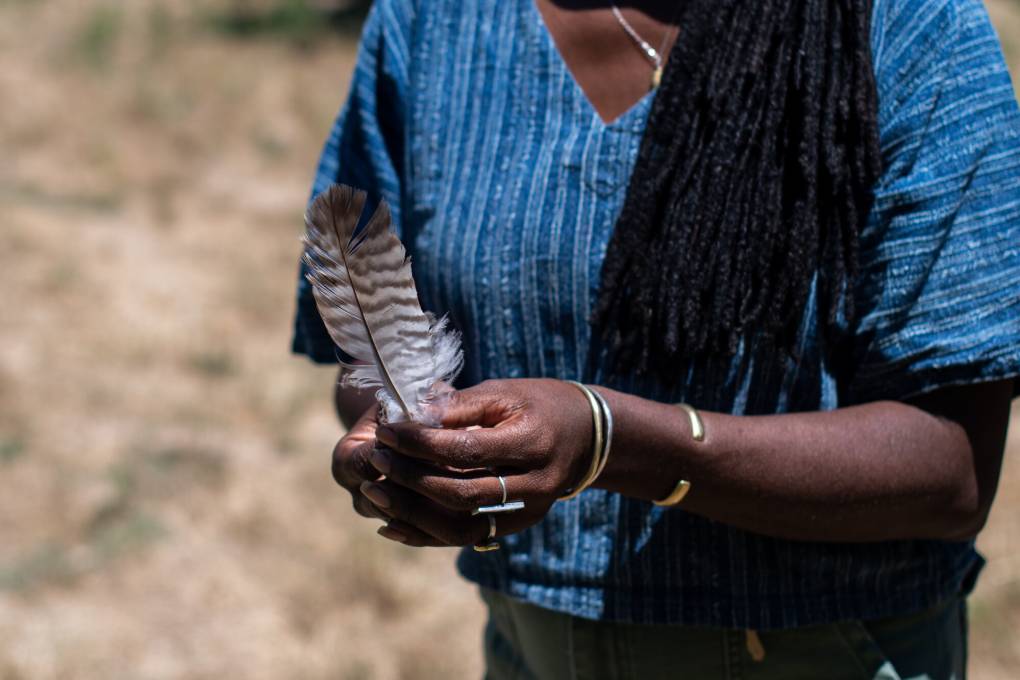
window.__IS_SSR__=true
window.__INITIAL_STATE__={
"attachmentsReducer": {
"audio_0": {
"type": "attachments",
"id": "audio_0",
"imgSizes": {
"kqedFullSize": {
"file": "https://ww2.kqed.org/news/wp-content/themes/KQED-unified/img/audio_bgs/background0.jpg"
}
}
},
"audio_1": {
"type": "attachments",
"id": "audio_1",
"imgSizes": {
"kqedFullSize": {
"file": "https://ww2.kqed.org/news/wp-content/themes/KQED-unified/img/audio_bgs/background1.jpg"
}
}
},
"audio_2": {
"type": "attachments",
"id": "audio_2",
"imgSizes": {
"kqedFullSize": {
"file": "https://ww2.kqed.org/news/wp-content/themes/KQED-unified/img/audio_bgs/background2.jpg"
}
}
},
"audio_3": {
"type": "attachments",
"id": "audio_3",
"imgSizes": {
"kqedFullSize": {
"file": "https://ww2.kqed.org/news/wp-content/themes/KQED-unified/img/audio_bgs/background3.jpg"
}
}
},
"audio_4": {
"type": "attachments",
"id": "audio_4",
"imgSizes": {
"kqedFullSize": {
"file": "https://ww2.kqed.org/news/wp-content/themes/KQED-unified/img/audio_bgs/background4.jpg"
}
}
},
"placeholder": {
"type": "attachments",
"id": "placeholder",
"imgSizes": {
"thumbnail": {
"file": "https://cdn.kqed.org/wp-content/uploads/2024/12/KQED-Default-Image-816638274-2000x1333-1-160x107.jpg",
"width": 160,
"height": 107,
"mimeType": "image/jpeg"
},
"medium": {
"file": "https://cdn.kqed.org/wp-content/uploads/2024/12/KQED-Default-Image-816638274-2000x1333-1-800x533.jpg",
"width": 800,
"height": 533,
"mimeType": "image/jpeg"
},
"medium_large": {
"file": "https://cdn.kqed.org/wp-content/uploads/2024/12/KQED-Default-Image-816638274-2000x1333-1-768x512.jpg",
"width": 768,
"height": 512,
"mimeType": "image/jpeg"
},
"large": {
"file": "https://cdn.kqed.org/wp-content/uploads/2024/12/KQED-Default-Image-816638274-2000x1333-1-1020x680.jpg",
"width": 1020,
"height": 680,
"mimeType": "image/jpeg"
},
"1536x1536": {
"file": "https://cdn.kqed.org/wp-content/uploads/2024/12/KQED-Default-Image-816638274-2000x1333-1-1536x1024.jpg",
"width": 1536,
"height": 1024,
"mimeType": "image/jpeg"
},
"fd-lrg": {
"file": "https://cdn.kqed.org/wp-content/uploads/2024/12/KQED-Default-Image-816638274-2000x1333-1-1536x1024.jpg",
"width": 1536,
"height": 1024,
"mimeType": "image/jpeg"
},
"fd-med": {
"file": "https://cdn.kqed.org/wp-content/uploads/2024/12/KQED-Default-Image-816638274-2000x1333-1-1020x680.jpg",
"width": 1020,
"height": 680,
"mimeType": "image/jpeg"
},
"fd-sm": {
"file": "https://cdn.kqed.org/wp-content/uploads/2024/12/KQED-Default-Image-816638274-2000x1333-1-800x533.jpg",
"width": 800,
"height": 533,
"mimeType": "image/jpeg"
},
"post-thumbnail": {
"file": "https://cdn.kqed.org/wp-content/uploads/2024/12/KQED-Default-Image-816638274-2000x1333-1-672x372.jpg",
"width": 672,
"height": 372,
"mimeType": "image/jpeg"
},
"twentyfourteen-full-width": {
"file": "https://cdn.kqed.org/wp-content/uploads/2024/12/KQED-Default-Image-816638274-2000x1333-1-1038x576.jpg",
"width": 1038,
"height": 576,
"mimeType": "image/jpeg"
},
"xxsmall": {
"file": "https://cdn.kqed.org/wp-content/uploads/2024/12/KQED-Default-Image-816638274-2000x1333-1-160x107.jpg",
"width": 160,
"height": 107,
"mimeType": "image/jpeg"
},
"xsmall": {
"file": "https://cdn.kqed.org/wp-content/uploads/2024/12/KQED-Default-Image-816638274-2000x1333-1-672x372.jpg",
"width": 672,
"height": 372,
"mimeType": "image/jpeg"
},
"small": {
"file": "https://cdn.kqed.org/wp-content/uploads/2024/12/KQED-Default-Image-816638274-2000x1333-1-672x372.jpg",
"width": 672,
"height": 372,
"mimeType": "image/jpeg"
},
"xlarge": {
"file": "https://cdn.kqed.org/wp-content/uploads/2024/12/KQED-Default-Image-816638274-2000x1333-1-1020x680.jpg",
"width": 1020,
"height": 680,
"mimeType": "image/jpeg"
},
"full-width": {
"file": "https://cdn.kqed.org/wp-content/uploads/2024/12/KQED-Default-Image-816638274-2000x1333-1-1920x1280.jpg",
"width": 1920,
"height": 1280,
"mimeType": "image/jpeg"
},
"guest-author-32": {
"file": "https://cdn.kqed.org/wp-content/uploads/2025/01/KQED-Default-Image-816638274-1333x1333-1-160x160.jpg",
"width": 32,
"height": 32,
"mimeType": "image/jpeg"
},
"guest-author-50": {
"file": "https://cdn.kqed.org/wp-content/uploads/2025/01/KQED-Default-Image-816638274-1333x1333-1-160x160.jpg",
"width": 50,
"height": 50,
"mimeType": "image/jpeg"
},
"guest-author-64": {
"file": "https://cdn.kqed.org/wp-content/uploads/2025/01/KQED-Default-Image-816638274-1333x1333-1-160x160.jpg",
"width": 64,
"height": 64,
"mimeType": "image/jpeg"
},
"guest-author-96": {
"file": "https://cdn.kqed.org/wp-content/uploads/2025/01/KQED-Default-Image-816638274-1333x1333-1-160x160.jpg",
"width": 96,
"height": 96,
"mimeType": "image/jpeg"
},
"guest-author-128": {
"file": "https://cdn.kqed.org/wp-content/uploads/2025/01/KQED-Default-Image-816638274-1333x1333-1-160x160.jpg",
"width": 128,
"height": 128,
"mimeType": "image/jpeg"
},
"detail": {
"file": "https://cdn.kqed.org/wp-content/uploads/2025/01/KQED-Default-Image-816638274-1333x1333-1-160x160.jpg",
"width": 160,
"height": 160,
"mimeType": "image/jpeg"
},
"kqedFullSize": {
"file": "https://cdn.kqed.org/wp-content/uploads/2024/12/KQED-Default-Image-816638274-2000x1333-1.jpg",
"width": 2000,
"height": 1333
}
}
},
"news_12037706": {
"type": "attachments",
"id": "news_12037706",
"meta": {
"index": "attachments_1716263798",
"site": "news",
"id": "12037706",
"found": true
},
"title": "020_KQED_EARTHseedFarmSonoma_07082022_qed",
"publishDate": 1745611704,
"status": "inherit",
"parent": 12037633,
"modified": 1745611742,
"caption": "EARTHseed Farm founder Pandora Thomas finds a feather at the farm and orchard in Sonoma County on July 8, 2022. The farm operates on Afro-Indigenous permaculture principles. New research shows that solidarity could be a powerful strategy for narrowing what BLIS Collective refers to as the “hope gap” in the reparations and Land Back movements. ",
"credit": "Beth LaBerge/KQED",
"altTag": null,
"description": null,
"imgSizes": {
"medium": {
"file": "https://cdn.kqed.org/wp-content/uploads/sites/10/2025/04/020_KQED_EARTHseedFarmSonoma_07082022_qed-800x533.jpg",
"width": 800,
"height": 533,
"mimeType": "image/jpeg"
},
"large": {
"file": "https://cdn.kqed.org/wp-content/uploads/sites/10/2025/04/020_KQED_EARTHseedFarmSonoma_07082022_qed-1020x680.jpg",
"width": 1020,
"height": 680,
"mimeType": "image/jpeg"
},
"thumbnail": {
"file": "https://cdn.kqed.org/wp-content/uploads/sites/10/2025/04/020_KQED_EARTHseedFarmSonoma_07082022_qed-160x107.jpg",
"width": 160,
"height": 107,
"mimeType": "image/jpeg"
},
"1536x1536": {
"file": "https://cdn.kqed.org/wp-content/uploads/sites/10/2025/04/020_KQED_EARTHseedFarmSonoma_07082022_qed-1536x1024.jpg",
"width": 1536,
"height": 1024,
"mimeType": "image/jpeg"
},
"post-thumbnail": {
"file": "https://cdn.kqed.org/wp-content/uploads/sites/10/2025/04/020_KQED_EARTHseedFarmSonoma_07082022_qed-672x372.jpg",
"width": 672,
"height": 372,
"mimeType": "image/jpeg"
},
"twentyfourteen-full-width": {
"file": "https://cdn.kqed.org/wp-content/uploads/sites/10/2025/04/020_KQED_EARTHseedFarmSonoma_07082022_qed-1038x576.jpg",
"width": 1038,
"height": 576,
"mimeType": "image/jpeg"
},
"full-width": {
"file": "https://cdn.kqed.org/wp-content/uploads/sites/10/2025/04/020_KQED_EARTHseedFarmSonoma_07082022_qed-1920x1280.jpg",
"width": 1920,
"height": 1280,
"mimeType": "image/jpeg"
},
"kqedFullSize": {
"file": "https://cdn.kqed.org/wp-content/uploads/sites/10/2025/04/020_KQED_EARTHseedFarmSonoma_07082022_qed.jpg",
"width": 1999,
"height": 1333
}
},
"isLoading": false,
"fetchFailed": false
},
"news_12035831": {
"type": "attachments",
"id": "news_12035831",
"meta": {
"index": "attachments_1716263798",
"site": "news",
"id": "12035831",
"found": true
},
"title": "250409-LIVERMORE BLACK LAND-MD-10-KQED-1",
"publishDate": 1744554334,
"status": "inherit",
"parent": 0,
"modified": 1745003797,
"caption": "Tashenia Pearson stands beside the wall separating her property from her neighbors' in Livermore on April 9, 2025. Pearson's parents bought the home in Livermore in 1971, only to discover the wall, which was built 7 feet onto their property and which effectively gives 740 square feet of the Pearson's property to their neighbor.",
"credit": "Martin do Nascimento/KQED",
"altTag": null,
"description": null,
"imgSizes": {
"medium": {
"file": "https://cdn.kqed.org/wp-content/uploads/sites/10/2025/04/250409-LIVERMORE-BLACK-LAND-MD-10-KQED-1-800x533.jpg",
"width": 800,
"height": 533,
"mimeType": "image/jpeg"
},
"large": {
"file": "https://cdn.kqed.org/wp-content/uploads/sites/10/2025/04/250409-LIVERMORE-BLACK-LAND-MD-10-KQED-1-1020x680.jpg",
"width": 1020,
"height": 680,
"mimeType": "image/jpeg"
},
"thumbnail": {
"file": "https://cdn.kqed.org/wp-content/uploads/sites/10/2025/04/250409-LIVERMORE-BLACK-LAND-MD-10-KQED-1-160x107.jpg",
"width": 160,
"height": 107,
"mimeType": "image/jpeg"
},
"1536x1536": {
"file": "https://cdn.kqed.org/wp-content/uploads/sites/10/2025/04/250409-LIVERMORE-BLACK-LAND-MD-10-KQED-1-1536x1024.jpg",
"width": 1536,
"height": 1024,
"mimeType": "image/jpeg"
},
"post-thumbnail": {
"file": "https://cdn.kqed.org/wp-content/uploads/sites/10/2025/04/250409-LIVERMORE-BLACK-LAND-MD-10-KQED-1-672x372.jpg",
"width": 672,
"height": 372,
"mimeType": "image/jpeg"
},
"twentyfourteen-full-width": {
"file": "https://cdn.kqed.org/wp-content/uploads/sites/10/2025/04/250409-LIVERMORE-BLACK-LAND-MD-10-KQED-1-1038x576.jpg",
"width": 1038,
"height": 576,
"mimeType": "image/jpeg"
},
"full-width": {
"file": "https://cdn.kqed.org/wp-content/uploads/sites/10/2025/04/250409-LIVERMORE-BLACK-LAND-MD-10-KQED-1-1920x1280.jpg",
"width": 1920,
"height": 1280,
"mimeType": "image/jpeg"
},
"kqedFullSize": {
"file": "https://cdn.kqed.org/wp-content/uploads/sites/10/2025/04/250409-LIVERMORE-BLACK-LAND-MD-10-KQED-1.jpg",
"width": 2000,
"height": 1333
}
},
"isLoading": false,
"fetchFailed": false
},
"news_12029388": {
"type": "attachments",
"id": "news_12029388",
"meta": {
"index": "attachments_1716263798",
"site": "news",
"id": "12029388",
"found": true
},
"title": "Evan Lewis at Northeastern University in Oakland on Feb. 28, 2025.",
"publishDate": 1740844049,
"status": "inherit",
"parent": 0,
"modified": 1740844114,
"caption": "Evan Lewis at Northeastern University in Oakland on Feb. 28, 2025.",
"credit": "Martin do Nascimento/KQED",
"altTag": null,
"description": null,
"imgSizes": {
"medium": {
"file": "https://cdn.kqed.org/wp-content/uploads/sites/10/2025/03/250228-RACIAL-VIOLENCE-CONFERENCE-MD-04-KQED-800x533.jpg",
"width": 800,
"height": 533,
"mimeType": "image/jpeg"
},
"large": {
"file": "https://cdn.kqed.org/wp-content/uploads/sites/10/2025/03/250228-RACIAL-VIOLENCE-CONFERENCE-MD-04-KQED-1020x680.jpg",
"width": 1020,
"height": 680,
"mimeType": "image/jpeg"
},
"thumbnail": {
"file": "https://cdn.kqed.org/wp-content/uploads/sites/10/2025/03/250228-RACIAL-VIOLENCE-CONFERENCE-MD-04-KQED-160x107.jpg",
"width": 160,
"height": 107,
"mimeType": "image/jpeg"
},
"1536x1536": {
"file": "https://cdn.kqed.org/wp-content/uploads/sites/10/2025/03/250228-RACIAL-VIOLENCE-CONFERENCE-MD-04-KQED-1536x1024.jpg",
"width": 1536,
"height": 1024,
"mimeType": "image/jpeg"
},
"post-thumbnail": {
"file": "https://cdn.kqed.org/wp-content/uploads/sites/10/2025/03/250228-RACIAL-VIOLENCE-CONFERENCE-MD-04-KQED-672x372.jpg",
"width": 672,
"height": 372,
"mimeType": "image/jpeg"
},
"twentyfourteen-full-width": {
"file": "https://cdn.kqed.org/wp-content/uploads/sites/10/2025/03/250228-RACIAL-VIOLENCE-CONFERENCE-MD-04-KQED-1038x576.jpg",
"width": 1038,
"height": 576,
"mimeType": "image/jpeg"
},
"full-width": {
"file": "https://cdn.kqed.org/wp-content/uploads/sites/10/2025/03/250228-RACIAL-VIOLENCE-CONFERENCE-MD-04-KQED-1920x1280.jpg",
"width": 1920,
"height": 1280,
"mimeType": "image/jpeg"
},
"kqedFullSize": {
"file": "https://cdn.kqed.org/wp-content/uploads/sites/10/2025/03/250228-RACIAL-VIOLENCE-CONFERENCE-MD-04-KQED.jpg",
"width": 2000,
"height": 1333
}
},
"isLoading": false,
"fetchFailed": false
},
"news_12020428": {
"type": "attachments",
"id": "news_12020428",
"meta": {
"index": "attachments_1716263798",
"site": "news",
"id": "12020428",
"found": true
},
"title": "082924_StateCapitolSession_FM_CM_01",
"publishDate": 1736192782,
"status": "inherit",
"parent": 12020419,
"modified": 1737570759,
"caption": "The state Senate during a floor session of the California Legislature at the state Capitol in Sacramento on Aug. 29, 2024.",
"credit": "Florence Middleton/CalMatters",
"altTag": null,
"description": null,
"imgSizes": {
"medium": {
"file": "https://cdn.kqed.org/wp-content/uploads/sites/10/2025/01/082924_StateCapitolSession_FM_CM_01-800x533.jpg",
"width": 800,
"height": 533,
"mimeType": "image/jpeg"
},
"large": {
"file": "https://cdn.kqed.org/wp-content/uploads/sites/10/2025/01/082924_StateCapitolSession_FM_CM_01-1020x680.jpg",
"width": 1020,
"height": 680,
"mimeType": "image/jpeg"
},
"thumbnail": {
"file": "https://cdn.kqed.org/wp-content/uploads/sites/10/2025/01/082924_StateCapitolSession_FM_CM_01-160x107.jpg",
"width": 160,
"height": 107,
"mimeType": "image/jpeg"
},
"1536x1536": {
"file": "https://cdn.kqed.org/wp-content/uploads/sites/10/2025/01/082924_StateCapitolSession_FM_CM_01-1536x1024.jpg",
"width": 1536,
"height": 1024,
"mimeType": "image/jpeg"
},
"post-thumbnail": {
"file": "https://cdn.kqed.org/wp-content/uploads/sites/10/2025/01/082924_StateCapitolSession_FM_CM_01-672x372.jpg",
"width": 672,
"height": 372,
"mimeType": "image/jpeg"
},
"twentyfourteen-full-width": {
"file": "https://cdn.kqed.org/wp-content/uploads/sites/10/2025/01/082924_StateCapitolSession_FM_CM_01-1038x576.jpg",
"width": 1038,
"height": 576,
"mimeType": "image/jpeg"
},
"full-width": {
"file": "https://cdn.kqed.org/wp-content/uploads/sites/10/2025/01/082924_StateCapitolSession_FM_CM_01-1920x1280.jpg",
"width": 1920,
"height": 1280,
"mimeType": "image/jpeg"
},
"kqedFullSize": {
"file": "https://cdn.kqed.org/wp-content/uploads/sites/10/2025/01/082924_StateCapitolSession_FM_CM_01.jpg",
"width": 2000,
"height": 1333
}
},
"isLoading": false,
"fetchFailed": false
},
"news_12011971": {
"type": "attachments",
"id": "news_12011971",
"meta": {
"index": "attachments_1716263798",
"site": "news",
"id": "12011971",
"found": true
},
"title": "US-HEALTH-VIRUS-PRISON",
"publishDate": 1730405796,
"status": "inherit",
"parent": 0,
"modified": 1731002698,
"caption": "Incarcerated women tend to landscaping at Las Colinas Women's Detention Facility in Santee, California, on April 22, 2020.",
"credit": "Sandy Huffaker/AFP via Getty Images",
"altTag": null,
"description": null,
"imgSizes": {
"medium": {
"file": "https://cdn.kqed.org/wp-content/uploads/sites/10/2024/10/GETTYIMAGES-1210676438-KQED-800x533.jpg",
"width": 800,
"height": 533,
"mimeType": "image/jpeg"
},
"large": {
"file": "https://cdn.kqed.org/wp-content/uploads/sites/10/2024/10/GETTYIMAGES-1210676438-KQED-1020x680.jpg",
"width": 1020,
"height": 680,
"mimeType": "image/jpeg"
},
"thumbnail": {
"file": "https://cdn.kqed.org/wp-content/uploads/sites/10/2024/10/GETTYIMAGES-1210676438-KQED-160x107.jpg",
"width": 160,
"height": 107,
"mimeType": "image/jpeg"
},
"1536x1536": {
"file": "https://cdn.kqed.org/wp-content/uploads/sites/10/2024/10/GETTYIMAGES-1210676438-KQED-1536x1024.jpg",
"width": 1536,
"height": 1024,
"mimeType": "image/jpeg"
},
"post-thumbnail": {
"file": "https://cdn.kqed.org/wp-content/uploads/sites/10/2024/10/GETTYIMAGES-1210676438-KQED-672x372.jpg",
"width": 672,
"height": 372,
"mimeType": "image/jpeg"
},
"twentyfourteen-full-width": {
"file": "https://cdn.kqed.org/wp-content/uploads/sites/10/2024/10/GETTYIMAGES-1210676438-KQED-1038x576.jpg",
"width": 1038,
"height": 576,
"mimeType": "image/jpeg"
},
"full-width": {
"file": "https://cdn.kqed.org/wp-content/uploads/sites/10/2024/10/GETTYIMAGES-1210676438-KQED-1920x1280.jpg",
"width": 1920,
"height": 1280,
"mimeType": "image/jpeg"
},
"kqedFullSize": {
"file": "https://cdn.kqed.org/wp-content/uploads/sites/10/2024/10/GETTYIMAGES-1210676438-KQED.jpg",
"width": 2000,
"height": 1333
}
},
"isLoading": false,
"fetchFailed": false
},
"news_12006891": {
"type": "attachments",
"id": "news_12006891",
"meta": {
"index": "attachments_1716263798",
"site": "news",
"id": "12006891",
"found": true
},
"title": "California Reparations Veto",
"publishDate": 1727467632,
"status": "inherit",
"parent": 12006872,
"modified": 1727480845,
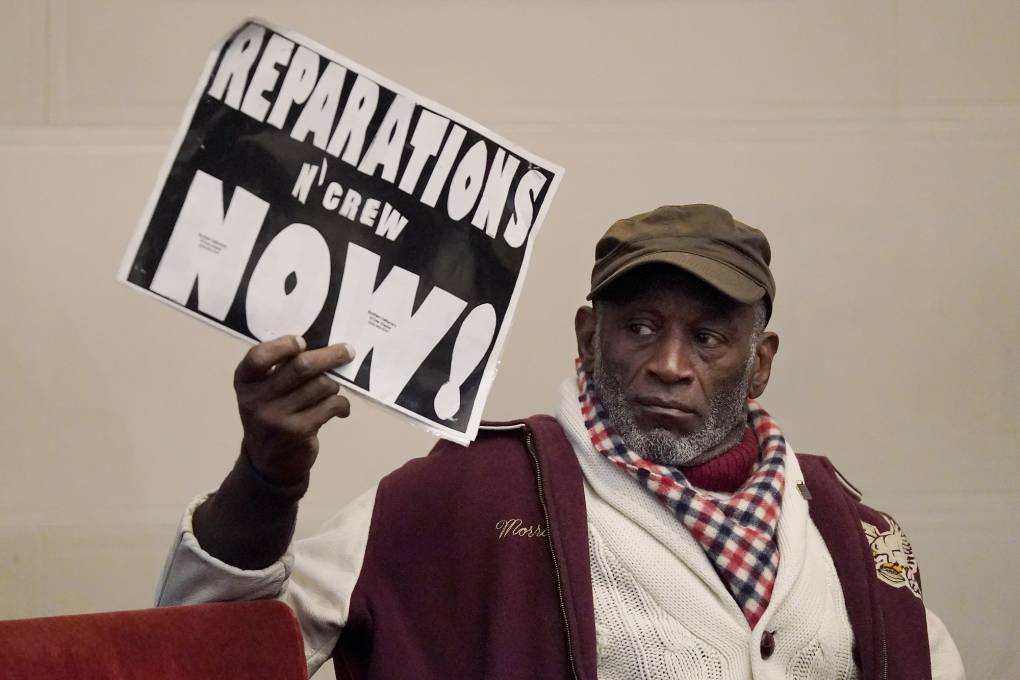
"caption": "Morris Griffin holds up a sign during a meeting by the Task Force to Study and Develop Reparation Proposals for African Americans in Oakland, Dec. 14, 2022. The Alameda County Reparations Commission has made little progress in over a year. Last week, the county extended its mandate for two years but allocated only $92,000 — less than 2% of the requested budget. With these limited funds primarily for historical research and community outreach, the commission must reassess its achievable goals.",
"credit": "Jeff Chiu/AP Photo",
"altTag": null,
"description": null,
"imgSizes": {
"medium": {
"file": "https://cdn.kqed.org/wp-content/uploads/sites/10/2024/09/ReparationsOaklandAP-800x533.jpg",
"width": 800,
"height": 533,
"mimeType": "image/jpeg"
},
"large": {
"file": "https://cdn.kqed.org/wp-content/uploads/sites/10/2024/09/ReparationsOaklandAP-1020x680.jpg",
"width": 1020,
"height": 680,
"mimeType": "image/jpeg"
},
"thumbnail": {
"file": "https://cdn.kqed.org/wp-content/uploads/sites/10/2024/09/ReparationsOaklandAP-160x107.jpg",
"width": 160,
"height": 107,
"mimeType": "image/jpeg"
},
"1536x1536": {
"file": "https://cdn.kqed.org/wp-content/uploads/sites/10/2024/09/ReparationsOaklandAP-1536x1024.jpg",
"width": 1536,
"height": 1024,
"mimeType": "image/jpeg"
},
"post-thumbnail": {
"file": "https://cdn.kqed.org/wp-content/uploads/sites/10/2024/09/ReparationsOaklandAP-672x372.jpg",
"width": 672,
"height": 372,
"mimeType": "image/jpeg"
},
"twentyfourteen-full-width": {
"file": "https://cdn.kqed.org/wp-content/uploads/sites/10/2024/09/ReparationsOaklandAP-1038x576.jpg",
"width": 1038,
"height": 576,
"mimeType": "image/jpeg"
},
"full-width": {
"file": "https://cdn.kqed.org/wp-content/uploads/sites/10/2024/09/ReparationsOaklandAP-1920x1280.jpg",
"width": 1920,
"height": 1280,
"mimeType": "image/jpeg"
},
"kqedFullSize": {
"file": "https://cdn.kqed.org/wp-content/uploads/sites/10/2024/09/ReparationsOaklandAP.jpg",
"width": 2000,
"height": 1333
}
},
"isLoading": false,
"fetchFailed": false
},
"news_12006825": {
"type": "attachments",
"id": "news_12006825",
"meta": {
"index": "attachments_1716263798",
"site": "news",
"id": "12006825",
"found": true
},
"title": "California Reparations",
"publishDate": 1727458654,
"status": "inherit",
"parent": 12006819,
"modified": 1727459893,
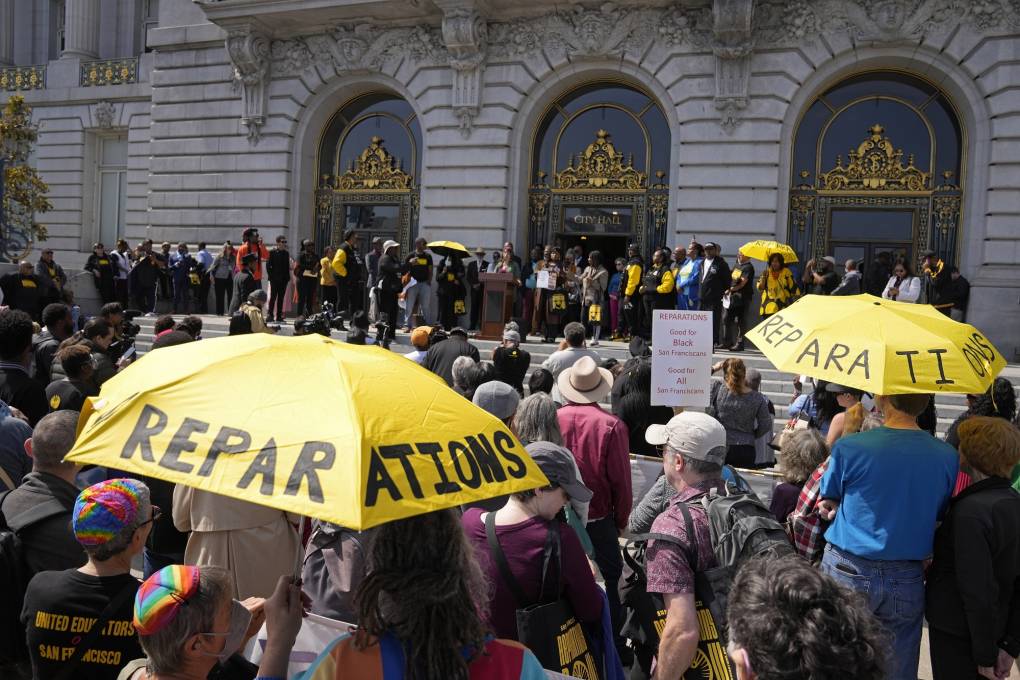
"caption": "People listen during a rally in support of reparations for African Americans outside City Hall in San Francisco on Tuesday, Sept. 19, 2023. Some advocates believe the first-year effort to provide reparations to Black Californians failed to live up to expectations, but voters will have the final word in November. ",
"credit": "Eric Risberg/AP Photo",
"altTag": null,
"description": null,
"imgSizes": {
"medium": {
"file": "https://cdn.kqed.org/wp-content/uploads/sites/10/2024/09/ReparationsAP-800x533.jpg",
"width": 800,
"height": 533,
"mimeType": "image/jpeg"
},
"large": {
"file": "https://cdn.kqed.org/wp-content/uploads/sites/10/2024/09/ReparationsAP-1020x680.jpg",
"width": 1020,
"height": 680,
"mimeType": "image/jpeg"
},
"thumbnail": {
"file": "https://cdn.kqed.org/wp-content/uploads/sites/10/2024/09/ReparationsAP-160x107.jpg",
"width": 160,
"height": 107,
"mimeType": "image/jpeg"
},
"1536x1536": {
"file": "https://cdn.kqed.org/wp-content/uploads/sites/10/2024/09/ReparationsAP-1536x1024.jpg",
"width": 1536,
"height": 1024,
"mimeType": "image/jpeg"
},
"post-thumbnail": {
"file": "https://cdn.kqed.org/wp-content/uploads/sites/10/2024/09/ReparationsAP-672x372.jpg",
"width": 672,
"height": 372,
"mimeType": "image/jpeg"
},
"twentyfourteen-full-width": {
"file": "https://cdn.kqed.org/wp-content/uploads/sites/10/2024/09/ReparationsAP-1038x576.jpg",
"width": 1038,
"height": 576,
"mimeType": "image/jpeg"
},
"full-width": {
"file": "https://cdn.kqed.org/wp-content/uploads/sites/10/2024/09/ReparationsAP-1920x1280.jpg",
"width": 1920,
"height": 1280,
"mimeType": "image/jpeg"
},
"kqedFullSize": {
"file": "https://cdn.kqed.org/wp-content/uploads/sites/10/2024/09/ReparationsAP.jpg",
"width": 2000,
"height": 1333
}
},
"isLoading": false,
"fetchFailed": false
},
"news_11942566": {
"type": "attachments",
"id": "news_11942566",
"meta": {
"index": "attachments_1716263798",
"site": "news",
"id": "11942566",
"found": true
},
"parent": 11942533,
"imgSizes": {
"twentyfourteen-full-width": {
"file": "https://ww2.kqed.org/app/uploads/sites/10/2023/03/RS63355_048_KQED_CAReparationsTaskForceSac_03032023-qut-1038x576.jpg",
"width": 1038,
"mimeType": "image/jpeg",
"height": 576
},
"thumbnail": {
"file": "https://ww2.kqed.org/app/uploads/sites/10/2023/03/RS63355_048_KQED_CAReparationsTaskForceSac_03032023-qut-160x107.jpg",
"width": 160,
"mimeType": "image/jpeg",
"height": 107
},
"post-thumbnail": {
"file": "https://ww2.kqed.org/app/uploads/sites/10/2023/03/RS63355_048_KQED_CAReparationsTaskForceSac_03032023-qut-672x372.jpg",
"width": 672,
"mimeType": "image/jpeg",
"height": 372
},
"kqedFullSize": {
"file": "https://ww2.kqed.org/app/uploads/sites/10/2023/03/RS63355_048_KQED_CAReparationsTaskForceSac_03032023-qut.jpg",
"width": 1920,
"height": 1280
},
"large": {
"file": "https://ww2.kqed.org/app/uploads/sites/10/2023/03/RS63355_048_KQED_CAReparationsTaskForceSac_03032023-qut-1020x680.jpg",
"width": 1020,
"mimeType": "image/jpeg",
"height": 680
},
"1536x1536": {
"file": "https://ww2.kqed.org/app/uploads/sites/10/2023/03/RS63355_048_KQED_CAReparationsTaskForceSac_03032023-qut-1536x1024.jpg",
"width": 1536,
"mimeType": "image/jpeg",
"height": 1024
},
"medium": {
"file": "https://ww2.kqed.org/app/uploads/sites/10/2023/03/RS63355_048_KQED_CAReparationsTaskForceSac_03032023-qut-800x533.jpg",
"width": 800,
"mimeType": "image/jpeg",
"height": 533
}
},
"publishDate": 1677976680,
"modified": 1678130777,
"caption": "State Sen. Steven Bradford (D-Gardena) speaks with attendees during a California Reparations Task Force meeting in Sacramento on March 3, 2023.",
"description": null,
"title": "RS63355_048_KQED_CAReparationsTaskForceSac_03032023-qut",
"credit": "Beth LaBerge/KQED",
"status": "inherit",
"altTag": "Three African American men have a standing conversation.",
"isLoading": false,
"fetchFailed": false
},
"news_12002903": {
"type": "attachments",
"id": "news_12002903",
"meta": {
"index": "attachments_1716263798",
"site": "news",
"id": "12002903",
"found": true
},
"title": "IMG_1793-Edit",
"publishDate": 1725403540,
"status": "inherit",
"parent": 12002804,
"modified": 1725410650,
"caption": "Chris Lodgson, lead organizer for the Coalition for a Just and Equitable California, watches 2 reparations bills, SB 1331 and SB 1403, inside the state capitol on Aug. 29, 2024, during the final days of the legislative session.",
"credit": "Annelise Finney/KQED",
"altTag": null,
"description": null,
"imgSizes": {
"medium": {
"file": "https://cdn.kqed.org/wp-content/uploads/sites/10/2024/09/IMG_1793-Edit-800x534.jpg",
"width": 800,
"height": 534,
"mimeType": "image/jpeg"
},
"large": {
"file": "https://cdn.kqed.org/wp-content/uploads/sites/10/2024/09/IMG_1793-Edit-1020x680.jpg",
"width": 1020,
"height": 680,
"mimeType": "image/jpeg"
},
"thumbnail": {
"file": "https://cdn.kqed.org/wp-content/uploads/sites/10/2024/09/IMG_1793-Edit-160x107.jpg",
"width": 160,
"height": 107,
"mimeType": "image/jpeg"
},
"1536x1536": {
"file": "https://cdn.kqed.org/wp-content/uploads/sites/10/2024/09/IMG_1793-Edit-1536x1025.jpg",
"width": 1536,
"height": 1025,
"mimeType": "image/jpeg"
},
"post-thumbnail": {
"file": "https://cdn.kqed.org/wp-content/uploads/sites/10/2024/09/IMG_1793-Edit-672x372.jpg",
"width": 672,
"height": 372,
"mimeType": "image/jpeg"
},
"twentyfourteen-full-width": {
"file": "https://cdn.kqed.org/wp-content/uploads/sites/10/2024/09/IMG_1793-Edit-1038x576.jpg",
"width": 1038,
"height": 576,
"mimeType": "image/jpeg"
},
"full-width": {
"file": "https://cdn.kqed.org/wp-content/uploads/sites/10/2024/09/IMG_1793-Edit-1920x1281.jpg",
"width": 1920,
"height": 1281,
"mimeType": "image/jpeg"
},
"kqedFullSize": {
"file": "https://cdn.kqed.org/wp-content/uploads/sites/10/2024/09/IMG_1793-Edit.jpg",
"width": 2000,
"height": 1334
}
},
"isLoading": false,
"fetchFailed": false
},
"news_11996242": {
"type": "attachments",
"id": "news_11996242",
"meta": {
"index": "attachments_1716263798",
"site": "news",
"id": "11996242",
"found": true
},
"title": "240703-JAPANESE AMERICAN FAMILY FARM-MD-15-KQED",
"publishDate": 1721326800,
"status": "inherit",
"parent": 0,
"modified": 1721326971,
"caption": "A sign announces the proposed development of the Sakauye family farm in San José on July 10, 2024.",
"credit": "Martin do Nascimento/KQED",
"altTag": null,
"description": null,
"imgSizes": {
"medium": {
"file": "https://cdn.kqed.org/wp-content/uploads/sites/10/2024/07/240703-JAPANESE-AMERICAN-FAMILY-FARM-MD-15-KQED-800x533.jpg",
"width": 800,
"height": 533,
"mimeType": "image/jpeg"
},
"large": {
"file": "https://cdn.kqed.org/wp-content/uploads/sites/10/2024/07/240703-JAPANESE-AMERICAN-FAMILY-FARM-MD-15-KQED-1020x680.jpg",
"width": 1020,
"height": 680,
"mimeType": "image/jpeg"
},
"thumbnail": {
"file": "https://cdn.kqed.org/wp-content/uploads/sites/10/2024/07/240703-JAPANESE-AMERICAN-FAMILY-FARM-MD-15-KQED-160x107.jpg",
"width": 160,
"height": 107,
"mimeType": "image/jpeg"
},
"1536x1536": {
"file": "https://cdn.kqed.org/wp-content/uploads/sites/10/2024/07/240703-JAPANESE-AMERICAN-FAMILY-FARM-MD-15-KQED-1536x1024.jpg",
"width": 1536,
"height": 1024,
"mimeType": "image/jpeg"
},
"post-thumbnail": {
"file": "https://cdn.kqed.org/wp-content/uploads/sites/10/2024/07/240703-JAPANESE-AMERICAN-FAMILY-FARM-MD-15-KQED-672x372.jpg",
"width": 672,
"height": 372,
"mimeType": "image/jpeg"
},
"twentyfourteen-full-width": {
"file": "https://cdn.kqed.org/wp-content/uploads/sites/10/2024/07/240703-JAPANESE-AMERICAN-FAMILY-FARM-MD-15-KQED-1038x576.jpg",
"width": 1038,
"height": 576,
"mimeType": "image/jpeg"
},
"full-width": {
"file": "https://cdn.kqed.org/wp-content/uploads/sites/10/2024/07/240703-JAPANESE-AMERICAN-FAMILY-FARM-MD-15-KQED-1920x1280.jpg",
"width": 1920,
"height": 1280,
"mimeType": "image/jpeg"
},
"kqedFullSize": {
"file": "https://cdn.kqed.org/wp-content/uploads/sites/10/2024/07/240703-JAPANESE-AMERICAN-FAMILY-FARM-MD-15-KQED.jpg",
"width": 2000,
"height": 1333
}
},
"isLoading": false,
"fetchFailed": false
},
"news_11996592": {
"type": "attachments",
"id": "news_11996592",
"meta": {
"index": "attachments_1716263798",
"site": "news",
"id": "11996592",
"found": true
},
"title": "California Racism Reparations Land",
"publishDate": 1721511238,
"status": "inherit",
"parent": 11996585,
"modified": 1721511287,
"caption": "Matthew (left) and his twin brother Jonathan Burgess are photographed with a portrait of their great-great-grandfather Nelson Bell, who the family say also went by the name Rufus Burgess, Monday, Oct. 9, 2023, in Sacramento. The portrait has been passed down for generations in the Burgess family. ",
"credit": "Godofredo A. Vásquez/AP Photo",
"altTag": null,
"description": null,
"imgSizes": {
"medium": {
"file": "https://cdn.kqed.org/wp-content/uploads/sites/10/2024/07/AP24194803683256-800x533.jpg",
"width": 800,
"height": 533,
"mimeType": "image/jpeg"
},
"large": {
"file": "https://cdn.kqed.org/wp-content/uploads/sites/10/2024/07/AP24194803683256-1020x680.jpg",
"width": 1020,
"height": 680,
"mimeType": "image/jpeg"
},
"thumbnail": {
"file": "https://cdn.kqed.org/wp-content/uploads/sites/10/2024/07/AP24194803683256-160x107.jpg",
"width": 160,
"height": 107,
"mimeType": "image/jpeg"
},
"1536x1536": {
"file": "https://cdn.kqed.org/wp-content/uploads/sites/10/2024/07/AP24194803683256-1536x1024.jpg",
"width": 1536,
"height": 1024,
"mimeType": "image/jpeg"
},
"2048x2048": {
"file": "https://cdn.kqed.org/wp-content/uploads/sites/10/2024/07/AP24194803683256-2048x1365.jpg",
"width": 2048,
"height": 1365,
"mimeType": "image/jpeg"
},
"post-thumbnail": {
"file": "https://cdn.kqed.org/wp-content/uploads/sites/10/2024/07/AP24194803683256-672x372.jpg",
"width": 672,
"height": 372,
"mimeType": "image/jpeg"
},
"twentyfourteen-full-width": {
"file": "https://cdn.kqed.org/wp-content/uploads/sites/10/2024/07/AP24194803683256-1038x576.jpg",
"width": 1038,
"height": 576,
"mimeType": "image/jpeg"
},
"full-width": {
"file": "https://cdn.kqed.org/wp-content/uploads/sites/10/2024/07/AP24194803683256-1920x1280.jpg",
"width": 1920,
"height": 1280,
"mimeType": "image/jpeg"
},
"kqedFullSize": {
"file": "https://cdn.kqed.org/wp-content/uploads/sites/10/2024/07/AP24194803683256-scaled.jpg",
"width": 2560,
"height": 1707
}
},
"isLoading": false,
"fetchFailed": false
},
"news_11992341": {
"type": "attachments",
"id": "news_11992341",
"meta": {
"index": "attachments_1716263798",
"site": "news",
"id": "11992341",
"found": true
},
"title": "006_KQED_NEWFOLSOMPRISONSACRAMENTO_04132023-KQED",
"publishDate": 1719530043,
"status": "inherit",
"parent": 12088386,
"modified": 1782161688,
"caption": "A watch tower at California State Prison, Sacramento, on April 13, 2023.",
"credit": "Beth LaBerge/KQED",
"altTag": "A watchtower at a prison, with prison walls and barbed wire in the foreground.",
"description": null,
"imgSizes": {
"medium": {
"file": "https://cdn.kqed.org/wp-content/uploads/sites/10/2024/06/006_KQED_NEWFOLSOMPRISONSACRAMENTO_04132023-KQED-800x533.jpg",
"width": 800,
"height": 533,
"mimeType": "image/jpeg"
},
"large": {
"file": "https://cdn.kqed.org/wp-content/uploads/sites/10/2024/06/006_KQED_NEWFOLSOMPRISONSACRAMENTO_04132023-KQED-1020x680.jpg",
"width": 1020,
"height": 680,
"mimeType": "image/jpeg"
},
"thumbnail": {
"file": "https://cdn.kqed.org/wp-content/uploads/sites/10/2024/06/006_KQED_NEWFOLSOMPRISONSACRAMENTO_04132023-KQED-160x107.jpg",
"width": 160,
"height": 107,
"mimeType": "image/jpeg"
},
"1536x1536": {
"file": "https://cdn.kqed.org/wp-content/uploads/sites/10/2024/06/006_KQED_NEWFOLSOMPRISONSACRAMENTO_04132023-KQED-1536x1024.jpg",
"width": 1536,
"height": 1024,
"mimeType": "image/jpeg"
},
"post-thumbnail": {
"file": "https://cdn.kqed.org/wp-content/uploads/sites/10/2024/06/006_KQED_NEWFOLSOMPRISONSACRAMENTO_04132023-KQED-672x372.jpg",
"width": 672,
"height": 372,
"mimeType": "image/jpeg"
},
"twentyfourteen-full-width": {
"file": "https://cdn.kqed.org/wp-content/uploads/sites/10/2024/06/006_KQED_NEWFOLSOMPRISONSACRAMENTO_04132023-KQED-1038x576.jpg",
"width": 1038,
"height": 576,
"mimeType": "image/jpeg"
},
"full-width": {
"file": "https://cdn.kqed.org/wp-content/uploads/sites/10/2024/06/006_KQED_NEWFOLSOMPRISONSACRAMENTO_04132023-KQED-1920x1280.jpg",
"width": 1920,
"height": 1280,
"mimeType": "image/jpeg"
},
"kqedFullSize": {
"file": "https://cdn.kqed.org/wp-content/uploads/sites/10/2024/06/006_KQED_NEWFOLSOMPRISONSACRAMENTO_04132023-KQED.jpg",
"width": 2000,
"height": 1333
}
},
"isLoading": false,
"fetchFailed": false
}
},
"audioPlayerReducer": {
"postId": "stream_live",
"isPaused": true,
"isPlaying": false,
"pfsActive": false,
"pledgeModalIsOpen": true,
"playerDrawerIsOpen": false,
"liveAudioPlayStartedAt": 0,
"liveAudioPlayContext": ""
},
"authorsReducer": {
"byline_news_12037633": {
"type": "authors",
"id": "byline_news_12037633",
"meta": {
"override": true
},
"slug": "byline_news_12037633",
"name": "Camilla Griffiths",
"isLoading": false
},
"byline_news_12036599": {
"type": "authors",
"id": "byline_news_12036599",
"meta": {
"override": true
},
"slug": "byline_news_12036599",
"name": "Anya Schultz ",
"isLoading": false
},
"byline_news_12020419": {
"type": "authors",
"id": "byline_news_12020419",
"meta": {
"override": true
},
"slug": "byline_news_12020419",
"name": "Alexei Koseff, CalMatters",
"isLoading": false
},
"byline_news_11996585": {
"type": "authors",
"id": "byline_news_11996585",
"meta": {
"override": true
},
"slug": "byline_news_11996585",
"name": "Sophie Austin, Associated Press",
"isLoading": false
},
"gmarzorati": {
"type": "authors",
"id": "227",
"meta": {
"index": "authors_1716337520",
"id": "227",
"found": true
},
"name": "Guy Marzorati",
"firstName": "Guy",
"lastName": "Marzorati",
"slug": "gmarzorati",
"email": "gmarzorati@KQED.org",
"display_author_email": true,
"staff_mastheads": [
"news"
],
"title": "Correspondent",
"bio": "Guy Marzorati is a correspondent on KQED's California Politics and Government Desk, based in San Jose. A graduate of Santa Clara University, Guy joined KQED in 2013. He reports on state and local politics and produces KQED's digital voter guide.",
"avatar": "https://secure.gravatar.com/avatar/e7038b8dbfd55b104369b76b1cd0b9de?s=600&d=blank&r=g",
"twitter": "guymarzorati",
"facebook": null,
"instagram": null,
"linkedin": null,
"sites": [
{
"site": "",
"roles": [
"editor"
]
},
{
"site": "news",
"roles": [
"editor"
]
},
{
"site": "science",
"roles": [
"editor"
]
},
{
"site": "forum",
"roles": [
"editor"
]
},
{
"site": "elections",
"roles": [
"editor"
]
},
{
"site": "liveblog",
"roles": [
"editor"
]
}
],
"headData": {
"title": "Guy Marzorati | KQED",
"description": "Correspondent",
"ogImgSrc": "https://secure.gravatar.com/avatar/e7038b8dbfd55b104369b76b1cd0b9de?s=600&d=blank&r=g",
"twImgSrc": "https://secure.gravatar.com/avatar/e7038b8dbfd55b104369b76b1cd0b9de?s=600&d=blank&r=g"
},
"isLoading": false,
"link": "/author/gmarzorati"
},
"afinney": {
"type": "authors",
"id": "11772",
"meta": {
"index": "authors_1716337520",
"id": "11772",
"found": true
},
"name": "Annelise Finney",
"firstName": "Annelise",
"lastName": "Finney",
"slug": "afinney",
"email": "afinney@kqed.org",
"display_author_email": false,
"staff_mastheads": [],
"title": "Reporter",
"bio": "Annelise reports on reparations in California and East Bay politics. She co-produced the Sunday Music Drop, a limited-term radio series featuring Bay Area musicians that aired between Sept 2022 and Oct 2024. She joined KQED in 2021 as a general assignment reporter and is an alumna of KALW's Audio Academy. She was born and raised in the East Bay. She is currently away from KQED completing a year-long reporting project in Berlin, Germany as a Alexander Von Humboldt German Chancellor Fellow.",
"avatar": "https://secure.gravatar.com/avatar/b439010ea6540bec1060ee74b3c94314480991106a4a84e774fe5a0fd6605878?s=600&d=mm&r=g",
"twitter": null,
"bluesky": null,
"facebook": null,
"instagram": null,
"linkedin": null,
"sites": [
{
"site": "news",
"roles": [
"subscriber"
]
},
{
"site": "liveblog",
"roles": [
"subscriber"
]
}
],
"headData": {
"title": "Annelise Finney | KQED",
"description": "Reporter",
"ogImgSrc": "https://secure.gravatar.com/avatar/b439010ea6540bec1060ee74b3c94314480991106a4a84e774fe5a0fd6605878?s=600&d=mm&r=g",
"twImgSrc": "https://secure.gravatar.com/avatar/b439010ea6540bec1060ee74b3c94314480991106a4a84e774fe5a0fd6605878?s=600&d=mm&r=g"
},
"isLoading": false,
"link": "/author/afinney"
},
"jgeha": {
"type": "authors",
"id": "11906",
"meta": {
"index": "authors_1716337520",
"id": "11906",
"found": true
},
"name": "Joseph Geha",
"firstName": "Joseph",
"lastName": "Geha",
"slug": "jgeha",
"email": "jgeha@kqed.org",
"display_author_email": false,
"staff_mastheads": [
"news",
"science"
],
"title": "KQED Contributor",
"bio": null,
"avatar": "https://secure.gravatar.com/avatar/ea84d2b6dd93d6369d453edf19dd583f117cd1759d2d9c9c92f9de77017354fe?s=600&d=blank&r=g",
"twitter": null,
"bluesky": null,
"facebook": null,
"instagram": null,
"linkedin": null,
"sites": [
{
"site": "news",
"roles": [
"editor"
]
},
{
"site": "liveblog",
"roles": [
"author"
]
}
],
"headData": {
"title": "Joseph Geha | KQED",
"description": "KQED Contributor",
"ogImgSrc": "https://secure.gravatar.com/avatar/ea84d2b6dd93d6369d453edf19dd583f117cd1759d2d9c9c92f9de77017354fe?s=600&d=blank&r=g",
"twImgSrc": "https://secure.gravatar.com/avatar/ea84d2b6dd93d6369d453edf19dd583f117cd1759d2d9c9c92f9de77017354fe?s=600&d=blank&r=g"
},
"isLoading": false,
"link": "/author/jgeha"
},
"slim": {
"type": "authors",
"id": "11920",
"meta": {
"index": "authors_1716337520",
"id": "11920",
"found": true
},
"name": "Samantha Lim",
"firstName": "Samantha",
"lastName": "Lim",
"slug": "slim",
"email": "slim@KQED.org",
"display_author_email": false,
"staff_mastheads": [],
"title": "KQED Contributor",
"bio": null,
"avatar": "https://secure.gravatar.com/avatar/82e592e6c15fe1a04d385e8ad0fb0b4e?s=600&d=blank&r=g",
"twitter": null,
"facebook": null,
"instagram": null,
"linkedin": null,
"sites": [
{
"site": "news",
"roles": []
}
],
"headData": {
"title": "Samantha Lim | KQED",
"description": "KQED Contributor",
"ogImgSrc": "https://secure.gravatar.com/avatar/82e592e6c15fe1a04d385e8ad0fb0b4e?s=600&d=blank&r=g",
"twImgSrc": "https://secure.gravatar.com/avatar/82e592e6c15fe1a04d385e8ad0fb0b4e?s=600&d=blank&r=g"
},
"isLoading": false,
"link": "/author/slim"
},
"emanoukian": {
"type": "authors",
"id": "11925",
"meta": {
"index": "authors_1716337520",
"id": "11925",
"found": true
},
"name": "Elize Manoukian",
"firstName": "Elize",
"lastName": "Manoukian",
"slug": "emanoukian",
"email": "emanoukian@KQED.org",
"display_author_email": false,
"staff_mastheads": [
"news"
],
"title": "Digital News Editor",
"bio": "Elize Manoukian is an award-winning audio producer and Senior Editor on the Express Desk, KQED's digital news platform. Her work has appeared on KPFA, Interlochen Public Radio, Oregon Public Broadcast, the New York Daily News, LA Times and the San Diego Union-Tribune.",
"avatar": "https://secure.gravatar.com/avatar/4525f1a8e46ccb30933b32653d9772064cfefe3fa655eb45b3b3a80341f6bdad?s=600&d=blank&r=g",
"twitter": null,
"bluesky": null,
"facebook": null,
"instagram": null,
"linkedin": null,
"sites": [
{
"site": "arts",
"roles": [
"editor"
]
},
{
"site": "news",
"roles": [
"editor"
]
},
{
"site": "science",
"roles": [
"editor"
]
}
],
"headData": {
"title": "Elize Manoukian | KQED",
"description": "Digital News Editor",
"ogImgSrc": "https://secure.gravatar.com/avatar/4525f1a8e46ccb30933b32653d9772064cfefe3fa655eb45b3b3a80341f6bdad?s=600&d=blank&r=g",
"twImgSrc": "https://secure.gravatar.com/avatar/4525f1a8e46ccb30933b32653d9772064cfefe3fa655eb45b3b3a80341f6bdad?s=600&d=blank&r=g"
},
"isLoading": false,
"link": "/author/emanoukian"
}
},
"pagesReducer": {
"news_category_reparations": {
"type": "terms",
"id": "news_34199",
"meta": {
"index": "terms_1716263798",
"site": "news",
"id": "34199",
"score": 12.940872
},
"name": "Reparations",
"slug": "reparations",
"taxonomy": "category",
"description": null,
"featImg": null,
"headData": {
"title": "Reparations Archives | KQED News",
"description": null,
"ogTitle": null,
"ogDescription": null,
"ogImgId": null,
"twTitle": null,
"twDescription": null,
"twImgId": null
},
"ttid": 34216,
"isLoading": false,
"title": "Reparations",
"pageMeta": {
"site": "news",
"WpPageTemplate": "page-topic-editorial",
"currentPage": 2
},
"blocks": [
{
"blockName": "kqed/post-list",
"attrs": {
"layout": "cardArticle2",
"query": "posts/news?category=reparations",
"seeMore": false,
"paginated": true,
"page": 2
}
},
{
"blockName": "kqed/ad"
}
]
}
},
"pfsSessionReducer": {},
"postsReducer": {
"stream_live": {
"type": "live",
"id": "stream_live",
"audioUrl": "https://streams.kqed.org/kqedradio",
"title": "Live Stream",
"excerpt": "Live Stream information currently unavailable.",
"link": "/radio",
"featImg": "",
"label": {
"name": "KQED Live",
"link": "/"
}
},
"stream_kqedNewscast": {
"type": "posts",
"id": "stream_kqedNewscast",
"audioUrl": "https://www.kqed.org/.stream/anon/radio/RDnews/newscast.mp3?_=1",
"title": "KQED Newscast",
"featImg": "",
"label": {
"name": "88.5 FM",
"link": "/"
}
},
"news_12037633": {
"type": "posts",
"id": "news_12037633",
"meta": {
"index": "posts_1716263798",
"site": "news",
"id": "12037633",
"score": null,
"sort": [
1745859646000
]
},
"guestAuthors": [],
"slug": "bridging-hope-gap-californias-opportunity-reparative-justice",
"title": "Bridging the Hope Gap: California’s Opportunity for Reparative Justice",
"publishDate": 1745859646,
"format": "standard",
"headTitle": "Bridging the Hope Gap: California’s Opportunity for Reparative Justice | KQED",
"labelTerm": {},
"content": "\u003cp>Reparative movements have a hope problem.\u003c/p>\n\u003cp>We at the \u003ca href=\"https://www.bliscollective.org/\">BLIS Collective\u003c/a> — a solidarity and action hub that braids narratives and grows movements for reparative and redistributive policy — call the distance between support for a movement and belief in its feasibility the “hope gap.”\u003c/p>\n\u003cp>\u003ca href=\"https://static1.squarespace.com/static/63e94c8ea475597f7bbc51e7/t/68094609b33fd33efecc6407/1745438229721/Fabric+of+Repair_LONG_2025.pdf\">New research published last week\u003c/a> by BLIS Collective shows that it’s one thing to believe reparative movements — such as \u003ca href=\"https://www.kqed.org/reparations\">reparations for Black people\u003c/a> and \u003ca href=\"https://www.kqed.org/education/535779/land-back-the-indigenous-fight-to-reclaim-stolen-lands\">Land Back for Indigenous people\u003c/a> — should happen, and another thing altogether to believe that they can happen.\u003c/p>\n\u003cp>And to be clear, in order for this country to live up to its stated ideals of democracy, both must happen. America was founded on stolen land and labor — on the exploitation of Indigenous and Black bodies. Repair for these dual original sins is the only way for this country to realize its stated values and ensure freedom and liberation for all.\u003c/p>\n\u003cp>[ad fullwidth]\u003c/p>\n\u003cp>While 76% of surveyed Black respondents support reparations and 80% of Indigenous respondents support Land Back, only about 20% believe such policies are actually achievable.\u003c/p>\n\u003cp>In California, the first state to establish both a \u003ca href=\"https://oag.ca.gov/ab3121/members\">reparations task force\u003c/a> and a \u003ca href=\"https://tribalaffairs.ca.gov/cthc/\">truth and healing council for Native Californians\u003c/a>, the ground is fertile for helping close this hope gap. In 2020, Gov. Gavin Newsom signed AB 3121, creating the California Reparations Task Force to study and develop proposals for potential reparations for descendants of enslaved people and those impacted by slavery.\u003c/p>\n\u003cfigure id=\"attachment_12028920\" class=\"wp-caption aligncenter\" style=\"max-width: 2000px\">\u003cimg loading=\"lazy\" decoding=\"async\" class=\"wp-image-12028920 size-full\" src=\"https://cdn.kqed.org/wp-content/uploads/sites/10/2025/02/250219-ReparationsGallery-04.jpg\" alt=\"\" width=\"2000\" height=\"1333\" srcset=\"https://cdn.kqed.org/wp-content/uploads/sites/10/2025/02/250219-ReparationsGallery-04.jpg 2000w, https://cdn.kqed.org/wp-content/uploads/sites/10/2025/02/250219-ReparationsGallery-04-800x533.jpg 800w, https://cdn.kqed.org/wp-content/uploads/sites/10/2025/02/250219-ReparationsGallery-04-1020x680.jpg 1020w, https://cdn.kqed.org/wp-content/uploads/sites/10/2025/02/250219-ReparationsGallery-04-160x107.jpg 160w, https://cdn.kqed.org/wp-content/uploads/sites/10/2025/02/250219-ReparationsGallery-04-1536x1024.jpg 1536w, https://cdn.kqed.org/wp-content/uploads/sites/10/2025/02/250219-ReparationsGallery-04-1920x1280.jpg 1920w\" sizes=\"auto, (max-width: 2000px) 100vw, 2000px\">\u003cfigcaption class=\"wp-caption-text\">The exhibit What Are Reparations, a bilingual zine and art installation by Katie Quan, at the Edge on the Square gallery in San Francisco’s Chinatown neighborhood on Feb. 19, 2025. The installation explores the ongoing debate about reparations for Black communities in San Francisco, particularly within the context of systemic injustices. \u003ccite>(Beth LaBerge/KQED)\u003c/cite>\u003c/figcaption>\u003c/figure>\n\u003cp>This task force released its final recommendations in 2023, including proposals for financial compensation for housing discrimination, \u003ca href=\"https://www.kqed.org/news/12002804/centerpiece-reparations-bill-derailed-by-newsoms-late-request-heres-why\">the creation of a dedicated state agency\u003c/a> to implement reparations, \u003ca href=\"https://www.kqed.org/news/12006819/california-to-issue-apology-for-slavery-as-newsom-signs-reparations-bills\">formal apologies for historical injustices\u003c/a> and educational reforms to accurately teach Black history in schools.\u003c/p>\n\u003cp>In 2019, Newsom established the Truth and Healing Council to clarify the historical record of the state’s relationship with California Native Americans and provide recommendations on reparative policies by 2025. This dual-track approach to addressing historical injustices offers California a rare chance to show the nation that repair is not just theoretical — it’s possible.\u003c/p>\n\u003ch2>Why the hope gap matters\u003c/h2>\n\u003cp>Support for a movement alone won’t activate people to participate, engage or advocate without also having the belief that meaningful change is possible. Active engagement from supporters is the only way to grow a movement and ensure its success.\u003c/p>\n\u003cp>Though the hope gap isn’t just about pessimism, it reflects generations of oppression, historic disenfranchisement, broken promises and eroded trust in government institutions. When only 21.5% of Black respondents and 19.1% of Indigenous respondents believe reparative policies are feasible, we face a fundamental challenge that goes beyond building support.\u003c/p>\n\u003cp>We need to rebuild public belief in what’s possible. In a society that continues to breed apathy and despair, addressing the hope gap for a reparative and liberated future is the project of our generation.\u003c/p>\n\u003ch2>Research insights: The power of braided narratives\u003c/h2>\n\u003cp>The hope gap findings emerged from our national study, which tested the impact of a “braided narrative” \u003ca href=\"https://www.tiktok.com/@garrisonhayes/video/7412648697215061294?is_from_webapp=1&web_id=7429881490349934122\">video\u003c/a>, which illustrated how the histories and solutions for Black and Indigenous communities are inherently intertwined.\u003c/p>\n\u003cp>Strengthening solidarity between communities could be a powerful strategy for narrowing the hope gap.\u003c/p>\n\u003cfigure id=\"attachment_11891757\" class=\"wp-caption aligncenter\" style=\"max-width: 2000px\">\u003cimg loading=\"lazy\" decoding=\"async\" class=\"size-full wp-image-11891757\" src=\"https://cdn.kqed.org/wp-content/uploads/sites/10/2021/10/1920_GettyImages-859129098-scaled-e1745610765619.jpg\" alt='A person wearing a T-shirt saying \"You Are on Indian Land\" and wearing two long braids with white ribbons stands amid a crowd.' width=\"2000\" height=\"1125\">\u003cfigcaption class=\"wp-caption-text\">Dancers from Anahuacalmecac International University Preparatory of North America prepare to dance on Hollywood Boulevard during an event celebrating Indigenous Peoples Day, Oct. 8, 2017, in the Hollywood section of Los Angeles, California. \u003ccite>(David McNew/Getty Images)\u003c/cite>\u003c/figcaption>\u003c/figure>\n\u003cp>The survey results demonstrate that we can successfully increase support and solidarity by highlighting the interconnectedness of the reparations and Land Back movements. Solidarity matters for several important reasons: It broadens the base of support for each movement, helps overcome the historical divisions intentionally sown between these communities by the U.S. government and ensures that victories for one community can spark momentum and hope for the other.\u003c/p>\n\u003cp>Our data show that Black and Indigenous communities are already primed for solidarity, with 68% of Black respondents supporting Land Back and 51% of Indigenous respondents supporting reparations. The braided narrative approach further strengthened cross-movement support, particularly among Democrats in both groups.\u003c/p>\n\u003cp>It’s encouraging that the majority of both groups support one another at baseline, and even more so that a brief exposure to a solidarity narrative can boost cross-movement support. This should serve as evidence for a scaled solidarity narrative rooted in the truth about the nation’s founding.\u003c/p>\n\u003ch2>The spillover effect: How movements strengthen each other\u003c/h2>\n\u003cp>The study also revealed an important narrative spillover effect: When Black viewers watched content about reparations, their support for Land Back increased, even without content related to it. Similarly, Indigenous viewers who watched content about Land Back showed increased support for reparations.\u003c/p>\n\u003cp>This suggests that hearing about progress for one movement can boost support for the other. While these movements have distinct and rich histories, both communities recognize that Land Back and reparations are linked and that justice for both populations is interconnected.\u003c/p>\n\u003cfigure id=\"attachment_11981334\" class=\"wp-caption aligncenter\" style=\"max-width: 1920px\">\u003cimg loading=\"lazy\" decoding=\"async\" class=\"size-full wp-image-11981334\" src=\"https://cdn.kqed.org/wp-content/uploads/sites/10/2024/03/001_Oakland_ReparationsMarch_10162021_qut.jpg\" alt=\"\" width=\"1920\" height=\"1280\" srcset=\"https://cdn.kqed.org/wp-content/uploads/sites/10/2024/03/001_Oakland_ReparationsMarch_10162021_qut.jpg 1920w, https://cdn.kqed.org/wp-content/uploads/sites/10/2024/03/001_Oakland_ReparationsMarch_10162021_qut-160x107.jpg 160w, https://cdn.kqed.org/wp-content/uploads/sites/10/2024/03/001_Oakland_ReparationsMarch_10162021_qut-800x533.jpg 800w, https://cdn.kqed.org/wp-content/uploads/sites/10/2024/03/001_Oakland_ReparationsMarch_10162021_qut-1020x680.jpg 1020w, https://cdn.kqed.org/wp-content/uploads/sites/10/2024/03/001_Oakland_ReparationsMarch_10162021_qut-1536x1024.jpg 1536w\" sizes=\"auto, (max-width: 1920px) 100vw, 1920px\">\u003cfigcaption class=\"wp-caption-text\">Bakari Olatunji, Western Regional Party Representative of the African People’s Socialist Party, speaks during a rally for reparations for African people in Oakland on Oct. 16, 2021. \u003ccite>(Beth LaBerge/KQED)\u003c/cite>\u003c/figcaption>\u003c/figure>\n\u003cp>Another promising approach to addressing the hope gap is to publicly highlight evidence of past and current successes for reparative movements. History shows that local wins, even when they seem small, can create powerful precedents that fuel hope and transform what people believe is possible.\u003c/p>\n\u003cp>Consider how marriage equality spread across the United States. In 2004, Massachusetts became the first state to legalize same-sex marriage, a decision that seemed impossibly radical to many at the time. That single, state-level victory created a tangible example that advocates could point to, gradually shifting public opinion and \u003ca href=\"https://www.kqed.org/news/11911275/supreme-court-ruling-clears-way-for-release-of-footage-from-landmark-trial-that-legalized-same-sex-marriage-in-california\">inspiring other states to follow\u003c/a>, including California.[aside postID=news_12036599 hero='https://cdn.kqed.org/wp-content/uploads/sites/10/2025/04/250409-LIVERMORE-BLACK-LAND-MD-10-KQED-1-1020x680.jpg']What once seemed unattainable became reality nationwide just 11 years later.\u003c/p>\n\u003cp>Similarly, the municipal reparations program in Evanston, Illinois, \u003ca href=\"https://www.kqed.org/arts/13921493/erika-alexander-reparations-the-big-payback\">provides a powerful contemporary example\u003c/a>. When Evanston approved the first government reparations program for Black residents in 2021, it created a concrete precedent that advocates across the country could reference. This local policy breakthrough has inspired similar efforts in dozens of municipalities, \u003ca href=\"https://www.kqed.org/forum/2010101894622/whats-next-for-san-franciscos-slavery-reparations-plan\">from Providence to San Francisco\u003c/a>, showing how quickly “impossible” can become “inevitable” once the first domino falls.\u003c/p>\n\u003cp>Finally, Minnesota offers a model for transferring a state park to tribal communities, with the state Legislature voting in 2023 to transfer Upper Sioux Agency State Park to a Dakota tribe as a form of repair for the violent acts preceding and during the U.S.-Dakota War of 1862.\u003c/p>\n\u003cp>It’s important to note that while this case offers a strong model, \u003ca href=\"https://www.kqed.org/news/11956856/how-a-coast-miwok-group-are-buying-back-a-piece-of-their-ancestral-land-in-marin\">California’s Land Back strategy\u003c/a> will require significant intention and tact, given the state’s more than 100 federally recognized tribes and dozens fighting for federal recognition, creating a unique landscape for this work.\u003c/p>\n\u003cp>These historical patterns highlight why publicizing successes is important: Precedent breeds hope, which fuels movements that transform society.\u003c/p>\n\u003ch2>A blueprint for building hope\u003c/h2>\n\u003cp>California is uniquely positioned to leverage both approaches to make a real impact on the hope gap across the nation. The dual processes of the California Reparations Task Force and Truth and Healing Council offer an opportunity for key communicators and leaders to present them as part of the same reparative project — to braid their narratives.\u003c/p>\n\u003cp>Our study shows this approach can effectively strengthen solidarity between Black and Indigenous communities.\u003c/p>\n\u003cfigure id=\"attachment_12037638\" class=\"wp-caption aligncenter\" style=\"max-width: 2000px\">\u003cimg loading=\"lazy\" decoding=\"async\" class=\"size-full wp-image-12037638\" src=\"https://cdn.kqed.org/wp-content/uploads/sites/10/2025/04/011_Oakland_ReparationsMarch_10162021_qed.jpg\" alt=\"\" width=\"2000\" height=\"1333\" srcset=\"https://cdn.kqed.org/wp-content/uploads/sites/10/2025/04/011_Oakland_ReparationsMarch_10162021_qed.jpg 2000w, https://cdn.kqed.org/wp-content/uploads/sites/10/2025/04/011_Oakland_ReparationsMarch_10162021_qed-800x533.jpg 800w, https://cdn.kqed.org/wp-content/uploads/sites/10/2025/04/011_Oakland_ReparationsMarch_10162021_qed-1020x680.jpg 1020w, https://cdn.kqed.org/wp-content/uploads/sites/10/2025/04/011_Oakland_ReparationsMarch_10162021_qed-160x107.jpg 160w, https://cdn.kqed.org/wp-content/uploads/sites/10/2025/04/011_Oakland_ReparationsMarch_10162021_qed-1536x1024.jpg 1536w, https://cdn.kqed.org/wp-content/uploads/sites/10/2025/04/011_Oakland_ReparationsMarch_10162021_qed-1920x1280.jpg 1920w\" sizes=\"auto, (max-width: 2000px) 100vw, 2000px\">\u003cfigcaption class=\"wp-caption-text\">Demonstrators march in support of reparations for African people in Oakland on Oct. 16, 2021, organized by the Uhuru Movement. \u003ccite>(Beth LaBerge/KQED)\u003c/cite>\u003c/figcaption>\u003c/figure>\n\u003cp>Second, there is a significant opportunity to showcase the work of the reparations task force and the ongoing efforts of the Truth and Healing Council.\u003c/p>\n\u003cp>While the reparations task force is no longer active, former members continue to advocate for the policies outlined in the final report. Greater communication about the successes and processes of each commission can show that repair is not just a theoretical concept, but that active steps have been taken in California.\u003c/p>\n\u003cp>California should actively build support while directly addressing skepticism about feasibility through evidence-based storytelling. This means:\u003c/p>\n\u003col>\n\u003cli>Amplifying every concrete win across both commissions, no matter how small\u003c/li>\n\u003cli>Connecting current achievements to longer-term goals\u003c/li>\n\u003cli>Using a braided narrative approach that highlights how these efforts are fundamentally related and can support each other.\u003c/li>\n\u003c/ol>\n\u003cp>The communication efforts should center trusted voices from California’s Black and Indigenous communities — and must be persistent. Closing a hope gap of more than 80 percentage points will require sustained effort over time.\u003c/p>\n\u003ch2>From hope to action: Creating pathways for participation\u003c/h2>\n\u003cp>While government commissions are essential, closing the hope gap requires a broader ecosystem of actors demonstrating progress and providing infrastructure for sustained solidarity.\u003c/p>\n\u003cp>As California shows that change is possible through commissions, it must simultaneously create meaningful ways for people to participate. When people begin to believe that reparative policies are achievable, they’re more likely to engage — but only if there are clear opportunities to contribute.[aside postID=news_11966087 hero='https://cdn.kqed.org/wp-content/uploads/sites/10/2023/10/231002-TULUWAT-ISLAND-01-KQED-1020x680.jpg']By creating community engagement mechanisms, supporting local initiatives and establishing educational programs that build public understanding, California can transform growing hope into concrete action. There is also an opportunity to uplift community-led initiatives that are already advancing reparations and Land Back in big and small ways across the state, such as \u003ca href=\"https://www.kqed.org/news/11956963/how-black-californians-had-their-land-stolen\">Bruce’s Beach\u003c/a>, \u003ca href=\"https://sogoreate-landtrust.org\">Sogorea Te’ Land Trust\u003c/a>, \u003ca href=\"https://www.santamonica.gov/topic-explainers/landback-reparations\">Santa Monica Landback and Reparations Task Force\u003c/a> and \u003ca href=\"https://www.kqed.org/news/12014575/palm-springs-oks-5-9-million-in-reparations-for-black-and-latino-families-whose-homes-the-city-burned\">the Section 14 settlement in Palm Springs\u003c/a>.\u003c/p>\n\u003cp>California has a historic opportunity to show that reparative justice is achievable. By building visible wins, fostering cross-movement solidarity and creating pathways for participation, the state can establish a national model that shows how we move from acknowledging historical harms to actually repairing them.\u003c/p>\n\u003cp>This work isn’t just about policy — it’s about healing generations of justified skepticism and creating a foundation for true liberation.\u003c/p>\n\u003cp>\u003cem>Camilla Griffiths, Ph.D., is a behavioral scientist and the director of applied narrative research at the \u003ca href=\"https://www.bliscollective.org/\">BLIS Collective\u003c/a>.\u003c/em>\u003c/p>\n\u003cp>[ad floatright]\u003c/p>\n",
"blocks": [],
"excerpt": "New research shows that solidarity could be a powerful strategy for narrowing what BLIS Collective refers to as the “hope gap” in the reparations and Land Back movements. ",
"status": "publish",
"parent": 0,
"modified": 1745865008,
"stats": {
"hasAudio": false,
"hasVideo": false,
"hasChartOrMap": false,
"iframeSrcs": [],
"hasGoogleForm": false,
"hasGallery": false,
"hasHearkenModule": false,
"hasPolis": false,
"paragraphCount": 37,
"wordCount": 1776
},
"headData": {
"title": "Bridging the Hope Gap: California’s Opportunity for Reparative Justice | KQED",
"description": "New research shows that solidarity could be a powerful strategy for narrowing what BLIS Collective refers to as the “hope gap” in the reparations and Land Back movements. ",
"ogTitle": "",
"ogDescription": "",
"ogImgId": "",
"twTitle": "",
"twDescription": "",
"twImgId": "",
"schema": {
"@context": "https://schema.org",
"@type": "NewsArticle",
"headline": "Bridging the Hope Gap: California’s Opportunity for Reparative Justice",
"datePublished": "2025-04-28T10:00:46-07:00",
"dateModified": "2025-04-28T11:30:08-07:00",
"image": "https://cdn.kqed.org/wp-content/uploads/2020/02/KQED-OG-Image@1x.png",
"isAccessibleForFree": "True",
"publisher": {
"@type": "NewsMediaOrganization",
"@id": "https://www.kqed.org/#organization",
"name": "KQED",
"logo": "https://cdn.kqed.org/wp-content/uploads/2020/02/KQED-OG-Image@1x.png",
"url": "https://www.kqed.org",
"sameAs": [
"https://www.facebook.com/KQED",
"https://twitter.com/KQED",
"https://www.instagram.com/kqed/",
"https://www.tiktok.com/@kqedofficial",
"https://www.linkedin.com/company/kqed",
"https://www.youtube.com/channel/UCeC0IOo7i1P_61zVUWbJ4nw"
]
}
}
},
"source": "Reparations",
"audioUrl": "https://traffic.omny.fm/d/clips/0af137ef-751e-4b19-a055-aaef00d2d578/ffca7e9f-6831-41c5-bcaf-aaef00f5a073/cda1077f-ee77-4e29-9f88-b2cd0101d695/audio.mp3",
"sticky": false,
"nprByline": "Camilla Griffiths",
"nprStoryId": "kqed-12037633",
"templateType": "standard",
"featuredImageType": "standard",
"excludeFromSiteSearch": "Include",
"showOnAuthorArchivePages": "No",
"articleAge": "0",
"path": "/news/12037633/bridging-hope-gap-californias-opportunity-reparative-justice",
"audioTrackLength": null,
"parsedContent": [
{
"type": "contentString",
"content": "\u003cdiv class=\"post-body\">\u003cp>\u003cp>Reparative movements have a hope problem.\u003c/p>\n\u003cp>We at the \u003ca href=\"https://www.bliscollective.org/\">BLIS Collective\u003c/a> — a solidarity and action hub that braids narratives and grows movements for reparative and redistributive policy — call the distance between support for a movement and belief in its feasibility the “hope gap.”\u003c/p>\n\u003cp>\u003ca href=\"https://static1.squarespace.com/static/63e94c8ea475597f7bbc51e7/t/68094609b33fd33efecc6407/1745438229721/Fabric+of+Repair_LONG_2025.pdf\">New research published last week\u003c/a> by BLIS Collective shows that it’s one thing to believe reparative movements — such as \u003ca href=\"https://www.kqed.org/reparations\">reparations for Black people\u003c/a> and \u003ca href=\"https://www.kqed.org/education/535779/land-back-the-indigenous-fight-to-reclaim-stolen-lands\">Land Back for Indigenous people\u003c/a> — should happen, and another thing altogether to believe that they can happen.\u003c/p>\n\u003cp>And to be clear, in order for this country to live up to its stated ideals of democracy, both must happen. America was founded on stolen land and labor — on the exploitation of Indigenous and Black bodies. Repair for these dual original sins is the only way for this country to realize its stated values and ensure freedom and liberation for all.\u003c/p>\n\u003cp>\u003c/p>\u003c/div>",
"attributes": {
"named": {},
"numeric": []
}
},
{
"type": "component",
"content": "",
"name": "ad",
"attributes": {
"named": {
"label": "fullwidth"
},
"numeric": [
"fullwidth"
]
}
},
{
"type": "contentString",
"content": "\u003cdiv class=\"post-body\">\u003cp>\u003c/p>\n\u003cp>While 76% of surveyed Black respondents support reparations and 80% of Indigenous respondents support Land Back, only about 20% believe such policies are actually achievable.\u003c/p>\n\u003cp>In California, the first state to establish both a \u003ca href=\"https://oag.ca.gov/ab3121/members\">reparations task force\u003c/a> and a \u003ca href=\"https://tribalaffairs.ca.gov/cthc/\">truth and healing council for Native Californians\u003c/a>, the ground is fertile for helping close this hope gap. In 2020, Gov. Gavin Newsom signed AB 3121, creating the California Reparations Task Force to study and develop proposals for potential reparations for descendants of enslaved people and those impacted by slavery.\u003c/p>\n\u003cfigure id=\"attachment_12028920\" class=\"wp-caption aligncenter\" style=\"max-width: 2000px\">\u003cimg loading=\"lazy\" decoding=\"async\" class=\"wp-image-12028920 size-full\" src=\"https://cdn.kqed.org/wp-content/uploads/sites/10/2025/02/250219-ReparationsGallery-04.jpg\" alt=\"\" width=\"2000\" height=\"1333\" srcset=\"https://cdn.kqed.org/wp-content/uploads/sites/10/2025/02/250219-ReparationsGallery-04.jpg 2000w, https://cdn.kqed.org/wp-content/uploads/sites/10/2025/02/250219-ReparationsGallery-04-800x533.jpg 800w, https://cdn.kqed.org/wp-content/uploads/sites/10/2025/02/250219-ReparationsGallery-04-1020x680.jpg 1020w, https://cdn.kqed.org/wp-content/uploads/sites/10/2025/02/250219-ReparationsGallery-04-160x107.jpg 160w, https://cdn.kqed.org/wp-content/uploads/sites/10/2025/02/250219-ReparationsGallery-04-1536x1024.jpg 1536w, https://cdn.kqed.org/wp-content/uploads/sites/10/2025/02/250219-ReparationsGallery-04-1920x1280.jpg 1920w\" sizes=\"auto, (max-width: 2000px) 100vw, 2000px\">\u003cfigcaption class=\"wp-caption-text\">The exhibit What Are Reparations, a bilingual zine and art installation by Katie Quan, at the Edge on the Square gallery in San Francisco’s Chinatown neighborhood on Feb. 19, 2025. The installation explores the ongoing debate about reparations for Black communities in San Francisco, particularly within the context of systemic injustices. \u003ccite>(Beth LaBerge/KQED)\u003c/cite>\u003c/figcaption>\u003c/figure>\n\u003cp>This task force released its final recommendations in 2023, including proposals for financial compensation for housing discrimination, \u003ca href=\"https://www.kqed.org/news/12002804/centerpiece-reparations-bill-derailed-by-newsoms-late-request-heres-why\">the creation of a dedicated state agency\u003c/a> to implement reparations, \u003ca href=\"https://www.kqed.org/news/12006819/california-to-issue-apology-for-slavery-as-newsom-signs-reparations-bills\">formal apologies for historical injustices\u003c/a> and educational reforms to accurately teach Black history in schools.\u003c/p>\n\u003cp>In 2019, Newsom established the Truth and Healing Council to clarify the historical record of the state’s relationship with California Native Americans and provide recommendations on reparative policies by 2025. This dual-track approach to addressing historical injustices offers California a rare chance to show the nation that repair is not just theoretical — it’s possible.\u003c/p>\n\u003ch2>Why the hope gap matters\u003c/h2>\n\u003cp>Support for a movement alone won’t activate people to participate, engage or advocate without also having the belief that meaningful change is possible. Active engagement from supporters is the only way to grow a movement and ensure its success.\u003c/p>\n\u003cp>Though the hope gap isn’t just about pessimism, it reflects generations of oppression, historic disenfranchisement, broken promises and eroded trust in government institutions. When only 21.5% of Black respondents and 19.1% of Indigenous respondents believe reparative policies are feasible, we face a fundamental challenge that goes beyond building support.\u003c/p>\n\u003cp>We need to rebuild public belief in what’s possible. In a society that continues to breed apathy and despair, addressing the hope gap for a reparative and liberated future is the project of our generation.\u003c/p>\n\u003ch2>Research insights: The power of braided narratives\u003c/h2>\n\u003cp>The hope gap findings emerged from our national study, which tested the impact of a “braided narrative” \u003ca href=\"https://www.tiktok.com/@garrisonhayes/video/7412648697215061294?is_from_webapp=1&web_id=7429881490349934122\">video\u003c/a>, which illustrated how the histories and solutions for Black and Indigenous communities are inherently intertwined.\u003c/p>\n\u003cp>Strengthening solidarity between communities could be a powerful strategy for narrowing the hope gap.\u003c/p>\n\u003cfigure id=\"attachment_11891757\" class=\"wp-caption aligncenter\" style=\"max-width: 2000px\">\u003cimg loading=\"lazy\" decoding=\"async\" class=\"size-full wp-image-11891757\" src=\"https://cdn.kqed.org/wp-content/uploads/sites/10/2021/10/1920_GettyImages-859129098-scaled-e1745610765619.jpg\" alt='A person wearing a T-shirt saying \"You Are on Indian Land\" and wearing two long braids with white ribbons stands amid a crowd.' width=\"2000\" height=\"1125\">\u003cfigcaption class=\"wp-caption-text\">Dancers from Anahuacalmecac International University Preparatory of North America prepare to dance on Hollywood Boulevard during an event celebrating Indigenous Peoples Day, Oct. 8, 2017, in the Hollywood section of Los Angeles, California. \u003ccite>(David McNew/Getty Images)\u003c/cite>\u003c/figcaption>\u003c/figure>\n\u003cp>The survey results demonstrate that we can successfully increase support and solidarity by highlighting the interconnectedness of the reparations and Land Back movements. Solidarity matters for several important reasons: It broadens the base of support for each movement, helps overcome the historical divisions intentionally sown between these communities by the U.S. government and ensures that victories for one community can spark momentum and hope for the other.\u003c/p>\n\u003cp>Our data show that Black and Indigenous communities are already primed for solidarity, with 68% of Black respondents supporting Land Back and 51% of Indigenous respondents supporting reparations. The braided narrative approach further strengthened cross-movement support, particularly among Democrats in both groups.\u003c/p>\n\u003cp>It’s encouraging that the majority of both groups support one another at baseline, and even more so that a brief exposure to a solidarity narrative can boost cross-movement support. This should serve as evidence for a scaled solidarity narrative rooted in the truth about the nation’s founding.\u003c/p>\n\u003ch2>The spillover effect: How movements strengthen each other\u003c/h2>\n\u003cp>The study also revealed an important narrative spillover effect: When Black viewers watched content about reparations, their support for Land Back increased, even without content related to it. Similarly, Indigenous viewers who watched content about Land Back showed increased support for reparations.\u003c/p>\n\u003cp>This suggests that hearing about progress for one movement can boost support for the other. While these movements have distinct and rich histories, both communities recognize that Land Back and reparations are linked and that justice for both populations is interconnected.\u003c/p>\n\u003cfigure id=\"attachment_11981334\" class=\"wp-caption aligncenter\" style=\"max-width: 1920px\">\u003cimg loading=\"lazy\" decoding=\"async\" class=\"size-full wp-image-11981334\" src=\"https://cdn.kqed.org/wp-content/uploads/sites/10/2024/03/001_Oakland_ReparationsMarch_10162021_qut.jpg\" alt=\"\" width=\"1920\" height=\"1280\" srcset=\"https://cdn.kqed.org/wp-content/uploads/sites/10/2024/03/001_Oakland_ReparationsMarch_10162021_qut.jpg 1920w, https://cdn.kqed.org/wp-content/uploads/sites/10/2024/03/001_Oakland_ReparationsMarch_10162021_qut-160x107.jpg 160w, https://cdn.kqed.org/wp-content/uploads/sites/10/2024/03/001_Oakland_ReparationsMarch_10162021_qut-800x533.jpg 800w, https://cdn.kqed.org/wp-content/uploads/sites/10/2024/03/001_Oakland_ReparationsMarch_10162021_qut-1020x680.jpg 1020w, https://cdn.kqed.org/wp-content/uploads/sites/10/2024/03/001_Oakland_ReparationsMarch_10162021_qut-1536x1024.jpg 1536w\" sizes=\"auto, (max-width: 1920px) 100vw, 1920px\">\u003cfigcaption class=\"wp-caption-text\">Bakari Olatunji, Western Regional Party Representative of the African People’s Socialist Party, speaks during a rally for reparations for African people in Oakland on Oct. 16, 2021. \u003ccite>(Beth LaBerge/KQED)\u003c/cite>\u003c/figcaption>\u003c/figure>\n\u003cp>Another promising approach to addressing the hope gap is to publicly highlight evidence of past and current successes for reparative movements. History shows that local wins, even when they seem small, can create powerful precedents that fuel hope and transform what people believe is possible.\u003c/p>\n\u003cp>Consider how marriage equality spread across the United States. In 2004, Massachusetts became the first state to legalize same-sex marriage, a decision that seemed impossibly radical to many at the time. That single, state-level victory created a tangible example that advocates could point to, gradually shifting public opinion and \u003ca href=\"https://www.kqed.org/news/11911275/supreme-court-ruling-clears-way-for-release-of-footage-from-landmark-trial-that-legalized-same-sex-marriage-in-california\">inspiring other states to follow\u003c/a>, including California.\u003c/p>\u003c/div>",
"attributes": {
"named": {},
"numeric": []
}
},
{
"type": "component",
"content": "",
"name": "aside",
"attributes": {
"named": {
"postid": "news_12036599",
"hero": "https://cdn.kqed.org/wp-content/uploads/sites/10/2025/04/250409-LIVERMORE-BLACK-LAND-MD-10-KQED-1-1020x680.jpg",
"label": ""
},
"numeric": []
}
},
{
"type": "contentString",
"content": "\u003cdiv class=\"post-body\">\u003cp>What once seemed unattainable became reality nationwide just 11 years later.\u003c/p>\n\u003cp>Similarly, the municipal reparations program in Evanston, Illinois, \u003ca href=\"https://www.kqed.org/arts/13921493/erika-alexander-reparations-the-big-payback\">provides a powerful contemporary example\u003c/a>. When Evanston approved the first government reparations program for Black residents in 2021, it created a concrete precedent that advocates across the country could reference. This local policy breakthrough has inspired similar efforts in dozens of municipalities, \u003ca href=\"https://www.kqed.org/forum/2010101894622/whats-next-for-san-franciscos-slavery-reparations-plan\">from Providence to San Francisco\u003c/a>, showing how quickly “impossible” can become “inevitable” once the first domino falls.\u003c/p>\n\u003cp>Finally, Minnesota offers a model for transferring a state park to tribal communities, with the state Legislature voting in 2023 to transfer Upper Sioux Agency State Park to a Dakota tribe as a form of repair for the violent acts preceding and during the U.S.-Dakota War of 1862.\u003c/p>\n\u003cp>It’s important to note that while this case offers a strong model, \u003ca href=\"https://www.kqed.org/news/11956856/how-a-coast-miwok-group-are-buying-back-a-piece-of-their-ancestral-land-in-marin\">California’s Land Back strategy\u003c/a> will require significant intention and tact, given the state’s more than 100 federally recognized tribes and dozens fighting for federal recognition, creating a unique landscape for this work.\u003c/p>\n\u003cp>These historical patterns highlight why publicizing successes is important: Precedent breeds hope, which fuels movements that transform society.\u003c/p>\n\u003ch2>A blueprint for building hope\u003c/h2>\n\u003cp>California is uniquely positioned to leverage both approaches to make a real impact on the hope gap across the nation. The dual processes of the California Reparations Task Force and Truth and Healing Council offer an opportunity for key communicators and leaders to present them as part of the same reparative project — to braid their narratives.\u003c/p>\n\u003cp>Our study shows this approach can effectively strengthen solidarity between Black and Indigenous communities.\u003c/p>\n\u003cfigure id=\"attachment_12037638\" class=\"wp-caption aligncenter\" style=\"max-width: 2000px\">\u003cimg loading=\"lazy\" decoding=\"async\" class=\"size-full wp-image-12037638\" src=\"https://cdn.kqed.org/wp-content/uploads/sites/10/2025/04/011_Oakland_ReparationsMarch_10162021_qed.jpg\" alt=\"\" width=\"2000\" height=\"1333\" srcset=\"https://cdn.kqed.org/wp-content/uploads/sites/10/2025/04/011_Oakland_ReparationsMarch_10162021_qed.jpg 2000w, https://cdn.kqed.org/wp-content/uploads/sites/10/2025/04/011_Oakland_ReparationsMarch_10162021_qed-800x533.jpg 800w, https://cdn.kqed.org/wp-content/uploads/sites/10/2025/04/011_Oakland_ReparationsMarch_10162021_qed-1020x680.jpg 1020w, https://cdn.kqed.org/wp-content/uploads/sites/10/2025/04/011_Oakland_ReparationsMarch_10162021_qed-160x107.jpg 160w, https://cdn.kqed.org/wp-content/uploads/sites/10/2025/04/011_Oakland_ReparationsMarch_10162021_qed-1536x1024.jpg 1536w, https://cdn.kqed.org/wp-content/uploads/sites/10/2025/04/011_Oakland_ReparationsMarch_10162021_qed-1920x1280.jpg 1920w\" sizes=\"auto, (max-width: 2000px) 100vw, 2000px\">\u003cfigcaption class=\"wp-caption-text\">Demonstrators march in support of reparations for African people in Oakland on Oct. 16, 2021, organized by the Uhuru Movement. \u003ccite>(Beth LaBerge/KQED)\u003c/cite>\u003c/figcaption>\u003c/figure>\n\u003cp>Second, there is a significant opportunity to showcase the work of the reparations task force and the ongoing efforts of the Truth and Healing Council.\u003c/p>\n\u003cp>While the reparations task force is no longer active, former members continue to advocate for the policies outlined in the final report. Greater communication about the successes and processes of each commission can show that repair is not just a theoretical concept, but that active steps have been taken in California.\u003c/p>\n\u003cp>California should actively build support while directly addressing skepticism about feasibility through evidence-based storytelling. This means:\u003c/p>\n\u003col>\n\u003cli>Amplifying every concrete win across both commissions, no matter how small\u003c/li>\n\u003cli>Connecting current achievements to longer-term goals\u003c/li>\n\u003cli>Using a braided narrative approach that highlights how these efforts are fundamentally related and can support each other.\u003c/li>\n\u003c/ol>\n\u003cp>The communication efforts should center trusted voices from California’s Black and Indigenous communities — and must be persistent. Closing a hope gap of more than 80 percentage points will require sustained effort over time.\u003c/p>\n\u003ch2>From hope to action: Creating pathways for participation\u003c/h2>\n\u003cp>While government commissions are essential, closing the hope gap requires a broader ecosystem of actors demonstrating progress and providing infrastructure for sustained solidarity.\u003c/p>\n\u003cp>As California shows that change is possible through commissions, it must simultaneously create meaningful ways for people to participate. When people begin to believe that reparative policies are achievable, they’re more likely to engage — but only if there are clear opportunities to contribute.\u003c/p>\u003c/div>",
"attributes": {
"named": {},
"numeric": []
}
},
{
"type": "component",
"content": "",
"name": "aside",
"attributes": {
"named": {
"postid": "news_11966087",
"hero": "https://cdn.kqed.org/wp-content/uploads/sites/10/2023/10/231002-TULUWAT-ISLAND-01-KQED-1020x680.jpg",
"label": ""
},
"numeric": []
}
},
{
"type": "contentString",
"content": "\u003cdiv class=\"post-body\">\u003cp>By creating community engagement mechanisms, supporting local initiatives and establishing educational programs that build public understanding, California can transform growing hope into concrete action. There is also an opportunity to uplift community-led initiatives that are already advancing reparations and Land Back in big and small ways across the state, such as \u003ca href=\"https://www.kqed.org/news/11956963/how-black-californians-had-their-land-stolen\">Bruce’s Beach\u003c/a>, \u003ca href=\"https://sogoreate-landtrust.org\">Sogorea Te’ Land Trust\u003c/a>, \u003ca href=\"https://www.santamonica.gov/topic-explainers/landback-reparations\">Santa Monica Landback and Reparations Task Force\u003c/a> and \u003ca href=\"https://www.kqed.org/news/12014575/palm-springs-oks-5-9-million-in-reparations-for-black-and-latino-families-whose-homes-the-city-burned\">the Section 14 settlement in Palm Springs\u003c/a>.\u003c/p>\n\u003cp>California has a historic opportunity to show that reparative justice is achievable. By building visible wins, fostering cross-movement solidarity and creating pathways for participation, the state can establish a national model that shows how we move from acknowledging historical harms to actually repairing them.\u003c/p>\n\u003cp>This work isn’t just about policy — it’s about healing generations of justified skepticism and creating a foundation for true liberation.\u003c/p>\n\u003cp>\u003cem>Camilla Griffiths, Ph.D., is a behavioral scientist and the director of applied narrative research at the \u003ca href=\"https://www.bliscollective.org/\">BLIS Collective\u003c/a>.\u003c/em>\u003c/p>\n\u003cp>\u003c/p>\u003c/div>",
"attributes": {
"named": {},
"numeric": []
}
},
{
"type": "component",
"content": "",
"name": "ad",
"attributes": {
"named": {
"label": "floatright"
},
"numeric": [
"floatright"
]
}
},
{
"type": "contentString",
"content": "\u003cdiv class=\"post-body\">\u003cp>\u003c/p>\n\u003c/div>\u003c/p>",
"attributes": {
"named": {},
"numeric": []
}
}
],
"link": "/news/12037633/bridging-hope-gap-californias-opportunity-reparative-justice",
"authors": [
"byline_news_12037633"
],
"categories": [
"news_31795",
"news_8",
"news_34199"
],
"tags": [
"news_30656",
"news_32487",
"news_18538",
"news_30652",
"news_33935",
"news_34512",
"news_1775",
"news_27966",
"news_21512",
"news_1262",
"news_2923"
],
"featImg": "news_12037706",
"label": "source_news_12037633"
},
"news_12036599": {
"type": "posts",
"id": "news_12036599",
"meta": {
"index": "posts_1716263798",
"site": "news",
"id": "12036599",
"score": null,
"sort": [
1745233248000
]
},
"guestAuthors": [],
"slug": "wall-war-vet-fight-land-one-familys-50-year-battle-livermore",
"title": "A Wall, a War Vet and a Fight for Land: One Family’s 50-Year Battle in Livermore",
"publishDate": 1745233248,
"format": "standard",
"headTitle": "A Wall, a War Vet and a Fight for Land: One Family’s 50-Year Battle in Livermore | KQED",
"labelTerm": {},
"content": "\u003cp>Tashenia Pearson’s street in Livermore looks like a postcard for the \u003ca href=\"https://www.kqed.org/news/tag/california\">California\u003c/a> suburban dream — wide driveways, manicured lawns, flags fluttering in the breeze. Evergreen trees lean over fences and neighborhood kids splash in backyard pools year-round.\u003c/p>\n\u003cp>But for Pearson, the tranquility is a facade.\u003c/p>\n\u003cp>“I feel like I’m in the 1920s in Mississippi,” she said one warm afternoon in March as she sat on her front patio under the shade of a wooden pergola. “Not California in 2025.”\u003c/p>\n\u003cp>She pointed to a 6-foot wall of cement blocks that runs along the side of her property, dividing her home from the neighbors next door. The gray wall leans to the side. Behind it sits more than 700 square feet of land she owns but has never been allowed to use.\u003c/p>\n\u003cp>[ad fullwidth]\u003c/p>\n\u003cp>Pearson pays property taxes on the land she’s been fighting to reclaim for the past five years.\u003c/p>\n\u003cp>The wall on Pearson’s lot is part of a bigger story — and a long history — of exclusion, belonging and repair. In the Bay Area and America, owning land is a foundation for wealth and mobility.\u003c/p>\n\u003cp>As the first state to establish both a \u003ca href=\"https://www.kqed.org/reparations\">reparations task force\u003c/a> and a \u003ca href=\"https://tribalaffairs.ca.gov/cthc/\">truth and healing council\u003c/a> for Indigenous residents, California is grappling with its legacy of racist land seizures — a reckoning reflected in settlements like \u003ca href=\"https://www.kqed.org/news/12014575/palm-springs-oks-5-9-million-in-reparations-for-black-and-latino-families-whose-homes-the-city-burned\">Section 14 in Palm Springs\u003c/a>, \u003ca href=\"https://www.kqed.org/news/11956963/how-black-californians-had-their-land-stolen\">Bruce’s Beach in Manhattan Beach\u003c/a>, and recent land returns to \u003ca href=\"https://www.kqed.org/news/11956856/how-a-coast-miwok-group-are-buying-back-a-piece-of-their-ancestral-land-in-marin\">tribes like the Coast Miwok in Marin\u003c/a>. In Livermore, a wealthy city built on unceded Ohlone land that once excluded Black families, the history of land dispossession is playing out in a suburban backyard dispute.\u003c/p>\n\u003cfigure id=\"attachment_12035415\" class=\"wp-caption aligncenter\" style=\"max-width: 2000px\">\u003cimg loading=\"lazy\" decoding=\"async\" class=\"wp-image-12035415 size-full\" src=\"https://cdn.kqed.org/wp-content/uploads/sites/10/2025/04/250409-Livermore-Black-Land-MD-DIPTYCH-1-KQED.jpg\" alt=\"\" width=\"2000\" height=\"804\" srcset=\"https://cdn.kqed.org/wp-content/uploads/sites/10/2025/04/250409-Livermore-Black-Land-MD-DIPTYCH-1-KQED.jpg 2000w, https://cdn.kqed.org/wp-content/uploads/sites/10/2025/04/250409-Livermore-Black-Land-MD-DIPTYCH-1-KQED-800x322.jpg 800w, https://cdn.kqed.org/wp-content/uploads/sites/10/2025/04/250409-Livermore-Black-Land-MD-DIPTYCH-1-KQED-1020x410.jpg 1020w, https://cdn.kqed.org/wp-content/uploads/sites/10/2025/04/250409-Livermore-Black-Land-MD-DIPTYCH-1-KQED-160x64.jpg 160w, https://cdn.kqed.org/wp-content/uploads/sites/10/2025/04/250409-Livermore-Black-Land-MD-DIPTYCH-1-KQED-1536x617.jpg 1536w, https://cdn.kqed.org/wp-content/uploads/sites/10/2025/04/250409-Livermore-Black-Land-MD-DIPTYCH-1-KQED-1920x772.jpg 1920w\" sizes=\"auto, (max-width: 2000px) 100vw, 2000px\">\u003cfigcaption class=\"wp-caption-text\">Left: Tashenia Pearson’s home in Livermore photographed in the 1980’s. Right: Tashenia Pearson and her brother Robert play on swings in their backyard in 1975 in front of the wall that was illegally built on their property. \u003ccite>(Courtesy of Tashenia Pearson)\u003c/cite>\u003c/figcaption>\u003c/figure>\n\u003cp>This story begins in 1971, when Lacerial and Opaline Pearson bought the four-bedroom, mid-century ranch-style home.\u003c/p>\n\u003cp>Lacerial, an Alabama native, served two decades in the U.S. Army and fought in the Korean War. After an honorable discharge, he and Opaline moved to Stockton in the late 1960s. Lacerial took a job driving a mail truck for the United States Postal Service in Oakland.\u003c/p>\n\u003cp>It was a boom time in Livermore, with neighborhoods sprouting across former farmland and construction reshaping the once-sleepy suburb. The expansion of Interstate 580 turned the rural town into a destination for families. Developers such as H.C. Elliott advertised full-sized lots in desirable neighborhoods.\u003c/p>\n\u003cp>Lacerial wanted a shorter commute and Opaline, who was raised in Oklahoma, desired fruit trees and a pool. Using a Department of Veterans Affairs loan, they became the first Black family in the subdivision.[aside postID=news_11956963 hero='https://ww2.kqed.org/app/uploads/sites/10/2023/07/LandTakenthumb_1-1020x574.png']But when the Pearsons moved in, they discovered a wall had been built just a few feet from their house, cutting off nearly a third of their side yard — land they owned — and giving it to the house next door. Their neighbors claimed to have a “recreational easement” over the land.\u003c/p>\n\u003cp>Easements are typically tools for shared use, according to Eli Moore, a property law and racial exclusion expert at UC Berkeley’s Othering and Belonging Institute.\u003c/p>\n\u003cp>“Usually, an easement is about allowing limited access — like using someone’s driveway to reach your house or a conservation easement restricting development,” he said.\u003c/p>\n\u003cp>“Unfortunately, people are very creative with how they perpetuate racism,” said Moore, adding that after the Fair Housing Act passed in 1968, developers and realtors devised covert ways to exclude Black families, like raising prices or steering them to certain neighborhoods.\u003c/p>\n\u003cp>An easement can allow owners to share their property for recreational use. It generally does not include the right to build on the land or to block the property owner from using it. Pearson unraveled the story of how her family’s land was appropriated through meticulous research and documents she found in her parents’ safe.\u003c/p>\n\u003cfigure id=\"attachment_12035412\" class=\"wp-caption aligncenter\" style=\"max-width: 2000px\">\u003cimg loading=\"lazy\" decoding=\"async\" class=\"size-full wp-image-12035412\" src=\"https://cdn.kqed.org/wp-content/uploads/sites/10/2025/04/250409-LIVERMORE-BLACK-LAND-MD-06-KQED.jpg\" alt=\"\" width=\"2000\" height=\"1363\" srcset=\"https://cdn.kqed.org/wp-content/uploads/sites/10/2025/04/250409-LIVERMORE-BLACK-LAND-MD-06-KQED.jpg 2000w, https://cdn.kqed.org/wp-content/uploads/sites/10/2025/04/250409-LIVERMORE-BLACK-LAND-MD-06-KQED-800x545.jpg 800w, https://cdn.kqed.org/wp-content/uploads/sites/10/2025/04/250409-LIVERMORE-BLACK-LAND-MD-06-KQED-1020x695.jpg 1020w, https://cdn.kqed.org/wp-content/uploads/sites/10/2025/04/250409-LIVERMORE-BLACK-LAND-MD-06-KQED-160x109.jpg 160w, https://cdn.kqed.org/wp-content/uploads/sites/10/2025/04/250409-LIVERMORE-BLACK-LAND-MD-06-KQED-1536x1047.jpg 1536w, https://cdn.kqed.org/wp-content/uploads/sites/10/2025/04/250409-LIVERMORE-BLACK-LAND-MD-06-KQED-1920x1308.jpg 1920w\" sizes=\"auto, (max-width: 2000px) 100vw, 2000px\">\u003cfigcaption class=\"wp-caption-text\">Lacerial Pearson (center left), Tashenia Pearson’s father, in Wonju, Korea, in 1951. \u003ccite>(Martin do Nascimento/KQED)\u003c/cite>\u003c/figcaption>\u003c/figure>\n\u003cp>Months before the Pearsons arrived in March 1971, the neighboring property — also built by H.C. Elliott — was sold. The sale explicitly included an easement extending 7 feet into what would become the Pearsons’ property.\u003c/p>\n\u003cp>Yet five months later, when the Pearsons bought their home from H.C. Elliott, their deed made no mention of the easement. In a letter to the \u003cem>Oakland Tribune\u003c/em>, Opaline pleaded for help. “We find we are paying taxes on the seven feet which we cannot use,” she wrote. “We were not informed about this easement before we purchased the home.”\u003c/p>\n\u003cp>She wrote to the VA, saying the wall was not in their deed or in the plans they had reviewed. The VA agreed — it should be removed. H.C. Elliott, the builder, promised it would be.\u003c/p>\n\u003cp>It wasn’t. H.C. Elliott, now Elliott Homes, Inc., did not respond for comment.\u003c/p>\n\u003cp>After two years of trying to get the wall removed, Lacerial and Opaline Pearson signed paperwork formalizing the easement and wall agreement with their neighbors — effectively cementing a loss they were forced to accept. The document cites “valuable consideration,” but it’s unclear what, if anything, they received in return — or why they agreed to sign.\u003c/p>\n\u003cfigure id=\"attachment_12035411\" class=\"wp-caption aligncenter\" style=\"max-width: 2000px\">\u003cimg loading=\"lazy\" decoding=\"async\" class=\"wp-image-12035411 size-full\" src=\"https://cdn.kqed.org/wp-content/uploads/sites/10/2025/04/250409-LIVERMORE-BLACK-LAND-MD-04-KQED.jpg\" alt=\"\" width=\"2000\" height=\"1333\" srcset=\"https://cdn.kqed.org/wp-content/uploads/sites/10/2025/04/250409-LIVERMORE-BLACK-LAND-MD-04-KQED.jpg 2000w, https://cdn.kqed.org/wp-content/uploads/sites/10/2025/04/250409-LIVERMORE-BLACK-LAND-MD-04-KQED-800x533.jpg 800w, https://cdn.kqed.org/wp-content/uploads/sites/10/2025/04/250409-LIVERMORE-BLACK-LAND-MD-04-KQED-1020x680.jpg 1020w, https://cdn.kqed.org/wp-content/uploads/sites/10/2025/04/250409-LIVERMORE-BLACK-LAND-MD-04-KQED-160x107.jpg 160w, https://cdn.kqed.org/wp-content/uploads/sites/10/2025/04/250409-LIVERMORE-BLACK-LAND-MD-04-KQED-1536x1024.jpg 1536w, https://cdn.kqed.org/wp-content/uploads/sites/10/2025/04/250409-LIVERMORE-BLACK-LAND-MD-04-KQED-1920x1280.jpg 1920w\" sizes=\"auto, (max-width: 2000px) 100vw, 2000px\">\u003cfigcaption class=\"wp-caption-text\">The boundary between Tashenia Pearson’s property (left) and her neighbors’ (right). Pearson says the lamp post represents the true property line and that her neighbors’ wall and fencing were built 7 feet into her property. \u003ccite>(Martin do Nascimento/KQED)\u003c/cite>\u003c/figcaption>\u003c/figure>\n\u003cp>Pearson, a toddler at the time, now believes they did it out of resignation, not genuine consent.\u003c/p>\n\u003cp>“They were from the Jim Crow South,” Pearson, who turns 55 on Tuesday, said of her parents. “They weren’t just going to give away their land. They must’ve felt they had no choice.”\u003c/p>\n\u003cp>Livermore has a history of racism. In 1968, three years before the Pearsons moved in, residents packed a Livermore City Council meeting to talk about race. According to archived meeting minutes viewed by KQED, Black residents described being told, “We do not rent to Negroes” or “I personally have nothing against Negroes, but the other tenants would not like it.” One speaker said it was widely known in the community that some builders refused to sell to Black families.[aside postID=news_11991098 hero='https://cdn.kqed.org/wp-content/uploads/sites/10/2024/06/PALM-SPRINGS-4-ZS-KQED-1-1020x680.jpg']Pearson recalled frequently being called the N-word as a child by a boy on her street. She said their Christmas decorations were smashed, bikes were stolen and their house was egged. Opaline, who helped found the first Black church in Livermore, talked constantly about getting their land back — of lazy afternoons with family, lounging in a pool. But the surveyor she hired in the 1980s was denied access.\u003c/p>\n\u003cp>“I remember the look on my mom’s face — disappointment,” Pearson said.\u003c/p>\n\u003cp>The wall stood for the rest of her parents’ lives, just three feet from their side window, tilting a little more with each passing decade. Her mother never built the pool.\u003c/p>\n\u003cp>Opaline passed away in 2003, Lacerial in 2012. Pearson returned from Houston, where she was raising her son, to care for her parents in their final years. Pearson and her brother inherited the property, and in 2019, her brother signed over his share, making her the sole owner. She began remodeling, with thoughts of potentially selling.\u003c/p>\n\u003cp>During renovations, she looked into removing the wall. By then, the neighbors had installed an outdoor shower against the wall, causing water to flood onto Pearson’s side. The city told her she’d need a surveyor to confirm the property lines. But when she shared her plan to survey the property — and possibly rebuild the wall — her new neighbors, Jenelle and Ryan Watson, refused to let the surveyor onto their property.\u003c/p>\n\u003cfigure id=\"attachment_12035410\" class=\"wp-caption aligncenter\" style=\"max-width: 2000px\">\u003cimg loading=\"lazy\" decoding=\"async\" class=\"wp-image-12035410 size-full\" src=\"https://cdn.kqed.org/wp-content/uploads/sites/10/2025/04/250409-LIVERMORE-BLACK-LAND-MD-03-KQED.jpg\" alt=\"\" width=\"2000\" height=\"1333\" srcset=\"https://cdn.kqed.org/wp-content/uploads/sites/10/2025/04/250409-LIVERMORE-BLACK-LAND-MD-03-KQED.jpg 2000w, https://cdn.kqed.org/wp-content/uploads/sites/10/2025/04/250409-LIVERMORE-BLACK-LAND-MD-03-KQED-800x533.jpg 800w, https://cdn.kqed.org/wp-content/uploads/sites/10/2025/04/250409-LIVERMORE-BLACK-LAND-MD-03-KQED-1020x680.jpg 1020w, https://cdn.kqed.org/wp-content/uploads/sites/10/2025/04/250409-LIVERMORE-BLACK-LAND-MD-03-KQED-160x107.jpg 160w, https://cdn.kqed.org/wp-content/uploads/sites/10/2025/04/250409-LIVERMORE-BLACK-LAND-MD-03-KQED-1536x1024.jpg 1536w, https://cdn.kqed.org/wp-content/uploads/sites/10/2025/04/250409-LIVERMORE-BLACK-LAND-MD-03-KQED-1920x1280.jpg 1920w\" sizes=\"auto, (max-width: 2000px) 100vw, 2000px\">\u003cfigcaption class=\"wp-caption-text\">The side of Tashenia Pearson’s home in Livermore. Because of the wall separating Pearson’s property from the neighbors’, there isn’t enough room to install a side gate. \u003ccite>(Martin do Nascimento/KQED)\u003c/cite>\u003c/figcaption>\u003c/figure>\n\u003cp>In 2021, Pearson filed a civil suit in Alameda County to assert her rights to conduct a survey. Using aerial and underground imaging, the survey ultimately confirmed the property boundaries. Pearson discovered she was paying property taxes and insurance on land that extended far beyond the wall.\u003c/p>\n\u003cp>A structural evaluation commissioned as part of the civil suit found the wall to be dangerously unstable in 2022. In 2023, an arbitrator in the civil case ruled that the 1973 easement agreement was binding and ordered Pearson and the Watsons to share responsibility for maintaining the wall. The arbitration, however, left unresolved Pearson’s key concerns about the wall’s safety and potential code violations.\u003c/p>\n\u003cp>Meanwhile, tensions between the neighbors escalated. The Watsons expanded their use of the easement, adding fences, sprinklers and landscaping — actions Pearson contested as unauthorized. Pearson said the Watsons installed floodlights that shone onto her property. The couple accused her of harassment and filed for a restraining order. She filed a counterclaim. A judge granted the Watsons’ in part and denied Pearson’s.\u003c/p>\n\u003cp>Jenelle Watson, in an email, said she and her husband have used their land in accordance with the exclusive recreational easement that was part of their deed when they purchased the home in 2015.\u003c/p>\n\u003cp>“This dispute has been about property rights and easement use,” Watson told KQED. “I’ve addressed everything through legal channels. I do not believe race has played any role in this matter.”\u003c/p>\n\u003cp>Watson said she simply wants to protect her property rights and has followed the legal process, noting that similar easement agreements and exclusive-use provisions exist in other properties within their tract.\u003c/p>\n\u003cfigure id=\"attachment_12035413\" class=\"wp-caption aligncenter\" style=\"max-width: 2000px\">\u003cimg loading=\"lazy\" decoding=\"async\" class=\"wp-image-12035413 size-full\" src=\"https://cdn.kqed.org/wp-content/uploads/sites/10/2025/04/250409-LIVERMORE-BLACK-LAND-MD-09-KQED.jpg\" alt=\"\" width=\"2000\" height=\"1333\" srcset=\"https://cdn.kqed.org/wp-content/uploads/sites/10/2025/04/250409-LIVERMORE-BLACK-LAND-MD-09-KQED.jpg 2000w, https://cdn.kqed.org/wp-content/uploads/sites/10/2025/04/250409-LIVERMORE-BLACK-LAND-MD-09-KQED-800x533.jpg 800w, https://cdn.kqed.org/wp-content/uploads/sites/10/2025/04/250409-LIVERMORE-BLACK-LAND-MD-09-KQED-1020x680.jpg 1020w, https://cdn.kqed.org/wp-content/uploads/sites/10/2025/04/250409-LIVERMORE-BLACK-LAND-MD-09-KQED-160x107.jpg 160w, https://cdn.kqed.org/wp-content/uploads/sites/10/2025/04/250409-LIVERMORE-BLACK-LAND-MD-09-KQED-1536x1024.jpg 1536w, https://cdn.kqed.org/wp-content/uploads/sites/10/2025/04/250409-LIVERMORE-BLACK-LAND-MD-09-KQED-1920x1280.jpg 1920w\" sizes=\"auto, (max-width: 2000px) 100vw, 2000px\">\u003cfigcaption class=\"wp-caption-text\">Tashenia Pearson and her brother Robert play in the snow in their front yard in Livermore in 1976. \u003ccite>(Martin do Nascimento/KQED)\u003c/cite>\u003c/figcaption>\u003c/figure>\n\u003cp>Pearson has repeatedly appealed to Livermore officials for inspections and enforcement. In 2022, the city ordered the Watsons to remove a lattice topper they had installed on the wall, as it exceeded height regulations.\u003c/p>\n\u003cp>In an email, the city of Livermore stated that, while it does not typically inspect private property, city inspectors examined the wall in 2021 and 2022 and found no structural or safety risks. The city stated that, since the California Building Code exempts walls that do not exceed 6 feet, it does not believe it is responsible for requiring a permit or repairing the wall.\u003c/p>\n\u003cp>As for the original issue of why Lacerial and Opaline’s 1971 deed contained no mention of an easement, the city said grant deeds and easements are out of its purview. “The easement should have been disclosed,” the city said. “We do not know why this did not occur.”\u003c/p>\n\u003cp>Pearson feels stuck. If she rents her home, she’s worried about liability — what if the wall falls onto her electrical line? If she sells, she can’t imagine a buyer paying full price. She’s racked up debt paying attorney fees throughout the lengthy dispute.[aside postID=news_12005251 hero='https://cdn.kqed.org/wp-content/uploads/sites/10/2024/09/Black-Art-Week-Hannah-Waiters-1020x765.jpg']“It’s hurtful to not be treated equally,” she said. “I’m 50-something years old and I’m still dealing with this. It’s embarrassing.”\u003c/p>\n\u003cp>Recently, a new law firm, Sethi Orchid Minor LLP, took Pearson’s case. Rahul Sethi, who specializes in property law, said it’s one of the most complex easement disputes he’s seen. The reason he wanted to get involved is the history.\u003c/p>\n\u003cp>“There’s a whole connection to the past,” he said. “I see it as this open sore that just hasn’t been dealt with in 50 years.”\u003c/p>\n\u003cp>Oshea Orchid, another attorney at the firm, put it more bluntly: “In our view, this is how systemic discrimination just continues on,” she said. What seemed like a small issue in 1971 changed the Pearsons’ lives dramatically, she said.\u003c/p>\n\u003cp>“Builders, the city — they thought they could get away with this because it’s easier to push around minorities who can’t easily fight back,” she added. “This is how generational wealth is denied.”\u003c/p>\n\u003cfigure id=\"attachment_12035409\" class=\"wp-caption aligncenter\" style=\"max-width: 2000px\">\u003cimg loading=\"lazy\" decoding=\"async\" class=\"size-full wp-image-12035409\" src=\"https://cdn.kqed.org/wp-content/uploads/sites/10/2025/04/250409-LIVERMORE-BLACK-LAND-MD-01-KQED.jpg\" alt=\"\" width=\"2000\" height=\"1333\" srcset=\"https://cdn.kqed.org/wp-content/uploads/sites/10/2025/04/250409-LIVERMORE-BLACK-LAND-MD-01-KQED.jpg 2000w, https://cdn.kqed.org/wp-content/uploads/sites/10/2025/04/250409-LIVERMORE-BLACK-LAND-MD-01-KQED-800x533.jpg 800w, https://cdn.kqed.org/wp-content/uploads/sites/10/2025/04/250409-LIVERMORE-BLACK-LAND-MD-01-KQED-1020x680.jpg 1020w, https://cdn.kqed.org/wp-content/uploads/sites/10/2025/04/250409-LIVERMORE-BLACK-LAND-MD-01-KQED-160x107.jpg 160w, https://cdn.kqed.org/wp-content/uploads/sites/10/2025/04/250409-LIVERMORE-BLACK-LAND-MD-01-KQED-1536x1024.jpg 1536w, https://cdn.kqed.org/wp-content/uploads/sites/10/2025/04/250409-LIVERMORE-BLACK-LAND-MD-01-KQED-1920x1280.jpg 1920w\" sizes=\"auto, (max-width: 2000px) 100vw, 2000px\">\u003cfigcaption class=\"wp-caption-text\">The wall separating Tashenia Pearson’s property from her neighbors’. \u003ccite>(Martin do Nascimento/KQED)\u003c/cite>\u003c/figcaption>\u003c/figure>\n\u003cp>Pearson carries on with quiet determination, guided by her parents’ memory and a steadfast belief that justice, however delayed, will come. Inside the home she shares with her 27-year-old son, the walls are lined with her father’s medals from the Korean War. There’s a painted portrait of her mother, commissioned by a local artist, and a photo of Pearson and her brother playing in the backyard as children, next to her son’s framed abstract artwork.\u003c/p>\n\u003cp>Outside, the wall stands as a symbol of decades of unresolved racial injustice in a city where Black residents have never made up more than 2% of the population. The Pearson family’s story is about more than property lines. It’s about who is heard when they say something was taken from them, and who is told to move on.\u003c/p>\n\u003cp>“My parents paid for something they never stepped foot on,” she said.\u003c/p>\n\u003cp>\u003ca href=\"http://www.anyaviolet.com\">\u003cem>Anya Schultz\u003c/em>\u003c/a>\u003cem> is an investigative reporter and audio producer based in the Bay Area. She was awarded the Pulitzer Prize in 2023 for her work on the investigative series \u003c/em>\u003ca href=\"https://peabodyawards.com/award-profile/stolen-surviving-st-michaels/\">\u003cem>Stolen: Surviving St. Michael’s\u003c/em>\u003c/a>\u003cem>. \u003c/em>\u003c/p>\n\u003cp>[ad floatright]\u003c/p>\n",
"blocks": [],
"excerpt": "A Black family moved into their new Livermore home in 1971 — and discovered a wall on their land. What followed was a 50-year battle for justice. ",
"status": "publish",
"parent": 0,
"modified": 1745251649,
"stats": {
"hasAudio": false,
"hasVideo": false,
"hasChartOrMap": false,
"iframeSrcs": [],
"hasGoogleForm": false,
"hasGallery": false,
"hasHearkenModule": false,
"hasPolis": false,
"paragraphCount": 47,
"wordCount": 2382
},
"headData": {
"title": "A Wall, a War Vet and a Fight for Land: One Family’s 50-Year Battle in Livermore | KQED",
"description": "A Black family moved into their new Livermore home in 1971 — and discovered a wall on their land. What followed was a 50-year battle for justice. ",
"ogTitle": "",
"ogDescription": "",
"ogImgId": "",
"twTitle": "",
"twDescription": "",
"twImgId": "",
"schema": {
"@context": "https://schema.org",
"@type": "NewsArticle",
"headline": "A Wall, a War Vet and a Fight for Land: One Family’s 50-Year Battle in Livermore",
"datePublished": "2025-04-21T04:00:48-07:00",
"dateModified": "2025-04-21T09:07:29-07:00",
"image": "https://cdn.kqed.org/wp-content/uploads/2020/02/KQED-OG-Image@1x.png",
"isAccessibleForFree": "True",
"publisher": {
"@type": "NewsMediaOrganization",
"@id": "https://www.kqed.org/#organization",
"name": "KQED",
"logo": "https://cdn.kqed.org/wp-content/uploads/2020/02/KQED-OG-Image@1x.png",
"url": "https://www.kqed.org",
"sameAs": [
"https://www.facebook.com/KQED",
"https://twitter.com/KQED",
"https://www.instagram.com/kqed/",
"https://www.tiktok.com/@kqedofficial",
"https://www.linkedin.com/company/kqed",
"https://www.youtube.com/channel/UCeC0IOo7i1P_61zVUWbJ4nw"
]
}
}
},
"source": "Reparations",
"sourceUrl": "https://www.kqed.org/news/tag/reparations",
"sticky": false,
"nprByline": "Anya Schultz ",
"nprStoryId": "kqed-12036599",
"templateType": "standard",
"featuredImageType": "standard",
"excludeFromSiteSearch": "Include",
"showOnAuthorArchivePages": "No",
"articleAge": "0",
"path": "/news/12036599/wall-war-vet-fight-land-one-familys-50-year-battle-livermore",
"audioTrackLength": null,
"parsedContent": [
{
"type": "contentString",
"content": "\u003cdiv class=\"post-body\">\u003cp>\u003cp>Tashenia Pearson’s street in Livermore looks like a postcard for the \u003ca href=\"https://www.kqed.org/news/tag/california\">California\u003c/a> suburban dream — wide driveways, manicured lawns, flags fluttering in the breeze. Evergreen trees lean over fences and neighborhood kids splash in backyard pools year-round.\u003c/p>\n\u003cp>But for Pearson, the tranquility is a facade.\u003c/p>\n\u003cp>“I feel like I’m in the 1920s in Mississippi,” she said one warm afternoon in March as she sat on her front patio under the shade of a wooden pergola. “Not California in 2025.”\u003c/p>\n\u003cp>She pointed to a 6-foot wall of cement blocks that runs along the side of her property, dividing her home from the neighbors next door. The gray wall leans to the side. Behind it sits more than 700 square feet of land she owns but has never been allowed to use.\u003c/p>\n\u003cp>\u003c/p>\u003c/div>",
"attributes": {
"named": {},
"numeric": []
}
},
{
"type": "component",
"content": "",
"name": "ad",
"attributes": {
"named": {
"label": "fullwidth"
},
"numeric": [
"fullwidth"
]
}
},
{
"type": "contentString",
"content": "\u003cdiv class=\"post-body\">\u003cp>\u003c/p>\n\u003cp>Pearson pays property taxes on the land she’s been fighting to reclaim for the past five years.\u003c/p>\n\u003cp>The wall on Pearson’s lot is part of a bigger story — and a long history — of exclusion, belonging and repair. In the Bay Area and America, owning land is a foundation for wealth and mobility.\u003c/p>\n\u003cp>As the first state to establish both a \u003ca href=\"https://www.kqed.org/reparations\">reparations task force\u003c/a> and a \u003ca href=\"https://tribalaffairs.ca.gov/cthc/\">truth and healing council\u003c/a> for Indigenous residents, California is grappling with its legacy of racist land seizures — a reckoning reflected in settlements like \u003ca href=\"https://www.kqed.org/news/12014575/palm-springs-oks-5-9-million-in-reparations-for-black-and-latino-families-whose-homes-the-city-burned\">Section 14 in Palm Springs\u003c/a>, \u003ca href=\"https://www.kqed.org/news/11956963/how-black-californians-had-their-land-stolen\">Bruce’s Beach in Manhattan Beach\u003c/a>, and recent land returns to \u003ca href=\"https://www.kqed.org/news/11956856/how-a-coast-miwok-group-are-buying-back-a-piece-of-their-ancestral-land-in-marin\">tribes like the Coast Miwok in Marin\u003c/a>. In Livermore, a wealthy city built on unceded Ohlone land that once excluded Black families, the history of land dispossession is playing out in a suburban backyard dispute.\u003c/p>\n\u003cfigure id=\"attachment_12035415\" class=\"wp-caption aligncenter\" style=\"max-width: 2000px\">\u003cimg loading=\"lazy\" decoding=\"async\" class=\"wp-image-12035415 size-full\" src=\"https://cdn.kqed.org/wp-content/uploads/sites/10/2025/04/250409-Livermore-Black-Land-MD-DIPTYCH-1-KQED.jpg\" alt=\"\" width=\"2000\" height=\"804\" srcset=\"https://cdn.kqed.org/wp-content/uploads/sites/10/2025/04/250409-Livermore-Black-Land-MD-DIPTYCH-1-KQED.jpg 2000w, https://cdn.kqed.org/wp-content/uploads/sites/10/2025/04/250409-Livermore-Black-Land-MD-DIPTYCH-1-KQED-800x322.jpg 800w, https://cdn.kqed.org/wp-content/uploads/sites/10/2025/04/250409-Livermore-Black-Land-MD-DIPTYCH-1-KQED-1020x410.jpg 1020w, https://cdn.kqed.org/wp-content/uploads/sites/10/2025/04/250409-Livermore-Black-Land-MD-DIPTYCH-1-KQED-160x64.jpg 160w, https://cdn.kqed.org/wp-content/uploads/sites/10/2025/04/250409-Livermore-Black-Land-MD-DIPTYCH-1-KQED-1536x617.jpg 1536w, https://cdn.kqed.org/wp-content/uploads/sites/10/2025/04/250409-Livermore-Black-Land-MD-DIPTYCH-1-KQED-1920x772.jpg 1920w\" sizes=\"auto, (max-width: 2000px) 100vw, 2000px\">\u003cfigcaption class=\"wp-caption-text\">Left: Tashenia Pearson’s home in Livermore photographed in the 1980’s. Right: Tashenia Pearson and her brother Robert play on swings in their backyard in 1975 in front of the wall that was illegally built on their property. \u003ccite>(Courtesy of Tashenia Pearson)\u003c/cite>\u003c/figcaption>\u003c/figure>\n\u003cp>This story begins in 1971, when Lacerial and Opaline Pearson bought the four-bedroom, mid-century ranch-style home.\u003c/p>\n\u003cp>Lacerial, an Alabama native, served two decades in the U.S. Army and fought in the Korean War. After an honorable discharge, he and Opaline moved to Stockton in the late 1960s. Lacerial took a job driving a mail truck for the United States Postal Service in Oakland.\u003c/p>\n\u003cp>It was a boom time in Livermore, with neighborhoods sprouting across former farmland and construction reshaping the once-sleepy suburb. The expansion of Interstate 580 turned the rural town into a destination for families. Developers such as H.C. Elliott advertised full-sized lots in desirable neighborhoods.\u003c/p>\n\u003cp>Lacerial wanted a shorter commute and Opaline, who was raised in Oklahoma, desired fruit trees and a pool. Using a Department of Veterans Affairs loan, they became the first Black family in the subdivision.\u003c/p>\u003c/div>",
"attributes": {
"named": {},
"numeric": []
}
},
{
"type": "component",
"content": "",
"name": "aside",
"attributes": {
"named": {
"postid": "news_11956963",
"hero": "https://ww2.kqed.org/app/uploads/sites/10/2023/07/LandTakenthumb_1-1020x574.png",
"label": ""
},
"numeric": []
}
},
{
"type": "contentString",
"content": "\u003cdiv class=\"post-body\">\u003cp>But when the Pearsons moved in, they discovered a wall had been built just a few feet from their house, cutting off nearly a third of their side yard — land they owned — and giving it to the house next door. Their neighbors claimed to have a “recreational easement” over the land.\u003c/p>\n\u003cp>Easements are typically tools for shared use, according to Eli Moore, a property law and racial exclusion expert at UC Berkeley’s Othering and Belonging Institute.\u003c/p>\n\u003cp>“Usually, an easement is about allowing limited access — like using someone’s driveway to reach your house or a conservation easement restricting development,” he said.\u003c/p>\n\u003cp>“Unfortunately, people are very creative with how they perpetuate racism,” said Moore, adding that after the Fair Housing Act passed in 1968, developers and realtors devised covert ways to exclude Black families, like raising prices or steering them to certain neighborhoods.\u003c/p>\n\u003cp>An easement can allow owners to share their property for recreational use. It generally does not include the right to build on the land or to block the property owner from using it. Pearson unraveled the story of how her family’s land was appropriated through meticulous research and documents she found in her parents’ safe.\u003c/p>\n\u003cfigure id=\"attachment_12035412\" class=\"wp-caption aligncenter\" style=\"max-width: 2000px\">\u003cimg loading=\"lazy\" decoding=\"async\" class=\"size-full wp-image-12035412\" src=\"https://cdn.kqed.org/wp-content/uploads/sites/10/2025/04/250409-LIVERMORE-BLACK-LAND-MD-06-KQED.jpg\" alt=\"\" width=\"2000\" height=\"1363\" srcset=\"https://cdn.kqed.org/wp-content/uploads/sites/10/2025/04/250409-LIVERMORE-BLACK-LAND-MD-06-KQED.jpg 2000w, https://cdn.kqed.org/wp-content/uploads/sites/10/2025/04/250409-LIVERMORE-BLACK-LAND-MD-06-KQED-800x545.jpg 800w, https://cdn.kqed.org/wp-content/uploads/sites/10/2025/04/250409-LIVERMORE-BLACK-LAND-MD-06-KQED-1020x695.jpg 1020w, https://cdn.kqed.org/wp-content/uploads/sites/10/2025/04/250409-LIVERMORE-BLACK-LAND-MD-06-KQED-160x109.jpg 160w, https://cdn.kqed.org/wp-content/uploads/sites/10/2025/04/250409-LIVERMORE-BLACK-LAND-MD-06-KQED-1536x1047.jpg 1536w, https://cdn.kqed.org/wp-content/uploads/sites/10/2025/04/250409-LIVERMORE-BLACK-LAND-MD-06-KQED-1920x1308.jpg 1920w\" sizes=\"auto, (max-width: 2000px) 100vw, 2000px\">\u003cfigcaption class=\"wp-caption-text\">Lacerial Pearson (center left), Tashenia Pearson’s father, in Wonju, Korea, in 1951. \u003ccite>(Martin do Nascimento/KQED)\u003c/cite>\u003c/figcaption>\u003c/figure>\n\u003cp>Months before the Pearsons arrived in March 1971, the neighboring property — also built by H.C. Elliott — was sold. The sale explicitly included an easement extending 7 feet into what would become the Pearsons’ property.\u003c/p>\n\u003cp>Yet five months later, when the Pearsons bought their home from H.C. Elliott, their deed made no mention of the easement. In a letter to the \u003cem>Oakland Tribune\u003c/em>, Opaline pleaded for help. “We find we are paying taxes on the seven feet which we cannot use,” she wrote. “We were not informed about this easement before we purchased the home.”\u003c/p>\n\u003cp>She wrote to the VA, saying the wall was not in their deed or in the plans they had reviewed. The VA agreed — it should be removed. H.C. Elliott, the builder, promised it would be.\u003c/p>\n\u003cp>It wasn’t. H.C. Elliott, now Elliott Homes, Inc., did not respond for comment.\u003c/p>\n\u003cp>After two years of trying to get the wall removed, Lacerial and Opaline Pearson signed paperwork formalizing the easement and wall agreement with their neighbors — effectively cementing a loss they were forced to accept. The document cites “valuable consideration,” but it’s unclear what, if anything, they received in return — or why they agreed to sign.\u003c/p>\n\u003cfigure id=\"attachment_12035411\" class=\"wp-caption aligncenter\" style=\"max-width: 2000px\">\u003cimg loading=\"lazy\" decoding=\"async\" class=\"wp-image-12035411 size-full\" src=\"https://cdn.kqed.org/wp-content/uploads/sites/10/2025/04/250409-LIVERMORE-BLACK-LAND-MD-04-KQED.jpg\" alt=\"\" width=\"2000\" height=\"1333\" srcset=\"https://cdn.kqed.org/wp-content/uploads/sites/10/2025/04/250409-LIVERMORE-BLACK-LAND-MD-04-KQED.jpg 2000w, https://cdn.kqed.org/wp-content/uploads/sites/10/2025/04/250409-LIVERMORE-BLACK-LAND-MD-04-KQED-800x533.jpg 800w, https://cdn.kqed.org/wp-content/uploads/sites/10/2025/04/250409-LIVERMORE-BLACK-LAND-MD-04-KQED-1020x680.jpg 1020w, https://cdn.kqed.org/wp-content/uploads/sites/10/2025/04/250409-LIVERMORE-BLACK-LAND-MD-04-KQED-160x107.jpg 160w, https://cdn.kqed.org/wp-content/uploads/sites/10/2025/04/250409-LIVERMORE-BLACK-LAND-MD-04-KQED-1536x1024.jpg 1536w, https://cdn.kqed.org/wp-content/uploads/sites/10/2025/04/250409-LIVERMORE-BLACK-LAND-MD-04-KQED-1920x1280.jpg 1920w\" sizes=\"auto, (max-width: 2000px) 100vw, 2000px\">\u003cfigcaption class=\"wp-caption-text\">The boundary between Tashenia Pearson’s property (left) and her neighbors’ (right). Pearson says the lamp post represents the true property line and that her neighbors’ wall and fencing were built 7 feet into her property. \u003ccite>(Martin do Nascimento/KQED)\u003c/cite>\u003c/figcaption>\u003c/figure>\n\u003cp>Pearson, a toddler at the time, now believes they did it out of resignation, not genuine consent.\u003c/p>\n\u003cp>“They were from the Jim Crow South,” Pearson, who turns 55 on Tuesday, said of her parents. “They weren’t just going to give away their land. They must’ve felt they had no choice.”\u003c/p>\n\u003cp>Livermore has a history of racism. In 1968, three years before the Pearsons moved in, residents packed a Livermore City Council meeting to talk about race. According to archived meeting minutes viewed by KQED, Black residents described being told, “We do not rent to Negroes” or “I personally have nothing against Negroes, but the other tenants would not like it.” One speaker said it was widely known in the community that some builders refused to sell to Black families.\u003c/p>\u003c/div>",
"attributes": {
"named": {},
"numeric": []
}
},
{
"type": "component",
"content": "",
"name": "aside",
"attributes": {
"named": {
"postid": "news_11991098",
"hero": "https://cdn.kqed.org/wp-content/uploads/sites/10/2024/06/PALM-SPRINGS-4-ZS-KQED-1-1020x680.jpg",
"label": ""
},
"numeric": []
}
},
{
"type": "contentString",
"content": "\u003cdiv class=\"post-body\">\u003cp>Pearson recalled frequently being called the N-word as a child by a boy on her street. She said their Christmas decorations were smashed, bikes were stolen and their house was egged. Opaline, who helped found the first Black church in Livermore, talked constantly about getting their land back — of lazy afternoons with family, lounging in a pool. But the surveyor she hired in the 1980s was denied access.\u003c/p>\n\u003cp>“I remember the look on my mom’s face — disappointment,” Pearson said.\u003c/p>\n\u003cp>The wall stood for the rest of her parents’ lives, just three feet from their side window, tilting a little more with each passing decade. Her mother never built the pool.\u003c/p>\n\u003cp>Opaline passed away in 2003, Lacerial in 2012. Pearson returned from Houston, where she was raising her son, to care for her parents in their final years. Pearson and her brother inherited the property, and in 2019, her brother signed over his share, making her the sole owner. She began remodeling, with thoughts of potentially selling.\u003c/p>\n\u003cp>During renovations, she looked into removing the wall. By then, the neighbors had installed an outdoor shower against the wall, causing water to flood onto Pearson’s side. The city told her she’d need a surveyor to confirm the property lines. But when she shared her plan to survey the property — and possibly rebuild the wall — her new neighbors, Jenelle and Ryan Watson, refused to let the surveyor onto their property.\u003c/p>\n\u003cfigure id=\"attachment_12035410\" class=\"wp-caption aligncenter\" style=\"max-width: 2000px\">\u003cimg loading=\"lazy\" decoding=\"async\" class=\"wp-image-12035410 size-full\" src=\"https://cdn.kqed.org/wp-content/uploads/sites/10/2025/04/250409-LIVERMORE-BLACK-LAND-MD-03-KQED.jpg\" alt=\"\" width=\"2000\" height=\"1333\" srcset=\"https://cdn.kqed.org/wp-content/uploads/sites/10/2025/04/250409-LIVERMORE-BLACK-LAND-MD-03-KQED.jpg 2000w, https://cdn.kqed.org/wp-content/uploads/sites/10/2025/04/250409-LIVERMORE-BLACK-LAND-MD-03-KQED-800x533.jpg 800w, https://cdn.kqed.org/wp-content/uploads/sites/10/2025/04/250409-LIVERMORE-BLACK-LAND-MD-03-KQED-1020x680.jpg 1020w, https://cdn.kqed.org/wp-content/uploads/sites/10/2025/04/250409-LIVERMORE-BLACK-LAND-MD-03-KQED-160x107.jpg 160w, https://cdn.kqed.org/wp-content/uploads/sites/10/2025/04/250409-LIVERMORE-BLACK-LAND-MD-03-KQED-1536x1024.jpg 1536w, https://cdn.kqed.org/wp-content/uploads/sites/10/2025/04/250409-LIVERMORE-BLACK-LAND-MD-03-KQED-1920x1280.jpg 1920w\" sizes=\"auto, (max-width: 2000px) 100vw, 2000px\">\u003cfigcaption class=\"wp-caption-text\">The side of Tashenia Pearson’s home in Livermore. Because of the wall separating Pearson’s property from the neighbors’, there isn’t enough room to install a side gate. \u003ccite>(Martin do Nascimento/KQED)\u003c/cite>\u003c/figcaption>\u003c/figure>\n\u003cp>In 2021, Pearson filed a civil suit in Alameda County to assert her rights to conduct a survey. Using aerial and underground imaging, the survey ultimately confirmed the property boundaries. Pearson discovered she was paying property taxes and insurance on land that extended far beyond the wall.\u003c/p>\n\u003cp>A structural evaluation commissioned as part of the civil suit found the wall to be dangerously unstable in 2022. In 2023, an arbitrator in the civil case ruled that the 1973 easement agreement was binding and ordered Pearson and the Watsons to share responsibility for maintaining the wall. The arbitration, however, left unresolved Pearson’s key concerns about the wall’s safety and potential code violations.\u003c/p>\n\u003cp>Meanwhile, tensions between the neighbors escalated. The Watsons expanded their use of the easement, adding fences, sprinklers and landscaping — actions Pearson contested as unauthorized. Pearson said the Watsons installed floodlights that shone onto her property. The couple accused her of harassment and filed for a restraining order. She filed a counterclaim. A judge granted the Watsons’ in part and denied Pearson’s.\u003c/p>\n\u003cp>Jenelle Watson, in an email, said she and her husband have used their land in accordance with the exclusive recreational easement that was part of their deed when they purchased the home in 2015.\u003c/p>\n\u003cp>“This dispute has been about property rights and easement use,” Watson told KQED. “I’ve addressed everything through legal channels. I do not believe race has played any role in this matter.”\u003c/p>\n\u003cp>Watson said she simply wants to protect her property rights and has followed the legal process, noting that similar easement agreements and exclusive-use provisions exist in other properties within their tract.\u003c/p>\n\u003cfigure id=\"attachment_12035413\" class=\"wp-caption aligncenter\" style=\"max-width: 2000px\">\u003cimg loading=\"lazy\" decoding=\"async\" class=\"wp-image-12035413 size-full\" src=\"https://cdn.kqed.org/wp-content/uploads/sites/10/2025/04/250409-LIVERMORE-BLACK-LAND-MD-09-KQED.jpg\" alt=\"\" width=\"2000\" height=\"1333\" srcset=\"https://cdn.kqed.org/wp-content/uploads/sites/10/2025/04/250409-LIVERMORE-BLACK-LAND-MD-09-KQED.jpg 2000w, https://cdn.kqed.org/wp-content/uploads/sites/10/2025/04/250409-LIVERMORE-BLACK-LAND-MD-09-KQED-800x533.jpg 800w, https://cdn.kqed.org/wp-content/uploads/sites/10/2025/04/250409-LIVERMORE-BLACK-LAND-MD-09-KQED-1020x680.jpg 1020w, https://cdn.kqed.org/wp-content/uploads/sites/10/2025/04/250409-LIVERMORE-BLACK-LAND-MD-09-KQED-160x107.jpg 160w, https://cdn.kqed.org/wp-content/uploads/sites/10/2025/04/250409-LIVERMORE-BLACK-LAND-MD-09-KQED-1536x1024.jpg 1536w, https://cdn.kqed.org/wp-content/uploads/sites/10/2025/04/250409-LIVERMORE-BLACK-LAND-MD-09-KQED-1920x1280.jpg 1920w\" sizes=\"auto, (max-width: 2000px) 100vw, 2000px\">\u003cfigcaption class=\"wp-caption-text\">Tashenia Pearson and her brother Robert play in the snow in their front yard in Livermore in 1976. \u003ccite>(Martin do Nascimento/KQED)\u003c/cite>\u003c/figcaption>\u003c/figure>\n\u003cp>Pearson has repeatedly appealed to Livermore officials for inspections and enforcement. In 2022, the city ordered the Watsons to remove a lattice topper they had installed on the wall, as it exceeded height regulations.\u003c/p>\n\u003cp>In an email, the city of Livermore stated that, while it does not typically inspect private property, city inspectors examined the wall in 2021 and 2022 and found no structural or safety risks. The city stated that, since the California Building Code exempts walls that do not exceed 6 feet, it does not believe it is responsible for requiring a permit or repairing the wall.\u003c/p>\n\u003cp>As for the original issue of why Lacerial and Opaline’s 1971 deed contained no mention of an easement, the city said grant deeds and easements are out of its purview. “The easement should have been disclosed,” the city said. “We do not know why this did not occur.”\u003c/p>\n\u003cp>Pearson feels stuck. If she rents her home, she’s worried about liability — what if the wall falls onto her electrical line? If she sells, she can’t imagine a buyer paying full price. She’s racked up debt paying attorney fees throughout the lengthy dispute.\u003c/p>\u003c/div>",
"attributes": {
"named": {},
"numeric": []
}
},
{
"type": "component",
"content": "",
"name": "aside",
"attributes": {
"named": {
"postid": "news_12005251",
"hero": "https://cdn.kqed.org/wp-content/uploads/sites/10/2024/09/Black-Art-Week-Hannah-Waiters-1020x765.jpg",
"label": ""
},
"numeric": []
}
},
{
"type": "contentString",
"content": "\u003cdiv class=\"post-body\">\u003cp>“It’s hurtful to not be treated equally,” she said. “I’m 50-something years old and I’m still dealing with this. It’s embarrassing.”\u003c/p>\n\u003cp>Recently, a new law firm, Sethi Orchid Minor LLP, took Pearson’s case. Rahul Sethi, who specializes in property law, said it’s one of the most complex easement disputes he’s seen. The reason he wanted to get involved is the history.\u003c/p>\n\u003cp>“There’s a whole connection to the past,” he said. “I see it as this open sore that just hasn’t been dealt with in 50 years.”\u003c/p>\n\u003cp>Oshea Orchid, another attorney at the firm, put it more bluntly: “In our view, this is how systemic discrimination just continues on,” she said. What seemed like a small issue in 1971 changed the Pearsons’ lives dramatically, she said.\u003c/p>\n\u003cp>“Builders, the city — they thought they could get away with this because it’s easier to push around minorities who can’t easily fight back,” she added. “This is how generational wealth is denied.”\u003c/p>\n\u003cfigure id=\"attachment_12035409\" class=\"wp-caption aligncenter\" style=\"max-width: 2000px\">\u003cimg loading=\"lazy\" decoding=\"async\" class=\"size-full wp-image-12035409\" src=\"https://cdn.kqed.org/wp-content/uploads/sites/10/2025/04/250409-LIVERMORE-BLACK-LAND-MD-01-KQED.jpg\" alt=\"\" width=\"2000\" height=\"1333\" srcset=\"https://cdn.kqed.org/wp-content/uploads/sites/10/2025/04/250409-LIVERMORE-BLACK-LAND-MD-01-KQED.jpg 2000w, https://cdn.kqed.org/wp-content/uploads/sites/10/2025/04/250409-LIVERMORE-BLACK-LAND-MD-01-KQED-800x533.jpg 800w, https://cdn.kqed.org/wp-content/uploads/sites/10/2025/04/250409-LIVERMORE-BLACK-LAND-MD-01-KQED-1020x680.jpg 1020w, https://cdn.kqed.org/wp-content/uploads/sites/10/2025/04/250409-LIVERMORE-BLACK-LAND-MD-01-KQED-160x107.jpg 160w, https://cdn.kqed.org/wp-content/uploads/sites/10/2025/04/250409-LIVERMORE-BLACK-LAND-MD-01-KQED-1536x1024.jpg 1536w, https://cdn.kqed.org/wp-content/uploads/sites/10/2025/04/250409-LIVERMORE-BLACK-LAND-MD-01-KQED-1920x1280.jpg 1920w\" sizes=\"auto, (max-width: 2000px) 100vw, 2000px\">\u003cfigcaption class=\"wp-caption-text\">The wall separating Tashenia Pearson’s property from her neighbors’. \u003ccite>(Martin do Nascimento/KQED)\u003c/cite>\u003c/figcaption>\u003c/figure>\n\u003cp>Pearson carries on with quiet determination, guided by her parents’ memory and a steadfast belief that justice, however delayed, will come. Inside the home she shares with her 27-year-old son, the walls are lined with her father’s medals from the Korean War. There’s a painted portrait of her mother, commissioned by a local artist, and a photo of Pearson and her brother playing in the backyard as children, next to her son’s framed abstract artwork.\u003c/p>\n\u003cp>Outside, the wall stands as a symbol of decades of unresolved racial injustice in a city where Black residents have never made up more than 2% of the population. The Pearson family’s story is about more than property lines. It’s about who is heard when they say something was taken from them, and who is told to move on.\u003c/p>\n\u003cp>“My parents paid for something they never stepped foot on,” she said.\u003c/p>\n\u003cp>\u003ca href=\"http://www.anyaviolet.com\">\u003cem>Anya Schultz\u003c/em>\u003c/a>\u003cem> is an investigative reporter and audio producer based in the Bay Area. She was awarded the Pulitzer Prize in 2023 for her work on the investigative series \u003c/em>\u003ca href=\"https://peabodyawards.com/award-profile/stolen-surviving-st-michaels/\">\u003cem>Stolen: Surviving St. Michael’s\u003c/em>\u003c/a>\u003cem>. \u003c/em>\u003c/p>\n\u003cp>\u003c/p>\u003c/div>",
"attributes": {
"named": {},
"numeric": []
}
},
{
"type": "component",
"content": "",
"name": "ad",
"attributes": {
"named": {
"label": "floatright"
},
"numeric": [
"floatright"
]
}
},
{
"type": "contentString",
"content": "\u003cdiv class=\"post-body\">\u003cp>\u003c/p>\n\u003c/div>\u003c/p>",
"attributes": {
"named": {},
"numeric": []
}
}
],
"link": "/news/12036599/wall-war-vet-fight-land-one-familys-50-year-battle-livermore",
"authors": [
"byline_news_12036599"
],
"categories": [
"news_31795",
"news_8",
"news_34199"
],
"tags": [
"news_28272",
"news_18538",
"news_30652",
"news_33935",
"news_27626",
"news_34512",
"news_1775",
"news_804",
"news_2672",
"news_2923"
],
"featImg": "news_12035831",
"label": "source_news_12036599"
},
"news_12034699": {
"type": "posts",
"id": "news_12034699",
"meta": {
"index": "posts_1716263798",
"site": "news",
"id": "12034699",
"score": null,
"sort": [
1744110007000
]
},
"guestAuthors": [],
"slug": "racial-justice-advocates-stay-course-dei-faces-mounting-attacks",
"title": "As Trump Slams DEI, Racial Justice Leaders Stay Focused on Reparations",
"publishDate": 1744110007,
"format": "standard",
"headTitle": "As Trump Slams DEI, Racial Justice Leaders Stay Focused on Reparations | KQED",
"labelTerm": {
"site": "news"
},
"content": "\u003cp>\u003ca href=\"https://www.kqed.org/news/tag/donald-trump\">President Donald Trump’s\u003c/a> executive orders aimed at dismantling diversity, equity and inclusion programs across government, academia and business are nothing new to civil rights advocates in the reparative justice movement.\u003c/p>\n\u003cp>Soon after his inauguration in January, Trump issued directives instructing federal agencies to investigate “illegal DEI” in both the private and public sectors. One of Trump’s \u003ca href=\"https://www.whitehouse.gov/presidential-actions/2025/01/ending-radical-indoctrination-in-k-12-schooling/\">executive orders\u003c/a> accused educators of pushing anti-American ideologies and threatened to withhold funding from schools that portray the U.S. as fundamentally racist, sexist or discriminatory. In February, the Pentagon paused observances of Juneteenth, Women’s History Month, Pride Month, Holocaust Remembrance Day and others.\u003c/p>\n\u003cp>Despite the Trump administration’s efforts to limit conversations around race and accountability, some restorative justice advocates see an opportunity to advance the movement. On the final day of Black History Month, dozens gathered at Mills College at Northeastern University for a conference on systemic racism and reparations.\u003c/p>\n\u003cp>[ad fullwidth]\u003c/p>\n\u003cp>The message: Reparations advocates aren’t backing down — they’re rising, rooted and here to stay. The pursuit of reparative justice marches on.\u003c/p>\n\u003cp>“There’s going to be people who are against reparations, who are going to do everything possible to put out their own narratives as to why reparations shouldn’t or can’t be achieved,” said Kamilah Moore, who chaired the California Reparations Task Force, \u003ca href=\"https://www.kqed.org/reparations\">the first statewide commission to study reparations\u003c/a> for Black people. “We have to make sure that narratives are out there and to particularly center the narratives of those who have been directly impacted and let them lead.”\u003c/p>\n\u003cfigure id=\"attachment_12029390\" class=\"wp-caption aligncenter\" style=\"max-width: 2000px\">\u003cimg loading=\"lazy\" decoding=\"async\" class=\"size-full wp-image-12029390\" src=\"https://cdn.kqed.org/wp-content/uploads/sites/10/2025/03/250228-RACIAL-VIOLENCE-CONFERENCE-MD-07-KQED.jpg\" alt=\"\" width=\"2000\" height=\"1333\" srcset=\"https://cdn.kqed.org/wp-content/uploads/sites/10/2025/03/250228-RACIAL-VIOLENCE-CONFERENCE-MD-07-KQED.jpg 2000w, https://cdn.kqed.org/wp-content/uploads/sites/10/2025/03/250228-RACIAL-VIOLENCE-CONFERENCE-MD-07-KQED-800x533.jpg 800w, https://cdn.kqed.org/wp-content/uploads/sites/10/2025/03/250228-RACIAL-VIOLENCE-CONFERENCE-MD-07-KQED-1020x680.jpg 1020w, https://cdn.kqed.org/wp-content/uploads/sites/10/2025/03/250228-RACIAL-VIOLENCE-CONFERENCE-MD-07-KQED-160x107.jpg 160w, https://cdn.kqed.org/wp-content/uploads/sites/10/2025/03/250228-RACIAL-VIOLENCE-CONFERENCE-MD-07-KQED-1536x1024.jpg 1536w, https://cdn.kqed.org/wp-content/uploads/sites/10/2025/03/250228-RACIAL-VIOLENCE-CONFERENCE-MD-07-KQED-1920x1280.jpg 1920w\" sizes=\"auto, (max-width: 2000px) 100vw, 2000px\">\u003cfigcaption class=\"wp-caption-text\">Kamilah Moore at Northeastern University in Oakland on Feb. 28, 2025. \u003ccite>(Martin do Nascimento/KQED)\u003c/cite>\u003c/figcaption>\u003c/figure>\n\u003cp>The task force focused on the state’s role in advancing slavery and inflicting harm on Black residents, delivering a \u003ca href=\"https://oag.ca.gov/ab3121/report\">1,000-page report\u003c/a> on the damages caused by enslavement and anti-Black discrimination, as well as solutions for recompense.\u003c/p>\n\u003cp>Reparative justice advocates are unyielding in their pursuit of redress for decades of police violence in Black communities, mass incarceration and the seizure of Black-owned properties through eminent domain. Reparations could come in the form of expanded social services, such as housing grants, free or reduced-cost health care and improved education opportunities for marginalized youth.\u003c/p>\n\u003cp>In 2023, the task force submitted over a hundred recommendations. The California Legislative Black Caucus \u003ca href=\"https://www.kqed.org/news/11981271/track-the-success-of-californias-14-reparations-bills-for-black-residents\">introduced a slate of bills\u003c/a> in 2024 that incorporated many of the task force’s policy proposals. Gov. Gavin Newsom signed six of the bills, including one that required California to \u003ca href=\"https://www.kqed.org/news/12006819/california-to-issue-apology-for-slavery-as-newsom-signs-reparations-bills\">offer a formal apology\u003c/a> for its role in furthering the oppression of Black residents.[aside postID=news_12027903 hero='https://cdn.kqed.org/wp-content/uploads/sites/10/2024/04/CMReparations01-1020x680.jpg']It wasn’t enough. Senate Bill 1403, which would have created an agency to implement the task force’s recommendations, was derailed after \u003ca href=\"https://www.kqed.org/news/12002804/centerpiece-reparations-bill-derailed-by-newsoms-late-request-heres-why\">last-minute pressure from Newsom’s staff\u003c/a> to change the bill, dividing Black lawmakers. Instead of creating the agency, the amendments proposed earmarking $6 million for the California State University system to lead a study of reparations.\u003c/p>\n\u003cp>Protests erupted inside the state Capitol.\u003c/p>\n\u003cp>“Without [reparations], it doesn’t matter how hard Black folks as a collective work,” Moore said. “We’re playing catch up because of 256 years of enslavement and over 60 years of state-sanctioned violence and discrimination that has collectively hindered the Black American.”\u003c/p>\n\u003cp>The Civil Rights and Restorative Justice Project at Northeastern University School of Law, launched in 2007, examines how racial violence in the Jim Crow era shaped American politics and the legal system. Margaret Burnham, CRRJ’s director, said the initiative focuses on victims of lynching — typically Black men and women who were publicly tortured and killed outside of the judicial system.\u003c/p>\n\u003cp>“There are many communities, cities and localities that are now considering the ways in which governmental entities contributed to these harms,” Burnham, who is also a law professor at Northeastern, said. “It seems appropriate to raise again the question of whether there should be some repair for those families affected by perhaps the most extreme form of racist Jim Crow era violence.”\u003c/p>\n\u003cfigure id=\"attachment_12029392\" class=\"wp-caption aligncenter\" style=\"max-width: 2000px\">\u003cimg loading=\"lazy\" decoding=\"async\" class=\"size-full wp-image-12029392\" src=\"https://cdn.kqed.org/wp-content/uploads/sites/10/2025/03/250228-RACIAL-VIOLENCE-CONFERENCE-MD-11-KQED.jpg\" alt=\"\" width=\"2000\" height=\"1333\" srcset=\"https://cdn.kqed.org/wp-content/uploads/sites/10/2025/03/250228-RACIAL-VIOLENCE-CONFERENCE-MD-11-KQED.jpg 2000w, https://cdn.kqed.org/wp-content/uploads/sites/10/2025/03/250228-RACIAL-VIOLENCE-CONFERENCE-MD-11-KQED-800x533.jpg 800w, https://cdn.kqed.org/wp-content/uploads/sites/10/2025/03/250228-RACIAL-VIOLENCE-CONFERENCE-MD-11-KQED-1020x680.jpg 1020w, https://cdn.kqed.org/wp-content/uploads/sites/10/2025/03/250228-RACIAL-VIOLENCE-CONFERENCE-MD-11-KQED-160x107.jpg 160w, https://cdn.kqed.org/wp-content/uploads/sites/10/2025/03/250228-RACIAL-VIOLENCE-CONFERENCE-MD-11-KQED-1536x1024.jpg 1536w, https://cdn.kqed.org/wp-content/uploads/sites/10/2025/03/250228-RACIAL-VIOLENCE-CONFERENCE-MD-11-KQED-1920x1280.jpg 1920w\" sizes=\"auto, (max-width: 2000px) 100vw, 2000px\">\u003cfigcaption class=\"wp-caption-text\">Margaret A. Burnham, Professor of Law at the Northeastern University School of Law, speaks at the Towards Justice: Addressing Racial Violence, Advancing Legal Clarity, and Restoring Community conference at Northeastern University in Oakland on Feb. 28, 2025. \u003ccite>(Martin do Nascimento/KQED)\u003c/cite>\u003c/figcaption>\u003c/figure>\n\u003cp>The CRRJ partnered with the Legacy Coalition, a nonprofit that advocates on behalf of the descendants of lynching victims, to preserve the voices of Black Americans through its archive. Evan Lewis, the coalition’s founding director, said part of its mission is to ensure people understand how the country’s discriminatory and anti-Black roots, dating back to enslavement, continue to shape many institutions, such as policing.\u003c/p>\n\u003cp>“When Black people in America stand up and tell the truth about their experiences, you can bet there’s going to be some pushback,” Lewis said. “Much of what we’re seeing right now is sort of a last-gasp effort for folks who are resistant to progress to hold onto the status quo and to hold onto an old and outdated way of doing things.\u003c/p>\n\u003cp>“These are dark days, but there are certainly bright mornings coming.”\u003c/p>\n\u003cp>Darcelle Lahr, a business professor at Mills, said restorative justice requires an acknowledgment of the deliberate role that the government has played in allowing racist policies and institutions to flourish, all while inflicting harm on Black people.\u003c/p>\n\u003cp>Black neighborhoods still suffer from the effects of redlining, a policy that allowed creditors to deny financial services to areas with largely Black and Hispanic populations. Residents continue to battle air pollution, poor infrastructure and higher rates of poverty despite the practice being banned in 1968, according to a 2023 \u003ca href=\"https://publichealth.berkeley.edu/news-media/research-highlights/50-years-after-being-outlawed-redlining-still-drives-neighborhood-health-inequities\">report\u003c/a> by the UC Berkeley School of Public Health.\u003c/p>\n\u003cfigure id=\"attachment_11952804\" class=\"wp-caption aligncenter\" style=\"max-width: 2000px\">\u003cimg loading=\"lazy\" decoding=\"async\" class=\"size-full wp-image-11952804\" src=\"https://cdn.kqed.org/wp-content/uploads/sites/10/2023/06/RS66198_230609-InTheBlack-03-BL-KQED.jpg\" alt='A person walks down a nearly empty city sidewalk featuring a street sign reading \"Feel More in the Fillmore.\"' width=\"2000\" height=\"1333\" srcset=\"https://cdn.kqed.org/wp-content/uploads/sites/10/2023/06/RS66198_230609-InTheBlack-03-BL-KQED.jpg 2000w, https://cdn.kqed.org/wp-content/uploads/sites/10/2023/06/RS66198_230609-InTheBlack-03-BL-KQED-800x533.jpg 800w, https://cdn.kqed.org/wp-content/uploads/sites/10/2023/06/RS66198_230609-InTheBlack-03-BL-KQED-1020x680.jpg 1020w, https://cdn.kqed.org/wp-content/uploads/sites/10/2023/06/RS66198_230609-InTheBlack-03-BL-KQED-160x107.jpg 160w, https://cdn.kqed.org/wp-content/uploads/sites/10/2023/06/RS66198_230609-InTheBlack-03-BL-KQED-1536x1024.jpg 1536w, https://cdn.kqed.org/wp-content/uploads/sites/10/2023/06/RS66198_230609-InTheBlack-03-BL-KQED-1920x1280.jpg 1920w\" sizes=\"auto, (max-width: 2000px) 100vw, 2000px\">\u003cfigcaption class=\"wp-caption-text\">A sign for the Fillmore is reflected in the window of the Fillmore Heritage Center in San Francisco on June 9, 2023. \u003ccite>(Beth LaBerge/KQED)\u003c/cite>\u003c/figcaption>\u003c/figure>\n\u003cp>Once known as the “Harlem of the West,” \u003ca href=\"https://www.kqed.org/news/11954111/longtime-fillmore-resident-hopes-to-restore-commerce-with-black-led-marketplace\">the Fillmore District\u003c/a>, with its old Victorian houses and mostly Black population, became the \u003ca href=\"https://www.kqed.org/news/11825401/how-urban-renewal-decimated-the-fillmore-district-and-took-jazz-with-it\">focus of San Francisco’s urban renewal\u003c/a> in the 1960s and 1970s. Many homes were seized through eminent domain and bulldozed, while others were relocated. Many Black-owned businesses were forced to shut down, and more than 10,000 Black residents were displaced.\u003c/p>\n\u003cp>The \u003ca href=\"https://www.kqed.org/news/11943263/americas-highway-system-is-a-monument-to-environmental-racism-and-a-history-of-inequity\">construction of Interstate 980\u003c/a> in Oakland separated West Oakland’s Black residents from downtown. Certain neighborhoods in Oakland have higher rates of respiratory illness due to smog and pollution emanating from the highway, markers of what the reparations task force called environmental racism.\u003c/p>\n\u003cp>Black Californians make up 28% of the state’s prison population but only 6% of the overall population, according to a 2024 report by the California Institute of Public Policy. In November, Proposition 6, a measure to \u003ca href=\"https://www.kqed.org/news/12013392/californians-voted-against-outlawing-slavery-why-is-prop-6-failing\">end forced prison labor\u003c/a>, failed.\u003c/p>\n\u003cp>“California has this reputation of being the most progressive, but when California voters were presented with the opportunity to end slavery in prisons, the majority voted no,” Moore said. “There’s a lot of education that has to continue to essentially change the hearts and minds of folks because that’s really what it’s all about.”\u003c/p>\n\u003cfigure id=\"attachment_12029393\" class=\"wp-caption aligncenter\" style=\"max-width: 2000px\">\u003cimg loading=\"lazy\" decoding=\"async\" class=\"size-full wp-image-12029393\" src=\"https://cdn.kqed.org/wp-content/uploads/sites/10/2025/03/250228-RACIAL-VIOLENCE-CONFERENCE-MD-12-KQED.jpg\" alt=\"\" width=\"2000\" height=\"1333\" srcset=\"https://cdn.kqed.org/wp-content/uploads/sites/10/2025/03/250228-RACIAL-VIOLENCE-CONFERENCE-MD-12-KQED.jpg 2000w, https://cdn.kqed.org/wp-content/uploads/sites/10/2025/03/250228-RACIAL-VIOLENCE-CONFERENCE-MD-12-KQED-800x533.jpg 800w, https://cdn.kqed.org/wp-content/uploads/sites/10/2025/03/250228-RACIAL-VIOLENCE-CONFERENCE-MD-12-KQED-1020x680.jpg 1020w, https://cdn.kqed.org/wp-content/uploads/sites/10/2025/03/250228-RACIAL-VIOLENCE-CONFERENCE-MD-12-KQED-160x107.jpg 160w, https://cdn.kqed.org/wp-content/uploads/sites/10/2025/03/250228-RACIAL-VIOLENCE-CONFERENCE-MD-12-KQED-1536x1024.jpg 1536w, https://cdn.kqed.org/wp-content/uploads/sites/10/2025/03/250228-RACIAL-VIOLENCE-CONFERENCE-MD-12-KQED-1920x1280.jpg 1920w\" sizes=\"auto, (max-width: 2000px) 100vw, 2000px\">\u003cfigcaption class=\"wp-caption-text\">Cheryl Mann (right) and Shauna Taradash listen to panelists speak at the Towards Justice: Addressing Racial Violence, Advancing Legal Clarity, and Restoring Community conference at Northeastern University in Oakland on Feb. 28, 2025. \u003ccite>(Martin do Nascimento/KQED)\u003c/cite>\u003c/figcaption>\u003c/figure>\n\u003cp>A second bill to ban involuntary servitude in prisons was \u003ca href=\"https://www.kqed.org/news/12027903/california-lawmakers-target-historical-harm-to-black-residents-in-latest-bill-push\">introduced last month\u003c/a> by Black lawmakers as part of a suite of new reparations proposals. It could appear on the 2026 ballot.\u003c/p>\n\u003cp>In 2020, California passed the Racial Justice Act to address racial bias in the criminal justice system. The reparations task force report included provisions to strengthen the act, which was used last February to challenge alleged racial bias in a criminal case.[aside postID=news_12013392 hero='https://cdn.kqed.org/wp-content/uploads/sites/10/2024/10/GETTYIMAGES-1210676438-KQED-1020x680.jpg']A Contra Costa County Superior Court judge ruled that racism within the Antioch Police Department \u003ca href=\"https://www.kqed.org/news/11975584/californias-groundbreaking-racial-justice-act-cuts-its-teeth-in-contra-costa\">tainted a murder investigation\u003c/a> following an FBI investigation into the department that uncovered racist text messages exchanged by officers involved in the investigation.\u003c/p>\n\u003cp>One of the officers, Eric Rombough, pleaded guilty in January to conspiracy to deprive residents of their civil rights and confessed to brutalizing suspects, mostly Black and brown men.\u003c/p>\n\u003cp>In March, \u003ca href=\"https://www.kqed.org/news/12030234/ex-antioch-officer-testifies-against-former-partner-in-federal-civil-rights-case\">Rombough testified at the trial\u003c/a> of an Antioch officer he allegedly conspired with. In messages, Rombough and other officers repeatedly referred to Black residents as “gorillas” and made racist jokes about the people they injured.\u003c/p>\n\u003cp>“The longer we continue to try to hide the history of what has happened to this community, the longer the pain will continue, the longer the extraction will continue,” Lahr said, referring to the racial wealth gap that divides Black and white Americans. “That’s why bringing this to folks’ attention — the fact that this is a continuation of things that have been done in the past — is so necessary to move forward collectively.”\u003c/p>\n\u003cp>[ad floatright]\u003c/p>\n",
"blocks": [],
"excerpt": "Despite the targeting of DEI by the Trump administration, racial and restorative justice advocates at a conference in Oakland see an opportunity to advance the reparations movement.",
"status": "publish",
"parent": 0,
"modified": 1744131311,
"stats": {
"hasAudio": false,
"hasVideo": false,
"hasChartOrMap": false,
"iframeSrcs": [],
"hasGoogleForm": false,
"hasGallery": false,
"hasHearkenModule": false,
"hasPolis": false,
"paragraphCount": 28,
"wordCount": 1570
},
"headData": {
"title": "As Trump Slams DEI, Racial Justice Leaders Stay Focused on Reparations | KQED",
"description": "Despite the targeting of DEI by the Trump administration, racial and restorative justice advocates at a conference in Oakland see an opportunity to advance the reparations movement.",
"ogTitle": "",
"ogDescription": "",
"ogImgId": "",
"twTitle": "",
"twDescription": "",
"twImgId": "",
"schema": {
"@context": "https://schema.org",
"@type": "NewsArticle",
"headline": "As Trump Slams DEI, Racial Justice Leaders Stay Focused on Reparations",
"datePublished": "2025-04-08T04:00:07-07:00",
"dateModified": "2025-04-08T09:55:11-07:00",
"image": "https://cdn.kqed.org/wp-content/uploads/2020/02/KQED-OG-Image@1x.png",
"isAccessibleForFree": "True",
"publisher": {
"@type": "NewsMediaOrganization",
"@id": "https://www.kqed.org/#organization",
"name": "KQED",
"logo": "https://cdn.kqed.org/wp-content/uploads/2020/02/KQED-OG-Image@1x.png",
"url": "https://www.kqed.org",
"sameAs": [
"https://www.facebook.com/KQED",
"https://twitter.com/KQED",
"https://www.instagram.com/kqed/",
"https://www.tiktok.com/@kqedofficial",
"https://www.linkedin.com/company/kqed",
"https://www.youtube.com/channel/UCeC0IOo7i1P_61zVUWbJ4nw"
]
}
}
},
"sticky": false,
"nprStoryId": "kqed-12034699",
"templateType": "standard",
"featuredImageType": "standard",
"excludeFromSiteSearch": "Include",
"articleAge": "0",
"path": "/news/12034699/racial-justice-advocates-stay-course-dei-faces-mounting-attacks",
"audioTrackLength": null,
"parsedContent": [
{
"type": "contentString",
"content": "\u003cdiv class=\"post-body\">\u003cp>\u003cp>\u003ca href=\"https://www.kqed.org/news/tag/donald-trump\">President Donald Trump’s\u003c/a> executive orders aimed at dismantling diversity, equity and inclusion programs across government, academia and business are nothing new to civil rights advocates in the reparative justice movement.\u003c/p>\n\u003cp>Soon after his inauguration in January, Trump issued directives instructing federal agencies to investigate “illegal DEI” in both the private and public sectors. One of Trump’s \u003ca href=\"https://www.whitehouse.gov/presidential-actions/2025/01/ending-radical-indoctrination-in-k-12-schooling/\">executive orders\u003c/a> accused educators of pushing anti-American ideologies and threatened to withhold funding from schools that portray the U.S. as fundamentally racist, sexist or discriminatory. In February, the Pentagon paused observances of Juneteenth, Women’s History Month, Pride Month, Holocaust Remembrance Day and others.\u003c/p>\n\u003cp>Despite the Trump administration’s efforts to limit conversations around race and accountability, some restorative justice advocates see an opportunity to advance the movement. On the final day of Black History Month, dozens gathered at Mills College at Northeastern University for a conference on systemic racism and reparations.\u003c/p>\n\u003cp>\u003c/p>\u003c/div>",
"attributes": {
"named": {},
"numeric": []
}
},
{
"type": "component",
"content": "",
"name": "ad",
"attributes": {
"named": {
"label": "fullwidth"
},
"numeric": [
"fullwidth"
]
}
},
{
"type": "contentString",
"content": "\u003cdiv class=\"post-body\">\u003cp>\u003c/p>\n\u003cp>The message: Reparations advocates aren’t backing down — they’re rising, rooted and here to stay. The pursuit of reparative justice marches on.\u003c/p>\n\u003cp>“There’s going to be people who are against reparations, who are going to do everything possible to put out their own narratives as to why reparations shouldn’t or can’t be achieved,” said Kamilah Moore, who chaired the California Reparations Task Force, \u003ca href=\"https://www.kqed.org/reparations\">the first statewide commission to study reparations\u003c/a> for Black people. “We have to make sure that narratives are out there and to particularly center the narratives of those who have been directly impacted and let them lead.”\u003c/p>\n\u003cfigure id=\"attachment_12029390\" class=\"wp-caption aligncenter\" style=\"max-width: 2000px\">\u003cimg loading=\"lazy\" decoding=\"async\" class=\"size-full wp-image-12029390\" src=\"https://cdn.kqed.org/wp-content/uploads/sites/10/2025/03/250228-RACIAL-VIOLENCE-CONFERENCE-MD-07-KQED.jpg\" alt=\"\" width=\"2000\" height=\"1333\" srcset=\"https://cdn.kqed.org/wp-content/uploads/sites/10/2025/03/250228-RACIAL-VIOLENCE-CONFERENCE-MD-07-KQED.jpg 2000w, https://cdn.kqed.org/wp-content/uploads/sites/10/2025/03/250228-RACIAL-VIOLENCE-CONFERENCE-MD-07-KQED-800x533.jpg 800w, https://cdn.kqed.org/wp-content/uploads/sites/10/2025/03/250228-RACIAL-VIOLENCE-CONFERENCE-MD-07-KQED-1020x680.jpg 1020w, https://cdn.kqed.org/wp-content/uploads/sites/10/2025/03/250228-RACIAL-VIOLENCE-CONFERENCE-MD-07-KQED-160x107.jpg 160w, https://cdn.kqed.org/wp-content/uploads/sites/10/2025/03/250228-RACIAL-VIOLENCE-CONFERENCE-MD-07-KQED-1536x1024.jpg 1536w, https://cdn.kqed.org/wp-content/uploads/sites/10/2025/03/250228-RACIAL-VIOLENCE-CONFERENCE-MD-07-KQED-1920x1280.jpg 1920w\" sizes=\"auto, (max-width: 2000px) 100vw, 2000px\">\u003cfigcaption class=\"wp-caption-text\">Kamilah Moore at Northeastern University in Oakland on Feb. 28, 2025. \u003ccite>(Martin do Nascimento/KQED)\u003c/cite>\u003c/figcaption>\u003c/figure>\n\u003cp>The task force focused on the state’s role in advancing slavery and inflicting harm on Black residents, delivering a \u003ca href=\"https://oag.ca.gov/ab3121/report\">1,000-page report\u003c/a> on the damages caused by enslavement and anti-Black discrimination, as well as solutions for recompense.\u003c/p>\n\u003cp>Reparative justice advocates are unyielding in their pursuit of redress for decades of police violence in Black communities, mass incarceration and the seizure of Black-owned properties through eminent domain. Reparations could come in the form of expanded social services, such as housing grants, free or reduced-cost health care and improved education opportunities for marginalized youth.\u003c/p>\n\u003cp>In 2023, the task force submitted over a hundred recommendations. The California Legislative Black Caucus \u003ca href=\"https://www.kqed.org/news/11981271/track-the-success-of-californias-14-reparations-bills-for-black-residents\">introduced a slate of bills\u003c/a> in 2024 that incorporated many of the task force’s policy proposals. Gov. Gavin Newsom signed six of the bills, including one that required California to \u003ca href=\"https://www.kqed.org/news/12006819/california-to-issue-apology-for-slavery-as-newsom-signs-reparations-bills\">offer a formal apology\u003c/a> for its role in furthering the oppression of Black residents.\u003c/p>\u003c/div>",
"attributes": {
"named": {},
"numeric": []
}
},
{
"type": "component",
"content": "",
"name": "aside",
"attributes": {
"named": {
"postid": "news_12027903",
"hero": "https://cdn.kqed.org/wp-content/uploads/sites/10/2024/04/CMReparations01-1020x680.jpg",
"label": ""
},
"numeric": []
}
},
{
"type": "contentString",
"content": "\u003cdiv class=\"post-body\">\u003cp>It wasn’t enough. Senate Bill 1403, which would have created an agency to implement the task force’s recommendations, was derailed after \u003ca href=\"https://www.kqed.org/news/12002804/centerpiece-reparations-bill-derailed-by-newsoms-late-request-heres-why\">last-minute pressure from Newsom’s staff\u003c/a> to change the bill, dividing Black lawmakers. Instead of creating the agency, the amendments proposed earmarking $6 million for the California State University system to lead a study of reparations.\u003c/p>\n\u003cp>Protests erupted inside the state Capitol.\u003c/p>\n\u003cp>“Without [reparations], it doesn’t matter how hard Black folks as a collective work,” Moore said. “We’re playing catch up because of 256 years of enslavement and over 60 years of state-sanctioned violence and discrimination that has collectively hindered the Black American.”\u003c/p>\n\u003cp>The Civil Rights and Restorative Justice Project at Northeastern University School of Law, launched in 2007, examines how racial violence in the Jim Crow era shaped American politics and the legal system. Margaret Burnham, CRRJ’s director, said the initiative focuses on victims of lynching — typically Black men and women who were publicly tortured and killed outside of the judicial system.\u003c/p>\n\u003cp>“There are many communities, cities and localities that are now considering the ways in which governmental entities contributed to these harms,” Burnham, who is also a law professor at Northeastern, said. “It seems appropriate to raise again the question of whether there should be some repair for those families affected by perhaps the most extreme form of racist Jim Crow era violence.”\u003c/p>\n\u003cfigure id=\"attachment_12029392\" class=\"wp-caption aligncenter\" style=\"max-width: 2000px\">\u003cimg loading=\"lazy\" decoding=\"async\" class=\"size-full wp-image-12029392\" src=\"https://cdn.kqed.org/wp-content/uploads/sites/10/2025/03/250228-RACIAL-VIOLENCE-CONFERENCE-MD-11-KQED.jpg\" alt=\"\" width=\"2000\" height=\"1333\" srcset=\"https://cdn.kqed.org/wp-content/uploads/sites/10/2025/03/250228-RACIAL-VIOLENCE-CONFERENCE-MD-11-KQED.jpg 2000w, https://cdn.kqed.org/wp-content/uploads/sites/10/2025/03/250228-RACIAL-VIOLENCE-CONFERENCE-MD-11-KQED-800x533.jpg 800w, https://cdn.kqed.org/wp-content/uploads/sites/10/2025/03/250228-RACIAL-VIOLENCE-CONFERENCE-MD-11-KQED-1020x680.jpg 1020w, https://cdn.kqed.org/wp-content/uploads/sites/10/2025/03/250228-RACIAL-VIOLENCE-CONFERENCE-MD-11-KQED-160x107.jpg 160w, https://cdn.kqed.org/wp-content/uploads/sites/10/2025/03/250228-RACIAL-VIOLENCE-CONFERENCE-MD-11-KQED-1536x1024.jpg 1536w, https://cdn.kqed.org/wp-content/uploads/sites/10/2025/03/250228-RACIAL-VIOLENCE-CONFERENCE-MD-11-KQED-1920x1280.jpg 1920w\" sizes=\"auto, (max-width: 2000px) 100vw, 2000px\">\u003cfigcaption class=\"wp-caption-text\">Margaret A. Burnham, Professor of Law at the Northeastern University School of Law, speaks at the Towards Justice: Addressing Racial Violence, Advancing Legal Clarity, and Restoring Community conference at Northeastern University in Oakland on Feb. 28, 2025. \u003ccite>(Martin do Nascimento/KQED)\u003c/cite>\u003c/figcaption>\u003c/figure>\n\u003cp>The CRRJ partnered with the Legacy Coalition, a nonprofit that advocates on behalf of the descendants of lynching victims, to preserve the voices of Black Americans through its archive. Evan Lewis, the coalition’s founding director, said part of its mission is to ensure people understand how the country’s discriminatory and anti-Black roots, dating back to enslavement, continue to shape many institutions, such as policing.\u003c/p>\n\u003cp>“When Black people in America stand up and tell the truth about their experiences, you can bet there’s going to be some pushback,” Lewis said. “Much of what we’re seeing right now is sort of a last-gasp effort for folks who are resistant to progress to hold onto the status quo and to hold onto an old and outdated way of doing things.\u003c/p>\n\u003cp>“These are dark days, but there are certainly bright mornings coming.”\u003c/p>\n\u003cp>Darcelle Lahr, a business professor at Mills, said restorative justice requires an acknowledgment of the deliberate role that the government has played in allowing racist policies and institutions to flourish, all while inflicting harm on Black people.\u003c/p>\n\u003cp>Black neighborhoods still suffer from the effects of redlining, a policy that allowed creditors to deny financial services to areas with largely Black and Hispanic populations. Residents continue to battle air pollution, poor infrastructure and higher rates of poverty despite the practice being banned in 1968, according to a 2023 \u003ca href=\"https://publichealth.berkeley.edu/news-media/research-highlights/50-years-after-being-outlawed-redlining-still-drives-neighborhood-health-inequities\">report\u003c/a> by the UC Berkeley School of Public Health.\u003c/p>\n\u003cfigure id=\"attachment_11952804\" class=\"wp-caption aligncenter\" style=\"max-width: 2000px\">\u003cimg loading=\"lazy\" decoding=\"async\" class=\"size-full wp-image-11952804\" src=\"https://cdn.kqed.org/wp-content/uploads/sites/10/2023/06/RS66198_230609-InTheBlack-03-BL-KQED.jpg\" alt='A person walks down a nearly empty city sidewalk featuring a street sign reading \"Feel More in the Fillmore.\"' width=\"2000\" height=\"1333\" srcset=\"https://cdn.kqed.org/wp-content/uploads/sites/10/2023/06/RS66198_230609-InTheBlack-03-BL-KQED.jpg 2000w, https://cdn.kqed.org/wp-content/uploads/sites/10/2023/06/RS66198_230609-InTheBlack-03-BL-KQED-800x533.jpg 800w, https://cdn.kqed.org/wp-content/uploads/sites/10/2023/06/RS66198_230609-InTheBlack-03-BL-KQED-1020x680.jpg 1020w, https://cdn.kqed.org/wp-content/uploads/sites/10/2023/06/RS66198_230609-InTheBlack-03-BL-KQED-160x107.jpg 160w, https://cdn.kqed.org/wp-content/uploads/sites/10/2023/06/RS66198_230609-InTheBlack-03-BL-KQED-1536x1024.jpg 1536w, https://cdn.kqed.org/wp-content/uploads/sites/10/2023/06/RS66198_230609-InTheBlack-03-BL-KQED-1920x1280.jpg 1920w\" sizes=\"auto, (max-width: 2000px) 100vw, 2000px\">\u003cfigcaption class=\"wp-caption-text\">A sign for the Fillmore is reflected in the window of the Fillmore Heritage Center in San Francisco on June 9, 2023. \u003ccite>(Beth LaBerge/KQED)\u003c/cite>\u003c/figcaption>\u003c/figure>\n\u003cp>Once known as the “Harlem of the West,” \u003ca href=\"https://www.kqed.org/news/11954111/longtime-fillmore-resident-hopes-to-restore-commerce-with-black-led-marketplace\">the Fillmore District\u003c/a>, with its old Victorian houses and mostly Black population, became the \u003ca href=\"https://www.kqed.org/news/11825401/how-urban-renewal-decimated-the-fillmore-district-and-took-jazz-with-it\">focus of San Francisco’s urban renewal\u003c/a> in the 1960s and 1970s. Many homes were seized through eminent domain and bulldozed, while others were relocated. Many Black-owned businesses were forced to shut down, and more than 10,000 Black residents were displaced.\u003c/p>\n\u003cp>The \u003ca href=\"https://www.kqed.org/news/11943263/americas-highway-system-is-a-monument-to-environmental-racism-and-a-history-of-inequity\">construction of Interstate 980\u003c/a> in Oakland separated West Oakland’s Black residents from downtown. Certain neighborhoods in Oakland have higher rates of respiratory illness due to smog and pollution emanating from the highway, markers of what the reparations task force called environmental racism.\u003c/p>\n\u003cp>Black Californians make up 28% of the state’s prison population but only 6% of the overall population, according to a 2024 report by the California Institute of Public Policy. In November, Proposition 6, a measure to \u003ca href=\"https://www.kqed.org/news/12013392/californians-voted-against-outlawing-slavery-why-is-prop-6-failing\">end forced prison labor\u003c/a>, failed.\u003c/p>\n\u003cp>“California has this reputation of being the most progressive, but when California voters were presented with the opportunity to end slavery in prisons, the majority voted no,” Moore said. “There’s a lot of education that has to continue to essentially change the hearts and minds of folks because that’s really what it’s all about.”\u003c/p>\n\u003cfigure id=\"attachment_12029393\" class=\"wp-caption aligncenter\" style=\"max-width: 2000px\">\u003cimg loading=\"lazy\" decoding=\"async\" class=\"size-full wp-image-12029393\" src=\"https://cdn.kqed.org/wp-content/uploads/sites/10/2025/03/250228-RACIAL-VIOLENCE-CONFERENCE-MD-12-KQED.jpg\" alt=\"\" width=\"2000\" height=\"1333\" srcset=\"https://cdn.kqed.org/wp-content/uploads/sites/10/2025/03/250228-RACIAL-VIOLENCE-CONFERENCE-MD-12-KQED.jpg 2000w, https://cdn.kqed.org/wp-content/uploads/sites/10/2025/03/250228-RACIAL-VIOLENCE-CONFERENCE-MD-12-KQED-800x533.jpg 800w, https://cdn.kqed.org/wp-content/uploads/sites/10/2025/03/250228-RACIAL-VIOLENCE-CONFERENCE-MD-12-KQED-1020x680.jpg 1020w, https://cdn.kqed.org/wp-content/uploads/sites/10/2025/03/250228-RACIAL-VIOLENCE-CONFERENCE-MD-12-KQED-160x107.jpg 160w, https://cdn.kqed.org/wp-content/uploads/sites/10/2025/03/250228-RACIAL-VIOLENCE-CONFERENCE-MD-12-KQED-1536x1024.jpg 1536w, https://cdn.kqed.org/wp-content/uploads/sites/10/2025/03/250228-RACIAL-VIOLENCE-CONFERENCE-MD-12-KQED-1920x1280.jpg 1920w\" sizes=\"auto, (max-width: 2000px) 100vw, 2000px\">\u003cfigcaption class=\"wp-caption-text\">Cheryl Mann (right) and Shauna Taradash listen to panelists speak at the Towards Justice: Addressing Racial Violence, Advancing Legal Clarity, and Restoring Community conference at Northeastern University in Oakland on Feb. 28, 2025. \u003ccite>(Martin do Nascimento/KQED)\u003c/cite>\u003c/figcaption>\u003c/figure>\n\u003cp>A second bill to ban involuntary servitude in prisons was \u003ca href=\"https://www.kqed.org/news/12027903/california-lawmakers-target-historical-harm-to-black-residents-in-latest-bill-push\">introduced last month\u003c/a> by Black lawmakers as part of a suite of new reparations proposals. It could appear on the 2026 ballot.\u003c/p>\n\u003cp>In 2020, California passed the Racial Justice Act to address racial bias in the criminal justice system. The reparations task force report included provisions to strengthen the act, which was used last February to challenge alleged racial bias in a criminal case.\u003c/p>\u003c/div>",
"attributes": {
"named": {},
"numeric": []
}
},
{
"type": "component",
"content": "",
"name": "aside",
"attributes": {
"named": {
"postid": "news_12013392",
"hero": "https://cdn.kqed.org/wp-content/uploads/sites/10/2024/10/GETTYIMAGES-1210676438-KQED-1020x680.jpg",
"label": ""
},
"numeric": []
}
},
{
"type": "contentString",
"content": "\u003cdiv class=\"post-body\">\u003cp>A Contra Costa County Superior Court judge ruled that racism within the Antioch Police Department \u003ca href=\"https://www.kqed.org/news/11975584/californias-groundbreaking-racial-justice-act-cuts-its-teeth-in-contra-costa\">tainted a murder investigation\u003c/a> following an FBI investigation into the department that uncovered racist text messages exchanged by officers involved in the investigation.\u003c/p>\n\u003cp>One of the officers, Eric Rombough, pleaded guilty in January to conspiracy to deprive residents of their civil rights and confessed to brutalizing suspects, mostly Black and brown men.\u003c/p>\n\u003cp>In March, \u003ca href=\"https://www.kqed.org/news/12030234/ex-antioch-officer-testifies-against-former-partner-in-federal-civil-rights-case\">Rombough testified at the trial\u003c/a> of an Antioch officer he allegedly conspired with. In messages, Rombough and other officers repeatedly referred to Black residents as “gorillas” and made racist jokes about the people they injured.\u003c/p>\n\u003cp>“The longer we continue to try to hide the history of what has happened to this community, the longer the pain will continue, the longer the extraction will continue,” Lahr said, referring to the racial wealth gap that divides Black and white Americans. “That’s why bringing this to folks’ attention — the fact that this is a continuation of things that have been done in the past — is so necessary to move forward collectively.”\u003c/p>\n\u003cp>\u003c/p>\u003c/div>",
"attributes": {
"named": {},
"numeric": []
}
},
{
"type": "component",
"content": "",
"name": "ad",
"attributes": {
"named": {
"label": "floatright"
},
"numeric": [
"floatright"
]
}
},
{
"type": "contentString",
"content": "\u003cdiv class=\"post-body\">\u003cp>\u003c/p>\n\u003c/div>\u003c/p>",
"attributes": {
"named": {},
"numeric": []
}
}
],
"link": "/news/12034699/racial-justice-advocates-stay-course-dei-faces-mounting-attacks",
"authors": [
"11920"
],
"categories": [
"news_8",
"news_13",
"news_34199"
],
"tags": [
"news_18538",
"news_30652",
"news_1323",
"news_33935",
"news_27626",
"news_34377",
"news_34512",
"news_17968",
"news_2923"
],
"featImg": "news_12029388",
"label": "news"
},
"news_12020419": {
"type": "posts",
"id": "news_12020419",
"meta": {
"index": "posts_1716263798",
"site": "news",
"id": "12020419",
"score": null,
"sort": [
1736200850000
]
},
"guestAuthors": [],
"slug": "5-big-priorities-california-lawmakers-aim-to-tackle-in-2025",
"title": "5 Big Priorities California Lawmakers Aim to Tackle in 2025",
"publishDate": 1736200850,
"format": "standard",
"headTitle": "5 Big Priorities California Lawmakers Aim to Tackle in 2025 | KQED",
"labelTerm": {},
"content": "\u003cp>With the election and the holidays behind them, the California Legislature returns to Sacramento today to kick off a new session in earnest. It will be several more months before the political wrangling over the state budget and thousands of proposed bills truly ramps up, but priorities are emerging as lawmakers try to stake their claim on the hottest issues of the day. Here are some stories to watch at the Capitol in 2025:\u003c/p>\n\u003ch2>Tackling affordability\u003c/h2>\n\u003cp>After a disappointing election for Democrats, legislative leaders reemerged with a message aimed at easing voters’ anxieties about how expensive California is. Senate President Pro Tem Mike McGuire, a Healdsburg Democrat, and Assembly Speaker Robert Rivas, a Salinas Democrat, both told CalMatters last month that their focus this session will be \u003ca href=\"https://calmatters.org/politics/capitol/2024/12/california-legislature-rivas-mcguire-newsom/\">advancing policies that lower the cost of living for working Californians\u003c/a>, including by building more housing, making energy cheaper and improving public infrastructure.\u003c/p>\n\u003cp>“Our only way forward is to acknowledge that we have to do better,” Rivas said. “It’s clear — we haven’t done enough.”\u003c/p>\n\u003cp>Their colleagues have responded so far with bills that would \u003ca href=\"https://digitaldemocracy.calmatters.org/bills/ca_202520260ab6?_gl=1*itv6kb*_gcl_au*Nzk3MzE2MDMuMTczMTAyMjU2Mg..*_ga*Mjk2NjI4MjAxLjE3MzEwMjI1NjI.*_ga_5TKXNLE5NK*MTczNjE4OTA2NC4zNy4xLjE3MzYxOTMyNjEuNTkuMC4w*_ga_DX0K9PCWYH*MTczNjE4OTA2NC4zNy4xLjE3MzYxOTMxNDAuMC4wLjA.*_ga_GNY4L81DZE*MTczNjE4OTA2NC4zNy4xLjE3MzYxOTMxNDAuMC4wLjA.\">ease construction standards\u003c/a> for small apartment buildings and \u003ca href=\"https://digitaldemocracy.calmatters.org/bills/ca_202520260ab30?_gl=1*itv6kb*_gcl_au*Nzk3MzE2MDMuMTczMTAyMjU2Mg..*_ga*Mjk2NjI4MjAxLjE3MzEwMjI1NjI.*_ga_5TKXNLE5NK*MTczNjE4OTA2NC4zNy4xLjE3MzYxOTMyNjEuNTkuMC4w*_ga_DX0K9PCWYH*MTczNjE4OTA2NC4zNy4xLjE3MzYxOTMxNDAuMC4wLjA.*_ga_GNY4L81DZE*MTczNjE4OTA2NC4zNy4xLjE3MzYxOTMxNDAuMC4wLjA.\">increase the amount of ethanol\u003c/a> that can be blended with gasoline, an effort to reduce prices at the pump. Expect many more proposals as legislators finalize their agendas in the weeks ahead.\u003c/p>\n\u003cp>But Democrats, who hold a three-quarters supermajority in both houses, face an arduous messaging war with the emboldened Republican minority, which flipped three seats in November. GOP lawmakers quickly introduced far-reaching measures — \u003ca href=\"https://digitaldemocracy.calmatters.org/bills/ca_202520260ab23?_gl=1*87651r*_gcl_au*Nzk3MzE2MDMuMTczMTAyMjU2Mg..*_ga*Mjk2NjI4MjAxLjE3MzEwMjI1NjI.*_ga_5TKXNLE5NK*MTczNjE4OTA2NC4zNy4xLjE3MzYxOTMyNjEuNTkuMC4w*_ga_DX0K9PCWYH*MTczNjE4OTA2NC4zNy4xLjE3MzYxOTMxNDAuMC4wLjA.*_ga_GNY4L81DZE*MTczNjE4OTA2NC4zNy4xLjE3MzYxOTMxNDAuMC4wLjA.\">ending gas and electricity taxes\u003c/a>, \u003ca href=\"https://digitaldemocracy.calmatters.org/bills/ca_202520260sb2?_gl=1*87651r*_gcl_au*Nzk3MzE2MDMuMTczMTAyMjU2Mg..*_ga*Mjk2NjI4MjAxLjE3MzEwMjI1NjI.*_ga_5TKXNLE5NK*MTczNjE4OTA2NC4zNy4xLjE3MzYxOTMyNjEuNTkuMC4w*_ga_DX0K9PCWYH*MTczNjE4OTA2NC4zNy4xLjE3MzYxOTMxNDAuMC4wLjA.*_ga_GNY4L81DZE*MTczNjE4OTA2NC4zNy4xLjE3MzYxOTMxNDAuMC4wLjA.\">voiding low-carbon fuel standards\u003c/a>, \u003ca href=\"https://digitaldemocracy.calmatters.org/bills/ca_202520260sb17?_gl=1*87651r*_gcl_au*Nzk3MzE2MDMuMTczMTAyMjU2Mg..*_ga*Mjk2NjI4MjAxLjE3MzEwMjI1NjI.*_ga_5TKXNLE5NK*MTczNjE4OTA2NC4zNy4xLjE3MzYxOTMyNjEuNTkuMC4w*_ga_DX0K9PCWYH*MTczNjE4OTA2NC4zNy4xLjE3MzYxOTMxNDAuMC4wLjA.*_ga_GNY4L81DZE*MTczNjE4OTA2NC4zNy4xLjE3MzYxOTMxNDAuMC4wLjA.\">exempting tipped wages from taxation\u003c/a> — that will almost certainly go nowhere but stand to make Democrats’ efforts look less consequential by comparison.\u003c/p>\n\u003cp>“I would call it an invitation to the Democrats,” Assembly Republican Leader James Gallagher of Yuba City said in an interview. “In order to actually do something about affordability, they have to back away from the policies they’ve championed.”\u003c/p>\n\u003cp>\u003cspan style=\"font-weight: 400\">[ad fullwidth]\u003c/span>\u003c/p>\n\u003ch2>Resistance 2.0\u003c/h2>\n\u003cp>While the response from California politicians to Donald Trump’s victory in the November presidential election has been far more subdued than it was eight years ago, they are still gearing up for a fight.\u003c/p>\n\u003cp>Days after Trump’s win, Democratic Gov. Gavin Newsom \u003ca href=\"https://calmatters.org/politics/capitol/2024/11/gavin-newsom-special-session-trump-resistance/\">called for a special session\u003c/a> to set aside funding for the state to take his Republican administration to court. Democratic lawmakers plan to rush in the coming weeks to \u003ca href=\"https://leginfo.legislature.ca.gov/faces/billNavClient.xhtml?bill_id=202520261AB1\">appropriate $25 million\u003c/a> for legal resources before Trump takes office on Jan. 20.\u003c/p>\n\u003cp>Though some have warned against getting sidetracked by another showdown with the president, legislators are also already putting forward proposals to safeguard Californians against actions they anticipate Trump will take. These include bills to \u003ca href=\"https://digitaldemocracy.calmatters.org/bills/ca_202520260ab54?_gl=1*mwy5ql*_gcl_au*Nzk3MzE2MDMuMTczMTAyMjU2Mg..*_ga*Mjk2NjI4MjAxLjE3MzEwMjI1NjI.*_ga_5TKXNLE5NK*MTczNjE4OTA2NC4zNy4xLjE3MzYxOTMyNjEuNTkuMC4w*_ga_DX0K9PCWYH*MTczNjE4OTA2NC4zNy4xLjE3MzYxOTMxNDAuMC4wLjA.*_ga_GNY4L81DZE*MTczNjE4OTA2NC4zNy4xLjE3MzYxOTMxNDAuMC4wLjA.\">ensure access to medication abortion\u003c/a>, make contraceptives \u003ca href=\"https://digitaldemocracy.calmatters.org/bills/ca_202520260ab50?_gl=1*10jpkwb*_gcl_au*Nzk3MzE2MDMuMTczMTAyMjU2Mg..*_ga*Mjk2NjI4MjAxLjE3MzEwMjI1NjI.*_ga_5TKXNLE5NK*MTczNjE4OTA2NC4zNy4xLjE3MzYxOTMyNjEuNTkuMC4w*_ga_DX0K9PCWYH*MTczNjE4OTA2NC4zNy4xLjE3MzYxOTMxNDAuMC4wLjA.*_ga_GNY4L81DZE*MTczNjE4OTA2NC4zNy4xLjE3MzYxOTMxNDAuMC4wLjA.\">more readily available over the counter\u003c/a>, and \u003ca href=\"https://digitaldemocracy.calmatters.org/bills/ca_202520260ab45?_gl=1*10jpkwb*_gcl_au*Nzk3MzE2MDMuMTczMTAyMjU2Mg..*_ga*Mjk2NjI4MjAxLjE3MzEwMjI1NjI.*_ga_5TKXNLE5NK*MTczNjE4OTA2NC4zNy4xLjE3MzYxOTMyNjEuNTkuMC4w*_ga_DX0K9PCWYH*MTczNjE4OTA2NC4zNy4xLjE3MzYxOTMxNDAuMC4wLjA.*_ga_GNY4L81DZE*MTczNjE4OTA2NC4zNy4xLjE3MzYxOTMxNDAuMC4wLjA.\">protect the privacy of patients\u003c/a> getting abortions in California, as well as to further limit \u003ca href=\"https://digitaldemocracy.calmatters.org/bills/ca_202520260ab15?_gl=1*1ks1761*_gcl_au*Nzk3MzE2MDMuMTczMTAyMjU2Mg..*_ga*Mjk2NjI4MjAxLjE3MzEwMjI1NjI.*_ga_5TKXNLE5NK*MTczNjE4OTA2NC4zNy4xLjE3MzYxOTMyNjEuNTkuMC4w*_ga_DX0K9PCWYH*MTczNjE4OTA2NC4zNy4xLjE3MzYxOTMxNDAuMC4wLjA.*_ga_GNY4L81DZE*MTczNjE4OTA2NC4zNy4xLjE3MzYxOTMxNDAuMC4wLjA.\">collaboration by state prisons\u003c/a> and \u003ca href=\"https://digitaldemocracy.calmatters.org/bills/ca_202520260sb48?slug=CA_202520260SB48&_gl=1*1ks1761*_gcl_au*Nzk3MzE2MDMuMTczMTAyMjU2Mg..*_ga*Mjk2NjI4MjAxLjE3MzEwMjI1NjI.*_ga_5TKXNLE5NK*MTczNjE4OTA2NC4zNy4xLjE3MzYxOTMyNjEuNTkuMC4w*_ga_DX0K9PCWYH*MTczNjE4OTA2NC4zNy4xLjE3MzYxOTMxNDAuMC4wLjA.*_ga_GNY4L81DZE*MTczNjE4OTA2NC4zNy4xLjE3MzYxOTMxNDAuMC4wLjA.\">school districts\u003c/a> with federal immigrant enforcement.\u003c/p>\n\u003cp>“The United States of America is in the calm before the storm. The hurricane is about to hit,” McGuire told CalMatters last month. “And shame on us if we’re not battening down the hatches.”\u003c/p>\n\u003cp>However, even California shifted toward Trump in November: He \u003ca href=\"https://calmatters.org/politics/elections/2024/12/california-election-results-trump-vote-2024/\">gained vote share\u003c/a> in all but one county, albeit by only enough for him to reach 38% of the statewide vote. Newly elected Assemblymember Carl DeMaio, a San Diego Republican, said in an interview that the GOP has an opportunity to capitalize on an overwhelming “appetite for change” among Californians.\u003c/p>\n\u003cp>While Democrats are “dividing and distracting” the public with their fight against Trump instead of “getting things done,” DeMaio said, he plans to use his popular conservative podcast as a daily platform to ramp up public pressure on the Legislature to shift course. He has introduced a 10-bill package challenging liberal orthodoxy on \u003ca href=\"https://digitaldemocracy.calmatters.org/bills/ca_202520260ab18?_gl=1*1xiywcm*_gcl_au*Nzk3MzE2MDMuMTczMTAyMjU2Mg..*_ga*Mjk2NjI4MjAxLjE3MzEwMjI1NjI.*_ga_5TKXNLE5NK*MTczNjE4OTA2NC4zNy4xLjE3MzYxOTMyNjEuNTkuMC4w*_ga_DX0K9PCWYH*MTczNjE4OTA2NC4zNy4xLjE3MzYxOTMxNDAuMC4wLjA.*_ga_GNY4L81DZE*MTczNjE4OTA2NC4zNy4xLjE3MzYxOTMxNDAuMC4wLjA.\">border security\u003c/a>, \u003ca href=\"https://digitaldemocracy.calmatters.org/bills/ca_202520260ab25?_gl=1*1xiywcm*_gcl_au*Nzk3MzE2MDMuMTczMTAyMjU2Mg..*_ga*Mjk2NjI4MjAxLjE3MzEwMjI1NjI.*_ga_5TKXNLE5NK*MTczNjE4OTA2NC4zNy4xLjE3MzYxOTMyNjEuNTkuMC4w*_ga_DX0K9PCWYH*MTczNjE4OTA2NC4zNy4xLjE3MzYxOTMxNDAuMC4wLjA.*_ga_GNY4L81DZE*MTczNjE4OTA2NC4zNy4xLjE3MzYxOTMxNDAuMC4wLjA.\">voter identification requirements\u003c/a>, \u003ca href=\"https://digitaldemocracy.calmatters.org/bills/ca_202520260ab21?_gl=1*1xiywcm*_gcl_au*Nzk3MzE2MDMuMTczMTAyMjU2Mg..*_ga*Mjk2NjI4MjAxLjE3MzEwMjI1NjI.*_ga_5TKXNLE5NK*MTczNjE4OTA2NC4zNy4xLjE3MzYxOTMyNjEuNTkuMC4w*_ga_DX0K9PCWYH*MTczNjE4OTA2NC4zNy4xLjE3MzYxOTMxNDAuMC4wLjA.*_ga_GNY4L81DZE*MTczNjE4OTA2NC4zNy4xLjE3MzYxOTMxNDAuMC4wLjA.\">tax increases\u003c/a> and \u003ca href=\"https://digitaldemocracy.calmatters.org/bills/ca_202520260ab22?_gl=1*1xiywcm*_gcl_au*Nzk3MzE2MDMuMTczMTAyMjU2Mg..*_ga*Mjk2NjI4MjAxLjE3MzEwMjI1NjI.*_ga_5TKXNLE5NK*MTczNjE4OTA2NC4zNy4xLjE3MzYxOTMyNjEuNTkuMC4w*_ga_DX0K9PCWYH*MTczNjE4OTA2NC4zNy4xLjE3MzYxOTMxNDAuMC4wLjA.*_ga_GNY4L81DZE*MTczNjE4OTA2NC4zNy4xLjE3MzYxOTMxNDAuMC4wLjA.\">early prison releases\u003c/a>.\u003c/p>\n\u003cp>“The political system is untethered from where the public is,” DeMaio said. “The only way politicians see the light is when they feel the heat.”\u003c/p>\n\u003ch2>Budget woes\u003c/h2>\n\u003cp>Fiscal advisers to the Legislature warned in November that \u003ca href=\"https://calmatters.org/politics/capitol/2024/11/california-budget-deficit-legislative-analyst/\">California’s finances are precarious\u003c/a>: roughly balanced for now but barreling toward increasing deficits in the years ahead. Fear of losing federal funding under Trump, who has repeatedly threatened to withhold disaster aid from the state, is adding another layer of uncertainty.\u003c/p>\n\u003cp>Yet even as legislative leaders endorsed a cautious approach to the upcoming state budget, Newsom has \u003ca href=\"https://calmatters.org/newsletter/gavin-newsom-legislature-electric-vehicles/\">floated several new programs\u003c/a> with hefty price tags — from expanding the film and television production tax credit to reviving a rebate for electric vehicles. His full budget proposal is due by the end of this week.\u003c/p>\n\u003cp>Lawmakers have yet to meet to discuss their priorities, so it’s unclear how much they will be at odds with the governor as they work to pass a spending plan by the end of June.\u003c/p>\n\u003cp>Assemblymember Jesse Gabriel, an Encino Democrat who leads the Assembly budget committee, said the Legislature will carefully vet Newsom’s proposals, but any new programs it approves will likely require spending cuts elsewhere.\u003c/p>\n\u003cp>“We’re very clear-eyed about the fact that there’s potentially a lot of tough choices ahead,” Gabriel said in an interview.\u003c/p>\n\u003cp>So he expects the Legislature will lean more into its oversight role through the budget process this year to determine which programs are actually moving the needle and delivering results. “If they’re not working as intended, then they don’t deserve continued funding,” he said.\u003c/p>\n\u003cfigure id=\"attachment_11985621\" class=\"wp-caption aligncenter\" style=\"max-width: 2560px\">\u003cimg loading=\"lazy\" decoding=\"async\" class=\"size-full wp-image-11985621\" src=\"https://cdn.kqed.org/wp-content/uploads/sites/10/2024/05/AP24130599594139-scaled.jpg\" alt=\"A white, middle-aged man in a suit and white shirt with no tie gestures to his right while speaking into a microphone outdoors.\" width=\"2560\" height=\"1707\" srcset=\"https://cdn.kqed.org/wp-content/uploads/sites/10/2024/05/AP24130599594139-scaled.jpg 2560w, https://cdn.kqed.org/wp-content/uploads/sites/10/2024/05/AP24130599594139-800x533.jpg 800w, https://cdn.kqed.org/wp-content/uploads/sites/10/2024/05/AP24130599594139-1020x680.jpg 1020w, https://cdn.kqed.org/wp-content/uploads/sites/10/2024/05/AP24130599594139-160x107.jpg 160w, https://cdn.kqed.org/wp-content/uploads/sites/10/2024/05/AP24130599594139-1536x1024.jpg 1536w, https://cdn.kqed.org/wp-content/uploads/sites/10/2024/05/AP24130599594139-2048x1365.jpg 2048w, https://cdn.kqed.org/wp-content/uploads/sites/10/2024/05/AP24130599594139-1920x1280.jpg 1920w\" sizes=\"auto, (max-width: 2560px) 100vw, 2560px\">\u003cfigcaption class=\"wp-caption-text\">California Gov. Gavin Newsom speaks in Larkspur, Marin County, on April 16, 2024. California could soon deploy generative artificial intelligence tools to help reduce traffic jams, make roads safer and provide tax guidance, among other things, under new agreements announced on May 9, 2024, as part of Gov. Gavin Newsom’s efforts to harness the power of new technologies for public services. \u003ccite>(Jeff Chiu/AP Photo)\u003c/cite>\u003c/figcaption>\u003c/figure>\n\u003ch2>Tilting at tech giants\u003c/h2>\n\u003cp>California remains at the center of tech innovation — and is increasingly at the forefront of regulating it, too. That tension over how to rein in potential abuses of Silicon Valley without kneecapping an industry \u003ca href=\"https://calmatters.org/economy/technology/2024/10/ca-corporate-tax-revenue-surge/\">vital to the state’s economy\u003c/a> has become inescapable at the Capitol, especially with the rise of artificial intelligence.\u003c/p>\n\u003cp>“We still want to be a leader in AI. We don’t want China to surpass us,” Gallagher said. “The trick is really finding the right balance. I think there’s going to be a lot of discussion on this front.”\u003c/p>\n\u003cp>Lawmakers introduced a gusher of AI legislation last year, though major tech companies managed to \u003ca href=\"https://calmatters.org/economy/2024/09/california-artificial-intelligence-bill-veto/\">beat back the most ambitious proposal\u003c/a>, which would have required them to test their models for potential harms to society, by winning Newsom over to their side.\u003c/p>\n\u003cp>Expect the clashes to intensify this session as legislators seek to weigh in on everything from \u003ca href=\"https://digitaldemocracy.calmatters.org/bills/ca_202520260ab33?_gl=1*8mk32m*_gcl_au*Nzk3MzE2MDMuMTczMTAyMjU2Mg..*_ga*Mjk2NjI4MjAxLjE3MzEwMjI1NjI.*_ga_5TKXNLE5NK*MTczNjE4OTA2NC4zNy4xLjE3MzYxOTMyNjEuNTkuMC4w*_ga_DX0K9PCWYH*MTczNjE4OTA2NC4zNy4xLjE3MzYxOTMxNDAuMC4wLjA.*_ga_GNY4L81DZE*MTczNjE4OTA2NC4zNy4xLjE3MzYxOTMxNDAuMC4wLjA.\">autonomous vehicles\u003c/a> to \u003ca href=\"https://digitaldemocracy.calmatters.org/bills/ca_202520260sb11?_gl=1*8mk32m*_gcl_au*Nzk3MzE2MDMuMTczMTAyMjU2Mg..*_ga*Mjk2NjI4MjAxLjE3MzEwMjI1NjI.*_ga_5TKXNLE5NK*MTczNjE4OTA2NC4zNy4xLjE3MzYxOTMyNjEuNTkuMC4w*_ga_DX0K9PCWYH*MTczNjE4OTA2NC4zNy4xLjE3MzYxOTMxNDAuMC4wLjA.*_ga_GNY4L81DZE*MTczNjE4OTA2NC4zNy4xLjE3MzYxOTMxNDAuMC4wLjA.\">false impersonation assisted by AI\u003c/a>.\u003c/p>\n\u003cp>Social media use among young people is another charged debate. A bill to hold platforms \u003ca href=\"https://digitaldemocracy.calmatters.org/bills/ca_202520260ab2?_gl=1*8mk32m*_gcl_au*Nzk3MzE2MDMuMTczMTAyMjU2Mg..*_ga*Mjk2NjI4MjAxLjE3MzEwMjI1NjI.*_ga_5TKXNLE5NK*MTczNjE4OTA2NC4zNy4xLjE3MzYxOTMyNjEuNTkuMC4w*_ga_DX0K9PCWYH*MTczNjE4OTA2NC4zNy4xLjE3MzYxOTMxNDAuMC4wLjA.*_ga_GNY4L81DZE*MTczNjE4OTA2NC4zNy4xLjE3MzYxOTMxNDAuMC4wLjA.\">liable for causing harm to children\u003c/a> is back after dying last year amid fierce industry opposition. With the backing of Attorney General Rob Bonta, lawmakers may also consider \u003ca href=\"https://digitaldemocracy.calmatters.org/bills/ca_202520260ab56?_gl=1*8mk32m*_gcl_au*Nzk3MzE2MDMuMTczMTAyMjU2Mg..*_ga*Mjk2NjI4MjAxLjE3MzEwMjI1NjI.*_ga_5TKXNLE5NK*MTczNjE4OTA2NC4zNy4xLjE3MzYxOTMyNjEuNTkuMC4w*_ga_DX0K9PCWYH*MTczNjE4OTA2NC4zNy4xLjE3MzYxOTMxNDAuMC4wLjA.*_ga_GNY4L81DZE*MTczNjE4OTA2NC4zNy4xLjE3MzYxOTMxNDAuMC4wLjA.\">creating mental health warning labels\u003c/a> for social media.\u003c/p>\n\u003ch2>\u003cstrong>Return of reparations\u003c/strong>\u003c/h2>\n\u003cp>The previous legislative session \u003ca href=\"https://calmatters.org/california-divide/2024/08/california-reparations-bills-3/\">exploded into unexpected rancor\u003c/a> just before its conclusion last summer when key Black legislators tabled a pair of bills that would have established a new state agency to work on reparations for descendants of slaves, bitterly disappointing activists.\u003c/p>\n\u003cp>[aside tag='california-legislature' label='More Legislature Coverage']\u003c/p>\n\u003cp>Though a dozen other reparations-related measures were signed into law, the disagreement about how far and how fast to push for a policy that does not enjoy broad public approval \u003ca href=\"https://calmatters.org/california-divide/2024/09/california-reparations-whats-next/\">opened a schism in the movement\u003c/a> that could undermine its political momentum.\u003c/p>\n\u003cp>Lawmakers have introduced a handful of follow-up bills this session, including to \u003ca href=\"https://digitaldemocracy.calmatters.org/bills/ca_202520260ab7?_gl=1*m7m0wc*_gcl_au*Nzk3MzE2MDMuMTczMTAyMjU2Mg..*_ga*Mjk2NjI4MjAxLjE3MzEwMjI1NjI.*_ga_5TKXNLE5NK*MTczNjE4OTA2NC4zNy4xLjE3MzYxOTMyNjEuNTkuMC4w*_ga_DX0K9PCWYH*MTczNjE4OTA2NC4zNy4xLjE3MzYxOTMxNDAuMC4wLjA.*_ga_GNY4L81DZE*MTczNjE4OTA2NC4zNy4xLjE3MzYxOTMxNDAuMC4wLjA.\">establish admissions preferences\u003c/a> at California universities and \u003ca href=\"https://digitaldemocracy.calmatters.org/bills/ca_202520260ab57?_gl=1*m7m0wc*_gcl_au*Nzk3MzE2MDMuMTczMTAyMjU2Mg..*_ga*Mjk2NjI4MjAxLjE3MzEwMjI1NjI.*_ga_5TKXNLE5NK*MTczNjE4OTA2NC4zNy4xLjE3MzYxOTMyNjEuNTkuMC4w*_ga_DX0K9PCWYH*MTczNjE4OTA2NC4zNy4xLjE3MzYxOTMxNDAuMC4wLjA.*_ga_GNY4L81DZE*MTczNjE4OTA2NC4zNy4xLjE3MzYxOTMxNDAuMC4wLjA.\">set aside money in a home purchase assistance program\u003c/a> for descendants of slaves.\u003c/p>\n\u003cp>Assemblymember Tina McKinnor, a Los Angeles Democrat, revived a proposal to provide compensation to people whose property was taken by the government through \u003ca href=\"https://digitaldemocracy.calmatters.org/bills/ca_202520260ab62?_gl=1*2opvlq*_gcl_au*Nzk3MzE2MDMuMTczMTAyMjU2Mg..*_ga*Mjk2NjI4MjAxLjE3MzEwMjI1NjI.*_ga_5TKXNLE5NK*MTczNjE4OTA2NC4zNy4xLjE3MzYxOTMyNjEuNTkuMC4w*_ga_DX0K9PCWYH*MTczNjE4OTA2NC4zNy4xLjE3MzYxOTMxNDAuMC4wLjA.*_ga_GNY4L81DZE*MTczNjE4OTA2NC4zNy4xLjE3MzYxOTMxNDAuMC4wLjA.\">racially motivated use of eminent domain\u003c/a>, a bill Newsom vetoed last year. She said reparations proponents must continue to take baby steps to build support for their ultimate goal of cash payments to descendants of slaves, which she expected would take five to 10 years.\u003c/p>\n\u003cp>“As leaders, we have to do things sometimes that are unpopular,” McKinnor said in an interview. “I know last year, it ended in a bang. That’s not going to stop the Black Caucus from our plans.”\u003c/p>\n\u003cp>[ad floatright]\u003c/p>\n",
"blocks": [],
"excerpt": "Lawmakers return to the Capitol today to tackle lowering the cost of living, addressing a second Trump presidency, trimming state spending, harnessing tech, and reparations.",
"status": "publish",
"parent": 0,
"modified": 1736198355,
"stats": {
"hasAudio": false,
"hasVideo": false,
"hasChartOrMap": false,
"iframeSrcs": [],
"hasGoogleForm": false,
"hasGallery": false,
"hasHearkenModule": false,
"hasPolis": false,
"paragraphCount": 32,
"wordCount": 1496
},
"headData": {
"title": "5 Big Priorities California Lawmakers Aim to Tackle in 2025 | KQED",
"description": "Lawmakers return to the Capitol today to tackle lowering the cost of living, addressing a second Trump presidency, trimming state spending, harnessing tech, and reparations.",
"ogTitle": "",
"ogDescription": "",
"ogImgId": "",
"twTitle": "",
"twDescription": "",
"twImgId": "",
"schema": {
"@context": "https://schema.org",
"@type": "NewsArticle",
"headline": "5 Big Priorities California Lawmakers Aim to Tackle in 2025",
"datePublished": "2025-01-06T14:00:50-08:00",
"dateModified": "2025-01-06T13:19:15-08:00",
"image": "https://cdn.kqed.org/wp-content/uploads/2020/02/KQED-OG-Image@1x.png",
"isAccessibleForFree": "True",
"publisher": {
"@type": "NewsMediaOrganization",
"@id": "https://www.kqed.org/#organization",
"name": "KQED",
"logo": "https://cdn.kqed.org/wp-content/uploads/2020/02/KQED-OG-Image@1x.png",
"url": "https://www.kqed.org",
"sameAs": [
"https://www.facebook.com/KQED",
"https://twitter.com/KQED",
"https://www.instagram.com/kqed/",
"https://www.tiktok.com/@kqedofficial",
"https://www.linkedin.com/company/kqed",
"https://www.youtube.com/channel/UCeC0IOo7i1P_61zVUWbJ4nw"
]
}
}
},
"source": "CalMatters",
"sourceUrl": "https://calmatters.org/",
"sticky": false,
"nprByline": "Alexei Koseff, CalMatters",
"excludeFromSiteSearch": "Include",
"showOnAuthorArchivePages": "No",
"articleAge": "0",
"path": "/news/12020419/5-big-priorities-california-lawmakers-aim-to-tackle-in-2025",
"audioTrackLength": null,
"parsedContent": [
{
"type": "contentString",
"content": "\u003cdiv class=\"post-body\">\u003cp>\u003cp>With the election and the holidays behind them, the California Legislature returns to Sacramento today to kick off a new session in earnest. It will be several more months before the political wrangling over the state budget and thousands of proposed bills truly ramps up, but priorities are emerging as lawmakers try to stake their claim on the hottest issues of the day. Here are some stories to watch at the Capitol in 2025:\u003c/p>\n\u003ch2>Tackling affordability\u003c/h2>\n\u003cp>After a disappointing election for Democrats, legislative leaders reemerged with a message aimed at easing voters’ anxieties about how expensive California is. Senate President Pro Tem Mike McGuire, a Healdsburg Democrat, and Assembly Speaker Robert Rivas, a Salinas Democrat, both told CalMatters last month that their focus this session will be \u003ca href=\"https://calmatters.org/politics/capitol/2024/12/california-legislature-rivas-mcguire-newsom/\">advancing policies that lower the cost of living for working Californians\u003c/a>, including by building more housing, making energy cheaper and improving public infrastructure.\u003c/p>\n\u003cp>“Our only way forward is to acknowledge that we have to do better,” Rivas said. “It’s clear — we haven’t done enough.”\u003c/p>\n\u003cp>Their colleagues have responded so far with bills that would \u003ca href=\"https://digitaldemocracy.calmatters.org/bills/ca_202520260ab6?_gl=1*itv6kb*_gcl_au*Nzk3MzE2MDMuMTczMTAyMjU2Mg..*_ga*Mjk2NjI4MjAxLjE3MzEwMjI1NjI.*_ga_5TKXNLE5NK*MTczNjE4OTA2NC4zNy4xLjE3MzYxOTMyNjEuNTkuMC4w*_ga_DX0K9PCWYH*MTczNjE4OTA2NC4zNy4xLjE3MzYxOTMxNDAuMC4wLjA.*_ga_GNY4L81DZE*MTczNjE4OTA2NC4zNy4xLjE3MzYxOTMxNDAuMC4wLjA.\">ease construction standards\u003c/a> for small apartment buildings and \u003ca href=\"https://digitaldemocracy.calmatters.org/bills/ca_202520260ab30?_gl=1*itv6kb*_gcl_au*Nzk3MzE2MDMuMTczMTAyMjU2Mg..*_ga*Mjk2NjI4MjAxLjE3MzEwMjI1NjI.*_ga_5TKXNLE5NK*MTczNjE4OTA2NC4zNy4xLjE3MzYxOTMyNjEuNTkuMC4w*_ga_DX0K9PCWYH*MTczNjE4OTA2NC4zNy4xLjE3MzYxOTMxNDAuMC4wLjA.*_ga_GNY4L81DZE*MTczNjE4OTA2NC4zNy4xLjE3MzYxOTMxNDAuMC4wLjA.\">increase the amount of ethanol\u003c/a> that can be blended with gasoline, an effort to reduce prices at the pump. Expect many more proposals as legislators finalize their agendas in the weeks ahead.\u003c/p>\n\u003cp>But Democrats, who hold a three-quarters supermajority in both houses, face an arduous messaging war with the emboldened Republican minority, which flipped three seats in November. GOP lawmakers quickly introduced far-reaching measures — \u003ca href=\"https://digitaldemocracy.calmatters.org/bills/ca_202520260ab23?_gl=1*87651r*_gcl_au*Nzk3MzE2MDMuMTczMTAyMjU2Mg..*_ga*Mjk2NjI4MjAxLjE3MzEwMjI1NjI.*_ga_5TKXNLE5NK*MTczNjE4OTA2NC4zNy4xLjE3MzYxOTMyNjEuNTkuMC4w*_ga_DX0K9PCWYH*MTczNjE4OTA2NC4zNy4xLjE3MzYxOTMxNDAuMC4wLjA.*_ga_GNY4L81DZE*MTczNjE4OTA2NC4zNy4xLjE3MzYxOTMxNDAuMC4wLjA.\">ending gas and electricity taxes\u003c/a>, \u003ca href=\"https://digitaldemocracy.calmatters.org/bills/ca_202520260sb2?_gl=1*87651r*_gcl_au*Nzk3MzE2MDMuMTczMTAyMjU2Mg..*_ga*Mjk2NjI4MjAxLjE3MzEwMjI1NjI.*_ga_5TKXNLE5NK*MTczNjE4OTA2NC4zNy4xLjE3MzYxOTMyNjEuNTkuMC4w*_ga_DX0K9PCWYH*MTczNjE4OTA2NC4zNy4xLjE3MzYxOTMxNDAuMC4wLjA.*_ga_GNY4L81DZE*MTczNjE4OTA2NC4zNy4xLjE3MzYxOTMxNDAuMC4wLjA.\">voiding low-carbon fuel standards\u003c/a>, \u003ca href=\"https://digitaldemocracy.calmatters.org/bills/ca_202520260sb17?_gl=1*87651r*_gcl_au*Nzk3MzE2MDMuMTczMTAyMjU2Mg..*_ga*Mjk2NjI4MjAxLjE3MzEwMjI1NjI.*_ga_5TKXNLE5NK*MTczNjE4OTA2NC4zNy4xLjE3MzYxOTMyNjEuNTkuMC4w*_ga_DX0K9PCWYH*MTczNjE4OTA2NC4zNy4xLjE3MzYxOTMxNDAuMC4wLjA.*_ga_GNY4L81DZE*MTczNjE4OTA2NC4zNy4xLjE3MzYxOTMxNDAuMC4wLjA.\">exempting tipped wages from taxation\u003c/a> — that will almost certainly go nowhere but stand to make Democrats’ efforts look less consequential by comparison.\u003c/p>\n\u003cp>“I would call it an invitation to the Democrats,” Assembly Republican Leader James Gallagher of Yuba City said in an interview. “In order to actually do something about affordability, they have to back away from the policies they’ve championed.”\u003c/p>\n\u003cp>\u003cspan style=\"font-weight: 400\">\u003c/p>\u003c/div>",
"attributes": {
"named": {},
"numeric": []
}
},
{
"type": "component",
"content": "",
"name": "ad",
"attributes": {
"named": {
"label": "fullwidth"
},
"numeric": [
"fullwidth"
]
}
},
{
"type": "contentString",
"content": "\u003cdiv class=\"post-body\">\u003cp>\u003c/span>\u003c/p>\n\u003ch2>Resistance 2.0\u003c/h2>\n\u003cp>While the response from California politicians to Donald Trump’s victory in the November presidential election has been far more subdued than it was eight years ago, they are still gearing up for a fight.\u003c/p>\n\u003cp>Days after Trump’s win, Democratic Gov. Gavin Newsom \u003ca href=\"https://calmatters.org/politics/capitol/2024/11/gavin-newsom-special-session-trump-resistance/\">called for a special session\u003c/a> to set aside funding for the state to take his Republican administration to court. Democratic lawmakers plan to rush in the coming weeks to \u003ca href=\"https://leginfo.legislature.ca.gov/faces/billNavClient.xhtml?bill_id=202520261AB1\">appropriate $25 million\u003c/a> for legal resources before Trump takes office on Jan. 20.\u003c/p>\n\u003cp>Though some have warned against getting sidetracked by another showdown with the president, legislators are also already putting forward proposals to safeguard Californians against actions they anticipate Trump will take. These include bills to \u003ca href=\"https://digitaldemocracy.calmatters.org/bills/ca_202520260ab54?_gl=1*mwy5ql*_gcl_au*Nzk3MzE2MDMuMTczMTAyMjU2Mg..*_ga*Mjk2NjI4MjAxLjE3MzEwMjI1NjI.*_ga_5TKXNLE5NK*MTczNjE4OTA2NC4zNy4xLjE3MzYxOTMyNjEuNTkuMC4w*_ga_DX0K9PCWYH*MTczNjE4OTA2NC4zNy4xLjE3MzYxOTMxNDAuMC4wLjA.*_ga_GNY4L81DZE*MTczNjE4OTA2NC4zNy4xLjE3MzYxOTMxNDAuMC4wLjA.\">ensure access to medication abortion\u003c/a>, make contraceptives \u003ca href=\"https://digitaldemocracy.calmatters.org/bills/ca_202520260ab50?_gl=1*10jpkwb*_gcl_au*Nzk3MzE2MDMuMTczMTAyMjU2Mg..*_ga*Mjk2NjI4MjAxLjE3MzEwMjI1NjI.*_ga_5TKXNLE5NK*MTczNjE4OTA2NC4zNy4xLjE3MzYxOTMyNjEuNTkuMC4w*_ga_DX0K9PCWYH*MTczNjE4OTA2NC4zNy4xLjE3MzYxOTMxNDAuMC4wLjA.*_ga_GNY4L81DZE*MTczNjE4OTA2NC4zNy4xLjE3MzYxOTMxNDAuMC4wLjA.\">more readily available over the counter\u003c/a>, and \u003ca href=\"https://digitaldemocracy.calmatters.org/bills/ca_202520260ab45?_gl=1*10jpkwb*_gcl_au*Nzk3MzE2MDMuMTczMTAyMjU2Mg..*_ga*Mjk2NjI4MjAxLjE3MzEwMjI1NjI.*_ga_5TKXNLE5NK*MTczNjE4OTA2NC4zNy4xLjE3MzYxOTMyNjEuNTkuMC4w*_ga_DX0K9PCWYH*MTczNjE4OTA2NC4zNy4xLjE3MzYxOTMxNDAuMC4wLjA.*_ga_GNY4L81DZE*MTczNjE4OTA2NC4zNy4xLjE3MzYxOTMxNDAuMC4wLjA.\">protect the privacy of patients\u003c/a> getting abortions in California, as well as to further limit \u003ca href=\"https://digitaldemocracy.calmatters.org/bills/ca_202520260ab15?_gl=1*1ks1761*_gcl_au*Nzk3MzE2MDMuMTczMTAyMjU2Mg..*_ga*Mjk2NjI4MjAxLjE3MzEwMjI1NjI.*_ga_5TKXNLE5NK*MTczNjE4OTA2NC4zNy4xLjE3MzYxOTMyNjEuNTkuMC4w*_ga_DX0K9PCWYH*MTczNjE4OTA2NC4zNy4xLjE3MzYxOTMxNDAuMC4wLjA.*_ga_GNY4L81DZE*MTczNjE4OTA2NC4zNy4xLjE3MzYxOTMxNDAuMC4wLjA.\">collaboration by state prisons\u003c/a> and \u003ca href=\"https://digitaldemocracy.calmatters.org/bills/ca_202520260sb48?slug=CA_202520260SB48&_gl=1*1ks1761*_gcl_au*Nzk3MzE2MDMuMTczMTAyMjU2Mg..*_ga*Mjk2NjI4MjAxLjE3MzEwMjI1NjI.*_ga_5TKXNLE5NK*MTczNjE4OTA2NC4zNy4xLjE3MzYxOTMyNjEuNTkuMC4w*_ga_DX0K9PCWYH*MTczNjE4OTA2NC4zNy4xLjE3MzYxOTMxNDAuMC4wLjA.*_ga_GNY4L81DZE*MTczNjE4OTA2NC4zNy4xLjE3MzYxOTMxNDAuMC4wLjA.\">school districts\u003c/a> with federal immigrant enforcement.\u003c/p>\n\u003cp>“The United States of America is in the calm before the storm. The hurricane is about to hit,” McGuire told CalMatters last month. “And shame on us if we’re not battening down the hatches.”\u003c/p>\n\u003cp>However, even California shifted toward Trump in November: He \u003ca href=\"https://calmatters.org/politics/elections/2024/12/california-election-results-trump-vote-2024/\">gained vote share\u003c/a> in all but one county, albeit by only enough for him to reach 38% of the statewide vote. Newly elected Assemblymember Carl DeMaio, a San Diego Republican, said in an interview that the GOP has an opportunity to capitalize on an overwhelming “appetite for change” among Californians.\u003c/p>\n\u003cp>While Democrats are “dividing and distracting” the public with their fight against Trump instead of “getting things done,” DeMaio said, he plans to use his popular conservative podcast as a daily platform to ramp up public pressure on the Legislature to shift course. He has introduced a 10-bill package challenging liberal orthodoxy on \u003ca href=\"https://digitaldemocracy.calmatters.org/bills/ca_202520260ab18?_gl=1*1xiywcm*_gcl_au*Nzk3MzE2MDMuMTczMTAyMjU2Mg..*_ga*Mjk2NjI4MjAxLjE3MzEwMjI1NjI.*_ga_5TKXNLE5NK*MTczNjE4OTA2NC4zNy4xLjE3MzYxOTMyNjEuNTkuMC4w*_ga_DX0K9PCWYH*MTczNjE4OTA2NC4zNy4xLjE3MzYxOTMxNDAuMC4wLjA.*_ga_GNY4L81DZE*MTczNjE4OTA2NC4zNy4xLjE3MzYxOTMxNDAuMC4wLjA.\">border security\u003c/a>, \u003ca href=\"https://digitaldemocracy.calmatters.org/bills/ca_202520260ab25?_gl=1*1xiywcm*_gcl_au*Nzk3MzE2MDMuMTczMTAyMjU2Mg..*_ga*Mjk2NjI4MjAxLjE3MzEwMjI1NjI.*_ga_5TKXNLE5NK*MTczNjE4OTA2NC4zNy4xLjE3MzYxOTMyNjEuNTkuMC4w*_ga_DX0K9PCWYH*MTczNjE4OTA2NC4zNy4xLjE3MzYxOTMxNDAuMC4wLjA.*_ga_GNY4L81DZE*MTczNjE4OTA2NC4zNy4xLjE3MzYxOTMxNDAuMC4wLjA.\">voter identification requirements\u003c/a>, \u003ca href=\"https://digitaldemocracy.calmatters.org/bills/ca_202520260ab21?_gl=1*1xiywcm*_gcl_au*Nzk3MzE2MDMuMTczMTAyMjU2Mg..*_ga*Mjk2NjI4MjAxLjE3MzEwMjI1NjI.*_ga_5TKXNLE5NK*MTczNjE4OTA2NC4zNy4xLjE3MzYxOTMyNjEuNTkuMC4w*_ga_DX0K9PCWYH*MTczNjE4OTA2NC4zNy4xLjE3MzYxOTMxNDAuMC4wLjA.*_ga_GNY4L81DZE*MTczNjE4OTA2NC4zNy4xLjE3MzYxOTMxNDAuMC4wLjA.\">tax increases\u003c/a> and \u003ca href=\"https://digitaldemocracy.calmatters.org/bills/ca_202520260ab22?_gl=1*1xiywcm*_gcl_au*Nzk3MzE2MDMuMTczMTAyMjU2Mg..*_ga*Mjk2NjI4MjAxLjE3MzEwMjI1NjI.*_ga_5TKXNLE5NK*MTczNjE4OTA2NC4zNy4xLjE3MzYxOTMyNjEuNTkuMC4w*_ga_DX0K9PCWYH*MTczNjE4OTA2NC4zNy4xLjE3MzYxOTMxNDAuMC4wLjA.*_ga_GNY4L81DZE*MTczNjE4OTA2NC4zNy4xLjE3MzYxOTMxNDAuMC4wLjA.\">early prison releases\u003c/a>.\u003c/p>\n\u003cp>“The political system is untethered from where the public is,” DeMaio said. “The only way politicians see the light is when they feel the heat.”\u003c/p>\n\u003ch2>Budget woes\u003c/h2>\n\u003cp>Fiscal advisers to the Legislature warned in November that \u003ca href=\"https://calmatters.org/politics/capitol/2024/11/california-budget-deficit-legislative-analyst/\">California’s finances are precarious\u003c/a>: roughly balanced for now but barreling toward increasing deficits in the years ahead. Fear of losing federal funding under Trump, who has repeatedly threatened to withhold disaster aid from the state, is adding another layer of uncertainty.\u003c/p>\n\u003cp>Yet even as legislative leaders endorsed a cautious approach to the upcoming state budget, Newsom has \u003ca href=\"https://calmatters.org/newsletter/gavin-newsom-legislature-electric-vehicles/\">floated several new programs\u003c/a> with hefty price tags — from expanding the film and television production tax credit to reviving a rebate for electric vehicles. His full budget proposal is due by the end of this week.\u003c/p>\n\u003cp>Lawmakers have yet to meet to discuss their priorities, so it’s unclear how much they will be at odds with the governor as they work to pass a spending plan by the end of June.\u003c/p>\n\u003cp>Assemblymember Jesse Gabriel, an Encino Democrat who leads the Assembly budget committee, said the Legislature will carefully vet Newsom’s proposals, but any new programs it approves will likely require spending cuts elsewhere.\u003c/p>\n\u003cp>“We’re very clear-eyed about the fact that there’s potentially a lot of tough choices ahead,” Gabriel said in an interview.\u003c/p>\n\u003cp>So he expects the Legislature will lean more into its oversight role through the budget process this year to determine which programs are actually moving the needle and delivering results. “If they’re not working as intended, then they don’t deserve continued funding,” he said.\u003c/p>\n\u003cfigure id=\"attachment_11985621\" class=\"wp-caption aligncenter\" style=\"max-width: 2560px\">\u003cimg loading=\"lazy\" decoding=\"async\" class=\"size-full wp-image-11985621\" src=\"https://cdn.kqed.org/wp-content/uploads/sites/10/2024/05/AP24130599594139-scaled.jpg\" alt=\"A white, middle-aged man in a suit and white shirt with no tie gestures to his right while speaking into a microphone outdoors.\" width=\"2560\" height=\"1707\" srcset=\"https://cdn.kqed.org/wp-content/uploads/sites/10/2024/05/AP24130599594139-scaled.jpg 2560w, https://cdn.kqed.org/wp-content/uploads/sites/10/2024/05/AP24130599594139-800x533.jpg 800w, https://cdn.kqed.org/wp-content/uploads/sites/10/2024/05/AP24130599594139-1020x680.jpg 1020w, https://cdn.kqed.org/wp-content/uploads/sites/10/2024/05/AP24130599594139-160x107.jpg 160w, https://cdn.kqed.org/wp-content/uploads/sites/10/2024/05/AP24130599594139-1536x1024.jpg 1536w, https://cdn.kqed.org/wp-content/uploads/sites/10/2024/05/AP24130599594139-2048x1365.jpg 2048w, https://cdn.kqed.org/wp-content/uploads/sites/10/2024/05/AP24130599594139-1920x1280.jpg 1920w\" sizes=\"auto, (max-width: 2560px) 100vw, 2560px\">\u003cfigcaption class=\"wp-caption-text\">California Gov. Gavin Newsom speaks in Larkspur, Marin County, on April 16, 2024. California could soon deploy generative artificial intelligence tools to help reduce traffic jams, make roads safer and provide tax guidance, among other things, under new agreements announced on May 9, 2024, as part of Gov. Gavin Newsom’s efforts to harness the power of new technologies for public services. \u003ccite>(Jeff Chiu/AP Photo)\u003c/cite>\u003c/figcaption>\u003c/figure>\n\u003ch2>Tilting at tech giants\u003c/h2>\n\u003cp>California remains at the center of tech innovation — and is increasingly at the forefront of regulating it, too. That tension over how to rein in potential abuses of Silicon Valley without kneecapping an industry \u003ca href=\"https://calmatters.org/economy/technology/2024/10/ca-corporate-tax-revenue-surge/\">vital to the state’s economy\u003c/a> has become inescapable at the Capitol, especially with the rise of artificial intelligence.\u003c/p>\n\u003cp>“We still want to be a leader in AI. We don’t want China to surpass us,” Gallagher said. “The trick is really finding the right balance. I think there’s going to be a lot of discussion on this front.”\u003c/p>\n\u003cp>Lawmakers introduced a gusher of AI legislation last year, though major tech companies managed to \u003ca href=\"https://calmatters.org/economy/2024/09/california-artificial-intelligence-bill-veto/\">beat back the most ambitious proposal\u003c/a>, which would have required them to test their models for potential harms to society, by winning Newsom over to their side.\u003c/p>\n\u003cp>Expect the clashes to intensify this session as legislators seek to weigh in on everything from \u003ca href=\"https://digitaldemocracy.calmatters.org/bills/ca_202520260ab33?_gl=1*8mk32m*_gcl_au*Nzk3MzE2MDMuMTczMTAyMjU2Mg..*_ga*Mjk2NjI4MjAxLjE3MzEwMjI1NjI.*_ga_5TKXNLE5NK*MTczNjE4OTA2NC4zNy4xLjE3MzYxOTMyNjEuNTkuMC4w*_ga_DX0K9PCWYH*MTczNjE4OTA2NC4zNy4xLjE3MzYxOTMxNDAuMC4wLjA.*_ga_GNY4L81DZE*MTczNjE4OTA2NC4zNy4xLjE3MzYxOTMxNDAuMC4wLjA.\">autonomous vehicles\u003c/a> to \u003ca href=\"https://digitaldemocracy.calmatters.org/bills/ca_202520260sb11?_gl=1*8mk32m*_gcl_au*Nzk3MzE2MDMuMTczMTAyMjU2Mg..*_ga*Mjk2NjI4MjAxLjE3MzEwMjI1NjI.*_ga_5TKXNLE5NK*MTczNjE4OTA2NC4zNy4xLjE3MzYxOTMyNjEuNTkuMC4w*_ga_DX0K9PCWYH*MTczNjE4OTA2NC4zNy4xLjE3MzYxOTMxNDAuMC4wLjA.*_ga_GNY4L81DZE*MTczNjE4OTA2NC4zNy4xLjE3MzYxOTMxNDAuMC4wLjA.\">false impersonation assisted by AI\u003c/a>.\u003c/p>\n\u003cp>Social media use among young people is another charged debate. A bill to hold platforms \u003ca href=\"https://digitaldemocracy.calmatters.org/bills/ca_202520260ab2?_gl=1*8mk32m*_gcl_au*Nzk3MzE2MDMuMTczMTAyMjU2Mg..*_ga*Mjk2NjI4MjAxLjE3MzEwMjI1NjI.*_ga_5TKXNLE5NK*MTczNjE4OTA2NC4zNy4xLjE3MzYxOTMyNjEuNTkuMC4w*_ga_DX0K9PCWYH*MTczNjE4OTA2NC4zNy4xLjE3MzYxOTMxNDAuMC4wLjA.*_ga_GNY4L81DZE*MTczNjE4OTA2NC4zNy4xLjE3MzYxOTMxNDAuMC4wLjA.\">liable for causing harm to children\u003c/a> is back after dying last year amid fierce industry opposition. With the backing of Attorney General Rob Bonta, lawmakers may also consider \u003ca href=\"https://digitaldemocracy.calmatters.org/bills/ca_202520260ab56?_gl=1*8mk32m*_gcl_au*Nzk3MzE2MDMuMTczMTAyMjU2Mg..*_ga*Mjk2NjI4MjAxLjE3MzEwMjI1NjI.*_ga_5TKXNLE5NK*MTczNjE4OTA2NC4zNy4xLjE3MzYxOTMyNjEuNTkuMC4w*_ga_DX0K9PCWYH*MTczNjE4OTA2NC4zNy4xLjE3MzYxOTMxNDAuMC4wLjA.*_ga_GNY4L81DZE*MTczNjE4OTA2NC4zNy4xLjE3MzYxOTMxNDAuMC4wLjA.\">creating mental health warning labels\u003c/a> for social media.\u003c/p>\n\u003ch2>\u003cstrong>Return of reparations\u003c/strong>\u003c/h2>\n\u003cp>The previous legislative session \u003ca href=\"https://calmatters.org/california-divide/2024/08/california-reparations-bills-3/\">exploded into unexpected rancor\u003c/a> just before its conclusion last summer when key Black legislators tabled a pair of bills that would have established a new state agency to work on reparations for descendants of slaves, bitterly disappointing activists.\u003c/p>\n\u003cp>\u003c/p>\u003c/div>",
"attributes": {
"named": {},
"numeric": []
}
},
{
"type": "component",
"content": "",
"name": "aside",
"attributes": {
"named": {
"tag": "california-legislature",
"label": "More Legislature Coverage "
},
"numeric": []
}
},
{
"type": "contentString",
"content": "\u003cdiv class=\"post-body\">\u003cp>\u003c/p>\n\u003cp>Though a dozen other reparations-related measures were signed into law, the disagreement about how far and how fast to push for a policy that does not enjoy broad public approval \u003ca href=\"https://calmatters.org/california-divide/2024/09/california-reparations-whats-next/\">opened a schism in the movement\u003c/a> that could undermine its political momentum.\u003c/p>\n\u003cp>Lawmakers have introduced a handful of follow-up bills this session, including to \u003ca href=\"https://digitaldemocracy.calmatters.org/bills/ca_202520260ab7?_gl=1*m7m0wc*_gcl_au*Nzk3MzE2MDMuMTczMTAyMjU2Mg..*_ga*Mjk2NjI4MjAxLjE3MzEwMjI1NjI.*_ga_5TKXNLE5NK*MTczNjE4OTA2NC4zNy4xLjE3MzYxOTMyNjEuNTkuMC4w*_ga_DX0K9PCWYH*MTczNjE4OTA2NC4zNy4xLjE3MzYxOTMxNDAuMC4wLjA.*_ga_GNY4L81DZE*MTczNjE4OTA2NC4zNy4xLjE3MzYxOTMxNDAuMC4wLjA.\">establish admissions preferences\u003c/a> at California universities and \u003ca href=\"https://digitaldemocracy.calmatters.org/bills/ca_202520260ab57?_gl=1*m7m0wc*_gcl_au*Nzk3MzE2MDMuMTczMTAyMjU2Mg..*_ga*Mjk2NjI4MjAxLjE3MzEwMjI1NjI.*_ga_5TKXNLE5NK*MTczNjE4OTA2NC4zNy4xLjE3MzYxOTMyNjEuNTkuMC4w*_ga_DX0K9PCWYH*MTczNjE4OTA2NC4zNy4xLjE3MzYxOTMxNDAuMC4wLjA.*_ga_GNY4L81DZE*MTczNjE4OTA2NC4zNy4xLjE3MzYxOTMxNDAuMC4wLjA.\">set aside money in a home purchase assistance program\u003c/a> for descendants of slaves.\u003c/p>\n\u003cp>Assemblymember Tina McKinnor, a Los Angeles Democrat, revived a proposal to provide compensation to people whose property was taken by the government through \u003ca href=\"https://digitaldemocracy.calmatters.org/bills/ca_202520260ab62?_gl=1*2opvlq*_gcl_au*Nzk3MzE2MDMuMTczMTAyMjU2Mg..*_ga*Mjk2NjI4MjAxLjE3MzEwMjI1NjI.*_ga_5TKXNLE5NK*MTczNjE4OTA2NC4zNy4xLjE3MzYxOTMyNjEuNTkuMC4w*_ga_DX0K9PCWYH*MTczNjE4OTA2NC4zNy4xLjE3MzYxOTMxNDAuMC4wLjA.*_ga_GNY4L81DZE*MTczNjE4OTA2NC4zNy4xLjE3MzYxOTMxNDAuMC4wLjA.\">racially motivated use of eminent domain\u003c/a>, a bill Newsom vetoed last year. She said reparations proponents must continue to take baby steps to build support for their ultimate goal of cash payments to descendants of slaves, which she expected would take five to 10 years.\u003c/p>\n\u003cp>“As leaders, we have to do things sometimes that are unpopular,” McKinnor said in an interview. “I know last year, it ended in a bang. That’s not going to stop the Black Caucus from our plans.”\u003c/p>\n\u003cp>\u003c/p>\u003c/div>",
"attributes": {
"named": {},
"numeric": []
}
},
{
"type": "component",
"content": "",
"name": "ad",
"attributes": {
"named": {
"label": "floatright"
},
"numeric": [
"floatright"
]
}
},
{
"type": "contentString",
"content": "\u003cdiv class=\"post-body\">\u003cp>\u003c/p>\n\u003c/div>\u003c/p>",
"attributes": {
"named": {},
"numeric": []
}
}
],
"link": "/news/12020419/5-big-priorities-california-lawmakers-aim-to-tackle-in-2025",
"authors": [
"byline_news_12020419"
],
"categories": [
"news_31795",
"news_1169",
"news_8",
"news_13",
"news_34199",
"news_248"
],
"tags": [
"news_30251",
"news_23790",
"news_19985",
"news_2704",
"news_32695",
"news_1323",
"news_16",
"news_21791",
"news_30877",
"news_423"
],
"affiliates": [
"news_18481"
],
"featImg": "news_12020428",
"label": "source_news_12020419"
},
"news_12013392": {
"type": "posts",
"id": "news_12013392",
"meta": {
"index": "posts_1716263798",
"site": "news",
"id": "12013392",
"score": null,
"sort": [
1731340556000
]
},
"guestAuthors": [],
"slug": "californians-voted-against-outlawing-slavery-why-is-prop-6-failing",
"title": "Californians Voted Against Outlawing Slavery. Why Did Proposition 6 Fail?",
"publishDate": 1731340556,
"format": "standard",
"headTitle": "Californians Voted Against Outlawing Slavery. Why Did Proposition 6 Fail? | KQED",
"labelTerm": {
"site": "news"
},
"content": "\u003cp>On Christmas Eve in 2012, Amika Mota and the firefighters of Madera County Station Five responded to a house fire call.\u003c/p>\n\u003cp>When she realized the homeowners had children, Mota and her crew began pulling out gifts and family heirlooms to save the kids’ Christmas.\u003c/p>\n\u003cp>Mota, who was a lead engineer in the fire department, later learned that the house belonged to a correctional officer at the Central California Women’s Prison she knew. Firefighting was just one of the jobs Mota performed during her seven years in prison, putting her life on the line for 34 cents an hour.\u003c/p>\n\u003cp>[ad fullwidth]\u003c/p>\n\u003cp>Mota told KQED the work constituted forced labor.\u003c/p>\n\u003cp>“We cannot choose to not do this work without potentially being punished in prison,” Mota said.\u003c/p>\n\u003cp>Voters in 15 states, including Utah, Nebraska and Alabama, have ended forced labor in prisons, closing legal loopholes that allow states to permit legal slavery as a punishment for crime. Why didn’t a similar measure — \u003ca href=\"https://www.kqed.org/elections/results/california/proposition-6\">Proposition 6\u003c/a> — easily pass in California, a state \u003ca href=\"https://www.kqed.org/news/12013395/newsom-calls-special-session-prepare-california-legal-fight-against-trump\">hoping to establish itself as a legal bulwark\u003c/a> against the second Trump administration?\u003c/p>\n\u003cfigure id=\"attachment_12011969\" class=\"wp-caption aligncenter\" style=\"max-width: 2000px\">\u003cimg loading=\"lazy\" decoding=\"async\" class=\"size-full wp-image-12011969\" src=\"https://cdn.kqed.org/wp-content/uploads/sites/10/2024/10/230726-SAN-QUENTIN-MHN-09-KQED.jpg\" alt=\"\" width=\"2000\" height=\"1333\" srcset=\"https://cdn.kqed.org/wp-content/uploads/sites/10/2024/10/230726-SAN-QUENTIN-MHN-09-KQED.jpg 2000w, https://cdn.kqed.org/wp-content/uploads/sites/10/2024/10/230726-SAN-QUENTIN-MHN-09-KQED-800x533.jpg 800w, https://cdn.kqed.org/wp-content/uploads/sites/10/2024/10/230726-SAN-QUENTIN-MHN-09-KQED-1020x680.jpg 1020w, https://cdn.kqed.org/wp-content/uploads/sites/10/2024/10/230726-SAN-QUENTIN-MHN-09-KQED-160x107.jpg 160w, https://cdn.kqed.org/wp-content/uploads/sites/10/2024/10/230726-SAN-QUENTIN-MHN-09-KQED-1536x1024.jpg 1536w, https://cdn.kqed.org/wp-content/uploads/sites/10/2024/10/230726-SAN-QUENTIN-MHN-09-KQED-1920x1280.jpg 1920w\" sizes=\"(max-width: 2000px) 100vw, 2000px\">\u003cfigcaption class=\"wp-caption-text\">Inmates perform yard work at San Quentin State Prison in San Quentin on July 26, 2023. \u003ccite>(Martin do Nascimento/KQED)\u003c/cite>\u003c/figcaption>\u003c/figure>\n\u003cp>California voters rejected a measure that would have banned the use of forced prison labor as punishment for crimes, with 53.8% voting against Proposition 6 according to the Associated Press.\u003c/p>\n\u003cp>There was no opposition listed to Proposition 6 in the state’s voter guide. Many, including Mota, who now organizes around criminal justice issues, were stunned when initial results on Tuesday revealed Californians were voting against the measure.\u003c/p>\n\u003cp>“It’s just really, really devastating that California didn’t have the information they needed to pass this proposition,” said Mota, the executive director of the Sister Warrior Freedom Coalition, a nonprofit that fights for policy change to improve the lives of incarcerated women and trans people.\u003c/p>\n\u003cp>Proposition 6 would have changed the state constitution to ban involuntary servitude in any form. \u003ca href=\"https://www.kqed.org/news/12002804/centerpiece-reparations-bill-derailed-by-newsoms-late-request-heres-why\">It came out of recommendations\u003c/a> by the state task force that \u003ca href=\"https://www.kqed.org/reparations\">studied reparations for Black Californians\u003c/a> amid a push to eradicate the vestiges of slavery from state constitutions. While still too early to call, about 55% of voters opposed the measure as of Thursday.\u003c/p>\n\u003cp>Next door, in Nevada, 60% of voters passed a similar measure, removing language from the state’s constitution allowing slavery and indentured servitude as a form of punishment.\u003c/p>\n\u003cp>The legislative pendulum appears to be shifting to the right in California, moving away from progressive candidates and ideology. Across the state, progressive legislators faced recalls, lost elections and a tough-on-crime measure — Proposition 36 — \u003ca href=\"https://www.kqed.org/news/12012656/proposition-36-californias-newest-tough-on-crime-measure-appears-headed-for-victory\">passed overwhelmingly\u003c/a>. Proposition 36 made shoplifting a felony for repeat offenders and increased penalties on some drug offenses, including fentanyl.\u003c/p>\n\u003cfigure id=\"attachment_11991741\" class=\"wp-caption aligncenter\" style=\"max-width: 2000px\">\u003cimg loading=\"lazy\" decoding=\"async\" class=\"size-full wp-image-11991741\" src=\"https://cdn.kqed.org/wp-content/uploads/sites/10/2024/06/240603-SANQUENTINACES-176-BL-KQED.jpg\" alt=\"An outside view of a large prison facility (San Quentin).\" width=\"2000\" height=\"1333\" srcset=\"https://cdn.kqed.org/wp-content/uploads/sites/10/2024/06/240603-SANQUENTINACES-176-BL-KQED.jpg 2000w, https://cdn.kqed.org/wp-content/uploads/sites/10/2024/06/240603-SANQUENTINACES-176-BL-KQED-800x533.jpg 800w, https://cdn.kqed.org/wp-content/uploads/sites/10/2024/06/240603-SANQUENTINACES-176-BL-KQED-1020x680.jpg 1020w, https://cdn.kqed.org/wp-content/uploads/sites/10/2024/06/240603-SANQUENTINACES-176-BL-KQED-160x107.jpg 160w, https://cdn.kqed.org/wp-content/uploads/sites/10/2024/06/240603-SANQUENTINACES-176-BL-KQED-1536x1024.jpg 1536w, https://cdn.kqed.org/wp-content/uploads/sites/10/2024/06/240603-SANQUENTINACES-176-BL-KQED-1920x1280.jpg 1920w\" sizes=\"(max-width: 2000px) 100vw, 2000px\">\u003cfigcaption class=\"wp-caption-text\">The San Quentin Rehabilitation Center, formerly known as San Quentin State Prison, on June 3, 2024. \u003ccite>(Beth LaBerge/KQED)\u003c/cite>\u003c/figcaption>\u003c/figure>\n\u003cp>“Proposition 6, unfortunately, is just naturally tied in many ways to Proposition 36. The overcriminalization of our people is going to result in forced labor of our incarcerated population,” Mota said. “It’s hard to separate the issues.”\u003c/p>\n\u003cp>The result marks another blow to the movement to provide reparations to Black Californians. The language of Proposition 6 reflected a recommendation from the state’s reparations task force and members of the California Legislative Black Caucus. It won support from colleagues in the state Legislature.\u003c/p>\n\u003cp>Proposition 6 aimed to follow in the footsteps of states such as Alabama and Colorado, where voters recently took similar steps to remove a remnant of enslavement from their state constitutions. California’s founding document currently allows involuntary servitude “as punishment to a crime.” In practice, this provision allowed incarcerated people to lose family visits and telephone access for turning down a work assignment.\u003c/p>\n\u003cp>The task force, created in 2020 to study reparations for African Americans, found the clause to be especially harmful to Black Californians, who account for 28% of the state’s prison population despite making up just 5% of the state’s population.\u003c/p>\n\u003cp>However, the proposal faced initial resistance in Sacramento, including from officials in Gov. Gavin Newsom’s Department of Finance, who argued that language change could open the door for incarcerated people to demand minimum wage. In 2022, the measure was voted down on the Senate floor.\u003c/p>\n\u003cp>This year, the measure was rewritten to clarify its specific intent to ban the disciplining of an incarcerated person for refusing a work assignment.\u003c/p>\n\u003cp>Proposition 6 was supported by the state Democratic Party and a coalition of criminal justice reform and civil rights groups, such as All of Us or None, who provided the bulk of funding to support the measure. While there was no fundraising against Proposition 6, the state Republican Party and anti-tax groups opposed the idea, arguing if more incarcerated people turned down work assignments, the work would have to be contracted out, adding state costs.\u003c/p>\n\u003cp>Michael Rushford, president and CEO of the Criminal Justice Legal Foundation, an organization that advocates for increased sentencing and favors work requirements for incarcerated people, said the timing didn’t help the measure’s chances.\u003c/p>\n\u003cp>“The folks that want stronger law enforcement showed up, and they saw this on there and said, ‘All right, well, we’re voting against that,” he said.\u003c/p>\n\u003cp>Sam Lewis, the executive director of the Anti-Recidivism Coalition, said the practice of punishing incarcerated people for missing or refusing work assignments is not uncommon. It happened to him while serving his time at the Correctional Training Facility, commonly referred to as Soledad State Prison.\u003c/p>\n\u003cp>While completing his college degree in prison, Lewis received permission from his supervisor to miss a shift to take an exam. When he returned to work in the laundry unit, he was written up and 30 days were added to his sentence. While Lewis was able to appeal that punishment, he has spoken with countless others whose rehabilitation “was sidetracked or derailed in some instances.”\u003c/p>\n\u003cp>“Do you want me to come home as a changed person that’s rehabilitated?” Lewis said. “Or do you want to just stick me in a prison system where I have to do work that does not help me become a better me? That’s an example of what Prop. 6 would have changed.”\u003c/p>\n\u003cp>[aside label=\"Live 2024 Election Results\" link1='https://www.kqed.org/elections/results/california,Learn about the results of the California Propositions' hero=https://cdn.kqed.org/wp-content/uploads/sites/80/2024/09/Aside-California-Propositions-2024-General-Election-1200x1200-1.png]\u003c/p>\n\u003cp>The Anti-Recidivism Coalition’s phone number was listed on the state voter information guides to provide more context to voters. Lewis said he fielded many questions from confused voters about what Proposition 6 was.\u003c/p>\n\u003cp>The language of the official voter guide “used the term involuntary servitude,” Lewis said. “We should use the word slavery, which is very clear to people,” he added.\u003c/p>\n\u003cp>Polling on the initiative conducted in September and October by the Public Policy Institute of California showed \u003ca href=\"https://www.ppic.org/wp-content/uploads/crosstabs-likely-voters-1024.pdf\">it was headed for defeat\u003c/a>. Respondents voiced lower interest in Proposition 6 compared to other measures. Only 41% of respondents indicated support for the measure.\u003c/p>\n\u003cp>When voters lack information, they’re more inclined to vote no, according to Mark Baldassare, PPIC’s survey director.\u003c/p>\n\u003cp>“Voters have to feel like they’re making policy,” Baldassare said. “They want to feel like they know what they’re doing and they’re not going to make mistakes. And sometimes, if they feel like it might be confusing, they’ll take a pass this time and wait till the next time.”\u003c/p>\n\u003cp>Rushford said some voters believe work requirements for incarcerated people are beneficial.\u003c/p>\n\u003cp>“I firmly believe that an inmate’s time spent incarcerated needs to be spent doing something productive to help the inmate prepare to be released from prison and become a productive member of society,” Rushford said. “It makes no sense to claim that that’s some kind of slavery.”\u003c/p>\n\u003cp>But Baldassare questioned the idea that both Propositions 6 and 36 are part of a sea change in criminal justice issues. He pointed out that, unlike other measures put on the ballot by legislators, like \u003ca href=\"https://www.kqed.org/news/12012256/californias-10-billion-climate-bond-ahead-with-a-strong-lead\">Proposition 4\u003c/a>, a $10 billion bond to help the state prepare and adapt to climate change, voters understood clearly what that proposition was — and what problems it addressed.\u003c/p>\n\u003cp>In the case of Proposition 36, he said, citizens heard directly from local officials, including four mayors statewide.\u003c/p>\n\u003cp>“If there’s a lesson to be learned, it’s that when the Legislature puts something on the ballot, they need to explain to people why it is that it’s important to change the state constitution, particularly if the wording may be confusing to some people,” Baldassare said.\u003c/p>\n\u003cp>\u003cem>KQED’s \u003ca href=\"https://www.kqed.org/author/gmarzorati\">Guy Marzorati\u003c/a> contributed to this story\u003c/em>.\u003c/p>\n\u003cp>[ad floatright]\u003c/p>\n",
"blocks": [],
"excerpt": "Voters in California appear to reject Proposition 6, a measure to end involuntary servitude as a punishment for crimes.",
"status": "publish",
"parent": 0,
"modified": 1731343263,
"stats": {
"hasAudio": false,
"hasVideo": false,
"hasChartOrMap": false,
"iframeSrcs": [],
"hasGoogleForm": false,
"hasGallery": false,
"hasHearkenModule": false,
"hasPolis": false,
"paragraphCount": 38,
"wordCount": 1533
},
"headData": {
"title": "Californians Voted Against Outlawing Slavery. Why Did Proposition 6 Fail? | KQED",
"description": "Voters in California appear to reject Proposition 6, a measure to end involuntary servitude as a punishment for crimes.",
"ogTitle": "",
"ogDescription": "",
"ogImgId": "",
"twTitle": "",
"twDescription": "",
"twImgId": "",
"schema": {
"@context": "https://schema.org",
"@type": "NewsArticle",
"headline": "Californians Voted Against Outlawing Slavery. Why Did Proposition 6 Fail?",
"datePublished": "2024-11-11T07:55:56-08:00",
"dateModified": "2024-11-11T08:41:03-08:00",
"image": "https://cdn.kqed.org/wp-content/uploads/2020/02/KQED-OG-Image@1x.png",
"isAccessibleForFree": "True",
"publisher": {
"@type": "NewsMediaOrganization",
"@id": "https://www.kqed.org/#organization",
"name": "KQED",
"logo": "https://cdn.kqed.org/wp-content/uploads/2020/02/KQED-OG-Image@1x.png",
"url": "https://www.kqed.org",
"sameAs": [
"https://www.facebook.com/KQED",
"https://twitter.com/KQED",
"https://www.instagram.com/kqed/",
"https://www.tiktok.com/@kqedofficial",
"https://www.linkedin.com/company/kqed",
"https://www.youtube.com/channel/UCeC0IOo7i1P_61zVUWbJ4nw"
]
}
}
},
"sticky": false,
"nprStoryId": "kqed-12013392",
"excludeFromSiteSearch": "Include",
"articleAge": "0",
"path": "/news/12013392/californians-voted-against-outlawing-slavery-why-is-prop-6-failing",
"audioTrackLength": null,
"parsedContent": [
{
"type": "contentString",
"content": "\u003cdiv class=\"post-body\">\u003cp>\u003cp>On Christmas Eve in 2012, Amika Mota and the firefighters of Madera County Station Five responded to a house fire call.\u003c/p>\n\u003cp>When she realized the homeowners had children, Mota and her crew began pulling out gifts and family heirlooms to save the kids’ Christmas.\u003c/p>\n\u003cp>Mota, who was a lead engineer in the fire department, later learned that the house belonged to a correctional officer at the Central California Women’s Prison she knew. Firefighting was just one of the jobs Mota performed during her seven years in prison, putting her life on the line for 34 cents an hour.\u003c/p>\n\u003cp>\u003c/p>\u003c/div>",
"attributes": {
"named": {},
"numeric": []
}
},
{
"type": "component",
"content": "",
"name": "ad",
"attributes": {
"named": {
"label": "fullwidth"
},
"numeric": [
"fullwidth"
]
}
},
{
"type": "contentString",
"content": "\u003cdiv class=\"post-body\">\u003cp>\u003c/p>\n\u003cp>Mota told KQED the work constituted forced labor.\u003c/p>\n\u003cp>“We cannot choose to not do this work without potentially being punished in prison,” Mota said.\u003c/p>\n\u003cp>Voters in 15 states, including Utah, Nebraska and Alabama, have ended forced labor in prisons, closing legal loopholes that allow states to permit legal slavery as a punishment for crime. Why didn’t a similar measure — \u003ca href=\"https://www.kqed.org/elections/results/california/proposition-6\">Proposition 6\u003c/a> — easily pass in California, a state \u003ca href=\"https://www.kqed.org/news/12013395/newsom-calls-special-session-prepare-california-legal-fight-against-trump\">hoping to establish itself as a legal bulwark\u003c/a> against the second Trump administration?\u003c/p>\n\u003cfigure id=\"attachment_12011969\" class=\"wp-caption aligncenter\" style=\"max-width: 2000px\">\u003cimg loading=\"lazy\" decoding=\"async\" class=\"size-full wp-image-12011969\" src=\"https://cdn.kqed.org/wp-content/uploads/sites/10/2024/10/230726-SAN-QUENTIN-MHN-09-KQED.jpg\" alt=\"\" width=\"2000\" height=\"1333\" srcset=\"https://cdn.kqed.org/wp-content/uploads/sites/10/2024/10/230726-SAN-QUENTIN-MHN-09-KQED.jpg 2000w, https://cdn.kqed.org/wp-content/uploads/sites/10/2024/10/230726-SAN-QUENTIN-MHN-09-KQED-800x533.jpg 800w, https://cdn.kqed.org/wp-content/uploads/sites/10/2024/10/230726-SAN-QUENTIN-MHN-09-KQED-1020x680.jpg 1020w, https://cdn.kqed.org/wp-content/uploads/sites/10/2024/10/230726-SAN-QUENTIN-MHN-09-KQED-160x107.jpg 160w, https://cdn.kqed.org/wp-content/uploads/sites/10/2024/10/230726-SAN-QUENTIN-MHN-09-KQED-1536x1024.jpg 1536w, https://cdn.kqed.org/wp-content/uploads/sites/10/2024/10/230726-SAN-QUENTIN-MHN-09-KQED-1920x1280.jpg 1920w\" sizes=\"(max-width: 2000px) 100vw, 2000px\">\u003cfigcaption class=\"wp-caption-text\">Inmates perform yard work at San Quentin State Prison in San Quentin on July 26, 2023. \u003ccite>(Martin do Nascimento/KQED)\u003c/cite>\u003c/figcaption>\u003c/figure>\n\u003cp>California voters rejected a measure that would have banned the use of forced prison labor as punishment for crimes, with 53.8% voting against Proposition 6 according to the Associated Press.\u003c/p>\n\u003cp>There was no opposition listed to Proposition 6 in the state’s voter guide. Many, including Mota, who now organizes around criminal justice issues, were stunned when initial results on Tuesday revealed Californians were voting against the measure.\u003c/p>\n\u003cp>“It’s just really, really devastating that California didn’t have the information they needed to pass this proposition,” said Mota, the executive director of the Sister Warrior Freedom Coalition, a nonprofit that fights for policy change to improve the lives of incarcerated women and trans people.\u003c/p>\n\u003cp>Proposition 6 would have changed the state constitution to ban involuntary servitude in any form. \u003ca href=\"https://www.kqed.org/news/12002804/centerpiece-reparations-bill-derailed-by-newsoms-late-request-heres-why\">It came out of recommendations\u003c/a> by the state task force that \u003ca href=\"https://www.kqed.org/reparations\">studied reparations for Black Californians\u003c/a> amid a push to eradicate the vestiges of slavery from state constitutions. While still too early to call, about 55% of voters opposed the measure as of Thursday.\u003c/p>\n\u003cp>Next door, in Nevada, 60% of voters passed a similar measure, removing language from the state’s constitution allowing slavery and indentured servitude as a form of punishment.\u003c/p>\n\u003cp>The legislative pendulum appears to be shifting to the right in California, moving away from progressive candidates and ideology. Across the state, progressive legislators faced recalls, lost elections and a tough-on-crime measure — Proposition 36 — \u003ca href=\"https://www.kqed.org/news/12012656/proposition-36-californias-newest-tough-on-crime-measure-appears-headed-for-victory\">passed overwhelmingly\u003c/a>. Proposition 36 made shoplifting a felony for repeat offenders and increased penalties on some drug offenses, including fentanyl.\u003c/p>\n\u003cfigure id=\"attachment_11991741\" class=\"wp-caption aligncenter\" style=\"max-width: 2000px\">\u003cimg loading=\"lazy\" decoding=\"async\" class=\"size-full wp-image-11991741\" src=\"https://cdn.kqed.org/wp-content/uploads/sites/10/2024/06/240603-SANQUENTINACES-176-BL-KQED.jpg\" alt=\"An outside view of a large prison facility (San Quentin).\" width=\"2000\" height=\"1333\" srcset=\"https://cdn.kqed.org/wp-content/uploads/sites/10/2024/06/240603-SANQUENTINACES-176-BL-KQED.jpg 2000w, https://cdn.kqed.org/wp-content/uploads/sites/10/2024/06/240603-SANQUENTINACES-176-BL-KQED-800x533.jpg 800w, https://cdn.kqed.org/wp-content/uploads/sites/10/2024/06/240603-SANQUENTINACES-176-BL-KQED-1020x680.jpg 1020w, https://cdn.kqed.org/wp-content/uploads/sites/10/2024/06/240603-SANQUENTINACES-176-BL-KQED-160x107.jpg 160w, https://cdn.kqed.org/wp-content/uploads/sites/10/2024/06/240603-SANQUENTINACES-176-BL-KQED-1536x1024.jpg 1536w, https://cdn.kqed.org/wp-content/uploads/sites/10/2024/06/240603-SANQUENTINACES-176-BL-KQED-1920x1280.jpg 1920w\" sizes=\"(max-width: 2000px) 100vw, 2000px\">\u003cfigcaption class=\"wp-caption-text\">The San Quentin Rehabilitation Center, formerly known as San Quentin State Prison, on June 3, 2024. \u003ccite>(Beth LaBerge/KQED)\u003c/cite>\u003c/figcaption>\u003c/figure>\n\u003cp>“Proposition 6, unfortunately, is just naturally tied in many ways to Proposition 36. The overcriminalization of our people is going to result in forced labor of our incarcerated population,” Mota said. “It’s hard to separate the issues.”\u003c/p>\n\u003cp>The result marks another blow to the movement to provide reparations to Black Californians. The language of Proposition 6 reflected a recommendation from the state’s reparations task force and members of the California Legislative Black Caucus. It won support from colleagues in the state Legislature.\u003c/p>\n\u003cp>Proposition 6 aimed to follow in the footsteps of states such as Alabama and Colorado, where voters recently took similar steps to remove a remnant of enslavement from their state constitutions. California’s founding document currently allows involuntary servitude “as punishment to a crime.” In practice, this provision allowed incarcerated people to lose family visits and telephone access for turning down a work assignment.\u003c/p>\n\u003cp>The task force, created in 2020 to study reparations for African Americans, found the clause to be especially harmful to Black Californians, who account for 28% of the state’s prison population despite making up just 5% of the state’s population.\u003c/p>\n\u003cp>However, the proposal faced initial resistance in Sacramento, including from officials in Gov. Gavin Newsom’s Department of Finance, who argued that language change could open the door for incarcerated people to demand minimum wage. In 2022, the measure was voted down on the Senate floor.\u003c/p>\n\u003cp>This year, the measure was rewritten to clarify its specific intent to ban the disciplining of an incarcerated person for refusing a work assignment.\u003c/p>\n\u003cp>Proposition 6 was supported by the state Democratic Party and a coalition of criminal justice reform and civil rights groups, such as All of Us or None, who provided the bulk of funding to support the measure. While there was no fundraising against Proposition 6, the state Republican Party and anti-tax groups opposed the idea, arguing if more incarcerated people turned down work assignments, the work would have to be contracted out, adding state costs.\u003c/p>\n\u003cp>Michael Rushford, president and CEO of the Criminal Justice Legal Foundation, an organization that advocates for increased sentencing and favors work requirements for incarcerated people, said the timing didn’t help the measure’s chances.\u003c/p>\n\u003cp>“The folks that want stronger law enforcement showed up, and they saw this on there and said, ‘All right, well, we’re voting against that,” he said.\u003c/p>\n\u003cp>Sam Lewis, the executive director of the Anti-Recidivism Coalition, said the practice of punishing incarcerated people for missing or refusing work assignments is not uncommon. It happened to him while serving his time at the Correctional Training Facility, commonly referred to as Soledad State Prison.\u003c/p>\n\u003cp>While completing his college degree in prison, Lewis received permission from his supervisor to miss a shift to take an exam. When he returned to work in the laundry unit, he was written up and 30 days were added to his sentence. While Lewis was able to appeal that punishment, he has spoken with countless others whose rehabilitation “was sidetracked or derailed in some instances.”\u003c/p>\n\u003cp>“Do you want me to come home as a changed person that’s rehabilitated?” Lewis said. “Or do you want to just stick me in a prison system where I have to do work that does not help me become a better me? That’s an example of what Prop. 6 would have changed.”\u003c/p>\n\u003cp>\u003c/p>\u003c/div>",
"attributes": {
"named": {},
"numeric": []
}
},
{
"type": "component",
"content": "",
"name": "aside",
"attributes": {
"named": {
"label": "Live 2024 Election Results ",
"link1": "https://www.kqed.org/elections/results/california,Learn about the results of the California Propositions",
"hero": "https://cdn.kqed.org/wp-content/uploads/sites/80/2024/09/Aside-California-Propositions-2024-General-Election-1200x1200-1.png"
},
"numeric": []
}
},
{
"type": "contentString",
"content": "\u003cdiv class=\"post-body\">\u003cp>\u003c/p>\n\u003cp>The Anti-Recidivism Coalition’s phone number was listed on the state voter information guides to provide more context to voters. Lewis said he fielded many questions from confused voters about what Proposition 6 was.\u003c/p>\n\u003cp>The language of the official voter guide “used the term involuntary servitude,” Lewis said. “We should use the word slavery, which is very clear to people,” he added.\u003c/p>\n\u003cp>Polling on the initiative conducted in September and October by the Public Policy Institute of California showed \u003ca href=\"https://www.ppic.org/wp-content/uploads/crosstabs-likely-voters-1024.pdf\">it was headed for defeat\u003c/a>. Respondents voiced lower interest in Proposition 6 compared to other measures. Only 41% of respondents indicated support for the measure.\u003c/p>\n\u003cp>When voters lack information, they’re more inclined to vote no, according to Mark Baldassare, PPIC’s survey director.\u003c/p>\n\u003cp>“Voters have to feel like they’re making policy,” Baldassare said. “They want to feel like they know what they’re doing and they’re not going to make mistakes. And sometimes, if they feel like it might be confusing, they’ll take a pass this time and wait till the next time.”\u003c/p>\n\u003cp>Rushford said some voters believe work requirements for incarcerated people are beneficial.\u003c/p>\n\u003cp>“I firmly believe that an inmate’s time spent incarcerated needs to be spent doing something productive to help the inmate prepare to be released from prison and become a productive member of society,” Rushford said. “It makes no sense to claim that that’s some kind of slavery.”\u003c/p>\n\u003cp>But Baldassare questioned the idea that both Propositions 6 and 36 are part of a sea change in criminal justice issues. He pointed out that, unlike other measures put on the ballot by legislators, like \u003ca href=\"https://www.kqed.org/news/12012256/californias-10-billion-climate-bond-ahead-with-a-strong-lead\">Proposition 4\u003c/a>, a $10 billion bond to help the state prepare and adapt to climate change, voters understood clearly what that proposition was — and what problems it addressed.\u003c/p>\n\u003cp>In the case of Proposition 36, he said, citizens heard directly from local officials, including four mayors statewide.\u003c/p>\n\u003cp>“If there’s a lesson to be learned, it’s that when the Legislature puts something on the ballot, they need to explain to people why it is that it’s important to change the state constitution, particularly if the wording may be confusing to some people,” Baldassare said.\u003c/p>\n\u003cp>\u003cem>KQED’s \u003ca href=\"https://www.kqed.org/author/gmarzorati\">Guy Marzorati\u003c/a> contributed to this story\u003c/em>.\u003c/p>\n\u003cp>\u003c/p>\u003c/div>",
"attributes": {
"named": {},
"numeric": []
}
},
{
"type": "component",
"content": "",
"name": "ad",
"attributes": {
"named": {
"label": "floatright"
},
"numeric": [
"floatright"
]
}
},
{
"type": "contentString",
"content": "\u003cdiv class=\"post-body\">\u003cp>\u003c/p>\n\u003c/div>\u003c/p>",
"attributes": {
"named": {},
"numeric": []
}
}
],
"link": "/news/12013392/californians-voted-against-outlawing-slavery-why-is-prop-6-failing",
"authors": [
"11925"
],
"categories": [
"news_31795",
"news_8",
"news_34199"
],
"tags": [
"news_18538",
"news_616",
"news_30345",
"news_30652",
"news_33935",
"news_27626",
"news_34512",
"news_34496",
"news_24207",
"news_2923",
"news_22493"
],
"featImg": "news_12011971",
"label": "news"
},
"news_12006872": {
"type": "posts",
"id": "news_12006872",
"meta": {
"index": "posts_1716263798",
"site": "news",
"id": "12006872",
"score": null,
"sort": [
1727476434000
]
},
"guestAuthors": [],
"slug": "alameda-county-reparations-commission-extended-2-years-slashed-budget",
"title": "Alameda County Reparations Commission Extended 2 Years With Slashed Budget",
"publishDate": 1727476434,
"format": "standard",
"headTitle": "Alameda County Reparations Commission Extended 2 Years With Slashed Budget | KQED",
"labelTerm": {
"site": "news"
},
"content": "\u003cp>\u003cem>[\u003cstrong>Editor’s Note:\u003c/strong> In an earlier version of this story, the role of graduate students from the UC Berkeley Goldman School of Public Policy and Mills College was erroneously characterized. The students will be paid by Alameda County. The story has been updated.]\u003c/em>\u003c/p>\n\u003cp>If the \u003ca href=\"https://www.kqed.org/news/11989301/reparations-efforts-in-alameda-county-stumble-and-try-to-pick-themselves-up\">Alameda County Reparations Commission was stalled before\u003c/a>, the commission now has the vehicle to address racial inequities and harm in neutral and is trying to push it down the road itself.\u003c/p>\n\u003cp>Initially, the 15-member body was supposed to complete its review of anti-Black policy throughout Alameda County’s county history and design an action plan to remedy the harm by July 2024.\u003c/p>\n\u003cp>Instead, the county extended the group’s mandate for two years last week and followed with a budget grant. The group will receive \u003ca href=\"https://www.acgov.org/board/bos_calendar/documents/DocsAgendaReg_9_26_24/GENERAL%20ADMINISTRATION/Regular%20Calendar/Item_28_1_Reparations_Miley_Marquez.pdf\">$92,340.10\u003c/a> over the two years, less than 2% of the $5 million that was requested.\u003c/p>\n\u003cp>The money includes a $50-per-meeting stipend for the commissioners, the commission’s clerk, the room rental and printing costs.\u003c/p>\n\u003cp>[ad fullwidth]\u003c/p>\n\u003cp>“Just enough for us to meet and keep the door open,” Debra Gore-Mann, the commission chair, said at a meeting on Thursday.\u003c/p>\n\u003cp>The commission asked for $5 million to fund community surveys on residents’ experiences of discrimination and their visions for what meaningful repair could look like. The $5 million would have also funded researchers to collect records on discriminatory policy and data on its impact.\u003c/p>\n\u003cp>At a Board of Supervisors meeting on Sept. 17, Shadrick Small, a researcher at UC Berkeley’s Othering & Belonging Institute who is on the commission, urged the board to grant the request.\u003c/p>\n\u003cp>“We’re not a research body. We’re a deliberative body,” he said during public comment. “We’re meant to aggregate all the data and public thought to create good solutions, but we need resources to do that.”\u003c/p>\n\u003cp>[aside postID=news_12006819 hero='https://cdn.kqed.org/wp-content/uploads/sites/10/2024/09/ReparationsAP-1020x680.jpg']\u003c/p>\n\u003cp>Board President Nate Miley, who advises the commission along with Supervisor Elisa Márquez, previously warned that county money is in short supply. This past summer, the county managed to close a $68 million hole in its $4.6 billion annual budget by reducing spending and digging into savings.\u003c/p>\n\u003cp>Erika Weissinger, a UC Berkeley professor, served on the Berkeley Unified School District Reparations Task Force, which similarly had no funding for research.\u003c/p>\n\u003cp>She said white members of the commission, including herself, provided volunteer labor to help move the task force forward. She said, expecting Alameda County’s predominantly Black commission to do the same hits differently.\u003c/p>\n\u003cp>“When you have Black unpaid labor trying to figure out how to remedy Black unpaid labor, we have a problem,” Weissinger told KQED.\u003c/p>\n\u003cp>At Thursday’s meeting, Weissinger and Dr. Ashley Adams, co-directors of the Black Reparations Project, advised the commission to seek technical assistance from local graduate students and reparations advocacy groups, and to adjust it’s strategy to account for the lack of research funding.\u003c/p>\n\u003cp>The California Reparations Task Force, which was budgeted $4.7 million over two years, held a series of community listening sessions, hired a team of economists and researchers and produced a \u003ca href=\"https://oag.ca.gov/ab3121/report\">final report\u003c/a>. The report detailed anti-Black policy throughout California’s history and made more than 100 policy recommendations, some of which were \u003ca href=\"https://www.kqed.org/news/12006819/california-to-issue-apology-for-slavery-as-newsom-signs-reparations-bills\">signed into law\u003c/a>.\u003c/p>\n\u003cp>In contrast, the BUSD task force heard presentations from experts, conducted a community survey, and, in its \u003ca href=\"https://simbli.eboardsolutions.com/meetings/TempFolder/Meetings/BUSD%20Reparations%20Task%20Force%20Report%20and%20Recommendations%20(Final)_821671ylu0zqgzdowparvivpz0jyfr.pdf\">final report\u003c/a>, made three policy recommendations, including advising the district to hire a consultant to conduct a review of policies and their impact on Black students.\u003c/p>\n\u003cp>Gore-Mann, who is also the president and CEO of The Greenlining Institute, said she is looking for private donations to augment county funding. The commission is now sponsored by the county library system, an arrangement that doesn’t provide funding but allows the group to accept philanthropic donations.\u003c/p>\n\u003cp>She said the commission tried to work with students at UC Berkeley’s Goldman School of Public Policy last year, but the effort was hampered by county red tape.\u003c/p>\n\u003cp>At Thursday’s meeting, she asked Miley whether the commission would benefit from advocating for their cause with individual supervisors.\u003c/p>\n\u003cp>“I don’t think there is a lack of commitment,” Miley said. “We just have a lot coming at us.”\u003c/p>\n\u003cp>County officials said additional funding could be approved down the line and asked the commission to resubmit a more detailed budget request.\u003c/p>\n\u003cp>Frustration with the county over the budget allocation was palpable at the meeting, but Commissioner Larry McClendon tried to keep the group positive. He said the group could build awareness about the county’s reparations process by doing outreach in their personal and professional networks.\u003c/p>\n\u003cp>“We are in a really good position to hit the ground running if we can get some assistance,” McClendon said. “Maybe ‘cause I’m a Raiders fan, I know how to deal with losses and remain positive.”\u003c/p>\n\u003cp>\u003c/p>\n",
"blocks": [],
"excerpt": "Alameda County extended the group’s mandate for two years, but the budget is less than 2% of what commissioners requested. With more time, the group is now reconsidering its goals.",
"status": "publish",
"parent": 0,
"modified": 1727880545,
"stats": {
"hasAudio": false,
"hasVideo": false,
"hasChartOrMap": false,
"iframeSrcs": [],
"hasGoogleForm": false,
"hasGallery": false,
"hasHearkenModule": false,
"hasPolis": false,
"paragraphCount": 26,
"wordCount": 861
},
"headData": {
"title": "Alameda County Reparations Commission Extended 2 Years With Slashed Budget | KQED",
"description": "Alameda County extended the group’s mandate for two years, but the budget is less than 2% of what commissioners requested. With more time, the group is now reconsidering its goals.",
"ogTitle": "",
"ogDescription": "",
"ogImgId": "",
"twTitle": "",
"twDescription": "",
"twImgId": "",
"schema": {
"@context": "https://schema.org",
"@type": "NewsArticle",
"headline": "Alameda County Reparations Commission Extended 2 Years With Slashed Budget",
"datePublished": "2024-09-27T15:33:54-07:00",
"dateModified": "2024-10-02T07:49:05-07:00",
"image": "https://cdn.kqed.org/wp-content/uploads/2020/02/KQED-OG-Image@1x.png",
"isAccessibleForFree": "True",
"publisher": {
"@type": "NewsMediaOrganization",
"@id": "https://www.kqed.org/#organization",
"name": "KQED",
"logo": "https://cdn.kqed.org/wp-content/uploads/2020/02/KQED-OG-Image@1x.png",
"url": "https://www.kqed.org",
"sameAs": [
"https://www.facebook.com/KQED",
"https://twitter.com/KQED",
"https://www.instagram.com/kqed/",
"https://www.tiktok.com/@kqedofficial",
"https://www.linkedin.com/company/kqed",
"https://www.youtube.com/channel/UCeC0IOo7i1P_61zVUWbJ4nw"
]
}
}
},
"sticky": false,
"nprStoryId": "kqed-12006872",
"excludeFromSiteSearch": "Include",
"articleAge": "0",
"path": "/news/12006872/alameda-county-reparations-commission-extended-2-years-slashed-budget",
"audioTrackLength": null,
"parsedContent": [
{
"type": "contentString",
"content": "\u003cdiv class=\"post-body\">\u003cp>\u003cp>\u003cem>[\u003cstrong>Editor’s Note:\u003c/strong> In an earlier version of this story, the role of graduate students from the UC Berkeley Goldman School of Public Policy and Mills College was erroneously characterized. The students will be paid by Alameda County. The story has been updated.]\u003c/em>\u003c/p>\n\u003cp>If the \u003ca href=\"https://www.kqed.org/news/11989301/reparations-efforts-in-alameda-county-stumble-and-try-to-pick-themselves-up\">Alameda County Reparations Commission was stalled before\u003c/a>, the commission now has the vehicle to address racial inequities and harm in neutral and is trying to push it down the road itself.\u003c/p>\n\u003cp>Initially, the 15-member body was supposed to complete its review of anti-Black policy throughout Alameda County’s county history and design an action plan to remedy the harm by July 2024.\u003c/p>\n\u003cp>Instead, the county extended the group’s mandate for two years last week and followed with a budget grant. The group will receive \u003ca href=\"https://www.acgov.org/board/bos_calendar/documents/DocsAgendaReg_9_26_24/GENERAL%20ADMINISTRATION/Regular%20Calendar/Item_28_1_Reparations_Miley_Marquez.pdf\">$92,340.10\u003c/a> over the two years, less than 2% of the $5 million that was requested.\u003c/p>\n\u003cp>The money includes a $50-per-meeting stipend for the commissioners, the commission’s clerk, the room rental and printing costs.\u003c/p>\n\u003cp>\u003c/p>\u003c/div>",
"attributes": {
"named": {},
"numeric": []
}
},
{
"type": "component",
"content": "",
"name": "ad",
"attributes": {
"named": {
"label": "fullwidth"
},
"numeric": [
"fullwidth"
]
}
},
{
"type": "contentString",
"content": "\u003cdiv class=\"post-body\">\u003cp>\u003c/p>\n\u003cp>“Just enough for us to meet and keep the door open,” Debra Gore-Mann, the commission chair, said at a meeting on Thursday.\u003c/p>\n\u003cp>The commission asked for $5 million to fund community surveys on residents’ experiences of discrimination and their visions for what meaningful repair could look like. The $5 million would have also funded researchers to collect records on discriminatory policy and data on its impact.\u003c/p>\n\u003cp>At a Board of Supervisors meeting on Sept. 17, Shadrick Small, a researcher at UC Berkeley’s Othering & Belonging Institute who is on the commission, urged the board to grant the request.\u003c/p>\n\u003cp>“We’re not a research body. We’re a deliberative body,” he said during public comment. “We’re meant to aggregate all the data and public thought to create good solutions, but we need resources to do that.”\u003c/p>\n\u003cp>\u003c/p>\u003c/div>",
"attributes": {
"named": {},
"numeric": []
}
},
{
"type": "component",
"content": "",
"name": "aside",
"attributes": {
"named": {
"postid": "news_12006819",
"hero": "https://cdn.kqed.org/wp-content/uploads/sites/10/2024/09/ReparationsAP-1020x680.jpg",
"label": ""
},
"numeric": []
}
},
{
"type": "contentString",
"content": "\u003cdiv class=\"post-body\">\u003cp>\u003c/p>\n\u003cp>Board President Nate Miley, who advises the commission along with Supervisor Elisa Márquez, previously warned that county money is in short supply. This past summer, the county managed to close a $68 million hole in its $4.6 billion annual budget by reducing spending and digging into savings.\u003c/p>\n\u003cp>Erika Weissinger, a UC Berkeley professor, served on the Berkeley Unified School District Reparations Task Force, which similarly had no funding for research.\u003c/p>\n\u003cp>She said white members of the commission, including herself, provided volunteer labor to help move the task force forward. She said, expecting Alameda County’s predominantly Black commission to do the same hits differently.\u003c/p>\n\u003cp>“When you have Black unpaid labor trying to figure out how to remedy Black unpaid labor, we have a problem,” Weissinger told KQED.\u003c/p>\n\u003cp>At Thursday’s meeting, Weissinger and Dr. Ashley Adams, co-directors of the Black Reparations Project, advised the commission to seek technical assistance from local graduate students and reparations advocacy groups, and to adjust it’s strategy to account for the lack of research funding.\u003c/p>\n\u003cp>The California Reparations Task Force, which was budgeted $4.7 million over two years, held a series of community listening sessions, hired a team of economists and researchers and produced a \u003ca href=\"https://oag.ca.gov/ab3121/report\">final report\u003c/a>. The report detailed anti-Black policy throughout California’s history and made more than 100 policy recommendations, some of which were \u003ca href=\"https://www.kqed.org/news/12006819/california-to-issue-apology-for-slavery-as-newsom-signs-reparations-bills\">signed into law\u003c/a>.\u003c/p>\n\u003cp>In contrast, the BUSD task force heard presentations from experts, conducted a community survey, and, in its \u003ca href=\"https://simbli.eboardsolutions.com/meetings/TempFolder/Meetings/BUSD%20Reparations%20Task%20Force%20Report%20and%20Recommendations%20(Final)_821671ylu0zqgzdowparvivpz0jyfr.pdf\">final report\u003c/a>, made three policy recommendations, including advising the district to hire a consultant to conduct a review of policies and their impact on Black students.\u003c/p>\n\u003cp>Gore-Mann, who is also the president and CEO of The Greenlining Institute, said she is looking for private donations to augment county funding. The commission is now sponsored by the county library system, an arrangement that doesn’t provide funding but allows the group to accept philanthropic donations.\u003c/p>\n\u003cp>She said the commission tried to work with students at UC Berkeley’s Goldman School of Public Policy last year, but the effort was hampered by county red tape.\u003c/p>\n\u003cp>At Thursday’s meeting, she asked Miley whether the commission would benefit from advocating for their cause with individual supervisors.\u003c/p>\n\u003cp>“I don’t think there is a lack of commitment,” Miley said. “We just have a lot coming at us.”\u003c/p>\n\u003cp>County officials said additional funding could be approved down the line and asked the commission to resubmit a more detailed budget request.\u003c/p>\n\u003cp>Frustration with the county over the budget allocation was palpable at the meeting, but Commissioner Larry McClendon tried to keep the group positive. He said the group could build awareness about the county’s reparations process by doing outreach in their personal and professional networks.\u003c/p>\n\u003cp>“We are in a really good position to hit the ground running if we can get some assistance,” McClendon said. “Maybe ‘cause I’m a Raiders fan, I know how to deal with losses and remain positive.”\u003c/p>\n\u003cp>\u003c/p>\n\u003c/div>\u003c/p>",
"attributes": {
"named": {},
"numeric": []
}
}
],
"link": "/news/12006872/alameda-county-reparations-commission-extended-2-years-slashed-budget",
"authors": [
"11772"
],
"categories": [
"news_31795",
"news_8",
"news_34199"
],
"tags": [
"news_260",
"news_18538",
"news_30652",
"news_34512",
"news_2923"
],
"featImg": "news_12006891",
"label": "news"
},
"news_12006819": {
"type": "posts",
"id": "news_12006819",
"meta": {
"index": "posts_1716263798",
"site": "news",
"id": "12006819",
"score": null,
"sort": [
1727459441000
]
},
"guestAuthors": [],
"slug": "california-to-issue-apology-for-slavery-as-newsom-signs-reparations-bills",
"title": "California to Issue Apology for Slavery as Newsom Signs Reparations Bills",
"publishDate": 1727459441,
"format": "standard",
"headTitle": "California to Issue Apology for Slavery as Newsom Signs Reparations Bills | KQED",
"labelTerm": {
"site": "news"
},
"content": "\u003cp>\u003ca href=\"https://www.kqed.org/news/tag/california\">California\u003c/a> will offer a formal apology for the state government’s role in advancing slavery.\u003c/p>\n\u003cp>Gov. Gavin Newsom signed a handful of bills on Thursday \u003ca href=\"https://www.kqed.org/reparations\">seeking to make amends for the treatment\u003c/a> of African Americans in the state. The ambitious effort to provide reparations for \u003ca href=\"https://www.kqed.org/news/tag/black-californians\">Black Californians\u003c/a> emanated from a \u003ca href=\"https://oag.ca.gov/ab3121/report\">2023 report\u003c/a> by the California Reparations Task Force on the state’s role in advancing slavery and inflicting harm on Black residents.\u003c/p>\n\u003cp>“Together with Gov. Newsom, we are sending a powerful message that California is leading the way in repairing harm done to Black communities,” Lori Wilson (D-Suisun City) said. “Today marks a victory, but only the first in the continued fight for justice.”\u003c/p>\n\u003cp>[ad fullwidth]\u003c/p>\n\u003cp>Overall, though, the first year of reparations proposals failed to live up to the expectations of many reparations supporters. The bill that many reparations advocates \u003ca href=\"https://www.kqed.org/news/12002804/centerpiece-reparations-bill-derailed-by-newsoms-late-request-heres-why\">considered the centerpiece of California’s initial attempt to repair harm\u003c/a> endured by Black Californians failed to reach Newsom’s desk. SB 1403 would have formed the California American Freedman’s Affairs Agency to administer reparations programs.\u003c/p>\n\u003cp>At the beginning of the legislative session, Wilson and the leadership of the California Legislative Black Caucus prioritized achievability over ambition. The caucus pursued meaningful and realizable measures, not controversial and potentially transformative ideas like direct cash payments.\u003c/p>\n\u003cfigure id=\"attachment_11937953\" class=\"wp-caption aligncenter\" style=\"max-width: 1920px\">\u003cimg loading=\"lazy\" decoding=\"async\" class=\"size-full wp-image-11937953\" src=\"https://cdn.kqed.org/wp-content/uploads/sites/10/2023/01/RS54511_005_KQED_LoriWilson_03172022-qut.jpg\" alt=\"\" width=\"1920\" height=\"1280\" srcset=\"https://cdn.kqed.org/wp-content/uploads/sites/10/2023/01/RS54511_005_KQED_LoriWilson_03172022-qut.jpg 1920w, https://cdn.kqed.org/wp-content/uploads/sites/10/2023/01/RS54511_005_KQED_LoriWilson_03172022-qut-800x533.jpg 800w, https://cdn.kqed.org/wp-content/uploads/sites/10/2023/01/RS54511_005_KQED_LoriWilson_03172022-qut-1020x680.jpg 1020w, https://cdn.kqed.org/wp-content/uploads/sites/10/2023/01/RS54511_005_KQED_LoriWilson_03172022-qut-160x107.jpg 160w, https://cdn.kqed.org/wp-content/uploads/sites/10/2023/01/RS54511_005_KQED_LoriWilson_03172022-qut-1536x1024.jpg 1536w\" sizes=\"(max-width: 1920px) 100vw, 1920px\">\u003cfigcaption class=\"wp-caption-text\">California Assemblymember Lori D. Wilson, representing the 11th District, is also the chair of the California Legislative Black Caucus. \u003ccite>(Beth LaBerge/KQED)\u003c/cite>\u003c/figcaption>\u003c/figure>\n\u003cp>Success, Wilson said in the spring, would mean winning approval for all 14 of the CLBC’s original reparations bills in the Legislature. Nine bills ultimately passed the Assembly and Senate.\u003c/p>\n\u003cp>Newsom signed six into law, including AB 3089, an official apology for state officials who promoted and advanced slavery in California’s earliest days and for “perpetuating the harms African Americans have faced.”\u003c/p>\n\u003cp>“The State of California accepts responsibility for the role we played in promoting, facilitating, and permitting the institution of slavery, as well as its enduring legacy of persistent racial disparities,” Newsom said in a statement. “Building on decades of work, California is now taking another important step forward in recognizing the grave injustices of the past — and making amends for the harms caused.”\u003c/p>\n\u003cp>While California entered the nation as a free state, \u003ca href=\"https://www.kqed.org/news/11942302/californias-legislature-has-roots-in-slavery-are-lawmakers-ready-to-confront-that\">many of the state’s early leaders supported chattel slavery and passed laws\u003c/a> to help slave owners recapture free Black people in the state. Multiple enslavers even served in the Legislature.\u003c/p>\n\u003cfigure id=\"attachment_11986628\" class=\"wp-caption aligncenter\" style=\"max-width: 1920px\">\u003cimg loading=\"lazy\" decoding=\"async\" class=\"size-full wp-image-11986628\" src=\"https://cdn.kqed.org/wp-content/uploads/sites/10/2024/05/IMG_5293_qut.jpg\" alt=\"A man in a suite sits next to a microphone.\" width=\"1920\" height=\"1250\" srcset=\"https://cdn.kqed.org/wp-content/uploads/sites/10/2024/05/IMG_5293_qut.jpg 1920w, https://cdn.kqed.org/wp-content/uploads/sites/10/2024/05/IMG_5293_qut-800x521.jpg 800w, https://cdn.kqed.org/wp-content/uploads/sites/10/2024/05/IMG_5293_qut-1020x664.jpg 1020w, https://cdn.kqed.org/wp-content/uploads/sites/10/2024/05/IMG_5293_qut-160x104.jpg 160w, https://cdn.kqed.org/wp-content/uploads/sites/10/2024/05/IMG_5293_qut-1536x1000.jpg 1536w\" sizes=\"(max-width: 1920px) 100vw, 1920px\">\u003cfigcaption class=\"wp-caption-text\">Assemblymember Reggie Jones-Sawyer (D-Los Angeles), author of AB 3089, during an interview on KQED’s Political Breakdown on Sept. 7, 2023 in Sacramento. \u003ccite>(Guy Marzorati/KQED)\u003c/cite>\u003c/figcaption>\u003c/figure>\n\u003cp>“Healing can only begin with an apology,” said Assemblymember Reggie Jones-Sawyer (D-Los Angeles), who served on the reparations task force, in a statement. “The State of California acknowledges its past actions and is taking this bold step to correct them, recognizing its role in hindering the pursuit of life, liberty, and happiness for Black individuals through racially motivated punitive laws.”\u003c/p>\n\u003cp>On Thursday, Newsom signed AB 1815, which expands the definition of race in some state laws to include traits associated with race, such as hairstyles, to widen protections against discrimination. SB 1089 will require supermarkets and pharmacies to provide advanced notice of closures to employees and the surrounding community.\u003c/p>\n\u003cp>AB 1986 gives the state’s Office of the Inspector General the power to publish a list of books banned in state prisons. But the bill, like others in the CLBC’s reparations package, was watered down before reaching Newsom’s desk.\u003c/p>\n\u003cp>[aside postID=news_11981271 hero='https://cdn.kqed.org/wp-content/uploads/sites/10/2024/02/AP24032786348814-1020x680.jpg']\u003c/p>\n\u003cp>Earlier versions of AB 1986 would have given the Inspector General the ability to reverse prison book bans, an idea met with resistance by the California Department of Corrections and Rehabilitation. Notification requirements in SB 1089 were narrowed as the bill moved through the Legislature.\u003c/p>\n\u003cp>The bill to create the California American Freedmen Affairs Agency to advance reparations work failed to pass the Assembly. SB 1403 had the support of advocates who believed an agency that would determine eligibility was necessary to establish a viable reparations program. \u003ca href=\"https://www.kqed.org/news/11999415/california-reparations-bill-for-racist-land-seizures-advances-to-newsoms-desk\">Last-minute pressure from Newsom’s staff to change SB 1403\u003c/a> divided Black lawmakers and stalled the bill.\u003c/p>\n\u003cp>On Wednesday, Newsom vetoed two other reparations proposals. One would have required Medi-Cal to cover food interventions, such as grocery boxes or nutrition education, an idea Newsom argued was too expensive. He also \u003ca href=\"https://www.kqed.org/news/11999415/california-reparations-bill-for-racist-land-seizures-advances-to-newsoms-desk\">rejected a bill that would have created a state process\u003c/a> for reviewing claims of racist land-takings because the bill relied on the creation of the California American Freedmen Affairs Agency.\u003c/p>\n\u003cp>The last word on this year’s reparations proposals will go to California voters in November.\u003c/p>\n\u003cp>\u003ca href=\"https://www.kqed.org/voterguide/california/proposition-6\">Proposition 6, placed on the ballot by the Legislature\u003c/a>, would remove California’s allowance of involuntary servitude as a punishment for a crime by banning state prisons from punishing inmates who refuse to work.\u003c/p>\n\u003cp>\u003c/p>\n",
"blocks": [],
"excerpt": "Advocates say California's first-year reparations plan for Black residents fell short of expectations, but voters will decide its future in November.",
"status": "publish",
"parent": 0,
"modified": 1727460215,
"stats": {
"hasAudio": false,
"hasVideo": false,
"hasChartOrMap": false,
"iframeSrcs": [],
"hasGoogleForm": false,
"hasGallery": false,
"hasHearkenModule": false,
"hasPolis": false,
"paragraphCount": 20,
"wordCount": 855
},
"headData": {
"title": "California to Issue Apology for Slavery as Newsom Signs Reparations Bills | KQED",
"description": "Advocates say California's first-year reparations plan for Black residents fell short of expectations, but voters will decide its future in November.",
"ogTitle": "",
"ogDescription": "",
"ogImgId": "",
"twTitle": "",
"twDescription": "",
"twImgId": "",
"schema": {
"@context": "https://schema.org",
"@type": "NewsArticle",
"headline": "California to Issue Apology for Slavery as Newsom Signs Reparations Bills",
"datePublished": "2024-09-27T10:50:41-07:00",
"dateModified": "2024-09-27T11:03:35-07:00",
"image": "https://cdn.kqed.org/wp-content/uploads/2020/02/KQED-OG-Image@1x.png",
"isAccessibleForFree": "True",
"publisher": {
"@type": "NewsMediaOrganization",
"@id": "https://www.kqed.org/#organization",
"name": "KQED",
"logo": "https://cdn.kqed.org/wp-content/uploads/2020/02/KQED-OG-Image@1x.png",
"url": "https://www.kqed.org",
"sameAs": [
"https://www.facebook.com/KQED",
"https://twitter.com/KQED",
"https://www.instagram.com/kqed/",
"https://www.tiktok.com/@kqedofficial",
"https://www.linkedin.com/company/kqed",
"https://www.youtube.com/channel/UCeC0IOo7i1P_61zVUWbJ4nw"
]
}
}
},
"sticky": false,
"nprStoryId": "kqed-12006819",
"excludeFromSiteSearch": "Include",
"articleAge": "0",
"path": "/news/12006819/california-to-issue-apology-for-slavery-as-newsom-signs-reparations-bills",
"audioTrackLength": null,
"parsedContent": [
{
"type": "contentString",
"content": "\u003cdiv class=\"post-body\">\u003cp>\u003cp>\u003ca href=\"https://www.kqed.org/news/tag/california\">California\u003c/a> will offer a formal apology for the state government’s role in advancing slavery.\u003c/p>\n\u003cp>Gov. Gavin Newsom signed a handful of bills on Thursday \u003ca href=\"https://www.kqed.org/reparations\">seeking to make amends for the treatment\u003c/a> of African Americans in the state. The ambitious effort to provide reparations for \u003ca href=\"https://www.kqed.org/news/tag/black-californians\">Black Californians\u003c/a> emanated from a \u003ca href=\"https://oag.ca.gov/ab3121/report\">2023 report\u003c/a> by the California Reparations Task Force on the state’s role in advancing slavery and inflicting harm on Black residents.\u003c/p>\n\u003cp>“Together with Gov. Newsom, we are sending a powerful message that California is leading the way in repairing harm done to Black communities,” Lori Wilson (D-Suisun City) said. “Today marks a victory, but only the first in the continued fight for justice.”\u003c/p>\n\u003cp>\u003c/p>\u003c/div>",
"attributes": {
"named": {},
"numeric": []
}
},
{
"type": "component",
"content": "",
"name": "ad",
"attributes": {
"named": {
"label": "fullwidth"
},
"numeric": [
"fullwidth"
]
}
},
{
"type": "contentString",
"content": "\u003cdiv class=\"post-body\">\u003cp>\u003c/p>\n\u003cp>Overall, though, the first year of reparations proposals failed to live up to the expectations of many reparations supporters. The bill that many reparations advocates \u003ca href=\"https://www.kqed.org/news/12002804/centerpiece-reparations-bill-derailed-by-newsoms-late-request-heres-why\">considered the centerpiece of California’s initial attempt to repair harm\u003c/a> endured by Black Californians failed to reach Newsom’s desk. SB 1403 would have formed the California American Freedman’s Affairs Agency to administer reparations programs.\u003c/p>\n\u003cp>At the beginning of the legislative session, Wilson and the leadership of the California Legislative Black Caucus prioritized achievability over ambition. The caucus pursued meaningful and realizable measures, not controversial and potentially transformative ideas like direct cash payments.\u003c/p>\n\u003cfigure id=\"attachment_11937953\" class=\"wp-caption aligncenter\" style=\"max-width: 1920px\">\u003cimg loading=\"lazy\" decoding=\"async\" class=\"size-full wp-image-11937953\" src=\"https://cdn.kqed.org/wp-content/uploads/sites/10/2023/01/RS54511_005_KQED_LoriWilson_03172022-qut.jpg\" alt=\"\" width=\"1920\" height=\"1280\" srcset=\"https://cdn.kqed.org/wp-content/uploads/sites/10/2023/01/RS54511_005_KQED_LoriWilson_03172022-qut.jpg 1920w, https://cdn.kqed.org/wp-content/uploads/sites/10/2023/01/RS54511_005_KQED_LoriWilson_03172022-qut-800x533.jpg 800w, https://cdn.kqed.org/wp-content/uploads/sites/10/2023/01/RS54511_005_KQED_LoriWilson_03172022-qut-1020x680.jpg 1020w, https://cdn.kqed.org/wp-content/uploads/sites/10/2023/01/RS54511_005_KQED_LoriWilson_03172022-qut-160x107.jpg 160w, https://cdn.kqed.org/wp-content/uploads/sites/10/2023/01/RS54511_005_KQED_LoriWilson_03172022-qut-1536x1024.jpg 1536w\" sizes=\"(max-width: 1920px) 100vw, 1920px\">\u003cfigcaption class=\"wp-caption-text\">California Assemblymember Lori D. Wilson, representing the 11th District, is also the chair of the California Legislative Black Caucus. \u003ccite>(Beth LaBerge/KQED)\u003c/cite>\u003c/figcaption>\u003c/figure>\n\u003cp>Success, Wilson said in the spring, would mean winning approval for all 14 of the CLBC’s original reparations bills in the Legislature. Nine bills ultimately passed the Assembly and Senate.\u003c/p>\n\u003cp>Newsom signed six into law, including AB 3089, an official apology for state officials who promoted and advanced slavery in California’s earliest days and for “perpetuating the harms African Americans have faced.”\u003c/p>\n\u003cp>“The State of California accepts responsibility for the role we played in promoting, facilitating, and permitting the institution of slavery, as well as its enduring legacy of persistent racial disparities,” Newsom said in a statement. “Building on decades of work, California is now taking another important step forward in recognizing the grave injustices of the past — and making amends for the harms caused.”\u003c/p>\n\u003cp>While California entered the nation as a free state, \u003ca href=\"https://www.kqed.org/news/11942302/californias-legislature-has-roots-in-slavery-are-lawmakers-ready-to-confront-that\">many of the state’s early leaders supported chattel slavery and passed laws\u003c/a> to help slave owners recapture free Black people in the state. Multiple enslavers even served in the Legislature.\u003c/p>\n\u003cfigure id=\"attachment_11986628\" class=\"wp-caption aligncenter\" style=\"max-width: 1920px\">\u003cimg loading=\"lazy\" decoding=\"async\" class=\"size-full wp-image-11986628\" src=\"https://cdn.kqed.org/wp-content/uploads/sites/10/2024/05/IMG_5293_qut.jpg\" alt=\"A man in a suite sits next to a microphone.\" width=\"1920\" height=\"1250\" srcset=\"https://cdn.kqed.org/wp-content/uploads/sites/10/2024/05/IMG_5293_qut.jpg 1920w, https://cdn.kqed.org/wp-content/uploads/sites/10/2024/05/IMG_5293_qut-800x521.jpg 800w, https://cdn.kqed.org/wp-content/uploads/sites/10/2024/05/IMG_5293_qut-1020x664.jpg 1020w, https://cdn.kqed.org/wp-content/uploads/sites/10/2024/05/IMG_5293_qut-160x104.jpg 160w, https://cdn.kqed.org/wp-content/uploads/sites/10/2024/05/IMG_5293_qut-1536x1000.jpg 1536w\" sizes=\"(max-width: 1920px) 100vw, 1920px\">\u003cfigcaption class=\"wp-caption-text\">Assemblymember Reggie Jones-Sawyer (D-Los Angeles), author of AB 3089, during an interview on KQED’s Political Breakdown on Sept. 7, 2023 in Sacramento. \u003ccite>(Guy Marzorati/KQED)\u003c/cite>\u003c/figcaption>\u003c/figure>\n\u003cp>“Healing can only begin with an apology,” said Assemblymember Reggie Jones-Sawyer (D-Los Angeles), who served on the reparations task force, in a statement. “The State of California acknowledges its past actions and is taking this bold step to correct them, recognizing its role in hindering the pursuit of life, liberty, and happiness for Black individuals through racially motivated punitive laws.”\u003c/p>\n\u003cp>On Thursday, Newsom signed AB 1815, which expands the definition of race in some state laws to include traits associated with race, such as hairstyles, to widen protections against discrimination. SB 1089 will require supermarkets and pharmacies to provide advanced notice of closures to employees and the surrounding community.\u003c/p>\n\u003cp>AB 1986 gives the state’s Office of the Inspector General the power to publish a list of books banned in state prisons. But the bill, like others in the CLBC’s reparations package, was watered down before reaching Newsom’s desk.\u003c/p>\n\u003cp>\u003c/p>\u003c/div>",
"attributes": {
"named": {},
"numeric": []
}
},
{
"type": "component",
"content": "",
"name": "aside",
"attributes": {
"named": {
"postid": "news_11981271",
"hero": "https://cdn.kqed.org/wp-content/uploads/sites/10/2024/02/AP24032786348814-1020x680.jpg",
"label": ""
},
"numeric": []
}
},
{
"type": "contentString",
"content": "\u003cdiv class=\"post-body\">\u003cp>\u003c/p>\n\u003cp>Earlier versions of AB 1986 would have given the Inspector General the ability to reverse prison book bans, an idea met with resistance by the California Department of Corrections and Rehabilitation. Notification requirements in SB 1089 were narrowed as the bill moved through the Legislature.\u003c/p>\n\u003cp>The bill to create the California American Freedmen Affairs Agency to advance reparations work failed to pass the Assembly. SB 1403 had the support of advocates who believed an agency that would determine eligibility was necessary to establish a viable reparations program. \u003ca href=\"https://www.kqed.org/news/11999415/california-reparations-bill-for-racist-land-seizures-advances-to-newsoms-desk\">Last-minute pressure from Newsom’s staff to change SB 1403\u003c/a> divided Black lawmakers and stalled the bill.\u003c/p>\n\u003cp>On Wednesday, Newsom vetoed two other reparations proposals. One would have required Medi-Cal to cover food interventions, such as grocery boxes or nutrition education, an idea Newsom argued was too expensive. He also \u003ca href=\"https://www.kqed.org/news/11999415/california-reparations-bill-for-racist-land-seizures-advances-to-newsoms-desk\">rejected a bill that would have created a state process\u003c/a> for reviewing claims of racist land-takings because the bill relied on the creation of the California American Freedmen Affairs Agency.\u003c/p>\n\u003cp>The last word on this year’s reparations proposals will go to California voters in November.\u003c/p>\n\u003cp>\u003ca href=\"https://www.kqed.org/voterguide/california/proposition-6\">Proposition 6, placed on the ballot by the Legislature\u003c/a>, would remove California’s allowance of involuntary servitude as a punishment for a crime by banning state prisons from punishing inmates who refuse to work.\u003c/p>\n\u003cp>\u003c/p>\n\u003c/div>\u003c/p>",
"attributes": {
"named": {},
"numeric": []
}
}
],
"link": "/news/12006819/california-to-issue-apology-for-slavery-as-newsom-signs-reparations-bills",
"authors": [
"227"
],
"categories": [
"news_31795",
"news_8",
"news_34199"
],
"tags": [
"news_18538",
"news_30069",
"news_30345",
"news_30652",
"news_27626",
"news_34377",
"news_34512",
"news_16",
"news_17968",
"news_2923"
],
"featImg": "news_12006825",
"label": "news"
},
"news_11999415": {
"type": "posts",
"id": "news_11999415",
"meta": {
"index": "posts_1716263798",
"site": "news",
"id": "11999415",
"score": null,
"sort": [
1727387006000
]
},
"guestAuthors": [],
"slug": "california-reparations-bill-for-racist-land-seizures-advances-to-newsoms-desk",
"title": "California Reparations Bill for Racist Land Seizures Vetoed by Newsom",
"publishDate": 1727387006,
"format": "standard",
"headTitle": "California Reparations Bill for Racist Land Seizures Vetoed by Newsom | KQED",
"labelTerm": {
"term": 34369,
"site": "news"
},
"content": "\u003cp>\u003cem>Updated 2:30 p.m. Thursday, Sept. 26\u003c/em>\u003c/p>\n\u003cp>\u003cem>Are you curious about which reparations in California? \u003ca href=\"https://www.kqed.org/reparations\">Learn more here\u003c/a>. \u003c/em>\u003c/p>\n\u003cp>Gov. Gavin Newsom vetoed Senate Bill 1050, a bill that would’ve created a state process for reviewing claims from people who believe they lost property through the racially motivated use of eminent domain.\u003c/p>\n\u003cp>The final version of the bill, authored by state Sen. Steven Bradford (D-Gardena), arrived on Newsom’s desk after passing both houses in the state Legislature without opposition.\u003c/p>\n\u003cp>“I thank the author for his commitment to redressing past racial injustices,” Newsom wrote in his veto message on Wednesday. “However, this bill tasks a nonexistent state agency to carry out its various provisions and requirements, making it impossible to implement.”\u003c/p>\n\u003cp>[ad fullwidth]\u003c/p>\n\u003cp>In February, the California Legislative Black Caucus announced the 14 reparations bills it was prioritizing. CLBC members curated the list to test the limits of the Legislature’s commitment to racial justice while seeking to avoid a wholesale rejection that could derail the quest for reparations.\u003c/p>\n\u003cp>The bills were drawn from two years of work by the California Reparations Task Force, which \u003ca href=\"https://www.kqed.org/reparations\">KQED has reported on since its inception\u003c/a>. The task force’s final report, published in June 2023, includes over 100 policy proposals, as well as a plan to provide direct cash payments to eligible residents.\u003c/p>\n\u003cp>None of the introduced bills include cash payments.\u003c/p>\n\u003cp>[aside postID=news_11981271 hero='https://cdn.kqed.org/wp-content/uploads/sites/10/2024/02/AP24032786348814-1020x680.jpg']\u003c/p>\n\u003cp>The movement to reclaim land taken by racist government action has found some success in California, most notably with the \u003ca href=\"https://www.kqed.org/news/11890613/california-moves-to-return-stolen-land-to-heirs-of-couple-who-built-socal-black-beach-resort-in-early-1900s\">2021 return of Bruce’s Beach\u003c/a> in Southern California.\u003c/p>\n\u003cp>Since then, former residents of \u003ca href=\"https://www.kqed.org/news/11922175/remembering-russell-city-a-thriving-east-bay-town-razed-by-racist-government\">Russell City\u003c/a> in Alameda County, \u003ca href=\"https://www.kqed.org/forum/2010101885839/why-the-history-of-chavez-ravine-still-haunts-dodger-stadium\">Los Angeles\u003c/a> and \u003ca href=\"https://www.kqed.org/news/11991098/burned-displaced-and-fighting-back-a-battle-for-reparations-in-palm-springs\">Palm Springs\u003c/a> have launched campaigns for the return of land — or fair compensation for properties they believe were improperly razed.\u003c/p>\n\u003cp>SB 1050 would have created a standardized state process to review claims. However, the bill was dependent on the passage of SB 1403 and SB 1331, neither of which made it through the Legislature.\u003c/p>\n\u003cp>SB 1403 sought to establish the California American Freedmen Affairs Agency to implement the recommendations of the state task force. The agency would, among other duties, determine how an individual’s status as a descendant of an enslaved person would be confirmed.\u003c/p>\n\u003cp>SB 1403 was considered the centerpiece of this year’s reparations bills. Last-minute pressure from Newsom’s staff to make amendments divided Black lawmakers and stalled the bill. Instead of creating the agency, the amendments proposed earmarking $6 million for the California State University system to lead a study of reparations, according to Bradford, a member of the state’s reparations task force and author of SB 1403 and SB 1331, in addition to SB 1050.\u003c/p>\n\u003cp>Last month, Bradford told KQED \u003ca href=\"https://www.kqed.org/news/12002804/centerpiece-reparations-bill-derailed-by-newsoms-late-request-heres-why\">SB 1403’s failure was a “great disappointment.”\u003c/a>\u003c/p>\n\u003cp>“I’ve had bills vetoed, and you dust yourself off, and you move forward, but the nation was watching this one,” he said. “We had to strike when the iron was hot. We were at the finish line, the votes were there. And I just wish we would have had the opportunity to vote it up or down.”\u003c/p>\n\u003cp>On Sept. 21, Newsom vetoed a state bill that would have established a task force to study reparations for families forced out of Chavez Ravine in the 1950s to make room for Dodger Stadium.\u003c/p>\n\u003cp>\u003c/p>\n",
"blocks": [],
"excerpt": "The movement to return land taken by racist government action has found some success in California, but Gov. Gavin Newsom's vetoed the creation of a state process for reviewing claims.",
"status": "publish",
"parent": 0,
"modified": 1727388137,
"stats": {
"hasAudio": false,
"hasVideo": false,
"hasChartOrMap": false,
"iframeSrcs": [],
"hasGoogleForm": false,
"hasGallery": false,
"hasHearkenModule": false,
"hasPolis": false,
"paragraphCount": 19,
"wordCount": 591
},
"headData": {
"title": "California Reparations Bill for Racist Land Seizures Vetoed by Newsom | KQED",
"description": "The movement to return land taken by racist government action has found some success in California, but Gov. Gavin Newsom's vetoed the creation of a state process for reviewing claims.",
"ogTitle": "",
"ogDescription": "",
"ogImgId": "",
"twTitle": "",
"twDescription": "",
"twImgId": "",
"schema": {
"@context": "https://schema.org",
"@type": "NewsArticle",
"headline": "California Reparations Bill for Racist Land Seizures Vetoed by Newsom",
"datePublished": "2024-09-26T14:43:26-07:00",
"dateModified": "2024-09-26T15:02:17-07:00",
"image": "https://cdn.kqed.org/wp-content/uploads/2020/02/KQED-OG-Image@1x.png",
"isAccessibleForFree": "True",
"publisher": {
"@type": "NewsMediaOrganization",
"@id": "https://www.kqed.org/#organization",
"name": "KQED",
"logo": "https://cdn.kqed.org/wp-content/uploads/2020/02/KQED-OG-Image@1x.png",
"url": "https://www.kqed.org",
"sameAs": [
"https://www.facebook.com/KQED",
"https://twitter.com/KQED",
"https://www.instagram.com/kqed/",
"https://www.tiktok.com/@kqedofficial",
"https://www.linkedin.com/company/kqed",
"https://www.youtube.com/channel/UCeC0IOo7i1P_61zVUWbJ4nw"
]
}
}
},
"sticky": false,
"nprStoryId": "kqed-11999415",
"excludeFromSiteSearch": "Include",
"articleAge": "0",
"path": "/news/11999415/california-reparations-bill-for-racist-land-seizures-advances-to-newsoms-desk",
"audioTrackLength": null,
"parsedContent": [
{
"type": "contentString",
"content": "\u003cdiv class=\"post-body\">\u003cp>\u003cp>\u003cem>Updated 2:30 p.m. Thursday, Sept. 26\u003c/em>\u003c/p>\n\u003cp>\u003cem>Are you curious about which reparations in California? \u003ca href=\"https://www.kqed.org/reparations\">Learn more here\u003c/a>. \u003c/em>\u003c/p>\n\u003cp>Gov. Gavin Newsom vetoed Senate Bill 1050, a bill that would’ve created a state process for reviewing claims from people who believe they lost property through the racially motivated use of eminent domain.\u003c/p>\n\u003cp>The final version of the bill, authored by state Sen. Steven Bradford (D-Gardena), arrived on Newsom’s desk after passing both houses in the state Legislature without opposition.\u003c/p>\n\u003cp>“I thank the author for his commitment to redressing past racial injustices,” Newsom wrote in his veto message on Wednesday. “However, this bill tasks a nonexistent state agency to carry out its various provisions and requirements, making it impossible to implement.”\u003c/p>\n\u003cp>\u003c/p>\u003c/div>",
"attributes": {
"named": {},
"numeric": []
}
},
{
"type": "component",
"content": "",
"name": "ad",
"attributes": {
"named": {
"label": "fullwidth"
},
"numeric": [
"fullwidth"
]
}
},
{
"type": "contentString",
"content": "\u003cdiv class=\"post-body\">\u003cp>\u003c/p>\n\u003cp>In February, the California Legislative Black Caucus announced the 14 reparations bills it was prioritizing. CLBC members curated the list to test the limits of the Legislature’s commitment to racial justice while seeking to avoid a wholesale rejection that could derail the quest for reparations.\u003c/p>\n\u003cp>The bills were drawn from two years of work by the California Reparations Task Force, which \u003ca href=\"https://www.kqed.org/reparations\">KQED has reported on since its inception\u003c/a>. The task force’s final report, published in June 2023, includes over 100 policy proposals, as well as a plan to provide direct cash payments to eligible residents.\u003c/p>\n\u003cp>None of the introduced bills include cash payments.\u003c/p>\n\u003cp>\u003c/p>\u003c/div>",
"attributes": {
"named": {},
"numeric": []
}
},
{
"type": "component",
"content": "",
"name": "aside",
"attributes": {
"named": {
"postid": "news_11981271",
"hero": "https://cdn.kqed.org/wp-content/uploads/sites/10/2024/02/AP24032786348814-1020x680.jpg",
"label": ""
},
"numeric": []
}
},
{
"type": "contentString",
"content": "\u003cdiv class=\"post-body\">\u003cp>\u003c/p>\n\u003cp>The movement to reclaim land taken by racist government action has found some success in California, most notably with the \u003ca href=\"https://www.kqed.org/news/11890613/california-moves-to-return-stolen-land-to-heirs-of-couple-who-built-socal-black-beach-resort-in-early-1900s\">2021 return of Bruce’s Beach\u003c/a> in Southern California.\u003c/p>\n\u003cp>Since then, former residents of \u003ca href=\"https://www.kqed.org/news/11922175/remembering-russell-city-a-thriving-east-bay-town-razed-by-racist-government\">Russell City\u003c/a> in Alameda County, \u003ca href=\"https://www.kqed.org/forum/2010101885839/why-the-history-of-chavez-ravine-still-haunts-dodger-stadium\">Los Angeles\u003c/a> and \u003ca href=\"https://www.kqed.org/news/11991098/burned-displaced-and-fighting-back-a-battle-for-reparations-in-palm-springs\">Palm Springs\u003c/a> have launched campaigns for the return of land — or fair compensation for properties they believe were improperly razed.\u003c/p>\n\u003cp>SB 1050 would have created a standardized state process to review claims. However, the bill was dependent on the passage of SB 1403 and SB 1331, neither of which made it through the Legislature.\u003c/p>\n\u003cp>SB 1403 sought to establish the California American Freedmen Affairs Agency to implement the recommendations of the state task force. The agency would, among other duties, determine how an individual’s status as a descendant of an enslaved person would be confirmed.\u003c/p>\n\u003cp>SB 1403 was considered the centerpiece of this year’s reparations bills. Last-minute pressure from Newsom’s staff to make amendments divided Black lawmakers and stalled the bill. Instead of creating the agency, the amendments proposed earmarking $6 million for the California State University system to lead a study of reparations, according to Bradford, a member of the state’s reparations task force and author of SB 1403 and SB 1331, in addition to SB 1050.\u003c/p>\n\u003cp>Last month, Bradford told KQED \u003ca href=\"https://www.kqed.org/news/12002804/centerpiece-reparations-bill-derailed-by-newsoms-late-request-heres-why\">SB 1403’s failure was a “great disappointment.”\u003c/a>\u003c/p>\n\u003cp>“I’ve had bills vetoed, and you dust yourself off, and you move forward, but the nation was watching this one,” he said. “We had to strike when the iron was hot. We were at the finish line, the votes were there. And I just wish we would have had the opportunity to vote it up or down.”\u003c/p>\n\u003cp>On Sept. 21, Newsom vetoed a state bill that would have established a task force to study reparations for families forced out of Chavez Ravine in the 1950s to make room for Dodger Stadium.\u003c/p>\n\u003cp>\u003c/p>\n\u003c/div>\u003c/p>",
"attributes": {
"named": {},
"numeric": []
}
}
],
"link": "/news/11999415/california-reparations-bill-for-racist-land-seizures-advances-to-newsoms-desk",
"authors": [
"11772"
],
"series": [
"news_34369"
],
"categories": [
"news_31795",
"news_8",
"news_34199"
],
"tags": [
"news_30652",
"news_2923"
],
"featImg": "news_11942566",
"label": "news_34369"
},
"news_12002804": {
"type": "posts",
"id": "news_12002804",
"meta": {
"index": "posts_1716263798",
"site": "news",
"id": "12002804",
"score": null,
"sort": [
1725458448000
]
},
"guestAuthors": [],
"slug": "centerpiece-reparations-bill-derailed-by-newsoms-late-request-heres-why",
"title": "Centerpiece Reparations Bill Derailed by Newsom's Late Request. Here's Why",
"publishDate": 1725458448,
"format": "standard",
"headTitle": "Centerpiece Reparations Bill Derailed by Newsom’s Late Request. Here’s Why | KQED",
"labelTerm": {
"term": 34369,
"site": "news"
},
"content": "\u003cp>Why did a bill to create a state reparations agency, the centerpiece of California’s initial attempt to introduce legislation to repair harm endured by \u003ca href=\"https://www.kqed.org/news/tag/black-californians\">Black Californians\u003c/a>, fail?\u003c/p>\n\u003cp>SB 1403 would have formed the California American Freedman’s Affairs Agency to administer reparations programs. The bill faced little opposition from lawmakers as it moved through committees earlier in the session.\u003c/p>\n\u003cp>But last-minute pressure from Gov. Gavin Newsom’s staff to change SB 1403 divided Black lawmakers and stalled the bill. Instead of creating the agency, the amendments proposed earmarking $6 million for the California State University system to lead a study of reparations, according to state Sen. Steven Bradford (D-Gardena), the bill’s author.\u003c/p>\n\u003cp>SB 1403 was one of \u003ca href=\"https://www.kqed.org/news/11981271/track-the-success-of-californias-14-reparations-bills-for-black-residents\">14 bills prioritized by the California Legislative Black Caucus\u003c/a> that were drawn from two years of work by the California Reparations Task Force. The first statewide body to study reparations issued its \u003ca href=\"https://oag.ca.gov/ab3121/report\">final report\u003c/a> in June 2023. KQED has been \u003ca href=\"https://www.kqed.org/reparations\">following the state’s reparations work\u003c/a> since the task force’s inception, and creating a state agency to house reparations programs was one of the task force’s first policy recommendations.\u003c/p>\n\u003cp>[ad fullwidth]\u003c/p>\n\u003cp>“It was the bedrock,” Bradford said. “If you don’t have the agency that stands up all of this, it’s for nothing.”\u003c/p>\n\u003cp>This was the first year that bills explicitly labeled as part of the reparations effort were introduced. Nine of the CLBC’s priority bills passed, including requiring a formal apology from the state for perpetuating harmful racial prejudice and discrimination.\u003c/p>\n\u003cp>A 10th bill — a companion measure to a proposal placed on the November ballot that seeks to remove language from the state constitution that allows involuntary servitude as punishment for criminal offenses — has already been signed by Newsom.\u003c/p>\n\u003cp>“Last session, that was like trying to lift an elephant, right?” said Assemblymember Lori Wilson (D-Fairfield), the chair of the CLBC. “This session, it was trying to lift the elephant as well, but we actually got the elephant on the ball. And so, we’ve had wins after wins after wins as it relates to our policy.”\u003c/p>\n\u003cp>Many of the bills were significantly watered down, and proposals for more direct relief to Black Californians were either shelved or, in the case of direct cash payments, were never formally introduced.\u003c/p>\n\u003cp>[aside postID=news_11981271 hero='https://cdn.kqed.org/wp-content/uploads/sites/10/2024/02/AP24032786348814-1020x680.jpg']\u003c/p>\n\u003cp>SB 1403 was a late addition to the CLBC’s priority package. It had the support of advocates who believed an agency, which would determine eligibility, was necessary to establish a viable reparations program.\u003cu>\u003cbr>\n\u003c/u>\u003cbr>\n“I don’t know of any other effort for reparations that did not come with some kind of new state or some kind of governmental institution that was set up to do all of the things,” said Chris Lodgson, lead organizer with the Coalition for a Just and Equitable California, pointing to the creation of the Office of Redress Administration to identify the \u003ca href=\"https://www.kqed.org/news/11906015/how-japanese-americans-in-the-bay-area-are-carrying-forward-the-legacy-of-reparations\">Japanese Americans who were incarcerated during World War II\u003c/a> and eligible for reparations.\u003c/p>\n\u003cp>SB 1331, which would have created a fund to implement reparations policies, found the same fate as SB 1403. SB 1050, which would have developed a state process for reviewing claims of racially motivated uses of eminent domain and providing compensation to eligible former property owners, passed without opposition and is awaiting Newsom’s signature. The fate of the bill, which was reliant on SB 1403 passing, is uncertain.\u003c/p>\n\u003cp>According to Bradford, Newsom was concerned that creating an agency would create a difficult, ongoing financial commitment. California managed to close a roughly $47 billion budget shortfall this year, but according to analysis by the Legislative Analyst’s Office, the General Fund faces a structural deficit in the tens of billions of dollars over the next several fiscal years.\u003c/p>\n\u003cp>Cost was not the only barrier. Lawmakers in the Democratic-controlled Legislature showed little appetite for measures specifically benefitting Black residents. Bills aimed at targeting state grants toward Black Californians were abandoned, as was a proposal to prioritize Black applicants to state licensing boards.\u003c/p>\n\u003cp>Changes aimed at state prisons also proved challenging. While voters will have a chance to change prison labor rules in November, a bill to ban solitary confinement did not move forward. And Assembly Bill 1986 would have initially given the Office of the Inspector General the power to reverse book bans in state prisons. The bill now lets the Inspector General publicize the bans and voice disapproval.\u003c/p>\n\u003cp>“Much like this bill, that [reparations] package was designed to be the first step,” said AB 1986’s author Assemblymember Isaac Bryan (D-Los Angeles). “We know that reparations, repair for the harm that’s happened across California is going to take many, many years. It didn’t happen overnight and it’s not going to be solved in a single legislative session.”\u003c/p>\n\u003cfigure id=\"attachment_11997359\" class=\"wp-caption aligncenter\" style=\"max-width: 2000px\">\u003cimg loading=\"lazy\" decoding=\"async\" class=\"size-full wp-image-11997359\" src=\"https://cdn.kqed.org/wp-content/uploads/sites/10/2024/07/GavinNewsomGetty.jpg\" alt=\"\" width=\"2000\" height=\"1388\" srcset=\"https://cdn.kqed.org/wp-content/uploads/sites/10/2024/07/GavinNewsomGetty.jpg 2000w, https://cdn.kqed.org/wp-content/uploads/sites/10/2024/07/GavinNewsomGetty-800x555.jpg 800w, https://cdn.kqed.org/wp-content/uploads/sites/10/2024/07/GavinNewsomGetty-1020x708.jpg 1020w, https://cdn.kqed.org/wp-content/uploads/sites/10/2024/07/GavinNewsomGetty-160x111.jpg 160w, https://cdn.kqed.org/wp-content/uploads/sites/10/2024/07/GavinNewsomGetty-1536x1066.jpg 1536w, https://cdn.kqed.org/wp-content/uploads/sites/10/2024/07/GavinNewsomGetty-1920x1332.jpg 1920w\" sizes=\"(max-width: 2000px) 100vw, 2000px\">\u003cfigcaption class=\"wp-caption-text\">Gov. Gavin Newsom speaks during a press conference in Sacramento, on Feb. 1, 2023. \u003ccite>(Justin Sullivan/Getty Images)\u003c/cite>\u003c/figcaption>\u003c/figure>\n\u003cp>Attention now turns to Newsom, who has to sign or veto the nine reparations bills on his desk before Sept. 30.\u003c/p>\n\u003cp>Newsom signed the bill creating the reparations task force in 2020, and has spoken supportively of the CLBC’s early efforts to turn task force recommendations into the law. Earlier this year, he set aside $12 million in the budget for reparations programs, though the money is currently not designated for any specific fund or program.\u003c/p>\n\u003cp>“I haven’t read [the Reparations report] — I’ve devoured it,” Newsom said during his Jan. 10 state budget proposal presentation. “I’ve analyzed it. I’ve stress tested [the ideas] against things we’ve done, things we’re doing, things that we’d like to do but can’t do because of constitutional constraints. And I’ve been working closely with the Black Caucus.”\u003c/p>\n\u003cp>Dr. Marcus Anthony Hunter, a UCLA professor of African American studies and sociology, said Newsom’s continued engagement will be a crucial factor in determining the success of reparations efforts in California moving forward.\u003c/p>\n\u003cp>“He could have disengaged at the very beginning,” Hunter said. “So now we’re in it to see: How far is he willing to go?”\u003c/p>\n\u003cp>Hunter said he’ll be watching to see if Newsom uses his national platform and connections with a potential Kamala Harris administration to tout California’s reparations process nationally.\u003c/p>\n\u003cp>“I would like to see a push by the governor toward as many things that are possible in a package of reparative justice,” he added. “But also for that push to be a national call on the president to join and lock arms in this and see what is possible across the country.”\u003c/p>\n\u003cp>To reparations advocates, Newsom’s proposal to amend SB 1403 was an indication that his support for reparations had faltered.\u003c/p>\n\u003cp>According to an analysis by the Government Operations Agency, the agency would cost $3 million to $5 million annually to operate. In a letter sent on Aug. 20 to the Black legislative caucus by CJEC, the group advocated for using some of the $12 million to start the agency. SB 1403 was added to the CLBC’s priority list after the $12 million set aside made the agency financially feasible.\u003c/p>\n\u003cp>“We felt like at that time, with the early commitment from the governor and the pro tem and the speaker of this house of allocating $12 million to reparations, that we could potentially get it across the finish line,” Wilson said.\u003c/p>\n\u003cfigure id=\"attachment_11909591\" class=\"wp-caption aligncenter\" style=\"max-width: 1920px\">\u003cimg loading=\"lazy\" decoding=\"async\" class=\"size-full wp-image-11909591\" src=\"https://cdn.kqed.org/wp-content/uploads/sites/10/2022/03/RS54515_007_KQED_LoriWilson_03172022-qut.jpg\" alt=\"A woman wearing glasses and a yellow dress stands outside.\" width=\"1920\" height=\"1280\" srcset=\"https://cdn.kqed.org/wp-content/uploads/sites/10/2022/03/RS54515_007_KQED_LoriWilson_03172022-qut.jpg 1920w, https://cdn.kqed.org/wp-content/uploads/sites/10/2022/03/RS54515_007_KQED_LoriWilson_03172022-qut-800x533.jpg 800w, https://cdn.kqed.org/wp-content/uploads/sites/10/2022/03/RS54515_007_KQED_LoriWilson_03172022-qut-1020x680.jpg 1020w, https://cdn.kqed.org/wp-content/uploads/sites/10/2022/03/RS54515_007_KQED_LoriWilson_03172022-qut-160x107.jpg 160w, https://cdn.kqed.org/wp-content/uploads/sites/10/2022/03/RS54515_007_KQED_LoriWilson_03172022-qut-1536x1024.jpg 1536w\" sizes=\"(max-width: 1920px) 100vw, 1920px\">\u003cfigcaption class=\"wp-caption-text\">Assemblymember Lori Wilson (D-Fairfield), the chair of the California Legislative Black Caucus. \u003ccite>(Beth LaBerge/KQED)\u003c/cite>\u003c/figcaption>\u003c/figure>\n\u003cp>During the Democratic National Convention, Bradford said he began to hear that the Newsom administration had concerns about the cost of a reparations agency.\u003c/p>\n\u003cp>On Aug. 26, Newsom’s staff asked Bradford to pivot. Instead of creating a reparations agency, Newsom’s staff suggested creating a second study, according to Bradford, who will term out of the Legislature this year and is currently running for lieutenant governor. The study would have further researched the task force recommendations and produced a report designing a process to determine eligibility for state reparations programs.\u003c/p>\n\u003cp>Newsom’s office said he does not comment on proposals in the Legislature.\u003c/p>\n\u003cp>Bradford, who also authored SB 1331 and SB 1050, rejected Newsom’s amendment request.\u003c/p>\n\u003cp>“I spent two years of my life studying reparations,” he said. “We didn’t need any more study and it was now time for action. It was now time for implementation,” he said.\u003c/p>\n\u003cp>Under SB 1403, a genealogy unit within the agency would have established standards for proving eligibility, something the task force recommended. There was concern within the caucus that Newsom might veto SB 1403 if the bill was sent to his desk without the amendments, according to Bradford.\u003c/p>\n\u003cp>The bill was awaiting a final vote in the Assembly, where Bradford is not a member. It was assigned to Assemblymember Reggie Jones-Sawyer (D-Los Angeles), a CLBC member who served on the state’s reparations task force, to present the bill for a vote.[aside postID=news_11999415 hero='https://ww2.kqed.org/app/uploads/sites/10/2023/03/RS63355_048_KQED_CAReparationsTaskForceSac_03032023-qut-1020x680.jpg']He stalled for days.\u003c/p>\n\u003cp>Wilson stressed the importance of continuing the CLBC’s historically collaborative relationship on reparations with the governor.\u003c/p>\n\u003cp>“We have to be strategic about it and ensure there are the votes on the floor and that it will be signed by the governor,” she said about SB 1403.\u003c/p>\n\u003cp>Bradford, who said it was him against the caucus, disputed the assertion.\u003c/p>\n\u003cp>“The governor’s administration at no time in meeting with me on this bill ever threatened to veto,” he said.\u003c/p>\n\u003cp>In the final hours of the session, reparations advocates protested outside the Assembly chambers. And in a surprising move, Assemblymember Bill Essayli (R-Riverside) attempted to present the bill, prompting a confrontation with Bryan on the Assembly Floor. \u003ca href=\"https://x.com/ozprattboxing/status/1830138968785993751\">A video of the interaction\u003c/a> filmed by Essayli has garnered more than 35,000 views.\u003c/p>\n\u003cp>To some members of CJEC, who have been active in the state’s reparations process since the inception of the reparations task force, SB 1403’s demise is a worrying indication that, despite Newsom’s statements in support of reparations, he might be hesitant to take the bold steps they believe are required to move reparations forward.\u003c/p>\n\u003cp>Bradford, the CLBC’s vice chair, called the bill’s failure a “great disappointment.”\u003c/p>\n\u003cp>“I’ve had bills vetoed and you dust yourself off and you move forward, but the nation was watching this one,” he said, adding he’d received phone calls from legislators across the country wanting to emulate the language of the bill. “We had to strike when the iron was hot. We were at the finish line, the votes were there. And I just wish we would have had the opportunity to vote it up or down.”\u003c/p>\n\u003cp>[ad floatright]\u003c/p>\n",
"blocks": [],
"excerpt": "Many reparations bills were watered down, and proposals for more direct relief were either shelved or, in the case of direct cash payments, were never formally introduced.",
"status": "publish",
"parent": 0,
"modified": 1725920177,
"stats": {
"hasAudio": false,
"hasVideo": false,
"hasChartOrMap": false,
"iframeSrcs": [],
"hasGoogleForm": false,
"hasGallery": false,
"hasHearkenModule": false,
"hasPolis": false,
"paragraphCount": 43,
"wordCount": 1906
},
"headData": {
"title": "Centerpiece Reparations Bill Derailed by Newsom's Late Request. Here's Why | KQED",
"description": "Many reparations bills were watered down, and proposals for more direct relief were either shelved or, in the case of direct cash payments, were never formally introduced.",
"ogTitle": "",
"ogDescription": "",
"ogImgId": "",
"twTitle": "",
"twDescription": "",
"twImgId": "",
"schema": {
"@context": "https://schema.org",
"@type": "NewsArticle",
"headline": "Centerpiece Reparations Bill Derailed by Newsom's Late Request. Here's Why",
"datePublished": "2024-09-04T07:00:48-07:00",
"dateModified": "2024-09-09T15:16:17-07:00",
"image": "https://cdn.kqed.org/wp-content/uploads/2020/02/KQED-OG-Image@1x.png",
"isAccessibleForFree": "True",
"publisher": {
"@type": "NewsMediaOrganization",
"@id": "https://www.kqed.org/#organization",
"name": "KQED",
"logo": "https://cdn.kqed.org/wp-content/uploads/2020/02/KQED-OG-Image@1x.png",
"url": "https://www.kqed.org",
"sameAs": [
"https://www.facebook.com/KQED",
"https://twitter.com/KQED",
"https://www.instagram.com/kqed/",
"https://www.tiktok.com/@kqedofficial",
"https://www.linkedin.com/company/kqed",
"https://www.youtube.com/channel/UCeC0IOo7i1P_61zVUWbJ4nw"
]
}
}
},
"sticky": false,
"excludeFromSiteSearch": "Include",
"articleAge": "0",
"path": "/news/12002804/centerpiece-reparations-bill-derailed-by-newsoms-late-request-heres-why",
"audioTrackLength": null,
"parsedContent": [
{
"type": "contentString",
"content": "\u003cdiv class=\"post-body\">\u003cp>\u003cp>Why did a bill to create a state reparations agency, the centerpiece of California’s initial attempt to introduce legislation to repair harm endured by \u003ca href=\"https://www.kqed.org/news/tag/black-californians\">Black Californians\u003c/a>, fail?\u003c/p>\n\u003cp>SB 1403 would have formed the California American Freedman’s Affairs Agency to administer reparations programs. The bill faced little opposition from lawmakers as it moved through committees earlier in the session.\u003c/p>\n\u003cp>But last-minute pressure from Gov. Gavin Newsom’s staff to change SB 1403 divided Black lawmakers and stalled the bill. Instead of creating the agency, the amendments proposed earmarking $6 million for the California State University system to lead a study of reparations, according to state Sen. Steven Bradford (D-Gardena), the bill’s author.\u003c/p>\n\u003cp>SB 1403 was one of \u003ca href=\"https://www.kqed.org/news/11981271/track-the-success-of-californias-14-reparations-bills-for-black-residents\">14 bills prioritized by the California Legislative Black Caucus\u003c/a> that were drawn from two years of work by the California Reparations Task Force. The first statewide body to study reparations issued its \u003ca href=\"https://oag.ca.gov/ab3121/report\">final report\u003c/a> in June 2023. KQED has been \u003ca href=\"https://www.kqed.org/reparations\">following the state’s reparations work\u003c/a> since the task force’s inception, and creating a state agency to house reparations programs was one of the task force’s first policy recommendations.\u003c/p>\n\u003cp>\u003c/p>\u003c/div>",
"attributes": {
"named": {},
"numeric": []
}
},
{
"type": "component",
"content": "",
"name": "ad",
"attributes": {
"named": {
"label": "fullwidth"
},
"numeric": [
"fullwidth"
]
}
},
{
"type": "contentString",
"content": "\u003cdiv class=\"post-body\">\u003cp>\u003c/p>\n\u003cp>“It was the bedrock,” Bradford said. “If you don’t have the agency that stands up all of this, it’s for nothing.”\u003c/p>\n\u003cp>This was the first year that bills explicitly labeled as part of the reparations effort were introduced. Nine of the CLBC’s priority bills passed, including requiring a formal apology from the state for perpetuating harmful racial prejudice and discrimination.\u003c/p>\n\u003cp>A 10th bill — a companion measure to a proposal placed on the November ballot that seeks to remove language from the state constitution that allows involuntary servitude as punishment for criminal offenses — has already been signed by Newsom.\u003c/p>\n\u003cp>“Last session, that was like trying to lift an elephant, right?” said Assemblymember Lori Wilson (D-Fairfield), the chair of the CLBC. “This session, it was trying to lift the elephant as well, but we actually got the elephant on the ball. And so, we’ve had wins after wins after wins as it relates to our policy.”\u003c/p>\n\u003cp>Many of the bills were significantly watered down, and proposals for more direct relief to Black Californians were either shelved or, in the case of direct cash payments, were never formally introduced.\u003c/p>\n\u003cp>\u003c/p>\u003c/div>",
"attributes": {
"named": {},
"numeric": []
}
},
{
"type": "component",
"content": "",
"name": "aside",
"attributes": {
"named": {
"postid": "news_11981271",
"hero": "https://cdn.kqed.org/wp-content/uploads/sites/10/2024/02/AP24032786348814-1020x680.jpg",
"label": ""
},
"numeric": []
}
},
{
"type": "contentString",
"content": "\u003cdiv class=\"post-body\">\u003cp>\u003c/p>\n\u003cp>SB 1403 was a late addition to the CLBC’s priority package. It had the support of advocates who believed an agency, which would determine eligibility, was necessary to establish a viable reparations program.\u003cu>\u003cbr>\n\u003c/u>\u003cbr>\n“I don’t know of any other effort for reparations that did not come with some kind of new state or some kind of governmental institution that was set up to do all of the things,” said Chris Lodgson, lead organizer with the Coalition for a Just and Equitable California, pointing to the creation of the Office of Redress Administration to identify the \u003ca href=\"https://www.kqed.org/news/11906015/how-japanese-americans-in-the-bay-area-are-carrying-forward-the-legacy-of-reparations\">Japanese Americans who were incarcerated during World War II\u003c/a> and eligible for reparations.\u003c/p>\n\u003cp>SB 1331, which would have created a fund to implement reparations policies, found the same fate as SB 1403. SB 1050, which would have developed a state process for reviewing claims of racially motivated uses of eminent domain and providing compensation to eligible former property owners, passed without opposition and is awaiting Newsom’s signature. The fate of the bill, which was reliant on SB 1403 passing, is uncertain.\u003c/p>\n\u003cp>According to Bradford, Newsom was concerned that creating an agency would create a difficult, ongoing financial commitment. California managed to close a roughly $47 billion budget shortfall this year, but according to analysis by the Legislative Analyst’s Office, the General Fund faces a structural deficit in the tens of billions of dollars over the next several fiscal years.\u003c/p>\n\u003cp>Cost was not the only barrier. Lawmakers in the Democratic-controlled Legislature showed little appetite for measures specifically benefitting Black residents. Bills aimed at targeting state grants toward Black Californians were abandoned, as was a proposal to prioritize Black applicants to state licensing boards.\u003c/p>\n\u003cp>Changes aimed at state prisons also proved challenging. While voters will have a chance to change prison labor rules in November, a bill to ban solitary confinement did not move forward. And Assembly Bill 1986 would have initially given the Office of the Inspector General the power to reverse book bans in state prisons. The bill now lets the Inspector General publicize the bans and voice disapproval.\u003c/p>\n\u003cp>“Much like this bill, that [reparations] package was designed to be the first step,” said AB 1986’s author Assemblymember Isaac Bryan (D-Los Angeles). “We know that reparations, repair for the harm that’s happened across California is going to take many, many years. It didn’t happen overnight and it’s not going to be solved in a single legislative session.”\u003c/p>\n\u003cfigure id=\"attachment_11997359\" class=\"wp-caption aligncenter\" style=\"max-width: 2000px\">\u003cimg loading=\"lazy\" decoding=\"async\" class=\"size-full wp-image-11997359\" src=\"https://cdn.kqed.org/wp-content/uploads/sites/10/2024/07/GavinNewsomGetty.jpg\" alt=\"\" width=\"2000\" height=\"1388\" srcset=\"https://cdn.kqed.org/wp-content/uploads/sites/10/2024/07/GavinNewsomGetty.jpg 2000w, https://cdn.kqed.org/wp-content/uploads/sites/10/2024/07/GavinNewsomGetty-800x555.jpg 800w, https://cdn.kqed.org/wp-content/uploads/sites/10/2024/07/GavinNewsomGetty-1020x708.jpg 1020w, https://cdn.kqed.org/wp-content/uploads/sites/10/2024/07/GavinNewsomGetty-160x111.jpg 160w, https://cdn.kqed.org/wp-content/uploads/sites/10/2024/07/GavinNewsomGetty-1536x1066.jpg 1536w, https://cdn.kqed.org/wp-content/uploads/sites/10/2024/07/GavinNewsomGetty-1920x1332.jpg 1920w\" sizes=\"(max-width: 2000px) 100vw, 2000px\">\u003cfigcaption class=\"wp-caption-text\">Gov. Gavin Newsom speaks during a press conference in Sacramento, on Feb. 1, 2023. \u003ccite>(Justin Sullivan/Getty Images)\u003c/cite>\u003c/figcaption>\u003c/figure>\n\u003cp>Attention now turns to Newsom, who has to sign or veto the nine reparations bills on his desk before Sept. 30.\u003c/p>\n\u003cp>Newsom signed the bill creating the reparations task force in 2020, and has spoken supportively of the CLBC’s early efforts to turn task force recommendations into the law. Earlier this year, he set aside $12 million in the budget for reparations programs, though the money is currently not designated for any specific fund or program.\u003c/p>\n\u003cp>“I haven’t read [the Reparations report] — I’ve devoured it,” Newsom said during his Jan. 10 state budget proposal presentation. “I’ve analyzed it. I’ve stress tested [the ideas] against things we’ve done, things we’re doing, things that we’d like to do but can’t do because of constitutional constraints. And I’ve been working closely with the Black Caucus.”\u003c/p>\n\u003cp>Dr. Marcus Anthony Hunter, a UCLA professor of African American studies and sociology, said Newsom’s continued engagement will be a crucial factor in determining the success of reparations efforts in California moving forward.\u003c/p>\n\u003cp>“He could have disengaged at the very beginning,” Hunter said. “So now we’re in it to see: How far is he willing to go?”\u003c/p>\n\u003cp>Hunter said he’ll be watching to see if Newsom uses his national platform and connections with a potential Kamala Harris administration to tout California’s reparations process nationally.\u003c/p>\n\u003cp>“I would like to see a push by the governor toward as many things that are possible in a package of reparative justice,” he added. “But also for that push to be a national call on the president to join and lock arms in this and see what is possible across the country.”\u003c/p>\n\u003cp>To reparations advocates, Newsom’s proposal to amend SB 1403 was an indication that his support for reparations had faltered.\u003c/p>\n\u003cp>According to an analysis by the Government Operations Agency, the agency would cost $3 million to $5 million annually to operate. In a letter sent on Aug. 20 to the Black legislative caucus by CJEC, the group advocated for using some of the $12 million to start the agency. SB 1403 was added to the CLBC’s priority list after the $12 million set aside made the agency financially feasible.\u003c/p>\n\u003cp>“We felt like at that time, with the early commitment from the governor and the pro tem and the speaker of this house of allocating $12 million to reparations, that we could potentially get it across the finish line,” Wilson said.\u003c/p>\n\u003cfigure id=\"attachment_11909591\" class=\"wp-caption aligncenter\" style=\"max-width: 1920px\">\u003cimg loading=\"lazy\" decoding=\"async\" class=\"size-full wp-image-11909591\" src=\"https://cdn.kqed.org/wp-content/uploads/sites/10/2022/03/RS54515_007_KQED_LoriWilson_03172022-qut.jpg\" alt=\"A woman wearing glasses and a yellow dress stands outside.\" width=\"1920\" height=\"1280\" srcset=\"https://cdn.kqed.org/wp-content/uploads/sites/10/2022/03/RS54515_007_KQED_LoriWilson_03172022-qut.jpg 1920w, https://cdn.kqed.org/wp-content/uploads/sites/10/2022/03/RS54515_007_KQED_LoriWilson_03172022-qut-800x533.jpg 800w, https://cdn.kqed.org/wp-content/uploads/sites/10/2022/03/RS54515_007_KQED_LoriWilson_03172022-qut-1020x680.jpg 1020w, https://cdn.kqed.org/wp-content/uploads/sites/10/2022/03/RS54515_007_KQED_LoriWilson_03172022-qut-160x107.jpg 160w, https://cdn.kqed.org/wp-content/uploads/sites/10/2022/03/RS54515_007_KQED_LoriWilson_03172022-qut-1536x1024.jpg 1536w\" sizes=\"(max-width: 1920px) 100vw, 1920px\">\u003cfigcaption class=\"wp-caption-text\">Assemblymember Lori Wilson (D-Fairfield), the chair of the California Legislative Black Caucus. \u003ccite>(Beth LaBerge/KQED)\u003c/cite>\u003c/figcaption>\u003c/figure>\n\u003cp>During the Democratic National Convention, Bradford said he began to hear that the Newsom administration had concerns about the cost of a reparations agency.\u003c/p>\n\u003cp>On Aug. 26, Newsom’s staff asked Bradford to pivot. Instead of creating a reparations agency, Newsom’s staff suggested creating a second study, according to Bradford, who will term out of the Legislature this year and is currently running for lieutenant governor. The study would have further researched the task force recommendations and produced a report designing a process to determine eligibility for state reparations programs.\u003c/p>\n\u003cp>Newsom’s office said he does not comment on proposals in the Legislature.\u003c/p>\n\u003cp>Bradford, who also authored SB 1331 and SB 1050, rejected Newsom’s amendment request.\u003c/p>\n\u003cp>“I spent two years of my life studying reparations,” he said. “We didn’t need any more study and it was now time for action. It was now time for implementation,” he said.\u003c/p>\n\u003cp>Under SB 1403, a genealogy unit within the agency would have established standards for proving eligibility, something the task force recommended. There was concern within the caucus that Newsom might veto SB 1403 if the bill was sent to his desk without the amendments, according to Bradford.\u003c/p>\n\u003cp>The bill was awaiting a final vote in the Assembly, where Bradford is not a member. It was assigned to Assemblymember Reggie Jones-Sawyer (D-Los Angeles), a CLBC member who served on the state’s reparations task force, to present the bill for a vote.\u003c/p>\u003c/div>",
"attributes": {
"named": {},
"numeric": []
}
},
{
"type": "component",
"content": "",
"name": "aside",
"attributes": {
"named": {
"postid": "news_11999415",
"hero": "https://ww2.kqed.org/app/uploads/sites/10/2023/03/RS63355_048_KQED_CAReparationsTaskForceSac_03032023-qut-1020x680.jpg",
"label": ""
},
"numeric": []
}
},
{
"type": "contentString",
"content": "\u003cdiv class=\"post-body\">\u003cp>He stalled for days.\u003c/p>\n\u003cp>Wilson stressed the importance of continuing the CLBC’s historically collaborative relationship on reparations with the governor.\u003c/p>\n\u003cp>“We have to be strategic about it and ensure there are the votes on the floor and that it will be signed by the governor,” she said about SB 1403.\u003c/p>\n\u003cp>Bradford, who said it was him against the caucus, disputed the assertion.\u003c/p>\n\u003cp>“The governor’s administration at no time in meeting with me on this bill ever threatened to veto,” he said.\u003c/p>\n\u003cp>In the final hours of the session, reparations advocates protested outside the Assembly chambers. And in a surprising move, Assemblymember Bill Essayli (R-Riverside) attempted to present the bill, prompting a confrontation with Bryan on the Assembly Floor. \u003ca href=\"https://x.com/ozprattboxing/status/1830138968785993751\">A video of the interaction\u003c/a> filmed by Essayli has garnered more than 35,000 views.\u003c/p>\n\u003cp>To some members of CJEC, who have been active in the state’s reparations process since the inception of the reparations task force, SB 1403’s demise is a worrying indication that, despite Newsom’s statements in support of reparations, he might be hesitant to take the bold steps they believe are required to move reparations forward.\u003c/p>\n\u003cp>Bradford, the CLBC’s vice chair, called the bill’s failure a “great disappointment.”\u003c/p>\n\u003cp>“I’ve had bills vetoed and you dust yourself off and you move forward, but the nation was watching this one,” he said, adding he’d received phone calls from legislators across the country wanting to emulate the language of the bill. “We had to strike when the iron was hot. We were at the finish line, the votes were there. And I just wish we would have had the opportunity to vote it up or down.”\u003c/p>\n\u003cp>\u003c/p>\u003c/div>",
"attributes": {
"named": {},
"numeric": []
}
},
{
"type": "component",
"content": "",
"name": "ad",
"attributes": {
"named": {
"label": "floatright"
},
"numeric": [
"floatright"
]
}
},
{
"type": "contentString",
"content": "\u003cdiv class=\"post-body\">\u003cp>\u003c/p>\n\u003c/div>\u003c/p>",
"attributes": {
"named": {},
"numeric": []
}
}
],
"link": "/news/12002804/centerpiece-reparations-bill-derailed-by-newsoms-late-request-heres-why",
"authors": [
"227",
"11772"
],
"series": [
"news_34369"
],
"categories": [
"news_31795",
"news_8",
"news_34199"
],
"tags": [
"news_33461",
"news_18538",
"news_22307",
"news_30345",
"news_30652",
"news_33935",
"news_27626",
"news_19216",
"news_2923"
],
"featImg": "news_12002903",
"label": "news_34369"
},
"news_11999500": {
"type": "posts",
"id": "news_11999500",
"meta": {
"index": "posts_1716263798",
"site": "news",
"id": "11999500",
"score": null,
"sort": [
1723201232000
]
},
"guestAuthors": [],
"slug": "historic-japanese-american-family-farm-is-about-to-fade-into-much-needed-housing-in-san-jose",
"title": "Historic Japanese American Family Farm Is About to Fade Into Much-Needed Housing in San José",
"publishDate": 1723201232,
"format": "standard",
"headTitle": "Historic Japanese American Family Farm Is About to Fade Into Much-Needed Housing in San José | KQED",
"labelTerm": {
"site": "news"
},
"content": "\u003cp>[dropcap]W[/dropcap]hile James Tsukuda doesn’t say too much about his farm work, his attention to detail makes his care for the craft apparent.\u003c/p>\n\u003cp>For harvesting raspberries — some so deeply red in color they appear purple in the right light — he keeps a small metal coffee can tied around his midsection where he collects them.\u003c/p>\n\u003cp>For growing heirloom tomatoes, he ties the branches to stakes to help support the weight of the fruit. It’s extra work, but the twine is more effective than tomato cages, he said.\u003c/p>\n\u003cp>“If the tomatoes sit on the ground, the slugs will put a lot of holes in them,” he said.\u003c/p>\n\u003cp>The farm and the Tsukuda’s stand — located on a plot of land bordered by the busy Montague Expressway near the corner of Seely Avenue — are an unusual sight in San José. Surrounded by tech company office buildings, Tsukuda harvests fruits and vegetables for the day starting at dawn.\u003c/p>\n\u003cfigure id=\"attachment_11996299\" class=\"wp-caption alignnone\" style=\"max-width: 1999px\">\u003cimg loading=\"lazy\" decoding=\"async\" class=\"size-full wp-image-11996299\" src=\"https://cdn.kqed.org/wp-content/uploads/sites/10/2024/07/240703-JAPANESE-AMERICAN-FAMILY-FARM-MD-26_qed.jpg\" alt=\"\" width=\"1999\" height=\"1333\" srcset=\"https://cdn.kqed.org/wp-content/uploads/sites/10/2024/07/240703-JAPANESE-AMERICAN-FAMILY-FARM-MD-26_qed.jpg 1999w, https://cdn.kqed.org/wp-content/uploads/sites/10/2024/07/240703-JAPANESE-AMERICAN-FAMILY-FARM-MD-26_qed-800x533.jpg 800w, https://cdn.kqed.org/wp-content/uploads/sites/10/2024/07/240703-JAPANESE-AMERICAN-FAMILY-FARM-MD-26_qed-1020x680.jpg 1020w, https://cdn.kqed.org/wp-content/uploads/sites/10/2024/07/240703-JAPANESE-AMERICAN-FAMILY-FARM-MD-26_qed-160x107.jpg 160w, https://cdn.kqed.org/wp-content/uploads/sites/10/2024/07/240703-JAPANESE-AMERICAN-FAMILY-FARM-MD-26_qed-1536x1024.jpg 1536w, https://cdn.kqed.org/wp-content/uploads/sites/10/2024/07/240703-JAPANESE-AMERICAN-FAMILY-FARM-MD-26_qed-1920x1280.jpg 1920w\" sizes=\"(max-width: 1999px) 100vw, 1999px\">\u003cfigcaption class=\"wp-caption-text\">James Tsukuda harvests zucchini in front of the Tsukuda Fruit Stand in San José on July 10, 2024. \u003ccite>(Martin do Nascimento/KQED)\u003c/cite>\u003c/figcaption>\u003c/figure>\n\u003cp>The Tsukudas started leasing the farmland after James’ father, Eiji Tsukuda, and his family lost some of their own farmland off Oakland Road four decades ago through the eminent domain process. The forced sale allowed the Orchard School District to purchase the land and build its facilities there.\u003c/p>\n\u003cp>James Tsukuda took over the lion’s share of the planting and harvesting work nearly 20 years ago after his father was diagnosed with cancer and died. His mother, Miyo, might be an octogenarian but said her age is “a secret.” She helps at the stand — which is not much more than a set of bright yellow tables under wooden arbors.\u003c/p>\n\u003cp>As active Japanese American farmers, the Tsukudas are a rarity in the South Bay. But after the fall season’s popular persimmon harvest, they will close up shop.\u003c/p>\n\u003cp>Why?\u003c/p>\n\u003cp>The family that owns the land under the stand, the Sakauyes, is preparing to sell it to a developer. And with the sale, a significant piece of Japanese American history is at risk of disappearing. A decision on the fate of the land is expected to be made Tuesday by the San José City Council.\u003c/p>\n\u003cp>“I feel sad. I’m going to miss this work,” Miyo Tsukuda said while working the stand, tossing extra raspberries into a basket for a customer. “What am I going to do now? I’m going to miss all these people coming here.”\u003c/p>\n\u003cfigure id=\"attachment_11996241\" class=\"wp-caption alignnone\" style=\"max-width: 2000px\">\u003cimg loading=\"lazy\" decoding=\"async\" class=\"size-full wp-image-11996241\" src=\"https://cdn.kqed.org/wp-content/uploads/sites/10/2024/07/240703-JAPANESE-AMERICAN-FAMILY-FARM-MD-14-KQED.jpg\" alt=\"\" width=\"2000\" height=\"1333\" srcset=\"https://cdn.kqed.org/wp-content/uploads/sites/10/2024/07/240703-JAPANESE-AMERICAN-FAMILY-FARM-MD-14-KQED.jpg 2000w, https://cdn.kqed.org/wp-content/uploads/sites/10/2024/07/240703-JAPANESE-AMERICAN-FAMILY-FARM-MD-14-KQED-800x533.jpg 800w, https://cdn.kqed.org/wp-content/uploads/sites/10/2024/07/240703-JAPANESE-AMERICAN-FAMILY-FARM-MD-14-KQED-1020x680.jpg 1020w, https://cdn.kqed.org/wp-content/uploads/sites/10/2024/07/240703-JAPANESE-AMERICAN-FAMILY-FARM-MD-14-KQED-160x107.jpg 160w, https://cdn.kqed.org/wp-content/uploads/sites/10/2024/07/240703-JAPANESE-AMERICAN-FAMILY-FARM-MD-14-KQED-1536x1024.jpg 1536w, https://cdn.kqed.org/wp-content/uploads/sites/10/2024/07/240703-JAPANESE-AMERICAN-FAMILY-FARM-MD-14-KQED-1920x1280.jpg 1920w\" sizes=\"(max-width: 2000px) 100vw, 2000px\">\u003cfigcaption class=\"wp-caption-text\">Miyo Tsukuda (center) chats with a customer at the Tsukuda family fruit stand in San José on July 3, 2024. \u003ccite>(Martin do Nascimento/KQED)\u003c/cite>\u003c/figcaption>\u003c/figure>\n\u003ch2>\u003cstrong>Japanese American family history \u003c/strong>\u003c/h2>\n\u003cp>The 22.8-acre plot of land is steeped in history and has been owned by the Sakauyes — a Japanese American family with a long farming legacy — for roughly 120 continuous years. While many Japanese American families \u003ca href=\"https://www.kqed.org/news/10459596/hard-row-to-hoe-japanese-farming-in-the-santa-clara-valley\">lost their property during World War II\u003c/a>, the Sakauyes were able to retain their land due to the stewardship of a white neighbor. (A fire broke out Thursday, burning 3–5 acres and a barn not considered historically significant before San José Fire Department crews stopped it.)\u003c/p>\n\u003cp>The land was first brought into the family after Japanese immigrant Yuwakichi Sakauye bought the initial plots in 1907, only several years before the Alien Land Act would have prevented an Asian immigrant from owning such property. It was later managed by his eldest son, Eiichi Edward Sakauye.\u003c/p>\n\u003cp>[ad fullwidth]\u003c/p>\n\u003cp>Eiichi Sakauye became a prominent farmer and civic figure serving on local boards and commissions. He was also a steadfast booster and advocate for the preservation of Japanese American history in the region.\u003c/p>\n\u003cp>The farm is one of only a handful of remaining active farming and orchard sites in the city’s boundaries and represents the last patch of agricultural land owned in the immediate area by the Sakauyes.\u003c/p>\n\u003cfigure id=\"attachment_11999082\" class=\"wp-caption alignright\" style=\"max-width: 800px\">\u003cimg loading=\"lazy\" decoding=\"async\" class=\"wp-image-11999082 size-medium\" src=\"https://cdn.kqed.org/wp-content/uploads/sites/10/2024/08/JAPANESE-AMERICAN-FAMILY-FARM-ARCHIVAL-03-KQED-800x800.jpg\" alt=\"\" width=\"800\" height=\"800\" srcset=\"https://cdn.kqed.org/wp-content/uploads/sites/10/2024/08/JAPANESE-AMERICAN-FAMILY-FARM-ARCHIVAL-03-KQED-800x800.jpg 800w, https://cdn.kqed.org/wp-content/uploads/sites/10/2024/08/JAPANESE-AMERICAN-FAMILY-FARM-ARCHIVAL-03-KQED-160x160.jpg 160w, https://cdn.kqed.org/wp-content/uploads/sites/10/2024/08/JAPANESE-AMERICAN-FAMILY-FARM-ARCHIVAL-03-KQED.jpg 944w\" sizes=\"(max-width: 800px) 100vw, 800px\">\u003cfigcaption class=\"wp-caption-text\">Eiichi Sakauye is photographed with a pear tree following his return to his farm in San José from the Heart Mountain Relocation Center in Wyoming on July 9, 1945. \u003ccite>(Hikaru Iwasaki courtesy of Calisphere)\u003c/cite>\u003c/figcaption>\u003c/figure>\n\u003cp>The family once grew the plots under their control into a veritable farming empire of around 200 acres in the region, despite facing severe hurdles, including entrenched racism against Asian immigrants; government-sanctioned discrimination such as the Alien Land Act and Asian Exclusion Act; two World Wars, including four years during WWII when the family was sent to a concentration camp at \u003ca href=\"https://www.kqed.org/news/10459596/hard-row-to-hoe-japanese-farming-in-the-santa-clara-valley\">Heart Mountain, Wyoming\u003c/a>; and a technological revolution that collapsed the agriculture and canning industry here.\u003c/p>\n\u003cp>The Sakauyes, led by Eiichi Sakauye’s son Ron, planned to develop or sell off much of the acreage they once owned beginning in the 1980s, and indeed, a pair of large commercial offices sit today on nearby land owned by some of the family members.\u003c/p>\n\u003cp>However, Eiichi Sakauye painted a more complicated picture of what happened to the rest of their farmland in a \u003ca href=\"https://ddr.densho.org/interviews/ddr-jamsj-2-7-1/?tableft=segments\">February 2005 interview\u003c/a> with the Japanese American Museum of San Jose, alluding to disagreements with in-laws.\u003c/p>\n\u003cp>“It’s a sad story. We had family disputes, so gradually, we got in debt and lost it,” he said. He died later that year at the age of 93.\u003c/p>\n\u003cp>But over the decades, the family has held onto this cleaver-shaped parcel the longest, part of the original farmland worked by the patriarch, Yuwakichi Sakauye in the early 1900s, and now farmed largely by James and Miyo Tsukuda.\u003c/p>\n\u003ch2>\u003cstrong>Historical Sites into housing\u003c/strong>\u003c/h2>\n\u003cp>About half of the site is eligible to be listed as an entire historic district in the state’s Register of Historic Resources, according to a consultant report commissioned by the developer. On the site are several buildings — such as barns and pump houses — in addition to the rows of crops, dirt roads and fruit trees.\u003c/p>\n\u003cp>One of those buildings is an adobe home with a red clay tile roof built around 1920. This home is where Eiichi Sakauye lived his entire life, save for the years he was interned during World War II. It is eligible on its own for listing in the register.\u003c/p>\n\u003cfigure id=\"attachment_11996245\" class=\"wp-caption aligncenter\" style=\"max-width: 2000px\">\u003cimg loading=\"lazy\" decoding=\"async\" class=\"wp-image-11996245 size-full\" src=\"https://cdn.kqed.org/wp-content/uploads/sites/10/2024/07/240703-JAPANESE-AMERICAN-FAMILY-FARM-MD-22-KQED.jpg\" alt=\"\" width=\"2000\" height=\"1333\" srcset=\"https://cdn.kqed.org/wp-content/uploads/sites/10/2024/07/240703-JAPANESE-AMERICAN-FAMILY-FARM-MD-22-KQED.jpg 2000w, https://cdn.kqed.org/wp-content/uploads/sites/10/2024/07/240703-JAPANESE-AMERICAN-FAMILY-FARM-MD-22-KQED-800x533.jpg 800w, https://cdn.kqed.org/wp-content/uploads/sites/10/2024/07/240703-JAPANESE-AMERICAN-FAMILY-FARM-MD-22-KQED-1020x680.jpg 1020w, https://cdn.kqed.org/wp-content/uploads/sites/10/2024/07/240703-JAPANESE-AMERICAN-FAMILY-FARM-MD-22-KQED-160x107.jpg 160w, https://cdn.kqed.org/wp-content/uploads/sites/10/2024/07/240703-JAPANESE-AMERICAN-FAMILY-FARM-MD-22-KQED-1536x1024.jpg 1536w, https://cdn.kqed.org/wp-content/uploads/sites/10/2024/07/240703-JAPANESE-AMERICAN-FAMILY-FARM-MD-22-KQED-1920x1280.jpg 1920w\" sizes=\"(max-width: 2000px) 100vw, 2000px\">\u003cfigcaption class=\"wp-caption-text\">James Tsukuda picks cucumbers in front of an old building on the Sakauye family farm in San José on July 10, 2024. \u003ccite>(Martin do Nascimento/KQED)\u003c/cite>\u003c/figcaption>\u003c/figure>\n\u003cp>Now, a contract is in place for the Sakauyes to sell the land to the Hanover Company, a Houston-based developer that has mapped out plans to level the entire site to build nearly 1,500 apartments and townhomes, as well as a 2.5-acre public park.\u003c/p>\n\u003cp>The San José City Council will consider the proposal at its Aug. 13 meeting.\u003c/p>\n\u003ch2>\u003cstrong>Not worth preservation, according to family\u003c/strong>\u003c/h2>\n\u003cp>While no one disagrees that housing is sorely needed in the region, some in the city are concerned about the apparent ease with which city officials, the Sakauye family and the developer are willing to allow the historic structures to be leveled.\u003c/p>\n\u003cp>In letters to the city, family members said they are proud of their father’s accomplishments and contributions in the community but don’t care about saving his former home.\u003c/p>\n\u003cfigure id=\"attachment_11999081\" class=\"wp-caption alignright\" style=\"max-width: 800px\">\u003cimg loading=\"lazy\" decoding=\"async\" class=\"wp-image-11999081 size-medium\" src=\"https://cdn.kqed.org/wp-content/uploads/sites/10/2024/08/JAPANESE-AMERICAN-FAMILY-FARM-ARCHIVAL-02-KQED-800x800.jpg\" alt=\"\" width=\"800\" height=\"800\" srcset=\"https://cdn.kqed.org/wp-content/uploads/sites/10/2024/08/JAPANESE-AMERICAN-FAMILY-FARM-ARCHIVAL-02-KQED-800x800.jpg 800w, https://cdn.kqed.org/wp-content/uploads/sites/10/2024/08/JAPANESE-AMERICAN-FAMILY-FARM-ARCHIVAL-02-KQED-160x160.jpg 160w, https://cdn.kqed.org/wp-content/uploads/sites/10/2024/08/JAPANESE-AMERICAN-FAMILY-FARM-ARCHIVAL-02-KQED.jpg 940w\" sizes=\"(max-width: 800px) 100vw, 800px\">\u003cfigcaption class=\"wp-caption-text\">The Sakauye family outside their home in San José following their return from the Heart Mountain Relocation Center in Wyoming on July 9, 1945. \u003ccite>(Hikaru Iwasaki courtesy of Calisphere)\u003c/cite>\u003c/figcaption>\u003c/figure>\n\u003cp>“While Carolyn Sakauye and Jane May, the children of Eiichi Edward Sakauye, have very fond memories of growing up and spending their childhoods in that family farmhouse, they do not think it is worth trying to preserve it,” their attorney, Sam Farb, wrote to the city in June. The sisters declined to be interviewed for this story, citing advice from their attorney.\u003c/p>\n\u003cp>Scott Youdall, a development partner at Hanover, told city officials the public park will include a prominently featured historic interpretation area with embedded storyboards that would tell the story of Eiichi Sakauye’s life in San José, his internment, and his contributions to agriculture. Youdall did not respond to requests for comment for this story.\u003c/p>\n\u003cp>“It’s hard to see this last patch of the farm and orchard land be converted into apartment buildings. It’s very difficult to see,” said Vanessa Hatakeyama, the acting director of the \u003ca href=\"https://www.jamsj.org/\">Japanese American Museum of San José\u003c/a>.\u003c/p>\n\u003cp>“There are very few Japanese American farms. And so I think to see one of the last ones in this area go, it is a little bit painful,” she said, citing the once large cultural influence on farming by Japanese Americans.\u003c/p>\n\u003cp>Hatakeyama said the museum is in a tough spot. The organization is dedicated to preserving and perpetuating the stories of Japanese Americans in the South Bay but also wants to respect the wishes of the family members who have decided to sell the land.\u003c/p>\n\u003cp>Eiichi Sakauye seemed resigned to the fate of farms like his even decades ago. In a 1982 feature story in the San José \u003cem>Mercury News\u003c/em> about the changing of the guard in his family, he described his farming in the area at the time as a hobby.\u003c/p>\n\u003cp>“I hate to see it going like this, but there’s no way you can save the valley. It’s too far gone already. All the canners and packers have moved out, all the equipment people have moved out, all the cold storage people have moved out,” he said at the time.\u003c/p>\n\u003cfigure id=\"attachment_11996249\" class=\"wp-caption aligncenter\" style=\"max-width: 2000px\">\u003cimg loading=\"lazy\" decoding=\"async\" class=\"wp-image-11996249 size-full\" src=\"https://cdn.kqed.org/wp-content/uploads/sites/10/2024/07/240703-JAPANESE-AMERICAN-FAMILY-FARM-MD-27-KQED.jpg\" alt=\"\" width=\"2000\" height=\"1333\" srcset=\"https://cdn.kqed.org/wp-content/uploads/sites/10/2024/07/240703-JAPANESE-AMERICAN-FAMILY-FARM-MD-27-KQED.jpg 2000w, https://cdn.kqed.org/wp-content/uploads/sites/10/2024/07/240703-JAPANESE-AMERICAN-FAMILY-FARM-MD-27-KQED-800x533.jpg 800w, https://cdn.kqed.org/wp-content/uploads/sites/10/2024/07/240703-JAPANESE-AMERICAN-FAMILY-FARM-MD-27-KQED-1020x680.jpg 1020w, https://cdn.kqed.org/wp-content/uploads/sites/10/2024/07/240703-JAPANESE-AMERICAN-FAMILY-FARM-MD-27-KQED-160x107.jpg 160w, https://cdn.kqed.org/wp-content/uploads/sites/10/2024/07/240703-JAPANESE-AMERICAN-FAMILY-FARM-MD-27-KQED-1536x1024.jpg 1536w, https://cdn.kqed.org/wp-content/uploads/sites/10/2024/07/240703-JAPANESE-AMERICAN-FAMILY-FARM-MD-27-KQED-1920x1280.jpg 1920w\" sizes=\"(max-width: 2000px) 100vw, 2000px\">\u003cfigcaption class=\"wp-caption-text\">A modern office park for Cadence Design Systems is located across the street from the Tsukuda Fruit Stand and the farm owned by the Sakauye family in San José on July 10, 2024. \u003ccite>(Martin do Nascimento/KQED)\u003c/cite>\u003c/figcaption>\u003c/figure>\n\u003cp>Then, in the 2005 videotaped interview with the local museum, Eiichi was asked what he thought of the future for Japanese Americans in agriculture in Santa Clara Valley.\u003c/p>\n\u003cp>“I believe there’s none,” he said. “Because there’s very few of us in agriculture, and those very few are not producing as much.”\u003c/p>\n\u003ch2>\u003cstrong>Eiichi Sakauye’s legacy \u003c/strong>\u003c/h2>\n\u003cp>Hatakeyama noted that Eiichi Sakauye purchased a home on Fifth Street in San José and generously donated it to the Japanese American Resource Center in 1998, an organization he helped found, which later became the first iteration of the museum.\u003c/p>\n\u003cp>[aside label=\"Related Stories\" postID=\"news_11979430,news_11857895,news_11969746\"]\u003c/p>\n\u003cp>The family also donated many other farm tools, equipment and artifacts that support the museum’s exhibit on Japanese American agriculture in the valley, including a pear sorting machine that Eiichi and his brothers engineered. Carolyn Sakauye and Jane May are also members of the museum’s advisory board.\u003c/p>\n\u003cp>“Their contributions were really huge already as a family. So even though it’s difficult, and even though we always like to preserve things … sometimes you have to remember that these are people’s personal stories and their personal lives,” Hatakeyama said. “It is their story to tell, and it is their property to control.”\u003c/p>\n\u003cp>The museum has advocated for the public park to be named after Eiichi Sakauye, not just the family name, Hatakeyama said, so people will remember his unique story and contributions, including his force of spirit while incarcerated.\u003c/p>\n\u003cp>Eiichi, while with his family at Heart Mountain, took on a variety of roles, such as block manager and activities coordinator, and he was assigned to be the assistant superintendent of agriculture because of his depth of farming knowledge.\u003c/p>\n\u003cp>He recruited other farmers interned there and together they helped produce bounties for thousands of people forcibly living at the camp, according to city and museum records. He led the construction of a \u003ca href=\"https://www.powelltribune.com/stories/heart-mountain-miracle,134795\">root cellar\u003c/a>, which was preserved and \u003ca href=\"https://www.powelltribune.com/stories/annual-heart-mountain-pilgrimage-highlights-lessons-from-the-past,3125\">dedicated\u003c/a> there in 2015.\u003c/p>\n\u003cfigure id=\"attachment_11999518\" class=\"wp-caption aligncenter\" style=\"max-width: 2249px\">\u003cimg loading=\"lazy\" decoding=\"async\" class=\"wp-image-11999518 size-full\" src=\"https://cdn.kqed.org/wp-content/uploads/sites/10/2024/08/Japanese-American-Family-Farm-Diptych-2.jpg\" alt=\"\" width=\"2249\" height=\"997\" srcset=\"https://cdn.kqed.org/wp-content/uploads/sites/10/2024/08/Japanese-American-Family-Farm-Diptych-2.jpg 2249w, https://cdn.kqed.org/wp-content/uploads/sites/10/2024/08/Japanese-American-Family-Farm-Diptych-2-800x355.jpg 800w, https://cdn.kqed.org/wp-content/uploads/sites/10/2024/08/Japanese-American-Family-Farm-Diptych-2-1020x452.jpg 1020w, https://cdn.kqed.org/wp-content/uploads/sites/10/2024/08/Japanese-American-Family-Farm-Diptych-2-160x71.jpg 160w, https://cdn.kqed.org/wp-content/uploads/sites/10/2024/08/Japanese-American-Family-Farm-Diptych-2-1536x681.jpg 1536w, https://cdn.kqed.org/wp-content/uploads/sites/10/2024/08/Japanese-American-Family-Farm-Diptych-2-2048x908.jpg 2048w, https://cdn.kqed.org/wp-content/uploads/sites/10/2024/08/Japanese-American-Family-Farm-Diptych-2-1920x851.jpg 1920w\" sizes=\"(max-width: 2249px) 100vw, 2249px\">\u003cfigcaption class=\"wp-caption-text\">Left: Eiichi Sakauye operates a bean thrasher on the farm at the Heart Mountain Relocation Center in Wyoming on Nov. 22, 1943. Right: Eiichi Sakauye checks the moisture of the soil on the farm at the Heart Mountain Relocation Center in Wyoming on March 10, 1944. \u003ccite>(Hikaru Iwasaki courtesy of Calisphere)\u003c/cite>\u003c/figcaption>\u003c/figure>\n\u003cp>With a camera he managed to bring into the camp, Eiichi documented life at Heart Mountain in photographs and \u003ca href=\"https://ddr.densho.org/interviews/ddr-densho-1005-1-1/\">video footage\u003c/a>, which were used in a national television documentary in the 1960s. In 2000, he published a \u003ca href=\"https://asianamericanbooks.com/books/2892.htm\">photo book\u003c/a> called \u003cem>Heart Mountain: A Reflection of the Heart Mountain Relocation Center\u003c/em>.\u003c/p>\n\u003cp>Hatakeyama said the property in North San José is visible evidence of not only Japanese American lineage and the journey of an entire community but also of allyship and of \u003cem>gaman\u003c/em>, a Japanese term meaning to persevere and endure through difficult times.\u003c/p>\n\u003cp>Eiichi and his father were able to preserve the land in part because of a close friendship with their neighbors, the Seely family, from whom Yuwakichi first bought the land. During World War I, which lasted from 1914–18, the Sakauyes helped take care of the Seely farm and Edward Seely’s ill mother while Edward Seely served in the military, according to city reports and museum accounts.\u003c/p>\n\u003cp>During WWII, when the Sakauye family was incarcerated, the Seelys took ownership of the Sakauye family’s land and protected it for them until they returned, then handed it back, while many other Japanese Americans lost their land, homes and possessions during that time.\u003c/p>\n\u003cp>“They persevered, and they endured, and they managed to hold on to that farm and make it thrive even after resettling in the area,” Hatakeyama said.\u003c/p>\n\u003ch2>\u003cstrong>Losing history for good?\u003c/strong>\u003c/h2>\n\u003cp>Members of Preservation Action Council San Jose are hoping city officials will push for a rejiggering of the plans to allow at least the home that Eiichi Sakauye grew up in to be preserved on the site and incorporated into the development, and possibly some of the remaining orchard trees.\u003c/p>\n\u003cp>“We don’t have a lot of sites that really tell such a compelling story,” Ben Leech, the president of the action council, told KQED.\u003c/p>\n\u003cp>“Here’s a major preservationist [Eiichi Sakauye] telling a major San José story, and his own house is now threatened,” Leech said. “That just seemed like we needed to speak up and say, there’s got to be a better way to treat this as a development site.”\u003c/p>\n\u003cp>Leech said his organization has had conversations with the developer and the city, but overall, his organization’s requests are being met with apathy, with no one yet willing to take responsibility for the home.\u003c/p>\n\u003cp>“I like plaques as much as the next person, but this still exists. And it is being proposed as if this was a blank slate, and it’s not a blank slate. It’s actually an incredible site,” Leech said.\u003c/p>\n\u003cfigure id=\"attachment_11996244\" class=\"wp-caption aligncenter\" style=\"max-width: 2000px\">\u003cimg loading=\"lazy\" decoding=\"async\" class=\"wp-image-11996244 size-full\" src=\"https://cdn.kqed.org/wp-content/uploads/sites/10/2024/07/240703-JAPANESE-AMERICAN-FAMILY-FARM-MD-19-KQED.jpg\" alt=\"\" width=\"2000\" height=\"1333\" srcset=\"https://cdn.kqed.org/wp-content/uploads/sites/10/2024/07/240703-JAPANESE-AMERICAN-FAMILY-FARM-MD-19-KQED.jpg 2000w, https://cdn.kqed.org/wp-content/uploads/sites/10/2024/07/240703-JAPANESE-AMERICAN-FAMILY-FARM-MD-19-KQED-800x533.jpg 800w, https://cdn.kqed.org/wp-content/uploads/sites/10/2024/07/240703-JAPANESE-AMERICAN-FAMILY-FARM-MD-19-KQED-1020x680.jpg 1020w, https://cdn.kqed.org/wp-content/uploads/sites/10/2024/07/240703-JAPANESE-AMERICAN-FAMILY-FARM-MD-19-KQED-160x107.jpg 160w, https://cdn.kqed.org/wp-content/uploads/sites/10/2024/07/240703-JAPANESE-AMERICAN-FAMILY-FARM-MD-19-KQED-1536x1024.jpg 1536w, https://cdn.kqed.org/wp-content/uploads/sites/10/2024/07/240703-JAPANESE-AMERICAN-FAMILY-FARM-MD-19-KQED-1920x1280.jpg 1920w\" sizes=\"(max-width: 2000px) 100vw, 2000px\">\u003cfigcaption class=\"wp-caption-text\">James Tsukuda harvests produce for the Tsukuda Fruit Stand beside the Montague Expressway in San José on July 10, 2024. \u003ccite>(Martin do Nascimento/KQED)\u003c/cite>\u003c/figcaption>\u003c/figure>\n\u003cp>While Carolyn Sakauye and Jane May’s attorney said they don’t believe the developer nor the city should have to bear the costs of preserving their father’s home, Leech thinks it can be done without affecting the bottom line of the deal for the family and developer.\u003c/p>\n\u003cp>“Sometimes the site and the story transcend the personal interests of the people involved in a positive way,” Leech said.\u003c/p>\n\u003cp>“As much as it is significant that two of the daughters aren’t championing preservation, it doesn’t mean that preservation isn’t important to the larger community. In the future, 50 years from now, 100 years from now, people will forget who was for and who was against saving this thing. They’ll just be glad that it’s still around.”\u003c/p>\n\u003cp>Hatakeyama also worries about what else is lost when something is gone.\u003c/p>\n\u003cp>“I think the loss that might come with this transformation of the property, it might be one that we don’t realize immediately off the bat,” she said. “There is something that can be very, very magical about being able to actually stand in a space that is still full of generations of history.”\u003c/p>\n\u003ch2>\u003cstrong>The future of San José family farming\u003c/strong>\u003c/h2>\n\u003cp>Some customers of the Tsukuda fruit stand share a similar sentiment.\u003c/p>\n\u003cp>“Before my time here, I heard there were orchards everywhere,” said Rich Buttrey, a customer for the last two years, as he loaded his haul from the fruit stand into his car. “And this is one of the last remaining ones, and we’re very fortunate to have it.”\u003c/p>\n\u003cp>“They’re wonderful people, really make you feel at home, and they have really good food,” Buttrey said of James Tsukuda and his mother.\u003c/p>\n\u003cfigure id=\"attachment_11999524\" class=\"wp-caption aligncenter\" style=\"max-width: 2500px\">\u003cimg loading=\"lazy\" decoding=\"async\" class=\"wp-image-11999524 size-full\" src=\"https://cdn.kqed.org/wp-content/uploads/sites/10/2024/08/Japanese-American-Family-Farm-Diptych-3-1.jpg\" alt=\"\" width=\"2500\" height=\"855\" srcset=\"https://cdn.kqed.org/wp-content/uploads/sites/10/2024/08/Japanese-American-Family-Farm-Diptych-3-1.jpg 2500w, https://cdn.kqed.org/wp-content/uploads/sites/10/2024/08/Japanese-American-Family-Farm-Diptych-3-1-800x274.jpg 800w, https://cdn.kqed.org/wp-content/uploads/sites/10/2024/08/Japanese-American-Family-Farm-Diptych-3-1-1020x349.jpg 1020w, https://cdn.kqed.org/wp-content/uploads/sites/10/2024/08/Japanese-American-Family-Farm-Diptych-3-1-160x55.jpg 160w, https://cdn.kqed.org/wp-content/uploads/sites/10/2024/08/Japanese-American-Family-Farm-Diptych-3-1-1536x525.jpg 1536w, https://cdn.kqed.org/wp-content/uploads/sites/10/2024/08/Japanese-American-Family-Farm-Diptych-3-1-2048x700.jpg 2048w, https://cdn.kqed.org/wp-content/uploads/sites/10/2024/08/Japanese-American-Family-Farm-Diptych-3-1-1920x657.jpg 1920w\" sizes=\"(max-width: 2500px) 100vw, 2500px\">\u003cfigcaption class=\"wp-caption-text\">Left: Inez Lismonde (left) and Rich Buttrey (right) chat at the Tsukuda fruit stand. Right: Produce for sale at the Tsukuda fruit stand. \u003ccite>(Martin do Nascimento/KQED)\u003c/cite>\u003c/figcaption>\u003c/figure>\n\u003cp>Another grower in the region, Phil Cosentino, along with his daughters, still maintains the 2-acre \u003ca href=\"https://cosentinofamilyfarm.com/\">J&P Cosentino Family Farm\u003c/a> near Highway 85 in South San José that was started in the 1940s by his father, Dominic Cosentino.\u003c/p>\n\u003cp>Phil Cosentino said he’s saddened but not surprised to see the paving over of another patch of what he calls the “most fertile fruit-producing region” in the state.\u003c/p>\n\u003cp>“But what are you going to do? Money talks. Nothing else seems to matter anymore,” he said. “History and all that, what there was here in the valley, is meaningless. Money is the only thing that means anything, and nothing else matters.”\u003c/p>\n\u003cp>James Tsukuda said he doesn’t know what he’s going to do next after his time working the farmland here comes to an end. The Tsukudas say they likely won’t continue their business elsewhere after they close, especially given the exorbitant prices for land in the area.\u003c/p>\n\u003cfigure id=\"attachment_11996250\" class=\"wp-caption alignnone\" style=\"max-width: 2000px\">\u003cimg loading=\"lazy\" decoding=\"async\" class=\"size-full wp-image-11996250\" src=\"https://cdn.kqed.org/wp-content/uploads/sites/10/2024/07/240703-JAPANESE-AMERICAN-FAMILY-FARM-MD-28-KQED.jpg\" alt=\"\" width=\"2000\" height=\"1333\" srcset=\"https://cdn.kqed.org/wp-content/uploads/sites/10/2024/07/240703-JAPANESE-AMERICAN-FAMILY-FARM-MD-28-KQED.jpg 2000w, https://cdn.kqed.org/wp-content/uploads/sites/10/2024/07/240703-JAPANESE-AMERICAN-FAMILY-FARM-MD-28-KQED-800x533.jpg 800w, https://cdn.kqed.org/wp-content/uploads/sites/10/2024/07/240703-JAPANESE-AMERICAN-FAMILY-FARM-MD-28-KQED-1020x680.jpg 1020w, https://cdn.kqed.org/wp-content/uploads/sites/10/2024/07/240703-JAPANESE-AMERICAN-FAMILY-FARM-MD-28-KQED-160x107.jpg 160w, https://cdn.kqed.org/wp-content/uploads/sites/10/2024/07/240703-JAPANESE-AMERICAN-FAMILY-FARM-MD-28-KQED-1536x1024.jpg 1536w, https://cdn.kqed.org/wp-content/uploads/sites/10/2024/07/240703-JAPANESE-AMERICAN-FAMILY-FARM-MD-28-KQED-1920x1280.jpg 1920w\" sizes=\"(max-width: 2000px) 100vw, 2000px\">\u003cfigcaption class=\"wp-caption-text\">James Tsukuda on the Sakauye family farm in San José on July 10, 2024. \u003ccite>(Martin do Nascimento/KQED)\u003c/cite>\u003c/figcaption>\u003c/figure>\n\u003cp>“We’ve gone through this before. So for me, this is roughly the same experience or a similar experience,” he said. “Once we’re done, I think I’ll miss it.”\u003c/p>\n\u003cp>One thing he’s sure of: he won’t be visiting the area to gaze at the multi-story apartment buildings about to replace the rows of crops he’s worked in for years.\u003c/p>\n\u003cp>“It’s not for me. I might come and take a look at the development once after they finish,” James Tsukuda said. “And I’ll probably never come back here again.”\u003c/p>\n\u003cp>[ad floatright]\u003c/p>\n",
"blocks": [],
"excerpt": "After surviving through wars, racist laws and a tech boom, a piece of San José farmland held by one Japanese American family is set to be sold and developed with nearly 1,500 apartments and homes.",
"status": "publish",
"parent": 0,
"modified": 1725111682,
"stats": {
"hasAudio": false,
"hasVideo": false,
"hasChartOrMap": false,
"iframeSrcs": [],
"hasGoogleForm": false,
"hasGallery": false,
"hasHearkenModule": false,
"hasPolis": false,
"paragraphCount": 69,
"wordCount": 3173
},
"headData": {
"title": "Historic Japanese American Family Farm Is About to Fade Into Much-Needed Housing in San José | KQED",
"description": "After surviving through wars, racist laws and a tech boom, a piece of San José farmland held by one Japanese American family is set to be sold and developed with nearly 1,500 apartments and homes.",
"ogTitle": "",
"ogDescription": "",
"ogImgId": "",
"twTitle": "",
"twDescription": "",
"twImgId": "",
"schema": {
"@context": "https://schema.org",
"@type": "NewsArticle",
"headline": "Historic Japanese American Family Farm Is About to Fade Into Much-Needed Housing in San José",
"datePublished": "2024-08-09T04:00:32-07:00",
"dateModified": "2024-08-31T06:41:22-07:00",
"image": "https://cdn.kqed.org/wp-content/uploads/2020/02/KQED-OG-Image@1x.png",
"isAccessibleForFree": "True",
"publisher": {
"@type": "NewsMediaOrganization",
"@id": "https://www.kqed.org/#organization",
"name": "KQED",
"logo": "https://cdn.kqed.org/wp-content/uploads/2020/02/KQED-OG-Image@1x.png",
"url": "https://www.kqed.org",
"sameAs": [
"https://www.facebook.com/KQED",
"https://twitter.com/KQED",
"https://www.instagram.com/kqed/",
"https://www.tiktok.com/@kqedofficial",
"https://www.linkedin.com/company/kqed",
"https://www.youtube.com/channel/UCeC0IOo7i1P_61zVUWbJ4nw"
]
}
}
},
"audioUrl": "https://traffic.omny.fm/d/clips/0af137ef-751e-4b19-a055-aaef00d2d578/ffca7e9f-6831-41c5-bcaf-aaef00f5a073/9e6b7cb0-e619-4c03-879f-b1cb0105947d/audio.mp3",
"sticky": false,
"nprStoryId": "kqed-11999500",
"excludeFromSiteSearch": "Include",
"articleAge": "0",
"path": "/news/11999500/historic-japanese-american-family-farm-is-about-to-fade-into-much-needed-housing-in-san-jose",
"audioTrackLength": null,
"parsedContent": [
{
"type": "contentString",
"content": "\u003cdiv class=\"post-body\">\u003cp>\u003cp>\u003c/p>\u003cp>\u003cspan class=\"utils-parseShortcode-shortcodes-__dropcapShortcode__dropcap\">W\u003c/span>\u003c/p>\u003cp>hile James Tsukuda doesn’t say too much about his farm work, his attention to detail makes his care for the craft apparent.\u003c/p>\n\u003cp>For harvesting raspberries — some so deeply red in color they appear purple in the right light — he keeps a small metal coffee can tied around his midsection where he collects them.\u003c/p>\n\u003cp>For growing heirloom tomatoes, he ties the branches to stakes to help support the weight of the fruit. It’s extra work, but the twine is more effective than tomato cages, he said.\u003c/p>\n\u003cp>“If the tomatoes sit on the ground, the slugs will put a lot of holes in them,” he said.\u003c/p>\n\u003cp>The farm and the Tsukuda’s stand — located on a plot of land bordered by the busy Montague Expressway near the corner of Seely Avenue — are an unusual sight in San José. Surrounded by tech company office buildings, Tsukuda harvests fruits and vegetables for the day starting at dawn.\u003c/p>\n\u003cfigure id=\"attachment_11996299\" class=\"wp-caption alignnone\" style=\"max-width: 1999px\">\u003cimg loading=\"lazy\" decoding=\"async\" class=\"size-full wp-image-11996299\" src=\"https://cdn.kqed.org/wp-content/uploads/sites/10/2024/07/240703-JAPANESE-AMERICAN-FAMILY-FARM-MD-26_qed.jpg\" alt=\"\" width=\"1999\" height=\"1333\" srcset=\"https://cdn.kqed.org/wp-content/uploads/sites/10/2024/07/240703-JAPANESE-AMERICAN-FAMILY-FARM-MD-26_qed.jpg 1999w, https://cdn.kqed.org/wp-content/uploads/sites/10/2024/07/240703-JAPANESE-AMERICAN-FAMILY-FARM-MD-26_qed-800x533.jpg 800w, https://cdn.kqed.org/wp-content/uploads/sites/10/2024/07/240703-JAPANESE-AMERICAN-FAMILY-FARM-MD-26_qed-1020x680.jpg 1020w, https://cdn.kqed.org/wp-content/uploads/sites/10/2024/07/240703-JAPANESE-AMERICAN-FAMILY-FARM-MD-26_qed-160x107.jpg 160w, https://cdn.kqed.org/wp-content/uploads/sites/10/2024/07/240703-JAPANESE-AMERICAN-FAMILY-FARM-MD-26_qed-1536x1024.jpg 1536w, https://cdn.kqed.org/wp-content/uploads/sites/10/2024/07/240703-JAPANESE-AMERICAN-FAMILY-FARM-MD-26_qed-1920x1280.jpg 1920w\" sizes=\"(max-width: 1999px) 100vw, 1999px\">\u003cfigcaption class=\"wp-caption-text\">James Tsukuda harvests zucchini in front of the Tsukuda Fruit Stand in San José on July 10, 2024. \u003ccite>(Martin do Nascimento/KQED)\u003c/cite>\u003c/figcaption>\u003c/figure>\n\u003cp>The Tsukudas started leasing the farmland after James’ father, Eiji Tsukuda, and his family lost some of their own farmland off Oakland Road four decades ago through the eminent domain process. The forced sale allowed the Orchard School District to purchase the land and build its facilities there.\u003c/p>\n\u003cp>James Tsukuda took over the lion’s share of the planting and harvesting work nearly 20 years ago after his father was diagnosed with cancer and died. His mother, Miyo, might be an octogenarian but said her age is “a secret.” She helps at the stand — which is not much more than a set of bright yellow tables under wooden arbors.\u003c/p>\n\u003cp>As active Japanese American farmers, the Tsukudas are a rarity in the South Bay. But after the fall season’s popular persimmon harvest, they will close up shop.\u003c/p>\n\u003cp>Why?\u003c/p>\n\u003cp>The family that owns the land under the stand, the Sakauyes, is preparing to sell it to a developer. And with the sale, a significant piece of Japanese American history is at risk of disappearing. A decision on the fate of the land is expected to be made Tuesday by the San José City Council.\u003c/p>\n\u003cp>“I feel sad. I’m going to miss this work,” Miyo Tsukuda said while working the stand, tossing extra raspberries into a basket for a customer. “What am I going to do now? I’m going to miss all these people coming here.”\u003c/p>\n\u003cfigure id=\"attachment_11996241\" class=\"wp-caption alignnone\" style=\"max-width: 2000px\">\u003cimg loading=\"lazy\" decoding=\"async\" class=\"size-full wp-image-11996241\" src=\"https://cdn.kqed.org/wp-content/uploads/sites/10/2024/07/240703-JAPANESE-AMERICAN-FAMILY-FARM-MD-14-KQED.jpg\" alt=\"\" width=\"2000\" height=\"1333\" srcset=\"https://cdn.kqed.org/wp-content/uploads/sites/10/2024/07/240703-JAPANESE-AMERICAN-FAMILY-FARM-MD-14-KQED.jpg 2000w, https://cdn.kqed.org/wp-content/uploads/sites/10/2024/07/240703-JAPANESE-AMERICAN-FAMILY-FARM-MD-14-KQED-800x533.jpg 800w, https://cdn.kqed.org/wp-content/uploads/sites/10/2024/07/240703-JAPANESE-AMERICAN-FAMILY-FARM-MD-14-KQED-1020x680.jpg 1020w, https://cdn.kqed.org/wp-content/uploads/sites/10/2024/07/240703-JAPANESE-AMERICAN-FAMILY-FARM-MD-14-KQED-160x107.jpg 160w, https://cdn.kqed.org/wp-content/uploads/sites/10/2024/07/240703-JAPANESE-AMERICAN-FAMILY-FARM-MD-14-KQED-1536x1024.jpg 1536w, https://cdn.kqed.org/wp-content/uploads/sites/10/2024/07/240703-JAPANESE-AMERICAN-FAMILY-FARM-MD-14-KQED-1920x1280.jpg 1920w\" sizes=\"(max-width: 2000px) 100vw, 2000px\">\u003cfigcaption class=\"wp-caption-text\">Miyo Tsukuda (center) chats with a customer at the Tsukuda family fruit stand in San José on July 3, 2024. \u003ccite>(Martin do Nascimento/KQED)\u003c/cite>\u003c/figcaption>\u003c/figure>\n\u003ch2>\u003cstrong>Japanese American family history \u003c/strong>\u003c/h2>\n\u003cp>The 22.8-acre plot of land is steeped in history and has been owned by the Sakauyes — a Japanese American family with a long farming legacy — for roughly 120 continuous years. While many Japanese American families \u003ca href=\"https://www.kqed.org/news/10459596/hard-row-to-hoe-japanese-farming-in-the-santa-clara-valley\">lost their property during World War II\u003c/a>, the Sakauyes were able to retain their land due to the stewardship of a white neighbor. (A fire broke out Thursday, burning 3–5 acres and a barn not considered historically significant before San José Fire Department crews stopped it.)\u003c/p>\n\u003cp>The land was first brought into the family after Japanese immigrant Yuwakichi Sakauye bought the initial plots in 1907, only several years before the Alien Land Act would have prevented an Asian immigrant from owning such property. It was later managed by his eldest son, Eiichi Edward Sakauye.\u003c/p>\n\u003cp>\u003c/p>\u003c/div>",
"attributes": {
"named": {},
"numeric": []
}
},
{
"type": "component",
"content": "",
"name": "ad",
"attributes": {
"named": {
"label": "fullwidth"
},
"numeric": [
"fullwidth"
]
}
},
{
"type": "contentString",
"content": "\u003cdiv class=\"post-body\">\u003cp>\u003c/p>\n\u003cp>Eiichi Sakauye became a prominent farmer and civic figure serving on local boards and commissions. He was also a steadfast booster and advocate for the preservation of Japanese American history in the region.\u003c/p>\n\u003cp>The farm is one of only a handful of remaining active farming and orchard sites in the city’s boundaries and represents the last patch of agricultural land owned in the immediate area by the Sakauyes.\u003c/p>\n\u003cfigure id=\"attachment_11999082\" class=\"wp-caption alignright\" style=\"max-width: 800px\">\u003cimg loading=\"lazy\" decoding=\"async\" class=\"wp-image-11999082 size-medium\" src=\"https://cdn.kqed.org/wp-content/uploads/sites/10/2024/08/JAPANESE-AMERICAN-FAMILY-FARM-ARCHIVAL-03-KQED-800x800.jpg\" alt=\"\" width=\"800\" height=\"800\" srcset=\"https://cdn.kqed.org/wp-content/uploads/sites/10/2024/08/JAPANESE-AMERICAN-FAMILY-FARM-ARCHIVAL-03-KQED-800x800.jpg 800w, https://cdn.kqed.org/wp-content/uploads/sites/10/2024/08/JAPANESE-AMERICAN-FAMILY-FARM-ARCHIVAL-03-KQED-160x160.jpg 160w, https://cdn.kqed.org/wp-content/uploads/sites/10/2024/08/JAPANESE-AMERICAN-FAMILY-FARM-ARCHIVAL-03-KQED.jpg 944w\" sizes=\"(max-width: 800px) 100vw, 800px\">\u003cfigcaption class=\"wp-caption-text\">Eiichi Sakauye is photographed with a pear tree following his return to his farm in San José from the Heart Mountain Relocation Center in Wyoming on July 9, 1945. \u003ccite>(Hikaru Iwasaki courtesy of Calisphere)\u003c/cite>\u003c/figcaption>\u003c/figure>\n\u003cp>The family once grew the plots under their control into a veritable farming empire of around 200 acres in the region, despite facing severe hurdles, including entrenched racism against Asian immigrants; government-sanctioned discrimination such as the Alien Land Act and Asian Exclusion Act; two World Wars, including four years during WWII when the family was sent to a concentration camp at \u003ca href=\"https://www.kqed.org/news/10459596/hard-row-to-hoe-japanese-farming-in-the-santa-clara-valley\">Heart Mountain, Wyoming\u003c/a>; and a technological revolution that collapsed the agriculture and canning industry here.\u003c/p>\n\u003cp>The Sakauyes, led by Eiichi Sakauye’s son Ron, planned to develop or sell off much of the acreage they once owned beginning in the 1980s, and indeed, a pair of large commercial offices sit today on nearby land owned by some of the family members.\u003c/p>\n\u003cp>However, Eiichi Sakauye painted a more complicated picture of what happened to the rest of their farmland in a \u003ca href=\"https://ddr.densho.org/interviews/ddr-jamsj-2-7-1/?tableft=segments\">February 2005 interview\u003c/a> with the Japanese American Museum of San Jose, alluding to disagreements with in-laws.\u003c/p>\n\u003cp>“It’s a sad story. We had family disputes, so gradually, we got in debt and lost it,” he said. He died later that year at the age of 93.\u003c/p>\n\u003cp>But over the decades, the family has held onto this cleaver-shaped parcel the longest, part of the original farmland worked by the patriarch, Yuwakichi Sakauye in the early 1900s, and now farmed largely by James and Miyo Tsukuda.\u003c/p>\n\u003ch2>\u003cstrong>Historical Sites into housing\u003c/strong>\u003c/h2>\n\u003cp>About half of the site is eligible to be listed as an entire historic district in the state’s Register of Historic Resources, according to a consultant report commissioned by the developer. On the site are several buildings — such as barns and pump houses — in addition to the rows of crops, dirt roads and fruit trees.\u003c/p>\n\u003cp>One of those buildings is an adobe home with a red clay tile roof built around 1920. This home is where Eiichi Sakauye lived his entire life, save for the years he was interned during World War II. It is eligible on its own for listing in the register.\u003c/p>\n\u003cfigure id=\"attachment_11996245\" class=\"wp-caption aligncenter\" style=\"max-width: 2000px\">\u003cimg loading=\"lazy\" decoding=\"async\" class=\"wp-image-11996245 size-full\" src=\"https://cdn.kqed.org/wp-content/uploads/sites/10/2024/07/240703-JAPANESE-AMERICAN-FAMILY-FARM-MD-22-KQED.jpg\" alt=\"\" width=\"2000\" height=\"1333\" srcset=\"https://cdn.kqed.org/wp-content/uploads/sites/10/2024/07/240703-JAPANESE-AMERICAN-FAMILY-FARM-MD-22-KQED.jpg 2000w, https://cdn.kqed.org/wp-content/uploads/sites/10/2024/07/240703-JAPANESE-AMERICAN-FAMILY-FARM-MD-22-KQED-800x533.jpg 800w, https://cdn.kqed.org/wp-content/uploads/sites/10/2024/07/240703-JAPANESE-AMERICAN-FAMILY-FARM-MD-22-KQED-1020x680.jpg 1020w, https://cdn.kqed.org/wp-content/uploads/sites/10/2024/07/240703-JAPANESE-AMERICAN-FAMILY-FARM-MD-22-KQED-160x107.jpg 160w, https://cdn.kqed.org/wp-content/uploads/sites/10/2024/07/240703-JAPANESE-AMERICAN-FAMILY-FARM-MD-22-KQED-1536x1024.jpg 1536w, https://cdn.kqed.org/wp-content/uploads/sites/10/2024/07/240703-JAPANESE-AMERICAN-FAMILY-FARM-MD-22-KQED-1920x1280.jpg 1920w\" sizes=\"(max-width: 2000px) 100vw, 2000px\">\u003cfigcaption class=\"wp-caption-text\">James Tsukuda picks cucumbers in front of an old building on the Sakauye family farm in San José on July 10, 2024. \u003ccite>(Martin do Nascimento/KQED)\u003c/cite>\u003c/figcaption>\u003c/figure>\n\u003cp>Now, a contract is in place for the Sakauyes to sell the land to the Hanover Company, a Houston-based developer that has mapped out plans to level the entire site to build nearly 1,500 apartments and townhomes, as well as a 2.5-acre public park.\u003c/p>\n\u003cp>The San José City Council will consider the proposal at its Aug. 13 meeting.\u003c/p>\n\u003ch2>\u003cstrong>Not worth preservation, according to family\u003c/strong>\u003c/h2>\n\u003cp>While no one disagrees that housing is sorely needed in the region, some in the city are concerned about the apparent ease with which city officials, the Sakauye family and the developer are willing to allow the historic structures to be leveled.\u003c/p>\n\u003cp>In letters to the city, family members said they are proud of their father’s accomplishments and contributions in the community but don’t care about saving his former home.\u003c/p>\n\u003cfigure id=\"attachment_11999081\" class=\"wp-caption alignright\" style=\"max-width: 800px\">\u003cimg loading=\"lazy\" decoding=\"async\" class=\"wp-image-11999081 size-medium\" src=\"https://cdn.kqed.org/wp-content/uploads/sites/10/2024/08/JAPANESE-AMERICAN-FAMILY-FARM-ARCHIVAL-02-KQED-800x800.jpg\" alt=\"\" width=\"800\" height=\"800\" srcset=\"https://cdn.kqed.org/wp-content/uploads/sites/10/2024/08/JAPANESE-AMERICAN-FAMILY-FARM-ARCHIVAL-02-KQED-800x800.jpg 800w, https://cdn.kqed.org/wp-content/uploads/sites/10/2024/08/JAPANESE-AMERICAN-FAMILY-FARM-ARCHIVAL-02-KQED-160x160.jpg 160w, https://cdn.kqed.org/wp-content/uploads/sites/10/2024/08/JAPANESE-AMERICAN-FAMILY-FARM-ARCHIVAL-02-KQED.jpg 940w\" sizes=\"(max-width: 800px) 100vw, 800px\">\u003cfigcaption class=\"wp-caption-text\">The Sakauye family outside their home in San José following their return from the Heart Mountain Relocation Center in Wyoming on July 9, 1945. \u003ccite>(Hikaru Iwasaki courtesy of Calisphere)\u003c/cite>\u003c/figcaption>\u003c/figure>\n\u003cp>“While Carolyn Sakauye and Jane May, the children of Eiichi Edward Sakauye, have very fond memories of growing up and spending their childhoods in that family farmhouse, they do not think it is worth trying to preserve it,” their attorney, Sam Farb, wrote to the city in June. The sisters declined to be interviewed for this story, citing advice from their attorney.\u003c/p>\n\u003cp>Scott Youdall, a development partner at Hanover, told city officials the public park will include a prominently featured historic interpretation area with embedded storyboards that would tell the story of Eiichi Sakauye’s life in San José, his internment, and his contributions to agriculture. Youdall did not respond to requests for comment for this story.\u003c/p>\n\u003cp>“It’s hard to see this last patch of the farm and orchard land be converted into apartment buildings. It’s very difficult to see,” said Vanessa Hatakeyama, the acting director of the \u003ca href=\"https://www.jamsj.org/\">Japanese American Museum of San José\u003c/a>.\u003c/p>\n\u003cp>“There are very few Japanese American farms. And so I think to see one of the last ones in this area go, it is a little bit painful,” she said, citing the once large cultural influence on farming by Japanese Americans.\u003c/p>\n\u003cp>Hatakeyama said the museum is in a tough spot. The organization is dedicated to preserving and perpetuating the stories of Japanese Americans in the South Bay but also wants to respect the wishes of the family members who have decided to sell the land.\u003c/p>\n\u003cp>Eiichi Sakauye seemed resigned to the fate of farms like his even decades ago. In a 1982 feature story in the San José \u003cem>Mercury News\u003c/em> about the changing of the guard in his family, he described his farming in the area at the time as a hobby.\u003c/p>\n\u003cp>“I hate to see it going like this, but there’s no way you can save the valley. It’s too far gone already. All the canners and packers have moved out, all the equipment people have moved out, all the cold storage people have moved out,” he said at the time.\u003c/p>\n\u003cfigure id=\"attachment_11996249\" class=\"wp-caption aligncenter\" style=\"max-width: 2000px\">\u003cimg loading=\"lazy\" decoding=\"async\" class=\"wp-image-11996249 size-full\" src=\"https://cdn.kqed.org/wp-content/uploads/sites/10/2024/07/240703-JAPANESE-AMERICAN-FAMILY-FARM-MD-27-KQED.jpg\" alt=\"\" width=\"2000\" height=\"1333\" srcset=\"https://cdn.kqed.org/wp-content/uploads/sites/10/2024/07/240703-JAPANESE-AMERICAN-FAMILY-FARM-MD-27-KQED.jpg 2000w, https://cdn.kqed.org/wp-content/uploads/sites/10/2024/07/240703-JAPANESE-AMERICAN-FAMILY-FARM-MD-27-KQED-800x533.jpg 800w, https://cdn.kqed.org/wp-content/uploads/sites/10/2024/07/240703-JAPANESE-AMERICAN-FAMILY-FARM-MD-27-KQED-1020x680.jpg 1020w, https://cdn.kqed.org/wp-content/uploads/sites/10/2024/07/240703-JAPANESE-AMERICAN-FAMILY-FARM-MD-27-KQED-160x107.jpg 160w, https://cdn.kqed.org/wp-content/uploads/sites/10/2024/07/240703-JAPANESE-AMERICAN-FAMILY-FARM-MD-27-KQED-1536x1024.jpg 1536w, https://cdn.kqed.org/wp-content/uploads/sites/10/2024/07/240703-JAPANESE-AMERICAN-FAMILY-FARM-MD-27-KQED-1920x1280.jpg 1920w\" sizes=\"(max-width: 2000px) 100vw, 2000px\">\u003cfigcaption class=\"wp-caption-text\">A modern office park for Cadence Design Systems is located across the street from the Tsukuda Fruit Stand and the farm owned by the Sakauye family in San José on July 10, 2024. \u003ccite>(Martin do Nascimento/KQED)\u003c/cite>\u003c/figcaption>\u003c/figure>\n\u003cp>Then, in the 2005 videotaped interview with the local museum, Eiichi was asked what he thought of the future for Japanese Americans in agriculture in Santa Clara Valley.\u003c/p>\n\u003cp>“I believe there’s none,” he said. “Because there’s very few of us in agriculture, and those very few are not producing as much.”\u003c/p>\n\u003ch2>\u003cstrong>Eiichi Sakauye’s legacy \u003c/strong>\u003c/h2>\n\u003cp>Hatakeyama noted that Eiichi Sakauye purchased a home on Fifth Street in San José and generously donated it to the Japanese American Resource Center in 1998, an organization he helped found, which later became the first iteration of the museum.\u003c/p>\n\u003cp>\u003c/p>\u003c/div>",
"attributes": {
"named": {},
"numeric": []
}
},
{
"type": "component",
"content": "",
"name": "aside",
"attributes": {
"named": {
"label": "Related Stories ",
"postid": "news_11979430,news_11857895,news_11969746"
},
"numeric": []
}
},
{
"type": "contentString",
"content": "\u003cdiv class=\"post-body\">\u003cp>\u003c/p>\n\u003cp>The family also donated many other farm tools, equipment and artifacts that support the museum’s exhibit on Japanese American agriculture in the valley, including a pear sorting machine that Eiichi and his brothers engineered. Carolyn Sakauye and Jane May are also members of the museum’s advisory board.\u003c/p>\n\u003cp>“Their contributions were really huge already as a family. So even though it’s difficult, and even though we always like to preserve things … sometimes you have to remember that these are people’s personal stories and their personal lives,” Hatakeyama said. “It is their story to tell, and it is their property to control.”\u003c/p>\n\u003cp>The museum has advocated for the public park to be named after Eiichi Sakauye, not just the family name, Hatakeyama said, so people will remember his unique story and contributions, including his force of spirit while incarcerated.\u003c/p>\n\u003cp>Eiichi, while with his family at Heart Mountain, took on a variety of roles, such as block manager and activities coordinator, and he was assigned to be the assistant superintendent of agriculture because of his depth of farming knowledge.\u003c/p>\n\u003cp>He recruited other farmers interned there and together they helped produce bounties for thousands of people forcibly living at the camp, according to city and museum records. He led the construction of a \u003ca href=\"https://www.powelltribune.com/stories/heart-mountain-miracle,134795\">root cellar\u003c/a>, which was preserved and \u003ca href=\"https://www.powelltribune.com/stories/annual-heart-mountain-pilgrimage-highlights-lessons-from-the-past,3125\">dedicated\u003c/a> there in 2015.\u003c/p>\n\u003cfigure id=\"attachment_11999518\" class=\"wp-caption aligncenter\" style=\"max-width: 2249px\">\u003cimg loading=\"lazy\" decoding=\"async\" class=\"wp-image-11999518 size-full\" src=\"https://cdn.kqed.org/wp-content/uploads/sites/10/2024/08/Japanese-American-Family-Farm-Diptych-2.jpg\" alt=\"\" width=\"2249\" height=\"997\" srcset=\"https://cdn.kqed.org/wp-content/uploads/sites/10/2024/08/Japanese-American-Family-Farm-Diptych-2.jpg 2249w, https://cdn.kqed.org/wp-content/uploads/sites/10/2024/08/Japanese-American-Family-Farm-Diptych-2-800x355.jpg 800w, https://cdn.kqed.org/wp-content/uploads/sites/10/2024/08/Japanese-American-Family-Farm-Diptych-2-1020x452.jpg 1020w, https://cdn.kqed.org/wp-content/uploads/sites/10/2024/08/Japanese-American-Family-Farm-Diptych-2-160x71.jpg 160w, https://cdn.kqed.org/wp-content/uploads/sites/10/2024/08/Japanese-American-Family-Farm-Diptych-2-1536x681.jpg 1536w, https://cdn.kqed.org/wp-content/uploads/sites/10/2024/08/Japanese-American-Family-Farm-Diptych-2-2048x908.jpg 2048w, https://cdn.kqed.org/wp-content/uploads/sites/10/2024/08/Japanese-American-Family-Farm-Diptych-2-1920x851.jpg 1920w\" sizes=\"(max-width: 2249px) 100vw, 2249px\">\u003cfigcaption class=\"wp-caption-text\">Left: Eiichi Sakauye operates a bean thrasher on the farm at the Heart Mountain Relocation Center in Wyoming on Nov. 22, 1943. Right: Eiichi Sakauye checks the moisture of the soil on the farm at the Heart Mountain Relocation Center in Wyoming on March 10, 1944. \u003ccite>(Hikaru Iwasaki courtesy of Calisphere)\u003c/cite>\u003c/figcaption>\u003c/figure>\n\u003cp>With a camera he managed to bring into the camp, Eiichi documented life at Heart Mountain in photographs and \u003ca href=\"https://ddr.densho.org/interviews/ddr-densho-1005-1-1/\">video footage\u003c/a>, which were used in a national television documentary in the 1960s. In 2000, he published a \u003ca href=\"https://asianamericanbooks.com/books/2892.htm\">photo book\u003c/a> called \u003cem>Heart Mountain: A Reflection of the Heart Mountain Relocation Center\u003c/em>.\u003c/p>\n\u003cp>Hatakeyama said the property in North San José is visible evidence of not only Japanese American lineage and the journey of an entire community but also of allyship and of \u003cem>gaman\u003c/em>, a Japanese term meaning to persevere and endure through difficult times.\u003c/p>\n\u003cp>Eiichi and his father were able to preserve the land in part because of a close friendship with their neighbors, the Seely family, from whom Yuwakichi first bought the land. During World War I, which lasted from 1914–18, the Sakauyes helped take care of the Seely farm and Edward Seely’s ill mother while Edward Seely served in the military, according to city reports and museum accounts.\u003c/p>\n\u003cp>During WWII, when the Sakauye family was incarcerated, the Seelys took ownership of the Sakauye family’s land and protected it for them until they returned, then handed it back, while many other Japanese Americans lost their land, homes and possessions during that time.\u003c/p>\n\u003cp>“They persevered, and they endured, and they managed to hold on to that farm and make it thrive even after resettling in the area,” Hatakeyama said.\u003c/p>\n\u003ch2>\u003cstrong>Losing history for good?\u003c/strong>\u003c/h2>\n\u003cp>Members of Preservation Action Council San Jose are hoping city officials will push for a rejiggering of the plans to allow at least the home that Eiichi Sakauye grew up in to be preserved on the site and incorporated into the development, and possibly some of the remaining orchard trees.\u003c/p>\n\u003cp>“We don’t have a lot of sites that really tell such a compelling story,” Ben Leech, the president of the action council, told KQED.\u003c/p>\n\u003cp>“Here’s a major preservationist [Eiichi Sakauye] telling a major San José story, and his own house is now threatened,” Leech said. “That just seemed like we needed to speak up and say, there’s got to be a better way to treat this as a development site.”\u003c/p>\n\u003cp>Leech said his organization has had conversations with the developer and the city, but overall, his organization’s requests are being met with apathy, with no one yet willing to take responsibility for the home.\u003c/p>\n\u003cp>“I like plaques as much as the next person, but this still exists. And it is being proposed as if this was a blank slate, and it’s not a blank slate. It’s actually an incredible site,” Leech said.\u003c/p>\n\u003cfigure id=\"attachment_11996244\" class=\"wp-caption aligncenter\" style=\"max-width: 2000px\">\u003cimg loading=\"lazy\" decoding=\"async\" class=\"wp-image-11996244 size-full\" src=\"https://cdn.kqed.org/wp-content/uploads/sites/10/2024/07/240703-JAPANESE-AMERICAN-FAMILY-FARM-MD-19-KQED.jpg\" alt=\"\" width=\"2000\" height=\"1333\" srcset=\"https://cdn.kqed.org/wp-content/uploads/sites/10/2024/07/240703-JAPANESE-AMERICAN-FAMILY-FARM-MD-19-KQED.jpg 2000w, https://cdn.kqed.org/wp-content/uploads/sites/10/2024/07/240703-JAPANESE-AMERICAN-FAMILY-FARM-MD-19-KQED-800x533.jpg 800w, https://cdn.kqed.org/wp-content/uploads/sites/10/2024/07/240703-JAPANESE-AMERICAN-FAMILY-FARM-MD-19-KQED-1020x680.jpg 1020w, https://cdn.kqed.org/wp-content/uploads/sites/10/2024/07/240703-JAPANESE-AMERICAN-FAMILY-FARM-MD-19-KQED-160x107.jpg 160w, https://cdn.kqed.org/wp-content/uploads/sites/10/2024/07/240703-JAPANESE-AMERICAN-FAMILY-FARM-MD-19-KQED-1536x1024.jpg 1536w, https://cdn.kqed.org/wp-content/uploads/sites/10/2024/07/240703-JAPANESE-AMERICAN-FAMILY-FARM-MD-19-KQED-1920x1280.jpg 1920w\" sizes=\"(max-width: 2000px) 100vw, 2000px\">\u003cfigcaption class=\"wp-caption-text\">James Tsukuda harvests produce for the Tsukuda Fruit Stand beside the Montague Expressway in San José on July 10, 2024. \u003ccite>(Martin do Nascimento/KQED)\u003c/cite>\u003c/figcaption>\u003c/figure>\n\u003cp>While Carolyn Sakauye and Jane May’s attorney said they don’t believe the developer nor the city should have to bear the costs of preserving their father’s home, Leech thinks it can be done without affecting the bottom line of the deal for the family and developer.\u003c/p>\n\u003cp>“Sometimes the site and the story transcend the personal interests of the people involved in a positive way,” Leech said.\u003c/p>\n\u003cp>“As much as it is significant that two of the daughters aren’t championing preservation, it doesn’t mean that preservation isn’t important to the larger community. In the future, 50 years from now, 100 years from now, people will forget who was for and who was against saving this thing. They’ll just be glad that it’s still around.”\u003c/p>\n\u003cp>Hatakeyama also worries about what else is lost when something is gone.\u003c/p>\n\u003cp>“I think the loss that might come with this transformation of the property, it might be one that we don’t realize immediately off the bat,” she said. “There is something that can be very, very magical about being able to actually stand in a space that is still full of generations of history.”\u003c/p>\n\u003ch2>\u003cstrong>The future of San José family farming\u003c/strong>\u003c/h2>\n\u003cp>Some customers of the Tsukuda fruit stand share a similar sentiment.\u003c/p>\n\u003cp>“Before my time here, I heard there were orchards everywhere,” said Rich Buttrey, a customer for the last two years, as he loaded his haul from the fruit stand into his car. “And this is one of the last remaining ones, and we’re very fortunate to have it.”\u003c/p>\n\u003cp>“They’re wonderful people, really make you feel at home, and they have really good food,” Buttrey said of James Tsukuda and his mother.\u003c/p>\n\u003cfigure id=\"attachment_11999524\" class=\"wp-caption aligncenter\" style=\"max-width: 2500px\">\u003cimg loading=\"lazy\" decoding=\"async\" class=\"wp-image-11999524 size-full\" src=\"https://cdn.kqed.org/wp-content/uploads/sites/10/2024/08/Japanese-American-Family-Farm-Diptych-3-1.jpg\" alt=\"\" width=\"2500\" height=\"855\" srcset=\"https://cdn.kqed.org/wp-content/uploads/sites/10/2024/08/Japanese-American-Family-Farm-Diptych-3-1.jpg 2500w, https://cdn.kqed.org/wp-content/uploads/sites/10/2024/08/Japanese-American-Family-Farm-Diptych-3-1-800x274.jpg 800w, https://cdn.kqed.org/wp-content/uploads/sites/10/2024/08/Japanese-American-Family-Farm-Diptych-3-1-1020x349.jpg 1020w, https://cdn.kqed.org/wp-content/uploads/sites/10/2024/08/Japanese-American-Family-Farm-Diptych-3-1-160x55.jpg 160w, https://cdn.kqed.org/wp-content/uploads/sites/10/2024/08/Japanese-American-Family-Farm-Diptych-3-1-1536x525.jpg 1536w, https://cdn.kqed.org/wp-content/uploads/sites/10/2024/08/Japanese-American-Family-Farm-Diptych-3-1-2048x700.jpg 2048w, https://cdn.kqed.org/wp-content/uploads/sites/10/2024/08/Japanese-American-Family-Farm-Diptych-3-1-1920x657.jpg 1920w\" sizes=\"(max-width: 2500px) 100vw, 2500px\">\u003cfigcaption class=\"wp-caption-text\">Left: Inez Lismonde (left) and Rich Buttrey (right) chat at the Tsukuda fruit stand. Right: Produce for sale at the Tsukuda fruit stand. \u003ccite>(Martin do Nascimento/KQED)\u003c/cite>\u003c/figcaption>\u003c/figure>\n\u003cp>Another grower in the region, Phil Cosentino, along with his daughters, still maintains the 2-acre \u003ca href=\"https://cosentinofamilyfarm.com/\">J&P Cosentino Family Farm\u003c/a> near Highway 85 in South San José that was started in the 1940s by his father, Dominic Cosentino.\u003c/p>\n\u003cp>Phil Cosentino said he’s saddened but not surprised to see the paving over of another patch of what he calls the “most fertile fruit-producing region” in the state.\u003c/p>\n\u003cp>“But what are you going to do? Money talks. Nothing else seems to matter anymore,” he said. “History and all that, what there was here in the valley, is meaningless. Money is the only thing that means anything, and nothing else matters.”\u003c/p>\n\u003cp>James Tsukuda said he doesn’t know what he’s going to do next after his time working the farmland here comes to an end. The Tsukudas say they likely won’t continue their business elsewhere after they close, especially given the exorbitant prices for land in the area.\u003c/p>\n\u003cfigure id=\"attachment_11996250\" class=\"wp-caption alignnone\" style=\"max-width: 2000px\">\u003cimg loading=\"lazy\" decoding=\"async\" class=\"size-full wp-image-11996250\" src=\"https://cdn.kqed.org/wp-content/uploads/sites/10/2024/07/240703-JAPANESE-AMERICAN-FAMILY-FARM-MD-28-KQED.jpg\" alt=\"\" width=\"2000\" height=\"1333\" srcset=\"https://cdn.kqed.org/wp-content/uploads/sites/10/2024/07/240703-JAPANESE-AMERICAN-FAMILY-FARM-MD-28-KQED.jpg 2000w, https://cdn.kqed.org/wp-content/uploads/sites/10/2024/07/240703-JAPANESE-AMERICAN-FAMILY-FARM-MD-28-KQED-800x533.jpg 800w, https://cdn.kqed.org/wp-content/uploads/sites/10/2024/07/240703-JAPANESE-AMERICAN-FAMILY-FARM-MD-28-KQED-1020x680.jpg 1020w, https://cdn.kqed.org/wp-content/uploads/sites/10/2024/07/240703-JAPANESE-AMERICAN-FAMILY-FARM-MD-28-KQED-160x107.jpg 160w, https://cdn.kqed.org/wp-content/uploads/sites/10/2024/07/240703-JAPANESE-AMERICAN-FAMILY-FARM-MD-28-KQED-1536x1024.jpg 1536w, https://cdn.kqed.org/wp-content/uploads/sites/10/2024/07/240703-JAPANESE-AMERICAN-FAMILY-FARM-MD-28-KQED-1920x1280.jpg 1920w\" sizes=\"(max-width: 2000px) 100vw, 2000px\">\u003cfigcaption class=\"wp-caption-text\">James Tsukuda on the Sakauye family farm in San José on July 10, 2024. \u003ccite>(Martin do Nascimento/KQED)\u003c/cite>\u003c/figcaption>\u003c/figure>\n\u003cp>“We’ve gone through this before. So for me, this is roughly the same experience or a similar experience,” he said. “Once we’re done, I think I’ll miss it.”\u003c/p>\n\u003cp>One thing he’s sure of: he won’t be visiting the area to gaze at the multi-story apartment buildings about to replace the rows of crops he’s worked in for years.\u003c/p>\n\u003cp>“It’s not for me. I might come and take a look at the development once after they finish,” James Tsukuda said. “And I’ll probably never come back here again.”\u003c/p>\n\u003cp>\u003c/p>\u003c/div>",
"attributes": {
"named": {},
"numeric": []
}
},
{
"type": "component",
"content": "",
"name": "ad",
"attributes": {
"named": {
"label": "floatright"
},
"numeric": [
"floatright"
]
}
},
{
"type": "contentString",
"content": "\u003cdiv class=\"post-body\">\u003cp>\u003c/p>\n\u003c/div>\u003c/p>",
"attributes": {
"named": {},
"numeric": []
}
}
],
"link": "/news/11999500/historic-japanese-american-family-farm-is-about-to-fade-into-much-needed-housing-in-san-jose",
"authors": [
"11906"
],
"categories": [
"news_31795",
"news_6266",
"news_1169",
"news_8",
"news_34199"
],
"tags": [
"news_3921",
"news_27626",
"news_1775",
"news_17856",
"news_2672",
"news_21285"
],
"featImg": "news_11996242",
"label": "news"
},
"news_11996585": {
"type": "posts",
"id": "news_11996585",
"meta": {
"index": "posts_1716263798",
"site": "news",
"id": "11996585",
"score": null,
"sort": [
1721559657000
]
},
"guestAuthors": [],
"slug": "in-a-california-gold-rush-town-black-families-fight-for-land-taken-from-their-ancestors",
"title": "In a California Gold Rush Town, Black Families Fight for Land Taken From Their Ancestors",
"publishDate": 1721559657,
"format": "standard",
"headTitle": "In a California Gold Rush Town, Black Families Fight for Land Taken From Their Ancestors | KQED",
"labelTerm": {
"site": "news"
},
"content": "\u003cp>In a tiny town where the California gold rush began, Black families are seeking restitution for land that was taken from their ancestors to make way for a state park now frequented by fourth graders learning about the state’s history.\u003c/p>\n\u003cp>Their efforts in Coloma, a town of around 300 people that’s located about 36 miles northeast of Sacramento, are one of the latest examples of Black Americans urging the government to atone for practices that have kept them from thriving long after chattel slavery was abolished.\u003c/p>\n\u003cp>Debates over reparations for African Americans often come back to land. That was at the center of a promise originally made — and later broken — by the U.S. government to formerly enslaved Black people in the mid-1800s: Give them up to 40 acres of land as restitution for their time enslaved. For some, the promise of reparations has been nothing more than fool’s gold, epitomized by a bill in Congress that’s stalled since it was first introduced in the 1980s, even though it’s aimed at studying reparations and named after the original promise.\u003c/p>\n\u003cp>[ad fullwidth]\u003c/p>\n\u003cp>The fight in Coloma is taking place in a state where the governor signed a first-in-the-nation law to study reparations. But advocates are pushing for the state to go further.\u003c/p>\n\u003cp>Gold was found near Coloma in 1848 by James W. Marshall, a white carpenter, setting off the California gold rush that saw hundreds of thousands of people from across the nation and outside of the U.S. come — or be brought — to the state. Those who migrated included white, Asian, and free and enslaved Black people.\u003c/p>\n\u003cfigure id=\"attachment_11996590\" class=\"wp-caption alignnone\" style=\"max-width: 2560px\">\u003cimg loading=\"lazy\" decoding=\"async\" class=\"size-full wp-image-11996590\" src=\"https://cdn.kqed.org/wp-content/uploads/sites/10/2024/07/AP24194574152404-scaled.jpg\" alt=\"\" width=\"2560\" height=\"1706\" srcset=\"https://cdn.kqed.org/wp-content/uploads/sites/10/2024/07/AP24194574152404-scaled.jpg 2560w, https://cdn.kqed.org/wp-content/uploads/sites/10/2024/07/AP24194574152404-800x533.jpg 800w, https://cdn.kqed.org/wp-content/uploads/sites/10/2024/07/AP24194574152404-1020x680.jpg 1020w, https://cdn.kqed.org/wp-content/uploads/sites/10/2024/07/AP24194574152404-160x107.jpg 160w, https://cdn.kqed.org/wp-content/uploads/sites/10/2024/07/AP24194574152404-1536x1024.jpg 1536w, https://cdn.kqed.org/wp-content/uploads/sites/10/2024/07/AP24194574152404-2048x1365.jpg 2048w, https://cdn.kqed.org/wp-content/uploads/sites/10/2024/07/AP24194574152404-1920x1280.jpg 1920w\" sizes=\"(max-width: 2560px) 100vw, 2560px\">\u003cfigcaption class=\"wp-caption-text\">Descendants of Nelson Bell, brothers Milford Fonza (front left) and Elmer Fonza (front right) surrounded by extended family members, show their ancestors’ pictures in Glendora, Los Angeles County, on Sept. 8, 2023. Family members standing from left: Trent Mure, with son Armani Mure, and his wife Tami Mure, William Woolery, Louie Hobbs and Carolyn Fonza. \u003ccite>(Damian Dovarganes/AP Photo)\u003c/cite>\u003c/figcaption>\u003c/figure>\n\u003cp>Decades later, Black and white families had their land taken by the government in the town before it was turned into the Marshall Gold Discovery State Historic Park, which opened in 1942. The park today is home to a museum, churches and cemeteries where residents were buried. A nearly 42-foot monument of Marshall stands on its grounds.\u003c/p>\n\u003cp>But the history of Black families who settled in Coloma only recently started getting increased recognition. California State Parks launched an initiative in 2020 to reexamine its past and to tell “a more thorough, inclusive, and complete history” of California, department spokesperson Adeline Yee said in an email to The Associated Press. The department created a webpage with information about properties owned by Black families at the park in Coloma.\u003c/p>\n\u003cfigure id=\"attachment_11996591\" class=\"wp-caption alignnone\" style=\"max-width: 1024px\">\u003cimg loading=\"lazy\" decoding=\"async\" class=\"size-full wp-image-11996591\" src=\"https://cdn.kqed.org/wp-content/uploads/sites/10/2024/07/GettyImages-614276824.jpg\" alt=\"\" width=\"1024\" height=\"663\" srcset=\"https://cdn.kqed.org/wp-content/uploads/sites/10/2024/07/GettyImages-614276824.jpg 1024w, https://cdn.kqed.org/wp-content/uploads/sites/10/2024/07/GettyImages-614276824-800x518.jpg 800w, https://cdn.kqed.org/wp-content/uploads/sites/10/2024/07/GettyImages-614276824-1020x660.jpg 1020w, https://cdn.kqed.org/wp-content/uploads/sites/10/2024/07/GettyImages-614276824-160x104.jpg 160w\" sizes=\"(max-width: 1024px) 100vw, 1024px\">\u003cfigcaption class=\"wp-caption-text\">Marshall Gold Discovery State Park where gold was first discovered in 1885, in Coloma, on Dec. 4, 2015. \u003ccite>(Education Images/Universal Images Group via Getty Images)\u003c/cite>\u003c/figcaption>\u003c/figure>\n\u003cp>Elmer Fonza, a retiree who worked at a brewery in California before eventually relocating to Nevada, said he is the third-great grandson of Nelson Bell, a formerly enslaved Black man from Virginia who became a property owner in Coloma.\u003c/p>\n\u003cp>After Bell’s death in 1869, a judge determined he had no heirs in the state, and his estate was sold at an auction, according to a probate document shared by the El Dorado County Historical Museum.\u003c/p>\n\u003cfigure id=\"attachment_11996593\" class=\"wp-caption alignnone\" style=\"max-width: 1024px\">\u003cimg loading=\"lazy\" decoding=\"async\" class=\"size-full wp-image-11996593\" src=\"https://cdn.kqed.org/wp-content/uploads/sites/10/2024/07/GettyImages-564090425.jpg\" alt=\"\" width=\"1024\" height=\"683\" srcset=\"https://cdn.kqed.org/wp-content/uploads/sites/10/2024/07/GettyImages-564090425.jpg 1024w, https://cdn.kqed.org/wp-content/uploads/sites/10/2024/07/GettyImages-564090425-800x534.jpg 800w, https://cdn.kqed.org/wp-content/uploads/sites/10/2024/07/GettyImages-564090425-1020x680.jpg 1020w, https://cdn.kqed.org/wp-content/uploads/sites/10/2024/07/GettyImages-564090425-160x107.jpg 160w\" sizes=\"(max-width: 1024px) 100vw, 1024px\">\u003cfigcaption class=\"wp-caption-text\">A view of the South Fork of the American River at Coloma in El Dorado County. \u003ccite>(Carol M. Highsmith/Buyenlarge/Getty Images)\u003c/cite>\u003c/figcaption>\u003c/figure>\n\u003cp>It is unclear what happened to Bell’s property in the years that followed, Fonza said, adding that the land should be returned to his family.\u003c/p>\n\u003cp>“We rightfully believe that we have been denied the generational wealth that our family may have been entitled to if given our rightful inheritance — the land once owned by Nelson Bell,” he said at the final meeting of a \u003ca href=\"https://apnews.com/article/california-reparations-slavery-apology-0108745176cc1fd60eb036fba112f72b#:~:text=SACRAMENTO%2C%20Calif.,compensate%20the%20descendants%20of%20slavery.\">first-in-the-nation state reparations task force\u003c/a>.\u003c/p>\n\u003cp>Nancy Gooch, a Black woman, was brought to Coloma from the South in 1849 by a white man who enslaved her and her husband. Gooch was soon freed when California became a state and worked as a cook and cleaned laundry for miners. She later brought her son, Andrew Monroe, from Missouri to join them in the town. The Monroe-Gooch family would become one of the most prosperous Black landowners in California.\u003c/p>\n\u003cfigure id=\"attachment_11996594\" class=\"wp-caption alignnone\" style=\"max-width: 2560px\">\u003cimg loading=\"lazy\" decoding=\"async\" class=\"size-full wp-image-11996594\" src=\"https://cdn.kqed.org/wp-content/uploads/sites/10/2024/07/AP24194803735590-scaled.jpg\" alt=\"\" width=\"2560\" height=\"1707\" srcset=\"https://cdn.kqed.org/wp-content/uploads/sites/10/2024/07/AP24194803735590-scaled.jpg 2560w, https://cdn.kqed.org/wp-content/uploads/sites/10/2024/07/AP24194803735590-800x533.jpg 800w, https://cdn.kqed.org/wp-content/uploads/sites/10/2024/07/AP24194803735590-1020x680.jpg 1020w, https://cdn.kqed.org/wp-content/uploads/sites/10/2024/07/AP24194803735590-160x107.jpg 160w, https://cdn.kqed.org/wp-content/uploads/sites/10/2024/07/AP24194803735590-1536x1024.jpg 1536w, https://cdn.kqed.org/wp-content/uploads/sites/10/2024/07/AP24194803735590-2048x1365.jpg 2048w, https://cdn.kqed.org/wp-content/uploads/sites/10/2024/07/AP24194803735590-1920x1280.jpg 1920w\" sizes=\"(max-width: 2560px) 100vw, 2560px\">\u003cfigcaption class=\"wp-caption-text\">People cross Mt. Murphy Road Bridge into the Marshall Gold Discovery State Historic Park on Oct. 10, 2023, in Coloma. \u003ccite>(Godofredo A. Vásquez/AP Photo)\u003c/cite>\u003c/figcaption>\u003c/figure>\n\u003cp>“We have to bring forth the truth, because that’s reconciliation,” said Jonathan Burgess, a Sacramento resident who co-owns a barbecue catering business, and who also is claiming land in Coloma was that of his descendants. “And then once we bring forth the truth, which I’ve been doing in speaking the whole time, we’ve got to make it right.”\u003c/p>\n\u003cp>Making it right would mean compensating families for land that can’t be returned or returning property where possible, Burgess said in an interview at the park. He said he is descended from Rufus Morgan Burgess, a Black writer who was brought to Coloma with his father, who was enslaved.\u003c/p>\n\u003cp>Jonathan Burgess also said his family is descended from Bell, but the Fonza and Burgess families say they are not related to each other. The discrepancy highlights the difficult work that could be ahead for Black residents if California ever passes reparations legislation requiring families to document their lineage.\u003c/p>\n\u003cfigure id=\"attachment_11996595\" class=\"wp-caption alignnone\" style=\"max-width: 2560px\">\u003cimg loading=\"lazy\" decoding=\"async\" class=\"size-full wp-image-11996595\" src=\"https://cdn.kqed.org/wp-content/uploads/sites/10/2024/07/AP24194803713301-scaled.jpg\" alt=\"\" width=\"2560\" height=\"1707\" srcset=\"https://cdn.kqed.org/wp-content/uploads/sites/10/2024/07/AP24194803713301-scaled.jpg 2560w, https://cdn.kqed.org/wp-content/uploads/sites/10/2024/07/AP24194803713301-800x533.jpg 800w, https://cdn.kqed.org/wp-content/uploads/sites/10/2024/07/AP24194803713301-1020x680.jpg 1020w, https://cdn.kqed.org/wp-content/uploads/sites/10/2024/07/AP24194803713301-160x107.jpg 160w, https://cdn.kqed.org/wp-content/uploads/sites/10/2024/07/AP24194803713301-1536x1024.jpg 1536w, https://cdn.kqed.org/wp-content/uploads/sites/10/2024/07/AP24194803713301-2048x1365.jpg 2048w, https://cdn.kqed.org/wp-content/uploads/sites/10/2024/07/AP24194803713301-1920x1280.jpg 1920w\" sizes=\"(max-width: 2560px) 100vw, 2560px\">\u003cfigcaption class=\"wp-caption-text\">Family heirlooms are seen inside Matthew Burgess’ home, Oct. 9, 2023, in Sacramento. \u003ccite>(Godofredo A. Vásquez/AP Photo)\u003c/cite>\u003c/figcaption>\u003c/figure>\n\u003cp>Cheryl Austin, a retiree living in Sacramento, said she is an heir of John A. Wilson and Phoebe Wilson, a free, married Black couple who came to Coloma during the late 1850s. After John and Phoebe Wilson died, their property was sold through probate, Austin said. The state must somehow repair harm done to families whose property was seized, she said.\u003c/p>\n\u003cp>The restitution fight in California comes as lawmakers are weighing reparations proposals in the state Legislature. That includes a bill to create the California American Freedmen Affairs Agency, which would help Black residents research their family lineage. Another proposal would make any families whose land was seized unjustly by the government due to racially discriminatory motives entitled to the return of the property or compensation.\u003c/p>\n\u003cp>The legislation, which is expected to be voted on this summer, reflects a growing push for restitution by Black families targeting the misuse of a practice known as eminent domain, where the government must pay people fairly for property it plans to make available for public use. The issue garnered attention across the state when local officials in Los Angeles County \u003ca href=\"https://apnews.com/article/california-climate-and-environment-government-politics-a5bebc8ede6fad0e11dacce9350c6b2d\">returned a beachfront property\u003c/a> in 2022 to a Black couple, nearly a century after it was taken by the government from their ancestors.\u003c/p>\n\u003cfigure id=\"attachment_11996596\" class=\"wp-caption alignnone\" style=\"max-width: 2560px\">\u003cimg loading=\"lazy\" decoding=\"async\" class=\"size-full wp-image-11996596\" src=\"https://cdn.kqed.org/wp-content/uploads/sites/10/2024/07/AP24194803736387-scaled.jpg\" alt=\"\" width=\"2560\" height=\"1707\" srcset=\"https://cdn.kqed.org/wp-content/uploads/sites/10/2024/07/AP24194803736387-scaled.jpg 2560w, https://cdn.kqed.org/wp-content/uploads/sites/10/2024/07/AP24194803736387-800x533.jpg 800w, https://cdn.kqed.org/wp-content/uploads/sites/10/2024/07/AP24194803736387-1020x680.jpg 1020w, https://cdn.kqed.org/wp-content/uploads/sites/10/2024/07/AP24194803736387-160x107.jpg 160w, https://cdn.kqed.org/wp-content/uploads/sites/10/2024/07/AP24194803736387-1536x1024.jpg 1536w, https://cdn.kqed.org/wp-content/uploads/sites/10/2024/07/AP24194803736387-2048x1365.jpg 2048w, https://cdn.kqed.org/wp-content/uploads/sites/10/2024/07/AP24194803736387-1920x1280.jpg 1920w\" sizes=\"(max-width: 2560px) 100vw, 2560px\">\u003cfigcaption class=\"wp-caption-text\">A tombstone for ancestors of the Burgess family is seen at the Marshall Gold Discovery State Historic Park cemetery, Oct. 10, 2023, in Coloma. \u003ccite>(Godofredo A. Vásquez/AP Photo)\u003c/cite>\u003c/figcaption>\u003c/figure>\n\u003cp>Earlier this month, California marked a milestone when Democratic Gov. \u003ca href=\"https://apnews.com/hub/gavin-newsom\">Gavin Newsom\u003c/a> included $12 million in the state’s 2024 budget to spend on \u003ca href=\"https://apnews.com/article/california-reparations-slavery-apology-0108745176cc1fd60eb036fba112f72b\">reparations legislation\u003c/a>. But the budget does not specify what the money would be used for, and estimates from the state say the bills could cost millions of dollars annually.\u003c/p>\n\u003cp>State Sen. Steven Bradford, a Los Angeles-area Democrat who authored \u003ca href=\"https://apnews.com/article/california-reparations-slavery-discrimination-ec3e2ee7b80e4da23c25a7e9490acc0c\">the proposals\u003c/a>, said they will help the state atone for taken land, adding that land ownership is critical to building general wealth.\u003c/p>\n\u003cp>“Reparations was never about a check,” Bradford said. “It was about land.”\u003c/p>\n\u003cp>\u003cem>Austin is a corps member for The Associated Press/Report for America Statehouse News Initiative. Associated Press photographer Godofredo A. Vásquez contributed to this report.\u003c/em>\u003c/p>\n\u003cp>[ad floatright]\u003c/p>\n",
"blocks": [],
"excerpt": "A historic gold-rush town in Northern California is at the center of a restitution fight led by Black families who say their ancestors' land was taken.",
"status": "publish",
"parent": 0,
"modified": 1721512009,
"stats": {
"hasAudio": false,
"hasVideo": false,
"hasChartOrMap": false,
"iframeSrcs": [],
"hasGoogleForm": false,
"hasGallery": false,
"hasHearkenModule": false,
"hasPolis": false,
"paragraphCount": 24,
"wordCount": 1349
},
"headData": {
"title": "In a California Gold Rush Town, Black Families Fight for Land Taken From Their Ancestors | KQED",
"description": "A historic gold-rush town in Northern California is at the center of a restitution fight led by Black families who say their ancestors' land was taken.",
"ogTitle": "",
"ogDescription": "",
"ogImgId": "",
"twTitle": "",
"twDescription": "",
"twImgId": "",
"schema": {
"@context": "https://schema.org",
"@type": "NewsArticle",
"headline": "In a California Gold Rush Town, Black Families Fight for Land Taken From Their Ancestors",
"datePublished": "2024-07-21T04:00:57-07:00",
"dateModified": "2024-07-20T14:46:49-07:00",
"image": "https://cdn.kqed.org/wp-content/uploads/2020/02/KQED-OG-Image@1x.png",
"isAccessibleForFree": "True",
"publisher": {
"@type": "NewsMediaOrganization",
"@id": "https://www.kqed.org/#organization",
"name": "KQED",
"logo": "https://cdn.kqed.org/wp-content/uploads/2020/02/KQED-OG-Image@1x.png",
"url": "https://www.kqed.org",
"sameAs": [
"https://www.facebook.com/KQED",
"https://twitter.com/KQED",
"https://www.instagram.com/kqed/",
"https://www.tiktok.com/@kqedofficial",
"https://www.linkedin.com/company/kqed",
"https://www.youtube.com/channel/UCeC0IOo7i1P_61zVUWbJ4nw"
]
}
}
},
"sticky": false,
"nprByline": "Sophie Austin, Associated Press",
"excludeFromSiteSearch": "Include",
"showOnAuthorArchivePages": "No",
"articleAge": "0",
"path": "/news/11996585/in-a-california-gold-rush-town-black-families-fight-for-land-taken-from-their-ancestors",
"audioTrackLength": null,
"parsedContent": [
{
"type": "contentString",
"content": "\u003cdiv class=\"post-body\">\u003cp>\u003cp>In a tiny town where the California gold rush began, Black families are seeking restitution for land that was taken from their ancestors to make way for a state park now frequented by fourth graders learning about the state’s history.\u003c/p>\n\u003cp>Their efforts in Coloma, a town of around 300 people that’s located about 36 miles northeast of Sacramento, are one of the latest examples of Black Americans urging the government to atone for practices that have kept them from thriving long after chattel slavery was abolished.\u003c/p>\n\u003cp>Debates over reparations for African Americans often come back to land. That was at the center of a promise originally made — and later broken — by the U.S. government to formerly enslaved Black people in the mid-1800s: Give them up to 40 acres of land as restitution for their time enslaved. For some, the promise of reparations has been nothing more than fool’s gold, epitomized by a bill in Congress that’s stalled since it was first introduced in the 1980s, even though it’s aimed at studying reparations and named after the original promise.\u003c/p>\n\u003cp>\u003c/p>\u003c/div>",
"attributes": {
"named": {},
"numeric": []
}
},
{
"type": "component",
"content": "",
"name": "ad",
"attributes": {
"named": {
"label": "fullwidth"
},
"numeric": [
"fullwidth"
]
}
},
{
"type": "contentString",
"content": "\u003cdiv class=\"post-body\">\u003cp>\u003c/p>\n\u003cp>The fight in Coloma is taking place in a state where the governor signed a first-in-the-nation law to study reparations. But advocates are pushing for the state to go further.\u003c/p>\n\u003cp>Gold was found near Coloma in 1848 by James W. Marshall, a white carpenter, setting off the California gold rush that saw hundreds of thousands of people from across the nation and outside of the U.S. come — or be brought — to the state. Those who migrated included white, Asian, and free and enslaved Black people.\u003c/p>\n\u003cfigure id=\"attachment_11996590\" class=\"wp-caption alignnone\" style=\"max-width: 2560px\">\u003cimg loading=\"lazy\" decoding=\"async\" class=\"size-full wp-image-11996590\" src=\"https://cdn.kqed.org/wp-content/uploads/sites/10/2024/07/AP24194574152404-scaled.jpg\" alt=\"\" width=\"2560\" height=\"1706\" srcset=\"https://cdn.kqed.org/wp-content/uploads/sites/10/2024/07/AP24194574152404-scaled.jpg 2560w, https://cdn.kqed.org/wp-content/uploads/sites/10/2024/07/AP24194574152404-800x533.jpg 800w, https://cdn.kqed.org/wp-content/uploads/sites/10/2024/07/AP24194574152404-1020x680.jpg 1020w, https://cdn.kqed.org/wp-content/uploads/sites/10/2024/07/AP24194574152404-160x107.jpg 160w, https://cdn.kqed.org/wp-content/uploads/sites/10/2024/07/AP24194574152404-1536x1024.jpg 1536w, https://cdn.kqed.org/wp-content/uploads/sites/10/2024/07/AP24194574152404-2048x1365.jpg 2048w, https://cdn.kqed.org/wp-content/uploads/sites/10/2024/07/AP24194574152404-1920x1280.jpg 1920w\" sizes=\"(max-width: 2560px) 100vw, 2560px\">\u003cfigcaption class=\"wp-caption-text\">Descendants of Nelson Bell, brothers Milford Fonza (front left) and Elmer Fonza (front right) surrounded by extended family members, show their ancestors’ pictures in Glendora, Los Angeles County, on Sept. 8, 2023. Family members standing from left: Trent Mure, with son Armani Mure, and his wife Tami Mure, William Woolery, Louie Hobbs and Carolyn Fonza. \u003ccite>(Damian Dovarganes/AP Photo)\u003c/cite>\u003c/figcaption>\u003c/figure>\n\u003cp>Decades later, Black and white families had their land taken by the government in the town before it was turned into the Marshall Gold Discovery State Historic Park, which opened in 1942. The park today is home to a museum, churches and cemeteries where residents were buried. A nearly 42-foot monument of Marshall stands on its grounds.\u003c/p>\n\u003cp>But the history of Black families who settled in Coloma only recently started getting increased recognition. California State Parks launched an initiative in 2020 to reexamine its past and to tell “a more thorough, inclusive, and complete history” of California, department spokesperson Adeline Yee said in an email to The Associated Press. The department created a webpage with information about properties owned by Black families at the park in Coloma.\u003c/p>\n\u003cfigure id=\"attachment_11996591\" class=\"wp-caption alignnone\" style=\"max-width: 1024px\">\u003cimg loading=\"lazy\" decoding=\"async\" class=\"size-full wp-image-11996591\" src=\"https://cdn.kqed.org/wp-content/uploads/sites/10/2024/07/GettyImages-614276824.jpg\" alt=\"\" width=\"1024\" height=\"663\" srcset=\"https://cdn.kqed.org/wp-content/uploads/sites/10/2024/07/GettyImages-614276824.jpg 1024w, https://cdn.kqed.org/wp-content/uploads/sites/10/2024/07/GettyImages-614276824-800x518.jpg 800w, https://cdn.kqed.org/wp-content/uploads/sites/10/2024/07/GettyImages-614276824-1020x660.jpg 1020w, https://cdn.kqed.org/wp-content/uploads/sites/10/2024/07/GettyImages-614276824-160x104.jpg 160w\" sizes=\"(max-width: 1024px) 100vw, 1024px\">\u003cfigcaption class=\"wp-caption-text\">Marshall Gold Discovery State Park where gold was first discovered in 1885, in Coloma, on Dec. 4, 2015. \u003ccite>(Education Images/Universal Images Group via Getty Images)\u003c/cite>\u003c/figcaption>\u003c/figure>\n\u003cp>Elmer Fonza, a retiree who worked at a brewery in California before eventually relocating to Nevada, said he is the third-great grandson of Nelson Bell, a formerly enslaved Black man from Virginia who became a property owner in Coloma.\u003c/p>\n\u003cp>After Bell’s death in 1869, a judge determined he had no heirs in the state, and his estate was sold at an auction, according to a probate document shared by the El Dorado County Historical Museum.\u003c/p>\n\u003cfigure id=\"attachment_11996593\" class=\"wp-caption alignnone\" style=\"max-width: 1024px\">\u003cimg loading=\"lazy\" decoding=\"async\" class=\"size-full wp-image-11996593\" src=\"https://cdn.kqed.org/wp-content/uploads/sites/10/2024/07/GettyImages-564090425.jpg\" alt=\"\" width=\"1024\" height=\"683\" srcset=\"https://cdn.kqed.org/wp-content/uploads/sites/10/2024/07/GettyImages-564090425.jpg 1024w, https://cdn.kqed.org/wp-content/uploads/sites/10/2024/07/GettyImages-564090425-800x534.jpg 800w, https://cdn.kqed.org/wp-content/uploads/sites/10/2024/07/GettyImages-564090425-1020x680.jpg 1020w, https://cdn.kqed.org/wp-content/uploads/sites/10/2024/07/GettyImages-564090425-160x107.jpg 160w\" sizes=\"(max-width: 1024px) 100vw, 1024px\">\u003cfigcaption class=\"wp-caption-text\">A view of the South Fork of the American River at Coloma in El Dorado County. \u003ccite>(Carol M. Highsmith/Buyenlarge/Getty Images)\u003c/cite>\u003c/figcaption>\u003c/figure>\n\u003cp>It is unclear what happened to Bell’s property in the years that followed, Fonza said, adding that the land should be returned to his family.\u003c/p>\n\u003cp>“We rightfully believe that we have been denied the generational wealth that our family may have been entitled to if given our rightful inheritance — the land once owned by Nelson Bell,” he said at the final meeting of a \u003ca href=\"https://apnews.com/article/california-reparations-slavery-apology-0108745176cc1fd60eb036fba112f72b#:~:text=SACRAMENTO%2C%20Calif.,compensate%20the%20descendants%20of%20slavery.\">first-in-the-nation state reparations task force\u003c/a>.\u003c/p>\n\u003cp>Nancy Gooch, a Black woman, was brought to Coloma from the South in 1849 by a white man who enslaved her and her husband. Gooch was soon freed when California became a state and worked as a cook and cleaned laundry for miners. She later brought her son, Andrew Monroe, from Missouri to join them in the town. The Monroe-Gooch family would become one of the most prosperous Black landowners in California.\u003c/p>\n\u003cfigure id=\"attachment_11996594\" class=\"wp-caption alignnone\" style=\"max-width: 2560px\">\u003cimg loading=\"lazy\" decoding=\"async\" class=\"size-full wp-image-11996594\" src=\"https://cdn.kqed.org/wp-content/uploads/sites/10/2024/07/AP24194803735590-scaled.jpg\" alt=\"\" width=\"2560\" height=\"1707\" srcset=\"https://cdn.kqed.org/wp-content/uploads/sites/10/2024/07/AP24194803735590-scaled.jpg 2560w, https://cdn.kqed.org/wp-content/uploads/sites/10/2024/07/AP24194803735590-800x533.jpg 800w, https://cdn.kqed.org/wp-content/uploads/sites/10/2024/07/AP24194803735590-1020x680.jpg 1020w, https://cdn.kqed.org/wp-content/uploads/sites/10/2024/07/AP24194803735590-160x107.jpg 160w, https://cdn.kqed.org/wp-content/uploads/sites/10/2024/07/AP24194803735590-1536x1024.jpg 1536w, https://cdn.kqed.org/wp-content/uploads/sites/10/2024/07/AP24194803735590-2048x1365.jpg 2048w, https://cdn.kqed.org/wp-content/uploads/sites/10/2024/07/AP24194803735590-1920x1280.jpg 1920w\" sizes=\"(max-width: 2560px) 100vw, 2560px\">\u003cfigcaption class=\"wp-caption-text\">People cross Mt. Murphy Road Bridge into the Marshall Gold Discovery State Historic Park on Oct. 10, 2023, in Coloma. \u003ccite>(Godofredo A. Vásquez/AP Photo)\u003c/cite>\u003c/figcaption>\u003c/figure>\n\u003cp>“We have to bring forth the truth, because that’s reconciliation,” said Jonathan Burgess, a Sacramento resident who co-owns a barbecue catering business, and who also is claiming land in Coloma was that of his descendants. “And then once we bring forth the truth, which I’ve been doing in speaking the whole time, we’ve got to make it right.”\u003c/p>\n\u003cp>Making it right would mean compensating families for land that can’t be returned or returning property where possible, Burgess said in an interview at the park. He said he is descended from Rufus Morgan Burgess, a Black writer who was brought to Coloma with his father, who was enslaved.\u003c/p>\n\u003cp>Jonathan Burgess also said his family is descended from Bell, but the Fonza and Burgess families say they are not related to each other. The discrepancy highlights the difficult work that could be ahead for Black residents if California ever passes reparations legislation requiring families to document their lineage.\u003c/p>\n\u003cfigure id=\"attachment_11996595\" class=\"wp-caption alignnone\" style=\"max-width: 2560px\">\u003cimg loading=\"lazy\" decoding=\"async\" class=\"size-full wp-image-11996595\" src=\"https://cdn.kqed.org/wp-content/uploads/sites/10/2024/07/AP24194803713301-scaled.jpg\" alt=\"\" width=\"2560\" height=\"1707\" srcset=\"https://cdn.kqed.org/wp-content/uploads/sites/10/2024/07/AP24194803713301-scaled.jpg 2560w, https://cdn.kqed.org/wp-content/uploads/sites/10/2024/07/AP24194803713301-800x533.jpg 800w, https://cdn.kqed.org/wp-content/uploads/sites/10/2024/07/AP24194803713301-1020x680.jpg 1020w, https://cdn.kqed.org/wp-content/uploads/sites/10/2024/07/AP24194803713301-160x107.jpg 160w, https://cdn.kqed.org/wp-content/uploads/sites/10/2024/07/AP24194803713301-1536x1024.jpg 1536w, https://cdn.kqed.org/wp-content/uploads/sites/10/2024/07/AP24194803713301-2048x1365.jpg 2048w, https://cdn.kqed.org/wp-content/uploads/sites/10/2024/07/AP24194803713301-1920x1280.jpg 1920w\" sizes=\"(max-width: 2560px) 100vw, 2560px\">\u003cfigcaption class=\"wp-caption-text\">Family heirlooms are seen inside Matthew Burgess’ home, Oct. 9, 2023, in Sacramento. \u003ccite>(Godofredo A. Vásquez/AP Photo)\u003c/cite>\u003c/figcaption>\u003c/figure>\n\u003cp>Cheryl Austin, a retiree living in Sacramento, said she is an heir of John A. Wilson and Phoebe Wilson, a free, married Black couple who came to Coloma during the late 1850s. After John and Phoebe Wilson died, their property was sold through probate, Austin said. The state must somehow repair harm done to families whose property was seized, she said.\u003c/p>\n\u003cp>The restitution fight in California comes as lawmakers are weighing reparations proposals in the state Legislature. That includes a bill to create the California American Freedmen Affairs Agency, which would help Black residents research their family lineage. Another proposal would make any families whose land was seized unjustly by the government due to racially discriminatory motives entitled to the return of the property or compensation.\u003c/p>\n\u003cp>The legislation, which is expected to be voted on this summer, reflects a growing push for restitution by Black families targeting the misuse of a practice known as eminent domain, where the government must pay people fairly for property it plans to make available for public use. The issue garnered attention across the state when local officials in Los Angeles County \u003ca href=\"https://apnews.com/article/california-climate-and-environment-government-politics-a5bebc8ede6fad0e11dacce9350c6b2d\">returned a beachfront property\u003c/a> in 2022 to a Black couple, nearly a century after it was taken by the government from their ancestors.\u003c/p>\n\u003cfigure id=\"attachment_11996596\" class=\"wp-caption alignnone\" style=\"max-width: 2560px\">\u003cimg loading=\"lazy\" decoding=\"async\" class=\"size-full wp-image-11996596\" src=\"https://cdn.kqed.org/wp-content/uploads/sites/10/2024/07/AP24194803736387-scaled.jpg\" alt=\"\" width=\"2560\" height=\"1707\" srcset=\"https://cdn.kqed.org/wp-content/uploads/sites/10/2024/07/AP24194803736387-scaled.jpg 2560w, https://cdn.kqed.org/wp-content/uploads/sites/10/2024/07/AP24194803736387-800x533.jpg 800w, https://cdn.kqed.org/wp-content/uploads/sites/10/2024/07/AP24194803736387-1020x680.jpg 1020w, https://cdn.kqed.org/wp-content/uploads/sites/10/2024/07/AP24194803736387-160x107.jpg 160w, https://cdn.kqed.org/wp-content/uploads/sites/10/2024/07/AP24194803736387-1536x1024.jpg 1536w, https://cdn.kqed.org/wp-content/uploads/sites/10/2024/07/AP24194803736387-2048x1365.jpg 2048w, https://cdn.kqed.org/wp-content/uploads/sites/10/2024/07/AP24194803736387-1920x1280.jpg 1920w\" sizes=\"(max-width: 2560px) 100vw, 2560px\">\u003cfigcaption class=\"wp-caption-text\">A tombstone for ancestors of the Burgess family is seen at the Marshall Gold Discovery State Historic Park cemetery, Oct. 10, 2023, in Coloma. \u003ccite>(Godofredo A. Vásquez/AP Photo)\u003c/cite>\u003c/figcaption>\u003c/figure>\n\u003cp>Earlier this month, California marked a milestone when Democratic Gov. \u003ca href=\"https://apnews.com/hub/gavin-newsom\">Gavin Newsom\u003c/a> included $12 million in the state’s 2024 budget to spend on \u003ca href=\"https://apnews.com/article/california-reparations-slavery-apology-0108745176cc1fd60eb036fba112f72b\">reparations legislation\u003c/a>. But the budget does not specify what the money would be used for, and estimates from the state say the bills could cost millions of dollars annually.\u003c/p>\n\u003cp>State Sen. Steven Bradford, a Los Angeles-area Democrat who authored \u003ca href=\"https://apnews.com/article/california-reparations-slavery-discrimination-ec3e2ee7b80e4da23c25a7e9490acc0c\">the proposals\u003c/a>, said they will help the state atone for taken land, adding that land ownership is critical to building general wealth.\u003c/p>\n\u003cp>“Reparations was never about a check,” Bradford said. “It was about land.”\u003c/p>\n\u003cp>\u003cem>Austin is a corps member for The Associated Press/Report for America Statehouse News Initiative. Associated Press photographer Godofredo A. Vásquez contributed to this report.\u003c/em>\u003c/p>\n\u003cp>\u003c/p>\u003c/div>",
"attributes": {
"named": {},
"numeric": []
}
},
{
"type": "component",
"content": "",
"name": "ad",
"attributes": {
"named": {
"label": "floatright"
},
"numeric": [
"floatright"
]
}
},
{
"type": "contentString",
"content": "\u003cdiv class=\"post-body\">\u003cp>\u003c/p>\n\u003c/div>\u003c/p>",
"attributes": {
"named": {},
"numeric": []
}
}
],
"link": "/news/11996585/in-a-california-gold-rush-town-black-families-fight-for-land-taken-from-their-ancestors",
"authors": [
"byline_news_11996585"
],
"categories": [
"news_31795",
"news_34167",
"news_8",
"news_34199"
],
"tags": [
"news_6385",
"news_33461",
"news_32487",
"news_18538",
"news_27626",
"news_22761"
],
"featImg": "news_11996592",
"label": "news"
},
"news_11992329": {
"type": "posts",
"id": "news_11992329",
"meta": {
"index": "posts_1716263798",
"site": "news",
"id": "11992329",
"score": null,
"sort": [
1719531143000
]
},
"guestAuthors": [],
"slug": "californians-will-vote-on-whether-to-end-forced-prison-labor-this-november",
"title": "Californians Will Vote on Whether to End Forced Prison Labor This November",
"publishDate": 1719531143,
"format": "standard",
"headTitle": "Californians Will Vote on Whether to End Forced Prison Labor This November | KQED",
"labelTerm": {
"term": 34369,
"site": "news"
},
"content": "\u003cp>California’s Senate voted Thursday to end forced labor in the state’s prisons and jails. The state constitutional amendment will go to voters for final approval in November. If passed, the change would mark \u003ca href=\"https://www.kqed.org/news/11986615/state-assembly-passes-bill-apologizing-for-californias-role-in-supporting-slavery\">another win\u003c/a> for the state’s first-in-the-nation effort to \u003ca href=\"https://www.kqed.org/reparations\">provide state-level reparations to Black residents\u003c/a>.\u003c/p>\n\u003cp>Assembly Constitutional Amendment 8 is one of the \u003ca href=\"https://www.kqed.org/news/11981271/track-the-success-of-californias-14-reparations-bills-for-black-residents\">California Legislative Black Caucus’ 14 reparations bills\u003c/a> moving through the Legislature this year. The bills draw on recommendations made by the \u003ca href=\"https://oag.ca.gov/ab3121/report\">state’s reparations task force last June\u003c/a>.\u003c/p>\n\u003cp>“Slavery takes a modern form in involuntary servitude, including forced labor in prisons,” former task force member Sen. Steven Bradford (D-Gardena) said on the Senate floor. “Slavery is wrong in all forms, and California should be clear in denouncing that in our Constitution.”\u003c/p>\n\u003cp>The task force defined reparations not only as compensation for past discriminatory policies but also as efforts to end ongoing practices that disproportionately harm Black residents.\u003c/p>\n\u003cp>[ad fullwidth]\u003c/p>\n\u003cp>The amendment would close a loophole in the state constitution that bans involuntary servitude, except as punishment for a crime. Though only 5% of the state population, Black Californians make up 28% of the prison population, which means the state’s involuntary servitude exception disproportionately impacts Black Californians.\u003c/p>\n\u003cp>If approved, the amendment would prevent the Department of Corrections and Rehabilitation from disciplining an incarcerated person who refuses a work assignment.\u003c/p>\n\u003cp>“As we do the work of reparations, we refer to slavery as a relic of the past. But as I stand here today, we have thousands of indentured servants in our penal system,” caucus member Sen. Lola Smallwood-Cuevas (D-Los Angeles) said, speaking in support of the amendment before the vote on the Senate floor. “When you have folks in a prison who are making 2 and 5 and 8 cents an hour, it undermines everyone’s ability to earn a living wage in California.”\u003c/p>\n\u003cp>After the bill’s passage in the Senate on Thursday, applause and cheering broke out in the gallery, and Smallwood-Cuevas raised a fist in celebration. The amendment, endorsed by the California Democratic Party, received some bipartisan support in both houses. Republicans cast all votes against the bill.\u003c/p>\n\u003cp>In 2022, a similar proposal was voted down, in part, over concerns that the \u003ca href=\"https://apnews.com/article/prisons-california-gavin-newsom-minimum-wage-slavery-a0aed840fc6dc54c7eb0da98d0f6bb05\">end of involuntary servitude would require wage increases\u003c/a> for prison labor, adding significant costs to the state prison system, according to analysts with the state Department of Finance. This year, the bill was amended to allow CDCR to provide credits instead of pay for voluntary work in state prisons.\u003c/p>\n\u003cp>Last week, the state set aside \u003ca href=\"https://www.sacbee.com/news/politics-government/capitol-alert/article289463820.html\">$12 million in its budget\u003c/a> to support reparations programs passed by the Legislature this year.\u003c/p>\n\u003cp>California is one of only 16 states with an exception clause for involuntary servitude in its constitution. Most recently, voters in Alabama, Oregon, Tennessee and Vermont removed involuntary servitude language from their state’s constitution.\u003c/p>\n\u003cp>\u003c/p>\n",
"blocks": [],
"excerpt": "Assembly Constitutional Amendment 8 is one of the California Legislative Black Caucus’ 14 reparations bills moving through the Legislature this year. ",
"status": "publish",
"parent": 0,
"modified": 1738778748,
"stats": {
"hasAudio": false,
"hasVideo": false,
"hasChartOrMap": false,
"iframeSrcs": [],
"hasGoogleForm": false,
"hasGallery": false,
"hasHearkenModule": false,
"hasPolis": false,
"paragraphCount": 13,
"wordCount": 502
},
"headData": {
"title": "Californians Will Vote on Whether to End Forced Prison Labor This November | KQED",
"description": "Assembly Constitutional Amendment 8 is one of the California Legislative Black Caucus’ 14 reparations bills moving through the Legislature this year. ",
"ogTitle": "",
"ogDescription": "",
"ogImgId": "",
"twTitle": "",
"twDescription": "",
"twImgId": "",
"schema": {
"@context": "https://schema.org",
"@type": "NewsArticle",
"headline": "Californians Will Vote on Whether to End Forced Prison Labor This November",
"datePublished": "2024-06-27T16:32:23-07:00",
"dateModified": "2025-02-05T10:05:48-08:00",
"image": "https://cdn.kqed.org/wp-content/uploads/2020/02/KQED-OG-Image@1x.png",
"isAccessibleForFree": "True",
"publisher": {
"@type": "NewsMediaOrganization",
"@id": "https://www.kqed.org/#organization",
"name": "KQED",
"logo": "https://cdn.kqed.org/wp-content/uploads/2020/02/KQED-OG-Image@1x.png",
"url": "https://www.kqed.org",
"sameAs": [
"https://www.facebook.com/KQED",
"https://twitter.com/KQED",
"https://www.instagram.com/kqed/",
"https://www.tiktok.com/@kqedofficial",
"https://www.linkedin.com/company/kqed",
"https://www.youtube.com/channel/UCeC0IOo7i1P_61zVUWbJ4nw"
]
}
}
},
"sticky": false,
"nprStoryId": "kqed-11992329",
"excludeFromSiteSearch": "Include",
"articleAge": "0",
"path": "/news/11992329/californians-will-vote-on-whether-to-end-forced-prison-labor-this-november",
"audioTrackLength": null,
"parsedContent": [
{
"type": "contentString",
"content": "\u003cdiv class=\"post-body\">\u003cp>\u003cp>California’s Senate voted Thursday to end forced labor in the state’s prisons and jails. The state constitutional amendment will go to voters for final approval in November. If passed, the change would mark \u003ca href=\"https://www.kqed.org/news/11986615/state-assembly-passes-bill-apologizing-for-californias-role-in-supporting-slavery\">another win\u003c/a> for the state’s first-in-the-nation effort to \u003ca href=\"https://www.kqed.org/reparations\">provide state-level reparations to Black residents\u003c/a>.\u003c/p>\n\u003cp>Assembly Constitutional Amendment 8 is one of the \u003ca href=\"https://www.kqed.org/news/11981271/track-the-success-of-californias-14-reparations-bills-for-black-residents\">California Legislative Black Caucus’ 14 reparations bills\u003c/a> moving through the Legislature this year. The bills draw on recommendations made by the \u003ca href=\"https://oag.ca.gov/ab3121/report\">state’s reparations task force last June\u003c/a>.\u003c/p>\n\u003cp>“Slavery takes a modern form in involuntary servitude, including forced labor in prisons,” former task force member Sen. Steven Bradford (D-Gardena) said on the Senate floor. “Slavery is wrong in all forms, and California should be clear in denouncing that in our Constitution.”\u003c/p>\n\u003cp>The task force defined reparations not only as compensation for past discriminatory policies but also as efforts to end ongoing practices that disproportionately harm Black residents.\u003c/p>\n\u003cp>\u003c/p>\u003c/div>",
"attributes": {
"named": {},
"numeric": []
}
},
{
"type": "component",
"content": "",
"name": "ad",
"attributes": {
"named": {
"label": "fullwidth"
},
"numeric": [
"fullwidth"
]
}
},
{
"type": "contentString",
"content": "\u003cdiv class=\"post-body\">\u003cp>\u003c/p>\n\u003cp>The amendment would close a loophole in the state constitution that bans involuntary servitude, except as punishment for a crime. Though only 5% of the state population, Black Californians make up 28% of the prison population, which means the state’s involuntary servitude exception disproportionately impacts Black Californians.\u003c/p>\n\u003cp>If approved, the amendment would prevent the Department of Corrections and Rehabilitation from disciplining an incarcerated person who refuses a work assignment.\u003c/p>\n\u003cp>“As we do the work of reparations, we refer to slavery as a relic of the past. But as I stand here today, we have thousands of indentured servants in our penal system,” caucus member Sen. Lola Smallwood-Cuevas (D-Los Angeles) said, speaking in support of the amendment before the vote on the Senate floor. “When you have folks in a prison who are making 2 and 5 and 8 cents an hour, it undermines everyone’s ability to earn a living wage in California.”\u003c/p>\n\u003cp>After the bill’s passage in the Senate on Thursday, applause and cheering broke out in the gallery, and Smallwood-Cuevas raised a fist in celebration. The amendment, endorsed by the California Democratic Party, received some bipartisan support in both houses. Republicans cast all votes against the bill.\u003c/p>\n\u003cp>In 2022, a similar proposal was voted down, in part, over concerns that the \u003ca href=\"https://apnews.com/article/prisons-california-gavin-newsom-minimum-wage-slavery-a0aed840fc6dc54c7eb0da98d0f6bb05\">end of involuntary servitude would require wage increases\u003c/a> for prison labor, adding significant costs to the state prison system, according to analysts with the state Department of Finance. This year, the bill was amended to allow CDCR to provide credits instead of pay for voluntary work in state prisons.\u003c/p>\n\u003cp>Last week, the state set aside \u003ca href=\"https://www.sacbee.com/news/politics-government/capitol-alert/article289463820.html\">$12 million in its budget\u003c/a> to support reparations programs passed by the Legislature this year.\u003c/p>\n\u003cp>California is one of only 16 states with an exception clause for involuntary servitude in its constitution. Most recently, voters in Alabama, Oregon, Tennessee and Vermont removed involuntary servitude language from their state’s constitution.\u003c/p>\n\u003cp>\u003c/p>\n\u003c/div>\u003c/p>",
"attributes": {
"named": {},
"numeric": []
}
}
],
"link": "/news/11992329/californians-will-vote-on-whether-to-end-forced-prison-labor-this-november",
"authors": [
"11772"
],
"series": [
"news_34369"
],
"categories": [
"news_34551",
"news_6188",
"news_8",
"news_34199"
],
"tags": [
"news_30345",
"news_30652",
"news_28654",
"news_19904",
"news_1471",
"news_2923",
"news_22493"
],
"featImg": "news_11992341",
"label": "news_34369"
}
},
"podcastsReducer": {
"isFetching": false,
"fetchFailed": false,
"hasFetched": false,
"podcasts": {}
},
"radioProgramsReducer": {
"isFetching": false,
"fetchFailed": false,
"hasFetched": false,
"radioPrograms": {}
},
"radioSearchSegmentsReducer": {},
"programsReducer": {
"all-things-considered": {
"id": "all-things-considered",
"title": "All Things Considered",
"info": "Every weekday, \u003cem>All Things Considered\u003c/em> hosts Robert Siegel, Audie Cornish, Ari Shapiro, and Kelly McEvers present the program's trademark mix of news, interviews, commentaries, reviews, and offbeat features. Michel Martin hosts on the weekends.",
"airtime": "MON-FRI 1pm-2pm, 4:30pm-6:30pm\u003cbr />SAT-SUN 5pm-6pm",
"imageSrc": "https://cdn.kqed.org/wp-content/uploads/2024/04/All-Things-Considered-Podcast-Tile-360x360-1.jpg",
"officialWebsiteLink": "https://www.npr.org/programs/all-things-considered/",
"meta": {
"site": "news",
"source": "npr"
},
"link": "/radio/program/all-things-considered"
},
"american-suburb-podcast": {
"id": "american-suburb-podcast",
"title": "American Suburb: The Podcast",
"tagline": "The flip side of gentrification, told through one town",
"info": "Gentrification is changing cities across America, forcing people from neighborhoods they have long called home. Call them the displaced. Now those priced out of the Bay Area are looking for a better life in an unlikely place. American Suburb follows this migration to one California town along the Delta, 45 miles from San Francisco. But is this once sleepy suburb ready for them?",
"imageSrc": "https://cdn.kqed.org/wp-content/uploads/2024/04/American-Suburb-Podcast-Tile-703x703-1.jpg",
"officialWebsiteLink": "/news/series/american-suburb-podcast",
"meta": {
"site": "news",
"source": "kqed",
"order": 19
},
"link": "/news/series/american-suburb-podcast/",
"subscribe": {
"npr": "https://rpb3r.app.goo.gl/RBrW",
"apple": "https://itunes.apple.com/WebObjects/MZStore.woa/wa/viewPodcast?mt=2&id=1287748328",
"tuneIn": "https://tunein.com/radio/American-Suburb-p1086805/",
"rss": "https://ww2.kqed.org/news/series/american-suburb-podcast/feed/podcast",
"google": "https://podcasts.google.com/feed/aHR0cHM6Ly9mZWVkcy5tZWdhcGhvbmUuZm0vS1FJTkMzMDExODgxNjA5"
}
},
"baycurious": {
"id": "baycurious",
"title": "Bay Curious",
"tagline": "Exploring the Bay Area, one question at a time",
"info": "KQED’s new podcast, Bay Curious, gets to the bottom of the mysteries — both profound and peculiar — that give the Bay Area its unique identity. And we’ll do it with your help! You ask the questions. You decide what Bay Curious investigates. And you join us on the journey to find the answers.",
"imageSrc": "https://cdn.kqed.org/wp-content/uploads/2024/04/Bay-Curious-Podcast-Tile-703x703-1.jpg",
"imageAlt": "KQED Bay Curious",
"officialWebsiteLink": "/news/series/baycurious",
"meta": {
"site": "news",
"source": "kqed",
"order": 3
},
"link": "/podcasts/baycurious",
"subscribe": {
"apple": "https://podcasts.apple.com/us/podcast/bay-curious/id1172473406",
"npr": "https://www.npr.org/podcasts/500557090/bay-curious",
"rss": "https://ww2.kqed.org/news/category/bay-curious-podcast/feed/podcast",
"amazon": "https://music.amazon.com/podcasts/9a90d476-aa04-455d-9a4c-0871ed6216d4/bay-curious",
"stitcher": "https://www.stitcher.com/podcast/kqed/bay-curious",
"spotify": "https://open.spotify.com/show/6O76IdmhixfijmhTZLIJ8k"
}
},
"bbc-world-service": {
"id": "bbc-world-service",
"title": "BBC World Service",
"info": "The day's top stories from BBC News compiled twice daily in the week, once at weekends.",
"airtime": "MON-FRI 9pm-10pm, TUE-FRI 1am-2am",
"imageSrc": "https://cdn.kqed.org/wp-content/uploads/2024/04/BBC-World-Service-Podcast-Tile-360x360-1.jpg",
"officialWebsiteLink": "https://www.bbc.co.uk/sounds/play/live:bbc_world_service",
"meta": {
"site": "news",
"source": "BBC World Service"
},
"link": "/radio/program/bbc-world-service",
"subscribe": {
"apple": "https://itunes.apple.com/us/podcast/global-news-podcast/id135067274?mt=2",
"tuneIn": "https://tunein.com/radio/BBC-World-Service-p455581/",
"rss": "https://podcasts.files.bbci.co.uk/p02nq0gn.rss"
}
},
"californiareport": {
"id": "californiareport",
"title": "The California Report",
"tagline": "California, day by day",
"info": "KQED’s statewide radio news program providing daily coverage of issues, trends and public policy decisions.",
"imageSrc": "https://cdn.kqed.org/wp-content/uploads/2024/04/The-California-Report-Podcast-Tile-703x703-1.jpg",
"imageAlt": "KQED The California Report",
"officialWebsiteLink": "/californiareport",
"meta": {
"site": "news",
"source": "kqed",
"order": 8
},
"link": "/californiareport",
"subscribe": {
"apple": "https://podcasts.apple.com/us/podcast/kqeds-the-california-report/id79681292",
"amazon": "https://music.amazon.com/podcasts/26099305-72af-4542-9dde-ac1807fe36d5/kqed-s-the-california-report",
"npr": "https://www.npr.org/podcasts/432285393/the-california-report",
"stitcher": "https://www.stitcher.com/podcast/kqedfm-kqeds-the-california-report-podcast-8838",
"rss": "https://ww2.kqed.org/news/tag/tcram/feed/podcast"
}
},
"californiareportmagazine": {
"id": "californiareportmagazine",
"title": "The California Report Magazine",
"tagline": "Your state, your stories",
"info": "Every week, The California Report Magazine takes you on a road trip for the ears: to visit the places and meet the people who make California unique. The in-depth storytelling podcast from the California Report.",
"airtime": "FRI 4:30pm-5pm, 6:30pm-7pm, 11pm-11:30pm",
"imageSrc": "https://cdn.kqed.org/wp-content/uploads/2024/04/The-California-Report-Magazine-Podcast-Tile-703x703-1.jpg",
"imageAlt": "KQED The California Report Magazine",
"officialWebsiteLink": "/californiareportmagazine",
"meta": {
"site": "news",
"source": "kqed",
"order": 10
},
"link": "/californiareportmagazine",
"subscribe": {
"apple": "https://podcasts.apple.com/us/podcast/the-california-report-magazine/id1314750545",
"google": "https://podcasts.google.com/feed/aHR0cHM6Ly9mZWVkcy5tZWdhcGhvbmUuZm0vS1FJTkM3NjkwNjk1OTAz",
"npr": "https://www.npr.org/podcasts/564733126/the-california-report-magazine",
"stitcher": "https://www.stitcher.com/podcast/kqed/the-california-report-magazine",
"rss": "https://ww2.kqed.org/news/tag/tcrmag/feed/podcast"
}
},
"city-arts": {
"id": "city-arts",
"title": "City Arts & Lectures",
"info": "A one-hour radio program to hear celebrated writers, artists and thinkers address contemporary ideas and values, often discussing the creative process. Please note: tapes or transcripts are not available",
"imageSrc": "https://ww2.kqed.org/radio/wp-content/uploads/sites/50/2018/05/cityartsandlecture-300x300.jpg",
"officialWebsiteLink": "https://www.cityarts.net/",
"airtime": "SUN 1pm-2pm, TUE 10pm, WED 1am",
"meta": {
"site": "news",
"source": "City Arts & Lectures"
},
"link": "https://www.cityarts.net",
"subscribe": {
"tuneIn": "https://tunein.com/radio/City-Arts-and-Lectures-p692/",
"rss": "https://www.cityarts.net/feed/"
}
},
"closealltabs": {
"id": "closealltabs",
"title": "Close All Tabs",
"tagline": "Your irreverent guide to the trends redefining our world",
"info": "Close All Tabs breaks down how digital culture shapes our world through thoughtful insights and irreverent humor.",
"imageSrc": "https://cdn.kqed.org/wp-content/uploads/2025/02/CAT_2_Tile-scaled.jpg",
"imageAlt": "KQED Close All Tabs",
"officialWebsiteLink": "/podcasts/closealltabs",
"meta": {
"site": "news",
"source": "kqed",
"order": 1
},
"link": "/podcasts/closealltabs",
"subscribe": {
"apple": "https://podcasts.apple.com/us/podcast/close-all-tabs/id214663465",
"rss": "https://feeds.megaphone.fm/KQINC6993880386",
"amazon": "https://music.amazon.com/podcasts/92d9d4ac-67a3-4eed-b10a-fb45d45b1ef2/close-all-tabs",
"spotify": "https://open.spotify.com/show/6LAJFHnGK1pYXYzv6SIol6?si=deb0cae19813417c"
}
},
"code-switch-life-kit": {
"id": "code-switch-life-kit",
"title": "Code Switch / Life Kit",
"info": "\u003cem>Code Switch\u003c/em>, which listeners will hear in the first part of the hour, has fearless and much-needed conversations about race. Hosted by journalists of color, the show tackles the subject of race head-on, exploring how it impacts every part of society — from politics and pop culture to history, sports and more.\u003cbr />\u003cbr />\u003cem>Life Kit\u003c/em>, which will be in the second part of the hour, guides you through spaces and feelings no one prepares you for — from finances to mental health, from workplace microaggressions to imposter syndrome, from relationships to parenting. The show features experts with real world experience and shares their knowledge. Because everyone needs a little help being human.\u003cbr />\u003cbr />\u003ca href=\"https://www.npr.org/podcasts/510312/codeswitch\">\u003cem>Code Switch\u003c/em> offical site and podcast\u003c/a>\u003cbr />\u003ca href=\"https://www.npr.org/lifekit\">\u003cem>Life Kit\u003c/em> offical site and podcast\u003c/a>\u003cbr />",
"airtime": "SUN 9pm-10pm",
"imageSrc": "https://cdn.kqed.org/wp-content/uploads/2024/04/Code-Switch-Life-Kit-Podcast-Tile-360x360-1.jpg",
"meta": {
"site": "radio",
"source": "npr"
},
"link": "/radio/program/code-switch-life-kit",
"subscribe": {
"apple": "https://podcasts.apple.com/podcast/1112190608?mt=2&at=11l79Y&ct=nprdirectory",
"google": "https://podcasts.google.com/feed/aHR0cHM6Ly93d3cubnByLm9yZy9yc3MvcG9kY2FzdC5waHA_aWQ9NTEwMzEy",
"spotify": "https://open.spotify.com/show/3bExJ9JQpkwNhoHvaIIuyV",
"rss": "https://feeds.npr.org/510312/podcast.xml"
}
},
"commonwealth-club": {
"id": "commonwealth-club",
"title": "Commonwealth Club of California Podcast",
"info": "The Commonwealth Club of California is the nation's oldest and largest public affairs forum. As a non-partisan forum, The Club brings to the public airwaves diverse viewpoints on important topics. The Club's weekly radio broadcast - the oldest in the U.S., dating back to 1924 - is carried across the nation on public radio stations and is now podcasting. Our website archive features audio of our recent programs, as well as selected speeches from our long and distinguished history. This podcast feed is usually updated twice a week and is always un-edited.",
"airtime": "THU 10pm, FRI 1am",
"imageSrc": "https://cdn.kqed.org/wp-content/uploads/2024/04/Commonwealth-Club-Podcast-Tile-360x360-1.jpg",
"officialWebsiteLink": "https://www.commonwealthclub.org/podcasts",
"meta": {
"site": "news",
"source": "Commonwealth Club of California"
},
"link": "/radio/program/commonwealth-club",
"subscribe": {
"apple": "https://itunes.apple.com/us/podcast/commonwealth-club-of-california-podcast/id976334034?mt=2",
"google": "https://podcasts.google.com/feed/aHR0cDovL3d3dy5jb21tb253ZWFsdGhjbHViLm9yZy9hdWRpby9wb2RjYXN0L3dlZWtseS54bWw",
"tuneIn": "https://tunein.com/radio/Commonwealth-Club-of-California-p1060/"
}
},
"forum": {
"id": "forum",
"title": "Forum",
"tagline": "The conversation starts here",
"info": "KQED’s live call-in program discussing local, state, national and international issues, as well as in-depth interviews.",
"airtime": "MON-FRI 9am-11am, 10pm-11pm",
"imageSrc": "https://cdn.kqed.org/wp-content/uploads/2024/04/Forum-Podcast-Tile-703x703-1.jpg",
"imageAlt": "KQED Forum with Mina Kim and Alexis Madrigal",
"officialWebsiteLink": "/forum",
"meta": {
"site": "news",
"source": "kqed",
"order": 9
},
"link": "/forum",
"subscribe": {
"apple": "https://podcasts.apple.com/us/podcast/kqeds-forum/id73329719",
"google": "https://podcasts.google.com/feed/aHR0cHM6Ly9mZWVkcy5tZWdhcGhvbmUuZm0vS1FJTkM5NTU3MzgxNjMz",
"npr": "https://www.npr.org/podcasts/432307980/forum",
"stitcher": "https://www.stitcher.com/podcast/kqedfm-kqeds-forum-podcast",
"rss": "https://feeds.megaphone.fm/KQINC9557381633"
}
},
"freakonomics-radio": {
"id": "freakonomics-radio",
"title": "Freakonomics Radio",
"info": "Freakonomics Radio is a one-hour award-winning podcast and public-radio project hosted by Stephen Dubner, with co-author Steve Levitt as a regular guest. It is produced in partnership with WNYC.",
"imageSrc": "https://ww2.kqed.org/news/wp-content/uploads/sites/10/2018/05/freakonomicsRadio.png",
"officialWebsiteLink": "http://freakonomics.com/",
"airtime": "SUN 1am-2am, SAT 3pm-4pm",
"meta": {
"site": "radio",
"source": "WNYC"
},
"link": "/radio/program/freakonomics-radio",
"subscribe": {
"npr": "https://rpb3r.app.goo.gl/4s8b",
"apple": "https://itunes.apple.com/us/podcast/freakonomics-radio/id354668519",
"tuneIn": "https://tunein.com/podcasts/WNYC-Podcasts/Freakonomics-Radio-p272293/",
"rss": "https://feeds.feedburner.com/freakonomicsradio"
}
},
"fresh-air": {
"id": "fresh-air",
"title": "Fresh Air",
"info": "Hosted by Terry Gross, \u003cem>Fresh Air from WHYY\u003c/em> is the Peabody Award-winning weekday magazine of contemporary arts and issues. One of public radio's most popular programs, Fresh Air features intimate conversations with today's biggest luminaries.",
"airtime": "MON-FRI 7pm-8pm",
"imageSrc": "https://cdn.kqed.org/wp-content/uploads/2024/04/Fresh-Air-Podcast-Tile-360x360-1.jpg",
"officialWebsiteLink": "https://www.npr.org/programs/fresh-air/",
"meta": {
"site": "radio",
"source": "npr"
},
"link": "/radio/program/fresh-air",
"subscribe": {
"npr": "https://rpb3r.app.goo.gl/4s8b",
"apple": "https://itunes.apple.com/WebObjects/MZStore.woa/wa/viewPodcast?s=143441&mt=2&id=214089682&at=11l79Y&ct=nprdirectory",
"tuneIn": "https://tunein.com/radio/Fresh-Air-p17/",
"rss": "https://feeds.npr.org/381444908/podcast.xml"
}
},
"here-and-now": {
"id": "here-and-now",
"title": "Here & Now",
"info": "A live production of NPR and WBUR Boston, in collaboration with stations across the country, Here & Now reflects the fluid world of news as it's happening in the middle of the day, with timely, in-depth news, interviews and conversation. Hosted by Robin Young, Jeremy Hobson and Tonya Mosley.",
"airtime": "MON-THU 11am-12pm",
"imageSrc": "https://cdn.kqed.org/wp-content/uploads/2024/04/Here-And-Now-Podcast-Tile-360x360-1.jpg",
"officialWebsiteLink": "http://www.wbur.org/hereandnow",
"meta": {
"site": "news",
"source": "npr"
},
"link": "/radio/program/here-and-now",
"subsdcribe": {
"apple": "https://itunes.apple.com/WebObjects/MZStore.woa/wa/viewPodcast?mt=2&id=426698661",
"tuneIn": "https://tunein.com/radio/Here--Now-p211/",
"rss": "https://feeds.npr.org/510051/podcast.xml"
}
},
"hidden-brain": {
"id": "hidden-brain",
"title": "Hidden Brain",
"info": "Shankar Vedantam uses science and storytelling to reveal the unconscious patterns that drive human behavior, shape our choices and direct our relationships.",
"imageSrc": "https://ww2.kqed.org/radio/wp-content/uploads/sites/50/2018/05/hiddenbrain.jpg",
"officialWebsiteLink": "https://www.npr.org/series/423302056/hidden-brain",
"airtime": "SUN 7pm-8pm",
"meta": {
"site": "news",
"source": "NPR"
},
"link": "/radio/program/hidden-brain",
"subscribe": {
"apple": "https://itunes.apple.com/us/podcast/hidden-brain/id1028908750?mt=2",
"tuneIn": "https://tunein.com/podcasts/Science-Podcasts/Hidden-Brain-p787503/",
"rss": "https://feeds.npr.org/510308/podcast.xml"
}
},
"how-i-built-this": {
"id": "how-i-built-this",
"title": "How I Built This with Guy Raz",
"info": "Guy Raz dives into the stories behind some of the world's best known companies. How I Built This weaves a narrative journey about innovators, entrepreneurs and idealists—and the movements they built.",
"imageSrc": "https://ww2.kqed.org/news/wp-content/uploads/sites/10/2018/05/howIBuiltThis.png",
"officialWebsiteLink": "https://www.npr.org/podcasts/510313/how-i-built-this",
"airtime": "SUN 7:30pm-8pm",
"meta": {
"site": "news",
"source": "npr"
},
"link": "/radio/program/how-i-built-this",
"subscribe": {
"npr": "https://rpb3r.app.goo.gl/3zxy",
"apple": "https://itunes.apple.com/us/podcast/how-i-built-this-with-guy-raz/id1150510297?mt=2",
"tuneIn": "https://tunein.com/podcasts/Arts--Culture-Podcasts/How-I-Built-This-p910896/",
"rss": "https://feeds.npr.org/510313/podcast.xml"
}
},
"hyphenacion": {
"id": "hyphenacion",
"title": "Hyphenación",
"tagline": "Where conversation and cultura meet",
"info": "What kind of no sabo word is Hyphenación? For us, it’s about living within a hyphenation. Like being a third-gen Mexican-American from the Texas border now living that Bay Area Chicano life. Like Xorje! Each week we bring together a couple of hyphenated Latinos to talk all about personal life choices: family, careers, relationships, belonging … everything is on the table. ",
"imageSrc": "https://cdn.kqed.org/wp-content/uploads/2025/03/Hyphenacion_FinalAssets_PodcastTile.png",
"imageAlt": "KQED Hyphenación",
"officialWebsiteLink": "/podcasts/hyphenacion",
"meta": {
"site": "news",
"source": "kqed",
"order": 15
},
"link": "/podcasts/hyphenacion",
"subscribe": {
"apple": "https://podcasts.apple.com/us/podcast/hyphenaci%C3%B3n/id1191591838",
"spotify": "https://open.spotify.com/show/2p3Fifq96nw9BPcmFdIq0o?si=39209f7b25774f38",
"youtube": "https://www.youtube.com/c/kqedarts",
"amazon": "https://music.amazon.com/podcasts/6c3dd23c-93fb-4aab-97ba-1725fa6315f1/hyphenaci%C3%B3n",
"rss": "https://feeds.megaphone.fm/KQINC2275451163"
}
},
"jerrybrown": {
"id": "jerrybrown",
"title": "The Political Mind of Jerry Brown",
"tagline": "Lessons from a lifetime in politics",
"info": "The Political Mind of Jerry Brown brings listeners the wisdom of the former Governor, Mayor, and presidential candidate. Scott Shafer interviewed Brown for more than 40 hours, covering the former governor's life and half-century in the political game – and Brown has some lessons he'd like to share. ",
"imageSrc": "https://cdn.kqed.org/wp-content/uploads/2024/04/The-Political-Mind-of-Jerry-Brown-Podcast-Tile-703x703-1.jpg",
"imageAlt": "KQED The Political Mind of Jerry Brown",
"officialWebsiteLink": "/podcasts/jerrybrown",
"meta": {
"site": "news",
"source": "kqed",
"order": 18
},
"link": "/podcasts/jerrybrown",
"subscribe": {
"npr": "https://www.npr.org/podcasts/790253322/the-political-mind-of-jerry-brown",
"apple": "https://itunes.apple.com/us/podcast/id1492194549",
"rss": "https://ww2.kqed.org/news/series/jerrybrown/feed/podcast/",
"tuneIn": "http://tun.in/pjGcK",
"stitcher": "https://www.stitcher.com/podcast/kqed/the-political-mind-of-jerry-brown",
"spotify": "https://open.spotify.com/show/54C1dmuyFyKMFttY6X2j6r?si=K8SgRCoISNK6ZbjpXrX5-w",
"amazon": "https://music.amazon.com/podcasts/44420f75-3b0e-4301-ab3b-16da6b09e543/the-political-mind-of-jerry-brown"
}
},
"latino-usa": {
"id": "latino-usa",
"title": "Latino USA",
"airtime": "MON 1am-2am, SUN 6pm-7pm",
"info": "Latino USA, the radio journal of news and culture, is the only national, English-language radio program produced from a Latino perspective.",
"imageSrc": "https://ww2.kqed.org/radio/wp-content/uploads/sites/50/2018/04/latinoUsa.jpg",
"officialWebsiteLink": "http://latinousa.org/",
"meta": {
"site": "news",
"source": "npr"
},
"link": "/radio/program/latino-usa",
"subscribe": {
"npr": "https://rpb3r.app.goo.gl/xtTd",
"apple": "https://itunes.apple.com/WebObjects/MZStore.woa/wa/viewPodcast?s=143441&mt=2&id=79681317&at=11l79Y&ct=nprdirectory",
"tuneIn": "https://tunein.com/radio/Latino-USA-p621/",
"rss": "https://feeds.npr.org/510016/podcast.xml"
}
},
"marketplace": {
"id": "marketplace",
"title": "Marketplace",
"info": "Our flagship program, helmed by Kai Ryssdal, examines what the day in money delivered, through stories, conversations, newsworthy numbers and more. Updated Monday through Friday at about 3:30 p.m. PT.",
"airtime": "MON-FRI 4pm-4:30pm, MON-WED 6:30pm-7pm",
"imageSrc": "https://cdn.kqed.org/wp-content/uploads/2024/04/Marketplace-Podcast-Tile-360x360-1.jpg",
"officialWebsiteLink": "https://www.marketplace.org/",
"meta": {
"site": "news",
"source": "American Public Media"
},
"link": "/radio/program/marketplace",
"subscribe": {
"apple": "https://itunes.apple.com/WebObjects/MZStore.woa/wa/viewPodcast?s=143441&mt=2&id=201853034&at=11l79Y&ct=nprdirectory",
"tuneIn": "https://tunein.com/radio/APM-Marketplace-p88/",
"rss": "https://feeds.publicradio.org/public_feeds/marketplace-pm/rss/rss"
}
},
"masters-of-scale": {
"id": "masters-of-scale",
"title": "Masters of Scale",
"info": "Masters of Scale is an original podcast in which LinkedIn co-founder and Greylock Partner Reid Hoffman sets out to describe and prove theories that explain how great entrepreneurs take their companies from zero to a gazillion in ingenious fashion.",
"airtime": "Every other Wednesday June 12 through October 16 at 8pm (repeats Thursdays at 2am)",
"imageSrc": "https://cdn.kqed.org/wp-content/uploads/2024/04/Masters-of-Scale-Podcast-Tile-360x360-1.jpg",
"officialWebsiteLink": "https://mastersofscale.com/",
"meta": {
"site": "radio",
"source": "WaitWhat"
},
"link": "/radio/program/masters-of-scale",
"subscribe": {
"apple": "http://mastersofscale.app.link/",
"rss": "https://rss.art19.com/masters-of-scale"
}
},
"mindshift": {
"id": "mindshift",
"title": "MindShift",
"tagline": "A podcast about the future of learning and how we raise our kids",
"info": "The MindShift podcast explores the innovations in education that are shaping how kids learn. Hosts Ki Sung and Katrina Schwartz introduce listeners to educators, researchers, parents and students who are developing effective ways to improve how kids learn. We cover topics like how fed-up administrators are developing surprising tactics to deal with classroom disruptions; how listening to podcasts are helping kids develop reading skills; the consequences of overparenting; and why interdisciplinary learning can engage students on all ends of the traditional achievement spectrum. This podcast is part of the MindShift education site, a division of KQED News. KQED is an NPR/PBS member station based in San Francisco. You can also visit the MindShift website for episodes and supplemental blog posts or tweet us \u003ca href=\"https://twitter.com/MindShiftKQED\">@MindShiftKQED\u003c/a> or visit us at \u003ca href=\"/mindshift\">MindShift.KQED.org\u003c/a>",
"imageSrc": "https://cdn.kqed.org/wp-content/uploads/2024/04/Mindshift-Podcast-Tile-703x703-1.jpg",
"imageAlt": "KQED MindShift: How We Will Learn",
"officialWebsiteLink": "/mindshift/",
"meta": {
"site": "news",
"source": "kqed",
"order": 12
},
"link": "/podcasts/mindshift",
"subscribe": {
"apple": "https://podcasts.apple.com/us/podcast/mindshift-podcast/id1078765985",
"google": "https://podcasts.google.com/feed/aHR0cHM6Ly9mZWVkcy5tZWdhcGhvbmUuZm0vS1FJTkM1NzY0NjAwNDI5",
"npr": "https://www.npr.org/podcasts/464615685/mind-shift-podcast",
"stitcher": "https://www.stitcher.com/podcast/kqed/stories-teachers-share",
"spotify": "https://open.spotify.com/show/0MxSpNYZKNprFLCl7eEtyx"
}
},
"morning-edition": {
"id": "morning-edition",
"title": "Morning Edition",
"info": "\u003cem>Morning Edition\u003c/em> takes listeners around the country and the world with multi-faceted stories and commentaries every weekday. Hosts Steve Inskeep, David Greene and Rachel Martin bring you the latest breaking news and features to prepare you for the day.",
"airtime": "MON-FRI 3am-9am",
"imageSrc": "https://cdn.kqed.org/wp-content/uploads/2024/04/Morning-Edition-Podcast-Tile-360x360-1.jpg",
"officialWebsiteLink": "https://www.npr.org/programs/morning-edition/",
"meta": {
"site": "news",
"source": "npr"
},
"link": "/radio/program/morning-edition"
},
"onourwatch": {
"id": "onourwatch",
"title": "On Our Watch",
"tagline": "Deeply-reported investigative journalism",
"info": "For decades, the process for how police police themselves has been inconsistent – if not opaque. In some states, like California, these proceedings were completely hidden. After a new police transparency law unsealed scores of internal affairs files, our reporters set out to examine these cases and the shadow world of police discipline. On Our Watch brings listeners into the rooms where officers are questioned and witnesses are interrogated to find out who this system is really protecting. Is it the officers, or the public they've sworn to serve?",
"imageSrc": "https://cdn.kqed.org/wp-content/uploads/2024/04/On-Our-Watch-Podcast-Tile-703x703-1.jpg",
"imageAlt": "On Our Watch from NPR and KQED",
"officialWebsiteLink": "/podcasts/onourwatch",
"meta": {
"site": "news",
"source": "kqed",
"order": 11
},
"link": "/podcasts/onourwatch",
"subscribe": {
"apple": "https://podcasts.apple.com/podcast/id1567098962",
"google": "https://podcasts.google.com/feed/aHR0cHM6Ly9mZWVkcy5ucHIub3JnLzUxMDM2MC9wb2RjYXN0LnhtbD9zYz1nb29nbGVwb2RjYXN0cw",
"npr": "https://rpb3r.app.goo.gl/onourwatch",
"spotify": "https://open.spotify.com/show/0OLWoyizopu6tY1XiuX70x",
"tuneIn": "https://tunein.com/radio/On-Our-Watch-p1436229/",
"stitcher": "https://www.stitcher.com/show/on-our-watch",
"rss": "https://feeds.npr.org/510360/podcast.xml"
}
},
"on-the-media": {
"id": "on-the-media",
"title": "On The Media",
"info": "Our weekly podcast explores how the media 'sausage' is made, casts an incisive eye on fluctuations in the marketplace of ideas, and examines threats to the freedom of information and expression in America and abroad. For one hour a week, the show tries to lift the veil from the process of \"making media,\" especially news media, because it's through that lens that we see the world and the world sees us",
"airtime": "SUN 2pm-3pm, MON 12am-1am",
"imageSrc": "https://ww2.kqed.org/radio/wp-content/uploads/sites/50/2018/04/onTheMedia.png",
"officialWebsiteLink": "https://www.wnycstudios.org/shows/otm",
"meta": {
"site": "news",
"source": "wnyc"
},
"link": "/radio/program/on-the-media",
"subscribe": {
"apple": "https://itunes.apple.com/us/podcast/on-the-media/id73330715?mt=2",
"tuneIn": "https://tunein.com/radio/On-the-Media-p69/",
"rss": "http://feeds.wnyc.org/onthemedia"
}
},
"pbs-newshour": {
"id": "pbs-newshour",
"title": "PBS NewsHour",
"info": "Analysis, background reports and updates from the PBS NewsHour putting today's news in context.",
"airtime": "MON-FRI 3pm-4pm",
"imageSrc": "https://cdn.kqed.org/wp-content/uploads/2024/04/PBS-News-Hour-Podcast-Tile-360x360-1.jpg",
"officialWebsiteLink": "https://www.pbs.org/newshour/",
"meta": {
"site": "news",
"source": "pbs"
},
"link": "/radio/program/pbs-newshour",
"subscribe": {
"apple": "https://itunes.apple.com/us/podcast/pbs-newshour-full-show/id394432287?mt=2",
"tuneIn": "https://tunein.com/radio/PBS-NewsHour---Full-Show-p425698/",
"rss": "https://www.pbs.org/newshour/feeds/rss/podcasts/show"
}
},
"perspectives": {
"id": "perspectives",
"title": "Perspectives",
"tagline": "KQED's series of daily listener commentaries since 1991",
"info": "KQED's series of daily listener commentaries since 1991.",
"imageSrc": "https://cdn.kqed.org/wp-content/uploads/2025/01/Perspectives_Tile_Final.jpg",
"imageAlt": "KQED Perspectives",
"officialWebsiteLink": "/perspectives/",
"meta": {
"site": "radio",
"source": "kqed",
"order": 14
},
"link": "/perspectives",
"subscribe": {
"apple": "https://podcasts.apple.com/us/podcast/id73801135",
"npr": "https://www.npr.org/podcasts/432309616/perspectives",
"rss": "https://ww2.kqed.org/perspectives/category/perspectives/feed/",
"google": "https://podcasts.google.com/feed/aHR0cHM6Ly93dzIua3FlZC5vcmcvcGVyc3BlY3RpdmVzL2NhdGVnb3J5L3BlcnNwZWN0aXZlcy9mZWVkLw"
}
},
"planet-money": {
"id": "planet-money",
"title": "Planet Money",
"info": "The economy explained. Imagine you could call up a friend and say, Meet me at the bar and tell me what's going on with the economy. Now imagine that's actually a fun evening.",
"airtime": "SUN 3pm-4pm",
"imageSrc": "https://ww2.kqed.org/radio/wp-content/uploads/sites/50/2018/04/planetmoney.jpg",
"officialWebsiteLink": "https://www.npr.org/sections/money/",
"meta": {
"site": "news",
"source": "npr"
},
"link": "/radio/program/planet-money",
"subscribe": {
"npr": "https://rpb3r.app.goo.gl/M4f5",
"apple": "https://itunes.apple.com/us/podcast/planet-money/id290783428?mt=2",
"tuneIn": "https://tunein.com/podcasts/Business--Economics-Podcasts/Planet-Money-p164680/",
"rss": "https://feeds.npr.org/510289/podcast.xml"
}
},
"politicalbreakdown": {
"id": "politicalbreakdown",
"title": "Political Breakdown",
"tagline": "Politics from a personal perspective",
"info": "Political Breakdown is a new series that explores the political intersection of California and the nation. Each week hosts Scott Shafer and Marisa Lagos are joined with a new special guest to unpack politics -- with personality — and offer an insider’s glimpse at how politics happens.",
"airtime": "THU 6:30pm-7pm",
"imageSrc": "https://cdn.kqed.org/wp-content/uploads/2024/04/Political-Breakdown-2024-Podcast-Tile-703x703-1.jpg",
"imageAlt": "KQED Political Breakdown",
"officialWebsiteLink": "/podcasts/politicalbreakdown",
"meta": {
"site": "radio",
"source": "kqed",
"order": 5
},
"link": "/podcasts/politicalbreakdown",
"subscribe": {
"apple": "https://podcasts.apple.com/us/podcast/political-breakdown/id1327641087",
"amazon": "https://music.amazon.com/podcasts/e0c2d153-ad36-4c8d-901d-f1da6a724824/political-breakdown",
"npr": "https://www.npr.org/podcasts/572155894/political-breakdown",
"stitcher": "https://www.stitcher.com/podcast/kqed/political-breakdown",
"spotify": "https://open.spotify.com/show/07RVyIjIdk2WDuVehvBMoN",
"rss": "https://ww2.kqed.org/news/tag/political-breakdown/feed/podcast"
}
},
"possible": {
"id": "possible",
"title": "Possible",
"info": "Possible is hosted by entrepreneur Reid Hoffman and writer Aria Finger. Together in Possible, Hoffman and Finger lead enlightening discussions about building a brighter collective future. The show features interviews with visionary guests like Trevor Noah, Sam Altman and Janette Sadik-Khan. Possible paints an optimistic portrait of the world we can create through science, policy, business, art and our shared humanity. It asks: What if everything goes right for once? How can we get there? Each episode also includes a short fiction story generated by advanced AI GPT-4, serving as a thought-provoking springboard to speculate how humanity could leverage technology for good.",
"airtime": "SUN 2pm",
"imageSrc": "https://cdn.kqed.org/wp-content/uploads/2024/04/Possible-Podcast-Tile-360x360-1.jpg",
"officialWebsiteLink": "https://www.possible.fm/",
"meta": {
"site": "news",
"source": "Possible"
},
"link": "/radio/program/possible",
"subscribe": {
"apple": "https://podcasts.apple.com/us/podcast/possible/id1677184070",
"spotify": "https://open.spotify.com/show/730YpdUSNlMyPQwNnyjp4k"
}
},
"pri-the-world": {
"id": "pri-the-world",
"title": "PRI's The World: Latest Edition",
"info": "Each weekday, host Marco Werman and his team of producers bring you the world's most interesting stories in an hour of radio that reminds us just how small our planet really is.",
"airtime": "MON-FRI 2pm-3pm",
"imageSrc": "https://cdn.kqed.org/wp-content/uploads/2024/04/The-World-Podcast-Tile-360x360-1.jpg",
"officialWebsiteLink": "https://www.pri.org/programs/the-world",
"meta": {
"site": "news",
"source": "PRI"
},
"link": "/radio/program/pri-the-world",
"subscribe": {
"apple": "https://itunes.apple.com/us/podcast/pris-the-world-latest-edition/id278196007?mt=2",
"tuneIn": "https://tunein.com/podcasts/News--Politics-Podcasts/PRIs-The-World-p24/",
"rss": "http://feeds.feedburner.com/pri/theworld"
}
},
"radiolab": {
"id": "radiolab",
"title": "Radiolab",
"info": "A two-time Peabody Award-winner, Radiolab is an investigation told through sounds and stories, and centered around one big idea. In the Radiolab world, information sounds like music and science and culture collide. Hosted by Jad Abumrad and Robert Krulwich, the show is designed for listeners who demand skepticism, but appreciate wonder. WNYC Studios is the producer of other leading podcasts including Freakonomics Radio, Death, Sex & Money, On the Media and many more.",
"airtime": "SUN 12am-1am, SAT 2pm-3pm",
"imageSrc": "https://ww2.kqed.org/radio/wp-content/uploads/sites/50/2018/04/radiolab1400.png",
"officialWebsiteLink": "https://www.wnycstudios.org/shows/radiolab/",
"meta": {
"site": "science",
"source": "WNYC"
},
"link": "/radio/program/radiolab",
"subscribe": {
"apple": "https://itunes.apple.com/us/podcast/radiolab/id152249110?mt=2",
"tuneIn": "https://tunein.com/radio/RadioLab-p68032/",
"rss": "https://feeds.wnyc.org/radiolab"
}
},
"reveal": {
"id": "reveal",
"title": "Reveal",
"info": "Created by The Center for Investigative Reporting and PRX, Reveal is public radios first one-hour weekly radio show and podcast dedicated to investigative reporting. Credible, fact based and without a partisan agenda, Reveal combines the power and artistry of driveway moment storytelling with data-rich reporting on critically important issues. The result is stories that inform and inspire, arming our listeners with information to right injustices, hold the powerful accountable and improve lives.Reveal is hosted by Al Letson and showcases the award-winning work of CIR and newsrooms large and small across the nation. In a radio and podcast market crowded with choices, Reveal focuses on important and often surprising stories that illuminate the world for our listeners.",
"airtime": "SAT 4pm-5pm",
"imageSrc": "https://ww2.kqed.org/radio/wp-content/uploads/sites/50/2018/04/reveal300px.png",
"officialWebsiteLink": "https://www.revealnews.org/episodes/",
"meta": {
"site": "news",
"source": "npr"
},
"link": "/radio/program/reveal",
"subscribe": {
"apple": "https://itunes.apple.com/us/podcast/reveal/id886009669",
"tuneIn": "https://tunein.com/radio/Reveal-p679597/",
"rss": "http://feeds.revealradio.org/revealpodcast"
}
},
"rightnowish": {
"id": "rightnowish",
"title": "Rightnowish",
"tagline": "Art is where you find it",
"info": "Rightnowish digs into life in the Bay Area right now… ish. Journalist Pendarvis Harshaw takes us to galleries painted on the sides of liquor stores in West Oakland. We'll dance in warehouses in the Bayview, make smoothies with kids in South Berkeley, and listen to classical music in a 1984 Cutlass Supreme in Richmond. Every week, Pen talks to movers and shakers about how the Bay Area shapes what they create, and how they shape the place we call home.",
"imageSrc": "https://cdn.kqed.org/wp-content/uploads/2024/04/Rightnowish-Podcast-Tile-500x500-1.jpg",
"imageAlt": "KQED Rightnowish with Pendarvis Harshaw",
"officialWebsiteLink": "/podcasts/rightnowish",
"meta": {
"site": "arts",
"source": "kqed",
"order": 16
},
"link": "/podcasts/rightnowish",
"subscribe": {
"npr": "https://www.npr.org/podcasts/721590300/rightnowish",
"rss": "https://ww2.kqed.org/arts/programs/rightnowish/feed/podcast",
"apple": "https://podcasts.apple.com/us/podcast/rightnowish/id1482187648",
"stitcher": "https://www.stitcher.com/podcast/kqed/rightnowish",
"google": "https://podcasts.google.com/feed/aHR0cHM6Ly9mZWVkcy5tZWdhcGhvbmUuZm0vS1FJTkMxMjU5MTY3NDc4",
"spotify": "https://open.spotify.com/show/7kEJuafTzTVan7B78ttz1I"
}
},
"science-friday": {
"id": "science-friday",
"title": "Science Friday",
"info": "Science Friday is a weekly science talk show, broadcast live over public radio stations nationwide. Each week, the show focuses on science topics that are in the news and tries to bring an educated, balanced discussion to bear on the scientific issues at hand. Panels of expert guests join host Ira Flatow, a veteran science journalist, to discuss science and to take questions from listeners during the call-in portion of the program.",
"airtime": "FRI 11am-1pm",
"imageSrc": "https://cdn.kqed.org/wp-content/uploads/2024/04/Science-Friday-Podcast-Tile-360x360-1.jpg",
"officialWebsiteLink": "https://www.wnycstudios.org/shows/science-friday",
"meta": {
"site": "news",
"source": "npr"
},
"link": "/radio/program/science-friday",
"subscribe": {
"apple": "https://itunes.apple.com/WebObjects/MZStore.woa/wa/viewPodcast?s=143441&mt=2&id=73329284&at=11l79Y&ct=nprdirectory",
"tuneIn": "https://tunein.com/radio/Science-Friday-p394/",
"rss": "http://feeds.wnyc.org/science-friday"
}
},
"snap-judgment": {
"id": "snap-judgment",
"title": "Snap Judgment",
"tagline": "Real stories with killer beats",
"info": "The Snap Judgment radio show and podcast mixes real stories with killer beats to produce cinematic, dramatic radio. Snap's musical brand of storytelling dares listeners to see the world through the eyes of another. This is storytelling... with a BEAT!! Snap first aired on public radio stations nationwide in July 2010. Today, Snap Judgment airs on over 450 public radio stations and is brought to the airwaves by KQED & PRX.",
"airtime": "SAT 1pm-2pm, 9pm-10pm",
"imageSrc": "https://cdn.kqed.org/wp-content/uploads/2024/05/Snap-Judgment-Podcast-Tile-703x703-1.jpg",
"imageAlt": "KQED Snap Judgment",
"officialWebsiteLink": "https://snapjudgment.org",
"meta": {
"site": "arts",
"source": "kqed",
"order": 4
},
"link": "https://snapjudgment.org",
"subscribe": {
"apple": "https://podcasts.apple.com/us/podcast/snap-judgment/id283657561",
"npr": "https://www.npr.org/podcasts/449018144/snap-judgment",
"stitcher": "https://www.pandora.com/podcast/snap-judgment/PC:241?source=stitcher-sunset",
"spotify": "https://open.spotify.com/show/3Cct7ZWmxHNAtLgBTqjC5v",
"rss": "https://snap.feed.snapjudgment.org/"
}
},
"soldout": {
"id": "soldout",
"title": "SOLD OUT: Rethinking Housing in America",
"tagline": "A new future for housing",
"info": "Sold Out: Rethinking Housing in America",
"imageSrc": "https://cdn.kqed.org/wp-content/uploads/2024/04/Sold-Out-Podcast-Tile-703x703-1.jpg",
"imageAlt": "KQED Sold Out: Rethinking Housing in America",
"officialWebsiteLink": "/podcasts/soldout",
"meta": {
"site": "news",
"source": "kqed",
"order": 13
},
"link": "/podcasts/soldout",
"subscribe": {
"npr": "https://www.npr.org/podcasts/911586047/s-o-l-d-o-u-t-a-new-future-for-housing",
"apple": "https://podcasts.apple.com/us/podcast/introducing-sold-out-rethinking-housing-in-america/id1531354937",
"rss": "https://feeds.megaphone.fm/soldout",
"spotify": "https://open.spotify.com/show/38dTBSk2ISFoPiyYNoKn1X",
"stitcher": "https://www.stitcher.com/podcast/kqed/sold-out-rethinking-housing-in-america",
"tunein": "https://tunein.com/radio/SOLD-OUT-Rethinking-Housing-in-America-p1365871/"
}
},
"spooked": {
"id": "spooked",
"title": "Spooked",
"tagline": "True-life supernatural stories",
"info": "",
"imageSrc": "https://cdn.kqed.org/wp-content/uploads/2024/10/Spooked-Podcast-Tile-703x703-1.jpg",
"imageAlt": "KQED Spooked",
"officialWebsiteLink": "https://spookedpodcast.org/",
"meta": {
"site": "news",
"source": "kqed",
"order": 7
},
"link": "https://spookedpodcast.org/",
"subscribe": {
"apple": "https://podcasts.apple.com/us/podcast/spooked/id1279361017",
"npr": "https://www.npr.org/podcasts/549547848/snap-judgment-presents-spooked",
"spotify": "https://open.spotify.com/show/76571Rfl3m7PLJQZKQIGCT",
"rss": "https://feeds.simplecast.com/TBotaapn"
}
},
"tech-nation": {
"id": "tech-nation",
"title": "Tech Nation Radio Podcast",
"info": "Tech Nation is a weekly public radio program, hosted by Dr. Moira Gunn. Founded in 1993, it has grown from a simple interview show to a multi-faceted production, featuring conversations with noted technology and science leaders, and a weekly science and technology-related commentary.",
"airtime": "FRI 10pm",
"imageSrc": "https://cdn.kqed.org/wp-content/uploads/2024/04/Tech-Nation-Radio-Podcast-Tile-360x360-1.jpg",
"officialWebsiteLink": "http://technation.podomatic.com/",
"meta": {
"site": "science",
"source": "Tech Nation Media"
},
"link": "/radio/program/tech-nation",
"subscribe": {
"rss": "https://technation.podomatic.com/rss2.xml"
}
},
"ted-radio-hour": {
"id": "ted-radio-hour",
"title": "TED Radio Hour",
"info": "The TED Radio Hour is a journey through fascinating ideas, astonishing inventions, fresh approaches to old problems, and new ways to think and create.",
"airtime": "SUN 3pm-4pm, SAT 10pm-11pm",
"imageSrc": "https://ww2.kqed.org/radio/wp-content/uploads/sites/50/2018/04/tedRadioHour.jpg",
"officialWebsiteLink": "https://www.npr.org/programs/ted-radio-hour/?showDate=2018-06-22",
"meta": {
"site": "news",
"source": "npr"
},
"link": "/radio/program/ted-radio-hour",
"subscribe": {
"npr": "https://rpb3r.app.goo.gl/8vsS",
"apple": "https://itunes.apple.com/WebObjects/MZStore.woa/wa/viewPodcast?s=143441&mt=2&id=523121474&at=11l79Y&ct=nprdirectory",
"tuneIn": "https://tunein.com/radio/TED-Radio-Hour-p418021/",
"rss": "https://feeds.npr.org/510298/podcast.xml"
}
},
"thebay": {
"id": "thebay",
"title": "The Bay",
"tagline": "Local news to keep you rooted",
"info": "Host Devin Katayama walks you through the biggest story of the day with reporters and newsmakers.",
"imageSrc": "https://cdn.kqed.org/wp-content/uploads/2024/04/The-Bay-Podcast-Tile-703x703-1.jpg",
"imageAlt": "KQED The Bay",
"officialWebsiteLink": "/podcasts/thebay",
"meta": {
"site": "radio",
"source": "kqed",
"order": 2
},
"link": "/podcasts/thebay",
"subscribe": {
"apple": "https://podcasts.apple.com/us/podcast/the-bay/id1350043452",
"amazon": "https://music.amazon.com/podcasts/d800ea4c-7a2c-42f2-b861-edaf78a5db0b/the-bay",
"npr": "https://www.npr.org/podcasts/586725995/the-bay",
"stitcher": "https://www.stitcher.com/podcast/kqed/the-bay",
"spotify": "https://open.spotify.com/show/4BIKBKIujizLHlIlBNaAqQ",
"rss": "https://feeds.megaphone.fm/KQINC8259786327"
}
},
"thelatest": {
"id": "thelatest",
"title": "The Latest",
"tagline": "Trusted local news in real time",
"info": "",
"imageSrc": "https://cdn.kqed.org/wp-content/uploads/2025/05/The-Latest-2025-Podcast-Tile-703x703-1.jpg",
"imageAlt": "KQED The Latest",
"officialWebsiteLink": "/thelatest",
"meta": {
"site": "news",
"source": "kqed",
"order": 6
},
"link": "/thelatest",
"subscribe": {
"apple": "https://podcasts.apple.com/us/podcast/the-latest-from-kqed/id1197721799",
"npr": "https://www.npr.org/podcasts/1257949365/the-latest-from-k-q-e-d",
"spotify": "https://open.spotify.com/show/5KIIXMgM9GTi5AepwOYvIZ?si=bd3053fec7244dba",
"rss": "https://feeds.megaphone.fm/KQINC9137121918"
}
},
"theleap": {
"id": "theleap",
"title": "The Leap",
"tagline": "What if you closed your eyes, and jumped?",
"info": "Stories about people making dramatic, risky changes, told by award-winning public radio reporter Judy Campbell.",
"imageSrc": "https://cdn.kqed.org/wp-content/uploads/2024/04/The-Leap-Podcast-Tile-703x703-1.jpg",
"imageAlt": "KQED The Leap",
"officialWebsiteLink": "/podcasts/theleap",
"meta": {
"site": "news",
"source": "kqed",
"order": 17
},
"link": "/podcasts/theleap",
"subscribe": {
"apple": "https://podcasts.apple.com/us/podcast/the-leap/id1046668171",
"npr": "https://www.npr.org/podcasts/447248267/the-leap",
"stitcher": "https://www.stitcher.com/podcast/kqed/the-leap",
"spotify": "https://open.spotify.com/show/3sSlVHHzU0ytLwuGs1SD1U",
"rss": "https://ww2.kqed.org/news/programs/the-leap/feed/podcast"
}
},
"the-moth-radio-hour": {
"id": "the-moth-radio-hour",
"title": "The Moth Radio Hour",
"info": "Since its launch in 1997, The Moth has presented thousands of true stories, told live and without notes, to standing-room-only crowds worldwide. Moth storytellers stand alone, under a spotlight, with only a microphone and a roomful of strangers. The storyteller and the audience embark on a high-wire act of shared experience which is both terrifying and exhilarating. Since 2008, The Moth podcast has featured many of our favorite stories told live on Moth stages around the country. For information on all of our programs and live events, visit themoth.org.",
"airtime": "SAT 8pm-9pm and SUN 11am-12pm",
"imageSrc": "https://ww2.kqed.org/radio/wp-content/uploads/sites/50/2018/04/theMoth.jpg",
"officialWebsiteLink": "https://themoth.org/",
"meta": {
"site": "arts",
"source": "prx"
},
"link": "/radio/program/the-moth-radio-hour",
"subscribe": {
"apple": "https://itunes.apple.com/us/podcast/the-moth-podcast/id275699983?mt=2",
"tuneIn": "https://tunein.com/radio/The-Moth-p273888/",
"rss": "http://feeds.themoth.org/themothpodcast"
}
},
"the-new-yorker-radio-hour": {
"id": "the-new-yorker-radio-hour",
"title": "The New Yorker Radio Hour",
"info": "The New Yorker Radio Hour is a weekly program presented by the magazine's editor, David Remnick, and produced by WNYC Studios and The New Yorker. Each episode features a diverse mix of interviews, profiles, storytelling, and an occasional burst of humor inspired by the magazine, and shaped by its writers, artists, and editors. This isn't a radio version of a magazine, but something all its own, reflecting the rich possibilities of audio storytelling and conversation. Theme music for the show was composed and performed by Merrill Garbus of tUnE-YArDs.",
"airtime": "SAT 10am-11am",
"imageSrc": "https://cdn.kqed.org/wp-content/uploads/2024/04/The-New-Yorker-Podcast-Tile-360x360-1.jpg",
"officialWebsiteLink": "https://www.wnycstudios.org/shows/tnyradiohour",
"meta": {
"site": "arts",
"source": "WNYC"
},
"link": "/radio/program/the-new-yorker-radio-hour",
"subscribe": {
"apple": "https://itunes.apple.com/us/podcast/id1050430296",
"tuneIn": "https://tunein.com/podcasts/WNYC-Podcasts/New-Yorker-Radio-Hour-p803804/",
"rss": "https://feeds.feedburner.com/newyorkerradiohour"
}
},
"the-sam-sanders-show": {
"id": "the-sam-sanders-show",
"title": "The Sam Sanders Show",
"info": "One of public radio's most dynamic voices, Sam Sanders helped launch The NPR Politics Podcast and hosted NPR's hit show It's Been A Minute. Now, the award-winning host returns with something brand new, The Sam Sanders Show. Every week, Sam Sanders and friends dig into the culture that shapes our lives: what's driving the biggest trends, how artists really think, and even the memes you can't stop scrolling past. Sam is beloved for his way of unpacking the world and bringing you up close to fresh currents and engaging conversations. The Sam Sanders Show is smart, funny and always a good time.",
"airtime": "FRI 12-1pm AND SAT 11am-12pm",
"imageSrc": "https://cdn.kqed.org/wp-content/uploads/2025/11/The-Sam-Sanders-Show-Podcast-Tile-400x400-1.jpg",
"officialWebsiteLink": "https://www.kcrw.com/shows/the-sam-sanders-show/latest",
"meta": {
"site": "arts",
"source": "KCRW"
},
"link": "https://www.kcrw.com/shows/the-sam-sanders-show/latest",
"subscribe": {
"rss": "https://feed.cdnstream1.com/zjb/feed/download/ac/28/59/ac28594c-e1d0-4231-8728-61865cdc80e8.xml"
}
},
"the-splendid-table": {
"id": "the-splendid-table",
"title": "The Splendid Table",
"info": "\u003cem>The Splendid Table\u003c/em> hosts our nation's conversations about cooking, sustainability and food culture.",
"imageSrc": "https://cdn.kqed.org/wp-content/uploads/2024/04/The-Splendid-Table-Podcast-Tile-360x360-1.jpg",
"officialWebsiteLink": "https://www.splendidtable.org/",
"airtime": "SUN 10-11 pm",
"meta": {
"site": "radio",
"source": "npr"
},
"link": "/radio/program/the-splendid-table"
},
"this-american-life": {
"id": "this-american-life",
"title": "This American Life",
"info": "This American Life is a weekly public radio show, heard by 2.2 million people on more than 500 stations. Another 2.5 million people download the weekly podcast. It is hosted by Ira Glass, produced in collaboration with Chicago Public Media, delivered to stations by PRX The Public Radio Exchange, and has won all of the major broadcasting awards.",
"airtime": "SAT 12pm-1pm, 7pm-8pm",
"imageSrc": "https://ww2.kqed.org/radio/wp-content/uploads/sites/50/2018/04/thisAmericanLife.png",
"officialWebsiteLink": "https://www.thisamericanlife.org/",
"meta": {
"site": "news",
"source": "wbez"
},
"link": "/radio/program/this-american-life",
"subscribe": {
"apple": "https://itunes.apple.com/WebObjects/MZStore.woa/wa/viewPodcast?s=143441&mt=2&id=201671138&at=11l79Y&ct=nprdirectory",
"rss": "https://www.thisamericanlife.org/podcast/rss.xml"
}
},
"tinydeskradio": {
"id": "tinydeskradio",
"title": "Tiny Desk Radio",
"info": "We're bringing the best of Tiny Desk to the airwaves, only on public radio.",
"airtime": "SUN 8pm and SAT 9pm",
"imageSrc": "https://cdn.kqed.org/wp-content/uploads/2025/04/300x300-For-Member-Station-Logo-Tiny-Desk-Radio-@2x.png",
"officialWebsiteLink": "https://www.npr.org/series/g-s1-52030/tiny-desk-radio",
"meta": {
"site": "news",
"source": "npr"
},
"link": "/radio/program/tinydeskradio",
"subscribe": {
"rss": "https://feeds.npr.org/g-s1-52030/rss.xml"
}
},
"wait-wait-dont-tell-me": {
"id": "wait-wait-dont-tell-me",
"title": "Wait Wait... Don't Tell Me!",
"info": "Peter Sagal and Bill Kurtis host the weekly NPR News quiz show alongside some of the best and brightest news and entertainment personalities.",
"airtime": "SUN 10am-11am, SAT 11am-12pm, SAT 6pm-7pm",
"imageSrc": "https://cdn.kqed.org/wp-content/uploads/2024/04/Wait-Wait-Podcast-Tile-300x300-1.jpg",
"officialWebsiteLink": "https://www.npr.org/programs/wait-wait-dont-tell-me/",
"meta": {
"site": "news",
"source": "npr"
},
"link": "/radio/program/wait-wait-dont-tell-me",
"subscribe": {
"npr": "https://rpb3r.app.goo.gl/Xogv",
"apple": "https://itunes.apple.com/WebObjects/MZStore.woa/wa/viewPodcast?s=143441&mt=2&id=121493804&at=11l79Y&ct=nprdirectory",
"tuneIn": "https://tunein.com/radio/Wait-Wait-Dont-Tell-Me-p46/",
"rss": "https://feeds.npr.org/344098539/podcast.xml"
}
},
"weekend-edition-saturday": {
"id": "weekend-edition-saturday",
"title": "Weekend Edition Saturday",
"info": "Weekend Edition Saturday wraps up the week's news and offers a mix of analysis and features on a wide range of topics, including arts, sports, entertainment, and human interest stories. The two-hour program is hosted by NPR's Peabody Award-winning Scott Simon.",
"airtime": "SAT 5am-10am",
"imageSrc": "https://cdn.kqed.org/wp-content/uploads/2024/04/Weekend-Edition-Podcast-Tile-360x360-1.jpg",
"officialWebsiteLink": "https://www.npr.org/programs/weekend-edition-saturday/",
"meta": {
"site": "news",
"source": "npr"
},
"link": "/radio/program/weekend-edition-saturday"
},
"weekend-edition-sunday": {
"id": "weekend-edition-sunday",
"title": "Weekend Edition Sunday",
"info": "Weekend Edition Sunday features interviews with newsmakers, artists, scientists, politicians, musicians, writers, theologians and historians. The program has covered news events from Nelson Mandela's 1990 release from a South African prison to the capture of Saddam Hussein.",
"airtime": "SUN 5am-10am",
"imageSrc": "https://cdn.kqed.org/wp-content/uploads/2024/04/Weekend-Edition-Podcast-Tile-360x360-1.jpg",
"officialWebsiteLink": "https://www.npr.org/programs/weekend-edition-sunday/",
"meta": {
"site": "news",
"source": "npr"
},
"link": "/radio/program/weekend-edition-sunday"
}
},
"racesReducer": {},
"racesGenElectionReducer": {},
"racesGenElection2026Reducer": {},
"racesGenElection2026PresidentialReducer": {},
"radioSchedulesReducer": {},
"listsReducer": {
"posts/news?category=reparations": {
"isFetching": false,
"latestQuery": {
"from": 12,
"size": 12
},
"vitalsOnly": false,
"totalRequested": 12,
"isLoading": false,
"isLoadingMore": true,
"total": {
"value": 24,
"relation": "eq"
},
"items": [
"news_12037633",
"news_12036599",
"news_12034699",
"news_12020419",
"news_12013392",
"news_12006872",
"news_12006819",
"news_11999415",
"news_12002804",
"news_11999500",
"news_11996585",
"news_11992329"
],
"complete": true
}
},
"recallGuideReducer": {
"intros": {},
"policy": {},
"candidates": {}
},
"savedArticleReducer": {
"articles": [],
"status": {}
},
"newslettersReducer": {
"isFetching": false,
"fetchFailed": false,
"hasFetched": false,
"newsletters": {},
"isSubscribing": false,
"isUnsubscribing": false,
"subscribedNewsletters": {}
},
"termsReducer": {
"about": {
"name": "About",
"type": "terms",
"id": "about",
"slug": "about",
"link": "/about",
"taxonomy": "site"
},
"arts": {
"name": "Arts & Culture",
"grouping": [
"arts",
"pop",
"trulyca"
],
"description": "KQED Arts provides daily in-depth coverage of the Bay Area's music, art, film, performing arts, literature and arts news, as well as cultural commentary and criticism.",
"type": "terms",
"id": "arts",
"slug": "arts",
"link": "/arts",
"taxonomy": "site"
},
"artschool": {
"name": "Art School",
"parent": "arts",
"type": "terms",
"id": "artschool",
"slug": "artschool",
"link": "/artschool",
"taxonomy": "site"
},
"bayareabites": {
"name": "KQED food",
"grouping": [
"food",
"bayareabites",
"checkplease"
],
"parent": "food",
"type": "terms",
"id": "bayareabites",
"slug": "bayareabites",
"link": "/food",
"taxonomy": "site"
},
"bayareahiphop": {
"name": "Bay Area Hiphop",
"type": "terms",
"id": "bayareahiphop",
"slug": "bayareahiphop",
"link": "/bayareahiphop",
"taxonomy": "site"
},
"campaign21": {
"name": "Campaign 21",
"type": "terms",
"id": "campaign21",
"slug": "campaign21",
"link": "/campaign21",
"taxonomy": "site"
},
"careers": {
"name": "Careers",
"type": "terms",
"id": "careers",
"slug": "careers",
"link": "/careers",
"taxonomy": "site"
},
"checkplease": {
"name": "KQED food",
"grouping": [
"food",
"bayareabites",
"checkplease"
],
"parent": "food",
"type": "terms",
"id": "checkplease",
"slug": "checkplease",
"link": "/food",
"taxonomy": "site"
},
"education": {
"name": "Education",
"grouping": [
"education"
],
"type": "terms",
"id": "education",
"slug": "education",
"link": "/education",
"taxonomy": "site"
},
"elections": {
"name": "Elections",
"type": "terms",
"id": "elections",
"slug": "elections",
"link": "/elections",
"taxonomy": "site"
},
"events": {
"name": "Events",
"type": "terms",
"id": "events",
"slug": "events",
"link": "/events",
"taxonomy": "site"
},
"event": {
"name": "Event",
"alias": "events",
"type": "terms",
"id": "event",
"slug": "event",
"link": "/event",
"taxonomy": "site"
},
"filmschoolshorts": {
"name": "Film School Shorts",
"type": "terms",
"id": "filmschoolshorts",
"slug": "filmschoolshorts",
"link": "/filmschoolshorts",
"taxonomy": "site"
},
"food": {
"name": "KQED food",
"grouping": [
"food",
"bayareabites",
"checkplease"
],
"type": "terms",
"id": "food",
"slug": "food",
"link": "/food",
"taxonomy": "site"
},
"forum": {
"name": "Forum",
"relatedContentQuery": "posts/forum?",
"parent": "news",
"type": "terms",
"id": "forum",
"slug": "forum",
"link": "/forum",
"taxonomy": "site"
},
"futureofyou": {
"name": "Future of You",
"grouping": [
"science",
"futureofyou"
],
"parent": "science",
"type": "terms",
"id": "futureofyou",
"slug": "futureofyou",
"link": "/futureofyou",
"taxonomy": "site"
},
"jpepinheart": {
"name": "KQED food",
"relatedContentQuery": "posts/food,bayareabites,checkplease",
"parent": "food",
"type": "terms",
"id": "jpepinheart",
"slug": "jpepinheart",
"link": "/food",
"taxonomy": "site"
},
"liveblog": {
"name": "Live Blog",
"type": "terms",
"id": "liveblog",
"slug": "liveblog",
"link": "/liveblog",
"taxonomy": "site"
},
"livetv": {
"name": "Live TV",
"parent": "tv",
"type": "terms",
"id": "livetv",
"slug": "livetv",
"link": "/livetv",
"taxonomy": "site"
},
"lowdown": {
"name": "The Lowdown",
"relatedContentQuery": "posts/lowdown?",
"parent": "news",
"type": "terms",
"id": "lowdown",
"slug": "lowdown",
"link": "/lowdown",
"taxonomy": "site"
},
"mindshift": {
"name": "Mindshift",
"parent": "news",
"description": "MindShift explores the future of education by highlighting the innovative – and sometimes counterintuitive – ways educators and parents are helping all children succeed.",
"type": "terms",
"id": "mindshift",
"slug": "mindshift",
"link": "/mindshift",
"taxonomy": "site"
},
"news": {
"name": "News",
"grouping": [
"news",
"forum"
],
"type": "terms",
"id": "news",
"slug": "news",
"link": "/news",
"taxonomy": "site"
},
"newsletters": {
"name": "newsletters",
"type": "terms",
"id": "newsletters",
"slug": "newsletters",
"link": "/newsletters",
"taxonomy": "site"
},
"perspectives": {
"name": "Perspectives",
"parent": "radio",
"type": "terms",
"id": "perspectives",
"slug": "perspectives",
"link": "/perspectives",
"taxonomy": "site"
},
"podcasts": {
"name": "Podcasts",
"type": "terms",
"id": "podcasts",
"slug": "podcasts",
"link": "/podcasts",
"taxonomy": "site"
},
"pop": {
"name": "Pop",
"parent": "arts",
"type": "terms",
"id": "pop",
"slug": "pop",
"link": "/pop",
"taxonomy": "site"
},
"pressroom": {
"name": "Pressroom",
"type": "terms",
"id": "pressroom",
"slug": "pressroom",
"link": "/pressroom",
"taxonomy": "site"
},
"quest": {
"name": "Quest",
"parent": "science",
"type": "terms",
"id": "quest",
"slug": "quest",
"link": "/quest",
"taxonomy": "site"
},
"radio": {
"name": "Radio",
"grouping": [
"forum",
"perspectives"
],
"description": "Listen to KQED Public Radio – home of Forum and The California Report – on 88.5 FM in San Francisco, 89.3 FM in Sacramento, 88.3 FM in Santa Rosa and 88.1 FM in Martinez.",
"type": "terms",
"id": "radio",
"slug": "radio",
"link": "/radio",
"taxonomy": "site"
},
"root": {
"name": "KQED",
"image": "https://ww2.kqed.org/app/uploads/2020/02/KQED-OG-Image@1x.png",
"imageWidth": 1200,
"imageHeight": 630,
"headData": {
"title": "KQED | News, Radio, Podcasts, TV | Public Media for Northern California",
"description": "KQED provides public radio, television, and independent reporting on issues that matter to the Bay Area. We’re the NPR and PBS member station for Northern California."
},
"type": "terms",
"id": "root",
"slug": "root",
"link": "/root",
"taxonomy": "site"
},
"science": {
"name": "Science",
"grouping": [
"science",
"futureofyou"
],
"description": "KQED Science brings you award-winning science and environment coverage from the Bay Area and beyond.",
"type": "terms",
"id": "science",
"slug": "science",
"link": "/science",
"taxonomy": "site"
},
"stateofhealth": {
"name": "State of Health",
"parent": "science",
"type": "terms",
"id": "stateofhealth",
"slug": "stateofhealth",
"link": "/stateofhealth",
"taxonomy": "site"
},
"support": {
"name": "Support",
"type": "terms",
"id": "support",
"slug": "support",
"link": "/support",
"taxonomy": "site"
},
"thedolist": {
"name": "The Do List",
"parent": "arts",
"type": "terms",
"id": "thedolist",
"slug": "thedolist",
"link": "/thedolist",
"taxonomy": "site"
},
"trulyca": {
"name": "Truly CA",
"grouping": [
"arts",
"pop",
"trulyca"
],
"parent": "arts",
"type": "terms",
"id": "trulyca",
"slug": "trulyca",
"link": "/trulyca",
"taxonomy": "site"
},
"tv": {
"name": "TV",
"type": "terms",
"id": "tv",
"slug": "tv",
"link": "/tv",
"taxonomy": "site"
},
"voterguide": {
"name": "Voter Guide",
"parent": "elections",
"alias": "elections",
"type": "terms",
"id": "voterguide",
"slug": "voterguide",
"link": "/voterguide",
"taxonomy": "site"
},
"guiaelectoral": {
"name": "Guia Electoral",
"parent": "elections",
"alias": "elections",
"type": "terms",
"id": "guiaelectoral",
"slug": "guiaelectoral",
"link": "/guiaelectoral",
"taxonomy": "site"
},
"news_category_reparations": {
"isLoading": true
},
"news_34199": {
"type": "terms",
"id": "news_34199",
"meta": {
"index": "terms_1716263798",
"site": "news",
"id": "34199",
"found": true
},
"relationships": {},
"name": "Reparations",
"slug": "reparations",
"taxonomy": "category",
"description": null,
"featImg": null,
"headData": {
"title": "Reparations Archives | KQED News",
"description": null,
"ogTitle": null,
"ogDescription": null,
"ogImgId": null,
"twTitle": null,
"twDescription": null,
"twImgId": null
},
"ttid": 34216,
"isLoading": false,
"link": "/news/category/reparations"
},
"source_news_12037633": {
"type": "terms",
"id": "source_news_12037633",
"meta": {
"override": true
},
"name": "Reparations",
"isLoading": false
},
"source_news_12036599": {
"type": "terms",
"id": "source_news_12036599",
"meta": {
"override": true
},
"name": "Reparations",
"link": "https://www.kqed.org/news/tag/reparations",
"isLoading": false
},
"source_news_12020419": {
"type": "terms",
"id": "source_news_12020419",
"meta": {
"override": true
},
"name": "CalMatters",
"link": "https://calmatters.org/",
"isLoading": false
},
"news_31795": {
"type": "terms",
"id": "news_31795",
"meta": {
"index": "terms_1716263798",
"site": "news",
"id": "31795",
"found": true
},
"relationships": {},
"featImg": null,
"name": "California",
"description": null,
"taxonomy": "category",
"headData": {
"twImgId": null,
"twTitle": null,
"ogTitle": null,
"ogImgId": null,
"twDescription": null,
"description": null,
"title": "California Archives | KQED News",
"ogDescription": null
},
"ttid": 31812,
"slug": "california",
"isLoading": false,
"link": "/news/category/california"
},
"news_8": {
"type": "terms",
"id": "news_8",
"meta": {
"index": "terms_1716263798",
"site": "news",
"id": "8",
"found": true
},
"relationships": {},
"featImg": null,
"name": "News",
"description": null,
"taxonomy": "category",
"headData": {
"twImgId": null,
"twTitle": null,
"ogTitle": null,
"ogImgId": null,
"twDescription": null,
"description": null,
"title": "News Archives | KQED News",
"ogDescription": null
},
"ttid": 8,
"slug": "news",
"isLoading": false,
"link": "/news/category/news"
},
"news_30656": {
"type": "terms",
"id": "news_30656",
"meta": {
"index": "terms_1716263798",
"site": "news",
"id": "30656",
"found": true
},
"relationships": {},
"featImg": null,
"name": "African American reparations",
"description": null,
"taxonomy": "tag",
"headData": {
"twImgId": null,
"twTitle": null,
"ogTitle": null,
"ogImgId": null,
"twDescription": null,
"description": null,
"title": "African American reparations Archives | KQED News",
"ogDescription": null
},
"ttid": 30673,
"slug": "african-american-reparations",
"isLoading": false,
"link": "/news/tag/african-american-reparations"
},
"news_32487": {
"type": "terms",
"id": "news_32487",
"meta": {
"index": "terms_1716263798",
"site": "news",
"id": "32487",
"found": true
},
"relationships": {},
"featImg": null,
"name": "Black reparations",
"description": null,
"taxonomy": "tag",
"headData": {
"twImgId": null,
"twTitle": null,
"ogTitle": null,
"ogImgId": null,
"twDescription": null,
"description": null,
"title": "Black reparations Archives | KQED News",
"ogDescription": null
},
"ttid": 32504,
"slug": "black-reparations",
"isLoading": false,
"link": "/news/tag/black-reparations"
},
"news_18538": {
"type": "terms",
"id": "news_18538",
"meta": {
"index": "terms_1716263798",
"site": "news",
"id": "18538",
"found": true
},
"relationships": {},
"featImg": null,
"name": "California",
"description": null,
"taxonomy": "tag",
"headData": {
"twImgId": null,
"twTitle": null,
"ogTitle": null,
"ogImgId": null,
"twDescription": null,
"description": null,
"title": "California Archives | KQED News",
"ogDescription": null
},
"ttid": 31,
"slug": "california",
"isLoading": false,
"link": "/news/tag/california"
},
"news_30652": {
"type": "terms",
"id": "news_30652",
"meta": {
"index": "terms_1716263798",
"site": "news",
"id": "30652",
"found": true
},
"relationships": {},
"featImg": null,
"name": "california-reparations",
"description": null,
"taxonomy": "tag",
"headData": {
"twImgId": null,
"twTitle": null,
"ogTitle": null,
"ogImgId": null,
"twDescription": null,
"description": null,
"title": "california-reparations Archives | KQED News",
"ogDescription": null
},
"ttid": 30669,
"slug": "california-reparations",
"isLoading": false,
"link": "/news/tag/california-reparations"
},
"news_33935": {
"type": "terms",
"id": "news_33935",
"meta": {
"index": "terms_1716263798",
"site": "news",
"id": "33935",
"found": true
},
"relationships": {},
"featImg": null,
"name": "featured-california-reparations",
"description": null,
"taxonomy": "tag",
"headData": {
"twImgId": null,
"twTitle": null,
"ogTitle": null,
"ogImgId": null,
"twDescription": null,
"description": null,
"title": "featured-california-reparations Archives | KQED News",
"ogDescription": null
},
"ttid": 33952,
"slug": "featured-california-reparations",
"isLoading": false,
"link": "/news/tag/featured-california-reparations"
},
"news_34512": {
"type": "terms",
"id": "news_34512",
"meta": {
"index": "terms_1716263798",
"site": "news",
"id": "34512",
"found": true
},
"relationships": {},
"name": "featured-reparations",
"slug": "featured-reparations",
"taxonomy": "tag",
"description": null,
"featImg": null,
"headData": {
"title": "featured-reparations | KQED News",
"description": null,
"ogTitle": null,
"ogDescription": null,
"ogImgId": null,
"twTitle": null,
"twDescription": null,
"twImgId": null
},
"ttid": 34529,
"isLoading": false,
"link": "/news/tag/featured-reparations"
},
"news_1775": {
"type": "terms",
"id": "news_1775",
"meta": {
"index": "terms_1716263798",
"site": "news",
"id": "1775",
"found": true
},
"relationships": {},
"featImg": null,
"name": "housing",
"description": null,
"taxonomy": "tag",
"headData": {
"twImgId": null,
"twTitle": null,
"ogTitle": null,
"ogImgId": null,
"twDescription": null,
"description": null,
"title": "housing Archives | KQED News",
"ogDescription": null
},
"ttid": 1790,
"slug": "housing",
"isLoading": false,
"link": "/news/tag/housing"
},
"news_27966": {
"type": "terms",
"id": "news_27966",
"meta": {
"index": "terms_1716263798",
"site": "news",
"id": "27966",
"found": true
},
"relationships": {},
"featImg": null,
"name": "indigenous",
"description": null,
"taxonomy": "tag",
"headData": {
"twImgId": null,
"twTitle": null,
"ogTitle": null,
"ogImgId": null,
"twDescription": null,
"description": null,
"title": "indigenous Archives | KQED News",
"ogDescription": null
},
"ttid": 27983,
"slug": "indigenous",
"isLoading": false,
"link": "/news/tag/indigenous"
},
"news_21512": {
"type": "terms",
"id": "news_21512",
"meta": {
"index": "terms_1716263798",
"site": "news",
"id": "21512",
"found": true
},
"relationships": {},
"featImg": null,
"name": "Native American",
"description": null,
"taxonomy": "tag",
"headData": {
"twImgId": null,
"twTitle": null,
"ogTitle": null,
"ogImgId": null,
"twDescription": null,
"description": null,
"title": "Native American Archives | KQED News",
"ogDescription": null
},
"ttid": 21529,
"slug": "native-american",
"isLoading": false,
"link": "/news/tag/native-american"
},
"news_1262": {
"type": "terms",
"id": "news_1262",
"meta": {
"index": "terms_1716263798",
"site": "news",
"id": "1262",
"found": true
},
"relationships": {},
"featImg": null,
"name": "native americans",
"description": null,
"taxonomy": "tag",
"headData": {
"twImgId": null,
"twTitle": null,
"ogTitle": null,
"ogImgId": null,
"twDescription": null,
"description": null,
"title": "native americans Archives | KQED News",
"ogDescription": null
},
"ttid": 1274,
"slug": "native-americans",
"isLoading": false,
"link": "/news/tag/native-americans"
},
"news_2923": {
"type": "terms",
"id": "news_2923",
"meta": {
"index": "terms_1716263798",
"site": "news",
"id": "2923",
"found": true
},
"relationships": {},
"featImg": null,
"name": "reparations",
"description": null,
"taxonomy": "tag",
"headData": {
"twImgId": null,
"twTitle": null,
"ogTitle": null,
"ogImgId": null,
"twDescription": null,
"description": null,
"title": "reparations Archives | KQED News",
"ogDescription": null
},
"ttid": 2941,
"slug": "reparations",
"isLoading": false,
"link": "/news/tag/reparations"
},
"news_33738": {
"type": "terms",
"id": "news_33738",
"meta": {
"index": "terms_1716263798",
"site": "news",
"id": "33738",
"found": true
},
"relationships": {},
"featImg": null,
"name": "California",
"description": null,
"taxonomy": "interest",
"headData": {
"twImgId": null,
"twTitle": null,
"ogTitle": null,
"ogImgId": null,
"twDescription": null,
"description": null,
"title": "California Archives | KQED News",
"ogDescription": null
},
"ttid": 33755,
"slug": "california",
"isLoading": false,
"link": "/news/interest/california"
},
"news_33739": {
"type": "terms",
"id": "news_33739",
"meta": {
"index": "terms_1716263798",
"site": "news",
"id": "33739",
"found": true
},
"relationships": {},
"featImg": null,
"name": "Housing",
"description": null,
"taxonomy": "interest",
"headData": {
"twImgId": null,
"twTitle": null,
"ogTitle": null,
"ogImgId": null,
"twDescription": null,
"description": null,
"title": "Housing Archives | KQED News",
"ogDescription": null
},
"ttid": 33756,
"slug": "housing",
"isLoading": false,
"link": "/news/interest/housing"
},
"news_33733": {
"type": "terms",
"id": "news_33733",
"meta": {
"index": "terms_1716263798",
"site": "news",
"id": "33733",
"found": true
},
"relationships": {},
"featImg": null,
"name": "News",
"description": null,
"taxonomy": "interest",
"headData": {
"twImgId": null,
"twTitle": null,
"ogTitle": null,
"ogImgId": null,
"twDescription": null,
"description": null,
"title": "News Archives | KQED News",
"ogDescription": null
},
"ttid": 33750,
"slug": "news",
"isLoading": false,
"link": "/news/interest/news"
},
"news_28272": {
"type": "terms",
"id": "news_28272",
"meta": {
"index": "terms_1716263798",
"site": "news",
"id": "28272",
"found": true
},
"relationships": {},
"featImg": null,
"name": "black californians",
"description": null,
"taxonomy": "tag",
"headData": {
"twImgId": null,
"twTitle": null,
"ogTitle": null,
"ogImgId": null,
"twDescription": null,
"description": null,
"title": "black californians Archives | KQED News",
"ogDescription": null
},
"ttid": 28289,
"slug": "black-californians",
"isLoading": false,
"link": "/news/tag/black-californians"
},
"news_27626": {
"type": "terms",
"id": "news_27626",
"meta": {
"index": "terms_1716263798",
"site": "news",
"id": "27626",
"found": true
},
"relationships": {},
"featImg": null,
"name": "featured-news",
"description": null,
"taxonomy": "tag",
"headData": {
"twImgId": null,
"twTitle": null,
"ogTitle": null,
"ogImgId": null,
"twDescription": null,
"description": null,
"title": "featured-news Archives | KQED News",
"ogDescription": null
},
"ttid": 27643,
"slug": "featured-news",
"isLoading": false,
"link": "/news/tag/featured-news"
},
"news_804": {
"type": "terms",
"id": "news_804",
"meta": {
"index": "terms_1716263798",
"site": "news",
"id": "804",
"found": true
},
"relationships": {},
"featImg": null,
"name": "Livermore",
"description": null,
"taxonomy": "tag",
"headData": {
"twImgId": null,
"twTitle": null,
"ogTitle": null,
"ogImgId": null,
"twDescription": null,
"description": null,
"title": "Livermore Archives | KQED News",
"ogDescription": null
},
"ttid": 814,
"slug": "livermore",
"isLoading": false,
"link": "/news/tag/livermore"
},
"news_2672": {
"type": "terms",
"id": "news_2672",
"meta": {
"index": "terms_1716263798",
"site": "news",
"id": "2672",
"found": true
},
"relationships": {},
"featImg": null,
"name": "Photography",
"description": "Witness the Bay Area through captivating images and compelling narratives. Explore the latest visually-driven storytelling by KQED and immerse yourself in the heart of our community.",
"taxonomy": "tag",
"headData": {
"twImgId": null,
"twTitle": null,
"ogTitle": null,
"ogImgId": null,
"twDescription": null,
"description": "Witness the Bay Area through captivating images and compelling narratives. Explore the latest visually-driven storytelling by KQED and immerse yourself in the heart of our community.",
"title": "Photography Archives | KQED News",
"ogDescription": null
},
"ttid": 2689,
"slug": "photography",
"isLoading": false,
"link": "/news/tag/photography"
},
"news_33746": {
"type": "terms",
"id": "news_33746",
"meta": {
"index": "terms_1716263798",
"site": "news",
"id": "33746",
"found": true
},
"relationships": {},
"featImg": null,
"name": "Education",
"description": null,
"taxonomy": "interest",
"headData": {
"twImgId": null,
"twTitle": null,
"ogTitle": null,
"ogImgId": null,
"twDescription": null,
"description": null,
"title": "Education Archives | KQED News",
"ogDescription": null
},
"ttid": 33763,
"slug": "education",
"isLoading": false,
"link": "/news/interest/education"
},
"news_13": {
"type": "terms",
"id": "news_13",
"meta": {
"index": "terms_1716263798",
"site": "news",
"id": "13",
"found": true
},
"relationships": {},
"name": "Politics",
"slug": "politics",
"taxonomy": "category",
"description": null,
"featImg": null,
"headData": {
"title": "Politics | KQED News",
"description": null,
"ogTitle": null,
"ogDescription": null,
"ogImgId": null,
"twTitle": null,
"twDescription": null,
"twImgId": null
},
"ttid": 13,
"isLoading": false,
"link": "/news/category/politics"
},
"news_1323": {
"type": "terms",
"id": "news_1323",
"meta": {
"index": "terms_1716263798",
"site": "news",
"id": "1323",
"found": true
},
"relationships": {},
"featImg": null,
"name": "Donald Trump",
"description": null,
"taxonomy": "tag",
"headData": {
"twImgId": null,
"twTitle": null,
"ogTitle": null,
"ogImgId": null,
"twDescription": null,
"description": null,
"title": "Donald Trump Archives | KQED News",
"ogDescription": null
},
"ttid": 1335,
"slug": "donald-trump",
"isLoading": false,
"link": "/news/tag/donald-trump"
},
"news_34377": {
"type": "terms",
"id": "news_34377",
"meta": {
"index": "terms_1716263798",
"site": "news",
"id": "34377",
"found": true
},
"relationships": {},
"name": "featured-politics",
"slug": "featured-politics",
"taxonomy": "tag",
"description": null,
"featImg": null,
"headData": {
"title": "featured-politics Archives | KQED News",
"description": null,
"ogTitle": null,
"ogDescription": null,
"ogImgId": null,
"twTitle": null,
"twDescription": null,
"twImgId": null
},
"ttid": 34394,
"isLoading": false,
"link": "/news/tag/featured-politics"
},
"news_17968": {
"type": "terms",
"id": "news_17968",
"meta": {
"index": "terms_1716263798",
"site": "news",
"id": "17968",
"found": true
},
"relationships": {},
"name": "Politics",
"slug": "politics",
"taxonomy": "tag",
"description": null,
"featImg": null,
"headData": {
"title": "Politics | KQED News",
"description": null,
"ogTitle": null,
"ogDescription": null,
"ogImgId": null,
"twTitle": null,
"twDescription": null,
"twImgId": null
},
"ttid": 18002,
"isLoading": false,
"link": "/news/tag/politics"
},
"news_33734": {
"type": "terms",
"id": "news_33734",
"meta": {
"index": "terms_1716263798",
"site": "news",
"id": "33734",
"found": true
},
"relationships": {},
"featImg": null,
"name": "Local Politics",
"description": null,
"taxonomy": "interest",
"headData": {
"twImgId": null,
"twTitle": null,
"ogTitle": null,
"ogImgId": null,
"twDescription": null,
"description": null,
"title": "Local Politics Archives | KQED News",
"ogDescription": null
},
"ttid": 33751,
"slug": "local-politics",
"isLoading": false,
"link": "/news/interest/local-politics"
},
"news_1169": {
"type": "terms",
"id": "news_1169",
"meta": {
"index": "terms_1716263798",
"site": "news",
"id": "1169",
"found": true
},
"relationships": {},
"featImg": null,
"name": "Immigration",
"description": null,
"taxonomy": "category",
"headData": {
"twImgId": null,
"twTitle": null,
"ogTitle": null,
"ogImgId": null,
"twDescription": null,
"description": null,
"title": "Immigration Archives | KQED News",
"ogDescription": null
},
"ttid": 1180,
"slug": "immigration",
"isLoading": false,
"link": "/news/category/immigration"
},
"news_248": {
"type": "terms",
"id": "news_248",
"meta": {
"index": "terms_1716263798",
"site": "news",
"id": "248",
"found": true
},
"relationships": {},
"featImg": null,
"name": "Technology",
"description": null,
"taxonomy": "category",
"headData": {
"twImgId": null,
"twTitle": null,
"ogTitle": null,
"ogImgId": null,
"twDescription": null,
"description": null,
"title": "Technology Archives | KQED News",
"ogDescription": null
},
"ttid": 256,
"slug": "technology",
"isLoading": false,
"link": "/news/category/technology"
},
"news_30251": {
"type": "terms",
"id": "news_30251",
"meta": {
"index": "terms_1716263798",
"site": "news",
"id": "30251",
"found": true
},
"relationships": {},
"featImg": null,
"name": "abortion access",
"description": null,
"taxonomy": "tag",
"headData": {
"twImgId": null,
"twTitle": null,
"ogTitle": null,
"ogImgId": null,
"twDescription": null,
"description": null,
"title": "abortion access Archives | KQED News",
"ogDescription": null
},
"ttid": 30268,
"slug": "abortion-access",
"isLoading": false,
"link": "/news/tag/abortion-access"
},
"news_23790": {
"type": "terms",
"id": "news_23790",
"meta": {
"index": "terms_1716263798",
"site": "news",
"id": "23790",
"found": true
},
"relationships": {},
"name": "abortion pill",
"slug": "abortion-pill",
"taxonomy": "tag",
"description": null,
"featImg": null,
"headData": {
"title": "abortion pill | KQED News",
"description": null,
"ogTitle": null,
"ogDescription": null,
"ogImgId": null,
"twTitle": null,
"twDescription": null,
"twImgId": null,
"metaRobotsNoIndex": "noindex"
},
"ttid": 23807,
"isLoading": false,
"link": "/news/tag/abortion-pill"
},
"news_19985": {
"type": "terms",
"id": "news_19985",
"meta": {
"index": "terms_1716263798",
"site": "news",
"id": "19985",
"found": true
},
"relationships": {},
"featImg": null,
"name": "birth control",
"description": null,
"taxonomy": "tag",
"headData": {
"twImgId": null,
"twTitle": null,
"ogTitle": null,
"ogImgId": null,
"twDescription": null,
"description": null,
"title": "birth control Archives | KQED News",
"ogDescription": null
},
"ttid": 20002,
"slug": "birth-control",
"isLoading": false,
"link": "/news/tag/birth-control"
},
"news_2704": {
"type": "terms",
"id": "news_2704",
"meta": {
"index": "terms_1716263798",
"site": "news",
"id": "2704",
"found": true
},
"relationships": {},
"featImg": null,
"name": "California Legislature",
"description": null,
"taxonomy": "tag",
"headData": {
"twImgId": null,
"twTitle": null,
"ogTitle": null,
"ogImgId": null,
"twDescription": null,
"description": null,
"title": "California Legislature Archives | KQED News",
"ogDescription": null
},
"ttid": 2722,
"slug": "california-legislature",
"isLoading": false,
"link": "/news/tag/california-legislature"
},
"news_32695": {
"type": "terms",
"id": "news_32695",
"meta": {
"index": "terms_1716263798",
"site": "news",
"id": "32695",
"found": true
},
"relationships": {},
"featImg": null,
"name": "construction",
"description": null,
"taxonomy": "tag",
"headData": {
"twImgId": null,
"twTitle": null,
"ogTitle": null,
"ogImgId": null,
"twDescription": null,
"description": null,
"title": "construction Archives | KQED News",
"ogDescription": null
},
"ttid": 32712,
"slug": "construction",
"isLoading": false,
"link": "/news/tag/construction"
},
"news_16": {
"type": "terms",
"id": "news_16",
"meta": {
"index": "terms_1716263798",
"site": "news",
"id": "16",
"found": true
},
"relationships": {},
"featImg": null,
"name": "Gavin Newsom",
"description": null,
"taxonomy": "tag",
"headData": {
"twImgId": null,
"twTitle": null,
"ogTitle": null,
"ogImgId": null,
"twDescription": null,
"description": null,
"title": "Gavin Newsom Archives | KQED News",
"ogDescription": null
},
"ttid": 16,
"slug": "gavin-newsom",
"isLoading": false,
"link": "/news/tag/gavin-newsom"
},
"news_21791": {
"type": "terms",
"id": "news_21791",
"meta": {
"index": "terms_1716263798",
"site": "news",
"id": "21791",
"found": true
},
"relationships": {},
"featImg": null,
"name": "immigration enforcement",
"description": null,
"taxonomy": "tag",
"headData": {
"twImgId": null,
"twTitle": null,
"ogTitle": null,
"ogImgId": null,
"twDescription": null,
"description": null,
"title": "immigration enforcement Archives | KQED News",
"ogDescription": null
},
"ttid": 21808,
"slug": "immigration-enforcement",
"isLoading": false,
"link": "/news/tag/immigration-enforcement"
},
"news_30877": {
"type": "terms",
"id": "news_30877",
"meta": {
"index": "terms_1716263798",
"site": "news",
"id": "30877",
"found": true
},
"relationships": {},
"featImg": null,
"name": "inflation",
"description": null,
"taxonomy": "tag",
"headData": {
"twImgId": null,
"twTitle": null,
"ogTitle": null,
"ogImgId": null,
"twDescription": null,
"description": null,
"title": "inflation Archives | KQED News",
"ogDescription": null
},
"ttid": 30894,
"slug": "inflation",
"isLoading": false,
"link": "/news/tag/inflation"
},
"news_423": {
"type": "terms",
"id": "news_423",
"meta": {
"index": "terms_1716263798",
"site": "news",
"id": "423",
"found": true
},
"relationships": {},
"featImg": null,
"name": "taxes",
"description": null,
"taxonomy": "tag",
"headData": {
"twImgId": null,
"twTitle": null,
"ogTitle": null,
"ogImgId": null,
"twDescription": null,
"description": null,
"title": "taxes Archives | KQED News",
"ogDescription": null
},
"ttid": 432,
"slug": "taxes",
"isLoading": false,
"link": "/news/tag/taxes"
},
"news_18481": {
"type": "terms",
"id": "news_18481",
"meta": {
"index": "terms_1716263798",
"site": "news",
"id": "18481",
"found": true
},
"relationships": {},
"featImg": null,
"name": "CALmatters",
"description": null,
"taxonomy": "affiliate",
"headData": {
"twImgId": null,
"twTitle": null,
"ogTitle": null,
"ogImgId": null,
"twDescription": null,
"description": null,
"title": "CALmatters Archives | KQED Arts",
"ogDescription": null
},
"ttid": 18515,
"slug": "calmatters",
"isLoading": false,
"link": "/news/affiliate/calmatters"
},
"news_33732": {
"type": "terms",
"id": "news_33732",
"meta": {
"index": "terms_1716263798",
"site": "news",
"id": "33732",
"found": true
},
"relationships": {},
"featImg": null,
"name": "Technology",
"description": null,
"taxonomy": "interest",
"headData": {
"twImgId": null,
"twTitle": null,
"ogTitle": null,
"ogImgId": null,
"twDescription": null,
"description": null,
"title": "Technology Archives | KQED News",
"ogDescription": null
},
"ttid": 33749,
"slug": "technology",
"isLoading": false,
"link": "/news/interest/technology"
},
"news_616": {
"type": "terms",
"id": "news_616",
"meta": {
"index": "terms_1716263798",
"site": "news",
"id": "616",
"found": true
},
"relationships": {},
"featImg": null,
"name": "California prisons",
"description": null,
"taxonomy": "tag",
"headData": {
"twImgId": null,
"twTitle": null,
"ogTitle": null,
"ogImgId": null,
"twDescription": null,
"description": null,
"title": "California prisons Archives | KQED News",
"ogDescription": null
},
"ttid": 625,
"slug": "california-prisons",
"isLoading": false,
"link": "/news/tag/california-prisons"
},
"news_30345": {
"type": "terms",
"id": "news_30345",
"meta": {
"index": "terms_1716263798",
"site": "news",
"id": "30345",
"found": true
},
"relationships": {},
"featImg": null,
"name": "California reparations task force",
"description": null,
"taxonomy": "tag",
"headData": {
"twImgId": null,
"twTitle": null,
"ogTitle": null,
"ogImgId": null,
"twDescription": null,
"description": null,
"title": "California reparations task force Archives | KQED News",
"ogDescription": null
},
"ttid": 30362,
"slug": "california-reparations-task-force",
"isLoading": false,
"link": "/news/tag/california-reparations-task-force"
},
"news_34496": {
"type": "terms",
"id": "news_34496",
"meta": {
"index": "terms_1716263798",
"site": "news",
"id": "34496",
"found": true
},
"relationships": {},
"name": "involuntary servitude",
"slug": "involuntary-servitude",
"taxonomy": "tag",
"description": null,
"featImg": null,
"headData": {
"title": "involuntary servitude | KQED News",
"description": null,
"ogTitle": null,
"ogDescription": null,
"ogImgId": null,
"twTitle": null,
"twDescription": null,
"twImgId": null,
"metaRobotsNoIndex": "noindex"
},
"ttid": 34513,
"isLoading": false,
"link": "/news/tag/involuntary-servitude"
},
"news_24207": {
"type": "terms",
"id": "news_24207",
"meta": {
"index": "terms_1716263798",
"site": "news",
"id": "24207",
"found": true
},
"relationships": {},
"featImg": null,
"name": "proposition 6",
"description": null,
"taxonomy": "tag",
"headData": {
"twImgId": null,
"twTitle": null,
"ogTitle": null,
"ogImgId": null,
"twDescription": null,
"description": null,
"title": "proposition 6 Archives | KQED News",
"ogDescription": null
},
"ttid": 24224,
"slug": "proposition-6",
"isLoading": false,
"link": "/news/tag/proposition-6"
},
"news_22493": {
"type": "terms",
"id": "news_22493",
"meta": {
"index": "terms_1716263798",
"site": "news",
"id": "22493",
"found": true
},
"relationships": {},
"featImg": null,
"name": "Slavery",
"description": null,
"taxonomy": "tag",
"headData": {
"twImgId": null,
"twTitle": null,
"ogTitle": null,
"ogImgId": null,
"twDescription": null,
"description": null,
"title": "Slavery Archives | KQED News",
"ogDescription": null
},
"ttid": 22510,
"slug": "slavery",
"isLoading": false,
"link": "/news/tag/slavery"
},
"news_260": {
"type": "terms",
"id": "news_260",
"meta": {
"index": "terms_1716263798",
"site": "news",
"id": "260",
"found": true
},
"relationships": {},
"featImg": null,
"name": "Alameda County",
"description": null,
"taxonomy": "tag",
"headData": {
"twImgId": null,
"twTitle": null,
"ogTitle": null,
"ogImgId": null,
"twDescription": null,
"description": null,
"title": "Alameda County Archives | KQED News",
"ogDescription": null
},
"ttid": 268,
"slug": "alameda-county",
"isLoading": false,
"link": "/news/tag/alameda-county"
},
"news_33741": {
"type": "terms",
"id": "news_33741",
"meta": {
"index": "terms_1716263798",
"site": "news",
"id": "33741",
"found": true
},
"relationships": {},
"featImg": null,
"name": "East Bay",
"description": null,
"taxonomy": "interest",
"headData": {
"twImgId": null,
"twTitle": null,
"ogTitle": null,
"ogImgId": null,
"twDescription": null,
"description": null,
"title": "East Bay Archives | KQED News",
"ogDescription": null
},
"ttid": 33758,
"slug": "east-bay",
"isLoading": false,
"link": "/news/interest/east-bay"
},
"news_30069": {
"type": "terms",
"id": "news_30069",
"meta": {
"index": "terms_1716263798",
"site": "news",
"id": "30069",
"found": true
},
"relationships": {},
"featImg": null,
"name": "california law",
"description": null,
"taxonomy": "tag",
"headData": {
"twImgId": null,
"twTitle": null,
"ogTitle": null,
"ogImgId": null,
"twDescription": null,
"description": null,
"title": "california law Archives | KQED News",
"ogDescription": null
},
"ttid": 30086,
"slug": "california-law",
"isLoading": false,
"link": "/news/tag/california-law"
},
"news_34369": {
"type": "terms",
"id": "news_34369",
"meta": {
"index": "terms_1716263798",
"site": "news",
"id": "34369",
"found": true
},
"relationships": {},
"name": "Reparations",
"slug": "reparations",
"taxonomy": "series",
"description": null,
"featImg": null,
"headData": {
"title": "Reparations Archives | KQED News",
"description": null,
"ogTitle": null,
"ogDescription": null,
"ogImgId": null,
"twTitle": null,
"twDescription": null,
"twImgId": null
},
"ttid": 34386,
"isLoading": false,
"link": "/news/series/reparations"
},
"news_33461": {
"type": "terms",
"id": "news_33461",
"meta": {
"index": "terms_1716263798",
"site": "news",
"id": "33461",
"found": true
},
"relationships": {},
"featImg": null,
"name": "anti-black racism",
"description": null,
"taxonomy": "tag",
"headData": {
"twImgId": null,
"twTitle": null,
"ogTitle": null,
"ogImgId": null,
"twDescription": null,
"description": null,
"title": "anti-black racism Archives | KQED News",
"ogDescription": null
},
"ttid": 33478,
"slug": "anti-black-racism",
"isLoading": false,
"link": "/news/tag/anti-black-racism"
},
"news_22307": {
"type": "terms",
"id": "news_22307",
"meta": {
"index": "terms_1716263798",
"site": "news",
"id": "22307",
"found": true
},
"relationships": {},
"featImg": null,
"name": "california laws",
"description": null,
"taxonomy": "tag",
"headData": {
"twImgId": null,
"twTitle": null,
"ogTitle": null,
"ogImgId": null,
"twDescription": null,
"description": null,
"title": "california laws Archives | KQED News",
"ogDescription": null
},
"ttid": 22324,
"slug": "california-laws",
"isLoading": false,
"link": "/news/tag/california-laws"
},
"news_19216": {
"type": "terms",
"id": "news_19216",
"meta": {
"index": "terms_1716263798",
"site": "news",
"id": "19216",
"found": true
},
"relationships": {},
"featImg": null,
"name": "racism",
"description": null,
"taxonomy": "tag",
"headData": {
"twImgId": null,
"twTitle": null,
"ogTitle": null,
"ogImgId": null,
"twDescription": null,
"description": null,
"title": "racism Archives | KQED News",
"ogDescription": null
},
"ttid": 19233,
"slug": "racism",
"isLoading": false,
"link": "/news/tag/racism"
},
"news_6266": {
"type": "terms",
"id": "news_6266",
"meta": {
"index": "terms_1716263798",
"site": "news",
"id": "6266",
"found": true
},
"relationships": {},
"featImg": null,
"name": "Housing",
"description": null,
"taxonomy": "category",
"headData": {
"twImgId": null,
"twTitle": null,
"ogTitle": null,
"ogImgId": null,
"twDescription": null,
"description": null,
"title": "Housing Archives | KQED News",
"ogDescription": null
},
"ttid": 6290,
"slug": "housing",
"isLoading": false,
"link": "/news/category/housing"
},
"news_3921": {
"type": "terms",
"id": "news_3921",
"meta": {
"index": "terms_1716263798",
"site": "news",
"id": "3921",
"found": true
},
"relationships": {},
"featImg": null,
"name": "affordable housing",
"description": null,
"taxonomy": "tag",
"headData": {
"twImgId": null,
"twTitle": null,
"ogTitle": null,
"ogImgId": null,
"twDescription": null,
"description": null,
"title": "affordable housing Archives | KQED News",
"ogDescription": null
},
"ttid": 3940,
"slug": "affordable-housing",
"isLoading": false,
"link": "/news/tag/affordable-housing"
},
"news_17856": {
"type": "terms",
"id": "news_17856",
"meta": {
"index": "terms_1716263798",
"site": "news",
"id": "17856",
"found": true
},
"relationships": {},
"featImg": null,
"name": "Japanese Americans",
"description": null,
"taxonomy": "tag",
"headData": {
"twImgId": null,
"twTitle": null,
"ogTitle": null,
"ogImgId": null,
"twDescription": null,
"description": null,
"title": "Japanese Americans Archives | KQED News",
"ogDescription": null
},
"ttid": 17890,
"slug": "japanese-americans",
"isLoading": false,
"link": "/news/tag/japanese-americans"
},
"news_21285": {
"type": "terms",
"id": "news_21285",
"meta": {
"index": "terms_1716263798",
"site": "news",
"id": "21285",
"found": true
},
"relationships": {},
"featImg": null,
"name": "South Bay",
"description": null,
"taxonomy": "tag",
"headData": {
"twImgId": null,
"twTitle": null,
"ogTitle": null,
"ogImgId": null,
"twDescription": null,
"description": null,
"title": "South Bay Archives | KQED News",
"ogDescription": null
},
"ttid": 21302,
"slug": "south-bay",
"isLoading": false,
"link": "/news/tag/south-bay"
},
"news_33736": {
"type": "terms",
"id": "news_33736",
"meta": {
"index": "terms_1716263798",
"site": "news",
"id": "33736",
"found": true
},
"relationships": {},
"featImg": null,
"name": "Arts and Culture",
"description": null,
"taxonomy": "interest",
"headData": {
"twImgId": null,
"twTitle": null,
"ogTitle": null,
"ogImgId": null,
"twDescription": null,
"description": null,
"title": "Arts and Culture Archives | KQED News",
"ogDescription": null
},
"ttid": 33753,
"slug": "arts-and-culture",
"isLoading": false,
"link": "/news/interest/arts-and-culture"
},
"news_33745": {
"type": "terms",
"id": "news_33745",
"meta": {
"index": "terms_1716263798",
"site": "news",
"id": "33745",
"found": true
},
"relationships": {},
"featImg": null,
"name": "Criminal Justice",
"description": null,
"taxonomy": "interest",
"headData": {
"twImgId": null,
"twTitle": null,
"ogTitle": null,
"ogImgId": null,
"twDescription": null,
"description": null,
"title": "Criminal Justice Archives | KQED News",
"ogDescription": null
},
"ttid": 33762,
"slug": "criminal-justice",
"isLoading": false,
"link": "/news/interest/criminal-justice"
},
"news_33731": {
"type": "terms",
"id": "news_33731",
"meta": {
"index": "terms_1716263798",
"site": "news",
"id": "33731",
"found": true
},
"relationships": {},
"featImg": null,
"name": "South Bay",
"description": null,
"taxonomy": "interest",
"headData": {
"twImgId": null,
"twTitle": null,
"ogTitle": null,
"ogImgId": null,
"twDescription": null,
"description": null,
"title": "South Bay Archives | KQED News",
"ogDescription": null
},
"ttid": 33748,
"slug": "south-bay",
"isLoading": false,
"link": "/news/interest/south-bay"
},
"news_34167": {
"type": "terms",
"id": "news_34167",
"meta": {
"index": "terms_1716263798",
"site": "news",
"id": "34167",
"found": true
},
"relationships": {},
"name": "Criminal Justice",
"slug": "criminal-justice",
"taxonomy": "category",
"description": null,
"featImg": null,
"headData": {
"title": "Criminal Justice Archives | KQED News",
"description": null,
"ogTitle": null,
"ogDescription": null,
"ogImgId": null,
"twTitle": null,
"twDescription": null,
"twImgId": null
},
"ttid": 34184,
"isLoading": false,
"link": "/news/category/criminal-justice"
},
"news_6385": {
"type": "terms",
"id": "news_6385",
"meta": {
"index": "terms_1716263798",
"site": "news",
"id": "6385",
"found": true
},
"relationships": {},
"featImg": null,
"name": "African Americans",
"description": null,
"taxonomy": "tag",
"headData": {
"twImgId": null,
"twTitle": null,
"ogTitle": null,
"ogImgId": null,
"twDescription": null,
"description": null,
"title": "African Americans Archives | KQED News",
"ogDescription": null
},
"ttid": 6409,
"slug": "african-americans",
"isLoading": false,
"link": "/news/tag/african-americans"
},
"news_22761": {
"type": "terms",
"id": "news_22761",
"meta": {
"index": "terms_1716263798",
"site": "news",
"id": "22761",
"found": true
},
"relationships": {},
"featImg": null,
"name": "The Gold Rush",
"description": null,
"taxonomy": "tag",
"headData": {
"twImgId": null,
"twTitle": null,
"ogTitle": null,
"ogImgId": null,
"twDescription": null,
"description": null,
"title": "The Gold Rush Archives | KQED News",
"ogDescription": null
},
"ttid": 22778,
"slug": "the-gold-rush",
"isLoading": false,
"link": "/news/tag/the-gold-rush"
},
"news_34551": {
"type": "terms",
"id": "news_34551",
"meta": {
"index": "terms_1716263798",
"site": "news",
"id": "34551",
"found": true
},
"relationships": {},
"name": "Labor",
"slug": "labor",
"taxonomy": "category",
"description": "We examine worker safety, workplace regulation, employment trends and union organizing.",
"featImg": null,
"headData": {
"title": "Labor | KQED News",
"description": "We examine worker safety, workplace regulation, employment trends and union organizing.",
"ogTitle": null,
"ogDescription": null,
"ogImgId": null,
"twTitle": null,
"twDescription": null,
"twImgId": null
},
"ttid": 34568,
"isLoading": false,
"link": "/news/category/labor"
},
"news_6188": {
"type": "terms",
"id": "news_6188",
"meta": {
"index": "terms_1716263798",
"site": "news",
"id": "6188",
"found": true
},
"relationships": {},
"featImg": null,
"name": "Law and Justice",
"description": null,
"taxonomy": "category",
"headData": {
"twImgId": null,
"twTitle": null,
"ogTitle": null,
"ogImgId": null,
"twDescription": null,
"description": null,
"title": "Law and Justice Archives | KQED News",
"ogDescription": null
},
"ttid": 6212,
"slug": "law-and-justice",
"isLoading": false,
"link": "/news/category/law-and-justice"
},
"news_28654": {
"type": "terms",
"id": "news_28654",
"meta": {
"index": "terms_1716263798",
"site": "news",
"id": "28654",
"found": true
},
"relationships": {},
"featImg": null,
"name": "incarcerated",
"description": null,
"taxonomy": "tag",
"headData": {
"twImgId": null,
"twTitle": null,
"ogTitle": null,
"ogImgId": null,
"twDescription": null,
"description": null,
"title": "incarcerated Archives | KQED News",
"ogDescription": null
},
"ttid": 28671,
"slug": "incarcerated",
"isLoading": false,
"link": "/news/tag/incarcerated"
},
"news_19904": {
"type": "terms",
"id": "news_19904",
"meta": {
"index": "terms_1716263798",
"site": "news",
"id": "19904",
"found": true
},
"relationships": {},
"name": "Labor",
"slug": "labor",
"taxonomy": "tag",
"description": null,
"featImg": null,
"headData": {
"title": "Labor | KQED News",
"description": null,
"ogTitle": null,
"ogDescription": null,
"ogImgId": null,
"twTitle": null,
"twDescription": null,
"twImgId": null
},
"ttid": 19921,
"isLoading": false,
"link": "/news/tag/labor"
},
"news_1471": {
"type": "terms",
"id": "news_1471",
"meta": {
"index": "terms_1716263798",
"site": "news",
"id": "1471",
"found": true
},
"relationships": {},
"featImg": null,
"name": "prisons",
"description": null,
"taxonomy": "tag",
"headData": {
"twImgId": null,
"twTitle": null,
"ogTitle": null,
"ogImgId": null,
"twDescription": null,
"description": null,
"title": "prisons Archives | KQED News",
"ogDescription": null
},
"ttid": 1483,
"slug": "prisons",
"isLoading": false,
"link": "/news/tag/prisons"
}
},
"userPermissionsReducer": {
"wpLoggedIn": false
},
"eventsReducer": {},
"fssReducer": {},
"tvDailyScheduleReducer": {},
"tvWeeklyScheduleReducer": {},
"tvPrimetimeScheduleReducer": {},
"tvMonthlyScheduleReducer": {},
"userAccountReducer": {
"user": {
"email": null,
"emailStatus": "EMAIL_UNVALIDATED",
"loggedStatus": "LOGGED_OUT",
"loggingChecked": false,
"articles": [],
"firstName": null,
"lastName": null,
"phoneNumber": null,
"fetchingMembership": false,
"membershipError": false,
"memberships": [
{
"id": null,
"startDate": null,
"firstName": null,
"lastName": null,
"familyNumber": null,
"memberNumber": null,
"memberSince": null,
"expirationDate": null,
"pfsEligible": false,
"isSustaining": false,
"membershipLevel": "Prospect",
"membershipStatus": "Non Member",
"lastGiftDate": null,
"renewalDate": null,
"lastDonationAmount": null
}
]
},
"authModal": {
"isOpen": false,
"view": "LANDING_VIEW"
},
"error": null
},
"youthMediaReducer": {},
"checkPleaseReducer": {
"filterData": {
"region": {
"key": "Restaurant Region",
"filters": [
"Any Region"
]
},
"cuisine": {
"key": "Restaurant Cuisine",
"filters": [
"Any Cuisine"
]
}
},
"restaurantDataById": {},
"restaurantIdsSorted": [],
"error": null
},
"userAgentReducer": {
"userAgent": "Mozilla/5.0 AppleWebKit/537.36 (KHTML, like Gecko; compatible; ClaudeBot/1.0; +claudebot@anthropic.com)",
"isBot": true
},
"requestOutcomesReducer": {
"notFound": []
}
}