window.__IS_SSR__=true
window.__INITIAL_STATE__={
"attachmentsReducer": {
"audio_0": {
"type": "attachments",
"id": "audio_0",
"imgSizes": {
"kqedFullSize": {
"file": "https://ww2.kqed.org/news/wp-content/themes/KQED-unified/img/audio_bgs/background0.jpg"
}
}
},
"audio_1": {
"type": "attachments",
"id": "audio_1",
"imgSizes": {
"kqedFullSize": {
"file": "https://ww2.kqed.org/news/wp-content/themes/KQED-unified/img/audio_bgs/background1.jpg"
}
}
},
"audio_2": {
"type": "attachments",
"id": "audio_2",
"imgSizes": {
"kqedFullSize": {
"file": "https://ww2.kqed.org/news/wp-content/themes/KQED-unified/img/audio_bgs/background2.jpg"
}
}
},
"audio_3": {
"type": "attachments",
"id": "audio_3",
"imgSizes": {
"kqedFullSize": {
"file": "https://ww2.kqed.org/news/wp-content/themes/KQED-unified/img/audio_bgs/background3.jpg"
}
}
},
"audio_4": {
"type": "attachments",
"id": "audio_4",
"imgSizes": {
"kqedFullSize": {
"file": "https://ww2.kqed.org/news/wp-content/themes/KQED-unified/img/audio_bgs/background4.jpg"
}
}
},
"placeholder": {
"type": "attachments",
"id": "placeholder",
"imgSizes": {
"thumbnail": {
"file": "https://cdn.kqed.org/wp-content/uploads/2024/12/KQED-Default-Image-816638274-2000x1333-1-160x107.jpg",
"width": 160,
"height": 107,
"mimeType": "image/jpeg"
},
"medium": {
"file": "https://cdn.kqed.org/wp-content/uploads/2024/12/KQED-Default-Image-816638274-2000x1333-1-800x533.jpg",
"width": 800,
"height": 533,
"mimeType": "image/jpeg"
},
"medium_large": {
"file": "https://cdn.kqed.org/wp-content/uploads/2024/12/KQED-Default-Image-816638274-2000x1333-1-768x512.jpg",
"width": 768,
"height": 512,
"mimeType": "image/jpeg"
},
"large": {
"file": "https://cdn.kqed.org/wp-content/uploads/2024/12/KQED-Default-Image-816638274-2000x1333-1-1020x680.jpg",
"width": 1020,
"height": 680,
"mimeType": "image/jpeg"
},
"1536x1536": {
"file": "https://cdn.kqed.org/wp-content/uploads/2024/12/KQED-Default-Image-816638274-2000x1333-1-1536x1024.jpg",
"width": 1536,
"height": 1024,
"mimeType": "image/jpeg"
},
"fd-lrg": {
"file": "https://cdn.kqed.org/wp-content/uploads/2024/12/KQED-Default-Image-816638274-2000x1333-1-1536x1024.jpg",
"width": 1536,
"height": 1024,
"mimeType": "image/jpeg"
},
"fd-med": {
"file": "https://cdn.kqed.org/wp-content/uploads/2024/12/KQED-Default-Image-816638274-2000x1333-1-1020x680.jpg",
"width": 1020,
"height": 680,
"mimeType": "image/jpeg"
},
"fd-sm": {
"file": "https://cdn.kqed.org/wp-content/uploads/2024/12/KQED-Default-Image-816638274-2000x1333-1-800x533.jpg",
"width": 800,
"height": 533,
"mimeType": "image/jpeg"
},
"post-thumbnail": {
"file": "https://cdn.kqed.org/wp-content/uploads/2024/12/KQED-Default-Image-816638274-2000x1333-1-672x372.jpg",
"width": 672,
"height": 372,
"mimeType": "image/jpeg"
},
"twentyfourteen-full-width": {
"file": "https://cdn.kqed.org/wp-content/uploads/2024/12/KQED-Default-Image-816638274-2000x1333-1-1038x576.jpg",
"width": 1038,
"height": 576,
"mimeType": "image/jpeg"
},
"xxsmall": {
"file": "https://cdn.kqed.org/wp-content/uploads/2024/12/KQED-Default-Image-816638274-2000x1333-1-160x107.jpg",
"width": 160,
"height": 107,
"mimeType": "image/jpeg"
},
"xsmall": {
"file": "https://cdn.kqed.org/wp-content/uploads/2024/12/KQED-Default-Image-816638274-2000x1333-1-672x372.jpg",
"width": 672,
"height": 372,
"mimeType": "image/jpeg"
},
"small": {
"file": "https://cdn.kqed.org/wp-content/uploads/2024/12/KQED-Default-Image-816638274-2000x1333-1-672x372.jpg",
"width": 672,
"height": 372,
"mimeType": "image/jpeg"
},
"xlarge": {
"file": "https://cdn.kqed.org/wp-content/uploads/2024/12/KQED-Default-Image-816638274-2000x1333-1-1020x680.jpg",
"width": 1020,
"height": 680,
"mimeType": "image/jpeg"
},
"full-width": {
"file": "https://cdn.kqed.org/wp-content/uploads/2024/12/KQED-Default-Image-816638274-2000x1333-1-1920x1280.jpg",
"width": 1920,
"height": 1280,
"mimeType": "image/jpeg"
},
"guest-author-32": {
"file": "https://cdn.kqed.org/wp-content/uploads/2025/01/KQED-Default-Image-816638274-1333x1333-1-160x160.jpg",
"width": 32,
"height": 32,
"mimeType": "image/jpeg"
},
"guest-author-50": {
"file": "https://cdn.kqed.org/wp-content/uploads/2025/01/KQED-Default-Image-816638274-1333x1333-1-160x160.jpg",
"width": 50,
"height": 50,
"mimeType": "image/jpeg"
},
"guest-author-64": {
"file": "https://cdn.kqed.org/wp-content/uploads/2025/01/KQED-Default-Image-816638274-1333x1333-1-160x160.jpg",
"width": 64,
"height": 64,
"mimeType": "image/jpeg"
},
"guest-author-96": {
"file": "https://cdn.kqed.org/wp-content/uploads/2025/01/KQED-Default-Image-816638274-1333x1333-1-160x160.jpg",
"width": 96,
"height": 96,
"mimeType": "image/jpeg"
},
"guest-author-128": {
"file": "https://cdn.kqed.org/wp-content/uploads/2025/01/KQED-Default-Image-816638274-1333x1333-1-160x160.jpg",
"width": 128,
"height": 128,
"mimeType": "image/jpeg"
},
"detail": {
"file": "https://cdn.kqed.org/wp-content/uploads/2025/01/KQED-Default-Image-816638274-1333x1333-1-160x160.jpg",
"width": 160,
"height": 160,
"mimeType": "image/jpeg"
},
"kqedFullSize": {
"file": "https://cdn.kqed.org/wp-content/uploads/2024/12/KQED-Default-Image-816638274-2000x1333-1.jpg",
"width": 2000,
"height": 1333
}
}
},
"news_11979165": {
"type": "attachments",
"id": "news_11979165",
"meta": {
"index": "attachments_1716263798",
"site": "news",
"id": "11979165",
"found": true
},
"title": "240312-MAX CARTER-OBERSTONE-MD-04-KQED",
"publishDate": 1710284366,
"status": "inherit",
"parent": 12026974,
"modified": 1739485162,
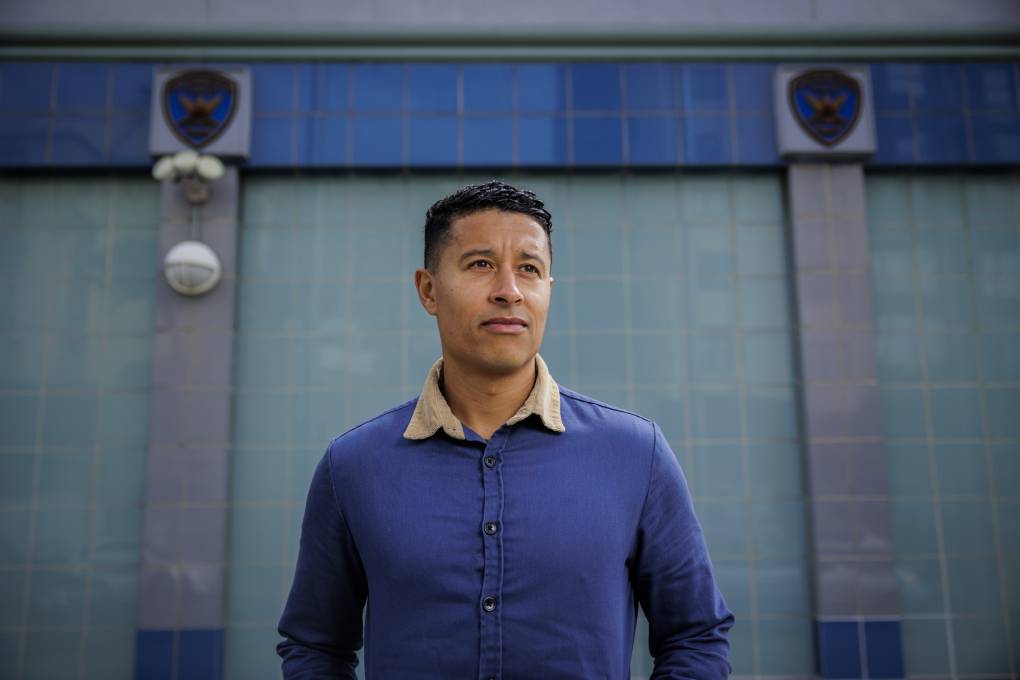
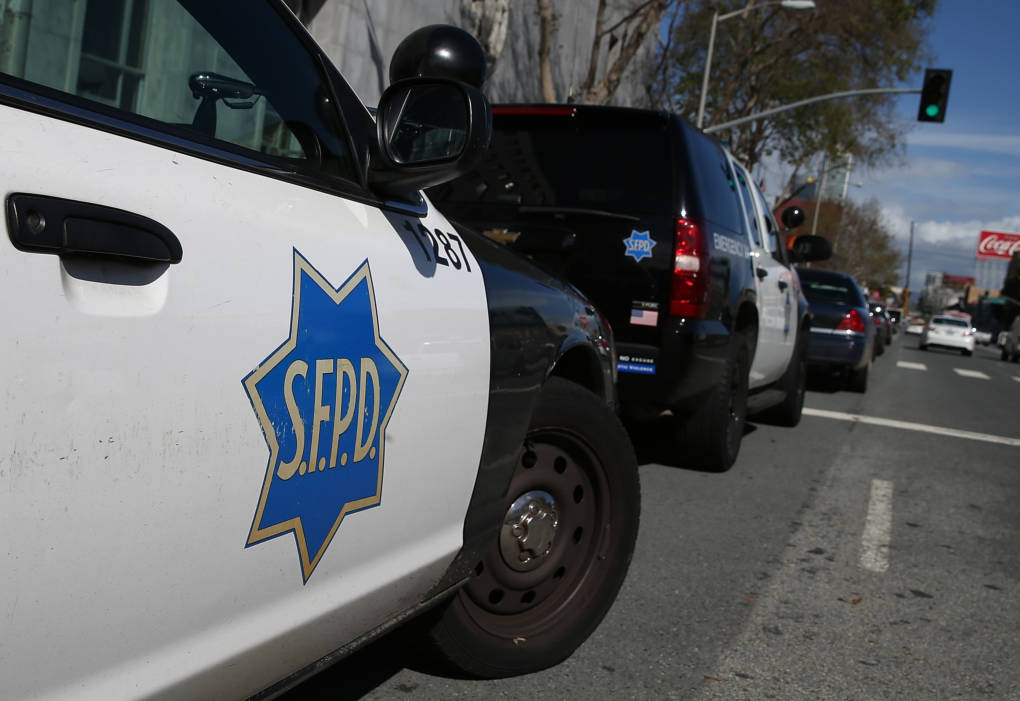
"caption": "Max Carter-Oberstone stands in front of the SFPD Northern District Police Station in the Fillmore District in San Francisco on Mar. 12, 2024. San Francisco Mayor Daniel Lurie’s office asked Carter-Oberstone to resign from the civilian-led Police Commission, but he refused. Lurie is now taking steps to remove him.",
"credit": "Martin do Nascimento/KQED",
"altTag": null,
"description": null,
"imgSizes": {
"medium": {
"file": "https://cdn.kqed.org/wp-content/uploads/sites/10/2024/03/240312-MAX-CARTER-OBERSTONE-MD-04-KQED-800x533.jpg",
"width": 800,
"height": 533,
"mimeType": "image/jpeg"
},
"large": {
"file": "https://cdn.kqed.org/wp-content/uploads/sites/10/2024/03/240312-MAX-CARTER-OBERSTONE-MD-04-KQED-1020x680.jpg",
"width": 1020,
"height": 680,
"mimeType": "image/jpeg"
},
"thumbnail": {
"file": "https://cdn.kqed.org/wp-content/uploads/sites/10/2024/03/240312-MAX-CARTER-OBERSTONE-MD-04-KQED-160x107.jpg",
"width": 160,
"height": 107,
"mimeType": "image/jpeg"
},
"1536x1536": {
"file": "https://cdn.kqed.org/wp-content/uploads/sites/10/2024/03/240312-MAX-CARTER-OBERSTONE-MD-04-KQED-1536x1024.jpg",
"width": 1536,
"height": 1024,
"mimeType": "image/jpeg"
},
"post-thumbnail": {
"file": "https://cdn.kqed.org/wp-content/uploads/sites/10/2024/03/240312-MAX-CARTER-OBERSTONE-MD-04-KQED-672x372.jpg",
"width": 672,
"height": 372,
"mimeType": "image/jpeg"
},
"twentyfourteen-full-width": {
"file": "https://cdn.kqed.org/wp-content/uploads/sites/10/2024/03/240312-MAX-CARTER-OBERSTONE-MD-04-KQED-1038x576.jpg",
"width": 1038,
"height": 576,
"mimeType": "image/jpeg"
},
"full-width": {
"file": "https://cdn.kqed.org/wp-content/uploads/sites/10/2024/03/240312-MAX-CARTER-OBERSTONE-MD-04-KQED-1920x1280.jpg",
"width": 1920,
"height": 1280,
"mimeType": "image/jpeg"
},
"kqedFullSize": {
"file": "https://cdn.kqed.org/wp-content/uploads/sites/10/2024/03/240312-MAX-CARTER-OBERSTONE-MD-04-KQED.jpg?ver=1710347365",
"width": 2000,
"height": 1333
}
},
"isLoading": false,
"fetchFailed": false
},
"news_12020636": {
"type": "attachments",
"id": "news_12020636",
"meta": {
"index": "attachments_1716263798",
"site": "news",
"id": "12020636",
"found": true
},
"title": "Sally Gearhart (courtesy of Deborah Craig)",
"publishDate": 1736286053,
"status": "inherit",
"parent": 12020619,
"modified": 1736303989,
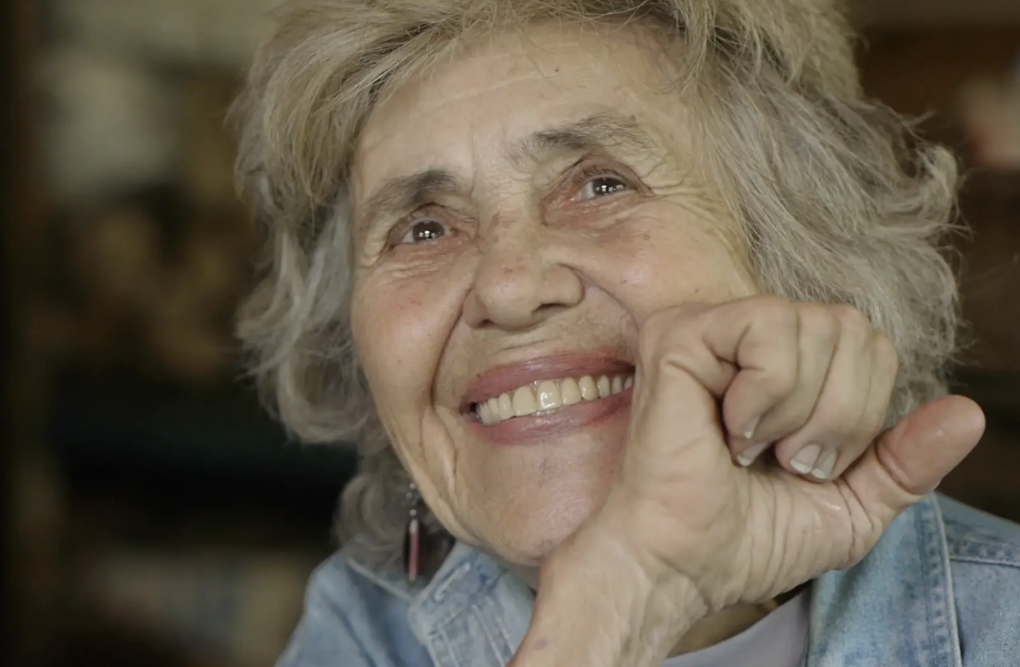
"caption": "Sally Gearhart, in 2024.",
"credit": "Courtesy of Deborah Craig",
"altTag": "An older woman smiles as she looks up in a color photo.",
"description": null,
"imgSizes": {
"medium": {
"file": "https://cdn.kqed.org/wp-content/uploads/sites/10/2025/01/Sally-Gearhart-courtesy-of-Deborah-Craig-800x523.png",
"width": 800,
"height": 523,
"mimeType": "image/png"
},
"large": {
"file": "https://cdn.kqed.org/wp-content/uploads/sites/10/2025/01/Sally-Gearhart-courtesy-of-Deborah-Craig-1020x667.png",
"width": 1020,
"height": 667,
"mimeType": "image/png"
},
"thumbnail": {
"file": "https://cdn.kqed.org/wp-content/uploads/sites/10/2025/01/Sally-Gearhart-courtesy-of-Deborah-Craig-160x105.png",
"width": 160,
"height": 105,
"mimeType": "image/png"
},
"1536x1536": {
"file": "https://cdn.kqed.org/wp-content/uploads/sites/10/2025/01/Sally-Gearhart-courtesy-of-Deborah-Craig-1536x1005.png",
"width": 1536,
"height": 1005,
"mimeType": "image/png"
},
"2048x2048": {
"file": "https://cdn.kqed.org/wp-content/uploads/sites/10/2025/01/Sally-Gearhart-courtesy-of-Deborah-Craig-2048x1340.png",
"width": 2048,
"height": 1340,
"mimeType": "image/png"
},
"post-thumbnail": {
"file": "https://cdn.kqed.org/wp-content/uploads/sites/10/2025/01/Sally-Gearhart-courtesy-of-Deborah-Craig-672x372.png",
"width": 672,
"height": 372,
"mimeType": "image/png"
},
"twentyfourteen-full-width": {
"file": "https://cdn.kqed.org/wp-content/uploads/sites/10/2025/01/Sally-Gearhart-courtesy-of-Deborah-Craig-1038x576.png",
"width": 1038,
"height": 576,
"mimeType": "image/png"
},
"full-width": {
"file": "https://cdn.kqed.org/wp-content/uploads/sites/10/2025/01/Sally-Gearhart-courtesy-of-Deborah-Craig-1920x1256.png",
"width": 1920,
"height": 1256,
"mimeType": "image/png"
},
"kqedFullSize": {
"file": "https://cdn.kqed.org/wp-content/uploads/sites/10/2025/01/Sally-Gearhart-courtesy-of-Deborah-Craig.png",
"width": 2858,
"height": 1870
}
},
"isLoading": false,
"fetchFailed": false
},
"news_12023391": {
"type": "attachments",
"id": "news_12023391",
"meta": {
"index": "attachments_1716263798",
"site": "news",
"id": "12023391",
"found": true
},
"title": "20250121_DA-Finalists_DB_00823",
"publishDate": 1737507726,
"status": "inherit",
"parent": 0,
"modified": 1738348640,
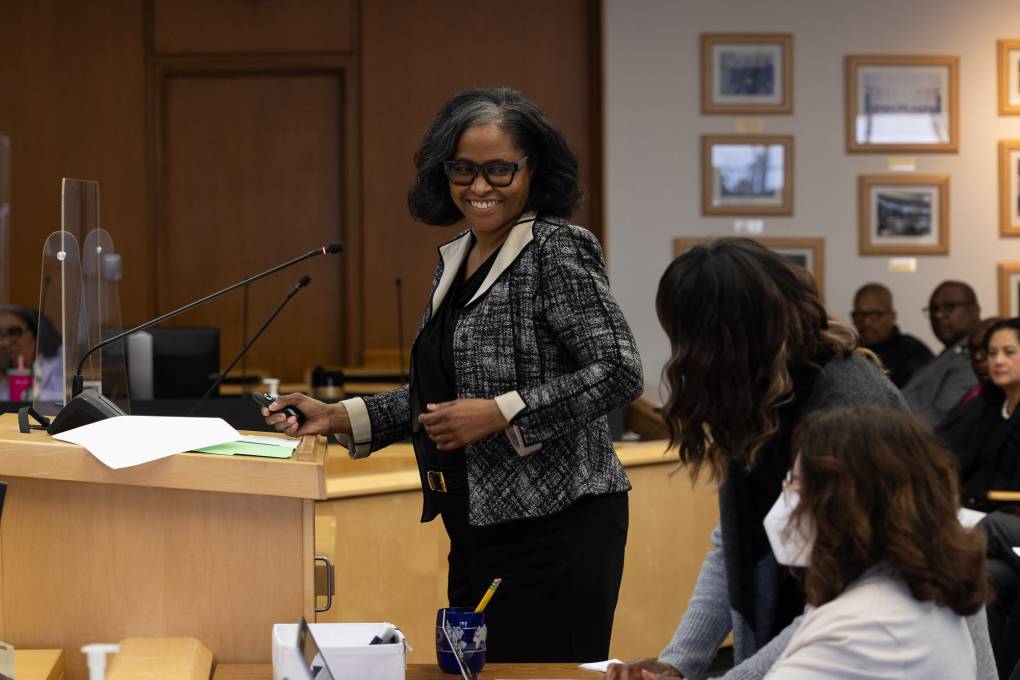
"caption": "Ursula Jones Dickson, Alameda County Superior Court judge and former deputy district attorney in Alameda County, addresses the Alameda County Board of Supervisors at the Alameda County Administration Building, Tuesday, Jan. 21, 2025. The board has named seven finalists who are in contention to be the next district attorney after Pamela Price's recall.",
"credit": "David M. Barreda/KQED",
"altTag": null,
"description": null,
"imgSizes": {
"medium": {
"file": "https://cdn.kqed.org/wp-content/uploads/sites/10/2025/01/20250121_DA-Finalists_DB_00823-800x533.jpg",
"width": 800,
"height": 533,
"mimeType": "image/jpeg"
},
"large": {
"file": "https://cdn.kqed.org/wp-content/uploads/sites/10/2025/01/20250121_DA-Finalists_DB_00823-1020x680.jpg",
"width": 1020,
"height": 680,
"mimeType": "image/jpeg"
},
"thumbnail": {
"file": "https://cdn.kqed.org/wp-content/uploads/sites/10/2025/01/20250121_DA-Finalists_DB_00823-160x107.jpg",
"width": 160,
"height": 107,
"mimeType": "image/jpeg"
},
"1536x1536": {
"file": "https://cdn.kqed.org/wp-content/uploads/sites/10/2025/01/20250121_DA-Finalists_DB_00823-1536x1024.jpg",
"width": 1536,
"height": 1024,
"mimeType": "image/jpeg"
},
"post-thumbnail": {
"file": "https://cdn.kqed.org/wp-content/uploads/sites/10/2025/01/20250121_DA-Finalists_DB_00823-672x372.jpg",
"width": 672,
"height": 372,
"mimeType": "image/jpeg"
},
"twentyfourteen-full-width": {
"file": "https://cdn.kqed.org/wp-content/uploads/sites/10/2025/01/20250121_DA-Finalists_DB_00823-1038x576.jpg",
"width": 1038,
"height": 576,
"mimeType": "image/jpeg"
},
"full-width": {
"file": "https://cdn.kqed.org/wp-content/uploads/sites/10/2025/01/20250121_DA-Finalists_DB_00823-1920x1280.jpg",
"width": 1920,
"height": 1280,
"mimeType": "image/jpeg"
},
"kqedFullSize": {
"file": "https://cdn.kqed.org/wp-content/uploads/sites/10/2025/01/20250121_DA-Finalists_DB_00823.jpg",
"width": 2000,
"height": 1333
}
},
"isLoading": false,
"fetchFailed": false
},
"news_12023392": {
"type": "attachments",
"id": "news_12023392",
"meta": {
"index": "attachments_1716263798",
"site": "news",
"id": "12023392",
"found": true
},
"title": "20250121_DA-Finalists_DB_00867",
"publishDate": 1737507733,
"status": "inherit",
"parent": 0,
"modified": 1738193520,
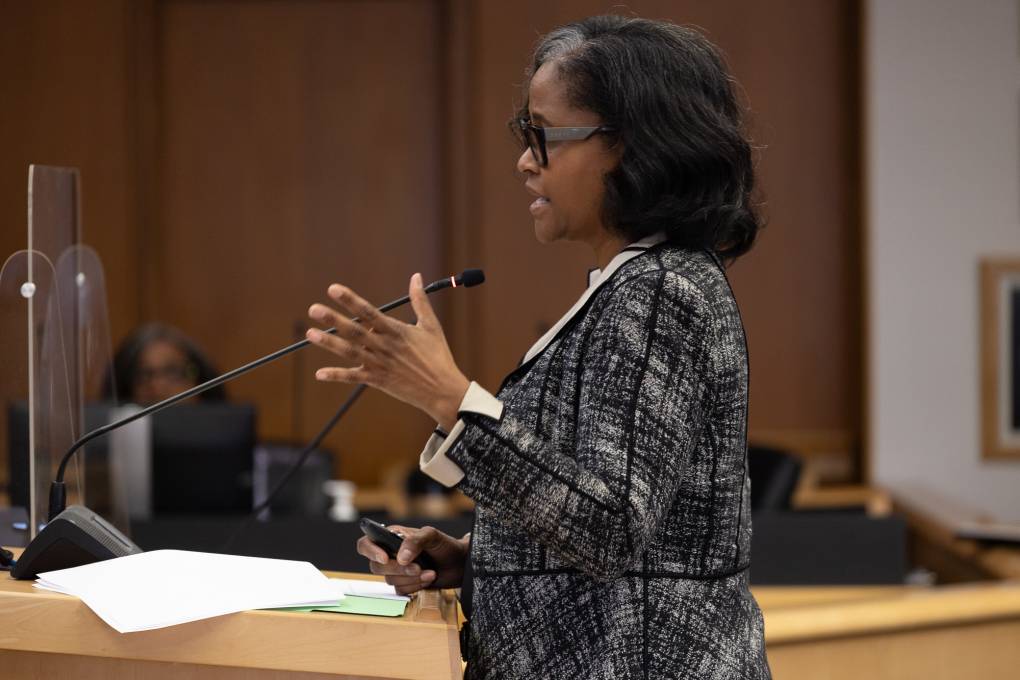
"caption": "Ursula Jones Dickson, Alameda County Superior Court judge and former deputy district attorney in Alameda County, addresses the Alameda County Board of Supervisors at the Alameda County Administration Building on Tuesday, Jan. 21, 2025. ",
"credit": "David M. Barreda/KQED",
"altTag": null,
"description": null,
"imgSizes": {
"medium": {
"file": "https://cdn.kqed.org/wp-content/uploads/sites/10/2025/01/20250121_DA-Finalists_DB_00867-800x533.jpg",
"width": 800,
"height": 533,
"mimeType": "image/jpeg"
},
"large": {
"file": "https://cdn.kqed.org/wp-content/uploads/sites/10/2025/01/20250121_DA-Finalists_DB_00867-1020x680.jpg",
"width": 1020,
"height": 680,
"mimeType": "image/jpeg"
},
"thumbnail": {
"file": "https://cdn.kqed.org/wp-content/uploads/sites/10/2025/01/20250121_DA-Finalists_DB_00867-160x107.jpg",
"width": 160,
"height": 107,
"mimeType": "image/jpeg"
},
"1536x1536": {
"file": "https://cdn.kqed.org/wp-content/uploads/sites/10/2025/01/20250121_DA-Finalists_DB_00867-1536x1024.jpg",
"width": 1536,
"height": 1024,
"mimeType": "image/jpeg"
},
"post-thumbnail": {
"file": "https://cdn.kqed.org/wp-content/uploads/sites/10/2025/01/20250121_DA-Finalists_DB_00867-672x372.jpg",
"width": 672,
"height": 372,
"mimeType": "image/jpeg"
},
"twentyfourteen-full-width": {
"file": "https://cdn.kqed.org/wp-content/uploads/sites/10/2025/01/20250121_DA-Finalists_DB_00867-1038x576.jpg",
"width": 1038,
"height": 576,
"mimeType": "image/jpeg"
},
"full-width": {
"file": "https://cdn.kqed.org/wp-content/uploads/sites/10/2025/01/20250121_DA-Finalists_DB_00867-1920x1280.jpg",
"width": 1920,
"height": 1280,
"mimeType": "image/jpeg"
},
"kqedFullSize": {
"file": "https://cdn.kqed.org/wp-content/uploads/sites/10/2025/01/20250121_DA-Finalists_DB_00867.jpg",
"width": 2000,
"height": 1333
}
},
"isLoading": false,
"fetchFailed": false
},
"news_11732008": {
"type": "attachments",
"id": "news_11732008",
"meta": {
"index": "attachments_1716263798",
"site": "news",
"id": "11732008",
"found": true
},
"title": "Six San Francisco Police Officers Indicted Multiple Corruption Charges",
"publishDate": 1552238711,
"status": "inherit",
"parent": 11732001,
"modified": 1552238753,
"caption": null,
"credit": "Justin Sullivan/Getty Images",
"altTag": null,
"description": null,
"imgSizes": {
"thumbnail": {
"file": "https://cdn.kqed.org/wp-content/uploads/sites/10/2019/03/RS9050_475371683-160x110.jpg",
"width": 160,
"height": 110,
"mimeType": "image/jpeg"
},
"medium": {
"file": "https://cdn.kqed.org/wp-content/uploads/sites/10/2019/03/RS9050_475371683-800x550.jpg",
"width": 800,
"height": 550,
"mimeType": "image/jpeg"
},
"large": {
"file": "https://cdn.kqed.org/wp-content/uploads/sites/10/2019/03/RS9050_475371683-1020x701.jpg",
"width": 1020,
"height": 701,
"mimeType": "image/jpeg"
},
"complete_open_graph": {
"file": "https://cdn.kqed.org/wp-content/uploads/sites/10/2019/03/RS9050_475371683-1200x825.jpg",
"width": 1200,
"height": 825,
"mimeType": "image/jpeg"
},
"post-thumbnail": {
"file": "https://cdn.kqed.org/wp-content/uploads/sites/10/2019/03/RS9050_475371683-672x372.jpg",
"width": 672,
"height": 372,
"mimeType": "image/jpeg"
},
"twentyfourteen-full-width": {
"file": "https://cdn.kqed.org/wp-content/uploads/sites/10/2019/03/RS9050_475371683-1038x576.jpg",
"width": 1038,
"height": 576,
"mimeType": "image/jpeg"
},
"full-width": {
"file": "https://cdn.kqed.org/wp-content/uploads/sites/10/2019/03/RS9050_475371683-1920x1320.jpg",
"width": 1920,
"height": 1320,
"mimeType": "image/jpeg"
},
"guest-author-32": {
"file": "https://cdn.kqed.org/wp-content/uploads/sites/10/2019/03/RS9050_475371683-32x32.jpg",
"width": 32,
"height": 32,
"mimeType": "image/jpeg"
},
"guest-author-50": {
"file": "https://cdn.kqed.org/wp-content/uploads/sites/10/2019/03/RS9050_475371683-50x50.jpg",
"width": 50,
"height": 50,
"mimeType": "image/jpeg"
},
"guest-author-64": {
"file": "https://cdn.kqed.org/wp-content/uploads/sites/10/2019/03/RS9050_475371683-64x64.jpg",
"width": 64,
"height": 64,
"mimeType": "image/jpeg"
},
"guest-author-96": {
"file": "https://cdn.kqed.org/wp-content/uploads/sites/10/2019/03/RS9050_475371683-96x96.jpg",
"width": 96,
"height": 96,
"mimeType": "image/jpeg"
},
"guest-author-128": {
"file": "https://cdn.kqed.org/wp-content/uploads/sites/10/2019/03/RS9050_475371683-128x128.jpg",
"width": 128,
"height": 128,
"mimeType": "image/jpeg"
},
"kqedFullSize": {
"file": "https://cdn.kqed.org/wp-content/uploads/sites/10/2019/03/RS9050_475371683-e1738084912875.jpg",
"width": 2000,
"height": 1375
}
},
"isLoading": false,
"fetchFailed": false
},
"news_11961290": {
"type": "attachments",
"id": "news_11961290",
"meta": {
"index": "attachments_1716263798",
"site": "news",
"id": "11961290",
"found": true
},
"title": "_S2A6703",
"publishDate": 1694737884,
"status": "inherit",
"parent": 11961286,
"modified": 1737671064,
"caption": "Fans at an Oakland Roots game on Sept. 14, 2023.",
"credit": "Courtesy Oakland Roots and Soul SC",
"altTag": "People cheer in the stands of a soccer game, waving signs that say 'Oakland Roots.'",
"description": null,
"imgSizes": {
"medium": {
"file": "https://cdn.kqed.org/wp-content/uploads/sites/10/2023/09/S2A6703-800x533.jpg",
"width": 800,
"height": 533,
"mimeType": "image/jpeg"
},
"large": {
"file": "https://cdn.kqed.org/wp-content/uploads/sites/10/2023/09/S2A6703-1020x680.jpg",
"width": 1020,
"height": 680,
"mimeType": "image/jpeg"
},
"thumbnail": {
"file": "https://cdn.kqed.org/wp-content/uploads/sites/10/2023/09/S2A6703-160x107.jpg",
"width": 160,
"height": 107,
"mimeType": "image/jpeg"
},
"1536x1536": {
"file": "https://cdn.kqed.org/wp-content/uploads/sites/10/2023/09/S2A6703-1536x1024.jpg",
"width": 1536,
"height": 1024,
"mimeType": "image/jpeg"
},
"2048x2048": {
"file": "https://cdn.kqed.org/wp-content/uploads/sites/10/2023/09/S2A6703-2048x1365.jpg",
"width": 2048,
"height": 1365,
"mimeType": "image/jpeg"
},
"post-thumbnail": {
"file": "https://cdn.kqed.org/wp-content/uploads/sites/10/2023/09/S2A6703-672x372.jpg",
"width": 672,
"height": 372,
"mimeType": "image/jpeg"
},
"twentyfourteen-full-width": {
"file": "https://cdn.kqed.org/wp-content/uploads/sites/10/2023/09/S2A6703-1038x576.jpg",
"width": 1038,
"height": 576,
"mimeType": "image/jpeg"
},
"full-width": {
"file": "https://cdn.kqed.org/wp-content/uploads/sites/10/2023/09/S2A6703-1920x1280.jpg",
"width": 1920,
"height": 1280,
"mimeType": "image/jpeg"
},
"kqedFullSize": {
"file": "https://cdn.kqed.org/wp-content/uploads/sites/10/2023/09/S2A6703-scaled-e1737670937770.jpg",
"width": 2000,
"height": 1334
}
},
"isLoading": false,
"fetchFailed": false
},
"news_12023482": {
"type": "attachments",
"id": "news_12023482",
"meta": {
"index": "attachments_1716263798",
"site": "news",
"id": "12023482",
"found": true
},
"title": "Two people wait for a train at BART Powell Street station in San Francisco, Calif., on Tuesday, February 11, 2020.",
"publishDate": 1737574272,
"status": "inherit",
"parent": 12023463,
"modified": 1737588181,
"caption": "Two people wait for a train at BART Powell Street station in San Francisco, California, on Tuesday, Feb. 11, 2020. ",
"credit": "Scott Strazzante/San Francisco Chronicle via Getty Images",
"altTag": null,
"description": null,
"imgSizes": {
"medium": {
"file": "https://cdn.kqed.org/wp-content/uploads/sites/10/2025/01/PowellStationSanFranciscoGetty-800x534.jpg",
"width": 800,
"height": 534,
"mimeType": "image/jpeg"
},
"large": {
"file": "https://cdn.kqed.org/wp-content/uploads/sites/10/2025/01/PowellStationSanFranciscoGetty-1020x680.jpg",
"width": 1020,
"height": 680,
"mimeType": "image/jpeg"
},
"thumbnail": {
"file": "https://cdn.kqed.org/wp-content/uploads/sites/10/2025/01/PowellStationSanFranciscoGetty-160x107.jpg",
"width": 160,
"height": 107,
"mimeType": "image/jpeg"
},
"1536x1536": {
"file": "https://cdn.kqed.org/wp-content/uploads/sites/10/2025/01/PowellStationSanFranciscoGetty-1536x1025.jpg",
"width": 1536,
"height": 1025,
"mimeType": "image/jpeg"
},
"post-thumbnail": {
"file": "https://cdn.kqed.org/wp-content/uploads/sites/10/2025/01/PowellStationSanFranciscoGetty-672x372.jpg",
"width": 672,
"height": 372,
"mimeType": "image/jpeg"
},
"twentyfourteen-full-width": {
"file": "https://cdn.kqed.org/wp-content/uploads/sites/10/2025/01/PowellStationSanFranciscoGetty-1038x576.jpg",
"width": 1038,
"height": 576,
"mimeType": "image/jpeg"
},
"full-width": {
"file": "https://cdn.kqed.org/wp-content/uploads/sites/10/2025/01/PowellStationSanFranciscoGetty-1920x1281.jpg",
"width": 1920,
"height": 1281,
"mimeType": "image/jpeg"
},
"kqedFullSize": {
"file": "https://cdn.kqed.org/wp-content/uploads/sites/10/2025/01/PowellStationSanFranciscoGetty.jpg",
"width": 2000,
"height": 1334
}
},
"isLoading": false,
"fetchFailed": false
},
"news_12017852": {
"type": "attachments",
"id": "news_12017852",
"meta": {
"index": "attachments_1716263798",
"site": "news",
"id": "12017852",
"found": true
},
"title": "20241211-OUSDMergerVote-JY-033",
"publishDate": 1733989002,
"status": "inherit",
"parent": 12027158,
"modified": 1739579285,
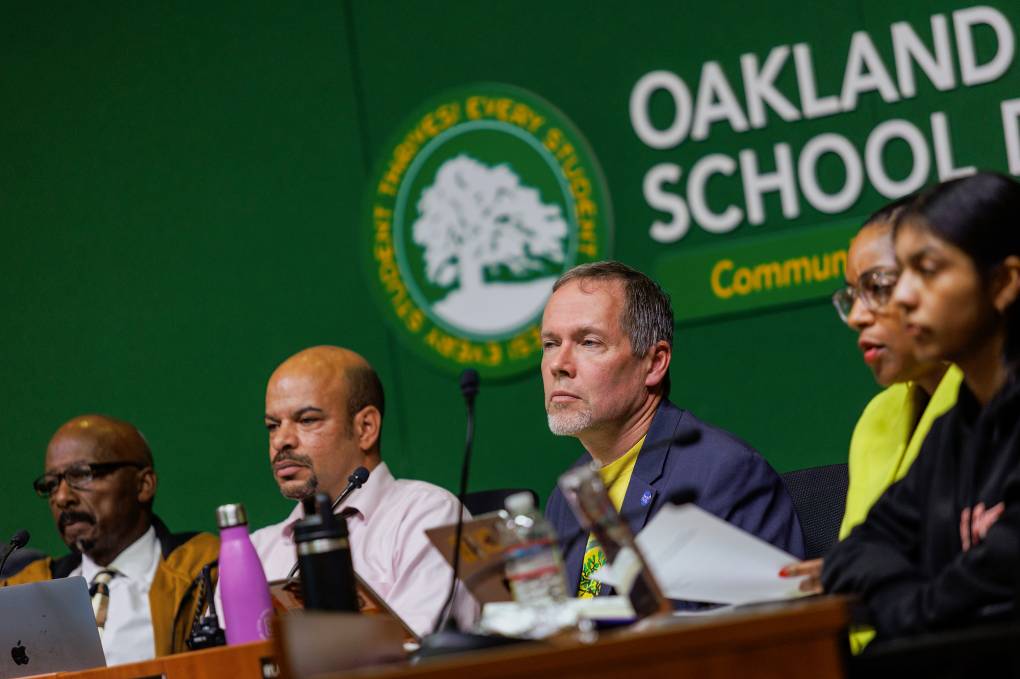
"caption": "The Oakland Unified School District Board listens to public comment during a meeting at La Escuelita Elementary School in Oakland, California, on Wednesday, Dec. 11, 2024. Students, families, educators, and community members raised their concerns about a proposed merger of their schools.",
"credit": "Juliana Yamada/KQED",
"altTag": null,
"description": null,
"imgSizes": {
"medium": {
"file": "https://cdn.kqed.org/wp-content/uploads/sites/10/2024/12/20241211-OUSDMergerVote-JY-033-800x533.jpg",
"width": 800,
"height": 533,
"mimeType": "image/jpeg"
},
"large": {
"file": "https://cdn.kqed.org/wp-content/uploads/sites/10/2024/12/20241211-OUSDMergerVote-JY-033-1020x679.jpg",
"width": 1020,
"height": 679,
"mimeType": "image/jpeg"
},
"thumbnail": {
"file": "https://cdn.kqed.org/wp-content/uploads/sites/10/2024/12/20241211-OUSDMergerVote-JY-033-160x107.jpg",
"width": 160,
"height": 107,
"mimeType": "image/jpeg"
},
"1536x1536": {
"file": "https://cdn.kqed.org/wp-content/uploads/sites/10/2024/12/20241211-OUSDMergerVote-JY-033-1536x1023.jpg",
"width": 1536,
"height": 1023,
"mimeType": "image/jpeg"
},
"post-thumbnail": {
"file": "https://cdn.kqed.org/wp-content/uploads/sites/10/2024/12/20241211-OUSDMergerVote-JY-033-672x372.jpg",
"width": 672,
"height": 372,
"mimeType": "image/jpeg"
},
"twentyfourteen-full-width": {
"file": "https://cdn.kqed.org/wp-content/uploads/sites/10/2024/12/20241211-OUSDMergerVote-JY-033-1038x576.jpg",
"width": 1038,
"height": 576,
"mimeType": "image/jpeg"
},
"full-width": {
"file": "https://cdn.kqed.org/wp-content/uploads/sites/10/2024/12/20241211-OUSDMergerVote-JY-033-1920x1279.jpg",
"width": 1920,
"height": 1279,
"mimeType": "image/jpeg"
},
"kqedFullSize": {
"file": "https://cdn.kqed.org/wp-content/uploads/sites/10/2024/12/20241211-OUSDMergerVote-JY-033.jpg",
"width": 2000,
"height": 1332
}
},
"isLoading": false,
"fetchFailed": false
},
"news_12023401": {
"type": "attachments",
"id": "news_12023401",
"meta": {
"index": "attachments_1716263798",
"site": "news",
"id": "12023401",
"found": true
},
"title": "20250121_DA-Finalists_DB_00518",
"publishDate": 1737508229,
"status": "inherit",
"parent": 12024972,
"modified": 1738336753,
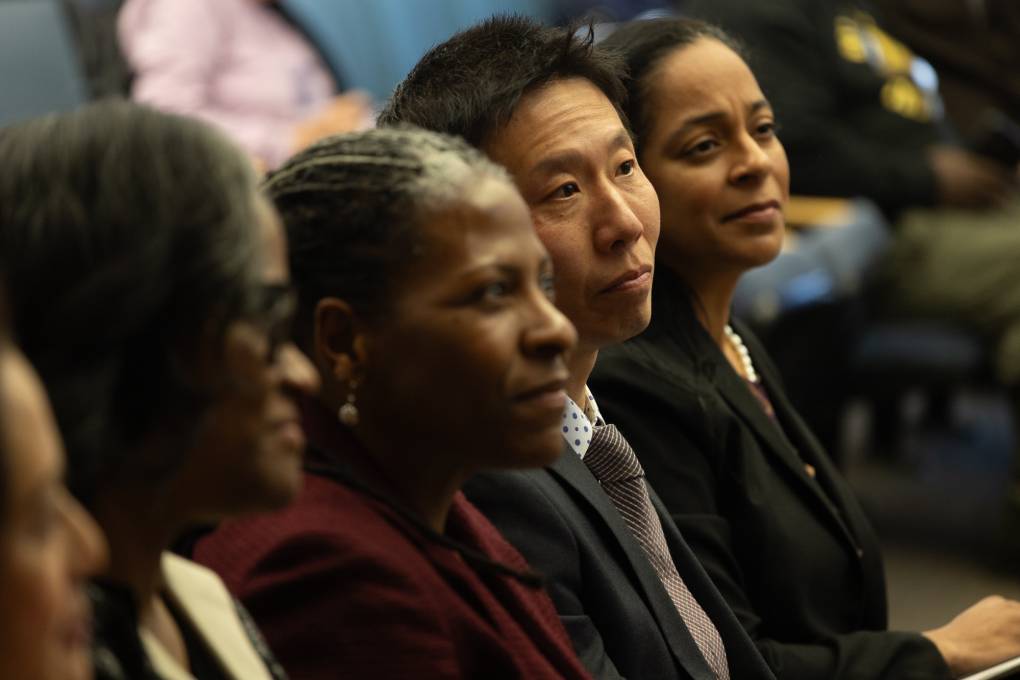
"caption": "(Left to right) Ursula Jones Dickson, Alameda County Superior Court judge and former deputy district attorney in Alameda County, Latricia Louis, deputy county counsel in Alameda County and former assistant district attorney in Alameda County, Yibin Shen, city attorney in the City of Alameda, and Venus Johnson, chief deputy attorney general in the California Department of Justice and former director of public safety in Oakland, wait for the Alameda County board of supervisors meting to start at the Alameda County Administration Building, on Tuesday, Jan. 21, 2025. ",
"credit": "David M. Barreda/KQED",
"altTag": null,
"description": null,
"imgSizes": {
"medium": {
"file": "https://cdn.kqed.org/wp-content/uploads/sites/10/2025/01/20250121_DA-Finalists_DB_00518-800x533.jpg",
"width": 800,
"height": 533,
"mimeType": "image/jpeg"
},
"large": {
"file": "https://cdn.kqed.org/wp-content/uploads/sites/10/2025/01/20250121_DA-Finalists_DB_00518-1020x680.jpg",
"width": 1020,
"height": 680,
"mimeType": "image/jpeg"
},
"thumbnail": {
"file": "https://cdn.kqed.org/wp-content/uploads/sites/10/2025/01/20250121_DA-Finalists_DB_00518-160x107.jpg",
"width": 160,
"height": 107,
"mimeType": "image/jpeg"
},
"1536x1536": {
"file": "https://cdn.kqed.org/wp-content/uploads/sites/10/2025/01/20250121_DA-Finalists_DB_00518-1536x1024.jpg",
"width": 1536,
"height": 1024,
"mimeType": "image/jpeg"
},
"post-thumbnail": {
"file": "https://cdn.kqed.org/wp-content/uploads/sites/10/2025/01/20250121_DA-Finalists_DB_00518-672x372.jpg",
"width": 672,
"height": 372,
"mimeType": "image/jpeg"
},
"twentyfourteen-full-width": {
"file": "https://cdn.kqed.org/wp-content/uploads/sites/10/2025/01/20250121_DA-Finalists_DB_00518-1038x576.jpg",
"width": 1038,
"height": 576,
"mimeType": "image/jpeg"
},
"full-width": {
"file": "https://cdn.kqed.org/wp-content/uploads/sites/10/2025/01/20250121_DA-Finalists_DB_00518-1920x1280.jpg",
"width": 1920,
"height": 1280,
"mimeType": "image/jpeg"
},
"kqedFullSize": {
"file": "https://cdn.kqed.org/wp-content/uploads/sites/10/2025/01/20250121_DA-Finalists_DB_00518.jpg",
"width": 2000,
"height": 1333
}
},
"isLoading": false,
"fetchFailed": false
},
"news_12023151": {
"type": "attachments",
"id": "news_12023151",
"meta": {
"index": "attachments_1716263798",
"site": "news",
"id": "12023151",
"found": true
},
"title": "250120-YouthClimateProtest-06-BL",
"publishDate": 1737408212,
"status": "inherit",
"parent": 0,
"modified": 1737408340,
"caption": "Members of the Bay Area Youth Climate Summit hold a climate rally and march at Dolores Park in San Francisco on Monday, Jan. 20, 2025, to coincide with Donald Trump’s inauguration.",
"credit": "Beth LaBerge/KQED",
"altTag": null,
"description": null,
"imgSizes": {
"medium": {
"file": "https://cdn.kqed.org/wp-content/uploads/sites/10/2025/01/250120-YouthClimateProtest-06-BL-800x533.jpg",
"width": 800,
"height": 533,
"mimeType": "image/jpeg"
},
"large": {
"file": "https://cdn.kqed.org/wp-content/uploads/sites/10/2025/01/250120-YouthClimateProtest-06-BL-1020x680.jpg",
"width": 1020,
"height": 680,
"mimeType": "image/jpeg"
},
"thumbnail": {
"file": "https://cdn.kqed.org/wp-content/uploads/sites/10/2025/01/250120-YouthClimateProtest-06-BL-160x107.jpg",
"width": 160,
"height": 107,
"mimeType": "image/jpeg"
},
"1536x1536": {
"file": "https://cdn.kqed.org/wp-content/uploads/sites/10/2025/01/250120-YouthClimateProtest-06-BL-1536x1024.jpg",
"width": 1536,
"height": 1024,
"mimeType": "image/jpeg"
},
"post-thumbnail": {
"file": "https://cdn.kqed.org/wp-content/uploads/sites/10/2025/01/250120-YouthClimateProtest-06-BL-672x372.jpg",
"width": 672,
"height": 372,
"mimeType": "image/jpeg"
},
"twentyfourteen-full-width": {
"file": "https://cdn.kqed.org/wp-content/uploads/sites/10/2025/01/250120-YouthClimateProtest-06-BL-1038x576.jpg",
"width": 1038,
"height": 576,
"mimeType": "image/jpeg"
},
"full-width": {
"file": "https://cdn.kqed.org/wp-content/uploads/sites/10/2025/01/250120-YouthClimateProtest-06-BL-1920x1280.jpg",
"width": 1920,
"height": 1280,
"mimeType": "image/jpeg"
},
"kqedFullSize": {
"file": "https://cdn.kqed.org/wp-content/uploads/sites/10/2025/01/250120-YouthClimateProtest-06-BL.jpg",
"width": 2000,
"height": 1333
}
},
"isLoading": false,
"fetchFailed": false
},
"news_12023097": {
"type": "attachments",
"id": "news_12023097",
"meta": {
"index": "attachments_1716263798",
"site": "news",
"id": "12023097",
"found": true
},
"title": "250120CalMatters1",
"publishDate": 1737389756,
"status": "inherit",
"parent": 12023094,
"modified": 1737389783,
"caption": "California sued President Donald Trump's administration 123 times between 2017 and 2021. It's preparing more lawsuits as Trump returns to the White House. ",
"credit": "Illustration by Adriana Heldiz/CalMatters",
"altTag": null,
"description": null,
"imgSizes": {
"medium": {
"file": "https://cdn.kqed.org/wp-content/uploads/sites/10/2025/01/250120CalMatters1-800x533.jpg",
"width": 800,
"height": 533,
"mimeType": "image/jpeg"
},
"large": {
"file": "https://cdn.kqed.org/wp-content/uploads/sites/10/2025/01/250120CalMatters1-1020x680.jpg",
"width": 1020,
"height": 680,
"mimeType": "image/jpeg"
},
"thumbnail": {
"file": "https://cdn.kqed.org/wp-content/uploads/sites/10/2025/01/250120CalMatters1-160x107.jpg",
"width": 160,
"height": 107,
"mimeType": "image/jpeg"
},
"1536x1536": {
"file": "https://cdn.kqed.org/wp-content/uploads/sites/10/2025/01/250120CalMatters1-1536x1024.jpg",
"width": 1536,
"height": 1024,
"mimeType": "image/jpeg"
},
"post-thumbnail": {
"file": "https://cdn.kqed.org/wp-content/uploads/sites/10/2025/01/250120CalMatters1-672x372.jpg",
"width": 672,
"height": 372,
"mimeType": "image/jpeg"
},
"twentyfourteen-full-width": {
"file": "https://cdn.kqed.org/wp-content/uploads/sites/10/2025/01/250120CalMatters1-1038x576.jpg",
"width": 1038,
"height": 576,
"mimeType": "image/jpeg"
},
"full-width": {
"file": "https://cdn.kqed.org/wp-content/uploads/sites/10/2025/01/250120CalMatters1-1920x1280.jpg",
"width": 1920,
"height": 1280,
"mimeType": "image/jpeg"
},
"kqedFullSize": {
"file": "https://cdn.kqed.org/wp-content/uploads/sites/10/2025/01/250120CalMatters1.jpg",
"width": 2000,
"height": 1333
}
},
"isLoading": false,
"fetchFailed": false
}
},
"audioPlayerReducer": {
"postId": "stream_live",
"isPaused": true,
"isPlaying": false,
"pfsActive": false,
"pledgeModalIsOpen": true,
"playerDrawerIsOpen": false,
"liveAudioPlayStartedAt": 0,
"liveAudioPlayContext": ""
},
"authorsReducer": {
"byline_news_12023094": {
"type": "authors",
"id": "byline_news_12023094",
"meta": {
"override": true
},
"slug": "byline_news_12023094",
"name": "Ana B. Ibarra and Ben Christopher, CalMatters",
"isLoading": false
},
"danbrekke": {
"type": "authors",
"id": "222",
"meta": {
"index": "authors_1716337520",
"id": "222",
"found": true
},
"name": "Dan Brekke",
"firstName": "Dan",
"lastName": "Brekke",
"slug": "danbrekke",
"email": "dbrekke@kqed.org",
"display_author_email": true,
"staff_mastheads": [
"news",
"science"
],
"title": "KQED Editor and Reporter",
"bio": "Dan Brekke is a reporter and editor for KQED News, responsible for coverage of topics ranging from California water issues to the Bay Area's transportation challenges. In a newsroom career that began in Chicago in 1972, Dan has worked for \u003cem>The San Francisco Examiner,\u003c/em> Wired and TechTV and has been published in The New York Times, The New York Times Magazine, Business 2.0, Salon and elsewhere.\r\n\r\nSince joining KQED in 2007, Dan has reported, edited and produced both radio and online features and breaking news pieces. He has shared as both editor and reporter in four Society of Professional Journalists Norcal Excellence in Journalism awards and one Edward R. Murrow regional award. He was chosen for a spring 2017 residency at the Mesa Refuge to advance his research on California salmon.\r\n\r\nEmail Dan at: \u003ca href=\"mailto:dbrekke@kqed.org\">dbrekke@kqed.org\u003c/a>\r\n\r\n\u003cstrong>Twitter:\u003c/strong> \u003ca href=\"https://twitter.com/danbrekke\" rel=\"noopener noreferrer\">twitter.com/danbrekke\u003c/a>\r\n\u003cstrong>Facebook:\u003c/strong> \u003ca href=\"https://www.facebook.com/danbrekke\" rel=\"noopener noreferrer\">www.facebook.com/danbrekke\u003c/a>\r\n\u003cstrong>LinkedIn:\u003c/strong> \u003ca href=\"https://www.linkedin.com/in/danbrekke\" rel=\"noopener noreferrer\">www.linkedin.com/in/danbrekke\u003c/a>",
"avatar": "https://secure.gravatar.com/avatar/8f1f0d2a978fb3b23426c922c7e2af558fa36905b49c4ce76a97dc3c72d27226?s=600&d=mm&r=g",
"twitter": "danbrekke",
"bluesky": null,
"facebook": null,
"instagram": "https://www.instagram.com/dan.brekke/",
"linkedin": "https://www.linkedin.com/in/danbrekke/",
"sites": [
{
"site": "news",
"roles": [
"administrator",
"create_posts"
]
},
{
"site": "stateofhealth",
"roles": [
"editor"
]
},
{
"site": "science",
"roles": [
"editor"
]
},
{
"site": "quest",
"roles": [
"contributor"
]
},
{
"site": "food",
"roles": [
"contributor"
]
},
{
"site": "forum",
"roles": [
"contributor"
]
},
{
"site": "elections",
"roles": [
"editor"
]
},
{
"site": "liveblog",
"roles": [
"editor"
]
}
],
"headData": {
"title": "Dan Brekke | KQED",
"description": "KQED Editor and Reporter",
"ogImgSrc": "https://secure.gravatar.com/avatar/8f1f0d2a978fb3b23426c922c7e2af558fa36905b49c4ce76a97dc3c72d27226?s=600&d=mm&r=g",
"twImgSrc": "https://secure.gravatar.com/avatar/8f1f0d2a978fb3b23426c922c7e2af558fa36905b49c4ce76a97dc3c72d27226?s=600&d=mm&r=g"
},
"isLoading": false,
"link": "/author/danbrekke"
},
"btaylor": {
"type": "authors",
"id": "11365",
"meta": {
"index": "authors_1716337520",
"id": "11365",
"found": true
},
"name": "Bianca Taylor",
"firstName": "Bianca",
"lastName": "Taylor",
"slug": "btaylor",
"email": "btaylor@KQED.org",
"display_author_email": false,
"staff_mastheads": [
"news"
],
"title": "Host and Producer ",
"bio": "Bianca Taylor is a news producer and host of KQED's The Latest podcast.\r\n\r\nHer work with KQED has been honored by the Society of Professional Journalists NorCal, the Webby's, the Regional Murrow Awards, and ONA. She has also worked with NPR, the BBC World Service, and the Washington Post Creative Group.\r\n\r\nBianca is represented by SAG-AFTRA.",
"avatar": "https://secure.gravatar.com/avatar/6b9d3f6552dd10470c5d1c2e58cfe717?s=600&d=blank&r=g",
"twitter": "SoundsLkeBianca",
"facebook": null,
"instagram": null,
"linkedin": null,
"sites": [
{
"site": "arts",
"roles": [
"editor"
]
},
{
"site": "news",
"roles": [
"edit_others_posts",
"editor"
]
},
{
"site": "pop",
"roles": [
"editor"
]
},
{
"site": "bayareabites",
"roles": [
"author"
]
},
{
"site": "science",
"roles": [
"editor"
]
},
{
"site": "forum",
"roles": [
"editor"
]
},
{
"site": "radio",
"roles": [
"editor"
]
},
{
"site": "podcasts",
"roles": [
"editor"
]
}
],
"headData": {
"title": "Bianca Taylor | KQED",
"description": "Host and Producer ",
"ogImgSrc": "https://secure.gravatar.com/avatar/6b9d3f6552dd10470c5d1c2e58cfe717?s=600&d=blank&r=g",
"twImgSrc": "https://secure.gravatar.com/avatar/6b9d3f6552dd10470c5d1c2e58cfe717?s=600&d=blank&r=g"
},
"isLoading": false,
"link": "/author/btaylor"
},
"agonzalez": {
"type": "authors",
"id": "11724",
"meta": {
"index": "authors_1716337520",
"id": "11724",
"found": true
},
"name": "Alexander Gonzalez",
"firstName": "Alexander",
"lastName": "Gonzalez",
"slug": "agonzalez",
"email": "AlexanderGonzalez@KQED.org",
"display_author_email": false,
"staff_mastheads": [
"news"
],
"title": "KQED Contributor",
"bio": null,
"avatar": "https://secure.gravatar.com/avatar/9e291ed34e154df4c662edf858b641d70b4859939bfe40be478408f9dfd057d2?s=600&d=blank&r=g",
"twitter": null,
"bluesky": null,
"facebook": null,
"instagram": null,
"linkedin": null,
"sites": [
{
"site": "arts",
"roles": [
"editor"
]
},
{
"site": "news",
"roles": [
"editor"
]
},
{
"site": "science",
"roles": [
"editor"
]
}
],
"headData": {
"title": "Alexander Gonzalez | KQED",
"description": "KQED Contributor",
"ogImgSrc": "https://secure.gravatar.com/avatar/9e291ed34e154df4c662edf858b641d70b4859939bfe40be478408f9dfd057d2?s=600&d=blank&r=g",
"twImgSrc": "https://secure.gravatar.com/avatar/9e291ed34e154df4c662edf858b641d70b4859939bfe40be478408f9dfd057d2?s=600&d=blank&r=g"
},
"isLoading": false,
"link": "/author/agonzalez"
},
"eromero": {
"type": "authors",
"id": "11746",
"meta": {
"index": "authors_1716337520",
"id": "11746",
"found": true
},
"name": "Ezra David Romero",
"firstName": "Ezra David",
"lastName": "Romero",
"slug": "eromero",
"email": "eromero@kqed.org",
"display_author_email": true,
"staff_mastheads": [
"news",
"science"
],
"title": "Climate Reporter",
"bio": "Ezra David Romero is a climate reporter for KQED News. He covers the absence and excess of water in the Bay Area — think sea level rise, flooding and drought. For nearly a decade he’s covered how warming temperatures are altering the lives of Californians. He’s reported on farmers worried their pistachio trees aren’t getting enough sleep, families desperate for water, scientists studying dying giant sequoias, and alongside firefighters containing wildfires. His work has appeared on local stations across California and nationally on public radio shows like Morning Edition, Here and Now, All Things Considered and Science Friday. ",
"avatar": "https://secure.gravatar.com/avatar/c76404d287c10ed40224227551ac36e24352c7306f106632caf6fead76f8801f?s=600&d=blank&r=g",
"twitter": "ezraromero",
"bluesky": null,
"facebook": null,
"instagram": null,
"linkedin": null,
"sites": [
{
"site": "arts",
"roles": [
"editor"
]
},
{
"site": "news",
"roles": [
"editor"
]
},
{
"site": "science",
"roles": [
"editor"
]
},
{
"site": "liveblog",
"roles": [
"author"
]
}
],
"headData": {
"title": "Ezra David Romero | KQED",
"description": "Climate Reporter",
"ogImgSrc": "https://secure.gravatar.com/avatar/c76404d287c10ed40224227551ac36e24352c7306f106632caf6fead76f8801f?s=600&d=blank&r=g",
"twImgSrc": "https://secure.gravatar.com/avatar/c76404d287c10ed40224227551ac36e24352c7306f106632caf6fead76f8801f?s=600&d=blank&r=g"
},
"isLoading": false,
"link": "/author/eromero"
},
"jlara": {
"type": "authors",
"id": "11761",
"meta": {
"index": "authors_1716337520",
"id": "11761",
"found": true
},
"name": "Juan Carlos Lara",
"firstName": "Juan Carlos",
"lastName": "Lara",
"slug": "jlara",
"email": "jlara@kqed.org",
"display_author_email": false,
"staff_mastheads": [],
"title": "KQED Contributor",
"bio": null,
"avatar": "https://secure.gravatar.com/avatar/19e2052b9b05657c5ff2af2121846e9c?s=600&d=blank&r=g",
"twitter": null,
"facebook": null,
"instagram": null,
"linkedin": null,
"sites": [
{
"site": "arts",
"roles": [
"editor"
]
},
{
"site": "news",
"roles": [
"editor"
]
},
{
"site": "forum",
"roles": [
"editor"
]
},
{
"site": "liveblog",
"roles": [
"contributor"
]
}
],
"headData": {
"title": "Juan Carlos Lara | KQED",
"description": "KQED Contributor",
"ogImgSrc": "https://secure.gravatar.com/avatar/19e2052b9b05657c5ff2af2121846e9c?s=600&d=blank&r=g",
"twImgSrc": "https://secure.gravatar.com/avatar/19e2052b9b05657c5ff2af2121846e9c?s=600&d=blank&r=g"
},
"isLoading": false,
"link": "/author/jlara"
},
"kdebenedetti": {
"type": "authors",
"id": "11913",
"meta": {
"index": "authors_1716337520",
"id": "11913",
"found": true
},
"name": "Katie DeBenedetti",
"firstName": "Katie",
"lastName": "DeBenedetti",
"slug": "kdebenedetti",
"email": "kdebenedetti@kqed.org",
"display_author_email": false,
"staff_mastheads": [
"news",
"science"
],
"title": "KQED Contributor",
"bio": "Katie DeBenedetti is a digital reporter covering daily news for the Express Desk. Prior to joining KQED as a culture reporting intern in January 2024, she covered education and city government for the Napa Valley Register.",
"avatar": "https://secure.gravatar.com/avatar/6e31073cb8f7e4214ab03f42771d0f45?s=600&d=blank&r=g",
"twitter": null,
"facebook": null,
"instagram": null,
"linkedin": null,
"sites": [
{
"site": "news",
"roles": [
"author"
]
},
{
"site": "science",
"roles": [
"author"
]
},
{
"site": "liveblog",
"roles": [
"author"
]
}
],
"headData": {
"title": "Katie DeBenedetti | KQED",
"description": "KQED Contributor",
"ogImgSrc": "https://secure.gravatar.com/avatar/6e31073cb8f7e4214ab03f42771d0f45?s=600&d=blank&r=g",
"twImgSrc": "https://secure.gravatar.com/avatar/6e31073cb8f7e4214ab03f42771d0f45?s=600&d=blank&r=g"
},
"isLoading": false,
"link": "/author/kdebenedetti"
},
"slim": {
"type": "authors",
"id": "11920",
"meta": {
"index": "authors_1716337520",
"id": "11920",
"found": true
},
"name": "Samantha Lim",
"firstName": "Samantha",
"lastName": "Lim",
"slug": "slim",
"email": "slim@KQED.org",
"display_author_email": false,
"staff_mastheads": [],
"title": "KQED Contributor",
"bio": null,
"avatar": "https://secure.gravatar.com/avatar/82e592e6c15fe1a04d385e8ad0fb0b4e?s=600&d=blank&r=g",
"twitter": null,
"facebook": null,
"instagram": null,
"linkedin": null,
"sites": [
{
"site": "news",
"roles": []
}
],
"headData": {
"title": "Samantha Lim | KQED",
"description": "KQED Contributor",
"ogImgSrc": "https://secure.gravatar.com/avatar/82e592e6c15fe1a04d385e8ad0fb0b4e?s=600&d=blank&r=g",
"twImgSrc": "https://secure.gravatar.com/avatar/82e592e6c15fe1a04d385e8ad0fb0b4e?s=600&d=blank&r=g"
},
"isLoading": false,
"link": "/author/slim"
}
},
"pagesReducer": {
"news_category_local": {
"type": "terms",
"id": "news_28250",
"meta": {
"index": "terms_1716263798",
"site": "news",
"id": "28250",
"score": 12.940577
},
"featImg": null,
"name": "Local",
"description": null,
"taxonomy": "category",
"headData": {
"twImgId": null,
"twTitle": null,
"ogTitle": null,
"ogImgId": null,
"twDescription": null,
"description": null,
"title": "Local Archives | KQED News",
"ogDescription": null
},
"ttid": 28267,
"slug": "local",
"isLoading": false,
"title": "Local",
"pageMeta": {
"site": "news",
"WpPageTemplate": "page-topic-editorial",
"currentPage": 127
},
"blocks": [
{
"blockName": "kqed/post-list",
"attrs": {
"layout": "cardArticle2",
"query": "posts/news?category=local",
"seeMore": false,
"paginated": true,
"page": 127
}
},
{
"blockName": "kqed/ad"
}
]
}
},
"pfsSessionReducer": {},
"postsReducer": {
"stream_live": {
"type": "live",
"id": "stream_live",
"audioUrl": "https://streams.kqed.org/kqedradio",
"title": "Live Stream",
"excerpt": "Live Stream information currently unavailable.",
"link": "/radio",
"featImg": "",
"label": {
"name": "KQED Live",
"link": "/"
}
},
"stream_kqedNewscast": {
"type": "posts",
"id": "stream_kqedNewscast",
"audioUrl": "https://www.kqed.org/.stream/anon/radio/RDnews/newscast.mp3?_=1",
"title": "KQED Newscast",
"featImg": "",
"label": {
"name": "88.5 FM",
"link": "/"
}
},
"news_12025784": {
"type": "posts",
"id": "news_12025784",
"meta": {
"index": "posts_1716263798",
"site": "news",
"id": "12025784",
"score": null,
"sort": [
1738787401000
]
},
"guestAuthors": [],
"slug": "lurie-aims-oust-sf-police-commissioner-pushed-reforms-clashed-breed",
"title": "Lurie Aims to Oust SF Police Commissioner Who Pushed for Reforms, Clashed With Breed",
"publishDate": 1738787401,
"format": "standard",
"headTitle": "Lurie Aims to Oust SF Police Commissioner Who Pushed for Reforms, Clashed With Breed | KQED",
"labelTerm": {
"site": "news"
},
"content": "\u003cp>San Francisco Mayor \u003ca href=\"https://www.kqed.org/news/tag/daniel-lurie\">Daniel Lurie\u003c/a> is pushing to remove a member of the city’s Police Commission known for butting heads with his predecessor, London Breed.\u003c/p>\n\u003cp>Max Carter-Oberstone, an advocate for police reform on the civilian-led commission, said the mayor’s office asked him to resign in a meeting last week, but he refused. Breed appointed him but he publicly opposed several of her administration’s policy efforts, pushed for \u003ca href=\"https://www.kqed.org/news/11996060/san-francisco-police-are-now-restricted-from-certain-traffic-stops-heres-why\">limits on “pretextual stops” by police\u003c/a> and exposed a controversial practice by the former mayor to have commission appointees preemptively sign undated resignation letters.\u003c/p>\n\u003cp>“What I said in my meeting with [Lurie’s] staff on Friday is that I would be happy to work with and collaborate with the mayor’s office on any range of initiatives,” Carter-Oberstone said. “But that, at the end of the day, the charter of San Francisco makes the Police Commission an independent body for some very important reasons. And so, at the end of the day, I have to make a final decision about how I vote on a commission.”\u003c/p>\n\u003cp>[ad fullwidth]\u003c/p>\n\u003cp>That message was seemingly unsatisfactory for Lurie’s chief of staff, Staci Slaughter, who emailed Carter-Oberstone on Tuesday to say the mayor’s office planned to remove him. The move will require the Board of Supervisors to pass a motion approving it.\u003c/p>\n\u003cp>“During our meeting, you made clear that you would not resign at the mayor’s request,” Slaughter wrote in the email, which KQED obtained. “The Mayor appreciates your service over the last three years, but he hopes to appoint a commissioner who will collaborate to make our city safer.”\u003c/p>\n\u003cfigure id=\"attachment_12021431\" class=\"wp-caption aligncenter\" style=\"max-width: 2000px\">\u003cimg loading=\"lazy\" decoding=\"async\" class=\"size-full wp-image-12021431\" src=\"https://cdn.kqed.org/wp-content/uploads/sites/10/2025/01/240108-LurieInaugurationDay-49_qed.jpg\" alt=\"\" width=\"2000\" height=\"1333\" srcset=\"https://cdn.kqed.org/wp-content/uploads/sites/10/2025/01/240108-LurieInaugurationDay-49_qed.jpg 2000w, https://cdn.kqed.org/wp-content/uploads/sites/10/2025/01/240108-LurieInaugurationDay-49_qed-800x533.jpg 800w, https://cdn.kqed.org/wp-content/uploads/sites/10/2025/01/240108-LurieInaugurationDay-49_qed-1020x680.jpg 1020w, https://cdn.kqed.org/wp-content/uploads/sites/10/2025/01/240108-LurieInaugurationDay-49_qed-160x107.jpg 160w, https://cdn.kqed.org/wp-content/uploads/sites/10/2025/01/240108-LurieInaugurationDay-49_qed-1536x1024.jpg 1536w, https://cdn.kqed.org/wp-content/uploads/sites/10/2025/01/240108-LurieInaugurationDay-49_qed-1920x1280.jpg 1920w\" sizes=\"auto, (max-width: 2000px) 100vw, 2000px\">\u003cfigcaption class=\"wp-caption-text\">Mayor Daniel Lurie signs the oath of office at City Hall in San Francisco on Jan. 8, 2025. \u003ccite>(Beth LaBerge/KQED)\u003c/cite>\u003c/figcaption>\u003c/figure>\n\u003cp>Lurie has not publicly stated the reason he aims to remove Carter-Oberstone from the Police Commission, and his office declined a request for comment.\u003c/p>\n\u003cp>Several supervisors have already said they support the mayor’s push.\u003c/p>\n\u003cp>“The only thing unusual about this removal is that most conscientious commissioners would do the classy thing and offer to step aside under a newly elected mayor,” Supervisor Matt Dorsey, who previously worked as a spokesperson for the San Francisco Police Department, said in a social media post sharing a \u003ca href=\"https://sfstandard.com/2025/02/04/san-francisco-mayor-bold-play-remove-sfpd-commissioner/\">story from the \u003cem>San Francisco Standard\u003c/em>\u003c/a>, which first reported the move. “That Mr. Carter-Oberstone *won’t* tells me all I need to know about why he should go.”\u003c/p>\n\u003cp>Supervisor Stephen Sherrill said he supports Lurie “in building a police commission that aligns with our shared top priority: public safety.”\u003c/p>\n\u003cp>“We need Commissioners who support the best interest of San Francisco, and frankly, I think this is long overdue,” Sherrill said.\u003c/p>\n\u003cp>[aside postID=news_12020118 hero='https://cdn.kqed.org/wp-content/uploads/sites/10/2025/01/240819-DanielLuriePresser-03-BL_qed-1020x680.jpg']\u003c/p>\n\u003cp>Supervisor Rafael Mandelman also said he supports the mayor’s push to remove Carter-Oberstone and wasn’t surprised by it.\u003c/p>\n\u003cp>“Mayor Breed had tried to remove him and had been unsuccessful. You know, he’s a figure of considerable controversy and, by all accounts, very smart, but not in line with really the priorities of the Breed administration or the Lurie administration,” Mandelman said.\u003c/p>\n\u003cp>The motion to remove Carter-Oberstone would require six votes on the 11-member Board of Supervisors to pass.\u003c/p>\n\u003cp>“Mayor Lurie has said he’s very confident that he’s already locked up the votes,” Carter-Oberstone said. “But to me, this process is less about saving my job and more about defending the integrity and independence of the Police Commission.”\u003c/p>\n\u003cp>Breed appointed Carter-Oberstone to the commission in 2021, but the two had a public dispute in late 2022 when he sided with other commissioners in choosing a new commission president, foiling an attempt by the mayor to install her own choice.\u003c/p>\n\u003cp>In the wake of that clash, Carter-Oberstone revealed the mayor’s practice of having her appointees pre-sign undated resignation letters in an apparent attempt to hold some sway over them. The mayor later ended that practice.\u003c/p>\n\u003cp>Carter-Oberstone also \u003ca href=\"https://www.kqed.org/news/11978236/propositions-e-and-f-in-san-francisco-appear-headed-for-victory\">opposed Proposition E\u003c/a>, a measure backed by both Breed and Lurie that passed in March and reduced the Police Commission’s oversight powers over the SFPD, reduced use-of-force reporting requirements and allowed for more surveillance technology and police chases. Last year’s policy limiting pretextual stops was \u003ca href=\"https://www.kqed.org/news/11996060/san-francisco-police-are-now-restricted-from-certain-traffic-stops-heres-why\">one of the last the commission passed independently\u003c/a> before its power to do so was considerably reduced by Proposition E.\u003c/p>\n\u003cp>\u003c/p>\n",
"blocks": [],
"excerpt": "San Francisco Mayor Daniel Lurie’s office asked Max Carter-Oberstone to resign from the civilian-led Police Commission, but he refused. Lurie is now taking steps to remove him.",
"status": "publish",
"parent": 0,
"modified": 1739211749,
"stats": {
"hasAudio": false,
"hasVideo": false,
"hasChartOrMap": false,
"iframeSrcs": [],
"hasGoogleForm": false,
"hasGallery": false,
"hasHearkenModule": false,
"hasPolis": false,
"paragraphCount": 20,
"wordCount": 793
},
"headData": {
"title": "Lurie Aims to Oust SF Police Commissioner Who Pushed for Reforms, Clashed With Breed | KQED",
"description": "San Francisco Mayor Daniel Lurie’s office asked Max Carter-Oberstone to resign from the civilian-led Police Commission, but he refused. Lurie is now taking steps to remove him.",
"ogTitle": "",
"ogDescription": "",
"ogImgId": "",
"twTitle": "",
"twDescription": "",
"twImgId": "",
"schema": {
"@context": "https://schema.org",
"@type": "NewsArticle",
"headline": "Lurie Aims to Oust SF Police Commissioner Who Pushed for Reforms, Clashed With Breed",
"datePublished": "2025-02-05T12:30:01-08:00",
"dateModified": "2025-02-10T10:22:29-08:00",
"image": "https://cdn.kqed.org/wp-content/uploads/2020/02/KQED-OG-Image@1x.png",
"isAccessibleForFree": "True",
"publisher": {
"@type": "NewsMediaOrganization",
"@id": "https://www.kqed.org/#organization",
"name": "KQED",
"logo": "https://cdn.kqed.org/wp-content/uploads/2020/02/KQED-OG-Image@1x.png",
"url": "https://www.kqed.org",
"sameAs": [
"https://www.facebook.com/KQED",
"https://twitter.com/KQED",
"https://www.instagram.com/kqed/",
"https://www.tiktok.com/@kqedofficial",
"https://www.linkedin.com/company/kqed",
"https://www.youtube.com/channel/UCeC0IOo7i1P_61zVUWbJ4nw"
]
}
}
},
"sticky": false,
"nprStoryId": "kqed-12025784",
"excludeFromSiteSearch": "Include",
"articleAge": "0",
"path": "/news/12025784/lurie-aims-oust-sf-police-commissioner-pushed-reforms-clashed-breed",
"audioTrackLength": null,
"parsedContent": [
{
"type": "contentString",
"content": "\u003cdiv class=\"post-body\">\u003cp>\u003cp>San Francisco Mayor \u003ca href=\"https://www.kqed.org/news/tag/daniel-lurie\">Daniel Lurie\u003c/a> is pushing to remove a member of the city’s Police Commission known for butting heads with his predecessor, London Breed.\u003c/p>\n\u003cp>Max Carter-Oberstone, an advocate for police reform on the civilian-led commission, said the mayor’s office asked him to resign in a meeting last week, but he refused. Breed appointed him but he publicly opposed several of her administration’s policy efforts, pushed for \u003ca href=\"https://www.kqed.org/news/11996060/san-francisco-police-are-now-restricted-from-certain-traffic-stops-heres-why\">limits on “pretextual stops” by police\u003c/a> and exposed a controversial practice by the former mayor to have commission appointees preemptively sign undated resignation letters.\u003c/p>\n\u003cp>“What I said in my meeting with [Lurie’s] staff on Friday is that I would be happy to work with and collaborate with the mayor’s office on any range of initiatives,” Carter-Oberstone said. “But that, at the end of the day, the charter of San Francisco makes the Police Commission an independent body for some very important reasons. And so, at the end of the day, I have to make a final decision about how I vote on a commission.”\u003c/p>\n\u003cp>\u003c/p>\u003c/div>",
"attributes": {
"named": {},
"numeric": []
}
},
{
"type": "component",
"content": "",
"name": "ad",
"attributes": {
"named": {
"label": "fullwidth"
},
"numeric": [
"fullwidth"
]
}
},
{
"type": "contentString",
"content": "\u003cdiv class=\"post-body\">\u003cp>\u003c/p>\n\u003cp>That message was seemingly unsatisfactory for Lurie’s chief of staff, Staci Slaughter, who emailed Carter-Oberstone on Tuesday to say the mayor’s office planned to remove him. The move will require the Board of Supervisors to pass a motion approving it.\u003c/p>\n\u003cp>“During our meeting, you made clear that you would not resign at the mayor’s request,” Slaughter wrote in the email, which KQED obtained. “The Mayor appreciates your service over the last three years, but he hopes to appoint a commissioner who will collaborate to make our city safer.”\u003c/p>\n\u003cfigure id=\"attachment_12021431\" class=\"wp-caption aligncenter\" style=\"max-width: 2000px\">\u003cimg loading=\"lazy\" decoding=\"async\" class=\"size-full wp-image-12021431\" src=\"https://cdn.kqed.org/wp-content/uploads/sites/10/2025/01/240108-LurieInaugurationDay-49_qed.jpg\" alt=\"\" width=\"2000\" height=\"1333\" srcset=\"https://cdn.kqed.org/wp-content/uploads/sites/10/2025/01/240108-LurieInaugurationDay-49_qed.jpg 2000w, https://cdn.kqed.org/wp-content/uploads/sites/10/2025/01/240108-LurieInaugurationDay-49_qed-800x533.jpg 800w, https://cdn.kqed.org/wp-content/uploads/sites/10/2025/01/240108-LurieInaugurationDay-49_qed-1020x680.jpg 1020w, https://cdn.kqed.org/wp-content/uploads/sites/10/2025/01/240108-LurieInaugurationDay-49_qed-160x107.jpg 160w, https://cdn.kqed.org/wp-content/uploads/sites/10/2025/01/240108-LurieInaugurationDay-49_qed-1536x1024.jpg 1536w, https://cdn.kqed.org/wp-content/uploads/sites/10/2025/01/240108-LurieInaugurationDay-49_qed-1920x1280.jpg 1920w\" sizes=\"auto, (max-width: 2000px) 100vw, 2000px\">\u003cfigcaption class=\"wp-caption-text\">Mayor Daniel Lurie signs the oath of office at City Hall in San Francisco on Jan. 8, 2025. \u003ccite>(Beth LaBerge/KQED)\u003c/cite>\u003c/figcaption>\u003c/figure>\n\u003cp>Lurie has not publicly stated the reason he aims to remove Carter-Oberstone from the Police Commission, and his office declined a request for comment.\u003c/p>\n\u003cp>Several supervisors have already said they support the mayor’s push.\u003c/p>\n\u003cp>“The only thing unusual about this removal is that most conscientious commissioners would do the classy thing and offer to step aside under a newly elected mayor,” Supervisor Matt Dorsey, who previously worked as a spokesperson for the San Francisco Police Department, said in a social media post sharing a \u003ca href=\"https://sfstandard.com/2025/02/04/san-francisco-mayor-bold-play-remove-sfpd-commissioner/\">story from the \u003cem>San Francisco Standard\u003c/em>\u003c/a>, which first reported the move. “That Mr. Carter-Oberstone *won’t* tells me all I need to know about why he should go.”\u003c/p>\n\u003cp>Supervisor Stephen Sherrill said he supports Lurie “in building a police commission that aligns with our shared top priority: public safety.”\u003c/p>\n\u003cp>“We need Commissioners who support the best interest of San Francisco, and frankly, I think this is long overdue,” Sherrill said.\u003c/p>\n\u003cp>\u003c/p>\u003c/div>",
"attributes": {
"named": {},
"numeric": []
}
},
{
"type": "component",
"content": "",
"name": "aside",
"attributes": {
"named": {
"postid": "news_12020118",
"hero": "https://cdn.kqed.org/wp-content/uploads/sites/10/2025/01/240819-DanielLuriePresser-03-BL_qed-1020x680.jpg",
"label": ""
},
"numeric": []
}
},
{
"type": "contentString",
"content": "\u003cdiv class=\"post-body\">\u003cp>\u003c/p>\n\u003cp>Supervisor Rafael Mandelman also said he supports the mayor’s push to remove Carter-Oberstone and wasn’t surprised by it.\u003c/p>\n\u003cp>“Mayor Breed had tried to remove him and had been unsuccessful. You know, he’s a figure of considerable controversy and, by all accounts, very smart, but not in line with really the priorities of the Breed administration or the Lurie administration,” Mandelman said.\u003c/p>\n\u003cp>The motion to remove Carter-Oberstone would require six votes on the 11-member Board of Supervisors to pass.\u003c/p>\n\u003cp>“Mayor Lurie has said he’s very confident that he’s already locked up the votes,” Carter-Oberstone said. “But to me, this process is less about saving my job and more about defending the integrity and independence of the Police Commission.”\u003c/p>\n\u003cp>Breed appointed Carter-Oberstone to the commission in 2021, but the two had a public dispute in late 2022 when he sided with other commissioners in choosing a new commission president, foiling an attempt by the mayor to install her own choice.\u003c/p>\n\u003cp>In the wake of that clash, Carter-Oberstone revealed the mayor’s practice of having her appointees pre-sign undated resignation letters in an apparent attempt to hold some sway over them. The mayor later ended that practice.\u003c/p>\n\u003cp>Carter-Oberstone also \u003ca href=\"https://www.kqed.org/news/11978236/propositions-e-and-f-in-san-francisco-appear-headed-for-victory\">opposed Proposition E\u003c/a>, a measure backed by both Breed and Lurie that passed in March and reduced the Police Commission’s oversight powers over the SFPD, reduced use-of-force reporting requirements and allowed for more surveillance technology and police chases. Last year’s policy limiting pretextual stops was \u003ca href=\"https://www.kqed.org/news/11996060/san-francisco-police-are-now-restricted-from-certain-traffic-stops-heres-why\">one of the last the commission passed independently\u003c/a> before its power to do so was considerably reduced by Proposition E.\u003c/p>\n\u003cp>\u003c/p>\n\u003c/div>\u003c/p>",
"attributes": {
"named": {},
"numeric": []
}
}
],
"link": "/news/12025784/lurie-aims-oust-sf-police-commissioner-pushed-reforms-clashed-breed",
"authors": [
"11761"
],
"categories": [
"news_28250",
"news_8",
"news_13"
],
"tags": [
"news_34055",
"news_27626",
"news_34377",
"news_6931",
"news_17968",
"news_38",
"news_545"
],
"featImg": "news_11979165",
"label": "news"
},
"news_12020619": {
"type": "posts",
"id": "news_12020619",
"meta": {
"index": "posts_1716263798",
"site": "news",
"id": "12020619",
"score": null,
"sort": [
1738350041000
]
},
"guestAuthors": [],
"slug": "meet-sally-gearhart-the-most-famous-lgbtq-activist-youve-never-heard-of",
"title": "Meet Sally Gearhart, the Most Famous Bay Area LGBTQ Activist You've Never Heard Of",
"publishDate": 1738350041,
"format": "standard",
"headTitle": "Meet Sally Gearhart, the Most Famous Bay Area LGBTQ Activist You’ve Never Heard Of | KQED",
"labelTerm": {
"term": 26731,
"site": "news"
},
"content": "\u003cp>Sally Gearhart is one of the most important figures in LGBTQ history that you’ve probably never heard of. She was a radical lesbian feminist whose fight for equality and change sparked movements that still continue today.\u003c/p>\n\u003cp>But unlike her friend and contemporary, Harvey Milk, there are no airport terminals or schools named after Sally. Instead, she has largely been erased from history.\u003c/p>\n\u003cfigure id=\"attachment_12020640\" class=\"wp-caption alignnone\" style=\"max-width: 2560px\">\u003cimg loading=\"lazy\" decoding=\"async\" class=\"wp-image-12020640 size-full\" src=\"https://cdn.kqed.org/wp-content/uploads/sites/10/2025/01/Sally-Gearhart-and-Sally-Director-Deborah-Craig-courtesy-of-Deborah-Craig-scaled.jpg\" alt=\"\" width=\"2560\" height=\"1920\" srcset=\"https://cdn.kqed.org/wp-content/uploads/sites/10/2025/01/Sally-Gearhart-and-Sally-Director-Deborah-Craig-courtesy-of-Deborah-Craig-scaled.jpg 2560w, https://cdn.kqed.org/wp-content/uploads/sites/10/2025/01/Sally-Gearhart-and-Sally-Director-Deborah-Craig-courtesy-of-Deborah-Craig-800x600.jpg 800w, https://cdn.kqed.org/wp-content/uploads/sites/10/2025/01/Sally-Gearhart-and-Sally-Director-Deborah-Craig-courtesy-of-Deborah-Craig-1020x765.jpg 1020w, https://cdn.kqed.org/wp-content/uploads/sites/10/2025/01/Sally-Gearhart-and-Sally-Director-Deborah-Craig-courtesy-of-Deborah-Craig-160x120.jpg 160w, https://cdn.kqed.org/wp-content/uploads/sites/10/2025/01/Sally-Gearhart-and-Sally-Director-Deborah-Craig-courtesy-of-Deborah-Craig-1536x1152.jpg 1536w, https://cdn.kqed.org/wp-content/uploads/sites/10/2025/01/Sally-Gearhart-and-Sally-Director-Deborah-Craig-courtesy-of-Deborah-Craig-2048x1536.jpg 2048w, https://cdn.kqed.org/wp-content/uploads/sites/10/2025/01/Sally-Gearhart-and-Sally-Director-Deborah-Craig-courtesy-of-Deborah-Craig-1920x1440.jpg 1920w\" sizes=\"auto, (max-width: 2560px) 100vw, 2560px\">\u003cfigcaption class=\"wp-caption-text\">Sally Gearhart and ‘Sally!’ director Deborah Craig. \u003ccite>(Courtesy of Deborah Craig)\u003c/cite>\u003c/figcaption>\u003c/figure>\n\u003cp>Deborah Craig wanted to change that. Craig is a filmmaker and professor at San Francisco State University. Her latest film, \u003cem>Sally!\u003c/em>, is all about the life and work of Sally Gearhart. The documentary debuted in San Francisco this summer and since then has won four audience awards, one jury award, and one best director award. Craig spoke about the film in an interview with The California Report Magazine’s Bianca Taylor.\u003c/p>\n\u003cfigure id=\"attachment_12020641\" class=\"wp-caption alignright\" style=\"max-width: 600px\">\u003cimg loading=\"lazy\" decoding=\"async\" class=\"wp-image-12020641 size-full\" src=\"https://cdn.kqed.org/wp-content/uploads/sites/10/2025/01/Sally-Miller-Gearhart-Peter-Adair-Papers-James-C.-Hormel-LGBTQIA-Center-San-Francisco-Public-Library-e1736286917204.jpg\" alt=\"\" width=\"600\" height=\"431\" srcset=\"https://cdn.kqed.org/wp-content/uploads/sites/10/2025/01/Sally-Miller-Gearhart-Peter-Adair-Papers-James-C.-Hormel-LGBTQIA-Center-San-Francisco-Public-Library-e1736286917204.jpg 600w, https://cdn.kqed.org/wp-content/uploads/sites/10/2025/01/Sally-Miller-Gearhart-Peter-Adair-Papers-James-C.-Hormel-LGBTQIA-Center-San-Francisco-Public-Library-e1736286917204-160x115.jpg 160w\" sizes=\"auto, (max-width: 600px) 100vw, 600px\">\u003cfigcaption class=\"wp-caption-text\">Sally Miller Gearhart. \u003ccite>(Peter Adair Papers, James C. Hormel LGBTQIA Center, San Francisco Public Library)\u003c/cite>\u003c/figcaption>\u003c/figure>\n\u003cp>\u003cem>Below are excerpts from their conversation. For the full interview on The California Report Magazine, listen to the audio at the top of this story.\u003c/em>\u003c/p>\n\u003cp>\u003cstrong>Bianca Taylor: Who was Sally Gearhart? \u003c/strong>\u003c/p>\n\u003cp>\u003cstrong>Deborah Craig: \u003c/strong>To sum it up, Sally is complicated. Sally was this lesbian separatist [who] always had men in her life. She studied theater. She studied communication. She was a brilliant debater. She taught women’s studies and co-founded one of the first-ever women’s studies departments. She wrote fantasy novels. She moved full-time up to this women’s land community that she had co-created. She is extremely hard to pin down. The best way to say it is she’s really an amazing Renaissance woman who was always interested in everything and curious about everything and had very strong and radical opinions but also kept an open mind and was willing to change her mind.\u003c/p>\n\u003cfigure id=\"attachment_12020642\" class=\"wp-caption alignnone\" style=\"max-width: 2392px\">\u003cimg loading=\"lazy\" decoding=\"async\" class=\"wp-image-12020642 size-full\" src=\"https://cdn.kqed.org/wp-content/uploads/sites/10/2025/01/Harvey-Milk-and-Sally-Gearhart-Courtesy-of-Deborah-Craig.png\" alt=\"\" width=\"2392\" height=\"1890\" srcset=\"https://cdn.kqed.org/wp-content/uploads/sites/10/2025/01/Harvey-Milk-and-Sally-Gearhart-Courtesy-of-Deborah-Craig.png 2392w, https://cdn.kqed.org/wp-content/uploads/sites/10/2025/01/Harvey-Milk-and-Sally-Gearhart-Courtesy-of-Deborah-Craig-800x632.png 800w, https://cdn.kqed.org/wp-content/uploads/sites/10/2025/01/Harvey-Milk-and-Sally-Gearhart-Courtesy-of-Deborah-Craig-1020x806.png 1020w, https://cdn.kqed.org/wp-content/uploads/sites/10/2025/01/Harvey-Milk-and-Sally-Gearhart-Courtesy-of-Deborah-Craig-160x126.png 160w, https://cdn.kqed.org/wp-content/uploads/sites/10/2025/01/Harvey-Milk-and-Sally-Gearhart-Courtesy-of-Deborah-Craig-1536x1214.png 1536w, https://cdn.kqed.org/wp-content/uploads/sites/10/2025/01/Harvey-Milk-and-Sally-Gearhart-Courtesy-of-Deborah-Craig-2048x1618.png 2048w, https://cdn.kqed.org/wp-content/uploads/sites/10/2025/01/Harvey-Milk-and-Sally-Gearhart-Courtesy-of-Deborah-Craig-1920x1517.png 1920w\" sizes=\"auto, (max-width: 2392px) 100vw, 2392px\">\u003cfigcaption class=\"wp-caption-text\">Harvey Milk and Sally Gearhart. \u003ccite>(Courtesy of Deborah Craig)\u003c/cite>\u003c/figcaption>\u003c/figure>\n\u003cp>\u003cstrong>Why make this film now? \u003c/strong>\u003c/p>\n\u003cp>I felt a sense of urgency because, by the time I met Sally, she was either 83 or 84. She was living alone. She had health issues, she had memory decline. And it felt like if we want to do this story, we need to do it now. But the other thing we felt [was] that [her] story is relevant now because we’re fighting those same battles. And it’s even more relevant after the election. There’s so much pushback in this country against women’s rights, against gay rights, against trans rights, etc. So this is not just a story about what happened in the past, and acknowledging the part that Sally played back then. It’s a story about how to fight for social justice. And Sally, as imperfect as she is, is such a beautiful role model of how to do that. And in fact, her imperfection makes her a role model in my mind, because there are no perfect heroes.\u003c/p>\n\u003cfigure id=\"attachment_12020647\" class=\"wp-caption alignnone\" style=\"max-width: 1088px\">\u003cimg loading=\"lazy\" decoding=\"async\" class=\"wp-image-12020647 size-full\" src=\"https://cdn.kqed.org/wp-content/uploads/sites/10/2025/01/Harvey-Milk-and-Sally-Gearhart-Photo-Credit_-Steve-Savage.jpg\" alt=\"\" width=\"1088\" height=\"865\" srcset=\"https://cdn.kqed.org/wp-content/uploads/sites/10/2025/01/Harvey-Milk-and-Sally-Gearhart-Photo-Credit_-Steve-Savage.jpg 1088w, https://cdn.kqed.org/wp-content/uploads/sites/10/2025/01/Harvey-Milk-and-Sally-Gearhart-Photo-Credit_-Steve-Savage-800x636.jpg 800w, https://cdn.kqed.org/wp-content/uploads/sites/10/2025/01/Harvey-Milk-and-Sally-Gearhart-Photo-Credit_-Steve-Savage-1020x811.jpg 1020w, https://cdn.kqed.org/wp-content/uploads/sites/10/2025/01/Harvey-Milk-and-Sally-Gearhart-Photo-Credit_-Steve-Savage-160x127.jpg 160w\" sizes=\"auto, (max-width: 1088px) 100vw, 1088px\">\u003cfigcaption class=\"wp-caption-text\">Harvey Milk and Sally Gearhart. \u003ccite>(Courtesy of Steve Savage)\u003c/cite>\u003c/figcaption>\u003c/figure>\n\u003cp>\u003cstrong>Sally Gearhart was instrumental in working with Harvey Milk to defeat Proposition 6, which would have banned gay people from working in public schools. But in the feature film, \u003cem>MILK\u003c/em>, Sally is completely left out. What happened? \u003c/strong>\u003c/p>\n\u003cp>There are a lot of people who are incredibly angry that Sally was left out of the film. And I talked to a lot of them. And Sally, I think, was very hurt that she was left out of the film. What helps me understand it is this: The Milk film was made in 2008. Sally left San Francisco in 1991, and she was up in her little cabin in Willits. So, she was erased, \u003cem>and \u003c/em>she removed herself from the spotlight. … I think both of those things are true.\u003c/p>\n\u003cfigure id=\"attachment_12020733\" class=\"wp-caption aligncenter\" style=\"max-width: 2500px\">\u003cimg loading=\"lazy\" decoding=\"async\" class=\"size-full wp-image-12020733\" src=\"https://cdn.kqed.org/wp-content/uploads/sites/10/2025/01/Copy-of-KQED-side-by-side-downpage-image.jpg\" alt=\"A double image, on the left is a woman speaking into a microphone with the words 'No on 6' written behind her on a stage. On the right, the same woman but older is sitting and smoking a pipe by a window with trees outside, both photos are black and white.\" width=\"2500\" height=\"833\" srcset=\"https://cdn.kqed.org/wp-content/uploads/sites/10/2025/01/Copy-of-KQED-side-by-side-downpage-image.jpg 2500w, https://cdn.kqed.org/wp-content/uploads/sites/10/2025/01/Copy-of-KQED-side-by-side-downpage-image-800x267.jpg 800w, https://cdn.kqed.org/wp-content/uploads/sites/10/2025/01/Copy-of-KQED-side-by-side-downpage-image-1020x340.jpg 1020w, https://cdn.kqed.org/wp-content/uploads/sites/10/2025/01/Copy-of-KQED-side-by-side-downpage-image-160x53.jpg 160w, https://cdn.kqed.org/wp-content/uploads/sites/10/2025/01/Copy-of-KQED-side-by-side-downpage-image-1536x512.jpg 1536w, https://cdn.kqed.org/wp-content/uploads/sites/10/2025/01/Copy-of-KQED-side-by-side-downpage-image-2048x682.jpg 2048w, https://cdn.kqed.org/wp-content/uploads/sites/10/2025/01/Copy-of-KQED-side-by-side-downpage-image-1920x640.jpg 1920w\" sizes=\"auto, (max-width: 2500px) 100vw, 2500px\">\u003cfigcaption class=\"wp-caption-text\">Left: Sally Gearhart at a ‘No on 6’ rally. Right: A photograph of Sally Gearhart in Willits, Mendocino County. \u003ccite>(Left photo: Steve Savage. Right photo: Robert Giard Photographs Collection, James C. Hormel LGBTQIA Center, San Francisco Public Library)\u003c/cite>\u003c/figcaption>\u003c/figure>\n\u003cp>\u003cstrong>Sally did — and said — controversial things that were included in the film. Was there a worry this would put people off of Sally, especially men?\u003c/strong>\u003c/p>\n\u003cp>I don’t think you make a film about Sally Gearhart and worry about offending somebody. So I just really made a practice of listening to people when they got offended and tried to learn from it. But you know what? I never heard anybody get their feathers ruffled about that one, interestingly enough. And more often, I found myself in scenes like doing the sound mix in the booth with two straight men who were laughing their asses off at Sally because she’s so funny and she’s so charming. And that made me so happy because it made me feel like she’s reaching … a lot of people because she’s so smart and charming and funny. And I think that was her superpower: her humor and her charm and being self-deprecating and funny. She could say something really outrageous and then say it with a smile and a twinkle in her eye.\u003c/p>\n\u003cfigure id=\"attachment_12020655\" class=\"wp-caption alignnone\" style=\"max-width: 2560px\">\u003cimg loading=\"lazy\" decoding=\"async\" class=\"wp-image-12020655 size-full\" src=\"https://cdn.kqed.org/wp-content/uploads/sites/10/2025/01/Sally-Gearhart-with-activist-Cleve-Jones-Photo-Credit_-Daniel-Nicoletta-scaled.jpg\" alt=\"\" width=\"2560\" height=\"2012\" srcset=\"https://cdn.kqed.org/wp-content/uploads/sites/10/2025/01/Sally-Gearhart-with-activist-Cleve-Jones-Photo-Credit_-Daniel-Nicoletta-scaled.jpg 2560w, https://cdn.kqed.org/wp-content/uploads/sites/10/2025/01/Sally-Gearhart-with-activist-Cleve-Jones-Photo-Credit_-Daniel-Nicoletta-800x629.jpg 800w, https://cdn.kqed.org/wp-content/uploads/sites/10/2025/01/Sally-Gearhart-with-activist-Cleve-Jones-Photo-Credit_-Daniel-Nicoletta-1020x802.jpg 1020w, https://cdn.kqed.org/wp-content/uploads/sites/10/2025/01/Sally-Gearhart-with-activist-Cleve-Jones-Photo-Credit_-Daniel-Nicoletta-160x126.jpg 160w, https://cdn.kqed.org/wp-content/uploads/sites/10/2025/01/Sally-Gearhart-with-activist-Cleve-Jones-Photo-Credit_-Daniel-Nicoletta-1536x1207.jpg 1536w, https://cdn.kqed.org/wp-content/uploads/sites/10/2025/01/Sally-Gearhart-with-activist-Cleve-Jones-Photo-Credit_-Daniel-Nicoletta-2048x1609.jpg 2048w, https://cdn.kqed.org/wp-content/uploads/sites/10/2025/01/Sally-Gearhart-with-activist-Cleve-Jones-Photo-Credit_-Daniel-Nicoletta-1920x1509.jpg 1920w\" sizes=\"auto, (max-width: 2560px) 100vw, 2560px\">\u003cfigcaption class=\"wp-caption-text\">Sally Gearhart and Cleve Jones at Harvey Milk’s Birthday Street party — just one night after the White Night Riots — on May 22, 1979. \u003ccite>(Daniel Nicoletta)\u003c/cite>\u003c/figcaption>\u003c/figure>\n\u003cp>\u003cstrong>What would Sally think of the current moment we’re living in?\u003c/strong>\u003c/p>\n\u003cp>It’s sort of like deja vu all over again. There are so many battles that were fought that we need to re-fight. And Sally, I guess depending on whether we channeled Sally in her 40s or 50s or 60s or 80s, would be either ready to step up on the podium and speak up or would want other people to step up and take the baton. I really hope that this film makes young people motivated to step up and get involved, and fight the kind of fights that we’re going to need to fight. And realize that fighting for social justice can be not just a slog but an adventure. It can be fun and exciting, and [we] can approach it with a spirit of kind of can-do-ness and curiosity. And so I hope that people can channel that sort of Sally vibe and spirit to help us move forward.\u003c/p>\n\u003cp>[ad fullwidth]\u003c/p>\n\u003cp>[ad floatright]\u003c/p>\n",
"blocks": [],
"excerpt": "Sally Gearhart was an influential activist who shaped LGBTQ history and the women’s movement in the Bay Area. So why don’t more people know about her? ",
"status": "publish",
"parent": 0,
"modified": 1738369040,
"stats": {
"hasAudio": false,
"hasVideo": false,
"hasChartOrMap": false,
"iframeSrcs": [],
"hasGoogleForm": false,
"hasGallery": false,
"hasHearkenModule": false,
"hasPolis": false,
"paragraphCount": 16,
"wordCount": 1078
},
"headData": {
"title": "Meet Sally Gearhart, the Most Famous Bay Area LGBTQ Activist You've Never Heard Of | KQED",
"description": "Sally Gearhart was an influential activist who shaped LGBTQ history and the women’s movement in the Bay Area. So why don’t more people know about her? ",
"ogTitle": "",
"ogDescription": "",
"ogImgId": "",
"twTitle": "",
"twDescription": "",
"twImgId": "",
"schema": {
"@context": "https://schema.org",
"@type": "NewsArticle",
"headline": "Meet Sally Gearhart, the Most Famous Bay Area LGBTQ Activist You've Never Heard Of",
"datePublished": "2025-01-31T11:00:41-08:00",
"dateModified": "2025-01-31T16:17:20-08:00",
"image": "https://cdn.kqed.org/wp-content/uploads/2020/02/KQED-OG-Image@1x.png",
"isAccessibleForFree": "True",
"publisher": {
"@type": "NewsMediaOrganization",
"@id": "https://www.kqed.org/#organization",
"name": "KQED",
"logo": "https://cdn.kqed.org/wp-content/uploads/2020/02/KQED-OG-Image@1x.png",
"url": "https://www.kqed.org",
"sameAs": [
"https://www.facebook.com/KQED",
"https://twitter.com/KQED",
"https://www.instagram.com/kqed/",
"https://www.tiktok.com/@kqedofficial",
"https://www.linkedin.com/company/kqed",
"https://www.youtube.com/channel/UCeC0IOo7i1P_61zVUWbJ4nw"
]
}
}
},
"audioUrl": "https://traffic.omny.fm/d/clips/0af137ef-751e-4b19-a055-aaef00d2d578/ffca7e9f-6831-41c5-bcaf-aaef00f5a073/60dedfd4-c3ec-4f33-90bd-b273016e77b3/audio.mp3",
"sticky": false,
"nprStoryId": "kqed-12020619",
"excludeFromSiteSearch": "Include",
"articleAge": "0",
"path": "/news/12020619/meet-sally-gearhart-the-most-famous-lgbtq-activist-youve-never-heard-of",
"audioTrackLength": null,
"parsedContent": [
{
"type": "contentString",
"content": "\u003cdiv class=\"post-body\">\u003cp>\u003cp>Sally Gearhart is one of the most important figures in LGBTQ history that you’ve probably never heard of. She was a radical lesbian feminist whose fight for equality and change sparked movements that still continue today.\u003c/p>\n\u003cp>But unlike her friend and contemporary, Harvey Milk, there are no airport terminals or schools named after Sally. Instead, she has largely been erased from history.\u003c/p>\n\u003cfigure id=\"attachment_12020640\" class=\"wp-caption alignnone\" style=\"max-width: 2560px\">\u003cimg loading=\"lazy\" decoding=\"async\" class=\"wp-image-12020640 size-full\" src=\"https://cdn.kqed.org/wp-content/uploads/sites/10/2025/01/Sally-Gearhart-and-Sally-Director-Deborah-Craig-courtesy-of-Deborah-Craig-scaled.jpg\" alt=\"\" width=\"2560\" height=\"1920\" srcset=\"https://cdn.kqed.org/wp-content/uploads/sites/10/2025/01/Sally-Gearhart-and-Sally-Director-Deborah-Craig-courtesy-of-Deborah-Craig-scaled.jpg 2560w, https://cdn.kqed.org/wp-content/uploads/sites/10/2025/01/Sally-Gearhart-and-Sally-Director-Deborah-Craig-courtesy-of-Deborah-Craig-800x600.jpg 800w, https://cdn.kqed.org/wp-content/uploads/sites/10/2025/01/Sally-Gearhart-and-Sally-Director-Deborah-Craig-courtesy-of-Deborah-Craig-1020x765.jpg 1020w, https://cdn.kqed.org/wp-content/uploads/sites/10/2025/01/Sally-Gearhart-and-Sally-Director-Deborah-Craig-courtesy-of-Deborah-Craig-160x120.jpg 160w, https://cdn.kqed.org/wp-content/uploads/sites/10/2025/01/Sally-Gearhart-and-Sally-Director-Deborah-Craig-courtesy-of-Deborah-Craig-1536x1152.jpg 1536w, https://cdn.kqed.org/wp-content/uploads/sites/10/2025/01/Sally-Gearhart-and-Sally-Director-Deborah-Craig-courtesy-of-Deborah-Craig-2048x1536.jpg 2048w, https://cdn.kqed.org/wp-content/uploads/sites/10/2025/01/Sally-Gearhart-and-Sally-Director-Deborah-Craig-courtesy-of-Deborah-Craig-1920x1440.jpg 1920w\" sizes=\"auto, (max-width: 2560px) 100vw, 2560px\">\u003cfigcaption class=\"wp-caption-text\">Sally Gearhart and ‘Sally!’ director Deborah Craig. \u003ccite>(Courtesy of Deborah Craig)\u003c/cite>\u003c/figcaption>\u003c/figure>\n\u003cp>Deborah Craig wanted to change that. Craig is a filmmaker and professor at San Francisco State University. Her latest film, \u003cem>Sally!\u003c/em>, is all about the life and work of Sally Gearhart. The documentary debuted in San Francisco this summer and since then has won four audience awards, one jury award, and one best director award. Craig spoke about the film in an interview with The California Report Magazine’s Bianca Taylor.\u003c/p>\n\u003cfigure id=\"attachment_12020641\" class=\"wp-caption alignright\" style=\"max-width: 600px\">\u003cimg loading=\"lazy\" decoding=\"async\" class=\"wp-image-12020641 size-full\" src=\"https://cdn.kqed.org/wp-content/uploads/sites/10/2025/01/Sally-Miller-Gearhart-Peter-Adair-Papers-James-C.-Hormel-LGBTQIA-Center-San-Francisco-Public-Library-e1736286917204.jpg\" alt=\"\" width=\"600\" height=\"431\" srcset=\"https://cdn.kqed.org/wp-content/uploads/sites/10/2025/01/Sally-Miller-Gearhart-Peter-Adair-Papers-James-C.-Hormel-LGBTQIA-Center-San-Francisco-Public-Library-e1736286917204.jpg 600w, https://cdn.kqed.org/wp-content/uploads/sites/10/2025/01/Sally-Miller-Gearhart-Peter-Adair-Papers-James-C.-Hormel-LGBTQIA-Center-San-Francisco-Public-Library-e1736286917204-160x115.jpg 160w\" sizes=\"auto, (max-width: 600px) 100vw, 600px\">\u003cfigcaption class=\"wp-caption-text\">Sally Miller Gearhart. \u003ccite>(Peter Adair Papers, James C. Hormel LGBTQIA Center, San Francisco Public Library)\u003c/cite>\u003c/figcaption>\u003c/figure>\n\u003cp>\u003cem>Below are excerpts from their conversation. For the full interview on The California Report Magazine, listen to the audio at the top of this story.\u003c/em>\u003c/p>\n\u003cp>\u003cstrong>Bianca Taylor: Who was Sally Gearhart? \u003c/strong>\u003c/p>\n\u003cp>\u003cstrong>Deborah Craig: \u003c/strong>To sum it up, Sally is complicated. Sally was this lesbian separatist [who] always had men in her life. She studied theater. She studied communication. She was a brilliant debater. She taught women’s studies and co-founded one of the first-ever women’s studies departments. She wrote fantasy novels. She moved full-time up to this women’s land community that she had co-created. She is extremely hard to pin down. The best way to say it is she’s really an amazing Renaissance woman who was always interested in everything and curious about everything and had very strong and radical opinions but also kept an open mind and was willing to change her mind.\u003c/p>\n\u003cfigure id=\"attachment_12020642\" class=\"wp-caption alignnone\" style=\"max-width: 2392px\">\u003cimg loading=\"lazy\" decoding=\"async\" class=\"wp-image-12020642 size-full\" src=\"https://cdn.kqed.org/wp-content/uploads/sites/10/2025/01/Harvey-Milk-and-Sally-Gearhart-Courtesy-of-Deborah-Craig.png\" alt=\"\" width=\"2392\" height=\"1890\" srcset=\"https://cdn.kqed.org/wp-content/uploads/sites/10/2025/01/Harvey-Milk-and-Sally-Gearhart-Courtesy-of-Deborah-Craig.png 2392w, https://cdn.kqed.org/wp-content/uploads/sites/10/2025/01/Harvey-Milk-and-Sally-Gearhart-Courtesy-of-Deborah-Craig-800x632.png 800w, https://cdn.kqed.org/wp-content/uploads/sites/10/2025/01/Harvey-Milk-and-Sally-Gearhart-Courtesy-of-Deborah-Craig-1020x806.png 1020w, https://cdn.kqed.org/wp-content/uploads/sites/10/2025/01/Harvey-Milk-and-Sally-Gearhart-Courtesy-of-Deborah-Craig-160x126.png 160w, https://cdn.kqed.org/wp-content/uploads/sites/10/2025/01/Harvey-Milk-and-Sally-Gearhart-Courtesy-of-Deborah-Craig-1536x1214.png 1536w, https://cdn.kqed.org/wp-content/uploads/sites/10/2025/01/Harvey-Milk-and-Sally-Gearhart-Courtesy-of-Deborah-Craig-2048x1618.png 2048w, https://cdn.kqed.org/wp-content/uploads/sites/10/2025/01/Harvey-Milk-and-Sally-Gearhart-Courtesy-of-Deborah-Craig-1920x1517.png 1920w\" sizes=\"auto, (max-width: 2392px) 100vw, 2392px\">\u003cfigcaption class=\"wp-caption-text\">Harvey Milk and Sally Gearhart. \u003ccite>(Courtesy of Deborah Craig)\u003c/cite>\u003c/figcaption>\u003c/figure>\n\u003cp>\u003cstrong>Why make this film now? \u003c/strong>\u003c/p>\n\u003cp>I felt a sense of urgency because, by the time I met Sally, she was either 83 or 84. She was living alone. She had health issues, she had memory decline. And it felt like if we want to do this story, we need to do it now. But the other thing we felt [was] that [her] story is relevant now because we’re fighting those same battles. And it’s even more relevant after the election. There’s so much pushback in this country against women’s rights, against gay rights, against trans rights, etc. So this is not just a story about what happened in the past, and acknowledging the part that Sally played back then. It’s a story about how to fight for social justice. And Sally, as imperfect as she is, is such a beautiful role model of how to do that. And in fact, her imperfection makes her a role model in my mind, because there are no perfect heroes.\u003c/p>\n\u003cfigure id=\"attachment_12020647\" class=\"wp-caption alignnone\" style=\"max-width: 1088px\">\u003cimg loading=\"lazy\" decoding=\"async\" class=\"wp-image-12020647 size-full\" src=\"https://cdn.kqed.org/wp-content/uploads/sites/10/2025/01/Harvey-Milk-and-Sally-Gearhart-Photo-Credit_-Steve-Savage.jpg\" alt=\"\" width=\"1088\" height=\"865\" srcset=\"https://cdn.kqed.org/wp-content/uploads/sites/10/2025/01/Harvey-Milk-and-Sally-Gearhart-Photo-Credit_-Steve-Savage.jpg 1088w, https://cdn.kqed.org/wp-content/uploads/sites/10/2025/01/Harvey-Milk-and-Sally-Gearhart-Photo-Credit_-Steve-Savage-800x636.jpg 800w, https://cdn.kqed.org/wp-content/uploads/sites/10/2025/01/Harvey-Milk-and-Sally-Gearhart-Photo-Credit_-Steve-Savage-1020x811.jpg 1020w, https://cdn.kqed.org/wp-content/uploads/sites/10/2025/01/Harvey-Milk-and-Sally-Gearhart-Photo-Credit_-Steve-Savage-160x127.jpg 160w\" sizes=\"auto, (max-width: 1088px) 100vw, 1088px\">\u003cfigcaption class=\"wp-caption-text\">Harvey Milk and Sally Gearhart. \u003ccite>(Courtesy of Steve Savage)\u003c/cite>\u003c/figcaption>\u003c/figure>\n\u003cp>\u003cstrong>Sally Gearhart was instrumental in working with Harvey Milk to defeat Proposition 6, which would have banned gay people from working in public schools. But in the feature film, \u003cem>MILK\u003c/em>, Sally is completely left out. What happened? \u003c/strong>\u003c/p>\n\u003cp>There are a lot of people who are incredibly angry that Sally was left out of the film. And I talked to a lot of them. And Sally, I think, was very hurt that she was left out of the film. What helps me understand it is this: The Milk film was made in 2008. Sally left San Francisco in 1991, and she was up in her little cabin in Willits. So, she was erased, \u003cem>and \u003c/em>she removed herself from the spotlight. … I think both of those things are true.\u003c/p>\n\u003cfigure id=\"attachment_12020733\" class=\"wp-caption aligncenter\" style=\"max-width: 2500px\">\u003cimg loading=\"lazy\" decoding=\"async\" class=\"size-full wp-image-12020733\" src=\"https://cdn.kqed.org/wp-content/uploads/sites/10/2025/01/Copy-of-KQED-side-by-side-downpage-image.jpg\" alt=\"A double image, on the left is a woman speaking into a microphone with the words 'No on 6' written behind her on a stage. On the right, the same woman but older is sitting and smoking a pipe by a window with trees outside, both photos are black and white.\" width=\"2500\" height=\"833\" srcset=\"https://cdn.kqed.org/wp-content/uploads/sites/10/2025/01/Copy-of-KQED-side-by-side-downpage-image.jpg 2500w, https://cdn.kqed.org/wp-content/uploads/sites/10/2025/01/Copy-of-KQED-side-by-side-downpage-image-800x267.jpg 800w, https://cdn.kqed.org/wp-content/uploads/sites/10/2025/01/Copy-of-KQED-side-by-side-downpage-image-1020x340.jpg 1020w, https://cdn.kqed.org/wp-content/uploads/sites/10/2025/01/Copy-of-KQED-side-by-side-downpage-image-160x53.jpg 160w, https://cdn.kqed.org/wp-content/uploads/sites/10/2025/01/Copy-of-KQED-side-by-side-downpage-image-1536x512.jpg 1536w, https://cdn.kqed.org/wp-content/uploads/sites/10/2025/01/Copy-of-KQED-side-by-side-downpage-image-2048x682.jpg 2048w, https://cdn.kqed.org/wp-content/uploads/sites/10/2025/01/Copy-of-KQED-side-by-side-downpage-image-1920x640.jpg 1920w\" sizes=\"auto, (max-width: 2500px) 100vw, 2500px\">\u003cfigcaption class=\"wp-caption-text\">Left: Sally Gearhart at a ‘No on 6’ rally. Right: A photograph of Sally Gearhart in Willits, Mendocino County. \u003ccite>(Left photo: Steve Savage. Right photo: Robert Giard Photographs Collection, James C. Hormel LGBTQIA Center, San Francisco Public Library)\u003c/cite>\u003c/figcaption>\u003c/figure>\n\u003cp>\u003cstrong>Sally did — and said — controversial things that were included in the film. Was there a worry this would put people off of Sally, especially men?\u003c/strong>\u003c/p>\n\u003cp>I don’t think you make a film about Sally Gearhart and worry about offending somebody. So I just really made a practice of listening to people when they got offended and tried to learn from it. But you know what? I never heard anybody get their feathers ruffled about that one, interestingly enough. And more often, I found myself in scenes like doing the sound mix in the booth with two straight men who were laughing their asses off at Sally because she’s so funny and she’s so charming. And that made me so happy because it made me feel like she’s reaching … a lot of people because she’s so smart and charming and funny. And I think that was her superpower: her humor and her charm and being self-deprecating and funny. She could say something really outrageous and then say it with a smile and a twinkle in her eye.\u003c/p>\n\u003cfigure id=\"attachment_12020655\" class=\"wp-caption alignnone\" style=\"max-width: 2560px\">\u003cimg loading=\"lazy\" decoding=\"async\" class=\"wp-image-12020655 size-full\" src=\"https://cdn.kqed.org/wp-content/uploads/sites/10/2025/01/Sally-Gearhart-with-activist-Cleve-Jones-Photo-Credit_-Daniel-Nicoletta-scaled.jpg\" alt=\"\" width=\"2560\" height=\"2012\" srcset=\"https://cdn.kqed.org/wp-content/uploads/sites/10/2025/01/Sally-Gearhart-with-activist-Cleve-Jones-Photo-Credit_-Daniel-Nicoletta-scaled.jpg 2560w, https://cdn.kqed.org/wp-content/uploads/sites/10/2025/01/Sally-Gearhart-with-activist-Cleve-Jones-Photo-Credit_-Daniel-Nicoletta-800x629.jpg 800w, https://cdn.kqed.org/wp-content/uploads/sites/10/2025/01/Sally-Gearhart-with-activist-Cleve-Jones-Photo-Credit_-Daniel-Nicoletta-1020x802.jpg 1020w, https://cdn.kqed.org/wp-content/uploads/sites/10/2025/01/Sally-Gearhart-with-activist-Cleve-Jones-Photo-Credit_-Daniel-Nicoletta-160x126.jpg 160w, https://cdn.kqed.org/wp-content/uploads/sites/10/2025/01/Sally-Gearhart-with-activist-Cleve-Jones-Photo-Credit_-Daniel-Nicoletta-1536x1207.jpg 1536w, https://cdn.kqed.org/wp-content/uploads/sites/10/2025/01/Sally-Gearhart-with-activist-Cleve-Jones-Photo-Credit_-Daniel-Nicoletta-2048x1609.jpg 2048w, https://cdn.kqed.org/wp-content/uploads/sites/10/2025/01/Sally-Gearhart-with-activist-Cleve-Jones-Photo-Credit_-Daniel-Nicoletta-1920x1509.jpg 1920w\" sizes=\"auto, (max-width: 2560px) 100vw, 2560px\">\u003cfigcaption class=\"wp-caption-text\">Sally Gearhart and Cleve Jones at Harvey Milk’s Birthday Street party — just one night after the White Night Riots — on May 22, 1979. \u003ccite>(Daniel Nicoletta)\u003c/cite>\u003c/figcaption>\u003c/figure>\n\u003cp>\u003cstrong>What would Sally think of the current moment we’re living in?\u003c/strong>\u003c/p>\n\u003cp>It’s sort of like deja vu all over again. There are so many battles that were fought that we need to re-fight. And Sally, I guess depending on whether we channeled Sally in her 40s or 50s or 60s or 80s, would be either ready to step up on the podium and speak up or would want other people to step up and take the baton. I really hope that this film makes young people motivated to step up and get involved, and fight the kind of fights that we’re going to need to fight. And realize that fighting for social justice can be not just a slog but an adventure. It can be fun and exciting, and [we] can approach it with a spirit of kind of can-do-ness and curiosity. And so I hope that people can channel that sort of Sally vibe and spirit to help us move forward.\u003c/p>\n\u003cp>\u003c/p>\u003c/div>",
"attributes": {
"named": {},
"numeric": []
}
},
{
"type": "component",
"content": "",
"name": "ad",
"attributes": {
"named": {
"label": "fullwidth"
},
"numeric": [
"fullwidth"
]
}
},
{
"type": "contentString",
"content": "\u003cdiv class=\"post-body\">\u003cp>\u003c/p>\n\u003cp>\u003c/p>\u003c/div>",
"attributes": {
"named": {},
"numeric": []
}
},
{
"type": "component",
"content": "",
"name": "ad",
"attributes": {
"named": {
"label": "floatright"
},
"numeric": [
"floatright"
]
}
},
{
"type": "contentString",
"content": "\u003cdiv class=\"post-body\">\u003cp>\u003c/p>\n\u003c/div>\u003c/p>",
"attributes": {
"named": {},
"numeric": []
}
}
],
"link": "/news/12020619/meet-sally-gearhart-the-most-famous-lgbtq-activist-youve-never-heard-of",
"authors": [
"11365"
],
"programs": [
"news_26731"
],
"categories": [
"news_223",
"news_28250",
"news_8",
"news_13"
],
"tags": [
"news_27626",
"news_20004",
"news_22018"
],
"featImg": "news_12020636",
"label": "news_26731"
},
"news_12024972": {
"type": "posts",
"id": "news_12024972",
"meta": {
"index": "posts_1716263798",
"site": "news",
"id": "12024972",
"score": null,
"sort": [
1738346410000
]
},
"guestAuthors": [],
"slug": "how-alameda-countys-next-district-attorney-wants-shape-office",
"title": "Here’s How Alameda County’s Next District Attorney Wants to Shape the Office",
"publishDate": 1738346410,
"format": "standard",
"headTitle": "Here’s How Alameda County’s Next District Attorney Wants to Shape the Office | KQED",
"labelTerm": {
"site": "news"
},
"content": "\u003cp>While working for Alameda County District Attorney \u003ca href=\"https://oaklandside.org/2021/07/15/alameda-county-district-attorney-nancy-omalley-legacy-victims-rights-police-accountability/\">Nancy O’Malley\u003c/a>, who served from 2009 to 2023, Judge Ursula Jones Dickson said the office prioritized collaborations and partnerships, which she described as “a little more political” at the time.\u003c/p>\n\u003cp>“I like the fact that Nancy absolutely broadened the horizon for district attorneys. I think a lot of the programs that are in place now and a lot of the things that we saw from some of the community-based organizations that they wanted from a D.A., Nancy was already engaging in,” said Jones Dickson, who county supervisors \u003ca href=\"https://www.kqed.org/news/12024575/alameda-countys-new-da-says-people-are-a-little-tired-of-nothing-happening\">selected Tuesday\u003c/a> as Alameda County’s next district attorney. “So I think we’ll continue that work.”\u003c/p>\n\u003cp>[ad fullwidth]\u003c/p>\n\u003cp>Jones Dickson plans to leverage her experience as she takes charge following months of controversy under Pamela Price, the office’s former leader who was recalled in November’s election. O’Malley, who endorsed the recall, had a \u003ca href=\"https://www.kqed.org/news/12010885/bad-blood-between-alameda-county-das-boils-over-ahead-of-recall-vote\">fraught relationship with Price\u003c/a>.\u003c/p>\n\u003cp>Despite all the challenges, Jones Dickson was drawn to the role because she no longer wanted to remain on the sidelines, though she said she had enjoyed her nearly 12 years as a superior court judge, she told KQED on Thursday.\u003c/p>\n\u003cfigure id=\"attachment_12023401\" class=\"wp-caption aligncenter\" style=\"max-width: 2000px\">\u003cimg loading=\"lazy\" decoding=\"async\" class=\"size-full wp-image-12023401\" src=\"https://cdn.kqed.org/wp-content/uploads/sites/10/2025/01/20250121_DA-Finalists_DB_00518.jpg\" alt=\"\" width=\"2000\" height=\"1333\" srcset=\"https://cdn.kqed.org/wp-content/uploads/sites/10/2025/01/20250121_DA-Finalists_DB_00518.jpg 2000w, https://cdn.kqed.org/wp-content/uploads/sites/10/2025/01/20250121_DA-Finalists_DB_00518-800x533.jpg 800w, https://cdn.kqed.org/wp-content/uploads/sites/10/2025/01/20250121_DA-Finalists_DB_00518-1020x680.jpg 1020w, https://cdn.kqed.org/wp-content/uploads/sites/10/2025/01/20250121_DA-Finalists_DB_00518-160x107.jpg 160w, https://cdn.kqed.org/wp-content/uploads/sites/10/2025/01/20250121_DA-Finalists_DB_00518-1536x1024.jpg 1536w, https://cdn.kqed.org/wp-content/uploads/sites/10/2025/01/20250121_DA-Finalists_DB_00518-1920x1280.jpg 1920w\" sizes=\"auto, (max-width: 2000px) 100vw, 2000px\">\u003cfigcaption class=\"wp-caption-text\">(Left to right) Ursula Jones Dickson, Alameda County Superior Court judge and former deputy district attorney in Alameda County, Latricia Louis, deputy county counsel in Alameda County and former assistant district attorney in Alameda County, Yibin Shen, city attorney in the City of Alameda, and Venus Johnson, chief deputy attorney general in the California Department of Justice and former director of public safety in Oakland, wait for the Alameda County board of supervisors meting to start at the Alameda County Administration Building, on Tuesday, Jan. 21, 2025. \u003ccite>(David M. Barreda/KQED)\u003c/cite>\u003c/figcaption>\u003c/figure>\n\u003cp>“I think that the D.A. is to be fair and impartial and that you represent the people of the state of California, specifically here, Alameda County,” she said. “And that’s the one thing I always missed about leaving the D.A.’s office.”\u003c/p>\n\u003cp>The Alameda County District Attorney’s Office has been mired in controversies in recent years. A 2023 grand jury investigation found O’Malley violated multiple county policies during her 2018 reelection campaign.\u003c/p>\n\u003cp>[aside postID=news_12024776 hero='https://cdn.kqed.org/wp-content/uploads/sites/10/2025/01/05162019_Trump_qed-1020x671.jpg']\u003c/p>\n\u003cp>Meanwhile, recall supporters accused Price of fueling rising crime in Oakland and criticized her lack of experience, noting her background as a civil rights attorney with no prior district attorney experience.\u003c/p>\n\u003cp>Jones Dickson, who described Price more as an “activist,” said she plans to refocus on fundamentals, such as staff recruitment and training.\u003c/p>\n\u003cp>“Those individuals who have been hired, I’d say at least 40 or so, may not have ever had any real district attorney experience,” she said. “We need to go back to the drawing board and train them up.”\u003c/p>\n\u003cp>Jones Dickson aims to establish a “victim-centered system” that not only encourages crime reporting but ensures people feel heard and supported throughout the criminal justice process.\u003c/p>\n\u003cp>Jones Dickson is set to be sworn in at the next Board of Supervisors meeting on Feb. 4, serving until 2026, when voters will elect a district attorney to complete the remainder of the term that ends in 2028. She has said she plans to run.\u003c/p>\n\u003cp>\u003cem>KQED’s \u003c/em>\u003ca href=\"https://www.kqed.org/author/aemslie\">\u003cem>Alex Emslie\u003c/em>\u003c/a>\u003cem> contributed to this report.\u003c/em>\u003c/p>\n\u003cp>\u003c/p>\n",
"blocks": [],
"excerpt": "Judge Ursula Jones Dickson has experience working for Alameda County’s former district attorney — informing how she’ll lead the office.",
"status": "publish",
"parent": 0,
"modified": 1738365619,
"stats": {
"hasAudio": false,
"hasVideo": false,
"hasChartOrMap": false,
"iframeSrcs": [],
"hasGoogleForm": false,
"hasGallery": false,
"hasHearkenModule": false,
"hasPolis": false,
"paragraphCount": 15,
"wordCount": 588
},
"headData": {
"title": "Here’s How Alameda County’s Next District Attorney Wants to Shape the Office | KQED",
"description": "Judge Ursula Jones Dickson has experience working for Alameda County’s former district attorney — informing how she’ll lead the office.",
"ogTitle": "",
"ogDescription": "",
"ogImgId": "",
"twTitle": "",
"twDescription": "",
"twImgId": "",
"schema": {
"@context": "https://schema.org",
"@type": "NewsArticle",
"headline": "Here’s How Alameda County’s Next District Attorney Wants to Shape the Office",
"datePublished": "2025-01-31T10:00:10-08:00",
"dateModified": "2025-01-31T15:20:19-08:00",
"image": "https://cdn.kqed.org/wp-content/uploads/2020/02/KQED-OG-Image@1x.png",
"isAccessibleForFree": "True",
"publisher": {
"@type": "NewsMediaOrganization",
"@id": "https://www.kqed.org/#organization",
"name": "KQED",
"logo": "https://cdn.kqed.org/wp-content/uploads/2020/02/KQED-OG-Image@1x.png",
"url": "https://www.kqed.org",
"sameAs": [
"https://www.facebook.com/KQED",
"https://twitter.com/KQED",
"https://www.instagram.com/kqed/",
"https://www.tiktok.com/@kqedofficial",
"https://www.linkedin.com/company/kqed",
"https://www.youtube.com/channel/UCeC0IOo7i1P_61zVUWbJ4nw"
]
}
}
},
"audioUrl": "https://traffic.omny.fm/d/clips/0af137ef-751e-4b19-a055-aaef00d2d578/ffca7e9f-6831-41c5-bcaf-aaef00f5a073/68b8f71b-eae8-41c8-91e8-b27601197bbb/audio.mp3",
"sticky": false,
"nprStoryId": "kqed-12024972",
"excludeFromSiteSearch": "Include",
"articleAge": "0",
"path": "/news/12024972/how-alameda-countys-next-district-attorney-wants-shape-office",
"audioTrackLength": null,
"parsedContent": [
{
"type": "contentString",
"content": "\u003cdiv class=\"post-body\">\u003cp>\u003cp>While working for Alameda County District Attorney \u003ca href=\"https://oaklandside.org/2021/07/15/alameda-county-district-attorney-nancy-omalley-legacy-victims-rights-police-accountability/\">Nancy O’Malley\u003c/a>, who served from 2009 to 2023, Judge Ursula Jones Dickson said the office prioritized collaborations and partnerships, which she described as “a little more political” at the time.\u003c/p>\n\u003cp>“I like the fact that Nancy absolutely broadened the horizon for district attorneys. I think a lot of the programs that are in place now and a lot of the things that we saw from some of the community-based organizations that they wanted from a D.A., Nancy was already engaging in,” said Jones Dickson, who county supervisors \u003ca href=\"https://www.kqed.org/news/12024575/alameda-countys-new-da-says-people-are-a-little-tired-of-nothing-happening\">selected Tuesday\u003c/a> as Alameda County’s next district attorney. “So I think we’ll continue that work.”\u003c/p>\n\u003cp>\u003c/p>\u003c/div>",
"attributes": {
"named": {},
"numeric": []
}
},
{
"type": "component",
"content": "",
"name": "ad",
"attributes": {
"named": {
"label": "fullwidth"
},
"numeric": [
"fullwidth"
]
}
},
{
"type": "contentString",
"content": "\u003cdiv class=\"post-body\">\u003cp>\u003c/p>\n\u003cp>Jones Dickson plans to leverage her experience as she takes charge following months of controversy under Pamela Price, the office’s former leader who was recalled in November’s election. O’Malley, who endorsed the recall, had a \u003ca href=\"https://www.kqed.org/news/12010885/bad-blood-between-alameda-county-das-boils-over-ahead-of-recall-vote\">fraught relationship with Price\u003c/a>.\u003c/p>\n\u003cp>Despite all the challenges, Jones Dickson was drawn to the role because she no longer wanted to remain on the sidelines, though she said she had enjoyed her nearly 12 years as a superior court judge, she told KQED on Thursday.\u003c/p>\n\u003cfigure id=\"attachment_12023401\" class=\"wp-caption aligncenter\" style=\"max-width: 2000px\">\u003cimg loading=\"lazy\" decoding=\"async\" class=\"size-full wp-image-12023401\" src=\"https://cdn.kqed.org/wp-content/uploads/sites/10/2025/01/20250121_DA-Finalists_DB_00518.jpg\" alt=\"\" width=\"2000\" height=\"1333\" srcset=\"https://cdn.kqed.org/wp-content/uploads/sites/10/2025/01/20250121_DA-Finalists_DB_00518.jpg 2000w, https://cdn.kqed.org/wp-content/uploads/sites/10/2025/01/20250121_DA-Finalists_DB_00518-800x533.jpg 800w, https://cdn.kqed.org/wp-content/uploads/sites/10/2025/01/20250121_DA-Finalists_DB_00518-1020x680.jpg 1020w, https://cdn.kqed.org/wp-content/uploads/sites/10/2025/01/20250121_DA-Finalists_DB_00518-160x107.jpg 160w, https://cdn.kqed.org/wp-content/uploads/sites/10/2025/01/20250121_DA-Finalists_DB_00518-1536x1024.jpg 1536w, https://cdn.kqed.org/wp-content/uploads/sites/10/2025/01/20250121_DA-Finalists_DB_00518-1920x1280.jpg 1920w\" sizes=\"auto, (max-width: 2000px) 100vw, 2000px\">\u003cfigcaption class=\"wp-caption-text\">(Left to right) Ursula Jones Dickson, Alameda County Superior Court judge and former deputy district attorney in Alameda County, Latricia Louis, deputy county counsel in Alameda County and former assistant district attorney in Alameda County, Yibin Shen, city attorney in the City of Alameda, and Venus Johnson, chief deputy attorney general in the California Department of Justice and former director of public safety in Oakland, wait for the Alameda County board of supervisors meting to start at the Alameda County Administration Building, on Tuesday, Jan. 21, 2025. \u003ccite>(David M. Barreda/KQED)\u003c/cite>\u003c/figcaption>\u003c/figure>\n\u003cp>“I think that the D.A. is to be fair and impartial and that you represent the people of the state of California, specifically here, Alameda County,” she said. “And that’s the one thing I always missed about leaving the D.A.’s office.”\u003c/p>\n\u003cp>The Alameda County District Attorney’s Office has been mired in controversies in recent years. A 2023 grand jury investigation found O’Malley violated multiple county policies during her 2018 reelection campaign.\u003c/p>\n\u003cp>\u003c/p>\u003c/div>",
"attributes": {
"named": {},
"numeric": []
}
},
{
"type": "component",
"content": "",
"name": "aside",
"attributes": {
"named": {
"postid": "news_12024776",
"hero": "https://cdn.kqed.org/wp-content/uploads/sites/10/2025/01/05162019_Trump_qed-1020x671.jpg",
"label": ""
},
"numeric": []
}
},
{
"type": "contentString",
"content": "\u003cdiv class=\"post-body\">\u003cp>\u003c/p>\n\u003cp>Meanwhile, recall supporters accused Price of fueling rising crime in Oakland and criticized her lack of experience, noting her background as a civil rights attorney with no prior district attorney experience.\u003c/p>\n\u003cp>Jones Dickson, who described Price more as an “activist,” said she plans to refocus on fundamentals, such as staff recruitment and training.\u003c/p>\n\u003cp>“Those individuals who have been hired, I’d say at least 40 or so, may not have ever had any real district attorney experience,” she said. “We need to go back to the drawing board and train them up.”\u003c/p>\n\u003cp>Jones Dickson aims to establish a “victim-centered system” that not only encourages crime reporting but ensures people feel heard and supported throughout the criminal justice process.\u003c/p>\n\u003cp>Jones Dickson is set to be sworn in at the next Board of Supervisors meeting on Feb. 4, serving until 2026, when voters will elect a district attorney to complete the remainder of the term that ends in 2028. She has said she plans to run.\u003c/p>\n\u003cp>\u003cem>KQED’s \u003c/em>\u003ca href=\"https://www.kqed.org/author/aemslie\">\u003cem>Alex Emslie\u003c/em>\u003c/a>\u003cem> contributed to this report.\u003c/em>\u003c/p>\n\u003cp>\u003c/p>\n\u003c/div>\u003c/p>",
"attributes": {
"named": {},
"numeric": []
}
}
],
"link": "/news/12024972/how-alameda-countys-next-district-attorney-wants-shape-office",
"authors": [
"11724"
],
"categories": [
"news_31795",
"news_28250",
"news_8",
"news_13"
],
"tags": [
"news_18848",
"news_260",
"news_23318",
"news_18352",
"news_34377",
"news_29021",
"news_24461",
"news_17968"
],
"featImg": "news_12023391",
"label": "news"
},
"news_12024575": {
"type": "posts",
"id": "news_12024575",
"meta": {
"index": "posts_1716263798",
"site": "news",
"id": "12024575",
"score": null,
"sort": [
1738190502000
]
},
"guestAuthors": [],
"slug": "alameda-countys-new-da-says-people-are-a-little-tired-of-nothing-happening",
"title": "Alameda County’s New DA Says ‘People Are a Little Tired of Nothing Happening’",
"publishDate": 1738190502,
"format": "standard",
"headTitle": "Alameda County’s New DA Says ‘People Are a Little Tired of Nothing Happening’ | KQED",
"labelTerm": {
"site": "news"
},
"content": "\u003cp>\u003ca href=\"https://www.kqed.org/news/tag/alameda-county\">Alameda County\u003c/a>’s next district attorney, Superior Court Judge Ursula Jones Dickson, said she will prioritize supporting crime victims and charging a backlog of cases, drawing optimism from prosecutors and victims advocates. Still, the office will present significant challenges after months of controversy.\u003c/p>\n\u003cp>Jones Dickson, who was a deputy district attorney in Alameda County for nearly a decade, began to lay out her approach to leading the office after being \u003ca href=\"https://www.kqed.org/news/12024318/alameda-countys-next-da-will-be-named-today-heres-what-to-know\">voted in by the Board of Supervisors\u003c/a> on Tuesday afternoon.\u003c/p>\n\u003cp>“What the people in the courtroom will tell you is that I lift up the community at all times,” Jones Dickson said during the meeting. “The job at the beginning and the end, the alpha and the omega, is to do what’s right for the community, protect the public … and lift up the victims.”\u003c/p>\n\u003cp>[ad fullwidth]\u003c/p>\n\u003cp>Jones Dickson is scheduled to be sworn in next week, three months after the recall of \u003ca href=\"https://www.kqed.org/news/tag/pamela-price\">Pamela Price\u003c/a>. Community members, some of whom were frustrated with the former district attorney’s progressive policies, identified rising crime rates and disorganization within the office as major pain points that Jones Dickson will need to address during her first few months on the job.\u003c/p>\n\u003cp>There’s a lot of reparative work that needs to start immediately, Jones Dickson told KQED. Some prosecutors will need to be trained more vigorously, she said, adding that the office needs to be reorganized so that attorneys can begin charging the backlog of cases in Alameda County. Jones Dickson said she’s working to secure a strong team of prosecutors and advisers and plans on hiring Annie Esposito, a prosecutor in Contra Costa County who was \u003ca href=\"https://www.kqed.org/news/12023243/alameda-county-heres-your-chance-to-hear-from-7-finalists-vacant-da-seat\">also a finalist for the top job in Alameda County\u003c/a>, as her chief assistant.\u003c/p>\n\u003cfigure id=\"attachment_12023395\" class=\"wp-caption aligncenter\" style=\"max-width: 2000px\">\u003cimg loading=\"lazy\" decoding=\"async\" class=\"wp-image-12023395 size-full\" src=\"https://cdn.kqed.org/wp-content/uploads/sites/10/2025/01/20250121_DA-Finalists_DB_01064.jpg\" alt=\"\" width=\"2000\" height=\"1333\" srcset=\"https://cdn.kqed.org/wp-content/uploads/sites/10/2025/01/20250121_DA-Finalists_DB_01064.jpg 2000w, https://cdn.kqed.org/wp-content/uploads/sites/10/2025/01/20250121_DA-Finalists_DB_01064-800x533.jpg 800w, https://cdn.kqed.org/wp-content/uploads/sites/10/2025/01/20250121_DA-Finalists_DB_01064-1020x680.jpg 1020w, https://cdn.kqed.org/wp-content/uploads/sites/10/2025/01/20250121_DA-Finalists_DB_01064-160x107.jpg 160w, https://cdn.kqed.org/wp-content/uploads/sites/10/2025/01/20250121_DA-Finalists_DB_01064-1536x1024.jpg 1536w, https://cdn.kqed.org/wp-content/uploads/sites/10/2025/01/20250121_DA-Finalists_DB_01064-1920x1280.jpg 1920w\" sizes=\"auto, (max-width: 2000px) 100vw, 2000px\">\u003cfigcaption class=\"wp-caption-text\">Annie Esposito, assistant district attorney in Contra Costa County and former senior assistant district attorney in Alameda County, addresses the Alameda County Board of Supervisors at the Alameda County Administration Building on Tuesday, Jan. 21, 2025. \u003ccite>(David M. Barreda/KQED)\u003c/cite>\u003c/figcaption>\u003c/figure>\n\u003cp>Esposito has not confirmed whether she’ll accept the role.\u003c/p>\n\u003cp>“Ursula Dickson is the best choice,” Esposito said. “I’m thrilled for the county and for the office.”\u003c/p>\n\u003cp>Jones Dickson said during a Board of Supervisors’ meeting last week that she’s listening to the residents who are pushing for alternatives to mass incarceration, a key part of \u003ca href=\"https://www.kqed.org/news/12015912/2-california-prosecutors-promised-a-different-kind-of-justice-voters-turned-on-them\">Price’s progressive platform\u003c/a>. Representatives with the Care First, Jails Last coalition attended the meeting on Tuesday and urged supervisors to pick a candidate who would support rehabilitation for people suffering from substance addiction or mental illness.\u003c/p>\n\u003cp>Pamela Drake, an organizer with the progressive Wellstone Democratic Renewal Club, said she’s skeptical that Jones Dickson will uphold the restorative justice initiatives that advocates pushed for while Price was in office. Jones Dickson will be a polarizing figure for community activists seeking criminal justice reform, and her appointment could further divide Alameda County, Drake added.\u003c/p>\n\u003cp>“Prosecutors have generally seen it as their job to put as many usually young Black and Brown people away for as long as possible and to rarely challenge the police,” Drake said. “It has destroyed families and neighborhoods.”\u003c/p>\n\u003cp>Jones Dickson said she is not opposed to diverting people away from the criminal justice system when possible but added that her priority is making sure that the district attorney’s office addresses crime and supports victims and their families.\u003c/p>\n\u003cp>[aside postID=news_12023560 hero='https://cdn.kqed.org/wp-content/uploads/sites/10/2025/01/250122-OaklandImmigrants-28-BL-1020x680.jpg']\u003c/p>\n\u003cp>“I think people are a little tired of nothing happening, and that’s going to be a bit of a push on this DA’s office,” Jones Dickson told KQED. “We need to do things a little differently than we did before.”\u003c/p>\n\u003cp>Jason Quinn, president of the Alameda County Prosecutors’ Association, said prosecutors are excited to work with Jones Dickson, but a lot of work will need to be done to rebuild trust.\u003c/p>\n\u003cp>Many cases in the district attorney’s office have not been assigned or charged, Quinn said, adding that residents and prosecutors alike are frustrated with the disorganization and unnecessary delays. He said they need a district attorney who will improve workflow and help prosecutors do their job efficiently.\u003c/p>\n\u003cp>“We’re looking forward to having a leader that’s going to get us focused and back on track doing preliminary sort of prosecutions,” Quinn said. “That’s when you get to focus on the diversionary programs to help people who have issues that don’t need to go through jails … but you can’t get to that until you take care of the business that’s really hurting a lot of people.”\u003c/p>\n\u003cp>Jones Dickson received recommendations from law enforcement unions across the county as well as the organization Save Alameda For Everyone, which led the recall campaign against Price.\u003c/p>\n\u003cp>She said she’s eager to start as soon as possible and that she won’t be swayed by politics. Jones Dickson’s first commitment is to the people of Alameda County, she said.\u003c/p>\n\u003cp>“I love being a judge. I love the work that I do daily with individuals,” Jones Dickson said. “But I know I can do more work for the community this way, so I look forward to that.”\u003c/p>\n\u003cp>Jones Dickson will serve as district attorney until the next general election in 2026 and plans to run again. Whoever is elected in two years will finish the rest of Price’s term, which goes through 2028.\u003c/p>\n\u003cp>\u003cem>KQED’s \u003ca href=\"https://www.kqed.org/author/ahall\">Alex Hall\u003c/a> contributed to this report.\u003c/em>\u003c/p>\n\u003cp>\u003c/p>\n",
"blocks": [],
"excerpt": "Ursula Jones Dickson, newly chosen to lead the Alameda County district attorney’s office, said she will prioritize supporting crime victims and charging a backlog of cases.",
"status": "publish",
"parent": 0,
"modified": 1738521794,
"stats": {
"hasAudio": false,
"hasVideo": false,
"hasChartOrMap": false,
"iframeSrcs": [],
"hasGoogleForm": false,
"hasGallery": false,
"hasHearkenModule": false,
"hasPolis": false,
"paragraphCount": 23,
"wordCount": 970
},
"headData": {
"title": "Alameda County’s New DA Says ‘People Are a Little Tired of Nothing Happening’ | KQED",
"description": "Ursula Jones Dickson, newly chosen to lead the Alameda County district attorney’s office, said she will prioritize supporting crime victims and charging a backlog of cases.",
"ogTitle": "",
"ogDescription": "",
"ogImgId": "",
"twTitle": "",
"twDescription": "",
"twImgId": "",
"schema": {
"@context": "https://schema.org",
"@type": "NewsArticle",
"headline": "Alameda County’s New DA Says ‘People Are a Little Tired of Nothing Happening’",
"datePublished": "2025-01-29T14:41:42-08:00",
"dateModified": "2025-02-02T10:43:14-08:00",
"image": "https://cdn.kqed.org/wp-content/uploads/2020/02/KQED-OG-Image@1x.png",
"isAccessibleForFree": "True",
"publisher": {
"@type": "NewsMediaOrganization",
"@id": "https://www.kqed.org/#organization",
"name": "KQED",
"logo": "https://cdn.kqed.org/wp-content/uploads/2020/02/KQED-OG-Image@1x.png",
"url": "https://www.kqed.org",
"sameAs": [
"https://www.facebook.com/KQED",
"https://twitter.com/KQED",
"https://www.instagram.com/kqed/",
"https://www.tiktok.com/@kqedofficial",
"https://www.linkedin.com/company/kqed",
"https://www.youtube.com/channel/UCeC0IOo7i1P_61zVUWbJ4nw"
]
}
}
},
"sticky": false,
"nprStoryId": "kqed-12024575",
"excludeFromSiteSearch": "Include",
"articleAge": "0",
"path": "/news/12024575/alameda-countys-new-da-says-people-are-a-little-tired-of-nothing-happening",
"audioTrackLength": null,
"parsedContent": [
{
"type": "contentString",
"content": "\u003cdiv class=\"post-body\">\u003cp>\u003cp>\u003ca href=\"https://www.kqed.org/news/tag/alameda-county\">Alameda County\u003c/a>’s next district attorney, Superior Court Judge Ursula Jones Dickson, said she will prioritize supporting crime victims and charging a backlog of cases, drawing optimism from prosecutors and victims advocates. Still, the office will present significant challenges after months of controversy.\u003c/p>\n\u003cp>Jones Dickson, who was a deputy district attorney in Alameda County for nearly a decade, began to lay out her approach to leading the office after being \u003ca href=\"https://www.kqed.org/news/12024318/alameda-countys-next-da-will-be-named-today-heres-what-to-know\">voted in by the Board of Supervisors\u003c/a> on Tuesday afternoon.\u003c/p>\n\u003cp>“What the people in the courtroom will tell you is that I lift up the community at all times,” Jones Dickson said during the meeting. “The job at the beginning and the end, the alpha and the omega, is to do what’s right for the community, protect the public … and lift up the victims.”\u003c/p>\n\u003cp>\u003c/p>\u003c/div>",
"attributes": {
"named": {},
"numeric": []
}
},
{
"type": "component",
"content": "",
"name": "ad",
"attributes": {
"named": {
"label": "fullwidth"
},
"numeric": [
"fullwidth"
]
}
},
{
"type": "contentString",
"content": "\u003cdiv class=\"post-body\">\u003cp>\u003c/p>\n\u003cp>Jones Dickson is scheduled to be sworn in next week, three months after the recall of \u003ca href=\"https://www.kqed.org/news/tag/pamela-price\">Pamela Price\u003c/a>. Community members, some of whom were frustrated with the former district attorney’s progressive policies, identified rising crime rates and disorganization within the office as major pain points that Jones Dickson will need to address during her first few months on the job.\u003c/p>\n\u003cp>There’s a lot of reparative work that needs to start immediately, Jones Dickson told KQED. Some prosecutors will need to be trained more vigorously, she said, adding that the office needs to be reorganized so that attorneys can begin charging the backlog of cases in Alameda County. Jones Dickson said she’s working to secure a strong team of prosecutors and advisers and plans on hiring Annie Esposito, a prosecutor in Contra Costa County who was \u003ca href=\"https://www.kqed.org/news/12023243/alameda-county-heres-your-chance-to-hear-from-7-finalists-vacant-da-seat\">also a finalist for the top job in Alameda County\u003c/a>, as her chief assistant.\u003c/p>\n\u003cfigure id=\"attachment_12023395\" class=\"wp-caption aligncenter\" style=\"max-width: 2000px\">\u003cimg loading=\"lazy\" decoding=\"async\" class=\"wp-image-12023395 size-full\" src=\"https://cdn.kqed.org/wp-content/uploads/sites/10/2025/01/20250121_DA-Finalists_DB_01064.jpg\" alt=\"\" width=\"2000\" height=\"1333\" srcset=\"https://cdn.kqed.org/wp-content/uploads/sites/10/2025/01/20250121_DA-Finalists_DB_01064.jpg 2000w, https://cdn.kqed.org/wp-content/uploads/sites/10/2025/01/20250121_DA-Finalists_DB_01064-800x533.jpg 800w, https://cdn.kqed.org/wp-content/uploads/sites/10/2025/01/20250121_DA-Finalists_DB_01064-1020x680.jpg 1020w, https://cdn.kqed.org/wp-content/uploads/sites/10/2025/01/20250121_DA-Finalists_DB_01064-160x107.jpg 160w, https://cdn.kqed.org/wp-content/uploads/sites/10/2025/01/20250121_DA-Finalists_DB_01064-1536x1024.jpg 1536w, https://cdn.kqed.org/wp-content/uploads/sites/10/2025/01/20250121_DA-Finalists_DB_01064-1920x1280.jpg 1920w\" sizes=\"auto, (max-width: 2000px) 100vw, 2000px\">\u003cfigcaption class=\"wp-caption-text\">Annie Esposito, assistant district attorney in Contra Costa County and former senior assistant district attorney in Alameda County, addresses the Alameda County Board of Supervisors at the Alameda County Administration Building on Tuesday, Jan. 21, 2025. \u003ccite>(David M. Barreda/KQED)\u003c/cite>\u003c/figcaption>\u003c/figure>\n\u003cp>Esposito has not confirmed whether she’ll accept the role.\u003c/p>\n\u003cp>“Ursula Dickson is the best choice,” Esposito said. “I’m thrilled for the county and for the office.”\u003c/p>\n\u003cp>Jones Dickson said during a Board of Supervisors’ meeting last week that she’s listening to the residents who are pushing for alternatives to mass incarceration, a key part of \u003ca href=\"https://www.kqed.org/news/12015912/2-california-prosecutors-promised-a-different-kind-of-justice-voters-turned-on-them\">Price’s progressive platform\u003c/a>. Representatives with the Care First, Jails Last coalition attended the meeting on Tuesday and urged supervisors to pick a candidate who would support rehabilitation for people suffering from substance addiction or mental illness.\u003c/p>\n\u003cp>Pamela Drake, an organizer with the progressive Wellstone Democratic Renewal Club, said she’s skeptical that Jones Dickson will uphold the restorative justice initiatives that advocates pushed for while Price was in office. Jones Dickson will be a polarizing figure for community activists seeking criminal justice reform, and her appointment could further divide Alameda County, Drake added.\u003c/p>\n\u003cp>“Prosecutors have generally seen it as their job to put as many usually young Black and Brown people away for as long as possible and to rarely challenge the police,” Drake said. “It has destroyed families and neighborhoods.”\u003c/p>\n\u003cp>Jones Dickson said she is not opposed to diverting people away from the criminal justice system when possible but added that her priority is making sure that the district attorney’s office addresses crime and supports victims and their families.\u003c/p>\n\u003cp>\u003c/p>\u003c/div>",
"attributes": {
"named": {},
"numeric": []
}
},
{
"type": "component",
"content": "",
"name": "aside",
"attributes": {
"named": {
"postid": "news_12023560",
"hero": "https://cdn.kqed.org/wp-content/uploads/sites/10/2025/01/250122-OaklandImmigrants-28-BL-1020x680.jpg",
"label": ""
},
"numeric": []
}
},
{
"type": "contentString",
"content": "\u003cdiv class=\"post-body\">\u003cp>\u003c/p>\n\u003cp>“I think people are a little tired of nothing happening, and that’s going to be a bit of a push on this DA’s office,” Jones Dickson told KQED. “We need to do things a little differently than we did before.”\u003c/p>\n\u003cp>Jason Quinn, president of the Alameda County Prosecutors’ Association, said prosecutors are excited to work with Jones Dickson, but a lot of work will need to be done to rebuild trust.\u003c/p>\n\u003cp>Many cases in the district attorney’s office have not been assigned or charged, Quinn said, adding that residents and prosecutors alike are frustrated with the disorganization and unnecessary delays. He said they need a district attorney who will improve workflow and help prosecutors do their job efficiently.\u003c/p>\n\u003cp>“We’re looking forward to having a leader that’s going to get us focused and back on track doing preliminary sort of prosecutions,” Quinn said. “That’s when you get to focus on the diversionary programs to help people who have issues that don’t need to go through jails … but you can’t get to that until you take care of the business that’s really hurting a lot of people.”\u003c/p>\n\u003cp>Jones Dickson received recommendations from law enforcement unions across the county as well as the organization Save Alameda For Everyone, which led the recall campaign against Price.\u003c/p>\n\u003cp>She said she’s eager to start as soon as possible and that she won’t be swayed by politics. Jones Dickson’s first commitment is to the people of Alameda County, she said.\u003c/p>\n\u003cp>“I love being a judge. I love the work that I do daily with individuals,” Jones Dickson said. “But I know I can do more work for the community this way, so I look forward to that.”\u003c/p>\n\u003cp>Jones Dickson will serve as district attorney until the next general election in 2026 and plans to run again. Whoever is elected in two years will finish the rest of Price’s term, which goes through 2028.\u003c/p>\n\u003cp>\u003cem>KQED’s \u003ca href=\"https://www.kqed.org/author/ahall\">Alex Hall\u003c/a> contributed to this report.\u003c/em>\u003c/p>\n\u003cp>\u003c/p>\n\u003c/div>\u003c/p>",
"attributes": {
"named": {},
"numeric": []
}
}
],
"link": "/news/12024575/alameda-countys-new-da-says-people-are-a-little-tired-of-nothing-happening",
"authors": [
"11920"
],
"categories": [
"news_31795",
"news_28250",
"news_8",
"news_13"
],
"tags": [
"news_260",
"news_23318",
"news_27626",
"news_34377",
"news_24461",
"news_17968"
],
"featImg": "news_12023392",
"label": "news"
},
"news_12024318": {
"type": "posts",
"id": "news_12024318",
"meta": {
"index": "posts_1716263798",
"site": "news",
"id": "12024318",
"score": null,
"sort": [
1738122126000
]
},
"guestAuthors": [],
"slug": "alameda-countys-next-da-will-be-named-today-heres-what-to-know",
"title": "Supervisors Select Jones Dickson to Lead Alameda County DA’s Office",
"publishDate": 1738122126,
"format": "standard",
"headTitle": "Supervisors Select Jones Dickson to Lead Alameda County DA’s Office | KQED",
"labelTerm": {
"site": "news"
},
"content": "\u003cp>Alameda County supervisors appointed Superior Court Judge Ursula Jones Dickson to serve as the new district attorney Tuesday, two months after \u003ca href=\"https://www.kqed.org/news/tag/pamela-price\">Pamela Price was recalled\u003c/a> in a campaign that targeted her progressive policies and criticized her response to crime as lackluster.\u003c/p>\n\u003cp>Jones Dickson is scheduled to be sworn in on Feb. 4 and, according to the county charter, will serve as district attorney until the next general election in 2026. \u003ca href=\"https://www.kqed.org/news/12023243/alameda-county-heres-your-chance-to-hear-from-7-finalists-vacant-da-seat\">Other finalists\u003c/a> have already confirmed that they will be running in two years; whoever is elected will complete the rest of Price’s term, through 2028.\u003c/p>\n\u003cp>“I’m just happy to continue to work for folks in the community,” Jones Dickson said. “I’m just grateful to be the chosen one today… I gotta get to work, so I want to get in here as soon as possible and do the best we can to keep folks as safe as possible.”\u003c/p>\n\u003cp>[ad fullwidth]\u003c/p>\n\u003cp>The other candidates considered were:\u003c/p>\n\u003cul>\n\u003cli>Annie Esposito, assistant district attorney in Contra Costa County and former senior assistant district attorney in Alameda County.\u003c/li>\n\u003cli>Venus Johnson, chief deputy attorney general in the California Department of Justice and former director of public safety in Oakland.\u003c/li>\n\u003cli>Elgin Lowe, senior deputy district attorney in Alameda County.\u003c/li>\n\u003cli>Jimmie Wilson, deputy district attorney in Alameda County.\u003c/li>\n\u003cli>Yibin Shen, city attorney in the City of Alameda.\u003c/li>\n\u003cli>Latricia Louis, deputy county counsel in Alameda County and former assistant district attorney in Alameda County.\u003c/li>\n\u003c/ul>\n\u003cp>Jones Dickson, a former prosecutor for more than a decade before becoming an Alameda County Superior Court judge, told the supervisors she is committed to securing justice for victims and plans to restructure the district attorney’s office to streamline case filings. She said she will not allow politics to compromise her duties as DA.\u003c/p>\n\u003cp>Jones Dickinson will take over a prosecutor’s office that faces a mountain of challenges. Price was recalled less than two years into her term amid frustration over rising crime rates in cities such as Oakland. She was also heavily criticized for her office’s procedural disorganization, which ultimately resulted in the dismissal of charges last year against the Alameda police officers involved in the death of \u003ca href=\"https://www.kqed.org/news/tag/mario-gonzalez\">Mario Gonzalez\u003c/a> in 2021.\u003c/p>\n\u003cp>[aside postID=news_12023243 hero='https://cdn.kqed.org/wp-content/uploads/sites/10/2025/01/20250121_DA-Finalists_DB_00518-1020x680.jpg']\u003c/p>\n\u003cp>During a special meeting last week, members of the Board of Supervisors asked candidates about their stances on mental health care and rehabilitation as an alternative to mass incarceration, discriminatory practices in city government, equity and transparency.\u003c/p>\n\u003cp>Several of the finalists voiced their support for restorative justice policies, including Care First, Jails Last, which encourage holistic responses to crimes committed by minors and people suffering from mental illness or addiction. Many of the candidates also provided ideas for restoring public trust in the district attorney’s office, an issue that Price was unable to resolve before her recall.\u003c/p>\n\u003cp>Many of the finalists already have prior experience working in Alameda County and district attorney’s offices and have received support from leaders with East Bay affiliations. Johnson, considered to be one of the front runners, received recommendations from California Attorney General Rob Bonta — who previously served on the Alameda City Council — and several other high-profile representatives.\u003c/p>\n\u003cp>The organization that led the recall campaign against Price, Save Alameda For Everyone, rallied behind candidates Esposito and Jones Dickson, voicing praise for the candidates’ extensive experience and their plans to crack down on crime.\u003c/p>\n\u003cp>Other finalists received support from city council members, law enforcement officials, mayors, former district attorneys and members of the public who attended board meetings to voice their recommendations.\u003c/p>\n\u003cp>\u003cem>KQED’s \u003ca href=\"https://www.kqed.org/author/ahall\">Alex Hall\u003c/a> contributed.\u003c/em>\u003c/p>\n\u003cp>\u003cem>Jan. 28: A previous version of this story referred to the city charter where it should have said county charter.\u003c/em>\u003c/p>\n\u003cp>\u003c/p>\n",
"blocks": [],
"excerpt": "Two months after the recall of former District Attorney Pamela Price, Alameda County supervisors picked Superior Court Judge Ursula Jones Dickson as her successor.",
"status": "publish",
"parent": 0,
"modified": 1738521485,
"stats": {
"hasAudio": false,
"hasVideo": false,
"hasChartOrMap": false,
"iframeSrcs": [],
"hasGoogleForm": false,
"hasGallery": false,
"hasHearkenModule": false,
"hasPolis": false,
"paragraphCount": 16,
"wordCount": 644
},
"headData": {
"title": "Supervisors Select Jones Dickson to Lead Alameda County DA’s Office | KQED",
"description": "Two months after the recall of former District Attorney Pamela Price, Alameda County supervisors picked Superior Court Judge Ursula Jones Dickson as her successor.",
"ogTitle": "",
"ogDescription": "",
"ogImgId": "",
"twTitle": "",
"twDescription": "",
"twImgId": "",
"schema": {
"@context": "https://schema.org",
"@type": "NewsArticle",
"headline": "Supervisors Select Jones Dickson to Lead Alameda County DA’s Office",
"datePublished": "2025-01-28T19:42:06-08:00",
"dateModified": "2025-02-02T10:38:05-08:00",
"image": "https://cdn.kqed.org/wp-content/uploads/2020/02/KQED-OG-Image@1x.png",
"isAccessibleForFree": "True",
"publisher": {
"@type": "NewsMediaOrganization",
"@id": "https://www.kqed.org/#organization",
"name": "KQED",
"logo": "https://cdn.kqed.org/wp-content/uploads/2020/02/KQED-OG-Image@1x.png",
"url": "https://www.kqed.org",
"sameAs": [
"https://www.facebook.com/KQED",
"https://twitter.com/KQED",
"https://www.instagram.com/kqed/",
"https://www.tiktok.com/@kqedofficial",
"https://www.linkedin.com/company/kqed",
"https://www.youtube.com/channel/UCeC0IOo7i1P_61zVUWbJ4nw"
]
}
}
},
"sticky": false,
"nprStoryId": "kqed-12024318",
"excludeFromSiteSearch": "Include",
"articleAge": "0",
"path": "/news/12024318/alameda-countys-next-da-will-be-named-today-heres-what-to-know",
"audioTrackLength": null,
"parsedContent": [
{
"type": "contentString",
"content": "\u003cdiv class=\"post-body\">\u003cp>\u003cp>Alameda County supervisors appointed Superior Court Judge Ursula Jones Dickson to serve as the new district attorney Tuesday, two months after \u003ca href=\"https://www.kqed.org/news/tag/pamela-price\">Pamela Price was recalled\u003c/a> in a campaign that targeted her progressive policies and criticized her response to crime as lackluster.\u003c/p>\n\u003cp>Jones Dickson is scheduled to be sworn in on Feb. 4 and, according to the county charter, will serve as district attorney until the next general election in 2026. \u003ca href=\"https://www.kqed.org/news/12023243/alameda-county-heres-your-chance-to-hear-from-7-finalists-vacant-da-seat\">Other finalists\u003c/a> have already confirmed that they will be running in two years; whoever is elected will complete the rest of Price’s term, through 2028.\u003c/p>\n\u003cp>“I’m just happy to continue to work for folks in the community,” Jones Dickson said. “I’m just grateful to be the chosen one today… I gotta get to work, so I want to get in here as soon as possible and do the best we can to keep folks as safe as possible.”\u003c/p>\n\u003cp>\u003c/p>\u003c/div>",
"attributes": {
"named": {},
"numeric": []
}
},
{
"type": "component",
"content": "",
"name": "ad",
"attributes": {
"named": {
"label": "fullwidth"
},
"numeric": [
"fullwidth"
]
}
},
{
"type": "contentString",
"content": "\u003cdiv class=\"post-body\">\u003cp>\u003c/p>\n\u003cp>The other candidates considered were:\u003c/p>\n\u003cul>\n\u003cli>Annie Esposito, assistant district attorney in Contra Costa County and former senior assistant district attorney in Alameda County.\u003c/li>\n\u003cli>Venus Johnson, chief deputy attorney general in the California Department of Justice and former director of public safety in Oakland.\u003c/li>\n\u003cli>Elgin Lowe, senior deputy district attorney in Alameda County.\u003c/li>\n\u003cli>Jimmie Wilson, deputy district attorney in Alameda County.\u003c/li>\n\u003cli>Yibin Shen, city attorney in the City of Alameda.\u003c/li>\n\u003cli>Latricia Louis, deputy county counsel in Alameda County and former assistant district attorney in Alameda County.\u003c/li>\n\u003c/ul>\n\u003cp>Jones Dickson, a former prosecutor for more than a decade before becoming an Alameda County Superior Court judge, told the supervisors she is committed to securing justice for victims and plans to restructure the district attorney’s office to streamline case filings. She said she will not allow politics to compromise her duties as DA.\u003c/p>\n\u003cp>Jones Dickinson will take over a prosecutor’s office that faces a mountain of challenges. Price was recalled less than two years into her term amid frustration over rising crime rates in cities such as Oakland. She was also heavily criticized for her office’s procedural disorganization, which ultimately resulted in the dismissal of charges last year against the Alameda police officers involved in the death of \u003ca href=\"https://www.kqed.org/news/tag/mario-gonzalez\">Mario Gonzalez\u003c/a> in 2021.\u003c/p>\n\u003cp>\u003c/p>\u003c/div>",
"attributes": {
"named": {},
"numeric": []
}
},
{
"type": "component",
"content": "",
"name": "aside",
"attributes": {
"named": {
"postid": "news_12023243",
"hero": "https://cdn.kqed.org/wp-content/uploads/sites/10/2025/01/20250121_DA-Finalists_DB_00518-1020x680.jpg",
"label": ""
},
"numeric": []
}
},
{
"type": "contentString",
"content": "\u003cdiv class=\"post-body\">\u003cp>\u003c/p>\n\u003cp>During a special meeting last week, members of the Board of Supervisors asked candidates about their stances on mental health care and rehabilitation as an alternative to mass incarceration, discriminatory practices in city government, equity and transparency.\u003c/p>\n\u003cp>Several of the finalists voiced their support for restorative justice policies, including Care First, Jails Last, which encourage holistic responses to crimes committed by minors and people suffering from mental illness or addiction. Many of the candidates also provided ideas for restoring public trust in the district attorney’s office, an issue that Price was unable to resolve before her recall.\u003c/p>\n\u003cp>Many of the finalists already have prior experience working in Alameda County and district attorney’s offices and have received support from leaders with East Bay affiliations. Johnson, considered to be one of the front runners, received recommendations from California Attorney General Rob Bonta — who previously served on the Alameda City Council — and several other high-profile representatives.\u003c/p>\n\u003cp>The organization that led the recall campaign against Price, Save Alameda For Everyone, rallied behind candidates Esposito and Jones Dickson, voicing praise for the candidates’ extensive experience and their plans to crack down on crime.\u003c/p>\n\u003cp>Other finalists received support from city council members, law enforcement officials, mayors, former district attorneys and members of the public who attended board meetings to voice their recommendations.\u003c/p>\n\u003cp>\u003cem>KQED’s \u003ca href=\"https://www.kqed.org/author/ahall\">Alex Hall\u003c/a> contributed.\u003c/em>\u003c/p>\n\u003cp>\u003cem>Jan. 28: A previous version of this story referred to the city charter where it should have said county charter.\u003c/em>\u003c/p>\n\u003cp>\u003c/p>\n\u003c/div>\u003c/p>",
"attributes": {
"named": {},
"numeric": []
}
}
],
"link": "/news/12024318/alameda-countys-next-da-will-be-named-today-heres-what-to-know",
"authors": [
"11920"
],
"categories": [
"news_28250",
"news_8",
"news_13"
],
"tags": [
"news_260",
"news_23318",
"news_1386",
"news_27626",
"news_34377",
"news_34054",
"news_24461",
"news_17968"
],
"featImg": "news_12023391",
"label": "news"
},
"news_12024316": {
"type": "posts",
"id": "news_12024316",
"meta": {
"index": "posts_1716263798",
"site": "news",
"id": "12024316",
"score": null,
"sort": [
1738086786000
]
},
"guestAuthors": [],
"slug": "sf-police-kill-suspect-standoff-after-apparent-dispensary-shooting",
"title": "SF Police Kill Suspect in Standoff After Apparent Dispensary Shooting",
"publishDate": 1738086786,
"format": "standard",
"headTitle": "SF Police Kill Suspect in Standoff After Apparent Dispensary Shooting | KQED",
"labelTerm": {
"site": "news"
},
"content": "\u003cp>\u003ca href=\"https://www.kqed.org/news/tag/san-francisco-police-department\">San Francisco police\u003c/a> officers fatally shot a man who was suspected in an apparent dispensary shooting in the South of Market neighborhood late Monday afternoon, the department confirmed.\u003c/p>\n\u003cp>Officers responded to the area of Mission and Ninth streets just before 5 p.m. after reports of a shooting and found a man with apparent gunshot wounds being treated by paramedics. They were told that a suspect was possibly in a nearby building and set up a perimeter to try to apprehend him, according to a San Francisco Police Department statement.\u003c/p>\n\u003cp>[ad fullwidth]\u003c/p>\n\u003cp>An SFPD spokesperson said that after the man refused to comply with orders to exit the building during a standoff, police opened fire. Authorities did not specify how many officers fired their weapons or what exactly led to the shooting.\u003c/p>\n\u003cp>[aside postID=news_12020118 hero='https://cdn.kqed.org/wp-content/uploads/sites/10/2025/01/240819-DanielLuriePresser-03-BL_qed-1020x680.jpg']\u003c/p>\n\u003cp>Officers and paramedics entered the building after the shooting, where they rendered aid to the suspect before he was pronounced dead. The SFPD spokesperson said a firearm was recovered from the scene.\u003c/p>\n\u003cp>The victim of the initial shooting, \u003ca href=\"https://sfstandard.com/2025/01/27/soma-shooting-police-search-building-suspect/\">identified\u003c/a> by his family as Vapor Room dispensary owner Martin Olive, the \u003cem>San Francisco Standard\u003c/em> reported, was transported to a hospital with life-threatening injuries.\u003c/p>\n\u003cp>The police shooting is under investigation, and the SFPD will host a town hall meeting to provide more information within 10 days.\u003c/p>\n\u003cp>\u003c/p>\n",
"blocks": [],
"excerpt": "San Francisco police officers responding to reports of a shooting in SoMa were told a suspect was in a nearby building. Police opened fire after a standoff, according to the SFPD.",
"status": "publish",
"parent": 0,
"modified": 1738087743,
"stats": {
"hasAudio": false,
"hasVideo": false,
"hasChartOrMap": false,
"iframeSrcs": [],
"hasGoogleForm": false,
"hasGallery": false,
"hasHearkenModule": false,
"hasPolis": false,
"paragraphCount": 9,
"wordCount": 238
},
"headData": {
"title": "SF Police Kill Suspect in Standoff After Apparent Dispensary Shooting | KQED",
"description": "San Francisco police officers responding to reports of a shooting in SoMa were told a suspect was in a nearby building. Police opened fire after a standoff, according to the SFPD.",
"ogTitle": "",
"ogDescription": "",
"ogImgId": "",
"twTitle": "",
"twDescription": "",
"twImgId": "",
"schema": {
"@context": "https://schema.org",
"@type": "NewsArticle",
"headline": "SF Police Kill Suspect in Standoff After Apparent Dispensary Shooting",
"datePublished": "2025-01-28T09:53:06-08:00",
"dateModified": "2025-01-28T10:09:03-08:00",
"image": "https://cdn.kqed.org/wp-content/uploads/2020/02/KQED-OG-Image@1x.png",
"isAccessibleForFree": "True",
"publisher": {
"@type": "NewsMediaOrganization",
"@id": "https://www.kqed.org/#organization",
"name": "KQED",
"logo": "https://cdn.kqed.org/wp-content/uploads/2020/02/KQED-OG-Image@1x.png",
"url": "https://www.kqed.org",
"sameAs": [
"https://www.facebook.com/KQED",
"https://twitter.com/KQED",
"https://www.instagram.com/kqed/",
"https://www.tiktok.com/@kqedofficial",
"https://www.linkedin.com/company/kqed",
"https://www.youtube.com/channel/UCeC0IOo7i1P_61zVUWbJ4nw"
]
}
}
},
"sticky": false,
"nprStoryId": "kqed-12024316",
"excludeFromSiteSearch": "Include",
"articleAge": "0",
"path": "/news/12024316/sf-police-kill-suspect-standoff-after-apparent-dispensary-shooting",
"audioTrackLength": null,
"parsedContent": [
{
"type": "contentString",
"content": "\u003cdiv class=\"post-body\">\u003cp>\u003cp>\u003ca href=\"https://www.kqed.org/news/tag/san-francisco-police-department\">San Francisco police\u003c/a> officers fatally shot a man who was suspected in an apparent dispensary shooting in the South of Market neighborhood late Monday afternoon, the department confirmed.\u003c/p>\n\u003cp>Officers responded to the area of Mission and Ninth streets just before 5 p.m. after reports of a shooting and found a man with apparent gunshot wounds being treated by paramedics. They were told that a suspect was possibly in a nearby building and set up a perimeter to try to apprehend him, according to a San Francisco Police Department statement.\u003c/p>\n\u003cp>\u003c/p>\u003c/div>",
"attributes": {
"named": {},
"numeric": []
}
},
{
"type": "component",
"content": "",
"name": "ad",
"attributes": {
"named": {
"label": "fullwidth"
},
"numeric": [
"fullwidth"
]
}
},
{
"type": "contentString",
"content": "\u003cdiv class=\"post-body\">\u003cp>\u003c/p>\n\u003cp>An SFPD spokesperson said that after the man refused to comply with orders to exit the building during a standoff, police opened fire. Authorities did not specify how many officers fired their weapons or what exactly led to the shooting.\u003c/p>\n\u003cp>\u003c/p>\u003c/div>",
"attributes": {
"named": {},
"numeric": []
}
},
{
"type": "component",
"content": "",
"name": "aside",
"attributes": {
"named": {
"postid": "news_12020118",
"hero": "https://cdn.kqed.org/wp-content/uploads/sites/10/2025/01/240819-DanielLuriePresser-03-BL_qed-1020x680.jpg",
"label": ""
},
"numeric": []
}
},
{
"type": "contentString",
"content": "\u003cdiv class=\"post-body\">\u003cp>\u003c/p>\n\u003cp>Officers and paramedics entered the building after the shooting, where they rendered aid to the suspect before he was pronounced dead. The SFPD spokesperson said a firearm was recovered from the scene.\u003c/p>\n\u003cp>The victim of the initial shooting, \u003ca href=\"https://sfstandard.com/2025/01/27/soma-shooting-police-search-building-suspect/\">identified\u003c/a> by his family as Vapor Room dispensary owner Martin Olive, the \u003cem>San Francisco Standard\u003c/em> reported, was transported to a hospital with life-threatening injuries.\u003c/p>\n\u003cp>The police shooting is under investigation, and the SFPD will host a town hall meeting to provide more information within 10 days.\u003c/p>\n\u003cp>\u003c/p>\n\u003c/div>\u003c/p>",
"attributes": {
"named": {},
"numeric": []
}
}
],
"link": "/news/12024316/sf-police-kill-suspect-standoff-after-apparent-dispensary-shooting",
"authors": [
"11913"
],
"categories": [
"news_34167",
"news_28250",
"news_8"
],
"tags": [
"news_19963",
"news_17626",
"news_22434",
"news_5279",
"news_4379",
"news_38",
"news_545",
"news_20331",
"news_6544"
],
"featImg": "news_11732008",
"label": "news"
},
"news_12023859": {
"type": "posts",
"id": "news_12023859",
"meta": {
"index": "posts_1716263798",
"site": "news",
"id": "12023859",
"score": null,
"sort": [
1737675691000
]
},
"guestAuthors": [],
"slug": "oakland-roots-soul-want-to-play-in-the-coliseum-for-years-to-come",
"title": "Oakland Roots and Soul Say They Want to Play in the Coliseum for Years to Come",
"publishDate": 1737675691,
"format": "standard",
"headTitle": "Oakland Roots and Soul Say They Want to Play in the Coliseum for Years to Come | KQED",
"labelTerm": {
"site": "news"
},
"content": "\u003cp>The Oakland Roots and Soul are scrapping plans to build a temporary facility on a \u003ca href=\"https://www.kqed.org/news/tag/oakland-coliseum\">Coliseum\u003c/a> parking lot, hoping instead to play in the historic stadium for years to come, the soccer teams announced on Wednesday.\u003c/p>\n\u003cp>The Roots, a USL Championship division club, plan to host at least 17 home games at the A’s former stadium for the 2025 season, but they will no longer pursue moving to the adjacent \u003ca href=\"https://www.kqed.org/news/11999833/oakland-roots-home-games-will-keep-pro-sports-in-the-coliseum-next-year\">Malibu lot\u003c/a> — where they were in negotiations to build a 10,000 seat modular stadium — after that. The site would have been a short-term home for the Roots and Oakland Soul, a women’s pro team in the USL Super League.\u003c/p>\n\u003cp>Instead, they’re hoping both teams will be able to stay in the Coliseum under the African American Sports and Entertainment Group’s ownership while they search for a permanent home in Oakland.\u003c/p>\n\u003cp>[ad fullwidth]\u003c/p>\n\u003cp>“By staying at the Coliseum in the short term, we are ensuring stability for our players, fans, and community and keeping the Coliseum as a productive asset for the community,” Roots and Soul SC President Lindsay Barenz said.\u003c/p>\n\u003cp>Throughout the A’s final season in the Coliseum, their looming departure had left the stadium at risk of being without a professional sports team for the first time in its history — until the Roots announced in August that they would play their 2025 season there.\u003c/p>\n\u003cfigure id=\"attachment_12006786\" class=\"wp-caption aligncenter\" style=\"max-width: 2000px\">\u003cimg loading=\"lazy\" decoding=\"async\" class=\"wp-image-12006786 size-full\" src=\"https://cdn.kqed.org/wp-content/uploads/sites/10/2024/09/240926-LAST-AS-HOME-GAME-MD-19KQED-5.jpg\" alt=\"\" width=\"2000\" height=\"1333\" srcset=\"https://cdn.kqed.org/wp-content/uploads/sites/10/2024/09/240926-LAST-AS-HOME-GAME-MD-19KQED-5.jpg 2000w, https://cdn.kqed.org/wp-content/uploads/sites/10/2024/09/240926-LAST-AS-HOME-GAME-MD-19KQED-5-800x533.jpg 800w, https://cdn.kqed.org/wp-content/uploads/sites/10/2024/09/240926-LAST-AS-HOME-GAME-MD-19KQED-5-1020x680.jpg 1020w, https://cdn.kqed.org/wp-content/uploads/sites/10/2024/09/240926-LAST-AS-HOME-GAME-MD-19KQED-5-160x107.jpg 160w, https://cdn.kqed.org/wp-content/uploads/sites/10/2024/09/240926-LAST-AS-HOME-GAME-MD-19KQED-5-1536x1024.jpg 1536w, https://cdn.kqed.org/wp-content/uploads/sites/10/2024/09/240926-LAST-AS-HOME-GAME-MD-19KQED-5-1920x1280.jpg 1920w\" sizes=\"auto, (max-width: 2000px) 100vw, 2000px\">\u003cfigcaption class=\"wp-caption-text\">Vanessa Wasczuk-Valencia holds a sign at the A’s last home game at the Oakland Coliseum in Oakland on Sept. 26, 2024. \u003ccite>(Martin do Nascimento/KQED)\u003c/cite>\u003c/figcaption>\u003c/figure>\n\u003cp>However, the plans for a longer tenancy aren’t final yet, as the property’s ownership is still in limbo.\u003c/p>\n\u003cp>AASEG is in the midst of purchasing the site, which is jointly owned by the A’s and the city of Oakland — a deal that has been tied up awaiting approval from Alameda County for the 50% stake that the A’s bought from it in 2019. Earlier this month, \u003ca href=\"https://www.kqed.org/news/12022106/alameda-county-moves-closer-to-oakland-coliseum-sale-final-vote-expected-in-30-days\">the county passed a resolution\u003c/a> and term sheet guaranteeing a vote on the deal within 30 days.\u003c/p>\n\u003cp>Oakland had already signed a deal with AASEG, but the developers have paused payments to the city while they finalize the other deal.\u003c/p>\n\u003cp>[aside postID=news_12022106 hero='https://cdn.kqed.org/wp-content/uploads/sites/10/2025/01/OaklandColiseumEmptyGetty1-1020x680.jpg']\u003c/p>\n\u003cp>AASEG founder Ray Bobbitt said he still believes that sale is on track to close by the end of the fiscal year in June.\u003c/p>\n\u003cp>“As we work towards our shared objectives of a brighter future for East Oakland, we look forward to our continued [cooperation] and would be open to working with Oakland Roots for a longer stay at the Coliseum,” Bobbitt said in the club’s press release.\u003c/p>\n\u003cp>It’s unclear how the Roots and Soul continuing at the Coliseum will affect AASEG’s plans to redevelop the site, but Bobbitt previously said the group would build housing, green space, entertainment and retail.\u003c/p>\n\u003cp>AASEG also plans to keep the arena where the Warriors used to play on-site, and Bobbitt said in August that the group is open to another professional sports team moving in.\u003c/p>\n\u003cp>The Roots will kick off their 2025 season at the Coliseum on March 22, six months after the A’s made their \u003ca href=\"https://www.kqed.org/liveblog/lastoaklandasgame\">final exit\u003c/a>.\u003c/p>\n\u003cp>\u003c/p>\n",
"blocks": [],
"excerpt": "The soccer teams are scrapping plans for a temporary facility on a nearby parking lot, instead hoping to remain in the A’s former stadium while they search for a permanent home in Oakland.",
"status": "publish",
"parent": 0,
"modified": 1737678939,
"stats": {
"hasAudio": false,
"hasVideo": false,
"hasChartOrMap": false,
"iframeSrcs": [],
"hasGoogleForm": false,
"hasGallery": false,
"hasHearkenModule": false,
"hasPolis": false,
"paragraphCount": 16,
"wordCount": 569
},
"headData": {
"title": "Oakland Roots and Soul Say They Want to Play in the Coliseum for Years to Come | KQED",
"description": "The soccer teams are scrapping plans for a temporary facility on a nearby parking lot, instead hoping to remain in the A’s former stadium while they search for a permanent home in Oakland.",
"ogTitle": "",
"ogDescription": "",
"ogImgId": "",
"twTitle": "",
"twDescription": "",
"twImgId": "",
"schema": {
"@context": "https://schema.org",
"@type": "NewsArticle",
"headline": "Oakland Roots and Soul Say They Want to Play in the Coliseum for Years to Come",
"datePublished": "2025-01-23T15:41:31-08:00",
"dateModified": "2025-01-23T16:35:39-08:00",
"image": "https://cdn.kqed.org/wp-content/uploads/2020/02/KQED-OG-Image@1x.png",
"isAccessibleForFree": "True",
"publisher": {
"@type": "NewsMediaOrganization",
"@id": "https://www.kqed.org/#organization",
"name": "KQED",
"logo": "https://cdn.kqed.org/wp-content/uploads/2020/02/KQED-OG-Image@1x.png",
"url": "https://www.kqed.org",
"sameAs": [
"https://www.facebook.com/KQED",
"https://twitter.com/KQED",
"https://www.instagram.com/kqed/",
"https://www.tiktok.com/@kqedofficial",
"https://www.linkedin.com/company/kqed",
"https://www.youtube.com/channel/UCeC0IOo7i1P_61zVUWbJ4nw"
]
}
}
},
"sticky": false,
"nprStoryId": "kqed-12023859",
"excludeFromSiteSearch": "Include",
"articleAge": "0",
"path": "/news/12023859/oakland-roots-soul-want-to-play-in-the-coliseum-for-years-to-come",
"audioTrackLength": null,
"parsedContent": [
{
"type": "contentString",
"content": "\u003cdiv class=\"post-body\">\u003cp>\u003cp>The Oakland Roots and Soul are scrapping plans to build a temporary facility on a \u003ca href=\"https://www.kqed.org/news/tag/oakland-coliseum\">Coliseum\u003c/a> parking lot, hoping instead to play in the historic stadium for years to come, the soccer teams announced on Wednesday.\u003c/p>\n\u003cp>The Roots, a USL Championship division club, plan to host at least 17 home games at the A’s former stadium for the 2025 season, but they will no longer pursue moving to the adjacent \u003ca href=\"https://www.kqed.org/news/11999833/oakland-roots-home-games-will-keep-pro-sports-in-the-coliseum-next-year\">Malibu lot\u003c/a> — where they were in negotiations to build a 10,000 seat modular stadium — after that. The site would have been a short-term home for the Roots and Oakland Soul, a women’s pro team in the USL Super League.\u003c/p>\n\u003cp>Instead, they’re hoping both teams will be able to stay in the Coliseum under the African American Sports and Entertainment Group’s ownership while they search for a permanent home in Oakland.\u003c/p>\n\u003cp>\u003c/p>\u003c/div>",
"attributes": {
"named": {},
"numeric": []
}
},
{
"type": "component",
"content": "",
"name": "ad",
"attributes": {
"named": {
"label": "fullwidth"
},
"numeric": [
"fullwidth"
]
}
},
{
"type": "contentString",
"content": "\u003cdiv class=\"post-body\">\u003cp>\u003c/p>\n\u003cp>“By staying at the Coliseum in the short term, we are ensuring stability for our players, fans, and community and keeping the Coliseum as a productive asset for the community,” Roots and Soul SC President Lindsay Barenz said.\u003c/p>\n\u003cp>Throughout the A’s final season in the Coliseum, their looming departure had left the stadium at risk of being without a professional sports team for the first time in its history — until the Roots announced in August that they would play their 2025 season there.\u003c/p>\n\u003cfigure id=\"attachment_12006786\" class=\"wp-caption aligncenter\" style=\"max-width: 2000px\">\u003cimg loading=\"lazy\" decoding=\"async\" class=\"wp-image-12006786 size-full\" src=\"https://cdn.kqed.org/wp-content/uploads/sites/10/2024/09/240926-LAST-AS-HOME-GAME-MD-19KQED-5.jpg\" alt=\"\" width=\"2000\" height=\"1333\" srcset=\"https://cdn.kqed.org/wp-content/uploads/sites/10/2024/09/240926-LAST-AS-HOME-GAME-MD-19KQED-5.jpg 2000w, https://cdn.kqed.org/wp-content/uploads/sites/10/2024/09/240926-LAST-AS-HOME-GAME-MD-19KQED-5-800x533.jpg 800w, https://cdn.kqed.org/wp-content/uploads/sites/10/2024/09/240926-LAST-AS-HOME-GAME-MD-19KQED-5-1020x680.jpg 1020w, https://cdn.kqed.org/wp-content/uploads/sites/10/2024/09/240926-LAST-AS-HOME-GAME-MD-19KQED-5-160x107.jpg 160w, https://cdn.kqed.org/wp-content/uploads/sites/10/2024/09/240926-LAST-AS-HOME-GAME-MD-19KQED-5-1536x1024.jpg 1536w, https://cdn.kqed.org/wp-content/uploads/sites/10/2024/09/240926-LAST-AS-HOME-GAME-MD-19KQED-5-1920x1280.jpg 1920w\" sizes=\"auto, (max-width: 2000px) 100vw, 2000px\">\u003cfigcaption class=\"wp-caption-text\">Vanessa Wasczuk-Valencia holds a sign at the A’s last home game at the Oakland Coliseum in Oakland on Sept. 26, 2024. \u003ccite>(Martin do Nascimento/KQED)\u003c/cite>\u003c/figcaption>\u003c/figure>\n\u003cp>However, the plans for a longer tenancy aren’t final yet, as the property’s ownership is still in limbo.\u003c/p>\n\u003cp>AASEG is in the midst of purchasing the site, which is jointly owned by the A’s and the city of Oakland — a deal that has been tied up awaiting approval from Alameda County for the 50% stake that the A’s bought from it in 2019. Earlier this month, \u003ca href=\"https://www.kqed.org/news/12022106/alameda-county-moves-closer-to-oakland-coliseum-sale-final-vote-expected-in-30-days\">the county passed a resolution\u003c/a> and term sheet guaranteeing a vote on the deal within 30 days.\u003c/p>\n\u003cp>Oakland had already signed a deal with AASEG, but the developers have paused payments to the city while they finalize the other deal.\u003c/p>\n\u003cp>\u003c/p>\u003c/div>",
"attributes": {
"named": {},
"numeric": []
}
},
{
"type": "component",
"content": "",
"name": "aside",
"attributes": {
"named": {
"postid": "news_12022106",
"hero": "https://cdn.kqed.org/wp-content/uploads/sites/10/2025/01/OaklandColiseumEmptyGetty1-1020x680.jpg",
"label": ""
},
"numeric": []
}
},
{
"type": "contentString",
"content": "\u003cdiv class=\"post-body\">\u003cp>\u003c/p>\n\u003cp>AASEG founder Ray Bobbitt said he still believes that sale is on track to close by the end of the fiscal year in June.\u003c/p>\n\u003cp>“As we work towards our shared objectives of a brighter future for East Oakland, we look forward to our continued [cooperation] and would be open to working with Oakland Roots for a longer stay at the Coliseum,” Bobbitt said in the club’s press release.\u003c/p>\n\u003cp>It’s unclear how the Roots and Soul continuing at the Coliseum will affect AASEG’s plans to redevelop the site, but Bobbitt previously said the group would build housing, green space, entertainment and retail.\u003c/p>\n\u003cp>AASEG also plans to keep the arena where the Warriors used to play on-site, and Bobbitt said in August that the group is open to another professional sports team moving in.\u003c/p>\n\u003cp>The Roots will kick off their 2025 season at the Coliseum on March 22, six months after the A’s made their \u003ca href=\"https://www.kqed.org/liveblog/lastoaklandasgame\">final exit\u003c/a>.\u003c/p>\n\u003cp>\u003c/p>\n\u003c/div>\u003c/p>",
"attributes": {
"named": {},
"numeric": []
}
}
],
"link": "/news/12023859/oakland-roots-soul-want-to-play-in-the-coliseum-for-years-to-come",
"authors": [
"11913"
],
"categories": [
"news_28250",
"news_8",
"news_10"
],
"tags": [
"news_33130",
"news_32983",
"news_34054",
"news_643",
"news_17596",
"news_32794",
"news_1489",
"news_34078"
],
"featImg": "news_11961290",
"label": "news"
},
"news_12023463": {
"type": "posts",
"id": "news_12023463",
"meta": {
"index": "posts_1716263798",
"site": "news",
"id": "12023463",
"score": null,
"sort": [
1737588238000
]
},
"guestAuthors": [],
"slug": "suit-blames-bart-in-killing-74-year-old-rider-shoved-into-train",
"title": "Suit Blames BART in Killing of 74-Year-Old Rider Who Was Shoved Into Train",
"publishDate": 1737588238,
"format": "standard",
"headTitle": "Suit Blames BART in Killing of 74-Year-Old Rider Who Was Shoved Into Train | KQED",
"labelTerm": {
"site": "news"
},
"content": "\u003cp>The family of a woman who died last summer after \u003ca href=\"https://www.kqed.org/news/11993189/suspect-in-bart-killing-is-in-hospital-misses-court-appearance\">being pushed into the side of a moving BART train\u003c/a> in downtown San Francisco is suing the agency for what their attorneys call a “complete failure” to keep riders safe from crime and other dangers.\u003c/p>\n\u003cp>Corazon Dandan, 74, of Daly City, was returning home from her job as a telephone operator at a downtown hotel the night of July 1 when a man on the platform at BART’s Powell Street station shoved her into a moving train, according to police. Dandan suffered severe head injuries and died less than an hour later at San Francisco General Hospital.\u003c/p>\n\u003cp>BART police arrested Trevor Belmont, 49, who \u003ca href=\"https://sfdistrictattorney.org/press-release/man-charged-in-fatal-pushing-incident-at-powell-street-bart-station/\">was later charged\u003c/a> with murder, inflicting great bodily injury on a vulnerable person and a special circumstance of lying in wait.\u003c/p>\n\u003cp>[ad fullwidth]\u003c/p>\n\u003cp>The\u003ca href=\"https://www.documentcloud.org/documents/25501338-dandan-v-bart-250121/#document/p1\"> suit filed in San Francisco Superior Court\u003c/a> on behalf of one of Dandan’s nephews and half a dozen of her siblings blames her death on what it calls BART’s long-term failure to effectively address crime and fare evasion on the system.\u003c/p>\n\u003cp>The suspect in the case had been arrested at least five times by BART police since 2018, the suit notes, and had fare-evaded into the system the night Dandan was killed.\u003c/p>\n\u003cfigure id=\"attachment_12023588\" class=\"wp-caption aligncenter\" style=\"max-width: 2000px\">\u003cimg loading=\"lazy\" decoding=\"async\" class=\"size-full wp-image-12023588\" src=\"https://cdn.kqed.org/wp-content/uploads/sites/10/2025/01/PowellStation1.jpg\" alt=\"\" width=\"2000\" height=\"1340\" srcset=\"https://cdn.kqed.org/wp-content/uploads/sites/10/2025/01/PowellStation1.jpg 2000w, https://cdn.kqed.org/wp-content/uploads/sites/10/2025/01/PowellStation1-800x536.jpg 800w, https://cdn.kqed.org/wp-content/uploads/sites/10/2025/01/PowellStation1-1020x683.jpg 1020w, https://cdn.kqed.org/wp-content/uploads/sites/10/2025/01/PowellStation1-160x107.jpg 160w, https://cdn.kqed.org/wp-content/uploads/sites/10/2025/01/PowellStation1-1536x1029.jpg 1536w, https://cdn.kqed.org/wp-content/uploads/sites/10/2025/01/PowellStation1-1920x1286.jpg 1920w\" sizes=\"auto, (max-width: 2000px) 100vw, 2000px\">\u003cfigcaption class=\"wp-caption-text\">BART passengers stand on the platform as a train pulls into the Powell Street station on May 12, 2008, in San Francisco, California. \u003ccite>(Justin Sullivan/Getty Images)\u003c/cite>\u003c/figcaption>\u003c/figure>\n\u003cp>Dandan’s death “does not constitute an unforeseeable accident but rather is a direct result of the violence that BART has ignored and enabled throughout their stations through its negligent conduct,” the suit says.\u003c/p>\n\u003cp>The complaint goes on to recite a long series of public safety and security lapses at the agency over the past decade. Those include \u003ca href=\"https://www.sfgate.com/crime/article/BART-killing-exposes-security-gap-many-train-6757514.php\">the disclosure\u003c/a> after a fatal shooting aboard a train in 2016 that most of what looked like surveillance cameras on BART cars were merely empty shells.\u003c/p>\n\u003cp>The suit also cites \u003ca href=\"https://www.kqed.org/news/12014817/bay-area-leaders-want-newsom-to-make-bart-safer-but-no-one-agrees-on-how\">a November 2024 letter\u003c/a> to Gov. Gavin Newsom from the Bay Area Council business group and dozens of public officials across the region calling for increasing police presence on BART by deploying California Highway Patrol officers. Newsom declined to take action on the request.\u003c/p>\n\u003cp>[aside postID=news_12021178 hero='https://cdn.kqed.org/wp-content/uploads/sites/10/2025/01/20231128-Muni-013-JY_qed-1020x680.jpg']\u003c/p>\n\u003cp>The complaint lists incidents in which riders have fallen, jumped or been pushed onto the tracks, arguing that BART has been negligent in failing to adopt measures such as \u003ca href=\"https://en.wikipedia.org/wiki/Platform_screen_doors\">platform barrier doors\u003c/a> to prevent such incidents.\u003c/p>\n\u003cp>Reached by email on Wednesday, BART officials declined to comment on the lawsuit.\u003c/p>\n\u003cp>The agency has been under fire for years because of fare evasion and high-profile crimes like the still-unsolved 2016 shooting that exposed its dummy cameras, the \u003ca href=\"https://www.kqed.org/news/11829410/man-who-killed-nia-wilson-on-oakland-bart-platform-sentenced-to-life-in-prison\">2018 murder of Oakland teenager Nia Wilson\u003c/a> and the\u003ca href=\"https://www.sfchronicle.com/crime/article/Witness-to-BART-killing-says-victim-had-defended-14853795.php\"> fatal stabbing of a passenger in 2019\u003c/a> in a confrontation that began with a dispute over a pair of shoes.\u003c/p>\n\u003cp>In recent years, BART has also heard a drumbeat of complaints about filthy cars and stations and the increasing presence of riders who are using drugs or in the middle of a mental health episode. Safety and “quality of life” concerns among patrons have often been cited as one of the reasons BART has been slow to recover ridership in the wake of the pandemic.\u003c/p>\n\u003cp>Partly on its own initiative and partly at the prodding of state legislators, BART has launched a “\u003ca href=\"https://www.bart.gov/guide/safe-and-clean\">safe and clean plan\u003c/a>” that aims to address customer concerns.\u003c/p>\n\u003cp>The program includes redeploying police officers to increase their presence in trains and stations, hiring crisis intervention specialists to address riders experiencing mental health or other problems, installing new fare gates at all 50 stations by the end of this year and doubling down on efforts to keep the system clean.\u003c/p>\n\u003cp>\u003c/p>\n",
"blocks": [],
"excerpt": "The complaint filed on behalf of the Daly City woman’s family says BART fails to keep riders safe, noting that the suspect in her death had fare-evaded onto the system that night.",
"status": "publish",
"parent": 0,
"modified": 1737589511,
"stats": {
"hasAudio": false,
"hasVideo": false,
"hasChartOrMap": false,
"iframeSrcs": [],
"hasGoogleForm": false,
"hasGallery": false,
"hasHearkenModule": false,
"hasPolis": false,
"paragraphCount": 17,
"wordCount": 656
},
"headData": {
"title": "Suit Blames BART in Killing of 74-Year-Old Rider Who Was Shoved Into Train | KQED",
"description": "The complaint filed on behalf of the Daly City woman’s family says BART fails to keep riders safe, noting that the suspect in her death had fare-evaded onto the system that night.",
"ogTitle": "",
"ogDescription": "",
"ogImgId": "",
"twTitle": "",
"twDescription": "",
"twImgId": "",
"schema": {
"@context": "https://schema.org",
"@type": "NewsArticle",
"headline": "Suit Blames BART in Killing of 74-Year-Old Rider Who Was Shoved Into Train",
"datePublished": "2025-01-22T15:23:58-08:00",
"dateModified": "2025-01-22T15:45:11-08:00",
"image": "https://cdn.kqed.org/wp-content/uploads/2020/02/KQED-OG-Image@1x.png",
"isAccessibleForFree": "True",
"publisher": {
"@type": "NewsMediaOrganization",
"@id": "https://www.kqed.org/#organization",
"name": "KQED",
"logo": "https://cdn.kqed.org/wp-content/uploads/2020/02/KQED-OG-Image@1x.png",
"url": "https://www.kqed.org",
"sameAs": [
"https://www.facebook.com/KQED",
"https://twitter.com/KQED",
"https://www.instagram.com/kqed/",
"https://www.tiktok.com/@kqedofficial",
"https://www.linkedin.com/company/kqed",
"https://www.youtube.com/channel/UCeC0IOo7i1P_61zVUWbJ4nw"
]
}
}
},
"sticky": false,
"nprStoryId": "kqed-12023463",
"excludeFromSiteSearch": "Include",
"articleAge": "0",
"path": "/news/12023463/suit-blames-bart-in-killing-74-year-old-rider-shoved-into-train",
"audioTrackLength": null,
"parsedContent": [
{
"type": "contentString",
"content": "\u003cdiv class=\"post-body\">\u003cp>\u003cp>The family of a woman who died last summer after \u003ca href=\"https://www.kqed.org/news/11993189/suspect-in-bart-killing-is-in-hospital-misses-court-appearance\">being pushed into the side of a moving BART train\u003c/a> in downtown San Francisco is suing the agency for what their attorneys call a “complete failure” to keep riders safe from crime and other dangers.\u003c/p>\n\u003cp>Corazon Dandan, 74, of Daly City, was returning home from her job as a telephone operator at a downtown hotel the night of July 1 when a man on the platform at BART’s Powell Street station shoved her into a moving train, according to police. Dandan suffered severe head injuries and died less than an hour later at San Francisco General Hospital.\u003c/p>\n\u003cp>BART police arrested Trevor Belmont, 49, who \u003ca href=\"https://sfdistrictattorney.org/press-release/man-charged-in-fatal-pushing-incident-at-powell-street-bart-station/\">was later charged\u003c/a> with murder, inflicting great bodily injury on a vulnerable person and a special circumstance of lying in wait.\u003c/p>\n\u003cp>\u003c/p>\u003c/div>",
"attributes": {
"named": {},
"numeric": []
}
},
{
"type": "component",
"content": "",
"name": "ad",
"attributes": {
"named": {
"label": "fullwidth"
},
"numeric": [
"fullwidth"
]
}
},
{
"type": "contentString",
"content": "\u003cdiv class=\"post-body\">\u003cp>\u003c/p>\n\u003cp>The\u003ca href=\"https://www.documentcloud.org/documents/25501338-dandan-v-bart-250121/#document/p1\"> suit filed in San Francisco Superior Court\u003c/a> on behalf of one of Dandan’s nephews and half a dozen of her siblings blames her death on what it calls BART’s long-term failure to effectively address crime and fare evasion on the system.\u003c/p>\n\u003cp>The suspect in the case had been arrested at least five times by BART police since 2018, the suit notes, and had fare-evaded into the system the night Dandan was killed.\u003c/p>\n\u003cfigure id=\"attachment_12023588\" class=\"wp-caption aligncenter\" style=\"max-width: 2000px\">\u003cimg loading=\"lazy\" decoding=\"async\" class=\"size-full wp-image-12023588\" src=\"https://cdn.kqed.org/wp-content/uploads/sites/10/2025/01/PowellStation1.jpg\" alt=\"\" width=\"2000\" height=\"1340\" srcset=\"https://cdn.kqed.org/wp-content/uploads/sites/10/2025/01/PowellStation1.jpg 2000w, https://cdn.kqed.org/wp-content/uploads/sites/10/2025/01/PowellStation1-800x536.jpg 800w, https://cdn.kqed.org/wp-content/uploads/sites/10/2025/01/PowellStation1-1020x683.jpg 1020w, https://cdn.kqed.org/wp-content/uploads/sites/10/2025/01/PowellStation1-160x107.jpg 160w, https://cdn.kqed.org/wp-content/uploads/sites/10/2025/01/PowellStation1-1536x1029.jpg 1536w, https://cdn.kqed.org/wp-content/uploads/sites/10/2025/01/PowellStation1-1920x1286.jpg 1920w\" sizes=\"auto, (max-width: 2000px) 100vw, 2000px\">\u003cfigcaption class=\"wp-caption-text\">BART passengers stand on the platform as a train pulls into the Powell Street station on May 12, 2008, in San Francisco, California. \u003ccite>(Justin Sullivan/Getty Images)\u003c/cite>\u003c/figcaption>\u003c/figure>\n\u003cp>Dandan’s death “does not constitute an unforeseeable accident but rather is a direct result of the violence that BART has ignored and enabled throughout their stations through its negligent conduct,” the suit says.\u003c/p>\n\u003cp>The complaint goes on to recite a long series of public safety and security lapses at the agency over the past decade. Those include \u003ca href=\"https://www.sfgate.com/crime/article/BART-killing-exposes-security-gap-many-train-6757514.php\">the disclosure\u003c/a> after a fatal shooting aboard a train in 2016 that most of what looked like surveillance cameras on BART cars were merely empty shells.\u003c/p>\n\u003cp>The suit also cites \u003ca href=\"https://www.kqed.org/news/12014817/bay-area-leaders-want-newsom-to-make-bart-safer-but-no-one-agrees-on-how\">a November 2024 letter\u003c/a> to Gov. Gavin Newsom from the Bay Area Council business group and dozens of public officials across the region calling for increasing police presence on BART by deploying California Highway Patrol officers. Newsom declined to take action on the request.\u003c/p>\n\u003cp>\u003c/p>\u003c/div>",
"attributes": {
"named": {},
"numeric": []
}
},
{
"type": "component",
"content": "",
"name": "aside",
"attributes": {
"named": {
"postid": "news_12021178",
"hero": "https://cdn.kqed.org/wp-content/uploads/sites/10/2025/01/20231128-Muni-013-JY_qed-1020x680.jpg",
"label": ""
},
"numeric": []
}
},
{
"type": "contentString",
"content": "\u003cdiv class=\"post-body\">\u003cp>\u003c/p>\n\u003cp>The complaint lists incidents in which riders have fallen, jumped or been pushed onto the tracks, arguing that BART has been negligent in failing to adopt measures such as \u003ca href=\"https://en.wikipedia.org/wiki/Platform_screen_doors\">platform barrier doors\u003c/a> to prevent such incidents.\u003c/p>\n\u003cp>Reached by email on Wednesday, BART officials declined to comment on the lawsuit.\u003c/p>\n\u003cp>The agency has been under fire for years because of fare evasion and high-profile crimes like the still-unsolved 2016 shooting that exposed its dummy cameras, the \u003ca href=\"https://www.kqed.org/news/11829410/man-who-killed-nia-wilson-on-oakland-bart-platform-sentenced-to-life-in-prison\">2018 murder of Oakland teenager Nia Wilson\u003c/a> and the\u003ca href=\"https://www.sfchronicle.com/crime/article/Witness-to-BART-killing-says-victim-had-defended-14853795.php\"> fatal stabbing of a passenger in 2019\u003c/a> in a confrontation that began with a dispute over a pair of shoes.\u003c/p>\n\u003cp>In recent years, BART has also heard a drumbeat of complaints about filthy cars and stations and the increasing presence of riders who are using drugs or in the middle of a mental health episode. Safety and “quality of life” concerns among patrons have often been cited as one of the reasons BART has been slow to recover ridership in the wake of the pandemic.\u003c/p>\n\u003cp>Partly on its own initiative and partly at the prodding of state legislators, BART has launched a “\u003ca href=\"https://www.bart.gov/guide/safe-and-clean\">safe and clean plan\u003c/a>” that aims to address customer concerns.\u003c/p>\n\u003cp>The program includes redeploying police officers to increase their presence in trains and stations, hiring crisis intervention specialists to address riders experiencing mental health or other problems, installing new fare gates at all 50 stations by the end of this year and doubling down on efforts to keep the system clean.\u003c/p>\n\u003cp>\u003c/p>\n\u003c/div>\u003c/p>",
"attributes": {
"named": {},
"numeric": []
}
}
],
"link": "/news/12023463/suit-blames-bart-in-killing-74-year-old-rider-shoved-into-train",
"authors": [
"222"
],
"categories": [
"news_34167",
"news_28250",
"news_8",
"news_1397"
],
"tags": [
"news_269",
"news_4976",
"news_1386",
"news_18538",
"news_17768",
"news_17725",
"news_22434",
"news_21891",
"news_4080",
"news_22456",
"news_1764",
"news_1533",
"news_20517"
],
"featImg": "news_12023482",
"label": "news"
},
"news_12023461": {
"type": "posts",
"id": "news_12023461",
"meta": {
"index": "posts_1716263798",
"site": "news",
"id": "12023461",
"score": null,
"sort": [
1737573373000
]
},
"guestAuthors": [],
"slug": "ousd-on-track-run-out-of-cash-after-avoiding-hard-decisions-scathing-letter-says",
"title": "OUSD on Track to Run Out of Cash After Avoiding Hard Decisions, Scathing Letter Says",
"publishDate": 1737573373,
"format": "standard",
"headTitle": "OUSD on Track to Run Out of Cash After Avoiding Hard Decisions, Scathing Letter Says | KQED",
"labelTerm": {
"site": "news"
},
"content": "\u003cp>\u003cem>Updated 4:39 p.m. Wednesday\u003c/em>\u003c/p>\n\u003cp>Oakland’s school district will run out of money as soon as next fall if it doesn’t make significant budget changes, the head of the Alameda County Office of Education said in a new letter that lays out in stark terms the \u003ca href=\"https://www.kqed.org/news/12017719/oaklands-school-merger-plan-stalled-districts-huge-deficit-remains\">fiscal crisis gripping the district\u003c/a>.\u003c/p>\n\u003cp>The \u003ca href=\"https://www.kqed.org/news/tag/oakland-unified-school-district\">Oakland Unified School District\u003c/a>, while facing a $152 million budget shortfall this year, is putting off difficult but consequential decisions, according to the letter sent to the district on Tuesday and obtained by KQED. The letter went on to say OUSD could be out of cash by November and unable to meet its financial obligations if it doesn’t approve long-delayed cost-saving measures — most significantly by possibly \u003ca href=\"https://www.kqed.org/news/12014397/parents-teachers-say-oakland-school-mergers-could-hurt-students-in-the-flatlands\">closing and merging schools\u003c/a> — in the next six months.\u003c/p>\n\u003cp>“If the Board does not make decisions now, it will rapidly lose the ability to make them at all,” Alameda County Superintendent Alysse Castro wrote in the letter, raising the specter of the total loss of local control if the district needs another bankruptcy loan from the state.\u003c/p>\n\u003cp>[ad fullwidth]\u003c/p>\n\u003cp>Castro’s office is also stepping up its oversight of the beleaguered district, a move that was automatically triggered by the district’s negative budget certification in its first fiscal review of the year. The Alameda County Office of Education will assign a fiscal adviser to guide OUSD through the next six months as it rolls out its latest budget-balancing plan, passed in June.\u003c/p>\n\u003cp>“This is a last opportunity to provide additional intervention to support the Board in their decision-making efforts,” Castro wrote in the letter.\u003c/p>\n\u003cfigure id=\"attachment_12017853\" class=\"wp-caption aligncenter\" style=\"max-width: 2000px\">\u003cimg loading=\"lazy\" decoding=\"async\" class=\"size-full wp-image-12017853\" src=\"https://cdn.kqed.org/wp-content/uploads/sites/10/2024/12/20241211-OUSDMergerVote-JY-029.jpg\" alt=\"\" width=\"2000\" height=\"1334\" srcset=\"https://cdn.kqed.org/wp-content/uploads/sites/10/2024/12/20241211-OUSDMergerVote-JY-029.jpg 2000w, https://cdn.kqed.org/wp-content/uploads/sites/10/2024/12/20241211-OUSDMergerVote-JY-029-800x534.jpg 800w, https://cdn.kqed.org/wp-content/uploads/sites/10/2024/12/20241211-OUSDMergerVote-JY-029-1020x680.jpg 1020w, https://cdn.kqed.org/wp-content/uploads/sites/10/2024/12/20241211-OUSDMergerVote-JY-029-160x107.jpg 160w, https://cdn.kqed.org/wp-content/uploads/sites/10/2024/12/20241211-OUSDMergerVote-JY-029-1536x1025.jpg 1536w, https://cdn.kqed.org/wp-content/uploads/sites/10/2024/12/20241211-OUSDMergerVote-JY-029-1920x1281.jpg 1920w\" sizes=\"auto, (max-width: 2000px) 100vw, 2000px\">\u003cfigcaption class=\"wp-caption-text\">Naija Garg, 8, attends the Oakland Unified School District Board Meeting at La Escuelita Elementary School in Oakland on Wednesday, Dec. 11, 2024. The School Board took public comment on a proposed merger of 10 different schools. \u003ccite>(Juliana Yamada/KQED)\u003c/cite>\u003c/figcaption>\u003c/figure>\n\u003cp>The warning comes on the heels of a tense final \u003ca href=\"https://www.kqed.org/news/12017719/oaklands-school-merger-plan-stalled-districts-huge-deficit-remains\">school board meeting in December\u003c/a>, where board members were expected to vote on a proposal to merge 10 small schools that are co-located on five campuses. Despite the standing-room-only crowd of emotional parents, students and staff, no representative made a motion to vote on the plan, leaving it stalled indefinitely.\u003c/p>\n\u003cp>Former board president Sam Davis, who opted not to run for re-election, cautioned against kicking the can further down the road, since it would only mean making larger cuts later.\u003c/p>\n\u003cp>“I did my best this year as your president to carry us through the AB 1912 [consolidation] process,” he said before the meeting closed. “Yet here we are in December without a decision to move forward with the school closures and consolidations that we all know are inevitable given the rising cost of living that is pushing families out of Oakland and declining enrollment overall.”\u003c/p>\n\u003cp>[aside postID=news_12021883 hero='https://cdn.kqed.org/wp-content/uploads/sites/10/2025/01/02172023_ksuzuki_tkprogress-010_qed-1020x679.jpg']\u003c/p>\n\u003cp>OUSD has backed off of plans to close schools twice since 2021, when a plan to shutter 11 schools led to widespread anger from families and a hunger strike by two staff members. That proposal passed, but it was \u003ca href=\"https://www.kqed.org/news/11937906/oakland-school-board-halts-controversial-closure-plan-sparing-5-elementary-schools\">reversed\u003c/a> when a new board took office in January 2023.\u003c/p>\n\u003cp>Last fall, the mergers were proposed after a \u003ca href=\"https://www.kqed.org/news/12013739/oakland-school-board-spurns-campus-closures-plans-merge-some-schools-instead\">larger list of schools\u003c/a> to shutter was floated to board members by OUSD Superintendent Kyla Johnson-Trammell but didn’t receive enough support, Davis told KQED at the time.\u003c/p>\n\u003cp>FCMAT, the financial company tasked with assisting the district and county with financial management, said the district has repeatedly failed to use its tools to develop a “coherent” fiscal solvency plan, according to the Alameda County letter.\u003c/p>\n\u003cp>“Instead of using these resources, the district has created multiple alternative plans, which it continues to alter or bypass when faced with difficult decisions,” FCMAT’s review said. “As a result, the district board defers necessary decisions, and when made, they are either rescinded or their implementation is delayed.”\u003c/p>\n\u003cp>The budget crisis isn’t new — OUSD has been in state receivership since 2003 and is currently set to regain full financial control in 2026 after making its final loan payment to the state — but it has been exacerbated by declining enrollment and significant increases in compensation.\u003c/p>\n\u003cp>During the COVID-19 pandemic, OUSD was able to lean on one-time relief funds, especially as its number of students declined, but those have now dried up.\u003c/p>\n\u003cfigure id=\"attachment_12017854\" class=\"wp-caption aligncenter\" style=\"max-width: 2000px\">\u003cimg loading=\"lazy\" decoding=\"async\" class=\"size-full wp-image-12017854\" src=\"https://cdn.kqed.org/wp-content/uploads/sites/10/2024/12/20241211-OUSDMergerVote-JY-016.jpg\" alt=\"\" width=\"2000\" height=\"1332\" srcset=\"https://cdn.kqed.org/wp-content/uploads/sites/10/2024/12/20241211-OUSDMergerVote-JY-016.jpg 2000w, https://cdn.kqed.org/wp-content/uploads/sites/10/2024/12/20241211-OUSDMergerVote-JY-016-800x533.jpg 800w, https://cdn.kqed.org/wp-content/uploads/sites/10/2024/12/20241211-OUSDMergerVote-JY-016-1020x679.jpg 1020w, https://cdn.kqed.org/wp-content/uploads/sites/10/2024/12/20241211-OUSDMergerVote-JY-016-160x107.jpg 160w, https://cdn.kqed.org/wp-content/uploads/sites/10/2024/12/20241211-OUSDMergerVote-JY-016-1536x1023.jpg 1536w, https://cdn.kqed.org/wp-content/uploads/sites/10/2024/12/20241211-OUSDMergerVote-JY-016-1920x1279.jpg 1920w\" sizes=\"auto, (max-width: 2000px) 100vw, 2000px\">\u003cfigcaption class=\"wp-caption-text\">Students, families, educators and community members attend the Oakland Unified School District Board Meeting at La Escuelita Elementary School in Oakland on Wednesday, Dec. 11, 2024. \u003ccite>(Juliana Yamada/KQED)\u003c/cite>\u003c/figcaption>\u003c/figure>\n\u003cp>In June 2023, the board voted to give teachers a 10% raise after they went on a \u003ca href=\"https://www.kqed.org/news/11949458/oakland-teachers-strike-ends-as-union-reaches-agreement-with-school-district\">seven-day strike\u003c/a>, but without making necessary budget adjustments elsewhere, it’s been spending beyond its means to cover these new wages.\u003c/p>\n\u003cp>While enrollment dropped in the early 2000s, OUSD opened \u003ca href=\"https://www.kqed.org/news/11726682/why-does-oakland-have-so-many-small-schools\">more than 40 new small campuses\u003c/a> as part of a movement meant to improve equity for students in Oakland’s lower-income neighborhoods.\u003c/p>\n\u003cp>Lisa Grant-Dawson, the district’s chief budget officer, said that in the past, declining enrollment was something “almost not accepted” by the district. For years, they’ve pushed off restructuring and scraped by by making mid-year cuts.\u003c/p>\n\u003cp>“It’s been decades of not dealing with systemic issues and ultimately asking the superintendent … and the staff to make it work for the year with some commitment that ‘We’ll do something in the future,’” she told KQED. “That doesn’t happen and we just reach the place where we’ve run out of space for us to be able to make amends as we have historically.”\u003c/p>\n\u003cp>The current budget-balancing process — known as the Re-Envision, Redesign, and Restructure plan — includes reviewing the district’s footprint, which could mean closing or merging schools and restructuring its staffing formula, business and operations, and school site allocations. The board will also examine equity and student outcomes.\u003c/p>\n\u003cp>It will add to the cost savings the budget team identifies in the 2025-2026 spending plan after the board approved more than two dozen budget-balancing solutions for district staff last month. These include centralizing contracts with community agencies and supply manufacturers and reducing school site discretionary funding.\u003c/p>\n\u003cp>The new board seems less amenable to school consolidations than the last without Davis, but Castro warned that officials have reached the “fork in the road” she’s warned about for the last year of the budget discussion.\u003c/p>\n\u003cp>“One path leads back to full local control: paying off the loan, exiting trusteeship, and embarking on a new era of sustainable community schools. The other path — one paved by refusing to make tradeoffs and by deferring hard decisions — leads quickly to another bankruptcy loan from the State and a forfeit of local decision-making authority,” she wrote.\u003c/p>\n\u003cp>Grant-Dawson isn’t sure that’s enough time to fully develop a strategic fiscal plan or if the board will move to implement it.\u003c/p>\n\u003cp>“I think that they can develop concepts. I think what we’ve seen historically, though, is there is a commitment to move in a direction, you just don’t get there,” she said.\u003c/p>\n\u003cp>[ad floatright]\u003c/p>\n",
"blocks": [],
"excerpt": "Oakland’s school district will run out of money as soon as next fall if it doesn’t take long-delayed cost-saving measures, according to Alameda County education officials.",
"status": "publish",
"parent": 0,
"modified": 1737592801,
"stats": {
"hasAudio": false,
"hasVideo": false,
"hasChartOrMap": false,
"iframeSrcs": [],
"hasGoogleForm": false,
"hasGallery": false,
"hasHearkenModule": false,
"hasPolis": false,
"paragraphCount": 28,
"wordCount": 1256
},
"headData": {
"title": "OUSD on Track to Run Out of Cash After Avoiding Hard Decisions, Scathing Letter Says | KQED",
"description": "Oakland’s school district will run out of money as soon as next fall if it doesn’t take long-delayed cost-saving measures, according to Alameda County education officials.",
"ogTitle": "",
"ogDescription": "",
"ogImgId": "",
"twTitle": "",
"twDescription": "",
"twImgId": "",
"schema": {
"@context": "https://schema.org",
"@type": "NewsArticle",
"headline": "OUSD on Track to Run Out of Cash After Avoiding Hard Decisions, Scathing Letter Says",
"datePublished": "2025-01-22T11:16:13-08:00",
"dateModified": "2025-01-22T16:40:01-08:00",
"image": "https://cdn.kqed.org/wp-content/uploads/2020/02/KQED-OG-Image@1x.png",
"isAccessibleForFree": "True",
"publisher": {
"@type": "NewsMediaOrganization",
"@id": "https://www.kqed.org/#organization",
"name": "KQED",
"logo": "https://cdn.kqed.org/wp-content/uploads/2020/02/KQED-OG-Image@1x.png",
"url": "https://www.kqed.org",
"sameAs": [
"https://www.facebook.com/KQED",
"https://twitter.com/KQED",
"https://www.instagram.com/kqed/",
"https://www.tiktok.com/@kqedofficial",
"https://www.linkedin.com/company/kqed",
"https://www.youtube.com/channel/UCeC0IOo7i1P_61zVUWbJ4nw"
]
}
}
},
"sticky": false,
"nprStoryId": "kqed-12023461",
"excludeFromSiteSearch": "Include",
"articleAge": "0",
"path": "/news/12023461/ousd-on-track-run-out-of-cash-after-avoiding-hard-decisions-scathing-letter-says",
"audioTrackLength": null,
"parsedContent": [
{
"type": "contentString",
"content": "\u003cdiv class=\"post-body\">\u003cp>\u003cp>\u003cem>Updated 4:39 p.m. Wednesday\u003c/em>\u003c/p>\n\u003cp>Oakland’s school district will run out of money as soon as next fall if it doesn’t make significant budget changes, the head of the Alameda County Office of Education said in a new letter that lays out in stark terms the \u003ca href=\"https://www.kqed.org/news/12017719/oaklands-school-merger-plan-stalled-districts-huge-deficit-remains\">fiscal crisis gripping the district\u003c/a>.\u003c/p>\n\u003cp>The \u003ca href=\"https://www.kqed.org/news/tag/oakland-unified-school-district\">Oakland Unified School District\u003c/a>, while facing a $152 million budget shortfall this year, is putting off difficult but consequential decisions, according to the letter sent to the district on Tuesday and obtained by KQED. The letter went on to say OUSD could be out of cash by November and unable to meet its financial obligations if it doesn’t approve long-delayed cost-saving measures — most significantly by possibly \u003ca href=\"https://www.kqed.org/news/12014397/parents-teachers-say-oakland-school-mergers-could-hurt-students-in-the-flatlands\">closing and merging schools\u003c/a> — in the next six months.\u003c/p>\n\u003cp>“If the Board does not make decisions now, it will rapidly lose the ability to make them at all,” Alameda County Superintendent Alysse Castro wrote in the letter, raising the specter of the total loss of local control if the district needs another bankruptcy loan from the state.\u003c/p>\n\u003cp>\u003c/p>\u003c/div>",
"attributes": {
"named": {},
"numeric": []
}
},
{
"type": "component",
"content": "",
"name": "ad",
"attributes": {
"named": {
"label": "fullwidth"
},
"numeric": [
"fullwidth"
]
}
},
{
"type": "contentString",
"content": "\u003cdiv class=\"post-body\">\u003cp>\u003c/p>\n\u003cp>Castro’s office is also stepping up its oversight of the beleaguered district, a move that was automatically triggered by the district’s negative budget certification in its first fiscal review of the year. The Alameda County Office of Education will assign a fiscal adviser to guide OUSD through the next six months as it rolls out its latest budget-balancing plan, passed in June.\u003c/p>\n\u003cp>“This is a last opportunity to provide additional intervention to support the Board in their decision-making efforts,” Castro wrote in the letter.\u003c/p>\n\u003cfigure id=\"attachment_12017853\" class=\"wp-caption aligncenter\" style=\"max-width: 2000px\">\u003cimg loading=\"lazy\" decoding=\"async\" class=\"size-full wp-image-12017853\" src=\"https://cdn.kqed.org/wp-content/uploads/sites/10/2024/12/20241211-OUSDMergerVote-JY-029.jpg\" alt=\"\" width=\"2000\" height=\"1334\" srcset=\"https://cdn.kqed.org/wp-content/uploads/sites/10/2024/12/20241211-OUSDMergerVote-JY-029.jpg 2000w, https://cdn.kqed.org/wp-content/uploads/sites/10/2024/12/20241211-OUSDMergerVote-JY-029-800x534.jpg 800w, https://cdn.kqed.org/wp-content/uploads/sites/10/2024/12/20241211-OUSDMergerVote-JY-029-1020x680.jpg 1020w, https://cdn.kqed.org/wp-content/uploads/sites/10/2024/12/20241211-OUSDMergerVote-JY-029-160x107.jpg 160w, https://cdn.kqed.org/wp-content/uploads/sites/10/2024/12/20241211-OUSDMergerVote-JY-029-1536x1025.jpg 1536w, https://cdn.kqed.org/wp-content/uploads/sites/10/2024/12/20241211-OUSDMergerVote-JY-029-1920x1281.jpg 1920w\" sizes=\"auto, (max-width: 2000px) 100vw, 2000px\">\u003cfigcaption class=\"wp-caption-text\">Naija Garg, 8, attends the Oakland Unified School District Board Meeting at La Escuelita Elementary School in Oakland on Wednesday, Dec. 11, 2024. The School Board took public comment on a proposed merger of 10 different schools. \u003ccite>(Juliana Yamada/KQED)\u003c/cite>\u003c/figcaption>\u003c/figure>\n\u003cp>The warning comes on the heels of a tense final \u003ca href=\"https://www.kqed.org/news/12017719/oaklands-school-merger-plan-stalled-districts-huge-deficit-remains\">school board meeting in December\u003c/a>, where board members were expected to vote on a proposal to merge 10 small schools that are co-located on five campuses. Despite the standing-room-only crowd of emotional parents, students and staff, no representative made a motion to vote on the plan, leaving it stalled indefinitely.\u003c/p>\n\u003cp>Former board president Sam Davis, who opted not to run for re-election, cautioned against kicking the can further down the road, since it would only mean making larger cuts later.\u003c/p>\n\u003cp>“I did my best this year as your president to carry us through the AB 1912 [consolidation] process,” he said before the meeting closed. “Yet here we are in December without a decision to move forward with the school closures and consolidations that we all know are inevitable given the rising cost of living that is pushing families out of Oakland and declining enrollment overall.”\u003c/p>\n\u003cp>\u003c/p>\u003c/div>",
"attributes": {
"named": {},
"numeric": []
}
},
{
"type": "component",
"content": "",
"name": "aside",
"attributes": {
"named": {
"postid": "news_12021883",
"hero": "https://cdn.kqed.org/wp-content/uploads/sites/10/2025/01/02172023_ksuzuki_tkprogress-010_qed-1020x679.jpg",
"label": ""
},
"numeric": []
}
},
{
"type": "contentString",
"content": "\u003cdiv class=\"post-body\">\u003cp>\u003c/p>\n\u003cp>OUSD has backed off of plans to close schools twice since 2021, when a plan to shutter 11 schools led to widespread anger from families and a hunger strike by two staff members. That proposal passed, but it was \u003ca href=\"https://www.kqed.org/news/11937906/oakland-school-board-halts-controversial-closure-plan-sparing-5-elementary-schools\">reversed\u003c/a> when a new board took office in January 2023.\u003c/p>\n\u003cp>Last fall, the mergers were proposed after a \u003ca href=\"https://www.kqed.org/news/12013739/oakland-school-board-spurns-campus-closures-plans-merge-some-schools-instead\">larger list of schools\u003c/a> to shutter was floated to board members by OUSD Superintendent Kyla Johnson-Trammell but didn’t receive enough support, Davis told KQED at the time.\u003c/p>\n\u003cp>FCMAT, the financial company tasked with assisting the district and county with financial management, said the district has repeatedly failed to use its tools to develop a “coherent” fiscal solvency plan, according to the Alameda County letter.\u003c/p>\n\u003cp>“Instead of using these resources, the district has created multiple alternative plans, which it continues to alter or bypass when faced with difficult decisions,” FCMAT’s review said. “As a result, the district board defers necessary decisions, and when made, they are either rescinded or their implementation is delayed.”\u003c/p>\n\u003cp>The budget crisis isn’t new — OUSD has been in state receivership since 2003 and is currently set to regain full financial control in 2026 after making its final loan payment to the state — but it has been exacerbated by declining enrollment and significant increases in compensation.\u003c/p>\n\u003cp>During the COVID-19 pandemic, OUSD was able to lean on one-time relief funds, especially as its number of students declined, but those have now dried up.\u003c/p>\n\u003cfigure id=\"attachment_12017854\" class=\"wp-caption aligncenter\" style=\"max-width: 2000px\">\u003cimg loading=\"lazy\" decoding=\"async\" class=\"size-full wp-image-12017854\" src=\"https://cdn.kqed.org/wp-content/uploads/sites/10/2024/12/20241211-OUSDMergerVote-JY-016.jpg\" alt=\"\" width=\"2000\" height=\"1332\" srcset=\"https://cdn.kqed.org/wp-content/uploads/sites/10/2024/12/20241211-OUSDMergerVote-JY-016.jpg 2000w, https://cdn.kqed.org/wp-content/uploads/sites/10/2024/12/20241211-OUSDMergerVote-JY-016-800x533.jpg 800w, https://cdn.kqed.org/wp-content/uploads/sites/10/2024/12/20241211-OUSDMergerVote-JY-016-1020x679.jpg 1020w, https://cdn.kqed.org/wp-content/uploads/sites/10/2024/12/20241211-OUSDMergerVote-JY-016-160x107.jpg 160w, https://cdn.kqed.org/wp-content/uploads/sites/10/2024/12/20241211-OUSDMergerVote-JY-016-1536x1023.jpg 1536w, https://cdn.kqed.org/wp-content/uploads/sites/10/2024/12/20241211-OUSDMergerVote-JY-016-1920x1279.jpg 1920w\" sizes=\"auto, (max-width: 2000px) 100vw, 2000px\">\u003cfigcaption class=\"wp-caption-text\">Students, families, educators and community members attend the Oakland Unified School District Board Meeting at La Escuelita Elementary School in Oakland on Wednesday, Dec. 11, 2024. \u003ccite>(Juliana Yamada/KQED)\u003c/cite>\u003c/figcaption>\u003c/figure>\n\u003cp>In June 2023, the board voted to give teachers a 10% raise after they went on a \u003ca href=\"https://www.kqed.org/news/11949458/oakland-teachers-strike-ends-as-union-reaches-agreement-with-school-district\">seven-day strike\u003c/a>, but without making necessary budget adjustments elsewhere, it’s been spending beyond its means to cover these new wages.\u003c/p>\n\u003cp>While enrollment dropped in the early 2000s, OUSD opened \u003ca href=\"https://www.kqed.org/news/11726682/why-does-oakland-have-so-many-small-schools\">more than 40 new small campuses\u003c/a> as part of a movement meant to improve equity for students in Oakland’s lower-income neighborhoods.\u003c/p>\n\u003cp>Lisa Grant-Dawson, the district’s chief budget officer, said that in the past, declining enrollment was something “almost not accepted” by the district. For years, they’ve pushed off restructuring and scraped by by making mid-year cuts.\u003c/p>\n\u003cp>“It’s been decades of not dealing with systemic issues and ultimately asking the superintendent … and the staff to make it work for the year with some commitment that ‘We’ll do something in the future,’” she told KQED. “That doesn’t happen and we just reach the place where we’ve run out of space for us to be able to make amends as we have historically.”\u003c/p>\n\u003cp>The current budget-balancing process — known as the Re-Envision, Redesign, and Restructure plan — includes reviewing the district’s footprint, which could mean closing or merging schools and restructuring its staffing formula, business and operations, and school site allocations. The board will also examine equity and student outcomes.\u003c/p>\n\u003cp>It will add to the cost savings the budget team identifies in the 2025-2026 spending plan after the board approved more than two dozen budget-balancing solutions for district staff last month. These include centralizing contracts with community agencies and supply manufacturers and reducing school site discretionary funding.\u003c/p>\n\u003cp>The new board seems less amenable to school consolidations than the last without Davis, but Castro warned that officials have reached the “fork in the road” she’s warned about for the last year of the budget discussion.\u003c/p>\n\u003cp>“One path leads back to full local control: paying off the loan, exiting trusteeship, and embarking on a new era of sustainable community schools. The other path — one paved by refusing to make tradeoffs and by deferring hard decisions — leads quickly to another bankruptcy loan from the State and a forfeit of local decision-making authority,” she wrote.\u003c/p>\n\u003cp>Grant-Dawson isn’t sure that’s enough time to fully develop a strategic fiscal plan or if the board will move to implement it.\u003c/p>\n\u003cp>“I think that they can develop concepts. I think what we’ve seen historically, though, is there is a commitment to move in a direction, you just don’t get there,” she said.\u003c/p>\n\u003cp>\u003c/p>\u003c/div>",
"attributes": {
"named": {},
"numeric": []
}
},
{
"type": "component",
"content": "",
"name": "ad",
"attributes": {
"named": {
"label": "floatright"
},
"numeric": [
"floatright"
]
}
},
{
"type": "contentString",
"content": "\u003cdiv class=\"post-body\">\u003cp>\u003c/p>\n\u003c/div>\u003c/p>",
"attributes": {
"named": {},
"numeric": []
}
}
],
"link": "/news/12023461/ousd-on-track-run-out-of-cash-after-avoiding-hard-decisions-scathing-letter-says",
"authors": [
"11913"
],
"categories": [
"news_18540",
"news_28250",
"news_8"
],
"tags": [
"news_1386",
"news_18538",
"news_25612",
"news_32983",
"news_18352",
"news_20013",
"news_27626",
"news_34054",
"news_1826",
"news_3366",
"news_24524"
],
"featImg": "news_12017852",
"label": "news"
},
"news_12023243": {
"type": "posts",
"id": "news_12023243",
"meta": {
"index": "posts_1716263798",
"site": "news",
"id": "12023243",
"score": null,
"sort": [
1737493071000
]
},
"guestAuthors": [],
"slug": "alameda-county-heres-your-chance-to-hear-from-7-finalists-vacant-da-seat",
"title": "Alameda County, Here’s Your Chance to Hear From 7 Finalists for Vacant DA Seat",
"publishDate": 1737493071,
"format": "standard",
"headTitle": "Alameda County, Here’s Your Chance to Hear From 7 Finalists for Vacant DA Seat | KQED",
"labelTerm": {
"site": "news"
},
"content": "\u003cp>\u003cem>Updated 4:41 p.m. Tuesday\u003c/em>\u003c/p>\n\u003cp>Alameda County residents had a chance to hear from the seven finalists \u003ca href=\"https://www.kqed.org/news/12021827/alameda-county-leaders-soon-pick-next-da-after-pamela-price-recall\">still in the running\u003c/a> for the vacant district attorney seat on Tuesday, two months after progressive prosecutor\u003ca href=\"https://www.kqed.org/news/tag/pamela-price\"> Pamela Price\u003c/a> was recalled from office.\u003c/p>\n\u003cp>Members of the Board of Supervisors publicly interviewed the candidates in an afternoon meeting, and will announce their selection on Jan. 28. The newly appointed district attorney is scheduled to be sworn in early next month and, according to the county charter, will serve until the next general election in 2026.\u003c/p>\n\u003cp>The board asked candidates about their stances on immigration, racial bias and holistic crime reduction. They were also asked about their positions on Proposition 36, a ballot measure that allows prosecutors to pursue felony charges against repeat offenders of non-violent crimes. The candidates unanimously said they voted in favor of the proposition last year.\u003c/p>\n\u003cp>The finalists who were interviewed include:\u003c/p>\n\u003cul>\n\u003cli>\u003cstrong>Annie Esposito\u003c/strong>, assistant district attorney in Contra Costa County and former senior assistant district attorney in Alameda County.\u003c/li>\n\u003cli>\u003cstrong>Venus Johnson\u003c/strong>, chief deputy attorney general in the California Department of Justice and former director of public safety in Oakland.\u003c/li>\n\u003cli>\u003cstrong>Ursula Jones Dickson\u003c/strong>, Alameda County Superior Court judge and former deputy district attorney in Alameda County.\u003c/li>\n\u003cli>\u003cstrong>Elgin Lowe\u003c/strong>, senior deputy district attorney in Alameda County.\u003c/li>\n\u003cli>\u003cstrong>Jimmie Wilson\u003c/strong>, deputy district attorney in Alameda County.\u003c/li>\n\u003cli>\u003cstrong>Yibin Shen\u003c/strong>, city attorney in the City of Alameda.\u003c/li>\n\u003cli>\u003cstrong>Latricia Louis\u003c/strong>, deputy county counsel in Alameda County and former assistant district attorney in Alameda County.\u003c/li>\n\u003c/ul>\n\u003cp>[ad fullwidth]\u003c/p>\n\u003cp>Price, who was \u003ca href=\"https://www.kqed.org/news/12013442/alameda-county-voters-recall-district-attorney-pamela-price\">recalled by voters\u003c/a> less than two years into her term, faced heavy criticism over rising crime rates in Alameda County and disorganization within her office. The group that led the recall campaign — Save Alameda For Everyone, or SAFE — recommended Esposito and Jones Dickson for the opening. The recommendation was also signed by law enforcement unions in Alameda County.\u003c/p>\n\u003cp>“We have to address the divisions in the office,” said Jones Dickson during the meeting on Tuesday. “We need to have a less politicized DA’s office and a more balanced DA’s Office.”\u003c/p>\n\u003cp>According to Jones Dickson, she plans on making it easier for prosecutors to charge cases and also seeks to bring Alameda County up to compliance with race-blind charging policies. Jones Dickson said she also wants to work with victims’ advocates to rebuild support systems that have been neglected by the office.\u003c/p>\n\u003cp>Jones Dickson said she would continue working with Esposito, who is a prosecutor in Contra Costa County, but did not elaborate on how a collaboration would work.\u003c/p>\n\u003cfigure id=\"attachment_12011912\" class=\"wp-caption aligncenter\" style=\"max-width: 2000px\">\u003cimg loading=\"lazy\" decoding=\"async\" class=\"size-full wp-image-12011912\" src=\"https://cdn.kqed.org/wp-content/uploads/sites/10/2024/10/241021-OaklandPDDrunkDriving-06-BL_qed.jpg\" alt=\"A middle-aged Black woman in a suit jacket speaks at a podium, with a 'Alameda County District Attorney's Office banner behind her.\" width=\"2000\" height=\"1333\" srcset=\"https://cdn.kqed.org/wp-content/uploads/sites/10/2024/10/241021-OaklandPDDrunkDriving-06-BL_qed.jpg 2000w, https://cdn.kqed.org/wp-content/uploads/sites/10/2024/10/241021-OaklandPDDrunkDriving-06-BL_qed-800x533.jpg 800w, https://cdn.kqed.org/wp-content/uploads/sites/10/2024/10/241021-OaklandPDDrunkDriving-06-BL_qed-1020x680.jpg 1020w, https://cdn.kqed.org/wp-content/uploads/sites/10/2024/10/241021-OaklandPDDrunkDriving-06-BL_qed-160x107.jpg 160w, https://cdn.kqed.org/wp-content/uploads/sites/10/2024/10/241021-OaklandPDDrunkDriving-06-BL_qed-1536x1024.jpg 1536w, https://cdn.kqed.org/wp-content/uploads/sites/10/2024/10/241021-OaklandPDDrunkDriving-06-BL_qed-1920x1280.jpg 1920w\" sizes=\"auto, (max-width: 2000px) 100vw, 2000px\">\u003cfigcaption class=\"wp-caption-text\">Alameda County District Attorney Pamela Price speaks to reporters during a briefing in Oakland on Oct. 21, 2024. \u003ccite>(Beth LaBerge/KQED)\u003c/cite>\u003c/figcaption>\u003c/figure>\n\u003cp>“My philosophy is persevere, strive for excellence and fairness and maintain your compassion,” Esposito said during the meeting. “This is the philosophy that I will bring back to the Alameda County District Attorney’s Office. It may seem very simple but we know it’s going to be a lot more work. Restore public trust. Restore public safety.”\u003c/p>\n\u003cp>Johnson, meanwhile, received support from several high-profile leaders with East Bay roots, including California Attorney General Rob Bonta, who previously served on the Alameda City Council and represented the area in the State Assembly; San Francisco District Attorney Brooke Jenkins, who grew up in Union City and was appointed to lead her office after Chesa Boudin’s recall in 2022; and newly elected Rep. Lateefah Simon (D–Oakland).\u003c/p>\n\u003cp>“My character and my credentials send a message of stability,” Johnson told KQED. “I’ve had over … 20 years of law enforcement experience at the local level and at the state level. I’m looking to bring all of my experience home in order to create a more safe and just Alameda County for everyone.”\u003c/p>\n\u003cp>[aside postID=news_12022900 hero='https://cdn.kqed.org/wp-content/uploads/sites/10/2025/01/20250117_Thao-Recall_BL_00001-1020x681.jpg']\u003c/p>\n\u003cp>Johnson said her priority as district attorney would be to create a system of accountability for people who commit violent offenses. However, Johnson said she also recognizes the importance of non-punitive and rehabilitative methods of reducing crime and would look to foster that as district attorney.\u003c/p>\n\u003cp>Alameda City Attorney Shen echoed the sentiment and said he stands behind the Care First, Jails Last policy as a guideline for taking holistic approaches to crime reduction. Shen has the support of several officials in the city of Alameda, including Mayor Marilyn Ashcraft and the Alameda City Council.\u003c/p>\n\u003cp>“We’re not going to rely on mass incarceration alone because history has shown that that alone does not achieve community safety,” Shen said. “My vision for Alameda County is that it’s safe but through a just and equitable enforcement of the law and with an approach that’s consistent with the county’s values of accountability and restorative justice.”\u003c/p>\n\u003cp>During a special Board of Supervisors meeting last week, several attendees also spoke in favor of Senior Deputy District Attorney Lowe, praising him for his decades of experience as a prosecutor and his commitment to the role.\u003c/p>\n\u003cp>He’s received recommendations from officials in Hayward, including Mayor Mark Salinas, and said he aims to rebuild trust between the District Attorney’s Office and the community through transparency and accountability.\u003c/p>\n\u003cp>“Accountability means we will take a holistic approach to determine what justice means in each individual case,” Lowe said. “Justice does not mean the same thing in every case. You have to look at the facts, the law and the defendant’s criminal history.”\u003c/p>\n\u003cp>Deputy District Attorney Wilson is another finalist currently serving as a prosecutor in Alameda County. Wilson said in his application to the Board of Supervisors that his goals are to work with local organizations to reduce crime, such as gang violence and human trafficking, while also creating a support system for victims.\u003c/p>\n\u003cp>“We need a prosecutor who’s going to address crime in our community,” Wilson said. “I come from a family of community activists so I believe in reform. I believe we can do both. I believe we can keep people safe and we can give them a second chance.”\u003c/p>\n\u003cp>Wilson ran unsuccessfully against Price in 2022.\u003c/p>\n\u003cp>Deputy County Counsel Louis, or L.D., was one of the last candidates to be selected as a finalist, in addition to Shen. She previously served on the Alameda County Mental Health Advisory Board and said she wants to address the backlog of uncharged cases and cases awaiting trial.\u003c/p>\n\u003cp>“Oakland is the canary in the coal mine and indicative of a systemic problem confronting the entire country,” Wilson said in her application. “The Office of the District Attorney must get back to basics and focus on the core mission of a professional prosecutors office, which is to prosecute public offenses.”\u003c/p>\n\u003cp>Wilson also said during the meeting that she is committed to implementing several crime reduction tactics that go beyond prosecution including mental health services and addiction recovery programs.\u003c/p>\n\u003cp>The seven finalists unanimously confirmed that they would also be running for district attorney in 2026.\u003c/p>\n\u003cp>\u003cem>KQED’s \u003ca href=\"https://www.kqed.org/author/ahall\">Alex Hall\u003c/a> contributed to this report.\u003c/em>\u003c/p>\n\u003cp>[ad floatright]\u003c/p>\n",
"blocks": [],
"excerpt": "Two months after progressive prosecutor Pamela Price was recalled, Alameda County supervisors will interview seven finalists in a public meeting Tuesday afternoon.",
"status": "publish",
"parent": 0,
"modified": 1738521616,
"stats": {
"hasAudio": false,
"hasVideo": false,
"hasChartOrMap": false,
"iframeSrcs": [],
"hasGoogleForm": false,
"hasGallery": false,
"hasHearkenModule": false,
"hasPolis": false,
"paragraphCount": 29,
"wordCount": 1228
},
"headData": {
"title": "Alameda County, Here’s Your Chance to Hear From 7 Finalists for Vacant DA Seat | KQED",
"description": "Two months after progressive prosecutor Pamela Price was recalled, Alameda County supervisors will interview seven finalists in a public meeting Tuesday afternoon.",
"ogTitle": "",
"ogDescription": "",
"ogImgId": "",
"twTitle": "",
"twDescription": "",
"twImgId": "",
"schema": {
"@context": "https://schema.org",
"@type": "NewsArticle",
"headline": "Alameda County, Here’s Your Chance to Hear From 7 Finalists for Vacant DA Seat",
"datePublished": "2025-01-21T12:57:51-08:00",
"dateModified": "2025-02-02T10:40:16-08:00",
"image": "https://cdn.kqed.org/wp-content/uploads/2020/02/KQED-OG-Image@1x.png",
"isAccessibleForFree": "True",
"publisher": {
"@type": "NewsMediaOrganization",
"@id": "https://www.kqed.org/#organization",
"name": "KQED",
"logo": "https://cdn.kqed.org/wp-content/uploads/2020/02/KQED-OG-Image@1x.png",
"url": "https://www.kqed.org",
"sameAs": [
"https://www.facebook.com/KQED",
"https://twitter.com/KQED",
"https://www.instagram.com/kqed/",
"https://www.tiktok.com/@kqedofficial",
"https://www.linkedin.com/company/kqed",
"https://www.youtube.com/channel/UCeC0IOo7i1P_61zVUWbJ4nw"
]
}
}
},
"sticky": false,
"nprStoryId": "kqed-12023243",
"excludeFromSiteSearch": "Include",
"articleAge": "0",
"path": "/news/12023243/alameda-county-heres-your-chance-to-hear-from-7-finalists-vacant-da-seat",
"audioTrackLength": null,
"parsedContent": [
{
"type": "contentString",
"content": "\u003cdiv class=\"post-body\">\u003cp>\u003cp>\u003cem>Updated 4:41 p.m. Tuesday\u003c/em>\u003c/p>\n\u003cp>Alameda County residents had a chance to hear from the seven finalists \u003ca href=\"https://www.kqed.org/news/12021827/alameda-county-leaders-soon-pick-next-da-after-pamela-price-recall\">still in the running\u003c/a> for the vacant district attorney seat on Tuesday, two months after progressive prosecutor\u003ca href=\"https://www.kqed.org/news/tag/pamela-price\"> Pamela Price\u003c/a> was recalled from office.\u003c/p>\n\u003cp>Members of the Board of Supervisors publicly interviewed the candidates in an afternoon meeting, and will announce their selection on Jan. 28. The newly appointed district attorney is scheduled to be sworn in early next month and, according to the county charter, will serve until the next general election in 2026.\u003c/p>\n\u003cp>The board asked candidates about their stances on immigration, racial bias and holistic crime reduction. They were also asked about their positions on Proposition 36, a ballot measure that allows prosecutors to pursue felony charges against repeat offenders of non-violent crimes. The candidates unanimously said they voted in favor of the proposition last year.\u003c/p>\n\u003cp>The finalists who were interviewed include:\u003c/p>\n\u003cul>\n\u003cli>\u003cstrong>Annie Esposito\u003c/strong>, assistant district attorney in Contra Costa County and former senior assistant district attorney in Alameda County.\u003c/li>\n\u003cli>\u003cstrong>Venus Johnson\u003c/strong>, chief deputy attorney general in the California Department of Justice and former director of public safety in Oakland.\u003c/li>\n\u003cli>\u003cstrong>Ursula Jones Dickson\u003c/strong>, Alameda County Superior Court judge and former deputy district attorney in Alameda County.\u003c/li>\n\u003cli>\u003cstrong>Elgin Lowe\u003c/strong>, senior deputy district attorney in Alameda County.\u003c/li>\n\u003cli>\u003cstrong>Jimmie Wilson\u003c/strong>, deputy district attorney in Alameda County.\u003c/li>\n\u003cli>\u003cstrong>Yibin Shen\u003c/strong>, city attorney in the City of Alameda.\u003c/li>\n\u003cli>\u003cstrong>Latricia Louis\u003c/strong>, deputy county counsel in Alameda County and former assistant district attorney in Alameda County.\u003c/li>\n\u003c/ul>\n\u003cp>\u003c/p>\u003c/div>",
"attributes": {
"named": {},
"numeric": []
}
},
{
"type": "component",
"content": "",
"name": "ad",
"attributes": {
"named": {
"label": "fullwidth"
},
"numeric": [
"fullwidth"
]
}
},
{
"type": "contentString",
"content": "\u003cdiv class=\"post-body\">\u003cp>\u003c/p>\n\u003cp>Price, who was \u003ca href=\"https://www.kqed.org/news/12013442/alameda-county-voters-recall-district-attorney-pamela-price\">recalled by voters\u003c/a> less than two years into her term, faced heavy criticism over rising crime rates in Alameda County and disorganization within her office. The group that led the recall campaign — Save Alameda For Everyone, or SAFE — recommended Esposito and Jones Dickson for the opening. The recommendation was also signed by law enforcement unions in Alameda County.\u003c/p>\n\u003cp>“We have to address the divisions in the office,” said Jones Dickson during the meeting on Tuesday. “We need to have a less politicized DA’s office and a more balanced DA’s Office.”\u003c/p>\n\u003cp>According to Jones Dickson, she plans on making it easier for prosecutors to charge cases and also seeks to bring Alameda County up to compliance with race-blind charging policies. Jones Dickson said she also wants to work with victims’ advocates to rebuild support systems that have been neglected by the office.\u003c/p>\n\u003cp>Jones Dickson said she would continue working with Esposito, who is a prosecutor in Contra Costa County, but did not elaborate on how a collaboration would work.\u003c/p>\n\u003cfigure id=\"attachment_12011912\" class=\"wp-caption aligncenter\" style=\"max-width: 2000px\">\u003cimg loading=\"lazy\" decoding=\"async\" class=\"size-full wp-image-12011912\" src=\"https://cdn.kqed.org/wp-content/uploads/sites/10/2024/10/241021-OaklandPDDrunkDriving-06-BL_qed.jpg\" alt=\"A middle-aged Black woman in a suit jacket speaks at a podium, with a 'Alameda County District Attorney's Office banner behind her.\" width=\"2000\" height=\"1333\" srcset=\"https://cdn.kqed.org/wp-content/uploads/sites/10/2024/10/241021-OaklandPDDrunkDriving-06-BL_qed.jpg 2000w, https://cdn.kqed.org/wp-content/uploads/sites/10/2024/10/241021-OaklandPDDrunkDriving-06-BL_qed-800x533.jpg 800w, https://cdn.kqed.org/wp-content/uploads/sites/10/2024/10/241021-OaklandPDDrunkDriving-06-BL_qed-1020x680.jpg 1020w, https://cdn.kqed.org/wp-content/uploads/sites/10/2024/10/241021-OaklandPDDrunkDriving-06-BL_qed-160x107.jpg 160w, https://cdn.kqed.org/wp-content/uploads/sites/10/2024/10/241021-OaklandPDDrunkDriving-06-BL_qed-1536x1024.jpg 1536w, https://cdn.kqed.org/wp-content/uploads/sites/10/2024/10/241021-OaklandPDDrunkDriving-06-BL_qed-1920x1280.jpg 1920w\" sizes=\"auto, (max-width: 2000px) 100vw, 2000px\">\u003cfigcaption class=\"wp-caption-text\">Alameda County District Attorney Pamela Price speaks to reporters during a briefing in Oakland on Oct. 21, 2024. \u003ccite>(Beth LaBerge/KQED)\u003c/cite>\u003c/figcaption>\u003c/figure>\n\u003cp>“My philosophy is persevere, strive for excellence and fairness and maintain your compassion,” Esposito said during the meeting. “This is the philosophy that I will bring back to the Alameda County District Attorney’s Office. It may seem very simple but we know it’s going to be a lot more work. Restore public trust. Restore public safety.”\u003c/p>\n\u003cp>Johnson, meanwhile, received support from several high-profile leaders with East Bay roots, including California Attorney General Rob Bonta, who previously served on the Alameda City Council and represented the area in the State Assembly; San Francisco District Attorney Brooke Jenkins, who grew up in Union City and was appointed to lead her office after Chesa Boudin’s recall in 2022; and newly elected Rep. Lateefah Simon (D–Oakland).\u003c/p>\n\u003cp>“My character and my credentials send a message of stability,” Johnson told KQED. “I’ve had over … 20 years of law enforcement experience at the local level and at the state level. I’m looking to bring all of my experience home in order to create a more safe and just Alameda County for everyone.”\u003c/p>\n\u003cp>\u003c/p>\u003c/div>",
"attributes": {
"named": {},
"numeric": []
}
},
{
"type": "component",
"content": "",
"name": "aside",
"attributes": {
"named": {
"postid": "news_12022900",
"hero": "https://cdn.kqed.org/wp-content/uploads/sites/10/2025/01/20250117_Thao-Recall_BL_00001-1020x681.jpg",
"label": ""
},
"numeric": []
}
},
{
"type": "contentString",
"content": "\u003cdiv class=\"post-body\">\u003cp>\u003c/p>\n\u003cp>Johnson said her priority as district attorney would be to create a system of accountability for people who commit violent offenses. However, Johnson said she also recognizes the importance of non-punitive and rehabilitative methods of reducing crime and would look to foster that as district attorney.\u003c/p>\n\u003cp>Alameda City Attorney Shen echoed the sentiment and said he stands behind the Care First, Jails Last policy as a guideline for taking holistic approaches to crime reduction. Shen has the support of several officials in the city of Alameda, including Mayor Marilyn Ashcraft and the Alameda City Council.\u003c/p>\n\u003cp>“We’re not going to rely on mass incarceration alone because history has shown that that alone does not achieve community safety,” Shen said. “My vision for Alameda County is that it’s safe but through a just and equitable enforcement of the law and with an approach that’s consistent with the county’s values of accountability and restorative justice.”\u003c/p>\n\u003cp>During a special Board of Supervisors meeting last week, several attendees also spoke in favor of Senior Deputy District Attorney Lowe, praising him for his decades of experience as a prosecutor and his commitment to the role.\u003c/p>\n\u003cp>He’s received recommendations from officials in Hayward, including Mayor Mark Salinas, and said he aims to rebuild trust between the District Attorney’s Office and the community through transparency and accountability.\u003c/p>\n\u003cp>“Accountability means we will take a holistic approach to determine what justice means in each individual case,” Lowe said. “Justice does not mean the same thing in every case. You have to look at the facts, the law and the defendant’s criminal history.”\u003c/p>\n\u003cp>Deputy District Attorney Wilson is another finalist currently serving as a prosecutor in Alameda County. Wilson said in his application to the Board of Supervisors that his goals are to work with local organizations to reduce crime, such as gang violence and human trafficking, while also creating a support system for victims.\u003c/p>\n\u003cp>“We need a prosecutor who’s going to address crime in our community,” Wilson said. “I come from a family of community activists so I believe in reform. I believe we can do both. I believe we can keep people safe and we can give them a second chance.”\u003c/p>\n\u003cp>Wilson ran unsuccessfully against Price in 2022.\u003c/p>\n\u003cp>Deputy County Counsel Louis, or L.D., was one of the last candidates to be selected as a finalist, in addition to Shen. She previously served on the Alameda County Mental Health Advisory Board and said she wants to address the backlog of uncharged cases and cases awaiting trial.\u003c/p>\n\u003cp>“Oakland is the canary in the coal mine and indicative of a systemic problem confronting the entire country,” Wilson said in her application. “The Office of the District Attorney must get back to basics and focus on the core mission of a professional prosecutors office, which is to prosecute public offenses.”\u003c/p>\n\u003cp>Wilson also said during the meeting that she is committed to implementing several crime reduction tactics that go beyond prosecution including mental health services and addiction recovery programs.\u003c/p>\n\u003cp>The seven finalists unanimously confirmed that they would also be running for district attorney in 2026.\u003c/p>\n\u003cp>\u003cem>KQED’s \u003ca href=\"https://www.kqed.org/author/ahall\">Alex Hall\u003c/a> contributed to this report.\u003c/em>\u003c/p>\n\u003cp>\u003c/p>\u003c/div>",
"attributes": {
"named": {},
"numeric": []
}
},
{
"type": "component",
"content": "",
"name": "ad",
"attributes": {
"named": {
"label": "floatright"
},
"numeric": [
"floatright"
]
}
},
{
"type": "contentString",
"content": "\u003cdiv class=\"post-body\">\u003cp>\u003c/p>\n\u003c/div>\u003c/p>",
"attributes": {
"named": {},
"numeric": []
}
}
],
"link": "/news/12023243/alameda-county-heres-your-chance-to-hear-from-7-finalists-vacant-da-seat",
"authors": [
"11920"
],
"categories": [
"news_28250",
"news_8",
"news_13"
],
"tags": [
"news_260",
"news_23318",
"news_18352",
"news_27626",
"news_34377",
"news_34054",
"news_24461",
"news_17968"
],
"featImg": "news_12023401",
"label": "news"
},
"news_12023122": {
"type": "posts",
"id": "news_12023122",
"meta": {
"index": "posts_1716263798",
"site": "news",
"id": "12023122",
"score": null,
"sort": [
1737409947000
]
},
"guestAuthors": [],
"slug": "bay-area-youth-climate-protesters-brace-for-4-more-years-trump-resistance",
"title": "Bay Area Youth Climate Protesters Brace for 4 More Years of Trump Resistance",
"publishDate": 1737409947,
"format": "standard",
"headTitle": "Bay Area Youth Climate Protesters Brace for 4 More Years of Trump Resistance | KQED",
"labelTerm": {
"site": "news"
},
"content": "\u003cp>\u003cem>Updated 3:21 p.m. Monday\u003c/em>\u003c/p>\n\u003cp>Among dozens of teenagers who had taken over a corner of Mission Dolores Park on Monday morning, Aishani Garg, co-chair of the Bay Area Youth Climate Summit, painted sun rays on a mural that read, “Together we unite beyond Trump.”\u003c/p>\n\u003cp>The scene in San Francisco — where the teens painted posters, fastened colorful patches onto each others’ jackets and mingled in the sunshine — seemed far from \u003ca href=\"https://www.kqed.org/news/tag/donald-trump\">President Trump\u003c/a>’s Washington inaugural address, during which he promised to roll back the Green New Deal and other \u003ca href=\"https://www.npr.org/2025/01/20/nx-s1-5268653/energy-emergency-trump-oil-evs\">Biden administration climate policies\u003c/a>.\u003c/p>\n\u003cp>But the 17-year-old Garg, who co-coordinated the Youth Climate Summit rally, said the demonstration was an act of resistance against the president, whose Inauguration Day coincided with Martin Luther King Jr. Day this year. The day felt “contradictory” to her and co-chair McKinley Greenberg, Garg said, but it also inspired them to foster a strong Bay Area youth community that can come together over the next four years.\u003c/p>\n\u003cp>[ad fullwidth]\u003c/p>\n\u003cp>“We kind of have to accept that Trump is president now, but we still have power in our own hands to create solidarity,” said Greenberg, 18. “You can already see it starting. Everyone’s meeting each other for the first time because this was all organized over Zoom, and it’s really cool to see everyone working together on some art.”\u003c/p>\n\u003cp>Roughly 75 teens traveled from all over the Bay Area to attend the rally, which featured youth poets, speakers and, of course, pizza. They chatted and exchanged phone numbers, connected over the other youth advocacy groups they were a part of, and marched around the park together, holding posters and chanting, “The people united will never be defeated.”\u003c/p>\n\u003cfigure id=\"attachment_12023145\" class=\"wp-caption aligncenter\" style=\"max-width: 2000px\">\u003cimg loading=\"lazy\" decoding=\"async\" class=\"size-full wp-image-12023145\" src=\"https://cdn.kqed.org/wp-content/uploads/sites/10/2025/01/YouthClimateProtest1.jpg\" alt=\"\" width=\"2000\" height=\"1333\" srcset=\"https://cdn.kqed.org/wp-content/uploads/sites/10/2025/01/YouthClimateProtest1.jpg 2000w, https://cdn.kqed.org/wp-content/uploads/sites/10/2025/01/YouthClimateProtest1-800x533.jpg 800w, https://cdn.kqed.org/wp-content/uploads/sites/10/2025/01/YouthClimateProtest1-1020x680.jpg 1020w, https://cdn.kqed.org/wp-content/uploads/sites/10/2025/01/YouthClimateProtest1-160x107.jpg 160w, https://cdn.kqed.org/wp-content/uploads/sites/10/2025/01/YouthClimateProtest1-1536x1024.jpg 1536w, https://cdn.kqed.org/wp-content/uploads/sites/10/2025/01/YouthClimateProtest1-1920x1280.jpg 1920w\" sizes=\"auto, (max-width: 2000px) 100vw, 2000px\">\u003cfigcaption class=\"wp-caption-text\">McKinley Greenberg, 18, and Aishani Garg, 17, paint signs at Dolores Park in San Francisco on Jan. 20, 2025. \u003ccite>(Ezra David Romero/KQED)\u003c/cite>\u003c/figcaption>\u003c/figure>\n\u003cp>Zoe Seims, who also works with BAYCS, became involved with various local climate advocacy groups after a day many San Franciscans remember well — when the sky \u003ca href=\"https://www.kqed.org/science/1969409/no-you-didnt-wake-up-to-the-apocalypse-wildfire-smoke-turns-bay-area-sky-orange-and-dark\">turned an ominous dark orange\u003c/a> from wildfire smoke.\u003c/p>\n\u003cp>Seims, who was in eighth grade in September 2020, remembers that morning as a “wake-up call.”\u003c/p>\n\u003cp>“I felt like there were other people that were more knowledgeable and more motivated than I was that would contribute,” she told KQED. “I realized that after that day that I actually needed to be part of it, because if everyone has that mentality, then nothing’s going to happen.”\u003c/p>\n\u003cfigure id=\"attachment_12023154\" class=\"wp-caption aligncenter\" style=\"max-width: 2000px\">\u003cimg loading=\"lazy\" decoding=\"async\" class=\"size-full wp-image-12023154\" src=\"https://cdn.kqed.org/wp-content/uploads/sites/10/2025/01/250120-YouthClimateProtest-10-BL.jpg\" alt=\"\" width=\"2000\" height=\"1333\" srcset=\"https://cdn.kqed.org/wp-content/uploads/sites/10/2025/01/250120-YouthClimateProtest-10-BL.jpg 2000w, https://cdn.kqed.org/wp-content/uploads/sites/10/2025/01/250120-YouthClimateProtest-10-BL-800x533.jpg 800w, https://cdn.kqed.org/wp-content/uploads/sites/10/2025/01/250120-YouthClimateProtest-10-BL-1020x680.jpg 1020w, https://cdn.kqed.org/wp-content/uploads/sites/10/2025/01/250120-YouthClimateProtest-10-BL-160x107.jpg 160w, https://cdn.kqed.org/wp-content/uploads/sites/10/2025/01/250120-YouthClimateProtest-10-BL-1536x1024.jpg 1536w, https://cdn.kqed.org/wp-content/uploads/sites/10/2025/01/250120-YouthClimateProtest-10-BL-1920x1280.jpg 1920w\" sizes=\"auto, (max-width: 2000px) 100vw, 2000px\">\u003cfigcaption class=\"wp-caption-text\">Violet (left), 17, and Alex, 18, students at San Mateo High School, march with members of the Bay Area Youth Climate Summit during a climate rally at Dolores Park in San Francisco on Monday, Jan. 20, 2025, to coincide with Donald Trump’s inauguration. \u003ccite>(Beth LaBerge/KQED)\u003c/cite>\u003c/figcaption>\u003c/figure>\n\u003cp>The November election left her fearful and frustrated, and made many youth activists feel somewhat hopeless, she said. Like most of the attendees at Monday’s event, Seims, 16, wasn’t eligible to vote in the last election.\u003c/p>\n\u003cp>She’s channeled her feelings into advocacy efforts, forming a club that teaches kids about carbon sequestration, the process of capturing carbon dioxide from the atmosphere, and joining the Say No to PFAS Movement, which advocates against the \u003ca href=\"https://www.kqed.org/news/12004572/how-a-california-county-got-pfas-out-of-its-drinking-water\">synthetic “forever chemicals”\u003c/a> linked with severe health risks, and showing up to rallies like Monday’s.\u003c/p>\n\u003cp>[aside postID=news_12023109 hero='https://cdn.kqed.org/wp-content/uploads/sites/10/2025/01/SchiffLofgrenCheneyAP-1020x680.jpg']\u003c/p>\n\u003cp>“On day one, it does feel a little bit hopeless, but it’s also, I think [it’s] a time that could really bring out a lot of great movements, too,” she said.\u003c/p>\n\u003cp>Trump is \u003ca href=\"https://www.npr.org/2025/01/20/g-s1-43698/trump-inauguration-executive-orders-2025-day-1\">expected to declare\u003c/a> a “national energy emergency” on Monday that would reduce the red tape and regulations on U.S. energy companies. The move would repeal what his team has called the “electric vehicle mandate,” referring to policies President Biden passed promoting the transition from gas to electric cars. There is not currently any federal legislation that restricts gas-powered vehicles.\u003c/p>\n\u003cp>Like most Democrats and environmental activists, the young protesters \u003ca href=\"https://www.kqed.org/science/1995140/bay-area-environmentalists-criticize-trumps-pick-lead-epa\">expressed worry about Lee Zeldin\u003c/a>, Trump’s pick to lead the Environmental Protection Agency, who has been criticized for his ties to the U.S. oil industry and voting record rejecting most environmental legislation as a former member of Congress.\u003c/p>\n\u003cp>“It’s terrifying,” Garg said, considering the next four years. “We’re going to see a lot of the improvement and progress that we made during this past administration being rolled back, and it’s hard when you have so many people in power who are paid off or just don’t believe in the science that’s in front of you and don’t really pay attention to your futures.”\u003c/p>\n\u003cp>She hopes that in 2028, she’ll get to cast her first vote for a candidate that aligns with her climate values.\u003c/p>\n\u003cp>\u003cem>Jan. 20: A previous version of this story misattributed two quotes by Aishani Garg and McKinley Greenberg to the other. The story has been edited to correct the error.\u003c/em>\u003c/p>\n\u003cp>\u003c/p>\n",
"blocks": [],
"excerpt": "At San Francisco’s Mission Dolores Park, dozens of teenagers gathered in solidarity on President Trump’s Inauguration Day for the Bay Area Youth Climate Summit rally.",
"status": "publish",
"parent": 0,
"modified": 1737415326,
"stats": {
"hasAudio": false,
"hasVideo": false,
"hasChartOrMap": false,
"iframeSrcs": [],
"hasGoogleForm": false,
"hasGallery": false,
"hasHearkenModule": false,
"hasPolis": false,
"paragraphCount": 20,
"wordCount": 887
},
"headData": {
"title": "Bay Area Youth Climate Protesters Brace for 4 More Years of Trump Resistance | KQED",
"description": "At San Francisco’s Mission Dolores Park, dozens of teenagers gathered in solidarity on President Trump’s Inauguration Day for the Bay Area Youth Climate Summit rally.",
"ogTitle": "",
"ogDescription": "",
"ogImgId": "",
"twTitle": "",
"twDescription": "",
"twImgId": "",
"schema": {
"@context": "https://schema.org",
"@type": "NewsArticle",
"headline": "Bay Area Youth Climate Protesters Brace for 4 More Years of Trump Resistance",
"datePublished": "2025-01-20T13:52:27-08:00",
"dateModified": "2025-01-20T15:22:06-08:00",
"image": "https://cdn.kqed.org/wp-content/uploads/2020/02/KQED-OG-Image@1x.png",
"isAccessibleForFree": "True",
"publisher": {
"@type": "NewsMediaOrganization",
"@id": "https://www.kqed.org/#organization",
"name": "KQED",
"logo": "https://cdn.kqed.org/wp-content/uploads/2020/02/KQED-OG-Image@1x.png",
"url": "https://www.kqed.org",
"sameAs": [
"https://www.facebook.com/KQED",
"https://twitter.com/KQED",
"https://www.instagram.com/kqed/",
"https://www.tiktok.com/@kqedofficial",
"https://www.linkedin.com/company/kqed",
"https://www.youtube.com/channel/UCeC0IOo7i1P_61zVUWbJ4nw"
]
}
}
},
"sticky": false,
"nprStoryId": "kqed-12023122",
"excludeFromSiteSearch": "Include",
"articleAge": "0",
"path": "/news/12023122/bay-area-youth-climate-protesters-brace-for-4-more-years-trump-resistance",
"audioTrackLength": null,
"parsedContent": [
{
"type": "contentString",
"content": "\u003cdiv class=\"post-body\">\u003cp>\u003cp>\u003cem>Updated 3:21 p.m. Monday\u003c/em>\u003c/p>\n\u003cp>Among dozens of teenagers who had taken over a corner of Mission Dolores Park on Monday morning, Aishani Garg, co-chair of the Bay Area Youth Climate Summit, painted sun rays on a mural that read, “Together we unite beyond Trump.”\u003c/p>\n\u003cp>The scene in San Francisco — where the teens painted posters, fastened colorful patches onto each others’ jackets and mingled in the sunshine — seemed far from \u003ca href=\"https://www.kqed.org/news/tag/donald-trump\">President Trump\u003c/a>’s Washington inaugural address, during which he promised to roll back the Green New Deal and other \u003ca href=\"https://www.npr.org/2025/01/20/nx-s1-5268653/energy-emergency-trump-oil-evs\">Biden administration climate policies\u003c/a>.\u003c/p>\n\u003cp>But the 17-year-old Garg, who co-coordinated the Youth Climate Summit rally, said the demonstration was an act of resistance against the president, whose Inauguration Day coincided with Martin Luther King Jr. Day this year. The day felt “contradictory” to her and co-chair McKinley Greenberg, Garg said, but it also inspired them to foster a strong Bay Area youth community that can come together over the next four years.\u003c/p>\n\u003cp>\u003c/p>\u003c/div>",
"attributes": {
"named": {},
"numeric": []
}
},
{
"type": "component",
"content": "",
"name": "ad",
"attributes": {
"named": {
"label": "fullwidth"
},
"numeric": [
"fullwidth"
]
}
},
{
"type": "contentString",
"content": "\u003cdiv class=\"post-body\">\u003cp>\u003c/p>\n\u003cp>“We kind of have to accept that Trump is president now, but we still have power in our own hands to create solidarity,” said Greenberg, 18. “You can already see it starting. Everyone’s meeting each other for the first time because this was all organized over Zoom, and it’s really cool to see everyone working together on some art.”\u003c/p>\n\u003cp>Roughly 75 teens traveled from all over the Bay Area to attend the rally, which featured youth poets, speakers and, of course, pizza. They chatted and exchanged phone numbers, connected over the other youth advocacy groups they were a part of, and marched around the park together, holding posters and chanting, “The people united will never be defeated.”\u003c/p>\n\u003cfigure id=\"attachment_12023145\" class=\"wp-caption aligncenter\" style=\"max-width: 2000px\">\u003cimg loading=\"lazy\" decoding=\"async\" class=\"size-full wp-image-12023145\" src=\"https://cdn.kqed.org/wp-content/uploads/sites/10/2025/01/YouthClimateProtest1.jpg\" alt=\"\" width=\"2000\" height=\"1333\" srcset=\"https://cdn.kqed.org/wp-content/uploads/sites/10/2025/01/YouthClimateProtest1.jpg 2000w, https://cdn.kqed.org/wp-content/uploads/sites/10/2025/01/YouthClimateProtest1-800x533.jpg 800w, https://cdn.kqed.org/wp-content/uploads/sites/10/2025/01/YouthClimateProtest1-1020x680.jpg 1020w, https://cdn.kqed.org/wp-content/uploads/sites/10/2025/01/YouthClimateProtest1-160x107.jpg 160w, https://cdn.kqed.org/wp-content/uploads/sites/10/2025/01/YouthClimateProtest1-1536x1024.jpg 1536w, https://cdn.kqed.org/wp-content/uploads/sites/10/2025/01/YouthClimateProtest1-1920x1280.jpg 1920w\" sizes=\"auto, (max-width: 2000px) 100vw, 2000px\">\u003cfigcaption class=\"wp-caption-text\">McKinley Greenberg, 18, and Aishani Garg, 17, paint signs at Dolores Park in San Francisco on Jan. 20, 2025. \u003ccite>(Ezra David Romero/KQED)\u003c/cite>\u003c/figcaption>\u003c/figure>\n\u003cp>Zoe Seims, who also works with BAYCS, became involved with various local climate advocacy groups after a day many San Franciscans remember well — when the sky \u003ca href=\"https://www.kqed.org/science/1969409/no-you-didnt-wake-up-to-the-apocalypse-wildfire-smoke-turns-bay-area-sky-orange-and-dark\">turned an ominous dark orange\u003c/a> from wildfire smoke.\u003c/p>\n\u003cp>Seims, who was in eighth grade in September 2020, remembers that morning as a “wake-up call.”\u003c/p>\n\u003cp>“I felt like there were other people that were more knowledgeable and more motivated than I was that would contribute,” she told KQED. “I realized that after that day that I actually needed to be part of it, because if everyone has that mentality, then nothing’s going to happen.”\u003c/p>\n\u003cfigure id=\"attachment_12023154\" class=\"wp-caption aligncenter\" style=\"max-width: 2000px\">\u003cimg loading=\"lazy\" decoding=\"async\" class=\"size-full wp-image-12023154\" src=\"https://cdn.kqed.org/wp-content/uploads/sites/10/2025/01/250120-YouthClimateProtest-10-BL.jpg\" alt=\"\" width=\"2000\" height=\"1333\" srcset=\"https://cdn.kqed.org/wp-content/uploads/sites/10/2025/01/250120-YouthClimateProtest-10-BL.jpg 2000w, https://cdn.kqed.org/wp-content/uploads/sites/10/2025/01/250120-YouthClimateProtest-10-BL-800x533.jpg 800w, https://cdn.kqed.org/wp-content/uploads/sites/10/2025/01/250120-YouthClimateProtest-10-BL-1020x680.jpg 1020w, https://cdn.kqed.org/wp-content/uploads/sites/10/2025/01/250120-YouthClimateProtest-10-BL-160x107.jpg 160w, https://cdn.kqed.org/wp-content/uploads/sites/10/2025/01/250120-YouthClimateProtest-10-BL-1536x1024.jpg 1536w, https://cdn.kqed.org/wp-content/uploads/sites/10/2025/01/250120-YouthClimateProtest-10-BL-1920x1280.jpg 1920w\" sizes=\"auto, (max-width: 2000px) 100vw, 2000px\">\u003cfigcaption class=\"wp-caption-text\">Violet (left), 17, and Alex, 18, students at San Mateo High School, march with members of the Bay Area Youth Climate Summit during a climate rally at Dolores Park in San Francisco on Monday, Jan. 20, 2025, to coincide with Donald Trump’s inauguration. \u003ccite>(Beth LaBerge/KQED)\u003c/cite>\u003c/figcaption>\u003c/figure>\n\u003cp>The November election left her fearful and frustrated, and made many youth activists feel somewhat hopeless, she said. Like most of the attendees at Monday’s event, Seims, 16, wasn’t eligible to vote in the last election.\u003c/p>\n\u003cp>She’s channeled her feelings into advocacy efforts, forming a club that teaches kids about carbon sequestration, the process of capturing carbon dioxide from the atmosphere, and joining the Say No to PFAS Movement, which advocates against the \u003ca href=\"https://www.kqed.org/news/12004572/how-a-california-county-got-pfas-out-of-its-drinking-water\">synthetic “forever chemicals”\u003c/a> linked with severe health risks, and showing up to rallies like Monday’s.\u003c/p>\n\u003cp>\u003c/p>\u003c/div>",
"attributes": {
"named": {},
"numeric": []
}
},
{
"type": "component",
"content": "",
"name": "aside",
"attributes": {
"named": {
"postid": "news_12023109",
"hero": "https://cdn.kqed.org/wp-content/uploads/sites/10/2025/01/SchiffLofgrenCheneyAP-1020x680.jpg",
"label": ""
},
"numeric": []
}
},
{
"type": "contentString",
"content": "\u003cdiv class=\"post-body\">\u003cp>\u003c/p>\n\u003cp>“On day one, it does feel a little bit hopeless, but it’s also, I think [it’s] a time that could really bring out a lot of great movements, too,” she said.\u003c/p>\n\u003cp>Trump is \u003ca href=\"https://www.npr.org/2025/01/20/g-s1-43698/trump-inauguration-executive-orders-2025-day-1\">expected to declare\u003c/a> a “national energy emergency” on Monday that would reduce the red tape and regulations on U.S. energy companies. The move would repeal what his team has called the “electric vehicle mandate,” referring to policies President Biden passed promoting the transition from gas to electric cars. There is not currently any federal legislation that restricts gas-powered vehicles.\u003c/p>\n\u003cp>Like most Democrats and environmental activists, the young protesters \u003ca href=\"https://www.kqed.org/science/1995140/bay-area-environmentalists-criticize-trumps-pick-lead-epa\">expressed worry about Lee Zeldin\u003c/a>, Trump’s pick to lead the Environmental Protection Agency, who has been criticized for his ties to the U.S. oil industry and voting record rejecting most environmental legislation as a former member of Congress.\u003c/p>\n\u003cp>“It’s terrifying,” Garg said, considering the next four years. “We’re going to see a lot of the improvement and progress that we made during this past administration being rolled back, and it’s hard when you have so many people in power who are paid off or just don’t believe in the science that’s in front of you and don’t really pay attention to your futures.”\u003c/p>\n\u003cp>She hopes that in 2028, she’ll get to cast her first vote for a candidate that aligns with her climate values.\u003c/p>\n\u003cp>\u003cem>Jan. 20: A previous version of this story misattributed two quotes by Aishani Garg and McKinley Greenberg to the other. The story has been edited to correct the error.\u003c/em>\u003c/p>\n\u003cp>\u003c/p>\n\u003c/div>\u003c/p>",
"attributes": {
"named": {},
"numeric": []
}
}
],
"link": "/news/12023122/bay-area-youth-climate-protesters-brace-for-4-more-years-trump-resistance",
"authors": [
"11913",
"11746"
],
"categories": [
"news_34165",
"news_28250",
"news_8"
],
"tags": [
"news_18538",
"news_19204",
"news_255",
"news_1323",
"news_20023",
"news_27626",
"news_34377",
"news_28199",
"news_17968",
"news_29111",
"news_745",
"news_98"
],
"featImg": "news_12023151",
"label": "news"
},
"news_12023094": {
"type": "posts",
"id": "news_12023094",
"meta": {
"index": "posts_1716263798",
"site": "news",
"id": "12023094",
"score": null,
"sort": [
1737392404000
]
},
"guestAuthors": [],
"slug": "california-has-sued-trump-123-times-heres-where-it-won-and-lost",
"title": "California Has Sued Trump 123 Times. Here's Where It Won and Lost",
"publishDate": 1737392404,
"format": "standard",
"headTitle": "California Has Sued Trump 123 Times. Here’s Where It Won and Lost | KQED",
"labelTerm": {},
"content": "\u003cp>That revving you hear from Sacramento is the sound of California’s Democratic leaders preparing to sue the tar out of the Trump administration.\u003c/p>\n\u003cp>We’ve seen this all before.\u003c/p>\n\u003cp>\u003ca href=\"https://calmatters.org/politics/2018/03/becerra-v-trump-california-using-courts-fight-administration/\">California sued the Trump administration 123 times\u003c/a> between 2017 and 2021, according to Attorney General Rob Bonta’s office. It \u003ca href=\"https://calmatters.org/justice/2021/01/california-cost-trump-lawsuits/\">spent about $10 million a year\u003c/a> in doing so. A majority of the lawsuits dealt with environment rules, immigration and health care.\u003c/p>\n\u003cp>Legal and policy expect those same issues to take center stage during Trump 2.0.\u003c/p>\n\u003cp>That’s why Bonta’s team started to prepare legal briefs months ahead of the election, it’s why Gov. Gavin Newsom \u003ca href=\"https://calmatters.org/politics/capitol/2024/11/gavin-newsom-special-session-trump-resistance/\">called for a special legislative session\u003c/a> to “Trump-proof” California, and it’s why state Democrats have agreed to \u003ca href=\"https://calmatters.org/newsletter/california-trump-legal-fees-fund/\">allocate $50 million to fight Trump\u003c/a> in court — a move that \u003ca href=\"https://x.com/J_GallagherAD3/status/1878599444003959053\">state Republicans denounced\u003c/a> as a “slush fund” for “hypothetical fights.”\u003c/p>\n\u003cp>[ad fullwidth]\u003c/p>\n\u003cp>Trump lost more than two-thirds of the lawsuits filed against his rules in his first term. His win rate of 31% was lower than that of the three administrations prior, \u003ca href=\"https://policyintegrity.org/tracking-major-rules/presidential-win-rates\">according to an analysis\u003c/a> by the Institute of Policy Integrity at the New York University School of Law.\u003c/p>\n\u003cp>What do California’s past legal skirmishes with the Trump administration 1.0 tell us about the policy battles to come? And how might this time be different?\u003c/p>\n\u003cp>Many experts say the new Trump administration could be more strategic and wise this time. In his first round, his policy proposals were \u003ca href=\"https://www.reuters.com/article/world/us/trump-administrations-sloppy-work-has-led-to-supreme-court-losses-idUSKBN23P3M1/\">often rushed through\u003c/a> and failed to pass legal muster.\u003c/p>\n\u003cp>“That’s something we are certainly worried about this second time around, that they’ll make the same policy decisions that are bad from our perspective, but do it again in a smarter way that makes them harder to challenge,” said Eva Bitrán, director of immigrants’ rights and staff attorney at American Civil Liberties Union of Southern California.\u003c/p>\n\u003cp>Another possible difference: The rules have changed. At the end of the U.S. Supreme Court’s 2023 term, the conservative majority issued a \u003ca href=\"https://calmatters.org/politics/2024/07/california-supreme-court-chevron/\">series of rulings\u003c/a> that, taken together, make it much easier for people, businesses and aggrieved state governments to challenge federal regulations. At the time, these rulings were seen as a historic victory for the conservative legal movement and big business. Now that Trump is back in office, it may actually make the California attorney general’s job of stymying the Trump agenda easier.\u003c/p>\n\u003cp>Here’s a look at California’s record in court against Trump.\u003c/p>\n\u003ch2>Environment: Wins on procedure\u003c/h2>\n\u003cp>California prides itself on being a national leader on ecologically-minded rules and aggressive climate action. That brings it into natural conflict with any modern Republican White House, but especially the Trump administration.Roughly half of the lawsuits that the state filed against the Trump administration the first time around were related in some way to the environment.\u003c/p>\n\u003cp>Winning on administrative procedure. California’s Department of Justice racked up a lot of legal wins early on in Trump’s term. The vast majority of them were over important but relatively narrow policy debates around \u003ca href=\"https://www.reuters.com/legal/litigation/epa-states-settle-lawsuit-over-imported-asbestos-2021-06-08/\">asbestos oversight rules\u003c/a>, \u003ca href=\"https://thehill.com/policy/energy-environment/397687-court-blocks-epa-policy-against-enforcing-truck-pollution-rule/\">big rigs\u003c/a> that use old engine components, energy efficiency requirements on freezers and ceiling fans (that was two cases), among others.\u003c/p>\n\u003cp>As with many \u003ca href=\"https://www.washingtonpost.com/world/national-security/the-real-reason-president-trump-is-constantly-losing-in-court/2019/03/19/f5ffb056-33a8-11e9-af5b-b51b7ff322e9_story.html\">other areas of policy\u003c/a>, California was able to eke out these easy victories by persuading courts that the Trump administration had rushed rules through without explaining their rationale, providing sufficient evidence or giving the public the opportunity to weigh in. These are violations of the Administrative Procedure Act, which is the bureaucratic equivalent of failing to do your homework.\u003c/p>\n\u003cp>Though Trump 2.0 may be more careful this time, his \u003ca href=\"https://apnews.com/article/biden-2024-government-regulations-democrats-6badc3b424b9eff3ba51e0ec35a8d824\">pledge to fire thousands\u003c/a> of career civil servants may also make the task of writing regulations that pass legal muster that much more difficult.\u003c/p>\n\u003ch2>The waiver wars\u003c/h2>\n\u003cp>One of California’s most successful legal challenges ended with a victory outside the court, said Julia Stein, an environmental law professor at UCLA. After the Trump administration revoked California’s \u003ca href=\"https://calmatters.org/explainers/california-auto-emissions-standards-fight-with-donald-trump-explained/\">permission to set its own emission limits\u003c/a> on car exhaust — which comes from an Environmental Protection Agency waiver of the federal law’s preeminence over state rules — California sued. Then it sued again. Though the legal battle never quite reached a conclusion before Trump left office in 2021, the prolonged regulatory uncertainty was enough to convince some of the world’s biggest automakers to \u003ca href=\"https://calmatters.org/environment/2020/08/california-clean-car-emissions/\">cut a deal directly with California\u003c/a>.\u003c/p>\n\u003cp>Stein said she wouldn’t be surprised if that serves as a template for other regulated industries as California and the second Trump administration inevitably resume their legal battles.\u003c/p>\n\u003cp>“I think businesses are going to feel like, ‘well, I still need to make investment decisions and I still need to contend with different state regulatory environments and federal regulatory environments and so I might want to start entering into private agreements,’” said Stein.\u003c/p>\n\u003cfigure id=\"attachment_12023098\" class=\"wp-caption aligncenter\" style=\"max-width: 1200px\">\u003cimg loading=\"lazy\" decoding=\"async\" class=\"size-full wp-image-12023098\" src=\"https://cdn.kqed.org/wp-content/uploads/sites/10/2025/01/250120CalMatters2.jpg\" alt=\"\" width=\"1200\" height=\"800\" srcset=\"https://cdn.kqed.org/wp-content/uploads/sites/10/2025/01/250120CalMatters2.jpg 1200w, https://cdn.kqed.org/wp-content/uploads/sites/10/2025/01/250120CalMatters2-800x533.jpg 800w, https://cdn.kqed.org/wp-content/uploads/sites/10/2025/01/250120CalMatters2-1020x680.jpg 1020w, https://cdn.kqed.org/wp-content/uploads/sites/10/2025/01/250120CalMatters2-160x107.jpg 160w\" sizes=\"auto, (max-width: 1200px) 100vw, 1200px\">\u003cfigcaption class=\"wp-caption-text\">An aerial view of Threemile Slough in the Sacramento-San Joaquin River Delta near Rio Vista on May 19, 2024. The Delta is formed by the confluence of the Sacramento and San Joaquin rivers before their waters flow into San Francisco Bay. \u003ccite>(Loren Elliott/CalMatters)\u003c/cite>\u003c/figcaption>\u003c/figure>\n\u003ch2>Waters of the United States\u003c/h2>\n\u003cp>California and other blue states spent the bulk of Trump’s first term beefing in court over how to define a “waterway.”\u003c/p>\n\u003cp>It was a semantic debate with enormous implications. Since the 1970s, the Clean Water Act has been the main way that federal regulators have battled water pollution. In 2015, the Obama administration expanded the definition of waterways covered under the law to include many wetlands and streams that only pop up during rainstorms. Trump’s Environmental Protection Agency suspended that rule, reintroduced an old one, then came up with a new rule of its own, getting sued at every step. California didn’t end up formally winning in court, but the state did run out the clock in time for President Joe Biden to take over in 2021.\u003c/p>\n\u003cp>The story doesn’t end there. In 2023, the U.S. Supreme Court backed a narrower definition of the Clean Water Act, effectively taking Trump’s side of things. But California remains its own regulatory bastion; its stringent water quality rules remain in effect.\u003c/p>\n\u003cp>\u003cstrong>What’s coming\u003c/strong>: There’s no shortage of ways that California might \u003ca href=\"https://calmatters.org/environment/2024/11/california-trump-environmental-policies/\">disagree with the incoming Trump administration on environmental matters\u003c/a>, but the past is likely to be a pretty good guide. Expect the waiver wars to continue. California offered a taste of what’s to come before Biden was even out of office when it \u003ca href=\"https://calmatters.org/environment/2025/01/trump-california-withdraws-diesel-clean-air-rules/\">abandoned a proposed ban on diesel trucks\u003c/a>, anticipating an unwinnable battle with Trump.\u003c/p>\n\u003cp>Other areas of possible disagreement abound. They include disputes over green infrastructure spending, offshore energy projects, \u003ca href=\"https://www.politico.com/news/2025/01/09/biden-sends-more-fire-aid-california-00197436\">wildfire relief funds\u003c/a>, new \u003ca href=\"https://apnews.com/article/biden-national-monuments-california-event-canceled-wildfires-2cdbdb8ee3af0214dee71b65892f2f14\">national monuments\u003c/a> created by Biden and \u003ca href=\"https://www.nytimes.com/2021/01/04/climate/trump-epa-science.html\">limits on the use of academic research\u003c/a> to inform environmental policy.\u003c/p>\n\u003ch2>Immigration: Travel bans and sanctuary cities\u003c/h2>\n\u003cp>Thousands of people protested at airports in the first week of the previous Trump administration when he issued an executive order banning people from \u003ca href=\"https://www.theguardian.com/us-news/2017/jan/29/protest-trump-travel-ban-muslims-airports\">seven Muslim-majority nations\u003c/a> from entering the United States. It kicked off years of battles over immigration enforcement, and California had a mixed record in court.\u003c/p>\n\u003cp>\u003cstrong>Travel bans\u003c/strong>. The Trump administration tried multiple times to enact his order restricting travel from those Muslim-majority nations. \u003ca href=\"https://www.kqed.org/news/11622854/california-revives-lawsuit-against-trump-travel-ban\">California and others sued\u003c/a>, arguing that not only was the policy discriminatory, but that it was also bound to harm the economy, businesses and universities.\u003c/p>\n\u003cp>Trump’s first two attempts were struck down, but in 2018 the Supreme Court upheld his third version of the ban. \u003ca href=\"https://www.whitehouse.gov/briefing-room/presidential-actions/2021/01/20/proclamation-ending-discriminatory-bans-on-entry-to-the-united-states/\">Biden reversed the order\u003c/a> on his first day in office.\u003c/p>\n\u003cp>“Even in the cases where California lost, like this one, the fact that it took three rounds for the ban to be upheld, that’s helpful,” Bitrán at ACLU Southern California said. “Throwing sand in the gears and slowing them down has a protective effect on California’s immigrant communities, too.”\u003c/p>\n\u003cfigure id=\"attachment_12023099\" class=\"wp-caption aligncenter\" style=\"max-width: 1200px\">\u003cimg loading=\"lazy\" decoding=\"async\" class=\"size-full wp-image-12023099\" src=\"https://cdn.kqed.org/wp-content/uploads/sites/10/2025/01/250120CalMatters3.jpg\" alt=\"\" width=\"1200\" height=\"800\" srcset=\"https://cdn.kqed.org/wp-content/uploads/sites/10/2025/01/250120CalMatters3.jpg 1200w, https://cdn.kqed.org/wp-content/uploads/sites/10/2025/01/250120CalMatters3-800x533.jpg 800w, https://cdn.kqed.org/wp-content/uploads/sites/10/2025/01/250120CalMatters3-1020x680.jpg 1020w, https://cdn.kqed.org/wp-content/uploads/sites/10/2025/01/250120CalMatters3-160x107.jpg 160w\" sizes=\"auto, (max-width: 1200px) 100vw, 1200px\">\u003cfigcaption class=\"wp-caption-text\">A Border Patrol agent leads a group of migrants seeking asylum towards a van to be transported and processed, near Dulzura on June 5, 2024. \u003ccite>(Gregory Bull/AP Photo)\u003c/cite>\u003c/figcaption>\u003c/figure>\n\u003cp>\u003cstrong>Sanctuary funding\u003c/strong>. During the first Trump administration, \u003ca href=\"https://calmatters.org/justice/2017/12/californias-new-sanctuary-law-will-aid-immigrants-not/\">California passed a “sanctuary state” law\u003c/a> to protect undocumented immigrants from deportation. That protection \u003ca href=\"https://calmatters.org/california-divide/2024/11/immigrant-deportation-california-trump/\">does have exceptions\u003c/a> — it does not apply to people convicted of violent crimes or serious offenses, for example.\u003c/p>\n\u003cp>When Trump said he planned to withhold certain federal dollars \u003ca href=\"https://calmatters.org/economy/2017/02/trump-suggests-yanking-fed-dollars-if-california-is-a-sanctuary-statecan-he-do-that/\">from “sanctuary jurisdictions”\u003c/a> unless they cooperated with federal immigration authorities, the state, along with San Francisco, sued. That funding included \u003ca href=\"https://oag.ca.gov/news/press-releases/attorney-general-becerra-sues-trump-administration-imposing-unlawful-new-grant\">about $28 million for the state of California\u003c/a> that supports recidivism prevention, at-risk youth and other law enforcement programs, former state Attorney General Xavier Becerra said at the time. A \u003ca href=\"https://thehill.com/regulation/court-battles/410149-california-judge-rules-against-sessionss-effort-to-hit-sanctuary/\">federal judge sided with California\u003c/a>, calling Trump’s order unconstitutional.\u003c/p>\n\u003cp>\u003cstrong>Protecting DACA\u003c/strong>. In what some immigration attorneys call a landmark case, the state and the University of California Board of Regents participated in the defense of the Deferred Action for Childhood Arrivals program, or DACA, which allows immigrants brought to the U.S. as children to stay and work in the country.\u003c/p>\n\u003cp>While the program does not grant people legal status, it does protect them from deportation. In June 2020, the \u003ca href=\"https://www.npr.org/2020/06/18/829858289/supreme-court-upholds-daca-in-blow-to-trump-administration\">Supreme Court ruled in favor\u003c/a> of the so-called DREAMers, blocking Trump’s plan to end the DACA program. This ruling shielded some 700,000 DREAMers, including about 200,000 residing in California.\u003c/p>\n\u003cp>\u003cstrong>What’s coming\u003c/strong>: Top of mind for immigration advocates is the promise of mass deportations, including Trump’s threat to use the military to carry out raids. A \u003ca href=\"https://calmatters.org/economy/2025/01/kern-county-immigration-sweep/\">recent raid in Kern County\u003c/a>, made waves throughout the state as a preview of what is potentially to come. Axios first reported that \u003ca href=\"https://www.axios.com/2025/01/09/trump-immigration-executive-orders-stephen-miller\">Trump plans to issue 100 executive orders\u003c/a> on his first day back in the Oval Office, many of which are reported to be centered on immigration enforcement.\u003c/p>\n\u003cp>Trump could also \u003ca href=\"https://californiahealthline.org/news/new-rule-casts-shadow-on-immigrants-use-of-government-benefits/\">reinstate a public charge policy\u003c/a> from his first term that sought to make it harder for immigrants to get green cards if they use, or were likely to use, safety net programs, such as Medicaid or food stamps.\u003c/p>\n\u003cp>Legal experts also expect to see more fights around federal funding, restrictions for asylum seekers, and renewed efforts to end DACA or other temporary protected status.\u003c/p>\n\u003ch2>Health care: Obamacare and more\u003c/h2>\n\u003cp>In round 1, Trump tried just about everything to pick away and dismantle the Affordable Care Act, also known as Obamacare. And while he was successful in nixing provisions of it, the health law today continues to stand. Some advocates and experts credit in part California’s move to interfere and defend the law during Trump’s last term for the fact that millions continue to have health coverage.\u003c/p>\n\u003cp>\u003cstrong>Defending the Affordable Care Act\u003c/strong>. Trump’s main attempt to \u003ca href=\"https://www.npr.org/2017/07/27/539907467/senate-careens-toward-high-drama-midnight-health-care-vote\">repeal the Affordable Care Act\u003c/a> failed when the Senate rejected a bill that would have undone former President Barack Obama’s signature law. A second challenge to the law followed when Texas filed a lawsuit contesting its constitutionality. Because the Trump administration did not move to defend the federal health law, 17 states led by California, intervened to make the case for keeping the Affordable Care Act.\u003c/p>\n\u003cfigure id=\"attachment_12023100\" class=\"wp-caption aligncenter\" style=\"max-width: 1200px\">\u003cimg loading=\"lazy\" decoding=\"async\" class=\"size-full wp-image-12023100\" src=\"https://cdn.kqed.org/wp-content/uploads/sites/10/2025/01/250120CalMatters4.jpg\" alt=\"\" width=\"1200\" height=\"800\" srcset=\"https://cdn.kqed.org/wp-content/uploads/sites/10/2025/01/250120CalMatters4.jpg 1200w, https://cdn.kqed.org/wp-content/uploads/sites/10/2025/01/250120CalMatters4-800x533.jpg 800w, https://cdn.kqed.org/wp-content/uploads/sites/10/2025/01/250120CalMatters4-1020x680.jpg 1020w, https://cdn.kqed.org/wp-content/uploads/sites/10/2025/01/250120CalMatters4-160x107.jpg 160w\" sizes=\"auto, (max-width: 1200px) 100vw, 1200px\">\u003cfigcaption class=\"wp-caption-text\">A booth for information on Covered California at the California Native Americans Day celebration at the state Capitol on Sept. 22, 2023. \u003ccite>(Miguel Gutierrez Jr./CalMatters)\u003c/cite>\u003c/figcaption>\u003c/figure>\n\u003cp>While this was not a challenge initiated by California, advocates say California played a unique and instrumental role in the law’s defense. California essentially “stepped in for a Justice Department that was no longer doing its job on behalf of the nation” and defended the law in court, said Anthony Wright, executive director at Families USA, a consumer health advocacy organization.\u003c/p>\n\u003cp>In June 2021, the \u003ca href=\"https://www.scotusblog.com/2021/06/court-again-leaves-affordable-care-act-in-place/\">Supreme Court ruled in California’s favor\u003c/a> to preserve the Affordable Care Act. Had the decision gone Texas’ way, approximately 20 million Americans, including 5 million Californians, could have lost their coverage.\u003c/p>\n\u003cp>\u003cstrong>Health care subsidies\u003c/strong>. California also went to bat for health care subsidies that help make Obamacare coverage more affordable. In 2017, Trump announced the federal government would stop paying insurers for cost-sharing subsidies that help offset out-of-pocket expenses, like deductibles and copays. Becerra and 17 other state attorney generals filed a lawsuit on behalf of the estimated 6 million Americans who would have been affected by this change.\u003c/p>\n\u003cp>[aside tag='donald-trump' label='More Trump Coverage']\u003c/p>\n\u003cp>California \u003ca href=\"https://www.healthleadersmedia.com/finance/judge-dismisses-californias-lawsuit-over-halted-cost-sharing-payments\">placed its lawsuit on hold\u003c/a> when marketplaces and insurers found a workaround to offset those losses by increasing premiums on certain plans (but also premium aid), and the case was eventually closed. While this was not a court win, per say, Wright said California’s administrative response was still a win for consumers. “It was a way so that people’s copayments and deductibles didn’t spike to unaffordable levels,” Wright said.\u003c/p>\n\u003cp>\u003cstrong>Title X ‘gag’ rule\u003c/strong>. Title X is a federal program created in the 1970s that provides free or low cost family planning services to people with low incomes. In 2018, Trump proposed a “gag rule” that prohibited clinics receiving Title X funding from performing or referring patients to abortion services. Home to about a fourth of all Title X patients, California along with others challenged the policy change, but a ruling by a federal appeals court judge ultimately allowed it to continue.\u003c/p>\n\u003cp>Following the rule change, many clinics stopped participating in the Title X program. That meant that the program served \u003ca href=\"https://www.kff.org/womens-health-policy/issue-brief/rebuilding-the-title-x-network-under-the-biden-administration/\">about 60% fewer patients\u003c/a> between 2018 and 2020, according to KFF, a health policy research center. The Biden administration eventually revoked Trump’s policy.\u003c/p>\n\u003cp>\u003cstrong>What’s coming\u003c/strong>: Health advocates say they’ll be closely watching everything from reproductive choice and access to gender-affirming care to potential cuts or caps on Medicaid spending. Medicaid, better known as Medi-Cal in California, serves close to a third of the state population, and reductions in funding for this program would be deeply consequential.\u003c/p>\n\u003cp>Funding is the key word. While the state can do a lot to protect Californian’s access to care — as the Legislature has attempted to do with a slate of laws over the last few years — it also depends greatly on federal funding to make that happen, said Amanda McAllister-Wallner, interim executive director at Health Access California, a consumer advocacy group.\u003c/p>\n\u003cp>[ad floatright]\u003c/p>\n\u003cp>“That’s a big takeaway and a big lesson learned from this last time around is we can do a lot here in California to protect consumers, to uphold California values,” McAllister said. “But without the federal funding to guarantee access to health care for folks, it’s really hard to keep people enrolled and to keep people with coverage.”\u003c/p>\n\n",
"blocks": [],
"excerpt": "California sued Donald Trump 123 times during his first presidency. Trump lost about two-thirds of cases filed against his administration, but that doesn’t guarantee the same results this time around.",
"status": "publish",
"parent": 0,
"modified": 1738715695,
"stats": {
"hasAudio": false,
"hasVideo": false,
"hasChartOrMap": false,
"iframeSrcs": [],
"hasGoogleForm": false,
"hasGallery": false,
"hasHearkenModule": false,
"hasPolis": false,
"paragraphCount": 48,
"wordCount": 2540
},
"headData": {
"title": "California Has Sued Trump 123 Times. Here's Where It Won and Lost | KQED",
"description": "California sued Donald Trump 123 times during his first presidency. Trump lost about two-thirds of cases filed against his administration, but that doesn’t guarantee the same results this time around.",
"ogTitle": "",
"ogDescription": "",
"ogImgId": "",
"twTitle": "",
"twDescription": "",
"twImgId": "",
"schema": {
"@context": "https://schema.org",
"@type": "NewsArticle",
"headline": "California Has Sued Trump 123 Times. Here's Where It Won and Lost",
"datePublished": "2025-01-20T09:00:04-08:00",
"dateModified": "2025-02-04T16:34:55-08:00",
"image": "https://cdn.kqed.org/wp-content/uploads/2020/02/KQED-OG-Image@1x.png",
"isAccessibleForFree": "True",
"publisher": {
"@type": "NewsMediaOrganization",
"@id": "https://www.kqed.org/#organization",
"name": "KQED",
"logo": "https://cdn.kqed.org/wp-content/uploads/2020/02/KQED-OG-Image@1x.png",
"url": "https://www.kqed.org",
"sameAs": [
"https://www.facebook.com/KQED",
"https://twitter.com/KQED",
"https://www.instagram.com/kqed/",
"https://www.tiktok.com/@kqedofficial",
"https://www.linkedin.com/company/kqed",
"https://www.youtube.com/channel/UCeC0IOo7i1P_61zVUWbJ4nw"
]
}
}
},
"source": "CalMatters",
"sourceUrl": "https://calmatters.org/",
"sticky": false,
"nprByline": "Ana B. Ibarra and Ben Christopher, CalMatters",
"nprStoryId": "kqed-12023094",
"excludeFromSiteSearch": "Include",
"showOnAuthorArchivePages": "No",
"articleAge": "0",
"path": "/news/12023094/california-has-sued-trump-123-times-heres-where-it-won-and-lost",
"audioTrackLength": null,
"parsedContent": [
{
"type": "contentString",
"content": "\u003cdiv class=\"post-body\">\u003cp>\u003cp>That revving you hear from Sacramento is the sound of California’s Democratic leaders preparing to sue the tar out of the Trump administration.\u003c/p>\n\u003cp>We’ve seen this all before.\u003c/p>\n\u003cp>\u003ca href=\"https://calmatters.org/politics/2018/03/becerra-v-trump-california-using-courts-fight-administration/\">California sued the Trump administration 123 times\u003c/a> between 2017 and 2021, according to Attorney General Rob Bonta’s office. It \u003ca href=\"https://calmatters.org/justice/2021/01/california-cost-trump-lawsuits/\">spent about $10 million a year\u003c/a> in doing so. A majority of the lawsuits dealt with environment rules, immigration and health care.\u003c/p>\n\u003cp>Legal and policy expect those same issues to take center stage during Trump 2.0.\u003c/p>\n\u003cp>That’s why Bonta’s team started to prepare legal briefs months ahead of the election, it’s why Gov. Gavin Newsom \u003ca href=\"https://calmatters.org/politics/capitol/2024/11/gavin-newsom-special-session-trump-resistance/\">called for a special legislative session\u003c/a> to “Trump-proof” California, and it’s why state Democrats have agreed to \u003ca href=\"https://calmatters.org/newsletter/california-trump-legal-fees-fund/\">allocate $50 million to fight Trump\u003c/a> in court — a move that \u003ca href=\"https://x.com/J_GallagherAD3/status/1878599444003959053\">state Republicans denounced\u003c/a> as a “slush fund” for “hypothetical fights.”\u003c/p>\n\u003cp>\u003c/p>\u003c/div>",
"attributes": {
"named": {},
"numeric": []
}
},
{
"type": "component",
"content": "",
"name": "ad",
"attributes": {
"named": {
"label": "fullwidth"
},
"numeric": [
"fullwidth"
]
}
},
{
"type": "contentString",
"content": "\u003cdiv class=\"post-body\">\u003cp>\u003c/p>\n\u003cp>Trump lost more than two-thirds of the lawsuits filed against his rules in his first term. His win rate of 31% was lower than that of the three administrations prior, \u003ca href=\"https://policyintegrity.org/tracking-major-rules/presidential-win-rates\">according to an analysis\u003c/a> by the Institute of Policy Integrity at the New York University School of Law.\u003c/p>\n\u003cp>What do California’s past legal skirmishes with the Trump administration 1.0 tell us about the policy battles to come? And how might this time be different?\u003c/p>\n\u003cp>Many experts say the new Trump administration could be more strategic and wise this time. In his first round, his policy proposals were \u003ca href=\"https://www.reuters.com/article/world/us/trump-administrations-sloppy-work-has-led-to-supreme-court-losses-idUSKBN23P3M1/\">often rushed through\u003c/a> and failed to pass legal muster.\u003c/p>\n\u003cp>“That’s something we are certainly worried about this second time around, that they’ll make the same policy decisions that are bad from our perspective, but do it again in a smarter way that makes them harder to challenge,” said Eva Bitrán, director of immigrants’ rights and staff attorney at American Civil Liberties Union of Southern California.\u003c/p>\n\u003cp>Another possible difference: The rules have changed. At the end of the U.S. Supreme Court’s 2023 term, the conservative majority issued a \u003ca href=\"https://calmatters.org/politics/2024/07/california-supreme-court-chevron/\">series of rulings\u003c/a> that, taken together, make it much easier for people, businesses and aggrieved state governments to challenge federal regulations. At the time, these rulings were seen as a historic victory for the conservative legal movement and big business. Now that Trump is back in office, it may actually make the California attorney general’s job of stymying the Trump agenda easier.\u003c/p>\n\u003cp>Here’s a look at California’s record in court against Trump.\u003c/p>\n\u003ch2>Environment: Wins on procedure\u003c/h2>\n\u003cp>California prides itself on being a national leader on ecologically-minded rules and aggressive climate action. That brings it into natural conflict with any modern Republican White House, but especially the Trump administration.Roughly half of the lawsuits that the state filed against the Trump administration the first time around were related in some way to the environment.\u003c/p>\n\u003cp>Winning on administrative procedure. California’s Department of Justice racked up a lot of legal wins early on in Trump’s term. The vast majority of them were over important but relatively narrow policy debates around \u003ca href=\"https://www.reuters.com/legal/litigation/epa-states-settle-lawsuit-over-imported-asbestos-2021-06-08/\">asbestos oversight rules\u003c/a>, \u003ca href=\"https://thehill.com/policy/energy-environment/397687-court-blocks-epa-policy-against-enforcing-truck-pollution-rule/\">big rigs\u003c/a> that use old engine components, energy efficiency requirements on freezers and ceiling fans (that was two cases), among others.\u003c/p>\n\u003cp>As with many \u003ca href=\"https://www.washingtonpost.com/world/national-security/the-real-reason-president-trump-is-constantly-losing-in-court/2019/03/19/f5ffb056-33a8-11e9-af5b-b51b7ff322e9_story.html\">other areas of policy\u003c/a>, California was able to eke out these easy victories by persuading courts that the Trump administration had rushed rules through without explaining their rationale, providing sufficient evidence or giving the public the opportunity to weigh in. These are violations of the Administrative Procedure Act, which is the bureaucratic equivalent of failing to do your homework.\u003c/p>\n\u003cp>Though Trump 2.0 may be more careful this time, his \u003ca href=\"https://apnews.com/article/biden-2024-government-regulations-democrats-6badc3b424b9eff3ba51e0ec35a8d824\">pledge to fire thousands\u003c/a> of career civil servants may also make the task of writing regulations that pass legal muster that much more difficult.\u003c/p>\n\u003ch2>The waiver wars\u003c/h2>\n\u003cp>One of California’s most successful legal challenges ended with a victory outside the court, said Julia Stein, an environmental law professor at UCLA. After the Trump administration revoked California’s \u003ca href=\"https://calmatters.org/explainers/california-auto-emissions-standards-fight-with-donald-trump-explained/\">permission to set its own emission limits\u003c/a> on car exhaust — which comes from an Environmental Protection Agency waiver of the federal law’s preeminence over state rules — California sued. Then it sued again. Though the legal battle never quite reached a conclusion before Trump left office in 2021, the prolonged regulatory uncertainty was enough to convince some of the world’s biggest automakers to \u003ca href=\"https://calmatters.org/environment/2020/08/california-clean-car-emissions/\">cut a deal directly with California\u003c/a>.\u003c/p>\n\u003cp>Stein said she wouldn’t be surprised if that serves as a template for other regulated industries as California and the second Trump administration inevitably resume their legal battles.\u003c/p>\n\u003cp>“I think businesses are going to feel like, ‘well, I still need to make investment decisions and I still need to contend with different state regulatory environments and federal regulatory environments and so I might want to start entering into private agreements,’” said Stein.\u003c/p>\n\u003cfigure id=\"attachment_12023098\" class=\"wp-caption aligncenter\" style=\"max-width: 1200px\">\u003cimg loading=\"lazy\" decoding=\"async\" class=\"size-full wp-image-12023098\" src=\"https://cdn.kqed.org/wp-content/uploads/sites/10/2025/01/250120CalMatters2.jpg\" alt=\"\" width=\"1200\" height=\"800\" srcset=\"https://cdn.kqed.org/wp-content/uploads/sites/10/2025/01/250120CalMatters2.jpg 1200w, https://cdn.kqed.org/wp-content/uploads/sites/10/2025/01/250120CalMatters2-800x533.jpg 800w, https://cdn.kqed.org/wp-content/uploads/sites/10/2025/01/250120CalMatters2-1020x680.jpg 1020w, https://cdn.kqed.org/wp-content/uploads/sites/10/2025/01/250120CalMatters2-160x107.jpg 160w\" sizes=\"auto, (max-width: 1200px) 100vw, 1200px\">\u003cfigcaption class=\"wp-caption-text\">An aerial view of Threemile Slough in the Sacramento-San Joaquin River Delta near Rio Vista on May 19, 2024. The Delta is formed by the confluence of the Sacramento and San Joaquin rivers before their waters flow into San Francisco Bay. \u003ccite>(Loren Elliott/CalMatters)\u003c/cite>\u003c/figcaption>\u003c/figure>\n\u003ch2>Waters of the United States\u003c/h2>\n\u003cp>California and other blue states spent the bulk of Trump’s first term beefing in court over how to define a “waterway.”\u003c/p>\n\u003cp>It was a semantic debate with enormous implications. Since the 1970s, the Clean Water Act has been the main way that federal regulators have battled water pollution. In 2015, the Obama administration expanded the definition of waterways covered under the law to include many wetlands and streams that only pop up during rainstorms. Trump’s Environmental Protection Agency suspended that rule, reintroduced an old one, then came up with a new rule of its own, getting sued at every step. California didn’t end up formally winning in court, but the state did run out the clock in time for President Joe Biden to take over in 2021.\u003c/p>\n\u003cp>The story doesn’t end there. In 2023, the U.S. Supreme Court backed a narrower definition of the Clean Water Act, effectively taking Trump’s side of things. But California remains its own regulatory bastion; its stringent water quality rules remain in effect.\u003c/p>\n\u003cp>\u003cstrong>What’s coming\u003c/strong>: There’s no shortage of ways that California might \u003ca href=\"https://calmatters.org/environment/2024/11/california-trump-environmental-policies/\">disagree with the incoming Trump administration on environmental matters\u003c/a>, but the past is likely to be a pretty good guide. Expect the waiver wars to continue. California offered a taste of what’s to come before Biden was even out of office when it \u003ca href=\"https://calmatters.org/environment/2025/01/trump-california-withdraws-diesel-clean-air-rules/\">abandoned a proposed ban on diesel trucks\u003c/a>, anticipating an unwinnable battle with Trump.\u003c/p>\n\u003cp>Other areas of possible disagreement abound. They include disputes over green infrastructure spending, offshore energy projects, \u003ca href=\"https://www.politico.com/news/2025/01/09/biden-sends-more-fire-aid-california-00197436\">wildfire relief funds\u003c/a>, new \u003ca href=\"https://apnews.com/article/biden-national-monuments-california-event-canceled-wildfires-2cdbdb8ee3af0214dee71b65892f2f14\">national monuments\u003c/a> created by Biden and \u003ca href=\"https://www.nytimes.com/2021/01/04/climate/trump-epa-science.html\">limits on the use of academic research\u003c/a> to inform environmental policy.\u003c/p>\n\u003ch2>Immigration: Travel bans and sanctuary cities\u003c/h2>\n\u003cp>Thousands of people protested at airports in the first week of the previous Trump administration when he issued an executive order banning people from \u003ca href=\"https://www.theguardian.com/us-news/2017/jan/29/protest-trump-travel-ban-muslims-airports\">seven Muslim-majority nations\u003c/a> from entering the United States. It kicked off years of battles over immigration enforcement, and California had a mixed record in court.\u003c/p>\n\u003cp>\u003cstrong>Travel bans\u003c/strong>. The Trump administration tried multiple times to enact his order restricting travel from those Muslim-majority nations. \u003ca href=\"https://www.kqed.org/news/11622854/california-revives-lawsuit-against-trump-travel-ban\">California and others sued\u003c/a>, arguing that not only was the policy discriminatory, but that it was also bound to harm the economy, businesses and universities.\u003c/p>\n\u003cp>Trump’s first two attempts were struck down, but in 2018 the Supreme Court upheld his third version of the ban. \u003ca href=\"https://www.whitehouse.gov/briefing-room/presidential-actions/2021/01/20/proclamation-ending-discriminatory-bans-on-entry-to-the-united-states/\">Biden reversed the order\u003c/a> on his first day in office.\u003c/p>\n\u003cp>“Even in the cases where California lost, like this one, the fact that it took three rounds for the ban to be upheld, that’s helpful,” Bitrán at ACLU Southern California said. “Throwing sand in the gears and slowing them down has a protective effect on California’s immigrant communities, too.”\u003c/p>\n\u003cfigure id=\"attachment_12023099\" class=\"wp-caption aligncenter\" style=\"max-width: 1200px\">\u003cimg loading=\"lazy\" decoding=\"async\" class=\"size-full wp-image-12023099\" src=\"https://cdn.kqed.org/wp-content/uploads/sites/10/2025/01/250120CalMatters3.jpg\" alt=\"\" width=\"1200\" height=\"800\" srcset=\"https://cdn.kqed.org/wp-content/uploads/sites/10/2025/01/250120CalMatters3.jpg 1200w, https://cdn.kqed.org/wp-content/uploads/sites/10/2025/01/250120CalMatters3-800x533.jpg 800w, https://cdn.kqed.org/wp-content/uploads/sites/10/2025/01/250120CalMatters3-1020x680.jpg 1020w, https://cdn.kqed.org/wp-content/uploads/sites/10/2025/01/250120CalMatters3-160x107.jpg 160w\" sizes=\"auto, (max-width: 1200px) 100vw, 1200px\">\u003cfigcaption class=\"wp-caption-text\">A Border Patrol agent leads a group of migrants seeking asylum towards a van to be transported and processed, near Dulzura on June 5, 2024. \u003ccite>(Gregory Bull/AP Photo)\u003c/cite>\u003c/figcaption>\u003c/figure>\n\u003cp>\u003cstrong>Sanctuary funding\u003c/strong>. During the first Trump administration, \u003ca href=\"https://calmatters.org/justice/2017/12/californias-new-sanctuary-law-will-aid-immigrants-not/\">California passed a “sanctuary state” law\u003c/a> to protect undocumented immigrants from deportation. That protection \u003ca href=\"https://calmatters.org/california-divide/2024/11/immigrant-deportation-california-trump/\">does have exceptions\u003c/a> — it does not apply to people convicted of violent crimes or serious offenses, for example.\u003c/p>\n\u003cp>When Trump said he planned to withhold certain federal dollars \u003ca href=\"https://calmatters.org/economy/2017/02/trump-suggests-yanking-fed-dollars-if-california-is-a-sanctuary-statecan-he-do-that/\">from “sanctuary jurisdictions”\u003c/a> unless they cooperated with federal immigration authorities, the state, along with San Francisco, sued. That funding included \u003ca href=\"https://oag.ca.gov/news/press-releases/attorney-general-becerra-sues-trump-administration-imposing-unlawful-new-grant\">about $28 million for the state of California\u003c/a> that supports recidivism prevention, at-risk youth and other law enforcement programs, former state Attorney General Xavier Becerra said at the time. A \u003ca href=\"https://thehill.com/regulation/court-battles/410149-california-judge-rules-against-sessionss-effort-to-hit-sanctuary/\">federal judge sided with California\u003c/a>, calling Trump’s order unconstitutional.\u003c/p>\n\u003cp>\u003cstrong>Protecting DACA\u003c/strong>. In what some immigration attorneys call a landmark case, the state and the University of California Board of Regents participated in the defense of the Deferred Action for Childhood Arrivals program, or DACA, which allows immigrants brought to the U.S. as children to stay and work in the country.\u003c/p>\n\u003cp>While the program does not grant people legal status, it does protect them from deportation. In June 2020, the \u003ca href=\"https://www.npr.org/2020/06/18/829858289/supreme-court-upholds-daca-in-blow-to-trump-administration\">Supreme Court ruled in favor\u003c/a> of the so-called DREAMers, blocking Trump’s plan to end the DACA program. This ruling shielded some 700,000 DREAMers, including about 200,000 residing in California.\u003c/p>\n\u003cp>\u003cstrong>What’s coming\u003c/strong>: Top of mind for immigration advocates is the promise of mass deportations, including Trump’s threat to use the military to carry out raids. A \u003ca href=\"https://calmatters.org/economy/2025/01/kern-county-immigration-sweep/\">recent raid in Kern County\u003c/a>, made waves throughout the state as a preview of what is potentially to come. Axios first reported that \u003ca href=\"https://www.axios.com/2025/01/09/trump-immigration-executive-orders-stephen-miller\">Trump plans to issue 100 executive orders\u003c/a> on his first day back in the Oval Office, many of which are reported to be centered on immigration enforcement.\u003c/p>\n\u003cp>Trump could also \u003ca href=\"https://californiahealthline.org/news/new-rule-casts-shadow-on-immigrants-use-of-government-benefits/\">reinstate a public charge policy\u003c/a> from his first term that sought to make it harder for immigrants to get green cards if they use, or were likely to use, safety net programs, such as Medicaid or food stamps.\u003c/p>\n\u003cp>Legal experts also expect to see more fights around federal funding, restrictions for asylum seekers, and renewed efforts to end DACA or other temporary protected status.\u003c/p>\n\u003ch2>Health care: Obamacare and more\u003c/h2>\n\u003cp>In round 1, Trump tried just about everything to pick away and dismantle the Affordable Care Act, also known as Obamacare. And while he was successful in nixing provisions of it, the health law today continues to stand. Some advocates and experts credit in part California’s move to interfere and defend the law during Trump’s last term for the fact that millions continue to have health coverage.\u003c/p>\n\u003cp>\u003cstrong>Defending the Affordable Care Act\u003c/strong>. Trump’s main attempt to \u003ca href=\"https://www.npr.org/2017/07/27/539907467/senate-careens-toward-high-drama-midnight-health-care-vote\">repeal the Affordable Care Act\u003c/a> failed when the Senate rejected a bill that would have undone former President Barack Obama’s signature law. A second challenge to the law followed when Texas filed a lawsuit contesting its constitutionality. Because the Trump administration did not move to defend the federal health law, 17 states led by California, intervened to make the case for keeping the Affordable Care Act.\u003c/p>\n\u003cfigure id=\"attachment_12023100\" class=\"wp-caption aligncenter\" style=\"max-width: 1200px\">\u003cimg loading=\"lazy\" decoding=\"async\" class=\"size-full wp-image-12023100\" src=\"https://cdn.kqed.org/wp-content/uploads/sites/10/2025/01/250120CalMatters4.jpg\" alt=\"\" width=\"1200\" height=\"800\" srcset=\"https://cdn.kqed.org/wp-content/uploads/sites/10/2025/01/250120CalMatters4.jpg 1200w, https://cdn.kqed.org/wp-content/uploads/sites/10/2025/01/250120CalMatters4-800x533.jpg 800w, https://cdn.kqed.org/wp-content/uploads/sites/10/2025/01/250120CalMatters4-1020x680.jpg 1020w, https://cdn.kqed.org/wp-content/uploads/sites/10/2025/01/250120CalMatters4-160x107.jpg 160w\" sizes=\"auto, (max-width: 1200px) 100vw, 1200px\">\u003cfigcaption class=\"wp-caption-text\">A booth for information on Covered California at the California Native Americans Day celebration at the state Capitol on Sept. 22, 2023. \u003ccite>(Miguel Gutierrez Jr./CalMatters)\u003c/cite>\u003c/figcaption>\u003c/figure>\n\u003cp>While this was not a challenge initiated by California, advocates say California played a unique and instrumental role in the law’s defense. California essentially “stepped in for a Justice Department that was no longer doing its job on behalf of the nation” and defended the law in court, said Anthony Wright, executive director at Families USA, a consumer health advocacy organization.\u003c/p>\n\u003cp>In June 2021, the \u003ca href=\"https://www.scotusblog.com/2021/06/court-again-leaves-affordable-care-act-in-place/\">Supreme Court ruled in California’s favor\u003c/a> to preserve the Affordable Care Act. Had the decision gone Texas’ way, approximately 20 million Americans, including 5 million Californians, could have lost their coverage.\u003c/p>\n\u003cp>\u003cstrong>Health care subsidies\u003c/strong>. California also went to bat for health care subsidies that help make Obamacare coverage more affordable. In 2017, Trump announced the federal government would stop paying insurers for cost-sharing subsidies that help offset out-of-pocket expenses, like deductibles and copays. Becerra and 17 other state attorney generals filed a lawsuit on behalf of the estimated 6 million Americans who would have been affected by this change.\u003c/p>\n\u003cp>\u003c/p>\u003c/div>",
"attributes": {
"named": {},
"numeric": []
}
},
{
"type": "component",
"content": "",
"name": "aside",
"attributes": {
"named": {
"tag": "donald-trump",
"label": "More Trump Coverage "
},
"numeric": []
}
},
{
"type": "contentString",
"content": "\u003cdiv class=\"post-body\">\u003cp>\u003c/p>\n\u003cp>California \u003ca href=\"https://www.healthleadersmedia.com/finance/judge-dismisses-californias-lawsuit-over-halted-cost-sharing-payments\">placed its lawsuit on hold\u003c/a> when marketplaces and insurers found a workaround to offset those losses by increasing premiums on certain plans (but also premium aid), and the case was eventually closed. While this was not a court win, per say, Wright said California’s administrative response was still a win for consumers. “It was a way so that people’s copayments and deductibles didn’t spike to unaffordable levels,” Wright said.\u003c/p>\n\u003cp>\u003cstrong>Title X ‘gag’ rule\u003c/strong>. Title X is a federal program created in the 1970s that provides free or low cost family planning services to people with low incomes. In 2018, Trump proposed a “gag rule” that prohibited clinics receiving Title X funding from performing or referring patients to abortion services. Home to about a fourth of all Title X patients, California along with others challenged the policy change, but a ruling by a federal appeals court judge ultimately allowed it to continue.\u003c/p>\n\u003cp>Following the rule change, many clinics stopped participating in the Title X program. That meant that the program served \u003ca href=\"https://www.kff.org/womens-health-policy/issue-brief/rebuilding-the-title-x-network-under-the-biden-administration/\">about 60% fewer patients\u003c/a> between 2018 and 2020, according to KFF, a health policy research center. The Biden administration eventually revoked Trump’s policy.\u003c/p>\n\u003cp>\u003cstrong>What’s coming\u003c/strong>: Health advocates say they’ll be closely watching everything from reproductive choice and access to gender-affirming care to potential cuts or caps on Medicaid spending. Medicaid, better known as Medi-Cal in California, serves close to a third of the state population, and reductions in funding for this program would be deeply consequential.\u003c/p>\n\u003cp>Funding is the key word. While the state can do a lot to protect Californian’s access to care — as the Legislature has attempted to do with a slate of laws over the last few years — it also depends greatly on federal funding to make that happen, said Amanda McAllister-Wallner, interim executive director at Health Access California, a consumer advocacy group.\u003c/p>\n\u003cp>\u003c/p>\u003c/div>",
"attributes": {
"named": {},
"numeric": []
}
},
{
"type": "component",
"content": "",
"name": "ad",
"attributes": {
"named": {
"label": "floatright"
},
"numeric": [
"floatright"
]
}
},
{
"type": "contentString",
"content": "\u003cdiv class=\"post-body\">\u003cp>\u003c/p>\n\u003cp>“That’s a big takeaway and a big lesson learned from this last time around is we can do a lot here in California to protect consumers, to uphold California values,” McAllister said. “But without the federal funding to guarantee access to health care for folks, it’s really hard to keep people enrolled and to keep people with coverage.”\u003c/p>\n\n\u003c/div>\u003c/p>",
"attributes": {
"named": {},
"numeric": []
}
}
],
"link": "/news/12023094/california-has-sued-trump-123-times-heres-where-it-won-and-lost",
"authors": [
"byline_news_12023094"
],
"categories": [
"news_31795",
"news_34167",
"news_1169",
"news_6188",
"news_28250",
"news_8",
"news_13",
"news_248"
],
"tags": [
"news_18538",
"news_30275",
"news_1323",
"news_21027",
"news_20202"
],
"affiliates": [
"news_18481"
],
"featImg": "news_12023097",
"label": "source_news_12023094"
}
},
"podcastsReducer": {
"isFetching": false,
"fetchFailed": false,
"hasFetched": false,
"podcasts": {}
},
"radioProgramsReducer": {
"isFetching": false,
"fetchFailed": false,
"hasFetched": false,
"radioPrograms": {}
},
"radioSearchSegmentsReducer": {},
"programsReducer": {
"all-things-considered": {
"id": "all-things-considered",
"title": "All Things Considered",
"info": "Every weekday, \u003cem>All Things Considered\u003c/em> hosts Robert Siegel, Audie Cornish, Ari Shapiro, and Kelly McEvers present the program's trademark mix of news, interviews, commentaries, reviews, and offbeat features. Michel Martin hosts on the weekends.",
"airtime": "MON-FRI 1pm-2pm, 4:30pm-6:30pm\u003cbr />SAT-SUN 5pm-6pm",
"imageSrc": "https://cdn.kqed.org/wp-content/uploads/2024/04/All-Things-Considered-Podcast-Tile-360x360-1.jpg",
"officialWebsiteLink": "https://www.npr.org/programs/all-things-considered/",
"meta": {
"site": "news",
"source": "npr"
},
"link": "/radio/program/all-things-considered"
},
"american-suburb-podcast": {
"id": "american-suburb-podcast",
"title": "American Suburb: The Podcast",
"tagline": "The flip side of gentrification, told through one town",
"info": "Gentrification is changing cities across America, forcing people from neighborhoods they have long called home. Call them the displaced. Now those priced out of the Bay Area are looking for a better life in an unlikely place. American Suburb follows this migration to one California town along the Delta, 45 miles from San Francisco. But is this once sleepy suburb ready for them?",
"imageSrc": "https://cdn.kqed.org/wp-content/uploads/2024/04/American-Suburb-Podcast-Tile-703x703-1.jpg",
"officialWebsiteLink": "/news/series/american-suburb-podcast",
"meta": {
"site": "news",
"source": "kqed",
"order": 19
},
"link": "/news/series/american-suburb-podcast/",
"subscribe": {
"npr": "https://rpb3r.app.goo.gl/RBrW",
"apple": "https://itunes.apple.com/WebObjects/MZStore.woa/wa/viewPodcast?mt=2&id=1287748328",
"tuneIn": "https://tunein.com/radio/American-Suburb-p1086805/",
"rss": "https://ww2.kqed.org/news/series/american-suburb-podcast/feed/podcast",
"google": "https://podcasts.google.com/feed/aHR0cHM6Ly9mZWVkcy5tZWdhcGhvbmUuZm0vS1FJTkMzMDExODgxNjA5"
}
},
"baycurious": {
"id": "baycurious",
"title": "Bay Curious",
"tagline": "Exploring the Bay Area, one question at a time",
"info": "KQED’s new podcast, Bay Curious, gets to the bottom of the mysteries — both profound and peculiar — that give the Bay Area its unique identity. And we’ll do it with your help! You ask the questions. You decide what Bay Curious investigates. And you join us on the journey to find the answers.",
"imageSrc": "https://cdn.kqed.org/wp-content/uploads/2024/04/Bay-Curious-Podcast-Tile-703x703-1.jpg",
"imageAlt": "KQED Bay Curious",
"officialWebsiteLink": "/news/series/baycurious",
"meta": {
"site": "news",
"source": "kqed",
"order": 3
},
"link": "/podcasts/baycurious",
"subscribe": {
"apple": "https://podcasts.apple.com/us/podcast/bay-curious/id1172473406",
"npr": "https://www.npr.org/podcasts/500557090/bay-curious",
"rss": "https://ww2.kqed.org/news/category/bay-curious-podcast/feed/podcast",
"amazon": "https://music.amazon.com/podcasts/9a90d476-aa04-455d-9a4c-0871ed6216d4/bay-curious",
"stitcher": "https://www.stitcher.com/podcast/kqed/bay-curious",
"spotify": "https://open.spotify.com/show/6O76IdmhixfijmhTZLIJ8k"
}
},
"bbc-world-service": {
"id": "bbc-world-service",
"title": "BBC World Service",
"info": "The day's top stories from BBC News compiled twice daily in the week, once at weekends.",
"airtime": "MON-FRI 9pm-10pm, TUE-FRI 1am-2am",
"imageSrc": "https://cdn.kqed.org/wp-content/uploads/2024/04/BBC-World-Service-Podcast-Tile-360x360-1.jpg",
"officialWebsiteLink": "https://www.bbc.co.uk/sounds/play/live:bbc_world_service",
"meta": {
"site": "news",
"source": "BBC World Service"
},
"link": "/radio/program/bbc-world-service",
"subscribe": {
"apple": "https://itunes.apple.com/us/podcast/global-news-podcast/id135067274?mt=2",
"tuneIn": "https://tunein.com/radio/BBC-World-Service-p455581/",
"rss": "https://podcasts.files.bbci.co.uk/p02nq0gn.rss"
}
},
"californiareport": {
"id": "californiareport",
"title": "The California Report",
"tagline": "California, day by day",
"info": "KQED’s statewide radio news program providing daily coverage of issues, trends and public policy decisions.",
"imageSrc": "https://cdn.kqed.org/wp-content/uploads/2024/04/The-California-Report-Podcast-Tile-703x703-1.jpg",
"imageAlt": "KQED The California Report",
"officialWebsiteLink": "/californiareport",
"meta": {
"site": "news",
"source": "kqed",
"order": 8
},
"link": "/californiareport",
"subscribe": {
"apple": "https://podcasts.apple.com/us/podcast/kqeds-the-california-report/id79681292",
"amazon": "https://music.amazon.com/podcasts/26099305-72af-4542-9dde-ac1807fe36d5/kqed-s-the-california-report",
"npr": "https://www.npr.org/podcasts/432285393/the-california-report",
"stitcher": "https://www.stitcher.com/podcast/kqedfm-kqeds-the-california-report-podcast-8838",
"rss": "https://ww2.kqed.org/news/tag/tcram/feed/podcast"
}
},
"californiareportmagazine": {
"id": "californiareportmagazine",
"title": "The California Report Magazine",
"tagline": "Your state, your stories",
"info": "Every week, The California Report Magazine takes you on a road trip for the ears: to visit the places and meet the people who make California unique. The in-depth storytelling podcast from the California Report.",
"airtime": "FRI 4:30pm-5pm, 6:30pm-7pm, 11pm-11:30pm",
"imageSrc": "https://cdn.kqed.org/wp-content/uploads/2024/04/The-California-Report-Magazine-Podcast-Tile-703x703-1.jpg",
"imageAlt": "KQED The California Report Magazine",
"officialWebsiteLink": "/californiareportmagazine",
"meta": {
"site": "news",
"source": "kqed",
"order": 10
},
"link": "/californiareportmagazine",
"subscribe": {
"apple": "https://podcasts.apple.com/us/podcast/the-california-report-magazine/id1314750545",
"google": "https://podcasts.google.com/feed/aHR0cHM6Ly9mZWVkcy5tZWdhcGhvbmUuZm0vS1FJTkM3NjkwNjk1OTAz",
"npr": "https://www.npr.org/podcasts/564733126/the-california-report-magazine",
"stitcher": "https://www.stitcher.com/podcast/kqed/the-california-report-magazine",
"rss": "https://ww2.kqed.org/news/tag/tcrmag/feed/podcast"
}
},
"city-arts": {
"id": "city-arts",
"title": "City Arts & Lectures",
"info": "A one-hour radio program to hear celebrated writers, artists and thinkers address contemporary ideas and values, often discussing the creative process. Please note: tapes or transcripts are not available",
"imageSrc": "https://ww2.kqed.org/radio/wp-content/uploads/sites/50/2018/05/cityartsandlecture-300x300.jpg",
"officialWebsiteLink": "https://www.cityarts.net/",
"airtime": "SUN 1pm-2pm, TUE 10pm, WED 1am",
"meta": {
"site": "news",
"source": "City Arts & Lectures"
},
"link": "https://www.cityarts.net",
"subscribe": {
"tuneIn": "https://tunein.com/radio/City-Arts-and-Lectures-p692/",
"rss": "https://www.cityarts.net/feed/"
}
},
"closealltabs": {
"id": "closealltabs",
"title": "Close All Tabs",
"tagline": "Your irreverent guide to the trends redefining our world",
"info": "Close All Tabs breaks down how digital culture shapes our world through thoughtful insights and irreverent humor.",
"imageSrc": "https://cdn.kqed.org/wp-content/uploads/2025/02/CAT_2_Tile-scaled.jpg",
"imageAlt": "KQED Close All Tabs",
"officialWebsiteLink": "/podcasts/closealltabs",
"meta": {
"site": "news",
"source": "kqed",
"order": 1
},
"link": "/podcasts/closealltabs",
"subscribe": {
"apple": "https://podcasts.apple.com/us/podcast/close-all-tabs/id214663465",
"rss": "https://feeds.megaphone.fm/KQINC6993880386",
"amazon": "https://music.amazon.com/podcasts/92d9d4ac-67a3-4eed-b10a-fb45d45b1ef2/close-all-tabs",
"spotify": "https://open.spotify.com/show/6LAJFHnGK1pYXYzv6SIol6?si=deb0cae19813417c"
}
},
"code-switch-life-kit": {
"id": "code-switch-life-kit",
"title": "Code Switch / Life Kit",
"info": "\u003cem>Code Switch\u003c/em>, which listeners will hear in the first part of the hour, has fearless and much-needed conversations about race. Hosted by journalists of color, the show tackles the subject of race head-on, exploring how it impacts every part of society — from politics and pop culture to history, sports and more.\u003cbr />\u003cbr />\u003cem>Life Kit\u003c/em>, which will be in the second part of the hour, guides you through spaces and feelings no one prepares you for — from finances to mental health, from workplace microaggressions to imposter syndrome, from relationships to parenting. The show features experts with real world experience and shares their knowledge. Because everyone needs a little help being human.\u003cbr />\u003cbr />\u003ca href=\"https://www.npr.org/podcasts/510312/codeswitch\">\u003cem>Code Switch\u003c/em> offical site and podcast\u003c/a>\u003cbr />\u003ca href=\"https://www.npr.org/lifekit\">\u003cem>Life Kit\u003c/em> offical site and podcast\u003c/a>\u003cbr />",
"airtime": "SUN 9pm-10pm",
"imageSrc": "https://cdn.kqed.org/wp-content/uploads/2024/04/Code-Switch-Life-Kit-Podcast-Tile-360x360-1.jpg",
"meta": {
"site": "radio",
"source": "npr"
},
"link": "/radio/program/code-switch-life-kit",
"subscribe": {
"apple": "https://podcasts.apple.com/podcast/1112190608?mt=2&at=11l79Y&ct=nprdirectory",
"google": "https://podcasts.google.com/feed/aHR0cHM6Ly93d3cubnByLm9yZy9yc3MvcG9kY2FzdC5waHA_aWQ9NTEwMzEy",
"spotify": "https://open.spotify.com/show/3bExJ9JQpkwNhoHvaIIuyV",
"rss": "https://feeds.npr.org/510312/podcast.xml"
}
},
"commonwealth-club": {
"id": "commonwealth-club",
"title": "Commonwealth Club of California Podcast",
"info": "The Commonwealth Club of California is the nation's oldest and largest public affairs forum. As a non-partisan forum, The Club brings to the public airwaves diverse viewpoints on important topics. The Club's weekly radio broadcast - the oldest in the U.S., dating back to 1924 - is carried across the nation on public radio stations and is now podcasting. Our website archive features audio of our recent programs, as well as selected speeches from our long and distinguished history. This podcast feed is usually updated twice a week and is always un-edited.",
"airtime": "THU 10pm, FRI 1am",
"imageSrc": "https://cdn.kqed.org/wp-content/uploads/2024/04/Commonwealth-Club-Podcast-Tile-360x360-1.jpg",
"officialWebsiteLink": "https://www.commonwealthclub.org/podcasts",
"meta": {
"site": "news",
"source": "Commonwealth Club of California"
},
"link": "/radio/program/commonwealth-club",
"subscribe": {
"apple": "https://itunes.apple.com/us/podcast/commonwealth-club-of-california-podcast/id976334034?mt=2",
"google": "https://podcasts.google.com/feed/aHR0cDovL3d3dy5jb21tb253ZWFsdGhjbHViLm9yZy9hdWRpby9wb2RjYXN0L3dlZWtseS54bWw",
"tuneIn": "https://tunein.com/radio/Commonwealth-Club-of-California-p1060/"
}
},
"forum": {
"id": "forum",
"title": "Forum",
"tagline": "The conversation starts here",
"info": "KQED’s live call-in program discussing local, state, national and international issues, as well as in-depth interviews.",
"airtime": "MON-FRI 9am-11am, 10pm-11pm",
"imageSrc": "https://cdn.kqed.org/wp-content/uploads/2024/04/Forum-Podcast-Tile-703x703-1.jpg",
"imageAlt": "KQED Forum with Mina Kim and Alexis Madrigal",
"officialWebsiteLink": "/forum",
"meta": {
"site": "news",
"source": "kqed",
"order": 9
},
"link": "/forum",
"subscribe": {
"apple": "https://podcasts.apple.com/us/podcast/kqeds-forum/id73329719",
"google": "https://podcasts.google.com/feed/aHR0cHM6Ly9mZWVkcy5tZWdhcGhvbmUuZm0vS1FJTkM5NTU3MzgxNjMz",
"npr": "https://www.npr.org/podcasts/432307980/forum",
"stitcher": "https://www.stitcher.com/podcast/kqedfm-kqeds-forum-podcast",
"rss": "https://feeds.megaphone.fm/KQINC9557381633"
}
},
"freakonomics-radio": {
"id": "freakonomics-radio",
"title": "Freakonomics Radio",
"info": "Freakonomics Radio is a one-hour award-winning podcast and public-radio project hosted by Stephen Dubner, with co-author Steve Levitt as a regular guest. It is produced in partnership with WNYC.",
"imageSrc": "https://ww2.kqed.org/news/wp-content/uploads/sites/10/2018/05/freakonomicsRadio.png",
"officialWebsiteLink": "http://freakonomics.com/",
"airtime": "SUN 1am-2am, SAT 3pm-4pm",
"meta": {
"site": "radio",
"source": "WNYC"
},
"link": "/radio/program/freakonomics-radio",
"subscribe": {
"npr": "https://rpb3r.app.goo.gl/4s8b",
"apple": "https://itunes.apple.com/us/podcast/freakonomics-radio/id354668519",
"tuneIn": "https://tunein.com/podcasts/WNYC-Podcasts/Freakonomics-Radio-p272293/",
"rss": "https://feeds.feedburner.com/freakonomicsradio"
}
},
"fresh-air": {
"id": "fresh-air",
"title": "Fresh Air",
"info": "Hosted by Terry Gross, \u003cem>Fresh Air from WHYY\u003c/em> is the Peabody Award-winning weekday magazine of contemporary arts and issues. One of public radio's most popular programs, Fresh Air features intimate conversations with today's biggest luminaries.",
"airtime": "MON-FRI 7pm-8pm",
"imageSrc": "https://cdn.kqed.org/wp-content/uploads/2024/04/Fresh-Air-Podcast-Tile-360x360-1.jpg",
"officialWebsiteLink": "https://www.npr.org/programs/fresh-air/",
"meta": {
"site": "radio",
"source": "npr"
},
"link": "/radio/program/fresh-air",
"subscribe": {
"npr": "https://rpb3r.app.goo.gl/4s8b",
"apple": "https://itunes.apple.com/WebObjects/MZStore.woa/wa/viewPodcast?s=143441&mt=2&id=214089682&at=11l79Y&ct=nprdirectory",
"tuneIn": "https://tunein.com/radio/Fresh-Air-p17/",
"rss": "https://feeds.npr.org/381444908/podcast.xml"
}
},
"here-and-now": {
"id": "here-and-now",
"title": "Here & Now",
"info": "A live production of NPR and WBUR Boston, in collaboration with stations across the country, Here & Now reflects the fluid world of news as it's happening in the middle of the day, with timely, in-depth news, interviews and conversation. Hosted by Robin Young, Jeremy Hobson and Tonya Mosley.",
"airtime": "MON-THU 11am-12pm",
"imageSrc": "https://cdn.kqed.org/wp-content/uploads/2024/04/Here-And-Now-Podcast-Tile-360x360-1.jpg",
"officialWebsiteLink": "http://www.wbur.org/hereandnow",
"meta": {
"site": "news",
"source": "npr"
},
"link": "/radio/program/here-and-now",
"subsdcribe": {
"apple": "https://itunes.apple.com/WebObjects/MZStore.woa/wa/viewPodcast?mt=2&id=426698661",
"tuneIn": "https://tunein.com/radio/Here--Now-p211/",
"rss": "https://feeds.npr.org/510051/podcast.xml"
}
},
"hidden-brain": {
"id": "hidden-brain",
"title": "Hidden Brain",
"info": "Shankar Vedantam uses science and storytelling to reveal the unconscious patterns that drive human behavior, shape our choices and direct our relationships.",
"imageSrc": "https://ww2.kqed.org/radio/wp-content/uploads/sites/50/2018/05/hiddenbrain.jpg",
"officialWebsiteLink": "https://www.npr.org/series/423302056/hidden-brain",
"airtime": "SUN 7pm-8pm",
"meta": {
"site": "news",
"source": "NPR"
},
"link": "/radio/program/hidden-brain",
"subscribe": {
"apple": "https://itunes.apple.com/us/podcast/hidden-brain/id1028908750?mt=2",
"tuneIn": "https://tunein.com/podcasts/Science-Podcasts/Hidden-Brain-p787503/",
"rss": "https://feeds.npr.org/510308/podcast.xml"
}
},
"how-i-built-this": {
"id": "how-i-built-this",
"title": "How I Built This with Guy Raz",
"info": "Guy Raz dives into the stories behind some of the world's best known companies. How I Built This weaves a narrative journey about innovators, entrepreneurs and idealists—and the movements they built.",
"imageSrc": "https://ww2.kqed.org/news/wp-content/uploads/sites/10/2018/05/howIBuiltThis.png",
"officialWebsiteLink": "https://www.npr.org/podcasts/510313/how-i-built-this",
"airtime": "SUN 7:30pm-8pm",
"meta": {
"site": "news",
"source": "npr"
},
"link": "/radio/program/how-i-built-this",
"subscribe": {
"npr": "https://rpb3r.app.goo.gl/3zxy",
"apple": "https://itunes.apple.com/us/podcast/how-i-built-this-with-guy-raz/id1150510297?mt=2",
"tuneIn": "https://tunein.com/podcasts/Arts--Culture-Podcasts/How-I-Built-This-p910896/",
"rss": "https://feeds.npr.org/510313/podcast.xml"
}
},
"hyphenacion": {
"id": "hyphenacion",
"title": "Hyphenación",
"tagline": "Where conversation and cultura meet",
"info": "What kind of no sabo word is Hyphenación? For us, it’s about living within a hyphenation. Like being a third-gen Mexican-American from the Texas border now living that Bay Area Chicano life. Like Xorje! Each week we bring together a couple of hyphenated Latinos to talk all about personal life choices: family, careers, relationships, belonging … everything is on the table. ",
"imageSrc": "https://cdn.kqed.org/wp-content/uploads/2025/03/Hyphenacion_FinalAssets_PodcastTile.png",
"imageAlt": "KQED Hyphenación",
"officialWebsiteLink": "/podcasts/hyphenacion",
"meta": {
"site": "news",
"source": "kqed",
"order": 15
},
"link": "/podcasts/hyphenacion",
"subscribe": {
"apple": "https://podcasts.apple.com/us/podcast/hyphenaci%C3%B3n/id1191591838",
"spotify": "https://open.spotify.com/show/2p3Fifq96nw9BPcmFdIq0o?si=39209f7b25774f38",
"youtube": "https://www.youtube.com/c/kqedarts",
"amazon": "https://music.amazon.com/podcasts/6c3dd23c-93fb-4aab-97ba-1725fa6315f1/hyphenaci%C3%B3n",
"rss": "https://feeds.megaphone.fm/KQINC2275451163"
}
},
"jerrybrown": {
"id": "jerrybrown",
"title": "The Political Mind of Jerry Brown",
"tagline": "Lessons from a lifetime in politics",
"info": "The Political Mind of Jerry Brown brings listeners the wisdom of the former Governor, Mayor, and presidential candidate. Scott Shafer interviewed Brown for more than 40 hours, covering the former governor's life and half-century in the political game – and Brown has some lessons he'd like to share. ",
"imageSrc": "https://cdn.kqed.org/wp-content/uploads/2024/04/The-Political-Mind-of-Jerry-Brown-Podcast-Tile-703x703-1.jpg",
"imageAlt": "KQED The Political Mind of Jerry Brown",
"officialWebsiteLink": "/podcasts/jerrybrown",
"meta": {
"site": "news",
"source": "kqed",
"order": 18
},
"link": "/podcasts/jerrybrown",
"subscribe": {
"npr": "https://www.npr.org/podcasts/790253322/the-political-mind-of-jerry-brown",
"apple": "https://itunes.apple.com/us/podcast/id1492194549",
"rss": "https://ww2.kqed.org/news/series/jerrybrown/feed/podcast/",
"tuneIn": "http://tun.in/pjGcK",
"stitcher": "https://www.stitcher.com/podcast/kqed/the-political-mind-of-jerry-brown",
"spotify": "https://open.spotify.com/show/54C1dmuyFyKMFttY6X2j6r?si=K8SgRCoISNK6ZbjpXrX5-w",
"amazon": "https://music.amazon.com/podcasts/44420f75-3b0e-4301-ab3b-16da6b09e543/the-political-mind-of-jerry-brown"
}
},
"latino-usa": {
"id": "latino-usa",
"title": "Latino USA",
"airtime": "MON 1am-2am, SUN 6pm-7pm",
"info": "Latino USA, the radio journal of news and culture, is the only national, English-language radio program produced from a Latino perspective.",
"imageSrc": "https://ww2.kqed.org/radio/wp-content/uploads/sites/50/2018/04/latinoUsa.jpg",
"officialWebsiteLink": "http://latinousa.org/",
"meta": {
"site": "news",
"source": "npr"
},
"link": "/radio/program/latino-usa",
"subscribe": {
"npr": "https://rpb3r.app.goo.gl/xtTd",
"apple": "https://itunes.apple.com/WebObjects/MZStore.woa/wa/viewPodcast?s=143441&mt=2&id=79681317&at=11l79Y&ct=nprdirectory",
"tuneIn": "https://tunein.com/radio/Latino-USA-p621/",
"rss": "https://feeds.npr.org/510016/podcast.xml"
}
},
"marketplace": {
"id": "marketplace",
"title": "Marketplace",
"info": "Our flagship program, helmed by Kai Ryssdal, examines what the day in money delivered, through stories, conversations, newsworthy numbers and more. Updated Monday through Friday at about 3:30 p.m. PT.",
"airtime": "MON-FRI 4pm-4:30pm, MON-WED 6:30pm-7pm",
"imageSrc": "https://cdn.kqed.org/wp-content/uploads/2024/04/Marketplace-Podcast-Tile-360x360-1.jpg",
"officialWebsiteLink": "https://www.marketplace.org/",
"meta": {
"site": "news",
"source": "American Public Media"
},
"link": "/radio/program/marketplace",
"subscribe": {
"apple": "https://itunes.apple.com/WebObjects/MZStore.woa/wa/viewPodcast?s=143441&mt=2&id=201853034&at=11l79Y&ct=nprdirectory",
"tuneIn": "https://tunein.com/radio/APM-Marketplace-p88/",
"rss": "https://feeds.publicradio.org/public_feeds/marketplace-pm/rss/rss"
}
},
"masters-of-scale": {
"id": "masters-of-scale",
"title": "Masters of Scale",
"info": "Masters of Scale is an original podcast in which LinkedIn co-founder and Greylock Partner Reid Hoffman sets out to describe and prove theories that explain how great entrepreneurs take their companies from zero to a gazillion in ingenious fashion.",
"airtime": "Every other Wednesday June 12 through October 16 at 8pm (repeats Thursdays at 2am)",
"imageSrc": "https://cdn.kqed.org/wp-content/uploads/2024/04/Masters-of-Scale-Podcast-Tile-360x360-1.jpg",
"officialWebsiteLink": "https://mastersofscale.com/",
"meta": {
"site": "radio",
"source": "WaitWhat"
},
"link": "/radio/program/masters-of-scale",
"subscribe": {
"apple": "http://mastersofscale.app.link/",
"rss": "https://rss.art19.com/masters-of-scale"
}
},
"mindshift": {
"id": "mindshift",
"title": "MindShift",
"tagline": "A podcast about the future of learning and how we raise our kids",
"info": "The MindShift podcast explores the innovations in education that are shaping how kids learn. Hosts Ki Sung and Katrina Schwartz introduce listeners to educators, researchers, parents and students who are developing effective ways to improve how kids learn. We cover topics like how fed-up administrators are developing surprising tactics to deal with classroom disruptions; how listening to podcasts are helping kids develop reading skills; the consequences of overparenting; and why interdisciplinary learning can engage students on all ends of the traditional achievement spectrum. This podcast is part of the MindShift education site, a division of KQED News. KQED is an NPR/PBS member station based in San Francisco. You can also visit the MindShift website for episodes and supplemental blog posts or tweet us \u003ca href=\"https://twitter.com/MindShiftKQED\">@MindShiftKQED\u003c/a> or visit us at \u003ca href=\"/mindshift\">MindShift.KQED.org\u003c/a>",
"imageSrc": "https://cdn.kqed.org/wp-content/uploads/2024/04/Mindshift-Podcast-Tile-703x703-1.jpg",
"imageAlt": "KQED MindShift: How We Will Learn",
"officialWebsiteLink": "/mindshift/",
"meta": {
"site": "news",
"source": "kqed",
"order": 12
},
"link": "/podcasts/mindshift",
"subscribe": {
"apple": "https://podcasts.apple.com/us/podcast/mindshift-podcast/id1078765985",
"google": "https://podcasts.google.com/feed/aHR0cHM6Ly9mZWVkcy5tZWdhcGhvbmUuZm0vS1FJTkM1NzY0NjAwNDI5",
"npr": "https://www.npr.org/podcasts/464615685/mind-shift-podcast",
"stitcher": "https://www.stitcher.com/podcast/kqed/stories-teachers-share",
"spotify": "https://open.spotify.com/show/0MxSpNYZKNprFLCl7eEtyx"
}
},
"morning-edition": {
"id": "morning-edition",
"title": "Morning Edition",
"info": "\u003cem>Morning Edition\u003c/em> takes listeners around the country and the world with multi-faceted stories and commentaries every weekday. Hosts Steve Inskeep, David Greene and Rachel Martin bring you the latest breaking news and features to prepare you for the day.",
"airtime": "MON-FRI 3am-9am",
"imageSrc": "https://cdn.kqed.org/wp-content/uploads/2024/04/Morning-Edition-Podcast-Tile-360x360-1.jpg",
"officialWebsiteLink": "https://www.npr.org/programs/morning-edition/",
"meta": {
"site": "news",
"source": "npr"
},
"link": "/radio/program/morning-edition"
},
"onourwatch": {
"id": "onourwatch",
"title": "On Our Watch",
"tagline": "Deeply-reported investigative journalism",
"info": "For decades, the process for how police police themselves has been inconsistent – if not opaque. In some states, like California, these proceedings were completely hidden. After a new police transparency law unsealed scores of internal affairs files, our reporters set out to examine these cases and the shadow world of police discipline. On Our Watch brings listeners into the rooms where officers are questioned and witnesses are interrogated to find out who this system is really protecting. Is it the officers, or the public they've sworn to serve?",
"imageSrc": "https://cdn.kqed.org/wp-content/uploads/2024/04/On-Our-Watch-Podcast-Tile-703x703-1.jpg",
"imageAlt": "On Our Watch from NPR and KQED",
"officialWebsiteLink": "/podcasts/onourwatch",
"meta": {
"site": "news",
"source": "kqed",
"order": 11
},
"link": "/podcasts/onourwatch",
"subscribe": {
"apple": "https://podcasts.apple.com/podcast/id1567098962",
"google": "https://podcasts.google.com/feed/aHR0cHM6Ly9mZWVkcy5ucHIub3JnLzUxMDM2MC9wb2RjYXN0LnhtbD9zYz1nb29nbGVwb2RjYXN0cw",
"npr": "https://rpb3r.app.goo.gl/onourwatch",
"spotify": "https://open.spotify.com/show/0OLWoyizopu6tY1XiuX70x",
"tuneIn": "https://tunein.com/radio/On-Our-Watch-p1436229/",
"stitcher": "https://www.stitcher.com/show/on-our-watch",
"rss": "https://feeds.npr.org/510360/podcast.xml"
}
},
"on-the-media": {
"id": "on-the-media",
"title": "On The Media",
"info": "Our weekly podcast explores how the media 'sausage' is made, casts an incisive eye on fluctuations in the marketplace of ideas, and examines threats to the freedom of information and expression in America and abroad. For one hour a week, the show tries to lift the veil from the process of \"making media,\" especially news media, because it's through that lens that we see the world and the world sees us",
"airtime": "SUN 2pm-3pm, MON 12am-1am",
"imageSrc": "https://ww2.kqed.org/radio/wp-content/uploads/sites/50/2018/04/onTheMedia.png",
"officialWebsiteLink": "https://www.wnycstudios.org/shows/otm",
"meta": {
"site": "news",
"source": "wnyc"
},
"link": "/radio/program/on-the-media",
"subscribe": {
"apple": "https://itunes.apple.com/us/podcast/on-the-media/id73330715?mt=2",
"tuneIn": "https://tunein.com/radio/On-the-Media-p69/",
"rss": "http://feeds.wnyc.org/onthemedia"
}
},
"pbs-newshour": {
"id": "pbs-newshour",
"title": "PBS NewsHour",
"info": "Analysis, background reports and updates from the PBS NewsHour putting today's news in context.",
"airtime": "MON-FRI 3pm-4pm",
"imageSrc": "https://cdn.kqed.org/wp-content/uploads/2024/04/PBS-News-Hour-Podcast-Tile-360x360-1.jpg",
"officialWebsiteLink": "https://www.pbs.org/newshour/",
"meta": {
"site": "news",
"source": "pbs"
},
"link": "/radio/program/pbs-newshour",
"subscribe": {
"apple": "https://itunes.apple.com/us/podcast/pbs-newshour-full-show/id394432287?mt=2",
"tuneIn": "https://tunein.com/radio/PBS-NewsHour---Full-Show-p425698/",
"rss": "https://www.pbs.org/newshour/feeds/rss/podcasts/show"
}
},
"perspectives": {
"id": "perspectives",
"title": "Perspectives",
"tagline": "KQED's series of daily listener commentaries since 1991",
"info": "KQED's series of daily listener commentaries since 1991.",
"imageSrc": "https://cdn.kqed.org/wp-content/uploads/2025/01/Perspectives_Tile_Final.jpg",
"imageAlt": "KQED Perspectives",
"officialWebsiteLink": "/perspectives/",
"meta": {
"site": "radio",
"source": "kqed",
"order": 14
},
"link": "/perspectives",
"subscribe": {
"apple": "https://podcasts.apple.com/us/podcast/id73801135",
"npr": "https://www.npr.org/podcasts/432309616/perspectives",
"rss": "https://ww2.kqed.org/perspectives/category/perspectives/feed/",
"google": "https://podcasts.google.com/feed/aHR0cHM6Ly93dzIua3FlZC5vcmcvcGVyc3BlY3RpdmVzL2NhdGVnb3J5L3BlcnNwZWN0aXZlcy9mZWVkLw"
}
},
"planet-money": {
"id": "planet-money",
"title": "Planet Money",
"info": "The economy explained. Imagine you could call up a friend and say, Meet me at the bar and tell me what's going on with the economy. Now imagine that's actually a fun evening.",
"airtime": "SUN 3pm-4pm",
"imageSrc": "https://ww2.kqed.org/radio/wp-content/uploads/sites/50/2018/04/planetmoney.jpg",
"officialWebsiteLink": "https://www.npr.org/sections/money/",
"meta": {
"site": "news",
"source": "npr"
},
"link": "/radio/program/planet-money",
"subscribe": {
"npr": "https://rpb3r.app.goo.gl/M4f5",
"apple": "https://itunes.apple.com/us/podcast/planet-money/id290783428?mt=2",
"tuneIn": "https://tunein.com/podcasts/Business--Economics-Podcasts/Planet-Money-p164680/",
"rss": "https://feeds.npr.org/510289/podcast.xml"
}
},
"politicalbreakdown": {
"id": "politicalbreakdown",
"title": "Political Breakdown",
"tagline": "Politics from a personal perspective",
"info": "Political Breakdown is a new series that explores the political intersection of California and the nation. Each week hosts Scott Shafer and Marisa Lagos are joined with a new special guest to unpack politics -- with personality — and offer an insider’s glimpse at how politics happens.",
"airtime": "THU 6:30pm-7pm",
"imageSrc": "https://cdn.kqed.org/wp-content/uploads/2024/04/Political-Breakdown-2024-Podcast-Tile-703x703-1.jpg",
"imageAlt": "KQED Political Breakdown",
"officialWebsiteLink": "/podcasts/politicalbreakdown",
"meta": {
"site": "radio",
"source": "kqed",
"order": 5
},
"link": "/podcasts/politicalbreakdown",
"subscribe": {
"apple": "https://podcasts.apple.com/us/podcast/political-breakdown/id1327641087",
"amazon": "https://music.amazon.com/podcasts/e0c2d153-ad36-4c8d-901d-f1da6a724824/political-breakdown",
"npr": "https://www.npr.org/podcasts/572155894/political-breakdown",
"stitcher": "https://www.stitcher.com/podcast/kqed/political-breakdown",
"spotify": "https://open.spotify.com/show/07RVyIjIdk2WDuVehvBMoN",
"rss": "https://ww2.kqed.org/news/tag/political-breakdown/feed/podcast"
}
},
"possible": {
"id": "possible",
"title": "Possible",
"info": "Possible is hosted by entrepreneur Reid Hoffman and writer Aria Finger. Together in Possible, Hoffman and Finger lead enlightening discussions about building a brighter collective future. The show features interviews with visionary guests like Trevor Noah, Sam Altman and Janette Sadik-Khan. Possible paints an optimistic portrait of the world we can create through science, policy, business, art and our shared humanity. It asks: What if everything goes right for once? How can we get there? Each episode also includes a short fiction story generated by advanced AI GPT-4, serving as a thought-provoking springboard to speculate how humanity could leverage technology for good.",
"airtime": "SUN 2pm",
"imageSrc": "https://cdn.kqed.org/wp-content/uploads/2024/04/Possible-Podcast-Tile-360x360-1.jpg",
"officialWebsiteLink": "https://www.possible.fm/",
"meta": {
"site": "news",
"source": "Possible"
},
"link": "/radio/program/possible",
"subscribe": {
"apple": "https://podcasts.apple.com/us/podcast/possible/id1677184070",
"spotify": "https://open.spotify.com/show/730YpdUSNlMyPQwNnyjp4k"
}
},
"pri-the-world": {
"id": "pri-the-world",
"title": "PRI's The World: Latest Edition",
"info": "Each weekday, host Marco Werman and his team of producers bring you the world's most interesting stories in an hour of radio that reminds us just how small our planet really is.",
"airtime": "MON-FRI 2pm-3pm",
"imageSrc": "https://cdn.kqed.org/wp-content/uploads/2024/04/The-World-Podcast-Tile-360x360-1.jpg",
"officialWebsiteLink": "https://www.pri.org/programs/the-world",
"meta": {
"site": "news",
"source": "PRI"
},
"link": "/radio/program/pri-the-world",
"subscribe": {
"apple": "https://itunes.apple.com/us/podcast/pris-the-world-latest-edition/id278196007?mt=2",
"tuneIn": "https://tunein.com/podcasts/News--Politics-Podcasts/PRIs-The-World-p24/",
"rss": "http://feeds.feedburner.com/pri/theworld"
}
},
"radiolab": {
"id": "radiolab",
"title": "Radiolab",
"info": "A two-time Peabody Award-winner, Radiolab is an investigation told through sounds and stories, and centered around one big idea. In the Radiolab world, information sounds like music and science and culture collide. Hosted by Jad Abumrad and Robert Krulwich, the show is designed for listeners who demand skepticism, but appreciate wonder. WNYC Studios is the producer of other leading podcasts including Freakonomics Radio, Death, Sex & Money, On the Media and many more.",
"airtime": "SUN 12am-1am, SAT 2pm-3pm",
"imageSrc": "https://ww2.kqed.org/radio/wp-content/uploads/sites/50/2018/04/radiolab1400.png",
"officialWebsiteLink": "https://www.wnycstudios.org/shows/radiolab/",
"meta": {
"site": "science",
"source": "WNYC"
},
"link": "/radio/program/radiolab",
"subscribe": {
"apple": "https://itunes.apple.com/us/podcast/radiolab/id152249110?mt=2",
"tuneIn": "https://tunein.com/radio/RadioLab-p68032/",
"rss": "https://feeds.wnyc.org/radiolab"
}
},
"reveal": {
"id": "reveal",
"title": "Reveal",
"info": "Created by The Center for Investigative Reporting and PRX, Reveal is public radios first one-hour weekly radio show and podcast dedicated to investigative reporting. Credible, fact based and without a partisan agenda, Reveal combines the power and artistry of driveway moment storytelling with data-rich reporting on critically important issues. The result is stories that inform and inspire, arming our listeners with information to right injustices, hold the powerful accountable and improve lives.Reveal is hosted by Al Letson and showcases the award-winning work of CIR and newsrooms large and small across the nation. In a radio and podcast market crowded with choices, Reveal focuses on important and often surprising stories that illuminate the world for our listeners.",
"airtime": "SAT 4pm-5pm",
"imageSrc": "https://ww2.kqed.org/radio/wp-content/uploads/sites/50/2018/04/reveal300px.png",
"officialWebsiteLink": "https://www.revealnews.org/episodes/",
"meta": {
"site": "news",
"source": "npr"
},
"link": "/radio/program/reveal",
"subscribe": {
"apple": "https://itunes.apple.com/us/podcast/reveal/id886009669",
"tuneIn": "https://tunein.com/radio/Reveal-p679597/",
"rss": "http://feeds.revealradio.org/revealpodcast"
}
},
"rightnowish": {
"id": "rightnowish",
"title": "Rightnowish",
"tagline": "Art is where you find it",
"info": "Rightnowish digs into life in the Bay Area right now… ish. Journalist Pendarvis Harshaw takes us to galleries painted on the sides of liquor stores in West Oakland. We'll dance in warehouses in the Bayview, make smoothies with kids in South Berkeley, and listen to classical music in a 1984 Cutlass Supreme in Richmond. Every week, Pen talks to movers and shakers about how the Bay Area shapes what they create, and how they shape the place we call home.",
"imageSrc": "https://cdn.kqed.org/wp-content/uploads/2024/04/Rightnowish-Podcast-Tile-500x500-1.jpg",
"imageAlt": "KQED Rightnowish with Pendarvis Harshaw",
"officialWebsiteLink": "/podcasts/rightnowish",
"meta": {
"site": "arts",
"source": "kqed",
"order": 16
},
"link": "/podcasts/rightnowish",
"subscribe": {
"npr": "https://www.npr.org/podcasts/721590300/rightnowish",
"rss": "https://ww2.kqed.org/arts/programs/rightnowish/feed/podcast",
"apple": "https://podcasts.apple.com/us/podcast/rightnowish/id1482187648",
"stitcher": "https://www.stitcher.com/podcast/kqed/rightnowish",
"google": "https://podcasts.google.com/feed/aHR0cHM6Ly9mZWVkcy5tZWdhcGhvbmUuZm0vS1FJTkMxMjU5MTY3NDc4",
"spotify": "https://open.spotify.com/show/7kEJuafTzTVan7B78ttz1I"
}
},
"science-friday": {
"id": "science-friday",
"title": "Science Friday",
"info": "Science Friday is a weekly science talk show, broadcast live over public radio stations nationwide. Each week, the show focuses on science topics that are in the news and tries to bring an educated, balanced discussion to bear on the scientific issues at hand. Panels of expert guests join host Ira Flatow, a veteran science journalist, to discuss science and to take questions from listeners during the call-in portion of the program.",
"airtime": "FRI 11am-1pm",
"imageSrc": "https://cdn.kqed.org/wp-content/uploads/2024/04/Science-Friday-Podcast-Tile-360x360-1.jpg",
"officialWebsiteLink": "https://www.wnycstudios.org/shows/science-friday",
"meta": {
"site": "news",
"source": "npr"
},
"link": "/radio/program/science-friday",
"subscribe": {
"apple": "https://itunes.apple.com/WebObjects/MZStore.woa/wa/viewPodcast?s=143441&mt=2&id=73329284&at=11l79Y&ct=nprdirectory",
"tuneIn": "https://tunein.com/radio/Science-Friday-p394/",
"rss": "http://feeds.wnyc.org/science-friday"
}
},
"snap-judgment": {
"id": "snap-judgment",
"title": "Snap Judgment",
"tagline": "Real stories with killer beats",
"info": "The Snap Judgment radio show and podcast mixes real stories with killer beats to produce cinematic, dramatic radio. Snap's musical brand of storytelling dares listeners to see the world through the eyes of another. This is storytelling... with a BEAT!! Snap first aired on public radio stations nationwide in July 2010. Today, Snap Judgment airs on over 450 public radio stations and is brought to the airwaves by KQED & PRX.",
"airtime": "SAT 1pm-2pm, 9pm-10pm",
"imageSrc": "https://cdn.kqed.org/wp-content/uploads/2024/05/Snap-Judgment-Podcast-Tile-703x703-1.jpg",
"imageAlt": "KQED Snap Judgment",
"officialWebsiteLink": "https://snapjudgment.org",
"meta": {
"site": "arts",
"source": "kqed",
"order": 4
},
"link": "https://snapjudgment.org",
"subscribe": {
"apple": "https://podcasts.apple.com/us/podcast/snap-judgment/id283657561",
"npr": "https://www.npr.org/podcasts/449018144/snap-judgment",
"stitcher": "https://www.pandora.com/podcast/snap-judgment/PC:241?source=stitcher-sunset",
"spotify": "https://open.spotify.com/show/3Cct7ZWmxHNAtLgBTqjC5v",
"rss": "https://snap.feed.snapjudgment.org/"
}
},
"soldout": {
"id": "soldout",
"title": "SOLD OUT: Rethinking Housing in America",
"tagline": "A new future for housing",
"info": "Sold Out: Rethinking Housing in America",
"imageSrc": "https://cdn.kqed.org/wp-content/uploads/2024/04/Sold-Out-Podcast-Tile-703x703-1.jpg",
"imageAlt": "KQED Sold Out: Rethinking Housing in America",
"officialWebsiteLink": "/podcasts/soldout",
"meta": {
"site": "news",
"source": "kqed",
"order": 13
},
"link": "/podcasts/soldout",
"subscribe": {
"npr": "https://www.npr.org/podcasts/911586047/s-o-l-d-o-u-t-a-new-future-for-housing",
"apple": "https://podcasts.apple.com/us/podcast/introducing-sold-out-rethinking-housing-in-america/id1531354937",
"rss": "https://feeds.megaphone.fm/soldout",
"spotify": "https://open.spotify.com/show/38dTBSk2ISFoPiyYNoKn1X",
"stitcher": "https://www.stitcher.com/podcast/kqed/sold-out-rethinking-housing-in-america",
"tunein": "https://tunein.com/radio/SOLD-OUT-Rethinking-Housing-in-America-p1365871/"
}
},
"spooked": {
"id": "spooked",
"title": "Spooked",
"tagline": "True-life supernatural stories",
"info": "",
"imageSrc": "https://cdn.kqed.org/wp-content/uploads/2024/10/Spooked-Podcast-Tile-703x703-1.jpg",
"imageAlt": "KQED Spooked",
"officialWebsiteLink": "https://spookedpodcast.org/",
"meta": {
"site": "news",
"source": "kqed",
"order": 7
},
"link": "https://spookedpodcast.org/",
"subscribe": {
"apple": "https://podcasts.apple.com/us/podcast/spooked/id1279361017",
"npr": "https://www.npr.org/podcasts/549547848/snap-judgment-presents-spooked",
"spotify": "https://open.spotify.com/show/76571Rfl3m7PLJQZKQIGCT",
"rss": "https://feeds.simplecast.com/TBotaapn"
}
},
"tech-nation": {
"id": "tech-nation",
"title": "Tech Nation Radio Podcast",
"info": "Tech Nation is a weekly public radio program, hosted by Dr. Moira Gunn. Founded in 1993, it has grown from a simple interview show to a multi-faceted production, featuring conversations with noted technology and science leaders, and a weekly science and technology-related commentary.",
"airtime": "FRI 10pm",
"imageSrc": "https://cdn.kqed.org/wp-content/uploads/2024/04/Tech-Nation-Radio-Podcast-Tile-360x360-1.jpg",
"officialWebsiteLink": "http://technation.podomatic.com/",
"meta": {
"site": "science",
"source": "Tech Nation Media"
},
"link": "/radio/program/tech-nation",
"subscribe": {
"rss": "https://technation.podomatic.com/rss2.xml"
}
},
"ted-radio-hour": {
"id": "ted-radio-hour",
"title": "TED Radio Hour",
"info": "The TED Radio Hour is a journey through fascinating ideas, astonishing inventions, fresh approaches to old problems, and new ways to think and create.",
"airtime": "SUN 3pm-4pm, SAT 10pm-11pm",
"imageSrc": "https://ww2.kqed.org/radio/wp-content/uploads/sites/50/2018/04/tedRadioHour.jpg",
"officialWebsiteLink": "https://www.npr.org/programs/ted-radio-hour/?showDate=2018-06-22",
"meta": {
"site": "news",
"source": "npr"
},
"link": "/radio/program/ted-radio-hour",
"subscribe": {
"npr": "https://rpb3r.app.goo.gl/8vsS",
"apple": "https://itunes.apple.com/WebObjects/MZStore.woa/wa/viewPodcast?s=143441&mt=2&id=523121474&at=11l79Y&ct=nprdirectory",
"tuneIn": "https://tunein.com/radio/TED-Radio-Hour-p418021/",
"rss": "https://feeds.npr.org/510298/podcast.xml"
}
},
"thebay": {
"id": "thebay",
"title": "The Bay",
"tagline": "Local news to keep you rooted",
"info": "Host Devin Katayama walks you through the biggest story of the day with reporters and newsmakers.",
"imageSrc": "https://cdn.kqed.org/wp-content/uploads/2024/04/The-Bay-Podcast-Tile-703x703-1.jpg",
"imageAlt": "KQED The Bay",
"officialWebsiteLink": "/podcasts/thebay",
"meta": {
"site": "radio",
"source": "kqed",
"order": 2
},
"link": "/podcasts/thebay",
"subscribe": {
"apple": "https://podcasts.apple.com/us/podcast/the-bay/id1350043452",
"amazon": "https://music.amazon.com/podcasts/d800ea4c-7a2c-42f2-b861-edaf78a5db0b/the-bay",
"npr": "https://www.npr.org/podcasts/586725995/the-bay",
"stitcher": "https://www.stitcher.com/podcast/kqed/the-bay",
"spotify": "https://open.spotify.com/show/4BIKBKIujizLHlIlBNaAqQ",
"rss": "https://feeds.megaphone.fm/KQINC8259786327"
}
},
"thelatest": {
"id": "thelatest",
"title": "The Latest",
"tagline": "Trusted local news in real time",
"info": "",
"imageSrc": "https://cdn.kqed.org/wp-content/uploads/2025/05/The-Latest-2025-Podcast-Tile-703x703-1.jpg",
"imageAlt": "KQED The Latest",
"officialWebsiteLink": "/thelatest",
"meta": {
"site": "news",
"source": "kqed",
"order": 6
},
"link": "/thelatest",
"subscribe": {
"apple": "https://podcasts.apple.com/us/podcast/the-latest-from-kqed/id1197721799",
"npr": "https://www.npr.org/podcasts/1257949365/the-latest-from-k-q-e-d",
"spotify": "https://open.spotify.com/show/5KIIXMgM9GTi5AepwOYvIZ?si=bd3053fec7244dba",
"rss": "https://feeds.megaphone.fm/KQINC9137121918"
}
},
"theleap": {
"id": "theleap",
"title": "The Leap",
"tagline": "What if you closed your eyes, and jumped?",
"info": "Stories about people making dramatic, risky changes, told by award-winning public radio reporter Judy Campbell.",
"imageSrc": "https://cdn.kqed.org/wp-content/uploads/2024/04/The-Leap-Podcast-Tile-703x703-1.jpg",
"imageAlt": "KQED The Leap",
"officialWebsiteLink": "/podcasts/theleap",
"meta": {
"site": "news",
"source": "kqed",
"order": 17
},
"link": "/podcasts/theleap",
"subscribe": {
"apple": "https://podcasts.apple.com/us/podcast/the-leap/id1046668171",
"npr": "https://www.npr.org/podcasts/447248267/the-leap",
"stitcher": "https://www.stitcher.com/podcast/kqed/the-leap",
"spotify": "https://open.spotify.com/show/3sSlVHHzU0ytLwuGs1SD1U",
"rss": "https://ww2.kqed.org/news/programs/the-leap/feed/podcast"
}
},
"the-moth-radio-hour": {
"id": "the-moth-radio-hour",
"title": "The Moth Radio Hour",
"info": "Since its launch in 1997, The Moth has presented thousands of true stories, told live and without notes, to standing-room-only crowds worldwide. Moth storytellers stand alone, under a spotlight, with only a microphone and a roomful of strangers. The storyteller and the audience embark on a high-wire act of shared experience which is both terrifying and exhilarating. Since 2008, The Moth podcast has featured many of our favorite stories told live on Moth stages around the country. For information on all of our programs and live events, visit themoth.org.",
"airtime": "SAT 8pm-9pm and SUN 11am-12pm",
"imageSrc": "https://ww2.kqed.org/radio/wp-content/uploads/sites/50/2018/04/theMoth.jpg",
"officialWebsiteLink": "https://themoth.org/",
"meta": {
"site": "arts",
"source": "prx"
},
"link": "/radio/program/the-moth-radio-hour",
"subscribe": {
"apple": "https://itunes.apple.com/us/podcast/the-moth-podcast/id275699983?mt=2",
"tuneIn": "https://tunein.com/radio/The-Moth-p273888/",
"rss": "http://feeds.themoth.org/themothpodcast"
}
},
"the-new-yorker-radio-hour": {
"id": "the-new-yorker-radio-hour",
"title": "The New Yorker Radio Hour",
"info": "The New Yorker Radio Hour is a weekly program presented by the magazine's editor, David Remnick, and produced by WNYC Studios and The New Yorker. Each episode features a diverse mix of interviews, profiles, storytelling, and an occasional burst of humor inspired by the magazine, and shaped by its writers, artists, and editors. This isn't a radio version of a magazine, but something all its own, reflecting the rich possibilities of audio storytelling and conversation. Theme music for the show was composed and performed by Merrill Garbus of tUnE-YArDs.",
"airtime": "SAT 10am-11am",
"imageSrc": "https://cdn.kqed.org/wp-content/uploads/2024/04/The-New-Yorker-Podcast-Tile-360x360-1.jpg",
"officialWebsiteLink": "https://www.wnycstudios.org/shows/tnyradiohour",
"meta": {
"site": "arts",
"source": "WNYC"
},
"link": "/radio/program/the-new-yorker-radio-hour",
"subscribe": {
"apple": "https://itunes.apple.com/us/podcast/id1050430296",
"tuneIn": "https://tunein.com/podcasts/WNYC-Podcasts/New-Yorker-Radio-Hour-p803804/",
"rss": "https://feeds.feedburner.com/newyorkerradiohour"
}
},
"the-sam-sanders-show": {
"id": "the-sam-sanders-show",
"title": "The Sam Sanders Show",
"info": "One of public radio's most dynamic voices, Sam Sanders helped launch The NPR Politics Podcast and hosted NPR's hit show It's Been A Minute. Now, the award-winning host returns with something brand new, The Sam Sanders Show. Every week, Sam Sanders and friends dig into the culture that shapes our lives: what's driving the biggest trends, how artists really think, and even the memes you can't stop scrolling past. Sam is beloved for his way of unpacking the world and bringing you up close to fresh currents and engaging conversations. The Sam Sanders Show is smart, funny and always a good time.",
"airtime": "FRI 12-1pm AND SAT 11am-12pm",
"imageSrc": "https://cdn.kqed.org/wp-content/uploads/2025/11/The-Sam-Sanders-Show-Podcast-Tile-400x400-1.jpg",
"officialWebsiteLink": "https://www.kcrw.com/shows/the-sam-sanders-show/latest",
"meta": {
"site": "arts",
"source": "KCRW"
},
"link": "https://www.kcrw.com/shows/the-sam-sanders-show/latest",
"subscribe": {
"rss": "https://feed.cdnstream1.com/zjb/feed/download/ac/28/59/ac28594c-e1d0-4231-8728-61865cdc80e8.xml"
}
},
"the-splendid-table": {
"id": "the-splendid-table",
"title": "The Splendid Table",
"info": "\u003cem>The Splendid Table\u003c/em> hosts our nation's conversations about cooking, sustainability and food culture.",
"imageSrc": "https://cdn.kqed.org/wp-content/uploads/2024/04/The-Splendid-Table-Podcast-Tile-360x360-1.jpg",
"officialWebsiteLink": "https://www.splendidtable.org/",
"airtime": "SUN 10-11 pm",
"meta": {
"site": "radio",
"source": "npr"
},
"link": "/radio/program/the-splendid-table"
},
"this-american-life": {
"id": "this-american-life",
"title": "This American Life",
"info": "This American Life is a weekly public radio show, heard by 2.2 million people on more than 500 stations. Another 2.5 million people download the weekly podcast. It is hosted by Ira Glass, produced in collaboration with Chicago Public Media, delivered to stations by PRX The Public Radio Exchange, and has won all of the major broadcasting awards.",
"airtime": "SAT 12pm-1pm, 7pm-8pm",
"imageSrc": "https://ww2.kqed.org/radio/wp-content/uploads/sites/50/2018/04/thisAmericanLife.png",
"officialWebsiteLink": "https://www.thisamericanlife.org/",
"meta": {
"site": "news",
"source": "wbez"
},
"link": "/radio/program/this-american-life",
"subscribe": {
"apple": "https://itunes.apple.com/WebObjects/MZStore.woa/wa/viewPodcast?s=143441&mt=2&id=201671138&at=11l79Y&ct=nprdirectory",
"rss": "https://www.thisamericanlife.org/podcast/rss.xml"
}
},
"tinydeskradio": {
"id": "tinydeskradio",
"title": "Tiny Desk Radio",
"info": "We're bringing the best of Tiny Desk to the airwaves, only on public radio.",
"airtime": "SUN 8pm and SAT 9pm",
"imageSrc": "https://cdn.kqed.org/wp-content/uploads/2025/04/300x300-For-Member-Station-Logo-Tiny-Desk-Radio-@2x.png",
"officialWebsiteLink": "https://www.npr.org/series/g-s1-52030/tiny-desk-radio",
"meta": {
"site": "news",
"source": "npr"
},
"link": "/radio/program/tinydeskradio",
"subscribe": {
"rss": "https://feeds.npr.org/g-s1-52030/rss.xml"
}
},
"wait-wait-dont-tell-me": {
"id": "wait-wait-dont-tell-me",
"title": "Wait Wait... Don't Tell Me!",
"info": "Peter Sagal and Bill Kurtis host the weekly NPR News quiz show alongside some of the best and brightest news and entertainment personalities.",
"airtime": "SUN 10am-11am, SAT 11am-12pm, SAT 6pm-7pm",
"imageSrc": "https://cdn.kqed.org/wp-content/uploads/2024/04/Wait-Wait-Podcast-Tile-300x300-1.jpg",
"officialWebsiteLink": "https://www.npr.org/programs/wait-wait-dont-tell-me/",
"meta": {
"site": "news",
"source": "npr"
},
"link": "/radio/program/wait-wait-dont-tell-me",
"subscribe": {
"npr": "https://rpb3r.app.goo.gl/Xogv",
"apple": "https://itunes.apple.com/WebObjects/MZStore.woa/wa/viewPodcast?s=143441&mt=2&id=121493804&at=11l79Y&ct=nprdirectory",
"tuneIn": "https://tunein.com/radio/Wait-Wait-Dont-Tell-Me-p46/",
"rss": "https://feeds.npr.org/344098539/podcast.xml"
}
},
"weekend-edition-saturday": {
"id": "weekend-edition-saturday",
"title": "Weekend Edition Saturday",
"info": "Weekend Edition Saturday wraps up the week's news and offers a mix of analysis and features on a wide range of topics, including arts, sports, entertainment, and human interest stories. The two-hour program is hosted by NPR's Peabody Award-winning Scott Simon.",
"airtime": "SAT 5am-10am",
"imageSrc": "https://cdn.kqed.org/wp-content/uploads/2024/04/Weekend-Edition-Podcast-Tile-360x360-1.jpg",
"officialWebsiteLink": "https://www.npr.org/programs/weekend-edition-saturday/",
"meta": {
"site": "news",
"source": "npr"
},
"link": "/radio/program/weekend-edition-saturday"
},
"weekend-edition-sunday": {
"id": "weekend-edition-sunday",
"title": "Weekend Edition Sunday",
"info": "Weekend Edition Sunday features interviews with newsmakers, artists, scientists, politicians, musicians, writers, theologians and historians. The program has covered news events from Nelson Mandela's 1990 release from a South African prison to the capture of Saddam Hussein.",
"airtime": "SUN 5am-10am",
"imageSrc": "https://cdn.kqed.org/wp-content/uploads/2024/04/Weekend-Edition-Podcast-Tile-360x360-1.jpg",
"officialWebsiteLink": "https://www.npr.org/programs/weekend-edition-sunday/",
"meta": {
"site": "news",
"source": "npr"
},
"link": "/radio/program/weekend-edition-sunday"
}
},
"racesReducer": {},
"racesGenElectionReducer": {},
"racesGenElection2026Reducer": {},
"racesGenElection2026PresidentialReducer": {},
"radioSchedulesReducer": {},
"listsReducer": {
"posts/news?category=local": {
"isFetching": false,
"latestQuery": {
"from": 1512,
"size": 12
},
"vitalsOnly": false,
"totalRequested": 12,
"isLoading": false,
"isLoadingMore": true,
"total": {
"value": 1993,
"relation": "eq"
},
"items": [
"news_12025784",
"news_12020619",
"news_12024972",
"news_12024575",
"news_12024318",
"news_12024316",
"news_12023859",
"news_12023463",
"news_12023461",
"news_12023243",
"news_12023122",
"news_12023094"
],
"complete": true
}
},
"recallGuideReducer": {
"intros": {},
"policy": {},
"candidates": {}
},
"savedArticleReducer": {
"articles": [],
"status": {}
},
"newslettersReducer": {
"isFetching": false,
"fetchFailed": false,
"hasFetched": false,
"newsletters": {},
"isSubscribing": false,
"isUnsubscribing": false,
"subscribedNewsletters": {}
},
"termsReducer": {
"about": {
"name": "About",
"type": "terms",
"id": "about",
"slug": "about",
"link": "/about",
"taxonomy": "site"
},
"arts": {
"name": "Arts & Culture",
"grouping": [
"arts",
"pop",
"trulyca"
],
"description": "KQED Arts provides daily in-depth coverage of the Bay Area's music, art, film, performing arts, literature and arts news, as well as cultural commentary and criticism.",
"type": "terms",
"id": "arts",
"slug": "arts",
"link": "/arts",
"taxonomy": "site"
},
"artschool": {
"name": "Art School",
"parent": "arts",
"type": "terms",
"id": "artschool",
"slug": "artschool",
"link": "/artschool",
"taxonomy": "site"
},
"bayareabites": {
"name": "KQED food",
"grouping": [
"food",
"bayareabites",
"checkplease"
],
"parent": "food",
"type": "terms",
"id": "bayareabites",
"slug": "bayareabites",
"link": "/food",
"taxonomy": "site"
},
"bayareahiphop": {
"name": "Bay Area Hiphop",
"type": "terms",
"id": "bayareahiphop",
"slug": "bayareahiphop",
"link": "/bayareahiphop",
"taxonomy": "site"
},
"campaign21": {
"name": "Campaign 21",
"type": "terms",
"id": "campaign21",
"slug": "campaign21",
"link": "/campaign21",
"taxonomy": "site"
},
"careers": {
"name": "Careers",
"type": "terms",
"id": "careers",
"slug": "careers",
"link": "/careers",
"taxonomy": "site"
},
"checkplease": {
"name": "KQED food",
"grouping": [
"food",
"bayareabites",
"checkplease"
],
"parent": "food",
"type": "terms",
"id": "checkplease",
"slug": "checkplease",
"link": "/food",
"taxonomy": "site"
},
"education": {
"name": "Education",
"grouping": [
"education"
],
"type": "terms",
"id": "education",
"slug": "education",
"link": "/education",
"taxonomy": "site"
},
"elections": {
"name": "Elections",
"type": "terms",
"id": "elections",
"slug": "elections",
"link": "/elections",
"taxonomy": "site"
},
"events": {
"name": "Events",
"type": "terms",
"id": "events",
"slug": "events",
"link": "/events",
"taxonomy": "site"
},
"event": {
"name": "Event",
"alias": "events",
"type": "terms",
"id": "event",
"slug": "event",
"link": "/event",
"taxonomy": "site"
},
"filmschoolshorts": {
"name": "Film School Shorts",
"type": "terms",
"id": "filmschoolshorts",
"slug": "filmschoolshorts",
"link": "/filmschoolshorts",
"taxonomy": "site"
},
"food": {
"name": "KQED food",
"grouping": [
"food",
"bayareabites",
"checkplease"
],
"type": "terms",
"id": "food",
"slug": "food",
"link": "/food",
"taxonomy": "site"
},
"forum": {
"name": "Forum",
"relatedContentQuery": "posts/forum?",
"parent": "news",
"type": "terms",
"id": "forum",
"slug": "forum",
"link": "/forum",
"taxonomy": "site"
},
"futureofyou": {
"name": "Future of You",
"grouping": [
"science",
"futureofyou"
],
"parent": "science",
"type": "terms",
"id": "futureofyou",
"slug": "futureofyou",
"link": "/futureofyou",
"taxonomy": "site"
},
"jpepinheart": {
"name": "KQED food",
"relatedContentQuery": "posts/food,bayareabites,checkplease",
"parent": "food",
"type": "terms",
"id": "jpepinheart",
"slug": "jpepinheart",
"link": "/food",
"taxonomy": "site"
},
"liveblog": {
"name": "Live Blog",
"type": "terms",
"id": "liveblog",
"slug": "liveblog",
"link": "/liveblog",
"taxonomy": "site"
},
"livetv": {
"name": "Live TV",
"parent": "tv",
"type": "terms",
"id": "livetv",
"slug": "livetv",
"link": "/livetv",
"taxonomy": "site"
},
"lowdown": {
"name": "The Lowdown",
"relatedContentQuery": "posts/lowdown?",
"parent": "news",
"type": "terms",
"id": "lowdown",
"slug": "lowdown",
"link": "/lowdown",
"taxonomy": "site"
},
"mindshift": {
"name": "Mindshift",
"parent": "news",
"description": "MindShift explores the future of education by highlighting the innovative – and sometimes counterintuitive – ways educators and parents are helping all children succeed.",
"type": "terms",
"id": "mindshift",
"slug": "mindshift",
"link": "/mindshift",
"taxonomy": "site"
},
"news": {
"name": "News",
"grouping": [
"news",
"forum"
],
"type": "terms",
"id": "news",
"slug": "news",
"link": "/news",
"taxonomy": "site"
},
"newsletters": {
"name": "newsletters",
"type": "terms",
"id": "newsletters",
"slug": "newsletters",
"link": "/newsletters",
"taxonomy": "site"
},
"perspectives": {
"name": "Perspectives",
"parent": "radio",
"type": "terms",
"id": "perspectives",
"slug": "perspectives",
"link": "/perspectives",
"taxonomy": "site"
},
"podcasts": {
"name": "Podcasts",
"type": "terms",
"id": "podcasts",
"slug": "podcasts",
"link": "/podcasts",
"taxonomy": "site"
},
"pop": {
"name": "Pop",
"parent": "arts",
"type": "terms",
"id": "pop",
"slug": "pop",
"link": "/pop",
"taxonomy": "site"
},
"pressroom": {
"name": "Pressroom",
"type": "terms",
"id": "pressroom",
"slug": "pressroom",
"link": "/pressroom",
"taxonomy": "site"
},
"quest": {
"name": "Quest",
"parent": "science",
"type": "terms",
"id": "quest",
"slug": "quest",
"link": "/quest",
"taxonomy": "site"
},
"radio": {
"name": "Radio",
"grouping": [
"forum",
"perspectives"
],
"description": "Listen to KQED Public Radio – home of Forum and The California Report – on 88.5 FM in San Francisco, 89.3 FM in Sacramento, 88.3 FM in Santa Rosa and 88.1 FM in Martinez.",
"type": "terms",
"id": "radio",
"slug": "radio",
"link": "/radio",
"taxonomy": "site"
},
"root": {
"name": "KQED",
"image": "https://ww2.kqed.org/app/uploads/2020/02/KQED-OG-Image@1x.png",
"imageWidth": 1200,
"imageHeight": 630,
"headData": {
"title": "KQED | News, Radio, Podcasts, TV | Public Media for Northern California",
"description": "KQED provides public radio, television, and independent reporting on issues that matter to the Bay Area. We’re the NPR and PBS member station for Northern California."
},
"type": "terms",
"id": "root",
"slug": "root",
"link": "/root",
"taxonomy": "site"
},
"science": {
"name": "Science",
"grouping": [
"science",
"futureofyou"
],
"description": "KQED Science brings you award-winning science and environment coverage from the Bay Area and beyond.",
"type": "terms",
"id": "science",
"slug": "science",
"link": "/science",
"taxonomy": "site"
},
"stateofhealth": {
"name": "State of Health",
"parent": "science",
"type": "terms",
"id": "stateofhealth",
"slug": "stateofhealth",
"link": "/stateofhealth",
"taxonomy": "site"
},
"support": {
"name": "Support",
"type": "terms",
"id": "support",
"slug": "support",
"link": "/support",
"taxonomy": "site"
},
"thedolist": {
"name": "The Do List",
"parent": "arts",
"type": "terms",
"id": "thedolist",
"slug": "thedolist",
"link": "/thedolist",
"taxonomy": "site"
},
"trulyca": {
"name": "Truly CA",
"grouping": [
"arts",
"pop",
"trulyca"
],
"parent": "arts",
"type": "terms",
"id": "trulyca",
"slug": "trulyca",
"link": "/trulyca",
"taxonomy": "site"
},
"tv": {
"name": "TV",
"type": "terms",
"id": "tv",
"slug": "tv",
"link": "/tv",
"taxonomy": "site"
},
"voterguide": {
"name": "Voter Guide",
"parent": "elections",
"alias": "elections",
"type": "terms",
"id": "voterguide",
"slug": "voterguide",
"link": "/voterguide",
"taxonomy": "site"
},
"guiaelectoral": {
"name": "Guia Electoral",
"parent": "elections",
"alias": "elections",
"type": "terms",
"id": "guiaelectoral",
"slug": "guiaelectoral",
"link": "/guiaelectoral",
"taxonomy": "site"
},
"news_category_local": {
"isLoading": true
},
"news_28250": {
"type": "terms",
"id": "news_28250",
"meta": {
"index": "terms_1716263798",
"site": "news",
"id": "28250",
"found": true
},
"relationships": {},
"featImg": null,
"name": "Local",
"description": null,
"taxonomy": "category",
"headData": {
"twImgId": null,
"twTitle": null,
"ogTitle": null,
"ogImgId": null,
"twDescription": null,
"description": null,
"title": "Local Archives | KQED News",
"ogDescription": null
},
"ttid": 28267,
"slug": "local",
"isLoading": false,
"link": "/news/category/local"
},
"source_news_12023094": {
"type": "terms",
"id": "source_news_12023094",
"meta": {
"override": true
},
"name": "CalMatters",
"link": "https://calmatters.org/",
"isLoading": false
},
"news_8": {
"type": "terms",
"id": "news_8",
"meta": {
"index": "terms_1716263798",
"site": "news",
"id": "8",
"found": true
},
"relationships": {},
"featImg": null,
"name": "News",
"description": null,
"taxonomy": "category",
"headData": {
"twImgId": null,
"twTitle": null,
"ogTitle": null,
"ogImgId": null,
"twDescription": null,
"description": null,
"title": "News Archives | KQED News",
"ogDescription": null
},
"ttid": 8,
"slug": "news",
"isLoading": false,
"link": "/news/category/news"
},
"news_13": {
"type": "terms",
"id": "news_13",
"meta": {
"index": "terms_1716263798",
"site": "news",
"id": "13",
"found": true
},
"relationships": {},
"name": "Politics",
"slug": "politics",
"taxonomy": "category",
"description": null,
"featImg": null,
"headData": {
"title": "Politics | KQED News",
"description": null,
"ogTitle": null,
"ogDescription": null,
"ogImgId": null,
"twTitle": null,
"twDescription": null,
"twImgId": null
},
"ttid": 13,
"isLoading": false,
"link": "/news/category/politics"
},
"news_34055": {
"type": "terms",
"id": "news_34055",
"meta": {
"index": "terms_1716263798",
"site": "news",
"id": "34055",
"found": true
},
"relationships": {},
"name": "Daniel Lurie",
"slug": "daniel-lurie",
"taxonomy": "tag",
"description": null,
"featImg": null,
"headData": {
"title": "Daniel Lurie | KQED News",
"description": null,
"ogTitle": null,
"ogDescription": null,
"ogImgId": null,
"twTitle": null,
"twDescription": null,
"twImgId": null
},
"ttid": 34072,
"isLoading": false,
"link": "/news/tag/daniel-lurie"
},
"news_27626": {
"type": "terms",
"id": "news_27626",
"meta": {
"index": "terms_1716263798",
"site": "news",
"id": "27626",
"found": true
},
"relationships": {},
"featImg": null,
"name": "featured-news",
"description": null,
"taxonomy": "tag",
"headData": {
"twImgId": null,
"twTitle": null,
"ogTitle": null,
"ogImgId": null,
"twDescription": null,
"description": null,
"title": "featured-news Archives | KQED News",
"ogDescription": null
},
"ttid": 27643,
"slug": "featured-news",
"isLoading": false,
"link": "/news/tag/featured-news"
},
"news_34377": {
"type": "terms",
"id": "news_34377",
"meta": {
"index": "terms_1716263798",
"site": "news",
"id": "34377",
"found": true
},
"relationships": {},
"name": "featured-politics",
"slug": "featured-politics",
"taxonomy": "tag",
"description": null,
"featImg": null,
"headData": {
"title": "featured-politics Archives | KQED News",
"description": null,
"ogTitle": null,
"ogDescription": null,
"ogImgId": null,
"twTitle": null,
"twDescription": null,
"twImgId": null
},
"ttid": 34394,
"isLoading": false,
"link": "/news/tag/featured-politics"
},
"news_6931": {
"type": "terms",
"id": "news_6931",
"meta": {
"index": "terms_1716263798",
"site": "news",
"id": "6931",
"found": true
},
"relationships": {},
"featImg": null,
"name": "London Breed",
"description": null,
"taxonomy": "tag",
"headData": {
"twImgId": null,
"twTitle": null,
"ogTitle": null,
"ogImgId": null,
"twDescription": null,
"description": null,
"title": "London Breed Archives | KQED News",
"ogDescription": null
},
"ttid": 6955,
"slug": "london-breed",
"isLoading": false,
"link": "/news/tag/london-breed"
},
"news_17968": {
"type": "terms",
"id": "news_17968",
"meta": {
"index": "terms_1716263798",
"site": "news",
"id": "17968",
"found": true
},
"relationships": {},
"name": "Politics",
"slug": "politics",
"taxonomy": "tag",
"description": null,
"featImg": null,
"headData": {
"title": "Politics | KQED News",
"description": null,
"ogTitle": null,
"ogDescription": null,
"ogImgId": null,
"twTitle": null,
"twDescription": null,
"twImgId": null
},
"ttid": 18002,
"isLoading": false,
"link": "/news/tag/politics"
},
"news_38": {
"type": "terms",
"id": "news_38",
"meta": {
"index": "terms_1716263798",
"site": "news",
"id": "38",
"found": true
},
"relationships": {},
"featImg": null,
"name": "San Francisco",
"description": null,
"taxonomy": "tag",
"headData": {
"twImgId": null,
"twTitle": null,
"ogTitle": null,
"ogImgId": null,
"twDescription": null,
"description": null,
"title": "San Francisco Archives | KQED News",
"ogDescription": null
},
"ttid": 58,
"slug": "san-francisco",
"isLoading": false,
"link": "/news/tag/san-francisco"
},
"news_545": {
"type": "terms",
"id": "news_545",
"meta": {
"index": "terms_1716263798",
"site": "news",
"id": "545",
"found": true
},
"relationships": {},
"featImg": null,
"name": "San Francisco Police Department",
"description": null,
"taxonomy": "tag",
"headData": {
"twImgId": null,
"twTitle": null,
"ogTitle": null,
"ogImgId": null,
"twDescription": null,
"description": null,
"title": "San Francisco Police Department Archives | KQED News",
"ogDescription": null
},
"ttid": 554,
"slug": "san-francisco-police-department",
"isLoading": false,
"link": "/news/tag/san-francisco-police-department"
},
"news_33734": {
"type": "terms",
"id": "news_33734",
"meta": {
"index": "terms_1716263798",
"site": "news",
"id": "33734",
"found": true
},
"relationships": {},
"featImg": null,
"name": "Local Politics",
"description": null,
"taxonomy": "interest",
"headData": {
"twImgId": null,
"twTitle": null,
"ogTitle": null,
"ogImgId": null,
"twDescription": null,
"description": null,
"title": "Local Politics Archives | KQED News",
"ogDescription": null
},
"ttid": 33751,
"slug": "local-politics",
"isLoading": false,
"link": "/news/interest/local-politics"
},
"news_33733": {
"type": "terms",
"id": "news_33733",
"meta": {
"index": "terms_1716263798",
"site": "news",
"id": "33733",
"found": true
},
"relationships": {},
"featImg": null,
"name": "News",
"description": null,
"taxonomy": "interest",
"headData": {
"twImgId": null,
"twTitle": null,
"ogTitle": null,
"ogImgId": null,
"twDescription": null,
"description": null,
"title": "News Archives | KQED News",
"ogDescription": null
},
"ttid": 33750,
"slug": "news",
"isLoading": false,
"link": "/news/interest/news"
},
"news_33729": {
"type": "terms",
"id": "news_33729",
"meta": {
"index": "terms_1716263798",
"site": "news",
"id": "33729",
"found": true
},
"relationships": {},
"featImg": null,
"name": "San Francisco",
"description": null,
"taxonomy": "interest",
"headData": {
"twImgId": null,
"twTitle": null,
"ogTitle": null,
"ogImgId": null,
"twDescription": null,
"description": null,
"title": "San Francisco Archives | KQED News",
"ogDescription": null
},
"ttid": 33746,
"slug": "san-francisco",
"isLoading": false,
"link": "/news/interest/san-francisco"
},
"news_26731": {
"type": "terms",
"id": "news_26731",
"meta": {
"index": "terms_1716263798",
"site": "news",
"id": "26731",
"found": true
},
"relationships": {},
"featImg": null,
"name": "The California Report Magazine",
"description": null,
"taxonomy": "program",
"headData": {
"twImgId": null,
"twTitle": null,
"ogTitle": null,
"ogImgId": null,
"twDescription": null,
"description": null,
"title": "The California Report Magazine Archives | KQED News",
"ogDescription": null
},
"ttid": 26748,
"slug": "the-california-report-magazine",
"isLoading": false,
"link": "/news/program/the-california-report-magazine"
},
"news_223": {
"type": "terms",
"id": "news_223",
"meta": {
"index": "terms_1716263798",
"site": "news",
"id": "223",
"found": true
},
"relationships": {},
"featImg": null,
"name": "Arts and Culture",
"description": null,
"taxonomy": "category",
"headData": {
"twImgId": null,
"twTitle": null,
"ogTitle": null,
"ogImgId": null,
"twDescription": null,
"description": null,
"title": "Arts and Culture Archives | KQED News",
"ogDescription": null
},
"ttid": 231,
"slug": "arts-and-culture",
"isLoading": false,
"link": "/news/category/arts-and-culture"
},
"news_20004": {
"type": "terms",
"id": "news_20004",
"meta": {
"index": "terms_1716263798",
"site": "news",
"id": "20004",
"found": true
},
"relationships": {},
"featImg": null,
"name": "LGBTQ",
"description": null,
"taxonomy": "tag",
"headData": {
"twImgId": null,
"twTitle": null,
"ogTitle": null,
"ogImgId": null,
"twDescription": null,
"description": null,
"title": "LGBTQ Archives | KQED News",
"ogDescription": null
},
"ttid": 20021,
"slug": "lgbtq",
"isLoading": false,
"link": "/news/tag/lgbtq"
},
"news_22018": {
"type": "terms",
"id": "news_22018",
"meta": {
"index": "terms_1716263798",
"site": "news",
"id": "22018",
"found": true
},
"relationships": {},
"featImg": null,
"name": "TCRMag",
"description": null,
"taxonomy": "tag",
"headData": {
"twImgId": null,
"twTitle": null,
"ogTitle": null,
"ogImgId": null,
"twDescription": null,
"description": null,
"title": "TCRMag Archives | KQED News",
"ogDescription": null
},
"ttid": 22035,
"slug": "tcrmag",
"isLoading": false,
"link": "/news/tag/tcrmag"
},
"news_33736": {
"type": "terms",
"id": "news_33736",
"meta": {
"index": "terms_1716263798",
"site": "news",
"id": "33736",
"found": true
},
"relationships": {},
"featImg": null,
"name": "Arts and Culture",
"description": null,
"taxonomy": "interest",
"headData": {
"twImgId": null,
"twTitle": null,
"ogTitle": null,
"ogImgId": null,
"twDescription": null,
"description": null,
"title": "Arts and Culture Archives | KQED News",
"ogDescription": null
},
"ttid": 33753,
"slug": "arts-and-culture",
"isLoading": false,
"link": "/news/interest/arts-and-culture"
},
"news_33749": {
"type": "terms",
"id": "news_33749",
"meta": {
"index": "terms_1716263798",
"site": "news",
"id": "33749",
"found": true
},
"relationships": {},
"featImg": null,
"name": "Entertainment",
"description": null,
"taxonomy": "interest",
"headData": {
"twImgId": null,
"twTitle": null,
"ogTitle": null,
"ogImgId": null,
"twDescription": null,
"description": null,
"title": "Entertainment Archives | KQED News",
"ogDescription": null
},
"ttid": 33766,
"slug": "entertainment",
"isLoading": false,
"link": "/news/interest/entertainment"
},
"news_31795": {
"type": "terms",
"id": "news_31795",
"meta": {
"index": "terms_1716263798",
"site": "news",
"id": "31795",
"found": true
},
"relationships": {},
"featImg": null,
"name": "California",
"description": null,
"taxonomy": "category",
"headData": {
"twImgId": null,
"twTitle": null,
"ogTitle": null,
"ogImgId": null,
"twDescription": null,
"description": null,
"title": "California Archives | KQED News",
"ogDescription": null
},
"ttid": 31812,
"slug": "california",
"isLoading": false,
"link": "/news/category/california"
},
"news_18848": {
"type": "terms",
"id": "news_18848",
"meta": {
"index": "terms_1716263798",
"site": "news",
"id": "18848",
"found": true
},
"relationships": {},
"featImg": null,
"name": "Alameda",
"description": null,
"taxonomy": "tag",
"headData": {
"twImgId": null,
"twTitle": null,
"ogTitle": null,
"ogImgId": null,
"twDescription": null,
"description": null,
"title": "Alameda Archives | KQED News",
"ogDescription": null
},
"ttid": 18865,
"slug": "alameda",
"isLoading": false,
"link": "/news/tag/alameda"
},
"news_260": {
"type": "terms",
"id": "news_260",
"meta": {
"index": "terms_1716263798",
"site": "news",
"id": "260",
"found": true
},
"relationships": {},
"featImg": null,
"name": "Alameda County",
"description": null,
"taxonomy": "tag",
"headData": {
"twImgId": null,
"twTitle": null,
"ogTitle": null,
"ogImgId": null,
"twDescription": null,
"description": null,
"title": "Alameda County Archives | KQED News",
"ogDescription": null
},
"ttid": 268,
"slug": "alameda-county",
"isLoading": false,
"link": "/news/tag/alameda-county"
},
"news_23318": {
"type": "terms",
"id": "news_23318",
"meta": {
"index": "terms_1716263798",
"site": "news",
"id": "23318",
"found": true
},
"relationships": {},
"featImg": null,
"name": "Alameda County District Attorney's Office",
"description": null,
"taxonomy": "tag",
"headData": {
"twImgId": null,
"twTitle": null,
"ogTitle": null,
"ogImgId": null,
"twDescription": null,
"description": null,
"title": "Alameda County District Attorney's Office Archives | KQED News",
"ogDescription": null
},
"ttid": 23335,
"slug": "alameda-county-district-attorneys-office",
"isLoading": false,
"link": "/news/tag/alameda-county-district-attorneys-office"
},
"news_18352": {
"type": "terms",
"id": "news_18352",
"meta": {
"index": "terms_1716263798",
"site": "news",
"id": "18352",
"found": true
},
"relationships": {},
"featImg": null,
"name": "East Bay",
"description": null,
"taxonomy": "tag",
"headData": {
"twImgId": null,
"twTitle": null,
"ogTitle": null,
"ogImgId": null,
"twDescription": null,
"description": null,
"title": "East Bay Archives | KQED News",
"ogDescription": null
},
"ttid": 18386,
"slug": "east-bay",
"isLoading": false,
"link": "/news/tag/east-bay"
},
"news_29021": {
"type": "terms",
"id": "news_29021",
"meta": {
"index": "terms_1716263798",
"site": "news",
"id": "29021",
"found": true
},
"relationships": {},
"featImg": null,
"name": "nancy o'malley",
"description": null,
"taxonomy": "tag",
"headData": {
"twImgId": null,
"twTitle": null,
"ogTitle": null,
"ogImgId": null,
"twDescription": null,
"description": null,
"title": "nancy o'malley Archives | KQED News",
"ogDescription": null
},
"ttid": 29038,
"slug": "nancy-omalley",
"isLoading": false,
"link": "/news/tag/nancy-omalley"
},
"news_24461": {
"type": "terms",
"id": "news_24461",
"meta": {
"index": "terms_1716263798",
"site": "news",
"id": "24461",
"found": true
},
"relationships": {},
"name": "Pamela Price",
"slug": "pamela-price",
"taxonomy": "tag",
"description": null,
"featImg": null,
"headData": {
"title": "Pamela Price | KQED News",
"description": null,
"ogTitle": null,
"ogDescription": null,
"ogImgId": null,
"twTitle": null,
"twDescription": null,
"twImgId": null
},
"ttid": 24478,
"isLoading": false,
"link": "/news/tag/pamela-price"
},
"news_33741": {
"type": "terms",
"id": "news_33741",
"meta": {
"index": "terms_1716263798",
"site": "news",
"id": "33741",
"found": true
},
"relationships": {},
"featImg": null,
"name": "East Bay",
"description": null,
"taxonomy": "interest",
"headData": {
"twImgId": null,
"twTitle": null,
"ogTitle": null,
"ogImgId": null,
"twDescription": null,
"description": null,
"title": "East Bay Archives | KQED News",
"ogDescription": null
},
"ttid": 33758,
"slug": "east-bay",
"isLoading": false,
"link": "/news/interest/east-bay"
},
"news_33730": {
"type": "terms",
"id": "news_33730",
"meta": {
"index": "terms_1716263798",
"site": "news",
"id": "33730",
"found": true
},
"relationships": {},
"featImg": null,
"name": "Oakland",
"description": null,
"taxonomy": "interest",
"headData": {
"twImgId": null,
"twTitle": null,
"ogTitle": null,
"ogImgId": null,
"twDescription": null,
"description": null,
"title": "Oakland Archives | KQED News",
"ogDescription": null
},
"ttid": 33747,
"slug": "oakland",
"isLoading": false,
"link": "/news/interest/oakland"
},
"news_1386": {
"type": "terms",
"id": "news_1386",
"meta": {
"index": "terms_1716263798",
"site": "news",
"id": "1386",
"found": true
},
"relationships": {},
"featImg": null,
"name": "Bay Area",
"description": null,
"taxonomy": "tag",
"headData": {
"twImgId": null,
"twTitle": null,
"ogTitle": null,
"ogImgId": null,
"twDescription": null,
"description": null,
"title": "Bay Area Archives | KQED News",
"ogDescription": null
},
"ttid": 1398,
"slug": "bay-area",
"isLoading": false,
"link": "/news/tag/bay-area"
},
"news_34054": {
"type": "terms",
"id": "news_34054",
"meta": {
"index": "terms_1716263798",
"site": "news",
"id": "34054",
"found": true
},
"relationships": {},
"featImg": null,
"name": "oakland",
"description": null,
"taxonomy": "tag",
"headData": {
"twImgId": null,
"twTitle": null,
"ogTitle": null,
"ogImgId": null,
"twDescription": null,
"description": null,
"title": "oakland Archives | KQED News",
"ogDescription": null
},
"ttid": 34071,
"slug": "oakland",
"isLoading": false,
"link": "/news/tag/oakland"
},
"news_34167": {
"type": "terms",
"id": "news_34167",
"meta": {
"index": "terms_1716263798",
"site": "news",
"id": "34167",
"found": true
},
"relationships": {},
"name": "Criminal Justice",
"slug": "criminal-justice",
"taxonomy": "category",
"description": null,
"featImg": null,
"headData": {
"title": "Criminal Justice Archives | KQED News",
"description": null,
"ogTitle": null,
"ogDescription": null,
"ogImgId": null,
"twTitle": null,
"twDescription": null,
"twImgId": null
},
"ttid": 34184,
"isLoading": false,
"link": "/news/category/criminal-justice"
},
"news_19963": {
"type": "terms",
"id": "news_19963",
"meta": {
"index": "terms_1716263798",
"site": "news",
"id": "19963",
"found": true
},
"relationships": {},
"featImg": null,
"name": "Cannabis",
"description": null,
"taxonomy": "tag",
"headData": {
"twImgId": null,
"twTitle": null,
"ogTitle": null,
"ogImgId": null,
"twDescription": null,
"description": null,
"title": "Cannabis Archives | KQED News",
"ogDescription": null
},
"ttid": 19980,
"slug": "cannabis",
"isLoading": false,
"link": "/news/tag/cannabis"
},
"news_17626": {
"type": "terms",
"id": "news_17626",
"meta": {
"index": "terms_1716263798",
"site": "news",
"id": "17626",
"found": true
},
"relationships": {},
"featImg": null,
"name": "crime",
"description": null,
"taxonomy": "tag",
"headData": {
"twImgId": null,
"twTitle": null,
"ogTitle": null,
"ogImgId": null,
"twDescription": null,
"description": null,
"title": "crime Archives | KQED News",
"ogDescription": null
},
"ttid": 17660,
"slug": "crime",
"isLoading": false,
"link": "/news/tag/crime"
},
"news_22434": {
"type": "terms",
"id": "news_22434",
"meta": {
"index": "terms_1716263798",
"site": "news",
"id": "22434",
"found": true
},
"relationships": {},
"featImg": null,
"name": "death",
"description": null,
"taxonomy": "tag",
"headData": {
"twImgId": null,
"twTitle": null,
"ogTitle": null,
"ogImgId": null,
"twDescription": null,
"description": null,
"title": "death Archives | KQED News",
"ogDescription": null
},
"ttid": 22451,
"slug": "death",
"isLoading": false,
"link": "/news/tag/death"
},
"news_5279": {
"type": "terms",
"id": "news_5279",
"meta": {
"index": "terms_1716263798",
"site": "news",
"id": "5279",
"found": true
},
"relationships": {},
"featImg": null,
"name": "marijuana dispensaries",
"description": null,
"taxonomy": "tag",
"headData": {
"twImgId": null,
"twTitle": null,
"ogTitle": null,
"ogImgId": null,
"twDescription": null,
"description": null,
"title": "marijuana dispensaries Archives | KQED News",
"ogDescription": null
},
"ttid": 5301,
"slug": "marijuana-dispensaries",
"isLoading": false,
"link": "/news/tag/marijuana-dispensaries"
},
"news_4379": {
"type": "terms",
"id": "news_4379",
"meta": {
"index": "terms_1716263798",
"site": "news",
"id": "4379",
"found": true
},
"relationships": {},
"featImg": null,
"name": "police shootings",
"description": null,
"taxonomy": "tag",
"headData": {
"twImgId": null,
"twTitle": null,
"ogTitle": null,
"ogImgId": null,
"twDescription": null,
"description": null,
"title": "police shootings Archives | KQED News",
"ogDescription": null
},
"ttid": 4398,
"slug": "police-shootings",
"isLoading": false,
"link": "/news/tag/police-shootings"
},
"news_20331": {
"type": "terms",
"id": "news_20331",
"meta": {
"index": "terms_1716263798",
"site": "news",
"id": "20331",
"found": true
},
"relationships": {},
"featImg": null,
"name": "SFPD",
"description": null,
"taxonomy": "tag",
"headData": {
"twImgId": null,
"twTitle": null,
"ogTitle": null,
"ogImgId": null,
"twDescription": null,
"description": null,
"title": "SFPD Archives | KQED News",
"ogDescription": null
},
"ttid": 20348,
"slug": "sfpd",
"isLoading": false,
"link": "/news/tag/sfpd"
},
"news_6544": {
"type": "terms",
"id": "news_6544",
"meta": {
"index": "terms_1716263798",
"site": "news",
"id": "6544",
"found": true
},
"relationships": {},
"featImg": null,
"name": "SOMA",
"description": null,
"taxonomy": "tag",
"headData": {
"twImgId": null,
"twTitle": null,
"ogTitle": null,
"ogImgId": null,
"twDescription": null,
"description": null,
"title": "SOMA Archives | KQED News",
"ogDescription": null
},
"ttid": 6568,
"slug": "soma",
"isLoading": false,
"link": "/news/tag/soma"
},
"news_33745": {
"type": "terms",
"id": "news_33745",
"meta": {
"index": "terms_1716263798",
"site": "news",
"id": "33745",
"found": true
},
"relationships": {},
"featImg": null,
"name": "Criminal Justice",
"description": null,
"taxonomy": "interest",
"headData": {
"twImgId": null,
"twTitle": null,
"ogTitle": null,
"ogImgId": null,
"twDescription": null,
"description": null,
"title": "Criminal Justice Archives | KQED News",
"ogDescription": null
},
"ttid": 33762,
"slug": "criminal-justice",
"isLoading": false,
"link": "/news/interest/criminal-justice"
},
"news_10": {
"type": "terms",
"id": "news_10",
"meta": {
"index": "terms_1716263798",
"site": "news",
"id": "10",
"found": true
},
"relationships": {},
"featImg": null,
"name": "Sports",
"description": null,
"taxonomy": "category",
"headData": {
"twImgId": null,
"twTitle": null,
"ogTitle": null,
"ogImgId": null,
"twDescription": null,
"description": null,
"title": "Sports Archives | KQED News",
"ogDescription": null
},
"ttid": 10,
"slug": "sports",
"isLoading": false,
"link": "/news/category/sports"
},
"news_33130": {
"type": "terms",
"id": "news_33130",
"meta": {
"index": "terms_1716263798",
"site": "news",
"id": "33130",
"found": true
},
"relationships": {},
"featImg": null,
"name": "Bay Area sports",
"description": null,
"taxonomy": "tag",
"headData": {
"twImgId": null,
"twTitle": null,
"ogTitle": null,
"ogImgId": null,
"twDescription": null,
"description": null,
"title": "Bay Area sports Archives | KQED News",
"ogDescription": null
},
"ttid": 33147,
"slug": "bay-area-sports",
"isLoading": false,
"link": "/news/tag/bay-area-sports"
},
"news_32983": {
"type": "terms",
"id": "news_32983",
"meta": {
"index": "terms_1716263798",
"site": "news",
"id": "32983",
"found": true
},
"relationships": {},
"featImg": null,
"name": "city budgets",
"description": null,
"taxonomy": "tag",
"headData": {
"twImgId": null,
"twTitle": null,
"ogTitle": null,
"ogImgId": null,
"twDescription": null,
"description": null,
"title": "city budgets Archives | KQED News",
"ogDescription": null
},
"ttid": 33000,
"slug": "city-budgets",
"isLoading": false,
"link": "/news/tag/city-budgets"
},
"news_643": {
"type": "terms",
"id": "news_643",
"meta": {
"index": "terms_1716263798",
"site": "news",
"id": "643",
"found": true
},
"relationships": {},
"featImg": null,
"name": "Oakland City Council",
"description": null,
"taxonomy": "tag",
"headData": {
"twImgId": null,
"twTitle": null,
"ogTitle": null,
"ogImgId": null,
"twDescription": null,
"description": null,
"title": "Oakland City Council Archives | KQED News",
"ogDescription": null
},
"ttid": 652,
"slug": "oakland-city-council",
"isLoading": false,
"link": "/news/tag/oakland-city-council"
},
"news_17596": {
"type": "terms",
"id": "news_17596",
"meta": {
"index": "terms_1716263798",
"site": "news",
"id": "17596",
"found": true
},
"relationships": {},
"featImg": null,
"name": "Oakland Coliseum",
"description": null,
"taxonomy": "tag",
"headData": {
"twImgId": null,
"twTitle": null,
"ogTitle": null,
"ogImgId": null,
"twDescription": null,
"description": null,
"title": "Oakland Coliseum Archives | KQED News",
"ogDescription": null
},
"ttid": 17630,
"slug": "oakland-coliseum",
"isLoading": false,
"link": "/news/tag/oakland-coliseum"
},
"news_32794": {
"type": "terms",
"id": "news_32794",
"meta": {
"index": "terms_1716263798",
"site": "news",
"id": "32794",
"found": true
},
"relationships": {},
"featImg": null,
"name": "Oakland Soul",
"description": null,
"taxonomy": "tag",
"headData": {
"twImgId": null,
"twTitle": null,
"ogTitle": null,
"ogImgId": null,
"twDescription": null,
"description": null,
"title": "Oakland Soul Archives | KQED News",
"ogDescription": null
},
"ttid": 32811,
"slug": "oakland-soul",
"isLoading": false,
"link": "/news/tag/oakland-soul"
},
"news_1489": {
"type": "terms",
"id": "news_1489",
"meta": {
"index": "terms_1716263798",
"site": "news",
"id": "1489",
"found": true
},
"relationships": {},
"featImg": null,
"name": "soccer",
"description": null,
"taxonomy": "tag",
"headData": {
"twImgId": null,
"twTitle": null,
"ogTitle": null,
"ogImgId": null,
"twDescription": null,
"description": null,
"title": "soccer Archives | KQED News",
"ogDescription": null
},
"ttid": 1501,
"slug": "soccer",
"isLoading": false,
"link": "/news/tag/soccer"
},
"news_34078": {
"type": "terms",
"id": "news_34078",
"meta": {
"index": "terms_1716263798",
"site": "news",
"id": "34078",
"found": true
},
"relationships": {},
"featImg": null,
"name": "sports",
"description": null,
"taxonomy": "tag",
"headData": {
"twImgId": null,
"twTitle": null,
"ogTitle": null,
"ogImgId": null,
"twDescription": null,
"description": null,
"title": "sports Archives | KQED News",
"ogDescription": null
},
"ttid": 34095,
"slug": "sports",
"isLoading": false,
"link": "/news/tag/sports"
},
"news_1397": {
"type": "terms",
"id": "news_1397",
"meta": {
"index": "terms_1716263798",
"site": "news",
"id": "1397",
"found": true
},
"relationships": {},
"featImg": null,
"name": "Transportation",
"description": null,
"taxonomy": "category",
"headData": {
"twImgId": null,
"twTitle": null,
"ogTitle": null,
"ogImgId": null,
"twDescription": null,
"description": null,
"title": "Transportation Archives | KQED News",
"ogDescription": null
},
"ttid": 1409,
"slug": "transportation",
"isLoading": false,
"link": "/news/category/transportation"
},
"news_269": {
"type": "terms",
"id": "news_269",
"meta": {
"index": "terms_1716263798",
"site": "news",
"id": "269",
"found": true
},
"relationships": {},
"featImg": null,
"name": "BART",
"description": null,
"taxonomy": "tag",
"headData": {
"twImgId": null,
"twTitle": null,
"ogTitle": null,
"ogImgId": null,
"twDescription": null,
"description": null,
"title": "BART Archives | KQED News",
"ogDescription": null
},
"ttid": 277,
"slug": "bart",
"isLoading": false,
"link": "/news/tag/bart"
},
"news_4976": {
"type": "terms",
"id": "news_4976",
"meta": {
"index": "terms_1716263798",
"site": "news",
"id": "4976",
"found": true
},
"relationships": {},
"featImg": null,
"name": "BART accident",
"description": null,
"taxonomy": "tag",
"headData": {
"twImgId": null,
"twTitle": null,
"ogTitle": null,
"ogImgId": null,
"twDescription": null,
"description": null,
"title": "BART accident Archives | KQED News",
"ogDescription": null
},
"ttid": 4995,
"slug": "bart-accident",
"isLoading": false,
"link": "/news/tag/bart-accident"
},
"news_18538": {
"type": "terms",
"id": "news_18538",
"meta": {
"index": "terms_1716263798",
"site": "news",
"id": "18538",
"found": true
},
"relationships": {},
"featImg": null,
"name": "California",
"description": null,
"taxonomy": "tag",
"headData": {
"twImgId": null,
"twTitle": null,
"ogTitle": null,
"ogImgId": null,
"twDescription": null,
"description": null,
"title": "California Archives | KQED News",
"ogDescription": null
},
"ttid": 31,
"slug": "california",
"isLoading": false,
"link": "/news/tag/california"
},
"news_17768": {
"type": "terms",
"id": "news_17768",
"meta": {
"index": "terms_1716263798",
"site": "news",
"id": "17768",
"found": true
},
"relationships": {},
"featImg": null,
"name": "commuting",
"description": null,
"taxonomy": "tag",
"headData": {
"twImgId": null,
"twTitle": null,
"ogTitle": null,
"ogImgId": null,
"twDescription": null,
"description": null,
"title": "commuting Archives | KQED News",
"ogDescription": null
},
"ttid": 17802,
"slug": "commuting",
"isLoading": false,
"link": "/news/tag/commuting"
},
"news_17725": {
"type": "terms",
"id": "news_17725",
"meta": {
"index": "terms_1716263798",
"site": "news",
"id": "17725",
"found": true
},
"relationships": {},
"featImg": null,
"name": "criminal justice",
"description": null,
"taxonomy": "tag",
"headData": {
"twImgId": null,
"twTitle": null,
"ogTitle": null,
"ogImgId": null,
"twDescription": null,
"description": null,
"title": "criminal justice Archives | KQED News",
"ogDescription": null
},
"ttid": 17759,
"slug": "criminal-justice",
"isLoading": false,
"link": "/news/tag/criminal-justice"
},
"news_21891": {
"type": "terms",
"id": "news_21891",
"meta": {
"index": "terms_1716263798",
"site": "news",
"id": "21891",
"found": true
},
"relationships": {},
"featImg": null,
"name": "lawsuits",
"description": null,
"taxonomy": "tag",
"headData": {
"twImgId": null,
"twTitle": null,
"ogTitle": null,
"ogImgId": null,
"twDescription": null,
"description": null,
"title": "lawsuits Archives | KQED News",
"ogDescription": null
},
"ttid": 21908,
"slug": "lawsuits",
"isLoading": false,
"link": "/news/tag/lawsuits"
},
"news_4080": {
"type": "terms",
"id": "news_4080",
"meta": {
"index": "terms_1716263798",
"site": "news",
"id": "4080",
"found": true
},
"relationships": {},
"featImg": null,
"name": "Powell",
"description": null,
"taxonomy": "tag",
"headData": {
"twImgId": null,
"twTitle": null,
"ogTitle": null,
"ogImgId": null,
"twDescription": null,
"description": null,
"title": "Powell Archives | KQED News",
"ogDescription": null
},
"ttid": 4099,
"slug": "powell",
"isLoading": false,
"link": "/news/tag/powell"
},
"news_22456": {
"type": "terms",
"id": "news_22456",
"meta": {
"index": "terms_1716263798",
"site": "news",
"id": "22456",
"found": true
},
"relationships": {},
"featImg": null,
"name": "public safety",
"description": null,
"taxonomy": "tag",
"headData": {
"twImgId": null,
"twTitle": null,
"ogTitle": null,
"ogImgId": null,
"twDescription": null,
"description": null,
"title": "public safety Archives | KQED News",
"ogDescription": null
},
"ttid": 22473,
"slug": "public-safety",
"isLoading": false,
"link": "/news/tag/public-safety"
},
"news_1764": {
"type": "terms",
"id": "news_1764",
"meta": {
"index": "terms_1716263798",
"site": "news",
"id": "1764",
"found": true
},
"relationships": {},
"featImg": null,
"name": "public transit",
"description": null,
"taxonomy": "tag",
"headData": {
"twImgId": null,
"twTitle": null,
"ogTitle": null,
"ogImgId": null,
"twDescription": null,
"description": null,
"title": "public transit Archives | KQED News",
"ogDescription": null
},
"ttid": 1777,
"slug": "public-transit",
"isLoading": false,
"link": "/news/tag/public-transit"
},
"news_1533": {
"type": "terms",
"id": "news_1533",
"meta": {
"index": "terms_1716263798",
"site": "news",
"id": "1533",
"found": true
},
"relationships": {},
"featImg": null,
"name": "public transportation",
"description": null,
"taxonomy": "tag",
"headData": {
"twImgId": null,
"twTitle": null,
"ogTitle": null,
"ogImgId": null,
"twDescription": null,
"description": null,
"title": "public transportation Archives | KQED News",
"ogDescription": null
},
"ttid": 1545,
"slug": "public-transportation",
"isLoading": false,
"link": "/news/tag/public-transportation"
},
"news_20517": {
"type": "terms",
"id": "news_20517",
"meta": {
"index": "terms_1716263798",
"site": "news",
"id": "20517",
"found": true
},
"relationships": {},
"featImg": null,
"name": "transportation",
"description": null,
"taxonomy": "tag",
"headData": {
"twImgId": null,
"twTitle": null,
"ogTitle": null,
"ogImgId": null,
"twDescription": null,
"description": null,
"title": "transportation Archives | KQED News",
"ogDescription": null
},
"ttid": 20534,
"slug": "transportation",
"isLoading": false,
"link": "/news/tag/transportation"
},
"news_33738": {
"type": "terms",
"id": "news_33738",
"meta": {
"index": "terms_1716263798",
"site": "news",
"id": "33738",
"found": true
},
"relationships": {},
"featImg": null,
"name": "California",
"description": null,
"taxonomy": "interest",
"headData": {
"twImgId": null,
"twTitle": null,
"ogTitle": null,
"ogImgId": null,
"twDescription": null,
"description": null,
"title": "California Archives | KQED News",
"ogDescription": null
},
"ttid": 33755,
"slug": "california",
"isLoading": false,
"link": "/news/interest/california"
},
"news_18540": {
"type": "terms",
"id": "news_18540",
"meta": {
"index": "terms_1716263798",
"site": "news",
"id": "18540",
"found": true
},
"relationships": {},
"featImg": null,
"name": "Education",
"description": null,
"taxonomy": "category",
"headData": {
"twImgId": null,
"twTitle": null,
"ogTitle": null,
"ogImgId": null,
"twDescription": null,
"description": null,
"title": "Education Archives | KQED News",
"ogDescription": null
},
"ttid": 2595,
"slug": "education",
"isLoading": false,
"link": "/news/category/education"
},
"news_25612": {
"type": "terms",
"id": "news_25612",
"meta": {
"index": "terms_1716263798",
"site": "news",
"id": "25612",
"found": true
},
"relationships": {},
"featImg": null,
"name": "California Department of Education",
"description": null,
"taxonomy": "tag",
"headData": {
"twImgId": null,
"twTitle": null,
"ogTitle": null,
"ogImgId": null,
"twDescription": null,
"description": null,
"title": "California Department of Education Archives | KQED News",
"ogDescription": null
},
"ttid": 25629,
"slug": "california-department-of-education",
"isLoading": false,
"link": "/news/tag/california-department-of-education"
},
"news_20013": {
"type": "terms",
"id": "news_20013",
"meta": {
"index": "terms_1716263798",
"site": "news",
"id": "20013",
"found": true
},
"relationships": {},
"featImg": null,
"name": "education",
"description": null,
"taxonomy": "tag",
"headData": {
"twImgId": null,
"twTitle": null,
"ogTitle": null,
"ogImgId": null,
"twDescription": null,
"description": null,
"title": "education Archives | KQED News",
"ogDescription": null
},
"ttid": 20030,
"slug": "education",
"isLoading": false,
"link": "/news/tag/education"
},
"news_1826": {
"type": "terms",
"id": "news_1826",
"meta": {
"index": "terms_1716263798",
"site": "news",
"id": "1826",
"found": true
},
"relationships": {},
"featImg": null,
"name": "Oakland Unified School District",
"description": null,
"taxonomy": "tag",
"headData": {
"twImgId": null,
"twTitle": null,
"ogTitle": null,
"ogImgId": null,
"twDescription": null,
"description": null,
"title": "Oakland Unified School District Archives | KQED News",
"ogDescription": null
},
"ttid": 1841,
"slug": "oakland-unified-school-district",
"isLoading": false,
"link": "/news/tag/oakland-unified-school-district"
},
"news_3366": {
"type": "terms",
"id": "news_3366",
"meta": {
"index": "terms_1716263798",
"site": "news",
"id": "3366",
"found": true
},
"relationships": {},
"featImg": null,
"name": "OUSD",
"description": null,
"taxonomy": "tag",
"headData": {
"twImgId": null,
"twTitle": null,
"ogTitle": null,
"ogImgId": null,
"twDescription": null,
"description": null,
"title": "OUSD Archives | KQED News",
"ogDescription": null
},
"ttid": 3384,
"slug": "ousd",
"isLoading": false,
"link": "/news/tag/ousd"
},
"news_24524": {
"type": "terms",
"id": "news_24524",
"meta": {
"index": "terms_1716263798",
"site": "news",
"id": "24524",
"found": true
},
"relationships": {},
"featImg": null,
"name": "school closures",
"description": null,
"taxonomy": "tag",
"headData": {
"twImgId": null,
"twTitle": null,
"ogTitle": null,
"ogImgId": null,
"twDescription": null,
"description": null,
"title": "school closures Archives | KQED News",
"ogDescription": null
},
"ttid": 24541,
"slug": "school-closures",
"isLoading": false,
"link": "/news/tag/school-closures"
},
"news_33746": {
"type": "terms",
"id": "news_33746",
"meta": {
"index": "terms_1716263798",
"site": "news",
"id": "33746",
"found": true
},
"relationships": {},
"featImg": null,
"name": "Education",
"description": null,
"taxonomy": "interest",
"headData": {
"twImgId": null,
"twTitle": null,
"ogTitle": null,
"ogImgId": null,
"twDescription": null,
"description": null,
"title": "Education Archives | KQED News",
"ogDescription": null
},
"ttid": 33763,
"slug": "education",
"isLoading": false,
"link": "/news/interest/education"
},
"news_34165": {
"type": "terms",
"id": "news_34165",
"meta": {
"index": "terms_1716263798",
"site": "news",
"id": "34165",
"found": true
},
"relationships": {},
"name": "Climate",
"slug": "climate",
"taxonomy": "category",
"description": null,
"featImg": null,
"headData": {
"title": "Climate Archives | KQED News",
"description": null,
"ogTitle": null,
"ogDescription": null,
"ogImgId": null,
"twTitle": null,
"twDescription": null,
"twImgId": null
},
"ttid": 34182,
"isLoading": false,
"link": "/news/category/climate"
},
"news_19204": {
"type": "terms",
"id": "news_19204",
"meta": {
"index": "terms_1716263798",
"site": "news",
"id": "19204",
"found": true
},
"relationships": {},
"featImg": null,
"name": "climate",
"description": null,
"taxonomy": "tag",
"headData": {
"twImgId": null,
"twTitle": null,
"ogTitle": null,
"ogImgId": null,
"twDescription": null,
"description": null,
"title": "climate Archives | KQED News",
"ogDescription": null
},
"ttid": 19221,
"slug": "climate",
"isLoading": false,
"link": "/news/tag/climate"
},
"news_255": {
"type": "terms",
"id": "news_255",
"meta": {
"index": "terms_1716263798",
"site": "news",
"id": "255",
"found": true
},
"relationships": {},
"featImg": null,
"name": "climate change",
"description": null,
"taxonomy": "tag",
"headData": {
"twImgId": null,
"twTitle": null,
"ogTitle": null,
"ogImgId": null,
"twDescription": null,
"description": null,
"title": "climate change Archives | KQED News",
"ogDescription": null
},
"ttid": 263,
"slug": "climate-change",
"isLoading": false,
"link": "/news/tag/climate-change"
},
"news_1323": {
"type": "terms",
"id": "news_1323",
"meta": {
"index": "terms_1716263798",
"site": "news",
"id": "1323",
"found": true
},
"relationships": {},
"featImg": null,
"name": "Donald Trump",
"description": null,
"taxonomy": "tag",
"headData": {
"twImgId": null,
"twTitle": null,
"ogTitle": null,
"ogImgId": null,
"twDescription": null,
"description": null,
"title": "Donald Trump Archives | KQED News",
"ogDescription": null
},
"ttid": 1335,
"slug": "donald-trump",
"isLoading": false,
"link": "/news/tag/donald-trump"
},
"news_20023": {
"type": "terms",
"id": "news_20023",
"meta": {
"index": "terms_1716263798",
"site": "news",
"id": "20023",
"found": true
},
"relationships": {},
"featImg": null,
"name": "environment",
"description": null,
"taxonomy": "tag",
"headData": {
"twImgId": null,
"twTitle": null,
"ogTitle": null,
"ogImgId": null,
"twDescription": null,
"description": null,
"title": "environment Archives | KQED News",
"ogDescription": null
},
"ttid": 20040,
"slug": "environment",
"isLoading": false,
"link": "/news/tag/environment"
},
"news_28199": {
"type": "terms",
"id": "news_28199",
"meta": {
"index": "terms_1716263798",
"site": "news",
"id": "28199",
"found": true
},
"relationships": {},
"featImg": null,
"name": "featured-science",
"description": null,
"taxonomy": "tag",
"headData": {
"twImgId": null,
"twTitle": null,
"ogTitle": null,
"ogImgId": null,
"twDescription": null,
"description": null,
"title": "featured-science Archives | KQED News",
"ogDescription": null
},
"ttid": 28216,
"slug": "featured-science",
"isLoading": false,
"link": "/news/tag/featured-science"
},
"news_29111": {
"type": "terms",
"id": "news_29111",
"meta": {
"index": "terms_1716263798",
"site": "news",
"id": "29111",
"found": true
},
"relationships": {},
"name": "Presidential Election",
"slug": "presidential-election",
"taxonomy": "tag",
"description": null,
"featImg": null,
"headData": {
"title": "Presidential Election Archives | KQED News",
"description": null,
"ogTitle": null,
"ogDescription": null,
"ogImgId": null,
"twTitle": null,
"twDescription": null,
"twImgId": null
},
"ttid": 29128,
"isLoading": false,
"link": "/news/tag/presidential-election"
},
"news_745": {
"type": "terms",
"id": "news_745",
"meta": {
"index": "terms_1716263798",
"site": "news",
"id": "745",
"found": true
},
"relationships": {},
"featImg": null,
"name": "protests",
"description": null,
"taxonomy": "tag",
"headData": {
"twImgId": null,
"twTitle": null,
"ogTitle": null,
"ogImgId": null,
"twDescription": null,
"description": null,
"title": "protests Archives | KQED News",
"ogDescription": null
},
"ttid": 754,
"slug": "protests",
"isLoading": false,
"link": "/news/tag/protests"
},
"news_98": {
"type": "terms",
"id": "news_98",
"meta": {
"index": "terms_1716263798",
"site": "news",
"id": "98",
"found": true
},
"relationships": {},
"featImg": null,
"name": "Youth",
"description": null,
"taxonomy": "tag",
"headData": {
"twImgId": null,
"twTitle": null,
"ogTitle": null,
"ogImgId": null,
"twDescription": null,
"description": null,
"title": "Youth Archives | KQED News",
"ogDescription": null
},
"ttid": 101,
"slug": "youth",
"isLoading": false,
"link": "/news/tag/youth"
},
"news_33750": {
"type": "terms",
"id": "news_33750",
"meta": {
"index": "terms_1716263798",
"site": "news",
"id": "33750",
"found": true
},
"relationships": {},
"featImg": null,
"name": "Climate",
"description": null,
"taxonomy": "interest",
"headData": {
"twImgId": null,
"twTitle": null,
"ogTitle": null,
"ogImgId": null,
"twDescription": null,
"description": null,
"title": "Climate Archives | KQED News",
"ogDescription": null
},
"ttid": 33767,
"slug": "climate",
"isLoading": false,
"link": "/news/interest/climate"
},
"news_1169": {
"type": "terms",
"id": "news_1169",
"meta": {
"index": "terms_1716263798",
"site": "news",
"id": "1169",
"found": true
},
"relationships": {},
"featImg": null,
"name": "Immigration",
"description": null,
"taxonomy": "category",
"headData": {
"twImgId": null,
"twTitle": null,
"ogTitle": null,
"ogImgId": null,
"twDescription": null,
"description": null,
"title": "Immigration Archives | KQED News",
"ogDescription": null
},
"ttid": 1180,
"slug": "immigration",
"isLoading": false,
"link": "/news/category/immigration"
},
"news_6188": {
"type": "terms",
"id": "news_6188",
"meta": {
"index": "terms_1716263798",
"site": "news",
"id": "6188",
"found": true
},
"relationships": {},
"featImg": null,
"name": "Law and Justice",
"description": null,
"taxonomy": "category",
"headData": {
"twImgId": null,
"twTitle": null,
"ogTitle": null,
"ogImgId": null,
"twDescription": null,
"description": null,
"title": "Law and Justice Archives | KQED News",
"ogDescription": null
},
"ttid": 6212,
"slug": "law-and-justice",
"isLoading": false,
"link": "/news/category/law-and-justice"
},
"news_248": {
"type": "terms",
"id": "news_248",
"meta": {
"index": "terms_1716263798",
"site": "news",
"id": "248",
"found": true
},
"relationships": {},
"featImg": null,
"name": "Technology",
"description": null,
"taxonomy": "category",
"headData": {
"twImgId": null,
"twTitle": null,
"ogTitle": null,
"ogImgId": null,
"twDescription": null,
"description": null,
"title": "Technology Archives | KQED News",
"ogDescription": null
},
"ttid": 256,
"slug": "technology",
"isLoading": false,
"link": "/news/category/technology"
},
"news_30275": {
"type": "terms",
"id": "news_30275",
"meta": {
"index": "terms_1716263798",
"site": "news",
"id": "30275",
"found": true
},
"relationships": {},
"featImg": null,
"name": "California abortion laws",
"description": null,
"taxonomy": "tag",
"headData": {
"twImgId": null,
"twTitle": null,
"ogTitle": null,
"ogImgId": null,
"twDescription": null,
"description": null,
"title": "California abortion laws Archives | KQED News",
"ogDescription": null
},
"ttid": 30292,
"slug": "california-abortion-laws",
"isLoading": false,
"link": "/news/tag/california-abortion-laws"
},
"news_21027": {
"type": "terms",
"id": "news_21027",
"meta": {
"index": "terms_1716263798",
"site": "news",
"id": "21027",
"found": true
},
"relationships": {},
"featImg": null,
"name": "ICE",
"description": null,
"taxonomy": "tag",
"headData": {
"twImgId": null,
"twTitle": null,
"ogTitle": null,
"ogImgId": null,
"twDescription": null,
"description": null,
"title": "ICE Archives | KQED News",
"ogDescription": null
},
"ttid": 21044,
"slug": "ice",
"isLoading": false,
"link": "/news/tag/ice"
},
"news_20202": {
"type": "terms",
"id": "news_20202",
"meta": {
"index": "terms_1716263798",
"site": "news",
"id": "20202",
"found": true
},
"relationships": {},
"featImg": null,
"name": "immigration",
"description": null,
"taxonomy": "tag",
"headData": {
"twImgId": null,
"twTitle": null,
"ogTitle": null,
"ogImgId": null,
"twDescription": null,
"description": null,
"title": "immigration Archives | KQED News",
"ogDescription": null
},
"ttid": 20219,
"slug": "immigration",
"isLoading": false,
"link": "/news/tag/immigration"
},
"news_18481": {
"type": "terms",
"id": "news_18481",
"meta": {
"index": "terms_1716263798",
"site": "news",
"id": "18481",
"found": true
},
"relationships": {},
"featImg": null,
"name": "CALmatters",
"description": null,
"taxonomy": "affiliate",
"headData": {
"twImgId": null,
"twTitle": null,
"ogTitle": null,
"ogImgId": null,
"twDescription": null,
"description": null,
"title": "CALmatters Archives | KQED Arts",
"ogDescription": null
},
"ttid": 18515,
"slug": "calmatters",
"isLoading": false,
"link": "/news/affiliate/calmatters"
},
"news_33748": {
"type": "terms",
"id": "news_33748",
"meta": {
"index": "terms_1716263798",
"site": "news",
"id": "33748",
"found": true
},
"relationships": {},
"featImg": null,
"name": "Immigration",
"description": null,
"taxonomy": "interest",
"headData": {
"twImgId": null,
"twTitle": null,
"ogTitle": null,
"ogImgId": null,
"twDescription": null,
"description": null,
"title": "Immigration Archives | KQED News",
"ogDescription": null
},
"ttid": 33765,
"slug": "immigration",
"isLoading": false,
"link": "/news/interest/immigration"
}
},
"userPermissionsReducer": {
"wpLoggedIn": false
},
"eventsReducer": {},
"fssReducer": {},
"tvDailyScheduleReducer": {},
"tvWeeklyScheduleReducer": {},
"tvPrimetimeScheduleReducer": {},
"tvMonthlyScheduleReducer": {},
"userAccountReducer": {
"user": {
"email": null,
"emailStatus": "EMAIL_UNVALIDATED",
"loggedStatus": "LOGGED_OUT",
"loggingChecked": false,
"articles": [],
"firstName": null,
"lastName": null,
"phoneNumber": null,
"fetchingMembership": false,
"membershipError": false,
"memberships": [
{
"id": null,
"startDate": null,
"firstName": null,
"lastName": null,
"familyNumber": null,
"memberNumber": null,
"memberSince": null,
"expirationDate": null,
"pfsEligible": false,
"isSustaining": false,
"membershipLevel": "Prospect",
"membershipStatus": "Non Member",
"lastGiftDate": null,
"renewalDate": null,
"lastDonationAmount": null
}
]
},
"authModal": {
"isOpen": false,
"view": "LANDING_VIEW"
},
"error": null
},
"youthMediaReducer": {},
"checkPleaseReducer": {
"filterData": {
"region": {
"key": "Restaurant Region",
"filters": [
"Any Region"
]
},
"cuisine": {
"key": "Restaurant Cuisine",
"filters": [
"Any Cuisine"
]
}
},
"restaurantDataById": {},
"restaurantIdsSorted": [],
"error": null
},
"userAgentReducer": {
"userAgent": "Mozilla/5.0 AppleWebKit/537.36 (KHTML, like Gecko; compatible; ClaudeBot/1.0; +claudebot@anthropic.com)",
"isBot": true
},
"requestOutcomesReducer": {
"notFound": []
}
}