window.__IS_SSR__=true
window.__INITIAL_STATE__={
"attachmentsReducer": {
"audio_0": {
"type": "attachments",
"id": "audio_0",
"imgSizes": {
"kqedFullSize": {
"file": "https://ww2.kqed.org/news/wp-content/themes/KQED-unified/img/audio_bgs/background0.jpg"
}
}
},
"audio_1": {
"type": "attachments",
"id": "audio_1",
"imgSizes": {
"kqedFullSize": {
"file": "https://ww2.kqed.org/news/wp-content/themes/KQED-unified/img/audio_bgs/background1.jpg"
}
}
},
"audio_2": {
"type": "attachments",
"id": "audio_2",
"imgSizes": {
"kqedFullSize": {
"file": "https://ww2.kqed.org/news/wp-content/themes/KQED-unified/img/audio_bgs/background2.jpg"
}
}
},
"audio_3": {
"type": "attachments",
"id": "audio_3",
"imgSizes": {
"kqedFullSize": {
"file": "https://ww2.kqed.org/news/wp-content/themes/KQED-unified/img/audio_bgs/background3.jpg"
}
}
},
"audio_4": {
"type": "attachments",
"id": "audio_4",
"imgSizes": {
"kqedFullSize": {
"file": "https://ww2.kqed.org/news/wp-content/themes/KQED-unified/img/audio_bgs/background4.jpg"
}
}
},
"placeholder": {
"type": "attachments",
"id": "placeholder",
"imgSizes": {
"thumbnail": {
"file": "https://cdn.kqed.org/wp-content/uploads/2024/12/KQED-Default-Image-816638274-2000x1333-1-160x107.jpg",
"width": 160,
"height": 107,
"mimeType": "image/jpeg"
},
"medium": {
"file": "https://cdn.kqed.org/wp-content/uploads/2024/12/KQED-Default-Image-816638274-2000x1333-1-800x533.jpg",
"width": 800,
"height": 533,
"mimeType": "image/jpeg"
},
"medium_large": {
"file": "https://cdn.kqed.org/wp-content/uploads/2024/12/KQED-Default-Image-816638274-2000x1333-1-768x512.jpg",
"width": 768,
"height": 512,
"mimeType": "image/jpeg"
},
"large": {
"file": "https://cdn.kqed.org/wp-content/uploads/2024/12/KQED-Default-Image-816638274-2000x1333-1-1020x680.jpg",
"width": 1020,
"height": 680,
"mimeType": "image/jpeg"
},
"1536x1536": {
"file": "https://cdn.kqed.org/wp-content/uploads/2024/12/KQED-Default-Image-816638274-2000x1333-1-1536x1024.jpg",
"width": 1536,
"height": 1024,
"mimeType": "image/jpeg"
},
"fd-lrg": {
"file": "https://cdn.kqed.org/wp-content/uploads/2024/12/KQED-Default-Image-816638274-2000x1333-1-1536x1024.jpg",
"width": 1536,
"height": 1024,
"mimeType": "image/jpeg"
},
"fd-med": {
"file": "https://cdn.kqed.org/wp-content/uploads/2024/12/KQED-Default-Image-816638274-2000x1333-1-1020x680.jpg",
"width": 1020,
"height": 680,
"mimeType": "image/jpeg"
},
"fd-sm": {
"file": "https://cdn.kqed.org/wp-content/uploads/2024/12/KQED-Default-Image-816638274-2000x1333-1-800x533.jpg",
"width": 800,
"height": 533,
"mimeType": "image/jpeg"
},
"post-thumbnail": {
"file": "https://cdn.kqed.org/wp-content/uploads/2024/12/KQED-Default-Image-816638274-2000x1333-1-672x372.jpg",
"width": 672,
"height": 372,
"mimeType": "image/jpeg"
},
"twentyfourteen-full-width": {
"file": "https://cdn.kqed.org/wp-content/uploads/2024/12/KQED-Default-Image-816638274-2000x1333-1-1038x576.jpg",
"width": 1038,
"height": 576,
"mimeType": "image/jpeg"
},
"xxsmall": {
"file": "https://cdn.kqed.org/wp-content/uploads/2024/12/KQED-Default-Image-816638274-2000x1333-1-160x107.jpg",
"width": 160,
"height": 107,
"mimeType": "image/jpeg"
},
"xsmall": {
"file": "https://cdn.kqed.org/wp-content/uploads/2024/12/KQED-Default-Image-816638274-2000x1333-1-672x372.jpg",
"width": 672,
"height": 372,
"mimeType": "image/jpeg"
},
"small": {
"file": "https://cdn.kqed.org/wp-content/uploads/2024/12/KQED-Default-Image-816638274-2000x1333-1-672x372.jpg",
"width": 672,
"height": 372,
"mimeType": "image/jpeg"
},
"xlarge": {
"file": "https://cdn.kqed.org/wp-content/uploads/2024/12/KQED-Default-Image-816638274-2000x1333-1-1020x680.jpg",
"width": 1020,
"height": 680,
"mimeType": "image/jpeg"
},
"full-width": {
"file": "https://cdn.kqed.org/wp-content/uploads/2024/12/KQED-Default-Image-816638274-2000x1333-1-1920x1280.jpg",
"width": 1920,
"height": 1280,
"mimeType": "image/jpeg"
},
"guest-author-32": {
"file": "https://cdn.kqed.org/wp-content/uploads/2025/01/KQED-Default-Image-816638274-1333x1333-1-160x160.jpg",
"width": 32,
"height": 32,
"mimeType": "image/jpeg"
},
"guest-author-50": {
"file": "https://cdn.kqed.org/wp-content/uploads/2025/01/KQED-Default-Image-816638274-1333x1333-1-160x160.jpg",
"width": 50,
"height": 50,
"mimeType": "image/jpeg"
},
"guest-author-64": {
"file": "https://cdn.kqed.org/wp-content/uploads/2025/01/KQED-Default-Image-816638274-1333x1333-1-160x160.jpg",
"width": 64,
"height": 64,
"mimeType": "image/jpeg"
},
"guest-author-96": {
"file": "https://cdn.kqed.org/wp-content/uploads/2025/01/KQED-Default-Image-816638274-1333x1333-1-160x160.jpg",
"width": 96,
"height": 96,
"mimeType": "image/jpeg"
},
"guest-author-128": {
"file": "https://cdn.kqed.org/wp-content/uploads/2025/01/KQED-Default-Image-816638274-1333x1333-1-160x160.jpg",
"width": 128,
"height": 128,
"mimeType": "image/jpeg"
},
"detail": {
"file": "https://cdn.kqed.org/wp-content/uploads/2025/01/KQED-Default-Image-816638274-1333x1333-1-160x160.jpg",
"width": 160,
"height": 160,
"mimeType": "image/jpeg"
},
"kqedFullSize": {
"file": "https://cdn.kqed.org/wp-content/uploads/2024/12/KQED-Default-Image-816638274-2000x1333-1.jpg",
"width": 2000,
"height": 1333
}
}
},
"news_11611675": {
"type": "attachments",
"id": "news_11611675",
"meta": {
"index": "attachments_1716263798",
"site": "news",
"id": "11611675",
"found": true
},
"parent": 11611600,
"imgSizes": {
"small": {
"file": "https://ww2.kqed.org/app/uploads/sites/10/2017/08/20170813_NathanDamigo_Credit_BertJohnson-1-520x347.jpg",
"width": 520,
"mimeType": "image/jpeg",
"height": 347
},
"twentyfourteen-full-width": {
"file": "https://ww2.kqed.org/app/uploads/sites/10/2017/08/20170813_NathanDamigo_Credit_BertJohnson-1-1038x576.jpg",
"width": 1038,
"mimeType": "image/jpeg",
"height": 576
},
"thumbnail": {
"file": "https://ww2.kqed.org/app/uploads/sites/10/2017/08/20170813_NathanDamigo_Credit_BertJohnson-1-160x107.jpg",
"width": 160,
"mimeType": "image/jpeg",
"height": 107
},
"fd-sm": {
"file": "https://ww2.kqed.org/app/uploads/sites/10/2017/08/20170813_NathanDamigo_Credit_BertJohnson-1-960x640.jpg",
"width": 960,
"mimeType": "image/jpeg",
"height": 640
},
"post-thumbnail": {
"file": "https://ww2.kqed.org/app/uploads/sites/10/2017/08/20170813_NathanDamigo_Credit_BertJohnson-1-672x372.jpg",
"width": 672,
"mimeType": "image/jpeg",
"height": 372
},
"xsmall": {
"file": "https://ww2.kqed.org/app/uploads/sites/10/2017/08/20170813_NathanDamigo_Credit_BertJohnson-1-375x250.jpg",
"width": 375,
"mimeType": "image/jpeg",
"height": 250
},
"kqedFullSize": {
"file": "https://ww2.kqed.org/app/uploads/sites/10/2017/08/20170813_NathanDamigo_Credit_BertJohnson-1-e1502738252308.jpg",
"width": 1920,
"height": 1280
},
"large": {
"file": "https://ww2.kqed.org/app/uploads/sites/10/2017/08/20170813_NathanDamigo_Credit_BertJohnson-1-1020x680.jpg",
"width": 1020,
"mimeType": "image/jpeg",
"height": 680
},
"xlarge": {
"file": "https://ww2.kqed.org/app/uploads/sites/10/2017/08/20170813_NathanDamigo_Credit_BertJohnson-1-1180x787.jpg",
"width": 1180,
"mimeType": "image/jpeg",
"height": 787
},
"guest-author-50": {
"file": "https://ww2.kqed.org/app/uploads/sites/10/2017/08/20170813_NathanDamigo_Credit_BertJohnson-1-50x50.jpg",
"width": 50,
"mimeType": "image/jpeg",
"height": 50
},
"guest-author-96": {
"file": "https://ww2.kqed.org/app/uploads/sites/10/2017/08/20170813_NathanDamigo_Credit_BertJohnson-1-96x96.jpg",
"width": 96,
"mimeType": "image/jpeg",
"height": 96
},
"medium": {
"file": "https://ww2.kqed.org/app/uploads/sites/10/2017/08/20170813_NathanDamigo_Credit_BertJohnson-1-800x533.jpg",
"width": 800,
"mimeType": "image/jpeg",
"height": 533
},
"guest-author-64": {
"file": "https://ww2.kqed.org/app/uploads/sites/10/2017/08/20170813_NathanDamigo_Credit_BertJohnson-1-64x64.jpg",
"width": 64,
"mimeType": "image/jpeg",
"height": 64
},
"guest-author-32": {
"file": "https://ww2.kqed.org/app/uploads/sites/10/2017/08/20170813_NathanDamigo_Credit_BertJohnson-1-32x32.jpg",
"width": 32,
"mimeType": "image/jpeg",
"height": 32
},
"fd-lrg": {
"file": "https://ww2.kqed.org/app/uploads/sites/10/2017/08/20170813_NathanDamigo_Credit_BertJohnson-1-1920x1280.jpg",
"width": 1920,
"mimeType": "image/jpeg",
"height": 1280
},
"fd-med": {
"file": "https://ww2.kqed.org/app/uploads/sites/10/2017/08/20170813_NathanDamigo_Credit_BertJohnson-1-1180x787.jpg",
"width": 1180,
"mimeType": "image/jpeg",
"height": 787
},
"full-width": {
"file": "https://ww2.kqed.org/app/uploads/sites/10/2017/08/20170813_NathanDamigo_Credit_BertJohnson-1-1920x1280.jpg",
"width": 1920,
"mimeType": "image/jpeg",
"height": 1280
},
"detail": {
"file": "https://ww2.kqed.org/app/uploads/sites/10/2017/08/20170813_NathanDamigo_Credit_BertJohnson-1-150x150.jpg",
"width": 150,
"mimeType": "image/jpeg",
"height": 150
},
"guest-author-128": {
"file": "https://ww2.kqed.org/app/uploads/sites/10/2017/08/20170813_NathanDamigo_Credit_BertJohnson-1-128x128.jpg",
"width": 128,
"mimeType": "image/jpeg",
"height": 128
},
"xxsmall": {
"file": "https://ww2.kqed.org/app/uploads/sites/10/2017/08/20170813_NathanDamigo_Credit_BertJohnson-1-240x160.jpg",
"width": 240,
"mimeType": "image/jpeg",
"height": 160
}
},
"publishDate": 1502663459,
"modified": 1502755978,
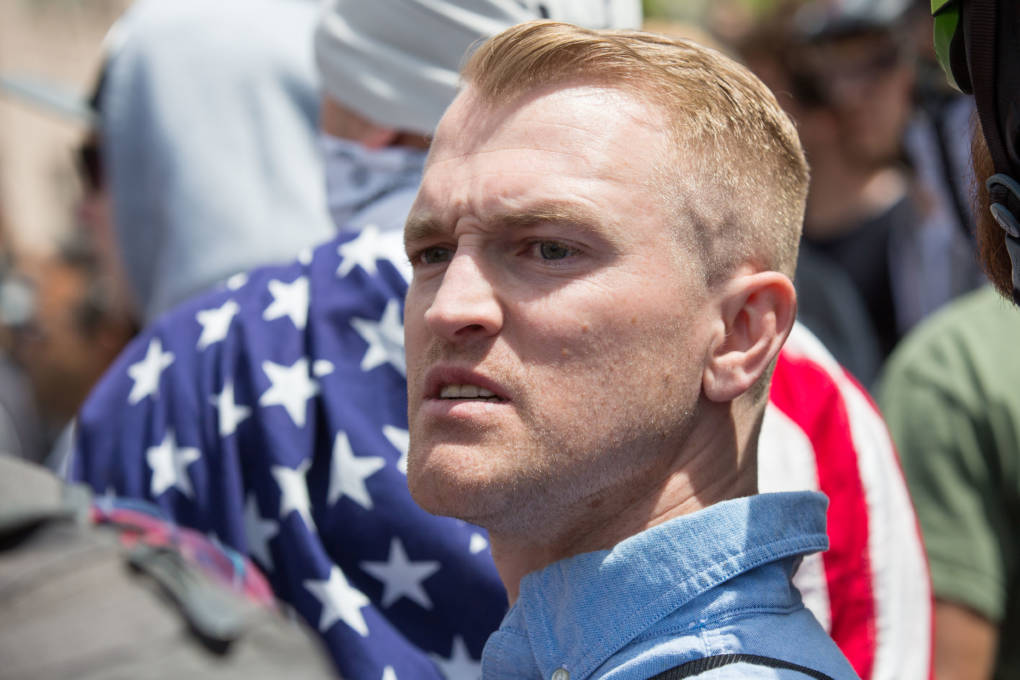
"caption": "Nathan Damigo, the founder of white nationalist group Identity Evropa, at a right-wing rally in Berkeley on April 15, 2017. He helped organize the white supremacist rally in Charlottesville, Virginia, where one counterprotester was killed on Saturday.",
"description": "Nathan Damigo, the founder of white nationalist group Identity Evropa, at a right wing rally in Berkeley on April 15. He helped organize the white supremacist rally in Charlottesville, Virginia where one counter-protester was killed on Saturday.",
"title": "20170813_NathanDamigo_Credit_BertJohnson-1",
"credit": "Bert Johnson/KQED",
"status": "inherit",
"isLoading": false,
"fetchFailed": false
},
"news_11611591": {
"type": "attachments",
"id": "news_11611591",
"meta": {
"index": "attachments_1716263798",
"site": "news",
"id": "11611591",
"found": true
},
"parent": 11611590,
"imgSizes": {
"small": {
"file": "https://ww2.kqed.org/app/uploads/sites/10/2017/08/gettyimages-830799540trump_wide-e7430d63a1f345d31c0f32392fd1173a4bea7f87-520x293.jpg",
"width": 520,
"mimeType": "image/jpeg",
"height": 293
},
"twentyfourteen-full-width": {
"file": "https://ww2.kqed.org/app/uploads/sites/10/2017/08/gettyimages-830799540trump_wide-e7430d63a1f345d31c0f32392fd1173a4bea7f87-1038x576.jpg",
"width": 1038,
"mimeType": "image/jpeg",
"height": 576
},
"thumbnail": {
"file": "https://ww2.kqed.org/app/uploads/sites/10/2017/08/gettyimages-830799540trump_wide-e7430d63a1f345d31c0f32392fd1173a4bea7f87-160x90.jpg",
"width": 160,
"mimeType": "image/jpeg",
"height": 90
},
"fd-sm": {
"file": "https://ww2.kqed.org/app/uploads/sites/10/2017/08/gettyimages-830799540trump_wide-e7430d63a1f345d31c0f32392fd1173a4bea7f87-960x540.jpg",
"width": 960,
"mimeType": "image/jpeg",
"height": 540
},
"post-thumbnail": {
"file": "https://ww2.kqed.org/app/uploads/sites/10/2017/08/gettyimages-830799540trump_wide-e7430d63a1f345d31c0f32392fd1173a4bea7f87-672x372.jpg",
"width": 672,
"mimeType": "image/jpeg",
"height": 372
},
"xsmall": {
"file": "https://ww2.kqed.org/app/uploads/sites/10/2017/08/gettyimages-830799540trump_wide-e7430d63a1f345d31c0f32392fd1173a4bea7f87-375x211.jpg",
"width": 375,
"mimeType": "image/jpeg",
"height": 211
},
"kqedFullSize": {
"file": "https://ww2.kqed.org/app/uploads/sites/10/2017/08/gettyimages-830799540trump_wide-e7430d63a1f345d31c0f32392fd1173a4bea7f87.jpg",
"width": 5568,
"height": 3132
},
"large": {
"file": "https://ww2.kqed.org/app/uploads/sites/10/2017/08/gettyimages-830799540trump_wide-e7430d63a1f345d31c0f32392fd1173a4bea7f87-1020x574.jpg",
"width": 1020,
"mimeType": "image/jpeg",
"height": 574
},
"xlarge": {
"file": "https://ww2.kqed.org/app/uploads/sites/10/2017/08/gettyimages-830799540trump_wide-e7430d63a1f345d31c0f32392fd1173a4bea7f87-1180x664.jpg",
"width": 1180,
"mimeType": "image/jpeg",
"height": 664
},
"guest-author-50": {
"file": "https://ww2.kqed.org/app/uploads/sites/10/2017/08/gettyimages-830799540trump_wide-e7430d63a1f345d31c0f32392fd1173a4bea7f87-50x50.jpg",
"width": 50,
"mimeType": "image/jpeg",
"height": 50
},
"guest-author-96": {
"file": "https://ww2.kqed.org/app/uploads/sites/10/2017/08/gettyimages-830799540trump_wide-e7430d63a1f345d31c0f32392fd1173a4bea7f87-96x96.jpg",
"width": 96,
"mimeType": "image/jpeg",
"height": 96
},
"medium": {
"file": "https://ww2.kqed.org/app/uploads/sites/10/2017/08/gettyimages-830799540trump_wide-e7430d63a1f345d31c0f32392fd1173a4bea7f87-800x450.jpg",
"width": 800,
"mimeType": "image/jpeg",
"height": 450
},
"guest-author-64": {
"file": "https://ww2.kqed.org/app/uploads/sites/10/2017/08/gettyimages-830799540trump_wide-e7430d63a1f345d31c0f32392fd1173a4bea7f87-64x64.jpg",
"width": 64,
"mimeType": "image/jpeg",
"height": 64
},
"guest-author-32": {
"file": "https://ww2.kqed.org/app/uploads/sites/10/2017/08/gettyimages-830799540trump_wide-e7430d63a1f345d31c0f32392fd1173a4bea7f87-32x32.jpg",
"width": 32,
"mimeType": "image/jpeg",
"height": 32
},
"fd-lrg": {
"file": "https://ww2.kqed.org/app/uploads/sites/10/2017/08/gettyimages-830799540trump_wide-e7430d63a1f345d31c0f32392fd1173a4bea7f87-1920x1080.jpg",
"width": 1920,
"mimeType": "image/jpeg",
"height": 1080
},
"fd-med": {
"file": "https://ww2.kqed.org/app/uploads/sites/10/2017/08/gettyimages-830799540trump_wide-e7430d63a1f345d31c0f32392fd1173a4bea7f87-1180x664.jpg",
"width": 1180,
"mimeType": "image/jpeg",
"height": 664
},
"full-width": {
"file": "https://ww2.kqed.org/app/uploads/sites/10/2017/08/gettyimages-830799540trump_wide-e7430d63a1f345d31c0f32392fd1173a4bea7f87-1920x1080.jpg",
"width": 1920,
"mimeType": "image/jpeg",
"height": 1080
},
"detail": {
"file": "https://ww2.kqed.org/app/uploads/sites/10/2017/08/gettyimages-830799540trump_wide-e7430d63a1f345d31c0f32392fd1173a4bea7f87-150x150.jpg",
"width": 150,
"mimeType": "image/jpeg",
"height": 150
},
"guest-author-128": {
"file": "https://ww2.kqed.org/app/uploads/sites/10/2017/08/gettyimages-830799540trump_wide-e7430d63a1f345d31c0f32392fd1173a4bea7f87-128x128.jpg",
"width": 128,
"mimeType": "image/jpeg",
"height": 128
},
"xxsmall": {
"file": "https://ww2.kqed.org/app/uploads/sites/10/2017/08/gettyimages-830799540trump_wide-e7430d63a1f345d31c0f32392fd1173a4bea7f87-240x135.jpg",
"width": 240,
"mimeType": "image/jpeg",
"height": 135
}
},
"publishDate": 1502602801,
"modified": 1502603105,
"caption": "President Donald Trump arrives to speak to the press about protests in Charlottesville, Va., on Saturday at Trump National Golf Club in Bedminster, N.J.",
"description": "President Donald Trump arrives to speak to the press about protests in Charlottesville, Va., on Saturday at Trump National Golf Club in Bedminster, N.J.",
"title": "President Donald Trump arrives to speak to the press about protests in Charlottesville, Va., on Saturday at Trump National Golf Club in Bedminster, N.J.",
"credit": "Jim Watson/AFP/Getty Images",
"status": "inherit",
"isLoading": false,
"fetchFailed": false
},
"news_11611506": {
"type": "attachments",
"id": "news_11611506",
"meta": {
"index": "attachments_1716263798",
"site": "news",
"id": "11611506",
"found": true
},
"parent": 11611487,
"imgSizes": {
"small": {
"file": "https://ww2.kqed.org/app/uploads/sites/10/2017/08/RS26198_alt_606-520x334.jpg",
"width": 520,
"mimeType": "image/jpeg",
"height": 334
},
"twentyfourteen-full-width": {
"file": "https://ww2.kqed.org/app/uploads/sites/10/2017/08/RS26198_alt_606-1038x576.jpg",
"width": 1038,
"mimeType": "image/jpeg",
"height": 576
},
"thumbnail": {
"file": "https://ww2.kqed.org/app/uploads/sites/10/2017/08/RS26198_alt_606-160x103.jpg",
"width": 160,
"mimeType": "image/jpeg",
"height": 103
},
"fd-sm": {
"file": "https://ww2.kqed.org/app/uploads/sites/10/2017/08/RS26198_alt_606-960x618.jpg",
"width": 960,
"mimeType": "image/jpeg",
"height": 618
},
"post-thumbnail": {
"file": "https://ww2.kqed.org/app/uploads/sites/10/2017/08/RS26198_alt_606-672x372.jpg",
"width": 672,
"mimeType": "image/jpeg",
"height": 372
},
"xsmall": {
"file": "https://ww2.kqed.org/app/uploads/sites/10/2017/08/RS26198_alt_606-375x241.jpg",
"width": 375,
"mimeType": "image/jpeg",
"height": 241
},
"kqedFullSize": {
"file": "https://ww2.kqed.org/app/uploads/sites/10/2017/08/RS26198_alt_606.jpg",
"width": 1920,
"height": 1235
},
"large": {
"file": "https://ww2.kqed.org/app/uploads/sites/10/2017/08/RS26198_alt_606-1020x656.jpg",
"width": 1020,
"mimeType": "image/jpeg",
"height": 656
},
"xlarge": {
"file": "https://ww2.kqed.org/app/uploads/sites/10/2017/08/RS26198_alt_606-1180x759.jpg",
"width": 1180,
"mimeType": "image/jpeg",
"height": 759
},
"guest-author-50": {
"file": "https://ww2.kqed.org/app/uploads/sites/10/2017/08/RS26198_alt_606-50x50.jpg",
"width": 50,
"mimeType": "image/jpeg",
"height": 50
},
"guest-author-96": {
"file": "https://ww2.kqed.org/app/uploads/sites/10/2017/08/RS26198_alt_606-96x96.jpg",
"width": 96,
"mimeType": "image/jpeg",
"height": 96
},
"medium": {
"file": "https://ww2.kqed.org/app/uploads/sites/10/2017/08/RS26198_alt_606-800x515.jpg",
"width": 800,
"mimeType": "image/jpeg",
"height": 515
},
"guest-author-64": {
"file": "https://ww2.kqed.org/app/uploads/sites/10/2017/08/RS26198_alt_606-64x64.jpg",
"width": 64,
"mimeType": "image/jpeg",
"height": 64
},
"guest-author-32": {
"file": "https://ww2.kqed.org/app/uploads/sites/10/2017/08/RS26198_alt_606-32x32.jpg",
"width": 32,
"mimeType": "image/jpeg",
"height": 32
},
"fd-lrg": {
"file": "https://ww2.kqed.org/app/uploads/sites/10/2017/08/RS26198_alt_606-1920x1235.jpg",
"width": 1920,
"mimeType": "image/jpeg",
"height": 1235
},
"fd-med": {
"file": "https://ww2.kqed.org/app/uploads/sites/10/2017/08/RS26198_alt_606-1180x759.jpg",
"width": 1180,
"mimeType": "image/jpeg",
"height": 759
},
"full-width": {
"file": "https://ww2.kqed.org/app/uploads/sites/10/2017/08/RS26198_alt_606-1920x1235.jpg",
"width": 1920,
"mimeType": "image/jpeg",
"height": 1235
},
"detail": {
"file": "https://ww2.kqed.org/app/uploads/sites/10/2017/08/RS26198_alt_606-150x150.jpg",
"width": 150,
"mimeType": "image/jpeg",
"height": 150
},
"guest-author-128": {
"file": "https://ww2.kqed.org/app/uploads/sites/10/2017/08/RS26198_alt_606-128x128.jpg",
"width": 128,
"mimeType": "image/jpeg",
"height": 128
},
"xxsmall": {
"file": "https://ww2.kqed.org/app/uploads/sites/10/2017/08/RS26198_alt_606-240x154.jpg",
"width": 240,
"mimeType": "image/jpeg",
"height": 154
}
},
"publishDate": 1502497281,
"modified": 1502497342,
"caption": "A man is detained by Immigration and Customs Enforcement (ICE), agents early on October 14, 2015 in Los Angeles.",
"description": "A man is detained by Immigration and Customs Enforcement (ICE), agents early on October 14, 2015 in Los Angeles.",
"title": "ICE Agents Detain Suspected Undocumented Immigrants In Raids",
"credit": "John Moore/Getty Images",
"status": "inherit",
"isLoading": false,
"fetchFailed": false
},
"news_11611318": {
"type": "attachments",
"id": "news_11611318",
"meta": {
"index": "attachments_1716263798",
"site": "news",
"id": "11611318",
"found": true
},
"parent": 11611315,
"imgSizes": {
"small": {
"file": "https://ww2.kqed.org/app/uploads/sites/10/2017/08/court_081117_final-520x520.jpg",
"width": 520,
"mimeType": "image/jpeg",
"height": 520
},
"twentyfourteen-full-width": {
"file": "https://ww2.kqed.org/app/uploads/sites/10/2017/08/court_081117_final-1038x576.jpg",
"width": 1038,
"mimeType": "image/jpeg",
"height": 576
},
"thumbnail": {
"file": "https://ww2.kqed.org/app/uploads/sites/10/2017/08/court_081117_final-160x160.jpg",
"width": 160,
"mimeType": "image/jpeg",
"height": 160
},
"fd-sm": {
"file": "https://ww2.kqed.org/app/uploads/sites/10/2017/08/court_081117_final-960x960.jpg",
"width": 960,
"mimeType": "image/jpeg",
"height": 960
},
"post-thumbnail": {
"file": "https://ww2.kqed.org/app/uploads/sites/10/2017/08/court_081117_final-672x372.jpg",
"width": 672,
"mimeType": "image/jpeg",
"height": 372
},
"xsmall": {
"file": "https://ww2.kqed.org/app/uploads/sites/10/2017/08/court_081117_final-375x375.jpg",
"width": 375,
"mimeType": "image/jpeg",
"height": 375
},
"kqedFullSize": {
"file": "https://ww2.kqed.org/app/uploads/sites/10/2017/08/court_081117_final.jpg",
"width": 1920,
"height": 1920
},
"large": {
"file": "https://ww2.kqed.org/app/uploads/sites/10/2017/08/court_081117_final-1020x1020.jpg",
"width": 1020,
"mimeType": "image/jpeg",
"height": 1020
},
"xlarge": {
"file": "https://ww2.kqed.org/app/uploads/sites/10/2017/08/court_081117_final-1180x1180.jpg",
"width": 1180,
"mimeType": "image/jpeg",
"height": 1180
},
"guest-author-50": {
"file": "https://ww2.kqed.org/app/uploads/sites/10/2017/08/court_081117_final-50x50.jpg",
"width": 50,
"mimeType": "image/jpeg",
"height": 50
},
"guest-author-96": {
"file": "https://ww2.kqed.org/app/uploads/sites/10/2017/08/court_081117_final-96x96.jpg",
"width": 96,
"mimeType": "image/jpeg",
"height": 96
},
"medium": {
"file": "https://ww2.kqed.org/app/uploads/sites/10/2017/08/court_081117_final-800x800.jpg",
"width": 800,
"mimeType": "image/jpeg",
"height": 800
},
"guest-author-64": {
"file": "https://ww2.kqed.org/app/uploads/sites/10/2017/08/court_081117_final-64x64.jpg",
"width": 64,
"mimeType": "image/jpeg",
"height": 64
},
"guest-author-32": {
"file": "https://ww2.kqed.org/app/uploads/sites/10/2017/08/court_081117_final-32x32.jpg",
"width": 32,
"mimeType": "image/jpeg",
"height": 32
},
"fd-lrg": {
"file": "https://ww2.kqed.org/app/uploads/sites/10/2017/08/court_081117_final-1920x1920.jpg",
"width": 1920,
"mimeType": "image/jpeg",
"height": 1920
},
"fd-med": {
"file": "https://ww2.kqed.org/app/uploads/sites/10/2017/08/court_081117_final-1180x1180.jpg",
"width": 1180,
"mimeType": "image/jpeg",
"height": 1180
},
"full-width": {
"file": "https://ww2.kqed.org/app/uploads/sites/10/2017/08/court_081117_final-1920x1920.jpg",
"width": 1920,
"mimeType": "image/jpeg",
"height": 1920
},
"detail": {
"file": "https://ww2.kqed.org/app/uploads/sites/10/2017/08/court_081117_final-150x150.jpg",
"width": 150,
"mimeType": "image/jpeg",
"height": 150
},
"guest-author-128": {
"file": "https://ww2.kqed.org/app/uploads/sites/10/2017/08/court_081117_final-128x128.jpg",
"width": 128,
"mimeType": "image/jpeg",
"height": 128
},
"xxsmall": {
"file": "https://ww2.kqed.org/app/uploads/sites/10/2017/08/court_081117_final-240x240.jpg",
"width": 240,
"mimeType": "image/jpeg",
"height": 240
}
},
"publishDate": 1502472598,
"modified": 1502472643,
"caption": null,
"description": null,
"title": "court_081117_final",
"credit": null,
"status": "inherit",
"isLoading": false,
"fetchFailed": false
},
"news_11611364": {
"type": "attachments",
"id": "news_11611364",
"meta": {
"index": "attachments_1716263798",
"site": "news",
"id": "11611364",
"found": true
},
"parent": 11611353,
"imgSizes": {
"small": {
"file": "https://ww2.kqed.org/app/uploads/sites/10/2017/08/FreeRomuloProtest-520x331.jpg",
"width": 520,
"mimeType": "image/jpeg",
"height": 331
},
"twentyfourteen-full-width": {
"file": "https://ww2.kqed.org/app/uploads/sites/10/2017/08/FreeRomuloProtest-1038x576.jpg",
"width": 1038,
"mimeType": "image/jpeg",
"height": 576
},
"thumbnail": {
"file": "https://ww2.kqed.org/app/uploads/sites/10/2017/08/FreeRomuloProtest-160x102.jpg",
"width": 160,
"mimeType": "image/jpeg",
"height": 102
},
"fd-sm": {
"file": "https://ww2.kqed.org/app/uploads/sites/10/2017/08/FreeRomuloProtest-960x611.jpg",
"width": 960,
"mimeType": "image/jpeg",
"height": 611
},
"post-thumbnail": {
"file": "https://ww2.kqed.org/app/uploads/sites/10/2017/08/FreeRomuloProtest-672x372.jpg",
"width": 672,
"mimeType": "image/jpeg",
"height": 372
},
"xsmall": {
"file": "https://ww2.kqed.org/app/uploads/sites/10/2017/08/FreeRomuloProtest-375x238.jpg",
"width": 375,
"mimeType": "image/jpeg",
"height": 238
},
"kqedFullSize": {
"file": "https://ww2.kqed.org/app/uploads/sites/10/2017/08/FreeRomuloProtest.jpg",
"width": 1920,
"height": 1221
},
"large": {
"file": "https://ww2.kqed.org/app/uploads/sites/10/2017/08/FreeRomuloProtest-1020x649.jpg",
"width": 1020,
"mimeType": "image/jpeg",
"height": 649
},
"xlarge": {
"file": "https://ww2.kqed.org/app/uploads/sites/10/2017/08/FreeRomuloProtest-1180x750.jpg",
"width": 1180,
"mimeType": "image/jpeg",
"height": 750
},
"guest-author-50": {
"file": "https://ww2.kqed.org/app/uploads/sites/10/2017/08/FreeRomuloProtest-50x50.jpg",
"width": 50,
"mimeType": "image/jpeg",
"height": 50
},
"guest-author-96": {
"file": "https://ww2.kqed.org/app/uploads/sites/10/2017/08/FreeRomuloProtest-96x96.jpg",
"width": 96,
"mimeType": "image/jpeg",
"height": 96
},
"medium": {
"file": "https://ww2.kqed.org/app/uploads/sites/10/2017/08/FreeRomuloProtest-800x509.jpg",
"width": 800,
"mimeType": "image/jpeg",
"height": 509
},
"guest-author-64": {
"file": "https://ww2.kqed.org/app/uploads/sites/10/2017/08/FreeRomuloProtest-64x64.jpg",
"width": 64,
"mimeType": "image/jpeg",
"height": 64
},
"guest-author-32": {
"file": "https://ww2.kqed.org/app/uploads/sites/10/2017/08/FreeRomuloProtest-32x32.jpg",
"width": 32,
"mimeType": "image/jpeg",
"height": 32
},
"fd-lrg": {
"file": "https://ww2.kqed.org/app/uploads/sites/10/2017/08/FreeRomuloProtest-1920x1221.jpg",
"width": 1920,
"mimeType": "image/jpeg",
"height": 1221
},
"fd-med": {
"file": "https://ww2.kqed.org/app/uploads/sites/10/2017/08/FreeRomuloProtest-1180x750.jpg",
"width": 1180,
"mimeType": "image/jpeg",
"height": 750
},
"full-width": {
"file": "https://ww2.kqed.org/app/uploads/sites/10/2017/08/FreeRomuloProtest-1920x1221.jpg",
"width": 1920,
"mimeType": "image/jpeg",
"height": 1221
},
"detail": {
"file": "https://ww2.kqed.org/app/uploads/sites/10/2017/08/FreeRomuloProtest-150x150.jpg",
"width": 150,
"mimeType": "image/jpeg",
"height": 150
},
"guest-author-128": {
"file": "https://ww2.kqed.org/app/uploads/sites/10/2017/08/FreeRomuloProtest-128x128.jpg",
"width": 128,
"mimeType": "image/jpeg",
"height": 128
},
"xxsmall": {
"file": "https://ww2.kqed.org/app/uploads/sites/10/2017/08/FreeRomuloProtest-240x153.jpg",
"width": 240,
"mimeType": "image/jpeg",
"height": 153
}
},
"publishDate": 1502479295,
"modified": 1502492768,
"caption": "Daughters of Romulo Avelica-Gonzalez, Jocelyn, 19, (L) Fatima, 13, and Yuleni, 12, (R), attend a rally for his release outside U.S. Immigration and Customs Enforcement (ICE) offices on March 13, 2017, in Los Angeles.",
"description": "Daughters of Romulo Avelica-Gonzalez, Jocelyn, 19, (L) Fatima, 13, and Yuleni, 12, (R), attend a rally for his release outside U.S. Immigration and Customs Enforcement (ICE) offices on March 13, 2017 in Los Angeles.",
"title": "FreeRomuloProtest",
"credit": "David McNew/Getty Images",
"status": "inherit",
"isLoading": false,
"fetchFailed": false
},
"news_11611327": {
"type": "attachments",
"id": "news_11611327",
"meta": {
"index": "attachments_1716263798",
"site": "news",
"id": "11611327",
"found": true
},
"parent": 11610964,
"imgSizes": {
"small": {
"file": "https://ww2.kqed.org/app/uploads/sites/10/2017/08/TheltonHenderson-520x340.jpg",
"width": 520,
"mimeType": "image/jpeg",
"height": 340
},
"twentyfourteen-full-width": {
"file": "https://ww2.kqed.org/app/uploads/sites/10/2017/08/TheltonHenderson-1038x576.jpg",
"width": 1038,
"mimeType": "image/jpeg",
"height": 576
},
"thumbnail": {
"file": "https://ww2.kqed.org/app/uploads/sites/10/2017/08/TheltonHenderson-160x105.jpg",
"width": 160,
"mimeType": "image/jpeg",
"height": 105
},
"fd-sm": {
"file": "https://ww2.kqed.org/app/uploads/sites/10/2017/08/TheltonHenderson-960x628.jpg",
"width": 960,
"mimeType": "image/jpeg",
"height": 628
},
"post-thumbnail": {
"file": "https://ww2.kqed.org/app/uploads/sites/10/2017/08/TheltonHenderson-672x372.jpg",
"width": 672,
"mimeType": "image/jpeg",
"height": 372
},
"xsmall": {
"file": "https://ww2.kqed.org/app/uploads/sites/10/2017/08/TheltonHenderson-375x245.jpg",
"width": 375,
"mimeType": "image/jpeg",
"height": 245
},
"kqedFullSize": {
"file": "https://ww2.kqed.org/app/uploads/sites/10/2017/08/TheltonHenderson.jpg",
"width": 1920,
"height": 1256
},
"large": {
"file": "https://ww2.kqed.org/app/uploads/sites/10/2017/08/TheltonHenderson-1020x667.jpg",
"width": 1020,
"mimeType": "image/jpeg",
"height": 667
},
"xlarge": {
"file": "https://ww2.kqed.org/app/uploads/sites/10/2017/08/TheltonHenderson-1180x772.jpg",
"width": 1180,
"mimeType": "image/jpeg",
"height": 772
},
"guest-author-50": {
"file": "https://ww2.kqed.org/app/uploads/sites/10/2017/08/TheltonHenderson-50x50.jpg",
"width": 50,
"mimeType": "image/jpeg",
"height": 50
},
"guest-author-96": {
"file": "https://ww2.kqed.org/app/uploads/sites/10/2017/08/TheltonHenderson-96x96.jpg",
"width": 96,
"mimeType": "image/jpeg",
"height": 96
},
"medium": {
"file": "https://ww2.kqed.org/app/uploads/sites/10/2017/08/TheltonHenderson-800x523.jpg",
"width": 800,
"mimeType": "image/jpeg",
"height": 523
},
"guest-author-64": {
"file": "https://ww2.kqed.org/app/uploads/sites/10/2017/08/TheltonHenderson-64x64.jpg",
"width": 64,
"mimeType": "image/jpeg",
"height": 64
},
"guest-author-32": {
"file": "https://ww2.kqed.org/app/uploads/sites/10/2017/08/TheltonHenderson-32x32.jpg",
"width": 32,
"mimeType": "image/jpeg",
"height": 32
},
"fd-lrg": {
"file": "https://ww2.kqed.org/app/uploads/sites/10/2017/08/TheltonHenderson-1920x1256.jpg",
"width": 1920,
"mimeType": "image/jpeg",
"height": 1256
},
"fd-med": {
"file": "https://ww2.kqed.org/app/uploads/sites/10/2017/08/TheltonHenderson-1180x772.jpg",
"width": 1180,
"mimeType": "image/jpeg",
"height": 772
},
"full-width": {
"file": "https://ww2.kqed.org/app/uploads/sites/10/2017/08/TheltonHenderson-1920x1256.jpg",
"width": 1920,
"mimeType": "image/jpeg",
"height": 1256
},
"detail": {
"file": "https://ww2.kqed.org/app/uploads/sites/10/2017/08/TheltonHenderson-150x150.jpg",
"width": 150,
"mimeType": "image/jpeg",
"height": 150
},
"guest-author-128": {
"file": "https://ww2.kqed.org/app/uploads/sites/10/2017/08/TheltonHenderson-128x128.jpg",
"width": 128,
"mimeType": "image/jpeg",
"height": 128
},
"xxsmall": {
"file": "https://ww2.kqed.org/app/uploads/sites/10/2017/08/TheltonHenderson-240x157.jpg",
"width": 240,
"mimeType": "image/jpeg",
"height": 157
}
},
"publishDate": 1502474504,
"modified": 1502487590,
"caption": "U.S. District Court Judge Thelton Henderson, who retires Aug. 11, 2017. ",
"description": "U.S. District Court Judge Thelton Henderson, who retires August 11, 2017. ",
"title": "TheltonHenderson",
"credit": "\u003ca href=\"https://youtu.be/R1Ef7R_yTBY\" target=\"_blank\">Stanford Law School via YouTube\u003c/a>",
"status": "inherit",
"isLoading": false,
"fetchFailed": false
},
"news_11611284": {
"type": "attachments",
"id": "news_11611284",
"meta": {
"index": "attachments_1716263798",
"site": "news",
"id": "11611284",
"found": true
},
"parent": 11611241,
"imgSizes": {
"small": {
"file": "https://ww2.kqed.org/app/uploads/sites/10/2017/08/RS26189_Operation-Cold-Day-qut-520x390.jpg",
"width": 520,
"mimeType": "image/jpeg",
"height": 390
},
"twentyfourteen-full-width": {
"file": "https://ww2.kqed.org/app/uploads/sites/10/2017/08/RS26189_Operation-Cold-Day-qut-1038x576.jpg",
"width": 1038,
"mimeType": "image/jpeg",
"height": 576
},
"thumbnail": {
"file": "https://ww2.kqed.org/app/uploads/sites/10/2017/08/RS26189_Operation-Cold-Day-qut-160x120.jpg",
"width": 160,
"mimeType": "image/jpeg",
"height": 120
},
"fd-sm": {
"file": "https://ww2.kqed.org/app/uploads/sites/10/2017/08/RS26189_Operation-Cold-Day-qut-960x720.jpg",
"width": 960,
"mimeType": "image/jpeg",
"height": 720
},
"post-thumbnail": {
"file": "https://ww2.kqed.org/app/uploads/sites/10/2017/08/RS26189_Operation-Cold-Day-qut-672x372.jpg",
"width": 672,
"mimeType": "image/jpeg",
"height": 372
},
"xsmall": {
"file": "https://ww2.kqed.org/app/uploads/sites/10/2017/08/RS26189_Operation-Cold-Day-qut-375x281.jpg",
"width": 375,
"mimeType": "image/jpeg",
"height": 281
},
"kqedFullSize": {
"file": "https://ww2.kqed.org/app/uploads/sites/10/2017/08/RS26189_Operation-Cold-Day-qut.jpg",
"width": 1920,
"height": 1440
},
"large": {
"file": "https://ww2.kqed.org/app/uploads/sites/10/2017/08/RS26189_Operation-Cold-Day-qut-1020x765.jpg",
"width": 1020,
"mimeType": "image/jpeg",
"height": 765
},
"xlarge": {
"file": "https://ww2.kqed.org/app/uploads/sites/10/2017/08/RS26189_Operation-Cold-Day-qut-1180x885.jpg",
"width": 1180,
"mimeType": "image/jpeg",
"height": 885
},
"guest-author-50": {
"file": "https://ww2.kqed.org/app/uploads/sites/10/2017/08/RS26189_Operation-Cold-Day-qut-50x50.jpg",
"width": 50,
"mimeType": "image/jpeg",
"height": 50
},
"guest-author-96": {
"file": "https://ww2.kqed.org/app/uploads/sites/10/2017/08/RS26189_Operation-Cold-Day-qut-96x96.jpg",
"width": 96,
"mimeType": "image/jpeg",
"height": 96
},
"medium": {
"file": "https://ww2.kqed.org/app/uploads/sites/10/2017/08/RS26189_Operation-Cold-Day-qut-800x600.jpg",
"width": 800,
"mimeType": "image/jpeg",
"height": 600
},
"guest-author-64": {
"file": "https://ww2.kqed.org/app/uploads/sites/10/2017/08/RS26189_Operation-Cold-Day-qut-64x64.jpg",
"width": 64,
"mimeType": "image/jpeg",
"height": 64
},
"guest-author-32": {
"file": "https://ww2.kqed.org/app/uploads/sites/10/2017/08/RS26189_Operation-Cold-Day-qut-32x32.jpg",
"width": 32,
"mimeType": "image/jpeg",
"height": 32
},
"fd-lrg": {
"file": "https://ww2.kqed.org/app/uploads/sites/10/2017/08/RS26189_Operation-Cold-Day-qut-1920x1440.jpg",
"width": 1920,
"mimeType": "image/jpeg",
"height": 1440
},
"fd-med": {
"file": "https://ww2.kqed.org/app/uploads/sites/10/2017/08/RS26189_Operation-Cold-Day-qut-1180x885.jpg",
"width": 1180,
"mimeType": "image/jpeg",
"height": 885
},
"full-width": {
"file": "https://ww2.kqed.org/app/uploads/sites/10/2017/08/RS26189_Operation-Cold-Day-qut-1920x1440.jpg",
"width": 1920,
"mimeType": "image/jpeg",
"height": 1440
},
"detail": {
"file": "https://ww2.kqed.org/app/uploads/sites/10/2017/08/RS26189_Operation-Cold-Day-qut-150x150.jpg",
"width": 150,
"mimeType": "image/jpeg",
"height": 150
},
"guest-author-128": {
"file": "https://ww2.kqed.org/app/uploads/sites/10/2017/08/RS26189_Operation-Cold-Day-qut-128x128.jpg",
"width": 128,
"mimeType": "image/jpeg",
"height": 128
},
"xxsmall": {
"file": "https://ww2.kqed.org/app/uploads/sites/10/2017/08/RS26189_Operation-Cold-Day-qut-240x180.jpg",
"width": 240,
"mimeType": "image/jpeg",
"height": 180
}
},
"publishDate": 1502419620,
"modified": 1502490294,
"caption": "San Francisco Chief of Police William Scott discusses Operation Cold Day at San Francisco police headquarters on Thursday, Aug. 10, 2017. The two-year operation involved numerous local, state and federal agencies and resulted in more than 100 individuals being charged with drug and gun-related crimes.",
"description": null,
"title": "RS26189_Operation Cold Day-qut",
"credit": "Ryan Levi/KQED",
"status": "inherit",
"isLoading": false,
"fetchFailed": false
},
"news_11611056": {
"type": "attachments",
"id": "news_11611056",
"meta": {
"index": "attachments_1716263798",
"site": "news",
"id": "11611056",
"found": true
},
"parent": 11611055,
"imgSizes": {
"small": {
"file": "https://ww2.kqed.org/app/uploads/sites/10/2017/08/RS21338_alt_605-520x305.jpg",
"width": 520,
"mimeType": "image/jpeg",
"height": 305
},
"twentyfourteen-full-width": {
"file": "https://ww2.kqed.org/app/uploads/sites/10/2017/08/RS21338_alt_605-1038x576.jpg",
"width": 1038,
"mimeType": "image/jpeg",
"height": 576
},
"thumbnail": {
"file": "https://ww2.kqed.org/app/uploads/sites/10/2017/08/RS21338_alt_605-160x94.jpg",
"width": 160,
"mimeType": "image/jpeg",
"height": 94
},
"fd-sm": {
"file": "https://ww2.kqed.org/app/uploads/sites/10/2017/08/RS21338_alt_605-960x563.jpg",
"width": 960,
"mimeType": "image/jpeg",
"height": 563
},
"post-thumbnail": {
"file": "https://ww2.kqed.org/app/uploads/sites/10/2017/08/RS21338_alt_605-672x372.jpg",
"width": 672,
"mimeType": "image/jpeg",
"height": 372
},
"xsmall": {
"file": "https://ww2.kqed.org/app/uploads/sites/10/2017/08/RS21338_alt_605-375x220.jpg",
"width": 375,
"mimeType": "image/jpeg",
"height": 220
},
"kqedFullSize": {
"file": "https://ww2.kqed.org/app/uploads/sites/10/2017/08/RS21338_alt_605.jpg",
"width": 1920,
"height": 1126
},
"large": {
"file": "https://ww2.kqed.org/app/uploads/sites/10/2017/08/RS21338_alt_605-1020x598.jpg",
"width": 1020,
"mimeType": "image/jpeg",
"height": 598
},
"xlarge": {
"file": "https://ww2.kqed.org/app/uploads/sites/10/2017/08/RS21338_alt_605-1180x692.jpg",
"width": 1180,
"mimeType": "image/jpeg",
"height": 692
},
"guest-author-50": {
"file": "https://ww2.kqed.org/app/uploads/sites/10/2017/08/RS21338_alt_605-50x50.jpg",
"width": 50,
"mimeType": "image/jpeg",
"height": 50
},
"guest-author-96": {
"file": "https://ww2.kqed.org/app/uploads/sites/10/2017/08/RS21338_alt_605-96x96.jpg",
"width": 96,
"mimeType": "image/jpeg",
"height": 96
},
"medium": {
"file": "https://ww2.kqed.org/app/uploads/sites/10/2017/08/RS21338_alt_605-800x469.jpg",
"width": 800,
"mimeType": "image/jpeg",
"height": 469
},
"guest-author-64": {
"file": "https://ww2.kqed.org/app/uploads/sites/10/2017/08/RS21338_alt_605-64x64.jpg",
"width": 64,
"mimeType": "image/jpeg",
"height": 64
},
"guest-author-32": {
"file": "https://ww2.kqed.org/app/uploads/sites/10/2017/08/RS21338_alt_605-32x32.jpg",
"width": 32,
"mimeType": "image/jpeg",
"height": 32
},
"fd-lrg": {
"file": "https://ww2.kqed.org/app/uploads/sites/10/2017/08/RS21338_alt_605-1920x1126.jpg",
"width": 1920,
"mimeType": "image/jpeg",
"height": 1126
},
"fd-med": {
"file": "https://ww2.kqed.org/app/uploads/sites/10/2017/08/RS21338_alt_605-1180x692.jpg",
"width": 1180,
"mimeType": "image/jpeg",
"height": 692
},
"full-width": {
"file": "https://ww2.kqed.org/app/uploads/sites/10/2017/08/RS21338_alt_605-1920x1126.jpg",
"width": 1920,
"mimeType": "image/jpeg",
"height": 1126
},
"detail": {
"file": "https://ww2.kqed.org/app/uploads/sites/10/2017/08/RS21338_alt_605-150x150.jpg",
"width": 150,
"mimeType": "image/jpeg",
"height": 150
},
"guest-author-128": {
"file": "https://ww2.kqed.org/app/uploads/sites/10/2017/08/RS21338_alt_605-128x128.jpg",
"width": 128,
"mimeType": "image/jpeg",
"height": 128
},
"xxsmall": {
"file": "https://ww2.kqed.org/app/uploads/sites/10/2017/08/RS21338_alt_605-240x141.jpg",
"width": 240,
"mimeType": "image/jpeg",
"height": 141
}
},
"publishDate": 1502403734,
"modified": 1502412886,
"caption": "Ricardo Perez, a former Contra Costa County sheriff's deputy, was arraigned at the Hayward Hall of Justice on Sept. 30, 2016, for one charge of felony oral copulation with a minor and two misdemeanor counts for engaging in lewd conduct in a public place. After a July 27, 2017, preliminary hearing in the case, Perez was charged with unlawful sex with a minor, a felony.",
"description": "Ricardo Perez, a former Contra Costa County sheriff's deputy, was arraigned at the Hayward Hall of Justice on Sept. 30, 2016 for one charge of felony oral copulation with a minor and two misdemeanor counts for engaging in lewd conduct in a public place. After a July 27, 2017 preliminary hearing in the case, Perez was charged with unlawful sex with a minor, a felony.",
"title": "RS21338_alt_605",
"credit": "Alex Emslie/KQED",
"status": "inherit",
"isLoading": false,
"fetchFailed": false
},
"news_11610882": {
"type": "attachments",
"id": "news_11610882",
"meta": {
"index": "attachments_1716263798",
"site": "news",
"id": "11610882",
"found": true
},
"parent": 11610881,
"imgSizes": {
"small": {
"file": "https://ww2.kqed.org/app/uploads/sites/10/2017/08/gettyimages-529707282-ad80b2ac3e1d1bd1d0f318759bc29ed1e40d41b7-520x390.jpg",
"width": 520,
"mimeType": "image/jpeg",
"height": 390
},
"twentyfourteen-full-width": {
"file": "https://ww2.kqed.org/app/uploads/sites/10/2017/08/gettyimages-529707282-ad80b2ac3e1d1bd1d0f318759bc29ed1e40d41b7-1038x576.jpg",
"width": 1038,
"mimeType": "image/jpeg",
"height": 576
},
"thumbnail": {
"file": "https://ww2.kqed.org/app/uploads/sites/10/2017/08/gettyimages-529707282-ad80b2ac3e1d1bd1d0f318759bc29ed1e40d41b7-160x120.jpg",
"width": 160,
"mimeType": "image/jpeg",
"height": 120
},
"fd-sm": {
"file": "https://ww2.kqed.org/app/uploads/sites/10/2017/08/gettyimages-529707282-ad80b2ac3e1d1bd1d0f318759bc29ed1e40d41b7-960x720.jpg",
"width": 960,
"mimeType": "image/jpeg",
"height": 720
},
"post-thumbnail": {
"file": "https://ww2.kqed.org/app/uploads/sites/10/2017/08/gettyimages-529707282-ad80b2ac3e1d1bd1d0f318759bc29ed1e40d41b7-672x372.jpg",
"width": 672,
"mimeType": "image/jpeg",
"height": 372
},
"xsmall": {
"file": "https://ww2.kqed.org/app/uploads/sites/10/2017/08/gettyimages-529707282-ad80b2ac3e1d1bd1d0f318759bc29ed1e40d41b7-375x281.jpg",
"width": 375,
"mimeType": "image/jpeg",
"height": 281
},
"kqedFullSize": {
"file": "https://ww2.kqed.org/app/uploads/sites/10/2017/08/gettyimages-529707282-ad80b2ac3e1d1bd1d0f318759bc29ed1e40d41b7-e1502319847139.jpg",
"width": 1920,
"height": 1440
},
"large": {
"file": "https://ww2.kqed.org/app/uploads/sites/10/2017/08/gettyimages-529707282-ad80b2ac3e1d1bd1d0f318759bc29ed1e40d41b7-1020x765.jpg",
"width": 1020,
"mimeType": "image/jpeg",
"height": 765
},
"xlarge": {
"file": "https://ww2.kqed.org/app/uploads/sites/10/2017/08/gettyimages-529707282-ad80b2ac3e1d1bd1d0f318759bc29ed1e40d41b7-1180x885.jpg",
"width": 1180,
"mimeType": "image/jpeg",
"height": 885
},
"guest-author-50": {
"file": "https://ww2.kqed.org/app/uploads/sites/10/2017/08/gettyimages-529707282-ad80b2ac3e1d1bd1d0f318759bc29ed1e40d41b7-50x50.jpg",
"width": 50,
"mimeType": "image/jpeg",
"height": 50
},
"guest-author-96": {
"file": "https://ww2.kqed.org/app/uploads/sites/10/2017/08/gettyimages-529707282-ad80b2ac3e1d1bd1d0f318759bc29ed1e40d41b7-96x96.jpg",
"width": 96,
"mimeType": "image/jpeg",
"height": 96
},
"medium": {
"file": "https://ww2.kqed.org/app/uploads/sites/10/2017/08/gettyimages-529707282-ad80b2ac3e1d1bd1d0f318759bc29ed1e40d41b7-800x600.jpg",
"width": 800,
"mimeType": "image/jpeg",
"height": 600
},
"guest-author-64": {
"file": "https://ww2.kqed.org/app/uploads/sites/10/2017/08/gettyimages-529707282-ad80b2ac3e1d1bd1d0f318759bc29ed1e40d41b7-64x64.jpg",
"width": 64,
"mimeType": "image/jpeg",
"height": 64
},
"guest-author-32": {
"file": "https://ww2.kqed.org/app/uploads/sites/10/2017/08/gettyimages-529707282-ad80b2ac3e1d1bd1d0f318759bc29ed1e40d41b7-32x32.jpg",
"width": 32,
"mimeType": "image/jpeg",
"height": 32
},
"fd-lrg": {
"file": "https://ww2.kqed.org/app/uploads/sites/10/2017/08/gettyimages-529707282-ad80b2ac3e1d1bd1d0f318759bc29ed1e40d41b7-1920x1440.jpg",
"width": 1920,
"mimeType": "image/jpeg",
"height": 1440
},
"fd-med": {
"file": "https://ww2.kqed.org/app/uploads/sites/10/2017/08/gettyimages-529707282-ad80b2ac3e1d1bd1d0f318759bc29ed1e40d41b7-1180x885.jpg",
"width": 1180,
"mimeType": "image/jpeg",
"height": 885
},
"full-width": {
"file": "https://ww2.kqed.org/app/uploads/sites/10/2017/08/gettyimages-529707282-ad80b2ac3e1d1bd1d0f318759bc29ed1e40d41b7-1920x1440.jpg",
"width": 1920,
"mimeType": "image/jpeg",
"height": 1440
},
"detail": {
"file": "https://ww2.kqed.org/app/uploads/sites/10/2017/08/gettyimages-529707282-ad80b2ac3e1d1bd1d0f318759bc29ed1e40d41b7-150x150.jpg",
"width": 150,
"mimeType": "image/jpeg",
"height": 150
},
"guest-author-128": {
"file": "https://ww2.kqed.org/app/uploads/sites/10/2017/08/gettyimages-529707282-ad80b2ac3e1d1bd1d0f318759bc29ed1e40d41b7-128x128.jpg",
"width": 128,
"mimeType": "image/jpeg",
"height": 128
},
"xxsmall": {
"file": "https://ww2.kqed.org/app/uploads/sites/10/2017/08/gettyimages-529707282-ad80b2ac3e1d1bd1d0f318759bc29ed1e40d41b7-240x180.jpg",
"width": 240,
"mimeType": "image/jpeg",
"height": 180
}
},
"publishDate": 1502319666,
"modified": 1502319800,
"caption": "Danielle Brown speaks during TechCrunch Disrupt NY 2016. She is Google's new chief diversity officer, a position she previously held at Intel.",
"description": "Danielle Brown speaks during TechCrunch Disrupt NY 2016. She is Google's new chief diversity officer, a position she previously held at Intel.",
"title": "Danielle Brown speaks during TechCrunch Disrupt NY 2016. She is Google's new chief diversity officer, a position she previously held at Intel.",
"credit": "Noam Galai/Getty Images for TechCrunch",
"status": "inherit",
"isLoading": false,
"fetchFailed": false
},
"news_11610877": {
"type": "attachments",
"id": "news_11610877",
"meta": {
"index": "attachments_1716263798",
"site": "news",
"id": "11610877",
"found": true
},
"parent": 11610868,
"imgSizes": {
"small": {
"file": "https://ww2.kqed.org/app/uploads/sites/10/2017/08/RS21338_alt_506-520x355.jpg",
"width": 520,
"mimeType": "image/jpeg",
"height": 355
},
"twentyfourteen-full-width": {
"file": "https://ww2.kqed.org/app/uploads/sites/10/2017/08/RS21338_alt_506-1038x576.jpg",
"width": 1038,
"mimeType": "image/jpeg",
"height": 576
},
"thumbnail": {
"file": "https://ww2.kqed.org/app/uploads/sites/10/2017/08/RS21338_alt_506-160x109.jpg",
"width": 160,
"mimeType": "image/jpeg",
"height": 109
},
"fd-sm": {
"file": "https://ww2.kqed.org/app/uploads/sites/10/2017/08/RS21338_alt_506-960x656.jpg",
"width": 960,
"mimeType": "image/jpeg",
"height": 656
},
"post-thumbnail": {
"file": "https://ww2.kqed.org/app/uploads/sites/10/2017/08/RS21338_alt_506-672x372.jpg",
"width": 672,
"mimeType": "image/jpeg",
"height": 372
},
"xsmall": {
"file": "https://ww2.kqed.org/app/uploads/sites/10/2017/08/RS21338_alt_506-375x256.jpg",
"width": 375,
"mimeType": "image/jpeg",
"height": 256
},
"kqedFullSize": {
"file": "https://ww2.kqed.org/app/uploads/sites/10/2017/08/RS21338_alt_506.jpg",
"width": 1920,
"height": 1311
},
"large": {
"file": "https://ww2.kqed.org/app/uploads/sites/10/2017/08/RS21338_alt_506-1020x696.jpg",
"width": 1020,
"mimeType": "image/jpeg",
"height": 696
},
"xlarge": {
"file": "https://ww2.kqed.org/app/uploads/sites/10/2017/08/RS21338_alt_506-1180x806.jpg",
"width": 1180,
"mimeType": "image/jpeg",
"height": 806
},
"guest-author-50": {
"file": "https://ww2.kqed.org/app/uploads/sites/10/2017/08/RS21338_alt_506-50x50.jpg",
"width": 50,
"mimeType": "image/jpeg",
"height": 50
},
"guest-author-96": {
"file": "https://ww2.kqed.org/app/uploads/sites/10/2017/08/RS21338_alt_506-96x96.jpg",
"width": 96,
"mimeType": "image/jpeg",
"height": 96
},
"medium": {
"file": "https://ww2.kqed.org/app/uploads/sites/10/2017/08/RS21338_alt_506-800x546.jpg",
"width": 800,
"mimeType": "image/jpeg",
"height": 546
},
"guest-author-64": {
"file": "https://ww2.kqed.org/app/uploads/sites/10/2017/08/RS21338_alt_506-64x64.jpg",
"width": 64,
"mimeType": "image/jpeg",
"height": 64
},
"guest-author-32": {
"file": "https://ww2.kqed.org/app/uploads/sites/10/2017/08/RS21338_alt_506-32x32.jpg",
"width": 32,
"mimeType": "image/jpeg",
"height": 32
},
"fd-lrg": {
"file": "https://ww2.kqed.org/app/uploads/sites/10/2017/08/RS21338_alt_506-1920x1311.jpg",
"width": 1920,
"mimeType": "image/jpeg",
"height": 1311
},
"fd-med": {
"file": "https://ww2.kqed.org/app/uploads/sites/10/2017/08/RS21338_alt_506-1180x806.jpg",
"width": 1180,
"mimeType": "image/jpeg",
"height": 806
},
"full-width": {
"file": "https://ww2.kqed.org/app/uploads/sites/10/2017/08/RS21338_alt_506-1920x1311.jpg",
"width": 1920,
"mimeType": "image/jpeg",
"height": 1311
},
"detail": {
"file": "https://ww2.kqed.org/app/uploads/sites/10/2017/08/RS21338_alt_506-150x150.jpg",
"width": 150,
"mimeType": "image/jpeg",
"height": 150
},
"guest-author-128": {
"file": "https://ww2.kqed.org/app/uploads/sites/10/2017/08/RS21338_alt_506-128x128.jpg",
"width": 128,
"mimeType": "image/jpeg",
"height": 128
},
"xxsmall": {
"file": "https://ww2.kqed.org/app/uploads/sites/10/2017/08/RS21338_alt_506-240x164.jpg",
"width": 240,
"mimeType": "image/jpeg",
"height": 164
}
},
"publishDate": 1502319240,
"modified": 1502319407,
"caption": "Ricardo Perez, a former Contra Costa County sheriff's deputy, was arraigned at the Hayward Hall of Justice on Sept. 30, 2016. for one charge of felony oral copulation with a minor and two misdemeanor counts for engaging in lewd conduct in a public place. A fourth charge of felony unlawful sexual intercourse with a minor has now been added.",
"description": null,
"title": "RS21338_alt_506",
"credit": "Alex Emslie/KQED",
"status": "inherit",
"isLoading": false,
"fetchFailed": false
},
"news_11610873": {
"type": "attachments",
"id": "news_11610873",
"meta": {
"index": "attachments_1716263798",
"site": "news",
"id": "11610873",
"found": true
},
"parent": 11610836,
"imgSizes": {
"small": {
"file": "https://ww2.kqed.org/app/uploads/sites/10/2017/08/gettyimages-822681896_custom-e8b648f25a6255ec61449c77acef79caf6132498-800x534-520x347.jpg",
"width": 520,
"mimeType": "image/jpeg",
"height": 347
},
"thumbnail": {
"file": "https://ww2.kqed.org/app/uploads/sites/10/2017/08/gettyimages-822681896_custom-e8b648f25a6255ec61449c77acef79caf6132498-800x534-160x107.jpg",
"width": 160,
"mimeType": "image/jpeg",
"height": 107
},
"post-thumbnail": {
"file": "https://ww2.kqed.org/app/uploads/sites/10/2017/08/gettyimages-822681896_custom-e8b648f25a6255ec61449c77acef79caf6132498-800x534-672x372.jpg",
"width": 672,
"mimeType": "image/jpeg",
"height": 372
},
"xsmall": {
"file": "https://ww2.kqed.org/app/uploads/sites/10/2017/08/gettyimages-822681896_custom-e8b648f25a6255ec61449c77acef79caf6132498-800x534-375x250.jpg",
"width": 375,
"mimeType": "image/jpeg",
"height": 250
},
"kqedFullSize": {
"file": "https://ww2.kqed.org/app/uploads/sites/10/2017/08/gettyimages-822681896_custom-e8b648f25a6255ec61449c77acef79caf6132498-800x534.jpg",
"width": 800,
"height": 534
},
"guest-author-50": {
"file": "https://ww2.kqed.org/app/uploads/sites/10/2017/08/gettyimages-822681896_custom-e8b648f25a6255ec61449c77acef79caf6132498-800x534-50x50.jpg",
"width": 50,
"mimeType": "image/jpeg",
"height": 50
},
"guest-author-96": {
"file": "https://ww2.kqed.org/app/uploads/sites/10/2017/08/gettyimages-822681896_custom-e8b648f25a6255ec61449c77acef79caf6132498-800x534-96x96.jpg",
"width": 96,
"mimeType": "image/jpeg",
"height": 96
},
"medium": {
"file": "https://ww2.kqed.org/app/uploads/sites/10/2017/08/gettyimages-822681896_custom-e8b648f25a6255ec61449c77acef79caf6132498-800x534-800x534.jpg",
"width": 800,
"mimeType": "image/jpeg",
"height": 534
},
"guest-author-64": {
"file": "https://ww2.kqed.org/app/uploads/sites/10/2017/08/gettyimages-822681896_custom-e8b648f25a6255ec61449c77acef79caf6132498-800x534-64x64.jpg",
"width": 64,
"mimeType": "image/jpeg",
"height": 64
},
"guest-author-32": {
"file": "https://ww2.kqed.org/app/uploads/sites/10/2017/08/gettyimages-822681896_custom-e8b648f25a6255ec61449c77acef79caf6132498-800x534-32x32.jpg",
"width": 32,
"mimeType": "image/jpeg",
"height": 32
},
"detail": {
"file": "https://ww2.kqed.org/app/uploads/sites/10/2017/08/gettyimages-822681896_custom-e8b648f25a6255ec61449c77acef79caf6132498-800x534-150x150.jpg",
"width": 150,
"mimeType": "image/jpeg",
"height": 150
},
"guest-author-128": {
"file": "https://ww2.kqed.org/app/uploads/sites/10/2017/08/gettyimages-822681896_custom-e8b648f25a6255ec61449c77acef79caf6132498-800x534-128x128.jpg",
"width": 128,
"mimeType": "image/jpeg",
"height": 128
},
"xxsmall": {
"file": "https://ww2.kqed.org/app/uploads/sites/10/2017/08/gettyimages-822681896_custom-e8b648f25a6255ec61449c77acef79caf6132498-800x534-240x160.jpg",
"width": 240,
"mimeType": "image/jpeg",
"height": 160
}
},
"publishDate": 1502318861,
"modified": 1502320334,
"caption": "President Trump's tweets were aimed at reversing a year-old policy set under the Obama administration.",
"description": null,
"title": "gettyimages-822681896",
"credit": "Justin Merriman/Getty Images",
"status": "inherit",
"isLoading": false,
"fetchFailed": false
},
"news_11610754": {
"type": "attachments",
"id": "news_11610754",
"meta": {
"index": "attachments_1716263798",
"site": "news",
"id": "11610754",
"found": true
},
"parent": 11610747,
"imgSizes": {
"small": {
"file": "https://ww2.kqed.org/app/uploads/sites/10/2017/08/Sundar-Pichai-520x350.jpg",
"width": 520,
"mimeType": "image/jpeg",
"height": 350
},
"twentyfourteen-full-width": {
"file": "https://ww2.kqed.org/app/uploads/sites/10/2017/08/Sundar-Pichai-1038x576.jpg",
"width": 1038,
"mimeType": "image/jpeg",
"height": 576
},
"thumbnail": {
"file": "https://ww2.kqed.org/app/uploads/sites/10/2017/08/Sundar-Pichai-160x108.jpg",
"width": 160,
"mimeType": "image/jpeg",
"height": 108
},
"fd-sm": {
"file": "https://ww2.kqed.org/app/uploads/sites/10/2017/08/Sundar-Pichai-960x646.jpg",
"width": 960,
"mimeType": "image/jpeg",
"height": 646
},
"post-thumbnail": {
"file": "https://ww2.kqed.org/app/uploads/sites/10/2017/08/Sundar-Pichai-672x372.jpg",
"width": 672,
"mimeType": "image/jpeg",
"height": 372
},
"xsmall": {
"file": "https://ww2.kqed.org/app/uploads/sites/10/2017/08/Sundar-Pichai-375x252.jpg",
"width": 375,
"mimeType": "image/jpeg",
"height": 252
},
"kqedFullSize": {
"file": "https://ww2.kqed.org/app/uploads/sites/10/2017/08/Sundar-Pichai-e1502303282229.jpg",
"width": 1920,
"height": 1292
},
"large": {
"file": "https://ww2.kqed.org/app/uploads/sites/10/2017/08/Sundar-Pichai-1020x686.jpg",
"width": 1020,
"mimeType": "image/jpeg",
"height": 686
},
"xlarge": {
"file": "https://ww2.kqed.org/app/uploads/sites/10/2017/08/Sundar-Pichai-1180x794.jpg",
"width": 1180,
"mimeType": "image/jpeg",
"height": 794
},
"guest-author-50": {
"file": "https://ww2.kqed.org/app/uploads/sites/10/2017/08/Sundar-Pichai-50x50.jpg",
"width": 50,
"mimeType": "image/jpeg",
"height": 50
},
"guest-author-96": {
"file": "https://ww2.kqed.org/app/uploads/sites/10/2017/08/Sundar-Pichai-96x96.jpg",
"width": 96,
"mimeType": "image/jpeg",
"height": 96
},
"medium": {
"file": "https://ww2.kqed.org/app/uploads/sites/10/2017/08/Sundar-Pichai-800x538.jpg",
"width": 800,
"mimeType": "image/jpeg",
"height": 538
},
"guest-author-64": {
"file": "https://ww2.kqed.org/app/uploads/sites/10/2017/08/Sundar-Pichai-64x64.jpg",
"width": 64,
"mimeType": "image/jpeg",
"height": 64
},
"guest-author-32": {
"file": "https://ww2.kqed.org/app/uploads/sites/10/2017/08/Sundar-Pichai-32x32.jpg",
"width": 32,
"mimeType": "image/jpeg",
"height": 32
},
"fd-lrg": {
"file": "https://ww2.kqed.org/app/uploads/sites/10/2017/08/Sundar-Pichai-1920x1292.jpg",
"width": 1920,
"mimeType": "image/jpeg",
"height": 1292
},
"fd-med": {
"file": "https://ww2.kqed.org/app/uploads/sites/10/2017/08/Sundar-Pichai-1180x794.jpg",
"width": 1180,
"mimeType": "image/jpeg",
"height": 794
},
"full-width": {
"file": "https://ww2.kqed.org/app/uploads/sites/10/2017/08/Sundar-Pichai-1920x1292.jpg",
"width": 1920,
"mimeType": "image/jpeg",
"height": 1292
},
"detail": {
"file": "https://ww2.kqed.org/app/uploads/sites/10/2017/08/Sundar-Pichai-150x150.jpg",
"width": 150,
"mimeType": "image/jpeg",
"height": 150
},
"guest-author-128": {
"file": "https://ww2.kqed.org/app/uploads/sites/10/2017/08/Sundar-Pichai-128x128.jpg",
"width": 128,
"mimeType": "image/jpeg",
"height": 128
},
"xxsmall": {
"file": "https://ww2.kqed.org/app/uploads/sites/10/2017/08/Sundar-Pichai-240x162.jpg",
"width": 240,
"mimeType": "image/jpeg",
"height": 162
}
},
"publishDate": 1502242339,
"modified": 1502313796,
"caption": "Google CEO Sundar Pichai said in a blog post that to suggest a group of colleagues have traits that make them less \"biologically suited” for engineering jobs is contrary to Google’s basic values. He is pictured here at Google I/O 2017 Conference in Mountain View.",
"description": "Google CEO Sundar Pichai said in a blog post that to suggest a group of colleagues has traits that make them less \"biologically suited” for engineering jobs is contrary to Google’s basic values. He is pictured here at Google I/O 2017 Conference in Mountain View.",
"title": "Google CEO Sundar Pichai Opens I/O Developer Conference",
"credit": "Justin Sullivan/Getty Images",
"status": "inherit",
"isLoading": false,
"fetchFailed": false
}
},
"audioPlayerReducer": {
"postId": "stream_live",
"isPaused": true,
"isPlaying": false,
"pfsActive": false,
"pledgeModalIsOpen": true,
"playerDrawerIsOpen": false,
"liveAudioPlayStartedAt": 0,
"liveAudioPlayContext": ""
},
"authorsReducer": {
"byline_news_11611590": {
"type": "authors",
"id": "byline_news_11611590",
"meta": {
"override": true
},
"slug": "byline_news_11611590",
"name": "\u003cstrong>Martina Stewart\u003c/strong>",
"isLoading": false
},
"byline_news_11611487": {
"type": "authors",
"id": "byline_news_11611487",
"meta": {
"override": true
},
"slug": "byline_news_11611487",
"name": "\u003cstrong>Frank Eltman\u003cbr />Associated Press\u003c/strong>",
"isLoading": false
},
"byline_news_11611353": {
"type": "authors",
"id": "byline_news_11611353",
"meta": {
"override": true
},
"slug": "byline_news_11611353",
"name": "\u003cstrong>\u003ca href=\"http://www.scpr.org/about/people/staff/josie-huang\">Josie Huang\u003c/a>\u003c/strong>",
"isLoading": false
},
"byline_news_11610881": {
"type": "authors",
"id": "byline_news_11610881",
"meta": {
"override": true
},
"slug": "byline_news_11610881",
"name": "Aarti Shahani",
"isLoading": false
},
"scottshafer": {
"type": "authors",
"id": "255",
"meta": {
"index": "authors_1716337520",
"id": "255",
"found": true
},
"name": "Scott Shafer",
"firstName": "Scott",
"lastName": "Shafer",
"slug": "scottshafer",
"email": "sshafer@kqed.org",
"display_author_email": false,
"staff_mastheads": [
"news"
],
"title": "KQED Contributor",
"bio": "Scott Shafer is the senior politics correspondent with the KQED Politics and Government desk. He is co-host of \u003cem>Political Breakdown\u003c/em>, the award-winning radio show and podcast with a personal take on the world of politics. Scott came to KQED in 1998 to host the statewide \u003cem>California Report\u003c/em>. Prior to that he had extended stints in politics and government. He uses that inside experience at KQED in his, reporting, hosting and analysis for the politics desk. Scott recently completed a 5-part podcast titled \u003cem>The Speaker\u003c/em>, examining Rep. Nancy Pelosi's life and legacy. Previously he collaborated on \u003cem>Political Breakdown\u003c/em> and on \u003cem>The Political Mind of Jerry Brown\u003c/em>, an eight-part series about the life and extraordinary political career of the former governor. For fun, he plays water polo and swims with the San Francisco Tsunami.",
"avatar": "https://secure.gravatar.com/avatar/a269f2db8e99b39bacd3dfb517e1aea56c8d9706cde1d375abfd9fba57eede2c?s=600&d=blank&r=g",
"twitter": "scottshafer",
"bluesky": null,
"facebook": null,
"instagram": null,
"linkedin": null,
"sites": [
{
"site": "news",
"roles": [
"editor"
]
},
{
"site": "stateofhealth",
"roles": [
"author"
]
},
{
"site": "science",
"roles": [
"author"
]
},
{
"site": "forum",
"roles": [
"subscriber"
]
},
{
"site": "liveblog",
"roles": [
"author"
]
}
],
"headData": {
"title": "Scott Shafer | KQED",
"description": "KQED Contributor",
"ogImgSrc": "https://secure.gravatar.com/avatar/a269f2db8e99b39bacd3dfb517e1aea56c8d9706cde1d375abfd9fba57eede2c?s=600&d=blank&r=g",
"twImgSrc": "https://secure.gravatar.com/avatar/a269f2db8e99b39bacd3dfb517e1aea56c8d9706cde1d375abfd9fba57eede2c?s=600&d=blank&r=g"
},
"isLoading": false,
"link": "/author/scottshafer"
},
"markfiore": {
"type": "authors",
"id": "3236",
"meta": {
"index": "authors_1716337520",
"id": "3236",
"found": true
},
"name": "Mark Fiore",
"firstName": "Mark",
"lastName": "Fiore",
"slug": "markfiore",
"email": "mark@markfiore.com",
"display_author_email": false,
"staff_mastheads": [
"news"
],
"title": "KQED News Cartoonist",
"bio": "\u003ca href=\"http://www.MarkFiore.com\">MarkFiore.com\u003c/a> | \u003ca href=\"https://twitter.com/markfiore\">Follow on Twitter\u003c/a> | \u003ca href=\"https://www.facebook.com/pages/Mark-Fiore-Animated-Political-Cartoons/94451707396?ref=bookmarks\">Facebook\u003c/a> | \u003ca href=\"mailto:mark@markfiore.com\">email\u003c/a>\r\n\r\nPulitzer Prize-winner, Mark Fiore, who the Wall Street Journal has called “the undisputed guru of the form,” creates animated political cartoons in San Francisco, where his work has been featured regularly on the San Francisco Chronicle’s web site, SFGate.com. His work has appeared on Newsweek.com, Slate.com, CBSNews.com, MotherJones.com, DailyKos.com and NPR’s web site. Fiore’s political animation has appeared on CNN, Frontline, Bill Moyers Journal, Salon.com and cable and broadcast outlets across the globe.\r\n\r\nBeginning his professional life by drawing traditional political cartoons for newspapers, Fiore’s work appeared in publications ranging from the Washington Post to the Los Angeles Times. In the late 1990s, he began to experiment with animating political cartoons and, after a short stint at the San Jose Mercury News as their staff cartoonist, Fiore devoted all his energies to animation.\r\nGrowing up in California, Fiore also spent a good portion of his life in the backwoods of Idaho. It was this combination that shaped him politically. Mark majored in political science at Colorado College, where, in a perfect send-off for a cartoonist, he received his diploma in 1991 as commencement speaker Dick Cheney smiled approvingly.\r\nMark Fiore was awarded the Pulitzer Prize for political cartooning in 2010, a Robert F. Kennedy Journalism Award in 2004 and has twice received an Online Journalism Award for commentary from the Online News Association (2002, 2008). Fiore has received two awards for his work in new media from the National Cartoonists Society (2001, 2002), and in 2006 received The James Madison Freedom of Information Award from The Society of Professional Journalists.",
"avatar": "https://secure.gravatar.com/avatar/fc4e2a612b15b67bad0c6f0e1db4ca9b?s=600&d=blank&r=g",
"twitter": "MarkFiore",
"facebook": null,
"instagram": "https://www.instagram.com/markfiore/?hl=en",
"linkedin": null,
"sites": [
{
"site": "arts",
"roles": [
"contributor"
]
},
{
"site": "news",
"roles": [
"editor"
]
},
{
"site": "futureofyou",
"roles": [
"editor"
]
},
{
"site": "science",
"roles": [
"editor"
]
}
],
"headData": {
"title": "Mark Fiore | KQED",
"description": "KQED News Cartoonist",
"ogImgSrc": "https://secure.gravatar.com/avatar/fc4e2a612b15b67bad0c6f0e1db4ca9b?s=600&d=blank&r=g",
"twImgSrc": "https://secure.gravatar.com/avatar/fc4e2a612b15b67bad0c6f0e1db4ca9b?s=600&d=blank&r=g"
},
"isLoading": false,
"link": "/author/markfiore"
},
"jsmall": {
"type": "authors",
"id": "6625",
"meta": {
"index": "authors_1716337520",
"id": "6625",
"found": true
},
"name": "Julie Small",
"firstName": "Julie",
"lastName": "Small",
"slug": "jsmall",
"email": "jsmall@kqed.org",
"display_author_email": true,
"staff_mastheads": [
"news"
],
"title": "KQED Contributor",
"bio": "Julie Small reports on criminal justice and immigration.\r\n\r\nShe was part of a team at KQED awarded a regional 2019 Edward R. Murrow award for continuing coverage of the Trump Administration's family separation policy.\r\n\r\nThe Society for Professional Journalists recognized Julie's 2018 \u003ca href=\"https://www.kqed.org/news/11636262/the-officer-tased-him-31-times-the-sheriff-called-his-death-an-accident\">reporting\u003c/a> on the San Joaquin County Sheriff's \u003ca href=\"https://www.kqed.org/news/11634689/autopsy-doctors-sheriff-overrode-death-findings-to-protect-law-enforcement\">interference\u003c/a> in death investigations with an Excellence in Journalism Award for Ongoing Coverage.\r\n\r\nJulie's\u003ca href=\"https://www.kqed.org/news/11039666/two-mentally-ill-inmates-died-one-month-in-santa-clara\"> reporting\u003c/a> with Lisa Pickoff-White on the treatment of mentally ill offenders in California jails earned a 2017 regional Edward R. Murrow Award for news reporting and an investigative reporting award from the SPJ of Northern California.\r\n\r\nBefore joining KQED, Julie covered government and politics in Sacramento for Southern California Public Radio (SCPR). Her 2010 \u003ca href=\"https://www.scpr.org/specials/prisonmedical/\">series\u003c/a> on lapses in California’s prison medical care also won a regional Edward R. Murrow Award for investigative reporting and a Golden Mic Award from the RTNDA of Southern California.\r\n\r\nJulie began her career in journalism in 2000 as the deputy foreign editor for public radio's \u003cem>Marketplace, \u003c/em>while earning her master's degree in journalism from USC’s Annenberg School of Communication.",
"avatar": "https://secure.gravatar.com/avatar/236dc12b6acae3aacdd008a5a0aa2fd6fd55b1755fa3d3d923df5d3588e0a764?s=600&d=blank&r=g",
"twitter": "@SmallRadio2",
"bluesky": null,
"facebook": null,
"instagram": null,
"linkedin": null,
"sites": [
{
"site": "news",
"roles": [
"editor"
]
},
{
"site": "stateofhealth",
"roles": [
"author"
]
},
{
"site": "science",
"roles": [
"author"
]
},
{
"site": "liveblog",
"roles": [
"author"
]
}
],
"headData": {
"title": "Julie Small | KQED",
"description": "KQED Contributor",
"ogImgSrc": "https://secure.gravatar.com/avatar/236dc12b6acae3aacdd008a5a0aa2fd6fd55b1755fa3d3d923df5d3588e0a764?s=600&d=blank&r=g",
"twImgSrc": "https://secure.gravatar.com/avatar/236dc12b6acae3aacdd008a5a0aa2fd6fd55b1755fa3d3d923df5d3588e0a764?s=600&d=blank&r=g"
},
"isLoading": false,
"link": "/author/jsmall"
},
"qkim": {
"type": "authors",
"id": "11099",
"meta": {
"index": "authors_1716337520",
"id": "11099",
"found": true
},
"name": "Queena Sook Kim",
"firstName": "Queena",
"lastName": "Kim",
"slug": "qkim",
"email": "qkim@kqed.org",
"display_author_email": false,
"staff_mastheads": [
"news"
],
"title": "Senior Editor",
"bio": "\u003cspan style=\"font-weight: 400;\">Queena Sook Kim is a former senior editor of the weekend desk at KQED. Before taking on that post, she was the Senior Editor of the Silicon Valley Desk and was the \u003c/span>\u003cspan style=\"font-weight: 400;\">host of The California Report. The daily morning show airs on KQED in San Francisco, one of the nation’s largest NPR affiliates, and on 30 stations across the state. In that role, she produces and reports on news, politics and life in the Golden State. Queena likes to take sideways look at the larger trends changing the state. One of her favorite stories asked\u003c/span>\u003ca href=\"https://ww2.kqed.org/news/2015/02/15/why-the-heck-do-mexican-reporters-on-public-radio-say-their-names-that-way\"> \u003cspan style=\"font-weight: 400;\">why Latino journalists “over’pronounce” their Spanish surnames\u003c/span>\u003c/a>\u003cspan style=\"font-weight: 400;\"> as a way of looking at how immigration is creating a culture shift in California.\u003c/span>\r\n\r\n\u003cspan style=\"font-weight: 400;\">Before joining The California Report, Queena was a \u003ca href=\"http://www.marketplace.org/people/queena-kim\">Senior Reporter covering technology for Marketplace\u003c/a>, the daily business show that airs on public radio. Queena covered daily tech business stories and reported on larger technology trends. She did a series of stories looking at role of social engineering in hacking and on a start-up in Silicon Valley that’s trying to use technology, instead of animals, to make meat that bleeds.\u003c/span>\r\n\r\n\u003cspan style=\"font-weight: 400;\">Queena started her career as a business journalist at the Wall Street Journal, where she spent four years covering the paper, home building and toy industries. She wrote A1 stories about the unusually aggressive tactics KB Home took against its home buyers. and the resurgence of “Cracker” architecture in Florida. She also wrote section front stories on marketing trends and\u003c/span>\r\n\r\n\u003cspan style=\"font-weight: 400;\">As a journalist, Queena has spent much of her career helping start-up editorial products. She was on the founding editorial team of The Bay Citizen, an experimental, online news site in San Francisco that was funded by the late hillbilly billionaire Warren Hellman. In 2009, Queena received a grant from the Corporation of Public Broadcasting to start-up a podcast called \u003ca href=\"https://soundcloud.com/cyberfrequencies\">CyberFrequencies\u003c/a>, which reported on the culture of technology. She also helped start-up two radio shows - Off-Ramp and Pacific Drift - for KPCC, the NPR-affiliate in Los Angeles. Off-Ramp was awarded 1st Place for news and Public Affairs programming by the PRINDI and the L.A. Press club. \u003ca href=\"https://soundcloud.com/queena-sook-kim\">Queena’s stories have appeared \u003c/a>on NPR’s Day to Day, Hearing Voices, WNYC’s Studio 360, WBUR’s Here and Now, BBC’s Global Perspectives and New York Times’ multimedia page.\u003c/span>\r\n\r\n\u003cspan style=\"font-weight: 400;\">In 1994, Queena won a Fulbright Grant to teach and study in Seoul, South Korea. She was also selected to be a Teach For America Corps Member in 1991 and taught elementary school in the Inglewood Unified School District in Southern California.\u003c/span>\r\n\r\n\u003cspan style=\"font-weight: 400;\">Queena is a frequent public speaker and has given talks at UC Berkeley, Stanford University, San Francisco State University, PRINDI conference and the Craigslist Foundation Boot Camp. Queena went to UC Berkeley’s Graduate School of Journalism and graduated cum laude from New York University with a B.A. in Politics. She grew up in Southern California and lives in Berkeley, Ca in a big fixer on which she spends most weekends, well, fixing.\u003c/span>",
"avatar": "https://secure.gravatar.com/avatar/b72382fd0db351b99f8a31939f4853fc?s=600&d=blank&r=g",
"twitter": "queenasookkim",
"facebook": null,
"instagram": null,
"linkedin": null,
"sites": [
{
"site": "news",
"roles": [
"subscriber"
]
},
{
"site": "forum",
"roles": [
"author"
]
},
{
"site": "breakingnews",
"roles": [
"editor"
]
}
],
"headData": {
"title": "Queena Sook Kim | KQED",
"description": "Senior Editor",
"ogImgSrc": "https://secure.gravatar.com/avatar/b72382fd0db351b99f8a31939f4853fc?s=600&d=blank&r=g",
"twImgSrc": "https://secure.gravatar.com/avatar/b72382fd0db351b99f8a31939f4853fc?s=600&d=blank&r=g"
},
"isLoading": false,
"link": "/author/qkim"
},
"rlevi": {
"type": "authors",
"id": "11260",
"meta": {
"index": "authors_1716337520",
"id": "11260",
"found": true
},
"name": "Ryan Levi",
"firstName": "Ryan",
"lastName": "Levi",
"slug": "rlevi",
"email": "rlevi@KQED.org",
"display_author_email": false,
"staff_mastheads": [],
"title": "KQED Contributor",
"bio": "Ryan Levi was a reporter and podcast producer at KQED News from 2016-2019. He worked on \u003ca href=\"https://www.kqed.org/news/series/baycurious\">Bay Curious\u003c/a>, \u003ca href=\"https://www.kqed.org/news/tag/the-bay/\">The Bay, \u003c/a>and \u003ca href=\"https://podcasts.apple.com/us/podcast/the-california-report-magazine/id1314750545\">The California Report Magazine\u003c/a>, as well as hosting and producing the weekly \u003ca href=\"https://www.kqed.org/news/program/qedup/\">Q'ed Up podcast. \u003c/a>He also helped inaugurate KQED's weekend news coverage in 2017 as one of two original digital producers. Ryan holds degrees in multimedia journalism and Spanish from the University of Missouri.",
"avatar": "https://secure.gravatar.com/avatar/4cb2ddd028ac8807d1adf09609c5555d?s=600&d=blank&r=g",
"twitter": "ryan_levi",
"facebook": null,
"instagram": null,
"linkedin": null,
"sites": [
{
"site": "arts",
"roles": [
"editor"
]
},
{
"site": "news",
"roles": [
"subscriber"
]
},
{
"site": "stateofhealth",
"roles": [
"editor"
]
},
{
"site": "science",
"roles": [
"editor"
]
},
{
"site": "forum",
"roles": [
"administrator"
]
},
{
"site": "perspectives",
"roles": [
"administrator"
]
}
],
"headData": {
"title": "Ryan Levi | KQED",
"description": "KQED Contributor",
"ogImgSrc": "https://secure.gravatar.com/avatar/4cb2ddd028ac8807d1adf09609c5555d?s=600&d=blank&r=g",
"twImgSrc": "https://secure.gravatar.com/avatar/4cb2ddd028ac8807d1adf09609c5555d?s=600&d=blank&r=g"
},
"isLoading": false,
"link": "/author/rlevi"
},
"jsepulvado": {
"type": "authors",
"id": "11298",
"meta": {
"index": "authors_1716337520",
"id": "11298",
"found": true
},
"name": "John Sepulvado",
"firstName": "John",
"lastName": "Sepulvado",
"slug": "jsepulvado",
"email": "jsepulvado@KQED.org",
"display_author_email": false,
"staff_mastheads": [],
"title": null,
"bio": "John Sepulvado is a former morning host of \u003cem>The California Report\u003c/em>. Prior to joining KQED in September 2016, John was the local host of NPR’s \u003cem>Weekend Edition\u003c/em> at Oregon Public Broadcasting (OPB). He has also served as a producer for America Public Media’s \u003cem>Marketplace Weekend\u003c/em> and worked as a national correspondent for CNN and as news director at WUSF in Tampa, Florida. John has earned prestigious RTDNA Murrow and PRNDI awards for investigative reporting, and helped CNN take home a Peabody Award for coverage of the 2010 Gulf oil spill. John attended Florida A&M in Tallahassee and is also a member of Phi Theta Kappa. He left KQED in 2019.",
"avatar": "https://secure.gravatar.com/avatar/b976d3c4cf11750a793b670e5acb7a1c?s=600&d=blank&r=g",
"twitter": null,
"facebook": null,
"instagram": null,
"linkedin": null,
"sites": [
{
"site": "news",
"roles": [
"author",
"edit_others_posts"
]
}
],
"headData": {
"title": "John Sepulvado | KQED",
"description": null,
"ogImgSrc": "https://secure.gravatar.com/avatar/b976d3c4cf11750a793b670e5acb7a1c?s=600&d=blank&r=g",
"twImgSrc": "https://secure.gravatar.com/avatar/b976d3c4cf11750a793b670e5acb7a1c?s=600&d=blank&r=g"
},
"isLoading": false,
"link": "/author/jsepulvado"
},
"bjohnson": {
"type": "authors",
"id": "11328",
"meta": {
"index": "authors_1716337520",
"id": "11328",
"found": true
},
"name": "Bert Johnson",
"firstName": "Bert",
"lastName": "Johnson",
"slug": "bjohnson",
"email": "bjohnson@KQED.org",
"display_author_email": false,
"staff_mastheads": [],
"title": "KQED Contributor",
"bio": "Bert Johnson is a multimedia journalist and KQED contributor. His work has also been published in the \u003cem>Sacramento News & Review\u003c/em> and he was previously the Multimedia Editor at the \u003cem>East Bay Express. \u003c/em>He covers social movements, the justice system and extremism. Email: bjohnson@kqed.org Twitter: @bertjohnsonfoto Instagram: @bertjohnsonfoto",
"avatar": "https://secure.gravatar.com/avatar/68b1d4bfae2eff83ac1d5c2ca0d0a936?s=600&d=blank&r=g",
"twitter": null,
"facebook": null,
"instagram": null,
"linkedin": null,
"sites": [
{
"site": "news",
"roles": [
"edit_others_posts",
"subscriber"
]
}
],
"headData": {
"title": "Bert Johnson | KQED",
"description": "KQED Contributor",
"ogImgSrc": "https://secure.gravatar.com/avatar/68b1d4bfae2eff83ac1d5c2ca0d0a936?s=600&d=blank&r=g",
"twImgSrc": "https://secure.gravatar.com/avatar/68b1d4bfae2eff83ac1d5c2ca0d0a936?s=600&d=blank&r=g"
},
"isLoading": false,
"link": "/author/bjohnson"
}
},
"pagesReducer": {
"news_category_law-and-justice": {
"type": "terms",
"id": "news_6188",
"meta": {
"index": "terms_1716263798",
"site": "news",
"id": "6188",
"score": 13.557983
},
"featImg": null,
"name": "Law and Justice",
"description": null,
"taxonomy": "category",
"headData": {
"twImgId": null,
"twTitle": null,
"ogTitle": null,
"ogImgId": null,
"twDescription": null,
"description": null,
"title": "Law and Justice Archives | KQED News",
"ogDescription": null
},
"ttid": 6212,
"slug": "law-and-justice",
"isLoading": false,
"title": "Law and Justice",
"pageMeta": {
"site": "news",
"WpPageTemplate": "page-topic-editorial",
"currentPage": 304
},
"blocks": [
{
"blockName": "kqed/post-list",
"attrs": {
"layout": "cardArticle2",
"query": "posts/news?category=law-and-justice",
"seeMore": false,
"paginated": true,
"page": 304
}
},
{
"blockName": "kqed/ad"
}
]
}
},
"pfsSessionReducer": {},
"postsReducer": {
"stream_live": {
"type": "live",
"id": "stream_live",
"audioUrl": "https://hls.kqed.org/hls/kqed_app/playlist.m3u8",
"title": "Live Stream",
"excerpt": "Live Stream information currently unavailable.",
"link": "/radio",
"featImg": "",
"label": {
"name": "KQED Live",
"link": "/"
}
},
"stream_kqedNewscast": {
"type": "posts",
"id": "stream_kqedNewscast",
"audioUrl": "https://www.kqed.org/.stream/anon/radio/RDnews/newscast.mp3?_=1",
"title": "KQED Newscast",
"featImg": "",
"label": {
"name": "88.5 FM",
"link": "/"
}
},
"news_11611600": {
"type": "posts",
"id": "news_11611600",
"meta": {
"index": "posts_1716263798",
"site": "news",
"id": "11611600",
"score": null,
"sort": [
1502694111000
]
},
"guestAuthors": [],
"slug": "californian-who-helped-organize-charlottesville-protests-used-berkeley-as-a-test-run",
"title": "Californian Who Helped Lead Charlottesville Protests Used Berkeley as a Test Run",
"publishDate": 1502694111,
"format": "image",
"headTitle": "Californian Who Helped Lead Charlottesville Protests Used Berkeley as a Test Run | KQED",
"labelTerm": {
"term": 72,
"site": "news"
},
"content": "\u003cp>[dropcap]B[/dropcap]efore white nationalists \u003ca href=\"https://ww2.kqed.org/news/2017/08/12/1-dead-after-car-plows-into-crowd-at-white-nationalist-protest-in-virginia/\" target=\"_blank\" rel=\"noopener noreferrer\">protested in Charlottesville\u003c/a> over the weekend, before a \u003ca href=\"https://ww2.kqed.org/news/2017/08/13/ohio-man-charged-with-murder-in-fatal-car-attack-on-anti-white-nationalist-march/\" target=\"_blank\" rel=\"noopener noreferrer\">man allegedly plowed a car\u003c/a> into a group of people killing one and injuring at least 19, violent clashes in Berkeley offered a window into the motives and tactics of Identity Evropa, one of the white supremacist groups intimately involved in both protests.\u003c/p>\n\u003cp>For leaders of this white nationalist movement, the April 15 “Battle of Berkeley” was a self-described test run to see just how far they could push the bounds of protesting, according to numerous \u003ca href=\"https://townhall.com/columnists/jackkerwick/2017/04/25/the-battle-of-berkeley-when-patriots-beat-the-antiamerican-left-n2317702\" target=\"_blank\" rel=\"noopener noreferrer\">public statements\u003c/a> from members of the white supremacist movement.\u003c/p>\n\u003cp>Nathan Damigo is a founder of the California-based Identity Evropa, \u003ca href=\"http://eltecolote.org/content/en/features/alternate-reality-growing-acceptance-of-white-nationalism-in-trumps-america/\" target=\"_blank\" rel=\"noopener noreferrer\">profiled by El Tecolote newspaper\u003c/a> in December. A former Marine infantryman and convicted felon who lives in Stanislaus County, Damigo is being credited with helping to lead the Charlottesville protest, along with other white supremacist rallies around the country. Damigo has made these rallies a key driver for recruiting new members of the group. He did not respond to requests for comment on Saturday about his involvement in the Charlottesville event following his arrest there.\u003c/p>\n\u003caside class=\"pullquote alignright\">‘I’d love to take credit for it, but it was more Nathan.’\u003ccite>Richard Spencer of the white supremacy group the National Policy Institute on Nathan Damigo’s organization around a white nationalist rally in Charlottesville, Virginia, on Aug. 12.\u003c/cite>\u003c/aside>\n\u003cp>But over the course of multiple hourlong interviews over several months this year, Damigo, 31, said his group is engaged in peaceful protests protected by the First Amendment. Before Charlottesville, Damigo was probably best known for punching a 19-year-old woman in the face in Berkeley. That moment was \u003ca href=\"https://www.youtube.com/watch?v=c8GVtXfATtI\" target=\"_blank\" rel=\"noopener noreferrer\">captured on video\u003c/a>.\u003c/p>\n\u003cp>In the video, Damigo — sporting a hipster haircut, collared shirt and clenched fists — runs up to a young, dreadlocked woman holding a camera and punches her.\u003c/p>\n\u003cp>[ad fullwidth]\u003c/p>\n\u003cp>Damigo told KQED he punched the woman because she was a threat; because she was going to attack his friends; because she was a member of Antifa, a leftist confederation of socialists and anarchists — some of whom have committed acts of violence and arson.\u003c/p>\n\u003cp>Essentially, Damigo said he punched her because he had to.\u003c/p>\n\u003cp>[contextly_sidebar id=”jZdJDt4VLmEfe9wQB3CLFzAUrdJPiNWM”]\u003c/p>\n\u003cp>“She joined this organization and came with her local gang from Southern California, according to statements that she made on social media, to disrupt the events and to acquire scalps,” he said. “Furthermore, she was swinging around bottles, which is a deadly weapon, a foot-long wine bottle at people.”\u003c/p>\n\u003cp>That’s not what KQED witnessed at the scene of the attack, however.\u003c/p>\n\u003cp>What began with Damigo shouting provocative calls into a megaphone quickly turned into an all-out street brawl. Damigo was screaming “hold the line,” “guard the flank” and “advance!”\u003c/p>\n\u003cp>Damigo violently moved through the crowd. Smoke bombs and flash grenades and glass bottles were thrown. Thick tear gas filled the air. Leftist protesters, many of them aging men, were beat up. Police were hit with firecrackers. At one point, Antifa (wearing black hoodies and masks) and the far right (wearing red hats, flag capes and paramilitary armor) fought over who could control a dumpster that was pushed down the street.\u003c/p>\n\u003cfigure id=\"attachment_11611676\" class=\"wp-caption aligncenter\" style=\"max-width: 1200px\">\u003cimg loading=\"lazy\" decoding=\"async\" class=\"wp-image-11611676 size-full\" src=\"https://ww2.kqed.org/news/wp-content/uploads/sites/10/2017/08/C9ew14wUMAE6IKX.jpg\" alt=\"\" width=\"1200\" height=\"800\" srcset=\"https://cdn.kqed.org/wp-content/uploads/sites/10/2017/08/C9ew14wUMAE6IKX.jpg 1200w, https://cdn.kqed.org/wp-content/uploads/sites/10/2017/08/C9ew14wUMAE6IKX-160x107.jpg 160w, https://cdn.kqed.org/wp-content/uploads/sites/10/2017/08/C9ew14wUMAE6IKX-800x533.jpg 800w, https://cdn.kqed.org/wp-content/uploads/sites/10/2017/08/C9ew14wUMAE6IKX-1020x680.jpg 1020w, https://cdn.kqed.org/wp-content/uploads/sites/10/2017/08/C9ew14wUMAE6IKX-1180x787.jpg 1180w, https://cdn.kqed.org/wp-content/uploads/sites/10/2017/08/C9ew14wUMAE6IKX-960x640.jpg 960w, https://cdn.kqed.org/wp-content/uploads/sites/10/2017/08/C9ew14wUMAE6IKX-240x160.jpg 240w, https://cdn.kqed.org/wp-content/uploads/sites/10/2017/08/C9ew14wUMAE6IKX-375x250.jpg 375w, https://cdn.kqed.org/wp-content/uploads/sites/10/2017/08/C9ew14wUMAE6IKX-520x347.jpg 520w\" sizes=\"auto, (max-width: 1200px) 100vw, 1200px\">\u003cfigcaption class=\"wp-caption-text\">A fight broke out over control of a dumpster after right- and left-wing demonstrators clashed in Berkeley on April 15. \u003ccite>(John Sepulvado/KQED)\u003c/cite>\u003c/figcaption>\u003c/figure>\n\u003cp>Damigo found himself outside of the roaring street brawl he helped create. Alone for a moment, he stopped in the middle of the street. Then, he ran across the street, right up to the woman, and hit her. After she fell, Damigo turned, smiled and jumped back into the rolling scuffles.\u003c/p>\n\u003cp>\u003ca href=\"http://www.motherjones.com/politics/2017/05/nathan-damigo-punching-woman-berkeley-white-nationalism/\">Damigo’s involvement in the “Battle of Berkeley”\u003c/a> is an important moment for the white supremacist movement because it attracted supporters from around the country.\u003c/p>\n\u003cp>“A large amount of the violence that has occurred may be due to the inroads we are making,” Damigo told an interviewer after the Berkeley events.\u003c/p>\n\u003cp>This frenetic, violent, yet charismatic man with extreme racist views helped organize the Charlottesville rally. And he’s helping to mobilize an entire generation of white supremacists.\u003c/p>\n\u003cfigure id=\"attachment_11611748\" class=\"wp-caption alignright\" style=\"max-width: 441px\">\u003cimg loading=\"lazy\" decoding=\"async\" class=\"size-full wp-image-11611748\" src=\"https://ww2.kqed.org/news/wp-content/uploads/sites/10/2017/08/download.png\" alt=\"\" width=\"441\" height=\"495\" srcset=\"https://cdn.kqed.org/wp-content/uploads/sites/10/2017/08/download.png 441w, https://cdn.kqed.org/wp-content/uploads/sites/10/2017/08/download-160x180.png 160w, https://cdn.kqed.org/wp-content/uploads/sites/10/2017/08/download-240x269.png 240w, https://cdn.kqed.org/wp-content/uploads/sites/10/2017/08/download-375x421.png 375w\" sizes=\"auto, (max-width: 441px) 100vw, 441px\">\u003cfigcaption class=\"wp-caption-text\">A graphic promoting the Charlottesville rally included the insignia of Damigo’s group Identity Evropa in section “I.” of the snake.\u003c/figcaption>\u003c/figure>\n\u003ch2>From Suburban California Kid to Imprisoned Felon\u003c/h2>\n\u003cp>Nathan Damigo was born in Lewiston, Maine. In a long conversation with KQED, he noted with irony that the community had accepted early groups of resettled refugees.\u003c/p>\n\u003cp>“I wouldn’t call them refugees,” Damigo said. “It was one of the first places they started doing the Somali immigration relocation thing.”\u003c/p>\n\u003cp>Eventually, his mother moved the family to San Jose. In the South Bay, Damigo traced the beginning of his “race realist” awakening to feeling out of place in a multiracial city. He said he would feel uncomfortable in situations where he was the only white person.\u003c/p>\n\u003cp>“You’d go over to a friend’s house, or something like that, and everybody’s speaking a different language,” Damigo said, “and you’re just sitting there awkwardly. There’s no connection there.”\u003c/p>\n\u003cfigure id=\"attachment_11611678\" class=\"wp-caption aligncenter\" style=\"max-width: 800px\">\u003cimg loading=\"lazy\" decoding=\"async\" class=\"size-medium wp-image-11611678\" src=\"https://ww2.kqed.org/news/wp-content/uploads/sites/10/2017/08/RS25148_20170427_NathanDamigo_credit_BertJohnson-2-qut-800x533.jpg\" alt=\"\" width=\"800\" height=\"533\" srcset=\"https://cdn.kqed.org/wp-content/uploads/sites/10/2017/08/RS25148_20170427_NathanDamigo_credit_BertJohnson-2-qut-800x533.jpg 800w, https://cdn.kqed.org/wp-content/uploads/sites/10/2017/08/RS25148_20170427_NathanDamigo_credit_BertJohnson-2-qut-160x107.jpg 160w, https://cdn.kqed.org/wp-content/uploads/sites/10/2017/08/RS25148_20170427_NathanDamigo_credit_BertJohnson-2-qut-1020x680.jpg 1020w, https://cdn.kqed.org/wp-content/uploads/sites/10/2017/08/RS25148_20170427_NathanDamigo_credit_BertJohnson-2-qut.jpg 1920w, https://cdn.kqed.org/wp-content/uploads/sites/10/2017/08/RS25148_20170427_NathanDamigo_credit_BertJohnson-2-qut-1180x787.jpg 1180w, https://cdn.kqed.org/wp-content/uploads/sites/10/2017/08/RS25148_20170427_NathanDamigo_credit_BertJohnson-2-qut-960x640.jpg 960w, https://cdn.kqed.org/wp-content/uploads/sites/10/2017/08/RS25148_20170427_NathanDamigo_credit_BertJohnson-2-qut-240x160.jpg 240w, https://cdn.kqed.org/wp-content/uploads/sites/10/2017/08/RS25148_20170427_NathanDamigo_credit_BertJohnson-2-qut-375x250.jpg 375w, https://cdn.kqed.org/wp-content/uploads/sites/10/2017/08/RS25148_20170427_NathanDamigo_credit_BertJohnson-2-qut-520x347.jpg 520w\" sizes=\"auto, (max-width: 800px) 100vw, 800px\">\u003cfigcaption class=\"wp-caption-text\">Nathan Damigo traces the beginning of his ‘race realist’ beliefs to his upbringing in the diverse city of San Jose. \u003ccite>(Bert Johnson/KQED)\u003c/cite>\u003c/figcaption>\u003c/figure>\n\u003cp>Damigo went to Liberty Baptist School in San Jose through his senior year. His mother worked as a teacher there. Like so many other California kids of his age, he listened to bands like Metallica and Soundgarden, watched “Teenage Mutant Ninja Turtles,” and dreamed of being a pro skater.\u003c/p>\n\u003cp>Yet, as he aged, those dreams morphed into aspirations of a military career — his father had served in the Marine Corps. Damigo said his desire to serve became more pronounced after the Sept. 11 attacks.\u003c/p>\n\u003cp>“I pretty much watched live as the second tower was hit,” he said. “That was a pretty big thing to watch.”\u003c/p>\n\u003caside class=\"pullquote alignright\">‘I became disillusioned, after the Iraq War, with mainstream narratives. … Most of [David Duke’s] arguments I just couldn’t debunk, no matter how hard I tried.’\u003ccite>Nathan Damigo, Founder of Identity Evropa\u003c/cite>\u003c/aside>\n\u003cp>Damigo also credited his socially conservative family, who he said raised him to have pride in the country, for influencing his decision to enlist.\u003c/p>\n\u003cp>He would serve two deployments in Iraq in the infantry. It was on these tours that Damigo’s views on race began to be shaped by the violent conflict he saw on a daily basis — killings, murders, explosions and misery.\u003c/p>\n\u003cp>“I saw them in Iraq, which is also a multireligious, multicultural society,” Damigo said. “And I generally saw it growing up. And it was certainly a more extreme form, but it definitely, I think, it did make me think a bit more about race and population dynamics.”\u003c/p>\n\u003cp>The violence that began to shape Damigo’s thinking on race also killed two of his close friends in combat. According to court documents obtained by El Tecolote and KQED, Damigo began suffering acute symptoms of PTSD as a result of his exposure to the Iraq War.\u003c/p>\n\u003cp>Damigo blames that trauma for his decision to rob a San Diego cab driver at gunpoint after his return from Iraq.\u003c/p>\n\u003cp>During a psychological evaluation conducted for the court as part of the criminal case, Damigo said he attacked the cab driver, Changiz Ezzatyar, because he mistook him for an Iraqi. Damigo said the decision came after a night of solitary heavy drinking.\u003c/p>\n\u003cp>Psychologist Heidi Kraft conducted another evaluation of Damigo after the assault. In her clinical notes, which were included in court documents from his trial, she wrote:\u003c/p>\n\u003caside class=\"pullquote alignright\">‘We don’t want to be seen as overly threatening.’\u003ccite>Nathan Damigo,\u003cbr>\nFounder of Identity Evropa\u003c/cite>\u003c/aside>\n\u003cp>“While there is no evidence that the patient experienced psychiatric dissociation during the robbery, his PTSD symptoms were so disabling, and his use of alcohol to self-medicate was so heavy, it appears that the combination of these factors led to a serious and uncharacteristic breakdown in both insight and judgment the night of his arrest.”\u003c/p>\n\u003cp>Kraft added that some PTSD patients engage in thrill-seeking behavior.\u003c/p>\n\u003cp>“Based on this Marine’s history, which is free of any behavior even remotely similar to the night of his arrest, it is likely that he may have become one of those patients,” Kraft concluded.\u003c/p>\n\u003cp>His family strongly defended Damigo during the court hearing, and his story was featured on the HBO documentary, \u003ca href=\"http://www.hbo.com/documentaries/wartorn-1861-2010\" target=\"_blank\" rel=\"noopener noreferrer\">“Wartorn,”\u003c/a> as part of a broader series on post-traumatic stress disorder in veterans.\u003c/p>\n\u003cp>“It was like being dropped in a nightmare,” his mother, Charilyn Damigo, told HBO.\u003c/p>\n\u003cp>[audio src=\"http://www.kqed.org/.stream/anon/radio/RDnews/2017/08/damigo.mp3\" Image=\"https://ww2.kqed.org/news/wp-content/uploads/sites/10/2017/08/20170813_NathanDamigo_Credit_BertJohnson-1-1920x1280.jpg\" Title=\"Californian Who Helped Lead Charlottesville Protests Used Berkeley as a Test Run\" program=\"The California Report\"]\u003c/p>\n\u003cp>Damigo’s mother and others wrote letters to the court, urging leniency and understanding from the judge. But worried that a defense centered on PTSD would fail, Damigo accepted a plea deal and was sentenced to six years in prison.\u003c/p>\n\u003cp>It was during that time that he started reading the words of former Ku Klux Klan leader David Duke, who remains a white supremacist leader and was at the Charlottesville event.\u003c/p>\n\u003cp>“I became disillusioned after the Iraq War with mainstream narratives,” Damigo said. “Most of [Duke’s] arguments I just couldn’t debunk, no matter how hard I tried.”\u003c/p>\n\u003ch2>College Students Seen as the Key to a Separate White Homeland\u003c/h2>\n\u003cp>Damigo’s white supremacist group — Identity Evropa — is based in California but has chapters on college campuses throughout the country. The group has a high visibility on campuses from San Diego to Tuscaloosa to Charlottesville. On these campuses are fliers, banners, posters and bathroom graffiti advertising Identity Evropa videos.\u003c/p>\n\u003cp>Damigo’s views on race and nationalism may have been shaped by the four years in prison, but in many ways they are clear echoes of older white supremacists such as Duke. In an interview with KQED, Damigo said he believes white people need their own separate country.\u003c/p>\n\u003cp>But he added that he also wants his organization to be seen as more acceptable to a broader population. For example, Damigo has banned members of Identity Evropa from having tattoos on their faces, necks or hands.\u003c/p>\n\u003cp>“We don’t want to be seen as overly threatening,” he said.\u003c/p>\n\u003cp>Damigo also doesn’t swear, instead using words like “gosh” or “golly” in the place of expletives. And as other racists have argued for forceful relocation or purging of minority groups from American society, Damigo avoided talking about how he would create a white-only homeland.\u003c/p>\n\u003caside class=\"pullquote alignright\">‘Universities are institutions where the cognitive elite of the youth tend to bottleneck. … They are going to be the ones who are going to be most likely to bring about change, long-term institutional change.’\u003ccite>Nathan Damigo,\u003cbr>\nFounder of Identity Evropa\u003c/cite>\u003c/aside>\n\u003cp>But he doesn’t avoid conflict. Instead — as they did in Berkeley and Charlottesville — Identity Evropa and aligned white supremacist groups seem to revel in goading counterprotesters into violent clashes.\u003c/p>\n\u003cp>Damigo also indicated that at this stage he’s more interested in recruiting members and building a durable movement than hammering out specific policy.\u003c/p>\n\u003cp>“I mean, this is the stuff that will likely never happen in my lifetime,” he said.\u003c/p>\n\u003cp>To that end, Damigo said he is targeting college-educated white males as potential new members of Identity Evropa. That’s a big reason these rallies have been largely organized on college campuses.\u003c/p>\n\u003cp>They’re not just protests. They’re recruitment drives.\u003c/p>\n\u003cp>“Universities are institutions where the cognitive elite of the youth tend to bottleneck,” Damigo said. “They are going to be the ones who are going to be most likely to bring about change, long-term institutional change.”\u003c/p>\n\u003cp>It’s a strategy shared by Damigo’s friend, Richard Spencer, \u003ca href=\"https://www.theatlantic.com/politics/archive/2016/11/richard-spencer-speech-npi/508379/\" target=\"_blank\" rel=\"noopener noreferrer\">one of the most outspoken and visible members of the white supremacist movement\u003c/a>. Spencer heads the National Policy Institute, a white supremacy group.\u003c/p>\n\u003cp>“For better or for worse, I am not trying to reach each and every person who goes to a Trump rally,” Spencer told KQED prior to this weekend’s violence. “There are certainly more populist versions of the alt-right. I think it’s abundantly clear that I’m going after an elite.”\u003c/p>\n\u003cp>This approach appears to be working for Identity Evropa, which has recruited more than 500 members at colleges across the country, according to Damigo. KQED could not independently verify that claim.\u003c/p>\n\u003cp>But Brian Levin — a noted hate-group researcher and professor at CSU San Bernardino’s Department of Criminal Justice — said he does not believe those numbers are accurate.\u003c/p>\n\u003cp>“I wouldn’t believe any membership claims by Damigo,” Levin said. “Damigo is trying to not just be the opening act in the white supremacy movement. The membership of his group is far smaller.”\u003c/p>\n\u003caside class=\"pullquote alignright\">‘I looked at whether white people thought black people are lazy and unintelligent, and there was an uptick in the youngest respondents. … They’re showing a lot of prejudice, really.’\u003ccite>Jean Twenge,\u003cbr>\nSan Diego State University psychology professor, author\u003c/cite>\u003c/aside>\n\u003cp>However, several prominent social scientists who have begun studying the rise of the hard right said they, too, are seeing a significant uptick of participation in racist groups.\u003c/p>\n\u003cp>One of those researchers is Jean Twenge, a psychology professor at San Diego State University who wrote the book “iGen.” She said her research shows that a minority of people younger than 24 hold racist beliefs, but there has been an increase in those numbers.\u003c/p>\n\u003cp>“I looked at whether white people thought black people are lazy and unintelligent, and there was an uptick in the youngest respondents,” Twenge said.\u003c/p>\n\u003cp>“They’re showing a lot of prejudice, really,” she added.\u003c/p>\n\u003cp>Twenge is unsure why this trend is happening. But she said anecdotally, there appears to be evidence that white nationalism is taking root among young men.\u003c/p>\n\u003cp>Berkeley sociologist Arlie Hochschild agreed. During research for her book, “Strangers in Their Own Land: Anger and Mourning on the American Right,” she ran across a hardening of views among young men, specifically about blacks and Muslims.\u003c/p>\n\u003cp>“There was a great anger, especially with regards to groups like Black Lives Matter or American-Islamic groups,” Hochschild said. “There is a deep-rooted belief that in the past eight years, those groups have somehow cut to the front of the line, that their needs are being placed ahead of whites, especially white men.”\u003c/p>\n\u003cp>That anger — that somehow white history and status in society is being displaced by minority groups and women — was a driving force and rallying cry among white supremacists in Charlottesville, who marched with tiki torches lit to protest the removal of a Robert E. Lee statue. The event to celebrate confederate and white heritage was organized locally by Jason Kessler, a local white nationalist.\u003c/p>\n\u003caside class=\"pullquote alignright\">‘The more these people kick and scream and whine and cry, the more publicity we get. … Publicity is a good thing. From a PR perspective we want people to talk about us.’\u003ccite>Nathan Damigo,\u003cbr>\nFounder of Identity Evropa\u003c/cite>\u003c/aside>\n\u003cp>According to Richard Spencer, who spoke to KQED a few weeks before the violence and deaths in Charlottesville, Damigo and his group took the lead to organize white supremacist participation among people from outside Charlottesville.\u003c/p>\n\u003cp>“I’d love to take credit for it, but it was more Nathan,” Spencer said.\u003c/p>\n\u003cp>But the outcome in Charlottesville is markedly different than it was in the Berkeley rally. Three people have died, including 32-year-old Heather Heyer, allegedly run over by an apparent white supremacist. Two Virginia State Police officers — Pilot Lt. H. Jay Cullen and Trooper-Pilot Berke M.M. Bates — died a few hours later when their patrol helicopter crashed en route to the scene of the violence.\u003c/p>\n\u003cp>Damigo was arrested in Virginia for failing to disperse. He’s set up an online fundraiser for his legal costs related to what he describes as civil rights violations in Charlottesville.\u003c/p>\n\u003cp>Prior to his arrest, Damigo said he was looking forward to more campus events. He told KQED one of his plans is to set up an event at UC Berkeley with Richard Spencer.\u003c/p>\n\u003cp>“The more these people kick and scream and whine and cry, the more publicity we get,” Damigo said. “Publicity is a good thing. From a PR perspective we want people to talk about us.”\u003c/p>\n\u003cp>[ad floatright]\u003c/p>\n\u003cp>\u003cem>Editor’s note: El Tecolote’s Alexis Terrazas contributed to this story, which is presented in partnership with the San Francisco newspaper.\u003c/em>\u003c/p>\n\n",
"blocks": [],
"excerpt": "Nathan Damigo, leader of a California-based white nationalist group, was also a key figure in the Charlottesville, Virginia, protest that left three dead.",
"status": "publish",
"parent": 0,
"modified": 1738179094,
"stats": {
"hasAudio": true,
"hasVideo": false,
"hasChartOrMap": false,
"iframeSrcs": [],
"hasGoogleForm": false,
"hasGallery": false,
"hasHearkenModule": false,
"hasPolis": false,
"paragraphCount": 71,
"wordCount": 2910
},
"headData": {
"title": "Californian Who Helped Lead Charlottesville Protests Used Berkeley as a Test Run | KQED",
"description": "Nathan Damigo, leader of a California-based white nationalist group, was also a key figure in the Charlottesville, Virginia, protest that left three dead.",
"ogTitle": "",
"ogDescription": "",
"ogImgId": "",
"twTitle": "",
"twDescription": "",
"twImgId": "",
"schema": {
"@context": "https://schema.org",
"@type": "NewsArticle",
"headline": "Californian Who Helped Lead Charlottesville Protests Used Berkeley as a Test Run",
"datePublished": "2017-08-14T00:01:51-07:00",
"dateModified": "2025-01-29T11:31:34-08:00",
"image": "https://cdn.kqed.org/wp-content/uploads/2020/02/KQED-OG-Image@1x.png",
"isAccessibleForFree": "True",
"publisher": {
"@type": "NewsMediaOrganization",
"@id": "https://www.kqed.org/#organization",
"name": "KQED",
"logo": "https://cdn.kqed.org/wp-content/uploads/2020/02/KQED-OG-Image@1x.png",
"url": "https://www.kqed.org",
"sameAs": [
"https://www.facebook.com/KQED",
"https://twitter.com/KQED",
"https://www.instagram.com/kqed/",
"https://www.tiktok.com/@kqedofficial",
"https://www.linkedin.com/company/kqed",
"https://www.youtube.com/channel/UCeC0IOo7i1P_61zVUWbJ4nw"
]
}
}
},
"sticky": false,
"path": "/news/11611600/californian-who-helped-organize-charlottesville-protests-used-berkeley-as-a-test-run",
"audioTrackLength": null,
"parsedContent": [
{
"type": "contentString",
"content": "\u003cdiv class=\"post-body\">\u003cp>\u003cp>\u003c/p>\u003cp>\u003cspan class=\"utils-parseShortcode-shortcodes-__dropcapShortcode__dropcap\">B\u003c/span>\u003c/p>\u003cp>efore white nationalists \u003ca href=\"https://ww2.kqed.org/news/2017/08/12/1-dead-after-car-plows-into-crowd-at-white-nationalist-protest-in-virginia/\" target=\"_blank\" rel=\"noopener noreferrer\">protested in Charlottesville\u003c/a> over the weekend, before a \u003ca href=\"https://ww2.kqed.org/news/2017/08/13/ohio-man-charged-with-murder-in-fatal-car-attack-on-anti-white-nationalist-march/\" target=\"_blank\" rel=\"noopener noreferrer\">man allegedly plowed a car\u003c/a> into a group of people killing one and injuring at least 19, violent clashes in Berkeley offered a window into the motives and tactics of Identity Evropa, one of the white supremacist groups intimately involved in both protests.\u003c/p>\n\u003cp>For leaders of this white nationalist movement, the April 15 “Battle of Berkeley” was a self-described test run to see just how far they could push the bounds of protesting, according to numerous \u003ca href=\"https://townhall.com/columnists/jackkerwick/2017/04/25/the-battle-of-berkeley-when-patriots-beat-the-antiamerican-left-n2317702\" target=\"_blank\" rel=\"noopener noreferrer\">public statements\u003c/a> from members of the white supremacist movement.\u003c/p>\n\u003cp>Nathan Damigo is a founder of the California-based Identity Evropa, \u003ca href=\"http://eltecolote.org/content/en/features/alternate-reality-growing-acceptance-of-white-nationalism-in-trumps-america/\" target=\"_blank\" rel=\"noopener noreferrer\">profiled by El Tecolote newspaper\u003c/a> in December. A former Marine infantryman and convicted felon who lives in Stanislaus County, Damigo is being credited with helping to lead the Charlottesville protest, along with other white supremacist rallies around the country. Damigo has made these rallies a key driver for recruiting new members of the group. He did not respond to requests for comment on Saturday about his involvement in the Charlottesville event following his arrest there.\u003c/p>\n\u003caside class=\"pullquote alignright\">‘I’d love to take credit for it, but it was more Nathan.’\u003ccite>Richard Spencer of the white supremacy group the National Policy Institute on Nathan Damigo’s organization around a white nationalist rally in Charlottesville, Virginia, on Aug. 12.\u003c/cite>\u003c/aside>\n\u003cp>But over the course of multiple hourlong interviews over several months this year, Damigo, 31, said his group is engaged in peaceful protests protected by the First Amendment. Before Charlottesville, Damigo was probably best known for punching a 19-year-old woman in the face in Berkeley. That moment was \u003ca href=\"https://www.youtube.com/watch?v=c8GVtXfATtI\" target=\"_blank\" rel=\"noopener noreferrer\">captured on video\u003c/a>.\u003c/p>\n\u003cp>In the video, Damigo — sporting a hipster haircut, collared shirt and clenched fists — runs up to a young, dreadlocked woman holding a camera and punches her.\u003c/p>\n\u003cp>\u003c/p>\u003c/div>",
"attributes": {
"named": {},
"numeric": []
}
},
{
"type": "component",
"content": "",
"name": "ad",
"attributes": {
"named": {
"label": "fullwidth"
},
"numeric": [
"fullwidth"
]
}
},
{
"type": "contentString",
"content": "\u003cdiv class=\"post-body\">\u003cp>\u003c/p>\n\u003cp>Damigo told KQED he punched the woman because she was a threat; because she was going to attack his friends; because she was a member of Antifa, a leftist confederation of socialists and anarchists — some of whom have committed acts of violence and arson.\u003c/p>\n\u003cp>Essentially, Damigo said he punched her because he had to.\u003c/p>\n\u003cp>\u003c/p>\u003cp>\u003c/p>\u003cp>\u003c/p>\n\u003cp>“She joined this organization and came with her local gang from Southern California, according to statements that she made on social media, to disrupt the events and to acquire scalps,” he said. “Furthermore, she was swinging around bottles, which is a deadly weapon, a foot-long wine bottle at people.”\u003c/p>\n\u003cp>That’s not what KQED witnessed at the scene of the attack, however.\u003c/p>\n\u003cp>What began with Damigo shouting provocative calls into a megaphone quickly turned into an all-out street brawl. Damigo was screaming “hold the line,” “guard the flank” and “advance!”\u003c/p>\n\u003cp>Damigo violently moved through the crowd. Smoke bombs and flash grenades and glass bottles were thrown. Thick tear gas filled the air. Leftist protesters, many of them aging men, were beat up. Police were hit with firecrackers. At one point, Antifa (wearing black hoodies and masks) and the far right (wearing red hats, flag capes and paramilitary armor) fought over who could control a dumpster that was pushed down the street.\u003c/p>\n\u003cfigure id=\"attachment_11611676\" class=\"wp-caption aligncenter\" style=\"max-width: 1200px\">\u003cimg loading=\"lazy\" decoding=\"async\" class=\"wp-image-11611676 size-full\" src=\"https://ww2.kqed.org/news/wp-content/uploads/sites/10/2017/08/C9ew14wUMAE6IKX.jpg\" alt=\"\" width=\"1200\" height=\"800\" srcset=\"https://cdn.kqed.org/wp-content/uploads/sites/10/2017/08/C9ew14wUMAE6IKX.jpg 1200w, https://cdn.kqed.org/wp-content/uploads/sites/10/2017/08/C9ew14wUMAE6IKX-160x107.jpg 160w, https://cdn.kqed.org/wp-content/uploads/sites/10/2017/08/C9ew14wUMAE6IKX-800x533.jpg 800w, https://cdn.kqed.org/wp-content/uploads/sites/10/2017/08/C9ew14wUMAE6IKX-1020x680.jpg 1020w, https://cdn.kqed.org/wp-content/uploads/sites/10/2017/08/C9ew14wUMAE6IKX-1180x787.jpg 1180w, https://cdn.kqed.org/wp-content/uploads/sites/10/2017/08/C9ew14wUMAE6IKX-960x640.jpg 960w, https://cdn.kqed.org/wp-content/uploads/sites/10/2017/08/C9ew14wUMAE6IKX-240x160.jpg 240w, https://cdn.kqed.org/wp-content/uploads/sites/10/2017/08/C9ew14wUMAE6IKX-375x250.jpg 375w, https://cdn.kqed.org/wp-content/uploads/sites/10/2017/08/C9ew14wUMAE6IKX-520x347.jpg 520w\" sizes=\"auto, (max-width: 1200px) 100vw, 1200px\">\u003cfigcaption class=\"wp-caption-text\">A fight broke out over control of a dumpster after right- and left-wing demonstrators clashed in Berkeley on April 15. \u003ccite>(John Sepulvado/KQED)\u003c/cite>\u003c/figcaption>\u003c/figure>\n\u003cp>Damigo found himself outside of the roaring street brawl he helped create. Alone for a moment, he stopped in the middle of the street. Then, he ran across the street, right up to the woman, and hit her. After she fell, Damigo turned, smiled and jumped back into the rolling scuffles.\u003c/p>\n\u003cp>\u003ca href=\"http://www.motherjones.com/politics/2017/05/nathan-damigo-punching-woman-berkeley-white-nationalism/\">Damigo’s involvement in the “Battle of Berkeley”\u003c/a> is an important moment for the white supremacist movement because it attracted supporters from around the country.\u003c/p>\n\u003cp>“A large amount of the violence that has occurred may be due to the inroads we are making,” Damigo told an interviewer after the Berkeley events.\u003c/p>\n\u003cp>This frenetic, violent, yet charismatic man with extreme racist views helped organize the Charlottesville rally. And he’s helping to mobilize an entire generation of white supremacists.\u003c/p>\n\u003cfigure id=\"attachment_11611748\" class=\"wp-caption alignright\" style=\"max-width: 441px\">\u003cimg loading=\"lazy\" decoding=\"async\" class=\"size-full wp-image-11611748\" src=\"https://ww2.kqed.org/news/wp-content/uploads/sites/10/2017/08/download.png\" alt=\"\" width=\"441\" height=\"495\" srcset=\"https://cdn.kqed.org/wp-content/uploads/sites/10/2017/08/download.png 441w, https://cdn.kqed.org/wp-content/uploads/sites/10/2017/08/download-160x180.png 160w, https://cdn.kqed.org/wp-content/uploads/sites/10/2017/08/download-240x269.png 240w, https://cdn.kqed.org/wp-content/uploads/sites/10/2017/08/download-375x421.png 375w\" sizes=\"auto, (max-width: 441px) 100vw, 441px\">\u003cfigcaption class=\"wp-caption-text\">A graphic promoting the Charlottesville rally included the insignia of Damigo’s group Identity Evropa in section “I.” of the snake.\u003c/figcaption>\u003c/figure>\n\u003ch2>From Suburban California Kid to Imprisoned Felon\u003c/h2>\n\u003cp>Nathan Damigo was born in Lewiston, Maine. In a long conversation with KQED, he noted with irony that the community had accepted early groups of resettled refugees.\u003c/p>\n\u003cp>“I wouldn’t call them refugees,” Damigo said. “It was one of the first places they started doing the Somali immigration relocation thing.”\u003c/p>\n\u003cp>Eventually, his mother moved the family to San Jose. In the South Bay, Damigo traced the beginning of his “race realist” awakening to feeling out of place in a multiracial city. He said he would feel uncomfortable in situations where he was the only white person.\u003c/p>\n\u003cp>“You’d go over to a friend’s house, or something like that, and everybody’s speaking a different language,” Damigo said, “and you’re just sitting there awkwardly. There’s no connection there.”\u003c/p>\n\u003cfigure id=\"attachment_11611678\" class=\"wp-caption aligncenter\" style=\"max-width: 800px\">\u003cimg loading=\"lazy\" decoding=\"async\" class=\"size-medium wp-image-11611678\" src=\"https://ww2.kqed.org/news/wp-content/uploads/sites/10/2017/08/RS25148_20170427_NathanDamigo_credit_BertJohnson-2-qut-800x533.jpg\" alt=\"\" width=\"800\" height=\"533\" srcset=\"https://cdn.kqed.org/wp-content/uploads/sites/10/2017/08/RS25148_20170427_NathanDamigo_credit_BertJohnson-2-qut-800x533.jpg 800w, https://cdn.kqed.org/wp-content/uploads/sites/10/2017/08/RS25148_20170427_NathanDamigo_credit_BertJohnson-2-qut-160x107.jpg 160w, https://cdn.kqed.org/wp-content/uploads/sites/10/2017/08/RS25148_20170427_NathanDamigo_credit_BertJohnson-2-qut-1020x680.jpg 1020w, https://cdn.kqed.org/wp-content/uploads/sites/10/2017/08/RS25148_20170427_NathanDamigo_credit_BertJohnson-2-qut.jpg 1920w, https://cdn.kqed.org/wp-content/uploads/sites/10/2017/08/RS25148_20170427_NathanDamigo_credit_BertJohnson-2-qut-1180x787.jpg 1180w, https://cdn.kqed.org/wp-content/uploads/sites/10/2017/08/RS25148_20170427_NathanDamigo_credit_BertJohnson-2-qut-960x640.jpg 960w, https://cdn.kqed.org/wp-content/uploads/sites/10/2017/08/RS25148_20170427_NathanDamigo_credit_BertJohnson-2-qut-240x160.jpg 240w, https://cdn.kqed.org/wp-content/uploads/sites/10/2017/08/RS25148_20170427_NathanDamigo_credit_BertJohnson-2-qut-375x250.jpg 375w, https://cdn.kqed.org/wp-content/uploads/sites/10/2017/08/RS25148_20170427_NathanDamigo_credit_BertJohnson-2-qut-520x347.jpg 520w\" sizes=\"auto, (max-width: 800px) 100vw, 800px\">\u003cfigcaption class=\"wp-caption-text\">Nathan Damigo traces the beginning of his ‘race realist’ beliefs to his upbringing in the diverse city of San Jose. \u003ccite>(Bert Johnson/KQED)\u003c/cite>\u003c/figcaption>\u003c/figure>\n\u003cp>Damigo went to Liberty Baptist School in San Jose through his senior year. His mother worked as a teacher there. Like so many other California kids of his age, he listened to bands like Metallica and Soundgarden, watched “Teenage Mutant Ninja Turtles,” and dreamed of being a pro skater.\u003c/p>\n\u003cp>Yet, as he aged, those dreams morphed into aspirations of a military career — his father had served in the Marine Corps. Damigo said his desire to serve became more pronounced after the Sept. 11 attacks.\u003c/p>\n\u003cp>“I pretty much watched live as the second tower was hit,” he said. “That was a pretty big thing to watch.”\u003c/p>\n\u003caside class=\"pullquote alignright\">‘I became disillusioned, after the Iraq War, with mainstream narratives. … Most of [David Duke’s] arguments I just couldn’t debunk, no matter how hard I tried.’\u003ccite>Nathan Damigo, Founder of Identity Evropa\u003c/cite>\u003c/aside>\n\u003cp>Damigo also credited his socially conservative family, who he said raised him to have pride in the country, for influencing his decision to enlist.\u003c/p>\n\u003cp>He would serve two deployments in Iraq in the infantry. It was on these tours that Damigo’s views on race began to be shaped by the violent conflict he saw on a daily basis — killings, murders, explosions and misery.\u003c/p>\n\u003cp>“I saw them in Iraq, which is also a multireligious, multicultural society,” Damigo said. “And I generally saw it growing up. And it was certainly a more extreme form, but it definitely, I think, it did make me think a bit more about race and population dynamics.”\u003c/p>\n\u003cp>The violence that began to shape Damigo’s thinking on race also killed two of his close friends in combat. According to court documents obtained by El Tecolote and KQED, Damigo began suffering acute symptoms of PTSD as a result of his exposure to the Iraq War.\u003c/p>\n\u003cp>Damigo blames that trauma for his decision to rob a San Diego cab driver at gunpoint after his return from Iraq.\u003c/p>\n\u003cp>During a psychological evaluation conducted for the court as part of the criminal case, Damigo said he attacked the cab driver, Changiz Ezzatyar, because he mistook him for an Iraqi. Damigo said the decision came after a night of solitary heavy drinking.\u003c/p>\n\u003cp>Psychologist Heidi Kraft conducted another evaluation of Damigo after the assault. In her clinical notes, which were included in court documents from his trial, she wrote:\u003c/p>\n\u003caside class=\"pullquote alignright\">‘We don’t want to be seen as overly threatening.’\u003ccite>Nathan Damigo,\u003cbr>\nFounder of Identity Evropa\u003c/cite>\u003c/aside>\n\u003cp>“While there is no evidence that the patient experienced psychiatric dissociation during the robbery, his PTSD symptoms were so disabling, and his use of alcohol to self-medicate was so heavy, it appears that the combination of these factors led to a serious and uncharacteristic breakdown in both insight and judgment the night of his arrest.”\u003c/p>\n\u003cp>Kraft added that some PTSD patients engage in thrill-seeking behavior.\u003c/p>\n\u003cp>“Based on this Marine’s history, which is free of any behavior even remotely similar to the night of his arrest, it is likely that he may have become one of those patients,” Kraft concluded.\u003c/p>\n\u003cp>His family strongly defended Damigo during the court hearing, and his story was featured on the HBO documentary, \u003ca href=\"http://www.hbo.com/documentaries/wartorn-1861-2010\" target=\"_blank\" rel=\"noopener noreferrer\">“Wartorn,”\u003c/a> as part of a broader series on post-traumatic stress disorder in veterans.\u003c/p>\n\u003cp>“It was like being dropped in a nightmare,” his mother, Charilyn Damigo, told HBO.\u003c/p>\n\u003cp>\u003c/p>\u003c/div>",
"attributes": {
"named": {},
"numeric": []
}
},
{
"type": "component",
"content": "",
"name": "audio",
"attributes": {
"named": {
"src": "http://www.kqed.org/.stream/anon/radio/RDnews/2017/08/damigo.mp3",
"image": "https://ww2.kqed.org/news/wp-content/uploads/sites/10/2017/08/20170813_NathanDamigo_Credit_BertJohnson-1-1920x1280.jpg",
"title": "Californian Who Helped Lead Charlottesville Protests Used Berkeley as a Test Run",
"program": "The California Report",
"label": ""
},
"numeric": []
}
},
{
"type": "contentString",
"content": "\u003cdiv class=\"post-body\">\u003cp>\u003c/p>\n\u003cp>Damigo’s mother and others wrote letters to the court, urging leniency and understanding from the judge. But worried that a defense centered on PTSD would fail, Damigo accepted a plea deal and was sentenced to six years in prison.\u003c/p>\n\u003cp>It was during that time that he started reading the words of former Ku Klux Klan leader David Duke, who remains a white supremacist leader and was at the Charlottesville event.\u003c/p>\n\u003cp>“I became disillusioned after the Iraq War with mainstream narratives,” Damigo said. “Most of [Duke’s] arguments I just couldn’t debunk, no matter how hard I tried.”\u003c/p>\n\u003ch2>College Students Seen as the Key to a Separate White Homeland\u003c/h2>\n\u003cp>Damigo’s white supremacist group — Identity Evropa — is based in California but has chapters on college campuses throughout the country. The group has a high visibility on campuses from San Diego to Tuscaloosa to Charlottesville. On these campuses are fliers, banners, posters and bathroom graffiti advertising Identity Evropa videos.\u003c/p>\n\u003cp>Damigo’s views on race and nationalism may have been shaped by the four years in prison, but in many ways they are clear echoes of older white supremacists such as Duke. In an interview with KQED, Damigo said he believes white people need their own separate country.\u003c/p>\n\u003cp>But he added that he also wants his organization to be seen as more acceptable to a broader population. For example, Damigo has banned members of Identity Evropa from having tattoos on their faces, necks or hands.\u003c/p>\n\u003cp>“We don’t want to be seen as overly threatening,” he said.\u003c/p>\n\u003cp>Damigo also doesn’t swear, instead using words like “gosh” or “golly” in the place of expletives. And as other racists have argued for forceful relocation or purging of minority groups from American society, Damigo avoided talking about how he would create a white-only homeland.\u003c/p>\n\u003caside class=\"pullquote alignright\">‘Universities are institutions where the cognitive elite of the youth tend to bottleneck. … They are going to be the ones who are going to be most likely to bring about change, long-term institutional change.’\u003ccite>Nathan Damigo,\u003cbr>\nFounder of Identity Evropa\u003c/cite>\u003c/aside>\n\u003cp>But he doesn’t avoid conflict. Instead — as they did in Berkeley and Charlottesville — Identity Evropa and aligned white supremacist groups seem to revel in goading counterprotesters into violent clashes.\u003c/p>\n\u003cp>Damigo also indicated that at this stage he’s more interested in recruiting members and building a durable movement than hammering out specific policy.\u003c/p>\n\u003cp>“I mean, this is the stuff that will likely never happen in my lifetime,” he said.\u003c/p>\n\u003cp>To that end, Damigo said he is targeting college-educated white males as potential new members of Identity Evropa. That’s a big reason these rallies have been largely organized on college campuses.\u003c/p>\n\u003cp>They’re not just protests. They’re recruitment drives.\u003c/p>\n\u003cp>“Universities are institutions where the cognitive elite of the youth tend to bottleneck,” Damigo said. “They are going to be the ones who are going to be most likely to bring about change, long-term institutional change.”\u003c/p>\n\u003cp>It’s a strategy shared by Damigo’s friend, Richard Spencer, \u003ca href=\"https://www.theatlantic.com/politics/archive/2016/11/richard-spencer-speech-npi/508379/\" target=\"_blank\" rel=\"noopener noreferrer\">one of the most outspoken and visible members of the white supremacist movement\u003c/a>. Spencer heads the National Policy Institute, a white supremacy group.\u003c/p>\n\u003cp>“For better or for worse, I am not trying to reach each and every person who goes to a Trump rally,” Spencer told KQED prior to this weekend’s violence. “There are certainly more populist versions of the alt-right. I think it’s abundantly clear that I’m going after an elite.”\u003c/p>\n\u003cp>This approach appears to be working for Identity Evropa, which has recruited more than 500 members at colleges across the country, according to Damigo. KQED could not independently verify that claim.\u003c/p>\n\u003cp>But Brian Levin — a noted hate-group researcher and professor at CSU San Bernardino’s Department of Criminal Justice — said he does not believe those numbers are accurate.\u003c/p>\n\u003cp>“I wouldn’t believe any membership claims by Damigo,” Levin said. “Damigo is trying to not just be the opening act in the white supremacy movement. The membership of his group is far smaller.”\u003c/p>\n\u003caside class=\"pullquote alignright\">‘I looked at whether white people thought black people are lazy and unintelligent, and there was an uptick in the youngest respondents. … They’re showing a lot of prejudice, really.’\u003ccite>Jean Twenge,\u003cbr>\nSan Diego State University psychology professor, author\u003c/cite>\u003c/aside>\n\u003cp>However, several prominent social scientists who have begun studying the rise of the hard right said they, too, are seeing a significant uptick of participation in racist groups.\u003c/p>\n\u003cp>One of those researchers is Jean Twenge, a psychology professor at San Diego State University who wrote the book “iGen.” She said her research shows that a minority of people younger than 24 hold racist beliefs, but there has been an increase in those numbers.\u003c/p>\n\u003cp>“I looked at whether white people thought black people are lazy and unintelligent, and there was an uptick in the youngest respondents,” Twenge said.\u003c/p>\n\u003cp>“They’re showing a lot of prejudice, really,” she added.\u003c/p>\n\u003cp>Twenge is unsure why this trend is happening. But she said anecdotally, there appears to be evidence that white nationalism is taking root among young men.\u003c/p>\n\u003cp>Berkeley sociologist Arlie Hochschild agreed. During research for her book, “Strangers in Their Own Land: Anger and Mourning on the American Right,” she ran across a hardening of views among young men, specifically about blacks and Muslims.\u003c/p>\n\u003cp>“There was a great anger, especially with regards to groups like Black Lives Matter or American-Islamic groups,” Hochschild said. “There is a deep-rooted belief that in the past eight years, those groups have somehow cut to the front of the line, that their needs are being placed ahead of whites, especially white men.”\u003c/p>\n\u003cp>That anger — that somehow white history and status in society is being displaced by minority groups and women — was a driving force and rallying cry among white supremacists in Charlottesville, who marched with tiki torches lit to protest the removal of a Robert E. Lee statue. The event to celebrate confederate and white heritage was organized locally by Jason Kessler, a local white nationalist.\u003c/p>\n\u003caside class=\"pullquote alignright\">‘The more these people kick and scream and whine and cry, the more publicity we get. … Publicity is a good thing. From a PR perspective we want people to talk about us.’\u003ccite>Nathan Damigo,\u003cbr>\nFounder of Identity Evropa\u003c/cite>\u003c/aside>\n\u003cp>According to Richard Spencer, who spoke to KQED a few weeks before the violence and deaths in Charlottesville, Damigo and his group took the lead to organize white supremacist participation among people from outside Charlottesville.\u003c/p>\n\u003cp>“I’d love to take credit for it, but it was more Nathan,” Spencer said.\u003c/p>\n\u003cp>But the outcome in Charlottesville is markedly different than it was in the Berkeley rally. Three people have died, including 32-year-old Heather Heyer, allegedly run over by an apparent white supremacist. Two Virginia State Police officers — Pilot Lt. H. Jay Cullen and Trooper-Pilot Berke M.M. Bates — died a few hours later when their patrol helicopter crashed en route to the scene of the violence.\u003c/p>\n\u003cp>Damigo was arrested in Virginia for failing to disperse. He’s set up an online fundraiser for his legal costs related to what he describes as civil rights violations in Charlottesville.\u003c/p>\n\u003cp>Prior to his arrest, Damigo said he was looking forward to more campus events. He told KQED one of his plans is to set up an event at UC Berkeley with Richard Spencer.\u003c/p>\n\u003cp>“The more these people kick and scream and whine and cry, the more publicity we get,” Damigo said. “Publicity is a good thing. From a PR perspective we want people to talk about us.”\u003c/p>\n\u003cp>\u003c/p>\u003c/div>",
"attributes": {
"named": {},
"numeric": []
}
},
{
"type": "component",
"content": "",
"name": "ad",
"attributes": {
"named": {
"label": "floatright"
},
"numeric": [
"floatright"
]
}
},
{
"type": "contentString",
"content": "\u003cdiv class=\"post-body\">\u003cp>\u003c/p>\n\u003cp>\u003cem>Editor’s note: El Tecolote’s Alexis Terrazas contributed to this story, which is presented in partnership with the San Francisco newspaper.\u003c/em>\u003c/p>\n\n\u003c/div>\u003c/p>",
"attributes": {
"named": {},
"numeric": []
}
}
],
"link": "/news/11611600/californian-who-helped-organize-charlottesville-protests-used-berkeley-as-a-test-run",
"authors": [
"11298",
"11328"
],
"programs": [
"news_72"
],
"categories": [
"news_6188",
"news_8",
"news_33520",
"news_13"
],
"tags": [
"news_129",
"news_21448",
"news_1323",
"news_19542",
"news_21451",
"news_1100",
"news_17286",
"news_17041",
"news_21025"
],
"featImg": "news_11611675",
"label": "news_72"
},
"news_11611590": {
"type": "posts",
"id": "news_11611590",
"meta": {
"index": "posts_1716263798",
"site": "news",
"id": "11611590",
"score": null,
"sort": [
1502603145000
]
},
"parent": 0,
"labelTerm": {},
"blocks": [],
"publishDate": 1502603145,
"format": "standard",
"disqusTitle": "Trump Saw 'Many Sides' While Some Republicans Saw White Supremacy",
"title": "Trump Saw 'Many Sides' While Some Republicans Saw White Supremacy",
"headTitle": "The California Report | KQED News",
"content": "\u003cp>As events in Charlottesville, Va., unfolded Saturday, political leaders used Twitter to respond to the violent confrontations that began Friday night — at a \"Unite the Right\" rally that pitted members of the alt-right, Ku Klux Klan and neo-Nazi groups against anti-racism counter-protesters — and turned deadly the next afternoon when a car plowed into a group of pedestrians.\u003c/p>\n\u003cp>Republican officials, from the president to members of the House and Senate, went online to speak out against bigotry and violence — with President Trump coming under criticism from some members of his own party for not speaking out forcefully enough.\u003c/p>\n\u003cp>While the president remained silent on the white nationalist march across the University of Virginia campus Friday night, he reacted to the street brawls, fist fights and homemade pepper spray attacks of the next day in a broadly-worded tweet Saturday afternoon.\u003c/p>\n\u003cp>\"There is no place for this kind of violence in America,\" \u003ca href=\"https://twitter.com/realDonaldTrump/status/896420822780444672\">Trump said\u003c/a>, \"Lets come together as one!\"\u003c/p>\n\u003cp>Others weighing in included Vice President Mike Pence, who is heading Sunday on a six-day trip through Central and South America. \"U.S is greatest when we join together & oppose those seeking to divide us. #Charlottesville,\" \u003ca href=\"https://twitter.com/VP/status/896424662372159488\">Pence tweeted\u003c/a>.\u003c/p>\n\u003cp>[ad fullwidth]\u003c/p>\n\u003cp>The first official statement on Charlottesville came out of the East Wing of the White House, however. First lady Melania Trump tweeted nearly an hour before the president or vice president on Saturday. \"...[L]et's communicate w/o hate in our hearts. No good comes from violence. #Charlottesville,\" \u003ca href=\"https://twitter.com/FLOTUS/status/896409989568507906\">she tweeted\u003c/a>.\u003c/p>\n\u003cp>But the president's initial response quickly appeared outdated when a Dodge Charger \u003ca href=\"http://www.npr.org/sections/thetwo-way/2017/08/12/542982015/home-to-university-of-virginia-prepares-for-violence-at-white-nationalist-rally\">plowed into pedestrians, killing one woman, and injuring at least nine others\u003c/a>.\u003c/p>\n\u003cp>Just over an hour later, during televised remarks about a bill signing that had already been on his daily schedule, Trump addressed the intensifying situation in Charlottesville, which had been steadily covered on cable news outlets throughout the day.\u003c/p>\n\u003cp>But he did not specifically address the vehicular attack. And he did not condemn the white nationalist and white supremacist groups that had arrived to protest the city's decision to remove a statue of Robert E. Lee, a hero of the Confederacy — and the president did not call out any of those groups by name. Instead, the president alluded to shared blame between protesters and counter-protesters for failing to maintain peace in Charlottesville.\u003c/p>\n\u003cp>\"We condemn in the strongest most possible terms this egregious display of hatred, bigotry and violence on many sides. On many sides,\" Trump said.\u003c/p>\n\u003cp>As the afternoon progressed, some members of his own party began to call out the president for his generic remarks and to criticize him for not calling the vehicular attack a terrorist attack — like those that have occurred in recent years in European cities.\u003c/p>\n\u003cp>\"Mr. President - we must call evil by its name,\" \u003ca href=\"https://twitter.com/SenCoryGardner/status/896472477844385792\">Sen. Cory Gardner, R-Colo., tweeted\u003c/a>, \"These were white supremacists and this was domestic terrorism.\" Gardner's sentiments were echoed in tweets by \u003ca href=\"https://twitter.com/ChuckGrassley/status/896479276790292480\">Sen. Chuck Grassley\u003c/a>, R-Iowa; \u003ca href=\"https://twitter.com/marcorubio/status/896483980857532416\">Sen. Marco Rubio\u003c/a>, R-Fla.; \u003ca href=\"https://twitter.com/senorrinhatch/status/896486793083842560\">Sen. Orrin Hatch\u003c/a>, R-Utah; \u003ca href=\"https://twitter.com/SenatorTimScott/status/896495557111418880\">Sen. Tim Scott\u003c/a>, R-S.C.; and \u003ca href=\"https://twitter.com/SpeakerRyan/status/896509908383911936\">House Speaker Paul Ryan\u003c/a>, R-Wis.\u003c/p>\n\u003cp>Late Saturday, Sen. Ted Cruz, R-Texas, \u003ca href=\"https://twitter.com/SenTedCruz/status/896543609440407553\">specifically called on Trump's Justice Department\u003c/a> \"to immediately investigate and prosecute this grotesque act of domestic terrorism.\"\u003c/p>\n\u003cp>Later on Saturday night, Attorney General Jeff Sessions issued a statement on the opening of a federal investigation into today's incident in Charlottesville, Va. The statement said in part:\u003c/p>\n\u003cblockquote>\u003cp>\u003cem>\"The Richmond FBI Field Office, the Civil Rights Division, and the US Attorney's Office for the Western District of Virginia have opened a civil rights investigation into the circumstances of the deadly vehicular incident that occurred earlier Saturday morning. The FBI will collect all available facts and evidence, and as this is an ongoing investigation we are not able to comment further at this time.\" \u003c/em>\u003c/p>\u003c/blockquote>\n\u003cp>Prominent Democrats also used Twitter to comment on the racially charged events and their deadly outcomes.\u003c/p>\n\u003cp>Invoking the torch-lit march of mostly young, white men through Charlottesville Friday night, \u003ca href=\"https://twitter.com/HouseDemocrats/status/896495889480548352\">House Democrats tweeted\u003c/a> a photo of the Statue of Liberty with the message \"The torch of liberty outshines darkness and hate.\"\u003c/p>\n\u003cp>Onetime Trump rival Hillary Clinton unleashed a tweetstorm Saturday almost immediately after Trump's televised remarks ended. \"Now is the time for leaders to be strong in their words & deliberate in their actions,\" \u003ca href=\"https://twitter.com/HillaryClinton/status/896463816338399232\">Clinton said\u003c/a>, \u003ca href=\"https://twitter.com/HillaryClinton/status/896463940854718464\">adding\u003c/a> \"We will not step backward. If this is not who we are as Americans, let's prove it.\"\u003c/p>\n\u003cp>Riffing on Trump's controversial \"many sides\" comment, former Vice President Joe Biden had a simple message: \"There is only one side. #charlottesville\"\u003c/p>\n\u003cp>Finally, former President Barack Obama weighed in Saturday evening, as the events of the day appeared to have calmed down both in Charlottesville and online. \"'No one is born hating another person because of the color of his skin or his background or his religion,'\" \u003ca href=\"https://twitter.com/BarackObama/status/896523232098078720\">Obama tweeted\u003c/a>, \u003ca href=\"https://twitter.com/BarackObama/status/896523304873238528\">adding\u003c/a> \"'People must learn to hate, and if they can learn to hate, they can be taught to love ...'\"\u003c/p>\n\u003cp>\u003c/p>\n\u003cp>Obama attributed the quote, which he'd posted for his more than 90 million followers, to Nelson Mandela. It is \u003ca href=\"http://abcnews.go.com/International/nelson-mandelas-inspirational-quotes/story?id=8879848\">reportedly from\u003c/a> the South African leader's 1994 autobiography \u003cem>Long Walk to Freedom\u003c/em>.\u003c/p>\n\n",
"disqusIdentifier": "11611590 https://ww2.kqed.org/news/?p=11611590",
"disqusUrl": "https://ww2.kqed.org/news/2017/08/12/trump-saw-many-sides-while-some-republicans-saw-white-supremacy/",
"stats": {
"hasVideo": false,
"hasChartOrMap": false,
"hasAudio": false,
"hasPolis": false,
"wordCount": 875,
"hasGoogleForm": false,
"hasGallery": false,
"hasHearkenModule": false,
"iframeSrcs": [],
"paragraphCount": 23
},
"modified": 1502603145,
"excerpt": "After the president spoke about an \"egregious display of hatred, bigotry and violence on many sides,\" some Republicans took him to task. ",
"headData": {
"twImgId": "",
"twTitle": "",
"ogTitle": "",
"ogImgId": "",
"twDescription": "",
"description": "After the president spoke about an "egregious display of hatred, bigotry and violence on many sides," some Republicans took him to task. ",
"title": "Trump Saw 'Many Sides' While Some Republicans Saw White Supremacy | KQED",
"ogDescription": "",
"schema": {
"@context": "https://schema.org",
"@type": "NewsArticle",
"headline": "Trump Saw 'Many Sides' While Some Republicans Saw White Supremacy",
"datePublished": "2017-08-12T22:45:45-07:00",
"dateModified": "2017-08-12T22:45:45-07:00",
"image": "https://cdn.kqed.org/wp-content/uploads/2020/02/KQED-OG-Image@1x.png",
"isAccessibleForFree": "True",
"publisher": {
"@type": "NewsMediaOrganization",
"@id": "https://www.kqed.org/#organization",
"name": "KQED",
"logo": "https://cdn.kqed.org/wp-content/uploads/2020/02/KQED-OG-Image@1x.png",
"url": "https://www.kqed.org",
"sameAs": [
"https://www.facebook.com/KQED",
"https://twitter.com/KQED",
"https://www.instagram.com/kqed/",
"https://www.tiktok.com/@kqedofficial",
"https://www.linkedin.com/company/kqed",
"https://www.youtube.com/channel/UCeC0IOo7i1P_61zVUWbJ4nw"
]
}
}
},
"guestAuthors": [],
"slug": "trump-saw-many-sides-while-some-republicans-saw-white-supremacy",
"status": "publish",
"sourceUrl": "www.npr.org",
"nprApiLink": "http://api.npr.org/query?id=543096579&apiKey=MDAxOTAwOTE4MDEyMTkxMDAzNjczZDljZA004",
"nprByline": "\u003cstrong>Martina Stewart\u003c/strong>",
"nprStoryDate": "Sat, 12 Aug 2017 22:20:00 -0400",
"nprLastModifiedDate": "Sun, 13 Aug 2017 00:43:44 -0400",
"nprHtmlLink": "http://www.npr.org/2017/08/12/543096579/trump-saw-many-sides-while-some-republicans-saw-white-supremacy-domestic-terrori?ft=nprml&f=543096579",
"nprImageAgency": "AFP/Getty Images",
"nprImageCredit": "Jim Watson",
"source": "NPR",
"nprStoryId": "543096579",
"nprRetrievedStory": "1",
"nprPubDate": "Sun, 13 Aug 2017 00:43:00 -0400",
"path": "/news/11611590/trump-saw-many-sides-while-some-republicans-saw-white-supremacy",
"audioTrackLength": null,
"parsedContent": [
{
"type": "contentString",
"content": "\u003cdiv class=\"post-body\">\u003cp>\u003cp>As events in Charlottesville, Va., unfolded Saturday, political leaders used Twitter to respond to the violent confrontations that began Friday night — at a \"Unite the Right\" rally that pitted members of the alt-right, Ku Klux Klan and neo-Nazi groups against anti-racism counter-protesters — and turned deadly the next afternoon when a car plowed into a group of pedestrians.\u003c/p>\n\u003cp>Republican officials, from the president to members of the House and Senate, went online to speak out against bigotry and violence — with President Trump coming under criticism from some members of his own party for not speaking out forcefully enough.\u003c/p>\n\u003cp>While the president remained silent on the white nationalist march across the University of Virginia campus Friday night, he reacted to the street brawls, fist fights and homemade pepper spray attacks of the next day in a broadly-worded tweet Saturday afternoon.\u003c/p>\n\u003cp>\"There is no place for this kind of violence in America,\" \u003ca href=\"https://twitter.com/realDonaldTrump/status/896420822780444672\">Trump said\u003c/a>, \"Lets come together as one!\"\u003c/p>\n\u003cp>Others weighing in included Vice President Mike Pence, who is heading Sunday on a six-day trip through Central and South America. \"U.S is greatest when we join together & oppose those seeking to divide us. #Charlottesville,\" \u003ca href=\"https://twitter.com/VP/status/896424662372159488\">Pence tweeted\u003c/a>.\u003c/p>\n\u003cp>\u003c/p>\u003c/div>",
"attributes": {
"named": {},
"numeric": []
}
},
{
"type": "component",
"content": "",
"name": "ad",
"attributes": {
"named": {
"label": "fullwidth"
},
"numeric": [
"fullwidth"
]
}
},
{
"type": "contentString",
"content": "\u003cdiv class=\"post-body\">\u003cp>\u003c/p>\n\u003cp>The first official statement on Charlottesville came out of the East Wing of the White House, however. First lady Melania Trump tweeted nearly an hour before the president or vice president on Saturday. \"...[L]et's communicate w/o hate in our hearts. No good comes from violence. #Charlottesville,\" \u003ca href=\"https://twitter.com/FLOTUS/status/896409989568507906\">she tweeted\u003c/a>.\u003c/p>\n\u003cp>But the president's initial response quickly appeared outdated when a Dodge Charger \u003ca href=\"http://www.npr.org/sections/thetwo-way/2017/08/12/542982015/home-to-university-of-virginia-prepares-for-violence-at-white-nationalist-rally\">plowed into pedestrians, killing one woman, and injuring at least nine others\u003c/a>.\u003c/p>\n\u003cp>Just over an hour later, during televised remarks about a bill signing that had already been on his daily schedule, Trump addressed the intensifying situation in Charlottesville, which had been steadily covered on cable news outlets throughout the day.\u003c/p>\n\u003cp>But he did not specifically address the vehicular attack. And he did not condemn the white nationalist and white supremacist groups that had arrived to protest the city's decision to remove a statue of Robert E. Lee, a hero of the Confederacy — and the president did not call out any of those groups by name. Instead, the president alluded to shared blame between protesters and counter-protesters for failing to maintain peace in Charlottesville.\u003c/p>\n\u003cp>\"We condemn in the strongest most possible terms this egregious display of hatred, bigotry and violence on many sides. On many sides,\" Trump said.\u003c/p>\n\u003cp>As the afternoon progressed, some members of his own party began to call out the president for his generic remarks and to criticize him for not calling the vehicular attack a terrorist attack — like those that have occurred in recent years in European cities.\u003c/p>\n\u003cp>\"Mr. President - we must call evil by its name,\" \u003ca href=\"https://twitter.com/SenCoryGardner/status/896472477844385792\">Sen. Cory Gardner, R-Colo., tweeted\u003c/a>, \"These were white supremacists and this was domestic terrorism.\" Gardner's sentiments were echoed in tweets by \u003ca href=\"https://twitter.com/ChuckGrassley/status/896479276790292480\">Sen. Chuck Grassley\u003c/a>, R-Iowa; \u003ca href=\"https://twitter.com/marcorubio/status/896483980857532416\">Sen. Marco Rubio\u003c/a>, R-Fla.; \u003ca href=\"https://twitter.com/senorrinhatch/status/896486793083842560\">Sen. Orrin Hatch\u003c/a>, R-Utah; \u003ca href=\"https://twitter.com/SenatorTimScott/status/896495557111418880\">Sen. Tim Scott\u003c/a>, R-S.C.; and \u003ca href=\"https://twitter.com/SpeakerRyan/status/896509908383911936\">House Speaker Paul Ryan\u003c/a>, R-Wis.\u003c/p>\n\u003cp>Late Saturday, Sen. Ted Cruz, R-Texas, \u003ca href=\"https://twitter.com/SenTedCruz/status/896543609440407553\">specifically called on Trump's Justice Department\u003c/a> \"to immediately investigate and prosecute this grotesque act of domestic terrorism.\"\u003c/p>\n\u003cp>Later on Saturday night, Attorney General Jeff Sessions issued a statement on the opening of a federal investigation into today's incident in Charlottesville, Va. The statement said in part:\u003c/p>\n\u003cblockquote>\u003cp>\u003cem>\"The Richmond FBI Field Office, the Civil Rights Division, and the US Attorney's Office for the Western District of Virginia have opened a civil rights investigation into the circumstances of the deadly vehicular incident that occurred earlier Saturday morning. The FBI will collect all available facts and evidence, and as this is an ongoing investigation we are not able to comment further at this time.\" \u003c/em>\u003c/p>\u003c/blockquote>\n\u003cp>Prominent Democrats also used Twitter to comment on the racially charged events and their deadly outcomes.\u003c/p>\n\u003cp>Invoking the torch-lit march of mostly young, white men through Charlottesville Friday night, \u003ca href=\"https://twitter.com/HouseDemocrats/status/896495889480548352\">House Democrats tweeted\u003c/a> a photo of the Statue of Liberty with the message \"The torch of liberty outshines darkness and hate.\"\u003c/p>\n\u003cp>Onetime Trump rival Hillary Clinton unleashed a tweetstorm Saturday almost immediately after Trump's televised remarks ended. \"Now is the time for leaders to be strong in their words & deliberate in their actions,\" \u003ca href=\"https://twitter.com/HillaryClinton/status/896463816338399232\">Clinton said\u003c/a>, \u003ca href=\"https://twitter.com/HillaryClinton/status/896463940854718464\">adding\u003c/a> \"We will not step backward. If this is not who we are as Americans, let's prove it.\"\u003c/p>\n\u003cp>Riffing on Trump's controversial \"many sides\" comment, former Vice President Joe Biden had a simple message: \"There is only one side. #charlottesville\"\u003c/p>\n\u003cp>Finally, former President Barack Obama weighed in Saturday evening, as the events of the day appeared to have calmed down both in Charlottesville and online. \"'No one is born hating another person because of the color of his skin or his background or his religion,'\" \u003ca href=\"https://twitter.com/BarackObama/status/896523232098078720\">Obama tweeted\u003c/a>, \u003ca href=\"https://twitter.com/BarackObama/status/896523304873238528\">adding\u003c/a> \"'People must learn to hate, and if they can learn to hate, they can be taught to love ...'\"\u003c/p>\n\u003cp>\u003c/p>\n\u003cp>Obama attributed the quote, which he'd posted for his more than 90 million followers, to Nelson Mandela. It is \u003ca href=\"http://abcnews.go.com/International/nelson-mandelas-inspirational-quotes/story?id=8879848\">reportedly from\u003c/a> the South African leader's 1994 autobiography \u003cem>Long Walk to Freedom\u003c/em>.\u003c/p>\n\n\u003c/div>\u003c/p>",
"attributes": {
"named": {},
"numeric": []
}
}
],
"link": "/news/11611590/trump-saw-many-sides-while-some-republicans-saw-white-supremacy",
"authors": [
"byline_news_11611590"
],
"programs": [
"news_6944",
"news_72"
],
"categories": [
"news_6188",
"news_8",
"news_13"
],
"tags": [
"news_335",
"news_21448",
"news_1323",
"news_1866",
"news_717",
"news_21449"
],
"featImg": "news_11611591",
"label": "source_news_11611590"
},
"news_11611487": {
"type": "posts",
"id": "news_11611487",
"meta": {
"index": "posts_1716263798",
"site": "news",
"id": "11611487",
"score": null,
"sort": [
1502498127000
]
},
"parent": 0,
"labelTerm": {
"site": "news",
"term": 6944
},
"blocks": [],
"publishDate": 1502498127,
"format": "standard",
"disqusTitle": "Federal Lawsuit Claims Teenage Detainees Brought to California Were Wrongly Tied to Gangs",
"title": "Federal Lawsuit Claims Teenage Detainees Brought to California Were Wrongly Tied to Gangs",
"headTitle": "News Fix | KQED News",
"content": "\u003cp>Some teenagers who entered the United States under the unaccompanied-children program are being illegally detained because of allegations of gang affiliation, the American Civil Liberties Union says in a \u003ca href=\"https://www.aclunc.org/docs/20170811-first_amended_petition.pdf\" target=\"_blank\" rel=\"noopener noreferrer\">lawsuit\u003c/a>.\u003c/p>\n\u003cp>The lawsuit was filed in San Francisco on behalf of three teenagers recently detained on Long Island, just east of New York. An ACLU lawyer says the lawsuit was filed there because the teenagers were taken to a government facility in northern California.\u003c/p>\n\u003cp>The lawsuit is seeking class action status to determine the national scope of the detention program and the number of teenagers who may be affected.\u003c/p>\n\u003cp>William S. Freeman, senior staff attorney for the ACLU of Northern California, said the suit charges the Department of Health and Human Services' Office of Refugee Resettlement with accepting unsubstantiated gang allegations made by Immigration and Customs Enforcement. The suit said the children were placed in severely restrictive conditions based on the allegations.\u003c/p>\n\u003caside class=\"alignright\">\n\u003ch3 style=\"text-align: center\">\u003cspan style=\"color: #000000\">\u003ca style=\"color: #000000\" href=\"https://ww2.kqed.org/news/2016/04/11/hundreds-of-migrant-teens-are-being-held-indefinitely-in-locked-detention/\" target=\"_blank\">Hundreds of Migrant Teens Are Being Held Indefinitely in Locked Detention\u003c/a>\u003c/span>\u003c/h3>\n\u003cfigure>\u003ca href=\"https://ww2.kqed.org/news/2016/04/11/hundreds-of-migrant-teens-are-being-held-indefinitely-in-locked-detention/\" target=\"_blank\">\u003cimg src=\"https://ww2.kqed.org/news/wp-content/uploads/sites/10/2016/04/yoloDetention-960x720.jpg\" alt=\"\">\u003c/a>\u003c/figure>\n\u003cp>Child advocates say kids locked in immigration custody don't get adequate legal protections.\u003c/p>\u003c/aside>\n\u003cp>Freeman said the children had previously been screened by the Office of Refugee Resettlement and placed with their parents on Long Island after entering the country illegally from Central America.\u003c/p>\n\u003cp>[ad fullwidth]\u003c/p>\n\u003cp>\"They have dreams and legal claims to remain in the United States, but they've been swept up by an administration that prioritizes deportations over truth and justice,\" he said.\u003c/p>\n\u003cp>The defendants in the lawsuit include President Donald Trump's attorney general, Jeff Sessions; Immigration and Customs Enforcement and the Office of Refugee Resettlement. Officials from the various federal agencies did not immediately respond to email requests seeking comment Friday.\u003c/p>\n\u003cp>Last month, the New York Civil Liberties Union claimed at least nine teenagers from Long Island have been sent to U.S. immigration detention facilities after being falsely labeled as gang members. Freeman said he did not know whether the three plaintiffs his organization represents are among those nine.\u003c/p>\n\u003cp>Police on Long Island have been sweeping up dozens of people suspected of being MS-13 gang members in the past year following the deaths of 17 people in possible gang violence in Suffolk County. Trump, a Republican, visited the area last month, vowing a crackdown on the gangs.\u003c/p>\n\u003cp>\"They kidnap. They extort. They rape, and they rob. ... They shouldn't be here,\" Trump told a gathering of law enforcement officers in Brentwood, the community at the epicenter of the violence.\u003c/p>\n\u003cp>Some attorneys have claimed their clients have been unfairly caught up in the police crackdown and labeled as gang members or affiliates and then subjected to immigration detention.\u003c/p>\n\u003cp>Suffolk County police Commissioner Timothy Sini told The New York Times there were times when officers couldn't make criminal arrests so officers work with federal immigration officials to target known gang members \"for violation of civil immigration laws, which is another way to remove dangerous individuals from our streets.\"\u003c/p>\n\u003cp>Children who enter the U.S. illegally unaccompanied by their parents are treated differently under U.S. law. They aren't immediately deported if caught at the border, like adults, and can be placed with relatives in the U.S. while they undergo a lengthy vetting process.\u003c/p>\n\u003cp>\u003c/p>\n\u003cp>Long Island is among the leading destinations nationally for the children because of its large Hispanic population. More than 4,000 have been placed there in the past three years.\u003c/p>\n\n",
"disqusIdentifier": "11611487 https://ww2.kqed.org/news/?p=11611487",
"disqusUrl": "https://ww2.kqed.org/news/2017/08/11/federal-lawsuit-claims-teenage-detainees-brought-to-california-were-wrongly-tied-to-gangs/",
"stats": {
"hasVideo": false,
"hasChartOrMap": false,
"hasAudio": false,
"hasPolis": false,
"wordCount": 564,
"hasGoogleForm": false,
"hasGallery": false,
"hasHearkenModule": false,
"iframeSrcs": [],
"paragraphCount": 17
},
"modified": 1502647607,
"excerpt": "Some teenagers who entered the United States under the unaccompanied-children program are being illegally detained because of allegations of gang affiliation, the American Civil Liberties Union says.",
"headData": {
"twImgId": "",
"twTitle": "",
"ogTitle": "",
"ogImgId": "",
"twDescription": "",
"description": "Some teenagers who entered the United States under the unaccompanied-children program are being illegally detained because of allegations of gang affiliation, the American Civil Liberties Union says.",
"title": "Federal Lawsuit Claims Teenage Detainees Brought to California Were Wrongly Tied to Gangs | KQED",
"ogDescription": "",
"schema": {
"@context": "https://schema.org",
"@type": "NewsArticle",
"headline": "Federal Lawsuit Claims Teenage Detainees Brought to California Were Wrongly Tied to Gangs",
"datePublished": "2017-08-11T17:35:27-07:00",
"dateModified": "2017-08-13T11:06:47-07:00",
"image": "https://cdn.kqed.org/wp-content/uploads/2020/02/KQED-OG-Image@1x.png",
"isAccessibleForFree": "True",
"publisher": {
"@type": "NewsMediaOrganization",
"@id": "https://www.kqed.org/#organization",
"name": "KQED",
"logo": "https://cdn.kqed.org/wp-content/uploads/2020/02/KQED-OG-Image@1x.png",
"url": "https://www.kqed.org",
"sameAs": [
"https://www.facebook.com/KQED",
"https://twitter.com/KQED",
"https://www.instagram.com/kqed/",
"https://www.tiktok.com/@kqedofficial",
"https://www.linkedin.com/company/kqed",
"https://www.youtube.com/channel/UCeC0IOo7i1P_61zVUWbJ4nw"
]
}
}
},
"guestAuthors": [],
"slug": "federal-lawsuit-claims-teenage-detainees-brought-to-california-were-wrongly-tied-to-gangs",
"status": "publish",
"nprByline": "\u003cstrong>Frank Eltman\u003cbr />Associated Press\u003c/strong>",
"path": "/news/11611487/federal-lawsuit-claims-teenage-detainees-brought-to-california-were-wrongly-tied-to-gangs",
"audioTrackLength": null,
"parsedContent": [
{
"type": "contentString",
"content": "\u003cdiv class=\"post-body\">\u003cp>\u003cp>Some teenagers who entered the United States under the unaccompanied-children program are being illegally detained because of allegations of gang affiliation, the American Civil Liberties Union says in a \u003ca href=\"https://www.aclunc.org/docs/20170811-first_amended_petition.pdf\" target=\"_blank\" rel=\"noopener noreferrer\">lawsuit\u003c/a>.\u003c/p>\n\u003cp>The lawsuit was filed in San Francisco on behalf of three teenagers recently detained on Long Island, just east of New York. An ACLU lawyer says the lawsuit was filed there because the teenagers were taken to a government facility in northern California.\u003c/p>\n\u003cp>The lawsuit is seeking class action status to determine the national scope of the detention program and the number of teenagers who may be affected.\u003c/p>\n\u003cp>William S. Freeman, senior staff attorney for the ACLU of Northern California, said the suit charges the Department of Health and Human Services' Office of Refugee Resettlement with accepting unsubstantiated gang allegations made by Immigration and Customs Enforcement. The suit said the children were placed in severely restrictive conditions based on the allegations.\u003c/p>\n\u003caside class=\"alignright\">\n\u003ch3 style=\"text-align: center\">\u003cspan style=\"color: #000000\">\u003ca style=\"color: #000000\" href=\"https://ww2.kqed.org/news/2016/04/11/hundreds-of-migrant-teens-are-being-held-indefinitely-in-locked-detention/\" target=\"_blank\">Hundreds of Migrant Teens Are Being Held Indefinitely in Locked Detention\u003c/a>\u003c/span>\u003c/h3>\n\u003cfigure>\u003ca href=\"https://ww2.kqed.org/news/2016/04/11/hundreds-of-migrant-teens-are-being-held-indefinitely-in-locked-detention/\" target=\"_blank\">\u003cimg src=\"https://ww2.kqed.org/news/wp-content/uploads/sites/10/2016/04/yoloDetention-960x720.jpg\" alt=\"\">\u003c/a>\u003c/figure>\n\u003cp>Child advocates say kids locked in immigration custody don't get adequate legal protections.\u003c/p>\u003c/aside>\n\u003cp>Freeman said the children had previously been screened by the Office of Refugee Resettlement and placed with their parents on Long Island after entering the country illegally from Central America.\u003c/p>\n\u003cp>\u003c/p>\u003c/div>",
"attributes": {
"named": {},
"numeric": []
}
},
{
"type": "component",
"content": "",
"name": "ad",
"attributes": {
"named": {
"label": "fullwidth"
},
"numeric": [
"fullwidth"
]
}
},
{
"type": "contentString",
"content": "\u003cdiv class=\"post-body\">\u003cp>\u003c/p>\n\u003cp>\"They have dreams and legal claims to remain in the United States, but they've been swept up by an administration that prioritizes deportations over truth and justice,\" he said.\u003c/p>\n\u003cp>The defendants in the lawsuit include President Donald Trump's attorney general, Jeff Sessions; Immigration and Customs Enforcement and the Office of Refugee Resettlement. Officials from the various federal agencies did not immediately respond to email requests seeking comment Friday.\u003c/p>\n\u003cp>Last month, the New York Civil Liberties Union claimed at least nine teenagers from Long Island have been sent to U.S. immigration detention facilities after being falsely labeled as gang members. Freeman said he did not know whether the three plaintiffs his organization represents are among those nine.\u003c/p>\n\u003cp>Police on Long Island have been sweeping up dozens of people suspected of being MS-13 gang members in the past year following the deaths of 17 people in possible gang violence in Suffolk County. Trump, a Republican, visited the area last month, vowing a crackdown on the gangs.\u003c/p>\n\u003cp>\"They kidnap. They extort. They rape, and they rob. ... They shouldn't be here,\" Trump told a gathering of law enforcement officers in Brentwood, the community at the epicenter of the violence.\u003c/p>\n\u003cp>Some attorneys have claimed their clients have been unfairly caught up in the police crackdown and labeled as gang members or affiliates and then subjected to immigration detention.\u003c/p>\n\u003cp>Suffolk County police Commissioner Timothy Sini told The New York Times there were times when officers couldn't make criminal arrests so officers work with federal immigration officials to target known gang members \"for violation of civil immigration laws, which is another way to remove dangerous individuals from our streets.\"\u003c/p>\n\u003cp>Children who enter the U.S. illegally unaccompanied by their parents are treated differently under U.S. law. They aren't immediately deported if caught at the border, like adults, and can be placed with relatives in the U.S. while they undergo a lengthy vetting process.\u003c/p>\n\u003cp>\u003c/p>\n\u003cp>Long Island is among the leading destinations nationally for the children because of its large Hispanic population. More than 4,000 have been placed there in the past three years.\u003c/p>\n\n\u003c/div>\u003c/p>",
"attributes": {
"named": {},
"numeric": []
}
}
],
"link": "/news/11611487/federal-lawsuit-claims-teenage-detainees-brought-to-california-were-wrongly-tied-to-gangs",
"authors": [
"byline_news_11611487"
],
"programs": [
"news_6944"
],
"categories": [
"news_6188",
"news_8"
],
"tags": [
"news_350",
"news_20584",
"news_17286",
"news_20529",
"news_6886"
],
"featImg": "news_11611506",
"label": "news_6944"
},
"news_11611315": {
"type": "posts",
"id": "news_11611315",
"meta": {
"index": "posts_1716263798",
"site": "news",
"id": "11611315",
"score": null,
"sort": [
1502481380000
]
},
"guestAuthors": [],
"slug": "martins-beach-battle-continues",
"title": "Martins Beach Battle Continues",
"publishDate": 1502481380,
"format": "standard",
"headTitle": "Martins Beach Battle Continues | KQED",
"labelTerm": {
"term": 18515,
"site": "news"
},
"content": "\u003cp>A three-judge panel ordered Silicon Valley billionaire Vinod Khosla to \u003ca href=\"https://ww2.kqed.org/news/2017/08/10/court-orders-silicon-valley-billionaire-to-reopen-martins-beach/\">reopen Martins Beach to the public\u003c/a>, handing the Surfrider Foundation another victory. \u003c/p>\n\u003cp>Khosla is trying to prevent the public from accessing the beach and has been battling multiple lawsuits for years, arguing that keeping the beach open to the public would be an unconstitutional taking of his property.\u003c/p>\n\u003cp>[ad fullwidth]\u003c/p>\u003cp>\u003c/p>\n",
"blocks": [],
"excerpt": "A three-judge panel ordered Silicon Valley billionaire Vinod Khosla to reopen Martins Beach to the public, handing the Surfrider Foundation another victory.",
"status": "publish",
"parent": 0,
"modified": 1721153058,
"stats": {
"hasAudio": false,
"hasVideo": false,
"hasChartOrMap": false,
"iframeSrcs": [],
"hasGoogleForm": false,
"hasGallery": false,
"hasHearkenModule": false,
"hasPolis": false,
"paragraphCount": 4,
"wordCount": 64
},
"headData": {
"title": "Martins Beach Battle Continues | KQED",
"description": "A three-judge panel ordered Silicon Valley billionaire Vinod Khosla to reopen Martins Beach to the public, handing the Surfrider Foundation another victory.",
"ogTitle": "",
"ogDescription": "",
"ogImgId": "",
"twTitle": "",
"twDescription": "",
"twImgId": "",
"schema": {
"@context": "https://schema.org",
"@type": "NewsArticle",
"headline": "Martins Beach Battle Continues",
"datePublished": "2017-08-11T12:56:20-07:00",
"dateModified": "2024-07-16T11:04:18-07:00",
"image": "https://cdn.kqed.org/wp-content/uploads/2020/02/KQED-OG-Image@1x.png",
"isAccessibleForFree": "True",
"publisher": {
"@type": "NewsMediaOrganization",
"@id": "https://www.kqed.org/#organization",
"name": "KQED",
"logo": "https://cdn.kqed.org/wp-content/uploads/2020/02/KQED-OG-Image@1x.png",
"url": "https://www.kqed.org",
"sameAs": [
"https://www.facebook.com/KQED",
"https://twitter.com/KQED",
"https://www.instagram.com/kqed/",
"https://www.tiktok.com/@kqedofficial",
"https://www.linkedin.com/company/kqed",
"https://www.youtube.com/channel/UCeC0IOo7i1P_61zVUWbJ4nw"
]
}
}
},
"sticky": false,
"path": "/news/11611315/martins-beach-battle-continues",
"audioTrackLength": null,
"parsedContent": [
{
"type": "contentString",
"content": "\u003cdiv class=\"post-body\">\u003cp>\u003cp>A three-judge panel ordered Silicon Valley billionaire Vinod Khosla to \u003ca href=\"https://ww2.kqed.org/news/2017/08/10/court-orders-silicon-valley-billionaire-to-reopen-martins-beach/\">reopen Martins Beach to the public\u003c/a>, handing the Surfrider Foundation another victory. \u003c/p>\n\u003cp>Khosla is trying to prevent the public from accessing the beach and has been battling multiple lawsuits for years, arguing that keeping the beach open to the public would be an unconstitutional taking of his property.\u003c/p>\n\u003cp>\u003c/p>\u003c/div>",
"attributes": {
"named": {},
"numeric": []
}
},
{
"type": "component",
"content": "",
"name": "ad",
"attributes": {
"named": {
"label": "fullwidth"
},
"numeric": [
"fullwidth"
]
}
},
{
"type": "contentString",
"content": "\u003cdiv class=\"post-body\">\u003cp>\u003c/p>\u003cp>\u003c/p>\n\u003c/div>\u003c/p>",
"attributes": {
"named": {},
"numeric": []
}
}
],
"link": "/news/11611315/martins-beach-battle-continues",
"authors": [
"3236"
],
"series": [
"news_18515"
],
"categories": [
"news_19906",
"news_6188",
"news_8"
],
"tags": [
"news_6301",
"news_20150",
"news_20949",
"news_5003",
"news_21428",
"news_1071",
"news_21424"
],
"featImg": "news_11611318",
"label": "news_18515"
},
"news_11611353": {
"type": "posts",
"id": "news_11611353",
"meta": {
"index": "posts_1716263798",
"site": "news",
"id": "11611353",
"score": null,
"sort": [
1502479614000
]
},
"parent": 0,
"labelTerm": {},
"blocks": [],
"publishDate": 1502479614,
"format": "audio",
"disqusTitle": "Appeals Panel Tosses Out Deportation Order Against Immigrant Dad",
"title": "Appeals Panel Tosses Out Deportation Order Against Immigrant Dad",
"headTitle": "The California Report | KQED News",
"content": "\u003cp>A Lincoln Heights man notched a major victory in his fight to stay in the U.S., when the country's top immigration appeals panel on Thursday vacated the deportation order against him.\u003c/p>\n\u003cp>The Board of Immigration Appeals sent Romulo Avelica-Gonzalez's case back to a lower immigration court in Los Angeles for reconsideration, which could take years to be resolved.\u003c/p>\n\u003cp>Avelica-Gonzalez has been held at the Adelanto Detention Facility in San Bernardino County since he was arrested in February while dropping off his daughters at school. His legal team is pressing Immigration and Customs Enforcement (ICE) officials to release him as his case proceeds. Barring that, his attorney, Alan Diamante, is hopeful they can win his release during an Aug. 30 bond hearing before an immigration judge in Adelanto.\u003c/p>\n\u003cp>\"I'm very delighted that everything worked out,\" Diamante said. \"I just wish I could get him released sooner.\"\u003c/p>\n\u003cp>Avelica-Gonzalez's case has drawn national attention, thanks in large part to the video one of his four daughters made of his arrest that went viral.\u003c/p>\n\u003cp>[ad fullwidth]\u003c/p>\n\u003cp>https://www.youtube.com/watch?time_continue=98&v=MDHM7Ef59FQ\u003c/p>\n\u003cp>His story has resonated with critics of President Trump's hardline approach to illegal immigration, who view his forced separation from his wife and children as a cruel outcome of the administration's crackdown.\u003c/p>\n\u003cp>His backers also say he is not the serious criminal that law enforcement should be targeting. Avelica-Gonzalez's record has two misdemeanor convictions for receiving stolen car tags and driving under the influence. That led immigration officials to begin deportation proceedings against him, but in June his attorney successfully won a bid to set aside both convictions.\u003c/p>\n\u003cp>Then on Monday, the Board of Immigration Appeals threw Avelica-Gonzalez another lifeline when it \u003ca href=\"https://ww2.kqed.org/news/2017/08/07/immigrant-dad-gets-an-emergency-stay-from-deportation/\" target=\"_blank\" rel=\"noopener noreferrer\">granted his request for an emergency stay of deportation\u003c/a> while it reviewed his case. Avelica-Gonzalez had been in imminent danger of removal to Mexico; an earlier stay of deportation granted by the 9th U.S. Circuit Court of Appeals had expired that same day.\u003c/p>\n\u003cp>[contextly_sidebar id=\"nqZzajdoWrweld1uUhbDMbue5xa6EcOK\"]\u003c/p>\n\u003cp>Diamante said that his client -- a cook -- has been heartened by recent developments.\u003c/p>\n\u003cp>\"He's very pleased,\" Diamante said. \"He's promised to prepare a typical Mexican dish for me.\"\u003c/p>\n\u003cp>Aside from fighting for legal status in the courts, Avelica-Gonzalez is also pursuing another strategy. His wife is applying for what's known as a U-Visa, which is reserved for victims of crimes and their immediate family members.\u003c/p>\n\u003cp>A spokeswoman for ICE said she was precluded from commenting on Avelica-Gonzalez's case at this time.\u003c/p>\n\u003cp>\u003c/p>\n\u003cp>Immigration officials have maintained that despite Avelica-Gonzalez's years in the U.S., he is living in the country illegally and is subject to deportation.\u003c/p>\n\n",
"disqusIdentifier": "11611353 https://ww2.kqed.org/news/?p=11611353",
"disqusUrl": "https://ww2.kqed.org/news/2017/08/11/appeals-panel-tosses-out-deportation-order-against-immigrant-dad/",
"stats": {
"hasVideo": true,
"hasChartOrMap": false,
"hasAudio": false,
"hasPolis": false,
"wordCount": 461,
"hasGoogleForm": false,
"hasGallery": false,
"hasHearkenModule": false,
"iframeSrcs": [],
"paragraphCount": 16
},
"modified": 1504290337,
"excerpt": "Romulo Avelica-Gonzalez has been held at a detention facility since his arrest in February while dropping off his kids at school. His case now goes back to a lower immigration court in L.A.",
"headData": {
"twImgId": "",
"twTitle": "",
"ogTitle": "",
"ogImgId": "",
"twDescription": "",
"description": "Romulo Avelica-Gonzalez has been held at a detention facility since his arrest in February while dropping off his kids at school. His case now goes back to a lower immigration court in L.A.",
"title": "Appeals Panel Tosses Out Deportation Order Against Immigrant Dad | KQED",
"ogDescription": "",
"schema": {
"@context": "https://schema.org",
"@type": "NewsArticle",
"headline": "Appeals Panel Tosses Out Deportation Order Against Immigrant Dad",
"datePublished": "2017-08-11T12:26:54-07:00",
"dateModified": "2017-09-01T11:25:37-07:00",
"image": "https://cdn.kqed.org/wp-content/uploads/2020/02/KQED-OG-Image@1x.png",
"isAccessibleForFree": "True",
"publisher": {
"@type": "NewsMediaOrganization",
"@id": "https://www.kqed.org/#organization",
"name": "KQED",
"logo": "https://cdn.kqed.org/wp-content/uploads/2020/02/KQED-OG-Image@1x.png",
"url": "https://www.kqed.org",
"sameAs": [
"https://www.facebook.com/KQED",
"https://twitter.com/KQED",
"https://www.instagram.com/kqed/",
"https://www.tiktok.com/@kqedofficial",
"https://www.linkedin.com/company/kqed",
"https://www.youtube.com/channel/UCeC0IOo7i1P_61zVUWbJ4nw"
]
}
}
},
"guestAuthors": [],
"slug": "appeals-panel-tosses-out-deportation-order-against-immigrant-dad",
"status": "publish",
"sourceUrl": "http://www.scpr.org/",
"audioUrl": "http://www.kqed.org/.stream/anon/radio//2017/08/tcrmixdown.mp3",
"nprByline": "\u003cstrong>\u003ca href=\"http://www.scpr.org/about/people/staff/josie-huang\">Josie Huang\u003c/a>\u003c/strong>",
"source": "KPCC",
"path": "/news/11611353/appeals-panel-tosses-out-deportation-order-against-immigrant-dad",
"audioTrackLength": null,
"parsedContent": [
{
"type": "contentString",
"content": "\u003cdiv class=\"post-body\">\u003cp>\u003cp>A Lincoln Heights man notched a major victory in his fight to stay in the U.S., when the country's top immigration appeals panel on Thursday vacated the deportation order against him.\u003c/p>\n\u003cp>The Board of Immigration Appeals sent Romulo Avelica-Gonzalez's case back to a lower immigration court in Los Angeles for reconsideration, which could take years to be resolved.\u003c/p>\n\u003cp>Avelica-Gonzalez has been held at the Adelanto Detention Facility in San Bernardino County since he was arrested in February while dropping off his daughters at school. His legal team is pressing Immigration and Customs Enforcement (ICE) officials to release him as his case proceeds. Barring that, his attorney, Alan Diamante, is hopeful they can win his release during an Aug. 30 bond hearing before an immigration judge in Adelanto.\u003c/p>\n\u003cp>\"I'm very delighted that everything worked out,\" Diamante said. \"I just wish I could get him released sooner.\"\u003c/p>\n\u003cp>Avelica-Gonzalez's case has drawn national attention, thanks in large part to the video one of his four daughters made of his arrest that went viral.\u003c/p>\n\u003cp>\u003c/p>\u003c/div>",
"attributes": {
"named": {},
"numeric": []
}
},
{
"type": "component",
"content": "",
"name": "ad",
"attributes": {
"named": {
"label": "fullwidth"
},
"numeric": [
"fullwidth"
]
}
},
{
"type": "contentString",
"content": "\u003cdiv class=\"post-body\">\u003cp>\u003c/p>\u003c/p>\u003cp>\u003cspan class='utils-parseShortcode-shortcodes-__youtubeShortcode__embedYoutube'>\n \u003cspan class='utils-parseShortcode-shortcodes-__youtubeShortcode__embedYoutubeInside'>\n \u003ciframe\n loading='lazy'\n class='utils-parseShortcode-shortcodes-__youtubeShortcode__youtubePlayer'\n type='text/html'\n src='//www.youtube.com/embed/MDHM7Ef59FQ'\n title='//www.youtube.com/embed/MDHM7Ef59FQ'\n allowfullscreen='true'\n style='border:0;'>\u003c/iframe>\n \u003c/span>\n \u003c/span>\u003c/p>\u003cp>\u003cp>His story has resonated with critics of President Trump's hardline approach to illegal immigration, who view his forced separation from his wife and children as a cruel outcome of the administration's crackdown.\u003c/p>\n\u003cp>His backers also say he is not the serious criminal that law enforcement should be targeting. Avelica-Gonzalez's record has two misdemeanor convictions for receiving stolen car tags and driving under the influence. That led immigration officials to begin deportation proceedings against him, but in June his attorney successfully won a bid to set aside both convictions.\u003c/p>\n\u003cp>Then on Monday, the Board of Immigration Appeals threw Avelica-Gonzalez another lifeline when it \u003ca href=\"https://ww2.kqed.org/news/2017/08/07/immigrant-dad-gets-an-emergency-stay-from-deportation/\" target=\"_blank\" rel=\"noopener noreferrer\">granted his request for an emergency stay of deportation\u003c/a> while it reviewed his case. Avelica-Gonzalez had been in imminent danger of removal to Mexico; an earlier stay of deportation granted by the 9th U.S. Circuit Court of Appeals had expired that same day.\u003c/p>\n\u003cp>\u003c/p>\u003cp>\u003c/p>\u003cp>\u003c/p>\n\u003cp>Diamante said that his client -- a cook -- has been heartened by recent developments.\u003c/p>\n\u003cp>\"He's very pleased,\" Diamante said. \"He's promised to prepare a typical Mexican dish for me.\"\u003c/p>\n\u003cp>Aside from fighting for legal status in the courts, Avelica-Gonzalez is also pursuing another strategy. His wife is applying for what's known as a U-Visa, which is reserved for victims of crimes and their immediate family members.\u003c/p>\n\u003cp>A spokeswoman for ICE said she was precluded from commenting on Avelica-Gonzalez's case at this time.\u003c/p>\n\u003cp>\u003c/p>\n\u003cp>Immigration officials have maintained that despite Avelica-Gonzalez's years in the U.S., he is living in the country illegally and is subject to deportation.\u003c/p>\n\n\u003c/div>\u003c/p>",
"attributes": {
"named": {},
"numeric": []
}
}
],
"link": "/news/11611353/appeals-panel-tosses-out-deportation-order-against-immigrant-dad",
"authors": [
"byline_news_11611353"
],
"programs": [
"news_72"
],
"categories": [
"news_1169",
"news_6188",
"news_8",
"news_13"
],
"tags": [
"news_4",
"news_17286",
"news_20529",
"news_244"
],
"affiliates": [
"news_7055"
],
"featImg": "news_11611364",
"label": "source_news_11611353"
},
"news_11610964": {
"type": "posts",
"id": "news_11610964",
"meta": {
"index": "posts_1716263798",
"site": "news",
"id": "11610964",
"score": null,
"sort": [
1502476531000
]
},
"parent": 0,
"labelTerm": {
"site": "news",
"term": 72
},
"blocks": [],
"publishDate": 1502476531,
"format": "standard",
"disqusTitle": "Legendary Judge Thelton Henderson Retires From the Federal Bench in S.F.",
"title": "Legendary Judge Thelton Henderson Retires From the Federal Bench in S.F.",
"headTitle": "The California Report | KQED News",
"content": "\u003cp>After serving 37 years on the federal district court bench in San Francisco, where some of his decisions involved hot-button issues, \u003ca href=\"http://www.cand.uscourts.gov/teh\" target=\"_blank\" rel=\"noopener noreferrer\">Judge Thelton Henderson\u003c/a> is retiring today.\u003c/p>\n\u003cp>His rulings often enraged opponents and thrilled those who agreed -- often attorneys for \"the little guy.\"\u003c/p>\n\u003cp>Henderson was born in Louisiana in 1933. But he grew up in South Central Los Angeles, where he first witnessed the impact of segregation and discrimination.\u003c/p>\n\u003caside class=\"pullquote alignright\">'Everybody gets their day in court, but my passion is for the underdog. That's where I put in my extra time.'\u003ccite>Judge Thelton Henderson\u003c/cite>\u003c/aside>\n\u003cp>After graduating from UC Berkeley's law school, Henderson’s legal career got off to a bumpy start.\u003c/p>\n\u003cp>In 1962, he became the first African-American to work in the U.S. Justice Department’s Civil Rights Division. He was sent to the South, where racial tensions were boiling over. One night he loaned his government car to the Rev. Martin Luther King, whose own car had broken down. Attorney General Robert Kennedy -- worried about how it would look to Southern Democrats -- gave Henderson little option but to quit.\u003c/p>\n\u003cp>[ad fullwidth]\u003c/p>\n\u003cp>\"(I was told) I couldn’t be sent out in the field any longer, that I’d have a desk job and that it would be best if I resigned. So I resigned,\" Henderson told KQED. \"But I was effectively fired. I can say that now after all these years.\"\u003c/p>\n\u003cp>[audio src=\"http://www.kqed.org/.stream/anon/radio//2017/08/hendersonshafer.mp3\" Image=\"https://ww2.kqed.org/news/wp-content/uploads/sites/10/2017/08/TheltonHenderson-800x523.jpg\" Title=\"Legendary Judge Retires From the Federal Bench in S.F.\" program=\"The California Report\"]\u003c/p>\n\u003cp>Henderson landed on his feet -- working in academia and helping to diversify law schools. In 1980, President Jimmy Carter nominated him to the federal bench.\u003c/p>\n\u003cp>Of the hundreds, if not thousands, of cases he’s handled, Henderson says none was more important than his finding that overcrowding in California prisons contributed to terrible health care for inmates.\u003c/p>\n\u003cp>\"One prisoner was dying every six days for lack of adequate medical care,\" Henderson recalls. \"That’s a lot of lives. That’s no longer happening.\"\u003c/p>\n\u003cp>In 2006, he took control of prison health care away from the state and turned it over to an \u003ca href=\"http://www.cphcs.ca.gov/\" target=\"_blank\" rel=\"noopener noreferrer\">independent health care czar\u003c/a>, forcing California to spend hundreds of millions of dollars to improve care. Gov. Arnold Schwarzenegger fought the decision but it was eventually upheld by the U.S. Supreme Court. It led to the forced reduction of the state prison population.\u003c/p>\n\u003cp>\"Most of the prisons now are pretty close to the level of care that we get out here outside of prison, so it's a profound change,\" Henderson says. He still visits San Quentin Prison to check on conditions there, and he says inmates still come up to him and thank him for what he did.\u003c/p>\n\u003cfigure id=\"attachment_11611330\" class=\"wp-caption aligncenter\" style=\"max-width: 800px\">\u003cimg class=\"size-medium wp-image-11611330\" src=\"https://ww2.kqed.org/news/wp-content/uploads/sites/10/2017/08/PelicanBaySHU-800x507.jpg\" alt=\"Guards outside the solitary confinement facilities, known as the Security Housing Unit, at Pelican Bay State Prison.\" width=\"800\" height=\"507\" srcset=\"https://ww2.kqed.org/app/uploads/sites/10/2017/08/PelicanBaySHU-800x507.jpg 800w, https://ww2.kqed.org/app/uploads/sites/10/2017/08/PelicanBaySHU-160x101.jpg 160w, https://ww2.kqed.org/app/uploads/sites/10/2017/08/PelicanBaySHU-1020x647.jpg 1020w, https://ww2.kqed.org/app/uploads/sites/10/2017/08/PelicanBaySHU.jpg 1920w, https://ww2.kqed.org/app/uploads/sites/10/2017/08/PelicanBaySHU-1180x748.jpg 1180w, https://ww2.kqed.org/app/uploads/sites/10/2017/08/PelicanBaySHU-960x609.jpg 960w, https://ww2.kqed.org/app/uploads/sites/10/2017/08/PelicanBaySHU-240x152.jpg 240w, https://ww2.kqed.org/app/uploads/sites/10/2017/08/PelicanBaySHU-375x238.jpg 375w, https://ww2.kqed.org/app/uploads/sites/10/2017/08/PelicanBaySHU-520x330.jpg 520w\" sizes=\"(max-width: 800px) 100vw, 800px\">\u003cfigcaption class=\"wp-caption-text\">Guards outside the solitary confinement facilities, known as the Security Housing Unit, at Pelican Bay State Prison. \u003ccite>(Monica Lam/KQED)\u003c/cite>\u003c/figcaption>\u003c/figure>\n\u003cp>Donald Specter, executive director of the Prison Law Office in Berkeley, was one of the attorneys representing inmates. A decade earlier, he also went with Henderson to see firsthand the solitary confinement facilities at the notorious Pelican Bay State Prison in Del Norte County.\u003c/p>\n\u003cp>After a three-month trial in 1995, Henderson issued a 300-page \u003ca href=\"https://scholar.google.com/scholar_case?case=15272924062550586562&hl=en&as_sdt=2&as_vis=1&oi=scholarr\" target=\"_blank\" rel=\"noopener noreferrer\">ruling\u003c/a> that completely changed conditions in the prisons.\u003c/p>\n\u003cp>[contextly_sidebar id=\"AxzyCBjJis7piXoDw5UQoR7l2hNoJkOf\"]\u003c/p>\n\u003cp>\"The beatings stopped,\" says Specter. \"Prisoners who were especially vulnerable to isolation were kept out of it. His ruling was responsible in large part for reforming the use-of-force policy for the entire corrections department. So it was dramatic.\"\u003c/p>\n\u003cp>Over the years Henderson has had his share of reversals by higher courts, none more infamous than a case involving affirmative action.\u003c/p>\n\u003cp>Surprisingly, when I asked Henderson to name the cases he's most proud of, he mentioned his ruling that tuna fishermen could no longer use nets that were killing huge numbers of dolphins. Henderson says he still gets letters from schoolkids about that one.\u003c/p>\n\u003cp>But he got very different kinds of letters after California voters passed \u003ca href=\"https://ballotpedia.org/California_Affirmative_Action,_Proposition_209_(1996)\" target=\"_blank\" rel=\"noopener noreferrer\">Proposition 209\u003c/a>, banning racial preferences in public institutions like the University of California. In November 1996, Henderson blocked its implementation -- enraging supporters of the measure.\u003c/p>\n\u003cp>Proposition 209 backer Ward Connerly called Henderson's ruling \"the most garbage decision I have ever seen,\" adding that it \"will be recorded in the history of American jurisprudence as one of the most perverse.\"\u003c/p>\n\u003cp>Some Republicans called for Henderson's impeachment.\u003c/p>\n\u003cp>Republican Gov. Pete Wilson called Henderson's decision \"an affront to the overwhelming majority of California voters.\"\u003c/p>\n\u003cp>\"I got death threats for that case,\" Henderson recalls. \"I’ve had a few since then, but that one was the most emotional case.\"\u003c/p>\n\u003cp>Henderson’s Proposition 209 decision was overturned by a three-judge panel of the 9th U.S. Circuit Court of Appeals a few months later, and the law remains in effect today.\u003c/p>\n\u003cp>Even today, 20 years after his decision, Henderson is convinced he did the right thing by blocking Proposition 209 from taking effect.\u003c/p>\n\u003cp>\"I felt I was following Supreme Court precedent,\" Henderson says. \"Of course the panel that got it on the 9th Circuit disagreed. I was never convinced I was wrong.\"\u003c/p>\n\u003cp>Cases like Proposition 209 led critics of Henderson to label him an \"activist judge.\" He rejects that but acknowledges that he's always tried to level the playing field.\u003c/p>\n\u003cp>\"Everybody gets their day in court, but my passion is for the underdog,\" Henderson admits. \"That’s where I put in my extra time.\"\u003c/p>\n\u003cp>\u003c/p>\n\u003cp>Now 83, he’ll have extra time for his two passions -- fishing and poker.\u003c/p>\n\n",
"disqusIdentifier": "11610964 https://ww2.kqed.org/news/?p=11610964",
"disqusUrl": "https://ww2.kqed.org/news/2017/08/11/legendary-judge-thelton-henderson-retires-from-the-federal-bench-in-s-f/",
"stats": {
"hasVideo": false,
"hasChartOrMap": false,
"hasAudio": true,
"hasPolis": false,
"wordCount": 966,
"hasGoogleForm": false,
"hasGallery": false,
"hasHearkenModule": false,
"iframeSrcs": [],
"paragraphCount": 30
},
"modified": 1502561345,
"excerpt": "A federal judge for almost four decades, he thrilled liberals and outraged conservatives with his decisions on hot-button issues like affirmative action.",
"headData": {
"twImgId": "",
"twTitle": "",
"ogTitle": "",
"ogImgId": "",
"twDescription": "",
"description": "A federal judge for almost four decades, he thrilled liberals and outraged conservatives with his decisions on hot-button issues like affirmative action.",
"title": "Legendary Judge Thelton Henderson Retires From the Federal Bench in S.F. | KQED",
"ogDescription": "",
"schema": {
"@context": "https://schema.org",
"@type": "NewsArticle",
"headline": "Legendary Judge Thelton Henderson Retires From the Federal Bench in S.F.",
"datePublished": "2017-08-11T11:35:31-07:00",
"dateModified": "2017-08-12T11:09:05-07:00",
"image": "https://cdn.kqed.org/wp-content/uploads/2020/02/KQED-OG-Image@1x.png",
"isAccessibleForFree": "True",
"publisher": {
"@type": "NewsMediaOrganization",
"@id": "https://www.kqed.org/#organization",
"name": "KQED",
"logo": "https://cdn.kqed.org/wp-content/uploads/2020/02/KQED-OG-Image@1x.png",
"url": "https://www.kqed.org",
"sameAs": [
"https://www.facebook.com/KQED",
"https://twitter.com/KQED",
"https://www.instagram.com/kqed/",
"https://www.tiktok.com/@kqedofficial",
"https://www.linkedin.com/company/kqed",
"https://www.youtube.com/channel/UCeC0IOo7i1P_61zVUWbJ4nw"
]
}
}
},
"guestAuthors": [],
"slug": "legendary-judge-thelton-henderson-retires-from-the-federal-bench-in-s-f",
"status": "publish",
"path": "/news/11610964/legendary-judge-thelton-henderson-retires-from-the-federal-bench-in-s-f",
"audioTrackLength": null,
"parsedContent": [
{
"type": "contentString",
"content": "\u003cdiv class=\"post-body\">\u003cp>\u003cp>After serving 37 years on the federal district court bench in San Francisco, where some of his decisions involved hot-button issues, \u003ca href=\"http://www.cand.uscourts.gov/teh\" target=\"_blank\" rel=\"noopener noreferrer\">Judge Thelton Henderson\u003c/a> is retiring today.\u003c/p>\n\u003cp>His rulings often enraged opponents and thrilled those who agreed -- often attorneys for \"the little guy.\"\u003c/p>\n\u003cp>Henderson was born in Louisiana in 1933. But he grew up in South Central Los Angeles, where he first witnessed the impact of segregation and discrimination.\u003c/p>\n\u003caside class=\"pullquote alignright\">'Everybody gets their day in court, but my passion is for the underdog. That's where I put in my extra time.'\u003ccite>Judge Thelton Henderson\u003c/cite>\u003c/aside>\n\u003cp>After graduating from UC Berkeley's law school, Henderson’s legal career got off to a bumpy start.\u003c/p>\n\u003cp>In 1962, he became the first African-American to work in the U.S. Justice Department’s Civil Rights Division. He was sent to the South, where racial tensions were boiling over. One night he loaned his government car to the Rev. Martin Luther King, whose own car had broken down. Attorney General Robert Kennedy -- worried about how it would look to Southern Democrats -- gave Henderson little option but to quit.\u003c/p>\n\u003cp>\u003c/p>\u003c/div>",
"attributes": {
"named": {},
"numeric": []
}
},
{
"type": "component",
"content": "",
"name": "ad",
"attributes": {
"named": {
"label": "fullwidth"
},
"numeric": [
"fullwidth"
]
}
},
{
"type": "contentString",
"content": "\u003cdiv class=\"post-body\">\u003cp>\u003c/p>\n\u003cp>\"(I was told) I couldn’t be sent out in the field any longer, that I’d have a desk job and that it would be best if I resigned. So I resigned,\" Henderson told KQED. \"But I was effectively fired. I can say that now after all these years.\"\u003c/p>\n\u003cp>\u003c/p>\u003c/div>",
"attributes": {
"named": {},
"numeric": []
}
},
{
"type": "component",
"content": "",
"name": "audio",
"attributes": {
"named": {
"src": "http://www.kqed.org/.stream/anon/radio//2017/08/hendersonshafer.mp3",
"image": "https://ww2.kqed.org/news/wp-content/uploads/sites/10/2017/08/TheltonHenderson-800x523.jpg",
"title": "Legendary Judge Retires From the Federal Bench in S.F.",
"program": "The California Report",
"label": ""
},
"numeric": []
}
},
{
"type": "contentString",
"content": "\u003cdiv class=\"post-body\">\u003cp>\u003c/p>\n\u003cp>Henderson landed on his feet -- working in academia and helping to diversify law schools. In 1980, President Jimmy Carter nominated him to the federal bench.\u003c/p>\n\u003cp>Of the hundreds, if not thousands, of cases he’s handled, Henderson says none was more important than his finding that overcrowding in California prisons contributed to terrible health care for inmates.\u003c/p>\n\u003cp>\"One prisoner was dying every six days for lack of adequate medical care,\" Henderson recalls. \"That’s a lot of lives. That’s no longer happening.\"\u003c/p>\n\u003cp>In 2006, he took control of prison health care away from the state and turned it over to an \u003ca href=\"http://www.cphcs.ca.gov/\" target=\"_blank\" rel=\"noopener noreferrer\">independent health care czar\u003c/a>, forcing California to spend hundreds of millions of dollars to improve care. Gov. Arnold Schwarzenegger fought the decision but it was eventually upheld by the U.S. Supreme Court. It led to the forced reduction of the state prison population.\u003c/p>\n\u003cp>\"Most of the prisons now are pretty close to the level of care that we get out here outside of prison, so it's a profound change,\" Henderson says. He still visits San Quentin Prison to check on conditions there, and he says inmates still come up to him and thank him for what he did.\u003c/p>\n\u003cfigure id=\"attachment_11611330\" class=\"wp-caption aligncenter\" style=\"max-width: 800px\">\u003cimg class=\"size-medium wp-image-11611330\" src=\"https://ww2.kqed.org/news/wp-content/uploads/sites/10/2017/08/PelicanBaySHU-800x507.jpg\" alt=\"Guards outside the solitary confinement facilities, known as the Security Housing Unit, at Pelican Bay State Prison.\" width=\"800\" height=\"507\" srcset=\"https://ww2.kqed.org/app/uploads/sites/10/2017/08/PelicanBaySHU-800x507.jpg 800w, https://ww2.kqed.org/app/uploads/sites/10/2017/08/PelicanBaySHU-160x101.jpg 160w, https://ww2.kqed.org/app/uploads/sites/10/2017/08/PelicanBaySHU-1020x647.jpg 1020w, https://ww2.kqed.org/app/uploads/sites/10/2017/08/PelicanBaySHU.jpg 1920w, https://ww2.kqed.org/app/uploads/sites/10/2017/08/PelicanBaySHU-1180x748.jpg 1180w, https://ww2.kqed.org/app/uploads/sites/10/2017/08/PelicanBaySHU-960x609.jpg 960w, https://ww2.kqed.org/app/uploads/sites/10/2017/08/PelicanBaySHU-240x152.jpg 240w, https://ww2.kqed.org/app/uploads/sites/10/2017/08/PelicanBaySHU-375x238.jpg 375w, https://ww2.kqed.org/app/uploads/sites/10/2017/08/PelicanBaySHU-520x330.jpg 520w\" sizes=\"(max-width: 800px) 100vw, 800px\">\u003cfigcaption class=\"wp-caption-text\">Guards outside the solitary confinement facilities, known as the Security Housing Unit, at Pelican Bay State Prison. \u003ccite>(Monica Lam/KQED)\u003c/cite>\u003c/figcaption>\u003c/figure>\n\u003cp>Donald Specter, executive director of the Prison Law Office in Berkeley, was one of the attorneys representing inmates. A decade earlier, he also went with Henderson to see firsthand the solitary confinement facilities at the notorious Pelican Bay State Prison in Del Norte County.\u003c/p>\n\u003cp>After a three-month trial in 1995, Henderson issued a 300-page \u003ca href=\"https://scholar.google.com/scholar_case?case=15272924062550586562&hl=en&as_sdt=2&as_vis=1&oi=scholarr\" target=\"_blank\" rel=\"noopener noreferrer\">ruling\u003c/a> that completely changed conditions in the prisons.\u003c/p>\n\u003cp>\u003c/p>\u003cp>\u003c/p>\u003cp>\u003c/p>\n\u003cp>\"The beatings stopped,\" says Specter. \"Prisoners who were especially vulnerable to isolation were kept out of it. His ruling was responsible in large part for reforming the use-of-force policy for the entire corrections department. So it was dramatic.\"\u003c/p>\n\u003cp>Over the years Henderson has had his share of reversals by higher courts, none more infamous than a case involving affirmative action.\u003c/p>\n\u003cp>Surprisingly, when I asked Henderson to name the cases he's most proud of, he mentioned his ruling that tuna fishermen could no longer use nets that were killing huge numbers of dolphins. Henderson says he still gets letters from schoolkids about that one.\u003c/p>\n\u003cp>But he got very different kinds of letters after California voters passed \u003ca href=\"https://ballotpedia.org/California_Affirmative_Action,_Proposition_209_(1996)\" target=\"_blank\" rel=\"noopener noreferrer\">Proposition 209\u003c/a>, banning racial preferences in public institutions like the University of California. In November 1996, Henderson blocked its implementation -- enraging supporters of the measure.\u003c/p>\n\u003cp>Proposition 209 backer Ward Connerly called Henderson's ruling \"the most garbage decision I have ever seen,\" adding that it \"will be recorded in the history of American jurisprudence as one of the most perverse.\"\u003c/p>\n\u003cp>Some Republicans called for Henderson's impeachment.\u003c/p>\n\u003cp>Republican Gov. Pete Wilson called Henderson's decision \"an affront to the overwhelming majority of California voters.\"\u003c/p>\n\u003cp>\"I got death threats for that case,\" Henderson recalls. \"I’ve had a few since then, but that one was the most emotional case.\"\u003c/p>\n\u003cp>Henderson’s Proposition 209 decision was overturned by a three-judge panel of the 9th U.S. Circuit Court of Appeals a few months later, and the law remains in effect today.\u003c/p>\n\u003cp>Even today, 20 years after his decision, Henderson is convinced he did the right thing by blocking Proposition 209 from taking effect.\u003c/p>\n\u003cp>\"I felt I was following Supreme Court precedent,\" Henderson says. \"Of course the panel that got it on the 9th Circuit disagreed. I was never convinced I was wrong.\"\u003c/p>\n\u003cp>Cases like Proposition 209 led critics of Henderson to label him an \"activist judge.\" He rejects that but acknowledges that he's always tried to level the playing field.\u003c/p>\n\u003cp>\"Everybody gets their day in court, but my passion is for the underdog,\" Henderson admits. \"That’s where I put in my extra time.\"\u003c/p>\n\u003cp>\u003c/p>\n\u003cp>Now 83, he’ll have extra time for his two passions -- fishing and poker.\u003c/p>\n\n\u003c/div>\u003c/p>",
"attributes": {
"named": {},
"numeric": []
}
}
],
"link": "/news/11610964/legendary-judge-thelton-henderson-retires-from-the-federal-bench-in-s-f",
"authors": [
"255"
],
"programs": [
"news_6944",
"news_72"
],
"categories": [
"news_6188",
"news_8",
"news_13"
],
"tags": [
"news_17286",
"news_17041",
"news_3470"
],
"featImg": "news_11611327",
"label": "news_72"
},
"news_11611241": {
"type": "posts",
"id": "news_11611241",
"meta": {
"index": "posts_1716263798",
"site": "news",
"id": "11611241",
"score": null,
"sort": [
1502463972000
]
},
"guestAuthors": [],
"slug": "joint-bay-area-federal-operation-nets-75-arrests-on-gun-drug-charges",
"title": "Joint Bay Area-Federal Operation Nets 75 Arrests on Gun, Drug Charges",
"publishDate": 1502463972,
"format": "standard",
"headTitle": "Joint Bay Area-Federal Operation Nets 75 Arrests on Gun, Drug Charges | KQED",
"labelTerm": {
"term": 6944,
"site": "news"
},
"content": "\u003cp>Over 75 people were arrested and more will be criminally charged as part of a joint operation targeting gun, drug and property crimes in San Francisco and San Mateo counties, Bay Area, state and federal law enforcement officials announced Thursday.\u003c/p>\n\u003cp>The two-year effort, titled “Operation Cold Day,” led to the largest number of arrest warrants issued in the history of the U.S. Bureau of Alcohol, Tobacco, Firearms and Explosives, according to Jill Snyder, ATF special agent in charge of the bureau’s San Francisco division.\u003c/p>\n\u003cp>The operation began in the summer of 2015 after a spate of Zipcar thefts in San Francisco, officials said. The California Highway Patrol and San Francisco District Attorney’s Office reached out to other jurisdictions and eventually assembled a team led by the ATF that included the California Highway Patrol, San Francisco, Redwood City, San Bruno and Daly City police departments, and the San Mateo County Sheriff’s Office.\u003c/p>\n\u003cp>“This is really law enforcement at its best,” San Francisco District Attorney George Gascón said. “This is everyone coming together, putting your egos at the door, not being concerned who’s going to get credit for what.”\u003c/p>\n\u003cp>Snyder said the operation began by targeting people known to have “street gang affiliations, violent criminal histories and those who were conducting firearms and narcotics trafficking,” and it involved undercover officers.\u003c/p>\n\u003cp>[ad fullwidth]\u003c/p>\n\u003cp>This week, more than 1,000 law enforcement officials from around the country served arrest and search warrants in the Bay Area. Snyder said the operation resulted in the recovery of 48 stolen vehicles, the purchase or seizure of more than 100 guns and the confiscation of drugs, including marijuana, cocaine, methamphetamine, heroin and prescription narcotics.\u003c/p>\n\u003cp>“Through communication and coordination among the federal, state and local partners, we were able to interrupt supply chains of narcotics and illegal firearms at multiple levels simultaneously,” said U.S. Attorney Brian Stretch.\u003c/p>\n\u003cp>Of the 115 arrest warrants issued, 42 are for defendants facing federal gun and drug charges. The largest share of state defendants are being prosecuted in San Mateo County, where District Attorney Steve Wagstaffe said 48 people face felony charges. The number of San Francisco defendants was not immediately available.\u003c/p>\n\u003cp>None of the San Mateo defendants face charges for violent crimes, but law enforcement officials involved said the arrests will prevent and deter violence.\u003c/p>\n\u003cp>“It has to do with the impact on the community that might be thinking of engaging in this kind of conduct,” Wagstaffe said. “We already know that word on the street is that this is not a game.”\u003c/p>\n\u003cp>“Any time you have people running around with stolen guns, that by definition is a gateway to violence,” Gascón said. “People do not use stolen guns to go to the movies. They use it to commit armed robberies, to assault people, to kill people.”\u003c/p>\n\u003cp>\u003c/p>\n\u003cp>A San Francisco DA’s investigator suggested the name “Operation Cold Day” as a joke about the feasibility of such a large investigation involving so many agencies, by saying it would be “a cold day in you-know-where before an operation like this would come together,” Gascón said.\u003c/p>\n\n",
"blocks": [],
"excerpt": "The two-year operation targeting gun and drug crimes began after a spate of Zipcar thefts in San Francisco.",
"status": "publish",
"parent": 0,
"modified": 1721151540,
"stats": {
"hasAudio": false,
"hasVideo": false,
"hasChartOrMap": false,
"iframeSrcs": [],
"hasGoogleForm": false,
"hasGallery": false,
"hasHearkenModule": false,
"hasPolis": false,
"paragraphCount": 14,
"wordCount": 553
},
"headData": {
"title": "Joint Bay Area-Federal Operation Nets 75 Arrests on Gun, Drug Charges | KQED",
"description": "The two-year operation targeting gun and drug crimes began after a spate of Zipcar thefts in San Francisco.",
"ogTitle": "",
"ogDescription": "",
"ogImgId": "",
"twTitle": "",
"twDescription": "",
"twImgId": "",
"schema": {
"@context": "https://schema.org",
"@type": "NewsArticle",
"headline": "Joint Bay Area-Federal Operation Nets 75 Arrests on Gun, Drug Charges",
"datePublished": "2017-08-11T08:06:12-07:00",
"dateModified": "2024-07-16T10:39:00-07:00",
"image": "https://cdn.kqed.org/wp-content/uploads/2020/02/KQED-OG-Image@1x.png",
"isAccessibleForFree": "True",
"publisher": {
"@type": "NewsMediaOrganization",
"@id": "https://www.kqed.org/#organization",
"name": "KQED",
"logo": "https://cdn.kqed.org/wp-content/uploads/2020/02/KQED-OG-Image@1x.png",
"url": "https://www.kqed.org",
"sameAs": [
"https://www.facebook.com/KQED",
"https://twitter.com/KQED",
"https://www.instagram.com/kqed/",
"https://www.tiktok.com/@kqedofficial",
"https://www.linkedin.com/company/kqed",
"https://www.youtube.com/channel/UCeC0IOo7i1P_61zVUWbJ4nw"
]
}
}
},
"sticky": false,
"path": "/news/11611241/joint-bay-area-federal-operation-nets-75-arrests-on-gun-drug-charges",
"audioTrackLength": null,
"parsedContent": [
{
"type": "contentString",
"content": "\u003cdiv class=\"post-body\">\u003cp>\u003cp>Over 75 people were arrested and more will be criminally charged as part of a joint operation targeting gun, drug and property crimes in San Francisco and San Mateo counties, Bay Area, state and federal law enforcement officials announced Thursday.\u003c/p>\n\u003cp>The two-year effort, titled “Operation Cold Day,” led to the largest number of arrest warrants issued in the history of the U.S. Bureau of Alcohol, Tobacco, Firearms and Explosives, according to Jill Snyder, ATF special agent in charge of the bureau’s San Francisco division.\u003c/p>\n\u003cp>The operation began in the summer of 2015 after a spate of Zipcar thefts in San Francisco, officials said. The California Highway Patrol and San Francisco District Attorney’s Office reached out to other jurisdictions and eventually assembled a team led by the ATF that included the California Highway Patrol, San Francisco, Redwood City, San Bruno and Daly City police departments, and the San Mateo County Sheriff’s Office.\u003c/p>\n\u003cp>“This is really law enforcement at its best,” San Francisco District Attorney George Gascón said. “This is everyone coming together, putting your egos at the door, not being concerned who’s going to get credit for what.”\u003c/p>\n\u003cp>Snyder said the operation began by targeting people known to have “street gang affiliations, violent criminal histories and those who were conducting firearms and narcotics trafficking,” and it involved undercover officers.\u003c/p>\n\u003cp>\u003c/p>\u003c/div>",
"attributes": {
"named": {},
"numeric": []
}
},
{
"type": "component",
"content": "",
"name": "ad",
"attributes": {
"named": {
"label": "fullwidth"
},
"numeric": [
"fullwidth"
]
}
},
{
"type": "contentString",
"content": "\u003cdiv class=\"post-body\">\u003cp>\u003c/p>\n\u003cp>This week, more than 1,000 law enforcement officials from around the country served arrest and search warrants in the Bay Area. Snyder said the operation resulted in the recovery of 48 stolen vehicles, the purchase or seizure of more than 100 guns and the confiscation of drugs, including marijuana, cocaine, methamphetamine, heroin and prescription narcotics.\u003c/p>\n\u003cp>“Through communication and coordination among the federal, state and local partners, we were able to interrupt supply chains of narcotics and illegal firearms at multiple levels simultaneously,” said U.S. Attorney Brian Stretch.\u003c/p>\n\u003cp>Of the 115 arrest warrants issued, 42 are for defendants facing federal gun and drug charges. The largest share of state defendants are being prosecuted in San Mateo County, where District Attorney Steve Wagstaffe said 48 people face felony charges. The number of San Francisco defendants was not immediately available.\u003c/p>\n\u003cp>None of the San Mateo defendants face charges for violent crimes, but law enforcement officials involved said the arrests will prevent and deter violence.\u003c/p>\n\u003cp>“It has to do with the impact on the community that might be thinking of engaging in this kind of conduct,” Wagstaffe said. “We already know that word on the street is that this is not a game.”\u003c/p>\n\u003cp>“Any time you have people running around with stolen guns, that by definition is a gateway to violence,” Gascón said. “People do not use stolen guns to go to the movies. They use it to commit armed robberies, to assault people, to kill people.”\u003c/p>\n\u003cp>\u003c/p>\n\u003cp>A San Francisco DA’s investigator suggested the name “Operation Cold Day” as a joke about the feasibility of such a large investigation involving so many agencies, by saying it would be “a cold day in you-know-where before an operation like this would come together,” Gascón said.\u003c/p>\n\n\u003c/div>\u003c/p>",
"attributes": {
"named": {},
"numeric": []
}
}
],
"link": "/news/11611241/joint-bay-area-federal-operation-nets-75-arrests-on-gun-drug-charges",
"authors": [
"11260"
],
"programs": [
"news_6944"
],
"categories": [
"news_6188",
"news_8"
],
"featImg": "news_11611284",
"label": "news_6944"
},
"news_11611055": {
"type": "posts",
"id": "news_11611055",
"meta": {
"index": "posts_1716263798",
"site": "news",
"id": "11611055",
"score": null,
"sort": [
1502413358000
]
},
"parent": 0,
"labelTerm": {
"site": "news",
"term": 6944
},
"blocks": [],
"publishDate": 1502413358,
"format": "standard",
"disqusTitle": "Ex-Contra Costa Sheriff's Deputy to Fight New Felony Charge in Sexual Exploitation Case",
"title": "Ex-Contra Costa Sheriff's Deputy to Fight New Felony Charge in Sexual Exploitation Case",
"headTitle": "News Fix | KQED News",
"content": "\u003cp>A former Contra Costa sheriff's deputy was arraigned Thursday under suspicion of unlawful sex with a minor, which carries a maximum three-year prison sentence.\u003c/p>\n\u003cp>It's the most serious charge yet against several law enforcement officers accused of \u003ca href=\"https://ww2.kqed.org/news/tag/police-sexual-exploitation/\" target=\"_blank\" rel=\"noopener noreferrer\">exploiting\u003c/a> Jasmine Abuslin, a Richmond teenager who may have been the victim of child sex trafficking.\u003c/p>\n\u003cp>The defendant, Ricardo Perez -- dressed in a crisp gray suit -- waited in a Dublin courtroom for over an hour before pleading \"not guilty\" to the latest charge.\u003c/p>\n\u003cp>The former deputy \u003ca href=\"https://ww2.kqed.org/news/2016/06/30/contra-costa-deputy-resigns-amid-growing-sexual-misconduct-scandal/\" target=\"_blank\" rel=\"noopener noreferrer\">resigned last year\u003c/a> shortly after allegations surfaced that he had sex with the teen.\u003c/p>\n\u003cp>In June 2016, the Alameda County district attorney filed criminal charges against six law enforcement officers, including Perez.\u003c/p>\n\u003cp>[ad fullwidth]\u003c/p>\n\u003cp>Initially the most serious charge he faced was felony oral copulation with a minor and two misdemeanors for lewd conduct.\u003c/p>\n\u003cp>But at a recent \u003ca href=\"https://ww2.kqed.org/news/2017/07/29/former-contra-costa-sheriffs-deputy-to-stand-trial-in-sexual-exploitation-case/\" target=\"_blank\" rel=\"noopener noreferrer\">hearing\u003c/a>, Abuslin -- also known as Celeste Guap -- testified that Perez had intercourse with her numerous times before she turned 18.\u003c/p>\n\u003cp>Prosecutors filed the new felony charge last week, citing new evidence in the case.\u003c/p>\n\u003cp>Attorney Joseph Motta asked an Alameda County judge Thursday to schedule a hearing to consider dismissing the case against Perez. Motta said there’s “insufficient evidence” to prosecute his client -- something he hopes to prove when Perez returns to court in October. Motta argued at Perez's preliminary hearing that there was no way he could have or should have known Abuslin was underage.\u003c/p>\n\u003cp>On the elevator ride down from the courtroom, Perez stared straight ahead and did not respond to questions.\u003c/p>\n\u003cp>Brian \u003ca href=\"https://ww2.kqed.org/news/2016/09/23/first-officer-arraigned-in-police-sex-exploitation-case-pleads-not-guilty/\" target=\"_blank\" rel=\"noopener noreferrer\">Bunton\u003c/a>, a former Oakland police officer accused of felony conspiracy to obstruct justice and engaging in an act of prostitution, heads to court Aug. 16, where his defense plans to argue for dismissal of the charges.\u003c/p>\n\u003cp>\u003cem>Read the updated charges against Perez below.\u003c/em>\u003c/p>\n\u003cp>\u003c/p>\n\u003cp>[documentcloud url=\"https://www.documentcloud.org/documents/3923174-Information-16-CR-007396-Ricardo-Perez-Filed-8-7\" notes=\"true\" text=\"true\" search=\"true\" sidebar=\"true\" pdf=\"true\" responsive=\"true\" page=\"1\"]\u003c/p>\n\n",
"disqusIdentifier": "11611055 https://ww2.kqed.org/news/?p=11611055",
"disqusUrl": "https://ww2.kqed.org/news/2017/08/10/ex-contra-costa-sheriffs-deputy-to-fight-new-felony-charge-in-sexual-exploitation-case/",
"stats": {
"hasVideo": false,
"hasChartOrMap": false,
"hasAudio": false,
"hasPolis": false,
"wordCount": 343,
"hasGoogleForm": false,
"hasGallery": false,
"hasHearkenModule": false,
"iframeSrcs": [],
"paragraphCount": 15
},
"modified": 1618878353,
"excerpt": "New count alleging unlawful sex with a minor is the most serious charge in a far-reaching case spanning multiple Bay Area cities and counties.",
"headData": {
"twImgId": "",
"twTitle": "",
"ogTitle": "",
"ogImgId": "",
"twDescription": "",
"description": "New count alleging unlawful sex with a minor is the most serious charge in a far-reaching case spanning multiple Bay Area cities and counties.",
"title": "Ex-Contra Costa Sheriff's Deputy to Fight New Felony Charge in Sexual Exploitation Case | KQED",
"ogDescription": "",
"schema": {
"@context": "https://schema.org",
"@type": "NewsArticle",
"headline": "Ex-Contra Costa Sheriff's Deputy to Fight New Felony Charge in Sexual Exploitation Case",
"datePublished": "2017-08-10T18:02:38-07:00",
"dateModified": "2021-04-19T17:25:53-07:00",
"image": "https://cdn.kqed.org/wp-content/uploads/2020/02/KQED-OG-Image@1x.png",
"isAccessibleForFree": "True",
"publisher": {
"@type": "NewsMediaOrganization",
"@id": "https://www.kqed.org/#organization",
"name": "KQED",
"logo": "https://cdn.kqed.org/wp-content/uploads/2020/02/KQED-OG-Image@1x.png",
"url": "https://www.kqed.org",
"sameAs": [
"https://www.facebook.com/KQED",
"https://twitter.com/KQED",
"https://www.instagram.com/kqed/",
"https://www.tiktok.com/@kqedofficial",
"https://www.linkedin.com/company/kqed",
"https://www.youtube.com/channel/UCeC0IOo7i1P_61zVUWbJ4nw"
]
}
}
},
"guestAuthors": [],
"slug": "ex-contra-costa-sheriffs-deputy-to-fight-new-felony-charge-in-sexual-exploitation-case",
"status": "publish",
"templateType": "standard",
"featuredImageType": "standard",
"path": "/news/11611055/ex-contra-costa-sheriffs-deputy-to-fight-new-felony-charge-in-sexual-exploitation-case",
"audioTrackLength": null,
"parsedContent": [
{
"type": "contentString",
"content": "\u003cdiv class=\"post-body\">\u003cp>\u003cp>A former Contra Costa sheriff's deputy was arraigned Thursday under suspicion of unlawful sex with a minor, which carries a maximum three-year prison sentence.\u003c/p>\n\u003cp>It's the most serious charge yet against several law enforcement officers accused of \u003ca href=\"https://ww2.kqed.org/news/tag/police-sexual-exploitation/\" target=\"_blank\" rel=\"noopener noreferrer\">exploiting\u003c/a> Jasmine Abuslin, a Richmond teenager who may have been the victim of child sex trafficking.\u003c/p>\n\u003cp>The defendant, Ricardo Perez -- dressed in a crisp gray suit -- waited in a Dublin courtroom for over an hour before pleading \"not guilty\" to the latest charge.\u003c/p>\n\u003cp>The former deputy \u003ca href=\"https://ww2.kqed.org/news/2016/06/30/contra-costa-deputy-resigns-amid-growing-sexual-misconduct-scandal/\" target=\"_blank\" rel=\"noopener noreferrer\">resigned last year\u003c/a> shortly after allegations surfaced that he had sex with the teen.\u003c/p>\n\u003cp>In June 2016, the Alameda County district attorney filed criminal charges against six law enforcement officers, including Perez.\u003c/p>\n\u003cp>\u003c/p>\u003c/div>",
"attributes": {
"named": {},
"numeric": []
}
},
{
"type": "component",
"content": "",
"name": "ad",
"attributes": {
"named": {
"label": "fullwidth"
},
"numeric": [
"fullwidth"
]
}
},
{
"type": "contentString",
"content": "\u003cdiv class=\"post-body\">\u003cp>\u003c/p>\n\u003cp>Initially the most serious charge he faced was felony oral copulation with a minor and two misdemeanors for lewd conduct.\u003c/p>\n\u003cp>But at a recent \u003ca href=\"https://ww2.kqed.org/news/2017/07/29/former-contra-costa-sheriffs-deputy-to-stand-trial-in-sexual-exploitation-case/\" target=\"_blank\" rel=\"noopener noreferrer\">hearing\u003c/a>, Abuslin -- also known as Celeste Guap -- testified that Perez had intercourse with her numerous times before she turned 18.\u003c/p>\n\u003cp>Prosecutors filed the new felony charge last week, citing new evidence in the case.\u003c/p>\n\u003cp>Attorney Joseph Motta asked an Alameda County judge Thursday to schedule a hearing to consider dismissing the case against Perez. Motta said there’s “insufficient evidence” to prosecute his client -- something he hopes to prove when Perez returns to court in October. Motta argued at Perez's preliminary hearing that there was no way he could have or should have known Abuslin was underage.\u003c/p>\n\u003cp>On the elevator ride down from the courtroom, Perez stared straight ahead and did not respond to questions.\u003c/p>\n\u003cp>Brian \u003ca href=\"https://ww2.kqed.org/news/2016/09/23/first-officer-arraigned-in-police-sex-exploitation-case-pleads-not-guilty/\" target=\"_blank\" rel=\"noopener noreferrer\">Bunton\u003c/a>, a former Oakland police officer accused of felony conspiracy to obstruct justice and engaging in an act of prostitution, heads to court Aug. 16, where his defense plans to argue for dismissal of the charges.\u003c/p>\n\u003cp>\u003cem>Read the updated charges against Perez below.\u003c/em>\u003c/p>\n\u003cp>\u003c/p>\n\u003cp>\u003c/p>\u003c/div>",
"attributes": {
"named": {},
"numeric": []
}
},
{
"type": "component",
"content": "",
"name": "documentcloud",
"attributes": {
"named": {
"url": "https://www.documentcloud.org/documents/3923174-Information-16-CR-007396-Ricardo-Perez-Filed-8-7",
"notes": "true",
"text": "true",
"search": "true",
"sidebar": "true",
"pdf": "true",
"responsive": "true",
"page": "1",
"label": ""
},
"numeric": []
}
},
{
"type": "contentString",
"content": "\u003cdiv class=\"post-body\">\u003cp>\u003c/p>\n\n\u003c/div>\u003c/p>",
"attributes": {
"named": {},
"numeric": []
}
}
],
"link": "/news/11611055/ex-contra-costa-sheriffs-deputy-to-fight-new-felony-charge-in-sexual-exploitation-case",
"authors": [
"6625"
],
"programs": [
"news_6944"
],
"categories": [
"news_6188",
"news_8"
],
"tags": [
"news_19969"
],
"featImg": "news_11611056",
"label": "news_6944"
},
"news_11610881": {
"type": "posts",
"id": "news_11610881",
"meta": {
"index": "posts_1716263798",
"site": "news",
"id": "11610881",
"score": null,
"sort": [
1502350206000
]
},
"guestAuthors": [
{
"ID": "98603",
"displayName": "Aarti Shahani",
"firstName": "Aarti",
"lastName": "Shahani",
"userLogin": "aarti-shahani",
"userEmail": "ashahani@kqed.org",
"linkedAccount": "aartishahani",
"website": "",
"description": "",
"userNicename": "aarti-shahani",
"type": "guest-author",
"nickname": "",
"wpUser": {
"data": {
"ID": "1340",
"user_login": "aartishahani",
"user_pass": "$P$B.vIl8eKxqrnNTv0RASejEt40gkvV/.",
"user_nicename": "aartishahani",
"user_email": "ashahani@kqed.org",
"user_url": "",
"user_registered": "2012-03-02 20:10:44",
"user_activation_key": "",
"user_status": "0",
"display_name": "Aarti Shahani",
"spam": "0",
"deleted": "0"
},
"ID": 1340,
"caps": {
"subscriber": true
},
"cap_key": "wp_10_capabilities",
"roles": [
"subscriber"
],
"allcaps": {
"read": true,
"level_0": true,
"read_tribe_event": true,
"read_tribe_organizer": true,
"read_tribe_venue": true,
"subscriber": true
},
"filter": null
}
}
],
"slug": "is-the-memo-controversy-a-pivot-point-on-diversity-for-google",
"title": "Is the Memo Controversy a Pivot Point on Diversity for Google?",
"publishDate": 1502350206,
"format": "standard",
"headTitle": "Is the Memo Controversy a Pivot Point on Diversity for Google? | KQED",
"labelTerm": {},
"content": "\u003cp>Google fired a male employee after he wrote an incendiary memo \u003ca href=\"http://www.npr.org/sections/alltechconsidered/2017/08/08/542210855/google-ceo-cuts-vacation-short-to-deal-with-crisis-over-diversity-memo\">about women at work\u003c/a>. But now what?\u003c/p>\n\u003cp>The tech giant has a \u003ca href=\"http://www.npr.org/sections/alltechconsidered/2016/07/19/486511816/why-some-diversity-thinkers-arent-buying-the-tech-industrys-excuses\">poor track record\u003c/a> when it comes to diversity. A new leader at Google could have the solution — if her bosses want to listen.\u003c/p>\n\u003cp>At the center of this storm is the company’s new chief diversity officer, Danielle Brown. Just a few weeks into the job, she’s been out front. In her own memo, she rebuked the controversial post by the fired male employee, saying simply: “It advanced incorrect assumptions about gender.”\u003c/p>\n\u003cp>She also said diversity is a “fundamental part” of Google’s values. “We are unequivocal in our belief that diversity and inclusion are critical to our success as a company, and we’ll continue to stand for that and be committed to it for the long haul,” she wrote.\u003c/p>\n\u003cp>But what Google does next — what commitment it makes, if any, to look more like the rest of America — remains to be seen. What Brown did just before coming to Google may provide a clue.\u003c/p>\n\u003cp>[ad fullwidth]\u003c/p>\n\u003cp>\u003c!-- iframe plugin v.4.3 wordpress.org/plugins/iframe/ -->\u003cbr>\n\u003ciframe loading=\"lazy\" src=\"https://www.npr.org/player/embed/542412661/542468331\" width=\"100%\" height=\"290\" frameborder=\"0\" scrolling=\"no\" title=\"NPR embedded audio player\" class=\"iframe-class\">\u003c/iframe>\u003c/p>\n\u003cp>Brown talked with NPR last year, while at the chipmaker Intel. “I think maybe two or three specific things that explain our success,” she said. “The first thing is accountability. Setting these goals, communicating the goals, tying pay to the goals. I think that’s been key.”\u003c/p>\n\u003cp>She was at an important place at an important time. Intel had decided to do something \u003ca href=\"http://www.npr.org/sections/alltechconsidered/2016/02/03/465270938/intel-discloses-diversity-data-challenges-tech-industry-to-follow-suit\">no other tech giant had done before\u003c/a>: publicly state how many women and underrepresented minorities it wanted to recruit, and how many it managed to retain. Of all new hires, Intel told the world, at least 40 percent would have to be women or underrepresented minorities.\u003c/p>\n\u003cp>“I think publishing the data, showing our employees the data, and regularly looking at and talking about our data — transparency really helps us see where we’re hurting, where we need to fix, and jibe in with quick solutions,” she explained.\u003c/p>\n\u003cp>[contextly_sidebar id=”ppkvdsvV39cD1q8bfeQ9VXD2tl59FCoS”]\u003c/p>\n\u003cp>Google has thrown money at the diversity problem — more than a quarter-billion dollars, \u003ca href=\"https://www.axios.com/googles-diversity-efforts-are-making-little-progress-2470784457.html\">according to Axios\u003c/a>. But this company, which values metrics so much, has not publicly stated any measurable goals when it comes to diversity hiring or employee retention.\u003c/p>\n\u003cp>In its latest \u003ca href=\"https://www.google.com/diversity/\">diversity report\u003c/a>, Google said 31 percent of its employees are women and that women represent 20 percent of the company’s tech workers, up from 17 percent three years ago.\u003c/p>\n\u003cp>But Google hasn’t disclosed the numbers of new hires or of exits by gender and race. And the company has \u003ca href=\"https://www.axios.com/googles-diversity-efforts-are-making-little-progress-2470784457.html\">little to show\u003c/a> for its efforts thus far.\u003c/p>\n\u003cp>This heated moment could be a teachable one. The lesson from Intel, Brown explained when she was that company’s diversity czar, was: Public pressure and scrutiny make goals more real.\u003c/p>\n\u003cp>“We did make tremendous progress on women this year,” she said at the time. “And specifically what we were able to do this year is help really narrow the gap in female representation.”\u003c/p>\n\u003cp>\u003c/p>\n\u003cp>NPR requested an interview with Brown, to talk about her plans at her new company. A Google spokesperson declined NPR’s request and said: “I can’t tell you what the strategy is going to be. I can’t say one way or the other if Danielle is going to try to mimic her work at Intel. But the spirit of her success record — that’s something we’d like to have here.”\u003c/p>\n\u003cdiv class=\"fullattribution\">Copyright 2017 NPR. To see more, visit http://www.npr.org/.\u003cimg decoding=\"async\" src=\"https://www.google-analytics.com/__utm.gif?utmac=UA-5828686-4&utmdt=Is+The+Memo+Controversy+A+Pivot+Point+On+Diversity+For+Google%3F&utme=8(APIKey)9(MDAxOTAwOTE4MDEyMTkxMDAzNjczZDljZA004)\">\u003c/div>\n\n",
"blocks": [],
"excerpt": "Once Google is done putting out fires in the wake of a male employee's incendiary memo about gender, the company will have to think about how to tackle its long-standing diversity problem.",
"status": "publish",
"parent": 0,
"modified": 1740181028,
"stats": {
"hasAudio": false,
"hasVideo": false,
"hasChartOrMap": false,
"iframeSrcs": [],
"hasGoogleForm": false,
"hasGallery": false,
"hasHearkenModule": false,
"hasPolis": false,
"paragraphCount": 18,
"wordCount": 626
},
"headData": {
"title": "Is the Memo Controversy a Pivot Point on Diversity for Google? | KQED",
"description": "Once Google is done putting out fires in the wake of a male employee's incendiary memo about gender, the company will have to think about how to tackle its long-standing diversity problem.",
"ogTitle": "",
"ogDescription": "",
"ogImgId": "",
"twTitle": "",
"twDescription": "",
"twImgId": "",
"schema": {
"@context": "https://schema.org",
"@type": "NewsArticle",
"headline": "Is the Memo Controversy a Pivot Point on Diversity for Google?",
"datePublished": "2017-08-10T00:30:06-07:00",
"dateModified": "2025-02-21T15:37:08-08:00",
"image": "https://cdn.kqed.org/wp-content/uploads/2020/02/KQED-OG-Image@1x.png",
"isAccessibleForFree": "True",
"publisher": {
"@type": "NewsMediaOrganization",
"@id": "https://www.kqed.org/#organization",
"name": "KQED",
"logo": "https://cdn.kqed.org/wp-content/uploads/2020/02/KQED-OG-Image@1x.png",
"url": "https://www.kqed.org",
"sameAs": [
"https://www.facebook.com/KQED",
"https://twitter.com/KQED",
"https://www.instagram.com/kqed/",
"https://www.tiktok.com/@kqedofficial",
"https://www.linkedin.com/company/kqed",
"https://www.youtube.com/channel/UCeC0IOo7i1P_61zVUWbJ4nw"
]
}
}
},
"source": "NPR",
"sourceUrl": "http://www.npr.org/",
"sticky": false,
"nprImageCredit": "Noam Galai",
"nprByline": "Aarti Shahani",
"nprImageAgency": "Getty Images for TechCrunch",
"nprStoryId": "542412661",
"nprApiLink": "http://api.npr.org/query?id=542412661&apiKey=MDAxOTAwOTE4MDEyMTkxMDAzNjczZDljZA004",
"nprHtmlLink": "http://www.npr.org/sections/alltechconsidered/2017/08/09/542412661/is-the-memo-controversy-a-pivot-point-on-diversity-for-google?ft=nprml&f=542412661",
"nprRetrievedStory": "1",
"nprPubDate": "Wed, 09 Aug 2017 17:47:00 -0400",
"nprStoryDate": "Wed, 09 Aug 2017 14:13:00 -0400",
"nprLastModifiedDate": "Wed, 09 Aug 2017 16:57:55 -0400",
"nprAudio": "https://ondemand.npr.org/anon.npr-mp3/npr/atc/2017/08/20170809_atc_is_the_memo_controversy_a_pivot_point_on_diversity_for_google.mp3?orgId=1&topicId=1006&d=177&p=2&story=542412661&t=progseg&e=542351245&seg=18&ft=nprml&f=542412661",
"nprAudioM3u": "http://api.npr.org/m3u/1542468331-dfe83f.m3u?orgId=1&topicId=1006&d=177&p=2&story=542412661&t=progseg&e=542351245&seg=18&ft=nprml&f=542412661",
"path": "/news/11610881/is-the-memo-controversy-a-pivot-point-on-diversity-for-google",
"audioUrl": "https://ondemand.npr.org/anon.npr-mp3/npr/atc/2017/08/20170809_atc_is_the_memo_controversy_a_pivot_point_on_diversity_for_google.mp3?orgId=1&topicId=1006&d=177&p=2&story=542412661&t=progseg&e=542351245&seg=18&ft=nprml&f=542412661",
"audioTrackLength": null,
"parsedContent": [
{
"type": "contentString",
"content": "\u003cdiv class=\"post-body\">\u003cp>\u003cp>Google fired a male employee after he wrote an incendiary memo \u003ca href=\"http://www.npr.org/sections/alltechconsidered/2017/08/08/542210855/google-ceo-cuts-vacation-short-to-deal-with-crisis-over-diversity-memo\">about women at work\u003c/a>. But now what?\u003c/p>\n\u003cp>The tech giant has a \u003ca href=\"http://www.npr.org/sections/alltechconsidered/2016/07/19/486511816/why-some-diversity-thinkers-arent-buying-the-tech-industrys-excuses\">poor track record\u003c/a> when it comes to diversity. A new leader at Google could have the solution — if her bosses want to listen.\u003c/p>\n\u003cp>At the center of this storm is the company’s new chief diversity officer, Danielle Brown. Just a few weeks into the job, she’s been out front. In her own memo, she rebuked the controversial post by the fired male employee, saying simply: “It advanced incorrect assumptions about gender.”\u003c/p>\n\u003cp>She also said diversity is a “fundamental part” of Google’s values. “We are unequivocal in our belief that diversity and inclusion are critical to our success as a company, and we’ll continue to stand for that and be committed to it for the long haul,” she wrote.\u003c/p>\n\u003cp>But what Google does next — what commitment it makes, if any, to look more like the rest of America — remains to be seen. What Brown did just before coming to Google may provide a clue.\u003c/p>\n\u003cp>\u003c/p>\u003c/div>",
"attributes": {
"named": {},
"numeric": []
}
},
{
"type": "component",
"content": "",
"name": "ad",
"attributes": {
"named": {
"label": "fullwidth"
},
"numeric": [
"fullwidth"
]
}
},
{
"type": "contentString",
"content": "\u003cdiv class=\"post-body\">\u003cp>\u003c/p>\n\u003cp>\u003c!-- iframe plugin v.4.3 wordpress.org/plugins/iframe/ -->\u003cbr>\n\u003ciframe loading=\"lazy\" src=\"https://www.npr.org/player/embed/542412661/542468331\" width=\"100%\" height=\"290\" frameborder=\"0\" scrolling=\"no\" title=\"NPR embedded audio player\" class=\"iframe-class\">\u003c/iframe>\u003c/p>\n\u003cp>Brown talked with NPR last year, while at the chipmaker Intel. “I think maybe two or three specific things that explain our success,” she said. “The first thing is accountability. Setting these goals, communicating the goals, tying pay to the goals. I think that’s been key.”\u003c/p>\n\u003cp>She was at an important place at an important time. Intel had decided to do something \u003ca href=\"http://www.npr.org/sections/alltechconsidered/2016/02/03/465270938/intel-discloses-diversity-data-challenges-tech-industry-to-follow-suit\">no other tech giant had done before\u003c/a>: publicly state how many women and underrepresented minorities it wanted to recruit, and how many it managed to retain. Of all new hires, Intel told the world, at least 40 percent would have to be women or underrepresented minorities.\u003c/p>\n\u003cp>“I think publishing the data, showing our employees the data, and regularly looking at and talking about our data — transparency really helps us see where we’re hurting, where we need to fix, and jibe in with quick solutions,” she explained.\u003c/p>\n\u003cp>\u003c/p>\u003cp>\u003c/p>\u003cp>\u003c/p>\n\u003cp>Google has thrown money at the diversity problem — more than a quarter-billion dollars, \u003ca href=\"https://www.axios.com/googles-diversity-efforts-are-making-little-progress-2470784457.html\">according to Axios\u003c/a>. But this company, which values metrics so much, has not publicly stated any measurable goals when it comes to diversity hiring or employee retention.\u003c/p>\n\u003cp>In its latest \u003ca href=\"https://www.google.com/diversity/\">diversity report\u003c/a>, Google said 31 percent of its employees are women and that women represent 20 percent of the company’s tech workers, up from 17 percent three years ago.\u003c/p>\n\u003cp>But Google hasn’t disclosed the numbers of new hires or of exits by gender and race. And the company has \u003ca href=\"https://www.axios.com/googles-diversity-efforts-are-making-little-progress-2470784457.html\">little to show\u003c/a> for its efforts thus far.\u003c/p>\n\u003cp>This heated moment could be a teachable one. The lesson from Intel, Brown explained when she was that company’s diversity czar, was: Public pressure and scrutiny make goals more real.\u003c/p>\n\u003cp>“We did make tremendous progress on women this year,” she said at the time. “And specifically what we were able to do this year is help really narrow the gap in female representation.”\u003c/p>\n\u003cp>\u003c/p>\n\u003cp>NPR requested an interview with Brown, to talk about her plans at her new company. A Google spokesperson declined NPR’s request and said: “I can’t tell you what the strategy is going to be. I can’t say one way or the other if Danielle is going to try to mimic her work at Intel. But the spirit of her success record — that’s something we’d like to have here.”\u003c/p>\n\u003cdiv class=\"fullattribution\">Copyright 2017 NPR. To see more, visit http://www.npr.org/.\u003cimg decoding=\"async\" src=\"https://www.google-analytics.com/__utm.gif?utmac=UA-5828686-4&utmdt=Is+The+Memo+Controversy+A+Pivot+Point+On+Diversity+For+Google%3F&utme=8(APIKey)9(MDAxOTAwOTE4MDEyMTkxMDAzNjczZDljZA004)\">\u003c/div>\n\n\u003c/div>\u003c/p>",
"attributes": {
"named": {},
"numeric": []
}
}
],
"link": "/news/11610881/is-the-memo-controversy-a-pivot-point-on-diversity-for-google",
"authors": [
"byline_news_11610881"
],
"programs": [
"news_6944",
"news_72"
],
"categories": [
"news_6188",
"news_8",
"news_33520",
"news_248"
],
"tags": [
"news_93",
"news_17286",
"news_1631",
"news_17041"
],
"featImg": "news_11610882",
"label": "source_news_11610881"
},
"news_11610868": {
"type": "posts",
"id": "news_11610868",
"meta": {
"index": "posts_1716263798",
"site": "news",
"id": "11610868",
"score": null,
"sort": [
1502330248000
]
},
"parent": 0,
"labelTerm": {
"site": "news",
"term": 6944
},
"blocks": [],
"publishDate": 1502330248,
"format": "standard",
"disqusTitle": "Former Contra Costa Deputy Charged with Sex with a Minor in Exploitation Case",
"title": "Former Contra Costa Deputy Charged with Sex with a Minor in Exploitation Case",
"headTitle": "News Fix | KQED News",
"content": "\u003cp>A former Contra Costa County sheriff’s deputy has been charged with unlawful intercourse with the teenager at the center of a sexual misconduct case involving several Bay Area law enforcement agencies. The new felony charge against Ricardo Perez is the most serious charge filed against law officers involved with Jasmine Abuslin, also known as Celeste Guap.\u003c/p>\n\u003cp>Perez previously had been charged with one felony count of oral copulation with a minor and two misdemeanor counts of lewd conduct in public with Abuslin.\u003c/p>\n\u003cp>Alameda County District Attorney's Office spokeswoman Rebecca Richardson acknowledged in an email Wednesday that \"new evidence came to light\" to support the more serious felony charge, filed Aug. 4, but refused to comment further.\u003c/p>\n\u003cp>Abuslin, now 19, testified against Perez in a preliminary hearing \u003ca href=\"https://ww2.kqed.org/news/2017/07/29/former-contra-costa-sheriffs-deputy-to-stand-trial-in-sexual-exploitation-case/\" target=\"_blank\" rel=\"noopener noreferrer\">last month\u003c/a>. She told the court that she had met the former sheriff's deputy for sex numerous times in July 2015 when she was 17 years old.\u003c/p>\n\u003cp>She testified that she didn't tell Perez that she was underage until several months later, after she turned 18.\u003c/p>\n\u003cp>[ad fullwidth]\u003c/p>\n\u003cp>“I do not remember his words but I remember his attitude,\" Abuslin said of Perez when she told him she had been underage when they had sex. \"It was like ‘whatever.' He did not seem shocked.”\u003c/p>\n\u003cp>Perez’s attorney, Joseph Motta, argued that his client didn’t know that Abuslin was underage, but retired Judge Joan Cartwright, who presided over the July 27 hearing, disagreed.\u003c/p>\n\u003cp>“She was clearly 17 years old when this was occurring,” Cartwright said from the bench.\u003c/p>\n\u003cp>\"Perez’s conduct was raunchy and certainly bordering on pornographic activities,\" said noted civil rights attorney John Burris, who is representing Abuslin in her civil claims for damages. \"He -- as an adult human being -- should’ve known better.\"\u003c/p>\n\u003cp>Six law enforcement officials have been charged with lesser crimes in connection with the broader case involving Abuslin’s relationships with officers from Oakland, Livermore, Richmond and San Francisco, as well as Alameda and Contra Costa County sheriff’s deputies, according to legal claims filed against those jurisdictions. The case also involves a former guard for a military equipment facility in Stockton who was fired late last year for soliciting sex and prostitution work from Abuslin after the case became public last summer.\u003c/p>\n\u003cp>Perez resigned from the Contra Costa County Sheriff's Department shortly after the scandal emerged. He is scheduled to be arraigned Thursday in Alameda County Superior Court in Dublin.\u003c/p>\n\u003cp>\u003cem>KQED's Alex Emslie contributed reporting to this story.\u003c/em>\u003c/p>\n\u003cp>\u003c/p>\n\u003cp>\u003cem>The original version of this report misidentified the judge presiding over the July 27 preliminary hearing in this case. It has been corrected to attribute retired Judge Joan Cartwright.\u003c/em>\u003c/p>\n\n",
"disqusIdentifier": "11610868 https://ww2.kqed.org/news/?p=11610868",
"disqusUrl": "https://ww2.kqed.org/news/2017/08/09/former-contra-costa-deputy-charged-with-sex-with-a-minor-in-exploitation-case/",
"stats": {
"hasVideo": false,
"hasChartOrMap": false,
"hasAudio": false,
"hasPolis": false,
"wordCount": 465,
"hasGoogleForm": false,
"hasGallery": false,
"hasHearkenModule": false,
"iframeSrcs": [],
"paragraphCount": 15
},
"modified": 1502486110,
"excerpt": "It is the most serious charge filed so far in a case involving numerous Bay Area law enforcement agencies.",
"headData": {
"twImgId": "",
"twTitle": "",
"ogTitle": "",
"ogImgId": "",
"twDescription": "",
"description": "It is the most serious charge filed so far in a case involving numerous Bay Area law enforcement agencies.",
"title": "Former Contra Costa Deputy Charged with Sex with a Minor in Exploitation Case | KQED",
"ogDescription": "",
"schema": {
"@context": "https://schema.org",
"@type": "NewsArticle",
"headline": "Former Contra Costa Deputy Charged with Sex with a Minor in Exploitation Case",
"datePublished": "2017-08-09T18:57:28-07:00",
"dateModified": "2017-08-11T14:15:10-07:00",
"image": "https://cdn.kqed.org/wp-content/uploads/2020/02/KQED-OG-Image@1x.png",
"isAccessibleForFree": "True",
"publisher": {
"@type": "NewsMediaOrganization",
"@id": "https://www.kqed.org/#organization",
"name": "KQED",
"logo": "https://cdn.kqed.org/wp-content/uploads/2020/02/KQED-OG-Image@1x.png",
"url": "https://www.kqed.org",
"sameAs": [
"https://www.facebook.com/KQED",
"https://twitter.com/KQED",
"https://www.instagram.com/kqed/",
"https://www.tiktok.com/@kqedofficial",
"https://www.linkedin.com/company/kqed",
"https://www.youtube.com/channel/UCeC0IOo7i1P_61zVUWbJ4nw"
]
}
}
},
"guestAuthors": [],
"slug": "former-contra-costa-deputy-charged-with-sex-with-a-minor-in-exploitation-case",
"status": "publish",
"path": "/news/11610868/former-contra-costa-deputy-charged-with-sex-with-a-minor-in-exploitation-case",
"audioTrackLength": null,
"parsedContent": [
{
"type": "contentString",
"content": "\u003cdiv class=\"post-body\">\u003cp>\u003cp>A former Contra Costa County sheriff’s deputy has been charged with unlawful intercourse with the teenager at the center of a sexual misconduct case involving several Bay Area law enforcement agencies. The new felony charge against Ricardo Perez is the most serious charge filed against law officers involved with Jasmine Abuslin, also known as Celeste Guap.\u003c/p>\n\u003cp>Perez previously had been charged with one felony count of oral copulation with a minor and two misdemeanor counts of lewd conduct in public with Abuslin.\u003c/p>\n\u003cp>Alameda County District Attorney's Office spokeswoman Rebecca Richardson acknowledged in an email Wednesday that \"new evidence came to light\" to support the more serious felony charge, filed Aug. 4, but refused to comment further.\u003c/p>\n\u003cp>Abuslin, now 19, testified against Perez in a preliminary hearing \u003ca href=\"https://ww2.kqed.org/news/2017/07/29/former-contra-costa-sheriffs-deputy-to-stand-trial-in-sexual-exploitation-case/\" target=\"_blank\" rel=\"noopener noreferrer\">last month\u003c/a>. She told the court that she had met the former sheriff's deputy for sex numerous times in July 2015 when she was 17 years old.\u003c/p>\n\u003cp>She testified that she didn't tell Perez that she was underage until several months later, after she turned 18.\u003c/p>\n\u003cp>\u003c/p>\u003c/div>",
"attributes": {
"named": {},
"numeric": []
}
},
{
"type": "component",
"content": "",
"name": "ad",
"attributes": {
"named": {
"label": "fullwidth"
},
"numeric": [
"fullwidth"
]
}
},
{
"type": "contentString",
"content": "\u003cdiv class=\"post-body\">\u003cp>\u003c/p>\n\u003cp>“I do not remember his words but I remember his attitude,\" Abuslin said of Perez when she told him she had been underage when they had sex. \"It was like ‘whatever.' He did not seem shocked.”\u003c/p>\n\u003cp>Perez’s attorney, Joseph Motta, argued that his client didn’t know that Abuslin was underage, but retired Judge Joan Cartwright, who presided over the July 27 hearing, disagreed.\u003c/p>\n\u003cp>“She was clearly 17 years old when this was occurring,” Cartwright said from the bench.\u003c/p>\n\u003cp>\"Perez’s conduct was raunchy and certainly bordering on pornographic activities,\" said noted civil rights attorney John Burris, who is representing Abuslin in her civil claims for damages. \"He -- as an adult human being -- should’ve known better.\"\u003c/p>\n\u003cp>Six law enforcement officials have been charged with lesser crimes in connection with the broader case involving Abuslin’s relationships with officers from Oakland, Livermore, Richmond and San Francisco, as well as Alameda and Contra Costa County sheriff’s deputies, according to legal claims filed against those jurisdictions. The case also involves a former guard for a military equipment facility in Stockton who was fired late last year for soliciting sex and prostitution work from Abuslin after the case became public last summer.\u003c/p>\n\u003cp>Perez resigned from the Contra Costa County Sheriff's Department shortly after the scandal emerged. He is scheduled to be arraigned Thursday in Alameda County Superior Court in Dublin.\u003c/p>\n\u003cp>\u003cem>KQED's Alex Emslie contributed reporting to this story.\u003c/em>\u003c/p>\n\u003cp>\u003c/p>\n\u003cp>\u003cem>The original version of this report misidentified the judge presiding over the July 27 preliminary hearing in this case. It has been corrected to attribute retired Judge Joan Cartwright.\u003c/em>\u003c/p>\n\n\u003c/div>\u003c/p>",
"attributes": {
"named": {},
"numeric": []
}
}
],
"link": "/news/11610868/former-contra-costa-deputy-charged-with-sex-with-a-minor-in-exploitation-case",
"authors": [
"11260"
],
"programs": [
"news_6944"
],
"categories": [
"news_6188",
"news_8"
],
"tags": [
"news_19934",
"news_19969"
],
"featImg": "news_11610877",
"label": "news_6944"
},
"news_11610836": {
"type": "posts",
"id": "news_11610836",
"meta": {
"index": "posts_1716263798",
"site": "news",
"id": "11610836",
"score": null,
"sort": [
1502321803000
]
},
"parent": 0,
"labelTerm": {
"site": "news",
"term": 72
},
"blocks": [],
"publishDate": 1502321803,
"format": "audio",
"disqusTitle": "5 Transgender Troops Sue to Stop Trump Plan to Ban Them",
"title": "5 Transgender Troops Sue to Stop Trump Plan to Ban Them",
"headTitle": "The California Report | KQED News",
"content": "\u003cp>Two weeks after President Trump announced via Twitter that he was going to ban transgender military members, a lawsuit has been filed to block the tweet from becoming policy.\u003c/p>\n\u003cp>The lawsuit was filed Wednesday by the National Center for Lesbian Rights (\u003ca href=\"http://www.nclrights.org/\">NCLR\u003c/a>) in San Francisco and GLBTQ Legal Advocates & Defenders (\u003ca href=\"https://www.glad.org/\" target=\"_blank\" rel=\"noopener noreferrer\">GLAD\u003c/a>) on behalf of five transgender active-duty service members.\u003c/p>\n\u003cp>The plaintiffs currently serve in the Coast Guard, National Guard and the Army, including one who expects to be deployed to Iraq soon.\u003c/p>\n\u003cp>The plaintiffs -- identified as Jane Doe 1 through 5 -- allege that after being told by the Obama administration last year that they could serve openly, they now fear being kicked out of the military.\u003c/p>\n\u003cp>The \u003ca href=\"#complaint\">legal complaint\u003c/a> filed in federal court in Washington, D.C., states that \"execution of the President’s directive will result in an end to service by openly transgender service members and has already resulted in immediate, concrete injury to Plaintiffs by unsettling and destabilizing plaintiffs’ reasonable expectation of continued service.\"\u003c/p>\n\u003cp>[ad fullwidth]\u003c/p>\n\u003cp>It claims violation of the plaintiffs' equal protection and due process rights under the U.S. Constitution by banning their service without any justification.\u003c/p>\n\u003cp>A \u003ca href=\"https://www.rand.org/pubs/research_reports/RR1530.html\" target=\"_blank\" rel=\"noopener noreferrer\">report\u003c/a> by the Rand Corp. in Santa Monica found transgender people were \"fit to serve, and that allowing them to serve openly would have minimal financial costs or impact on readiness.\"\u003c/p>\n\u003cp>Shannon Minter, legal director of the National Center for Lesbian Rights, is one of the attorneys representing the service members. He calls changing the policy a year after it was implemented “shameful.”\u003c/p>\n\u003cp>\"I mean that is cruel, irrational, harmful, very harmful to our nation’s military,\" Minter told KQED.\u003c/p>\n\u003cp>He added that the sudden announcement by Trump two weeks ago -- without spelling out any details of what the new policy would be -- caught transgender service members by complete surprise.\u003c/p>\n\u003cp>\"They were just blindsided and left with no way to make plans about their future re-enlistment,\" Minter said. \"They don’t know if they’re losing their jobs, their health care, their benefits.\"\u003c/p>\n\u003cp>A spokesman for the Defense Department declined to comment on the lawsuit, saying only that they were working with the White House to develop a written policy.\u003c/p>\n\u003cp>One question is: Can a lawsuit against a policy not yet written succeed in blocking it from being implemented? UC Hastings emeritus law professor David Levine said the legal challenge is \"reasonable, and not premature,\" given that the plaintiffs all have existing contracts with the military.\u003c/p>\n\u003cp>\"I do think it would be quite a strong argument for saying, at least as to currently serving members of the armed forces, that they should not be forced out at this point,\" Levine said. He added that singling out transgender people for the military ban was \"irrational,\" given studies showing allowing them to serve openly would have minimal costs and impact on troop readiness.\u003c/p>\n\u003cp>\u003c/p>\n\u003cp>Estimates on how many transgender people currently serve in the military vary widely, but Rand Corp. recently estimated there were more than 6,600 on the high end.\u003c/p>\n\u003cdiv class=\"aligncenter noborder\">\n\u003cp>\u003ca name=\"complaint\">\u003c/a>\u003c/p>\n\u003ch4>Read the Complaint\u003c/h4>\n\u003cp>[documentcloud url=\"https://www.documentcloud.org/documents/3921893-Transgender-Military-Ban-Complaint-Filed\" notes=\"true\" text=\"true\" search=\"true\" sidebar=\"true\" pdf=\"true\" responsive=\"true\" page=\"1\"]\u003c/p>\n\u003c/div>\n\n",
"disqusIdentifier": "11610836 https://ww2.kqed.org/news/?p=11610836",
"disqusUrl": "https://ww2.kqed.org/news/2017/08/09/5-transgender-troops-sue-to-stop-trump-plan-to-ban-them/",
"stats": {
"hasVideo": false,
"hasChartOrMap": false,
"hasAudio": false,
"hasPolis": false,
"wordCount": 546,
"hasGoogleForm": false,
"hasGallery": false,
"hasHearkenModule": false,
"iframeSrcs": [],
"paragraphCount": 19
},
"modified": 1618878364,
"excerpt": "The plaintiffs currently serve in the Coast Guard, National Guard and the Army, including one who expects to be deployed to Iraq soon.",
"headData": {
"twImgId": "",
"twTitle": "",
"ogTitle": "",
"ogImgId": "",
"twDescription": "",
"description": "The plaintiffs currently serve in the Coast Guard, National Guard and the Army, including one who expects to be deployed to Iraq soon.",
"title": "5 Transgender Troops Sue to Stop Trump Plan to Ban Them | KQED",
"ogDescription": "",
"schema": {
"@context": "https://schema.org",
"@type": "NewsArticle",
"headline": "5 Transgender Troops Sue to Stop Trump Plan to Ban Them",
"datePublished": "2017-08-09T16:36:43-07:00",
"dateModified": "2021-04-19T17:26:04-07:00",
"image": "https://cdn.kqed.org/wp-content/uploads/2020/02/KQED-OG-Image@1x.png",
"isAccessibleForFree": "True",
"publisher": {
"@type": "NewsMediaOrganization",
"@id": "https://www.kqed.org/#organization",
"name": "KQED",
"logo": "https://cdn.kqed.org/wp-content/uploads/2020/02/KQED-OG-Image@1x.png",
"url": "https://www.kqed.org",
"sameAs": [
"https://www.facebook.com/KQED",
"https://twitter.com/KQED",
"https://www.instagram.com/kqed/",
"https://www.tiktok.com/@kqedofficial",
"https://www.linkedin.com/company/kqed",
"https://www.youtube.com/channel/UCeC0IOo7i1P_61zVUWbJ4nw"
]
}
}
},
"guestAuthors": [],
"slug": "5-transgender-troops-sue-to-stop-trump-plan-to-ban-them",
"status": "publish",
"templateType": "standard",
"audioUrl": "http://www.kqed.org/.stream/anon/radio//2017/08/translawsuit.mp3",
"featuredImageType": "standard",
"path": "/news/11610836/5-transgender-troops-sue-to-stop-trump-plan-to-ban-them",
"audioTrackLength": null,
"parsedContent": [
{
"type": "contentString",
"content": "\u003cdiv class=\"post-body\">\u003cp>\u003cp>Two weeks after President Trump announced via Twitter that he was going to ban transgender military members, a lawsuit has been filed to block the tweet from becoming policy.\u003c/p>\n\u003cp>The lawsuit was filed Wednesday by the National Center for Lesbian Rights (\u003ca href=\"http://www.nclrights.org/\">NCLR\u003c/a>) in San Francisco and GLBTQ Legal Advocates & Defenders (\u003ca href=\"https://www.glad.org/\" target=\"_blank\" rel=\"noopener noreferrer\">GLAD\u003c/a>) on behalf of five transgender active-duty service members.\u003c/p>\n\u003cp>The plaintiffs currently serve in the Coast Guard, National Guard and the Army, including one who expects to be deployed to Iraq soon.\u003c/p>\n\u003cp>The plaintiffs -- identified as Jane Doe 1 through 5 -- allege that after being told by the Obama administration last year that they could serve openly, they now fear being kicked out of the military.\u003c/p>\n\u003cp>The \u003ca href=\"#complaint\">legal complaint\u003c/a> filed in federal court in Washington, D.C., states that \"execution of the President’s directive will result in an end to service by openly transgender service members and has already resulted in immediate, concrete injury to Plaintiffs by unsettling and destabilizing plaintiffs’ reasonable expectation of continued service.\"\u003c/p>\n\u003cp>\u003c/p>\u003c/div>",
"attributes": {
"named": {},
"numeric": []
}
},
{
"type": "component",
"content": "",
"name": "ad",
"attributes": {
"named": {
"label": "fullwidth"
},
"numeric": [
"fullwidth"
]
}
},
{
"type": "contentString",
"content": "\u003cdiv class=\"post-body\">\u003cp>\u003c/p>\n\u003cp>It claims violation of the plaintiffs' equal protection and due process rights under the U.S. Constitution by banning their service without any justification.\u003c/p>\n\u003cp>A \u003ca href=\"https://www.rand.org/pubs/research_reports/RR1530.html\" target=\"_blank\" rel=\"noopener noreferrer\">report\u003c/a> by the Rand Corp. in Santa Monica found transgender people were \"fit to serve, and that allowing them to serve openly would have minimal financial costs or impact on readiness.\"\u003c/p>\n\u003cp>Shannon Minter, legal director of the National Center for Lesbian Rights, is one of the attorneys representing the service members. He calls changing the policy a year after it was implemented “shameful.”\u003c/p>\n\u003cp>\"I mean that is cruel, irrational, harmful, very harmful to our nation’s military,\" Minter told KQED.\u003c/p>\n\u003cp>He added that the sudden announcement by Trump two weeks ago -- without spelling out any details of what the new policy would be -- caught transgender service members by complete surprise.\u003c/p>\n\u003cp>\"They were just blindsided and left with no way to make plans about their future re-enlistment,\" Minter said. \"They don’t know if they’re losing their jobs, their health care, their benefits.\"\u003c/p>\n\u003cp>A spokesman for the Defense Department declined to comment on the lawsuit, saying only that they were working with the White House to develop a written policy.\u003c/p>\n\u003cp>One question is: Can a lawsuit against a policy not yet written succeed in blocking it from being implemented? UC Hastings emeritus law professor David Levine said the legal challenge is \"reasonable, and not premature,\" given that the plaintiffs all have existing contracts with the military.\u003c/p>\n\u003cp>\"I do think it would be quite a strong argument for saying, at least as to currently serving members of the armed forces, that they should not be forced out at this point,\" Levine said. He added that singling out transgender people for the military ban was \"irrational,\" given studies showing allowing them to serve openly would have minimal costs and impact on troop readiness.\u003c/p>\n\u003cp>\u003c/p>\n\u003cp>Estimates on how many transgender people currently serve in the military vary widely, but Rand Corp. recently estimated there were more than 6,600 on the high end.\u003c/p>\n\u003cdiv class=\"aligncenter noborder\">\n\u003cp>\u003ca name=\"complaint\">\u003c/a>\u003c/p>\n\u003ch4>Read the Complaint\u003c/h4>\n\u003cp>\u003c/p>\u003c/div>",
"attributes": {
"named": {},
"numeric": []
}
},
{
"type": "component",
"content": "",
"name": "documentcloud",
"attributes": {
"named": {
"url": "https://www.documentcloud.org/documents/3921893-Transgender-Military-Ban-Complaint-Filed",
"notes": "true",
"text": "true",
"search": "true",
"sidebar": "true",
"pdf": "true",
"responsive": "true",
"page": "1",
"label": ""
},
"numeric": []
}
},
{
"type": "contentString",
"content": "\u003cdiv class=\"post-body\">\u003cp>\u003c/p>\n\u003c/div>\n\n\u003c/div>\u003c/p>",
"attributes": {
"named": {},
"numeric": []
}
}
],
"link": "/news/11610836/5-transgender-troops-sue-to-stop-trump-plan-to-ban-them",
"authors": [
"255"
],
"programs": [
"news_6944",
"news_72"
],
"categories": [
"news_6188",
"news_8",
"news_13"
],
"tags": [
"news_21417"
],
"featImg": "news_11610873",
"label": "news_72"
},
"news_11610747": {
"type": "posts",
"id": "news_11610747",
"meta": {
"index": "posts_1716263798",
"site": "news",
"id": "11610747",
"score": null,
"sort": [
1502306120000
]
},
"guestAuthors": [],
"slug": "googles-firing-of-engineer-a-clear-cut-legal-decision",
"title": "Google's Firing of Engineer a Clear-Cut Legal Decision",
"publishDate": 1502306120,
"format": "audio",
"headTitle": "Google’s Firing of Engineer a Clear-Cut Legal Decision | KQED",
"labelTerm": {
"term": 72,
"site": "news"
},
"content": "\u003cp>Google on Monday \u003ca href=\"https://www.bloomberg.com/news/articles/2017-08-08/google-fires-employee-behind-controversial-diversity-memo\">fired\u003c/a> James Damore, the engineer who wrote a \u003ca href=\"http://gizmodo.com/exclusive-heres-the-full-10-page-anti-diversity-screed-1797564320\">10-page memo\u003c/a> saying the gender gap in computer engineering is due to “biological” differences that disadvantage women. All of this has sparked a heated debate. But among many lawyers, Google’s action was clear-cut.\u003c/p>\n\u003cp>\u003ca href=\"https://law.stanford.edu/directory/richard-thompson-ford/\">Richard Ford\u003c/a> is a professor at Stanford Law School. He says that while the government must honor your First Amendment right to free speech, the law is pretty clear that employers don’t have to.\u003c/p>\n\u003cp>“Employers have broad latitude to fire employees based on ideas that are antithetical to the ethos of the workplace,” Ford said.\u003c/p>\n\u003cp>There are exceptions. An employer can’t fire somebody because of their race, religion or — in California — because of their political activity.\u003c/p>\n\u003cp>[contextly_sidebar id=”YpuYsKUoqH2Jv21QlEF5SKtxzmdhCai9″]\u003c/p>\n\u003cp>In the case of Damore, Google CEO Sundar Pichai said \u003ca href=\"https://www.blog.google/topics/diversity/note-employees-ceo-sundar-pichai/\">in a blog post\u003c/a> that to suggest a group of colleagues have traits that make them less “biologically suited” to engineering is contrary to Google’s basic values.\u003c/p>\n\u003cp>[ad fullwidth]\u003c/p>\n\u003cp>But legally, if Google didn’t fire Damore, the company could have been liable.\u003c/p>\n\u003cp>At Google, pay raises and promotions for engineers are determined in part by peer review. So if Damore gave a woman engineer a negative review, the woman could have a case because of his memo, Ford said.\u003c/p>\n\u003cp>“There is case law with respect to that,” Ford said. “Employers have been held liable when they’ve done nothing to repudiate or correct for those points of view.”\u003c/p>\n\u003cp>\u003c/p>\n\u003cp>And at that point, he said, the burden is on the employer to prove that sexism wasn’t a factor in blocking a female engineer’s promotion or pay raise.\u003c/p>\n\n",
"blocks": [],
"excerpt": "Google could have been liable if it didn't fire the author of a memo saying the gender gap in tech is due to ‘biological’ differences that disadvantage women.",
"status": "publish",
"parent": 0,
"modified": 1740181034,
"stats": {
"hasAudio": false,
"hasVideo": false,
"hasChartOrMap": false,
"iframeSrcs": [],
"hasGoogleForm": false,
"hasGallery": false,
"hasHearkenModule": false,
"hasPolis": false,
"paragraphCount": 12,
"wordCount": 302
},
"headData": {
"title": "Google's Firing of Engineer a Clear-Cut Legal Decision | KQED",
"description": "Google could have been liable if it didn't fire the author of a memo saying the gender gap in tech is due to ‘biological’ differences that disadvantage women.",
"ogTitle": "",
"ogDescription": "",
"ogImgId": "",
"twTitle": "",
"twDescription": "",
"twImgId": "",
"schema": {
"@context": "https://schema.org",
"@type": "NewsArticle",
"headline": "Google's Firing of Engineer a Clear-Cut Legal Decision",
"datePublished": "2017-08-09T12:15:20-07:00",
"dateModified": "2025-02-21T15:37:14-08:00",
"image": "https://cdn.kqed.org/wp-content/uploads/2020/02/KQED-OG-Image@1x.png",
"isAccessibleForFree": "True",
"publisher": {
"@type": "NewsMediaOrganization",
"@id": "https://www.kqed.org/#organization",
"name": "KQED",
"logo": "https://cdn.kqed.org/wp-content/uploads/2020/02/KQED-OG-Image@1x.png",
"url": "https://www.kqed.org",
"sameAs": [
"https://www.facebook.com/KQED",
"https://twitter.com/KQED",
"https://www.instagram.com/kqed/",
"https://www.tiktok.com/@kqedofficial",
"https://www.linkedin.com/company/kqed",
"https://www.youtube.com/channel/UCeC0IOo7i1P_61zVUWbJ4nw"
]
}
}
},
"audioUrl": "http://www.kqed.org/.stream/anon/radio/tcr/2017/08/170809dtcr.mp3",
"sticky": false,
"path": "/news/11610747/googles-firing-of-engineer-a-clear-cut-legal-decision",
"audioTrackLength": null,
"parsedContent": [
{
"type": "contentString",
"content": "\u003cdiv class=\"post-body\">\u003cp>\u003cp>Google on Monday \u003ca href=\"https://www.bloomberg.com/news/articles/2017-08-08/google-fires-employee-behind-controversial-diversity-memo\">fired\u003c/a> James Damore, the engineer who wrote a \u003ca href=\"http://gizmodo.com/exclusive-heres-the-full-10-page-anti-diversity-screed-1797564320\">10-page memo\u003c/a> saying the gender gap in computer engineering is due to “biological” differences that disadvantage women. All of this has sparked a heated debate. But among many lawyers, Google’s action was clear-cut.\u003c/p>\n\u003cp>\u003ca href=\"https://law.stanford.edu/directory/richard-thompson-ford/\">Richard Ford\u003c/a> is a professor at Stanford Law School. He says that while the government must honor your First Amendment right to free speech, the law is pretty clear that employers don’t have to.\u003c/p>\n\u003cp>“Employers have broad latitude to fire employees based on ideas that are antithetical to the ethos of the workplace,” Ford said.\u003c/p>\n\u003cp>There are exceptions. An employer can’t fire somebody because of their race, religion or — in California — because of their political activity.\u003c/p>\n\u003cp>\u003c/p>\u003cp>\u003c/p>\u003cp>\u003c/p>\n\u003cp>In the case of Damore, Google CEO Sundar Pichai said \u003ca href=\"https://www.blog.google/topics/diversity/note-employees-ceo-sundar-pichai/\">in a blog post\u003c/a> that to suggest a group of colleagues have traits that make them less “biologically suited” to engineering is contrary to Google’s basic values.\u003c/p>\n\u003cp>\u003c/p>\u003c/div>",
"attributes": {
"named": {},
"numeric": []
}
},
{
"type": "component",
"content": "",
"name": "ad",
"attributes": {
"named": {
"label": "fullwidth"
},
"numeric": [
"fullwidth"
]
}
},
{
"type": "contentString",
"content": "\u003cdiv class=\"post-body\">\u003cp>\u003c/p>\n\u003cp>But legally, if Google didn’t fire Damore, the company could have been liable.\u003c/p>\n\u003cp>At Google, pay raises and promotions for engineers are determined in part by peer review. So if Damore gave a woman engineer a negative review, the woman could have a case because of his memo, Ford said.\u003c/p>\n\u003cp>“There is case law with respect to that,” Ford said. “Employers have been held liable when they’ve done nothing to repudiate or correct for those points of view.”\u003c/p>\n\u003cp>\u003c/p>\n\u003cp>And at that point, he said, the burden is on the employer to prove that sexism wasn’t a factor in blocking a female engineer’s promotion or pay raise.\u003c/p>\n\n\u003c/div>\u003c/p>",
"attributes": {
"named": {},
"numeric": []
}
}
],
"link": "/news/11610747/googles-firing-of-engineer-a-clear-cut-legal-decision",
"authors": [
"11099"
],
"programs": [
"news_6944",
"news_72"
],
"categories": [
"news_6188",
"news_8",
"news_33520",
"news_248"
],
"tags": [
"news_93",
"news_21443",
"news_17286",
"news_1631"
],
"featImg": "news_11610754",
"label": "news_72"
}
},
"podcastsReducer": {
"isFetching": false,
"fetchFailed": false,
"hasFetched": false,
"podcasts": {}
},
"radioProgramsReducer": {
"isFetching": false,
"fetchFailed": false,
"hasFetched": false,
"radioPrograms": {}
},
"radioSearchSegmentsReducer": {},
"programsReducer": {
"all-things-considered": {
"id": "all-things-considered",
"title": "All Things Considered",
"info": "Every weekday, \u003cem>All Things Considered\u003c/em> hosts Robert Siegel, Audie Cornish, Ari Shapiro, and Kelly McEvers present the program's trademark mix of news, interviews, commentaries, reviews, and offbeat features. Michel Martin hosts on the weekends.",
"airtime": "MON-FRI 1pm-2pm, 4:30pm-6:30pm\u003cbr />SAT-SUN 5pm-6pm",
"imageSrc": "https://cdn.kqed.org/wp-content/uploads/2024/04/All-Things-Considered-Podcast-Tile-360x360-1.jpg",
"officialWebsiteLink": "https://www.npr.org/programs/all-things-considered/",
"meta": {
"site": "news",
"source": "npr"
},
"link": "/radio/program/all-things-considered"
},
"american-suburb-podcast": {
"id": "american-suburb-podcast",
"title": "American Suburb: The Podcast",
"tagline": "The flip side of gentrification, told through one town",
"info": "Gentrification is changing cities across America, forcing people from neighborhoods they have long called home. Call them the displaced. Now those priced out of the Bay Area are looking for a better life in an unlikely place. American Suburb follows this migration to one California town along the Delta, 45 miles from San Francisco. But is this once sleepy suburb ready for them?",
"imageSrc": "https://cdn.kqed.org/wp-content/uploads/2024/04/American-Suburb-Podcast-Tile-703x703-1.jpg",
"officialWebsiteLink": "/news/series/american-suburb-podcast",
"meta": {
"site": "news",
"source": "kqed",
"order": 19
},
"link": "/news/series/american-suburb-podcast/",
"subscribe": {
"npr": "https://rpb3r.app.goo.gl/RBrW",
"apple": "https://itunes.apple.com/WebObjects/MZStore.woa/wa/viewPodcast?mt=2&id=1287748328",
"tuneIn": "https://tunein.com/radio/American-Suburb-p1086805/",
"rss": "https://ww2.kqed.org/news/series/american-suburb-podcast/feed/podcast",
"google": "https://podcasts.google.com/feed/aHR0cHM6Ly9mZWVkcy5tZWdhcGhvbmUuZm0vS1FJTkMzMDExODgxNjA5"
}
},
"baycurious": {
"id": "baycurious",
"title": "Bay Curious",
"tagline": "Exploring the Bay Area, one question at a time",
"info": "KQED’s new podcast, Bay Curious, gets to the bottom of the mysteries — both profound and peculiar — that give the Bay Area its unique identity. And we’ll do it with your help! You ask the questions. You decide what Bay Curious investigates. And you join us on the journey to find the answers.",
"imageSrc": "https://cdn.kqed.org/wp-content/uploads/2024/04/Bay-Curious-Podcast-Tile-703x703-1.jpg",
"imageAlt": "KQED Bay Curious",
"officialWebsiteLink": "/news/series/baycurious",
"meta": {
"site": "news",
"source": "kqed",
"order": 3
},
"link": "/podcasts/baycurious",
"subscribe": {
"apple": "https://podcasts.apple.com/us/podcast/bay-curious/id1172473406",
"npr": "https://www.npr.org/podcasts/500557090/bay-curious",
"rss": "https://ww2.kqed.org/news/category/bay-curious-podcast/feed/podcast",
"amazon": "https://music.amazon.com/podcasts/9a90d476-aa04-455d-9a4c-0871ed6216d4/bay-curious",
"stitcher": "https://www.stitcher.com/podcast/kqed/bay-curious",
"spotify": "https://open.spotify.com/show/6O76IdmhixfijmhTZLIJ8k"
}
},
"bbc-world-service": {
"id": "bbc-world-service",
"title": "BBC World Service",
"info": "The day's top stories from BBC News compiled twice daily in the week, once at weekends.",
"airtime": "MON-FRI 9pm-10pm, TUE-FRI 1am-2am",
"imageSrc": "https://cdn.kqed.org/wp-content/uploads/2024/04/BBC-World-Service-Podcast-Tile-360x360-1.jpg",
"officialWebsiteLink": "https://www.bbc.co.uk/sounds/play/live:bbc_world_service",
"meta": {
"site": "news",
"source": "BBC World Service"
},
"link": "/radio/program/bbc-world-service",
"subscribe": {
"apple": "https://itunes.apple.com/us/podcast/global-news-podcast/id135067274?mt=2",
"tuneIn": "https://tunein.com/radio/BBC-World-Service-p455581/",
"rss": "https://podcasts.files.bbci.co.uk/p02nq0gn.rss"
}
},
"californiareport": {
"id": "californiareport",
"title": "The California Report",
"tagline": "California, day by day",
"info": "KQED’s statewide radio news program providing daily coverage of issues, trends and public policy decisions.",
"imageSrc": "https://cdn.kqed.org/wp-content/uploads/2024/04/The-California-Report-Podcast-Tile-703x703-1.jpg",
"imageAlt": "KQED The California Report",
"officialWebsiteLink": "/californiareport",
"meta": {
"site": "news",
"source": "kqed",
"order": 8
},
"link": "/californiareport",
"subscribe": {
"apple": "https://podcasts.apple.com/us/podcast/kqeds-the-california-report/id79681292",
"amazon": "https://music.amazon.com/podcasts/26099305-72af-4542-9dde-ac1807fe36d5/kqed-s-the-california-report",
"npr": "https://www.npr.org/podcasts/432285393/the-california-report",
"stitcher": "https://www.stitcher.com/podcast/kqedfm-kqeds-the-california-report-podcast-8838",
"rss": "https://ww2.kqed.org/news/tag/tcram/feed/podcast"
}
},
"californiareportmagazine": {
"id": "californiareportmagazine",
"title": "The California Report Magazine",
"tagline": "Your state, your stories",
"info": "Every week, The California Report Magazine takes you on a road trip for the ears: to visit the places and meet the people who make California unique. The in-depth storytelling podcast from the California Report.",
"airtime": "FRI 4:30pm-5pm, 6:30pm-7pm, 11pm-11:30pm",
"imageSrc": "https://cdn.kqed.org/wp-content/uploads/2024/04/The-California-Report-Magazine-Podcast-Tile-703x703-1.jpg",
"imageAlt": "KQED The California Report Magazine",
"officialWebsiteLink": "/californiareportmagazine",
"meta": {
"site": "news",
"source": "kqed",
"order": 10
},
"link": "/californiareportmagazine",
"subscribe": {
"apple": "https://podcasts.apple.com/us/podcast/the-california-report-magazine/id1314750545",
"google": "https://podcasts.google.com/feed/aHR0cHM6Ly9mZWVkcy5tZWdhcGhvbmUuZm0vS1FJTkM3NjkwNjk1OTAz",
"npr": "https://www.npr.org/podcasts/564733126/the-california-report-magazine",
"stitcher": "https://www.stitcher.com/podcast/kqed/the-california-report-magazine",
"rss": "https://ww2.kqed.org/news/tag/tcrmag/feed/podcast"
}
},
"city-arts": {
"id": "city-arts",
"title": "City Arts & Lectures",
"info": "A one-hour radio program to hear celebrated writers, artists and thinkers address contemporary ideas and values, often discussing the creative process. Please note: tapes or transcripts are not available",
"imageSrc": "https://ww2.kqed.org/radio/wp-content/uploads/sites/50/2018/05/cityartsandlecture-300x300.jpg",
"officialWebsiteLink": "https://www.cityarts.net/",
"airtime": "SUN 1pm-2pm, TUE 10pm, WED 1am",
"meta": {
"site": "news",
"source": "City Arts & Lectures"
},
"link": "https://www.cityarts.net",
"subscribe": {
"tuneIn": "https://tunein.com/radio/City-Arts-and-Lectures-p692/",
"rss": "https://www.cityarts.net/feed/"
}
},
"closealltabs": {
"id": "closealltabs",
"title": "Close All Tabs",
"tagline": "Your irreverent guide to the trends redefining our world",
"info": "Close All Tabs breaks down how digital culture shapes our world through thoughtful insights and irreverent humor.",
"imageSrc": "https://cdn.kqed.org/wp-content/uploads/2025/02/CAT_2_Tile-scaled.jpg",
"imageAlt": "KQED Close All Tabs",
"officialWebsiteLink": "/podcasts/closealltabs",
"meta": {
"site": "news",
"source": "kqed",
"order": 1
},
"link": "/podcasts/closealltabs",
"subscribe": {
"apple": "https://podcasts.apple.com/us/podcast/close-all-tabs/id214663465",
"rss": "https://feeds.megaphone.fm/KQINC6993880386",
"amazon": "https://music.amazon.com/podcasts/92d9d4ac-67a3-4eed-b10a-fb45d45b1ef2/close-all-tabs",
"spotify": "https://open.spotify.com/show/6LAJFHnGK1pYXYzv6SIol6?si=deb0cae19813417c"
}
},
"code-switch-life-kit": {
"id": "code-switch-life-kit",
"title": "Code Switch / Life Kit",
"info": "\u003cem>Code Switch\u003c/em>, which listeners will hear in the first part of the hour, has fearless and much-needed conversations about race. Hosted by journalists of color, the show tackles the subject of race head-on, exploring how it impacts every part of society — from politics and pop culture to history, sports and more.\u003cbr />\u003cbr />\u003cem>Life Kit\u003c/em>, which will be in the second part of the hour, guides you through spaces and feelings no one prepares you for — from finances to mental health, from workplace microaggressions to imposter syndrome, from relationships to parenting. The show features experts with real world experience and shares their knowledge. Because everyone needs a little help being human.\u003cbr />\u003cbr />\u003ca href=\"https://www.npr.org/podcasts/510312/codeswitch\">\u003cem>Code Switch\u003c/em> offical site and podcast\u003c/a>\u003cbr />\u003ca href=\"https://www.npr.org/lifekit\">\u003cem>Life Kit\u003c/em> offical site and podcast\u003c/a>\u003cbr />",
"airtime": "SUN 9pm-10pm",
"imageSrc": "https://cdn.kqed.org/wp-content/uploads/2024/04/Code-Switch-Life-Kit-Podcast-Tile-360x360-1.jpg",
"meta": {
"site": "radio",
"source": "npr"
},
"link": "/radio/program/code-switch-life-kit",
"subscribe": {
"apple": "https://podcasts.apple.com/podcast/1112190608?mt=2&at=11l79Y&ct=nprdirectory",
"google": "https://podcasts.google.com/feed/aHR0cHM6Ly93d3cubnByLm9yZy9yc3MvcG9kY2FzdC5waHA_aWQ9NTEwMzEy",
"spotify": "https://open.spotify.com/show/3bExJ9JQpkwNhoHvaIIuyV",
"rss": "https://feeds.npr.org/510312/podcast.xml"
}
},
"commonwealth-club": {
"id": "commonwealth-club",
"title": "Commonwealth Club of California Podcast",
"info": "The Commonwealth Club of California is the nation's oldest and largest public affairs forum. As a non-partisan forum, The Club brings to the public airwaves diverse viewpoints on important topics. The Club's weekly radio broadcast - the oldest in the U.S., dating back to 1924 - is carried across the nation on public radio stations and is now podcasting. Our website archive features audio of our recent programs, as well as selected speeches from our long and distinguished history. This podcast feed is usually updated twice a week and is always un-edited.",
"airtime": "THU 10pm, FRI 1am",
"imageSrc": "https://cdn.kqed.org/wp-content/uploads/2024/04/Commonwealth-Club-Podcast-Tile-360x360-1.jpg",
"officialWebsiteLink": "https://www.commonwealthclub.org/podcasts",
"meta": {
"site": "news",
"source": "Commonwealth Club of California"
},
"link": "/radio/program/commonwealth-club",
"subscribe": {
"apple": "https://itunes.apple.com/us/podcast/commonwealth-club-of-california-podcast/id976334034?mt=2",
"google": "https://podcasts.google.com/feed/aHR0cDovL3d3dy5jb21tb253ZWFsdGhjbHViLm9yZy9hdWRpby9wb2RjYXN0L3dlZWtseS54bWw",
"tuneIn": "https://tunein.com/radio/Commonwealth-Club-of-California-p1060/"
}
},
"forum": {
"id": "forum",
"title": "Forum",
"tagline": "The conversation starts here",
"info": "KQED’s live call-in program discussing local, state, national and international issues, as well as in-depth interviews.",
"airtime": "MON-FRI 9am-11am, 10pm-11pm",
"imageSrc": "https://cdn.kqed.org/wp-content/uploads/2024/04/Forum-Podcast-Tile-703x703-1.jpg",
"imageAlt": "KQED Forum with Mina Kim and Alexis Madrigal",
"officialWebsiteLink": "/forum",
"meta": {
"site": "news",
"source": "kqed",
"order": 9
},
"link": "/forum",
"subscribe": {
"apple": "https://podcasts.apple.com/us/podcast/kqeds-forum/id73329719",
"google": "https://podcasts.google.com/feed/aHR0cHM6Ly9mZWVkcy5tZWdhcGhvbmUuZm0vS1FJTkM5NTU3MzgxNjMz",
"npr": "https://www.npr.org/podcasts/432307980/forum",
"stitcher": "https://www.stitcher.com/podcast/kqedfm-kqeds-forum-podcast",
"rss": "https://feeds.megaphone.fm/KQINC9557381633"
}
},
"freakonomics-radio": {
"id": "freakonomics-radio",
"title": "Freakonomics Radio",
"info": "Freakonomics Radio is a one-hour award-winning podcast and public-radio project hosted by Stephen Dubner, with co-author Steve Levitt as a regular guest. It is produced in partnership with WNYC.",
"imageSrc": "https://ww2.kqed.org/news/wp-content/uploads/sites/10/2018/05/freakonomicsRadio.png",
"officialWebsiteLink": "http://freakonomics.com/",
"airtime": "SUN 1am-2am, SAT 3pm-4pm",
"meta": {
"site": "radio",
"source": "WNYC"
},
"link": "/radio/program/freakonomics-radio",
"subscribe": {
"npr": "https://rpb3r.app.goo.gl/4s8b",
"apple": "https://itunes.apple.com/us/podcast/freakonomics-radio/id354668519",
"tuneIn": "https://tunein.com/podcasts/WNYC-Podcasts/Freakonomics-Radio-p272293/",
"rss": "https://feeds.feedburner.com/freakonomicsradio"
}
},
"fresh-air": {
"id": "fresh-air",
"title": "Fresh Air",
"info": "Hosted by Terry Gross, \u003cem>Fresh Air from WHYY\u003c/em> is the Peabody Award-winning weekday magazine of contemporary arts and issues. One of public radio's most popular programs, Fresh Air features intimate conversations with today's biggest luminaries.",
"airtime": "MON-FRI 7pm-8pm",
"imageSrc": "https://cdn.kqed.org/wp-content/uploads/2024/04/Fresh-Air-Podcast-Tile-360x360-1.jpg",
"officialWebsiteLink": "https://www.npr.org/programs/fresh-air/",
"meta": {
"site": "radio",
"source": "npr"
},
"link": "/radio/program/fresh-air",
"subscribe": {
"npr": "https://rpb3r.app.goo.gl/4s8b",
"apple": "https://itunes.apple.com/WebObjects/MZStore.woa/wa/viewPodcast?s=143441&mt=2&id=214089682&at=11l79Y&ct=nprdirectory",
"tuneIn": "https://tunein.com/radio/Fresh-Air-p17/",
"rss": "https://feeds.npr.org/381444908/podcast.xml"
}
},
"here-and-now": {
"id": "here-and-now",
"title": "Here & Now",
"info": "A live production of NPR and WBUR Boston, in collaboration with stations across the country, Here & Now reflects the fluid world of news as it's happening in the middle of the day, with timely, in-depth news, interviews and conversation. Hosted by Robin Young, Jeremy Hobson and Tonya Mosley.",
"airtime": "MON-THU 11am-12pm",
"imageSrc": "https://cdn.kqed.org/wp-content/uploads/2024/04/Here-And-Now-Podcast-Tile-360x360-1.jpg",
"officialWebsiteLink": "http://www.wbur.org/hereandnow",
"meta": {
"site": "news",
"source": "npr"
},
"link": "/radio/program/here-and-now",
"subsdcribe": {
"apple": "https://itunes.apple.com/WebObjects/MZStore.woa/wa/viewPodcast?mt=2&id=426698661",
"tuneIn": "https://tunein.com/radio/Here--Now-p211/",
"rss": "https://feeds.npr.org/510051/podcast.xml"
}
},
"hidden-brain": {
"id": "hidden-brain",
"title": "Hidden Brain",
"info": "Shankar Vedantam uses science and storytelling to reveal the unconscious patterns that drive human behavior, shape our choices and direct our relationships.",
"imageSrc": "https://ww2.kqed.org/radio/wp-content/uploads/sites/50/2018/05/hiddenbrain.jpg",
"officialWebsiteLink": "https://www.npr.org/series/423302056/hidden-brain",
"airtime": "SUN 7pm-8pm",
"meta": {
"site": "news",
"source": "NPR"
},
"link": "/radio/program/hidden-brain",
"subscribe": {
"apple": "https://itunes.apple.com/us/podcast/hidden-brain/id1028908750?mt=2",
"tuneIn": "https://tunein.com/podcasts/Science-Podcasts/Hidden-Brain-p787503/",
"rss": "https://feeds.npr.org/510308/podcast.xml"
}
},
"how-i-built-this": {
"id": "how-i-built-this",
"title": "How I Built This with Guy Raz",
"info": "Guy Raz dives into the stories behind some of the world's best known companies. How I Built This weaves a narrative journey about innovators, entrepreneurs and idealists—and the movements they built.",
"imageSrc": "https://ww2.kqed.org/news/wp-content/uploads/sites/10/2018/05/howIBuiltThis.png",
"officialWebsiteLink": "https://www.npr.org/podcasts/510313/how-i-built-this",
"airtime": "SUN 7:30pm-8pm",
"meta": {
"site": "news",
"source": "npr"
},
"link": "/radio/program/how-i-built-this",
"subscribe": {
"npr": "https://rpb3r.app.goo.gl/3zxy",
"apple": "https://itunes.apple.com/us/podcast/how-i-built-this-with-guy-raz/id1150510297?mt=2",
"tuneIn": "https://tunein.com/podcasts/Arts--Culture-Podcasts/How-I-Built-This-p910896/",
"rss": "https://feeds.npr.org/510313/podcast.xml"
}
},
"hyphenacion": {
"id": "hyphenacion",
"title": "Hyphenación",
"tagline": "Where conversation and cultura meet",
"info": "What kind of no sabo word is Hyphenación? For us, it’s about living within a hyphenation. Like being a third-gen Mexican-American from the Texas border now living that Bay Area Chicano life. Like Xorje! Each week we bring together a couple of hyphenated Latinos to talk all about personal life choices: family, careers, relationships, belonging … everything is on the table. ",
"imageSrc": "https://cdn.kqed.org/wp-content/uploads/2025/03/Hyphenacion_FinalAssets_PodcastTile.png",
"imageAlt": "KQED Hyphenación",
"officialWebsiteLink": "/podcasts/hyphenacion",
"meta": {
"site": "news",
"source": "kqed",
"order": 15
},
"link": "/podcasts/hyphenacion",
"subscribe": {
"apple": "https://podcasts.apple.com/us/podcast/hyphenaci%C3%B3n/id1191591838",
"spotify": "https://open.spotify.com/show/2p3Fifq96nw9BPcmFdIq0o?si=39209f7b25774f38",
"youtube": "https://www.youtube.com/c/kqedarts",
"amazon": "https://music.amazon.com/podcasts/6c3dd23c-93fb-4aab-97ba-1725fa6315f1/hyphenaci%C3%B3n",
"rss": "https://feeds.megaphone.fm/KQINC2275451163"
}
},
"jerrybrown": {
"id": "jerrybrown",
"title": "The Political Mind of Jerry Brown",
"tagline": "Lessons from a lifetime in politics",
"info": "The Political Mind of Jerry Brown brings listeners the wisdom of the former Governor, Mayor, and presidential candidate. Scott Shafer interviewed Brown for more than 40 hours, covering the former governor's life and half-century in the political game – and Brown has some lessons he'd like to share. ",
"imageSrc": "https://cdn.kqed.org/wp-content/uploads/2024/04/The-Political-Mind-of-Jerry-Brown-Podcast-Tile-703x703-1.jpg",
"imageAlt": "KQED The Political Mind of Jerry Brown",
"officialWebsiteLink": "/podcasts/jerrybrown",
"meta": {
"site": "news",
"source": "kqed",
"order": 18
},
"link": "/podcasts/jerrybrown",
"subscribe": {
"npr": "https://www.npr.org/podcasts/790253322/the-political-mind-of-jerry-brown",
"apple": "https://itunes.apple.com/us/podcast/id1492194549",
"rss": "https://ww2.kqed.org/news/series/jerrybrown/feed/podcast/",
"tuneIn": "http://tun.in/pjGcK",
"stitcher": "https://www.stitcher.com/podcast/kqed/the-political-mind-of-jerry-brown",
"spotify": "https://open.spotify.com/show/54C1dmuyFyKMFttY6X2j6r?si=K8SgRCoISNK6ZbjpXrX5-w",
"amazon": "https://music.amazon.com/podcasts/44420f75-3b0e-4301-ab3b-16da6b09e543/the-political-mind-of-jerry-brown"
}
},
"latino-usa": {
"id": "latino-usa",
"title": "Latino USA",
"airtime": "MON 1am-2am, SUN 6pm-7pm",
"info": "Latino USA, the radio journal of news and culture, is the only national, English-language radio program produced from a Latino perspective.",
"imageSrc": "https://ww2.kqed.org/radio/wp-content/uploads/sites/50/2018/04/latinoUsa.jpg",
"officialWebsiteLink": "http://latinousa.org/",
"meta": {
"site": "news",
"source": "npr"
},
"link": "/radio/program/latino-usa",
"subscribe": {
"npr": "https://rpb3r.app.goo.gl/xtTd",
"apple": "https://itunes.apple.com/WebObjects/MZStore.woa/wa/viewPodcast?s=143441&mt=2&id=79681317&at=11l79Y&ct=nprdirectory",
"tuneIn": "https://tunein.com/radio/Latino-USA-p621/",
"rss": "https://feeds.npr.org/510016/podcast.xml"
}
},
"marketplace": {
"id": "marketplace",
"title": "Marketplace",
"info": "Our flagship program, helmed by Kai Ryssdal, examines what the day in money delivered, through stories, conversations, newsworthy numbers and more. Updated Monday through Friday at about 3:30 p.m. PT.",
"airtime": "MON-FRI 4pm-4:30pm, MON-WED 6:30pm-7pm",
"imageSrc": "https://cdn.kqed.org/wp-content/uploads/2024/04/Marketplace-Podcast-Tile-360x360-1.jpg",
"officialWebsiteLink": "https://www.marketplace.org/",
"meta": {
"site": "news",
"source": "American Public Media"
},
"link": "/radio/program/marketplace",
"subscribe": {
"apple": "https://itunes.apple.com/WebObjects/MZStore.woa/wa/viewPodcast?s=143441&mt=2&id=201853034&at=11l79Y&ct=nprdirectory",
"tuneIn": "https://tunein.com/radio/APM-Marketplace-p88/",
"rss": "https://feeds.publicradio.org/public_feeds/marketplace-pm/rss/rss"
}
},
"masters-of-scale": {
"id": "masters-of-scale",
"title": "Masters of Scale",
"info": "Masters of Scale is an original podcast in which LinkedIn co-founder and Greylock Partner Reid Hoffman sets out to describe and prove theories that explain how great entrepreneurs take their companies from zero to a gazillion in ingenious fashion.",
"airtime": "Every other Wednesday June 12 through October 16 at 8pm (repeats Thursdays at 2am)",
"imageSrc": "https://cdn.kqed.org/wp-content/uploads/2024/04/Masters-of-Scale-Podcast-Tile-360x360-1.jpg",
"officialWebsiteLink": "https://mastersofscale.com/",
"meta": {
"site": "radio",
"source": "WaitWhat"
},
"link": "/radio/program/masters-of-scale",
"subscribe": {
"apple": "http://mastersofscale.app.link/",
"rss": "https://rss.art19.com/masters-of-scale"
}
},
"mindshift": {
"id": "mindshift",
"title": "MindShift",
"tagline": "A podcast about the future of learning and how we raise our kids",
"info": "The MindShift podcast explores the innovations in education that are shaping how kids learn. Hosts Ki Sung and Katrina Schwartz introduce listeners to educators, researchers, parents and students who are developing effective ways to improve how kids learn. We cover topics like how fed-up administrators are developing surprising tactics to deal with classroom disruptions; how listening to podcasts are helping kids develop reading skills; the consequences of overparenting; and why interdisciplinary learning can engage students on all ends of the traditional achievement spectrum. This podcast is part of the MindShift education site, a division of KQED News. KQED is an NPR/PBS member station based in San Francisco. You can also visit the MindShift website for episodes and supplemental blog posts or tweet us \u003ca href=\"https://twitter.com/MindShiftKQED\">@MindShiftKQED\u003c/a> or visit us at \u003ca href=\"/mindshift\">MindShift.KQED.org\u003c/a>",
"imageSrc": "https://cdn.kqed.org/wp-content/uploads/2024/04/Mindshift-Podcast-Tile-703x703-1.jpg",
"imageAlt": "KQED MindShift: How We Will Learn",
"officialWebsiteLink": "/mindshift/",
"meta": {
"site": "news",
"source": "kqed",
"order": 12
},
"link": "/podcasts/mindshift",
"subscribe": {
"apple": "https://podcasts.apple.com/us/podcast/mindshift-podcast/id1078765985",
"google": "https://podcasts.google.com/feed/aHR0cHM6Ly9mZWVkcy5tZWdhcGhvbmUuZm0vS1FJTkM1NzY0NjAwNDI5",
"npr": "https://www.npr.org/podcasts/464615685/mind-shift-podcast",
"stitcher": "https://www.stitcher.com/podcast/kqed/stories-teachers-share",
"spotify": "https://open.spotify.com/show/0MxSpNYZKNprFLCl7eEtyx"
}
},
"morning-edition": {
"id": "morning-edition",
"title": "Morning Edition",
"info": "\u003cem>Morning Edition\u003c/em> takes listeners around the country and the world with multi-faceted stories and commentaries every weekday. Hosts Steve Inskeep, David Greene and Rachel Martin bring you the latest breaking news and features to prepare you for the day.",
"airtime": "MON-FRI 3am-9am",
"imageSrc": "https://cdn.kqed.org/wp-content/uploads/2024/04/Morning-Edition-Podcast-Tile-360x360-1.jpg",
"officialWebsiteLink": "https://www.npr.org/programs/morning-edition/",
"meta": {
"site": "news",
"source": "npr"
},
"link": "/radio/program/morning-edition"
},
"onourwatch": {
"id": "onourwatch",
"title": "On Our Watch",
"tagline": "Deeply-reported investigative journalism",
"info": "For decades, the process for how police police themselves has been inconsistent – if not opaque. In some states, like California, these proceedings were completely hidden. After a new police transparency law unsealed scores of internal affairs files, our reporters set out to examine these cases and the shadow world of police discipline. On Our Watch brings listeners into the rooms where officers are questioned and witnesses are interrogated to find out who this system is really protecting. Is it the officers, or the public they've sworn to serve?",
"imageSrc": "https://cdn.kqed.org/wp-content/uploads/2024/04/On-Our-Watch-Podcast-Tile-703x703-1.jpg",
"imageAlt": "On Our Watch from NPR and KQED",
"officialWebsiteLink": "/podcasts/onourwatch",
"meta": {
"site": "news",
"source": "kqed",
"order": 11
},
"link": "/podcasts/onourwatch",
"subscribe": {
"apple": "https://podcasts.apple.com/podcast/id1567098962",
"google": "https://podcasts.google.com/feed/aHR0cHM6Ly9mZWVkcy5ucHIub3JnLzUxMDM2MC9wb2RjYXN0LnhtbD9zYz1nb29nbGVwb2RjYXN0cw",
"npr": "https://rpb3r.app.goo.gl/onourwatch",
"spotify": "https://open.spotify.com/show/0OLWoyizopu6tY1XiuX70x",
"tuneIn": "https://tunein.com/radio/On-Our-Watch-p1436229/",
"stitcher": "https://www.stitcher.com/show/on-our-watch",
"rss": "https://feeds.npr.org/510360/podcast.xml"
}
},
"on-the-media": {
"id": "on-the-media",
"title": "On The Media",
"info": "Our weekly podcast explores how the media 'sausage' is made, casts an incisive eye on fluctuations in the marketplace of ideas, and examines threats to the freedom of information and expression in America and abroad. For one hour a week, the show tries to lift the veil from the process of \"making media,\" especially news media, because it's through that lens that we see the world and the world sees us",
"airtime": "SUN 2pm-3pm, MON 12am-1am",
"imageSrc": "https://ww2.kqed.org/radio/wp-content/uploads/sites/50/2018/04/onTheMedia.png",
"officialWebsiteLink": "https://www.wnycstudios.org/shows/otm",
"meta": {
"site": "news",
"source": "wnyc"
},
"link": "/radio/program/on-the-media",
"subscribe": {
"apple": "https://itunes.apple.com/us/podcast/on-the-media/id73330715?mt=2",
"tuneIn": "https://tunein.com/radio/On-the-Media-p69/",
"rss": "http://feeds.wnyc.org/onthemedia"
}
},
"pbs-newshour": {
"id": "pbs-newshour",
"title": "PBS NewsHour",
"info": "Analysis, background reports and updates from the PBS NewsHour putting today's news in context.",
"airtime": "MON-FRI 3pm-4pm",
"imageSrc": "https://cdn.kqed.org/wp-content/uploads/2024/04/PBS-News-Hour-Podcast-Tile-360x360-1.jpg",
"officialWebsiteLink": "https://www.pbs.org/newshour/",
"meta": {
"site": "news",
"source": "pbs"
},
"link": "/radio/program/pbs-newshour",
"subscribe": {
"apple": "https://itunes.apple.com/us/podcast/pbs-newshour-full-show/id394432287?mt=2",
"tuneIn": "https://tunein.com/radio/PBS-NewsHour---Full-Show-p425698/",
"rss": "https://www.pbs.org/newshour/feeds/rss/podcasts/show"
}
},
"perspectives": {
"id": "perspectives",
"title": "Perspectives",
"tagline": "KQED's series of daily listener commentaries since 1991",
"info": "KQED's series of daily listener commentaries since 1991.",
"imageSrc": "https://cdn.kqed.org/wp-content/uploads/2025/01/Perspectives_Tile_Final.jpg",
"imageAlt": "KQED Perspectives",
"officialWebsiteLink": "/perspectives/",
"meta": {
"site": "radio",
"source": "kqed",
"order": 14
},
"link": "/perspectives",
"subscribe": {
"apple": "https://podcasts.apple.com/us/podcast/id73801135",
"npr": "https://www.npr.org/podcasts/432309616/perspectives",
"rss": "https://ww2.kqed.org/perspectives/category/perspectives/feed/",
"google": "https://podcasts.google.com/feed/aHR0cHM6Ly93dzIua3FlZC5vcmcvcGVyc3BlY3RpdmVzL2NhdGVnb3J5L3BlcnNwZWN0aXZlcy9mZWVkLw"
}
},
"planet-money": {
"id": "planet-money",
"title": "Planet Money",
"info": "The economy explained. Imagine you could call up a friend and say, Meet me at the bar and tell me what's going on with the economy. Now imagine that's actually a fun evening.",
"airtime": "SUN 3pm-4pm",
"imageSrc": "https://ww2.kqed.org/radio/wp-content/uploads/sites/50/2018/04/planetmoney.jpg",
"officialWebsiteLink": "https://www.npr.org/sections/money/",
"meta": {
"site": "news",
"source": "npr"
},
"link": "/radio/program/planet-money",
"subscribe": {
"npr": "https://rpb3r.app.goo.gl/M4f5",
"apple": "https://itunes.apple.com/us/podcast/planet-money/id290783428?mt=2",
"tuneIn": "https://tunein.com/podcasts/Business--Economics-Podcasts/Planet-Money-p164680/",
"rss": "https://feeds.npr.org/510289/podcast.xml"
}
},
"politicalbreakdown": {
"id": "politicalbreakdown",
"title": "Political Breakdown",
"tagline": "Politics from a personal perspective",
"info": "Political Breakdown is a new series that explores the political intersection of California and the nation. Each week hosts Scott Shafer and Marisa Lagos are joined with a new special guest to unpack politics -- with personality — and offer an insider’s glimpse at how politics happens.",
"airtime": "THU 6:30pm-7pm",
"imageSrc": "https://cdn.kqed.org/wp-content/uploads/2024/04/Political-Breakdown-2024-Podcast-Tile-703x703-1.jpg",
"imageAlt": "KQED Political Breakdown",
"officialWebsiteLink": "/podcasts/politicalbreakdown",
"meta": {
"site": "radio",
"source": "kqed",
"order": 5
},
"link": "/podcasts/politicalbreakdown",
"subscribe": {
"apple": "https://podcasts.apple.com/us/podcast/political-breakdown/id1327641087",
"amazon": "https://music.amazon.com/podcasts/e0c2d153-ad36-4c8d-901d-f1da6a724824/political-breakdown",
"npr": "https://www.npr.org/podcasts/572155894/political-breakdown",
"stitcher": "https://www.stitcher.com/podcast/kqed/political-breakdown",
"spotify": "https://open.spotify.com/show/07RVyIjIdk2WDuVehvBMoN",
"rss": "https://ww2.kqed.org/news/tag/political-breakdown/feed/podcast"
}
},
"possible": {
"id": "possible",
"title": "Possible",
"info": "Possible is hosted by entrepreneur Reid Hoffman and writer Aria Finger. Together in Possible, Hoffman and Finger lead enlightening discussions about building a brighter collective future. The show features interviews with visionary guests like Trevor Noah, Sam Altman and Janette Sadik-Khan. Possible paints an optimistic portrait of the world we can create through science, policy, business, art and our shared humanity. It asks: What if everything goes right for once? How can we get there? Each episode also includes a short fiction story generated by advanced AI GPT-4, serving as a thought-provoking springboard to speculate how humanity could leverage technology for good.",
"airtime": "SUN 2pm",
"imageSrc": "https://cdn.kqed.org/wp-content/uploads/2024/04/Possible-Podcast-Tile-360x360-1.jpg",
"officialWebsiteLink": "https://www.possible.fm/",
"meta": {
"site": "news",
"source": "Possible"
},
"link": "/radio/program/possible",
"subscribe": {
"apple": "https://podcasts.apple.com/us/podcast/possible/id1677184070",
"spotify": "https://open.spotify.com/show/730YpdUSNlMyPQwNnyjp4k"
}
},
"pri-the-world": {
"id": "pri-the-world",
"title": "PRI's The World: Latest Edition",
"info": "Each weekday, host Marco Werman and his team of producers bring you the world's most interesting stories in an hour of radio that reminds us just how small our planet really is.",
"airtime": "MON-FRI 2pm-3pm",
"imageSrc": "https://cdn.kqed.org/wp-content/uploads/2024/04/The-World-Podcast-Tile-360x360-1.jpg",
"officialWebsiteLink": "https://www.pri.org/programs/the-world",
"meta": {
"site": "news",
"source": "PRI"
},
"link": "/radio/program/pri-the-world",
"subscribe": {
"apple": "https://itunes.apple.com/us/podcast/pris-the-world-latest-edition/id278196007?mt=2",
"tuneIn": "https://tunein.com/podcasts/News--Politics-Podcasts/PRIs-The-World-p24/",
"rss": "http://feeds.feedburner.com/pri/theworld"
}
},
"radiolab": {
"id": "radiolab",
"title": "Radiolab",
"info": "A two-time Peabody Award-winner, Radiolab is an investigation told through sounds and stories, and centered around one big idea. In the Radiolab world, information sounds like music and science and culture collide. Hosted by Jad Abumrad and Robert Krulwich, the show is designed for listeners who demand skepticism, but appreciate wonder. WNYC Studios is the producer of other leading podcasts including Freakonomics Radio, Death, Sex & Money, On the Media and many more.",
"airtime": "SUN 12am-1am, SAT 2pm-3pm",
"imageSrc": "https://ww2.kqed.org/radio/wp-content/uploads/sites/50/2018/04/radiolab1400.png",
"officialWebsiteLink": "https://www.wnycstudios.org/shows/radiolab/",
"meta": {
"site": "science",
"source": "WNYC"
},
"link": "/radio/program/radiolab",
"subscribe": {
"apple": "https://itunes.apple.com/us/podcast/radiolab/id152249110?mt=2",
"tuneIn": "https://tunein.com/radio/RadioLab-p68032/",
"rss": "https://feeds.wnyc.org/radiolab"
}
},
"reveal": {
"id": "reveal",
"title": "Reveal",
"info": "Created by The Center for Investigative Reporting and PRX, Reveal is public radios first one-hour weekly radio show and podcast dedicated to investigative reporting. Credible, fact based and without a partisan agenda, Reveal combines the power and artistry of driveway moment storytelling with data-rich reporting on critically important issues. The result is stories that inform and inspire, arming our listeners with information to right injustices, hold the powerful accountable and improve lives.Reveal is hosted by Al Letson and showcases the award-winning work of CIR and newsrooms large and small across the nation. In a radio and podcast market crowded with choices, Reveal focuses on important and often surprising stories that illuminate the world for our listeners.",
"airtime": "SAT 4pm-5pm",
"imageSrc": "https://ww2.kqed.org/radio/wp-content/uploads/sites/50/2018/04/reveal300px.png",
"officialWebsiteLink": "https://www.revealnews.org/episodes/",
"meta": {
"site": "news",
"source": "npr"
},
"link": "/radio/program/reveal",
"subscribe": {
"apple": "https://itunes.apple.com/us/podcast/reveal/id886009669",
"tuneIn": "https://tunein.com/radio/Reveal-p679597/",
"rss": "http://feeds.revealradio.org/revealpodcast"
}
},
"rightnowish": {
"id": "rightnowish",
"title": "Rightnowish",
"tagline": "Art is where you find it",
"info": "Rightnowish digs into life in the Bay Area right now… ish. Journalist Pendarvis Harshaw takes us to galleries painted on the sides of liquor stores in West Oakland. We'll dance in warehouses in the Bayview, make smoothies with kids in South Berkeley, and listen to classical music in a 1984 Cutlass Supreme in Richmond. Every week, Pen talks to movers and shakers about how the Bay Area shapes what they create, and how they shape the place we call home.",
"imageSrc": "https://cdn.kqed.org/wp-content/uploads/2024/04/Rightnowish-Podcast-Tile-500x500-1.jpg",
"imageAlt": "KQED Rightnowish with Pendarvis Harshaw",
"officialWebsiteLink": "/podcasts/rightnowish",
"meta": {
"site": "arts",
"source": "kqed",
"order": 16
},
"link": "/podcasts/rightnowish",
"subscribe": {
"npr": "https://www.npr.org/podcasts/721590300/rightnowish",
"rss": "https://ww2.kqed.org/arts/programs/rightnowish/feed/podcast",
"apple": "https://podcasts.apple.com/us/podcast/rightnowish/id1482187648",
"stitcher": "https://www.stitcher.com/podcast/kqed/rightnowish",
"google": "https://podcasts.google.com/feed/aHR0cHM6Ly9mZWVkcy5tZWdhcGhvbmUuZm0vS1FJTkMxMjU5MTY3NDc4",
"spotify": "https://open.spotify.com/show/7kEJuafTzTVan7B78ttz1I"
}
},
"science-friday": {
"id": "science-friday",
"title": "Science Friday",
"info": "Science Friday is a weekly science talk show, broadcast live over public radio stations nationwide. Each week, the show focuses on science topics that are in the news and tries to bring an educated, balanced discussion to bear on the scientific issues at hand. Panels of expert guests join host Ira Flatow, a veteran science journalist, to discuss science and to take questions from listeners during the call-in portion of the program.",
"airtime": "FRI 11am-1pm",
"imageSrc": "https://cdn.kqed.org/wp-content/uploads/2024/04/Science-Friday-Podcast-Tile-360x360-1.jpg",
"officialWebsiteLink": "https://www.wnycstudios.org/shows/science-friday",
"meta": {
"site": "news",
"source": "npr"
},
"link": "/radio/program/science-friday",
"subscribe": {
"apple": "https://itunes.apple.com/WebObjects/MZStore.woa/wa/viewPodcast?s=143441&mt=2&id=73329284&at=11l79Y&ct=nprdirectory",
"tuneIn": "https://tunein.com/radio/Science-Friday-p394/",
"rss": "http://feeds.wnyc.org/science-friday"
}
},
"snap-judgment": {
"id": "snap-judgment",
"title": "Snap Judgment",
"tagline": "Real stories with killer beats",
"info": "The Snap Judgment radio show and podcast mixes real stories with killer beats to produce cinematic, dramatic radio. Snap's musical brand of storytelling dares listeners to see the world through the eyes of another. This is storytelling... with a BEAT!! Snap first aired on public radio stations nationwide in July 2010. Today, Snap Judgment airs on over 450 public radio stations and is brought to the airwaves by KQED & PRX.",
"airtime": "SAT 1pm-2pm, 9pm-10pm",
"imageSrc": "https://cdn.kqed.org/wp-content/uploads/2024/05/Snap-Judgment-Podcast-Tile-703x703-1.jpg",
"imageAlt": "KQED Snap Judgment",
"officialWebsiteLink": "https://snapjudgment.org",
"meta": {
"site": "arts",
"source": "kqed",
"order": 4
},
"link": "https://snapjudgment.org",
"subscribe": {
"apple": "https://podcasts.apple.com/us/podcast/snap-judgment/id283657561",
"npr": "https://www.npr.org/podcasts/449018144/snap-judgment",
"stitcher": "https://www.pandora.com/podcast/snap-judgment/PC:241?source=stitcher-sunset",
"spotify": "https://open.spotify.com/show/3Cct7ZWmxHNAtLgBTqjC5v",
"rss": "https://snap.feed.snapjudgment.org/"
}
},
"soldout": {
"id": "soldout",
"title": "SOLD OUT: Rethinking Housing in America",
"tagline": "A new future for housing",
"info": "Sold Out: Rethinking Housing in America",
"imageSrc": "https://cdn.kqed.org/wp-content/uploads/2024/04/Sold-Out-Podcast-Tile-703x703-1.jpg",
"imageAlt": "KQED Sold Out: Rethinking Housing in America",
"officialWebsiteLink": "/podcasts/soldout",
"meta": {
"site": "news",
"source": "kqed",
"order": 13
},
"link": "/podcasts/soldout",
"subscribe": {
"npr": "https://www.npr.org/podcasts/911586047/s-o-l-d-o-u-t-a-new-future-for-housing",
"apple": "https://podcasts.apple.com/us/podcast/introducing-sold-out-rethinking-housing-in-america/id1531354937",
"rss": "https://feeds.megaphone.fm/soldout",
"spotify": "https://open.spotify.com/show/38dTBSk2ISFoPiyYNoKn1X",
"stitcher": "https://www.stitcher.com/podcast/kqed/sold-out-rethinking-housing-in-america",
"tunein": "https://tunein.com/radio/SOLD-OUT-Rethinking-Housing-in-America-p1365871/"
}
},
"spooked": {
"id": "spooked",
"title": "Spooked",
"tagline": "True-life supernatural stories",
"info": "",
"imageSrc": "https://cdn.kqed.org/wp-content/uploads/2024/10/Spooked-Podcast-Tile-703x703-1.jpg",
"imageAlt": "KQED Spooked",
"officialWebsiteLink": "https://spookedpodcast.org/",
"meta": {
"site": "news",
"source": "kqed",
"order": 7
},
"link": "https://spookedpodcast.org/",
"subscribe": {
"apple": "https://podcasts.apple.com/us/podcast/spooked/id1279361017",
"npr": "https://www.npr.org/podcasts/549547848/snap-judgment-presents-spooked",
"spotify": "https://open.spotify.com/show/76571Rfl3m7PLJQZKQIGCT",
"rss": "https://feeds.simplecast.com/TBotaapn"
}
},
"tech-nation": {
"id": "tech-nation",
"title": "Tech Nation Radio Podcast",
"info": "Tech Nation is a weekly public radio program, hosted by Dr. Moira Gunn. Founded in 1993, it has grown from a simple interview show to a multi-faceted production, featuring conversations with noted technology and science leaders, and a weekly science and technology-related commentary.",
"airtime": "FRI 10pm",
"imageSrc": "https://cdn.kqed.org/wp-content/uploads/2024/04/Tech-Nation-Radio-Podcast-Tile-360x360-1.jpg",
"officialWebsiteLink": "http://technation.podomatic.com/",
"meta": {
"site": "science",
"source": "Tech Nation Media"
},
"link": "/radio/program/tech-nation",
"subscribe": {
"rss": "https://technation.podomatic.com/rss2.xml"
}
},
"ted-radio-hour": {
"id": "ted-radio-hour",
"title": "TED Radio Hour",
"info": "The TED Radio Hour is a journey through fascinating ideas, astonishing inventions, fresh approaches to old problems, and new ways to think and create.",
"airtime": "SUN 3pm-4pm, SAT 10pm-11pm",
"imageSrc": "https://ww2.kqed.org/radio/wp-content/uploads/sites/50/2018/04/tedRadioHour.jpg",
"officialWebsiteLink": "https://www.npr.org/programs/ted-radio-hour/?showDate=2018-06-22",
"meta": {
"site": "news",
"source": "npr"
},
"link": "/radio/program/ted-radio-hour",
"subscribe": {
"npr": "https://rpb3r.app.goo.gl/8vsS",
"apple": "https://itunes.apple.com/WebObjects/MZStore.woa/wa/viewPodcast?s=143441&mt=2&id=523121474&at=11l79Y&ct=nprdirectory",
"tuneIn": "https://tunein.com/radio/TED-Radio-Hour-p418021/",
"rss": "https://feeds.npr.org/510298/podcast.xml"
}
},
"thebay": {
"id": "thebay",
"title": "The Bay",
"tagline": "Local news to keep you rooted",
"info": "Host Devin Katayama walks you through the biggest story of the day with reporters and newsmakers.",
"imageSrc": "https://cdn.kqed.org/wp-content/uploads/2024/04/The-Bay-Podcast-Tile-703x703-1.jpg",
"imageAlt": "KQED The Bay",
"officialWebsiteLink": "/podcasts/thebay",
"meta": {
"site": "radio",
"source": "kqed",
"order": 2
},
"link": "/podcasts/thebay",
"subscribe": {
"apple": "https://podcasts.apple.com/us/podcast/the-bay/id1350043452",
"amazon": "https://music.amazon.com/podcasts/d800ea4c-7a2c-42f2-b861-edaf78a5db0b/the-bay",
"npr": "https://www.npr.org/podcasts/586725995/the-bay",
"stitcher": "https://www.stitcher.com/podcast/kqed/the-bay",
"spotify": "https://open.spotify.com/show/4BIKBKIujizLHlIlBNaAqQ",
"rss": "https://feeds.megaphone.fm/KQINC8259786327"
}
},
"thelatest": {
"id": "thelatest",
"title": "The Latest",
"tagline": "Trusted local news in real time",
"info": "",
"imageSrc": "https://cdn.kqed.org/wp-content/uploads/2025/05/The-Latest-2025-Podcast-Tile-703x703-1.jpg",
"imageAlt": "KQED The Latest",
"officialWebsiteLink": "/thelatest",
"meta": {
"site": "news",
"source": "kqed",
"order": 6
},
"link": "/thelatest",
"subscribe": {
"apple": "https://podcasts.apple.com/us/podcast/the-latest-from-kqed/id1197721799",
"npr": "https://www.npr.org/podcasts/1257949365/the-latest-from-k-q-e-d",
"spotify": "https://open.spotify.com/show/5KIIXMgM9GTi5AepwOYvIZ?si=bd3053fec7244dba",
"rss": "https://feeds.megaphone.fm/KQINC9137121918"
}
},
"theleap": {
"id": "theleap",
"title": "The Leap",
"tagline": "What if you closed your eyes, and jumped?",
"info": "Stories about people making dramatic, risky changes, told by award-winning public radio reporter Judy Campbell.",
"imageSrc": "https://cdn.kqed.org/wp-content/uploads/2024/04/The-Leap-Podcast-Tile-703x703-1.jpg",
"imageAlt": "KQED The Leap",
"officialWebsiteLink": "/podcasts/theleap",
"meta": {
"site": "news",
"source": "kqed",
"order": 17
},
"link": "/podcasts/theleap",
"subscribe": {
"apple": "https://podcasts.apple.com/us/podcast/the-leap/id1046668171",
"npr": "https://www.npr.org/podcasts/447248267/the-leap",
"stitcher": "https://www.stitcher.com/podcast/kqed/the-leap",
"spotify": "https://open.spotify.com/show/3sSlVHHzU0ytLwuGs1SD1U",
"rss": "https://ww2.kqed.org/news/programs/the-leap/feed/podcast"
}
},
"the-moth-radio-hour": {
"id": "the-moth-radio-hour",
"title": "The Moth Radio Hour",
"info": "Since its launch in 1997, The Moth has presented thousands of true stories, told live and without notes, to standing-room-only crowds worldwide. Moth storytellers stand alone, under a spotlight, with only a microphone and a roomful of strangers. The storyteller and the audience embark on a high-wire act of shared experience which is both terrifying and exhilarating. Since 2008, The Moth podcast has featured many of our favorite stories told live on Moth stages around the country. For information on all of our programs and live events, visit themoth.org.",
"airtime": "SAT 8pm-9pm and SUN 11am-12pm",
"imageSrc": "https://ww2.kqed.org/radio/wp-content/uploads/sites/50/2018/04/theMoth.jpg",
"officialWebsiteLink": "https://themoth.org/",
"meta": {
"site": "arts",
"source": "prx"
},
"link": "/radio/program/the-moth-radio-hour",
"subscribe": {
"apple": "https://itunes.apple.com/us/podcast/the-moth-podcast/id275699983?mt=2",
"tuneIn": "https://tunein.com/radio/The-Moth-p273888/",
"rss": "http://feeds.themoth.org/themothpodcast"
}
},
"the-new-yorker-radio-hour": {
"id": "the-new-yorker-radio-hour",
"title": "The New Yorker Radio Hour",
"info": "The New Yorker Radio Hour is a weekly program presented by the magazine's editor, David Remnick, and produced by WNYC Studios and The New Yorker. Each episode features a diverse mix of interviews, profiles, storytelling, and an occasional burst of humor inspired by the magazine, and shaped by its writers, artists, and editors. This isn't a radio version of a magazine, but something all its own, reflecting the rich possibilities of audio storytelling and conversation. Theme music for the show was composed and performed by Merrill Garbus of tUnE-YArDs.",
"airtime": "SAT 10am-11am",
"imageSrc": "https://cdn.kqed.org/wp-content/uploads/2024/04/The-New-Yorker-Podcast-Tile-360x360-1.jpg",
"officialWebsiteLink": "https://www.wnycstudios.org/shows/tnyradiohour",
"meta": {
"site": "arts",
"source": "WNYC"
},
"link": "/radio/program/the-new-yorker-radio-hour",
"subscribe": {
"apple": "https://itunes.apple.com/us/podcast/id1050430296",
"tuneIn": "https://tunein.com/podcasts/WNYC-Podcasts/New-Yorker-Radio-Hour-p803804/",
"rss": "https://feeds.feedburner.com/newyorkerradiohour"
}
},
"the-sam-sanders-show": {
"id": "the-sam-sanders-show",
"title": "The Sam Sanders Show",
"info": "One of public radio's most dynamic voices, Sam Sanders helped launch The NPR Politics Podcast and hosted NPR's hit show It's Been A Minute. Now, the award-winning host returns with something brand new, The Sam Sanders Show. Every week, Sam Sanders and friends dig into the culture that shapes our lives: what's driving the biggest trends, how artists really think, and even the memes you can't stop scrolling past. Sam is beloved for his way of unpacking the world and bringing you up close to fresh currents and engaging conversations. The Sam Sanders Show is smart, funny and always a good time.",
"airtime": "FRI 12-1pm AND SAT 11am-12pm",
"imageSrc": "https://cdn.kqed.org/wp-content/uploads/2025/11/The-Sam-Sanders-Show-Podcast-Tile-400x400-1.jpg",
"officialWebsiteLink": "https://www.kcrw.com/shows/the-sam-sanders-show/latest",
"meta": {
"site": "arts",
"source": "KCRW"
},
"link": "https://www.kcrw.com/shows/the-sam-sanders-show/latest",
"subscribe": {
"rss": "https://feed.cdnstream1.com/zjb/feed/download/ac/28/59/ac28594c-e1d0-4231-8728-61865cdc80e8.xml"
}
},
"the-splendid-table": {
"id": "the-splendid-table",
"title": "The Splendid Table",
"info": "\u003cem>The Splendid Table\u003c/em> hosts our nation's conversations about cooking, sustainability and food culture.",
"imageSrc": "https://cdn.kqed.org/wp-content/uploads/2024/04/The-Splendid-Table-Podcast-Tile-360x360-1.jpg",
"officialWebsiteLink": "https://www.splendidtable.org/",
"airtime": "SUN 10-11 pm",
"meta": {
"site": "radio",
"source": "npr"
},
"link": "/radio/program/the-splendid-table"
},
"this-american-life": {
"id": "this-american-life",
"title": "This American Life",
"info": "This American Life is a weekly public radio show, heard by 2.2 million people on more than 500 stations. Another 2.5 million people download the weekly podcast. It is hosted by Ira Glass, produced in collaboration with Chicago Public Media, delivered to stations by PRX The Public Radio Exchange, and has won all of the major broadcasting awards.",
"airtime": "SAT 12pm-1pm, 7pm-8pm",
"imageSrc": "https://ww2.kqed.org/radio/wp-content/uploads/sites/50/2018/04/thisAmericanLife.png",
"officialWebsiteLink": "https://www.thisamericanlife.org/",
"meta": {
"site": "news",
"source": "wbez"
},
"link": "/radio/program/this-american-life",
"subscribe": {
"apple": "https://itunes.apple.com/WebObjects/MZStore.woa/wa/viewPodcast?s=143441&mt=2&id=201671138&at=11l79Y&ct=nprdirectory",
"rss": "https://www.thisamericanlife.org/podcast/rss.xml"
}
},
"tinydeskradio": {
"id": "tinydeskradio",
"title": "Tiny Desk Radio",
"info": "We're bringing the best of Tiny Desk to the airwaves, only on public radio.",
"airtime": "SUN 8pm and SAT 9pm",
"imageSrc": "https://cdn.kqed.org/wp-content/uploads/2025/04/300x300-For-Member-Station-Logo-Tiny-Desk-Radio-@2x.png",
"officialWebsiteLink": "https://www.npr.org/series/g-s1-52030/tiny-desk-radio",
"meta": {
"site": "news",
"source": "npr"
},
"link": "/radio/program/tinydeskradio",
"subscribe": {
"rss": "https://feeds.npr.org/g-s1-52030/rss.xml"
}
},
"wait-wait-dont-tell-me": {
"id": "wait-wait-dont-tell-me",
"title": "Wait Wait... Don't Tell Me!",
"info": "Peter Sagal and Bill Kurtis host the weekly NPR News quiz show alongside some of the best and brightest news and entertainment personalities.",
"airtime": "SUN 10am-11am, SAT 11am-12pm, SAT 6pm-7pm",
"imageSrc": "https://cdn.kqed.org/wp-content/uploads/2024/04/Wait-Wait-Podcast-Tile-300x300-1.jpg",
"officialWebsiteLink": "https://www.npr.org/programs/wait-wait-dont-tell-me/",
"meta": {
"site": "news",
"source": "npr"
},
"link": "/radio/program/wait-wait-dont-tell-me",
"subscribe": {
"npr": "https://rpb3r.app.goo.gl/Xogv",
"apple": "https://itunes.apple.com/WebObjects/MZStore.woa/wa/viewPodcast?s=143441&mt=2&id=121493804&at=11l79Y&ct=nprdirectory",
"tuneIn": "https://tunein.com/radio/Wait-Wait-Dont-Tell-Me-p46/",
"rss": "https://feeds.npr.org/344098539/podcast.xml"
}
},
"weekend-edition-saturday": {
"id": "weekend-edition-saturday",
"title": "Weekend Edition Saturday",
"info": "Weekend Edition Saturday wraps up the week's news and offers a mix of analysis and features on a wide range of topics, including arts, sports, entertainment, and human interest stories. The two-hour program is hosted by NPR's Peabody Award-winning Scott Simon.",
"airtime": "SAT 5am-10am",
"imageSrc": "https://cdn.kqed.org/wp-content/uploads/2024/04/Weekend-Edition-Podcast-Tile-360x360-1.jpg",
"officialWebsiteLink": "https://www.npr.org/programs/weekend-edition-saturday/",
"meta": {
"site": "news",
"source": "npr"
},
"link": "/radio/program/weekend-edition-saturday"
},
"weekend-edition-sunday": {
"id": "weekend-edition-sunday",
"title": "Weekend Edition Sunday",
"info": "Weekend Edition Sunday features interviews with newsmakers, artists, scientists, politicians, musicians, writers, theologians and historians. The program has covered news events from Nelson Mandela's 1990 release from a South African prison to the capture of Saddam Hussein.",
"airtime": "SUN 5am-10am",
"imageSrc": "https://cdn.kqed.org/wp-content/uploads/2024/04/Weekend-Edition-Podcast-Tile-360x360-1.jpg",
"officialWebsiteLink": "https://www.npr.org/programs/weekend-edition-sunday/",
"meta": {
"site": "news",
"source": "npr"
},
"link": "/radio/program/weekend-edition-sunday"
}
},
"racesReducer": {},
"racesGenElectionReducer": {},
"racesGenElection2026Reducer": {},
"racesGenElection2026PresidentialReducer": {},
"radioSchedulesReducer": {},
"listsReducer": {
"posts/news?category=law-and-justice": {
"isFetching": false,
"latestQuery": {
"from": 3636,
"size": 12
},
"vitalsOnly": false,
"totalRequested": 12,
"isLoading": false,
"isLoadingMore": true,
"total": {
"value": 6274,
"relation": "eq"
},
"items": [
"news_11611600",
"news_11611590",
"news_11611487",
"news_11611315",
"news_11611353",
"news_11610964",
"news_11611241",
"news_11611055",
"news_11610881",
"news_11610868",
"news_11610836",
"news_11610747"
],
"complete": true
}
},
"recallGuideReducer": {
"intros": {},
"policy": {},
"candidates": {}
},
"savedArticleReducer": {
"articles": [],
"status": {}
},
"newslettersReducer": {
"isFetching": false,
"fetchFailed": false,
"hasFetched": false,
"newsletters": {},
"isSubscribing": false,
"isUnsubscribing": false,
"subscribedNewsletters": {}
},
"termsReducer": {
"about": {
"name": "About",
"type": "terms",
"id": "about",
"slug": "about",
"link": "/about",
"taxonomy": "site"
},
"arts": {
"name": "Arts & Culture",
"grouping": [
"arts",
"pop",
"trulyca"
],
"description": "KQED Arts provides daily in-depth coverage of the Bay Area's music, art, film, performing arts, literature and arts news, as well as cultural commentary and criticism.",
"type": "terms",
"id": "arts",
"slug": "arts",
"link": "/arts",
"taxonomy": "site"
},
"artschool": {
"name": "Art School",
"parent": "arts",
"type": "terms",
"id": "artschool",
"slug": "artschool",
"link": "/artschool",
"taxonomy": "site"
},
"bayareabites": {
"name": "KQED food",
"grouping": [
"food",
"bayareabites",
"checkplease"
],
"parent": "food",
"type": "terms",
"id": "bayareabites",
"slug": "bayareabites",
"link": "/food",
"taxonomy": "site"
},
"bayareahiphop": {
"name": "Bay Area Hiphop",
"type": "terms",
"id": "bayareahiphop",
"slug": "bayareahiphop",
"link": "/bayareahiphop",
"taxonomy": "site"
},
"campaign21": {
"name": "Campaign 21",
"type": "terms",
"id": "campaign21",
"slug": "campaign21",
"link": "/campaign21",
"taxonomy": "site"
},
"careers": {
"name": "Careers",
"type": "terms",
"id": "careers",
"slug": "careers",
"link": "/careers",
"taxonomy": "site"
},
"checkplease": {
"name": "KQED food",
"grouping": [
"food",
"bayareabites",
"checkplease"
],
"parent": "food",
"type": "terms",
"id": "checkplease",
"slug": "checkplease",
"link": "/food",
"taxonomy": "site"
},
"education": {
"name": "Education",
"grouping": [
"education"
],
"type": "terms",
"id": "education",
"slug": "education",
"link": "/education",
"taxonomy": "site"
},
"elections": {
"name": "Elections",
"type": "terms",
"id": "elections",
"slug": "elections",
"link": "/elections",
"taxonomy": "site"
},
"events": {
"name": "Events",
"type": "terms",
"id": "events",
"slug": "events",
"link": "/events",
"taxonomy": "site"
},
"event": {
"name": "Event",
"alias": "events",
"type": "terms",
"id": "event",
"slug": "event",
"link": "/event",
"taxonomy": "site"
},
"filmschoolshorts": {
"name": "Film School Shorts",
"type": "terms",
"id": "filmschoolshorts",
"slug": "filmschoolshorts",
"link": "/filmschoolshorts",
"taxonomy": "site"
},
"food": {
"name": "KQED food",
"grouping": [
"food",
"bayareabites",
"checkplease"
],
"type": "terms",
"id": "food",
"slug": "food",
"link": "/food",
"taxonomy": "site"
},
"forum": {
"name": "Forum",
"relatedContentQuery": "posts/forum?",
"parent": "news",
"type": "terms",
"id": "forum",
"slug": "forum",
"link": "/forum",
"taxonomy": "site"
},
"futureofyou": {
"name": "Future of You",
"grouping": [
"science",
"futureofyou"
],
"parent": "science",
"type": "terms",
"id": "futureofyou",
"slug": "futureofyou",
"link": "/futureofyou",
"taxonomy": "site"
},
"jpepinheart": {
"name": "KQED food",
"relatedContentQuery": "posts/food,bayareabites,checkplease",
"parent": "food",
"type": "terms",
"id": "jpepinheart",
"slug": "jpepinheart",
"link": "/food",
"taxonomy": "site"
},
"liveblog": {
"name": "Live Blog",
"type": "terms",
"id": "liveblog",
"slug": "liveblog",
"link": "/liveblog",
"taxonomy": "site"
},
"livetv": {
"name": "Live TV",
"parent": "tv",
"type": "terms",
"id": "livetv",
"slug": "livetv",
"link": "/livetv",
"taxonomy": "site"
},
"lowdown": {
"name": "The Lowdown",
"relatedContentQuery": "posts/lowdown?",
"parent": "news",
"type": "terms",
"id": "lowdown",
"slug": "lowdown",
"link": "/lowdown",
"taxonomy": "site"
},
"mindshift": {
"name": "Mindshift",
"parent": "news",
"description": "MindShift explores the future of education by highlighting the innovative – and sometimes counterintuitive – ways educators and parents are helping all children succeed.",
"type": "terms",
"id": "mindshift",
"slug": "mindshift",
"link": "/mindshift",
"taxonomy": "site"
},
"news": {
"name": "News",
"grouping": [
"news",
"forum"
],
"type": "terms",
"id": "news",
"slug": "news",
"link": "/news",
"taxonomy": "site"
},
"newsletters": {
"name": "newsletters",
"type": "terms",
"id": "newsletters",
"slug": "newsletters",
"link": "/newsletters",
"taxonomy": "site"
},
"perspectives": {
"name": "Perspectives",
"parent": "radio",
"type": "terms",
"id": "perspectives",
"slug": "perspectives",
"link": "/perspectives",
"taxonomy": "site"
},
"podcasts": {
"name": "Podcasts",
"type": "terms",
"id": "podcasts",
"slug": "podcasts",
"link": "/podcasts",
"taxonomy": "site"
},
"pop": {
"name": "Pop",
"parent": "arts",
"type": "terms",
"id": "pop",
"slug": "pop",
"link": "/pop",
"taxonomy": "site"
},
"pressroom": {
"name": "Pressroom",
"type": "terms",
"id": "pressroom",
"slug": "pressroom",
"link": "/pressroom",
"taxonomy": "site"
},
"quest": {
"name": "Quest",
"parent": "science",
"type": "terms",
"id": "quest",
"slug": "quest",
"link": "/quest",
"taxonomy": "site"
},
"radio": {
"name": "Radio",
"grouping": [
"forum",
"perspectives"
],
"description": "Listen to KQED Public Radio – home of Forum and The California Report – on 88.5 FM in San Francisco, 89.3 FM in Sacramento, 88.3 FM in Santa Rosa and 88.1 FM in Martinez.",
"type": "terms",
"id": "radio",
"slug": "radio",
"link": "/radio",
"taxonomy": "site"
},
"root": {
"name": "KQED",
"image": "https://ww2.kqed.org/app/uploads/2020/02/KQED-OG-Image@1x.png",
"imageWidth": 1200,
"imageHeight": 630,
"headData": {
"title": "KQED | News, Radio, Podcasts, TV | Public Media for Northern California",
"description": "KQED provides public radio, television, and independent reporting on issues that matter to the Bay Area. We’re the NPR and PBS member station for Northern California."
},
"type": "terms",
"id": "root",
"slug": "root",
"link": "/root",
"taxonomy": "site"
},
"science": {
"name": "Science",
"grouping": [
"science",
"futureofyou"
],
"description": "KQED Science brings you award-winning science and environment coverage from the Bay Area and beyond.",
"type": "terms",
"id": "science",
"slug": "science",
"link": "/science",
"taxonomy": "site"
},
"stateofhealth": {
"name": "State of Health",
"parent": "science",
"type": "terms",
"id": "stateofhealth",
"slug": "stateofhealth",
"link": "/stateofhealth",
"taxonomy": "site"
},
"support": {
"name": "Support",
"type": "terms",
"id": "support",
"slug": "support",
"link": "/support",
"taxonomy": "site"
},
"thedolist": {
"name": "The Do List",
"parent": "arts",
"type": "terms",
"id": "thedolist",
"slug": "thedolist",
"link": "/thedolist",
"taxonomy": "site"
},
"trulyca": {
"name": "Truly CA",
"grouping": [
"arts",
"pop",
"trulyca"
],
"parent": "arts",
"type": "terms",
"id": "trulyca",
"slug": "trulyca",
"link": "/trulyca",
"taxonomy": "site"
},
"tv": {
"name": "TV",
"type": "terms",
"id": "tv",
"slug": "tv",
"link": "/tv",
"taxonomy": "site"
},
"voterguide": {
"name": "Voter Guide",
"parent": "elections",
"alias": "elections",
"type": "terms",
"id": "voterguide",
"slug": "voterguide",
"link": "/voterguide",
"taxonomy": "site"
},
"guiaelectoral": {
"name": "Guia Electoral",
"parent": "elections",
"alias": "elections",
"type": "terms",
"id": "guiaelectoral",
"slug": "guiaelectoral",
"link": "/guiaelectoral",
"taxonomy": "site"
},
"news_category_law-and-justice": {
"isLoading": true
},
"news_6188": {
"type": "terms",
"id": "news_6188",
"meta": {
"index": "terms_1716263798",
"site": "news",
"id": "6188",
"found": true
},
"relationships": {},
"featImg": null,
"name": "Law and Justice",
"description": null,
"taxonomy": "category",
"headData": {
"twImgId": null,
"twTitle": null,
"ogTitle": null,
"ogImgId": null,
"twDescription": null,
"description": null,
"title": "Law and Justice Archives | KQED News",
"ogDescription": null
},
"ttid": 6212,
"slug": "law-and-justice",
"isLoading": false,
"link": "/news/category/law-and-justice"
},
"source_news_11611590": {
"type": "terms",
"id": "source_news_11611590",
"meta": {
"override": true
},
"name": "NPR",
"link": "www.npr.org",
"isLoading": false
},
"source_news_11611353": {
"type": "terms",
"id": "source_news_11611353",
"meta": {
"override": true
},
"name": "KPCC",
"link": "http://www.scpr.org/",
"isLoading": false
},
"source_news_11610881": {
"type": "terms",
"id": "source_news_11610881",
"meta": {
"override": true
},
"name": "NPR",
"link": "http://www.npr.org/",
"isLoading": false
},
"news_72": {
"type": "terms",
"id": "news_72",
"meta": {
"index": "terms_1716263798",
"site": "news",
"id": "72",
"found": true
},
"relationships": {},
"featImg": "https://ww2.kqed.org/app/uploads/sites/10/2014/10/TCR-2-Logo-Web-Banners-03.png",
"name": "The California Report",
"description": null,
"taxonomy": "program",
"headData": {
"twImgId": null,
"twTitle": null,
"ogTitle": null,
"ogImgId": null,
"twDescription": null,
"description": null,
"title": "The California Report Archives | KQED News",
"ogDescription": null
},
"ttid": 6969,
"slug": "the-california-report",
"isLoading": false,
"link": "/news/program/the-california-report"
},
"news_8": {
"type": "terms",
"id": "news_8",
"meta": {
"index": "terms_1716263798",
"site": "news",
"id": "8",
"found": true
},
"relationships": {},
"featImg": null,
"name": "News",
"description": null,
"taxonomy": "category",
"headData": {
"twImgId": null,
"twTitle": null,
"ogTitle": null,
"ogImgId": null,
"twDescription": null,
"description": null,
"title": "News Archives | KQED News",
"ogDescription": null
},
"ttid": 8,
"slug": "news",
"isLoading": false,
"link": "/news/category/news"
},
"news_33520": {
"type": "terms",
"id": "news_33520",
"meta": {
"index": "terms_1716263798",
"site": "news",
"id": "33520",
"found": true
},
"relationships": {},
"featImg": null,
"name": "Podcast",
"description": null,
"taxonomy": "category",
"headData": {
"twImgId": null,
"twTitle": null,
"ogTitle": null,
"ogImgId": null,
"twDescription": null,
"description": null,
"title": "Podcast Archives | KQED News",
"ogDescription": null
},
"ttid": 33537,
"slug": "podcast",
"isLoading": false,
"link": "/news/category/podcast"
},
"news_13": {
"type": "terms",
"id": "news_13",
"meta": {
"index": "terms_1716263798",
"site": "news",
"id": "13",
"found": true
},
"relationships": {},
"name": "Politics",
"slug": "politics",
"taxonomy": "category",
"description": null,
"featImg": null,
"headData": {
"title": "Politics | KQED News",
"description": null,
"ogTitle": null,
"ogDescription": null,
"ogImgId": null,
"twTitle": null,
"twDescription": null,
"twImgId": null
},
"ttid": 13,
"isLoading": false,
"link": "/news/category/politics"
},
"news_129": {
"type": "terms",
"id": "news_129",
"meta": {
"index": "terms_1716263798",
"site": "news",
"id": "129",
"found": true
},
"relationships": {},
"featImg": null,
"name": "Berkeley",
"description": null,
"taxonomy": "tag",
"headData": {
"twImgId": null,
"twTitle": null,
"ogTitle": null,
"ogImgId": null,
"twDescription": null,
"description": null,
"title": "Berkeley Archives | KQED News",
"ogDescription": null
},
"ttid": 133,
"slug": "berkeley",
"isLoading": false,
"link": "/news/tag/berkeley"
},
"news_21448": {
"type": "terms",
"id": "news_21448",
"meta": {
"index": "terms_1716263798",
"site": "news",
"id": "21448",
"found": true
},
"relationships": {},
"featImg": null,
"name": "Charlottesville",
"description": null,
"taxonomy": "tag",
"headData": {
"twImgId": null,
"twTitle": null,
"ogTitle": null,
"ogImgId": null,
"twDescription": null,
"description": null,
"title": "Charlottesville Archives | KQED News",
"ogDescription": null
},
"ttid": 21465,
"slug": "charlottesville",
"isLoading": false,
"link": "/news/tag/charlottesville"
},
"news_1323": {
"type": "terms",
"id": "news_1323",
"meta": {
"index": "terms_1716263798",
"site": "news",
"id": "1323",
"found": true
},
"relationships": {},
"featImg": null,
"name": "Donald Trump",
"description": null,
"taxonomy": "tag",
"headData": {
"twImgId": null,
"twTitle": null,
"ogTitle": null,
"ogImgId": null,
"twDescription": null,
"description": null,
"title": "Donald Trump Archives | KQED News",
"ogDescription": null
},
"ttid": 1335,
"slug": "donald-trump",
"isLoading": false,
"link": "/news/tag/donald-trump"
},
"news_19542": {
"type": "terms",
"id": "news_19542",
"meta": {
"index": "terms_1716263798",
"site": "news",
"id": "19542",
"found": true
},
"relationships": {},
"featImg": null,
"name": "featured",
"description": null,
"taxonomy": "tag",
"headData": {
"twImgId": null,
"twTitle": null,
"ogTitle": null,
"ogImgId": null,
"twDescription": null,
"description": null,
"title": "featured Archives | KQED News",
"ogDescription": null
},
"ttid": 19559,
"slug": "featured",
"isLoading": false,
"link": "/news/tag/featured"
},
"news_21451": {
"type": "terms",
"id": "news_21451",
"meta": {
"index": "terms_1716263798",
"site": "news",
"id": "21451",
"found": true
},
"relationships": {},
"name": "Nathan Damigo",
"slug": "nathan-damigo",
"taxonomy": "tag",
"description": null,
"featImg": null,
"headData": {
"title": "Nathan Damigo | KQED News",
"description": null,
"ogTitle": null,
"ogDescription": null,
"ogImgId": null,
"twTitle": null,
"twDescription": null,
"twImgId": null,
"metaRobotsNoIndex": "noindex"
},
"ttid": 21468,
"isLoading": false,
"link": "/news/tag/nathan-damigo"
},
"news_1100": {
"type": "terms",
"id": "news_1100",
"meta": {
"index": "terms_1716263798",
"site": "news",
"id": "1100",
"found": true
},
"relationships": {},
"featImg": null,
"name": "protest",
"description": null,
"taxonomy": "tag",
"headData": {
"twImgId": null,
"twTitle": null,
"ogTitle": null,
"ogImgId": null,
"twDescription": null,
"description": null,
"title": "protest Archives | KQED News",
"ogDescription": null
},
"ttid": 1111,
"slug": "protest",
"isLoading": false,
"link": "/news/tag/protest"
},
"news_17286": {
"type": "terms",
"id": "news_17286",
"meta": {
"index": "terms_1716263798",
"site": "news",
"id": "17286",
"found": true
},
"relationships": {},
"featImg": null,
"name": "tcr",
"description": null,
"taxonomy": "tag",
"headData": {
"twImgId": null,
"twTitle": null,
"ogTitle": null,
"ogImgId": null,
"twDescription": null,
"description": null,
"title": "tcr Archives | KQED News",
"ogDescription": null
},
"ttid": 17318,
"slug": "tcr",
"isLoading": false,
"link": "/news/tag/tcr"
},
"news_17041": {
"type": "terms",
"id": "news_17041",
"meta": {
"index": "terms_1716263798",
"site": "news",
"id": "17041",
"found": true
},
"relationships": {},
"featImg": null,
"name": "the-california-report-featured",
"description": null,
"taxonomy": "tag",
"headData": {
"twImgId": null,
"twTitle": null,
"ogTitle": null,
"ogImgId": null,
"twDescription": null,
"description": null,
"title": "the-california-report-featured Archives | KQED News",
"ogDescription": null
},
"ttid": 17067,
"slug": "the-california-report-featured",
"isLoading": false,
"link": "/news/tag/the-california-report-featured"
},
"news_21025": {
"type": "terms",
"id": "news_21025",
"meta": {
"index": "terms_1716263798",
"site": "news",
"id": "21025",
"found": true
},
"relationships": {},
"featImg": null,
"name": "white supremacy",
"description": null,
"taxonomy": "tag",
"headData": {
"twImgId": null,
"twTitle": null,
"ogTitle": null,
"ogImgId": null,
"twDescription": null,
"description": null,
"title": "white supremacy Archives | KQED News",
"ogDescription": null
},
"ttid": 21042,
"slug": "white-supremacy",
"isLoading": false,
"link": "/news/tag/white-supremacy"
},
"news_6944": {
"type": "terms",
"id": "news_6944",
"meta": {
"index": "terms_1716263798",
"site": "news",
"id": "6944",
"found": true
},
"relationships": {},
"featImg": "https://ww2.kqed.org/app/uploads/sites/10/2014/10/News-Fix-Logo-Web-Banners-04.png",
"name": "News Fix",
"description": null,
"taxonomy": "program",
"headData": {
"twImgId": null,
"twTitle": null,
"ogTitle": null,
"ogImgId": null,
"twDescription": null,
"description": "The News Fix is a daily news podcast from KQED that breaks down the latest headlines and provides in-depth analysis of the stories that matter to the Bay Area.",
"title": "News Fix - Daily Dose of Bay Area News | KQED",
"ogDescription": null
},
"ttid": 6968,
"slug": "news-fix",
"isLoading": false,
"link": "/news/program/news-fix"
},
"news_335": {
"type": "terms",
"id": "news_335",
"meta": {
"index": "terms_1716263798",
"site": "news",
"id": "335",
"found": true
},
"relationships": {},
"featImg": null,
"name": "Barack Obama",
"description": null,
"taxonomy": "tag",
"headData": {
"twImgId": null,
"twTitle": null,
"ogTitle": null,
"ogImgId": null,
"twDescription": null,
"description": null,
"title": "Barack Obama Archives | KQED News",
"ogDescription": null
},
"ttid": 343,
"slug": "barack-obama",
"isLoading": false,
"link": "/news/tag/barack-obama"
},
"news_1866": {
"type": "terms",
"id": "news_1866",
"meta": {
"index": "terms_1716263798",
"site": "news",
"id": "1866",
"found": true
},
"relationships": {},
"featImg": null,
"name": "Hillary Clinton",
"description": null,
"taxonomy": "tag",
"headData": {
"twImgId": null,
"twTitle": null,
"ogTitle": null,
"ogImgId": null,
"twDescription": null,
"description": null,
"title": "Hillary Clinton Archives | KQED News",
"ogDescription": null
},
"ttid": 1881,
"slug": "hillary-clinton",
"isLoading": false,
"link": "/news/tag/hillary-clinton"
},
"news_717": {
"type": "terms",
"id": "news_717",
"meta": {
"index": "terms_1716263798",
"site": "news",
"id": "717",
"found": true
},
"relationships": {},
"featImg": null,
"name": "Joe Biden",
"description": null,
"taxonomy": "tag",
"headData": {
"twImgId": null,
"twTitle": null,
"ogTitle": null,
"ogImgId": null,
"twDescription": null,
"description": null,
"title": "Joe Biden Archives | KQED News",
"ogDescription": null
},
"ttid": 726,
"slug": "joe-biden",
"isLoading": false,
"link": "/news/tag/joe-biden"
},
"news_350": {
"type": "terms",
"id": "news_350",
"meta": {
"index": "terms_1716263798",
"site": "news",
"id": "350",
"found": true
},
"relationships": {},
"featImg": null,
"name": "ACLU",
"description": null,
"taxonomy": "tag",
"headData": {
"twImgId": null,
"twTitle": null,
"ogTitle": null,
"ogImgId": null,
"twDescription": null,
"description": null,
"title": "ACLU Archives | KQED News",
"ogDescription": null
},
"ttid": 358,
"slug": "aclu",
"isLoading": false,
"link": "/news/tag/aclu"
},
"news_20584": {
"type": "terms",
"id": "news_20584",
"meta": {
"index": "terms_1716263798",
"site": "news",
"id": "20584",
"found": true
},
"relationships": {},
"featImg": null,
"name": "immigration detention",
"description": null,
"taxonomy": "tag",
"headData": {
"twImgId": null,
"twTitle": null,
"ogTitle": null,
"ogImgId": null,
"twDescription": null,
"description": null,
"title": "immigration detention Archives | KQED News",
"ogDescription": null
},
"ttid": 20601,
"slug": "immigration-detention",
"isLoading": false,
"link": "/news/tag/immigration-detention"
},
"news_20529": {
"type": "terms",
"id": "news_20529",
"meta": {
"index": "terms_1716263798",
"site": "news",
"id": "20529",
"found": true
},
"relationships": {},
"featImg": null,
"name": "U.S. Immigration and Customs Enforcement",
"description": null,
"taxonomy": "tag",
"headData": {
"twImgId": null,
"twTitle": null,
"ogTitle": null,
"ogImgId": null,
"twDescription": null,
"description": null,
"title": "U.S. Immigration and Customs Enforcement Archives | KQED News",
"ogDescription": null
},
"ttid": 20546,
"slug": "u-s-immigration-and-customs-enforcement",
"isLoading": false,
"link": "/news/tag/u-s-immigration-and-customs-enforcement"
},
"news_6886": {
"type": "terms",
"id": "news_6886",
"meta": {
"index": "terms_1716263798",
"site": "news",
"id": "6886",
"found": true
},
"relationships": {},
"featImg": null,
"name": "unaccompanied minors",
"description": null,
"taxonomy": "tag",
"headData": {
"twImgId": null,
"twTitle": null,
"ogTitle": null,
"ogImgId": null,
"twDescription": null,
"description": null,
"title": "unaccompanied minors Archives | KQED News",
"ogDescription": null
},
"ttid": 6910,
"slug": "unaccompanied-minors",
"isLoading": false,
"link": "/news/tag/unaccompanied-minors"
},
"news_18515": {
"type": "terms",
"id": "news_18515",
"meta": {
"index": "terms_1716263798",
"site": "news",
"id": "18515",
"found": true
},
"relationships": {},
"featImg": "https://ww2.kqed.org/app/uploads/sites/10/2015/09/DrawnBayHeader.jpg",
"name": "Mark Fiore: Drawn to the Bay",
"description": "\"Mark Fiore: Drawn to the Bay\" is a look at the Bay Area through the eyes of a longtime local cartoonist. Sometimes current, sometimes quirky, always interesting and engaging, you can find Drawn to the Bay here and on KQED’s Facebook, Twitter and Instagram feeds Monday through Friday. Mark Fiore is a Pulitzer Prize-winning political animator and cartoonist who hatched in California before the Intertubes were even invented.\r\n",
"taxonomy": "series",
"headData": {
"twImgId": null,
"twTitle": null,
"ogTitle": null,
"ogImgId": null,
"twDescription": null,
"description": "\"Mark Fiore: Drawn to the Bay\" is a look at the Bay Area through the eyes of a longtime local cartoonist. Sometimes current, sometimes quirky, always interesting and engaging, you can find Drawn to the Bay here and on KQED’s Facebook, Twitter and Instagram feeds Monday through Friday. Mark Fiore is a Pulitzer Prize-winning political animator and cartoonist who hatched in California before the Intertubes were even invented.",
"title": "Mark Fiore: Drawn to the Bay Archives | KQED News",
"ogDescription": null
},
"ttid": 18549,
"slug": "mark-fiore-drawn-to-the-bay",
"isLoading": false,
"link": "/news/series/mark-fiore-drawn-to-the-bay"
},
"news_19906": {
"type": "terms",
"id": "news_19906",
"meta": {
"index": "terms_1716263798",
"site": "news",
"id": "19906",
"found": true
},
"relationships": {},
"featImg": null,
"name": "Environment",
"description": null,
"taxonomy": "category",
"headData": {
"twImgId": null,
"twTitle": null,
"ogTitle": null,
"ogImgId": null,
"twDescription": null,
"description": null,
"title": "Environment Archives | KQED News",
"ogDescription": null
},
"ttid": 19923,
"slug": "environment",
"isLoading": false,
"link": "/news/category/environment"
},
"news_6301": {
"type": "terms",
"id": "news_6301",
"meta": {
"index": "terms_1716263798",
"site": "news",
"id": "6301",
"found": true
},
"relationships": {},
"featImg": null,
"name": "California Coastal Commission",
"description": null,
"taxonomy": "tag",
"headData": {
"twImgId": null,
"twTitle": null,
"ogTitle": null,
"ogImgId": null,
"twDescription": null,
"description": null,
"title": "California Coastal Commission Archives | KQED News",
"ogDescription": null
},
"ttid": 6325,
"slug": "california-coastal-commission",
"isLoading": false,
"link": "/news/tag/california-coastal-commission"
},
"news_20150": {
"type": "terms",
"id": "news_20150",
"meta": {
"index": "terms_1716263798",
"site": "news",
"id": "20150",
"found": true
},
"relationships": {},
"featImg": null,
"name": "exclude",
"description": null,
"taxonomy": "tag",
"headData": {
"twImgId": null,
"twTitle": null,
"ogTitle": null,
"ogImgId": null,
"twDescription": null,
"description": null,
"title": "exclude Archives | KQED News",
"ogDescription": null
},
"ttid": 20167,
"slug": "exclude",
"isLoading": false,
"link": "/news/tag/exclude"
},
"news_20949": {
"type": "terms",
"id": "news_20949",
"meta": {
"index": "terms_1716263798",
"site": "news",
"id": "20949",
"found": true
},
"relationships": {},
"featImg": null,
"name": "mark-fiore-drawn-to-the-bay-featured",
"description": null,
"taxonomy": "tag",
"headData": {
"twImgId": null,
"twTitle": null,
"ogTitle": null,
"ogImgId": null,
"twDescription": null,
"description": null,
"title": "mark-fiore-drawn-to-the-bay-featured Archives | KQED News",
"ogDescription": null
},
"ttid": 20966,
"slug": "mark-fiore-drawn-to-the-bay-featured",
"isLoading": false,
"link": "/news/tag/mark-fiore-drawn-to-the-bay-featured"
},
"news_5003": {
"type": "terms",
"id": "news_5003",
"meta": {
"index": "terms_1716263798",
"site": "news",
"id": "5003",
"found": true
},
"relationships": {},
"featImg": null,
"name": "Martins Beach",
"description": null,
"taxonomy": "tag",
"headData": {
"twImgId": null,
"twTitle": null,
"ogTitle": null,
"ogImgId": null,
"twDescription": null,
"description": null,
"title": "Martins Beach Archives | KQED News",
"ogDescription": null
},
"ttid": 5022,
"slug": "martins-beach",
"isLoading": false,
"link": "/news/tag/martins-beach"
},
"news_21428": {
"type": "terms",
"id": "news_21428",
"meta": {
"index": "terms_1716263798",
"site": "news",
"id": "21428",
"found": true
},
"relationships": {},
"featImg": null,
"name": "public access",
"description": null,
"taxonomy": "tag",
"headData": {
"twImgId": null,
"twTitle": null,
"ogTitle": null,
"ogImgId": null,
"twDescription": null,
"description": null,
"title": "public access Archives | KQED News",
"ogDescription": null
},
"ttid": 21445,
"slug": "public-access",
"isLoading": false,
"link": "/news/tag/public-access"
},
"news_1071": {
"type": "terms",
"id": "news_1071",
"meta": {
"index": "terms_1716263798",
"site": "news",
"id": "1071",
"found": true
},
"relationships": {},
"featImg": null,
"name": "surfing",
"description": null,
"taxonomy": "tag",
"headData": {
"twImgId": null,
"twTitle": null,
"ogTitle": null,
"ogImgId": null,
"twDescription": null,
"description": null,
"title": "surfing Archives | KQED News",
"ogDescription": null
},
"ttid": 1082,
"slug": "surfing",
"isLoading": false,
"link": "/news/tag/surfing"
},
"news_21424": {
"type": "terms",
"id": "news_21424",
"meta": {
"index": "terms_1716263798",
"site": "news",
"id": "21424",
"found": true
},
"relationships": {},
"featImg": null,
"name": "Vinod Khosla",
"description": null,
"taxonomy": "tag",
"headData": {
"twImgId": null,
"twTitle": null,
"ogTitle": null,
"ogImgId": null,
"twDescription": null,
"description": null,
"title": "Vinod Khosla Archives | KQED News",
"ogDescription": null
},
"ttid": 21441,
"slug": "vinod-khosla",
"isLoading": false,
"link": "/news/tag/vinod-khosla"
},
"news_1169": {
"type": "terms",
"id": "news_1169",
"meta": {
"index": "terms_1716263798",
"site": "news",
"id": "1169",
"found": true
},
"relationships": {},
"featImg": null,
"name": "Immigration",
"description": null,
"taxonomy": "category",
"headData": {
"twImgId": null,
"twTitle": null,
"ogTitle": null,
"ogImgId": null,
"twDescription": null,
"description": null,
"title": "Immigration Archives | KQED News",
"ogDescription": null
},
"ttid": 1180,
"slug": "immigration",
"isLoading": false,
"link": "/news/category/immigration"
},
"news_4": {
"type": "terms",
"id": "news_4",
"meta": {
"index": "terms_1716263798",
"site": "news",
"id": "4",
"found": true
},
"relationships": {},
"featImg": null,
"name": "los angeles",
"description": null,
"taxonomy": "tag",
"headData": {
"twImgId": null,
"twTitle": null,
"ogTitle": null,
"ogImgId": null,
"twDescription": null,
"description": null,
"title": "los angeles Archives | KQED News",
"ogDescription": null
},
"ttid": 4,
"slug": "los-angeles",
"isLoading": false,
"link": "/news/tag/los-angeles"
},
"news_244": {
"type": "terms",
"id": "news_244",
"meta": {
"index": "terms_1716263798",
"site": "news",
"id": "244",
"found": true
},
"relationships": {},
"featImg": null,
"name": "undocumented immigrants",
"description": null,
"taxonomy": "tag",
"headData": {
"twImgId": null,
"twTitle": null,
"ogTitle": null,
"ogImgId": null,
"twDescription": null,
"description": null,
"title": "undocumented immigrants Archives | KQED News",
"ogDescription": null
},
"ttid": 252,
"slug": "undocumented-immigrants",
"isLoading": false,
"link": "/news/tag/undocumented-immigrants"
},
"news_7055": {
"type": "terms",
"id": "news_7055",
"meta": {
"index": "terms_1716263798",
"site": "news",
"id": "7055",
"found": true
},
"relationships": {},
"featImg": null,
"name": "KPCC",
"description": null,
"taxonomy": "affiliate",
"headData": {
"twImgId": null,
"twTitle": null,
"ogTitle": null,
"ogImgId": null,
"twDescription": null,
"description": null,
"title": "KPCC Archives | KQED Arts",
"ogDescription": null
},
"ttid": 7082,
"slug": "kpcc",
"isLoading": false,
"link": "/news/affiliate/kpcc"
},
"news_3470": {
"type": "terms",
"id": "news_3470",
"meta": {
"index": "terms_1716263798",
"site": "news",
"id": "3470",
"found": true
},
"relationships": {},
"featImg": null,
"name": "Thelton Henderson",
"description": null,
"taxonomy": "tag",
"headData": {
"twImgId": null,
"twTitle": null,
"ogTitle": null,
"ogImgId": null,
"twDescription": null,
"description": null,
"title": "Thelton Henderson Archives | KQED News",
"ogDescription": null
},
"ttid": 3488,
"slug": "thelton-henderson",
"isLoading": false,
"link": "/news/tag/thelton-henderson"
},
"news_19969": {
"type": "terms",
"id": "news_19969",
"meta": {
"index": "terms_1716263798",
"site": "news",
"id": "19969",
"found": true
},
"relationships": {},
"featImg": null,
"name": "police sexual exploitation",
"description": null,
"taxonomy": "tag",
"headData": {
"twImgId": null,
"twTitle": null,
"ogTitle": null,
"ogImgId": null,
"twDescription": null,
"description": null,
"title": "police sexual exploitation Archives | KQED News",
"ogDescription": null
},
"ttid": 19986,
"slug": "police-sexual-exploitation",
"isLoading": false,
"link": "/news/tag/police-sexual-exploitation"
},
"news_248": {
"type": "terms",
"id": "news_248",
"meta": {
"index": "terms_1716263798",
"site": "news",
"id": "248",
"found": true
},
"relationships": {},
"featImg": null,
"name": "Technology",
"description": null,
"taxonomy": "category",
"headData": {
"twImgId": null,
"twTitle": null,
"ogTitle": null,
"ogImgId": null,
"twDescription": null,
"description": null,
"title": "Technology Archives | KQED News",
"ogDescription": null
},
"ttid": 256,
"slug": "technology",
"isLoading": false,
"link": "/news/category/technology"
},
"news_93": {
"type": "terms",
"id": "news_93",
"meta": {
"index": "terms_1716263798",
"site": "news",
"id": "93",
"found": true
},
"relationships": {},
"featImg": null,
"name": "Google",
"description": null,
"taxonomy": "tag",
"headData": {
"twImgId": null,
"twTitle": null,
"ogTitle": null,
"ogImgId": null,
"twDescription": null,
"description": null,
"title": "Google Archives | KQED News",
"ogDescription": null
},
"ttid": 96,
"slug": "google",
"isLoading": false,
"link": "/news/tag/google"
},
"news_1631": {
"type": "terms",
"id": "news_1631",
"meta": {
"index": "terms_1716263798",
"site": "news",
"id": "1631",
"found": true
},
"relationships": {},
"name": "Technology",
"slug": "technology",
"taxonomy": "tag",
"description": null,
"featImg": null,
"headData": {
"title": "Technology | KQED News",
"description": null,
"ogTitle": null,
"ogDescription": null,
"ogImgId": null,
"twTitle": null,
"twDescription": null,
"twImgId": null
},
"ttid": 1643,
"isLoading": false,
"link": "/news/tag/technology"
},
"news_19934": {
"type": "terms",
"id": "news_19934",
"meta": {
"index": "terms_1716263798",
"site": "news",
"id": "19934",
"found": true
},
"relationships": {},
"name": "Jasmine Abuslin",
"slug": "jasmine-abuslin",
"taxonomy": "tag",
"description": null,
"featImg": null,
"headData": {
"title": "Jasmine Abuslin | KQED News",
"description": null,
"ogTitle": null,
"ogDescription": null,
"ogImgId": null,
"twTitle": null,
"twDescription": null,
"twImgId": null,
"metaRobotsNoIndex": "noindex"
},
"ttid": 19951,
"isLoading": false,
"link": "/news/tag/jasmine-abuslin"
},
"news_21417": {
"type": "terms",
"id": "news_21417",
"meta": {
"index": "terms_1716263798",
"site": "news",
"id": "21417",
"found": true
},
"relationships": {},
"featImg": null,
"name": "U.S. Military",
"description": null,
"taxonomy": "tag",
"headData": {
"twImgId": null,
"twTitle": null,
"ogTitle": null,
"ogImgId": null,
"twDescription": null,
"description": null,
"title": "U.S. Military Archives | KQED News",
"ogDescription": null
},
"ttid": 21434,
"slug": "u-s-military",
"isLoading": false,
"link": "/news/tag/u-s-military"
},
"news_21443": {
"type": "terms",
"id": "news_21443",
"meta": {
"index": "terms_1716263798",
"site": "news",
"id": "21443",
"found": true
},
"relationships": {},
"featImg": null,
"name": "james damore",
"description": null,
"taxonomy": "tag",
"headData": {
"twImgId": null,
"twTitle": null,
"ogTitle": null,
"ogImgId": null,
"twDescription": null,
"description": null,
"title": "james damore Archives | KQED News",
"ogDescription": null
},
"ttid": 21460,
"slug": "james-damore",
"isLoading": false,
"link": "/news/tag/james-damore"
}
},
"userPermissionsReducer": {
"wpLoggedIn": false
},
"eventsReducer": {},
"fssReducer": {},
"tvDailyScheduleReducer": {},
"tvWeeklyScheduleReducer": {},
"tvPrimetimeScheduleReducer": {},
"tvMonthlyScheduleReducer": {},
"userAccountReducer": {
"user": {
"email": null,
"emailStatus": "EMAIL_UNVALIDATED",
"loggedStatus": "LOGGED_OUT",
"loggingChecked": false,
"articles": [],
"firstName": null,
"lastName": null,
"phoneNumber": null,
"fetchingMembership": false,
"membershipError": false,
"memberships": [
{
"id": null,
"startDate": null,
"firstName": null,
"lastName": null,
"familyNumber": null,
"memberNumber": null,
"memberSince": null,
"expirationDate": null,
"pfsEligible": false,
"isSustaining": false,
"membershipLevel": "Prospect",
"membershipStatus": "Non Member",
"lastGiftDate": null,
"renewalDate": null,
"lastDonationAmount": null
}
]
},
"authModal": {
"isOpen": false,
"view": "LANDING_VIEW"
},
"error": null
},
"youthMediaReducer": {},
"checkPleaseReducer": {
"filterData": {
"region": {
"key": "Restaurant Region",
"filters": [
"Any Region"
]
},
"cuisine": {
"key": "Restaurant Cuisine",
"filters": [
"Any Cuisine"
]
}
},
"restaurantDataById": {},
"restaurantIdsSorted": [],
"error": null
},
"userAgentReducer": {
"userAgent": "Mozilla/5.0 AppleWebKit/537.36 (KHTML, like Gecko; compatible; ClaudeBot/1.0; +claudebot@anthropic.com)",
"isBot": true
},
"requestOutcomesReducer": {
"notFound": []
},
"navPromosReducer": {
"isFetching": false,
"fetchFailed": false,
"hasFetched": true,
"promos": {
"news": {
"name": "2026 Voter Guide",
"link": "/voterguide",
"imageURL": "https://cdn.kqed.org/wp-content/uploads/2026/10/Nav-News-Nov2026ElectionCoverage@2x-7bd4aad4.png",
"description": "Get informed in minutes with our Voter Guide for California’s November 3 election."
},
"podcasts-radio": {},
"video-tv": {},
"events": {},
"support": {}
}
}
}